Colorado Statesman
Saturday, September 6, 1919
Denver, Colorado
Page text (machine-generated)
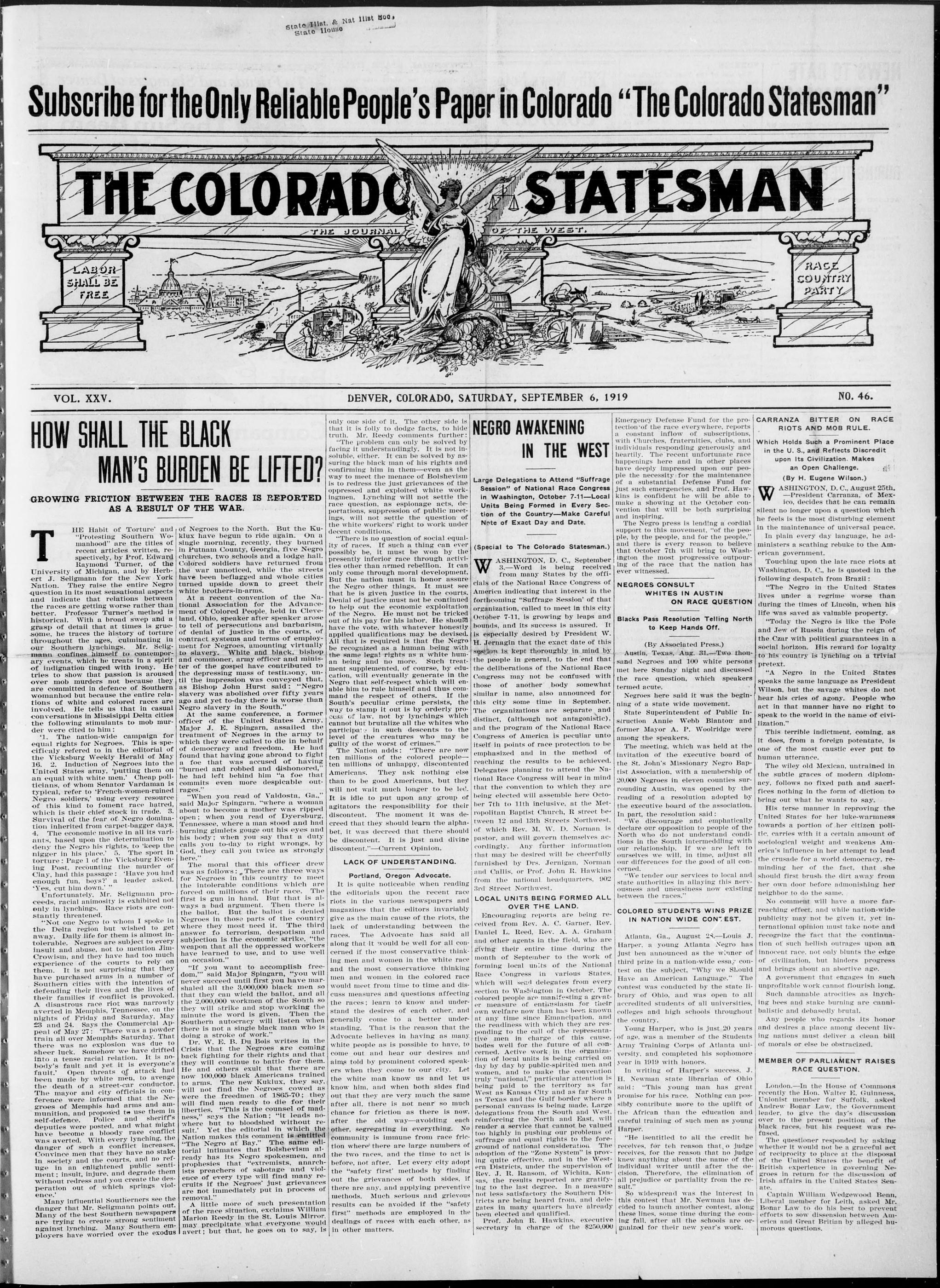
Subscribe for the Only Reliable People's Paper in Colorado "The Colorado Statesman"
THE COLORADO STATESMAN
THE JOURNAL OF THE WEST.
LABOR SHALL BE FREE
RAGE COUNTRY PARTY
HOW SHALL THE BLACK MAN'S BURDEN BE LIFTED?
GROWING FRICTION BETWEEN THE RACES IS REPORTED AS A RESULT OF THE WAR.
VOL. XXV.
HE Habit of Torture' and "Protesting Southern Womanhood" are the titles of recent articles written, respectively, by Prof. Edward Raymond Turner, of the University of Michigan, and by Herbert J. Seligmann for the New York Nation. They raise the entire Negro question in its most sensational aspects and indicate that relations between the races are getting worse rather than better. Professor Turner's method is historical. With a broad sweep and a grasp of detail that at times is gruesome, he traces the history of torture throughout the ages, culminating in our Southern lynchings. Mr. Seligmann confines himself to contemporary events, which he treats in a spirit of indignation tinged with irony. He tries to show that passion is aroused over mob murders not because they are committed in defence of Southern womanhood but because the entire relations of white and colored races are involved. He tells us that in casual conversations in Mississippi Delta cities the following stimulants to mob murder were cited to him:
1. The nation-wide campaign for equal rights for Negroes. This is specifically referred to in the editorial of the Vicksburg Weekly Herald of May 16. 2. Induction of Negroes into the United States army, 'putting them on an equal with white men.' Cheap politicians, of whom Senator Vardaman is typical, refer to 'French-women-ruined Negro soldiers,' using every resource of this kind to foment race hatred, which is their chief stock in trade. 3. Survival of the fear of Negro domination inherited from carpet-bagger days. 4. The economic motive in all its variants, based upon the determination to deny the Negro his rights, to 'keep the nigger in his place'. 5. The sport in torture: Page 1 of the Vicksburg Evening Post, recounting the murder of Clay, had this passage: 'Have you had enough fun, boys?' a leader asked. 'Yes, cut him down.' 1
Unfortunately, Mr. Seligmann proceeds, racial animosity is exhibited not only in lynchings. Race riots are constantly threatened.
"Not one Negro to whom I spoke in the Delta region but wished to get away. Daily life for them is almost intolerable. Negroes are subject to every insult and abuse, not to mention Jim-Crowism, and they have had too much experience of the courts to rely on them. It is not surprising that they have purchased arms in a number of Southern cities with the intention of defending their lives and the lives of their families if conflict is provoked. A disastrous race riot was narrowly averted in Memphis, Tennessee, on the nights of Friday and Saturday, May 23 and 24. Says the Commercial Appeal of May 27: 'There was a powder train all over Memphis Saturday. That there was no explosion was due to sheer luck. Somehow we have drifted into a tense racial relation. It is nobody's fault and yet it is everyone's fault.' Open threats of attack had been made by white men, to avenge the death of a street-car conductor. The mayor and city officials in conference were informed that the Negroes of Memphis had arms and ammunition, and proposed to use them in self-defence. Police and sheriff's deputies were posted, and what might have become a bloody race conflict was averted. With every lynching, the danger of such a conflict increases. Convince men that they have no stake in society and the courts, and no refuge in an enlightened public sentiment; insult, injure, and degrade them without redress and you create the desperation out of which springs violence.'
Many influential Southerners see the danger that Mr. Seligmann points out. Many of the best Southern newspapers are trying to create strong sentiment against lynching. Many Southern employers have worried over the exodus
State Hist. & Nat Hist 800
State House
of Negroes to the North. But the Kuklux have begun to ride again. On a single morning, recently, they burned in Putnam County, Georgia, five Negro churches, two schools and a lodge hall. Colored soldiers have returned from the war unnoticed, while the streets have been beflagged and whole cities turned upside down to greet their white brothers-in-arms.
At a recent convention of the National Association for the Advancement of Colored People, held in Cleveland, Ohio, speaker after speaker arose to tell of persecutions and barbarism, of denial of justice in the courts, of contract systems and terms of employment for Negroes, amounting virtually to slavery. White and black, bishop and commoner, army officer and minister of the gospel have contributed to the depressing mass of testimony, until the impression was conveyed that, as Bishop John Hurst said: "Negro slavery was abolished over fifty years ago and yet to-day there is worse than Negro slavery in the South."
At the same conference, a former officer of the United States Army, Major J. E. Spingarn, assailed the treatment of Negroes in the army to which they were called to die in behalf of democracy and freedom. He had found that having gone abroad to fight a foe that was accused of having "burned and robbed and dishonored," he had left behind him "a foe that commits even more despicable outrages."
"When you read of Valdosta, Ga.," said Major Spingarn, "where a woman about to become a mother was ripped open; when you read of Dyersburg, Tennessee, where a man stood and had burning gimlets gouge out his eyes and his body; when you say that a duty calls you to-day to right wrongs, by God, they call you twice as strongly here."
The moral that this officer drew was as follows: There are three ways for Negroes in this country to meet the intolerable conditions which are forced on millions of their race. The first is gun in hand. But that is always a bad argument. Then there is the ballot. But the ballot is denied Negroes in those parts of the country where they most need it. The third answer to terrorism, despotism and subjection is the economic strike, "the weapon that all the oppressed workers have learned to use, and to use well on occasion."
"If you want to accomplish freedom," said Major Spingarn, "you will never succeed until first you have marshaled all the 3,000,000 black men so that they can wield the ballot, and all the 2,000,000 workmen of the South so they will strike and stop working the minute the word is given. Then the Southern autocracy will listen when there is not a single black man who is doing a stroke of work."
Dr. W. E. B. Du Bois writes in the Crisis that the Negroes are coming back fighting for their rights and that they will continue to battle for them. He and others exult that there are now 100,000 black Americans trained to arms. The new Kuklux, they say, will not find the Negroes cowed as were the freedmen of 1865-70; they will find men ready to die for their liberties. "This is the counsel of madness," says the Nation; "it leads nowhere but to bloodshed without result." Yet the editorial in which the Nation makes this comment is entitled "The Negro at Bay." The same editorial intimates that Bolshevism already has its Negro spokesmen, and prophesies that "extremists, anarchists preachers of sabotage and violence of every type will find many recruits if the Negroes' just grievances are not immediately put in process of removal."
A little more of such presentation of the race situation, exclaims William Marion Reedy in the St. Louis Mirror, may precipitate what everyone would avert; but that, he goes on to say, is
le People's Pap
ADO
THE JOURNAL
DENVER, COLORADO, SA
DENVER, COLORADO, SATURDAY, SEPTEMBER 6, 1919
only one side of it. The other side is that it is folly to dodge facts, to hide truth. Mr. Reedy comments further:
"The problem can only be solved by facing it understandingly. It is not insoluble, either. It can be solved by assuring the black man of his rights and confirming him in them—even as the way to meet the menace of Bolshevism is to redress the just grievances of the oppressed and exploited white workmen. Lynching will not settle the race question, as espionage acts, deportations, suppression of public meetings, will not settle the question of the white workers' right to work under decent conditions.
"There is no question of social equality of races. If such a thing can ever possibly be, it must be won by the presently inferior race through activities other than armed rebellion. It can only come through moral development, But the nation must in honor assure the Negro other things. It must see that he is given justice in the courts, Denial of justice must not be continued to help out the economic exploitation of the Negro. He must not be tricked out of his pay for his labor. He should have the vote, with whatever honestly applied qualifications may be devised. All that is required is that the Negro be recognized as a human being with the same legal rights as a white human being and no more. Such treatment supplemented, of course, by education, will eventually generate in the Negro that self-respect which will enable him to rule himself and thus command the respect of others. If the South's peculiar crime persists, the way to stamp it out is by orderly process of law, not by lynchings which cannot but brutalize all the whites who participate in such descents to the level of the creatures who may be guilty of the worst of crimes."
The Nation adds: "There are now ten millions of the colored people—ten millions of unhappy, discontented Americans. They ask nothing else than to be good Americans, but they will not wait much longer to be led. It is idle to put upon any group of agitators the responsibility for their discontent. The moment it was decreed that they should learn the alphabet, it was decreed that there should be discontent. It is Just and divine discontent."—Current Opinion.
LACK OF UNDERSTANDING.
Portland Oregon Advocate.
Portland, Oregon Advocate.
It is quite noticeable when reading the editorials upon the recent race riots in the various newspapers and magazines that the editors invariably give as the main cause of the riots, the lack of understanding between the races. The Advocate has said all along that it would be well for all concerned if the most conservative thinking men and women in the white race and the most conservative thinking men and women in the colored race would meet from time to time and discuss measures and questions affecting the races; learn to know and understand the desires of each other, and generally come to a better understanding. That is the reason that the Advocate believes in having as many white people as is possible to have, to come out and hear our desires and aims told by prominent colored speakers when they come to our city. Let the white man know us and let us know him, and when both sides find out that they are very much the same after all, there is not near so much chance for friction as there is now, after the old way—avoiding each other, segregating in everything. No community is immune from race friction where there are large numbers of the two races, and the time to act is before, not after. Let every city adopt the "safety first" methods by finding out the grievances of both sides, if there are any, and applying preventive methods. Much serious and grievous results can be avoided if the "safety first" methods are employed in the dealings of races with each other, as in other matters.
---
NEGRO AWAKENING IN THE WEST
Large Delegations to Attend "Suffrage Session" of National Race Congress in Washington, October 7-11—Local Units Being Formed in Every Section of the Country—Make Careful Note of Exact Day and Date.
(Special to The Colorado Statesman.)
WASHINGTON, D. C., September 3.—Word is being received from many States by the officials of the National Race Congress of America indicating that interest in the forthcoming "Suffrage Session' of that organization, called to meet in this city October 7-11, is growing by leaps and bounds, and its success is assured. It is especially desired by President W. H. Jernagin that the exact date of this session is kept thoroughly in mind by the people in general, to the end that the deliberations of the National Race Congress may not be confused with those of another body somewhat similar in name, also announced for this city some time in September. The organizations are separate and distinct, (although not antagonistic), and the program of the National Race Congress of America is peculiar unto itself in points of race protection to be emphasized and in the method of reaching the results to be achieved. Delegates planning to attend the National Race Congress will bear in mind that the convention to which they are being elected will assemble here October 7th to 11th inclusive, at the Metropolitan Baptist Church, R street between 12 and 13th Streets Northwest, of which Rev. M. W. D. Norman is pastor, and will govern themselves accordingly. Any further information that may be desired will be cheerfully furnished by Drs. Jernigan, Norman and Callis, or Prof. John R. Hawkins from the national headquarters, 902 3rd Street Northwest.
LOCAL UNITS BEING FORMED ALL
OVER THE LAND.
Encouraging reports are being received from Rev. A. C. Garner, Rev. Daniel L. Reed, Rev. A. A. Graham and other agents in the field, who are giving their entire time during the month of September to the work of forming local units of the National Race Congress in various States, which will send delegates from every section to Washington in October. The colored people are manifesting a greater measure of entusiasm for their own welfare now than has been known at any time since Emancipation, and the readiness with which they are responding to the call of the representative men in charge of this cause, bodies well for the future of all concerned. Active work in the organization of local units is being carried on day by day by public-spirited men and women, and to make the convention truly "national," particular attention is being paid to the territory as far West as Kansas City and as far South as Texas and the Gulf border where a personal canvass is being made. Large delegations from the South and West, reinforcing the North and East, will render a service that cannot be valued too highly in pushing our problems of suffrage and equal rights to the foreground of national consideration. The adoption of the "Zone System" is proving quite effective, and in the Western Districts, under the supervision of Rev. J. R. Ransom, of Wichita, Kansas, the results reported are gratifying to the last degree. In a measure not less satisfactory the Southern Districts are being heard from, and delegates in many quarters have already been elected and qualified.
Prof. John R. Hawkins, executive secretary in charge of the $250,000
Emergency Defense Fund for the protection of the race everywhere, reports a constant inflow of subscriptions, with Churches, fraternities, clubs, and individuals responding generously and heartily. The recent unfortunate race happenings here and in other places have deeply impressed upon our people the necessity for the maintenance of a substantial Defense Fund for just such emergencies, and Prof. Hawkins is confident he will be able to make a showing at the October convention that will be both surprising and inspiring. The Negro press is lending a cordial support to this movement, "of the people, by the people, and for the people," and there is every reason to believe that October 7th will bring to Washington the most progressive outpouring of the race that the nation has ever witnessed.
NEGROES CONSULT
WHITES IN AUSTIN
ON RACE QUESTION
Blacks Pass Resolution Telling North to Keep Hands Off.
(By Associated Press.)
Austin, Texas, Aug. 31.—Two thousand Negroes and 100 white persons met here Sunday night and discussed the race question, which speakers termed acute.
Negroes here said it was the beginning of a state wide movement.
State Superintendent of Public Instruction Annie Webb Blanton and former Mayor A. P. Woolridge were among the speakers.
The meeting, which was held at the invitation of the executive board of the St. John's Missionary Negro Baptist Association, with a membership of 20,000 Negroes in eleven counties surrounding Austin, was opened by the reading of a resolution adopted by the executive board of the association.
In part, the resolution said:
"We discourage and emphatically declare our opposition to people of the North who do not understand conditions in the South intermingling with our relationship. If we are left to ourselves we will, in time, adjust all our differences for the good of all concerned.
"We tender our services to local and state authorities in allaying this nervousness and uneasiness now existing between the races."
COLORED STUDENTS WINS PRIZE
IN NATION WIDE CON'EST.
Atlanta, Ga., August 28.—Louis J. Harper, a young Atlanta Negro has just been announced as the winner of third prize in a nation-wide essay contest on the subject, "Why we Should Have an American Language." The contest was conducted by the state library of Ohio, and was open to all accredited students of all universities, colleges and high schools throughout the country.
Young Harper, who is just 20 years of age, was a member of the Students Army Training Corps of Atlanta university, and completed his sophomore year in 1919 with honors.
In writing of Harper's success, J. H. Newman state librarian of Ohio said: "This young man has great promise for his race. Nothing can possibly contribute more to the uplift of the African than the education and careful training of such men as young Harper.
"He is entitled to all the credit he receives, for teh reason that, o judge receives, for the reason that no judge knew anything about the name of the individual writer until after the decision. Therefore, the elimination of all prejudice or partiality from the result."
So widespread was the interest in this contest that Mr. Newman has decided to launch another contest, along these lines, some time during the coming fall, after all the schools are organized for their new year's work.
NO.46.
CARRANZA BITTER ON RACE RIOTS AND MOB RULE. Which Holds Such a Prominent Place in the U. S., and Reflects Discredit upon Its Civilization. Makes
WASHINGTON, D.C., August 25th. —President Carranza, of Mexico, decides that he can remain silent no longer upon a question which he feels is the most disturbing element in the maintenance of universal peace. In plain every day language, he administers a scathing rebuke to the American government. Touching upon the late race riots at Washington, D.C., he is quoted in the following despatch from Brazil : "The Negro in the United States lives under a regrime worse than during the times of Lincoln, when his life was saved as valuable property. "Today the Negro is like the Pole and Jew of Russia during the reign of the Czar with political guarantees in a social horizon. His reward for loyalty to his country is lynching on a trivial pretext. "A Negro in the United States speaks the same language as President Wilson, but the savage whites do not hear his cries of agony. People who act in that manner have no right to speak to the world in the name of civilization." This terrible indictment, coming, as it does, from a foreign potentate, is one of the most caustic ever put to human utterance.
The wiley old Mexican, untrained in the subtle graces of modern diplomacy, follows no fixed path and sacrifices nothing in the form of diction to bring out what he wants to say.
His terse manner in reproving the United States for her luke-warmness towards a portion of her citizen politic, carries with it a certain amount of sociological weight and weakens America's influence in her attempt to lead the crusade for a world democracy, reminding her of the fact, that she should first brush the dirt away from her own door before admonishing her neighbor to do the same.
No comment will have a more far-reaching effect, and while nation-wide publicity may not be given it, yet international opinion must take note and recognize the fact that the continuation of such hellish outrages upon an innocent race, not only blunts the edge of civilization, but hinders progress and brings about an abortive age.
A government that engages in such unprofitable work cannot flourish long.
Such damnable atrocities as lynching bees and stake burning are cannibalistic and debasedly brutal.
Any people who regards its honor and desires a place among decent living nations must deliver a clean bill of morals or else be obstructed.
MEMBER OF PARLIAMENT RAISES
RACE QUESTION.
London.—In the House of Commons recently the Hon. Walter E. Guinness, Unionist member for Suffolk, asked Andrew Bonar Law, the Government leader, to give the day's discussion over to the present position of the black races, but his request was refused.
The questioner responded by asking whether it would not be a graceful act of reciprocity to place at the disposal of the United States the benefit of British experience in governing Negroes in return for the discussion of Irish affairs in the United States Senate.
Captain William Wedgewood Benn, Liberal member for Leith, asked Mr. Bonar Law to do his best to prevent efforts to sow dissension between America and Great Britain by alleged humorous questions.
FOREIGN
The son of the Earl of March and
heir presumptive of the dukedom of
Richmond, is dead of wounds received
in battle on the Archangel front.
King Albert, Queen Elizabeth and
Crown Prince Leopold will leave for
America between Sept. 20 and 24,
on board a United States warship.
Nikolai Lenine, the Russian Bolshevik
premier, has sent a delegation to
Kishinev to negotiate peace with Rumania, according to a report received
from Budapest.
Prince Joachim of Prussia, one of
the ex-kaiser's sons, has bought the
magnificent and ancient mansion
called "Villa Favorita" at Castagnola,
Italy. It cost him $80,000.
Twenty men were killed and forty are missing, it has been reported, as a result of the explosion of an ammunition barge which destroyed and sank the British monitor Glow Worm.
The United States has granted a loan of $50,000,000 to Esthonia, to be used chiefly to pay for American goods sent to that country, according to an announcement made by the Esthonian press bureau.
Andrew Sockalexis, famous Indian runner, is dead at Oxford, Me., from tuberculosis. He had competed in many of the important long-distance running events of the country. He ran in the Olympic games at Stockholm in 1912.
The Prussian government has ordered a discontinuance of the custom of hoisting flags on public buildings on the anniversary of the battle of Sedan, lest the people regard the hoisting as a demonstration in favor of the old regime.
While Herman Schumann wooed and won a sweetheart during the last few years, he murdered ten persons, robbed scores of others and saved enough from his career to marry. Now he is charged with being the champion murderer of Germany.
Dr. Lipp, who participated in the soviet government at Munich and issued orders which were consedired amazing, has been declared incapable of standing trial because of his mental condition. For some time he has been confined in an insane asylum.
C. A. McCurdy, parliamentary secretary for the food ministry, predicts that milk will cost a shilling (24 cents) a quart this winter in London. He said powers will be granted the local authorities to supply subsidized milk to poor British children at less than cost or free.
A crushing defeat has been administered to the Bolshevik army in south Russia. The war office announced that General Kaomtkov's cavalry, operating under General Denikine, has broken through the front of the Red army south of Makarova, capturing 13,000 prisoners and disarming 20,000 Red recruits.
Five million Germans have filed with the Central Bureau of Immigration and its sixty-four sub-stations applications for permission to leave Germany. The majority of the intending emigrants are turning their eyes toward South America. A large number also have indicated their desire to settle in Palestine.
GENERAL
The will of Andrew Carnegie, made public, estimates the value of the ironmaster's estate at between $25,000,000 and $30,000,000.
The seamen's strike at Sydney, N. S. W., ended when a mass meeting of the men decided to reman the ships affected immediately.
John Shell, said to be the oldest living man in the United States, celebrated the 131st anniversary of his birth at Lexington, Ky., on Sept. 3rd.
That he found $575,000 in Liberty bonds and received a reward of $15 for turning them in to their owners was the story told by Isadore Geller, a 16-year-old errand boy who is employed at $9 a week by Unz & Co., of 36 Broadway, New York.
The biggest users of motor trucks in the world are the Ameircan farmers, with 79,789 motor trucks in operation. Manufacturers come second with 75,928, and retailers third with 74,486.
Judge Harry W. Robinson of the Circuit Court was shot in the shoulder in open court in Louisville, Ky., by Frank Douglass, an attorney, while the judge was quizzing the lawyer about the ethics of retaining a sum which the attorney claimed as a fee.
As unreasonable as it sounds, the city authorities have announced that every canine resident of Asheville, N.C., must wear a bell during the next year, and to prove their earnestness they have purchased a large supply of the necessary ornaments for distribution among the owners of dogs.
Col. Edward M. House, who since last November has been in Paris as a member of the American Peace Commission, will return to America in September. Colonel House will be accompanied by Lord Grey, the newly appointed British ambassador to the United States, and will land about September 15th. The successful application of the alternating current to wireless telephony, which will make it possible for any person to "plug in" a pony wireless panel into an ordinary lamp socket and talk through space from house to house or city to city, has been announced by Dr. Lee De Forest of New York.
Twelve members of the crew of the four-masted auxiliary schooner Elmer Roberts arrived in Yarmouth, N. S., and reported that their ship loaded with ammunition, caught fire and blew up at sea.
NEWS TO DATE IN PARAGRAPHS
CAUGHT FROM THE NETWORK OF WIRES ROUND ABOUT. THE WORLD.
DURING THE PAST WEEK
RECORD OF IMPORTANT EVENTS
CONDENSED FOR BUSY
Western Newspaper Union News Service.
WESTERN
Nathan Shapiro, grocer, was shot and killed in his store in Omaha when he resisted three small negro boys who had come to rob the place.
William Kunnecke, who was serving a life term in the state penitentiary at Sioux Falls, S. D., on a charge of murdering three persons, has escaped.
Nathan Wolfson, who was shot while escaping from jail at Kearney, Neb., has been arrested in a hospital at Omaha, where he went for treatment of his wounds.
Six children belonging to two families living in one house at Jenson, Sask., were burned to death when the house was destroyed by fire recently, in the absence of their parents.
On a charge of flying his aeroplane within ten feet of the roof of a farmer's house, Charles H. Levy was fined $25 and costs for disturbing the peace in a Justice Court at Dodson, Mo.
Fire, originating in the rear of a former saloon, wiped out two square blocks in the heart of the business section of Los Banos, causing between $750,000 and $1,000,000 in losses and destroying the habitations of at least 200 people.
Frank Twohy, 9-year-old son of the president of the Old National Bank, is credited with saving the life of Anna Wagner, 25, at Hayden lake, near Spokane, Wash. The boy rescued the woman after she had gone under a second time.
President Wilson will review the Pacific fleet at Seattle Sept. 13, according to telegrams from Secretary Tumulty received by chairmen of Seattle's presidential and fleet welcome committees. The historic battleship Oregon will be the reviewing ship.
Arsenic was found in samples of coffee taken from a downtown lunchroom where thirty person were polsoned in Chicago, according to Health Commissioner Robertson He expressed the opinion that someone had put polson in the coffee urn with malicious intent.
WASHINGTON
By agreement between the United States and France, she is to pay the United States $400,000,000 in ten-year bonds bearing 4 per cent interest for the fixed installations and other military material in France which cannot be brought back to this country.
Frozen fish held in storage Aug. 15 amounted to 64,740,173 pounds, compared to 82,554,798 at the same time last year, the monthly report of the bureau of markets of the Department of Agriculture made public shows. The holdings of mild cured salmon on Aug. 15 amounted to 9,347,623 pounds, compared with 5,128,523 pounds last year.
President Wilson has asked Congress for an additional appropriation of $825,000 for the expenses of the American peace commission in Paris from last July 1 to the end of this calendar year. The President said that up to July 1 the total cost of the commission had been $1,250,629, and he estimated that by the end of the year the total would reach $1,506,706. A part of this has been appropriated heretofore.
Westerners opposed to regulation of the packing industry as proposed in the Kenyon and Kendrick bills occupied almost the exclusive attention of the Senate agricultural committee in its hearings on the two measures. A large delegation of Colorado citizens, led by E. M. Ammons, former governor of the state, consumed most of the day, and the delegation leader wound up the hearing with a speech which, contrary to custom, was applauded warmly in the committee room.
Favorable report on Attorney General Palmer's request for amendments to the food control act to assist him in the prosecution of profiteers, was made to the Senate by Senator Grona of North Dakota, chairman of the Agricultural Committee. Senator Grona stated that the report was not a unanimous one and that members of the committee had reserved the right to offer further amendments on the floor. The amendments as offered would provide a $5,000 penalty for the making of "unjust" or "unreasonable" prices and also include provisions against rent profiteering in the District of Columbia.
President Wilson has left Washington on his Western speaking tour in behalf of the peace treaty, confident of ultimate ratification of the instrument by the Senate without amendments or "destructice" reservations which would require re-negotiation. Loyal service in the army during the recent war cannot be considered a wiping out a soldier's past, the judge advocate general has ruled. An adverse opinion was rendered on the question of whether a man possessing a criminal record before entering the army could be re-enlisted at this time.
Pithy News Notes
From All Parts of
Colorado
Western Newspaper Union News Service.
COMING EVENTS.
Trinidad-Las Animas County Fair,
Trinidad, Sept. 16-19.
Conejos County Fair, Manassa, Sept.
17-19.
Yuma County Fair, Yuma, Sept. 17-20
Yuma County Fair, Hollyoke, Sept.
24-29
Saguache County Fair, Saguache, Sept.
Colorado-New Mexico Fair, Durango,
Sept. 23-26.
Colorado State Fair, Pueblo, Sept. 22-24.
Grand County Fair, Kremmling, Sept.
25-27
Crowley County Fair, Sugar City, Aug.
27-28.
Inter-Mountain Live Stock and Fair,
Grand Junction, Sept. 30 to Oct. 3.
Douglas County Fair, Castle Rock,
Oct. 7-9.
Soft water for Sterling about the
first of the year or very soon thereafter is now the bright prospect.
The schools of Montrose and Montrose county opened with the largest attendance in their history with competent corps of teachers.
Haxtun, in Phillips county, will shortly possess a new bank under articles of incorporation filed in the secretary of state's office for the Haxtun State Bank, with announced capital stock of $40,000.
One hundred tons of freshly stacked alfalfa hay, valued at $2,000, was burned on the Lakeside Hereford ranch of John E. Painter near Roggen. Fire is believed to have started from spontaneous combustion.
The organization of the First National Bank has been completed at Burlington with a capital of $30,000 and a surplus of $3,000. The bank will open for business some time during the month of September.
William Reynolds, 40, a clay miner, was crushed to death by a clay fall while at work in the clay mine near Golden, belonging to the Denver Sewer Pipe and Clay Company, operated under lease by Grant Parfet.
On behalf of the people of Colorado, Gov. O. H. Shoup has sent Gen. John I. Pershing a letter welcoming him back to the United States. The letter is to be delivered to General Pershing upon his arrival in New York.
While timbering a dangerous place in the Huffaker mine on Elk mountain, Andrew Johnson was injured severely when he slipped and fell from a rock. Both legs were crushed. This is the first mine accident in the Kremmling district.
More than two-fifths of the beans raised in Colorado this year are being grown in three counties, Weld, Elbert and El Paso. Pintos are grown largely in the last two counties named, while Weld county produces a large acreage of seed beans.
William Brewer, 42, well-known rancher of Platteville, Colo., was instantly killed, and William Roan, Fort Lupton, attorney, and George Browster, also of Fort Lupton, were slightly injured in an automobile accident on the East Lake road. Mr. Brewer was driving the car, and it was traveling at a high rate of speed, according to the other occupants of the car, when it struck a chuckhole and upset on the side of the road.
The Elberta peach season is on in full blast at Palisade and the movement of twenty-two carloads of the finest quality fruit ever grown in the upper valley is evidence that this will be a good peach year. The demand for the Palisade crop exceeds the supply and the growers are confident of good prices and markets, although prices prevailing this year are not as high as they were for the same day last year.
Street railway employés of Boulder have been granted an increase in wages averaging 8 per cent. The men have been receiving a wage of 33 cents and 35 cents an hour. According to the new scale the wages will be 35, 38 and 40 cents an hour. Perjury is charged against Joe Mandich is an information filed in Boulder, in which Mandich, who is said to be 45 years old, is alleged to have sworn to a lie in getting a marriage license for himself and 14-year-old Melita Phillips of Longmont.
John Tarro, a peddler of ice cream cones, who was arrested at Durango, charged with having an unlawful amount of intoxicants in his possession, was tried in Justice Court and found guilty and was assessed a fine of $150, plus $84 costs and ninety days in jail, has appealed the case to the County Court and has put up a cash bond of $564 to carry the case through, which will come up for retrial at the September term of court. When Tarro was first arrested, the officers say they found a barrel of wine that teste more than 2 per cent alcoholic content.
The heaviest bank clearings in the history of Colorado Springs were reported for June, July and August by the Colorado Springs Clearing House association. The total is $14,011,267.-64, an increase of $4,163,527.42 over last year. The figures bear out the general belief that Colorado Springs enjoyed this year the biggest tourist season in its history. The first fire that has occurred in Durango in two months destroyed a Fourteenth street residence with an estimated loss of $1,250, covered by $775 insurance.
CENTENNIAL STATE ITEMS.
Nothing in the world ever has or ever can take the place of a good horse. Interest therefore, in the Colorado Horse Breeders' Association meeting to take place in Pueblo, Tuesday, September 23rd at 10 o'clock a.m., during the coming State Fair, is very great. It is also predicted that this gathering of horse raisers will greatly stimulate the raising and use of horses throughout the West. The maximum service of the horse with the minimum effort or loss of energy has become a study which has resulted in valuable discoveries brought about by experiments and practical tests, and chief of these is the multiple hitch system so much talked about, of late, that experts in that line are in demand for demonstrations everywhere Wayne Dinsmore, of Chicago, secretary of the Percheron Society of America, is an acknowledged authority on this subject, and his services have been secured to make demonstrations at the Colorado State Fair, Pueblo, on September 23rd.
During their four months of existence the four state employment offices which are operating in conjunction with the State Labor Department, have placed 2,850 discharged soldiers in positions, according to figures just made public by W. L. Morrissey, state labor commissioner. The two offices maintained in Denver secured work for 1,929 men, the one in Pueblo for 620 men, and for 310 men at Colorado Springs. A total of 3,776 applications for jobs were received at the offices.
Ninety-five losses of live stock by fire and lightning have occurred in the farming regions of Pueblo during the past twelve months, and 60 per cent of these have been caused by lightning. Wire fences, near which most of the animals have been found dead, are said to have been the deathbolt carriers, sometimes for considerable distances. Losses have occurred among cattle, hogs, sheep and horses. Most of the farmers and stock men carry insurance, thus minimizing the losses.
Abstract of assessment of Pueblo county property, prepared by County Assessor M. A. Carey for the state tax commission, shows the taxable property to total this year $71,178,990, an increase of $1,901,938 over the valuation of last year. Merchandising and manufacturing show the largest increase, $638,595, and automobiles come next with an increase of $200,000. Most all forms of personal property show a marked increase this year over last.
As a result of the reports on acreage of crops furnished this year by county assessors and the reports on yields of small grains furnished by threshermen, the Colorado Co-operative Crop Reporting Service will be able this year to make a more accurate report on the amount of grain grown in the state than has ever been made before, and will have the figures available a month or more earlier than in the past.
The largest registration in the history of Brighton is recorded in the public schools of that city, and it has been necessary to secure the use of two school rooms in the Presbyterian church to care for the children who are attending school this year. The grade school is crowded to capacity and will be until this winter. The high school has one-third more pupils than in any year in its history.
A $4,000 fire damaged the Mountain Ice and Coal company's plant at Pueblo. The fire started when sparks from the smokestack set fire to the upper portion of the cold storage department. Quick work on the part of the fire department saved the plant from damage similar to that which completely destroyed the plant twelve years ago.
Estimates received by the Coorado Tax Commission indicate that the total value of Colorado property for purposes of taxation will reach $1,500,000,000. The valuation last year was $1,422,000,000.
Screams of the $2½-year-old son of Mr. and Mrs. Thomas Rosser brought members of the family to the rescue of the child, but not in time to save it from being scalded to death in a pan of soap suds, at Marshall, Colo. The mother, who was in bed ill and unable to rise, heard the boy screaming and called for help. One of the older children who had placed the pan of boiling water on the floor preparatory to doing some scrubbing, but who had gone outside the house, heard the call and ran to the child.
More than 350 women have already sent in their names to University of Colorado authorities as prospective students in the university next year. These names are now all in the hands of the Big Sister committee chairman in Boulder. More than 200 women have already sent in their credits to the registrar, indicating the certainty of their entering school when it opens Sept. 29.
Colorado has 291 public schools giving high school work. Of these 165 give full high school course, sixteen give three years, seventy-five two years and thirty-five one year of high school work.
Lieut Harold Beaton, a Williams Fork ranchman, has been put in charge of Soldiers' day at the Grand county fair and the directors have ordered 200 honor medals which will be presented to the Grand county veterans of the war on that day. The fair will be held Sept. 25, 26 and 27.
Many wild grasses of Colorado are susceptible to rust and assist in spreading it to the grain fields. They are especially pernicious when they occur in the cities, thus aiding the rust to spread from city barberries out into the country.
V
Wishes to welcome and dainties of a. m. to 11:30 hours; so when and we will give smile.
MRS. M. J. FRANKLEY
The Curtis Park Floral Company
FLORAL DESIGNS PUT UP YOUR CHOICE PLANTS AND CUTS GREENHOUSES: Thirty-FTELEPHONE, MAIN 1811
Weather
TELEPHONE
MAIN 3203
Established 1876
RENOVATORS, BLUE
Of Gents' and M
1624 CHA
Poro Hair
SCIENTIFIC AND SANITARY
MASSAGING, M
Mme.
2220 OGDEN STREET
Wishes to welcome all to good home cooking and dainties of the seasons, any time from 6 a. m. to 11:30 p. m. Accurate service at all hours; so when down town stop, give us a trial and we will guarantee you will leave with a smile.
MRS. M. J. FRANKLIN & S. BOWERS, Props. 924 19th St.
The
Curtis
Park
Floral
Company
FLORAL DESIGNS PUT UP WHILE
YOU WAIT
CHOICE PLANTS AND CUT FLOWERS CONSTANTLY
ON HAND
GREENHOUSES: Thirty-Fourth and Curtis Streets
TELEPHONE, MAIN 1511
DENVER, COLO
Weatherhead Hat Co.
Weatherhead Hat Co.
NOVATORS, BLEACHERS, DYERS AND FINISHES
Of Gents' and Ladies' Hats of Every Description
1624 CHAMPA ST., DENVER, COLO.
No Hair Dressing Pad
PACIFIC AND SANITARY SCALP AND HAIR TR
MASSAGING, MANICURING, TOILET ARTICLE
RENOVATORS, BLEACHERS, DYERS AND FINISHERS Of Gents' and Ladies' Hats of Every Description 1624 CHAMPA ST., DENVER, COLO.
Poro Hair Dressing Parlors
SCIENTIFIC AND SANITARY SCALP AND HAIR TREATMENT MASSAGING, MANICURING, TOILET ARTICLES
Mme. Lexie A. Brooks
DEN STREET
PHONE YO
MOTTO: "CAREFUL DRIVING, BUT SURE"
J. V. LEWIS AUTO LIVERY
J. V. LEWIS AUTO LIVERY
7 PASSENGER WESTCOT 6 CARS.
Depot, 1 or 2 Passenger
25c; One Mile Rad
RATES P
Night—Page Pool
Day—¢450 W
DENVER, :-t :-
TAXICAB RATES:
or 2 Passenger, 50c; Depot, Each Additional
c; One Mile Radius, 50c; Each Additional Mile,
RATES PER HOUR, $1.50 TO $2.50.
STAND:
Right—Page Pool Hall, 2710 Welton, Phone Main 2
Day—6450 Washington, Phone York 8601-W.
R, ::-t ::-: ::-: ::-: ::-: CO
Night—Page Pool Hall. 2710 Welton, Phone Main 2759.
Day—8450 Washington, Phone York 8601-W.
1
C. E. SMITH, M.
The Mar
Wholesale and Retail Staple
Hotels and Restaurants
Eastern
Fruits, Vegetables
Telephones
622-636 15TH STREET
C. E. SMITH, Manager, Res. Phone South 1608 The Market Company and Retail Staple and Fancy Groceries, Fish and Birds and Restaurants Our Specialty. Fresh and C
Wholesale and Retail Staple and Fancy Groceries, Fish and Oysters. Hotels and Restaurants Our Specialty. Fresh and Cured
```markdown
```
PIONEER HATTERS OF THE WEST. WE MAKE OLD HATS NEW.
BLEACHERS, DYERS AND FINISHERS
And Ladies' Hats of Every Description
HAMPA ST., DENVER, COLO.
Hair Dressing Parlors
NITIARY SCALP AND HAIR TREATMENT
MANICURING, TOILET ARTICLES
Motto—"Efficiency"
Lexie A. Brooks
PHONE YORK 5997W
AXICAB RATES:
250c; Depot, Each Additional Passenger,
as, 50c; Each Additional Mile, 25c.
R HOUR, $1.50 TO $2.50.
STAND:
All, 2710 Welton, Phone Main 2759.
Washington, Phone York 8601-W.
::: ::: ::: COLORADO.
C. C. DENNIS R. F. LONG
The New Way Shoe
Repairing Co.
AND
American Shoe Repairing
FIRST-CLASS WORK
Best Leather Used—Reasonable Prices
1855 Champa St. Phone Main 3737.
1221 Sixteenth St. Phone Champa 5389.
Opp. Golden Eagle. DENVER, COLO.
manager, Res. Phone South 1608
ket Company
e and Fancy Groceries, Fish and Oysters.
WOMEN'S WORTH TO CONSUME
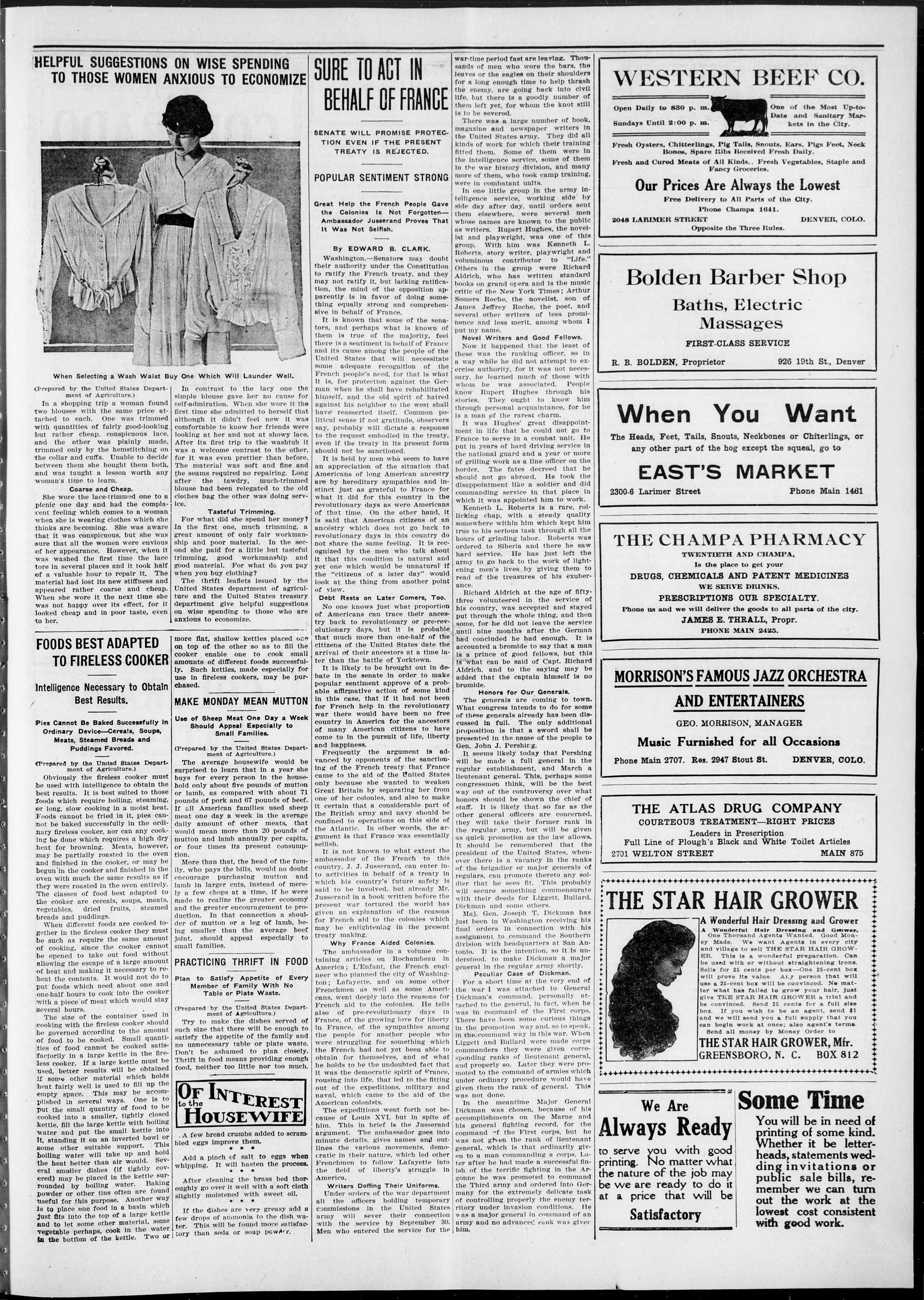
When Selecting a Wash Waist Buy One Which Will Launder Well.
(Prepared by the United States Department of Agriculture.)
In a shopping trip a woman found two blouses with the same price attached to each. One was trimmed with quantities of fairly good-looking but rather cheap, consipuous lace, and the other was plainly made, trimmed only by the hemstitching on the collar and cuffs. Unable to decide between them she bought them both, and was taught a lesson worth any woman's time to learn.
In contrast to the lacy one a simple blouse gave her no cause self-admiration. When she wore it first time she admitted to herself although it didn't feel new it comfortable to know her friends w looking at her and not at showy After its first trip to the washtu was a welcome contrast to the ot for it was even prettier than best The material was soft and fine the seams required no repairing. After the tawdry, much-trim
Coarse and Cheap.
She wore the lace-trimmed one to a plenic one day and had the complacent feeling which comes to a woman when she is wearing clothes which she thinks are becoming. She was aware that it was conspicuous, but she was sure that all the women were envious of her appearance. However, when it was washed the first time the lace tore in several places and it took half of a valuable hour to repair it. The material had lost its new stiffness and appeared rather coarse and cheap. When she wore it the next time she was not happy over its effect, for it looked cheap and in poor taste, even to her.
FOODS BEST ADAPTED TO FIRELESS COOKER
FOODS BEST ADAPTED TO FIRELESS COOKER
Intelligence Necessary to Obtain Best Results.
Pies Cannot Be Baked Successfully In Ordinary Device—Cereals, Soups, Meats, Steamed Breads and Puddings Favored.
(Prepared by the United States Department of Agriculture.)
Obviously the fireless cooker must be used with intelligence to obtain the best results. It is best suited to those foods which require boiling, steaming, or long, slow cooking in a moist heat. Foods cannot be fried in it, it pies cannot be baked successfully in the ordinary fireless cooker, nor can any cooking be done which requires a high dry heat for browning. Meats, however, may be partially roasted in the oven and finished in the cooker, or may be begun in the cooker and finished in the oven entirely. The classes of food best adapted to the cooker are cereals, soups, meats, vegetables, dried fruits, steamed breads and puddings.
When different foods are cooked together in the fireless cooker they must be such as require the same amount of cooking, since the cooker cannot be opened to take out food without allowing the escape of a large amount of heat and making it necessary to reheat the contents. It would not do to put foods which need about one and one-half hours to cook into the cooker with a piece of meat which would stay several hours.
The size of the container used in cooking with the fireless cook should be governed according to the amount of food to be cooked. Small quantities of food cannot be cooked satisfactorily in a large kettle in the fireless cooker. If a large kettle must be used, better results will be obtained if some other material which holds heat fairly well is used to fill up the empty space. This may be accomplished in several ways. One is to put the small quantity of food to be cooked into a smaller, tightly closed kettle, fill the large kettle with boiling water and put the small kettle into it, standing it on an inverted bowl or some other suitable support. This boiling water will take up and hold the heat better than air would. Several smaller dishes (if tightly covered) may be placed in the kettle surrounded by boiling water. Baking powder or other tins often are found useful for this purpose. Another way is to place one food in a basin which just fits into the top of a large kettle and to let some other material, some vegetable perhaps, cook in the water in the bottom of the kettle. Two or
In contrast to the lacy one the simple blouse gave her no cause for self-admiration. When she wore it the first time she admitted to herself that although it didn't feel new it was comfortable to know her friends were looking at her and not at showy lace. After its first trip to the washtub it was a welcome contrast to the other, for it was even prettier than before. The material was soft and fine and the seams required no repairing. Long after the tawdry, much-trimmed blouse had been relegated to the old clothes bag the other was doing service.
Tasteful Trimming.
For what did she spend her money? In the first one, much trimming, a great amount of only fair workmanship and poor material. In the second she paid for a little but tasteful trimming, good workmanship and good material. For what do you pay when you buy clothing? The thrift leadets issued by the United States department of agriculture and the United States treasury department give helpful suggestions on wise spending to those who are anxious to economize.
more fint, shallow kettles placed one on top of the other so as to fill the cooker enable one to cook small amounts of different foods successfully. Such kettles, made especially for use in fireless cookers, may be purchased.
MAKE MONDAY MEAN MUTTON
Use of Sheep Meat One Day a Week Should Appeal Especially to Small Families.
(Prepared by the United States Department of Agriculture.)
The average housewife would be surprised to learn that in a year she buys for every person in the household only about five pounds of mutton or lamb, as compared with about 71 pounds of pork and 67 pounds of beef. If all American families used sheep meat one day a week in the average daily amount of other meats, that would mean more than 20 pounds of mutton and lamb annually per capita, or four times its present consumption.
More than that, the head of the family, who pays the bills, would no doubt encourage purchasing mutton and lamb in larger cuts, instead of merely a few chops at a time, if he were made to realize the greater economy and the greater encouragement to production. In that connection a shoulder of mutton or a leg of lamb, being smaller than the average beef joint, should appeal especially to small families.
PRACTICING THRIFT IN FOOD
Plan to Satisfy Appetite of Every Member of Family With No Table or Plate Waste.
(Prepared by the United States Department of Agriculture.)
Try to make the dishes served of such size that there will be enough to satisfy the appetite of the family and no unnecessary table or plate waste. Don't be ashamed to plan closely. Thrift in food means providing enough food, neither too little nor too much.
OF INTEREST to the HOUSEWIFE
A few bread crumbs added to scrambled eggs improve them.
Add a pinch of salt to eggs when
whipping. It will hasten the process.
* * * *
After cleaning the brass bed thoroughly go over it well with a soft cloth slightly moistened with sweet oil.
* * * *
If the dishes are very greasy add a few drops of ammonia to the dish water. This will be found more satisfactory than soda or soap powder.
SURE TO ACT IN BEHALF OF FRANCE
SENATE WILL PROMISE PROTECTION EVEN IF THE PRESENT TREATY IS REJECTED.
POPULAR SENTIMENT STRONG
Great Help the French People Gave the Colonies Is Not Forgotten—Ambassador Jusserand Proves That It Was Not Selfish.
By EDWARD B. CLARK.
Washington.—Senators may doubt their authority under the Constitution to ratify the French treaty, and they may not ratify it, but lacking ratification, the mind of the opposition apparently is in favor of doing something equally strong and comprehensive in behalf of France.
It is known that some of the senators, and perhaps what is known of them is true of the majority, feel there is a sentiment in behalf of France and its cause among the people of the United States that will necessitate some adequate recognition of the French people's need, for that is what it is, for protection against the German when he shall have rehabilitated himself, and the old spirit of hatred against his neighbor to the west shall have reasserted itself. Common political sense if not gratitude, observers say, probably will dictate a response to the request embodied in the treaty, even if the treaty in its present form should not be sanctioned.
It is held by men who seem to have an appreciation of the situation that Americans of long American ancestry are by hereditary sympathies and instinct just as grateful to France for what it did for this country in the revolutionary days as were Americans of that time. On the other hand, it is said that American citizens of an ancestry which does not go back to revolutionary days in this country do not share the same feeling. It is recognized by the men who talk about it that this condition is natural and yet one which would be unnatural if the "citizens of a later day" would look at the thing from another point of view.
Debt Rests on Later Comers, Too.
No one knows just what proportion of Americans can trace their ancestry back to revolutionary or pre-revolutionary days, but it is probable that much more than one-half of the citizens of the United States date the arrival of their ancestors at a time later than the battle of Yorktown.
It is likely to be brought out in debate in the senate in order to make popular sentiment approve of a probable affirmative action of some kind in this case, that if it had not been for French help in the revolutionary war there would have been no free country in America for the ancestors of many American citizens to have come to in the pursuit of life, liberty and happiness.
Frequently the argument is advanced by opponents of the sanctioning of the French treaty that France came to the aid of the United States only because she wanted to weaken Great Britain by separating her from one of her colonies, and also to make it certain that a considerable part of the British army and navy should be confined to operations on this side of the Atlantic. In other words, the argument is that France was essentially selfish.
It is not known to what extent the ambassador of the French to this country, J. J. Jusserand, can enter into activities in behalf of a treaty in which his country's future safety is said to be involved, but already Mr. Jusserand in a book written before the present war tortured the world has given an explanation of the reasons for French aid to the colonies which may be enlightening in the present treaty making.
Why France Aided Colonies.
Why France Aided Colonies
The ambassador in a volume containing articles on Rochambeau in America; L'Enfant, the French engineer who planned the city of Washington; Lafayette, and on some other Frenchmen as well as some Americans, went deeply into the reasons for French aid to the colonies. He tells also of pre-revolutionary days in France, of the growing love for liberty in France, of the sympathies among the people for another people who were struggling for something which the French had not yet been able to obtain for themselves, and of what he holds to be the undoubted fact that it was the democratic spirit of France, rousing into life, that led to the fitting out of the expeditions, military and naval, which came to the aid of the American colonists.
The expedition went forth not because of Louis XVI, but in spite of him. This in brief is the Jusserand argument. The ambassador goes into minute details, gives names and outlines the various movements, democratic in their nature, which led other Frenchmen to follow Lafayette into the field of liberty's struggle in America.
Writers Doffing Their Uniforms.
Under orders of the war department all the officers holding temporary commissions in the United States army will sever their connection with the service by September 30. Men who entered the service for the
war-time period fast are leaving. Thousands of men who wore the bars, the leaves or the eagles on their shoulders for a long enough time to help thrash the enemy, are going back into civil life, but there is a goodly number of them left yet, for whom the knot still is to be severed. There was a large number of book, magazine and newspaper writers in the United States army. They did all kinds of work for which their training fitted them. Some of them were in the intelligence service, some of them in the war history division, and many more of them, who took camp training, were in combatant units.
In one little group in the army intelligence service, working side by side day after day, until orders sent them elsewhere, were several men whose names are known to the public as writers. Rupert Hughes, the novelist and playwright, was one of this group. With him was Kenneth L. Roberts, story writer, playwright and voluminous contributor to "Life." Others in the group were Richard Aldrich, who has written standard books on grand opera and is the music critic of the New York Times; Arthur Somers Roche, the novelist, son of James Jeffrey Roche, the poet, and several other writers of less prominence and less merit, among whom I put my name.
Novel Writers and Good Fellows.
Now it happened that the least of these was the ranking officer, so in a way while he did not attempt to exercise authority, for it was not necessary, he learned much of those with whom he was associated. People know Rupert Hughes through his stories. They ought to know him through personal acquaintance, for he is a man of the rarest charm.
It was Hughes' great disappointment in life that he could not go to France to serve in a combat unit. He put in years of hard driving service in the national guard and a year or more of grilling work as a line officer on the border. The fates decreed that he should not go abroad. He took the disappointment like a soldier and did commanding service in that place in which it was appointed him to work.
Kenneth L. Roberts is a rare, rollicking chap, with a steady quality somewhere within him which kept him true to his serious task through all the hours of grinding labor. Roberts was ordered to Siberia and there he saw hard service. He has just left the army to go back to the work of lightening men's lives by giving them to read of the treasures of his exuberance.
Richard Aldrich at the age of fifty-three volunteered in the service of his country, was accepted and stayed put through the whole thing, and then some, for he did not leave the service until nine months after the German had concluded he had enough. It is accounted a bromide to say that a man is a prince of good fellows, but this is what can be said of Capt. Richard Aldrich, and to the saying may be added that the captain himself is no bromide.
Honors for Our Generals.
The generals are coming to town. What congress intends to do for some of these generals already has been discussed in full. The only additional proposition is that a sword shall be presented in the name of the people to Gen. John J. Pershirg.
It seems likely today that Pershing will be made a full general in the regular establishment, and March a lieutenant general. This, perhaps some congressmen think, will be the best way out of the controversy over what honors should be shown the chief of staff. It is likely that so far as the other general officers are concerned, they will take their former rank in the regular army, but will be given as quick promotion as the law allows. It should be remembered that the president of the United States, whenever there is a vacancy in the ranks of the brigadier or major generals of regulars, can promote thereto any soldier that he sees fit. This probably will secure something commensurate with their deeds for Liggett, Bullard, Dickman and some others.
Maj. Gen. Joseph T. Dickman has just been in Washington receiving his final orders in connection with his assignment to command the Southern division with headquarters at San Antonio. It is the intention, so it is understood, to make Dickman a major general in the regular army shortly.
Pecurial Case or Dickman.
For a short time at the very end of the war I was attached to General Dickman's command, personally attached to the general, in fact, when he was in command of the First corps. There have been some curious things in the promotion way and, so to speak, in the command way in this war. When Liggett and Bullard were made corps commanders they were given corresponding ranks of lieutenant general, and properly so. Later they were promoted to the command of armies which under ordinary procedure would have given them the rank of general. This was not done.
In the meantime Major General Dickman was chosen, because of his accomplishments on the Marne and his general fighting record, for the command of the First corps, but he was not given the rank of lieutenant general, which is that ordinarily given to a man commanding a corps. Later after he had made a successful finish of the terrific fighting in the Argonne he was promoted to command the Third army and ordered into Germany for the extremely delicate task of controlling properly the enemy territory under invasion conditions. He was a major general in command of an army and no advanced rank was given him.
WESTERN BEEF CO.
Kings, Pig Tails, Snouts, Ears, Pigs Feet, Neck
pare Ribs Received Fresh Daily.
Ses of All Kinds.. Fresh Vegetables, Staple and
Fancy Groceries.
Are Always the Lowest
Delivery to All Parts of the City.
Phone Champa 1641.
Fresh Oysters, Chitterlings, Pig Tails, Snouts, Ears, Pigs Feet, Neck Bones, Spare Ribs Received Fresh Daily.
Fresh and Cured Meats of All Kinds.. Fresh Vegetables, Staple and Fancy Groceries.
In Barber Shop
Baths, Electric
Massages
FIRST-CLASS SERVICE
Aprietor 926 19th St., Denver
You Want
Mails, Snouts, Neckbones or Chiterlings, or
of the hog except the squeal, go to
T'S MARKET
Phone Main 1461
AMPA PHARMACY
ENTIETH AND CHAMPA,
is the place to get your
MEDICALS AND PATENT MEDICINES
WE SERVE DRINKS.
SCRIPTIONS OUR SPECIALTY.
will deliver the goods to all parts of the city.
JAMES E. THRALL, Propr.
PHONE MAIN 2425.
FAMOUS JAZZ ORCHESTRA
AND ENTERTAINERS
MORRISON, MANAGER
Furnished for all Occasions
2947 Stout St. DENVER, COLO.
AS DRUG COMPANY
TREATMENT—RIGHT PRICES
Readers in Prescription
High's Black and White Toilet Articles
SEET MAIN 875
R HAIR GROWER
When Y
The Heads, Feet, Tails, Snout
any other part of the ho
EAST'S
The Heads, Feet, Tails, Snouts, Neckbones or Chiterlings, or any other part of the hog except the squeal, go to
THE CHAMPS
TWENTIETH
Is the place
DRUGS, CHEMICALS A
WE SERVE
PRESCRIPTIONS
Phone us and we will deliver
JAMES E. T.
PHONE
MORRISON'S FAMOUS
AND ENT
GEO. MORRIS
Music Furnished
Phone Main 2707. Res. 2947
THE ATLAS D
COURTEOUS TREAT
Leaders in
Full Line of Plough's Black
2701 WELTON STREET
THE STAR HA
THE CHAMPA PHARMACY
TWENTIETH AND CHAMPA,
Is the place to get your
DRUGS, CHEMICALS AND PATENT MEDICINES
WE SERVE DRINKS.
PRESCRIPTIONS OUR SPECIALTY.
Phone us and we will deliver the goods to all parts of the city.
JAMES E. THRALL, Propr.
PHONE MAIN 2425.
Leaders in Prescription Full Line of Plough's Black and White Toilet Articles 2701 WELTON STREET MAIN 875
THE STAR HAIR GROWER
A Wonderful Hair Dressing and Grower
A Wonderful Hair Dressing and Grower.
One Thousand Agents Wanted. Good Money Made. We want Agents in every city and village to sell THE STAR HAIR GROWER. This is a wonderful preparation. Can be used with or without straightening irons. Sells for 25 cents per box—One 25-cent box will prove its value. A.r.y person that will use a 25-cent box will be convinced. No matter what has failed to grow your hair, just give THE STAR HAIR GROWER a trial and be convinced. Send 25 cents for a full size box. If you wish to be an agent, send $1 and we will send you a full supply that you can begin work at once; also agent's terms.
Send all money by Money Order to
THE STAR HAIR GROWER, Mfr.
GREENSBORO, N. C. BOX 812
to serve you with good printing. No matter what the nature of the job may be we are ready to do it at a price that will be Satisfactory
---
R. B. BOLDEN, Proprietor
2300-6 Larimer Street
A
We Are Always Ready
One of the Most Up-to-Date and Sanitary Markets in the City.
DENVER, COLO.
Some Time
You will be in need of printing of some kind. Whether it be letterheads, statements wedding invitations or public sale bills, remember we can turn out the work at the lowest cost consistent with good work.
THE COLORADO STATESMAN
THE WESTERN STATE'S NEW YEAR.
CABON SHOULD BE FAIR.
RACE COUNTRY PARTY.
One Year ..... $2.00
Six Months ..... 1.50
Three Months ..... 75
Entered as second-class matter at the postoffice in the City of Denver, Colo.
Reading notices, ten lines or less, 10 cents per line. Each additional line over ten lines, 5 cents per line. Display advertising 50 cents per inch.
Remittances should be made by Express Money Order, Postoffice Money Order, Registered Letter or Bank Draft. Postage stamps will be received the same as cash for the fractional part of a dollar. Only 1c and 2c stamps taken.
No discounts allowed on less than three months' contract. Cash must accompany all orders from parties unknown to us. Further particulars on application.
Communications to receive attention must be newsy, upon important subjects, plainly written only upon one side of the paper, must reach us Tuesdays, if possible, anyway not later than Wednesdays, and bear the signature of the author. No manuscript returned unless stamps are present for postage. All communications of a personating nature that are not complimentary will be withheld from the columns of this paper.
THE RESUMPTION OF SCHOOL WORK
SCHOLASTIC work was resumed in the majority of the schools and colleges this week, after a respite of over two months. This well-merited temporary cessation from the arduous labors of teachers and pupils always seems to lend inspiration and activity to pursue the work of the present session, and with the usual pleasant greetings, cheerful smiles and general agreeableness which accompany the return to school, there is a reciprocity engaged in by teachers and scholars that no one can readily understand who has not had the grand privilege and great opportunity of attending school.
First, the thankfulness to the Creator for their existence, having been spared to meet again after such an interval; and the gladness exhibited and expressed in the hearty handshakes, etc., appear to create a jealousy in the old school buildings as they reflect the sounds of the voices of the children in a greater and sweeter form, indicating a welcome of their return, as the sounding-boards remaining in an apparent inanimate condition during vacation become animated from the footsteps passing o'er them day by day, as the exercises which cause them to respond cheerfully with their echoing tones to the beautiful singing in the classrooms are entered upon.
The pleasure attending with the return to school is almost indescribable, as it has a particular feeling common only to tutor and student, and this brings us face to face with an obligation on the part of parents to foster their children in the idea of THE LOVE FOR SCHOOL. The years in the public, then the high, stretching into the college and university, appear wearisome at a glance, and some there are who harp and worry over this duration, but with the flight of time and the long waiting is minimized and the goal of success is attained in a comparatively short time.
There are many of our boys and girls who started out with brilliant possibilities before them, but in some cases lack of parental support imbuing them with perseverance in their work, has caused them to grow weary and the misfortune of stopping short overtakes them.
In our offering some help to the children we are glad to say that we have always taken a keen interest in the education of the young, and take more than ordinary pride in the same, as we have a responsibility of our own; and our advice to them is persevere and persist in the manly undertaking of getting educated, as education is one of the great agencies that will help to break down the walls of prejudice, lessen the increase of crime, stem the tide of evil and make surmountable the obstructions that seem hard to overcome. Study and work, work and study, and when you shall have finished your course successfully you will not only win the plaudits of your parents, friends and acquaintances, but the world will recognize in you a valuable factor contributing to its progress and benefiting humanity. Toil on, therefore, and in your toil rejoice, and do not forget that—“A little learning is a dangerous thing;
Drink deep or taste not the Pyerian spring, For shallow draughts intoxicate the brain, But drinking deeper sobers us again."
LET US REASON TOGETHER
(Dr. DuBois Writes in the September Crisis.)
BROTHERS, we are on the Great Deep. We have cast off on the vast voyage which will lead to Freedom or Death. For three centuries we have suffered and cowered. No race ever gave Passive Resistance and Submission to Evil longer, more piteous trial. Today we raise the terrible weapon of Self-Defense. When the murderer comes, he shall not longer strike us in the back. When the armed lynchers gather, we too must gather armed. When the mob moves, we propose to meet it with bricks and clubs and guns.
But we must tread here with solemn caution. We must never let justifiable self-defense against individuals become blind and lawless offense against all white folk. We must not seek reform by violence. We must not seek Vengeance. "Vengeance is Mine," saith the Lord, or to put it otherwise, only Infinite Justice and Knowledge can assign blame in this poor world, and we ourselves are sinful men, struggling desperately with our own crime and ignorance. We must defend ourselves, our homes, our wives and children against the lawless without stint or hesitation; but we must carefully and scrupulously avoid on our own part bitter and unjustifiable aggression against anybody.
This line is hard to draw. In the South the Police and Public Opinion back the mob and the least resistance on the part of the innocent black victim is nearly always construed as a lawless attack on society and government. In the North the Police and the Public will dodge and falter, but in the end they will back the Right when the Truth is made clear to them.
But whether the line between just resistance and angry retaliation is hard or easy, we must draw it carefully, not in wild resentment, but in grim and sober consideration; and then back of the impregnable fortress of the Divine Right of Self-Defense, which is sanctioned by every law of God and man, in every land, civilized and uncivilized, we must take our unfaltering stand.
Honnor, endless and undying Honor to every man, black or white, who in Houston, East St. Louis, Washington and Chicago gave his life for Civilization and Order.
If the United States is to be a Land of Law, we would live humbly and peaceably in it—working, singing, learning and dreaming to make it and ourselves nobler and better; if it is to be a Land of Mobs and Lynchers, we might as well die today as tomorrow.
"And how can man die better
Than facing fearful odds
For the ashes of his fathers
And the temples of his gods?"
Europe Is Not Wrecked and Ruined by the Greatest War of History
By OSCAR T. CROSBY, Interallied Council
Europe has not been crushed by the war and her outlook is not a desolate one. When a continent or a country is ruined you do not have to call witnesses to prove it. In the United States the war roused latent human forces which had been neglected and presented to us at the conclusion of the war an industrial and agricultural equipment far superior to the one we possessed before.
D. W. B. B.
In Europe the war's effect upon real wealth and production has not been different in character. Each of the principal belligerent nations has vastly increased its mechanical capacity for production. England's greatest loss is that of merchant ships, while her power to replace those ships is so much increased that the loss will soon be more than made good.
In France there is an ugly streak of devastation running from Flanders to Verdun. Thousands have lost their private fortunes. But their desolation is not the ruin of France; nor will it even bear heavily upon the task of French reconstruction during the critical years, because full restitution will be made by German money and German labor. France exhibits the same attributes of increased producing efficiency that are shown in Great Britain and the United States.
Germany is well off except in the case of her merchant marine. Her industrial plants are intact, and the peace conference has conferred upon her a unique advantage in the power to man them by abolishing the military establishment in that country.
What the world produces in food it consumes every year, no matter whether there is peace or war. There is a hard pinch in some places at present, but the crops now being harvested will take us over the peak of privation.
The world will need five years to rest and recuperate and ten more before another great conflict can be staged. Enduring peace will remain a phantom until the instruments for making war are taken away from separate governments and intrusted entirely to a society of nations.
Single Air Control Is Necessary for Army, Navy and Postal Service
By HARRY S. NEW, U. S. Senator from Indiana
I believe that the aviation question is of sufficient importance to the country to call for the creation of a single department of the government to look after it to the exclusion of everything else. Great Britain was forced to the adoption of this eighteen months or more ago, and so was France. The United States should do likewise, and sooner or later she must do it. It is merely a question of whether she will do it now and take advantage of the present opportunity to get ahead or whether she will wait until forced to do what other nations have done and then attempt to come from behind with the same old American disregard of expense and lack of appreciation of the wisdom of preparedness.
I know that there is opposition to the separate department plan on the part of the navy. There is also opposition in certain army quarters, but this is the result of selfishness and a disregard of the interests of aeronautics in its broad and general sense. The navy is concededly competent to look after its own aeronautical needs. So likewise is the army. But neither of them can go beyond their own service.
The attempt to create such a department may be successfully resisted for a time—although I honestly believe that congress will be wise enough to discount bureau jealousies and do the obviously sensible thing at this session—but whether it does or not it cannot be long deferred.
No man knows what is to be the future of aeronautics. The marvelous development of the science can be best appreciated when we stop to think that the first man to fly, Orville Wright, is today but forty-eight years old.
Shall America realize all this and shape her aims accordingly in time to keep abreast of other nations, or shall we be permitted to bring up the straggling rear of a rapidly moving procession?
That is the question to be answered by congress and the people.
We Need an Annual Supplement to the Decalogue in These Latter Days
By EDWARD A. ROSS, in "Sin and Society"
The sinister opportunities presented in this webbed social life have been seized unhesitatingly, because such treasons, have not yet become infamous. The man who picks pockets with a railroad rebate, murders with an adulterant instead of a bludgeon, burglarizes with a rakeoff instead of a jimmy, cheats with a company prospectus instead of a deck of cards, or scuttles his town instead of his ship, doesn't feel on his brow the brand of a malefactor. The shedder of blood, the oppressor of the widow and the fatherless, long ago became odious, but latter-day treacheries fly no skull and crossbones at the masthead.
Our social organization has developed to a stage where the old right-euosness is not enough. We need an annual supplement to the Decalogue.
The growth of credit institutions, the spread of fiduciary relations, the enmeshing of industry in law, the interlacing of government and business, the multiplication of boards of inspectors—beneficent as they all are, they invite to sin. What gateways they open to greed! What fresh parasites they let in on us! How idle in our new situation to intone the old litanies!
The reality of this close-knit life is not to be seen and touched; it must be thought. The sins it opens the door to are to be discerned by knitting the brows rather than by opening the eyes.
It takes imagination to see that bogus medical diploma, lying advertisement, and fake testimonial are death-dealing instruments. It takes imagination to see that savings-bank wrecker, loan shark and investment swindler in taking livelihoods take lives.
It takes imagination to see that the business of debauching voters, fixing juries, seducing lawmakers and corrupting public servants is like sawing through the props of a crowded grandstand. Whether we like it or not we are in the organic phase, and the thickening perils that beset our path can be beheld only by the mind's eye.
---
THE COLORADO STATESMAN
---
The Mouth-Piece of the People of Colorado and the Entire West
---
A RELIABLE chronicle of their doings and progress; a faithful mirror of their wants, their hopes, their best aspirations.
THE COLORADO STATESMAN
Unequaled as an advertising medium for the business of professional men and women.
An excellent family journal speaking to and for many thousand colored citizens. TWO DOLLARS A YEAR
THE GREAT ORGAN OF THE LABORING MASSES
THE COLORADO STATESMAN
J. M. Johns will leave the city in the near future for Los Angeles, Cal.
T. L. Williams, head waiter at the Denver Club, is enjoying his annual vacation.
Mr. L. W. Wells and wife of Tulsa, Okla., arrived in the city last week to remain.
dent of Denver, having lived here the greater part of her life. Besides two daughters and other relatives she leaves a large circle of friends both Denver and Los Angeles to mourn her sad demise. The Colorado Statesman extends its deepest sympathy to the bereaved ones.
Own your own home. Be indepen
Mr. L. W. Wells and wife of Tulsa, Okla., arrived in the city last week to remain.
Mrs. C. J. Brookins of Los Angeles, Cal., is visiting her sister, Mrs. J. H. Short, of 1525 East Thirtieth Avenue.
Burgh Jones, Sr., a prosperous farmer of Monroe, La., is visiting his son, Burgh Jones of 2351 Clarkson Street.
Mrs. Marie O'Neil will leave today for Akron, Colo., to visit her father and mother.
Mr. Julius Ragsville, who has been confined in the Railroad hospital at Salida for nine weeks, was able to return home last Sunday.
Mrs. L. B. Smith of Greenville, Miss., who has been visiting Mrs. S. Polk this summer, left today for her home.
Mrs. Mary Cook of Little Rock, Ark., Mrs. S. C. Coleman, Dermott, Ark., and Mrs. George Kays of Santa Barbara, Cal., are visitors in the city.
Mr. and Mrs. R. J. Von Dickersohn received news from Chicago this week of the marriage of their daughter, Mrs. Thetterwahlia Ector, to Mr. Frederick H. Graham of Burlington, Ia.
Mrs. Missouri Bennett, the sister of Mr. J. M. Johns, who has been visiting her brother for the past two years left for her home in Ft. Smith, Ark. this week.
Mrs. M. A. Lewis, a registered nurse of St. Louis, Mo., has been the guest of her brother, J. M. Lewis, of Floyd Hill, Colo., whom she had not seen for 35 years. They were pleasant callers at our office last Tuesday.
Thursday evening, Mrs. J. L. Burnett and Mrs. E. Mallard gave a miscellaneous shower in honor of Miss Lucille Polk of 1763 Marion street, who will leave next week to attend school at Wilberforce, Ohio.
The Womans' League met with Mrs. Bertha Jones, 2451 Lafayette street, Aug. 21, 1919, with a large attendance. They listened to a talk on the "Signs of the Times and the Solution," by Mrs. N. E. Baker of Seattle, Wash. Refreshments were served by the hostess in the style of indoor picnic.
Mrs. J. D. Williams of St. Joseph Mo., who has been visiting her brothers, Charles, William and Henry Clark, and her cousin, Mrs. John James, for the last month, returned to her home the latter part of the week much refreshed and improved in health.
Mrs. Charles S. Muse gave a musicle and reception at Old Colony Hall last Thursday. The hall was prettily decorated in palms and cut flowers. Those in the receiving line were: Mrs. Ruth Bradley-Sanford (daughter of Judge Bradley of Kansas City, Kan.), Miss Julia K. Michey, Miss Louise B. Hawkins and Mrs. S. Thompson. About 150 guests were in attendance.
Mr. Henry W. Hinkle wishes to announce to his many friends that he is now associated with Mr. Wesley Frierson in the Real Estate and Investment business at 2640 Welton St. (Baxter Bldg.) Insurance of all kinds will be carried. Let us sell you a home and insure your health. If you want to sell or buy, telephone or write and we will be pleased to send our representative to you. You will receive courteous treatment at all times and the business transacted will be strictly confidential. Yours truly, THE WESLEY FRIERSON INV. CO. H. W. HINKLE, Sales Mgr.
THE many friends of Mrs. Alice Travers will be pained to lear of her death which occurred at Los Angeles last Saturday from the result of an operation. Deceased was a former resi-
dent of Denver, having lived here the greater part of her life. Besides two daughters and other relatives she leaves a large circleo f friends both in Denver and Los Angeles to mourn her sad demise. The Colorado Statesman extends its deepest sympathy to the bereaved ones.
Own your own home. Be independ-ent. Frierson & Hinkle.
DEATHS AND FUNERALS.
Cammel & Co.
Reid—Mr. Y. S. Reid, the beloved husband of Mrs. Anna Reid and brother of Miss Marian Reid, departed this life August 27th at his residence, 2602 Gilpin street, age 32 years. The funeral services were held at Shorter A. M. E. Church Sunday, August 31st. Rev. A. M. Ward officiated, assisted by Mr. Bell of the Y. M. C. A. Interment Fairmount.
Gamble—Mr. Mark Gamble departed this life August 30th, at his late residence, 3158 Champa street, age 20 years. The remains were shipped to Campbell, Texas, Tuesday, accompanied by his brother, Mr. Garfield Gamble.
Price—Mrs. Ophelia Price, the beloved sister of Mrs. Emma Moore, departed this life Monday, September 1st, at the residence of her sister, 2459 Lafayette street. The remains were shipped to Navasota, Texas., Thursday, September 4th, accompanied by Mrs. Emma Moore, her beloved sister.
Let Frierson & Hinkle sell you a home.
CHEYENNE, WYOMING, NEWS.
THE Civic League had a very interesting meeting Tuesday evening, Aug. 28, at the Second Baptist Church. Clippings from one or two different magazines were read by Secretary Toliver on matters pertaining to the race, which brought about a very elaborate discussion. The members of the Eastern Star entertained their guest at a party Tuesday evening at the home of Mrs. T. E. Edwards. Each member invited a guest, and the evening was very plerently spent. Light refreshments, which consisted of chicken sandwiches., were served at a late hour. Mrs. B. F. Gaskin and daughter, Frances, and son, Vernon, are visiting in Denver this week.
Mr. James McCormack, one of the prominent members of "The Lucky Seven," gave a farewell party Wednesday evening of last week in honor of Mr. Robert Rhone, who left for Laramie on the following Tuesday. A very toothsome lunch was served late in the evening, consisting of potato salad, ham sandwiches, chocolate ice cream and two kinds of cake. The guests who enjoyed the hospitality of Mr. McCormack were Mrs. Norman Peniston, Misses Eline, Edythe and Ethel Gaskin, Hattie Brown, Mr. Robert Rhone, the honor guest, Mr. Walter Handy, and the gracious host.
Rev. and Mrs. J. T. Muse have returned from California, where they made a short visit, reporting a splen-d trip
Mrs. J. E. Smith motored to Colorado Springs Tuesday morning of last week for a week's visit. She was accompanied by Mr. Orlando Gaskin of California, Mrs. G. L. Flippin of Lincoln, Neb., and Mrs. J. E. Brown and daughter, Miss Hattie, of Cheyenne.
Mr. G, W, Rose, supervisor of troop traps was in the city Aug. 24th.
trains, was in the city Aug. 24th.
A large host of friends surprised Mrs. Charles Rhone Friday evening, Aug. 22, when they entered unexpectedly, bringing with them an appetizing lunch. The surprise was given in appreciation of Mrs. Rhone, who has left the city to make her home in Laramie. Mrs. S. L. Willis has returned to Cheyenne to make preparations to move to Springfield, Ill., where she will make her future home.
Friends of Mr. Willis will be glad to learn that his health is steadily improving since he has been in Springfield.
Mr. and Mrs. J. C. Gaskin have returned from Lincoln, Neb., where they have been visiting their two daughters, Mrs. Bowen and Mrs. Burris. They had a splendid trip and found both of their daughters and their husbands well and getting along fine. A splendid trip; yes, motored about 500 miles and returned without a puncture.
Mr. Theodore Lee and daughter, Edner, brother-in-law and niece of Mrs. Charles Johnson, have returned to Chicago after a pleasant visit here with Mr. and Mrs. Johnson.
A GRAND ENTERTAINMENT.
Mrs. A. M. Palmer, Mrs. E. W. Wright and Mrs. W. J. Smith entertained the ladies at an elaborate luncheon Friday afternoon from 3:00 p. m. until 6:00 p. m., and gentlemen from 8:00 until a late hour. The cozy home of Mrs. Palmer was a bower of flowers, and the color scheme of pink and white was carried out throughout the afternoon and evening. After a visit East Mr. and Mrs. Palmer will be at home in California. Their many friends regret to lose Mr. and Mrs. Palmer from our community, but wish them all success in life.
Rev. C. O. Smith has returned after a two weeks' visit in Kansas with his family. He also attended the Kansas Association while gone.
Insure today. Don't delay. See Frierson & Hinkle.
DR C E TERRY
Physician and Surgeon, 1027 Twenty-first street. Office hours: 12-2 p. m. 6-8 p. m., and appointment. Phone Main. 2701, Residence, Champa 3303
SHORTER CHAPEL AFRICAN M. E.
CHURCH.
23rd St. and Washington.
Interesting services were held last Sunday. Four members were added to the church, making a total of twenty new members for the month of August. The Rev. G. R. A. Grant preached at 11 a. m. and the feature of the evening program was an excellent paper on "Education," by Mr. Wesley Lyons, Jr.
The fourth and last quarterly conference of Shorter Chapel African M. E. Church for quarter ending August 1, 1919, was held on last Monday evening with Presiding Elder R. L. Pope in the chair and a large and enthusiastic attendance.
The reports of the various departments were good.
The trustees' report showed:
Balance brought forward.....$ 5.00
Receipts for quarter .....1,592-45
Total receipts ..... $1,597.45
The report of trustees also showed the civic center taxes, refurnishing of parsonage, papering, etc., old parsonage and all indebtedness of trustees paid with balance of $828.97. Of this amount $700.00 is deposited on interest toward a building fund.
The report of the stewards showed total receipts of $880.60, expended $592.79, balance $287.81, and $15.00 in reserve fund.
Mrs. Ruth Bright made an excellent report for the Sunday School, which showed an increase in all departments of the school of nearly 100 pupils and total receipts of $16.00.
The Womans Mite Missionary Society collected during the quarter $82.04 and the Junior Missionary Society collected $28.03 during this quarter for missions.
Haiti a Stricken Country.
Haiti's many revolutions have sadly interfered with the normal life of the people. On the trails of the country districts one passes a never-ending stream of women—mile after mile and nothing but the female of the species—most of them with baskets on their heads.
Wire for Ocean Sounding.
A very fine steel piano wire is used in making ocean soundings. The ocean at its deepest point as far as is known is 31,614 feet—about six miles deep. This hole in the ocean is near the island of Guam. A wire must be very fine and very strong to support six miles of itself in making these soundings.
Combined Register.
Designed for retail stores which do a credit business is a combined cash register, credit register and adding machine.
Save Your Eyes
If You Don't Want to Wear Glasses
Puta MazdaLamp in Every Socket
THREE-FOURTHS OF EYE TROUBLE IS CAUSED BY POOR ARTIFICIAL LIGHTING. HAVE THE BEST LIGHT POSSIBLE WHEN YOU READ, WRITE OR WORK. THERE IS NONE BETTER THAN THAT PRODUCED BY MAZDA LAMPS — THREE TIMES THE LIGHT OF THE OLD-STYLE CARBON LAMP FOR THE SAME COST.
WIRING ESTIMATES
CHEERFULLY GIVEN
AT NO EXPENSE TO
YOU. EASY PAYMENTS.
The Denver Gas & Electric Light Company
The Denver Gas & Electric Light Company
Phone Main 4000 Today.
THE DENVER DRY GOODS CO.
THE MERCHANDISE ADVANTAGE OF OUR ADVERTISEMENT AT SOONER SOLD OUT.
School Men
FALL AND WEDNESDAY ment of new new patterns. Single feature new boots
$30,
BOYS'
OUR BOYS' satisfy both the offers both the are so desirable.
STYLES are particularly from the most exclusive tailor.
IN FANCY MIXTURES—Repairs of trousers—$15, $18, $35.
BOY SUITS—In dark hues $16.50.
SUITS—Trousers full lined at $18.50, $20 to $30.
ARS—Made of heavy wool coats, either button front or $8.50, $10, $12.50, $15.
AND SHIRTS—Broad asses and percales.
ORDERS FOR THE MERCHANDISE ADVERTISED, IF SENT PROMPTLY AFTER DUE ARRIVAL OF OUR ADVERTISEMENT, WILL BE FILLED AS QUOTED IF GOODS ARE NOT SOONER SOLD OUT.
A
THE AUTUMN STYLES
lines are fresh from the mo
BOYS' SUITS IN FANCY
shown with two pairs of the
$20, $25 up to $35.
BOYS' CORDUROY SUITS
$12.50, $15, $16.50.
BLUE SERGE SUITS—Tro
$15, $16.50, $18.50.
BOYS' SWEATERS — Mad
large shawl collars, either
$6.50, $7.50, $8.50.
BOYS' BLOUSES AND SH
in madras, ginghams and p
Blous
Shirts, $
BOYS' KNICKERS—Cordu
range at $2.50, $3, $3.5
BOYS' HATS AND CAPS
from.
Hats
Caps,
Boys' Store, 2nd
THE AUTUMN STYLES are particularly attractive and our lines are fresh from the most exclusive tailors to boys.
BOYS' SUITS IN FANCY MIXTURES—Many of the suits shown with two pairs of trousers—$15, $16.50, $18.50, $20, $25 up to $35.
BOYS' CORDUROY SUITS—In dark house shade—$10, $12.50, $15, $16.50.
BLUE SERGE SUITS—Trousers full lined and seams taped—$15, $16.50, $18.50, $20 to $30.
BOYS' SWEATERS—Made of heavy wool shaker knit with large shawl collars, either button front or slipover head—$6.50, $7.50, $8.50, $10, $12.50, $15.
BOYS' BLOUSES AND SHIRTS—Broad assortment of patterns in madras, ginghams and percales.
Blouses, $1 to $6.
Shirts, $1.50 to $8.50.
S—Corduroy Trousers in $3, $3.50, $4.
CAPS—A large variety
BOYS' KNICKERS—Corduroy Trousers in mouse shade; prices range at $2.50, $3, $3.50, $4.
BOYS' HATS AND CAPS—A large variety of styles to select from.
e, 2nd Floor, 15th
Boys' Store, 2nd Floor, 15th St., Bldg.
---
Largest and Smallest Engines.
A young jeweler of Hillsboro, N. D. has made a tiny engine, run by compressed air, which is only three-quarters of an inch long and weighs only; 2½ grains. The diameter of the cylinder der bore is 28-100 of an inch, the diameter of the flywheel is 9-64 of an inch and its stroke is 36-100 of an inch. Contrasted with this is a valve used by the Ontario Power company of Niagara Falls, which is 31 fee high, weighs 65 tons, and has a water opening 9 feet across, so that an amobile full of men can stand in it.
Just 100 years ago, Christopher La tham Sholes, the "Father of the Type writer," was born in Pennsylvania While serving as collector of customs he became interested with two other inventors in the problem of making a machine that would write letters and words. A letter written on one of the early machines attracted the attention of a capitalist, who provided funds and, Mr. Sholes continued improving the model until at last the first practical typewriter was put on the market.
If a sound mind and rational habits do so much to keep the body sound and if nature unaided can cure most of our curable ills, life is a fairer deal for all of us than it has sometimes seemed. Of course, it is not so easy as it sounds to put fear and worry harrowing love affairs and destructive emotions—hatred and envy—out of mind. But if this is done we must do it curselses. Doctors cannot do it for us, and realization that the matter of health is largely in our own hands must contribute to the wiser ordering of life.—Chicago Daily News.
The shape of the present bow dates from the end of the eighteenth century when F. Tourte changed it from the bow shape as its name indicates. It should be from 27 to 30 inches long and contain from 130 to 150 hairs which are drawn tight by the nut. The stick is generally of snakewood, or lancewood.
When old Philadelphia was laid out a defective chain was used in the survey. This chain made each hundred feet three inches longer than it should have been. Property in much of Philadelphia is still defined in this incorrect measure. Hence the term "Philadelphia measure."
---
Father of the Typewriter.
Sensible View of Health
The Violin Bow
"Philadelphia Measure."
To Mail Order Patrons:
ERCHANDISE ADVERTISED, IF SENT
OUR ADVERTISEMENT, WILL BE FIRED
INER SOLD OUT.
School Clothes
Men, Students
FALL AND WINTER SUITS — S
ment of new models, made of all-w
patterns. Single and double breast
feature new belts, sleeves, cuffs, lap
ADVERTISED, IF SENT PROMPTLY
TENTISEMENT, WILL BE FILLED AS QUOT
OUT.
Wool Clothes for You
Men, Students and Boys
AND WINTER SUITS — Shown in a large
new models, made of all-wool fabrics, in b.
Single and double breasted styles. Ma-
new belts, sleeves, cuffs, lapels and pockets.
School Clothes for Young Men, Students and Boys
FALL AND WINTER SUITS — Shown in a large assortment of new models, made of all-wool fabrics, in beautiful patterns. Single and double breasted styles. Many suits feature new belts, sleeves, cuffs, lapels and pockets. $30, $35, $40, $45, $50, $55, $60
BOYS' SCHOOL SUITS AND
OUR BOYS' STORE is splendidly
satisfy both the boys and their pa-
offs both the dressy effect and tha-
are so desirable in the boy's suit.
ES are particularly attractive and our
most exclusive tailors to boys.
NCY MIXTURES—Many of the suits
of trousers—$15, $16.50, $18.50,
SUITS—In dark house shade—$10,
10.
—Trousers full lined and seams taped—
10, $20 to $30.
Made of heavy wool shaker knit with
other button front or slipover head—
10, $10, $12.50, $15.
SHIRTS—Broad assortment of patterns
and percales.
BOYS' SCHOOL SUITS AND FURNISHING
BOYS' STORE is splendidly equipped to play both the boys and their parents, in clothing both the dressy effect and the wearing quality desirable in the boy's suit.
Specially attractive and our tailors to boys.
SALES — Many of the suits
$15, $16.50, $18.50,
BOYS' SCHOOL SUITS AND FURNISHINGS OUR BOYS' STORE is splendidly equipped to please and satisfy both the boys and their parents, in clothing which offers both the dressy effect and the wearing qualities that are so desirable in the boy's suit.
Corduroy Trousers in mouse shade; prices
, $3.50, $4.
CAPS—A large variety of styles to select
Hats, $2 to $5.
Caps, $1.50 to $3.
nd Floor, 15th St., Bldg.
SANATITE
IS
FOOT COMFORT
OR YOUR MONEY BACK
---
For Real Estate, Loans and Investments, see Frierson & Hinkle.
E. P. BLAKEMORE, Attorney and Counsellor at Law. Office, Rooms 39 and 40 Arapahoe Bldg., 1622 Arapahoe Street. Phone Champa 5450.
Dr. S. A. Huff, physician and surgeon, 2538 Washington street; office hours 11 to 12 a. m., 3 to 5 p. m. Phone York 2313. Out of office, Main 875. Residence Phone York 4101.
FOR SALE—Boxes and Barrels for crating purposes. Specially strong for storage or shipping. Also quantities of kindling. W. Cowan, 2824 California street. Phone Champa 3490.
For employment see the Industrial Realty Co. Employment Agency, 716 East Twenty-sixth Ave. York 4561.
SANATITE
IS
FOOT COMFORT
OR YOUR MONEY BACK
Phone Champa 1142 600 27th St.
Rooms 3 and 4
LEROY J. PERKINS
The East Denver Realty Co.
and
Insurance Agency
Over Atlas Drug Store Denver
DY J. PERKINS
Just Denver Realty Co.
and
Insurance Agency
s Drug Store Denver
Champa Rooming House
First-Class Rooms for Rent,
Permanent or Transient
WM. DIXSON, Proprietor
Phone Champa 4522
2052 Champa St., Denver
---
ND FURNISHINGS
ly equipped to please and
parents, in clothing which
the wearing qualities that
1
Phone Main 8036
Res. Phone York 5774W
FRANK D. TAGGART
Attorney at Law—Notary Public
205-206 Cooper Building
Denver, Colorado
Prof. W. M. Mackey
FIRST CLASS TONSORIAL WORK
Hair Cutting a Specialty
Satisfaction Guaranteed
Shop remodeled in latest style.
2244 LARIMER ST., DENVER
Office 609 27th St. Ph. Champa 1142
S. E. CARY
ATTORNEY-AT-LAW
Six Years City and County Attorney
At Russell Springs, Logan County,
Kansas
Office Hours:
9:00 A. M. to 12:00 M.
2:00 P. M. to 4:00 P. M.
DENVER, COLO.
Michaelson's.
The Store of
Better Values
15TH AND LARIMER STS.
School Days
Are made happy and efficient days—if the boys and girls are equipped with clothing from this store. Boys' Dubbelbilt Suits are matchless in style, durability and value. Boys' and Girls' School Shoes—We save you a fourth at least.
WAR DEVELOPS RADIO TRIUMPH
ENGLISH SAILORS AT "GYM" EXERCISES
ENGLISH SAILORS AT "GYM" EXERCISES
© Western Newapupet Union
France Albert of England on board the training ship Exmouth watching sailors at gymnastic evolutions.
CUBAN VOODOOSSLAY
Method Discovered of Communicating With Submerged Submarines.
YOUTHS ARE LUCKY FINDERS
Revelations Come When Researchers Are at work on Something Else—Single Turn Loop Brings Amazing Results.
Washington, D. C.—In a general way it is known that during the war a method was found to communicate with a submerged submarine from shore or sea. How this is done and how it came to be discovered that it could be done not until now has been made public. Like a good many other revelations it came when the researchers were at work on another problem.
The scientists of the radio section of the bureau of standards stumbled on its secret and the lucky ones to suspect it were two young assistants not long out of high school. Their experiments and the development of what is known as the "loop aerial" for submarine radio communication by the bureau resulted in a device so simple and perfect, and producing such wonderful results, that the navy has adopted it and is equipping all its undersea craft with this style of loop.
In the fall of 1917 a series of experiments was undertaken by the bureau to develop an apparatus for the detection of enemy submersibles, J. A. Willeough and P. D. Lowell were engaged in the work. They had a notion that a closed or rubber encased coil of wire offered the best chances for success. They made one and threw it one night into a tank of fresh water on the grounds of the bureau near Chevy Chase, Md., a suburb of Washington. To their delight they received a signal from the big radio station at Arlington. The next night they submerged the coil in, the tidal basin of the Potomac near the new navy building. Again the signal came with no difference in strength whether the loop or coil was suspended in air or sunk in the river.
Discovery Significant.
The significance of this discovery struck both young men. Here was a way possibly to detect the presence of enemy submarines, but surely to talk with our own, which was equally important, had been thought impossible. This was in November.
In December improvements in the submerged coll brought the reception of signals from Lyons, France; Paris and San Diego, Cal. By March last year excellent signals were received on a single turn coll 150 feet long by sixty feet high having a wave length of 100 meters by 15,000 meters.
In April Mr. Willoughby discussed with I lieutenant Commander H. P. St. Clair of the radio division of the navy.
ENGLISH SAILORS AT
Prince Albert of England on board sailors at gymnastic evolutions.
CUBAN VOC
Keep Parents on Island in Constant Fear.
Authorities Act to Prevent Further Human Sacrifices by the Worshipers.
Havana Cuba.—With the recent sudden outbreak of cannibalistic practices by voodeo worshipers, which have resulted in the deaths of at least three innocent children and a half dozen of the voodeos, the latter by the application of "lynch" law for the first time in this country's history, fathers and mothers are living in constant fear that their little ones may be spirited away by the superstitious negroes to be offered up in sacrifice to "Chango," the god of the "Brujos," as they are called in the Castilian language.
The voodeos are divided into various sects, each with its separate god.
---
RAISULI BANDIT OF RARE CHARM
the use of loops on submarines for both transmission and reception under water. Both he and Mr. Lowell were sent to New London to work under Commander McDowell in charge of the base, to install the apparatus for a tryout on submarine D-1. is a simple contrivance, the metal frame of the submarine itself being a part of it, this being used as a "ground" just as the earth is used in hand telegraphy. The circuit is thus made complete. As finally perfected the loop consists of two insulated wires grounded at the extreme ends of the hull carried over suitable supports to the coming tower and thence through "radio-lead-ins" down into the boat to the receiving and sending apparatus. A single turn loop was used on the D-1. With its top submerged three feet signals were received from a submarine chaser three-quarters of a mile away.
A new type of loop was tried on the U. S. S. G-3, in which the lead-in wires were brought in from the upper side of the loop instead of the lower and the entire loop was insulated from the
RAISULI E OF RAR
Washington, D. C.—That relentless bandit, Railsull, the Villa of Morocco, whose present raids have caused a political crisis in Spain, has another side.
"He could not bear to hear a child cry, while on several occasions I noticed his care even to avoid allowing the bees collected on his cup to drown," is the surprising statement, not of a friend, but of the wealthy American who was held for ransom by Raisulil in 1904, until President Roosevelt sent a fleet of war ships and his famous ultimatum, "Pedricaris alive or Raisulil dend" to Morocco.
Ion Perdicari's own story of his adventures as the prisoner of the "Moroccan Robin Hood" is told in a communication sent by him to the National Geographic society soon after his release.
"In many respects the man interested and attracted me, in spite of all my natural motives for dislike," said Mr. Perdicaris. "Raisiul was at once so gracious and dignified, not to us only, but to his own wild adherents, who evidently idolized their chieftain, whose position among them seemed that of the head of a Highland clan in the olden times.
Has a Superior Character.
Has a Superior Character.
"He was quick to see the humorous aspect of a situation, while his repartee was as immediate and to the point as though he had been born in County Galway itself. In fact, I discovered to my consternation that I was beginning to like the man, in spite of my natural resentment. I found myself unconsciously accepting his contention that
T "GYM" EXERCISES
© Western Newspaper Union
rd the training ship Exmouth watching
ODOOS SLAY
The latter include "Babagneye," god of sickness; "Elecua," god of injury; "Olorruun" god of misery, and "Chango," the terrible god, to whom human sacrifices are made.
"Chango," according to the voodoo belief, was the son of Olorruun and Anaragun. He was slain by Elecua, the "god of injury," and ascended into heaven from a celba, or god tree, in the month of May. It is in the month of May, therefore, that the "Brujos" observe their holy week, when Chango is expected to make a weekly visit to the earth, descending by the celba, his sacred tree, always on Monday.
The followers of Elecua do not directly offer human sacrifices, although their healers sacrifice the lives of sore patients by giving them poisonous concoctions, supposedly a mysterious cure for some aliment, in order to restore to health some other patient. Elecua, being the "god of injury," his followers believe that good can come to one
hull. Better, but not satisfactory, results were obtained. Up to this time the frame of the boat had not been used as a "ground." The lower side of the loop was removed and the ends of the wire fastened to the bow and stern. The top of the loop was submerged eight feet; signals from Nauen, Germany, were clearly heard. Very sharp indications of direction were obtained when under water or on top of it. And soon other stations were heard, including Carnarvon, England; Rome, Italy, and various merchant vessels. Later experiments showed that communications can be carried on at sea under all conditions more efficiently with the closed loop aerial than with the ordinary antenna now in general use.
When a submarine equipped with, the perfected apparatus is submerged any North American or European station can be received as distinctly as when it is on the surface. The maximum depth of submergence at which signals can be heard is determined by the wave length.
Signals can be transmitted from the loop to a distance of ten or twelve miles when the submarine is completely submerged, the maximum distance being obtained when the top of the loop is practically at the surface. The distance decreases to two or three miles when the loop is eight or nine feet below the surface.
he was not a mere brigand or cattle lifter, but a patriot struggling to rescue his Berber followers from the tyranny of the corrupt shereefian officials. His charm of voice, the natural pulse and dignity of his manner, his self-control under provocation,—all betrayed a superior character. He is, in fact, a born leader, and with a certain statesmanlike quality. He deplored the condition of his country, the feuds which separate the tribes, the many deeds of violence and the blood so uselessly shed.
"While standing near Ralsull one day on the village green, of which we were now allowed the freedom, one of his followers came up from Tangler, almost breathless from his haste, to report the arrival of the two American squadrons. The man described how the eight frigates had entered the bay, one after another.
"I watched Railsull with anxiety, lest apprehending the landing of marines, with a view to our relief and his own capture, he might endeavor to drag us to some more distant and inaccessible retreat. What was then my surprise when, looking up with a bright smile, he said: 'Well, I think I can now congratulate you!'
"'I do not understand you,' I replied.
"'I mean.' answered Railsull, 'that the presence of these vessels will lead the authorities at Tangier to make such representations to the sultan as may result in his acceding to my demands, and then you will be able to return to your friends.'
Part as Friends.
"The next morning it was still dark when our men began loading the pack mules, and we reached the crest of the mountain, which lay between us and Tangler, just as the sun rose.
"At last the mules, bearing the silver dollars, carefully packed in boxes, arrived; but now luncheon was again served in honor of Mulal Ahmed, and must be partaken of, after which the bullion was counted in another room.
"The silver,' said Ralsull, addressing me, 'has been counted—$20,000, as stipulated, in Spanish dollars, but these letters,' showing me as he spoke a check book containing certified checks on the Comptoir d'Escompte, the French bank at Tangler, 'of the value of these, which are supposed to represent $50,000, I know nothing. However, I will accept them on your personal guarantee.'
"When I had examined the checks certified by Torres and El Gannam, the sultan's delegate minister of finance, I gave the required assurance verbally, and Raisuil, leading me to the door, where I found my horse waiting for me, bade me adieu, saying that he had learned to 'look upon me as a friend and that he hoped I cherished no ill feeling on account of my detention."
person only through injury to another.
Voodoolism is not practiced by the negroes alone. Many white persons also are said to secretly take part in their religious meetings, and accusations have been heard in various quarters of the difficulties encountered by officers seeking to break up their temples because of the obstacles placed in their way by persons of influence.
An active campaign by the authorities in Havana and other parts of the island have resulted in the capture of numerous "Brujos" and the seizure of many curious and weird objects used by them.
Reward for Globe Flight
Hoquam, Wash.—Deeds to 1,000 acres of Gray's harbor land, lying within what it has been hoped for years will prove an oil belt, are to be placed in a local bank as a reward for the aviator who first encircles the globe. George J. Hibbard, a Seattle attorney, makes the offer, and has set the time limit for winning the land at Aug. 1, 1920.
The KITCHEN CABINET The greatest gift the hero leaves by race. Is to have been a hero.
is to have been a hero.
- ZiBot.
"There is a hard hand and a light one in cooking, as well as on a horse's rein, and it almost seems as if butter and eggs knew their mistress and instinctively obeyed her orders, feeling themselves in the grasp of a superior power."-Kate Douglas Wiggin.
SUNDAY NIGHT LUNCH.
Dishes which may be prepared on the table in a chafing dish or with little work beforehand are always appreciated.
English Monkey.
—Soak one cupful of stale bread crumbs in one cupful of milk until soft. Melt one to
English Monkey.
—Soak one cupful of stale bread crumbs in one cupful of milk until soft. Melt one tablespoonful of butter, add a cupful of soft cheese, and when the cheese is melted add the soaked crumbs, one egg slightly beaten, half a teaspoonful of salt and a few dashes of cayenne. Cook three minutes and pour over toasted crackers or toasted bread, and sprinkle with paprika.
Jellied Chicken Salads.—Put into a saucepan three cupfuls of highly seasoned chicken stock, the whites and yolks of two eggs, three tablespoonfuls of gelatin and two tablespoonfuls of lemon juice. Boil two minutes, stirring constantly. Place on the back of the range for thirty minutes, then strain through a double cheesecloth. Cover the bottom of individual moulds with liquid jelly and set in ice water. When firm decorate with red and green peppers cut in fancy shapes; cover the decorations with the jelly mixture. Molsten one cupful of cooked fowl with one-half cupful of mayonnaise dressing to which has been added one teaspoonful of gelatin dissolved in two tablespoonfuls of water. Shape in balls, put a ball in each mold and add jelly to fill molds. Chill, remove to lettuce and serve with mayonnaise dressing.
Another nice cheese dish which is easy to prepare is toasted cheese sandwiches. Spread rounds of bread with butter, and fill with cheese mixed with cream, paprika and salt, put together sandwich fashion and fry in butter, a very little, not to make them too greasy to handle. When brown on both sides serve with a plain lettuce salad. Olive oil may be used to brown the sandwiches in.
Scrambled Eggs.—To make a few eggs go further in serving, use from a quarter to a half a cupful of well-washed rice; brown the rice in butter or sweet fat of any kind in a frying pan. When yellow add water or milk and cook until the rice is soft, then add three, four or five eggs (depending upon the number to be served), with milk and butter; salt and pepper to season. Stir and cook as scrambled eggs, and the dish will be as good as one made using double the eggs.
Would I'd a rose on my bosom to lie.
But I shrink from the piercing thorn;
I long, but I dare not its point defy;
I long and I gaze forlorn.
WHAT TO HAVE FOR DINNER.
As simple meals are the accepted and expected way of saving work these busy days, we must strive to have a well-balanced meal, attractive and at the same time appetizing. It is not always easy to suit all members of a family, but if we endeavor to bring up this generation
must strive to have a well-balanced meal, attractive and at the same time appetizing. It is not always easy to suit all members of a family, but if we endeavor to bring up this generation to eat and enjoy all kinds of food well cooked and served, perhaps in time we may have a generation of Americans with normal appetites. We may not like all things equally well, but there is no reason, except where there is some physical disability or idiosyncrasy, why we may not eat something of all foods placed on the table. The physical development of a child depends upon his having a variety of the various seasonable vegetables and fruits, and it should be the first and important thing to teach a child to like all kinds of foods.
A child may be handicapped all through life because in his youth he did not become accustomed to eating various foods that needed special care in preparation to make appetizing, or the importance of such foods was not understood. It is worth while to labor with children to teach them to like different vegetables, if for no other reason than it makes them more livable with. We are reaching the stage in our civilization when it is something to be ashamed of to say: "It doesn't run in our family to like cabbage." The fact is the average person who doesn't like cabbage or celery or carrots or any of the other good things, has not been properly brought up, and none of us like to admit that.
Summer Squash.—This delicious vegetable must be cooked until tender and as much of the liquor evaporated as possible. Then season well with salt and butter. This is important, use plenty of butter. Go without it on the bread for dinner, (the English people think it strange that we serve butter at dinner with meats and vegetables), but use it as seasoning in vegetables, especially if you are trying to teach some one to like them. The proper seasoning is fully as important as the proper cooking and serving.
Nellie Maxwell
WASHINGTON CITY
SIDELIGHTS
War Veterans Line Up for Morgan Home-Loan Bill
WASHINGTON.—Posts of the American Legion in several parts of the country are lining up behind a bill recently introduced in congress by Representative Dick T. Morgan of Oklahoma, by which any honorably discharged
marine, to be used in the purchase of a home. Loans may run for the entire time limit of 60 years, or taken up in whatever payments the soldier can make. The interest is to be $3\frac{1}{2}$ per cent on the unpaid principal, with amortization payments on that, made annually.
The loan may be made to the full appraised value of the home and its improvements.
The $100,000,000 capital to be furnished by the government under the bill will be used as a working or revolving fund. The chief funds for financing the proposition will be obtained through the issue and sale of bonds, limited by the amount of mortgages held by the corporation.
To insure the sale of these bonds at a low rate of interest, the bill provides that the government shall guarantee payment of both principal and the interest. To meet any losses the corporation may sustain, the bill provides for the accumulation of an ample reserve or guarantee fund.
Soldiers will not have to break home ties, leave their friends, give up their present employment and business, and go to distant states to obtain the benefits of the act. The benefits will be equitably distributed to every state.
Under the plan proposed by Secretary Lane, embodied in the Mondell bill, only farm homes will be provided.
Contrabass Sarrusophone Stumps Army Officers
A SIMPLE and a civil question—can an army teach a man to play the contrabass sarrusophone?—almost lost a recruit to the military establishment and caused some trepidation at the war department. Elmer Swann of Haggartown, Md., who has "tongered"
at the war department. "Just hold the wire," the major answered and rushed to the colonel.
"That," said the colonel, "is a matter which requires some deliberation. I will send you the desired information in a moment."
When the major had departed he frantically called up a band leader at Washington barracks and learned that the afore-mentioned instrument is something like a bassoon, and is taught in the army. Whether or not its similitude to a bassoon made the character of the sarrusophone more comprehensible to the colonel he made the following notation to the major:
"Of course the contrabass sarrusophone is taught in army bands. It resembles the bassoon, and is a very important instrument."
"You should have all that information at your finger's ends," the major telephoned the captain. "The instrument you speak of is like a bassoon and our bands would sound flat without it."
What the captain told the sergeant is not known, but the sergeant told the prospective recruit to sign the dotted line.
He also added—to himself—that this "baboon" business was new to him and, probably, some new feature of the educational scheme.
Voila Kid Skirts for American Profiteeresses
WASHINGTON modistes are exercised over reports from Paris that designers are telling American buyers that if they don't like the new knee-length skirt style—"they can lump it!"—or the equivalent in parlevous
goods if he wasn't going to buy earl? Kids are responsible for the ruction.
For when it was decided to fashion this season's skirts from hides of the capric younger set, the designers wotted not of structural limitations imposed thereon thereby.
The sons and daughters of William and Nanny Goat are such little fellows that, if you're adhering to a one-skin-skirt principle, that skirt has got to be all-fired short. Paris is adhering and the skirts certainly are.
Well, all the profiteeresses and other rich ladies will shoe-horn themselves into kinds this fall—except those who, less pecunious, choose to reveal their legs through transparent creations.
In former years Parisian designers have worked to please the American girl; she was their principal customer and what pleased her had to please every one else.
Now it transpires that during the war the French women have become subscribers to Paris fashions to such an extent that all styles are created with a view to pleasing her first, others incidentally.
Wide Range of Schools Open for War-Disabled
Wide Range of Schools Open for War-Disabled
OF THE 546 schools, colleges and universities which have opened their doors for the re-education and vocational training of discharged soldiers, sailors and marines disabled in the world war, more than 100 are in the middle West, and of these 300 are in Chicago.
possible, to institutions in or near their home. A total of 23 courses has been provided, the instruction ranging from bee culture to boilermaking, farm management to photography, and from concrete construction, sheet metal work, auto mechanics, and plumbing to salesmanship, theology, diamond cutting, medicine, and dramatic art.
Educational institutions in Chicago to which disabled men have been sent number 31.
1953 JULY
MORGAM
BILL
marine, to be used in the purchase of a time limit of 60 years, or taken up by make. The interest is to be 3½ per amortization payments on that, made. The loan may be made to the full improvements.
The $100,000,000 capital to be full bill will be used as a working or revolving the proposition will be obtained through by the amount of mortgages held by.
To insure the sale of these bonds vides that the government shall guard interest. To meet any losses the corps for the accumulation of an ample reser.
Soldiers will not have to break h their present employment and business benefits of the act. The benefits will Under the plan proposed by Secret only farm homes will be provided.
Contrabass Sarrusophone
A SIMPLE and a civil question—can a trabass sarrusophone?—almost lost ment and caused some trepidation at
Hagerstown, Md., who has "rendered" musical pieces with the home band, entered the army recruiting office at 509 Tenth street and said he would enlist in the army if he could be taught to play the contrabass sarrusophone.
The sergeant seemed undecided as to whether to throw him out or take him seriously. Then he asked the captain. The captain assumed an attitude of deep thought and, murmuring some maudible plea, retired to his back room, where he telephoned the major
at the war department. "Just hold rushed to the colonel.
"That," said the colonel, "is a ma I will send you the desired information. When the major had departed he Washington barracks and learned the something like a bassoon, and is taught itude to a bassoon made the character able to the colonel he made the follow
"Of course the contrabass sarrus resembles the bassoon and is a very "You should have all that inform telephoned the captain. "The instrum our bands would sound flat without What the captain told the sergean the prospective recruit to sign the do He also added—to himself—that t and, probably, some new feature of the
Voila Kid Skirts for WASHINGTON modistes are exercise ers are telling American buyers length skirt style—"they can lump
HORRORS!
WE COULDN'T
SELL THAT
KIND OF
DRESS IN
AMERICA
goods if he wasn't going to buy 'em?
For when it was decided to fashion capric younger set, the designers wotted thereon thereby.
The sons and daughters of William that, if you're adhering to a one-skin all-fired short, Paris is adhering and a Well, all the profiteersesses and selves into kinds this fall—except those their legs through transparent creatit In former years Parisian designer girl; she was their principal customer every one else.
Now it transpires that during the subscribers to Paris fashions to such with a view to pleasing her first, others.
Wide Range of Schools
OF THE 546 schools, colleges and doors for the re-education and vocational and marines disabled in the war
West, and of these 30 are in Chicago, with seven others in Illinois, according to the federal board of vocational education, while eight commercial and industrial establishments in Illinois, of which six are in Chicago, have undertaken to train disabled men.
It is the policy of the board to utilize existing institutions for instruction rather than to set up special schools and classes for the re-education of wounded soldiers for civil life, and also to assign the men, wherever
possible, to institutions in or near the provided, the instruction ranging from management to photography, and from co auto mechanics, and plumbing to sai medicine, and dramatic art. Educational institutions in Chicago number 31.
soldier, sailor or marine may borrow $4,000 from the government to buy or build a home, repayment to be made within a period of 60 years, with interim interest on the principal of $1\frac{1}{2}$ per cent per year.
Congressman Morgan's bill proposes to create a government corporation with $100,000,000 capital, subscribed by the federal government. The corporation is to be authorized to make a loan up to $4,000 to any honorably discharged soldier, seaman or
a home. Loans may run for the entire
min whatever payments the soldier can
per cent on the unpaid principal, with
the annually.
All appraised value of the home and its
n furnished by the government under the
ing fund. The chief funds for financing
high the issue and sale of bonds, limited
the corporation.
at a low rate of interest, the bill pro-
tee payment of both principal and the
corporation may sustain, the bill provides
save or guarantee fund.
home ties, leave their friends, give up
ands, go to distant states to obtain the
be equitably distributed to every state.
tary Lane, embodied in the Mondell bill,
The Stumps Army Officers
an army teach a man to play the const a recruit to the military establish the war department. Elmer Swann of
IF TH' ARMY WILL TEACH ME TO PLAY TH' CONTRABRASS SARRUISOPHONE ILL JOIN-
JOIN THE ARMY
and the wire," the major answered and matter which requires some deliberation, in a moment." Frantically called up a band leader at that the afore-mentioned instrument is not in the army. Whether or not its similar of the sarrusophone more comprehending notation to the major: Sapphone is taught in army bands. It important instrument." Station at your finger's ends," the major ment you speak of is like a bassoon and it." It is not known, but the sergeant toldotted line. this "baboon" business was new to him the educational scheme.
American Profiteeresses
d over reports from Paris that designate if they don't like the new knee-it!"—or the equivalent in parlevous Francais. The latter threw up their hands and vowed they'd never, positively not ever, dare to take home "those things" for American girls.
Their hostility toward the "last word" in Parisian fashions failed to awaken the old-time solicitous interest of the creators. Of course it's too bad, the latter said, but explained that they're really rushed to death making things to reveal the pretty calves of their own girls. And would Monstere Americain please not paw over the
2. Kids are responsible for the ruction. On this season's skirts from hides of the need not of structural limitations imposed on them and Nanny Goat are such little fellows as skirt principle, that skirt has got to be the skirts certainly are. Another rich ladies will shoe-horn themse who, less pecunious, choose to revealions. Women have worked to please the American her and what pleased her had to please. The war the French women have become with an extent that all styles are created is incidentally.
3. Open for War-Disabled
4. universities which have opened their educational training of discharged soldiers, world war, more than 100 are in the middle
A boy reading a book.
ir home. A total of 23 courses has been
a bee culture to boilermaking, farm man-
concrete construction, sheet metal work,
lesmanship, theology, diamond cutting.
go to which disabled men have been sent
GREAT MONUMENT BUILT AT CAMP DEDICATED.
STANDS SIXTY FEET HIGH
Made of Stone Taken From Quarries In Hills of Reservation.—Over-looks Golden Belt Road.
Camp Funston, Kas.—A lasting memorial to men who gave their lives on the battlefields of France, the native stone monument erected at Camp Funston by soldiers who trained here, was unveiled and dedicated September 1 by Major General Leonard Wood, commander of the Eighty-ninth division during its training period at Camp Funston, and now commander of the central department of the United States army. A bronze table on the monument bears this inscription:
"To the Men Who Trained at Camp Funston for the Great War, 1917-1919."
Construction of the monument was authorized in December, 1918, by General Wood and was begun in February, 1919, under the direction of Major Sidney H. Negrotta, being completed in May. The material used was native stone, secured from quarries in the hills of the reservation over which the soldiers took many a hike during training days.
The monument, which has a thirty-foot base and stands sixty feet high, is of cyclopean structure and is located in the heart of the camp on West boulevard, about 500 feet from the Golden Belt highway. It is of random rubble construction, "impressive and dignified," says Major Negrotto. Soldiers from South Dakota, Nebraska, Missouri, Kansas, Colorado, New Mexico and Arizona, composing the Eighty-ninth division, trained at Camp Funston from the fall of 1917 until the division left for France in May, 1918. The Ninety-second division, composed of negro troops from the south, also trained at Camp Funston during part of this time. After these divisions left the camp, soldiers from many states were sent to Camp Funston to form the Tenth division.
Carranza Defends Mexico.
Mexico City, Mex.—A defense of Mexico against foreign representations, particularly from the United States regarding the lives of foreigners and their property was contained in a message of President Carranza, read at the opening session of the Mexican congress here. Particular reference was made in the message to alleged injustices practiced against Mexicans in the United States. A long list of the alleged offenses was given under the section of the address devoted to foreign relations. The message also defended Mexico's neutrality during the war and protested against charges that the Mexican government was incapable and unwilling to protect foreign lives and property. In the message President Carranza asserted that Mexico did not ask admission to the league of nations, because he said the league did not establish equality for all nations and races. He reiterated that Mexico had not and would not recognize the Monroe doctrine. Regarding oil legislation, the message said the government was willing to conciliate, but would not sacrifice its national sovereignty.
Race Riot in Tennessee.
Knoxville, Tenn.—During a race riot here which lasted the better part of two days, one United States regular army officer, Lieutenant James W. Payne, Madisonville, Ky., was killed, a negro was shot to death, several white persons were injured, one of whom may die, and a number of blacks more or less seriously injured. The disturbance broke out when a mob stormed the Knox county jail in an effort to reach a negro who had been locked up in connection with the murder of a white woman. The accused man had been taken from the jail before the mob congregated.
In a series of fights between deputy sheriffs, police officers and militiamen and members of the mob in the jail corridors and outside the building, several men were wounded. Most of the window glass in the jail was shot out. Mrs. Lindsey, the murdered woman, was shot to death in her home while in the act of escaping from the negro.
American Wins Derby
New York.—Lieut. B. W. Maynard of the United States army air service won the international aerial derby between Mineola, N. Y., and Toronto, covering the 1,000-mile round trip course in 465 4-5 minutes, it is announced by the flying club. There were 52 airmen entered in the aeroace. Of these, 28 finished the round trip.
Aviators Fly Under Bridge
Aviators Fly Under Bridges New York.—A feat never before attempted was successfully performed here by three aviators, who flew consecutively under the five East river bridges.
Plan Simple Ceremony.
La Clede, Mo.—La Clede is preparing to welcome home her victorious Caesar, General Pershing. Simplicity will be the keynote of the celebration on his return to boyhood friends and playmates.
GOVERNMENT TO OPEN STORE
Establishments to be Operated Throughout Nation in Effort to Reduce Cost of Living.
Washington, D. C.—Announcement has been made that retail stores for the sale of household commodities included in the surplus stocks of the war department will be established September 25 throughout the country. The stores will be located in depot centers and other large cities and they will accept and fill mail orders.
The present plan is to open stores in the fourteen zone supply cities, Boston, New York, Philadelphia, Atlanta, Baltimore, Jeffersonville, Chicago, St. Louis, New Orleans, San Antonio, Omaha, El Paso, San Francisco and Washington. The chain will be extended to additional cities as rapidly as possible.
Continued purchase by the department of certain necessities so that these stores may be continued indefinitely as a part of the government campaign against the high cost of living is understood to be under consideration.
Prices on all commodities offered for sale will be so fixed as to prevent discrimination between the purchasers who buy over the counter and those who purchase through the mail.
All mail orders will be delivered by parcel post, but the policy of making these sales through the post office department is to be discontinued. All such orders will go directly to the stores.
To expedite the mail order sales the post office department has been asked to establish sub-stations in each store. Catalogues quoting prices and giving the location of all stores are being prepared and will be available at every post office in the United States.
Germany Faces Cold Winter.
Berlin.—That any possibility of averting a coalless winter is regarded as a forlorn hope, is indicated by reports received from the Silesian and Ruhr coal fields, the action taken by municipalities in many section of the country and the restrictive measures agreed upon by the coal commission which promise about as much light and warmth as the winter moon. Greater Berlin has been informed that it would be permitted to indulge in the luxury of a hot bath on the first and third Friday of each month. Kitchen ranges will not be permitted to operate between the hours of 8 and 11:50 a. m. and 2 and 7 p. m.
Battle Forest Fires.
Missoula, Mont.—Five thousand men, composing the fire-fighting force of the federal forest service, are waging a battle against hundreds of forest fires sweeping over Montana and northern Idaho, with no prospect of controlling the flames further than to save whatever towns may be in their path until rain intervenes. This estimate of the situation was made at forest service headquarters here where it was said that despite the refusal of federal troops to aid in the fight against the flames, no shortage of men is feared, civilian recruits filling the daily vacancies in the ranks of the fighters.
May Have Been Nebraskan.
Topeka, Kan.—That the unidentified jewelry peddler for whose death Rufus King is charged with murder, may possibly be identified as William R. Ringer was indicated in a telegram received by Attorney General Hopkins from T. O. Ringer of Tilden, Neb., and his brother, O. B. Ringer, of Wisner, Neb. They announced their intention of attending King's preliminary hearing at Eskridge and expressed their belief that the peddler was their long ost brother.
Bank of General for Pershing
Washington, D. C.—Universal haudation of General Pershing at the hands of his fellow countrymen was not confined to any particular section when the house had under consideration, and with four negative votes passed the bill authorizing the president of the United States to confer on him the permanent rank of general. Two Nebraskans paid General Pershing praise.
Ole Hanson Quits Mayorship.
Seattle, Wash.—Ole Hanson, Seattle's mayor, who gained nation-wide fame as a result of his stand for Americanism during the general strike here last February, has resigned.
"I am tired out and am going fishing," he said in a statement accompanying the resignation, which was immediately accepted by the city council.
Wants U. S. to Enter Mexico.
El Paso, Texas.—Intervention in Mexico and the adoption of the league of nations "to make the world safe for American citizens" were urged by Governor W. P. Hobby of Texas in a speech made at a dinner given in his honor by friends here.
Cavell Execution Not Unlawful.
Baltimore, Md.—Execution by the Germans of Miss Edith Cavell, the English nurse, which aroused the indignation of the allied world, was in accordance with the laws of "civilized warfare" according to a minority report of the committee on military warfare of the American Bar Association, made public here. Both majority and minority reports were prepared by the committee, which was appointed to investigate courts-martial and suggest reforms in military law.
RAIL STRIKE AT END
RAIL STRIKE AT END
TIEUP IN WEST BROKEN BY ACTION OF HINES.
VOTE TO RETURN TO POSITIONS
Members of "Big Four," On Sympathetic Walkout, Follow Yardmen When Ballot Is Taken.
Los Angeles.—The 2,000 switchmen and yardmen who had been on strike here for several days, returned to work Saturday morning. A vote on whether or not to return to work was taken at a mass meeting which was addressed by A. F. Whitney, international vice president of the Brotherhood of Railway Trainmen. A great majority of those present favored resuming work.
This was followed by the four local brotherhoods, trainmen, conductors, engineers and firemen, voting by a two-thirds majority to return to work at the same time.
The members of the four railway brotherhoods had been on strike here for more than a week, following a walkout of yardmen in sympathy with a strike of trainmen of the Pacific Electric Urban system.
The action of the men brought to an end a railroad tieup without precedent in the history of the west. It caused cancellation of transcontinental trains, left many points in California without mails for days and threatened a water famine at desert points dependent on railroad tank cars for their supplies of that fluid. Threat of Director General of Railroads Hines to operate the roads regardless of the strike is believed to have had much to do with the men returning to their jobs.
Washington, D. C.—Persons buying clothing and other articles now for next year because they think prices will be higher are victims of a mischievous propaganda, and are only helping to keep prices high, according to Attorney Generali Palmer. "There seems to be an organized propaganda promoted by dealers to frighten persons into making purchases now that ordinarily would not be made until next year," he said. "We are being told that prices will be higher next year and that we can never buy this and that again at the price now prevailing. "I do not put any faith in such alarmist predictions. I believe that the price of almost every necessity of life will be cheaper next year than this. Increased production is going to effect that result."
Pershing on Way Home.
Brest.-General John J. Pershing sailed for the United States Monday on the Leviathan after more than two years' service overseas. In the party are Pershing's son, Warren, 10, and his brother, James F. Pershing, Chicago merchant, who was on a business trip to England and France, Lieutenant Colonel De Chambrun, counselor of the French embassy at Washington, accompanied the party. A big reception was tendered Pershing by high French officials Sunday before he left Paris for Brest. Premier Clemenceau, Foreign Minister Pinchon and Captain Andre Tardieu spoke at the Invalides station before the departure. The Leviathan will reach the United States about September 8.
Facts in Coal Situation.
Washington, D. C.—Entering on an investigation of the increased price of coal, a senate interstate commerce subcommittee brought forth testimony that shortage of cars and labor difficulties were hindering coal production; that certain elements in the miners' union were intent on nationalization of the coal mines with adoption of a six-hour day and a five-day week, plus a wage increase, and that unless problems of production were solved, the country would be brought face to face with a coal famine in the coming winter.
Adopt More Treaty Amendments.
Washington, D. C. The senate foreign relations committee has approved three more amendments to the treaty of peace. Acting by a vote of nine to eight in each case, the committee adopted without extended debate amendments designed to equalize British and American representation in the league of nations, to prevent the British dominions from participation in a league decision affecting any one of them, and to curtail the power of the American representative on the reparations commission which is to collect Germany's reparation bill.
Japanese Among Hoarders.
Seattle, Wash.—Ten commission men were arrarested here charged with boarding thousands of pounds of potatoes in an attempt to increase prices. Four of the ten were Japanese.
Miners to Demand Big Raise.
Des Moines, Ia.—Iowa coal miners will demand a 60 per cent wage increase, effective September 9. It was declared here, following a meeting of state delegates.
Paris.—The result of the first few days' debate on the ratification of the peace treaty by the French chamber of deputies caused optimistic forecasts of prompt ratification to vanish. If the present speed continues the treaty may be ratified by September 6.
THE PRESIDENT'S ITINERARY
THE PRESIDENT'S ITINERARY
Tour of Nation in Interest of Treaty Will Take Chief Executive From Washington Until Sept. 30.
Washington, D. C.—President Wilson will visit 30 cities during his tour of the country in the interest of the peace treaty and will be absent from Washington until September 30. He will make his first address at Columbus, Ohio, Thursday, Sept. 4.
The itinerary was announced at the White House. The second address will be delivered at Indianapolis Thursday evening, and other addresses will be as follows:
September 5, St. Louis; September 8, Kansas City, Mo.
September 7, Des Moines, with address night of September 7; September 8, morning address in Omaha, and evening address at Sioux Falls, S. Dak.
September 9, St. Paul and Minneapolis; September 10, Bismarck, N. D.; September 11, forenoon address in Helena, Mont.; September 12, forenoon address in Spokane, Wash.; September 13 and 14, Tacoma, with evening address in Seattle, September 14; September 15, Portland, Ore.; September 17 and 18, San Francisco; September 19, afternoon and night in San Diego, Cal.
September 20 and 21, Los Angeles; September 22, Reno, Nev.; September 23, Salt Lake City; September 24, late afternoon address in Cheyenne, Wyo., spending the night in Denver; September 25, forenoon address in Denver and afternoon address in Pueblo, Colo.; September 26, forenoon address in Wichita, Kan., evening address in Oklahoma City, Okla.; September 27, mid-afternoon address in Little Rock, Ark., and night address in Memphis, Tenn; September 28 and 30, Louisville.
Governors Aid Uncle Sam
Washington, D. C.—New impetus was given the government's campaign to reduce the cost of living at conferences here, which assured the closest co-operation between federal and state authorities. Governors of Missouri, Maine, Minnesota, Arizona, Pennsylvania and South Carolina, and Lieutenant Governor McDowell of Montana, representing the national conference of governors, spent several hours studying the situation with Attorney General Palmer, and then called at the White house to offer President Wilson the full machinery of the states in the effort to restore a normal price level.
With the far-reaching state organizations carrying the message of economy and increased production into every county and aliding the federal authorities in bringing to justice hoarders and profiteers, officials believed excellent results could be obtained in the next ninety days which would avert the menace of transportation strikes to obtain higher wages.
Capital and Labor to Meet.
Washington, D. C.—In a Labor day message to American workers President Wilson announced that he would call in the near future a conference of representatives of labor and industry "to discuss fundamental means of bettering the whole relationship of capital and labor and putting the whole question of wages upon another footing."
The president said he was encouraged and pleased with the results thus far of the government's efforts to bring down the cost of living, and expressed confidence that substantial results would be achieved in the solving of this problem. His announcement that he will call a conference of labor and capital met with approval among senators, members of congress and labor union men here. Senator Kenyon, Iowa, suggested that farmers should be invited.
Slayer of Senator Murdered.
Nashville, Tenn.—Robin J. Cooper, who was convicted of the murder of United States Senator Edward Ward Carmack here in 1508 and later was pardoned, was found murdered in Richland creek, near here. His automobile, which was found a short distance from the spot where the body lay, showed evidences of a struggle. It has been established that Cooper drew $10,000 from a bank the day he started his death ride in his car.
Refuses to Give Up Pact.
Washington, D. C.—The request of the foreign relations committee for latest drafts of the proposed treaties with Germany's allies has been refused by President Wilson on the ground that compliance would set a precedent encouraging senatorial enchachment on the presidential power of treaty negotiation.
Revolution in Montenegro.
London.--Fighting has broken out everywhere in Montenegro, and the whole country is in a state of revolution, according to news received here.
Archduke Resigns.
Budapest.—Archduke Joseph and the cabinet of Premier Friedrich have resigned as a result of the refusal of the peace conference to recognize them.
Admits Warning Turkey
Washington.—It has been officially announced that in warning Turkey that massacres of Armenians must stop, Rear Admiral Mark L. Bristol, commander of U. S. forces in Turkey, was acting under instructions from the state department.
PLEDGE TO HERO SAYS WILSON
PRESIDENT CHALLENGES SENATORS TO PRODUCE BETTER PEACE PACT.
ASKSNATION'SSUPPORT
ASSURES MOTHERS THAT THEIR
SONS WILL NEVER CROSS
SEAS AGAIN.
Western Newspaper Union News Service.
Indianapolis, Ind., Sept. 5.—Urging the nation to stand back of him in his fight to save the League of Nations, and assuring cheering thousands that the Senate would be forced to sign the treaty, President Wilson scored his opponents and reiterated his belief that the rights of small nations would be protected. The President challenged senatorial opposition to produce a better covenant than he had brought to America or immediately ratify.
Mr. Wilson said he could face the mothers of the nation with confidence, because "he had given them an assurance in the League of Nations that their sons would never again face the necessity of crossing the seas."
In referring to the war, the President said: "The League of Nations is the only thing that can prevent the recurrence of this dreadful catastrophe and redeem our promises." The crowds repeatedly cheered him when he asserted that he was an American first, and would always bear in mind the aims and aspirations of his own people.
He assured the nation that the treaty in no way encroached upon the rights or domestic policy of the country. Its central idea, he said, was that nations do not consist of their government, but of their peoples. The President said he was astonished by many of the statements made concerning the treaty, and declared that many of his opponents displayed "absolute ignorance" in their discussion of it.
"But my opponents in the Senate must and will pass the treaty. I am sure I will win in this because their cause is weak."
The League of Nations, he declared, was formed in fulfillment of the promise that the United States was fighting this war to "end business of that sort" forever. Not to establish the League, he said, would have been unfaithful to those who had died.
Besides, the President said, the treaty "tears away" the chains of oppression and gives small nationalities the right to live their own lives. "That," he said, "was the American position, and I was glad to fight for it."
The President praised the treaty provision providing for an international labor organization, which will hold its first meeting in Washington next month. He declared the meeting would be held whether the treaty had been ratified by the Senate by that time or not.
Greets Ex-Kaiser.
Amerongen, Holland.—Much excitement was occasioned in Amerongen when an aviator, passing above the Von Betinck castle, suddenly looped the loop and dived low directly over the garden where the former German emperor was engaged in his daily task of sawing wood. Many of the villagers believed that the one-time emperor was in danger, but the aviator merely descended to about fifty feet above the garden, leaned over the side of his plane and waved a greeting to William Hohenzollern.
U. S. Seized Drugs
New York.—Eight men were arrested and habit-forming drugs valued at more than $100,000 were seized here by internal revenue agents in what they declared to be the most important raid of its kind that has ever taken place in this district. The prisoners had $25,000 in cash on their persons, and are said to be members of a gang whose operations extended throughout the country.
Mob Slays Negro.
Pine Bluffs, Ark.-Flinton Briggs, aged 26, a discharged negro soldier, was shot and killed by a mob of thirty men three miles south of Star City, Ark., according to reports received here. He was accused of having insulted a young white woman.
Not Flying Over Mexico
Washington.—The American army airplane fired upon by Mexicans Tuesday was "at no time over Mexican territory," the War Department was informed by Major General Dickman, commanding the Southern department.
Plane Flies Across Alps.
New York.—News of a successful European flight of a Caproni triplane, equipped with Liberty motors, was made public here by D. G. Conti, American representative of the Caproni company. A telegram received by Mr. Conti from Milan said: Caproni triplane, fitted with Liberty motors and eighteen-passenger cabin, flew from Milan across the Alps to Lyons, Paris, Brussels, Amsterdam, on its way to London."
Sales Daily at 2 p.m. Office Furniture a Specialty.
HAVE MOVED TO
1723-39 GLENARM ST.
PHONE MAIN 1678
THE BEST ICE CREAM AND
CANDIES AT
O.P. BAUR & CO.
CATERERS AND
CONFECTIONERS
Phone: 168
1513 Curtis Street, Denver, Colo.
JOSEPH CARTER
Express, Moving,
and Storage
COAL AND WOOD
PROMPT DELIVERY.
Phone Main 6544.
2415 WASHINGTON STREET.
ORIENTAL RESTAURANT
Chop Suey, Noodles and Short Orders
Phone Champa 113
1848 Arapahoe
乐洋轩
Miss M. Cowden Hair Dressing Parlor
Shampoo, cutting and curling. Scalp treatment, hair tonics, hair straightening, manicuring. Stage wigs for rent; theatrical use and masquerades. Goods delivered out of the city. All shades of hair matched by sending sample of hair; also combings made up.
Cheapest Switches 50 Cents
1223 21st St. Denver, Cola
Phone Champa 3977
Don't Take It For Granted
that just because you are in business, everybody is aware of the fact. Your goods may be the finest in the market but they will remain on your shelves unless the people are told about them.
ADVERTISE
If you want to move your merchandise. Reach the buyers in their homes through the columns of THIS PAPER and on every dollar expended you'll reap a handsome dividend.
THE Merchants who advertise in this paper will give you best values for your money.
Outfitting the Boys for School
coth AN
fae hs o
Le ee (Pree
io x ee
be Se tts
Fee : 2
re p borg
7 a) o A$)
: eo e fe
ee Sak. :
Original Styles in Flapper Coats
oe ea SEES
: ar ; co ol oe
eS
" ee a
ea oe
The average small boy apparently
gives little thought as to wherewithal
he shall be clothed—clothes being the
feast of his troubles. But if any fond
mother hus visions of decking him out
tn things that differ much from the
clothes worn by his average, everyday
jwhool fellow, she might as well ban-
ish them first as last. Men and boys
fre less Independent in the matter of
lothes than women and girls are.
“his Is because they come In for a
dot of frank ridicule from their fellows
(we minute they do anything unusual
fu the way of dressing.
Here are two suits for school boys—
‘he kind they lke. ‘They are made of
good qualities of woolen goods with
two pairs of knickerbockers to each
suit and boast certain small finishing
touches that will please their wearers,
although they are so conspicuous that
one's attention must be called to them.
For Instance the patch pockets on the
cont for the larger hoy have flaps that
button down, This is an advantage
that the rough-and-tumble youngster
‘Those who originate styles for the
flapper are destined to come in for
many thanks from that opinionated
young person when she views the new
winter coats designed for her. Since
specialists give their time ayd thought
to her needs styles for her frocks and
coats and millinery are no longer
afterthoughts of those whose business
f» to design apparel for grown-ups.
Of course when the girl from twelve
to seventeen owns a frock or cont that
takes Its cne from styles worn by
grown-ups her happiness is complete.
Here is a coat which has the long
shoulder and graceful drapery that
rules in the new fall coats for women.
It is made of velours and Is less full
than the conts whose style {t follows.
But the arrangement of drapery about
the sleeves gives It an ample look and
makes {t roomy, snd these things are
the mode for winter coats, At the
hack this coat suggests a skirt set
onto a bodice and this effect Is empha-
fized by a row of covered buttons
diawn the center of the hody. It Is odd
and pretty and girlish.
will gloat over since he will nct lose
his treasures, no matter what position
the fortunes of war may plae his
anatomy in. Also a buekle, like that
on the cloth belt, for some reason, hus
charms for the small boy, that are
lasting. ‘This suit is made of dark
woolen goods, soft Onlsh and with an
indistinct pin stripe. With a stiff turn-
down collar and gay-plaid tie, the boy
looks very trim and well set up in ft.
For the smaller boy a plain woot
goods Is used to make straight, short
punts and a moderately long cont.
‘This is cut with pleats at each side,
and the body is se onto a yoke. A
belt of the material slips” through
slides of It, set on and fastened with
two buttons at the front to make as-
surance doubly sure. He may put one
fastening out of commission, but hard-
ly two of them at the same time. ‘The
‘turn-down collar {s finished off for
‘him with a narrow tie with tasseled
ends. He may consider this tle a lttle
extreme in style and manage to dis
pense with the tassels.
A small sailor collar, with three
plaits at each side, sets an example
which the sleeves follow by adopting
three plaits for their decoration. Cov-
ered buttons, like those on the back
of the coat, finish up the sleeve trim-
ming. The coat falls to the calf of
the leg and hangs straight at the
front. Altogether it is as pretty as
any model so far brought out for the
coming winter—and this is saying a
great deal to its credit. It ts a con-
vineing example of the advantages
that come from expert designing.
Girls from twelve to sixteen need the
sort of service that specialists can
give them and are giving them, with
more and more success, until we have
ceased to call these years “the awk-
ward age.”
| Evening Gowns.
j Lace appears on a good many eve
‘ning gowns
ee a rE Ser rae se
Show Me, Angela!
*
By BARBARA KERR
(Copyright, 1919, by the McClure News:
paper Syndicate.)
{ninity. Her dark brown hair was
| beautifully marcelled—not that she
had spent twenty-five perfectly good
dollars and had the Job done, that is
permanently waved at one sitting, but
she was a twice-a-weck customer ut
Mme. Periwig’s, and as this was one
[of the bi-weekly days and she knew
| that it was thoroughly and efficiently
| done,
| She knew that the two curly tittle
| horns. one over each ear, were Just $0,
| and were skewered into place with In:
numerable Invisible hairpins; that her
| hair was roached back with # most be-
| witehing “cowliek” at the most becom
Jing angle of her forehead, and that
her “widow's peak" was pointed pre-
| cisely over the left eyebrow. ‘There:
tore by and because of all these signs
| ter colt was the last wort,
| Her complexion was arrived at by
| the benzole method. It was now seven
| onthe and twenty-one days since
water had touched her face. Her
| make-up box took up the whole end
of a clothes closet, and her bills for
ostiettes, creams and other beaut!
ivrs were greater than those of her
father for clothes,
| But her devoted parents had no
| “init to find with Angela's tout ensem-
| ble. nor the cost thereof, for she was
| vastly easy for all to look upon, and a
|intshed feast for the tired eyes of In-
| duigent parents,
| And to all this Angela Burton was
jwise. She had capitalized her appear-
|ance and knew it, More than once
|'t had brought her what she desired.
But now, and {t was a tearful, almost
ierr'fying moment, Tommy Hampton,
her old sweetheart, who had always
| stood so In awe of her. was returned
[from France, and in their first min-
Jntes he was saying to her:
| “No use, Angie! You've got to show
| me something besides good looks—
You're a peacherino, all right, all
right, but 've been around some—t've
seen all kinds of girls—and the girl
| hat interests me now ts the girl with
[che goods—and not dry goods,
| either—"
| "Oh, suppose that Lfeutenant
| Hampton ts going to marry money!”
retorted Angela scornfully.
“No! thundered Tommy, “but {f
von don't, you'll soon be short of
grease to run that complexion of
| yours."
She sprang to her feet In a rage.
“Now that was pretty coarse work,
Angie, but it's the honest-to-God truth,
I didn't start out to be a beast. I
| was only going to tell you that my
ideas on what was inside our heads
and not what we were palnted up to
[look like. T've seen girls raged, un-
combed—yes, as savage as we were—
| who'd go with us to the gates of hell
| and kiss us, and cry over us when we
came back. And they looked a good
deal more like angels to me than you
do, Angie, you and T are a century
apart. I'm looking for a mate, not a@
plece of bric-a-brac for a corner what-
not. You won't do, Angie. You're Just
scenery—"
Clapping her hands over her ears
Angela sped up the stairs and Tommy
took his hat and left.
She was too angry for words, No
one In the world had ever before told
[her she was utterly useless, In order
| to revive her self-respect and dry her
| tears with bits of absorbent cotton,
| she sat down before her mirror, Then
| ner vitalizing sense of humor came to
| her rescue.
| “So you're scenery, Angie?" she
| mimicked to her reflection. “Well, he
juidn't say you weren't Interesting
| scenery—oh, no, but he said a tot!”
| Gazing at herself intently and after a
moment’s thought, “No, we'll not de-
face the scenery—it’s all !'m traveling
on, Just now, but we'll show Mr.
Gampton—"
Angela was nobody's fool. ‘There
were as many convolutions In the brain
inside of her marcelled head as there
were waves in her hair. Thoughtful-
lly. preoccupiedly, she went through
|her closet, took down an old blue
linen, put {t on; then lafd out on the
hed a clean white collar and cuff set,
put on a vig upron and burried to the
phone.
“Yes, dad; I've some extra time on
my hands, and if you want to bring
jout an old friend to dinner we'll set
/him up a nifty Uttle handout, Any
Jone you bring is all right," she as-
|sured her father. ‘Then she repaired
|to the kitchen and told her mother
| what she had done, adding: “But it
| wouldn’t be any more trouble to fix
for two than one. Let's have Uncle
| Jonb, too.” And they called him, He
| was delighted.
|| Angela was more to him than mere-
|ly an only sister's child. She was the
|charming replica of his mother, long
_| since dead, whom he had idolized. So
the tenants he'd nad, and she oighy
try, as the present renter was leay-
ing.
“And.” continued Angie, patting his
cheek and straightening his te, “I'l
have some first-cluss advice on tap all
the time, for [ shall Keep one room
Just for you, and whenever the side
walks begin to hurt your feet you'll
nave @ place tu the country where you
can come and hibernate, Oh, we'll
have loads of fun, Nunisie, see if we
don't.”
“Bur {t's a hard life—country life ts
—for a woman,” discouraged her uncle
wistfully, “You'll have to part with
some of your style and good looks.”
“Well even ar that FH aot part with
more than some of the girls who are
living in hits, half starved, without
chick or ehild—no room tor even a
pet eat, And those boarding: house
women—why 1 can spot them as far
as Lcan see them, I've thought it all
our curefully, Uncle Joab, and | want
to try—and you know grandvother
lived there and she was the prettiest
womun in this,country when she died
I knew you'd let me.”
When everything was planned nd
almost ready Angela sent her mother
to dress. “Now doll up a bit, mother}
for my dad, your old steady, Hikes It”
And she took off the big apron und pur
on the white collar and cuits over her
blue linen as became the daughter
who was to serve.
Dad was more than pleased when
Angela led him and his two old guests
to talk of the olden tines, how they
started in life, what the girls did and
the hardships of the motuers. The
old men were churtned, ‘They resent-
ed It when the bell rang and a mes
senger delivered a note to Angela,
who slipped away to her own room to
read It.
J. R. CONTEE, Pres. and Mgr. Phone Main 6123—Day or Night
Residence Phone York 7992
THE OLD RELIABLE
DOUGLASS UNDERTAKING CO.
INCORPORATED AND BONDED
NOTARY PUBLIC
imma ANK 8. ,
; eS : z wl) ais Uieandes eesbat ner ee aes
fae er el: as Lady Assistant. Polite Service
& i 8 Parlors, 2745 Welton Street.
— DENVER, COLORADO.
i sea) THE WONDERFUL
area eS
if eRe
. ART OF HAIR
_ ag Tha
fee = GROWING
i eet o> 355 ——
i re ic |
I le Fee 4 Complete Course by Mail |
Sais
ae S| or Personal Instruction,
| » a aes |
ise Ss
am . bo) The Peerless Walker Sys-
ee akwes.| tem, Ready MONEY and the
Pee | Doorway to Prosperity.
MADAM ©, 3. WALKER. A Diploma From Lelia Col-
President of the Madam C.J; lege of Hair Culture is the
West Street: indianapolis, ind. Magic Key.
IS YOUR HAIR SHORT, BREAKING OFF, THIN OR
FALLING OUT?
If so, try Madam C. J. Walker's Wonderful Hair Grower.
7D
THEMME.C. J. WALKER M’F’GCO.
640 North Went Street, Indianapolis, Ind. |
A SIX WEEKS TRIAL TREATMENT |
Sent to any address by mall for $1.50, Make all Money Orders payable to
MME. G J. WALKER. Send stamp for reply. AGENTS WANTED.
Write for terms.
“Monday evening
‘and tonesome.
“I needn't have been such a beast,
Ann, I could have left tf 1 did not
like the artificial makeup. But some
how 1 can't be sorry, for it had to
come out some time, sooner or later—
guess I've become uncivilized. [in
headed for the up-country and when
I get a beginning I'm going to nsk
some real, grownup, human girl to
marry me. She'll not get ap angel,
as you know. S'pect you'll feel sorry
for her, Will leave tomorrow at two.”
He started to write “love,” but crossed,
it out and signed, “Resp'y, Tom.”
After Angela had her cry out she
went and washed her face with water,
then Indited her reply:
“Tuesday,
PHONE MAIN 3023 RES. PHONE GALLUP 942
:
John K. Rettig
MEATS, FANCY AND STAPLE GROCERIES
1864 CURTIS STREET
Corner Nineteenth Denver, Colo.
_ suesday,
Busy Day.
“Dear Mr. Hampton—Fine for you!
I'm started on just such a career my-
self. Uncle Joab is going to let me
manage his farm next year. I'll have
to economize, for it will take lots of
grease for complexion and other farm
machinery. But I'm figuring to marry
later on Some competent young man
to help run the farm. It will be much
cheaper than hiring, but you needn't
feel sorry for him, for I'll treat him
white when he proves to me that he ts
a full-size man. And I shall not ex-
pect him to tell me how to comb my
hair. Resp'y, A. BURTON.”
‘The note was handed to Tom an
hour before train time. He read It,
grinned appreciatively, then on second
reading laughed broadly. He felt that
it should be answered at once.
“Dear Ann—Have you any one in
view for that place? I might be per-
suaded to take It. Answer. TOM.”
And she did, sending It to the sta-
tion, where a rather disconsolate and
crest-fallen Tommy was wondering
whether Ann might relent.
He fairly snatched the note from
the hand of the messenger, turned
aside from the crowd and read:
“Dear Mr. Hampton:
“No. But I never persuade and
pay too. You might bring around your
recommendations from your last place,
and we'll talk it over. Unele Joab
and [are going out to look over the
farm at three. I might add, that I
am disposed to give an old soldier
preference over other applicants, all
other things being equal. Resp’y.
“A. BURTON.”
‘Tom dismissed the messenger, de-
‘elding to answer the note in person.
“He called at a jeweler’s on the way
and still arrived at Burton's in time
to prove that he was qualified to fill
the place, and to go with Angela and
Uncle Joab out to look over the farm
at three.
The V. V. Hair Goods and
Millinery Store
Hats Made, Trimmed _ ee
or Remodeled to (pp ET
Order (Fax 7) WY Ds
Mrs. G. W. Anderson, Prop. it aoe A YY aes
if nota caene xO Pe
Eat | pm)
eT and Drying Comb, RAY Ni i &) y
Price $1.50, » Fp ee -
INDUSTRIALREALTY co.
SALES, RNTHLS INVESTMENTS = EMPLOMEN
New York's First Bank.
‘The first bank In New York city, In
point of age, is the Bank of New York
in Wall street, which was organized 135
years ago. A number of prominent
merchants and citizens met at the Mer-
chants’ coffee house and elected off
cers of the financial Institution, Alex-
ander Hamilton was the real founder
of the Bank of New York, but Gen,
Alexander McDougall was chosen as
its first president. Hamilton drew up
the constitution of the bank, which had
{ts first headquarters in the Walton
mansion, Both Hamilton and Aaron
Burr were stockholders, and the for-
mer was a director for years. For
many years after its organization the
Bank of New York, with the Bank of
North America in Philadelphia and the
Bank of Massachusetts in Boston, held
the entire banking capital of the United
States. The Bank of New York has oc-
cupied Its present site since 1798,
The Right Kind of
Reading Matter
‘The home news; the doings of the people in this
town; the gossip of our own community, that’s
the first kind of reading matter you want. It is
more important, more interesting to you than
that given by the paper or magazine from the
outside world. It is the first reading matter
you should buy. Each issue of this paper gives
to you just what you will consider
The Right Kind ot
Reading Matter
Bargain in Chemicals.
“Bayard, dear,” she sald, “ldo hope
you will stop smoking cigarettes; you
don’t know what's in then.”
“Oh, yes, 1 do: why. for quite a
trifling sum you get nicotine, valerian,
possible a little morphla, and any
amount of carbon.”
She looked into his eves and mur
mured: “Bayard. dear it does seem
lke a bargain, doesn’t i?"