Colorado Statesman
Saturday, November 1, 1919
Denver, Colorado
Page text (machine-generated)
Subscribe for the Only Reliable People's Paper in Colorado "The Colorado Statesman"
THE COLORADO STATESMAN
THE JOURNAL OF THE WEST.
LABOR SHALL BE FREE
RAGE COUNTRY PARTY
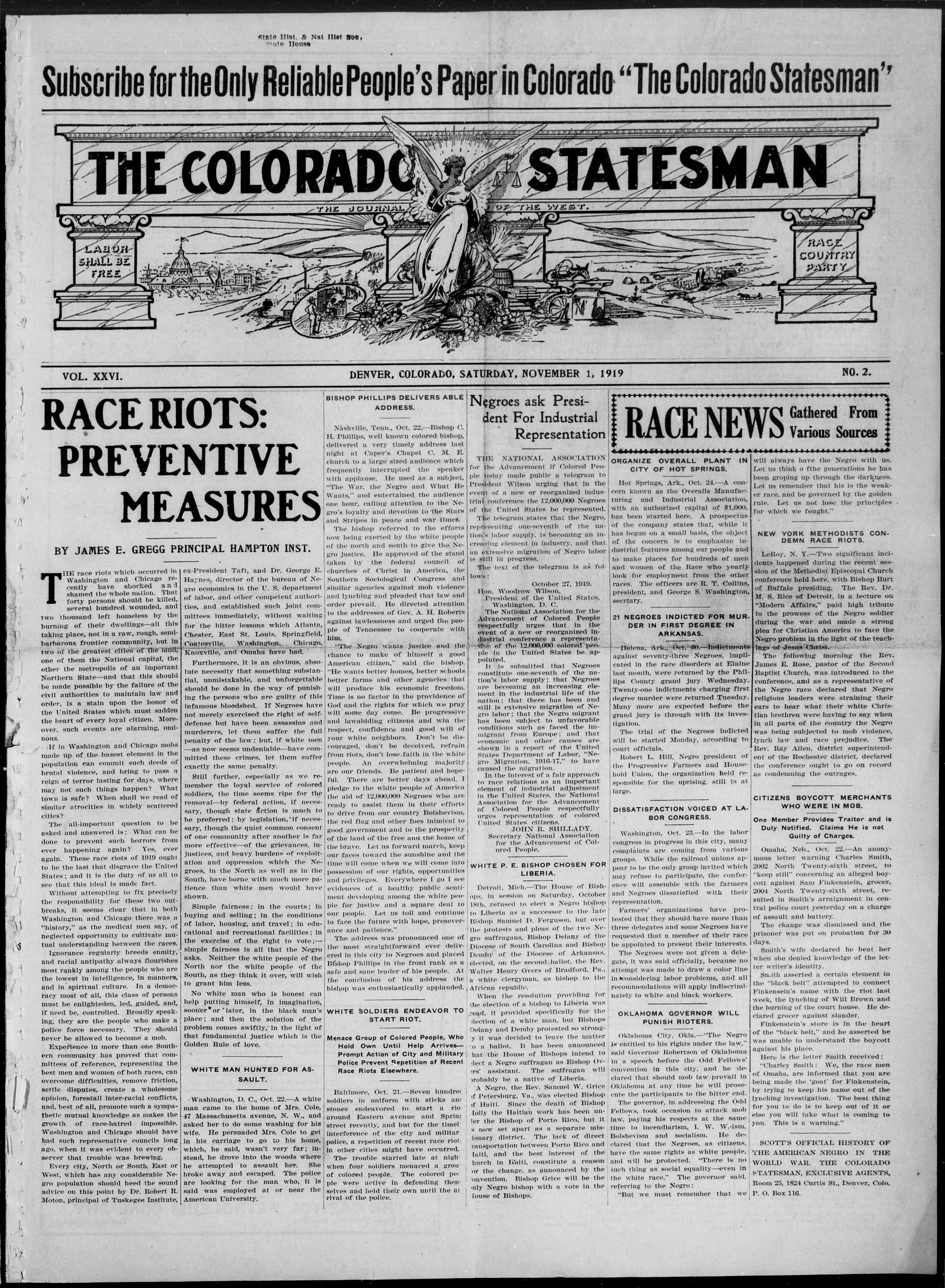
RACE RIOTS: PREVENTIVE MEASURES
BY JAMES E. GREGG PRINCIPAL HAMPTON INST.
VOL. XXVI.
RACE RIOTS
PREVENE
ME.
BY JAMES E. GREGG P.
THE race riots which occurred in
Washington and Chicago re-
cently have shocked and
shamed the whole nation. That
forty persons should be killed,
several hundred wounded, and
two thousand left homeless by the burning of their dwellings—all this taking place, not in a raw, rough, semi-barbarous frontier community, but in two of the greatest cities of the land, one of them the National capital, the other the metropolis of an important Northern State—and that this should be made possible by the failure of the civil authorities to maintain law and order, is a stain upon the honor of the United States which must sadden the heart of every loyal citizen. Moreover, such events are alarming, omnious.
If in Washington and Chicago mobs made up of the basest element in the population can commit such deeds of brutal violence, and bring to pass a reign of terror lasting for days, where may not such things happen? What town is safe? When shall we read of similar atrocities in widely scattered cities?
The all-important question to be asked and answered is: What can be done to prevent such horrors from ever happening again? Yes, ever again. These race riots of 1919 ought to be the last that disgrace the United States; and it is the duty of us all to see that this ideal is made fact.
Without attempting to fix precisely the responsibility for these two outbreaks, it seems clear that in both Washington and Chicago there was a "history," as the medical men say, of neglected opportunity to cultivate mutual understanding between the races. Ignorance regularly breeds enmity, and racial antipathy always flourishes most rankly among the people who are the lowest in intelligence, in manners, and in spiritual culture. In a democracy most of all, this class of persons must be enlightened, led, guided, and, if need be, controlled. Broadly speaking, they are the people who make a police force necessary. They should never be allowed to become a mob. Experience in more than one Southern community has proved that committees of reference, representing the best men and women of both races, can overcome difficulties, remove friction, settle disputes, create a wholesome opinion, forestall inter-racial conflicts, and, best of all, promote such a sympathetic mutual knowledge as makes the growth of race-hatred impossible. Washington and Chicago should have had such representative councils long ago, when it was evident to every observer that trouble was brewing.
Every city, North or South, East or West, which has any considerable Negro population should heed the sound advice on this point by Dr. Robert R. Moton, principal of Tuskegee Institute,
State Hist. & Nat Hist Boe,
State House
the Only Reliable
COLOR
NOTS:
INTIVE
TREASURES
PRINCIPAL HAMPTON INST.
ex-President Taft, and Dr. George E. Haynes, director of the bureau of Negro economics in the U. S. department of labor, and other competent authorities, and established such joint committees immediately, without waiting for the bitter lessons which Atlanta, Chester, East St. Louis, Springfield, Coatesville, Washington, Chicago, Knoxville, and Omaha have had.
Furthermore, it is an obvious, absolute necessity that something substantial, unmistakable, and unforgettable should be done in the way of punishing the persons who are guilty of this infamous bloodshed. If Negroes have not merely exercised the right of self-defense but have been assassins and murderers, let them suffer the full penalty of the law; but, if white men—as now seems undeniable—have committed these crimes, let them suffer exactly the same penalty.
Still further, especially as we remember the loyal service of colored soldiers, the time seems ripe for the removal—by federal action, if necessary, though state action is much to be preferred; by legislation, if necessary, though the quiet common consent of one community after another is far more effective—of the grievances, injustices, and heavy burdens of exploitation and oppression which the Negroes, in the North as well as in the South, have borne with much more patience than white men would have shown.
Simple fairness: in the courts; in buying and selling; in the conditions of labor, housing, and travel; in educational and recreational facilities; in the exercise of the right to vote;—simple fairness is all that the Negro asks. Neither the white people of the North nor the white people of the South, as they think it over, will wish to grant him less.
No white man who is honest can help putting himself, in imagination, sooner or later, in the black man's place; and then the solution of the problem comes swiftly, in the light of that fundamental justice which is the Golden Rule of love.
WHITE MAN HUNTED FOR ASSAULT.
Washington, D. C., Oct. 22.—A white man came to the home of Mrs. Cole, 47 Massachusetts avenue, N. W., and asked her to do some washing for his wife. He persuaded Mrs. Cole to get in his carriage to go to his home, which, he said, wasn't very far; instead, he drove into the woods where he attempted to assault her. She broke away and escaped. The police are looking for the man who, it is said was employed at or near the American University.
BISHOP PHILLIPS DELIVERS ABLE ADDRESS.
Nashville, Tenn., Oct. 22.—Bishop C. H. Phillips, well known colored bishop, delivered a very timely address last night at Caper's Chapel C. M. E. church to a large sized audience which frequently interrupted the speaker with applause. He used as a subject, "The War, the Negro and What He Wants," and entertained the audience one hour, calling attention to the Negro's loyalty and devotion to the Stars and Stripes in peace and war times. The bishop referred to the efforts now being exerted by the white people of the north and south to give the Negro justice. He approved of the stand taken by the federal council of churches of Christ in America, the Southern Sociological Congress and similar agencies against mob violence and lynching and pleaded that law and order prevail. He directed attention to the addresses of Gov. A. H. Roberts against lawlessness and urged the people of Tennessee to cooperate with him.
"The Negro wants justice and the chance to make of himself a good American citizen," said the bishop. "He wants better homes, better schools better farms and other agencies that will produce his economic freedom. Time is no factor in the providence of God and the rights for which we pray will some day come. Be progressive and lawabiding citizens and win the respect, confidence and good will of your white neighbors. Don't be discouraged, don't be deceived, refrain from riots, don't lose faith in the white people. An overwhelming majority are our friends. Be patient and hopeful. There are better days ahead. I pledge to the white people of America the aid of 12,000,000 Negroes who are ready to assist them in their efforts to drive from our country Bolshevism, the red flag and other foes inimical to good government and to the prosperity of the land of the free and the home of the brave. Let us forward march, keep our faces toward the sunshine and the time will come when we will come into possession of our rights, opportunities and privileges. Everywhere I go I see evidences of a healthy public sentiment developing among the white people for justice and a square deal to our people. Let us toil and continue to face the future with hope, preseverance and patience."
The address was pronounced one of the most straightforward ever delivered in this city to Negroes and placed Bishop Phillips in the front rank as a safe and sane leader of his people. At the conclusion of his address the bishop was enthusiastically applauded.
WHITE SOLDIERS ENDEAVOR TO START RIOT.
Menace Group of Colored People, Who Hold Own Until Help Arrives—Prompt Action of City and Military Police Prevent Repetition of Recent Race Riots Elsewhere.
Baltimore, Oct. 21.—Seven hundred soldiers in uniform with sticks and stones endeavored to start a riot around Eastern avenue and Spring street recently, and but for the time interference of the city and military police, a repetition of recent race riots in other cities might have occurred.
The trouble started late at night when four soldiers menaced a group of colored people. The colored people were active in defending their selves and held their own until the arrival of the police.
DENVER, COLORADO, SATURDAY, NOVEMBER 1, 1919
DENVER, COLORADO, SATURDAY, NOVEMBER 1, 1919
Negroes ask President For Industrial Representation
THE NATIONAL ASSOCIATION for the Advancement if Colored People today made public a telegram to President Wilson urging that in the event of a new or reorganized industrial conference the 12,000,000 Negroes of the United States be represented. The telegram states that the Negro, representing one-seventh of the nation's labor supply, is becoming an increasing element in industry, and that an extensive migration of Negro labor is still in progress.
The text of the telegram is as follows:
October 27, 1919.
Hon. Woodrow Wilson.
President of the United States,
Washington, D. C.
Washington, D. C.
The National Association for the Advancement of Colored People respectfully urges that in the event of a new or reorganized industrial conference a representative of the 12,000,000 colored people in the United States be appointed.
It is submitted that Negroes constitute one-seventh of the nation's labor supply; that Negroes are becoming an increasing element in the industrial life of the nation; that there has been and still is extensive migration of Negro labor; that the Negro migrant has been subject to unfavorable conditions such as faced the immigrant from Europe; and that economic and other causes are shown in a report of the United States Department of Labor, "Negro Migration, 1916-17," to have caused the migration.
In the interest of a fair approach to race relations as an important element of industrial adjustment in the United States, the National Association for the Advancement of Colored People respectfully urges representation of colored United States citizens.
JOHN R. SHILLADY.
Secretary National Association for the Advancement of Colored People.
WHITE P. E. BISHOP CHOSEN FOR LIBERIA.
Detroit, Mich.—The House of Bishops, in session on Saturday, October 18th, refused to elect a Negro bishop to Liberia as a successor to the late Bishop Samuel D. Ferguson, but over the protests and pleas of the two Negro suffragrans, Bishop Delany of the Diocese of South Carolina and Bishop Demby of the Diocese of Arkansas, elected, on the second ballot, the Rev. Walter Henry Overs of Bradford, Pa., a white clergyman, as bishop to the African republic.
When the resolution providing for the election of a bishop to Liberia was read, it provided specifically for the election of a white man, but Bishops Delany and Demby protested so strongly it was decided to leave the matter to a ballot. It has been announced that the House of Bishops intend to elect a Negro suffragan as Bishop Overs' assistant. The suffragan will probably be a native of Liberia.
A Negro, the Rev. Samuel W. Grice of Petersburg, Va., was elected Bishop of Haiti. Since the death of Bishop Holly the Haitian work has been under the Bishop of Porto Rico, but it is now set apart as a separate missionary district. The lack of direct transportation between Porto Rico and Haiti, and the best interest of the church in Haiti, constitute a reason or the change, as announced by the convention. Bishop Grice will be the only Negro bishop with a vote in the house of Bishops.
RACENEWS Gathered From Various Sources
RACENEWS Gathered From Various Sources
---
Hot Springs, Ark., Oct. 24.—A concern known as the Overalls Manufacturing and Industrial Association, with an authorized capital of $1,000, has been started here. A prospectus of the company states that, while it has begun on a small basis, the object of the concern is to emphasize industrial features among our people and to make places for hundreds of men and women of the Race who yearly look for employment from the other races. The officers are R. T. Collins, president, and George S. Washington secretary.
21 NEGROES INDICTED FOR MURDER IN FIRST DEGREE IN ARKANSAS.
Helena, Ark., Oct. 30. Indictments against seventy-three Negroes, implicated in the race disorders at Elaine last month, were returned by the Phillips County grand jury Wednesday. Twenty-one indictments charging first degree murder were returned Tuesday. Many more are expected before the grand jury is through with its investigation.
The trial of the Negroes indicted will be started Monday, according to court officials.
Robert L. Hill, Negro president of the Progressive Farmers and Household Union, the organization held responsible for the uprising, still is at large.
DISSATISFACTION VOICED AT LA-
BOR CONGRESS.
Washington, Oct. 23.—In the labor congress in progress in this city, many complaints are coming from various groups. While the railroad unions appear to be the only group invited which may refuse to participate, the conference will assemble with the farmers and Negroes dissatisfied with their representation.
Farmers' organizations have protested that they should have more than three delegates and some Negroes have requested that a member of their race be appointed to present their interests.
The Negroes were not given a delegate, it was said officially, because no attempt was made to draw a color line in considering labor problems, and all recommendations will apply indiscriminately to white and black workers.
OKLAHOMA GOVERNOR WILL PUNISH RIOTERS.
Oklahoma City, Okla.—"The Negro is entitled to his rights under the law," said Governor Robertson of Oklahoma in a speech before the Odd Fellows' convention in this city, and he declared that should mob law prevail in Oklahoma at any time he will prosecute the participants to the bitter end. The governor, in addressing the Odd Fellows, took occasion to attack mob law, paying his respects at the same time to incendiarism, I. W. W-ism, Bolshevism and socialism. He declared that the Negroes, as citizens, have the same rights as white people, and will be protected. "There is no such thing as social equality—even in the white race." The governor said, referring to the Negro:
"But we must remember that we
NO.2.
will always have the Negro with us. Let us think o fthe generations he has been groping up through the darkness. Let us remember that his is the weaker race, and be governed by the golden rule. Let us not lose the principles for which we fought."
NEW YORK METHODISTS CON-
DEMN RACE RIOTS.
LeRoy, N. Y.—Two significant incidents happened during the recent session of the Methodist Episcopal Church conference held here, with Bishop Burt of Buffalo presiding. The Rev. Dr. M. S. Rice of Detroit, in a lecture on "Modern Affairs," paid high tribute to the prowess of the Negro soldier during the war and made a strong plea for Christian America to face the Negro problem in the light of the teachings of Jesus Christ.
The following morning the Rev. James E. Rose, pastor of the Second Baptist Church, was introduced to the conference, and as a representative of the Negro race declared that Negro religious leaders were straining their ears to hear what their white Christian brethren were having to say when in all parts of the country the Negro was being subjected to mob violence, lynch law and race prejudice. The Rev. Ray Allen, district superintendent of the Rochester district, declared the conference ought to go on record as condemning the outrages.
CITIZENS BOYCOTT MERCHANTS
WHO WERE IN MOB.
One Member Provides Traitor and is Duly Notified. Claims He is not Guilty of Charges.
Omaha', Neb., Oct. 22.—An anonymous letter warning Charles Smith, 2002 North Twenty-sixth street, to "keep still" concerning an alleged boycott against Sam Finkenstein, grocer, 2004 North Twenty-sixth street, resulted in Smith's arraignment in central police court yesterday on a charge of assault and battery.
The change was dismissed and the prisoner was put on probation for 30 days.
Smith's wife declared he beat her when she denied knowledge of the letter writer's identity.
Smith asserted a certain element in the "black belt" attempted to connect Finkensein's name with the riot last week, the lynching of Will Brown and the burning of the court house. He declared grocer against slander.
Finkenstein's store is in the heart of the "black belt," and he asserted he was unable to understand the boycott against his place.
Here is the letter Smith received: "Charley Smith: We, the race men of Omaha, are informed that you are being made the 'goat' for Flinkenstein, by trying to keep his name out of the lynching investigation. The best thing for you to do is to keep out of it or else you will take what is coming to you. This is a warning."
SCOTT'S OFFICIAL HISTORY OF THE AMERICAN NEGRO IN THE WORLD WAR. THE COLORADO STATESMAN, EXCLUSIVE AGENTS, Room 25, 1824 Curtis St., Denver, Colo. P. O. Box 116.
FOREIGN
Smart clothes in Paris this season are the costliest on record.
"The Japanese government shortly will sign the peace trenty without consulting parliament," says Central News agency dispatch for Tokio.
It has been reported in dispatches from Lisbon that Portugal had granted the United States a concession in the Azores for a naval station.
Bela Kun, the former soviet chief of Hungary, is accused of murder and the theft of 2,000,000 rubles from two emissaries of General Denikine.
Alfred Flamval, a French aviator, looped the loop 624 times in a single flight in a military aeroplane at Madrid. The previous record was little over 300. Flamval was in the air two hours.
Sufficient sugar to meet present American demands have been contracted for, but will remain in Cuban warehouses until transportation is provided, according to a statement by the Cuban Sugar Manufacturers and Planters' Association.
Alfred Felton of Australia defeated Ernest Barry, for many years sculling champion, for the sculling championship of the world. Felton covered the four and one-half miles in 25 minutes, 40 seconds, beating Barry six lengths. There was a high wind.
A large quantity of arms and ammunition, intended for Portuguese revolutionaries has been taken over by the Spanish authorities at Alamedilla Park, in Salamanca, about 115 miles northwest of Madrid. The seizure was made at the request of the Portuguese consul.
It is given out that Archduke Joseph of Austria will soon be elected king of Hungary. If the entente objects, the crown of Hungary will be offered, it is stated, to a foreign prince, probably of the English royal family. A resumption of the throne by former Emperor Charles is out of the question. The British government has already realized $812,500,000 by the sale of war stores which it had on hand when peace was declared. Hundreds of motor cars and trucks have been marketed at prices frequently in excess of the price originally paid for them by the war office, owing to the great scarcity of cars.
The net bag of German submarines destroyed by the American, French and British navies during the war was 200 out of a total of 370 completed by the enemy up to the armistice, according to the war cabinet blue book. Each of the three navies developed entirely different systems of submarine detection apparatus, and their results were constantly exchanged.
GENERAL
The International Federation of Trades Unions began its session at Washington Monday preliminary to the meeting of the International Labor Conference provided for in the treaty with Germany.
Nugent's Weekly, a national magazine devoted to the manufacture of women's garments, followed the example of the Literary Digest with the announcement that publication would be maintained by the typewriter-electrotype process every week until the strike is ended.
A list of more than 1,000 articles other than meats, which, he said, were shipped by the "Big Five" packers in refrigerator cars along with fresh meats, was introduced by Walter R. Scott, a traffic expert, who was testifying on behalf of the Wholesale Grocers' Association at Chicago.
The Old Clothes Society was organized by clerks in the city hall in Chicago with "chapters" in each of the principal departments of the municipal government. The object is to glorify the wearing of patches, frayed or shiny suits, soft collars, re-soled shoes and revivified neckties as a means of combating the high cost of living. "Wear your old clothes" was one of the obligations of membership included in the by-laws.
George "Babe" Ruth, world champion home-run hitter of the Boston Americans, said before leaving for Los Angeles that he would demand $20,000 salary next year.
The final coupon on the Second 4 per cent Liberty Bonds becomes due next month and the last coupon on the First 4 per cents, being converted $3½ per cents is payable in December.
The cargo carrier Sundance, named in honor of Wyoming's work in the Liberty Loan drives, was launched at Hog Island. Miss Rosa Maye Kendrick, daughter of Senator and Mrs. J. B. Kendrick of Wyoming, was the sponsor. It was the sixty-second ship launched at the big yard and brought the deadweight tonnage produced since August, 1918, to 485,150. An early closing of the contract for the purchase by the navy of the British rigid airship R-38, the largest airship in the world, now under construction in England, is expected, it was stated at the department Monday. Two and one-half million dollars were appropriated by Congress for the purchase of this airship and for the training of pilots.
Whisky valued at $40,000 was reported stolen in St. Louis. Robbers entered the government bonded warehouse and, according to police estimates, carted away about $30,000 worth of barreled stock. The police also received a report that whisky valued at $10,000 had been stolen from the Levy Distilling Company. Recommendations granting the right of suffrage to Cuban women and calling for participation by Cuba in the league of nations have been placed in the revised platform of the Liberal party.
NEWS TO DATE IN PARAGRAPHS
CAUGHT FROM THE NETWORK OF WIRES ROUND ABOUT THE WORLD.
DURING THE PAST WEEK
RECORD OF IMPORTANT EVENTS
CONDENSED FOR BUSY
Western Newspaper Union News Service
WESTERN
Heavy snowfalls in the mountain districts of Wyoming have halted work on several road projects in that territory, according to officials of the federal bureau of roads.
All embargoes on wheat shipments to Kansas City have been lifted and 200 cars a day have been released to carry the grain from Kansu City elevators to Duluth and Minneapolis and open bins in the former elevators for Colorado wheat.
Senator Miles Poindexter of Washington, in a statement to the people of the United States, announced his candidacy for the Republican nomination for president, and presented a platform of policies and principles which he will advocate in his campaign.
Four men and one woman were killed and two other persons injured in a grade crossing accident on the outskirts of Hastings, Nebr., when a taxi-cab in which they were riding was struck by a Chicago, Burlington & Quincy railroad passenger train. They were on their way to attend a social gathering when the accident occurred.
Thraknath Das, a native of India, was released from the federal penitentiary at Leavenworth after serving a two-year term for violating the neutrality laws in trying to stir up a revolt in India during the war. He took out fall naturalization papers while an instructor at the Leland Stanford University and a suit is now pending to annul them.
Following the withdrawal from President Carranza of Mexico of his extraordinary war powers by the Mexican House of Deputies, President Carranza has placed himself at the disposal of the high judiciary committee of the Mexican Congress "for judgment on his record," according to a message received by El Nacional, a Spanish language newspaper published at El Paso, J. T. McCoy, a prominent and and wealthy oil man of Oil City, Pa., was killed at Tulsa when he was struck by an automobile. McCoy, who was 73 years old, was the father-in-law of Frank A. Gillespie of Tulsa, rated as the wealthiest oil operator in Oklahoma. McCoy had come to Tulsa to attend a family reunion. The accident was unavoidable.
WASHINGTON
"The President's progress continues, as during the last few days, satisfactorily," says his physicians.
President Wilson continues to improve and so satisfied was Rear Admiral Grayson with his condition that he is being permitted to transact some executive business.
Rapid progress is being made in the house on the oil land leasing bill, all of the oil sections, substantially as passed by the Senate, being approved without record votes.
Senator Miles Polindexter of Washington, in a statement to the people of the United States, announces his candidacy for the Republican nomination for president, and presented a platform of policies and principles which he will advocate in his campaign.
King Albert, Queen Elizabeth and Prince Leopold of Belgium have arrived in Washington for a three-day visit with officials of the nation's capital. The royal party received a most enthusiastic welcome at the station, where it was met by Vice President Marshall and other high government officials.
A counterfeit of the present $5 was savings stamp has been discovered, according to John S. Tucker, United States secret service agent of the Treasury Department in the custom house. Mr. Tucker said about $1,000 worth had been sold in Newark. He warns the public against buying stamp from anyone but authorized government agents.
Applause from both Democrats and Republicans greeted an announcement in the house by Republican Leader Mondell that he "most thoroly and most heartily" indorsed President Wilson's statement regarding the strike. The announcement was prompted by an inquiry of Representative Aswell, Democrat, Louisiana. Mr. Mondell sought to have the president's statement printed in the Congressional Record, but Mr. Aswell objected.
Chairman Payne of the shipping board advised Senator Capper, Republican, Kansas, that the board had decided to reduce freight rates on dressed meat to Europe $1 per hundred-weight or from $4.50 to $3.50 per hundred. When the new rates, which apply to continental Europe are to become effective was not stated.
The regular army is 10 per cent below the number authorized for the fiscal year, the War Department announced to-day. Reports to the adjutant general placed the total at 274,787 officers and men.
UNITED STATES SENATE BACK OF PRESIDENT WILSON'S ACTION.
4.000 MINERS EXEMPT
LESS THAN SEVEN THOUSAND
WILL BE CALLED OUT IN
COLORADO.
Western Newspaper Union News Service.
Washington, Oct. 30.—The coal strike took precedence over the peace treaty in the Senate, which for hours was debated, and then adopted a resolution pledging its support to the government in maintaining order during the present industrial emergency. Efforts to have the House take similar action failed because of opposition by Republican leaders.
In and out of Congress, however, sentiment seemed to turn through one groove and there were expressions of general approval of the government's determination to keep the mines in full operation.
While the only statement given out after the special meeting of the cabinet dealt with issuance of an order relating to the filing of a maximum coal price, the members were understood to have considered seriously means of protecting miners who will not strike.
The order re-establishing the old maximum coal prices of the fuel administration was completed tonight at a conference of Dr. H. A. Garfield and railroad administration officials. It was taken immediately to the White House for President Wilson's signature.
But the President had gone to sleep after his arduous day, and it was deemed inadvisable to wake him. Accordingly, the order will not become effective until tomorrow.
Dr. Garfield said that the plans contemplated that all questions of allocating coal would be left to Director General Hines for settlement.
Denver.—Nine hundred Colorado National Guardsmen will be assembled at mobilization camps in Golden and Trinidad, fully equipped and ready for duty in the coal camps upon receipt of instructions from Gov. Oliver H. Shoup, who ordered the state troops mobilized late Wednesday night.
Pueblo, Colo.—With the exemption of 4,000 miners employed in twenty-eight mines in Colorado, less than 7,000 coal miners in this state will be called out by the United Mine Workers of America Saturday, according to announcement by H. C. Stewart, secretary of District No. 15, United Mine Workers, here.
A message was received by Mr. Stewart from Indianapolis early this evening exempting twenty-eight mines in Colorado from the strike order. These twenty-eight mines are operating under union agreement and the agreement does not expire until April, 1920.
Mr. Stewart explained that the situation in District No. 15, which embraces Colorado, Utah and New Mexico, was different than the situation in other districts inasmuch as the miners in other districts were working under what is known as the Washington agreement, which expired with the ending of the war.
Federal Aid Available.
Denver.—Arrangements for calling federal troops into Colorado to prevent disorders in connection with the threatened strike of bituminous coal miners if the situation should get beyond the control of local peace officers and the National Guard were made by Governor Shoup with Maj. Gen. Leonard Wood, commander of the central department of the army, during the governor's recent visit to Chicago. This became known last night when Governor Shoup announced that a telegram to General Wood was all that was necessary to bring federal soldiers to the coal districts of the state. The primary purpose of the trip of the governor to Chicago was to attend a convention of oil men and the information that he had also met with General Wood and discussed in detail the situation in Colorado regarding the proposed strike did not become known until last night. General Wood was the only representative of the federal government with whom he conferred while in the East, Governor Shoup said.
Washington. — Legislation for the leasing of government-owned mineral lands was advanced towards final enactment by the House in passing, by a vote of 169 to 39, the oil and coal land leasing bill. The measure now goes to conference. Vain efforts were made by Representatives Raker, California, and Griffin, New York, Democrats, to incorporate in the House bill provisions similar to the Harris amendment of the Senate measure, which proponents urged would prevent monopolizing control of the leased lands.
CAPITOL PETROLEUM
SUBMITS THE FOLLOWING GENERAL INFORMATION ABOUT ITS OPERATIONS TO DATE
Gentlemen:
The past week has been a harsh one, excessive rains and bad roads. This is not unusual in Mexico, but it was hard to have the well delayed.
it wishes me to have the well cleaned.
But do not worry, I think we are going to get a very big well, and all of my experienced oil neighbors agree with me.
The Government Inspector, after checking up our last flow, has ordered another test which requires additional connections. These are being prepared by the Oklahoma Iron Works, and I hope to have them at the well within a few days. In the meantime, I am installing a new pump to take the oil from the temporary sump into the large storage reservoir. The Government Inspectors have given us every courtesy, but they tell me they are taking a precaution which is necessary for fear our well should break loose, and flow into the river
I have almost enough material assembled for starting No. 3, and I favor the Espino location, but would rather wait a short time until No. 2 is completed. It will not take a short time to move tools and machinery to the Tampuche property. I will notify you fully about this before taking any decided step. Yours very truly, H. B. GUTHREY
The image shows a close-up view of a car's front end, focusing on the headlight and the grille. The grille is made of metal and has a distinctive shape. The headlight is mounted on the front of the car and has a clear lens. The car appears to be in motion, as indicated by the blurred background.
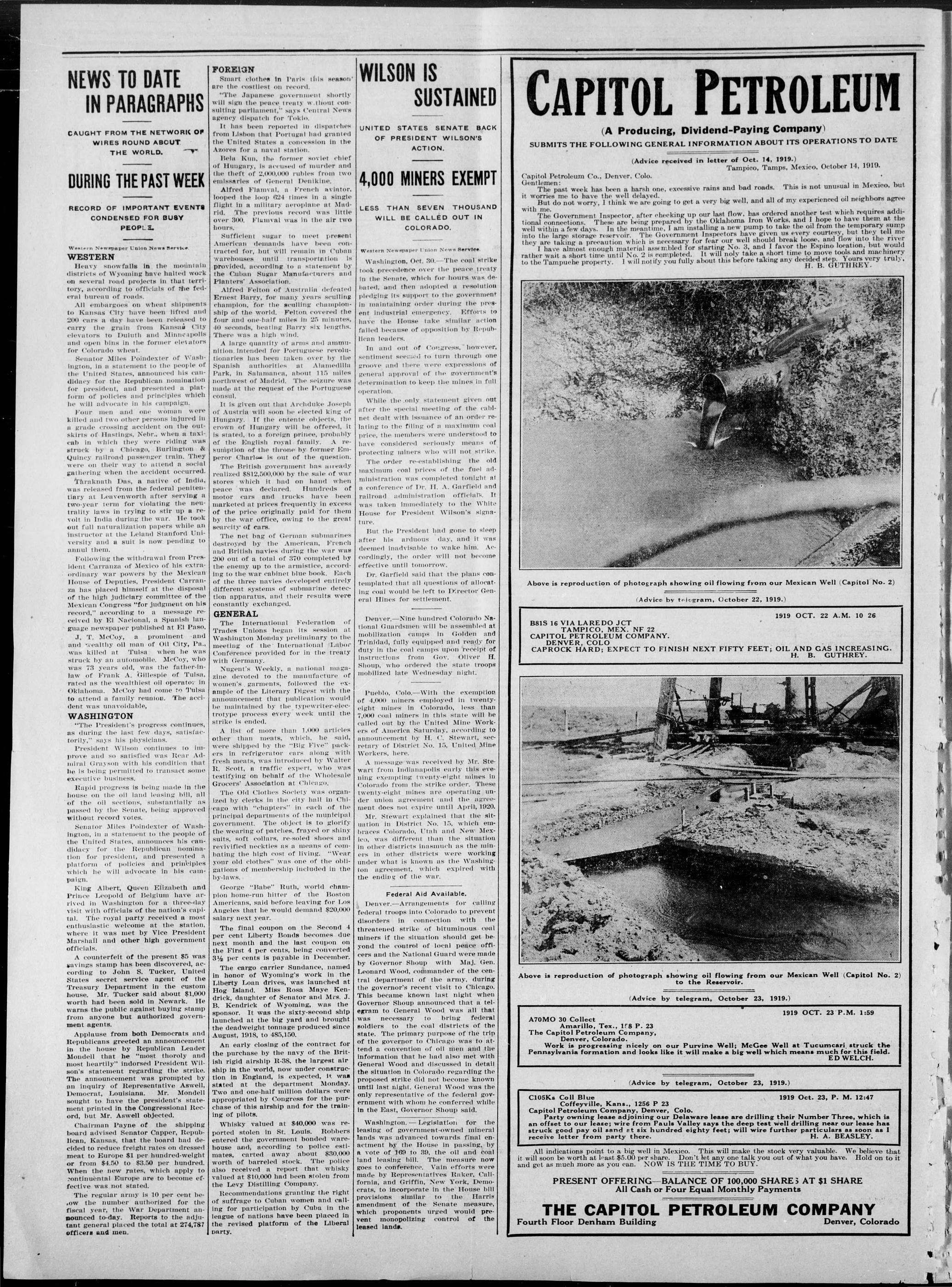
Above is reproduction of photograph showing oil flowing from our Mexican Well (Capitol No. 2)
(Advice by telegram, October 22, 1919.)
1
Above is reproduction of photograph showing oil flowing from our Mexican Well (Capitol No. 2) to the Reservoir.
Work is progressing nicely on our Purvine Well; McGee Well at Tucumcari struck the Pennsylvania formation and looks like it will make a big well which means much for this field. ED WELCH.
Party owning lease adjoining our Delaware lease are drilling their Number Three, which is an offset to our lease; wire from Pauls Valley says the deep test well drilling near our lease has struck good pay oil sand at six hundred eighty feet; will wire further particulars as soon as I receive letter from party there. H. A. BEASLEY.
All indications point to a big well in Mexico. This will make the stock very valuable. We believe that it will soon be worth at least $5.00 per share. Don't let any one talk you out of what you have. Hold on to it and get as much more as you can. NOW IS THE TIME TO BUY.
PRESENT OFFERING—BALANCE OF 100,000 SHARE 3 AT $1 SHARE
All Cash or Four Equal Monthly Payments
Capitol Petroleum Co., Denver, Colo.
Gentlemen:
1919 OCT. 22 A.M. 10 26
OIL AND GAS INCREASI
H. B. GUTHREY.
ur Mexican Well (Capitol
1919.)
1919 OCT. 23 P.M. 1:59
Well at Tucumcari struck which means much for this fire ED WELCH.
1919.)
1919 Oct. 23, P. M. 12:47
at their Number Three, which well drilling near our lease of further particulars as soon as H. A. BEASLEY.
ock very valuable. We believe out of what you have. Hold o
NEWS and GOSSIP of WASHINGTON
Advises Soft Pedal Put on Emigration to Mexico
WASHINGTON.—Count von Eckardt, whose activities as German minister to Mexico during the war were credited as responsible for the strong pro-German sentiment in the southern republic, warns his fellow countrymen
man culture and upon our keeping up the reputation we have gained for capability, and trustworthiness.
"We must send only capable men of character, knowledge and energy to Mexico, where they may do honor to the name of Germany and Hamburg. Then we will be able not only to get our old connections back, but also to see them grow and expand."
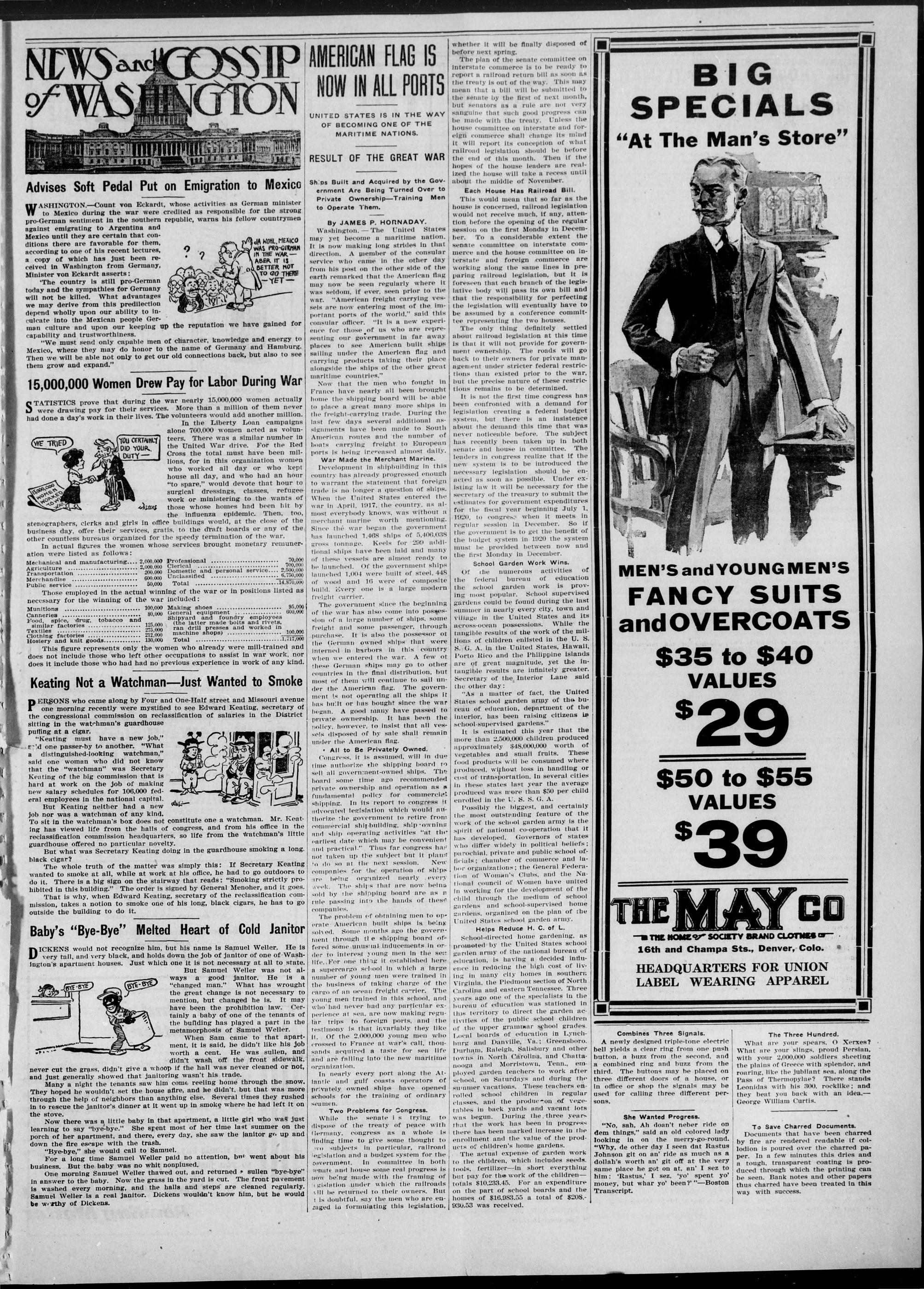
15,000,000 Women Drew Pay for Labor During War
STATISTICS prove that during the war nearly 15,000,000 women actually were drawing pay for their services. More than a million of them never had done a day's work in their lives. The volunteers would add another million.
stenographers, clerks and girls in office buildings would, at the close of the business day, offer their services, gratis, to the draft boards or any of the other countless bureaus organized for the speedy termination of the war.
This figure represents only the women who already were mill-trained and does not include those who left other occupations to assist in war work, nor does it include those who had had no previous experience in work of any kind.
Keating Not a Watchman—Just Wanted to Smoke
Keating Not a Watchman—Just Wanted to Smoke
PERSONS who came along by Four and One-Half street and Missouri avenue one morning recently were mystified to see Edward Keating, secretary of the congressional commission on reclassification of salaries in the District sitting in the watchman's guardhouse puffing at a cigar
job nor was a watchman or any kind.
To sit in the watchman's box does not constitute one a watchman. Mr. Keating has viewed life from the halts of congress, and from his office in the reclassification commission headquarters, so life from the watchman's little guardhouse offered no particular novelty.
But what was Secretary Keating doing in the guardhouse smoking a long, black cigar?
The whole truth of the matter was simply this: If Secretary Keating wanted to smoke at all, while at work at his office, he had to go outdoors to do it. There is a big sign on the stairway that reads: "Smoking strictly prohibited in this building." The order is signed by General Menoher, and it goes.
That is why, when Edward Keating, secretary of the reclassification commission, takes a notion to smoke one of his long, black cigars, he has to go outside the building to do it.
Baby's "Bye-Bye" Melted Heart of Cold Janitor
Baby's "Bye-Bye" Melted Heart of Cold Janitor
DICKENS would not recognize him, but his name is Samuel Weller. He is very tall, and very black, and holds down the job of janitor of one of Washington's apartment houses. Just which one it is not necessary at all to state.
never cut the grass, didn't give a whoop if the hall was never cleaned or not, and just generally showed that janitoring wasn't his trade.
Many a night the tenants saw him come reeling home through the snow. They hoped he wouldn't set the house afire, and he didn't, but that was more through the help of neighbors than anything else. Several times they rushed in to rescue the janitor's dinner at it went up in smoke where he had left it on the stove.
Now there was a little baby in that apartment, a little girl who was just learning to say "bye-bye." She spent most of her time last summer on the porch of her apartment, and there, every day, she saw the janitor go up and down the fire escape with the trash.
"Bye-bye," she would call to Samuel.
For a long time Samuel Weller paid no attention, but went about his business. But the baby was no whit nonplussed.
One morning Samuel Weller thawed out, and returned * sullen "bye-bye" in answer to the baby. Now the grass in the yard is cut. The front pavement is washed every morning, and the halls and steps are cleaned regularly. Samuel Weller is a real janitor. Dickens wouldn't know him, but he would be worthy of Dickens.
WASHINGTON: Count Von Hauser to Mexico during the war were pro-German sentiment in the southern against emigrating to Argentina and Mexico until they are certain that conditions there are favorable for them, according to one of his recent lectures, a copy of which has just been received in Washington from Germany, Minister von Eckardt asserts: 'The country is still pro-German today and the sympathies for Germany will not be killed. What advantages we may derive from this predilection depend wholly upon our ability to inculcate into the Mexican people Ger-
man culture and upon our keeping u capability and trustworthiness.
"We must send only capable men Mexico, where they may do honor to Then we will be able not only to get out them grow and expand."
15,000,000 Women Drew
STATISTICS prove that during the were drawing pay for their service had done a day's work in their lives.
WE TRIED
YOU CERTAINLY DID YOUR DUTY
$500,000 WOMEN WORKED TO WORK FOR US
stenographers, clerks and girls in office
business day, offer their services, gra
other countless bureaus organized for t
In actual figures the women who wis-
tion were listed as follows:
Mechanical and manufacturing... 2,000,000
Agriculture... 2,000,000
Transportation... 200,000
Merchandise... 600,000
Public service... 50,000
Those employed in the actual win-
necessary for the winning of the war
Munitions... 100,000
Canneries... 80,000
Food, spice, drug, tobacco and
similar factories... 125,000
Textiles... 275,000
Clothing factories... 215,000
Hosiery and knit goods... 130,000
This figure represents only the wo
does not include those who left other
does it include those who had no p
Keating Not a Watchman
PERSONS who came along by Four a
one morning recently were mystified
the congressional commission on reck
sitting in the watchman's guardhouse
nuffing at a clear.
"Keating must have a new job," said one passer-by to another. "What a distinguished-looking watchman," said one woman who did not know that the "watchman" was Secretary Keating of the big commission that is hard at work on the job of making new salary schedules for 106,000 federal employees in the national capital. But Keating neither had a new job nor was a watchman of any kind.
To sit in the watchman's box does not
ing has viewed life from the halls of
reclassification commission headquarter
guardhouse offered no particular novel.
But what was Secretary Keating o
black cigar?
The whole truth of the matter w
wanted to smoke at all, while at work
do it. There is a big sign on the stair
hibited in this building." The order is.
That is why, when Edward Keatin
mission, takes a notion to smoke one
outside the building to do it.
Baby's "Bye-Bye" Melter
DICKENS would not recognize him,
very tall, and very black, and holds
ington's apartment houses. Just which
BTE-BTE
BTE-BTE
never cut the grass, didn't give a who
and just generally showed that janitor
Many a night the tenants saw him
They hoped he wouldn't set the house
through the help of neighbors than an
in to rescue the janitor's dinner at it w
the stove.
Now there was a little baby in the
learning to say "bye-bye." She spent
porch of her apartment, and there, ew
down the fire escape with the trash.
"Bye-bye," she would call to Sam
For a long time Samuel Weller
business. But the baby was no whit it
One morning Samuel Weller thaw
in answer to the baby. Now the grass
JA WOHL, MEXICO
WAS PRO-GERMAN
IN THE WAR
ABER IT IS
BETTER NOT
TO GO THERE
YET
up the reputation we have gained for
of character, knowledge and energy to
the name of Germany and Hamburg.
our old connections back, but also to see
Pay for Labor During War
war nearly 15,000,000 women actually
s. More than a million of them never
the volunteers would add another million.
In the Liberty Loan campaigns alone 700,000 women acted as volunteers. There was a similar number in the United War drive. For the Red Cross the total must have been millions, for in this organization women who worked all day or who kept house all day, and who had an hour "to spare," would devote that hour to surgical dressings, classes, refugee work or ministering to the wants of those whose homes had been hit by the influenza epidemic. Then, too, see buildings would, at the close of the tis, to the draft boards or any of the speedy termination of the war. See services brought monetary remuner-
Professional ..... 70,000
Clerical ..... 700,000
Domestic and personal service..... 2,500,000
Unclassified ..... 6,750,000
Total ..... 14,870,000
ing of the war or in positions listed as included:
Making shoes ..... 95,000
General equipment ..... 600,000
Shipyard and foundry employees
(the latter made bolts and rivets,
run drill presses and worked in
machine shops) ..... 100,000
Total ..... 1,717,000
women who already were mill-trained and
occupations to assist in war work, nor
previous experience in work of any kind.
Just Wanted to Smoke
and One-Half street and Missouri avenue
used to see Edward Keating, secretary of
assification of salaries in the District
d. k.
constitute one a watchman. Mr. Keat of congress, and from his office in theaters, so life from the watchman's little city. Doing in the guardhouse smoking a long. was simply this: If Secretary Keating at his office, he had to go outdoors to way that reads: "Smoking strictly prosigned by General Menoher, and it goes, secretary of the reclassification com- of his long, black cigars, he has to go
Bad Heart of Cold Janitor
but his name is Samuel Weller. He is down the job of janitor of one of Wash- one it is not necessary at all to state.
But Samuel Weller was not always a good janitor. He is a "changed man." What has wrought the great change is not necessary to mention, but changed he is. It may have been the prohibition law. Certainly a baby of one of the tenants of the building has played a part in the metamorphosis of Samuel Weller. When Sam came to that apartment, it is said, he didn't like his job worth a cent. He was sullen, and didn't wash off the front sidewalk.
top if the hall was never cleaned or not, caring wasn't his trade.
On come reeling home through the snow, afire, and he didn't, but that was more anything else. Several times they rushed up in smoke where he had left it on that apartment, a little girl who was just most of her time last summer on the every day, she saw the janitor go up and unel.
Paid no attention, but went about his nonplused, feed out, and returned * sullen "bye-bye" in the yard is cut. The front pavement balls and stones are cleaned regularly.
AMERICAN FLAG IS NOW IN ALL PORTS
UNITED STATES IS IN THE WAY OF BECOMING ONE OF THE MARITIME NATIONS.
RESULT OF THE GREAT WAR
Ships Built and Acquired by the Government Are Being Turned Over to Private Ownership—Training Men to Operate Them.
By JAMES P. HORNADAY.
BY JAMES P. HORNADAY.
Washington. — The United States may yet become a maritime nation. It is now making long strides in that direction. A member of the consular service who came in the other day from his post on the other side of the earth remarked that the American flag may now be seen regularly where it was seldom, if ever, seen prior to the war. "American freight carrying vessels are now entering most of the important ports of the world," said this consular officer. "It is a new experience for those of us who are representing our government in far away places to see American built ships sailing under the American flag and carrying products taking their place alongside the ships of the other great maritime countries."
Now that the men who fought in France have nearly all been brought home the shipping board will be able to place a great many more ships in the freight-carrying trade. During the last few days several additional assignments have been made to South American routes and the number of boats carrying freight to European ports is being increased almost daily.
Development in shipbuilding in this country has already progressed enough to warrant the statement that foreign trade is no longer a question of ships. When the United States entered the war in April, 1917, the country, as almost everybody knows, was without a merchant marine worth mentioning. Since the war began the government has launched 1,468 ships of 5,406,038 gross tonnage. Keels for 299 additional ships have been laid and many of these vessels are almost ready to be launched. Of the government ships launched 1,004 were built of steel. 448 of wood and 16 were of composite build. Every one is a large modern freight carrier.
The government since the beginning of the war has also come into possession of a large number of ships, some freight and some passenger, through purchase. It is also the possessor of the German owned ships that were interned in harbors in this country when we entered the war. A few of these German ships may go to other countries in the final distribution, but most of them will continue to sail under the American flag. The government is not operating all the ships it has built or has bought since the war began. A good many have passed to private ownership. It has been the policy, however, to insist that all vessels disposed of by sale shall remain under the American flag.
All to Be Privately Owned.
Congress, it is assumed, will in due time authorize the shipping board to sell all government-owned ships. The board some time ago recommended private ownership and operation as a fundamental policy for commercial shipping. In its report to congress it advocated legislation which would authorize the government to retire from commercial ship building, ship owning and ship operating activities "at the earliest date which may be convenient and practical." Thus far congress has not taken up the subject but it plans to do so at the next session. New companies for the operation of ships are being organized nearly every week. The ships that are now being sold by the shipping board are as a rule passing into the hands of these companies.
The problem of obtaining men to operate American built ships is being solved. Some months ago the government through the shipping board offered some unusual inducements in order to interest young men in the sea life. For one thing it established here a supercargo school in which a large number of young men were trained in the business of taking charge of the cargo of an ocean freight carrier. The young men trained in this school, and who had never had any particular experience at sea, are now making regular trips to foreign ports, and the testimony is that invariably they like it. Of the 2,000,000 young men who crossed to France at war's call, thousands acquired a taste for sea life and are falling into the new maritime organization.
In nearly every port along the Atlantic and gulf coasts operators of privately owned ships have opened schools for the training of ordinary seamen.
Two Problems for Congress.
While the senate is trying to dispose of the treaty of peace with Germany, congress as a whole is finding time to give some thought to two subjects in particular, railroad legislation and a budget system for the government. In committee in both senate and house some real progress is now being made with the framing of legislation under which the railroads will be returned to their owners. But it is doubtful, say the men who are engaged in formulating this legislation,
whether it will be finally disposed of before next spring.
The plan of the senate committee on interstate commerce is to be ready to report a railroad return bill as soon as the treaty is out of the way. This may mean that a bill will be submitted to the senate by the first of next month, but senators as a rule are not very sanguine that such good progress can be made with the treaty. Unless the house committee on interstate and foreign commerce shall change its mind it will report its conception of what railroad legislation should be before the end of this month. Then if the hopes of the house leaders are realized the house will take a recess until about the middle of November.
Each House Has Railroad Bill.
Each House Has Railroad Bill. This would mean that so far as the house is concerned, railroad legislation would not receive much, if any, attention before the opening of the regular session on the first Monday in December. To a considerable extent the senate committee on interstate commerce and the house committee on interstate and foreign commerce are working along the same lines in preparing railroad legislation, but it is foreseen that each branch of the legislative body will pass its own bill and that the responsibility for perfecting the legislation will eventually have to be assumed by a conference committee representing the two houses.
The only thing definitely settled about railroad legislation at this time is that it will not provide for government ownership. The roads will go back to their owners for private management under stricter federal restrictions than existed prior to the war, but the precise nature of these restrictions remains to be determined.
It is not the first time congress has been confronted with a demand for legislation creating a federal budget system, but there is an insistence about the demand this time that was never noticeable before. The subject has recently been taken up in both senate and house in committee. The leaders in congress realize that if the new system is to be introduced the necessary legislation should be enacted as soon as possible. Under existing law it will be necessary for the secretary of the treasury to submit the estimates for government expenditures for the fiscal year beginning July 1, 1920, to congress when it meets in regular session in December. So if the government is to get the benefit of the budget system in 1920 the system must be provided between now and the first Monday in December.
School Garden Work Wins.
Of the numerous activities of the federal bureau of education the school garden work is proving most popular. School supervised gardens could be found during the last summer in nearly every city, town and village in the United States and its across-ocean possessions. While the tangible results of the work of the millions of children enlisted in the U. S. S. G. A. in the United States, Hawaii, Porto Rico and the Philippine islands are of great magnitude, yet the intangible results are infinitely greater. Secretary of the Interior Lane said the other day:
"As a matter of fact, the United States school garden army of the bureau of education, department of the interior, has been raising citizens in school-supervised gardens."
It is estimated this year that the more than 2,500,000 children produced approximately $48,000,000 worth of vegetables and small fruits. These food products will be consumed where produced, without loss in handling or cost of transportation. In several cities in these states last year the average produced was more than $50 per child enrolled in the U. S. S. G. A.
Possibly the biggest, and certainly the most outstanding feature of the work of the school garden army is the spirit of national co-operation that it has developed. Governors of states who differ widely in political beliefs; parochial, private and public school officials; chamber of commerce and labor organizations; the General Federation of Woman's Clubs, and the National council of Women have united in working for the development of the child through the medium of school gardens and school-supervised home gardens, organized on the plan of the United States school garden army.
School-directed home gardening, as promoted by the United States school garden army of the national bureau of education, is having a decided influence in reducing the high cost of living in many city homes in southern Virginia, the Piedmont section of North Carolina and eastern Tennessee. Three years ago one of the specialists in the bureau of education was stationed in this territory to direct the garden activities of the public school children of the upper grammar school grades. Local boards of education in Lynchburg and Danville, Va.; Greensboro, Durham, Raleigh, Salisbury and other towns in North Carolina, and Chattanooga and Morristown, Tenn., employed garden teachers to work after school, on Saturdays and during the summer vacations. These teachers enrolled school children in regular classes, and the production of vegetables in back yards and vacant lots was begun. During the three years that the work has been in progress there has been marked increase in the enrollment and the value of the products of children's home gardens.
The actual expense of garden work to the children, which includes seeds, tools, fertilizer—in short everything but pay for the work of the children—totals $10,233.45. For an expenditure on the part of school boards and the homes of $16,983.55 a total of $208.930.53 was received.
BIG SPECIALS "At The Man's Store"
A newly designed triple-tone electric bell yields a clear ring from one push button, a buzz from the second, and a combined ring and buzz from the third. The buttons may be placed on three different doors of a house, or in office or shop the signals may be used for calling three different persons.
She Wanted Progress.
"No, sah. Ah don't neber ride on dem things," said an old colored lady looking in on the merry-go-round. "Why, de other day I seen dat Rastus Johnson git on an' ride as much as a dollah's worth an' git off at the very same place he got on at, an' I sez to him: 'Rastus, I sez. 'yo' spent yo' money, but whar yo' been?'"—Boston Transcript.
What are your spears, O Xerxes?
What are your slings, proud Persian, with your 2,000,000 soldiers sheeting the plains of Greece with splendor, and roaring, like the jubilant sea, along the Pass of Thermopylae? There stands Leonidas with his 300, rocklike; and they bent you back with an idea.—George William Curtis.
To Save Charred Documents.
Documents that have been charred by fire are rendered readable if collodion is poured over the charred paper. In a few minutes this dries and a tough, transparent coating is produced through which the printing can be seen. Bank notes and other papers thus charred have been treated in this way with success.
THE COLORADO STATESMAN
LABOR
SHALL BE
FREE
MASS
COUNTRY
PARTY
JOS. D. D. RIVERS.....Proprietor
P. O. Box 116
Phone Main 7417
Entered as second-class matter at the postoffice in the City of Denver, Colo.
Reading notices, ten lines or less, 15 cents per line. Each additional line over ten lines, 10 cents per line. Display advertising 75 cents per inch for first insertion and 50 cents per inch for each additional insertion.
Remittances should be made by Express Money Order, Postoffice Money Order. Registered Letter or Bank Draft. Postage stamps will be received the same as cash or the fractional part of a dollar. Only 1c and 2c stamps taken.
No discounts allowed on less than three months' contract. Cash must accompany all orders from parties unknown to us. Further particulars on application.
Communications to receive attention must be newsy, upon important subjects, plainly written only upon one side of the paper, must reach us Tuesdays, if possible, anyway not later than Wednesdays, and bear the signature of the author. No manuscript returned, unless stamps are sent for postage. All communications of a personating nature that are not complimentary will be withheld from the columns of this paper.
A HELP TOWARDS SOLUTION OF PRESENT RACIAL TROUBLES.
THE article on the front page of this issue by James E. Gregg, principal of Hampton Institute, convinces us that there are some members of the white race whose lives, burning with zeal for the cause of humanity and the destruction of racial antipathy between people living in one country, under one government, agreeing to the dispensing of democratic ideas in their homes and the disseminating of its teaching and principles throughout the world, will be well spent and whose tongue and pen will wield an influence unparalleled in greatness, the results of which will add greater prestige of a nation in the opinion of other peoples of the world. There is nothing of the impossible asked in Mr. Gregg's attempted solution of the racial difficulties; there is nothing requested that would alarm his race as to the loss of their dominant power; all he emphasizes in his appeal to his own is the giving of justice, whether reward or punishment, to the black man alike his white brother, and an equal business footing in the commercial world if he measures up. In the principal's own words: "Simple fairness in the courts, in buying and selling, in the conditions of labor, housing and travel, in educational and recreational facilities, in the exercise of the right to vote—simple fairness is all that the Negro asks. Neither the white people of the North nor the white people of the South, as they think it over, will wish to grant him less. No white man who is honest can help putting himself in imagination, sooner or later, in the black man's place; and then the solution of the problem comes swiftly in the light of that fundamental justice which is the golden rule of love."
We fully agree with this teacher and leader, who has devoted time and study to this problem, and who from his observations has come to this conclusion, that JUSTICE AND RIGHT, adopted by the white man especially in this country, will break down the cruel bars of hate and place man upon a higher plane in the estimation of his fellow man, thereby converting the hate into love and transforming this earth, wicked and cruel as it is, to a veritable PARADISE WHERE MEN WILL DWELL TOGETHER IN UNITY AND LOVE.
A CALL FOR REAL AMERICANS.
LITTLE did we think that the test would be put to this nation again within a year after the declaration of the armistice in a response to the call for red-blooded Americans who, after making the supreme sacrifice to end the world's war, find themselves face to face with an internal foe defiant in his attitude toward governmental authority—the voice of the people—and resolving to disregard the obedience to the law of the land which proves a citizen's idea of real and loyal citizenship. However much we deplore this class struggle in the intended NATIONAL COAL MINERS' STRIKE, which is simply an effort of a division of society to rule all the rest, yet it offers another opportunity for the people of our race to demonstrate the hearts that beat with love of country, and the people who have never hesitated to be on the side of good government to be ready to contribute their all to the suppression or the elimination of any internal disturbance, stand ready to respond to our government's aid and to prove that the term coward must be laid on the shoulders of the other fellow. Whether the Negro belongs to the union or not, at heart he feels he is perfectly free to act when such crises arise, as he is plainly accepted as a distinct part of the organized body of labor and actually told he is being tolerated, but it would come with better taste if he would get an organization of his own. Again serving the white man's convenience, but as these issues present themselves we will be only too glad to help him to realize that the convenience is mutual and the medicine he provides for us must also be taken by him if a permanent cure for both sides must be effected. In Colorado we note the unwillingness of the miners to obey the strike order of the union chiefs and the request for protection of themselves from the vexative action of their co-workers who, failing to receive general sympathy, will resort to methods that will result in destruction of life and property, should meet with a hearty and immediate response from Americans, black and white, so as to prevent any class from their attempted overthrow of government.
There is no doubt that the laxity in our immigration laws pertaining to the admission of foreign whites in this country has helped to contribute to the lawlessness that prevails, as it is an established fact that the majority of these strikers consist of men who came in large groups, admitted through a representative agent who vouches for them, guaranteeing at the time their faithful obedience to our laws. The same disturbing element in Europe finds lodgment in this land of the free, only awaiting an opportunity to seize their prey when the occasion arises. A change must take place and, although there are many things to be adjusted on behalf of our people to share alike the advantages that the white man shares, yet we are sure that the black man (you may term him whatever name you like) is determined to throw in his lot with the side of RIGHT. We know that there will be suffering, even death, before this matter is closed if the miners are determined to carry out their plan, but peace, harmony and good government must pre-eminently prevail, and our people—the members of the black population—again prove themselves worthy of the name AMERICAN CITIZENS, as their service, their rushing to the rescue, cannot be construed as anything else but pride in themselves, for their country, and the preservation of its institutions, that posterity may be a great beneficiary.
"When Labor Shall Have Just Reward and Indolence Alone Shall Want"
"When Labor Shall Have Just Reward and Indolence Alone Shall Want"
By Premier LLOYD GEORGE, Message to Great Britain
Millions of gallant young men have fought for the new world. Hundreds of thousands died to establish it. If we fail to honor the promise given them we dishonor ourselves.
CHARLES W. HENRY
BROOKLYN
CITY OF
NEW YORK
What does the new world mean? What was the old world like? It was a world where toil for myriads of honest workers, men and women, purchased nothing better than squalor, penury, anxiety, wretchedness; a world scarred by slums, disgraced by sweating, where unemployment, through the vicissitudes of industry, brought despair to multitudes of humble homes; a world where, side by side with want, there was waste of the inexhaustible riches of the earth, partly through ignorance and want of forethought, partly through entrenched selfishness.
If we renew the lease of that world, we shall betray the heroic dead. We shall be guilty of the basest perfidy that ever blackened a people's fame. Nay! We shall store up retribution for ourselves and our children.
The old world must and will come to an end. No effort can shore it up much longer. If there be any who feel inclined to maintain it, let them beware lest it fall upon them and overwhelm them and their households in ruin.
It should be the sublime duty of all, without thought of partisanship, to help in the building up of the new world, where labor shall have its just reward and indolence alone shall suffer want.
Since the Armistice All the World Has Been a Bundle of Mutinous Nerves
By President L. H. HOUGH, Northwestern University
Since the armistice the world has been one big union of mutinous nerves.
The first danger is that we may allow this period of world-wide weariness to become a period of world-wide misanthropy. There are difficulties connected with the situation in itself, but the most dangerous thing is not the situation but the way we feel about it.
We are confronted by a state of mind which is a good deal more dangerous than the actual state of the world. If the Christian mind settles down into heavy misanthropy the danger is that it will create the thing it fears.
The second danger is another aspect of the first. It is that we may allow a world-wide nervous reaction to become world-wide ethical reaction. We are all on edge nervously, but we do not like to admit that, except collectively.
During the war fathers and mothers at home and the boys at the front did not realize that all the while their nerves were being held tense—and that after the armistice was signed their nerves went on strike, joined a big union of mutinous nerves.
That nervous reaction had to come. One of the greatest assets of the Christian religion is a sense of humor. If we were to refuse to take our nerves seriously we should perhaps learn what keeps the God Almighty steady, for we read that "even He who sits in the heavens laughs."
New Woman Voter Is All Dressed Up; Is Anyone Getting Ready for Her?
By HARRIET TAYLOR UPTON, Ohio Suffrage Association
The women of the United States are on the eve of political enfranchisement. The national amendment will undoubtedly be ratified by 30 states before the election of 1920. Now that women are ready, the question is, where will they go? They are not partisan. They have no political inheritance. They have considered themselves Republicans or Democrats because their fathers or husbands are, but distinctly not from any love of the party itself. Where will they go?
The new women voters are shocked at the high cost of living. They know what the trouble is. They know that the men at the head of the great trusts are grinding the people. The powerful corporations contribute vast sums to the treasuries of the political parties. Women are saying, "If the political parties as now constituted cannot be divorced from beef and steel without dying, then let them die. Let us get a new party, one that is not afraid."
Again, women are unalterably opposed to war. When women had no power they could only weep, but this is now a day for action, not for tears. The political leaders say that no political party can live which does not accept this so-called League of Nations along with universal training and a standing army and side treaties. Well, let it die!
The new woman voter is all dressed up and nowhere to go. The question is: "Is any one wise enough to prepare a place for her?"
Hohenzollern Must Be Shorn of Power for Harm, but He Cannot Be Tried
By LUIGI LUZZATTI, Former Premier of Italy
Crimes attributed to the former emperor were not contemplated in any penal code.
Nobody can be called to answer and be punished for acts which, when committed, did not constitute a crime contemplated by law.
The society of nations may establish for the future the criminal status of offenses against international morals or disregard of treaties, lay down the procedure for judging the culprit, and provide for the penalty but Count Hohenzollern's accusers cannot appoint judges, and it is impossible to ask Holland to extradite her guest for political crimes not within the purview of present treaties.
The former emperor must be placed in a condition where he can do no further harm, but the eternal ideals which guarantee public and private law must be saved.
The Unit System
In our Commercial Department we use the Unit System which greatly facilitates the handling of our customers' business. Your teller takes your deposit, pays your checks, makes change for you and puts up your pay roll.
Our Savings Department pays interest at the rate of 4 per cent per annum. Accounts opened on or before November 5th draw interest from the first of the month.
The First National Bank
of Denver, Colorado
Try some LEYDEN EGG COAL
This Week Costs Only
$6.00 NET TON
NO SMOKE NO CLINKERS
PLEASES EVERYBODY
Leyden Egg Coal is uniform; small lumps run from two to four inches.
SCREENED LUMP COAL $6.25
Net Ton
The Leyden Coal Company
Phone Main 3577 1604 ARAPAHOE STREET
The World War History Series
COLORED SOLDIERS' PART IN WORLD WAR.
ARGONNE FOREST WAR PICTURES
Big War Story in Pictures. Group, Rotogravure, Post Cards
for the Home, Library, School-room and Everywhere.
MODERATE PRICES.
BENJ. BAKER AGENT ARGONNE FOREST
WAR PICTURE COMPANY,
1344 KALAMATH ST. PHONE CHAMPA 2177.
DENVER, COLORADO.
---
I. GIBSON SMITH
Art Dealer
and Manufacturer of Artistle
Screens, Dressing Tables, Mirrors
and Novelties
1638 Tremont Street.
PHONE MAIN 4843 DENVER, COLORADO.
The Right Kind of Reading Matter
The home news; the doings of the people in this town; the gossip of our own community, that's the first kind of reading matter you want. It is more important, more interesting to you than that given by the paper or magazine from the outside world. It is the first reading matter you should buy. Each issue of this paper gives to you just what you will consider
The Right Kind of Reading Matter
---
THE COLORADO STATESMAN
LARGE SHARP FARE
LARGE COUNTRY PARTY
H. H. Martin has purchased a nice ranch in Englewood.
BIG DOINGS AT Y. M. C. A.
H. H. Martin has purchased a nice ranch in Englewood.
C. W. Young, who has been ill for the past week, is able to be out again.
Mrs. James Waddell, wife of our popular townsman is enjoying herself immensely in Omaha, where she is visiting.
Mrs. Henry Elliott of Pueblo is visiting with her niece and nephew, Mr. and Mrs. H. H. Martin, of 3630 South Logan.
Mrs. Wm. Slade of 2821 Glenarm place and daughters, who have been visiting in California several weeks, returned home last week and report a delightful visit.
Mrs. H. J. M. Brown, 1409 E. 22nd avenue, received sad news of the death of her father, Thos. H. Haynes, who passed away October 26th, in Chicago, Ill.
Lieut. E. W. Mann, recently honorably discharged from the U. S. army at General Hospital No. 21, Denver, has returned with his wife to their home in Champaign, Ill., where the lieutenant has entered the state university, taking a course in mechanical engineering.
John W. Levell has been enrolled as a volunteer to render to returned service men all possible assistance in retaining, reinstating, or converting their government insurance. Mr. Levell is prepared to give any information desired free. Address 2546 South Broadway; South 2890W.
The Denver Colored Civic association will hold its regular monthly meeting on Fridy evening, November 7th, at 8 p. m., at 2745 Welton street. All members are especially requested to be present, if possible, as business of great importance will be acted upon. We invite all worthy citizens who may desire to join to be present also.
REV. DR. THOMAS, PASTOR OF SHORTER CHURCH, GIVES GREAT INSPIRATION TO Y. M. C. A. WORKERS.
FIRED with love and zealous over the present and future conditions for the youth, the Rev. Dr. Thomas in an ear, st appeal to a fairly large and appreciative audience of men last Wednesday gave inspiration to the Y. M. C. A. workers in their drive for 500 members. The speaker impressed the boundaries the organization offers to the youth, illustrating the cardinal points in the following: To the North, healthy sports preparing him physically for long life; the South, friends wholesome and influential; the East, his prospects, and his ambitions and aspirations in the West. The meeting was under the auspices of the Wild Cat division of Canvassers, led by Mr. Samuel Bondurant. Other speakers were Messrs. L. H. Lightner, president of the Colored Branch Y. M. C. A., Titus Rector, and Wells of Oklahoma. Popular songs and refreshments added to the evening's program and the body of men left with greater determination to carry out their part successfully.
A MOST DESIRABLE CHRISTMAS GIFT.
Scott's History of The American Negro in the World War would make a Christmas present that the receiver would cherish for a life time. Call Main 7417 and give order or take short walk to office of Colorado Statesman, 1824 Curtiss street, Room 25.
DOUGLAS UNDERTAKING CO.
FUNERAL NOTICES.
ELMORE, JAMES P.; 34 years, beloved son of Mrs. Pope; husband of Mrs. Elmilla Elmore, Seattle, Wash.; departed this life October 21st, at his mother's residence, 2214 Curtis street. Funeral services were held at 2 p. m., Friday, October 24, from Douglass Chapel, under the auspices of Rocky Mountain Lodge No. 1, F. & A. M. Rev. C. A. Wilson officiated. Interment, Riverside cemetery.
HOWARD, SAMUEL, 71 years, beloved father of Mrs. Osteen Lang; grandfather of Henry and Clide Lang; departed this life October 27, at residence, 2512 Clarkson St. Funeral services Sunday, 2 p. m., November 2nd, from Douglass Undertaking Chapel, under the auspices of Rocky Mountain Lodge No. 1, F. & A. M.; Rev. P. J. Price, officiating. Interment, Fairmount cemetery.
BIG DOINGS AT Y. M. C. A.
The big membership drive of the Y. M. C. A. opened up last week in a whirlwind, with the "Buffaloes" in the field. Early this week the "Wild Cat Division," led by S. A. Bondurant, took the field as a competitor of the "Buffaloes." The first named team has now covered their quota, and means to remain a while longer to get all the delinquent opens.
Aside from the big campaign, the Y. M. C. A. made a new departure by putting on what are to be known as "big meetings" at Fern Hall. The first of these was held last Sunday afternoon, when a good number gathered to take part in the opening exercises. The music was led by a glee club of male voices, led by A. A. Waller; Aristide Chapman sat at the piano. The speakers were the Revs. I. S. Wilson of Campbell A. M. E. church, and S. A. Stripling, pastor of Scott M. E. church. The Rev. Mr. Robinson, a young evangelist of Tyler, Texas, was introduced and stirred the audience in a strong and enthusiastic address.
The meeting tomorrow (Sunday) afternoon will be under the auspices of the doctors of the city. A strong musical program will also be rendered. A pleasing and novel feature of the meeting will be the presence of all who have come into the association during the present membership drive. They will be given special seats, and a short ceremony will be given for them. All are invited to the meeting, which will be held at 4 o'clock at the Fern Hall.
Keep off the date, Thursday November 20th. The Mountain Lodge of Elks, No. 39, I. B. P. O. E. of W., entertainment, Fern hall, 2711 Welton street.
BOULDER NEWS
(By TY COBB.)
Allen's Chapel Literary Society have reorganized and is doing nicely. Rev. C. H. Henderson is chairman; Miss Syrene Stevens, secretary; Miss Ella Mance, treasurer, and Mr. Jesse Smith, chairman program committee. The program Friday night was splendidly rendered. Mr. Wells of Tulsa, Okla., made an interesting talk; and Mrs. Wells' vocal solo was pleasing. Mr. Garfield Jones and Horace Mance read interesting papers. Miss Jenie McVey's piano solo was well received. Everyone is on the lookout for the election of officers the first Friday night in November, as there are many candidates in the field. Some have already declared themselves elected with a great plurality. Mr. C. W. Buckhalter and Sam Smith report great success in the department of intelligence; they bring in new members every meeting, all Sherlock Holmes does not know—they know it.
Mrs. Lelia Thompson, late of our city, but now of Denver, made a flying visit home Sunday.
Mrs. Martha Hall met with a serious accident last week, while cleaning windows, her arm was cut with broken glass. On going to press we learn she is able to be out again.
Mr. Thos. Thompson, was has been on the sick list, is somewhat on the mend.
Mr. and Mrs. Geo. Reaves received a message from their daughter. Miss Cleora Reaves, attending Lincoln institute at Jefferson City, Mo., and it stated she was doing nicely.
Mr. Chas. Birdwhistle, head waiter at Estes Park, with some of his crew, Mr. R. Land, F. Smith and Mayberry, stopped over a few days en route East. They report a pleasant stay in our city.
Mr. Horner, our furniture dealer, reports success in his business, and says nothing beats trial but a failure.
If you want to know what is doing in our city, read the Colorado Statesman. Always on hand at 1937 Goss st., Boulder 678. Send in your subscription now.
November 27th, Denver Dramatic Club, under auspices Centennial Lodge No. 4, F. and A. M. Prof. Morrison's full orchestra. New Coliseum Hall (formerly East Turner), 2132 Arapahoe St.
Now is the time to view the mountains in all their beautiful grandeur. Call Main 6699 and get Bean's Cole "S" to take your party to Lookout mountain for $1.50 each.
NOTICE
On and after Oct. 7th, Dr. Huff will be in his new office, 2537 Washington street, opposite his old location.
If you are looking for a nice quite room you will find it at 506 Twenty-fourth street. Phone Main 1556. J. W. Jones.
AMERICAN LEGION, WALLACE SIMPSON POST No. 29, IN EXCELLENT ENTERTAINMENT
The large concourse of people that attended the grand entertainment of the above organization last Tuesday evening enjoyed themselves to such an extent that they were unanimous in their opinion that not only did this event excel all others preceding it, but it has set a pace that will be difficult to keep up with. The variety of the program lent keen interest to the audience, while the brilliant appearance of the overseas men, soldiers and sailors, in conjunction with the uniforms of the Knights Templar of the Masonic fraternity, also the Uniform Rank of the Knights of Pythias and Spanish war veterans, created a scene that will not be easily forgotten by those who were fortunate to witness this splendid feature. Short addresses were made by Mr. Sullivan of the city employment bureau and Attorney Moton David, explaining and emphasizing the necessity for the existence of the American Legion as well as advising all men who were called to the colors to become members immediately. Community singing was then enjoyed in by the large number of voices, who resurrected the time when singing spurred the overseas men to great achievements ending in victory. The singing was led by Mr. A. A. Waller of the Colored American Realty Co.
Then came the Grand March at 10:30, in which nearly two hundred couples took part. The march was led by Western Deputy Randolph Butler of the Knights Templar, followed by Richard Butler, Brigadier-General of the K. P. Uniform Rank and his men in dazzling uniforms, supported by Civil and Spanish-American war veterans, with the grand array of our sailor and soldier boys in their spic and span attire, followed by the civilians—and a greater spectacle was never witnessed as the Williams orchestra struck up a march, the familiar strains of which sounded and sounded from the massive walls and sounding boards of the Coliseum hall. The ladies in their beautiful costumes were decorated in head ornaments, preparing them for Hallow'e'en, the gifts of the post, and thus was spent a very pleasureable evening, with Sargeant Lance Ford, post commander, presiding, and F. W. Perkins, vice commander, and his board of management. Adjutant Morton and others, contributing to this unique event in Denver's entertainment.
SHORTER CHAPEL NOTES.
Our pastor returned to Denver with his family last Saturday afternoon at 5:20. The stewardesses had prepared dinner for them when they arrived at the parsonage. Several of the church members and friends were at the parsonage to bid them welcome to their new home. Rev. Thomas occupied the pulpit both morning and evening. Large audiences were present at both services. In the evening an offering was given to the Roosevelt memorial fund. Dr. Thomas' address on the life of Roosevelt was declared by those who heard it, very eloquent.
Sunday is our first quarterly meeting of this conference year. Presiding Elder Pope will be with us and will occupy the pulpit morning and evening. It is the desire of the pastor, officers and presiding elder that this be a red-letter day in Shorter. In the afternoon at 3 o'clock the holy communion will be given. Rev. I. S. Wilson will preach the sacramental sermon. The members of Campbell Chapel will be with us in this service. For those who live long distances from the church, dinner will be served in the lecture room by one of the auxiliaries.
Our choir, under the direction of Mme. Jones, is receiving compliments for the splendid music they are rendering each Sunday. They are preparing the cantata "Savior and King" for Christmas morning. The business meeting of the Christian Endeavor will be held at the home of Mrs. Fanny Brawn, 1409 East 22nd avenue.
Special Notice.
Nov. 27, 1919.
Nov. 27, 1919.
The official Thanksgiving dance will be held at Fern Hall, with Morrison's full orchestra. Dance with the "Smart Set Boys." Free turkey. Free ice cream. "Nuf said."
KEEP off date, November 27th,
New Coliseum Hall, 2132 Arapahoe
St. Centennial Lodge No. 4 entertainment.
Some People Never Get Tired.
Marjorie has been asking me daily how much longer she would have to wait before she could go to school. When asking her why she was so anxious, she said, "Ise so tired mother, of being ignorant."—Chicago Tribune.
For employment see the Industrial Realty Co. Employment Agency, 716 East Twenty-sixth Ave. York 4561.
For plain sewing see Mrs. H. Lee Jones, 2215 Clarkson street. York 4347R.
E. P. BLAKEMORE, Attorney and Counsellor at Law. Office, Rooms 39 and 40 Arapahoe Bldg., 1622 Arapahoe Street. Phone Champa 5450.
The NEW EDISON Diamond Amberola
You Need Music in Your Home
Just stop and consider for a moment what pleasure it will bring you when a New Edison is in your home. If the evening is dull, put on a snappy band record and watch the effect on your family. Faces brighten up, feet unconsciously beat time and everyone's spirits are raised.
Then put on a good old heart song—say, "Silver Threads Among the Gold." Watch the shadows of emotion flit over the faces of your family. Hear Grandmother say, "I used to sing that song when I was a little girl."
Hear This Remarkable Instrument
Then a comic record; hear them all laugh! Think of it! Broadway vau-
deville right in your home. Before you realize it, the evening slips by and
you retire with the memory of a pleasant evening spent instead of a dull, flat
one.
Just realize this! You can do this, day in and day out, for 365 days in
the year.
If you have children in your home, you realize the hard task you have
keeping them contented and satisfied. Being young and full of activity and
youthful spirits, they are constantly demanding entertainment and fun. Buy
them an Edison Diamond Amberola and watch the magic effect it will have
on them.
It is Mr. Edison's final achievement in instruments and records of this type. Years of
labor and experiments have enabled Mr. Edison to offer you a remarkable Phonograph,
manufactured in accordance with the Edison Standards of quality and workmanship, at
an extremely low price.
THE DENVER DRY GOODS CO.
Amberola No. 30. $41.00
You Need
Just stop and consi-
pleasure it will bring
is in your home. If
on a snappy band rece-
on your family. Fac-
consciously beat time
raised.
Then put on a go-
“Silver Threads Am
the shadows of emo-
your family. Hear G
to sing that song whe
Hear T
Then a comic re-
deville right in your
you retire with the r
one.
Just realize this
the year.
If you have chil-
keeping them conten-
youthful spirits, they
them an Edison Diar
on them.
It is Mr. Edison's final
labor and experiments
manufactured in accord
an extremely low price
THE DEN
A HISTORY of the American Negro in the World War
By EMMETT J. SCOTT.
That this book should commend itself to every member of his race that has pride in the achievements of the men who went forward to die for their country's cause, as well as the women who contributed largely to victory, goes without saying, and, having the exclusive agency in Denver for this valuable work, we desire to inform the public that we have a supply on hand at our office, 1824 Curtis street, Room 25, in the morocco binding, at the very moderate cost of $3.75 each, or cloth binding at $2.90. Already many orders have been filled, and persons who are anxious to get hold of this authentic war history by Emmett J. Scott, special assistant to Secretary of War Baker, can avail themselves now of this opportunity, which will not last long, as there's a great demand. The matter, the pictorial effects and the
Great Peace Treaty
forming the appendix, make this historical compilation of the service of our race in the late world struggle the best that can be published, and Denver's homes cannot help from having this added attraction in the literary uplift of the present and future generations.
About the Carat.
The "carat," the unit of weight peculiar to jewelry, was introduced from India. Man sought to record the weight of small objects by using tiny seeds. The barley grain was used in Europe. In the East the seeds of a vetch were in use, and it is from the Greek word for vetch (keration) that the now familiar term "carat" is derived.
Mandeville's Giraffe.
Sir John Mandeville, in his "Travels," gives this description of a giraffe, which he calls "Gerfauntz" or "Orafies": "A beast spotted, and that is a little more high than a steed, but he hath a neck twenty cubits long, and he may look over a great high house."
Your
Red Music in You
order for a moment what you when a New Edison the evening is dull, put record and watch the effect is brighten up, feet unwind everyone's spirits are
old heart song—say, sing the Gold.” Watch an flit over the faces of grandmother say, “I used in I was a little girl.”
This Remarkable Instructions; hear them all laugh! Think home. Before you realize it, the memory of a pleasant evening spent.
You can do this, day in and day in your home, you realize the need and satisfied. Being young and are constantly demanding entertainment Amberola and watch the man.
achievement in instruments and records have enabled Mr. Edison to offer youiance with the Edison Standards of quality.
VER DRY GO
EDISON
BLUE AMBEROL
RECORD
le Instrum
! Think of it!!
e it, the event
ning spent inste
n and day out,
realize the har
young and ful
ing entertainmen
in the magic ef
and records of the
offer you a rema
wards of quality an
y Good
"Business is business" is a motto all workers should keep before them. They should demand their rights, but should remember that those in authority have rights also, and are entitled to fair, honest treatment from the people they employ. Therefore, one must learn to be punctual, non-talkative and kindly to their associates. The employee who swerves from this code is not playing fair with employer and certainly should keep silent on the question of equal rights—Exchange.
Ancient Egyptians had a marvelous knowledge of colors, and they understood fully what colors would last. In the Egyptian papyri the ground colors are as good as ever they were. The Egyptians worked their outlines in lampblack, used clay for their whites, ferruginous earths for their reds, ochres for their yellows, and for green they used perhaps green jasper or mixed blue carbonate or copper with ochre. All these colors are permanent.
The average sized Alaskan walrus is as big as an ox and often weighs more than a ton. A walrus was recently killed by some whalers near Point Barrow whose head weighed 80 pounds, and skin, including flippers, 500 pounds. The animal had a girth of 14 feet.
Remember
This
Michaelson's
15TH AND LARIMER STS.
For foot-to-head attire—for man—woman and child—if you really care to save money. Very superior merchandise — most moderately priced.
---
Amberola No. 75
Price. $100.00
Fair Play Imperative.
Permanent Colors.
Walrus a Big Beast.
with
Thomas A. Edison
Amberola No. 50, $68.00
60c
75c
and
$1.00
instrument
ink of it! Broadway vau-
the evening slips by and
sent instead of a dull, flat
day out, for 365 days in
the hard task you have
g and full of activity and
entertainment and fun. Buy
magic effect it will have
records of this type. Years of
you a remarkable Phonograph,
quality and workmanship, at
Goods Co.
Better Styles!
Better Values!
neir
eir
for
per
er
Investigate, you'll find they will cost you from $3 to $4 less.
Our splendid Shoes and our reliable Service will be appreciated more this fall than ever; try us.
You Save Your Dollars
HENNING
820 and 822 Fifteenth St.
Thriving Table Leg.
Among the furnishings of a South Carolina home, says Popular Mechanics magazine, is a small willow table that is the talk of the neighborhood. Although it has been kept indoors and far from any moisture ever since it was built and properly painted, several months ago, one leg is now the proud parent of four leafy sprouts, which thrive in their strange surroundings.
Two heads are certainly better than one for a barrel.—Jacksonville Times Union.
The New
Blue
Amberol
Record
Played With a
Diamond
Our standard is to sell better shoes than other stores sell for then same prices—be it man, woman or child.
$5.45, $6.85, $7.45 to $9.85
These shoes are $3 to $4 under-
priced.
Then, we insure a distinction
of style and a perfect fit in
every pair. Again, we assure
you of the very outrageous
services of experienced
salesmen,
who know good shoes and will
help you to select them.
You Save Your Dollars
Thriving Table Leg.
Head Work.
APPETIZING DELICACIES CAN BE MADE FROM VARIOUS PRODUCTS OF THE HOME ORCHARD
A man in a wide-brimmed hat stands in a field, holding a long stick and a large metal pot suspended by a chain. He is pouring water from the pot into the pot.
Apple Butter in Days Gone By Was Always Made in a Copper Kettle Out of Doors.
(Prepared by the United States Department of Agriculture.)
If you have more peaches, pears, or plums than you can use fresh or care to can or dry, by all means utilize some of them for fruit butters. The apples which will not keep fresh for winter use may be kept in the form of apple butter if the family can be restrained from eating all of it before cold weather arrives. With food so scarce and high this year none should be allowed to go to waste. Fruit butters not only will utilize the surplus, but will make also additional delicacies which will add variety to any meal during the winter.
in a vessel fitted with a false bottom and deep enough to hold them. Pour a little water into the container, put on a cover to hold in the steam, and set over the fire. Begin to count time when the steam starts to escape. After five minutes' processing for quart or small size, ten minutes for half-gallon size, and 15 minutes for gallon size, take the containers out to cool. Do not disturb the covers until the apple butter is to be used.
Apple Butter With Grape Juice.
If a grape flavor is desired in apple butter, it may be obtained by the use of grape juice. To each gallon of peel-lipped apples cooked into
On many farms apple butter time is an enjoyable season long looked forward to and not soon forgotten. The delicious odors of the spicy butter when they fill the kitchen, tend to make the one who is entrusted with keeping the butter from burning forget the long and wearisome stirring. Fruit butter requires time and labor but it is well worth the effort and the reward comes when the delicious product is served during the winter. The familiar sight, some years ago, of apple butter being made in a copper kettle hung over an out-of-door fire is not common in these days. The modern housewife, however, has not lost the art though she makes her fruit butter on the kitchen range.
An enamel-lined, aluminum or other good preserving kettle, a colander, wire sieve, potato masher, measuring cups, knives and pans, are all the utensils that are needed in the making of fruit hutter.
Apple Butter Made With Cider.
Apple Butter Made With Cider.
Almost any apple will make good apple butter, but that which is of good quality and will cook well is most satisfactory. There is no better way to use good apples and the sound portions of windfalls, wormy, and bruised apples, than to make them into butter.
Varieties of coarse texture make a rather coarse product unless it is put through a colander or a wire sieve. Such varieties ought to be made into apple sauce and be put through a colander or wire sieve before adding them to the boiled cider. Sometimes sweet apples are used with tart apples, the usual proportion being one-third of the former to two-thirds of the latter.
Overripe apples are not desirable, but if they must be used, a little vinegar should be added to give some snap the butter. The amount of vinegar required must be determined by the taste. Only fresh, sweet cider or commercial sterilized cider should be used. This should be boiled down to about half its original quantity. If boiled cider is canned and bottled hot, in sterilized containers it will be available for future use in making apple butter.
The peeled and sliced apples may be cooked in the boiled cider to make the butter in one operation or they may be made first into apple sauce which is then cooked in the boiled cider. The cooking should be continued until the cider and the apples do not separate and the butter when cold is as thick as good apple sauce. Determine the thickness at frequent intervals by cooling small portions. It usually takes about equal quantities of sweet cider and peeled and ripe apples to make butter of the right consistency. In other words, five gallons of sweet cider should be boiled down to two and a half gallons and five gallons of peeled and sliced apples should be added to it either uncooked or as apple sauce.
Apple Butter Essentials.
Two of the essentials of making good apple butter are long, slow cooking (four to six hours) and constant stirring. If sugar is used, add it after the cooking of the cider and apples is about two-thirds done. The usual proportion is about a pound of either white or brown sugar per gallon of butter. Spice it according to taste; about one-half a teaspoonful of each of brown cinnamon, cloves, and all spice being used to each gallon. These are stirred into it when the cooking is finished.
While still boiling hot, pack in hot sterilized jars, glasses, or hermetically-sealed stone jars with tightly-fitting covers. Process in steam by placing the containers, filled and with tops on,
in a vessel fitted with a false bottom and deep enough to hold them. Pour a little water into the container, put on a cover to hold in the steam, and set over the fire. Begin to count time when the steam starts to escape. After five minutes' processing for quart or small size, ten minutes for half-gallon size, and 15 minutes for gallon size, take the containers out to cool. Do not disturb the covers until the apple butter is to be used.
Apple Butter With Grape Juice.
If a grape flavor is desired in apple butter, it may be obtained by the use of grape juice. To each gallon of peeled and sliced apples, cooked into sauce, and strained, one pint of grape juice, one cupful of brown sugar, and one-quarter of a teaspoonful of salt should be added. These should cook slowly and be stirred often for two hours, or until of the desired thickness, then stir in one teaspoonful of cinnamon, and pack hot in hot containers and process as directed for other apple butter.
Pear Butter.
Pear butter is made like the apple butter without cider. The pears should be ripe enough to cook up well. After being peeled they are cored and sliced, put in a preserving kettle with a little water, and cooked slowly until soft. The sugar is then added, one cupful to one quart of sliced pears, and cooking is continued very slowly, with frequent stirring, for one and a half to two hours. The butter should then be smooth and of the consistency of thick apple sauce. A little lemon juice, with ginger, cinnamon, or other spices to taste, should be well stirred into the hot butter. Pack while hot in hot sterilized containers and process with steam as directed for apple butter.
Peach Butter.
Put the peaches in a wire basket, and dip them in boiling water a few seconds until the skin slips—test by raising the fruit out of the water and rubbing the skin between the fingers. Dip the peaches into cold water, peel, and pit them. Well-ripened freestone varieties are best. Mash the pulp, and cook it in its own juice without adding water. If it is rather coarse, put it through a coilander or coarse wire sieve to make a butter of fine texture. To each measure of pulp add a half-measure of sugar, cook slowly, and stir frequently until the product is of the desired thickness. The meats of several pits may be cooked either whole or sliced in each gallon of butter. While still hot, pack in sterilized jars or glasses with tight-fitting tops and process like apple butter or cover with hot paraffin.
Garfield Butter.
Take two-thirds plums and one-third peaches. Pare, pit, and slice the peaches, and if the plums are free-stones remove the pits. Cook the peaches and plums together slowly until soft and rub through a colander or coarse sieve. If the plums are cling-stones the pits are removed by this operation. To each measure of pulp add three-fourths of a measure of sugar, cook slowly, and stir often until of the right thickness. Pack hot and process like peach butter.
Complete directions for making all kinds of fruit butters with tested recipes may be bead by writing the department of agriculture for Farmers' Bulletin 900, "Home-made Fruit Butters."
OF INTEREST
to the
HOUSEWIFE
Never leave onions in the rcfrigerator.
Cinnamon toast is an agreeable luncheon dish.
A little potato may be added to mashed turnip.
Stale bread is always to be preferred for sandwiches.
Cabbage salad, raw, goes very well with lima beans.
---
Our common mother rests and sings.
Like Ruth among her garnered
sheaves;
Her lap is full of goodly things.
Her brow is bright with autumn
leaves.
of hamburger stek and chop. Mix
with it one-third of a cupful of flour,
add seasonings of salt, pepper and
onion, make into small cakes, roll in
flour, brown in fat; then add enough
water to cook slowly for two hours on
the back of the stove.
DATES IN DELIGHTFUL COMBINA.
If either man or woman would realize the full power of personal beauty, it must be by cherishing noble thoughts and hopes and purposes; by having something to do and something to live for that is worthy of humanity, and which by expanding the capacities of the soul gives expansion and symmetry to the body which contains it.—Upham.
There is no one dish more usually liked than a well-seasoned soup. The following will be found suggestive:
Liver Soup.—Take half a pound of cold-cooked liver and grind it through a meat chopper. Fry one small onion sliced, in two tablespoonfuls of sweet fat, then add the liver. Add one cupful of dry bread crumbs, season with salt, pepper and add three pints of good stock. Cook fifteen minutes, add a beaten egg yolk and serve at once.
Scotch Soup.—Peel and slice enough onions to make a cupful; cut fine one carrot and two stalks of celery. Fry brown in butter, being careful not to burn. When brown, add three pints of water in which a chicken has been boiled and one-half cupful of cooked chicken cut fine. Cover the saucepan and simmer forty minutes. Beat the yolk of an egg, season with salt and pepper. Mix with a little of the soup; add the remainder of the soup and heat carefully but do not boil. Serve with diced bread.
Dutch Soup—Put a half cupful of grated cheese into a saucepan with three pints of milk. Simmer gently for ten minutes. When the cheese is dissolved season with pepper and salt and a pinch of sugar. Add half a cupful of cold-cooked macaroni, cut in bits. Beat three eggs until foamy, mix with a little of the soup. Add carefully to the hot soup and serve with diced toasted bread.
Cream of Celery Soup.—Have ready one cupful of celery and put through a sieve. Reduce the water in which the celery was cooked to half a cupful. Put into a saucepan one tablespoonful of butter, season with salt and pepper and stir in two tablespoonfuls of flour. Mix well. Add three cupfuls of milk and stir until it boils. When the mixture is like thin cream add the celery and the celery liquor. Reheat and serve at once.
The mountain of success is steep and high.
The usual method of serving liver with bacon is about the extent of liver dishes in the average family. There are various ways of serving liver, a few of which are given below:
Liver Patties.—Scald a pound of liver and grind it with a fourth of a pound of bacon and one onion through the meat chopper. Season well, form intc small cakes and cook in a little hot bacon fat, browning both sides.
Boiled Liver.—Cut liver in half-inch slices, cover with boiling water, let stand five minutes, then drain and wipe dry. Sprinkle with seasonings and broil on a well-greased broiler for five minutes. Serve dotted with bits of butter.
Liver Hot Pot.—Cut liver into slices a half-inch thick, soak in cold water for a few minutes; then dry them thoroughly; lay them in a saucepan and dredge with seasoned flour. Cover with thin slices of bacon and sprinkle with chopped onion and a tablespoonful of chopped parsley. Cook at the slimmering point well covered for one and one-half hours. Serve garnished with rolls of fried bacon.
Liver Dumplings.—Chop half a pound of calf's liver, add a chopped onion, one tablespoonful of chopped parsley, salt, pepper and a dash of nutmeg. Mix with two well-beaten eggs and one tablespoonful of butter. Add enough fine bread crumbs to form into balls and boll in soup stock. Serve in the soup.
Stuffed Liver.—Slice liver and parboll it in boiling water to cover. Soak six slices of bread in hot water 20 minutes; then squeeze dry. Mix the soaked bread with half a teaspoonful of salt, two teaspoonfuls of sage, two teaspoonfuls of bacon fat and a few dashes of cayenne. Place a spoonful of the stuffing on each slice, roll and fasten with toothpicks for skewers. Place the rolls in a buttered baking dish, add a cupful of hot water and a spoonful of bacon fat; baste occasionally and bake 45 minutes.
Our common mother rests and sings,
Like Ruth among her garnered
sheaves;
Her lap is full of goodly things.
Her brow is bright with autumn
leaves.
DATES IN DELIGHTFUL COMBINATION.
A handful of dates and a bit of
bread feeds the Arab who is able to
travel over the hot sands of the desert. It is hard for us to look upon dates, figs, raisins and prunes as food. They are, however, most valuable foods, and
hot sands of the desert. It is hard for us to look upon dates, figs, raisins and prunes as food. They are, however, most valuable foods, and as sweets are most wholesome for children.
Stuffed dates are so well known that it is unnecessary to speak of them, though a variety of stuffing may be used to vary them. Stuffed with a rich cream cheese and chopped nuts, they make a most dainty finish to a dinner, serving crackers with them and the small cupful of coffee.
Date Cake.—Cream half a cupful of shortening, add three-fourths of a cupful of sugar, one well beaten egg, a cupful of sour milk, in which has been dissolved a teapoonful of soda. Flavor with nutmeg and add flour enough to roll out in a thin sheet. Divide in two parts. Over one spread a layer of finely chopped dates; lay the other sheet on top and press lightly together; cut with a cooky cutter into cakes. Bake in a hot oven.
Date Whip.—Cook one cupful of chopped stoned dates in one-half cupful of boiling water until smooth. Press through a sieve. Beat the whites of three eggs until stiff, add one-third of a cupful of sugar, half a teaspoonful of salt and a tablespoonful of lemon juice. Fold in the date pulp and pile lightly in a buttered baking dish. Bake in a slow oven for 30 minutes. Serve with a custard made of the yolks of the eggs and a pint of milk, or whipped cream may be used as a sauce.
Apple and Dates.—Roll a thin round rich pastry and heap on to it a cupful or two of chopped apples and a cupful of dates, also chopped. Roll up and place in a baking pan. Add a half cupful of brown sugar, a tablespoonful of butter and a cupful of boiling water. Bake one hour in a moderate oven. Serve with cream, if there is not sufficient sauce left in the pan after the pudding is baked.
We call him strong who stands unmoved—
Calm as some tempest-beaten rock—
When some great trouble hurls its shock;
We say of him. "His strength is proved:"
But when the spent storm folds its wings
How bears he then life's little things? —Ellen Alleton.
SEASONABLE DISHES.
In these days of costly foods anything which will take the place of a favorite but too expensive dish will be welcomed. Here is a vouched-for substitute for cream as a sauce: Mix together two table-spoonfuls each of sugar and cornstarch and cook until smooth and thickened somewhat; be sure that the starchy
favorite but too expensive dish will be welcomed. Here is a vouched-for substitute for cream as a sauce: Mix together two tablespoonfuls each of sugar and cornstarch and cook until smooth and thickened somewhat; be sure that the starchy taste has been removed by cooking. Pour slowly over the stiffly beaten whites of two eggs. Beat well, return to the fire and cook until of the consistency of cream.
A Nutritious Soup.—Soak rye, graham or white bread until soft; squeeze out the water. Pour on boiling water enough to make the soup of the desired consistency. Cook until the bread is turned into a smooth mush; add butter, cinnamon, raisins and sugar to taste, then add half as much milk or cream as water used and cook ten minutes. Remove from the heat and add a beaten egg yolk. Beat the white to a stiff froth, adding sugar and flavoring and put it in teaspoonfuls over the top. Cover and let stand on the back of the stove for a few minutes before serving.
Berry Cake.—Sift together a teaspoonful of soda with two cupfuls of flour. In another bowl put one cupful of sugar, half a cupful of shortening and warm it enough to easily cream it; add the yolk of one egg and one whole egg, beat well, add one teaspoonful of cinnamon and half a teaspoonful of cloves. Mix well and add one cupful of canned berries, juice and fruit as it comes, stir well. Now mix with the flour mixture and bake in a loaf. Ice with the egg white left from the cake, pouring boiled stirp over it. Use one cupful of sugar and a quarter of a cupful of water boiled until it hairs, then pour slowly, beating all the time over the stiffly beaten white.
Charleston Muffins.—Beat together one cupful of sugar and a tablespoonful of butter. Add two eggs beaten light, a pinch of salt a grating of nutmeg and one cupful of milk. Sift in two cupfuls of flour and three teaspoonfuls of baking powder. Bake in hot muffin pan or in a shallow baking pan.
Swiss-Hamburger.—Take a pound
A FEW GOOD SOUPS.
Liver Soup—Take half a pound of cold-cooked liver and grind it through a meat chopper. Fry one small onion sliced, in two tablespoonfuls of sweet fat, then add the
The rocky path a coward's steps may stay.
dishes in the average family. There are various ways of serving liver, a few of which are given below:
Liver Patties.—Scald a pound of liver and grind it with a fourth of a pound of bacon and one onion through the
WESTERN BEEF CO.
Chitterlings, Pig Tails, Snouts, Ears, Pigs Feet, Neck
Bones, Spare Ribs Received Fresh Daily.
1 Meats of All Kinds.. Fresh Vegetables, Staple and
Fancy Groceries.
Prices Are Always the Lowest
Free Delivery to All Parts of the City.
Phone Champa 1641.
STREET DENVER, COLO.
Opposite the Three Rules.
Hen Barber Shop
Baths, Electric
Massages
FIRST-CLASS SERVICE
N, Proprietor 926 19th St., Denver
En You Want
et, Tails, Snouts, Neckbones or Chiterlings, or
part of the hog except the squeal, go to
ST'S MARKET
Fresh Oysters, Chitterlings, Pig T
Bones, Spare Ribs
Fresh and Cured Meats of All K
Fancy C
Our Prices Are A
Free Delivery to A
Phone Ch
2048 LARIMER STREET
Opposite the
Bolden Bath
Baths, I
Mast
FIRST-CLA
R. B. BOLDEN, Proprietor
When You
The Heads, Feet, Tails, Snout
any other part of the hog
EAST'S
Fresh Oysters, Chitterlings, Pig Tails, Snouts, Ears, Pigs Feet, Neck Bones, Spare Ribs Received Fresh Daily.
Fresh and Cured Meats of All Kinds.. Fresh Vegetables, Staple and Fancy Groceries.
Bolden Barber Shop
Baths, Electric
Massages
FIRST-CLASS SERVICE
R. B. BOLDEN, Proprietor 926 19th St., Denver
The Heads, Feet, Tails, Snouts, Neckbones or Chiterlings, or any other part of the hog except the squeal, go to
HAMPA PHARMACY
TWENTIETH AND CHAMPA,
Is the place to get your
CHEMICALS AND PATENT MEDICINES
WE SERVE DRINKS.
DESCRIPTIONS OUR SPECIALTY.
we will deliver the goods to all parts of the city.
JAMES E. THRALL, Propr.
PHONE MAIN 2425.
N'S FAMOUS JAZZ ORCHESTRA
THE CHAMPA
TWENTIETH
Is the place
DRUGS, CHEMICALS AND
WE SERVE
PRESCRIPTIONS
Phone us and we will deliver to
JAMES E. TH
PHONE N
MORRISON'S FAMOUS
THE CHAMPA PHARMACY
TWENTIETH AND CHAMPA.
Is the place to get your
DRUGS, CHEMICALS AND PATENT MEDICINES
WE SERVE DRINKS.
PRESCRIPTIONS OUR SPECIALTY.
Phone us and we will deliver the goods to all parts of the city.
JAMES E. THRALL, Propr.
PHONE MAIN 2425.
AND ENTERTAINERS
GEO. MORRISON, MANAGER
Music Furnished
Phone Main 2707. Res. 2947 S
THE ATLAS DE
COURTEOUS TREATM
Leaders in
Full Line of Plough's Black
2701 WELTON STREET
THE STAR HA
Furnished for all Occasions
07. Res. 2947 Stout St. DENVER, COLO.
ATLAS DRUG COMPANY
FREQUENT TREATMENT—RIGHT PRICES
Leaders in Prescription
7 Plough's Black and White Toilet Articles
STREET MAIN 875
TAR HAIR GROWER
Music Furnished for all Occasions
Leaders in Prescription Full Line of Plough's Black and White Toilet Articles 2701 WELTON STREET MAIN 875
THE STAR HAIR GROWER
THE STAR HAIR GROWER
A Wonderful Hair Dressing and Grower
A Wonderful Hair Dressing and Grower,
One Thousand Agents Wanted. Good Money
Made. We want Agents in every city and village to sell THE STAR HAIR GROWER. This is a wonderful preparation. Can be used with or without straightening irons. Sells for 25 cents per box—One 25-cent box will prove its value. A lot person that will use a 25-cent box will be convinced. No matter what has failed to grow your hair, just give TKE STAR HAIR GROWER a trial and be convinced. Send 25 cents for a full size box. If you wish to be an agent, send $1 and we will send you a full supply that you can begin work at once; also agent's terms.
Send all money by Money Order to
THE STAR HAIR GROWER, Mfr.
GREENSBORO, N. C. BOX 812
We Are
Always Ready
to serve you with good
printing. No matter what
the nature of the job may
be we are ready to do it
at a price that will be
Satisfactory
---
---
Open Daily to 830 p. m.
Sundays Until 2:00 p. m.
2300-6 Larimer Street
A
```markdown
```
One of the Most Up-to- Date and Sanitary Markets in the City.
Phone Main 1461
Some Time
You will be in need of printing of some kind. Whether it be letterheads, statements wedding invitations or public sale bills, remember we can turn out the work at the lowest cost consistent with good work.
DR. C. E. TERRY
Physician and Surgeon, 1027 Twenty-first street. Office hours: 12-2 p. m., 6-8 p. m., and appointment. Phone Main 2701. Residence, Champa 3303.
Dr. S. A. Huff, physician and surgeon, 2538 Washington street; office hours 11 to 12 a. m., 3 to 5 p. m.
Phone York 2313. Out of office, Main 875. Residence Phone York 4101.
Phone Main 8036
Res. Phone York 5774W
FRANK D. TAGGART
Attorney at Law—Notary Public
205-206 Cooper Building
Denver, Colorado
Office 609 27th St. Ph. Champa 1142
S. E. CARY
ATTORNEY-AT-LAW
Six Years City and County Attorney
At Russell Springs, Logan County,
Kansas
Office Hours:
1:00 A. M. to 12:00 M.
2:00 P. M. to 4:00 P. M.
DENVER, COLO.
Phone Champa 1142 600 27th St. Rooms 3 and 4
LEROY J. PERKINS
The East Denver Realty Co. and Insurance Agency
Over Atlas Drug Store Denver
Prof.
W. M. Mackey
FIRST CLASS TONSORIAL WORK
Hair Cutting a Specialty
Satisfaction Guaranteed
Shop remodeled in latest style.
2244 LARIMER ST., DENVER
Champa Rooming House
First-Class Rooms for Rent, Permanent or Transient
Phone Champa 4522
2052 Champa St., Denver
JOSEPH CARTER
Express, Moving,
and Storage
COAL AND WOOD
PROMPT DELIVERY.
Phone Main 6544.
2415 WASHINGTON STREET.
The
WARD AUCTION
COMPANY
Sales Daily at 2 p.m. Office Furniture a Specialty.
PRIVATE SALES AT ALL TIMES
HAVE MOVED TO—
1723-39 GLENARM ST.
PHONE MAIN 1678.
Phone Champa 113
1848 Arapahoe
绎乐
---
Pithy News Notes
From All Parts of
Colorado
Western Newpaper Union News Service.
COMING EVENTS.
The Red Cross Christmas Seal sale will
take place on December 1 to 10, 1815
from December 1 to 10, 1815
Pioneer Teamsters' Reunion.
A reunion of the wagon train drivers of the pioneer days of Colorado has been called by I. E. Schollars, 76, of 1266 Grant street. It is to be an assemblage of the veterans who drove the government train No.1 in the days immediately following the Civil war. No date has been set but definite plans will be announced by Mr. Schollars sometime in the near future.
Murder Mystery Unsolved
Fort Collins,—One of the most baffling murders which has occurred in this city in recent years was disclosed when the body of Frank Maxwell Campbell, aged 20, a former student of the Agricultural college, with one bullet hole thru the wrist and another thru the heart, was found on College avenue by Clarence Drexell, a student and former friend of the dead youth. The police today are of the opinion that robbery was the motive for the murder, but admit that they have not the slightest clew to work on.
War Hero "Comes Back."
Bob McBride, Denver war hero and one of the greatest athletes Colorado ever produced, has left for Dartmouth, where he will complete his college course. McBride was severely crippled in action over seens and it was thought he would never be able to wear the track shoes again. However, since returning home, under expert care, he has improved rapidly, and by spring may be once-more on the cinder path. McBride attended a Denver High School and Colorado college at Colorado Springs.
"Good Roads" Contract Let.
Contracts have been let by the state highway commission, for the construction of four miles of concrete highway on federal-state road projects in the Arkansas valley, at an estimated cost of $123,000, according to State Highway Engineer J. E. Maloney. The contract covers one mile of concrete west out of La Junta, one mile east out of Rocky Ford, one mile east out of Manzanola and a mile east out of Fowler. The government bears one half the expense of the projects and the state and county share the other half. It is the plan of the highway commission, in conjunction with the federal bureau of public roads, ultimately to link the principal towns of the Arkansas valley with concrete highways.
Starts Second Week.
A membership drive to increase the local "Y" organization to capacity strength of 4,000 members opened last week and will continue until Dec. 20. A new team of twenty-five men takes the field each week and it expected to sign 175 new members. Members and employees of the Denver school board already are at work upon the plans for the special election Dec. 2, when the taxpayers are to be asked to sanction a $2,000,000 bond issue for the erection of new school buildings and purchase of ground.
Hope for an indefinite postponement of the threatened tieup of Denver's Tramway system loom appear as the result of statements by Tramway officials indicating that the wage cut for employés will be held up until the city council considers petitions now being circulated for a 6-cent fare ordinance, and by notice served officially by Mayor Bailey that the city will take every possible legal step to have enforced the state law requiring thirty days' notice of prospective wage cuts to be filed with the state industrial commission.
Fifty farmers of Nucla community have set $15 as the minimum price that they would accept for their crop of hay this winter.
Colorado will receive $1,755,759.17 from the United States government for good roads under the provision of the 1916 law providing federal aid for postal routes.
A twenty-four-hour endurance test for motorcycles is to be held in northern Colorado Nov. 1 and 2. It starts promptly at noon Nov. 1 and continues until noon the following day.
While being tubbed at the Phi Gamma Delta fraternity house, Junius Day, freshman student in the University of Colorado, was severely scalded by a stream of boiling hot water.
Early reports indicate that the acreage planted to winter wheat in Colorado this fall will be considerably short of that planted last fall, partly as a result of the poor yields obtained in many districts last year and partly because of a fear that the price of wheat will go down after the government price guarantee is removed. The slowly advancing price of silver is encouraging much prospecting in the old silver producing districts of Colorado, with the result that many important discoveries of new silver-bearing ores have been made in the past few months. Next year should see a marked revival of silver mining in Colorado.
A jury in the District Court at Walsenburg acquitted Louis Barker, charged with killing Frank Flores at Maitland last May. Young Barker was said to have shot Flores after the latter had entered his house forcibly.
CENTENNIAL STATE ITEMS
Employés of the Great Western Sugar Company in all plants have a chance to share in prize money this season and the factories are competing for the money. A bonus is to be given at the end of the campaign to every man in the employ of the company. This bonus will be based on a minimum output and large prizes will be given where the men exceed this minimum. During the first week every factory in the Colorado district was below the minimum, but the daily shifts are now said to be exceeding this minimum and are rolling up a bonus every day.
Declaring that fraudulent stock salesmen are bleeding the people of Montrose with their promises of huge returns on stock in companies that were organized mainly for the exploitation of the investors' money, members of the local Chamber of Commerce expressed the urgent need of a city ordinance which would make it necessary for the stock in every concern that was offered for sale be first investigated and approved by a responsible local or organization, probably a committee appointed especially for this purpose by the mayor of the city.
The demand for sugar in Denver is so great that the supply of that commodity on hand at the plant of the Great Western Sugar Company at Brighton never exceeds a truckload, according to officials of that organization. The shortage has been so acute, they say, that the wholesale and jobbing houses of the capital city are taking the entire output from the Brighton factory. Local dealers in turn are buying back from Denver.
C. A. Van Dorn, president of the First National Bank at Craig, Moffat county; C. H. Wise and R. S. Hamilton of the same town filed application with the State Public Utilities Commission for a certificate of public necessity and convenience for the establishment of a power and light plant at Craig. They are about to organize the Craig Service Corporation, they said in their application, and have already obtained a franchise.
Gov. O. H. Shoup declared that no salary increases for statehouse employés would be recommended to the Legislature in his call for an extra session. There are no funds available for such increases at this time, he pointed out. Statehouse employés in a formal petition had requested the governor to include in his call a recommendation for increase of pay of all state employés now receiving not more than $100 a month.
A net decrease of $200,580 in the state's total assessed valuation for the next year was shown when the State Tax Commission completed compilation of changes made by the board of equalization, which ended its annual work. Reductions made were $708.9 and increases were $708.38, making the approved valuation for the entire state $1,494,843,449.
Arculeta county has fallen short this year in the production of potatoes. Ranchers are realizing that they have once more made a mistake in not planting a larger acreage for the county produces fine spuds without irrigation. Many car loads were shipped out last year but fear of not getting a good price and lack of demand has hampered the crop this year.
The trial of John S. Little, charged with having killed Richard Pullian at the Leyner Engineering Works, near Little-ton, on Aug. 6, terminated when a jury, after three hours' deliberation, found Little guilty of second degree murder. The penalty is from five to twenty years in the penitentiary.
Loais Kern, 78 years old, vice president of the First National Bank of Windsor, pioneer farmer and landowner of the Poudre valley, was found dead in his bed at his home in Windsor.
The body of Frank Maxwell Campbell, 25 years old, a former member of the students' army training corps and former student at the Colorado Agricultural College and at Washington State College, Pullman, Wash., was discovered with bullet wounds in it at Fort Collins by Clarence Drexell, a student at the college, who recognized Campbell as his classmate last year. No cause for the murder has yet been solved.
Greeley building contractors have refused demands of the union carpenters for an increase in pay from 75 to 90 cents an hour. Contractors say they have contracted ahead for work for the remainder of the year on the basis of the old wages and cannot meet the demands of the men. Buildings aggregating at least $250,000 will be delayed by a strike. Thousands of dollars' worth of drugs, more than a hundred dollars in cash and a large quantity of merchandise comprises the loot of burglaries who raided the Littleton Drug Company's store and the grocery of W. B. Everett at Littleton. Entrance to the two establishments was gained by the means of a pick-ax.
"It is practically assured that legislation will be enacted at this session relieving miners of all assessment work for the year 1919." This statement was made by Ravenel Macheth, Western mining promoter, who is in Washington working for this legislation.
Arthur Taggart, aged prospector, was found guilty at Boulder in the first degree for the murder of George Spencer, who was found dead in his cabin at Spring gulch on Aug. 6. The jury was out forty-five minutes. He was given a life sentence.
AID IS URGED FOR RED CROSS ABROAD
President Wilson Prepared Message Before Illness.
WORK YET TO BE COMPLETED
To Finance Operations and to Carry Out Constructive Plans in Eastern Europe, Organization Requires Increasing Membership.
Washington, D. C.—Before his present illness President Wilson prepared the following message, in which he urges the people of the United States to generously respond to the third roll call of the Red Cross:
As president of the United States and as president of the American Red Cross I recommend and urge a generous response to the Third Red Cross Roll Call, which opens on November the second with the observance of Red Cross Sunday and appropriately closes on November the eleventh, the first anniversary of the signing of the armistice.
Twenty million adults joined the Red Cross during the war, prompted by a patriotic desire to render service to their country and to the cause for which the United States was engaged in war. Our patriotism should stand the test of peace as well as the test of war, and it is an intelligently patriotic program which the Red Cross proposes, a continuance of service to our soldiers and sailors, who look to it for many things, and a transference to the problems of peace at home of the experience and methods which it acquired during the war.
Stress on Membership.
It is on membership more than money contributions that the stress of the present campaign is laid, for the Red Cross seeks to associate the people in welfare work throughout the land, especially in those communities where neither official nor unofficial provision has been made for adequate public health and social service. It is in the spirit of democracy that the people should undertake their own welfare activities, and the National Red Cross wisely intends to exert upon community action a stimulating and co-ordinating influence and to place the energies of the organization behind all sound public health and welfare agencies.
The American Red Cross does not purpose indefinite prolongation of its relief work abroad, a policy which would lay an unjust burden upon our own people and tend to undermine the self-reliance of the peoples relieved, but there is a necessary work of completion to be performed before the American Red Cross can honorably withdraw from Europe. The congress of the United States has imposed upon the Red Cross a continuing responsibility abroad by authorizing the secretary of war to transfer to the American Red Cross such surplus army medical supplies and supplementary and dietary foodstuffs now in Europe as shall not be required by the army, to be used by the Red Cross to relieve the distress which continues in certain countries of Europe as a result of the war.
Program Deserves Support.
To finance these operations, to conclude work which was begun during the war, and to carry out some comparatively inexpensive constructive plans for assisting peoples in eastern Europe to develop their own welfare organizations, the American Red Cross requires, in addition to membership fees, a sum of money small in comparison with the gifts poured into its treasury by our generous people during the war. Both the greater enduring domestic program and the lesser temporary foreign program of the Red Cross deserve enthusiastic support, and I venture to hope that its peace-time membership will exceed rather than fall below its impressive war membership.
Two Mules.
A colored man driving a mule attached to a junk wagon meandered along the Mission road. Suddenly the mule's feet took root. He "possolutely and absolutely" refused to budge. The darky, with a sigh, dismounted and tried all the arts of his race, from persuasion with a shovel handle to downright cruelty. For half an hour he worked, but the mule only remained glued fast to the road.
"Why don't you sell him and buy an auto, uncle?" called a cop who had been enjoying the fun.
"Huh!" growled the colored man. "That mule'd take that as a pussual victory. He's been tryin' to shake me for a week. No, sir. Ah reckon Ah'll stick it out."
American Interests in China
American Interests in China. The Foowch branch of the American Association of China was recently formed. The new organization will largely care for American commercial interests, which are rapidly expanding in the Foowch consular district, and will take the place of an American chamber of commerce. the number of local Americans being too few to support a chamber of commerce.
Strict Business.
"Would you throw a tomato at that speaker?" asked a rough auditor. "No." replied the grocer; "not unless he paid for it in advance."
Attention! The Sun Beam Cafe
to welcome all to good home cooking
ointies of the seasons, any time from 6
to 11:30 p. m. Accurate service at all
so when down town stop, give us a trial
we will guarantee you will leave with a
FRANKLIN & S. BOWERS, Props. 924 19th St.
any
PUT UP WHILE
YOU WAIT
HAND CUT FLOWERS CONSTANTLY
ON HAND
Thirty-Fourth and Curtis Streets
1511
DENVER, COLO
herhead Hat Co.
Wishes to welcome all to good home cooking and dainties of the seasons, any time from 6 a. m. to 11:30 p. m. Accurate service at all hours; so when down town stop, give us a trial and we will guarantee you will leave with a smile. MRS. M. J. FRANKLIN & S. BOWERS, Props. 924 19th St.
The Curtis Park Floral Company
FLORAL DESIGNS PUT UP WHILE YOU WAIT
CHOICE PLANTS AND CUT FLOWERS CONSTANTLY ON HAND
GREENHOUSES: Thirty-Fourth and Curtis Streets
TELEPHONE, MAIN 1511 DENVER, COLO
Weatherhead Hat Co.
MORS, BLEACHERS, DYERS AND FINISHERS
Hats' and Ladies' Hats of Every Description
1624 CHAMPA ST., DENVER, COLO.
Hair Dressing Parlors
AND SANITARY SCALP AND HAIR TREATMENT.
AGING, MANICURING, TOILET ARTICLES
RENOVATORS, BLEACHERS, DYERS AND FINISHERS Of Gents' and Ladies' Hats of Every Description 1624 CHAMPA ST., DENVER, COLO.
Poro Hair Dressing Parlors
SCIENTIFIC AND SANITARY SCALP AND HAIR TREATMENT MASSAGING, MANICURING, TOILET ARTICLES
Mme. Lexie A. Brooks
STREET PHONE YORK 5997W
TO: "CAREFUL DRIVING, BUT SURE"
LEWIS AUTO LIVERY
J. V. LEWIS AUTO LIVERY
7 PASSENGER WESTCOT 6 CARS.
TAXICAB RATES:
Passenger, 50c; Depot, Each Additional Passenger,
Mile Radius, 50c; Each Additional Mile, 25c.
RATES PER HOUR, $1.50 TO $2.50.
STAND:
age Pool Hall, 2710 Welton, Phone Main 2759.
—2450 Washington, Phone York 8601-W.
:: :: :: :: :: COLORADO.
C. C. DENNIS R. F. LONG
Depot, 1 or 2 Passenger, 50c; Depot, Each Additional Passenger, 25c; One Mile Radius, 50c; Each Additional Mile, 25c.
Night--Page Pool Hall, 2710 Welton, Phone Main 2759.
Day—2450 Washington, Phone York 8601-W.
SMITH, Manager, Res. Phone South 1608
Market Company
Retail Staple and Fancy Groceries, Fish and Oysters.
Restaurants Our Specialty. Fresh and Cured
Eastern Corn Fed Meats
Fruits, Vegetables, Poultry and Game.
Telephones Main 4302, 4808, 4304, 4305
STREET DENVER, COLORADO
Wholesale and Retail Staple and Fancy Groceries, Fish and Oysters.
Hotels and Restaurants Our Specialty. Fresh and Cured
Fruits, Vegetables, Poultry and Game.
Telephones Math 4302, 4308, 4304, 4305
622-636 15TH STREET DENVER, COLORADO
VINEGAR
Wishes to welcome
and dainties of
a. m. to 11:30
hours; so when o
and we will gua
smile.
MRS. M. J. FRANKLTH
The
Curtis
Park
Floral
Company
FLORAL DESIGNS PUT UP
YOU W
CHOICE PLANTS AND CUT
GREENHOUSES: Thirty-Fo
TELEPHONE, MAIN 1511
Weather
TELEPHONE
MAIN 3203
Established 1876
RENOVATORS, BLEED
Of Gents' and I
1624 CHAM
Poro Hair
SCIENTIFIC AND SANIT
MASSAGING, M
Mme.
2220 OGDEN STREET
MOTTO: "CAR
J. V. LEW
Depot, 1 or 2 Passenger
25c; One Mile Rad
RATES P
Night--Page Pool
Day--2450 W
DENVER, ::: :::
1
C. E. SMITH, M.
The Marri
Wholesale and Retail Sta-
Hotels and Restaurants
Eastern
Fruits, Veg
Telephones 622-636 15TH STREET
Cowboy Hat
PIONEER HATTERS OF THE WEST. WE MAKE OLD HATS NEW.
Motto—"Efficiency"
C. C. DENNIS
The New Way Shoe Repairing Co. AND
Best Leather Used—Reasonable Prices
1855 Champa St. Phone Main 3737.
1221 Sixteenth St. Phone Champa 5389.
Opp. Golden Eagle. DENVER, COLO.
Where Honors Are Even
THE NEW YORKER
THE WINTER WORLD
A
Tailored suits continue to come from the hands of manufacturers in two distinctly different types, with the buying public showing a preference for the fanciful designs.
In the matter of decorations, fur is widely but not lavishly used, and carefully done silk embroidery is very often used with it. Being of the same character they look well together. At the right of the two suits pictured here there is a fine example of the combination of fur and embroidery in a suit of wool velours. The skirt in this model has two narrow plims at the side and is very long. The coat is a very handsome affair, uneven in length about the bottom and having wide panels, shorter than the front and back, set in. They are banded with two narrow bands of dark fur. Embroidery. In the same color as the cloth, finds an advantageous position at each side of the coat skirt. The body buttons a little to the left of the front with large, flat cloth-covered buttons, and there is high collar of the
Three-Piece Matched Suit
A
THE FASHION WEEK
THE FASHION OF THE TWENTIETH CENTURY
the sumptuous ribbons which the looms have turned out, more than anything else have inspired the designers of dress accessories this season. It seems these wide and gorgeous products of the ribbon weaver's art, are most beautiful when not too lavishly used and are at their best when used against a background of black or other somber tone, that casts into relief their wonderful colorings. Therefore they appear in millinery in scarfs, overblouses and bags to be worn with gowns of dark and quiet colors.
At the right of the picture of two matched sets shown here, duvetyn is used for the foundation of a three-piece set that includes a turban, scarf and bag. This soft, glove-finish fabric makes an ideal foll for the brillance of tinsel brocaded ribbon in which exquisite colors are blended and enriched with silver tinsel shot through the pattern. The ends of the wide scarf are bordered with the ribbon which is finished with deep fringe of knotted silk. The bag is a well-balanced composition of duvetyn and ribbon with a silk tassel, and the small
---
---
COLORADO STATESMAN
The Mouth-Piece of the People of Colorado and the Entire West
A RELIABLE chronicle of their doings and progress; a faithful mirror of their wants, their hopes, their best aspirations.
THE COLORADO STATESMAN
Unequaled as an advertising medium for the business of professional men and women.
An excellent family journal speaking to and for many thousand colored citizens.
TWODOLLARSAYEAR
LABORING MASSES
10
cloth, banded with fur, that fastens at the left side. Fur in two large ornaments finishes the narrow girdle with long ends at the front. With this dressy suit a sailor hat of silk beaver looks particularly well.
The suit at the left is a quite different affair, much plainer and made of a sturdier material. Bone buttons and narrow braid are the very practical embellishments allowed to it and its lines are simple and mannish. But it has the high, cozy looking collar of fur that is found in the company of all sorts of suits and the narrow belt of the material. But this is extended only across the front of the cont. buttoning at the sides. Just by way of not going to extremes in being plain and practical, the belt is double, with no particular reason for being so except that it adds an attractive and unexpected interest to this small item in the suit's make-up. The hat is a tailored model, but not so plain as a banded sailor. Neither suit is afraid of comparison, honors are about even between them.
THE FASHION WEEKLY
draped turban is made almost entirely of ribbon having a silk tassel like that on the bag, for its finishing touch.
For more practical wear the set made of duvetyn, shown at the left of the picture, also includes a scarf hat and bag. A dark and rich color is chosen for a set of this kind, and it dispenses with magnificence to content itself with smartness—therefore, it is made without ribbon. The hat is an off-the-face model, draped with consummate cleverness, and finished with an ornament. The scarf ends in big chenille tassels and fastens under an ornament like that on the hat. In its arrangement about the neck it follows the universal mode for neck pieces by its cozy effect. They all suggest a nice, warm place into which the chin may snuggle down. A tassel of chenille makes the right finish for the shopping bag that completes this set.
Julia Bottomly
MILWAUKEE
THE WONDER
ART OF H
GROWING
A Complete Course
or Personal Inst
The Peerless W
tem, Ready MONE
Doorway to Prosper
MADAM C. J. WALKER.
President of the Madam C. J.
Walker Manufacturing Co. and
the Lella College, 640 North
West Street, Indianapolis, Ind.
IS YOUR HAIR SHORT, BR
FALLING
If so, try Madam C. J. Walker'
THEMME. C. J. WA
640 North West Street
UR HAIR SHORT, BREAKING OFF, THE FALLING OUT?
try Madam C. J. Walker's Wonderful Hair Grow
ME. C. J. WALKER M'F'
640 North West Street, Indianapolis, Ind.
IS YOUR HAIR SHORT, BREAKING OFF, THIN OR FALLING OUT?
If so, try Madam C. J. Walker's Wonderful Hair Grower.
THEMME.C.J.WALKER M'F'GCO.
A SIX WEEKS TRIAL TREATMENT
Sent to any address by mail for $1.50. Make all Money Ord
MME. C. J. WALKER. Send stamp for reply. AGENT
Write for terms.
address by mail for $1.50. Make all Money Order J. WALKER. Send stamp for reply. AGENTS terms.
Sent to any address by mail for $1.50. Make all Money Orders payable to
MME. C. J. WALKER. Send stamp for reply. AGENTS WANTED.
Write for terms.
PHONE MAIN 3023
John K. Rettig
MEATS, FANCY AND STAPLE GROCERIES
1864 CURTIS STREET
Nineteenth Denver
e V. V. Hair Goods a
Millinery Store
The V. V. Hair Millinery
The V. V. Hair Goods and Millinery Store
Hats Made, Trimmed or Remodeled to Order
Mrs. G. W. Anderson, Prop.
Out of Town Orders Received.
342 N. CENTER, CASPER, WYO.
Straightening and Drying Comb,
Price $1.50.
NEW YORK 4561 R. L.
INDUSTRIALREALTY
RENTALS, INVESTMENTS AND EMPLOYMENTS
S Avenue DENVER, CO.
ER, Prop. Phone Ma
ARCHIE MARKET
Holesale and Retail Staple and Fancy Grocery
Fish and Oysters
Chas. Trotter Telephone York 4561 INDUSTRIALI SALES, RENTALS, INVESTI
INDUSTRIALREALTYCO.
SALES, RENTALS, INVESTMENTS AND EMPLOYMENT
716 East 26 Avenue DENVER, COLORADO
A. HASER, Prop. Phone Main 6758
ARCHIE MARKET
Wholesale and Retail Staple and Fancy Groceries
Fish and Oysters
Wholesale and Retail Staple and Fancy Groceries
Fish and Oysters
Hotels and Restaurants Our Specialty
Fresh and Cured Eastern Corn-Fed Meats
Fruits, Vegetables, Poultry and Game
FREE DELIVERY
1950 Larimer Street Denver, Co
---
Corner Nineteenth
716 East 26 Avenue
FRANK S. REED.
Licensed Embalmer and Director
Lady Assistant. Polite Service
to all.
Parlors, 2745 Welton Street.
DENVER, COLORADO.
THE WONDERFUL ART OF HAIR GROWING
THE WONDERFUL ART OF HAIR GROWING
A Complete Course by Mail or Personal Instruction.
The Peerless Walker System, Ready MONEY and the Doorway to Prosperity.
A Diploma From Lelia College of Hair Culture is the Magic Key.
BREAKING OFF, THIN OR OUT?
Is Wonderful Hair Grower.
WALKER M'F'GCO.
t, Indianapolis, Ind.
. Make all Money Orders payable to
up for reply. AGENTS WANTED.
RES. PHONE GALLUP 942
ir Goods and Store
---
REALTY CO.
MENTS AND EMPLOYMENT
DENVER, COLORADO
Phone Main 6758
MARKET
Apple and Fancy Groceries
Oysters
```markdown
```
Denver, Colo.
R. L. Norman
Denver, Colo.