Colorado Statesman
Saturday, November 29, 1919
Denver, Colorado
Page text (machine-generated)
Subscribe for the Only Reliable People's Paper in Colorado "The Colorado Statesman"
THE COLORADO STATESMAN
THE JOURNAL OF THE WEST.
LABOR SHALL BE FREE
RACE COUNTRY PARTY
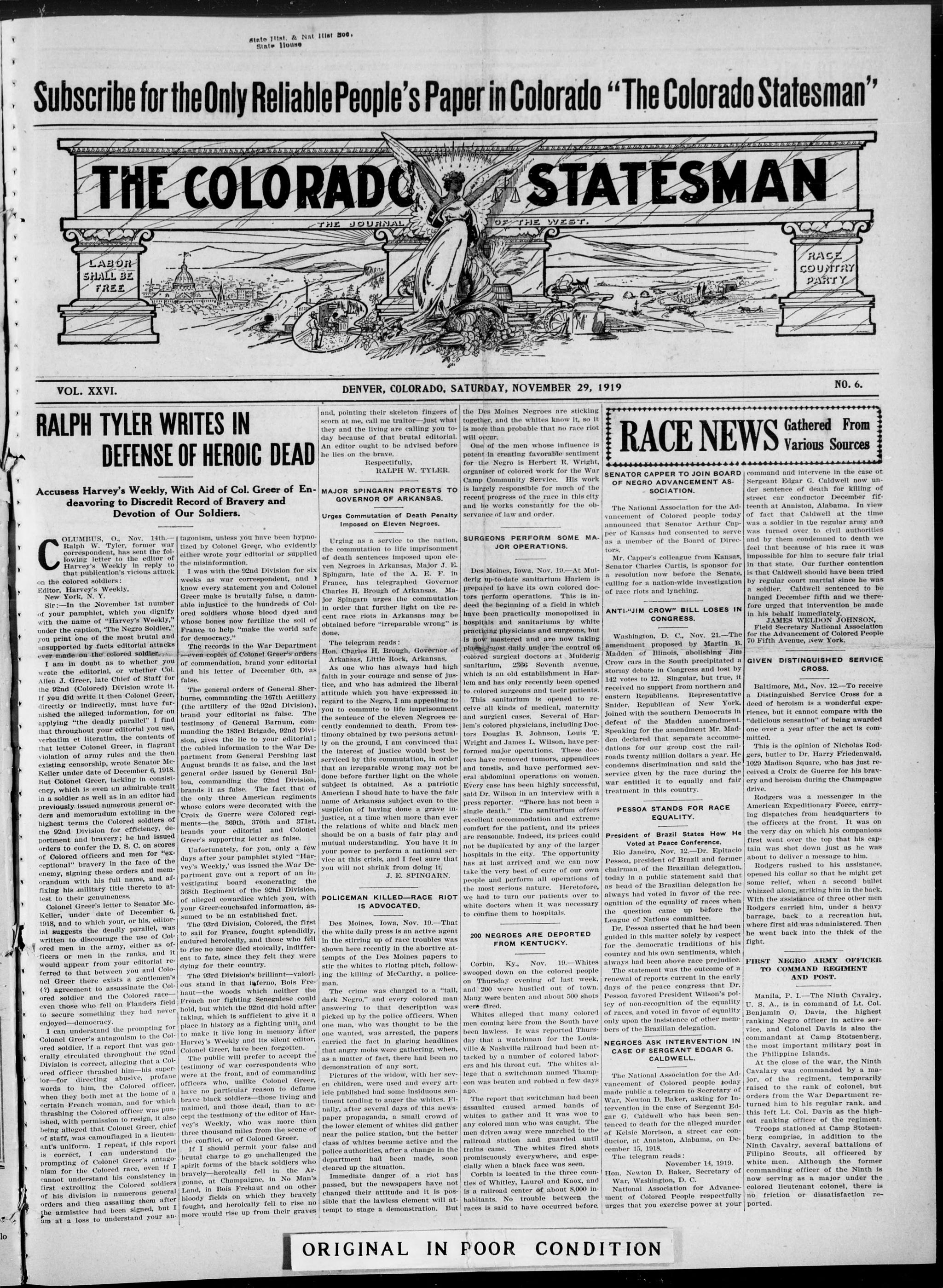
RALPH TYLER WRITES IN DEFENSE OF HEROIC DEAD
Accusess Harvey's Weekly, With Aid of Col. Greer of Endeavoring to Discredit Record of Bravery and Devotion of Our Soldiers.
VOL. XXVI.
RALPH TYLER W
DEFENSE
Accusess Harvey's Weekly, W
deavoring to Discredit
Devotion of C
COLUMBUS, O., Nov. 14th.—Ralph W. Tyler, former war
correspondent, has sent the following letter to the editor of
Harvey's Weekly in reply to
that publication's vicious attack
on the colored soldiers:
Editor, Harvey's Weekly,
New York, N. Y.
Sir:—In the November 1st number of your pamphlet, which you dignify with the name of "Harvey's Weekly," under the caption, "The Negro Soldier," you print one of the most brutal and unsupported by facts editorial attacks ever made on the colored soldier.
I am in doubt as to whether you wrote the editorial, or whether Col. Allen J. Greer, late Chief of Staff for the 92nd (Colored) Division wrote it. If you did write it then Colonel Greer, directly or indirectly, must have furnished the alleged information, for on applying "the deadly parallel" I find that throughout your editorial you use, verbatim et literatim, the contents of that letter Colonel Greer, in flagrant violation of army rules and the then existing censorship, wrote Senator McKeller under date of December 6, 1918. But Colonel Greer, lacking in consistency, which is even an admirable trait in a soldier as well as in an editor had previously issued numerous general orders and memoradum extolling in the highest terms the Colored soldiers of the 92nd Division for efficiency, department and bravery; he had issued orders to confer the D. S. C. on scores of Colored officers and men for "exceptional" bravery in the face of the enemy, signing these orders and memorandum with his full name, and affixing his military title thereto to attest to their genuineness.
Colonel Greer's letter to Senator McKeller, under date of December 6, 1918, and to which your, or his, editorial suggests the deadly parallel, was written to discourage the use of Colored men in the army, either as officers or men in the ranks, and it would appear from your editorial referred to that between you and Colonel Greer there exists a gentlemen's (?) agreement to assassinate the Colored soldier and the Colored race—even those who fell on Flanders field to secure something they had never enjoyed—democracy.
I can understand the prompting for Colonel Greer's antagonism to the Colored soldier, if a report that was generally circulated throughout the 92nd Division is correct, alleging that a Colored officer thrashed him—his superior—for directing abusive, profane words to him, the Colored officer, when they both met at the home of a certain French woman, and for which thrashing the Colored officer was punished, with permission to resign, it also being alleged that Colonel Greer, chief of staff, was camouflaged in a lieutenant's uniform. I repeat, if this report is correct, I can understand the prompting of Colonel Greer's antagonism for the Colored race, even if I cannot understand his consistency in first extorting the Colored soldiers of his division in numerous general orders and then assailing them after the armistice had been signed, but I am at a loss to understand your an-
State Hist. & Nat Hist 800,
State House
the Only Reliable
COLOR
RITES IN
OF HEROIC DEAD
With Aid of Col. Greer of En-
Record of Bravery and
Our Soldiers.
tagnonism, unless you have been hypnotized by Colonel Greer, who evidently either wrote your editorial or supplied the misinformation.
I was with the 92nd Division for six weeks as war correspondent, and I know every statement you and Colonel Greer make is brutally false, a damnable injustice to the hundreds of Colored soldiers whose blood dyed and whose bones now fertilize the soil of France to help "make the world safe for democracy."
The records in the War Department even copies of Colonel Greer's orders of commendation, brand your editorial and his letter of December 6th, as false.
The general orders of General Sherburne, commanding the 167th Artillery (the artillery of the 92nd Division), brand your editorial as false. The testimony of General Barnum, commanding the 183rd Brigade, 92nd Division, gives the lie to your editorial; the cabled information to the War Department from General Pershing last August brands it as false, and the last general order issued by General Ballou, commanding the 92nd Division, brands it as false. The fact that of the only three American regiments whose colors were decorated with the Croix de Guerre were Colored regiments—the 369th, 370th and 371st, brands your editorial and Colonel Greer's supporting letter as false.
Unfortunately, for you, only a few days after your pamphlet styled "Harvey's Weekly," was issued the War Department gave out a report of an investigating board exonerating the 368th Regiment of the 92nd Division, of alleged cowardice which you, with your Greer-couchsafed information, assumed to be an established fact.
The 93rd Division, Colored, the first to sail for France, fought splendidly, endured heroically, and those who fell to rise no more died stoically, indifferent to fate, since they felt they were dying for their country.
The 93rd Division's brilliant—valorous stand in that inferno, Bois Fre haunt—the woods which neither the French nor fighting Senegalese could hold, but which the 92nd did hold after taking, which is sufficient to give it a place in history as a fighting unit, and to make it live long in memory after Harvey's Weekly and its silent editor, Colonel Greer, have been forgotten.
The public will prefer to accept the testimony of war correspondents who were at the front, and of commanding officers who, unlike Colonel Greer, have no particular reason to defame brave black soldiers—those living and maimed, and those dead, than to accept the testimony of the editor of Harvey's Weekly, who was more than three thousand miles from the scene of the conflict, or of Colonel Greer.
If I should permit your false and brutal charge to go unchallenged the spirit forms of the black soldiers who bravely—heroically fell in the Argonne, at Champaigne, in No Man's Land, in Bois Frehaut and on other bloody fields on which they bravely fought, and heroically fell to rise no more would rise up from their graves
and, pointing their skeleton fingers of scorn at me, call me traitor—just what they and the living are calling you today because of that brutal editorial. An editor ought to be advised before he lies on the brave.
MAJOR SPINGARN PROTESTS TO GOVERNOR OF ARKANSAS.
Urges Commutation of Death Penalty Imposed on Eleven Negroes.
Urging as a service to the nation, the commutation to life imprisonment of death sentences imposed upon eleven Negroes in Arkansas, Major J. E. Spingarn, late of the A. E. F. in France, has telegraphed Governor Charles H. Brough of Arkansas. Major Spingarn urges the commutation in order that further light on the recent race riots in Arkansas may be obtained before "irreparable wrong" is done.
The telegram reads:
Hon. Charles H. Brough, Governor of Arkansas, Little Rock, Arkansas.
As one who has always had high faith in your courage and sense of justice, and who has admired the liberal attitude which you have expressed in regard to the Negro, I am appealing to you to commute to life imprisonment the sentence of the eleven Negroes recently condemned to death. From testimony obtained by two persons actually on the ground, I am convinced that the interest of justice would best be serviced by this commutation, in order that an irreparable wrong may not be done before further light on the whole subject is obtained. As a patriotic American I should hate to have the fair name of Arkansas subject even to the suspicion of having done a grave injustice, at a time when more than ever the relations of white and black men should be on a basis of fair play and mutual understanding. You have it in your power to perform a national service at this crisis, and I feel sure that you will not shrink from doing it.
POLICEMAN KILLED—RACE RIOT
IS ADVOCATED.
Des Moines, Iowa, Nov. 19.—That the white daily press is an active agent in the stirring up of race troubles was shown here recently in the abortive attempts of the Des Moines papers to stir the whites to rioting pitch, following the killing of McCarthy, a policeman.
The crime was charged to a "tall, dark Negro," and every colored man answering to that description was picked up by the police officers. When one man, who was thought to be the one wanted, was arrested, the papers carried the fact in glaring headlines that angry mobs were gathering, when, as a matter of fact, there had been no demonstration of any sort.
Pictures of the widow, with her seven children, were used and every article published had some insidious sentiment tending to anger the whites. Finally, after several days of this newspaper propaganda, a small crowd of the lower element of whites did gather near the police station, but the better class of whites became active and the police authorities, after a change in the department had been made, soon cleared up the situation.
Immediate danger of a riot has passed, but the newspapers have not changed their attitude and it is possible that the lawless element will attempt to stage a demonstration. But
ORIGINAL IN POOR CONDITION
DENVER, COLORADO, SATURDAY, NOVEMBER 29, 1919
Respectfully,
RALPH W. TYLER
the Des Moines Negroes are sticking together, and the whites know it, so it is more than probable that no race riot will occur.
One of the men whose influence is potent in creating favorable sentiment for the Negro is Herbert R. Wright, organizer of colored work for the War Camp Community Service. His work is largely responsible for much of the recent progress of the race in this city and he works constantly for the observance of law and order.
SURGEONS PERFORM SOME MA JOR OPERATIONS.
Des Moines, Iowa, Nov. 19.—At Mulderig up-to-date sanitarium Harlem is prepared to have its own colored doctors perform operations. This is indeed the beginning of a field in which have been practically monopolized in hospitals and sanitariums by white practicing physicians and surgeons, but is now mastered and are now taking places almost daily under the control of colored surgical doctors at Mulderig sanitarium, 2366 Seventh avenue, which is an old establishment in Harlem and has only recently been opened to colored surgeons and their patients.
This sanitarium is opened to receive all kinds of medical, maternity and surgical cases. Several of Harlem's colored physicians, including Doctors Douglas B. Johnson, Louis T. Wright and James L. Wilson, have performed major operations. These doctors have removed tumors, appendices and tonsils, and have performed several abdominal operations on women. Every case has been highly successful, said Dr. Wilson in an interview with a press reporter. "There has not been a single death." The sanitarium offers excellent accommodation and extreme comfort for the patient, and its prices are reasonable. Indeed, its prices could not be duplicated by any of the larger hospitals in the city. The opportunity has at last arrived and we can now take the very best of care of our own people and perform all operations of the most serious nature. Heretofore, we had to turn our patients over to white doctors when it was necessary to confine them to hospitals.
200 NEGROES ARE DEPORTED FROM KENTUCKY.
Corbin, Ky., Nov. 19.—Whites swooped down on the colored people on Thursday evening of last week, and 200 were hustled out of town. Many were beaten and about 500 shots were fired.
Whites alleged that many colored men coming here from the South have been lawless. It was reported Thursday that a watchman for the Louisville & Nashville railroad had been attacked by a number of colored laborers and his throat cut. The whites allege that a switchman named Thampeon was beaten and robbed a few days ago.
The report that switchman had been assaulted caused armed bands of whites to gather and it was woe to any colored man who was caught. The men driven away were marched to the railroad station and guarded until trains came. The whites fired shots promiscuously everywhere, and especially when a black face was seen.
Corbin is located in the three counties of Whitley, Laurel and Knox, and is a railroad center of about 8,000 inhabitants. No trouble between the races is said to have occurred before.
RACENEWS Gathered From Various Sources
SENATOR CAPPER TO JOIN BOARD OF NEGRO ADVANCEMENT ASSOCIATION.
The National Association for the Advancement of Colored people today announced that Senator Arthur Capper of Kansas had consented to serve as a member of the Board of Directors.
Mr. Capper's colleague from Kansas, Senator Charles Curtis, is sponsor for a resolution now before the Senate, calling for a nation-wide investigation of race riots and lynching.
ANTI-"JIM CROW" BILL LOSES IN CONGRESS.
Washington, D. C., Nov. 21.—The amendment proposed by Martin B. Madden of Illinois, abolishing Jim Crow cars in the South precipitated a stormy debate in Congress and lost by 142 votes to 12. Singular, but true, it received no support from northern and eastern Republicans. Representative Snider, Republican of New York, joined with the southern Democrats in defeat of the Madden amendment. Speaking for the amendment Mr. Madden declared that separate accommodations for our group cost the railroads twenty million dollars a year. He condemns discrimination and said the service given by the race during the war entitled it to equally and fair treatment in this country.
PESSOA STANDS FOR RACE
EQUALITY.
President of Brazil States How He Voted at Peace Conference.
Rio Janeiro, Nov. 12.—Dr. Epitacio Pessoa, president of Brazil and former chairman of the Brazilian delegation, today in a public statement said that as head of the Brazilian delegation he always had voted in favor of the recognition of the equality of races when the question came up before the League of Nations committee.
Dr. Pessoa asserted that he had been guided in this matter solely by respect for the democratic traditions of his country and his own sentiments, which always had been above race prejudice.
The statement was the outcome of a renewal of reports current in the early days of the peace congress that Dr. Pessoa favored President Wilson's policy of non-recognition of the equality of races, and voted in favor of equality only upon the insistence of other members of the Brazilian delegation.
NEGROES ASK INTERVENTION IN CASE OF SERGEANT EDGAR G. CALDWELL.
The National Association for the Advancement of Colored people today made public a telegram to Secretary of War, Newton D. Baker, asking for Intervention in the case of Sergeant Edgar G. Caldwell who has been sentenced to death for the alleged murder of Kelsie Morrison, a street car conductor, at Anniston, Alabama, on December 15, 1918.
The telegram reads:
November 14, 1919.
Hon. Newton D. Baker, Secretary of War, Washington, D. C.
National Association for Advancement of Colored People respectfully urges that you exercise power at your
NO. 6.
command and intervene in the case of Sergeant Edgar G. Caldwell now under sentence of death for killing of street car conductor December fifteenth at Anniston, Alabama. In view of fact that Caldwell at the time was a soldier in the regular army and was turned over to civil authorities and by them condemned to death we feel that because of his race it was impossible for him to secure fair trial in that state. Our further contention is that Caldwell should have been tried by regular court martial since he was a soldier. Caldwell sentenced to be hanged December fifth and we therefore urged that intervention be made in his behalf immediately. JAMES WELDON JOHNSON, Field Secretary National Association for the Advancement of Colored People 70 Fifth Avenue, New York.
GIVEN DISTINGUISHED SERVICE
CROSS.
Baltimore, Md., Nov. 12.—To receive a Distinguished Service Cross for a deed of heroism is a wonderful experience, but it cannot compare with the "delicious sensation" of being awarded one over a year after the act is committed.
This is the opinion of Nicholas Rodgers, butler to Dr. Harry Friedenwald, 1029 Madison Square, who has just received a Croix de Guerre for his bravery and heroism during the Champagne drive.
Rodgers was a messenger in the American Expeditionary Force, carrying dispatches from headquarters to the officers at the front. It was on the very day on which his companions first went over the top that his captain was shot down just as he was about to deliver a message to him.
Rodgers rushed to his assistance, opened his collar so that he might get some relief, when a second bullet whizzed along, striking him in the back. With the assistance of three other men Rodgers carried him, under a heavy barrage, back to a recreation hut, where first aid was administered. Then he went back into the thick of the fight.
FIRST NEGRO ARMY OFFICER
TO COMMAND REGIMENT
AND POST.
Manila, P. I.—The Ninth Cavalry, U. S. A., is in command of Lt. Col. Benjamin O. Davis, the highest ranking Negro officer in active service, and Colonel Davis is also the commandant at Camp Stotsenberg, the most important military post in the Philippine Islands.
At the close of the war, the Ninth Cavalary was commanded by a major, of the regiment, temporarily raised to the rank of colonel, but orders from the War Department returned him to his regular rank, and this left Lt. Col. Davis as the highest ranking officer of the regiment.
Troops stationed at Camp Stotsenberg comprise, in addition to the Ninth Cavalry, several battalions of Filipino Scouts, all officered by white men. Although the former commanding officer of the Ninth is now serving as a major under the colored lieutenant colonel, there is no friction or dissatisfaction reported.
FOREIGN
Three million American tourists are expected in France in 1920 and 1921, it was estimated by Henri de Fert, the new president of the French Motor Touring Club.
Premier Clemenceau has rented at St. Vincent, Vendee, a small solitary house on the seashore, where he hopes to rest and work in solitude, according to reports from Paris.
Gabrielle d'Annunzio has decided to make a lecture tour of America at once, it is reported from Rome. The poet warrior says he wants to explain the Flume question to Americans.
All records in the prices of fashionable gowns are beaten by spring models just announced in Paris. They will be 12,000 francs ($2,400), while an afternoon frock, a Poetre creation, costs 28,000 francs ($5,600).
Adelina Patti, famous prima donna, who died Sept. 27, at her castle in Wales, left a fortune valued at £116,000. She bequeathed her entire property to Baron Rolf Cederstrom, her husband, except a few personal articles.
Martial law has been declared at Saragosa, Spain, because of a general like. Trav ways and other traffic lines have been suspended. The strike was called in protest against the deportation to Barcelona of the presidents of labor unions.
Plans are under way to spend 22,000,000 marks for the purchase and equipment of a residence for future German presidents in Berlin, something on the line of the White House in Washington or the Elysse in Paris, but necessarily less pretentious.
Another Klondike has been discovered in Laponia, or Lapland, to the north of Finland. The reports brought back by travelers are so startling and important that the Norwegian government has sent an official expedition to the gold fields. Meanwhile a stampede is reported in progress.
Philipp Scheidemann, former German chancellor, writing in the Vorwaerts, says he considers that Germany is in the power of the reactionaries. "The entire army," he writes, "seems to be at the disposal of the reactionaries. Unity of the working classes has become a bounden duty."
Because Germans raised no objections to the erection of memorials to British soldiers in German cemeteries, the Oswestry district council has decided to permit the building of a memorial to German soldiers buried in a military cemetery at Oswestry, England.
The unpopularity of militarism has resulted in depriving Japanese railway officials of their glittering shoulder straps and swords. The wearing of gold braid and side arms by the railway officials was introduced about ten years ago. The railway people now look more democratic.
Of the pre-war population of 5,230,000 in the devastated regions of France, four-fifths have returned to their former homes, according to a report issued by the American Red Cross in Paris. French authorities expect a return of the majority of the remainder within the next few months.
GENERAL
The famous Holstein Friesian bull, King Segis Pontine Alcartra, valued at $50,000, died at Middletown, N. Y. It was owned by John H. Ardmann of Fairmont farm.
Twenty-five persons, most of them women and girls, lost their lives in a fire which quickly destroyed a frame building in which 300 of the village folk were making merry at a dance at Ville Platte, La.
Moose hunting has been resumed in Maine after a suspension of four years. The large numbers of these animals killed in former years, when there was an open season annually, caused fear of their extermination, and the Legislature ordered a four-year suspension of hunting.
Robbers, who burned the vault door with an acetylene torch, looted fifty safety deposit boxes of $10,000 in cash and bonds at the State bank of Freeville, Knox county, Ind. No clew to the robbers has been found.
Lieut. Robert Stocker and a civilian named Thompson, believed to have been a radio tester, were drowned when their hydroairplane fell into the Delaware river, six miles below Chester. The bodies have not yet been recovered. The plane was towed to the Philadelphia navy yard.
With more than seventy days left the Ohio automobile department has broken all records of the state and, in fact, any state in the Union in the number of licenses issued for 1919. Up to Oct. 20 the department issued licenses for 503,500 passenger cars and commercial vehicles operated by gasoline.
Clyde Smith of South Bend, Ind., and Harold Lane of New York City have been indicted on charges of having worked a confidence game when they disposed of an alleged new process in manufacturing automobile tires to Sol Goldberg, president of the Hump Hairpin Company, for $400,000.
The American merchant marine has expanded from four ships in deep sea commerce before the war to a fleet of 9,773,000 tons in ocean service, according to figures made public by the National Marine League. In addition great lakes shipping measures 2,000,000 tons, giving a total of 11,773,000 against Great Britain's 18,000,000 tons.
More than $100,000 in government bonds, mostly Liberty issues, was taken by robbers who cut their way into the vault of the Farmers' Savings Bank at Rockford, Ohio, and looted eighteen of sixty deposit boxes of the vault.
NEWS TO DATE IN PARAGRAPHS
CAUGHT FROM THE NETWORK OF WIRES ROUND ABOUT THE WORLD.
DURING THE PAST WEEK
DURING THE PAST WEEK
RECORD OF IMPORTANT EVENTS CONDENSED FOR BUSY
Western Newspaper Union News Service.
WESTERN
The State bank at Murphy, Texas, was robbed of $12,500 by safe blowers.
The body of Otis McGuire, who was being sought after the bodies of his wife and two daughters were found murdered, was found today, hanging in a boathouse near Blaine, Wash.
J. Hardacker, British cousal at Puebla, Mexico, was saved from kidnapping by Federico Cordova, the bandit who kidnapped William O. Jenkins, the American consular agent at Puebla, it was learned at Washington in advices from Mexico City.
Charles M. Belshaw of San Francisco, former state senator, Mrs. Belshaw and Mr. and Mrs. J. D. Sherwood of Spokane, Wash., were killed when an automobile in which they were riding rolled over a high cliff at Half Moon bay, thirty miles south of San Francisco.
The Superior Court at Viscala, Calif., denied the application of J. Kawahara, a Japanese for the guardianship of his 4-year-old son in order that he might buy land in his son's name. The court held the use of land by an alien who holds it in the name of an infant is illegal.
The bodies of a Mrs. McGuire and her two young daughters, 10 and 12 years old, were found in their home at Blaine, twenty-five miles north of Bellingham, Wash. Mrs. McGuire and one child appeared to have been slain with an ax. The other child evidently was stabbed to death. Officers are searching for the husband and father.
In what is said to be the first original case in the history of the United States in which a conviction has been obtained by finger print identification alone, Chet Moon, accused of the robbery of the safe of the Treu meat market at Bisbee, Ariz., about three months ago, was found guilty by a jury in superior court at Tombstone. The verdict was rendered after ten minutes' deliberation.
WASHINGTON
A final study of the selective draft records made public fixes the military strength of the United States at 19,000,000 in potential military manpower. Registrations for the draft, between the ages of 18 and 45, totalled 23,908,576, almost 80 per cent of whom were listed as "physically fit for military service." Excise taxes paid by manufacturers on the sale of cars and motorcycles for the fiscal year ended June 30 totaled $17,915,510.81, according to a report made public by the internal revenue collector. Commercial car taxes for the same period and the revenue derived from taxes on tires, parts and accessories amounted to $4,908,276.18.
Earnings of the federal farm loan banks during the six months ending Nov. 1 were $858,033, according to figures made public by the farm loan board. This was a gain of more than $250,000 over the previous half year earnings and an increase of approximately $650,000 over profits of the banks for the corresponding six months a year ago.
A pardon signed by President Wilson for Jesse Kohler, a federal convict, was received at Los Angeles. When officials went to present it to Kohler at the county hospital they learned he had died eighteen days previous.
American exports in October, 1919, were valued at $632,000,000, an increase of $35,000,000 over those in September and of $130,000,000 over those in October, a year ago, according to a statement today by the Bureau of Foreign and Domestic Commerce. Exports for the ten months ended with October were valued at $6,501,000,000, an increase of $1,440,000,000 compared with the corresponding period last year.
More than $7,000,000 will be expended in alterations in and special equipment for the seven former German passenger liners, aggregating 67,639 tons, recently allotted by the United States shipping board for a fast passenger and mail service between the United States and South America. This was made known by Frank C. Manson, president of the Munson line, which has been selected by the shipping board to operate and manage the ships.
General Pershing will leave Washington Dec. 3rd to begin his nationwide inspection of the military resources of the country. He will visit the Southeastern department, then go to the Southern department, visiting the district adjacent to the Mexican border.
Dangerous radicals are being smugged into the United States at the rate of 100 a day, according to data collected by the House committee on immigration investigating alleged failure of the government to deport alien radicals made public at Washington.
Pithy News Notes
From All Parts of
Colorado
Western Newspaper Union News Service.
COMING EVENTS.
The Red Cross Christmas Sale seal will take place all over the United States from December 1 to 10, 1819.
Expert yeggmen opened the safe at the Portland (Colo.) postoffice and escaped with $1,200 in stamps, thrift stamps and liberty bonds, and robbing the drug store in which the postoffice is located of another $1,200 worth of jewelry and stock.
More than 10,000,000 acres of the patented land of Colorado, or about 15 per cent of the area of the state, is classed as non-irrigated farm land. This class of land has increased more rapidly on the tax rolls in the past five years than any other.
George Golden, negro, serving a life sentence, made a sensational dash for freedom at the state penitentiary at Cafon City, but was captured after he had scaled the twenty-five-foot wall, swam the Arkansas river and reached the foothills in South Cafon.
Two million bushels of wheat are tied up in the wheat-growing districts of eastern and northeastern Colorado on account of the impassible condition of the roads following the recent storm, according to William C. Reid, inspector for the State Utilities Commission.
Fire of an unknown origin completely destroyed the Hatcher building at Pagosa Springs. The records of the San Juan National forest were completely destroyed by fire, but the priceless records in the offices of the county assessor, the county treasurer, Red Cross and the Pagosa exchange were removed before the fire got under way. The loss is estimated at $7,000, according to fire officials.
Reports received by the State Immigration Department from the smaller cities and towns in the state show that a large number of professional men from other states have located in Colorado this year as a result of the department's 1919 survey of business and professional openings. A considerable number of business openings also have been filled but not nearly so many as professional openings.
R. L. Stringer, 53 years old, pioneer fruit grower, who was placed on trial at Cafion City on a charge of murdering his stepson, A. H. Sutphen, 30 years old, was acquitted in the Fremont count District Court. Sutphen was killed on the evening of July 4th. Stringer shot Sutphen with a shotgun pleading self-defense. Joseph H. Maupin, former attorney general of Colorado, handled the case for the defense. Sixteen Mexicans, including nine arrested in Denver, have been taken to El Paso, Tex., in charge of William R. Mansfield, federal immigration inspector, to be deported to Mexico as a result of being arrested frequently, officials say, on charges of petty crime. Four of the number were placed on the train at Colorado Springs and three more at Pueblo. Of those taken into custody at Colorado Springs and Pueblo two were women and three girls.
Reports of county assessors made to the State Immigration Department indicate that approximately 60 per cent of the land in cultivation in Colorado this year is irrigated, compared with about 39 per cent in 1909. The rapid increase in the acreage of non-irrigated land cultivated compared with a very slight decrease in the acreage of irrigated land, has resulted in a sharp decrease in the average yields per acre of nearly all crops grown in the state. The decrease is especially marked in winter wheat, where less than 12 per cent of the acreage is irrigated, compared with 51.1 per cent in 1909.
The proposed new highway over Berthoud pass, between Empire and Fraser, Colo., a distance of twenty-seven miles, will cost about $200,000, according to the survey just completed by crews working under the direction of A. E. Palem, senior highway engineer of the Federal Bureau of Public Roads.
County school and road funds in Colorado will be swelled to the extent of $115,048.98 within the next few days when checks aggregating that amount will be malled to the various counties by the state treasurer, under an allotment of receipts from grazing fees and timber sales on forest areas in the state.
One hundred and fifteen separate road projects, of which the United States government will bear half the cost, will be carried out in Colorado during the coming year. These roads total 879 miles and will cost, it is estimated, $5,342,349.15. Work on a number of them has already been commenced and quite a number are nearing completion, according to reports made by the state highway commission's engineers in charge. This is the greatest roadbuilding program ever undertaken in the state's history.
Approximately $850,000 will be turned into the state treasury this year by the state insurance department, representing the net earnings of the department in the most successful year in its history, according to Claudie W. Fairchild, state insurance commissioner.
A foreigner, said to be a Mexican, was compelled by steel workers at Pueblo to kiss the American flag while a crowd of union pickets, present to keep the steel workers from working, looked on and while police officers on duty made no move to prevent it.
CENTENNIAL STATE ITEMS.
Compliations made in the Office of the State Immigration Department from the records of the State Tax Commission show that the patented land in the state this year is 42.21 per cent of the total area, compared with 39.93 per cent last year. Of this patented land 26,020,911 acres, or 40.13 per cent of the area of the state, is assessed as agricultural land, the remaining 2.08 per cent being mineral land, railroad rights of way and town and city lots. The area of irrigated land assessed is 2,405,190 acres, or 9.37 per cent of the assessed agricultural land. Dry farming land assessed is 10,002,192 acres, or 37.58 per cent of the patented agricultural land, while grazing land is the largest class, amounting to 14,123,529 acres, or 53.05 per cent of the total.
The State Inheritance Tax Department received a check for $44,495.44 in settlement of the inheritance tax claim of the state against the estate of the late Walter S. Jackson of El Paso county. The value of the estate was appraised at $1,368,552.55. Deductions amounting to $43,553.65 brought the net taxable estate to $1,324,908.90. If the United States Supreme Court decides the state inheritance tax may be levied prior to deduction of the federal tax, the state will receive $4,172.65 additional.
Nearly 10,000 acres of state land, embracing tracts in Alamosa, Baca, Bent, Boulder, Conejos, Elbert, El Paso, Kiowa, Logan, Mineral, Moffat, Montezuma, Morgan, Prowers, Rio Grande, Routt and Washington counties, will be sold at public auction to the highest bidders at the state house, Dec. 3. The sale will open at 2 o'clock in the afternoon. Minimum acceptable prices on the land range from $5 to as high as $100 per acre.
At the Farmers' Congress to be held in Fort Collins Dec. 15 to 19, Maj. Gen. Leonard Wood will be the chief speaker. General Wood will talk upon "The Twentieth Century Farmer's Son True to the Spirit of '76 and '61." He wired his acceptance to Newton C. Dougherty, president of the congress, and will speak on the evening of Tuesday, Dec. 16. General Wood is the latest of a string of notables who will address the congress this year.
Wesley Saunders, 26, and Martin C. Kerren, 50, lost their lives when fire destroyed the Cripple Creek-Colorado Springs car barns at Cripple Creek. Both men, who were employees of the car barn, were asleep, and were suffocated. The fire started from an over-heated stove. The loss by the fire, in which six electric cars were destroyed, is estimated at $75,000.
The teachers in the grade rooms of the local schools have organized at Montrose for the purpose of securing more adequate salaries for their services. The local organization will co-operate with the state and nation-wide campaign for the betterment of the teachers' salaries and working conditions.
Bernard Cummings, 14-year-old son of former Game Warden W. B. Cummings of Durango, died from wounds sustained by the accidental discharge of his shotgun while he was hunting ducks on Horseshoe slough, three miles north of that city. His right arm was almost shot, away from the shoulder by the load from the gun.
Lee F. Williams, Pueblo contractor, has just been awarded a contract for the construction of a new depot for the Missouri Pacific Railway Company at Sugar City. It is to be a duplicate of the new depot at Ordway. The contract calls for a first-class modern depot building of brick, concrete and tile and will cost about $40,000. Poultry fanciers of Grand Junction and the Western Slope are arranging for a poultry show to be held in Grand Junction, during the latter part of January. It is expected that poultry will be brought from all parts of the slope for exhibition, the show being the most extensive yet planned in the intermountain territory.
Francisco Ballegos, on trial for killing his uncle, Mercario Ballegos, a former soldier, was found guilty of murder in the first degree at Durango, the jury returning the verdict in thirty minutes. They recommended life imprisonment. Lucia Ballegos, widow of the dead man, was found guilty of second degree murder as an accomplice. A penalty of from ten years to life imprisonment was recommended.
Forty-two per cent of all the land in Colorado is patented, according to compilations made in the State Immigration Department from records of the State Tax Commission. Of this patented land, 26,620,911 acres is assessed as agricultural land. The land classified as agricultural land represents a little more than 40 per cent of the total area of the state.
Members of the State Highway Commission have asked John S. Bright, district engineer of the Bureau of Public Roads, to approve the building of an eighteen-mile stretch of road between Burlington and Idalia, so federal aid may be secured for the project. The road is to cost approximately $42,000, according to the estimates of the state.
Monday, Dec. 8, has been designated by Gov. Oliver H. Shoup as the date on which the extra session of the Twenty-second General Assembly will be convened. Letters so advising the members of the Legislature have been sent out by C. A. Lammers, secretary to the governor.
The day school at the state penitentiary at Cafon City under the supervision of Chaplain S. H. Sperry, is reported to have the largest enrollment in its history, there being 115 men enrolled, with an average attendance of 108.
ARCHIE MARKET
Wholesale and R
Hotels and
Fresh and C
Fruits, Veg
Holesale and Retail Staple and Fancy Grocery
Fish and Oysters
Hotels and Restaurants Our Specialty
Fresh and Cured Eastern Corn-Fed Meats
Fruits, Vegetables, Poultry and Game
FREE DELIVERY
Arimer Street
Denver
S
l
pany
SIGNS PUT UP WHILE
YOU WAIT
FITTS AND CUT FLOWERS CONSTANTLY
ON HAND
SES: Thirty-Fourth and Curtis Streets
MAIN 1811
DENVER, COLO
atherhead Hat
Wholesale and Retail Staple and Fancy Groceries
Fish and Oysters
Hotels and Restaurants Our Specialty
Fresh and Cured Eastern Corn-Fed Meats
Fruits, Vegetables, Poultry and Game
FREE DELIVERY
1950 Larimer Street Denver, Co
The Curtis Park Floral Company
FLORAL DESIGNS PUT UP YOU CHOICE PLANTS AND CUT GREENHOUSES: Thirty-FTELEPHONE, MAIN 1511
Weather
TELEPHONE
MAIN 3203
Established 1876
RENOVATORS, BLEED
Of Gents' and L
1624 CHAN
Poro Hair
SCIENTIFIC AND SANITARY
MASSAGING, M
Mme.
2220 OGDEN STREET
The
Curtis
Park
Floral
Company
FLORAL DESIGNS PUT UP WHILE
YOU WAIT
CHOICE PLANTS AND CUT FLOWERS CONSTANTLY
ON HAND
GREENHOUSES: Thirty-Fourth and Curtis Streets
TELEPHONE, MAIN 1511
DENVER, COLO
ENVATORS, BLEACHERS, DYERS AND FINISHERS
(Gents' and Ladies' Hats of Every Description
1624 CHAMPA ST., DENVER, COLO.
Ho Hair Dressing Pad
IC AND SANITARY SCALP AND HAIR TR
ASSAGING, MANICURING, TOILET ARTICLE
RENOVATORS, BLEACHERS, DYERS AND FINISHERS Of Gents' and Ladies' Hats of Every Description 1624 CHAMPA ST., DENVER, COLO.
SCIENTIFIC AND SANITARY SCALP AND HAIR TREATMENT MASSAGING, MANICURING, TOILET ARTICLES
Mme. Lexie A. Brooks
EN STREET PHONE YO
1
C. E. SMITH, M.
The Man
Wholesale and Retail Stores
Hotels and Restaurants
Eastern
Fruits, Vegetables
Telephones
622-636 15TH STREET
D. E. SMITH, Manager, Res. Phone South 1608
e Market Company
and Retail Staple and Fancy Groceries, Fish and
and Restaurants Our Specialty. Fresh and
Eastern Corn Fed Meats
Fruits, Vegetables, Poultry and Game.
Telephones Main 4302, 4303, 4304, 4305
TH STREET DENVER, C
Wholesale and Retail Staple and Fancy Groceries, Fish and Oysters,
Hotels and Restaurants Our Specialty. Fresh and Cured
Fruits, Vegetables, Poultry and Game.
Telephones Main 4302, 4303, 4304, 4305
622-636 15TH STREET DENVER, COLORADO
John
MEATS, FANCY
180
John K. Rettig
ATS, FANCY AND STAPLE GROCERIE
1864 CURTIS STREET
eighteenth Det
MEATS, FANCY AND STAPLE GROCERIES
---
PHONE MAIN 3023
Corner Nineteenth
Phone Main 6753
Retail Staple and Fancy Groceries
Fish and Oysters
Restaurants Our Specialty
Fed Eastern Corn-Fed Meats
Vegetables, Poultry and Game
REE DELIVERY
WHILE WAIT
FLOWERS CONSTANTLY ON HAND
Durth and Curtis Streets
DENVER, COLO
head Hat Co.
```markdown
```
PIONEER HATTERS OF THE WEST. WE MAKE OLD HATS NEW.
LEACHERS, DYERS AND FINISHERS
Ladies' Hats of Every Description
AMPA ST., DENVER, COLO.
Fur Dressing Parlors
NITIARY SCALP AND HAIR TREATMENT.
MANICURING, TOILET ARTICLES
Motto—"Efficiency"
PHONE YORK 5997W
C. C. DENNIS R. F. LONG
The New Way Shoe Repairing Co.
AND
American Shoe Repairing
FIRST-CLASS WORK
Best Leather Used—Reasonable Prices
1855 Champa St. Phone Main 3737.
1221 Sixteenth St. Phone Champa 5389.
Opp. Golden Eagle. DENVER, COLO.
Manager, Res. Phone South 1608
Market Company
le and Fancy Groceries, Fish and Oysters.
tals Our Specialty. Fresh and Cured
Corn Fed Meats
Vegetables, Poultry and Game.
Main 4302, 4303, 4304, 4305
DENVER, COLORADO
RES. PHONE GALLUP 942
K. Rettig
AND STAPLE GROCERIES
CURTIS STREET
Denver, Colo.
Denver, Colo.
CAPITOL PETROLEUM
A Producing Dividend Paying Company
Hundred Thousand Dollars of Choice Lease
IS WELL NO. 1 NOW BEING DRILLED IN CARDS
bus difficulties, troubles and delays, all of which company's superintendent, Mr. Ed Welch, everything drilling is being pushed vigorously day and night, and should be down 2,000 feet in about 45 days and supplies for this well, except incidentals, are now so along uninterruptedly, barring any unforeseen happy location is on one of the finest structures in this progress so far, would cause one to believe that it will be set. Nearly all of the sections interjoining and interbought by big oil companies, such as the Empire, Entertunes Made in Oil Leases
I know that big fortunes have been made in leases; some of the leases that first sold for $25 and $50 per acre, and a great many sold for $5,000 to $10,000 there brought millions of dollars after the big wells had not as good in this district. A recent Fort Worth news just purchased a Texas lease, paying $1,000 per a chance," was the only comment he made.
is down 2,000 feet the price of these leases will be whose who keep them until the well is brought in have price then may be $1,000 or more per acre. Those who BUY NOW.
One Hundred Thousand Dollars Worth of Choice Leases
OFFSETTING ITS WELL NO.1 NOW BEING DRILLED IN CARSON CO., TEXAS.
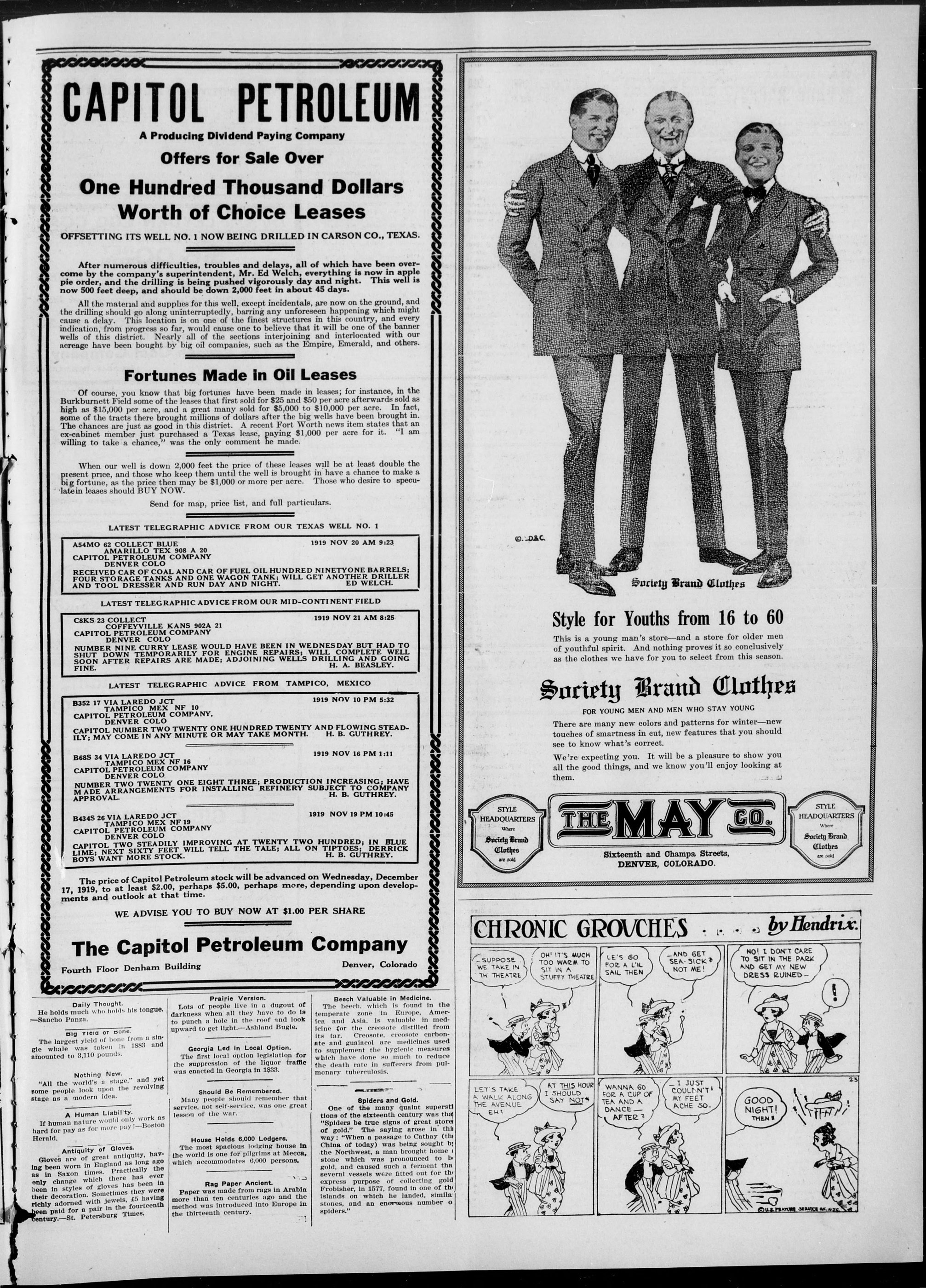
After numerous difficulties, troubles and delays, all of which have been overcome by the company's superintendent, Mr. Ed Welch, everything is now in apple pie order, and the drilling is being pushed vigorously day and night. This well is now 500 feet deep, and should be down 2,000 feet in about 45 days.
All the material and supplies for this well, except incidentals, are now on the ground, and the drilling should go along uninterruptedly, barring any unforeseen happening which might cause a delay. This location is on one of the finest structures in this country, and every indication, from progress so far, would cause one to believe that it will be one of the banner wells of this district. Nearly all of the sections interjoining and interlocated with our acreage have been bought by big oil companies, such as the Empire, Emerald, and others.
Fortunes Made in Oil Leases
Of course, you know that big fortunes have been made in leases; for instance, in the Burkburnett Field some of the leases that first sold for $25 and $50 per acre afterwards sold as high as $15,000 per acre, and a great many sold for $5,000 to $10,000 per acre. In fact, some of the tracts there brought millions of dollars after the big wells have been brought in. The chances are just as good in this district. A recent Fort Worth news item states that an ex-cabinet member just purchased a Texas lease, paying $1,000 per acre for it. "I am willing to take a chance," was the only comment he made.
When our well is down 2,000 feet the price of these leases will be at least double the present price, and those who keep them until the well is brought in have a chance to make a big fortune, as the price then may be $1,000 or more per acre. Those who desire to speculate in leases should BUY NOW.
LATEST TELEGRAPHIC ADVICE FROM OUR TEXAS WELL NO. 1
RECEIVED CAR OF COAL AND CAR OF FUEL OIL HUNDRED NINETYONE BARRELS;
FOUR STORAGE TANKS AND ONE WAGON TANK; WILL GET ANOTHER DRILLER
AND TOOL DRESSER AND RUN DAY AND NIGHT. ED WELCH.
OF COAL AND CAR OF FUEL OIL HUNDRED NINETY
TE TANKS AND ONE WAGON TANK; WILL GET ANO
ESSER AND RUN DAY AND NIGHT.
TELEGRAPHIC ADVICE FROM OUR MID-CONTINENT
LATEST TELEGRAPHIC ADVICE FROM OUR MID-CONTINENT FIELD
NUMBER NINE CURRY LEASE WOULD HAVE BEEN IN WEDNESDAY BUT HAD TO SHUT DOWN TEMPORARILY FOR ENGINE REPAIRS; WILL COMPLETE WELL SOON AFTER REPAIRS ARE MADE; ADJOINING WELLS DRILLING AND GOING FINE. H. A. BEASLEY.
CURRY LEASE WOULD HAVE BEEN IN WEDNESDAY
TEMPORARILY FOR ENGINE REPAIRS; WILL CO
REPAIRS ARE MADE; ADJOINING WELLS DRILLING
H. A.
AT TELEGRAPHIC ADVICE FROM TAMPICO, MN
REDO JCT 1919 NOV
TO MEX NF 10
POLEUM COMPANY,
R COLO
EVER TWO TWENTY ONE HUNDRED TWENTY AND FL
E IN ANY MINUTE OR MAY TAKE MONTH. H. B.
REDO JCT 1919 NOV
TO MEX NF 16
POLEUM COMPANY
R COLO
TWENTY ONE EIGHT THREE; PRODUCTION INCE
EMENTS FOR INSTALLING REFINERY SUBJECT
H. B.
REDO JCT 1919 NOV
TO MEX NF 19
POLEUM COMPANY
R COLO
STEADILY IMPROVING AT TWENTY TWO HUND
NTY FEET WILL TELL THE TALE; ALL ON TIPTO
RE STOCK. H. B.
Capitol Petroleum stock will be advanced on Wedn
ast $2.00, perhaps $5.00, perhaps more, depending
on that time.
ADVISE YOU TO BUY NOW AT $1.00 PER SH
Capitol Petroleum Co
LATEST TELEGRAPHIC ADVICE FROM TAMPICO, MEXICO
CAPITOL NUMBER TWO TWENTY ONE HUNDRED TWENTY AND FLOWING STEADILY: MAY COME IN ANY MINUTE OR MAY TAKE MONTH. H. B. GUTHREY.
NUMBER TWO TWENTY ONE EIGHT THREE; PRODUCTION INCREASING; HAVE MADE ARRANGEMENTS FOR INSTALLING REFINERY SUBJECT TO COMPANY APPROVAL. H. B. GUTHREY.
CAPITOL TWO STEADILY IMPROVING AT TWENTY TWO HUNDRED; IN BLUE LIME; NEXT Sixty Feet WILL TELL THE TALE; ALL ON TIPTOES; DERRICK BOYS WANT MORE STOCK. H. B. GUTHREY.
The price of Capitol Petroleum stock will be advanced on Wednesday, December 17, 1919, to at least $2.00, perhaps $5.00, perhaps more, depending upon developments and outlook at that time.
WE ADVISE YOU TO BUY NOW AT $1.00 PER SHARE
The Capitol Petroleum Company
---
Offers for Sale Over
One Hundred
Worth of C
OFFSETTING ITS WELL NO. 1 NOW
After numerous difficulties, trou
come by the company's superintende
pie order, and the drilling is being pu
now 500 feet deep, and should be dow
All the material and supplies for this
the drilling should go along uninterrupted
cause a delay. This location is on one o
indication, from progress so far, would ca
wells of this district. Nearly all of the
acreage have been bought by big oil com
Fortunes Ma
Of course, you know that big fortune
Burkburnett Field some of the leases that
high as $15,000 per acre, and a great m
some of the tracts there brought millions
The chances are just as good in this distr
ex-cabinet member just purchased a Te
willing to take a chance," was the only
When our well is down 2,000 feet the
present price, and those who keep them u
big fortune, as the price then may be $1,
late in leases should BUY NOW.
Send for map, price list, and full particulars.
A54MO 62 COLLECT BLUE
AMARILLO TEX 908 A 20
CAPITOL PETROLEUM COMPANY
DENVER COLO
RECEIVED CAR OF COAL AND CAR O
FOUR STORAGE TANKS AND ONE W
AND TOOL DRESSER AND RUN DAY
LATEST TELEGRAPHIC ADVIO
C8KS 23 COLLECT
COFFEYVILLE KANS 902A 21
CAPITOL PETROLEUM COMPANY
DENVER COLO
NUMBER NINE CURRY LEASE WOUL
SHUT DOWN TEMPORARILY FOR
SOON AFTER REPAIRS ARE MADE;
FINE.
LATEST TELEGRAPHIC ART
B352 17 VIA LAREDO JCT
TAMPICO MEX NF 10
CAPITOL PETROLEUM COMPANY,
DENVER COLO
CAPITOL NUMBER TWO TWENTY ONE
ILY; MAY COME IN ANY MINUTE OR
B68S 34 VIA LAREDO JCT
TAMPICO MEX NF 16
CAPITOL PETROLEUM COMPANY
DENVER COLO
NUMBER TWO TWENTY ONE EIGHT
MADE ARRANGEMENTS FOR INST
APPROVAL.
B434S 26 VIA LAREDO JCT
TAMPICO MEX NF 19
CAPITOL PETROLEUM COMPANY
DENVER COLO
CAPITOL TWO STEADILY IMPROVING
LIME; NEXT SIXTY FEET WILL TER
BOYS WANT MORE STOCK.
The price of Capitol Petroleum stock
17, 1919, to at least $2.00, perhaps $2
ments and outlook at that time.
WE ADVISE YOU TO BU
The Capitol Petroleum
Fourth Floor Denham Building
Lots of people live in a dugout of darkness when all they have to do is to punch a hole in the roof and look upward to get light.—Ashland Bugle.
Georgia Led in Local Option.
The first local option legislation for the suppression of the liquor traffic was enacted in Georgia in 1833.
Should Be Remembered.
Many people should remember that service, not self-service, was one great lesson of the war.
House Holds 6,000 Lodgers. The most spacious lodging house in the world is one for pilgrims at Mecca, which accommodates 6,000 persons.
Paper was made from rags in Arabia more than ten centuries ago and the method was introduced into Europe in the thirteenth century.
---
---
Daily thought.
He holds much who holds his tongue.
—Sancho Panza.
Big Yield or Bone.
The largest yield of bone from a single whale was taken in 1883 and amounted to 3,110 pounds.
Nothing New.
"All the world's a stage," and yet some people look upon the revolving stage as a modern idea.
A Human Liability.
If human nature would only work as hard for pay as for more pay!—Boston Herald.
Antiquity of Gloves.
Gloves are of great antiquity, having been worn in England as long ago as in Saxon times. Practically the only change which there has ever been in styles of gloves has been in their decoration. Sometimes they were richly adorned with jewels, £5 having been paid for a pair in the fourteenth century.-St. Petersburg Times.
1919 NOV 20 AM 9:23
D NINETYONE BARRELS;
GET ANOTHER DRILLER
ED WELCH.
CONTINENT FIELD
1919 NOV 21 AM 8:25
EDNESDAY BUT HAD TO
WILL COMPLETE WELL
DRILLING AND GOING
H. A. BEASLEY.
PICO, MEXICO
Y AND FLOWING STEAD-
H. B. GUTHREY.
1919 NOV 16 PM 1:11
ON INCREASING; HAVE
SUBJECT TO COMPANY
H. B. GUTHREY.
1919 NOV 19 PM 10:45
O HUNDRED; IN BLUE
ON TIPTOES; DERRICK
H. B. GUTHREY.
on Wednesday, December
depending upon develop-
PER SHARE
Company
---
Prairie Version.
Bag Paper Ancient.
1919 NOV 21 AM 8:25
1919 NOV 10 PM 5:32
1919 NOV 16 PM 1:11
Denver, Colorado
Beech Valuable in Medicine. The beech, which is found in the temperate zone in Europe, America and Asia, is valuable in medicine for the creosote distilled from its tar. Creosote, creosote carbonate and guaiacol are medicines used to supplement the hygienic measures which have done so much to reduce the death rate in sufferers from pulmonary tuberculosis.
Spiders and Gold.
One of the many quiet superstitions of the sixteenth century was that "Spliders be true signs of great store of gold." The saying arose in this way: "When a passage to Cathay (the China of today) was being sought by the Northwest, a man brought home a stone which was pronounced to be gold, and caused such a ferment that several vessels were fitted out for the express purpose of collecting gold Frobisher, in 1577, found in one of the islands on which he landed, similar stones, and an enormous number of spiders."
Society Brand Clothes
Style for Youths from 16 to 60
This is a young man's store—and a store for older men of youthful spirit. And nothing proves it so conelusively as the clothes we have for you to select from this season.
Society Brand Clothes
There are many new colors and patterns for winter—new touches of smartness in cut, new features that you should see to know what's correct.
We're expecting you. It will be a pleasure to show you all the good things, and we know you'll enjoy looking at them.
Sixteenth and Champa Streets, DENVER, COLORADO.
CHRONIC GROVCHES . . . by Hendrix.
SUPPOSE WE TAKE IN THE THEATRE
OH! IT'S MUCH TOO WARM TO SIT IN A STUFFY THEATRE
LE'S GO FOR A L'IL SAIL THEN
AND GET SEA-SICK NOT ME!
NO! I DON'T CARE TO SIT IN THE PARK AND GET MY NEW DRESS RUINED
LET'S TAKE A WALK ALONG THE AVENUE EH?
AT THIS HOUR I SHOULD SAY NOT
WANNA GO FOR A CUP OF TEA AND A DANCE AFTER?
I JUST COULDN'T MY FEET ACHE SO.
GOOD NIGHT! THEN!
1824 Curtis Street, Room 25.
SUBSCRIPTION RATES.
One Year ..... $2.00
Six Months ..... 1.50
Three Months ..... 75
MUST BE PAID IN ADVANCE.
OUR POLICY.
THIS paper and its management has at all times and under difficult circumstances sought to labor for the advancement and upbuilding of its people. We have not sought to make this a petty, personal or-
THE CHRISTMAS GIFT.
---
THE COLORADO STATESMAN
LABOR SHIELD THE FREEDOM
AMERICAN COURTIST PARTY
JOS. D. D. RIVERS.....Proprietor
P. O. Box 116
Phone Main 7417
JOS. D. D. RIVERS ..... Proprietor
P. O. Box 116 ..... Phone Main 7417
SUBSCRIPTION RATES.
Entered as second-class matter at the postoffice in the City of Denver, Colo.
Reading notices, ten lines or less, 15 cents per line. Each additional line over ten lines, 10 cents per line. Display advertising 75 cents per inch for first insertion and 50 cents per inch for each additional insertion.
Remittances should be made by Express Money Order, Postoffice Money Order, Registered Letter or Bank Draft. Postage stamps will be received the same as cash for the fractional part of a dollar. Only 1c and 2c stamps taken.
No discounts allowed on less than three months' contract. Cash must accompany all orders from parties unknown to us. Further particulars on application.
Communications to receive attention must be newsy, upon important subjects, plainly written only upon one side of the paper, must reach us Tuesdays, if possible, anyway not later than Wednesdays, and bear the signature of the author. No manuscript returned, unless stamps are sent for postage. All communications of a personating nature that are not complimentary will be withheld from the columns of this paper.
OUR POLICY.
gan of the owner, but a broad journal of opinion, reflecting the good of a growing people. All we have asked in return has been a fair share of your patronage. We feel that we are entitled to it. We are sending you a clean sheet, free from coarse and objectionable matter. We want every colored man and woman in the West to read this paper.
DENVER STORES IN HOLIDAY ATTIRE.
WORDS can inadequately describe the holiday attire of the stores of the city of Denver for the season of 1919, and therefore everyone who is physically capable of visiting them should seize this opportunity of getting first, direct and definite information as to the merchants' special efforts to present to their customers and the public in general not only charming decorations in the interior of their store premises, but a class of goods unsurpassed by any in the country and at prices to defy competition of the most aggressive and formidable competitor. The adage, "seeing is believing," could be well applied at this instance and be readily entertained, as the managers of the various firms who advertise with us appear to act in friendly rivalry for the obtaining of public opinion as to "the best store in town." The decorations serve to remind us of the days of the fairies in fairyland, while the artistic arrangement of the holiday presents offers a feast to the eye which results in an uncontrollable magnetism. Taking a particular view of the latest productions of twentieth century manufacturers, as the counters are laden with a variety of articles in every line of merchandise, from men and women's clothing to jewelry, music, toys and novelties, the mind seems to thrill, the eyes sparkle, and it appears as if something within dictates that by a touch of a magic wand the pocketbooks will yield to the enchantments which environ you, and you become the recipient of that joy which is only experienced by those who make their periodical visits to such magnificent scenes.
Join the throng of spectators and be an eye-witness of the marvelous creations in fashion, etc., which these centers of attraction offer and you cannot help from being doubly pleased with your good fortune of being a resident of Denver—the great emporium of the West.
The Colorado Statesman positively assures you of the reliability of these firms that appear in its advertising columns, and from years of business experience with them, guarantees the best holiday shopping at very moderate prices.
THE CHRISTMAS GIFT.
THE Christmas gift idea is so thoroughly established that it undoubtedly will follow the course of the Christian world as faithfully as the religion upon which it is based. The character of the gift, however, may undergo change, for the tendency to subject the religious form and thought to the over-ruling clamor of popular fancy and fashion is not a good tendency, and its extravagant indulgence may compel reforms for society's sake.
Gifts to members of one's family or to friends are very dear expressions of an abiding affection, which, somehow, does not quite so thoroughly or satisfactorily express itself in any other way. The tendency toward extravagance in these gifts, however, is a dangerous one, the error having its conception in the illusion absorbed by the child that Santa Claus has an endless supply of gifts whose lavish distribution depends only upon his good humor. The spirit of the gift and its usefulness are the things most to be considered and appreciated, rather than the intrinsic value. This conservative idea might better be inculcated in the minds of the young. The gift in expectation of a return gift or other reward has considerable less to commend it.
But the charity gift is the real Christmas gift, which in spirit, in character, and in the sensation of satisfaction to the giver, cannot be excelled. But by a charity gift we do not mean a hap-hazard affair, without aim or purpose. We all have intercourse of some kind with, or knowledge of, those greatly in need, that it will cost very little to provide. The noting, the planning and the giving of these things during the Christmas holidays will make more hearts than those of the recipients burn with pleasure. And none of us is either too rich or too poor to engage in this sort of giving. A simple service performed without the asking and without thought of pay and with a refusal to accept any, is just as gracious and just as appropriate a Christmas gift as a millionaire's check or a glittering diamond. The true spirit of the Christmas gift is that of the bestowal of a benefit without the thought of reward, except the thought that "it is more blessed to give than to receive."
Military Training Is Essential to the Nation's Welfare and Security
Military Training Is Essential to the Nation's Welfare and Security
By CARDINAL GIBBONS, Archbishop of Baltimore
I am convinced that some military training for the young men of our country is essential for the welfare and security of the nation. In the recent war we had the trained armies of our allies to lean upon until our soldiers were prepared for the battlefield. We cannot always depend upon such a favorable circumstance in the event that we are drawn into war again. The discipline which the young men will acquire will develop them morally and physically. The regular hours of rising and retiring, taking of simple and nourishing food, and the outdoor exercise cannot fail to improve their general health.
A. M. B.
Another advantage of the discipline is to instill into them a spirit of obedience to lawful authority, a virtue which we have seen to be frequently disregarded in our land of freedom. It will teach them that there is a dignity associated with obedience which has been too often overlooked and that in obeying their lawful superiors, they are rendering obedience to God, from whom all authority comes.
It cannot be said that such preparation will make for war. I believe that it will make for peace, since nations knowing our preparedness will be reluctant to draw us into the danger of war.
America Has Risen to a New Life, to a New Place Among the Nations
America Has Risen to a New Life, to a New Place Among the Nations
By CALVIN COOLIDGE, Governor of Massachusetts
America has arisen to a new life. We have taken a new place among the nations. The Revolution made us a nation; the Spanish war made us a world power; the present war has given us recognition as a world power. We shall not again be considered provincial. Whether we desire it or not, this position has come to us with its duties and responsibilities.
This new position should not be misunderstood. It does not mean any diminution of our national spirit; it rather means that it should be intensified. . . . Believing in our nation thoroughly and unreservedly, confident that the evidence of the past and present justifies that belief, it is our desire to make America more American. . . .
We have come to the realization of a new brotherhood among nations and among men. It came through the performance of a common duty. A brotherhood that existed unseen has been recognized at last of those called to the camp and trenches and those working for their victory at home. This spirit must not be misunderstood. It is not a gospel of ease but of work, not of dependence but of independence, not of an easy tolerance of wrong but a stern insistence on right, not the privilege of receiving but the duty of giving.
Rich and Poor Alike Are Indulging in Extravagance and Wastefulness
By MANUEL KOMROFF, in Daily Garment News
Although no actual gold has been shot from cannon in Europe, yet the war has left the world much poorer than it was before. Natural resources have become exhausted and America's part in the war certainly did not help to increase the wealth of the nation. Wealth is not money.
A certain recklessness has been caused by the war. A recklessness of personal extravagance; an extravagance which, on the surface, tends to show that we are richer today than we were before the war. But this is a false notion.
Too many people have mortgaged their homes in order to buy automobiles that they do not actually require. Too many girls are buying expensive furs and silk stockings that are not actual necessities. Too many young men are spending money extravagantly, recklessly, as though they did not expect to live another day. The large jewelry stores in our cities are crowded with people of the working class.
On every hand, people, rich and poor, are indulging in extravagance and wastefulness. Such actions cannot bring good to the country and can only make for evil, want and suffering.
After all, the government in Washington is quite powerless, for it cannot change by legislation any characteristics that people as individuals may possess. The government is the people. And the people are living beyond their incomes. In order to prevent personal and national bankruptcy, every individual in America must produce more of the essentials and consume less of the luxuries. This can only be accomplished if all get together toward one end, each doing his part.
College Man Proves the Better Mixer in Dealing With French People
A lasting impression of my experiences in France is the value of a good education in cementing friendly relations between peoples of such different culture and background as the French and the Americans.
It so happens that the men from our colleges and universities showed almost without exception an adaptability of environment, a capacity for understanding a different viewpoint and an easy resourcefulness in turning their knowledge into sincerer and more cordial relationships with a foreign people that proved the value of education. They were the Americans who were equipped to show without superficial friction and foolish misunderstandings the real regard which America has for France and the true feelings which underlay our support of the allies' cause. In short, the college man proved himself to be the better mixer.
The war is now over and all but a comparative handful of Americans are back from abroad, but the world has changed and we must be able to mix in international affairs as cosmopolitans. If we are to remain a vital force we must improve our technique in meeting and living with other people by means of better education and more of it.
The Cammel Undertaking Co.
Consult us; we can save you time. We have two expert embalmers, lady attendant and funeral director.
IN UNION THERE IS STRENGTH. Incorporated for $15,000, under the laws of the State of Colorado and preparing to establish a manufacturing plant in connection with their present business, in order to supply the various which offices which they are establishing in each city in the state where the population will warrant. They have some stock on a market. For full particulars, call or write—
AMMIL President. 2418 Welton Street, Denver, Colo.
Try some LEYDEN EGG COAL
This Week Costs Only
$6.00 NET
TON
NO SMOKE NO CLINKERS
PLEASES EVERYBODY
Leyden Egg Coal is uniform; small lumps run from two to
four inches.
SCREENED LUMP COAL $6.25
Net Ton
The Leyden Coal Company
Phone Main 3577 1604 ARAPAHOE STREET
Chas. Trotter R. L. Norman
Telephone York 4561
R. L. Norman
Chas. Trotter
Telephone York 4561
R. L. Norman
INDUSTRIAL REALTY CO.
SALES, RENTALS, INVESTMENTS AND EMPLOYMENT
716 East 26 Avenue
DENVER, COLORADO
718 East 26 Avenue
ESTABLISHED
1879
Stark
JEWELERS
709-711 Sixteenth St.
Denver, Colo.
The Star Cleaning & Pressing Company
Best of Service-All Work Guaranteed-Clothes Called for and Delivered.
S. SMITH AND C. W. BUCKHALTER, Proprietors.
I. GIBSON SMITH Art Dealer
and Manufacturer of Artistle
Screens, Dressing Tables, Mirrors
and Novelties
1638 Tremont Street.
PHONE MAIN 4843 DENVER, COLORADO.
PHONE MAIN 4843
EVERYONE can have abundance of Thick, Beautiful, Glossy Hair. 7 Sutherland Sisters Hair Grower Grew this Hair
SEND TEN CENTS FOR TRIAL SIZE
SEND TEN CENTS FOR TRIAL SIZE
15TH AND LARIMER STS.
Do your shopping early, while stocks are complete and better service assured.
Stretch your dollars by buying at the store that undersells.
Head-to-foot attire for man, woman or child.
PHONE CHAMPA 5830.
New Coliseum Hall
Hall Newly Remodeled
2132 Arapahoe St.
Formerly East Turner Hall.
Under New Management.
Best Dance Floor in Colorado
Hall for All Occasions
BERT PLESSNER, Manager.
If You Value Your Hair and Its Beauty Try SEVEN SUTHERLAND SISTERS Once—Why not now? On Sale at all Dealers Seven Sutherland Sisters 242 BRADHURST AVE. N. Y. CITY
Formerly East Turner Hall. Under New Management.
Best Dance Floor in Colorado
Hall for All Occasions BERT PLESSNER, Manager.
THE COLORADO STATESMAN
T. D. Grigsby, of 416 Filmore street, one of the boys who went overseas, is improving from a severe attack of rheumatism.
afternoon for every five brought in any one else. The challenge was accepted by LeRoy Perkins, Robert shell, Oglesvie Lawson, Harrison
The Mountain Lodge of Elks, No. 39, I. B. P. O. E. of W. scored another success Thursday evening, Nov. 20th, at their entertainment at Fern hall. A large crowd was in attendance and everybody had a good time. The committee in charge deserve great credit for the success of the entertainment.
A large crowd attended the grand entertainment given by Centennial Lodge No. 4, F. & A. M. at Coliseum hall, Thanksgiving night. The big attraction of the evening being the two act drama by the Denver Dramatic Club. The audience appreciated the play, and it is hoped that this organization will be encouraged that they may be able to stage some of the greatest artists' works. The committee is to be congratulated on the success of the entertainment.
CORPORAL WHITE CAMP ENTER TAINMENT.
Keep off the date of Thursday, Dec. 4th. Corporal White Camp. Spanish War veterans will give their ninth annual entertainment at Collisseum hall (ofrmerly East Turner) 2132 Arapahoe street, Geo. Morrison's augmented orchestra will furnish music Prof. Morrison will lead the orchestra. Admission 55c.
FORD-PLUMMER NUPTIALS.
A pretty home wedding in which the contracting parties were Miss L. G. Ford of Kansas City, Mo., and Edward Plummer, one of the oldest employés of the postoffice department, took place at the residence of Mr. and Mrs. Clarence F. Holmes, Thanksgiving morning at 10 o'clock. The ceremony was performed by Rev. W. H. Thomas, pastor of Shorter chapel. They are at home to their friends. 3030 Marion street. The Colorado Statesman offers congratulations to the happy couple.
SHORTER CHAPEL NOTES
11 a. m., "A Vow."
7:30 p. m., Mite Missionary Society, pew service.
Rev. A. M. Ward, of Colorado Springs, while visiting in the city worshipped with us last Sabbath.
The members and friends of the Ladies' Aid Society, together with the pastor, anticipated an enjoyable time Sunday afternoon in assisting Rev. Henderson in Boulder in his first quarterly meeting of the conference year.
The Mite Missionary Society will hold a pew service rally Sunday evening. Mrs. Jane Pope, representative of Colorado Conference branch to the Quadrennial held in Florida during October, will discuss the doings of the convention and tell about the present conditions in the Southland.
Back to childhood days at the Junior Mites' party, December 4th, at the Church. Everybody is expected to dress as a child.
An organization to be known as the Strangers' Club, was effected with Mrs. E. Waldon as president. The purpose of the club is to keep in touch with those who join the church and list them with one of the several auxiliaries.
Those who identified themselves with the Church and made welcome on part of the officials were Miss Clara Johnson, Zenia, O., Mr. and Mrs. Lange, Kansas City, Mo., Mrs. Smith, Pueblo, and Mrs. Crouch, Wichita, Kan.
Visitors welcomed, Mrs. Nellie Porter, Chicago, Ill.; J. C. Anderson, Portland, Ore.; Leon Palmer and A. J. Howard, Colorado Springs.
Five o'clock Christmas morning,
"Saviour and King."
Y. M. C. A.
Quite a company of people gathered at Fern hall last Sunday afternoon to take part in the Thanksgiving program which was rendered. The presence of several ladies in the audience gave a certain social air to the meeting which was very agreeable.
An enjoyable feature of the program was the rendition of several poems of his own composition by Professor C. A. Biggers. His dialect poems were especially humorous, and they were so pleasing to the audience that he was called back again and again.
Much enthusiasm was created in the drive. Counsellor S. E. Cary, who made the principal talk, threw down the challenge to the house, in which he pledged himself to bring in five members at the meeting next Sunday
afternoon for every five brought in by any one else. The challenge was accepted by LeRoy Perkins, Robert Mitchell, Oglesvie Lawson, Harrison Miller, and Secretary Bell. The enthusiasm was increased when Mrs. Irene Fife announced that she would bring in ten members by next Sunday. The men sprang to their feet and yelled themselves hoarse.
Three teams are in the field this week—Jackson's, Chapman's (in charge of Herndon), and Lawson's "Reserves." An effort will be made to bring in one hundred members.
The program next Sunday afternoon will be in charge of the employés of the state capitol, the court house, the city hall, and the State Board of Education. The subject for the state capitol employés will be "Responsibility of the Community for the Welfare of the Youth." The court house employés will speak on "Evidence of Advancement on the Part of the Colored Men of Denver;" the people connected with the city hall will talk on "Necessary Requirements for the Building of a Worthy Institution," while the representative of the State Board of Education will speak on "reclaiming the Colored Delinquent." Each speaker will have three minutes.
The hour will be interesting from start to finish. Both men and women will be admitted.—4 o'clock.
CHEYENNE, WYOMING, NEWS.
At a meeting of the Civic League Thursday of last week, a vote was taken to donate forty dollars to the Chicago Race Riot Defenders Fund. The vote was carried out and Secretary Tolliver was advised to make an order on the treasury for the same. Ten dollars was donated to the Roosevelt Memorial Funds.
Mrs. T. A. Edwards is very ill, having taken down with hemorrhage, Friday night, Nov. 21st.
Mr. Ruben Smith and Miss Lillian Jefferson have issued invitations announcing their engagement to be married Wednesday, Nov. 26th, at the home of the bride, 510 West Nineteenth street.
Miss Jefferson is a promising young lady who is very highly respected by all of Cheyenne's colored and white people. She is attractive and well liked by everyone who knows her in the community on account of her pleasing disposition.
Mr. Smith, the young groom is also one of Cheyenne's most respected young men. He was one of Laramie county's draftees of 1918. He spent several months in France, at that time being engaged to Miss Jefferson. No doubt he breathed a prayer to God to spare him to return to the girl he left behind. He is employed by the Union Pacific Railroad of this city as a machinist.
The father of the bride is very much interested in the Second Chapter of the book of Genesis.
The couple expect to spend their honeymoon in Salt Lake City and points in California.
Rev. and Mrs. J. T. Muse are expecting to leave the city very soon for California where they expect to spend their time in the work of the ministry.
BOULDER NEWS
(By Ty Cobb.))
Many friends were sorry to hear of Mrs. Martha Hall being on the sick list again. She was taken to the hospital Wednesday. Mrs. Hall is one of our oldest and best respected citizens and we wish her a speedy recovery. Mr. J. Morris and S. Smith paid her a visit and found her doing nicely and left a large bunch of flowers. Our sick has grown somewhat since our last writing.
The Literary met Friday night. A large crowd attended. A paper on our Haitian hero Toussaint L'Ouverture by Miss Charlene Wharton was a real treat and recitation by Miss Helen Wharton was also good. Owing to getting ready for the big night, the program was cut short.
The sick list this week are V. G. Graves, Wauser Thompson, our silent friend Mr. G. Jones and the reported.
Some of our young people have decided to go into deep research, of the flood, and study the movements of the ark in order to have something to say in the Literary club when brother Noah returns. The writer is very much surprised to see the lack of interest taken in our literary work. And just think lots of them are stepping out! The writer was called to a house by one young lady and said she had some very interesting news for him. On entering the house with a friend he was told all she wanted to know was when did I get my paper started. My friend exclaimed, "lady do you know Mr. Noah Webster: well tonight you have did just to him what they did to our savior." And that was pierced his gramatical side. He has been dead a century but tonight he turned over and mourned and there was no relief for him until he heard Buckhalter making high C on his new trombone. A vigilant squad called on Buck with a committee of the Mysterious Twelve and enforced him that he in the future must make C below the staff and not above and they would not make the second visit only on business. Buck smiled a relief when they departed. Another called in the officer, and said she wanted to see the editor and was told he was in Denver, but I am the representative here; what can I do for you? Nothing, she said, for you haven't got nothin to do nothin wid. I don't see no types of no kind. Well
bless my sole, I always thought you was the editor. And she is stepping out! The reporter will gladly call on any one for news that will interest our community and for the benefit of all concerned, read the Statesman, office 1937 Goss street. Boulder 678.
CARDS OF THANKS.
I wish to thank my many Denver friends for the kind letters of sympathy in my recent bereavement in the death of my dear wife, Elizabeth Wicks.
C. L. WICKS,
Los Angeles, Calif.
DOUGLASS UNDERTAKING CO.
Funeral Notices.
McDonald, William, late of Tacoma, Washington, once a resident of Denver, passed away, Sunday morning at the home of his brother, John Saunders, of 2027 Perry street. Funeral notice later.
The infant daughter of Mr. and Mrs. Radall, of 3139 Walnut street, died Friday, November 21st. Interment Riverside cemetery.
MAN 127 YEARS OLD WALKS
EIGHT MILES TO TOWN
Little Hocking, Ohio, Nov. 19.—One hundred and twenty-seven years old and still able to cut corn and clip off an eight-mile walk to Parkersburg, W. Va., every now and then, "Uncle" Billy Peyton of Washington county claims to hold Ohio's longevity record.
Furthermore he says he doesn't need any of the elixir of youth, for although stoop-shouldered, he is far from the decrepitude of many Washington county residents who are 50 years younger.
As far as is known, Uncle Billy is one of the oldest persons living today in the United States, competing with Kentucky's boasted 13-year-old mountaineer for the honors. He celebrated his 127th birthday September 2 by cutting corn in the field adjoining his little home-made shack between Torht and Little Hocking.
He hasn't any use for automobiles or trains and spurs all innovations to ride to Parkersburg, where he goes several times each year, always negotiating the eight miles each way on foot. He is an inveterate smoker, his clay pipe being his constant companion.
The home in which he lives with his granddaughter, he built unassisted out of rocks and large cakes of limestone shale, plastering the stones together with mud-cement.
Uncle Billy, when 6, was sold as a slave and brought from the East to West Virginia. He rode on horseback behind George Creel, his master, and has seen six generations of the Creel family reared since then.
He is perhaps prouder of the fact that as a slave he never had a whip lash touched to his back than is he of his record-breaking age. He worked digging coal in the mines of Virginia for his first master for thirty-nine years, and with the emancipation of the slaves moved to Ohio with the Creel family.
Uncle Billy's wife died many years ago, and he has since made his home with a granddaughter. He has a son more than 90.
A HISTORY of the American Negro in the World War
By EMMETT J. SCOTT.
That this book should commend itself to every member of his race that has pride in the achievements of the men who went forward to die for their country's cause, as well as the women who contributed largely to victory, goes without saying, and, having the exclusive agency in Denver for this valuable work, we desire to inform the public that we have a supply on hand at our office, 1824 Curtis street, Room 25, in the morocco binding, at the very moderate cost of $3.75 each, or cloth binding at $2.90. Already many orders have been filled, and persons who are anxious to get hold of this authentic war history by Emmett J. Scott, special assistant to Secretary of War Baker, can avail themselves now of this opportunity, which will not last long, as there's a great demand. The matter, the pictorial effects and the
Great Peace Treaty
forming the appendix, make this historical compilation of the service of our race in the late world struggle the best that can be published, and Denver's homes cannot help from having this added attraction in the literary uplift of the present and future generations.
A
They Are Your Neighbors
These folks are your neighbors. They work for the telephone company. They are regular people, just like you, your friends and family. They eat food, wear clothes, live in houses, talk laugh, sing, cry, get peevish (and get over it), enjoy the movies and home-made pies, just like you.
These folks are trying hard to give you the best telephone service in the world. They take pride in their work and in their company; but, sometimes, when they hear you complaining about paying a few dollars a year for telephone service they become worried and wonder how they are going to make ends meet—for they know their wages depend on what you pay for your telephone.
Sometimes some of you forget that the telephone company is made up of folks who are just like you.
The more loyal support you give the telephone the better service it can give you.
The Mountain States Telephone and Telegraph Company
CAPITOL PETROLEUM
(A PRODUCING, DIVIDEND-PAYING COMPANY) Receives the Following Latest Telegraphic Advice From Its Mexican Well (Capitol No. 2) Now Being Drilled in the
World's Richest Oil Field
Capitol Two steadily improving at twenty-two hundred; in blue lime; next sixty feet will tell the tale; all on tiptoes; derrick boys want more stock. H. B. GUTHREY.
Capitol Two steadily improving sixty feet will tell the tale; all or
The price of Capitol Petroleum
17, 1919, to at least $2.00 per share upon developments and outlook
WE ADVISE YOU TO
The Capitol P
The price of Capitol Petroleum stock will be advanced on Wednesday, Dec. 17, 1919, to at least $2.00 per share, perhaps $5.00, perhaps more, depending upon developments and outlook at that time.
WE ADVISE YOU TO BUY NOW AT $1.00 PER SHARE.
The Capitol Petroleum Company
Fourth Floor Denham Building
For employment see the Industrial Reality Co. Employment Agency, 716 East Twenty-sixth Ave. York 4561.
E. P. BLAKEMORE, Attorney and Counsellor at Law. Office, Rooms 39 and 40 Arapahoe Bldg., 1622 Arapahoe Street. Phone Champa 5450.
Biggers' Business College Modern Institution 609 27th STREET Phone Champa 6160
Private Instruction 609 27th STRE
B434S 26 Via Laredo Jct. Tampico, Mex. N.F 19 Capitol Petroleum Company Denver, Colo.:
Now is the time to view the mountains in all their beautiful grandeur. Call Main 6699 and get Bean's Cole "8" to take your party to Lookout mountain for $1.50 each.
For plain sewing see Mrs. H. Lee Jones, 2215 Clarkson street. York 4347R.
Open Day and Night
1919 Nov. 19 P.M 10:45
ed; in blue lime; next
want more stock.
H. B. GUTHREY.
anced on Wednesday, Dec.
rhaps more, depending
00 PER SHARE.
Company
Denver, Colorado
SCOTT'S OFFICIAL HISTORY OF THE AMERICAN NEGRO IN THE WORLD WAR. THE COLORADO STATESMAN, EXCLUSIVE AGENTS, Room 25, 1824 Curtis St., Denver, Colo. P. O. Box 116.
College Guarantees Positions to pa 6160 Graduates
Holiday Fun With Shadows for Youngsters By A. NEELY HALL
Every boy likes to give home entertainments, and probably the best time of the year is right now during the holidays when grandmother and grandfather have come to visit, and an appreciative audience is at hand. There are so many things for a boy to do during this vacation, however, that there is little time to prepare an entertainment, so I shall show you how to give a shadow exhibition, as this can be arranged in a short time. It requires only a few minutes to get the knack of shadow making, and after you have tried out the forms in the accompanying illustrations you will find it easy to devise others.
The shadows must be cast upon a sheet., and the audience must be seated on one side of this, and the operator stand on the other side. It is best to hang the sheet in a doorway so the light by which the shadows are made can be confined to the screen, because the room in which the audience are seated must be dark. By hanging a dark cloth over the upper and lower portions of the doorway the area of the picture screen can be reduced to just the size necessary, and the cov-
ered lower portion will conceal the shadow of the boy performer's body (Fig. 1). The light for projecting shadows must be placed about five feet in back of the screen.
Animal Shadows.
Figs. 1 and 2 show a rabbit shadow, and how the hands are held to produce it. Interlock your little fingers, then slide the back of your left hand over on to the back of your right hand. Form the nose and head by dbling back the first finger of the left hand, and the ears by extending the second and third fingers, and extend the thumb and first three fingers of the right hand for the feet. By wiggling the first finger the rabbit can be made to nibble.
The alligator shadow (Fig. 3) is a one-hand shadow made with the aid of two pieces of cardboard notched along their edges to form teeth (Fig. 4). Fig. 3 shows how the teeth are held between the extended fingers, and how
$\textcircled{4}$
$\textcircled{3}$
$\textcircled{5}$
$\textcircled{6}$
the alligator's eye is formed by light passing through an opening between the first and second fingers. With your free hand give the alligator things to eat. His eating will greatly amuse your audience. With modifications, a snake's head can be formed with your arm extended for its body. Fig. 5 shows a wolf's head, and Fig. 6 a donkey's. Both are formed by placing the palms of the hands together, with thumbs up for ears, the first fingers drawn in for the forehead, and the little fingers dropped for the lower jaw. These shadows are a good example of how different figures are produced by extending or bending the fingers.
Duck or Santa Head.
The duck's head (Fig. 7) is a simple one-hand shadow. By dropping and raising the little finger the duck appears to open and close its bill. It can be made to snap at files very naturally. Santa Claus' profile (Fig. 8) re-
quires a cardboard hat (Fig. 9). The first finger forms the nose, the second and third fingers the lips, and a piece of cotton held between the third and fourth fingers makes the whiskers.
quires a cardboard hat (Fig. 9). The first finger forms the nose, the second and third fingers the lips, and a piece of cotton held between the third and fourth fingers makes the whiskers.
PRETTY CHRISTMAS GIFT $
THAT ANY GIRL CAN MAKE
By DOBOTHY PERKINS
BY DOROTHY PERKINS.
Most of the material required for the gifts in the illustrations can be picked up at home, which will be appreciated by every girl who has many to remember at Christmas time and
$\textcircled{2}$
$\textcircled{3}$
$\textcircled{1}$
small means to procure gifts with. Besides, these gifts are quickly made.
A Fancywork Basket.
A Fancywork Basket.
You will not make a mistake in providing a handy workbasket like that in Fig. 1, for mother. Its end pockets for needles, thread, seissors and other small articles, are constructed outside of the basket, which leaves the entire inside space for work. A grape-basket, or any basket of its size, may be used. Figure 2 shows the start of an end pocket. Cut a piece of cardboard of the shape of A (Fig. 3), and hinge it to the basket bottom by means of strip B. With both pockets started, cover the basket with cretonne, running it around the cardboard ends to form sides to the pockets (Fig. 1). Conceal the handle by wrapping a strip of cretonne around it.
A Whisk-Broom Holder.
Either a man or woman will appreciate this convenient article. A stationery box forms its foundation.
$\textcircled{1}$
$\textcircled{2}$
$\textcircled{3}$
$\textcircled{4}$
Such a box usually has the proportions shown in Fig. 2. The first thing to do is to remove one end, and enough of the top, bottom and sides, to make the box square. The dotted line in Fig. 2 shows where to cut. The second step is to remove a side adjoining that just removed, cut away the top to the shape of the finished front, and cut away one corner to form the open bottom of the rack. This cutting is shown by dotted lines in Fig. 3, and Fig. 4 shows the pieces thus prepared. Sew together what remains of the box and cover, then conceal the surfaces with cretonne and fasten a small bow and loop of ribbon through a hole punched through the upper corner of the back, for a hanger.
A Twine Holder.
This unique holder may be used for either crochet-cotton or twine. It re-
$\textcircled{2}$
$\textcircled{3}$
$\textcircled{4}$
$\textcircled{1}$
quires the head of a small doll (Fig. 2), and a small "cat" basket (Fig. 3). The doll's head must be fastened to the basket in such a way that it can be removed easily for putting a new ball inside of the basket, so the best method of attaching it is with bands of ribbon, passing these around the doll's neck and shoulders, and around the basket, and tying the ends in bows. Cut a strip of pretty colored silk of the proportions shown in Fig. 4, run a thread through: a hem made in one edge, for a gathering string, and by means of this thread gather the silk about the doll's head to form a ruffle and sleeves. Add a neck ribbon. Figure 1 shows how the twine or crochet cotton is pulled out through one of the sleeve openings.
NEW ARMY BRANCH FOR WELFARE WORK
"SERVICE CLUBS" HAVE TAKEN OVER ALL EDUCATIONAL AND RECREATION ACTIVITIES.
WAR DEPARTMENT WILL PAY
In Each Post, Camp and Station the Duties of Organization Workers Will Be Performed by Soldiers and a Few Civilians.
By JAMES P. HORNADAY.
Washington.—An educational and recreation branch of the army has been established. On November 1 the war department took over the activities of the seven religious and recreational organizations that were so helpful during the war. In the future all the religious work in the army will be done by the regularly commissioned chaplains. It is proposed to give every denomination a fair representation. Recreation will be an army activity.
All club features, for both officers and enlisted men, heretofore supplied by the affiliated organizations become the responsibility of the "service clubs." Duties of the various secretaries and their assistants will now—under direction of the post, camp or station commander—be done by officers, enlisted men and such civilian personnel as is deemed necessary and funds available will provide. In posts, camps and stations and working with the service clubs (taking the place of the hostess houses) there will be a certain number of women, who will act as hostesses for such clubs. A further responsibility is theirs in that they must create and carry out welfare work for all women personnel in the camp.
War Department Will Pay.
The expenses of the clubs, upkeep, personnel, repair, etc., will be met from funds which will be provided by the war department, and allotted by the war department to commanding officers for that purpose, apportioned according to the needs in each case. Cafeterias that were operated by the various welfare organizations within each post, camp or station will now be run by the exchange. Certain of the Red Cross activities will be maintained. This will include "home service, recreational and entertainment program for sick, wounded and convalescent in army hospitals, and communication service in army hospitals." the last two being for patients only. Of the buildings taken over, post, camp and station commanders are to reserve an adequate number to meet the needs of service clubs within their command. Their number, size, suitability and location are left to the discretion of the various commanding officers.
A good many men and women who were with the welfare organizations have been retained, and will be attached to the army as civilian employees. The following decision as to salaries to be paid to representatives will govern:
Men of little or no experience, but who have potential ability will be employed on the basis of a second lieutenant's pay.
Men who have demonstrated their ability but need further training to make them expert will be employed on the basis of a first lieutenant's pay.
Men who are expert in their work will be employed on the basis of a captain's pay.
Two or three men having extraordinary qualifications, will be employed on the basis of a major's pay.
Quarters May Be Provided.
If quarters are available, and it is possible for post, camp or station commanders to give employees quarters on the reservation, this will be done, otherwise they will receive commutation for quarters, light and heat in accordance with amount given to officers of corresponding pay.
Women of little experience, but who give promise of future ability, will be employed at the rate of $1,200 per year with an allowance, if commuted, of quarters, heat and light, equal to that of a second lieutenant.
Women with some experience will be employed at the rate of $1,300 per year with an allowance, if commuted, of quarters, heat and light equal to that of a first lieutenant.
Women with exceptional ability will be employed at the rate of $1,400 per year with an allowance, if commuted, of quarters, heat and light equal to that of a captain.
Comparatively few women of extraordinary ability will be hired at the rate of $1,500 per annum and an allowance of quarters, heat and light, if commuted, equal to that of a major.
Washington's Housing Problem.
The housing shortage in Washington has not diminished perceptibly since the signing of the armistice. There is still a long list of applicants waiting for rooms at the government dormitories. Rental agencies also have long waiting lists. There is no indication of a decline in rents in the district, and real estate prices continue at the same high level. The city is underbuilt, due to a marked cessation of operations for three years. After enacting a measure empowering the Emergency Fleet corporation to construct houses for its workers, congress turned its attention to the housing of industrial workers in
munition establishments, and of the civilian employees of the government in the District of Columbia. In the housing bill passed in May, 1918, provision was made for the District of Columbia and an appropriation of $10,000,000 was set aside on June 4, 1918. Work was proceeded with and contracts let for family houses and residence halls for woman war workers. Inasmuch as the erection of living quarters for woman war workers by the government was looked upon as a temporary expedient, the residence halls were located on government-owned land and within the reach of all street improvements. The sites chosen consist of land which had been set aside and cleared as a public park and which lies between the union station and the capitol.
Halls for Women Workers.
The tract occupies four blocks, two blocks on each side of North Capitol street. There are two principal groups of halls, each being an independent unit with separate dining room. One group is located immediately facing the union station; the other group is in the angle formed by the senate office building and capitol grounds. The two groups are served by a common heating and power plant, a laundry, cold-storage building and an infirmary.
Each hall consists of two parallel wings or dormitories, connected at one end by a one-story building, which is divided into a reception lobby, a writing room, and several small parlor. These smaller rooms can be shut off, if desired, so that if a guest wishes to give a little party she can do so in privacy. All are comfortably furnished. The reception lobby has reading tables supplied with papers and magazines, and the effect, as one enters the hall, is pleasant and inviting. The two wings are three stories high, and combined contain 142 rooms. Most of the rooms are single, but at the end of each corridor are two double rooms larger than the others and having windows on two sides. Altogether about 1,800 guests now occupy the halls in addition to 120-odd employees.
Getting Crop Statistics.
The United States maintains a crop-reporting organization that utilizes the services of more than 150,000 persons. Distributed over the country are 42 salaried field agents, one in each state or group of small states. These field agents are in the classified civil service and are appointed only after passing a civil service examination to test their educational and statistical qualifications. Before they are permitted to take the civil service examination they must show that they have had at least five years' practical experience in farming, and education equivalent to a four-year course in an agricultural college, or at least three-years' responsible, practical experience in work involving statistical methods or statistical in-quiry.
Each agent enlists the voluntary services of several thousand selected correspondents in his state, who report to him every month regarding the crops grown in the state. At the close of each month the agent makes up a detailed estimate on the crops in his territory and forwards it to the Washington office. In addition to the field agents, the bureau employs ten crop specialists for particular crops and truck and fruit. These crop specialists are of the same high character, experience and educational qualifications as the field agents and each devotes his entire time to investigating the single crop for which he is responsible.
Volunteer Crop Reporters.
A third class of reporters are the voluntary county crop reporters, approximately 2,800 in number, each of whom reports for his county each month on printed schedules directly to the bureau. The county reporters base their estimates upon personal observation and inquiry and upon written and telephonic reports to them from aids in different portions of the county. A fourth source of information is the voluntary township reporters, one for each agricultural township in the United States, approximately 30,220 in number.
Additional sources of information exist in the bureau's special lists of growers of particular crops, and in other lists of buyers, dealers, mills and elevators, producers and shipping associations, and other agencies engaged in handling, manufacturing, transporting, storing and distributing crops. The returns from each class of reporters are tabulated and averaged separately as a check, one against the other. The county totals are weighted; that is, a county which produces five times as much of a particular crop as another receives five times the importance of "weight" of the other county in determining the average for that particular crop.
Every possible precaution is taken to prevent the totals for any of the so-called speculative crops, such as corn, cotton, wheat, oats, etc., from becoming known to any individual prior to the date fixed in advance by the secretary of agriculture for the issuance of the crop report. Even the tabulators and computers who make up the totals do not know the states to which the totals pertain, and the final telegraphic reports and comments of the field agents relating to the speculative crops are kept locked in the office of the secretary until crop-reporting day, when they are turned over to a crop reporting board, and the entire board is immediately locked in until the minute that the report is issued to the public, guards being stationed at the doors and all telephones disconnected.
DEFEAT ALL PROPOSITIONS
CONFERENCE ENDS TENDING TO END NATION-WIDE COAL STRIKE.
PRESIDENT LEWIS OF UNITED MINE WORKERS SCORES GOVERNMENT.
Western Newspaper Union News Service.
Washington, Nov. 28.—An abrupt end came to all attempts to settle the nation-wide coal strike by peaceful agreement. Miners and operators spent a black afternoon in embittered debate over the government proposal for a 14 per cent wage increase, made by Fuel Administrator Garfield, rejected it and every other proposal that was forthcoming, and then dissolved, sine die.
Participants went home and where the break left coal strike conditions no one of them, miner or operator, would say. Likewise in official quarters there was silence.
Acting President John L. Lewis of the mine workers, though refusing to say one word as to the strike itself, which theoretically was called off in obedience to Federal Judge Anderson's injunction holding it a violation of the Lever act for wartime food and fuel control, scored the government soundly at the conclusion of the conference. So did William Green, secretary of the miners. Operators, though accepting the government proposal definitely in a letter of explanation to Dr. Garfield, which they made public, intimated that the government refusal to allow price increases would bear reconsideration.
It was behind closed doors that the coal situation reached its climax, after involving the full attention of the federal government for two days previously. There was much heated oratory, but T. W. Guthrie of Pittsburgh, acting chairman of the operators' committee, described the parliamentary procedure succinctly as he came out. The operators, by a prearranged plan, notified the miners' committee for the central competitive field of their acceptance of Dr. Garfield's plan.
This the miners promptly voted down. In turn, the miners put forward a counter proposal, that Secretary Wilson's suggestion for a 31.66 per cent wage increase be granted, and this the operators flatly refused. For the third time, the operators renewed their formal offer of arbitration, and this the miners voted down. Unanimously, an adjournment was voted.
Escort Socialist From Town.
Prosser. Wash. — Walter Thomas Mills. Socialist lecturer and writer, planned to deliver a lecture at a grange hall three miles from here, following an unsuccessful effort to speak here. A party of former service men took him in an automobile to a point twenty miles from Prosser. He walked to Kiona, where he hired an automobile anl returned.
Fire Destroys Theater.
Amarillo, Texas.—Fire destroyed the Olympic theater, one of the largest buildings here, and for two hours threatened to destroy an entire block in the downtown district. The loss was placed at $150,000. When the fire was discovered the 2,000 persons in the theater left the building quietly. No casualties have been reported.
Salt River Goes Over Bank.
Phoenix, Ariz.—Flood waters rushing down the Salt and Aqua Fria rivers following a day of heavy rainfall, had inundated several areas in the vicinity of this city and threatened to flood some sections of the city itself. The Salt river, flowing from the northeast past the southern part of the city, already was at flood stage and rising at the rate of a foot an hour. Deputy sheriffs were stationed at the great concrete bridge spanning the river at the foot of Central avenue to prevent attempted crossings.
Big Tipple Burns.
Wilton, N. D.—The workings of the tipple in the main mine of the Washburn Lignite Coal Company here, one of the largest mines in North Dakota, has been destroyed by fire of a mysterious origin. The loss will run into thousands of dollars and 300 men will be thrown out of work and the daily production of 1,500 tons of lignite coal stopped indefinitely.
Gold Embargo Rumor
Buenos Aires—Rumors in financial circles that the United States has placed an embargo on further exportations of gold to South America have caused some concern, in view of the tendency here of the American dollar to depreciate on account of the trade balance being favorable to Argentina. The exchange situation in Argentina is now such as to make importation of gold from the United States necessary to prevent a rise in the discount rate and loss in commercial operations.
DR. C. E. TERRY
Physician and Surgeon, 1027 Twenty-first street. Office hours: 12-2 p. m., 6-8 p. m., and appointment. Phone Main 2701. Residence, Champa 3303.
Dr. S. A. Huff, physician and surgeon, 2538 Washington street; office hours 11 to 12 a. m., 1 to 5 p. m. Phone York 2313. Out of office, Main 875. Residence Phone York 4101.
Phone Main 8036
Res. Phone York 5774W
FRANK D. TAGGART
Attorney at Law—Notary Public
205-206 Cooper Building
Denver, Colorado
Office 609 27th St. Ph. Champa 1142
S. E. CARY
ATTORNEY-AT-LAW
Six Years City and County Attorney
At Russell Springs, Logan County,
Kansas
Office Hours:
9:00 A. M. to 12:00 M.
2:00 P. M. to 4:00 P. M.
DENVER, COLO.
LEROY J. PERKINS
The East Denver Realty Co.
and
Insurance Agency
Over Atlas Drug Store Denver
Prof.
W. M. Mackey
FIRST CLASS TONSORIAL WORK
Hair Cutting a Specialty
Satisfaction Guaranteed
Shop remodeled in latest style.
2244 LARIMER ST., DENVER
Champa Rooming House
First-Class Rooms for Rent,
Permanent or Transient
WM. DIXSON, Proprietor
Phone Champa 4522
2052 Champa St., Denver
JOSEPH CARTER
Express, Moving,
and Storage
COAL AND WOOD
PROMPT DELIVERY.
Phone Main 6544.
2415 WASHINGTON STREET.
The
WARD AUCTION
COMPANY
Sales Daily at 2 p.m. Office Furniture a Specialty.
PRIVATE SALES AT ALL TIMES
HAVE MOVED TO
1723-39 GLENARM ST.
PHONE MAIN 1676.
Chop Suey, Noodles and Short Orders
Phone Champa 113
1848 Arapahoe
绎乐
---
SOY BEAN FLOUR MAKES SPLENDID BREAD, BISCUIT. MUFFINS AND GRIDDLE CAKES
Its High Proportion of Protein Makes Soy Bean Bread "High Powered."
WHITE BREAD
Protein Content About 8.7 Per Cent
(Prepared by the United States Department of Agriculture.)
The soy bean, long and favorably known in the Orient, is now becoming a common foodstuff in the United States. This bean, unlike ordinary beans, contains much oil and no starch. To make the flour, the oil is pressed out of the beans and the resulting pressed cake can then be readily ground into meal. This meal or flour possesses a higher nutritive value than does wheat flour and more fat—in fact, so much fat that no extra shortening is needed when it is used.
The following recipes for the use of soy bean meal have been tested by home economics workers in the United States department of agriculture.
Biscuits.
1 cup soy-bean flour. $ \frac{1}{2} $ teaspoon salt.
1 cup wheat flour. $ \frac{1}{2} $ to 2-3 cup wa-
tepoons baking ter.
powder. Bake 15 minutes. Biscuits made with any wheat-four substitutes are better if rolled slightly thicker than those made from all wheat flour.
Muffins.
Very good muffins can be made by using half soy-bean flour and the rest masaed potatoes.
1 cup soy-bean flour. 4 teaspoons. baking
1 cup white flour. powder.
PLENTY OF MILK IS BEST FOR CHILDREN
Will Counteract Host of Errors in Their Raising.
Many Milk Stations Have Been Established in Poorer Sections of Various Cities—Service Appreciated by Parents.
(Prepared by the United States Department of Agriculture.)
Plenty of milk for a child will counteract a host of other errors in his raising. Many a little Tony or Marie in this country has parents who believe baths, even Saturday night ones, are superfluous to their offspring. Fried peppers, coffee and other indigestibles are often given these youngsters before they have teeth. But in spite of dirt and unsuitable food, if they are given plenty of clean sweet milk most of them will live and thrive, authorities now agree.
That all children may have this necessary food milk stations have been established in the poorer sections of many cities. In these stations clean milk may be had at a lower price than the milkman can deliver it to the home. The increased amount sold at these stations is good proof that their services are appreciated by the people living near them.
In a Hartford (Conn.) milk station, when it was first established, one year ago, 30 quarts a day was the average sale. This year the average daily amount bought over its counters is 235 quarts. This station is in an Italian section where a health survey last year showed 20 per cent of the children in fair health, 10 per cent at a standstill, and 70 per cent undernourished. A survey this year showed 70 per cent of these children in fair health, 10 per cent at a standstill, and 20 per cent undernourished. The Hartford health authorities credit the marked improvement to the milk station there.
It provides plenty of milk at a reasonable price and also educates the people to its value as a food for children. Some educational work is done by means of posters. Lectures and demonstrations on use of milk are also given by the home demonstration agent supervised by the United States department of agriculture and the state college.
WATER WILL INCREASE DULK
Does Not Add Value to Cereal Dishes in Cooking—Amount of Nourishment Is Same.
(Prepared by the United States Department of Agriculture.)
The waters added to cereal foods during cooking increase the bulk of the finished dish, but not its food value. One cupful of oatmeal may make four cupfuls of porridge, but the four would yield no more nourishment than was found in the original cupful of meal. In the same way three cupfuls of flour have about the same food value as the pound loaf of bread into which it may be made.
SOY BEAN BREAD
25 Per Cent Soy Bean Meal
75 Per Cent White Flour
Protein Content About 13.8 Per Cent
1 t'blesp. sugar.
1 teasp. salt.
1½ to 1¾ cups
liquid.
1 egg.
Or—
1 cup soy-bean flour.
1 cup mashed potatoes or cooked rice.
1 cup soy-bean flour. 1 egg.
1 cup mashed potato. 4 teaspoons. baking toes or cooked powder.
rice. 1 tblesp. sugar.
1 cup liquid. 1 teasp. salt.
These muffins should cook slowly in a moderate oven for 30 minutes. All soy bean breads brown more quickly than other hot breads.
Griddle Cakes.
1 cup soy-bean flour. 4 teaspoons. baking
1 cup white flour. powder.
2½ to 3 cups liquid. 2 eggs.
1 teaspoon. salt.
Steamed Soy-Bean Brown Bread.
2 cups corn meal. 1 teaspoon baking
2 cups soy-bean powder.
meal. 2 teaspoons soda.
2 cups graham flour. 1 cup molasses.
3 teaspoons salt. 4 cups sour milk.
Sift together the meals, flour, salt,
baking powder, and soda. Combine
molasses and sour milk and add to
dry ingredients. Stir to make a thick
batter. Put into greased molds. Cover
and place in fireless cooker vessel with
a little water in the vessel and place
over a flame. Steam for one-half
hour. Then place in fireless cooker
with hot soapstone for three hours.
This will make two loaves in pound
coffee cans.
SPICED VINEGAR IS USEFUL
Excellent for Making Pickles and for Flavoring Various Dishes—Use Herbs as Garnish.
(Prepared by the United States Department of Agriculture.)
Spiced vinegar is used in making pickles, for flavoring gravies, potato salad and similar dishes. For pickling it is especially valuable, as the flavor from spiced vinegar is the same all through the pickles, while if pepper, cloves and dill are added directly to the pickles the flavor is more concentrated at the places where these spices are put. The herbs from which the spiced vinegar is made may be used as a garnish by mixing them in the pickle.
An excellent spiced vinegar is made by filling a wide-mouthed bottle or a fruit jar to within two inches of the top with spiced plants of different kinds, such as slices of horse radish and onions, umbels of dill, ripe seed of white mustard and celery, green seed of nasturtiums, fine stems and leaves of tarragon, basil and sweet marjoram. A pod of red pepper may also be added. The bottle or jar is then filled with vinegar, heated to 160 degrees F., corked or sealed and left for about three weeks. At the end of the three weeks, strain the vinegar and fill in small bottles. Cork and seal with melted paraffin or sealing wax.
SIMPLE TO WASH CORDUROY
Souse Garment Up and Down in Soapy Water and When Dripping Wet Hang to Dry.
(Prepared by the United States Department of Agriculture.)
Corduroy is a kind of cotton velvet which may be washed providing it is not rubbed, squeezed, or ironed. If it is made up at home, stitch the seams with a loose stitch to prevent puckering when washed. Before laundering babies' coats or other lined garments loosen the lining at the bottom to avoid bagging. Use a solution of mild soap, or for dark colors which may streak or fade a solution of soap bark. Souse the garment up and down in a soapy water, changing the water as it becomes soiled. Rinse in several clear waters until no more dirt and soap come out. Hang the garment up dripping wet and so that it will dry in the shape in which it is worn. Dry in the wind if possible. When dry brush briskly to raise the nap.
HOUSEHOLD QUESTIONS
Olive oil is a good dressing for patient leather.
Olive oil rubbed into the scalp is an excellent hair to use.
Eggplant, like all insipid dishes, re quires very careful seasoning.
Lemon juice is excellent for cleaning glass, brass and silverware.
Mustard poultices will not blister if mixed with the white of an egg.
THE KITCHEN CABINET
My friend, have you heard of the city "Yawn"
On the banks of the river "Slow."
Where blooms the "Wait-a-While" flower fair
Where the "Some-Time-Or-Other" scents the air
And the soft "Go-Easys" grow?
It lies in the valley of "What's the Use"
In the province of "Let'er Slide"
That "Tired Feeling" is native there
It's the home of the listless "I Don't Care"
Where the "Put It Offs" abide.
DIICKES WITHOUT MEAT.
Peanuts are the cheapest form of nut protein if purchased in large quantities. A nut loaf if well seasoned makes a very wholesome dish.
Nut Loaf—Take one and one-half cupfuls of mixed ground nuts, two cupfuls of bread crumbs, one egg, one teaspoonful of poultry dressing, one tablespoonful of minced onion, one cupful of milk, one and one-half teaspoonfuls of salt, a few dashes of pepper and a half cupful of hot water with a half teaspoonful of beef extract. Mix thoroughly and stand for twenty minutes, then pack into a bread pan, brush with corn oil and bake in a moderate oven.
Nut and Bean Sausage.—Take one cupful of cooked beans, one cupful of finely ground peanuts, one cupful of cooked rice, one cupful of finely ground peanuts, one cupful of cooked rice, one cupful of bread crumbs, two tablespoonfuls of minced parsley, one teaspoonful of salt, one teaspoonful of sage, one-fourth teaspoonful of pepper, and one-half cupful of milk. Mix well, form in flat cakes, roll in finely ground peanuts or peanut flour, and fry in vegetable fat.
Vegetable Cutlets.—Take two cupfuls of cooked, sifted squash or mashed parsnips, two-thirds of a cupful of bread crumbs, one beaten egg, half a tablespoonful of fat, one and one-half cupfuls of coarsely ground black walnut meats. Season with salt and pepper and shape into cutlets. Fry in hot vegetable fat and serve with a white sauce and minced green pepper.
Peanut and Sweet Potato Cakes.—Combine the following ingredients in the order given: three cupuifs of mashed seasoned sweet potatoes, one table-spoonful of peanut butter, one table-spoonful of sweet fat; one egg and one and one-half cupuifs of ground peanuts with a bit of sage. Shape in to fat cakes and fry as usual. Serve with baked apples or turt apple sauce. A handful of walnut meats, an apple or two or a pear, with a bread and butter sandwich and a glass of milk, furnishes a well balanced meal sufficiently nourishing for the average adult.
Self condemnation with is allied thoughts and emotions has been productive of far greater loss in intensity in both power and of far greater degree of lowered vitality, both mental and physical, than any of us have perhaps realized.
WHAT SHALL WE HAVE TO EAT?
The daily question in twenty million homes, is "what shall we have for dinner?" and those who are responsible for the health and happiness of the individuals in these homes, find it necessary to do much thinking if they avoid a monotony in diet.
Tomato Soup. — A simple tomato soup which is easily and quickly prepared: Put four tablespoonfuls of butter in a saucepan, when melted and bubbling hot add four tablespoonfuls of flour, cook until smooth, then add one cupful of milk and one cupful of strained tomato with a pinch of soda. Season with salt and pepper and serve at once.
Brown Stew.—Take three or four pounds of the shoulder of beef, with a generous piece of suet. Try out the suet and fry in it, one or two small chopped onions and a medium sized carrot also chopped; add the meat and turn until well browned on both sides; season with salt and pepper, add water and simmer for three or four hours until tender. A half hour before ready to serve add a few small-sized potatoes to the stew and brown them by basting occasionally.
Tapioca and Pearls.—Bake a dish of tapioca with canned pears and juice, adding a bit of butter and a grating of lemon if desired. Serve with a slightly thickened sauce made from the pear juice, or whipped cream and sugar may be used if preferred.
Peas, Pickles and Peanut Sandwiches.—Chop a few sour pickles, add a cupful of cooked peas, add a handful of minced peanuts. Arrange on slices of orange, garnish with parsley and serve with a boiled dressing.
Boiled Dressing.—Take equal parts of well beaten eggs and vinegar and cook in a double boiler until thick. For a vegetable salad, mix equal parts of dressing and whipped cream; for a fruit salad use one part dressing and three parts cream, with the proper seasonings.
A
```markdown
```
```markdown
```
E. HEN NET
Drink less and breathe more
Eat less and chew more.
Waste less and save more.
Preach less and do more.
ECONOMICAL MEAT DISHES.
In these days a dish which tastes good, is satisfying and at the same time reasonable in price. needs no other recommendation.
S
Mock Terrapin. — Cut cooked calf's liver into dice. Put a tablespoonful of butter into a saucepan, add salt, pepper and paprika and cook until the butter is slightly brown, then add two tablespoonfuls of flour and enough beef stock made by using beef extract and water to make a moderately thick sauce. Add a little chopped parsley, half a cupful of cream, two hard cooked eggs cut fine, a tablespoonful of lemon juice and the liver. Cook until the liver is hented through, add two tablespoonfuls of jelly or any canned fruit juice and serve at once on buttered toast.
Escalloped Veal with Potato.—Mince cold cooked veal very fine. Butter a baking dish and put a thin layer of veal on the bottom, sprinkle with chopped onion and cover with a layer of seasoned mashed potato, add another layer of veal, onion and seasonings and cover with potato. Add milk to moisten, cover and bake until thoroughly heated. Remove the cover and brown.
Beef Olives.—Take slices of rare roast beef and roll each around a thin slice of bacon which has been fried until transparent but not crisp. Tie and boil rapidly for five minutes, drain, remove the strings. Add the fat from the bacon to some roast beef gravy, season with cotsup or Worcestershire; boil up once and pour over the olives. Serve very hot.
Corned Beef Hash.—Chop the cooked corn beef very fine, then add the chopped vegetables, using three times, as much or more than the meat. Put into a frying pan and moisten with some of the liquor left from the boiled dinner. Serve hot with a poached egg on each portion. This makes a good luncheon dish.
Creamed Liver.—Use chopped left-over cooked liver, add to a rich white sauce and serve on buttered toast. This makes a good breakfast dish.
We meet and mingle; we mark men's speech.
We judge by a guess, by a fan-died slight.
We give our fellows a mere glance each.
Then brand them forever black or white.
—Richard Burton.
EASY LUNCHEON DESSERT.
for the noonday meal very light one such as a dish of fresh or canned fruit, a cooky or small cake with the hot drink. There are, however, many desirable desserts which may be served in small amounts which are appropriate.
CHEF'S CHEF'S
Jelly Fluff—Take half a glass of jelly and the white of one egg; beat until stiff and the mixture will stand alone. Heap in sherbet cups and top with a spoonful of whipped cream or the white of egg beaten with sugar. Baked Pears With Lemon Sauce. Use large firm pears; core, but do not peel; place 'n a baking dish; add sugar, bits of butter and lemon juice with the grated rind. Baste with this during the baking, adding a little water if needed. Serve hot or cold with cream or a thin boiling custard.
Caramel Cornstarch **Pudding.**—Brown a half-cupful of sugar until it forms a sirup in a smooth frying pan, then add a pint of boiling milk; stir until the caramel is dissolved; add two tablespoonfuls of cornstarch to a little cold milk. Pour into sheerbet cups; garnish with a spoonful of whipped cream topped with a piece of preserved ginger.
**Rice Pudding.**—Place a half-cupful of rice in a baking dish with two quarts of milk, a half-cupful of brown sugar and a half-cupful of raisins; flavor with cinnamon or nutmeg and bake three hours in a slow oven until the rice has absorbed all the milk.
Waffles.—Waffles with cold sirup makes a most delightful dessert for a luncheon. Beat thoroughly one egg; add two cupfuls of sour milk: mix and sift together one teaspoonful of soda and two teaspoonfuls of baking powder with two cupfuls of flour. Add to the first mixture with one tablespoonful of walted shortening. Beat well and bake on a hot waffle iron.
Snowballs.—Spread cooked rice an inch, thick over small squares of coarse muslin wet in cold water. In the center place a canned peach, pear or apricot. Tie carefully and steam ten minutes. Remove the cloth and serve with a sauce made from the fruit juice.
Nerelie Maxwell
WESTERN BEEF CO.
WESTERN BEEF CO.
```markdown
```
One of the Most Up-to-Date and Sanitary Markets in the City.
Open Daily to 830 p. m.
Sundays Until 2:00 p. m.
One of the Most Up-to-Date and Sanitary Markets in the City.
Fresh Oysters, Chitterlings, Pig Tails, Snouts, Ears, Pigs Feet, Neck Bones, Spare Ribs Received Fresh Daily.
Fresh and Cured Meats of All Kinds.. Fresh Vegetables, Staple and Fancy Groceries.
Our Prices Are Always the Lowest
Free Delivery to All Parts of the City.
Phone Champa 1641.
Fresh Oysters, Chitterlings, Pig Tails, Snouts, Ears, Pigs Feet, Neck Bones, Spare Ribs Received Fresh Daily.
Fresh and Cured Meats of All Kinds. Fresh Vegetables, Staple and Fancy Groceries.
DENVER, COLO.
2048 LARIMER STREET DENVER, COLO. Opposite the Three Rules. Bolden Barber Shop
Bolden Barber Shop
Baths, Electric Massages FIRST-CLASS SERVICE
926 19th St., Denver
R. B. BOLDEN, Proprietor 926 19th St., Denver
When You Want
The Heads, Feet, Tails, Snouts, Neckbones or Chiterlings, or any other part of the hog except the squeal, go to
EAST'S MARKET
When You Want
The Heads, Feet, Tails, Snouts, Neckbones or Chiterlings, or any other part of the hog except the squeal, go to
Phone Main 1461
2300-6 Larimer Street
THE CHAMPA PHARMACY
TWENTIETH AND CHAMPA,
Is the place to get your
DRUGS, CHEMICALS AND PATENT MEDICINES
WE SERVE DRINKS.
PRESCRIPTIONS OUR SPECIALTY.
Phone us and we will deliver the goods to all parts of the city.
JAMES E. THRALL, Propr.
PHONE MAIN 2425.
MORRISON'S FAMOUS JAZZ ORCHESTRA
THE CHAMPA PHARMACY
TWENTIETH AND CHAMPA,
Is the place to get your
DRUGS, CHEMICALS AND PATENT MEDICINES
WE SERVE DRINKS.
PRESCRIPTIONS OUR SPECIALTY.
Phone us and we will deliver the goods to all parts of the city.
JAMES E. THRALL, Propr.
PHONE MAIN 2425.
MORRISON'S FAMOUS JAZZ ORCHESTRA
AND ENTERTAINERS GEO. MORRISON, MANAGER
Music Furnished for all Occasions
Phone Main 2707. Res. 2947 Stout St. DENVER, COLO.
THE ATLAS DRUG COMPANY
COURTEOUS TREATMENT—RIGHT PRICES
Leaders in Prescription
Full Line of Plough's Black and White Toilet Articles
2701 WELTON STREET MAIN 875
THE STAR HAIR GROWER
Phone Main 2707. Res. 2947 Stout St. DENVER, COLO.
Leaders in Prescription
Full Line of Plough's Black and White Toilet Articles
2701 WELTON STREET MAIN 875
THE STAR HAIR GROWER
A
A Wonderful Hair Dressing and Grower
One Thousand Agents Wanted. Good Money Made. We want Agents in every city and village to sell THE STAR HAIR GROWER. This is a wonderful preparation. Can be used with or without straightening irons. Sells for 25 cents per box—One 25-cent box will prove its value. Any person that will use a 25-cent box will be convinced. No matter what has failed to grow your hair, just give THE STAR HAIR GROWER a trial and be convinced. Send 25 cents for a full size box. If you wish to be an agent, send $1 and we will send you a full supply that you can begin work at once; also agent's terms. Send all money by Money Order to
THE STAR HAIR GROWER, Mfr.
GREENSBORO, N. C. BOX 812
Some Time
We Are Always Ready
You will be in need of printing of some kind. Whether it be letterheads, statements wedding invitations or public sale bills, remember we can turn out the work at the lowest cost consistent with good work.
to serve you with good printing. No matter what the nature of the job may be we are ready to do it at a price that will be Satisfactory
THE FASHION OF THE TWENTIES
Ingenious Small Wraps of Fur
THE NEW YORK TIMES
---
COLORADO STATESMAN
The Mouth-Piece of the People of Colorado and the Entire West
The story of winter wraps has reached its climax, as it always does, with the arrival of the opera season. It begins early in the fall with a recital of the affairs of the stalwart coats that must bear the brunt of real service throughout the winter, and progresses through many an engrossing chapter dealing with more pretentious garments. Finally comes the resume of the brief and splendid careers of evening wraps, some of them wholly frivolous. But each season witnesses certain coats that are as rich and as useful as any; they are the best efforts of the co turtlers, and include the incomparable coats of fine turs.
A RELIABLE chronicle of their doings and progress; a faithful mirror of their wants, their hopes, their best aspirations.
In the same class with these, so far as beauty is concerned, are the two impressive vraps that the camera has reported with such fidelity, shown above. They are made of the hand-somest fur fabrics and completed with collars of natural fur of the best grades. Each is worthy of the other.
Ingenious Smal
THE COLORADO STATESMAN
Unequaled as an advertising medium for the business of professional men and women.
Although there has been a certain amount of reaction, in the direction of simplicity in fur garments, the mode finds place for much that may not be classed as simple. For last winter designers vied with one another in making small wraps that embodied several different styles in one garment—capes, coatees and scarfs were all suggested in a single hybrid. The designers were endlessly ingenious and the cleverness of these smaller garments gave them a charm that made a very successful appeal. So much so that the same idea has reappeared this season in fur wraps and there is a hint of it in the wide scarfs of brushed or angora wool that are furnished with belts to match.
An excellent family journal speaking to and for many thousand colored citizens.
TWODOLLARSAYEAR
Among the new models those that are most like a scarf, prove to be the most useful. By discarding the belt they may be worn with a tailored suit when extra warmth is required. Worn with a one-piece frock and belted down they become a cone, wonderfully becoming and convenient for afternoon or evening wear. One of the best of the new models of this kind appears at the right of the two shown in the picture. It is made in several furs; kolinsky, mink, dyed squirrel, sealskin, are all effective in it, but the furs having a dark stripe are best. It is shown in kolinsky with a wide cape collar and a marrow belt. The stripes in the skins are placed to run diagonally across the ends at the front and a fringe of tails adds an appearance of considerable length. The collar may be brought up in the muffler fashion.
---
The coat at the left is made up of a lustrous and very beautiful material which is a replica of broadtail. It is ample and enveloping with lines that are managed with wonderful skill, so that it seems to cling to the figure. The sleeves have deep, flaring cuffs that partly cover the hands. There is the simplest of narrow girdles at the front and a big, luxurious shawl collar of fox fur. No brocade, however rich, or cloth of gold can outclass magnificent furs or do more than vie wit, as perfect a semblance of them as appears in this coat.
The textile fur in the coat at the right is like sealskin, but more supple. It has a cape-ycke and sleeves cut in one with the body. Its lining is a silk crepe and the wide collar and deep cuffs are of martin fur. The design is especially becoming to slender figures and the coat is so excellent in style and rich in appearance that it belongs in the class with sealskin. Like coats of natural fur, these may appear day or night at any sort of function.
Wraps of Fur
The muff to match is smaller than the average, but it is soft and nearly flat—in the approved style.
Seal and leopard are combined in the chic coattee at the left in such a way that each enhances the beauty of the other. The leopard skin looks like a small sleeveless jacket and its brilliance is softened by the indefinite markings in the pelt and a very generous shawl collar of sealskin. This wrap has three-quarter sleeves and a narrow belt of sealskin. It extends in panels (that widen toward the bottom) below the waistline at the back and straight in front, leaving the hips uncovered.
Julia Bottomley
How glad one ought to be to see the ostrich feather come back as trimming for hats for middle-aged women. It has a softness about it that no other hat ornament ever had and is more becoming to old faces than the harsh trimnings that have been in vogue so long.
For Chandeliers.
Apply pure vinegar with a small sponge; afterward wash in soapsuds and polish with channel or channels To renovate tarnished metallic parts paint black with the dull black paint used for ebonizing. Or apply white gilt or any other enamel paint desired
MOTOR CAR
MADAM C. J. WALKER.
President of the Madam C. J. Walker Manufacturing Co., and the Lella College, 640 North West Street, Indianapolis, Ind.
IS YOUR HAIR SHORT, BE
FALLING
If so, try Madam C. J. Walker
THEMME. C.J. WA
640 North West Street
A SIX WEEKS TR
Sent to any address by mail for $1.50
MME, C. J. WALKER. Send star
Write for terms.
Hur
Secure Your
Victrola
PATTISON'S
Christmas
Payment
Plan Fits All!
Pattison'
The Place to Buy
CHRISTMAS VICT
BRUNSWICK
BUSH & LANE
Full Line of VICTOR RECOR
All Machines Delivered Free
Anywhere in the U.S.
TAL
L
T.P.
MU
515 16th
ORIGINAL INDIAN
HAIR SHORT, BREAKING OUT?
FALLING OUT?
Adam C. J. Walker's Wonderful Hair
T.C.J. WALKER
North West Street, Indianapolis
X WEEKS TRIAL TREAT
by mail for $1.50. Make all Mo-
LKER. Send stamp for reply.
Hurry!
Re Your Christmas
Victrola Now
Attison's
e to Buy Your
THMAS VICTROLA,
INSWICK or
H & LANE
VICTOR RECORDS
Delivered Free
U.S.
WORLD'S
TALKING MAD
Let Us Show
T.P. PATT
MUSIC
515 16th St. Kitty
INDIAN HAIR
IS YOUR HAIR SHORT, BREAKING OFF, THIN OR FALLING OUT? If so, try Madam C. J. Walker's Wonderful Hair Grower.
THEMME.C.J.WALKER M'F'GCO.
Sent to any address by mail for $1.50. Make all Money Orders payable to MME. C. J. WALKER. Send stamp for reply. AGENTS WANTED. Write for terms.
Hurry!
Secure Your Christmas
Victrola Now
PATTISON'S
Christmas
Payment
Plan Fits All!
EVERYBODY
Is Talking About
PATTISON'S
Licensed to Sell
Anywhere in the U.S.
Pattison's
The Place to Buy Your
CHRISTMAS VICTROLA,
BRUNSWICK or
BUSH & LANE
Full Line of VICTOR RECORDS
All Machines Delivered Free
Anywhere in the U.S.
Have You
Seen Our
Line of the
WORLD'S GREATEST
TALKING MACHINES?
Let Us Show You
T.P. PATTISON
MUSIC CO.
515 16th St. Kittredge Bldg.
ORIGINAL INDIAN HAIR GROWER
THE GEORGE
Gem Stone C
Manufacturing
GEORGE BELL em Stone Cutting and manufacturing Jeweler
THE GEORGE BELL CO.,
Gem Stone Cuffing and
Manufacturing Jewelers
Everything in Gem Stones
eighteenth St Dem
---
437 Seventeen th St
Licensed Embalmer and Director
Lady Assistant. Polite Service
to all.
Parlors, 2745 Welton Street.
DENVER, COLORADO.
THE WONDERFUL ART OF HAIR GROWING
THE WONDERFUL ART OF HAIR GROWING
A. Complete Course by Mail or Personal Instruction.
The Peerless Walker System, Ready MONEY and the Doorway to Prosperity. A Diploma From Lelia College of Hair Culture is the Magic Key.
BREAKING OFF, THIN OR
NG OUT?
Her's Wonderful Hair Grower.
WALKER M'F'GCO.
Street, Indianapolis, Ind.
MERIAL TREATMENT
$50. Make all Money Orders payable to
camp for reply. AGENTS WANTED.
erry!
For Christmas
啦 Now
EVERYBODY
Is Talking About
PATTISON'S
Licensed to Sell
Anywhere in the U.S.
n's
Your
TROLA,
or
NE
ORDS
Have You
Seen Our
Line of the
WORLD'S GREATEST
WALKING MACHINES?
Let Us Show You
PATTISON
USIC CO.
St. Kittredge Bldg.
N HAIR GROWER
Grows hair when other preparations fail. One jar will convince you. Results obtained or money refunded.
Mme. Chambers
Main 4888
2237 WASHINGTON
All Work Done by
Appointment
E BELL CO.,
Cutting and
Jewelers
---
Street.
OLORADO.
mas
RYBODY
ing About
TISON'S
ed to Sell
in the U.S.
ve You
en Our
of the
ATEST
NES?
CON
D.
e Bldg.
Denver, Colo