Colorado Statesman
Saturday, January 3, 1920
Denver, Colorado
Page text (machine-generated)
Subscribe for the Only Reliable People's Paper in Colorado "The Colorado Statesman"
THE COLORADO STATESMAN
THE JOURNAL OF THE WEST.
LABOR SHALL BE FREE
RACE COUNTRY PARTY
Virginia College Professor Says More White People Should Read Negro Newspapers
VOL. XXVI.
CHICAGO, Ill.—Have a heart, good people. The house is divided against itself. It is written, "That a house divided against itself cannot stand." While Congressman Burns is of the opinion that many race newspapers are doing harm, Dr. Robert T. Kerlin, professor of English of the Virginia Military Institute, Lexington, Va., makes the exclusive statement to the Associated Negro Press concerning newspapers. Startling in its frankness and complimentary to the last degree, Dr. Kerlin says:
"I am reading Negro newspapers—reading them by the dozen, reading them by the score, from all parts of the country, from half the states of the union, papers of every kind, secular, religious, fraternal, institutional. Let me tell you some of my impressions—the impressions of a white man.
"First of all, I am profoundly impressed by the unanimity of these papers in their expression of the wrongs, the discriminations, and injustices practiced against the colored people by their white neighbors and fellow-citizens. Never, I think, did so many millions of people constituting a racial unit exhibit such a solid front, such unanimity of feeling and purpose. Their reaction to lynchings and the riots of which they have been victims—to the shame of white America—has been that of one outraged and tortured soul, heroic in forbearance and in suffering.
"Then I am impressed by the force and resoluteness of the colored people's contention—also put forth with absolute unanimity for justice, for opportunity and constitutional rights, and for all that as human begins and patriotic Americans and loyal citizens, they are entitled to."
"Such are my impressions, not to proceed further in stating them, that I wish the white people of America generally might go to reading your papers, and do so with a serious mind to get your point of view, to learn how you think and feel on the subjects that so vitally concerns us, to know what measures you have to propose to bring about better racial relations and an improvement of conditions with prevention of mob violence and lawlessness. Out of such reading would certainly spring a better understanding, atoning sympathy, saner and surer co-operation. The question of questions for us as a nation today is recial adjustment. The present condition of distrust and hostile feeling, ill disguised if not open and violent, is intolerable to all self-respecting and human-hearted people. It is utterly opposed to Americanism and to Christianity. I, for one, take my stand for justice, for humanity, and for a square deal. Simply because it is right and following the promptings of my own heart.
"Another thing I wanted to say about your papers is that they display no little editorial ability, and reflect credit upon the race. Their editorials are often worthy of the ablest white papers—cogent in reasoning, temperate though resolute in tone, uncompromising yet dignified in their demands, throughout showing intellectual strength and moral conviction.
strongman and
A general reading of the best color
gardens could not but greatly
benefit the white people and produce
good results for all America."
ORIGINAL IN POOR CONDITION
NINE COLORED EX-SOLDIERS LYNCHED IN 1919.
The National Association for the Advancement of Colored People, 70 Fifth avenue, New York, today published a statement showing that nine colored ex-soldiers had been lynched in the United States during 1919. Of the nine, two were burned to death, two were hanged, four were shot and one was beaten.
One of the colored soldiers was shot to death because he did not turn out of the road soon enough for passing white men. The list follows:
Colored Soldiers Lynched During 1919.
March 14, Castlebury, Fla.—Bud Johnson, burned to death. Said to have confessed to attack on white woman.
April 9, Pickens, Miss.—— admitted he had hired a woman to write an insulting note to a white woman.
May 21, Eldorado, Ark.—Frank Livingston, charged with killing his employer and the latter's wife; burned to death.
July 15, Louise, Miss.—Robert Truett, lynched for having made indecent proposals to a white woman; hanged. August —, Fayette County, Ga.—Charles Kelly, shot to death by white man because he did not turn out of the road soon enough. August 14, Pope City, Ga.—Jim Grant, alleged to have shot a white man and his son; hanged. September 29, Montgomery, Ala.—Robert Croskey, charged with having assaulted a white woman; shot. September 3, Star City, Ark.—Flinton Briggs, accused of having insulted white woman; shot. December 21, Smithville, Ga.—Chasa West, accused of murder of white man; shot.
IMPORTANCE OF THE FOUR TEENTH UNITED STATES CENSUS TO THE COLORED PEOPLE.
Because of the many economic changes since 1910, the importance of the approaching decennial census to the colored people should not be underestimated. These changes will be a matter of record in the history of the growth of the race and of the nation, and the statistical information which will be compiled from the data collected by the census enumerators who will canvass the United States in January should constitute a source of reliable information for this and for future generations.
Through migration the colored population of some states has considerably increased, while in others it has decreased since the United States census of 1910. Agricultural activities appear to be extending in new directions. Thousands of colored men and women have entered into the industrial life of the nation as producers. Indications, in certain states, point to a large increase in home ownership. A substantial growth in the number of business enterprises owned and operated by colored men is reflected in their newspapers and magazines, which are growing in number and influence. The number of professional
DENVER, COLORADO, SATURDAY, JANUARY 3, 1920
Honesty or Selfishness Is One Great National Issue
State First & Nat First Soc.
State House
able People's Pa
RADO
THE JOURNAL
DENVER, COLORADO, SA
men and women are steadily increasing and the percentage of illiteracy is rapidly decreasing.
The accuracy of the census reports depends largely upon the willingness of each individual to answer fully each question asked by the enumerator, and it is only in this way that reliable data can be obtained from which can be determined the social and economic progress made by each element of the population in the United States.
The census bureau emphasizes the point that all information collected by the census enumerators is strictly confidential. It cannot be used as a basis for taxation, for the enforcement of any federal, state, or local law, or in any way whatsoever that will cause harm to the person giving it or to his affairs. No one, therefore, should hesitate to give to the census enumerators complete and truthful replies which the enumerators can use in filling out the printed census schedule carried by them, nor should any attempt be made by anyone to cover up the true facts that pertain to each man and woman.
CHRISTMAS PARDON GRANTED.
Among the Christmas pardons granted by the Hon. Oliver H. Shoup, governor of Colorado, was a pardon for David Rudd, a colored man of Leadville, Colo., one of the best known colored men in the state.
Rudd was sentenced about a year ago to imprisonment in the state penitentiary for not less than one year and a half and not more than eight years. Hon. Francis E. Bouck was the trial judge.
It speaks well for Rudd to say that he practically made "trustee" at the gate of the institution. In less than a week's time he was given trustee and began duty as a houseman in the
Honesty or S
One Great N
HAMPTON, Va., Dec. 22.—Dr. James E. Gregg, Principal of Hampton Inst., in his recent address an "The Demand for Honesty," said that "our own country, we are told by many returning travelers, is disliked and even hated and despised abroad, because the other nations, who were our allies so recently, believe that we are not living up to the reputation which we had made for unselfishness. We are not carrying out, as they think, our promises and our professions.
"It is not only the Senate of the United States that is standing in the way and preventing the Treaty of Peace from being passed, so as to permit the governments of the world to get down to the business of improving on the treaty wherever it may need improvement, and the life of the nations to take up its normal course again. It is not only the Senate of the United States, but there are others in this country supporting the Senate and following the same course of selfishness, when America had made her name honored and beloved through-out the world by her unselfish, generous participation in the Great War.
"It will be a shameful thing if the United States comes to be classed among the nations that cannot be trusted, that are regarded as dishonest. For myself, I cannot believe that this will come to pass. I feel sure that our statesmen will see the folly of their ways before long and give this point to leadership. Number and operated in magazines, and in professional
home of Warden Thos. J. Tynan. After serving a little more than ten months he was released on parole and returned to Leadville.
Through the efforts of State Senator Walter F. O'Brien of Leadville the trial judge and the prosecuting attorney of the Fifth judicial district were appealed to and they willingly approved of Rudd's pardon. Senator O'Brien then laid the case before the governor, with the result that Rudd was granted executive clemency on Christmas morning.
It is worthy of note to show friendliness toward our people that Senator O'Brien, who received the pardon early Christmas morning, placed it on his family Christmas tree and then sent for Rudd. When Rudd reached the home of Senator O'Brien he was taken to the family tree and young Master O'Brien presented Rudd with the pardon as his merry Christmas.
Governor Shoup's act meets with the approval of all the colored people throughout the state, and it bids fair to say that Senator O'Brien must have some real heart and we are for him.
PRESIDENT WILSON SAVES ARMY CAPTAIN FROM DEATH.
Washington, D. C., Dec. 26th.—Sentence of death imposed by court-martial on Captain Daniel Smith of the 366th Infantry, on conviction of having fled from the enemy in France, was disapproved and the officer ordered restored to duty, according to orders published by the War Department. The order is signed by Secretary Baker "by direction of the President." Captain Smith, who has just been demobilized, was accused of "shamefully" retreating and running away from the enemy Sept. 28, 1918, when his regiment was ordered to advance near Vienne-le-Chateau. It was proven that the charges were unfounded, and grew largely from prejudice on the part of the white commanders.
nation the place which she ought to have in the world before the minds of men once more.
Remember Abraham Lincoln. What was he called? What made him trusted so widely by the people of his time? Because they could think and speak of him as 'Honest Abe.' Because they were sure that he was sincere.
"Why are men reading all they can read and never ceasing to think of Theodore Roosevelt? Whether they agreed with him or not, they say, 'Yes, I admire him.' The American people have a place for him in their hearts that they have for no one else. Why? It is because he spoke out the truth, as he saw the truth, regardless of consequences. Men admire that and they always will, and they will always stand by the man they are sure is honest and straight-forward and above-board in his dealings, and is not afraid."
Referring, to Germany's downfall, Dr. Gregg said: "Honesty is good to begin with and good to end with. It is a very ordinary thing, perhaps, and a very common-place thing to praise honesty, but the world needs to give honor and to give praise exactly there. Think how Germany has worked her own downfall because of the lack of honesty in her statesmen, in her leaders! How she has permitted herself to be fooled, deluded, misled, and finally almost ruined, just by this one thing—along with other evils—but by this one falling, this one sin especially."
RACENEWS Gathered From Various Sources
Boston, Mass., Dec. 26th.—A new world's record for deep sea diving was made 15 miles east of Graves Light when John F. Turner (white), Philadelphia, a diver of international reputation, reached a depth of 360 feet under water. This feat is astonishing because it means that Turner descended from a height higher than Bunker Hill monument or the Pilgrim shaft at Provincetown, which are 220 and 254 feet high, respectively. A diver can now go more than twice as far down into the sea as the most expert could previously go with the aid of the old-fashioned diving suit of rubber.
To Get Sunken Gold.
A new diving suit of armour has made it all possible, the invention of Charles H. Jackson, a mechanic, who lives at 12 Albion street. It was in testing this new suit, made entirely of brass, that Turner accomplished his memorable feat here recently. This new invention is expected to give a great impetus to the search for sunken treasure, because it relieves the diver of the tremendous pressure of the water against the body at low depths and enables him to go with comparative safety into the great stretches of the ocean bottom where it is impossible to penetrate with the ordinary diving suit of rubber.
Perfect Diving Suit.
The greatest use to which the new invention will be required to perform is the collection of gold bullion now on the bottom of the ocean as a result of the world war and the German submarine activities. Despite the fact that two divers have already been killed in attempting to salvage this sea treasure, Diver Turner, who made his second world's record, is confident of getting the entire $30,000,000 now in the hull of the British liner Laurentic. "I won't blame my failure to this new diving suit of armour, because it is the most perfect thing of its kind ever invented," Turner said.
BIG TRUST COMPANY PLANNED FOR ST. LOUIS.
St. Louis, Mo., Dec. 26th.—Efforts which have been directed toward the organization of a bank operated by our capital took definite form last week in the preliminary work looking toward the formation of the Necca Trust and Banking Company. Several thousand dollars were subscribed, and at a meeting Wednesday night in the Y. M. C. A. many additional thousands of dollars were pledged and the movement assured.
The full working capital of the institution is to be $200,000. Those elected as officers were: Dr. Charles H. Phillips, president; C. H. Turpin, vice president; E. L. Harris, treasurer; J. H. B. Evans, secretary and D. W. Bowles, head of the legal department. The first board of directors will consist of C. K. Robinson, L. S. Williams, J. H. Harrison, Dr. J. T. Edwards, H. A. Smith and Eugene Robinson. It is expected the stock will be placed on the market before this matter gets off the press.
The founding of this bank will make the third large venture which has been announced to the public during the last few months. First, the race was to have a large assembly hall somewhere
NO.12.
in the neighborhood of Jefferson and Lawton; next, a large department store was in process of formation under the leadership of Dr. B. G. Shaw. This last race project promises more of action than either of the others, though the public is willing to back all such enterprises to the limit.
THE LYNCHING RECORD FOR 1919.
Tuskegee Institute, Ala., Dec. 31, 1919. Dear Sir:
I send you the following information relative to lynchings for the past year. According to the record compiled by Monroe N. Work, of the Department of Records and Research of the Tuskegee Institute, there were, 82 lynchings in 1919, of which 77 were in the South and 5 in the North and West. This is 18 more than the number 64 for the year 1918. Of those lynched 75 were Negroes and 7 were whites. One of those put to death was a Negro woman. Nineteen, or less than one-fourth of those put to death, were charged with rape or attempted rape. Seven, of the victims were burned to death. Nine were put to death and then their bodies were burned. The charges against those burned to death were: rape, 3; murder, 2; killing sheriff, 1; no charge given, 1. The charges against those first killed and then their bodies burned were: attempted rape, 3; shooting officers of the law, 3; rape, 1; murder, 1; incendiary talk, 1.
The offense of murder was charged against all the whites lynched. The offenses charged against the Negroes were: murder, 13; attempted rape, 10; rape, 9; abetting riots, 4; shooting officers of the law, 4; insulting a woman, 4; killing officers of the law, 4; alleged incendiarial talk, 2; writing improper letter, 2; charge not reported, 6; shooting a woman, 1; robbery, 1; murder sentence changed to life imprisonment, 1; shooting night watchman, 1; shooting and wounding a man, 1; alleged complicity in killing officer of the law, 1; killing man in self-defense, 1; killing landord in disput over crop settlement, 1; no charge made, 1; for being acquitted of shooting an officer of the law, 1; remarks about Chicago race riot, 1; fo keeping company with a white woman, 1; for being found under bed, 1; for making boastful remarks, 1; for alleged misleading of mobs searching for another, 1; because appeal was taken from ten years' sentence for attempting life of another, 1; for discussing a lynching, 1.
The states in which lynchings occurred and the number in each state are as follows: Alabama, 7; Arkansas, 12; Colorado, 2; Florida, 5; Georgia, 21; Louisiana, 7; Mississippi, 12; Missouri, 2; Nebraska, 1; North Carolina, 3; South Carolina, 1; Tennessee, 1; Texas, 4; Washington, 1; West Virginia, 2; Kansas, 1.
Very truly,
ROBERT R. MORTON,
Principal.
Kitty's Airplane.
Caroline, my four-year-old sister, having seen a few airplanes lately and knowing how they sound from a distance, said one evening: "Daddy, do you know our little kittie has an airplane inside of him?" "Why??" asked Jaddy. "Because," answered Caroline, "every time I hold him on my lap, I can hear it going."—Exchange
FOREIGN
London's theaters, music halls and cinemas now total 568, according to an unofficial census.
Sir William Osler, noted physician, who has been ill for several weeks, is dead at Oxford, England.
Mrs. Gwyneph Marjory Thomson will be the first woman barrister in the United Kingdom. Her application for admission as a student for the bar was accepted by the Benchers of Lincoln's Inn in London.
News has been received in London of the discovery of a sixty-mile ridge of gold near Kalgoorlie, in western Australia. It is the longest gold-bearing formation ever found in history. The new Klondike already is attracting prospectors from all parts of the world.
Fourteen thousand persons were shot by the Bolshevki of Russia during the first three months of 1919, by order of the extraordinary committee at Moscow, according to an official note published in the Bolshevist organ Isvestia of Moscow, says a dispatch received at Berne.
Yves le Trocquer, under-secretary of state for liquidation of stocks, told the Chamber of Deputies in Paris that 6,000,000,000 francs would be realized from the liquidation of French war stocks and that 13,000,000,000 francs would accrue from the liquidation of American army supplies.
The former kaiser plans to become a South American ranch owner if he escapes before the international tribunal that is to try him, according to the latest report. An Exchange Telegraph dispatch from Madrid said that William has asked the president of Peru for permission to go to that country and raise cattle. The University of London is planning to build an institution of phonetics at a cost of $600,000, where seventy assistants would be engaged in research work on the 1,000 languages of the British empire. The scheme, which originated with Daniel Jones, head of the phonetic department of the university, calls for the expenditure of $2,500,000.
an epidemic of influenza similar to that which swept around the world last year has broken out in Japan, according to Tokio advices to the Nippon Jiji, a Japanese newspaper of Honolulu. Reports from different parts of Japan received in Tokio, says the Nippu Jiji correspondent, states that the government has taken energetic measures to block the spread of the epidemic.
French automobile production for 1920 will be 200,000 cars, against 30,000 in 1914. These figures do not include commercial trucks. The industry is nevertheless quite unable to cope with even the French demand for cars, which has reached unprecedented proportions owing to the past five years' non-production. The 150,000 touring cars and trucks bought from the American army has already been absorbed without in the least adversely affecting home production.
GENERAL
Burglary insurance companies estimated New Yorkers were robbed of cash and goods worth $25,000,000 during 1919.
Cracksmen broke into the safe of the Oresster & Hassler Chemical Company at Perth Amboy, N. J., and escaped with gold and platinum valued at $75,000.
Lightweight Champion Benny Leonard will box at Camp Pike during the latter part of January, Billy Gibson, his manager, announced. Leonard's opponent probably will be John Abel of Atlanta, who stuck ten rounds with the champion at Atlanta.
Sir Horace Plunkett, the Irish publicist, arrived in New York on the steamship Adriatic, for a business trip. He refused to comment on Premier Lloyd George's plan for a dual parliament for Ireland because he had not examined the proposition in detail.
Charges of murders will be made against all persons who have sold liquor containing wood alcohol, County Prosecutor J. Henry Harrison announced at Newark, N. J.
Use of tractors is rapidly increasing throughout the country. There were about 132,000 tractors produced last year. This year's production is estimated at around 315,000. The lower cost of doing farm work and the ease of doing big things in a big way is the reason why.
Alexander F. Kerensky, successor to the czar as ruler of Russia, is now working in a "beef and beanery," in London, according to Gregory Zilboorg, who says he was Kerensky's secretary of labor and who spoke in New York at the Intercollegiate Socialist convention.
Maj. A. E. McKeever, M. C., D. S. O., one of the best-known Canadian aces in the great war and credited with the destruction of forty-five German machines, died in a hospital as the result of an operation at Toronto. In an automobile accident near Stratford, Ont., some time ago, he suffered a broken leg and internal injuries.
The Boy Scouts of America has grown to a total membership of 470,034 since its organization nine years ago, according to a report issued in New York. Of this number 14,896 are scout masters and 17,334 assistants, while of the 69,351 troop committeemen and local council members all but 250 are unpaid volunteers. The scouts obtained 2,234,497 subscriptions in the five liberty loan campaigns, amounting to $354,180,687, and war savings stamps amounting to more than $50,000,000. Nearly 100,000 scouts were awarded medals
NEWS TO DATE IN PARAGRAPHS
CAUGHT FROM THE NETWORK OP WIRES ROUND ABOUT THE WORLD.
DURING THE PAST WEEK
RECORD OF IMPORTANT EVENTS
CONDENSED FOR BUSY
PEOPLE.
WESTERN
Three persons were killed and more than a hundred were injured when an interurban car from Beaumont, Texas, to Port Arthur turned over, according to information from Port Arthur.
Members of a band of safe blowers who cut open the door of the vault in the Tindley, Iowa, savings bank and escaped with $100,000 in cash and securities are being sought by a posse of armed citizens and police.
J. H. Patten, a ranchman employed on the Cummings ranch near Dahlart, Texas, was shot and instantly killed by David B. Wright, owner of an adjoining ranch. Arguments over a line fence are said to have caused the trouble.
That the Knights of Pythius are definitely opposed to Bolshevism, I. W. Wism "and any other ism that would tear down the American flag or American form of government" was declared by Charles S. Davis of Denver, supreme chancellor of that order, in an address at Ogden, Utah.
That approval of a 1,280-acre site for an army ordnance and ammunition depot near Ogden has been given by the War Department and that Congress will be asked in January to appropriate $96,000 to pay for the site was announced in Ogden, following word that Utah's senators and representatives were united in supporting the War Department plan.
A silver service, consisting of more than 100 pieces, was presented to the battleship Arizona on behalf of the citizens of Arizona by a delegation acting for Governor Thomas E. Campbell and various organizations that had a part in the purchase and designing. The service included a large bronze piece representing a copper miner, emblematic of the state seal.
A train loaded with 185,000 gallons of gin, valued at $7,000,000, was shipped from Peoria, Ill., to New York. The gin must be beyond the three-mile limit at sea by midnight, Jan. 14, 1920, when the bonds expire. The gin will go to Havana, Cuba. In the train there was twenty-seven cars. Each car will contain fifty-nine barrels of fifty-five gallons each.
Governor D. W. Davis has ordered a special one-day session of the Idaho Legislature for the purpose of ratifying the national suffrage amendment. The formal call for the session stipulates that no other legislation may be taken up. The date is Feb. 11, and the governor will ask the Legislature to confine its appropriation for expenses to the actual amount expended by each member, not the lawful allowance of 20 cents a mile.
WASHINGTON
Antonio Lucero of East Las Vegas was appointed federal prohibition director for New Mexico, and Wilfred T. Webb of Pima was named prohibition director for Arizona.
The shipping board has located the George Washington, the vessel which twice carried President Wilson to France, to the American line for service from New York to Brest, Cherbourg and Southampton.
While naval officers have been indignantly rejecting decorations conferred upon them by Secretary Daniels, it was disclosed that only one of the 7,200 persons awarded army medals has declined the honor.
Investigation of labor conditions on islands of the Gulf will be made by a committee of the American Federation of Labor and the widest possible publicity will be given its findings, it was announced at the federation headquarters in Washington.
A man giving the name of Leo Julofski, alias Leon Jules, wanted by the New York police on a charge of having stolen $141,000 in Liberty bonds from E. D. Levinson & Co., of 52 Broadway, New York, has been arrested at Los Angeles.
Work for the establishment of the United Americans, a national organization with a proposed membership of 5,000,000, to combat the activities of radicals, has been proceeding quietly for six months. Among the officers, it was announced are Cardinal Gibbons, Otto H. Kahm, Daniel Willard, H. H. Westinghouse and Dr. David Jayne Hill.
Organization of a number of large foreign banking corporations for the purpose of facilitating the financing of export trade is looked for within the next few weeks as a result of the signing of the Edge bill by President Wilson.
France's national credit loan was over-subscribed on the first day, according to cable advices received in Washington from Paris by the French commission. The advices added that the over-subscription had exceeded the most optimistic expectations of the government.
Pithy News Notes From All Parts of Colorado
Western Newspaper Union News Service.
COMING EVENTS.
Denver—Live Stock Show, January 17 to 24, 1820.
William Curtis Cox, who died in Phoenix, was a pioneer mine inspector in that state. He located in Leadville in 1879 and made his home in Colorado until recently, when he and Mrs. Cox went to Phoenix.
Bert Ladd, owner of the City Barber Shop at Brush, died of what attending physicians said was wood alcohol poisoning. Before he became unconscious Ladd said he drank a quantity of face lotion from his barber shop last night, thinking it would serve as a beverage.
Trappers of Archuleta county report that they are having a good season. Furs' are high in price and the game plentiful. One Pagosan sold two coyote hides to a traveling salesman for $40. Small boys are trapping skunks galore and selling the hides for a good price. Oscar McCoy sold furs worth $200 which he had collected with little effort in the last few weeks.
The wrestling squad at the Colorado Agricultural college is making great headway under the efficient coaching methods of Alfred Westfall, instructor of English at the college. Westfall is an oldtimer at the wrestling game, having participated in a number of bouts in the "Big Ten" conference. Boxing, as well as wrestling, is progressing. The initial dual meet will be held on Jan. 23rd, with the University of Colorado as the opponent.
Taxpayers of the Ault school district will vote Jan. 6th on the proposition to issue $6,000 bonds for the purchase of the Ault armory for community purposes. The armory was built by a stock company of merchants fifteen years ago for the militia company which was in existence at that time. It is the only large hall in the district suitable for dances and public entertainments. In order that it may be kept for community enterprise the owners have agreed to turn over the building to the school district at much less than its present value. If the district takes over the property it will be used for a school gymnasium and a community center.
Greater systemization of the government's activities in the interest of discharged Yanks and closer co-ordination of all agencies for soldier employment—federal, state and local—are chief among a series of recommendations made by the state committee for the relief of ex-service men and women, in a report submitted to Gov. Oliver H. Shoup. The report winds up the committee's duties incident to the campaign which was conducted under its direction between Nov. 18th and Dec. 4th, resulting directly in the finding of employment for 1,027 ex-Yanks. This figure covers only instances actually listed, many additional placements having been brought about through the impetus of the campaign.
In order to get the opinion of organized labor concerning the proposal of the State Railroad Commission that three tunnels be driven through the main range of the Rockies, 400 letters have been mailed to local unions throughout the state by officials of the Colorado Federation of Labor. As soon as the answers are received the federation will issue a statement based upon them. Copies of the report recently issued by the State Railroad Commission accompanied the letters. The federation already has indorsed the idea of boring the James Peak tunnel on the Moffat road, but two others near Marshall and Cumbres passes are included in the plans of the railroad commission. The letters call for an opinion and for "such criticisms as seem jus."
Winners in the contest for $100 in prizes offered by Karl C. Schuyler of Denver for the best editorials printed in any Colorado publication before Dec. 15 on the subject of public health were announced today by the Colorado Public Health Association. The first prize of $50 was awarded to H. S. Rogers for an editorial, "Let's Join the Battle for Good Health," printed in the Denver Record Stockman of Dec. 13. Two prizes of $25 each were given to Arthur A. Parkhurst of the Boulder News-Herald for an editorial, "Need and Opportunity for Public Health Work in Colorado," printed Dec. 13, and to Walter L. Wilder for an editorial entitled, "The Spotlight," printed in the Pueblo Chieftain on Nov. 7. Honorable mention was made of two editorials, one by C. E. Adams in the Montrose Press of Nov. 29, the other by W. H. Harkrader in the Bent County Democrat of Dec. 13. There were thirty-two entries in the contest. The judges were Mrs. Charles H. Jacobson, president of the Colorado Federation of Women's Clubs; Frank Farrar, managing editor of the Rocky Mountain News, and Jerome Strauss, president of the Denver Press Club.
Burton Orr, miner and railroad section boss, killed his wife, Ella Orr, at Dacona, and then took his own life, through jealousy of attentions paid a little girl by his wife, is the abstract of the testimony, before a coroner's jury after the killing. Dacona is twenty-five miles north of Denver, in the Frederick mining district, and Orr had come from Kuna, Idaho, where he is employed on a railroad, to spend the holidays with his wife, who was visiting in the home of her brother, Frank Moore.
---
Through the collection by county assessors of acreage reports, for all important Colorado crops the state immigration department has been able to show during the current year that the acreage of land in cultivation in Colorado is far in excess of what those best informed regarding agricultural development have believed it to be. These reports show that the area in cultivation in the state this year, including native hay but not including orchards, is approximately 5,500,000 or fully 1,000,000 acres more than has been shown by the estimates for any preceding year. The increase in cultivated area in the state in the past few years has been so rapid that those whose task it has been to keep records on agricultural development have been unable to show the full extent of the growth. The census bureau showed but 2,614,000 acres in cultivation ten years ago. The United States Bureau of Crop Estimates showed but 600,000 acres of wheat harvested in the state in 1916, whereas the records prepared by county assessors show that more than 1,400,000 acres was harvested this year. The records of the same bureau showed but 27,000 acres of rye harvested in the state in 1916, while county assessors' records show approximately 143,000 acres harvested in 1919. Since this was the first year records of this character ever prepared by county assessors it is fair to assume that they are not so complete as they will be in the future. Data of this character is especially important in a state where agricultural development is very rapid, as it has been in Colorado in the past ten years.
THE COLORADO STATESMAN
The Mouth-Piece of the People of Colorado and the Entire West
When the doors open January 17th for the fourteenth annual exposition of the National Western Stock Show there will be gathered in Denver the greatest winter crowd that ever has gathered in the capital city. Hotel accommodations are ample but it behooves those who anticipate coming to arrange accommodations in advance. The advice of the stock show management is that people write to Denver Tourist Bureau and have them assign rooms for them. The bureau will have agents at the union depot to meet travelers and conduct them to their rooms. This year for the first time the National Western has cut loose and is running the show free from the stock yards management. Additional property has been purchased and the ground used in erecting a building for cattle. Space has been prepared for 600 head of purebread exhibition cattle. From this one gets a hint of the size and character of the live stock show now assured.
ARELIABLE chronicle of their doings and progress; a faithful mirror of their wants, their hopes, their best aspirations.
The new cattle building at the stock show grounds in Denver is thoroughly up-to-date. It contains ample provisions for barbering and manicuring blue-blood stock for the show ring. Six hundred registered Herefords and Shorthorns will be housed in the building. They are gathering from all over the United States. Two famous herds are entered from Montana, the A. B. Cook herd from Townsend and the Wallis Huidekoper herd from Wallis. The last is a newcomer at the Denver shows. Mr. Huidekopper will bring a car of registered, Herford calves and a car of yearling bulls. At the International at Chicago last month he purchased for $3,200 "Wyoming Image," a yearling bull sired by Blayney's "Wyoming."
THE COLORADO STATESMAN
With the interior or her home a raging furnace and the building doomed to destruction, near Walden, Colo., Mrs. Edward With managed to drag her three little children to safety and then, herself and babies, thinly clad, started for the Leatherman ranch, half a mile away, where it was found that the little second son, aged 4 years, had frozen his hands and arms to the elbows.
Unequaled as an advertising medium for the business of professional men and women.
Large herds of antelope are reported to be feeding on hay and straw in the Dover district, in northern Colorado, to the annoyance and loss to the farmers in that section. The antelopes have been driven from the hills by deep snow and the freezing of water courses. In some cases the antelopes have mingled with domestic cattle and tried to eat food put out for the latter.
Dr. Charles D. Spivak, Denver physician and one of the founders of the Jewish Consumptive Relief Society, left Denver for New York City, where he will join other members of a Jewish war sufferers relief unit to do reconstruction work in the devastated countries in Europe. Dr. Spivak is commissioner of health and sanitation of the unit and will make reports of conditions as he finds them.
An excellent family journal speaking to and for many thousand colored citizens.
County Farm Agent Ben H. King, in his annual report to the farm bureau of Montrose county shows that the farmers of Montrose county are in probably the most prosperous condition in the history of this section. His report indicates many new innovations which have been tried successfully and many progressive organizations which have been formed for the betterment of the farm production.
TWODOLLARSAYEAR
A. Sullivan, Sam Cooley and several other Mosca men have organized a company which will put in an alfalfa meal mill there as soon as the machinery arrives. The machinery is already bought and shortly after it arrives in Mosca the mill will be in operation. Mr. Sullivan says that the mill would be of forty tons daily capacity. Two men wearing black masks and armed with revolvers, held up the pool hall at the Puritan mine near Frederick and got away with about $200, taken from the cash register and the dozen patrons of the place who were present. The patrons were lined up against a wall with their hands above their heads. While one of the robbers kept them covered, his accomplice riffled their pockets.
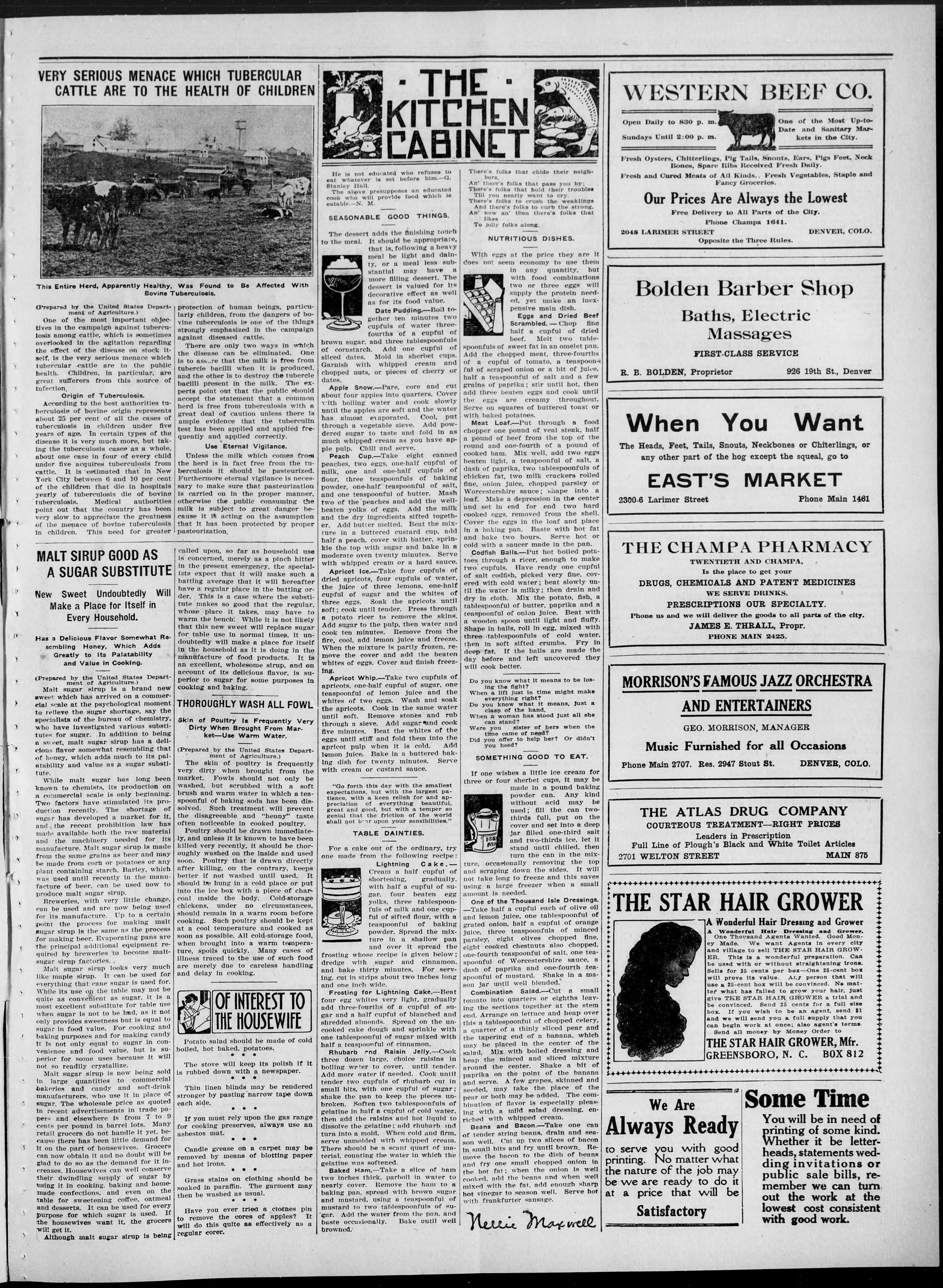
VERY SERIOUS MENACE WHICH TUBERCULAR CATTLE ARE TO THE HEALTH OF CHILDREN
This Entire Herd, Apparently Healthy, Was Found to Be Affected With Bovine Tuberculosis.
(Prepared by the United States Department of Agriculture.) protection of human beings, particu-
One of the most important objectives in the campaign against tuberculosis among cattle, which is sometimes overlooked in the agitation regarding the effect of the disease on stock itself, is the very serious menace which tubercular cattle are to the public health. Children, in particular, are great sufferers from this source of infection.
Origin of Tuberculosis.
According to the best authorities tuberculosis of bovine origin represents about 25 per cent of all the cases of tuberculosis in children under five years of age. In certain types of the disease it is very much more, but taking the tuberculosis cases as a whole, about one case in four of every child under five acquires tuberculosis from cattle. It is estimated that in New York City between 6 and 10 per cent of the children that die in hospitals yearly of tuberculosis die of bovine tuberculosis. Medical authorities point out that the country has been very slow to appreciate the greatness of the menace of bovine tuberculosis in children. This need for greater
MALT SIRUP GOOD AS A SUGAR SUBSTITUTE
New Sweet Undoubtedly Will Make a Place for Itself in Every Household.
Has a Delicious Flavor Somewhat Resembling Honey, Which Adds Greatly to Its Palatability and Value in Cooking.
(Prepared by the United States Department of Agriculture.)
Malt sugar sirup is a brand new sweet which has arrived on a commercial scale at the psychological moment to relieve the sugar shortage, say the specialists of the bureau of chemistry, who have investigated various substitutes for sugar. In addition to being a sweet, malt sugar sirup has a delicious flavor somewhat resembling that of honey, which adds much to its palatability and value as a sugar substitute.
While malt sugar has long been known to chemists, its production on a commercial scale is only beginning. Two factors have stimulated its production recently. The shortage of sugar has developed a market for it, and the recent prohibition law has made available both the raw material and the machinery needed for its manufacture. Malt sugar sirup is made from the same grains as beer and may be made from corn or potatoes or any plant containing starch. Barley, which was used until recently in the manufacture of beer, can be used now to produce malt sugar sirup. Breweries, with very little change, can be used and are now being used for its manufacture. Up to a certain point the process for making malt sugar sirup is the same as the process for making beer. Evaporating pans are the principal additional equipment required by breweries to become malt-sugar sirup factories.
Malt sugar sirup looks very much like maple sirup. It can be used for everything that cane sugar is used for. While its use on the table may not be quite as convenient as sugar, it is a most excellent substitute for table use when sugar is not to be had, as it not only provides sweetness but is equal to sugar in food value. For cooking and baking purposes and for making candy it is not only equal to sugar in convenience and food value, but is superior for some uses because it will not so readily crystallize.
Malt sugar sirup is now being sold in large quantities to commercial bakeries and candy and soft-drink manufacturers, who use it in place of sugar. The wholesale price as quoted in recent advertisements in trade papers and elsewhere is from 7 to 9 cents per pound in barrel lots. Many retail grocers do not handle it yet, because there has been little demand for it on the part of housewives. Grocers can now obtain it and no doubt will be glad to do so as the demand for it increases. Housewives can well conserve their dwindling supply of sugar by using it in cooking, baking and homemade confections, and even on the table for sweetening coffee, oatmeal and desserts. It can be used for every purpose for which sugar is used. If the housewives want it, the grocers will get it.
Although malt sugar sirup is being
protection of human beings, particularly children, from the dangers of bovine tuberculosis is one of the things strongly emphasized in the campaign against diseased cattle. There are only two ways in which the disease can be eliminated. One is to assure that the milk is free from tubercle bacilli when it is produced, and the other is to destroy the tubercle bacilli present in the milk. The experts point out that the public should accept the statement that a common herd is free from tuberculosis with a great deal of caution unless there is ample evidence that the tuberculin test has been applied and applied frequently and applied correctly.
Use Eternal Vigilance.
Unless the milk which comes from the herd is in fact free from the tuberculosis it should be pasteurized. Furthermore eternal vigilance is necessary to make sure that pasteurization is carried on in the proper manner, otherwise the public consuming the milk is subject to great danger because it is acting on the assumption that it has been protected by proper pasteurization.
called upon, so far as household use is concerned, merely as a pinch hitter in the present emergency, the specialists expect that it will make such a batting average that it will hereafter have a regular place in the batting order. This is a case where the substitute makes so good that the regular, whose place it takes, may have to warm the bench. While it is not likely that this new sweet will replace sugar for table use in normal times, it undoubtedly will make a place for itself in the household as it is doing in the manufacture of food products. It is an excellent, wholesome sirup, and on account of its delicious flavor, is superior to sugar for some purposes in cooking and baking.
THOROUGHLY WASH ALL FOWL
Skin of Poultry Is Frequently Very Dirty When Brought From Market—Use Warm Water.
(Prepared by the United States Department of Agriculture.)
The skin of poultry is frequently very dirty when brought from the market. Fowls should not only be washed, but scrubbed with a soft brush and warm water in which a teaspoonful of baking soda has been dissolved. Such treatment will prevent the disagreeable and "henny" taste often noticeable in cooked poultry. Poultry should be drawn immediately, and unless it is known to have been killed very recently, it should be thoroughly washed on the inside and used soon. Poultry that is drawn directly after killing, on the contrary, keeps better if not washed until used. It should be hung in a cold place or put into the ice box with a piece of charcoal inside the body. Cold-storage chickens, under no circumstances, should remain in a warm room before cooking. Such poultry should be kept at a cool temperature and cooked as soon as possible. All cold-storage food, when brought into a warm temperature, spoils quickly. Many cases of illness traced to the use of such food are merely due to careless handling and delay in cooking.
OF INTEREST TO THE HOUSEWIFE
Potato salad should be made of cold boiled, hot baked, potatoes.
The stove will keep its polish if it is rubbed down with a newspaper.
Thin linen blinds may be rendered stronger by pasting narrow tape down each side.
If you must rely upon the gas range for cooking preserves, always use an asbestos mat.
Candle grease on a carpet may be removed by means of blotting paper and hot irons.
Grass stains on clothing should be soaked in paraffin. The garment may then be washed as usual.
Have you ever tried a clothes pin to remove the cores of apples? It will do this quite as effectively as a regular corer.
THE KITCHEN CABINET
He is not educated who refuses to eat whatever is set before him.-G. Stanley Hall. The above presupposes an educated cook who will provide food which is eatable.-N. M.
SEASONABLE GOOD THINGS.
The dessert adds the finishing touch to the meal. It should be appropriate, that is, following a heavy meal be light and dainty, or a meal less substantial may have a more filling dessert. The dessert is valued for its decorative effect as well as for its food value.
Date Pudding.—Boil together ten minutes two cupfuls of water three-fourths of a cupful of
brown sugar, and three tablespoonfuls of cornstarch. Add one cupful of sliced dates. Mold in sherbet cups. Garnish with whipped cream and chopped nuts, or pieces of cherry or dates.
Apple Snow.—Pare, core and cut about four apples into quarters. Cover with boiling water and cook slowly until the apples are soft and the water has almost evaporated. Cool, put through a vegetable sieve. Add powdered sugar to taste and fold in as much whipped cream as you have apple pulp. Chill and serve.
Peach Cup.—Take eight canned peaches, two eggs, one-half cupful of milk, one and one-half cupfuls of flour, three teaspoonfuls of baking powder, one-half teaspoonful of salt, and one teaspoonful of butter. Mash two of the peaches and add the well-beaten yolks of eggs. Add the milk and the dry ingredients sifted together. Add butter melted. Beat the mixture in a buttered custard cup, add half a peach, cover with batter, sprinkle the top with sugar and bake in a moderate oven twenty minutes. Serve with whipped cream or a hard sauce.
Apricot Ice.—Take four cupfuls of dried apricots, four cupfuls of water, the juice of three lemons, one-half cupful of sugar and the whites of three eggs. Soak the apricots until soft; cook until tender. Press through a potato ricer to remove the skins. Add sugar to the pulp, then water and cook ten minutes. Remove from the fire, cool, add lemon juice and freeze. When the mixture is partly frozen, remove the cover and add the beaten whites of eggs. Cover and finish freezing.
Apricot Whip.—Take two cupfuls of apricots, one-half cupful of sugar, one teaspoonful of lemon juice and the whites of two eggs. Wash and soak the apricots. Cook in the same water until soft. Remove stones and rub through a sieve. Add sugar and cook five minutes. Beat the whites of the eggs until stiff and fold them into the apricot pulp when it is cold. Add lemon juice. Bake in a buttered baking dish for twenty minutes. Serve with cream or custard sauce.
"Go forth this day with the smallest expectations, but with the largest patience, with a keen relish for and appreciation of everything beautiful, great and good, but with a temper so genial that the friction of the world shall not bear upon your sensibilities."
For a cake out of the ordinary, try one made from the following recipe:
Lightning Cake.—Cream a half cupful of shortening, gradually, with half a cupful of sugar, four beaten egg yolks, three tablespoonfuls of milk and one cupful of sifted flour, with a teaspoonful of baking powder. Spread the mixture in a shallow pan and over it spread the frosting whose recipe is given below; dredge with sugar and cinnamon, and bake thirty minutes. For serving, cut in strips about two inches long and one inch wide.
Frosting for Lightning Cake.—Beat four egg whites very light, gradually add three-fourths of a cupful of sugar and a half cupful of blanched and shredded almonds. Spread on the uncooked cake dough and sprinkle with one tablespoonful of sugar mixed with half a teaspoonful of cinnamon.
Rhubarb and Raisin Jelly.—Cook three dozen large, choice raisins in boiling water to cover, until tender. Add more water if needed. Cook until tender two cupfuls of rhubarb cut in small bits, with one cupful of sugar; shake the pan to keep the pieces unbroken. Soften two tablespoonfuls of gelatine in half a cupful of cold water, then add the raisins and hot liquid to dissolve the gelatine; add rhubarb and turn into a mold. When cold and firm, serve unmolded with whipped cream. There should be a scant quart of material, counting the water in which the gelatine was softened.
Baked Ham.—Take a slice of ham two inches thick, parboll in water to nearly cover. Remove the ham to a baking pan, spread with brown sugar and mustard, using a teaspoonful of mustard to two tablespoonfuls of sugar. Add the water from the pan, and baste occasionally. Bake until well browned.
Coconut Oil
Milkshake
TABLE DAINTIES.
Cake Stand
E HEN NET
There's folks that chide their neighbors.
An' there's folks that pass you by:
There's folks that hold their troubles
Till you nearly want to cry.
There's folks to crush the weaklings
And there's folks to curb the strong.
An' now an' then there's folks that
likes
To jolly folks along.
NUTRITIOUS DISHES.
With eggs at the price they are it does not seem economy to use them in any quantity, but with food combinations two or three eggs will supply the protein needed, yet make an inexpensive main dish.
#
Eggs and Dried Beef Scrambled.—Chop fine half a cupful of dried beef. Melt two tablespoonfuls of sweet fat in an omelet pan. Add the chopped meat, three-fourths of a cupful of tomato, a teaspoonful of scraped onion or a bit of juice, half a teaspoonful of salt and a few grains of paprika; stir until hot, then add three beaten eggs and cook until the eggs are creamy throughout. Serve on squares of buttered toast or with baked potatoes.
Meat Loaf.—Put through a food chopper one pound of veal steak, half a pound of beef from the top of the round and one-fourth of a pound of cooked ham. Mix well, add two eggs beaten light, a teaspoonful of salt, a dash of paprika, two tablespoonfuls of chicken fat, two milk crackers rolled fine, onion juice, chopped parsley or Worcestershire sauce; shape into a loaf. Make a depression in the center and set in end for end two hard cooked eggs, removed from the shell. Cover the eggs in the loaf and place in a baking pan. Baste with hot fat and bake two hours. Serve hot or cold with a saucer made in the pan.
Codfish Balls.—Put hot boiled potrotes through a ricer, enough to make two cupfuls. Have ready one cupful of salt codfish, picked very fine, covered with cold water; beat slowly until the water is milky; then drain and dry in cloth. Mix the potato, fish, a tablespoonful of butter, paprika and a teaspoonful of onion Juice. Beat with a wooden spoon until light and fluffy. Shape in balls, roll in egg, mixed with three tablespoonfuls of cold water, then in soft sifted crumbs. Fry in deep fat. If the balls are made the day before and left uncovered they will cook better.
Do you know what it means to be losing the fight?
When a woman has stood just all she can stand?
Were you sister of hers when the time came of need?
Did you offer to help her? Or didn't you heed?
SOMETHING GOOD TO EAT.
If one wishes a little ice cream for three or four sherbet cups, it may be made in a pound baking powder can. Any kind without acid may be used; fill the can two-thirds full, put on the cover and set into a deep jar filled one-third salt and two-thirds ice, let it stand until chilled, then turn the can in the mix-
powder can. Any kind without acid may be used; fill the can two-thirds full, put on the cover and set into a deep jar filled one-third salt and two-thirds ice, let it stand until chilled, then turn the can in the mixture, occasionally removing the top and scraping down the sides. It will not take long to freeze and this saves using a large freezer when a small amount is needed.
One of the Thousand Isle Dressings.
—Take half a cupful each of oil oil and lemon juice, one tablespoonful of grated onion, half a cupful of orange juice, three teaspoonfuls of minced parsley, eight olives chopped fine, eight cooked chestnuts also chopped, one-fourth teaspoonful of salt, one teaspoonful of Worcestershire sauce, a dash of paprika and one-fourth teaspoonful of mustard. Shake in a mason jar until well blended.
Combination Salad.—Cut a small tomato into quarters or eighths leaving the sections together at the stem end. Arrange on lettuce and heap over this a tablespoonful of chopped celery, a quarter of a thinly sliced pear and the tapering end of a banana, which may be placed in the center of the salad. Mix with boiled dressing and heap the minced and sliced mixture around the center. Shake a bit of paprika on the point of the banana and serve. A few grapes, skinned and seeded, may take the place of the pear or both may be added. The combination of flavor is especially pleasing with a mild salad dressing, enriched with whipped cream.
Beans and Bacon.—Take one can of tender string beans, drain and season well. Cut up two slices of bacon in small bits and fry until brown. Remove the bacon to the dish of beans and fry one small chopped onion in the hot fat; when the onion is well cooked, add the beans and when well mixed with the fat, add enough sharp hot vinegar to season well. Serve hot with frankfurter sausage.
WESTERN BEEF CO.
Chitterlings, Pig Tails, Snouts, Ears, Pigs Feet, Neck
Noses, Spare Ribs Received Fresh Daily.
Meats of All Kinds.. Fresh Vegetables, Staple and
Fancy Groceries.
Prices Are Always the Lowest
Free Delivery to All Parts of the City.
Phone Champa 1641.
STREET DENVER, COLO.
Opposite the Three Rules.
Len Barber Shop
Baths, Electric
Massages
FIRST-CLASS SERVICE
Fresh Oysters, Chitterlings, Pigs
Bones, Spare Ribs
Fresh and Cured Meats of All K
Fancy
Our Prices Are A
Free Delivery to A
Phone C
2048 LARIMER STREET
Opposite th
Bolden Bath
Baths,
Mast
FIRST-CLA
Fresh and Cured Meats of All Kinds.. Fresh Vegetables, Staple and Fancy Groceries.
R. B. BOLDEN, Proprietor
en You Want
et, Tails, Snouts, Neckbones or Chiterlings, or
part of the hog except the squeal, go to
ST'S MARKET
When Y
The Heads, Feet, Tails, Snout
any other part of the ho
EAST'S
When You Want
The Heads, Feet, Tails, Snouts, Neckbones or Chiterlings, or any other part of the hog except the squeal, go to
THE CHAMPION
TWENTIETH
Is the place
DRUGS, CHEMICALS A
WE SERVE
PRESCRIPTIONS
Phone us and we will deliver
JAMES E. T.
PHONE
MORRISON'S FAMOUS
AND ENT
HAMPA PHARMACY
TWENTIETH AND CHAMPA,
Is the place to get your
CHEMICALS AND PATENT MEDICINES
WE SERVE DRINKS.
DESCRIPTIONS OUR SPECIALTY.
we will deliver the goods to all parts of the city.
JAMES E. THRALL, Propr.
PHONE MAIN 2425.
N'S FAMOUS JAZZ ORCHESTRA
AND ENTERTAINERS
THE CHAMPA PHARMACY
TWENTIETH AND CHAMPA,
Is the place to get your
DRUGS, CHEMICALS AND PATENT MEDICINES
WE SERVE DRINKS.
PRESCRIPTIONS OUR SPECIALTY.
Phone us and we will deliver the goods to all parts of the city.
JAMES E. THRALL, Propr.
PHONE MAIN 2425.
GEO, MORRISON, MANAGER
Music Furnished
Phone Main 2707. Res. 2947
THE ATLAS D
COURTEOUS TREAT
Leaders in
Full Line of Plough's Black
2701 WELTON STREET
THE STAR HA
Furnished for all Occasions
07. Res. 2947 Stout St. DENVER, COLO.
ATLAS DRUG COMPANY
GEOUS TREATMENT—RIGHT PRICES
Leaders in Prescription
Plough's Black and White Toilet Articles
STREET MAIN 875
STAR HAIR GROWER
Music Furnished for all Occasions
Phone Main 2707. Res. 2947 Stout St. DENVER, COLO.
THE ATLAS DRUG COMPANY COURTEOUS TREATMENT—RIGHT PRICES Leaders in Prescription Full Line of Plough's Black and White Toilet Articles 2701 WELTON STREET MAIN 875
THE STAR HAIR GROWER
A Wonderful Hair Dressing and Grower
A Wonderful Hair Dressing and Grower.
One Thousand Agents Wanted. Good Money Made. We want Agents in every city and village to sell THE STAR HAIR GROWER. This is a wonderful preparation. Can be used with or without straightening irons. Sells for 25 cents per box—One 25-cent box will prove its value. All person that will use a 25-cent box will be convinced. No matter what has failed to grow your hair, just give THE STAR HAIR GROWER a trial and be convinced. Send 25 cents for a full size box. If you wish to be an agent, send $1 and we will send you a full supply that you can begin work at once; also agent's terms.
Send all money by Order to
THE STAR HAIR GROWER, Mfr.
GREENSBORO, N. C. BOX 812
We Are Always Ready
to serve you with good printing. No matter what the nature of the job may be we are ready to do it at a price that will be
---
---
Open Daily to 830 p. m.
Sundays Until 2:00 p. m.
2300-6 Larimer Street
A
Satisfactory
```markdown
```
One of the Most Up-to Date and Sanitary Markets in the City.
926 19th St., Denver
Phone Main 1461
Some Time
Some Time
You will be in need of printing of some kind. Whether it be letterheads, statements wedding invitations or public sale bills, remember we can turn out the work at the lowest cost consistent with good work.
THE COLORADO STATESMAN
CAPON TALKS IN FALL
THIS COUNTRY PARTY
1824 Curtis Street. Room 25.
One Year ..... $2.00
Six Months ..... 1.50
Three Months ..... .75
Entered as second-class matter at the postoffice in the City of Denver, Colo.
Reading notices, ten lines or less, 15 cents per line. Each additional line over ten lines, 10 cents per line. Display advertising 75 cents per inch for first insertion and 50 cents per inch for each additional insertion.
Remittances should be made by Express Money Order, Postoffice Money Order, Registered Letter or Bank Draft. Postage stamps will be received the same as cash for the fractional part of a dollar. Only 1c and 2c stamps taken.
No discounts allowed on less than three months' contract. Cash must accompany all orders from parties unknown to us. Further particulars on application.
Communications to receive attention must be newsy, upon important subjects, plainly written only upon one side of the paper, must reach us Tuesdays, if possible, anyway not later than Wednesdays, and bear the signature of the author. No manuscript returned, unless stamps are sent for postage. All communications of a personating nature that are not complimentary will be withheld from the columns of this paper.
WELCOME 1920—WHAT WILL IT MEAN TO THE NEGRO?
DENVER makes her bow to the arrival of 1920, and we welcome another year of the Twentieth Century. But we are compelled to address ourselves to the members of our race, as with the tremendous difficulties that surround us we at times question the integrity of our national leaders when they remain passively, or for the most part, unconcerned about the welfare of our side of the American nation. We agree with the words of Governor Oliver H. Shoup of our state in his New Year message, "The Welding of the Nation," when, among other things, he says: "The best material with which to weld the nation into a grand unit with a single superlative purpose in view, is the spirit of optimism, the cheerful constructive spirit that sees in our native land the one supreme opportunity for the accomplishment of the greatest good to the greatest number and some good to all; the spirit that jubilantly declares, 'It is a joy to live in the U. S. A., it is a privilege to live in Colorado, it is a blessing to live in Denver or Colorado Springs or Pueblo, or any of the splendid municipalities in the state, etc.'" But while we admit this expression of our governor, yet our cause—the Negro's cause—extends beyond the confines of Colorado, as we seem to fill a classified role, in which as a whole we hardly get "the crumbs that fall from the master's table," and in asking what will 1920 mean to the Negro, we feel our answer is correct when we with emphasis assert that a unity of action will take place as never before in our history. Not to be content with the blessings of Colorado for the mere handful of us that are here, but to so weld ourselves into the Negro Race, its progress, its development, the handicaps and almost insurmountable barriers that con-
front us, so that the Colorado as well as the Texas Negro, the New York Negro as well as the Californian, and the great throng of Negroes will, as other races, become deeply interested in one another for the greatest good individually as well as collectively. May the year 1920 bring to us this great good for which we have long sought and toiled.
CREED
WE BELIEVE in God as the Creator and Father of all mankind. We believe in the Brotherhood of mankind. We believe in the teachings of the Good Christ that all things shall finally work out for our good. We believe that our form of government is the best form of government thus far devised by man.
We believe in the union of the states.
We believe that now it is time to have union of nations in order to establish permanent peace and good will in the world.
We believe that a newspaper is a public institution and should not be used as a personal organ by the owner.
We believe in law and order; and that no legislation should be enacted for any class of citizenship.
We believe that in our country and under our constitution there is given the opportunity to develop the highest type of manhood.
We believe that it should be the aim of press, pulpit and political leadership to make the citizens of our country live up to this great opportunity in civic work and moral worth.—Rocky Mountain News.
And may we add that the BROTHERHOOD OF MANKIND as above referred to may embrace in a practical sense this time all races from the "blackest" appearing man in this country to the whitest, and all the intervening shades, as before the most critical period in this nation's history, NOW, it has purely been a theory, and people who happened to be of another hue than white, are not only deprived of their constitutional rights, but murdered, brutalized and shamed beyond comparison. The editor's creed is beautifully composed, and in our optimistic way we are inclined to think that 1920 begins an era of a better understanding and closer relationship in the various points of the above creed which will be adhered to by ALE AMERICANS at HEART. Let us all commit it to memory and the great benefits to be achieved will be greater than we can imagine.
sentiments of all Denver when we say—"well done! good and faithful women." The mortgage document was held by Mrs. Isabel Stewart, president of the association, who applied the fire that consumed it, and wiped out forever the debt which was a sound and safe investment. Again, we congratulate our noble women.
We doff our hats to the Negro Women's Clubs of Denver, Colorado who with their dogged determination and persistent efforts have paid the last dollar on the house and lots purchased not so long ago, for the benefit of helping the members of our race. This home has been felt in its usefulness as a Day Nursery, as well as affording accommodation to strangers arriving in our city, etc, and now that the women have launched such a worthy project and carried out so successfully the acquisition of unencumbered and undisturbed possession of their home at Twenty-Fouth avenue and Clarkson street. We know we are voicing the
Our men and women should further interest themselves in this worthy cause and continue to give substantial help to the support and upkeep of this home. Right here can be found missionary work for our churches.
SCOTT'S OFFICIAL HISTORY OF THE AMERICAN NEGRO IN THE WORLD WAR. THE COLORADO STATESMAN, EXCLUSIVE AGENTS, Room 25, 1824 Curtis St., Denver, Colo. P. O. Box 116.
U. S. War Department Would Promote the Reorganization of National Guard
U. S. War Department Would Promote the Reorganization of National Guard
By NEWTON D. BAKER, Secretary of War
In the present disturbed condition of the country there will doubtless arise, as there has in the past, the necessity for the use of organized force in the protection and the maintenance of law and order.
PETER H.
Our Constitution contemplates the use of federal forces for local or state purposes only when all other forces of the locality or state have been exhausted or have been found insufficient to meet the emergency, or when it is evident that such measures will prove inadequate. Then, and then only, should federal forces be called upon to handle the situation. In view of the above, and in order that an organized force may be provided which is suitable and available for the purposes herein touched upon, the attention of all governors and state authorities is invited to the fact that the national defense act of June 3, 1916, is still in force. The war department is in a position to furnish assistance to the National Guard formed under this law, and it is a matter of deep concern to the war department that so little progress has been made in the organization of the National Guard, which is so essential in the handling of internal problems by the state authorities.
There appears to be a spirit of antagonism toward the organization of this local force, which it is impossible to reconcile with the patriotic duty and loyalty of the citizens and officers of our state government. It is requested that the authorities make a special effort to immediately organize throughout the United States the force known as the National Guard, under the act of June 3, 1916, and that every effort be made to overcome the spirit of antagonism to the National Guard which may be manifested within their states.
Spiritually and Ethically the Modern Home Has Largely Disintegrated
Spiritually and Ethically the Modern Home Has Largely Disintegrated
By A. E. WEBSTER, Juvenile Protective Association
The experience of the year 1919 of the Juvenile Protective association has demonstrated anew that, from a spiritual and ethical point of view, the modern home has largely disintegrated. This is due to the industrial revolution, which has taken the industrial processes out of the home into the factories, and which has called not only the fathers but in many instances the mothers and the children themselves out of the home into a manufacturing plant.
It is due also to the decline of the external authority which has been witnessed in the church, in politics and in the home itself, so that no longer is there that rigid discipline and authority which used to be noticed in the American family.
It is due also to the Americanization of the child of foreign-born parents, which has created a chasm between the child, with his American training, and his parents, with their European traditions, ideals and background, and which, in many cases, results in the development of contempt on the part of the child toward his parents.
It is due, too, to poverty and bad housing. It may be due to the economic emancipation of women.
Broad General Principle of Equality of Opportunity and a Fair Start
Broad General Principle of Equality of Opportunity and a Fair Start
All the world today is thinking of one and the same thing, the new social unrest. As the echoes of the war die away, the sound of a new conflict rises on the ear. The industrial world is filled with agitation. What does it all mean? Is the light in the sky the dawn of a brighter day, or is it the lurid glare that precedes the eruption of the volcano.
The main aim of the writer is to estimate what is and what is not possible in social reform. The Utopia of the socialist he dismisses as a beautiful dream, impossible of realization in the world in which we live. But he repudiates as equally impossible for the future the worn-out doctrine of every man for himself. The syndicalist and the bolshevik the writer designates as the man with the bomb, threatening the disruption of society.
The point of view taken leads toward the conclusion that the safety of the future lies in a progressive movement of social control, alleviating at least the misery it cannot obliterate, and based upon the broad general principle of equality of opportunity and a fair start. The chief immediate opportunities for social betterment, as the writer sees them, lie in the attempt to give every human being in childhood adequate food, clothing, education, and opportunity. This will prove the beginning of many things.
"Have the British People Gone Mad Over Tobacco and Over Smoking?"
The nation that smokes perishes. In the year 1917 the British people smoked 152,215,700 pounds of tobacco, costing the smokers approximately $497,690,000. Pipes and other appliances came to $22,684,000, making a total for the year of more than $520,000,000.
The following year the amount increased to 164,838,800 pounds smoked, valued at $668,765,500, with pipes and appliances costing $23,-309,500.
Has the nation gone mad over tobacco and over smoking? If the women of the nation become habitual smokers—as they are rapidly doing—what effect will it have on the future generation? The query is answered by the late Sir W. B. Richardson as follows:
"If a community of youths of both sexes, whose progenitors were finely formed and powerful, were to be trained to the early practice of smoking and if marriage were to be confined to the smokers, an apparently new and physically inferior race of men and women would be bred."
I call on the medical profession to face this formidable danger to the nation and warn women especially as to the injurious effects of tobacco smoking.
O. A. D. & C.
Society Brand Clothes
New Clothes for the New Year
SUITS styled for men who want distinctiveness with refinement. The newest Society Brand models. Rich materials, imported and domestic. Suits well-proportioned and made without bulky padding. Tailored by hand to keep their shapeliness. Wonderful values at $40.00 to $75.00 Other Makes at $23.00 and Up
THE MAY CO.
Hide Italian Crown Jewels.
The Italian crown jewels are guarded in a subterranean chamber on a little island in the Tiber.
Longest Dance. William Kemp, aged seventeen, in the reign of Elizabeth danced from London to Norwich in nine days, the longest dance on record.
Mrs. C. Barnes proprietress of the Barnes hotel who has been quite sick with pneumonia, is able to sit up.
Fred Neely of Kansas City is in the city visiting with his brother-in-law J. R. Woolridge of Twenty-seventh and California streets.
Miller and Work, investment bers, have removed to 934 17th st Ernest and Cranmer building, wh they will continue to render the services to their patrons. The p tige established by this business is largely due to their manner of d ing with the public and the best raining that can be gotten in the sh
Mr. George Brown of Vicksburg, Miss., who is the house guest of Mr. and Mrs. Misher, is spending about ten days in the city during which he will visit the Dearfield colony with an idea towards investment.
Victor Walker, deputy sheriff, returned to Denver this week with his prisoner from Seattle, Wash. Mr. Walker is loud in praise of the northwestern country and during the short-stay was very much impressed with the success attending our people's efforts.
Ed Washington, former resident of Denver but now of Portland, Oregon, passed through the city enroute to Chicago. Mr. Washington looks in the best of health and says "hello!" to his former friends and acquaintances.
The Smart Set Dancing School will give their grand opening and reception at Fern hall Jan. 5, 1920. Teaching dancing hours, 8:30 to 9:45. Dancing every Monday night under management of yours truly, Billy Knight.
Miss Gladys Ruth Pryor, the daughter of Mr. and Mrs. S. R. Pryor of Aspen, Colo., who is attending school at the Teacher's College at Greeley, Colo., is spending her Christmas vacation with the charming daughters of Mr. and Mrs. John Levell.
Chef, Isaiah Arthur of Washington, D. C. is visiting with friends in the city. Mr. Arthur has been in the railroad service for 20 years, four of which he has been with the government business car. He expresses himself as being delighted with the West, and feeling still the vigor of his youth may cast his lot in with us westerners sooner or later.
Mrs. O. W. Glenn of 2531 Welton street, returned home last week after being at the bedside of her father, James Waters in Pittsburgh, Pa., who died a few days ago. Mr. Waters attained the age of 90 years and was one of the oldest war veterans of that part of the country. To his sorrowing daughter and other relatives the Colorado Statesman extends its deepest sympathy.
Mr. and Mrs. N. J. Skillern of 1904 East Twenty-ninth avenue, were host to a few friends Christmas evening at one of their pretty evening parties for which they are noted. Christmas decorations added to the already beautiful appearance of the home and the guests enjoyed themselves in the best manner possible. The usual compliment of being among our leading and popular social members was accorded Mr. and Mrs. Skillern.
THOMAS BEAN OWNER OF TOUR
ING CARS IN UNFORTUNATE
ACCIDENT LAST SUNDAY.
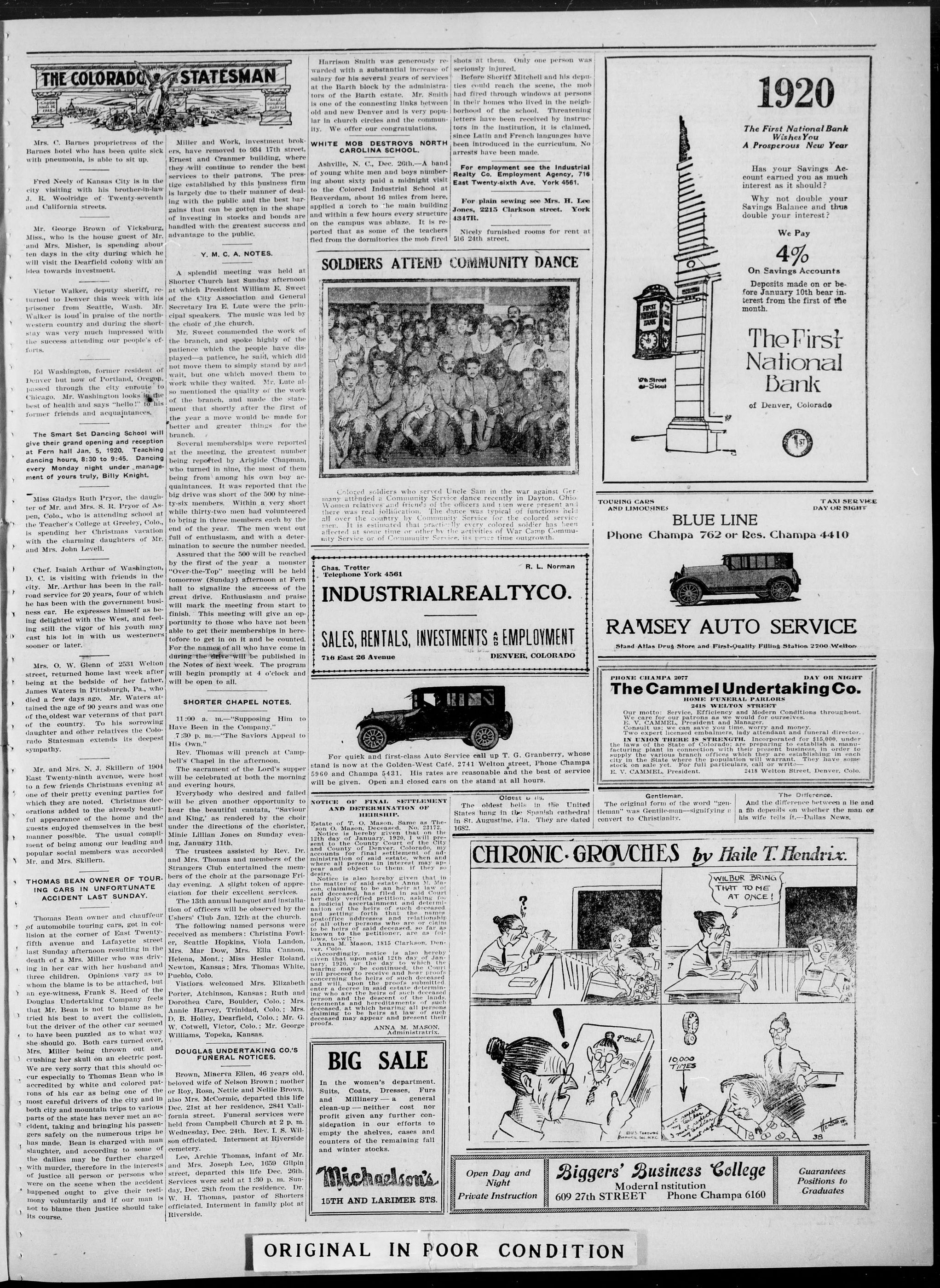
Thomas Bean owner and chauffeur of automobile touring cars, got in collision at the corner of East Twenty-fifth avenue and Lafayette street last Sunday afternoon resulting in the death of a Mrs. Miller who was driving in her car with her husband and three children. Opinions vary as to whom the blame is to be attached, but an eye-witness, Frank S. Reed of the Douglas Undertaking Company feels that Mr. Bean is not to blame as he tried his best to avert the collision, but the driver of the other car seemed to have been puzzled as to what way she should go. Both cars turned over, Mrs. Miller being thrown out and crushing her skull on an electric post. We are very sorry that this should occur especially to Thomas Bean who is accredited by white and colored patrons of his car as being one of the most careful drivers of the city and in both city and mountain trips to various parts of the state has never met an accident, taking and bringing his passengers safely on the numerous trips he has made. Bean is charged with man slaughter, and according to some of the dailies may be further charged with murder, therefore in the interests of justice all person or persons who were on the scene when the accident happened ought to give their testimony voluntarily and if our man is not to blame then justice should take its course.
ORIGINAL IN POOR CONDITION
Miller and Work, investment brokers, have removed to 934 17th street, Ernest and Cranmer building, where they will continue to render the best services to their patrons. The prestige established by this business firm is largely due to their manner of dealing with the public and the best bargains that can be gotten in the shape of investing in stocks and bonds are handled with the greatest success and advantage to the public.
Y. M. C. A. NOTES.
A splendid meeting was held at Shorter Church last Sunday afternoon at which President William E. Sweet of the City Association and General Secretary Ira E. Lute were the principal speakers. The music was led by the choir of the church.
Mr. Sweet commended the work of the branch, and spoke highly of the patience which the people have displayed—a patience, he said, which did not move them to simply stand by and wait, but one which moved them to work while they waited. Mr. Lute also mentioned the quality of the work of the branch, and made the statement that shortly after the first of the year a move would be made for better and greater things for the branch.
Several memberships were reported at the meeting, the greatest number being reported by Aristide Chapman, who turned in nine, the most of them being from among his own boy acquaintances. It was reported that the big drive was short of the 500 by ninety-six members. Within a very short while thirty-two men had volunteered to bring in three members each by the end of the year. The men went out full of enthusiasm, and with a determination to secure the number needed.
Assured that the 500 will be reached by the first of the year a monster "Over-the-Top" meeting will be held tomorrow (Sunday) afternoon at Fern hall to signalize the success of the great drive. Enthusiasm and praise will mark the meeting from start to finish. This meeting will give an opportunity to those who have not been able to get their memberships in heretofore to get in on it and be counted. For the names of all who have come in during the drive will be published in the Notes of next week. The program will begin promptly at 4 o'clock and will be open to all.
SHORTER CHAPEL NOTES.
11:00 a. m.—"Supposing Him to Have Been in the Company."
7:30 p. m.—"The Saviors Appeal to His Own."
Rev. Thomas will preach at Campbell's Chapel in the afternoon.
The sacrament of the Lord's supper will be celebrated at both the morning and evering hours.
Everybody who desired and failed will be given another opportunity to hear the beautiful cantata, "Saviour and King,' as rendered by the choir under the directions of the chorister, Minie Lillian Jones on Sunday evening, January 11th.
The trustees assisted by Rev. Dr. and Mrs. Thomas and members of the Strangers Club entertained the members of the choir at the parsonage Friday evening. A slight token of appreciation for their excellent services.
The 13th annual banquet and installation of officers will be observed by the Usher's Club Jan. 12th at the church.
Usners Club Jan. 12th at the Church.
The following named persons were
received as members: Christina Fowler,
Seattle Hopkins, Viola Landon,
Mrs. Mar Dow, Mrs. Ella Cannon,
Helena, Mont.; Miss Hesler Roland,
Newton, Kansas; Mrs. Thomas White,
Pueblo, Colo.
Vistiors welcomed Mrs. Elizabeth
Porter, Atchinson, Kansas; Ruth and
Dorothea Care, Boulder, Colo.; Mrs.
Annie Harvey, Trinidad, Colo.; Mrs.
D. B. Holley, Dearfield, Colo.; Mr. G.
W. Cotwell, Victor, Colo.; Mr. George
Williams, Topeka, Kansas.
DOUGLAS UNDERTAKING CO.'S
EUNERAL NOTICES.
Brown, Minerva Ellen, 46 years old, beloved wife of Nelson Brown; mother or Roy, Rosa, Nettie and Nellie Brown, also Mrs. McCormic, departed this life Dec. 21st at her residence, 2841 California street. Funeral services were held from Campbell Church at 2 p. m. Wednesday, Dec. 24th. Rev. I. S. Wilson officiated. Interment at Riverside cemetery. Lee, Archie Thomas, infant of Mr. and Mrs. Joseph Lee, 1659 Gilpin street, departed this life Dec. 26th. Services were sold at 1:30 p. m. Sunday, Dec. 28th from the residence. Dr. W. H. Thomas, pastor of Shorters officiated. Interment in family plot at Riverside.
shots at them. Only one person was seriously injured.
Before Sheriff Mitchell and his deputies could reach the scene, the mob had fired through windows at persons in their homes who lived in the neighborhood of the school. Threatening letters have been received by instructors in the institution, it is claimed, since Latin and French languages have been introduced in the curriculum. No arrests have been made.
For employment see the Industrial Realty Co. Employment Agency, 716 East Twenty-sixth Ave. York 4561.
For plain sewing see Mrs. H. Lee Jones, 2215 Clarkson street. York 4347R.
Nicely furnished rooms for rent at 516 24th street.
COMMUNITY DANCE
Uncle Sam in the war against Ger-
ance dance recently in Dayton, Ohio
officers and men were present and
ance was typical of functions field
ity Service for the colored service
ly every colored soldier has been
the activities of War Camp Commu-
ce, its peace time outgrowth.
SOLDIERS ATTEND COMMUNITY
Colored soldiers who served Uncle Sam in the many attended a Community Service dance recently. Women relatives and friends of the officers and men there was real jollification. The dance was typical all over the country by Community Service for the men. It is estimated that practically every colored affected at some time or other by the activities of Wunty Service or of Community Service, its prime time.
SOLDIERS ATTEND COMMUNITY DANCE
THE SCHOOL FOR THE DEAF
Colored soldiers who served Uncle Sam in the war against Germany attended a Community Service dance recently in Dayton. Ohio Women relatives and friends of the officers and men were present and there was real jollification. The dance was typical of functions held all over the country by Community Service for the colored service men. It is estimated that practically every colored soldier has been affected at some time or other by the activities of War Camp Community Service or of Community Service, its peace time outgrowth.
REALTYCO. MENTS A EMPLOYMENT
INDUSTRIALREALTY SALES, RENTALS, INVESTMENTS
For quick and first-class Auto Service call up T. G. Granberry, whose stand is now at the Golden-West Café, 2741 Welton street, Phone Champa 5960 and Champa 5431. His rates are reasonable and the best of service will be given. Open and closed cars on the stand at all hours.
For quick and first-class Auto Service call up T. stand is now at the Golden-West Café, 2741 Welton st 5960 and Champa 5431. His rates are reasonable and will be given. Open and closed cars on the stand at a
service call up T. G. Granberry, whose
n. 2741 Welton street, Phone Champa
are reasonable and the best of service
on the stand at all hours.
Oldest bells.
The oldest bells in the United
States hang in the Spanish cathedral
in St. Augustine, Fla. They are dated
1682.
CHRONIC·GI
CHRONIC·GROVCHES by Haile T. Hendrix.
WILBUR BRING
THAT TO ME
AT ONCE!
gouch
10,000
TIMES
38
Open Day and Night
Private Instruction
609 27th
OR CONDITION
GINAL IN POOR CO
Harrison Smith was generously rewarded with a substantial increase of salary for his several years of services at the Barth block by the administrators of the Barth estate. Mr. Smith is one of the connecting links between old and new Denver and is very popular in church circles and the community. We offer our congratulations.
WHITE MOB DESTROYS NORTH
CAROLINA SCHOOL.
Ashville, N. C., Dec. 26th.—A band of young white men and boys numbering about sixty paid a midnight visit to the Colored Industrial School at Beaverdam, about 16 miles from here, applied a torch to the main building and within a few hours every structure on the campus was ablaze. It is reported that as some of the teachers fled from the dormitories the mob fired
Chas. Trotter Telephone York 4561
716 East 26 Avenue
NOTICE OF FINAL SETTLEMENT AND DETERMINATION OF HEIRSHIP.
Estate of T. O. Mason, Same as Theson O. Mason, Deceased. No. 23172. Theson O. Mason, deceased, on the 12th day of January 1920, I will present to the County Court of the City and County of Denver, Colorado, my administration of said estate, when and where all persons in interest may appear and object to them, if they so desire. Notice is also hereby given that the matter of said estate Anna M. Manson claiming to be a heir is addressed to the court and that I said Court her duly verified petition, asking for a judicial ascertainment and determination of the heirs of the estate, that the names postoffice addresses and relationship of all other persons who are or claim to be heirs of said deceased, so far as follows, to-wit:
Anna M. Mason, 1815 Clarkson, Denver, Colo.
Accordingly, notice is also hereby given that upon said 12th day of January, 1920, or the day to which the heirs will proceed to receive and hear proofs concerning the heirs of such deceased and will, upon the proofs submitted, enter a decree of trust which determines person and the heirs of the deceased person and the descent of the lands, tenements and hereditaments of such deceased, at which hearing all persons deemed may appear and present their proofs.
ANNA M. MASON. Administratrix.
BIG SALE
In the women's department. Suits, Coats, Dresses, Furs and Millinery — a general clean-up — neither cost nor profit given any further consideration in our efforts to empty the shelves, cases and counters of the remaining fall and winter stocks.
Michaelson's
15TH AND LARIMER STS.
Biggers' Business College ModernInstitution 609 27th STREET Phone Champa 6160
R. L. Norman
DENVER, COLORADO
Oldest Bills.
4%
The F
National
Ban
of Denver, C
BLUE LINE
ampa 762 or Res. Cham
BLUE L
Phone Champa 762
Phone Champa 762 or Res. Champa 4410
RAMSEY AU
Stand Atlas Drug Store and First
PHONE CHAMPA 2077
The Cammel U
HOME FUNE
2418 WELF
Our motto: Service, Efficiency
We care for our patrons as we
E. V. CAMMEL, President and
Consult us; we can save you!
Two expert licensed embalmers
IN UNION THERE IS STRONG
the laws of the State of Colorado
facturing plant in connection with
supply the various branch offices
city in the State where the popu-
stock on sale yet. For full partic
E. V. CAMMEL, President.
Gentleman
KEY AUTO SERVICE
Big Store and First-Quality Filling Station
A 2077
Hammel Undertake
HOME FUNERAL PARLORS
2418 WELTON STREET
Service, Efficiency and Modern Condition
our patrons as we would for ourselves.
EL, President and Manager.
we can save you time, worry and more
concerned embalmments, lady attendant and
HERE IS STRENGTH. Incorporated for
State of Colorado; are preparing to street
connection with their present business
branch offices which they are esta-
where the population will warrant.
t. For full particulars, call or write—
President. 2418 Welton Street
RAMSEY AUTO SERVICE
Stand Atlas Drug Store and First-Quality Filling Station 2700 Welton
Our motto: Service, Efficiency and Modern Conditions throughout. We care for our patrons as we would for ourselves. E. V. CAMMEL, President and Manager. Save you time. Save you money. Two expert licensed embalmers, lady attendant and funeral director. IN UNION THERE IS STRENGTH. Incorporated for $15,000, under the laws of the State of Colorado; are preparing to establish a manufacturing plant in connection with their present business, in order to supply the various branch offices, which they are establishing in each state. They have some stock on sale yet. For full particulars, call or write—E. V. CAMMEL, President. 2418 Wetland Street, Denver, Colo.
The original form of the word "gentleman" was Gentle-man—signifying a convert to Christianity.
S by Haile T. He
WILBUR BRING
THAT TO ME
AT ONCE!
TOURING CARS AND LIMOUSINES
Gentleman.
The First National Bank Wishes You A Prosperous New Year
Has your Savings Account earned you as much interest as it should?
Why not double your Savings Balance and thus double your interest?
We Pay
4%
On Savings Accounts
Deposits made on or before January 10th bear interest from the first of the month.
The First
National
Bank
of Denver, Colorado
NE Res. Champa 4410
TO SERVICE
Quality Filling Station 2700 Welton
DAY OR NIGHT
Undertaking Co.
GENERAL PARLORS
ON STREET
In modern Conditions throughout.
would for ourselves.
manager.
one, worry and money.
ready attendant and funeral director.
PH. Incorporated for $15,000, under
preparing to establish a manu-
her their present business, in order to
which they are establishing in each
son will warrant. They have some
ars, call or write—
2418 Welton Street, Denver, Colo.
And the difference between a lie and a fib depends on whether the man or his wife tells it--Dallas News.
ile T. Hendrix.
UR BRING
TO ME
ONCE!
Hendrix
38
100
1ST
INDONESIA
TAXI SERVICE
DAY OR NIGHT
The Difference.
Guarantees Positions to Graduates
WAR AND PEACE
Jan. 2-President Wilson arrived in Italy.
Hoover made head of international relief organization.
Jan. 6 - Civil war between government forces and the Spartacans broke out in Berlin; the latter captured the Spandau arsenal.
Jan. 9-Independent socialists set up new government in Berlin.
Jan. 10—Republic proclaimed in Luxemburg, but suppressed at once by the French.
Jan. 11—Socialist republic proclaimed in Bremen.
Count Karolyi made president of Hungarian republic.
Jan. 12—Supreme council of peace congress held its first meeting in Paris.
Spartacans defeated in Berlin.
Spartacans gained control of Constance, Baden.
Jan. 13—Many Spartacans executed in Berlin.
Jan. 14—Grand Duchess Marie of Luxemburg abdicated and was succeeded by her sister Charlotte.
Jan. 16—Karl Liebknecht and Rosa Luxemburg killed in Berlin.
Jan. 17—Counter-revolution broke out in Ferguson and Baskervski began retreat eastward from Esthonia.
Armistice granted Germany extended one month.
Jan. 18—Interallied peace congress formally opened.
Jan. 19—Hoisewits captured Kiev.
Polish coalition cabinet formed by Paderewski.
German elections resulted generally favorably to the majority socialists.
Jan. 1an with the Russian socialist proclaimed its union with the Russian socialist republic.
Jan. 22—Allied supreme council asked Russian factions to send representative to conference at the Princes' islands, Sea of Marmor.
Jan. 24—American troops forced to retreat from Shenkurgy, northern Russia.
Peace conference adopted plan for League of Nations.
Czechs captured Oderburg from the Poles.
Jan. 26—President Wilson visited the Chateau Thierry and Reims regions.
Feb. 1—Plan of giving German colonies to allied countries as mandatories of League of Nations adopted by supreme council.
Feb. 4—Fighting between Czechs and Poles stopped by order of supreme council.
Americans defeated bolsheviks at Vistava, Germany.
German government troops bombarded Bremen and elected the Spartacans.
Feb. 6—German national assembly opened in Welmar.
Feb. 8—Russian anarchists evacuated Vilna.
Feb 9-Polish constitutional assembly met in Warsaw
Feb 10-Seedertcher Ebert elected president of Germany republic and Philipp Scheidemann made premier.
Gen. Denikine's anti-bolshevik army reached the Caspian after beating bluestreet army and taking 21,000 prisoners. 16-President Wilson sailed for home. Feb 16-Germans accepted new terms for renewal of armistice under protest. Feb 18-Germans evacuee shot in shoulder by an anarchist. Governments of Siberia, Archangel and Southern Russia formally rejected the proposal for conference at airfields islands. 19-President Wilson Elsie of the other members of the Bavarian government assassinated. Feb 24-President Wilson landed in Boston to spoke in behalf of League of Nations plan.
March 5—President Wilson sailed for Paris
March 9—Many Spartacans summarily executed in Berlin after bloody battles.
March 13—President Wilson landed in France
March 19—Ukrainians captured Lemberg from Poles
March 22—Count Karolyl, head of provisional government of Hungary, insigned, and new government proclaimed solidarity and armed alliance with the Russian soviet government.
March 25—British Secretary of War Churchill announced Egypt was in a virulent state.
March 31—General strikes and fatal riots in Berlin and other German cities.
April 1—Several hundreds killed in strike riots in Frankfort
April 1—Soviet government established in Munich
Antanas Smetonas elected president of Lithuanian republic.
April 7—Ukrainian soviet troops captured Odessa.
American engineers reached Murmansk.
Polish divisions left France for Poland.
April 18- Libau seized by German troops
a British provisional government over-
whelmed.
April 19—Reds to rout in Vienna.
April 20—Evacuation of Sebastopol by
CRPflanari took from boisnevki. It could not have Wiltshire. It could not have Flume, and the Italian delegates abandoned the peace conference. Mexico declared it would not recognize the Monroe doctrine, and withdrew its minister to France.
April 23-German peace envoy reached Versailles
May 13-Peace council decided dispute over Klaus-Chau in Japan's favor.
May 2-Most of Munich taken by government troops.
May 11-Washington, Lloyd George and Clemenceau invited Italy to return to peace conference, promising to give her Flume after two years.
Burundi to Hungarian soviet government announced.
May 6-Complete peace treaty adopted by delegates.
Great Britain recognized independence of Finland.
U. S. recognized government of Finland.
May 14 Austrian peace delegates arrive.
May 21-German delegates given extension of time to May 29 to reply to terms. May 29-Germany's reply to peace terms submitted. May 31-British warships defeated bol-shevik fleet in the Baltic.
June 1- Rhine republic proclaimed in various cities, with Dr. Hans A. Dorten at its head.
June 3- Peace terms presented to Austria's delegates.
June 6- U. S. Senate adopted resolution asking hearing by peace congress for "tree Ireland" representatives.
June 16- Allies' reply to German counterattack on part of treaty handed to Germans and seven days allowed them to sign.
June 18—President Wilson visited the ruins of Belgium.
refused a vote of confidence.
German government decided to
sign peace treaty and the Scheidemann
cabinet resigned.
June 21-Gustav Bauer formed new German
cabinet.
Germanized German warships at Scapa
Flow nearly all sunk by their crews.
Francesco Nittl made premier of Italy.
June 22-German national assembly voted
to sign treaty. Allies refused any fur-
ture.
June 23-German government officially
agreed to sign the treaty.
June 25-Bloody rioting in Berlin and
hamburg.
June 27-Allies rejected appeal against
dismemberment of Turkey.
June 28-Peace treaty with Germany
signed at Versailles, only the Chinese de-
legates refusing to sign.
War between Germans and Poles
ceased.
fed peace treaty by vote of 208 to 115.
July 10—Official notification of ratification of peace treaty by German assembly given peace conference at Versailles.
July 11—Trade between United States and Austria assumed by state department at Washington.
July 12—Enver Pasha, Talat Bey and Djemal Pasha, leaders of Turkish government during war, condemned to death by Turkish military. July 14—Victory parade in Paris marked Bastille day. July 15—Great victory parade in London. July 20—Completed text of treaty with Austria handed to delegates from Vienna. Terror troops reported in control of Budapest. July 21—British house of commons passed peace treaty and Anglo-French pact.
Aug. 1- Socialists seized control in Hungary and Bela Kun and his communist government fled. 4- Rouhian troops entered Budapest.
Aug. 6-Austrian delegates made counter peace proposals. Socialist government of Hungary overthrown and Archduke Joseph put in power as governor, supported by entente allies. Balkan insurgents destroyed at battle on the Dyina.
Aug. 22-Archduke Joseph resigned as head of Hungarian government.
Aug. 25-Two U. S. regiments ordered from U. S. to Silesia.
Sept. 1-General Pershing sailed for home
Martial law in Munich.
Sept. 2-Final peace terms handed to Austria.
Sept. 3-Supreme council ordered Roumanians to quit Hungary and restore loot.
Sept. 6-Austrian national assembly voted to sign peace treaty, under protest.
Supreme council awarded Spitzbergen to Austria.
Sept. 10-Dr. Karl Renner signed the peace treaty for Austria.
Peace treaty reported to U. S. senate with suggested amendments and reservations.
Sept. 12-Bolsheviks announced capture of Kolchak's southern army, 45,000 men.
D'Annunzio at head of Italian troops seized Flume; other troops, ordered to disarm his men, mutinied.
Sept. 15-U.S. decreed separate peace with Germany.
Sept. 19-Peace treaty handed to Bulgarian delegates.
Sept. 22-Italians ousted from Trau by American invaders, who turned town over to U.S. troops.
Sept. 27—Peace conference ordered ultimatum to Germany on evacuation of Lithuania by Von der Goltz' troops.
Oct. 1—Italians and Serbs fought in Spanish Civil War.
Russian northwestern army began offensive against bolshevik.
Oct. 2—Fall amendments to peace treaty rejected by the senate.
French chamber of deputies ratified peace treaties with America and Great Britain.
Oct. 6—Bolshevik evacuated Dvinsk after great defeat.
Peace treaties ratified by Italy by royal decree.
Germany and Russia attacked
France ratified the German treaty.
Oct. 13—League of Nations officially
brings into force.
Oct. 15—General Denikine announced capture
of Orel and other victories over bolshi-
skivik.
Oct. 16—Russian northwest army took
Pskov and Tsarskoe Selo.
Oct. 17—Kronstadt taken by British fleet.
Oct. 23—Bolshevik recaptured Tsarskoe
Selo and Krasnoe Selo from White army.
The French forces for Denikine and Koli-
chak reported.
Nov. 7- Lodge preamble to treaty ratification adopted by senate 45 to 40.
Nov. 15–Ten drastic reservations to treaty adopted by senate.
General Yudenitch retreated to Esthomel and command of Russian Northwest army.
Bolshevists captured Omsk.
Nov. 19–Senate rejected ratification of treaty with and without reservations.
Bolshevists captured Mitau from German-Russy army.
Nov. 27–Treaty of peace with Bulgaria signed.
Dec. 7–Russian bolshevskii offered terms of peace to Esthonia.
Dec. 8–Supreme council warned Germany that allies would denounce armistice signed.
Dec. 12–Bolshevskii captured Kharkov, Denkine's base in southern Russia.
Dec. 14–Agreement reached by England, France and Italy that Italy shall have Flume; D'Annunzio to hand city over to
Dec. 17—Bolshevik announced capture of Kieff and Kupiansk. Dec. 18—Germany declared German should not deliver the 400,000 tons of harbor and dock material demanded in reparation for sinking of intermed warships at Scapa Flow. Dec. 19—by D'Annunzio's troops blocked the turning over of Flume to the Italian regulars. David Lloyd George announced the alliance to peace with Turkey without waiting longer for America.
Jan. 2—Michigan legislature ratified probation constitutional amendment.
Supreme court declared constitutional the act forbidding shipment of liquor into dry territory.
Jan. 6- Jerger, Kruse, Germer, Engdana and Tucker, Socialists, convicted in Chicago of sedition and disloyalty.
Tennessee, Idaho and Maine legislatures ratified prohibition amendment.
Jan. 6- West Virginia ratified prohibition amendment.
Attorney General Gregory resigned, effective March 4.
Jan. 14- Prohibition amendment ratified by Illinois, Alabama, Arkansas, California, Indiana, Kansas and North Carolina.
Jan. 15- Iowa, Utah, Colorado, Oregon and New Hampshire ratified dry amendment.
Jan. 16- Nebraska ratified prohibition amendment, making the three-fourths majority necessary, and Missouri and Wyoming followed.
Forty-six I. W. W.'s convicted of conspiracy in Sacramento, Cal.
Jan. 17—Wisconsin and Minnesota ratified prohibition amendment.
Jan. 21—Nevada ratified prohibition amendment.
Jan. 28—State department proclaimed ratification of prohibition amendment and set Jan. 16, 1920, as when it is effective.
Feb. 10—Suffrage amendment beaten in senate by one vote.
Feb. 17—Arger, Kruse, Germer, Engdahl and Tucker, socialists, sentenced to 20 years' imprisonment for violating espionage act.
A. Mitchell Palmer made attorney general.
March 1-Norman Hapgood made minister to Denmark.
March 3-Victory loan bill passed by senate.
March 4-Congress adjourned sine die.
April 7-Thomas Nelson Page, ambassador to Italy, resigned.
April 10-Albion appointed first U. S. Minister to Poland.
April 29-Postmaster General Burleson directed return of cable companies to private ownership May 11-Kill many prominent Americans with mailed bombs uncovered.
May 1-May day riots in many cities.
May 7-President called extra session of congress opened; Gillett elected speaker.
Frederick Gillett elected speaker of next house.
May 19-Special session of congress opened; Gillett elected speaker.
May 20-President Wilson's cabled message read to congress.
June 2- Anarchist plot to destroy homes of law enforcement officials in eight equestrian facilities. June 4- Senate adopted woman suffrage constitutional amendment resolution. June 5- Postmaster General Ben Johnson signed executive order to legalize the telephone systems to the companies.
July 1-Wartime emergency prohibition law went into effect.
July 12—President Wilson vetod agri-
repeal, because of the provision re-
pealing daytime law
July 13—President A. C. Townley and Joseph Gilbert of Nonpartisan league of North Dakota found guilty by jury at Jackson, Minn., of conspiracy to teach disloyalty.
July 13—Race riots in Washington, four persons killed.
July 27—Race riots in Chicago; two killed, many hurt.
July 3—Government relinquished control of the telegraph and telephone system
Aug. 1—Congress repealed daylight-saving law
Aug. 6—President Wilson ordered civil and criminal proceedings against the "Big Five" packers.
Aug. 8—President Wilson addressed congress on high cost of living.
Aug. 14—Henry Ford won libel suit against Chicago Tribune, with nominal damages.
Aug. 15—President Wilson vetoed the daylight-saving repeal act.
Aug. 20—Daylight-saving repeal bill passed over by the veto.
A Mitchell Palmer confirmed by senate as U. S. attorney general.
Sept. 2—Bill to make Pershing general for life passed by congress.
Sept. 6—Pershing Wilson started on speaking tour of country.
Sept. 4—Pershing nominated general and confirmed by senate.
Sept. 6—Charles M. Galloway resigned as civil federal service commissioner, and an attacker in General Burleson.
Sept. 7—Great stock swindle plot bared by arrests in Chicago.
Five hundred convicts at Pontiac, Ill., revolted and killed a guard.
Sept. 8—General Burleson landed at New York and was given great reception and commissioned general for life.
Sept. 9—Cardinal Mercier of Belgium landed at New York.
Sept. 12—Col. J. D. Bell, Brooklyn, elected commander-in-chief of the G. A. R.
Sept. 18—Thanks of congress given to General Pershing.
Sept. 21—President Wilson's trip ended by his illness.
Sept. 28—Great mob in Omaha lynched negro prisoner, fought police, set fire to courthouse and almost killed Mayor E. P. Sept. 30—Brand Whitlock made ambassador to Belgium.
Oct. 1—Five white men and eleven negro prisoners战军 at Elaine, Ark.
Oct. 2—King and queen of the Belgians landed in New York.
Oct. 20—International trade conference organized.
Oct. 21—President Wilson veted prohibition enforcement bill and house repassed it.
Oct. 28—Senate passed prohibition enforcement bill over president's veto and it became law.
Farmer's national congress opened in Hagerstown, Md.
Oct 31—Secretary of Commerce Redfield rallied the cabinet.
Nov. 4—Republicans won election in Massachusetts, New York and Kentucky and Democrats won in New Jersey, Maryland and Mississippi. Wets won in Ohio.
Nov. 7—Hundreds of Reds arrested by federal agents all over country.
Nov. 11—I. W. W. members fired into American legion parade at Centralia, drenched four ex-soldiers; one of murders lynched.
Prince of Wales arrived in Washington. President Wilson left his bed for first time in six weeks.
President Franklin D'Ollier elected national commander of American legion.
Nov. 15—Secretary of the Treasury Carter Glass appointed U. S. senator from Virginia.
Nov. 18—House adjourned.
Nov. 19—Senate adjourned.
Nov. 29—U. S. Senator Newberry of Michigan and 134 others indicted for election frauds.
Nov. 1—Regular session of congress opened.
Dec. 2—President Wilson's message read to congress.
Congressman J. W. Alexander of Missouri made secret of commerce.
Republican member of committee set the convention for June 8 in Chicago.
Dec. 11—Dr. H. A. Garnfield resigned as fuel administrator.
Congressman Joe Johnson, California, announced his candidacy for presidency.
Dec. 15—U.S. Supreme court upheld constitutionality of war-time prohibition act.
Dec. 16—Senator Harding, Ohio, announced that former Republican nomination for presidency.
Dec. 17—Big packers agree to discontinue all their side lines.
Dec. 19—Victor Berger, convicted Socialist leader to congress from Fifth Wisconsin district.
INDUSTRIAL
Jan. 9—Great strike of marine workers of New York begun.
Bloody battles between strikers and troops in Buenos Aires.
Feb. 4-Building Trades Employers' association declared a lockout in New York. Feb. 6-General strike in Seattle to support striking shipbuilders.
Feb. 10—Seattle general strike called off.
March 4—Marine workers at New York struck again.
April 15—New England telephone workers struck.
April 20—New England phone strike settled.
May 14—Chicago milk drivers struck.
May 15—Great general strike in Winnipeg.
May 16—Chicago milk wagon drivers won their strike.
May 26—General strike called in Calgary and Edmonton, Canada.
May 23—General strike in Toronto.
June 22—Gompers re-elected president of A. F. of L.
June 23—A. F. of L. declared for 44-hour work on crafts and U. S. employees.
July 18—Building Employers' association of Chicago locked out 200,000 employees because of carpenters' strike.
Boston street car men on strike.
July 18—Car of Atlantic coast ship workers ended.
July 29—Chicago surface and elevated car men struck.
July 31—Police of London and English provinces called on strike, but few responded.
Aug. 1—Chicago street car stage ended by compromise.
Railroad shop workers of U. S. struck.
Aug. 1—Brooklyn Rapid Transit workers struck.
Fourteen railroad unions demanded increased wages.
Aug. 7—Actors on strike in New York.
Aug. 12—Actors' strike spread to Chicago.
Aug. 14—Railway shopmen voted to return to work
Aug. 15—Pacific coast railways tied up by strike.
Aug. 25—President Wilson granted 4-cent an hour raise to railway shopmen
by public, calling for industrial truce.
Aug. 26—Railway shopmen's committee rejected President Wilson's offer and ordered Aug. 29—Pacific coast railway men voted to call off strike.
Sept. 6—Actors won their strike.
Sept. 15—Strikers killed in riots in Hammond, Ind.
Steel workers' committee called strike for September 22 against United States Steel. Sept. 19—Carpenters' strike in Chicago district ended by victory for union. Sept. 22—Great strike of steel workers began in Pittsburgh region.
Sept. 27—British railway men struck.
Sept. 29—Strike begun in Bethlehem steel works.
1—Lockout and strike in printing trade in New York; many publications suspended.
Oct. 5—Serious strike riots in Gary, Ind. British rail workers' strike ended by compromise.
Oct. 14—General troops sent to Gary and martial law proclaimed in Gary, East Chicago and Indiana Harbor.
Industrial conference opened in Washington.
Oct. 10—New York harbor tied up by strikes.
Oct. 14—Nation-wide strike of soft coal miners ordered for Nov. 1.
Oct. 15—New York harbor workers' strike called off.
Oct. 18—Harbor bloc withdrew from industrial conference because its resolution on collective bargaining was rejected.
Oct. 24—Industrial conference dissolved.
Miners rejected all offers of compromise.
Oct. 28—International congress of working women opened in Washington.
International labor conference opened in Washington.
Oct. 31—Government obtained injunction against the coal strike.
Nov. 1—Strike of soft coal miners began.
Nov. 8—Federal Judge Anderson ordered mine leaders to call off strike by Nov. 11, miners' union officials canceled the strike off by Nov. 23—New York printers voted to abandon strike.
Nov. 27—Government's efforts to end strike by negotiation failed, miners rejecting offer of 14 cent increase in wages.
Dec. 1—War time coal order renewed by Fuel Administrator Garfield.
New industrial conference opened in Washington.
Dec. 2—General strike in Rome, Milan and Florence, Italy.
Dec. 3—Fuel Administrator Garfield issued drastic orders for conservation of coal.
Dec. 9—Compromise offer from President Wilson presented to miners' officials.
Dec. 10—Miners accepted President Wilson's offer of 14 per cent wage increase and commission to determine scale and conditions for future, and called off their strike.
Dec. 13—London tailoring contractors and garment workers struck.
FOREIGN
Jan. 20—Royalist revolution broke out in Portugal.
Jan. 21—The Irish parliament met in Dublin and proclaimed the independence of Ireland.
Jan. 25—Portuguese royalists defeated in several battles.
Feb. 17-Portuguese government an-
nouncement for the visit of the
March 19-Wireless telephony esti-
blished between Canada and Ireland,
april 13-Open rebellion in the Punab,
Ireland.
June 13—Serious anarchist riots in Zurich, Switzerland
July 8—King Emmanuel of Italy issued decree that profiteers will be fined $3,000 and imprisoned and goods confiscated
July 11—King of Japan will shiil as Japanese ambassador to United States announced by government at Tokyo
July 28—Doctor Pessoa inaugurated president of Aug. 6—Antonio Almeida elected president of Portugal
Aug. 8—About 80 killed in food riots in Copenhagen
Aug. 12—Ishih of Persia fled his country
President Tinoco of Costa Rica fled. Batista Quiroz took the office.
Aug. 19—Grey made British ambassador to America
Aug. 16—Suppression of Sinn Feiners in County Clare, Ireland, caused much fighting.
Sept. 8—Honduras revolutionists forced President Bertrand to flee the country.
Kinjuro Shidehara appointed Japanese
exciting wines and beer, by plebiscite
Nov. 5—Grand Duchess Charlotte of
Luxemburg married to Prince Felix of
Bourbon-Parma
Nov. 26—British government proclaimed
organizations, throughout Ireland.
MEXICO
MEXICO
April 15-General Blanquet, revolutionist leader; killed in fight.
June 15—Several Americans in El Paso were shot and killed by a gunman from Villasitas, American troops crossed to Juarez and attacked the Villa forces. American troops at Juarez and returned to El Paso. July 6—Armed Mexicans attacked and robbed boatload of American sailors near
held for ransom by Mexican bandits,
cops entered Mexico in
pursuit of bandits.
Aug. 21—Carranza demanded withdrawal of U. S. troops and President Wilson released. Punitive expedition killed four bandits.
Aug. 24—Pursuit of Mexican bandits by U. S. troops abandoned.
Aug. 25—Columbia factory of Carranza in elections announced.
Sept. 1—President Carranza in address to congress defended Mexico against accusations, denounced League of Nations arrested Morpee Doctrine.
Sept. 2—U. S. army aviator shot by Mexicans near Laredo, Tex.
Sept. 3—Mexican government protested against U. S. troops flying over Mexico.
Mexican rebel organizations appealed to United States to restore order in Mexico.
Nov. 2—Zapatistas surrendered to government of U. S. troops flying over Mexico.
Nov. 15—General Angeles, Villa's chief aid, captured.
Nov. 19—U. S. requested immediate release of U. S. troops Jackson, arrested at Puebla on charge of complicity with bandits who kidnapped him.
Nov. 23—Mexico rejected the U. S. request for the release of Jenkins.
Gen. Fellip Angeles executed.
Nov. 30—Secretary Lansing sent rejoinder to Mexico's defiant note, repeating request for Jenkins' release.
Dec. 16—Mexico replied to U. S. that Jenkins case was closed by his release, and refused to drop the proceedings against him.
AERONAUTICS
April 19—Capt. E. F. White made first nonstop flight from Chicago to New York. May 15—Air mail service between Chicago and Cleveland established.
May 17-American naval plane NC4 reached the Azores; NC3 landed on water, crew rescued; NC1 landed on water, "tax-levens" 100 miles and reached Ponta Delgada, Azores
May 18-Hawker and Grieve started airplane flight from Newfoundland to Ireland, over 100 miles out and were picked up by the aircraft
May 24-Leutenant Roget made nonstop flight from Paris to Kenitra, Morocco, 1.138 miles
May 26-U.S. navy plane NC4 flew from the Azores to Lisbon, thus completing the first transatlantic flight
Air mail service between Paris and Switzerland started.
May 31-Marine Corps, Caule, French aviator, ascended 21,000 feet, world record for altitude
May 30-NC4 left Lisbon, stopped twice and arrived at Plymouth, England, next day
June 14-15-Capt. John Alcock and Lieut. Arthur W. Brown of England made first nonstop flight across Atlantic, from Newfoundland to Ireland, theickers-Vimy plane in 16 hours.
July 9- British dirigible R34 sailed from
Mineola, from Mineola, July 13- British dirigible R34 arrived at
Pulham, England, from Mineola, L. I.
bound oneward voyage in
74 hours 56 minutes.
Oct. 9—Fourth aviator killed in coast-to-coast race.
Oct. 10—Flifth aviator killed.
Oct. 11—Lleut B. W. Maynard.won east to west part of airplane race.
Oct. 12—Two contenders in transcontinental race killed in flith.
Dec. 19—Capt. Sir John Alcock, first
tourist to stopfire, killed by
acid in accident.
SPORTS
May 3-Cannefax won three-cushion title from De Oro.
May 31–Indianapolis 500-mile auto race won by Wilcox in a Peugeot. Three men killed.
June 7–Michigan won Western Intercollegiate conference athletic meet.
June 12–Walter Hagen won national open golf championship.
July 4–Dempsey knocked out Willard in a pound, winning heavyweight championship.
July 25—Jim Barnes retained Western open golf championship.
July 30—Canadian open golf championship.
July 30—Bougain Douglas Edge of Atlanta, Ga., with 27 strokes, new competitive record for 72 holes.
Aug. 13, F. S. Wright of Buffalo, N. Y., won amateur championship at single tariff game. N. Arle of Menard, Tex., the title at doubles.
won womens' western golf championship.
Sept. 4-William M. Johnston, San Francisco,
won national tennis championship.
seasonant Reds won National
league pennant.
Sept. 24—Chicago White Sox won Americ-
lans' first World Series.
Oct. 8—Cincinnati Reds won world's
championship.
Oct. 11—Houston Hoppe retained 18-2 balk
the championship.
Nov, 19—R. L. Cannefax won three-cushion championship.
Dec. 12-Ralph Greenleaf won pocket billiard championship of United States.
Dec. 17-Harvard's executive committee of the board of control approved new football committee from which Walter Camp was omitted.
DISASTERS
Jan. 1, 2-20 British sailors drowned when boat capsized near Normandy
U.S. army transport Pacific Pacific aground on Fire island. New York Central
wreck at South Byron, N. Y.
April 25—Large section of Yokohama destroyed by fire.
Earthquake in San Salvador caused ground shaking and property.
May 20—Kalat volcano, Java, in eruption; 15,000 persons killed.
May 22—Stromboli volcano, Sicily, in eruption; many lives lost.
May 23—Mine explosion at Wilkesbarre killed 83.
June 22—More than 50 persons killed by tornado at Fergus Falls, Minn.
June 23—Vicchio, Italy, ruined by earthquake; 10—Jail.
July 1—U, S. Navy dirigible exploded near Baltimore, injuring 75.
July 9—Allan line steamship Grampian struck iceberg off Cape Race; two killed, two injured.
July 10—Dirigible balloon caught fire over Chicago and fell through roof of bank; 13 persons killed, 25 injured.
Sept. 14—Hundreds killed and immense damage by hurricane on Texas Gulf coast.
Oct. 28—21 lives lost in steamship wreck at Muskegon, Mich.
Dec. 17-Forty-three killed in ammunition explosion at Wilhelmshaven Germany.
Picatiny arsenal, near Dover, N. J.
blew up, loss $1,000,000.
Jan. 1-David Lubin, patron of agricultural
Jan. 2-John E. Williams, noted industrial
arbitrator, at Streater, Ill.
Theodore Roosevelt, at Oyster Bay, N. Y.
ster bar
S - Maj, Gen. J. Franklin Bell, U.
S A., in New York.
Jan. 10—Roswell M. Field, author, at Morristown, N. J.
Jan. 12—Sir Charles Wyndham, British actor.
John Mason, American actor.
W. J. Onahan, prominent Catholic layman, in Chicago.
Jan. 13—Dr. Horace Fletcher, dietetics expert, in Copenhagen.
Jan. 15—Rodriguez Alves, president-elect of Brazil.
Jan. 18—Prince John, youngest son of king of England.
Jan. 22—Former U. S. Senator George T. Oliver at Pittsburgh.
Jan. 25—Congressman Edward Robbins of Greensburg, Pa.
Jan. 27—Rear, Admiral F. E. Chadwick, U. S. retired.
Jan. 31—Nat C. Goodwin, actor.
John T. Milliken, oil and mine magnate, at St. Louis.
Feb. 2—Xavier Leroux, French operatic composer.
W. P. Berland, congressman from Missouri in France.
Feb 24-Julian Story, American artist
Feb 24-Julian Story, U. S. Senator G. F. Ed-
mons of Vermont
March 3-James Witheycombe, governor
March H-Roger A. Pryor, in New York.
March-Kenyon Cox, noted artist, in New York.
March 23—Henry M. Blossom, musical comedy, writer, in New York.
April 9 - Sidney Drew, American comedian
11 Mrs. Rheeha A Hearst, In San
April 13—Mrs. Phoebe A. Hearst, in San Francisco.
April 16—Former Ambassador Robert S. McCormick of Chicago.
Henry Morse Stephens, educator and author, in San Francisco.
Miss Jane Delano, Red Cross Nursing director, in France.
April 17—Dr. J. Cleveland Cady, noted architect, in New York.
April 18—Harlow N. Higinbotham of Chicago.
April 21—Jules Vedrines, famous French aviator.
Verner Z. Reed, western oil magnate.
April 27—Imre Kiryat, pageant and spectator, Dohner at Brighton, England.
April 28—Albert Estopinal, congressman from Louisiana, in New Orleans.
May 1—Joseph W. Jefferson, American actor.
Asher Hinds, parliamentarian, in Washington.
May 12—Rear Admiral Chaucey Thomas, N.Y.
May 14—H. J. Heinz of Pittsburgh.
May 14—H. J. Heinz of Pittsburgh.
Helen Hyde, American artist.
May 16—Will J. Davis, veteran theatrical manager, in Chicago.
May 16—Will J. Davis, ex-president of Nicaragua, in New York.
May 13—David H. Greer, Protestant Episcopal bishop of New York.
George P. Upton, noted writer on musicals.
May 20—Congressman C. C. Van Dyke of St. Paul, Minn., commander in chief of United Spanish War Veterans.
June 6—Frederick Thompson, noted theatrical director, in New York.
June 10—Former U. S. Senator John C. Spooner of Wisconsin.
June 12—Former Congressman James A. Tawney of Minnesota.
June 14—Former Grosmith, British actor and artist.
Ernest Lister, governor of Washington.
July 2—Dr. Anna Howard Shaw, veteran suffragist, at Moylan, Pa.
Ex-commissioner Lemuel Ely Quigg, in New York.
July 8—John Fox, Jr., novelist, at Big Stone Gap, Va.
July 10—W. Muller, orientalist, professor of Egyptology at University of Pennsylvania.
July 23—Sir Edward H. Holden, noted British financier.
July 26—Sir Edward J. Poynter, president of Royal academy.
July 29—George A. Storey, famous painter.
Aug. 8—Oscar Hammerstein, opera impresario, in New York.
Aug. 7—Will N. Harben, American author.
J.E. ("Gas") Addicks, Delaware financier.
Aug. 8—Ralph Blakelock, American artist.
Aug. 9—Ruggiero Leoncavallo, composer, at Rome.
Prof. Ernst Haeckel, at Jena.
Aug. 11—Andrew Carnegie, at Lenox, Mass.
Aug. 16—Frederick Layton, veteran packer, at Milwaukee.
Baron Invercyle, at Glasgow.
Aug. 26. Louis Botha, premier of Sir Arthur.
Sept. 3—Budd Doble, famous driver of harness horses, at Los Angeles.
Sept. 6—Admiral Baron Beresford of England.
June W. Osborne, noted criminal lawyer, in New York.
Sept. 8—Duncan C. Ross, famous swordman and wrestler in Baltimore.
Sept. 8—Sephal Mitchell, former president United Mine Workers.
Elol Sylva, noted Belgian operatic singer.
Sept. 12—Leonid Andreef, Russian author.
U.S. minister to Colombia to equip Chicago.
Sept. 11 - Congressman J. B. Thompson,
Illinois.
Sept. 27-Adelina Patti, at Penycae, Wales.
Sept. 30-Gen. Patrick Egan, pioneer
player, former U. S. minister to
Chile, in New York.
Oct. 3—Rt. Rev. J. C. Sage, Episcopal
bishop of Salina, Kan.
Dr. Daniel B. Towner, noted evangelist,
Longwood, Mo.
Don Ricardo Palma, noted Peruvian author.
Alfred Deakin, former premier of Australia.
Oct. 8—Dr. Cyril Hopkins of University of Illinois, at Gibraltar.
Oct. 14—Rodman Law, noted aviator, at Greenville, S.
Houston, J. J. Garrigan of Catholic diocese of Sloux City, Iowa.
Oct. 15—Rear Admiral Richardson Clover, U. S. N., retired.
Oct. 16—Scout Aster, in London.
Oct. 20—Cannon Macchi di Celle, Italian ambassador to U. S.
Oct. 21—Alf T. Ringling, circus owner, at Dover, N. J.
Oct. 28—Sir Ernest Waterlow, noted British tutor.
Oct. 30—Ella Wheeler Wilcox, poet and author.
Nov. 1—Col J. D. Bell, commander in chief, COA, N. J.
Nov. 3—Evan Lewis, former champion heavyweight wrestler.
Edgar Stanton Maclay, American naval historian.
Nov. 4—Huga Haase, head of German independent socialists.
Nov. 9—W. E. Weyl, noted statistician, in New York.
Nov. 11—Cardinal von Hartmann, archbishop of New York.
Nov. 12—Thomas S. Martin, U. S. senator from Virginia.
Nov. 15–Maj. Henry L. Higginson,
founder of Boston Symphony orchestra.
Nov. 16–Constantino, noted
Spanish dramatic tenor.
Nov. 25–Countess Primo Magri (Mrs.
Tom Thumb), at Middleboro, Mass.
Dec. 2–Henry C. Frick, steel magnate,
in New York.
Dec. 8–Bilian Alden Weir, American
artist, in New York.
Dec. 15–Sir John Jackson, famous British
civil engineer.
Dec. 18—Horatio W. Parker, American composer.
Dec. 19—Cleofonte Campanini, director of Chicago Opera company.
Physician and Surgeon, 1027 Twenty-first street. Office hours: 12-2 p. m., 6-8 p. m., and appointment. Phone Main 2701. Residence, Champa 3303.
Phone Main 8036
Res. Phone York 5774W
FRANK D. TAGGART
Attorney at Law—Notary Public
205-206 Cooper Building
Denver, Colorado
Office 600 27th St. Ph. Champa 1142
S. E. CARY
ATTORNEY-AT-LAW
Six Years City and County Attorney
At Russell Springs, Logan County,
Kansas
Office Hours:
9:00 A. M. to 12:00 M.
2:00 P. M. to 4:00 P. M.
DENVER, COLO.
Phone Champa 1142 600 27th St. Rooms 3 and 4
LEROY J. PERKINS
The East Denver Realty Co. and Insurance Agency
Prof.
W. M. Mackey
FIRST CLASS TONSORIAL
WORK
Hair Cutting a Specialty
Satisfaction Guaranteed
Shop remodeled in latest style.
2244 LARIMER ST., DENVER
JOSEPH CARTER
Express, Moving,
and Storage
COAL AND WOOD
PROMPT DELIVERY.
Phone Main 6544.
2415 WASHINGTON STREET.
The
WARD AUCTION
COMPANY
Sales Daily at 2 p.m. Office Purs-
niture a Specialty.
PRIVATE SALES AT ALL TIMES
HAVE MOVED TO—
1723-39 GLENARM ST.
PHONE MAIN 1675.
ORIENTAL RESTAURANT
Chop Suey, Noodles and Short Orders
Phone Champa 113
1848 Arapahoe
好封发
ARE YOU
GUILTY?
A FARMER carrying an express package from a big mail-order house was accosted by a local dealer.
"Why didn't you buy that bill of goods from me? I could have saved you the express, and besides you would have been patronizing a home store, which helps pay the taxes and builds up this locality."
The farmer looked at the merchant a moment and then said:
"Why don't you patronize your home paper and advertise? I read it and didn't know that you had the stuff I have here."
MORAL—ADVERTISE
By Katharine Eggleston Roberts.
I've never been in your home and, of course, I know there are no others just like it. Similar? Yes, but there's a difference, you know. Consequently, I'm not going to say anything more about your home; I'm going to talk of their homes and you may draw the comparison for yourself if you want to. There are three kinds of homes in Belgium, the one in the comparatively undestroyed city that the German tried to keep for himself; the home in the shelled and fired village, and the home in No Man's Land. Oh, yes, there are homes there. But wait, we cannot be omnipresent; we must visit one place at a time.
This city looks pretty well, doesn't it? A building once stood in place of those signboards, but, unless you look at the plaster hanging to the adjacent houses you would never know. Things have been cleaned up quite thoroughly since that happened at the beginning of the war. Except to a few people, those boards talk only of the things they advertise. There's the house to which we are going—that one where the painter is working on the door. Queer, isn't it, how all of the houses look alike here?—narrow, of white plaster with a sharp pointed roof.
This door is like all the other doors, too. It has the same sort of dents made by butts of German guns demanding entrance; the same kind of misfitting wooden letter slot to replace the copper one the Germans took; the same pattern of ugly iron door handle substituting for the old one of bronze. That is why the painter is hired, even if necessities must be sacrificed, to paint over that letter slot so that it won't speak so eloquently, to cover those shrieking scars, to hide the misery of the people behind the locked doors of their homes. So far you have seen only one side of the door—the outside. But the people are expecting us and we go into the drawing room. You must not notice that the doors have no knobs. They were brass and are now sojourning in Germany. Did you ever get a warmer welcome? I doubt it. As we sip our coffee there is so much laughter and joking that you scarcely notice the faded places on the wall where the now-despelled family portraits' and other valuable pic
THE BATTLE OF THE BAY OF FORTS
Work of the Men Who Wore Spiked Helmets.
tures hung. But though she laughs, Madame van Bree has not forgotten that her mattresses, her linen and her copper kitchen utensils are keeping company with doorknobs in Germany. We quit the city and, as we walk up the street of a fire-eaten village, we wonder at the number of people hurrying about. Where do they live? For the most part only crumbling shells of houses line the roadway. But, swinging from the yawning doors of these wrecks, are signs which startle us, "Colfeur," "Cafe," and others. Through a hole in a front wall we step into a roofless building. After walking between heaps of debris we reach a little two-roomed home made from bricks that fell when the front of the house crashed in. There again we see the sign, "Cafe." Within, a tall woman in a white cap and blue apron bustles about the neat, bare room, preparing coffee and pouring beer for the customers. Over in the corner an old woman sits making lace. Her faded eyes are weary of seeing a world of chaos and they elong to the lace for solace. She can weave what pictures she wants into the lace.
As we wander through the village we find that almost everybody is living in a house that is at least half destroyed. But the people we meet chuckle and say, "You should have seen us six months ago. This is really palatial now and we are fat compared to what we were then. Have you seen our dance platform?"
"Dances!" you gasp. "Do you have them here?"
We are shown the wooden floor in the cleared basement of a shattered factory. "We must dance and make merry. It is not good to be always sad.
One cannot work so well to recover," explains a youngster who was in army. But how can so many people live in such small homes? They can because they must. The more fortunate ones must make room for those who have not been left even the bricks of their walls.
And now we are reaching No Man's Land. Truly the name describes it. As we enter that desolate, deep-pitted waste, cluttered with splintered bayonets, broken guns and grinning skulls, we pass a tiny building made of odds and ends of sheetiron and on it the owner, who possesses a grim sense of humor, has painted "Tank Cafe—Beer, Wine and Ale Sold Here."
We make our way gingerly among the shells that lie about, for sometimes, you know, some of them are only camouflaging as duds and, when disturbed, voice their protest in a loud explosion. The mutilated, leafless gray trees look like ghosts. Often we find beneath them a few crosses and we
INTERNATIONAL NEWS SERVICE
All That Was Left.
meet a man and woman who stop to look at each cross. Will they find the one they are seeking? The poppies that grow in the shell-holes are crimson with the blood that ran over Flanders—dream flowers, filled with the dreams of heroes sleeping where they grow.
But we must hurry. There in the distance you see a few mounds. They are houses newly erected by those who returned to find their town obliterated. But what queer things they are! Some are made of bags filled with hardened dirt. A man smiles as he sees your curiosity. "Bags of earth they brought for their dugouts," he explains. "We
THE RIVER IS BROKEN.
call them 'the little Fatherlands,' and his smile grows into a broad grim. Other dome-shaped houses are built of sheets of corrugated iron taken from the debris. One of these, larger than the others, is a church. Finally we find people living in the old dugouts. They live? Well, exist, if you prefer the word, but really they live. Their furniture is only scraps. From their plowing they reap a harvest of glaring skulls and rotting tunics. But, in spite of it all, they have their kermess, their merrymaking and, out of old cartridges, the children with hungry eyes make whistles on which to play tunes.
These are the homes of Belgium; these are the people of Belgium, struggling to lift their homes out of the ruins. It will be long before the weak grass that grows in the shell-holes is bright, sturdy green; it will be long before Belgium can rest. But the world is wrong if it believes that the black-draped, drooping, supplicating figure it calls "Belgium" in its pagesage is a true representation. Belgium is weary with war, weak with starvation, heartstick with sorrow. The old Belgium cannot live. But Belgium does not beg. Belgium does not supplicate. Out on the travail on Flanders' fields a new Belgium was born. It has thrived in privation, stiffened through suffering. It lives and makes its home among the ruins. It laughs and dances where the world may see it; it sobs alone when none are near to hear. The war is not over for Belgium; the fight of peace must be won. On the wreck of the shattered past the future must be met. The fight will be long, the fight will be hard, but victory is sure, for the spirit of free Belgium lives. It works, it laughs, it dances on the ruins.
---
RAILROADS TO SPEND BILLIONS
PRESIDENT ELLIOTT MAKES STRONG STATEMENT ON RAIL CONDITIONS.
NEED IMPROVEMENTS
TRANSPORTATION MUST BE
BROUGHT UP TO MEET NATION'S NEEDS.
Western Newspaper Union News Service.
St. Paul, Minn., Jan. 2.—Three billion dollars must be spent by the railroads of the United States "within the next few years to provide first class passenger and freight facilities," was a declaration made by Howard Elliott, president of the Northern Pacific railroad, who came from New York for conferences with prominent railroad officials. "Difficult and serious as is the plight of the railroads, and of the owners of $20,000,000,000 worth of railroad property, it is not more serious than the condition facing the country," said Mr. Elliott.
"Transportation facilities must, be made available not only for the present volume of business, but for the increases that a progressive\nation like the United States needs each year.
"Since the government took control only 100,000 new freight cars have been bought, so that at the end of 1919 there were not more than 3,400,000 freight cars in the country—slightly more than in 1915. It is not too much to say that probably $3,000,000,000 should be spent for cars, engines and shop facilities by American railroads within the next few years if the country's transportation needs are to be met."
Mr. Elliott did not make any announcement regarding reports circulated in railroad quarters here that the leading roads of the country were planning to make important statements regarding broadened passenger services when private ownership is restored. There have been reports that schedules to the Pacific, via various routes, are to be shortened, and that trains de luxe and extra fare trains will be put into service.
Big Raid on Reds.
Chicago.—Raids resulting in the arrest of 200 or more Industrial Workers of the World, Communists and other radicals were carried out here under the direction of State's Attorney Hoyne. The prosecutor asserted that daily in Chicago members of radical organizations addressed meetings urging their hearers to "await the one big day," and that their purpose was nothing less than overthrow of the government. Mr. Hoyne declared that the I. W. W., the communist party and the communist labor party members and anarchists and syndicalists were distributing tons of seditious literature.
Disturbance Leaders Released.
London.—Leaders of disturbances last April at Amritsar, in the Banjab district of British India, in which a large number of natives were reported killed, have been released from Jail at Lahore, according to advices received here.
Planning Direct Appeal.
New York.—Thousands of radicals from all parts of the country are planning a descent on the White House lawn on Feb. 12, Lincoln's birthday, to appeal to President Wilson for the release of "political prisoners" from penitentiaries.
Urge Friendship Between Nations.
Washington.—The relationship between Japan and the United States is "in considerable danger" and it is urgently necessary that the relations between the two countries be placed on a more amicable basis than at present, in the opinion of M. Yada, Japanese consul-general at New York, who is now on leave in Japan, according to advices from Tokio.
Death Rate Broken.
Chicago.—The year 1919 recorded the lowest death rate in Chicago's history, the annual report of the health department disclosed. The rate for 359 days reviewed was 12.76 to reach thousand of population. The report showed that there had been no recurrence of the influenza epidemic of a year ago.
Thieves Get Gold and Platinum.
Perth Amboy, N. J.—Platinum and gold worth $75,000 is missing from the plant of the Oressler & Hasslacher Chemical Company as the result of a daring burglary. The safe in which the small fortune had been placed was found drilled and its contents gone.
No "Disorderly" Arrests.
New York.—While New Year eva was "wet" for New Yorkers who had their own sources of supply, it was not wet enough to lead tipperiers into the protecting arms of the law. There were fewer arraignments for intoxication in the police courts than ever before on "the day after." Magistrates were amazed at the dearth of offenders on the first prohibition New Year. Not a single "drunk and disorderly" arrest was made.
A. HASER, Prop.
ARCHIE MARKET
Wholesale and Re
Hotels and
Fresh and Cuc
Fruits, Veg
Holesale and Retail Staple and Fancy Grocery Fish and Oysters
Hotels and Restaurants Our Specialty
Fresh and Cured Eastern Corn-Fed Meats
Fruits, Vegetables, Poultry and Game
FREE DELIVERY
Primer Street Denver
S
al
pany
SIGNS PUT UP WHILE YOU WAIT
FANTS AND CUT FLOWERS CONSTANTLY ON HAND
UES: Thirty-Fourth and Curtis Streets
MAIN 1511 DENVER, COLO
atherhead Hat
NE
MAIN 3203
Published 1876
PIONEER
OF THE W
MAKE OF
NE
OVATORS, BLEACHERS, DYERS AND FINIS
of Gents' and Ladies' Hats of Every Descriptio
1624 CHAMPA ST., DENVER, COLO.
Ho Hair Dressing Pa
ATIC AND SANITARY SCALP AND HAIR T
MASSAGING, MANICURING, TOILET ARTICL
Wholesale and Retail Staple and Fancy Groceries Fish and Oysters Hotels and Restaurants Our Specialty Fresh and Cured Eastern Corn-Fed Meats Fruits, Vegetables, Poultry and Game FREE DELIVERY 1950 Larimer Street Denver, Co
The Curtis Park Floral Company
FLORAL DESIGNS PUT UP YOUR CHOICE PLANTS AND CUTS
GREENHOUSES: Thirty-Feet Telephone, Main 1511
Weather
TELEPHONE
MAIN 3203
Established 1876
RENOVATORS, BLEED
Of Gents' and Lads
1624 CHAM
Poro Hair
SCIENTIFIC AND SANITARY
MASSAGING, M
Mme.
2220 OGDEN STREET
The
Curtis
Park
Floral
Company
FLORAL DESIGNS PUT UP WHILE
YOU WAIT
CHOICE PLANTS AND CUT FLOWERS CONSTANTLY
ON HAND
GREENHOUSES: Thirty-Fourth and Curtis Streets
TELEPHONE, MAIN 1811
DENVER, COLO
Weatherhead Hat Co.
BENOVATORS, BLEACHERS, DYERS AND FINISHERS Of Gents' and Ladies' Hats of Every Description 1624 CHAMPA ST., DENVER, COLO.
SCIENTIFIC AND SANITARY SCALP AND HAIR TREATMENT MASSAGING, MANICURING, TOILET ARTICLES
Mme. Lexie A. Brooks
2220 OGDEN STREET
PHONE YO
C. C. DENNIS R
The New Way
Repairing C
AND
American Shoe Rep
FIRST-CLASS WORK
Best Leather Used—Reasona
1855 Champa St. Phone M
DENVE
C. E. SMITH, M.
The Man
Wholesale and Retail Staple
Hotels and Restaurant
Eastern
Fruits, Vegetables
Telephones M
622-636 15TH STREET
C. E. SMITH, Manager, Res. Phone South 1608
e Market Compa
and Retail Staple and Fancy Groceries, Fish and
and Restaurants Our Specialty. Fresh and
Eastern Corn Fed Meats
Fruits, Vegetables, Poultry and Game.
Telephones Main 4302, 4303, 4304, 4305
TH STREET DENVER, C
Wholesale and Retail Staple and Fancy Groceries, Fish and Oysters.
Hotels and Restaurants Our Specialty, Fresh and Cured
PHONE MAIN 3023
John
MEATS, FANCY
186
John K. Rettig
ATS, FANCY AND STAPLE GROCERIES
1864 CURTIS STREET
eighteenth
MEATS, FANCY AND STAPLE GROCERIES
---
Corner Nineteenth
Phone Main 6758
Tail Staple and Fancy Groceries
Fish and Oysters
Restaurants Our Specialty
Fed Eastern Corn-Fed Meats
Tables, Poultry and Game
EE DELIVERY
WHILE WAIT
FLOWERS CONSTANTLY ON HAND
North and Curtis Streets
DENVER, COLO
PIONEER HATTERS
OF THE WEST. WE
MAKE OLD HATS
NEW.
LEACHERS, DYERS AND FINISHERS
Ladies' Hats of Every Description
AMPA ST., DENVER, COLO.
Hair Dressing Parlors
NUTRARY SCALP AND HAIR TREATMENT
MANICURING, TOILET ARTICLES
Motto—"Efficiency"
Lexie A. Brooks
PHONE YORK 5997W
C. C. DENNIS R. F. LONG
The New Way Shoe Repairing Co.
AND
American Shoe Repairing
FIRST-CLASS WORK
Best Leather Used—Reasonable Prices
1855 Champa St. Phone Main 3737.
DENVER, COLO.
Manager, Res. Phone South 1608
Market Company
e and Fancy Groceries, Fish and Oysters.
Us Our Specialty. Fresh and Cured
Corn Fed Meats
Potatoes, Poultry and Game.
Main 4302, 4303, 4304, 4305
DENVER, COLORADO
RES. PHONE GALLUP 942
K. Rettig
AND STAPLE GROCERIES
CURTIS STREET
Denver, Colo.
Denver, Colo.
THE WINTER COAT
The season has brought out a great tanny matched sets made up of collar and muff, with hat to match, or neckpiece and muff with cuffs or bag to match, or simply of neckpiece and muff. The selection of articles in the set depends upon the character of the fur or the fur fabric used and the individual taste of the wearer, and fur fabrics have made an exercise of individual taste much less difficult than it used to be, for the difficulties in sewing and matching furs are eliminated where fur fabrics are used.
marvelous fur fabrics that are glory of the looms.
We have become accustomed to fabrics that deceive the eye, and them as a matter of course. In kiel the mimicry of nature goes be the surface, for the pile has a brown is glimpsed through the brow when the pile is down, after the manner of great and mighty nature in pelts of animals. Pattern maker all the standard pattern concerns a wide patterns for neckpieces and c and retail shops carry muff beds
Matched sets will interest the woman who likes garments that are out of the ordinary and that will reflect her own taste, as well as the thrifty ones who wish to make over garments that have outlasted the styles in which they were made. The handsome and rich-looking set shown above, whose deep cuffs help to make it so cozy-looking, presents no difficulties that the average needlewoman will fear to face, even if a fur is used for it. In a fur fabric it is easy sailing for the home dressmaker. This set is made of keratin, one of the most beautiful of those
Pretty Things Made of Ribbon
```markdown
```
Bra and Hat
There are such enticing things on display at the ribbon counters that one would like to photograph all of them and divide the joy of looking at them with many other people. But there are articles enough to fill a book, so only the most attractive and practical can be selected for the brief space allotted the picture in a newspaper article and a series of pictures is needed to present examples of the many different sorts of things made of ribbons. There are so many kinds of bags that this one theme is inexhaustible. Next in importance come ribbons in lingerie, both for making and adorning garments, then hair bows and then household articles, pillows, picture frames, boxes and things of that kind. But these divisions do not include everything useful and ornamental made of ribbon.
In the picture above, two camisoles, a breakfast cap, and a lingerie bow are shown, with a carriage band and a celluloid rattle held by a narrow shirred ribbon, for the baby. The camisoles are among the simplest of those displayed, in many of which lace plays a role as important as ribbon. A very wide ribbon in light weight and colored taffeta is used for the camisole shown at the left of the group. One must take a length equal to one and a fourth times the bust measure for making this model, finishing one edge with an insertion and edging of lace and the other with casing for a flat elastic band. The insertion and edging are joined by a
marvelous fur fabrics that are the glory of the looms. We have become accustomed to fur fabrics that deceive the eye, and take them as a matter of course. In keramil the mimicry of nature goes below the surface, for the pile has a bronze background below its black tip. The brown is glimpsed through the black when the pile is down, after the manner of great and mighty nature in the pelts of animals. Pattern makers in all the standard pattern concerns provide patterns for neckpieces and cuffs, and retail shops carry muff beds already lined, in various sizes and shapes, for the convenience of those who undertake the making of sets at home.
Kerumi resembles broadtail—a fur that shares honors with enamine and able for elegance—and excels all others in dignity. It has a glossy surface, reflecting the light unequally, according to the direction of the hairs (or "pile" in a fabric), affording an incomparably beautiful play of light and shadow. Owing to its origin many women are averse to wearing it, but the manufactured fur fabric relieves one from qualus of conscience.
1
narrow beading which carries a length of baby ribbon that serves to gather up the top of the camisole and adjust it to the figure. The shoulder straps are simply lengths of narrow taffeta or satin ribbon; usually satin is used for these.
In the camisole at the right a wide satin ribbon is edged with a broad band of fine white net, doubled and sewed to the ribbon at one edge. A row of stitching in the net, near the top edge, forms a casing which carries a very narrow satin ribbon that serves to draw the camisole up and ties in a flat bow with two long ends at the front. These ends terminate in little bows. The same narrow ribbon serves for shoulder straps with small bows on the shoulders.
Satin ribbon laid in single box plaits, forms the breakfast cap pictured. Plain ribbon is sewed to the plaiting along one edge and gathered at the center to form the crown, where a little bow is posed. Little ribbon flowers set close together make a pretty finish and satin ribbon forms the long bridle that hang from the sides of the cap. Narrow satin ribbon is used for making the lingerie bow and is shirred over flat elastic for the baby carriage band. To join the rattle to the little wrist band that holds it, it is merely shirred.
---
HEARD and SEEN at the CAPITAL
Finances Bulk Large in the Halls of Congress
WASHINGTON.—The billion-dollar congresses of ordinary peace times were dwarfed when Secretary Glass, presenting the annual estimates to congress, proposed appropriations of practically $5,000,000,000 for the government
congress. One item which has appeared perennially in estimates without ever becoming actuality, appears again this year with promise of being taken seriously. It is an estimate of $287,500,000 toward a sinking fund which ultimately is to retire the public debt.
No appreciable reduction in taxes for the next fiscal year is to be thought of. Secretary Glass declared in his annual report. Government receipts must be kept at their present figures, he said, in order to bring government borrowing to an end.
Demand for the utmost economy in government expenditures was made in the senate by both Republican and Democratic leaders. Chairman Warren of the senate appropriations committee said the time has come to "shut the gates entirely on new requisitions, new departments and new commissions."
Senator Smoot, Republican, Utah, said congress would not provide the money required in the estimates, adding that several senators had agreed to talk bills to death if necessary.
American Farmer Leads the World, Says Houston
American Farmer Leads the World, Says Houston
THE American farmer leads the world in individual production of crops. Secretary Houston of the department of agriculture asserts in his annual report. While countries such as Belgium, under intensive farming, get a
than the average annual output during the five-year period preceding the European war. The aggregate value of all crops this year is placed at $15,773,000,000, as compared with $14,222,000,000 in 1918.
Live stock on farms this year was figured at $8,830,000,000, as against $8,284,000,000 in 1918.
Estimates in the report put the 1919 wheat production at 918,471,000 bushels and corn at 2,910,250,000 bushels. Cotton is expected to reach 10,696,000 bales and tobacco 1,316,553,000 pounds.
Included in Mr. Houston's recommendations are the following:
The building up, primarily under state law, of a system of personal credit unions, for farmers whose financial status and operation make it difficult to secure accommodations through the ordinary channels; expansion of facilities for aiding in marketing, especially extension of the market news and food products inspection services; continuation of federal participation in road building through an appropriation of $100,000,000 for each of the next four years; regulation and control of stock yards and packing houses; federal legislation to protect consumers against adulterated feeds and fertilizers; increased state support for rural schools and more definite instruction as to rural problems and conditions; legislation to improve rural sanitary conditions and provide hospital and medical facilities.
All Aboard for Mars, Says a Russian Scientist
HUSBANDS suffering from ennui or other persons whose worldly cares cause them to seek the seclusion of utterly new surroundings, take heart. There's a way out. How would you like to spend an otherwise hard winter on Mars?
"There would be a few dangers in such interplanetary travel," he declares, "such as bumping into meteors, but a keen-eyed pilot would soon become an adept in overcoming such obstacles. Professor Bothezat also is working on a machine that will climb to an attitude of 40 or 50 miles and then fly without fuel. This can be done, he says, by utilizing the atmosphere at this height, which has the exact proportion of hydrogen and oxygen to produce combustion. The passengers would travel in a fuselage constructed on the thermos-bottle idea.
$40,000,000 Water-Power Tunnel for Palestine
ANORWEGIAN engineer has devised a plan to provide water and electric power for Palestine at an initial cost of $40,000,000. Albert Hjorth of Christania proposes to utilize the variation of the level between the Mediter-
would transform the water power into electricity, to be distributed as light and power through the country. This power would be used to drive a pumping station at the southern end of the sea of Galilee.
The surface of the Dead sea is about 1,300 feet below sea level; that of the sea of Galilee 650 feet below sea level.
Preliminary estimates, Mr. Hjorth states, show that tens of thousands of horse power might be developed in this way by means of a tunnel carrying 20 tons of water per second. He estimates the rise of the Dead sea caused by this at not more than part of a yard per year. The surface of the sea, which is now about 4,000 square miles, would be allowed to increase to about 4,800 square miles.
Two canals would be built running parallel with the River Jordan, and from these canals water could be distributed among the fields sloping toward the Jordan sufficient, it is claimed, for the irrigation of many hundreds of thousands of acres.
It is proposed to send out a Norwegian technic-scientific expedition which, with the anticipated support of the governments of the great powers interested, will proceed to Palestine and make a year's thorough investigation of all the conditions reactive to the realization of this project.
buring the fiscal year 1921. According to these figures it will cost more than five times as much to conduct the peace-times affairs of government as it did in the year immediately preceding the world war.
The greatest individual estimates for expenditures, of course, go to the army and navy. The yearly interest in the war debt, however, is $1,017,-500,000, which sum alone is greater than all the appropriations for all purposes whatsoever of any peace-time
congress. One item which has appeared becoming actuality, appears again the seriously. It is an estimate of $287,500 namely is to retire the public debt. No appreciable reduction in taxes of, Secretary Glass declared in his and be kept at their present figures, he said to an end. Demand for the utmost economy in the senate by both Republican and De the senate appropriations committee said intirely on new requisitions, new de Senator Smoot, Republican, Utah money required in the estimates, addi talk bills to death if necessary.
American Farmer Leads
THE American farmer leads the war Secretary Houston of the department report. While countries such as Be
FARMER
than the average annual output during European war. The aggregate value of $773,000,000, as compared with $14,222,000. Live stock on farms this year was $6,284,000,000 in 1918.
Estimates in the report put the bushels and corn at 2,910,250,000 bushels, 000 bales and tobacco 1,316,553,000 pons. Included in Mr. Houston's recommen-
tation. The building up, primarily under suns, for farmers whose financial su-
cure accommodations through the order for aiding in marketing, especially ex-
ports' inspection services; continue building through an appropriation of five years; regulation and control of stock rela-tion to protect consumers against adu-
state support for rural schools and me-
lems and conditions; legislation to provide hospital and medical facilities.
All Aboard for Mars, S.
HUSBANDS suffering from ennui or of them to seek the seclusion of utter-
a way out. How would you like to sp
Don't laugh. It's a possibility. Anyway, there's a Russian aeronautical engineer at large in this country who is telling about it. His name is Prof. Georg de Bothezat and he has an international reputation.
Among aviation possibilities, he says, is the invention of a machine, propelled by a jet, which would take no count of space. Mars for luncheon, the Milky Way for dinner and back to the old world again for breakfast.
"There would be a few dangers in
such interplanetary travel," he declare
keen-eyed pilot would soon become a
Professor de Bothezat also is work
attitude of 40 or 50 miles and then fly
by utilizing the atmosphere at this he
hydrogen and oxygen to produce com
in a fuselage constructed on the thern
$40,000,000 Water-Pow
A NORWEGIAN engineer has devise
power for Palestine at an initial
Christiania proposes to utilize the varl
$40,000,000
TO PROVIDE
WATER AND
ELECTRIC
POWER FOR
PALESTINE
would transform the water power into power through the country. This power station at the southern end of the sea is The surface of the Dead Sea is at the sea of Galilee 650 feet below sea lea Preliminary estimates, Mr. Hjorth horse power might be developed in this tons of water per second. He estimate this at not more than part of a yard per now about 4,000 square miles, would square miles. Two canals would be built running from these canals water could be dist the Jordan sufficient, it is claimed, f thousands of acres. It is proposed to send out a Norwe
5,000,000,000
and perennially in estimates without ever his year with promise of being taken, 1,000 toward a sinking fund which ulf. For the next fiscal year is to be thought unusual report. Government receipts must, in order to bring government borrow- government expenditures was made in democratic leaders. Chairman Warren of the time has come to "shut the gates departments and new commissions." said congress would not provide the ring that several senators had agreed to
the World, Says Houston
world in individual production of crops, part of agriculture asserts in his annual胶ium, under intensive farming, get a
higher acreage yield, taking both acreage and yield per acre into account, the American agriculturist produced two and a half times as much as his Belgian and German rivals, two and three-tenths times as much as the British farmer, three and two-tenths times as much as the French and more than six times as much as the Italian. The result of this and of the American farmer's work is shown in the 1919 American crop production, placed at three times greater in value
ing the five-year period preceding the
of all crops this year is placed at $15,-
000,000 in 1918.
as figured at $8,830,000,000, as against
1919 wheat production at 918,471,000
s. Cotton is expected to reach 10,696,
bands.
endations are the following:
state law, of a system of personal credit
status and operation make it difficult to
primary channels; expansion of facilities
extension of the market news and food
ration of federal participation in road
$100,000,000 for each of the next four
cards and packing houses; federal legis-
laterated feeds and fertilizers; increased
are definite instruction as to rural prob-
prove rural sanitary conditions and
ays a Russian Scientist
other persons whose worldly cares cause
by new surroundings, take heart. There’s
end an otherwise hard winter on Mars?
A plane flies through the stars.
s, "such as bumping into meteors, but a man adept in overcoming such obstacles. Using on a machine that will climb to an without fuel. This can be done, he says, right, which has the exact proportion of obstruction. The passengers would travel nos-bottle idea.
Water Tunnel for Palestine
and a plan to provide water and electric cost of $40,000,000. Albert Hjorth of nation of the level between the Mediterranean and the Dead sea, and by means of a tunnel for water to provide electric power for pumping stations, irrigation and general purposes.
Mr. Hjorth proposes to dig a tunnel 37 miles long, from the Mediterranean to the Dead sea, passing under Jerusalem. This tunnel would carry water from the Mediterranean to the western slopes of the lower end of the Jordan valley. Thence the water would pass through pipes down to the Dead sea, where a power plant
electricity, to be distributed as light and river would be used to drive a pumping of Galilee. About 1,300 feet below sea level; that of level, states, show that tens of thousands of way by means of a tunnel carrying 20 miles the rise of the Dead sea caused by a year. The surface of the sea, which is be allowed to increase to about 4,800 mg parallel with the River Jordan, and dibuted among the fields sloping toward or the irrigation of many hundreds of gian technic-scientific expedition which pertinents of the great powers interested
DOUGLASS UNDERTAKING CO.
INCORPORATED AND BONDED
NOTARY PUBLIC
---
THE WONDER
ART OF H
GROWING
A Complete Course
or Personal Inst
The Peerless W
tem, Ready MONE
Doorway to Prosper
MADAM C. J. WALKER.
President of the Madam C. J.
Walker Manufacturing Co. and
the Lella College, 640 North
West Street, Indianapolis, Ind.
IS YOUR HAIR SHORT, BR
FALLING
If so, try Madam C. J. Walker.
THE MME.C.J.WA
640 North West Street
OUR HAIR SHORT, BREAKING OFF, THIS FALLING OUT?
try Madam C. J. Walker's Wonderful Hair Group
MME.C.J.WALKER M'F
640 North West Street, Indianapolis, Ind.
IS YOUR HAIR SHORT, BREAKING OFF, THIN OR FALLING OUT? If so, try Madam C. J. Walker's Wonderful Hair Grower.
THE MME.C.J.WALKER M'F'GCO.
A SIX WEEKS TRIAL TREATMENT
Sent to any address by mail for $1.50. Make all Money Ord
MME. C. J. WALKER. Send sta mp for reply. AGENT
Write for terms.
address by mail for $1.50. Make all Money Order
J. WALKER. Send sta mp for reply. AGENTS
or terms.
Sent to any address by mail for $1.50. Make all Money Orders payable to MME. C. J. WALKER. Send sta mp for reply. AGENTS WANTED. Write for terms.
I. GIBSON SMITH
I. GIBSON SMITH
Art Dealer
and Manufacturer of Artistle
Screens, Dressing Tables, Mirrors
and Novelties
1638 Tremont Street.
MAIN 4843 DENVER, CO
The Star Cleaning
Pressing Company
Service—All Work Guaranteed—Clothes C
and Delivered.
Street. 678
SMITH AND C. W. BUCKHALTER, Proprietor
ORIGINAL INDIAN HAIR GRO
PHONE MAIN 4843
The Star Pressing
Best of Service—All Work Guar and Deli
The Star Cleaning & Pressing Company
Best of Service—All Work Guaranteed—Clothes Called for and Delivered.
1935 Goss Street. 678 Boulder.
S. SMITH AND C. W. BUCKHALTER, Proprietors.
S. SMITH AND C. W. BUCKHALTER, Proprietors.
ORIGINAL INDIAN HAIR GROWER
THE GEORGE
HE GEORGE BELL CO Gem Stone Cutting and Manufacturing Jewelers
Everything in Gem Stones
enth St
791 Chan
LLER & WO
Stocks, Bonds,
Champa 1791
MILLER
Stocks,
Invest
934 17th St., E.
MILLER & WORK Stocks, Bonds, Investments
934 17th St., E. & C. Bldg.
Send for our daily Market Sheet.
Stocks sold on Monthly Payments. Ask for terms.
Margin accounts carried.
1935 Goss Street.
437 Seventeenth St
Lady Assistant. Polite Service to all.
Pariors, 2745 Welton Street.
DENVER, COLORADO.
THE WONDERFUL ART OF HAIR GROWING
A Complete Course by Mail or Personal Instruction.
The Peerless Walker System, Ready MONEY and the Doorway to Prosperity.
A Diploma From Lelia College of Hair Culture is the Magic Key.
BREAKING OFF, THIN OR G OUT?
er's Wonderful Hair Grower.
WALKER M'F'GCO.
et, Indianapolis, Ind.
0. Make all Money Orders payable to
mp for reply. AGENTS WANTED.
DENVER, COLORADO. Cleaning & Company guaranteed—Clothes Called for delivered.
CKHALTER, Proprietors.
N HAIR GROWER
Grows hair when other preparations fail. One jar will convince you. Results obtained or money refunded.
Mme Chambers
2237 WASHINGTON
Main 4888
All Work Done by
Appointment
E BELL CO.,
Champa 4860
& WORK
Bonds,
ments
& C. Bldg.
---
678 Boulder.
Denver, Col