Colorado Statesman
Saturday, January 31, 1920
Denver, Colorado
Page text (machine-generated)
OUR TERRITORY: COLORADO, WYOMING, MONTANA, IDAHO, ARIZONA AND NEW MEXICO
THE COLORADO STATESMAN
THE JOURNAL OF THE WEST.
LABOR SHALL BE FREE
RACE COUNTRY PARTY
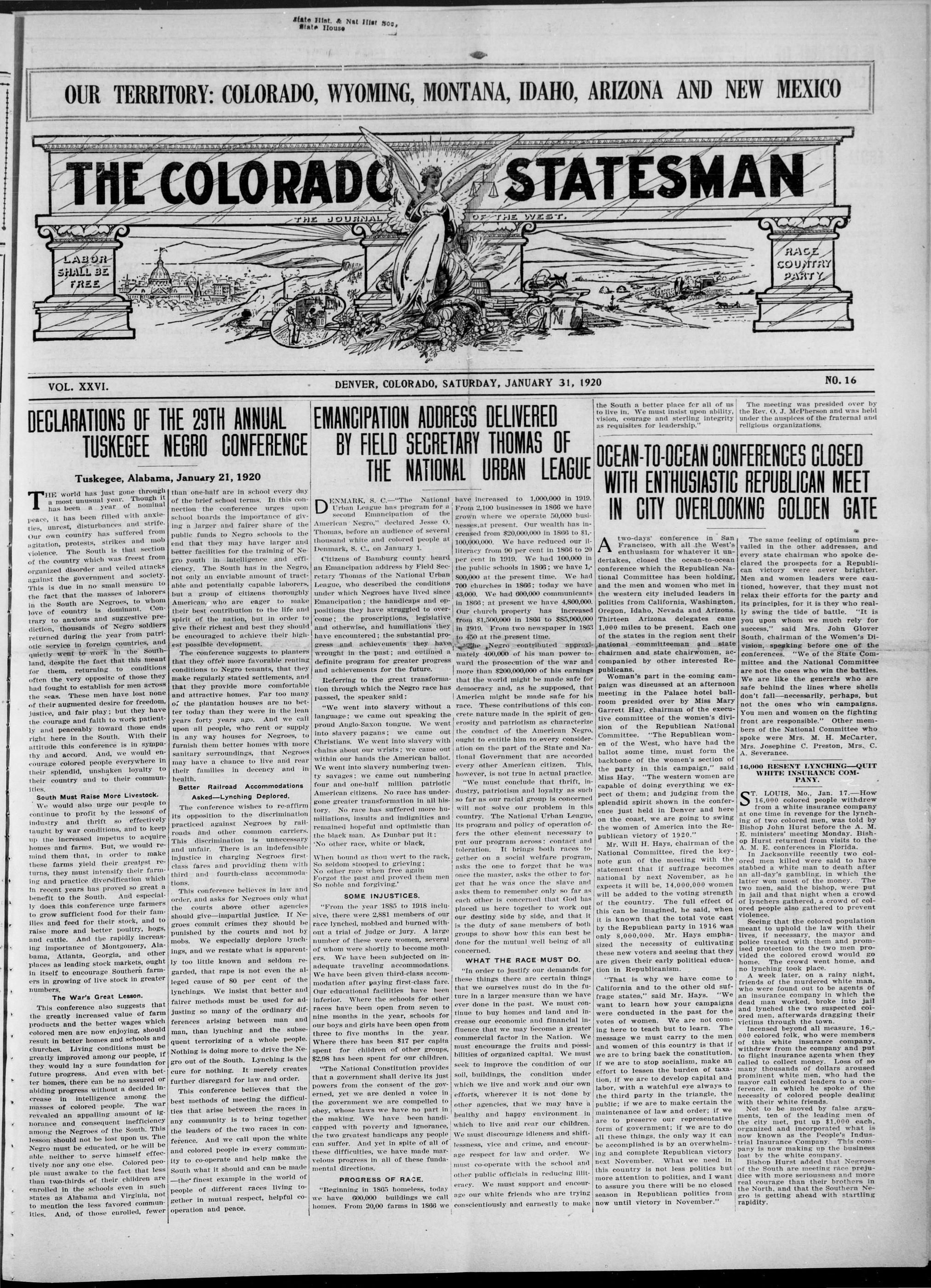
DECLARATIONS OF THE 29TH ANNUAL TUSKEGEE NEGRO CONFERENCE
Tuskegee, Alabama, January 21, 1920
VOL. XXVI.
THE world has just gone through a most unusual year. Though it has been a year of nominal peace, it has been filled with anxieties, unrest, disturbances and strife. Our own country has suffered from agitation, protests, strikes and mob violence. The South is that section of the country which was freest from organized disorder and veiled attacks against the government and society. This is due in no small measure to the fact that the masses of laborers in the South are Negroes, to whom love of country is dominant. Contrary to anxious and suggestive prediction, thousands of Negro soldiers returned during the year from patriotic service in foreign countries, and quietly went to work in the Southland, despite the fact that this meant for them, returning to conditions often the very opposite of those they had fought to establish for men across the seas. These men have lost none of their augmented desire for freedom, justice, and fair play; but they have the courage and faith to work patiently and peaceably toward those ends right here in the South. With their attitude this conference is in sympathy and accord. And, we would encourage colored people everywhere in their splendid, unshaken loyalty to their country and to their communities.
South Must Raise More Livestock. We would also urge our people to continue to profit by the lessons of industry and thrift so effectively taught by war conditions, and to keep up the increased impetus to acquire homes and farms. But, we would remind them that, in order to make these farms yield their greatest returns, they must intensify their farming and practice diversification which in recent years has proved so great a benefit to the South. And especially does this conference urge farmers to grow sufficient food for their families and feed for their stock, and to raise more and better poultry, hogs, and cattle. And the rapidly increasing importance of Montgomery, Alabama, Atlanta, Georgia, and other places as leading stock markets, ought in itself to encourage Southern farmers in growing of live stock in greater numbers.
The War's Great Lesson.
This conference also suggests that the greatly increased value of farm products and the better wages which colored men are now enjoying, should result in better homes and schools and churches. Living conditions must be greatly improved among our people, if they would lay a sure foundation for future progress. And even with better homes, there can be no assured or abiding progress without a decided increase in intelligence among the masses of colored people. The war revealed an appalling amount of ignorance and consequent inefficiency among the Negroes of the South. This lesson should not be lost upon us. The Negro must be educated, or he will be able neither to serve himself effectively nor any one else. Colored people must awake to the fact that less than two-thirds of their children are enrolled in the schools even in such states as Alabama and Virginia, not to mention the less favored communities. And, of those enrolled, fewer
than one-half are in school every day of the brief school terms. In this connection the conference urges upon school boards the importance of giving a larger and fairer share of the public funds to Negro schools to the end that they may have larger and better facilities for the training of Negro youth in intelligence and efficiency. The South has in the Negro, not only an enviable amount of tractable and potentially capable laborers, but a group of citizens thoroughly American, who are eager to make their best contribution to the life and spirit of the nation, but in order to give their richest and best they should be encouraged to achieve their highest possible development.
The conference suggests to planters that they offer more favorable renting conditions to Negro tenants, that they make regularly stated settlements, and that they provide more comfortable and attractive homes. Far too many of the plantation houses are no better today than they were in the lean years forty years ago. And we call upon all people, who rent or supply in any way houses for Negroes, to furnish them better homes with more sanitary surroundings, that Negroes may have a chance to live and rear their families in decency and in health.
Better Railroad Accommodations
Asked—Lynching Deplored.
The conference wishes to re-affirm its opposition to the discrimination practiced against Negroes by railroads and other common carriers. This discrimination is unnecessary and unfair. There is an indefensible injustice in charging Negroes first-class fares and providing them with third and fourth-class accommodations.
This conference believes in law and order, and asks for Negroes only what the courts above other agencies should give—impartial justice. If Negroes commit crimes they should be punished by the courts and not by mobs. We especially deplore lynchings, and we restate what is apparently too little known and seldom regarded, that rape is not even the alleged cause of 80 per cent of the lynchings. We insist that better and fairer methods must be used for adjusting so many of the ordinary differences arising between man and man, than lynching and the subsequent terrorizing of a whole people. Nothing is doing more to drive the Negro out of the South. Lynching is the cure for nothing. It merely creates further disregard for law and order.
This conference believes that the best methods of meeting the difficulties that arise between the races in any community is to bring together the leaders of the two races in conference. And we call upon the white and colored people in every community to co-operate and help make the South what it should and can be made—the finest example in the world of people of different races living together in mutual respect, helpful cooperation and peace.
DENVER, COLORADO, SATURDAY, JANUARY 31, 1920
EMANCIPATION ADDRESS DELIVERED BY FIELD SECRETARY THOMAS OF THE NATIONAL URBAN LEAGUE
DENMARK, S. C.—"The National Urban League has program for a second Emancipation of the American Negro," declared Jesse O. Thomas, before an audience of several thousand white and colored people at Denmark, S. C., on January 1.
Citizens of Bamburg county heard an Emancipation address by Field Secretary Thomas of the National Urban League, who described the conditions under which Negroes have lived since Emancipation; the handicaps and positions they have struggled to overcome; the proscriptions, legislative and otherwise, and humiliations they have encountered; the substantial progress and achievements they have wrought in the past; and outlined a definite program for greater progress and achievements for the future.
Referring to the great transformation through which the Negro race has passed, the speaker said:
"We went into slavery without a language; we came out speaking the proud Anglo-Saxon tongue. We went into slavery pagans; we came out Christians. We went into slavery with chains about our wrists; we came out within our hands the American ballot. We went into slavery numbering twenty savages; we came out numbering four and one-half million patriotic American citizens. No race has undergone greater transformation in all history. No race has suffered more humiliations, insults and indignities and remained hopeful and optimistic than the black man. As Dunbar put it: 'No other race, white or black, When bound as thou wert to the rack, So seldom stooped to grieving; No other race when free again Forgot the past and proved them men So noble and forgiving.'
SOME INJUSTICES.
"From the year 1885 to 1918 inclusive, there were 2,881 members of our race lynched, mobbed and burned without a trial of judge or jury. A large number of these were women, several of whom were shortly to become mothers. We have been subjected on inadequate traveling accommodations. We have been given third-class accommodation after paying first-class fare. Our educational facilities have been inferior. Where the schools for other races have been open from seven to nine months in the year, schools for our boys and girls have been open from three to five months in the year. Where there has been $17 per capita spent for children of other groups, $2.98 has been spent for our children. "The National Constitution provides that a government shall derive its just powers from the consent of the governed, yet we are denied a voice in the government we are compelled to obey, whose laws we have no part in the making. We have been handicapped with poverty and ignorance, the two greatest handicaps any people can suffer. And yet in spite of all of these difficulties, we have made marvelous progress in all of these fundamental directions.
PROGRESS OF RACE.
"Beginning in 1865 homeless, today we have 600,000 buildings we call homes. From 20,000 farms in 1866 we
have increased to 1,000,000 in 1919. From 2,100 businesses in 1866 we have grown where we operate 50,000 businesses,at present. Our wealth has increased from $20,000,000 in 1866 to $1,100,000,000. We have reduced our illiteracy from 90 per cent in 1866 to 20 per cent in 1919. We had 100,000 in the public schools in 1866; we have 1,800,000 at the present time. We had 700 churches in 1866; today we have 43,000. We had 600,000 communicants in 1866; at present we have 4,800,000. Our church property has increased from $1,500,000 in 1866 to $85,900,000 in 1919. From two newspaper in 1863 to 450 at the present time.
The Negro contributed approximately 400,000 of his man power toward the prosecution of the war and more than $200,000,000 of his earnings that the world might be made safe for democracy and, as he supposed, that America might be made safe for his race. These contributions of this concrete nature made in the spirit of generosity and patriotism as characterize the conduct of the American Negro, ought to entitle him to every consideration on the part of the State and National Government that are accorded every other American citizen. This, however, is not true in actual practice.
"We must conclude that thrift, industry, patriotism and loyalty as such so far as our racial group is concerned will not solve our problem in this country. The National Urban League its program and policy of operation offers the other element necessary to put our program across: contact and toleration. It brings both races together on a social welfare program asks the one to forget that he was once the master, asks the other to forget that he was once the slave and asks them to remember only so far as each other is concerned that God has placed us here together to work out our destiny side by side, and that it is the duty of sane members of both groups to show how this can best be done for the mutual well being of all concerned.
WHAT THE RACE MUST DO.
"In order to justify our demands for these things there are certain things that we ourselves must do in the future in a larger measure than we have ever done in the past. We must continue to buy homes and land and increase our economic and financial influence that we may become a greater commercial factor in the Nation. We must encourage the fruits and possibilities of organized capital. We must seek to improve the condition of our soil, buildings, the condition under which we live and work and our own efforts, wherever it is not done by other agencies, that we may have a healthy and happy environment in which to live and rear our children. We must discourage idleness and shiftlessness, vice and crime, and encourage respect for law and order. We must co-operate with the school and other public officials in reducing illiteracy. We must support and encourage our white friends who are trying conscientiously and earnestly to make
OCEAN-TO-OCEAN CONFERENCES CLOSED WITH ENTHUSIASTIC REPUBLICAN MEET IN CITY OVERLOOKING GOLDEN GATE
the South a better place for all of us to live in. We must insist upon ability, vision, courage and sterling integrity as requisites for leadership."
two-days' conference in San Francisco, with all the West's enthusiasm for whatever it undertakes, closed the ocean-to-ocean conference which the Republican National Committee has been holding, and the men and women who met in the western city included leaders in politics from California, Washington, Oregon, Idaho, Nevada and Arizona. Thirteen Arizona delegates came 1,000 miles to be present. Each one of the states in the region sent their national committeeman and state chairmen and state chairwomen, accompanied by other interested Republicans.
Woman's part in the coming campaign was discussed at an afternoon meeting in the Palace hotel ballroom presided over by Miss Mary Garrett Hay, chairman of the executive committee of the women's division of the Republican National Committee. "The Republican women of the West, who have had the ballot some time, must form the backbone of the women's section of the party in this campaign," said Miss Hay. "The western women are capable of doing everything we expect of them; and judging from the splendid spirit shown in the conference just held in Denver and here on the coast, we are going to swing the women of America into the Republican victory of 1920."
Mr. Will H. Hays, chairman of the National Committee, fired the keynote gun of the meeting with the statement that if suffrage becomes national by next November, as he expects it will be, 14,000,000 women will be added to the voting strength of the country. The full effect of this can be imagined, he said, when it is known that the total vote cast by the Republican party in 1916 was only 8,000,000. Mr. Hays emphasized the necessity of cultivating these new voters and seeing that they are given their early political education in Republicanism.
"That is why we have come to California and to the other old suffrage states," said Mr. Hays. "We want to learn how your campaigns were conducted in the past for the votes of women. We are not coming here to teach but to learn. The message we must carry to the men and women of this country is that if we are to bring back the constitution, if we are to stop socialism, make an effort to lessen the burden of taxation, if we are to develop capital and labor, with a watchful eye always to the third party in the triangle, the public; if we are to make certain the maintenance of law and order; if we are to preserve our representative form of government; if we are to do all these things, the only way it can be accomplished is by an overwhelming and complete Republican victory next November. What we need in this country is not less politics but more attention to politics, and I want to assure you there will be no closed season in Republican politics from now until victory in November."
NO.16
The meeting was presided over by the Rev, O. J. McPherson and was held under the auspices of the fraternal and religious organizations.
The same feeling of optimism prevailed in the other addresses, and every state chairman who spoke declared the prospects for a Republican victory were never brighter. Men and women leaders were cautioned, however, that they must not relax their efforts for the party and its principles, for it is they who really swing the tide of battle. "It is you upon whom we much rely for success," said Mrs. John Glover South, chairman of the Women's Division, speaking before one of the conferences. "We of the State Committee and the National Committee are not the ones who win the battles. We are like the generals who are safe behind the lines where shells don't fall—necessarily, perhaps, but not the ones who win campaigns. You men and women on the fighting front are responsible." Other members of the National Committee who spoke were Mrs. M. H. McCarter, Mrs. Josephine C. Preston, Mrs. C. A. Severance.
16,000 RESENT LYNCHING—QUIT WHITE INSURANCE COMPANY.
ST. LOUIS, Mo., Jan. 17.—How 16,000 colored people withdrew from a white insurance company at one time in revenge for the lynching of two colored men, was told by Bishop John Hurst before the A. M. E. ministers' meeting Monday. Bishop Hurst returned from visits to the A. M. E. conferences in Florida.
In Jacksonville recently two colored men killed were said to have stabbed a white man to death after an all-day's gambling, in which the latter won most of the money. The two men, said the bishop, were put in jail and that night when a crowd of lynchers gathered, a crowd of colored people also gathered to prevent violence.
Seeing that the colored population meant to uphold the law with their lives, if necessary, the mayor and police treated with them and promised protection to the two men provided the colored crowd would go home. The crowd went home, and no lynching took place.
A week later, on a rainy night, friends of the murdered white man, who were found out to be agents of an insurance company in which the dead man worked, broke into jail and lynched the two suspected colored men, afterwards dragging their victims through the town.
Incensed beyond all measure, 16,000 colored folk, who were members of this white insurance company, withdrew from the company and put to flight insurance agents when they called to collect money. Loss of so many thousands of dollars aroused prominent white men, who had the mayor call colored leaders to a conference, in which he spoke of the necessity of colored people dealing with their white friends.
Not to be moved by false arguments, ten of the leading men of the city met, put up $1,000 each, organized and incorporated what is now known as the People's Industrial Insurance Company. This company is now making up the business lost by the white company.
Bishop Hurst added that Negroes of the South are meeting race prejudice with more seriousness and more real courage than their brothers in the North, and that the Southern Negro is getting ahead with startling rapidity.
AN EPITOME OF LATE LIVE NEWS
DONDENSED RECORD OF THE
PROGRESS OF EVENTS AT
HOME AND ABROAD
FROM ALL SOURCES
BAYINGS, DOINGS, ACHIEVE-
MENTS, SUFFERINGS, HOPES
AND FEARS OF MANKIND.
Western Newspaper Union News Service.
WESTERN
Nicholas Garcia, a cattleman of
Mexico, who for three years had waged
a campaign of vengeance against the
Yaqui Indians in Sonora, was killed at
Tecorpia, Sonora, according to a re-
port received at Nogales, Ariz.
As a result of the activity of German
consuls in Mexico there has been
arranged a steamship line between
Germany and Mexican ports which will
begin regular service at once. A steamer will reach Mexico each week from
Germany, according to Mexican newspapers.
The problem of handling large ek herds, big game and livestock on the forest reserves will be discussed at a meeting of forestry officials and the game wardens of the Western states, together with the federal game warden and his deputies at Salt Lake City, Feb. 16.
Mrs. Marion A. Forrest, prominent in Eastern Star circles in California and New Mexico, was instantly killed in Oakland, Calif., by an automobile driven by Harold Graven, a University of California student. Graven is charged with manslaughter. It is charged that he was driving at excessive speed.
The first shipment of ek from Yellowstone park to a point outside the United States left Gardiner, the northern entrance, for Rocky Mountain park, Banff, Alberta. Two hundred 1 and 2-year-old ek were loaded in four cars and shipped by express to the Canadian park, where they were turned, loose.
Capt. John F. Blain, former North Pacific district manager of the United States shipping board, was arraigned in Seattle and given two weeks to plead to an indictment returned against him charging him with accepting secret commissions on sales to the board while he was manager.
Gov. William D. Stephens of California has declined to grant an audience to a committee appointed by the Oriental Exclusion League and other organizations to seek from him an expression as to whether he proposed to call a special session of the State Legislature to deal with exclusion legislation. Thirty establishments at El Centro and in Imperial and Calexico, Calif., were raided by deputy sheriffs, and 150 men and women, alleged bootleggers and gamblers, were arrested. District Attorney Simon issued a statement in which he declared that the police of the three cities were either "asleep or negligent."
The Protestant Episcopal diocese of Eastern Missouri, at its annual convention in St. Louis, unanimously adopted a resolution giving deanesses the privilege of voting in diocesan conventions on the same basis as the clergy. So far as Episcopallians here know, this is the first diocese in the United States to take such action.
WASHINGTON
Henry P. Fletcher has resigned as United States ambassador to Mexico to take effect in the course of the next few weeks.
Dr. Hugh S. Cumming of Hampton, Virginia, was nominated surgeon general of the public health service by President Wilson. He succeeds Dr. Rupert Blue, whose term expired on Jan. 15.
Since Sept. 1, 1919, less than 7,000 cases of influenza have been reported to the United States public health service, it is announced. During the preceding similar period last year more than 400,000 cases occurred.
A bill to prevent transmission by mail or wire of any record of betting odds on horse races or other contests in which man, beast, or automobile takes part, was introduced by Senator Sterling, South Dakota.
By a margin of one vote the House appropriations committee refused to include in the deficiency appropriations bill a fund of $10,000,000 asked by the Navy Department for repairs to ships. Naval officials had informed the committee that unless the money was made available necessary repairs to many capital ships and destroyers could not be made and that 13,900 navy yard employés would have to be discharged next month.
Anti-sedition measures were given a further setback by refusal of the House rules committee to give legislative preference for their consideration. No further hearings will be held, and the judiciary committee is expected to report a new measure, incorporating the features of the Davey bill, which has been suggested as ample by the Department of Justice.
The excess of American exports over imports for the year 1919 amounted to $4,017,000,000, a new record, the Department of Commerce announced in Washington.
FOREIGN
It is rumored that the Rumanians are about to occupy Odessa and organize the defenses of that Black sea port against the Bolshevik, according to the newspaper Hurler Po Banay.
Dr. W. H. Solf, former foreign minister of Germany, has been appointed German ambassador to Japan, according to a Toklo cable to Nippu Jiju, Honolulu Japanese language newspaper.
The appropriation of $20,000,000 for good roads by the Dominion Parliament, presages unprecedented activity in road making throughout Canada during the coming year. Main highways and market roads will be provided in every province.
Consideration of the future constitution of Prussia has been closed by the commission assigned to the task and it has been decided that Prussia will not have a president of its own. The head of the legislative assembly will be ex-officio chief of the state.
The prince of Wales has set an example by employing only ex-service men as male servants in his new bachelor home, York house. One of his footmen wears a wound stripe and the military medal; another has the Mons star. All the men servants in the establishment have war ribbons.
German newspapers publish a letter from former Emperor William to a personal friend in which Count Hoehzollern expresses his absolute discouragement and says he does not wish ever to return to Germany. He says he believes his return would cause a split between German factions.
The plight of retired Austrian officers is illustrated by an incident reported from a fashionable suburb of Vienna. A house owner was in search of a porter and made his want known to the officers' league. Among the applicants were a major general, three colonels, two lieutenant colonels, seven majors and eighteen captains. There have been serious food riots in the Moravian cities of Stanburg, Muglitz and Hohenstadt and troops have been called. Workmen are demanding immediate requisitioning of supplies by the army and their distribution under a workmen's committee. In the Olmutz district the authorities have conceded this demand.
The British navy may soon be given a new and unsurpassed weapon in a large caliber shell which will pierce the heaviest armor without shattering, said Sir Robert Hadfield, chairman and managing director of Hadfields, Ltd., steel manufacturers, recently. He indicated that possession of such a shell during the great war would have been of inestimable value to the British fleet.
GENERAL
Women administering property in their own right will be permitted to vote at the first national election in Jugo-Slavia next month, according to an announcement made by the cabinet at Belgrade.
"The jazz must go; it is on the wane; fashion decrees that it must go," was the declaration of W. J. Karngood of St. Louis, secretary of the American Federation of Musicians, in annual convention at Detroit.
Eight persons were killed in the collision of two sections of the Montreal-Vancouver express on the Canadian Pacific, eleven miles east of North Bay, according to a final revised estimate of casualties from the scene.
Robert Pettit, foreman in a machine shop, living in West Allis, Wis., hit his wife over the head with a crowbar, inflicting serious wounds. Pettit was recovering from the flu, but suffered a relapse. In a delirious fit he attacked his wife. When he saw what he had done he shot himself, dying instantly. Laying of the keel of a new 15,500-ton passenger steamer, which will be named the Calgary, for service between Liverpool and Montreal and Quebec, was announced by the White Star line. The ship is under construction at Belfast and is expected to be ready for service in 1921. The vessel is designed to carry 650 cabin and 2,000 third-class passengers.
Membership in churches of all denominations increased 2,779,067 since 1916, according to the new year book issued by the Federated Council of the Churches of Christ in America. The following figures of present membership in the United States appear in the book: Protestant, 25,980,456; Roman Catholic, 17,549,324; Jewish, 260,000; Mormon, 494,388; Greek, Orthodox, 119,781; Russian, Orthodox, 99,681.
Several hundred ministers and laymen representing the general synod of the Reformed church in the United States met at Philadelphia and discussed plans for the launching of a financial drive in connection with the religious campaign from April 21 to May 2. The drive will be conducted exclusively among the Reformed churches, but will be in co-operation with the interchurch movement and will have as its goal $10,847,425. The sum of $1,000,000 will be spent to increase ministerial compensation.
Maj. Richard Lloyd George, son of the British premier, arrived in New York on the steamer Mauretania from Southampton and Cherbourg. The major, who was accompanied by his wife, said he was on a "business trip" to America.
Although it is the popular impression that the prohibition fight in the United States is over, the Anti-Saloon League insists that it has just begun in a declaration emphasizing its appeal for $25,000,000 to keep up warfare on the demon rum, notwithstanding its shackled condition.
Pithy News Notes
From All Parts of
Colorado
Western Newspaper Union News Service.
COMING EVENTS.
Denver Automotive Show will be held in Denver, March 2 to 6, at Stockyards Stadium.
Nels Johnson, 62, first fire chief in Colorado Springs and organizer of the first volunteer company, is dead. He had been a resident of Colorado Springs for forty years.
Beet growers of the Longmont district will get an extra $214,000 from the payment of $1 additional a ton of beets by the Great Western Sugar Company, according to an announcement made by N. R. McCreery of the Longmont factory.
Mrs. Nevada J. Haywood, 50 years old, and wife of William D. Haywood, general secretary of the L. W. W., who was recently released from Leavenworth prison, died in Denver at a sanitarium of which she had been an inmate since last August.
Frank S. Lane, living near Grand Junction, is under arrest, charged with having killed two deer out of season. The report of the game warden, C. B. Nichols, was that Lane was found with the butchered carcasses of two fine venison in his home.
William G. Jenkins, one of three surviving members of the famous light brigade which took part in the bloody battle of Balaklava, in the Crimean, made famous by Tennyson's poem, "The Charge of the Light Brigade," died at Pueblo. He was 90 years old.
Plans for building a tent city in Boulder to accommodate summer tourists have been initiated by the Lions' Club. George J. Breitenstein asked the club to get behind a movement to obtain army tents. A committee was appointed to look into the matter of obtaining tents.
Under the stockraising homestead act of Dec. 29, 1916, more than 3,294,883 acres of land have been taken up in this state, according to a statement issued by M. D. McEniry, chief of the Denver field division. In addition to that amount, he estimated that nearly 6,000,000 more acres are available for homestending under that act.
Students of the University of Colorado at Boulder will establish a cooperative store, if charges of profiteering against stores on "the hill" are proved true. President George Norlin has issued a statement calling for a probe of the alleged profiteers. Manager Bryant Smith of the Associated Students has also asked for an investigation.
Mrs. Lois Allen of Cañon City, editor of the Fremont County Leader, was elected president of the Colorado Editorial Association at the convention in Denver. The other officers elected by the association are L. I. Griffin of the Ordway New Era, vice president and George T. Haubrich of the Weld County News, Greeley, secretary and treasurer.
Delta is to have a new canning plant, A committee of Delta business men spent several days in Denver working out the details. They are going to deal with a large eastern slope canning company. The plant will be put up on a large scale. Delta plans many big improvements this year, and the outlook was never brighter for a big business campaign.
Assessors from fifty-five Colorado counties who held their annual conference with the State Tax Commission in the Senate chamber at the state house, voted to assess automobiles on the same basis as employed last year with the exception that second-year valuations shall be 60 per cent of original value instead of being left chiefly to the assessor's discretion.
Coal production in Colorado decreased from 12,658,055 tons in 1918 to 10,395,563 tons in 1919, a total decrease of 2,262,492 tons, the report for December issued by State Coal Mine Inspector James Dalrymple showed, though production in December alone was greater than 1,000,000 tons.
Another new discovery of ore bearing gold and silver and one of the richest finds in the Silverton section in years, is reported from the property of the Gold King Extension Mines Company on Bonita mountain. The find was made in eighteen inches of white quartz and values up to 500 ounces of gold per ton and 40 to 50 ounces of silver are reported.
Weld county farmers will receive $600,000 additional payment from the 1919 sugar beet crop as the result of the action of the Great Western Sugar Company in raising the price paid for the beets already ground into sugar from $10 a ton to $11. Three factory districts, Greeley, Windsor and Eaton, raised approximately 100,000 tons of beets each and more than 300,000 tons were raised by farmers in southern and western Weld county for factories at Longmont, Loveland and Brighton
The 1919 Colorado apple crop was one of the largest the state has produced, in spite of the severe damage caused the crop by the frost on and about June 1. The agricultural production is estimated at 3,418,000 bushels, compared with 2,511,000 bushels in 1918 and 3,559,094 bushels reported by the census in 1909. Virgie Stout, a high school girl, and an automobile she was driving rolled down the steep embankment at Mantey's Heights, near Grand Junction, smashing the car but only bruising and shocking Miss Stout.
CENTENNIAL STATE ITEMS.
W. R. Murphy of the Las Animas Leader was selected by the members of the Colorado Editorial Association as chairman of the field department committee, which is to work out a thorough organization of the association throughout the state, and to encourage the organization of local bodies to co-operate with the state association. The committee is to consist of three members, one of whom is to be the field secretary, and will be paid a salary by the state association for his services.
John Kodel, a miner who has been persistently prospecting claims in the Kodel cafion, three miles southwest of Fruita, reports that his efforts have been rewarded by the finding of some very rich gold and silver ore. He says that the ore is in a vein six feet wide. Two three-foot veins came together about seventy-five feet below the surface of the ground and a Sylvanite ore, from a formation much like the Cripple Creek formation, yielded up the values. He believes the ore will run over $300,000 per ton.
Silver dollars are going to be scarce from now on, due to a scarcity of silver. In their place dollar bills will be circulated, as in Eastern cities. No more silver dollars can be obtained by banks unless silver certificates are given in exchange. Silver, under this ruling cannot be bought with gold. There is a shortage of silver certificates. The banks will be able to get only a limited number of $1 and $2 bills. The result is expected to be a revival of silver mining in Colorado.
Approximately $25,000,000 changed hands in live stock transactions during the six days of Denver's fourteenth annual National Western Stock Show, which closed its gates after the most successful season in its history. Men in close touch with the market have computed the amount from comparative bank clearings and other available data. Attendance records were also smashed this year. Total attendance figures for the show were announced as 72,381.
An epidemic of smallpox has broken out in the city of Durango. The city commissioners, acting as the board of health, have issued orders to the effect that no person shall be permitted to attend the public or private schools of the city unless they have been vaccinated. The board of directors of the public schools and managers or persons in charge of private schools are expressly forbidden to permit any student who has not been vaccinated to attend school.
Bodies of American soldiers who died or were killed in Europe during the war either will be brought to the United States without charge or left in the honored military cemeteries as relatives may desire, according to a letter received by Rex B. Yeager, secretary of the Colorado State Board of Embalming Examiners, from Representative Charles B. Timberlake, member of the ways and means committee of the House.
Rulie R. Johnson, alias Charles R. Jewell, the alleged forger, who was shot and dangerously wounded by Turnkey Ed Coats when Johnson, together with several other inmates of the county jail, attempted to break out of that institution Dec. 27, pleaded guilty before Judge F. A. Park in District Court at Pueblo to the charge of passing bogus checks and received a sentence of from seven to ten years in the state penitentiary.
Newcastle may have to close its public schools as the result of refusal of the school board to grant an increase of $200 a year in the salaries of the teachers.
Craig will have a modern creamery manufacturing butter and ice cream if sufficient cream can be secured to make the proposition a success.
Colorado has spent on an average of $25,000 to $30,000 per mile on concrete roads.
Colorado is coming to be one of the most important states in the production of vegetable seed. The Seed Reporting Service of the United States Bureau of Markets found a total of 37,131 acres devoted to vegetable seeds, including sugar beet seed, in 1918. There was considerable falling off in 1919, principally in seed beans, which is the most important seed crop grown in the state.
A tent city of 400 tents, to cost $165,000, is to be built in Colorado Springs before the summer tourist season in order to accommodate the expected crowds. The tents will be equipped and furnished and there will be a garage and cafeteria in connection. The Chamber of Commerce is backing the project, owing to the complaints of last season of the lack of accommodations.
The end of the 1919-20 beet season came with the closing down of the sugar factory of the Holly Sugar Corporation at Grand Junction. The total run was 60,000 tons. This brought the grower organization about $600,000. The warehouse has only about 15,000 bags of sugar on hand and it is being dolled out to fill the orders on hand.
A building program to cover not less than one year and involving the expenditure of many thousands of dollars, has been inaugurated by the Empire Zinc Company and will culminate in the erection of one of the largest and most modern plants for the treatment of zinc oxide in the west at Cafon City. Western slope postmasters appointed recently are Paul C. Boyles, Gunnison; Fred H. Sanderson, Gunnison, and John Uglow, Olathe. Uglow is reappointed to the postmaster at Olathe.
WESTERN BEEF CO.
Chitterlings, Pig Tails, Snouts, Ears, Pigs Feet, Neck
bones, Spare Ribs Received Fresh Daily.
1 Meats of All Kinds.. Fresh Vegetables, Staple and
Fancy Groceries.
Prices Are Always the Lowest
Free Delivery to All Parts of the City.
Phone Champa 1641.
STREET DENVER, COLO.
Opposite the Three Rules.
Men Barber Shop
Baths, Electric
Massages
FIRST-CLASS SERVICE
Fresh Oysters, Chitterlings, Pig Tails, Snouts, Ears, Pigs Feet, Neck Bones, Spare Ribs Received Fresh Daily.
Fresh and Cured Meats of All Kinds.. Fresh Vegetables, Staple and Fancy Groceries.
R. B. BOLDEN, Proprietor
en You Want
et, Tails, Snouts, Neckbones or Chiterlings, or
part of the hog except the squeal, go to
ST'S MARKET
When Y
The Heads, Feet, Tails, Snout
any other part of the ho
EAST'S
When You Want
The Heads, Feet, Tails, Snouts, Neckbones or Chiterlings, or any other part of the hog except the squeal, go to
HAMPA PHARMACY
TWENTIETH AND CHAMPA,
Is the place to get your
CHEMICALS AND PATENT MEDICINES
WE SERVE DRINKS.
DESCRIPTIONS OUR SPECIALTY.
we will deliver the goods to all parts of the city.
JAMES E. THRALL, Propr.
PHONE MAIN 2425.
N'S FAMOUS JAZZ ORCHESTRA
AND ENTERTAINERS
THE CHAMPA
TWENTIETH
Is the place
DRUGS, CHEMICALS AND
WE SERVE
PRESCRIPTIONS
Phone us and we will deliver to
JAMES E. T.
PHONE N.
MORRISON'S FAMOUS
AND ENT
THE CHAMPA PHARMACY
TWENTIETH AND CHAMPA,
Is the place to get your
DRUGS, CHEMICALS AND PATENT MEDICINES
WE SERVE DRINKS.
PRESCRIPTIONS OUR SPECIALTY.
Phone us and we will deliver the goods to all parts of the city.
JAMES E. THRALL, Propr.
PHONE MAIN 2425.
MORRISON'S FAMOUS JAZZ ORCHESTRA
GEO. MORRISON, MANAGER
Music Furnished
Phone Main 2707. Res. 2947
THE ATLAS DE
COURTEOUS TREATM
Leaders in
Full Line of Plough's Black
2701 WELTON STREET
THE STAR HA
Furnished for all Occasions
07. Res. 2947 Stout St. DENVER, COLO.
ATLAS DRUG COMPANY
GEOUS TREATMENT—RIGHT PRICES
Leaders in Prescription
Plough's Black and White Toilet Articles
STREET MAIN 875
AR HAIR GROWER
Music Furnished for all Occasions Phone Main 2707. Res. 2947 Stout St. DENVER, COLO.
THE ATLAS DRUG COMPANY
COURTEOUS TREATMENT—RIGHT PRICES
Leaders in Prescription
Full Line of Plough's Black and White Toilet Articles
2701 WELTON STREET MAIN 875
THE STAR HAIR GROWER
A Wonderful Hair Dressing and Grower
A Wonderful Hair Dressing and Grower.
One Thousand Agents Wanted. Good Money
Made. We want Agents in every city
and village to sell THE STAR HAIR GROWER.
This is a wonderful preparation. Can be
used with or without straightening irons.
Sells for 25 cents per box—One 25-cent box
will prove its value. A lot person that will
use a 25-cent box will be convinced. No matter
what has failed to grow your hair, just
give THE STAR HAIR GROWER a trial and
be convinced. Send 25 cents for a full size
box. If you wish to be an agent, send $1
and we will send you a full supply that you
can begin work at once; also agent's terms.
Send all money by Money Order to
THE STAR HAIR GROWER, Mfr.
GREENSBORO, N. C. BOX 812
We Are Always Ready
to serve you with good printing. No matter what the nature of the job may be we are ready to do it at a price that will be
---
---
2300-6 Larimer Street
A
Satisfactory
One of the Most Up-to Date and Sanitary Markets in the City.
926 19th St., Denver
Phone Main 1461
Some Time
You will be in need of printing of some kind. Whether it be letterheads, statements wedding invitations or public sale bills, remember we can turn out the work at the lowest cost consistent with good work.
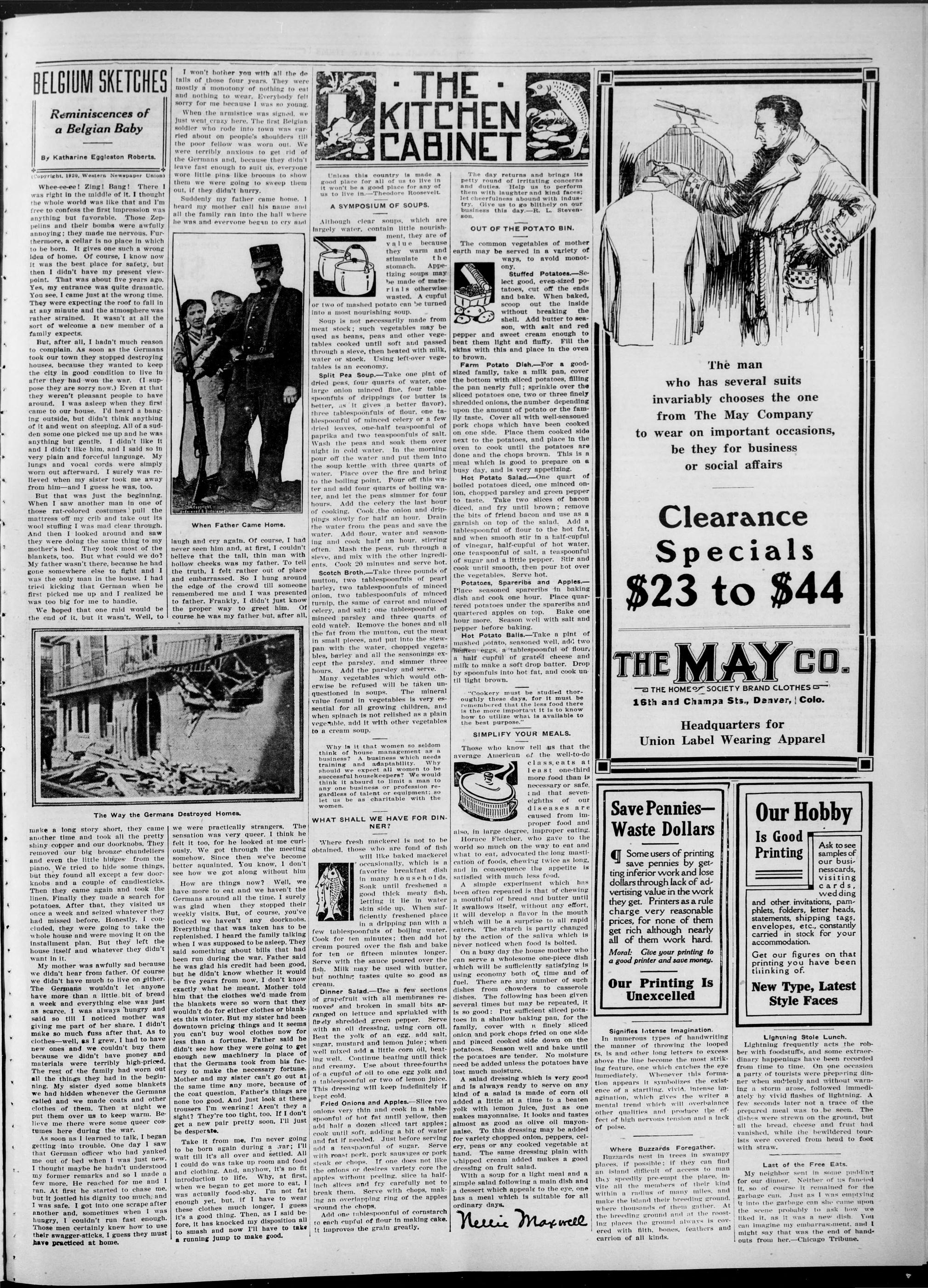
BELGIUM SKETCHES
Reminiscences of
a Belgian Baby
By Katharine Eggleston Roberts.
Whee-ee-ee! Zing! Bang! There I was right in the middle of it. I thought the whole world was like that and I'm free to confess the first impression was anything but favorable. Those Zeppelins and their bombs were awfully annoying; they made me nervous. Furthermore, a cellar is no place in which to be born. It gives one such a wrong idea of home. Of course, I know now it was the best place for safety, but then I didn't have my present viewpoint. That was about five years ago. Yes, my entrance was quite dramatic. You see, I came just at the wrong time. They were expecting the roof to fall in at any minute and the atmosphere was rather strained. It wasn't at all the sort of welcome a new member of a family expects.
But, after all, I hadn't much reason to complain. As soon as the Germans took our town they stopped destroying houses, because they wanted to keep the city in good condition to live in after they had won the war. (I suppose they are sorry now.) Even at that they weren't pleasant people to have around. I was asleep when they first came to our house. I'd heard a banging outside, but didn't think anything of it and went on sleeping. All of a sudden some one picked me up and he was anything but gentle. I didn't like it and I didn't like him, and I said so in very plain and forceful language. My lungs and vocal cords were simply worn out afterward. I surely was relieved when my sister took me away from him—and I guess he was, too.
But that was just the beginning. When I saw another man in one of those rat-colored costumes pull the mattress off my crib and take out its wool stuffing I was mad clear through. And then I looked around and saw they were doing the same thing to my mother's bed. They took most of the blankets, too. But what could we do? My father wasn't there, because he had gone somewhere else to fight and I was the only man in the house. I had tried kicking that German when he first picked me up and I realized he was too big for me to handle. We hoped that one raid would be the end of it, but it wasn't. Well, to
THE DATE OF THE DATE
THE HOUSE IN THE WASTE
make a long story short, they came another time and took all the pretty shiny copper and our doorknobs. They removed our big bronze chandeliers and even the little hinges from the piano. We tried to hide some things, but they found all except a few doorknobs and a couple of candlesticks. Then they came again and took the linen. Finally they made a search for potatoes. After that, they visited us once a week and seized whatever they had missed before. Honestly, I concluded, they were going to take the whole house and were moving it on the installment plan. But they left the house itself and whatever they didn't want in it.
we were practically sensation was very felt it too, for he ously. We got thir somehow. Since the better aquainted, we see how we got a
How are things have more to eat a Germans around all was glad when weekly visits. But, noticed we haven't Everything that was replenished. I heard when I was supposed said something abe run during the
My mother was awfully sad because we didn't hear from father. Of course we didn't have much to live on gither. The Germans wouldn't let anyone have more than a little bit of bread a week and everything else was just as scarce. I was always hungry and said so till I noticed mother was giving me part of her share. I didn't make so much fuss after that. As to clothes—well, as I grew, I had to have new ones and we couldn't buy them because we didn't have money and materials were terribly high-priced. The rest of the family had worn out all the things they had in the beginning. My sister dyed some blankets we had hidden whenever the Germans called and we made coats and other clothes of them. Then at night we put them over us to keep warm. Believe me there were some queer costumes here during the war.
As soon as I learned to talk, I began getting into trouble. One day I saw that German officer who had yanked me out of bed when I was just new. I thought maybe he hadn't understood my former remarks and so I made a few more. He reached for me and I ran. At first he started to chase me, but it jostled his dignity too much, and I was safe. I got into one scrape after another and, sometimes when I was hungry, I couldn't run fast enough. Those men certainly knew how to use their swagger-sticks, I guess they must have practiced at home.
I won't bother you with all the details of those four years. They were mostly a monotony of nothing to eat and nothing to wear. Everybody felt sorry for me because I was so young.
When the armistice was signed, we just went crazy here. The first Belgian soldier who rode into town was carried about on people's shoulders till the poor fellow was worn out. We were terribly anxious to get rid of the Germans and, because they didn't leave fast enough to suit us, everyone wore little pins like brooms to show them we were going to sweep them out, if they didn't hurry.
Suddenly my father came home. I heard my mother call his name and all the family ran into the hall where he was and everyone began to cry and
Copyright
Defend & Protect
When Father Came Home. laugh and cry again. Of course, I had never seen him and, at first, I couldn't believe that the tall, thin man with hollow cheeks was my father. To tell the truth, I felt rather out of place and embarrassed. So I hung around the edge of the crowd till someone remembered me and I was presented to father. Frankly, I didn't just know the proper way to greet him. Of course he was my father but, after all
```markdown
```
we were practically strangers. The sensation was very queer. I think he felt it too, for he looked at me curiously. We got through the meeting somehow. Since then we've become better aquainted. You know, I don't see how we got along without him
How are things now? Well, we have more to eat and we haven't the Germans around all the time. I surely was glad when they stopped their weekly visits. But, of course, you've noticed we haven't any doorknobs. Everything that was taken has to be replenished. I heard the family talking when I was supposed to be asleep. They said something about bills that had been run during the war. Father said he was glad his credit had been good, but he didn't know whether it would be five years from now. I don't know exactly what he meant. Mother told him that the clothes we'd made from the blankets were so worn that they wouldn't do for either clothes or blankets this winter. But my sister had been downtown pricing things and it seems you can't buy wool clothes now for less than a fortune. Father said he didn't see how they were going to get enough new machinery in place of that the Germans took from his factory to make the necessary fortune. Mother and my sister can't go out at the same time any more, because of the coat question. Father's things are none too good. And just look at these trousers I'm wearing! Aren't they a sight? They're too tight, too. If I don't get a new pair pretty soon, I'll just be desperate.
Take it from me, I'm never going to be born again during a war; I'll wait till it's all over and settled. All I could do was take up room and food and clothing. And, anyhow, it's no fit introduction to life. Why, at first, when we began to get more to eat, I was actually food-shy. I'm not fat enough yet, but, if I have to wear these clothes much longer, I guess it's a good thing. Then, as I said before, it has knocked my disposition all to smash and now I'll have to take a running jump to make good.
鱼
A
THE KITCHEN CABINET
E·HENNET
The day returns and brings its petty round of irritating concerns and duties. Help us to perform them with laughter and kind faces; let cheerfulness abound with industry. Give us to go blithely on our business this day.—R. L. Stevenson.
Unless this country is made a good place for all of us to live in it won't be a good place for any of us to live in.-Theodore Roosevelt.
Although clear soups, which are largely water, contain little nourish-
OUT OF THE POTATO BIN.
ment, they are or value because they warm and stimulate the stomach. Appetizing soups may be made of materials otherwise wasted. A cupful
```markdown
```
The common vegetables of mother earth may be served in a variety of ways, to avoid monotony.
POTATOES
Stuffed Potatoes.—Select good, even-sized potatoes, cut off the ends and bake. When baked, scoop out the inside without breaking the shell. Add butter to season, with salt and red
or two of mashed potato can be turned into a most nourishing soup.
Soup is not necessarily made from meat stock; such vegetables may be used as beans, peas and other vegetables cooked until soft and passed through a sleeve, then heated with milk, water or stock. Using left-over vegetables is an economy.
pepper and sweet cream enough to beat them light and finny. Fill the skins with this and place in the oven to brown.
Farm Potato Dish.—For a good-sized family, take a milk pan, cover the bottom with sliced potatoes, filling the pan nearly full; sprinkle over the sliced potatoes one, two or three finely shredded onions, the number depending upon the amount of potato or the family taste. Cover all with well-seasoned pork chops which have been cooked on one side. Place them cooked side next to the potatoes, and place in the oven to cook until the potatoes are done and the chops brown. This is a meal which is good to prepare on a busy day, and is very appetizing.
Split Pea Soup.—Take one pint of dried peas, four quarts of water, one large onion minced fine, four tablespoonfuls of drippings (or butter is better, as it gives a better flavor), three tablespoonfuls of flour, one tablespoonful of minced celery or a few dried leaves, one-half teaspoonful of paprika and two teaspoonfuls of salt. Wash the peas and soak them over night in cold water. In the morning pour off the water and put them into the soup kettle with three quarts of water. Place over the fire and bring to the boiling point. Pour off this water and add four quarts of boiling water, and let the peas simmer for four hours. Add the celery the last hour of cooking. Cook the onion and drippings slowly for half an hour. Drain the water from the peas and save the water. Add flour, water and seasoning and cook half an hour, stirring often. Mash the peas, rub through a sieve, and mix with the other ingredients. Cook 20 minutes and serve hot.
Hot Potato Salad.—One quart of boiled potatoes diced, one minced onion, chopped parsley and green pepper to taste. Take two slices of bacon diced, and fry until brown; remove the bits of friend bacon and use as a garnish on top of the salad. Add a tablespoonful of flour to the hot fat, and when smooth stir in a half-cupful of vinegar, half-cupful of hot water, one teaspoonful of salt, a teaspoonful of sugar and a little pepper. Stir and cook until smooth, then pour hot over the vegetables. Serve hot.
Scotch Broth.—Take three pounds of mutton, two tablespoonfuls of pearl barley, two tablespoonfuls of minced onion, two tablespoonfuls of minced turnip, the same of carrot and minced celery, and salt; one tablespoonful of minced parsley and three quarts of cold water. Remove the bones and all the fat from the mutton, cut the meat in small pieces, and put into the stewpan with the water, chopped vegetables, barley and all the seasonings except the parsley, and simmer three hours. Add the parsley and serve.
Potatoes, Spareribs and Apples. Place seasoned spareribs in baking dish and cook one hour. Place quartered potatoes under the spareribs and quartered apples on top. Bake one hour more. Season well with salt and pepper before baking.
Hot Potato Balls.—Take a pint of mashed potato, seasoned well, add two beaten eggs, a tablespoonful of flour, a half cupful of grated cheese and milk to make a soft drop batter. Drop by spoonfuls into hot fat, and cook until light brown.
Many vegetables which would otherwise be refused will be questioned in soups. The mineral value found in vegetables is very essential for all growing children, and when spinach is not relished as a plain vegetable, add it with other vegetables to a cream soup.
"Cookery must be studied thoroughly these days, for it must be remembered that the less food there is the more important it is to know how to utilize what is available to the best purpose."
SIMPLIFY YOUR MEALS.
Why is it that women so seldom think of house management as a business? A business which needs training and adaptability. Why should we expect all women to be successful housekeepers? We would think it absurd to it that man to any one house or profession relied on of talent or equipment; so let us be as charitable with the women.
Those who know tell us that the average American *ol* the well-to-do
class, eats at least one-third more food than is necessary or safe, and that seven-eighths of our diseases are caused from improper food and
C
WHAT SHALL WE HAVE FOR DIN
NER?
also, in large degree, improper eating. Horace Fletcher, who gave to the world so much on the way to eat and what to eat, advocated the long mastication of foods, chewing twice as long, and in consequence the appetite is satisfied with much less food.
Where fresh mackerel is not to be obtained, those who are fond of fish will like baked mackerel occasionally, which is a favorite breakfast dish in many households. Soak until freshened a good thick meaty fish, letting it lie in water skin side up. When sufficiently freshened place in a dripping pan with a
A simple experiment which has been often repeated is that of chewing a mouthful of bread and butter until it swallows itself, without any effort, it will develop a flavor in the mouth which will be a surprise to all rapid enters. The starch is partly changed by the action of the saliva which is never noticed when food is bolted.
few tablespoonfuls of boiling water. Cook for ten minutes; then add hot cream poured over the fish and bake for ten or fifteen minutes longer. Serve with the sauce poured over the fish. Milk may be used with butter, but nothing tastes quite so good as cream.
On a busy day the house mother who can serve a wholesome one-piece dish which will be sufficiently satisfying is using economy both of time and of fuel. There are any number of dishes from chowders to casserole dishes. The following has been given several times but may be repeated, it is so good: Put sufficient sliced potatoes in a shallow baking pan, for the family, cover with a finely sliced onion and pork chops fried on one side and placed cooked side down on the potatoes. Season well and bake until the potatoes are tender. No moisture need be added unless the potatoes have lost much moisture.
Dinner Salad.—Use a few sections of grapefruit with all membranes removed and broken in small bits arranged on lettuce and sprinkled with finely shredded green pepper. Serve with an oil dressing, using corn oil. Beat the yolk of an egg, add salt, sugar, mustard and lemon juice; when well mixed add a little corn oil, beating well. Continue beating until thick and creamy. Use about three-fourths of a cupful of oil to one egg yolk and a tablespoonful or two of lemon juice. This dressing will keep indefinitely if kept cold.
A salad dressing which is very good and is always ready to serve on any kind of a salad is made of corn oil added a little at a time to a beaten yolk with lemon juice, just as one makes mayonnaise. It looks and tastes almost as good as olive oil mayonnaise. To this dressing may be added for variety chopped onion, peppers, celery, peas or any cooked vegetable at hand. The same dressing plain with whipped cream added makes a good dressing on fruit salad.
Fried Onions and Apples.—Slice two onions very thin and cook in a tablespoonful of hot fat until yellow, then add half a dozen sliced tart apples; cook until soft, adding a bit of water and fat if needed. Just before serving add a teaspoonful of sugar. Serve with roast pork, pork sausages or pork steak or chops. If one does not like the onions or desires variety core the apples without peeling, slice in half-inch slices and fry carefully not to break them. Serve with chops, making an overlapping ring of the apples around the chops.
With a soup for a light meal and a simple salad following a main dish and a dessert which appeals to the eye, one has a meal which is suitable for all ordinary days.
Add one tablespoonful of cornstarch to each cupful of flour in making cake. It improves the grain greatly.
Nellie Maxwell
THE TRENCH COAT
The man who has several suits invariably chooses the one from The May Company to wear on important occasions, be they for business or social affairs
Clearance Specials $23 to $44
THE HOME OF SOCIETY BRAND CLOTHES 16th and Champa Sts., Denver, Colo. Headquarters for Union Label Wearing Apparel
Some users of printing save pennies by getting inferior work and lose dollars through lack of advertising value in the work they get. Printers as a rule charge very reasonable prices, for none of them get rich although nearly all of them work hard.
Moral: Give your printing to a good printer and save money.
Our Printing Is Unexcelled
Signifies Intense Imagination.
Signifies Intense Imagination.
In numerous types of handwriting the manner of throwing the looped ts, ls and other long letters to excess above the line become the most striking feature, one which catches the eye immediately. Whenever this formation appears it symbolizes the existence of a startling, vivid, intense imagination, which gives the writer a mental trend which will overbalance other qualities and produce the effect of high nervous tension and a lack of poise.
Where Buzzards Foregather.
Where Buzzards Foregather.
Buzzards nest in trees in swampy places, if possible; if they can find an island difficult of access to man they speedily pre-empt the place, invite all the members of their kind within a radius of many miles, and make the island their breeding ground, where thousands of them gather. At the breeding ground and at the roosting places the ground always is covered with fifth, bones, teathes and crenion of all kinds.
Our Hobby
Is Good
Printing
Ask to see samples of
our businesscards,
visiting
cards,
wedding
and other invitations, pamphlets, folders, letter heads,
statements, shipping tags,
envelopes, etc., constantly
carried in stock for your
accommodation.
Get our figures on that
printing you have been
thinking of.
New Type, Latest
Style Faces
Lightning frequently acts the robber with foodstuffs, and some extraordinary happenings have been recorded from time to time. On one occasion a party of tourists were preparing dinner when suddenly and without warning a storm arose, followed immediately by vivid flashes of lightning. A few seconds later not a trace of the prepared meal was to be seen. The dishes were strewn on the ground, but all the bread, cheese and fruit had vanished, while the bewildered tourists were covered from head to foot with straw.
Last of the Free Eats.
My neighbor sent in some pudding for our dinner. Nether of us fancied it, so of course it remained for the garbage can. Just as I was emptying it into the garbage can she came upon the scene probably to ask how we liked it, as it was a new dish. You can imagine my embarrassment, and I might say that was the end of hand-outs from her—Chicago Tribune.
97
THE COLORADO STATESMAN
LAUGH SINGLE FREE
FACE COUNTRY PARTY
JOS. D. D. RIVERS ..... Proprietor
P. O. Box 116 Phone Main 7417
SUBSCRIPTION RATES.
One Year ..... $2.00
Six Months ..... 1.50
Three Months ..... .75
MUST BE PAID IN ADVANCE.
Entered as second-class matter at the postoffice in the City of Denver, Cole.
Reading notices, ten lines or less, 15 cents per line. Each additional line over ten lines, 10 cents per line. Display advertising 75 cents per inch for first insertion and 50 cents per inch for each additional insertion.
Remittances should be made by Express Money Order, Postoffice Money Order, Registered Letter or Bank Draft. Postage stamps will be received the same as cash for the fractional part of a dollar. Only 1c and 2c stamps taken.
No discounts allowed on less than three months' contract. Cash must accompany all orders from parties unknown to us. Further particulars on application.
Communications to receive attention must be newsy, upon important subjects, plainly written only upon one side of the paper, must reach us Tuesdays, if possible, anyway not later than Wednesdays, and bear the signature of the author. No manuscript returned, unless stamps are sent for postage. All communications of a personating nature that are not complimentary will be withheld from the columns of this paper.
"The Nation is nothing more than the family enlarged."—Theodore Roosevelt.
BIRTHDAY CELEBRATIONS.
In a few days hence will be commemorated by various classes of citizens the birthdays of three of America's illustrious sons—George Washington, Abraham Lincoln and Frederick Douglass, the first two accredited with giving the nation its birth and prosperity respectively, and the third immortalized as the wonderful agent who broke down the barriers of inhumanity and serdom and created that recognition which gave practical indorsement of the "brotherhood of man"—the commemoration of the birthday of these three distinguished American characters should fill us with the kind of patriotism that creates an outburst of enthusiasm emanating from the heart, the same being reflected in the spirit of American citizenship and American manhood. Thep ride of having produced such men aforementioned leads us to the ambitious role for which singularly as well as collectively we pleasurably compete in.
IMPORTANT LESSONS TO BE LEARNED FROM TUSKEGEE NEGRO CONFERENCE.
ACH day presents its lesson to be learned, and the Tuskegee Negro Farmers' Twenty-ninth Annual Conference held last week at Tuskegee, Ala., offered a reminder of the good adage, "the more you live the more you learn." On the front page of this issue we publish a detailed account of the conference, including extracts from the speech of Governor Thomas M. Bickett of North Carolina and Mrs. G. H. Mathis of Gadsen, Ala. (also white), and while enthusiasm was at its height and inspiration given to last the race to the end of time, yet the puzzle still confronts us, that with all the fine speeches and best wishes of these leaders, lecturers, heads of state, etc., the perpetration of the greatest crime, the foulest deed not only continues, but increases at a rapid rate, if not in Alabama, in its sister states, and none of the good influences that are fed to us in these and other conferences seem to have any effect upon the other race in ameliorating the conditions that exist in a measure greater than pro-slavish times.
"It is brains that you farmers want, and I hope you will put them into your work when you go back from Tuskegee is my message to you," were among the words of the Carolina Governor, and we, with all gratitude, believing in this Governor's sincerity, want to assure him that every time we get "the brains" and approach our hard task-masters (probably not in Alabama) to meet us, on the fair and square ground, we become the victims of the recent Arkansas action, and get the justice (?) that our twelve fellow-men who await the electric chair, and the eighty-five who are now on the prison farm of Arkansas. We wonder if the Governor knows anything about the WORKING ON SHARES system that prevails in many parts of the South, where the Negro never gets any share in the end, or the cruel, jealous action that comes about when the Negro farm owner is given twenty-four hours to quit his farm and get out of town—not when he begins to farm, but five or more years afterwards, when his farm, by dint of hard work, constant attention and BRAINS, is superior to his white neighbor's. On reliable authority and from an authentic source we received our information that as soon as the Negro farmer in Elaine, Ark., who was mentally enslaved, woke up and got his fellow Negro, who had the brains to calculate the results of his side of the work contract, so that he could enjoy the fruits of his labor, his representative—a qualified attorney-at-law was severely reprimanded and thrown in jail for interference "with our niggers' business," as this lord of creation and modern-day slave-owner puts it.
It is very beautiful to some of us to be in the position to hear the sentiments of good-will and kindness, but whenever we think upon the words of the immortal Lincoln, "No people, no government can exist successfully, half bond and half free," we fail to see the good results or to imagine the benefits to be derived by us as a whole with the Alabama farmer with the brains to be accepted, and the other state in its effort to get brains either rejected or punished.
Mrs. Mathis, in the course of her speech, referring to the splendid opportunities that Negroes have, draws a comparison between God's chosen people who served 430 years in Egypt under the guidance of their Creator and us, and makes the analogy that as in the end they acquired the wisdom and skill of the Egyptians, so we may look forward to become the beneficiaries of those precious gifts. "No other race ever had such opportunities thrust upon them before, and none ever rose with less real hardships," words of this sympathizer, whom we think means every word she says, would certainly cheer us if in her comparison and in these words of hope and cheer, the people of her race believed that the God they worship or the Great Source from which their existence was ordered, gave us our life and our being.
These special annual events are all right for the periodical display of WHAT THE NEGRO OUGHT TO DO to become desirable citizens and to be entertained and accepted as new-born babes; but our hearts beat still with the sorrow that makes us attempt at times to challenge the fairness or equal distribution of the Author of Creation when we are eye-witnesses of the inhuman treatment meted out to us, and victims of the ambitious idea of wigning recognition as MAN, COMMON MAN. It was a great conference from an external standpoint, but we are not quite the optimist this time until Alabama and her modern teachers and saviours can help their brothers around and about them in a manner helpful to the SOLUTION OF THE VEXED QUESTION.
Peculiar African Reptile.
The term "albino" was originally applied by the Portuguese to negroes found on the coast of Africa, who were mottled with white spots. Now an albino is defined as a person having a congenital deficiency of pigments of the skin, hair and eyes. Albinos occur among all races of men; in extreme cases they have a skin of a milky color, extremely light hair, and eyes with a deep red pupil with pink or blue iris.
The gaboon viper ranges over the whole of tropical Africa. The body is exceedingly thick, stubtailed, with a huge, spade-shaped head. Instead of progressing in ordinary fashion, this reptile throws forward lateral loops of the body and moves along in an oblique direction to that in which the head is pointing. A captive specimen displayed the trait of striking backwards.
Duty of Government Is to Protect the People Who Are Dependent on It.
By GOVERNOR H. J. ALLEN of Kansas
PETER B.
It is the duty of government, and it has the inherent power, to protect the people whose welfare is dependent upon it. Facing a desperate situation through a stoppage of coal production at the beginning of winter, government in Kansas is brought to the pass of using all its powers to protect the people whose suffering will be unspeakable unless relief is afforded If the government is to mean anything, then its obligation is to prevent innocent people from becoming the victims of a fuel famine which, in the course of events,
is both unnatural and unnecessary.
Every department of human life is bound up in this issue. Every industry and private occupation which government is organized to support is affected by it, and the challenge of those who would bring upon us this catastrophe is a challenge to government. So far as Kansas is concerned, government is going to accept the challenge.
It is the age-old obligation of just government to protect the innocent against the ruthless quarrels in the making of which they have had no part.
The people know that this is not in any sense a strike-breaking enterprise. It is not intended to affect the adjustment of the issues between the miners and the operators.
But once and for all it must be understood that the powers of the state now summoned into action for the protection of its people are above and beyond those of any association or organization, whether of capital or of individuals.
No Equal Suffrage Movement in France After the American Fashion.
By MME. CLEMENCEAU-JACQUEMAIRE, in New York Times.
So far as I have been able to observe, there is no equal suffrage movement in France in the sense that you in America regard a movement. From earliest times the women in France have always held a high position in the community. They have taken an active part in business projects, and the professions have always been open to them. They have been prominent in literature, science, and art. Indirectly they have exerted great influence on the political life of the country. Consequently there has been no pronounced movement for equal rights in France such as has been started elsewhere.
The women of France are not anxious to vote or to be elected to office. Therefore I am not of the opinion that suffrage will gain headway in my country. Nevertheless I am watching with great interest the progress of the women of other countries. We admire your progressiveness and are interested in the experiment of sending women to congress, of giving them seats on the bench. This is, of course, in line with your advancement and liberal ideas. But our own traditions, our social and racial conditions, are very different.
I find no cause for anxiety regarding the competition of the sexes in business. Women who had taken men's jobs on the outbreak of the war are gladly relinquishing them, and peace adjustment is coming without bitterness.
Was it not Ellen Key who avowed that even if the suffragist was striving to be free she was making a mistake if she thought the vote would free her from the limitation of nature? Women cannot pass beyond those limits without interfering with the rights of nature and the potential child. Woman, of course, has a right to avoid marriage, and to allow herself to be turned into a third sex, provided she finds in this her greatest happiness. But when all is told, motherhood is the central factor of existence for most women.
Patriotic Creed of the Good American for the Welfare of Everybody.
COMPOSITE BY FEDERAL RESERVE SAVINGS DIRECTORS.
I believe in the United States of America.
My opportunity and hope depend upon her future.
I believe that her stability and progress rest upon the industry and thrift of her people.
Therefore, I will work hard and live simply.
I will spend less than I earn.
I will use my earnings with care.
I will save consistently.
I will invest thoughtfully.
To increase the financial strength of my country and myself I will buy government securities.
I will hold above barter the obligations my country thus incurs.
I will do these things to secure the greatness of America's future.
Let us have no financial slackers in this battle.
Ouija Board and Spirit Messages Are Additional Terrors to Death.
By GEORGE BERNARD SHAW
My mother was always having communion with the dead. She took it quite seriously. She was a wise and balanced woman, too.
The first planchette that ever came to Ireland came to our house. I used it incessantly till it became a deadly bore—as it does in about a week.
I have looked into the subject, but it has not convinced me. I feel much like a man I know whose dearest friend, a woman, was close to death.
“You are about to pass over, my dear,” he told her with tears in his eyes, “and I want you to promise me solemnly that if it is possible for you to communicate with me from the other world, you won't do it.”
Fortunately she recovered, but she has since died, and now my friend is scared stiff for fear she will come to him just for spite!
Fancy the poor dead having to spend their time tilting tables for people in this world! And ringing bells and sending messages. Why, it adds terrors to death.
---
To clear our shelves for incoming stock, we are offering all incomplete lines of footwear and hosiery—smart in style and of our exclusively high qualities—at exceptional reductions.
WOMEN'S BOOTS
including every late style and material, at
$14.60
FOR $20 TO $25 BOOTS
$11.60
FOR $15 TO $18 BOOTS
$8.60
FOR $11 TO $15 BOOTS
Men's Footwear
—a wide variety of the best-wearing, best-looking Shoes
made for men, at—
$12.40
FOR $16 AND $16.50 SHOES
$10.40
FOR $13 TO $15 SHOES
$9.40 FOR $12 AND $12.50 SHOES
FOR $8.50 TO $10 SHOES
OTHER BARGAINS
Reductions of from 20 to 50 per cent on Women's Hosiery,
Children's Footwear, etc.
Broadhurst
B-young
Sixteenth
and
California
Sixteenth and California
GRANBERRY TAXI COMPANY
STAND, GOLDEN WEST CAFE, 2741 WELTON STREET
PHONE
CHAMPA
87
PHONE
CHAMPA
5060
DAY AND NIGHT SERVICE
RATES.—Per hour, $3.00; one-mile radius, 50c; one-mile, 2 passengers, 75c; one mile, 3, 4, 5 or 6 passengers, $1.00. Each additional mile, 25c in city. Special rates for long trips, or by the day, week or month.
T. G. GRANBERRY, Proprietor
DENVER, COLORADO
Chas. Trotter R. L. Norman
Telephone York 4561
Chas. Trotter Telephone York 4561
R. L. Norman
INDUSTRIALREALTYCO.
SALES, RENTALS, INVESTMENTS AND EMPLOYMENT 716 East 26 Avenue DENVER, COLORADO
PHONE CHAMPA 2077 DAY OR NIGHT
The Cammel Undertaking Co.
HOME FUNERAL PARLORS
241S WELTON STREET
Our motto: Service, Efficiency and Modern Conditions throughout.
We can serve our patrons as we would for ourselves.
E. E. CAMMEL, Manager.
Consult us; we can save you time, worry and money.
Two expert licensed embalmers, lady attendant and funeral director.
IN UNION THERE IS STRENGTH. Incorporated for $15,000, under the laws of the State of Colorado; are preparing to establish a manufacturing plant in connection with their present business, in order to supply the various branch offices, which they are establishing in each city in V. State where the population will warrant. They have some stock on sale yet. For full particulars, call or write—
E. V. CAMMEL, President.
2418 Welton Street, Denver, Colo.
For Musical Beginners.
Builders of modern flats might well take a hint from a unique feature in Buckland's hotel in Brook street, now undergoing transformation to accommodate the new Guards club. This was a suite of "sound-proof" rooms called the "Handel suite," after the composer, who lived and died in Brook street, for the use of musically inclined visitors. This admirable arrangement enabled amateurs of such distressing instruments in the hands of the novice as the piccolo or the bagpipes to practice without disturbing their fellow-guests—London Times.
Irresistible in Business.
"The good-natured man with a well-balanced mind is irresistible in business; he goes around flashing his cheerfulness to right and left unconsciously. He does not need to be easy to be good natured. He can be firm in his convictions, and immovable from his principles, and yet he can assert himself in that quiet, sincere way which wins the respect even of his opponents."—From The Northwestern Buzzer, published by Northwestern Electric Equipment company, St. Paul, Minn.
take a hint from a unique feature in Buckland's hotel in Brook street, now undergoing transformation to accommodate the new Guards club. This was a suite of "sound-proof" rooms called the "Handel suite," after the composer, who lived and died in Brook street, for the use of musically inclined visitors. This admirable arrangement enabled amateurs of such distressing instruments in the hands of the novice as the piccolo or the bagpipes to practice without disturbing their fellow-guests.—London Times.
John Carrie, Sr., is quite sick at his home.
Mrs. Ralph Garvin, who has been sick, is able to be out.
Dr. C. A. Terry, who was called home to Columbus, Ga., a few days ago on account of the illness of is brother, returned home Tuesday.
F. Parsons, who raised Teddy, not only won first prize with his whi giant, but also won three other prizes in all he received three first prizes and one fourth, and also three spec prizes, which was awarded by the National Breeders and Fancier Association of Detroit, Mich. A visit to the Parson's Rabbitry would convince anyone that the stock in his yard is equal to any white man's rabbitry in Coli-
Mr. George Morrison (in person) will conduct music on Feb. 5th. Novelty concert at Fern Hall.
At 5:30 Sunday afternoon, Feb. 1st, at Fern hall, directly after the Y. M. C. A. meeting there will be a meeting pertaining to the continuance of the Sailors and Soldiers Club as a community house, and the Negro community is invited to be present.
Hugh Thomas, well known in the community, has received an appointment as patrolman on the police force. We wish him every success as we are assured he will "make good."
Don't forget the allstar recital given by Naomi Temple No. 12, S. M. T., at Shorter Chapel, Thursday, Feb. 12th.
Don't forget the allstar recital given by Naomi Temple No. 12, S. M. T., at Shorter Chapel, Thursday, Feb. 12th.
Mrs. Emmett Blackwell of 2049 California street left for Chicago last Saturday to attend the funeral of her sister-in-law, Mrs. Sarah Blackwood, who died last week Thursday, and to whom she was very devoted.
Mrs. Mary Talbert, president of the National Women's Club Federation, arrived in the city last Monday evening and was the guest of Mr. and Mrs. George Contee, 2612 Welton street. She left for Colorado Springs last Tuesday morning.
Big Lincoln Birthday celebration Feb. 12, 1920, Fern Hall. Special decorative features. Morrison's full orchestra. The grandest and biggest dance of the season. Billy Knight, Manager.
Fred Hughes, formerly of Denver and better known in the motorcycle business, returned from Montpellier Idaho, recently with his wife to spend a few weeks with relatives and friends. He thinks conditions are very favorable for our people in different parts of Idaho.
Dr. W. O. Davis of Little Rock, Arkansas, and Dean of the Baptist Theological College, emphasized in a soul-stirring address last Sunday evening before the Young Men's Christian Association at Fern Hall, the great necessity for organization among our people. After giving an account of the race troubles of a few months ago in Arkansas, he informed his hearers of the supreme effort that is being made to rescue the twelve men sentenced to be executed by a jury who arrived at a verdict in five minutes, by having a new trial, also the other eighty-five who are now undergoing sentence by working on the prison farm. Dr. Davis' words fell on good soil that hopes to bear fruit.
Hear Mme Lillian Jones, Helen Minnis and Prof. Biggers at the alltar recital at Shorter Chapel Thursday, Feb. 5, given by Naomi Chapel No. 12 S. M. T.
LeRoy Perkins, employé of the Continental Oil Co., received a telegraphic message informing him of the sudden illness of his brother, Walter G. Perkins, and his removal to a hospital in Topeka, Kan., for an operation. Mr. Perkins is an ardent Y. M. C. A. worker in this city, and the sympathy of the organization and the public is extended to him with the hope that his relative will recover.
The Rocky Mountain News of last Sunday quotes Tom Bass, the exhibitor at the Denver stock show for several years, and who delights show attendants with his famous high school horse, Belle Beach, with giving her perfume baths before each performance, as from her dainty qualities she must have a special toilet preparation.
Mr. Geo. F. Parsons, 2643 Marion street, is very proud of his big white giant rabbit, "Teddy Roosevelt," who again distinguished himself by winning first prize at the fourteenth annual stock show, which was held Jan. 19 to 24, at the Stockyards. George
---
F. Parsons, who raised Teddy, not only won first prize with his white giant, but also won three other prizes, in all he received three first prizes and one fourth, and also three special prizes, which was awarded by the National Breeders and Fancier Association of Detroit, Mich. A visit to the Parson's Rabbitry would convince anyone that the stock in his yard is equal to any white man's rabbitry in Colorado. Visitors are welcome. Plenty of meat rabbits also for sale.
Don't forget the all-tar recital given by Naomi Temple No. 12, S. M. T., at Shorter Chapel, Thursday, Feb. 12th.
Were you amongst the 200 couples that enjoyed themselves at Fern Hall Jan. 26, at the grand masked ball given by the Smart Set Club? If not you missed a real treat, but you will be surprised if you come out Monday, Feb. 2, 1920. Grand prize waltz; three handsome prizes. Billy Knight, manager. Morrison Orchestra.
DOUGLAS UNDERTAKING CO.
Funeral Notices.
Wash, John, 30 years, late of 2125 Larimer street, departed this life January 20. Any person acquainted with deceased that knows of his relatives location kindly inform the above company. Ragsville, Julius B., 40 years, departed this life January 24 at local hospital. Funeral services to be held 2 p. m. Sunday, February 1, from Douglas chapel. Arrangements being made by Mrs. Gist and Watson Friends invited. Douglas Undertaking company in charge.
THE DENVER COLORED CIVIC ASSOCIATION.
Elaborate arrangements have been made by the committee of the association to give Denver the greatest Lincoln-Douglass celebration and banquet ever held in Denver. The musical program will be both rare and superb and worth coming out to hear. Chaplain H. Mansfield Collins, who will deliver the address on Abraham Lincoln, served in France with our boys fourteen months. He is able, eloquent, scholarly and one of the great young men of the race. Attorney S. E. Carey, who will deliver the address on Frederick Douglass, is recently from Kansas and comes with a high reputation as a lawyer and race orator. The admission is free.
Tickets to the banquet are open to the public at $1.50 per plate and can be secured up to February 9 from any member of the association. Come as you like, formal or informal. Attorney E. P. Blackmore and wife, and Francis Roberts, the little boy they are caring for, are all on the sick list.
THOS. W. BEAN FOUND GUILTY OF MANSLAUGHTER.
Thos. W. Bean, our popular mechanical chauffeur, whose trial for the death of Mrs. Erskine Miller, when she was killed Dec. 28th, the result of an accident, was tried and found guilty of involuntary manslaughter by a jury in the West Side Court. Counsel for Mr. Bean stated he would file a motion for a new trial, on the ground of error in the admission of evidence. The sympathy of the entire colored population is with Mr. Bean, who is accredited one of our most careful drivers, and who had a clean police record prior to this occurrence. The sentence accompanying the verdict carries confinement in the county jail from one day to six months.
DEARFIELD A. M. E. CHURCH
NOTES.
An unusual service will be held at the Dearfield A. M. E. church Sunday, February 1. Sacred music played on the phonograph will form a large part of the service. Brother C. J. Collier will give a brief account of the phonograph and the pastor will deliver a short discourse, taking for his subject "The Music of the Earth and the Skies." The favorite and highly accepted solo of Brownie Allen, "Pass It On." will be sung.
On the first Sunday in March an open forum will follow an address by the pastor on the subject of "Cooperation." Special music by the choir. Brother W. T. Field, soloist. The people of Dearfield are keenly interested in this all-important subject and a record attendance is anticipated. The first Sunday in May will be "Parsonage Rally Day." It is planned to lay on the table that day $400. REV. A. C. MURPHY.
For employment see the Industrial Realty Co. Employment Agency, 716 East Twenty-sixth Ave. York 4561.
Y. M. C. A. NOTES.
With the closing of the big drive and the discharging of the workers, the active work of getting in members has practically ceased, but memberships are still being secured. More than twenty have been brought in since the close of the drive. The plan is to keep on bringing them in one by one until the membership numbers 700. Since last week's issue of the Notes the following have come in, the last number previously reported being 672:
673 HENRY TABBS,
1014 Twenty-second.
674 WILLIAM LARKIN,
2887 Stout.
675 G. K. NEVENS.
Two hundred gathered in Fern hall at the big meeting last Sunday afternoon to listen to the Rev. Dr. W. O. Davis of Little Rock, Ark., as he told of the causes and circumstances leading up to the terrible massacres in Arkansas a few months ago. It was a great talk, and Dr. Davis was listened to with unusual interest by the large audience. At the close of the meeting scores of people flocked around him to congratulate him. Mr. J. C. Brooks, one of our young men working in Casper, was present and made a splendid short talk.
A great meeting will be held tomorrow (Sunday) afternoon. The speaker will be Dr. N. Kunitomo, a prominent Japanese physician of this city, whose subject will be "The American Race Problem—How Japan Would Deal With It." A large crowd will undoubtedly be present to hear Dr. Kunitomo. The meeting will be held at Fern hall, and will open at 4 o'clock. Both men and women will be admitted.
JULIUS BENJAMIN RAGSVILLE
ANSWERS THE ROLL CALL.
Once more the icy hand of death is laid on the brow of a man who lived among us for twenty years after leaving Ashville, North Carolina, where he was born August 3, 1880; and now after an illness of nine months, during which time he bore his sufferings with fortitude, Julius Benjamin, the only son and brother of his mother, father and sister, who pre-deceased him, Ragsville answered the roll call on Saturday, Jan. 24, when he sugcumb to a complication of diseases. Mr. Ragsville possessed a fine education, having been trained at St. Augustine College, Raleigh, N. C., under Rev. McDuffie, now pastor of a Protestant Episcopal Church in Philadelphia, and the present Bishop DeLaney of North Carolina, who were members of the faculty at that time. He was very fond of music and possessed a voice of rare quality, having sung in a number of city quartets and choruses. In his early life, after his graduation from school, he was employed by one of the Vanderbilt brothers in North Carolina, also by the famous MacCaulay family of the Coloradoiest families of the country. He came to this state in company with J. B. Gist, who now resides here. Public spirted, philanthropic and publicic to a fault he responded liberally to every charitable appeal he merited. For several years he served the exclusive Denver Athletic Club as telephone operator, endearing him to all the members by his ability and general deportment. In later years he was attached to the Rio Grande railway service, where he became a favorite with employer and associate employees until the time of his illness last year. His funeral will take place tomorrow, Feb. 1, at 2 p. m., from the Douglass Undertaking Parlors, 2743 Welton street, Rev. Dr. Thomas of Shorter Church officiating, and a male quartet singing "The Rosary," by Nevin, and "Swing Low Sweet Chariot," favorite songs of the deceased, which he requested to be sung. Interment at Riverside cemetery. Douglass Company funeral directors. We join the large circle of friends in mourning the loss of the deceased.
FEAR.
By Milton M. Schayer.
FEAR is your worst enemy.
It feeds upon itself.
It saps your courage.
It shakes your nerve.
It makes a strong man weak.
It makes a well man sick.
It makes a good man bad.
It turns red blood white.
It makes day seem night.
BUT if you will think straight you will know that what you fear IS NOT REAL.
For fear is a ghost, a phantom.
Fear is uncontrolled thought.
Fear is a state of mind that you can control by power of will.
RESOLVE to have no room in your mind for fear.
To cast out all thought of weakness, pain, failure.
Determine not to nurse but to forget your fear.
Dr. Julius Wolf, physician and surgeon, announces the opening of branch offices at 2711 Welton street. Hours. 1 to 3 p. m., 7 to 8 p. m.; Sunday 10 to 11 a. m.
FAMOUS FANS by Haile T. Hendrix.
THE REFEREE WHO INTRODUCES
THE MAIN BOUT WITH HIS
MOUTH FULL OF HOT MUSH
LA-A-ADEES M-M-GENTLEMEN!
ON MRI-H-I-GHT WISHTINTRODOOSE
PRE-XBMLBLUB BLAW—
'FHOODOKE'-E-EN—
ON MLE-E-EFT—
WRITE IT
DOWN!
HE MEANS
ALL RIGHT!
MUS' HAVE
US TWISTED
DAT AINT
MY NAME
LET'S
GO!
WHERE
WUS HE
DROUGHT UP?
The Five Points Meat Co.
PHONE CHAMPA 6486
A Full Line of Fri
Prices You C
Loin Steaks, per pound.....
Round Steaks, per pound.....
Shoulder Steak, per pound.
Rib and Plate Boiling Beef, per
Pot Roasts, per pound.....
Pork Roast, per pound.....
Pork Chops.....
Fresh Ham, half or whole, per
Lamb Chops, per pound.....
Lamb Shoulders, per pound.
Lamb Legs, per pound.....
Mutton Chops, per pound.....
Mutton Shoulders, per pound
Pure Lard, per pound.....
No. 10 Pail Pure Lard.....
No. 5 Pail Pure Lard.....
Compound, per pound.....
See Our Line of
The Five
Line of Fresh Meats
Prices You Cannot Be
per pound.....25¢
s, per pound.....25¢
oak, per pound.....17½¢
Boiling Beef, per pound.12½¢
per pound.....15¢ to 17½¢
per pound.....22½¢ to 27½¢
2 pounds for 75¢
half or whole, per pound.....28¢
per pound.....25¢
bakers, per pound.....15¢
per pound.....200¢
s, per pound.....15¢
builders, per pound.....12½¢
per pound.....35¢
Pure Lard.....$3.15
Pure Lard.....$1.65
per pound.....30¢
For Line of Fresh Fish
Are
The Five Po
B. L. LIE
2650 WEL
A Full Line of Fresh Meats of the Very Best Quality at Prices You Cannot Beat in the City of Denver
See Our Line of Fresh Fish—Fresh Daily at Prices That Are Right
CHURCH TROUBLES SENT BACK TO RELIGIOUS FLOCK FOR SETTLEMENT.
The Zion Baptist troubles between the Rev. D. E. Over and his flock, and the People's Presbyterian assault case were sent back to the fold to settle their differences, and according to the court if it could not be done then the agent "temporal" would have to adjust matters "spiritual." The case of assault involved Rev. J. A. Thomas Hazell, plaintiff, and Lander, an official of the church. It appears that the preachers inning has begun and they are batting very freely.
Nicely furnished rooms for rent at 516 24th street.
BLUE LINEampa 762 or Res. Cha
Phone Champa 762 or Res. Champa 4410
RAMSEY AUTO SERVICE
Stand Atlas Drug Store and First-Quality Filling Station 2700 Welton
Open Day and Night
Biggers' Business
ModernInstitution
EY AUTO SER
ing Store and First-Quality Filling Station
Biggers' Bu
Modern
Stand Atlas Drug Store and First-Quality Filling Station 2700 Welton
TOURING CARS AND LIMOUSIES
2650 WELTON STREET
Fresh Meats of the Veal
Cannot Beat in the C
25¢
25¢
25¢
17½¢
17½¢
15¢ to 17½¢
27½¢ to 27½¢
75¢
28¢
25¢
15¢
20£
15£
12½¢
35¢
$3.15
$1.65
30¢
High Grade Suit
Boiled Ham, Steak
Salt Side, per p
Baby Veal Steak
Hamburger Steak
Mixed Sausage
Pork Sausage, per
Wieners, per p
Bologna, per p
Veal Loaf, per
Head Cheese, per
Beef Livers, per
Calf's Liver, per
Hog Liver, per
Tongues, per p
Brains, Two S
Spare Ribs, (li
Fresh Fish—Fresh D
Are Right
B. L. LIEVSAY, PROP.
2650 WELTON STREET.
SCOTT'S OFFICIAL HISTORY OF THE AMERICAN NEGRO IN THE WORLD WAR. THE COLORADO STATESMAN, EXCLUSIVE AGENTS, Room 25, 1824 Curtis St., Denver, Colo. P. O. Box 116.
Such entertainers as Miss Ida Howard and young Harry Marshall will assist Miss La Belle in song features Thursday, Feb. 5, at Fern Hall.
You can't miss hearing Miss Bessie La Belle, phenomenal female baritone, at Fern Hall Feb. 5th. Rhoda Anderson Chambers at the piano.
Mr. George Morrison (in person) will conduct music on Feb. 5th. Novelty concert at Fern Hall.
E LINE for Res. Champa 4410
TO SERVICE
Quality Filling Station 2700 Welton
gers' Business Co
ModernInstitution
TAXI SERVICE DAY OR NIGHT
DENVER, COLO.
Every Best Quality at City of Denver
Sugar Cured Bacon, 30¢ to 35¢
Piced, per pound.....60¢
Pound.....25¢
Bak, per pound.....20¢ to 30¢
Bak, per pound.....15¢
Bak, per pound.....25¢
Link, per pound.....30¢
Pound.....25¢
Pound.....25¢
Pound.....25¢
Per pound.....20¢
Per pound.....10¢
Per pound.....15¢
Per pound.....7½¢
Pound.....30¢
Pets.....25¢
(limited amount), per pound.25¢
Daily at Prices That
Meat Co.
E. P. BLAKEMORE, Attorney and Counsellor at Law. Office, Rooms 39 and 40 Arapahoe Bldg., 1622 Arapahoe Street. Phone Champa 5450.
Michaelson's EXPANSION SALE
More room needed to accommodate the many who demand Michaelson values—which tells the story by which you should profit. In every department in the store special values this week. 15TH AND LARIMER STS.
PREVENT THAT
COLD
IT MAY DEVELOP SERIOUSLY
HURLBURT'S
CAMPHOR PILLS
TAKE ONE AT ONCE
if you sneeze, snuffle, or feel a chill
coming on, Carry the small bottle at
all times. PRICE 25 CENTS.
THE KELLS CO., NEWBURGH, N. Y.
Guarantees
Positions to
Graduates
Bird Breeding Place Menaced
```markdown
```
Albatross Wings Piled in Old Guano Shed, Laysan Islands. Evidence of the Extent to Which Poachers Have Killed These Birds. The Wings Stored Here Were Evidently Intended for Shipping, but Never Had Been Cured.
Most Remarkable Refuge in the World in Danger From Hunters.
MANY BARE SPECIES THEE
Bird Reservation Is Under Control of the Department of Agriculture—Protecting the Birds There Is Precarious Business.
Washington.—Sticking out in the Pacific ocean 900 miles beyond Hono-Iulu is a group of little islands, the largest not more than two square miles in area, and several of them barely rising above the waves at high tide. Yet on those islands are many hundreds of thousands of birds and among them are at least six species
Albatross Wings Piled in Old Guano the Extent to Which Poachers Ha Stored Here Were Evidently In Been Cured.
not found anywhere else in the world. In 1911, one of those species was represented by six birds—all that were left as the sole means of perpetuating the species, and they concentrated on a single little island, where one man might kill them all in one minute's shooting. That species—the Laysan teal—has fortunately increased until there are, by estimate, thirty-five individuals. For the United States department of agriculture, for a few years, has controlled the islands as a bird reservation—the Hawaiian islands reservation, it is called. But protecting the birds there is a precarious business. The possibility has existed always that one or more of the rare species might be wined out in a day.
Albatross Destroyers Arrested.
By way of illustration, this: One day in 1909 the crew of the cutter Thetis found an old shed absolutely plied full of albatross wings. A search revealed the fact that 23 plume hunters had landed on Laysan island and had killed at least 300,000 birds. The men were captured, taken to Honolulu, and formally arrested. Since that time there is not known to have been any repetition of such depredations, but it is always imminent.
Just now many fishermen—largely nationals of countries other than the United States—are extending their operations from Honolulu out to the region of the bird reservation. Landings on the islands are constantly imminent, and such landings would be a menace to one of the most remarkable bird-breeding places in the world. The bureau of biological survey, having direct charge of the reservation, is calling attention to the fact that disturbing the birds on Laysan or any of the smaller islands is forbidden, and announcing that the reservation will be protected, by whatever means are necessary, for the benefit of all the peoples of the world.
Laysan, the largest of the group, is one of the most westerly of the Hawaiian islands. It has an area of about two square miles, and within it, conforming generally to the coast line, is a large lagoon. This island is one of the most populous bird-breeding places on the globe, literally hundreds of thousands of birds resorting there to lay their eggs every year. Specialists of the biological survey call attention to the fact that the ostensible occupation of fishermen does not mean that men may not be very destructive to birds. The great
Invents Typewriter on Which to Write Music
Wichita, Kan.—Will Kansas wonders never cease? A typewriter on which one can successfully write music is the invention of H. P. Flauth, a composer of this city.
The machine is said to have 135 characters which can be written on, below or above the staff. The typewriter differs from the ordinary model only in that the printing surface of the roller is flat.
Flauth is understood to have worked more than 18 years on the invention.
50 Year Old Cache Found
ank, they recall, was exterminated by fishermen. The rarest of all the species that exist only in the Laysan group is a duck-like bird, excellent for food, and therefore most likely to be shot by fishermen.
Rare Birds on Island.
The species that nest there and nowhere else are the Laysan teal, the Little Laysan rull, the Laysan honey-eater, the Laysan finch, the miller bird (a small warbler), the Hawaiian tern, and the Laysan albatross. Other species that nest principally on Laysen and adjacent islands and would be in danger of extermination if molested there, are the red-tailed tropic bird, the black-footed, jabatross, the gray-backed tern, and the sooty tern.
The number of individuals of the exclusive species in 1911 were estimated to be: Six of the Laysan teal, perhaps 100 of the miller bird, 300 of the honey-enter, 2,000 of the rail, 2,700 of
Shed, Laysan Islands. Evidence of five Killed These Birds. The Wings extended for Shipping, but Never Had
the finch, and 180,000 of the albatross. Indications are that, while the teal has increased, the other species have probably decreased. The islands composing the reservation are Laysan island, Ocean or Cure island, Pearl and Hermes reef, Lysianski or Pell island, Mary reef, Dowsett reef, Gardiner island, Two Brothers reef, French Frigate shoal, Necker island, Frost shoal and Bird island.
Stefansson Discovers Supplies Left in 1850 to Aid Ill- Fated Franklin.
RECALLS TRAGEDY OF ARCTIC
Food and Clothing Found to Be Almost in as Good Condition as When Placed There by McClintock in 1853.
New York.—Of interest to all who have heard the call of the North and the lure of exploration is the announcement that Vilhjalmur Stefansson found the abandoned cache of Sir Leopold McClintock, commander of the Intrepid, in the Arctic after a lapse of more than half a century. It was Sir Leopold McClintock, in command of the ship Intrepid, who found traces of the voyage of that unfortunate explorer Sir John Franklin. He built a cache on Melville island, presumably between 1850 and 1854, when in quest of tidings of Sir John Franklin and the members of his ill-fated expedition in the Arctic.
The McClintock cache was located by Stefansson, who reports that he found everything in almost as good condition as when placed there in 1853. Articles of clothing he found particularly well preserved and much better in quality than the clothing of today, and the food and supplies left in the Arctic cache by Commander McClintock and his men also were well preserved, despite the severe weather known to prevail in the Arctic regions.
Documents and a list of the contents of a cache built in the far North by Commander McClintock and other data also were found by Capt. Joseph E. Bernier, in command of the "Arctic" expedition of 1908-1909. A tablet erected on Dealy island by Captain Kellett and Commander McClintock in 1852-1853, whose vessels were lost, also was found by Captain Bernier and re-erected, with his own tablet, on Parry's Rock, commemorating the annexing of the Arctic archipelago in 1909. On the tablet found by Captain Bernier were the names of the ships navigated by the explorers—"H. M. S. Resolute, Henry Kellett, Esq., C. B., H. M. S. V. Intrepid, F. L. McClintock, Esq., Comm. Wintered 1852-1853, S. 82 E. (true). Door of Depot House
---
CHILDREN OFFERED AS BAIL
Pueblo Strikers Seek Release of Wives After Mayor Is
Pueblo, Colo.—Children as surety for bail is something new in Colorado. Five women were among those arrested here following a riot in which Mayor Mike Studdinski was knocked down and severely beaten by striking steel workers. Husbands of $_{e}$ he women made frantic attempts to obtain their release on bonds, saying they needed the women to "keep the home fires burning," and one man, who could not raise the $200 bond required, took his three little children 'to the police station and offered to leave them in custody as surety for his wife's appearance in court. The offer was refused. Later the women were released on a cash bond of $1,000 given by the strike committee.
The rioting followed the attempt to reopen the Minnequa steel mills, closed since July. Austrian women stoned the workers who tried to enter the plant.
HIGH HEELS CAUSE DEATH
Pittsburgh Woman Mangled by Elevator After Her Shoe Catches in Door.
Pittsburgh, Pa.—High heeled shoes dragged Mrs. C. Steffler, aged forty-two, to a slow death when she was crushed beyond recognition between an elevator cage and the shaft wall in the North Park apartments, No. 204 East North avenue, where she resided.
Mrs. Steffler was burrying through the hall going to the elevator when John Gibson, the elevator operator, informed her that he would carry her up after he had answered a telephone call. As Mrs. Steffler stepped into the waiting car her high heeled shoes caught between the elevator and the floor. In an effort to extricate herself she fell forward, grasping the cable of the cage which started slowly to descend to the basement, pinning her between the steel cage and the wall.
RUSS REDS SELL CZAR'S GEMS
Lenine Government Trading in Holland Through Germany to Avoid Blockade.
Amsterdam, Holland.—The Lenine government in Russia, balked by the world financial blockade from sending money abroad for propaganda purposes, now is conducting an extensive traffic in confiscated jewels through Germany to Holland markets, according to the Handelsblad, which comments on a charge that the communist member Lisser of the Amsterdam council offered the Russian emperor's diamonds for sale.
(with direction given). Record will be found in house."
"Lieutenant McClintock," says Captain Bernier, who was commander of the Intrepid and second in command to Captain Kellett, early showed his great activity by making sledge journeys of a hazardous nature across Melville island from the locality in which the Resolute and Intrepid were frozen in near Dealy island. The tracings made by McClintock around the shores of Melville island and Prince Patrick island, on foot, added many hundreds of miles to the coast surveyed under Relcher and Kellett. The cairns established by him between 1852 and 1854 are mentioned in his reports with the papers found at Dealy island.
It is probably one of these cairns that was discovered by Stefansson and built by McClintock more than half a century ago.
Continuing, Captain Bernier says of McClintock: "His subsequent career in navigating the waters in Lady Franklin's yacht Fox of Peel sound, Regent inlet, Bellot strait, King William island and around Montreal island and Boothia peninsula are well-known. His brilliant achievements and discovery of definite information regarding the fate of Franklin point to him as the most fortunate of all voyagers who pursued the most remarkable search known in the history of navigation."
One of the documents left by McClintock in a copper tube and under a pile of rocks was found by Captain Bernier. Another was found outside of Kellett's depot, probably disturbed from its resting place by a polar bear, for it bore the marks of the paw of an animal of considerable size. Much of the information found in these documents was utilized by Captain Bernier while cruising through northern seas in the Arctic.
Enjoyed His Own Funeral.
Hillsboro, Pa.—James H. Houser, seventy-five years of age, is all ready to die now. In fact, he has already buried himself. Believing funerals should be enjoyed while living, he has had his staged here recently. Many friends attended. They sang "Nearer, My God, to Thee," and a lot of other funeral songs after a minister delivered Houser's purial services. Houser has prepared his own obituary. The ceremony was held at a church and at the Houser home.
HEARD and SEEN at the CAPITAL
Lincoln Highway Gets Nearly $12,000,000 in 1919
ASHINGTON.—Lincoln Highway—the great national outdoor memorial to Abraham Lincoln—is faring well these days at the hands of eleven states, through which it passes. The Lincoln Highway, which was at first largely a
$127,000.94; Utah, $225,528.54; Nevada, $411,049.58; California, $375,500.00; total, $8,886,800.31.
To these figures must be added much of the county construction and maintenance work and city paving, for which it is impossible to get accurate detailed figures. Conservative estimates resulting from actual inspection of such work in progress indicates that these unreported expenditures amounted to over $500,000 in 1919.
The association also points out that contracts covering a total of 159.8 miles of permanent improvement were let in 1919 in seven of the states traversed by the route, the total amount of these contracts aggregating an additional $2,323,112.59—money already provided and in addition to that actually expended for work completed in 1919.
The total financing for the Way in 1919 therefore amounted to $11,709,912.90. Comparison with the figures for the years since the association began its work show the significance of this total. The amounts expended were: In 1914, $1,200,000; in 1915, $2,580,280; in 1916, $4,198,165; in 1917, $2,000,918.96; in 1918 $2,996,307.77. The General Federation of Women's clubs, which has charge of the planting of the Way, plans to have it beautified with trees, shrubs and flowers and to make it a bird sanctuary from coast to coast.
Discontented School Pupils Make Child Laborers
Unattractive school buildings, poorly trained teachers and sparse equipment are factors in making the boy or girl restless at school. It is also declared that the present federal child labor law does not reach more than 300,000 of the 2,000,000 working children over ten years of age, as at least three-fourths of these are in the agricultural districts.
In many cases there are no schools to attend. The "back to the school" drive stimulated local surveys of the school resources. Some of the schools were closed for the lack of teachers, and the general report lays this lack to the low salaries paid. A few of the states met this condition by making a minimum teaching salary from $1,000 to $1,200, but there are communities where teachers are paid only $40 a month.
It was the opinion of those conducting these campaigns that once the parents were reached the ways and means of keeping the child in school would be forthcoming.
All the World Has but a Wagonload of Diamonds
EVERYBODY is buying diamonds these days. It seems as if the supply was inexhaustible. Yet a Chicago statistical expert has figured out that if all the diamonds mined in history and existing today as cut and polished gems
lon, or 761-5 bushels valued at $51,570,729 a bushel. All the world's diamonds could be packed in an ordinary clothes closet or a kitchen pantry.
India, it is estimated, has produced, all told, 50,000,000 carats; Brazil, 15,000,000; South Africa, 170,574,000; Borneo, 1,000,000; British Guiana, 50,000; Australia, 150,000; China, 2,000; Siberia, 500; United States, 500. This is a total rough output of 236,777,374 carats or 55.35 tons avoiddupois.
Only about 50 per cent of rough diamonds are cut into gems and lose about 60 per cent of their weight in being cut and polished. Diamonds are practically indestructible and the first diamond ever mined may possibly still be in existence; some princess or millionaire's wife or a waitress in a restaurant may be wearing the world's first diamond or a fragment of it. But the estimate allows for the loss of at least 1,000,000 carats by flood, fire, shipwreck and other disasters. These reductions and losses leave the total of cut and polished diamonds at 46,355,474 carats.
Molluscs Start Scientist After a Lost Continent
DETAILS concerning a lost continent in the Pacific ocean, a 6,000-mile prehistoric "bridge" of land between South America and Hawaii, is being sought by an American scientist, William Allanson Bryan, professor of zoology
extraordinarily similar in their characteristics to certain molluscs in Hawaii. So I determined to visit the island, study those shells and its entire flora and fauna."
If the Juan Fernandez molluscs should prove to be closely allied with those of Hawaii, Dr. Bryan explains, it would prove that land connection had existed, as the species must have traveled from Juan Fernandez to Hawaii, or vice versa, by the rivers of the prehistoric continent.
Professor Bryan considers it not unlikely that the lost Pacific continent preceded that of South America in the dark ages of time.
It was on Juan Fernandez that Alexander Selkirk, a Scotch buccaneer, lived in solitude for four years (1704-1708). His story is supposed to have suggested "Robinson Crusoe" to Defoe. The flora and fauna of the island differ remarkably from those of the mainland.
Abraham Lincoln—is riding well
through which it passes. The Lincoln
series of connecting country roads,
has gradually become, through official
action of the various states, an
integral portion of the several state
highway systems.
Expenditures on the Way in 1919,
for new construction, reconstruction
and maintenance were as follows by
states: New Jersey, $1,383,572.00;
Pennsylvania, $1,418,169.28; Ohio, $1,
903,708.10; Indiana, $742,218.30; Illinois,
$1,430,120.28; Iowa, $256,899.29;
Nebraska, $613,025.00; Wyoming,
$127,000.94; Utah, $225,528.54; Nevada
total, $8,886,800.31.
To these figures must be added mu-
tenance work and city paving, for which
figures. Conservative estimates result
in progress indicates that these unre-
$500,000 in 1919.
The association also points out the
miles of permanent improvement were
traversed by the route, the total amo-
additional $2,323,112.59—money alrea-
tually expended for work completed in.
The total financing for the Way in 1
Comparison with the figures for the
work show the significance of this to
1914, $1,200,000; in 1915, $2,580,280; in
in 1918 $2,996,307.77.
The General Federation of Wom-
ning of the Way, plans to have it beautifi-
make it a bird sanctuary from coast to
THE million and more children under
annually in the United States to go
because of poverty, according to the
SCHOOLIN'
AINT NO
GOOD NO
HOW-
I DON'T
LIKE TO
GO TO
SCHOOL
Unattractive school buildings, poor
pment are factors in making the boy or g
that the present federal child labor la
the 2,000,000 working children over ten
of these are in the agricultural district.
In many cases there are no school
drive stimulated local surveys of the
were closed for the lack of teachers, a
the low salaries paid. A few of the
minimum teaching salary from $1,000
where teachers are paid only $40 a mo
It was the opinion of those
parents were reached the ways and me
be forthcoming.
All the World Has but a
EVERYBODY is buying diamonds the
inexhaustible. Yet a Chicago stat
the diamonds mined in history and ex
were gathered from the ends of the earth, they would form a pile about as large as a wagon load of coal dumped on the sidewalk. The pile would contain 46,355,474 carats, and the gems would weigh ten and one-half tons. If the pile were in the form of a cone, it would have a base diameter of eight feet and a height of five feet. Reckoning the diamonds at $300 a carat, it would have a value of $13,906,642,200. It would contain 710 1-3 gallons, worth $5,539,023 a gal-
lon, or 761-5 bushels valued at $51,570,
could be packed in an ordinary clothes
India, it is estimated, has produce
15,000,000; South Africa, 170,574,000; B
Australia, 150,000; China, 2,000; Siber
total rough output of 236,777,374 carats.
Only about 50 per cent of rough dili
60 per cent of their weight in being
tically indestructible and the first diam
existence; some princess or millionai
may be wearing the world's first diamon
allows for the loss of at least 1,000,000
disasters. These reductions and losses
monds at 46,355,474 carats.
Molluscs Start Scientist
DETAILS concerning a lost continent,
historic "bridge" of land between
sought by an American scientist, Willia
TH' CONTINENT
WAS LOST NEAR
HERE I'M
SURE
extraordinarily similar in their character. So I determined to visit the island, and fauna."
If the Juan Fernandez molluscs of those of Hawaii, Dr. Bryan explains, is existed, as the species must have travel vice versa, by the rivers of the prehistoric Professor Bryan considers it not preceded that of South America in the It was on Juan Fernandez that A lived in solitude for four years (1704 suggested "Robinson Crusoe" to Defofter remarkably from those of the m
LINCOLN
HIGHWAY
Ana, $411,049.58; California, $375,500.00;
such of the county construction and main-
tenance is impossible to get accurate detaile-
ting from actual inspection of such work
reported expenditures amounted to over
that contracts covering a total of 159.8
are let in 1919 in seven of the states
count of these contracts aggregating an-
y provided and in addition to that ac-
1919.
1919 therefore amounted to $11,709,912.90,
the years since the association began its
final. The amounts expended were: In
1916, $4,198,165; in 1917, $2,000,918.96;
its clubs, which has charge of the plant-
ed with trees, shrubs and flowers and to
coast.
Fills Make Child Laborers
sixteen years of age who leave school to work are not all forced into industry first official reports of the Children's bureau on the "back to school" drive held in connection with Children's Year. Schools must be made more attractive and parents more sensitive to the value of a completed education, says this report. One reason for keeping children in school is keeping them out of industry before they are prepared to assume these burdens. The experience of child welfare committees showed that discontented school pupils became the child laborers.
early trained teachers and sparse equip- rial restless at school. It is also declared new does not reach more than 300,000 of years of age, as at least three-fourths its to attend. The "back to the school" school resources. Some of the schools and the general report lays this lack to states met this condition by making a to $1,200, but there are communities with. Constructing these campaigns that once the ans of keeping the child in school would
A. Wagonload of Diamonds
se days. It seems as if the supply was critical expert has figured out that if allisting today as cut and polished gems
C. W.
729 a bushel. All the world's diamonds closet or a kitchen pantry. Seed, all told, 50,000,000 carats; Brazil,orneo,1,000,000; British Gulana, 50,000;ia, 500; United States, 500. This is a s or 55.35 tons avoirdupois. diamonds are cut into gems and lose about cut and polished. Diamonds are prac-ond ever mined may possibly still be in one's wife or a waitress in a restaurant od or a fragment of it. But the estimate carats by flood, fire, shipwreck and other leave the total of cut and polished dia.
After a Lost Continent
in the Pacific ocean, a 6,000-mile pre-South America and Hawaii, is being Allanson Bryan, professor of zoology and geology in the college of Hawaii.
Dr. Bryan went to Argentina by way of Mexico and the west coast of South America, where he studied volcanoes and Andean geology. He will sail for the island of Juan Fernandez, 400 miles out. The island is inhabited by a small colony of fishermen.
"In the Philadelphia Academy of Natural Science," says the professor "I was surprised a year ago to discover certain little fresh water molluscs from Juan Fernandez that were
teristics to certain molluscs in Hawaii, study those shells and its entire flora should prove to be closely allied with it would prove that land connection had led from Juan Fernandez to Hawaii, orric continent. unlikely that the lost Pacific continent dark ages of time. Alexander Selkirk, a Scotch buccaneer, 1708). His story is supposed to have be. The flora and fauna of the island mainland.
DR. C. E. TERRY
Physician and Surgeon, 1027 Twenty-first street. Office hours: 12-2 p. m., 6-8 p. m., and appointment. Phone Main 2701. Residence, Champa 3303.
Phone Main 8036
Res. Phone York 5774 W
FRANK D. TAGGART
Attorney at Law—Notary Public
205-206 Cooper Building
Denver, Colorado
Office 609 27th St. Ph. Champa 1142
S. E. CARY
ATTORNEY-AT-LAW
Six Years City and County Attorney
At Russell Springs, Logan County,
Office Hours:
0:00 A. M. to 12:00 M.
2:00 P. M. to 4:00 P. M.
DENVER, COLO.
Phone Champa 1142 609 27th St.
Rooms 3 and 4
LEROY J. PERKINS
The East Denver Realty Co.
and
Insurance Agency
Over Atlas Drug Store Denver
Prof. W. M. Mackey
FIRST CLASS TONSORIAL WORK
Hair Cutting a Specialty
Satisfaction Guaranteed
Shop remodeled in latest style.
2244 LARIMER ST., DENVER
JOSEPH CARTER
Express, Moving,
and Storage
COAL AND WOOD
PROMPT DELIVERY.
Phone Main 6544.
2415 WASHINGTON STREET.
The
WARD AUCTION
COMPANY
Sales Daily at 2 p.m. Office Furniture a Specialty.
PRIVATE SALES AT ALL TIMES
HAVE MOVED TO-
1723-39 GLENARM ST.
PHONE MAIN 1875.
Phone Champa 113
1848 Arapahoe
舒維宏
ORIENTAL RESTAURANT Chop Suey, Noodles and Short Orders
ARE YOU
GUILTY?
A FARMER carrying an express package from a big mail-order house was accosted by a local dealer.
"Why didn't you buy that bill of goods from me? I could have saved you the express, and bostides you would have been patronizing a home store, which helps pay the taxes and builds up this locality."
The farmer looked at the merchant a moment and then said:
"Why don't you patronise your home paper and advertise? I read it end didn't know that you had the stuff I have here."
MORAL—ADVERTISE
THE WESTERN WORLD
Styles in Children's Brocks
L
```markdown
```
THE COLORADO STATESMAN
The Mouth-Piece of the People of Colorado and the Entire West
BLOUSES and smocks, as in everything else that has been presented so far for spring, variety is a most noteworthy feature of the displays; variety in styles, in materials, in design. It is probably due to the growing demand for "exclusive" styles on the part of many people who have grown exacting within the last year or two. They appear to be willing to pay long prices for "something different." Blouse and smock designers, therefore, are following the lead of the milliners and excursionting into all sorts of by-paths that lead a little way off the main traveled road. But there is room for some generalizing in summing up the styles. Blouses and smocks interest women much earlier than suits and coats for spring. Many of the choicest ones are made at home, and even when this is not the cure, the assembling of blouses for sowing and summer wear begins early and takes time.
RELIABLE chronicle of their doings and progress; a faithful mirror of their wants, their hopes, their best aspirations.
Short peplum styles and short sleeves appear over the horizon for summer wear. There are plenty of Russian blouse models and plenty of long sleeves—the latter greatly varied
THE COLORADO STATESMAN
Styles in Chil
Unequaled as an advertising medium for the business of professional men and women.
An excellent family journal speaking to and for many thousand colored citizens.
CHILDRENS clothes for spring reflect the same simplicity of de
sign and painstaking workmanship that rules in the styles for grown people. Wherever this reaction toward simple things came from and however much we may welcome it in the apparel of grown people, it is even more welcome in children's clothes. Gentlewomen applaud it—the exquisite treatness and finish that are dearer than all else to them are the things that give character to the new styles. After these items it is noticeable that ingenuity in the management of details, is depended on to furnish points of interest in the composition of garments. There are two gingham frocks for little girls, shown in the picture above. To begin with, the patterns of the gingham are of the simplest kinds, checks and crossbars so good that they have always been produced. We are not running after strange gods in cotton fabrics this spring, but instead are pinning our faith to old favorites. The dress at the left of which both
TWODOLLARSAYEAR
(1) Given at the text, of which doubt
in design; there are many overblouse models, there are collarless and collared models—the former in the majority. There are tailored and there are untrimmed types, but taken altogether it may be said that blouses and smocks were never more beautiful than they are today.
A handsome smock of georgette crepe with a cape collar is designed in a way to set off very prettily the abundant embroidery in silk floss that adorns it. The collar, sleeve and skirt of the smock are encircled with this work, which usually is done in colors, one like that in the crepe and one contrasting. In the smock pictured the sleeves are three-quarters length—a safe choice, since it is possible to shorten them for midsummer, and a novel feature appears in the narrow velvet ribbon threaded through evelets in the embroidery.
For confining the smock at the waist line the choice lies between narrow girdles of the same material as the garment or silk cord and tassels like that shown in the picture, which seems an appropriate finish for a smock so richly embroidered.
dren's Frocks
front and back views are pictured, 19 sulted to a girl from eight to twelve years old and is made of shepherd's check in a light brown and white gingham. The bodice, extended below the waistline at the front, forms a folded girdle that merges into a sash tied into a bow, with short pointed ends at the back. It has a rounded sailor collar and deep cuffs inlaid with plain light brown. One of those ingenious and pleasing finishing touches appears in the crescent-shaped pockets. For a smaller girl a pretty crossbar ginghm is cut with plain bodice on the blas of the material and skirt on the straight. A white frill about the neck and white facing on the odd pockets give class to this simple little frock. The body and skirt are set together and a narrow belt of the gingham finishes up the dress.
Julia Bottomly
---
THE WONDER
ART OF H
GROWI
A Complete Cour
or Personal Ins
The Peerless V
tem, Ready MON
Doorway to Prospe
MADAM C. J. WALKER.
President of the Madam C. J.
Walker Manufacturing Co. and
the Lella College, 660 North
West Street, Indianapolis, Ind.
IS YOUR HAIR SHORT, BR
FALLING
If so, try Madam C. J. Walker
THEMME.C.J.WA
MR HAIR SHORT, BREAKING OFF, THE
FALLING OUT?
Entry Madam C. J. Walker's Wonderful Hair Gr
IME.C.J.WALKERM'R
IS YOUR HAIR SHORT, BREAKING OFF, THIN OR FALLING OUT? If so, try Madam C. J. Walker's Wonderful Hair Grower.
THEMME.C.J.WALKERM'F'GCO.
640 North West Street, Indianapolis, Ind.
A SIX WEEKS TRIAL TREATMENT
Sent to any address by mail for $1.50. Make all Money Ordn
MME, C. J. WALKER. Send sta mp for reply. AGENT
Write for terms.
A FULL LINE OF
Black and White Reme
Ane a Full Line of MME, C. J. WALKER'S Toil
BUT WE KNOW YOU WILL LIKE
Jones West Hair Pomade Be
Atlas Drug Co.
Address by mail for $1.50. Make all Money Ordn.
W. WALKER. Send sta mp for reply. AGENT
terms.
A FULL LINE OF
Black and White Remedies
Line of MME. C. J. WALKER'S Toil
BUT WE KNOW YOU WILL LIKE
Times West Hair Pomade Bee
Atlas Drug Co.
St Pho
The Star Cleaning
Pressing Compa
service—All Work Guaranteed—Clothes
and Delivered.
Street. 67
SMITH AND C. W. BUCKHALTER, Proprietor
FINAL INDIAN HAIR GRE
Sent to any address by mail for $1.50. Make all Money Orders payable to MME. C. J. WALKER. Send sta mp for reply. AGENTS WANTED. Write for terms.
Black and White Remedies Ane a Full Line of MME. C. J. WALKER'S Toilet Articles. BUT WE KNOW YOU WILL LIKE Jones West Hair Pomade Best. Atlas Drug C.
The Star
Pressing
Best of Service—All Work Guar
and Delic
1935 Goss Street.
S. SMITH AND C. W. BUC
ORIGINAL INDIAN
The Star Cleaning & Pressing Company
Best of Service—All Work Guaranteed—Clothes Called for and Delivered.
S. SMITH AND C. W. BUCKHALTER, Proprietors.
ORIGINAL INDIAN HAIR GROWER
THE GEORGE
THE GEORGE BELL CO Gem Stone Cutting and Manufacturing Jewelers
Everything in Gem Stones
nth St
791 CH
LLER & WO
Stocks, Bonds,
Champa 1791
MILLER
Stocks,
Invest
934 17th St., E.
934 17th St., E. & C. Bldg.
Send for our daily Market Sheet.
Stocks sold on Monthly Payments. Ask for terms.
Margin accounts carried.
2701 Welton St
437 Seventeenth St
THE WONDERFUL ART OF HAIR GROWING
A Complete Course by Mail or Personal Instruction.
The Peerless Walker System, Ready MONEY and the Doorway to Prosperity.
A Diploma From Lelia College of Hair Culture is the Magic Key.
BREAKING OFF, THIN OR G OUT?
r's Wonderful Hair Grower.
WALKER M'F'GCO.
0. Make all Money Orders payable to
ump for reply. AGENTS WANTED.
LINE OF
White Remedies
J. WALKER'S Toilet Articles.
YOU WILL LIKE
For Pomade Best.
Drug C.
r Cleaning &
g Company
guaranteed—Clothes Called for
delivered.
678 Boulder.
BOCKHALTER, Proprietors.
N HAIR GROWER
Grows hair when other preparations fail. One jar will convince you. Results obtained or money refunded.
Mme Chambers
2237 WASHINGTON
Main 4888
All Work Done by
Appointment
E BELL CO.,
Champa 4860
& WORK
Bonds,
ments
Phone Main 875
678 Boulder.
Denver, Col