Colorado Statesman
Saturday, February 7, 1920
Denver, Colorado
Page text (machine-generated)
OUR TERRITORY: COLORADO, WYOMING, MONTANA, IDAHO, ARIZONA AND NEW MEXICO
THE COLORADO STATESMAN
THE JOURNAL OF THE WEST.
LABOR SHALL BE FREE
RACE COUNTRY PARTY
ADERESS OF DR. GEORGE E. HAYNES
WORLD SURVEY CONFERENCE, INTERCHURCH WORLD MOVEMENT, ATLANTIC CITY, N. J.
VOL. XXVI.
NEGROES are feeling a new consciousness of being one hundred per cent American (Applause), in spite of the newspaper headlines to the contrary. They feel that they have a contribution to make to America and to the world, and they ask for the opportunities and the facilities for the development to make those contributions. They have economic contributions to make, as they have made in the United States. They have helped the South to change from swamps to cotton fields, and to blossom like a rose. They have helped to build our railroads, bridge our rivers and tunnel our mountains. And yet today they are asking, and a part of our program is to bring the church behind that natural desire, that they may have an opportunity to get work (the facilities through the churches, if you please) to find work, to hold their work, and to be trained for their work the same as other Americans. They wish opportunities for living conditions with housing and neighborhood facilities just like other Americans, both in the rural districts and in urban centers.
The housing conditions in every one of our large cities, North and South, where Negroes live, are rift with the lack of sewage, with the absence of facilities for garbage collection, or fire protection, of police protection. Vice and crime, from their own group and that imposed upon them from the white world without, are to be found. There are red light districts imposed within or near the Negro neighborhoods. Negroes ask that these housing and neighborhood conditions be changed. And they believe that the church and the Christian conscience of America will see that they are changed. (Applause.) They ask that in the rural districts the church be the means to bring to the conscience of the landlord and plantation owner the question of housing and living conditions for those who toil upon the land. The Negro needs health. Particularly is there need of provision for medical service; for physicians, hospitals and nursing service. There is need of educational propaganda both from public health authorities and from hospitals supported by the Christian church.
When you remember that for 10,000,000 people there are today in America only about ten hospitals that can be calledin any way adequate (and three of those are outside of the South where the great bulk of the population is); when you remember that the Negro physicians today in practically every city, North and South, and in every rural district where there is a general hospital, public or private, cannot follow his Negro patient into the hospital to give him treatment, you see we are face to face with a thing that cries out to American conscience. And health is a matter that concerns all the people. Disease and death draw no color lines. Again the Negro has something to contribute in the life of America in that good feeling and good humor that makes America a happy place in which to live. The leading comedian of the American stage today is a Negro—Bert Williams. A great many of the popular airs contributed to American music were written by Negroes, and
ORIGINAL IN POOR CONDITION
first presented to the American public through Negro voices. Recreation, then, and provision for recreation in every rural district and in every urban community is a problem of the church. But not only in recreation, and in labor, and housing which should be provided for workers; but in the matter of education, particularly that secondary education so absolutely necessary if we are to have the trained brains for the internal, race leadership—all this must receive a new awakening of the American Conscience.
Our program as adopted after a series of conferences of representatives from all of the church mission boards, and all of the distinctly Negro denominational representatives, proposes a national system of 300 secondary schools of high school grade, twenty-one junior colleges, eleven senior colleges, and as a capstone, three university centers, to provide the supply of and replenishing of 60,000 professional people—physicians, nurses, social workers, college, high school and primary school teachers and ministers.
We have about 30,000 teachers and about the same number in other professions. For the supply of the proportion of trained brains and chastened and uplifted spirits that must go into this leadership which is absolutely essential for 10,000,000 Americans, these leaders of education and of church denominations agreed in conference and recommended to the National Council of Review their national program of secondary and higher education.
Not only do they ask this for education but their religious life has been the sole and greatest untrammeled expression that the Negro has had in the past. He has something in religion to contribute to America.
Those who have studied these spirituals which Mr. Burleigh has sung, which are a part of some 500 which came out of slavery, know that they breathe all of the range of emotions of love, joy, hope, fear, triumph—but not one of them breathes a note of malice, hatred or revenge. (Applause.)
Their churches are their life blood. Through them they have found their greatest expression. Fifty out of every hundred of the 10,000,000 Negroes in the United States are enrolled in church membership. (Applause.) Their ministry has a small proportion of training because they have not had the opportunity to be trained. And today there is no greater service that can be rendered than to give the facilities of training for religious leadership to these ten millions of Negro Americans. Then, finally, they are going to appeal as they have never appealed before to the American conscience for protection of home and life and property, and for their part in our life as American citizens, their share in the civic and community life as a part of the community.
They have something to contribute, and they should not be made a drag upon the body politic, particularly in being shut out for participation in community life.
My friends, we are beginning to lift our eyes beyond America. We are beginning to see that we have something outside of America to contribute to that great clash of races that is tak-
DENVER, COLORADO, SATURDAY, FEBRUARY 7, 1920
M. H. H.
ing place throughout the world. The darker peoples and the white peoples of the world are meeting face to face, and the issue is whether or not the principles of Jesus Christ are powerful enough to adjust the conflict of racial interests.
We, here in America, white and black, have the greatest opportunity of any people on the face of the earth—not by talk, or by beautiful speech; not only by word of mouth, but by example of the way we work out our co-operation in community and church and school and economic life—to demonstrate to the world that the power of Jesus Christ can solve these problems, and to send forth from America black men and women to Africa with that experience.
And, by the way, the Negro denominations are now putting into their budgets in the Interchurch millions of dollars. The Baptist denominations alone have put in $2,000,000 for foreign mission work to Africa and the islands of the sea where colored people go and live. (Applause.)
They can carry more than money. They can carry this message to the darker peoples of the world—that the white race of America has Christianity enough and democracy enough to give them places as men, as citizens, and as co-operating brethren in the work of bringing the world to Jesus Christ, and making not only this country the land of the free and the home of the brave, but making that ideal triumphant in the kingdoms of the world. (Prolonged applause.)
A. B.
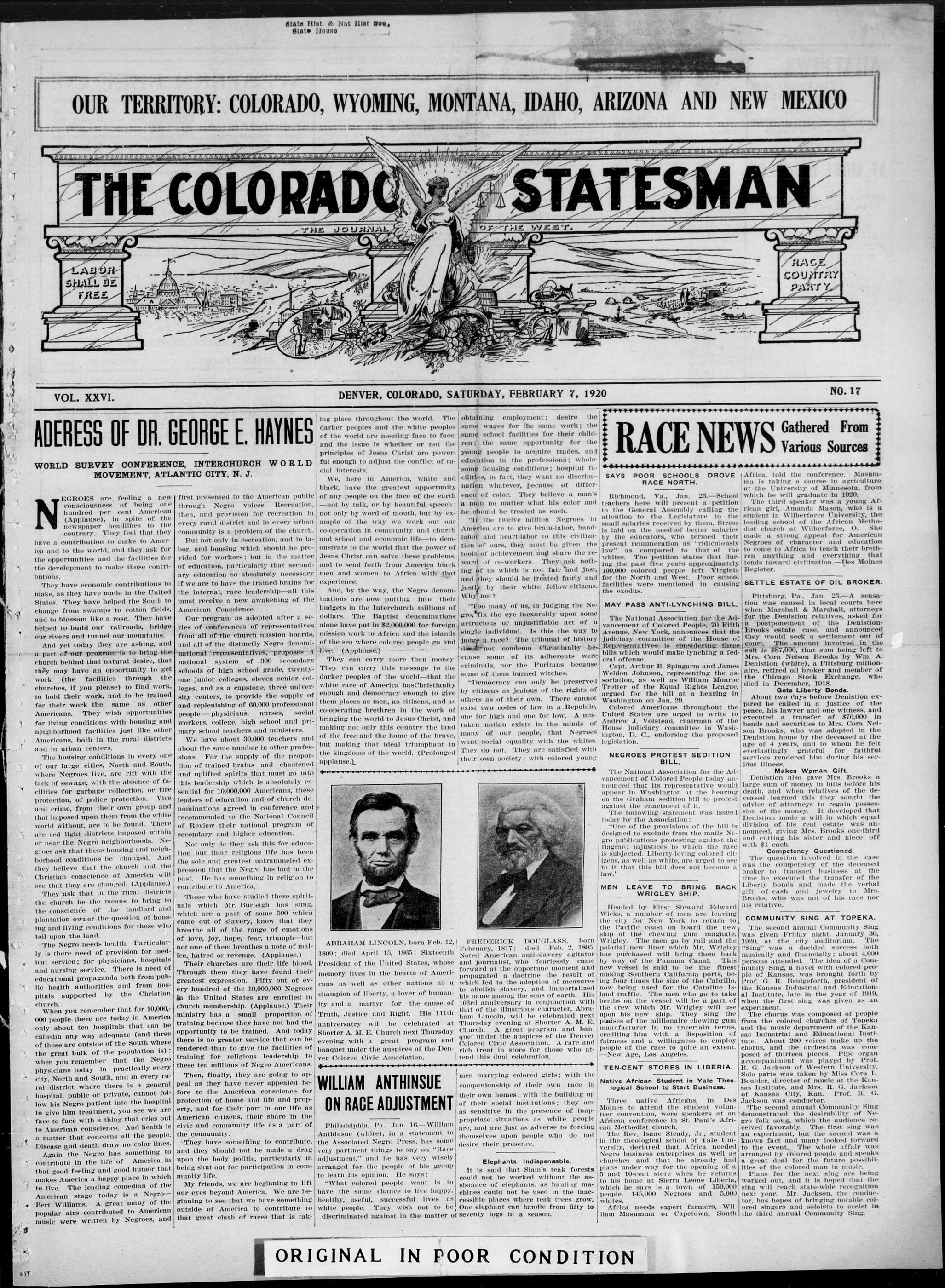
ABRAHAM LINCOLN, born Feb. 12, 1809; died April 15, 1865; Sixteenth President of the United States, whose memory lives in the hearts of Americans as well as other nations as a champion of liberty, a lover of humanity and a martyr for the cause of Truth, Justice and Right. His 111th anniversary will be celebrated at Shorter A. M. E. Church next Thursday evening with a great program and banquet under the auspices of the Denver Colored Civic Association.
WILLIAM ANTHINSUE ON RACE ADJUSTMENT
WILLIAM ANTHINSUE ON RACE ADJUSTMENT
Philadelphia, Pa., Jan. 16.—William Anthiusse (white), in a statement to the Associated Negro Press, has some very partiment things to say on "Race adjustment," and he has very wisely arranged for the people of his group to learn his opinion. He says:
"What colored people want is to have the same chance to live happy, healthy, useful, successful lives as white people. They wish not to be discriminated against in the matter of
GINAL IN PO
obtaining employment; desire the same wages for the same work; the same school facilities for their children; the same opportunity for the young people to acquire trades, and education in the professions; wholesome housing conditions; hospital facilities, in fact, they want no discrimination whatever, because of difference of color. They believe a man's a man no matter what his color and he should be treated as such.
"If the twelve million Negroes in America are to give brain-labor, hand-labor and heart-labor to this civilization of ours, they must be given the tools of achievement and share the reward of co-workers. They ask nothing of us which is not fair and just, and they should be treated fairly and justly by their white fellow-citizens. Why not?
"Too many of us, in judging the Negro, fix the eye inexorably upon some actrocious or unjustifiable act of a single individual. Is this the way to judge a race? The tribunal of history does not condemn Christianity because some of its adherents were criminals, nor the Puritans because some of them burned witches.
"Democracy can only be preserved by citizens as jealous of the rights of others as of their own. There cannot exist two codes of law in a Republic, one for high and one for low. A mistaken notion exists in the minds of many of our people, that Negroes want social equality with the whites. They do not. They are satisfied with their own society; with colored young
FREDERICK DOUGLASS, born February, 1817; died Feb. 2, 1805. Noted American anti-slavery agitator and journalist, who fearlessly came forward at the opportune moment and propagated a doctrine the result of which led to the adoption of measures to abolish slavery, and immortalized his name among the sons of earth. His 103rd anniversary in conjunction with that of the illustrious character, Abraham Lincoln, will be celebrated next Thursday evening at Shorter A. M. E. Church. A great program and banquet under the auspices of the Denver Colored Civic Association. A rare and rich treat in store for those who attend this dual celebration.
men marrying colored girls; with the companionship of their own race in their own homes; with the building up of their social institutions; they are as sensitive in the presence of inappropriate situations as white people are, and are just as adverse to forcing themselves upon people who do not desire their presence.
Elephants Indispensable.
It is said that Siam's teak forests could not be worked without the assistance of elephants, as hauling machines could not be used in the inaccessible places where teak trees grow. One elephant can handle from fifty to seventy logs in a season.
RACE NEWS Gathered From Various Sources
SAYS POOR SCHOOLS DROVE
RACE NORTH.
Richmond, Va., Jan. 23.—School teachers here will present a petition to the General Assembly calling the attention to the Legislature to the small salaries received by them. Stress is laid on the need of better salaries by the educators, who termed their present remuneration as "ridiculously low" as compared to that of the whites. The petition states that during the past five years approximately 100,000 colored people left Virginia for the North and West. Poor school facilities were mentioned in causing the exodus.
MAY PASS ANTI-LYNCHING BILL.
The National Association for the Advancement of Colored People, 70 Fifth Avenue, New York, announces that the judiciary committee of the House of Representatives is considering three bills which would make lynching a federal offense.
Capt. Arthur B. Spingarm and James Weldon Johnson, representing the association, as well as William Monroe Trotter of the Equal Rights League, argued for the bill at a hearing in Washington on Jan. 29.
Colored Americans throughout the United States are urged to write to Andrew J. Volstead, chairman of the House judiciary committee in Washington, D. C., endorsing the proposed legislation.
NEGROES PROTEST SEDITION BILL.
The National Association for the Advancement of Colored People today announced that its representative would appear in Washington at the hearing on the Graham sedition bill to protest against the enactment of it.
The following statement was issued today by the Association:
"One of the provisions of the bill is designed to exclude from the mails N.Cro publications protesting against the flagrant injustices to which the race is subjected. Liberty-loving colored citizens, as well as white, are urged to see to it that this bill does not become a law."
MEN LEAVE TO BRING BACK
WRIGLEY SHIP.
Headed by First Steward Edward Wicks, a number of men are leaving the city for New York to return to the Pacific coast on board the new ship of the chewing gum magnate, Wrigley. The men go by rail and the palatial new liner which Mr. Wrigley has purchased will bring them back by way of the Panama Canal. This new vessel is said to be the finest making Southern California ports, being four times the size of the Cabrillo, now being used for the Cataline Island traffic. The men who go to take berths on the vessel will be a part of the crew which Mr. Wrigley will use upon his new ship. They sing the praises of the millionaire chewing gum manufacturer in no uncertain terms, crediting him with a disposition of fairness and a willingness to employ people of the race to quite an extent.—New Age, Los Angeles.
TEN-CENT STORES IN LIBERIA.
Native African Student in Yale Theo
logical School to Start Business.
Three native Africans, in Des Moines to attend the student volunteer convention, were speakers at an African conference in St. Paul's African Methodist church. The Rev, Isaac Steady, Jr., student in the theological school of Yale University, declared that Africa needed Negro business enterprises as well as churches and that he already had plans under way for the opening of a 5 and 10-cent store when he returns to his home at Sierra Leone Liberia, which he says is a town of 150,000 people, 145,000 Negroes and 5,000 whites. Africa needs expert farmers, William Masumma or Capetown, South
NO.17
Africa, told the conference, Masumma is taking a course in agriculture at the University of Minnesota, from which he will graduate in 1920. The third speaker was a young African girl, Amanda Mason, who is a student in Wilberforce University, the leading school of the African Methodist church at Wilberforce, O. She made a strong appeal for American Negroes of character and education to come to Africa to teach their brethren anything and everything that tends toward civilization.—Des Moines Register.
SETTLE ESTATE OF OIL BROKER.
Pittsburg, Pa., Jan. 23.—A sensation was caused in local courts here when Marshall & Marshall, attorneys for the Denistion relatives, asked for a postponement of the Denistion-Brooks estate case, and announced they would seek a settlement out of court. The amount involved in the suit is $87,000, that sum being left to Mrs. Cora Nelson Brooks by Wm. A. Denistion (white), a Pittsburgh millionaire, retired oil broker and member of the Chicago Stock Exchange, who died in December, 1918.
Gets Liberty Bonds.
About two days before Denistion expired he called in a justice of the peace, his lawyer and one witness, and executed a transfer of $70,000 in bonds and securities to Mrs. Cora Nelson Brooks, who was adopted in the Denistion home by the deceased at the age of 4 years, and to whom he felt everlastingly grateful for faithful services rendered him during his serious illness.
Makes Woman Gift.
Denistion also gave Mrs. Brooks a large sum of money in bills before his death, and when relatives of the deceased learned this they sought the advice of attorneys to regain possession of the money. It developed that Denistion made a will in which equal division of his real estate was announced, giving Mrs. Brooks one-third and cutting his sister and niece off with $1 each.
**Competency Questioned.**
The question involved in the case was the competency of the deceased broker to transact business at the time he executed the transfer of the Liberty bonds and made the verbal gift of cash and jewelry to Mrs. Brooks, who was not of his race nor his relative.
COMMUNITY SING AT TOPEKA.
The second annual Community Sing was given Friday night, January 30, 1020, at the city auditorium. The "Sing" was a decided success both musically and financially; about 4,000 persons attended. The idea of a Community Sing, a novel with colored people of Kansas, was brought forth by Prof. G. R. Bridgeforth, president of the Kansas Industrial and Educational Institute, late in the year of 1919, when the first sing was given as an experiment.
The chorus was composed of people from the colored churches of Topeka and the music department of the Kansas Industrial and Educational Institute. About 200 voices make up the chorus, and the orchestra was composed of thirteen pieces. Pipe organ accompaniment was played by Prof. R. G. Jackson of Western University. Solo parts was taken by Miss Cora L. Boulder, director of music at the Kansas Institute, and Mrs. R. G. Jackson of Kansas City, Kan. Prof. R. G. Jackson was conductor.
The second annual Community Sing demonstrated the desirability of Negro folk song, which the audience received favorably. The first sing was an experiment, but the second was a known fact and many looked forward to the event. The whole affair was arranged by colored people and speaks a great deal for the future possibilities of the colored man in music.
Plans for the next sing are being worked out, and it is hoped that the sing will reach state-wide recognition next year. Mr. Jackson, the conductor, has hopes of bringing notable colored singers and soloists to assist in the third annual Community Sing.
FOREIGN
Premier Lloyd George = about to of-
fer the miners a proposition that a
referendum of the 20,000,000 electors
of Great Britain be taken on the ques-
tion of the nationalization of the coal
mines.
The number of children attending
school in Vienna has dropped from
242,000 In 1910 to 195,000 In 1919 as a
result of malnutrition, according to a
survey made for the American Red
Crosses,
Col, Avaloff H, Bermonat, command-
er of the Russo-German forces which at
tacked Riga during the autumn of 1919,
has become insane and has been placed
in a madhouse, according to wireless
reports from Moscow,
Jules Guesde, the veteran Socialist
leader, backed by sixty-five members
of the chamber of deputies in France,
has Introduced a bill In the chamber
which would give women civil, politl-
enl and economic equality with men.
The list of Germans accused by the
allies of war crimes and whose extra-
dition Is to be demanded, J# headed
by former Crown Prince Frederick
William and several other sons of the
former German emperor. ‘The list has
been handed to Baron Kurt ven Lers-
ner, the German representative at
Paris,
Dr. Vieard, who is_ accompanying
former Premier Cleméneea on his
trip to Egypt, is quoted hy the Excel-
sior 4s saying the Itinerary will ine
elude Cairo, Khartoum, « trip up the
Nile and probably a visit to Syria,
Persia and India, Tt is also said the
former premier may visit: Japan be-
fore returning to France.
| Dog tewms from many parts of the
northland will start Mareh 17th, St,
Patrick's day, in the third annual 100:
mile, Hudson's Bay Dog Derby over
the snow trails between The Pas and
Sturgeon Landing and return, About
fifty teams may enter. A purse of $1
000 and a huge silver and gold enp will
be presented to the winning driver.
The cup, which stands over three feet
in height, was given by Frank Burns,
a Toronto sportsman.
The Oxford and Cambridge Univer-
sity athletic clubs are considering the
Invitation extended by the University
of Pennsylvania to enter teams in the
events at Philadelphia May 1. It is
‘believed they will send teams for the
mile and four-nile relay champion-
ships. ‘The combined clubs have in-
vited Pennsylvania to send a team to
England, and also Harvard and Yale
to send a Joint tenm in July for a ten-
event sports meet, similar to the meet
of 1911,
‘The Germans “have only arrived at
the vale of tears through which we are
forced to pass,” said Minister of Agri-
culture Braun in the Prussian diet in
connection with the food debate.
“Worse times are coming. ‘The masses
must be told that our only hope is in-
creased work.” ‘The minister then
made the startling announcement that
Germany soon would arrive at the
point where she would be unable to
buy anything abroad, but would be
wholly dependent upon Lome produc-
tion.
GENERAL
FE Rg, rare sa Sa Tas DEI OME ee
had opened a smoking room for women,
‘The manager said the “women drove
him to it.” He said he found giris were
smoking in the washroom, the boudoir
and even in the lobby
A widow, her four children and two
men were burned to death in a three:
story tenement house in Newark, N. J.
‘The fire started In the lower part of
the building, cutting off eseape by the
stairway. Members of three other
families Jumped from windows inte
nets held by firemen.
Five hundred Spanish liborers, sald
to be the vanguard of thousands await
ing opportunity to come to this coun
try, have arrived in New York from
Bordeaux and Corunna, ‘They dectared
that they had been attracted here by
stories of the scarcity of labor and
high wages,
Forty thousand Poles have applied
for passports for return to their native
country, according to word sent te
steamship agencies by the Polish con:
sulate in New York. ‘The message said
no more applications for passports will
be accepted until action can be taken
‘on those already received,
Sharp increases in premiums pald by
automobile — owners for — insurance
against theft and uecident are to be
announced shortly by the eastern con-
ference of the National Automobile
Underwriters, it was stated in New
York in insurance eireles. ‘The under
writers were sald to be wavering be:
tween an Increase of 40 per cent and
50 per cent.
Foreign seamen hereafter may have
their liquor with their meals while
their ships are docked in American
ports, according to announcement by
Assistant Secretary Shouse of the
treasury. After numerous foreign gov:
ernments had protested against the or
der sealing stocks of liquors on ships ir
American ports, the question was lal¢
before Attorney General Palmer, He
was said to have held it could not be
enforced except in the case of Ameri
can owned ships.
_ Fire at Pittsburg destroyed fifteen
homes of Carnegie steel company em
ployés at Clairton and, according te
the police, seven bodies have been tak
en from the ruins.
Aliens are departing from Chicago
chiefly the steel mills district, at an
average rate of 300 a day, thereby cre
ating 2 labor problem that threatens
to become acute.
A bill providing for the granting of
statehood to the territory of Hawail
under qualifications to be determined
by Congress was introduced by Ha:
wallan Delegate Kalanianaole.
LATEST NEWS
EPITOMIZED
DE MOST INTEREST
ee ee
Governor Campbell has issued a call
for a special session of the Arizona
Legislature to convene Feb, 12th to
tonsider and ratify the suffrage
amendment to the constitutions of the
United States.
A gust of wind hurled Edward Skar-
ng, & mason, from the top of a smoke-
Mack 125 feet high at Milwaukee. A
rope on the inside of the stack broke
als fall, He landed at the bottom with
als legs fractured in two places.
Mayor Couzens’ $15,000,000 municipal
ownership street railway plin, Inelud:
ny use-of Henry Ford's gasoline street
mir, Was approved unanimously by the
Detroit City Counell and is now ready
for the vote of the people April 5th.
Nelson Blackhall, 82, was killed at
his home In Portland while taking a
both. He started to use an electric
tibrator while in the bathtub and doed
instantly. ‘The water apparently sent
the voluige of the vinrator Unouga
Blackhall’s body.
By a practically unanimous vote
Lincoln, Neb,, tuxpuyers at a special
election authorized the school board to
grant a uniform increase of $400 a
year to teachers In the public schools
Present salaries range from $967 in
the grades to $1,100 in the high school.
Seventeen of the leading wholesale
grocers of Chiengo have been indicted
by the federal grand jury on churges
of making illegal gains by profiteering
in sugar, Indictments bring up the
total of sugar profiteers caught in the
federal net to twenty-four and more
indictments are expected in a few days
WASHINGTON
Immoral motion picture films would
be barred from transportation in in-
terstate commerce, under a Dill
passed by the House and sent to the
Senate,
Former service men may reinstate
their war risk term Insurance at any
time before July 1, 1920, under a new
ruling of the bureau of war risk Insur-
ance, announced by Direetor Cholme-
ley-Jones.
War prosperity has doubled the de-
mand for precious stones. Ainerican
buyers of diamonds and pearls spent
$35,000,000 for gems with London ex-
porters in 1919, figures of the Com-
merce Department in Washington
show.
Repeal of the wartime act giving
the federal government control over
the price and distribution of wheat is
proposed in a bill Introduced by Chalr-
ian Gronna of the Senate agriculture
committee to which the mensure was
referred, Among other things the bill
would abolish the United States grain
corporation,
Operation of the railroads, Pullman
lines, express companies and water
ways, unified under federal control,
has ‘cost the nation approximately
$70,000,000, according to official eal-
culation, singe they were taken over
two years ago. MPignres made public
by the railroad administration re-
vealed a net loss of $594,200,000 from
railroad operation alone In the two-
year period,
‘The government nitrate plant at 'To-
ledo, Ohio, built at an estimated cost
of $20,000,000 could have been dupli-
cated, land and all, for $5,500,000,
Henry G, ‘Tyrrell, of New York, form-
erly an appraiser in the War Depart
ment, testified before a House war in-
vestizating committee.
‘The death rate in the United States
for 118 was the highest on record, ac-
cording to the census bureaw's annual
mortality statisties just issued, which
shows 1,471,867 deaths for the year,
representing a rate of eighteen per 1-
000 population in the death registration
area of thirty states and twenty-seven
cities with a total estimated population
of 81,868,104,
‘The Supreme Court, in petitions
filed, has been asked to review Fed?
eval Court deerees awarding judg-
ments for $600,000 against officials
ind members of the United Mine
Workers of America, in favor of eight
jndependent, non-union bituminous
coal companies in Arkansas, ‘The
lower court sustained charges that the
union engaged in a conspiracy in vio-
lation of the Sherman anti-trust act
to decrease the independent com-
panies’ production of coal,
Drastic reduction in the number of
national banks designated as govern-
ment depositaries Is being made by the
‘Treasury Department, with the result
than less than 400 of the 1,881 such in-
stitutions holding funds-on June 30,
1919, are expected to escape the prun-
ing knife, -
‘The Yederal government, it is esti-
mated, has collected Iegally. $40,000,-
000 in taxes In the calendar years 1918
and 1919, ‘This money 4s still in the
treasury and will not be repaid to the
taxpayers wntll Congress orders it thru
legislation
Pithy News Notes
From All Parts of
Colorado
held back the shipment of potatoes in
the Carbondale district, leaves hun-
dreds of tons.of the valuable tubers
still unmarketed,
‘The school board of Golden Is to be
asked to call a special election on the
question of voting bonds to the amount
of $130,000 for building a new high
school in Golden.
After deliberating twenty-five min-
utes, the jury in the case of Giacomo
Corriente at ‘Trinidad found him not
guilty of the murder of his brother,
Sam Corriente, on Oct, 21, 1919,
The Farmers’ Union is considering
erecting a flour mill at Rifle, A big
meeting held there brought out eighty-
two members and the determination to
build a mill seemed almost universal.
H. A. Gitz, a farmer near Monte
Vista, died, the vietim of the influenza
epidemic, which has caused Monte
Vista authorities to place a ban en all
public congreguting aud public amuse:
ments,
©. D, Jackson, station agent for the
Colorado, Wyoming & Eastern railroud
at Walden, has figured that 422 cars
of cattle and thirty-four cars of sheep
have been shipped from Walden, Te-
bron and LaRand, Colo, between Aug
Oth and Dee, 81st
‘The purchase of six locomotives from
the Colorado Midland railroad by the
Mexican government has heen completed
for a price reported to be $150,000. The
engines are to be delivered as soon as
possible for use on the federally oper
uted roads in Mexico, |
‘The government is now building a
splendid — road from "Phompsons,
Springs, Utah, to Moub, Utah, the lo-
cation of the recent oil strike, ‘The
road Is to cost $200,000 for the thirty:
seven miles when completed and will
be twenty-four feet wide on the fats,
eighteen on hillsides and sixteen feet
in deep cuts. It is being pushed rapid-
ly.
Sending his attendant on a false
pursuit by declaring another patient
had planned escape and had just fled
around a corner of the building as
they walked from the dining hall to
a ward, Don P. Blackwood, former
Denver lawyer, who was committed to
the state hospital for the insane last
month, escaped from the state institu
tion at Pueblo,
Denyer time will be set ahead one
hour on May 1 aw a result of the @ity
Council passing the daylight saying
ordinance on final reading. ‘The bill
carried by a vote of 6 to 3 and it Is
understood that Mayor Dewey C.
Bailey, who favors the move, will sign
the ordinance. Under the terms of
the ordinance the clocks will be
turned back to standard time Oct, 1.
Leon M. Hattenbach, member of the
Senate of the Colorado Assembly and
city industrial commisstoner, died at
the steering wheel of his automobile
while he was driving on Wadsworth
street, Jefferson county, coming to-
ward Denver, Mrs. Hattenbach and 9-
year-old son, Leon, Jr, were the only
other occupants of the car, Heart fail-
ure was said to he the cause.
‘The construction of the consolidated
School building at Monument will be-
xin with the coming of spring weather,
according to an announcement made by
the school directors at the office of
the county superintendent of schools.
Plans for the building are now being
drawn and the school board is prepar-
ing to advertise for bids on the build-
Ing contract in the near future,
A report comes from Cripple Creek
that the Lincoln Mining and Milling
Company, which recently opened a
large gold ore reduction plant there, is
how negotiating for the purchase of
the Cripple Creek Short Line railroad.
In the interest of better highways
and more attractions for tourists
movement ix under way to annex to
Pueblo county portions of Custer
county, in the vicinity of the Rye and
Beulah districts, It is said that Cus-
ter county favors ceding the district
to Pueblo county and ft is likely that
a DIM will be presented at the hext
Legislature changing the bounduries
of both counties,
Colorado National Guardsmen, who.
were called for federal service along
the Mexican border, may receive
claims against the federal government
totaling $175,000 as a result of Adjt.
Gen, William A. Spangler’s successful
efforts to have the cases reopened at
Washington, ‘The claims were origi-
nally disallowed, because of a misun-
derstanding, according to a message
received by the State Military Depart-
ment, which arose while the chief of
the claims bureau was in France.
‘The State Co-operative Crop Report-
ing Service, with the assistance of
county assessors, will endeavor to
make a much more complete report on
CENYENNIAL STATE ITEMS.
OO ee eae ee ee a ee 2
Dil be introduced in the next Leg’sin-
ture providing for the licensing of al.
threshermen and requiring them to
make reports each week during the
threshing season showing the sereaze
and production of all grain threshed
by them, ‘The form of measure gen-
erally favored ig one stinilar “to the
law now in effect in Michigan, which
hax proved very successful. Under
this no fee Is charged for the licensin
of threshermen, but they are required
to furnish Information regarding acre-
age and production of grain threshed
in Hen of paying a fee. ‘The State
Tinmigration Departinent now collects
through county assessors Information
showing the acreage devoted to each
crop, but accurate Information regurd-
ing production is not available;
‘The Inquiry made in January by the
Co-operative Crop Reporting Service
regarding the number and value of live:
stock on farms on January Ist, indi:
cates 1 decreuse in the number of beet
and range cattle, sheep and swine and
possibly slight Increases In the number
of dairy cattle, horses and mules, as
compared with the number of the vari:
ous classes of livestock on farms Jan
1, 1919, A decrease in the average
value per head of every class of live
stock ix indicated and apparently there
Will be rather a sharp decrease in the
total value of all livestoek on farms
iis compared with year azo
During the year 1919 Coloradoans
enjoyed more days of perfect sunshine
than the residents of any other suite in
the country, ‘There were 135 days on
which the sun shone brightly without
a cloud in the sky, necording to the of
ficial annual report issued by the Dene
ver branch of the United States weath-
er bureau. Only on eighty-four days
was the sun hidden from view for the
entire day, and on 146 days it was ob-
scured only # part of the thne, accord-
Ing to the report
August Speck, perhaps the first xet
tler in what is now North Park, who
went to that section forty-five years
ago, died at his home near Owl, Colo,
and his body was taken to Manches:
ter, Ia. for interment. Mr. Speck was
born in Germany ar Httle inore than
eighty-eight years ago, and went to
North Park Torty-five years ago, be
Ing engaged in sluice mining, He
shipped large quantities of gold from
time to time,
After drawing up # will providing
how his estate, amounting to several
thousand dollars, should be divided
and leaving Instructions as to his bur:
ial, Alfred T. Norman, 45 years old, a
veterinary inspector attached to the
United States bureau of animal indus:
try, committed suicide by shooting him-
self through the mouth in his room at a
Denyer hotel with a .2-caliber revol
ver. Death was instantaneous,
Hilary King, 27, was instantly killed
while hauling timber to his ranch, some
twenty-nine miles west of Colorado
Springs, near Divide. He lost his bal-
ance from the bumping of the wagon
on the frozen ronds and fell beneath
one of the rear wheels which crushed
out his life.
That there has been six times the
snowfall this season on the Poudre wa-
tershed than at this time last season is
the statement of Clem Duvall, caretsk-
or at the Laramie-Poudre tunnel which
penetrates the continental divide near
its crest und carries water from the
Laramie to the Poudre rivers,
Mining activities are reflected in the
planned erection in the San Juan min-
ing field at Little Deadwood gulch of
a fifty-ton mill early this spring. ‘The
Incas Mining Company ts financing the
building of the plant.
A few men are working steadily on
the new entry to the big coal mine at
Sunlight. Everyone is hoping that the
Colorado Midiand again will be oper-
ated and the output from the mines
will be much larger than ever,
‘Transfer to the permanent state
school fund of $600,900 worth of bonds
which haye been held in the public
school income: fund of Colorado for 1
number of years will make available,
under an agreement reached by of-
ficials of the state tand, school and
treasury departments, the sum of $100
yearly for distribution to the school
districts of the state until the entire
$600,900 has been converted into in-
come and apportioned to the counties,
‘The body of Steve Borad, cage ten-
der, was found at the bottom of the
shaft of the Sunnyside mine, near Sil-
verton, crushed almost beyond recos-
nition. No one knew of the accident
which is believed to have caused Bor-
ad's death until the discovery of the
body, It is supposed he lost his foot-
ing at the top of the shaft and fell in-
to the opening.
David Lloyd, age 19, a student in
AQT ATI CN
WESTERN BEE
4 A ABA .
Se ——
Open Daily to 880 p. m. One of the Most Up-to-
Date and Sanitary Mar
Sundays Until 2:00 p. ™. kets in the Oity.
ns ————r
Fresh Oysters, Chitterlings, Pig Tails, Snouts, Ears, Pigs Feet, Neck
‘Bones, Spars Hibs Received Fresh Daily.
Fresh and Cured Meats of All Kinds.. Fresh Vegetables, Staple and
Fancy Groceries.
Our Prices Are Always the Lowest
Free Delivery to All Parts of the City.
Phone Champa 1641.
2048 LARIMER STREET DENVER, COA.
Opposite the Three Rules,
Bolden Barber Shop
Baths, Electric
Massages
FIRST-CLASS SERVICE
R. B. BOLDEN, Proprietor 926 19th St., Denver
When You Want
‘The Heads, Feet, Tails, Snouts, Neckbones or Chiterlings, or
any other part of the hog except the squeal, go to
EAST’S MARKET
2300-6 Larimer Street Phone Main 1461
THE CHAMPA PHARMACY
TWENTIETH AND CHAMPA,
Is the place to get your
DRUGS, CHEMICALS AND PATENT MEDICINES
WE SERVE DRINKS.
PRESCRIPTIONS OUR SPECIALTY.
Phone us and we will deliver the goods to all parts of the city.
JAMES E. THRALL, Propr.
PHONE MAIN 2425.
MORRISON'S FAMOUS JAZZ ORCHESTRA
AND ENTERTAINERS
GEO. MORRISON, MANAGER
Music Furnished for all Occasions
Phone Main 2707. Res. 2947 Stout St. DENVER, COLO.
THE ATLAS DRUG COMPANY
COURTEOUS TREATMENT—RIGHT PRICES
Leaders in Prescription
Full Line of Plough’s Black and White Toilet Articles
2701 WELTON STREET MAIN 875
COP RO RBO DMO BOOBS DOD BBA BOOB OOD Dib Oo LRN oe ail
= JA Wonderful Hair Dressing and Grower
A Wonderful Hatr Dressing and Grower,
One Thovsand Agents Wanted. Good Mon:
ey Made. We want Agents in every city
and village to sel! THE STAR HAIR GROW-
ER. This is a wonderful preparation. Can
be used with or without straightening trons.
Sells for 25 cents per box—One 26-cent box
will prove its value. Ary person that will
luse a 25-cent box will be convinced. Ne mat-
tet what han failed to grow your hair, just
give TRE STAR HAIR GROWER a trial and
be convinged, Send 25 cents for a full size
box. If you wish to be an agent, send $1
land we will send you a full supply that you
Jean begin work at once; also agent's terms
Send all money by Money Order to
THE STAR HAIR GROWER, Mfr.
GREENSBORO, N. C. BOX 812
We Are
Always Ready
to serve nce with good
printing. No matter what
the nature of the job may
be we are ready to do it
at a price that will be
Satisfactory
e.
Some Time
You will be in need of
Bintang of some kind.
ether it be letter-
heads, statements wed-
ding Invitations or
public sale bills, re-
member we can turn
out the work at the
lowest cost consistent
with good work.
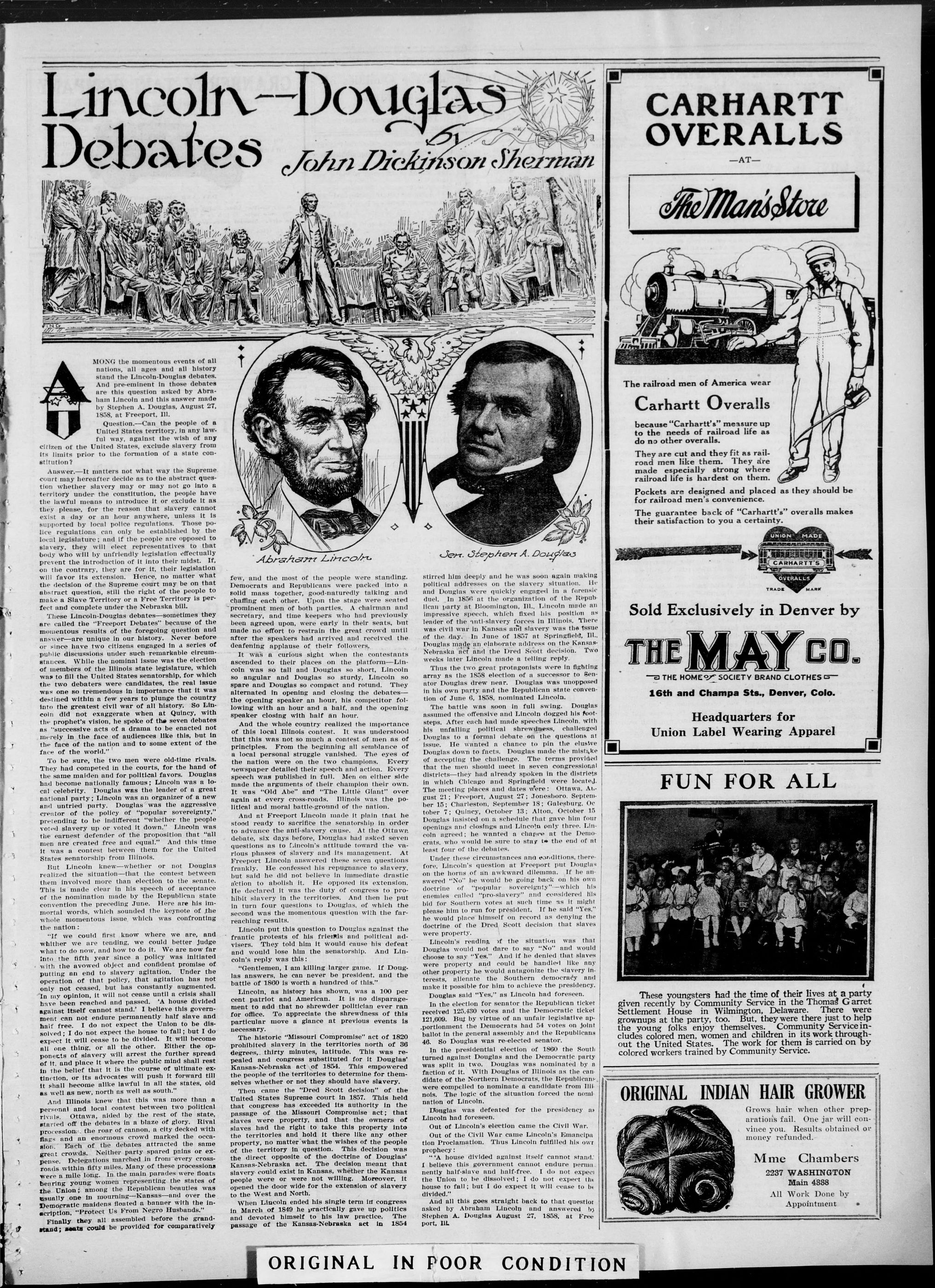
Lincoln--Douglas Debates John Dickinson Sherman
MONG the momentous events of all nations, all ages and all history stand the Lincoln-Douglas debates. And pre-eminent in those debates are this question asked by Abraham Lincoln and this answer made by Stephen A. Douglas, August 27, 1858, at Freeport, Ill.
A
Question.—Can the people of a United States territory, in any lawful way, against the wish of any citizen of the United States, exclude slavery from its limits prior to the formation of a state constitution?
Answer.—It matters not what way the Supreme court may hereafter decide as to the abstract question whether slavery may or may not go into a territory under the constitution, the people have the lawful means to introduce it or exclude it as they please, for the reason that slavery cannot exist a day or an hour anywhere, unless it is supported by local police regulations. Those police regulations can only be established by the local legislature; and if the people are opposed to slavery, they will elect representatives to that body who will be unfriendly legislation effectually prevent the introduction of it into their midst. If, on the contrary, they are for it, their legislation will favor its extension. Hence, no matter what the decision of the Supreme court may be on that abstract question, still the right of the people to make a Slave Territory or a Free Territory is perfect and complete under the Nebraska bill.
These Lincoln-Douglas debates—sometimes they are called the "Freeport Debates" because of the momentous results of the foregoing question and answer—are unique in our history. Never before or since have two citizens engaged in a series of public discussions under such remarkable circumstances. While the nominal issue was the election of members of the Illinois state legislature, which was to fill the United States senatorship, for which the two debaters were candidates, the real issue was one so tremendous in importance that it was nested within a few years to plunge the country into the greatest civil war of all history. So Lincoln did not exaggerate when at Quincy, with the prophet's vision, he spoke of the seven debates as "successive acts of a drama to be enacted not merely in the face of audiences like this, but in the face of the nation and to some extent of the face of the world."
To be sure, the two men were old-time rivals. They had competed in the courts, for the hand of the same maiden and for political favors. Douglas had become nationally famous; Lincoln was a local celebrity. Douglas was the leader of a great national party; Lincoln was an organizer of a new and untried party. Douglas was the aggressive creator of the policy of "popular sovereignty," pretending to be indifferent "whether the people voted slavery up or voted it down." Lincoln was the earnest defender of the proposition that "all men are created free and equal." And this time it was a contest between them for the United States senatorship from Illinois.
But Lincoln knew—whether or not Douglas realized the situation—that the contest between them involved more than election to the senate. This is made clear in his speech of acceptance of the nomination made by the Republican state convention the preceding June. Here are his immortal words, which sounded the keynote of the whole momentous issue, which was confronting the nation:
"If we could first know where we are, and whither we are tending, we could better judge what to do now, and how to do it. We are now far into the fifth year since a policy was initiated with the avowed object and confident promise of putting an end to slavery agitation. Under the operation of that policy, that agitation has not only not ceased, but has constantly augmented. In my opinion, it will not cease until a crisis shall have been reached and passed. 'A house divided against itself cannot stand.' I believe this government can not endure permanently half slave and half free. I do not expect the Union to be dissolved; I do not expect the house to fall; but I do expect it will cease to be divided. It will become all one thing, or all the other. Either the opponents of slavery will arrest the further spread of it, and place it where the public mind shall rest in the belief that it is the course of ultimate extinction, or its advocates will push it forward till it shall become allike lawful in all the states, old as well as new, north as well as south."
And Illinois knew that this was more than a personal and local contest between two political rivals. Ottawa, aided by the rest of the state, started off the debates in a blaze of glory. Rival processions: the roar of cannon, a city decked with flags and an enormous crowd marked the occasion. Each of the debates attracted the same great crowds. Neither party spared pains or expense. Delegations marched in from every crossroads within fifty miles. Many of these processions were a mile long. In the main parades were floats bearing young women representing the states of the Union; among the Republican beauties was usually one in mourning—Kansas—and over the Democratic maledicts floated a banner with the inscription, "Protect Us From Negro Husbands." Finally they all assembled before the grand-rabbit seats could be provided for comparatively
Abraham Lincoln
Sen. Stephen A. Douglas
ORIGINAL IN POOR CONDITION
few, and the most of the people were standing. Democrats and Republicans were packed into a solid mass together, good-naturedly talking and chaffing each other. Upon the stage were seated prominent men of both parties. A chairman and secretary, and time keepers who had previously been agreed upon, were early in their seats, but made no effort to restrain the great crowd until after the speakers had arrived and received the deafening applause of their followers.
It was a curious sight when the contestants ascended to their places on the platform—Lincoln was so tall and Douglas so short, Lincoln so angular and Douglas so sturdy, Lincoln so spare and Douglas so compact and rotund. They alternated in opening and closing the debates—the opening speaker an hour, his competitor following with an hour and a half, and the opening speaker closing with half an hour.
And the whole country realized the importance of this local Illinois contest. It was understood that this was not so much a contest of men as of principles. From the beginning all semblance of a local personal struggle vanished. The eyes of the nation were on the two champions. Every newspaper detailed their speech and action. Every speech was published in full. Men on either side made the arguments of their champion their own. It was "Old Abe" and "The Little Giant" over again at every cross-roads. Illinois was the political and moral battle-ground of the nation.
And at Freeport Lincoln made it plain that he stood ready to sacrifice the senatorship in order to advance the anti-slavery cause. At the Ottawa debate, six days before, Douglas had asked seven questions as to Lincoln's attitude toward the various phases of slavery and its management. At Freeport Lincoln answered these seven questions frankly. He confessed his repugnance to slavery, but said he did not believe in immediate drastic action to abolish it. He opposed its extension. He declared it was the duty of congress to prohibit slavery in the territories. And then he put in turn four questions to Douglas, of which the second was the momentous question with the far-reaching results.
Lincoln put this question to Douglas against the frantic protests of his friends and political advisers. They told him it would cause his defeat and would lose him the senatorship. And Lincoln's reply was this:
"Gentlemen, I am killing larger game. If Douglas answers, he can never be president, and the battle of 1860 is worth a hundred of this."
Lincoln, as history has shown, was a 100 per cent patriot and American. It is no disparagement to add that no shrewder politician ever ran for office. To appreciate the shrewdness of this particular move a glance at previous events is necessary. The historic "Missouri Compromise" act of 1820 prohibited slavery in the territories north of 36 degrees, thirty minutes, latitude. This was repealed and congress substituted for it Douglas' Kansas-Nebraska act of 1854. This empowered the people of the territories to determine for themselves whether or not they should have slavery.
Then came the "Dred Scott decision" of the United States Supreme court in 1857. This held that congress has exceeded its authority in the passage of the Missouri Compromise act; that slaves were property, and that the owners of slaves had the right to take this property into the territories and hold it there like any other property, no matter what the wishes of the people of the territory in question. This decision was the direct opposite of the doctrine of Douglas' Kansas-Nebraska act. The decision meant that slavery could exist in Kansas, whether the Kansas people were or were not willing. Moreover, it opened the door wide for the extension of slavery to the West and North.
When Lincoln ended his single term in congress in March of 1849 he practically gave up politics and devoted himself to his law practice. The passage of the Kansas-Nebraska act in 1854
Sen. Stephen A. Douglas
stirred him deeply and he was soon again making political addresses on the slavery situation. He and Douglas were quickly engaged in a forensic duel. In 1856 at the organization of the Republican party at Bloomington, Ill., Lincoln made an impressive speech, which fixed his position as leader of the anti-slavery forces in Illinois. There was civil war in Kansas and slavery was the issue of the day. In June of 1857 at Springfield, Ill., Douglas made an elaborate address on the Kansas-Nebraska act and the Dred Scott decision. Two weeks later Lincoln made a telling reply.
Thus the two great protugonists were in fighting array as the 1858 election of a successor to Senator Douglas drew near. Douglas was unopposed in his own party and the Republican state convention of June 6, 1858, nominated Lincoln.
The battle was soon in full swing. Douglas assumed the offensive and Lincoln dogged his footsteps. After each had made speeches Lincoln, with his unfailing political shrewdness, challenged Douglas to a formal debate on the questions at issue. He wanted a chance to pin the elusive Douglas down to facts. Douglas made the mistake of accepting the challenge. The terms provided that the men should meet in seven congressional districts—they had already spoken in the districts in which Chicago and Springfield were located. The meeting places and dates were: Ottawa, August 21; Freeport, August 27; Jonesboro, September 15; Charleston, September 18; Galesburg, October 7; Quincy, October 13; Alton, October 15. Douglas insisted on a schedule that gave him four openings and closings and Lincoln only three. Lincoln agreed; he wanted a chance at the Democrats, who would be sure to stay to the end of at least four of the debates.
Under these circumstances and conditions, therefore, Lincoln's question at Freeport put Douglas on the horns of an awkward dilemma. If he answered "No" he would be going back on his own doctrine of "popular sovereignty"—which his enemies called "pro-slavery" and considered his bid for Southern votes at such time as it might please him to run for president. If he said "Yes," he would place himself on record as denying the doctrine of the Dred Scott decision that slaves were property.
Lincoln's reading of the situation was that Douglas would not dare to say "No" and would choose to say "Yes." And if he denied that slaves were property and could be handled like any other property he would antagonize the slavery interests, alienate the Southern democracy and make it possible for him to achieve the presidency.
Douglas said "Yes," as Lincoln had foreseen.
In the election for senator the Republican ticket received 125,430 votes and the Democratic ticket 121,609. But by virtue of an unfair legislative apportionment the Democrats had 54 votes on joint ballot in the general assembly and the Republicans 46. So Douglas was re-elected senator.
In the presidential election of 1860 the South turned against Douglas and the Democratic party was split in two. Douglas was nominated by a faction of it. With Douglas of Illinois as the candidate of the Northern Democrats, the Republicans were compelled to nominate a candidate from Illinois. The logic of the situation forced the nomination of Lincoln.
Douglas was defeated for the presidency as Lincoln had foreseen.
Out of Lincoln's election came the Civil War.
Out of the Civil War came Lincoln's Emancipation Proclamation. Thus Lincoln fulfilled his own prophecy:
"A house divided against itself cannot stand; I believe this government cannot endure permanently half-slave and half-free. I do not expect the Union to be dissolved; I do not expect the house to fail; but I do expect it will cease to be divided."
And all this goes straight back to that question asked by Abraham Lincoln and answered by Stephen A. Douglas August 27, 1858, at Freeport, Ill.
CARHARTT OVERALLS
The railroad men of America
Carhartt Ove
because "Carhartt's" meets to the needs of railroad do no other overalls.
They are cut and they fit road men like them. They made especially strong railroad life is hardest of.
Pockets are designed and for railroad men's conver
The guarantee back of their satisfaction to you
Sold Exclusive
THE M
THE HOME OF SOCI
AT
The Man's Store
railroad men of America wear
Carhartt Overalls
because "Carhartt's" measure up
to the needs of railroad life as
no other overalls.
they are cut and they fit as rail-
oad men like them. They are
made especially strong where
railroad life is hardest on them.
ockets are designed and placed as they should be
for railroad men's convenience.
the guarantee back of "Carhartt's" overalls make
their satisfaction to you a certainty.
UNION MADE
CARHARTT'S
OVERALLS
TRADE MARK
old Exclusively in Denver b
THE MAY CO
THE HOME OF SOCIETY BRAND CLOTHES
16th and Champa Sts., Denver, Colo.
Headquarter
Union Label W
FUN F
These youngsters had to
given recently by Community
Settlement House in Wilmi
grownups at the party, too.
the young folks enjoy them
cludes colored men, women a
out the United States. The
colored workers trained by Co
ORIGINAL INDIA
Headquarters for Union Label Wearing Apparel
FUN FOR ALL
These youngsters had the time of their lives at a recently by Community Service in the Thomas Clement House in Wilmington, Delaware. There groups at the party, too. But, they were there just to young folks enjoy themselves. Community Service colored men, women and children in its work the United States. The work for them is carried by workers trained by Community Service.
ORIGINAL INDIAN HAIR GROW
THE FIRST YEAR OF THE NEW YORK KINDERGARTEN.
These youngsters had the time of their lives at a party given recently by Community Service in the Thomas Garret Settlement House in Wilmington, Delaware. There were grownups at the party, too. But, they were there just to help the young folks enjoy themselves. Community Service includes colored men, women and children in its work throughout the United States. The work for them is carried on by colored workers trained by Community Service.
ORIGINAL INDIAN HAIR GROWER
N
---
Man's Store
a wear
ralls
sure up
life as
as rail-
they are
where
them.
d placed as they should be
science.
"Carhartt's" overalls makes
certainty.
UNION MADE
CARHARTT'S
OVERALLS
TRADE MARK
ly in Denver by
AY CO.
TY BRAND CLOTHES
FOR ALL
the time of their lives at a party
Service in the Thomas Garret
ington, Delaware. There were
But, they were there just to help
selves. Community Service in its work through-
work for them is carried on by
community Service.
N HAIR GROWER
Grows hair when other preparations fail. One jar will convince you. Results obtained or money refunded.
Mme Chambers
2237 WASHINGTON
Main 4888
All Work Done by
Appointment
THE COLORADO STATESMAN
LABOR SHALL BE FAKE
GRACE COURTINI PARTY
JOS. D. D. RIVERS ..... Proprietor
P. O. Box 116 Phone Main 7417
Entered as second-class matter at the postoffice in the City of Denver, Colo.
Reading notices, ten lines or less, 15 cents per line. Each additional line over ten lines, 10 cents per line. Display advertising 75 cents per inch for first insertion and 50 cents per inch for each additional insertion.
Remittances should be made by Express Money Order, Postoffice Money Order, Registered Letter or Bank Draft. Postage stamps will be received the same as cash for the fractional part of a dollar. Only 1c and 2c stamps taken.
No discounts allowed on less than three months' contract. Cash must accompany all orders from parties unknown to us. Further particulars on application.
Communications to receive attention must be newsy, upon important subjects, plainly written only upon one side of the paper, must reach us Tuesdays, if possible, anyway not later than Wednesdays, and bear the signature of the author. No manuscript returned, unless stamps are sent for postage. All communications of a personating nature that are not complimentary will be withheld from the columns of this paper.
THIS WAY OUT.
IT IS commonly asserted and the iden is generally entertained that the people of our race owe an EVERLASTING DEBT OF GRATITUDE to the white man—first, for bringing us here by way of our ancestors, then making us slaves to show their kind appreciation of us, following this up with the charitable and Christian role of emancipating us, thereby giving us a mocked political freedom which saves us from the physical serfdom, but enhances the mental slavery, resulting in the anguish that makes us conclude from the abundance of practical proofs that we must be satisfied with what-ever falls to us from "the master's table," and we dare not murmur or we will be deprived of the half-of-loaf.
Now, we have been told that the greatest weapon that any people can possess is THE BALLOT, and we make bold to certify that any time the race to which we belong uses it effectively, acting together as a whole, we either gain our objective or pave the way to success by putting the enemy out of commission. This year, 1920, is presenting to us a condition that is demanding A WAY OUT, and Negroes, like any other citizens, are not bothering about the hideous past, coupled with its unfair treatment, its one-sided administration and dispensing of law, its marked prejudicial turn in doling out to them the insignificant, non-representative jobs where the basement or the attic sphere compensates them for their days and nights of arduous toil; their putting up with insults and denouncements for supporting party or individual, but are determined to be heard, to be seen in the daytime as well as twilight, if the ballot wins them the recognition, and as Mr. William Anthinsue (white) of Philadelphia says in his article which we reproduce on our front page, and which we mean to assert, "They (the Negro) want no discrimination whatever because of difference in color. They believe a man's a man no matter what his color, and he should be treated as such." We are staunch supporters of Republican party politics, and have been for nearly half a century, thirty years of which we have been advising, instructing and encouraging our people—the party, the party. Negroes, like white people, change, sometimes the result of vexation after deception has been practiced upon them, but whether the political party be Republican or Democrat the Negro has resolved at last to die, individually as well as collectively, not necessarily at the point of the sword or the noose of a rope, as he is fully conversant with that order of action, but to fight with the ballot to champion his civil rights through the members of his race, who are mentally, morally and financially equipped, and will begin right here in Denver to say to the state leaders and city politicians with our ever-increasing army of voters, better treatment, better positions (if we are mentally qualified), and forget the dark, shady appearance for which we are irresponsible, giving us a share as American citizens, unhyphenated and uncontaminated, or, without any threat or intention to scare, we who are not "state Democrats and national Republicans" and who comprise the majority of electors will, with sealed lips and deaf ears to the pleading which must come, hang out the sign, "THIS WAY OUT!"
LINCOLN-DOUGLASS CELEBRATION
THE records show February 12, 1809, the birth of Lincoln, the immortal, and sometime during the month of February, 1817, between the 14th and 18th, the birth of Frederick Douglass, the noted American anti-slavery agitator.
In celebrating the one hundred and eleventh anniversary of Lincoln, and the one hundred and third of Douglass, we feel deeply grateful for the lives of these two great men—the one becoming more famous as time rolls on, the passing years attesting his wise statesmanship which now as then is required to preserve the Union and which must bring men to a realization of cheerful obedience to the constitution which provides liberty and protection for all citizens who have been privileged to live under the starry banner of the U. S. A.; the other winning recognition for his fearlessness in championing the abolition of slavery, and his life furnishing an inspiration for every colored boy whose cause must be identified with the common cause of the nation for the bringing about of the greatest good to all the people inhabiting this land.
Every real American is familiar with the fifty-six years of life of the Great American President, and he can rightly be styled "the immortal" when the memory of those words of his famous declaration can never pass away: "A house divided against itself cannot stand. I believe this country cannot endure half slave and half free. I do not expect the house to fall, but I do expect it will cease to be divided." Again this man of the late century proved himself the possessor of a wonderful vision, pointing out the path of national safety, when he said: "Teach reverence and obedience to the Constitution and laws of our country and we are safe; otherwise there's danger ahead." If our PROFITEERS would remember Lincoln and his economy, when after giving a very sound advice he summarized in the following: "Teach economy, that is one of the highest virtues. It begins with saving money," they surely would reduce the present high prices and give us a chance to save a little money instead of spending all. Reviewing the great qualities of this American who has been blessed and will be blessed by generations for his executive ability and his administrative powers, it is a general opinion among our people that a more fitting celebration could not be thought of than what is planned by the Denver Colored Civic Association, in their event for Thursday, February 12th, where both characters, Lincoln and Fred Douglass, will share honors in the speeches on the first part of the program in the large auditorium of Shorter A. M. E. Church, and afterwards at the banquet on the same evening, when the illustrious Americans will be given the praise and honor due them for the noble part they have played in preserving the peace and harmony of the nation, and for the abolition of that most unworthy and uncivilized institution—SLAVERY. Lincoln-Douglass—two names that any American can be proud of, are indelibly stamped on the hearts of the real American for the respective parts they played in the nation's history, and in representing this country in the capacity of Minister to Haytian, Douglass, to a great extent, ameliorated conditions between the Haitians and Americans, resulting in better trade relationship. Seeing, therefore, that we have the good fortune of pointing with pride to two eminent standards of Americanism, whose words and deeds stand out conspicuously in the history of not only our nation but the world, let us endeavor by consistent and upright manhood to emulate the glorious leaders who have gone before, leaving a legacy which when all mankind shall be the recipient thereof, the world will be better off, as man shall have met his fellow man on common ground and acknowledge the fraternity, as ordered by creation and approved by our national bond. That this celebration will be so impressive as to cause us to re-dedicate ourselves to the great institution of liberty, is the hope of The Colorado Statesman, and at this time when the test is being applied as to those who can be relied upon as the able supporters of the constitution, the real subscribers to good government, may the people, the race, the ever-ready and willing portion of the population that we are members of, be ready to advocate the cause of RIGHT AND JUSTICE.
By GEN. CURIERES DE CASTELNAU, French Army. I have no hesitancy in asserting that the military forces of the United States of America contributed very largely by their splendid display of valiance, efficiently directed, to the final supreme triumph of right and liberty.
A. M.
During the war I gained an intimate first-hand knowledge of the American fighting man's qualities. My personal admiration for him is only equaled by my professional respect. I know him as only a commanding general knows his men.
From the moment the American soldier first met the enemy until the very end, he displayed the most remarkable individual courage. His magnificent spirit in battle was invincible. Officers and enlisted men rivaled each other in bravery, coolness, energy, tenacity and the spirit of self-sacrifice.
After once seeing the American army in action, we were impressed that, had our confidence in victory needed a stimulant, the presence of our transatlantic comrades would have been sufficient to assure us of the inevitable victory.
Whenever troops show such splendid soldierly qualities as displayed by the Americans as individuals—and it is on the individual soldier that the general, in the last analysis, counts for success—all hopes are justifiable, all strategic and tactical plans are feasible and success is inevitable.
Military Policy of the American Legion as Set Forth in Resolutions.
FIRST ANNUAL CONVENTION AT MINNEAPOLIS
That a large standing army is uneconomic and un-American. National safety with freedom from militarism is best assured by a national citizen army based on the democratic and American principles of the quality of obligation and opportunity for all.
We favor a policy of universal military training, and that the administration of such policy shall be removed from the complete control of any exclusively military organization or caste.
We are strongly opposed to compulsory military service in time of peace.
We have had a bitter experience in the cost of unpreparedness for national defense and the lack of proper training on the part of officers and men, and we realize the necessity of an immediate revision of our military system and a thorough housecleaning of the inefficient officers and methods of our entire military establishment.
We favor a national military system based on universal military obligation, to include a relatively small regular army and a citizen army capable of rapid expansion sufficient to meet any national emergency, on a plan which will provide competitive and progressive training for all officers, both of the regular army and of the citizen forces.
We believe that such military system should be subject to civil authority.
Any legislation tending toward an enlarged and stronger military caste we unqualifiedly condemn.
The national citizen army, which should and must be the chief reliance of this country in time of war should be officered by men from its own ranks and administered by a general staff on which citizen-soldier officers and regular army officers shall serve in equal number.
We recommend that congress pass such legislation as will make the United States air service a separate and distinct department of our system of national defenses under control of a member of the president's cabinet appointed for that purpose alone.
We favor the continuance of training camps for the training and education of officers to serve in case of national requirement.
We recommend that military training in high schools and colleges be encouraged.
The national citizen army should be organized into corps, divisions, and smaller units, composed in each case of officers and men who come from the same state or locality, and preserving local designations as far as practicable.
The national citizen army should be trained, equipped, officered, and assigned to definite units before, rather than after, the commencement of hostilities.
The selection and training of men for the national citizen army should be under the local control and administration of its own officers, subject to general national regulations.
Both the Native-Born and Immigrant Have Their Duties to America.
By SENATOR W. S. KENYON of Iowa
The alien cannot Americanize himself. He can never become assimilated if he is shunted off into a shanty town. He cannot be Americanized with a club. There is more hope in a handshake than in profit-sharing.
There is a growing need for America to Americanize itself; for each individual to stop shifting the blame onto others and depending on some one else to put our house in order. The immigrant has his duty to America and he must be made to discharge it. The native-born has his duty and he must search his own heart to see if there are any roots of the trouble there. If we could only control our greed, our avarice, our quick prejudice and passion and pull together for the general welfare of our country, what a nation this would be! America means more than stocks and bonds, and churches and schools and farms and stores. It means a great ideal of justice for all men. A man who cannot be just whether with his employee or with his employer is not a true American.
The ship of state is sailing through pretty troublesome seas, but it is a mighty sturdy old ship. It will weather the storms. -It will pull through every crisis. It is a time for aroused conscience and determination of all our people to enthrone justice in their own hearts and then do what they can to assist others. We are engaged now in much talk of helping the world. We can help it by giving to the world a high example of justice and fraternity, and in so doing many of our industrial problems will be solved
---
PHONE
CHAMPA
87
PHONE
CHAMPA
5969
RATES:—Per hour, $3.00; one-mile radius, 50c; one-mile, 2 passengers, 75c; one mile, 3, 4, 5 or 6 passengers, $1.00. Each additional mile, 25c in city. Special rates for long trips, or by the day, week or month.
G. CRABBERRY, Proximist
DENVER, COLORADO
The Cammel Undertaking Co.
Consult us; we can save you time, worry and money.
Two expert embalmeries, lady and gentleman, are available for a funeral director.
IN UNION THERE ARE INCORPORATED for $15,000, under the laws of the State of Colorado; are preparing to establish a manufacturer plant in connection with their present business, in order to supply the various branch offices which they are establishing in each city in the State where the population will warrant. They have some stock on sale yet. For full particulars, call or write—E. V. CAMMEL, President. 2418 Welton Street, Denver, Colo.
R. L. Norman
CHAS. TROTTER R. L. Norman Telephone York 4561 INDUSTRIALREALTYCO.
SALES, RENTALS, INVESTMENTS AND EMPLOYMENT 716 East 26 Avenue DENVER, COLORADO
716 East 26 Avenue
Hunt's CASH-CARRY
Groceries---Meats
Fresh Fruits and Vegetables
Phone 3522 Champa 2962 Welton St.
DOUGLASS UNDERTAKING CO.
Funeral Notices
Arrington, Thomas, 56 years; beloved brother of William Arrington, 233 Twenty-fourth street, departed this life Feb. 1st. Funeral services were held at 2 p. m. Tuesday, Feb. 3rd, from Shorters Chapel, under the auplices of Rocky Mountain Lodge No. 1, F. and A. M. Interment Riverside.
Elmer J. Shuff, Colorado
Trip Rep. of the State of Colorado
To the Defendant Above Named —
Greeting:
You are hereby required to appear
in an action brought by you,
the Plaintiff, in the
District Court of the City and County of
Denver, State of Colorado, and answer
the complaint therein within thirty
days after the service thereof, if
as served within this State; or within
fifty days after the service thereof, if
served personally outside the State of
Colorado; or, if served
personally from the date of the
last publication; or trial will be had
the same as though you were present.
For employment see the Industrial
Reality Co. Employment Agency, 716
East Twenty-sixth Ave. York 4561.
Nicely furnished rooms for rent at
516 24th street.
SCOTT'S OFFICIAL HISTORY OF
THE AMERICAN NEGRO IN THE
WORLD WAR. THE COLORADO
STATESMAN, EXCLUSIVE AGENTS,
Room 25, 1824 Curtis St., Denver, Colo.
P. O. Box 116.
This is an action brought by the grounds of extreme and repeated acts of cruelty; that defendant be restrained from in any manner interfering with plaintiff's rights; that relief as may seem to the Court just and equitable from the complaint, a copy of which is hereunto attached, and the evidence adduced upon the trial.
E. P. BLAKEMORE, Attorney and Counsellor at Law, Office, Rooms 39 and 40 Arapahoe Bldg., 1622 Arapahoe Street. Phone Champa 5450.
Witness, W. A. Dollison, Clerk of our said Court, with the seal thereof hereunto affixed, at office, of the Court, this 19th day of January, A. D. 1820.
W. A. DOLLISON,
(Seal)
By R. E. BABCOCK,
Deputy Clerk
E. P. Blakemore, Attorney for Plain
Some Moniker!
Speaking of names, as the Nomad has been in recent issues, we once read of an English baby being christened "Actsoftheapostles Kennett." Which is some moniker, you'll admit. No doubt it was considerably abbreviated later, and it is not difficult to imagine the lad's mother exclaiming in a moment of exasperation: "Actso, how can you act so?"
Magellan's Famous Voyage.
On the 27th of November, in 1520, Ferdinand Magellan, the Portuguese navigator, entered the Pacific ocean through the straits which bear his name. He navigated the ocean for three months and twenty days without finding a single island. During the voyage the weather was so fair continually that he gave the ocean the name of Pacific.
Michaelson's EXPANSION SALE
Our Hobby
Is Good
Printing
Ask to see samples of our business cards, visiting cards, wedding and other invitations, pamphlets, folders, letter heads, statements, shipping tags, envelopes, etc., constantly carried in stock for your accommodation.
Get our figures on that printing you have been thinking of.
New Type, Latest Style Faces
More room needed to accommodate the many who demand Michaelson values—which tells the story by which you should profit. In every department in the store special values this week. 15TH AND LARIMER STS.
Miss Ida Gay was confined to her bed with la-grippe last week.
Addison O'Neal arrived from Portland, Oregon, to attend the funeral of his mother.
Mr. and Mrs. Wm. Gibson of 3230 Gilpin street are both on the sick list this week.
return at an early date would find large if not larger response from public. In an expression, IT WVERY GOOD.
THE DENVER COLORED CIV ASSOCIATION HAS completed all rangements for the Big Lincoln-Do lss Celebration and Banquet at Sho er A. M. E. Church, Thursday, Feb.
Attorney E. P. Blakemore left for Colorado Springs this week on professional business.
Mrs. Nellie Washington and children, Isabell and Herman, leave the last of this week for California.
Mrs. E. L. Holman and daughter Ernestine leave tomorrow for a few months' visit at Long Beach, Calif.
Miss Oressa McCullough, who underwent an operation for appendicitis Jan. 17, returned to her home last Friday.
Miss Odessa L. McCullough will be in the city for an indefinite stay, her school being closed on account of the flu.
Mrs. John Shorts of 1525 East Thirtieth avenue is in poor health. A speedy return to health is our wish.
Miss Oressa McCullough wishes to thank her many friends for the beautiful flowers and other kind remembrances shown toward her during her illness.
Miss Ruby Dobbs, who has been visiting her aunt in Luchare, Wis., arrived in the city last Saturday and is at home with her mother, Mrs. L. Dobbs of 2108 Lafayette street.
Mrs. R. J. Von Dickersohn of 2312 Humboldt street still continues to improve. Her daughters, Miss Elsie of Chicago and Mrs. F. H. Graham of Burlington, Iowa, are with her.
Mr. and Mrs. Morris Campbell were in the city this week from their ranch near Vallery, Colo. They were pleasant callers at our office.
Mrs. Lillian Sherman Hoyt of Philadelphia and New York was in the city last week and the earlier part of this week. She is a traveling maid to one of the star actresses of the Orpheum circuit.
Mr. Charles A. Harris and Miss Kate White were quietly married at the parsonage of the M. E. Church by Rev. R. A. Taylor at Castle Rock, Colo.
Mrs. Grace Helms and Mr. Thomas Denby were united in marriage Thursday, Jan. 22, at the home of the bride's sister, Mrs. Jerry Stone, 2422 Lafayette street. Rev. Wm. H. Thomas officiated.
It is with much regret we record the death of Mrs. Noah O'Neal, late of 2220 Clarkson, who died last week, Thursday, and was buried Tuesday, Feb. 3rd, from the Central Baptist Church. The deceased was a resident of Denver for several years and was very active in church and secret societies. She was very much respected in the community and the Colorado Statesman extends its deepest sympathy to Mr. O'Neal and son Addison over their loss.
F. W. Perkins of 608 Twenty-eighth street, commander of the Wallace Simpson Post No. 5, American Legion, became seriously ill and had to be taken to the military and naval hospital at Aurora last Thursday. Mr. Perkins having served his country in the navy for a number of years, and having been retired on account of disability, comes in for the provision made by the government for war sufferers. We wish him a speedy restoration to good health.
THE NOVELTY CONCERT AND DANCE at Fern hall last Thursday evening in which Miss Bessie La Belle, special lady baritone, featured, assisted by Miss Ida Howard, pleasing lyric soprano, and Charles Marshall, youngest comedian of the race, merited its name, as the consensus of opinion of the 300 and more spectators places this entertainment in a class by itself. Miss Rhoda Chambers at the piano and the Morrison famous Jazz orchestra contributed to the evening's success and a
return at an early date would find as large if not larger response from the public. In an expression, IT WAS VERY GOOD.
THE DENVER COLORED CIVIC ASSOCIATION HAS completed all arrangements for the Big Lincoln-Douglass Celebration and Banquet at Shorter A. M. E. Church, Thursday, Feb. 12, at 8 p. m. An exceptionally brilliant program is arranged by entirely new home talent. Chaplain Collins and Attorney Carey will give the people of Denver most eloquent and soul stirring addresses. No ticket to banquet can be had after Feb. 10—$1.50 per plate.
Dress: As suits your inclination.
Big Lincoln Birthday celebration Feb. 12, 1920, Fern Hall. Special decorative features. Morrison's full orchestra. The grandest and biggest dance of the season. Billy Knight, Manager.
DR. RANSOM AT SHORTER A. M. E
CHURCH.
Dr. Ransom, a candidate for bishop from the Fifth Episcopal District, gave his version of "The Negro in the New Era," which was listened to by a large and appreciative audience. We have been privileged to hear a number of our ministers and laymen on this question, and while there may be some differences regarding systems and methods to be adopted that will be most beneficial, yet fundamentally there is a similarity as to organization among us. If the spirit to overcome the ills that surround us by the methods that will be highly commendable be our course of action, we in a comparatively short time will win the recognition we long for.
BOY SCOUTS TENTH ANNIVERSARY.
February 8-14 will mark a Red Letter Event in the history of our BOY SCOUTS, as the biggest and most significant celebration of its kind held in the world will herald the Tenth Anniversary of this noble institution. This being one of the organizations of the nation where OUR BOYS are making an impression that we trust will not be effaced, and further will enlist the sympathy of our parents and our men to do real constructive work in our community, we sincerely hope that more than a passing interest will attend the activities of this anniversary, and that the call for more scoutmasters will be heeded and the power of this institution be felt throughout the world.
CAMPBELL A. M. E. CHURCH IN DRIVE FOR PIPE ORGAN AND GENERAL RENOVATION OF EDIFICE.
The Rev. I. S. Wilson and his faithful band of workers are moving on a scale that all dignified church workers heartily approve. After burning the mortgage on the church building recently the members decided to beautify as well as improve the music of their organization, and therefore started in a drive to accomplish the same. With a leader of such noble qualities and determination to succeed as the Rev. Wilson, backed up by an organist and director as Mrs. Clark Craig and ably supported by a congregation as Campbell's, there is every reason to behold success in the near future.
DEATHS AND FUNERALS.
The Cammel Undertaking Co
O'Neal—Mrs. Ella O'Neal, the beloved wife of Mr. Noah O'Neal, and mother of Mr. Addison O'Neal, departed this life at her residence, 2220 Clarkson street, Thursday, Jan. 29. The funeral services were held Tuesday, Feb. 3, 1920, from Central Baptist Church, the Rev. P. J. Price officiated, Interment, Fairmount. Tawater—Mr. George Tawater departed this life Wednesday, Feb. 4, at his late residence, 2319 Champa street. Funeral notice later.
SHORTER CHAPEL NOTES.
11:00—Special sermon to the Boy
Scouts.
7:30—An evening with the Allen Christian Endeavor League. Thursday, Feb. 12—A Lincoln-Douglass memorial service will be rendered under the auspices of the Ctivic Association. An interesting program has been arranged.
CARD OF THANKS.
We gratefully acknowledge the expressions of sympathy of the many friends of Mr. Julius B. Ragsville during his illness and death, also the beautiful floral offerings sent for funeral, and specially thank the Rev. Thomas of Shorter Church, Mr. Clayton and Secretary Bell of Y. M. C. A. for their kind services.
MRS. SARAH FLETCHER,
JAMES B. GIST,
HEWETSON WATSON.
SENATOR HATTENBACH'S DEATH
A LOSS TO COLORADO
In the death of Senator Leon Hattenbach, Denver and Colorado have lost one of their native sons whose rise to civic prominence was purely by merit, and who, although cut off in the prime of his life when he was of great usefulness to his fellowmen has left a standard, yea a great example for others to follow and be guided by, especially those asciring for leadership. He died suddenly last Sunday afternoon, returning from Arvada with his wife and son in the automobile he was driving. He was well known by the colored population of a certain section of the city, they being among the regular patrons of his grocery store when he was in the business with his brother. In his capacity as law-maker for the state he never hesitated to support all measures favoring advantages to the people, as well as denouncing and thoroughly opposing anything discriminatory to our portion of the community and also against the welfare of the people. He is gone. A good man is no more. He did his best. PEACE BE TO HIS ASHES.
THOMAS W. ARRINGTON, POPU
LAB DENVER RESIDENT DIES.
After suffering for nearly two years with a terrible malady our friend of several years succumbed to the disease of cancer last Sunday and was buried on Tuesday from Shorter Church, where he was a member for many years. He was an employé of the railroad for a number of years and was very much liked by his employers and those he came in contact with. He bore his illness with fortitude and his friends who visited him during that time declare that his powers of endurance, patience, etc., were almost superhuman. Kind-hearted and very liberal in his tendencies he always found time for charitable work and was considered a friend of the poor by many. He leaves a brother who was very devoted in his attention to him during his illness and who remained with him until his death. The Colorado Statesman offers its sincere condolence to the bereaved relatives of the deceased.
"BON VIVANTS CLUB" EXTENDS
ITS HOSPITALITY TO FRIENDS.
The exclusive "Bow," after years of exclusiveness, decided to extend an invitation to a number of their friends, and Friday evening, January 30th, marked a special feature in the life of this social club when pleasure reigned supreme at their dance, and the season's gaiety from the winsome debutante to the charming matron seemed to vie with the choice decorations which included an electric fountain in the center of the ball room floor
Mr. George Gross is president of the club, and much praise was offered him and his co-workers for successfully carrying out what was characterized by the guests as one of the season's best events. The club promises another treat in the near future in which the management is determined to surpass itself.
Y. M. C. A. NOTES.
Plans for the great membership get-together and get-acquainted luncheon are progressing nicely, and it is expected that the time and place will be announced in the next issue of the NOTES. All things are now "looking good," and every one is happy. The membership is constantly growing. At the last writing the membership stood at 681. New members are as follows: 682 A. J. Lysie, Casper, Wyo. 683 Charles Meyers, 721 East 24th 684 Jarrel Odnus, 2358 Tremont. 685 C. L. Cohen, 2128 Larimer. 686 Theodore Morris, 3063 Welton. The number will be 700 before the end of the month. With another installment on the membership now due, the people are paying up splendidly. The board of directors and the local committee of management are both greatly pleased.
The large crowd that gathered in Fern hall last Sunday afternoon was an evidence of the interest displayed by the people in the work of the branch. It was too bad that they had to be disappointed. Dr. Kunitomo wired his regrets, and said that he had too many cases of influenza and could not possibly make it, but will be glad to come at a later date.
A splendid program has been prepared for tomorrow afternoon. Special instrumental music will be rendered by Mrs. M. E. Morrison. Good singing will be a feature. The address will be given by Rev. Dr. S. A. Stripling of Scott M. E. Church. The meeting will begin at 4 o'clock. Everybody will be welcome.
DR. L. BEATTY'S REMEDY.
My husband was a doctor
He manufactured a medicine called
The Great American Mystery.
The mystery was he cured all manner of diseases, and being one of the Negro race, I am now going to put it before the public.
He also had his circulars read among the Negro race and congregations, as he was a minister.
The Five Points Meat Co.
A Full Line of FreshMeats of the Very Best Quality at Prices You Cannot Beat in the City of Denver
See Our Line of Fresh Fish—Fresh Daily at Prices That Are Right
The Five Points Meat Co. B. L. LIEVSAY, PROP. 2650 WELTON STREET.
CAPITOL PETROLEUM
The Board of Directors has declared a 1 per cent dividend to stockholders of record as of Feb. 15, 1920. The stock books will be closed from Feb. 15 to March 1. Dividend checks will not be distributed until on or about April 1, and when distributed all checks will be mailed at the same time. Heretofore, the checks being mailed as fast as prepared, caused some to receive their checks sooner than others, and, not understanding the reason, there were a few complaints.
Mr. H. A. Beasley, Field Manager for Capitol Petroleum Company, just recently made a trip to Tampico in the interests of the company, and reports as follows:
Fourth Floor Denham Building, Denver, Colorado.
Gentlemen: On the ninth I sent you telegraphic advice as following:
"Spent two days investigating properties; conditions exceed expectations and field reports. The refinery tests look favorable.
"Capitol No. 2 has put the company on the map; it is a sure winner."
I take pleasure in confirming the above, which reported as to properties in the Panuco district, Mexico, of which our Capitol No. 2 is a good indication and which will be a sure winner, being developed along the conservative lines the company has planned.
In order to secure the largest returns from the oil in Capitol No. 2, it will be necessary to install transfer tankage at the well and to have independent transportation on the Panuco river. This would be true even though we obtained the refinery outlet also.
There is no question about the market, the disposition of the oil being made along the lines laid out. Transportation would not be confined to our own output and this department would develop into one of the best businesses in that locality, judging from what I can find out, for 75 per cent of the oil on the Panuco must be brought down to the shipping point by barge.
Due consideration of these matters at joint conferences has developed a channel which looks to be feasible for carrying out the continuous development of the holdings at the best returns to the company.
BIG DEAL WITH SWEDISH CAPITALISTS
is now pending, the consummation of which will mean much for Capitol. Further particulars cannot be given at the present time, but our stockholders will be advised from time to time on all the developments and progress of this company.
THE CAPITOL PETROLEUM COMPANY Fourth Floor Denham Building Denver, Colorado
PHONE CHAMPA 6486
FreshMeats of the Very Best Quality cannot Beat in the City of Denver
25¢ High Grade Sugar Cured Bacon, 33¢
25¢ Boiled Ham, Sliced, per pound.
20¢ Salt Side, per pound.
15¢ to 17½¢ Baby Veal Steak, per pound. 25¢
1½¢ to 27½¢ Hamburger Steak, per pound.
Bounds for 75¢ Mixed Sausage, per pound.
Pork Sausage, Link, per pound.
Wieners, per pound.
30¢ Bologna, per pound.
17½¢ Veal Loaf, per pound.
25¢ Head Cheese, per pound.
25¢ Beef Livers, per pound.
15¢ Calf's Liver, per pound.
35¢ Hog Livers, per pound.
$3.15 Tongues, per pound.
$1.60 Brains, Two Sets.
30¢ Spare Ribs, (limited amount), per p
Fresh Fish—Fresh Daily at Price Are Right
e Points Meat
B. L. LIEVSAY, PROP.
2650 WELTON STREET.
OIL PETROLEU
(Producing Dividend-Paying Company)
Directors has declared a 1 per cent dividend to Feb. 15, 1920. The stock books will be closed. Dividend checks will not be distributed until then distributed all checks will be mailed at the checks being mailed as fast as prepared, cause sooner than others, and, not understanding the complaints.
Field Manager for Capitol Petroleum Company
Tampico in the interests of the company, and
Tampico, Mexico, January 12, 1920.
Blenham Building, Denver, Colorado.
Innith I sent you telegraphic advice as following says investigating properties; conditions exceed yield reports. The refinery tests look favorable 2 has put the company on the map; it is a sure in confirming the above, which reported as to place district, Mexico, of which our Capitol No. 2 which will be a sure winner, being developed and as the company has planned.
are the largest returns from the oil in Capitol No. 2 to install transfer tankage at the well and to portation on the Panuco river. This would be defined the refinery outlet also.
station about the market, the disposition of the oil lines laid out. Transportation would not be a input and this department would develop into one that locality, judging from what I can find oil on the Panuco must be brought down to large.
on of these matters at joint conferences has dealt looks to be feasible for carrying out the con the holdings at the best returns to the company
H. A. BEASLEY.
WITH SWEDISH CAPITALISM
consummation of which will mean much for Cannot be given at the present time, but our stock in time to time on all the developments and prog
OL PETROLEUM COMPAN
2650 WELTON STREET
ANNOUNCES
Yours respectfully,
DENVER, COLO
Quality at Denver
con, 35¢ to 40¢
and. 60¢
30¢
25¢ to 35¢
and. 15¢
25¢
and. 30¢
25¢
25¢
25¢
20¢
15¢
15¢
10¢
30¢
25¢
), per pound. 25¢
Prices That
at Co.
end to stock-
closed from
until on or
at the same
caused some
ding the rea-
company, just
, and reports
allowing: exceed favorable.
is a sure
has to prop-
No. 2 is a
hoped along
bitol No. 2,
and to have
d be true
the oil be-
not be con-
nto one of
n find out,
down to the
has devel-
the contin-
company.
ALISTS
for Capitol.
our stockhold-
d progress of
PANY
When the Valentines Come to Town
With spangles and bangles and hearts and triangles Of silver and crystal and gold,
With laces as fine as the frost-fairy traces When mornings are bitterly cold,
In the daintiest hues of the pinks and the blues That summer weaves into her crown,
All sprinkled with posies and love-knots and roses,
The valentines come to town.
All puffy and fluffy and tinkling and twinkling,
THREE "ST. VALS" LOVERS' OWN DAY
Church Dedicated to One of Them Was Long a Lovers' Trysting Place.
IN SPRING the young man's fancy tightly turns to thoughts of love, sang Tennyson, who knew so well the tradition of sweet sentiment, which chastened the currents of English literature. But even before the pungent zephyrhs of the flowery springtime began to waft to the souls of the young the exhilarating emotion of affection St. Valentine's day had given a forecast of vernal joys to be.
In Christian times, good old St. Valentine is a pleasant substitute for the pagan Cupid, whose darts, after many centuries of use (and he was always an efficient marksman) must now be blunt these many years. In the traditions of sentiment, St. Valentine, who resembles St. Patrick in appearance, long, flowing episcopal vestments, equally long, flowing white beard, golden crozier and all, is almost as well known and beloved as Santa Claus. It is true, the former is rather the friend and patron of the young folk over sixteen, while the latter is the delight of the little children.
The one brings the delights of love, the other fills up the baby's stocking. The one has his benign, auspicious day on February 14, the other makes his frigid advent in the midst of winter. If all the world loves a lover, that same world loves St. Valentine. It was he, in the days of old, who refined the art of love by changing a pagan custom into a Christian tradition. Venerable old Alban Butler, in his great work, "The Lives of the Saints," says:
"To abolish the heathen's lewd custom of superstition of Roman boys' drawing the names of girls in honor of the pagan goddess, Februnta Juno, on the 14th of February, several zealous pastors substituted the names of saints in billets given on this day."
February 14 was the day upon which good Bishop Valentine gave his life as a martyr for the faith of Christ.
At least three different St. Valentines and good things come in threes), all of them martyrs, are mentioned in all the early martyrologies of the Catholic church, says the Catholic Encyclopedia, under date of February 14. One is described as a priest of Rome, another Interamna (the modern Terni), and these two seem both to have suffered in the second half of the third century, and to have been buried on the Flaminian Way, Rome, but at different distances from the city. In William of Malmesbury's time, what was known to the ancients as the Flaminian gate of Rome, and is now the Porta del Populo, was called the Gate of St. Valentine. The name was taken from a small church in that street.
The favored neighborhood was for centuries a favorite trysting place for lovers, and a spot where pictures and love letters often were exchanged. Of both these St. Valentine's acts or records are preserved, but they are of relatively late date, and of no great historical value—which is no hindrance to the devotion of lovers, whose fealty is not always found on the rock of history or the solid tradition of absolute facts. Of the third St. Valentine, who suffered martyrdom in Africa with a number of companions, nothing further is known.
The popular customs connected with St. Valentine's day undoubtedly have their origin in the conventional belief generally received in England and France during the middle ages that on February 14 (l. e., half-way through the second month of the year), the birds begin to pair, which happens to be about the time that the young man's fancy and the young girl's fancy, too, for all that, swiftly turns to thoughts of love.
e'
street, and its garments are sweet
athered and dried
where the lilies of truth
den who died;
made on the highways of trade
with and renown,
the lover of yore
come to town.
Minna Irving, in Lippincott's.
LOVERS' OWN DAY
February 14 Has Through the Ages Been Dedicated to the Heartsick of All Ages.
Take all the pearls are in the brine,
Sift heaven for stars; earth's flowers
entwine—
But be her heart my valentine.
—Thomas Nelson Page.
CUSTOM, more potent than any
other authority known to man,
has decreed that on St. Valentine's day which, in the
Roman and Anglican calendar, falls
on February 14, young folks of both
sexes, and older ones, too, should ex-
change missives and epistles, whether
comic or sentimental, in which the
foibles of the receiver or the love of
the sender, are set forth in prose,
in verse, and in emblematic picture.
Now, the reason for sending these amatory, derogatory, or even scurrilous messages cannot be found in the life of the good saint who is made to indorse the custom with his name. He wrote no love songs, nor can any one accuse him of sending sweet couplets to Roman maidens. He was a bishop or pope of Rome, who stood steadfast in the faith during the Claudian persecutions and was cast into jail, beaten with clubs, and finally beheaded. Biographers have made more or less intelligent guesses as to the reason for naming this day for the martyred saint. With a theory that as "V" and "G" were frequently interchangeable in popular speech, and as a notable instance produces the words gallant and vallant, both springing from the Latin "valens", ergo, the Norman word galantin, a lover of the fair sex, was frequently pronounced valentan or valentine. From these premises, the etymologist concludes that by a natural confusion of names Bishop Valentine was established as the patron saint of lovers.
Francis Dounce suggests that St. Valentine's day is the Christianized form of the classic Lubercalia, which were the feasts held in Rome during the month of February in honor of Pan and Junno.
Butler, Mission, Lydgate and a host of writers pay tribute to the custom in one form or another, so let us say with Ophelia:
"Good morrow, 'tis St. Valentine's day,
All in the morn bettime,
And I a maid at your window,
To be your valentine."
THE FENCE
"Worried? If course I'm worried. I think I addressed my nice ten-cent valentine to teacher an' that bum comic to me best girl."
The Day Not What It Was.
The golden days when the maid proudly counted in numbers the trophies of St. Valentine and displayed them to her rivals are gone. If the twentieth century girl receives one reminder of the anniversary, she thinks she is lucky.
WADSWORTH BILL CALLS FOR U. M. T.
SENATE ARMY MEASURE ESTABLISHES MILITARY TRAINING SYSTEM FOR YOUTHS.
MAY SELECT ARMY OR NAVY
Time May Be Deferred Not More Than Three Years—Male Aliens Who Complete Course May Become Citizens Specidly.
By JAMES P. HORNADAY.
Washington.—A subcommittee of the senate committee on military affairs has laid the foundation for military legislation in a bill approved by it and just introduced by Senator Wadsworth of New York, chairman of the committee. The proposed legislation contains features not heretofore included in military legislation in this country. One of these features relates to military training. It is proposed to establish universal military training as a means for Americanizing all young men of military age.
Section 51 of the Wadsworth bill provides that all male citizens of the United States (excluding residents of Alaska and the insular possessions) and including those who have declared their intentions to become citizens, other than persons specifically excepted by the legislation, shall, on attaining the age of eighteen years or within three years thereafter, be subject to military or naval training, and shall be inducted into the army or navy for this purpose; and shall be subject to training either in the army or navy for a total period of four months and for such further time as may be reasonably necessary for enrollment, mobilization and demobilization.
Choice Is Given the Young Man.
The proposed legislation accords to all young men who have reached the age of eighteen the privilege of electing in such manner and at such time as may be prescribed by regulation whether the training shall begin when they attain the age of eighteen years or whether it shall be deferred for not more than three years; and they are also to have the privilege of saying whether they desire to train in the army or the navy, and as far as practicable they are to be trained in accordance with their expressed desire.
Any male alien who has been a resident of the United States for not less than one year and is qualified to become a citizen in all respects except residence, and who, if a citizen, would be liable for training, may, with his consent and under such regulations as may be prescribed, be inducted into the service for training purposes. On the honorable completion of the training the alien shall receive a certificate to that effect and shall have the privilege of electing forthwith to become a citizen, upon applying for naturalization, within six months after the issue of the certificate to any court having jurisdiction to confer naturalization.
Vocational Training Provided.
The training under the Wadsworth bill is to include general educational training and vocational training in appropriate trades which may be necessary in war and useful in peace, such as scientific agriculture, physical training, instruction in hygiene, instruction in American history, principles and forms of government, and such other instruction and training as may be adapted to qualify those receiving it for the performance of their duties as citizen soldiers. The training to be given in the different areas of the country is to be adapted to their respective climatic, agricultural, educational and other conditions. All recruits for induction into the service are to be subjected to a physical and psychological examination, including such tests as may be necessary in order to determine whether or not their subsequent service shall be with combat or special troop units.
The regulations governing the military and vocational training are, under the provisions of the Wadsworth bill, to be prepared by a committee from the general staff. Each man inducted into the service for training is to receive pay at the rate of $5 a month during the training period, besides transportation, clothing, laundry, shelter, subsistence and all necessary medical and dental attendance. Citizens or subjects of any country with which the United States may be at war are, of course, exempt from the training, as are divinity students.
Reserve Is Created.
The new senate army bill provides that every young man after completing the four months of military training provided for in the bill shall become a reservist who will be assigned to an organization of the national guard or of the organized reserve establishment for the locality in which he lives, and will serve therein for a period of five years, when he will be transferred to the unorganized reserves. Under regulations to be prescribed by the president, any reservist, upon change of residence, may be transferred to the appropriate organization of the national guard of the United States, or of the organized reserves establishment for the locality of his new residence, so far as the needs of the service will permit. Each reservist will be assigned to or from time to time transferred to that arm or branch of the service which he may elect or for which he may be found to be best qualified. But no reservist
can, under the provisions of the proposed legislation, be assigned or transferred to an organization of the National Guard of the United States without his consent.
The number of reservists who have completed their training in the training forces that may be assigned to the National Guard will be prescribed by regulations of the war department, but it shall not in any year exceed one-third of the maximum strength of the National Guard of the entire country. All young men who have completed the military training course and have not been assigned to the National Guard become members of the United States organized reserves.
May Be trained to Be Officer.
While assigned to the organized reserves, reservists will be subject to mobilization and additional training for two annual periods of not to exceed two weeks each during their membership therein. Any reservist assigned to the organized reserves who desires to qualify as a noncommissioned officer or as a commissioned officer may take additional training. A reservist may be commissioned in the organized reserves for a period of ten years.
The grades and ratings for reservists assigned to or enlisted in the National Guard, or in the organized reserves, are to be the same as grades, ratings and rates of pay provided for enlisted men for the permanent personnel of the army.
The organized reserves under the proposed legislation will be liable to call for military service by the president only when congress shall declare that a national emergency exists. The maximum strength of the National Guard of the United States, under the proposed legislation, is to be approximately equal to 800 officers and enlisted men, or reservists, for each senator or representative in congress.
Make Ups of the Army.
Under the army reorganization plan the new army of the United States will consist of the overseas garrisons, the home forces, the National Guard of the United States, the organized reserves and the unorganized reserves. These various components will be subdivided into the brigade, the division, the army corps, and army headquarters, with their detachments and troops. The contending arms are to be composed of the infantry the cavalry, the field artillery, the coast artillery corps, the air corps, the corps of engineers, the signal corps, the general staff corps, the adjutant general service, the inspector general service, the judge advocate general's service, the quartermaster's service, the medical service, the ordnance service, the finance service, the transportation service, the construction service, the chemical warfare service and the corps of chaplains.
Under the general scheme of organization there will be a permanent and a reserve personnel. The permanent personnel will be properly known as the regular army. The reserve personnel will include the National Guard, which is to be known as the National Guard of the United States, and the reserve corps, which will be built up through universal military training.
Make Up of Regular Army.
Make Up of Regular Army.
The permanent personnel, that is to say the regular army, will be made up of one general of the army, 20 major generals, 50 brigadier generals, 611 colonels, 688 lieutenant colonels, 2,292 majors, 4,584 captains, 4,355 first lieutenants, and 2,752 second lieutenants, the officers and enlisted men of the medical service, the corps of chaplains, the warrant officers, the flying cadets of the air service and 263,200 enlisted men.
The base of initial monthly pay for the enlisted men is fixed as follows by the senate bill: Master sergeants, $100; technical sergeants, $75; first sergeants, $75; staff sergeants, $60; sergeants, $50; corporals, $40; privates (first class), $30, and privates (second class), $25. There is a provision that enlisted men shall receive an increase of 10 per cent of the initial pay of their grade for each five years of service, not to exceed a total increase of 40 per cent. The air corps legislation proposed is, of course, all new. It provides for a permanent personnel of the air corps consisting of one chief of air corps, with the rank of major general and 1,550 officers and 21,000 enlisted men. Then there is to be a reserve air personnel consisting of all reserve officers and reservists of the organized reserves and National Guard of the United States assigned to the air corps units
General Staff and War Council. The general staff of the army under the proposed legislation will be the responsible head of the country's fighting force. It will be its duty to prepare plans for national defense, for the use of the military forces for that purpose, both separately and in conjunction with the naval forces. It will be its duty to always have ready plans for mobilization of the manhood of the nation and its material resources in case of an emergency. It will be required to investigate and report regularly on all questions affecting the efficiency of the army and its state of preparedness for military operations.
The office of undersecretary of war is created by the proposed legislation. He is to be appointed by the president, receiving a salary of $10,000 a year, and in the absence of the secretary of war is to perform the duties assigned to that official. A war council, another new organization, is to be composed of the undersecretary of war and the chief of staff.
Wholesale and Retail Staple and Fancy Groceries Fish and Oysters Hotels and Restaurants Our Specialty Fresh and Cured Eastern Corn-Fed Meats Fruits, Vegetables, Poultry and Game
The
Curtis
Park
Floral
Company
FLORAL DESIGNS PUT UP WHILE
YOU WAIT
CHOICE PLANTS AND CUT FLOWERS CONSTANTLY
ON HAND
GREENHOUSES: Thirty-Fourth and Curtis Streets
TELEPHONE, MAIN 1511
DENVER, COLO
SCIENTIFIC AND SANITARY SCALP AND HAIR TREATMENT MASSAGING, MANICURING, TOILET ARTICLES
C. E. SMITH, Manager, Res. Phone South 1608
The Market Company
Wholesale and Retail Staple and Fancy Groceries, Fish and Oysters.
Hotels and Restaurants Our Specialty. Fresh and Cured
Eastern Corn Fed Meats
Fruits, Vegetables, Poultry and Game.
Telephones Main 4302, 4303, 4304, 4305
622-636 15TH STREET DENVER, COLORADO
MEATS, FANCY AND STAPLE GROCERIES
A. HASER, Prop.
ARCH
Wholesale and Re
F
Hotels and I
Fresh and Cur
Fruits, Veget
FF
1950 Larimer Street
The Curtis Park Floral Company
FLORAL DESIGNS PUT UP YOU W
CHOICE PLANTS AND CUT
GREENHOUSES: Thirty-Fo
TELEPHONE, MAIN 1511
Weather
TELEPHONE
MAIN 3203
Established 1876
RENOVATORS, BLE
Of Gents' and LA
1624 CHAM
Poro Hair
SCIENTIFIC AND SANIT
MASSAGING, M
Mme. P
2220 OGDEN STREET
SHOE
C. E. SMITH, M.
The Man
Wholesale and Retail Stores
Hotels and Restaurants
Eastern
Fruits, Vegetables
Telephones
622-636 15TH STREET
PHONE MAIN 3023
John
MEATS, FANCY
180
Corner Nineteenth
THE MARKET
Tail Staple and Fancy Groceries
Fish and Oysters
restaurants Our Specialty
ed Eastern Corn-Fed Meats
Tables, Poultry and Game
EE DELIVERY
WHILE WAIT
FLOWERS CONSTANTLY ON HAND
Curth and Curtis Streets
DENVER, COLO
head Hat Co.
PIONEER HATTERS
OF THE WEST. WE
MAKE OLD HATS
NEW.
CHERS, DYERS AND FINISHERS
Lies' Hats of Every Description
PA ST., DENVER, COLO.
Dressing Parlors
MARY SCALP AND HAIR TREATMENT
NICURING, TOILET ARTICLES
Motto—"Efficiency"
Lexie A. B
Lexie A. Brooks
PHONE YORK 5997W
C. C. DENNIS R. F. LONG
The New Way Shoe
Repairing Co.
AND
American Shoe Repairing
FIRST-CLASS WORK
Best Leather Used—Reasonable Prices
1855 Champa St. Phone Main 3737.
DENVER, COLO.
Manager, Res. Phone South 1608
Market Company
Meats and Fancy Groceries, Fish and Oysters.
Meats Our Specialty. Fresh and Cured
Corn Fed Meats
Potatoes, Poultry and Game.
Main 4302, 4303, 4304, 4305
DENVER, COLORADO
RES. PHONE GALLUP 942
K. Rettig
AND STAPLE GROCERIES
CURTIS STREET
Denver, Colo.
Phone Main 6758
Denver, Colo.
Denver, Colo.
BELGIUM SKETCHES
A Piece of Tile
By Katharine Eggleston Roberts.
(Copyright, 1920; Western Newspaper Union)
"Is this where I used to live, grandmother?" The little girl stood in the middle of No Man's Land, surveying the torn ground and leafless trees.
"Yes, dear, right here where you are standing." The old woman slipped and slid over the uneven earth, peering now into one cavity, now into another, seeing always only small bits of broken bricks, and sometimes a rusted obus. "Louisa," she called to her daughter, "I believe this is where the old cherry tree stood. Try here. I seem to remember hearing Paul say he burled it near the tree."
Louisa, a tall, broadly built woman, thrust her spade into the ground and silently began to dig.
"Grandmother," the child called from a little distance, "did father and mother live here, too?"
"Yes, Maria." Madame Verbeek turned to her daughter again. "If we don't find the money, what are we to do for Maria? If only her mother were here. We have nothing."
"And when Paul turned everything to silver and buried it before he left, he thought he put it in the safest place." Louisa straightened her aching back.
"Yes, and he thought he'd come for it himself. Somehow, he never seemed to realize that he might never come." Her voice dwindled to a whisper.
Louisa began to dig again. The old woman wandered off, looking, always looking, till she same to where Maria stooped and poked at something in the debris. It was round and white, with cavernous eyes and broken teeth. The child recolled. The widening black pupils darkened the gray of her eyes as she stared fascinated.
"It's just like the ones we saw on the way, isn't it, grandmother?" she asked after a horrified moment. "Was he a German or a Belgian?"
"You can't tell now, Marie. Come on away from it." She took the little
THE FARM
THE FLOORING OF THE WORKING CENTRE.
one's hand, and together they tramped through the rank, yellow water-grass, the tired old woman, who longingly remembered the town that had been leveled, powdered to nothing by the fire of the heavy guns; and the child, who gazed with scarce believing stare when they told her this place had been her home. She had heard a lot about home in the few years of her life. Her grandmother had told her all about it, in the long, cold nights "And father and mother—were they happy here?" Those people had been in the stories, too, and she liked them. "Yes, Maria; very happy, until the war came." "You told me father wouldn't ever come again. Do you think that mother will?" place they now call were glad to sink straw and sleep, dreamed—the gray happy past, Louis flends that torture pointed spears, Ma came to life.
The heavy sky bound the world who wakened from her other day to meet, long, and yet they as the winter came the room on tip-to-other two? The slept, the less she'd ture with an empty thoughts were star
"I don't know, dear, I don't know. The Germans took her—drove her off to work."
"When she comes, she'll be glad to see me, won't she?"
"Yes—when she comes."
They stopped and looked across the barren waste. "What's that, grandmother, sticking in the ground? Oh, it's a tile!" She rubbed away the dirt.
"It was in the kitchen wall." They looked at it together.
"It's a pretty picture, isn't it? There are some trees, and there's a little girl, and I guess that must have been a woman and a house. It's broken." She sat down on a hump of sod and put the tile upon her knees.
"Yes, it's broken." Madame Verbeek watched the little girl examining the one thing left of home.
"Mother!" Louisa rested on her spade.
"You've found it!" She started eagerly.
Louisa shook her head. "There's no use trying. We'll never find it in this upheaved place. Let's go away."
"But what are we to do?"
"I do not know."
Maria saw them making ready to depart. She clasped the tile against her side and skipped across to where they stood. "I'm going to take it back with me, for mother; and, when she comes, I'm going to give it to her."
Madame Verbeek sighed: "We ought not to let her plan so. Helene will never come."
"Yes—when she comes."
"But what are we to do?"
"I do not know."
They trudged the long way back across the battle-riven land. Maria prattled of the tile she'd found. "I'll wash it nine and clean. The little girl has a dirty face. Auntie, do you s'pose she lived there in that piece of house?" "Yes, yes, maybe she did," Louisa's thoughts were busy elsewhere. What to do? How to provide? Her mother was so old, the child so young. If only they had found her brother's money! Twilight wrapped the fields in dreary gray before they reached the little railroad but—a new-built siding where nobody lived. About her thin, bent shoulders Madame Verbeek pulled the shawl more tightly. She shivered
```markdown
```
The Wrecked Home.
as the damp and chilly wind cut through her threadbare garments. Loulsa put her arm within her mother's and they stood between Maria and the wind.
Back to Ypres, the puffing engine took them, and then they had another deary walk to where they lived out near the edge of town. One by one the clouds up in the sky faded and floated off and left the stars and moon to watch the drooping trio find their way. The women were both silent though their thoughts ran in a never-ending whirl of "How" and "when." Maria dragged between them, half asleep. At last they reached the
place they now called home, and they were glad to sink upon their beds of straw and sleep. And each one dreamed—the gray-haired woman of a happy past, Louisa of innumerable flends that tortured her with worry-pointed spears, Maria of a tile that came to life.
The heavy sky of bleak November bound the world within its pail. Louisa wakened from her restless sleep. Another day to meet. Each day seemed long, and yet they passed too quickly as the winter came. She moved about the room on tip-toe. Why wake the other two? The more her mother slept, the less she'd think about the future with an empty purse. Her gloomy thoughts were startled by a knock.
"Helene!"
"Louisa!"
That was all until the mother held Maria in her arms—her baby grown into a little girl. Madame Verbeek awakening, thought that dreams were fooling her. And then they all sat speechless, so filled with things to say they could not talk.
"I've hunted for you for a long time," at last Helene began. "When I came back—"
"Where have you been?"
"Not where I would have gone, but let the past lie still. I came back home as quickly as they let me free. But home was gone, and then I looked for you. Last night some people over there in Poelcapelle, you know the Neefs—they used to live near us—told me you were here."
"Then you were home before us?"
"Yes, I was home; I found the money Paul had—"
"You found the money!" both the women gasped.
"Oh, I found the money, the box lay in full view upon the ground; I found the money, but I didn't find my family nor my home—a broken piece of tile was all I found."
"I found one, too. I saved it just for you." Maria ran to get it from the cupboard. "Look, your piece fits with mine. It makes the picture—a woman and a little girl. That's you and me. One corner's gone, though, yet."
"A man stood there before a house," her mother said.
The KITCHEN CABINET
Labor is very precious these days; so much to do, and so few to do it, has brought the wise housewife to economize without sacrificing the comfort of the family.
"The laboring man deserves all he can get out of life and then some. But he will never be strong for his own welfare economically, socially or politically until he learns
Happy, indeed, is the woman who has the richness of health back of her and the faculty for doing things. If the war has taught us anything it is that idleness is unpopular. The woman who has time "to kill" is not recognized among the intelligent.
GOOD THINGS FOR DINNER.
If one has a good-sized French potato to cutter there may be made any num
ber of attractive dishes using potatoes. The scraps need not be wasted, for they may be cooked and mashed, served as mashed potato or used in
dishes using potatoes. The scraps need not be wasted, for they may be cooked and mashed, served as mashed potato or used in bread or potato muffins, as desired. Potatoes Cooked in Broth.—Cut the potatoes with a cutter into balls, or they may be cut in cubes; cover with boiling salted water and let boil five minutes. Drain and set to finish cooking in well seasoned broth. When tender, drain and sprinkle with salt and finely minced parsley. This dish is especially good for those who cannot eat solid meat.
Hamburg Steak With Brussels Sprouts.—Chop one pound of steak from the top of the round, add one-half cupful of cold water and a teaspoonful of salt. Mix thoroughly and shape into small cakes. Rub over a hot frying pan with a bit of suet and lay in the cakes. When the juice is seen on the top of the cakes turn at once to cook on the other side. Have ready a smooth brown sauce; cook in it a little chopped ham and a few tablespoonfuls of mushrooms. Have cooked until tender some brussels sprouts. Drain off the water, add salt, pepper and butter to season, then shake the saucepan over the fire till the sprouts have taken up all the seasonings. Set the sprouts in the center of a hot platter, the steak around them, and pour the sauce around the steak.
Potato Doughnuts.—Sift together four and one-half cupfuls of flour, half a teaspoonful of soda, four teaspoonfuls of baking powder and half a teaspoonful of mace or nutmeg. Beat three eggs; add one cupful of sugar and beat again, then beat in one cupful of boiled and riced potato and two-thirds of a cupful of sour or buttermilk. If the sour milk is skimmed, a generous tablespoonful of melted shortening should be added. The fat for frying should be hot enough to brown a cube of bread in one minute. The cake when dropped into the fat should rise at once to the surface. Turn at once and often during the cooking.
Escalloped Cabbage.—Shred and boil a cabbage as for hot slaw. Make a white sauce. Butter a baking dish and put in a layer of boiled cabbage, then a layer of white sauce, and sprinkle with grated cheese. Continue until the cabbage is used or the casserole is full. Season each layer with salt and pepper and bake 20 minutes in a moderate oven.
A tiny house; a plot of earth;
And thou, and I, ah, these make home!
Speak not of poverty nor dearth—
A tiny house, a plot of earth
Are ample cause for thanks and
HOUSEKEEPING HINTS.
When hot applications are necessary, dip a cloth in hot water, wring
out and lay it between folds of paper placed on top of the kitchen stove or in the oven.
Woman reading a book
When beating egg whites add a pinch of salt, which makes them beat more quickly and stand up better, as the salt toughens the albumen.
Lemons will keep a long time if kept in a dish of cold water, changing the water from time to time.
To clean discolored white enamelware: Make a strong solution of baking soda and soft water, put the utensils into it and boil them hard.
Goose fat well tried out makes fine shortening for cakes, biscuit and pastry.
To prevent the cream pitcher from dripping put a little butter under the edge of the spout.
An old organ or piano stool makes a fine kitchen stool as it may be raised or lowered at will and is out of the way when pushed under the table.
Lace curtains may be patched with a piece of net as near like the curtain as is possible to get. Dip the net in starch, cover the place to be mended and place over it a cloth. Iron until dry. The torn place will be unnoticed if the edges are carefully trimmed. When soaking a salt fish remember to put it skin side up in the water as the salt, being heavier than water, will go down to the bottom of the pan.
"The laboring man deserves all he can get out of life and then some. But he will never be strong for his own welfare economically, socially or politically until he learns to save systematically."
CEREAL FOODS.
Oatmeal bread, when made carefully and well baked, is light and digestible. Boll potatoes to make two cupfuls when mashed. Save the water in which they were cooked and add enough water to make a quart of
tatoes to make two cupfuls when mashed. Save the water in which they were cooked and add enough water to make a quart of liquid. Pour this over the potatoes, add two tablespoonfuls of shortening, one tablespoonful of sugar and one of salt. Put the mixture over the heat, and when it boils stir in two cupfuls of rolled oats. Let it cook two minutes, then remove and cool. When lukewarm, add one and one-half yeast cakes dissolved in a quarter of a cupful of lukewarm water, a quarter of a teaspoonful of soda and two quarts of flour. Mix until the dough is smooth. Let it rise over night, and in the morning make into three loaves, and let rise until light. Bake one and one quarter hours in a moderate oven.
Oatmeal Cookies.—Beat one egg in a mixing bowl, add one and one-half cupfuls of brown sugar, six tablespoonfuls of sweet milk, a quarter of a teaspoonful of salt, three-quarters of a cupful of shortening, one teaspoonful of soda dissolved in one-third of a cupful of cold water, one teaspoonful of vanilla. Stir in two cupfuls of flour and two cupfuls of rolled oats. Let stand two or three hours to chill before baking. When ready to bake, drop from a spoon onto a greased sheet, leaving place for the cookies to spread. A few raisins and nuts may be added if desired.
Bran Gems.—To one cupful of flour add one and one-half teaspoonfuls of soda, and sift. Stir in two cupfuls of bran, three tablespoonfuls of molasses one and one-half cupfuls of sour milk, one-fourth of a cupful of shortening and a quarter of a teaspoonful of salt. Stir until smooth, drop in greased pans and bake three-quarters of an hour.
Spoon Corn Bread.—Take one cupful each of cornmeal, boiled rice, boiling water. Scald the meal with boiling water, add two cupfuls of sweet milk, two eggs, half a teaspoonful of salt, two teaspoonfuls of baking powder and one teaspoonful of sugar. Bake it in a well greased baking dish and serve from the dish. Serve with the spoon bread, liver and bacon.
The only people who make no mistakes are in the graveyard. To fail is to grow. Do you know how to make mistakes? Nothing requires more constant practice the mistake-making at it blunder and knows how. We blunder on and on, but always forward.—Doctor Crane.
SIMPLE GOOD THINGS.
Almost everybody likes a tomato soup either cream or clear. The following is one easy to prepare: Tomato Bisque —Scald one quart of milk with a stalk of celery and two slices of onion. Press enough cooked to-
Tomato Bisque
—Scald one quart of milk with a stalk of celery and two slices of onion. Press enough cooked to matoes through a sieve to make one pint. Add half a teaspoonful of salt and pepper to taste. Stir one-third of a cupful of flour and a teaspoonful of salt with milk to make a smooth batter. Dilute with a little hot milk, stir until smooth, then add the rest of the hot milk. Continue stirring until smooth and thick. Cook fifteen minutes well covered. Strrain into the hot tomato, mix thoroughly, and serve at once with croutons.
Parsnip Fritters.—Take left-over parsnips and press through a puree sieve. To a cupful of the puree, add one-fourth teaspoonful each of salt and pepper, a beaten egg and a dash of cayenne. Mix thoroughly and mold into five or six flat cakes. Cook in a small amount of butter, browning on both sides.
Bacon Fritters.—To prepare the fritter batter, dissolve one-fourth of a teaspoonful of salt in one cupful of cold water and add it to the well-beaten, yolks of two eggs which have been blended with one and one-half table-spoonsful of melted butter or olive oil. Add one cupful of flour, beat well, cover and put in a cool place for two hours or over night. When ready to use, beat the whites stiff and fold in the mixture. Dip the slices of bacon in the batter or chop in rather coarse pieces. Fry in fat to float the fritters.
Corn Balls.—Put three tablespoonfuls of butter in a saucepan. Whale the butter is melted, add two cupfuls of molasses and two-thirds of a cupful of sugar. Stir until the sugar is dissolved. Boil until, when tried in cold water, the mixture becomes brittle. Pour over six quarts of popped corn. Butter the fingers and shape into balls. Nercie Maxwell
GETS GOLD FROM DENVER MINT
TRUSTED EMPLOYE TAKES $81.,
400 IN GOLD BULLION FROM
MINT.
CLEVER ROBBER CAUGHT
USED ARTIFICIAL LEG TO SEC
CRET GOLD PAST GUARDS
AT DOOR.
Western Newspaper Union News Service.
Denver, Feb. 6. 6. Approximately
$81,400 worth of gold bullion, stolen
at intervals from the United States
mint at Denver during the past five
weeks, has been recovered, and Orville
Harrington, a long trusted employe of
the mint, is being held at the County
jail charged with the thefts.
Harrington was arrested by Rowland K.
Goddard, chief of the Denver district
of the secret service department, as
he was preparing to board a car for
his home, 1485 University boulevard.
He admitted the thefts when placed
under arrest, Goddard declared. The
amount stolen was variously estimated
at from $80,000 to $110,000, but the
sum of $81,400 was named in the
information filed against Harrington.
Harrington was immediately taken to his home, where, Goddard said, he divulged the places where he had hidden the bullion. Most of it had been secreted in a hole in the cement wall in the basement of his home, while some was found hidden under the cement walk in the back yard. The bullion was loaded into an automobile and returned to the mint. It was locked up in a vault, pending a complete investigation.
Harrington, whose right leg was amputated some time ago, following an injury, has an artificial leg. This leg was hollow and was used as a handy carrier for some of the stolen gold.
The gold, according to Harrington's reported confession, he would hide in his cellar every evening when he returned from work. When the hole in the cellar wall had been filled with the bullion Harrington was forced to find another place to conceal his loot, it was said. According to the secret service men, Harrington then carefully cemented up the hole in the cellar wall and began to hide the gold under the walk in the rear of his home by digging out the loose earth, placing the bullion in the excavation and then carefully covering up all traces of his work.
It was through these alleged regular performances that the secret service officials secured their first clew as to the identity of the supposed robber.
Japs Approve Plan
Buenos Alres. —The Japanese minister notified the foreign office that Japan has approved the proposal made by the Argentine government to all nations in October last, that treaties be negotiated for free interchange throughout the world of articles of prime necessity, in order to reduce the cost of living. Japan is the third nation to approve the project, the others being Italy and Paraguay.
Soldier Bonus Proposed.
Washington.—Every man serving in the war would get world war veteran bonds worth $1 for every day in service and bearing interest at 43% per cent under a bill introduced by Representative Osborn, Republican, of California. The issue would be limited to $1,500,000.000.
Movie Actor Killed
Los Angeles, Calif.—Earl Burgess, a motion picture actor, was killed here when he fell 700 feet from an airplane on which he was performing in the making of a comedy. Burgess was flying with Lieut. Walter Hawkins. The actor was to cast off a dummy from the plane, but in some manner he felt himself. The camera man and director thought the falling body was the dummy until they went to remove the supposed dummy from the telephone wires where it had alighted, and discovered that it was Burgess' body.
Banker Commits Suicide.
Harrisonville, Mo.—The suicide in Kansas City of Abraham Lincoln Burney, president of the Bank of Harrisonville, Mo., has revealed a shortage in his accounts, which, it is estimated, may aggregate $100,000 or more. He is said to have lost most of the money in speculation in Oklahoma and Texas oil leases. A recent investment of $30,000 in leases that proved worthless is believed to have urged him on in his desire to end it all.
Colorado Banker Hangs Self
Julesburg, Colo.—E. F. Clayton, 60 years old, for many years cashier of the Citizens' National bank of Julesburg, and a pioneer settler of this district, committed suicide by hanging himself. A short-time after his death his body was found hanging in the basement of his home. Nearby was a loaded gun and a searchlight, the latter burning and indicating that he had entered the basement early in the morning. The gun had not been discharged.
DR. C. E. TERRY
Physician and Surgeon, 1027 Twenty-first street. Office hours: 12-2 p. m., 6-8 p. m., and appointment. Phone Main 2701. Residence, Champa 3303.
Phone Main 8036
Res. Phone York 5774W
FRANK D. TAGGART
Attorney at Law—Notary Public
205-206 Cooper Building
Denver, Colorado
Office 609 27th St. Ph. Champa 1142
S. E. CARY
ATTORNEY-AT-LAW
Six Years City and County Attorney
At Russell Springs, Logan County,
Kansas
Office Hours:
1:00 A. M. to 12:00 M.
1:00 P. M. to 4:00 P. M.
DENVER, COLO.
Phone Champa 1142 609 27th St.
Rooms 3 and 4
LEROY J. PERKINS
The East Denver Renty Co.
and
Insurance Agency
Over Atlas Drug Store Denver
Prof.
W. M. Mackey
FIRST CLASS TONSORIAL
WORK
Hair Cutting a Specialty
Satisfaction Guaranteed
Shop remodeled in latest style.
2244 LARIMER ST., DENVER
JOSEPH CARTER
Express, Moving,
and Storage
COAL AND WOOD
PROMPT DELIVERY.
Phone Main 6544.
2415 WASHINGTON STREET.
The
WARD AUCTION
COMPANY
Sales Daily at 2 p.m. Office Furniture a Specialty.
PRIVATE SALES AT ALL TIMES
HAVE MOVED TO-
1723-39 GLENARM ST.
PHONE MAIN 1875.
Phone Champa 113 1848 Arapahoe
缉乐
ARE YOU GUILTY?
A FARMER, carrying an express package from a big mail-order house was accosted by a local dealer.
"Why didn't you buy that bill of goods from me? I could have saved you the express, and besides you would have been patronizing a home store, which helps pay the taxes and builds up this locality."
The farmer looked at the merchant a moment and then said:
"Why don't you patronize your home paper and advertise? I read it and didn't know that you had the stuff I have here."
MORAL—ADVERTISE
SPORT SKIRTS FORETELL SPRING
1
Blouses Grow in Importance
THE FILM OF "THE LADY OF THE RING" WAS PRESENTED BY THE FILM MAKERS, JOHN H. HARRIS AND JAMES H. HARRIS, IN A MUSICAL BY JOHN H. HARRIS. THE FILM WAS RELEASED BY MAYFIELD MEDIA, IN A MUSICAL BY JOHN H. HARRIS.
---
THE COLORADO STATESMAN
The Mouth-Piece of the People of Colorado and the Entire West
THE new separate skirts which make their appearance early arrived the latter part of December and by the middle of January we were quite familiar with them. They are more indispensable than ever to the southern tourist, whose time is supposed to be spent out of doors in the pursuit of some sort of sport. Judging from the color and rich appearance of some of these new skirts the most popular resort sport is the wearing of good looking clothes.
A RELIABLE chronicle of their doings and progress; a faithful mirror of their wants, their hopes, their best aspirations.
The woolen skirts are mostly in large plaids in which very soft and quiet colors are skillfully combined. There are some smart black and white combinations among them and some in which black and white plaid stripes alternate with soft colors in stripes. These are made up with inverted plaits, like the skirt shown at the left of the two pictured above. No colors but the black and white appear, except as the plaits are spread apart by
THE COLORADO STATESMAN
Blouses Grow
Unequaled as an advertising medium for the business of professional men and women.
An excellent family journal speaking to and for many thousand colored citizens.
LOUSES rank with hats now in diversity of design and beauty. They have grown in importance with the passing of each season, and many ships devoted entirely to them find business brisk all the year around. Styles cover a range all the way from the simplest tailored models to rich and brilliant things for evening wear. Every time the subject of blouses is up for discussion women congratulate one another that sheer and dainty hand-made blouses in simple styles have returned to high favor. Once again we have with us the painstaking and beautiful needlework that we have learned to associate with France. Whether the new blouses are the work of French women or not, they come up to the standard of daintiness and elegance that those patient needle-women have taught us to love.
TWODOLLARSAYEAR
Fine volle, batiste and net are the mediums chosen for interpreting the new wash blouses. Net with eyelet embroidery is a favorite, and volle makes opportunity for drawn work and hemstitching, the introduction of filet and fine cluny laces. Fine tucks find a place on all materials, and with batiste very fine net is used in frills and insertions. A pretty net blouse shown at the left of the two pictured is a lovely model. The collar and ruffs are edged with narrow frills and further adorned with small sprays of embroidery with eyelets cunningly in-
walking. The model pictured is the most popular for wool skirts. Girdles are plain and narrower than those of last year. Such a skirt, with the new handmade and simple blouse of volle or batiste and a sweater that looks well with it, is as dependable as a tailored suit.
The skirt at the right is one of those irresistible silks in the heavy weaves that make innumerable sport skirts de luxe. They are quite plainly made, as may be gathered from the picture, and they have girdles to match. In the matter of pockets designers have been endlessly ingenious and one may have them set in or set on in any number of ways. It is on the wonderful new colors that they rely for novelty and they are more often two-toned than plain. Very fine volle, batiste or georgette waists daintily made bear these skirts company and together they are the aristocrat in sports costumes.
in Importance
troduced in tiny flower motifs. Crochet buttons pendent on short cords slip through button holes for fastenings in this blouse.
At the right of the picture the brilliant blouse for a gray haired matron is made of black georgette crepe. Jet beads outline the neck and supply a handsome bead embroidery for the panel at the front of the waist and the cuffs. Such a blouse worn with a skirt of black satin would make a handsome toilette for afternoon or dinner wear.
Yarn embroidery and crocheted yarn flowers are featured in the decoration of new blouses of georgette or crepe de chine. Narrow grosgrain ribbon in strips, with the strips fastened across the front and back of blouses at the bust line, is something entirely new. At the top of each strip a flower embroidered with yarn introduces a color. Flat crystal cabochons about the size of a silver dime have eyes at their edges and are sewed like buttons to light colored blouses that they match in color. These are presented as novelties in decoration; their success remains to be proved, but about steel and crystal beads there is no question.
```markdown
```
1905
THE WONDER
ART OF H
GROWING
A Complete Course
or Personal Ins
The Peerless V
tem, Ready MON
Doorway to Prosper
MADAM C. J. WALKER.
President of the Madam C. J. Walker Manufacturing Co. and the Lella College, 640 North West Street, Indianapolis, Ind.
IS YOUR HAIR SHORT, BE FALLING
If so, try Madam C. J. Walker.
THE MME. C.J.WA
640 North West Street
R HAIR SHORT, BREAKING OFF, THE FALLING OUT? Try Madam C. J. Walker's Wonderful Hair Gr ME. C.J.WALKER M'I 640 North West Street, Indianapolis, Ind.
IS YOUR HAIR SHORT, BREAKING OFF, THIN OR FALLING OUT?
If so, try Madam C. J. Walker's Wonderful Hair Grower.
THE MME.C.J.WALKERM'F'GCO.
A SIX WEEKS TRIAL TREATMENT
Sent to any address by mail for $1.50. Make all Money Ord
MME. C. J. WALKER. Send stamp for reply. AGENT
Write for terms.
A FULL LINE OF
Black and White Reme
Ane a Full Line of MME. C. J. WALKER'S Toil
BUT WE KNOW YOU WILL LIKE
Jones West Hair Pomade Be
Atlas Drug Co.
A FULL LINE OF
Black and White Remedies
Line of MME. C. J. WALKER'S Toil
BUT WE KNOW YOU WILL LIKE
Lines West Hair Pomade Bee
Atlas Drug Co.
St Pho
The Star Cleaning
Pressing Company
Service—All Work Guaranteed—Clothes
and Delivered.
Street. 67
MITH AND C. W. BUCKHALTER, Proprietor
I not let Gardner make that last season
k new?
Should prefer making you a new suit at a r
kinds of alterations and repairing neatly
need workmen.
Cleaning and pressing department turns out
can be obtained in the city.
V. GARDNE
Sent to any address by mail for $1.50. Make all Money Orders payable to MME. C. J. WALKER. Send sta mp for reply. AGENTS WANTED. Write for terms.
Black and White Remedies Ane a Full Line of MME. C. J. WALKER'S Toilet Articles. BUT WE KNOW YOU WILL LIKE Jones West Hair Pomade Best. Atlas Drug C.
The Star Cleaning & Pressing Company
Best of Service—All Work Guaranteed—Clothes Called for and Delivered.
S. SMITH AND C. W. BUCK
Why not let Gardner make yours look new?
I would prefer making your price.
All kinds of alterations are experienced workmen.
My cleaning and pressing work as can be obtained in the
A. V. GA
S. SMITH AND C. W. BUCKHALTER, Proprietors.
Why not let Gardner make that last season's suit of yours look new?
I would prefer making you a new suit at a reasonable price. All kinds of alterations and repairing neatly done by experienced workmen.
My cleaning and pressing department turns out as good work as can be obtained in the city.
A. V. GARDNER
Phone Champa 1019. THE GEORGE
THE GEORGE BELL CO
Gem Stone Cutting and
Manufacturing Jewelers
Everything in Gem Stones
nth St
91 Ch
LLER & WO
Stocks, Bonds,
Champa 1791
MILLER &
Stocks,
Invest
934 17th St., E.
934 17th St., E. & C. Bldg.
Send for our daily Market Sheet.
Stocks sold on Monthly Payments. Ask for terms.
Margin accounts carried.
2701 Welton St
★
1935 Goss Street.
437 Seventeenth St
FRANK S. REED.
Licensed Embalmer and Director
Lady Assistant. Polite Service
to all.
Parlors, 2745 Welton Street.
DENVER, COLORADO.
THE WONDERFUL ART OF HAIR GROWING
THE WONDERFUL ART OF HAIR GROWING
A Complete Course by Mail or Personal Instruction.
The Peerless Walker System, Ready MONEY and the Doorway to Prosperity.
A Diploma From Lelia College of Hair Culture is the Magic Key.
BREAKING OFF, THIN OR G OUT?
Mr's Wonderful Hair Grower.
WALKER M'F'GCO.
et, Indianapolis, Ind.
10. Make all Money Orders payable to
ump for reply. AGENTS WANTED.
LINE OF
White Remedies
J. WALKER'S Toilet Articles.
YOU WILL LIKE
or Pomade Best.
Drug C.
r Cleaning &
g Company
guaranteed—Clothes Called for
delivered.
take that last season's suit of
you a new suit at a reasonable
and repairing neatly done by
department turns out as good
the city.
ARDNER
1025 TWENTY-FIRST ST.
E BELL CO.,
Champa 4860
& WORK
Bonds,
ments
& C. Bldg.
Sheet.
ments. Ask for terms.
& WORK
---
Phone Main 875
678 Boulder
Denver, Col
COLORADO