Colorado Statesman
Saturday, November 27, 1920
Denver, Colorado
Page text (machine-generated)
THE COLORADO STATESMAN
THE JOURNAL OF THE WEST.
LABOR SHALL BE FREE
RACE COUNTRY PARTY
HAITIAN RULER R
YANKI
Minister and Adviser Acc
expected Criticism
HAITIAN RULER RAKES YANKEE CIVIL OFFICIALS
Minister and Adviser Accused of Oppression—Unexpected Criticism of the President Creates Excitement.
PORT AU PRINCE, HAITI, Nov. 19. — President Sudre Dartguenave, in a statement at the palace here Saturday, declared that if America desired the Haitians to consider the Haitian-American treaty on a basis of independence it would be necessary to hold a congressional investigation of the civil functionaries of maladministration, of high handedness and misrepresentation by the American minister here. The president, who is highly educated and a much traveled man, said:
"That is emphatically the first step toward clearing up the present situation.
Treaty Violated.
"From 1915 to this day the Haitian government has had cause for bitter complaint against the American minister and the American treaty officials.' Often when I protest against a decision relative to our relations with the United States the American minister and financial adviser sent to the state department at Washington declarations they declare to have come from me personally, but of which I have not uttered a word.
"The treaty," said the president, has been violated and not carried out because Haiti has been under the oppression of the American minister and financial adviser. There is need of a minister, wise and enlightened, and I believe an investigation would clarify the situation. The minister and adviser have sent to Secretary Colby declarations alleged to have come from me, in an attempt to infer that Haiti is not keeping her obligations."
President Dartiguenave said that the most serious question related to the civil control, because it precluded the carrying out of the treaty. In 1915 Haiti bitterly complained against the minister's methods in an attempt to attribute wrong motives and suggested the consolidation of the posts of minister and adviser, asserting that the want of tact had caused much distress in Haiti.
Burden of Complaint.
The burden of the president's complaint was against the civil administration, as he declared the marine administration, except for occasional lack of judgment on the part of the junior officers, was good. There were faults of occupation, which could not be prevented, but of late there had been a desirable improvement.
The president was emphatic in declaring himself regarding the minister and financial adviser. He spoke slowly in order that there might be no mistake. He mentioned no names. However, he expressed the firm belief that a congressional inquiry was necessary in order to amplify the testimony taken before the naval board of inquiry.
He declared that Haitians had not publicly protested against the marine administration, though there were many ugly rumors which were inves-
VOL. XXVII.
Treaty Violated.
tigated. The unexpected presidential criticism of the civil authorities created a sensation in naval circles in view of reports here of a possible inquiry by a congressional committee.
A marine officer who was present when the statement was made, was visibly embarrassed. President D'Artinguenave unhesitatingly charged:
"When I protest against an agreement relative to Haitian affairs, which the minister attributes to the Haitian government, the state department always declares that the Haitian government is wrong. The minister and adviser have caused much distress to Haitians."
The American minister, A. Bally Blanchard, to whom the president of Haiti had reference, declined to be seen tonight.
WOODLAND, CALIFORNIA NEWS.
Mr. Albert Bardain of Esparto, California, gave a five-course dinner on the evening of November 6th in honor of his mother and Mr. Wm. Ramus, who became his stepfather the twentieth utimo. The dinner was served in the Esparto hotel. The table was beautifully decorated with chrysanthemums. We often see a table set up with beautiful silver, but at this dinner the table was set up with beautiful gold. Gol knives, forks, spoons, salt and pepper stands and butter plates. Those present were: Mr. and Mrs. Wm. Ramus, Mr. and Mrs. O. H. Earl, Mrs. J. T. Muse, Masters Milton Miller, Harvey Earl and little Miss Helen Earl of Woodland; Mrs. M. F. Gaither, Miss Thelma Gaither and Miss Sadie Clay of Esparto; Mr. and Mrs. Fred Hays of Sacramento, and the host, Bardain, who spared no pains in making it pleasant for his guests.
Miss Nadine Redmond has returned after a few days' visit with Miss Sadie Clay in Esparto.
Rev. Muse has returned from Visalia, where he attended the Northern Baptist convention last week.
Mr. Miles Keith has returned after two months' absence from town in the country.
The Second Baptist Church had a great meeting Sunday morning. The pastor preached a stirring sermon, subject, "The Harvest Indeed Is Plenteous, but the Laborers Are Few." At this service Brother Wm. Keith united with the church.
Sunday evening the pastor preached another inspiring and impressive sermon, subject, "Rejection of Divine Life." At this service the largest attendance of young people that has been for some time, and the choir furnished splendid music.
The choir, under the leadership of Mr. J. H. Wilkinson, will give a grand musical entertainment Tuesday evening of next week.
DENVER, COLORADO, SATURDAY, NOVEMBER 27 1920
State Hist. & Nat Hist Soc.
State House
ABLE PEOPLE'S PA
RADO
THE JOURNAL
DENVER, COLORADO,
CONFERENCE ON NEGRO EDUCAC
TION TO MEET IN ATLANTA.
Washington, D. C., Nov. 14.—A citizens' conference on Negro education has been called by Dr. P. P. Claxton, commissioner of education at Atlanta. Invitations have been sent to the governors and state superintendents of public instruction of all the southern states, to the presidents of Negro industrial schools, colleges and universities, to influential business men and to leading men and women of the South, who have shown a deep interest in improving education among 12,000,000 American Negroes.
"The Southern states," says Dr. Claxton, "are spending many millions of dollars annually to improve Negro schools. The amount will no doubt be largely increased. It is important that this money should be used to the best advantage."
Two sessions of the conference on Negro education will be devoted to a discussion of the work, conditions and needs of colleges of agriculture and mechanic arts for Negroes in the South. The discussions will be based on a report by Dr. Walter C. John, specialist in land college statistics for the United States Bureau of Education, who is making a survey of these institutions.
Dr. Claxton and his conferences, both white and colored, will endeavor to arrive at a summary of conclusions which will make it possible for Negro education to make a distinctively forward movement.
CHEYENNE, WYO. NEWS
CHEYENNE, WYO. NEWS
AT a meeting of the Civic League of Colored People on Nov. 18th an unexpected criticism of rent profiteers was made by Clarence J. Toliver. He stated that in a certain locality, dilapidated houses, containing from two to four rooms, were being rented at a charge of from $50 to $80 per month, and he recommended that federal authority be asked to learn why such extortion is practiced. Mr. Toliver also stated he was aware of a number of laborers who could not move their families to Cheyenne because of certain rent profiteers. Fifteen dollars per month would be high rent for any of these houses where the excessive charges are made. The criticism of rent profiteers was heartily endorsed by the members. No action was taken, but it is a matter that is being carefully considered by those who have interest in the social and industrial welfare of our race.
Follows a list of newly elected officers of the Cheyenne Civic League of Colored People; G. S. Stacker, president; Charles Horn, vice president; Clarence J. Toliver, secretary; Frank McCombs, assistant secretary; De Marge Toliver, treasurer; J. H. Moss, sergeant-at-arms; Rev. J. M. Endicott, chaplain. The official terms of these officers expire on May 27, 1921. The public is welcome to all meetings of the Civic League. Membership is solicited. Those who are interested in racial uplift and civic pride should sign up now.
Messrs. Randolph Butler and George Durey came up from Denver to "set up" a Royal Arch chapter and commandery. These eminent gentlemen were the guests of Mr. and Mrs. George Randall during their brief visit and
pronounce the Randalls most agreeable host and hostess.
Mr. and Mrs. Hugh Hopkins entertained a number of friends at Sunday dinner on Nov. 14th.
Mr. Charles Tolson entertained last week with one of his elaborate dinners to a host of intimate friends. Those who were fortunate to attend voted Mr. Talson to be the most gallant host in Wyoming.
Mrs. Will Roebnett is ill.
Mrs. J. A. Jones entertained at dinner. The guests were Mrs. L. B. Mayo and C. H. Hohn. Mrs. Mayo read the thirty-seventh Psalm.
WHAT THE NEGRO THINKS
What does a Negro think as he picks up his newspaper and reads that six of his color have been shot or burned in a riot at the polls in Florida; that the white men of the community have taken up arms and are hunting down the other Negroes of the place? He reads that a Negro was refused the privilege of voting because there was no record of his having paid his poll tax. Angered, he went away and then returned and shot two of the election officials. Any fair-minded Negro will admit that even if the man was being cheated of his vote he had no right to kill. But this same reader will not be able to see any justice in an immediate carnival of murder. If he turns over the pages he will read that in Bexar county, Texas, one white official shot another white official in a quarrel to decide who would be presiding judge of the precinct. But he will not read that a posse has lynched the murderer and is now hunting down all his relatives. Occurrences like this must reassure any Negro, who has been bulled by election speeches, of the soundness of his confirmed belief that freedom and equality in America do not yet apply to him.
He will feel maddened and at bay assailed and cornered and embittered. But who can blame him if he does'! And some time, when he is in a mood like this, he may pick up a recent book on "The New South," by Holland Thompson, and read that: "The ordinary Negro * * * apparently does not think much of the problems of the future, though no white man is likely to know precisely what he does think, * * * Probably the great majority of Negroes more nearly realize their ambitions than do the whites. They do not aspire to high position, and discrimination does not burn them quite as deeply as the sometimes too sympathetic white man who tries to put himself in their place may think." And yet no white man who tries to put himself in a Negro's place can fail to perceive certain of those "ambitions." He surely can't avoid seeing that a Negro wants happiness and safety and at least as much freedom as the white has to realize his ambitions. He doesn't want to be shot or burned for the crimes of another Negro, and he doesn't want to be hunted as an animal is hunted. This must be precisely what a Negro does think—San Francisco Call and Post, November 5, 1920.
BANK, FOUNDED BY WOMAN,
MAKES RECORD
Richmond, Va., Nov. 19.—The St. Luke Penny Savings Bank, of which Mrs. Maggie L. Walker is president, has just completed its seventeenth year. At the end of its first year it had resources amounting to $19,000. During its existence the bank has paid its stockholders $20,000 in dividends and $51,000 in interest to depositors. It has now resources amounting to a half million dollars and undivided profits and surplus totaling $15,000. It is the only institution of its kind in the country founded and controlled by a woman.
RACE NEWS Gathered From Various Sources
FOURTH BANK OPENED BY
RICHMOND CITIZENS.
Richmond, Va., Nov. 19.—The Commercial Bank & Trust Company, controlled by members of the Race, opened its doors to the public here recently, and is located at 529 North Second street. This is the fourth bank owned and controlled by our people in this city. The new institution will eventually have the added feature of trusts, and will be the only company of its kind in the city and one of the only two in the state.
FIND NEW RACE FOUR FEET
TALL IN WILDS OF AFRICA
New York, N. Y., Nov. 19.—Pygmies, averaging but four feet in height, several inches smaller than any previously reported, are described by an American explorer who has just returned after nearly a year in Central Africa. This exceedingly short race, belonging to the Mambuti tribe, already known by reputation to anthropologists, is stooped and ape-like in appearance, presumably because of the low-branched forests in which they live. The little people are said to be very brave in attacking large native animals, and will not eat meat that is not killed in the hunt.
INDIANS TO ASK FULL
CITIZENSHIP BY LAW
St. Louis, Mo., Nov. 18.—E enactment of federal legislation "to grant citizenship without reservation" to members of their race will be urged by the Society of American Indians, according to delegates to the ninth annual conference, which opened here Tuesday.
Every tribe in the United States is represented in the society, it was asserted, and delegates from virtually all are expected to attend.
At present, delegates said, approximately 300,000 Indians, representing about two-thirds of the population of the race in this country, are not citizens.
MAY BE COURT-MARTIALS
OVER HAITI KILLINGS
Port Au Prince, Haiti, Nov. 18. The United States naval court resumed its sittings Tuesday. It is probable that a dozen marines will give evidence relating to charges of individual violence toward natives.
Major Jesse F. Dyer, judge advocate, returned Monday from Cape Haitien and other points, where he went to round up witnesses who had been ordered to report here.
Although officials are silent, the correspondent learns that the naval court is gathering evidence on which it is likely several court-martials will be ordered, some of them on charges of murder committed last year.
RELATIVES FIGHT TO
STOP $40,000 WILL
Brooklyn. N. Y., Nov. 19.—The will of the late Hannah Taylor, who died at her home, 309 Cumberland street, July 10, 1919, leaving an estate of over $40,000 to Frank H. Gilbert, a prominent business man and Y. M. C. A. worker, will be upset if her relatives have their way, for action was begun before Surrogate George W. Wingate, Nov. 9. The relatives claim that Mrs. Taylor was under the influence of Gilbert. Gilbert has been very fortunate
NO.7
in getting bequests, as it may be remembered that the late Mrs. Fischer of Fleet place left him the bulk of her fortune after leaving $5,000 to Siloam Presbyterian church.
BLACK REGIMENT TO BE
IN INAUGURAL PARADE
Washington, D. C., Nov. 9.—With the election over and a Republican inauguration on in the near future, social Washington has already begun to look forward to the event which it is believed to be the greatest in the history of the nation. It has been twelve years since the Republicans have had the pleasure of participating in an event of this kind. Committees will be formed and it is expected that the usual rivalry for supremacy will crop up as in former years. During the inauguration, Washington society keeps open house, and some of the greatest social functions ever held are being planned. One of the features of the inaugural parade, it is said, will be the appearance of the entire Eighth regiment of Illinois, under command of Colonel Otis Duncan and Lieut.-Col. Patten, both of whom distinguished themselves in the world war.
MISSOURI GOVERNOR APPOINTS
NEGRO COMMISSION.
Jefferson City, Mo., Nov. 15.—Governor Frederick D. Gardner, of Missouri, has recently appointed a Negro Industrial Commission, whose duties are outlined by the legislature as follows: To discover, ferret out, survey and recommend remedies, educational, moral and industrial, for the betterment of Missouri Negroes. Principal N. C. Bruce of the Bartlett Agricultural and Industrial School, of Dalton, Mo., has been elected as chairman. Prof. Robert S. Cobb, Cape Girardeau, Mo., who for a number of years has been a successful teacher and who also served as an army "Y" secretary in the recent war, has been elected secretary of the commission with offices and clerical force at the state capitol, Jefferson City.
KU KLUX KLAN ORGANIZATION
INVADING NORTH?
New York, Nov. 2.—Ku Klux Klan is to be organized in New York City. It will be a branch of a nation-wide organization which is now being secretly formed in the South.
This information is contained in a letter received here by a New Yorker from the "Imperial Palace of the Invisible Empire of the Knights of the Ku Klu Klan, Atlanta, Ga." The letter was signed by Edward Young Clarke, "Imperial Kleagle."
"We expect to start an organization of work in New York state, in November," the letter reads. "We have in mind about 300 men in New York City whom we expect to honor by bringing into the initial organization in New York City.
According to the writer, letters have been received by him from Maine, Illinois, Missouri and California, requesting that organizers be sent to begin work there. Men of southern origin only are to be considered as eligible for membership in the K-K-K. The necessary interrogations for membership are numerous, including queries as to age, birthplace, education, religion and questions like, "Do you believe in the principles of pure Americanism?" "Do you believe in white supremacy in politics?"
FOREIGN
Se Sere ee ee aCe Sa eee a ee
with those governments,
Following the refusal of the election
authorities to permit women to vote
In the municipal election, Buenos
Alres women conducted a separate bal
lot under the auspices of two suffrage
organizations, The women ‘voted on
the same candidates as did the men.
‘The condition of the refugees aboard
the ninety or more ships strung along
the Bosporus near Constantinople is
appalling and a terrible catastrophe is
feared’ unless prompt measures are
taken to land the thousands who are,
writhing in misery and pain.
An official report Issued from ‘Tokio
says that Japanese troops have burned
the Christian school near Changtea, it
having been said that it was found to
be a nest of Korean outlaws, The JiJt
Shimpo reports that the Japanese haye
arrested five Koreans ut Vladivostok
and sent them into Korea, ‘They were
charged with purchasing arms. It is
alleged that they confessed,
Young men of Cherbourg, France,
who did not receive invitations to a
dance given by the commander of the
American destroyer Broome, banded
together to attempt to induce the
young Indies of Cherbourg not to at-
tend the affair, ‘The girls, however,
objected, and, guarded by their fathers
and mothers, nearly 100 appeared at
the party.
Defeat of the Venizelos government
in the recent election in Greece has re-
sulted in the Turkish government
formulating demands which are equiy-
alent to a request for a revision of the
treaty of Sevres. ‘The Stamboul cabl-
net, through the Italian high commis:
sioner, has requested the allies to sup-
press ‘the inter-allied police as being
incompatible with the ‘Turks’ sover-
eignty. It also has asked for the
abolition of the allied control commis:
sion and non-interference by the allies
in Turkish International affairs,
GENERAL
The hog markets of the country
have been practically demoralized by
the continued sharp decline in quota-
tions, Heavy receipts caused by dump-
ing of poorer grades of hogs on tae
markets by growers and lack of pur-
chasing has caused the continued de-
cline.
The firm of Crusser & Philippson,
bankers, of Amsterdam, has sent a
lawyer to Berlin to investigate the
charges made in the German capital
regarding alleged attempts to smuggle
the fortunes of members of the Hohen-
zollern family from German jurisdic-
tion into Holland.
Constructing the will of the late
Marshal Field cost the estate of the
| multimillionaire merchant prinee $960,
000 for attorneys’ fees alone, when
Judge Charles M. Foell of the Supe-
rior Court at Chicago allowed that
amount to attorneys for the parties in
the suit to contest the wilh
August Pascal, alias Pasquale, “the
crank” in the Coughlin kidnaping case,
was sentenced to life imprisonment
today by Judge Swartz, Pascal had
pleaded guilty to second degree mur-
der and kidnaping for extortion, He
stole Blakeley Coughlin, the thirteen-
months-old baby of Mr. and Mrs.
George B. Coughlin, from their home
near Norristown, Pa, on June 2 last,
and smothered the infant under hir
coat.
‘The Chicago police have made an
investigation into the death of D.
Harris Cook of Plattsmouth, Neb.
who dropped dead after a fraternity
initiation. Officials of the coroner's
office said death probably was due to
heart disease, superinduced by alco:
holism. Cook was being initiated into
a secret interfraternity organization,
which is barred in many colleges. Stu:
dents denied that he had been tzeated
roughly in the initiation, ‘They said
quantities of liquor were served.
Information charging Clara Smith of
Ringling, Okla., with assault and the
intent to kill In connection with the
wounding at Ardmore, Okla., of Jake
Hamon, Republican National Commit:
teeman of Oklahoma, has been filed
with Justice of the Peace Cannon by
Russeil Brown, county attorney of
Carter county.
Three-fifths of the original supply
of timber in the United States Is gone
and every year we are taking out
of our forests four times the amount
of timber that we are growing. ‘The
virgin forests of the United States,
which formerly covered 822,000,000
acres, have shrunk to one-sixth of
that area. AM classes of forest land
in the United States—including —cul-
led, burned and cut-over areas—now
aggregate 463,000,000 acres, or a little
more than one-half our original
forests. ‘The answer to the forestry
problem of the United States Is not
to use less wood, but to grow more—
AN EPITOME OF
LATE LIVE NEWS
FROM ALL SOURCES
WESTERN
‘Two flying cadets, Sigmund Szyman-
ski of San Antonio and James A
Turney of Berkeley, Cal. were killed
when their plane crashed at Kelly
Field No. 2, near San Antonio, Texas.
‘Thirty-seven days overdue from Sy¢
ney, New South Wales, the schooner
Bangor has anchored off the Golden
Gate. It was believed the Bangor en
countered strong head winds crose!ng
the Pacific.
Resolutions protesting against in-
terference with importation of Mex-
ican labor to work on the cotton
lands of the Southwest were ap-
proved at Los Angeles at a meeting
of the International Cotton League
of the West.
‘That the National Farm Bureau,
which has 2,000,000 members, will sup:
port the National Wool Growers’ Asso
ciation in its efforts to have Congress
pass a law providing for protection of
the wool growers’ interests is reported
from Salt Lake.
‘The Wilson Telephone Company at
Topeka asked permission of the In-
dustrial Court at Topeka to lower
rates on business phones from $2,50 to
#2 per month, ‘This is the first time
any utility concern has asked this
court for permission to decrease its
service charges.
‘The United States battleships, Mis:
sissippi, New York, Arkansas, Wyo
ming and Texas, have sailed for San
Francisco waters, where they will join
the flagship, New Mexico, for battle
practice, The repair ship, Vestal, sev:
eral destroyers, mine sweepers anc
small craft accompanied the dread
noughts.
Attaches of the district attorney's
office at Los Angeles plan a nation
wide search for Mrs. Sarah Devlin
former maid in the residence of Jacol
©. Denton, for whose murder Mrs
Louise I. Peete is to be tried In Janu
ary. No trace has been found of Mrs
Devlin since the day Denton’s body
was discovered in the basement cryp}
of his house, officers said.
WASHINGTON
The army tank corps has suttered
from many resignations and few re-
enlistments because soldiers trained
in this arm of the service find it easy
to obtain lucrative employment in elvil
life, says the annual report of Brig.
Gen. S. D. Rockenbach, chief of the
corps. Although the corps possessed
more than $00 tanks when it left
France, all were in poor repair and
none ready for battle.
New limitations on the weight and
size of Christmas packages for sol-
diers stationed in Germany, Porto Rico
and the Panama canal zone have been
fixed by the quartermaster general.
Packages for Porto Rico must not
weigh more than fifty pounds, or have
a combined length and girth of more
than eighty-four inches; packages fo
Panama nfust not exceed seventy-two
inches in length and girth, and pack
ages for the army in Germany must
not weigh more than twenty-five
pounds, or have a combined length
and girth of more than eighty-four
inches.
Unless inmediate financial relief is
afforded the New England railroads,
“all or most of them will very short
ly be driven into receiverships,” the
interstate conimerce commission has
heen notified by Charles F. Choate,
Jn, and Wilbur La gtoe, Jr, counsel
for the lines. :
Investigation by the Department of
Justice into an alleged “bribe” in con-
nection with which R. W. Bolling,
brother-in-law of President Wilson,
was mentioned In the shipping board
investigation hearing in New York, has
disclosed that nothing ineriminatng
against Bolling could be found, Rear
Admiral Benson, chairman of the
board, declared.
Despite the loss of seventy-four
members of the country’s $1,000,000 a
year income class, the taxable income
of the United States increased in 1918
by over $2,272,000,000, as compared
with 1917, according to the income
statistics Issued by the bureau of in-
ternal revenue. Income reported for
1918 amounted to — $15,924,639,855
against about $13,700,000,000 in 1917,
though 141 persons filed returns for
incomes of $1,000,000 or over in 1917
and only sixty-seven In 1918.
Determination of the Washington
prohibition enforcement officials to
stop flagrant violations of the Bight-
eenth amendment has resulted in
their sending to Miami, Fla, a spe-
cially trained group of prohibition
slenths who have been Instructed to
stop the traffic and get the men higher
up. Miami’s proximity to Bimini, the
little Bahama Island, only forty miles
away, makes this port an advantageous
one for the illegal liquor traffic, Great
liquor warehouses have been estab-
lished at Miam! and at Nassau to
take care of the Florida coast trade.
Pithy News Notes
Colorado
‘Western Nowepaper Union News Service.
Colorado Agricultural College ts send
Ing a stock-Judging team to the Inter-
national Livestock Show in Chicago
this year for the first time.
A rich discovery of gold ore has
been made In a lurge mass at Bo-
banza, an old mining camp in the low-
lands of the San Luis valley.
A liberal appropriation for the Rocky
Mountain National park is meeting
strong opposition at Washington, ac-
cording to a dispateh from the capital.
Farm values in Ouray county In-
creased from $1,884,455 in 1910 to $1,-
925,035 In 1920, according to census re-
ports announced In Washington, D. C.
This is a gain of 44.3 per cent,
‘The twelfth annual meeting of the
Colorado Farmers’ Congress will be
held at the State Agricultural College,
Fort Collins, Colorado, November 29th
to December 3rd, inclusive.
Charles Binder of the Milliken dis-
trict has recelved a check for $13,608
for sugar beets. ‘This is the largest
pald from the Loveland branch of the
Great Western Sugar Company.
Washington State University athletic
heads advise that there is no practica~
ble way by which a contest this year
may be contested with the football
eleven of the Colorado Agricultural
College.
Brenking through a glass door, in
the rear of the Vie Davis Sporting
Goods Company, at Loveland, robbers
made away with shotguns, shells and
other sporting paraphernalia valued
at more than $1,200.
Under decision of the Colorado Tax
Commission teachers’ salaries In Den-
ver schools will be Increased more than
$500,000. As a result of the approval
of the Denver school board's applica-
tion, therate of levy for school taxes
in Denver county will be increased 2
mills on every dollar collected,
‘Phe fur value of 130 beavers trapped
in the Cochetopa National Forest last
month by State Trapper John Platz,
following extensive damage to farm-
lands in that section, yielded the state
game and fish department $2,600. ‘This
indicates that beaver may become a
valuable crop, federal and state of-
ficials say.
Almost 3,000,000 acres of goyern-
ment land, unappropriated aund unre-
served, are waiting for the settler and
homesteader In the Montrose district,
which will Inst at least twenty-four
years, according to figures given out.
The acrenge now is 2,603,711 acres, as
against 2,804,610 acres this time last
year.
From the state penitentiary at Cafion
City comes the news that there is a
deficit of $45,000, and from the Sol-
diers’ and Sailors’ Home at Monte
Vista, a deficit of $15,000, Hurry EB.
Mulnix, state treasurer, arranged for
the sale of certificates covering this
indebtedness and bearing 4 per cent
Interest. This-will provide funds for
the maintenance of the institutions
for the rest of the year.
Two gifts, totaling $1,150,000, from
the general educational board of New
York to Colorado educational Institu-
tlons, have been announced, ‘The sum
of $850,000 from the Rockefeller Foun-
dation for the advancement of medical
selence is awarded the University of
Colorado at Boulder for a new medi-
cal school and state hospital, on con-
dition that the university and state
raise $800,000 for that purpose. Colo-
rado College, Colorado Springs, 1s
given $300,000 for its endowment fund,
on condition that it raise $600,000.
The Carnegie Corporation of New
York recently added $75,000 to Colo-
rado College's endowment, making the
total $1,604,000.
Goy, Oliver H, Shoup spent $50 for
meals and lodging and contributed $50
to the Colorado Welfare Association,
among other things, according to his
campaign expense account. ‘The ae
count shows Mr. Shoup spent a total
of $5,128, of which $4,000 went to the
state central committee, Republican;
$500 to the Republicans in El Paso;
$25 to the Harding-Coolidge, $100
traveling expenses, $148 printed cards,
and $250 miscellaneous.
Benjamin J. Salmon, conscientious
objector, on hunger strike in Wash-
ington, D. C., has been transferred
from St. Elizabeth's hospital for the
insane to the Walter Reed hospital,
Washington. Salmon has been at
St. Elizabeth's hospital since July
29, when he was transferred from
Fort Douglas, Utah. He was de-
clared sane by a board of twenty-
five physicians at St. Elizabeth's
after two months’ observation. He
will remain at Walter Reed hospital
until court proceedings to secure his
release are disposed of, or until the
‘War Department releases him with-
CENTENNIAL STATE ITEMS.
a amare ae SS |
A. HASER, Prop. Phone Main 6758
| IE MARKE
~ Wholesale and Retail Staple and Faney Groceries
Fish and Oysters
Hotels and Restaurants Our Specialty
Fresh and Cured Eastern Corn-Fed Meats
Fruits, Vegetables, Poultry and Game '
FREE DELIVERY |
1950 Larimer Street Denver, Colo. |
.
ie Mt aR Ua, ah a ai ee
ver & Rio Grande freight house, Den-
ver, and sold for $5,000,000, The sale
was to satisfy a Judgment of §96,516,-
048.18 in favor of the Equitable Trust
Company of New York City, represent-
ing the bondholders of the Western
Pacific, There was but one group of
bidders: J, F. Bowle, John B, Marsh
and Ralph M. Arjush, all of New York
City. They represented the bondhold-
ers of the Western Pacific, who have
organized the new Denver & Rio
Grande Western Rafirond Company, &
$35,000,000 corporation, which is to
operate both the Denver & Rio Grande
‘and the Western Pacific. Special Mas-
ter Willlam A. Jackson, appointed by
Federal Judge Robert E, Lewis, con-
ducted the auction. .
A significant feature of a report Is-
sued by the state coal mine Inspector
is that coal miners are paying more at-
tention to their Jobs and are producing
more coal than before. ‘The. total pro-
duction in all fields in the state for the
period between Jan. 1 and Oct. 31 was
10,127,907 tons, as against 8,619,062
tons for the same period last year, an
increase of 1,478,984 tons. Despite la-
bor troubles In the northern fields,
there was an increase in the northern
and southern coal fields, All the cout
mines in the state employed 13,822 men
in October, compared to 13,244 In Sep-
tember.
A plan for the construction In Den-
ver of one of the most complete and
up-to-date medfeal schools in the coun-
try at a cost of nearly $2,000,000 has
been outlined by President George
Norlin of the University of Colorado.
Announcement of the plan follows the
offer of the general education board
to give $700,000 toward the construe-
tion of a University of Colorado Med-
ical School and State Hospital, pro-
vided the state will furnish $800,000
as its share
| Plans and specifications for the im-
provement of four and one-tenth miles
of earth graded road in La Plata
county, at an estimated cost of $50,-
248.91, have been approved by the
United States Bureau of Public Roads,
for 50 per cent federal aid. The com-
plete plans, together with recommen-
dations have been forwarded to Wash-
ington for final action. The road
stretch lies between Bayfield and
Archuleta, Colo.
A new field for the exploration of
cliff dwellings has been discovered In
northwestern Colorado in the vicinity
of the Green and Yampa rivers, ac-
cording to Jean A. Jeancon, scientist
of Colorado Springs. Mr. Jeancon, who
is connected with the Smithsonian in-
stitution, which has loaned his services
to the state museum, declares the pos-
sibility of valunble discoveries in pre-
historic cliff dwellings in this section
of Colorado are gigantic.
‘The Gunnison Normal school has
again been awarded the unassigned
balance from the appropriation made
by the Legislature three years ago to
be used in new school buildings. A
committee composed of Governor
Shoup and his executive officers made
the award. This is the second year the
award has been made to the Gunnison
school. Two yeurs previously the bal-
ance was assigned to the Fort Lewis
Indian school.
Sheriff N. Hall of Weld county has
returned from Oklahoma City with
Mrs. Josie Clinton, girl wife of Charles
Chester Clinton, alleged bank bandit.
Mrs. Clinton will be formally charged
with participation in the robbery of
the bank of Evans, Colo., last March.
She had been held under $10,000 bail
at Oklahoma City, awalting the ar-
eee of the Colorado officer.
Following the passenger train derail-
ment near Grand Valley, a freight de-
railment near Shoshone, above Glen-
wood, and another at Miners, near
“Palisade, have caused the Rio Grande
‘Railroad much trouble and extensive
delay in traffic, Considerable damage
to track and rolling stock was done.
Application of the Moffat line to dis-
continue its station at Rollinsyille,
Colo., was denied by the Colorado Util-
Itles Commission, ‘The railroad had
asked pernilsston to close the station
on the ground that the business did not
Justify the expense. Residents of the
town opposed the petition in a hearing
before the commission held several
days ago.
Embezzlement of $6,027.10 from the
American Bank and Trust Company
has been charged against Joseph J.
Josephson of Denver, who was arrest-
ed on an information filed In the West
“Side Court. A. Kunsmiller, cashier of
the bank, is named as complaining wit-
ness in the information,
| Roy S. Hawkins and his wife, Char-
‘lotte Hawkins, were found guilty of
bigamy in the District Court at Little-
pre pus tga ae ee Ae a AS RC
he WR S Stee ag
Curtis ea vs te - Ao
Park. © Aa “AVA ie 4
Floral ~ @eaeanec
Company é a ‘ RAE, y
FLORAL OESIONS SH"ee A (
GHOIGE PLANTS AND GUT FLOWERS SrsiAnES. “Y
_{REEMIOUSES, Tiny ort nd at Sey
x -
Weatherhead Hat Co.
TELEPHONE ay" Pn PIONEER FATTERS
MAIN 8203 FON OF THE WEST. WE
ne Pree ee MAKE OLD HATS
Established 1876 a, aes NEW.
RENOVATORS, BLEACHERS, DYERS AND FINISHERS
Of Gents’ and Ladies’ Hats of Every Description
1624 CHAMPA ST., DENVER, COLO.
pci ec nah mt ita eta ceahtiidaa a
: ir Dressing Parlors |
: Poro Hair Dressing Parlors ;
f SCIENTIFIC AND SANITARY SCALP AND HAIR TREATMEN’
| MASSAGING, MANICURING, TOLLET ARTICLES
4 Motto—"Efticiency” q
a : ;
: Mme. Lexie A. Brooks :
i 2220 OGDEN STREET PHONE YORK 5997W
BY a acer arare a ar mc ns nial BRR rion rom snr |
os ee ae) ee ee ee eee ent. eed
Ea ep ‘ ©. C. DENNIS R. F. LONG
ie oe
poe! The New Way Shoe
| Gad Repairing Co.
ae A AND
‘soe ss on
ee American Shoe Repairing
NS sey \ FIRST-CLASS WORK
i Nes ci, Best Leather Used—Reasonable Prices
ee
v— \ Ee 1855 Champa St. Phone Main 8737.
i ~~) DENVER, COLO.
©. BE, SMITH, Manager, Res. Phone South 1608
The Market C
The Market Company
Wholesale and Retail Staple and Fancy Groceries, Fish and Oysters.
Hotels and Restaurants Our Specialty. Fresh and Cured
Eastern Corn Fed Meats
Fruits, Vegetables, Poultry and Game.
Telephones Main 4802, 4803, 4804, 4805
22-636 15TH STREET DENVER, COLORADO
VHONE MAIN 3023 RES. PHONE GALLUP 942
: :
John K. Rettig
MEATS, FANCY AND STAPLE GROCERIES
9 E 1864 CURTIS STREET
Corner Nincteenth Denver, Cole.
MOHAWK INDIANS IN BONUS PARADE HELD IN NEW YORK CITY
THE FIRST WORLD WAR
Mohawk Indians in Tribal Feathers—All of Them Yanks.
With seventy-five thousand former service men in line and headed by a flying column of automobiles bearing hundreds of wounded soldiers, the recent bonus parade in New York city presented an impressive spectacle as platoon after platoon of uniformed marchers swept down Fifth avenue amid a tumult of cheers. Thousands of members of the American Legion were in the ranks and posts sent delegations from Connecticut and New Jersey to participate in the formation.
Many striking groups appeared in the parade, one of them being a band of Mohawk Indians in tribal feathers and wampum, all of them Yanks who had fought oversens.
Another feature was a huge gun mounted on a decorated truck which by a compressed air device fired rounds of circulars urging the bonus for ex-service men.
Ninety bands along the line of march played such airs of war days as "Over There" and "Madelon" as the former doughboys and gobs stepped out behind them.
BOLLES AS MESS SERGEANT
National Adjutant Proves Cleverness in Roasting Corn and Potatoes in Mud Coating.
There's plenty of work concerned with the job of being the national adjutant of the American Legion, but still, Lemuel Bolles of Seattle, Wash., who recently was reappointed to the office, finds time now and then in which to get away from the duties of his position. At a picnic of the national headquarters staff outside of Indianapolis a while ago, Mr. Bolles played the part of a mess sergeant to perfection, evolving a new way of cooking corn and potatoes that brought praise from all. His system consisted of coating the corn and "spuds" with mud and then burying them in the embers of a fire until they were done to a turn. Here he is seen preparing the picnic meal with the assistance of Miss Pearl Burtnett.
Mr. Bolles, who was one of the original delegates to the Paris caucus of the American Legion, served as a lieutenant colonel on the general staff of the first army corps from May, 1918, to March, 1919. Before the war he had served in all grades up to and including that of captain in the infantry of the Washington National Guard. He was assistant adjutant general of the state of Washington in 1916-1917. When the Washington National Guard was mobilized Mr. Bolles joined the forty-first division at Camp Greene, N. C., and went overseas with that outfit. On his return to the United States he assisted in the organization of the
A man is being held by another man in a rocky landscape.
Lemuel Bolles.
Miss Pearl Burtnett.
American Legion in preparation for the Minneapolis convention and was later appointed national adjutant by Past Commander Franklin D'Olier.
Women Furnish Luncheon.
Luncheon, served in real country style, was furnished by the Women's auxiliary of Charles A. Cusick post of the American Legion, West New York, N. J., when the post went on an automobile excursion to Greenwood Lake. Following the luncheon a baseball game was played.
Bonds for New Home.
Twenty-dollar bonds, bearing six per cent interest and redeemable within five years, were sold in order to raise funds for a building for Stanley Dengler post of the American Legion, Cressona, Pa. The post now has a large stone house for its home and has 108 out of 111 possible members enrolled in the Legion.
BRONCHO-BUSTING GAME
Legionnalres Prove to Be Pastmasters of the Art at Casper (Wyo.) Stampede.
The Wild West of broncho-busting, steer-roping and reckless riding, burst into new life at the American Legion stampede held at Casper, Wyo., when untamed horses and longhorns were brought into town for the Legionnalres
Jack Brown, on "Coyote," Casper Wyo., American Legion Stampede.
Jack Brown, on "Coyote," Casper, Wyo., American Legion Stampede. to master in an exhibition rivaling the famous Cheyenne frontier days. Old timers in the cattle country, who were inclined to scoff at the pretentiousness of the projected stampede, remained to cheer themselves hoarse when the opening day came, and the Legionnaires with rowels and quirts proved themselves the masters of the "bad-acting" bronchos and subdued rambunctious steers in bulldogging contests. The stampede was a success financially, and will become an annual event with the Legionnaires of Casper.
THE FRATERNITY OF PEOPLES
Goal to Which Veterans of World War Are Striving, Paris Post Adjutant Declares.
The "fraternity of peoples" was depicted as the goal toward which veterans of the World war in all countries are striving, in an address by Arthur W. Kipling, adjutant of Paris post, American Legion, to the annual convention of the "Union Nationale des Combatants" at the Trocadero.
Mr. Kipling greeted the French veterans in the name of the veterans of America, and explained that he had been designated to represent the American ex-service men at the gathering of their comrades.
"The effort which you are making today, my French comrades," he said, "is identical with the effort which the American Legion is making in the United States. We all seek the recovery of the race, by the young men of the race, for humanity's sake, and so that our efforts may end in the fraternity of peoples, it depends upon us, former combatants in the great war, to understand each other and if necessary to speak frankly while looking each other squarely in the eye."
Andre Lefevere, French minister of war, presided at the convention and addresses were also delivered by Gen. Leon Durand and Charles Bertrand, a deputy. Captain Torse, a blind veteran, spoke for Britain's former soldiers and officers of the Belgian and Italian armies carried messages from ex-service men of their countries.
AMERICA ASKS MANDATE RIGHTS
PRIVILEGES SECURED AS RESULT OF PACTS OPEN TO ALL NATIONS.
COLBY SENDS NOTE
COLBY SENDS NOTE
COLBY TAKES ISSUE WITH ENG.
LAND ON MANDATE
AGREEMENTS.
Western Newspaper Union News Service.
Washington, Nov. 26.—The American government has informed Great Britain politely, but firmly, that it does not propose to be excluded from participation in the rights and privileges secured under the mandates provided in the treaties of peace.
Mr. Colby's note is dated Nov. 20, and was made public today, following its delivery to the British foreign office early this week.
It is in reply to a British note of last Aug. 9, which has never been made public, and which deals with the application of the principles of equality of treatment to the territories of the Near East to be placed under British mandate.
The American note takes issue with what is described as the British position that mandate agreements and treaties are to be considered only by states that are members of the League of Nations.
It states that the United States, as a participant in the World war "and a contributor to its successful issue, cannot consider any of the associated powers, the smallest not less than itself, debarred from the association of its consequence, or from participation in the rights and privileges secured under the mandates provided in the treaties of peace."
Mr. Colby says in his note that the American government accepts the statement of the British government that it has refrained from exploiting the petroleum resources of the mandated territories in question "and welcomes your pledges" that it is far from the intention of Great Britain to "establish any kind of monopoly or preferred proposition in its own interest." "I need hardly refer again," Mr. Colby continues, "to the fact that the government of the United States has consistently urged that it is of utmost importance to the future peace of the world that alien territory transferred as a result of the war with the central powers should be held and administered in such a way as to assure equal treatment to the commerce and to the citizens of all nations.
"Indeed, it was in reliance upon an understanding to this effort and expressly in contemplation thereof that the United States was persuaded that the acquisition under mandate of certain enemy territory by the victorious powers would be consistent with the best interests of the world."
Referring to the statement by the British government that the draft mandates for Mesopotamia and Palestine, which have been prepared, will, when approved by the interested allied powers, be communicated to the council of the League of Nations, the American secretary of state says:
"The United States is undoubtedly one of the powers directly interested in the terms of the mandates."
Killed in Saw Mill Accident
Tacoma, Wash.—Word reached here that W. E. Crumb, known throughout the Pacific Northwest as a wrestler and a football player, was cut to death when he fell into the saws of a lumber mill at Morton, near here.
Gaston Chevrolet Is Killed.
Los Angeles.—Gaston Chevrolet was killed near the end of the 250-mile race on the Los Angeles speedway, when it developed at the end of the race, he had won the national automobile racing championship for 1920 on a point basis, Roscoe Sarles, winner of the race, being far behind. Chevrolet died in a crash which cost the life of Lyall Jolls, mechanician for Eddle O'Donnell, and O'Donnell was seriously injured. Bresnahan, Chevrolet's mechanician, escaped with slight injuries.
Airplane Wins at 178-Mile Speed.
Mineola, N. Y.—Flying at a speed of virtually three miles a minute, Lieut. C. C. Mosley, piloting an Americanmade Verville-Packard army plane, won the first Pulitzer trophy aeronautical race against a field of thirty-four starters. He covered the course of slightly more than 132 miles in 44 minutes 2 57-100 seconds, an average speed of approximately 178 miles an hour.
Held for Jewel Theft.
Seattle, Wash.—Robert L. Ward of Decatur, Ill., was held under arrest here on warrants signed by the United States attorney at Shanghai charging robbery, forgery and embezzlement. Federal officers who arrested Ward on his arrival here said they found in his baggage forty-two pieces of jade and other jewelry alleged to have been stolen in China. Ward, who claims to have served in Admiral Kolchak's army, denied the charge and said he could explain
WASHINGTON SIDELIGHTS
"And a Whole Case Might Cause a War"
First Postage Stamps in the United States
First Postage Stamps in the United States
American Hen Is a National Institution
American Hen Is a National Institution
Farm Tenantry Increases in Middle West
WASHINGTON.—Secretary of State Colby said that he would go to court to prevent the customs officials of the Treasury department from searching the baggage of diplomatic agents and officers of other countries arriving in the United States.
The customs people were hunting for hootch in the belongings of people coming to the land of the free, and they declined to recognize international law, which makes the belongings of a diplomat immune. It is a wise law, at least for the United States, some people think. Our government has to deal with these notables and agents from other parts,
SEVENTY-THREE years ago this year the first United States postage stamp was placed on sale for the benefit and convenience of the letter-writing public of New York city. In these three score and thirteen years the postoffice has issued 475 types of postage stamps, ranging in value from 1 cent to $5. The first postage stamp, a 5-cent one, was authorized by act of congress March 3, 1847, and is known to have been issued in five colors—dark and light sable, red, brown and orange red. We are told, too, that 3,712,000 were issued in three years. They were recalled June 30, 1851. The design shows a three-quarter-to-the-left portrait of Benjamin Franklin, over which are the words Postoffice and the letters U. S. in the upper corners, one in each. Below, 5 cents 5.
It seems fitting that our first postmaster general should have first place on the stamps of this country. That he was father of American postal service is agreed. In 1737 Franklin was made postmaster of Philadelphia, and 16 years later, from the hands of the then king of England, received the commission of deputy postmaster general for the American colonies, with the yearly salary of $3,000. Seven years later, 1760, he startled our quiet forefathers by announcing and putting into operation a weekly mall between Philadelphia and his native
THE American hen may have her weaknesses as an individual, but collectively she is a national institution. If you doubt this, poise that upraised knife over the matutinal boiled egg and consider these facts:
America's hens cackled 23,484,000,000 times last year in proud announcement. There were 1,957,000,000 dozen eggs produced in the United States. For these, the farmer received an average price of 43.8 cents a dozen, or about $850,000,000.
Uncle Sam says himself so officially. He furnished the information to the delegates to the National Poultry, Butter and Erg association convention,
NCREASE in farm tenancy which has become an issue in Kansas does not appear uniform throughout the Central West, according to reports received in Washington from a number of agricultural authorities. While the majority of the several states heard from report an advance, Wisconsin notes no change and Oklahoma declares a decrease. Illinois, Minnesota, Nebraska and Ohio show increases. The situation in the various states named is thus indicated: Farm tenancy in Oklahoma has shown a decrease of 7 per cent during the ten years since 1910, according to figures from each county compiled by H. H. Shutz, federal statistician for the state. In 1910, farm owners made up 45 per cent of the tillers of the soft and renters 55 per cent.
"The percentage of rented farms has increased somewhat in the southern half of Wisconsin," Joseph A. Becker, agricultural statistician at Madison, Wis., writes. "However, the large number of new farms being opened up in the northern part of the state, practically all of which are operated by owners, has more than kept up the percentage of owned farms."
Farm tenancy increased 4 per cent Illinois in the ten-year period from
and it deals with them to promote the interests of the United States. They are mad when they are sent here, preferring to go to Roumania, Monaco, Sweden, or other liveller parts—even to Albania, Armenia, or Liberia—and it is unwise to make them madder.
A quart of liquor taken away from a diplomat might wreck a treaty, and a whole case might cause a war. It is infuriating to an already disheartened diplomat, who, as he sights the statue of Liberty, concedes he is out of luck, to have his baggage frisked. It is a blunder that is worse than a crime to take away his sustenance.
Be this as it may, the customs service receded from its position with respect to the importation of liquor by the diplomatic representatives of foreign countries. Officials said that not only could the diplomats bring liquor in, but that liquor consigned would have to be admitted. Such consignments already in the country, however, can be removed from the port only by a diplomat or a member of his household, it was held.
I'M 73 YEARS OLD
city, Boston. The mall left each city Monday morning, and arrived at the other the Saturday night following.
In 1774 he was ousted from office by the king for his very much pronounced "rebel" sympathies, but he was not jobless long. The continental congress knew, perhaps from past observation, that the services of a postal chief were necessary, and he was appointed by them in that capacity the next July.
It was not until July, 1851, that the first of the higher value stamps came out. In the early days of the postage stamp fewer letters were written than today. In those days one stamp represented the postal requirements of twenty people, and today (taking into consideration the jump in population) 454 stamps are required for every man, woman and child in this country, according to the most recent Post-office department statistics.
which met recently in Chicago. These delegates were quite swelled up with a just and fitting pride, for they represent the men who collected the hen fruit, handled it with care and brought the enormous crop to market. It took them two days to talk it all over and to discuss marketing and transportation problems.
The data was compiled for the produce men by the bureau of markets of the United States Department of Agriculture. It further shows there were 600,000,000 pounds of poultry marketed at an average price of 23.84 cents per pound to the farmer, or a total value of $143,040,000.
"Butter and eggs" are two words and things that seem to go together. Of butter there were 851,269,140 pounds brought to market at an average price of 59.5 cents a pound to the producer, or $506,505,138.
The wholesale price for "fresh firsts," as the brand new eggs are known in trade jargon, was 48.2 cents a dozen in Chicago, and 55.6 in New York city. The average price of best butter in Chicago was 58.4 cents a pound, and in Gotham 60.7.
1909 to 1919, according to figures compiled by the state department of agriculture at Springfield. Tenantry in 1919 was estimated at 45.5 per cent. Farm tenantry in Ohio will show only an increase of 5 per cent over 1910, in the opinion of A. Q. Falconer, head of the rural economics department at Ohio State university.
Farm tenancy in Minnesota is steadily increasing because of the advanced prices of farm lands and a hesitancy on the part of many retiring farmers to relinquish title to their lands, according to M. J. Holmberg, state commissioner of agriculture.
In Nebraska an increase of about 4 per cent in tenant-owned farms from 1910 to 1919 is shown in figures supplied by Leo Stuhr, secretary of the state department of agriculture.
DR. CLARENCE F. HOLMES, JR,
H.S., D.D.S.
B.S.., D.D.S.
Invites the public of Denver to
inspect his modern, electrically
equipped dental suite, 505 Wav
ton St. 12 n.m. 6 p.m. evenings and
Sundays by appointment. Office
phone Champa 2807. Residence
phone Champa 1536.
DR. WESTBROOK, Physician and Surgeon, office 25 Good Block, 16th and Larkir Sts. Phone Main 5595. Larkir Sts. and 7 to 8 p.m. Residence 2555 Glenarm place. Phone Champa 6148. Hours at residence by appointment. At Physician's Office, Telephone Exchange: Main 1624. night or day. R-ray examination and treatments a specialty.
DR. HUFF'S office phone is Champa 6001. And his residence, Phone York 4101. When not reached at office or home, call Albes Drug Co. Main 875. Office hours, 11 to 12 a.m., and 3 to 5 p.m.
C. E. TERRY, M.D.
1027 Twenty-first St. Denver
Office Phone Main 2701. Hours 12 to 2 and 6 to 8 p.m., or by appointment. Res. 237 Glencar arm Place. Phone Champa 3303.
E. P. BLAKEMORE,
Attorney and Counsellor at Law
Office, Rooms 39 and 40 Arapahoe Bldg., 1622 Arapahoe St.
Phone Champa 5450.
The
WARD AUCTION
COMPANY
Sales Daily at 2 p.m. Office Purchase a Specialty.
PRIVATE SALES AT ALL TIMES
HAVE MOVED TO—
1723-39 GLENARM ST.
PHONE MAIN 1678.
Phone Main 8036
Res. Phone York 5774W
FRANK D. TAGGART
Attorney at Law—Notary Public
205-206 Cooper Building
Denver, Colorado
JOSEPH CARTER
Express, Moving,
and Storage
COAL AND WOOD
PROMPT DELIVERY.
Phone Main 6544.
2418 WASHINGTON STREET.
Phone Champa 113
1848 Arapaboe
好緣生
So the People May Know
So the People May Know
that you are in business, come in and let us show what we can do for you in the way of attractive cards and letter heads. Good printing of all kinds is our specialty and if we cannot satisfy you we don't want your business.
That's Fair,
Isn't It?
THE COLORADO STATESMAN
COLORADO
HANDLE
FREE
BACK
GOVERNMENT
PARTY
JOSEPH D. D. RIVERS
P. O. Box 116 1824 Curtis Street, Room 25 Phone Maln 7417
SUBSCRIPTION RATES.
One year ..... $2.00
Six months ..... 1.50
Three months ..... 1.00
MUST BE PAID IN ADVANCE
Remittances should be made by express money order, postoffice money order, registered letter or bank draft. Postage stamps will be received the same as cash for the fractional part of a dollar. Only 1c and 2c stamps taken.
No discounts allowed on less than three months' contract. Cash must accompany all orders from parties unknown to us. Further particulars on application.
Reading notices, ten lines or less, 15 cents per line. Each additional line over ten lines, 12 cents per line. Display advertising, $1.00 per inch for first insertion and 75 cents per inch for each additional insertion.
Communications to receive attention must be news, upon important subjects, plainly written only upon one side of the paper, must reach us Tuesdays, if possible, anyway not later than Wednesdays, and bear the signature of the author. No manuscript returned, unless stamps are sent for postage. All communications of a person making nature that are not complimentary will be from the column of this paper.
OUR POLICY
THIS paper and its management has at all times and under difficult circumstances sought to labor for the advancement and upbuilding of its people. We have not sought to make this a petty, personal organ of the owner, but a broad journal of opinion, reflecting the good of a growing people. All we have asked in return has been a fair share of your petro-age. We feel that we are entitled to it. We are sending you a clean sheet, free from coarse and objectionable matter. We want every colored man and woman in the west to read this paper.
PASSING THE PIE
NOW that the election is over, the successful candidates are confronted with a serious and most perplexing question—the satisfactory distribution of the pie. For every job in the state there are, to say the least, one dozen candidates. The job seekers are lined up four deep and would make a formidable army. Fortunately for the appointing officers, and unfortunately for the job seekers, there is a big boulder in the political road—"the State Civil Service Commission"—which stands in the way and will possibly thwart many a hopeful applicant in the realization of his fond hopes.
The army of pie hunters is not confined to the whites alone, but there is a large array of colored voters who are seeking political preferment. In fact, we learn that a small coterie of colored workers who were on the payrolls of the candidates in the primaries and again on the payroll of the campaign committee have already met and cut the blackberry pie and passed it out to themselves and are enjoying the imaginary slice with great relish. Some of these were first voters and, notwithstanding that fact, they are in the front line demanding a choice slice of the political pie and urging their merit for recognition above the old war horses who are just as capable and deserving.
To the successful candidates "THE COLORADO STATESMAN" would advise the recognition of the old, true and tried war horses, wherein they are capable and can fill the positions efficiently above the class who are first voters. Let this latter class work in the harness a little while longer and see how they pull before we give them the choicest feed. Then, too, there are some Democrats who feel that because they deserted their sinking ship and jumped aboard the Republican ship this year that they are entitled to a piece of the political pie. To these Democrats we have admiration for their foresight and judgment, but are rather astounded at their nerve.
They ought to be thankful that there was a Republican ship on which they could jump to save themselves from drowning. So we find that the election has presented a perplexing and most embarrassing situation. Had the Democrats carried the state, the situation would be different, because the Democrats have the jobs already. The Republicans have been more than victorious in this state this year and they should be equally as generous with the colored voters and give us some real representative jobs to some of our best and most capable colored Republicans.
It will never do to forget us when it comes to passing the pie along. Don't be greedy and parsimonious, but be wise and generous and when the next election rolls around we can point with pride to your work and unselfishness. We voted for you, now let us work for you. We stood by you then, stand by us now. Don't come to us with an armful of petty excuses instead of a handful of reasonable jobs.
THE OPTIMIST.
IN looking round about us and taking a cursory examination of the successful men and women, we find that they are usually strong optimists, more or less. On the other hand you will most likely find that the unsuccessful and shiftless person is, more or less, a pessimist. Why is this? Simply because the one believes and has hopes, while the other does not believe and consequently has no hope. Optimism is one of the essentials of life and without it the man is a sour disappointment and the world is all wrong from his viewpoint. His vision is narrow and cloudy and he looks out upon the world through smoked glasses, as it were.
The saving grace of the Negro race is largely attributed to the almost universal optimism of its individuals. There are less suicides among the Negro race than any other race in the world, and it is due primarily to his song and optimism. With all of his surrounding handicaps and discouragements, discriminations and ostracism, his faith in the future and that everything will finally come out alright keeps him afloat.
We are a race of optimists and because of that fact we are bound to win in the end. Void of despair, with a determination to overcome all obstacles, the Negro is making progress here and there and his influence is being felt all along the line of civic, commercial and industrial activities. Denied a place here, he makes for himself a place over there and presses forward. There are a few essentials yet lacking, but these are being cultivated and it will not be many years hence until we see the entire race cooperating in every direction. The pessimist is bad for society. He casts a gloom wherever he goes and, being miserable himself, makes others have that peculiar feeling also.
The optimist is filled with the perfume of life and spreads cheer and joy wherever he goes. Then give us a world of optimists and more of them. Let us go through the penal institutions and examine the inmates confined therein and you will doubtless find that most of these unfortunate are pessimists. If it were possible to rid these souls of pessimism we believe that there would be less crimes committed. Many men commit crime because they are at outs with the world and mankind because of some fancied injustice done them. They have allowed themselves to become filled with pessimism and become reckless, hopeless and discouraged and surrendered to that "O-what's-the-use" spirit and the result is a sad, mis-spent and broken life.
Fortunate is the man or woman who is possessed with the spirit of optimism. It leads to success and long life and years of usefulness and happiness. Then, in the face of our discouragements, let us continue to be optimistic for the future. We must not lose hope, but ever keep cheerful and determined.
Provide for Social and Moral Welfare of Children Early in Life
By BESSIE LOCKE, Secretary National Kindergarten Association.
Save the young! For what? Vigorous and successful steps have been taken to reduce infant mortality—and during the first six months of this year 225 miserable children in this country took their own lives!
P
It is not enough to save their bodies. We should provide for their social and moral welfare early in life and thus prevent the wretched conditions which cause so many children to commit suicide and thousands of others to fill our reformatories and houses of refuge. No one doubts that "Prevention is better than cure" and "Formation is better than reformation," but we do not act as though we considered these theories practical. Seven out of every eight children are being deprived of the educational advantages of the kindergarten, which begins at the beginning and starts children on the road that leads to happiness and prosperity.
The kindergarten, with its cheerful, wholesome atmosphere, cultivates the social and ethical nature, strengthens the will, develops habits of industry and order, and results in happy, normal children, with good habits of thought and action.
"One Good Thing at Least Has Come Out of Russia—Kanred Wheat."
By H. M. CAMPBELL, Leavenworth, Kans.
One good thing at least has come out of Russia—that is, Kanred wheat. Half a million acres in this country were planted with the prediction that at least one-fourth of the hard wheat acreage in Kansas and large tracts in Oklahoma, Texas, Nebraska, Wyoming, Colorado and South Dakota will be planted with the new variety of seed this year.
The red rust, dreaded enemy of the farmer, and for that matter the fear of everybody else who eats bread, as deadly in its effect upon the territory it touches as was the devastation once worked by the grasshopper, is averted by the fortunate discovery of this Russian wheat, which is impervious to the rust. Not only does it mean the end of the red rust menace, but Kanred has other splendid qualities.
It is one of the hardiest wheats known and yet its yield averages five bushels to the acre more than other varieties. Think what it means to the world to have the greatest and most common food of mankind increased to that extent. Among other things, it means an addition to the world's wealth of an amount that in the ultimate analysis would be exceedingly hard to estimate, perhaps enough eventually to pay for the World war.
No longer does the farmer look askance at the college "feller." That individual has paid for his education a million times over, for it was he who evolved the new wheat, developed it through tedious experimentation from a single head brought to this country from Russia fourteen years ago.
Rich Diamond Mines of South Africa Are Approaching Exhaustion.
There is no doubt in my mind that the South African diamond mines, the richest in the world, are approaching exhaustion. Rumors to this effect have been broadcast in the United States for more than a year, and while many persons have appeared to regard the stories as alarmist canards, I for one believe that they have a solid foundation. The surest indication that my belief is correct is the fact that the diamond syndicate which controls most of the stones has put the world on diamond rations. The South African mines furnish about 98 per cent of the supply of the world, and the only question now is how near exhaustion they really are. It is a fact that mines which once yielded ten carats to the ton of dirt now yield only one carat.
The South African "chimneys" are like inverted cones. The mine owners can tell from the angle at which they slope to the vanishing point how long it will be before they are worked out. Exhaustion may not come for years, and again it may be much nearer than the world realizes. The ancient mines of India are worked out. Brazil's output is very small. Only the mines of South Africa are left. When they go, there are no more in sight. If they closed down, record prices of today, built by an abnormal market, would seem cheap.
America's Musical Taste Improved by Perfection of the Phonograph.
By MISS ZELMA LAWRENCE, of Birmingham, Ala.
America's taste in music has improved greatly in the past decade, and American audiences continue to show more and more appreciation of the higher class music. I have played in many of the larger western and southern cities in the past ten years and have noticed a gradually increasing interest in the classics. Much of this increased interest in better music can be traced to the perfection of the phonograph. The newer instruments of all makes furnish selections by the leading artists of the day, and the children begin, almost from infancy, to hear the voices of Caruso, Melba, Galli-Curci, Ponselle and other famous singers, the violins of Elman and Kubelik, the piano selections of Paderewski, in my opinion the greatest of them all, and even the famous band selections of Pryor, Sousa and others.
All this tends to ingrain in the child a taste for the better class of music, and while it is counteracted to some effect by the lighter jazz selections of today, the love of good music is bound to be so deeply imbedded that it will grow to a greater appreciation as the years go by. I am sure that the next generation of Americans will have far more appreciation of music than the present—and I frankly credit this increased interest to what is popularly termed as canned music, that of the various phonographs.
3
THE COLORADO STATESMAN
---
The Mouth-Piece of the People of Colorado and the Entire West
---
A RELIABLE chronicle of their doings and progress; a faithful mirror of their wants, their hopes, their best aspirations.
THE COLORADO STATESMAN
Unequaled as an advertising medium for the business of professional men and women.
An excellent family journal speaking to and for many thousand colored citizens. TWO DOLLARSA YEAR
THE GREAT ORGAN OF THE LABORING MASSES
---
THE COLORADO STATESMAN
Mrs. Isabel Stewart of 2151 Humboldt street, is quite ill.
Mrs. Eunia Greenleaf has departed for Chicago, Ill., to be at the bedside of her aged sister, Mrs. Maggie Reed, who is now 83 years.
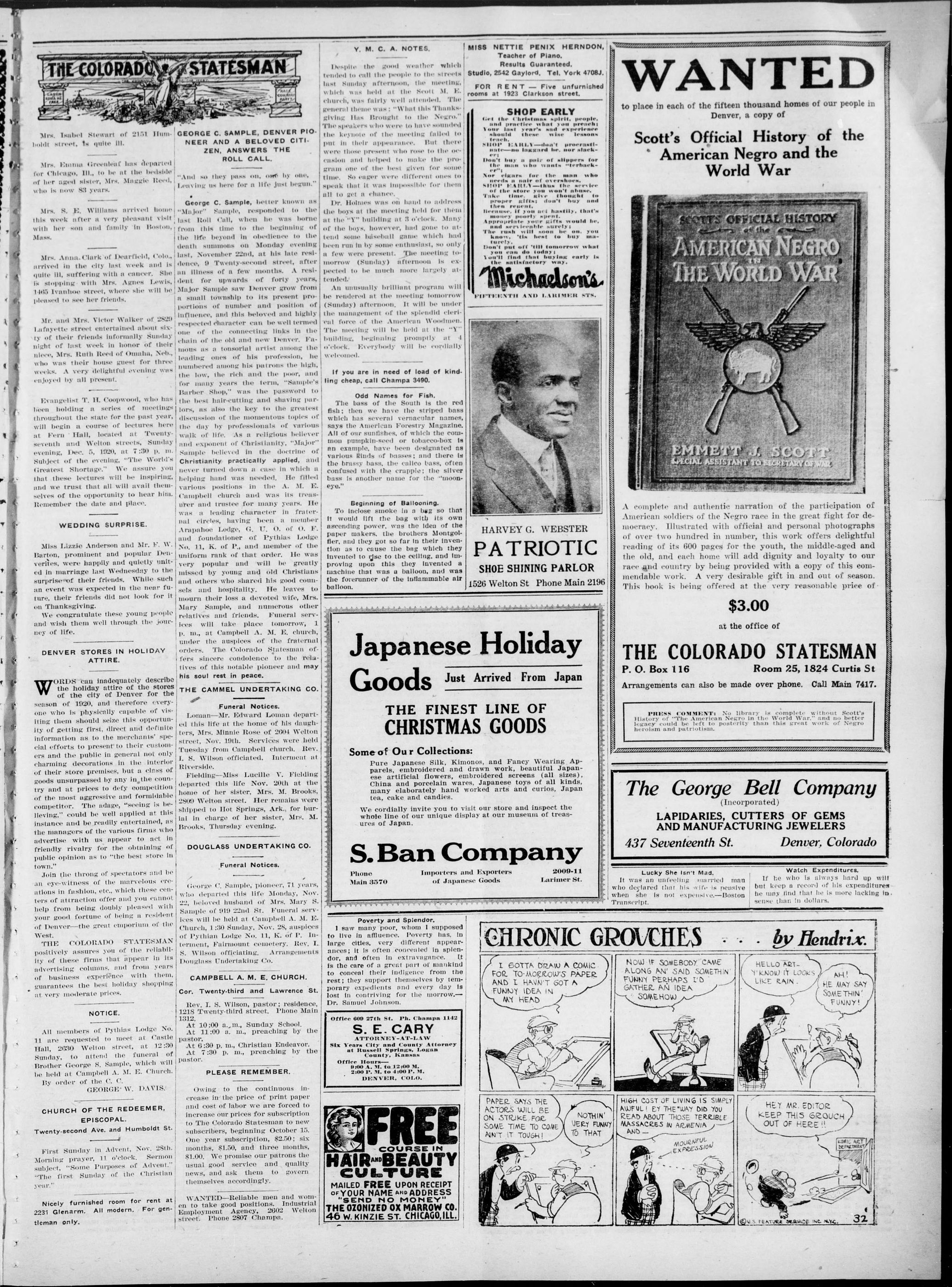
GEORGE C. SAMPLE, DENVER P NEER AND A BELOVED CITY ZEN, ANSWERS THE ROLL CALL.
"And so they pass on, one by one. Leaving us here for a life just begun."
Mrs. S. E. Williams arrived home this week after a very pleasant visit with her son and family in Boston, Mass.
Mrs. Anna. Clark of Dearfield, Colo., arrived in the city last week and is quite ill, suffering with a cancer. She is stopping with Mrs. Agnes Lewis, 1465 Ivanhoe street, where she will be pleased to see her friends.
Mr. and Mrs. Victor Walker of 2820 Lafayette street entertained about sixty of their friends informally Sunday night of last week in honor of their niece, Mrs. Ruth Reed of Omaha, Neb., who was their house guest for three weeks. A very delightful evening was enjoyed by all present.
Evangelist T. H. Coopwood, who has been holding a series of meetings throughout the state for the past year, will begin a course of lectures here at Fern Hall, located at Twenty-seventh and Welton streets, Sunday evening, Dec. 5, 1920, at 7:30 p. m. Subject of the evening, "The World's Greatest Shortage." We assure you that these lectures will be inspiring, and we trust that all will avail themselves of the opportunity to hear him. Remember the date and place.
WEDDING SURPRISE
Miss Lizzie Anderson and Mr. F. W. Barton, prominent and popular Denverites, were happily and quietly united in marriage last Wednesday to the surprise of their friends. While such an event was expected in the near future, their friends did not look for it on Thanksgiving.
We congratulate these young people and wish them well through the journey of life.
DENVER STORES IN HOLIDAY
ATTIRE.
WORDS can inadequately describe the holiday attire of the stores of the city of Denver for the season of 1920, and therefore everyone who is physically capable of visiting them should seize this opportunity of getting first, direct and definite information as to the merchants' special efforts to present to their customers and the public in general not only charming decorations in the interior of their store premises, but a class of goods unsurpassed by any in the country and at prices to defy competition of the most aggressive and formidable competitor. The adage, "seeing is believing," could be well applied at this instance and be readily entertained, as the managers of the various firms who advertise with us appear to act in friendly rivalry for the obtaining of public opinion as to "the best store in town."
Join the throng of spectators and be an eye-witness of the marvelous creations in fashion, etc., which these centers of attraction offer and you cannot help from being doubly pleased with your good fortune of being a resident of Denver—the great emporium of the West.
THE COLORADO STATESMAN positively assures you of the reliability of these firms that appear in its advertising columns, and from years of business experience with them, guarantees the best holiday shopping at very moderate prices.
NOTICE
All members of Pythias Lodge No. 11 are requested to meet at Castle Hall, 2030 Welton street, at 12:30 Sunday, to attend the funeral of Brother George S. Sample, which will be held at Campbell A. M. E. Church.
CHURCH OF THE REDEEMER EPISCOPAL.
Twenty-second Ave. and Humboldt St.
First Sunday in Advent, Nov. 28th.
Morning prayer, 11 o'clock. Sermon subject, "Some Purposes of Advent."
"The first Sunday of the Christian year."
Nicely furnished room for rent at 2231 Glenarm. All modern. For gentleman only.
Y
"And so they pass on, one by one,
Leaving us here for a life just begun."
George C. Sample, better known as "Major" Sample, responded to the last Roll Call, when he was borne from this time to the beginning of the life beyond in obedience to the death summons on Monday evening last, November 22nd, at his late residence, 9 Twenty-second street, after an illness of a few months. A resident for upwards of forty years, Major Sample saw Denver grow from a small township to its present proportions of number and position of influence, and this beloved and highly respected character can be well termed one of the connecting links in the chain of the old and new Denver. Famous as a tonsorial artist among the leading ones of his profession, he numbered among his patrons the high, the low, the rich and the poor, and for many years the term, "Sample's Barber Shop," was the password to the best hair-cutting and shaving parlor, as also the key to the greatest discussion of the momentous topics of the day by professionals of various walk of life. As a religious believer and exponent of Christianity, "Major" Sample believed in the doctrine of Christianity practically applied, and never turned down a case in which a helping hand was needed. He filled various positions in the A. M. E. Campbell church and was its treasurer and trustee for many years. He was a leading character in fraternal circles, having been a member Arapahoe Lodge, G. U. O. of O. F. and foundationer of Pythias Lodge No. 11, K. of P., and member of the uniform rank of that order. He was very popular and will be greatly missed by young and old Christians and others who shared his good counsels and hospitality. He leaves to mourn their loss a devoted wife, Mrs. Mary Sample, and numerous other relatives and friends. Funeral services will take place tomorrow, 1 p. m., at Campbell A. M. E. church, under the auspices of the fraternal orders. The Colorado Statesman offers sincere condolence to the relatives of this notable pioneer and may his soul rest in peace.
THE CAMMEL UNDERTAKING CO.
Loman—Mr. Edward Loman departed this life at the home of his daughters, Mrs. Minnie Rose of 2004 Welton street, Nov. 19th. Services were held Tuesday from Campbell church. Rev. L. S. Wilson officiated. Interment at Riverside.
Fielding—Miss Lucille V. Fielding departed this life Nov. 20th at the home of her sister, Mrs. M. Brooks, 2809 Welton street. Her remains were shipped to Hot Springs, Ark., for burial in charge of her sister, Mrs. M. Brooks, Thursday evening.
DOUGLASS UNDERTAKING CO.
George C. Sample, pioneer, 71 years, who departed this life Monday, Nov. 22, beloved husband of Mrs. Mary S. Sample of 919 22nd St. Funeral services will be held at Campbell A. M. E. Church, 1:30 Sunday, Nov. 28, auspices of Pythian Lodge No. 11, K. of P. Interment, Fairmount cemetery. Rev. L. S. Wilson officiating. Arrangements Douglass Undertaking Co.
CAMPBELL A. M. E. CHURCH.
Cor. Twenty-third and Lawrence St.
Rev. I. S. Wilson, pastor; residence,
1218 Twenty-third street. Phone Main
1312.
At 10:00 a. m., Sunday School.
At 11:00 a. m., preaching by the
pastor.
At 6:30 p. m., Christian Endeavor.
At 7:30 p. m., preaching by the
pastor.
PLEASE REMEMBER.
Owing to the continuous increase in the price of print paper and cost of labor we are forced to increase our prices for subscription to The Colorado Statesman to new subscribers, beginning October 15. One year subscription, $2.50; six months, $1.50, and three months, $1.00. We promise our patrons the usual good service and quality news, and ask them to govern themselves accordingly.
WANTED—Reliable men and women to take good positions. Industrial Employment Agency, 2602 Welton street. Phone 2807 Champa.
Despite the good weather which tended to call the people to the streets last Sunday afternoon, the meeting, which was held at the Scott M. E. church, was fairly well attended. The general theme was: "What this Thanksgiving Has Brought to the Negro." The speakers who were to have sounded the keynote of the meeting failed to put in their appearance. But there were those present who rose to the occasion and helped to make the program one of the best given for some time. So eager were different ones to speak that it was impossible for them all to get a chance.
Dr. Holmes was on hand to address the boys at the meeting held for them at the "Y" building at 3 o'clock. Many of the boys, however, had gone to attend some baseball game which had been run in by some enthusiast, so only a few were present. The meeting tomorrow (Sunday) afternoon is expected to be much more largely attended.
An unusually brilliant program will be rendered at the meeting tomorrow (Sunday) afternoon. It will be under the management of the splendid clerical force of the American Woodmen. The meeting will be held at the "Y" building, beginning promptly at 4 o'clock. Everybody will be cordially welcomed.
If you are in need of load of kindling cheap, call Champa 3490.
The bass of the South is the red fish; then we have the striped bass which has several vernacular names, says the American Forestry Magazine. All of our sunfishes, of which the common pumpkin-seed or tobacco-box is an example, have been designated as various kinds of basses; and there is the brassy bass, the calico bass, often confused with the crapple; the silver bass is another name for the "mooneye."
Beginning of Ballooning.
To inclose smoke in a bag so that it would lift the bag with its own ascending power, was the idea of the paper makers, the brothers Montgolfier, and they got so far in their invention as to cause the bag which they invented to rise to the ceiling, and improving upon this they invented a machine that was a balloon, and was the forerunner of the inflammable air balloon.
Japanese Goods Just THE FINEST CHRISTMAS
Japanese Holiday Goods Just Arrived From Japan THE FINEST LINE OF CHRISTMAS GOODS
Some of Our Collections:
Pure Japanese Silk, Kimon
parels, embroidered and dri
ese artificial flowers, emb
China and porcelain wares,
many elaborately hand woo
tea, cake and candies.
We cordially invite you to visit
whole line of our unique displa
ures of Japan.
S. Ban Co
Pure Japanese Silk, Kimonos, and Fancy Wearing Apparels, embroidered and drawn work, beautiful Japanese artificial flowers, embroidered screens (all sizes), China and porcelain wares, Japanese toys of all kinds, many elaborately hand worked arts and curios, Japan tea, cake and candies.
We cordially invite you to visit our store and inspect the whole line of our unique display at our museum of treasures of Japan.
S.Ban Company
Poverty and Splendor.
I saw many poor, whom I supposed to live in affluence. Poverty has, in large cities, very different appearances; it is often concealed in splendor, and often in extravagance. It is the care of a great part of mankind to conceal their indulgence from the rest; they support themselves by temporary expedients and every day is lost in contriving for the morrow.—Dr. Samuel Johnson.
Office 600 27th St. Ph. Champa 1142
S. E. CARY
ATTORNEY-AT-LAW
Six Years City and County Attorney
at Russell Springs, Logan
County, Kansas
Office Home
9:00 A. M. to 12:00 M.
2:00 P. M. to 4:00 P. M.
DENVER, COLO.
FREE
COURSE IN
HAIR AND BEAUTY
CULTURE
MAILED FREE UPON RECEIPT
OF YOUR NAME AND ADDRESS
"SEND NO MONEY"
THE OZONIZED OX MARROW CO.
46 W. KINZIE ST. CHICAGO,ILL.
Y. M. C. A. NOTES.
Odd Names for Fish.
Phone
Main 3570
MISS NETTIE PENIX HERNDON,
Teacher of Piano.
Results Guaranteed.
Studio, 2542 Gaylord. Tel. York 4708J.
FOR RENT — Five unfurnished
rooms at 1923 Clarkson street.
Get the Christmas spirit, people,
and practice what you preach.
Don't be too hard to teach
should these wise lessons
teach.
NOT EARLY—don't procrastinate—no lingerard be, nor slacker!
Don't buy a pair of slippers for
the man who wants 'turbacke-
Nor cigars for the man who needs a pair of overshoes.
SHOP EARLY—thus the service of the store you won't abuse.
Take time, give thought to paper gifts; don't buy and then repent.
Because, if you not hastily, that's money poorly spent.
Appropriate your gifts would be, and serviceable surely.
The rush will soon be on, you know 'tis hest to buy maturely.
Don't put off 'till tomorrow what you can do today; You'll find that buying early is the satisfactory way. Michaelson's
A. E.
HARVEY G. WEBSTER
PATRIOTIC
SHOE SHINING PARLOR
1526 Welton St Phone Main 2196
e Holiday
Arrived From Japan
ST LINE OF
AS GOODS
is:
monos, and Fancy Wearing Ap-
drawn work, beautiful Japan-
embroidered screens (all sizes),
tes, Japanese toys of all kinds,
worked arts and curios, Japan
visit our store and inspect the
play at our museum of treas-
company
CHRONIC G
I GOTTA DRAW A COMIC
FOR TO-MORROW'S PAPER
AND I HAVN'T GOT A
FUNNY IDEA IN
MY HEAD
CHRONIC GROVCHES by Hendrix.
I GOTTA DRAW A COMIC FOR TO-MORROW'S PAPER AND I HAVN'T GOT A FUNNY IDEA IN MY HEAD
NOW IF SOMEBODY CAME ALONG AN' SAID SOMETHIN' FUNNY PERHAPS I'D GATHER AN IDEA SOMEHOW
HELLO ART-Y'KNOW IT LOOKS LIKE RAIN.
AH! HE MAY SAY SOMETHIN' FUNNY!
PAPER SAYS THE ACTORS WILL BE ON STRIKE FOR SOME TIME TO COME ANN'T IT TOUGH!
NOTHIN' VERY FUNNY TO THAT
HIGH COST OF LIVING IS SIMPLY AWFUL! BY THE WAY DID YOU READ ABOUT THOSE TERRIBLE MASSACRES IN ARMENIA AND—
HEY MR. EDITOR KEEP THIS GROUCH OUT OF HERE!!
COMIC ART DEPARTMENT
© U.S. FEATURE SERVICE INC. NYC. 32
SHOP EARLY
2009-11
Larimer St.
WANTED
to place in each of the fifteen thousand homes of our people in Denver, a copy of Scott's Official History of the American Negro and the World War
SCOTT'S OFFICIAL HISTORY
of the
AMERICAN NEGRO
IN
THE WORLD WAR
EMMETT J. SCOTT
SPECIAL ASSISTANT TO SECRETARY OF WAR
A complete and authentic narration of the participation of American soldiers of the Negro race in the great fight for democracy. Illustrated with official and personal photographs of over two hundred in number, this work offers delightful reading of its 600 pages for the youth, the middle-aged and the old, and each home will add dignity and loyalty to our race and country by being provided with a copy of this commendable work. A very desirable gift in and out of season. This book is being offered at the very reasonable price of
at the office of
RADO S
Room
be made over p
No library is co
on Negro in the W
posterity than th
age Bella
(Incorporated)
S, CUTTERS
FACTURING
St.
THE COLORADO STATESMAN P. O. Box 116 Room 25,1824 Curtis St Arrangements can also be made over phone. Call Main 7417.
PRESS COMMENT: No library is complete without Scott's History of "The American Negro in the World War," and no better legacy could be left to posterity than this great work of Negro heroism and patriotism.
The George Bell Company (Incorporated)
LAPIDARIES, CUTTERS OF GEMS AND MANUFACTURING JEWELERS 437 Seventeenth St. Denver, Col
It was an unfeeling married man who declared that his wife is pensive when she is not expensive.—Boston Transcript.
...b
If he who is always hard up will but keep a record of his expenditures he may find that he is more lacking in sense than in dollars.
Denver, Colorado
Today's Geography
Little Journeys to Places
Figuring in World
Events
Prepared by The National Geographic
Society, Washington, D.C., for Department
of Interior, Bureau of Education.
LUXEMBURG REPRESENTED
AT WASHINGTON
Luxemburg, latest and smallest of the countries of the world to send a diplomatic representative to the United States, has a ruler with a better popular title to her throne than perhaps any other reigning monarch. Though the little grand duchy is smaller even than Rhode Island, it has a history reaching farther into the past than many of the great nations among which it now takes a place. It has been buffeted about like a shuttlecock by the countries that him it in, and at one time or another during the past thousand years has been under the control of nearly every one of the principal nations of the western part of the continent.
While a part of the Holy Empire, Luxemburg furnished an emperor for the German throne. Count Henry IV of Luxemburg was elected to that position in 1308 as Henry VII. Luxemburg later came under the control of Burgundy and then fell successively to Spain, Austria and the first French republic. It remained under the sovereignty of the king of the Netherlands from 1815 to the accession of Queen Wilhelmina in 1890, when the existence of the Salle law—that anti-feminist outburst of the old warrior Franks—brought the grand duke of Nassau to the throne.
Even while the king of the Netherlands was sovereign of Luxemburg, it was a member of the German confederation, with the city of Luxemburg garrisoned by Prussian soldiers. Retention of this garrison in the city after the division of old Luxemburg between Holland and Belgium in 1831, and especially after the dissolution of the German confederation in 1866, almost caused the Franco-Prussian war to start three years ahead of time. The matter was compromised by an agreement for the withdrawal of the German troops, and the demolishment of the fortifications of the city of Luxemburg, so strong that the fortress was known as "the Gibraltar of the North." In addition the grand duchy was set up as an independent state with its neutrality guaranteed, like that of Belgium, by the powers. This guarantee was one of the "scraps of paper" of 1014.
During the World war Luxemburg was practically a prisoner to Germany, but because the inhabitants did not resist, the Germans treated them with a certain degree of consideration. The sympathies of the people were with France, however, and several thousand Luxemburgians served with the tricolor. This popular sympathy for France and the belief that the reigning Grand Duchess Marie Adelaide, had pro-German leanings made her unpopular. After the armistice brought about the retirement of the Germans, a bloodless revolution broke out, and Luxemburg added another to its long list of sovereignties by being a republic for a few brief hours. Conservative elements brought about the abdication of the grand duchess in favor of her sister Charlotte, the present ruler, and by liberalizing the constitution. Marie Adelaide has entered a convent and become a Carmelite nun.
BRUSSELS: CAPITAL CITY OF THE LAND OF THE LOOM
Brussels, conspicuous during the war, again became a center of world attention with the meeting there of the international financial congress. Brussels' fame rests partly on popular misapprehensions. Its name is linked with a carpet that is not made there, and also with a cathedral which, properly speaking, is not a cathedral at all but a church—that of St. Gudule. But even after deducting this much from Brussels' credit, enough remains to give it a foremost place among world capitals. Were the romantic adventures of the city cast into a "movie" scenario, the title might accurately be "From Swamp Dwelling to Petit Paris."
The seventh century village on the Senne, near the center of what now is Belgium, was called Brueselle, literally "swamp dwelling," with descriptive intent. The genius of a people for making much of meager physical circumstances fully warrants the nickname often given the modern city of parks, boulevards, art galleries and a famous university.
Suffering was no new experience for Brussels. More than three centuries earlier its great square had seen Count Egmont and Count Horn walk to the scaffold, as the former recited the fifty-first Psalm, and a little later both heads were displayed to the assembled multitude on iron spikes. More gruesome still, both heads finally were boxed and sent to Philip II of Spain so that latter-day Herod might exult at another victory over his northern subjects.
Though the Brussels carpet of modern times is not made in Belgium, Brussels was paid a deserved tribute in its naming, for when it first was manufactured at Wilton, England, the
product was patterned after the tapestries for which Brussels was famous for centuries. In addition to its weaving Brussels galued renown for its lacemaking, and its needle-made laces still find their way all over the civilized world, including a considerable quantity to the United States. The feminine culture of feudal times sought to express in the delicate designs of filmy fabric what men wrought in the lace-like architecture of its cathedrals.
MEXICO CITY: THE ROME OF THE AMERICAS
"In all the world one cannot find a more remarkable capital than Mexico City," says Wifilliam Joseph Showalter, in a communication to the National Geographic society.
"Situated in a valley whose floor is a mile and a half above the level of the sea, and whose borders are surrounded by towering mountains; located where the beautiful volcanoes, Popocatepetl and Ixtacchuiat, rear snow-capped heads above the plain and stand eternal guard over it, its situation is one of rare beauty and grandeur. Its climate is mild, the temperature ranging from 35 to 70 degrees, with a mean of 65 degrees. No man sleeps without a -blanket in Mexico City, nor needs an overcoat at midday.
"Prior to the conquest the lakes of the Mexican valley were extensive and the barges of the Aztecs sailed uninterruptedly from the gates of Chapultepec to Ixtapalapa. A large number of canals intersected the ancient metropolis of Tenochtitlan and connected with the lakes in the suburbs, making it a sort of new world Venice.
"In 1607 the celebrated Portuguese engineer Martinez undertook to drain the Valley of Mexico by cutting a canal through the mountains. The work, however, was largely a failure, since it drained only one small lake and an unimportant river, leaving lakes Texcoco and Chalco still perpetual menaces to the city.
"In 1879 a huge drainage canal 30 miles long was begun, which was completed in 1900, at a cost of about $8,000,000, American gold. Its completion removed the danger of inundations from Mexico City and solved the problem which occupied the thoughts and engendered the fears of the Aztecs as far back as 1449.
"Mexico City is the most complete mixture of the ancient and the modern to be found in the new world. The old city might date anywhere from the tenth century, from its appearance. The new city is ultra modern, and you step from the sixteenth to the twentieth century by walking across the street.
"The parade ground of Mexico City is the Avenida de San Francisco, This short street extends from the Mexican White House to the Alameda, and is only about 24 feet from curb to curb. Here, at the approach of twilight, every smart equipage in the capital comes. Down the one side of the street and up the other side moves the procession at a slow walk, while everybody looks at everybody else.
"As Avenida de San Francisco unites the old and the new cities, so does the Cinco de Mayo (Fifth of May) unite the cathedral, stateliest of all the religious edifices on the continent, with the National theater, which was planned to be the most beautiful of all the amusement places in America. The Cinco de Mayo is the Wall street of Mexico, and the buildings which line it are modern in every respect.
"The Paseo de la Reforma, extending from Chapultepec to the Avenida de Junrez, a short avenue connecting the Paseo with Avenida de San Francisco, is one of the finest driveways of the world.
"The national pawnshop is one of the unique institutions of the capital. It was founded by Pedro Jose Romero de Terreros."
HOW GEOGRAPHY SHAPES
ITALY'S DESTINY
Italy's peculiar geographic position always has been one of the chief sources of the country's remarkable individuality—an individuality marked by its political and economic course since the armistice was signed. Arthur Stanley Riggs, writing to the National Geographic society in this regard, says:
"From the beginning Nature set Italy apart. Every boundary is perfectly clear. The historic sea enfolds it to the south, east and west. On the north the terrific Alps sweep around it in a great semicircle from Mediterranean to Adriatic, closing the circuit.
"To be sure, from the time of Augustus the boundary of each side of northern Italy has been juggled, now to the east, now to the west, by politics; but the physical boundary is still definitely there. So thoroughly did the ancient chroniclers recognize these natural limits that long before the name of Italy had any political significance or entity the writers applied it to the country thus inclosed. The peninsula, with its tremendous Apennine backbone, makes a huge boot which thrusts out practically into the center of the great midland sea.
Necessarily, then, Italy was exposed to attack and invasion from three sides. Indeed, it was the invading, or rather colonizing, Greek who combined with the aborigine to form the population that stocked the peninsula. Taken in a smaller way, geographical site or position exercised no less distinct an effect upon some of the foremost Italian cities; and in shaping their affairs and men it also influenced the entire world.
"After forming this basin—northern Italy—the Apennines sweep southward in a rugged backbone which deter-
Buffalo Safe From Extinction
A
HE American bison—buffalo—is now safe from extinction, the scientists announce. What's more, the buffalo is coming back. Maybe our children's children will have buffalo robes and buffalo-skin coats as our fathers did. Anyway, of the mylads of this splendid big animal, whose range once covered the continent, there were but 1,001 head alive in 1889. Now there are 7,360 in the United, States and Canada.
Efforts of the American, and Canadian governments to save the bison—which was shagged almost to the point of extermination—are described by C. Gordon Hewitt in Natural History, the official magazine of the museum of that name. Mr. Hewitt is actively engaged in the salvage, as consulting geologist to the Ottawa Commission of Conservation. He says the manner in which the total loss of this magnificent animal has been prevented should fill with hope and confidence all who are trying to conserve wild life.
There were literally myriads of buffalo in the old days and their habitat originally covered nearly all of the North American continent. Even as late as 1871 there was seen migrating across the plains a wedge-shaped herd on a 25-mile front with a depth of 50 miles; such a drove could contain no fewer than 4,000,000 head.
Dr. William T. Hornaday, director of the New York Zoological park, says in a pamphlet that the original range started almost at tide water on the Atlantic coast, extended westward through dense forest, across the Allegheny mountain system to the Mississippi prairies, and southward to the delta. Although the plains country of the West was the home of the species, where it flourished most abundantly, it wandered south toward Texas, westward across the Rocky Mountains into New Mexico, Utah and Idaho, and northward across a vast treeless waste to the inhospitable shores of the Great Slave Lake. The vast herds seemed to clothe the prairies with a cont of brown.
George Catlin, in a book in 1832, said from 150,000 to 200,000 robes were marketed annually, which meant the laughter of from 2,000,000 to 3,000,000 bison. About the same time Freight bore witness to the appalling derduction.
The death knell of the bison was struck when Union Pacific construction began in 1866. Previously the difficulties of marketing served as a light check on the rate of extermination. This railroad divided the original body into southern and northern erds. Hornaday estimates that in 871 the southern herd contained 3,000,000 animals, though most estimates live a higher total. Between 1871 and 875 the great southern herd was pined out of existence.
Final slaughter of the northern herd was inaugurated by the opening of the Northern Pacific in 1880, when the half-breeds of Manitoba, the Plains Cree of Qu'Appelle and the Blackfeet of South Saskatchewan swept bare a great belt of country stretching east and west between the Rocky Mountains and Manitoba. A few thousand remained in the country around the headwaters of Battle River, between
Stepping Lively in the Orient
Stepping Lively in the Orient
The familiar "step lively" of the subway conductor and policeman, which hastens the movement of cosopolitan life, is not escaped today even in the Orient. One needs to watch her step, when traveling by steamboat up a languid oriental stream just as carefully as when boarding
mines the whole internal geography of the country as definitely as the Alps do its outline northward. "In central Italy, west of the mountains, the valleys of the Arno and the Tiber—the only streams of importance—give the keynote to any geographic study of the region. Over on the eastern coast no rivers of importance can exist, because the mountains there approach too close to the sea, though the tortuous, mostly dry beds of the 'torrent' scar every height.
"In this connection it is interesting to note that nowhere is the peninsula more than 150 miles wide, and generally not more than 100, while down in Calabria the width dwindles in two places to 35 and 20 miles respectively. One of the most inspiring views in the whole length of the country also displays this narrowness strikingly when, on a clear day, from the Gran Sasso, the highest point in the bleak Abruzzi range, central Italy, at nearly 10,000 feet, one may look not only eastward over the Adriatic to far Dalmatia's rocky shores, but also westward over the mountain and moor, city and sandy coast, to the dim and misty blue of the Tyrrhenian sea. In volcanic southern Italy, likewise barren of any great waterways, the Apennines break up into groups of hills and peaks, not usually so lofty as farther northward.
"As in the case of Japan, the surrounding sea makes a vast difference in the Italian climate. Judged by its position alone, the peninsula should be about the hottest part of Europe—it is only 90 miles from the southern shore of Sicily to Africa. But the twin seas and the ever snow-capped mountains temper the heat, and the regional peculiarities are such that we find Turin, for instance, colder in winter than Copenhagen, and Milan as warm in summer as Naples."
A VOLCANIC BARNUM AND BAILEY
Young America will drop anything to run to a fire. In some parts of the world—Hawaii, for example—one also drops everything to run to a volcano eruption, unless he already is too close for comfort. Then he runs from it.
Have you ever wondered what a volcano, in action, looks like? Here is a description, not by a scientist, but by a young Washington woman who went to Hawaii to live just before Mauna Loa's terrific eruption last year:
"It seems as if Hawaii, though small, must have just so much attention, and so ever so often she explosively projects herself into the arena of the world's happenings," wrote Mrs. Shirley Foster Allen. "Not content with her share in the 'Big Show' in Europe, she decided to stage a first-class side show all her own—and the two volcanoes, Mauna Loa and Kilauea, have certainly done their best to make it the 'biggest show on earth.'"
"Just a word about the geography of the place. In the first place so many people seem to think the word 'Honolulu' embraces all there is to the islands; and in the second place, the general conception seems to be that the volcano is located in Honolulu's back yard, as it were, and that we Honolulans take our daily exercise by running up to the crater every morning before breakfast. Honolulu is located on the Island of Oahu, third island in size in the group, while the volcano, or rather volcanoes, are located on Hawaii, the largest and youngest island, with an area of more than 4,000 square miles, which lies nearly 200 miles southeast of Oahu.
"The first indication of volcanic activity was the presence of a peculiar cauliflower-shaped cloud hanging over the mountain. Three days later, on September 29, the whole heavens were lit up with an apricot glow when, from a huge vent in the mountain's side, a flood of molten lava was belched forth. Spreading out into a great shallow stream, it came roaring down the mountain slope, burning forests, carrying huge trees and immense boulders on its surface—sweeping everything before it. With a speed varying from one to twenty miles an hour, according to the country it was passing over, it broadened out until it was nearly a mile in width. After wilping out the government belt road, razing telephone poles and destroying a vast amount of property, the red-hot lava tumbled over a high precipice and plunged hissing into the sea.
"A number of excursions were made in October from Honolulu, and, in approaching the flow from the sea in the early evening, the glow from the lava was visible for many miles before Alika was reached.
"Drifting within 200 yards of the point where the liquid rock was rushing into the sea, the scene stretching before one was awe-inspiring. Slowly the smoky haze, from the burning forests, which hung over the source 20 miles away, lifted and the river of fire stood out in its full glory, holding one speechless and spellbound. Leaping from pali to valley, rushing uphill and roaring down, the fiery flood thundered down the mountain slope, carrying on its bosom rocks as big as houses that were tossed about as if they were mere pebbles. As the stream of blazing lava neared the coastline, it appeared to gather more speed, taking a final plunge over a 100-foot cliff at a terrific rate, and looking for all the world like a fiery Niagara. As the red-hot lava came in contact with the water, great columns of steam and gas, like huge waterspouts, were forced hundreds of feet into the air. Huge boulders, hurled into space, exploded with thunderous reports into auras of red and green lights, while flashes of what looked like lightning added to the chaos."
Only 1,091 head survived in 1889. Now they have increased to 7,360 in United States and Canada
HE American bison—buffalo—is now safe from extinction, the scientists announce. What's more, the buffalo is coming back. Maybe our children's children will have buffalo robes and buffaloskin coats as our fathers did. Anyway, of the myriads of this splendid big animal, whose range once
VVV
North and South Saskatchewan, but they were surrounded and attacked from all sides until all were killed. Hornaday computes that the number of animals slaughtered annually by the Northwest Indians must have been 375,000. Only straggling bands were left. On the basis of all available data, Hornaday estimated that the number running wild and unprotected was 635. In 1889 there were 256 buffalo in captivity, 200 under protection in Yellowstone Park and 635 running wild (of which number 550 were estimated to be in the Athabaska region of the Canadian Northwest Territories)—a total of 1,091.
An attempt was then made by the United States to protect the remnant. By 1903, according to census, the number had increased to 1,753 head, mainly confined in American reservations and parks. In 1917 the Canadian government purchased a herd of 700 head owned by Michael Pablo of Montana, and a special national park was provided for the herd at Wainwright, Alberta. By 1918 this herd had increased to 3,711 head. The number of captive bison in the United States in 1919 was 3,048 head, and there were about 70 head running wild, making a total of 3,118. Counting the Canadian protected herds at 3,711, and adding 500 wild bison in the Athabasca region, where they are now protected, and 40 in public and private parks, the total in Canada at the beginning of 1919 was 4,520 animals. So there are approximately 7,360 bison in the United States and Canada, compared with 1,091 in 1889, showing that they are coming back.
In fact, it seems to be certain that the buffalo is coming back. For example, there are two herds in Yellowstone National park—a wild herd and a "tame" herd—and both are increasing. There are known to be at least 90 animals in the wild herd. The tame herd now (1919) numbers 413 animals, the increase of a herd of 21 established in 1902.
The calves of the 1919 season numbered 90. In fact, Mr. Hewitt is so certain that the buffalo is coming back that he discusses the problem of what to do with the surplus when it becomes a fact. He says:
"The rapid increase of the bison in our national reservations raises the question as to what we shall do with our surplus. In the Buffalo Park at Wainwright, Alberta, this question is becoming a serious one, as they will soon occupy as much range as is capable of sustaining them.
"The natural answer to this question is to create additional reservations, which policy undoubtedly will be followed, particularly in the United States, where much additional range suitable for bison, but less suitable for agricultural purposes, is available. In addition provision is being made for the donation of surplus animals to municipalities, public organizations and institutions.
"But cannot we go a step further and consider the desirability of encouraging farmers to purchase surplus animals from the government
the subway at Forty-second street during the rush hour, according to the report of a Y. W. C. A. secretary, stationed in Canton, China. "When a passenger wishes to get off the steamboat," writes this Y. W. C. A. secretary, "a shrill whistle is blown to summon a small boat to carry her to shore. Then a man carrying a long bamboo pole with a book on its end climbs out on a little ledge on the side of the steamboat, ready to catch hold of the boat as it passes by. The steamboat slacken's its speed but
D
D
R
A
D
D
D
D
D
D
D
D
D
D
D
D
D
D
D
D
D
D
D
D
D
D
D
D
D
D
D
D
D
D
D
D
D
D
D
D
D
D
D
D
D
D
D
D
D
D
D
D
D
D
and to maintain them? Any one who has visited the bison in our national reservations will agree that if they were maintained in a semi-domesticated state they could be treated in the same manner as range cattle, provided they were inclosed. The cost of building suitable fencing might prove an obstacle in many cases, but it should not prove insuperable, in view of the high price of beef. As a beef animal the value of the bison is well worth the careful consideration of our agricultural authorities. In addition it provides a robe of proven value in more northerly states and provinces. Not the least of the advantages of the bison over domestic cattle is their ability to 'rustle' for themselves in winter and under climatic conditions which prove a hardship to our introduced cattle."
Of course the plains Indians practically lived off the buffalo; the animal was food, clothing and shelter to them. But the crime of the wanton destruction of the buffalo lies at the door of the white man. Why, the passengers used to empty their rifles into the herds as the trains sped over the plains. Thousands of animals were killed simply for the tongue, says Mr. Hewitt in this connection.
"With the coming of the railroads through the West and an increased demand for buffalo robes, the butchery of the 'still hunt' began. Other methods were too slow for the commercial hunter who must kill hundreds of bison in order to realize on pelts worth but from 65 cents to $4 apiece. The still hunter approached the herd to within 100 to 250 yards and proceeded with great deliberation to shoot down the animals without stampeding them. Their leader, usually the oldest cow, was first disposed of, and then the others slaughtered one by one. One or two shots a minute could be fired, and with good luck a hundred bison killed from one 'stand,' so that one hunter was able to account for from 1,000 to 3,000 head a season.
"The miles of bones eventually gave rise to a traffic which became remunerative as there" grew up a demand for phosphate for fertilizers and bone black for refining sugar. In 1874 the Sant Fe railroad all shipped nearly 7,000,000 pounds of bones, which brought as much as $18 a ton crushed.
"Time will not efface the trace of the bison's occupation of the continent," Mr. Hewitt says. "They blazed the trails that later became important highways. The bison selected the route through the Alleghenies by which the white man entered and took possession of the Mississippi valley. They found the best routes across the continent, and human intercourse will move constantly in paths first marked by the buffalo. It is interesting that the bison found the strategic passageways through the mountains, marked out the most practical paths between the heads of our rivers—paths that are closely followed today by the Pennsylvania, Baltimore & Ohio, Chesapeake & Ohio, Wabash and other great railroads."
very little and passengers need to 'step lively' into the rowboat or they will be left behind. Baggage is tossed in after them."
The Vatican.
The Vatican, the palace of the pope in Rome and one of the largest in the world, contains a valuable collection of works of art, and is one of the chief attractions of the city. It is a storehouse of literary treasures and documents of interest bearing on the history of the Middle ages.
DEVICES REDUCE AMOUNT OF WORK
Daily Attention to Carpets Tends Greatly to Lighten Periodic Cleaning.
REMOVABLE RUGS ARE HANDY
Arrangement of House, Wise Selection of Furnishings and Use of Labor Saving Contrivances Assist Housekeepers.
Changed living conditions have brought changes in house-cleaning methods. When houses were less completely heated, and parts of them were closed during the cold months, spring house-cleaning was necessary to get the closed rooms ready for use during the warm months, and fall house-cleaning was necessary to prepare the house for winter. Nowadays, all the rooms in most houses are used and kept clean throughout the year, and upheavals in spring and fall are no longer necessary. Moreover, the increasing use of removable rugs and some of the new cleaning devices make it much easier to take the dirt out day by day or week by week. Not all housekeepers realize how much the work of keeping things clean can be lessened by choosing the right things and handling them in the right way. This is not merely a matter of labor-saving devices like vacuum cleaners, but depends partly on how the house is planned, what furnishings and finishings are used, and how the work of caring for them is organized.
Daily Care of Carpets.
For the daily care of woolen or cotton carpets and rugs, a carpet sweeper is very good, because it takes up lint and coarse dirt without raising the dust. For more thorough cleaning some other appliance must be used, as
NURSE
Vacuum Cleaner Removes Dirt Easily and the Air Is Not Filled With the Dust.
the brushes of the carpet sweeper do not go deep enough into the carpet to remove fine dirt. A vacuum cleaner is excellent, but if that is not available, effort should be made to find some other thorough but comparatively dustless process. Using a dampened broom and scattering left-over tea leaves, bits of rumpled, dampened newspaper, or one of the commercial sweeping preparations on the carpet before sweeping, helps to prevent dust from flying. These dampened materials must be used with caution, however, or stains will result, especially on delicately colored carpets. Wiping a carpet with a dampened cloth after sweeping removes more dust and freshens the carpet.
Small rugs should be cleaned out of doors, if possible, preferably on the dry grass' or dry snow. They should be placed right side down, beaten with a flat carpet beater, swept, turned over, and swept again. Hanging rugs over a line while they are being cleaned, or holding them by the corners and shaking them, strains them badly; it may break the threads or loosen the bindings and cause the ends to ravel.
Using Soap and Water on Rugs.
Practically all rugs, after thorough beating, may be cleaned with soap and water. Rag rugs may be washed like any other heavy material but they must be rinsed thoroughly. Sometimes it is easier to rinse a heavy, wet rug with a hose than in a tub. Other rugs can be placed on a table and scrubbed with a brush and mild soap suds. As each section is cleaned, it should be rinsed thoroughly and the water should be changed as it becomes discolored. Rugs washed by this method are clean, but they may shrink and lose their shape and the colors may fade and run. Oriental rugs with very long, thick pile should not be thus cleaned unless they can be dried quickly and thoroughly; if moisture remains in the depth of the pile it may rot the threads, United States Department of Agriculture household specialists suggest.
Fine smooth mattings should be swept with a soft brush and dusted with a dry mop, or if necessary they may be washed with a cloth tightly wrung out of warm water, and wiped dry with another cloth. All grass and fiber floor coverings should be taken up occasionally to remove the dirt which sifts through in spite of frequent cleaning.
The Kitchen Cabinet
The Kitchen Cabinet
(©, 1920, Western Newspaper Union.)
Let the furrows be plowed deep enough while the brain cells are plastic, then human energies will result in efficiency and the line of least resistance will be the right line.
Chicken is such a favorite dish with the majority of people that a new way of serving it will be enjoyed. Stewed Chicken With Cauliflower.—Cut up the chicken as for fricassee, wash, cover with boiling water, heat to the boiling point, and after five minutes' boiling, sim-
rate the cauliflower into flowerettes, cover with boiling salted water and let cook until tender. Cook a dozen slices of carrot until tender. Arrange the chicken on a serving dish, the cauliflower and carrot slices around the chicken. Take one-fourth of a cupful of fat. In it cook the same amount of flour, add salt and pepper and one-half cupful of cream with one and one-half cupfuls of chicken broth, stir until boiling; beat the yolk of an egg, add a teaspoonful of lemon juice and stir into the sauce; pour the sauce over the chicken and vegetables and serve at once.
Chicken Pie en Casserole.—Separate a young chicken into pieces at the joints; wash, wipe, roll in seasoned flour and cook in salt pork fat until well browned on all sides. Place in a casserole, adding boiling water, salt and pepper as needed. Cover, and let cook until nearly tender; have ready for each service a small onion, two slices of carrot and five potato balls. Parboil all the vegetables, the onions half an hour, the other vegetables ten minutes; rinse in cold water, dry on a cloth and let cook in the frying pan where the chicken was browned until well colored, then add to the casserole. Have ready a rich biscuit crust the size of the top of the casserole; place this over the contents of the casserole, to rest on the edge of it, and bake until well browned.
Date Muffins.—Beat two eggs; add one cupful of sugar, one-quarter cupful of butter, one teaspoonful of baking powder in flour to make a thin batter, with one-quarter of a cupful of milk. Stir in one cupful of stoned and chopped dates. Fill muffin cups one-half full and steam half an hour. Serve as dessert with sweetened cream. This dessert is one which the children will like.
Under favorable conditions, a rapidly growing child will obviously need more bone-making material, proportion to the total food supply, than will the adults of the family.-Sherman.
"The golden-hued end-piece of bread is intimately richer in flavor than the
sweetened version."
With the cool autumn days we need more substantial food to supply heat.
Fried foods may now be eaten in moderation. The following is a most dainty way of serving potato:
Potato Puffs. — Beat three eggs, without separating the whites and yolks, until very light; gradually beat in two cupfuls of mashed potato, one cupful of flour, sifted with two teaspoonfuls of baking powder and one teaspoonful of salt. Drop by teaspoonfuls into hot fat; let cook to a golden brown, turning often; drain on soft paper and serve with or without meat or fish.
Mock Cherry Turnovers. — Cut rounds, about six inches in diameter, of rich pastry. Chop together one cupful of cranberries and half a cupful of raisins, seeded; mix one cupful of sugar with two tablespoonfuls of flour and one-quarter of a teaspoonful of salt; pour half a cupful of boiling water over the fruit and when again boiling stir in the dry ingredients; add a teaspoonful of butter and let it cook until thick and boiling. Let cool a little, then place a large tablespoonful of the mixture on one side of each round of paste; brush the edges with cold water, cut two or three slits in each round for the steam to escape and press the edges closely. Brush over with cold water, dredge with granulated sugar and let bake 15 minutes.
Creole Soup.—Scald three cupfuls of milk with half an onion and one cupful of kornelut (that is, fresh corn pulp, prepared by scoring the kernels and pressing out the centers); stir in one-quarter of a cupful of flour, mixed to a smooth batter with half a cupful of milk, and stir until the mixture thickens; cover and cook 20 minutes and strain. Cook sliced ripe tomatoes until the water is evaporated, then press through a fine sieve. When ready to serve the soup stir one cupful of the hot tomato puree into the milk mixture and add a teaspoonful of salt and half a teaspoonful of paprika.
Shoestring Carrots.—Cut the carrots on a potato or vegetable slicer into shoestrings. Drop into boiling salted water and cook until tender. Drain, add butter, nutmeg or minced parsley, salt, pepper and a dash of lemon juice. Serve hot as a garnish to veal cutlets.
Nellie Maxwell
FRUIT JUICES HANDY FOR WINTER JELLIES
FRUIT JUICES HANDY FOR WINTER JELLIES
Pressure of Work During Hot Season Is Relieved.
Bealides Being Excellent for Jelly and Homemade Drinks Juices Are Recommended for Use In Gelatin, Ice Cream, Etc.
The juice of such fruits as the grape, currant, blackberry, strawberry, raspberry, elderberry and cherry makes delicious, wholesome drinks. Fruit juices also may be canned and made into jelly when it is wanted during the winter. Winter jelly making relieves the pressure of work during the hot and busy fruit season. Sugar need not be added until the juice is served or until the jelly is made.
The following directions are given by the United States Department of Agriculture: Extract the juice by boiling the fruit with a very little water and strain through a jelly bag. To prepare the juice for canning pour it into bottles or jars which have been boiled for 15 minutes. Put these on a false bottom in a hot-water bath. This may be a commercial canner or a container large enough to hold sufficient water. The water should reach the necks of the bottles and the shoulders of the jars. A cotton stopper may be pressed into the neck of the bottle and left during the processing period, or a cork, after being boiled, may be put in lightly.
If jars are used as containers put boiled tops in place and half seal. Process for 30 minutes at the simmering point. Remove, put stoppers of bottles in tightly, and when cool dip the top of the bottle into melted paraffin or sealing wax. Equal parts of rosin and beeswax make a good wax. Finish tightening the tops of the jars as soon as they are removed from the bath. Test for leaks and store in a dry, dark, cool place.
Aside from their use in making jelly and as a base for home-made drinks these fruit juices are excellent for use in gelatin, sauces, ice creams, sherbets and other desserts. Those which are to be used in this way will have a better flavor if sugar is added before they are bottled.
GOOD LESSON FOR BEGINNER
Specialists Outline Plan for Determining When Dough Is Ready to Be Put in Pans.
Beginners often have difficulty in telling whether the dough is ready to be divided into loaves and put into pans. A good rule is to measure its volume, say home economics specialists of the United States Department of Agriculture. When it is ready to be made into loaves, the dough for each loaf, if made out of hard-wheat flour, should amount to three pints; if made from soft flour, to about 2½ pints.
The levels to which these masses of dough will reach in the mixing bowl can easily be determined beforehand and marked. For illustration: If one loaf of bread is to be made, before mixing it put three pints of water into the mixing bowl and mark the point to which the water comes. This will indicate the height to which the dough should rise.
When recipes direct that dough be allowed to double or treble in volume, it is convenient to have a measuring glass to determine the expansion. An ordinary tumbler will do, but a glass of smaller diameter, like a small jelly glass, is better. Before the dough is set to rise tear off a small piece and pack it in the glass. Note the height to which it comes and mark the place it will reach when its volume has doubled or trebled, as the case may be. Put this beside the large loaves of bread and use it as an indicator.
CHEESE AND POTATO DISHES
Excellent Luncheon or Supper Dishes
Tested in Kitchen of Department of Agriculture.
The following excellent luncheon or
supper dish is one tested in the exper-
mental kitchen of the United States
Department of Agriculture:
1 cupful of mashed potatoes.
½ cupful of milk.
1 egg.
½ teaspoonful of salt.
1/2 cupful of grated cheese.
Beat the potatoes and milk together until thoroughly mixed. Add the egg and the salt and beat thoroughly. Finally add the cheese. Bake in muffin tins in a slow oven ten or fifteen minutes.
A similar dish may be made by scooping out the inside of a baked potato and mixing it with cheese, as above. Fill the potato skin shell with the mixture, return to the oven, and bake until light brown.
Add a little ammonia to cut the grease when washing dishes.
* * * *
In making an overblouse of soft chiffon, give body to the shoulder seams and the opening where the fasteners go by sewing them on tape.
* * * *
A few drops of olive oil in the last rinsing water when the head is washed gives the hair a gloss without making it greasy.
SEASONABLE RECIPES.
of serving it will be enjoyed.
Stewed Chicken With Cauliflower.—Cut up the chicken as for fricassee, wash, cover with boiling water, heat to the boiling point, and after five minutes boiling, simmer until tender. Sepa-
DAILY FOOD.
Fried foods may now be eaten in moderation. The following is a most dainty way of serving potato:
Potato Puffs. — Beet three eggs, without separating the whites and yolks, until very light; gradually heat in two
The Kitchen Cabinet
The Kitchen Cabinet
( @ 1920. Western Newspaper Union. )
As Summer's handmaid, faring nome-
ward late,
Set down her burden at the palace
gate.
Came Autumn, dallying along the road,
Snatched up the basket with its
priceless load
And, at a awned whim, about the land
Tossed gold and jewels with a reck-
hand.
The variety of bewildering sandwiches which are being brought to our notice are good and some of them are super-good. The time-honored ham sandwich, which you could bite, is not now the sandwich which is so popu-
and some of them are super-good. The time-honored ham sandwich, which you could bite, is not now the srandwich which is so popular. The ham sandwich of the day is thin and pink as to ham and the bread cut like a wafer and spread with the best of butter. The open sandwiches, so-called because they are but one piece of bread, are especially attractive and may be cut in circles, diamonds, crescents or any form desired, then the filling placed on top and pretty little designs of olives, nuts and various vegetables and sweets may decorate them.
Nuts make excellent sandwich fillers. English walnuts or peanuts chopped not too fine and mixed with thick cream well salted are particularly good when made of entire wheat bread. Chopped nuts and chopped celery are well liked. Chopped blanched, salted almonds and a little cream to spread or blanched almonds chopped and mixed with cream and maple sugar, grated, makes a good sandwich.
Cold-boiled tongue makes very nice sandwich filling. Chop the tongue, add a little sweet cream, melted butter and mustard. Stir until smooth and spread on white buttered bread.
For a sustaining sandwich eggs make a good filling. Cook the eggs in the shell until hard, remove the yolks and mash them with creamed butter, or salad dressing. If an open sandwich is made, use the whites finely chopped to garnish by putting a border of the chopped whites around the sandwich. For those whose digestion will stand for it, a fried egg sandwich is tasty. Cheese sandwiches are of the sustaining variety. They may be made in a variety of ways and with a variety of cheeses, so that each may have his favorite brand.
A thin slice of cheese placed between buttered bread is the simplest. Grated cheese mixed with cream and different seasonings is a little more dalty. For sweet sandwiches at afternoon teas the open sandwich with jelly and nuts makes a good variety.
"If you would know the flavor of a ple
The juicy smell, the spice, the test,
You must be patient till the flery core
is cool
Then bite a little deeper than the
crust.
"If you would know the flavor of a man
God's mud-ple made of Eden's dew
and dust
SEASONABLE GOOD THINGS.
The following is another new way of serving chicken, which is worth while adding to one's recipes:
Chicken, Mississippi Style.—Pass through a meat chopper one-quarter of a pound each of veal and
Chicken, Mississippi Style.—Pass through a meat chopper one-quarter of a pound each of veal and fresh pork, two slices of bacon, a chicken liver, half a green pepper and two branches of parsley; add a teaspoonful of scraped onion and a teaspoonful of Worcestershire sauce, half a teaspoonful of salt and one-quarter of a teaspoonful of paprika; mix thoroughly and use to stuff the chicken. Put to cook in a moderate oven so that the veal and pork will be cooked before the chicken is browned enough for serving. Baste with hot salt pork fat every ten minutes and cook nearly two hours. Serve with sweet potatoes or rice.
Best Cake.—Beat three-quarters of a cupful of butter to a cream; gradually beat in one and one-quarter cupfuls of sugar, the beaten yolks of four eggs, half a cupful of cold water, two and one-half cupfuls of flour, sifted with three teaspoonfuls of baking powder and, lastly, the whites of four eggs, beaten dry. Bake in two layers. Put the layers together with coffee filling and cover with maple frosting and nut meats.
Scalloped Chicken and Cornlet.—Use the remnants of chicken from a roast or boiled fowl. Free the meat from the skin and bones. For each cupful of meat take one cupful of fresh corn pulp or of cornlet and one of cream sauce. Mix the chicken with the sauce and a layer of the cornlet. Cover with buttered crumbs and cook ten minutes, or until well heated through and the crumbs well browned.
The Three P's.—Take a cupful each of peas and peanuts and one-half cupful of finely minced sour pickles. Mix well and serve with a mayonnaise dressing on lettuce.
Nellie Maxwell
PHONES: DENVER, CHAMPA 2077; PUEBLO, 864.
DAY OR NIGHT.
E. V. CAMMEL, PRESIDENT AND GENERAL MANAGER, DENVER AND PUEBLO.
WESTERN BEEF CO.
WESTERN BEEF CO.
Fresh Oysters, Chitterlings, Pig Tails, Snouts, Ears, Pigs Feet, Neck Bones, Spare Ribs Received Fresh Daily.
Fresh and Cured Meats of All Kinds.. Fresh Vegetables, Staple and Fancy Groceries.
THE CHAMPA PHARMACY
THE CHAMPA PHARMACY
TWENTIETH AND CHAMPA,
Is the place to get your
DRUGS, CHEMICALS AND PATENT MEDICINES
WE SERVE DRINKS.
PRESCRIPTIONS OUR SPECIALTY.
Phone us and we will deliver the goods to all parts of the city.
JAMES E. THRALL, Propr.
PHONE MAIN 2425.
PRACTICAL PLUMBER.—LICENSED DRAIN LAYER. Jobbing Promptly Attended to—Special Attention Given to Ventilation and Sewerage—All Work Guaranteed. 2018 CURTIS STREET. DENVER, COLO.
Black and White Remedies Ane a Full Line of MME. C. J. WALKER'S Toilet Articles. BUT WE KNOW YOU WILL LIKE Jones West Hair Pomade Best. Atlas Drug C. 2701 Welton St Phone Main 875
GRANBERRY TAXI COMPANY Office 2741 Welton Street.
OFFICE PHONE CHAMPA 87
OFFICE PHONE CHAMPA 5960
Quick and rrompt Service Day and Night. Call Us for Special Rates 04 Out-of-Town Trips.
C. V. FAIRBANKS
FIRST CLASS
MEALS SERVED
HOME COOKING
Phone Main 4843
J. GIBSC
1638 Tremont St.
PHONES: DENVER, CALIFORNIA
DAY
The
Not as Old Undertake
HOME FUN
2418 Welton St., Denver.
Motto: Service, efficiency
out. Consult us. We can
Your cares and sorrows are the
LICENSED EMBALMER
LADY J
E. V. CAMMEL, PRESIDENT
DENVER
WESTER
Open Daily to 830 p. m.
Sundays Until 2:00 p. m.
Fresh Oysters, Chitterlings, P
Bones, Spare Ribs
Fresh and Cured Meats of All
Fam
Our Prices Are
Free Delivery to
Phone
2048 LARIMER STREET
Opposite
THE CHAM
TWENTIETH
Is the p
DRUGS, CHEMICALS
WE SEE
PRESCRIPTION
Phone us and we will deliver
JAMES E.
PHONE
Telephone Main 207
P. H.
PRACTICAL PLUMBER
Jobbing Promptly Attended to
tion and Sewerage
2018 CURTIS STREET.
A FUL
Black and W
Fairbanks Hotel and Cafe
(Formerly Barnes Hotel)
2716 Welton St., Denver, Colo.
B
SON S
Art Dealer
R, CHAMPA 20
DAY OR NIGHT
The Camma
Making Co
FUNERAL PARK
945 R
Facility and modu-
can save you tha
are treated as the
MERS, FUNERAL
DAY ATTENDANT
IDENT AND G
ER AND PUER
RN B
N SMITH
Dealer
MAMPA 2077; PUEBLO, 864.
FOR NIGHT.
Cammel
ing Company
Though
Just as
Reliable
PERAL PARLORS.
945 Routt Ave., Pueblo, Colo.
and modern conditions through-
ave you time, worry and money,
gated as though they were our own.
FUNERAL DIRECTORS AND
ATTENDANTS.
INT AND GENERAL MANAGER,
AND PUEBLO.
N BEEF CO.
```markdown
```
Tails, Snouts, Ears, Pigs Feet, Neck Received Fresh Daily. Kinds., Fresh Vegetables, Staple and Groceries.
Always the Lowest
All Parts of the City.
Champa 1641.
P, Pig Tails, Snow
Ribs Received
All Kinds., Fr
Fancy Groceries
Are Always
By To All Parts
THE THREE RULES.
A PHARMACY
AND CHAMPA,
ce to get your
AND PATENT MEDICINES
VE DRINKS
N. FAIRBANKS
Denver
One of the Most Up-to- Date and Sanitary Markets in the City.
DENVER, COLO.
OFFICE
PHONE
CHAMPA
5960
TIATS OF THE DAY
‘Clothes of French Tots
=
: Industrial Realty Company
and Employment Agency
ees
} Sales, Rentals and Investments a Specialty
| Charles Trotter, President R. L. Norman, Treas. & Gen. Mgr.
- Emanuel Lewis, Vice-Pres. Dr, C. F. Holmes, Secretary
| Phone Champa 2807 2602 Welton Street
Headgear Is Picturesque, but
Not Decidedly Novel. |
Widest Departure From Season's
Styles Is Small Model Which Sug-
gests Spanish Headdress.
Whether it is the hats that decide
the type of costume to be worn or
whether It is the costume which de-
termines the fashion of the hat Is a
mooted question, If it is the bats
that are the forerunners of the sea-
son's fashions, asserts a fashion au-
thority, then we need expect no very
striking new modes,
‘The nats are picturesque, charming
tn line, and very becoming, but they
are not decidedly novel. ‘The widest
departure from the senson’s styles {3
a small hat which suggests the Span-
ish headdress, A representative model
of this type has a comb of black vel-
vet, high in the back, with tiny
yellow buttercups growing over it, Of
course there 1s a frill of black lace
end a short Ince veil In mantilla ef:
fect.
Drooping plumage promises to be
more popular as a trimming then the
more erect angles. A yery chic
model of this type is a black panne
velvet toque trimmed with glycerined
ostrich feathers in nasturtlum shades
sweeping off at one side.
Lace veils hold a prominent place.
Fur is used in many amusing ways
for trimming. Fur bows placed at un-
usual angles are by no means the least
striking.
All the toque shapes, large and
small ones, will be very good for the
season. A smart example of the small-
er toque is made of black velvet and
embroidered with melon seeds of cut
steel and with bits of branched red
coral.
Feathers of all kinds are lavishly
used, but burnt ostrich Is the favorite.
Among the new trimmings are
horse's hair and elephant’s whiskers,
Phone York 3786 720 East Twenty-sixth Avenue
c
SERVICE TAILORING
Is offering the best creations in their fall and winter opening
at Five Points District
WM. WILSON, Prop
LADIES’ AND GENTS’ TAILORING
Cleaning, Pressing and Repairing
Work Called for and Delivered
ee
H. ANDERSON, Tailor and Manager
DENVER, COLO.
POLK’S CAFE ;
Our Motto: Courtesy, Celerity, Cleanliness.
+ Sunday Dinners a Specialty
oe
gene See " ‘
Luncheonette | @égeenapea| Soda Fountain
err
MUSIC.
Open from 6:30 a, m. to 11:00 p. m
2721 WELTON ST.
/iiamim
ABR got
ee ;
ee i
REE cite 4
EE PON > oS)
ee 3 ‘ ay
‘Sis eee
“rg as Be
ile od ‘
SESS See Ee 2 2S SS
A. J. STARK & CO.
| Jewelers
| mts
Vell Drapery of Black Chantilly Lace
Held in Place by a Bit of Silver
Braid.
which are being used in the manufac-
ture of {mitation aigrettes.
Black velvet is by far the most popu-
lar hat fabric.
Why not let Gardner make that last season’s suit of
yours look new?
I would prefer making you a new suit at a reasonable
price.
“All kinds of alterations and repairing neatly done by
experienced workmen.
My cleaning and pressing department turns out as good
work: as ean be obtained in the city.
A. V. GARDNER
Phone Champa 1019. 1025 TWENTY-FIRST ST.
TO BE WORN AROUND THROAT
Sliver, Pearl and Ivory Decorations
‘Are Used for Wonderful New
Necklace.
Three lovely things there are to
wear ground your throat—the first of
silver, the second of pearl and the
third of Ivory, finely carved! Sounds
‘like the sleeping beauty’s birthday
Plald Frocks Favorite fer Both the
Little Men and the Little
Women.
=o . |
Aiding Nature in Her Work
(O repair the damage done by destructive forces is a process
of no short time. But to prevent these bad effects is but
the routine of a few precious moments.
In either case, Madam C. J. Walker’s Superfine Toilettes,
stand ready to aid you in the task at hand. :
TOR PREMATURELY OLD COMPLEXIONS—
Madam ©. J. Walker’s Vanishing Cream
Superfine Face Powder
(white, rose-flesh, brown.
, Compact Rouge
|
TO PREVENT THE ON-RUSH OF OLD AGE—
Madam C. J. Walker's. Cleansing Cream
Witch Hazel Jelly
Floral Cluster Tale
~The Madam C. J. Walker Mfg. Co.
640 North West Street
Indianapolis, Ind.
| " ‘
_ Makers of 18 superfine preperations for the
hair and skin
French children today are as at
tractively and rationally dressed a8
any children in the world, scys Vogue.
‘This year the Uttle girl's frocks are
widened at the hips In various Bight-
centh-century fashions, or they have
the full gathered skirts and basques
‘of the middle of the last century. Chil-
fren are wearlng Roumanian, Czecho-
Slovak and Jugo-Slav embrofdertes
without heving to bother thelr heads
About the geographical positions or
political alms of these complicated
countries. Thelr elders have adopted
scarab and lotus embroidery, with
swinging girdles tled low about the
hips and vague gandouras draping
thelr shoulders and the litle people
follow sult, Their diminutive frocks
are etiged with symbols of the great-
ness of old Exypt, while brfht colored
wraps of crepe de chine cover their lit-
tle tunte frocks, which are too classic
in form to be worn with conyentfonal
coats and mantles.
Plaid frocks and coats play thelr
part fn the wardrobes of both little
men and little women; the latter may
have plalted skirts with tunfe blouses
of natural colored tussur, sometimes
embroidered in bright colors, or of
glazed satin or silk Jersey. Plain blue
Serge kilts are also worn with these
gay blouses, which are sometimes of
Knitted wool in brilliant shades of red,
bine, green or yellow. Yellow ts a
favorite for children’s clothes at pres:
8 a ee ee ee ee
JR. CONTEE, Pres. and Mar. Phone Main 6123—Day er Night
: Residence Phone York 7992
be THE OLD RELIABLE
DOUGLASS UNDERTAKING CO.
INCORPORATED AND BONDED
NOTARY PUBLIC
— FRANK 8, REED,
Vee ae | Licensed Embalmer and Director
fee ai os Lady Assistant. Polite Service
————— BSD Pariors, 2745 Welton Street.
: ss DENVER, COLORADO,
TAILLLEUR WITH HIGH COLLAR
a)
Oe iN
* ibe + "
a 5.
ban ee
dls iogk ih
[aay Pe Bete gs F ae)
al ; Pe, +
OY ae
— )
Q = f
' a4 |
i ee 5
a ee :
Le 2 bs oe
ee ,
ee eee
{ | eet Lik % eee
‘ 1 AS ree a a. Ps *.
Yop 5 MRR ee Ez :
Tag ee, “ OE iz
i. a te, aN SAL pay © «
Si ¥ Lee OY) Lae $
a S|. Lee | ay
: ¢ Soe se
a ee 2 ee
a 2 SSN a i
4 daa OE ae oes "ag
“Re Po a ae ; she
wt \ Ss ee a eee =
f . Ws - OP sin Re 3
ox, 4 hes Sa # ete
¢ ak a
i wae
Bolden Barber Shop
Baths, Electric Massages
FIRST CLASS SERVICE
R.B.BOLDEN, Proprietor 926 19th St, Denver
A collar that turns into the jauntl-
est scarf imaginable makes this well-
tailored suit very smart. The material
Is ribbed woo! velours in Siberian
squirrel gray.
4 PEC Ba
gS a Z TANS Noms
ma SCS
THE V.V. jue
Transformation and Switches ae hae
Made to Order ee Se ee -
And All Kinds of Hair Goods (am W ZA i
MRS.G.W.ANDERSON ‘Qi aZg7 Wp
Formerly of Denve = Roe Y
218 N. CENTER ST, CASPER, WYO. ey 3 aot
presents or a charm for perpetual
youth. Here's a close-up of the three
wonderful new necklaces.
The tiniest and daintiest of little
round sterling silver beads are pol-
ished to a high luster and strung very
close together. Five or six of these
strands with ends caught in a jew-
eled clasp form & necklace of surpris-
Ing brilliancy. To be common but
honest, they “sure do make a show”
and look several times their real cost,
which is not expensive.
For evening wear, such a necklace
is quite as rich and more distinctive
than the everlasting strand of pearls.
But {f you're a pearl worshiper, don’t
let us turn your faith. Rejoice in a
narrow black neck ribbon with ends
welghted by shining tassels of seed
pearls, An elaborate mounting of
brilliants joins the ribbon to the tas-
sels and little slides of brilliants set
in white gold slip all around the rib-
bon up and down.
The third offering also depends on
‘a black ribbon, or more cleverly on a
fine black cord. It’s an exquisitely
carved medallion of creamy ivory—a
budding chrysanthemum or a full
opened rose. These medallions cre
about the size of a silver dollar and
form a very catchy little encore to
last winter's penchant for carved Lvory
hanes:
NV eile weer Pe Wa Wallet
‘W. K. HUNT :
_* ‘
= Everything for the Dinner
: OES © cc, GD :
EOL BANS :
: io See ee) 8 :
. eee
: ST aah :
= GROCERIES and MEATS 3
=We also have, Oysters Grapefruit :
: Good Sweet Spuds and Chickens. %
= Plum Didtee ce ee epee
meMinte Mast-.<<-32:0.!.0s05-. 0500s so. ceeeaeees) tones
: FRUIT, CRANBERRIES, CIDER, ETC. :
: GIVE US A TRIAL :
52962 Welton St Phone Champa 35225
FAABAARARARARARARARARAAARARAAARARAARARARARAAARAR ALN
Fashionable Combination.
Metal brocade and navy blue serge
make a fashtonable combination.
ent and, contrary to tradition, 1
proves’ becoming even to blondes, 1
their complexions are not too pale,
FASHIONS IN BRIEF
Fall millinery 1s distinctly feath-
ered,
Wood color is a favorite fall
shade,
‘The three-piece costume will be a
favorite.
Paris uses gay and novel fabries
for wraps.
‘Among the very newest dressy suits
now being brought out, a leaning to
cape coats is in evidence.
Couture, a golden brown autumn
leat which has a hint of red, rust
end topaz, which resembles the’ stone
of that name, are all attractive fall
shades.
Fine white lawn caps are worn by
babies the year through, Inner linings
of padded silk or soft wool being sup-
plied for. the protection of the head
during the cold months.
‘There are many models for evening
‘wear composed of white and black vel
‘yet, and among these Is a present
fancy for appliqueing figures of the
black velvet to the snowy background.
Winter fashions in footwear indl-
cate that the smartest models will
be of a conservative type, conform-
ing to the Ines of the foot, without
the exaggerated pointed or round toe
of some seusons In the past.
A Wonderful Hair Dressing and Grower
eee \A Wonderrul Hair Dressing and Grower. ~
g One Thovsand Agents Wanted. Good Mon.
ey Made. We want Agents in every city
3 and village to sell THE STAR HAIR GROW-
: 7 by ER. This is a wonderful preparation. Can
ae be used with or without stralghtening trona
J Sells for 25 cents per box—One 25-cent box
Fes will prove its value. Any person that wilt
ase a 25-cent box will be convinced. No mat-
ter what has failed to grow your hair, just
. give TRE STAR HAIR GROWER a trial and
a} be convinced. Send 25 cents for a full size
? box. If you wish to be an agent, send $1
: > jand we will send you a full supply that you
| zs y loan begin work at once; also agent's terms.
. Send all money by Money Order to
»
|S jl THE STAR HAIR GROWER, Mfr.
| Sg GREENSBORO, N. C. BOX 812
Oe a ia eee aC a Ra de ke eRe ek ek eg eee aie eg ee a eae eae oe
EOW-SRGuieee ATM -More.
The low shoulder arm-tole Is used