Colorado Statesman
Saturday, January 15, 1921
Denver, Colorado
Page text (machine-generated)
SUBSCRIBE FOR THE ONLY RELIABLE PEOPLE'S PAPER IN COLORADO "THE COLORADO STATESMAN"
THE COLORADO STATESMAN
THE JOURNAL OF THE WEST.
LABOR SHALL BE FREE
RAGE COUNTRY PARTY
SERVICE, NOT ORATORY, SLOGAN OF INCOMING ADMINISTRATION ROUNDUP OF WESTERN CANDIDATES
VOL. XXVII.
(By Charles E. Hall.)
WASHINGTON, D. C.—Possibly one of the most interesting political developments in the recently assumed attitude of our men who live west of the Mississippi river and who claim under no circumstances will they permit a group of men from the voteless South to euchre them out of a representation in Cabinet No. 2, which is the new name Editor Vann gave readers of the Courier as a substitute for the graphic and euphonious name "Black Cabinet." But you can rest assured that whether it is a number 2 or a "Black Cabinet," the members will have to render service or get out. President-elect Harding is a worker and will probably insist upon the appointment of men who are prepared to function to a 100 per cent efficiency. There will be no dignified swivel chair artists under this administration because there is too much reconstruction work to be done, and if reports are true all patronage will be handed out on the recommendation of the state Congressional delegations rather than upon the work and influence of members of a "Ham Trust." Service will be the slogan of the Harding administration.
It is claimed that the friends of Editor Nelson Crews of the Kansas City Sun would like to make him an Assistant Secretary in the Department of Agriculture, and it is pointed out that he is fitted for that position because of his experience as a Special Agent in that department some years ago, at which time it is said he made a survey of the geographic distribution of wild animals and studied the economic relation of insects to alfalfa. But with Prof. Silas Harris claiming that he will be the next Register, and with Dr. Crossland claiming that he is backed for a position of DIGNITY by Missouri physicians with MILLIONS, and by Missouri bankers with BILLIONS, it is not apparent where and how Crews can cash in, and then, too, there is Malone whose friends are doing some scientific hustling. The situation in Missouri will probably be cleared up through an elimination contest, and fortunately Clarence Hueston has moved to Gary, Indiana, where he is getting rich selling real estate. Had Hueston remained on the banks of the Kaw river the situation in both Missouri and Indiana would be different, but what is the use of dragging Sumner Furniss and George L. Knox into this discussion.
It is reported that Editor Nick Childs, of Topeka, is doing a great deal of gum shoe work, but it is difficult to get a line on just what he is trying to put over. Childs has not been here often since the canvas-back duck dinner Register Vernon gave in honor of his Western friends, and on which occasion Auditor Tyler, Judge Terrell and Recorder Dancy made Vernon a great race leader. This was two or three days before Frank Hitchcock sent for Vernon to talk over a little matter of finance. From Denver comes the news that Editor Rivers would like to take up a temporary residence here and function as an official in the Interior Department
where he can become familiar with the development of land projects in the far West and ultimately direct Southern colored farmers to localities where they can live in peace and prosperity while engaged in the gentle art of tilling the soil. It is not thought that Rivers will have much, if any, opposition because most of the candidates except E. H. Holmes, of Spokane, and John E. Ryan, of Tacoma, would rather hear the music of a jazz band in a crowded theater than the song of a whippoorwill on a shady bank of a babbling brook.
The people of Omaha will be satisfied to place Walter J. Singleton in the Bureau of Animal Industry, in the Department of Agriculture, so that he can inform the Western colored farmers how to raise the hogs and cattle that sooner or later find their way to the Omaha slaughter houses. But it has been a long time since Walter saw a live hog and it is thought that he would rather specialize in poultry. Since Adam Paterson left Oklahoma and refused the position of Register of the Treasurer under the present administration, everybody, including Cody Johnson, is working overtime shooting oil wells and selling oil stock, and they are too busy to seek office. This is also true of the people in Texas, the home of Bill McDonald, who threw a monkey wrench into the Republican machinery and got badly wounded by a piece of flying debris. No one wants to leave the glorious climate of California except editors McBeth and Noah Thompson, and Dr. John Outlaw. It seems that McBeth and Thompson are from Baltimore and miss Drulid Hill avenue, and Outlaw, who hails from this city, would not object to a chance at Freedman's hospital should Warfield decide to resign. There is no doubt but that the Western men will be given substantial recognition because of the strength and influence of their Congressional delegations.
But getting back to the "Near East." There is S. Joe Brown, of Des Moines, who has been mentioned for a place under the Attorney General, and Fred D. McCracken, of St. Paul, who is now the City Manager of Truxton, Virginia, for the U. S. Housing Corporation; McCracken can get the backing of the Minnesota delegation and of Clarence B. Miller, Secretary of the National Committee, but it is thought that in a showdown Col. Henry Lincoln Johnson would support Attorney W. T. Francis, another live wire, should Francis enter the field as expected. Then there is Dr. George, of Kentucky, whose friends insist that he will have the undivided support of National Committee Hart, and for some mysterious reason they are not trying to keep this information from Phil H. Brown, who is now doing the heavy work on the editorial staff of the Chicago Defender. Another Illinois Colonel in the person of John R. Marshall has unsheathed his sword and will fight for recognition, and the Colonel is some fighter as I happen to know. The Colonel spent two or three busy days here last week in conference with members of the Illinois Congressional delegation and with his personal friends. It is generally conceded that because of his National acquaintance and the part he played in the recent campaign he will be fittingly rewarded, and it is believed that Editors Abbott and Bibb, Colonel Duncan and Major Bob Jackson, all whom know every curve in the political game, will rally to the support of Marshall.
A great many of the candidates have already engaged rooms here for from two weeks to three months, and unless the others have personal friends who will look after their comfort I suggest that they bring camping outfits and pitch their tents on the bank of the Potomac while waiting for the anointing oil to be poured upon them.
M. B.
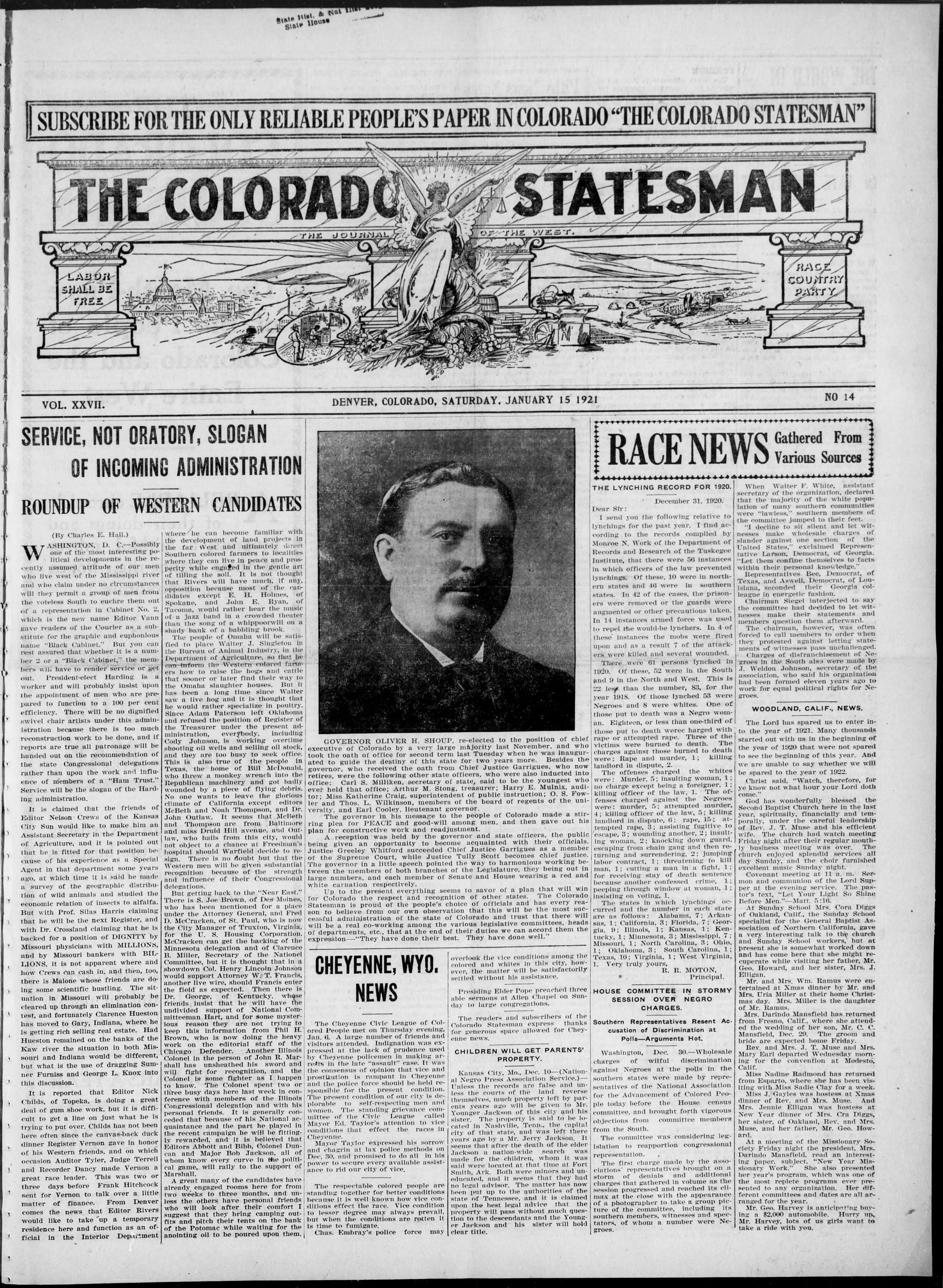
GOVERNOR OLIVER H. SHOUP, re-elected to the position of chief executive of Colorado by a very large majority last November, and who took the oath of office for second term last Tuesday when he was inaugurated to guide the destiny of this state for two years more. Besides the governor, who received the oath from Chief Justice Garrigues, who now retires, were the following other state officers, who were also inducted into office: Carl S. Milliken, secretary of state, said to be the youngest ever held that office; Arthur M. Stong, treasurer; Harry E. Mulnix, auditor; Miss Katherine Craig, superintendent of public instruction; O. S. Fowler and Thos. L. Wilkinson, members of the board of regents of the university, and Earl Cooley, leutenant governor.
The governor in his message to the people of Colorado made a stirring plea for PEACE and good-will among men, and then gave out his plan for constructive work and readjustment.
A reception was held by the governor and state officers, the public being given an opportunity to become acquainted with their officials. Justice Greeley Whitford succeeded Chief Justice Garrigues as a member of the Supreme Court, while Justice Tully Scott becomes chief justice. The governor in a little speech pointed the way to harmonious working between the members of both branches of the Legislature, they being out in large numbers, and each member of Senate and House wearing a red and white carnation respectively.
Up to the present everything seems to savor of a plan that will win for Colorado the respect and recognition of other states. The Colorado Statesman is proud of the people's choice of officials and has every reason to believe from our own observation that this will be the most successful administration of the state of Colorado and trust that there will be a real co-working among the various legislative committees, heads of departments, etc., that at the end of their duties we can accord them the expression—"They have done their best. They have done well."
CHEYENNE, WYO. NEWS
The Cheyenne Civic League of Colored People met on Thursday evening, Jan. 6. A large number of friends and visitors attended. Indignation was expressed at the lack of prudence used by Cheyenne policemen in making arrests in the late "assault" case. It was the consensus of opinion that vice and prostitution is rampant in Cheyenne and the police force should be held responsible for the present condition. The present condition of our city is deplorable to self-respecting men and women. The standing grievance committee of the Civic League called Mayor Ed. Taylor's attention to vice conditions that effect the races in Cheyenne.
Mayor Taylor expressed his sorrow and chagrin at lax police methods on Dec. 30, and promised to do all in his power to secure every available assistance to rid our city of vice.
The respectable colored people are standing together for better conditions because it is well known how vice conditions effect the race. Vice condition to lesser degree may always prevail, but when the conditions are rotten it is time to fumigate.
Chas. Embray's police force may
overlook the vice conditions among the colored and whites in this city, however, the matter will be satisfactorily settled without his assistance.
Presiding Elder Pope preached three able sermons at Allen Chapel on Sunday to large congregations.
The readers and subscribers of the Colorado Statesman express thanks for generous space allowed for Cheyenne news.
CHILDREN WILL GET PARENTS' PROPERTY.
Kansas City, Mo., Dec. 10—(National Negro Press Association Service.) Unless the records are false and unless the courts of the land reverse themselves, much property left by parents years ago will be given to Mr. Younger Jackson of this city and his sister. The property is said to be located in Nashville, Tenn., the capital city of that state, and was left there years ago by a Mr. Jerry Jackson. It seems that after the death of the elder Jackson a nation-wide search was made for the children, whom it was said were located at that time at Fort Smith, Ark. Both were minors and uneducated, and it seems that they had no legal advisor. The matter has now been put up to the authorities of the state of Tennessee, and it is claimed upon the best legal advice that the property will pass without much question to the descendants and the Younger Jackson and his sister will hold clear title.
RACENEWS Gathered From Various Sources
I send you the following relative to lynchings for the past year. I find according to the records compiled by Monroe N. Work of the Department of Records and Research of the Tuskegee Institute, that there were 56 instances in which officers of the law prevented lynchings. Of these, 10 were in northern states and 46 were in southern states. In 42 of the cases, the prisoners were removed or the guards were augmented or other precautions taken. In 14 instances armed force was used to repel the would-be lynchers. In 4 of these instances the mobs were fired upon and as a result 7 of the attackers were killed and several wounded. There were 61 persons lynched in 1920. Of these, 52 were in the South and 9 in the North and West. This is 22 less than the number, 83, for the year 1918. Of those lynched 53 were Negroes and 8 were whites. One of those put to death was a Negro woman. Eighteen, or less than one-third of those put to death were harged with rape or attempted rape. Three of the victims were burned to death. The charges against those burned to death were: Rape and murder, 1; killing landlord in dispute, 2.
The offenses charged the whites were: Murder, 5; insulting woman, 1; no charge except being a foreigner, 1; killing officer of the law, 1. The offenses charged against the Negroes were: murder, 5; attempted murder, 4; killing officer of the law, 5; killing landlord in dispute, 6; rape, 15; attempted rape, 3; assisting fugitive to escape, 3; wounding another, 2; insulting woman, 2; knocking down guard, escaping from chain gang and then returning and surrendering, 2; jumping labor contract, 1; threatening to kill man, 1; cutting a man in a fight, 1; for receiving stay of death sentence because another confessed crime, 1; peeping through window at woman, 1; insisting on voting, 1.
The states in which lynchings occurred and the number in each state are as follows: Alabama, 7; Arkansas, 1; California, 3; Florida, 7; Georgia, 9; Illinois, 1; Kansas, 1; Kentucky, 1; Minnesota, 3; Mississippi, 7; Missouri, 1; North Carolina, 3; Ohio, 1; Oklahoma, 3; South Carolina, 1; Texas, 10; Virginia, 1; West Virginia, 1. Very truly yours.
R. R. MOTON,
Principal.
HOUSE COMMITTEE IN STORMY
SESSION OVER NEGRO
CHARGES.
Southern Representatives Resent Accusation of Discrimination at Polls - Arguments Hot.
Washington, Dec. 30.—Wholesale charges of wilful discrimination against Negroes at the polls in the southern states were made by representatives of the National Association for the Advancement of Colored People today before the House census committee, and brought forth vigorous objections from committee members from the South.
The committee was considering legislation to reapportion congressional representation.
The first charge made by the associations' representatives brought on a storm of denials and additional charges that gathered in volume as the session progressed and reached its climax at the close with the appearance of a photographer to take a group picture of the committee, including its southern members, witnesses and spectators, of whom a number were Negroes.
NO 14
When Walter F. White, assistant secretary of the organization, declared that the majority of the white population of many southern communities were "lawless," southern members of the committee jumped to their feet. "I decline to sit silent and let witnesses make wholesale charges of slander against one section of the United States," exclaimed Representative Larson, Democrat, of Georgia. "Let them confine themselves to facts within their personal knowledge." Representatives Bee, Democrat, of Texas, and Aswell, Democrat, of Louisiana, seconded their Georgia colleague in energetic fashion.
Chairman Siegel interjected to say the committee had decided to let witnesses make their statements and members question them afterward.
The chairman, however, was often forced to call members to order when they protested against letting statements of witnesses pass unchallenged.
Charges of disfranchisement of Negroes in the South also were made by J. Weldon Johnson, secretary of the association, who said his organization had been formed eleven years ago to work for equal political rights for Negroes.
WOODLAND, CALIF., NEWS.
The Lord has spared us to enter into the year of 1921. Many thousands started out with us in the beginning of the year of 1920 that were not spared to see the beginning of this year. And we are unable to say whether we will be spared to the year of 1922.
Christ said, "Watch, therefore, for ye know not what hour your Lord doth come."
God has wonderfully blessed the Second Baptist Church here in the last year, spiritually, financially and temporally, under the careful leadership of Rev. J. T. Muse and his efficient wife. The church had watch meeting Friday night after their regular monthly business meeting was over. The church enjoyed splendid services all day Sunday, and the choir furnished excellent music Sunday night.
Covenant meeting at 11 a. m. Sermon and communion of the Lord Supper at the evening service. The pastor's text, "Let Your Light So Shine Before Men."—Matt. 5:16.
At Sunday School Mrs. Cora Diggs of Oakland, Calif., the Sunday School specialist for the General Baptist Association of Northern California, gave a very interesting talk to the church and Sunday School workers, but at present she is somewhat worked down and has come here that she might recuperate while visiting her father, Mr. Geo. Howard, and her sister, Mrs. J. Elligan
Mr. and Mrs. Wm. Ramus were entertained at Xmas dinner by Mr. and Mrs. Uria Miller at their home Christmas day. Mrs. Miller is the daughter of Mr. Ramus.
Mrs. Darino Mansfield has returned from Fresno, Calif., where she attended the wedding of her son, Mr. C. C. Mansfield, Dec. 29. The groom and bride are expected home Friday.
Rev. and Mrs. J. T. Muse and Mrs. Mary Earl departed Wednesday morning for the convention at Modesto, Calif.
Miss Nadine Radmond has returned from Esparto, where she has been visiting with Miss Sadie Clay for a week.
Miss J. Gayles was hostess at Xmas dinner of Rev, and Mrs. Muse. And Mrs. Jennie Elligan was hostess at New Year dinner of Mrs. Cra Diggs, her sister, of Oakland, Rev. and Mrs. Muse, and her father, Mr. Geo. Howard.
At a meeting of the Missionary Society Friday night the president, Mrs. Darindo Mansfield, read an interesting paper, subject "New Year Missionary Work." She also presented her year's program, which was one of the most replete programs ever presented to any organization. Her different committees and dates are all arranged for the year.
Mr. Geo. Harvey is anticipating buying a $2,000 automobile. Hurry up, Mr. Harvey, lots of us girls want to take a ride with you.
FOREIGN
The Greek offensive in Asia Minor resulted in important successes for the Greek forces, according to the Greek communique received by the Greek legation in London.
Development of oil lands in Argentine to the point where that country will be in a position to produce 40 per cent of the oil used there is planned by the ministry of that country.
Reports that soviet Russia is preparing for war against the Russian border states, including Rumania, were declared false by Adolph Joffe, president of the Russia peace delegation at Riga.
Mrs. Terence MacSwinney disembarked in London from the steamship Pan Handle State, which arrived from New York. Only two or three friends greeted her. She will remain in England a few days and then proceed to Ireland.
Miners in the Ruhr district of Germany have decided to deprive Bavaria of coal as a step toward forcing Bavaria to disarm the civil guards, the disbandment of which has been demanded by the allies, says a Berlin dispatch.
A presidential decree suspending the concession that had been granted the Western Union Telegraph and Cable Company to land its Barbadoes cable on the shores of Cuba has been signed and is in the hands of the government secretary.
Reports reaching Argentina from Bolivia, meager because of the rigid censorship which has been put into effect, indicate that the republic is verging on a state of anarchy owing to failure of the revolutionary party to establish a stable government.
Berlin again is threatened with strikes of electrical street car and subway workers and similar craftsmen because the municipal government has refused to reinstate and set free thirty-three Communist leaders who have been active among Berlin workers.
Anatole France, the author, has announced his adhesion to the communist section of the French Socialist party. This action on his part was not unexpected, as he began last October to write articles favoring sovietism, saying that the advancement of soviet principles was one of the principal undertakings of his life.
The Tribuna declares that the amount of money stolen from the treasury of the regency of Quarnero in Flume recently was 7,000,000 lire. This sum represented more than half of the money handed over to the Flume authorities by the commander of the steamer Cogne for the release of that vessel, which was seized by Flume of officers last fall.
GENERAL
More motorists were killed in Delaware last year in proportion to the number of automobiles registered than in any other state.
Films depicting criminal acts have been barred from display at Newark, N. J., W. J. Brennan, director of motion pictures, has announced. Such acts, he said, have a bad effect on the criminally inclined.
Wages of all employés of the Detroit United Railway Company, other than platform men, have been reduced approximately 20 per cent. Motormen and conductors are to decide this week whether to accept a similar reduction.
More than 130,000 quarts of wine, whisky and beer were poured into sewers at Waukegon, Ill., by a posse of federal prohibition agents. The liquor represented the "catch" obtained by federal officers in recent raids on illicit liquor stores in Lake county.
Four seaplanes, manned by officers of the United States navy and flying from San Diego, Calif., to Panama, have arrived at La Union, San Salvador. An American warship, which arrived there from La Libertad, supplied the planes with provisions and gasoline.
The three American naval balloonists stranded near Hudson bay when their big bag descended after a flight from Rockaway, N. Y., reached Mattee, Ont., safely after mushing down from Moose Factory.
A book, 700 years old, valued at $100,000, has been placed in the University of Pennsylvania for translation by Dr. William R. Newbold. It is said to have been written by the English monk, Roger Bacon, sometime between 1216 and 1262, and is an exposition of the laws governing life. The volume, which is written upon vellum, is the property of Dr. Willifred M. de Voynloh, an exile of Poland.
The board of directors of the Knights of Columbus, at a meeting in New York, recommended that the undistributed balance of approximately $5,000,000 of the united war fund be turned over to Herbert Hoover's European relief council for the feeding of starving children in Europe. The board voted that the knight's title to their portion of this balance, about $500,000, be transferred to the relief council, provided the other organizations sharing in the fund took similar action.
For stealing a locomotive—six months in jail. That was the sentence given by Federal Judge Landis to Daniel Abogast and Thomas McDermott of the Chicago Yardmen's Union, who turned an engine loose in the railway yards last August during the "outlaw strike" of switchmen at Chicago.
With his resignation as senator effective Jan. 15 on the desk of Harry L. Davis, the incoming governor of Ohio, President-elect Harding is looking forward to six weeks as a private citizen before taking up the responsibilities of the presidency.
A BRIEF RECORD OF PASSING EVENTS IN THIS AND FOR-EIGN COUNTRIES.
IN LATE DISPATCHES
DOINGS AND HAPPENINGS THAT MARK THE PROGRESS OF THE AGE.
(Western Newspaper Union News Service.)
WESTERN
Policeman John Layton was shot and seriously wounded during a revolver duel with automobile bandits whom he surprised robbing a soft drink establishment in Butte, Mont. The robbers escaped with their loot.
Settlement of a California oil land leasing action which will mean the payment of $220,000 in royalties to the government by the Miocene Oil Company, has been announced in the United States Circuit Court at San Francisco.
The towns of Covina, Glendora and Azusa in the San Gabriele valley, 20 to 25 miles east of Los Angeles, were rocked by what was declared by inhabitants to be a series of explosions. Each shock was accompanied by a loud report.
An unidentified burglar was shot to death in the residence of William Crutchfield in Omaha by a squad of police armed with riot guns and pistols. The officers had been tipped off to the prospective robbery and replied to the burglar's fire when he discovered them.
Frank Delbridge, a convict in the Nebraska state penitentiary, sentenced from Omaha on conviction of housebreaking, hanged himself in his cell, making a noose of his suspenders. He had recently been paroled, but was returned to the prison for alleged infraction of parole rules.
Deputy District Attorneys Stafford and Turney of Los Angeles have been in San Francisco to question two new witnesses who are to be brought to Los Angeles to testify for the prosecution in the trial of Mrs. Louise Pete, charged with the murder of Jacob C. Denton, wealthy mining broker.
The "China Eggs" law, requiring hotels, restaurants and other places that use foreign eggs in the preparation of food, or that serve foreign eggs, to advise the public of that fact by a "plainly readable sign," has been upheld as constitutional in a decision handed down by the State Supreme Court of Washington.
John R. Milholland, investment broker, of the firm of Milholland & Hough of Spokane, accused by Jay B. Hough, in an alleged confession to the police, of having participated with him in embezzling $350,000 in bonds and money from James F. Callahan, millionaire Wallace, Idaho, mining man, was found dead at his home in Spokane, Wash.
WASHINGTON
Deportation of Donal O'Callaghan, lord mayor of Cork, who arrived at Newport News as a stowaway and without a passport, has been requested of the Department of Labor Tuesday by Acting Secretary Davis of the State Department.
A law requiring lobbyists in Washington to register, telling who they are and who they represent, was advocated by Senator Kenyon, Republican, of Iowa. "Washington is crowded with lobbyists," he declared. "The oil, lumber and other big interests are lobbying."
Publicity of official coal cost data to be collected through the Federal Trade Commission as a means of keeping down charges to the consumer will be proposed by the Senate reconstruction committee following its investigation into the coal situation, it was said by Chairman Calder.
Investigation by the Department of Justice of lumber interests with special reference to the yellow pine industry of the South and a decision of the department to intensify its inquiry into the building materials situation, have been announced in Washington to determine if there have been violations of the Sherman anti-trust law. Both investigations are being conducted separately.
Special wireless telephone apparatus will transmit President-elect Harding's inaugural address to every army post, every battleship and halls in various cities where "inaugural parties" will be held, E. B. McLean, chairman of the inaugural committee, has announced. A committee on inaugural radio news has obtained the co-operation of the army and navy radio services to carry out the plans.
Maj. Gen, Peyton C. March, chief of staff of the army, will act as chief of staff for General Pershing, grand marshal of the inaugural parade, in Washington March 4. At General Pershing's invitation also, Maj. Gen, Peter C. Harris, adjutant general of the army, will serve as adjutant general of the grand marshal.
A reduction of $10,824,000 in gold output of the country, and of 117,941 ounces in the silver output during the last year as compared with 1919 has been announced by the bureau of the mint.
Pithy News Notes From All Parts of Colorado
Pithy News Notes From All Parts of Colorado
(Western Newspaper Union News Service.)
Senator Thomas has appointed William. Day Preston, 315 South Seventeenth street, Colorado Springs, to Annapolis Naval Academy.
The students of the School of Mines are soon to organize themselves into an associated students' council for the purpose of self-government.
The First Christian Church of Clifton, recently dedicated, is said to be the largest and finest church edifice in a city under 1,000 in population in the state.
Of the 267,118 aliens that arrived in the United States for the first six months of 1920 Colorado gave home to 919, according to the report of the United States Department of Labor.
The legislative appropriation bill which was reported out of committee in Washington, D. C., carries with it a $244,800 appropriation for the Denver mint.
K. H. Hildebrandt, an employé of the Great Western Sugar Company at Brush, was instantly killed when he was knocked down and run over by an automobile driven by Harry Razor, 18 years old. The accident occurred in front of the sugar plant as Hildebrandt was going to work.
Sorghum took a new place in Colorado agriculture in the year just ended, 298,720 acres of grain sorghums, 122,798 acres of sweet sorghums and 24,030 acres of sudan grass being grown, this total of 444,847 being a marked increase over the 430,892-acre total for the previous year.
A drive for membership in the Fremont County. Farm Bureau began in the Beaver Park district and will be continued throughout the county during January. There are at present 350 members, and it is desired to make the number at least 500. County Agent A. J. Taylor is in charge. Colorado's open season on deer lasts only four days, in October, but forest rangers peering through a surveyor's glass, saw a party several miles distant strapping a deer to a saddle horse. After two days' trailing a rancher was arrested, pleaded guilty to killing the deer and paid a fine of $120.
More than 70,000 visitors passed through the halls of the Denver mint during the year, according to an actual count by guards and attendants. The heaviest month proved to be August, when tourists from east and west meet in Denver. Approximately 3,000 people passed through in this month alone. The total number of marriage licenses issued in Denver during 1920 was 4,004. This surpasses by over 500 the 1919 record, which was 3,496 licenses, and that year broke all previous records. For several years prior to 1919, the average number of licenses issued was around 2,400, with the high mark 2,700.
The state of Colorado during the year 1920 collected a total of $815,100 in automobile license tax money, according to a report by Secretary of State James R. Noland. This is the largest amount of auto tax ever taken in by the state, and is nearly twice the amount collected the previous year, which totaled $491,713.35.
Despite falling prices, Weld county crops will bring farmers of the county approximately $20,000,000 for 1920, according to the annual report of County Agricultural Agent Mason E. Knapp, made to the county commissioners. The sugar beet crop brought nearly $10,000,000, while the wheat crop at the average price at which it was sold realized more than $6,000,000. The bulk of the potato and hay crops are yet to be marketed.
Deaths in Denver for December, 1920, totaled 413, exceeding the number for the same month in 1919 by 57, according to Miss Florence Leach, registrar of vital statistics at the city hall. The December figure included four murders, five suicides and thirteen deaths by accident, none of these, however, being deaths from auto accidents, an unusual record.
Twelve conventions will be held in Denver within the next two weeks. The Stock Show, which opens on the 15th, will be the headliner, and will consume the whole week. The list of conventions, and the date of their respective openings are as follows: Colorado Lumberman's convention, Jan. 13; the H. I. P., a hardware men's association, Jan. 25; county commissioners, Jan. 17; Mountain States Ice Manufacturers, Jan. 17; Old-time Cowboys' convention, Jan. 19; the Colorado Creamery Butter Association, Jan. 19; Colorado Sheriffs' convention, Jan. 20; Colorado Auctioneers' convention, Jan. 20; Colorado State Editorial Association, Jan. 21; Colorado State League of Building and Loan Associations, Jan. 21.
Deputy Sheriff Delliquadri, after a chase of twenty-five miles, recovered a truck belonging to John Rehm of Echo, Colo. Alonzo Shear, 23, and a brother, 16, were arrested charged with the theft. Delliquadri had been notified that the lads had stopped at a ranch for dinner and began the chase resulting in the arrest.
Plans are being formulated to build a short automobile highway from Pueblo into the San Luis valley, a distance of eighty miles. The plan is to open a twenty-mile highway from Westcliffe and Crestone.
---
Uncle Sam's efforts to aid disabled soldiers through educational school work is to have a practical demonstration at the National Western Stock Show at Denver, January 15. Three teams of former soldiers from agricultural colleges of the West are to compete for a special prize offered by the vocational board. Many men chose agricultural training, and now at the end of two years are showing results. The teams are chosen by districts, according to H, Allen Nye, head of vocational training, and are as follows: No. 11, Utah, Colorado and Wyoming; No. 12, California, Nevada and Arizona; No. 13, Washington, Oregon and Idaho. More teams are entered this winter in the annual contests for the National Western cup than ever before, and for the first time a contest is being pulled off for secondary agricultural schools, high schools and such institutions. The cup was won last year by Kansas and the year before by Nebraska.
THE COLORADO STATESMAN
The Mouth-Piece of the People of Colorado and the Entire West
Farmers of Colorado benefited to the extent of $700,052 during the last year through efforts of the Colorado Extension Service, according to a report made to Governor Shoup by Acting Director A. E. Lovett. Work of the department was carried on in twenty-nine counties by boys' and girls' clubs, agricultural fairs, farm improvements demonstrations, agronomy specialists, moving picture exhibitions, extension schools and other agencies.
With the collection of $16,600 during the month of December, the state inheritance tax department got away to a flying start in the biennial period, which began on Nov. 30 last, according to announcement made by Attorney General Victor E. Keyes. Collections were made from twenty estates during the last fifteen days, amounting to $9,678. The largest amount collected was from the estate of F. E. Frost of Logan county, totaling $136,943.
Five years from now the public lands of Colorado will be practically a thing of the past, and their history may then well be written. According to the report of the commissioner of the general land office published in December, 1920, there are 8,941,185 acres of vacant public lands in Colorado; five years ago there were 17,236,114 acres of public lands in this state—showing that during the interim 8,294,929 acres have been filed upon.
RELIABLE chronicle of their doings and progress; a faithful mirror of their wants, their hopes, their best aspirations.
For the first time since 1906 a Colorado man participated in the deliberations of the national board for the promotion of rifle practice, which has convened in Washington in response to a call issued by the government. Capt. Arthur B. Smith of Denver, small arms instructor for the Colorado National Guard, is the Colorado representative. Colorado's coal production during 1920 exceeded that of the preceding year by nearly 2,000,000 tons and fell only about a quarter of a million tons short of the 1918 output when the twenty-one coal-producing counties of the state established a high production record of 12,658,055 tons.
THE COLORADO STATESMAN
The first cases of death from the so-called "sleeping sickness" reported in Las Animas county occurred when Letiza Maglia, 25 years old, of Starkville, Colo., died, having been in unbroken sleep for eight days. Mike Sirchia, 26, of El Moro, died after an illness of four days.
Governor Shoup has stamped his disapproval upon the $7,000,000 highway budget for 1921 prepared by the State Highway Commission and sent it back to the commissioners with recommendations concerning the spending of the highway fund.
Unequaled as an advertising medium for the business of professional men and women.
The bank clearings over the figures for 1919 increased $12,000,000, according to a report from Colorado Springs Clearing House Association.
Pears and apples grown on the western slope this past season brought grower $1,125,000, it is conservatively estimated.
Litigation which has covered many years was closed when the board of directors of the Uncompahgre Valley Water Users' Association accepted a settlement of claims against bondsmen who were sureties for the Taylor-Moore Construction Company, which became insolvent when they made the first attempt to construct the Gunnison tunnel for the Water Users' Association.
An excellent family journal speaking to and for many thousand colored citizens.
Robert L. Lackey, prominent sheep rancher, was ordered to pay his wife, Mattie Lackey, $16,500 alimony by Judge Cornforth, at Colorado Springs. Mrs. Lackey stated on the witness stand that her husband recently had transferred all his property to escape paying the alimony. Lackey announced that he would stay in a jail cell before he will comply with the court's order. Two buildings were burned to the ground and several others were badly damaged in a fire estimated between $15,000 and $20,000 which broke out in a barn in the rear of the Swann building, a two-story structure at Brighton, Only a lull in the windstorm which swept the town saved the entire business district from destruction.
TWODOLLARSAYEAR
THE GREAT ORGAN OF THE
The "high cost of overproduction" was given as the cause of a wage reduction of 20 per cent announced by the Denver Rock Drill Company. The reductions affect 325 men. Everyone in the plant was affected by the reduction. A few of the foundrymen, molders and coremakers were reduced 25 per cent.
LABORING MASSES
The seventh annual meeting of the Western Fruit Jobbers' Association of America, to be held in Colorado Springs Jan. 24-28, will be the largest convention in point of attendance in the history of the association.
SHOUP'S MESSAGE TO LEGISLATURE
TWENTY-THIRD GENERAL ASSEMBLY HEAR RECOMMENDATIONS OF CHIEF EXECUTIVE.
WANTS BUDGET SYSTEM
GOVERNOR SAYS, "LET EVERY IN
DIVIDUAL DO ALL HE CAN TO
HELP AND ENCOURAGE."
(Western Newspaper Union News Service.)
To the Members of the Twenty-third General Assembly of the State of Colorado, Greeting:
Great responsibility at all times rests on those charged with the duty of making and enforcing laws, and it is not an exaggeration to say that this responsibility rests heavy at this time both in state and nation. The situation is hopeful rather than alarming, but it must engage our most serious thought and consideration.
I recently had the pleasure personally, and the great honor as Governor of Colorado, to attend the Governors' Conference at Harrisburg, Pa., where was promulgated what has since come to be known as The Ideal Business Man's Creed. The sentiment is appealing and I therefore take the liberty of quoting it in full:
"The financial situation in the whole country is cause for the gravest concern but not for despair. All lines of business are realizing heavy losses, but the swift decline of prices of farm commodities to far below the cost of production threatens a national disaster. The situation demands infinite patience and forbearance and supreme wisdom and courage. Nothing but evil can result from anger or fear. "We believe that the tenseness of the situation can be relieved in several ways:
"(1) Let every individual do all he can to help and encourage his neighbor. Let there be a complete mobilization of the financial and spiritual assets of every community. Neither God nor the government ought to be asked to help those who do not first make every effort possible to help themselves. There ought to be a united effort in every community to keep any good man from being destroyed because he cannot immediately meet his obligations. Under existing conditions it would be the acme of inhumanity and of unwisdom to force any debtor into bankruptcy if by the most liberal indulgence he would be ultimately able to pay. Business failures do more than wreck business; they ofttimes destroy man.
"(2) Liberal indulgences and renewals should be granted by the manufacturers to the jobbers, by the jobbers to the merchants, by the merchants to the individuals. It is no time for a creditor to seize his debtor by the throat and savagely say, 'Pay me what thou oest.'"
Farmer and Stockraiser.
Colorado has not suffered out of proportion to other states in the readjustment of business conditions to a peace time basis. What legislative relief can be afforded must, for the most part, come from the national Congress. I desire to assure you, however, that any measure for the improvement of the condition of our people, upon which the General Assembly may agree, will be given sympathetic consideration when presented for my approval. Particularly, relief should be afforded, if possible, to the farmer and stockgrower, upon whom we all depend for subsistence.
Federal Aid for Mining.
The mining industry in our state did not benefit as did other industries because of war-time demand. This is particularly true of gold mining, which has suffered severely because of increased costs with no possible corresponding increase in sale value. This industry, after all, is the one to which we owe the original greatness of our state, and with the passing of the prospector its future development is a serious problem. It is inconceivable that there should be opposition to the encouragement of the production of gold, upon which rests the credit and monetary stability of the world. I realize that there is little that can be done through local legislation that can be of help to this important industry, but I do most earnestly urge that in some fitting and forceful manner the situation be brought to the attention of our national government and that our national representatives be assured of our unqualified support in the effort which they will make for its revival.
Industrial Disturbances.
Serious industrial disturbances have given us deep concern in the past two years. With a single exception they have been adjusted without loss of life or destruction of property. In two instances it was necessary to mobilize the National Guard, and this organization quietly but effectively protected the rights and property of those on both sides of the regrettable controversies. On another occasion the newly formed Ranger force was directed to preserve order in a strike zone, but happily no serious trouble developed. When lives were lost in rioting incident to the Denver Tramway strike the city authorities appealed to the executive for federal greens and, after their arrival, the dis
orders were promptly quelled and no further loss of life occurred.
The Colorado Rangers.
My experience has convinced me that there is no means available to the state by which these situations can be controlled in the interest of all parties concerned so effectively as by state police. Accordingly, I have revived the constabulary under the provisions of the act approved August 7, 1917, and it now is an efficient organization. To obtain the fullest safety to the state and efficiency to that department, I recommend an adequate appropriation for its maintenance from the general fund or from the national defense bonds, and a revision of the act under which it operates, to make it permanent. It manifestly would be in the interest of harmony and efficiency to place the department under the adjutant general and to make that officer ex-officio its superintendent. Life and porperty in Colorado must be protected and I earnestly recommend the continuation of the Ranger force as the surest and most economical agency for accomplishing this result.
Defense Bonds.
The state frequently is handicapped by lack of funds to meet unforeseen emergencies when the General Assembly is not in session. I recommend that the issue of national defense bonds be extended for the years 1921 and 1922 and that a large appropriation be made therefrom for such contingencies as may seriously involve the welfare of the state.
National Guard Armories.
The state is obligated to maintain an adequate National Guard for the defense of the federal government. Generous appropriations should be made from the national defense bond issue for the construction of armories where National Guard units have been organized and recognized.
Better Roads.
Highway legislation of a construction character is demanded by the people. I believe that state roads should be planned, constructed and maintained exclusively by the state, that they should be in the hands of a capable, experienced official with wide authority and that he should be bound to a comprehensive program of development and should be responsible directly to the governor for the efficient performance of his duties. The state and national governments have been generous with road appropriations. We must be careful that these funds are judiciously expended.
Boards and Bureaus.
For two years I have given attention to the functioning of State Departments, commissions, boards, etc., and have considered seriously the need for an effective co-ordination of their activities. The lieutenant and acting governor recently appointed Senator Francis J. Knauss of Denver and Representative-elect W. B. Gordon of Lamar to give the problem special study. Their examination of the statutes of this and other states and of the valuable reports published in 1916 by the Survey Committee on State Affairs has led to the preparation of a series of bills which, I am sure if enacted, will eliminate much duplicated work by consolidation of departments of similar purpose and will lessen the cost of transacting public business.
The committees study led to the inevitable conclusion that a new code is needed to systematize administrative work. The experience of several other states with a board of control in which all the powers and duties of the numerous commissions, bureaus, etc., are lodged has proven helpful. The committee found, however, that while such a central board might and probably would be an improvement over our present system, the plan cannot be worked out comprehensively under the constitution of Colorado. In this conclusion I am reluctantly forced to concur.
New Constitution.
Our present constitution was adopted many years ago and under conditions essentially different from those now obtaining. It has been frequently amended and each amendment has been designed to meet a specific need without due regard to its effect upon the Constitution as a comprehensive whole. Therefore, because only a new organic law will meet the actual needs of the state, it is my deliberate conviction that this General Assembly should submit to the people a proposal for a constitutional convention.
Budget System.
The experience of the budget department in its first two years strengthens my conviction that the recommendations of the head of that department, when approved by the governor, should have more force and effect than at present. When changes of administration occur the budget for the ensuing biennial period should be prepared by the outgoing executive. It is not to be expected that a newly-elected governor will have sufficient information regarding the specific needs of State departments and institutions to formulate a financial plan at the outset of his term. Your concurrence in this view, I believe, will result in a more efficient fiscal system for the state and leave to the General Assembly all of its prerogatives. I again call your attention to the advantages of a central purchasing agency and the abolition of the State Auditing Board.
Increased Revenues.
A study of our system of taxation has convinced me that if all the property in the state subject to taxation
was actually and accurately listed it would be possible to obtain all necessary revenue with little or no increase in the levy. I, therefore, recommend that the State Tax Commission be given a liberal appropriation in order that in the future it may prepare a full and complete roll of taxable property.
Our inheritance tax rate is far below that of other states and a revision of the present scale which will produce approximately 25 per cent increase in revenue is recommended. With this amendment Colorado still would have a lower rate than any other state.
The state is in an excellent financial condition. The state treasurer reports receipts, including transfers, of $31,248,058.03 during the biennial period which ended on Nov. 30, 1920. During the same period disbursements totaled $28,973,531.17, so that the assets show an increase of $2,274,526.86. The total available resources in the hands of the treasurer on Nov. 30, 1920, were $10,365,331.05. Of this sum $2,200,000 was in cash and the balance in state warrants, state bonds, school and municipal bonds and obligations of the United States government.
The state's bonded indebtedness on Nov. 30, 1920, was $4,187,300, compared with $4,451,800 on November 30, 1918. The bonded indebtedness was reduced by $264,500 during the biennium just ended. Interest earnings of the state during the past two years amounted to $763,162.72 while interest payments for the same time totaled $315,250.33. All state bonds are held by various state investment funds, with the exception of only $418,200 held in private hands.
The state inheritance tax department collected the unprecedented total of $1,294,305.81 during the biennium. The cost of conducting this department was only $40,330.76, a most excellent showing.
The state insurance department turned into the state treasury a total of $824,044.73, collected at an expense of $67,018. I believe that attention should be called to the fact that twice within the past two years the insurance department has ordered reductions in fire insurance rates. Effective Sept. 1, 1919, the department ordered a flat reduction of 10 per cent in premiums, saving the property owners of the state $382,000. On Sept. 1, 1920, another order was entered directing the fire insurance companies to reduce their total of premiums collected by $253,000. This order now is being carried out by the companies.
Over Appropriations.
When the regular session of the Twenty-second General Assembly adjourned it was found that appropriations had been made which exceeded the estimated revenue by approximately $1,000,000. However, the fiscal year ending Nov. 30, 1920, closed with all appropriations paid and a surplus on hand of $557,000. It may be possible that the revenue estimates submitted to you in the report of the Budget and Efficiency Commissioner for the present biennium also are low, but this should not be assumed as a fact. The tax levy should not be increased if it can be avoided without positive injury to the state and its institutions, and appropriations should not be made beyond the estimated revenue.
Whatever retrenchments we find to be necessary in other agencies of government, we are in honor bound first to make adequate provision for our charitable, penal and corrective institutions. Therefore, it is urged that the appropriations for these institutions be adequate to meet their reasonable needs.
Educational Needs.
The growth of our state institutions of higher learning is fully appreciated by the people who voted for an additional mill levy to be used in their support. Funds from this source, if authorized by this General Assembly, will not become available until early in 1922. The financial problem facing these institutions in the period of 1920-1921 demands your serious consideration.
State Institutions.
The condition of state institutions is covered in the report of the Budget and Efficiency Commissioner which soon will be before you and, therefore, it is unnecessary in this message to set forth their growth and needs. The Twenty-second General Assembly authorized the admission of the wives of veterans to the Soldiers and Sailors' Home, but made no appropriation to erect the necessary buildings. Suitable accommodations should be provided for this purpose as soon as state finances will permit.
Protection to Investors.
Many of our people have been frauded by unscrupulous promoters. A stringent law to curb and, if possible, to prevent the sale of worthless securities is demanded and, in my judgment should be enacted by this General Assembly. At the same time the honest promoter should be protected and the development of the state through legitimate speculative investments ought not to be retarded.
The Direct Primary.
There has come the conviction, after giving the direct primary law a thorough trial, that it is to unwieldy and too expensive to be continued. It places a premium on financial standing rather than on capacity for public service. If it is possible to draft a law which will remedy this evil and also keep the power of selecting nominees for office directly in the hands of the voters, I would favor it. However, if this should prove impossible, I would welcome the party convention as highly preferable to the direct primary, because I believe it is subject to less abuse.
Soldiers' Memorial.
The preceding General Assembly provided a fund of $50,000 for a memorial to the sons of Colorado who lost their lives in the Great War. It developed, however, that the veterans who were specially interested in the project preferred a memorial building to a monument or other purely decorative tribute. Accordingly, this appropriation was not utilized and has reverted to the general fund. I still am impressed with the duty of the state to give proper recognition to those heroes. Therefore, I urge your approval of the requests of the organized veterans insofar as the finances of the state will permit. Our memorial should be not only a tribute to the dead, but also a patriotic inspiration to succeeding generations.
Teachers' Salaries.
The welfare of our public school system has been close to my heart and I believe opportunity is offered this General Assembly to expand its scope and improve its efficiency. The salaries now paid teachers are not in proportion to the value of their services and a minimum schedule should be adopted for the protection of our educational interests. Where districts are too weak financially to reach this minimum, state aid should be afforded. I commend to your attention the report of the Teachers' Salaries Commission published April 28, 1920.
Tenure of Office.
I strongly favor a four-year tenure of office for state and county officials. More than two years is needed to permit a newly-elected officer to give his best service, and in unusual instances where the people have misjudged the qualifications or character of an official, they may invoke the recall to remove him.
Profiteering.
In recent years unreasonable and excessive profits have been collected in many lines of business. It is not easy if, indeed, it is at all possible, to deal effectively with this situation by legislation. Already the situation is changing and dealers who formerly reaped large returns now are forced to suffer losses. Nevertheless, if the General Assembly finds itself able to afford the public relief from exorbitant charges for any commodity or service it is not too late for legislative action.
Juvenile Legislation.
Constructive legislation is needed in the interest of child welfare. There now are too many organizations operating under state appropriations with the same general purpose in view. The attention of the General Assembly is called to this situation with the suggestion that such boards or agencies as may be approved for continued service should be given adequate funds to perform their duties. A committee of county judges which I appointed to study and make recommendations on juvenile laws has prepared a program for your consideration
Better Game Laws.
I concur in the recommendation of the game and fish commissioner that a closed season on deer is necessary. Further revision of the statutes is required to the end that game and fish may be protected and eventually, become a greater source of revenue to the state.
Industrial Rehabilitation.
On December 29 I telegraphed the director of the Federal Board for Vocational Education accepting the provisions of the federal act for industrial rehabilitation. This action is not binding upon the state and was taken solely for the purpose of saving to this General Assembly the opportunity to deal with the subject. Executive acceptance was required before January 1, 1921, in order to make available federal moneys for this fiscal year. No provision for this work has been made in the budget but I commend it to you for favorable consideration.
A Word of Appreciation.
I desire to express my most sincere appreciation of the splendid spirit of co-operation which has been accorded the executive from all departments in the term which is nearing an end. The associations have been pleasant and public business has been transacted efficiently and expeditiously with few exceptions.
It is a particular pleasure to have been associated with Lieutenant Governor George Stephan in these past two years. His judgment has been invaluable in counsel and on the occasions when I have been absent he has given the duties of the executive office the ablest attention.
I am gratified to hear many members of House and Senate express the opinion that the work of the General Assembly can be transacted expeditiously and I join them in the hope for an early adjournment.
I have referred to general business conditions and to the fact that the outlook is hopeful. We must earnestly strive to accomplish everything which may prove helpful and to do nothing which may prove harmful. All lines of business and every honest endeavor must be protected against additional burdens as they already are bent under heavy exactions. Farming, stockraising, merchandising, manufacturing, mining and all of our varied interests are so interrelated and in such sympathy each with the other that to injure one means to injure all and to help one means to help all. Difficult as it is under existing conditions for the farmer to finance his needs, the railroads and the miners are only slightly better off. A spirit of toleration, forbearance and helpfulness must actuate all our people and should control all your deliberations. With it, the future of our state is secure, without it there are dangers ahead.
Wholesale and Retail Staple and Faney Groceries Fish and Oysters Hotels and Restaurants Our Specialty Fresh and Cured Eastern Corn-Fed Meats Fruits, Vegetables, Poultry and Game FREE DELIVERY
The
Curtis
Park
Floral
Company
FLORAL DESIGNS PUT UP WHILE
YOU WAIT
CHOICE PLANTS AND CUT FLOWERS CONSTANTLY
ON HAND
GREENHOUSES: Thirty-Fourth and Curtis Streets
TELEPHONE, MAIN 1511 DENVER, COLO
SCIENTIFIC AND SANITARY SCALP AND HAIR TREATMENT MASSAGING, MANICURING, TOILET ARTICLES
C. E. SMITH, Manager, Res. Phone South 1608
The Market Company
Wholesale and Retail Staple and Fancy Groceries, Fish and Oysters.
Hotels and Restaurants Our Specialty. Fresh and Cured
Eastern Corn Fed Meats
Fruits, Vegetables, Poultry and Game.
Telephones Main 4302, 4303, 4304, 4305
622-636 15TH STREET DENVER, COLORADO
1
C. E. SMITH, M
The Man
Wholesale and Retail Stores
Hotels and Restaurants
Eastern
Fruits, Vegetables
Telephones
622-636 15TH STREET
PHONE MAIN 3023
John
Phone Main 6758
THE MARKET
Retail Staple and Fancy Groceries
Fish and Oysters
Restaurants Our Specialty
Red Eastern Corn-Fed Meats
Potatoes, Poultry and Game
REE DELIVERY
Denver, Colo.
WHILE WAIT
FLOWERS CONSTANTLY ON HAND
Curth and Curtis Streets
DENVER, COLO
head Hat Co.
PIONEER HATTERS
OF THE WEST. WE
MAKE OLD HATS
NEW.
TEACHERS, DYERS AND FINISHERS
Dresses' Hats of Every Description
PA ST., DENVER, COLO.
Dressing Parlors
TEXTY SCALP AND HAIR TREATMENTS
UNICURING, TOILET ARTICLES
otto—"Efficiency"
Lexie A. Brooks
PHONE YORK 5997W
C. C. DENNIS R. F. LONG
The New Way Shoe
Repairing Co.
AND
American Shoe Repairing
FIRST-CLASS WORK
Best Leather Used—Reasonable Prices
1855 Champa St. Phone Main 3737.
DENVER, COLO.
Manager, Res. Phone South 1608
Market Company
Free and Fancy Groceries, Fish and Oysters.
Mets Our Specialty. Fresh and Cured
Corn Fed Meats
Potatoes, Poultry and Game.
Main 4302, 4303, 4304, 4305
DENVER, COLORADO
RES. PHONE GALLUP 942
K. Rettig
AND STAPLE GROCERIES
CURTIS STREET
Denver, Colo.
THE COLORADO STATESMAN
SAGIN
SHOULD BE
FAKE
HACK
COUNTRY
PARTY
JOSEPH D. D. RIVERS.....Proprietor
P. O. Box 116 1824 Curtis Street. Room 25 Phone Main 7417
Communications to receive attention must be newsy, upon important subjects, plainly written only upon one side of the paper, must reach us Tuesdays, if possible, anyway not later than Wednesdays, and bear the signature of the author. Postage stamps are sent for postage. All communications of a personating nature that are not complimentary will be withheld from the columns of this paper.
Remittances should be made by express money order, postoffice money order, registered letter or bank draft. Postage stamps will be received the same as cash for the fractional part of a dollar. Only 1c and 2c stamps taken.
No discounts allowed on less than three months' contract. Cash must accompany all orders from parties unknown to us. Further particulars on application.
Reading notices, ten lines or less, 15 cents per line. Each additional line over ten lines, 12 cents per line. Display advertising, 75 cents per inch for first insertion and 50 cents per inch for each additional insertion.
THE REPEAL OF THE DIRECT PRIMARY LAW.
IN HIS message to the State Assembly, Governor Shoup has recommended to that august body that the present direct primary law is "too unwieldy and too expensive to be continued" and should be so amended as to make it possible for the poor man of ability, as well as the rich man with means, to be nominated and elected to responsible and honorable position by his party.
This frank suggestion and open-minded recommendation by the governor to the Assembly was very timely indeed, and we regret that the governor did not take advantage of the real sentiment of the people at the time of his greatest popularity and positively recommend the repeal of the DIRECT PRIMARY LAW.
Theoretically, the direct primary law may be alright if the people took the proper interest and would go to the polls and vote their true and honest convictions. But such is not the case, and under the present system will rarely ever be the case.
There are many strong objections to this present system and the Republican party should either repeal it or amend it so that a poor man of brains, ability and real worth will have some chance.
Under the present system the primary election law fails to protect either party. The penalties provided against unusual expenditures are easily and flagrantly evaded and there are glaring examples of as much corruption under the present system as was charged under the old "boss convention system."
The present primary law was devised with the intention of curtailing the power and influence of the big boss, but in reality it affords the boss a larger and wider field for opportunity to manipulate than under the old system. How on earth can a poor man hope to gain political recognition under this system when he practically is compelled to make two real campaigns in his attempt to reach the goal. If a man hasn't a bank roll big enough to pay for the extensive advertising and heavy campaigning in the first heat, he will never get away from the wire. Then, again, if a man is successful in the primaries he surely must hit the trail with the coin in the last half of the hurdle. There are many rich men who have squirmed under the stinging lash of the heavy expense attached to the honor of being nominated and elected to office under the present system.
The present system has been so conducive to bringing out a class of men who afford such good, fat, fine pickings that we opine the real politicians will put up a stiff fight against its repeal.
The present system has positively brought about the reverse of what it was designed to do. It has certainly not raised the class or calibre of men for political preference, nor has it done away with political corruption or any of the evils complained of by the former system. It was hailed as a panacea for our political evils, but after being tried it has turned out to be the best meal ticket the political bosses have ever grabbed and rest assured they will hold on to it.
REPUBLICAN SIMPLICITY.
BRAVO! Proud indeed must the nation feel when the President-elect, Senator Harding, comes forth and requests the inaugural committee to abandon the usual inaugural ball and parade in the interest of national thrift. Already the debates in Congress had become quite heated over the proposed outlay of hundreds of thousands of dollars for this one day's celebration. Washington is disappointed of course, because Washington delights in pomp and splendor and revels in the glitter of tassels and tinsel.
But of what use is all this fuss and lavish outlay of the people's money? If it tended to make a better administration all of us would say, Amen! But we are in perfect accord with Senator Harding and congratulate him upon his good, sound common sense. By this one little courteous request to the inaugural committees to put aside all of their preparations for the big fete he has grown in confidence and size in the eyes of millions of the American people. He has indeed made a good start by first setting a wholesome example of economy to the people of the country. It shows him to be a great man who has the desire to keep his feet on the earth.
It was just the thing to do at this time when everything seems so generally out of joint. It will have a tendency to steady the business world and calm the people as well. Nothing could have happened at this time which could have set his simple character more strongly and favorably before the people, regardless of party or politics.
Then, too, why such reckless rejoicing at such a serious and solemn time in the history of the country?
Instead of the inaugural ball and parade with all its gold and glitter, the people should make it a day of prayer to give thanks unto the Lord for having delivered us from eight long, weary years of an administration filled with hatred and oppression of our people—an administration that has been weighed in the balances and found wanting, and because of its sectional bias and inefficiency was given the greatest rebuke of any party in the history of our country.
President-elect Harding has certainly set a very worthy precedent and it is to be hoped that the country will be benefited by his sterling example. His mind is not upon the display and the vanities which the inaugural naturally affords, but rather upon the great responsibilities of the office, and he is eager to take hold of the task to begin at once the solution of the problems that are awaiting him.
The country has long been in need of just such a man. All honor to our next President!
Cleo Irene Hobson Popular in Educational and Musical Circles, Dies After Brief Illness From Stroke of Paralysis.
Only Daughter of Parents; Her Loss Keenly Felt by Church and Other Organizations She Assisted.
Large Attendance at Funeral—Deluge of Telegrams and Letters from Other Cities Received—A Loss to the Community.
THE death of Cleo I. Hobson, a member of the youthful side of our community, casts a gloom upon not only her immediate circle of the young, but removes from our midst a worthy, useful citizen, whose activities stretched far beyond the confines of youth, and whose usefulness left us a standard in the "beauty of service" which will never be effaced from our memory. The deceased, the only daughter of Mr. and Mrs. Samuel H, Hobson, 2352 Glenarm place, after a brief illness of nearly three weeks from an attack of paralysis, joined the Great Majority Friday evening, January 7th, having attained the age of 20 years and 20 days. Born in Denver, December 18, 1900, she received her education in the graded and high schools, graduating from the East Denver High last June. She studied music under Miss Bell d'Autremont, head of the d'Autremont School of Music, along established institution of merit in our city, and was elected pianist of her class, being highly commended for her contribution to the program of Class Day exercises immediately preceding graduation. She became a member of the People's Presbyterian church at the age of 11, and was a fierce, zeenous worker, occupying for years the positions of organist and Sunday school teacher. Though young, she was actively engaged in missionary work, taking a part on several occasions with the science department of the Woman's Club (white), in the Sunday concerts at the county jail and other places where her services were donated. She was a member of the Phyllis Wheatley branch of the Young Women's Christian Association and made a profound impression on all her associates by her genial and affable disposition. Miss Hobson performed at many concerts of the leading white Presbyterian churches and was credited as being very talented. Being encouraged to pursue her musical studies, she began arrangements for her admission into the New England Conservatory, Boston, Mass. She won the respect of the community, which was evidenced by the very large attendance at the funeral ceremonies held at the People's Presbyterian church last Wednesday afternoon, in which the pastor, Rev. J. A. Thos. Hazell, assisted by Revs. Thomas, Rahming, Over and Secretary Bell of the Y. M. C. A., paid fitting tributes to the memory of the deceased.
The floral offerings were numerous rare and beautiful, and the number of telegrams and letters of condolence from California, Chicago, Kansas City where the deceased had many relatives and friends, also numerous sympathetic messages. Resolutions from various organizations of our city, some of which were read during the ceremony, these bore testimony to the splendid life and character of the departed loved one. The choir turned out in full to pay their last respects, and the palebearers, consisting of the companions of her youth, namely, William Fagan, Jas. Russell, Samuel Russell, Arnold Caldwell, Charles Hughes and Theodore White, bore her remains, under the direction of Curtis M. Harris, funeral director of the Cammel & Co. Undertaking Company, to their last resting place in the family lot in Fairmount cemetery. Thus ends the career of one of our dear loved ones, whose loss to us is Heaven's gain. GOD BLESS TO US HER MEMORY.
The Colorado Statesman offers its sincere condolence to the bereaved family, and commits them to the care and consolation of Him Who will bring light out of darkness and joy out of sorrow, giving them fortitude to bear the burden of this irretrievable loss to them and our community.
EULOGY OF CLEO IRENE HOBSON
Wednesday, January 12th, Funeral Ceremony, People's Presbyterian Church.
(By Hewetson Watson, a Co-Worker.)
WERE not the Christian religion built upon so firm a foundation of which we are witnesses in our experience of its goodness, its greatness, its faith, its hope even in death, such events as these and their attending circumstances that cause us to assemble here today would offer a temptation to doubt its truth or provoke a challenge of its principles.
But, having the assurance and confidence of its worth, we calm our doubts and apprehensions with the knowledge that God the All-Wise, God the All-Powerful—He knoweth best, Death—the end of the animate creation, the termination of life, the cessation of human existence, but a different meaning to the Christian whose hope is in his God, whose faith towers above the highest height, whose love is unbounded, and who, having a realization of things present, a vision of things to come, rejoices in the knowledge that death is only the transition state, the passing from this life to a better grander, nobler existence of endless pence, joy and happiness. The body that lies before us, soon to be consigned to the dust from whence it sprung, contains the remains of all
I speak in behalf of higher education. There is need not only of patriotic ideals and a trained intelligence in our economic life, but also of a deep understanding of man and his relationship to the physical universe and to his fellow man. There has always been evil in the world. There are evil forces at work now. They are apparently organized and seek disintegration of society. They can almost be recognized by a direct appeal to selfishness. They deny that the present relationship of men has any sound basis for its existence. They point out to men with untrained minds that it takes effort to maintain themselves and support government and claim that they ought to exist without effort on the accumulation of others and the denial that men have any obligations toward one another. The answer to this lies in a knowledge of past human experience and a realization of what man is.
The sources of the state of mind which supports civilization are education and religion. We hold by the modern standards of society. We believe in maintaining modern civilization for the protection and support of free government and the development of the economic welfare.
The great test of an institution is the ability to perpetuate itself. It seems fairly plain that these institutions can survive with the aid of higher education. Without it they have not the slightest chance.
We justify the greater and greater accumulation of capital because we believe that thereupon flows the support of all science, art, learning and the charities which minister to the humanities of life, all carrying their beneficent effects to the people as a whole.
Unless this is measurably true, our system of civilization ought to stand condemned.
One of the chief reasons for the failure of the District of Columbia to obtain the electoral franchise is the large number of residents who wish to retain their ballots in their home states and do not want to vote here. I have been coming to Washington for many years and have been interested in the refusal of congress to bestow the ballot on the district. Like any other real American, I think the people of the capital should have a voice in the government under which they live, but I am afraid it will never be granted them until the thousands of workers who vote in other states relinquish their home vote for a vote here and urge their congressmen to grant the district the franchise.
There is no doubt in my mind that the district should vote and that it should have representation in congress as well as the power of choosing its own municipal officers and public servants. The school situation in Washington has never been entirely satisfactory, simply because the people have had no voice in the selection of their school officials. No city can succeed as well under a paternalistic government as under its own rule.
Politics is necessary in any city, as it keeps some factions actively watching every movement made by the party in power, and the officials know that they must satisfy the public if they wish to be returned.
The District of Columbia cast about 60,000 votes in the recent election, all of them in other states.
The New Day When Business Women Will Prefer Simple Clothes to Finery. By MRS. L. L. FOREST, Nat'l Fed. Professional-Business Women.
You never see a young business man going to work in a Tuxedo coat, dancing pumps, combined with colored shirt and tweed trousers, but you see girls going to work in a general mixture of ballroom finery and tailored things.
Of course, this is not altogether the result of lack of sense of fitness. Confronted with the necessity of bying both evening and business clothes out of a limited income, the business girl buys the former and tries to make them do for both occasions.
But, no matter what the condition, this practice won't do any more than the mixed clothing will do for the young man. I feel that the Federation of Professional and Business Women should concern itself with a national movement in behalf of simple and suitable dress for business women.
The trouble has been that the moment dress reform is mentioned for women the world jumps to the conclusion that it means mannish clothes or a uniform. I do not believe in either, but what I do herald is the coming of a new day when business women will prefer simple clothes to perishable finery.
Let the Growing Boy Have His Rabbits and Know Their Funny Habits.
Parents rise in holy wrath at the landlords who refuse to allow children to live in their apartment houses.
Yet, in my opinion, children should not be cooped up in apartments, where there is no yard in which they can romp. Growing children need the fresh air, green grass and contact with the soil.
Life in an apartment house leaves the growing boy without the necessity of doing small chores that tend to give him the habit of work he must do when he is grown. This generation is inclining more and more to the idea of letting the other fellow do the work.
My advice to parents is, take the children out into the open. Let them know what it is to carry in the coal after school. Let them know the joy of digging into the fresh earth. Start the child at work in a garden plot in the back yard. Let him see nature at work. Let the growing boy have his rabbits and pigeons and know their funny habits.
```markdown
```
that is mortal; but the soul of Cleo Irene Hobson goes back to the God who gave it, an additional adornment in His crown of precious jewels. The simple, plain, unassuming features characterizing the life of our dear departed loved one set an example for us, both old and young; the ambitions role in the form of intellectual development which afforded her most pleasure fills us with pride and sets at naught the doctrine entertained by some element of the human creation of our mental inferiority because of a condition for which we are irresponsible; the devout Christian womanhood exhibited at all times and under all conditions and circumstances lends another certificate to the truismus of the Christian religion, forms a link in the chain of this wonderful story of "Jesus and His love" which is permeating the globe.
These qualities were possessed by our deceased sister, whose exemplary life will be ever green in our memory, and whose contribution to the gospel of "Christ and the Church" will immortalize her among the sons of men. Why should we not shed a tear? Jesus wept. And in bowing to the inevitable we are reminded of the comforting expression, "Let us not weep as men without hope." A consolation; yea, a comfort, a joy; as, in the lines of the hymn-poet, "Weeping may endure for a night, but joy cometh in the morning," is borne to the sorrowful hearts of mother and father; to other grief-laden relatives and friends, and, rejoicing in the hope of the Resurrection, we will meet our young friend and companion again in a hand of unending bliss. The educational portion of our community has lost a member, the musical an invaluable asset; as, not content with her graduation from the East Denver High school and the d'Autremont School of Music, she was preparing to enter the New England Conservatory of Music, Boston, Mass.
Though grieving over her loss we take comfort from the contemplation of her illustrations career, and, chastened by the affliction now upon us, may we strive to emulate her example and realize that the greatest tribute we can pay to her memory is to so live that our lives in part resemble hers; and when the Grim Reaper, who knoweth neither rank nor distinction but comes to all the sons of men, shall beckon to us we may leave the world a little better for our having lived. For many years to come her devoted relatives and friends will long "For the touch of a vanished hand, and the sound of a voice that is still."
This Church, the Young Women's Christian Association, the Society of Organists and other institutions with which she was identified will feel her loss very keenly. But who knows in the wisdom of the Creator of mankind whether the death of Cleo Irene Hobson may not be the means of bringing to life—that Christian life of which many of us have tasted of its sweetness—some boys and girls with whom she associated in her climbing the ladder of life; some fathers, yea, some mothers, who have watched her career and who were in a position to follow her step by step, as she was purely a Denver product, living here from the day of her birth until she completed the twentieth milestone along the journey of life? Who knows, I say, whether the death of our dear young friend may not bring a greater awakening to our Denver community of the true realization of the Trume God more than the voice of the pulpiteer, the powers of the orator, the logic of the scholar, or even the impressive words of the evangelist?
In reviewing a comparison that came from the Rev. Myron W. Reed, one of the most noted ministers of Denver and the West, relative to the "well-developed man," he compared him to the building of King Solomon's temple in the following: "Each piece was made perfect, and when all was ready the temple rose without noise, or ax, or chisel, or saw, or hammer. The temple grew like a plant, came together without friction. And so the highest type of man comes together like the temple. He is a miracle to us when we behold him, but when we study him he is a result. He is the product of all his thoughts and deeds since he was born. Besides that, his environments largely contributed to him." And following the career of my deceased friend, Cleo Hobson, for the past twelve years, I unhesitatingly venture to place her in the category of this well-developed man had she been permitted to stay with us a while longer. In paying this tribute to her memory, I am satisfied she sought the company of the good, the environment of the emobling. Sleep on! thou victim of death, but child of an immortal life that knoweth no sorrow, grief, or pain; that life which will be enshored and enjoyed by your mother, father, relatives and friends if they hearken to your dying request, "Meet me in Heaven"; that life which Christian believers will experience beyond the grave
"The freer step, the fuller breath,
The wide horizon's grandeur view,
The sense of life that knows no death,
The life that maketh all things
Office 000 27th St. Ph. Champa 1142
S. E. CARY
ATTORNEY-AT-LAW
Six Years City and County Attorney
at Russell Springs, Logan
County, Kansas
Office Home
9:00 A. M. to 12:00 M.
2:00 P. M. to 4:00 P. M.
DENVER, COLO.
FREE COURSE IN
HAIR AND BEAUTY
CULTURE
MAILED FREE UPON RECEIPT
OF YOUR NAME AND ADDRESS
"SEND NO MONEY"
THE OZONIZED OX MARROW CO.
46 W. KINZIE ST. CHICAGO, ILL.
Organized Evil Forces at Work; Seek the Disintegration of Society.
By CALVIN COOLIDGE, Vice President-Elect.
I speak in behalf of higher education. There is need not only of patriotic ideals and a trained intelligence in our economic life, but also of a deep understanding of man and his relationship to the physical universe and to his fellow man. There has always been evil in the world. There are evil forces at work now. They are apparently organized and seek disintegration of society. They can almost be recognized by a direct appeal to selfishness. They deny that the present relationship of men has any sound basis for its existence. They point out to men with untrained
The District of Columbia Should Vote and Be Represented in Congress.
By ARTHUR BRAMWELL, Washington Visitor.
By E. C. HUFFMAN, Denver Realtor.
Samuel Brown, who has been very sick with pneumonia at 2722 Larimer Street, is improving.
Mr. Robt. Maxwell, who has been suffering for the past week with the gout, is reported at this writing to be convalescing.
program later in the Colorado Stat man. The place also will be announce in these columns by the committee arrangements.
Seven new members were admitted to the organization at the meeting.
ELKS INSTALLATION.
Miss Oberia Williams, who has lost her health due to overwork, will depart shortly for California in order to try to recuperate.
Mrs. S. E. Hayden of Kansas City, Mo., arrived in the city Monday to attend the funeral of the late Miss Cleo Hobson. She will remain in Denver indefinitely at 2352 Glenarm Place.
Miss Fannetta Macklin leaves this week to visit her brother in New York. Miss Macklin expects to be gone two months visiting Chicago and Philadelphia.
Miss Oressa A. McCullough, one of Denver's own young ladies, is now employed as secretary of the Negro Y. W. C. A. in Pueblo, Colo. Her many friends wish her much success.
Sorry to say that one of our popular townsmen, Mr. Mose Gross, was stricken suddenly with the smallpox and had to be removed to the county hospital. Friends can visit.
Mrs. Mary E. Young, who left just before the holidays for a visit in the South and East, will have a great surprise for her many friends on her return home as she and her husband, Mr. Carolton, will be at home to their friends at 2754 Welton street after January 18. The Colorado Statesman extends congratulations to Mr. and Mrs. Carolton.
In an effort to bring together people of like attainments and form an organization, Dr. Spratlin, as temporary chairman, assisted by Dr. Clarence F. Holmes, called a meeting of all graduates and students above the high school at the local Y. W. C. A. December 28, 1920. This meeting was very well attended. Officers were elected, plans for a membership campaign were effected and interesting and helpful suggestions were made by Major Campbell, Drs. Spratlin and Holmes. It is to be hoped that our professional men, teachers and graduates of various school of the country, now living in Denver and vicinity, will identify themselves with this organization in an effort not only to assist our students in the Denver schools, but also cause a stimulus towards literary, fraternal and charitable lines. Next meeting Friday, January 21.
A NEW CLUB ORGANIZED.
A number of ladies met at the residence of Mrs. J. H. Hammond, 1625 Lincoln street, and organized a literary and charity club, known as the Mary B. Talbert Club. After remarks and suggestions by all ladies present, the following officers were installed: Mme. Lillian Morris, president; J. T. Hammond, first vice president; Olive Anderson, second vice president; G. Letcher, treasurer; R. Bright, secretary; chaplain, Mrs. E. L. Pollard. Meeting the second Wednesday in each month, next meeting to be held at the residence of Mrs. Bright, 2571 Downing. A miscellaneous program will be rendered.
PLANS FOR ANNUAL BANQUET BY THE DENVER COLORED CIVIC ASSOCIATION.
At the regular monthly meeting of the Denver Colored Civic Association on last Tuesday evening, at Fern hall, an enthusiastic meeting was held and quite a large attendance of the members was present. There were several pointed and interesting matters passed upon, one of which was the arrangements for the regular annual banquet of the association on Feb. 12 in memory of Abraham Lincoln and Frederick Douglass. The banquet and program of this year will excell the one given last year by the association, which was the greatest ever given in Denver up to the present time.
The banquet committee is composed of Mr. Thos. L. Williams of the Denver Club, and Mr. Wm. Russ of the D. A. Club, and these two men are known to all of Denver as the best and most efficient in their profession among our people. Mr. W. R. Herndon, chairman of the program committee, will announce the
program later in the Colorado Statesman. The place also will be announced in these columns by the committee of arrangements. Seven new members were admitted to the organization at the meeting.
ELKS INSTALLATION.
The newly elected officers of the Mountain Lodge of Elks No. 39 were properly installed Wednesday evening. After the installation a five-course midnight lunch was served by the Elks' popular caterer, one Ed Jackson. Praise him.
Y. M. C. A. NOTES.
Secretary Townsend left for Greeley yesterday to attend the Older Boys' Conference. With him also went James Washington, James Sims and Alvin Rucker, a student of Denver University. The conference began last night and will close Sunday night, thus allowing the boys time to get back to the city for their school work Monday morning. This is the first time the boys have attended any of the conferences, and it will be a great trip for them.
The meeting last Sunday afternoon was well attended, in spite of the fact that there were two funerals and other attractions taking place about the same time. Dr. Bryant of Colorado Springs, who is in the city assisting in a series of revival services at the Scott M. E. Church, was the speaker. Dr. Bryant spoke on the duty of service, and pointed out that that service was the best and most deserving which was given freely, demanding nothing in return. He mentioned Tolstoi and others who carried out this principle in their lives.
A splendid program has been prepared for the meeting tomorrow (Sunday) afternoon. The Rev. Father Harry E. Rahming, the new rector of the Church of the Redeemer, will be the speaker. The music will be led by Mr. Charles Clark. The program will begin promptly at 4 o'clock, and will be open to all.
ATTENTION
Hear the Hon. James D. Brooks of New York, an exponent of the Universal Negro Improvement Association. Will arrive in Denver in February.
CARD OF THANKS
We wish to express our heartfelt thanks to our many friends for their kindness and sympathy shown us during the sad hour of our bereavement, and those who so kindly sent the beautiful floral tokens in loving memory of our beloved daughter, Cleo, who departed this life, Friday, Jan. 7, 1921, at her life residence, 2352 Glenarm Place.
MR. AND MRS. S. H. HOBSON.
CAPTAIN THOMAS S. MARTIN
Buried Sunday From Shorter A. M. E. Church.
The funeral of Capt. Thos. S. Martin, former captain of Engine Company No. 3, was held Sunday afternoon at 2 o'clock at the Shorter A. M. E. church, and the interment was at Riverside beside his father and mother.
Rev. W. H. Thomas, pastor of the Shorter A. M. E. church, preached a most impressive, eloquent and pointed sermon.
Capt. Thos. S. Martin was the son of Riley H. Martin and Caroline Martin, who came to Denver in 1872 from the state of Alabama. They had fifteen children—twelve boys and three girls. There are nine brothers and two sisters who survive Capt. Martin, the fifth oldest child.
His parents are both dead. The father died several years ago, December 1, 1904, and his mother about November 19, 1915. They were honest, respectable people and highly esteemed by their white and colored neighbors and all who knew them. Capt. Martin was born January 29, 1873, and died January 6, 1921, being 47 years, 11 months and 6 days old at the time of his death.
He became a member of the Denver fire department August 19, 1897, and was made captain of Engine Company No. 3 upon the retirement of Capt. Sillas H. Johnson, now deceased. He became stricken with cancer of the stomach in June, 1919, and was operated upon in July of the same year. He was never able again to return to his company, and through the loyalty, generosity and kindness of Chief John Healy for him as a most efficient fireman he was kept on full pay until he was honorably retired February 1, 1920, on retired pay.
Capt. Martin was one of the brav-
est and most efficient firemen ever on the Denver fire department. He had the utmost respect and confidence of his chief and associates of Company No. 3 and of the entire fire department. He was well known throughout the city and commended by all for his steadfast loyalty and generosity to his friends. Too much cannot be said of Mr. A. H. W. Ross and Mrs. Carr, who attended Capt. Martin daily until the end. They were true and faithful friends and with him always.
OWEN GEORGE CASWELL, VETERAN CATERER AND DENVER PIONEER LAID TO REST LAST SUNDAY.
Pioneers and Leading Citizens in Attendance at Funeral Pay Glowing Tribute to His Memory.
"Our years are as a tale that is told," were among the solemn words that fell from the lips of the Rev. W. H. Thomas, pastor of Shorter Church, when he performed the ceremony for the dead over the remains of Owen George Caswell last Sunday at his late residence, 2733 Champ street, where he passed over to the Great Beyond early Friday morning, Jan. 7.
Born in Macon, Ga., nearly sixty-eight years ago he was left an orphan at the age of 10, when he started out to shoulder the responsibility that sooner or later falls to every man—the supporting and shaping of one's life and destiny. Working at a hotel while yet a boy, he met a Mr. Palmer who induced him to travel, and in the year 1880 Caswell, then a young man, arrived in Colorado Springs as Mr. Palmer's valet, remaining with him until his death. Coming to Denver shortly after, he obtained employment in the Ternell Catering Company, where his ability was soon recognized, and then his services were in great demand by the leading members of society. Caswell severed his connection with the firm for a better position with the O. P. Baur Catering Company, remaining in their employment up to the time of his death.
For thirty-five years, popularly known as "Owen," he served the O. P. Baur Company from a small concern to its present position of one of the largest and best confectionery and catering firms in the country, and the proprietors as well as patrons do not hesitate to accord praise for the great part he took in the upbuilding of the firm. Owen was the custodian of thousands of dollars' worth of silverware and dishes, some of these not to be duplicated in these days, and his keen and retentive powers for events, faces, homes, etc., were unsurpassed. He was beloved and highly respected for his special manners which materially increased the patronage of the firm, and young and old, rich and poor, credited him as being a man worthy of their confidence and support. After a brief illness he died, and an evidence of the esteem he was held in proved beyond a doubt that he will be greatly missed, at the attendance at the funeral services consisted of people in every walk of life.
Revs. Wilson and Rahming of the Campbell A. M. E. Church and Episcopal Church of the Redeemer, assisted the Rev. Thomas in performing the last rites, and among the numerous expressions of condolence from many citizens and out-of-town sympathizers was one especially from Hon. Judge and Mrs. Owen Edgar Le Fevre, leading members of Denver social circle, which we publish, as in our belief, "Give honor to whom honor is due." Accompanying a large and beautiful wreath was a card with the following: "A tribute to a man we all loved and respected for the great share he has had in the lives of three generations of Denver folk."
The floral offerings were rare and beautiful, the firm of O. P. Baur sending an immense piece which was but a faint evidence of the sorrow in the hearts of officials and clerks who attended in a large body.
Pioneers, residents of several years, men and women whom Owen made it possible to make a comfortable livelihood, came to pay their last respects and amid tear-laden faces his body was committed to the earth at Fairmount cemetery in a well chosen plot of ground. We pay our respect and reverence to a man who lived well, who believed in his God, and who befriended humanity to share his practical sympathy with them unstintingly. We shed a tear for our departed friend, old subscriber and well wisher and pray for the REPOSE OF HIS SOUL.
Six Rooms Modern, 1521 East 22nd Ave. Terms. Owner, Thompson. M. 522.
THE MOST SENSATIONAL SHQE PURCHASE IN THE
Michaelson's buy a carload lot of the world famed 'Sweet Salty Luna Lake' and keep it Co. from Auburn, Maine closing out factory's entire surplus stock at about 30c on the dollar. So big daily newspapers for particulars, and don't miss the sale. Michaelson's
In Using Long Distance---
In placing a call to a distant point, thought should be taken of the convenience of the person called, and of others who wish to use the line.
It isn't a kind act to place a long-distance call and then leave your telephone before connection is made with the distant person. For instance, you place a call for a busy man in Busyville. Then you leave your office. Meanwhile, the Busyville man is called, he answers, the operator rings your telephone and there is no response, or she is told you have stepped out. It is not only annoying to the person called, but others who are waiting have been delayed in securing the circuit.
If you MUST leave the telephone before the call has been completed, please notify "Long Distance" at what telephone you can be called. This will prevent inconvenience to the person called and will conserve the use of long-distance facilities.
Each subscriber is an essential factor in good telephone service, and we will greatly appreciate during this year, as in the past, your doing your part in the use of your telephone and your friendly attitude towards our efforts to make the service the best possible.
By the Way---
Are you taking adv
Rates? Between 8:30 p
that is, calls for number
ONE-HALF the day ra
calls are ONE-FOURTH
operator irngs your telep
The Mountain S
Telegrap
CHRONIC GROV
MOLLY—
MY NAME AINT
MOLLY — ITS
MISS JOHNSON
IF YOU PLEASE
Are you taking advantage of our reduced Evening and Night Rates? Between 8:30 p. m. and midnight, station-to-station calls that is, calls for numbers only and not for a particular person—are ONE-HALF the day rate. Between midnight and 4:30 a. m. such calls are ONE-FOURTH the day rate. operator irngs your telephone and YOUR TELEPHONE.
The Mountain States Telephone and Telegraph Company
Four $1,000 purses for gaited and Sensational performances nightly en driving their own thoroughbrow Tom Bass, famous veteran trai his wonderful high school horse. Automobile parade showing 1924 Roy's Big Stock Show Band performance. Glitter, glare, singing, motion, thrill. You miss it if you miss it
HARVEY G. WEBSTER
PATRIOTIC
SHOE SHINING PARLOK
1526 Welton St Phone Main 2196
"Why do
a loan?" s
sighed Harri
I had struc
nati Enquil
"Why don't you strike Easycoin for a loan?" suggested Slopay. "I did," sighed Hardup. "But he told me that I had struck him centsless."—Cincinnati Enquirer. Bene quently olent comes has do
DR. HUFF'S office phone is Champa 6001. And his residence Phone York 4101. When not reached at office or home, call Atlas Drug Store, Main 875, Office Suite 5, 6 and 7, 2701 Welton St. over Atlas Drug Store. Office hours, 11 to 12 a. m., and 3 to 5 p. m.
A. E.
1906—Fifteenth Year—1921 National Western Stock Show Denver, Colorado, January 15 to 22
Four $1,000 purses for gaited and jumping horses. Sensational performances nightly, with society women driving their own thoroughbreds. Tom Bass, famous veteran trainer, is coming with his wonderful high school horse. Automobile parade showing 1921 models every night. Roy's Big Stock Show Band playing at every performance. Glitter, glare, singing, motion, that give zest and thrill. You miss it if you miss it.
Bigger than Pike's Peak. 1.711 entries of live stock.
1.200 chickens in Poultry Show.
New $20,000 Hog Pavilion.
Dear, Dear!
Beneficence Well Repaid.
Beneficence is a duty. He who frequently practices it and sees his benevolent intentions realized, at length comes really to love him to whom he has done good-Immanuel Kant.
Today's Geography
Little Journeys to Places
Figuring in World
Events
Prepared by The National Geographic
Society, Washington, D.C., for Department
of Interior, Bureau of Education.
KAMCHATKA: ALASKA'S POOR RELATION.
The Kamchatkan peninsula and the Siberian country between it and the Arctic ocean have attracted international attention since the report of its lease to a syndicate of Americans for the development of its natural resources. This region is a sort of half-sister to Alaska, which was also once Russian territory.
Alaska, the more comely sister, fared forth, so to speak, was sold into the family of the wealthy Ucman Sam, and has had a life rich in excitement and adventure. Kamchatka, the more homely sister, remained under the Russian rooftree on the west side of Bering sea, and has lived in seclusion. Kamchatka and the country north to Bering strait contain a large area of tundra or Arctic plains; soft, spongy morasses during the few months of summer; frozen, snow-covered wastes in winter. In the higher land Impenetrable underbrush springs up in summer. What little travel is possible at this season is done on the backs of sturdy ponies who must wade up the shallow streams or plod through the sticky swamps. In winter travel is easy. Teams of dogs and reindeer whisk laden sledges over the frozen surface of the streams and across the snow of the tundra at a rate, under favorable circumstances, of 75 miles or more a day. Trails that are virtually highways are beaten down by the teams of the natives bringing their fur—the chief present resources of the country—to the trading posts.
In the summer the curse of the moist regions of the north strikes the Kamchatkan country; swarms of mosquitoes and flies thicken the air and make life miserable for all living things. The nomadic natives flee with their herds of reindeer to the seacoast, where the breezes give some relief.
Though the climate of Kamchatka is rigorous, a Westerner is likely to consider the food of the country more so. Bowls of boiled fishes' eyes are the most popular delicacy in the lower peninsula where the silver hordes of salmon run up most of the streams.
To the north reindeer meat in some form is the universal piece de resistance, the tongues and marrow bones being prized in particular.
"Cold storage" eggs contribute to Kamchatka's tables. The eggs are obtained from the nests of gulls and other wild fowls and are buried in pits on the frosty north side of a hill until needed. Frozen berries also eke out the winter fare.
"Soup balls," carried by winter travelers, are likely to prove a compensation to western palates. They are small balls of reindeer "sausage" surrounded by a crust of dough, the whole about the size of an English walnut. These balls freeze and are carried in bags like marbles. A handful dropped into a kettle of boiling water produces within a few minutes a delectable and sustaining dish.
The Kamchatka peninsula proper is about 750 miles in length, and the distance from its roots to Bering strait is an equal distance. Kamchatka lies in the same latitude as the British isles, while the country north to the Arctic ocean is in the latitude of Norway. The Kamchatka region is bathed by cold arctic currents instead of the warm Gulf stream, and its climate is therefore much colder than that of Britain and Scandinavia.
KOBE, OSAKA AND
YOKOHAMA.
Eastern questions will hereafter become for many members of congress more realistic and understandable and therefore sympathetically treated, since their visit to the commercial cities of Japan during their trip through the Orient.
Kobe, Osaka and Yokohama proudly displayed for American observation their busy factories with their interesting products, and bustling docks where junks plying inland waters and foreign-bound steamers are gorging and disgorging freight.
The busy city of Kobe may be entered after a charming trip through the Inland sea, that picturesque land-locked basin with four channels to the outer sea, a fairyland of islands covered with temples and trees which is famous in Japanese song and story. One writer has called it the Gem of the World. Certainly it is one of the most beautiful sea routes in the world.
Kobe, with its 2,741 acres of excellent harbor, which in modern, up-to-date fashion has been divided systematically into sections for junks, merchant vessels and for dreadnaughts of the Japanese navy, is the most attractive of the treaty ports, and has within the last few years shot ahead of Yokohama in the volume of its commerce, its total trade being about 40 per cent of the whole trade of the country. It ships copper, rice, straw hemp, chip braids for hats, mattings, camphor, tea and cotton yarn, and yearly enough passengers land on its docks to make a city the size of Seattle, Kansas City or Providence. This port, which is now so attrac-
tively situated on the hill) slopes running down to the sea, was merely a group of fishing huts about fifty years ago when it was first opened to foreign commerce. Osaka, which has been styled because of its numerous canals and bridges, the Venice of the East, is one of the three imperial cities, and has a population of a million. Here is located the Japanese mint, covering 40 acres, a shipyard having a 1,000-foot frontage, and important factories which make cotton cloth, glass, iron and steel products, boots and shoes, matches and tobacco products. Most of the trade of Osaka, however, since the harbor is unsuited for large vessels, is with the interior.
Japan's other important port, Yokohama, was where Commodore Perry first entered the country in 1854. As the ship steams out from the city and the picturesque little towns about the harbor fade into the haze, the majestic form of Fujiyama, the sacred mountain still towers in the distance. For those who have climbed its rugged height in the dark before dawn to see the sun rise in splendor over its rim and have peered into the crater of the old volcano, the picture is one they will be glad to bring home with them in their hearts.
GUATEMALA: LAND OF UPHEAVALS AND PROGRESS.
A condition of upheaval, not necessarily from political causes, is nothing new to the republic of Guatemala. This country has wonderfully rich and fertile soil and its climate rarely is equaled.
The city of Guatemala, which is now partially rebuilt, was the scene of one of the most violent earthquakes known in Central American history. This earthquake extended over several months during the latter part of 1917 and the early months of 1918. It began November 17, 1917. On Christmas night in the parks of the city, beneath a full moon in an untroubled sky, the populace huddled watching in fear and misery their homes, the trees, and the earth as well, creep, writhe and twist.
On the night of January 24, the moon again beamed from a cloudless sky upon these people as they saw nearly every remaining edifice in their city tumble in whirlwinds of dust. The tremors seemed to center under the very city itself, and spectators have said that they feared that the earth would give away and a volcano form in the very heart of the city. Houses and bell towers crumbled, water malns were broken, the sewage ooed up in the streets and, in the cemeteryes, skeletons were shaken out of their coffins.
One can take a steamer from New Orleans and in three days reach Puerto Barrios, on the Gulf of Amatique, along the sunny eastern shores of the country, where stately palms wave in greeting.
Along this seacoast and farther inland large banana plantations cover thousands of acres. This one comparatively small country raises for its own and the outside world's consumption about ten million bunches of bananas a year. The valley of the Motagua river is considered one of the most densely vegetated regions of the world. But the most important crop of the state is coffee. In 1918 Guatemala produced about one hundred and ten million pounds of coffee, more than seventy million pounds of which were exported to the United States.
In the mountains of southwestern Guatemala live pure-blooded Indians who have won admiration of travelers for their physique, cleanliness and scrupulous honesty. One visitor tells of trying to buy a ring from an Indian girl, who refused to sell because the jewel was not pure gold, and she did not wish to sell a stranger an imitation! These Indians wear beautiful shawls with no fringes, dyed in brilliant colors. When brought to this country specimens have withstood repeated washing and the colors have retained their marvelous luster.
ZARA: FAMOUS FOR ITS MARASCHINO AND ITS CHURCHES.
Zara, where Gabriele d'Annunzio landed troops to strengthen his position at Flume, is ceded to Italy under the terms of the Rapallo agreement between Italy and Jugo-Slavia. This city, noted for its churches and its maraschino, is described in a communication to the National Geographic society by Kenneth McKenzie as follows:
"Starting from Flume, one sails down the channel called Quarrenolo, leaving Istria and the Gulf of Quarreno to the right. The Island of Arbe, about half way to Zara, has an old cathedral with a Twelfth-century tower. Coming from Trieste, one skirts the western shore of Istria, stopping perhaps at Rovigno and at Pola. The stay of an hour enables one to get a hurried glimpse of the great amphitheater and other Roman remains of Pola, under Austrian rule, an important naval station and strongly fortified. The language here is chiefly Italian. Istria would well repay the time devoted to a trip of several days; but we pass on, stopping at one or two of the islands, to Zara, the most northerly town of importance in Dalmatia.
"Zara is noted all over the world for its maraschino. Aside from this, however, the town has many attractions to offer. On landing from the steamer in the land-locked harbor, we find ourselves in front of a gate
in the town wall. Over the gate is the winged lion of St. Mark, often met with here and elsewhere in Dalmatia, and a symbol of the former dominion of the republic of Venice. Passing through the gate, we enter the narrow paved streets of a typical Italian city, such as we may imagine it to have been two or three centuries ago, except that the hotels are more comfortable. There are many medieval churches in the town, interesting architecturally, and containing works of art. The cathedral in particular, a majestic Romanesque church, is richly adorned outside with many arcades of little columns and inside with marbles and paintings. It is in the best Italian style of the Middle Ages. Its campanile is a landmark.
"Wandering among the narrow streets, we come upon several open squares and market places, where in the morning scores of peasants may be seen in their brilliant-colored costumes. There are Roman remains, too—columns and statues.
"Leaving Zara, the steamer comes out of the harbor, encircles the point of land on which the city stands, and skirts low-lying shores, passing among innumerable islands. All at once a narrow opening appears; we go through it, and find ourselves in the spacious harbor of Sebenico, with the town rising from the water to a fort crowning the hill."
A ONE-MAN FLAG—THE PRESIDENT'S.
Most folk know of some of the perquisites that will accrue to the next President of the United States, such as a band which is at his disposal—the Marine band—and the White House conservatories which provide the first lady of the land with flowers, but it is not so generally known that one of the honors bestowed upon the chief executive is a special flag. This flag is not seen frequently. It does not float over the White House. Its use is reserved, for the most part, for occasions when the President appears in his ex-officio capacity as commander in chief of the army and the navy.
The President's flag consists of the coat-of-arms as they appear on the President's seal, against a blue background, and flanked by four stars. Its history and use are described in the monograph on "Flags of the World" of the National Geographic society as follows:
When the President visits a vessel of the United States, the President's flag is broken at the main the moment he reaches the deck, and is kept flying as long as he is on board. If the vessel can do so, a national salute of 21 guns is fired as soon as possible after his arrival on board. Upon departure, another salute of 21 guns is fired, the President's flag being lowered with the last gun of the salute.
When the President is embarked in a boat he usually directs that his flag be displayed from the staff in the bow of his barge. When he passes in a boat flying his flag, vessels of the navy parade the full guard, four ruffles are given on the drum, four flourishes are sounded on the bugle, the National Anthem is played by the band, and officers and men salute. When the President is embarked in a ship flying his flag, all saluting ships, on meeting her at sea or elsewhere, and all naval batteries, fire a national salute on passing.
Previous to the present order there were two designs displayed on flags and on colors to be used in the presence of the commander in chief of the army and the navy. The navy design was of an earlier date than that of the army, and consisted of the coat-of-arms of the United States, as shown in the Great Seal, upon a blue ground. This happened to be almost identical with the infantry colors. The President's colors were designed to be distinctive from the infantry colors, and consisted of a blue ground with a large crimson star, outlined heavily with white. Within the star was to be seen the coat-of-arms of the United States, and outside the star within its angles were powdered small stars to the number of states in the Union.
Can Can.
All the world before long will be canning American style, if the present rate of progress keeps up. Last year France asked the loan of some canning specialists from the United States Department of Agriculture to teach them the purely American art of home canning. The results were so gratifying that the same group were asked to return this year to give further instruction. They went, and their work everywhere in France was attended with gratifying results.
The director general of agriculture in the little duchy of Luxemburg hearing of the method of preserving fruits and vegetables being taught the French, asked if the American canning experts could be lent to Luxemburg when they were through in France. This was arranged, and the first two weeks in September found the Americans teaching in Luxemburg how to can and dry garden products and how to can ment and fish. From Luxemburg the demonstrators went to Holland where at Amsterdam and other places a series of lectures were given. At the request of the British Department of Agriculture, the canning specialists then went to England and gave demonstrations before the English institute workers. One group is now in Denmark and another in Egypt. Wherever American canning methods are taught the response and appreciation is most gratifying.
STATE CAPITOL NEWS
(Western Newspaper Union News Service.)
The Senate committee on committees, composed of Senators Frank L. Dodge of Denver, N. C. Warren of Fort Collins and David W. Jones of Pueblo, reported the following chairmanships:
Agriculture and Irrigation—N. C. Warren, Fort Collins,
Banking by Dickinson, Hugo.
City and County of Denver—Frank L. Dodge, Denver.
Constitutional Amendments—Francis J. Knauss, Denver.
Corporations—J. F. Church, Broomfield.
County Affairs—L. E. Girard, Boulder
Education and Educational Institutions
W. W. Booth, Denver,
Element—David Elliot, Colorado
Springs.
Finance — L. A Puffer, Colorado Springs.
Privileges and Elections—Charles I. Colwell. Brush.
Railroads—John B. Stephen, Denver,
Harportionment—T. T. Wilson,
Green
Revision and Engrossmen—G. E. Colgate, Cafon City.
Rules—Francis J. Knaus, Denver.
State Affairs and Public Lands—Dav
Ellison Colorado Springs.
State Institutions and Public Buildings—Alexander R. Young, Denver.
Stock—R. F. Rockwell, Paonia.
Supplies and Expenditures—L. E.
Gilbert Poulier.
Temperature—G. E. Colgate, Cañon
City.
Forestry, Fish and Game—Richard C. Callen, Rifle.
Horticulture—G. E. Colgate, Cañon City.
Industrial Relations—W. O. Peterson. Pueblo.
Insurance—Fred S. Follett, Steamboat Springs.
Judiciary—Golding Fairfield, Denver.
Labor—David W. Jones, Pueblo.
Medical Affairs—W. W. King, Cripple Creek.
Military Affairs—M. E. Bashor, Ordway.
Mines and Mining—William E. Renshaw, Idaho Springs.
Printing—Hugh R. Steele, Denver.
Speaker Roy A. Davis of the House of Representatives has announced the following chairmen of committees of the lower house for the legislative session:
Agriculture and Irrigation Committee—Sutton.
Appropriations and Expenditure—Wilson, A.M.
Banking, McGinnis.
Constitutional Amendments—Dilts.
Corporations—Crouse.
County and County Lines—Spooner.
Criminal Interprudence—Howard.
Denver City Affairs—Josie Jackson.
Educational Committee—Baker.
Elections and Appointments—Carter.
Enrollment Committee—Vroman.
Federal Relations—Allen.
Rowles.
Fees and Alliances—Meads and Means—Moore,
Fish and Game—Moffatt.
Forest Reserves—Van Atta.
House Expenditures—Kelly of Chafa
Medical Affairs and Public Health—Dr. Love
Business and Manufacturing Inter-
Mercantile and Manufacturing Interests—Mortenson, Miner and Mining—Dickerman, Penal and Reformatory Institutions—Wright.
Revision and Engrossment — Mrs.
Wilson of Teller.
Rules and Argues — Bond.
Rules — Lambert.
State Affairs and Reapportionment
Committee.
State Canals and Reservoirs—Hall,
Stock—Gotthelf.
The seven Democratic members of the lower house passed a vote of thanks to Speaker Davis for his considerate treatment of them.
Representative Walter Moffat of Alamosa said he is not going to present a single bill. "There will be enough introduced without my helping the flood," he declared.
Colorado is in a new biennial term of state officials. Senate and House of Representatives, in joint session, witnessed the inauguration of Gov. Oliver H. Shoup and other state executives which launched the governor and several other officials on second terms.
One hundred and eighteen bills were introduced in the Twenty-third General Assembly the first week of the session.
Attorney General Victor E. Keyes and assistants are working on a new measure to eliminate present conflicts between state and federal statutes regarding principally the time when presidential electors shall meet to cast their ballot after a presidential election. The state statute sets this meeting for the second Tuesday in December, the federal statute for the second Monday in January.
Forty-five of the total of fifty-nine bills introduced in the Senate bore the names of Senators Francis J. Knauss and Golding Fairfield, both of Denver, as sponsors, and were the result of recommendations made by Attorneys Charles Hayden of Walsenburg and Paul Lee of Fort Collins, appointed as the statute revision commission two years ago. These bills propose no entirely new laws, but propose the repeal of many statutes and sections of statutes considered obsolete, and are designed, in many instances, to harmonize the criminal and civil provisions covering various actions and causes.
Threshing machines and farm harvesting machines would have to be licensed and operators of the threshers would be required to make complete reports to the state to facilitate compilation of crop statistics, if a bill presented by Senators N. C. Warren of Larimer county and John J. Tobin of Montrose becomes law.
Representatives Pughe and Howard sponsored a bill which would make a new judicial district out of Routt, Moffat and Grand counties, the measure being similar to one introduced in the Senate.
NEW REVOLT ON IN MEXICO
BATTLE IS REPORTED BETWEEN REBEL AND GOVERNMENT FORCES.
MURGUIA TAKES HIELD
GENERAL WHO COMMANDED
BORDER UNDER CARRANZA
OPPOSES OBREGON.
(Western Newspaper Union News Service.)
El Paso, Texas, Jan. 14.—General Francisco Murgula, commander of the northern zone of Mexico under the Carranza regime, has taken the field in opposition to the government of President Obregon.
Official dispatches to Consul General Montes de Oca in El Paso received tell of a battle between the Murgula forces and those of the government in the state of San Luis Potosi. The rebel general fled, pursued by federal troops, after eight of his men had been killed and a number wounded.
Murgula, who had been in prison in Mexico City since the death of Carranza last May, was recently released on bail. Shortly after his release he disappeared and was believed to have fled the country.
According to news received at the consulate here, Carranzista agents have been spreading revolutionary propaganda in many of the garrisons in the interior of Mexico. Thus far the only result reported has been an incipient revolt in the garrison at Puebla, followed by the arrest of three generals and three colonels who are to be court-martialed.
Mexico City.—The village of Tulancingo, in the state of Hidalgo, was the scene of a demonstration by 200 soldiers, led by Captain Teruel, chief of the garrison. The soldiers committed depredations in the town and then fled northward.
Federal forces from Pachuca, twenty-four miles west of Tulancingo, were rushed to the scene.
To Kill Bison in Salt Lake.
Salt Lake City, Utah.—Two hundred and thirty-five buffalo which now run wild on Antelope island, otherwise known as Buffalo island, in the Great Salt lake, will be exterminated by hunters from Los Angeles and elsewhere, who will pay $200 a head for every bison they kill, according to J. W. Thornley, president of the company which owns the island. The reason assigned by Mr. Thornley for the granting of permits to kill is that the company desires to put cattle to graze on the island. He asserts that the bison are ferocious and that some of the hunters are likely to have stiff battles.
Race War in Georgia.
Atlanta, Ga.—Threats against negroes in Hall county, where racial disturbances occurred several times, have resulted in hundreds of them seeking refuge in Gainesville, the county seat, and a serious industrial and agricultural situation in that part of the state has resulted, according to reports to Governor Dorsey by citizens of Hall county. No violence has been reported. The trouble in Hall county started early last year when negro lodge halls were burned, and last fall warnings that "No negroes will be permitted to remain north of the Chattahoochee river in Hall county" were posted.
American Shot by Japanese Sentry.
Washington.—Lieut W. H. Langdon of the American cruiser Albany was shot by a Japanese sentry at Vladivostok when he failed to understand or heed a command to halt, said an official version of the incident received here by the Japanese embassy from its government. Lieutenant Langdon, the message said, had drawn a revolver after the sentry had pulled back a hood that covered his face in an effort to determine whether he was a Russian or an American, but did not fire until after the sentry had shot him after the officer had turned to walk away.
United States Is Bachelors' Eden
Washington.—The world's largest single collection of bachelors now is included within the population of continental United States, a forthcoming official analysis Census Bureau reports is expected to show. The analysis may reveal nearly 10,000,000 bachelors, estimates indicated, counting all unmarried males over 20 years of age. Western states and cities harbor most of the bachelors.
Butter and Eggs Seized.
Green Bay, Wis.-Deputy Food Commissioner Charles J. Kramer reported the arrest of the owners of the Fairmont creamery of Green Bay, one of the largest in the state, and alleged to be indirectly managed from headquarters in Oregon, and the seizure of 15,000 pounds of butter and 610 cans of liquid eggs. It was alleged the butter and eggs were held in cold storage in violation of state laws, with no marks to show on what date the articles were placed in storage.
B.S., D.D.S.
Invites the public of Denver to inspect his modern, electrically equipped dental suite, 2602 Won
ton St. Hours 9 a.m. to 12 p.m.
to 6 p.m. on Sundays and Sundays at appointment. Office phone Champa 2807. Residence phone Champa 1536.
DR. WESTBOOK, Physician and Surgeon, office 25 Good Block, 16th and Larimer Sts. Phone Main 5590 212 8 p.m. Residence 2555 Glenarm place. Phone Champa 6148. Hours at residence by appointment. Physician/urgonauts Telephone Exchange: Main 1624 night or day. R-ray examination and treatments a specialty.
DR. HUFF'S office phone is Champa 6001. And his residence, Phone York 4101. When not reached at office or home, call Atlas Drug Co., Main 875. Office hours, 11 to 12 a.m., and 3 to 5 p.m.
C. E. TERRY, M.D.
1027 Twenty-first St., Denver
Office Phone Main 2701. Hours
12 to 2 and 6 to 5 p.m., or by appointment. Res. 2337 Glen-
arm Place. Phone Champa 3303.
E. P. BLAKEMORE.
Attorney and Counselor at Law
Office, Rooms 39 and 40 Arapahoe
Bldg.. 1622 Arapahoe St.
Phone Champa 5450.
The
WARD AUCTION
COMPANY
Sales Daily at 2 p.m. Office Furniture a Specialty.
PRIVATE SALES AT ALL TIMES
HAVE MOVED TO—
1723-39 GLENARM ST.
PHONE MAIN 1675.
Phone Main 8036
Res. Phone York 5774W
FRANK D. TAGGART
Attorney at Law—Notary Public
205-206 Cooper Building
Denver, Colorado
JOSEPH CARTER
Express, Moving,
and Storage
COAL AND WOOD
PROMPT DELIVERY,
Phone Main 6544.
2415 WASHINGTON STREET.
Phone Champa 113
1848 Arapahoe
缉史
So the People May Know
that you are in business, come in and let us show what we can do for you in the way of attractive cards and letter heads. Good printing of all kinds is our specialty and if we cannot satisfy you we don't want your business. That's Fair, Isn't It?
```markdown
```
PEANUT BUTTER GIVES RICH FLAVOR TO NUMEROUS DISHES
A woman is preparing a meal on a kitchen counter. She is using a manual press to mix ingredients in a bowl. There are jars of preserves and a glass of water on the counter.
Peanut Butter Can Be Made Easily at Home by Putting Freshly Roasted Peanuts Through a Meat Grinder.
Besides making an excellent sandwich filling, peanut butter can be used to give flavor to a number of dishes that are cheap, easy to make, and very wholesome. The "butter," which really is just finely ground peanuts to which salt has been added, can be made at home very easily by putting freshly roasted peanuts through a meat grinder after the red skins have been removed from them. The machine should be adjusted to grind as fine as possible. If salt is added to the nuts before they are ground it is generally mixed in more thoroughly. The following recipes, which are a little out of the ordinary, are recommended by home economics specialists of the United States Department of Agriculture.
may be used instead of the lemon juice and soda.
Peanut Butter and Tomato Soup.
A soup as nutritious as the ordinary puree of vegetables may be easily made as follows:
1½ cupfuls tomato ¼ teaspoonful pap juice
½ cupful peanut 2½ cupfuls boiling butter
1 teaspoonful salt.
Add the tomato juice gradually to the peanut butter, and when smooth add the seasonings and water. Simmer for ten minutes and serve with crountons. Well-seasoned soup stock may be substituted for the water; but, if used, the quantity of salt should be reduced.
1. As a Substitute for Meat.
Meat substitutes, especially for luncheon or supper, have been found by many housekeepers to be a successful way of keeping down the food bill and of giving more variety to the meals. Peanut butter souffle has a rich, nutty flavor and fluffy texture, and when made by this recipe supplies a little more protein and considerably more fuel than a pound of average beef. With eggs at 60 cents a dozen and peanut butter at 35 cents a pound the materials will cost about 35 cents and will serve about four persons.
Peanut Butter Souffle.
2-3 cupful peanut juice.
2-3 cupful peanut butter.
1 cupful soft, stale tomato juice.
½ teaspoonful onion 3 eggs.
Mix together the first five ingredients, add the well-beaten yolks of the eggs and fold in the stiffly beaten whites. Pour the mixture into a buttered baking dish and cook in a moderate oven for about 20 minutes. If desired, water and a little lemon juice may be used instead of the tomato. Serve the souffle with tomato sauce made as follows:
2 teaspoonfuls but- ½ teaspoonful ter or other fat. salt.
2 tablespoonfuls 1 cupful tomato flour. juice.
Melt the butter, add the flour and cook for about a minute. Add the tomato juice and salt and stir the sauce until it thickens. Either skim milk or water flavored with tomato catsup may be used instead of the tomato juice in making this sauce.
An Economical Pudding.
A cottage pudding without eggs, butter or milk may seem like no pudding at all, but here is a recipe for peanut butter cottage pudding that is nutritious and good even though it contains none of these things. Moreover it is so hearty, that the main part of the meal may be somewhat less substantial than usual.
Peanut Butter Cottage Pudding.
1 teaspoonful salt. % cupful peanut
1 teaspoonful soda. butter.
1½ cupfuls water. 2 tablespoonfuls
1¼ cupfuls flour. lemon juice.
1 teaspoonful soda.
1½ cupfuls water.
1¼ cupfuls flour.
½ cupful sugar.
Sift the flour, salt and soda together.
Combine the water, peanut butter, lemon juice and sugar, and stir in the dry ingredients. Beat the mixture thoroughly, bake it in muffin pans, and serve with chocolate or other pudding sauce. If desired, four teaspoonfuls of baking powder may be substituted for the soda and lemon juice.
Peanut Butter Drop Cookies.
Cookies with chopped peanuts in them or on the top have long been favorites in many families. Cookies made by the following recipe have the same rich flavor and are economical because the peanut butter replaces eggs, milk and butter in the ordinary recipes for sugar cookies, and are easy to make because the peanuts are already ground. Children, particularly, will enjoy these cookies if given to them with milk or with a simple dessert.
1 cupful peanut butter- 2 cupfuls flour, ter.
1 cupful sugar. 1 teaspoonful salt.
2 tablespoonfuls 1 cupful water, lemon juice.
Rub together the peanut butter, sugar and lemon juice, and add the flour, in which has been sifted the salt and soda. Gradually stir in the water. Drop the mixture by spoonfuls on a greased tin and bake for about 20 minutes in a moderate oven. If desired two teaspoonfuls of baking powder
may be used instead of the lemon juice and soda.
Peanut Butter and Tomato Soup.
A soup as nutritious as the ordinary purée of vegetables may be easily made as follows:
$1 \frac{1}{2}$ cupfuls tomato $ \frac{1}{4} $teaspoonful pap- juice. rika.
½ cupful peanut 2½ cupfuls boiling butter. water.
1 teaspoonful salt.
Add the tomato juice gradually to the peanut butter, and when smooth add the seasonings and water. Slimmer for ten minutes and serve with croutons. Well-seasoned soup stock may be substituted for the water; but, if used, the quantity of salt should be reduced.
PRESERVING FRUITS BY FREEZING URGED
Has More Natural Flavor Than Canned Product.
Useful in Making Ice Creams and Sherbets and for Cooking Pies, Preserves, Jellies and Various Other Desserts.
That the utilization of freezing storage for the preservation of berries, other small fruits and tomatoes could be profitably extended is the belief of specialists of the bureau of markets, United States Department of Agriculture. Many ice cream manufacturers and canners would be benefited by adopting practicable methods of holding such products for manufacturing purposes, say the specialists.
It is pointed out that the preservation of fruits by freezing is cheaper than canning them, especially when tin containers are scarce and costly as at present; and that the frozen fruit, held at the proper temperatures, has a more natural flavor than canned or dried fruit. The experimenters found fruit preserved by freezing to be fully as satisfactory as fresh fruit and superior to canned or dried fruit for use in making ice creams and sherbets, and for cooking into pies, preserves, jellies and other desserts and confections. The frozen fruits after thawing are not well suited for eating alone in a raw state, but are considered very palatable when eaten before they have completely thawed. When used as ingredients for desserts and confections best results will be obtained if they are combined before they are free from ice.
RABBIT PIE
Skin, draw and cut a rabbit into pieces; put into stew pan and cover with boiling water. Cook until very tender. Remove meat from the broth and concentrate the broth to about one-half. Pick the meat from the bones in as large pieces as possible. Thicken stock with one tablespoonful flour per cupful of broth and pour over meat. Add two tablespoonfuls salt and one-eighth teaspoonful pepper. Line the sides of a baking dish with crust, either a rich baking powder biscuit dough or pie paste, add meat mixture, cover with crust and bake in hot oven 30 minutes.
HOUSEHOLD HINTS
Steaks and chops are higher in price than roasts and contain more waste.
In ironing a shirt always iron the body part first, then the bosom and cuffs.
When making creamed tomato soup mix a little soda with a teaspoonful of corn starch and add it to the cream before pouring it into the tomato mixture. This will prevent curdling.
The KITCHEN CABINET
(©. 1921. Western Newspaper Union.)
The things that never happen are often as much realities to us in their effects as those that are accomplished.
SEASONABLE GOOD THINGS.
Fish is so good stuffed and baked that it should make its appearance served with stuff- often upon the family table.
FISH
Baked Stuffed Fish.—Either salt or fresh water may be used, a whole fish or slices can be ing. When the sliced fish is used the stuffing is placed between the slices with strips of salt pork above. The fish may be filled, sewed and wrapped in strips of bacon before putting in to roast. When the bacon has become crisp, remove it, cover the fish with cracker crumbs and brown in a quick oven.
Ragout of Venison With Sweet Potato Border.—Any portion of the venison may be used, but steaks from the upper portion of the round are usually selected. Cut the steak in small pieces, roll in flour and cook in hot fat until slightly browned on both sides. Add broth from the trimmings and bones of the venison, or simply add boiling water, let simmer about an hour or until tender. For each pint of liquid add one-fourth of a cupful of flour, half a teaspoonful of salt and one-fourth of a teaspoonful of paprika; stir these with cold water or broth to a smooth consistency; add to the dish of meat and stir until boiling; cover and simmer ten minutes. Have ready baked or boiled sweet potatoes; press them through a rieer; add salt, butter and a little hot milk; beat thoroughly over the fire. With a pastry tube pipe in a ring around a hot serving dish. Turn the ragout into the center of the ring and set cooked prunes in groups of three as a garnish around the potato. Serve the prunes with the potato and ragout.
New England Election Cake.—Beat three eggs, add one and threefourths pounds of sugar, eleven ounces of butter, eight ounces of lard and the grated peel of one lemon. Warm a quart of milk, add two pounds and six ounces of flour, also warmed; add one-half the egg and butter, sugar mixture and two-thirds of a cupful of fresh homemade yeast; mix at noon and let stand in a warm place until night, then add the rest of the sugar, egg and butter mixture, nutmeg and mace to flavor. Let rise over night and in the morning add one cupful each of raisins and citron shaved in thin pieces. When thoroughly beaten, bake in half a dozen loaves. Bake slowly an hour or more. When cool cover with a confectioner's frosting. These cakes are better a week or more old.
One may wish for a return of Eden. Wishing will not change the scheme of the universe. Men must sweat or die. One may, at his pleasure, change the nature of his task. This is a free country. But toil he must if he would live. In sweat is salvation from all economic ills. There is no other.—The Saturday Evening Post.
WINTER GOODIES
Cakes and cookies which will keep are in great demand during the winter months. The following are a few of the good ones:
Egg Tray
Spice Nut Bars.—Take four eggs, two cupfuls of sugar, one cupful of molasses, one pound of blanched and chopped almonds, one cupful of fruit jam, four cupfuls of flour, four teaspoonfuls of baking powder, one-half teaspoonful of salt, one-fourth teaspoonful each of cloves, allspice, ginger, nutmeg and cinnamon; the grated rind of one lemon, one orange and one square of melted chocolate. Mix ingredients in the order given and pour into a paper-lined dripping pan. Bake in a moderate oven 30 minutes. Remove from the pan and slice when cool in finger-sized strips. Store in a tight tin box.
Nellie Maxwell
The Kitchen Cabinet
(© 1921, Western Newspaper Union.)
If you are determined to justify any object you entertain, of course you will do R.-Dickens.
WHAT SHALL WE EAT?
With a cupful of leftover cooked ham one may have a most appetizing dish of
A woman in an apron is kneeling and preparing a dish.
Ham Timbales.—Take two tablespoonfuls of butter, one-fourth of a cupful of stale breadcrumbs, two-thirds of a cupful of milk, one cupful of cooked ham, one-half tablespoonful of chopped parsley, two eggs and salt and pepper. Melt the butter, add the bread crumbs and milk, and cook five minutes, stirring constantly. Add the ham, parsley and eggs, slightly beaten. Season with salt and pepper, turn into buttered individual molds, have the mold two-thirds full, and set in a pan of hot water and bake 20 minutes. Serve with bechamel sauce.
Carrot Salad.—Take eight carrots, one egg, a pinch of soda, one-half teaspoonful of salt, four tablespoonfuls of olive oil, eight tablespoonfuls of vinegar, one-half teaspoonful of paprika, one-half cupful of whipped cream and a bunch of parsley. Wash the carrots, put them in a saucepan, cover with salted water and cook until tender. Drain, remove the skins and serve covered with dressing and garnish with parsley. Beat the eggs in the upper part of the double boiler, add soda and oil slowly, beating constantly until the egg thickens. Add salt, vinegar, paprika, and cook over hot water until thick, adding the vinegar and paprika. Remove from the heat and set aside to cool. Serve with cream at serving time.
Oatmeal With Dates.—Cook oatmeal as usual, add a cupful of quartered dates and mold in small cups. Serve with top milk as a dessert or supper dish for children.
Lemon Star Cookies—Cream together three-fourths of a cupful of sweet fat and one cupful of sugar; add three eggs well beaten, and two cupfuls of pastry flour sifted with three tablespoonfuls of baking powder and one-half teaspoonful of salt. Add one tablespoonful of lemon extract and let stand on ice or in a cold place to chill. Roll thin, cut in star shapes and bake in a quick oven. Decorate on nice occasions with white frosting sprinkled with chopped nuts. This recipe makes 60 cookies which will keep for some time. Use as little flour as possible for rolling.
Though the mills of God grind slowly, Yet they grind exceeding small. Though with patience He stands waiting.
Cakes and cookies at this season are always an addition to any menu. The few that follow, are all good:
Orange Chocolate Cake.
—Cut up one-fourth of a pound of bitter chocolate; when softened, add one-half cupful of sugar and one and one-half cupfuls of milk; heat to the boiling point, stirring constantly; boil five min
Orange Chocolate Cake. —Cut up one-fourth of a pound of bitter chocolate; when softened, add one-half cupful of sugar and one and one-half cupfuls of milk; heat to the boiling point, stirring constantly; boil five minutes. Cool and add two teaspoonfuls of vanilla. In the meantime cream one-half cupful of shortening with one cupful of sugar, then add two eggs beaten well. Add three tablespoonfuls of hot water, then add two cupfuls of flour sifted with three-fourths of a teaspoonful of salt and one teaspoonful of soda, alternately, with the chocolate mixture, stirring thoroughly. Bake in two layers in a moderate oven for 30 minutes, decreasing the heat as necessary. Put together with orange icing, or a cooked orange cream filling.
Pomona Pudding.—Mix four tablespoonfuls of flour with one-half cupful of sugar and one-fourth of a teaspoonful of salt, until thoroughly blended. Stir this mixture into one-half cupful of warm sweet elder and keep stirring until thick and smooth. Add the juice and pulp of three oranges. Pour into a dish, make a meringue of the whites of three eggs, beaten with six tablespoonfuls of powdered sugar; beat this into two cupfuls of soft-cooked rice and arrange in a border around the orange mixture in the dish. Bake or steam until the meringue is set, and decorate with glaced orange sections or any candied fruit.
Orange Pudding.—Take three cupfuls of boiling water, three-fourths of a cupful of sugar or honey, one tablespoonful of butter, the juice of two large oranges. Pour the water, sugar, fat and juice into a saucepan, and boil ten minutes. Take one-half cupful of honey, one and one-half tablespoonfuls of butter, one-half cupful of milk, two teaspoonfuls of baking powder, one and one-half cupful of flour and one-half teaspoonful of mace, cream the honey and butter together, add milk, flour sifted with the other ingredients, beat well and drop by spoonfuls into the hot orange sauce. Bake 25 minutes and serve hot with a few sections of orange as a garnish.
Nellie Marree
PHONES: DENVER, CHAMPA 2077; PUEBLO, 864.
DAY OR NIGHT.
E. V. CAMMEL, PRESIDENT AND GENERAL MANAGER, DENVER AND PUEBLO.
WESTERN BEEF CO.
WESTERN BEEF CO.
Fresh Oysters, Chitterlings, Pig Tails, Snouts, Ears, Pigs Feet, Neck Bones, Spare Ribs Received Fresh Daily.
Fresh and Cured Meats of All Kinds. Fresh Vegetables, Staple and Fancy Groceries.
THE CHAMPA PHARMACY
TWENTIETH AND CHAMPA,
Is the place to get your
DRUGS, CHEMICALS AND PATENT MEDICINES
WE SERVE DRINKS.
PRESCRIPTIONS OUR SPECIALTY.
Phone us and we will deliver the goods to all parts of the city.
JAMES E. THRALL, Propr.
PHONE MAIN 2425.
PRACTICAL PLUMBER.—LICENSED DRAIN LAYER.
Jobbing Promptly Attended to—Special Attention Given to Ventilation and Sewerage—All Work Guaranteed.
2018 CURTIS STREET. DENVER, COLO.
A FULL LINE OF
Black and White Remedies
Ane a Full Line of MME. C. J. WALKER'S Toilet Articles.
BUT WE KNOW YOU WILL LIKE
Jones West Hair Pomade Best.
Atlas Drug C.
2701 Welton St Phone Main 875
GRANBERRY TAXI COMPANY
Office 2741 Welton Street.
Quick and prompt Service Day and Night. Call Us for Special Rates on Out-of-Town Trips.
FIRST CLASS MEALS SERVED HOME COOKING
Phone Main 4843
J. GIBS
1638 Tremont St.
PHONES: DENVER
DAY
Not as Old Undertake
HOME F
2418 Welton St., Denver.
Motto: Service, efficient
out. Consult us. We care
Your cares and sorrows are
LICENSED EMBALM
LADY
E. V. CAMMEL, PRESIDENT
DENVER
WESTER
Open Daily to 830 p. m.
Sundays Until 2:00 p. m.
Fresh Oysters, Chitterlings,
Bones, Spare
Fresh and Cured Meats of
Fresh
Our Prices Are
Free Delivery
Phone
2048 LARIMER STREET
Opposite
THE CHAMBER
TWENTIETH
Is the
DRUGS, CHEMICAL
WE
PRESCRIPTION
Phone us and we will deli
JAMES
PHO
Telephone Main 207
P.H.
PRACTICAL PLUMBER
Jobbing Promptly Attended d
tion and Sewerage
2018 CURTIS STREET.
A FU
Black and
Ane a Full Line of MME
BUT WE KN
Jones West
Atlanta
2701 Welton St
GRANBERRY
Office 2
OFFICE PHONE CHAMPA
87
Quick and rrompt Service D
on Our
—Props.—
Fairbanks Hotel and Cafe
Fairbanks Hotel and Cafe
(Formerly Barnes Hotel)
2716 Welton St., Denver, Colo.
RER, CHAMPA 20
DAY OR NIGHT
The Camma
Making Co.
FUNERAL PARC.
P. 945 R.
ficiency and mod-
can save you tha
are treated as the
MERS, FUNER
DY ATTENDANT
SIDENT AND G
ER AND PUED
RN B
N SMITH
Dealer
HAMPA 2077; PUEBLO, 864.
FOR NIGHT.
Cammel
ing Company
Though
Just as
Reliable
GENERAL PARLORS.
945 Routt Ave., Pueblo, Colo.
and modern conditions through-
ave you time, worry and money.
Gated as though they were our own.
FUNERAL DIRECTORS AND
ATTENDANTS.
ENT AND GENERAL MANAGER,
AND PUEBLO.
N BEEF CO.
```markdown
```
Tails, Snouts, Ears, Pigs Feet, Neck
Is Received Fresh Daily.
Kinds.. Fresh Vegetables, Staple and
Groceries.
Always the Lowest
All Parts of the City.
Champa 1641.
DENVER, COLO.
The Three Rules.
PHARMACY
HIGH AND CHAMPA,
face to get your
AND PATENT MEDICINES
DRINKS.
IS OUR SPECIALTY.
of the goods to all parts of the city.
THRALL, Propr.
MAIN 2425.
S, Pig Tails, Snow
Ribs Received
All Kinds.. Free
Fancy Groceries
Are Always
Ready to All Parts
One Champa 16
site the Three R
MPA PIC
NIETH AND CHIE
the place to get y
TAILS AND PAT
S SERVE DRINK
IONS OUR S
deliver the goods
B. E. THRALL,
ONE MAIN 242
Residence Phone Champa 328.
H. BALR
ER.—LICENSE
t to—Special Att
age—All Work
FULL LINE O
White
BALFE
-LICENSED DRAIN LAYER.
-Special Attention Given to Ventila-
-All Work Guaranteed.
DENVER, COLO.
L LINE OF
White Remedies
N. FAIRBANKS
Denver
One of the Most Up-to-Date and Sanitary Markets in the City.
OFFICE
PHONE
CHAMPA
5960
Aiding Nature in Her Work
TO repair the damage done by destructive forces is a process of no short time. But to prevent these bad effects is but the routine of a few precious moments.
In either case, Madam C. J. Walker's Superfine Toilettes stand ready to aid you in the task at hand.
FOR PREMATURELY OLD COMPLEXIONS—
Madam C. J. Walker's Vanishing Cream
Superfine Face Powder
(white, rose-flesh, brown)
Compact Rouge
TO PREVENT THE ON-RUSH OF OLD AGE—
Madam C. J. Walker's Cleansing Cream
Witch Hazel Jelly
Floral Cluster Talc
640 North West Street Indianapolis, Ind.
makers of 18 superfine preperations
hair and skin
WANTED
race in each of the fifteen thousand homes of our
Denver, a copy of
Scott's Official History of the
American Negro and the
World War
SCOTTS OFFICIAL HISTORY
of the
AMERICAN NEGRO
IN
THE WORLD WAR
EMMETT J. SCOTT
SPECIAL ASSISTANT TO SECRETARY OF WAR
complete and authentic narration of the particip
American soldiers of the Negro race in the great fight
acy. Illustrated with official and personal pho
ver two hundred in number, this work offers d
ing of its 600 pages for the youth, the middle-a
ld, and each home will add dignity and loyalty,
and country by being provided with a copy of t
able work. A very desirable gift in and out of
book is being offered at the very reasonable
$3.00
Makers of 18 superfine preparations for the hair and skin
WANTED
to place in each of the fifteen thousand homes of our people in Denver, a copy of Scott's Official History of the American Negro and the World War
SCOTTS OFFICIAL HISTORY
of the
AMERICAN NEGRO
IN
THE WORLD WAR
EMMETT J. SCOTT
SPECIAL ASSISTANT TO SECRETARY OF WAR
A complete and authentic narration of the participation of American soldiers of the Negro race in the great fight for democracy. Illustrated with official and personal photographs of over two hundred in number, this work offers delightful reading of its 600 pages for the youth, the middle-aged and the old, and each home will add dignity and loyalty to our race and country by being provided with a copy of this commendable work. A very desirable gift in and out of season. This book is being offered at the very reasonable price of
at the office of
THE COLORADO STATESH
. Box 116 Room 25, 1824 C
engements can also be made over phone. Call M
PRESS COMMENT: No library is complete without a
history of "The American Negro in the World War," and no
nacy could be left to posterity than this great work of
poism and patriotism.
THE COLORADO STATESMAN
P. O. Box 116 Room 25,1824 Curtis St.
Arrangements can also be made over phone. Call Main 7417
PRESS COMMENT: No library is complete without Scott's History of "The American Negro in the World War," and no better legacy could be left to posterity than this great work of Negro heroism and patriotism.
SOMETHING NEW
Is giving a United Certificate for each 25 cents spent with him for cleaning, pressing, repairing or tailoring.
These Certificates are good for Community Silverware, or may be exchanged for cash at the Globe National Bank of Denver.
THE FASHION OF THE TWENTIETH CENTURY
OVER the horizon everywhere those attractive and sometimes confusing coat-dresses are emerging in a way that promises them a growing vogue. At first it seemed that they were designed to please women who long for slender lines when nature has decreed them opulent curves, but the slender women have seized upon the coat dress also, finding it just the thing in which to reveal their fashionable liteness. It does much for both types of figure and therefore is being developed into afternoon as well as street models, although its career began in the strictly tailored class.
The model shown at the right of the picture above belongs to the slainer, tailored class and is convincingly becoming to a full figure. It depends upon handsome embroidery on the collar and deep cuffs and about the three-quarter length sleeves to give it
Rompers for the Tiny Girl
1
A
THE forehanded seamstress that keeps her needle busy doing spring sewing in the heart of winter, is concerned with new styles for the little folks just now. Everything for them may be made up for the coming spring and be out of the way when the time comes to consider things needed by their elders. An early Easter this year will put this time a little forward and thanks to the specialists who make children's clothes, there are plenty of new models in everything they wear and plenty of good patterns to guide the home seamstress in her work. The stores are full of attractive wash fabrics and the fashion papers abound with reports and pictures.
Rompers are steadily gaining in favor for tiny girls; the emancipation or their sex from any hindrance appears in such droll affairs as are
a rich flavor and has a narrow double belt of the material fastened with a small buckle at the front. The skirt portion is redeemed from plainness by simulated panels at the sides having round, cloth-covered buttons set in them.
At the left a dressier model appears in a cloth coat, worn over a satin underslip having satin sleeves. A folded collar of metal-brocade ribbon and pointed cuffs of the same lift it into the class of afternoon frocks and the slit at the sides of the skirt portion, outlined with fancy braid, gives additional interest. The belt is of the cloth.
The combination of two materials in these coat dresses is worth considering by women who have the remodeling of frocks in mind. Like the tunic dress, worn over underskirts in another material, the coat dress lends itself to combinations.
A
shown in the picture above. Colored cotton goods and coarse linens make sturdy and pretty garments in which the small folks can run and tumble about to their hearts' content, and designers give rompers much of their attention. Most of the models turned out are suited to either sex, but occasionally one comes across something that has a distinctly feminine flavor like the amusing example in the picture in which the needlessly widened hip lines bespeak a feminine fancy. The neck and sleeves are finished with the buttonhole-stitched scallops. A little simple fancy stitching outlines a simulated yoke and calls attention to the exaggerated hip lines.
Julia Bottomley
COPYRIGHT BY WESTERN NEWSPAPER LINES
J. R. CONTEE, Pres. and Mgr. Phone Main 6123—Day or Night. Residence Phone York 7992
FRANK S. REED,
Licensed Embalmer and Director
Lady Assistant. Polite Service
to all.
Parlors, 2745 Welton Street.
DENVER, COLORADO.
T
Bolden Barber Shop
THE BARBER'S CAFE
Bolden Barber Shop
Baths, Electric Massages
FIRST CLASS SERVICE
OLDEN, Proprietor 926 19th St., Denver
R. B. BOLDEN, Proprietor 926 19th St., Denver
POLK'S CAFE
Our Motto: Courtesy, Celerity, Cleanliness.
Sunday Dinners a Specialty.
Luncheonette Soda Fountain
Fruit Bowl
Soda Fountain
Luncheonette
MUSIC.
Open from 6:30 a. m. to 11:00 p. m.
2721 WELTON ST.
THE STAR HAIR GROWER
THE STAR HAIR GROWER
A
A Wonderful Hair Dressing and Grower
A Wonderful Hair Dressing and Grower.
One Thousand Agents Wanted. Good Money Made. We want Agents in every city and village to sell THE STAR HAIR GROWER. This is a wonderful preparation. Can be used with or without straightening irons. Sells for 25 cents per box—One 25-cent box will prove its value. Any person that will use a 25-cent box will be convinced. No matter what has failed to grow your hair, just give THE STAR HAIR GROWER a trial and be convinced. Send 25 cents for a full size box. If you wish to be an agent, send $1 and we will send you a full supply that you can begin work at once; also agent's terms.
Send all money by Money Order to
THE STAR HAIR GROWER, Mfr.
GREENSBORO, N. C. BOX 812
720 East Twenty-sixth Avenue
Phone York 3786
SERVICE TAILORING COMPANY
Is offering the best creations in their fall and winter opening at Five Points District.
WM. WILSON, Prop.
Is offering the best creations in their fall and winter opening
LADIES' AND GENTS' TAILORING Cleaning, Pressing and Repairing Work Called for and Delivered
H. ANDERSON, Tailor and Manager DENVER, COLO.
Nicely furnished room for rent at 2231 Glenarm. All modern. For gentleman only.
MISS NETTIE PENIX HERNDON.
Teacher of Piano.
Results Guaranteed.
FOR RENT — Five unfurnished rooms at 1923 Clarkson street.
Studio, 2542 Gaylord. Tel. York 4708J. rooms at 1923 Clarkson street.