Colorado Statesman
Saturday, January 22, 1921
Denver, Colorado
Page text (machine-generated)
SUBSCRIBE FOR THE ONLY RELIABLE PEOPLE'S PAPER IN COLORADO "THE COLORADO STATESMAN"
THE COLORADO STATESMAN
THE JOURNAL OF THE WEST.
LABOR SHALL BE FREE
RACE COUNTRY PARTY
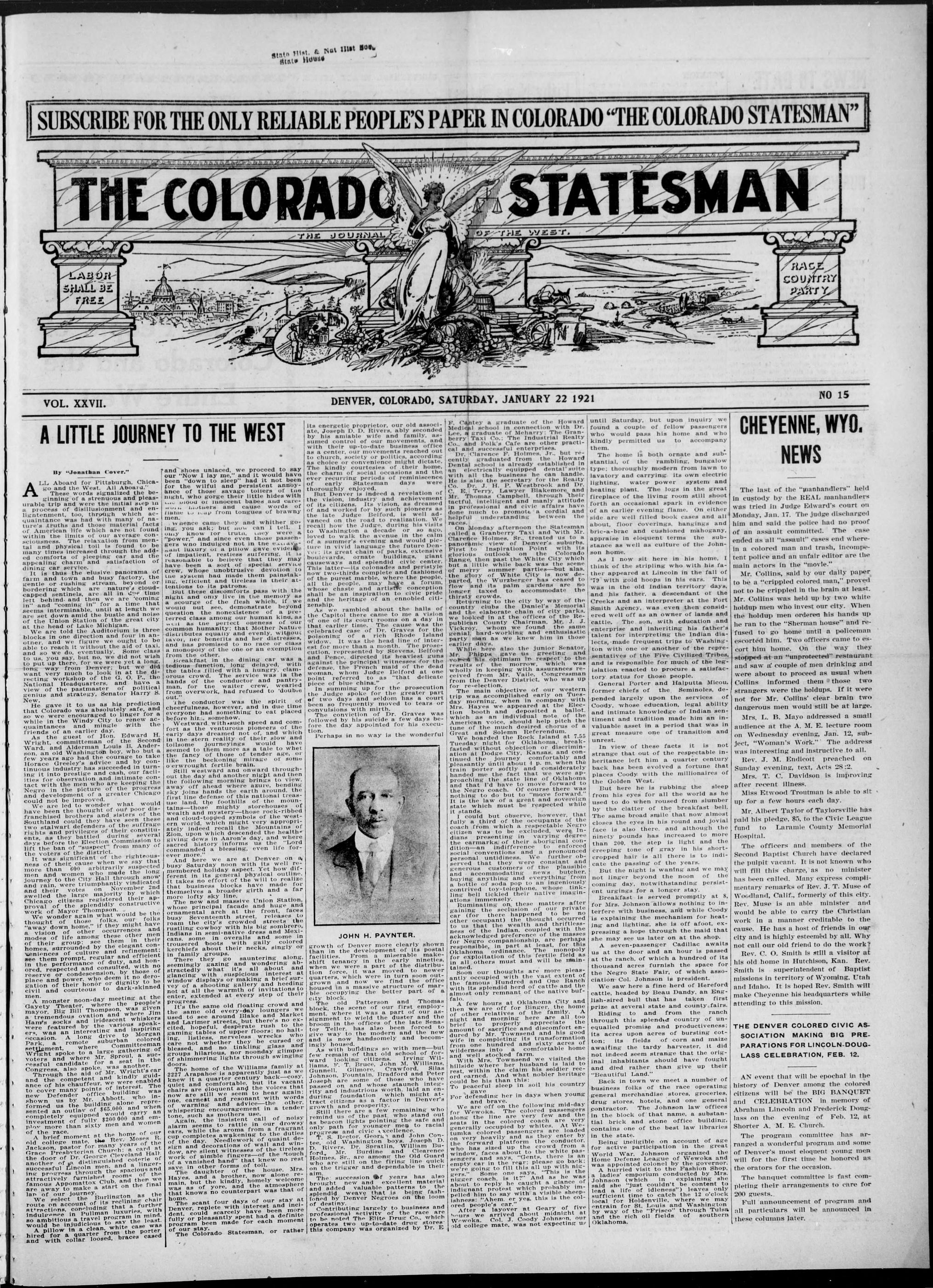
A LITTLE JOURNEY TO THE WEST
VOL. XXVII.
By "Jonathan Cover."
LLL Aboard for Pittsburgh, Chicago
is going on. These words signalized the be-
ginning of a strenuous and pleasurable trip and were the initial step in a process of disillusionment andigkeit in management, which acquaintance was had with many of nature's truths and those material facts of American life which are not found within the limits of our own experience because our frequent intimal and physical toil is found to be many times increased through the added comforts of sleeping car and the appealing charm and satisfaction of dining room furniture. It is thus the elusive panorama of farm and town and busy factory, the gentle or rushing stream, beyond or bordering which are all in the same time, behind and then we are "coming in" and "coming in" for a time that seems interminable, until at length we are set down amid the bustle and noise of the Union Station, a great city at the heart of Lake Michigan. We are told the Auditorium is three blocks in one direction and four in another, and we figure we ought an able to reach the office of tax, do, eventually. Some class to us, you say, but no, we did not wish to put up there, for we were yet a long, long way from Denver; but at the drawing workshop of the G. O. P., the National Headquarters, and have a view of the pastmaster of a political genius and strategy, Senator Harry S. New. We gave it to us as his prediction that Colorado was absolutely safe, and so we were encouraged to linger for a while in the Windy City to renew acquaintances and make with the other day.
As the guest of Hon. Edward H. Wright, committeman of the Second Ward, and Alderman Louis B. Anderson, an old Washington box boy, new years' eve courage to take Hurry the breeder's advice and by continuous industry has succeeded in turning it into prestige and cash, our facilities for observation and intimate contact with the men who made the Negro the leader of the progress and development of a greater Chicago not be improved.
We are led to wonder what would have been the thought of the poor disfranchised breed of the sisters of the Second Ward could they have seen these stallwart defenders of the suffrage rights and privileges of their constituents, as they battled during several days before the Election Commission to lift the ban on voting from many of them the district.
It was significant of the righteousness of their cause when we say that men and women of the City Hall through snow and rain, were triumphantly vindicated and their votes on November 2nd swelled the large majority of Chicago citizens reserved for their approval of the specially designed constructive Mayor Thompson.
We wonder again what would be the thought of those folks, our folks "away down home," if they might have a vision of other occurrences modes of life among these other men of their group: see in their homes, surrounded by the elegant conveniences and culture and refinement; see in prompt, regular and efficient in the performance of duty, and honored, respected and consulted, with those reserve or condescension, by those place and power, who deem it m derogation of their honor or dignity to be civil and courteous to dark-slimmed
men, a monster noon-day meeting at the Gayetton Theater, where the people's mayor, Big Bill Thompson, was given a tremendous ovation and Jim Ham's socks and iridescent whiskers were featured in the various speakers, was an interesting and inspiring long drive to Morgan Park, a remote suburban colored settlement, where Committee Wright spoke to a large gathering of voters and where Mr. Sprout, a successful candidate for a seat in the mayor also spoke, was another.
Through the aid of Mr. Wright's and the competent and kindly aid of his chauffeur, we enabled to cover many points of interest. The new Defender building was known as the building alone represented an outlay of $65,000, and completely equipped would carry an investment of fully $200,000 and employ more than sixty men and women
of the brief moment at the home of our old college mate, the Rev. Moses Jackson, pastor for many years of the Grace Presbyterian Church in card at the door of Dr. James Cleveland Hall at another distinguished coterie of successful Lincoln men, and a lingering progress through the spacious attractively furnished rooms of the famous Appomattox Club, and then we are away to make start on the final
lab or office. We select the Burlington as the route on account of its reclining attractions, concluding that its further indulgence in Pullman dams, with so ambitious a travel program in mind, would be injudicious to say the least. A plow in clean, white case was hired in quarter from the porter, and with collar loosed, braces cased
State Hist. & Nat Hist Bost
State House
and shoes unlaced, we proceed to say our "Now I lay me," and it would have been "down to sleep" had it not been for the wilful and persistent annoyance of those sagewives who, when seated their little hides with the light, protect their little hides with the care of innocent babies and care of mothers and cause words of flame to hape from tongues of brawny men. Hence came they and whither going, you ask; but now can I tell. I only know for truth, they were a "power," and since even those passengers who indulged not in the extravagant luxury of a pillow gave evidence of a凑合 able to believe that they may have been a sort of special service crew, whose unobtrusive devotion to the system had made them painstaking, efficient and tireless in their attentions to do their work. Their discomforts pass with the night and only live in the memory as a scourge of the flesh which, if we would but see, demonstrate beyond question the nonexistence of a preferred class of living beings that are perfect oneness of our common humanity; that Mother Nature distributes equally and evenly, without favor, her benefits and her distresses, and has promised to no race or class a monopoly of the one or an exemption from the other. A breakfast in the dining car was a tedious function, long delayed, with the tables filled with a hungry, clamorous crowd. The service was made for the teacher and pantry man for the waiter crew, weared from overwork, had refused to "double out." The conductor was the spirit of cheerfulness, however, and in due time everyone had learned to eat placed with us somehow.
Westward with such speed and comfort as the venturous pioneers of the early days dreamed not of, and which in the stern midnight journeyed to, would have seemed to them more as a tale to whet the fancy of those of tender age, or like the beckoning mirage or some o'erwrought fertile brain. So she went ahead throughout the day and another night and then the following morning brings to view, away off ahead where azure, bending sky joins hands the earth around, the first line defense of this national use, and land the mountainous mighty storehouses of wealth and mystery—those rock-ribbed and cloud-topped symbols of the western world, which might very appropriately indeed be used in which descended the health-giving dews in Aaron's day, and where sacred history informs us the "Lord commanded a blessing, even life forever more." And since we are at Denver on a Saturday noon with its well remembered holiday aspect. Yet how different in its general physical outline. It takes no effort of the will to realize that business blocks have made for themselves a bronder girth and a far
The new and massive Union Station, whose principal facade and huge and ornamental arch at the front, faces busy Seventh Avenue itself. The man's crowded streets the rustling cowboy with his big sombrero. Indians in semi-native dress and Mexicans, some in overalls and some trousered, wore with their longy colored about their necks, singly or in family groups. There they go saunting along, seemingly gazing and wondering, strayed toward and along with suspicious interest at window displays or making a brief survey of a shooting gallery and heeding not at all the warmth of invitations to enter, extended at every step of their
It's the same old floating crowd and the same old every day loungers we used to see around Blake and Marvel and Larimer streets, but that's not exciting. We rush to the exhibiting tables of upper floors; no hating, listless, nerveless wrecks who care not whether they be cursed or blessed, and no tinkling gigs and groups hilarious, nor mundane glimpses of shimmering lights through swinging dance. The home of the Williams family at 2227 Arapahoe is apparently just as we knew it a quarter century ago, cosy, quiet, and charming, but its vacant rooms are eloquent and the voices that now are still we seem to hear again: one, carnest and resonant with words of warning and advice; the other, whispering encouragement in a tender voice that mothers use.
Again, the insistent call of noisy alarm seems to rattle in our drowsy ears, while the dog awakens to the duties of the day. Needlework of quaint dewdign and decorations of wall and dwarf, are sweet smiles of the treeless shimble fingers—of the touch of a vanished hand" that knew no rest save in other forms of toil in the daughter's house. Mrs. Hassan's brother, now alone remain, but the kindly, homely welcome was as of yore, and the atmosphere that knows no counterpart was that of
The scant four days of our stay, Denver, replete with interest and incipiently have been more or less pleasantly spent had a definite program been made for each moment of our stay. The Colorado Statesman, or rather
ABLE PEOPLE'S PA
ADC
THE JOURNAL
DENVER, COLORADO, S
its energetic proprietor, our old associate, Joseph D. H. Drials, aby seconded by his amiable wife and family, assigned control of office with the up-to-date business office as a center, our movements reached out to church, society or politics, according as choice or convenience might dictate, the kindly courtesies occasioned and the ever recurring periods of晨iscence of early Statesman days were thoroughly enjoyed. But Den Den, who created a revelation of the industry, industry and achievement of its citizens. Its vision, as dreamed of and worked for by such pioneers as the late Judge Belford, is well advanced in vivid language and shows how the Judge, during his visits to Washington a decade or so ago, loved to walk the avenue in the calm of a summer's evening and would picture in vivid language the parks, extensive bouleavards, ornate buildings, giant causeways and splendid civic center. This latter—its colonades and peristyle now two-tiered language, the sprawling, where the people, all the people, may have a forum, whose chaste and artistic conception shall be an inspiration to civic pride and the heritage of an ennobled citizenship. As we rambled about the halls of the Capitol there came to me a vision of one of its court rooms on a day in the earlier time. The prose-writer and Dr. Graves for the poisoning of a rich Rhode Island widow. It was the head line of interest for more than a month. The prose-writer and Dr. Graves directed its heaviest guns against the principal witnesses for the defense, the French maid of the dead woman, whom Judge Belford at one point referred as "that delicate thing."
In summing up for the prosecution the Judge spoke for the greater part of two days and seldom has a court been so frequently moved to tears or convulsions with mirth. The conviction of Dr. Graves was followed by his suicide a few days before the day appointed for his execution. Perhaps in no way is the wonderful
JOHN H. PAYNTER.
growth of Denver more clearly shown than in the development of its postal facilities. From a miserable make-shift tenancy in the city, nineteen years later, the part of the distribution force, it was moved to newer quarters, which were in turn soon outgrown and now we find the office housed in a massive gritty office made accessible by the better part of a city block. The old Patterson and Thomas block, the scene of our first employment, was the department to wield the duster and the broom in the offices of the late Senagive Teller, has also been forced to way to the modern and the modern and is now handsomely and becom-
As with buildings so with men—but few remain of that old school of forward looking citizens. *riving* flammings, F. *T. Bruce*, John M. Williams, Gunnell, Gilliam, Crawford, Sillas Joseph, Fountain, Bradford and Peter Joseph are some of those who have passed on and whose staunch integrity and industrious worth, laid an enduring foundation which might extract a significant factor in Denver's growth and prosperity.
Still there are a few remaining who remind us of the past, who stand out as beacon lights pointing the safe and only path for younger men to racial progress and civic excellence.
T. S. Rector, George and John Contee, old Washington boys, Joseph D. Rivers, Dr. Spatulin William Burd, Mr. Burdine and Clearence Holmes, Sr. are among the Old Guard who are still on the firing line quick on the trigger and dependable in their aim.
The succession of years has also brought new and excellent material and added valuable patterns to spelled out that is fashioned by Denver Negroes on the loom of destiny.
Contributing largely to business and professional careers, the Elite Drug Co., which operates two up-to-date drug stores, this company was organized by Dr. E
F. Cantey a graduate of the Howard Medical school in connection with Dr. Lee, a graduate of Meharry; The Granberry, AK, Co.; and the Realm and Polk Cafe are other practical and successful enterprises. Dr. Clarence F. Holmes, Jr., but recently graduated from the Howard Dental school, established a electrically equipped dental suite with all the business he can handle. He is also the secretary for the Reality Co. Dr. J. H. P. Westbrook, and Dr. J. H. P. Westbrook, Mr. Thomas Campbell, through their tactful, intelligent and manly attitude in professional and civic affairs have done much to promote a cordial and helpful understanding between the
On Monday afternoon the Statesman called a Granberry Taxi and with Mr. Clarence Holmes, Sr. treated us to a panoramic view of the Inspiration Point with its glorious outlook on the Colorado Range, then past the White City which but a little while back was the scene of the story of White City is now departed, the Wurzberger has ceased to flow and its palm gardens are no longer taxed to accommodate the thirsty crowds, returned to the city by way of the country clubs the Daniel's Memorial and the elaborate chain of city parks, we looked in at the offices of the Re-publican office whom we found the same genial, hard-working and enthusiastic party man as we knew him in those earlier days. Mr. Phipps gave us greeting and voiced his optimism by respect to the results of the morrow, which was wholly in keeping with assurances received in the Denver District, one was up for re-election. The main objective of our western trip was accomplished early on in the company with Mrs. Hayes we appeared at the Election booth and deposited a ballot, which as an individual note, of the American voice, should help us one of the most chorus of the Guest and Solemn Referendum.
We boarded the Rock Island at 7:55 Tuesday night for Oklahoma, breakfasted without objectification in Kansas, and continued the journey comfortably and pleasantly until about 4 p. m. when the train porter softly and considerably handed me the fact that we were proclaimed to be Oklahoma and that I'd have to move forward to the Negro coach. Of course there was nothing to do but to "move forward." It is the law of a great and sovereign state which must be respected while traveling.
I could but observe, however, that fully a third of the occupants of the coach from which a respectable Negro citizen was to be eclectic in their knowledge in varying degrees the earmarks of their aboriginal condition—an indifference to enforced social conventions and a pronounced personal untidiness. We further of served that the even more congenial customers of the plausible and accommodating news butcher, buying anything and everything from a bottle of soda pop to an ingeniously contrived toy-telphone, whose lingering memory their native imagination immensely.
Ruminating on these matters after gaining the seclusion of our private car (for there happened to be no other occupant) the thought came to us that the medium, and thriftless, acknowledged preference of the masses responsible, in part at least, for this Oklahoma ordinance. We more for exploitation of this fertile field as in others must and will be maintained. Soon our thoughts are more pleasantly occupied with the vast extent of the famous Hundred and one with its splendid herd of cattle and the almost only remnant of the native bur-
A few hours at Oklahoma City and then we are off for Binger, the home of the University of Oklahoma, for light and morning here are all too brief to properly appreciate the amount of sacrifice and perseverance that Todd and his good wife in completing its transformation from one hundred and sixty acres of wilderness into a comfortable home for the family.
With Mrs. Townsend we visited the hillside where her husband sold to rest, and where his soldier rested, earned. And what nobler heritage could be his than this;
To peaceful sleep in soil his country gave. For defending her in days when young and brave. We are of on the following mid-day for Wendy Smith. The colored passengers along the line are very few and the seats in the colored coach are very generally occupied by whites. As very tumka colored passengers are loaded on very high platform as they enter by forward platform the conductor, who has sized up the crowd from window, faces about to the white passengers and says, "Gents, there empty car in the line, go back we're going to fill this all up with nigger coach, is it?" And as he was about to reply he caught a glance of indignant protest which proclaimed pelled him to say, with a visible sheenishness: "Yes, yes, this is the col-
After a layover at Geary of five hours we arrived about midnight at Wowoka, Col. J. Coody Johnson, our old college mate, was not expecting us.
until Saturday, but upon inquiry we found a couple of fellow passengers who would pass his home and who kindly permitted us to accompany them.
The home is both ornate and substantial, of the rambling, bungalow type; thoroughly modern from lawn to lavatory and carrying its own electric lighting, water power system and heating plant. The logs in the great fireplace of the living room still shoot forth an occasional spark in evidence of an earlier evening flame. On either side are well filled book cases and all about, floor coverings, hangings and bric-a-brac and cushioned mahogany, appraise in eloquent terms the substance as well as culture of the Johnson home.
As I now sit here in his home, I think of the stripling who with his father appeared at Lincoln in the fall of 79 with gold hoops in his ears. This was in the old Indian territory days, and his father, a descendant of the Creeks and an interpreter at the Fort Smith Agency, was even then considered well off as an owner of lands and cattle. The son, with education and enterprise and inheriting his father's talent for interpreting the Indian dialects, made frequent trips to Washington with one or another of the representatives of the Five Civilized Tribes and is responsible for much of the legislation enacted to procure a satisfactory status for those people.
General Porter and Halputta Micou former chiefs of the Seminoles, depended largely upon the services of Coody, whose education, legal ability and intimate knowledge of Indian sentiment and tradition made him an invaluable asset in a period that was in great measure one of transition and unrest.
In view of these facts it is not strange that out of the respectable inheritance left him a quarter century back has been evolved a fortune that places Coody with the millionaires of the Golden West.
But here he is rubbing the sleep from his eyes for all the world as he used to do when roused from slumber by the clatter of the breakfast bell. The same broad smile that now almost closes the eyes in his round and jovial face is also there, and although the ninety pounds has increased to more than 200, the step is light and the creeping tone of gray in his short-cropped hair is all there is to indicate the passing of the years.
But the night is waning and we may not linger beyond the noon of the coming day, notwithstanding persistent urgings for a longer stay.
Breakfast is served promptly at 8, for Mrs. Johnson allows nothing to interfere with business, and while Coody is explaining the mechanism for heating and lighting, she is off afoot, expressing a hope through the maid that she may see us later on at the shop.
A seven-passenger Cadillac awaits at the door and an hour is passed at the ranch, of which a hundred of its thousand acres furnish the space for the Negro State Fair, of which association Col. Johnson is president.
We saw here a fine herd of Hereford cattle, headed by Beau Dandy, an English-sired bull that has taken first prize at several state and county fairs. Riding to and from the ranch through this splendid country of unequalled promise and productiveness; its acres upon acres of bursting cotton; its fields of corn and maize awaftailing the tardy harvester, it did not indeed seem strange that the original inhabitants should have fought and died rather than give up their "Beautiful Land."
Back in town we meet a number of business folks of the race operating general merchandise stores, groceries, drug stores, hotels, and one general contractor. The Johnson law offices in the block of that name, a substantial brick and stone office building, contains one of the best law libraries in the state.
Being ineligible on account of age for active participation in the great World War, Johnson organized the Home Defense League of Wewoka and was appointed colonel by the governor.
A hurried visit a ladder company conducted by Mrs. Johnson which in explaining she said she "just couldn't be content to lead a life of idleness to the 12 o'clock local for Holdenville, where we may entrain for St. Louis and Washington by way of the "Frisco" through Tulsa which oil fields of southern Oklahoma.
NO 15
CHEYENNE, WYO. NEWS
The last of the "manhandlers" held in custody by the REAL manhandlers was tried in Judge Edward's court on Monday, Jan. 17. The judge discharged him and said the police had no proof of an assault committed. The case ended as all "assault" cases end where in a colored man and trash, incompetent police and an unfair editor are the main actors in the "movie."
Mr. Collins, said by our daily paper to be a "crippled colored man," proved not to be crippled in the brain at least. Mr. Collins was held up by two white holdup men who invest our city. When the holdup men ordered his hands up he ran to the "Sherman house" and refused to go home until a policeman escorted him. Two officers came to escort him home. On the way they stopped at an "unprotected" restaurant and saw a couple of men drinking and were about to proceed as usual when Collins informed them those two strangers were the holdups. If it were not for Mr. Collins' clear brain two dangerous men would still be at large.
Mrs. L. B. Mayo addressed a small audience at the A. M. E. lecture room on Wednesday evening, Jan. 12, subject, "Woman's Work." The address was interesting and instructive to all.
Rev. J. M. Endicott preached on Sunday m. evening, text, Acts 28:2.
Mrs. T. C. Davidson is improving after recent illness.
Miss Etwood Troutman is able to sit up for a few hours each day.
Mr. Albert Taylor of Taylorsville has paid his pledge, $5, to the Civic League fund to Laramie County Memorial Hospital.
The officers and members of the Second Baptist Church have declared the pulpit vacant. It is not known who will fill this charge, as no minister has been enlisted. Many express complimentary remarks of Rev. J. T. Muse of Woodland, Calif., formerly of this city. Rev. Muse is an able minister and would be able to carry the Christian work in a manner creditable to the cause. He has a host of friends in our city and is highly esteemed by all. Why not call our old friend to do the work?
Rev. C. O. Smith is still a visitor at his old home in Hutchison, Kan. Rev. Smith is superintendent of Baptist missions in territory of Wyoming, Utah and Idaho. It is hoped Rev. Smith will make Cheyenne his headquarters while attending to this mission.
THE DENVER COLORED CIVIC ASSOCIATION MAKING BIG PREPARATIONS FOR LINCOLN-DOUGLASS CELEBRATION, FEB. 12.
AN event that will be epochal in the history of Denver among the colored citizens will be the BIG BANQUET and CELEBRATION in memory of Abraham Lincoln and Frederick Douglass on the evening of Feb. 12, at Shorter A. M. E. Church.
The program committee has arranged a wonderful program and some of Denver's most eloquent young men will for the first time be honored as the orators for the occasion.
The banquet committee is fast completing their arrangements to care for 200 guests.
Full announcement of program and all particulars will be announced in these columns later.
FOREIGN
Spanish paper mill owners are making efforts to induce the government to restore the duty on paper imported into Spain.
General Caviglia, commander of the Italian forces along the Adriatic, has ordered the raising of the naval blockade of Fiume, and also the land blockade.
Rembrandt's landscape "After the Thunderstorm" was stolen from a private owner at Hamburg and supposedly was shipped to the United States. The painting is said to be valued at $2,000,000.
Canada's wheat yield for 1920 totaled 263,189,300 bushels from 18,232,374 acres, an average gain of four and one-half bushels an acre over 1919, the Dominion Bureau of Statistics announced at Ottawa.
More than 200,000 Armenian refugees between Kars and Alexandropole are dying because of lack of food and fuel, and anarchy stalks among them, said latest advices from Armenia received by the Near East relief.
The Russian wife of Naval Lieutenant Warren H. Langdon, American officer killed by a Japanese sentry at Vladivostok recently, ended her life upon learning of her husband's death, according to a Reuter dispatch from Vladivostok.
A call for a special session of the Mexican Congress, beginning Feb. 7, has been issued by President Obregon. Among the projects to be considered are the new banking law, article 27 of the constitution, which govern petroleum deposits, a new labor law, army reconstruction and international commerce.
Fifty persons were arrested in Tokio, Japan, charged with disturbing a court in which thirteen Socialists, arrested when the Japanese Socialist leader was inaugurated, were being tried. Employees of an engineering works have smashed the fixtures in the plant following the dismissal of seventy-five strike agitators. Ten men were arrested.
The Italian cabinet has decided, says an Exchange Telegraph dispatch from Rome, that in the supreme council in Paris it will be impossible for Italy to support any measure calculated to force Germany to fulfil all entirely the obligations of the Versailles treaty or any measure to force Turkey to accept the present disposition on the Near Eastern situation.
GENERAL
Rent reductions averaging about 20 per cent were ordered made by seven Milwaukee landlords, by a ruling of the local rent bureau. Among the landlords affected was the owner of twelve flats.
A reduction of 20 per cent in the price of farm implements has been announced by A. V. Burch, vice president and general manager of the Blount Plow Company at Evansville, Ind.
The Singer Manufacturing Company, makers of sewing machines, employing 8,000 workers at Elizabeth, N. J., announced an immediate reduction in wages of 20 per cent. It will not affect salaried employés.
Three men posing as policemen in Chicago stopped an automobile driven by Mrs. Sigmund G. Livingston and robbed her of Jewelry which she valued at $30,000. Included was a pearl necklace which she said was worth $20,000.
George Franklin, a former attache of the United States Shipping Board, and latey auditor of the Southern Cedar Company, slipped on the bathroom floor at his home at Jacksonville, Fla., broke his neck and died almost instantly.
It cost Stanley Wasno, 12-year-old adventurer, $200 for souvenir curls he clipped from the heads of two little girls in a theater in Chicago. Stanley was taken before Judge McKinley in the boys' court and six girls from 11 to 13 years old, testified against him. Judge McKinley thought the locks were worth $200.
The 5-cent loaf of bread is back in New York. It appeared in a bakery shop there and almost immediately sales jumped from 80 to 1,000 loaves a day. In nearly all other New York stores the price is 10 cents, but the baker who reduced the price says he is making more money now.
In a spectacular bout which was stopped by the referee in the sixth round at Madison Square garden, Benny Leonard, world's lightweight champion, scored a technical knockout over Richie Mitchell of Milwaukee, who, despite his defeat, proved himself a worthy challenger. The bout was the main attraction at a benefit given by the American Committee for Devastated France.
Ole Hansen, former mayor of Seattle, disrupted a Socialist meeting at Racine, Wis., when, under auspices of the Racine Constitutional Defense League, he invaded the meeting, at which Irwin St. John Tucker, indicted under the captonage act, was the principal speaker, and challenged him to a debate. Mr. Tucker declined at first, but submitted the question to the audience, which voted against the debate amid shouting and hisses.
Four sacks of registered mail, one reported to have contained $80,000 for use in making up pay rolls at Franklin county coal mines, have disappeared at Mount Vernon, Ill., early Friday. An estimate of the value of the contents of the other three sacks was not available.
Twenty of the forty-four mills of the McKeesport Tinplate Company shut down since Dec. 23 have resumed operations. Officials announce that if conditions improve the other twenty-four mills will start up soon. Fifteen hundred men have gone back to work.
CAUGHT FROM THE NETWORK OF WIRES ROUND ABOUT THE WORLD.
RECORD OF IMPORTANT EVENTS
CONDENSED FOR BUSY
PEOPLE.
WESTERN
Eight-year-old Adeline Fisher is dead as a result of injuries received when the clapper of a 300-pound bell fell upon her as she was ringing for recess at the school she attended at Weston, Nebr.
Representative Warren of Butte, Mont., has given notice in the state House of Representatives of a bill making picketing in strikes unlawful. The measure conforms to the Colorado statute, it was declared.
A temporary dormitory is being installed in one of the shops of the Nebraska state penitentiary at Lincoln to provide sleeping quarters for the overflow population of the institution. The temporary dormitory will contain fifty beds.
The reported recovery of nearly $250,000 in Liberty bonds and currency and the death of one of the bandits, were features of the police investigation into the robbery by six bandits of a sub-postoffice station at Dallas, Tex. The amount of loot taken was not known and four of the band remain at liberty.
Feeling was intense over the murder of Mr. and Mrs. James B. Willard, both aged about 65, in their farm home near Kaufman, Texas. Officers said they had no clew as to the identity of the assailant. The bodies were found in bed, the heads crushed with blows from an iron rod which was found in the house.
With about 8,000 men unemployed in Omaha, according to a report compiled by the Chamber of Commerce for the United States Department of Labor, anticipated revival of activity at the packing houses is expected to re-employ from 2,000 to 3,000 workmen, while prospective building forecasts work for a considerable number of tradesmen.
H. L. Cook, 55 years old, formerly a wealthy oil operators of Casper, Wyo., was found dead in a hotel room in El Paso, Texas, with the rubber hose disconnected from a gas heater in his mouth. Cook registered at the hotel, telling the clerk he was without funds. Being well known he was provided with accommodations and a small sum of money. This was the last seen of him until when his body was found.
WASHINGTON
The automobile industry is paying $143,000,000 annually to the federal government, with state fees of $64,000,000, and personal property taxes and other fees of $50,000,000.
A resolution requesting President Wilson to inform Congress why and by what authority he sent Major General Crowder to Cuba to investigate conditions there was introduced by Representative Emerson, Republican, of Ohio.
To stop "enormous importations of Canadian wheat," Senator McCumber, Republican, North Dakota, announced that he would ask for a tariff of probably 50 cents a bushel on wheat to be included in the Fordney emergency tariff bill instead of the duty of 30 cents carried by the measure as it passed the House.
Inaction by the Senate on the thousands of nominations submitted by President Wilson has been broken and the way paved for confirmation before March 4, of emergency appointments.
Convictions of crime should not also carry loss of civil rights, unless the crime warrants such deprivation of citizenship, a committee representing the American Bar Association advised a Senate judiciary committee considering legal reform legislation.
A bill to repeal the excess profits tax and to substitute for it a flat tax of 15 per cent on the profits of corporations has been introduced in the House. Abolition of the $2,000 exemption now granted business concerns also is proposed.
The urban population of the United States, or people living in places of 2,500 or more, is 54,318,032, or 51.4 per cent of the country's total population, and the number of people living in rural territory is 51,390,739, the census bureau has announced. In 1910 urban population represented 45.8 per cent. This is the first time in history more than half of the population of the United States is living in "urban territory," the census bureau said.
The level of retail prices declined 10 per cent during 1920, according to a Labor Department announcement. December retail prices declined 8 per cent, compared with November, the statement said. Wholesale prices during the same period dropped off 8.75 per cent.
The Supreme Court has refused to review a judgment of the Supreme Court of California holding that the United States Railway Administration was not immune from damage suits arising from the operation of a common carrier in that state.
Pithy News Notes From All Parts of Colorado
Pithy News Notes From All Parts of Colorado
Hamilton Armstrong, Denver's chief of police, died at his residence in Denver of heart failure.
The forty-seventh annual convention of the Colorado State Grange will be in session in Denver Jan. 18-20.
The Stockman's and Merchants' Bank of Pagosa Springs, Colo., has ceased to function through dissolution, according to notice filed with the secretary of state.
O. D. Nell, prominent lumberman of Greeley, was elected president of the Mountain States Lumber Dealers' Association at the fourth session of the eighteenth annual convention held in Denver.
Mrs. A. A. Spitzer was strangled to death at Sterling when her hair and a shawl around her neck became caught in an electric wringer connected to a washtub over which she was bending in the back yard of her home.
William M. Kincaid of La Veta, Colo., will carry the vote of the Colorado electors to Washington, D. C. The six electors, meeting at the state house in Denver, cast their ballots for Harding and Coolidge.
The Pharmacy building, on the university campus, has been ordered torn down by the regents at Boulder. It stands in front of the new Liberal Arts building. It is an old landmark on the campus, having been one of the first buildings constructed.
The Silverton Northern Railway Company, a San Juan valley road, seven and one-half miles long, running from Silverton, Colo, to Eureka, has asked permission of the Colorado Public Utilities Commission to cease operation of the road until July 1.
Colorado's coal production during 1920 exceeded that of the preceding year by nearly 2,000,000 tons and fell only about a quarter of a million tons short of the 1918 output when the twenty-one coal-producing counties of the state established a high production record of 12,658,055 tons.
The "high cost of overproduction" was given as the cause of a wage reduction of 20 per cent announced by the Denver Rock Drill Company. The reductions affect 325 men. Everyone in the plant was affected by the reduction. A few of the foundrymen, molders and coremakers were reduced 25 per cent.
The drive to help the starving millions of China was started in Denver with a sermon on the situation in that country by the Rev. E. R. Dickerson of Colorado Springs. The Rev. Mr. Dickerson has just returned from the stricken portion of China, where he was sent by his church to make a report on conditions. "Over 45,000,000 people are suffering at the present time, said Mr. Dickerson.
C. W. Johnson of Manzanola, Colo., has presented a bill for $400 to the sheriff of Utah county, Utah, for expenses in connection with the burial of "Billy" Johnson, whom he thought was his son. "Billy" Johnson committed suicide at Payson, Utah. The body was sent to his supposed father at Manzanola. Mr. Johnson buried the body, but later he heard from his son at Denver.
The Rev. J. H. Skeen, pastor of the Baptist church, in an address to young people at Boulder, advocated the construction of churches with gymnasiums, swimming pools and billiard rooms. He declared that too many churches were built only to the spiritual side of young people, and that it was time for religious workers to take into consideration the physical, intellectual and social requirements of young people.
The new Methodist church at Montrose, built at a cost of $65,000, was dedicated with Bishop Charles L. Mead in the pulpit.
"Drives" for outside funds among the students of Colorado College are to be curbed in the future, following action by the student commission, which reported that there had been too many and some of those had been neglected by students who failed to make the payments pledged. Hereafter all appeals will first go to the president of the college, and then to a referendum of students. Pledge cards are to be discouraged.
With hundreds of cars of apples, vegetables and other farm products being withheld from market on account of prohibitive freight and express notes, a meeting of shippers, producers and members of the Cannon City Chamber of Commerce was held and resolutions of protest were adopted with the hope that either the railroad companies or the Interstate Commerce Commission would take up the matter and devise some means of relieving the situation.
Henry F. Southard, who was in jail in Durango on charge of obtaining $11,700 from the Durango Trust Company under false pretenses, is out on bond awaiting trial. In our former item we erroneously stated he was an overseas war veteran. Mr. Southard was not in service during the war. A large attendance and a wide representation from all parts of the state marked the annual convention of the Colorado farm bureau, the sessions being held in the new Physics building at the Agricultural College in Fort Collins.
```markdown
```
All Colorado taxpayers must pay income tax on profits made from the sale of stocks, bonds and other securities, under the government interpretation that such profits are "income." This warning followed the publication of a statement calling attention to a recent decision by the United States District Court of Connecticut. This decision held that income from the sale of stocks and bonds is "capital increase," and therefore not taxable by the government by virtue of a constitutional provision. "The decision affects the state of Connecticut only." says Collector McCauly of Colorado. "Until the case is carried to the Supreme Court of the United States, if it is, and unless that court sustains the lower court, no other district in the United States is affected."
COLORADO STATESMAN
The Senate received a measure from Senator Wilson, which is said to have been introduced at the request of District Attorney Van Cise of Denver and designed to attack gambling from a new angle and to aid the district attorney in enforcing the laws against this form of vice. It provides that the owner of any premises where gambling is permitted to be carried on shall be deemed particeps criminis and shall be punished in like manner as the principal in the keeping of the gambling house itself.
The Mouth-Piece of the People of Colorado and the Entire West
The day of the little red schoolhouse is passing in El Paso county. In the last year the direction of rural school affairs under Mrs. Inez Johnson Lewis, county superintendent of schools, has resulted in school consolidations eliminating fifteen small and oneroom schools. They have been replaced by three modern brick buildings costing $140,000, centrally located and accessible to all children by means of well-directed motor bus routes. Plans to inaugurate a campaign to increase their present membership, to obtain greater publicity, favorable legislation, better marketing conditions and better development of roads were arranged by members of the State Farm Bureau at Fort Collins. W. G. Jamison of La Veta was elected president of the bureau for the coming year.
RELIABLE chronicle of their doings and progress; a faithful mirror of their wants, their hopes, their best aspirations.
Notice of dissolution for the Pagoosa Springs Stockmen's and Merchants' bank, filed with the secretary of state Jan. 11, was made for the purpose of changing the bank from a state bank to a national bank, according to announcements made yesterday by Paul Hardy, vice president of the bank, who declared that the institution was not defunct. R. V. Billington of Denver has recently been appointed as state supervisor of trade and industrial education. This work is carried on under the direction of the State Board of Vocational Education, co-operating with the national board.
THE COLORADO STATESMAN
Sportsmen are forming an organization which will make accessible to the public the famous Conejos Lakes region of the Rio Grande National Forest, Colorado, according to information received by the United States Department of Agriculture.
Orders have been received by Lieut. Commander P. S. Theiss in charge of the Denver navy recruiting station to close the substations at Colorado Springs, Pueblo and Casper, Wyo. The Denver station is the only one to remain open in Colorado and Wyoming.
A high grade of potash has been discovered in Stone canyon, eight miles west of Larkspur. The find has created much excitement in the vicinity of Perry Park and several farmers have deserted their ranch work to enter the prospecting game.
Unequaled as an advertising medium for the business of professional men and women.
According to the verdict of the coroner's jury in Pueblo, Antonio Romero committed justifiable homicide when he inflicted a beating and gunshot wounds upon Aululio Augon, after having found his wife in the latter's arms.
Recommendations recently drawn up by the legislative committee of the Colorado Game and Fish Protective Association in co-operation with the state game department and the United States forest service here, calling for protection and increase of wild life in Colorado, will be presented to the State Legislature, according to Secretary-Treasurer John H. Hatton, chief of the grazing department of the forest service.
An excellent family journal speaking to and for many thousand colored citizens.
Another government tuberculosis hospital to supplement the work being done by Fitzsimons General Hospital at Aurora probably will be established at Colorado Springs, according to a statement made in Washington by Congressman Charles B. Timberlake of Colorado.
A lone bandit invaded the Littleton State bank, and at the point of an automatic pistol forced Cashier Willard Teller to turn over -$3,000. He escaped in a small automobile.
TWODOLLARSAYEAR
Ben F. McCoy, a prominent merchant and landowner of Gild, committed suicide by swallowing poison in a hotel room at Briggsdale.
THE GREAT ORGAN OF THE
Work on Grand Junction's new High School building has just been completed and the $250,000 structure stands as a monument to western Colorado, the finest building of its kind west of the center line of the state. It is three stories in height and complete in every detail.
LABORING MASSES
Plans for an immense municipal auditorium with a seating capacity of 6,000 have been launched by the Chamber of Commerce of Colorado Springs, the conventions and agricultural committees being in charge of the project.
OF INTEREST TO EVERYBODY
NAVAL AIRMAN TELLS OF TRIP
Thrilling Story of the Adventure of the Balloonists Who Were Lost in Wilds of Canada.
DEATH NEAR WHEN RESCUED
Lost to the World 29 Days In All—
Wandered Four Days in the Woods
With Nothing to Eat! Except the
Pigeons They Had With Them.
Mattice, Ont.—After being lost to
the world for 29 days, four of which
were spent wandering in the woods,
the three navy balloonists, Leutens,
Farrell, Hinton and Kloor, arrived
here. Lieut. Farrell told the following
story of their adventures:
Lieut. Farrell's story of the flight
and wanderings of the trio begins with
the morning hours in Rockaway naval
air station on December 13 and goes
on through the flight, the landing, and
up to the meeting with the Indian at
Moose Factory who saved their lives.
"It was just an ordinary balloon hop," Farrell began. "It was for training. Hinton told me after we left that the gas in the balloon was ten days old, stale and impure.
"Hinton called me up at about twenty minutes to 12 (December 13) and told me I could come on flight if I wanted to. No special orders are needed. We just got permission from Commander Cummings of the post and Executive Officer Douglas.
"I am senior officer of the three, but Kloor was in command of the flight, as he is a balloon officer and I am a gunnery officer. I have been in aviation for three years and have flown in every kind of aircraft. We left at 1 p. m.
Left With Four Pigeons.
"We had four pigeons; we let the first one go with a message for the Brooklyn navy yard."
"Hinton and Kloor had heavy underwear and uniforms under their flying suits. I had only the underwear and the flying suit. I had a grip with my uniform and some other things in it. We had eight sandwiches and two thermos bottles of hot coffee. None of the underwear was electrically heated.
"We expected to land next morning in upper New York state. We had no maps or charts except a railroad map of the Canadian Quebec Central line, which I bought. We had three chances to land before we did. We did stop once at Wells, N. Y.
"We made fast to a tree near a light. It was in a window of a farmhouse. A man came along and we asked him where we were. He told us, but he could not say what big town we were near.
Kloor Game to Go On.
"We cast loose and went up again. It rained and blew during the night. We could have landed at Ottawa at 11 p. m. We saw the lights of a big city. But Kloor is just a kid and he was enthusiastic about a long flight. We all agreed that we ought to do a decent flight. There had been rain from Wells on.
"The wind was north by west. That night it blew hard and rained. There was no sign of civilization. But we thought it would be all right in the morning. At daylight we saw only forests. The rain had calmed down. There were low clouds and fog.
"The rain stopped at 8 a. m. (December 14). We ate all our food during the night. We had two packages of cigarettes and one box of matches, but you cannot smoke in a hydrogen balloon. We realized we were in bad that morning."
Explains Flying Technique.
Here Farrell paused to give a brief explanation of the technique of balloon flying.
"You have a lot of expendable ballast," he said. "We had twenty-one sandbags weighing thirty pounds apiece. At first the balloon rises with all the cargo. Then it begins coming down as the gas deteriorates. When you are down too low you throw out a sandbag and that sends you up again.
"When all the ballast is gone you go up for the last time and have to come down as soon as the gas begins to weaken.
"Our twenty-first bag went over that morning. After that we had to throw out equipment to keep up. We hauled in the drag rope which is used in making landings and cut it into several pieces. We used each piece as ballast. It was not very long before the last piece went over the side.
At 11 a, m, the sun came out and heated up the gas in the balloon; that makes the gas expand and sends the balloon up.
"We were fighting to keep in the alr. All we saw was trees, lakes, and snow. It was about 1:30 p. m. that we saw a shack in the woods. At least we thought it was a shack. We
- The first bicycle driven by pedals was made in Paris in 1866.
was made
Ecuador takes its name from the fact
it is situated on the equator.
Oil production in the United States increased 25,000,000 barrels in the last
The West Indian crab is born in the sea, matures in fresh water and then passes the remainder of its life on dry land.
were in doubt about this until we heard a dog bark.
"I took bearings with the compass on the shack and the place where the dog barked. We decided to land. We were in low clouds about 1,000 feet high. The wind was, north by west, the sun had been heating up our bag and we began to go up. We reached 6,500 feet. It takes a long time to go from that height.
Make a Bad Landing.
"The clouds were below us and above us. We got down about two o'clock. It was a bad landing and we were pretty badly shaken up. We were not hurt or thrown out, but the basket was smashed against the ground.
"The balloon caught between the trees. We had taken the pigeons into the basket to protect them from the landing. Usually they ride in a cage tied outside of the basket. The weather was clear and nearly freezing.
"All three of us stepped out of the basket in our flying clothes. I took the grip. We were soaking wet. Kloor took the pigeon cage. We started off at a terrific pace to get where the dog barked. We did not stop to inspect the balloon. From the bearings I took in the balloon we figured the dog to be south by east from us.
Start on Long Trek.
"We started through the forest on that line. I carried my grip for one day. We went on until dark and made a fire. I smoked two cigarettes while we rested; so did Kloor. Hinton did not smoke.
"We did not eat that day; we carried the pigeons until the next day. There was some snow on the ground, so we got a lot of pine brush to lie on and I picked a lot of rotten wood with my penknife. We had no firearms—only the knife and the box of matches.
"Hinton went on a little to find a stream. While he was gone he laid off his flying suit to make better headway and he could not find it on his way back.
"That night I slept next to Hinton. He was next to the fire. I was on the outside. Kloor lay off to one side and slept. We got on fine together in the forest. Hinton and I didn't sleep. We got up at daylight.
They Eat First Pigeon.
"We ate a pigeon that morning, December 15. We cleaned a pigeon and cooked it. We divided it in three parts, a couple of mouthfuls aplace. We drank water out of moose tracks and holes in the ground. That is what probably made me sick the next day. We started off, I carrying my grip.
"We came to a creek that day (the Indians call this stream the Nescohaga). Hinton was leading and kept moving too far to the west.
"I proposed to him to go southeast. In 30 minutes we got to the creek, which was not frozen over, so we had to follow the bank. We camped again in good shape. I, for one, was not very hungry, but we were cold when we stopped walking.
"We had made a fire and rested at noon, but we did not eat in order to conserve food. We argued about where we were. I figured it somewhere in the woods in Canada, but wasn't sure.
How They Were Garbed.
"At that time I was still in my flying suit, Hinton in uniform and Kloor in uniform and flying suit. We all wore flying boots. My grip kept getting foul of trees, so I threw it away at ten o'clock, but took care to put it in a tree. Before that I got my good English shoes out of the grip and put them on and threw away my flying boots, which were pretty near gone.
"I did not make more than four miles the first day, nor more than seven or eight the second day. Our night camp was on the creek. We did not eat. During the day we all nibbled a bit of a kind of moss we found growing around.
"We were not cheerful. We began to dread that this dog barking proposition was a kind of phoney. There were so many noises. I figure now it was a wolf barking. We saw a lot of wolf tracks.
Youngest Flyer Prays.
"Kloor told us he had been praying—not out loud, but just to himself. I'm not much on religion; I didn't pray. No more than I made a proposition they should dine off me.
"Hinton and I discussed our course while Kloor was praying. We had to admit we were in a pretty serious jam and felt pretty blue. But when we quit we had a hunch that the third day was going to be lucky.
"We ate the second pigeon and killed the other one the morning of the third day—December 16. Kloor put the dead pigeon in his pocket. We did this to do away with the cage.
"During the night Hinton and Kloor got their feet in the fire. Now their flying shoes were burned and they had to throw them away and walk in uniform boots. My shoes were in the best shape.
Hikera Growing Weak. "We were all growing weak and fell a lot in holes and over trees. Hinton
Scotch interests are planning to obtain 42,000 electrical horsepower by harnessing three lakes, and to utilize the waterpower running to waste in the watershed of the Tay. As a form of hazing, "plebes" at the United States Naval academy at Annapolis who are unable to guess the daily dessert are forced to eat their meals sitting on the floor under the table.
was very weak. I felt like vomiting. Hinton was nauseated, his stomach was very bad, but our heads were as clear as they are right now.
"If we had had a definite object we could have gone fifty or a hundred miles without so much distress. We saw so much of the same sort of woods that it appeared we were not going anywhere. But we were not going in circles because we were steered by the compass zigzagging through the wood. That counted against us.
"I began to lag behind pretty much and Hinton suggested that I take off my flying suit. I did, and walked in my underclothing the rest of the trip.
"Hinton wrapped my suit around him as a sort of blanket. Just before noon I had a nasty fall over a tree trunk into a hole three feet deep. I was bruised and scratched but I got up alone.
Hunch Fails to Help Out.
"We didn't eat at noon and made fire and warmed up and started off again all together. We were pretty blue when we camped the third night. Our hunch about the third being the lucky day flivvered.
"Hinton said, 'Let's write some letters and put them in our pockets,' but I said, 'No, we'll have plenty of time to do that.'
"Hinton could hardly hold his head up. It was very cold and it sure was our worst night. We slept again with Hinton near the fire and me on the outside. I had the flying suit on, but it was too cold to lie still, and I would get up often.
"When I did Hinton did too, and we would both sit near the fire for a while. Kloor slept fine, almost in the fire. He kept getting his feet in the fire and we would have to pull them out.
"Next morning we kidded the kid—that's what we called Kloor—and told him he had been hogging the fire. Hinton had the matches, because he knows how to light a fire. We were careful with the matches. We would go stiff when it took Hinton two matches to get the fire going.
Trio in Bad Shape.
"Klover had lots of pep after his night's sleep and Hinton was in bad shape. I was a bit better off than Hinton, but not much. We started off without food along the bank of the creek. I had a hunch that night might have frozen up the creek and I left them to go down and try it out." The distance covered that afternoon was not more than three miles. Next day (Thursday) almost the same story was repeated at nightfall, their distance from the "hypothetical" village being still as undetermined as when they made their landing.
Friday proved to be the lucky day. In the morning Tom Marks, a Cree Indian trapper, who was inspecting his traps on the outskirts of the settlement of Moose Factory, an island in the bottom of James bay, noticed tracks which he judged to have been made by three white men. His curiosity getting the better of the native Indian timidity in the presence of the unusual, Marks followed up the tracks until early in the afternoon he came upon the three balloonists.
Kloor's Story of Trip.
"The first days out were the worst," said Lieutenant Kloor, describing their experiences. "We had practiced walking with snowshoes at Moose Factory while we were there and thought we were experts with them, but after going a day on the trail changed our minds. It was quite stormy, too, and the first week we were out we encountered three severe blizzards.
"On Sunday a week ago it became so bad we were compelled to retrace our steps for more than a mile. We also found that the dogs we had with us were inadequate for the load we were carrying and had to send back for more. The weather, however, was not very cold. We had lots of moose meat to eat and I think we are all feeling fine."
"What scientific values to be derived from your trip?" was asked.
"The main scientific fact demonstrated," replied Kloor, "is that a balloon of 35,000 cubic feet capacity can remain in the air for more than twelve hours. We were in the air for twenty-five hours and could have remained there longer. Further than that I think nothing ought to be said until we report to our superlors."
Dogs Hail the Arrival.
Kloor, a blue-eyed, ruddy young fellow who looked to be in the pink of condition, was the first to arrive. He came whirling around the bend of the Missanaibi into the town, riding on the dog sled, with Sam Sainsbury, Toronto explorer, who had gone to meet him.
The howling of huskies tethered before Indian huts here was the first warning of the party's approach. A moment later Kloor's sled came over the snow. He was bundled to the eyes in the garb of the country—mackinaw, moccasins, wool cap and muffler—and no one recognized him until he had slid stiffly from his sled and introduced himself.
"I feel fine. We're all all right. All I ask is that I get to a fire," he said.
Trivial Accident Brings Disaster.
The gypsy moth has caused a great deal of trouble in this country, and much money and energy have been spent in the effort to exterminate it. The trouble started when a French naturalist named Trouvelot, residing in the town of Malden, Mass., left a paper box containing gypsy moth eggs on a window ledge and it blew off. That was in the early eighties, and he was making experiments with various kinds of caterpillars as silk spinner.
BRITISH START REPRISAL MOVE
WRECK SINN FEINERS HOMES IN CORK AS START ON NEW TACTICS.
FIRE ON CROWN FORCES
FIRE ON CROWN FORCES
BEVEN KILLED IN DISORDERS
NEAR DUBLIN-CURFEW ADVANCED ONE HOUR.
(Western Newspaper Union News Service.)
Cork, Ireland, Jan. 21.—The first official destruction for attacks on crown forces in Cork city since martial law was enforced in this area was carried out when two houses in Washington street, where two members of the royal Irish constabulary were attacked, were destroyed by military forces.
The military authorities assert crown forces were fired on from six houses in Washington street and that "the two worst" were selected for destruction.
A large force of military arrived and drew a cordon around several blocks, and no one was permitted to enter or leave. Dwyer's wholesale drapery, the largest in southern Ireland, was searched. The work of blowing up the designated houses was gone about carefully to prevent damage to adjoining property. The houses selected for reprisals are said to have been occupied by well-known Sinn Fein sympathizers, who were given warning to clear out. They were permitted to remove their furniture, and then military engineers prepared for the demolition. Meanwhile officers with drawn revolvers ordered the large crowd that had gathered to disperse, saying that otherwise it would be fired on.
Ten loud explosions followed at intervals of several minutes, causing consternation. However, no fires broke out and no visible damage had been done to houses outside the zone. A proclamation was issued by the military authorities announcing that the curfew on Saturday and Sunday would begin hereafter at 5 p. m. A majority of the ambushes and other disorders here have occurred Saturday nights.
In the first formal interview given to the press since he came to Ireland, Major General Strickland, in command of the troops, told the Associated Press that martial law was proving a success. He discussed the reprisals and his letter to the acting lord mayor explaining that he expected aid from the citizens through a vigilance committee to supply information. He did not allude to his report on the burning of Cork.
"It might be taken as too optimistic to say that the present operation of the Republican army are its dying kick, but I believe that to be a fact. How long they can keep going is a matter of conjecture, but it is only a question of time."
Says "Open Shop" Yankee Standard.
Chicago.—The open shop is the only true American standard in which no one receives special privileges and all have an equal chance, declared S. C. Mason, president of the National Association of Manufacturers, before a meeting of members of the association. Mr. Mason emphasized that the association had favored the open shop for years. "We must do all in our power to quell the spirit of discontent that rests on the country," he said. "Congress can do much by removing the government shackles on private business."
Train Hits Slide.
Los Angeles, Calif.—Scores of passengers on train No. 19 of the Salt Lake line, bound for Los Angeles, were shaken up and many were hurled to the floor of the cars and bruised when the trafin, known as the Continental limited, crashed into a landslide which had buried the track. The mishap occurred at a point about ten miles west of Stine, Nev.
Will Appoint Woman Assistant.
Chicago.—State's Attorney Robert E. Crowe has announced he would appoint one or more women as assistants and that in the future all women on trial in Cook county would be prosecuted by women attorneys. "The average woman is more competent to understand the problems of a delinquent girl or woman," he said.
Nominates 2,000 Postmasters.
Washington.—Nominations of approximately 2,000 postmasters were sent to the Senate by President Wilson. This swells the already enormous list of nominations made at this session, and on which Republican leaders have determined not to act, except where an emergency exists.
Settlement on Child Denied.
Chicago.—Despite the marriage of Peggy Marsh, English actress, to Albert Johnson of Cleveland, Judge Dunne, counsel for Mrs. Marsh and her illegitimate son by Henry Field, proposes to continue his battle in the courts to secure a larger portion of the Field estate for the boy. "I do not care to discuss the reports of a $50,000 annuity settled upon the son," said Judge Dunne. John P. Wilson, representing the Field estate, denied emphatically that such settlement had been made.
Wholesale and Retail Staple and Faney Groceries Fish and Oysters Hotels and Restaurants Our Specialty Fresh and Cured Eastern Corn-Fed Meats Fruits, Vegetables, Poultry and Game FREE DELIVERY
The
Curtis
Park
Floral
Company
FLORAL DESIGNS PUT UP WHILE
YOU WAIT
CHOICE PLANTS AND CUT FLOWERS CONSTANTLY
ON HAND
GREENHOUSES: Thirty-Fourth and Curtis Streets
TELEPHONE, MAIN 1511
DEMVER, COLO
RENOVATORS, BLEACHERS, DYERS AND FINISHERS Of Gents' and Ladies' Hats of Every Description 1624 CHAMPA ST., DENVER, COLO.
SCIENTIFIC AND SANITARY SCALP AND HAIR TREATMENT MASSAGING, MANICURING, TOILET ARTICLES
Wholesale and Retail Staple and Fancy Groceries, Fish and Oysters. Hotels and Restaurants Our Specialty. Fresh and Cured
MEATS, FANCY AND STAPLE GROCERIES
A. HASER, Prop.
ARCH
Wholesale and R
Hotels and
Fresh and C
Fruits, Veg
1950 Larimer Street
The Curtis Park Floral Company
FLORAL DESIGNS PUT UP YOU
CHOICE PLANTS AND CUTS
GREENHOUSES: Thirty-Fe
TELEPHONE, MAIN 1511
Weather
TELEPHONE
MAIN 3203
Established 1876
RENOVATORS, BLE
Of Gents' and I
1624 CHA
Poro Hair
SCIENTIFIC AND SANITARY
MASSAGING, M
Mme.
2220 OGDEN STREET
1
C. E. SMITH, M
The Main
Wholesale and Retail Staple
Hotels and Restaurants
Eastern
Fruits, Vegetables
Telephones N
622-636 15TH STREET
PHONE MAIN 3023
John
MEATS, FANCY
186
Corner Nineteenth
IE MARKET
tail Staple and Fancy Groceries
fish and Oysters
Restaurants Our Specialty
fried Eastern Corn-Fed Meats
tables, Poultry and Game
FEE DELIVERY
WHILE WAIT
FLOWERS CONSTANTLY ON HAND
Durth and Curtis Streets
DENVER, COLO
head Hat Co.
BLEACHERS, DYERS
and Ladies' Hats of Even
CHAMPA ST., DENVER
Air Dressing
MANITARY SCALP AND
G, MANICURING, TOILET
LEACHERS, DYERS AND FINISHERS
Ladies' Hats of Every Description
AMPA ST., DENVER, COLO.
For Dressing Parlors
UNITARY SCALP AND HAIR TREATMENT
MANICURING, TOILET ARTICLES
Motto—"Efficiency"
e. Lexie A. B.
Lexie A. Brooks
PHONE YORK 5997W
C. C. DENNIS R. F. LONG
The New Way Shoe Repairing Co.
AND
American Shoe Repairing
FIRST-CLASS WORK
Best Leather Used—Reasonable Prices
1855 Champa St. Phone Main 3737.
DENVER, COLO.
H, Manager, Res. Phone
Market Co.
Staple and Fancy Grocer
Restaurants Our Specialty.
Corn Corn Fed
Vegetables, Poultry and
Times Main 4302, 4303, 4304
ET
RES. I
An K. Ret
FANCY AND STAPLE
Manager, Res. Phone South 1608
Market Company
Table and Fancy Groceries, Fish and Oysters.
Tats Our Specialty. Fresh and Cured
Corn Fed Meats
Vegetables, Poultry and Game.
Main 4302, 4303, 4304, 4305
DENVER, COLORADO
RES. PHONE GALLUP 942
an K. Rettig
ENCY AND STAPLE GROCERIES
1864 CURTIS STREET
Denver, Colo.
---
Phone Main 6758
Denver, Colo.
PIONEER HATTERS OF THE WEST. WE MAKE OLD HATS NEW.
Denver, Cole.
entered as second-class matter at the postoffice in the City of Denver, Colo.
JOSEPH D. D. RIVERS.....Proprietor
O. Box 116 1824 Curtis Street, Room 25 Phone Main 7417
SUBSCRIPTION RATES.
one year .....$2.00
five months .....1.50
three months .....7.5
MUST BE PAID IN ADVANCE.
Communications to receive attention must be newsy, upon important subjects, plainly written only upon one side of the paper, must reach us Tuesdays, possible, anyway not later than Wednesdays, and bear the signature of the author. No manuscript returned, unless stamps are sent for postage. All communications of a personating nature that are not complimentary will be withheld from the columns of this paper.
Remittances should be made by express money order, postoffice money order, registered letter or bank draft. Postage stamps will be received the same as cash for the fractional part of a dollar. Only 1c and 2c stamps taken.
No discounts allowed on less than three months' contract. Cash must accompany all orders from parties unknown to us. Further particulars on application.
Reading notices, ten lines or less, 15 cents per line. Each additional line over ten lines, 12 cents per line. Display advertising, 75 cents per inch for first insertion and 50 cents per inch for each additional insertion.
THE proceedings in Congress the past two weeks have been considerably enlivened owing to the investigation by the Census Committee of the House of Representatives of the election methods and disfranchisement of Negroes in the South. We hardly expected the fireworks to start this session of Congress, but rather in the next session after the Republican president had taken his seat. It is quite high time that the Republicans in Congress stop "pussy-footing" on this southern question and take hold of it like men and show the South that their election system is contrary to the Constitution of the United States and that their representation in Congress is positively reduced to the actual number of votes cast. We know of no other and better remedy for the absolute cure of disfranchisement in the South than the reduction of their representation in Congress. If they insist upon the forwardly method of disfranchisement, let Congress insist upon the fair and just method of reduction in representation. There is not a man in Congress, whether he hails from the benighted state of Georgia or from the cultured and enlightened state of Massachusetts, who does not know that the disfranchisement of Negroes in the South is in direct violation of the Constitution of the nation. Yes, it is brazenly and openly admitted by the southern congressmen and they defiantly ask you what are you going to do about it.
Now is the time for the Republicans to show them what they are going to do about it. There is no legal or moral argument to be made in justification of disfranchisement, and such a flagrant violation of our Constitution should not be permitted by any state or people. This country was founded upon the principle that "taxation without representation was unjust," and so firmly is that principle rooted in the Constitution that no state or section of the Union can evade it without protest. It is certainly a sickening spectacle to see a sympathizing Republican simp pleading for tolerance for the South and telling us that the South is fast becoming Republican. Yes, the South always becomes Republican after we elect a Republican president. They are anxious to hold on to the jobs that belong to the real Republicans.
But any time the South goes Republican you can win a wager that a snowstorm took place in Hades the same day.
Before the Census Committee it was shown that in Georgia one man had seven times the voting power of a man in Colorado, and nine times as much as a voter in Indiana. Then to argue that the representation of the South Congress should not be reduced is absolute nonsense. Let Congress force them one way or the other to do the right thing. This biased and lopsided form of government will ultimately lead us to revolution if it is not speedily corrected. We stand for law and order, justice and the Constitution forever.
It recognizes the office is established upon their business, the status of three centum of the core. The provision that the equipment, the This bill afferends in a class having fitt to $400 annual rei $1,490. Their cone a minimum of $15 fication necessary.
The "I Over By J
While the secal called legitimate to the time has passed and directed simple of some particular by producers in the fered. The great policy on the part producers must p
The films of a written for the picture greatest writers. must be faithful to mit the star to ca
I do not feel thing like a historic photodrama of the part in shaping th
SIXTY-ONE LYNCHINGS is the final report for the year 1920; twenty-two less than in the year of 1919. Thus it is that the United States must again face a shameful record of murder, rioting and burning of helpless and probably innocent victims. We say probably innocent victims, for in the cases of the law they have not been proven guilty and convicted according to the law of the land. In each case of lynching the victims were entitled to the full protection of the law and under the law they were presumed to be innocent until proven guilty. When we think of our boasted superiority and supposed high standard of civilization, what must other countries think of us when they read the shameful record of lynchings in the United States for
But Americans have learned, also, how to spend money with great generosity and for public and community good. Great universities, museums, public libraries and other institutions, established by the legacies of wealthy men and maintained by contributions from men actually living, are characteristic of America. The wealthy people of Europe do not, as a rule, spend their private fortunes that way. Europe does not know this great humanitarian impulse which is the glory of the United States.
THE COLORADO STATESMAN
LARGE SMALLER FARE
MASSIVE COURTIN PARTY
Entered as second-class matter at the postoffice in the City of Denver, Colo.
JOSEPH D. D. RIVERS.....Proprietor
P. O. Box 116 1824 Curtis Street, Room 25 Phone Main 7417
Communications to receive attention must be news, upon important subjects, plainly written only upon one side of the paper, must reach us Tuesdays, if possible, anyway not later than Wednesdays, and bear the signature of the author. No manuscript returned, unless stamps are sent for postage. All communications of a personating nature that are not complimentary will be withheld from the columns of this paper.
Remittances should be made by express money order, postoffice money order, registered letter or bank draft. Postage stamps will be received the same as cash for the fractional part of a dollar. Only 1c and 2c stamps taken.
No discounts allowed on less than three months' contract. Cash must accompany all orders from parties unknown to us. Further particulars on application.
Reading notices, ten lines or less, 15 cents per line. Each additional line over ten lines, 12 cents per line. Display advertising, 75 cents per inch for first insertion and 50-cents per inch for each additional insertion.
REDUCTION OF SOUTHERN REPRESENTATION.
THE proceedings in Congress the past two weeks have been considerably enlivened owing to the investigation by the Census Committee of the House of Representatives of the election methods and disfranchisement of Negroes in the South. We hardly expected the fireworks to start this session of Congress, but rather in the next session after the Republican president had taken his seat. It is quite high time that the Republicans in Congress stop "pussy-footing" on this southern question and take hold of it like men and show the South that their election system is contrary to the Constitution of the United States and that their representation in Congress is positively reduced to the actual number of votes cast. We know of no other and better remedy for the absolute cure of disfranchisement in the South than the reduction of their representation in Congress. If they insist upon the cowardly method of disfranchisement, let Congress insist upon the fair and just method of reduction in representation. There is not a man in Congress, whether he hails from the benighted state of Georgia or from the cultured and enlightened state of Massachusetts, who does not know that the disfranchisement of Negroes in the South is in direct violation of the Constitution of the nation. Yes, it is brazenly and openly admitted by the southern congressmen and they defiantly ask you what are you going to do about it.
Now is the time for the Republicans to show them what they are going to do about it. There is no legal or moral argument to be made in justification of disfranchisement, and such a flagrant violation of our Constitution should not be permitted by any state or people. This country was founded upon the principle that "taxation without representation was unjust," and so firmly is that principle rooted in the Constitution that no state or section of the Union can evade it without protest. It is certainly a sickening spectacle to see a sympathizing Republican simp pleading for tolerance for the South and telling us that the South is fast becoming Republican. Yes, the South always becomes Republican after we elect a Republican president. They are anxious to hold on to the jobs that belong to the real Republicans.
But any time the South goes Republican you can win a wager that a snowstorm took place in Hades the same day.
Before the Census Committee it was shown that in Georgin one man had seven times the voting power of a man in Colorado, and nine times as much as a voter in Indiana. Then to argue that the representation of the South in Congress should not be reduced is absolute nonsense. Let Congress force them one way or the other to do the right thing. This biased and lopsided form of government will ultimately lead us to revolution if it is not speedily corrected. We stand for law and order, justice and the Constitution forever.
THE LYNCHING RECORD FOR 1920
SIXTY-ONE LYNCHINGS is the final report for the year 1920; twenty-two less than in the year of 1919. Thus it is that the United States must again face a shameful record of murder, rioting and burning of helpless and probably innocent victims. We say probably innocent victims, for in the eyes of the law they have not been proven guilty and convicted according to the law of the land. In each case of lynching the victims were entitled to the full protection of the law and under the law they were presumed to be innocent until proven guilty. When we think of our boasted superiority and supposed high standard of civilization, what must other countries think of us when they read the shameful record of lynchings in the United States for 1920?
Only sixty-one lynchings for last year. And why, may we not inquire was there any excuse for even one? Have we not sheriffs and a full corps of state, city and county officers, well paid to uphold the law and protect its citizens? We do not wonder that so many lynchings occur when we read that the officers of the law in one big lynching where four lives were sacrificed, attempted to stop the mob with a stream of water from a small hose. Think of the officers of the law playing with a mob with luke-warm water when four lives were at stake! We do not wonder that so many lynchings take place when the officers of the law willingly yield to the mob and surrender their helpless prisoners. There were several notable instances last year, even in the South, where the mob was fired upon by the state militia and frustrated in their murderous attempt at lynching after several of the mob were killed and wounded. A few more governors like the famous Kentucky governor would soon put an end to lynching.
The charges against many of the victims that were lynched were trivial in their nature, such as common assault, threatening to kill, jumping a labor contract, assisting a prisoner to escape. One of last year's victims was a woman. Now, when any community becomes vicious and depraved as to permit the lynching of a woman, it is time to wipe that community off the face of the map. We have the record that Negro was lynched for attempting to cast a vote, and yet we hear the South howling for representation in Mr. Harding's cabinet. Surely the North or the Republican party are not so barren of great men that the President-elect should have to turn to the Sodden South for cabinet material.
We have been informed daily by the press dispatches that the President-elect, Mr. Harding, has had daily conferences with almost every prominent leader of the Republican party and several prominent Democrats, engaging their views upon many of the great questions that confront the new administration. Would it not have been a broad and humane idea if the President-elect had invited several of our race leaders to discuss the race question, lynching and disfranchisement? Probably some day he may be induced to take up the subject and lead his weight and influence toward putting an end to such lawlessness and brazen violations of our sacred constitution.
For Readjustment of the Salaries of the Fourth Class Postmasters.
For Readjustment of the Salaries of the Fourth Class Postmasters.
By SENATOR GEORGE H. MOSES, of New Hampshire.
The present plan of compensating postmasters of the fourth class, adopted in 1882, is by a system of percentage of the value of stamps cancelled on outgoing mail by those postmasters. The incoming and outgoing mail in those days were very nearly equal. But the introduction of the parcel post increased the volume of the incoming mail without compensation. A conservative estimate would place the incoming mail at six times the number of pieces outgoing.
C. GARRIS A. EVINE
The plan which I propose for compensating this class of postmasters is based on percentages of receipts.
follows the same plan used in determining salaries of postmasters of the second and third classes. It secures the same results as a salary while avoiding its discrepancies. It assures accuracy, reduces to the minimum the possibility of mistakes and assures their detection and certain should any occur. It requires no extra blank forms, books or record reduces to the minimum extra work for both the Postoffice dept and the postmasters. It removes entirely the possibility of disity, as receipts are recorded and checked quarterly by the auditor of the Postoffice department. It is equally fair to all offices of this large and small—regardless of the amount of receipts. It obviates necessity of cancellation records, reducing the work of the postmaster simplifying the accounting in the auditor's office.
It recognizes the fundamental principle upon which the fourtn class is established, namely, that fourth class postmasters must depend their business for a part of their livelihood until their offices attain status of third class. The provision for an allowance of twenty per annum of the compensation for rent, fuel and light is very conservative. Provision that gives to the fourth class postmaster, who must furnish equipment, the whole of the box rents collected is based on fairness. This bill affects 41,600 fourth class postmasters, of whom 15,000 are class having from $100 to $300 of annual receipts; 5,000 having $350,000 annual receipts, and 20,800 with receipts ranging from $450 to $700. Their compensations in all these three groupings will range from minimum of $125 to $999, thus bringing their salaries within the classin necessary for promotion to third class postoffices.
It follows the same plan used in determining salaries of postmasters of the first, second and third classes. It secures the same results as a salary plan while avoiding its discrepancies. It assures accuracy, reduces to the minimum the possibility of mistakes and assures their detection and correction should any occur. It requires no extra blank forms, books or records, and reduces to the minimum extra work for both the Postoffice department and the postmasters. It removes entirely the possibility of dishonesty, as receipts are recorded and checked quarterly by the auditor for the Postoffice department. It is equally fair to all offices of this class—large and small—regardless of the amount of receipts. It obviates the necessity of cancellation records, reducing the work of the postmaster and simplifying the accounting in the auditor's office.
It recognizes the fundamental principle upon which the fourth class office is established, namely, that fourth class postmasters must depend upon their business for a part of their livelihood until their offices attain the status of third class. The provision for an allowance of twenty per centum of the compensation for rent, fuel and light is very conservative. The provision that gives to the fourth class postmaster, who must furnish the equipment, the whole of the box rents collected is based on fairness. This bill affects 41,600 fourth class postmasters, of whom 15,000 are in a class having from $100 to $300 of annual receipts; 5,000 having $350 to $400 annual receipts, and 20,800 with receipts ranging from $450 to $1,490. Their compensations in all these three groupings will range from a minimum of $125 to $999, thus bringing their salaries within the classification necessary for promotion to third class postoffices.
The "Movie Star" Business Has Been Overdone; Its Day Has Passed.
By J. STUART BLACKTON, Pioneer Producer.
While the services of famous actors and actresses, of both the so-called legitimate stage and the silent drama, will always be in demand, some has passed when photoplays will be generally written, produced directed simply to exploit the special charms and accomplishments of the particular person. That sort of thing has been much overdone producers in the past, and as a consequence the productions have suffered. The great motion picture-going public has come to resent this on the part of the producers, and it is the taste of this public that actors must please.
The films of the future will be made from scenarios, either specially for the pictures or adapted from stories and novels of the world's best writers. The productions will not necessarily be extravagant, but be faithful to real life, and the direction of the pictures will not permeate to carry off all the honors.
I do not feel that it is yet time to write, or even begin to write, any-like a history of the motion picture business. I believe that the drama of the present and of the future will play an all-important in shaping the destinies of the world.
While the services of famous actors and actresses, of both the so-called legitimate stage and the silent drama, will always be in demand, the time has passed when photoplays will be generally written, produced and directed simply to exploit the special charms and accomplishments of some particular person. That sort of thing has been much overdone by producers in the past, and as a consequence the productions have suffered. The great motion picture-going public has come to resent this policy on the part of the producers, and it is the taste of this public that producers must please.
The films of the future will be made from scenarios, either specially written for the pictures or adapted from stories and novels of the world's greatest writers. The productions will not necessarily be extravagant, but must be faithful to real life, and the direction of the pictures will not permit the star to carry off all the honors.
I do not feel that it is yet time to write, or even begin to write, anything like a history of the motion picture business. I believe that the photodrama of the present and of the future will play an all-important part in shaping the destinies of the world.
America Practical and Materialistic, But Idealistic in an Emergency.
By V. BLASCO IBANEZ, in American Magazine.
it is probably true that Americans try to earn money harder and with persistence than people elsewhere. Americans enjoy money-making sport; and, besides, they feel that money is something necessary to existence.
But Americans have learned, also, how to spend money with great utility and for public and community good. Great universities, multi-public libraries and other institutions, established by the legacies healthy men and maintained by contributions from men actually living, characteristic of America. The wealthy people of Europe do not, as they spend their private fortunes that way. Europe does not know this humanitarian impulse which is the glory of the United States. The United States is a practical and materialistic people; and on this real trait American power in the world is based. But the United States becomes an idealistic people the moment a crisis in human affairs ends heroism and idealism. And this will be the grandeur of Amer-history.
It is probably true that Americans try to earn money harder and with more persistence than people elsewhere. Americans enjoy money-making as a sport; and, besides, they feel that money is something necessary to their existence.
The United States is a practical and materialistic people; and on this national trait American power in the world is based. But the United States becomes an idealistic people the moment a crisis in human affairs demands heroism and idealism. And this will be the grandeur of America in history.
Advantages of City Life on Surface; of Country Life Underlying.
By J. W. COVERDALE, American Farm Bureau Federation.
The drift from the farm to the city is not altogether due to the higher obtainable in the industrial centers. The city has been advertised and all reason. The appeal of the printed word is strong. The desire is something for nothing, to earn a living without the prescribed of the brow, is characteristic of all of us.
There is no spectacular side to country life. It has to do with theiments. The advantages of city life are on the surface. The adges of farm life are substantial and underlying.
There are very few real advantages of the city that cannot be brought to country, but the fundamental advantages of free life in the counn never be transplanted to the city except to a very limited degree. Every advantage of the city there is a corresponding advantage of the city. For every disadvantage of the farm there are innumerable draw-to urban existence.
The drift from the farm to the city is not altogether due to the higher wages obtainable in the industrial centers. The city has been advertised beyond all reason. The appeal of the printed word is strong. The desire to get something for nothing, to earn a living without the prescribed sweat of the brow, is characteristic of all of us.
There is no spectacular side to country life. It has to do with the fundamentals. The advantages of city life are on the surface. The advantages of farm life are substantial and underlying.
There are very few real advantages of the city that cannot be brought to the country, but the fundamental advantages of free life in the country can never be transplanted to the city except to a very limited degree. For every advantage of the city there is a corresponding advantage of the country. For every disadvantage of the farm there are innumerable drawbacks to urban existence.
WASHINGTON CITY
SIDELIGHTS
Where U. S. and British Colonies Agree
WASHINGTON.—Informal negotiations have been going on for some time looking to a working agreement between the United States and Canada, Australia, New Zealand and South Africa to maintain a united front against Japanese immigration.
These four British dominions are confronted with much the same problem as the California laws. It is admitted that among the problems discussed at the conference was the possibility of carrying out the idea that the five powerful countries' interests in excluding Japanese nationals are identical.
Allied With Japan.
The fact that Canada, Australia, New Zealand and South Africa are supposed to be included with Great Britain in an alliance with Japan adds interest to the recent messages from London quoting Premier Lloyd George as saying the alliance with Japan would not be renewed until the colonies were consulted.
Women Demand the End of Militarism
Women Demand the End of Militarism
WOMEN demand an end of militarism and world disarmament. Holding an unheralded demonstration at the monument of Benjamin Franklin, Mrs. Robert M. La Follette, wife of the Wisconsin senator; Mrs. Charles Edward Russell, wife of the Socialist writer, and others, delivered addresses, calling specifically for wholesale reductions in the appropriations for the United States army and navy, and for disarmament generally. The meeting was held under the auspices of the Woman's Peace society, and the speakers said they were voicing the sentiment of the women of the country. The keynote of the meeting was to urge the Brooks resolution, now pending in the house, calling for a conference of the nations in Washington to lay plans for disarmament.
Mrs. La Follette declared the women of the country would use their votes to defeat senators and representatives who stand for militarism and war.
"We women have the power," she said. "On the issue of militarism we hold the balance of power. We have the ballot. We are going to watch congress. We vow to use our votes to elect senators and representatives
Tax Revision Likely in Next Congress
Tax Revision Likely in Next Congress
TAX CHANGES
SENTIMENT in the house ways and means committee following recent hearings indicates the following line of action on tax revision in the next congress:
1—Repeal of the excess profits taxes.
2—Rejection of a sales tax because of its unpopularity with consumers.
3—Increase in present 10 per cent tax on corporation net earnings and a moderate, possibly graduated tax on undistributed earnings.
4—No increase in normal taxes on individual incomes, but a reduction of surtaxes on large incomes and an increase in the amount of income exempt-
Public Markets For All the Large Cities
ESTABLISHMENT of central markets for perishable food products in all large cities, and the setting up of a federal licensing system applicable to all dealers in such foods at those markets, is proposed by the federal trade commission in its annual report to congress. The commission's conclusions are based on an investigation covering many months, and it declares that federal action is necessary to obtain effective regulation and to avoid unfair and wasteful practices with the consequent effect on prices.
In the present system the commission sees as a hindrance to the proper passage of perishables from the producer to the consumer certain intertrade dealings which, it believes, should be eliminated, and it suggests that the handling of these products be surrounded by numerous regulations and restrictions, such as the recording of available supplies, the dating of cold storage perlods, and provisions
No steps have been taken by the British dominions to present the proposal to the State department. This is partly due to the brief tenure of the present administration. The only exchanges have been with Republican senators known to be in close sympathy with the Harding administration.
Senator Henry Cabot Lodge, chairman of the senate foreign relations committee and Republican leader of the senate, in a speech several weeks ago in Philadelphia, made one brief reference to the Japanese problem. The paragraph suggested a union of the British dominions with the United States in dealing with Japanese immigration and land ownership, a copy of which Mr. Lodge said, found its way into the British embassy here in an astonishingly short time. Because of the Anglo-Japanese alliance there was nothing official which the embassy could do.
But a high official of the government of Australia did not feel so hampered. Moreover, he knew well that the feeling in New Zealand and Canada was precisely similar to that in Australia and the United States. So he wrote to Mr. Lodge commending the suggestion of a league of English speaking nations whose boundaries touch the Pacific.
Mr. Lodge has since consulted many of his colleagues and approval of his idea has been very general.
who stand for peace and disarmament.
"Away with armaments; away with them now, while all the horrors and mistakes of the World war are still fresh. Now is the time for action. Now is the time for disarmament."
"We women of the United States demand that the billions congress proposed to spend in army and navy and military training shall be spent for human betterment; for food, for health, for education; for eradicating fear, prejudice and hate, the basic causes of war."
Alleging that out of every $100 spent by the national government $92 is used for war, Mrs. Russell declared it is "criminal lunacy to appropriate 92 per cent of the total revenues for destructive purposes and only 8 per cent for all constructive purposes."
ed from taxation under existing laws. 5—New excise taxes and increases in the tax on such articles as tobacco.
There will be no refunding operations during the coming year. Congress will make evident its determination that the burden of the war debt shall be passed along to future generations and that the floating debt shall not be retired from the proceeds of taxation as rapidly as contemplated by the Treasury department, simply by keeping the revenues down to so low a point that no funds will be available for this purpose.
Extensive refunding operations will be undertaken in 1923, when the Victory notes mature, the Republican program being to extend the payment of the war debt over a period of from 40 to 60 years instead of paying it up in 25 years as contemplated by the Treasury department.
The belief that the substitute for the excess profits tax will be a flat tax on net earnings of corporations plus a moderate tax on undistributed earnings is gaining strength among influential members of the committee.
for auction marketing of food products. The commission says that "the needed reforms can hardly be expected to be accomplished by the initiative of the dealers," and asserts that state and municipal authorities lack adequate power to effectively regulate the handling of the food supplies.
Although co-operation of state and local authorities and railroads might accomplish the ends sought, the commission believes this plan does not hold out much hope for a satisfactory solution of the problem.
THE COLORADO STATESMAN
COLUMBIA RING BE FLEEK
BASKET COUNTY PARTY
---
Mr. and Mrs. Harry Polk have purchased a modern ten-room house at 2720 Marion street.
E. E. Barton, one of our well-known young men, is a guest at the Fairbanks hotel.
Mr. Martin L. Payne of 3646 Gilpin street underwent an operation for appendicitis at Mercy Hospital last week and is doing nicely.
Dr. S. A. Huff has moved into his new suite of rooms at 2701 Welton street, where he can be seen or called at his regular office hours.
Mr. and Mrs. J. M. Garrett of Durango, Colo., are in the city the guests of Mr. and Mrs. Mack Wright of Wheatridge, Colo.
E. R. Page, the popular poolroom proprietor of Denver, is remodeling his poolroom and when finished will surely be a pleasure place.
Friday, January 7th, born to Mr. and Mrs. Oscar Smith of 1320 East Twenty-fourth avenue, a fine 8½-pound boy. Mother and son doing nicely.
Word comes to us from Mrs. Maggie Waters, who is now living in Akron, Ohio, with her daughter, Mrs. Artee Fleming, that she slipped on an ice pavement Dec. 30 and broke her leg. Her many friends will be sorry to learn of her accident.
Miss Naomi Brown is leaving tomorrow for Colorado Springs to work as sales agent for the Frontier Press Co. Miss Brown is the only colored person ever employed by this firm.
The home of Mr. and Mrs. George Gross of 1627 East Twenty-second avenue, was the scene of a beautiful dinner party last Sunday afternoon given by their son, Jimmie. The guests included: Miss Marjorie Pearsoll, Miss Estralda Sprattlin, Miss Agnes Wright, Mr. Frank Barnes, Mr. Wesley Lyons, Jr. An appetizing four-course menu was served and a very pleasant afternoon was enjoyed.
The lecture delivered Sunday night at Fern hall by Evangelist T. H. Coopwood, was well attended and all enjoyed the services much. He discussed the resurrection of the just and unjust, concluding with a brief description of the destruction of the wicked and the earth made new. The subject for next Sunday evening is "Can a Man Sin? If So, How Can He, If the Law Was Abolished at the Cross?" Come and bring your friends to hear these lectures every Sunday night.
EPISCOPALIANS TENDER BRILLIANT RECEPTION TO FATHER RAHMING.
On last Thursday evening, at the residence of Mr. and Mrs. Chester Stell, 2427 Ogden street, was the occasion of a notable reception to Rev. Father H. E. Rahming, the new priest, who comes to take charge of the Redeemer. The reception was a large affair and attended by all of the ministers of the colored churches in the city, together with the business and professional men and women and the social elites. Father Rahming comes to us from Kansas City, Mo., and all Denver extends him a hearty welcome.
NOTED WQMAN TO SPEAK IN DENVER.
Miss Mary White O vington, one of America's most noted white women, one of the founders of the National Association for the Advancement of Colored people, and at present Chairman of the Board of Directors, will be in Denver February 12th and 13th. She will address the Lincoln-Douglass banquet on Saturday night and on Sunday evening will deliver her set lecture on "The Colored Soldiers in the Federal Prison." All Denver should turn out to hear this great woman. The place of her lecture will be given later.
READ AND THINK.
The Universal Negro Improvement Association.
To establish a universal confraternity among the race; to promote the spirit of pride and love; to administer to and assist the needy.
Hear the principles of this organization expounded through the scholastic orator, the Hon. James D. Brooks, secretary general. Will arrive in Denver in February.
Y. M. C. A. NOTES.
The annual financial and statistical reports, both for the men's and the boys' departments, have been completed and are now ready for the printers. Look for them in these NOTES next week. The branch has again closed the year without a single bill remaining over to be paid. This good showing is due to the loyalty and interest of our people in this city.
Secretary Townsend, James Washington, James Sims and Alvin Rucker have returned from Greeley, where they went to attend the Older Boys' Conference of this state. They report that a very pleasant and profitable time was spent, and they were shown every courtesy by the people. A reception will be given for them next Monday evening (the 24th) at the Y. M. C. A. building, to which all boys are invited.
On account of other meetings outside the attendance at the meeting last Sunday afternoon was below the average. It was a pity, because Father Rahmine gave a splendid talk. He spoke on the "Romance in Religion," pointing out that religion, like other things, has a romantic side only when it can be shown that sacrifices have been made and our promises kept with God.
The meeting tomorrow (Sunday) afternoon will be addressed by the Rev. Dr. C. A. MacDonald, pastor of the Highlands Christian Church. He is a whopping good speaker. The meeting will begin at 4 o'clock, closing at 5. All will be welcome.
On Thursday evening next, the 27th, a big social and debate will be held between the Y. M. C. A. and the Colored Civic League. The subject will be, "Would gradual emigration of the Negro to Africa relieve the racial feeling in the United States?" The public will want to hear. It will be a red-hot
BOYS' NOTES
Our boys and their leaders leave a lasting impression with all those that attended the Northern Colorado Older Boys' Conference by crowning themselves with glory while at Greeley last week. The most lasting and deepest impression was made by James Sims of East Denver high, who was elected over a white Denver boy, by popular vote of the Denver delegation, which consisted of fifty-five boys, by a vote of 45-9; to be the spokesman of the Denver delegation at the closing meeting of the conference. This meeting was held Sunday evening, at the Sterling theater, before a packed house, and Sims proved himself more than equal to the task by the masterly way he presented his subject.
James Washington also left a good impression when he spoke before the Young People's Society at the Union Church, Sunday evening. Mr. Alva Rucker, the leader of the Hi-Y, and a student of D. U., won the respect of all with his pleasing personality. It was one time when the color line was forgotten and all were boys together.
Mr. Townsend, our boys' secretary, proved himself a good mixer and won the respect of all the boys and their leaders. Saturday noon he was selected to sing with the leaders quarter, and in the afternoon was made official referee of the basketball games between the different delegations. Sunday evening, at the closing meeting of the conference, he was introduced to the audience by the state boys' secretary and was the recipient of a deafening round of applause. This conference meant much to our boys and we are only sorry that more of our boys could not attend.
Sunday afternoon the Other Fellows' Club will elect their new officers at 3 o'clock. All boys are urged to be out and put in the boys who they think should lead this club. Good musical program. Don't miss this treat.
If your boy is looking for a place to go after school send him to the "Y," where there is something doing every minute.
SCOUT NOTES.
Keep your eyes on the Scout Week, beginning Feb. 6 to 12. Sunday, Feb. 6, will open the program. At each troop's church a special sermon will be preached to the Scouts. Feb. 7 will be a Father, Mother and Son's banquet. 'Tickets will be on sale by the district committee. This will be a very large affair. Buy your tickets early so the committee will know how to prepare. Every day of the week will be given to Scout activities. The full program will be published in next issue.
A drum corps was organized Jan. 18 with eleven boys at the beginning. We
have twenty-four drums. The boys take to it like wildfire.
Sunday, Jan. 23, every Scout and every committeeman on the Booker T. Washington District will meet at the Y. M. C. A. at 1:45 sharp to have a picture taken. If you are late you will be left out. Let's all join hands and make a gay week of it.
W. H. C. S. PUBLICITY.
DEATHS AND FUNERALS.
THE CAMMEL UNDERTAKING CO.
Anthony—Estella Anthony, the beloved daughter of Mr. B. C. Anthony of 1406 E. 24th Ave. departed this life Friday, Jan. 14. The funeral services were held Sunday, Jan. 16, at the Cammel Parlors, Rev. D. E. Over officiated. Interment, Riverside.
Collins—Mrs. Josephine Collins, late of 2550 Welton street, departed this life Jan. 15. The funeral services were held Tuesday, Jan. 18, from Loyola Chapel Catholic Church. Interment, Mount Olivet.
McGaugh—Mrs. Louisa McGaugh, the beloved mother of Mrs. Iona Marshall of Denver and Mrs. Nina Patrick of Colorado Springs, departed this life Jan. 15 at the residence of Mrs. Marshall, 2420 Welton street. Remains were shipped to Colorado Springs, Colo., Monday, for interment in the family plot.
Foster—Mrs. Lucy Foster, formerly of Lewisville, Ark., and of 2614 Marlon street, departed this life Jan. 17 at her late residence. The remains were forwarded to Lewisville, Ark., Wednesday, accompanied by her son, Clinton Foster.
Bradshaw—Wm. Bradshaw, departed this life at his late residence, 24th and Emerson street, Jan. 18. Remains at the Cammel Parlors awaiting the arrival of a brother.
DOUGLASS UNDERTAKING CO.
FUNERAL NOTICES.
Eugene J. Milliner, 42 years, beloved brother of Bellen Milliner, Hot Springs, Ark., departed this life Jan. 15, at 2528 Stout street. Remains will be shipped to Hot Springs, Ark., for interment under the auspices of North Star Lodge No. 1, F. & A. M., Chicago, of which he was a member.
Frank Brown, 65 years, departed this life Jan. 16. Body at chapel awaiting location of his son and daughter, F. H. Brown, who reside somewhere in New York City, N. Y.
DAMON LODGE K. OF P. ELECTS OFFICERS.
At a regular meeting, Damon Lodge
No. 5, K. of P., 1832 Arapahoe street,
Dec. 24, 1920, elected its officers for
the semi-annual term as follows:
C. C., L. Anderson. I. G., S. R. Hike.
V. C., E. Pollard. O. G., Wm. Gibson.
Prelate, A. H. Hall.
M. of E., J. R. Grand Lodge Rep.,
Contee, one year. C. W. Young.
M. of F., John J. W. Taylor.
Kigh, one year.
K. of R. S., Wm. H. Alternates,
Lee, one year. L. Anderson.
M. of A., Roger Ar. Robt. Watkins.
nold.
The lodge meets the 2nd and 4th Friday each month.
CAMPBELL A. M. E. CHURCH.
Cor, 23rd and Lawrence Sts. Rev. I. S Wilson, Pastor, Res. 2331 Arapahoe St. Phone Main 1214.
10 a. m., Sunday School.
11 a. m., Preaching.
7:30 p. m., Preaching.
Mid-Week Meetings.
Wednesday, 8 p. m., prayer and class.
Thursday, 8 p. m., Willing Workers.
The new residence for Rev. Wilson and his family will be at 2331 Arapaho street. Rev. John Adams of Pueblo looked after the legal affair of purchase of the new residence.
Dr. Adams preached a noble sermon Sunday morning, his text, "Paul may plant Apollo's many waters, but the increase must come from God." The sermon was well received by the congregation.
A. E.
In Using Long Distance---
In placing a call to a distant point, thought should be taken of the convenience of the person called, and of others who wish to use the line.
It isn't a kind act to place a long-distance call and then leave your telephone before connection is made with the distant person. For instance, you place a call for a busy man in Busyville. Then you leave your office. Meanwhile, the Busyville man is called, he answers, the operator rings your telephone and there is no response, or she is told you have stepped out. It is not only annoying to the person called, but others who are waiting have been delayed in securing the circuit.
If you MUST leave the telephone before the call has been completed, please notify "Long Distance" at what telephone you can be called. This will prevent inconvenience to the person called and will conserve the use of long-distance facilities.
Each subscriber is an essential factor in good telephone service, and we will greatly appreciate during this year, as in the past, your doing your part in the use of your telephone, and your friendly attitude towards our efforts to make the service the best possible.
By the Way---
Are you taking adv
Rates? Between 8:30 p
that is, calls for number
ONE-HALF the day ra
calls are ONE-FOURTH
TRY THESE RATES
The Mountain S
Telegra
"Have
Are you taking advantage of our reduced Evening and Night Rates? Between 8:30 p. m. and midnight, station-to-station calls that is, calls for numbers only and not for a particular person—are ONE-HALF the day rate. Between midnight and 4:30 a. m. such calls are ONE-FOURTH the day rate.
TRY THESE RATES ON YOUR TELEPHONE.
The Mountain States Telephone and Telegraph Company
"Have Faith in Colorado"
Bedr
The synonym for unshakable
Literally and figurative
SAFETY DEPOSIT BOX
First National Bank rests
The tons of reinforced steel
the foundation for the m
with Mother Earth itself
stronghold, one would ha
China.
Indeed, so ponderously so
they are capable of defy
assaults of either man or
"Getting down to bedrock
National, not only in build
but in general management
not only the MAXIMUM
MAXIMUM OF SERVIC
ples and practice are b
ROCK.
The work of completing
POSIT BOX DEPARTM
swiftly and the first un
ready for active use on
TEENTH. Please make
reservations at
NATIONAL
1ST
BANK
Do not delay, as the dem
The First Nat
of Denver, C
Seventeenth St
A GREAT PURCHASE
A GREATER SALE
Women's $10 and $12 Shoes for $4.65
15th and Larimer Streets
---
FIRST
NATIONAL
BANK
As the newest department of its kind in the West, the safety deposit branch of the First National will provide the very latest features in efficiency and convenience, as well as security. Easily accessible from the main lobby by broad staircase.
NATIONAL 1ST BANK
NOTICE.
The Universal Negro Improvement Association and African Communities League meet every first and third Tuesdays in the month at 609 Twenty-seventh street, 8:15 p. m. sharp. Visitors welcome.
EDWARD C. DAVIS, Secretary.
The Silver Lining.
People who are in the habit of worrying because they have too little leisure would do well to remember that every year we have nearly two months of Sundays.
mononym for unshakable solidity is 'only and figuratively, the newly-DEPOSIT BOX DEPARTMENT of National Bank rests upon BEDROCK of reinforced steel and cement w/ foundation for the massive vaults and Mother Earth itself. To tunnel hold, one would have to start some, so ponderously secure are these are capable of defying the most cases of either man or nature.
'going down to bedrock' is typical of actual, not only in building safety depen- general management and methods. Only the MAXIMUM OF SAFETY MUM OF SERVICE. Our banki- and practice are both founded up.
Work of completing the new SAFETY BOX DEPARTMENT is now p- and the first unit of 4,000 box- for active use on and after MAPTH. Please make your application at
Bedrock
The synonym for unshakable solidity is "bedrock."
Literally and figuratively, the newly installed SAFETY DEPOSIT BOX DEPARTMENT of The First National Bank rests upon BEDROCK.
The tons of reinforced steel and cement which form the foundation for the massive vaults are merged with Mother Earth itself. To tunnel into this stronghold, one would have to start somewhere in China.
Indeed, so ponderously secure are these vaults that they are capable of defying the most determined assaults of either man or nature.
"Getting down to bedrock" is typical of The First National, not only in building safety deposit vaults, but in general management and methods. It means not only the MAXIMUM OF SAFETY, but the MAXIMUM OF SERVICE. Our banking principles and practice are both founded upon BEDROCK.
The work of completing the new SAFETY DEPOSIT BOX DEPARTMENT is now proceeding swiftly and the first unit of 4,000 boxes will be ready for active use on and after MARCH FIFTEENTH. Please make your applications for box reservations at
Window No. 6
delay, as the demand already is
First National E
of Denver, Colorado
seventeenth Street at Stor
Do not delay, as the demand already is heavy.
The justly famed Lunn and Sweet make, known as the "Sweet Sally Lunn Shoes." Thousands of pairs, novelty boots, oxford and pumps, in all styles to suit every fancy.
Michaelson's.
15th and Larimer Streets
HAIR AND CUP
MAILED FRI
OF YOUR N
"SEND
THE OZONIZ
46 W. KINZ
and already is heavy.
National Bank
Colorado
eet at Stout
FREE
COURSE IN
HAIR AND BEAUTY
CULTURE
MAILED FREE UPON RECEIPT
OF YOUR NAME AND ADDRESS
"SEND NO MONEY"
THE OZONIZED OX MARROW CO.
46 W. KINZIE ST. CHICAGO, ILL.
---
A-PULLEY FOR BELT
B-FAN BLADES
A-FLEXIBLE HOT AIR PIPE
B-FIXED AIR INLET
C-EXHAUST PIPE D
D-CASTING SURROUNDING
PIPE
Arrangement of Tube Leading From Exhaust Pipe to Carburetor.
Whether you have a starter or not, a motor that is difficult to get under way is an exasperating proposition—and the arrival of cooler days and the present low grade of gasoline will make any motor difficult of initial operation. It is the absence of heat that brings about the hard starting motor, due to the difficulty of volatilizing the low grade of gasoline now on the market.
Truth is the fuel is so cold and heavy it will not break up and mix with air even if the suction of the motor raises a sufficient quantity for ordinary purposes. Most of the cars now built are fitted with hot air tubes leading from the exhaust pipe to the fixed air inlet of the carburetor, thus permitting only hot air to enter, which aids in gasifying the gasoline.
A tin can could be slipped over exhaust pipe and the hose inserted a hole in the can. This would so the purpose just as well as the flex pipe, except it would be difficult keep in place and would tend to rage.
Fans Cause Trouble.
Efficient cooling of a motor keeps somewhat upon the condition of fan, or more particularly, the blades. An instance is known when a motorist had gone over his car even had a repairman investigate find out why the motor heated, was found that three out of the fan blades had in some manner come straightened out, so as to no air through the radiator, although the fan was being driven by the as it was designed to do. As soon the blades were turned to their o
This hot air tube will be of no particular avail while the engine is dead cold, as, for instance, when it has been standing all night, but is of material advantage in economical running and in starting. The common practice is to have a hollow casting clamped to the exhaust pipe and from the interior of this is run a flexible metal pipe to the fixed air intake of the carburetor, thus supplying warm, air at all times and aiding in making better mixture and more economy in the matter of fuel consumption.
Heat Generates Gas.
The warmer the air the more a given quantity of gasoline is transferred into gas, and so more economy is insured. Besides, it has been found that in even cool weather it is almost impossible to so adjust a carburetor as to permit the motor to be throttled down as well as it should be, and again the hot air pipe comes into good use.
Most of the carburetor manufacturers or agents have these pipes ready for instant installation, and as they cost little, no motorist should be without one. As a matter of fact, a large section hose can be used so long as some arrangement is made whereby it can be secured at the exhaust pipe end.
INDICATOR GIVES DIRECTION
Convenient Means Provided for Facilitating Passage of Car Through Congested City.
The Scientific American in Illustrating and describing a direction indicator, the invention of J. E. Mayhall of Covington, Ky., says:
The primary object of the invention is to provide a convenient means for facilitating driving a vehicle, preferably a motor vehicle in a congested city or in fact anywhere it is desir-
A Front View of Vehicle With Device Attached.
able to give a warning to a vehicle either approaching from the front or rear, the direction which the vehicle on which the indicator is installed is to take, the device being conveniently operated by the chauffeur.
PLAN FOR REPLACING BOLTS
Often Very Difficult to Get Those Running Through Frame -Channel Back in Place.
Bolts running through the frame channel are often very difficult to get in place once they are removed. An easy method where these bolts are drilled is to take a cotter pin and run a piece of wire through the hole in the bolt. The bolt may then be drawn through the hole.
TROUBLE IN IGNITION COILS
Effort to Secure Greater Efficiency is Likely to Burn Out the Condenser.
The ignition coils on the market are made for the voltage that is obtained by using five or six dry cells. To connect a greater number of coils in series in order to secure greater efficiency is very likely to burn out the condenser and run the coll.
A tin can could be slipped over the exhaust pipe and the hose inserted in a hole in the can. This would serve the purpose just as well as the flexible pipe, except it would be difficult to keep in place and would tend to rattle.
Fans Cause Trouble.
Efficient cooling of a motor depends somewhat upon the condition of the fan, or more particularly, the fan blades. An instance is known where a motorist had gone over his car and even had a repairman investigate to find out why the motor heated. It was found that three out of the four fan blades had in some manner become straightened out, so as to pull no air through the radiator, although the fan was being driven by the belt as it was designed to do. As soon as the blades were turned to their original position and air was pulled through the radiator there was no trouble about keeping the motor cool.
Clean the Fuel Tank.
Don't overlook the gasoline tank in the matter of cleaning, for at some time it will be found this is a necessary thing. Here was a recent cause that baffled even the experts, and it all came about because the owner ran out of gasoline. That was not a great misfortune, for he happened to be near a supply station and the tank was refilled. But the motor would not start, although a few moments before it had been running. Gasoline would not flow to the carburetor, although the tank had just been filled.
When the gasoline ran out, became entirely exhausted, even down to the last drop, it carried into the gasoline feed pipe some little particle of refuse or dirt that previously had been floating on the top of the gasoline. This found its way into the pipe and clogged it, so as to prevent a flow to the carburetor. The remedy was simple enough when the difficulty was discovered. The gasoline pipe was removed and the particle of dirt blown out. It is because of this that it is essential that the tank be cleaned out every once in a while.
WEAK VALVE SPRINGS
Weakening of the springs which close the valves is a common cause of faulty engine operation. Whenever the valves are taken but the springs should be examined to see that they are all of the same length, or rather that all of the inlet set are of the same length and all of the exhaust, as the exhaust springs will, probably be a little longer than the others. If one spring is shorter than the others in its set it should be stretched or else a metal plate must be put under it to bring tension up to equality with its fellows.
AUTOMOBILE NEWS
One gallon of gasoline weighs 6 6-10 pounds.
Eight of the noted motion picture players in California have between them passenger automobiles that cost $142,000.
In 1919, Canada produced 94,000 motor vehicles. It is estimated that production this year will be fully 35 per cent greater.
The bureau of chemistry of the Department of Agriculture is experimenting with the manufacture of motor fuel from dried leaves.
Early applicants for 1921 automobile license tags in Pennsylvania are requesting special numbers to match their house, post office box, lodge or other numbers.
In winter weather a set of tire chains is indispensable, but they should only be used when necessary and removed as soon as the emergency has passed.
Of the 39,000 motor vehicles controlled by the Motor Transport corps of the United States army, disposition of 95 per cent or 38,048 vehicles, was made up to April 8.
It should be borne in mind that friction at any place in a chassis is overcome at the expenditure of gasoline. Therefore, if the friction is reduced the mileage will be increased.
The AMERICAN LEGION
HEAD OF AMERICANISM BOARD
Henry J. Ryan of Boston, Mass., is Named Chairman of Legion's Reorganized Commission.
Typical of the spirit of the American Legion is the appointment of Henry J. Ryan of Boston, Mass., a former apprentice seaman in the navy, to succeed Arthur Woods of New York, who was a colonel in the army and former police commissioner of New York city, as
Henry J. Ryan of Boston, Mass., a former apprentice seaman in the navy, to succeed Arthur Woods of New York, who was a colonel in the army and former police commissioner of New York city, as
chairman of the Legion's reorganized Americanism commission, headquarters of which is at national headquarters at Indianapolis. When the war broke out Mr. Ryan attempted to enlist several times in the army, but was refused because of his defective eyesight. At last the navy accepted him, but he was ordered to remain on shore duty. During the various drives for Liberty loans and war funds the newly appointed chairman acquired a national reputation as an orator, especially on subjects involving patriotism and Americanism.
Other members of the commission are
To serve one year, Florella H. LaGuardia, New York city, William B. Follett, Portland, Ore.; E. K. Bixby, Muskogee, Okla.; Edgar H. Baird, Philadelphia; Garland W. Powell, Cumberland, Md.; Richard F. Beirns, Richmond, Va. To serve two years, Peyton H. Hoge, Jr., Louisville, Ky.; A. H. Gansser, Bay City, Mich.; Col. Gordon Johnson, U. S. A., chief of staff to Gen. Leonard Wood, Fort Sheridan, Ill. To serve three years, Will Percy, Greenville, Miss.; Dwight Davis, St. Louis; F. O. Horton, Des Molines, In.; Lindsey Blayne, Houston, Tex., and Leonard Withington, Honolulu, Hawaii.
It will be the Legion's aim under Mr. Ryan to co-ordinate and consolidate the activities for the promotion of Americanism of the Y. M. C. A., Red Cross, Knights of Columbus, Masons, Salvation Army, National Security league and many other organizations. To this end a conference will be held in Washington soon.
MAN OF TRAVEL EXPERIENCE
Samuel, Adjutant of Legion, Department of Kansas, Has Seen Much of Broad World.
After traveling over pretty much all of the continents of North America, Europe and Asia, Frank E. Samuel has settled down into a busy life as adjutant of the American Legion, department of Kansas, with headquarters in Topeka.
PETER H.
Samuel was born in Downing, Mo., in 1889. Armed with a college degree in 1912 he started out to see the world. What part of it he missed in civilian pursuits was made up to him when he joined the Three Hundred and Fifty-third infantry regiment of the famous Eighty-ninth division and served in all the battles in which that outfit participated.
Samuel, on his return to civil life, became assistant state adjutant of the Legion in Kansas and was made adjutant in September, 1919. He was recently re-elected for a two-year term.
GENERAL'S WIFE NEW LEADER
Mrs. Clarence Edwards Is Chosen President of Massachusetts Department of Auxiliary.
Maj. Gen. Clarence R. Edwards, who commanded the Twenty-sixth di-
vision through its training period in the States, in quiet defensive sectors and in its later participation in almost every major offensive of the war, is the idol of thousands of New England members of the American Legion and other
vision through its training period in the States, in quiet defensive sectors and in its later participation in almost every major offensive of the war, is the idol of thousands of New England members of the American Legion and other former service men. Mrs. Clarence R. Edwards, his wife, is now placed in a similar position by the mothers, wives, sisters and daughters of these veterans, for Mrs. Edwards was elected president of the Massachusetts department of the women's auxiliary of the American Legion at a recent state convention of that organization.
The newly elected president is a resident of Newton, Mass. She has been active in work for the benefit of New England members of the American Legion and other former service men
CONGRESS IS URGED TO ACT
Five Provisions Requested in Aid of Disabled Veterans, Amending Vocational Training Law.
Amendment of the law under which disabled veterans of the World war are given vocational training, so as to provide five things demanded by the last convention of the American Legion at Cleveland was urged in congress by Legion representatives.
The five provisions requested by the Legion are:
1. Vocational training for American citizens who served with the allied armies, who were disabled and who are not entitled to training under the present law.
2. Training with pay for all disabled veterans with 10 per cent or more disability, instead of training with pay for some and training without pay for others, as now provided.
3. Vocational training for the widows and orphans of all men who died in the service.
4. The right of the federal board for vocational education to give all disabled men in training such medical care and treatment as is necessary to keep them at their courses.
5. That all disabled men in training shall receive $100 a month from the government while in training and those with dependents $120 a month, instead of different sums based upon the cost of living in different localities as now provided.
A special plea was made by John Thomas Taylor of the national legislative committee of the Legion for vocational training for the widows and orphans of the American dead of the World war. He said that undoubtedly the 50,000 American children whose fathers slept in Flanders fields were entitled to the same educational advantages that they would have had, were their fathers alive and able to provide for them. The widows of the men who died in France, he added, were likewise entitled, the bread-winning member of the family having been killed in defense of the country, to be taught some kind of work of trade.
EDITOR WAS ON FIRING LINE
Commander of Missouri Department of Legion One of Many Newspaper Men Who Heard Call.
John Francis Williams, commander of the Missouri department of the
Legion, is one of thousands of newspaper men who left their typewriters when the war broke out. Enlisting as a private in the Missouri National Guard, Mr. Williams rose to the rank of first lieutenant.
PETER B.
In the A. E. F. he served as a machine gun officer with the Thirty-fifth division in the Vosges mountains and in the Argonne Meuse drive. After the armistice, he served as instructor in the A. E. F. university at Beaune and later assisted in publicity in connection with the interalled games.
Mr. Williams, who is a member of Robert S. Thurman post 13, Joplin, Mo., served as post commander and state master-at-arms previously to his election as department head. He is editor of the Joplin News Herald.
ORGANIZATION IS HIS TASK
Spokane (Wash.) Man Will Supervise Work of Enrolling Every Former Service Buddle.
Edward H. Prell of Spokane, Wash., was recently appointed director of the organization division at national headquarters of the American Legon. He succeeds Russell G. Creviston, who is now assistant national adjutant.
PETER HARRIS
Mr. Prell served overseas with the One Hundred and Forty-sixth field artillery and par-
ticipated in two major offensives of the World war. After his discharge from the army, Mr. Prell was active in the early organization of the Legion in his state. The supervision and direction of the Legion's 1921 campaign to enroll every eligible former service man in its ranks will be in the hands of the new director.
RAISED BIG CHRISTMAS FUND
RAISED BIG CHRISTMAS FUND
Adjutant of Illinois Department of Legion Had Aid of Actress in Raising Christmas Money.
When William Q. Setliffe, adjutant of the Illinois department of the American Legion, started the Legion campaign which raised $50,000 for Christmas entertainments for sick and disabled veterans in Illinois hospitals, he called upon Miss Floe Bert, a well-known actress, to assist in making the undertaking a success.
the undertaking
the undertaking a Miss Bert gave entertainments in proceeds of which Legion's fund.
a large number of Illinois cities, the were applied to the
LEGISLATIVE ACTIVITIES
Senator William E. Rehshaw of Idaho Springs presented a bill in the upper house which makes traffic laws uniform throughout the state.
The Republican majority in the State Senate declined to confirm the appointment of Booth M. Malone as public trustee for the city and county of Denver.
A bill to establish the office of public defender in Denver will be one of the remaining measures to be presented to the Twenty-third-General Assembly of Colorado.
Governor Shoup withdrew his list of recess appointments subject to confirmation by the Senate. He submitted the list to the senators and gave notice that a revised list will be introduced later.
A bill that would increase the salary of the superintendent of the state insane asylum was introduced by Representative Morris Penter of Pueblo. The present salary is $3,500, while the bill calls for a maximum salary of $7,500.
Three hundred and eighty-eight bills have been introduced in the two houses so far, as compared with approximately 1,300 offered in the last session. Senate and House leaders predicted the total for this session will not exceed 600.
Senators and representatives from the agricultural districts are being rallied together to support the Republican platform proposal to fix a minimum rate of fifteen miles an hour at which railroads must convey perishable farm products and to prevent delay between shipping point and destination.
The judiciary committee is putting in several hours a day trying to catch up with the great mass of work before it. Several bills have been passed upon and ordered printed. Among these was the bill by Representative A. Thomas Pollock repealing the headless ballot law.
Governor Shoup resubmitted to the State Senate his list of recess appointments. No one as yet is named for public trustee in Denver. The Senate in executive session received the chief executive's message and referred the appointments to various committees. Ratification without debate is expected for the whole list.
Plans providing for the establishment of six additional game preserves in Colorado and recommending more rigid enforcement of the game laws will be presented to the State Legislature within a few days, it has been announced by John H. Hatton, chief of the grazing department of the United States forest service.
The short appropriation bill, for the period Dec. 1 through March, was introduced in the lower house Representative A. M. Wilson of El Paso county. It provides for appropriations of $400,779.46. The House adjourned to allow the appropriations committee to consider the proposal, which was reported by the committee for printing.
One of the major bills of the session, in that it is considered a fertile basis for heated discussion in both houses, was introduced in the Senate by Senators David Elliot, El Paso county, and John McFadzean of Del Norte, proposing abolishment of the State Railroad Commission. The proposal was referred to the committee on state affairs.
Representative David P. Howard of Grand county, who has been engaged a number of times in attempts to collect county taxes from the Denver & Salt Lake railroad, is sponsor for a bill which would repeal the present law regarding collecting of taxes from corporations and substitute provisions by which the taxes could be collected through a court.
Twenty-three of the twenty-four Republican state senators signed a petition requesting Governor Shoup to reappoint John F. Vivian as a member of the State Land Board.
Colorado mountain lions dead will be worth $100, if the State Legislature makes a law out of a bill introduced in the Senate by Senator J. L. Morrison of Dolores, who is chairman of the executive committee of the Dolores River Fish and Game Club. The bill proposes the state pay $100 bounty on each lion killed when the huntsman produces the animal's skin before the state fish and game commissioner within thirty days after it is killed, with proper affidavits.
Definite revival of the project for the construction of the Moffat tunnel is contained in a report made by W. G. Evans, as chairman of the State Railroad Commission, to Governor Shoup. The report suggests the creation of a state agency charged with the duty of making clear to the Interstate Commerce Commission the situation concerning transportation lines in Colorado and urgent need for the construction of the tunnels proposed in the defeated bond issue last November.
Representative Iver H. Dailey of Huerfano county, who is president of the Colorado Game and Fish Protective Association, will submit a bill which would bring about a complete working over of the present game and fish laws to make them conform in all respects with federal laws.
Complete abolishment of the present State Pardons Board and substitution thereof of an attorney advisor to the governor at a salary of $2,500 is called for by a bill introduced in the House of Representatives by Representative John F. Rotruck of Denver.
# A
**B.S.** D.D.S.
Invites the table of tables of Denver to inspect his modern, electrically equipped dental suite, 2602 Wetton St. Hours 9 a.m. to 12 m.; 6 a.m. to 12 m.; and Sun days by appointment. Office phone Champa 2807. Residence phone Champa 1536.
DR. WESTBROOK, Physician and Surgeon, office 25 Good Block, 16th and Larimer St. Phone Main 5595. Hours 10 to 11 a.m. to 4 and 7 to 8 p.m. Residence 2555 Glenarm place. Phone Champa 6148. Hours at residence by appointment. Call Physicians and Surgeons. Telephone Exchange: Main' 1624. night or day. R-ray examination and treatments a speciality.
C. E. TERRY, M.D.
1027 Twenty-first St., Denver Office Phone Main 2701. Hours 12 to 2 and 6 to 8 p.m. or by appointment. Res. 2337 Glenarm Place, Phone Champa 3303.
E. P. BLAKEMORE.
Attorney and Counsellor at Law
Office, Rooms 39 and 40 Arapahoe Bldg., 1622 Arapahoe St.
Phone Champa, 5450.
DR. HUFF'S office phone is Champa 6001. And his residence Phone, York 4101. When not reached at office or home, call Atlas Drug Co., Main 875. Office, Suite 5, 6 and 7, 2701 Welton St. over Atlas Drug Store. Office hours, 11 to 12 a. m., and 3 to 5 p. m.
Office 609 27th St. Ph. Champa 1142
S. E. CARY
ATTORNEY-AT-LAW
Six Years City and County Attorney
at Russell Springs, Logan
County, Kansas
Office Hours
9:00 A.M. to 12:00 M.
2:00 P. M. to 4:00 P. M.
DENVER, COLO.
THE
WARD AUCTION
COMPANY
Sales Daily at 2 p.m. Office Purs-
niture a Specialty.
PRIVATE SALES AT ALL TIMES
HAVE MOVED TO—
1723-39 GLENARM ST.
PHONE MAIN 1678.
Phone Main 8036
Res. Phone York 5774W
FRANK D. TAGGART
Attorney at Law—Notary Public
205-206 Cooper Building
Denver, Colorado
JOSEPH CARTER
Express, Moving,
and Storage
COAL AND WOOD
PROMPT DELIVERY.
Phone Main 6544.
2415 WASHINGTON STREET.
ORIENTAL RESTAURANT
Chop Suey, Noodles and Short Orders
Phone Champa 113
1848 Arapahoe
Do You
Use Good Paper When
You Write?
We Can Print Anything
and Do It Right.
- IMPORTANCE OF HOT LUNCHES
THE CLASSROOM
Pupils Eating Lunch at Their Desks in Rural School.
Teachers and parents are commencing to realize the importance of hot school lunches, and the home-demonstration agents sent out by the United States Department of Agriculture and the state colleges are helping to establish hot lunches in communities which are awake to their value. Last year these extension workers, who are trained in home economics, helped establish hot lunches in 2,929 schools. The work will be continued this year on an even larger scale. In some counties a wall of prejudice against the innovation has to be broken down before it can be started. Where this is true, the success of the hot lunch in one school, where it has been established, is usually followed by a demand for something similar in all the adjacent schools.
PREPARING LATE WINTER DISHES
Some New and Excellent Recipes Given to Tempt Languid Spring Appetites.
VEGETABLES ARE NECESSARY
Formulas Tried Out in Home Economics Kitchen of Department of Agriculture for Stored and Canned Garden Products.
Every housekeeper knows that by the last of February or first of March the average family is tired of winter vegetables, and yet vegetables are just as necessary in the spring diet, if not more so, than in the diet of any other season. So the clever cook uses new recipes for the stored and canned products of the garden and in that way tempts the languld spring appetites.
The following recipes are recommended by the experiment kitchen of the United States Department of Agriculture:
Tomato Toast.
Rub one quart of stewed tomatoes through a strainer. Return to stewpan and, if not already seasoned, add two level teaspoonfuls of salt, half a teaspoonful of pepper and two tablespoonfuls of butter. Place on the fire and cook five minutes. Have the bottom of a hot platter covered with well-toasted slices of bread and pour the hot tomato over it. Place a dropped or poached egg on each slice of toast and serve at once.
Puree of Cabbage and Potatoes.
2 tablespoonfuls of per. butter or savory Peel the potatoes and put them in a stewpan with boiling water enough to cover them. Cook just 30 minutes. Pour off the water and mash fine and light. Beat in the hot milk, seasoning, and cabbage. Cook about five minutes longer.
Navy Bean Salad.
Soak beans overnight in plenty of cold water. In the morning pour off the water and put the beans in a stewpan with cold water enough to cover
A woman is seated at a table, holding a knife and preparing food. She is wearing a white shirt and has a smile on her face. The table is covered with various dishes, including a plate of food, a bowl of soup, and a container of sauce.
Even Potatoes Taste Like a New Vegetable When Prepared in a New Way.
them generously. Let them come to the boiling point in this water, then drain. If the beans are old and hard, for each quart put a piece of soda about the size of a large bean in the water in which they are soaked overnight, also in the first water in which they are boiled.
The scalded and drained beans should be put back in the stewpan and covered generously with boiling water. Add one tablespoonful of salt for onc
quart of beans. They should now cook slowly, with the cover partially off the stewpan until tender. Drain, and when cool serve with the following salad dressing:
Cream Salad Dressing.
1 cupful cream (sour or sweet). 2 tablespoonfuls vinegar.
½ cupful tomato cat-sup. 2 tablespoonfuls sugar.
2 tablespoonfuls sal-ad oil. 1 teaspoonful salt.
Mix the oil, salt, sugar and vinegar together, then beat in the catup and finally add the cream, beating it in gradually. If lettuce is not available on which to serve the salad, a crisp leaf from a cabbage heart is a good substitute.
Spinach Loaf.
A small can of spinach, chard or beet tops will serve seven or eight people if it is made into a loaf combined with rice or bread crumbs. Asparagus or string beans are also good served this way.
1 can chopped spin- 2 cupfuls white ach. sauce.
4 cupfuls boiled rice. 1 red pepper.
Make a thick white sauce of two cupfuls of milk, four tablespoonfuls of flour, four tablespoonfuls of butter and one teaspoonful of salt. Melt fat and mix with flour, add to milk and stir over fire until it thickens. Mix with the rice, chopped spinach and pepper.
Form into a loaf and bake 20 or 30 minutes.
RABBIT SALAD
To each cupful of diced cooked rabbit meat add one-half cupful celery and one-fourth cupful salad dressing, one-half teaspoonful salt, and a few grains of cayenne pepper. Mix thoroughly and pour into salad bowl lined with lettuce. Put one or two tablespoonfuls of dressing on top and garnish with strings of green and red pepper. Either a mayonnaise or a boiled dressing can be used for this salad.
NOT DIFFICULT TASK
TO DESTROY ROACHES
Use of Sodium Fluorid Is Simple and Effective Plan.
Obnoxious Insects Can Be Completely Exterminated With Little Trouble and Expense by Dusting With This Substance.
One of the most effective and simple means of ridding premises of roaches is dusting with commercial sodium fluorid, either pure or diluted one-half with some inert substance such as powdered gypsum or flour. This remedy is one recommended by the United States Department of Agriculture.
Numerous practical tests conducted in lunchrooms, bakeries, milk-bottle exchanges, etc., have shown that with the use of this substance roaches can be completely exterminated with very little trouble and cost and with none of the possible dangers attending the use of hydrocyanic-acid gas, another efficient means of control. With the use of some dust gun or blower the sodium fluorid can be thoroughly dusted over the shelves, tables, floors and the runways and hiding places of the roaches.
The immediate effect of the powder is to cause these insects to come out of their retreats and rush about more or less blindly, showing evidence of discomfort, to be followed in the course of a few hours by their death. The dead or paralyzed roaches can be swept up and burned, and complete extermination is effected within 24 hours. It is not definitely known whether the sodium acts through the breathing pores or as a stomach poison. Probably, however, it acts in both ways, inasmuch as it has been found to kill caterpillars fed on foliage dusted with it.
The KITCHEN CABINET
(©, 1921, Western Newspaper Union.)
"Ye who would know love's highest reach of bliss
The still white peaks of peace—remember this;
Before a soul can face that steady light
It must have plumbed pain's nether-most abyss."
SEASONABLE GOOD THINGS.
At any season of the year frozen dishes are agreeable and something a little different is always welcomed.
ICE BOTTLE
Ice Cream With Toasted Marshmallows and Chocolate Sauce.—Crush one junket tablet and dissolve in one tablespoonful of cold water. Have ready the can of the freezer, with the dasher in place; put in one quart of rich milk, one cupful of double cream, one cupful of sugar, one tablespoonful of vanilla, mix and let stand over water until just lukewarm and the mixture jellies; then cool and freeze. Serve in glasses with a hot chocolate sauce and v. toasted marshmallow above.
Frozen Fruit Salad.—Cut six slices of canned pineapple in small, wedge-shaped pieces; add the same quantity of canned peaches, pears or quinces, with the liquid from the fruit to fill a quart mold; spread a paper over the mold, press down the cover and pack in equal measures of ice and salt. Let stand two hours. The mixture should not be frozen too stiff. Serve cut in slices on nests of lettuce, with salad dressing. A mayonnaise is especially good with this salad.
Chestnut Bavarian Cream.—Shell, blanch and steam until tender one quart of large chestnuts. Reserve twelve of them and mash the remainder while hot. Add to them a half cupful of hot cream in which has been dissolved one tablespoonful of powdered gelatine, previously soakel in one-quarter of a cupful of cold water. Add one teaspoonful of vanilla and a pinch of salt. When cool and beginning to thicken, add one cupful of thick cream whipped to a stiff froth, and one tablespoonful of orange juice. Pour into a wet mold and set away to become firm. Turn out, and garnish with the reserved nuts dipped in egg white and roll in fine granulated sugar.
Cider Cake.—Take three cupfuls of flour, two cupfuls of sugar, one cupful of butter, three eggs, one-fourth of a teaspoonful of salt, one teaspoonful of soda, one cupful of cider, one teaspoonful of cinnamon and allspice mixed. Mix and bake in a moderate oven and when cold cover with a brown sugar frosting.
"He who works not, shall not eat," "Twas no warning hurled in heat At some shirker in the shade: "Twas a plan that nature made. Prince and pauper, here they meet: He who works not, shall not eat."—Roy T. House
SOMETHING WE LIKE.
Who could refuse a daunting salad prepared according to the following recipe:
Tango Salad. Peel, halve and core ripe, juicy pears and if desired cut in thin slices without cutting quite through to preserve the shape
Peel, halve and core ripe, juicy pears and if desired cut in thin slices without cutting quite through to preserve the shape and make the salad easier to serve oneself. Rub the pears with lemon juice, or squeeze a few drops over them to prevent discoloring. Set a ball of cream cheese or a cube of roquefort or any desired cheese in the cavity in the center of the pears; set aside on heart leaves of lettuce and pour over a highly seasoned dressing like the
Jellied Olive and Nut Salad.—Put two cupfuls of sugar into a saucepan; add one cupful of cider vinegar, six cloves, one bay leaf; boll for five minutes, then take from the fire and add three and three-fourths tablespoonfuls of gelatin dissolved in three cupfuls of water. Strain and cool; add one cupful of stuffed olives sliced thin and one cupful of broken walnut meats. Pour into a wet mold. When firm serve with it mayonnaise.
Grape Fruit Salad.—Take one crisp head of endive, shredded very fine, remove the pulp from one good-sized grape fruit, saving the juice. Put in a salad bowl with two tablespoonfuls of oil, two teaspoonfuls of sugar, a dash of red pepper and salt and the juice from the grape fruit. Toss and mix adding more salt if needed.
Spanish Sandwiches.—Chop twelve drained anchovies, two tablespoonfuls of capers, four branches of parsley, then pound with a pestle, adding meanwhile a teaspoonful of made mustard, one tablespoonful each of oil, vinegar and two hard-cooked egg yolks. Mix and spread on bread prepared for sandwiches, sprinkle with the chopped egg whites, press together and serve.
Banana Pie.—Press enough peeled bananas through a ricer to fill a cup. To this add half a cup of sugar, two tablespoonfuls of molasses, half a teaspoonful of salt, one beaten egg, one-half teaspoonful of clinnamon, half a cup of milk and one-third of a cup of cream. Mix thoroughly and bake in a plate-lined with pastry.
The Kitchen Cabinet
The Kitchen Cabinet
( @ 1921, Western Newspaper Union. )
Dr. Johnson was as constitutionally prone to melancholy as any man who ever lived, yet he said, "Man's being in good or bad humor depends very much upon his own will. The habit of looking on the bright side of things," he added, "is worth more than a thousand pounds a year."
MEALS FOR THE CHILDREN.
There is much on the grownups' tables which should never be given to children and the custom of having them served away from the temptation of such food is followed in most families.
Cooking
The mother who takes time to study her child will in her general reading and conversation with other mothers learn many attractive ways of serving the common foods that are included in her children's diet. Any ripe fruit or dried stewed fruit, mashed until fine and stirred through cereal such as oatmeal, cream of wheat rice or corn meal well cooked will make a pleasant change from the ordinary serving of cereal.
A different arrangement of the food, a new dish, a garnish of some well-liked food will often be an appetizer for a flagging appetite. Our stockmen tell us that the young animal should never stop growing and they see to it that they don't, for it means an increase in profits. How much more important is it that the little human animal be fed so that there may be no weak places in the body structure to appear in later life? Some day our states will look after the feeding of our children who are to do the world's work, with as much expenditure of funds and energy as they do now on the stock, valuable as that is. Bread and butter grows monotonous but when sprinkled with a bit of grated maple sugar or a layer of bright jelly, it is seldom refused.
Baked apples, baked pears, baked bananas, as well as baked potatoes, are all good food.
Other suggestions are—eggs carefully scrambled with milk or baked with cream and bread crumbs until just set.
Plain bread and butter cut in fancy shapes with cookie cutters and garnished in various ways.
Baked custards, flavored with caramel, taploca with apple, rice with dates.
The yolk of a hard cooked egg, mashed and mixed with plenty of butter, spread on a slice of buttered bread, makes a most nourishing sandwich.
Plenty of good fresh apples, scraped for a young child, and for the older ones well masticated, will keep them in good health.
The budget plan is a sort of blue print of what one proposes to do with the funds at command. The builder can do his work properly only with suitable plans before him. The difference between the structure erected with a plan and that erected without one is great. The difference between the results of an income administered according to system and those spent at random is one of just about the same degree. To attempt to work without a well-formulated plan, means a haphazard and unsatisfactory result. —Clarence Flynn. The smaller the income, the more important is the making of a budget a plan for expenditure.
GOOD THINGS IN SEASONS
Sour cream is so delicious in cakes, biscuits, muffins and cookies, that not one bit should ever go to maste. Sour Cream Cake. Sift together two and one-fourth cupfuls of flour with two teaspoonfuls of baking powder, one-half teaspoonful of salt, and one teaspoonful each of cinnamon and
Sour Cream Cake.—Sift together two and one-fourth cupfuls of flour with two teaspoonfuls of baking powder, one-half teaspoonful of salt, and one teaspoonful each of cinnamon and
nutmeg. Add one and one-fourth cupfuls of sugar, one-half cupful of nuts, and one cupful of chopped and floured raisins. Stir into one cupful of thick sour cream one-fourth of a teaspoonful of soda, dissolved in one table spoonful of water. Add to this one-fourth of a cupful of softened butter and stir until well mixed. Combine the flour and other dry ingredients with the cream and butter; beat together and bake in a paper-lined loaf tin. One or two eggs may be added if eggs are plentiful, making the cake richer. A cake using milk may be made with sour cream, using the cream as a substitute for the milk and counting the cream as equal to one-third cupful of shortening.
Scotch Soup With Prunes.—Cut into
bits one pound and a half of veal and
three ounces of bacon. Put into a
soup kettle with one large onion, three
ounces of butter, one tablespoonful of
sugar, one teaspoonful of salt and one of
pepper. Cook until the veal is browned,
add three pints of water and one and
one-half dozen prunes and cook slowly
for one hour. Strain, thicken with
Aour and serve with whipped cream.
Potatoes in Bacon.—Peel good sized
potatoes and cook in boiling water for
fifteen minutes. Remove from the
oven and wrap each potato in a slice
of bacon, fastening with a toothpick.
Place in the oven and cook until the
bacon is well cooked.
FIRST CLASS
MEALS SERVED
HOME COOKING
Phone Main 4843
J. GIBSON SMIT
Art Dealer
J. GIBSON SMIT Art Dealer 1638 Tremont St.
PHONES: DENVER, CITY
DAY
Not as Old Undertale
HOME FUN
2418 Welton St., Denver.
Motto: Service, efficient
out. Consult us. We can
Your cares and sorrows are
LICENSED EMBALMER
LADY
E. V. CAMMEL, PRESIDENT
DENVER
WESTER
SES: DENVER, CHAMPA 2077; PUEBLO
DAY OR NIGHT.
The Cammel
Undertaking Company
HOME FUNERAL PARLORS.
Mon St., Denver. 945 Routt Ave., Pt.
Service, efficiency and modern condition
uit us. We can save you time, worry t
and sorrows are treated as though they wee
USED EMBALMERS, FUNERAL DIRECTOR
LADY ATTENDANTS.
Cammel, PRESIDENT AND GENERAL MA
DENVER AND PUEBLO.
ESTERN BEEF
PHONES: DENVER, CHAMPA 2077; PUEBLO, 864.
DAY OR NIGHT.
Motto: Service, efficiency and modern conditions throughout. Consult us. We can save you time, worry and money. Your cares and sorrows are treated as though they were our own. LICENSED EMBALMERS, FUNERAL DIRECTORS AND LADY ATTENDANTS. E. V. CAMMEL, PRESIDENT AND GENERAL MANAGER, DENVER AND PUEBLO.
WESTERN BEEF CO.
WESTERN BEEF CO.
Open Daily to 830 p. m.
Sundays Until 2:00 p. m.
Fresh Oysters, Chitterlings, P
Bones, Spare Rib
Fresh and Cured Meats of All
Fam
Our Prices Are
Free Delivery th
Phone
2048 LARIMER STREET
Opposite
THE CHAM
TWENTIETH
Is the p
DRUGS, CHEMICALS
WE SHE
PRESCRIPTION
Phone us and we will deliver
JAMES E.
PHONE
Telephone Main 207
Ars, Chitterlings, Pig Tails, Snouts, Ears, Pig Bones, Spare Ribs Received Fresh Daily. Fured Meats of All Kinds.. Fresh Vegetable Fancy Groceries.
Prices Are Always the Lowest
Free Delivery to All Parts of the City.
Phone Champa 1641.
MER STREET DEN
Opposite the Three Rules.
CHAMPA PHARM
TWENTIETH AND CHAMPA,
Is the place to get your
S, CHEMICALS AND PATENT MEDIC
WE SERVE DRINKS.
PRESCRIPTIONS OUR SPECIALTY.
and we will deliver the goods to all parts of
JAMES E. THRALL, Propr.
PHONE MAIN 2425.
Fresh Oysters, Chitterlings, Pig Tails, Snouts, Ears, Pigs Feet, Neck Bones, Spare Ribs Received Fresh Daily. Fresh and Cured Meats of All Kinds.. Fresh Vegetables, Staple and Fancy Groceries.
THE CHAMPA PHARMACY
TWENTIETH AND CHAMPA,
Is the place to get your
DRUGS, CHEMICALS AND PATENT MEDICINES
WE SERVE DRINKS.
PRESCRIPTIONS OUR SPECIALTY.
Phone us and we will deliver the goods to all parts of the city.
JAMES E. THRALL, Propr.
PHONE MAIN 2425.
P. H. BALFE
PRACTICAL PLUMBER
Jobbing Promptly Attended to
tion and Sewerage
2018 CURTIS STREET.
A FULL
Black and W
Ane a Full Line of MME. C
BUT WE KNOW
Jones West H
Atlas
2701 Welton St
GRANBERRY
Office 27
MICAL PLUMBER.—LICENSED DRAIN LAKE
Simplly Attended to—Special Attention Given
ention and Sewerage—All Work Guaranteed.
S STREET. DENW
A FULL LINE OF
Black and White Reme
Line of MME. C. J. WALKER'S To
BUT WE KNOW YOU WILL LIKE
es West Hair Pomade Be
Atlas Drug C.
St Pho
BERRY TAXI COM
Office 2741 Welton Street.
PRACTICAL PLUMBER.—LICENSED DRAIN LAYER.
Jobbing Promptly Attended to—Special Attention Given to Ventilation and Sewerage—All Work Guaranteed.
2018 CURTIS STREET. DENVER, COLO.
A FULL LINE OF
Black and White Remedies
Ane a Full Line of MME. C. J. WALKER'S Toilet Articles.
BUT WE KNOW YOU WILL LIKE
Jones West Hair Pomade Best.
Atlas Drug Co.
2701 Welton St Phone Main 875
GRANBERRY TAXI COMPANY
Office 2741 Welton Street.
OFFICE PHONE CHAMPA
87
Quick and rrompt Service Day and Night. Call Us for S
on Out-of-Town Trips.
Prompt Service Day and Night. Call Us for S
oa Out-of-Town Trips.
OFFICE
PHONE
CHAMPA
87
(Formerly Barnes Hotel)
2716 Welton St., Denver, Colo.
N SMITH
Dealer
HAMPA 2077; PUEBLO, 864.
FOR NIGHT.
Cammel
ing Company
Though
Just as
Reliable
ERAL PARLORS.
945 Routt Ave., Pueblo, Colo.
and modern conditions through-
ave you time, worry and money.
created as though they were our own.
FUNERAL DIRECTORS AND
ATTENDANTS.
NT AND GENERAL MANAGER,
AND PUEBLO.
N BEEF CO.
```markdown
```
One of the Most Up-to-Date and Sanitary Markets in the City.
Tails, Snouts, Ears, Pigs Feet, Neck
Received Fresh Daily.
Kinds... Fresh Vegetables, Staple and
Groceries.
Always the Lowest
All Parts of the City.
Champa 1641.
DENVER, COLO.
The Three Rules.
A PHARMACY
I AND CHAMPA,
ce to get your
AND PATENT MEDICINES
VE DRINKS.
IS OUR SPECIALTY.
the goods to all parts of the city.
CHRALL, Propr.
MAIN 2425.
Residence Phone Champa 328.
LICENSED DRAIN LAYER.
Special Attention Given to Ventila-
All Work Guaranteed.
DENVER, COLO.
LINE OF
White Remedies
J. WALKER'S Toilet Articles
YOU WILL LIKE
Hair Pomade Best.
Drug C.
Phone Main 875
TAXI COMPANY
Welton Street.
and Night. Call Us for Special Rates Town Trips.
Denver
OFFICE
PHONE
CHAMPA
5960
Aiding Nature in Her Work
TO repair the damage done by destructive forces is a process of no short time. But to prevent these bad effects is but the routine of a few precious moments.
In either case, Madam C. J. Walker's Superfine Toilettes stand ready to aid you in the task at hand.
FOR PREMATURELY OLD COMPLEXIONS—
Madam C. J. Walker's Vanishing Cream
Superfine Face Powder
(white, rose-flesh, brown)
Compact Rouge
TO PREVENT THE ON-RUSH OF OLD AGE—
Madam C. J. Walker's Cleansing Cream
Witch Hazel Jelly
Floral Cluster Talc
640 North West Street Indianapolis, Ind.
makers of 18 superfine preparations for
hair and skin
WANTED
pace in each of the fifteen thousand homes of our per-
Denver, a copy of
Scott's Official History of the
American Negro and the
World War
SCOTT'S OFFICIAL HISTORY
AMERICAN NEGRO
IN
THE WORLD WAR
EMMETT J. SCOTT
SPECIAL ASSISTANT TO SECRETARY OF WAR
complete and authentic narration of the participa-
tive American soldiers of the Negro race in the great fight in
America. Illustrated with official and personal photo-
ver two hundred in number, this work offers deli-
ing of its 600 pages for the youth, the middle-age
old, and each home will add dignity and loyalty to
and country by being provided with a copy of this
able work. A very desirable gift in and out of s
book is being offered at the very reasonable pr
$3.00
Makers of 18 superfine preparations for the hair and skin
WANTED
to place in each of the fifteen thousand homes of our people in Denver, a copy of Scott's Official History of the American Negro and the World War
SCOTTS OFFICIAL HISTORY
OF
AMERICAN NEGRO
IN
THE WORLD WAR
EMMETT J. SCOTT
SPECIAL ASSISTANT TO SECRETARY OF WAR
A complete and authentic narration of the participation of American soldiers of the Negro race in the great fight for democracy. Illustrated with official and personal photographs of over two hundred in number, this work offers delightful reading of its 600 pages for the youth, the middle-aged and the old, and each home will add dignity and loyalty to our race and country by being provided with a copy of this commendable work. A very desirable gift in and out of season. This book is being offered at the very reasonable price of
$3.00
at the office of
THE COLORADO STATESM
D. Box 116 Room 25, 1824 Curr
engements can also be made over phone. Call Main
PRESS COMMENT: No library is complete without Sc
history of "The American Negro in the World War," and no b
gracy could be left to posterity than this great work of N
roism and patriotism.
SOMETHING NEW
GARDNER THE TAILOR
giving a United Certificate for each 25 cents spent
in for cleaning, pressing, repairing or tailoring.
These Certificates are good for Community Silver
may be exchanged for cash at the Globe, National
Denver.
Arrangements can also be made over phone. Call Main 7417
PRESS COMMENT: No library is complete without Scott's History of "The American Negro in the World War." and no better legacy could be left to posterity than this great work of Negro heroism and patriotism.
Is giving a United Certificate for each 25 cents spent with him for cleaning, pressing, repairing or tailoring.
These Certificates are good for Community Silverware, or may be exchanged for cash at the Globe National Bank of Denver.
Get your share of them by calling Champa 1019.
1025 21ST STREET.
A
WETHER they are made of satin or taffetta, many of the new afternoon frocks appear to exist with a single ambition, and that is to set forth one of the many ingenious ways in which narrow ribbons may be used as an embellishment for them. Designers appear to have discovered in ribbon trimmings a new world to conquer and they are busily exploring it. Nothing seems to suit quite so well the character of taffetta frocks as the unpretentious, pretty ribbon fancies; it is in the nature of things that they should replace embroideries and beadings.
Among the afternoon frocks made ready for spring appears the simple and fascinating model shown in the picture. A glance reveals that it has not discarded the plain bodice and elbow sleeves of many taffeta frocks and that it approves the tunic with emphasis, for it has a long and very full one, which is bordered with etreles
Blouses Strike a Quiet Note
L
THE FASHION OF THE TWENTIES
NEW blouses add their testimony to that of sports clothes in prophesying that there will be no riot of vivid colors this spring, but, on the contrary, pale tints and more or less sedate shades. Unless the goddess of fashion changes her mind, much quiet refinement is to succeed the gorgeous and lavishly ornamented fall apparel—that is the note struck by new blouses. Autumn was ushered in with vivid hues that rivaled its bright foliage, and the most colorful and intricate of embroideries helped to make apparel gorgeous. The present indications are that the softer and daintier colors of spring blossoms are to be reflected in the new blouses at least.
So far few of the models presented have a peplum, but in quite a number of them the blouse extends a little below the waist line and dispenses with a girdle. Long sleeves predominate and shawl collars, high at the back and open at the front, which leaves opportunity for vestes. Wide tucks, ribbon frills, either fluted or plaited, cluny and Irish laces and fine needlework in embroideries that match the color of the blouse account for much of the decoration. Narrow rib-
and scrolls of narrow ribbon, shirred along the edge, and sewed down to the silk. There is a belt of taffeta—a blaz French fold and the sleeves are prettily finished with the shirred ribbon, which in this case is in the same color as the dress.
Some of the new taffeta or sath afternoon frocks have bodices of georgette crepe in a contrasting color, trimmed with narrow faille ribbon like the skirt in color. The ribbon is used to finish edges in borders, in little loops sewed over the crepe and in hanging ends or short tabs set close together. Frocks of dark taffeta have the full skirts or tunics finished with a wide border in lattice work, made of narrow ribbon stitched down on both edges. Very narrow-fluted or plaited frills in bright colors, edge-deep slashes at the bottom of tunics and, for both skirts and bodices, ribbon rosettes find many points of vantage.
THE FILM OF "THE LOVE OF THE WEEK" BY JOHN H. HARRIS, AUTOGRAPHED BY JOHN H. HARRIS, AUTOGRAPHED BY JOHN H. HARRIS
bons are also used in tabs, rosettes and fanciful ways as an embellishment. A noteworthy example with ribbon trimming is made of tan colored tricolore with little leaves simulated in narrow, brown faille ribbon sewed at intervals all over it. Crepe-de-chine blouses, with deep, close-fitting cuffs and shawl collar crocheted of heavy silk, are among the novelties.
An exception that proves the rule of short smocks and blouses makes its bid for favor in the long smock at the left of the picture above. It remains loyal to beads as a decoration, and also pins its faith to elbow sleeves. The smock at the right, of satin, is short, and avails itself of the mode for combinations of two colors. Its sleeves are typical and so is the stitchery that finishes it. There are a great many examples of two-color combinations among georgette blouses.
Julia Bottomley
COPYRIGHT BY WESTERN NEWSRAFT UNIONS
White Broadtail Popular.
White broadtail is one of the smart new trimmings for suits.
J. R. CONTEE, Pres. and Mgr. Phone Main 6123—Day or Night. Residence Phone York 7992
MILWAUKEE
Bolden Bar
Baths, Electri
ilden Barber Shop
Baths, Electric Massages
THE BARBER'S CAFE
Bolden Barber Shop
FIRST CLASS SERVICE
R. B. BOLDEN, Proprietor 926 19t
POLK'S CAFE
POLK'S CAFE
Our Motto: Courtesy, Celerity, Cleanliness.
Sunday Dinners a Specialty.
eonette Soda Fountain
MUSIC.
Open from 6:30 a. m. to 11:00 p. m.
2721 WELTON ST.
THE STAR HAIR GRO
STAR HAIR GROWER
THE STAR HAIR GROWER
A Wonderful Hair Dressing and Grower
A Wonderful Hair Dressing and Grower.
One Thousand Agents Wanted. Good Money Made. We want Agents in every city and village to sell THE STAR HAIR GROWER. This is a wonderful preparation. Can be used with or without straightening irons.
Sells for 25 cents per box—One 25-cent box will prove its value. Any person that will use a 25-cent box will be convinced. No matter what has failed to grow your hair, just give TKE STAR HAIR GROWER a trial and be convinced. Send 25 cents for a full size box. If you wish to be an agent, send $1 and we will send you a full supply that you can begin work at once; also agent's terms.
Send all money by Money Order to
A
THE STAR HAIR GROWER, Mfr.
GREENSBORO, N. C. BOX 812
SERVICE TAX
COMP
Is offering the best creations in
at Five Points
SERVICE TAILORING COMPANY ing the best creations in their fall and winter opening at Five Points District.
SERVICE TAILORING COMPANY
Is offering the best creations in their fall and winter opening
WM. WILSON, Prop.
LADIES' AND GENTS' TAILORING
Cleaning, Pressing and Repairing
Work Called for and Delivered
H. ANDERSON, Tailor and Man
DENVER, COLO.
ANDERSON, Tailor and Manager
DENVER, COLO.
H. ANDERSON, Tailor and Manager DENVER, COLO.
MISS NETTIE PENIX HERNDON,
Teacher of Piano.
Results Guaranteed.
Studio, 2542 Gaylord. Tel. York 4708J.
---
Luncheonette
Phone York 3786
FRANK S. REED,
Licensed Embalmer and Director
Lady Assistant. Polite Service
to all.
Parlors, 2745 Welton Street.
DENVER, COLORADO.
926 19th St., Denver
Soda Fountain
720 East Twenty-sixth Avenue
Nicely furnished room for rent at
2231 Glenarm. All modern. For gentleman only.
FOR RENT — Five unfurnished
rooms at 1923 Clarkson street.