Colorado Statesman
Saturday, April 30, 1921
Denver, Colorado
Page text (machine-generated)
THE COLORADO STATESMAN
THE JOURNAL OF THE WEST.
LABOR SHALL BE FREE
RACE COUNTRY PARTY
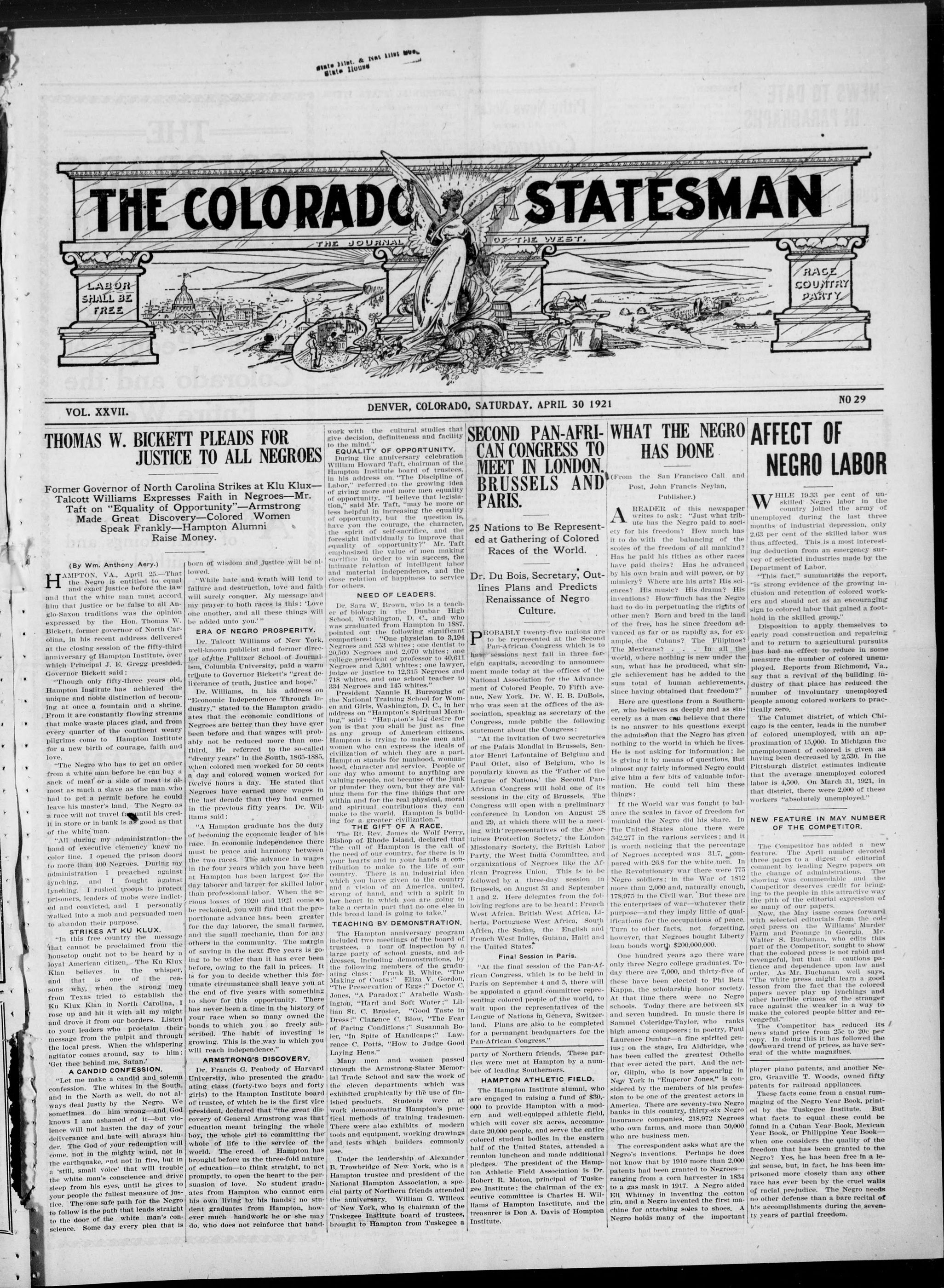
THOMAS W. BICKETT PLEADS FOR JUSTICE TO ALL NEGROES
Former Governor of North Carolina Strikes at Klu Klux— Talcott Williams Expresses Faith in Negroes—Mr. Taft on "Equality of Opportunity"—Armstrong Made Great Discovery—Colored Women Speak Frankly—Hampton Alumni Raise Money.
VOL. XXVII.
THOMAS W. BICKETT
JUSTICE
Former Governor of North Carolina
Talcott Williams Expresses
Taft on "Equality of Op-
made Great Discover
Speak Frankly—
Raise I
(By Wm. Anthony Aery.)
HAMPTON, VA., April 25.—That the Negro is entitled to equal and exact justice before the law and that the white man must accord him that justice or be false to all Anglo-Saxon traditions was the opinion expressed by the Hon. Thomas W. Bickett, former governor of North Carolina, in his recent address delivered at the closing session of the fifty-third anniversary of Hampton Institute, over which Principal J. E. Gregg presided.
Governor Bickett said:
"Though only fifty-three years old, Hampton Institute has achieved the unique and noble distinction of becoming at once a fountain and a shrine. From it are constantly flowing streams that make waste places glad, and from every quarter of the continent weary pilgrims come to Hampton Institute for a new birth of courage, faith and love.
"The Negro who has to get an order from a white man before he can buy a sack of meal or a side of meat is almost as much a slave as the man who had to get a permit before he could leave his master's land. The Negro as a race will not travel far until his credit in store or in bank is as good as that of the white man.
"All during my administration the hand of executive clemency knew no color line. I opened the prison doors to more than 400 Negroes. During my administration I preached against lynching, and I fought against lynching. I rushed troops to protect prisoners, leaders of mobs were indicted and convicted, and I personally walked into a mob and persuaded men to abandon their purpose."
STRIKES AT KU KLUX.
"In this free country the message that cannot be proclaimed from the houselot ought not to be heard by a loyal American citizen. The Ku Klux Klan believes in the whisper, and that is one of the reasons why, when the strong mep from Texas tried to establish the Ku Klux Klan in North Carolina, I rose up and hit it with all my might and drove it from our borders. Listen to your leaders who proclaim their message from the pulpit and through the local press. When the whispering agitator comes around, say to him: 'Get the behind me, Satan.'
A CANDID CONFESSION.
A CANDID CONFESSION.
"Let me make a candid and solemn confession. The whites in the South, and in the North as well, do not always deal justly by the Negro. We sometimes do him wrong—and God knows I am ashamed of it—but violence will not hasten the day of your deliverance and hate will always hinder. The God of your redemption will come, not in the mighty wind, not in the earthquake, and not in fire, but in a 'still, small voice' that will trouble the white man's conscience and drive sleep from his eyes, until he gives to your people the fullest measure of justice. The one safe path for the Negro to follow is the path that leads straight to the door of the white man's conscience. Some day every plea that is
born of wisdom and justice will be allowed.
"While hate and wrath will lead to failure and destruction, love and faith will surely conquer. My message and my prayer to both races is this: 'Love one another, and all these things will be added unto you.'"
ERA OF NEGRO PROSPERITY.
Dr. Talcott Williams of New York, well-known publicist and former director of the Pulitzer School of Journalism, Columbia University, pald a warm tribute to Governor Bickett's "great deliverance of truth, justice and hope." Dr. Williams, in his address on "Economic Independence Through Industry," stated to the Hampton graduates that the economic conditions of Negroes are better than they have ever been before and that wages will probably not be reduced more than one third. He referred to the so-called "dreary years" in the South, 1865-1885, when colored men worked for 50 cents a day and colored women worked for twelve hours a day. He stated that Negroes have earned more wages in the last decade than they had earned in the previous fifty years. Dr. Williams said:
"A Hampton graduate has the duty of becoming the economic leader of his race. In economic independence there must be peace and harmony between the two races. The advance in wages in the four years which you have been at Hampton has been largest for the day laborer and larger for skilled labor than professional labor. When the serious losses of 1920 and 1921 come to be reckoned, you will find that the proportionate advance has been greater for the day laborer, the small farmer, and the small mechanic, than for any others in the community. The margin of saving in the next five years is going to be wider than it has ever been before, owing to the fall in prices. It is for you to decide whether this fortune circumstance shall leave you at the end of five years with something to show for this opportunity. There has never been a time in the history of your race when so many owned the bonds to which you so freely subscribed. The habit of investing is growing. This is the way in which you will reach independence."
ARMSTRONG'S DISCOVERY.
Dr. Francis G. Peabody of Harvard University, who presented the graduating class (forty-two boys and forty girls) to the Hampton Institute board of trustee, of which he is the first vice president, declared that "the great discovery of General Armstrong was that education meant bringing the whole boy, the whole girl to committing the whole of life to the service of the world. The creed of Hampton has brought before us the three-fold nature of education—to think straight, to act promptly, to open the heart to the persuasion of love. No student graduates from Hampton who cannot earn his own living by his hands; no student graduates from Hampton, however much handwork he or she may do, who does not reinforce that hand-
work with the cultural studies that give decision, definiteness and facility to the mind."
EQUALITY OF OPPORTUNITY.
During the anniversary celebration William Howard Taft, chairman of the Hampton Institute board of trustees, in his address on "The Discipline of Labor," referred to the growing idea of giving more and more men equality of opportunity. "I believe that legislation," said Mr. Taft, "may be more or less helpful in increasing the equality of opportunity, but the question is have you the courage, the character, the spirit of self-sacrifice, and the foresight individually to improve that equality of opportunity?" Mr. Taft emphasized the value of men making sacrifice in order to win success, the intimate relation of intelligent labor and material independence, and the close relation of happiness to service for others.
NEED OF LEADERS.
Dr. Sara W. Brown, who is a teacher of biology in the Dunbar High School. Washington, D. C., and who was graduated from Hampton in 1887, pointed out the following significant comparison: "One physician to 3,194 Negroes and 553 whites; one dentist to 20,500 Negroes and 2,070 whites; one college president or professor to 40,611 Negroes and 5,301 whites; one lawyer, judge or justice to 12,315 Negroes and 718 whites, and one school teacher to 334 Negroes and 145 whites." President Nannle H. Burroughs of the National Training School for Women and Girls, Washington, D. C., in her address on "Hampton's Spiritual Meaning" said: "Hampton's big desire for you is that you shall be just as fine as any group of American citizens. Hampton is trying to make men and women who can express the ideals of civilization of which they are a part. Hampton stands for manhood, womanhood, character and service. People of our day who amount to anything are valuing people, not because of the junk or plumber they own, but they are valuing them for the fine things that are within and for the real physical, moral and spiritual contributions they can make to the world. Hampton is building for a greater civilization."
THE GIFT OF A HACE.
The Rt. Rev. James de Wolf Perry, Bishop of Rhode Island, declared that "the call of Hampton is the call of the need of our country, for there is in your hearts and in your hands a contribution to make to the life of our country. There is an industrial idea which you have given to the country and a vision of an America, united, strong of hand, and with a spirit in her heart in which you are going to take a certain part that no one else in this broad land is going to take."
TEACHING BY DEMONSTRATION.
The Hampton anniversary program included two meetings of the board of trustees, a tour of inspection by a large party of school guests, and addresses, including demonstrations, by the following members of the graduating class: Frank B. White, "The Making of Coats;" Eliza V. Gordon, "The Preservation of Eggs;" Doctor C. Jones, "A Paradox;" Arabelle Washington, "Hard and Soft Water;" Lillian St. C. Brosier, "Good Taste in Dress;" Clarence C. Blow, "The Fear of Facing Conditions;" Susannah Boer, "In Spite of Handicaps;" Lawrence C. Potts, "How to Judge Good Laying Hens."
Many men and women passed through the Armstrong-Slater Memorial Trade School and saw the work of the eleven departments which was exhibited graphically by the use of finished products. Students were at work demonstrating Hampton's practical methods of training tradesmen. There were also exhibits of modern tools and equipment, working drawings and tests which builders commonly use.
Under the leadership of Alexander B. Trowbridge of New York, who is a Hampton trustee and president of the National Hampton Association, a special party of Northern friends attended the anniversary. William G. Willcox of New York, who is chairman of the Tuskegee Institute board of trustees, brought to Hampton from Tuskegee a
SECOND PAN-AFRI CAN CONGRESS TO MEET IN LONDON. BRUSSELS AND PARIS.
25 Nations to Be Represented at Gathering of Colored Races of the World.
Dr. Du Bois, Secretary, Outlines Plans and Predicts Renaissance of Negro Culture.
PROBABLY twenty-five nations are to be represented at the Second Pan-African Congress which is to have sessions next fall in three foreign capitals, according to announcement made today at the offices of the National Association for the Advancement of Colored People. 70 Fifth avenue, New York. Dr. W. E. B. DuBois, who was seen at the offices of the association, speaking as secretary of the Congress, made public the following statement about the Congress:
"At the invitation of two secretaries of the Palais Mondial in Brussels, Senator Henri Lafontaine of Belgium and Paul Otlet, also of Belgium, who is popularly known as the 'Father of the League of Nations,' the Second Pan-African Congress will hold one of its sessions in the city of Brussels. The Congress will open with a preliminary conference in London on August 28 and 29, at which there will be a meeting with representatives of the Aborigines Protection Society, the London Missionary Society, the British Labor Party, the West India Committee, and organizations of Negroes like the African Progress Union. This is to be followed by a three-day session in Brussels, on August 31 and September 1 and 2. Here delegates from the following regions are to be heard: French West Africa, British West Africa, Liberia, Portuguese West Africa, South Africa, the Sudan, the English and French West Indies, Guiana, Haiti and the United States."
Final Session in Paris.
"At the final session of the Pan-African Congress, which is to be held in Paris on September 4 and 5, there will be appointed a grand committee representing colored people of the world, to wait upon the representatives of the League of Nations in Geneva, Switzerland. Plans are also to be completed for a permanent headquarters for the Pan-African Congress." party of Northern friends. These parties were met at Hampton by a number of leading Southerners.
HAMPTON ATHLETIC FIELD.
The Hampton Institute alumni, who are engaged in raising a fund of $30,000 to provide Hampton with a modern and well-equipped athletic field, which will cover six acres, accommodate 20,000 people, and serve the entire colored student bodies in the eastern half of the United States, attended a reunion luncheon and made additional pledges. The president of the Hampton Athletic Field Association is Dr. Robert R. Moton, principal of Tuskegee Institute; the chairman of the executive committee is Charles H. Williams of Hampton Insectite, and the treasurer is Don A. Davis of Hompton Institute.
WHAT THE NEGRO HAS DONE
(From the San Francisco Call and Post, John Francis Neylan, Publisher.)
A READER of this newspaper writes to ask: "Just what tribute has the Negro paid to society for his freedom? How much has it to do with the balancing of the scoles of the freedom of all mankind? Has he paid his tithes as other races have paid theirs? Has he advanced by his own brain and will power, or by minicery? Where are his arts? His sciences? His music? His drama? His inventions? How much has the Negro had to do in perpetuating the rights of other men? Born and bred in the land of the free, has he since freedom advanced as far or as rapidly as, for example, the Cubans? The Filipinos? The Mexicans? . . . In all the world, where nothing is new under the sun, what has he produced, what single achievement has he added to the sum total of human achievements, since having obtained that freedom?"
Here are questions from a Southerner, who believes as deeply and as sincerely as a man can believe that there is no answer to his questions except the admission that the Negro has given nothing to the world in which he lives. He is not asking for information; he is giving it by means of questions. But almost any fairly informed Negro could give him a few bits of valuable information. He could tell him these things:
If the World war was fought to balance the scales in favor of freedom for mankind the Negro did his share. In the United States alone there were 342,277 in the various services; and it is worth noticing that the percentage of Negroes accepted was 31.7, compared with 26.8 for the white men. In the Revolutionary war there were 775 Negro soldiers; in the War of 1812 more than 2,000 and, naturally enough, 178,975 in the Civil war. But these are the enterprises of war—whatever their purpose—and they imply little of qualifications for the occupations of peace. Turn to other facts, not forgetting, however, that Negroes bought Liberty loan bonds worth $200,000,000.
One hundred years ago there were only three Negro college graduates. Today there are 7,000, and thirty-five of these have been elected to Phi Beta Kappa, the scholarship honor society. At that time there were no Negro schools. Today there are between six and seven hundred. In music there is Samuel Coleridge-Taylor, who ranks high among composers; in poetry, Paul Laurence Dunbar—a fine spirited genius; on the stage, Ira Aldbridge, who has been called the greatest Othello that ever acted the part. And the actor, Gilpin, who is now appearing in New York in "Emperor Jones," is considered by the members of his profession to be one of the greatest actors in America. There are seventy-two Negro banks in this country, thirty-six Negro insurance companies, 218,972 Negroes who own farms, and more than 50,000 who are business men.
The correspondent asks what are the Negro's inventions. Perhaps he does not know that by 1910 more than 2,000 patients had been granted to Negroes—ranging from a corn harvester in 1834 to a gas mask in 1917. A Negro aided Eli Whitney in inventing the first machine for attaching soles to shoes. A Negro holds many of the important
NO29
AFFECT OF NEGRO LABOR
WHILE 19.33 per cent of unskilled Negro labor in the country joined the army of unemployed during the last three months of industrial depression, only 2.63 per cent of the skilled labor was thus affected. This is a most interesting deduction from an emergency survey of selected industries made by the Department of Labor.
"This fact," summarizes the report, "is strong evidence of the growing inclusion and retention of colored workers and should act as an encouraging sign to colored labor that gained a foothold in the skilled group."
Disposition to apply themselves to early road construction and repairing and to return to agricultural pursuits has had an effect to reduce in some measure the number of colored unemployed. Reports from Richmond, Va., say that a revival of the building industry of that place has reduced the number of involuntary unemployed people among colored workers to practically zero
The Calumet district, of which Chicago is the center, leads in the number of colored unemployed, with an approximation of 15,000. In Michigan the unemployment of colored is given as having been decreased by 2,530. In the Pittsburgh district estimates indicate that the average unemployed colored labor is 4,500. On March 31, 1921, in that district, there were 2,000 of these workers "absolutely unemployed."
NEW FEATURE IN MAY NUMBER OF THE COMPETITOR.
The Competitor has added a new feature. The April number devoted three pages to a digest of editorial comment by leading Negro papers on the change of administrations. The showing was commendable and the Competitor deserves credit for bringing to the people in this attractive way the pth of the editorial expression of so many of our papers.
Now, the May issue comes forward with selected editorials from the colored press on the Williams' Murder Farm and Peonage in Georgia. Mr. Walter S. Buchanan, who edits this part of the Competitor, sought to show that the colored press is not rabid and revengeful, but that it cautions patience and dependence upon law and order. As Mr. Buchanan well says, "The white press might learn a good lesson from the fact that the colored papers never play up lynchings and other horrible crimes of the stranger race against the weaker in a way to make the colored people bitter and revengeful."
The Competitor has reduced its news stand price from 25c to 20c per copy. In doing this it has followed the downward trend of prices, as have several of the white magazines.
player piano patents, and another Negro, Granville T. Woods, owned fifty patents for railroad appliances.
These facts come from a casual rummaging of the Negro Year Book, printed by the Tuskegee Institute. But what facts to equal these could be found in a Cuban Year Book, Mexican Year Book, or Philippine Year Book—when one considers the quality of the freedom that has been granted to the Negro? Yes, he has been free in a legal sense, but, in fact, he has been imprisoned more closely than any other race has ever been by the cruel walls of racial prejudice. The Negro needs no other defense than a bare recital of his accomplishments during the seventy years of partial freedom.
FOREIGN
The Tivoll gambling establishment, one of the largest of the kind ever operated in Mexico, has closed its doors in compliance with orders from Governor Enriquez of Chihuahua. The place has been in operation since the first of the present year and during that time paid $500,000 gold in license fees to the state government.
Physicians of Dublin, regardless of politics, have ignored the order of the government military authorities to report at once the arrival in hospitals of persons suffering from gunshot wounds. Thus far no proceedings have been taken against them. The order was intended to aid the military in identifying their attackers, many of whom escape though wounded.
Reports from Paris from an authoritative source say the Council of the League of Nations has decided to award the Aland islands to Finland, Sweden insisted on ownership of the islands, but the decision states that "Finland's right is incontestable." The soviets refuse to recognize the allocation of the islands to anyone except Russia, as they control the entrance to Petrograd.
Rene Viviani, special French envoy, en route home, in a wireless message of congratulations to the American Legion, its national commander, Col. F. W. Galbraith, Jr., and General Pershing, invited the legion men to visit France and declared he never would forget the "courageous soldiers" of America. "Among the great people who love them, they will find anew the image of the great country which they honor," the message concluded.
Dr| Koudish, Russian Soviet representative at Constantinople, who was given a British passport vise to go to London to confer with Leonid Krassin, Soviet minister of trade and commerce, was assaulted and beaten by a Russian colonel while dining with his wife in a restaurant. The colonel exclaimed: "How dare you drink champagne among the victims of Soviet Russia!" British police who were called in told Koudish: "You are free to strike back." He demanded British official protection.
Riccardo Zanella, leader of the Flume people's party and head of the communistic faction in the Italian elections, by a coup d'etat, occupied the city hall at Flume. Count Caccia Dominione, the Italian minister, left Flume aboard a torpedo boat destroyer owing to the rioting. The frontier has been closed by a brigade of infantry. When the Autonomists claimed they hay won the election by more than a thousand votes, Zanella and his forces stormed the city hall and ejected the old administration.
GENERAL
Filling stations in the Middle West have dropped gasoline from 25 to 22 cents a gallon, it was announced by the Standard Oil Company of Indiana. Gasoline at tank wagons is now 20 instead of 23 cents. Plans for recruiting harvest hands in Kansas this season were discussed at a conference of heads of employment agencies in the various cities and the labor department of the industrial court. It was estimated 40,000 to 50,000 men would be required to gather the 1921 crop.
Reports from districts swept by a violent windstorm shows that the counties of Hamilton, Webster and Adams were visited and the property damage is considerable. Fifty farms within a radius of twenty-five miles of Hastings, Neb., were swept. On a number of farms the barns and outbuildings were completely destroyed and the houses damaged. On several farms horses and sheep were either killed or injured. In the vicinity of Guide Rock the wind took the form of a tornado, unroofing several houses and in one or two instances completely destroying them.
Cutt off from the fortune of George M. Oyster, the widow, Mrs. Cecil Ready Oyster of Syracuse, N. Y., will wage a bitter legal battle for a large part of the estate, it was predicted here when word came from Atlantic City that Oyster shortly before his death had executed a codicil to his will by which the society girl he-married January 15 was disinherited. With the definite selection of "Boyle's thirty acres," adjoining Montgomery park in Jersey City, as the site of the arena for the Dempsey-Carpentier heavyweight championship bout July 2, training plans of the contestants were laid accordingly. It is generally understood that the champion will select Atlantic City, while the Frenchman will train on Long Island.
Miss Lucia Russell Briggs, daughter of Lebaron Russell Briggs, president of Radcliffe College, and dean of the faculty of arts and sciences at Harvard, has been chosen president of Milwaukee Dower College at Milwaukee, Wis. She succeeds Miss Ellin C. Sobin. Miss Briggs is a graduate of Radcliffe, and since 1915 has been connected with the English department at Simmons College.
Papers filed in the county clerk's office at Buffalo, N. Y., state that Ethel J. Mahan, owner of a grocery store, became so worried over fear that the government would confiscate her business, because of possible errors in her income tax report, that she lost her mind. She was committed to the state hospital for the insane by Acting Judge Ottoway.
Floods threatened several parts of Milwaukee and residents of the south shore faced the loss of their homes through continued crumbling of the shore as the result of steady rains.
NEWS TO DATE IN PARAGRAPHS
CAUGHT FROM THE NETWORK OF WIRES ROUND ABOUT THE WORLD.
DURING THE PAST WEEK
RECORD OF IMPORTANT EVENTS
CONDENSED FOR BUSY
PEOPLE.
WESTERN
Francis M. Goodwin of Spokane, Washington, has been nominated by President Harding to be assistant secretary of the interior.
"He spanked me so hard that for a long time I couldn't sit down," testified Mrs. Irene Gerstad, known on the screen as Irene DeVoss. She was granted a divorce in Los Angeles from Harry W. Gerstad, welder of the hefty palm. In addition, Gerstad, a motion-picture camera-man, was ordered to pay her $30 a week.
Dancing in the cafes of San Francisco's once-famed uptown tenderloin ceases May 1 by an order promulgated by the police commission. The order forbids further dancing in the Pup and Black Cat cafes, the last two of a score of establishments in the once-noted district, and leaves only a few resorts, all in the Barbary Coast, where dancing is permitted.
Carl Nordlander, 16 years old and an orphan, was found asphyxiated in his room in San Francisco. The police version of his death was that he lost his life through his devotion to art. Lacking the prepared charcoal which artists use for drawings, he apparently had been charring in a gas jet splinters of wood to finish a drawing which was found uncompleted in the room, but had retired without turning the jet entirely off.
Tagged for a journey of several thousand miles by bont and rall. Tommy Bradford, 9, and his sister, Margie, 5, are on their way to their father in Calgary, Alberta. They were shipped by the prosecuting attorney of Seattle, Wash. Held as security for a board bill, according to information reaching the prosecutor from the father and the American consul at Calgary, the children had been with Mrs. H. E. Sloan at Roy since she brought them from Calgary last summer. Mrs. Sloan gave them up as soon as an officer called. A collection was taken up to aid the children in their journey.
WASHINGTON
Secretary Denby has asked for $25,000 for use in obtaining a historical pictorial record of the American fleet in foreign waters during the war. Should the money be provided, the secretary said, Burnell Poole, an artist, would be engaged to do the work. By direction of President Harding the federal reserve board has undertaken a special inquiry into the problem of deflating industrial values with out serious injury to the agricultural interests. It is understood that some steps to aid agriculture in connection with the deflation trend may be taken by the board in the near future.
After having reposed with moth bails for a number of years, the principal articles of dress uniform formerly worn in the navy have been restored to use by an order of Secretary Denby. It authorizes the wearing, on stated occasions, of the frock coat, full dress trousers, cocked hat, dress sword and sword belt and epaulets. Special full dress dinner dress and mess dress uniforms were not restored.
The House judiciary committee ordered a favorable report on the Volstead bill permitting organization by farmers, ranchmen, dairymen and fruit growers for purposes of collective marketing. The secretary of agriculture would have supervisory powers.
A brigade of "railroad artillery" has been sent to the Hawaiian islands for the better protection of that distant post. This force has in large part already arrived and as its name indicates, is intended for instant mobilization in case of emergency. The great problem of the army so far as the island of Oahu and Pearl Harbor are concerned is to safeguard them from sudden attack in the event of war.
A vacation trip to the Pacific coast for President Harding late this fall is being urged by some of his friends, and is understood to be receiving favorable consideration. The President is said to have indicated that if he finds opportunity for a vacation this year he will spend it in the Northwest. The northwestern trip first was suggested as part of a trip to Alaska, but it has been indicated that the President has little hope of getting that far away during the present summer.
The Interstate Commerce Commission has granted authority to the Northern Pacific and Great Northern Railroad companies to issue $230,000,000 of joint fifteen-year convertable gold bonds at not less than 91.5 per cent, and authorized the company to issue and pledge $33,000,000 of other bonds to aid in securing the joint bonds. The issue was authorized to enable the two roads to retire joint bonds amounting to $215,227,000, issued in 1901 for the purpose of purchasing the Chicago, Burlington & Quincy railroad
Pithy News Notes From All Parts of Colorado
Pithy News Notes From All Parts of Colorado
Representatives from all towns between Denver and Colorado Springs met in Limon recently to form an Eastern Colorado Commercial Club. A. C. Parks, 28 years old, owner of a ranch a half mile north of the Denver city limits near Sacred Heart College, was beaten into insensibility by two men as he was leaving his ranch for Denver recently. Two automobile bandits secured $235 from the cafe of the Niles drug store in the suburbs of Pueblo after they had bound and gagged J. F. Conant, a clerk. The car in which they escaped was piloted by a woman.
Potato pickers will be paid 5 cents a sack with board, or 6 cents a sack without board in the section around Montrose next fall, according to a decision reached by members of the farm bureau of the Coal Creek section at a recent meeting.
The public schools of Colorado Springs will hold a big May festival at Monument Valley park, May 20. It will be an all-day affair, including music and dances in the morning, a basket picnic at noon and an athletic field day in the afternoon. It will be the largest affair of the kind ever attempted in the city.
Farmers of eastern Weld county plan to market their own livestock and have organized the Briggsdale Farmers' Union Shipping Association. Officers elected for the association are: R. W. Bidwell, president; H. P. Kettleson, vice president; A. W. Woolensack, secretary and treasurer, and J. F. Pitney, manager. The Denver Livestock Exchange has voted to aid livestock growers by reducing commission rates at the stockyards. This was decided at a long session at which members urged that the exchange should take the lead in helping the farmer in his drive for lower railroad rates and that a reduction on commission charges would show good faith.
James T. Keeney, 47 years old, wealthy land owner of Antonito, shot and killed his 20-year-old wife Pearl, then committed suicide in the home of his wifes mother in Denver. Failure to effect reconciliation between himself and his wife was given as the cause by Mrs. M. B. Welfs, mother of the young woman, who witnessed the tragedy.
More than 200 wheat growers, representing all sections of Colorado unanimously adopted the Sapiro marketing plan, providing for a 100 per ceat pool of grain, at a meeting held in Akron. Resolutions were adopted pledging the support of the Colorado Wheat Growers' Association in continuing the program adopted by the national body, and the work of signing contracts for the pool.
Julius Josephson, Denver youth convicted of embezzling $6,000 from the American Bank and Trust Company, has been paroled from the state reformatory on order of Governor Shoup. Josephson was sentenced to an indeterminate term. He served exactly fifty days. Following his arrest, Josephson declared that he lost the money gambling in "Dago Miké" Mongone's club.
Critically ill and almost penniless, with four minor children and a rooming house on her hands, Mrs. Charles H. Sanchez, recently of Walsenburg, Colo., is in Denver seeking for a trace of her husband's whereabouts since he disappeared on April 2 with the explanation that he was going to Trinidad for a few days on business. He has not been heard from since he dropped from sight.
Attorney General Keyes has rendered an opinion that the new motor vehicle law enacted by the Twenty-third General Assembly is constitutional. As a result of this ruling Secretary of State Milliken announced that he will appoint eight Republican "supervisors" to replace a like number of Democratic "inspectors" who were employed under the provisions of the old law.
Joseph Burghardt of Denver, apprentice seaman, U. S. N., has been named in the honor roll of the United States naval training station, San Francisco, as being one of the eleven men who have made the most progress in instruction, personal appearance and attention to duties. The honor roll states that Burghardt is considered one of the most efficient men now at the training station.
Announcement has been made by F. A. Wadleigh, passenger traffic manager of the Denver & Rio Grande, that the open top car service would be established for the summer season May 1, through the Royal Gorge. The cars will run between Cañon City to Texas Creek, on the two through daylight passenger trains.
After being lost in the high mountain passes between Denver and Dolores, Colo, when a blizzard swept the entire West, relatives of L. W. Stark of Denver were located at Stone City, Pueblo county, Colo., and are now in Dolores, according to information received in Denver.
Harold R. Shurttiff, 20, who was sentenced to serve from eight to nine years in the state penitentiary on a charge of grand larceny has escaped from the convict road camp near Montrose. A reward of $50 has been offered for his arrest.
CENTENNIAL STATE ITEMS.
Fifty per cent federal aid has been approved in the following proposed road construction and improvements: Four and nine-tenths miles of gravel road between Durango and Hesperus, in La Plata county; four and three-tenths miles of gravel road between Breed and Colorado Springs, Colo., in El Paso county, and two and seventenths miles of improved sand-clay road between Limon and Madison, Colo., in Lincoln county. Approximately $21,020 aid was requested and approved by the federal bureau in the improvement of one mile of improved mountain graded road between Silverton and Durango, Colo., officials said.
"I can think of no more delightful place to go on a vacation than Colorado, a state of true western hospitality," commented President Harding after Senator Phipps, speaking on behalf of the citizens, had formally extended to the President the invitation from the Colorado Legislature to make the Rocky Mountain state his summer home. Besides Colorado's invitation to become its guest, the President was presented with a certificate of life honorary membership in the Denver Press Club. On behalf of the club, Warren R. Given of Denver handed the President a gold engraved membership card.
Miss Helen Dowe of the United States forest service of Denver has left for Rico, Colo., with a forest service surveying party, thus winning the honor of being the first woman in the entire United States to join a party in that department of the governmental service. She is a scenic artist for the Denver division during winter months and patrol woman and "fire lookout" at Devil Head mountain in the Pike National forest during the fire season. On her trip she will act as chainwoman and will be accompanied by her chaperon, Mrs. Grace Stewart of Denver.
The old Midland railroad bed will be utilized in the construction of a county highway in the Carbondale district has become known following a trip of inspection over the route by county commissioners. By using the abandoned roadbed considerable expense can be saved to the county as the work of repairing the old highway along the Frying Pan river is in poor condition and the work of getting it into shape would be costly. Financial assistance will be given to the work by the forestry service.
A "scientific kiss," purported to awaken dormant faculties, may cost James A. Murdock of Los Angeles his license. Murdock, who is almost 60 years old, advertised as being "an incomparable psychist and clairvoyant." Miss Billie Blackburn, 17, got the kiss. Her mother, Mrs. Sarah Blackburn, got a bill from Murdock for $190. The board of supervisors has under consideration Mrs. Blackburn's application for revocation of Murdock's license. The latter made a sweeping denial of the charges.
Several of the leading summer resorts in the Platte canon have organized an association, which will open a bureau of information, May 15, in the Albany hotel, for the benefit of the many tourists to Denver, who desire a short trip into Colorado's mountain wonderland. Besides the public informant who will be maintained, reservations for hotels and cottages may be made, and an outing of any duration will be planned.
More than fifty students of the University of Colorado donned overalls and joined in the work of rebuilding the road up Bluebell canon, above Chautauqua. They were granted a half holiday to permit them to participate in the project which was carried out by the Lions' Club. Many prominent business men of Boulder, including Mayor J. O. Billig, were in the expedition. Regents of the university were also present.
Twenty-month-old Robert Pierson, who fell from a third-story window of the Vincent hotel in Denver, died of injuries sustained in his fall. The baby who had been sleeping with his mother Mrs. Josephine Pierson, awakened before the mother, and crawled out of the bed over the ledge of an open window. Mrs. Pierson's first intimation of the accident was when her baby was brought to her by a policeman. The fall fractured the base of the baby's skull.
After a spirited automobile ride Sheriff Lewis Worker lodged Jose M Gomez, 36, in the Crowley county jail at Ordway, following the killing of Pasquel Compos, 41, for years a resident of southern Colorado, in the main street at Sugar City. Scores of pedestrians and farmers witnessed the shooting. The shooting is said to have followed a series of quarrels between Gomez and Compos. Delegates from all quarters of the globe will gather in Montrose during the first week of June to attend the meeting of the General Missionary Society of the United Presbyterian church. More than 250 are expected to be in attendance at the convention.
Two women and two men were fined for rioting, a justice of the peace lost his office and was fined for malfeasance, and one prominent Moffat county man is being sought by officers as the result of two fractions which kept Sunbeam and the whole lower section of Moffat county in a state of excitement for two weeks. Mrs. Bessie Morea, wife of Justice of the Peace C. O. Morea, her sister, Mrs. Beatrice Handside, and Ray and Roy Hanley were each fined $500. Justice of the Peace Morea resigned from office during the heat of the fray.
THE COLORADO STATESMAN
The Mouth-Piece of the People of Colorado and the Entire West
RELIABLE chronicle of their doings and progress; a faithful mirror of their wants, their hopes, their best aspirations.
THE COLORADO STATESMAN
Unequaled as an advertising medium for the business of professional men and women.
An excellent family journal speaking to and for many thousand colored citizens.
$2.50 A YEAR
THE GREAT ORGAN OF THE LABORING MASSES
HHP PP+ Pore oHe-
, DR. CLARENCE F. HOLMES, JR.
; U8. D.D.8.
> Invites the public of Denver to
> Inspect hia modern: electrically
; pauipped dental suite, 2603 Wel
ton st Hours 8 am. to 12 noon;
} 1'to 6 pm.: evenings and gun-
> days by “appointment. Office
> phone Champa 2807. Residence
; phone Champa 1836,
POCC EVE UPR OS
PHS HHP PP PEP POP POP OH OTT THs
pT ee waaay GaAd ee
12 to 2 and 6 to 8 p.m. or by z
arm Place. Phone Champa 3303. 3
Sr ea Tea Mea ce
p.m mLaKmmonn,
$ Attorney and Counsellor at Law
Offics, Rooms. 39 and 40 Arapa-
; hon Hide. tea? “Arapahoe St.
$ Bhone Champa 6480.
StS H HHH 4444444444444.
a
:
DR. HUFF'S office phone Is
crampa tobi, And fly Posidonce
Phone (York 4101. When Bot
Feached at office “or home, cal
Atlas Drug Co., Main 876. Office,
Suite 6, 6 and 7, 2701 Welton St.
over Atlas Drug Store. Office
hora, 11'to 12a, mand 6 to 6
p.m,
‘
Re ee et ee
Office 600 2Tth St, Fh. Champa 1142
ATTORNEY-AT-LAW
Six Years City and County Attorney
at Russell Springs, Logan
‘County, Kansas
Office Hours—
9100 A.M. to 12:00 M.
2100 P.M. to 4:00 P.M.
DENVER, COLO,
She
Gales Daily at 2 p.m. Offlee Pur
niture « Speolalty.
==
PRIVATE SALES AT ALL TIMES
=<
HAVE MOVED TO—
(97-1723-39 GLENARM 8T.-@8
PHONE MAIN 1678.
——EE——
Phone Matstone Tork STU
FRANK D. TAGGART
Attorney at Law—Notary Publis
‘206-200 Cooper mullding
Deaver, Colerade
JOSEPH CARTER
Express, Moving,
and Storage
COAL AND WOOD
PROMPT DELIVERY.
Phone Main 6644,
2415 WASHINGTON STREET,
Give
a fe
i!
Ve
The Difference
Between the Cost of Good
and Cheap Printing
is so slight that he who goes
shopping from printer to
printer to secure his printing
ft a few cents less than what
it is really worth hardly ever
makes day laborer wages at
this unpleasant task.
If you want good work at
prices-that are right, get your
job printing
At This Office
Te jay SGédgraphy
r ?
eae)
See
ICELAND: LACKS ICE AND
Carrying ice, to Iceland will appear
to most persons about as reasonable
as carrying wheat to the Dakotas, cot-
ton to Texas or-beans to Boston. But
according to press dispatches the Ice-
landers made an appeal during the
past winter to Norway, the nearest
Buropean country, to ship them ice in
order that they might save their her-
ring harvest from being spotled by the
mild weather,
‘The land which has come down in
history as Iceland might with more
accuracy have been given a diametri-
cally opposite title, and called “The
Land of Fire.” The surface of no
other country, perhaps, is so deeply
marked by the withering blasts that
well up from time to time; and in no
country of equal area are to be found
so many volcanic peaks and vents,
Nearly 5,000 square miles of the 40,-
000 of the country’s area are covered
by lava flows.
Iceland is approximately the size of
Ohio and about 8,000 square miles
larger than Ireland. It is only a short
distance off the Europeward coast of
Greenland, and its northernmost cape
just touches the Arctic circle. From
there the midnight sun can be seen.
In spite of its position so near the
North pole, Iceland, thanks to the
Gulf stream, has a relatively mild win-
ter climate. Reykjavik, the capital,
is in the same latitude as Nome, Alas-
ka, but has a January temperature
milder than that of Munich, Germany,
or Milan, Italy.
Icelandic summers, however, are
cool, due to the large fields of Ice
that float down from the North. Grain
cannot be grown satisfactorily, and all
breadstuffs must be imported.
‘Though Icelanders, faced by implac-
able natural forces and conditions,
have been unable to achieve any great
degree of physical development on
their lava-covered, short-summered 1s-
land, they have made notable advances
in less material fields. A truly re-
markable literary development sprang
ap in this far northern island in the
twelfth and thirteenth centuries, a
full hundred years before the Renais-
sance began to make Itself felt in
sunny Italy.
In more recent times the Icelanders
have shown themselves to be In ad-
yance of many parts of the world in
their social and political ideas. Wom-
en had full political privileges in Ice-
land earlier probably than in any oth-
er civilized country. At the present
time part of the Althing, the Icelandic
parliament, is elected by proportional
representation, Votes for women ts
not the only mark which feminism
has placed on the life of Iceland. The
custom of women retaining thelr own
names when they marry is more gen-
eral In Iceland, perhaps, than In any
other modern country.
‘The political status of Iceland ts in
some ways pecullar. In effect it might
be sald to be an autonomous state In
partnership with Denmark. It has no
army or navy and {s under no obll-
gation to contribute either men or
money to the Danish military forces.
Denmark recognizes the country's per-
manent neutrality. Furthermore, the
present arrangement is only tempor-
ary, and after December 31, 1940,
elther of the associated countries may
demand a revision of the “Act of
Union” which now unites them,
ONLY UNITED STATES HAS
AL FRESCO INAUG-
URATION
If President, Harding had been tn-
ducted into the chief office in some
other republics on March 4, the cere-
monies would have varied from a sim-
plicity even greater than that he in-
sisted upon, to an investiture of al-
most regal splendor.
If he had followed the customs long
observed in France, the ceremony
would have taken place in the White
House. Insteadgpf taking a formal
oath he would have uttered a pledge
to consecrate himself to the service
of the republic—and he would have
ended by kissing the retiring President
on both cheeks.
If he had been made President ac
cording to the practice of the Mexi-
cans, he would have taken the oath
in the hall of the house of represen-
tatives at midnight. After the admin-
{stration of the oath he would have
received the embrace of his predeces-
sor.
In Brazil after being sworn in, he
would have hung across his chest a
broad band of the colors of the coun-
try, supporting a medal—the insignia
of the presidency.
In Chile, following the taking of the
oath before a Joint session of con-
gress, he would have gone through
streets lined with soldiers at “present
arms,” to a special Te Deum service
fn the principal church of the city.
Immediately afterward he would have
held a reception, and would then have
paid a visit to the ex-president.
If he had been inducted into the
presidency of the war-torn and war-
threatened republic of Poland, he
would have gone to a “White House”
ORIGINAL IN POOR CONDITION
at whose doors were stationed cay-
alrymen with drawn sabers, When he
went abroad he would be preceded,
not by a trim policeman or an Argus
eyed secret service man, but by a her-
ald who would demand that the popu-
lace “uncover before the most noble
President.”
And if Mr, Harding, instead of be-
mg installed as chief executive of the
world’s biggest republic, had been
sented as ong of the heads of the
smallest republic, San Marino, he
would have experienced the most
elaborate procedure of all. He would
have donned quaint medieval state
garments; would have marched
through the streets of the capital pre-
ceded by heralds and escorted by gor-
geously-uniformed soldiers; would
have attended a preliminary church
service during which his predecessor
would sit on a canopied throne soon
to be occupled by him; and finally,
would have had placed on his head a
headdress indicative of his office.
In addition to differences in the offi-
clal ceremonies by which the presi-
dents of the world are Inducted into
office, there are- many variations in
the festivities and celebrations that
accompany these events. In some
cases the accompanying observances:
have become practically a part of the
official procedure. The newly installed
French president almost invariably
drives to the Hotel de Ville, the Paris
city hall, after taking office, to attend
a luncheon and reception as the guest
of the president and members of the
municipal council. In Mexico, during
the evening preceding the midnight in-
duction into office, the president-elect
usually attends a banquet given in his
honor by the mayor of the City of
Mexico. There 1s a public reception
at the presidential palace the morning
after the Inauguration.
In Chile the {tnauguration day is
often closed by a special concert at
the municipal theater, and on the fol-
lowing evening the new president gives
fa state banquet for diplomatic repre-
sentatives, special envoys and high
officials of the republic and the prov-
inces.
‘The United States, although its cap-
{tal is in a more rigorous climate than
those of many republics, {s alone in
having an “al fresco” inauguration.
THE WINNING OF THE CA-
NADIAN WEST
Discovery of oil in northwest Can-
ada toward the Aretic circle has in-
creased the importance of the western
Canadian provinces near the United
States border, which will be the door-
way for the new oil treasury.
‘The prairie provinces of Canada—
Manitoba, Saskatchewan, and Alberta
—were not without their bids to fame
before this discovery. For example:
‘The last of the wild buffalo herds
of America, survivors of the millions
of animals which roamed the plains
and woodlands of the continent, now
ranges through northwestern Alberta.
‘This province alone is estimated to
contain 15 per cent of the world’s
known coal supply-
‘The myriad of wild ducks, geese,
and other migratory fowl that fly
northward each spring are for the
most part bound for the northern
parts of the three prairie provinces,
where they build their nests and rear
thelr young.
The three provinces are naturally
considered at once, for among them
they cover all of Canada which is in
process of being settled, west of the
older Great Lakes province of On-
tario and east of the Rocky moun-
tains. ‘This is Canada’s “West,” where
restless pioneer spirits from all lands
are carving out an empire as kindred
spirits a generation or so ago wrought
the wilderness of the Missouri valley
and the “great American desert” into
the rich states of today.
‘The Canadian pioneers have advan-
tages over those who won the Amer-
ican West, in that they have better
railroad methods and equipment, tele-
phones and wireless. But they have
fa relentless new enemy in the bitter
cold of the northern regions of the
provinces. For though the southern
portions are separated from the United
States by only an imaginary line, and
are similar to the northern reaches of
Minnesota, North Dakota and Mon-
tana, of which they are geographically
a part, to the north the three provinces
sweep to within 500 miles of the Arctic
circle.
‘The predominant part of the popu-
lation and development of the three
provinces is in their southern halves.
In this region Winnipeg, capital of
Manitoba, with its population close to
200,000, 1s Canada’s Chicago of a gen-
eration or so ago; while Edmonton,
capital of Alberta, is the St. Paul of
a similar period. The northern por-
tlon of the provinces 1s a region
crossed: by many rivers and dotted
with numberless lakes, a region divid-
‘ed between woodlands and “muskegs,”
or swampy flats. ‘There the trapper
still reigns supreme and life 1s prim-
‘tive.
WHEN DINOSAURS GAM-
BOLED IN AMERICA
Spring in America. which 1s herald-
ed in this age by the coming of the
birds, the stirring of small animals
and the emergence from hibernation
and water lethargy of the few large
animals that civilization has left us,
was a vastly different matter a few
eons ago when America produced an-
imals larger than any now living here.
‘An idea of what these creatures were
like 1s given In the following commu-
nication to the National Geographic
society from Barnum Brown:
“That was so long ago that nothing
remains of these creatures except
their bones, and they are turned to
stone. Hidden away under strata of
earth, thelr spoor has long since grown
cold.
“The animals are dinosaurs; for the
moment we will call them lzards—
not the creeping, crawling kind, but
huge reptiles that stalked upright
through the jungles, rivaling in size
the elephant, the hippopotamus and
the rhinoceros,
“In the marshes of prehistoric times
dwelt a host of reptiles, some large,
some small, and of vartous forms,
flesh eaters and herb eaters, but all
sharing certain characters in common
and known as dinosaurs. Not any
were closely related to any living rep-
tile, yet they had some characters
common to the lizards, crocodiles and
birds.
“Of the kinds charactertatic of the
period one species, an herb eater
named Trachodon, was more than 30
feet long and about 15 feet high when
standing erect. Its head, with broad-
ly-expanded mouth, resembles that of
4 duck, but back of the beak there
are more than two thousand small
teeth, disposed in many vertical rows,
each containing several individual
teeth, the new ones coming up from
below as the old ones wore out.
“The long hind feet terminated in
three large-hoofed toes, and the short-
er, slender front feet were partly
webbed. A long, thin, slender tall act-
ed as a powerful swimming organ, and
the body was covered with rough tu-
berculate skin. Having no means of
defense, it ved chiefly in the water,
where it was free from attacks of the
flesh eaters,
“Strangest of all was the herbivor-
ous Ankylosaurus a stocky, short-
legged, big-bodied creature, completely
encased in armor. Dermal plates cov-
ered the skull, followed by rings of
plates over the neck and rows of flat
plates over the back and hips. Its
tall terminated in a huge club, and
the belly was covered by a pliable
mosaic of small, close-set plates. It
was further protected by a movable
plate that could be dropped down like
shutter over each eye, thus complet-
ing its protection from insects and for-
midable foes.” ‘
c. V. FAIRBANKS —Props.— N. FAIRBANKS
Fairbanks
Hotel and
Cafe=—===
| FIRST CLASS | |
MEALS SERVED (Formerly Barnes Hotel)
HOME COOKING | 9736 WeltonSt., Denver, Colo.
Phone Main 4843 ;
cE GIBSON | SMITH
1638 Tremont St. Denver
PHONES: DENVER, CHAMPA 2077; PUEBLO, 864.
DAY OR NIGHT.
Not The Cammel fees
* Undertaking Co Jute
ow Undertaking Company “reicore
HOME FUNERAL PARLORS.
2418 Welton St., Denver. 945 Routt Ave., Pueblo, Colo.
Motto: Service, efficiency and modern conditions through-
out. Consult us. We can save you time, worry and money.
Your cares and sorrows are treated as though they were our own.
LICENSED EMBALMERS, FUNERAL DIRECTORS AND
LADY ATTENDANTS.
E. V. CAMMEL, PRESIDENT AND GENERAL MANAGER,
DENVER AND PUEBLO.
WHERE SOME OF OUR IM-
PORTS COME FROM—
PERFUMES
Milady America paid $4,972,541, dur-
ing the last year for perfumes, cos-
metics and toilet preparations, a fact
which has led to confused specula-
tion by mere man as to what she did
with them.
‘The real romance and adventure in
the statement les not so much in the
uses to which these imports were put
as where they came from. The sunny
isles and lands along the Mediterrane-
an probably grew some of the flowers,
others perhaps were plucked by dark
Moorish hands in Algeria, and mayhap
an animal in the brooding hills of
western China gave its life to furnish
oue constituent of the perfume.
‘The vegetable kingdom is necessarily
the most fertile source of perfumes.
From its flowers such as the rose and
Jessamine, and from {ts seeds, woods
and barks, such as the splces and san-
dalwood, even the most fastidious
connoisseur would be able to select
either some simple odor or a complex
bouquet. Nor are they for perfumes
alone, but for scenting soaps, éreams,
pomades, and in making flavorings
und extracts.
Rosemary, thyme, sweet basil, and
marjoram are found in great pro-
fusion in Mediterranean countries, and
here the chemist can distill the whole
plant and not bother about picking
the flowers. Shakespeare, the unfail-
Ing naturalist that he was, made no
error when he chose for Ophella the
flowers she scattered.
The old-fashioned lavender flowers
In which our grandmothers used to
pack the household linen, and their
rich old lace grew best in France and
England,
‘The rose geranium, which has such
an exquisite odor is also grown and
distilled in France, but Spain, Algiers,
and the Island of Reunion engage in
the industry. Unlike the lavender,
however, the perfume of the rose ger-
apium comes from its leaves and not
from the flowers.
But the country that might well be
known by its scent ie Bulgaria, for its
rose crop 1s second only to its tobacco.
Over 12,500 neres of lund in the prov-
Inces of Phillppopolis and Stara Za-
gora ure given to the growth of roses
from the petals of which attar of roses
is distilled. In the wonderful gardens
at Kazanlik, Karlovo, Klisoura and.
Stara Zagora, the best of the flowers
are grown.
‘About four thousand pounds of roses
are produced on an agre of land, but
it takes about two hundred pounds
of petals to produce an ounce of oll,
for an attar which before the war cost
about $250 a pound.
Roses are grown tn other parts of
the Balkans, as well as in Asiatic Tur-,
key, and in India, Persia, the Fayum
province in Egypt, and in France. ‘The
industry lately has been introduced
into Germany.
‘Phe animal perfumes are extremely
limited in number. Ambergris is se-
creted by the sperm whale, clvit by the
animal of the same name, and musk
by the musk ox, the musk rat, and
the musk deer, which ts found in the
high Himalayas, Tibet, and eastern
Siberia, About 15,000 ounces of musk,
usually in the grain form, are annual-
ly imported to the United States from
China and India. Musk has one pe-
cullar afd almost tnexplicable charac:
teristic. One grain of it kept freely
exposed to the air of a well-ventilated
room, will impregnate the atmosphere
for ten years without sensibly dimin
ishing in welght.
WESTERN BEEF CO
Hy .
—————— oo eee
Open Daily to 880 p. m. One of the Most Up-to-
Date and Sanitary Mar-
Sundays Until 2:00 p. m. kets in. the City.
Fresh Oysters, Chitterlings, Pig Tails, Snouts, Ears, Pigs Feet, Neck
Bones, Spare Ribs Received Fresh Daily.
Fresh and Cured Meats of All Kinds.. Fresh Vegetables, Staple and
Fancy Groceries.
Our Prices Are Always the Lowest
Free Delivery to All Parts of the City.
Phone Champa 1641.
2048 LARIMER STREET DENVER, COLO.
‘Opposite the Three Rules.
MORRISON'S FAMOUS ORCHESTRA
George Morrison, Manager
MUSIC furnished for all OCCASIONS |
| PHONE MAIN 2707 |
2947 STOUT ST. DENVER, COLO.
A FULL LINE OF
Black and White Remedies
Ane a Full Line of Mus. C. J. WALKER’S Toilet Articles.
BUT WE KNOW YOU WILL LIKE
Jones West Hair Pomade Best.
Atlas Drug G.
2701 Welton St Phone Main 875
GRANBERRY TAXI COMPANY
Ottice 2741 Welton Street.
OFFICE OFFICE
PHONE PHONE
CHAMPA ae
87
dautck and rrompt Service Day and Night., Call Us for Special Mates
tes Deg ne ieee
THE COLORADO STATESMAN
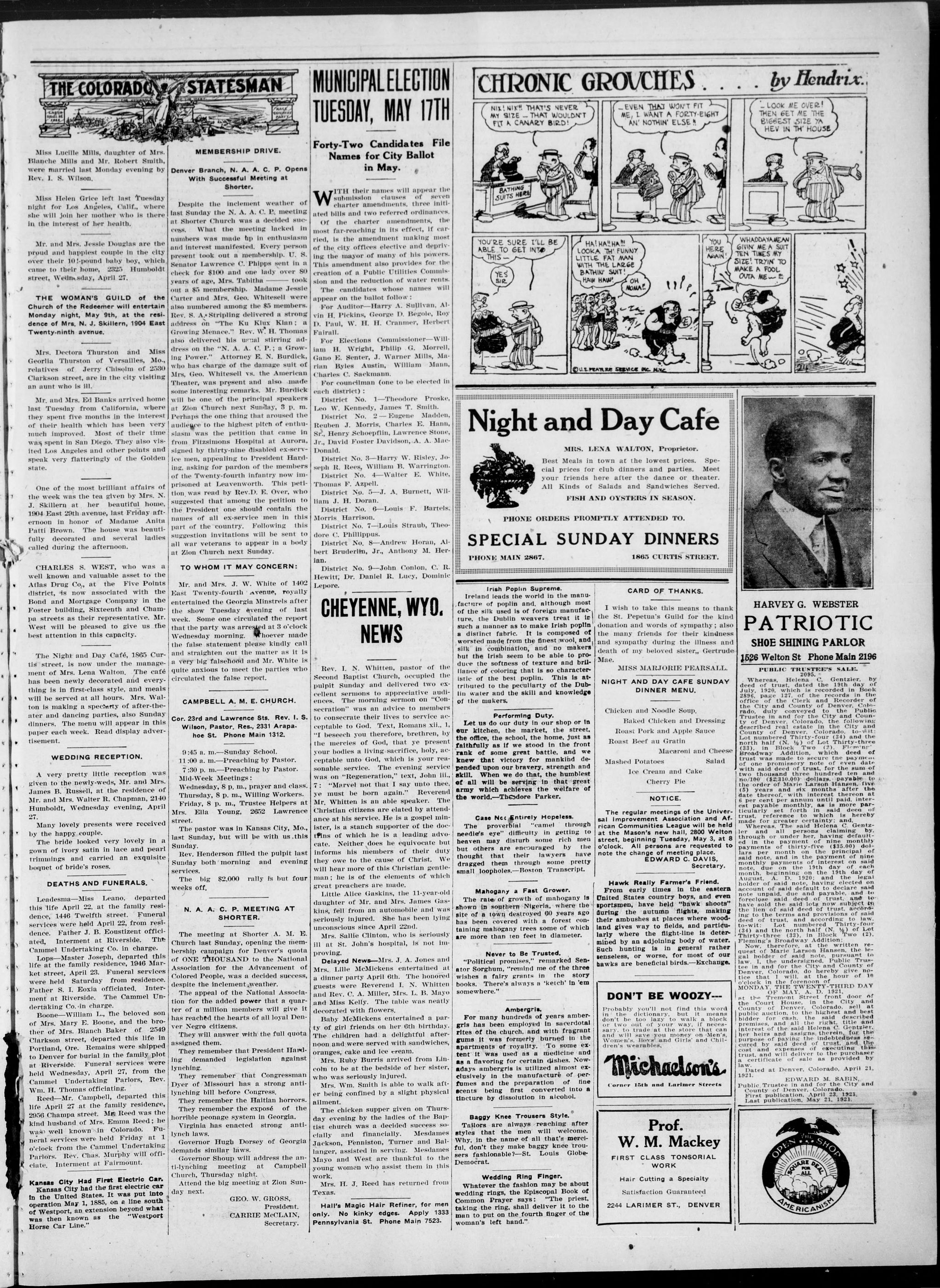
Miss Lucille Mills, daughter of Mrs. Blanche Mills and Mr. Robert Smith, were married last Monday evening by Rev. I. S. Wilson.
Miss Helen Grice left last Tuesday night for Los Angeles, Calif., where she will join her mother who is there in the interest of her health.
MEMBERSHIP DRIVE.
Denver Branch, N. A. A. C. P. Oper With Successful Meeting at Shorter.
Despite the inclement weather last Sunday the N. A. A. C. P. meeting at Shorter Church was a decided su
Mr. and Mrs. Jessie Douglas are the proud and happiest couple in the city over their 101-pound baby boy, which came to their home, 2325 Humboldt street, Wednesday, April 27.
THE WOMAN'S GUILD of the Church of the Redeemer will entertain Monday night, May 9th, at the residence of Mrs. N. J. Skillern, 1904 East Twenty-ninth avenue.
Mrs. Dectora Thurston and Miss Georlina Thurston of Versailles, Mo., relatives of Jerry Chisolm of 2530 Clarkson street, are in the city visiting an aunt who is ill.
Mr. and Mrs. Ed Banks arrived home last Tuesday from California, where they spent five months in the interest of their health which has been very much improved. Most of their time was spent in San Diego. They also visited Los Angeles and other points and speak very flatteringly of the Golden state.
One of the most brilliant affairs of the week was the tea given by Mrs. N. J. Skillern at her beautiful home, 1904 East 29th avenue, last Friday afternoon in honor of Madame Anita Patti Brown. The house was beautifully decorated and several ladies called during the afternoon.
CHARLES S. WEST, who was a well known and valuable asset to the Atlas Drug Co., at the Five Points district, is now associated with the Bond and Mortgage Company in the Foster building, Sixteenth and Champa streets as their representative. Mr. West will be pleased to give us the best attention in this capacity.
The Night and Day Café, 1865 Curtis street, is now under the management of Mrs. Lena Walton. The café has been newly decorated and everything is in first-class style, and meals will be served at all hours. Mrs. Walton is making a spectacle of after-theater and dancing parties, also Sunday dinners. The menu will appear in this paper each week. Read display advertisement.
WEDDING RECEPTION
A very pretty little reception was given to the newly-weds, Mr. and Mrs. James B. Russell, at the residence of Mr. and Mrs. Walter R. Chapman, 2140 Humboldt, Wednesday evening, April 27.
Many lovely presents were received by the happy couple.
The bride looked very lovely in a gown of ivory satin in lace and pearl trimmings and carried an exquisite bonnet of bride's roses.
DEATHS AND FUNERALS.
Leadesma—Miss Leano, departed this life April 22, at the family residence, 1446 Twelfth street. Funeral services were held April 22, from residence. Father J. B. Eoustizent officiated, Interment at Riverside. The Cammel Undertaking Co. in charge. Lops—Master Joseph, departed this life at the family residence, 1946 Market street, April 23. Funeral services were held Saturday from residence. Father S. I. Eoxia officiated. Interment at Riverside. The Cammel Undertaking Co. in charge.
Boone—William L., the beloved son of Mrs. Mary E. Boone, and the brother of Mrs. Blanch Baker of 2549 Clarkson street, departed this life in Portland, Ore. Remains were shipped to Denver for burial in the family plot at Riverside. Funeral services were held Wednesday, April 27, from the Cammel Undertaking Parlors, Rev. Wm. H. Thomas officiating.
Reed—Mr. Campbell, departed this life April 27 at the family residence, 2956 Champa street. Mr Reed was the kind husband of Mrs. Emma Reed; he was well known in Colorado. Funeral services were held Friday at 1 o'clock from the Cammel Undertaking Parlors. Rev. Chas. Murphy will offiicate. Interment at Fairmount.
Kansas City Had First Electric Car. Kansas City had the first electric car in the United States. It was put into operation May 1, 1885, on a line south of Westport, an extension beyond what was then known as the "Westport Horse Car Line."
MEMBERSHIP DRIVE.
Denver Branch, N. A. A. C. P. Opens With Successful Meeting at Shorter.
Despite the inclement weather of last Sunday the N. A. A. C. P. meeting at Shorter Church was a decided success. What the meeting lacked in numbers was made up in enthusiasm and interest manifested. Every person present took out a membership. U. S. Senator Lawrence C. Phipps sent in a check for $100 and one lady over 80 years of age, Mrs. Tabitha —— took out a $5 membership. Madame Jessie Carter and Mrs. Geo. Whitesell were also numbered among the $5 members. Rev. S. A. Stripling delivered a strong address on "The Ku Klux Klan; a Growing Menace." Rev. W. H. Thomas also delivered his usual stirring address on the "N. A. A. C. P.; a Growing Power." Attorney E. N. Burdick, who has charge of the damage suit of Mrs. Geo. Whitesell vs. the American Theater, was present and also made some interesting remarks. Mr. Burdick will be one of the principal speakers at Zion Church next Sunday, $ p. m. Perhaps the one thing that aroused the audience to the highest pitch of enthusiasm was the petition that came in from Fitzsimons Hospital at Aurora, signed by thirty-nine disabled ex-service men, appealing to President Harding, asking for pardon of the members of the Twenty-fourth infantry now imprisoned at Leavenworth. This petition, was read by Rev.D. E. Over, who suggested that among the petition to the President one should contain the names of all ex-service men in this part of the country. Following this suggestion invitations will be sent to all war veterans to appear in a body at Zion Church next Sunday.
TO WHOM IT MAY CONCERN:
Mr. and Mrs. J. W. White of 1402 East Twenty-fourth Avenue, royally entertained the Georgia Minstrels after the show Tuesday evening of last week. Some one circulated the report that the party was arrested at 3 o'clock Wednesday morning. Whoever made the false statement please kindly call and straighten out the matter as it is a very big falsehood and Mr. White is quite anxious to meet the parties who circulated the false report.
CAMPBELL A. M. E. CHURCH.
Cor. 23rd and Lawrence Sts. Rev. I. S Wilson, Pastor, Res., 2331 Arapahee St. Phone Main 1312.
9:45 a. m.—Sunday School.
11:00 a. m.—Preaching by Pastor.
7:30 p. m.—Preaching by Pastor.
Mid-Week Meetings:
Wednesday, 8 p. m., prayer and class
Thursday, 8 p. m., Willing Workers.
Wednesday, 8 p.m., prayer and class
Thursday, 8 p.m., Willing Workers.
Friday, 8 p.m., Trustee Helpers at
Mrs. Ella Young, 2652 Lawrence
street.
The pastor was in Kansas City, Mo.
last Sunday, but will be with us this
Sunday.
Rev. Henderson filled the pulpit last
Sunday both morning and evening
services.
The big $2,000 rally is but four
weeks off.
N. A. A. C. P. MEETING AT SHORTER.
The meeting at Shorter A. M. E. Church last Sunday, opening the membership campaign for Denver's quota of ONE THOUSAND to the National Association for the Advancement of Colored People, was a decided success, despite the inclement weather.
The appeal of the National Association for the added power that a quarter of a million members will give it has reached the hearts of all loyal Denver Negro citizens.
They will answer with the full quota assigned them.
They remember that President Handling demanded legislation against lynching.
They remember that Congressman Dyer of Missouri has a strong anti-lynching bill before Congress.
They remember the Haitian horrors. They remember the exposé of the horrible peonage system in Georgia. Virginia has enacted strong anti-lynch laws. Governor Hugh Dorsey of Georgia demands similar laws. Governor Shoup will address the anti-lynching meeting at Campbell Church, Thursday night. Attend the big meeting at Zion Sunday next. GEO. W. GROSS, President. CARRIE McCLAIN, Secretary.
MUNICIPALE ELECTION TUESDAY, MAY 17TH
Forty-Two Candidates File Names for City Ballot in May.
WITH their names will appear the submission clauses of seven charter amendments, three initiated bills and two referred ordinances. Of the charter amendments, the most far-reaching in its effect, if carried, is the amendment making most of the city offices elective and depriving the mayor of many of his powers. This amendment also provides for the creation of a Public Utilities Commission and the reduction of water rents. The candidates whose names will appear on the ballot follow: For Auditor—Harry A. Sullivan, Alvin H. Pickins, George D. Begole, Roy D. Paul, W. H. H. Cranmer, Herbert Fairall
For Elections Commissioner—William H. Wright, Philip G. Morrell, Gano E. Senter, J. Warner Mills, Marian Byles Austin, William Mann, Charles C. Sackmann.
For councilman (one to be elected in each district) :
District No. 1—Theodore Proske, Leo W. Kennedy, James T. Smith.
District No. 2—Eugene Madden, Reuben J. Morris, Charles E. Hann, Sr., Henry Schoepflin, Lawrence Stone, Jr., David Foster Davidson, A. A. MacDonald.
District No. 3—Harry W. Risley, Joseph R. Rees, William B. Warrington.
District No. 4—Walter E. White, Thomas F. Azpell.
District No. 5—J. A. Burnett, William J. H. Doran.
District No. 6—Louis F. Bartels, Morris Harrison.
District No. 7—Louis Straub, Theodore C. Phillippus.
District No. 8—Andrew Horan, Albert Bruderlin, Jr., Anthony M. Herian.
District No. 9—John Conlon, C. R. Hewitt, Dr. Daniel R. Lucy, Dominic Lepore.
CHEYENNE, WYO. NEWS
CHEYENNE, WYO. NEWS
Rev. I. N. Whitten, pastor of the Second Baptist Church, occupied the pulpit Sunday and delivered two excellent sermons to appreciative audiences. The morning sermon on "Consecration" was an advice to members to consecrate their lives to service acceptable to God. Text, Romans xii., 1, "I beseech you therefore, brethren, by the mercies of God, that ye present your bodies a living sacrifice, holy, acceptable unto God, which is your reasonable service. The evening service was on "Regeneration," text, John iii., 7: "Marvel not that I say unto thee, ye must be born again." Reverend Mr. Whitten is an able speaker. The Christian citizens are elated by attendance at his service. He is a gospel minister, is a stanch supporter of the doctors of which he is a leading advocate. Neither does he equivocate but informs his members of their duty they owe to the cause of Christ. We will hear more of this Christian gentleman; he is of the elements of which great preachers are made.
Little Alice Gaskins, the 11-year-old daughter of Mr. and Mrs. James Gaskins, fell from an automobile and was seriously injured. She has been lying unconscious since April 22nd.
Mrs. Sallie Clinton, who is seriously ill at St. John's hospital, is not improving.
Delayed News—Mrs. J. A. Jones and Mrs. Lille McMickens entertained at a dinner party April 6th. The honored guests were Reverend I. N. Whitten and Rev. C. A. Miller, Mrs. L. B. Mayo and Miss Kelly. The table was neatly decorated with flowers.
Baby McMickens entertained a party of girl friends on her 6th birthday. The children had a delightful afternoon and were served with sandwiches, oranges, cake and ice cream.
Mrs. Ruby Burris arrived from Lincoln to be at the bedside of her sister, who was seriously injured.
Mrs. Wm. Smith is able to walk after being confined by a slight physical ailment.
The chicken supper given on Thursday evening by the ladies of the Baptist church was a decided success socially and financially. Mesdames Jackson, Penniston, Turner and Ballanger, assisted in serving. Mesdames Mayo and West are thankful to the young women who assist them in this work.
Mrs. H. J. Reed has returned from Texas.
Hall's Magic Hair Refiner, for men only. No kinky edges. Apply 1333 Pennsylvania St. Phone Main 7523.
NIX! NIX!! THAT'S NEVER MY SIZE — THAT WOULDN'T FIT A CANARY BIRD!
BATHING SUITS HERE
EVEN THAT WON'T FIT ME, I WANT A FORTY-EIGHT AN' NOTHIN' ELSE!!
LOOK ME OVER! THEN GET ME THE BIGGEST SIZE YA HEV IN TH' HOUSE
YOU'RE SURE I'LL BE ABLE TO GET INTO THIS —
YES SIR
HA! HA! HA! LOOKA TH' FUNNY LITTLE FAT MAN WITH THE LARGE BATHIN' SUIT! HAW HAW! OH MOMA!
YOU HERE AGAIN!
WHADDAYA MEAN GIVIN' ME A SUIT TEN TIMES MY SIZE! TRYIN' TO MAKE A FOOL OUTA ME — !!!
© U.S. FEATURE SERVICE N.Y.C.
Night and Day Cafe
MRS. LENA WALTON, Proprietor.
Meals in town at the lowest prices. Spe-
prices for club dinners and parties. Meet
friends here after the dance or theater.
Kinds of Salads and Sandwiches Served.
FISH AND OYSTERS IN SEASON.
ERS PROMPTLY ATTENDED TO.
SUNDAY DINNERS
Best Meals in town at the lowest prices. Special prices for club dinners and parties. Meet your friends here after the dance or theater. All Kinds of Salads and Sandwiches Served.
FISH AND OYSTERS IN SEASON.
PHONE ORDERS PROMPTLY ATTENDED TO.
SPECIAL SUNDAY DINNERS
SPECIAL SUNDAY DINNERS
```markdown
```
Chicken and Noodle Soup.
Baked Chicken and Dressing
Roast Pork and Apple Sauce
Roast Beef au Gratin
Macaroni and Cheese
Mashed Potatoes Salad
Ice Cream and Cake
Cherry Pie
NOTICE.
---
MRS. Best Meals in
cial prices for
your friends
All Kinds of
FISH A
PHONE ORDERS PRO
SPECIAL SUN
PHONE MAIN 2867.
Irish Poplin Supreme.
Ireland leads the world in the manufacture of poplin and, although most of the silk used is of foreign manufacture, the Dublin weavers treat it in such a manner as to make Irish poplin a distinct fabric. It is composed of worsted made from the finest wool, and silk in combination, and no makers but the Irish seem to be able to produce the softness of texture and brilliance of coloring that is so characteristic of the best poplin. This is attributed to the peculiarity of the Dublin water and the skill and knowledge of the makers.
Performing Duty.
Let us do our duty in our shop or in our kitchen, the market, the street, the office, the school, the home, just as faithfully as if we stood in the front rank of some great battle, and we knew that victory for mankind depended upon our bravery, strength and skill. When we do that, the humbest of all will be serving in that great army which achieves the welfare of the world.—Thedore Parker.
Case Not Entirely Hopeless.
The proverbial "camel through needle's eye" difficulty in getting to heaven may disturb some rich men but others are encouraged by the thought that their lawyers have dragged them through some pretty small loopholes.-Boston Transcript.
Mahogany a Fast Grower.
The rate of growth of mahogany is shown in southern Nigeria, where the site of a town destroyed 60 years ago has been covered with a forest containing mahogany trees some of which are more than ten feet in diameter.
Never to Be Trusted
"Political promises," remarked Senator Sorghum, "remind me of the three wishes a fairy grants in the story books. There's always a 'ketch' in 'em somewhere."
Ambergris.
For many hundreds of years ambergris has been employed in sacerdotal rites of the church, and with fragrant gums it was formerly burned in the apartments of royalty. To some extent it was used as a medicine and as a flavoring for certain dishes. Nowadays ambergris is utilized almost exclusively in the manufacture of perfumes and the preparation of fine scents being first converted into a tincture by dissolution in alcohol.
Baggy Knee Trousers Style.
Tailors are always reaching after styles that the men will welcome. Why, in the name of all that's merciful, don't they make baggy knee trousers fashionable?—St. Louis Globe-Democrat.
Wedding Ring Finger.
Whatever the fashion may be about wedding rings, the Episcopal Book of Common Prayer says: "The priest, taking the ring, shall deliver it to the man to put on the fourth finger of the woman's left hand."
1865 CURTIS STREET
CARD OF THANKS.
I wish to take this means to thank the St. Pepetua's Guild for the kind donation and words of sympathy; also the many friends for their kindness and sympathy during the illness and death of my beloved sister., Gertrude Mae.
MISS MARJORIE PEARSALL.
NIGHT AND DAY CAFE SUNDAY
DINNER MENU.
NOTICE.
The regular meetings of the Universal Improvement Association and African Communities League will be held at the Mason's new hall, 2800 Welton street, beginning Tuesday, May 3, at 8 o'clock. All persons are requested to note the change of meeting place.
Hawk Really Farmer's Friend.
Hawk Realy Parallel
From early times in the eastern United States country boys, and even sportsmen, have held "hawk shoots" during the autumn flights, making their ambushes at places where woodland gives way to fields, and particularly where the flight-line is determined by an adjoining body of water. Such hunting is in general rather senseless, or worse, for most of our hawks are beneficial birds.—Exchange.
DON'T BE WOOZY----
Probably you'll not find this word in the dictionary, but it means don't be too lazy to walk a block or two of your way. If you need assistance to trade at the store that can and will save you money on Men's, Women's, Boys' and Girls' and Children's wearables.
Prof. W. M. Mackey
FIRST CLASS TONSORIAL WORK
Hair Cutting a Specialty
Satisfaction Guaranteed
2244 LARIMER ST., DENVER
THE NEW YORK TIMES
PATRIOTIC
SHOE SHINING PARLOR
PUBLIC TRUSTEES SALE.
2095.
Whereas, Helena C. Genzler, by deed, of trust, died the 19th day of July, 1920, which is recorded in Book 2886, page 127, of the records in the office of the Clerk and Recorder of the City and County of Denver, by affidavit of Public Trustee in and for the City and County of Denver, Colorado, the following described real estate in the City and County of Denver, formerly for (44) and the north half (N, 1/2) of Lot Thirty-three (33), in Block Two (2). Fleming Broadway Addition, which deed of trust was made to secure the payment of said deed, with said deed of trust, for the sum of two thousand three hundred ten and no/100 ($2,310.00) dollars, payable to the order of Marie Larson Hansen, for the date thereof, with interest thereon at 6 per cent per annum until paid, interest payable monthly, as is more particularly se forth in said deed by the order to be held in her memory for greater certainty; and made.
Whereas, The said Helena C. Gentzler and all persons claiming by, through or under her, having deferred monthly payments of thirty-five ($35.00) dollars per month on the principal of said note, and in the payment of nine monthly payments of the third month on the 19th day of each month, beginning on the 19th day of August, A. D. 1920; and the legal holder of said note, and the legal holder of said default to declare said note unpaid, due and payable, and to foreclose said deed of trust, and to have sold the said lots now subject to the terms and provisions of said deed of trust, and according to law, to-wit: Lot numbered Thirty-four 34 and three hundred Thirty-three (33) in Block Two (2) Fleming's Broadway Addition; Now, therefore, at the written request of Marie Larson Hansen, the attorney to law, I, the undersigned, Public Trustee in and for the City and County of Denver, Colorado, do hereby give notice that I will, at the hour of 10
MONDAY. THE TWENTY-THIRD DAY
ON MAY, A D. 1821
OF MAY 1
at the TUFF ST. AVE. front door of the Court House, in the City and County of Denver, Colorado, sell at public auction, to the highest and best bidder for cash, the said described premises, and all the right, interest, and the right to hold the premises and assigns, therein, for the purpose of paying the indebtedness secured by said deed of trust, and the cost and expenses of executing this trust, and will deliver to the purchaser a certificate of sale as provided by law.
Dated at Denver, Colorado, April 21, 1921.
EDWARD M. SABIN,
Public Trustee in and for the City and
County of Denver, Colorado.
First publication, April 23, 1921.
Last publication, May 21, 1921.
OPEN THE SHOP
SQUARE DEAL
MET
ALL
AMERICANISH
STATE OF COLORADO,
Insurance Department,
Synopsis of Statement for 1920 and
Copy of Certificate of Authority.
Copy of Certificate of
Affiliation
DETROIT NATIONAL FIRE
INSURANCE COMPANY, DETROIT, MICH.
Assets ..... $493,497.23
Liabilities ..... 78,680.32
Capital ..... 200,000.00
Surplus ..... 214,816.91
STATE OF COLORADO
Certificate of Authority
Office of Commissioner of Insurance.
It is hereby certified that the DE-
TROIT NATIONAL FIRE INSURANCE
COMPANY, a corporation organized
by the State of Michigan, whose
principal office is located at Detroit,
has complied with the requirements
of the laws of Colorado applicable to said
Company, and is hereby authorized to
transact business with the State of
Michigan insurance company, in
accordance with its Charter or Articles
of Incorporation, subject to the provisions
and requirements of the laws
hereof until the last day of the year,
in the year preceding one thousand
and twenty-two.
In testimony whereof, I, Earl Wilson, Commissioner of Insurance of the State of Colorado, have hereunto set my hand and affixed my seal of office at the City of Denver, this 1st day of March, A. D. 1921.
STATE OF COLORADO,
Insurance Department.
Synopsis of Statement for 1920 and
Certificate of Authority.
Assets $1,737,321.96
Liabilities 892,345.41
Capital 500,000.00
Surplus 344,976.55
STATE OF COLORADO.
Office of Commissioner of Insurance.
It is hereby certified that the DIXIE
FIRE INSURANCE COMPANY, a corporation organized and owned by Norfolk County, principal office located at Greensboro, has complied with the requirements of the laws of Colorado applicable to said Company, and is hereby authorized to treat business with its Charter or of Colorado, in insurance company, in accordance with its Charter or Articles of Incorporation, subject to the provisions and requirements of the laws hereof until the last day of February, in the year of our death, two thousand nine and twenty-two.
hundred and two.
In testimony whereof, I. Earl Wilson,
Commissioner of Insurance of the State
of Colorado, have hereunto set my
seal affixed my seal of office at
the City of Denver, this 1st day of
March A. D. 1921.
(Seal) EARL WILSON
Commissioner of Insurance.
STATE OF COLORADO.
Insurance Department,
Synopsis of Statement for 1920 and
Copy of Certification Authority
EAGLE FIRE INSURANCE COMPANY,
NEWARK, N. J.
Assets $1,483,730.87
Liabilities 672,697.87
Capital 400,000.00
Aerial 421,023.11
STATE OF COLORADO
Certificate of Authority.
Office of Commissioner of Insurance.
It is hereby certified that the EAGLE
FIRE INSURANCE COMPANY or
poration organizes the laws of
Colorado, whose principal office is
located at Newark, has complied with
the requirements of the laws of Colorado
applicable to said Company, and is
hereby authorized to transact, and
ness, within the company, as
with its Charter or Articles of Incorporation, subject to the provisions and
requirements of the laws hereof until
the last day of February, in the year
of our Lord, one thousand nine hun-
ters and eleven days.
dried and twisted.
In testimony whereof, I. Earl Wilson,
of Insurance of Insurance of the State
of Colorado, have hereunto set my
hand and affixed my seal of office
at the City of Denver, this 1st day of
March, A. D. 1921.
MURPHY, A. D. 1931
(Seal) EARL WILSON,
Commissioner of Insurance.
STATE OF COLORADO.
Insurance Department.
Synopsis of Statement for 1920 and
Copy of Certificate of Authority,
FEDERAL UNION INSURANCE COMPANY, CHICAGO, IL.
Assets $726,190.95
Liabilities 434,664.75
Capital 200,000.00
Surplus 91,526.20
STATE OF COLORADO.
Office of Commissioner of Insurance.
It is hereby certified that the FEDERAL UNION INSURANCE COMMISSION a corporation organized in the laws of Illinois, whose Principal office is the requirements of the laws of Colorado applicable to said Company, andness hereby authorized to transact with us within the State of Illinois, as an Charter company, in accordance with the Charter or Articles of Incorporation, subject to the provisions and requirements of the laws hereof until the last day of February, in the year of our Lord, one thousand nine hun-
dried and twisted.
In testimony whereof, I, Earl Wilson,
Commissioner of Insurance of the State
of Colorado, have hereunto set my
hand and affixed my seal of office
at the City of Denver, this 1st day of
March, A. D. 1921.
(Seal) EARL WILSON,
Commissioner of Insurance.
STATE OF COLORADO.
Assets ..... $3,305,134.81
Liabilities ..... 2,411,500.96
Capital ..... 400,000.00
Surplus ..... 493,633.85
STATE OF COLORADO.
Office of Commissioner of Insurance.
It is hereby certified that the THE
FIRE REASSURANCE COMPANY,
NEW YORK, a corporation organized
under the laws of New York, whose
hashed office is located at New York,
has complied with the requirements
of the laws of Colorado applicable to sa-
tion, and is hereby hereby
transact, using the State of
New York as an insurance company,
in accordance with its Charter or Articles
of Incorporation, subject to the prow-
sions and requirements,
hereof until the day of February,
nine hundred and twenty-two.
nine halls
In testimony whereof, I, Earl Wilson,
Considerer of Insurance of the State
of Colorado, have hereunto set my
hand and affixed my seal of office at
the City of Denver, this 1st day of
March, A. D. 1921.
March, A.D. 1921. EARL WILSON, (Seal) Commissioner of Insurance.
STATE OF COLORADO.
Insurance Department.
Synopsis of Statement for 1920 and Copy of Certificate of Authority.
THE FIRST REINSURANCE COMPANY OF HARTFORD, HARTFORD, CONN.
Assets ..... $3,600,006.14
Liabilities ..... 2,464,526.15
Capital ..... 500,000.00
Surplus ..... 635,479.99
STATE OF COLORADO.
Office of Commissioner of Insurance.
It is hereby certified that the THE
FIRST REINSURANCE COMPANY,
HARTFORD, a corporation, organized
under the law of Connecticut, whose
office is located at Hartford,
has complied with the requirements of
the laws of Colorado applicable to
Company, and is herein within the state of
Texas, as an insurance company, in
accordance with its Charter or Arti-
cles of Incorporation, subject to the provisions and requirements of the laws hereof until the last day of February, in the year of our Lord, one thousand nine hundred and twenty-one. In testimony whereof, I, Earl Wilson' Commissioner of Insurance of the State of Colorado, have hereunto set my hand and affixed my seal of office at Denver, this 1st day of March, A. D. 1921.
Assets ..... $2,201,324.65
Liabilities ..... 989,833.48
Capital ..... 1,000,060.00
Surplus ..... 211,491.16
STATE OF COLORADO
AUTHORITY
Office of Commissioner of Insurance.
It is hereby certified that the GLOBE
NATIONAL FIRE INSURANCE COMPANY, a corporation organized under the laws of Iowa, whose principal office is located in Sioux City has complied with the requirements of the laws of Colorado applicable to said Company, and is hereby authorized to transact business within the State of Colorado, as an insurance company, in accordance with its Charter to the provisions and requirements of the laws hereof until the last day of February, in the year of our Lord, one thousand nine hundred and twenty-two.
In testimony whereof, I, Earl Wilson, Commissioner of Insurance, of the State of Ohio, have hereunto set my hand and affixed my seal of office at the City of Denver, this 1st day of March, A.D. 1921.
(Seal)
EARL WILSON,
Commissioner of Insurance.
STATE OF COLORADO,
Insurance Department.
Synopsis of Statement for 1920 and
Copy of Certificate of Authority.
GRAIN DEALERS NATIONAL MU-
TUAL FIRE INSURANCE AN-
MANY, INDIANA POLISI, IND.
Assets.....$1,739,484.76
Liabilities.....744,374.36
Capital.....Mutual
Surplus.....995,110.40
STATE OF COLORADO
Certificate of Authority
Office of Commissioner of Insurance.
It is hereby certified that the DODONATION MUTUAL FIRE
INSURANCE COMPANY, a corporation
organized under the laws of Indiana,
whose principal office is located at
Indianapolis, has complied with the
requirements of Colorado applicable to said Company, and is hereby
authorized to transact business within
the State of Colorado, as an insurance
company, in accordance with the
Articles of Incorporation, subject
to the provisions and requirements
of the laws hereof until the last day
of February, in the year of our Lord,
one thousand nine hundred and twen-
In testimony whereof, I, Earl Wilson Commissioner of the State Department, have hereunto, on hand and affixed my seal of office at the City of Denver, this 1st day of April, 1923.
(Seal) EARL WILSON,
Commissioner of Insurance
STATE OF COLORADO,
Insurance Department.
Symposium of Statement for 1920 and
Copy of Certificate of Authority,
HUDSON SQUARE COMPANY,
NEW YORK, N.Y.
Assets
Liabilities
1. $2,535,823.07
1. Capital
500,000.00
Surplus
600,098.15
STATE OF COLORADO.
Office of Commissioner of Insurance.
It is hereby certified that the HUDSON INSURANCE COMPANY, a corporation organized under the laws of New York, the office is located at New York, has complied with the requirements of the laws of Colorado applicable to said Company, and is hereby authorized to transact business within the State of New York in accordance with its Charter or Articles of Incorporation, subject to the provisions and requirements of the laws hereof until the last day of February, in the year of our Lord, one thousand nine hundred and
In testimony whereof, I, Earl Wilson, Commissioner of Insurance of the State of Colorado, have hereunto set my hand and affixed my seal of office at the City of Denver, this 1st day of March, A.D. 1921.
(Seal) EARL WILSON,
Commissioner of Insurance.
STATE OF COLORADO,
Insurance Department.
Synopsis of Statement for 1920 and
Copy of Certificate of Authority.
INTERNATIONAL INSURANCE COMP.
PANY, NEW YORK, N.Y.
Assets . . . $6,201,760.24
Liabilities . . . 4,321,118.92
Capital . . . 1,000,000.00
Surplus . . . 880,641.32
STATE OF COLORADO
Office of Commissioner of Insurance.
It is hereby certified that the INTERNATIONAL INSURANCE
PANY, a corporation authorized under the
New York whose principal office is located at New York, has
compiled with the requirements of the
laws of Colorado applicable to said
Company, and is hereby authorized to
transact business in the State of
Colorado as an insurance company, in
accordance with its Charter or Articles
of Incorporation, subject to the provisions
and requirements of the laws
hereof until the last day of January,
in the month preceding one thousand
and twenty-two.
In testimony whereof, I. Earl Wilson, Commissioner of Insurance of the State of Colorado, have hereunto set my hand and affixed my seal of office at the City of Denver, this 1st day of March, A. D. 1921.
(Seal) EARL WILSON, Commissioner of Insurance
Synopsis of Statement for 1920 and
Copy of Certificate of Authority,
FEDERATED FIRE RE-INSURANCE
COMPANY, MASON CITY,
IOWA.
Assets ..... $866,958.04
Liabilities ..... 131,250.15
Capital ..... 580,450.00
Surplus ..... 155,257.89
STATE OF COLORADO.
Office of, Commissioner of Insurance.
It is hereby certified that the FEDERATED FIRE RE-INSURANCE COMPANY, a corporation organized under the laws of whose principal office is located at Mason City, has complied with the requirements of the laws of Colorado applicable to said Company, and is hereby authorized to transact such business as the State of Colorado as an insurance company, in accordance with its Charter or Articles of Incorporation, subject to the provisions and requirements thereof until the day of February, in the order of our Lord, one thousand two hundred and twenty-two.
In testimony whereof, I, Earl Wilson, Commissioner of Insurance of the State of Colorado, have hereunto set my hand and affixed my seal of office at the City of Denver this 1st day of March, A. D. 1921.
(Seal) EARL WILSON. Commissioner of Insurance.
"Fifty.Fifty."
At supper mother asked Buddy how he got along with arithmetic that day. He answered with some pride: "I know'd almost as much as I didn't know."
STATE OF COLORADO,
Insurance Department.
Synopsis of Statement for 1920 and
Copy of Certificate of Authority.
PENNSYLVANIA MILLERS MUTUAL
FIRE INSURANCE COMPANY,
WILKES-BARRE, PA.
Assets..... $1,317,099.30
Liabilities..... 453,820.30
Capital..... Mutual
Surplus..... 863,478.94
STATE OF COLORADO.
UNITED STATES OF AMERICA.
Office of Commissioner of Insurance.
It is hereby certified that the PENN-
SINCERANCE COMPANY, a corporation
organized under the laws of Pennsyl-
vania, whose principal office is located
at Wilkes-Barre, has compiled with
trade applicable to said Company, and
is hereby authorized to transact business within the State of Colorado, as an insurance company in accordance
with the provisions of the insurance
poration, subject to the provisions and
requirements of the laws hereof until
the last day of February, in the year
hundred and twenty-two.
In testimony whereof, I. Earl Wilson,
Commissioner of Insurance of the State
of Colorado, has resentu to me
my handwriting affixed to my
the City of Denver, this 1st day of
March, A.D. 1921.
(Seal)
EARL WILSON.
Commissioner of Insurance.
NOTICE OF STOCKHOLDERS' MEETING.
Denver, Colo., April 2, 1921.
To the Stockholders of the Western Loan and Investment Association:
You are hereby notified that the annual meeting of the stockholders of the Western Loan and Investment Association will be held on Tuesday, May 10, 1921, at the hour of 8 o'clock p. m. of said day, at room 25, Western Newspaper Union Building, 1824 Curtis Street, Denver, Colorado, for the election of officers and directors of said association and for the transaction of any and all stockholders properly come before said association.
JOSEPH D. D. RIVERS.
J. R. CONTEE. Secretary.
STATEMENT OF THE OWNERSHIP
MANAGEMENT, CIRCULATION
ETC., REQUIRED BY THE ACT OF
GOVERNMENT, NO. 444,
OF COLORADO STATESMAN.
Published weekly at Denver for April
1921.
STATE OF COLORADO,
County of Denver.
Before me, a Notary Public in and for the State and County aforesaid, personally appeared Joseph D. D. in the case of the Washington County, and was sworn according to law, deposes and says that he is the owner of the Colorado Statesman; and that the following is, to the best of his knowledge and belief, a true statement of the ownership, management (and if a daily paper, deception, etc.) of a foresaid publication for the date shown in the above caption, required by the Act of August 24, 1912, embodied in Section 443. Postal Laws and Regulations, printed on the reverse of this form, to-wit:
1. That the names and addresses of the publisher, editor, managing editor and business managers are: Name of publisher, Joseph D. D. Rivers, 1821 Curtis street, Denver, Colorado; editor, Joseph D. D. Rivers, 1824 Curtis street, Denver, Colorado; managing editor, Joseph D. D. Rivers, 1824 Curtis street, Denver, Colorado; business manager, Joseph D. D. Rivers, 1824 Curtis street,
2. That the owners are (give names and addresses of individual owners, or if a corporation, give its name and the names and addresses of stockholders owning or holding one percent of the total amount of stock); Joseph D. D. Rivers, 1824 Curtis street, Denver, Colorado.
3. That the known bondholders, mortgagees, and other security holders owning or holding one per cent. of more of the total amount of stock, givers or other securities are (if there are none so state); None.
4. That the two paraphras next above, giving the names of the owners, stockholders, and security holders, any, contain not only the list of holders and security holders they appear to own, but also the names of the company, in cases where the stockholder or security holder appears upon the books of the company as trustee name of the person or corporation for or in any other fiduciary relation, whom such trustee is given; also that the two paragraphs of the statements embracing affiant's full knowledge and belief as to the circumstances and conditions under which stockholders and security holders who do not appear upon the company as trustee hold stock of the company in a capacity other than that of a bona fide owner; and this affiant has no reason to believe that any other person, association, corporation has any right to order or control stock, bonds or other securities than as so stated by him.
5. That the average number of copies of each issue of this publication sold on each day is at least three, otherwise, to paid subscribers during the six months preceding the date shown above is . . . (This information is required from daily publications only)
JOSSEPH D. H. RIVERS,
(Signature of Editor, Publisher, Bustler, Owner)
Sworn to and subscribed before me this 4th day of April, 1921.
OLIVE T. LEWIS
Nortary Public.
(My commission expires December
20, 1923).
Don't throw away your
used blades!
A GREAT PROBLEM SOLVED
COMFORT AND
RAZOR BLADE
1
A YEAR
TARANTELLA
ICKLES
HE
IMID
SHAVER
Because it sharpens in less than one minute any make of Safety Razor Blade, producing a hollow ground edge which will give you a clean, easy and comfortable shave. It makes shaving a PLEASURE instead of a dreaded task.
Works like a RATTLE, but does "rattling" good work.
"TARANTELLA" the Universal Safety Razor Blade Sharpener for all makes of Blades.
PRICE COMPLETE $3.00
Ask Your Dealer or Write
TARANTELLA CO.
Pulitzer Building New York
---
MORAL SUPPORT GIVEN FRANCE
M. VIVIANI'S MISSION SUCCESS FUL IN OBTAINING THIS FROM ADMINISTRATION.
HE HAS ASKED LITTLE MORE
Enemy Propaganda to Make His Visit of No Avail, Has Been Futile—Probable Amendment of the Knox Peace Resolution.
Bv EDWARD B. CLARK.
Washington.—Rene Viviani, former premier of France, has had as strenuous a life of it since he arrived in this country as he had during the time in his home land of France when war was pressing hard on the people. This French envoy extraordinary has been the guest on several occasions of the President of the United States. Also he has been dined by several senators of the United States, one of whom at least is of the school of those known as irreconcilables, which means that in a way Viviani was the guest of a man who is not entirely satisfied that the United States should enter into foreign affairs, even to the extent of expressing a willingness to safeguard a sister republic from possible future attack by a militaristic power bent on revenge.
Not long ago I wrote that Viviani would ask for the moral support of the United States in the attempt of France to make the Germans pay the indemnity. It also was said that there was a supplementary, or rather a subordinate mission, which, if voiced, might make itself felt in an appeal for financial aid for France from this country in case it was impossible to get part of the German indemnity at once. There seems to have been nothing since Viviani reached this country to make necessary a change in the first views written concerning his errand to the United States.
Assured of Moral Support.
The United States government virtually has told the Frenchman that Germany ought to pay the indemnity, and in this expression France finds the moral support of Uncle Sam. This word of support from the United States has been received in France with acclaim. The republic of western Europe seems today to feel that the great republic across the seas still feels its sense of obligation for things done in the past and also feels a responsibility to see to it that the rule of the people does not perish from the earth.
Since Viviani has been here he has told Americans all about the sharp need of his country for money to restore the thousands of villages which were swept off the face of the earth by the enemy shell fire. His plea has been for moral support, and beyond this he has made few requests, but from the first he expressed willingness to answer questions, and it is understood that they came quickly and in large numbers.
There have been attempts in Washington to make Viviani's visit of no avail. Insidious propaganda has been conducted by friends and agents of a country with which the United States is still at war to prevent the American administration from suggesting any means of help, even moral help, for the French republic. Recently it has been shown that the administration is sympathetic with the cause of France just as seemingly are nearly all Americans.
To Amend Knox Resolution.
The Knox resolution which declares that a state of peace exists between the United States and Germany is still the subject for debate in Washington, as it is just about to become one for debate in congress. It seems to be assured at this writing that if the Knox resolution shall be sanctioned, it will have as an addition a statement that the United States will not look unconcerned on any attempt to revive militaristic operations in Europe which shall imperil the life of the French republic.
The French, it is known, are not keen for the passage of the Knox resolution at the present time, for they would like to have the United States become a party to the peace treaty which the European allies made with Germany, but an addition to the resolution will go a great way toward apposing the French, who lay great store on mere expressions of friendliness on the part of the United States.
Secretary of State Hughes has had many talks with former Premier Viviani. The Department of State in a large measure is the keeper of the administration's conscience in all matters relating to international policies. Mr. Hughes knows definitely, probably, all that is going to be done, and it seems likely that the framework of every plan for foreign relations is Mr. Hughes' handiwork. It is understood in Washington that the Hughes and the Harding viewpoints are not far apart.
Herrick Stands By France.
Myron T. Herrick of Ohio, for the second time probably will be the ambassador of the United States to France. Frenchmen, official and non-official, have expressed their entire satisfaction with the appointment. There are some curious circumstances connected with the preliminaryies of the designation of Mr.
Herrick for the position which he held once before.
It was on the day that the United States declared it must stand with the allies on the question of the amount of the German indemnity that Mr. Herrick accepted President Harding's offer to make him the ambassador to France. There is a close connection between these two facts; at least I think I can say so without much trepidation lest somebody enter denial. I think it is safe further to add that if the United States had not sent its note to Germany more than intimating that she must pay indemnity to the full limit of her ability, Myron T. Herrick would have declined to go to France as ambassador.
Mr. Herrick was the American ambassador to France when the great war broke out. He was the representative of a neutral government, and he did not allow himself to do anything which could give Germany or Austria the slightest cause of complaint that he was engaged in anything which the ambassador of a neutral country might not do. But in the shadow of the menace of the overthrow of France by a militaristic power which wanted to dominate the world there was no question then, nor is there today, as to where Myron T. Herrick's sympathies lay. France loved the man and loves him today.
While Mr. Herrick was in a state of doubt as to the intentions of his government toward reparations and toward other things he felt that he could not go back to France, there perhaps to be called upon to stand as spokesman for his government in matters which the French people would regard as inimical to their interests, and which might make it appear that the United States had forgone its old time friendship for the republic over the sea. With his sympathies one way and his actions as an ambassador being forced another way, he would have been placed in a position impossible for him to take.
Now that it is assured that the one thing which makes France's future prosperity assured, will be done; Mr. Herrick can go to his Paris post and feel there that he can do his whole duty by his country, and yet retain the friendships which he won by his high conduct during the trying days of 1914.
Served Far From Firing Line.
Every little while there come to Washington, either for temporary or for permanent duty, high officers of the United States army who during the participation of the United States in the great war were compelled by force of circumstances to serve with troops at a long distance from the firing line. They were not even given the satisfaction of serving within the boundaries of the United States proper in the work of preparing their fellow citizens for the field of battle.
These men come from the Philippines, from Hawaii, or from Panama. It must not be supposed for one moment that the soldiers of the United States army who were in our noncontiguous possessions during the war did not have their high duties to perform while the American army and the American navy were at grapples with the foe. The work that these men did was an essential part of the whole scheme of warfare, and they did it well.
There came to Washington the other day John Bellinger Bellinger, colonel, quartermaster's department, United States army. When the war broke out Bellinger naturally wanted to serve in the field of high action, but although he was in the prime of life and health, and had, back of him a record which had secured for him at one time a recommendation that he be made quartermaster general of the United States, he was sent to the Philippine islands as department quartermaster.
How They Helped Win the War.
Not long ago the Philippine senate thanked Colonel Bellinger in a resolution for the high service that he performed while department quartermaster in the islands.
Taking Bellinger's case as an example of others, what was it that this officer did away off in the Far East in order that he might help to solve some of the problems confronting his country in the time of war? He knew, of course, instantly that food was a vital thing in connection with the carrying on of the war to a successful conclusion. Almost instantly on his own initiative he purchased and shipped to the United States by army transports, sugar, China beef, Australian flour and other supplies which could be obtained in the Philippine islands, China, Japan and Australia. This resulted in introducing speedily into the United States approximately 110,000,000 pounds of food supplies which could not otherwise have reached here, and it included the high necessities of sugar and beef to the amount of 63,165,000 pounds of the one and 3,188,000 of the latter.
Other quick work of this man at a distance was the transfer of certain regiments of American troops from the Philippines to the United States for war service; the replacement of all regular army commissioned officers of the quartermaster's corps in the Philippine department by reserve corps commissioned officers, and the transfer from the Philippines to the United States of all enlisted personnel of the quartermaster's corps who were believed to be qualified for commissions in the reserve corps and for administrative positions in the depot and training camps.
Other things without number were done in the Philippines by Colonel Bellinger and other officers to help win the war for the United States.
SEA'S OLD TALES
Superstitions That Are Held by Cornishmen.
Phantom Lights and Phantom Ships Implicitly Believed In by Sailors Who Fear Nothing.
All along the Cornish shores the phantom ship is thoroughly believed in, as also are the phantom lights. Some years ago a schooner-rigged vessel made signals of distress to the west of St. Ives bay. A cable that put out reached her, and one of the seamen made a grasp at her bulwarks in order to jump on board; but his hand met nothing solid, and as he tumbled back into the boat the schooner and her sailing lights disappeared in the darkness. Next morning a schooner out of the port of London was wrecked within the same vicinity, and all on board her perished. The phantom lights are seen generally before a gale; the Cornish seamen call them "Jack Harry's lights," and the ship seen resembles the one that is subsequently wrecked.
The death ship is a superstition peculiar to Cornwall. With black hull and stumpy bowsprit, she comes in, with all her canvas set, against the wind and tide, and as she turns to reach to seaward again the doomed person dies. Most famous of the traditional stories grouping round the death ship is that of a wrecker, who lived at Tregaseal, beguiling vessels with false lights and doing to death those who escaped the waves. When he lay dying a black ship full rigged with all sail set was noticed coming in upon the land against the wind and tide; and as the man died she bore out to sea again in a half gale.
Porthcurno cove, near the Logan stone, has also a ship of doom. Sometimes there is seen when the mists are rising off the marshes a black square rigged craft, which stands over to Bodelan and Chygwiden and suddenly vanishes. Upon whosoever sees her ill luck and death are sure to fall.
Near St. Ives, too, is a churchyard haunted by an apparition, sight of which entails disaster to seamen. In the sixties of the last century a vessel was wrecked on the coast here. The men who went off to the rescue found on board a lady with a child in her arms. She refused to part with her charge, and in drawing her by a rope from the wreck to the boat the child was lost in the raging seas. The lady died through shock and exposure and was buried in the local churchyard. Today her wraith is said to haunt the shore, whether the day or the night is tempestuous or dark or clear or fine. And on whoever sees her, be he a seafaring man, disaster falls.
The coasts of Cornwall are second to none in the wildness, the variety and originality of their sea superstitions. For nowhere else in Europe has the sea taken such a toll of dead, and still takes. Only Cape Ushant, and, perhaps, the Goodwin sands off the coast of Kent, may rank behind Cornwall in the sea's colossal ledger of death and disaster.—National Marine.
Voices by Radio.
Voice transmission by radio waves has passed beyond the experimental stage. The United States bureau of standards says that it is now actually possible to telephone by wireless over as great a distance as by the ordinary wire.
It also states that the quality of the transmitted speech is as perfect as that which comes over the ordinary telephone and the same remark applies to music sent by radio.
This highest scientific authority expresses a belief that before very long communication across the Atlantic by radiophone will be established on a commercial basis. When that has been accomplished, a person in Philadelphia or New York will be able at any time to call up and converse with a friend or business acquaintance in London or Paris, by paying a stated and moderate rate per five minutes of talk.
Origin of Ophthalmia
Little was known concerning the surgery of the eye in Great Britain until the expedition into Egypt under Sir Ralph Abercrombie took place following the advance of the French into the land of the pyramids led by Napoleon Bonaparte. The British troops, says the New York Medical Journal, became the victims of contagious ophthalmia, then and now widely prevalent in that country, and brought back that scourge into Great Britain. Incapacitated from further fulfilling their military duties, the disease was spread by these men throughout the length and breadth of the land. Serious study of the eye then began.
Just Rubber and Risk Smash-up.
Instructor—Now, in learning to drive this car never let anything on the sidewalk distract your attention, sir, from the street directly in front of you.
Man Customer—For the love o' Mike, what are you going to do when a modern jane passes along in an open-work waist, open-work stockings and skirt knee high?—Jacksonville Times-Union.
The Boomerang.
Nobbs—Honesty is the best policy. The thief suffers in the end.
Dobbs—Yes; even the fellow who steals a kiss may have to marry the girl.
A woman stands in a garden, reaching up to a ladder to pick apples from a tree. Two buckets are on the ground, one upside down and the other lying on its side.
Do Not Neglect the Orchard, Nor Fail to Plant One If There Is None on the Farm-It Means Dollars and Cents in the Pocket and Adds Much to the Enjoyment of the Owners. (Prepared by the United States Department of Agriculture.)
The ordinary individual craves a certain amount of fruit in his diet. On the average farm fruit constitutes only about 6 per cent (in value) of all food consumed. This percentage could be increased to good advantage, making fruit a more important part of the diet.
Many farmsteads include fruit trees and grape arbors as a part of the planting scheme around the dwelling. A small area of the farm devoted to apple trees, peach trees, berry plants, or other fruit suited to the region, is a good investment for any farmer. About two-thirds of the fruit consumed by the average farm family is produced on the home farm.
SKIM MILK HAS BIG FOOD VALUE
Specialists of Department of Agriculture Recommend Its More Liberal Use.
Nutritive Part Consists Very Largely of Protein and There Are Many Uses to Which It Can Be Put in Preparing Meals.
(Prepared by the United States Department of Agriculture)
Skim milk, though often wasted, is a very economical food material, in the opinion of specialists in the United States Department of Agriculture, and could be more generally used, in cookery, as human food.
Whole milk, as everyone knows, is an indispensable food for the young, and even in the diet of the adult it is desirable. For cooking purposes skim
A woman is preparing a dish in a pot.
Corn Chowder is an Excellent Way in Which to Utilize 6kim Milk. milk is very satisfactory, although it lacks the valuable food constituent, butterfat. There is left, however, in the skim milk, not only all of the sugar, which amounts to about $4 \frac{1}{2} $ parts in every 100, and most of the mineral substances, but also most of the proteins. The last-named class of substances are important, because, besides supplying muscle and tissue-building material, they also serve as fuel for the body, as fats, sugars and starches do.
Rich in Protein.
Since the nutritive part of skim milk consists very largely of protein, it is to be classed with such food materials as eggs, meat, fish, poultry and cheese (though it is more delicate than those foods), rather than with such substances as sugar, which serve only as fuel. Two and a half quarts of skim milk contain almost as much protein and yield about the same amount of energy as a pound of round of beef.
Whole, unskimmed milk has, of course, a more pleasing taste to many people, and those who do not need to consider the additional cost will no doubt always prefer it. Children
should always be given whole milk. When used for cooking, however, the difference in taste between skimmed and unskimmed milk is not so perceptible, and there are many uses to which skim milk can be put in the preparation of foods. In the making of cereal mushes, for instance, the use of skim milk in place of water adds greatly to the nutritive value, particularly by raising the amount of tissue-forming materials. In making milk soups, chowders, custards, and cakes also, it can be profitably used.
Corn Chowder.
1 can of corn, or 1 pint of fresh corn grated.
4 cuples of potatoes, cut into small places.
2 ounces, salt pork.
4 ounces crackers.
Cut the pork into small pieces and fry it with the onion until both are a delicate brown. Add the potatoes and corn; cover with water and cook until the vegetables are soft. Add the milk and salt and reheat. It is well to allow the crackers to soak in the milk while the potatoes and corn are being cooked. Some people cook the cobs from which the corn has been removed, in water, and later use this water for cooking the potatoes and corn.
Curd Cup Cakes.
1 cupful dry curd.
4 eggs.
% cupful sugar.
% teaspoonful salt.
Beat the yolks of the eggs thoroughly; add the sugar and the curd (which must be very dry), and beat until the mixture is smooth. Combine this mixture by cutting and folding with the stiffly beaten whites of the eggs. Bake for 20 minutes in a moderate oven, in which the heat is greater at the bottom. Use unbuttered gem tins. This amount should make about thirty cakes.
In order to prepare the curd, take two and one-half or three quarts of sour skim milk; heat to the boiling point and strain; when no more liquid runs off, press the curd between cloths or dry it in a warming oven. If the curd from the quantity of milk given amounts to more than a cupful, it is too wet.
If a very sweet cake is liked, as is the case in parts of South America, where these cheese cakes are well known, two cupfuls of sugar may be used with two cupfuls of the cottage cheese and four eggs.
It should be remembered that skim milk does not contain so much nutriment as whole milk. Its greatest function is to give added food value at low cost when used in cookery to replace water, and is a means of utilizing the skim milk which contains much good food.
Household Questions
Milk, whole-wheat bread and fruit make a well-balanced luncheon.
Any scrap of preserves or jelly added to mincemeat will make it richer.
Do not pile too many hot cakes on one plate, as the steam will be apt to make them soggy.
Draw a white stocking over the sleeve board. It makes a good cover and requires no tacking.
If there are flowers about the yard, the women folks usually have to see it. What are you planning?
The Kitchen Cabinet
(© 1921, Western Newspaper Union.)
If we looked for people's virtues
And their faults refused to see,
What a pleasant, cheerful,
Happy place this world would be.
The eternal question constantly occuring daily, to be solved by twenty million housewives and cooks is what shall we have for dinner?
Fish Soup. Cover the skin, bones of several fish (cod, had- d cook, founder
Fish Soup. Cover the skin, bones of several fish (cod, haddock, flounder or lake (rout) with cold water, add an onion, half a carrot, half a cupful of celery leaves, three branches of parsley, chopped and cooked in two tablespoonfuls of fat; let simmer, closely covered, for half an hour. Strain off the liquid and to a quart of the soup or broth add one-third of a cupful of minute tapioca cooked in a pint of milk until transparent; add a teaspoonful or more of salt, one-third of a teaspoonful of paprika, one cupful of cream and half a pound of fresh raw fish cut in half-inch cubes. Let cook over boiling water ten minutes and serve with olives.
Creole Stew.—Take one pound of lean beef or a medium-sized fowl, two cupfuls of tomatoes, one cupful of carrots, one cupful of chopped sweet peppers, one-half cupful of rice, one-fourth of a cupful of chopped onion, one teaspoonful of salt and one table-spoonful of fat. Cut the meat in pieces, melt the fat, add the onions, peppers, meat or chicken; brown in the fat. Put in the cooking vessel, with the seasoning, rice, vegetables, and one cupful of boiling water; simmer for one-half hour, then put into the cooker for three hours without the soapstones or two hours with them. With chicken and okra instead of the meat and carrots, this is a favorite southern dish.
Dried beef prepared by scalding and draining and used as the chicken with macaroni, makes another good hot dish for supper or luncheon.
Apple Gelatin.—Soak two tablespoonfuls of gelatin in one-half cupful of cold water. Cook six tart apples with half a lemon rind, or use a like amount of seasoned apple sauce. Put through a sieve, add the juice of a lemon, the softened gelatin and pour into a mold. Serve with cream whipped or plain.
Character is the result of the cultivation of the highest and noblest qualities in human nature, and putting these qualities to practical use.—Ella Wheeler Wilcox.
MORE GOOD THINGS.
The following will be useful in preparing a week's menus as there is some thing which each member of the family will enjoy:
Squaw Dish. — Place one-half pound of thinly-sliced strips of bacon in a hot frying pan and cook until the bacon is crisp and brown, occasionally
Squaw Dish. — Place one-half pound of thinly-sliced strips of bacon in a hot frying pan and cook until the bacon is crisp and brown, occasionally pouring off the fat and turning frequently to keep the bacon from burning. Drain from the fat, leaving four tablespoonfuls of fat in the pan; add one-half cupful of hot milk and one cupful of corn; cook until soft; if cooked corn is used it will not need as long cooking. Season with salt, pepper and paprika and serve on a hot platter around the bacon.
Prune Pudding.—Take one cupful of ground uncooked prunes, one-half cupful of sugar and when well mixed add two well beaten eggs. three cupfuls of milk, one-half teaspoonful of orange extract and one thick slice of buttered bread. Cut the bread in small dice and stir into the custard. Bake slowly until the custard is set and the bread is brown. This takes an hour and a quarter in a slow oven to cook the prunes.
Poached Eggs With Cheese Sauce. The thrifty housewife who has packed her eggs when the price was at its lowest will now be able to have egg dishes and not feel that she is extravagant. For three eggs and three slices of toast make one cupful of cream sauce, using two tablespoonfuls of butter, the same of flour and one cupful of milk with seasoning to taste. Add one-half cupful of grated cheese and stir until the cheese is melted. Break the eggs into salted water and poach them until of the desired consistency. Dip the edges of well toasted bread into hot water, arrange on individual plates, butter and pour over the sauce, then place the well-drained egg on each. If preferred the egg may be daced first and the sauce poured over
Alsation Pot Dinner.—Take one cupful each of finely cut carrots, onions, yellow turnip and potatoes, two cupfuls of cabbage, one-half cupful of green peas, one clove of garlic. Remove the marrow from one pound of marrow bone, cut it in thin slices and add some to the hot iron kettle. Cut one pound of pork in cubes, then put it in alternate layers with the vegetables into the pot; add the bone, two teaspoonfuls of salt and enough pepper to season. Cover tightly and cook in a hot oven three-quarters of an hour. Do not remove cover until it's ready to serve.
Neele Maxwell
THE KITCHEN CABINET
(C. 1521, Western Newspaper Union.)
To work, to help and to be helped,
to learn sympathy through suffering,
to learn faith by perplexity, to reach
truth through wonder; behold! this is
what it is to prosper; this is what it
is to live.—Phillips Brooks.
WHAT SHALL WE HAVE TO EAT?
To have variety, economy and a
well balanced day's meals means care-
ful thought and plan.
X
Fillet of Lamb.—Remove the bone from two pounds of lamb cut from the fore quarter, cut the meat in strips and pound until flat. Mix three tablespoonfuls of olive oil with three tablespoonfuls of vinegar and two tablespoonfuls each of minced onion and parsley. Pour the dressing over the meat and let stand over night. Serve browned in a hot pan. The bones may be cooked with vegetables making a fine soup.
Raisin Brown Bread.—Take three cupfuls of yellow cornmeal, one and one-half cupfuls each of graham flour and white flour, one cupful of molasses, one and one-half teaspoonfuls of soda, one-half cupful of hot water, one teaspoonful of salt, three cupfuls of sour milk, one or two eggs and one and one-half cupfuls of raisins. Mix well and fill molds half full. Steam three hours or six in a fireless cooker, reheating once.
Chocolate Loaf Cake.—One cupful each of sugar and sour milk, one teaspoonful of soda, two cupfuls of flour, two squares of melted chocolate, one well-beaten egg, one-fourth teaspoonful of salt and one-half teaspoonful of vanilla. Beat well and bake in a loaf forty minutes. This cake, if slightly less flour is added, makes a good layer cake. Put together with boiled frosting.
Tomato Fritters.—Beat one egg, add one-half cupful of water or stock, one-half teaspoonful of salt, one-quarter of a teaspoonful of pepper and one tablespoonful of finely minced parsley. Add two cupfuls of flour sifted with three teaspoonfuls of baking powder. Beat the whole together, then add two or three fresh ripe tomatoes peeled and cut in pieces, or one cupful of canned tomatoes and two heaping tablespoonfuls of grated cheese. Cook by spoonfuls in butter and serve with a highly seasoned tomato sauce as an accompaniment to roast meat.
To be truly happy is a question of how we begin and not how we end; of what we want and not what we have.—Stevenson.
When a most delightful cake is needed for some special occasion the following will be one to prepare: Famous Lady Baltimore Cake. —Take one cupful of butter, one and one-half cupfuls of confec-
one to prepare:
Famous Lady
Baltimore Cake.
—Take one cupful of butter, one and one-half cupfuls of confections' sugar, one
cupful of milk, one-half teaspoonful of rose extract, three cupfuls of pastry flour, two teaspoonfuls of baking powder, one-fourth of a teaspoonful of salt, one-half cupful of water, two cupfuls of chopped raisins, two cupfuls of chopped figs, one cupful of chopped pecan meats, one-half teaspoonful of almond extract, two cupfuls of confectioners' sugar, the whites of nine eggs. Cream together the butter and sugar named at first; add the milk, rose extract and flour sifted with the salt and baking powder. Beat smooth and fold in the stiffly-beaten whites of six eggs. Bake in three round-layer tins lined with greased paper. Cover while baking, with paper to prevent browning. For the filling boil the two cupfuls of sugar and water together until it spins a thread when it is poured very slowly over the stiffly-beaten whites of three eggs. Beat until of the consistency of cream, then add the chopped fruit and nuts with the almond extract. Put the filling between the layers and on top. Decorate the top with strips of fig and chopped nuts.
Orange Sweetbreads.—Let a pair of sweetbreads simmer gently, covered with boiling water, for twenty minutes, with a slice of lemon or one onion and one-half teaspoonful of salt. When parboiled blanch by plunging into cold water. Remove the membranes and cut the sweetbreads in slices and cook in hot fat until lightly browned. Add to the pan the following sauce: One tablespoonful of butter blended with one of flour, this added to one cupful of well-seasoned stock, chicken or veal, and cook until smooth and thick. Season with scrape onion, a speck of red pepper, the juice and yellow rind of half an orange and one teaspoonful of lemon juice. Remove the sweetbreads to a hot serving dish and pour the sauce over them.
Fine Fudge.—Take two cupfuls of sugar, one-third cupful of corn sirup, one-half cupful of milk, two table-spoonfuls of butter and two squares of chocolate, cut fine. Cook to the soft ball stage and cool until just warm, then stir until creamy and hick. Pour into a well greased pan and before getting too hard mark off squares.
Nellie Maxwell
A. HASER, Prop.
ARCHIE MARKET
ARCHIE MARKET
Wholesale and R
Hotels and
Fresh and Cut
Fruits, Veg
wholesale and Retail Staple and Fancy Grocery
Fish and Oysters
Hotels and Restaurants Our Specialty
Fresh and Cured Eastern Corn-Fed Meats
Fruits, Vegetables, Poultry and Game
FREE DELIVERY
Arimer Street
Denver
S
al
pany
DIGNS PUT UP WHILE
YOU WAIT
INTS AND CUT FLOWERS CONSTANTLY
ON HAND
USES: Thirty-Fourth and Curtis Streets
MAIN 1511
DENVER, COLO
atherhead Hat
Wholesale and Retail Staple and Fancy Groceries Fish and Oysters Hotels and Restaurants Our Specialty Fresh and Cured Eastern Corn-Fed Meats Fruits, Vegetables, Poultry and Game FREE DELIVERY 1950 Larimer Street Denver, Co
The Curtis Park Floral Company
FLORAL DESIGNS PUT UP YOU CHOICE PLANTS AND CUT GREENHOUSES: Thirty-FTELEPHONE, MAIN 1511
Weather
TELEPHONE
MAIN 3203
Established 1876
RENOVATORS, BLUE
Of Gents' and L
1624 CHA
THE CHAM
TWENTIETH
Is it
DRUGS, CHEMIC
W
PRESCRIPT
Phone us and we will call
JAMES
The
Curtis
Park
Floral
Company
FLORAL DESIGNS PUT UP WHILE
YOU WAIT
CHOICE PLANTS AND CUT FLOWERS CONSTANTLY
ON HAND
GREENHOUSES: Thirty-Fourth and Curtis Streets
TELEPHONE, MAIN 1511
DENVER, COLO
ADVATORS, BLEACHERS, DYERS AND FINISHERS Of Gents' and Ladies' Hats of Every Description.
1624 CHAMPA. ST., DENVER, COLO.
E CHAMPA PHARMA
TWENTIETH AND CHAMPA,
Is the place to get your
GES, CHEMICALS AND PATENT MEDICINE
WE SERVE DRINKS.
PRESCRIPTIONS OUR SPECIALTY.
s and we will deliver the goods to all parts of
JAMES E. THRALL, Propr.
PHONE MAIN 2425.
RENOVATORS, BLEACHERS, DYERS AND FINISHERS Of Gents' and Ladies' Hats of Every Description 1624 CHAMPA. ST., DENVER, COLO.
THE CHAMPA PHARMACY
TWENTIETH AND CHAMPA,
Is the place to get your
DRUGS, CHEMICALS AND PATENT MEDICINES
WE SERVE DRINKS.
PRESCRIPTIONS OUR SPECIALTY.
Phone us and we will deliver the goods to all parts of the city.
JAMES E. THRALL, Propr.
PHONE MAIN 2425.
1
C. E. SMITH, M.
The Mar
Wholesale and Retail Stores
Hotels and Restaurants
Eastern
Fruits, Vegetables
Telephones
622-636 15TH STREET
C. E. SMITH, Manager, Res. Phone South 16080
The Market Company
and Retail Staple and Fancy Groceries, Fish and
and Restaurants Our Specialty. Fresh and
Eastern Corn Fed Meats
Fruits, Vegetables, Poultry and Game.
Telephones Main 4302, 4303, 4304, 4305
TH STREET DENVER, C
C. E. SMITH, Manager, Res. Phone South 1608
The Market Company
Wholesale and Retail Staple and Fancy Groceries, Fish and Oysters.
Hotels and Restaurants Our Specialty. Fresh and Cured
Eastern Corn Fed Meats
Fruits, Vegetables, Poultry and Game.
Telephones Main 4302, 4303, 4304, 4305
622-636 15TH STREET DENVER, COLORADO
John K. Rettig
ATS, FANCY AND STAPLE GROCERIE
1864 CURTIS STREET
eighteenth Den
John
MEATS, FANCY
186
MEATS, FANCY AND STAPLE GROCERIES
---
PHONE MAIN 3023
Corner Nineteenth
Phone Main 6758
Tail Staple and Fancy Groceries
Fish and Oysters
Restaurants Our Specialty
Fed Eastern Corn-Fed Meats
Tables, Poultry and Game
FEE DELIVERY
WHILE WAIT
FLOWERS CONSTANTLY ON HAND
burth and Curtis Streets
DENVER, COLO
head Hat Co.
A
PIONEER HATTERS
OF THE WEST. WE
MAKE OLD HATS
NEW.
MACHERS, DYERS AND FINISHERS
Studies' Hats of Every Description
MPA ST., DENVER, COLO.
MPA PHARMACY
HIETH AND CHAMPA,
the place to get your
MILLS AND PATENT MEDICINES
SERVE DRINKS.
MIONS OUR SPECIALTY.
Deliver the goods to all parts of the city.
E. THRALL, Propr.
ONE MAIN 2425.
C. C. DENNIS R. F. LONG
The New Way Shoe
Repairing Co.
AND
American Shoe Repairing
FIRST-CLASS WORK
Best Leather Used—Reasonable Prices
1855 Champa St. Phone Main 3737.
1221 Sixteenth St. Phone Champa 5389.
Opp. Golden Eagle. DENVER, COLO.
Manager, Res. Phone South 1608
Market Company
Cake and Fancy Groceries, Fish and Oysters.
Tats Our Specialty. Fresh and Cured
Corn Fed Meats
Vegetables, Poultry and Game.
Main 4302, 4303, 4304, 4305
DENVER, COLORADO
RES. PHONE GALLUP 942
K. Rettig
AND STAPLE GROCERIES
CURTIS STREET
Denver, Colo.
Denver, Colo.
Aiding Nature in Her Work
TO repair the damage done by destructive forces is a process of no short time. But to prevent these bad effects is but the routine of a few precious moments.
In either case, Madam C. J. Walker's Superfine Toilettes stand ready to aid you in the task at hand.
FOR PREMATURELY OLD COMPLEXIONS—
Madam C. J. Walker's Vanishing Cream
Superfine Face Powder
(white, rose-flesh, brown)
Compact Rouge .
TO PREVENT THE ON-RUSH OF OLD AGE—
Madam C. J. Walker's Cleansing Cream
Witch Hazel Jelly
Floral Cluster Talc
640 North West Street Indianapolis, Ind. Makers of 18 superfine preparations for the hair and skin
WANTED
to place in each of the fifteen thousand homes of our people in Denver, a copy of Scott's Official History of the American Negro and the World War
SCOTTS OFFICIAL HISTORY
of the
AMERICAN NEGRO
IN
THE WORLD WAR
EMMETT J. SCOTT
SPECIAL ASSISTANT TO SECRETARY OF WAR
A complete and authentic narration of the participation of American soldiers of the Negro race in the great fight for democracy. Illustrated with official and personal photographs of over two hundred in number, this work offers delightful reading of its 600 pages for the youth, the middle-aged and the old, and each home will add dignity and loyalty to our race and country by being provided with a copy of this commendable work. A very desirable gift in and out of season. This book is being offered at the very reasonable price of
$3.00
at the office of
THE COLORADO STATESMAN
P. O. Box 116 Room 25, 1824 Curtis St.
at the office of
Arrangements can also be made over phone.Call Main 7417
PRESS COMMENT: No library is complete without Scott's History of "The American Negro in the World War," and no better legacy could be left to posterity than this great work of Negro heroism and patriotism.
SOMETHING NEW
Is giving a United Certificate for each 25 cents spent with him for cleaning, pressing, repairing or tailoring.
These Certificates are good for Community Silverware, or may be exchanged for cash at the Globe National Bank of Denver.
Get your share of them by calling Champa 1019.
1025 21ST STREET.
THE LADY'S JUMPSUIT
NOW that June is not far away, the shops are all showing fine underthings, or the materials for making them, for brides-to-be; and they are entitled to point with pride to the quality and character of this year's offerings. Designs are simple and practical, materials fine and beautiful. Trimmings are not at all lavishly used, but present themselves with a flavor of refinement, which has not been excelled; with drawnwork, hemstitching, faggoting, infinitesimal tuks and delicate embroidery, all done by hand. In materials, crepe de chine, chiffon cloth, handkerchief linen, fine buttie predominate and the color favored is rose pink, which is even a little more liked than white. Other colors are shown, but none of them have become rivals of pink or white, except among negligees and dressing jackets or bed jackets. These select what they will in color and their choice falls upon many a flower-like hue in georgette.
No Hat Outclasses the Sailor
THE HAT
THE HAT
FOR sports, for travel, for street wear, there is no hat that outclasses the sailor, and therefore it returns with every season, summer and winter, in unending variations. It seems impossible that one type of hat could present itself in such an exhaustless number of modifications of the original sailor shape, but width of brim, height and shape of crown, character of material used and other items in the construction of sailors, make the endless little points of difference that maintains interest in this trim bit of headwear. The sailor hat, like the cloth tailored suit, for which it makes so good a companion, should be selected in as good a quality as one can afford to buy. Being so simple, it must have something to offer that is noteworthy, and this something is found in fine materials and irrepronachable workmanship. At the upper left of the group a lovely example appears with square crown of hatter's plush and brim of milan hemp, faced with the same braid in white. The contour of the brim edge is soft and rolls upward a little. For neatness and trimness such a sailor invites comparison with other styles of headwear. Its band is of heavy grosgrain ribbon.
---
satin, crepe de chine, with cream-colored lace and ribbon flowers bearing them company.
Two combinations, in which knickerbockers take the place of the usual short petticoats, are among the underslips that entice the bride, to add the most up-to-date of garments to her trousseau. In one of these the bodice is decorated with embroidered flowers and the knickers with a band of lace insertion about the knees, with little bows of narrow ribbon for embellishment. In the other, the knickers are plain and the bodice enriched by a band of filet lace at the top. Shoulder straps of satin ribbon are almost universal in combinations.
Fine val lace is not outrivaled, but has competitors in net bandings and borders, which make a very new decoration for petticoats of crepe de chine. Applique flowers, cut out of silk, and outline embroidery find the net their ideal background.
THE HAT
Another black satin, similar in shape, but banded with a wide faille ribbon, appears at the right in a rough, high-luster braid. Its brim also rolls slightly. Between the two, a small sailor, which has been shown in many colors, appears in gray, with band of pale gray ribbon. It has a straight brim, which one finds often supporting an upright length of hair braid about its edge and boasting a cluster of cherries matching it in color.
Two aristocrats in milan complete the group, one at the left, in navy blue, has a flange of blue satin on the under brim and a drape of the satin about its crown. The large buckle at the side is made of the milan braid. The straight-brimmed, square-crowned sailor in black milan at the right is suitably finished with a band of heavy faille ribbon.
Julia Bottomley
COPYRIGHT BY WESTERN NEWSPAPER UNION
One of the Newest Capes.
A smart three-piece cape sport costume is in black and white striped chevlot, trimmed with black oleigh.
---
Bolden Barber Shop
THE BARBER'S CAFE
Baths, Electric Massages FIRST CLASS SERVICE
926 19th St., Denver
---
STAR HAIR GROWER A Wonderful Hair Dressing and Grower. 1,000 AGENTS WANTED.
Made
We want agents in every city and village to sell
THE
STAR HAIR
GROWER.
This is a wonderful preparation. Can be used with or without Straightening irons and by any person.
One 25 cents box proves its value. Any person that will use a 250 box will be convinced.
No matter what has failed to grow your hair, just give
THE
STAR HAIR
GROWER
a trial and be convinced.
Send 250 for full size box.
If you wish to become an agent for this wonderful preparation.
THE WORLD'S FINEST HAIRDRESSER
send $1.00 and we will send you a full supply that you can begin work with at once; also agent's terms.
Send all money by money order to
THE STAR HAIR GROWER MF'R.,
P. O. Box 812, Greensboro, N. C.
W. K. HUNT
UNT
2962 WELTON
CORN-FED MEATS
Retail Staple and Fancy Groceries
Fruits and Fresh Vegetables of All Kinds
---
1910
R. B. BOLDEN, Proprietor
CHAMPA 3522