Colorado Statesman
Saturday, May 7, 1921
Denver, Colorado
Page text (machine-generated)
THE COLORADO STATESMAN
THE JOURNAL OF THE WEST.
LABOR SHALL BE FREE
RACE COUNTRY PARTY
WILL PARENTS REGAIN CONTROL OF THE HOME?
LAXITY OF MOTHERS MAKE THEM SLAVES TO CHILDREN.
Loss of Parental Guidance May Lead to Decadence of National Life.
VOL. XXVII.
WILL PARENTS REC
CONT
LAXITY OF MOTH
SLAVES TO
Loss of Parental Guidance
of Nation
HARD as it may be to reconcile
ourselves to the facts, the moth-
ers of the United States are under
indictment.
They are charged before the bar of
public opinion with primary responsi-
bility for the lax moral conditions
among the youth of America.
We do not originate this indictment; we merely repeat it, for it is being echoed today from pulpit and platform throughout the nation. When we say that the mothers are under indictment, we mean the home; for if woman's influence makes the home, then woman must stand trial when the home appears to be disintegrating.
A Catholic priest recently scored in vigorous terms the carelessness of Denver mothers in watching over the moral development of their daughters; drinking among young girls is on the increase, he asserted, being more and more regarded as a "gay adventure," and too often, he declared in a saddening climax, the parents set the example. This pastor has frequently thundered against the tolerating and condoning of conditions which are infecting the home, but he is not alone. The Protestant pulpit has denounced the same conditions in as seething language. The church everywhere, regardless of creed or ceremony, has reached the unanimous conclusion that frivolity in the home, a lack of parental control and discipline, a dulling of the moral vision, have borne bitter fruit in the lowered ideals and debased conduct of the young.
It is a serious matter to indict the mothers of America for the very conditions which give them most concern. Pastors and educators unite in charging them with a free-and-easy spirit, with social aspirations which often cause them to neglect home duties or to overlook the character of the company in which they may almost be said to throw their children in the race for so-called social distinction. More often than not, they have no knowledge of their daughters' whereabouts during their leisure hours; seldom indeed do they assume the responsibility of chaperonage. They are accused of sharing with their children the craze for pleasure that has permeated all classes and the vanity and love of dress which has transformed grandmothers into flappers and innocent girlhood into blase maturity. If there is indecorous, even indecent display in dress, it is assumed that the mothers cannot escape responsibility; not only because they are in a position to exact obedience on the part of their children, but because they frequently set a questionable example by their own apparel.
A formidable list of charges, assuredly. Yet not as severe perhaps as conditions warrant, at least in the opinion of competent observers of morals and manners. For nearly two years dancing has not been permitted in school property or under school auspices at Phillips Andover, one of
ORIGINAL IN POOR CONDITION
the most noted preparatory institutions in the United States. Let us quote Alfred E. Stearns, for eighteen years principal of this school, in the conclusion he has reached regarding parental guilt as a result of the deplorable conditions surrounding the modern ballroom dance:
"Perhaps the saddest part of this whole situation," he says in an arrangement recently published in the Boston Sunday Globe, "is the clear evidence supplied of the dimming of parental idealism and the utter breakdown of parental control. When the American home ceases to be the source of high ideals and controlling authority, the decadence of national life is assured.
"Possibly our girls are more to be pitied than blamed, for in a sense they may not be fully aware of the full effect of their indecent dress and behavior. But no excuse can be offered for their parents. It is the parents who are chiefly to blame and it is the parents who can correct the situation if they wish.
"The modern mother seems obsessed with only one idea—that her daughter shall be socially popular and enjoy to the full the ephemeral pleasures of a passing hour and that, too, regardless of either happiness or health in more important days to come."
Dr. Stearns was prompted to put the ban on dancing at Andover, not because conditions there were any worse than elsewhere, but in a vain hope that such action would encourage other institutions to do likewise and accomplish necessary reform by concerted action. According to his own statements, he is not a foe of dancing, was formerly extremely fond of indulging in it himself and still believes it a legitimate form of amusement if conducted properly. But the abuses which have marked its modern development, the license which surrounds it and the unfavorable moral conditions it fosters under present circumstances resulted in its being abolished at the institution of which he is the head.
Of the evils now admittedly characteristic of the dance as conducted by the young people of the nation, he enumerates many which have caused exhortations from local pulpits. Drinking, joyriding, extravagant and indecent dress, loose talk, lack of supervision, all are evidences of the strangely changed ideals and manner of life today, when the homely virtues are scorned. The responsibility for these things must rest largely with the parents, as he has pointed out.
These conditions will not change, we believe, until mothers and fathers not only set a good example for their children, but regain control and discipline. In many homes today the wish of the child is supreme. Sons and daughters are indulged in every whim; their parents are in many cases little less than slaves. Children are left to exercise
DENVER, COLORADO, SATURDAY, MAY 7 1921
AMERICAN SAVAGERIES
GEORGIA has risen up loyally to the vindication of her good name. By the conviction and sentence to life imprisonment of the unspeakable savage, Williams, she has made manifest to the world that race prejudice or no race prejudice, there shall be no toleration in Georgia of brutalities against the Negroes within her borders.
To those who know the people of Georgia, this of course was exactly what might have been expected. There was every opportunity for the play of Negro hatred in that Williams trial. The evidence was almost exclusively the evidence of a Negro witness—a witness who was himself an accomplice in the atrocious crimes of which Williams was convicted. It was to a great extent the word of a Negro against the word of a white man. And this Georgia jury took the word of the Negro.
There was a great exhibit of domestic ties and affections during the trial. The unhappy wife and children of the accused were exploited with much dramatic effect on the courtroom stage. Perhaps this was responsible for the recommendation to mercy with which the jury accompanied their verdict. It is difficult to imagine any other cause for it. Either Williams was guilty on he was not guilty. If he was guilty, and the jury found that he was, then he was guilty of the most appalling series of cold-blooded murders ever brought to light in all American criminal annals. To be sure, he was only tried for one of the eleven murders of which he stood accused, but collateral evidence was admitted which could have left no other impression on the jurors' minds than that this particular crime was only one of many others.
But even confining the verdict to the specific case involved, there was absolutely nothing in the evidence which afforded the slightest shadow of ground for relieving the accused of the extreme penalty of the law. If cold-blooded, carefully planned and premeditated murder carries the death penalty in Georgia, then Williams deserved that penalty. But the jury was human. The daily exhibit of the criminal's weeping wife and children about him had its effect. The recommendation to mercy was not a measure of the criminal's deserts, but of the jury's tenderness of heart.
As far back as last January, this paper remarked, commenting on Unit-
their own discretion in the choice of companions and recreation. They are extremely restive of proper and normal restraint and often adopt a descending air towards their elders. And instead of being taught to obey, to show respect, to pay deference to their parents, they are permitted to become headstrong and willful and set the social pace for the whole family. It will be a great thing for this republic when mothers, in particular, recover their ability to say "No." When that day dawns the reins of authority will be found again in the grasp of God-fearing parents who are most concerned with the soul welfare than the social welfare of their offspring. Not until then will they be freed of the serious indictment now lodged against them.—Denver Times.
ed States District Attorney Alexander's astounding statements regarding infamies committed by Georgia white people against Negroes, and his further statement that in the correction of these villainies "something more is demanded of a civilized people than mere sentiment": "If Mr. Alexander succeeds in bringing indisputable proof to even one-half of the sweeping assertions he makes as to conditions in Georgia, we have not a shadow of doubt that 90 percent of the Georgia people will give much more emphatic expression to their loathing of such conditions than is implied in the word 'sentimental.'"
Now Mr. Alexander has brought indisputable proof, not only of one-half of his assertions, but of much more than those assertions (all but incredible as they were) suggested or implied. And the people of Georgia, by their verdict in this Williams case, have given much more emphatic expression to their loathing of such conditions than mere sentimentality. But the work is merely begun. That Williams was the only scoundrel engaged in these peonage infamies and their result in murder, is not for a moment to be believed. There is only too much reason to fear that such crimes as his are perpetrated not only in Georgia, but in other states as well. There is reason to believe that more than one of the continuously recurring lynchings of Negroes has had for motive, not the alleged crime of the mob murder victim, but the doing away of a witness who might have exposed another Williams somewhere.
Peonage and lynching, in other words, go hand in hand. They are twin sisters in infamy. They are a shame and disgrace not only to the particular communities where they occur, but to the entire country. As President Harding said in his great message, this kind of lawlessness must end. Not only the peonage murderers, but the mob murderers and the lynchers must be taught that laws in these United States mean something; and the only way that lesson can be taught is by remorselessly hunting down, trying, convicting, and hanging every scoundrel guilty of them. When that is done, when there is a general awakening in the lynch law bill along these lines, then, and not until then, shall we be on the way towards making these savageries cease.—Harvey's weekly.
NATIVES REVOLT IN BELGIAN CONGO.
Brussels, April 21.—The revolt of natives in Belgian Congo last month, during which fifty trading posts were burned, was fomented by a native pretending to have discovered a charm making its possessor invisible and invulnerable, advices received today state.
The natives sold the charms to credulous natives, whose faith in them was confirmemd when troops, attempting to quiet the excitement, fired into the air. The natives, finding themselves uninjured, became uncontrollable. It will take several months, it is said, to restore order.
RACENEWS Gathered From Various Sources
Memphis, Tenn., April 21.—Louis Thompson must give his life in the electric chair for the life of Frank Sears, which he took on the night of February 25th.
EIGHTH REGIMENT MAY NOT BE IN THE NATIONAL GUARD
Chicago, April 18.—Prominent race people of Chicago are becoming some what alarmed over the fear that the famous Eighth Regiment will not be mustered into the new federalized National Guard. The regiment has its full quota of men but no word has yet been received from Washington concerning the matter. There are grave fears that the Eighth will be left out in the cold by the government.
ADVISES NEGRO FARMERS.
Henderson, N. C., April 14.—Colored farmers in this section of the state are being advised by F. D. Wharton, colored county agent, to plant their own home supply crops first and see that these are given first care and let the money crops wait. He has instituted a campaign that is meeting with the general approval and adoption of the colored farmers. It is proposed to carry the campaign into other portions of North Carolina.
APPROPRIATION FOR NEGRO EDUCATION
Asheville, N. C., April 14.—One of the last acts of legislation adopted by the State Legislature before its adjournment last week was the appropriation of $400,000 for school building, $105,000 for maintenance and $15,000 for teacher training for educational work among the Negro population in the state.
NEW DIRECTOR OF BUREAU OF NEGRO ECONOMICS APPOINTED.
Washington, D. C., April 18.—Secretary of Labor Davis has appointed Phil Brown of Kentucky as director of the Bureau of Negro Economics of the Department of Labor. Mr. Brown succeeds Dr. Haynes, who held the office during the war.
"A cubic inch of air often contains a million microbes," declares a scientist. And yet some people complain of feeling lonesome.—Boston Transcript.
No Doubt About His Love.
Bess—"Are you quite sure he loves you?" June—"Love me? Why, he went down on his knees in damp moss with new white flannel trousers on to propose to me."—Boston Globe.
HARVARD PROFESSOR CLAIMS COLORED PEOPLE WERE HERE.
Boston, Mass. — Who discovered America? Columbus in 1492.
That is old stuff and nonsense, founded on myth and imagination. So says Professor Leo Wiener, white, professor of Slavic Languages in Harvard University, and he gives his proofs in a new book, "Africa and the Discovery of America."
According to Professor Wiener, black men from the Guinea and Congo sailed across the Atlantic Ocean, traded with the Indians, and some of them came to America and settled three hundred years before Christopher Columbus was born.
Here are some of the probfs presented, which have set Boston and Harvard University by the ears, the more so because Professor Wiener is an authority on the history of civilization and has an international reputation.
He points out that in Columbus' accounts of his voyage to America, Columbus said he had heard of Africans reaching a continent in the west and that he went first to Africa to verify it before sailing. A good part of our present opinions about Columbus, the discoverer, he adds are frauds and "horrible lies."
Tobacco, Professor Wiener adds, as well as sweet potatoes, yams, manioc, and peanuts were brought here by Africans. It is a historical fact that in 1503 Negroes in large numbers were living in America and smoking and raising tobacco. Even the wampum belt, always thought of Indian origin, I have found was an African product and the making of it was taught Indians by the Africans.
ANGRY MOB DRIVES COLORED PEOPLE FROM THEIR HOMES.
Wellsburg, W. Va., April 28.—More than 200 colored families residing in Beech Bottom were driven from their homes, many without being given an opportunity to collect their belongings, by a mob of white men who made a tour of the community warning them to leave at once.
The race trouble, which started early Sunday, was the aftermath of an attack last Friday night on Mrs. John Horne, white, aged 23, who was waylaid, it is believed, by two men who escaped from the Wellsburg jail. One of the jail-breakers was colored.
Mob spirit developed soon after news of the outrage spread through Beech Bottom. No violence was shown, however, until early Sunday morning, when a crowd collected and made a tour of the colored quarters. Families were roused from their beds and informed that they had until Monday noon to get out. These warnings, according to reports, were punctuated with scattered shots, fired into the air. The mob numbered, at times, 100 men and boys, armed with rifles, revolvers and shotguns. The exodus began almost immediately.
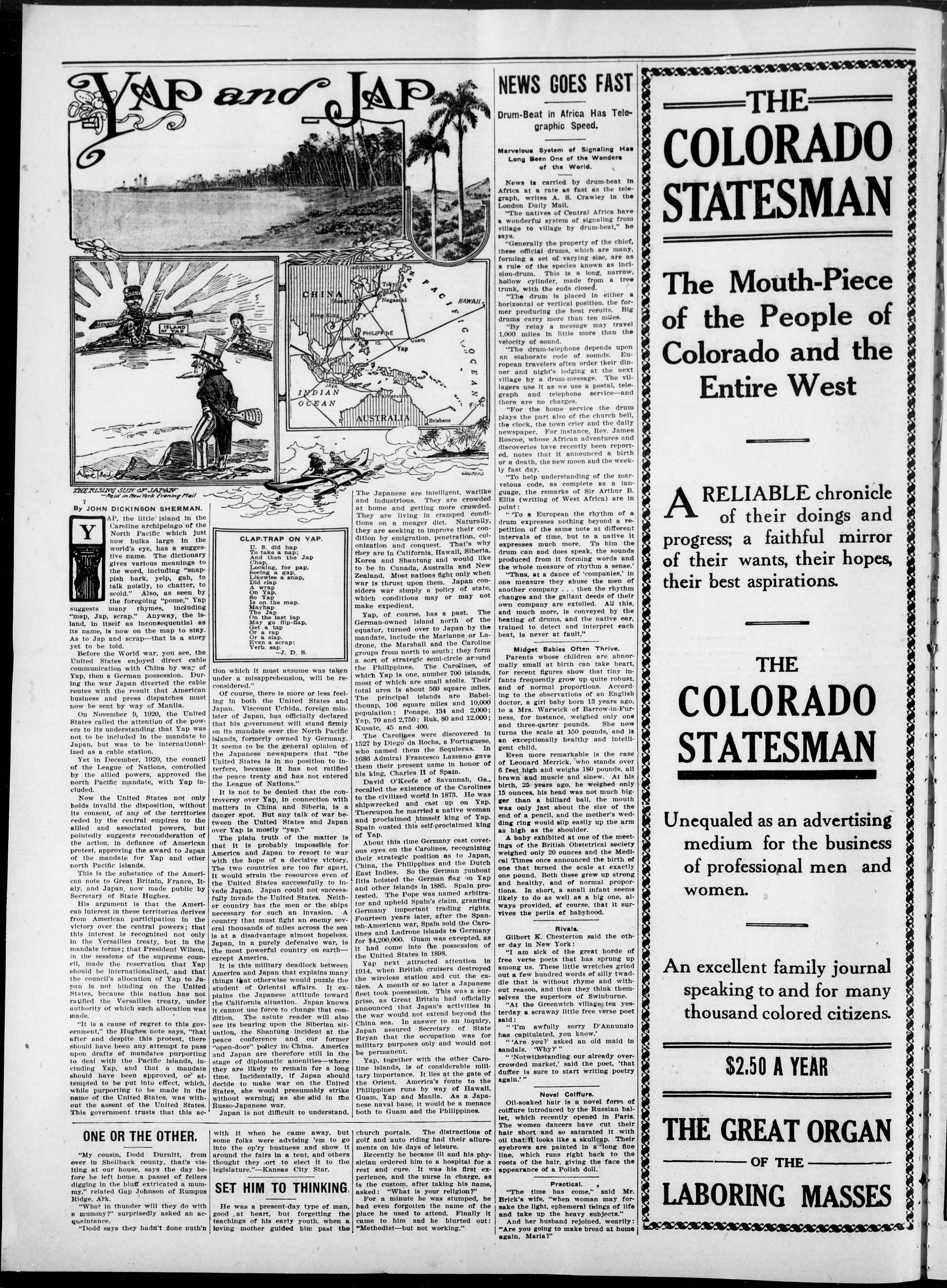
YAP and JAP
ISLAND OF YAP
PHILIPPINES
CHINA
Tokyo
Shanghai
Nagasaki
Hong Kong
PHILIPPINE
Manila
IS.
Guam
Yap
EASTPATTERN
BORNED
JAVA
INDIAN OCEAN
PALMERATOR
AUSTRALIA
Brisbane
WALTERS
By JOHN DICKINSON SHERMAN.
DICKINSON SHERMAN.
AP, the little' island in the Caroline archipelago of the North Pacific which just now bulks large in the world's eye, has a suggestive name. The dictionary gives various meanings to the word, including "snappish bark, yelp, gab, to talk noisily, to chatter, to scold." Also, as seen by the foregoing "pome," Yap
AP, the little island in the Caroline archipelago of the North Pacific which just now bulks large in the world's eye, has a suggestive name. The dictionary gives various meanings to the word, including "snappish bark, yelp, gab, to talk noisily, to chatter, to scold." Also, as seen by the foregoing "pome," Yap suggests many rhymes, including "map, Jap, scrap." Anyway, the island, in itself as inconsequential as its name, is now on the map to stay. As to Jap and scrap—that is a story yet to be told.
Before the World war, you see, the United States enjoyed direct cable communication with China by way of Yap, then a German possession. During the war Japan diverted the cable routes with the result that American business and press dispatches must now be sent by way of Manila.
On November 9, 1920, the United States called the attention of the powers to its understanding that Yap was not to be included in the mandate to Japan, but was to be internationalized as a cable station.
Yet in December, 1920, the council of the League of Nations, controlled by the allied powers, approved the north Pacific mandate, with Yap included.
Now the United States not only holds invalid the disposition, without its consent, of any of the territories ceded by the central empires to the allied and associated powers, but pointedly suggests reconsideration of the action, in defiance of American protest, approving the award to Japan of the mandate for Yap and other north Pacific islands. This is the substance of the American note to Great Britain, France, Italy, and Japan, now made public by Secretary of State Hughes.
His argument is that the American interest in these territories derives from American participation in the victory over the central powers; that this interest is recognized not only in the Versailles treaty, but in the mandate terms; that President Wilson, in the sessions of the supreme council, made the reservation that Yap should be internationalized, and that the council's allocation of Yap to Japan is not binding on the United States, because this nation has not ratified the Versailles treaty, under authority of which such allocation was made.
"It is a cause of regret to this government," the Hughes note says, "that after and despite this protest, there should have been any attempt to pass upon drafts of mandates purporting to deal with the Pacific islands, including Yap, and that a mandate should have been approved, or attempted to be put into effect, which, while purporting to be made in the name of the United States, was without the assent of the United States. This government trusts that this ac-
ONE OR THE OTHER.
"My cousin, Dodd Durnitt, from over in Shellback county, that's visiting at our house, says the day before he left home a passel of fellers digging in the bluff extricated a mummy," related Gap Johnson of Rumpus Ridge, Ark.
"What in thunder will they do with a mummy?" surprisedly asked an acquaintance.
"Dodd says they hadn't done nuthin'
CLAP.TRAP ON YAP.
U. S. did hap
To take a nap;
And then the Jap
Chap.
Looking, for pap,
Seeing a gap.
Likewise a snap,
Did clap
A wrap
On Yap.
So Yap
Is on the map.
Mayhap
The Jap
On the last lap
May go flip-flap,
Get a tap
Or a rap
Or a slap.
Even a scrap:
Verb. sap.
-J. D. S.
tion which it must assume was taken under a misapprehension, will be re-considered."
Of course, there is more or less feeling in both the United States and Japan. Viscount Uchida, foreign minister of Japan, has officially declared that his government will stand firmly on its mandate over the North Pacific islands, formerly owned by Germany. It seems to be the general opinion of the Japanese newspapers that "the United States is in no position to interfere, because it has not ratified the pence trety and has not entered the League of Nations." It is not to be denied that the controversy over Yap, in connection with matters in China and Siberia, is a danger spot. But any talk of war between the United States and Japan over Yap is mostly "yap."
The plain truth of the matter is that it is probably impossible for America and Japan to resort to war with the hope of a decisive victory. The two countries are too far apart. It would strain the resources even of the United States successfully to invade Japan. Japan could not successfully invade the United States. Neither country has the men or the ships necessary for such an invasion. A country that must fight an enemy several thousands of miles across the sea is at a disadvantage almost hopeless. Japan, in a purely defensive war, is the most powerful country on earth—except America.
It is this military deadlock between America and Japan that explains many things that otherwise would puzzle the student of Oriental affairs. It explains the Japanese attitude toward the California situation. Japan knows it cannot use force to change that condition. The astute reader will also see its bearing upon the Siberian situation, the Shantung incident at the peace conference and our former "open-door" policy in China. America and Japan are therefore still in the stage of diplomatic amenities—where they are likely to remain for a long time. Incidentally, if Japan should decide to make war on the United States, she would presumably strike without warning, as she did in the Russo-Japanese war. Japan is not difficult to understand.
with it when he came away, but some folks were advising 'em to go into the opry business and show it around the fairs in a tent, and others thought they ort to elect it to the legislature."—Kansas City Star.
SET HIM TO THINKING
He was a present-day type of man, good at heart, but forgetting the teachings of his early youth, when a loving mother guided him past the
The Japanese are intelligent, warlike and industrials. They are crowded at home and getting more crowded. They are living in cramped conditions on a meager diet. Naturally, they are seeking to improve their condition by emigration, penetration, colonization and conquest. That's why they are in California, Hawaii, Siberia, Korea and Shantung and would like to be in Canada, Australia and New Zealand. Most nations fight only when war is thrust upon them. Japan considers war simply a policy of state, which conditions may or may not make expedient.
Yap, of course, has a past. The German-owned island north of the equator, turned over to Japan by the mandate, include the Marianne or Ladrone, the Marshall and the Caroline groups from north to south; they form a sort of strategic semi-circle around the Philippines. The Carolines, of which Yap is one, number 700 islands, most of which are small atolls. Their total area is about 560 square miles. The principal islands are Babelthouap, 106 square miles and 10,000 population; Ponape, 134 and 2,000; Yap, 70 and 2,750; Ruk, 80 and 12,000; Kusaic, 45 and 400.
The Carolines were discovered in 1527 by Diego da Rocha, a Portuguese, who named them the Sequileras. In 1686 Admiral Francesco Lazeno gave them their present name in honor of his king Charles II of Spain.
David O'Keefe of Savannah, Ga., recalled the existence of the Carolines to the civilized world in 1873. He was shipwrecked and cast up on Yap. Thereupon he married a native woman and proclaimed himself king of Yap. Spain ousted this self-proclaimed king of Yap. About this time Germany cast covetous eyes on the Carolines, recognizing their strategic position as to Japan, China, the Philippines and the Dutch East Indies. So the German gunboat Ittis hoisted the German flag on Yap and other islands in 1885. Spain protested. The Pope was named arbitrator and upheld Spain's claim, granting Germany important trading rights. Fourteen years later, after the Spanish-American war, Spain sold the Carolines and Ladrone islands to Germany for $4,200,000. Guam was excepted, as it had come into the possession of the United States in 1898.
Yap next attracted attention in 1914, when British cruisers destroyed the wireless station and cut the cables. A month or so later a Japanese fleet took possession. This was a surprise, as Great Britain had officially announced that Japan's activities in the war would not extend beyond the China sea. In answer to an inquiry, Japan assured Secretary of State Bryan that the occupation was for military purposes only and would not be permanent. Yap, together with the other Caroline islands, is of considerable military importance. It lies at the gate of the Orient. America's route to the Philippines runs by way of Hawaii, Guam, Yap and Manila. As a Japanese naval base, it would be a menace both to Guam and the Philippines.
church portals. The distractions of golf and auto riding had their allurements on his days of leisure.
Recently he became ill and his physician ordered him to a hospital for a rest and cure. It was his first experience, and the nurse in charge, as is the custom, after taking his name, asked: "What is your religion?
For a minute he was stumped, he had even forgotten the name of the place he used to attend. Finally it came to him and he blurred out: "Methodist—but not working."
NEWS GOES FAST
Drum-Beat in Africa Has Telegraphic Speed.
Marvelous System of Signaling Has Long Been One of the Wonders of the World.
News is carried by drum-beat in Africa at a rate as fast as the telegraph, writes A. S. Crawley in the London Daily Mail.
"The natives of Central Africa have a wonderful system of signaling from village to village by drum-beat," he says.
"Generally the property of the chief, these official drums, which are many, forming a set of varying size, are as a rule of the species known as incision-drum. This is a long, narrow, hollow cylinder, made from a tree trunk, with the ends closed.
"The drum is placed in either a horizontal or vertical position, the former producing the best results. Big drums carry more than ten miles.
"By relay a message may travel 1,000 miles in little more than the velocity of sound.
"The drum-telephone depends upon an elaborate code of sounds. European travelers often order their dinner and night's lodging at the next village by a drum-message. The villagers use it as we use a postal, telegraph and telephone service—and there are no charges.
"For the home service the drum plays the part also of the church bell, the clock, the town crier and the daily newspaper. For instance, Rev. James Roscoe, whose African adventures and discoveries have recently been reported, notes that it announced a birth or a death, the new moon and the weekly fast day.
"To help understanding of the marvelous code, as complete as a language, the remarks of Sir Arthur B. Ellis (writing of West Africa) are in point:
"To a European the rhythm of a drum expresses nothing beyond a repetition of the same note at different intervals of time, but to a native it expresses much more. To him the drum can and does speak, the sounds produced from it forming words and the whole measure of rhythm a sense."
"Thus, at a dance of 'companies,' in one measure they abuse the men of another company . . . then the rhythm changes and the gallant deeds of their own company are extolled. All this, and much more, is conveyed by the beating of drums, and the native ear, trained to detect and interpret each beat, is never at fault."
Midget Babies Often Thrive.
Parents whose children are abnormally small at birth can take heart, for recent figures show that tiny infants frequently grow up quite robust, and of normal proportions. According to the observations of an English doctor, a girl baby born 13 years ago, to a Mrs. Warwick of Barrow-in-Furness, for instance, weighed only one and three-quarter pounds. She now turns the scale at 150 pounds, and is an exceptionally healthy and intelligent child.
Even more remarkable is the case of Leonard Merrick, who stands over 6 feet high and weighs 180 pounds, all brawn and muscle and sinew. At his birth, 25 years ago, he weighed only 15 ounces, his head was not much bigger than a billiard ball, the mouth was only just about the size of the end of a pencil, and the mother's wedding ring would slip easily up the arm as high as the shoulder.
A baby exhibited at one of the meetings of the British Obstetrical society weighed only 20 ounces and the Medical Times once announced the birth of one that turned the scale at exactly one pound. Both these grew up strong and healthy, and of normal proportions. In short, a small infant seems likely to do as well as a big one, always provided, of course, that it survives the perils of babyhood.
Rivals.
Gilbert K. Chesterton said the other day in New York:
"I am sick of the great horde of free verse poets that has sprung up among us. These little wretches grind out a few hundred words of silly twaddle that is without rhyme and without reason, and then they think themselves the superiors of Swinburne.
"At the Greenwich village tea yesterday a scrawny little free verse poet said:
"I'm awfully sorry D'Annunzio has capitulated, you know."
"Are you? asked an old maid in sandals. 'Why?'"
"Notwithstanding our already overcrowded market,' said the poet, 'that duffer is sure to start writing poetry again.'"
Novel Colffure.
Oil-soaked hair is a novel form of coiffure introduced by the Russian ballet, which recently opened in Paris. The women dancers have cut their hair short and so saturated it with oil that it looks like a skullcap. Their eyebrows are painted in a long fine line, which runs right back to the roots of the hair, giving the face the appearance of a Polish doll.
Practical.
"The time has come," said Mr. Brick's wife, "when woman may forsake the light, ephemeral things of life and take up the heavy subjects."
And her husband rejoined, wearily: "Are you going to make bread at home again, Marla?"
---
THE COLORADO STATESMAN
The Mouth-Piece of the People of Colorado and the Entire West
RELIABLE chronicle of their doings and progress; a faithful mirror of their wants, their hopes, their best aspirations.
THE COLORADO STATESMAN
Unequaled as an advertising medium for the business of professional men and women.
An excellent family journal speaking to and for many thousand colored citizens.
$2.50 A YEAR
LABORING MASSES
DR. CLARK MELLES, JR.
B.S., D.D.S.
Invites the public of Denver to
inspect his modern, electrically
equipped dental suite, $602 Wel-
ton St. Hours 9 a.m. to 12 noon,
1 to 6 p.m. evenings and Sund-
days by appointment. Office
phone Champa 2807. Residence
phone Champa 1536.
C. E. TERRY, M.D.
1027 Twenty-first St., Denver
Office Phone Main 2701. Hours
12 to 9 and 6 to 8 p.m. Or by
appointment. Res. 2337 Glen-
arm Place. Phone Champa 3303.
E. P. BLAKEMORE.
Attorney and Counsellor at Law
Office, Rooms 39 and 40 Arapahoe Hldg. 1622 Arapahoe St.
Phone Champa 5460.
DR. HUFF'S office phone is
Champa 6901. And his residence
Phone York 4101. When not
reached at office or home, call
Atlas Drug Co. Main 912. Office
Suite 5 6 and 7, 2701 Welton St.,
over Atlas Drug Store. Office
hours, 11 to 12 a. m., and 3 to 5
p. m.
Office 600 27th St. Ph. Champa 1142
S. E. CARY
ATTORNEY-AT-LAW
Six Years City and County Attorney
at Russell Springs, Logan
County, Kansas
Office Hours—
9:00 A. M. to 12:00 M.
2:00 P. M. to 4:00 P. M.
DENVER, COLO.
The
WARD AUCTION
COMPANY
Sales Daily at 2 p.m. Office Pun-
niture a Specialty.
HAVE MOVED TO-
1723-39 GLENARM ST.
PHONE MAIN 1875.
Phone Main 8026
Res. Phone York 5774W
FRANK D. TAGGART
Attorney at Law—Netary Public
205-206 Cooper Building
Denver, Colorado
JOSEPH CARTER
Express, Moving,
and Storage
COAL AND WOOD
PROMPT DELIVERY.
Phone Main 6544.
2418 WASHINGTON STREET.
Phone Champa 113
1848 Arapahoe
绎乐
The Difference Between the Cost of Good and Cheap Printing
is so slight that he who goes shopping from printer to printer to secure his printing at a few cents less than what it is really worth hardly ever makes day laborer wages at this unpleasant task.
If you want good work at prices that are right, get your job printing
At This Office
Today's Geography
Little Journeys to Places
Figuring in World
Events
Prepared by The National Geographic
Society, Washington, D.C., for Department
of Interior, Bureau of Education.
SOUTH AFRICA: COUNTRY OF DIAMONDS, SAVAGES, AND HARDY PIONEERS
The Union of South Africa recently attracted world attention by a negative vote on the proposal to secede from the British empire. It should not be a strange country to Americans. With its vast areas taken over from aborigines; with thousands of its white settlers massacred by savages, but with others, undaunted, pressing on in their prairie schoolers ever further into the interior of an unknown continent; with a gold rush winning a new empire; and possessed today of a stubborn race problem, South Africa, half way around the world from us, has in its history, chapters which we knew by heart. New Yorkers can find an even closer if minor tie to the residents of Cape Town in the fact that the sites of both ports, now almost priceless, were bought from savage landlords for a few handfuls of gaudy trinkets.
In one respect, however; the carving out of what is now the Union of South Africa is without its parallel in the development of the United States. In South Africa the strife of two white peoples for control has been an all important factor. For about a century and a half the Dutch had possession of Cape Town and the small area surrounding it which harbored all the whites in South Africa. The Napoleonic wars transferred possession to England, and in 1806 the English assumed a final control which many of the Dutch inhabitants resented. In 1836 many of the Dutch farmers or "boers" began trekking into the interior with the intention of settling beyond English influence. When Englishmen followed them they trekked farther. Finally, beyond the Orange river they founded the Orange free state, and beyond the Vaal river, the Transvaal republic.
First diamonds and then gold were discovered in the new states. They brought great prosperity to the Boer republics, but they brought many outsiders as well; and the presence of these finally led to the Boer war as a result of which the republics came into the possession of Great Britain. Aside from the war-torn republics and monarchies of the last few years, the Union of South Africa is one of the youngest of the important countries of the world. The territory of the Union occupies the whole southern and southeastern tip of Africa in a wide strip extending about 250 miles inland from the Indian ocean. Its area lacks only 25,000 square miles of reaching the half million mark.
Toward the inner edge of the territory of the Union are the world's greatest diamond mines, where earth sufficient to fill thousands of cars is screened yearly for the sake of a peck or two of diamonds. But the few handfuls of diamonds exported in 1913, the last year before the World war, were worth more than fifty million dollars and exceeded in value the combined value of the manj shiploads of wool, ostrich feathers, hides and coal that sailed away from South Africa the same year.
Some 200 miles to the northeast of the diamond country are the gold fields. In their midst is the gold-built, wonder city of Johannesburg, metropolis of South Africa. After the discovery of gold in the eighties the city sprang up almost over night. Though at first it was the usual unlovely mining camp, soon substantial structures were erected, and it now ranks, with its well paved streets, fine buildings, and beautiful parks, with the leading cities of Europe, America and Australia. It has about the same population as Denver, Colorado, and Providence, R. I.
COMMON CARRIERS—AND
A FEW NOT SO COMMON
Tractors are crawling over the snow-covered fields of northern Greenland carrying the supplies of the Lane Koch expedition. This novel use of a newborn vehicle recalls that some of the oldest transportation methods still are employed in regions whose civilization is older and higher than that of the Greenland Eskimo.
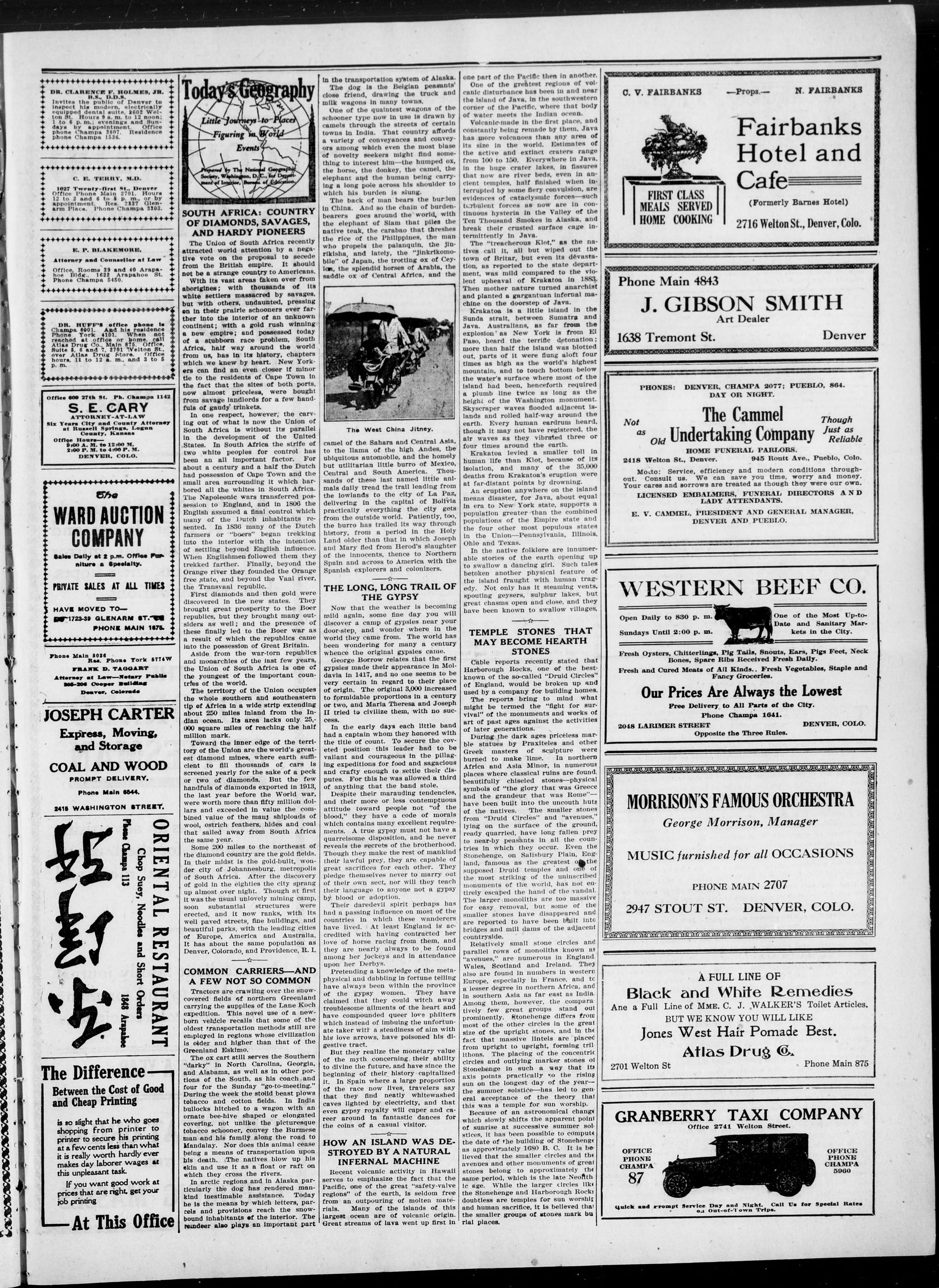
The ox cart still serves the Southern "darky" in North Carolina, Georgia, and Alabama, as well as in other portions of the South, as his coach and four for the Sunday "go-to-meeting." During the week the stolid beast plows tobacco and cotton fields. In India bullocks hitched to a wagon with an ornate bee-hive shaped or elongated covering, not unlike the picturesque tobacco schooner, convey the Burmese man and his family along the road to Mandalay. Nor does this animal cease being a means of transportation upon his death. The natives blow up his skin and use it as a float or raft on which they cross the rivers. In arctic regions and in Alaska particularly the dog has rendered mankind inestimable assistance. Today he is the means by which letters, parcels and provisions reach the snow-bound inhabitants of the interior. The reindeer also plays an important part
in the transportation system of Alaska. The dog is the Belgian peasants' close friend, drawing the truck and milk wagons in many towns. One of the qualtest wagons of the schoener type now in use is drawn by camels through the streets of certain towns in India. That country affords a variety of conveyances and conveyors among which even the most blase of novelty seekers might find something to interest him—the humped ox, the horse, the donkey, the camel, the elephant and the human being carrying a long pole across his shoulder to which his burden is slung.
The back of man bears the burilen in China. And so the chain of burden bearers goes around the world, with the elephant of Slam that piles the native teak, the carabao that threshes the rice of the Philippines, the man who propels the palanquin, the jinkrisha, and lately, the "jinkrkomobile" of Japan, the trotting ox of Ceylon, the splendid horses of Arabia, the saddle ox of Central Africa, and the
The West China Jitney.
camel of the Sahara and Central Asia, to the llama of the high Andes, the ubiquitous automobile, and the homely but utilitarian little burro of Mexico, Central and South America. Thousands of these last named little animals dally tread the trail leading from the lowlands to the city of La Paz, delivering in the capital of Bolivia practically everything the city gets from the outside world. Patiently, too, the burro has trailed its way through history, from a period in the Holy Land older than that in which Joseph and Mary fled from Herod's slaughter of the innocents, thence to Northern Spain and across to America with the Spanish explorers and colonizers.
THE LONG, LONG TRAIL OF
THE GYPSY
Now that the weather is becoming mild again, some fine day you will discover a camp of gypsies near your door-step, and wonder where in the world they came from. The world has been wondering for many a century whence the original gypsies came.
George Borrow relates that the first gypsies made their appearance in Moldavia in 1417, and no one seems to be very certain in regard to their place of origin. The original 3,000 increased to formidable proportions in a century or two, and Maria Theresa and Joseph II tried to civilize them, with no success.
In the early days each little band had a captain whom they honored with the title of count. To secure the coveted position this leader had to be valiant and courageous in the pillaging expeditions for food and sagacious and crafty enough to settle their disputes. For this he was allowed a third of anything that the band stole.
Despite their marauding tendencies, and their more or less contemptuous attitude toward people not "of the blood," they have a code of morals which contains many excellent requirements. A true gypsy must not have a quarrelsome disposition, and he never reveals the secrets of the brotherhood. Though they make the rest of mankind their lawful prey, they are capable of great sacrifices for each other. They pledge themselves never to marry out of their own sect, nor will they teach their language to anyone not a gypsy by blood or adoption.
Their daredevil spirit perhaps has had a passing influence on most of the countries in which these wanderers have lived. At least England is accredited with having contracted her love of horse racing from them, and they are nearly always to be found among her jockeys and in attendance upon her Derbys.
Pretending a knowledge of the metaphysical and dabbling in fortune telling have always been within the province of the gypsy women. They have claimed that they could witch away troublesome alliments of the heart and have compounded queer love philisters which instead of imbuling the unfortunate taker with a steadiness of aim with his love arrows, have poisoned his digestive tract.
But they realize the monetary value of the myth concerning their ability to divine the future, and have since the beginning of their history capitalized it. In Spain where a large proportion of the race now lives, travelers say that they find neatly whitewashed caves lighted by electricity, and that even gypsy royalty will caper and career around in fantastic dances for the coins of a casual visitor.
HOW AN ISLAND WAS DESTROYED BY A NATURAL INFERNAL MACHINE
Recent volcanic activity in Hawaii serves to emphasize the fact that the Pacific, one of the great "safety-valve regions" of the earth, is seldom free from an outpouring of molten materials. Many of the islands of this largest ocean are of volcanic origin. Great streams of lava went up first in
one part of the Pacific then in another. One of the greatest regions of volcanic disturbance has been in and near the island of Java, in the southwestern corner of the Pacific, where that body of water meets the Indian ocean. Volcanic-made in the first place, and constantly being remade by them, Java has more volcanoes than any area of its size in the world. Estimates of the active and extinct craters range from 100 to 150. Everywhere in Java, in the huge crater lakes, in fissures that now are river beds, even in ancient temples, half finished when interrupted by some fiery convulsion, are evidences of cataclysmic forces—such turbulent forces as now are in continuous hysteria in the Valley of the Ten Thousand Smokes in Alaska, and break their crusted surface cage intermittently in Java.
The "treacherous Klot," as the natives call it, all but wiped out the town of Britar, but even its devasation, as reported to the state department, was mild compared to the violent upheaval of Krakatoa in 1883. Then mother nature turned anarchist and planted a gargantuan infernal machine on the doorstep of Java.
Krakatoa is a little island in the Sunda strait, between Sumatra and Java. Australians, as far from the explosion as New York is from El Paso, heard the terrific detonation; more than half the island was blotted out, parts of it were flung aloft four times as high as the world's highest mountain, and to touch bottom below the water's surface where most of the island had been, henceforth required a plumb line twice as long as the height of the Washington monument. Skyscraper waves flooded adjacent islands and rolled half-way around the earth. Every human eardrum heard, though it may not have registered, the alr waves as they vibrated three or four times around the earth.
Krakatoa levied a smaller toll in human life than Klot, because of its isolation, and many of the 35,000 deaths from Krakatoa's eruption were at far-distant points by drowning.
An eruption anywhere on the island means disaster, for Java, about equal in era to New York state, supports a population greater than the combined populations of the Empire state and the four other most populous states in the Union—Pennsylvania, Illinois, Ohio and Texas.
In the native folklore are innumerable stories of the earth opening up to swallow a dancing girl. Such tales betoken another physical feature of the island fraught with human tragedy. Not only has it steaming vents, spouting geysers, sulphur lakes, but great chasms open and close, and they have been known to swallow villages,
TEMPLE STONES THAT MAY BECOME HEARTH
Cable reports recently stated that Harborough Rocks, one of the best-known of the so-called "Druid Circles" of England, would be broken up and used by a company for building homes. The reports bring to mind what might be termed the "fight for survival" of the monuments and works of art of past ages against the activities of later generations.
During the dark ages priceless marble statues by Praxiteles and other Greek masters of sculpture were burned to make lime. In northern Africa and Asia Minor, in numerous places where classical ruins are found, beautifully chiseled stones—physical symbols of "the glory that was Greece and the grandeur that was Rome"—have been built into the uncouth huts of the natives. The smaller stones from "Drudl Circles" and "avenues," lying on the surface of the ground, ready quarried, have long fallen prey to near-by peasants in all the countries in which they occur. Even the Stonehenge, on Salisbury Plain, England, famous as the greatest of the supposed Drudl temples and one of the most striking of the uninscribed monuments of the world, has not entirely escaped the hand of the vandal. The larger monoliths are too massive for easy removal, but some of the smaller stones have disappeared and are reported to have been built into bridges and mill dams of the adjacent countryside.
Relatively small stone circles and parallel rows of monoliths known as "avenues," are numerous in England, Wales, Scotland and Ireland. They also are found in numbers in western Europe, especially in France, and to a lesser degree in northern Africa, and in southern Asia as far east as India. Among them, however, the comparatively few great groups stand out prominently. Stonehenge differs from most of the other circles in the great size of the upright stones, and in the fact that massive lintels are placed from upright to upright, forming trilithons. The placing of the concentric circles and outlying marker stones of Stonehenge in such a way that its axis points practically to the rising sun on the longest day of the year—the summer solstice—has led to general acceptance of the theory that this was a temple for sun worship.
Because of an astronomical change which slowly shifts the apparent point of sunrise at successive summer solstices, it has been possible to compute the date of the building of Stonehenge as approximately 1680 B. C. It is believed that the smaller circles and the avenues and other monuments of great stones belong to approximately the same period, which is the late Neolithic age. While the larger circles like the Stonehenge and Harborough Rocks doubtless are temples for sun worship and human sacrifice, it is believed that the smaller groups of stones mark burial places.
FIRST CLASS
MEALS SERVED
HOME COOKING
Phone Main 4843
J. GIBS
1638 Tremont St.
PHONES: DENVER
Not as Old Undertow
HOME
2418 Welton St., Denver
Motto: Service, efficiency. Consult us. We care
Your cares and sorrows a
LICENSED EMBALM
LAIR
E. V. CAMMEL, PRESIDENT
DENVER
Main 4843
GIBSON SMITH
Art Dealer
Memont St.
INES: DENVER, CHAMPA 2077; PUEBLO
DAY OR NIGHT.
The Cammel
Undertaking Company
HOME FUNERAL PARLORS.
Bton St., Denver. 945 Routt Ave., P.
Service, efficiency and modern condition
result us. We can save you time, worry a
s and sorrows are treated as though they wee
USED EMBALMERS, FUNERAL DIRECTOR
LADY ATTENDANTS.
CammEL, PRESIDENT AND GENERAL MA-
DENVER AND PUEBLO.
ESTERN BEEF
Phone Main 4843
J. GIBSON SMITH
Art Dealer
1638 Tremont St. Denver
PHONES: DENVER, CHAMPA 2077; PUEBLO, 864.
DAY OR NIGHT.
Moito: Service, efficiency and modern conditions throughout. Consult us. We can save you time, worry and money. Your cares and sorrows are treated as though they were our own.
LICENSED EMBALMERS, FUNERAL DIRECTORS AND LADY ATTENDANTS.
E. V. CAMMEL, PRESIDENT AND GENERAL MANAGER, DENVER AND PUEBLO.
WESTERN BEEF CO.
Open Daily to 830 p. m.
Sundays Until 2:00 p. m.
Fresh Oysters, Chitterlinge
Bones, Spare
Fresh and Cured Meats of
Our Prices Are
Free Delivery
Phon
2048 LARIMER STREET
Opposite
MORRISON'S
Piers, Chitterlings, Pig Tails, Snouts, Ears, Pig Bones, Spare Ribs Received Fresh Daily. Cured Meats of All Kinds.. Fresh Vegetable Fancy Groceries.
Our Prices Are Always the Lowest
Free Delivery to All Parts of the City.
Phone Champa 1641.
MER STREET DEN
Opposite the Three Rules.
PRISON'S FAMOUS ORCHES
Fresh Oysters, Chitterlings, Pig Tails, Snouts, Ears, Pigs Feet, Neck Bones, Spare Ribs Received Fresh Daily.
Fresh and Cured Meats of All Kinds.. Fresh Vegetables, Staple and Fancy Groceries.
George Morrison, Manager
MUSIC furnished for all OCCAS
PHONE MAIN 2707
2947 STOUT ST. DENVER, C
IC furnished for all OCCAS
MUSIC furnished for all OCCASIONS
PHONE MAIN 2707
YTOUT ST. DENVER, C
A FULL LINE OF
k and White Reme
2947 STOUT ST. DENVER, COLO.
A FULL LINE OF
Black and White Remedies
Ane a Full Line of MME. C. J. WALKER'S Toilet Articles.
BUT WE KNOW YOU WILL LIKE
Jones West Hair Pomade Best.
Atlas Drug C.
2701 Welton St Phone Main 875
GRANBERRY TAXI COMPANY Office 2741 Welton Street.
OFFICE
PHONE
CHAMPA
87
OFFICE
PHONE
CHAMPA
5960
2716 Welton St., Denver, Colo.
N SMITH
Dealer
Denver
MAMPA 2077; PUEBLO, 864.
FOR NIGHT.
Cammel
ing Company
Though Just as
Reliable
GENERAL PARLORS.
945 Routt Ave., Pueblo, Colo.
and modern conditions through-
have you time, worry and money.
Gested as though they were our own.
FUNERAL DIRECTORS AND
ATTENDANTS.
ENT AND GENERAL MANAGER,
AND PUEBLO.
N BEEF CO.
```markdown
```
One of the Most Up-toDate and Sanitary Markets in the City.
Tails, Snouts, Ears, Pigs Feet, Neck Received Fresh Daily.
Kinds.. Fresh Vegetables, Staple and Groceries.
Always the Lowest
All Parts of the City.
Champa 1641.
DENVER, COLO.
The Three Rules.
MOUS ORCHESTRA
for all OCCASIONS
MAIN 2707
DENVER, COLO.
GET A RESIDENCE.
and that will sat
THE COLORADO STATESMAN
LAKE COUNTY
CABON
MASSACHUSETTS
COUNTRY
PARTY
JOSEPH D. D. RIVERS ..... Proprietor
P. O. Box 116 ..... 1824 Curtis Street, Room 25 Phone Main 7417
SUBSCRIPTION RATES.
One year ..... $2.50
♦ Six months ..... 1.50
Three months ..... .75
MUST BE PAID IN ADVANCE
Reading notices, ten lines or less, 15 cents per line. Each additional line ever ten lines, 12 cents per line. Display advertising, 75 cents per inch for first insertion and 50 cents per inch for each additional insertion.
Remittances should be made by express money order, postoffice money order, registered letter or bank draft. Postage stamps will be received the same as cash for the fractional part of a dollar. Only 1c and 2c stamps taken.
No discounts allowed on less than three months' contract. Cash must accompany all orders from parties unknown to us. Further particulars on application.
Communications to receive attention must be newsy, upon important subjects, plainly written only upon one side of the paper, must reach us Tuesdays, if possible, anyway not later than Wednesdays, and bear the signature of the author. No manuscript returned, unless stamps are sent for postage. All communications of a personating nature that are not complimentary will be withheld from the columns of this paper.
GET A RESIDENCE.
THE increasing frequency with which we can note the purchase of comfortable homes by Denver's colored citizens is a source of great gratification and encouragement to all who realize the wisdom of such a course. If we would generally take the heart, the advice arising out of the experiences of the older citizens, we would improve our opportunities far more than we do at present. While the chance to make a fortune quickly in real estate is not, and probably never will be again what it once was, it is almost a certainty that every careful investment in residential property, no matter how far out it may be located, will bring the investor reward in the way of comfort and independence such as no other form of investment is apt to bring.
Denver is growing and will continue to grow for many years, and even if the value of suburban real estate increases but slowly, increase it must to some extent, while fortunate purchasers may see their properties increase in value by leaps. But the importance of owning a home is not confined to the possibility of its increasing in value. Home owners are recognized as representing a more solid citizenship than the tenant class, while the comfort and interest which one finds in his own property increases with his years. And it is possible for every steady wage earner to buy a home. A little frugality, a little sacrifice of idle pleasures, a little saving and a determination to be boss of a little plot of your own, and in a few years the work is achieved. Some of our leading property owners made every dollar of their first investments working as janitors or laborers. They have insured comfort, self-reliance and respect to themselves and their families, and they realize with no little satisfaction the wisdom of their earlier efforts.
THE NEWSPAPER AND WHAT IT SHOULD PRINT.
THE ROCKY Mountain News, a daily publication of Denver, contained in its issue of Tuesday, April 26, an editorial, "Printing the News," in which it comments on a sermon preached by the Rev. W. H. Wray Boyle, one of our city's leading divines, and in which he discussed the "Perils of the Press." The editor agreed with the eminent preacher in general, but reminded that there were several important points on which he did not touch, as before one can properly judge what a newspaper should print, the function and duty of the newspaper must first be clearly defined and understood. Said the editor: "A newspaper is different from any other publication, with few exceptions, because it is a record, or should be a record of facts, where as magazines and books are for the most part fiction or expressions of personal opinions. It is the function of a newspaper to print the news whether it is pleasant or unpleasant. A newspaper should be a complete and accurate history of current events. A newspaper is not responsible for the crimes and unpleasant events which occur and must be recorded, but it is responsible for the manner in which the events are described." Besides other things in which the usefulness of the newspaper and its help to the community are clearly described, the editor of the "News" goes on to say: "Dr. Boyle seems to think that only news that is educational or uplifting should be printed. But would suppression of unpleasant stories be for the best interests of the community? Many criminals have been caught because of the publicity given their crimes through the columns of the press. Is it not in fact moral cowardice to avoid facts because they are unpleasant? Does not the publicity given events in the paper and in correcting the mistakes made? Is not sin more effectively combated by being exposed to the light of publicity than by being obscured and ignored in the darkness of silence?" Then the editor concludes in the following, giving his idea of the ideal newspaper and what it should print: "To our mind the ideal newspaper is one which prints all the news but handles the unpleasant events in a way not to offend a proper sense of decency nor to exploit crime or immorality in a manner to exert a degrading influence."
We are sure the Reverend gentleman will appreciate this idea of the press in its defense of "Printing the News," as in our own experience of many years we have been taken to task for printing the news for no other reason than someone thinks this or that kind of news should not be in the paper. We are with this editor that publication of the truth without necessarily being harsh is the thing that will prove most beneficial to the people. Why bring the deeds of the underworld to light, and allow some pulpit orator, who in his usual delectable discourses the fifty-two Sundays in the year, pours out his wrath on the sinner, besides his mid-week denouncements of the wrong-doer and his consignment of such unfortunates to the place of darkness, to indulge in the most immoral actions, hiding behind a technicality of a church board or something that way, to go unpunished even with overwhelming corroborative evidence against him? Or why a medical practitioner to engage in mal practices and everything that points to suspicion of his professional conduct, or the attorney-at-law or any other member of society, and the same to be kept from the columns of the press and a continuance of deception for an indefinite period during which time, on account of the voice of the press or intimidation or challenge, more members of the public are victimized than if the freedom of the press had not been interfered with.
Election of the Superintendents of City and County Public Schools.
By P. P. CLAXTON, U. S. Commissioner of Education.
In city and country the success and efficiency of the public schools depend to a very large extent on the character and the work of the superintendent. City superintendents are elected by city school boards, which are responsible to the people for the management and success of the schools of the city. As a result of the method by which they are elected and of the salaries paid them, a very large majority, practically all, of the city superintendents are professional educators of recognized ability.
PETER H.
Yet, county superintendents are elected by popular vote on partisan tickets, by county courts not in any other way responsible for the public schools except, perhaps, that they may determine to some extent the county tax levy for schools, by commissions representing local school boards over the actions of which the county superintendent is supposed to have some kind of control, and possibly in other ways equally illogical and absurd.
In all the states in which county superintendents are not elected by responsible boards to which they in turn are responsible and in which salaries are not large enough to make it possible to fill the offices with competent men and women giving full time to the duties of the office, legislatures should take steps at the earliest possible moment, making these things possible and requiring them. Nowhere should the salary of the county superintendent be less than $2,500.
To enable the weaker counties to pay adequate salaries and for many other reasons, the state should pay one-half of the minimum salary at least.
Boards of education should have the power to select county superintendents from the country at large and should be required to select them only on the basis of professional preparation and ability.
Is the Russian Rebellion Likely to Overthrow the Bolshevists?
My personal opinion is that this anti-Bolshevik uprising is premature. The last was liquidated only four months ago and it left the workers without arms and without organization. Four months seem a very short time in which to organize a successful counter-revolution, especially when the horde of spies of the extraordinary commission, including almost the entire staff of the days of czardom, are actively at work everywhere.
If it be successful, the outcome will be, first of all, chaos and anarchy. Out of this may arise some figurehead or even some leader who would bring order out of the confusion. This leader may be Kerensky or Victor Chernoff, both of whom are active. If it be unsuccessful, then the prestige of the Bolshevik leaders will be enhanced greatly. It will then be necessary for western Europe to consider seriously the establishment of diplomatic and trade relations with Russia, even complete recognition of the soviet government.
Personally, I strongly favor such recognition, for I believe that ignorance of the true nature of Bolshevist rule is so complete that knowledge of its despotism and its horror will never fully come until the western world begins actually to deal with the Bolshevists.
Habit of Crowd-Making Is Becoming a Serious Menace to Civilization.
As a practical problem, the habit of crowd-making is daily becoming a more serious menace to civilization. Events are making it more and more clear that, pressing as are certain economic questions, the forces which threaten society are really psychological. * * *
Both the individual and society suffer from crowd-behavior. I know of nothing which today so menaces not only the values of civilization, but also—it is the same thing in other words, perhaps—the achievement of personality and true knowledge of self, as the growing habit of behaving as crowds.
Our society is becoming a veritable babble of gibbering crowds. Not only are mob outbreaks and riots increasing in number, but every interest, patriotic, religious, ethical, political, economic, easily degenerates into a confusion of propagandist tongues, into extravagant partisanship and intemperance. * * * While it cannot be said that the habit of crowd-making is peculiar to our times—other ages, too, have indulged in it—it does seem that the tendency to crowd-mindedness has greatly increased in recent years.
Reform of Present Dancing Manners Is Started by Decent Young Men.
Not the mothers, or the fathers, or the chaperons, or the girls, but the boys, the young men themselves, have started in on the first effective reform of the loose manners and customs of the modern ball room.* The social orgy has gone too far.
The reform is starting and will gain headway among the boys themselves. The cool judgment of decent boys in matters of this kind is essentially sound; and the boys have had enough. They are beginning to realize that the shallow and superficial girlhood of the present day has lost the charm that girlhood should possess and that they crave.
And since popularity is seemingly all that the modern mother desires for her daughter, she will be quick to sense the altered atmosphere and adjust herself accordingly. Here, then, is our ground for hope. The boys can, and I believe will, correct an intolerable situation. If not, we shall speedily have a drastic reaction with accompanying blue laws that will deprive us of all of what should be a pleasant and wholesome pastime, and that will satisfy no one.
---
```markdown
```
COLORADO STATESMAN
---
The Mouth-Piece of the People of Colorado and the Entire West
```markdown
```
A RELIABLE chronicle of their doings and progress; a faithful mirror of their wants, their hopes, their best aspirations.
THE COLORADO STATESMAN
Unequaled as an advertising medium for the business of professional men and women.
An excellent family journal speaking to and for many thousand colored citizens.
$2.50 A YEAR
THE GREAT ORGAN
OF THE
LABORING MASSES
---
TNE COLORADU\s7x STATESMAN |
Bes ee.
THE WOMAN'S GUILD of the
Church of the Redeemer will entevtain
Monday night, May 9th, at the resi-
dence of Mrs, N. J. Skillern, 1904 East
Twenty-ninth avenue.
Mr. and Mrs, Geo, W, “Gross enter-
tained a party of thirty-two at cards
Monday night, complimentary to Dr.
and Mrs, Rankford G, Holly of Mil-
waukee, :
Mrs, Henry Dean and little daugh-
ter of Salt Lake City are visiting in
the city, the guest of Mrs, N. Dean,
2218 Clarkson street.
Mr, ©, E, A. Starr, who haf been in
Durango for the past month on bust
ness, returned to the city last Wed-
nesday,
Mrs. Clara Franklin, formerly of
Denver, stopped over in the city for
a day last week on her way from Los
‘Angeles, Calif., en route east.
‘The silver jubilee reception given Dy
the Men's Club of the Chureh of the
Redeemer at the residence of Mr. and
Mrs. Vietor Walker Wednesday even:
ing of last week, was largely attended
and a pronounced success in every
way. It was an Innovation and the
soen are to be commended for the ele
gant manner in which it was handled
Mesdames Stell, ‘Terry, Walker and
misses Gains assisted in receiving.
Dr. and Mrs, R. G. Holly, former
residents of Denver, but now of Mil
waukee, Wis. have been the inspira:
tion for many rare and notable social
functions during the past two weeks:
‘Among the more prominent waset de:
lightful dinner party at the suburban
home of Mr, and Mrs. Mack Wright
last Saturday night, and a beautifully
appointed card party given by Mes
dames Geo, W. Brooks and Geo. F.
Robinson at the residence of the lat:
ter Thursday evening.
SS
N. A. A.C. P, HOLDS SUCCESSFUL
ANTI-LYNCHING MEETING.
Governor Oliver H. Shoup, Dean A.
©. Peck and Dr, Westbrook were the
pig cards that drew a good crowd to
Campbell A. M. 5. Ghureh: ‘Thursday
night, April 28, Like the meeting
at Shorter, practically every per
fon present took out - membership
in the Denver Branch. Gov. Shoup
delivered & ‘fear, forceful address on
law and order, and praised the high
standard of citizenship displayed by
thé colored citizens of Colorado. He
assured the association that both as
chief executive of the state and as a
citizen he could be counted upon to
Qo all within his power to promote Its
interests, Dr, Westbrook gave @
graphic and thrilling account on the
horrors of lynching and told of the
great work the association was doing
to stamp out this evil, Dean Peck was
at his best-and all Denver knows that
means a great deal. It was a splen-
did meeting and added greatly to the
strength of the Denver Branch.
SS
THE DENVER COLORED CIVIC AS:
SOCIATION.
‘The regular monthly meeting of [he
Denser Colored Civic Association will
be held at Fern Hall Tuesday evening,
May 10, 1921. All members are urgent
ly requested to be present 28 there will
he several important amendments to
the constitution to be voted upon, to-
gether with other matters to be dls
cussed.
ciate
S ‘All Odd Fellows in
CRS good standing are
hereby notified to
2 meet at their hall,
1834 Arapahoe street, Sunday, May
Sth, at 12 o'clock, to march in a body
to Campbell A. M. B, Chureh for the
annual ‘Thanksgiving sermon,
‘The Night and Day Café, 1865 Cur-
tis street, is now under the manage-
ment of Mrs. Lena Walton, The café
has been newly decorated and every-
thing is in first-class style, and meals
will be served at all hours. Mrs, Wal-
ton is making a spectarty of after-the-
ater and dancing parties, also Sunday
dinners, ‘The menu will appear in this
paper each week. Read display adver-
tisement.
Hall's Magic Hair Refiner, for men
only. No kinky edges. Apply’ 1333
Pennsylvania St. Phone Main 7523.
MUNICIPAL ELECTION
TUESDAY, MAY 17TH
ITH their names will appear the
Wiaiinmission clauses of seven
charter amendments, three initt-
ated bills and two referred ordinances.
Of the charter amendments, the
most far-reaching in its effect, if car-
ried, is the amendment making most
of the city offices elective and depriv-
Ing the mayor of many of his powers.
‘This amendment also provides for the
creation of a Public Utilities Commis-
sion and the reduction of water rents.
‘The candidates whose names will
appear on the ballot follow:
For Auditor—Harry A. Sullivan, Al-
vin H, Pickins, George D. Begole, Roy
D. Paul, W. H. H, Cranmer, Herbert
Fairall.
For Elections Commissioner—Will-
jam H. Wright, Philip G. Morrell,
Gano E. Senter, J. Warner Mills, Ma-
rian Byles Austin, Willlam Mann,
Charles C, Sackmann,
For councilman (one to be elected in
each district) :
Distr#t No. 1—Theodore Proske,
Leo W. Kennedy, James T. Smith.
District No. 2— Eugene Madden,
Reuben J. Morris, Charles E. Hann,
Sr., Henry Schoepflin, Lawrence Stone,
Jr, David Foster Davidson, A, A..Mac-
Donald.
District No. 3—Harry W. Risley, Jo-
seph R, Rees, William B. Warrington.
District No, 4—Walter E. White,
‘Thomas F. Azpell.
District No, 5—J. A, Burnett, Wil-
liam J. H. Doran.
District No, G—Louis F, Bartels,
Morris Harrison.
District No. 7—Louis Straub, Theo-
dore C. Phillippus.
District No, 8—Andrew Horan, Al-
bert Bruderlin, Jr., Anthony M. Her-
ian.
| District No. 9—John Conlon, C. BR.
Hewitt, Dr. Daniel R. Luey, Dominic
Lepore.
CAMPBELL A. M. E. CHURCH.
Cor. 23rd and Lawrence Sts, Rev. I. S.
Wilson, Pastor, Res., 2331 Arapa-
hoe St. Phone Main 1312.
9:45 a, m.—Sunday School.
11:00 a, m.—Preaching by Pastor.
7:30 p. m.—Preaching by Pastor.
Mid-Week Meetings:
Wednesday, 8 p, m., prayer and class.
Thursday, 8 p. m., Willing Workers.
NIGHT AND DAY CAFE SUNDAY
DINNER MENU.
Chicken and Noodle Soup.
Baked Chicken and Dressing
Roast Pork and Apple Sauce
Roast Beef au Gratin
Macaroni and Cheese
Mashed Potatoes Salud
Ice Cream and Cake
Cherry Pie
NOTICE.
The regular meetings of the Univer-
sal Improvement Association and Af.
rican Communities League will be held
at the Mason's new hall, 2800 Welton
street, beginning Tuesday, May 3, at 8
o'clock. All persons are requested to
note the change of meeting place.
EDWARD ©. DAVIS,
Secretary.
DON’T BE WOOZY---
Probably you'll not find this word
in. the dictionary, but it means
don't be too lazy to walk a block
or two out of your way, if neces-
Sury. to trade at the store that can
and will save you money. on Men's,
Women's, Boys and Girls’ and Chil-
dyen's wearables.
e “
9,
‘
Corner 15th and Larimer Streets
Hawks Migrate En Bloc,
‘The autumn migration of hawks is
made partly en bloc, a large propor-
tion of the total population of several
Northern species appearing and pass-
ing southward at certain more or less
definite times. Often one “wave” of
the birds will follow a period of
quiescence, vb‘ch will be in turn suc-
ceeded by avother wave.
punuic TRUSTEF's sage.
Whereas, Helena “C. Gensler, by
deed of trust, dated the 1th day of
July, 1920, which is recorded in Hook
2R98, page 127, of ‘the records In the
Office of the Clerk and Recorder of
the City and County of Denver, Cole:
rado, duly. conveyed to the ‘Public
Trustee In and for the City and Coun-
ty of Denver, Colorado, the following
described real estate in the City and
County of Denver, Colorado, to-wit!
Lot numbered Thirty-four (4) and the
north half (N, %) of Lot Thirty-three
(33), in Block” Two (2), Fleming's
roadway Addition, which deed of
trust Was made to secure the payment
of one promissory note of even date
With said deed of trust, for the sum of
two! thousand three hundred ten and
10/100 ($2,310.00) dollars, payable to
the order of Marie Larson Hansen, five
(b) Years and six months after the
date thereof, with interest thereon at
(per cent per annum until paid, inter=
est. payable monthly, ax is more par-
ticularly set. forth ‘in’ xwld deed of
trust, reference to which ix hereby
Ihade for greater certainty: and,
Whereas. The said Helena C. Gentz-
ler and all persons. claiming by.
through or under her, having default
ed in. the. payment of nine monthly
payments of thirty-five ($35.00) dol-
lara per zmonth on the principal of
said note, and in the payment of nine
Monthly payments of interest on sald
note, due on the 1stt day of each
month, beginning on the 19th day of
August, A.D, 1920: and the legal
holder of said ‘note, having elected on
account of said default to declare said
hote unpaid, due and payable, and to
foreclose said deed of trust,” an@ to
have sold the said lots now subject t
the lien_of said deed of trust, accord-
ing to the terms and provisions of said
deed of trust, and according to law,
to-wit: Lot’ numbered Thirty-four
(44) and the north half (N14) of Lot
Thirty-three (33), In Block Two (2),
Fleming's Broadway Addition:
‘Now, thereforg at the written re-
quest of Marie Larson Hansen, the le-
Hal holder of said note, pursuant to
faw, I. the undersigned, Public ‘Trus-
too in'and for the City und County, of
Denver, Colorado, do hereby give no-
tice that Twill, at the hour of 10
o'clock In the forenoon of
MONDAY, THE TWENTY-THIRD DAY
OF MAY, A. D. 1921,
at the Tremont Street front door of
the Court House, in the City and
County of Denver, Colorado, sell at
public auction. to the highest and, best
idder “for ‘cash, the guid dexcribed
premises, and ali the rfght, title and
Interest of the said Helena G. Gentzler,
her heirs and axsisns therein, for the
purpose of paying the indebtedness s¢~
tured by said deed of trust, and the
cost. and. expenses of executing this
trust, and will deliver to the purchaser
Alcertificate of sal ax provided by
ipbatted at Denver, Colorado, April 21,
EDWARD M. SABIN,
Public Trustee in and for the City’ and
‘County of Denver, Colorado.
First publication, April 23, 1921,
Last publication, May 21, 1921.
My i
— Be hy
ea Bae
sane hrs)
pees
pats
‘ hee
Bee ‘ eee)
Mee AE
HARVEY G. WEBSTER
PATRIOTIC
SHOE SHINING PARLOR
1526 Welton St Phone Main 2196
Prof.
W. M. Mackey
FIRST CLASS TONSORIAL
WORK
Hair Cutting a Specialty
Satisfaction Guaranteed
2244 LARIMER ST., DENVER
iia
ee
=
SIN
ey <)
(ove a
a
5 eae
y\ e5 io
Qo [in
Friends and Books.
The first time I read an excellent
book, it is to me just as if I bud
gained a new friend; when I read over
a book I have perused before, it re-
sembles the meeting with un old one.
—Oliver Goldsmith.
The Death Cup.
‘The death cup is a very poisonous
mushroom of wide distribution, It
ranges in color from pure white to
more common form in the United
States, to olive or yellow, and is so
called from the prominent yolva. It
contains phallin and ts almost invari-
ably fatal when eaten.
Health Before Everything.
Health Is the essential factor in pro-
ductiveness, prosperity and happiness,
and hence ip the advancement of civil-
jration.—Slr Frederick Treves. _
CHRONIC GROVCHES . . . - 2Y Hendrix.
|ENRY — SING ME THE SONGS / iS ILON-N-G <LOWeng
fs coma) iC peieidicen J es a, ein wo —%
S-”, en ea hu Uemace: : LON-N N= HO 6°
Se a eS Se 4-00 Faroe
Fas a ol = x
( NC oC 5)
= ay ~ =
r a —
= L a
ery ae oy oe
Ar" 4 +1 O10
la (Mee poucons, /_ [ ROLLERIN' ABouT= &» Crs
pryaece’ 65 i cee &
a Ys 5 Pisee| > WS OUT?
~ Fe
7 z ,
= SS
: oe ENS
“@uUs tans She . n
One More Credit Given China.
Capt. Stanley Flower, director of
the zoological gardens at Giza, Calro,
Egypt, has prepared considerable
data on the subject, which he ob-
tained from authoritative sources. Ac-
cording to Captain Flo.er, though the
ancient Egyptians kept wild animals
in captivity, ‘he first zoological gar-
den of which there Is definite knowl-
edge was founded by the first emper-
or of the Chou dynasty, about eleven
B. C., in China. It was called the “In-
telligence Park,” and had a scientific
and educational object.
France's First “Zoo.” ,
The “Menagerie du Pare” at Ver-
wailles, founded by Louis XIV, re-
ceived many animals from Cairo, It
was maintained for over a century,
during that time furnishing valuable
material to French anatomists and
naturalists. Gradually {t -decayed
and in 1789 was almost extinguished
by the mob. ‘The Paris museum ot
natural history was re-established by
law in 1793 and Buffon’s idea of at-
taching a menagerie was carried out.
The latter still survives as the collec-
tion tn the Jardin des Plantes.
For Cleaning Leather.
A very good leather dressing Is
composed of equal parts of glycerin
and sweet ofl. After applying this
mixture with a cloth, it should be
left on the leather for 20 minutes,
after which the leather must be
wiped dry. Ordinary soap and wa-
ter makes a good cleanser for
leather, the soap being applied with
& sponge and wiped off with @
chamois skin.
Peat Is Full of Chemicals.
Aside from its value as fuel and Its
use In agriculture, peat has a score or
more of uses, And its field ts being
constantly widened, A long list of
chemicals are extracted from it. These
Include ammonia, methyl alcohol, ace-
tone, acetic. acid, pyridines. mono-
phenols, a gasoline-like spirit, some
neutral oils, paraffin wax, tar and
dyes,
The Life tmmortal.
We are born for a higher destiny
than earth; there is a realm where
the rainbow never fades, where the
stars will be spread before us like
islands that slumber on ‘hv ocean and
where the beings that before us
like shadows will stay Ju vur presence
forever.—Bulwer-Lytton.
Sure Indication.
Marker—“I think the gilt ts off the
gingerbread as far as the marriage of
the Newlyweds {s concerned.” Quis-
ser—“Why do you say that?” Mark-
er—"Mrs. Newlywed hag started eat-
ing onions aguin.”—Answers, London.
Lifting Power of Air.
The lifting power of alr is 0.165
pounds per one thousand cuble feet
of wir for each degree Fahrenhelt
above the temperature of the sur
rounding alr. This weight Is the total
weight inclusive of the dead weight of
the bulloon.
Wonderful Pagoda.
‘The great Shwy-Dagon, in Rangoon,
whose fame in the world of Buddhism
fs great, has a gold-sheathed dome
which cost $400,000 to gild, It ts vis-
tble for miles, a tribute to the re
ligious zeal of a former king.
Credit Must Be Immaculate,
* Credit is like # looking-glass, which,
when once sullied by a breath, may
be wiped clear again; but If once
cracked can never be repaired —Wal-
ter Scott.
Reading Must Be Digested.
‘A few books, well studied and thor-
oughly digesid. nourish the under-
standing more t.in hundreds but
gargled tn the month as ordinary
eo Aante Unacer.. OMmorn:
Night and Day Caf
MRS. LENA WALTON, Proprietor.
Best Meals in town at the lowest prices. Spe-
cial prices for club dinners and parties. Meet
your friends here after the dance or theater
@ All Kinds of Salads and Sandwiches Served.
FISH AND OYSTERS IN SEASON.
PHONE ORDERS PROMPTLY ATTENDED TO.
PHONE MAIN 2867. 1865 CURTIS STREET,
For Ladies’ and Gents’ Tailoring, See
Cleaning, Pressing and Repairing. All Work
Guaranteed
Phone York 3786 720 EAST 26TH AVE.
10 0 2010 Ot Orne]
| FOR BEST RESULTS PLANT aa
| Seeds-- Bulbs--Shrubbery |
| FROM ‘
;
| COLORADO SEED CO. |
: CHAMPA ST. |
| Near Fifteenth
Our stock are dependable. Our prices are lowest.
Our location is very convenient. Our salespeople are
| courteous. We give service.
De gp en © 3 9 0 ES O10 10 I
Cut High Prices in Half by Buying
From Wholesale Distributors—
ACME WHOLESALE DEALERS OFFER THE FOLLOWING
LOW PRICE ARTICLES:
1% dozen Pure Silk Neckties (retail price $1 each), for... $2.89
36 dlozen Pure Slik Mlooling palrs of Sox (guaranteed)
retail price B5¢ pair. ...+-++.seeee seer ss ceeenees ee 2.58
asia peice Ste Parry tandard make Collars; retal
price 25¢ enCh.....+eseeeeeseeeseereceetsscseeseres 1.86
oe ere cia Timomies inalualie postacs/ CO). sear
fe ent relnes Ledtieretppls; including postage.) SEES |
AGENTS MAKE BIG MONEY |
SPECIAL ATTENTION GIVEN TO LARGE ORDERS FOR |
STORES |
Aeme Wholesale Distributors |
2376 Seventh Avenue, Room 1, Braithewaite Bidg., New York City d
TO eee aE aie
When They Stick.
When glasses or dishes stick to-
gether so tightly there Is danger of
cracking them, place cold water in the
inner one and dip the outer in hot
water, They'll come apart easily.
Life and Death.
Just because you think life Is not
worth living Is no sign that death will
he worth dying.
~ __ Seconded.
Correspondent opines ‘that some tes-
sons in efficiency are needed by our
legislators—they make, he says, so
many unnecessary motions. — Boston
‘Transcript. A
Overdoing It.
‘The man who lays by borrowed
umbrella for a rainy day Is altogeth-
er too thrifty.—Boston Transcript.
STATE OF COLORADO,
Insurance Department,
Synopsis of Statement for 1920 and
Certificate of Authority,
DETROIT NATIONAL FIRE INSUR-
ANCE COMPANY, DETROIT MICH.
Assets
Inhabities
169,911
78,800,32
Capital
200,000,00
Surplus
214,816,91
STATE OF COLORADO.
Office of Commissioner of Insurance.
It is hereby certified that the DETROIT NATIONAL FIRE INSURANCE COMPANY, a corporation organized under the laws of Colorado, is principal office is located at Detroit, has complied with the requirements of the laws of Colorado applicable to said Company, and is hereby authorized to State of Colorado, as an insurance company, in accordance with its Charter or Articles of Incorporation, subject to the provisions and requirements of the laws in the year of our Lord, one thousand nine hundred and twenty-two.
In testimony whereof, I, Earl Wilson, Commissioner of Insurance of the State of Colorado, hand and affixed my seal of office at the City of Denver, this 1st day of March, A. D. 1921.
(Seal)
Commissioner of Insurance.
Assets ..... $1,737,321.96
Liabilities ..... 892,345.41
Capital ..... 500,090.00
Surplus ..... 344,976.55
STATE OF COLORADO.
Office of Commissioner of Insurance.
It is hereby certified that the DIXIE
FIRE INSURANCE COMPANY, a corporation
organized under the laws of the State
whose principal office is located at Greensboro, has complied
with the requirements of the laws of
Colorado applicable to said Company,
and is hereby authorized to act in the
State of Colorado, as an insurance company, in accordance
with its Charter or Articles of
Incorporation, subject to the provisions
and requirements of the laws here-
sid, of the laws of the year
of our Lord, one thousand nine
hundred and twenty-two.
In testimony whereof, I, Earl Wilson, Commissioner of Insurance of the State of Colorado, have hereunto set my hand and affixed my seal of office at the City of Denver, this 1st day of March, A. D. 1921.
EARL WILSON
Commissioner of Insurance
Insurance
Synopsis of Statement for 1920 and
Copy of Certificate of Authority.
EAGLE FIRE INSURANCE COMPANY,
NEWARK, N. J.
Assets.....$1,493,720.87
Liabilities.....672,697.75
Capital.....400,000.00
Surplus.....421,023.11
STATE OF COLORADO.
Office of Commissioner of Insurance.
It is hereby certified that the EAGLE
FIRE INSURANCE COMPANY, a corporation organized in Newark, has the principal office is located at Newark, has complied with the requirements of the laws of Colorado applicable to said Company, and is hereby authorized to transact, usiness within the Company, as Company, as with its Charter or Articles of Incorporation, subject to the provisions and requirements of the laws hereof until the last day of February, in the year of our death, and thousand nine hundred twenty-two.
In testimony whereof, I. Earl Wilson, Commissioner of trust, has hereunto set my hand and affixed my seal of office at the City of Denver, this 1st day of 1827.
MARSHALL, D. R. B. EARL WILSON,
(Seal) Commissioner of Insurance.
STATE OF COLORADO,
Insurance Department.
Synopals of Statement for 1920 and
Copy of Certificate of Authority,
FEDERAL UNION INSURANCE COMPANY, CHICAGO, IL.
Assets ..... $726,190.95
Liabilities ..... 434,664.75
Capital ..... 200,000.00
Surplus ..... 91,526.20
STATE OF COLORADO.
Office of Commissioner of Insurance.
It is hereby certified that the FEDERAL UNION INSURANCE COMPANY, a corporation organized under the laws of Illinois, whose office is the Chieftain, has complied with the requirements of the laws of Colorado applicable to said Company, and is hereby authorized to transact, useness within the State, as such as an instrument, in accordance with its Charter or Articles of Incorporation, subject to the provisions and requirements of the laws hereof until the last day of February, in the year of our Lord, one thousand nine hun-
dried and twisted.
In testimony whereof, I, Earl Wilson,
Commissioner of Insurance of the State
of Colorado, have hereunto set my
hand and affixed my seal of office at
the City of Denver, this 1st day of
March, A. D. 1921.
EARL WILSON
Commissioner of Insurance
Dana-
Symbols of Statement for 1920 and
Copy of Certificate of Authority.
THE FIRE REASSESSANCE COM-
PANY OF NEW YORK, NEW
YORK, N. Y.
Assets ... $3,305,134.81
Liabilities ... 2,411,500.96
Capital ... 400,000.00
Surplus ... 493,633.85
STATE OF COLORADO,
Certificate of Authority.
Office of Commissioner of Insurance.
It is hereby certified that the THE
FIRE REASSESSANCE COMPANY of
NEW YORK, corporation organized
per the laws of New York, whose
principal office is located at New York,
the laws of Colorado applicable to said
Company, and is hereby authorized to
transact within the State of
Colorado, as an insurance company, in
accordance with its Charter or Articles
of Incorporation, subject to the provisions
and requirements of the laws
hereof until the last day of February,
in the year of Lord, one thousand
fifteen and twenty-two.
In testimony whoreof, I, Earl! Wilson Commissioner. Inasmuch that hereunto set my hand and affixed my seal of office at the City of Denver, this 1st day of D. 1921.
(Mar
(Seal)
EARL WILSON,
Commissioner of Insurance.
STATE OF COLORADO,
Insurance Department.
Insurance
Synopsis of Statement for 1920 and
Copy of Certificate of Authority.
THE FIRST REINSURANCE COMP-
PANY OF HARTFORD, HART-
FORD, CONN.
Assets $3,600,006.14
Liabilities 2,464,526.15
Capital 500,000.00
Surplus 635,479.99
STATE OF COLORADO.
Certified
Office of
Insurance
It is hereby certified that the THE
FIRST REINSURANCE COMPANY OF
HARTFORD, a corporation
under the laws of the State of
Colorado, is located at Hartford,
has complied with the requirements
of the laws of Colorado applicable to
a Company, and is hereby
deemed to be located within the State
of Colorado, as an insurance company,
in accordance with its Charter or Arti-
cles of Incorporation, subject to the provisions and requirements of the laws hereof until the last day of February, in the year of our Lord, one thousand nine hundred and twenty-two. In testimony whereof, I, Earl Wilson, Commissioner of Insurance of the State of Colorado, have hereunto set my hand and affixed my seal of office at the Department Dever, this 1st day of March, A. M. D. 1921.
Synopsis of Statement for 1920 and
Copy of Certificate of Authority
GLOBAL MARKETS COMPANY, SIoux CITY, IOWA.
Assets
$2,201,324.65
Liabilities
Capital
1,000 000.00
Surplus
211,491.16
Office of Commissioner of Insurance.
It is hereby certified that the GLOBE
NATIONAL FIRE INSURANCE COM-
PANY has authorized under the laws of Iowa, whose principal office is located at Sioux City, has compiled with the requirements of the laws of Colorado applicable to said Company, and is hereby authorized to do so. The laws of Colorado, as an insurance company, in accordance with its Charter or Articles of Incorporation, subject to the provisions and requirements of the laws hereof until the last day of February, 1921, to the order of Lord Leo, thousand nine hundred and twenty-two.
In testimony whereof, I. Earl Wilson, Commissioner of Insurance of the State of Colorado, have hereunto set the mind and purpose of my seal of office at the City of Denver, this first day of March, A. D. 1921.
(Seal)
EARL WILSON,
Commissioner of Insurance.
STATE OF COLORADO,
Insurance Department.
Synopsis of Statement for 1920 and
Copy of Certificate of Authority.
GRAIN DEALERS AND MU-
TUAL INSURANCE COMPANY.
PANY, INDIANAPOLIS, IND.
Assets $1,739,484.76
Liabilities 744,374.36
Capital Mutual
Surplus 995,110.40
STATE OF COLORADO
Office of Commissioner of Insurance.
It is hereby certified that the GRAIN DEALERS NATIONAL CORPORATION, a corporation organized under the laws of Indiana whose principal office is located at Indianapolis, has complied with the requirements of the laws of Indiana said Company, and is hereby authorized to transact business within the State of Colorado, as an insurance company, in accordance with the incorporation, subject to the provisions and requirements of the laws hereof until the last day of February, in the year of our Lord, one thousand nine hundred and twenti-
In testimony whereof, I. Earl Wilson, Commissioner of Insurance of the State of Colorado, have hereunto set my hand and affixed my seal of office at the City of Denver, this 1st day of March, A.D. 1921.
(Seal) EARL WILSON,
Commissioner of Insurance.
STATE OF COLORADO.
Assets $2,535,823.07
Liabilities 1,429,724.92
Capital 500,000.00
Surplus 606,098.15
STATE OF COLORADO.
Office of Commissioner of Insurance.
It is hereby certified that the HUDSON INSURANCE COMPANY, a corporation organized under the name of the principal office is located at New York, has complied with the requirements of the laws of Colorado applicable to said Company, and is hereby authorized to transact business with the State of Colorado as an insurance company, in accordance with its Charter or Articles of Incorporation, subject to the provisions and requirements of the laws hereof until the last day of February, in the year of our residence, thousand nine hundred and twenty-two.
In testimony whereof, I. Earl Wilson, Commissioner of Insurance of the State of Colorado, have hereunto set my hand and affixed my seal of office at the City of Denver, this 1st day of March, A.D. 1921.
(Seal) EARL WILSON,
Commissioner of Insurance.
STATE OF COLORADO,
Insurance Department.
Synopsis of Statement for 1920 and
Copy of Certifiente of Authority.
INTERNATIONAL INSURANCE COMP.
PANY, NEW YORK, N.Y.
Assets ..... $6,201,760.24
Liabilities ..... 4,321,118.92
Capital ..... 1,000,000.06
Surplus ..... 880,641.32
STATE OF COLORADO.
Satisfaction of Authority.
Office of Commissioner of Insurance.
It is hereby certified that the INTERNATIONAL INSURANCE COMPANY, a corporation organized under the laws of New York, has the principal office is located at New York, has complied with the requirements of the laws of Colorado applicable to said Company, and is hereby authorized to transact business with State agencies, as an insurance company, in accordance with its Charter or Articles of Incorporation, subject to the provisions and requirements of the laws hereof until the last day of the January 1, 2015, calendar year, one thousand nine hundred and twenty-two.
In testimony whereof, I, Earl Wilson, Commissioner of Insurance of the State of Colorado, have hereunto set my hand and affixed my seal of office at the City of Denver, this 1st day of March, A.D. 1921.
STATE OF COLORADO
Assets ..... $866,958.04
Liabilities ..... 131,250.15
Capital ..... 580,450.00
Surplus ..... 155,257.89
STATE OF COLORADO
Certificate of Authority
Office of Commissioner of Insurance.
It is hereby certified that the FEDERATED FIRE RE-INSURANCE corporation organized under the laws of the State whose principal office is located at Mason City, has complied with the requirements of the laws of Colorado applicable to said Company, and is hereby authorized to transact business in the State of Colorado in insurance company in accordance with its Charter or Articles of Incorporation, subject to the provisions and requirements of the laws hereof until the last day of February, in the year of ourlord, the thousand and twentieth two.
In testimony whereof, I, Earl Wilson, Commissioner of Insurance of the State of Colorado, have hereunto set my hand and affixed/my seal of office at the City of Denver, this 1st day of March, A.D. 1921.
(Seal) EARL WILSON, Commissioner of Insurance.
"Fifty-Fifty."
At supper mother asked Buddy how he got along with arithmetic that day. He answered with some pride: "I know'd almost as much as I didn't know."
STATE OF COLORADO
PROVINCE DEKALAM
WILKES-BARRIE, PAYMENTS
Assets $1,317,099.30
Liabilities 453,620.36
Capital Mutual
Surplus 863,478.94
STATE OF COLORADO
Certificate of Authenticity
Office of Commissioner of Insurance.
It is hereby certified that the PENN-SINCER INSURANCE COMPANY, a corporation organized under the laws of Pennsylvania, whose principal office is located at Wilkes-Barre, has compiled with the requirements of the laws of Colorado applicable to said Company, and requirements of the State of Pennsylvania within the State of Colorado, as an insurance company, in accordance with its Charter or Articles of Incorporation, subject to the provisions and requirements of the laws of February, in the year of our Lord, one thousand nine hundred and twenty-two.
In testimony whereof, I, Earl Wilson, Commissioner of Insurance of the State of Pennsylvania, have hand and affixed my seal of office at the City of Denver this 1st day of March, A.D. 1921.
(Seal) EARL WILSON, Commissioner of Insurance
NOTICE OF STOCKHOLDERS' MUNING
Denver, Colo., April 2, 1921.
To the Stockholders of the Western
Loan and Investment Association:
You are hereby notified that the annual meeting of the stockholders of the Western Loan and Investment Association will be held Tuesday, May 1822 at 8:00 a.m. at room 2 of 8, Western Newspaper Union Building, 1824 Curtis Street, Denver, Colorado, for the election of officers and directors of said association and for the transaction of any and all funds that may properly come before said association.
JOSEPH D. D. RIVERS.
J. R. CONTEE. Secretary.
STATEMENT OF THE OWNERSHIP MANAGEMENT, CIRCULATION, ETC., REQUIRED BY THE ACT OF GOV. 1921, Of COLORADO STATESMAN. Published weekly at Denver for April 9, 1921.
STATE OF COLORADO,{ County of Denver. ss.
Before me, a Notary public in and for the County aforesaid personally appeared Joseph D. D. Rivers, who, having been duly sworn according to law, deposes and says that he is the owner of the Colorado Statesman; and that the following is, to the best of his knowledge and belief, a written and written agreement (and if a daily paper, the circulation), etc., of the aforesaid publication for the date shown in the above caption, required by the Act of August 24, 1912, embodied in Section 443. Postal Laws and Regulations, put to the reverse of this form, please.
4. That the two paragraphs next above, giving the names of the owners, stockholders, and security holders, any, contain not only the list of stockholders and security holders of the company, but also, in cases where the stockholder or security holder appears upon the books of the company as trustee name of the person or corporation for or in any other fiduciary relation, the whom such trustee is acting on; also that the items in the paragraphs full knowledge and belief as to the circumstances and conditions under which stockholders and security holders who do not appear upon the books of the company hold stock and securities in a capacity other than that of a bona fide owner; and this affiant has no reason to believe that any other person, association or corporation has any interest in or directed to the items of bonds or other securities than as so stated by him.
5. That the average number of copies of each issue of this publication sold or distributed through the nails or otherwise, to paid subscribers during the six weeks preceding the date shown above is ..... (This information is required from daily publications only.)
(Signature of Editor, Publisher, Business Manager, or Owner.)
S sworn to and subscribed before me this 4th day of April, 1921.
OLIVEI, LEWIS.
Nortary Public.
(My commission expires December 20, 1923.)
COMFORT AND
RAZOR BLADE
1
YEAR
SIMPLICITY
TARANTELLA
ICKLES
HE
TIMID
SHAVER
Because it sharpens in less than one minute any make of Safety Razor Blade, producing a hollow ground edge which will give you a clean, easy and comfortable shave. It makes shaving a PLEASURE instead of a dreaded task.
Works like a RATTLE, but does "rattling" good work.
"TARANTELLA" the Universal Safety Razor Blade Sharpener for all makes of Blades.
PRICE COMPLETE $3.00
Ask Your Dealer or Write
TARANTELLA CO.
Pullitzer Building New York
VARYING VIEWS OF THE MESSAGE
SOME FIND IT ENTIRELY CLEAR,
WHILE OTHERS ASK "WHAT
DOES HARDING MEAN?"
FOREIGN POLICY IN DOUBT
Obscureness May Have Been Intentional Since the President Intends the Executive Shall Deal With International Affairs, Not the Senate.
By EDWARD B. CLARK.
Washington.—If the question were not such a serious one some humor could be found in the absolutely different interpretations which have been put on President Harding's foreign relations policy as it was outlined in his message to congress. Some Republican members have said that it is clarity itself, while some Democratic members have said that they would like to comment on it if they knew what it meant. On the afternoon of the day the message went to congress, the headlines in two Washington newspapers were, "No Separate Peace With Germany." The headlines in some other papers, published at a little distance from the capital, were "A Separate Peace With Germany."
It is true that precious little time was given headline writers, or editorial commenters, between the time the message was read to congress and the time of going to press, to get a clear understanding of the foreign relations section of the document. It is only the truth to say, however, that even today there are members of congress who declare that they are not quite clear as to what the future holds if the administration shall succeed in carrying out what it outlined, or intended to outline, as its foreign policy,
The inference seems to be that President Harding desired that the executive rather than congress should deal with foreign affairs, excepting the resolution to congress declaring that peace exists with Germany. Naturally it is said by some of the President's advisers that he kept back the details concerning the intentions for the future in order that there might be time to study the whole subject carefully before making a definite pronouncement.
How the Factions View It.
Apparently a good many members of congress look on the President's pronouncement on foreign relations from their viewpoint of the days before the message was delivered, one group seeing roseate prospects and another group seeing blackness which shuts out all prospects so far as the work of help for the world is concerned. If the statesmen of Europe, if the press reflects their state of mind, seem to be thinking things which they do not like to express out loud.
There is some humor to be found in the fact that the so-called irreconcilables of the senate and the reconcilables seem equally pleased with the President's pronouncement on foreign affairs. This is a statement of fact, not of opinion. It was believed in Washington up to the time that the message was written that the President would be opposed to a flat declaration declaring that peace exists between the United States and Germany. It is possible even today that something will be added to the peace resolution when it is passed which will intimate that, while the United States wishes peace to exist, Germany must expect, if it ever again breaks bounds under militaristic rule, that the United States will act once more just as it acted in the great war.
Up to the State Department.
From the message it is learned that the President wishes that some time in the future the United States shall take advantage of some of the sections of the Versailles treaty of peace which the allies agreed to, and weave them into the American policy. It is also apparent from the message that the President still has in mind an association of nations of some kind to endeavor along moral and persuasive lines to keep the peace of the world.
It will be the duty of the State department from now on to evolve a complete foreign policy in keeping with the things which the President endeavored to outline in his message. Nearly every national legislator who has spoken on the subject agrees that some of the President's sentences need elucidation. The Republicans in congress seem generally to agree that Mr. Harding's apparent lack of clearness in one or two cases was intentional, because he wanted to reserve for the executive department the right to act first in foreign affairs and not to give away its hand in advance.
Harding In Many Clubs.
President Harding belongs to nearly every club and citizens' organization in the city of Washington by right of honorary membership. He became an active member of two or three clubs while he was a senator of the United States, and therefore he is no stranger personally in some of the clubhouses and on several of the golf links of the District of Columbia.
All Presidents have felt the need of outdoor exercise. In fact, their physicians have told them that if they did not take it they would not be able to do their work. So it is that pleasure in this case becomes medicine, and out of doors has become a part of the reg-
ular life of the presidency—a necessary part of it. Mr. Wilson used to play golf at one country club after another. He played no favorite, so to speak. President Harding has played the game as part of his routine of necessary recreation, at several different clubs. There are several prominent clubs in Washington which are located within the city's limits and have no links, tennis courts or any other of the appurtenances of the outdoor life. Among these are the Cosmos club, composed almost entirely of scientists; the Metropolitan club, which is composed to a considerable extent of men of leisure, and the Army and Navy club, whose membership is composed entirely of officers or former officers of the service.
President Harding is an honorary member in these three clubs, but he probably seldom will see the interior of any one of them, except on some great occasion when they are giving receptions for foreigners of such note as to make the presence of the President necessary from the diplomatic point of view.
Army and Navy Club.
The Army and Navy club today is one of the most interesting institutions in the United States, for there daily gather men who saw service in the great war in every possible soldier capacity. There one meets occasionally Generals Pershing, Bullard, Liggett, Dickman, Bundy, Edwards and other general officers, and scores, of colonels, majors and captains who threaded the mazes of the Argonne with their men, or who met the foe in the salient of St. Mihiel or along the reaches of the Marne, the Meuse, the Aisne or the Flsmes.
In addition to these officers, there are scores of veterans of the Indian wars, a good many veterans of the Civil war, and even one or two veterans of the Mexican war, who, now on the retired list, meet almost daily in the club and talk over the past among themselves, or the present with the men who faced the German on the soil of France.
In the Army and Navy club lectures on service subjects frequently are given. They are interesting, for in almost every instance they are illustrated by government pictures, moving, or still life, which show the actual operations in the field of France, or with the grand fleet of the North sea, or with the American destroyers in the submarine infested waters off the coast of Ireland.
Cosmos Club Full of Scientists
The Cosmos club occupies the old residence of Dolly Madison, with some additions thereto which have been recently purchased. All the scientists in the government employment are members of the Cosmos club, and nearly every scientist of note in America who lives at a distance from Washington is a nonresident member. The lectures which frequently are given at the club have an appeal for a scientist, but, like those given the Army and Navy club, they have comparatively little appeal for the layman, because they are strictly scientific, and Latin terms fly about like swallows just before migration time. There are women's clubs in Washington, and to many of them Mrs. Harding has been called to membership. She takes an active part in the work of the Congressional Club of Women, of which she was a member when her husband was a senator.
Gram of Radium for Mme. Curie
Gram of Radium for Mine. Curie
A gram of radium valued at $100,000 has just been put into the keeping of the United States government bureau of mines to be tested for its purity and efficacy. It will take two months to prove it, and as no failure in efficacy is apprehended, it will be presented to Madame Marie Curie, the great woman scientist, by the women of America.
At the White House in June Mrs. Warren G. Harding, wife of the President, will present the gift of the American women to Madame Curie, who is coming to America from France to receive the radium.
Madame Curie is the woman who discovered radium, the element which is coming more and more to be considered as a specific for the cure of cancer. Madame Curie is regarded as the greatest woman scientist of the world. The women of this country believed that some recognition should be given her, and they knew that, although she was the discoverer of radium, and most highly qualified to use, it in the cure of disease, she did not have the means to purchase even the smallest possible quantity of the material.
There has just been held in Washington at the house of Mrs. Marshall Field a representative meeting of the club women of the District. There were ten women from each large woman's organization present, and they were the bearers of gifts of money from the body of their memberships to be added to the sum which the women of America are raising to pay for the radium which is to be presented to Madame Curie.
Madame Curie will be in the United States only two or three weeks. She will visit a few of the larger cities and in these cities groups of noted physicians and men of science are co-operating with the women to give this woman scientist a fitting welcome. In Washington Mrs. Harding will act as hostess. She will be assisted by Madame Jusserand, the wife of the French ambassador, and Mrs. Charles E. Hughes, wife of the secretary of state. The committee, which is arranging the details of the reception has for its chairman Dr. Charles D. Walcott, president of the National Academy of Sciences and secretary of the Smithsonian institution.
THE KITCHEN CABINET
(© 1921, Western Newspaper Union.)
If you have a mind to adorn your city by consecrated monuments, first consecrate in yourself the most beautiful monument of gentleness and justice and benevolence.—Epictetus.
SEASONABLE GOOD THINGS.
A delicious dumpling to use in chicken soup is prepared as follows:
Dumplings. Take one cupful of melted chicken fat, two cupfuls of milk, two cupfuls of flour, a pinch of nutmeg and a teaspoonful of salt. Heat the fat
Take one cupful of melted chicken fat, two cupfuls of milk, two cupfuls of flour, a pinch of nutmeg and a teaspoonful of salt. Heat the fat and milk; when boiling, add the flour to which has been added the nutmeg and salt, cook until it leaves the bottom of the saucepan; cool and add the eggs one at a time, beating well between. Drop by spoonfuls into the boiling soup.
Honeycomb Pudding.—Take one cupful of molasses, one-half cupful of sugar, one-half cupful of sweet milk, four eggs, one teaspoonful of soda. Mix as usual and bake forty-five minutes in a moderate oven. Sauce: Take one-half cupful of brown sugar, two tablespoonfuls of butter, one tablespoonful of cornstarch, one-half cupful of water; cook until thick; then add one pint of whipping cream.
Emergency Dish.—Put a cupful or more of roast beef through the meat chopper, add a small onion also ground through the chopper. Peel and grind four to six potatoes. Grease with sweet fat a deep granite or earthen baking dish, put in the potatoes, season well, add the meat and onion, cover and cook until nearly done, then uncover to brown. This makes a very appetizing dish and one which uses all hits of cold meat.
Shrimp Wiggle.—Take one can of shrimps, two cupfuls of milk, one-half can of peas, one tablespoonful of flour and seasoning. Make a cream sauce with the flour and milk, add the peas and shrimps cut in pieces. Bake in ramekins, using buttered crumbs to finish the top.
Cherry Salad.—Take a can of white cherries, seed, add thirty marshmallows cut in quarters and one-fourth of a pound of almonds blanched and shredded. For the dressing use the yolks of two eggs, the cherry juice, a little lemon juice, flour and butter to thicken. Cook until smooth. Serve the salad well mixed with the dressing on head lettuce.
He that has character, need have no rear of his condition. Character will draw condition after it.—H. W. Beecher.
NICE DESSERTS.
Desserts which are easy to make, good to eat, pretty to look at and not expensive are very popular. Among these you will find some.
VINEGAR
Graham Puddling.-Take one cupful of each of molasses and sweet milk, two
cupfuls of graham flour, one cupful of slightly chopped raisins, a little salt, two teaspoonfuls of soda dissolved in a little warm water; mix and beat well and steam for two hours. Serve with the following sauce: One well-beaten egg, one cupful of powdered sugar, one cupful of whipped cream, one teaspoonful of vanilla.
**Grapenut Pudding.**—Pour three and one-fourth cupfuls of boiling water over two cupfuls of grapenuts, then set aside to cool. Beat the yolks of two eggs with three-fourths of a cupful of cinnamon, cloves and nutmeg; then add two cupfuls of nutmeats, one-half cupful of raisins and the same of dates, with a generous pinch of salt. Mix this with the grapenuts and fold in the stiffly-beaten whites. Bake in a moderate oven for 25 minutes or steam one hour. Serve with a lemon sauce or with whipped cream.
Triby Cream.—Take one-pound box of marshmallows, one can of pineapple, one cupful of whipping cream. Cut the marshmallows into quarters and let them soak in some of the cream and pineapple juice. Cut the pineapple into small bits, and drain. Beat the cream and when stiff stir in the drained marshmallows and pineapple, then add chopped walnuts or blanched almonds and cherries. Serve in sherbet cups and garnish the top with a maraschino cherry.
Damson Pudding—Take one cupful of sugar, one-half cupful of butter, one cupful of flour, one cupful of damson preserves, three eggs, one teaspoonful of soda dissolved in three tablespoonfuls of sour milk. Mix well and bake. Serve with a sauce prepared as follows: One cupful of sugar, one pint of milk, two tablespoonfuls of cornstarch, one teaspoonful of vanilla, the whites of two eggs. Mix and cook all except the eggs for ten minutes, then fold in the beaten whites; flavor with vanilla and serve.
Bread Pudding—Take one and one-half cupfuls of fine soft bread crumbs, measured lightly; one egg, beaten, one-fourth of a cupful of sugar, one-half teaspoonful of salt, two cupfuls of milk. Beat the sugar and salt into the beaten egg, add the milk and gradually stir into the crumbs. Let stand half an hour, then bake in a dish of hot water.
Nessie Macwee
WAGING WAR ON "LADY KILLERS"
/ Nothing of the "Lady Killer" About This Equipment
Brought to the United States Department of Agriculture.
An exhibit of "lady killers," the kind found in too many homes, was recently put on in different parts of the State of Washington by the Washington State College extension department and the United States Department of Agriculture.
riculture. Among the "lady killers" are found the washboard, the sad iron, the scrub brush, the water pail, the short-handled dustpan, the ax, and a number of with which many women are obliged to do their work.
implements with which many women implement with which many women "to offset the "lady killers" was another exhibit of ways and means of lightening work in the home. In this were included "kitchen jitneys"—a type of tea wagon—ice-less refrigerators, washing machines, plans for simple water systems, fireless cookers, fruit and vegetable driers, oil stoves, portable gas makers and hydraulic rams. Several manufacturers showed light and power plants suitable for farm homes at the same exhibit. Small conveniences costing anywhere from 5 to 25 cents were also displayed. Getting more conveniences for doing work into the home is the aim of every home-demonstration agent.
USE GARDEN PAD TO SAVE SKIRTS
Contrivance Makes Transplanting and Weeding by Hand Much Easier.
EXTENSION WORKER ASSISTS
Matting, Burlap, Heavy Canvas or Even an Old Rug or Piece of Carpet Can Be Made Use Of Directions for Cutting.
(Prepared by the United States Department of Agriculture)
"So far as the garden is concerned I've struck," said Mrs. Damon to her caller, as she sat back, knitting in her hands, prepared to count. "I'm tired to death of aching knees and dirt-stained skirts. No more vegetable garden for me, Mrs. Brown; and I don't think I'll plant any annuals in the flower beds, either."
Mrs. Brown smiled. "But don't you just love the feel and the smell of the freshly turned dirt in your hands when you're sowing or transplanting?" she asked, "now, don't you, Mrs. Damon?
"I confess I do," Mrs. Damon admitted. "Even after all my complaints I fancy that when the time of gardening comes I'll have trouble sticking to my resolution."
"Id think that, as all you dislike, really, is the condition under which the work is done, you might use a garden pad," Mrs. Brown suggested, "one of the kind I saw the home-demonstration agent teaching some club girls to make the other day." "Do you suppose she would show me how? Way down deep in my heart I'd like to be poking in the soil in my garden this day, if the frost were out of the ground." Mrs. Damon's eyes were shining. "I am sure she would," Mrs. Brown replied and these were the directions which the extension worker, under the supervision of the State Agricultural
Garden Pad Made of Inexpensive Material Saves Clothes of the Gardener
Garden Pad Made of Inexpensive Material Saves Clothes of the Gardener.
college and the United States Department of Agriculture, gave Mrs. Damon the next day:
The pad may be made of matting, or even an old rug or piece of carpet, burlap, denim, oilcloth, heavy canvas, or even an old rug or piece of carpet. Matting lined with brown denim is very suitable material, because this color does not show soil easily. The matting lined with brown denim and bound with red tape makes an attractive color combination. If cloth without the matting is used it will be nec-
essary to cut the pattern double, and place a heavy cardboard between the outside and the lining to hold the shape when finished. Cotton tape is used for binding the edges together, and for the handles. An oblong piece of black oilcloth sewed on the underside of the bottom section will protect the pad and keep the cushion dry. One-half yard of matting, one yard of denim, one roll of one-inch tape, and one oblong of black oilcloth will be sufficient to make the pad.
Cut Paper Pattern First.
Cut a paper pattern by the measurements given in the illustrated pattern.
The oblong may be made larger or smaller as desired. When such changes are made, however, the side ends which fold around should be made long or short enough to just meet the back corners of the square. Cut the lining first and pin it to the matting. The two edges should be bound with the cotton tape at once to keep the matting fromraveling.
Cut a strip 15 by 9 inches for the pocket. Place a one-inch hem at the top, and sew the bottom of the pocket along the dotted line on the inside of the front of the frame before the sides are folded around and fastened to the sides of the bottom. Run a rubber band through the hem to hold the top edge straight across, but do not stretch the rubber. Stitch the sides of the pocket to the inside of the front, and the pocket will be finished.
Cut an oblong or black oilcloth for the bottom and sew it securely around the edge of the underside of the bot-
Pattern of the Pad.
tom, then fold each side to meet the sides of the bottom, and sew them together.
Fasten the ends of one piece of tape, 40 inches long, to the back corners of the frame; also sew ends of another piece of tape the same length to the lower front/corners of the frame; fasten the latter also to the top of the front. Bring these loose loops together and fasten. This handle when not in use, will drop inside the pad.
Make a cushion of the lining to fit flat on the inside of this frame and stuff it with cotton, or cover a thick piece of felt with the same material. This cushion should be fastened to the bottom of the kneeling pad.
All Around the House
Never turn griddle cakes twice, or they will be tough and indigestible.
By planning meals for a week ahead the housekeeper can save herself much trouble.
With boiled fish serve cucumber salad and a butter sauce of some kind with creamed potatoes.
To cleanse worsted sweaters, scarfs, hoods, caps, etc., use ordinary wheat flour, washing the garment in it as you would in water.
A chair with stiff, prim lines is uncomfortable. In the reception room or the ballroom it may find its place, but never in the living room.
The Kitchen Cabinet
(© 1920, Western Newspaper Union.)
He knows the most who knows what sweets and virtues are in the ground, the flowers, the plants and the animals and how to come at these enthoughtments, is the rich and royal man.-Kalph Waldo Emerson.
SOME SPRING DISHES.
With the new vegetables coming in to add variety to the menu, the following dishes will be suggestive:
Spring Cabbage Scalloped With Tomato. Cook a six-pound head of spring cabbage until tender, drain and chop. Put a quart can of tomatoes through a colander, season with a table-spoonful of lemon juice.
Spring Cabbage Scalloped With Tomato. Cook a six-pound head of spring cabbage until tender, drain and chop. Put a quart can of tomatoes through a colander, season with a tablespoonful of lemon juice, two teaspoonfuls of salt, one-fourth teaspoonful of pepper, and cook until thick and smooth, stirring constantly; add three tablespoonfuls of flour and three of butter, rubbed together; continue cooking until well cooked. Arrange the cabbage and tomatoes in layers in a two-quart casserole or baking dish, and cover the top with buttered crumbs. Bake until the tomato begins to bubble up through the cabbage and crumbs. Serve hot.
Chicken and Spinach Soup.—Wash and pick over two pounds of fresh spinach and cook in one-half cupful of butter for five minutes, or until tender. Add one-half cupful of flour mixed with one tablespoonful of salt and three-fourths teaspoonful of white pepper; stir into the spinach. When cooked and thick rub through a colander; add to two quarts of chicken broth. Stir until it boils and serve in bouillon cups; garnish with whipped cream.
Casserole of Mutton.—Cut from the middle of a leg of mutton a slice two inches thick. Remove the bone and fill the cavity with onion or strips of celery. Dredge with flour, salt and pepper. Prepare in the casserole a rich gravy of one cupful of brown stock, one-half cupful of currant jelly, a dozen olives, six pepper corn, three whole cloves, and one tablespoonful of lemon juice. Thicken when boiling with a tablespoonful of flour, mixed to a smooth paste with water. Lay in this gravity the slices of mutton, spread the top with beef marrow, cover the casserole and bake for one and one-half hours in a moderate oven.
Italian Codfish.—Bent well two eggs, adding one-half cupful of milk and two tablespoonfuls of flour, one tablespoonful of minced parsley, one small clove of garlic sliced thin. Place four tablespoonfuls of olive oil in a saucepan and when hot turn in two cupfuls of flaked codfish. Brown and squeeze over a little lemon juice. Serve with the sauce.
Fearless minds climb soonest unto crowns.—Shakespeare.
Stick to the friend who makes you believe in yourself.
Those who enjoy the little French cream cakes need not fear to make
the little French not fear to make them at home, for they are very simply made. The baking is quite as important as the mixing.
Baking Pan
Cream Cakes. Put one-half cup
ful of butter, one cupful of boiling water into a saucepan. As soon as the mixture is boiling, add one cupful of flour all at once, stirring vigorously until smooth. Remove from the heat, cool a little and add four eggs, beating well after each, adding them one at a time. Drop the mixture by spoonfuls on buttered sheets leaving room to rise and spread. Make them as circular as possible, with the mixture high in the center. Bake 30 minutes in a moderate oven. A little experience will tell you by lifting them from the pan whether they are well done. They feel very light. Cool them and slit with a knife on the side making a large enough opening to fill with a sweetened and flavored whipped cream.
Sausage Potatoes.—Select large new potatoes and with an apple corer remove the centers lengthwise. Fill in with little sausages and bake on a rack in a dripping pan in a moderate oven. Serve with the gravy seasoned and thickened. A rolled-up slice of bacon may be used instead of the sausages if desired, or chopped meat seasoned with minced onion may be used, stopping the ends with a bit of the core taken from the potato.
Pineapple Delight.—Take a small can of sliced pineapple, cut in small dice; cut in quarters one-half pound of marshmallows, and soak them for some time (until soft) in the pineapple juice. Whip one cupful of cream, add flavoring and stir in the pineapple and the marshmallows. Serve in sherbet cups, garnish with a cherry or bit of Canton ginger.
Apricot Sherbet.—Take one quart of apricots, put through a sieve; add the juice of a lemon, and one cupful each of sugar and thin cream. Mix well and freeze as usual. Serve in sherbet glasses. This makes about two quarts.
Nellie Maxwell
(© 1920 Western Newspaper Union.
It is the mind that makes the man and our vigor is in our immortal soul. —Ovid.
As one lamp lights another, nor grows less, So nobleness enkindle nobleness. —James Russell Lowell.
SEASONABLE GOOD THINGS.
The following is a dish which is somewhat unusual but worth trying:
Potatoes, Russian Style.—Peel and grate six potatoes, put into a well-buttered baking dish, add one and one-half teaspoonfuls of salt, a generous sprin-
sian Style.—Peel and grate six potatoes, put into a well-buttered baking dish, add one and one-half teaspoonfuls of salt, a generous sprinkling of white pepper, a good sprinkling of paprika, one and one-half cupfuls of boiling water; stir and mix with the water, add one-fourth pound of thinly-sliced bacon, cut fine with shears and bake for one hour or until thoroughly cooked.
Baked Chili Con Carne.—Take one pound of lean beef (ground), one pint of canned tomatoes, one medium-sized potato (diced), one cupful of canned kidney beans, one half cupful of cooked macaroni, one cupful of canned corn, onion, salt, chili powder and pepper to taste. Mix well, place in a casserole and bake one and one-half hours. This will serve six to eight with a liberal portion.
Casserole of Ham.—Take a slice of ham cut rather thick. Place in the bottom of a casserole and cover with sliced potatoes, season with pepper and salt if needed (the ham will usually have salt enough to season) place in the oven and bake well covered for an hour. Remove the cover and let the potatoes brown. Serve from the dish. The ham may be carved in serving-sized pieces without separating it, then it will be easy to serve.
Potted Oysters.—Line buttered ramekins with boiled rice, cook a pint of oysters until their edges curl, drain and chop, not too fine, season with salt and pepper. Add the liquor from the oysters, some tomato catsup and fill the lined ramekins. Brush over with melted butter and set in a very hot oven to brown. Serve piping hot.
When the lamp is shattered
The light in the dust lies dead—
When the cloud is scattered
The rainbow's glory is shed.
When the lute is broken,
Sweet tones are remembered not;
When the lips have spoken,
Loved accents are soon forgot.
—Shelly.
MORE GOOD THINGS.
A simple and good dessert is the following, which may be used with other fruit besides cherries:
Cherry Pudding.—Take one cupful of flour, add one-half cupful of sugar, one teaspoonful of baking powder and one cupful of water. Put a teaspoonful of butter
Cherry Pudding.—Take one cupful of flour, add one-half cupful of sugar, one teaspoonful of baking powder and one cupful of water. Put a teaspoonful of butter into a baking dish, and when melted pour in the batter. Mix one cupful of cherries, three-fourths of a cupful of sugar, one cupful of hot water. Pour this mixture into the batter and bake until brown. Serve with cream.
Chocolate Bread Pudding.—Soak two cupfuls of stale breadcrumbs in three and one-half cupfuls of scalded milk for 30 minutes. Melt two squares of chocolate over hot water, add one-half cupful of sugar, and enough milk to make of the consistency to pour. Add the chocolate, two eggs, slightly beaten and another third of a cupful of sugar and a teaspoonful of vanilla to the soaked crumbs. Turn into a buttered dish and bake one hour in a moderate oven.
Prune Almond Jelly.—Soak one cupful of prunes in one quart of cold water overnight. Cook the prunes in the same water until soft; remove the stones and cut into small pieces. Soak one envelope of gelati in cold water, boil the prune liquid, add three-fourths of a cupful of sugar, stirring until dissolved, then pour over the gelatin. Put the prunes and a cupful of blanched halved almonds in a mold, pour in a little of the gelatin to harden, then fill the mold and set away to become firm. Serve with whipped cream.
Delicious Spice Pudding.—Take one cupful each of molasses, raisins (chopped) and water. two tablespoonfuls of butter, a teaspoonful of soda and one-half teaspoonful of salt. Steam in a funnel mould or angel cake pan for three hours. Serve with a plain sauce made by using one-half cupful of sugar, two tablespoonfuls of flour, a tablespoonful of butter and a cupful of boiling water with a teaspoonful of grated nutmeg, or a combination of cinnamon and nutmeg, or other spices, as one's taste dictates.
Pickled Bananas.—Take one pound of sugar, one-half cupful of strong vinegar, one-half teaspoonful of cinnamon and one-fourth teaspoonful each of cloves and mace. Tie the spices in a cloth and boil them with the vinegar and sugar until the desired flavor is obtained. Cut four firm, hard bananas into three pieces each and cook them in the sirup until tender. These are good to serve with cold meat.
Nellie Maxwell
Wholesale and Retail Staple and Fancy Groceries Fish and Oysters Hotels and Restaurants Our Specialty Fresh and Cured Eastern Corn-Fed Meats Fruits, Vegetables, Poultry and Game
The
Curtis
Park
Floral
Company
FLORAL DESIGNS PUT UP WHILE
YOU WAIT
CHOICE PLANTS AND CUT FLOWERS CONSTANTLY
ON HAND
GREENHOUSES: Thirty-Fourth and Curtis Streets
TELEPHONE, MAIN 1511
DENVER, COLO
RENOVATORS, BLEACHERS, DYERS AND FINISHERS Of Gents' and Ladies' Hats of Every Description 1624 CHAMPA ST., DENVER, COLO.
THE CHAMPA PHARMACY
TWENTIETH AND CHAMPA,
Is the place to get your
DRUGS, CHEMICALS AND PATENT MEDICINES
WE SERVE DRINKS.
PRESCRIPTIONS OUR SPECIALTY.
Phone us and we will deliver the goods to all parts of the city.
JAMES E. THRALL, Propr.
PHONE MAIN 2425.
Wholesale and Retail Staple and Fancy Groceries, Fish and Oysters.
Hotels and Restaurants Our Specialty. Fresh and Cured
A. HASER, Prop.
ARCH
Wholesale and R
Hotels and
Fresh and C
Fruits, Veg
F
1950 Larimer Street
The Curtis Park Floral Company
FLORAL DESIGNS PUT UP YOU
CHOICE PLANTS AND CUT
GREENHOUSES: Thirty-F
TELEPHONE, MAIN 1511
Weather
TELEPHONE
MAIN 3203
Established 1876
RENOVATORS, BLEED
Of Gents' and L
1624 CHAM
THE CHAM
TWENTI
Is t
DRUGS, CHEMICAL
WE
PRESCRIPT
Phone us and we will do
JAMEE
PR
```markdown
```
C. E. SMITH, M
The Man
Wholesale and Retail Stores
Hotels and Restaurants
Eastern
Fruits, Vegetables
Telephones
622-636 15TH STREET
PHONE MAIN 3023
John
MEATS, FANCY
1864
Corner Nineteenth
IE MARKET
Retail Staple and Fancy Groceries
Fish and Oysters
Restaurants Our Specialty
Fried Eastern Corn-Fed Meats
etables, Poultry and Game
REE DELIVERY
WHILE
WAIT
FLOWERS CONSTANTLY
ON HAND
urth and Curtis Streets
DENVER, COLO
head Hat Co.
```markdown
```
LEACHERS, DYERS,
Ladies' Hats of Even
NAMPA ST., DENVER
AMPA PHONE
ENTIETH AND CHAM
is the place to get your
LOCALS AND PATES,
WE SERVE DRINKS,
OPTIONS OUR SPE
deliver the goods to
JES E. THRALL, PH
PHONE MAIN 2425.
MIPA PHARMACY
METH AND CHAMPA,
the place to get your
MEDS AND PATENT MEDICINES
SERVE DRINKS.
MONS OUR SPECIALTY.
Deliver the goods to all parts of the city.
E. THRALL, Propr.
ONE MAIN 2425.
C. C. DENNIS R. F. LONG
The New Way Shoe Repairing Co.
AND
American Shoe Repairing
FIRST-CLASS WORK
Best Leather Used—Reasonable Prices
1855 Champa St. Phone Main 3737.
1221 Sixteenth St. Phone Champa 5389.
Opp. Golden Eagle. DENVER, COLO.
, Manager, Res. Phon
Manager, Res. Phone South 1608
Market Company
Meats and Fancy Groceries, Fish and Oysters.
Tats Our Specialty. Fresh and Cured
Corn Fed Meats
Vegetables, Poultry and Game.
Grain 4302, 4303, 4304, 4305
DENVER, COLORADO
RES. PHONE GALLUP 942
K. Rettig
AND STAPLE GROCERIES
CURTIS STREET
Denver, Colo.
Phone Main 6758
Denver, Colo.
PIONEER HATTERS OF THE WEST. WE MAKE OLD HATS NEW.
Aiding Nature in Her Work
TO repair the damage done by destructive forces is a process of no short time. But to prevent these bad effects is but the routine of a few precious moments.
In either case, Madam C. J. Walker's Superfine Toilettes stand ready to aid you in the task at hand.
FOR PREMATURELY OLD COMPLEXIONS—
Madam C. J. Walker's Vanishing Cream
Superfine Face Powder
(white, rose-flesh, brown)
Compact Rouge
TO PREVENT THE ON-RUSH OF OLD AGE—
Madam C. J. Walker's Cleansing Cream
Witch Hazel Jelly
Floral Cluster Talc
The Madam C. J. Walker Mfg. Co.
640 North West Street
Indianapolis, Ind.
Makers of 18 superfine preparations for the
hair and skin
WANTED
to place in each of the fifteen thousand homes of our people in Denver, a copy of Scott's Official History of the American Negro and the World War
SCOTTS OFFICIAL HISTORY
OF THE
AMERICAN NEGRO
IN
THE WORLD WAR
EMMETT J. SCOTT
SPECIAL ASSISTANT TO SECRETARY OF WAR
A complete and authentic narration of the participation of American soldiers of the Negro race in the great fight for democracy. Illustrated with official and personal photographs of over two hundred in number, this work offers delightful reading of its 600 pages for the youth, the middle-aged and the old, and each home will add dignity and loyalty to our race and country by being provided with a copy of this commendable work. A very desirable gift in and out of season. This book is being offered at the very reasonable price of
$3.00
at the office of
THE COLORADO STATESMAN
P. O. Box 116 Room 25, 1824 Curtis St.
Arrangements can also be made over phone. Call Main 7417
PRESS COMMENT: No library is complete without Scott's
History of "The American Negro in the World War," and no better
legacy could be left to posterity than this great work of Negro
heroism and patriotism.
SOMETHING NEW
GARDNER THE TAILOR
Is giving a United Certificate for each 25 cents spent with him for cleaning, pressing, repairing or tailoring.
These Certificates are good for Community Silverware, or may be exchanged for cash at the Globe National Bank of Denver.
Get your share of them by calling Champa. 1019.
1025 21ST STREET.
THE FASHION OF THE TWENTIETH CENTURY
entirely new. At the left of the picture a flaring box coat of Chinese inspiration runs true to form with an applique border that is a mimicry of embroidery and regulation sleeves. But its collar never heard of the flowery kingdom.
"AND so they lived happily ever afterward" is never written in the story of styles, for they pass quickly, to reappear, however, after a time in new phases. We have arrived at the most exciting chapter in the story of spring suits, for the unexpected is happening. Just when the subject of styles for spring and summer appeared to be exhausted and the time to write "the end" seemed near along came some fascinating new developments to absorb our interest.
In the street costume at the right a one-piece dress with a short matching coat, which may or may not bear it company is sure to win many admirers. It has a long waistline and a handsome brocaded girdle, instead of the popular ribbon sash with hanging ends. The jacket is short and open at the front. It is lengthened at the back with embroidered motifs finding effective placing both at the sides and back. The sleeves are ingeniously finished with a wide strap of the goods. In the skirt the noticeable feature is the disposition of its fullness, which is gathered to the waistline scantily at the sides and full at the front.
Among them there are distinctive models, probably inspired by the Paris openings, that have long coats but these are not the suits that occupy our thoughts. It is the new ways in which the first ideas presented have been developed that compel attention. Two of these new ways are set forth in the suits pictured above, modeled in styles that proved successful from the first, but embodying details that are
Pretty Things for the Baby
Pretty Things for the Baby
2
lovely gifts. Then there is the carriage strap made of wide elastic covered with shirred ribbon and usually embellished with bows or rosettes of rlbon.
IT IS a fortunate thing for all the interested friends who wish to bear gifts to the baby upon his arrival, or to anticipate it with them, that there are ribbons to depend upon. Ribbons solve practically all problems when the matter of selecting gifts comes up and they either make or adorn nearly every belonging of his babyship. These belongings are about the same from year to year, but they are developed in endless ways, mostly by varying their adornment. They inspire the same enthusiasm that each succeeding springtime does and are as perennially lovely—proof of this is at hand in the group of new ribbon-made or ribbon-adorned baby things shown above.
Sachets are among the most popular of gifts and their story is a long one—there are so many kinds. Little sachet bags, shown at the left of the picture, are made of satin ribbon in many flowerlike tints, and filled with delicately scented cotton. A larger sachet of wider ribbons is pictured with cross outlined with baby ribbon ruching and decorated with tiny flowers of it. The prettiest, of the sachets shown here simulates a flower made of overlapping petals, each petal stuffed with scented cotton and outlined with ribbon ruching.
This picture portrays only a few of the many ribbon accessories for the baby, that are shown in the shops. The most pretentious piece in it is the carriage robe made of thin, flowered silk, with a frill of satin ribbon about its edge. Instead of embroidery or ribbon applique carriage robes often look for adornment to big and ample bows or rosettes of satin ribbon, to be fastened on with a safety pln when 'p use. These in themselves make
Little sleeve and stocking garters of elastic covered with shirred satin ribbon as pictured are finished off with ribbon flowers, bows or rosettes of very narrow ribbon, and they are indispensable in the baby's affairs.
Julia Bottomley
COPYRIGHT BY WESTERN NEWSPAPER UNION
BARBER SHOP
Bolden Barber Shop
den Barber Shop
Baths, Electric Massages
FIRST CLASS SERVICE
OLDEN, Proprietor 926 19th St., Denver
---
THE STAR HAIR GROWER A Wonderful Hair Dressing and Grower. 1,000 AGENTS WANTED.
Good Money Made
We want agents in every city and village to sell
THE
STAR HAIR
CROWER.
This is a wonderful preparation. Can be used with or without straightening irons and by any person.
One 25 cents box proves its value. Any person that will use a 25c box will be convinced.
No matter what has failed to grow your hair, just give THE
STAR HAIR
CROWER
a trial and be convinced.
Send 25c for full size box.
If you wish to become an agent for this wonderful preparation.
A
send $1.00 and we will send you a full supply that you can begin work with at once: also agent's terms.
Send all money by money order to
THE STAR HAIR GROWER MF'R.,
P. O. Box 812, Greensboro, N. C.
W. K. HUNT
CHAMPA 3522 2962 WELTON
UNT
2962 WELTON
CORN-FED MEATS
Retail Staple and Fancy Groceries
Fruits and Fresh Vegetables of All Kinds
---
FORD
R. B. BOLDEN, Proprietor
CHAMPA 3522