Colorado Statesman
Saturday, June 11, 1921
Denver, Colorado
Page text (machine-generated)
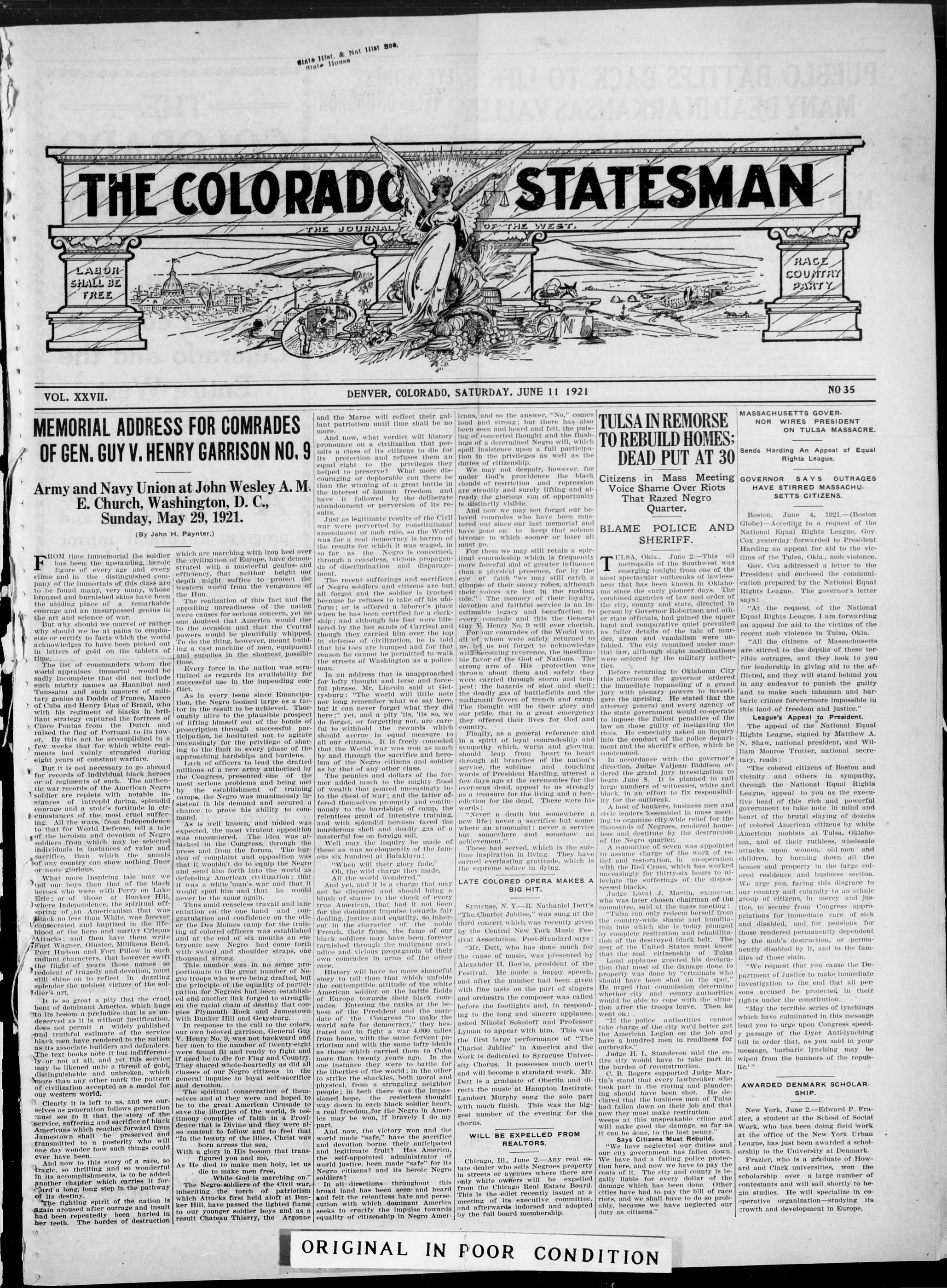
THE COLORADO STATESMAN
THE JOURNAL OF THE WEST.
LABOR SHALL BE FREE
RACE COUNTRY PARTY
MEMORIAL ADDRESS
OF GEN. GUY V. HEN
Army and Navy Union
E. Church, Wash
Sunday, Ma
(By John
MEMORIAL ADDRESS FOR COMRADES OF GEN. GUY V. HENRY GARRISON NO. 9
Army and Navy Union at John Wesley A. M. E. Church, Washington, D. C., Sunday, May 29, 1921.
(By John H. Paynter.)
FROM time immemorial the soldier has been the upstanding, heroic figure of every age and every clime and in the distinguished company of the immortals of this class are to be found many, very many, whose bronzed and burnished skins have been the abiding place of a remarkable courage and an unsurpassed genius in the art and science of war.
But why should we marvel or rather why should we be at palms to emphasize or certify to facts which the world acknowledges to have been picked out in letters of gold on the tablets of time.
The list of commanders whom the world appraises immortal would be sadly incomplete that did not include such mighty names as Hannibal and Toussaint and such masters of military genius as Dodds of France, Maceo of Cuba and Henry Diaz of Brazil, who with his regiment of blacks in brilliant strategy captured the fortress of Cinco Ponts from the Dutch and raised the flag of Portugal to its tower. By this act he accomplished in a few weeks that for which white regiments had vainly struggled during eight years of constant warfare.
But it is not necessary to go abroad for records of individual black heroes or of regiments of such. The authentic war records of the American Negro soldier are replete with notable instances of intrepld daring, splendid courage and a stole's fortitude in circumstances of the most cruel suffering. All the wars, from Independence to that for World Defense, tell a tale of the heroism and devotion of Negro soldiers from which may be selected individuals in instances of valor and sacrifice, than which the annals of any country can show nothing finer or more glorious.
What more inspiring tale may we tell our boys than that of the black heroes who were with Perry on Lake Erie; or of those at Bunker Hill, where Independence, the spiritual offspring of an Americanism that was Black no less than White, was forever consecrated and baptized in the life-blood of the hero and martyr Crispus Attucks; and then have them write Fort Wagner, Olustee, Millikens Bend, Port Hudson and Fort Pillow in such radiant characters, that however swift the flight of years those names so redolent of tragedy and devotion, must still shine on to reflect in dazzling splendor the noblest virtues of the soldier's art.
It is so great a pity that the cruel bent of dominant America, which hugs to its bosom a prejudice that is as undeserved as it is without justification, does not permit a widely published and truthful estimate of the service black men have rendered to the nation as its associate builders and defenders. The text books note it but indifferently or not at all, and yet this service may be likened unto a thread of gold, distinguishable and unbroken, which more than any other mark the pattern of civilization accepted as a model for our western world.
Clearly it is left to us, and we ourselves as generation follows generation must see to it that the story of the service, suffering and sacrifice of black Americans which reaches forward from Jamestown shall be preserved and transmitted to a posterity who will one day wonder how such things could ever have been.
And now to this story of a race, so tragic, so thrilling and so wonderful in its accomplishments, is to be added another chapter which carries it forward a long, long step in the pathway of its destiny.
The fighting spirit of the nation is again aroused after outrage and insult had been repeatedly been hurled in her teeth. The hordes of destruction
VOL. XXVII.
which are marching with iron heel over the civilization of Europe, have demonstrated with a masterful genius-and efficiency, that neither height nor depth might suffice to protect the western world from the vengeance of the Hun.
The realization of this fact and the appalling unreadiness of the nation were causes for serious concern, yet no one doubted that America would rise to the occasion and that the Central powers would be plentifully whipped. To do the thing, however, meant building a vast machine of men, equipment and supplies in the shortest possible time.
Every force in the nation was scrutinized as regards its availability for successful use in the impending conflict.
As in every issue since Emancipation, the Negro loomed large as a factor in the result to be achieved. Thoroughly alive to the plausible prospect of lifting himself out of the bonds of proscription through successful participation, he hesitated not to agitate unceasingly for the privilege of sharing to the limit in every phase of the approaching hardships and burdens.
Lack of officers to lead the drafted millions of a new army authorized by the Congress, presented one of the most serious problems and being met by the establishment of training camps, the Negro was unanimously insistent in his demand and secured a chance to prove his ability to command.
As is well known, and indeed was expected, the most virulent opposition was encountered. The idea was attacked in the Congress, through the press and from the forum. The burden of complaint and opposition was that it wouldn't do to equip the Negro and send him forth into the world as defending American civilization; that it was a white man's war and that it would spoil him and that he would never be the same again.
Thus amid ceaseless travail and humiliation on the one hand and congratulation and confidence on the other the Des Moines camp for the training of colored officers was established and at the end of six months an embryonic new Negro had come forth with sword and shoulder straps, one thousand strong.
This number was in no sense proportionate to the great number of Negro troops who were being drafted, but the principle of the equality of participation for Negroes had been established and another link forged to strengthen the racial chain of destiny that couples Plymouth Rock and Jamestown with Bunker Hill and Getsyburg.
In response to the call to the colors, our own beloved garrison, General Guy V. Henry No. 9, was not backward and her men to the number of twenty-eight were found fit and ready to fight and if need be to die for Flag and Country. They shared whole-heartedly as did all classes of our Negro citizens in the general impulse to loyal-sacrifice and devotion.
The spiritual consecration of themselves and al they were and hoped to be to the great American Crusade to save the liberties of the world, is testimony complete of faith in a Providence that is Divine and they were also content to follow and to feel that "In the beauty of the lilies, Christ was
born across the sea,
With a glory in His bosom that trans-
figured you and me.
As He has done unto holy, let us
dia to make, men free.
While God is marching on." The Negro soldiers of the Civil war, inheriting the torch of patriotism which Attucks first held aloft at Bunker Hill, have passed the lighted flame to our younger soldier boys and as a result Chateau Thierry, the Argonne
DENVER, COLORADO, SATURDAY, JUNE 11 1921
and the Marne will reflect their gallant patriotism until time shall be no more.
And now, what verdict will history pronounce on a civilization that permits a class of its citizens to die for its protection and refuses them an equal right to the privileges they helped to preserve? What more discouraging or deplorable can there be than the winning of a great battle in the interest of human freedom and have it followed by the deliberate abandonment or perversion of its results.
Just as legitimate results of the Civil war were perverted by constitutional amendment or mob rule, so the World was for a real democracy is barren of the results for which it was waged, in so far as the Negro is concerned, through a ceaseless, vicious propaganda of discrimination and disparagement.
The recent sufferings and sacrifices of Negro soldiers and citizens are but all forgot and the soldier is lynched because he refuses to take off his uniform; or is offered a laborer's place when he has been certified for a clerkship; and although his feet were blistered by the hot sands of Carrisal and though they carried him over the top in defense of civilization, he is told that his toes are humped and for that reason he cannot be permitted to walk the streets of Washington as a police man.
In an address that is unapproached for lofty thought and terse and forceful phrase, Mr. Lincoln said at Gettysburg: "The world said little note nor long remember what we say here, but it can never forget what they did here;" yet, and a pity 'tis, 'tis so, we do forget, or forgetting not, are careful to withhold the rewards which should accrue in equal measure to all our citizens. It is freely conceded that the World war was won as much by and through the sacrifice and heroism of the Negro citizens and soldier as by that of any other class. The pennies and dollars of the former added much to the mighty flood of wealth that poured unceasingly into the chest of war; and the latter offered themselves promptly and continuously to the hardships of camp, the relentless grind of intensive training, and with splendid heroism faced the murderous shell and deadly gas of a masterful foe on foreign soil. Well may the inquiry be made of these as was so eloquently of the famous six hundred at Balaklava: "When will their glory fade,
And yet, and it is a charge that may not be disputed and should bring a blush of shame to the cheek of every true American, that had it not been for the dominant impulse towards fair dealing, justice and equality, so inherent in the character of the noble French, their fame, the fame of our black soldiers may have been forever tarnished through the malignant prejudice and vicious propaganda of their own comrades in arms of the other race.
History will have no more shameful story to tell than that which unfolds the contemptible attitude of the white American soldier on the battle fields of Europe towards their black comrades. Entering the ranks at the behest of the President and the mandate of the Congress "to make the world safe for democracy," they hesitated not to fight a war 4,000 miles from home, with the same fervent patriotism and with the same lofty ideals as those which carried them to Cuba more than twenty years ago. In the one instance they were to battle for the liberties of the world; in the other to strike the shackles, both moral and physical, from a struggling neighbor people; in both there was the impassioned hope, the resistless thought way down in each black soldier heart, a real freedom for the Negro in America may be won, if bravely I do my part.
And now, the victory won and the world made "safe," have the sacrifice and devotion borne their anticipated and legitimate fruit? Has America, the self-appointed administrator of world justice, been made "safe" for its Negro citizens? and its heroic Negro soldiers? In all directions throughout this broad land has been seen and heard and felt the relentless hate and persecution with which dominant America seeks to crucify the impulse towards equality of citizenship in Negro Amer-
ians, and so the answer, "No." comes loud and strong; but there has also been seen and heard and felt, the pulsing of concerted thought and the flashings of a determined Negro will, which spell insistence upon a full participation in the privileges as well as the duties of citizenship.
We may not despair, however, for under God's providence the black clouds of restriction and repression are steadily and surely lifting and already the glorious sun of opportunity is distinctly visible.
And now we may not forget our beloved comrades who have been mustered out since our last memorial and have gone on to keep that solemn bivouac to which sooner or later all must go.
For them we may still retain a spiritual comradeship which is frequently more forceful and of greater influence than a physical presence, for by the eye of faith "we may still catch a glimpse of their snowy robes, although their voices are lost in the rushing tide." The memory of their loyalty, devotion and faithful service is an inestimable legacy and benefaction to every comrade and this the General Guy W. Henry No. 9 will ever cherish.
For our comrades of the World war, all of whom were safely returned to us, let us not forget to acknowledge with becoming reverence, the inestimable favor of the God of Nations. The strong arm of His protection was thrown about them and safely they were carried through storm and tempest; the hazards of shot and shell; the deadly gas of battlefields and the malignant fevers of trench and camp. The thought will be their glory and our pride, that in a great emergency they offered their lives for God and country.
Finally, as a general reference and in a spirit of loyal comradeship and sympathy which, warm and glowing, should leap from heart to heart through all branches of the nation's service, the sublime and touching words of President Harding, uttered a few days ago at the ceremonies for the over-seas dead, appeal to us strongly as a treasure for the living and a benediction for the dead. These were his words:
"Never a death but somewhere a new life; never a sacrifice but somewhere an atonement; never a service but somewhere and somehow an achievement."
These had served, which is the sublime inspiration in living. They have earned everlasting gratitude, which is the supreme solemn in dying.
LATE COLORED OPERA MAKES A BIG HIT.
Syracuse, N. Y.—R. Nathaniel Dett's "The Charlot Jubilee," was sung at the third concert which was recently given by the Central New York Music Festival Association. Post-Standard says: "Mr. Dett, who has done much for the cause of music, was presented by Alexander H. Bowie, president of the Festival. He made a happy speech, and after the number had been given with fine taste on the part of singers and orchestra the composer was called before the footlights and, in responding to the long and sincere applause, asked Nikolai Sokoloff and Professor Lyman to appear with him. This was the first large performance of "The Charlot Jubilee" in America and the work is dedicated to Syracuse University Chorus. It possesses much merit and will become a standard work. Mr. Dett is a graduate of Oberlin and directs the music at Hampton Institute. Lambert Murphy sang the solo part with much finish. This was the biggest number of the evening for the chorus.
WILL BE EXPELLED FROM REALTORS.
Chicago, Ill., June 2.—Any real estate dealer who sells Negroes property in streets or avenues where there are only white owners will be expelled from the Chicago Real Estate Board. This is the edict recently issued at a meeting of its executive committee, and afterwards indorsed and adopted by the full board membership.
TULSA IN REMORSE TO REBUILD HOMES; DEAD PUT AT 30
Citizens in Mass Meeting Voice Shame Over Riots That Razed Negro Quarter.
BLAME POLICE AND SHERIFF.
TULSA, Okla., June 2—This oil metropolis of the Southwest was emerging tonight from one of the most spectacular outbreaks of lawlessness that has been known in Oklahoma since the early pioneer days. The combined agencies of law and order of the city, county and state, directed in person by Governor Robertson and other state officials, had gained the upper hand and comparative quiet prevailed as fuller details of the tale of murder, arson and vandalism were unfolded. The city remained under martial law, although slight modifications were ordered by the military authorities.
Before returning to Oklahoma City this afternoon the governor ordered the immediate impaneling of a grand jury with plenary powers to investigate the uprising. He stated that the attorney general and every agency of the state government would co-operate to impose the fullest penalties of the law on those guilty of instigating the riots. He especially asked an inquiry into the conduct of the police department and the sheriff's office, which he condemned.
In accordance with the governor's direction, Judge Valjean Biddison ordered the grand jury investigation to begin June 8. It is planned to call large numbers of witnesses, white and black, in an effort to fix responsibility for the outbreak.
A host of bankers, business men and civic leaders assembled in mass meeting to organize city-wide relief for the thousands of Negroes, rendered homeless and destitute by the destruction of the Negro quarter.
A committee of seven was appointed to assume charge of the work of relief and restoration, in co-operation with the Red Cross, which has worked unceasingly for thirty-six hours to alleviate the sufferings of the dispossessed blacks.
Judge Loyal J. Martin, ex-mayor, who was later chosen chairman of the committee, said at the mass meeting:
"Tulsa can only redeem herself from the country-wide shame and humiliation into which she is today plunged by complete restitution and rehabilitation of the destroyed black belt. The rest of the United States must know that the real citizenship of Tulsa. Loud applause greeted his declaration that most of the damage done to property was done by "criminals who should have been shot on the spot." He urged that commission determine whether city and county authorities would be able to cope with the situation after the troops leave. Then he went on:
"If the police authorities cannot take charge of the city we'd better get the American Legion on the job and have a hundred men in readiness for outbreaks."
Judge H. L. Standdeven said the entire city would have to take part in the burden of reconstruction.
C. B. Rogers supported Judge Martin's stand that every lawbreaker who took part in the rioting and plundering should have been shot. He declared that the business men of Tulsa had fallen down on their job and that now they must make restitution. weeps at this unspeakable crime and will make good the damage, so far as it can be done, to the last penny."
Says Citizens Must Rebuild.
"We have neglected our duties and our city government has fallen down. We have had a failing police protection here, and now we have to pay the costs of it. The city and county is legally liable for every dollar of the damage which has been done. Other cities have had to pay the bill of race riots, and we shall have to do so probably, because we have neglected our duty as citizens."
NO35
MASSACHUSETTS GOVERNOR WIRES PRESIDENT ON TULSA MASSACRE.
Sends Harding An Appeal of Equal Rights League.
GOVERNOR SAYS OUTRAGES HAVE STIRRED MASSACHUSETTS CITIZENS.
Boston, June 4, 1921.—(Boston Globe)—Acceding to a request of the National Equal Rights League, Gov. Cox yesterday forwarded to President Harding an appeal for aid to the victims of the Tulsa, Okla., mob violence. Gov. Cox addressed a letter to the President and enclosed the communication prepared by the National Equal Rights League. The governor's letter says:
"At the request of the National Equal Rights League, I am forwarding an appeal for aid to the victims of the recent mob violence in Tulsa, Okla.
"All the citizens of Massachusetts are stirred to the depths of these terrible outrages, and they look to you for leadership in giving aid to the afflicted, and they will stand behind you in any endeavor to punish the guilty and to make such inhuman and barbaric crimes forevermore impossible in this land of freedom and justice."
League's Appeal to President.
The appeal of the National Equal Rights League, signed by Matthew A. N. Shaw, national president, and William Monroe Trotter, national secretary, reads:
"The colored citizens of Boston and vicinity and others in sympathy, through the National Equal Rights League, appeal to you as the executive head of this rich and powerful government to take note in mind and heart of the brutal slaying of dozens of colored American citizens by white American mobists at Tulsa, Oklahoma, and of their ruthless, wholesale attacks upon women, old men and children, by burning down all the homes and property in the large colored residence and business section. We urge you, facing this disgrace to our country and calamity to an ethnic group of citizens, in mercy and justice, to secure from Congress appropriations for immediate care of sick and disabled, and for pensions for those rendered permanently dependent by the mob's destruction, or permanently disabled by it, and to the families of those slain.
"We request that you cause the Department of Justice to make immediate investigation to the end that all persons accused be protected in their rights under the constitution.
"May the terrible series of lynchings which have culminated in this message lead you to urge upon Congress speedy passage of the Dyer Anti-lynching bill in order that, as you said in your message, 'barbaric lynching may be wiped from the banners of the republic.'"
AWARDED DENMARK SCHOLARSHIP.
New York, June 2.—Edward P. Frazier, a student at the School of Social Work, who has been doing field work at the office of the New York Urban League, has just been awarded a scholarship to the University at Denmark. Frazier, who is a graduate of Howard and Clark universities, won the scholarship over a large number of contestants and will sail shortly to begin studies. He will specialize in cooperative organization—studying its growth and development in Europe.
PUEBLO BATTLES BACK TO LIFE MANY DEAD IN ARKANSAS VALLEY
AMITY, SEVEN MILES WEST OF HOLLY REPORTED WIPED OUT BY RIVER FLOOD.
ROCKY FORD, MANZANOLA, PROWERS, LAS ANIMAS, GRANADA, SWINK AND LAMAR HARD HIT.
Denver, June 7.—In addition to the dreadful reports on the damage at Pueblo, comes the harrowing stories of other points along the wake of the flood waters that rushed down the Arkansas river, leaving death and destruction in its path. The little city of Amity was practically wiped off the map and the residents were compelled to seek safety and shelter in the higher ground south of the valley. It is feared that four lives were lost at that point.
The water struck La Junta Sunday afternoon in a depth of three feet all over the north side of the city, cutting off the water supply and lighting system. The river at this point was reported nearly two miles wide. The Santa Fé railroad shops were at one time in five feet of water and the entire transportation system of that line from Pueblo to Syracuse, Kansas, is paralyzed. Santa Fé passenger trains are being detoured north around via McPherson over the Union Pacific, and coast bound trains via Amarilla, Texas across the cut-off line in New Mexico. At least 200 residences in Las Animas stood in three feet of water for several hours at the height of the flood.
several hours at the height of the flood.
At Lamar the river was reported
nearly three miles wide and reached
well into the town, which is situated on
the south side of the river just where
the higher land begins to raise out of
the river bottoms.
Pueblo is already started digging
back to life. Digging out is the only
thing the town thinks about. It has
crowded into the background the
search for the dead. Until the waters
recede and many districts are drained,
casualty hunts cannot be prosecuted
with any degree of success.
The downtown districts are above the water again and every available man and tool is engaged in the work of cleaning. Caterpillar tractors are transported dead horses from the flooded districts. Slips pulled by four-horse teams are scraping the mud from streets and bridges which are sagging under the extra weight. Every available man is working with hands or pick or shovel. A house-to-house canvass is being made for scrub women. The salvage of wrecked mercantile stores has begun.
Denver, June 6.—Friday, June 3, was a dark day in the history of Pueblo, Colorado's second city. Flood waters from the Arkansas and Fountain rivers devastated the business and lower residence sections of the town, sweeping away hundreds of houses and causing great loss of life. Reports to date show property loss will run into millions, while constantly dead bodies are found, until the death roll shows upwards of 200. Flood waters fill a large portion of the city, and Saturday and Sunday as they receded new horrors were revealed. In some places the water was reported seventeen feet deep.
Pubio's union depot was in the center of the flooded area, which reached from the high cliffs on which the better residence portion of the city is located at Seventh street to west of the station. Practically all in that lower section is destroyed. From Friday night to Sunday the city was without light or water, street cars stopped, fires became frequent and with no chance to fight them, soon consumed many business and residence blocks. The flood was augmented by a second cloudburst Saturday which wrought greater havoc. Sunday, with the breaking of Beaver dam, eight miles north of Florence, and a terrific cloudburst about 3 p. m., the stricken city is in a most pitiful condition. The Arkansas river rushed down again and the receding waters were given fresh impetus. It is impossible to tell the extent of this dire disaster.
Pueblo is under martial law, the Colorado National Guard and Colorado Rangers being in complete control of the city. Looters have been arrested by the dozen and several shot. Armies of rescuers worked day and night to save persons caught in the flood and who could not reach safety before the great nine-foot wall of water struck the city.
Denver & Rio Grande train No. 3 and Missouri Pacific train No. 12 were caught in the flood and both turned turtle. As each carried numbers of passengers, it is not now known how many perished.
Railroad and wagon bridges are out north, south and west of Pueblo, and it is difficult to get relief to the stricken city. Denver sent a special train of clothing, food, blankets and other necessary equipment Saturday night. Red Cross nurses and helpers accompanied this train with a full supply of emergency material. The Sal-
vation Army, Fitzsimons Hospital, Fort Logan and many others put forth every effort to supply necessaries for the thousands of homeless. Forty-one undertakers from Denver took special train for Pueblo Sunday morning to assist in caring for the deed. Trinidad sent a carload of provisors, Victor, Colorado Springs and other towns responded nobly to the call of the distressed city.
Governor Shoup took up his residence at Colorado Springs in order to be as near the scene of disaster as possible. First hand reports to him by Representative Iver Daley and State Pure Food Inspector W. F. Cannon on Sunday morning shows that the total number of dead would never be known, that scores of bodies will never be found, either because they are buried under tons of sand or destroyed in some of the fires that raged, and caused this statement to be issued by the governor:
"The Pueblo flood is much worse than the disaster attending the earthquake and fire in San Francisco. The exact number of dead may never be known. Scores of bodies may never be recovered."
Every possible assistance has been rushed to Pueblo in an effort to relieve the situation as much as possible.
Congress Votes Aid to Sufferers.
Washington.—A joint resolution was adopted by the House and the Senate authorizing the secretary of war to extend all possible relief to Colorado flood sufferers. Previously Senator Philps of Colorado had announced he and Representative Hardy would seek an appropriation of $1,000,000 for flood relief. The resolution reads: "That the secretary of war is hereby authorized and directed to take such temporary sanitary measures as he may deem necessary and to furnish subsistence and quartermaster supplies belonging to the military establishment and make available and issue the same to such destitute persons in Colorado as have been rendered homeless or are in needy circumstances as the result of the floods due to the overflow of the Arkansas river and its tributaries and in executing this joint resolution the secretary of war is directed, in so far as possible, to co-operate with the authorities of Colorado and the mayors of such cities on the Arkansas river as may have sustained damages."
Rich Pueblo Man Killed.
Pueblo, Colo.—Ernest E. Withers, one of the most prominent men of Pueblo, was killed by an unidentified guard at Grand avenue and Eighth street. Capt. Arthur Talbott in charge of that district, has American Legion men, National Guardsmen and others searching for the slayer. Mr. Withers and his son, Granville, were in an automobile driving out Grand avenue, according to Granville. At Eighth avenue a man on guard called "Halt!" and, said Granville, he shot immediately, although Mr. Withers was obeying the order. Mr. Withers was shot through the head and crumpled dead at the wheel.
Enormous Property Damages
Millions of dollars of farm property was lost in the flood of the Arkansas river. From Pueblo east to the Kansas line on both sides of the river, entire farms are devastated. Houses, fencing, machinery and stock all swept on by the raging waters. It is thought that many people may have perished on the farms and the lowlands of the valley along the river, but the exact number will not be known for some time. Nearly ever town in the Arkansas valley suffered more or less damage and loss to property and life.
Wrecker Reaches Pueblo
A wrecking crew and wrecker reached Pueblo Tuesday by alternating from Santa Fé to D. & R. G. tracks back and forth replacing and repairing tracks and bridges. The wrecker carried three baggage conches and a caboose filled with medical supplies, clothing, tents, blankets and other necessities. Among the passengers were twelve Red Cross nurses from Denver. The wrecker is expected to work its way through to La Junta to open the Santa Fé railway for traffic as son as possible.
Two Millions Railroad Damage.
List of Destroyed Business Houses. Pueblo.—Thirty Pueblo business firms have been totally destroyed by the flood. Many of them lie in ruins. Others have been swept away altogether. But two are covered by flood insurance. The list of businesses considered a total loss follows: Watkins Hat and Clothing Shop; Griffin Style Shop; Gross and Wildin; Barnheim Outfitters; Dean-Creeal Furniture Company; Rosen's Clothes Shop; Palace Drug Store; McCarthy Embalming Parlors; Prior Furniture Co.; Western National Bank; Hawkins-White Furniture Co.; Kress 10-cent Store; United Cigar Store; Dixon and Miller; Seilers Confectionery; Knibel Sporting Goods Company; Penter Cigar Company; White-Davis Clothing Company; F. W. Woolworth 10-cent Store; Ellington Café; Rushmer Jewelry Store; Hosman Drug Company; R. T. Frazer Saddlery; Cotting Brothers' Furniture Store; West Bros., Jr., Furniture Store; Dixon-Stump Bottling Company; Kniebel Bottling Company; Jack Gray, barber; H. B. King Commission Company; Hinckle-Duke Mercantile Company; Colorado Bedding Company; Brinkley-Douglas Fruit Company; Forbush Ice Company; Straub Trunk Company, destroyed by fire; King Investment Company, burned; offices of the Arkansas Valley Railroad, Light and Power Company; Pueblo Savings Bank; Crews-Beggs Dry Goods Company; Taub Brothers Haberdashery; Winch-Slayden Stationery Company; Tom Brown Shoe Store; Churchill Jewelry Company; Pueblo Carriage Company; Pueblo Auto Company; Newton Lumber Company. One entire city block, between First and Second streets on Santa Fé was entirely destroyed, every building being demolished. Between Third and Union streets on Santa Fé, Main and Court streets, buildings were completely destroyed.
Pueblo Menaced by Filth.
Colorado Springs.—A special dispatch from Pueblo says: "Shrouded in inky blackness, only relieved by an occasional flicker of a blazing building, Pueblo people have gathered for the fight to overcome the disaster which nearly overwhelmed it Friday night with a loss to property conservatively estimated at between $10,000,000 and $15,000,000 and a casualty list set now at not less than 500.
"The most serious problem facing the smelter city is that of sanitation, according to Robert Gast, chief of the sanitation commission of the Pueblo chapter of the Red Cross, who has issued an urgent appeal for aid.
"Pueblo's $1,000,000 courthouse houses 600 homeless. The schools, churches, public buildings and hundreds of private homes are housing countless others left destitute by the flood. The destitute are being fed at the rate of 600 an hour by the Red Cross, which has nobly responded to the tremendous demands for assistance. But despite the well-organized efforts to take care of its unfotunates, the city must have outside aid and at once.
Las Animas Flooded.
Las Animas, Colo.—Four Mexicans are reported drowned, houses in the lower section of the city swept from their foundations and the entire city was surrounded by waters ranging in depth from one to six feet. Residents fleeing from the residential districts of the city to the hills. Owing to flooding of the lighting plant the city was in darkness, adding to the terror of the people. The sugar factory here has been flooded out and water reached a depth of six feet in the company offices and throughout the plant. The bridge over the Arkansas river here was washed out. All telephone lines were carried away. The river is swollen and has overflowed its banks. The four Mexicans reported drowned are sugar factory employés who were in the company houses near the plant. They did not heed warnings of the oncoming flood. It is feared others may have perished in the wall of water which struck the city late in the evening.
Latest Report on Death Toll.
The death toll of the flood waters which swept the northern, eastern and southern sections of Colorado continue to mount as more complete reports are received from inundated portions of the state. The total number of dead stand at 573 at last reports. Several towns where devastation is thought to have been terrific were still unheard from, owing to crippled communication lines and disrupted rail traffic. The towns and cities in which casualties resulted from the flood waters, and the number of dead, are as follows: Pueblo, estimated, 500; Swink, estimated, 10; Avondale, 20; Boone, 20; St. Charles Mesa, 10; La Junta, 7; Sterling, 4; Longmont, 1; Denver, 1.
Brooklin, Mass.,—Brig. Gen. John W. Ruckman, 63, in command of the North Atlantic artillery district, is dead. He had served in Cuba, in the Philippines, on the Texas border in 1916, and during the World war he held the rank of major general in the national army
HOUSES TOPPLE OVER FILLED WITH WOMEN AND CHILDREN.
Devastation Wrought by Fire and Water at Pueblo Beyond Description.
(Western Newspaper Union News Service.)
Colorado Springs.-The devastation wrought by fire and flood at Pueblo is beyond description, according to C. S. Railsback, formerly of this city, now special agent of the Santa Fé at Pueblo.
Mr. Railsback made his way to Colorado Springs by special Santa Fé motor car in an effort to get into communication with La Junta over the Union Pacific wires to order a special relief train to the scene of the disaster.
"Hundreds of lives were lost and millions of dollars in property were destroyed," said Railsback. "The main business district of the city gutted by fire and water, and it probably never will be known how many hundreds of people perished.
"The entire residence districts in several of the lowlands were completely wiped out. I spent the entire night, with hundreds of others, rescuing women and little children from the flood, and my mind is so befuddled that I can badly talk about the thing. It was horrible beyond description.
"I saw several frame rooming houses topple over, plunge into the raging torrent, each filled with screaming women and children. The scene was sickening."
Mr. Railsback said at one time there was fifteen feet of water running through the Santa Fé yards. In fact, the yards were completely destroyed.
To add to the horror of the flood, fires broke out all over the city, not only in the business district, but in many residence sections.
The largest business houses of the city, including the big banks, Crews-Beggs, White & Davis, Straub's trunk factory, the King lumber yard and many others were wrecked by water or completely destroyed by fire, according to Railback.
The river broke over its banks near the state insane asylum, and soon there was a raging torrent from the high cliffs to the west of the union depot to Seventh street.
U. S. Asked for $5,000,000 Aid.
Colorado Springs.—Governor Shoup is asked to appeal to the federal government for an appropriation of $5,000,000 of which $2,000,000 may be immediately available, in a telegram received at his home from James L. Lovern, president of the city council of Pueblo, Frank S. Hong, chairman levee repair committee; E. E. Withers, president Pueblo waterworks; C. K. McHarg, president Arkansas Valley Ditch Association.
The text of the message follows:
"Hon. Oliver H. Shoup, governor
Colorado Springs:
"Late estimates of total property and crop damage between Cañon City and state line, is from fifteen to twenty million dollars. Damage in Pueblo city and county alone will total six to eight million dollars. Federal government expends millions of dollars to improve and repair levees in all sections of the country. We now ask for government to appropriate sum of $5,000,000, of which the sum of $2,000,000 may be immediately available for purpose of repairing and improving Arkansas river and Fountain river levees and removing debris from cities damaged, of which Pueblo should have at least one and one-half million dollars immediately. Impossible to ascertain loss of life, owing to impossibility of removing debris without great financial assistance, but Pueblo alone will show several hundred people drowned when debris is removed."
Platte River Goes Over Banks.
The flood gates of Bergen and Harriman lakes above Denver were raised to allow the flood waters to escape down the Platte river, that the dams could take care of the extra water let loose by the breaking of the Beaver dam. This caused the river to overflow its banks in Denver and a near panic ensued when the police sent out warning to people living along the low land next to the river. No loss of life was reported and all danger was soon over. The police of the city used every precaution to see that no one was allowed to cross any of the bridges which the raising water was threatening. The water in some instances running within two feet of the floors of the bridges.
Nearly 100 families around Jerome Park and in the Valverde districts were compelled to seek higher ground. Two to four feet of water standing in the houses in that district.
Train Turned Over.
The overturning of a Denver & Rio Grande passenger train with 150 passengers on board in the railroad yards at Pueblo is the outstanding disaster of the storm as far as railroad traffic is concerned. The passengers were removed to the Nuckolls Packing plant, where physicians hastily summond attended to the injured. The train left Denver carrying 150 passengers, largely excursionists to the Pacific coast.
---
COLORADO STATESMAN
The Mouth-Piece of the People of Colorado and the Entire West
RELIABLE chronicle of their doings and progress; a faithful mirror of their wants, their hopes, their best aspirations.
THE COLORADO STATESMAN
Unequaled as an advertising medium for the business of professional men and women.
An excellent family journal speaking to and for many thousand colored citizens.
$2.50 A YEAR
FOREIGN
The Hochi Shimbun's Harbin correspondent says that the Bolshevists, who are preparing to evacuate Khabarovsk, capital of the maritime province of Siberia, shot 100 political offenders in jail there.
The first submarine ever constructed in Spain was launched at Cartagena. The vessel's displacement is 713 tons and her calculated speed submerged is nine miles an hour and surface speed sixteen miles.
The peace treaty with Hungary, which was signed June 4, 1920, in the Trianon Palace at Versailles, and is known as the "trealty of Trianon," was ratified at Paris by the chamber of deputies. The vote on ratification was 478 in favor to 74 against.
Dr. V. K. Wellington Koo, Chinese representative in the League of Nations, has notified the secretary of the league that it is the intention of the Chinese government to give effect to the league assembly's recommendation concerning limitation of expenditure on armaments.
The naval ministry of Japan has ordered the withdrawal of the garrisons in the islands of the South Pacific, including the Island of Yap, leaving the protection of the islands, including the wireless installation in Yap, to the police force attached to the civil administration.
Major General Joseph Hummel, formerly of the Austrian army, and eleven other ex-officers, who were placed on trial before a special court in Vienna on the charge of having committed treason in connection with the recent attempt of former Emperor Charles to regain the Hungarian throne, have been acquitted.
Drastic steps have been taken in Kattowitz, Silesia, by leaders of Polish insurgents to prevent plundering. Firing squads have been busy every morning and several times recently six men have been executed at one time for various reasons. In spite of the severe discipline, the Poles continue rioting, and are reported to have robbed food convoys.
Lieutenant Neumann of the German navy, charged with sinking the British hospital ship Dover/Castle, in which many lives were lost, has been acquitted in Leipzig by the special courts trying Germans accused of violating the rules of warfare. Admiral Scheer, who commanded the German fleet in the battle of Jutland, had maintained that Neumann, a U-boat commander, was merely obeying orders in sinking a ship in a part of the Mediterranean which Germany had declared closed to craft of that class.
GENERAL
Denzel Chester has been acquitted by a jury in Kansas City, Mo., of the murder of Miss Florence Barton. The jury was out only twenty minutes. The former German passenger liner Kaiser Wilhelm II, has been renamed President Harding, it was announced at New York by officials of the United States Mail Steamship Company. Mrs. Ethel Hutchins Nott, on trial at Bridgeport, Conn., charged with the murder of her husband, George B. Nott, pleaded guilty to murder in the second degree. Judge Maltble sentenced her to life imprisonment.
A great meeting of the representatives of all the railway unions affected by the wage cut decision of the railway labor board to be held in Chicago June 27 and 28 it has been announced. At that meeting the unions will give their answer to the $400,000,000 wage cut and in all probability the question of strike or work will be decided there.
Resumption of building activities in Chicago, which have been halted for many weeks by wage disputes between the building contractors and the unions, is believed imminent as the result of an agreement to arbitrate the dispute. Building contracts representing expenditures of approximately $100,000,000 hinge on successful adjustment of the dispute.
Anders Gustaf Nelson, son-in-law of Senator Knute Nelson, charged with shooting to death Joseph Middelton, a farm hand, in March, 1920, was found guilty of manslaughter in the first degree by a jury at Fergus Falls, Minn.
Between 7,000 and 10,000 workmen will be re-employed in the Northern Pacific and Great Northern railroad shops, officials announced at St. Paul, Minn. The men will be called back to work July 1. The decision is a direct result of the wage reduction, said a Northern Pacific official.
Two Mexicans and three negroes have been arrested in Des Moines by Sheriff Robb as suspects in the murder of Miss Sara Barbara Thorsdale. One of these was Tom Willis, 40-year-old negro, who had been camping on the Raccoon river near where the teacher's body had been found.
Recent passage of the congressional deficiency appropriation measure by the Senate will provide for the early return to duty of all federal dry agents and inspectors. According to the present status of affairs, all government agents temporarily relieved from duty because of lack of funds will be placed back on duty soon.
With thousands gathered along the bench, Jack Murphy of Haverhill, known as "Daredevil Jack," jumped with a parachute from his airplane at Sailsbury Bench, Mass., landed in the ocean a considerable distance from shore and was drowned in the view of a big crowd.
Carlbou and native reindeer are reported ranging the hills like droves of sheep in full view of Dawson, Y. T. As it is calving the herds are not allowed to be molested, and instead of shooting with a gun the citizens of Dawson are "shooting" with a camera.
THE WORLD IN PARAGRAPHS
A BRIEF RECORD OF PASSING EVENTS IN THIS AND FOR-EIGN COUNTRIES
IN LATE DISPATCHES
IN LATE DISPATCHES
DOINGS AND HAPPENINGS THAT
MARK THE PROGRESS
OF THE AGE
WESTERN
Mrs. C. M. Hyland of Palmer, Neb. died at Omaha from a bullet wound inflicted by one of three highwaymen who attempted to rob her, her brother-in-law, James Kane of Omaha, a former member of the Omaha Western League baseball club, and Kane's wife. The robbers escaped.
Approximately 10,000,000 acres of wheat will be harvested in Kansas this year, J. C. Mohler, secretary of the State Board of Agriculture, estimated. This is 900,000 acres more than estimated in the board's report of May 20, which was based on incomplete assessors' returns of March 1.
Placing of an order for 10,000,000 pounds of copper wire by the Pacific Gas and Electric Company of San Francisco has been announced. It was said to be the largest single order for copper wire ever made. The wire will be shipped from Black Eagle, Mont., it was said, and will require 270 railroad cars for transit.
A steam shovel got tangled with high power wires while at work at Portland, Ore., causing the scoop to fall and crush to death Edward Peterson, a workman, and seriously injured two others. F. A. Harmon, engineer, was hurled off his feet and the scoop, released from control, fell and pinioned the three men who were welding picks.
Hordes of ants, driving upward from the earth through mud tubes, are threatening destruction to the $100,000 Exchange building at the stockyards at Wichita, Kan. Oak lumber stored under the building has been practically consumed and the ants have driven their way up along pipe lines to the woodwork of the west end of the structure, which they have tunnelled as far as the second floor.
The stain of illegitimacy was removed from the name of 6-year-old Eugene Sorini of San Francisco through a blood test performed by Dr. Albert Abrams, noted scientist, who developed the electronic method of determining race and parentage by blood vibration tests. Eugene's mother, now Mrs. Marie Delsecco, had sworn that the child, although born during the period of her married life with Julius Sorini, was not a son of Sorini's.
WASHINGTON
Contentions of the Western Union Telegraph Company that it cannot be held liable for damages caused through errors in transmitting messages while its lines were under government control were upheld by the Supreme Court. A decision of South Carolina courts, awarding damages to S. B. Poston, a cotton dealer, on this ground, was reversed.
The United States Steel Corporation answered the citation of the federal trade commission with a categorical denial of alleged unfair practices charged by independent steel producers. The corporation admits in its answer, however, that it controls 125 steel plants, 45 per cent of the output of semi-finished rolled steel and 47 per cent of the crude steel.
The Supreme Court in Washington has ordered the United Shoe Machinery case, the original suit between Wyoming and Colorado, and a number of others "restored to the docket for reargument before a full court."
Two thousand railroad workers and their sympathizers held a demonstration at Raton, N. Mex., in protest against the recent nation-wide reduction in wages. After a parade, a mass meeting was held, at which the open-shop movement was attacked.
Inauguration of the administration's policy for refunding most of the $7,500,000,000 short-dated debt has been announced by Secretary Mellon, with a combined offering of $500,000,000 of three-year $5 per cent treasury notes and one-year $5½ per cent treasury certificates, both dated June 15.
Everybody's spending money shrank by $1.99 during the past year, according to the monthly circulation statement issued by the treasury. On June 1, 1920, per capita circulation in the country was $57.42, compared with $55.43 on June 1, 1921. In the same period the total money in circulation dropped from $6,102,162,244 to $5,983,258,293.
A joint resolution designed to prevent wholesale importation of foreign goods preliminary to the enactment of a tariff law by congress, has been introduced by Chairman Little of the House committee on revision of laws. It would authorize the President to limit importations for ninety days.
Hugh R. Robertson, United States district attorney for the western district of Texas, has been removed from office by President Harding, it was announced at the Department of Justice. No reason was assigned for the removal it was said.
ORIGINAL IN FOOR CONDITION
Pithy News Notes
From All Parts of
Colorado
(Western Newspaper Union News Service.)
COUNTY FAIR DATES, 1921.
Tri-County Fair, Denver, Aug. 16-19.
Morgan County Fair, Fort Morgan,
Aug. 24-26; W. J. Ott, secretary.
Arkansas Valley Fair, Rocky
Aust. 30-Sep. 2; J. L. Miller, secretary.
Washington County Fair, Akron, Aug.
31-Sept. 2; Joe K. Powelson, secre
tary
Tilley County Fair, Cripple Creek, Sept.
6. 5. D. J. Tipton, secretary.
Larimer County Fair, Loveland, Sept.
5-9. J. W. Thompson, secretary.
Boulder County Fair, Longmont, Sept.
13-17. Harry E. Niven, secretary.
Phillips County Fair, Holyoke, Sept.
Routt County Fair, Hayden, Sept.
14-16. B. T. Shelton, secretary.
Logan County Fair, Sterling, Sept.
13-16. C. J. Funk, manager.
Saguache County Fair, Saguache, Sept.
15-17. William Felliers, secretary.
Western Slope Fair, Montrose, Sept.
Adams County Fair, Brighton, Sept.
20-23; George R. Smith secretary,
Ireland County Fair, Brighton, Fair,
Grand Junction, Sept. 20-23.
Weld County Fair, Greesley, Sept. 21-23.
Courtney County Fair, Goodpasture, Sept.
22-23; Fred Lyle, secretary, Pueblo.
Yuma County Fair, Yuma, Sept. 21-24;
W. W. Williams, secretary.
Del Norte Fair, Del Norte, Sept. 21-23
Crowley County Fair, Sugar City, Aug.
25-26; R. A. Hamilton, secretary.
Colorado State Fair, Pueblo, Sept. 26-
30; J. L. Beaman, manager.
Delta County Fair, Hotchkiss; A. N.
Minton, secretary.
Huerfano County Fair. Walsenburg.
Oct. 4-6; James E. Tressler, secretary.
Kit Carson County Fair. Burlington.
Oct. 5-8; J. M. Herner, secretary.
Cheyenne County Fair, Cheyenne
Wells, Sept. 20-21-22-23; Carroll Brown,
Sec.
El Paso County Fair, Calhan, Oct. 6-8;
D. E. Nance, secretary.
The House of Representatives in Washington has passed a resolution changing the name of the Grand river in Colorado and Utah to the Colorado river.
Florence seemed to be in the direct path of the recent terrific cloudburst and hailstorm. There was no loss of life but property damage will reach into the hundreds of thousands, it is estimated.
Just north of Berthoud the last of the series of cloudbursts that swept Colorado broke and flooded the business section of the city. Damage to the crops in that vicinity will run up into several thousands of dollars.
Fully thirty houses were washed from their foundations and some of them carried several hundred yards on the crest of the flood that descended on Erie as the waters in Coal creek raised during the recent cloudburst.
Mrs. A. J. McLaughlin was killed by the discharge of a shotgun in the hands of the 4-year-old son of W. J. Thompson, a garage man, at Klim. Mrs. McLaughlin was one of the pioneer settlers of eastern Las Animas county.
Cripple Creek powder dealers have announced a drop of $1.75 per 100 pounds on powder and $1.25 per 1,000 for caps. Powder is now selling at $18.50 per 100 pounds. Powder reached the high peak here two years ago, when it sold for $26.75.
Cannon City and vicinity, although hard hit by the big storm, did not fare as badly as other places further down the Arkansas valley. There was no loss of human life, so far as known, but considerable livestock was killed. Many farms and truck gardens were ruined so far as this year's crops are concerned.
A memorial hall to cost $65,000 is to be erected at the Modern Woodmen sanitarium, fifty miles north of Colorado Springs, within the next year as a monument to the 2,000 members of the order who lost their lives in military service during the World's war. The names of these men will probably be cast in a succession of bronze tablets, which will be placed in the building.
All of the civic organizations of Boulder are working hard on a plan for a Fourth of July celebration that will eclipse anything of its kind ever held north of Denver. Different parts of the general program have been assigned to civic organizations in an effort to secure their support and a friendly rivalry that will make the celebration a great success. Company M, 177th infantry, Colorado National Guard, with Nelson D Wells of Fort Morgan as captain, has been given federal recognition by the war department. In a short time a local armory costing $30,000 will be built by the state and will be fully equipped in every way for the company, which comprises nearly seventy-five men and officers.
The Pueblo county commissioners have adopted resolutions providing for a severe fine for physicians in the county who treat contagious diseases without reporting those cases to proper authorities. The action was taken after reports had been received to the effect that many physicians in county districts were not observing the law which provides for filing of such information.
One of the first things to come before the Colorado Springs City Council as an actual city manager municipality will be a proposed ordinance regulating air traffic over the city. Members of the council are said to favor a law prohibiting stunt flying of any kind and fixing a given height at which all planes may fly over the city.
George H. Walton, 54 years old, said to be a retired jeweler of Lancaster, Pa., dropped dead of heart disease as he was climbing Green Mountain on the way to Royal Arch, a scenic spot two miles from Boulder.
Charles Hayes of Mancos has returned after an exploration trip into the region north of the Navajo mountains. He reports the discovery of some of the most marvelous ruins ever seen by a white man. Where the Navajo mountains break away into deep canons that open into the San Juan and Colorado rivers the ruins were found in almost every canon, many of them of good size and some even better preserved than those of the Mesa Verde National Park. The section where these ruins were found is almost inaccessible except to a person on foot.
Paul Jones, a confectioner, while playing on the links at Fort Morgan, missed the ball in a stroke and fractured his right arm, being the only case of its kind on record, according to golf authorities. Jones made a particularly heavy swing for a drive, but missed the ball and swung himself half around by the force of the delivery. A sharp pain in his right arm caused him to groan and the arm hung limp at his side. Other players came to him and it was seen that his arm was fractured.
Spawning crews of the State Fish Department are busy at Electra lake, where they expect to gather 1,000,000 eggs before the season closes. They are hindered by high water. The principal spawning ground is at the mouth of Elbert creek, where it empties into the lake. The creek has been very high with the result that only 500,000 eggs have been gathered, whereas the spawners expected to be able to gather 2,000,000.
Two more companies of Colorado National Guard have been granted federal recognition by the War Department. The companies and the officers are as follows: Company M, infantry, Fort Morgan, Nelson D. Wells, captain; Floyd F. Fine, first lieutenant; Samuel C. Crawford, second lieutenant. Company A, infantry, of Craig, Frank D. Miller, captain; Ralph B. Yoder, first lieutenant; Curtis N. Chapman, second lieutenant.
Lieut. E. E. Bowers of the United States air service and C. L. Talmadge, formerly of the Royal air corps of Great Britain, had a narrow escape from death when attempting to make a forced landing near the outskirts of Colorado Springs. The plane landed in a tree, tearing off the wings and running gear and disabling the engine. The landing is said to have been forced by running out of fuel.
Quo warranto proceedings in which the election of the mayor and four of the six members of the city council of Englewood are being contested have been filed in the District Court at Littleton. The contests are brought on the ground that the nominating petitions of the successful candidates were insufficient, in that the signers of the petitions did not make the oath required by law.
An issue of $75,000 first mortgage bonds was authorized at a special meeting of the Loveland Canning Company. The issue is to prepare the company for handling the large fruit crop expected this season. W. C. Vorelter, A. V. Benson, John R. Handy, Hugh Scilley and G. A. Benson were named as a board of directors, and plans were made for handling 1,500,000 pounds of cherries alone this season. Colorado ranks third in a list of twenty-one states in the matter of business recovery, according to a survey just completed by the National Industrial Council, of which the Colorado Manufacturers' Association is a unit. Taking Feb. 1, 1920, as 100 per cent, the production of Colorado industries on Feb. 1, 1921, is given as 82 per cent. Only California and Texas show higher percentages of production.
Walter McAfee, a farmer near Wiggins, may lose his eye through an odd accident. He was repairing a fence when a staple glanced and struck him in the eye, cutting a deep gash.
All old Missourians, native born or former residents, are invited to a great birthday party in Sedalia August 10 in celebration at the Missouri State Fair of the 100th anniversary of the admission of the state into the union. This big birthday party is being arranged by the Sedalia Chamber of Commerce, and Secretary M. V. Carroll writes that every old Missourian will be welcomed.
Because the city council did not feel financially able to make a contract with the Loveland band for free concerts this year, the citizens have taken it up and are making a collection to provide the funds. The Rotary Club has pledged $250 of the $1,000 necessary, the Lions Club has appointed a committee to solicit funds, and several individuals have contributed from $5 to $10 each.
Several hundred Indian arrowheads have been stolen from the Agricultural College museum at Fort Collins. No value has been placed on the collection in the report to the sheriff, as the relics cannot be replaced, and are of great value as a collection, but have little intrinsic value. No trace of them has as yet been found.
Edward Timmon, 48 years old, proprietor of the Manhattan cafe of Fort Morgan, was seriously injured while plastering a room of a house in that city. The scaffold broke, throwing Timmons to the floor, a distance of ten feet, bruising him severely and injuring him internally. The graduating class of the University of Colorado law school contained two women, and the medical school, an equal number. The lawyers are Marjorie Stratton of Hillrose and Helen Hulburt of Fruita. The doctors will be Marle Keim and Margaret Bryson
Night and Day Cafe
MRS. LENA WALTON, Proprietor.
Best Meals in town at the lowest prices. Special prices for club dinners and parties. Meet your friends here after the dance or theater. All Kinds of Salads and Sandwiches Served.
FISH AND OYSTERS IN SEASON.
PHONE ORDERS PRO
SPECIAL SUN
PHONE ORDERS PROMPTLY ATTENDED TO.
SPECIAL SUNDAY DINNERS
Phone Main 4843
J. GIBSO
Art
1638 Tremont St.
C. V. FAIRBANKS
C. V. FAIRBANKS —Props.— N. FAIRBAN
Fairba
Hotel a
Cafe
(Formerly Barnes
FIRST CLASS
MEALS SERVED
HOME COOKING
2716 Welton St., Der
WESTERN
STERN BEEF
WESTERN BEEF CO.
Open Daily to 830 p. m.
Sundays Until 2:00 p. m.
Fresh Oysters, Chitterlings, Pigs
Bones, Spare Ribs
Fresh and Cured Meats of All K
Fancy
Our Prices Are A
Free Delivery to A
Phone C
2048 LARIMER STREET
Opposite th
A FULL
Black and W
Ane a Full Line of MME. C.
BUT WE KNOW
Jones West Ha
Atlas
Mrs. Chitterlings, Pig Tails, Snouts, Ears, Pip
Bones, Spare Iibs Received Fresh Daily.
Furred Meats of All Kinds.. Fresh Vegetable
Fancy Groceries.
Prices Are Always the Low
Free Delivery to All Parts of the City.
Phone Champa 1641.
MIER STREET DEN
Opposite the Three Rules.
A FULL LINE OF
Black and White Remedies
Line of MME. C. J. WALKER'S To
BUT WE KNOW YOU WILL LIKE
Lines West Hair Pomade B
Atlas Drug C.
St Ph
NBERRY TAXI COMM.
Office 2741 Welton Street.
Fresh Oysters, Chitterlings, Pig Tails, Snouts, Ears, Pigs Feet, Neck Bones, Spare Ribs Received Fresh Daily.
Fresh and Cured Meats of All Kinds.. Fresh Vegetables, Staple and Fancy Groceries.
Black and White Remedies
Ane a Full Line of MME. C. J. WALKER'S Toilet Articles.
BUT WE KNOW YOU WILL LIKE
Jones West Hair Pomade Best.
Atlas Drug Co.
2701 Welton St Phone Main 875
GRANBERRY TAXI COMPANY
Office 2741 Welton Street.
GRANBERRY TAXI COMPANY Office 2741 Welton Street.
OFFICE PHONE CHAMPA 87
Quick and prompt Service Day and Night. Call Us for S
on Out-of-Town Trips.
Prompt Service Day and Night. Call Us for S
on Out-of-Town Trips.
Quick and prompt Service Day and Night. Call Us for Special Rates on Out-of-Town Trips.
For Ladies' and G
H AND
Cleaning, Pressing and
Guar
Ladies' and Gents' Tailoring,
H ANDERSON
ing, Pressing and Repairing. All
Guaranteed
For Ladies' and Gents' Tailoring, See
Cleaning, Pressing and Repairing. All Work
Guaranteed
Phone York 3786 720 EAST 26TH AVENUE
```markdown
```
PHONE MAIN 2807.
2701 Welton St
OFFICE
PHONE
CHAMPA
87
1865 CURTIS STREET.
N SMITH
Dealer
Art Dealer
—Props.— N. FAIRBANKS
Fairbanks Hotel and Cafe
(Formerly Barnes Hotel)
2716 Welton St., Denver, Colo.
```markdown
```
One of the Most Up-to-Date and Sanitary Markets in the City.
Tails, Snouts, Ears, Pigs Feet, Neck Received Fresh Daily.
Kinds.. Fresh Vegetables, Staple and Groceries.
Always the Lowest
All Parts of the City.
hampa 1641.
THE Three Rules.
L. LINE OF
White Remedies
J. WALKER'S Toilet Articles.
N YOU WILL LIKE
Hair Pomade Best.
Drug Co.
TAXI COMPANY
Welton Street.
Phone Main 3737
Satisfaction Guaranteed
THE NEW WAY SHOE
REPAIRING
C. C. Dennis, Proprietor
1855 CHAMPA STREET
Denver, Colo.
Gents' Tailoring, See
DERSON
d Repairing. All Work
guaranteed
720 EAST 26TH AVE.
Denver
N. FAIRBANKS
DENVER, COLO.
Phone Main 875
OFFICE
PHONE
CHAMPA
5960
THE COLORADO STATESMAN
CANTON SHALL BE FREE
THRACE COUNTRY PARTY
Entered as second-class matter at the postoffice in the City of Denver, Colo.
JOSEPH D. D. RIVERS.....Proprietor
P. O. Box 116 1824 Curtis Street, Room 25 Phone Main 7417
SUBSCRIPTION RATES
One year ..... $2.50
Six months ..... 1.50
Three months ..... .75
MUST BE PAID IN ADVANCE.
Reading notices, ten lines or less, 15 cents per line,
ten lines, 12 cents per line. Display advertising, 75
mention and 50 cents per inch for each additional insn.
Remittances should be made by express money or
car, registered letter or bank draft. Postage stamps
is as cash for the fractional part of a dollar. Only
No discounts allowed on less than three months' c
ompany all orders from parties unknown to us. Fur-
tion.
Communications to receive attention must be new,
plainly written only upon one side of the paper, no
possible, anyway not later than Wednesdays, and be
borrow. No manuscript returned, unless stamps are
communications of a personating nature that are not
held from the columns of this paper.
Reading notices, ten lines or less, 15 cents per line. Each additional line over ten lines, 12 cents per line. Display advertising, 75 cents per inch for first insertion and 50 cents per inch for each additional insertion.
Remittances should be made by express money order, postoffice money order, registered letter or bank draft. Postage stamps will be received the same as cash for the fractional part of a dollar. Only 1c and 2c stamps taken.
No discounts allowed on less than three months' contract. Cash must accompany all orders from parties unknown to us. Further particulars on application.
Communications to receive attention must be neway, upon important subjects, plainly written only upon one side of the paper, must reach us Tuesdays, if possible, anyway not later than Wednesdays, and bear the signature of the author. No manuscript returned, unless stamps are sent for postage. All communications of a personating nature that are not complimentary will be withheld from the columns of this paper.
LIVE WITH A HOPE.
WE CANNOT help from expressing our gladness at results of our pupils of the grammar and high sion just ended. Parents and friends ought to much achievements of their offsprings, which should are efforts.
All have done so remarkably well that we would like. Those who are aspiring for great things, be far distant when Nature and Nature's God will our progressiveness that "of one blood all men w face of the earth."
WE CANNOT help from expressing our gladness at the educational results of our pupils of the grammar and high school during the session just ended. Parents and friends ought to be doubly encouraged by such achievements of their offsprings, which should lend a stimulus for future efforts.
All have done so remarkably well that we would not dare to individualize. Those who are aspiring for great things, be hopeful, as the time is not far distant when Nature and Nature's God will demonstrate the fact by our progressiveness that "of one blood all men were made to dwell on the face of the earth."
Keep it up and go on conquering to conquer.
SOMETHING over two weeks ago a ship landed at the harbor loaded with bodies of American soldiers in battlefields of France. President Harding was charged to the heroic dead, and in offering tender triumphs, he explored the awful toll of American lives, and said, "IT MUST NOT HAPPEN AGAIN."
How earnestly do we wish that the nation's Chief of the Navy be able to cross the continent a few days later, and look out upon a scene of death, death, and opened his heart of hearts and declared, "IT MUST NOT AGAIN."
The utterly reprehensible outbreak of race hatred or evidence of the thin veneering over our boasted one-half be true that is told of the savagery enacted at Tulsa, then man is not so far removed from our have thought. Mobs usually are formed by a direct interest in the elements of right or wrongly to satisfy an unnatural desire to inflict such agony. The mob spirit runs rampant and the cry for the death of its haunted victims. In the Tulsa peaceful and reckless destruction of property by fire and murder. Pillaging and looting followed in the hope neither excuse nor tolerance for such an outrageable stain upon any city where it holds so directly good authority that the decent, self-respectful were in no way responsible for the mob; that training force and did all in their power to aid thou never, the fact remains that many human lives, action and distress heaped upon thousands of his hatred engendered that will never be eradicated alongside of Waco, Atlanta, East St. Louis and others." We tremble to think where it will next hear a voice from on high, "IT MUST NOT HAPPEN."
TULSA.
SOMETHING over two weeks ago a ship landed at the pier in New York harbor loaded with bodies of American soldiers who had fallen on the battlefields of France. President Harding was on hand to pay due homage to the heroic dead, and in offering tender tribute to their memories he deplored the awful toll of American lives, and said, amid emotion and tears, "IT MUST NOT HAPPEN AGAIN."
How earnestly do we wish that the nation's Chief Executive could have traveled half way across the continent a few days later, stopped at Tulsa, Oklahoma, and looking out upon a scene of death, destruction and violence, again opened his heart of hearts and declared, "IT MUST NOT HAPPEN AGAIN."
The utterly reprehensible outbreak of race hating in Tulsa is but another evidence of the thin veneering over our boasted Christian civilization. If one-half be true that is told of the savagery enacted during the riotous scenes at Tulsa, then man is not so far removed from the brute element as we have thought. Mobs usually are formed by an element who have no direct interest in the elements of right or wrong in a given case, but merely to satisfy an unnatural desire to inflict suffering on a human being. The mob spirit runs rampant and the cry for blood does not end with the death of its haunted victims. In the Tulsa case a wanton, disgraceful and reckless destruction of property by fire followed in the wake of murder. Pillaging and looting followed in the wake of both. There can be neither excuse nor tolerance for such an outbreak, and it leaves an irremovable stain upon any city where it holds sway. It is said upon perfectly good authority that the decent, self-respecting, law-abiding white people were in no way responsible for the mob; that they were in fact a restraining force and did all in their power to aid those who suffered losses. However, the fact remains that many human lives were snuffed out, destruction and distress heaped upon thousands of helpless victims, and a race hatred engendered that will never be eradicated. Tulsa takes her place alongside of Waco, Atlanta, East St. Louis and other "chamber of horrors." We tremble to think where it will next occur. We wish we could hear a voice from on high, "IT MUST NOT HAPPEN AGAIN."
THE PUEBLO DISASTER.
WHAT "one touch of sorrow makes the whole city aptly illustrated in the terrible disaster that over the past week. A destructive flood such as those have never before known swept over the northern part of the state, carrying death and destruction. We swept away, towering business blocks crumbling company entering the city was paralyzed. To add to the light and power plants were utterly destroyed. Large city of 50,000 souls in complete and abysmal falling upon those fleeing to shelter, and for
THAT "one touch of sorrow makes the whole world kin" was most aptly illustrated in the terrible disaster that overtook Pueblo during the past week. A destructive flood such as the Rocky Mountain regions have never before known swept over the prosperous city in the southern part of the state, carrying death and destruction before it. Homes were swept away, towering business blocks crumbled, and every railroad company entering the city was paralyzed. To add to the horror, the water and light and power plants were utterly destroyed. Imagine, if you will, a large city of 50,000 souls in complete and abysmal darkness, a torrential rain falling upon those fleeing to shelter, and forked lightning playing upon a massive wall of water crushing through its principal streets. Imagine the shrill cries of distress and terror that arose amid the flying debris that meant death to all and to everything with which it came in contact, and you have a mental picture of Pueblo on Saturday and Sunday last. Yet hardly had the first news of this awful catastrophe flashed over the country until offers of aid came pouring in from every known quarter of the American continent. And just as the flood was no respecter of station, race or color, so has the proffer of aid been without the stint of race or nationality. The pangs of so great a sorrow has touched every heart; the cry of distress has been heard by all. The purse strings of the great American public have been loosened to the stricken city. Many of our own loved ones went to their death and family ties torn asunder that we have known and honored for a generation. Many others lost their all, though escaping with their lives. It is therefore with a feeling of pride that we note our people arising to the occasion with a spirit that becomes the true American citizen. Fraternal societies, clubs, churches and individuals are giving their mite freely. The destruction was great, the life and property losses appalling, but the Colorado Statesman sees a grander and better Pueblo arising from the ruins, just as did San Francisco, Galveston and other cities that have similarly suffered. Her spirit admits of no dismay!
CHEYENNE, WYO. NEWS
CHEYENNE, WYO. NEWS
THE wanton destruction of property in Tulsa, Oklahoma, Tues
erty in Tulsa, Oklahoma, Tuesday and Wednesday of last week was caused by an inefficient police department working in favor of vice and crime. For many years Tulsa has been a wide open town where the thug and leech are protected. Tulsa is the blackest page in the nation's history, and respectable citizens of every race blush with shame when her name is mentioned. The colored men were unorganized but fought bravely, man to man and gun to gun, they gave a good account of themselves. The white hoodlums were organized, and while their murderous brothers were fighting in the business district they burned the homes of peaceful colored citizens. Thus far in every race riot the colored man has not invaded respectable white neighborhoods and put the torch to it.
In a colored church in Charles street, Boston, Dec. 18, 1888, a prominent Catholic editor and Irish patriot prefaced the reading of a poem with a short speech in which he said: "The colored men have their future in their own hands; but they have a harder task before them than they had in 1860. It is easier to break political bonds than the bonds of ignorance and prejudice. The next twenty-five years can bring many reforms, and by proper training our colored fellow citizens may easily be their own protectors. They must, above all things, establish a brotherhood of race. Make it so strong that its members will be proud of it—proud of living as colored Americans, and desirous of devoting their energy to the advancement of their people."
Two years later, when the news of the butchery of eight black men at Barnwell, S. C., was received, following three or four other similar ghastly stories, he wrote:
"The black race in the South must face the inevitable, soon or late, and the inevitable is—Defend Yourself. If they shrink from this they will be trampled on with yearly increasing cruelty until they have sunk back from the great height of American freedom to which the war-wave carried them. On this continent there is going to be no more slavery. That is settled forever. Not even voluntary slavery will be tolerated. Therefore, unless the Southern blacks learn to defend their homes, women, and lives, by law first, and by manly force in extremity, they will be exterminated like the Tasmanian and Australian blacks. No other race has ever obtained fair play from the Anglo-Saxon without fighting for it, or being ready to fight. The Southern blacks should make no mistake about the issue of the struggle they are in. They are fighting for the existence of their race; and they cannot fight the Anglo-Saxon by lying down under his feet."
For such remarks as the above he was accused of inciting the Negroes by incendiary language, one Catholic paper telling him, "It is neither Catholic nor American to rouse the Negroes of the South to open and futile rebellion." He replied: True, and the Pilot has not done so. We have appealed only to the great Catholic and American principle of resisting wrong and outrage, of protecting life and home and the honor of families by all lawful means, even the extremest, when nothing else remains to be tried. We shall preach this always, for black and white, North and South, please God."
"God give us merit; a time like this demands
Tall men, sun crowned, who live above the fog
In public duty and in private thinking:
For while the rabble, with their thumbnail creeds.
Their large professions and their little deeds.
Mingle in selfish strife, lo! Freedom weeps,
Wrong rules the land, and Justice sleeps."
Frontier Lodge No. 285, I. B. P. O.
E. W., were gallant entertainers of
their wives and sweethearts at their
den on Wednesday evening, June 1. Refreshments were served, songs, speeches and dances were the pleasures of the evening.
Mrs. Myrtle Harris, evangelist, is conducting a successful revival at Allen Chapel.
Mrs. Shaw, mother of Mrs. E. W.
Wright, passed away on Thursday,
June 2. The deceased resided in Chicago.
At a regular communication of Western Star Lodge No. 6, F, & A, M, the following officers were elected for the ensuing year: George Randall, W. M.; Poole Turner, S. W.; Wm. Stanley, J. W.; Reuben Smith, treasurer; Spencer Cave, secretary; Wm. Benjamin, S. D.; George W. Carter, J. D.; Aaron Taylor, S. S.; Tilford Ashford, J. S.; Ben Davis, tiler; Walter Lofton, chaplin.
In the western part of the city several women have been molested by strangers. On Tuesday evening, about 7 e'clock, a prominent club woman had to run over the railroad embankment at Fifteenth and Snyder to protect herself from a man, who appeared to be a foreigner. We advise our women and girls to hurry to the nearest telephone when molested or when an indecent act is perpetrated on the public highway. Phone to Chief Embry's office and they will get protection.
This is the proper method to use for protection of our city. Our officers are quick to respond when called. Don't forget, call police at once.
The meeting of comrades called by Sergeant Major Randall, was postponed. The sergeant major has worked faithful to secure an out post for Corporal White Camp No. 4. The following comrades are enrolled; Henry McCormack, Jackson Lewis, Wm Christain, Frank McCombs, C. Dickerson, Wm. D. Witte, J. F. Floyd, Geo Randall, Geo. W. Carter, C. Taylor.
WOODLAND, CALIF., NEWS.
The Young People's Progressive Club with the B. Y. P. U. and Sunday School had a big picnic Saturday at Earnest's park, about seven miles west of Woodland. A beautiful place for a picnic, plenty of green grass and shade trees, good fishing and swimming places. A certain lady asked one of the boys that was fishing to let her fish a little with his hook. Of course the young man granted her request, and just as the lady had gotten hold of the pole a fish got on the hook, which she drew out. She created quite an excitement as she yelled: "I have caught a fish! I have caught a fish!" The little fish, about $2\frac{1}{2}$ in long dangled on the hook and the lady was afraid to take it off. Now, don't anyone surmise that this lady was Mrs. Muse, because she was at the picnic. Messrs. Wm. Keith and S. A. McCarthy favored the jolly picnickers with several selections on the guitar and mandolin. There were about 75 people present.
Mr. Ed. Gaither, president of the Y. P. P. C., is a live president and is bringing things to past.
Mesdames Bell Scrouggs and Gracie Jenkins of Sacramento were here Saturday visiting with their sister, Mrs. Ed. Gaither, and attended the picnic.
The Second Baptist Church enjoyed splendid services Sunday at both morning and evening. The pastor baptized Mrs. C. Miller at the morning service. Mrs. Miller was converted in the January revival meeting of this year. About a week after her conversion she underwent an operation and spent several weeks in the Woodland Sanitarium. She left here some time in March for Redding, Calif., where she visited with parents and friends while gaining her strength, returning to Woodland Saturday and was baptized Sunday.
Mrs. Muse had a very timely program arranged for the missionary society Sunday night. Mrs. C. C. Mansfield read a paper on mission work. It was well gotten up and was full of good thoughts.
Mrs. J. H. Wilkinson, the faithful little soul, was at her best when she sang a beautiful solo.
The choir also rendered excellent music.
The pastor preached the mission sermon, which was enjoyed by an unusually large audience. A number of white people were present.
Mrs. Ed. Mansfield, president of the missionary society, gave a few well chosen remarks at the close of the sermon and then lifted the offering, assisted by Mrs. Wm. Ramus.
Miss Zolla Chavers of Fresno, Calif., departed Monday after a ten days' visit with her sister, Mrs. C. C. Mansfield.
Mrs. Mansfield accompanied her as far as Oakland, where they both will visit for a few days.
Mrs. L. O. Gatther of Esparto was in Sacramento Monday and had her little daughter Thelma's eye operated upon. It is said that Thelma was not in the least nervous and went through the operation fine. Mrs. O. H. Earl was also in Sacramento Monday.
Mr. James Longrus, one of the city mail carriers, and wife, departed Tuesday for Oakland, where they will spend their summer vacation.
COLORED LAD RECEIVES MEDAL FOR SONG.
Washington.—Master Lenoir Cook, a colored boy of Washington, D. C., was presented with a handsome diamond set in platinum by an unknown young white woman after he had finished singing "Mammy" by special request at the Convention for Amity Between the White and Colorado Races which was recently held in this city. The song was written by the boy's uncle, William Marion Cook, and was dedicated to the latter's mother, whom the family all called "Mam." The lyrics were written by Lester A. Walton of New York City.
SIX NEGROES UNDER DEATH SEN-
TENCE GET STAY OF
EXECUTION.
Little Rock, Ark., June 9.—The six Negroes sentenced to die in the electric chair Friday for complicity in the 1919 Elaine race riots were granted a stay of execution Thursday pending the outcome of habeas corpus proceedings in the Pulaski chancery court.
The Negroes are convicted specifically of the murder of Clifton Lee, World war veteran.
W. K. HUNT
CHAMPA 3522 2962 WELTON
CORN-FED MEATS
Retail Staple and Fancy Groceries
Fruits and Fresh Vegetables of All Kinds
THE FOLD WALL PORCH O. PAINTER
THE COLORADO
CABINET
& TINSEL
KNOW WHAT IS GOING ON Every Home Needs the BEST NEGRO WEEKLY PAPER and the LEADING MONTHLY MAGAZINE
The Colorado Statesman, per year..... $1.50
The Competitor (National Magazine), per year..... 1.00
Regular rate for both, per year..... 4.50
You keep abreast of the times and save..... 2.00
Please send me THE COLORADO STATESMAN and THE COMPETITOR for one year. I enclose herewith the combination subscription price of $2.50.
HOW WHAT I DO
Every Home
NEGRO WEE
and the
LONG MONTH
We Offer
Statesman, per year
or (National Maga-
rate for both, per ye-
ast of the times an
COLORADO S
THE COUPON BEL
end me THE COL
ETITOR for one y
subscription price
Yours very
Name .....
Street and number
Town.....
.....
....
THE COLORADO STATESMAN
Mrs. L. McGwin left for Chicago this week.
Edward Beckwith, who has been in California several months, returned home last Thursday.
Mrs. Ada Williams, who formerly lived at 2115 Champa street, is now located at 2550 Lawrence street.
RESCUED TWICE FROM WATER ONCE FIRE, NEGRO WOMAN COMES TO LIFE IN MORGUE.
Pueblo, Colo., June 7.—Rescue twice from water and once from it pulled from the flood waters as d and taken to a morgue and laid am corpses, Mary McAllister, Negro wan of Pueblo is in a hospital reco
Mrs. S. Summerville, 719 East 24th Avenue, entertained several ladies at whist last Saturday afternoon. All present spent a very enjoyable afternoon.
Arrivals at Fairbanks Hotel: Mr. J. D. Mayberry, El Reno, Okla.; Mr. L. F. Manning, Los Angeles, Calif.; Mr. B. Hobbs, Mr. C. R. Learner, Kansas City, Kans.; Mr. J. C. Williams, New York City.
Miss G. Mabelle Andrews, teacher in the high school of Tulsa, Okla., arrived home Saturday, June 4, to spend the summer with her parents, Mr. and Mrs. S. A. McGuire, of 1625 East Thirty-fourth avenue.
Dr. C. F. Holmes will be out of the city the week of June 13 to attend the State Dental Convention and to take a post-graduate course at Colorado Springs. Upon his return he purposes to remain open until 11 p. m. of evenings.
Mrs. Augustus Morris of 2244 Washington street, who was in the flooded district in Pueblo, wishes to inform her friends through the Colorado Statesman that she is safe and doing nicely.
Mrs. Amanda Rolley, a resident of Denver for thirty-five years, died at home, 2560 Clarkson street, Tuesday at noon, after an illness of several weeks. Funeral was held at 2 p. m. Friday from Campbell A. M. E. Church, Rev. L. S. Wilson officiating. Interment in family plot at Idaho Springs. Mrs. Rolley leaves three daughters and several grandchildren, besides a host of friends, to mourn her loss.
ON TO SHORTER A. M. E. CHURCH
SUNDAY, 8:15 P. M.,
JUNE 12.
BIG MASS MEETING IN BEHALF OF THE TULSA RIOT VICTIMS AND THE PUEBLO FLOOD SUFFERERS—MISS MABEL ANDREWS, A TEACHER FROM TULSA, WILL SPEAK.
UNDER THE AUSPICES OF THE LOCAL BRANCH OF THE N. A. A. C. P. AND THE DENVER COLORED CIVIC ASSOCIATION A BIG RACE MASS MEETING is called for the purpose of raising funds to aid the TULSA RIOT VICTIMS and the PUEBLO FLOOD SUFFERERS. All the ministers of the city and their churches have united to make this a most impressive meeting.
Miss Mabel Andrews of Denver and a teacher in Tulsa will address the mass meeting and give an actual account of the riot. Rev. I. S. Wilson, pastor of Campbell A. M. E. Church, will speak of the Pueblo flood and the conditions there as he saw them. Dr. J. H. P. Westbrook, chairman of the committee on resolutions, will present our protest against the Tulsa riot. This will be a peaceful, solemn mass meeting on Sunday night, and every red-blooded Negro citizen should be present. (Signed) GEO. W. GROSS, President, Local Branch N. A. A. C. P. THOS. CAMPBELL, President The Denver Colored Civic Association.
NOTICE.
The Ozonized Ox Marrow Company who manufacture Ford's Hair Pomade, Ford's Royal White Skin Lotion, Ford's Skin Oil, O. O. M. Soap, Ford's Hair Straightener and Shampoo combs and alcohol stoves for heating combs, the largest and most complete line of race toilet articles in the world, having manufactured this line for sixty-three year, have now moved to Warsaw, Ill., to enlarge their business and better serve the people. Through the courtesy of this paper they wish to thank their many readers for past patronage, and assure them that they are ever ready and willing to serve them at any and all times. Don't forget to send for the Home Study Course free, how to take care of your hair and skin at home.
OZONIZED OX MARROW COMPANY, Warsaw, Illinois.
RESCUED TWICE FROM WATER,
ONCE FIRE, NEGRO WOMAN
COMES TO LIFE IN
Pueblo, Colo., June 7.—Rescued twice from water and once from fire, pulled from the flood waters as dead and taken to a morgue and laid among corpses, Mary McAllister, Negro woman of Pueblo, is in a hospital recovering from the night of horror Friday. T. C. McCarthy, undertaker, was preparing to embalm the body when he observed slight signs of life. With assistants he worked over her until she was revived. With another Negro woman, unidentified, she was taken from the second story of her home in the flood district by two men in a boat. It capsized with the swift current, according to the story told to the Associated Press by J. T. McCorkle, Pueblo business man.
Though one arm is withered, the woman managed to grasp an electric wire and hung there until rescued by Joseph B. Roberts and Charles E. Wayland. Roberts is president of a land company and Wayland is secretary of the Fulton Ice Company. The other woman was rescued from a tree top, but as the McAllister woman was being pulled into the light skiff it also capsized. The unidentified woman was drowned but Roberts and Wyland pulled the other to a roof. They remained there until flames from an adjoining lumber yard drove them back into the water and they were rescued a third time in a boat.
The struggles had exhausted the woman and she was believed dead and taken to a morgue. Her name was given out as one of the dead in the early lists, and through some oversight was not removed until today.
NEGRO FOUND GUILTY OF MURDERING GIRL.
Life Imprisonment Recommended for Boulder Porter Who Shot His Sweetheart to Death.
Boulder, Colo., June 8.—A verdict of murder in the first degree, with recommendation of life imprisonment, was returned by a jury in the District Court here today against Harry McReynolds, Negro porter. Formal sentence will not be pronounced until Friday by Judge Graham.
McReynolds, on May 9, shot his sweetheart, Avo Dirvin, an 18-year-old Prep school student after a quarrel. After the shooting he ran all the way to Denver, according to his own statement, and went into hiding at the home of friends.
The trial was followed by a crowd that packed the courtroom and the corridors of the building. McReynolds pleaded guilty, but the case had to be tried before a jury to determine the degree of murder. He declared that he had not intended to kill her and was sorry for his act. McReynolds is 22 years of age.
DOUGLASS UNDERTAKING CO.
Funeral Notices.
Marshall—Carl, 8 years; beloved son of Mrs. Katie Ford, departed this life June 2nd, at residence, 2252 Cleveland place. Funeral services were held at 2 p. m. Sunday, June 5th, from Douglass Chapel. Rev. D. E. Over officiated. Interment Riverside.
For Sale—House in Park Hill, five-room modern except heat. For sale by owner. Call York 1779.
NOTICE.
The regular meetings of the Universal Improvement Association and African Communities League will be held at the Mason's new hall, 280 Welton street, beginning Tuesday, May 3, at 8 o'clock. All persons are requested to note the change of meeting place.
PROCLAMATION OF THE PRESIDENT.
June 7, 1921. Overwhelming disaster has come upon the people of Pueblo and the surrounding district. Realization of their suffering now and in the days to some prompts me to issue an urgent request to all whose sympathies are awakened to assist the labors of the American Red Cross which has quickly organized to cope with the first great need and will stand by until homes and home life can be re-established there. Contributions may be sent at once through the office of any chapter or directly to Red Cross Headquarters at Washington for use in the stricken territory. WARREN G. HARDING.
The Joslin Dry Goods Co.
—The tiny baby boys will find a splendid assortment of little Wash Hats— there's one for every type of face—
—Dainty little Lingerie Hats for baby girls—pretty little styles and many dainty colors to match different color frocks..... $1.25 to $3
—Pretty little Mull and Organdie
Caps.....$1.00 to $2.50
—Colored Organdie Dresses for the little
2-year-olds; these have the prettiest
little ruffled skirts, at.....$6.50
—Gingham Creepers—Special. These
are plain colors, trimmed in tiny checks,
for babies 6 months to 2 years...$98c
—Topsy Turvy Dolls—the babies love
them—and they're unbreakable—two
dolls in one.....$95c
Silk Moire Bags at
$4.95
Just the kind of Bags most women
prefer for summer—light weight Silk
Bags. Regularly these are $5.95, $7.50
and $10.00.
Some have tassels; others are pouch
style. Black, brown, taupe and gray.
Each is fitted with swinging purse
and mirror.
---
---
PHONE MAIN 3270
Baby Shop News
75c to $1.50
Third Floor, Joslin's
First Floor. Joslin's
CHALLENGE anyone living to produce, invent or manufacture a preparation EQUAL to Hughes' Invincible "Hurler," a capsule for rheumatism. Manufactured and sold (price $1.04) by M. O'R. Hughes. The Metropolitan Pharmacy, 1201 Broadway, Denver, Colo.
Wonderful Pagoda
The great Shwy-Dagon, in Rangoon, whose fame in the world of Buddhism is great, has a gold-sheeted dome which cost $400,000 to gild. It is visible for miles, a tribute to the religious zeal of a former king.
PUBLIC TRUSTEE'S SALE.
2103.
Whereas, The said Adabelle Hegarty and all persons claiming by, through or under her, having defended the principal sum of six hundred sixty-six and 66/100 ($666.66 dollars, payable February 2, 1921, with interest thereon from maturity at the month and all of said notes having been declared due and payable by reason of such default; and the sum of one hundred ($100.00) dollars of trust, and the legal holder of said note, having elected on account of said default to declare said note unpaid, due and payable.
Now Therefore. At the written request of the S. DeHaas, the legal holder of said notes, pursuant to law, I, the undersigned, Public Trustee and for the City and County of Denver, Colorado, of hereby give notice to fill in the hour of 10 o'clock in the foremost of
TUESDAY, JUNE 14TH, 1921.
at the Tremont street front door of the Court House, in the City and County of Denver, Colorado, sell house, sell land, sell estate, best be bidder for cash, the said described premises, and all the right, title and interest of the said Adabelle L. Hegarty, her heirs and assists the living occupants of said deed of trust, and the cost and expenses of executing this trust, and will deliver to the purchaser a certificate of sale as provided by law.
Dated at Denver, Colorado, May 10th, 1921.
EDWARD M. SABIN,
Public Trustee in and for the City and County of Denver, Colorado.
First publication, May 14, 1921.
Last publication, June 11, 1921.
The Summer Wardrobe I
The Summer Wardrobe Is Scarcely Complete Without
A Separate Skirt and a Jersey Jacket
for baby
and many
ment color
5 to $3
s, at—
—And the women in search of a
Plaid Skirt of the better grades will
be interested in these. Fine all-wool
plaids—and stripes, in light weight.
—Splendid Skirts for sports, motor-
ing and general vacation wear.
$9.50
$9.50
$9.50
Separate Jersey Jackets
for the lit-
prettiest
$6.50
These
y checks,
...98c
bies love
bble—two
...95c
—Sports Jackets, pink
brown and black; for
—Every woman and
be splendid to wear
—Sports Jackets, pinch-back style with brown and black; for women and misses.
—Second P
Women's
—Sports Jackets, pinch-back style with patch pockets. Good Wool Jersey, in navy blue, brown and black; for women and misses. Special ..... $6.95
Every woman and girl likes to wear what be splendid to wear afternoons; they have
Third F
Lovely Lingerie Petticoats, $2.98
Fine, dainty white Petticoats adorned with frills and laces and embroideries, exquisitely designed. Some have beautiful inserts of organdle in the flounces, in a variety of delightful effects.
Regular prices $3.95 to $5.95.
Fourth Floor, Joslin's
---
A. E.
HARVEY G. WEBSTER
PATRIOTIC
SHOE SHINING PARLOR
1526 Welton St Phone Main 2196
St Phone Main 2196 Corner 15th and
RONIC GROUCHES
WHAT
YOU
NT?
1-1-WELL-
ER-SIR-
-1-1-
HRONIC GROUCHES
Jersey
its
patch-back style with patch pockets. Good Wood
women and misses. Special .....
—Second Floor, Joslin's—
Women's and Misses'
White Sea Island Pumps
girl likes to wear white pumps in the summer
eternoons; they have full Louis heels; sizes 2
Third Floor, Joslin's
---
Does your friend trade with us? If you as an invitation for him to know how to get ity goods. Free delivery to any part of the
PHONE YORK 9552. 718 E.
Does your friend trade with us? If not, read this advertisement as an invitation for him to know how to get our service and our quality goods. Free delivery to any part of the city.
Graduates---
For stylish young men. Suits which are acknowledged by dealers and wearers alike to be the world's best in quality and value. We are Denver agents.
Michaelson's
Corner 15th and Larimer Streets
ROUCHES
1-1-WELL-
ER-S(R-
-1-1-
WELL!-
STORE NEWS
be Is Scarcely Complete Without
with patch pockets. Good Wool Jersey, in navy blue,
misses. Special ... $6.95
Second Floor, Joslin's—
men's and Misses'
```markdown
```
ear white pumps in the summer time—and these will have full Louis heels; sizes 2 to 6 1/2.....$1.50
Bird Floor, Joslin's—
Cool Socks for the Little Kiddies
They have white legs with bright-colored cuff tops—the kind that sells regularly at 45c and 65c. Sizes 6½ to 9.
35c a Pair
3 pairs, $1.00
First Floor, Joslin's
HOWARD & HOWARD
Fresh Vegetables and Fruits Daily
your friend trade with us? If not, read this advertisement station for him to know how to get our service and our qual- Free delivery to any part of the city.
NEW YORK 9552. 718 E. TWENTY-SIXTH AVE.
ates---
insist upon
COLLEGIAN SUITS
$25
Prof.
W. M. Mackey
and Larimer Streets
WELL!-
I CAME IN TO
ASK FOR
A RAISE IN
SALARY-SIR-
SIXTEENTH AND CURTIS
718 E. TWENTY-SIXTH AVE.
FIRST CLASS TONSORIAL WORK
2244 LARIMER ST., DENVER
By Hendrix
WASHINGTON SIDELIGHTS
Mandate: New International Relation
Mandate: New International Relation
Eight Western States for Reclamation
Eight Western States for Reclamation
"Commerce the Lifeblood of a Nation"
GAME
SANCTUARY
WASHINGTON.—Senator Shields of Tennessee has introduced a bill in congress to establish a sanctuary or sanctuaries for game animals and for birds and fish in the national forest reserve. In introducing it he said, among other things:
Mr. Shields—There are a great many sanctuaries for game, or game preserves, established in the national parks of the United States in the Rocky Mountains and the Middle West which are accessible to the people of the states lying west of the Mississippi river and lying adjacent to the great Appalachian range. The act of congress passed in 1911, commonly known as the Weeks law, established forest reservations especially for the purpose of protecting the watersheds of the great navigable
WHAT is a mandate? The mandate is asserted by international lawyers to be a new principle in international relations. In theory a mandate is an order from a league of the civilized nations of the world to one of those nations, making it responsible for the welfare of a certain nation or piece of territory considered to be less civilized. The ideal of the mandate is that the civilized nations, instead of exploiting the backward ones, each as it can, should care for them and be responsible to the whole world for the results.
In practice a mandate is permission, given by the powers which won he late war to one of those powers, o supervise the affairs of some backward country. The mandatory nation enjoys certain advantages in that territory, but it also has certain responsibilities to the League of Nations, which, if enforced, would raise the development of backward countries to a higher level both from the economic and the humanitarian point of view. Of course, in this matter, everything really depends upon what the council of the league wants to do and is able to do.
The mandate also seeks to keep one nation from exploiting exclusively a backward territory, and to give
WE'RE FOR
RECLAMATION
MEASURES
GOVERNORS of western states, after a preliminary discussion in Denver of irrigation and reclamation legislation have presented to President Harding and members of congress the result of their conference. In the party were Gov. Thomas E. Campbell of Arizona, president of the League of the Southwest; Gov. D. W. Davis of Idaho, president of the Western States Reclamation association; Gov. Emmet D. Boyle of Nevada; Gov. Charles R. Mabey of Utah; Gov. Louis Hart of Washington and Gov. Joseph B. Dixon of Montana. Governors Shoup of Colorado and Mecham of New Mexico participated in the Denver conference.
"We present a 'solid front' to the powers in Washington for the first time in 18 years," said Gov. Davies. "We will, of course, use every
THE old axiom that "Commerce is the lifeblood of a nation" could be amended to read "and of its courts," according to attorneys of years' experience before the United States Supreme court.
Inquiry of a number of experts on constitutional law as to the section which has been productive of most litigation brought the unanimous response: "Article 1, section 8, paragraph 3." This section, one of the shortest in the Constitution, declares that congress shall have the power to "regulate commerce with foreign nations and among the several states."
From that brief clause, however, have arisen all the rate cases, those involving public utilities, the interstate commerce commission, child labor, federal employees' liability act, the lottery laws, the white slave act and, more recently, the numerous prohibition statutes preceding the amendment itself.
Chief Justice Marshall asserted in a judicial opinion that "commerce"
rivers which have their source in the Appalachian mountains by protecting the forests and restoring the deforested areas. The commission has purchased something short of 2,000,000 acres in those mountains, and the title is now vested in the United States and under the control of the Agricultural department. Of these 2,000,000 acres some 400,000 acres are located in New Hampshire, 387,000 in Virginia, 326,000 in North Carolina, 300,000 in Tennessee, 163,000 in Georgia, 130,000 in West Virginia, 130,000 in Pennsylvania, 62,000 in Alabama, 36,000 in Arkansas, 32,000 in Massachusetts and 19,000 in South Carolina. Eventually some 7,000,000 acres will be purchased.
These lands, while primarily purchased for the purpose of protecting the watersheds of navigable rivers, are also intended as recreation grounds for all the states lying east of the Mississippi river. I believe that it is of great importance and great interest to the people of all the states lying east of the Mississippi that further purchases be made for the original purposes provided in the Weeks law and that game sanctuaries be established upon them for the breeding and protection of game, birds and fish.
the other members of the league certain rights in it. But it does not do as much for the nations which are not members of the league.
The council of the League of Nations acknowledges three chief kinds of mandates. The A class mandates cover former Turkish possessions, including Mesopotamia. The B class mandates cover islands of the Pacific, south of the Equator, and the C class mandates cover islands in the Pacific, north of the Equator. The Palestine mandate is in a sense a fourth kind.
It is sometimes said that A, in mandatory language, stands for oil, and C stands for cables. In the administration of the B class mandate, therefore, if anywhere, will be seen exemplified that high international altruism which is supposed to be the motive of the mandate.
means to secure the fulfillment of the platform pledge of reclamation. Both of the big parties were pledged to the program. Our efforts probably will be centered on the Smith-McNary bill."
The Smith-McNary bill is known as the "co-operative reclamation act" and provides for the establishment of a $250,000,000 revolving fund for the construction of new irrigation projects and the completion of those already under way. One of its provisions requires the employment of former service men on reclamation projects erected from the fund. It also gives preference to service men on any lands made available through the reclamation act.
In addition the governors ask the early passage of a bill authorizing the appointment of a federal "ambassador" to participate in the compact proposed between the Colorado river basin states. This movement has the backing of the League of the Southwest. It is hoped to settle the long-standing disputes between the states over the use of the waters of the Colorado river for irrigation purposes. Settlement will save thousands of dollars to taxpayers in court litigation.
must be interpreted to mean "intercourse," and lawyers say his wide interpretation was the progenitor of the whole family of legal battles turning upon the commerce section.
Be that as it may, under recent decisions of the Supreme court, "commerce" has been interpreted to cover not only the movement of goods, but of men and women—as in the white slave act.
Within the last few weeks, no less than a dozen cases involving in some way the commerce section have beer docketed in the Supreme court.
LETS SENATORS HAVE THEIR WAY
PRESIDENT DOES NOT OPPOSE PEACE RESOLUTION, THOUGH IT DOESN'T MAKE PEACE.
HOLDS TREATY NECESSARY
Administration Makes It Plain That It Desires to Develop Its Policy Concerning Foreign Relations One Step at a Time.
Bv EDWARD B CLARK
Washington.—No doubt, if President Harding and Secretary of State Hughes followed their own inclinations they would say there is no necessity for passing a joint congressional resolution declaring that the United States and the central powers of Europe are no longer at war, but the senate for more than a year has been determined to send such a resolution through congress and so the attitude of the administration is to let the senate have its way. It is well understood that the administration view is that peace cannot be established by a joint congressional resolution; and if the wishes of the senate did not have to be taken into consideration the administration probably would propose that the whole situation be taken care of in the way provided by the Constitution, that is, by means of a treaty of peace.
Both President Harding and Secretary Hughes have made it plain recently that they do not want to appear as dictators before the legislative body, and they are expressing the hope that the house will compose whatever differences exist among the members as to the form the joint congressional resolution shall take, and that the senate and house shall settle whatever differences they may have as to the precise form of the resolution.
The point is that the administration does not feel that the passage of a joint resolution declaring a technical peace settles anything of consequence. The real problem of the administration is to bring about peace through the treaty process as provided in the Constitution, and if the passage of a so-called technical peace resolution will help open the way for the success of the program that is to be submitted later, well and good.
Even on the question as to whether the resolution shall repeal the declaration of war of April 6, 1917, it is possible that the administration will not feel called on to exert any influence. It can be stated authoritatively that if the administration felt that it would be wise for it to interfere it would advise that the declaration of war be not repealed.
One Step at a Time Enough.
Many indications of the desire of the administration to go along with congress and with the senate in dealing with foreign relations are noted. For instance, the administration is discouraging discussion at this time of the possibility of the United States' entering any sort of a league of nations. Such discussion, the administration feels, only tends to create friction. Obviously the thought of the President and the secretary of state is that each step shall be discussed as it is proposed. In other words, the administration would like to see the discussion limited to the step immediately under consideration.
That there is to be a gradual unfolding of the administration's policy is well understood. The next important step will be to determine whether the Versailles treaty shall be used as a basis for establishing peace with Germany, or whether it will be necessary to negotiate an entirely new treaty. To link this discussion up with the probable action of the government with respect to some sort of an association or league of nations the administration undoubtedly feels would simply make more difficult the solution of the problem that must be disposed of first.
Up to this time there has been no intimation from the White House or the State department as to how soon the administration will be ready to submit its program for bringing about peace. The indications are that it will be some time before the President communicates with the senate on the subject. As has been pointed out in these dispatches from time to time, Secretary Hughes feels that before the question of a peace treaty is taken up the various international controversies in which the United States is directly interested ought to be settled.
Gathering News In Washington.
During the war there was a vast amount of vital departmental news in Washington which could not be given to the country. Scores of Washington correspondents "knew the news," but were restrained from printing it by the knowledge that publicity might give aid or comfort, perhaps both, to the enemy.
Today peace has come and there are daily conferences in every department of the government between the chief thereof and the representatives of the great news-gathering organizations of the United States and the special correspondents. There is in almost every case a perfectly frank discussion of the matters of moment, but it still is necessary in numerous instances to withhold the hand from writing all
the facts. This is especially true concerning matters which affect the international policy of the United States. However, as soon as things reach a stage when it is proper to discuss them publicly, the secretary of state gives the word and the news is sent out broadcast.
The President of the United States sees the newspaper man twice a week, on Tuesday at one o'clock and on Friday at four o'clock. The relation between the news gatherers and the President are kindly. Mr. Harding has the advantage, if one boldly may so put it, of being a newspaper man himself, and he delights in exchanging the phrases of the craft with the men who come to the conferences. He is not at all unfamiliar with news values and frequently when he is going to give out something which can be published his face lights up with the smile of appreciation of the cub reporter who has landed a scoop.
Hard Work for Correspondents.
Is it becoming for one who tries to write of the doings of the capital to enter a complaint of hard work? The cabinet officers keep the newspaper men busy in their endeavor to meet appointments. Here is a part of the daily schedule: The secretary of the navy's office at ten o'clock a. m.; the secretary of state's office at 10:30 a. m.; the secretary of war's office at 11 a. m. Other secretaries see the correspondents at what might be called indiscriminate hours.
Cabinet officers in times past and today always have had the faculty, without saying very much, of imparting to newspaper men the impression that pretty soon "something is going to break." Secretary of War Weeks did not say so directly, but pretty nearly every newspaper man in this town sensed in advance that on a certain hour of a certain day Mr. Weeks was going to give them the name of the man who was to be appointed chief of staff. The surprise of the day was not the fact that a chief of staff was named, but in the name of the man who was selected, for few newspaper men believed that General Pershing was to be given the place. Secretary Weeks rather chuckled over the way in which the news of the appointment was received.
Mr. Denby Is Jolly.
Secretary Denby is a jovial sailor soul, or should one say a jovial marine soul? He is built like a man who likes his joke, and his structural outlines and embodiment do not belle themselves. He gives out news freely and it is given out with a good many genially jovial exchanges between the giver and the receivers.
The department of state today is the custodian of matters of endeavor of national and international moment to a greater extent than any other department of government. The conferences with Secretary Hughes are more largely attended than those with any other cabinet officer. It should be said for Mr. Hughes that he is much more "spontaneous" in his relations with the correspondents than it was believed that he would be. He has international matters in his keeping, delicate matters in nearly every instance. The news concerning them can be given out only when a dozen and one thoughts have been given consideration. When the time is ripe for the news Mr. Hughes "plumps" it out like a man who is glad that the day finally has arrived when he can share his burden with the public.
Mme. Currie is Honored.
Washington has been honoring Mme. Curie, the discoverer of radium, Polish by birth, French by adoption, and French also by citizenship because this woman scientist married a Frenchman. Seemingly the women of Washington thought that they could not do too much in honor of this representative of their sex who, in circumstances of poverty and general discouragement, managed to make herself one of the greatest scientists of the world, and also through her research and endeavor found and gave to the peoples of the earth that radium which it is believed by many is a specific for one of the world's scourges.
At the National museum in this city scientists from all over the United States met to do honor to this scientist of France. Every women's club in the capital and many women's clubs throughout the country were represented. The meeting was an extraordinarily interesting one, because virtually for the first time an actual demonstration of the use of radium was made at a great public gathering. A scientist gave the demonstration, which was of holding interest.
Mine. Curie has been entertained in Washington by virtually every organization which the town holds. Not only the scientists but the laymen, too, have done her honor. The climax of her visit was the White House reception at which President Harding presented her with $100,000 worth of the curative material, radium, which she discovered. The radium which Mine. Curie will have in her possession during the years to come will enable her to put to curative use the material which she discovered and which she never has been able to own in sufficient quantity for practical use.
The amount of the radium which $100,000 will buy is only one gramme, but one gramme contains a power which is held by no other known material of like compass. It can be used over and over again and in fact it is said that it virtually is indestructible, some scientists fixing the life of radium at many hundreds of years and some of them even give it a longer lease of vitality and service.
PACKER ATTACKS NORRIS MEASURE
PRESIDENT OF MEAT PACKERS
MAKES STATEMENT REGARDING ECONOMIC SITUATION.
GREAT INDUSTRY IS NOT IN A POSITION TO STAND PRESENT CONDITION LONG.
(Western Newspaper Union News Service.)
Chicago, June 10.—Thomas E. Wilson, president of the Institute of American Meat Packers, forwarded to members of Congress a statement regarding the economic situation of the meat and live stock industry, in connection with proposed legislation to regulate the packing industry.
"This great industry is not in a position to stand much longer the stress of the situation that we have gone through in the last eighteen months," the statement said. "Unless there is a change there is going to be a calamity in this country—and a big one."
Taking up packer legislation, the statement declared that the packers are not opposed to all kinds of legislation, but consider the proposed Norris bill unwise, inexpedient and unnecessary.
"The plan set forth in the bill," the statement says, "does not solve the economic problems of the producing and consuming public or the packer; because it delegates arbitrary powers contrary to the spirit of American institutions; because it sets up governmental despotism over private business, which would be destructive of individual enterprise, and because it gives the power to limit the number and kind of articles handled by a private business."
"There is a state of mind with the public and with the producers that is detrimental to this industry," the statement continued. "Whether it is based on facts or not, it is a prejudice. It may be that the point has been reached where this prejudice can be allayed only by legislation. If that is true, then I, personally, think that if some legislation can be worked out which will clear the public mind of such prejudice it would be desirable, from the standpoint of all interested in the industry.
"Such legislation, however, in my opinion, should be limited to concentrating some supervisory authority in one agency of the government, say, for argument's sake, the Department of Agriculture.
"I think that, while the secretary might not have greater power than could be found in one of these existing laws now in force scattered in different departments, the mere fact that such power might be vested in one agency might give him greater power to understand this whole difficulty, to bring different branches of the industry together and to work out the things that are seemingly irritating the situation.
"I think the danger here and the danger Congress should try to avoid is in making these bills too far-reaching. I think it better to formulate a conservative bill rather than one of opposite nature."
Drowns Trying to Save Chum:
Mandan, N. D.—Walter Kuehne, aged 11, sacrificed his life for that of his chum, Rudolph Yneger, whom he attempted to rescue when the latter sank in the reservoir while they were swimming. Kuehne exhausted himself in diving for his playmate and drowned before help could reach him.
U. S. Plans Cattle Loans.
Washington—Plans for providing credit facilities for cattle raisers without new legislation are under consideration by treasury officials. The proposal, it was explained, would be an alternative to the federal board's recommendations for legislation to make available to the war finance corporation $50,000,000 for loans in the industry. The new plan, it was said, would afford quicker relief to cattlemen and would preclude war finance corporation activity in the cattle situation, as that agency could act only under congressional authority.
Stolen Gas Kills Bootlegger.
Springfield, Ill.—Gustave Astankewitz, 50, was asphyxiated here in an alleged attempt to tap a gas main to obtain free gas from the company with which to operate an illicit still found in his cellar by officers. Astankewitz had dug a ditch from his cellar to the gas main in the street. Neighbors who detected the odor of escaping gas, discovered the body in the ditch and summoned the coroner. A discarded gas mask was found near the body.
Taxicab War in Chicago.
Chicago.—One man slain, several injured, a number of shootings and many cabs wrecked, the toll of a two-day taxicab war, resulted in wholesale arrests of drivers for the two rival companies. The present outbreak was the limax of a feud which has raged the climax of a feud which has raged fice of one company, arrested two men and seized records. Later twenty-five drivers were arrested on a technical charge of operating without a cab stand license.
DR. CLARENCE F. HOLMES, JR.
B.S., B.D. D.C.
Invites the public of Denver to inspect his modern, electrically equipped dental suite, 2602 Welton St. Hours 9 a.m. to 12 noon; 1 to 6 p.m.; evenings and Sundays by appointment. Office phone Champa 207. Residence phone Champa 1536.
C. E. TERRY, M.D.
1027 Twenty-first St. Denver
Office Phone Main 2701. Hours 12 to 2 and 6 to 8 p.m., or by appointment. Res. 2337 Glenarm Place. Phone Champa 3303.
ERNEST HOWARD
Carpenter Contractor
Job and Reamr Work a Specialty
Dealer in Hardware, Paints, Oils
and Glass. Second-hand
Building Material
Residences: 2190 So. Delawnee St.
Shopp: 710 200 Ave.
Phone Work 8000
DR. HUFF'S office phone is
Champa 6001. And his residence
Phone York 4101. When not
reached at office, Call home, call
Atlas Drug Co. Main 875. Office,
515. And 7, 2701 Walton St.
over Atlas Drug Store. Office
hours, 11 to 12 a. m., and 3 to 5
p. m.
Office 600 27th St. Ph. Champa 1142
S. E. CARY
ATTORNEY-AT-LAW
Six Years City and County Attorney
at Russell Springs, Logan
County, Kansas
Office Hours
9:00 A.M. to 12:00 M.
2:00 P. M. to 4:00 P. M.
DENVER, COLO.
The
WARD AUCTION
COMPANY
Sales Daily at 2 p.m. Office Pun-
niture a Specialty.
PRIVATE SALES AT ALL TIMES
HAVE MOVED TO
1723-39 GLENARM ST.
PHONE MAIN 1676.
Phone Main 8036
Res. Phone York 5774W
FRANK D. TAGGART
Attorney at Law—Notary Public
205-206 Cooper Building
Denver, Colorado
JOSEPH CARTER
Express, Moving,
and Storage
COAL AND WOOD
PROMPT DELIVERY.
Phone Main 6544.
2415 WASHINGTON STREET.
ORIENTAL RESTAURANT
Chop Suey, Noodles and Short Orders
Phone Champa 113
1848 Arapahoe
The Difference
Between the Cost of Good
and Cheap Printing
is so slight that he who goes
shopping from printer to
printer to secure his printing
at a few cents less than what
it is really worth hardly ever
makes day laborer wages at
this unpleasant task.
If you want good work at
prices that are right, get your
job printing
At This Office
EAT PLENTY OF FRESH SPINACH
Vegetable Is Exceptionally Rich in Iron and One of Most Important Vitamines.
Except for Special Reasons Simplest Methods Are Best in Cooking—It Takes Much Patience and Water to Wash Clean.
(Prepared by the United States Department of Agriculture.)
One of the first vegetables in the garden or on the market in the early spring is that reliable stand-by-spinach. The shoots should be cut regularly; if not, the old shoots become tough and rank flavored.
Spinach furnishes little body energy, but it is exceptionally rich in iron and is one of the important vitamins, and so is a valuable food, say specialists in the United States Department of Agriculture. It contains little starch and only a suggestion of sugar, and is therefore one of the vegetables that physicians include in the bill of fare of many invalids who require a diet without these carbohydrates.
Cheap in First Cost.
Like most other vegetables, it is rarely cooked to perfection, yet it is not difficult to prepare. Except for special reasons, the simplest methods are the best for this vegetable. No matter how cheap the raw spinach may be, it is always expensive in one thing—labor. It takes a good deal of time, water, and patience to wash it clean.
To clean the spinach cut off the roots, break the leaves apart and drop them into a large pan of water, rinse them well, and lift them into a second pan of water. Do not pour the water off over the spinach or the grit that has been washed off will get back on the leaves. Continue washing in clean waters until there is not a trace of sand on the bottom of the pan. If the spinach is at all wilted, let it stand in cold water until it becomes fresh and crisp. Drain from this water and blanch as follows:
For half a peck of spinach put in a large saucepan 3 quarts of boiling water and 1 tablespoon of salt. Put the drained spinach in the boiling water and let it boil 10 minutes, counting from the time it begins to boil. When it begins to boil, draw the cover of the saucepan a little to one side to allow the steam to escape. At the end of 10 minutes pour the spinach into a colander, and when the hot water has passed off pour cold water over it. Let it drain well and mince coarse or fine, as is suitable for the manner in which it is to be served. One peck of spinach will make about $1\frac{1}{2}$ pints when blanched and minced.
Spinach With Egg.
3 teaspoons salt.
Wash and blanch the spinach, using two teaspoons of the salt in the water in which the vegetable is boiled.
Drain the blanched spinach and chop rather fine, return it to the saucepan.
A woman serving a bowl of cereal and a glass of soda.
Spinach Is an Especially Valuable Vegetable.
and add the salt, pepper, and butter or other fat. Place on the fire and cook ten minutes. Heap in a mound on a hot dish and garnish with the hard-boiled eggs, cut in slices.
Spinach Cooked Without Water.
Fresh spinach when washed holds enough water for cooking. Put the spinach into a covered saucepan and cook for ten minutes. Press down and turn the spinach over several times during the cooking. At the end of ten minutes turn the spinach into a chopping bowl, and mince rather fine. Return to the saucepan and add the seasonings, allowing for half a peck of spinach two generous tablespoons of butter or other fat and a teaspoon of salt. Simmer for ten minutes; or if very tender, five minutes will be sufficient.
Spinach cooked in this manner will retain all its salts and the flavor will be stronger than when blanched (boiled in water). In young, tender spinach this is not objectionable, but when the overgrown vegetable is cooked in its own moisture the flavor is strong and somewhat acrid.
Spinach With Cream.
THE KITCHEN CABINET
(© 1924, Western Newspaper Union.)
"Labor" had been to me a phrase;
But now through all my length of days
It means no mere "commodity."
But human beings just like me—
Who live and love and plan and hope
For greater things. And if they grope
In dull, blind fashion, crudely planned,
I shall not fail to understand.
When young green onions are plentiful serve them cooked as asparagus, serving them in stalks of three or four on well buttered toast and with a drawn butter or white sauce.
Lamb's Tongue, Princess Style.—Wash three lamb's tongues in cold water, cover with boiling water, add one teaspoonful of salt, one teaspoonful of chopped onion, a dash of cayenne, two cloves, a bit of bay leaf; cook gently until tender. Cool, cut in cubes, add to one cupful of rich white sauce, one teaspoonful of beef extract, one-half teaspoonful of lemon juice, one teaspoonful of chopped parsley and one tablespoonful of butter. Serve in tim-hale cases or ramekins.
Caramel-Almond Ioe Cream.—Mix one-half cupful of flour, one cupful of sugar, one-eighth of a teaspoonful of salt, and two cupfuls of hot milk with one and one-half cupfuls of caramel flavoring and cook in a double boiler for 20 minutes, stirring frequently. Add two well-beaten eggs and cook three minutes, stirring constantly. Cool and freeze; when pretty frozen add two cupfuls of cream and one cupful of ground almonds, or these may be added at once. Make the caramel flavoring by melting one and one-half cupfuls of sugar in a smooth omelet pan, and when brown add one and one-half cupfuls of boiling water and boil 15 minutes. This caramel flavoring is nice to use for gravies, sauces, chop suey and other dishes needing such color and flavor.
Calf's Brains With Eggs.—Prepare a pair of brains by soaking in cold water, then trim and drop into boiling salted water and let remain for five minutes. Cut into dice and fry in hot butter, using two tablespoonfuls, then add two eggs, beaten with one-half teaspoonfuls of salt, and pepper to taste, stirring until the eggs are set. Fill the center of a hot plate with the brains and eggs and garnish with a border of parsley with groups of cooked mushrooms at intervals.
"If you would know the flavor of a pie, The juicy smell, the spice and taste. You must be patient till the fiery core is cool, Then bite a little deeper than the crust.
A good dish to use up baked beans is the following:
Baked - Bean Soup. Put two cupfuls of cold baked beans, four cupfuls of water, two slices of onion and a few celery leaves in a saucepan and let simmer one hour. Put through a sleeve with one cupful of stewed tomatoes and two tablespoonfuls of chili sauce; season with salt and pepper, bring to the boiling point and thicken with one tablespoonful of butter cooked with one tablespoonful of flour. Serve with croutons.
Sponge Pound Cake.—Beat one-half cupful of butter to a cream, add the grated rind of a lemon and gradually beat in one-half cupful of sugar and the beaten yolks of four eggs. one cupful of flour sifted again with one tablespoonful of cornstarch and a teaspoonful of baking powder; instly fold in the stiffly-beaten whites and bake in a loaf thirty to forty minutes. This recipe makes a cake of sponge cake texture; for finer-grained cake use one-half teaspoonful of baking powder.
Egg Scrambled With Ham.—Break three or four eggs into a saucepan, add a little milk, seasoning of salt and pepper and butter, then add a half cupful of chopped cooked ham; stir until well mixed and serve with buttered toast and fried potatoes.
All Around the House
Calf's Liver Forcemeat.—Rub the inner surface of a trying pan with half of a cut clove of garlic. Cut a pound of calf's or lamb's liver in cubes and cook them in bacon fat with half a shallot. Cook, stirring often until well cooked, then cool, add a few cubes of veal or the breast of a chicken, pound in a mortar, then put through a sieve. Add while pounding the chopped trimmings of truffles; the flavor will be of imported pate. Use this forcemeat for seasoning in chicken or lamb croquettes or any creamed dish, or to line ramekins' or egg shirrers in which egg is to be poached. A little of this forcemeat will season otherwise tasteless foods. Save the stale bread to use crumbed and buttered to cover the top of dishes of escalloped potato, oysters, creamed celery and cheese, as well as any number of deserts.
Nellie Maxwell
---
CANNING ASPARAGUS FOR ANY EMERGENCY
CANNING ASPARAGUS FOR ANY EMERGENCY
It Is Excellent Served Either Plain or as Salad.
Of Great Importance That Vegetable
Be Fresh and Tender—Watch Carefully for Any Leaks and Store
(Prepared by the United States Department of Agriculture.)
A housekeeper who has plenty of asparagus canned and on her shelves feels prepared for any emergency. It is excellent served either plain or as a salad.
The United States Department of Agriculture gives the following directions for canning this vegetable:
It is of the greatest importance that asparagus for canning be fresh and tender. Cut into right-lengths for the
ASPARAGUS
Bunch of Asparagus.
Jars, scrape off the tough outer skin and scales, and tie in bundles. Blanch by immersing first the lower ends in boiling water for two minutes, then the entire stem for two minutes longer. Plunge into cold water, drain and pack carefully with the tips up. Fill pint jars with brine (41% ounces of salt to one gallon of water) and process 60 minutes in steam-pressure cooker under five pounds pressure. If a hot-water bath is used for processing, boil the jars intermittently one hour on each of three consecutive days. (In cold climates, with young and tender asparagus, boiling continuously for two hours will probably be sufficient.)
Seal the jars and remove from canner, invert while cooling, and watch carefully for leaks. When cool store in a dark, dry, cool place.
COVER CEREALS AND FLOURS
If Kept in Closed Containers They Become Musty and if Left Open Bugs Do Injury.
Cereal supplies and flour should now be purchased in very small quantities. If they are kept in closed containers they grow musty, and if left open, are attacked by wandering bugs. Cover such supplies with a cloth, and a ventilated cover, and store in a cool place.
ARRANGE KITCHEN FURNITURE
With Pedometer Woman Discovers
She Saved Half-Mile Walk Daily
by Moving Table.
There is a better way that furniture can be arranged in most kitchens. One woman bought a pedometer and discovered that she saved half a mile every day after she moved her kitchen table to a more convenient place.
STICKY DRAWERS AND DOORS
Easy to Open and Close by Rubbing Soap or Soap Powder on the Surfaces Affected.
Cupboard doors and drawers which stick may be induced to open and close by rubbing soap or soap powder on the surfaces that come in contact. Soap will also silence squeaking hinges.
All Around the House
Add half a cup of chopped nuts to hard sauce.
All clothes should be turned inside out in washing.
A pinch of baking powder will hold
the omelet from falling.
* * * *
A little grape juice added to a lemonade gives it a different turn.
* * * *
Starched clothes should be dried and dampened for ironing at once.
* * * *
A month-infested closet should be washed out with turpentine and water.
* * * *
Sliced ham of any age or quality is improved by soaking in milk for an hour.
* * * *
Valuable coats or other articles of apparel should be steam-cleaned before being laid away. Steam-cleaning positively kills moths and eggs.
serving them in stains three or four on well buttered toast and with a drawn butter or white sauce.
Lamb's Tongue, Princess Style—Wash three lamb's tongues in cold water, cover with boiling water, add one teaspoon-
Baked - Bean Soup.—
Put two cupfuls of cold baked beans, four cupfuls of water, two slices of onion and a few celery leaves in a saucepan and let simmer one hour. Put through a sleeve with one cupful of stewed tomatoes and two table-
The Kitchen Cabinet
(© 1920, Western Newspaper Union.)
(© 1920 Western Newswaster Union.)
Every spirit as it is more pure,
And bath in it the more of heavenly
light.
So to it the fairer body doth procure
To habit in and make it more fairly
dight
With cheerful grace and amiable sight.
For of the Soul of the body form doth
take;
Some time for a luncheon or supper dish, try this tempting combination.
Tomato Rarebit—I put two tablespoonfuls of butter in a saucepan, and when melted add two tablespoonfuls of flour. Pour on gradually three-
bit.—Put two tablespoonfuls of butter in a saucepan, and when melted add two tablespoonfuls of flour. Pour on gradually three-fourths of a cupful of thin cream, and as soon as the mixture is thickened, add three-fourths of a cupful of strained tomatoes, mixed with one-eighth of a teaspoonful of soda; then add two cupfuls of finely-cut cheese, two eggs slightly beaten, salt, mustard and cayenne to taste. Serve as soon as the cheese is melted on hot graham crackers or toasted bread.
Ham and Noodles.—Butter an earthen baking dish, put into the bottom a layer of boiled noodles; add a layer of cold boiled ham cut in bits, then another layer of noodles, repeating until the dish is full. Cover with buttered crumbs, dot with butter and bake in a moderate oven.
Fricatelli.—Grind pork tenderloin very fine through a meat chopper. Season with salt, pepper, grated onion, and a bit of powdered sage. Take half as much bread as meat, soak the crumbs until soft, squeeze dry and mix with the meat. Add one or two unbeaten eggs to bind. Shape into small flat cakes, dredge with flour and fry.
California Mince Pie.—Pour one cupful of boiling water over one cupful each of apricots and prunes. Let stand three hours, remove the skins from the apricots and the stones from the prunes, cook in the water in which they were soaked until the water is nearly all cooked away. Mix the dried fruit with one cupful of raisins, one-half cupful of minced citron, the juice of an orange, one-half teaspoonful each of cinnamon, nutmeg and cloves, one-fourth cupful of walnuts, one cupful of sugar and one-half cupful of almonds. Bake with two crusts.
There must be no stint of labor where labor will tell for our neighbors' happiness, but no wasteful extravagance of it where it will not profit.
HELPFUL HINTS.
Mildewed gloves may be hung in a wooden box in which is placed a saucer containing ammonia; cover tightly and the fumes in the course of a day will drive away the mildew.
Cake
When a tablecloth used for the first time is soiled by a stain or spot, stretch the cloth over embroidery hoops and remove the spot. When dry, press and the cloth is fresh again.
Oranges, cut in small bits with the rind left on, are especially nice to give to a fever patient who needs something often to cool the mouth.
If cracked ice is to be used in the sickroom, it will keep longer if a piece of cheesecloth is tied over the bowl and the ice kept in it. Cover the bowl with another and place a paper bag over both. This will save many steps to renew the ice.
For the bed-ridden who get so tired lying in one position, the following help will be greatly appreciated: The stout new cotton cloth strips on each side of the headboard or bed-frame, having a large knot in the end of each strip to hold. By grasping these supports one may raise up or change position easily. The knots may be slipped under the pillow when not in use.
For tired feet, a mixture of baking soda and talcum, sprinkled into the shoes, will give great relief. For corns and callouses, keep them covered with adhesive tape, renewing as often as the bathing of the feet removes the plasters. This keeps the hard places soft.
In applying adhesive plaster to a wound, use short strips with tapes fastened to the strips, which may be untied, the dressing changed and retied without disturbing the adhesive at all.
A simple method to clean silver blackened from use is to place the silver in an aluminum dish with a teaspoonful each of baking soda and salt. Do not boil too long, for silver which is thinly coated may be entirely removed. One may use a piece of aluminum in a granite dish as the solution will roughen a good dish.
A piece of camphor, kept in the silver drawer, will help to keep the silver from tarnishing.
Cement floors are washed by flushing with hose and scrubbing with broom or brush. If they slant toward the drain, as they should, the cleaning is very simple.
Nellie Maxwell
A. HASER, Prop.
ARCHIE MARKET
Wholesale and R
Hotels and
Fresh and C
Fruits, Ve
Holesale and Retail Staple and Fancy Groce Fish and Oysters Hotels and Restaurants Our Specialty Fresh and Cured Eastern Corn-Fed Meats Fruits, Vegetables, Poultry and Game FREE DELIVERY
Wholesale and Retail Staple and Fancy Groceries Fish and Oysters Hotels and Restaurants Our Specialty Fresh and Cured Eastern Corn-Fed Meats Fruits, Vegetables, Poultry and Game
1950 Larimer Street
The Curtis Park Floral Company
FLORAL DESIGNS PUT UP YOUR CHOICE PLANTS AND CUT GREENHOUSES: Thirty-Kilometer Telephone, MAIN 1811
Weather
TELEPHONE
MAIN 3203
Established 1876
RENOVATORS, BLUE Of Gents' and
1624 CHA
PHONES: DENV
Not as Old Under
HOME
2418 Welton St., Denver
Motto: Service, effort. Consult us. We care your cares and sorrows.
LICENSED EMBAL
LA
E. V. CAMMEL, PR
DEM
THE CHAIR
TWENTIETH
Is DRUGS, CHEMIC
WE PRESCRIBE
Phone us and we will JAMES
is
al
pany
DESIGNS PUT UP WHILE
YOU WAIT
PLANTS AND CUT FLOWERS CONSTANTLY
ON HAND
USES: Thirty-Fourth and Curtis Streets
MAIN 1511
DENVER, COLO
atherhead Hat
The
Curtis
Park
Floral
Company
FLORAL DESIGNS PUT UP WHILE
YOU WAIT
CHOICE PLANTS AND CUT FLOWERS CONSTANTLY
ON HAND
GREENHOUSES: Thirty-Fourth and Curtis Streets
TELEPHONE. MAIN 1511
DEMVER. COLO
Weatherhead Hat Co.
Weatherhead Hat Co.
OVATORS, BLEACHERS, DYERS AND FINISHERS Of Gents' and Ladies' Hats of Every Description.
1624 CHAMPA ST., DENVER, COLO.
ONES: DENVER, CHAMPA 2077; PUEBLO, DAY OR NIGHT.
The Cammel Undertaking Company
HOME FUNERAL PARLORS.
Belton St., Denver. 945 Routt Ave., Pueblo.
No: Service, efficiency and modern conditions to consult us. We can save you time, worry and stress and sorrows are treated as though they wereENSED EMBALMERS, FUNERAL DIRECTOR, LADY ATTENDANTS.
CAMMEL, PRESIDENT AND GENERAL MANAGER, DENVER AND PUEBLO.
THE CHAMPA PHARMA
TWENTIETH AND CHAMPA,
Is the place to get your
INGS, CHEMICALS AND PATENT MEDICINE
WE SERVE DRINKS.
PRESCRIPTIONS OUR SPECIALTY.
us and we will deliver the goods to all parts of the
JAMES E. THRALL, Propr.
PHONE MAIN 2425.
RENOVATORS, BLEACHERS, DYERS AND FINISHERS Of Gents' and Ladies' Hats of Every Description 1624 CHAMPA ST., DENVER, COLO.
PHONES: DENVER, CHAMPA 2077; PUEBLO, 864
DAY OR NIGHT.
E. V. CAMMEL, PRESIDENT AND GENERAL MANAGER, DENVER AND PUEBLO.
THE CHAMPA PHARMACY
TWENTIETH AND CHAMPA.
Is the place to get your
DRUGS, CHEMICALS AND PATENT MEDICINES
WE SERVE DRINKS.
PRESCRIPTIONS OUR SPECIALTY.
Phone us and we will deliver the goods to all parts of the city.
JAMES E. THRALL, Propr.
PHONE MAIN 2425.
C. E. SMITH, Manager, Res. Phone South 1608
The Market Company
Wholesale and Retail Staple and Fancy Groceries, Fish and Hotels and Restaurants Our Specialty. Fresh and
Eastern Corn Fed Meats
Fruits, Vegetables, Poultry and Game.
Telephones Main 4302, 4303, 4304, 4305
622-636 15TH STREET DENVER, CO
e Market Company
and Retail Staple and Fancy Groceries, Fish and
Bis and Restaurants Our Specialty. Fresh and C
Eastern Corn Fed Meats
Fruits, Vegetables, Poultry and Game.
Telephones Main 4302, 4303, 4304, 4305
5TH STREET DENVER, CO
Wholesale and Retail Staple and Fancy Groceries, Fish and Oysters.
Hotels and Restaurants Our Specialty. Fresh and Cured
PHONE MAIN 3023
John K. Rettig EATS, FANCY AND STAPLE GROCERI
John
MEATS, FANCU
186
MEATS, FANCY AND STAPLE GROCERIES
Neteenth Demi
---
Corner Nineteenth
Phone Main 6758
and Fancy Groceries
Masters
Our Specialty
Corn-Fed Meats
Uttry and Game
ERY
CONSTANTLY
ON HAND
Artis Streets
DENVER, COLO
PIONEER HATTERS OF THE WEST. WE MAKE OLD HATS NEW.
WERS AND FINISHERS
Of Every Description
DENVER, COLO.
2077; PUEBLO, 864.
RIGHT.
Camel Company Though Just as Reliable
PARLORS.
5 Routt Ave., Pueblo, Colo.
modern conditions through-
time, worry and money
though they were our own.
GENERAL DIRECTORS AND
MANAGERS.
GENERAL MANAGER,
PUEBLO.
PHARMACY
CHAMPA,
set your
PATENT MEDICINES
INKS.
S. SPECIALTY.
goods to all parts of the city.
LL, Propr.
2425.
Company
Groceries, Fish and Oysters.
Quality. Fresh and Cured
Fed Meats
Entry and Game.
4303, 4304, 4305
DENVER, COLORADO
RES. PHONE GALLUP 942
Rettig
APLE GROCERIES
STREET
1864 CURTIS STREET
---
```markdown
```
Denver, Colo.
Denver, Colo.
Aiding Nature in Her Work
TO repair the damage done by destructive forces is a process of no short time. But to prevent these bad effects is but the routine of a few precious moments.
In either case, Madam C. J. Walker's Superfine Toilettes stand ready to aid you in the task at hand.
FOR PREMATURELY OLD COMPLEXIONS—
Madam C. J. Walker's Vanishing Cream
Superfine Face Powder
(white, rose-flesh, brown)
Compact Rouge
TO PREVENT THE ON-RUSH OF OLD AGE—
Madam C. J. Walker's Cleansing Cream
Witch Hazel Jelly
Floral Cluster Talc
640 North West Street Indianapolis, Ind. Makers of 18 superfine preperations for the hair and skin
The Madam C. J. Walker Mfg. Co. is pleased to announce that Mr. E. Caldwell Galther of St. Louis, Mo., has recently completed a bust of the late Madam C. J. Walker that has met the approval of Mrs. Lelia Walker Wilson, daughter of the late Madam C. J. Walker and president of the Madam C. J. Walker Mfg. Co. The bust is a remarkable likeness of Madam C. J. Walker and places Mr. Galther in the forefront as a sculptor and artist. These beautiful busts are finished in old ivory, bronze and life color. Special arrangements have been made with the sculptor that agents, admirers and customers may have one of these beautiful likenesses of Madam C. J. Walker at the following nominal cost:
Old Ivory, $5.00; Bronze, $5.00; Life Color, $7.00.
ADDRESS ALL ORDER TO THE MADAM C. J. WALKER MFG. CO.
640 North West Street, Indianapolis, Ind.
WANTED
to place in each of the fifteen thousand homes of our people in Denver, a copy of Scott's Official History of the American Negro and the World War
SCOTT'S OFFICIAL HISTORY
of the
AMERICAN NEGRO
IN
THE WORLD WAR
EMMETT J. SCOTT
SPECIAL ASSISTANT TO SECRETARY OF WAR
A complete and authentic narration of the participation of American soldiers of the Negro race in the great fight for democracy. Illustrated with official and personal photographs of over two hundred in number, this work offers delightful reading of its 600 pages for the youth, the middle-aged and the old, and each home will add dignity and loyalty to our race and country by being provided with a copy of this commendable work. A very desirable gift in and out of season. This book is being offered at the very reasonable price of
$3.00
at the office of
THE COLORADO STATESMAN
P. O. Box 116 Room 25, 1824 Curtis St
Arrangements can also be made over phone. Call Main 7417
PRESS COMMENT: No library is complete without Scott's
History of "The American Negro in the World War," and no better
legacy could be left to posterity than this great work of Negro
heroism and patriotism.
---
L
this a season of beautiful and dignified wraps. Long shawl collars and loose sleeves, or no sleeves, have a look of spring and touches of color in stitching or color in hemmings, emphasize this springtime flavor.
YOU may have a cape, or a coat that looks like a cape, or a coat with a cape back, and go forth with assurance that you are in the mode, no matter where you journey. Arrayed in these ingenious and graceful wraps, with their flowing lines, one may sail with confidence straight to Paris; for there one will join a goodly company of ample garments of like character—all more or less close knit to the cape. There are many of them with big vanciful sleeves and with vividly colorful linings; silks with a floral pattern, or wool eponge embroidered in contrasting colors and it happens that these linings are revealed by means of the loose or split sleeves and in other ways.
Two good examples of current styles in wraps that are practical as well as handsome, are shown above. They are both developed in woo cloths; that at the left, in dark blue with beige lining in crepe and beige braid for trimming. A warm tan or taupe gray, or any of the fashionable colors might be chosen for the model at the right, embroidered in self color or in contrasting colors.
The cape pure and simple and the cape complex must not be overlooked in reporting wraps for summer time. They hang usually from deep yokes and with considerable flare. A very handsome one in which light and dark gray homespun join forces has a deep yoke of the lighter gray, a long shawl collar of the dark gray and the body of the wrap cut in long petals of the light shade bordered with the darker.
Wraps are developed in wool and in silk or fibre silk materials. Gabardine, soft serge, homespun and a soft, loosely woven cloth that resembles it have made inroads upon the popularity of duvetyn and similar cloths among the wools. The heavy crepe and snitched weaves in silk share favor with crepe de chine and satin, in the silks. Everything conspires to make
J
with organdie are endless, the gingham usually playing the role of foundation for an organdie overdress. But occasionally a designer uses gingham as a decoration on organdie, as when checked patterns intrigue her to cut out battlement borders or pointed borders of them, or to make bandings. In the pretty frock at the right of the pleture gingham provides both the underskirt and bands for decorating bodice and apron of organdie. White organdie in this model appears with red and white gingham, but usually a colored organdie is used with gingham in a color and white, and is selected to match or tone in well with the color. In nearly all these combinations organdie is used for a sash but there are exceptions to these rules, as may be seen in the frock illustrated. These are informal and pretty dresses—within the reach of everyone and there is nothing that the season has to offer, more alluring or becoming.
WHEN they are working with organdie, or organdie in combination with other materials, designers are handling mediums that prove an inspiration to them. The exhaustless variety in which they are turning out midsummer dresses is explained by the beauty of organdie and its adaptability. And this enchanting material has been presented this season in the plain weaves—in lace organdie and in embroidered and barred patterns. It has been made up with ginghams and other cotton goods, with taffetas and other silks and in lovely color combinations of the plain weave.
Organdie in one color was used for the pretty dress at the left of the two pictured here. It is very simple with plain underskirt, long tunic banded with wide, hemstitched tucks and surplice waist with fichu collar. The edges of the waist are pictored, the fichu taking the place of a girdle and fastening at the side with an ornament. Pretty organdie flowers are used with frocks of this kind in bouquets for the corsage.
Julia Bottomley
COPYRIGHT BY WILLIAM NEWBURY UNION
The ways in which checked and crossbar ginghams have been made up
T
THE BARBER'S CAFE
Bolden Barber Shop
Baths, Electric Massages
FIRST CLASS SERVICE
R. B. BOLDEN, Proprietor 926 19th St., Denver
Chop Suey -- Noodles
And Short Orders
1223 Twenty-First Street
THE
STAR HAIR GROWER
A Wonderful Hair Dressing and Grower.
1,000 AGENTS WANTED.
Good Money
THE NEW YORKER
send $1.00 and we will send you a full supply that you can begin work with at once: also agent's terms. Send all money by money order to THE STAR HAIR GROWER MF'R., P. O. Box 812, Greensboro, N. C.
SOMETHING NEW
GARDNER THE TAILOR
Is giving a United Certificate for each 25 cents spent with him for cleaning, pressing, repairing or tailoring.
These Certificates are good for Community Silverware, or may be exchanged for cash at the Globe National Bank of Denver.
Get your share of them by calling Champa 1019.
1025 21ST STREET.
---