Colorado Statesman
Saturday, June 18, 1921
Denver, Colorado
Page text (machine-generated)
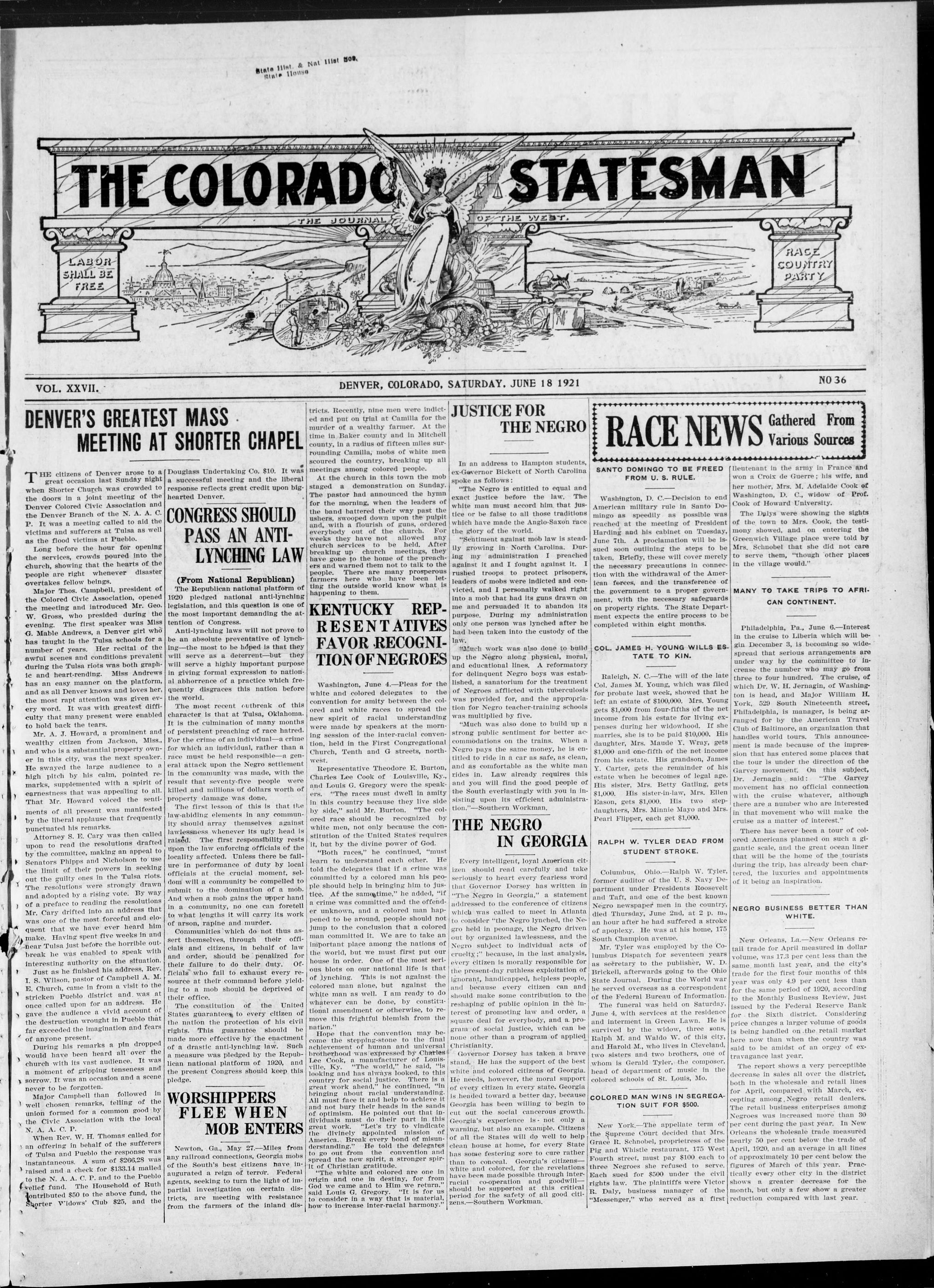
THE COLORADO STATESMAN
THE JOURNAL OF THE WEST.
LABOR SHALL BE FREE
RAGE COUNTRY PARTY
DENVER'S GREATEST MASS MEETING AT SHORTER CHAPEL
VOL. XXVII.
THE citizens of Denver arose to a great occasion last Sunday night when Shorter Church was crowded to the doors in a joint meeting of the Denver Colored Civic Association and the Denver Branch of the N. A. A. C. P. It was a meeting called to aid the victims and sufferers at Tulsa as well as the flood victims at Pueblo. Long before the hour for opening the services, crowds poured into the church, showing that the hearts of the people are right whenever disaster overtakes fellow beings. Major Thos. Campbell, president of the Colored Civic Association, opened the meeting and introduced Mr. Geo. W. Gross, who presided during the evening. The first speaker was Miss G. Mable Andrews, a Denver girl who has taught in the Tulsa schools for a number of years. Her recital of the awful scenes and conditions prevalent during the Tulsa riots was both graphic and heart-rending. Miss Andrews has an easy manner on the platform, and as all Denver knows and loves her, the most rapt attention was given every word. It was with greatest difficulty that many present were enabled to hold back the tears.
Mr. A. J. Howard, a prominent and wealthy citizen from Jackson, Miss., and who is a substantial property owner in this city, was the next speaker. He swayed the large audience to a high pitch by his calm, pointed remarks, supplemented with a spirit of earnestness that was appealing to all. That Mr. Howard voiced the sentiments of all present was manifested by the liberal appeal that frequently punctuated his remarks.
Attorney S. E. Cary was then called upon to read the resolutions drafted by the committee, making an appeal to Senators Phipps and Nicholson to use the limit of their powers in seeking out the guilty ones in the Tulsa riots. The resolutions were strongly drawn and adopted by a rising vote. By way of a preface to reading the resolutions Mr. Cary drifted into an address that was one of the most forceful and eloquent that we have ever heard him make. Having spent five weeks in and near Tulsa just before the horrible outbreak he was enabled to speak with interesting authority on the situation. Just as he finished his address, Rev. I. S. Wilson, pastor of Campbell A. M. E. Church, came in from a visit to the stricken Pueblo district and, was at once called upon for an address. He gave the audience a vivid account of the destruction wrought in Pueblo that far exceeded the imagination and fears of anyone present.
During his remarks a pin dropped would have been heard all over the church with its vast audience. It was a moment of gripping tenseness and sorrow. It was an occasion and a scene never to be forgotten.
Major Campbell than followed in well chosen remarks, telling of the union formed for a common good by the Civic Association with the local N. A. A. C. P.
When Rev. W. H. Thomas called for an offering in behalf of the sufferers of Tulsa and Pueblo the response was instantaneous. A sum of $266,2$ was raised and a check for $133.14 mailed to the N. A. A. C. P. and to the Pueblo relief fund. The Household of Ruth contributed $50 to the above fund, the Shorter Widows' Club $25, and the
Douglass Undertaking Co. $10. It was a successful meeting and the liberal response reflects great credit upon big-hearted Denver.
CONGRESS SHOULD PASS AN ANTI- LYNCHING LAW
(From National Republican)
The Republican national platform of 1920 pledged national anti-lynching legislation, and this question is one of the most important demanding the attention of Congress.
Anti-lynching laws will not prove to be an absolute preventative of lynching—the most to be hoped is that they will serve as a deterrent—but they will serve a highly important purpose in giving formal expression to national abhorrence of a practice which frequently disgraces this nation before the world.
The most recent outbreak of this character is that at Tulsa, Oklahoma. It is the culmination of many months of persistent preaching of race hatred. For the crime of an individual—a crime for which an individual, rather than a race must be held responsible—a general attack upon the Negro settlement in the community was made, with the result that seventy-five people were killed and millions of dollars worth of property damage was done.
The first lesson of this is that the law-abiding elements in any community should array themselves against lawlessness whenever its ugly head is raised. The first responsibility rests upon the law enforcing officials of the locality affected. Unless there be failure in performance of duty by local officials at the crucial moment, seldom will a community be compelled to submit to the domination of a mob. And when a mob gains the upper hand in a community, no one can foretell to what lengths it will carry its work of arson, rapine and murder.
Communities which do not thus assert themselves, through their officials and citizens, in behalf of law and order, should be penalized for their failure to do their duty. Officials who fail to exhaust every resource at their command before yielding to a mob should be deprived of their office.
The constitution of the United States guarantees to every citizen of the nation the protection of his civil rights. This guarantee should be made more effective by the enactment of a drastic anti-lynching law. Such a measure was pledged by the Republican national platform of 1920, and the present Congress should keep this pledge.
WORSHIPPERS FLEE WHEN MOB ENTERS
Newton, Ga., May 27.—Miles from any railroad connections, Georgia mobs of the South's best citizens have inaugurated a reign of terror. Federal agents, seeking to turn the light of impartial investigation on certain districts, are meeting with resistance from the farmers of the inland dis
DENVER, COLORADO, SATURDAY, JUNE 18 1921
tricts. Recently, nine men were indicted and put on trial at Camilla for the murder of a wealthy farmer. At the time in Baker county and in Mitchell county, in a radius of fifteen miles surrounding Camilla, mobs of white men scoured the country, breaking up all meetings among colored people.
At the church in this town the mob staged a demonstration on Sunday. The pastor had announced the hymn for the morning, when the leaders of the band battered their way past the ushers, swooped down upon the pulpit and, with a flourish of guns, ordered everybody out of the church. For weeks they have not allowed any church services to be held. After breaking up church meetings, they have gone to the home of the preachers and warned them not to talk to the people. There are many prosperous farmers here who have been letting the outside world know what is happening to them.
KENTUCKY REPRESENTATIVES FAVOR RECOGNITION OF NEGROES
Washington, June 4.—Pleas for the white and colored delegates to the convention for amity between the colored and white races to spread the new spirit of racial understanding were made by speakers at the morning session of the inter-racial convention, held in the First Congregational Church, Tenth and G streets, northwest.
Representative Theodore E. Burton, Charles Lee Cook of Louisville, Ky., and Louis G. Gregory were the speakers. "The races must dwell in amity in this country because they live side by side," said Mr. Burton. "The colored race should be recognized by white men, not only because the constitution of the United States requires it, but by the divine power of God.
"Both races," he continued, "must learn to understand each other. He told the delegates that if a crime was committed by a colored man his people should help in bringing him to justice. At the same time," he added, "if a crime was committed and the offender unknown, and a colored man happened to be around, people should not jump to the conclusion that a colored man committed it. We are to take an important place among the nations of the world, but we must first put our house in order. One of the most serious blots on our national life is that of lynching. This is not against the colored man alone, but against the white man as well. I am ready to do whatever can be done, by constitutional amendment or otherwise, to remove this frightful blemish from the nation."
Hope that the convention may become the stepping-stone to the final achievement of human and universal brotherhood was expressed by Charles Lee Cook, a manufacturer of Louisville, Ky. "The world," he said, "is looking and has always looked, to this country for social justice. There is a great work ahead," he continued, "in bringing about racial understanding. All must face it and help to achieve it and not bury their heads in the sands of optimism. He pointed out that individuals must do their part in this great work. "Let's try to vindicate the divinely appointed mission of America. Break every bond of misunderstanding." He told the delegates to go out from the convention and spread the new spirit, a stronger spirit of Christian gratitude.
"The white and colored are one in origin and one in destiny, for from God we came and to Him we return," said Louis G. Gregory. "It is for us to consider in a way that is material, how to increase inter-racial harmony."
JUSTICE FOR THE NEGRO
JUSTICE FOR THE NEGRO
In an address to Hampton students, ex-Governor Bickett of North Carolina spoke as follows:
"The Negro is entitled to equal and exact justice before the law. The white man must accord him, that justice or be false to all those traditions which have made the Anglo-Saxon race the glory of the world.
"Sentiment against mob law is steadily growing in North Carolina. During my administration I preached against it and I fought against it. I rushed troops to protect prisoners, leaders of mobs were indicted and convicted, and I personally walked right into a mob that had its guns drawn on me and persuaded it to abandon its purpose. During my administration only one person was lynched after he had been taken into the custody of the law.
"Much work was also done to build up the Negro along physical, moral, and educational lines. A reformatory for delinquent Negro boys was established, a sanatorium for the treatment of Negroes afflicted with tuberculosis was provided for, and the appropriation for Negro teacher-training schools was multiplied by five.
"Much was also done to build up a strong public sentiment for better accommodations on the trains. When a Negro pays the same money, he is entitled to ride in a car as safe, as clean, and as comfortable as the white man rides in. Law already requires this and you will find the good people of the South everlastingly with you in insisting upon its efficient administration."—Southern Workman.
THE NEGRO IN GEORGIA
Every intelligent, loyal American citizen should read carefully and take seriously to heart every fearless word that Governor Dorsey has written in "The Negro in Georgia," a statement addressed to the conference of citizens which was called to meet in Atlanta to consider "the Negro lynched, the Negro held in peonage, the Negro driven out by organized lawlessness, and the Negro subject to individual acts of cruelty;" because, in the last analysis, every citizen is morally responsible for the present-day ruthless exploitation of ignorant, handicapped, helpless people, and because every citizen can and should make some contribution to the reshaping of public opinion in the interest of promoting law and order, a square deal for everybody, and a program of social justice, which can be none other than a program of applied Christianity.
Governor Dorsey has taken a brave stand. He has the support of the best white and colored citizens of Georgia. He needs, however, the moral support of every citizen in every state. Georgia is headed toward a better day, because Georgia has been willing to begin to cut out the social cancerous growth. Georgia's experience is - not only a warning, but also an example. Citizens of all the States will do well to help clean house at home, for every State has some festering sore to cure rather than to conceal. Georgia's citizens—white and colored, for the revelations have been made possible through interracial co-operation and goodwill—should be supported at this critical period for the safety of all good citizens.—Southern Workman.
RACENEWS Gathered From Various Sources
SANTO DOMINGO TO BE FREED FROM U. S. RULE.
Washington, D. C.—Decision to end American military rule in Santo Domingo as speedily as possible was reached at the meeting of President Harding and his cabinet on Tuesday, June 7th. A proclamation will be issued soon outlining the steps to be taken. Briefly, these will cover merely the necessary precautions in connection with the withdrawal of the American forces, and the transference of the government to a proper government, with the necessary safeguards on property rights. The State Department expects the entire process to be completed within eight months.
COL. JAMES H. YOUNG WILLS ES
TATE TO KIN.
Raleigh, N. C.—The will of the late Col. James M. Young, which was filed for probate last week, showed that he left an estate of $100,000. Mrs. Young gets $1,000 from four-fifths of the net income from his estate for living expenses during her widowhood. If she marries, she is to be paid $10,000. His daughter, Mrs. Maude Y. Wray, gets $1,000 and one-fifth of the net income from his estate. His grandson, James Y. Carter, gets the remainder of his estate when he becomes of legal age. His sister, Mrs. Betty Gatling, gets $1,000. His sister-in-law, Mrs. Ellen Eason, gets $1,000. His two step-daughters, Mrs. Minnie Mayo and Mrs. Pearl Flipper, each get $1,000.
RALPH W. TYLER DEAD FROM
STUDENT STROKE.
Columbus, Ohio.—Ralph W. Tyler, former auditor of the U. S. Navy Department under Presidents Roosevelt and Taft, and one of the best known Negro newspaper men in the country, died Thursday, June 2nd, at 2 p. m., an hour after he had suffered a stroke of apoplexy. He was at his home, 175 South Champion avenue.
Mr. Tyler was employed by the Columbus Dispatch for seventeen years as secretary to the publisher, W. D. Brickell, afterwards going to the Ohio State Journal. During the World war he served overseas as a correspondent of the Federal Bureau of Information.
The funeral was held on Saturday, June 4, with services at the residence and interment in Green Lawn. He is survived by the widow, three sons, Ralph M. and Waldo W. of this city, and Harold M., who lives in Cleveland, two sisters and two brothers, one of whom is Gerald Tyler, the composer, head of department of music in the colored schools of St. Louis, Mo.
COLORED MAN WINS IN SEGREGA
TION SUIT FOR $500.
New York.—The appellate term of the Supreme Court decided that Mrs. Grace R. Schnobel, proprietress of the Pig and Whistle restaurant, 175 West Fourth street, must pay $100 each to three Negroes she refused to serve. Each sued for $500 under the civil rights law. The plaintiffs were Victor R. Daly, business manager of the "Messenger," who served as a first
NO 36
Hleutenant in the army in France and won a Croix de Guerre; his wife, and her mother, Mrs. M, Adelaide Cook of Washington, D. C., widow of Prof. Cook of Howard University.
The Dalys were showing the sights of the town to Mrs. Cook, the testimony showed, and on entering the Greenwich Village place were told by Mrs. Schnobel that she did not care to serve them, "though other places in the village would."
MANY TO TAKE TRIPS TO AFRICAN CONTINENT.
Philadelphia, Pa., June 6.—Interest in the cruise to Liberia which will begin December 3, is becoming so widespread that serious arrangements are under way by the committee to increase the number who may go from three to four hundred. The cruise, of which Dr. W. H. Jernagin, of Washington is head, and Major William H. York, 529 South Nineteenth street, Philadelphia, is manager, is being arranged for by the American Travel Club of Baltimore, an organization that handles world tours. This announcement is made because of the impression that has entered some places that the tour is under the direction of the Garvey movement. On this subject, Dr. Jernagin said: "The Garvey movement has no official connection with the cruise whatever, although there are a number who are interested in that movement who will make the cruise as a matter of interest."
There has never been a tour of colored Americans planned on such a gigantic scale, and the great ocean liner that will be the home of the tourists during the trip, has already been chartered, the luxuries and appointments of it being an inspiration.
NEGRO BUSINESS BETTER THAN
WHITE.
New Orleans, La.—New Orleans retail trade for April measured in dollar volume, was 17.3 per cent less than the same month last year, and the city's trade for the first four months of this year was only 4.9 per cent less than for the same period of 1920, according to the Monthly Business Review, just issued by the Federal Reserve Bank for the Sixth district. Considering price changes a larger volume of goods is being handled on the retail market here now than when the country was said to be amidst of an orgy of extravagance last year.
The report shows a very perceptible decrease in sales all over the district, both in the wholesale and retail lines for April, compared with March, excepting among Negro retail dealers. The retail business enterprises among Negroes was increased more than 30 per cent during the past year. In New Orleans the wholesale trade measured nearly 50 per cent below the trade of April, 1920, and an average in all lines of approximately 10 per cent below the figures of March of this year. Practically every other city in the district shows a greater decrease for the month, but only a few show a greater reduction compared with last year.
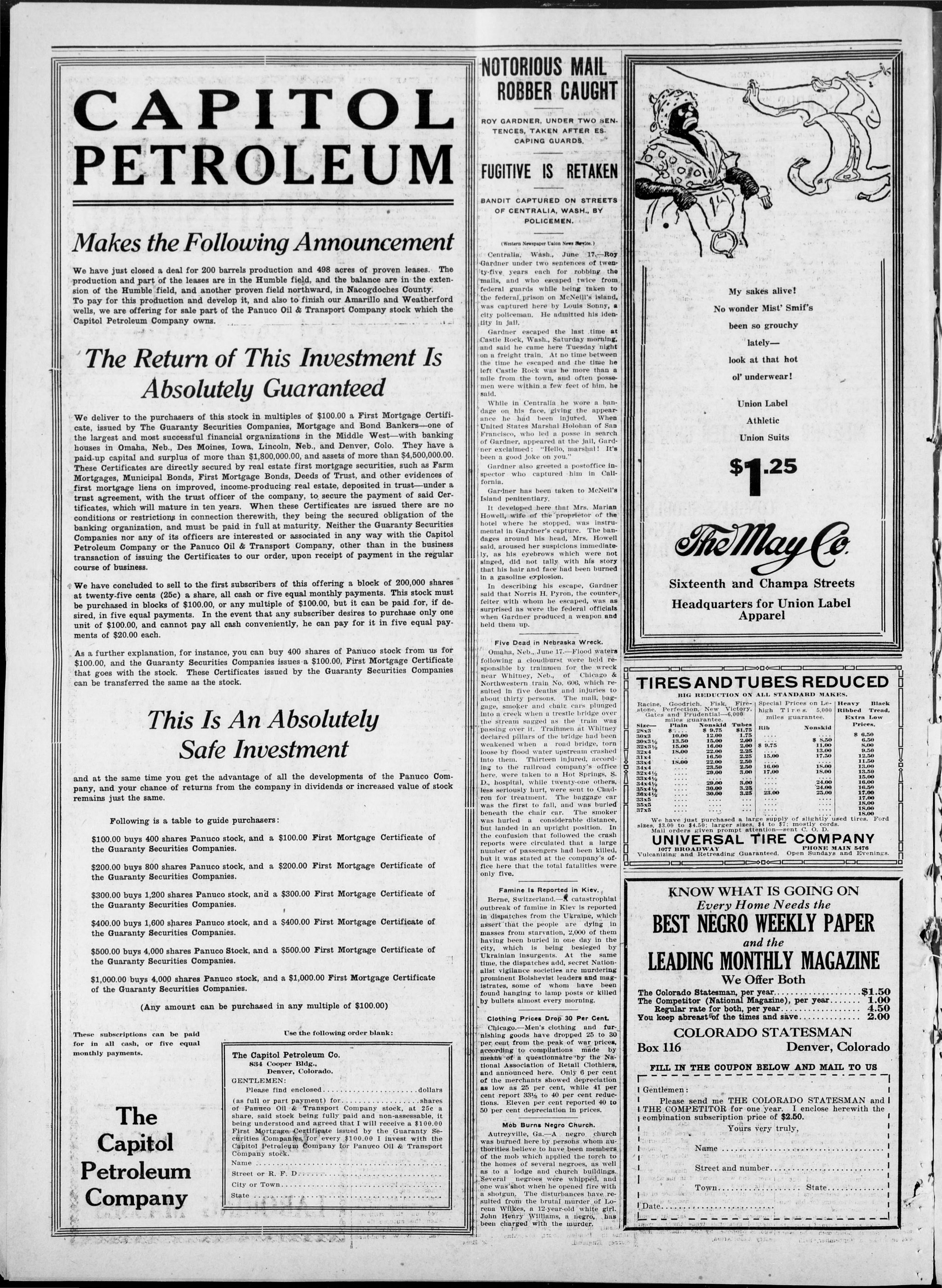
CAPITOL PETROLEUM
Makes the Following Announcement
We have just closed a deal for 200 barrels production and 498 acres of proven leases. The production and part of the leases are in the Humble field, and the balance are in the extension of the Humble field, and another proven field northward, in Nacogdoches County. To pay for this production and develop it, and also to finish our Amarillo and Weatherford wells, we are offering for sale part of the Panuco Oil & Transport Company stock which the Capitol Petroleum Company owns.
The Return of This Investment Is Absolutely Guaranteed
The Return of This Investment Is Absolutely Guaranteed
We deliver to the purchasers of this stock in multiples of $100.00 a First Mortgage Certificate, issued by The Guaranty Securities Companies, Mortgage and Bond Bankers—one of the largest and most successful financial organizations in the Middle West—with banking houses in Omaha, Neb., Des Moines, Iowa, Lincoln, Neb., and Denver, Colo. They have a paid-up capital and surplus of more than $1,800,000.00, and assets of more than $4,500,000.00. These Certificates are directly secured by real estate first mortgage securities, such as Farm Mortgages, Municipal Bonds, First Mortgage Bonds, Deeds of Trust, and other evidences of first mortgage liens on improved, income-producing real estate, deposited in trust—under a trust agreement, with the trust officer of the company, to secure the payment of said Certificates, which will mature in ten years. When these Certificates are issued there are no conditions or restrictions in connection therewith, they being the secured obligation of the banking organization, and must be paid in full at maturity. Neither the Guaranty Securities Companies nor any of its officers are interested or associated in any way with the Capitol Petroleum Company or the Panuco Oil & Transport Company, other than in the business transaction of issuing the Certificates to our order, upon receipt of payment in the regular course of business.
We have concluded to sell to the first subscribers of this offering a block of 200,000 shares at twenty-five cents (25c) a share, all cash or five equal monthly payments. This stock must be purchased in blocks of $100.00, or any multiple of $100.00, but it can be paid for, if desired, in five equal payments. In the event that any subscriber desires to purchase only one unit of $100.00, and cannot pay all cash conveniently, he can pay for it in five equal payments of $20.00 each.
As a further explanation, for instance, you can buy 400 shares of Panuco stock from us for $100.00, and the Guaranty Securities Companies issues a $100.00, First Mortgage Certificate that goes with the stock. These Certificates issued by the Guaranty Securities Companies can be transferred the same as the stock.
This Is An Absolutely Safe Investment
and at the same time you get the advantage of a pany, and your chance of returns from the compa remains just the same.
the time you get the advantage of all the developments of the Panuco Co. chance of returns from the company in dividends or increased value of stock the same.
and at the same time you get the advantage of all the developments of the Panuco Company, and your chance of returns from the company in dividends or increased value of stock remains just the same.
Following is a table to guide purchasers:
Use the following order blank:
These subscriptions can be paid for in all cash, or five equal monthly payments.
The Capitol Petroleum Co.
834 Cooper Bldg.,
Denver, Colorado.
GENTLEMEN:
The Capitol
834 Coor
Den
GENTLEMEN
Please fill
(as full or no
(as full or part payment) for... shares of Panuco Oil & Transport Company stock, at 25c a share, said stock being fully paid and non-assessable, it being understood and agreed that I will receive a $100.00 First Mortgage Certificate issued by the Guaranty Securities Companies for every $100.00 I invest with the Capitol Petroleum Company for Panuco Oil & Transport Company stock.
Name ...
Street or R. F. D.
City or Town.
State .....
---
The Capitol Petroleum Company
NOTORIOUS MAIL ROBBER CAUGHT
ROY GARDNER, UNDER TWO SEN-
TENCES, TAKEN AFTER ES.
CAPING GUARDS.
FUGITIVE IS RETAKEN
BANDIT CAPTURED ON STREETS OF CENTRALIA, WASH., BY POLICEMEN.
(Western Newspaper Union News Service.)
Centralla, Wash., June 17.—Roy Gardner under two sentences of twenty-five years each for robbing the mails, and who escaped twice from federal guards while being taken to the federal prison on McNeill's island, was captured here by Louis Sonny, a city policeman. He admitted his identity in jail.
Gardner escaped the last time at Castle Rock, Wash., Saturday morning, and said he came here Tuesday night on a freight train. At no time between the time he escaped and the time he left Castle Rock was he more than a mile from the town, and often possemen were within a few feet of him, he said.
While in Centralia he wore a bandage on his face, giving the appearance he had been injured. When United States Marshal Holohan of San Francisco, who led a posse in search of Gardner, appeared at the jail, Gardner exclaimed: "Hello, marshal! It's been a good joke on you." Gardner also greeted a postoffice inspector who captured him in California.
Gardner has been taken to McNell's Island penitentiary.
It developed here that Mrs. Marian Howell, wife of the proprietor of the hotel where he stopped, was instrumental in Gardner's capture. The bandages around his head, Mrs. Howell said, aroused her suspicions immediately, as his eyebrows which were not singed, did not tally with his story that his hair and face had been burned in a gasoline explosion.
In describing his escape, Gardner said that Norris H. Pyron, the counterfeiter with whom he escaped, was as surprised as were the federal officials when Gardner produced a weapon and held them up.
Five Dead in Nebraska Wreck.
Omaha, Neb., June 17.—Flood waters following a cloudburst were held responsible by trainmen for the wreck near Whitney, Neb., of Chicago & Northwestern train No. 606, which resulted in five deaths and injuries to about thirty persons. The mail, baggage, smoker and chair cars plunged into a creek when a trestle bridge over the stream sagged as the train was passing over it. Trainmen at Whitney declared pillars of the bridge had been weakened when a road bridge, torn loose by flood water upstream crashed into them. Thirteen injured, according to the railroad company's office here, were taken to a Hot Springs, S.D., hospital, while twenty-one others, less seriously hurt, were sent to Chadron for treatment. The baggage car was the first to fall, and was buried beneath the chair car. The smoker was hurled a considerable distance, but landed in an upright position. In the confusion that followed the crash reports were circulated that a large number of passengers had been killed, but it was stated at the company's office here that the total fatalities were only five.
Famine Is Reported in Kiev.
Berne, Switzerland. A catastrophial outbreak of famine in Kiev is reported in dispatches from the Ukraine, which assert that the people are dying in masses from starvation, 2,000 of them having been buried in one day in the city, which is being besieged by Ukrainian insurgents. At the same time, the dispatches add, secret Nationalist vigilance societies are murdering prominent Bolshevist leaders and magistrates, some of whom have been found hanging to lamp posts or killed by bullets almost every morning.
Clothing Prices Drop 30 Per Cent.
Clothing Prices Drop 30 Per Cent. Chicago—Men's clothing and furnishing goods have dropped 25 to 30 per cent from the peak of war prices, according to compilations made by means of a questionnaire by the National Association of Retail Clothiers, and announced here. Only 6 per cent of the merchants showed depreciation as low as 25 per cent, while 41 per cent report $33\frac{1}{2}$ to 40 per cent reductions. Eleven per cent reported 40 to 50 per cent depreciation in prices.
Mob Burns Negro Church.
Autreyville, Ga.—A negro church was burned here by persons whom authorities believe to have been members of the mob which applied the torch to the homes of several negroes, as well as to a lodge and church buildings. Several negroes were whipped, and one was shot when he opened fire with a shotgun. The disturbances have resulted from the brutal murder of Lorena Wilkes, a 12-year-old white girl. John Henry Williams, a negro, has been charged with the murder.
My sakes alive!
No wonder Mist' Smif's
been so grouchy
lately—
look at that hot
ol' underwear!
Union Label
Athletic
Union Suits
$1.25
The May Co.
Sixteenth and Champa Streets
Headquarters for Union Label
Apparel
TIRES AND TUBES REDUCED
Racine, Goodrich, Fisk, Firestone, Perfection, New Victory, Gates and Prudential—6,000 miles guarantee.
Size— Plain Nonskid Tubes
28x3 $ .9.75 $1.75
30x3 10.00 12.00 1.75
30x3½ 13.50 15.00 2.00
32x3½ 15.00 16.00 2.00
32x3½ 18.00 22.00 2.25
31x4 16.50 22.25
33x4 18.00 22.00 2.50
34x4 23.50 2.50
32x4½ 29.00 3.00
33x4½ 29.00 3.00
35x4½ 30.00 3.25
35x4½ 30.00 3.25
36x4½ 30.00 3.25
33x5 30.00 3.25
35x5 30.00 3.25
37x5 30.00 3.25
Special Prices on Lehigh Tires. 5,000 miles guarantee.
Rib Nonskid
$ 6.50
6.50
8.00
9.50
12.50
11.50
13.00
13.50
13.00
16.00
16.00
16.00
16.00
16.00
16.00
16.00
16.00
16.00
16.00
16.00
16.00
16.00
16.00
16.00
16.00
16.00
16.00
We have just purchased a large supply of slightly used tires. Ford sizes, $3.00 to $4.50; larger sizes, $4 to $7; mostly cords. Mail orders given prompt attention—sent C. O. D.
UNIVERSAL TIRE COMPANY
1077 BROADWAY
Vulcanizing and Retreading Guaranteed.
Open Sundays and Evenings.
KNOW WHAT IS GOING ON Every Home Needs the BEST NEGRO WEEKLY PAPER and the LEADING MONTHLY MAGAZINE
The Colorado Statesman, per year.....$1.50
The Competitor (National Magazine), per year.....1.00
Regular rate for both, per year.....4.50
You keep abreast of the times and save.....2.00
Please send me THE COLORADO STATESMAN and THE COMPETITOR for one year. I enclose herewith the combination subscription price of $2.50.
FOREIGN
Louis Smynder of Boston was beaten to death by Polish insurgents near Myslwitz, Upper Silesia, according to Karl Born, a Hamburg machinist, who escaped from that region to Berlin.
Max Itandohr, a student, was acquitted in Leipse, Germany, by the court trying war criminals on the charge of having ill-treated and imprisoned Belgian children at Grammonthe in 1917. The case was brought at the instance of Belgium.
Greece is opening hostilities against the Turkish Nationalists in Asia Minor by land and sea. Already the Greek fleet has been concentrated at full war strength in Turkish waters and has bombarded Turkish positions and sank several small transports, according to information from Constantinople.
Prince Chamyl, head of the Daghistan insurgent mountaineers of the northern Caucasus, has taken arms against the Bolshevists in the Caucasus and declares he will not surrender until liberty has been re-established in the Caucasus. He has defeated soviet detachments in several fights recently.
Three Italian cardinals were added to the Sacred College when Pope Benedict, in a secret consistory, raised to the purple Monsignor Glovannl Tacci Porocelli, the papal major domo; Monsignor Camillo Laurenti, secretary of the Congregation of the Propaganda, and Monsignor Achille Ratti, papal nuncio to Poland.
The British cabinet has decided to serve a new warning upon the Sinn Fein that amounts virtually to an ultimatum. Reports say that the cabinet will issue a time limit and if the south of Ireland refuses to accept the home rule (partition) act, a powerful campaign of repression against "gunmen" and the Irish Republican army will be started at the end of July.
GENERAL
Brown sugar sold at auction for 25 cents per 100 pounds in New Orleans. Five thousand bags, brought last year from Guatemala in the "sugar rush," brought from 1/4 to 3/4 cents a pound at a government auction. The prices obtained were not sufficient to pay the duty.
Brother Batch, owned by G. T. Arnold and ridden by M. Garner, won the thirty-ninth Latonia derby, beating E. R. Bradley's Kentucky Derby winner. Behave Yourself, by a length, Uncle Velo was third, two lengths away. The time for the mile and a half was 2:47 3-5.
Three boys, convicted in Juvenile Court in Tampa, Fla., of having entered a hardware store, were sentenced to save enough money to buy a pocket knife for each boy in the children's home. The court ordered that the knives should be purchased from the store that was entered.
John D. Emery, newly-elected national commander of the American Legion, in a statement at Indianapolis, advocated a continuance by the legion of its program of instilling in the hearts of former service men and women a sense of individual obligation to community, state and nation.
With his head almost severed by a razor, the body of Otto Smitherman was found near Ringgold, Ga. Near by the body of Earl Williams was found hanging from the limb of a tree. A coroner's jury found that Williams slew Smitherman and then hung himself. Williams was said to have been jealous of the attention paid a young woman of the vicinity by Smitherman. Thousands of person in Cincinnati, O., paid tribute to the memory of Col. F. W. Galbraith, Jr., national commander of the American Legion, who was killed in an automobile accident. The funeral services were held in Music hall, with each of the 4,000 seats taken. The obsequies were under the auspices of the American Legion and were marked by great simplicity.
Explosion of a car of dynamite, when two freight trains on the St. Louis and San Francisco railway collided head-on a few miles south of New Albany, Miss. is reported to have killed one man, slightly injured several others and to have destroyed fourteen cars of perishable freight.
Mrs. Bessie Mitchell, a widow, publicly flogged a man known as "Happy" Brennan, whom she accused of attempting to mistreat her 4-year-old son, Harry, according to a report she made to the police in Omaha, Neb. She used a riding whip. "If more mothers would administer that kind of treatment the town would be much safer for themselves and their children," she said.
The new shipping board steamship Buckeye State, which sailed for San Francisco was forced to return to Baltimore because, of fire in the forward boiler room. Officials of the Matson line which operates the vessel, stated that the blaze was caused by a flareback, which ignited oil and waste. At a meeting held on board the passengers passed resolutions praising the conduct of the crew, and presented them with a purse of $500.
With thousands gathered along the beach, Jack Murphy of Haverhill, known as "Daredevil Jack," jumped with a parachute from his airplane at Salisbury Beach, Mass., landed in the ocean a considerable distance from shore and was drowned in the view of a big crowd.
Dedication of the intersection of the Dixie and National highways at Vandalia, Ohio., near Dayton, to the memory of Col. F. W. Galbraith, who planted memorial trees there a year ago, is proposed by the America. Forestry Association.
NEWS TO DATE IN PARAGRAPHS
CAUGHT FROM THE NETWORK OF WIRES ROUND ABOUT THE WORLD.
DURING THE PAST WEEK
RECORD OF IMPORTANT EVENTS
CONDENSED FOR BUSY
PEOPLE.
WESTERN
Police Captain Harry Phoenix was shot and killed, and Sergt. S. C. Houston seriously wounded in El Paso, Tex. One of two Mexicans whom the officers stopped to question as suspicious characters did the shooting. The tragedy occurred in East El Paso on a well lighted suburban business street. A bandit who held up E. F. Smith, cashier of the First State Bank of St. Joe, Idaho, forced Smith to give him $3,992 and escaped to the hills afoot after locking the cashier in the vault. The man, who was unmasked, had the appearance of a woodsman, according to Smith, who released himself with a screwdriver. Officers are in pursuit.
Inability to disguise his voice when he ordered four clerks of the Pacific Oil & Lead Company of San Francisco to throw up their hands resulted in the capture of Paul Towney, former employee of the company, as the bandit who held up and robbed the cashier's office of a pay roll amounting to $2,665. "Towney confessed and the loot was recovered.
The United States has had a bad case of nerves and its people should know that the country is simply passing through a period of recuperation from a period of "gross mistakes and almost indecent things in business," Secretary J. H. Tregoe of the National Association of Credit Men declared in a statement in San Francisco preliminary to the opening of the twenty-sixth annual convention of the organization.
A total of fifty-one suits to recover "strike benefits" paid out during the general strike in Tacoma, Wash., In 1919 has been filed in a Justice's Court. The suits were entered by the boilermakers, iron ship builders and helpers, local No. 568, and demand repayment of money advanced to union members on strike more than two years ago. The informations filed by the union allege that money advanced to destitute workmen was in the form of temporary loans, and was not to be considered as a strike benefit gift.
WASHINGTON
Cyrus E. Wood of Greensburg, Pennsylvania, has been selected by President Harding as ambassador to Spain, succeeding Joseph E. Willard. An estate tax is an "allowable deduction" from the income of an es- in computing net income, the Suine Court ruled. The court affirmed a decision of the Court of claims in the case brought by execuors of the Alan H. Woodward estate, in Alabama, which held that the government erred in refusing to approve such a deduction from that estate's income in 1918.
Plans to increase acreage used for military purposes in the Hawaiian islands were approved by Secretary Weeks at a conference with Chairman Kahn of the House military committee. Mr. Kahn said he regarded the military posts in Hawaii as the "most important in the system of national defense." It is proposed to add about 1,000 acres to the military reservations and make possible the training of soldiers by divisions.
Harris Lipschitz, an American citizen, has been murdered in Haiti, according to advices received at the office of Representative Siegel in Washington. Lipschitz was engaged in business on the island, it was said. Investigation has been ordered by Major General Lejeune, commandant of the marine corps.
The Porter peace resolution has been sent to conference by the Senate for adjustment of the differences between that measure and the Knox resolution adopted recently by the Senate. The Senate voted formally to disagree with the amendment of the House, which struck out the Knox draft and substituted the Porter, draft.
Strong Democratic opposition to Senate investigation of the fighting in the Mingo county, West Virginia, coal fields developed in the Senate, and Senator Johnson's resolution proposing an inquiry went over. Senator Myers, Democrat, Montana, led the fight, declaring the matter was purely a state one. "Congress has gone mad—it has a perfect mania—for investigating and regulating every thing under the sun," said he.
The Sims case has kicked up a fine row in Congress. Messages from indignant members of Irish societies and others have been received by congressmen. Not all of them are of the same tenor — the majority demand that prompt punishment be meted out to the loquacious officer, but there are many indorsing the sentiments he expressed and praising him for his candor and outspokenness.
Governor Cox of Massachusetts declined to take action toward reinstatement of Boston policemen who went out on strike in September, 1919.
ORIGINAL IN FOOR CONDITION
Pithy News Notes From All Parts of Colorado
Colorado State Fair, Pueblo, Sept. 26-
30; J. L. Beamman, manager.
Morgan County Fair, Fort Morgan,
Aug. 24-26; W. J. Ott, secretary.
Alabama County Fair, Fair Ford,
Aug. 30-Sept. 2; J. L. Miller, secretary.
Washington County Fair, Akron, Aug.
Sept. 2; Joe K. Powelson, secre-
tory.
tary.
tary. County Fair, Cripple Creek, Sept.
J. D. J. Tipton, secretary.
Larimer County Fair, Loveland. Sept.
5-9; J. W. Thompson, secretary.
Boulder County Fair, Longmont. Sept.
13-17; Harry E. Niven, secretary.
Phillips County Fair, Holyoke, Sept.
7-10.
Routt County Fair, Hayden, Sept. 14-16; B. T. Shelton, secretary.
Logan County Fair, Sterling, Sept. 13-16; C. J. Funk, manager.
Southern Pine County, Marquette, Sept. 15-17; William Fellers, secretary.
Western Slope Fair, Montrose, Sept. 20-23.
Adams County Fair, Brighton, Sept. 60-23; George B. Smith, secretary.
Intl. Mountain Live Stock and Fair, Grand Junction, Sept. 6-9.
Weld County Fair, Greeley, Sept 21-23;
J. F. McCrery, manager.
Pueblo County Fair, Goodpasture, Sept.
22-23; Fred Lytle, secretary, Pueblo.
Yuma County Fair, Yuma, Sept. 21-24;
W. W. Williams, secretary.
22-23. Pred. 19. Yuma County Fair, Yuma. Sept. 21-24;
W. W. Williams, secretary.
Hlo Grande County Fair, Del Norte.
Sept. 21-23.
Citrus County Fair, Sugar City, Aug.
25-26; R. A. Hamilton, secretary.
Delta County Fair, Hotchkiss; A. N.
Minton, secretary. Sept. 13-16.
Huerfano County Fair, Walsenburg.
Oct. 4-6; James E. Talesler, secretary.
Kansas County Fair, Fair, Burlington.
Oct. 5-8; J. M. Hefner, secretary.
Cheyenne County Fair, Cheyenne
Wells, Sept. 20-24; Carroll Brown.
Sec.
El Paso County Fair, Calhan, Oct. 6-8;
D. E. Nance, secretary.
Twenty-seven students of the School
of Mines, members of the R. O. T. C,
have gone to Camp Humphrey, Va.
where they are to undergo six weeks
of intensive training.
A school for community leadership
is to be held in Boulder July 18 to 22,
inclusive, under the direction of the
University of Colorado in co-operation
with the American city bureau.
Members of the state organization of Foresters of America will hold their next convention in Boulder next June. This decision was reached just before the 1921 annual convention adjourned in Denver.
Pharmacy as a profession is making more and more an appeal to women, according to the records of the University of Colorado, which shows that of thirty students specializing in that work at the present time seventeen are women.
Harry Stewart, son of Mrs. Pearl Jolliff of Boulder, was given a military funeral upon return of the body from France, where he died during the war. The American Legion conducted the funeral, providing a military escort and a firing squad for the funeral.
The Electra lake dam, belonging to the Wolcott, Colorado, Power Company, fifteen miles above Durango, was declared to be safe from any further pressure of the heavy flood waters, which have been threatening its safety, according to inspectors who went over the barrier.
Fourth of July will be celebrated at Grand Lake in true western style. Bronchos and riders are being secured for the event and many prizes have been offered. The opening of the new Fall river road will bring thousands of visitors to Grand Lake—the western gateway to the Rocky Mountain National park.
Damage from flood waters in Weld county is expected to total more than $750,000, according to reports. Many bridges have been washed away and at least 30,000 acres of crops have been destroyed. The damage to roads in the county also is increasing, as a result of high waters in the Platte and Cache la Poudre rivers and the overflowing of other streams in the county.
Forty-five thousand ex-service men in the states of Colorado and Wyoming have failed to make application for their Victory medals, according to Col. R. J. Reney, who is in charge of the distribution of medals for these two states. A special appeal to those who have not asked for their medals is being made by Colonel Reney.
Colorado Springs this summer will celebrate the fiftieth anniversary of the city's founding. The celebration will be in the form of an elaborate pageant depicting life in the Plike's Peak region, from the earliest history down to the present day. Representatives of the Ute Indian tribe will be brought from the reservation in southwestern Colorado to assist in the pageant.
A verdict of murder in the first degree, with recommendation of life imprisonment, was returned by a jury in the District Court at Boulder, against Harry McReynolds, negro porter. McReynolds, on May 9, shot his sweetheart. Avo Dirvin, an 18-year-old Prep school student after a quarrel. After the shooting he ran all the way to Denver, according to his own statement, and went into hiding at the home of friends.
A campaign for $4,500 for the support of the Boulder Y. M. C. A. has been decided upon as part of a new plan to turn the building over to the free use of all boys between 12 and 18 years of age. The money will employ a full staff of attendants to manage the Y. M. C. A.
Dr. William A. Bell, one of the founders of the Denver & Rio Grande railroad and one of the pioneer developers of Colorado and the West, died suddenly of angina pectoris at his home in Pendell Court, Bletchingly Surrey, England.
CENTENNIAL STATE ITEMS
Reports received by the State Immigration Department from county assessors indicate that the combined acreage of spring and winter wheat planted in Colorado for the 1921 harvest was perhaps slightly larger than that planted for the 1920 harvest, and possibly the largest in the history of the state. Reports had been received on June 1 from 24,205 individual farmers in 42 counties. The total number of farmers reporting through county assessors in year was 49,117, and indications are that the total number reporting this year will be fully as large. The area of winter wheat reported up to June 1 was 710,534 acres and that of spring wheat 185,642 acres, or a total of 896,176 acres. County assessors reported a total of 1,034,143 acres of winter wheat and 334,866 acres of spring wheat in 1920, or 1,369,009 acres of wheat.
Here's one of the freak stories of the flood: Capt. O. L. Dennis of the Colorado rangers tells it. When he made an inspection trip through the flooded regions at Pueblo he looked into a railroad coal car over which flood waters had flowed. He found grunting therein a large, healthy sow and a wriggling family of new-born pigs. The high sides of the car and the fact that hogs are never shipped in coal cars, left only one explanation. The sow was swept into the car by the waters, penned there and left high and dry when the water leaked out through the cracks. The sow then farrowed her new litter. Captain Dennis found the car and its family near Cañon Junction.
Over 1,500 delegates are expected to attend the Forty-first Annual Sunday School Convention at Colorado Springs June 21-23. Authentic figures show that only seven states in the Union have a larger proportion of their population outside the church than Colorado: Entertainment is to be provided by the people of Colorado Springs. The folks of that city are busy now arranging the details of caring for their guests. Among the many splendid features planned for the visitors is a sightseeing trip at which time all delegates will be taken in an auto tour to view the natural beauties to be found in the shadow of Pike's Peak.
Promise of federal aid for the Pueblo flood district along three material lines, in addition to the relief work now being done, is indicated in information received in Denver. They are: Dispatching of a commission of engineers from the United States Reclamation Service to devise plans for safeguarding the area contiguous to the Fountain and Arkansas rivers. Cooperation of United States bureau of public roads with the State Highway Commission in repairing highways and bridges. Loaning of money by the Federal Farm Loan bank to farmers and live stock men who sustained losses in the floods.
Building in Fort Collins is beginning to increase rapidly. While there were comparatively few building permits issued the first of May they have since been steadily increasing in number, and now many homes are being planned and are under process of construction. One group of a half dozen is being built near the Agricultural College at one time. Apparently times are just about back to normal here in the building line.
Nation-wide search for Mrs. Minnie Gagnos, 55 years old, and her pretty daughter, Mrs. Lena Hauser, both of Cheyenne, Wyo., wanted on land fraud charges in Colorado, filed by M. D. McEniry, chief of the Denver field division of the United States general land office, led to their arrest by Department of Justice officials in Baltimore, Md., according to word received in Denver.
Ninety-four persons have been officially reported dead in the flood district lying between Pueblo and La Junta, according to a compilation of figures given out in Pueblo.
The police department has been detailed to patrol the city diligently every night to locate, if possible, the young people who have been stealing flowers and strawberries from a number of local homes at Palisade. The early strawberries are just coming into bearing, and several patches have been badly damaged by the miscreants.
Flights of all Colorado American Legion posts will fly at half-mast for thirty days in respect to F. W. Galbraith, Jr., national commander of the Legion, and colonel in the world war, who was killed in an automobile accident near Indianapolis, his home. Charters of the posts will also be drapped for the same period.
The Farmers' Union Milling & Elevator Company will build a concrete elevator in Denver, according to a permit issued by the city building department. The structure will be six stories in height and cost $40,000.
The Dayton, Ohio, Rotary Club, mindful of the flood disaster in Dayton in 1913, was the first of the Rotary clubs to come to the aid of flood-streken Pueblo, Colo., with a preliminary gift of $500.
Elwood A. Wildman, a farmer residing twenty miles southwest of Wray, was shot to death, and his 13-year-old daughter, Edith, was wounded in the knee, by Arthur Flinn, his son-in-law, said to be insane. Flinn killed himself with a bullet through the temple after shooting his father-in-law.
Mrs. Mary Smith and her 12-year-old son, Henry, were seriously but not critically injured on the Hillrose-Brush road when the automobile in which they were riding collided with a machine driven by W. W. Stoddard of Brush.
---
THE COLORADO STATESMAN
The Mouth-Piece of the People of Colorado and the Entire West
A RELIABLE chronicle of their doings and progress; a faithful mirror of their wants, their hopes, their best aspirations.
THE COLORADO STATESMAN
Unequaled as an advertising medium for the business of professional men and women.
An excellent family journal speaking to and for many thousand colored citizens.
$2.50 A YEAR
THE COLORADO STATESMAN
CABIN MADE IN FREE
LAND OF COUNTRY PARTY
Entered as second-class matter at the postoffice in the City of Denver, Colo.
JOSEPH D. D. RIVERS.....Proprietor
P. O. Box 116 1824 Curtis Street, Room 25 Phone Main 7417
One year ..... $2.50
Six months ..... 1.50
Three months ..... .75
MUST BE PAID IN ADVANCE.
Reading notices, ten lines or less, 15 cents per line. Each additional line over ten lines, 12 cents per line. Display advertising, 75 cents per inch for first insertion and 50 cents per inch for each additional insertion.
Remittances should be made by express money order, postoffice money order, registered letter or bank draft. Postage stamps will be received the same as cash for the fractional part of a dollar. Only 1c and 2c stamps taken.
No discounts allowed on less than three months' contract. Cash must accompany all orders from parties unknown to us. Further particulars on application.
Communications to receive attention must be newsy, upon important subjects, plainly written only upon one side of the paper, must reach us Tuesdays, if possible, anyway not later than Wednesdays, and bear the signature of the author. No manuscript returned, unless stamps are sent for postage. All communications of a personating nature that are not complimentary will be withheld from the columns of this paper.
THE LABOR CONVENTION.
NOTHING of the unusual is expected to come out of the convention of the American Federation of Labor that opened in this city Monday last. It is doubtless true, as was stated by an impassioned speaker on the opening day, that "labor now faces its crisis." During the war organized labor came definitely into its own. It approached the zenith of its power. Perhaps in many instances that power was used unwisely. It became too autocratic at moments most critical. Labor's best friends will admit the truth of this. But with an absence of war-time exactions and a return to peace conditions, different problems arise, and these are what the present convention must meet and handle with decided wisdom.
The convention signalized its opening deliberations by delving into international problems and the Irish question. There are many home problems that should be settled first. The colored brother still has but a small part in the affairs of the American Federation of Labor. At one time during the war period it looked as though he would be received into the full fellowship of organized labor, but something went amiss. The News of Wednesday morning gave a list of fourteen Negro delegates attending the present convention, and further stated: "There is no color line in the present convention of the American Federation of Labor.' This is a worthy beginning. We hope it may extend, however, beyond the confines of a convention hall. It is in the actual field of labor, skilled or unskilled, that want to note an absence of the color line. Organized labor is big enough and powerful enough to bring this about if so inclined.
The veteran labor leader, Samuel Gompers, is presiding over the convention and is an interesting character to meet. He is slated to succeed himself as president, an office he has held for thirty-nine years. There is not a great deal of the flare of trumpets and brass-band tactics about the convention. Evidently they are here for business. Let us hope so.
UNDESIRABLE PEOPLE.
IT IS the unfortunate heritage of every large city that it is severely burdened with a class of people wholly undesirable. Especially is this true in times of great business depression as at present. There are many things that go to make up whether a person is a valuable acquisition to the community or not. First of all comes the IDLE CLASS, the class to whom industry never consistently appeals, no matter how prosperous the times. Each new day furnishes its own sufficient reasons why he should not work. There is no surer medium in the world by which a person loses his own self-respect and the respect of others than becoming a professional "loafer." It is a matter of easy degeneracy from a professional loafer to a criminal. Whether it be man or woman, they cannot avoid the taint of immorality if they habitually frequent recognized lounging places for the idle.
In a time of trouble, or during the prevalence of an extreme crime wave these idle loafers are first to come under police surveillance, and justly so. Too often among them may be found the professional agitator, the fellow who must always "blame somebody"; who sees the country eternally going to the dogs and who contributes nothing in morals, taxes or industry to the upbuilding of a community.
These are perilous times. Civilization hovers over a slumbering volcano. A trivial incident could cause an eruption or conflagration in a dozen different directions at one time. Industrial upheavals, mob outbreaks and race clashes receive their greatest impetus from the presence of too many undesirables of every race. In many cases these undesirables are migrating, moving from place to place as best suits the criminal intent. Sometimes the last place of abode becomes "too hot" for them. They feed and wax fat on the carion of misery and woe.
Let Pueblo furnish the example. A great disaster overtakes the city. Practically every physical asset is laid waste. A wall of distress goes forth and is heard simultaneously by sympathetic thousands, who contribute their mite, and by these birds of passage, these vultures of society who flock to the stricken city to absorb what others give. There is consolation in the knowledge, however, that the stern military authorities called a halt. And it would be infinitely better for the moral and physical health of Denver could a halt be called on a further influx of undesirables who mean nothing to the city but trouble.
THE UNIVERSAL NEGRO IMPROVEMENT ASSOCIATION OPENS ITS OFFICE AT 2626 WELTON STREET.
who now treat them as underlings and pigmies.
This organization feels that there is room in Denver to help the unfortunate, misguided youth, and to arouse them to such a sense of race consciousness that adhering to our motto, ONE GOD, ONE AIM, ONE DESTINY, it will help them to qualify for the responsibility to be placed on their shoulders, and which when maintained will result in their being proud of their ancestry, their color, their ability to do things and their achievements. A member of the secretary's staff is present at the office from 8:30 a. m. to 5:30 p. m., and certificates of membership, as well as any other business of the association can be transacted.
Quietly and without any of the usual attempt at vanity, the members of the Universal Negro Improvement Association and African Communities' League opened their offices last Monday at 2626 Welton street in the heart of the Five Points district, where, in spite of the ridicule, taunts, jeers, etc. from old established institutions and their followers, as well as the denunciations from what is termed the "Negro Upper Ten," they are determined to prove, further that the GARVEY MOVEMENT is the only means of escape from the terrorism, and harshness that we suffer at the hands of other races; and the base constructive program is offered the people of this earth who are of African descent to prove that starting now in the pooling of their resources and the combinations of their brains, at the same time investing wisely, they can measure up compare favorably, attract the attention and win the respect of nations
Our next meeting, Tuesday, June 21, at the Masons' new hall, promises to be very interesting, as quite a pleasure will be afforded those who hear Mr. Allan W. Pendley of New York and Boston in his "Impressions of the Garvey Movement," and what it is accomplishing in these two large cities. Meeting begins 8 p. m. sharp. A cordial welcome to all.
"What Doth Strengthen and What Maim:" Application of Moral Law to Art
By DR. HENRY VAN DYKE, Address to N. E. A.
John Keats, whose centenary has just been celebrated throughout the English-speaking world, has a very fine remark on the moral side of poetry. You will find it in his ode entitled "Bards of Passion and of Mirth":
C. KARNE A. FARRIS
"Here your earth born souls still speak To mortals of their little week, Of their sorrows and delights, Of their passions and their spites, Of their glory and their shame; What doth strengthen and what maim."
Now, Keats is distinctly a poet's poet; he represents the aesthetic spirit in all its beauty. Here is a line in which he reveals the application of the moral law to art: "What doth strengthen and what maim." That's the question to ask about a work of art—does it make your spirit stronger or weaker, does it build you up and inspire you and move you with sane and healthy feelings or does it cripple you and lower your moral tone and fill you with morbid thoughts and hysterical impulses?
Take the art of music. Great music, even merely good music which has melody and harmony in it, flows around us like a stream of pure, clear water or, like the billows of the great sea, it refreshes and it strengthens; but sensual music, lascivious music, mean music—if it can be called music at all—irritates, demoralizes and vulgarizes those who listen to it.
Jazz, for example, I think, was invented by imps for the torment of imbeciles. True, it does not contain any distinct immoral teaching, because music is not a didactic art, but jazz does contain a real immoral influence, because it confuses, bewilders, benumbs and befuddles the mind through the ears. It is, in effect, the dope or knockout in the art of sound.
Laws against immoral art? They can do a little to help us, but not very much. To rely upon legislation as a safeguard against immorality in art—that is, as a real safeguard—is a great mistake. The true defense must be found in the discrimination, the taste, the conscience of the individual and the public.
We must learn to ask ourselves and we must teach our children to ask in art as well as in commerce and other human activities what is good in its effect and what is evil. After all, in thinking of art, that is to say, art of the higher kind, I come back to the words of an eld book:
"Whatsoever things are pure and lovely and of good report, if there be any virtue and if there be any praise, think on these things."
A man is made by his thoughts. What he loves he is apt to look at; what he looks at long he grows to be like. These are my views on art and morals.
Economic Liberalism in Its Fundamental Features Cannot Be Abandoned
By DR. DAVID KINLEY, President University of Illinois
The notion so frequently expressed in the literature of the social sciences that the present economic and social order has broken away from the past is, in my opinion, incorrect. We are told that the group, whether under the name of society or state, must step in and exercise its functions in a larger field, even invading multitudinous details of daily life. Those who hold this view of the nature of society and the state insist that the era of what they call "individualism" has passed, that a society based on individual liberty is out of date.
The system of economic liberalism in its fundamental features cannot be abandoned. It has become an enduring part of our civilization and our philosophy of life. It has promoted liberty and welfare, initiative and perseverance, industry and success, wealth and culture, an abundance that has relieved poverty, has exploited to human benefit the resources of nature more abundantly than ever before, has enlarged knowledge, has provided for the possibility of a greatly increased population and generally has uplifted the life of mankind.
I do not understand how there can be improvement in the welfare of society excepting in the sense that there is improvement in the welfare of individual men and women. High character, trained intelligence, self-reliance, initiative, knowledge and skill in wrestling with the forces of nature and applying them to his use—these constitute the motive power whereby man makes his condition better. The other view, it seems to me, is enervating. It saps initiative, destroys self-reliance, and leads individuals to think that knowledge and effort on their part are not necessary. They learn to look to the state, to society for many things that they should do themselves.
"Fundamentals of Business Prosperity Are the Ten Commandments
By ROGER W. BABSON, Statistician
Business conditions are due to a man's attitude toward life. Business conditions can be changed for the better only as man's attitude toward life changes.
Business runs in cycles—first a period of prosperity and then a period of depression. When studying these business changes, it was necessary to resort to certain statistics. In endeavoring to ascertain what causes the statistics, it was found:
That a period of depression is the result of unrighteousness, dishonesty, extravagance and inefficiency which develop in the latter half of a period of prosperity, and that a period of prosperity is the reaction from the righteousness, industry, integrity and thrift which develop in the latter half of a period of depression.
The meaning of this is plain. It is not railroads, steamships or factories which cause our prosperity; it is not bank clearings, foreign trade or commodity prices which give us good business. All these things are like the thermometer that register the temperature of the room.
"Prosperity is based on those fundamental qualities of faith, temperance, service and thrift, which are the products of religion. The fundamentals of prosperity are the ten commandments.
THE FREE SEWING MACHINE
BEAUTIFUL
CLOSED
WHEN
CONVENIENT WHEN OPEN
The FREE runs lighter than any other machine.
The FREE sews faster and makes a better stitch.
Is more nearly a faultless machine than any other existing.
The FREE is the most beautiful machine made, and shows notable and exclusive improvements, such as the Rotoscillo movement, Toggle-link take-up, the Rotary Spool-Pin, Belt Guards above and below, Sanitary Drip-Pan, Automatic Head Latch, etc.
May we give you a demonstration?
Trade in Your Old Machine
We will allow you $15.00 for your old machine regardless of its make or condition, the amount to apply on your purchase of a FREE.
We pay transportation on both your old machine and the new one we send you.
We have no agents or collectors, so our price saves you $15 to $25. Do not buy any other machine until you have seen the FREE.
When you know the FREE as we do you would not think of buying any other.
See the FREE machine in our basement House Furnishing Department.
THE DENVER DRY GOODS CO
SAVINGS
DEPARTMENT
Announcing a Beautiful, De Luxe Savings Pass Book
As a souvenir of our removal to our new quarters in the recently completed United States National Bank building, we have had prepared for us (by a Denver company), 2,000 beautiful, de luxe savings pass books of gray calfskin.
The texture of the calfskin is soft and fine. A shield and eagle design is embossed on the front cover and a color is applied by the remarkable air brush method to give a lasting antique finish.
One of these wonderfully rich looking pass books will be given with each savings account opened on our formal opening date as long as the 2,000 last.
These are truly desirable souvenirs—fully in keeping with the Grecian-Doric beauty of the new banking room.
Formal Opening Date Will Be Announced Soon.
THE STUDIO OF THE MUSEUM OF THE ARTIST
United States National Bank The Bank of Broader Service
HOWARD & HOWARD
GROCERIES AND MEATS
Fresh Vegetables and Fruits Daily
Does your friend trade with us? If not, read this advertisement as an invitation for him to know how to get our service and our quality goods. Free delivery to any part of the city.
PHONE YORK 9552. 718 E. TWENTY-SIXTH AVE.
THE COLORADO STATESMAN
F. W. Lenza arrived in the city Monday to remain.
Mrs. B. C. Curtis left Tuesday for Estes Park to join her husband, who is employed as chef at the Lewiston Hotel.
abundance of success in its future relationship with the people, and will accept the invitation to visit today.
BON VIVIANTS ENTERTAIN.
LAVISHLY.
Don't forget Big Carnival of Fun and District Convention of Women by Guild of St. Perpetua, at Old Colony Hall, June 30.
Mr. and Mrs. Franklyn L. Caldwell became the proud parents of a bouncing baby boy Thursday, June 9. Mother and baby doing well.
THE COLORADO STATESMAN learns that the Self-Improvement Club at its meeting on Monday last contributed $25 to the fund for the Tulsa and Pueblo sufferers. We wish to commend this grand work. Who will be the next?
One hundred per cent was the high mark made at the chauffeurs' examination by five of the chauffeurs of the Granberry Taxi Co., which is a high testimonial of the established fact that it is safe to ride behind the drivers of the Granberry Taxi Co.
The Building Laborers' International Protective Association will hold their annual sermon Sunday, June 26th, at 2:30 p. m., at St. Stephen's Baptist Church, Thirty-second and Lafayette street.
ANNUAL STOCKHOLDERS' MEETING OF THE WESTERN LOAN & INVESTMENT ASS'N.
AT the Annual Stockholders' Meeting of the Western Loan and Investment Association, which was held Tuesday evening, June 14, at 1824 Curtis street, Room 25, the following officers and board of directors were elected for the ensuing year: Joseph D. D. Rivers, proprietor of Colorado Statesman, president; H. J. M. Brown, treasurer of Colored American Loan and Realty Company, treasurer; J. R. Contee, president of Douglass Undertaking Company, secretary. Board of Directors: Mrs. Laura Fountain, Mrs. Jane H. Vernell, J. R. Contee, H. J. M. Brown and Joseph D. D. Rivers.
THE DENVER COLORED CIVIC ASSOCIATION
ON last Tuesday evening the Denver Colored Civic Association held its regular monthly meeting at Fern Hall. There was a large attendance of the members present and the meeting was alive with enthusiasm and interest. An official invitation was extended to the N. A. A. C. P. to hold their national convention in Denver in 1922. Many members participated in a most interesting discussion as to the progress and future of the association since becoming affiliated with the Denver Civic and Commercial Association. An amendment to the constitution creating a second and third vice president was adopted and at the next regular meeting in July these officers will be elected.
Hereafter the regular meetings of the association will be held on the first Wednesday of each month and at the Odd Fellows' Hall, 2630 Welton street.
The Denver Branch of the N. A. A. C. P. will hold a business session and social hour at the residence of Mr. and Mrs. Geo. W. Gross, 1627 E. 22nd Ave., next Monday night. This will be the last meeting before the big convention at Detroit. Every person who has been engaged in membership campaign and all holders of receipt books, are urged to be present. WE MUST have the final report.
By order of Executive Committee.
THE UNITED STATES NATIONAL BANK.
Known to this city and community for a number of years as the "Bank of Broader Service," with officers and a staff of clerks who find pleasure in catering to the needs of the public, the United States National Bank goes into its new quarters today at Seventeenth and Stout streets, where every attention in a business-like manner, and every facility will be afforded its patrons to continue their dealings with this reliable banking firm, which has established a very enviable reputation in Denver and in the West. Being familiar with the prestige for years maintained by this financial institution, the COLORADO STATESMAN joins the numerous well wishers and patrons of this firm in wishing an
abundance of success in its future relationship with the people, and will accept the invitation to visit today.
BON VIVIANTS ENTERTAIN.
LAVISHLY.
AT THE residence of C. N. Pitt, 933 East Twenty-third avenue, last Tuesday night, the Bon Vivant Club, Denver's oldest and most exclusive social organization, gave a most elaborate dinner. It was arranged complimentary to the large number of new members recently taken in, and to Mr. A. J. Howard, a wealthy influential citizen of Jackson, Miss. Mr. Howard is the father of A. J. Howard, Jr., who conducts successfully a grocery store at Five Points, himself a member of the club. Mr. Ormes of Ohio was also an honored guest. Both delivered splendid talks. Attorney S. E. Cary was in his usual happy vein and spoke interestingly of the future of the club. W. H. Chester Stell, Dr. T. E. McClain, Mr. Suggs and Mr. Richard Porter were the other speakers. Music and games closed a most enjoyable evening for all. The Bons are booming these days.
WATCH THIS DATE.
Grand Ball, Syrian Court No. 40, of Daughters of Isis, annual entertainment, Thursday, July 7th, at Fern Hall, Morrison's Orchestra. Admission 50c.
OUR GRADUATES.
The Colorado Statesman is more than gratified at the large number of boys and girls of the race graduating from the various schools in and around Denver this spring. It is a highly hopeful and encouraging sign and materially brightens the future for our people. It was a proud moment for every Denver Negro when at the graduating exercises at the Auditorium last week fourteen of our youths received diplomas. It was also announced that Miss Velma Parsons, talented daughter of Mr. and Mrs. Chas, Parsons, had won a scholarship prize for Denver University. Perhaps one of the proudest mothers in Denver today should be Mrs. Nettle Washington, whose many labors and sacrifices were handsomely rewarded by the graduation of her two daughters, Miss Georgia from Howard University, and Miss Isabel from East Denver High school.
On Wednesday night at Shorter A. M. E. Church the Stewardess Club of the church tendered the many graduates a most beautiful reception. He would be difficult, indeed, to describe the wonderful picture presented to the large crowd at Shorter when the graduating class appeared on the platform amid a veritable bower of roses and ferns. There can be no sight more inspiring than to look upon a class of young people launching upon the sea of life's responsibilities, buoyed by knowledge, character and ambition. There were many outstanding features to the reception Wednesday night, of which we mention an address by Mr. Rotheker Smith of Lincoln College, "Is College Worth While?" a poem to the "Class of '21," by Miss Carrie Hicks; "An Ode to Ethiopia," by Miss Ophelia Settles, and a paper, "The Man That Falls," by Miss Ellen Brown.
Those whose names appear upon the honor roll this year are as follows:
North Denver High School:
Mr. Arnold Caldwell.
East Denver High School:
East Denver High School:
Misses Helen Henry, Ophelia Settles, Isabel Washington and Iva Bell Maury.
Manual Training High:
Misses Bessie Marshall, Velma Parsons, Carrie Hicks and Annie Noel. Messrs. Johnnie Waller, Samuel Russell, Jno. Morris, Luther Polk and Aristide Chapman.
Denver University:
Reverend Burwell.
Lincoln College, Lincoln, Neb.
Mr. Rotheker Smith.
Denver Business College:
Miss Ellen Brown, Miss Virginia Coles.
Mrs. Geo. C. King of the Stewardess Club delivered a logical and very wholesome address to the class. The Shorter choir furnished the musical numbers.
NOTICE.
The regular meetings of the Universal Improvement Association and African Communities League will be held at the Mason's new hall, 2800 Welton street, beginning Tuesday, May 3, at 8 o'clock. All persons are requested to note the change of meeting place.
For Sale—House in Park Hill, five- room modern except heat. For sale by owner. Call York 1779.
AMERICAN FEDERATION OF LABOR
AMERICAN FEDERATION OF LABOR
COLORED DELEGATES ATTENDING AMERICAN FEDERATION OF LABOR CONVENTION.
THE fourteen colored delegates in attendance to the American Federation of Labor convention that opened here Monday form an interesting group. They are all men of a high type, race men with a vision as to the things most needful for the colored laborers, and they do not hesitate to press their demands.
One very necessary and certainly worthy demand is contained in a resolution introduced by J. W. Chambers of St. Louis, demanding that the word "white" be eliminated from the constitutions of all national and local organizations. This is a proper step and is a fair notice to organized labor that it cannot bid for the support of the Negro in one section and discriminate against him in another. We are proud to see such strong, intelligent men taking part in the convention's deliberations. Among these here are:
J. A. Knight, Nashville.
D. H. Smart, Fitzgerald, Ga.
Frank M. Phaire, Philadelphia.
F. W. Malloy, Charleston, S. C.
Wm. Sylvester, Washington, D. C.
Frank Williams, New Orleans.
James E. Collier, Nashville.
Jos. L. and Mrs. Anderson, Cincinnati.
Robt. E. Burford, Richmond, Va.
J. S. Boulware, Columbia, S. C.
William Carter, Baltimore.
W. A. Moran, Kansas City, Mo.
S. Burroughs, Mobile, Ala.
Wm. Shaw, Cleveland, O.
E. D. Rhone, Mobile, Ala.
All of the above stand a solid unit behind Chambers' resolution, and it is receiving hearty support from many of the white delegates.
CHEYENNE, WYO. NEWS
Born—To Mr. and Mrs. Reuben J. Smith, a baby girl, on June 8th, 1921. Mother and baby are feeling fine.
Mrs. Myrtle Harris, evangelist, conducted revival at the A. M. E. Church and persuaded twenty-five persons to add their names to the church roll. Mrs. Harris has original methods and proves to be a successful preacher.
Mr. Clarence J. Toliver butchered a 410-pound hog and is thereby assured of plenty of meat for the year.
Mr. Henry Asberry has a new Ford to hurry to his ranch. Mr. Asberry states his oats are knee high.
Mrs. Geo. Hegg departed from our city. Mrs. Hegg will join her husband in Omaha, where he is employed by the Union Pacific railroad.
DEATHS AND FUNERAL NOTICES
Hall—Mr. Thomas Hall, who lost his life in the flood in Pueblo. Remains were shipped to Shreveport, La., June 9th, 1921, accompanied by his wife and brother. The Cammel Undertaking Co. in charge.
Byrd—Mrs. Mae E. Byrd, the beloved wife of Mr. James H. Byrd and the mother of C. Byrd, who lost her life in the flood at Pueblo. Funeral services were held Wednesday, June 15th, 1921, from Shorter's A. M. E. Church. She was a member of the Eastern Star and the Sisters of Mysterious Tens. Rev. Wm. H. Thomas officiated, assisted by Rev. I. S. Wilson. Interment at Fairmount in the family plot. The Cammel Undertaking Co. in charge.
?
Why do I spend as much for one car as my competitors do for two or three? ask one who has rode in one of my new cars. A few months ago I bought a new Holmes Air-Cooled car, the first one ever put in taxi service, at a cost of $4,250. The first car was so popular that I bought a second Holmes, an open touring car for $3,700. I have ordered a third Holmes, a Sedan, for $5,000, to be delivered later. Add up the figures, put them with the figures of the cars I already had, then compare my cars with my competitors. We have more cars, better cars, better service; it costs no more to ride in the best, and it is a great deal safer. Call us up. Sight seeing, and cars for all occasions. The easiest riding cars in the city. BEAN AUTO LIVERY, Champa 2, Champa 575, or Main 6690.
ICHALLENGE anyone living to produce, invent or manufacture a preparation EQUAL to Hughes. Invincible "Hurler," a capsule for rheumatism. Manufactured and sold (price $1.04) by M. O'R. Hughes. The Metropolitan Pharmacy. 1201 Broadway, Denver, Colo.
CHRONIC GROVCHES
The Chinese, on their new-built railways, have established a service which in its line is beyond anything we know in this country. It is free boiling water. At each important station there is a boiler under a queer looking circular roof which looks like a huge umbrella. The traveler can help himself from one of several taps. Why boiling water? For making ten, of course. The traveler brings his teapot, or at least a cocoa along with him; also some tea. He gets his favorite beverage fresh, just as it would be made at home.
Where We Get Pineapples.
Where We Get Pineapples.
Singapore was formerly the chief source of the world's supply of pineapples, but our fresh fruits now come mainly from the West Indies—especially from Cuba, Poro Rio and the Bahamas—and our supply of canned fruit from Hawaii. The first attempt to grow the pineapple in the United States was made at St. Augustine in 1850. Florida, however, can never hope to compete with her more favored rivals in this industry.
"Jephthah Vow."
This is a vow which is to be kept regardless of consequences, and is commonly supposed to be derived from the Bible story of Jephthah, the leader of a band of brigands. Before going to battle against the Ammonites he vowed, if successful, he would offer as a sacrifice whatever was the first thing to cross the threshold of his own door when he returned triumphant. His daughter was the first one to advance to meet him. It is recorded that he sacrificed her according to his vow.
Our "Fortunes."
What we call our fortunes, good or ill, are but the wise dealings and distributions of a wisdom higher, and a kindness greater than our own. I suppose that their meaning is we should learn, by all the uncertainties of our life, even the smallest, how to be brave and steady and temperate and hopeful, whatever comes, because we believe that behind it all there lies a purpose of good, and over it all there watches a evidence . . . blessing.—Henry van Dyke.
Proper Ambition.
It is very sad for a man to make himself servant to a thing, his manhood all taken out of him by the hydraulic pressure of excess business. I should not like to be merely a great doctor, a great lawyer, a great minister, a great politician—I should like to be also something of a man.—Theodore Parker.
Makes + Good Breakfast.
A two-pound white perch is a big one, says the American Forestry Magazine, and, as a rule, they do run more than half that weight to the catch. They are easy to capture, for they largely take the right sort of bait, and few kinds make a better breakfast for the hungry woodman.
One More Credit Given China.
Capt. Stanley Flower, director of the zoological gardens at Giza, Cairo, Egypt, has prepared considerable data on the subject, which he obtained from authoritative sources. According to Captain Flower, though the ancient Egyptians kept wild animals in captivity, the first zoological garden of which there is definite knowledge was founded by the first emperor of the Chon dynasty, about eleven B. C., in China. It was called the "Intelligence Park," and had a scientific and educational object.
Proud of Armorial Bearings.
The early Dutch settlers of New York, who founded important families, were frequently aristocratic Hollanders who brought their conts-of-arms with them, as an integral part of their household goods. Such families as the Van Renssebers, De Pupsters, Beekmans, Schuylers and Stuyvesants had their arms beautifully engraved on the elaborate silver services which were among their proudest possessions.
Retail Staple and Fancy Groceries
Fruits and Fresh Vegetables of All Kinds
CHAMPA 3522
CORN-FI
Retail Staple an
Fruits and Fresh Ve
Call at Hea
WALL PAPERIN
THE COLO
PAPER &
1454 Welton.
Quality the best.
Service our motto.
Try our $3.00 Paint
and you will come
again.
A. E.
HARVEY G. WEBSTER
PATRIOTIC
SHOE SHINING PARLOR
1526 Welton St Phone Main 2196
HES
NG FOR
IS HOT
LL YOU.
DRIN
BE
EVE
2962 WELTON
FED MEATS
and Fancy Groceries
Vegetables of All Kinds
Headquarters for
ING AND PAINTING
CORADO WALL
& PAINT CO.
n. Phone M. 871
THE COLD WALL BANK & MARKET
THE COLORADO
BALL PINCH
& PAINT CO
Prof.
W. M. Mackey
FIRST CLASS TONSORIAL
WORK
Hair Cutting a Specialty
Satisfaction Guaranteed
2244 LARIMER ST., DENVER
MICHAELSON'S buy the stock of George W. Daiber, Clothiers, Cheyenne, Wyo. George W. Daiber retiring, and Michaelson's buying the remaining stock at about one-half ounce of Widdowwe Gold and Seblox Bros, Clothing; Stetson and Schoble Hats; Nettleton, J. P. Smith and Carter Shoes; Cooper's and Stephenson Underwear; Arrow Collars; Earl & Wilson and Bates Street Shirts; Fownes Gloves, and all such apparel merchandise, now in a grand sale at an enormous sacrifice.
Michaelson's
by Haile T. Hendrix.
DRINK IT AN HOUR
BEFORE BREAKFAST
EVERY MORNING
DR. CLARENCE F. HOLMES, JR.
B.S., D.D.S.
Invites the public of Denver to inspect his modern, electrically equipped dental suite. 2602 Welton St. Hours 9 a.m. to 12 noon 1 to 6 p.m. evenings and Sundays by appointment. Office phone Champa 2807. Residence phone Champa 1536.
C. E. TERRY, M.D.
1022 Twenty-first St. Denver
Office Phone Main 2701. Hours 12 to 2 and 6 to 8 p.m. or by appointment. Res. 2337 Glenarm Place. Phone Champa 3303.
Carpenter Contractor
Job and Repair Work a Specialty
Denter in Hardware, Palts, Oils
and Glass, Second-hand
Building Materint
Residence: 2190 So. Delaware St
Shop: 710 E. 26th Ave.
Phone York 8990
DR. HUFF'S office phone is
Champa 6061. And his residence
Phone York 4101. When not
reached at office, he calls
Main 875, office
Suite 5, 6 and 7, 2701 Wetton St.
over Atlas Drug Store. Office
hours, 11 to 12 a. m., and 3 to 5
p. m.
Office 600 27th St. Ph. Champa 1142
S. E. CARY
ATTORNEY-AT-LAW
Six Years City and County Attorney
at Russell Springs, Logan
County, Kansas
Office Hours—
9:00 A. M. to 12:00 M.
2:00 P. M. to 4:00 P. M.
DENVER, COLO.
WARD AUCTION COMPANY
Sales Daily at 2 p.m. Office Furniture a Specialty.
PRIVATE SALES AT ALL TIMES
HAVE MOVED TO
1723-39 GLENARM ST.
PHONE MAIN 1875.
Phone Main 8026
Res. Phone York 5774W
FRANK D. TAGGART
Attorney at Law—Notary Public
205-200 Cooper Building
Denver, Colorado
JOSEPH CARTER
Express, Moving,
and Storage
COAL AND WOOD
PROMPT DELIVERY.
Phone Main 6544.
2415 WASHINGTON STREET.
Phone Champa 113
1848 Arapahoe
好緯宏
The Difference
Between the Cost of Good and Cheap Printing
is so slight that he who goes shopping from printer to printer to secure his printing at a few cents less than what it is really worth hardly ever makes day laborer wages at this unpleasant task.
If you want good work at prices that are right, get your job printing
At This Office
HARDING SPEAKS NATION'S DESIRE
ALL THE PEOPLE OF THE COUN
TRY SAY WITH HIM THAT
WAR "MUST NOT BE AGAIN."
DISARMING SOMETHING ELSE
Insistent Propaganda to Persuade America to Lay Down all Weapons, Whatever Other Nations Do, Doesn't Persuade Most Congressmen.
By EDWARD B. CLARK.
Washington.—With the war in his mind, President Harding when in New York City, as he placed a wreath on the casket of the first American soldier to die on German soil, said: "It must not be again."
All through the country this expression of the President has been recognized as a simple but most striking phrase, expressing as it does the desire of all the people of the country. The speech on the pier at Hoboken, N. J., of which "It must not be again" was the keynote, has called particularly sharp attention in Washington to the propaganda for disarmament. Congress today is, or recently has been, confronted with several legislative propositions which bear directly on disarmament, and of course there is also before the law makers the resolution which asks that a conference on disarmament he held between representatives of Great Britain, Japan and the United States.
In Congress and in the country today an old fight to a certain extent is being waged once more. All over the United States there were pleas for disarmament long before the United States entered the great war, and in fact long before any other nation had entered it. There were attempts constantly to induce congress to cut down the armed forces of the country and with these attempts there were others to prevent military exercises in the schools of the country, and more strongly to prevent the establishment of training camps for the youth.
Would Disarm and Be Trustful.
Today congress is being urged with the same insistence as before the war to take measures which will disarm this country while other countries still carry arms. The present administration is opposed to anything of this kind and congress knows it, but there is a strong minority in each legislative house which seemingly believes that the United States can throw away every weapon that it has and remain perfectly placid in the feeling that even though all the other nations of the world are armed, and some of them still ambitious, no harm can come to the United States.
The line-up in congress on matters pertaining to what may be called in a general way preparedness, is just about the same kind of a line-up that was in evidence in the years 1914, 15, 16 and in the early part of 17. It is only the truth to say that there was not one hard student of the trend of affairs in the past who was not convinced in these years that the United States eventually must enter the great war.
It can be said that the majority of the members of both houses of congress in the years named believed that before long the United States would be compelled to get into the conflict. It was known in Washington that many of the representatives of the people in either house held back from support of anything which looked like preparation for trouble, not because they believed there was to be no trouble, but because their constituents, or a majority of them, would not admit for one minute, no matter what their senses told them, that war was to come.
What Wilful Blindness Cost.
It is a terrible thing today to hear some of the things which were said concerning the cost to the United States of the indifference to the looming cloud of trouble in the three years prior to April, 1917. It is said freely in military and naval circles that the disinclination to face the truth of what was to come cost the United States the lives of very many thousands of men who otherwise today would be alive and well, and added fully fifty per cent to the lists of the sick and injured who are pleading to a forgetful people for that remembrance which seemingly should be due to men who sacrifice themselves for others.
All of this is of the past. It has taught its lesson in part. There is not much question but that eventually the great countries of the world will get together and enforce a reduction of armaments, and will take means to provide against future wars between civilized peoples. The question now, however, has to do with today, a time prior to the agreement time when the nations shall write their disarmament rules and follow them to the proper end.
There was no party division to any marked degree when the senate the other day voted down an amendment which would have decreased the personnel of the United States navy. There seems to be a majority feeling in congress that the United States cannot today go to an extreme of disarmament while other nations still maintain, perhaps not an extreme of armament but something approaching to it.
Memorial day services for the dead
of many wars this year were marked perhaps not by an unusual solemnity, but certainly by a seemingly larger appreciation of America's duty to its dead. Within a few days there reached the United States the bodies of over 5,000 American soldiers who obeyed the last call in France while serving their country and a sister republic in the hour of need. Many of these bodies have been brought to Washington for interment in the great national cemetery at Arlington. Everywhere in Washington at this present time there is in evidence the red poppy of Europe. It is the poppy of Flanders field, the poppy of the valleys of the Marne and the Moselle, and of the fields bordering the stretches of the Meuse and the forests of the Argonne.
It seems to me that this flower, which has been adopted as the Memorial Day flower by the American Legion, deserves of itself some special consideration. It was remarkable how the blood-red poppy of France took hold of the imagination of the American soldiers. For centuries in France it has been regarded in a sense as the war flower, or perhaps rather as the flower of war's aftermath. Its color likewise has been significant of sacrifice, and as it grows abundantly on virtually all the battlefields of France, and the whole country at one time or another has been a battlefield, it has come to be looked upon as at once a companion and a memorial to the dead heroes of the land.
I have found that many Americans believe that the red poppy of France, which blows also in Flanders fields, is essentially a spring blossom. It is true that the poppy is more abundant in the spring than at other seasons of the year, but from April until November here and there through the fields, the red poppy always may be seen. I have seen it in profusion growing in the fields between the lines of the French and the German armies, in the foot hills of the Vosges, in late April and in early May. I have seen it nodding with the passing winds in the fields of the advanced zone north of the Marne in the months of September, October and November.
The French soldiers look on the poppy as a symbolic flower. They have an extreme sympathy with it and their feeling toward the blossom quickly extended itself to the ranks of the American armies. The blossoms of this plant, which has been the theme of soldier and civilian poets for years is single, and yet its petals have a tenacity of adherence to the stem which is unusual in flowers so sparsely leaved. The American soldier, not over given in the main to sentiment, used to pluck and wear the poppies. Many an American went into battle with a poppy in the buttonhole of his blouse.
The American Legion took cognizance of these things when it adopted the poppy as its memorial flower. So far as I know the European poppy of this species does not grow in America.
Flowers Profuse in France.
In France as in America today at this time of the year nature's floral feast is spread. In 1915, two years before the United States entered the war. I was with the French armies in the fields along the Moselle river near Pont-a-Mousson, and not far from the great city of Nancy, which at that time was only eight miles from the German line. In that year my sojourn on the eastern front included a part of April and a part of May. Looking over the fields which were semipeaceful, because at that time the Moselle region was a comparatively quiet sector, one easily could imagine himself to be back in the meadows of America. The blood-red poppy was the only floral stranger to the eye.
The dandelions, the buttercups, the daisies and the clover all grew abundantly in the fields, and so far as the unscientific eye could determine, there was no difference between the species of these plants growing there in the embattled fields of France, and those growing in the peaceful fields of America.
In the spring of 1915 at memorial time, the thought came to me, forcibly that perhaps before long in those fields would be enacted the tragedies which would add to the solemnity and the significance of future Memorial days in the United States. The Lusitania had just been sunk, and news of it had come, to France. From that hour it seemed to be the belief of Frenchmen, and of such Americans as were in France, that the entrance of the United States into the war was inevitable. The future gave substance to the thought.
Hindu Music.
Be it in devotion, in love or in patriotism, the daily life of the Hindu all the year round pulsates with the rhythm of music. The shepherd on the meadow, the farmer on the rice field, the boatman on the river, the fisherman on the lake, the corn grinder at the millstone, the sawyer at the lumber yard, the weaver at the boom, the washerman at the pool, the mason building houses, the snake charmers or jugglers on the streets, the children in school and the priest at the temple—they all sing songs as they perform their respective duties. Some sing for the uplift of their souls and others to beguile the tedium of their work.
The fragrant freshness of Hindu music and the fresh fragrance of the message of India's melodic songs are sure to make a marked impression on the minds of even the most listless but critical listeners.
HAD ODD TASTES
Apparently Everything Was "Rations" to Ostriches.
Canadian Soldiers Will Testify That the Birds' Appetites Cannot Be Called Capricious.
In that part of Africa that was the seat of the war between the British and the Boers there are now many ostrich farms. It was at the time of the war a thinly settled country, for the most part bare and comparatively unproductive.
As the ostrich farmers often left their flocks to subsist on whatever they could pick up, and as an ostrich will pick up anything that is not too large for it to swallow, the advent of the British and Boer forces, with the chance that it gave at the leavings of the camps, was a great boon to the ostriches.
At Belmont a flock of ostrichs came roaming into the British camp. The Canadians had never before seen these birds on their native heath. They were tame, and much on the lookout for rations. The Canadians had heard of the "digestion of an ostrich." and were resolved to test it.
One of the men threw the foremost ostrich a bar of soap. The ostrich swallowed it, and looked for more. Another man tossed out a matchbox. The ostrich swallowed that, and looked pleased. An empty jam-can followed, and the bird ate that.
"I wonder if he would eat cartridges?" said an Irish member of the regiment.
No one ventured to violate regulations or waste ammunition by trying the experiment, but suddenly an outcry was raised among the soldiers near. While the attention of the men had been centered on the bird that was swallowing the matches, soap and jam-cans, another hungry bird had entered a tent and was actually engaged in eating brass-headed cartridges out of the bandoleers!
All the ostriches had particularly long and naked necks. The soldier-wanderers from the Far North noticed that any bulky object which an ostrich swallowed went down his throat so near to the skin that its descent could be plainly seen all the way.
So the soldiers stood in a group, throwing bits of all kinds of refuse to a particularly long-necked ostrich. He swallowed one bit after another with lightning speed and then stood upright, while the soldiers laughed till they could hardly breathe to see the objects chase one another down four feet of the neck.
As the ostriches helped themselves to many useful and needed articles the soldiers found it necessary to refuse them admission to the camp.
But before they were banished an untoward accident—for the ostriches only—deprived two of the big birds of life. They were cut up and eaten by the Canadians, who found them very good, the flesh resembling beef both in appearance and taste.
Treasure Trove in Goodwin Sands.
The idea of searching the Goodwin sands for treasure is not quite a novelty. Several proposals have been made before to recover the millions mentioned by Lord Headley in his presidential speech to the Society of Engineers. The chief and most promising of them came from two men—a civil engineer named Bush and J. D. Pain, an architect. They proposed to construct a harbor of refuge out of Trinity bay, and from it to tunnel the sands, says the English Mechanic. The work was to take many years. The idea caught on, money was promised, but more practical men pronounced against it. Another suggestion was to run out a master tunnel from Deal, and from it to have short tunnels branch off. A third scheme was that of a Midland mining engineer, who became so obsessed with his idea that at last he went mad and drowned himself on the very sands he proposed to explore.
Now an Eskimo Operal
Copenhagen opera goers recently have witnessed the production of an Eskimo opera, "Kaddara." Hakon Boerresen, the composer, has based his score on the few vestiges of ancient song which the Greenlanders possess. A group of Eskimos traveled to Denmark to assist in preparing the stage pictures and to appear in minor roles. They carried with them a large collection of native costumes. Mention of an opera with Greenland's icy mountains as background naturally connotes India as a scene for stage entertainment. One would not be greatly surprised to learn that the next Drury Lane melodrama is to have Tibet for scene, now that the Mt. Everest expedition is so much in the public eye—Christian Science Monitor.
Will Use Bees in Next War.
To war
sharing to mobilize the bees
she's going to mobilize the bees. It all came about in the senate's discussion of the expenditures for agricultural purposes. One senator remarked oratorically that the French people ought to get to work like the "busy bees." That reminded Senator Menier that if the government had been up to snuff it would have used a lot of honey when there was a big sugar shortage during the war. The minister of agriculture said it was a good idea and volunteered to give all necessary information about bee-raising to sny-at-home patriots in the next war.
Night and Day Cafe
MRS. LENA WALTON, Proprietor.
Best Meals in town at the lowest prices. Special prices for club dinners and parties. Meet your friends here after the dance or theater. All Kinds of Salads and Sandwiches Served.
FISH AND OYSTERS IN SEASON.
PHONE ORDERS PRO
SPECIAL SUN
PHONE MAIN 2867.
Phone Main 4843
J. GIBSO
Art
PHONE ORDERS PROMPTLY ATTENDED TO.
1638 Tremont St.
C. V. FAIRBANKS
7. FAIRBANKS —Props.— N. FAIR
Fairbairn Hotel a Cafe
(Formerly Barnes
FIRST CLASS MEALS SERVED HOME COOKING
WESTERN
STERN BEEF
WESTERN BEEF CO.
Open Daily to 830 p. m.
Sundays Until 2:00 p. m.
Fresh Oysters, Chitterlings, Pigs
Bones, Spare Ribs
Fresh and Cured Meats of All Kinds
Fancy
Our Prices Are A
Free Delivery to A
Phone Ch
2048 LARIMER STREET
Opposite th
A FULL
Black and White
Ane a Full Line of MME. C.
BUT WE KNOW
Jones West Ha
Atlas L
2701 Welton St
GRANBERRY T
Office 2741
Ars, Chitterlings, Pig Tails, Snouts, Ears, Pigs, Bones, Spare Ribs Received Fresh Daily. Furred Meats of All Kinds.. Fresh Vegetables. Fancy Groceries.
Prices Are Always the Lowest
Free Delivery to All Parts of the City.
Phone Champa 1641.
MER STREET DENY
Opposite the Three Rules.
Fresh Oysters, Chitterlings, Pig Tails, Snouts, Ears, Pigs Feet, Neck Bones, Spare Ribs Received Fresh Daily.
Fresh and Cured Meats of All Kinds. Fresh Vegetables, Staple and Fancy Groceries.
A FULL LINE OF
k and White Remed
Line of MME. C. J. WALKER'S To
BUT WE KNOW YOU WILL LIKE
mes West Hair Pomade Be
Atlas Drug Co.
St Pho
BERRY TAXI COM
Office 2741 Welton Street.
Black and White Remedies Ane a Full Line of MME. C. J. WALKER'S Toilet Articles. BUT WE KNOW YOU WILL LIKE Jones West Hair Pomade Best. Atlas Drug C.
GRANBERRY TAXI COMPANY Office 2741 Welton Street.
OFFICE PHONE CHAMPA 87
Quick and prompt Service Day and Night. Call Us for S on Out-of-Town Trips.
Quick and prompt Service Day and Night. Call Us for S
on Out-of-Town Trips.
Phone Main St
Satisfaction Guar
THE NEW WAY
REPAIRING
C. C. Dennis, Pro
1855 CHAMPA S
Denver, Col
For Ladies' and G
H AND
Cleaning, Pressing and
Guard
Phone York 3786
Ladies' and Gents' Tailoring,
H ANDERSON
ng, Pressing and Repairing. All
Guaranteed
For Ladies' and Gents' Tailoring, See
Cleaning, Pressing and Repairing. All Work Guaranteed
V
OFFICE
PHONE
CHAMPA
87
1865 CURTIS STREET.
ON SMITH
rt Dealer
Denver
—Props.—
N. FAIRBANKS
Fairbanks Hotel and Cafe
(Formerly Barnes Hotel)
2716 Welton St., Denver, Colo.
N BEEF CO.
C
One of the Most Up-to-
Date and Sanitary Markets in the City.
Tails, Snouts, Ears, Pigs Feet, Neck
Received Fresh Daily.
Minds.. Fresh Vegetables, Staple and
Groceries.
Always the Lowest
All Parts of the City.
Champa 1641.
DENVER, COLO.
One Three Rules.
White Remedies
A. J. WALKER'S Toilet Articles.
N YOU WILL LIKE
Hair Pomade Best.
Drug C.
Phone Main 875
TAXI COMPANY
1 Welton Street.
and Night. Call Us for Special Rates
-Town Trips.
Phone Main 3737
Satisfaction Guaranteed
THE NEW WAY SHOE
REPAIRING
C. C. Dennis, Proprietor
1855 CHAMPA STREET
Denver, Colo.
Gents' Tailoring, See
ANDERSON
and Repairing. All Work
granteed
720 EAST 26TH AVE.
Denver
N. FAIRBANKS
Phone Main 875
OFFICE
PHONE
CHAMPA
5960
MANY WIDELY ACCEPTED METHODS OF DISTINGUISHING MUSHROOMS
Two Varieties of the Edible Wild Mushrooms.
(Prepared by the United States Department of Agriculture.) ing will furnish sufficient moisture for their cooking.
Mushrooms and some other fungous growths are highly prized as articles of food by many people. The nutritive value of mushrooms is low, but they may be prepared in various ways which render them delicious. More people doubtless would seek wild mushrooms and other fungi if they were sufficiently informed to distinguish between the edible and the deadly poisonous growths. Some very erratic and dangerous ideas concerning ways of telling the edible from the poisonous growths are altogether too commonly believed. Mushrooms are frequently thought of as edible and toadstools as poisonous. As a matter of fact, the United States Department of Agriculture states, the words "mushroom" and "toadstool" are used indiscriminately and do not indicate whether the plants are edible or poisonous.
Silver Coin Test Is Valueless.
A test for poisonous mushrooms often recommended is based on the belief that if a silver coin placed in the utensil in which mushrooms are cooked tarnishes, the mushrooms are poisonous. Absolutely no reliance can be placed on this test, as both poisonous and edible kinds may turn silver dark. Equally baseless is the belief that a mushroom is shown to be edible if the skin can be peeled from the cap readily, because peeling is possible with many poisonous species. The notion that soaking or boiling poisonous mushrooms in salt water will render them harmless has no foundation, in fact. Some people have thought that the presence of insects on mushrooms is a proof of their edibility. This is a dangerous supposition, because insects infest the most poisonous as well as the best edible species of fungi.
The collector of mushrooms cannot depend upon any simple test. If he intends to use them for food, he must know what he is gathering. It is a comparatively simple matter to learn to recognize a few kinds of deadly mushrooms and certain edible ones. If he will gather only the kinds that are well known to him, a careful collector need not be afraid to gather wild fungi for food. He should not be misled by attractive colors or pleasant odors. In Farmer's Bulletin 706. Some Common and Poisonous Mushrooms, directions for identifying the poisonous and edible kinds are given.
According to the views of many persons, mushrooms are best cooked simply, with no seasoning but butter, pepper, and salt. The addition of various other seasonings impairs the delicate mushroom flavor. However, tastes differ, and the opportunity of choice or experiment is afforded by the recipes which follow:
The caps should be carefully washed, gill side down, but peeling is not always necessary and involves a considerable waste of time and loss of flavor. Unless the stems are extremely tough they can be used after being cut into small bits and stewed, or, even if tough, after long bolling they can be run through a sieve and made into a soup or sauce.
Wild mushrooms should be cooked soon after collecting, as they are then preserved much better than if kept uncooked, even in a refrigerator.
Fried Mushrooms.
Beat the yolk of an egg with a tablespoonful of water and season with pepper and salt. Dip each cap in this and then dip into fine cracker crumbs or corn meal. Have butter or cooking oil very hot in a frying pan. Fry slowly on each side for five minutes. A sauce can be made by thickening with flour and adding milk or cream. If desired, serve on toast. A smooth tomato sauce is also excellent.
Mushrooms Baked With Tomatoes.
In a baking dish arrange small round slices of buttered toast; upon each piece place a rather thin slice of peeled tomato, salted and peppered; upon each slice of tomato place a fine, thick mushroom, gill slide up; in the center of each mushroom put a generous piece of butter; season with pepper and salt. Cover the dish and bake in a hot oven for ten minutes; then uncover and bake for an additional 5 to 10 minutes, as the mushrooms appear to require.
Creamed Mushrooms.
Cut the mushrooms into small pieces, stew slowly in butter until tender, add cream or milk, pepper, and salt, and thicken with flour.
Peppers Stuffed With Mushrooms.
Cut the stem end of the peppers and carefully remove all seeds and the lite membrane; chop or break the mushrooms into small pieces, season with pepper and salt, press firmly into the peppers, and put a good-sized lump of butter on top of each. The water adhering to the mushrooms after wash-
ing will furnish sufficient moisture for their cooking.
Arrange the peppers on end in a baking dish, having water with salt, pepper, and butter poured in to the depth of about one inch. Place the dish in a hot oven, cook covered for 15 minutes; then uncover and baste and cook for 10 or 15 minutes longer, or until the peppers are perfectly tender. An addition to the mushrooms of chopped cooked chicken or veal is a pleasing variation.
Mushrooms With Bacon.
Fry the bacon, and on removing it from the frying pan keep it hot; cook the mushrooms on each side in the "fryings" and serve on a platter with the strips of bacon arranged as a border. Several species are good prepared in this manner, but it is especially well suited to the common cultivated mushroom.
RENEW YOUR WAR ON COMMON HOUSE FLY
RENEW YOUR WAR ON COMMON HOUSE FLY
Presence of Pests Indicates Insanitary Conditions.
They Are Menace to Health Because They Carry Disease Germs to Exposed Foods—Of Importance to Prevent Breeding.
(Prepared by the United States Department of Agriculture.)
The presence of flies is an indication of uncleanliness, insanitary conditions, and improper disposal of substances in which they breed. They are not only
```markdown
```
Common House Fly. annoying; they are actually dangerous to health, because they may carry disease germs to exposed foods. It is therefore important to know where and how they breed, and to apply such knowledge in combating them. A bulletin issued by the United States Department of Agriculture gives information on this subject. Besides giving directions for ridding the house of files by the use of screens, fly papers, poisons and flytraps, it lays especial emphasis on the explanation of methods of eliminating breeding places and preventing the breeding of files. Address the United States Department of Agriculture, Washington, D. C., and a copy of this publication will be sent you free.
OF INTEREST TO THE HOUSEWIFE
Armchairs are being made lower in the back.
Never leave brushes lying or standing on their bristles.
Celery and almonds are often used together for a dainty salad.
Radishes may be cooked until tender and then served au gratin.
Lard may be freshened by cooking fresh sliced potatoes in it.
Bring olive oil to a boll or boil a minute. It will take away the rancid taste.
The day-bed is considered an essential piece of furniture in small apartments.
Macaroni and spaghetti will not boil over when cooking if a bit of fat is put into the water.
Clothes placed in the clothes basket any old way become wrinkled and take much longer to iron than those folded with some care.
A teaspoon of camphor added to a quart of soft water will kill worms in house plants. The plants should be quite dry when it is applied.
(© 1920 Western Newsager Union.)
It is easy enough to be pleasant.
When life goes by like a song;
But the men worth while are the men
with a smile.
When everything goes dead wrong.
-Ella W. Wilcox.
The fresh green things appeal to the appetite at this season of the year, as well as all growing things such as mushrooms, Vegetables which are boiled lose much of their valuable mineral content because of its solubility. When the water is drained off and thrown away these minerals are lost to the food. It is a good practice to serve the vege-
things such as mushrooms. Vegetables which are boiled lose much of their valuable mineral content because of its solubility. When the water is drained off and thrown away these minerals are lost to the food. It is a good practice to serve the vegetable in a manner that will conserve the minerals. If cooked in water let it be as little as possible and serve it with seasonings as a sauce with the vegetable. Peas, beans, greens of various kinds, should be thus served.
Lettuce, Pepper and Egg Salad. Arrange a platter of lettuce, sprinkle with finely shredded green peppers and then add three or four hard-cooked eggs out in eighths, sprinkle with finely minced chives and cover with French dressing. Serve well chilled.
Tomato and Peanut Salad. Peel the tomatoes carefully and remove the centers so as to form a cup. Fill with chopped cabbage and peanuts, well mixed. Add French dressing, and when serving put a spoonful of mayonnaise on top of each.
Buttered Beets. Cook small, tender beets, skin them, then chop rather coarsely. Add olive oil or butter, heat them very hot, season well with salt, pepper and a dash of lemon juice, and serve piping hot.
Vegetable Luncheon Dish.—Arrange on a hot platter a pint of freshly boiled seasoned spinach, adding butter and vinegar, surrounding the spinach with one and one-half cupfuls of creamed onions, then around this two cupfuls of thick tomato. Garnish, if desired, with hard-cooked eggs cut in eighths.
Onion and Cream Cheese Sandwiches.—To one small cream cheese add minced onions spread on buttered brown bread and cut in finger-sized sandwiches. See that the cheese and onions are well seasoned and mixed.
When school is out
And they don't
know who
said they didn't like June?
DESSERTS.
A dessert which is both delicious to the taste and charming in appearance is prepared as follows: Bake an angel food in a sheet, cut it in squares, arrange on service plates, cover with a layer of crushed sweetened straw
rice is prepared as follows: Bake an angel food in a sheet, cut it in squares, arrange on service plates, cover with a layer of crushed sweetened strawberries, then top with sweetened whipped cream or a thin slice of brick ice cream.
Macaroon Charlotte.—Cover one-half pound of macaroons with a quart of hot cream and when cool beat and mix well. Add the yolks of six eggs and a teaspoonful of vanilla, fold in the stiffly beaten whites of the eggs and fill buttered mold. Bake for ten minutes or until the custard is firm.
Blackberry Scones.—Take two and one-half cupfuls of flour, three teaspoonfuls of baking powder, two and one-half tablespoonfuls of milk, one tablespoonful of butter and one tablespoonful of any other sweet fat, one-half cupful of raisins, one-half teaspoonful of salt and seven-eighths of a cupful of milk. Roll into four pieces after mixing well and bake in a hot oven. Split open but do not cut clean through. Fill with jam or crushed fresh fruit.
Mock Goose.—Parbell a leg of pork, skin and stuff, using the usual goose stuffing. Put to roast with a little water and baste with the juice of the meat. When half done, sprinkle with sage, pepper, finely minced onion, salt and pepper. Serve with gravy.
Buttercup Jelly.—Take one envelope of gelatine, soak in one cupful of cold water, add one pint of milk, three egg yolks well beaten and one cupful of sugar. Scald the milk and add the sugar and egg yolks. Cook to a custard, flavor and cool, then fold in the stiffly beaten whites of the eggs and pour into molds to chill. Serve with tart jelly and top with whipped cream.
Mushrooms English Fashion.—After washing and peeling the mushrooms, add salt and pepper and toss them in a saucepan in hot butter until well cooked (five minutes is usually sufficient). Dish up on squares of toasted bread and lay on each two thin slices of broiled bacon.
Baked Stuffed Onions. — Parbell large-sized onions and remove the centers. Chop the part removed, add sausage or other highly seasoned meat, salt and pepper or chopped nuts. Bake, basting during the baking with butter and, water, or pour over the onions thin cream. Bake until tender. Nellie Maxwell
(@. 1920. Western Newspaper Union.)
I find the earth not gray but rosy;
Heaven not grim but fair of hue.
Do I stop? I pluck a posy.
Do I stare? All's blue.
—Robert Browning.
FRESH MUSHROOMS UP TO DATE.
We may now begin to look in the
fields and pastures for the delicious
mushrooms. The
following are a
few of the delectable dishes
which may be
prepared with
them:
A woman reading a book.
Stuffed Mushrooms—Take the even sized mushrooms, remove the stems, peel the caps and fill a mushroom cap with chopped chicken, beef tongue, truffles and cream, either of the meats or both. Butter a pan and set the stuffed mushrooms therein; cover with a mushroom of the same size, add a little lemon juice, a dash of orange juice and cover, then cook in a slow oven for 12 minutes. Serve on toast. To the juice in the pan add a little meat glace, a pinch of minced parsley, and pour over the mushrooms.
Mushrooms Eugenie.—Chop one-half pound of fresh peeled mushrooms; put into a saucepan with two tablespoonfuls of butter and let them stew over a slow fire; the stems from half a pound of mushrooms may be used economically, using the caps by sauteing them in butter, and dish them up on squares of bread fried in butter. To the chopped mushrooms now add one-fourth cupful of white sauce and one-half cupful cream; season with salt, paprica, and pour around the mushrooms.
Mushrooms Manhattan.—Cut six or eight good-sized mushrooms in squares and cook them in butter; add three ounces of well cleaned oyster crabs; when nearly cooked add a quarter of a cup of white sauce, a dash of fruit juice and the yolks of two eggs; season highly and put a tablespoonful of mixture into china ramekins and fill with the following: To a pint of puree of mushrooms add the whites of three eggs whipped to a stiff froth. Cook six to eight minutes in a moderate oven. To prepare the mushrooms chop them, cook in butter, add cream, add egg to bind, season to taste.
Jelliad.—Dissolve two glasses of jelly in three pints of boiling water; when cold add the juice of a lemon and sugar, if needed.
If only myself could talk to myself
As I knew him a year ago,
I could tell him a lot
That would save him a lot,
Of things he ought to know.
-Kipling.
THE ODORIFEROUS BULB.
The essential oil which is so pronounced in the onion makes it invaluable as a flavor vegetable.
#
Scrambled Onions. — Wash, cut up and cook in boiling water two or three bunches of young green onions. Allow the water to cook away, leaving just enough to prevent burning. In a frying pan place a tablespoonful of bacon fat; add to this as many eggs as needed to serve, let cook until the whites are set, then gently scramble with the onions, season and serve. Cold boiled onions may be used, adding a tablespoonful of milk for each egg used.
Young Onions With Egg Sauce. — Chop young onions and cook until tender in milk. Drain and thicken the milk with one tablespoonful of flour smoothed in a well-beaten egg. Add butter and two hard-cooked eggs, chopped.
Onion Soup, French.—Brown six large sliced onions in two tablespoonfuls of butter, then sprinkle with two tablespoonfuls of flour, stirring until the flour is browned. Thin with a quart of meat stock or liquor left from cooked peas; stir until creamy. Season with pepper and salt, simmer 15 minutes, put through a sieve and serve with croutons. Add a sprinkling of cheese, if desired.
Onion Chowder.—Wash, peel and chop enough onions to make one plint. Prepare enough potatoes to fill a quart measure. Place the onions in a kettle holding three quarts of boiling water, cook thirty minutes, add the potatoes, season with salt and pepper and cook one hour longer. While cooking, season with a teaspoonful each of parsley, chervil and sweet peppers; add two tablespoonfuls of butter. To increase the food value, add all or part milk instead of the water.
Prune Roll.—Take one tablespoonful of lemon or grapefruit juice, one tablespoonful of sugar, one teaspoonful of flour, two-thirds of a cupful of mashed prunes, and one-third of a cupful of seeded raisins. Cover the raisins with half a cupful of water and simmer half an hour. To the prunes add the sugar, fruit juice and flour; now add the raisins and cook three minutes. Spread the mixture over biscuit dough rolled out very thin. Bake and serve with cream or hot milk and butter with nutmeg and sugar to taste.
Nellie Maxwell
A. HASER, Prop.
ARCHIE MARKET
Wholesale and R
Hotels and
Fresh and C
Fruits, Ve
holesale and Retail Staple and Fancy Grocery Fish and Oysters Hotels and Restaurants Our Specialty Fresh and Cured Eastern Corn-Fed Meats Fruits, Vegetables, Poultry and Game FREE DELIVERY
Wholesale and Retail Staple and Fancy Groceries
Fish and Oysters
Hotels and Restaurants Our Specialty
Fresh and Cured Eastern Corn-Fed Meats
Fruits, Vegetables, Poultry and Game
FREE DELIVERY
1950 Larimer Street Denver, Co
The
Curtis
Park
Floral
Company
FLORAL DESIGNS PUT UP
YOU
CHOICE PLANTS AND CUT
GREENHOUSES: Thirty-K
TELEPHONE, MAIN 1511
Weather
is
al
pany
DESIGNS PUT UP WHILE
YOU WAIT
PLANTS AND GUT FLOWERS CONSTANTLY
ON HAND
HOUSES: Thirty-Fourth and Curtis Streets
MAIN 1511
DENVER, COLO
weatherhead Hat
The
Curtis
Park
Floral
Company
FLORAL DESIGNS PUT UP WHILE
YOU WAIT
CHOICE PLANTS AND CUT FLOWERS CONSTANTLY
ON HAND
GREENHOUSES: Thirty-Fourth and Curtis Streets
TELEPHONE, MAIN 1511
DEMVER, COLO
TELEPHONE
MAIN 3203
Established 1876
RENOVATORS, BLACK
Of Gents' and
1624 CHAM
PHONES: DENVER
Not as Old Underwear
HOMER
2418 Welton St., Denver
Motto: Service, effe-
out. Consult us. Wet.
Your cares and sorrows
LICENSED EMBAL
LA
E. V. CAMMEL, PR
DENVER
THE CHAM
TWENTI
Is
DRUGS, CHEMIC
W
PRESCRIP
Phone us and we will o
JAMES
GOVATORS, BLEACHERS, DYERS AND FINISHERS Of Gents' and Ladies' Hats of Every Description
1624 CHAMPA ST., DENVER, COLO.
MONES: DENVER, CHAMPA 2077; PUEBLO, DAY OR NIGHT.
The Cammel Undertaking Company
Old
HOME FUNERAL PARLORS.
Velton St., Denver. 945 Routt Ave., Pueblo.
To: Service, efficiency and modern conditions to consult us. We can save you time, worry and fries and sorrows are treated as though they wereENSED EMBALMERS, FUNERAL DIRECTOR LADY ATTENDANTS.
CAMMEL, PRESIDENT AND GENERAL MAN
DENVER AND PUEBLO.
THE CHAMPA PHARMA
TWENTIETH AND CHAMPA,
Is the place to get your BUGS, CHEMICALS AND PATENT MEDICINE
WE SERVE DRINKS.
PRESCRIPTIONS OUR SPECIALTY.
us and we will deliver the goods to all parts of
JAMES E. THRALL, Propr.
PHONE MAIN 2425.
RENOVATORS, BLEACHERS, DYERS AND FINISHERS Of Gents' and Ladies' Hats of Every Description 1624 CHAMPA ST., DENVER, COLO.
PHONES: DENVER, CHAMPA 2077; PUEBLO, 864.
DAY OR NIGHT.
Motto: Service, efficiency and modern conditions throughout. Consult us. We can save you time, worry and money. Your cares and sorrows are treated as though they were our own.
LICENSED EMBALMERS, FUNERAL DIRECTORS AND LADY ATTENDANTS.
E. V. CAMMEL, PRESIDENT AND GENERAL MANAGER, DENVER AND PUEBLO.
THE CHAMPA PHARMACY
TWENTIETH AND CHAMPA.
Is the place to get your
DRUGS, CHEMICALS AND PATENT MEDICINES
WE SERVE DRINKS.
PRESCRIPTIONS OUR SPECIALTY.
Phone us and we will deliver the goods to all parts of the city.
JAMES E. THRALL, Propr.
PHONE MAIN 2425.
C. E. SMITH, Manager, Res. Phone South 1608
The Market Company
Wholesale and Retail Staple and Fancy Groceries, Fish and
Hotels and Restaurants Our Specialty. Fresh and C
Eastern Corn Fed Meats
Fruits, Vegetables, Poultry and Game.
Telephones Main 4302, 4303, 4304, 4305
622-636 15TH STREET DENVER, CO
The Market Company
Food and Retail Staple and Fancy Groceries, Fish and
Meals and Restaurants Our Specialty. Fresh and C
Eastern Corn Fed Meats
Fruits, Vegetables, Poultry and Game.
Telephones Main 4302, 4303, 4304, 4305
55TH STREET DENVER, CO
Wholesale and Retail Staple and Fancy Groceries, Fish and Oysters.
Hotels and Restaurants Our Specialty. Fresh and Cured
Fruits, Vegetables, Poultry and Game.
Telephones Main 4302, 4303, 4304, 4305
622-636 15TH STREET DENVER, COLORADO
PHONE. MAIN 3023.
John K. Rettig
EATS, FANCY AND STAPLE GROCERIES
1864 CURTIS STREET
neteenth Den
John
MEATS, FANCY
186
Corner Nineteenth
MEATS, FANCY AND STAPLE GROCERIES
Phone Main 6758
and Fancy Groceries
Masters
Our Specialty
Corn-Fed Meats
Utility and Game
VERY
CONSTANTLY
ON HAND
urtis Streets
DENVER, COLO
d Hat Co.
PIONEER HATTERS OF THE WEST. WE MAKE OLD HATS NEW.
PAYERS AND FINISHERS
Of Every Description
DENVER, COLO.
A 2077; PUEBLO, 864.
RIGHT.
Camel Company
APARLORS.
25 Routt Ave., Pueblo, Colo.
modern conditions through-
time, worry and money
is though they were our own.
GENERAL DIRECTORS AND
PANTS.
GENERAL MANAGER,
PUEBLO.
PHARMACY
CHAMPA,
get your
PATENT MEDICINES
BINKS.
SPECIALTY.
foods to all parts of the city.
LL, Propr.
2425.
Company
Groceries, Fish and Oysters.
Specialty. Fresh and Cured
Fed Meats
Entry and Game.
8303, 4304, 4805
DENVER, COLORADO
RES. PHONE GALLUP 942
Rettig
APLE GROCERIES
STREET
Denver, Colo.
```markdown
```
Denver, Colo.
Aiding Nature in Her Work
TO repair the damage done by destructive forces is a process of no short time. But to prevent these bad effects is but the routine of a few precious moments.
In either case, Madam C. J. Walker's Superfine Toilettes stand ready to aid you in the task at hand.
FOR PREMATURELY OLD COMPLEXIONS—
Madam C. J. Walker's Vanishing Cream
Superfine Face Powder
(white, rose-flesh, brown)
Compact Rouge
TO PREVENT THE ON-RUSH OF OLD AGE—
Madam C. J. Walker's Cleansing Cream
Witch Hazel Jelly
Floral Cluster Talc
640 North West Street Indianapolis, Ind. Makers of 18 superfine preparations for the hair and skin
The Madam C. J. Walker Mfg. Co. is pleased to announce that Mr. E. Caldwell Gaither of St. Louis, Mo., has recently completed a bust of the late Madam C. J. Walker that has met the approval of Mrs. Lelia Walker Wilson, daughter of the late Madam C. J. Walker and president of the Madam C. J. Walker Mfg. Co. The bust is a remarkable likeness of Madam C. J. Walker and places Mr. Gaither in the forefront as a sculptor and artist. These beautiful busts are finished in old ivory, bronze and life color. Special arrangements have been made with the sculptor that agents, admirers and customers may have one of these beautiful likenesses of Madam C. J. Walker at the following nominal cost:
Old Ivory, $5.00; Bronze, $5.00; Life Color, $7.00.
ADDRESS ALL ORDER TO THE MADAM C. J. WALKER MFG. CO.
640 North West Street, Indianapolis, Ind.
WANTED
to place in each of the fifteen thousand homes of our people in Denver, a copy of Scott's Official History of the American Negro and the World War
SCOTTS OFFICIAL HISTORY
of the
AMERICAN NEGRO
IN
THE WORLD WAR
EMMETT J. SCOTT
SPECIAL ASSISTANT TO SECRETARY OF WAR
A complete and authentic narration of the participation of American soldiers of the Negro race in the great fight for democracy. Illustrated with official and personal photographs of over two hundred in number, this work offers delightful reading of its 600 pages for the youth, the middle-aged and the old, and each home will add dignity and loyalty to our race and country by being provided with a copy of this commendable work. A very desirable gift in and out of season. This book is being offered at the very reasonable price of
$3.00
at the office of
at the office of
THE COLORADO STATESMAN
P. O. Box 116 Room 25, 1824 Curtis St
Arrangements can also be made over phone. Call Main 7417
PRESS COMMENT: No library is complete without Scott's History of "The American Negro in the World War." and no better legacy could be left to posterity than this great work of Negro heroism and patriotism.
L
the upper right a little miss of four or more wears a bonnetlike shape with a round crown having about it a band of faille ribbon with short ends at the back. Only good qualities in ribbon are used on these hats because they must see much service. At the top of the group a shape that is very successful for girls from seven to sixteen is shown. It is the wide-brimmed French sailor shape in milan with its brim edged with a flange of the braid in a darker color or shade than that in the body of the hat. It has a wide collar and sash ends of heavy ribbon. At the right of it another little bonnetshape for younger girls appears with square crown above its drooping brim and sash of ribbon. Below is another variation of the French sailor revealing a sharper up-turn in the brim and larger crown than the first sailor. For a very little miss one may select a bonnet with milan brim and satin crown, or the very elegant model which finishes the group—a square-crowned poke with handsome wide ribbon furnishing a sash with long ends.
AFTER she has passed her third birthday the little maid arrives at the threshold of her millinery experiences and begins to wear blocked hats. If it be summer time she comes into possession of a fine soft milan or other stray and for winter she finds herself in possession of beaver or felt headwear. In either case the hat will be simple in design and in trimming and of the same character as those made for her each season until she is counting her years in "teens."
It is astonishing to find the great variety in shapes and sizes made in these blocked hats which at first glance seem so simple. But when it is considered that they must suit so many ages and so many types the necessity for numerous shapes and variations of those shapes is plain. There is just the right hat for each little girl and finding this shape is about the only task that confronts her mother in the selection of these blocked hats, for their good style is assured and has been for years. A few of the favorite models in millets appear in the group above. At
J.C. & Co.
fastened down with two snap fasteners adorned with two rosettes of baby ribbon placed over the fasteners. These cases are made in several shapes, as circular pieces with pockets attached to one side for holding the bootees and shirrings of baby ribbon for decorations.
NEARLY every necessity and all of the luxuries of the layette prove fascinating work when the time comes to make them. Women delight in fashioning pretty, diminutive belongings for the baby, especially if they may be made of fine or luxurious materials, and it seems they are turning more and more to ribbons. There is such a long list of things for the layette that are made of ribbons these days that it seems as if ingenious and prolific minds somewhere must be busy all the time thinking only of two things—layettes and ribbons.
A coat hanger, as pictured, is made of a thin mull joined together in strips, having the seams bound with narrow ribbon. It is stuffed with lavender and finished off with a rosette of narrow ribbon. In this hanger the hook is wound with ribbon. Wide, soft satin ribbon is used for the cap and jacket pictured, with narrow Val lace and narrow figured ribbon making the pretty decorations. The cap has ties of satin ribbon. The pretty sleeve garters employ satin ribbon shirred over narrow flat elastic with little ribbon roses and loops distinguishing themselves as a finishing touch. There are numberless sachet bags made of blits of ribbon and the devices for holding safety pins are endlessly varied.
Just a few of the new articles designed in ribbons are shown here, but they include such gifts as friends like to make. In addition there are many small bags, ribbon-lined baskets, pinchhions, bootees, sleeve and sock garters, bows for the carriage robe and small bows and rosettes to deck out little dresses. Each of these, as well as the articles pictured, are made in many different ways.
Little bootees of ribbon bid fair to usurp the place of the knitted or crocheted boot and they are provided with bootee cases, also made of ribbon. One of these is shown at the top of the picture. It is simply an envelope of satin ribbon having the flap
Julia Bottomley
COPYRIGHT BY WESTERN NEWSPAPER UNION
FRANK S. REED,
Licensed Embalmer and Director
Lady Assistant. Polite Service
to all.
CARRIER CO.
BARBERSHOP
Bolden Barber Shop
Baths, Electric Massages
FIRST CLASS SERVICE
R. B. BOLDEN, Proprietor 926 19th St., Denver
Chop Suey :- Noodles
And Short Orders
1223 Twenty-First Street
THE
STAR HAIR GROWER
A Wonderful Hair Dressing and Grower.
1,000 AGENTS WANTED.
Good Money
THE WORLD'S FINEST HAIRDRESSER
send $1.00 and we will send you a full supply that you can begin work with at once; also agent's terms.
Send all money by money order to
THE STAR HAIR GROWER MF'R.,
P. O. Box 812,
Greensboro, N. C.
SOMETHING NEW
GARDNER THE TAILOR
Is giving a United Certificate for each 25 cents spent with him for cleaning, pressing, repairing or tailoring.
These Certificates are good for Community Silverware, or may be exchanged for cash at the Globe National Bank of Denver.
Get your share of them by calling Champa 1019.
1025 21ST STREET.