Colorado Statesman
Saturday, July 23, 1921
Denver, Colorado
Page text (machine-generated)
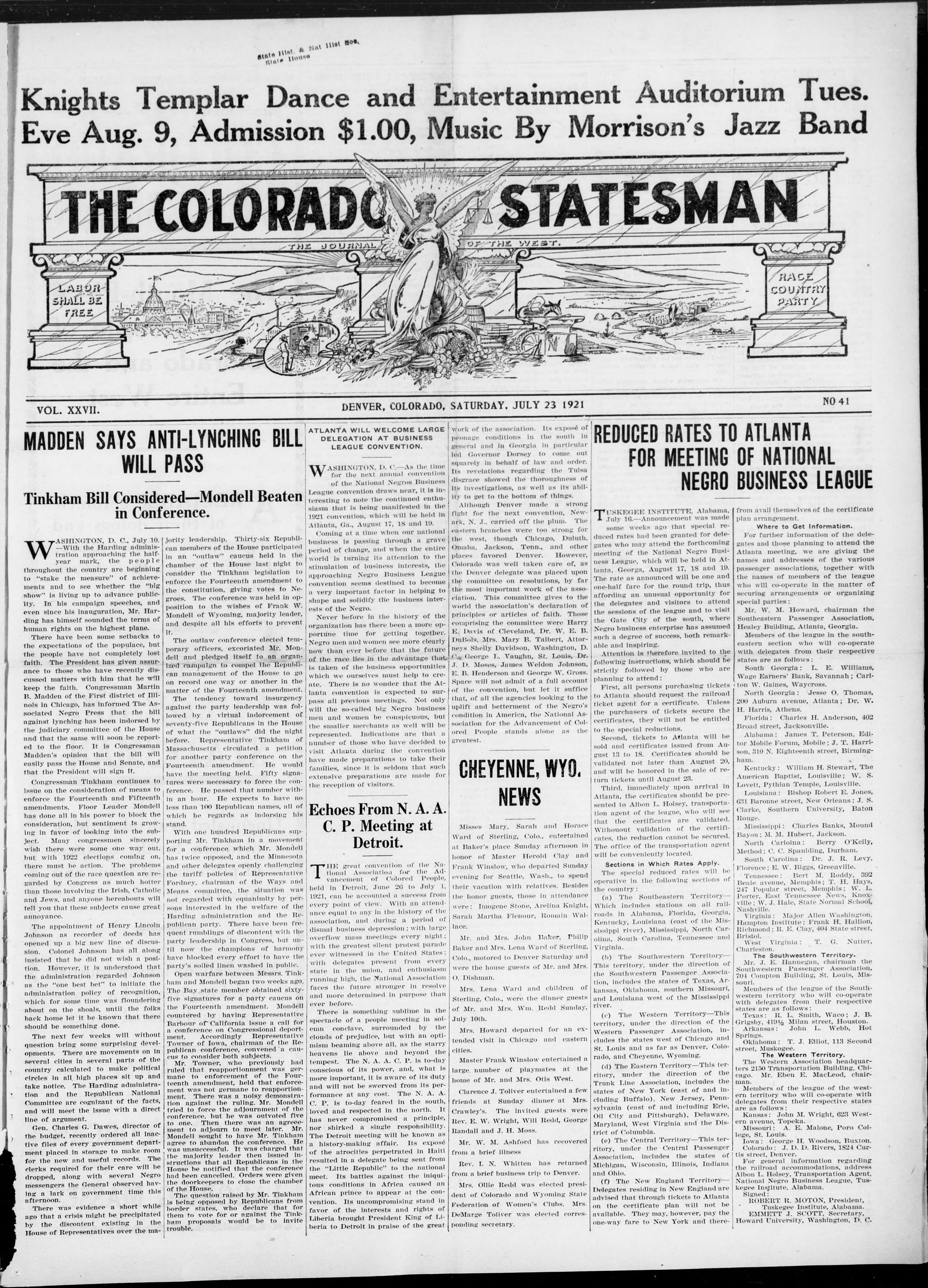
Knights Templar Dance and Entertainment Auditorium Tues. Eve Aug. 9, Admission $1.00, Music By Morrison's Jazz Band
THE COLORADO STATESMAN
THE JOURNAL OF THE WEST.
LABOR SHALL BE FREE
RACE COUNTRY PARTY
MADDEN SAYS ANTI-LYNCHING BILL WILL PASS
Tinkham Bill Considered—Mondell Beaten in Conference.
VOL. XXVII.
MADDEN SAYS AND WILL
Tinkham Bill Consider in Conf
WASHINGTON, D. C., July 10.
With the Harding administration approaching the half-year mark, the people throughout the country are beginning to "stake the measure" of achievements and to see whether the "big show" is living up to advance publicity. In his campaign speeches, and even since his inauguration, Mr. Harding has himself sounded the terms of human rights on the highest plane.
There have been some setbacks to the expectations of the populace, but the people have not completely lost faith. The President has given assurance to those who have recently discussed matters with him that he will keep the faith. Congressman Martin B. Madden of the First district of Illinois in Chicago, has informed The Associated Negro Press that the bill against lynching has been indorsed by the judiciary committee of the House and that the same will soon be reported to the floor. It is Congressman Madden's opinion that the bill will easily pass the House and Senate, and that the President will sign it.
Congressman Tinkham continues to issue on the consideration of means to enforce the Fourteenth and Fifteenth amendments. Floor Leader Mondell has done all in his power to block the consideration, but sentiment is growing in favor of looking into the subject. Many congressmen sincerely wish there were some one way out, but with 1922 elections coming on, there must be action. The problems coming out of the race question are regarded by Congress as much hotter than those involving the Irish, Catholic and Jews, and anyone hereabouts will tell you that these subjects cause great annoyance.
The appointment of Henry Lincoln Johnson as recorder of deeds has opened up a big new line of discussion. Colonel Johnson has all along insisted that he did not wish a position. However, it is understood that the administration regarded Johnson as the "one best bet" to initiate the administration policy of recognition, which for some time was floundering about on the shoals, until the folks back home let it be known that there should be something done.
The next few weeks will without question bring some surprising developments. There are movements on in several cities in several parts of the country calculated to make political circles in all high places sit up and take notice. The Harding administration and the Republican National Committee are cognizant of the facts, and will meet the issue with a direct line of argument.
Gen. Charles G. Dawes, director of the budget, recently ordered all inactive files of every government department placed in storage to make room for the new and useful records. The clerks required for their care will be dropped, along with several Negro messengers the General observed having a bark on government time this afternoon.
There was evidence a short while ago that a crisis might be precipitated by the discontent existing in the House of Representatives over the ma-
State Hist. & Nat Hist No.
State House
emplar Da
9, Admission
COLORA
NTI-LYNCHING BILL
PASS
red—Mondell Beaten
erence.
jority leadership. Thirty-six Republican members of the House participated in an "outlaw" caucus held in the chamber of the House last night to consider the Tinkham legislation to enforce the Fourteenth amendment to the constitution, giving votes to Negroes. The conference was held in opposition to the wishes of Frank W. Mondell of Wyoming, majority leader, and despite all his efforts to prevent it.
The outlaw conference elected temporary officers, excoriated Mr. Mondell and pledged itself to an organized campaign to compel the Republican management of the House to go on record one way or another in the matter of the Fourteenth amendment.
The tendency toward insurgency against the party leadership was followed by a virtual indorment of seventy-five Republicans in the House of what the "outlaws" did the night before. Representative Tinkham of Massachusetts circulated a petition for another party conference on the Fourteenth amendment. He would have the meeting held. Fifty signatures were necessary to force the conference. He passed that number within an hour. He expects to have no less than 100 Republican names, all of which he regards as indorsing his stand.
With one hundred Republicans supporting Mr. Tinkham in a movement for a conference which Mr. Mondell has twice opposed, and the Minnesota and other delegates openly challenging the tariff policies of Representative Fordney, chairman of the Ways and Means committee, the situation was not regarded with equanimity by persons interested in the welfare of the Harding administration and the Republican party. There have been frequent rumblings of discontent with the party leadership in Congress, but until now the champions of harmony have blocked every effort to have the party's soiled linen washed in public.
Open warfare between Messrs. Tinkham and Mondell began two weeks ago. The Bay state member obtained sixty-five signatures for a party caucus on the Fourteenth amendment. Mondell countered by having Representative Barbour of California issue a call for a conference on Congressional deportment. Accordingly Representative Towner of Iowa, chairman of the Republican conference, convened a caucus to consider both subjects.
Mr. Towner, who previously had ruled that reapportionment was germane to enforcement of the Fourteenth amendment, held that enforcement was not germane to reapportionment. There was a noisy demonstration against the ruling. Mr. Mondell tried to force the adjournment of the conference, but he was outvoted five to one. Then there was an agreement to adjourn to meet later. Mr. Mondell sought to have Mr. Tinkham agree to abandon the conference. He was unsuccessful. It was charged that the majority leader then issued instructions that all Republicans in the House be notified that the conference had been cancelled. Orders were given the doorkeepers to close the chamber of the House.
The question raised by Mr. Tinkham is being opposed by Republicans from border states, who declare that for them to vote for or against the Tinkham proposals would be to invite trouble.
nce and E
on $1.00, M
ADO
E JOURNAL
DENVER, COLORADO,
ATLANTA WILL WELCOME LARGE
DELEGATION AT BUSINESS
LEAGUE CONVENTION.
WASHINGTON, D. C.—As the time for the next annual convention of the National Negros Business League convention draws near, it is interesting to note the continued enthusiasm that is being manifested in the 1921 convention, which will be held in Atlanta, Ga., August 17, 18 and 19. Coming at a time when our national business is passing through a grave period of change, and when the entire world is turning its attention to the stimulation of business interests, the approaching Negro Business League convention seems destined to become a very important factor in helping to shape and solidify the business interests of the Negro.
Never before in the history of the organization has there been a more opportune time for getting together. Negro men and women see more clearly now than ever before that the future of the race lies in the advantage that is taken of the business opportunities which we ourselves must help to create. There is no wonder that the Atlanta convention is expected to surpass all previous meetings. Not only will the so-called big Negro business men and women be conspicuous, but the smaller merchants as well will be represented. Indications are that a number of those who have decided to visit Atlanta during the convention have made preparations to take their families, since it is seldom that such extensive preparations are made for the reception of visitors.
Echoes From N. A. A. C. P. Meeting at Detroit.
THE great convention of the National Association for the Advancement of Colored People, held in Detroit, June 26 to July 1, 1921, can be accounted a success from every point of view. With an attendance equal to any in the history of the association, and during a period of dismal business depression; with large overflow mass meetings every night; with the greatest silent protest parade ever witnessed in the United States; with delegates present from every state in the union, and enthusiasm running high, the National Association faces the future stronger in resolve and more determined in purpose than ever before.
There is something sublime in the spectacle of a people meeting in solemn conclave, surrounded by the clouds of prejudice, but with an optimism beaming above all, as the starry heavens lie above and beyond the tempest. The N. A. A. C. P. is to-day conscious of its power, and, what is more important, it is aware of its duty and will not be swerved from its performance at any cost. The N. A. A. C. P. is to-day feared in the south, loved and respected in the north. It has never compromised a principle, nor shirked a single responsibility. The Detroit meeting will be known as a history-making affair. Its exposé of the atrocities perpetrated in Haiti resulted in a delegate being sent from the "Little Republic" to the national meet. Its battles against the iniquitous conditions in Africa caused an African prince to appear at the convention. Its uncompromising stand in favor of the interests and rights of Liberia brought President King of Liberia to Detroit in praise of the great
DENVER, COLORADO, SATURDAY, JULY 23 1921
TA WILL WELCOME LARGE
EGATION AT BUSINESS
EAGUE CONVENTION.
HINGTON, D. C.—As the time
for the next annual convention
of the National Negros Business
convention draws near, it is in-
tended to the continued out-
work of the association. Its exposé of
peonage conditions in the south in
general and in Georgia in particular
led Governor Dorsey to come out
squarely in behalf of law and order.
Its revelations regarding the Tula
disgrace showed the thoroughness of
its investigations, as well as its ability
to get to the bottom of things.
Although Denver made a strong fight for the next convention, Newark, N. J., carried off the plum. The eastern branches were too strong for the west, though Chicago, Duluth, Omaha, Jackson, Tenn., and other places favored Denver. However, Colorado was well taken care of, as the Denver delegate was placed upon the committee on resolutions, by far the most important work of the association. This committee gives to the world the association's declaration of principles or articles of faith. Those comprising the committee were Harry E. Davis of Cleveland, Dr. W. E. B. DuBois, Mrs. Mary B. Talbert, attorneys Shelly Davidson, Washington, Dr. C. George L. Vaughn, St. Louis, Dr J. D. Moses, James Weldon Johnson, E. B. Henderson and George W. Gross. Space will not admit of a full account of the convention, but let it suffice that, of all the agencies looking to the uplift and betterment of the Negro's condition in America, the National Association for the Advancement of Colored People stands alone as the greatest.
CHEYENNE, WYO. NEWS
CHEYENNE, WYO. NEWS
Misses Mary, Sarah and Horace Ward of Sterling, Colo., entertained at Baker's place Sunday afternoon in honor of Master Herold Clay and Frank Winslow, who departed Sunday evening for Seattle, Wash., to spend their vacation with relatives. Besides the honor guests, those in attendance were: Imogene Stone, Arelina Knight, Sarah Martha Flenour, Romain Wallace.
Mr. and Mrs. John Baker, Philip Baker and Mrs. Lena Ward of Sterling, Colo., motored to Denver Saturday and were the house guests of Mr. and Mrs. O. Dishman.
Mrs. Lena Ward and children of Sterling, Colo., were the dinner guests of Mr. and Mrs. Wm. Redd Sunday, July 10th.
Mrs. Howard departed for an extended visit in Chicago and eastern cities.
Master Frank Winslow entertained a large number of playmates at the home of Mr. and Mrs. Otis West.
Clarence J. Toliver entertained a few friends at Sunday dinner at Mrs. Crawley's. The invited guests were Rev. E. W. Wright, Will Redd, George Randall and J. H. Moss.
Mr. W. M. Ashford has recovered from a brief illness
Rev. I. N. Whitten has returned from a brief business trip to Denver.
Mrs. Ollie Redd was elected president of Colorado and Wyoming State Federation of Women's Clubs. Mrs. DeMarge Toliver was elected corresponding secretary.
REDUCED RATES TO ATLANTA FOR MEETING OF NATIONAL NEGRO BUSINESS LEAGUE
TUSKEGEE INSTITUTE, Alabama
July 16.—Announcement was made
some weeks ago that special reduced rates had been granted for delegates who may attend the forthcoming meeting of the National Negro Business League, which will be held in Atlanta, Georgia, August 17, 18 and 19. The rate as announced will be one and one-half fare for the round trip, thus affording an unusual opportunity for the delegates and visitors to attend the sessions of the league and to visit the Gate City of the south, where Negro business enterprise has assumed such a degree of success, both remarkable and inspiring.
Attention is therefore invited to the following instructions, which should be strictly followed by those who are planning to attend:
First, all persons purchasing tickets to Atlanta should request the railroad ticket agent for a certificate. Unless the purchasers of tickets secure the certificates, they will not be entitled to the special reductions.
Second, tickets to Atlanta will be sold and certificates issued from August 13 to 18. Certificates should be validated not later than August 20, and will be honored in the sale of return tickets until August 23.
Third, immediately upon arrival in Atlanta, the certificates should be presented to Albon L. Holsey, transportation agent of the league, who will see that the certificates are validated. Withoutout validation of the certificates, the reduction cannot be secured. The office of the transportation agent will be conveniently located.
Sections in Which Rates Apply.
The special reduced rates will be operative in the following sections of the country:
(a) The Southeastern Territory—Which includes stations on all railroads in Alabama, Florida, Georgia, Kentucky, Louisiana (east of the Mississippi river), Mississippi, North Carolina, South Carolina, Tennessee and Virginia.
(b) The Southwestern Territory—This territory, under the direction of the Southwestern Passenger Association, includes the states of Texas, Arkansas, Oklahoma, southern Missouri, and Louisiana west of the Mississippi river.
(c) The Western Territory—This territory, under the direction of the Western Passenger Association, includes the states west of Chicago and St. Louis and as far as Denver, Colorado, and Cheyenne, Wyoming.
(d) The Eastern Territory—This territory, under the direction of the Trunk Line Association, includes the states of New York (east of and including Buffalo), New Jersey, Pennsylvania (east of and including Erie, Oil City and Pittsburgh), Delaware, Maryland, West Virginia and the District of Columbia.
(e) The Central Territory—This territory, under the Central Passenger Association, includes the states of Michigan, Wisconsin, Illinois, Indiana and Ohio.
(f) The New England Territory—Delegates residing in New England are advised that through tickets to Atlanta on the certificate plan will not be available. They may, however, pay the one-way fare to New York and there-
NO 41
from avail themselves of the certificate plan arrangement.
Where to Get Information.
For further information of the delegates and those planning to attend the Atlanta meeting, we are giving the names and addresses of the various passenger associations, together with the names of members of the league who will co-operate in the matter of securing arrangements or organizing special parties:
Mr. W. M. Howard, chairman the Southeastern Passenger Association, Healey Building, Atlanta, Georgia.
Members of the league in the southeastern section who will co-operate with delegates from their respective states are as follows:
South Georgia: L. E. Williams, Wage Earners' Bank, Savannah; Carlton W. Gaines, Waycross.
North Georgia: Jesse O. Thomas, 200 Auburn avenue, Atlanta; Dr. W. H. Harris, Athens.
Florida: Charles H. Anderson, 402 Broad street, Jacksonville.
Alabama: James T. Peterson, Editor Mobile Forum, Mobile; J. T. Harrison, 310 N. Eighteenth street, Birmingham.
Kentucky: William H. Stewart, The American Baptist, Louisville; W. S. Lovett, Pythian Temple, Louisville. Louisiana: Bishop Robert E. Jones, 631 Baronne street, New Orleans; J. S. Clarke, Southern University, Baton Rouge. Mississippi: Charles Banks, Mound Bayou; M. M. Hubert, Jackson. North Carloina: Berry O'Kelly, Method; C. C. Spaulding, Durham.
South Carolina: Dr. J. R. Levy, Florence; E. W. Biggs, Greenville.
Tennessee: Bert M. Roddy, 392 Beale avenue, Memphis; T. H. Hays, 247 Popular street, Memphis; W. L. Porter, East Tennessee News, Knoxville; W. J. Hale, State Normal School, Nashville.
Virginia: Major Allen Washington, Hampton Institute; Frank H. Hallion, Richmond; R. E. Clay, 404 State street, Bristol.
West Virginia: T. G. Nutter, Charleston.
The Southwestern Territory.
Mr. J. E. Hannegan, chairman the Southwestern Passenger Association, 704 Compton Building, St. Louis, Missouri.
Members of the league of the Southwestern territory who will co-operate with delegates from their respective states are as follows:
Texas: R. L. Smith, Waco; J. B. Griggsby, 4191% Milan street, Houston.
Arkansas: John L. Webb, Hot Springs.
Oklahoma: T. J. Elliot, 113 Second street, Muskegue.
The Western Territory.
The Western Association headquarters 2150 Transportation Building, Chicago. Mr. Eben E. MacLeod, chairman. Members of the league of the western territory who will co-operate with delegates from their respective states are as follows:
Kansas: John M. Wright, 623 Western avenue, Topeka
Missouri: A. E. Malone, Poro College, St. Louis.
Iowa: George H. Woodson, Buxton.
Colorado: J. D. D. Rivers, 1824 Curtis street, Denver.
For general information regarding the railroad accommodations, address Albon L. Holsey, Transportation Agent, National Negro Business League, Tuskegee Institute, Alabama.
Signed:
ROBERT R. MOTON, President,
Tuskegee Institute, Alabama.
EMMETT J. SCOTT, Secretary.
EMMETT J. SCOTT, Secretary,
Howard University, Washington, D. C.
FOREIGN
Sixty-five thousand Ukrainian immigrants have settled in Brazil, where they have been given every assistance by the Brazilian government.
The 1921 Nova Scotia apple crop will be between 1,500,000 and 2,000,000 barrels, according to estimates made by the United Fruit Company of Nova Scotia.
There are approximately 30,000 Americans in Mexico, and of this number 8,000 live in Mexico City, according to a recent estimate by the Department of Immigration.
Underground passages are to be located at twenty of the principal street crossings in Mexico City to relieve the traffic situation, which has become serious. It is planned to have the cost of digging the tunnels covered by rentals from various concessions which are to be located underground.
A 70-year-old German major general has been forced by poverty to become a horse groom in a Munich riding academy, testified members of a renters' meeting in Munich. The general paid half of his pension for the rent and heat, and went to work in the stalls to prevent starvation.
Jewel thefts to the value of more than $8,000,000, which have puzzled the French police throughout the seasons on the Riviera and at Paris, have now been traced by the famous surety general to a band of expert international thieves led by a Spaniard named Yoquez, who claims American nationality.
All countries whose nationals have suffered damages from Mexican revolutions have been invited by President Obregon to appoint delegates, who will meet Mexican representatives and form a permanent commission to pass upon claims. The invitation was issued in the form of a presidential decree at Mexico City.
Following the lead of American, French and Austrian scientists and doctors, in grafting a portion of an animal gland into the interstitial gland of the human body to produce renewed vitality, the Imperial University in Fukuoka, Japan, will soon start experiments of that nature. The work by the school will be a departure from precedent, however, as it will be the first institution in the world to create a department for such work.
Lieutenant Kirsch, French aviator, is declared to have reached an altitude of 10,000 meters (about 34,768 feet) Friday in an unofficial attempt to break the world's altitude record. Although the official record, made by Capt. R. W. Schroeder of the United States army at Dayton, Ohio, on Feb. 27, 1920, is only 33,000 feet, it is thought probable that the Aero Club of France will not certify Lieutenant Kirsch's record.
GENERAL
Albert J. Erlerston of Lisbon swam across the Fox river at Sherldan, IL, and then fell exhausted in a foot of water and drowned.
Two men who robbed the First State Bank, Terlton, Okla., of $1,200 were found dead in a cornfield by a sheeriff's posse. It is believed that the men shot themselves.
Mike Hastings of Cheyenne, Wyo., came within two-fifths of a second of the world's record for the time taken to bulldog a steer at the annual cowboy championship contests at Chicago, his time being 9-4-5 seconds.
Chicago's holdup men flaunted the trade in the face of the police department. Two armed bandits held up and robbed Joseph Biehl of $10 in the lobby of City Hall while scores of detectives sauntered within call. The bandits escaped.
The theft from his room in a hotel in Chicago of several hundred watches, including 200 diamond-studded wrist watches, valued in all at $d5,000, was reported to the police by Harry Preston, New York jewelry salesman. According to Preston, he left the watches in a suitcase in his hotel, and when he returned found them gone.
Forrest Higgins was acquitted of a charge of having murdered his flancee, Lucy Wittum, by a jury in Circuit Court at Corunna, Mich. The jury deliberated on the evidence less than two hours and took but two ballots, the first being ten to two for acquittal.
Capt. Beverly Grayson Chew, court-martialed on fifty-odd charges, including forgery and desertion, was found guilty at New York by an army trial board. He was sentenced to seven years at hard labor, involving dishonorable discharge from the service. He had defended his acts on the plan of insanity caused by wounds in the world war. Fifty-one specific forgeries were shown.
Purchase of food and clothing aggregating more than $1,300,000,000 during the six years from September, 1914, to September, 1920, were made by the committee for relief in Belgium, according to the statement of Herbert C. Hoover, its chairman, in the final report made public. The committee is now in liquidation and the accounts are final and complete, with the exception of certain minor outstanding items remaining from the liquidation.
Four negroes were killed and Monroe Ferguson, business man, severely wounded in a gun battle between a posse and a number of negroes near Rayville, La. The battle resulted from attempts of deputy sheriffs to arrest two negro women charged with beating some white boys who were swimming in a stream near Rayville.
Two unidentified gunmen were shot and killed at Cleveland, Ohio, by police when the men resisted efforts to search them for weapons and attempted to escape, firing as they ran. A third man escaped.
CONDENSED RECORD OF THE PROGRESS OF EVENTS AT HOME AND ABROAD.
FROM ALL SOURCES
BAYINGS, DOINGS, ACHIEVE
MENTS, SUFFERINGS, HOPES
AND FEARS OF MANKIND.
(Western Newspaper Union News Service.)
WESTERN
A $1,000 silver trophy has been offered by the Los Angeles speedway management to the first aviator making a non-stop flight from Los Angeles to the Atlantic coast.
Charles F. Robinson, 28, fireman on the G. H. & S. A. train on which William Bohlman, engineer, was mysteriously killed July 8 near Sanderson, Texas, committed suicide at El Paso.
Fire destroyed the refinery of the California-Fresno Oil Company at Fresno, Calif., together with ten tanks containing 50,000 gallons of fuel oil, causing damage estimated at between $250,000 and $500,000. A distillate explosion started the fire.
Home preserved fish affected with botulinus germs caused the death of Mrs. Lida Lemens of San Jacinto at the county hospital at Riverside, Calif., according to health authorities. Seventy-five chickens out of a flock of 200 to which contents of the can were thrown, also died. In spite of prohibition, the number of criminal cases involving alleged intoxication on the part of automobile drivers is increasing, said a statement by three Superior Court judges at Los Angeles, announcing that hereafter persons convicted of driving a car while intoxicated would be given jail sentences instead of fines.
Bewteen forty and fifty employs of the Utah Gas and Coke Company at Salt Lake City, left their places upon the expiration of the agreement with the company. The company offered the men a 20 per cent wage reduction and the men voted to accept a 10 per cent wage decrease. This the company refused and as a result the men walked out. The places of all the men leaving were immediately filled.
Mrs. Paul Tacina shot and killed Fred Beckwich, a beet tender, near Minatare, Neb., she admitted, when she saw that Beckwich was getting the better of an argument with her husband over some hay, according to a dispatch from Minatare. Beckwich had been drinking intoxicating liquor before he came to the farm where Tacina was employed, according to Mrs. Tacina, who said she fired four times at him with a rifle.
WASHINGTON
The Dial bill, to require federal judges to devote their entire time to court duties, failed to get Senate consideration on a tie vote of 29 to 29. Passage of the bill would prevent Judge K. M. Landis from officiating both as a federal judge and big league baseball arbiter.
Estimates of the amount of wheat sown in seventeen countries for which statistics are available show an acreage of 151,000,000 acres this year, against 155,000,000 last year, according to a summary of foreign crop prospects made public by the Department of Agriculture. The estimates were based upon reports from Belgium, Bulgaria, Poland, Rumania, Czecho-Slovakia, Algeria, Morocco, Spain, France, England, Italy, Luxemburg, Norway, Tunis, Canada, India and the United States.
By a vote of ten to five the House postoffice committee voted to lay on the table the resolution of Representative Hardy of Colorado to postpone increase in second-class rates. "There is no more hope of obtaining this legislation," said Hardy.
Idle freight cars on the railroads of the United States numbered 360,525 on July 8, a decrease of 4,266 from the previous week, according to a statement by the American Railway Association. A brisk demand for box cars to meet grain car shortages in the West reduced the surplus in that class to 145,112, which was 1,186 fewer than the excess of box cars at the end of the preceding week.
The administration has opened negotiations for the resumption of diplomatic relations with Germany, it has been announced at the White House. At the direction of the administration, Ellis Loring Dresel, American commissioner in Berlin, has been carrying on informal discussions with the German foreign office-looking toward formal negotiations for the resumption of peace-time relations with the German nation.
The House agreed to a Senate amendment to the bill authorizing an increase from $15,000,000 to $30,000,000 in the bonded indebtedness of the Philippines. The amendment would permit the insular government to issue temporary certificates of indebtedness to the extent of $20,000,000. The present maximum is $10,000,000.
Two Chinese were shot and killed on a truck farm a mile and one-quarter south of Phoenix under circumstances which attaches of the sheriff's office say point to a struggle between two tongs.
Pithy News Notes From All Parts of Colorado
(Western Newspaper Union News Service.)
**EVENTS.**
Annual Monte Vista Stampede at Monte Vista, Aug. 3, 4. 5.
Morgan County Fair, Fort Morgan, Aug. 24-26; W. J. Ott, secretary.
Another important recognition to Colorado came from the Harding administration with the nomination by the President of Rush L. Holland of Colorado Springs to be an assistant attorney general. The appointment had the personal indorsement of Attorney General Daugherty and of the Colorado senators.
Joseph P. Flannigan, an ex-sallor, was arrested at South Platte by Sheriff G. C. Kerr, following two attempts to commit suicide. He is in the Jefferson county jail. His sanity is to be tested, authorities say. Flannigan is said to have been gassed in France and was recently a patient at the Fitzsimons hospital.
The third annual stampede, an event that now brings people from all over the intermountain region, will be held this year on August 3, 4 and 5 at Monte Vista. The committee in charge report that in the matter of attractions and general features the stampede this year will be the best so far held, and there is every reason to believe that a record-breaking crowd will attend.
Capt. Arthur Talbott of Battery A, Colorado National Guard Artillery, has been notified that sixty-four horses are now en route to Pueblo for the use of the battery. There are also en route eight 75-mm. guns. With the horses now coming, the military organizations in Pueblo, Troop C of the cavalry and Battery A, will have ninety-six horses, all to be stabled at the state fair grounds.
The count at the Colorado state penitentiary shows a prison population of 782, which is the highest for several years, and which is nearing the high-water mark of ante-prohibition days. Following the adoption of state-wide prohibition, the prison population gradually decreased from more than 800 to something like 550, the count on November 30, 1918, being 561, or 221 less than that of to-day.
Alexander Baudino and Octavious Serrino, miners employed at one of the Triangle Coal Company mines, four miles south of Durango, were painfully burned when, after placing and firing a round of shots, they entered their coal room with lighted lamps, when an explosion of gas occurred. The former was burned around the head and the latter on the body. Their burns are not fatal.
Thomas Phoenix, superintendent of the Watrous Cafe in Curtis street, Denver, his wife and his daughter, Miss Margaret Phoenix, 20 years old, were injured when an automobile in which they were driving to Colorado Springs for a day's outing skidded and tumbled over a 200-foot embankment between Monument and Husted. The top of the car, a sedan, prevented serious injuries to them when it caught the weight of the wheels and body as the machine turned over.
Suffering from a serious concussion of the brain by reason of striking his head on an iron bar across a gate, Warren Steele of Estes Park is in a critical condition. He was driving a truck loaded with hay to the workers at Fall River road camp, and when he reached the entrance to Horseshoe Park, which is guarded by a high steel gate, the load was too high to get under the gate. He is said to have been driving fast, and the iron bar above the gate struck him on the head, knocking him unconscious for several hours and causing a serious concussion and possible fracture of the skull.
There are twenty-four county agents at work in Colorado, devoting their entire time to the advancement of the farmers' interests. Ask your agent to help you. If he cannot he will get into communication with someone who can.
The rapid increase in agricultural activity in non-irrigated sections of Colorado is especially emphasized by the statistics on irrigation for the state, just made public by the federal census bureau and partially interpreted by the State Immigration Department by comparison with statistics furnished that department by county assessors. The report of the census bureau shows that 1,923,950 acres of crops, exclusive of orchards, were harvested from irrigated land in the state in 1919, compared with 1,581,394 acres in 1909, or an increase of 21 per cent. The total area harvested in 1919, exclusive of orchards, was 5,052,955 acres, compared with 2,613,917 acres, the increase being 93 per cent. This leaves the area of non-irrigated crops harvested in 1919 at 3,129,005 acres, compared with 1,032,523 acres in 1909, the increase being about 203 per cent.
The Ault school directors have accepted plans and awarded the contract for a new senior and junior high school building which will cost $85,000 and which will eventually house 500 pupils. The new building is to be completed and in use by early winter. The building will front on Liberty park, which was recently purchased and improved by the school district.
All Police Court records were shattered at Pueblo when fines amounting to $2,390 were assessed in one day. The fines included $50 each assessed against forty-five vagrants rounded up.
Record-breaking crops of both wheat and corn for Colorado and somewhat better than average production of most of the less important crops, are the outstanding features in the state-federal crop report for July, based upon the conditions of all crops on July 1, just issued by the Colorado Co-operative Crop Reporting Service. The condition of winter wheat on July 1 was 89 per cent of normal, the same as that for June and for July 1 last year, but seven points above the ten-year average. Revised acreage figures, based upon nearly complete reports from county assessors, place the area of winter wheat left for harvest at 1,400,000 acres, compared with 1,096,000 acres harvested in 1920 and 1,032,000 acres returned by the census bureau in 1919. If condition at harvest time is the same as that on July 1 the production will be about 27,312,000 bushels, compared with a final estimate of 19,841,000 bushels last year and 13,675,000 bushels reported by the census bureau for 1919.
Organization of a new north-and-south highway has been completed at Yuma. Articles of incorporation were completed and the name of the North Star Highway Association of Colorado was adopted at a convention held at Yuma, Colo., and attended by more than 100 delegates from the towns along the route. The present highway runs from Cheyenne Wells, Colo., to Beaverton, Stratton, Joes, Kirk, Yuma, Bryant, Haxtum, Sedgwick, and then to Chappel, Neb. From the enthusiasm shown and the prominent men of eastern Colorado present, the highway is assured of a wonderful success. It will pass through the richest and best of eastern Colorado agricultural country, and form a real link to the proposed Gulf-Canadian highway.
A total of $375,340.72 will be distributed among the public schools of the state of Colorado during the next three or four weeks. This sum represents the earnings of the state permanent school fund, and the revenue of the state land board during the last six months from leases on public lands. Distribution of the money will be made through Katherine M. Craig, state superintendent of public instruction, on a basis of school population. On January 1 $357,478.97 was divided among the sixty-three counties in the state.
Death was cheated out of a victim when Hugh Quick, a Colorado Springs Boy Scout, saved a companion from drowning. Elmer Moore, a lad 14 years old, had gone down twice when Quick reached the scene. He immediately plunged into the water and succeeded in bringing his companion to the bank, although the drowning lad put up a struggle. The accident happened in Ridge lake, located in the Garden of the Gods.
The Western Light and Power Company have voluntarily put an order into effect reducing street car rates in Boulder from 10 cents to $7½ cents a ride. Less than four months ago they were granted permission to raise the fare from 5 cents to 10 cents. The company found that the higher rate reduced the travel to such an extent that instead of profiting by the raise the company lost.
The old settlers of the Arkansas valley will hold their annual picnic at the fair grounds of the Arkansas Valley Fair Association, in Pueblo, August 1, which in this state is a holiday, and there is every prospect that this year's celebration will be the greatest in the history of the organization, which is made up of people who have made the valley their home for twenty or more years.
Charles L. Conrey Post of the Veterans of Foreign Wars will hold a two weeks membership campaign in Fort Collins, four teams captained by John Hurdle, Ted Herring, Ray Combs and Harry Mudge competing for honors. The two teams getting the most members will be the guests of the other two teams at a banquet August 2.
Work has been begun on the temporary bridge over the Arkansas river east of Rocky Ford, one of the steel spans of which was carried away in the flood, is progressing satisfactorily, and it is expected that travel over the structure will be possible within a week, when that city will again be in touch with Holbrook and Cheraw. The Seibert Kaned Wheat Growers' Association has been organized at Seibert to take charge of the sale of the immense crop of Kaned wheat now being harvested. Seibert is the only place in Colorado with a large acreage of this wheat, which was developed during a fifteen-year period by the Kansas experiment stations.
The National Association of Automobile Manufacturers will meet in Colorado Springs next June, according to definite information. The convention will be represented by 1,200 delegates from manufacturing centers of the country. Sixty-two students of the Colorado Agricultural College, now at their homes, has just been notified that they need not return to college the coming year, since they did not make enough credits last year to remain in the institution.
The general crops summary received by the bureau of markets and crop estimates of the United States Department of Agriculture Indicates a general reduction of the potato crop throughout virtually all of the country, due to light rainfall. Colorado is in a favored position, however, in this respect, as the potato crop in this state is expected to be one of the largest in history. A survey of the Colorado potato crop, as it stands to-day, indicates an acreage of approximately 85,000, as compared to last year's acreage, which was only 72,000.
```markdown
```
COLORADO STATESMAN
The Mouth-Piece of the People of Colorado and the Entire West
RELIABLE chronicle of their doings and progress; a faithful mirror of their wants, their hopes, their best aspirations.
Unequaled as an advertising medium for the business of professional men and women.
An excellent family journal speaking to and for many thousand colored citizens.
$2.50 A YEAR
THE GREAT ORGAN OF THE
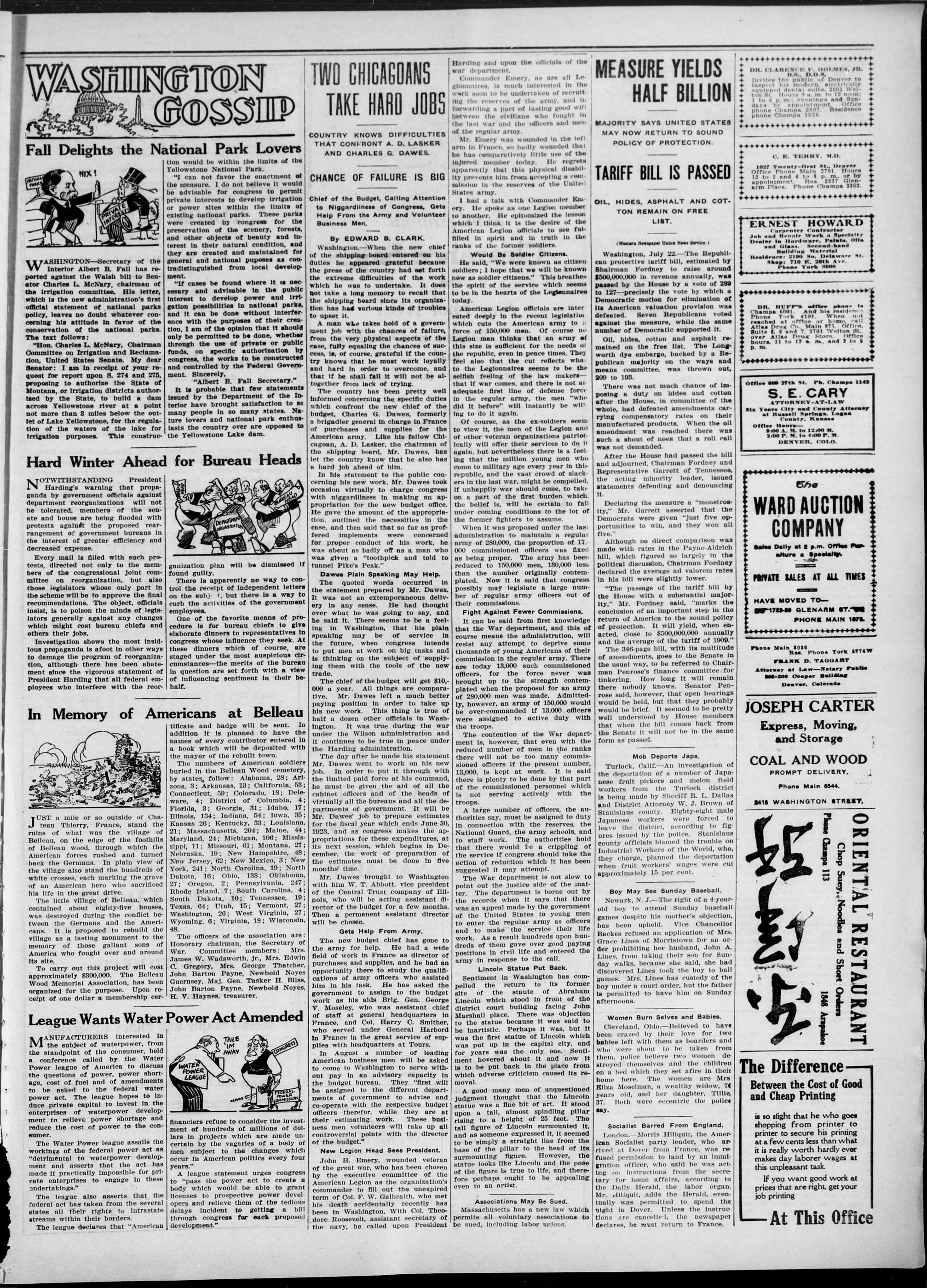
WASHINGTON GOSSIP
Fall Delights the National Park Lovers
Hard Winter Ahead for Bureau Heads
In Memory of Americans at Belleau
League Wants Water Power Act Amended
PARTIAL PARK
NIX!
WASHINGTON—Secretary of the Interior Albert B. Fall has reported against the Walsh bill to Senator Charles L. McNary, chairman of the irrigation committee. His letter, which is the new administration's first official statement of national parks policy, leaves no doubt whatever concerning his attitude in favor of the conservation of the national parks. The text follows:
"Hon. Charles L. McNary, Chairman Committee on Irrigation and Reclamation, United States Senate. My dear Senator: I am in receipt of your request for report upon S. 274 and 275, proposing to authorize the State of Montana, or irrigation districts authorized by the State, to build a dam across Yellowstone river at a point not more than 8 miles below the outlet of Lake Yellowstone, for the regulation of the waters of the lake for irrigation purposes. This construc
NOTWITHSTANDING President Harding's warning that propaganda by government officials against department reorganizations will not be tolerated, members of the senate and house are being flooded with protests against the proposed rearrangement of government bureaus in the interest of greater efficiency and decreased expense. Every mail is filled with such protests, directed not only to the members of the congressional Joint committee on reorganization, but also those legislators whose only part in the scheme will be to approve the final recommendations. The object, officials insist, is to poison the minds of legislators generally against any changes which might cost bureau chiefs and others their jobs.
Investigation shows the most insidious propaganda is afoot in other ways to damage the program of reorganization, although there has been abatement since the vigorous statement of President Harding that all federal employees who interfere with the reor-
JUST a mile or so outside of Chateau Thierry, France, stand the ruins of what was the village of Belleau, on the edge of the foothills of Belleau wood, through which the American forces rushed and turned back the Germans. In plain view of the village also stand the hundreds of white crosses, each marking the grave of an American hero who sacrificed his life in the great drive.
The little village of Belleau, which contained about eighty-five houses, was destroyed during the conflict between the Germans and the Americans. It is proposed to rebuild the village as a lasting monument to the memory of those gallant sons of America who fought over and around its site.
To carry out this project will cost approximately $300,000. The Belleau Wood Memorial Association, has been organized for the purpose. Upon receipt of one dollar a membership cer-
MANUFACTURERS interested in the subject of waterpower, from the standpoint of the consumer, held a conference called by the Water Power league of America to discuss the questions of power, power shortage, cost of fuel and of amendments to be asked to the federal water power act. The league hopes to induce private capital to invest in the enterprises of waterpower development to relieve power shortage and reduce the cost of power to the consumer. The Water Power league assails the workings of the federal power act as "detrimental to waterpower development and asserts that the act has made it practically impossible for private enterprises to engage in these undertakings."
The league also asserts that the federal act has taken from the several states all their rights to Intrastate streams within their borders. The league declares that "American
tion would be within the limits of the Yellowstone National Park. "I can not favor the enactment of the measure. I do not believe it would be advisable for congress to permit private interests to develop irrigation or power sites within the limits of existing national parks. These parks were created by congress for the preservation of the scenery, forests, and other objects of beauty and interest in their natural condition, and they are created and maintained for general and national purposes as contradistinguished from local development.
"If cases be found where it is necessary and advisable in the public interest to develop power and irrigation possibilities in national parks, and it can be done without interference with the purposes of their creation, I am of the opinion that it should only be permitted to be done, whether through the use of private or public funds, on specific authorization by congress, the works to be constructed and controlled by the Federal Government. Sincerely.
"Albert B. Fall Secretary."
It is probable that few statements issued by the Department of the Interior have brought satisfaction to so many people in so many states. Nature lovers and national park enthusiasts the country over are opposed to the Yellowstone Lake dam.
organization plan will be dismissed if found guilty. There is apparently no way to control the receipt of independent letters on the subject, but there is a way to curb the activities of the government employees.
One of the favorite means of procedure is for bureau chiefs to give elaborate dinners to representatives in congress whose influence they seek. At these dinners which of course, are staged under the most auspicious circumstances—the merits of the bureau in question are set forth with a view of influencing sentiment in their behalf.
tificate and badge will be sent. In addition it is planned to have the names of every contributor entered in a book which will be deposited with the mayor of the rebuilt town.
The numbers of American soldiers buried in the Bellean Wood cemetery, by states, follow: Alabama, 28; Arizona, 3; Arkansas, 13; California, 53; Connecticut, 59; Colorado, 18; Deleware, 4; District of Columbia, 4; Florida, 3; Georgia, 31; Idaho, 17; Illinois, 134; Indiana, 54; Iowa, 35; Kansas, 26; Kentucky, 33; Louisiana, 21; Massachusetts, 204; Maine, 44; Maryland, 24; Michigan, 106; Mississippi, 11; Missouri, 61; Montana, 27; Nebraska, 19; New Hampshire, 48; New Jersey, 62; New Mexico, 3; New York, 241; North Carolina, 19; North Dakota, 16; Ohio, 138; Oklahoma, 27; Oregon, 2; Pennsylvania, 24; Rhode Island, 7; South Carolina, 4; South Dakota, 10; Tennessee, 19; Texas, 64; Utah, 15; Vermont, 27; Washington, 26; West Virginia, 27; Wyoming, 6; Virginia, 18; Wisconsin, 48.
The officers of the association are: Honorary chairman, the Secretary of War. Committee members: Mrs. James W. Wadsworth, Jr., Mrs. Edwin C. Gregory, Mrs. George Thatcher, John Barton Payne, Newbold Noyes Guernsey, Maj. Gen. Tasker H. Bliss, John Barton Payne, Newbold Noyes, H. V. Haynes, treasurer.
TAKE
I'M
AWAY
CONGRESS
WATER
POWER
LEAGUE
MROE
FEDERAL
POWER
COMMISSION
financiers refuse to consider the investment of hundreds of millions of dollars in projects which are made uncertain by the vagaries of a body of men subject to the changes which occur in American politics every four years."
A league statement urges congress to "pass the power act to create a body which would be able to grant licenses to prospective power developers and relieve them of the tedious delays incident to getting a bill through congress for each proposed development."
TWO CHICAGOANS TAKE HARD JOBS
COUNTRY KNOWS DIFFICULTIES
THAT CONFRONT A. D. LASKER
AND CHARLES G. DAWES.
CHANCE OF FAILURE IS BIG
Chief of the Budget, Calling Attention to Niggardliness of Congress, Gets Help From the Army and Volunteer Business Men.
By EDWARD B. CLARK.
Washington.—When the new chief of the shipping board entered on his duties he appeared grateful because the press of the country had set forth the extreme difficulties of the work which he was to undertake. It does not take a long memory to recall that the shipping board since its organization has had various kinds of troubles to upset it.
A man who takes hold of a government job with the chances of failure, from the very physical aspects of the case, fully equaling the chances of success, ie, of course, grateful if the country knows that he must work loyally and hard in order to overcome, and that if he shall fall it will not be altogether from lack of trying.
The country has been pretty well informed concerning the specific duties which confront the new chief of the budget, Charles G. Dawes, formerly a brigadier general in charge in France of purchases and supplies for the American army. Like his fellow Chicagoan, A. D. Lasker, the chairman of the shipping board, Mr. Dawes, has let the country know that he also has a hard job ahead of him.
In his statement to the public concerning his new work, Mr. Dawes took occasion virtually to charge congress with niggardiliness in making an appropriation for the new budget office. He gave the amount of the appropriation, outlined the necesities in the case, and then said that so far as profered implements were concerned for proper conduct of his work, he was about as badly off as a man who was given a "toothpick and told to tunnel Plke's Peak."
Dawes Plain Speaking May Help.
The quoted words occurred in the statement prepared by Mr. Dawes. It was not an extemporaneous delivery in any sense. He had thought over what he was going to say, and he said it. There seems to be a feeling in Washington, that his plain speaking may be of service in the future, when congress intends to put men at work on big tasks and is thinking on the subject of supplying them with the tools of the new trade.
The chief of the budget will get $10,000 a year. All things are comparative. Mr. Dawes left a much better paying position in order to take up his new work. This thing is true of half a dozen other officials in Washington. It was true during the war under the Wilson administration and it continues to be true in peace under the Harding administration.
The day after he made his statement Mr. Dawes went to work on his new job. In order to put it through with the limited paid force at his command, he must be given the aid of all the cabinet officers and of the heads of virtually all the bureaus and all the departments of government. It will be Mr. Dawes' job to prepare estimates for the fiscal year which ends June 30, 1923, and as congress makes the appropriations for these expenditures, at its next session, which begins in December, the work of preparation of the estimates must be done in five months' time.
Mr. Dawes brought to Washington with him W. T. Abbott, vice president of the Central Trust company of Illinois, who will be acting assistant director of the budget for a few months. Then a permanent assistant director will be chosen.
Gets Help From Army.
The new budget chief has gone to the army for help. He had a wide field of work in France as director of purchases and supplies, and he had an opportunity there to study the qualifications of army officers who assisted him in his task. He has asked the government to assign to the budget work as his alds Brlg. Gen. George V. Moseley, who was assistant chief of staff at general headquarters in France, and Col. Harry C. Smither, who served under General Harbord in France in the great service of supplies with headquarters at Tours.
In August a number of leading American business men will be asked to come to Washington to serve without pay in an advisory capacity in the budget bureau. They "first will be assigned to the different departments of government to advise and co-operate with the respective budget officers therefor, while they are at their estimating work. These business men volunteers will take up all controversial points with the director of the budget."
New Legion Head Sees President.
John H. Emery, wounded veteran of the great war, who has been chosen by the executive committee of the American Legion as the organization's commander to fill out the unexpired term of Col. F. W. Galbraith, who met his death accidentally recently has been in Washington. With Col. Theodore Roosevelt, assistant secretary of the navy, he called upon President
Harding and upon the officials of the war department.
Commander Emery, as are all Legionnaires, is much interested in the work soon to be undertaken of recruiting the reserves of the army, and in forwarding a pact of lasting good will between the civilians who fought in the last war and the officers and men of the regular army.
Mr. Emery was wounded in the left arm in France, so badly wounded that he has comparatively little use of the injured member today. He regrets apparently that this physical disability prevents him from accepting a commission in the reserves of the United States army.
I had a talk with Commander Emery. He spoke as one Legion member to another. He epitomized the lesson which I think it is the desire of the American Legion officials to see fulfilled in spirit and in truth in the ranks of the former soldiers.
Would Be Soldier Citizens.
He said, "We were known as citizen soldiers; I hope that we will be known now as soldier citizens." This breathes the spirit of the service which seems to be in the hearts of the Legionnaires today.
American Legion officials are interested deeply in the recent legislation which cuts the American army to a force of 150,000 men. Of course no Legion man thinks that an army of this size is sufficient for the needs of the republic, even in peace times. They feel also that the cut reflects what to the Legionnaires seems to be the selfish feeling of the law makers—that if war comes, and there is not adequate first line of defense force in the regular army, the men "who did it before" will instantly be willing to do it again.
Of course, as the ex-soldiers seem to view it, the men of the Legion and of other veteran organizations patriotically will offer their services to do it again, but nevertheless there is a feeling that the million young men who come to military age every year in this republic, and the vast crowd of slackers in the last war, might be compelled, if unhappily war should come, to take on a part of the first burden which the belief is, will be certain to fall under coming conditions to the lot of the former fighters to assume.
When it was proposed under the last administration to maintain a regular army of 280,000, the proportion of 17,000 commissioned officers was fixed as being proper. The army has been reduced to 150,000 men, 130,000 less than the number originally contemplated. Now it is said that congress possibly may legislate a large number of regular army officers out of their commissions.
Eight Against Fewer Commissions.
It can be said from first knowledge that the War department, and this of course means the administration, will resist any attempt to deprive some thousands of young Americans of their commission in the regular army. There are today 13,000 such commissioned officers, for the force never was brought up to the strength contemplated when the proposal for an army of 280,000 men was made. Admittedly, however, an army of 150,000 would be over-commanded if 13,000 officers were assigned to active duty with the troops.
The contention of the War department is, however, that even with the reduced number of men in the ranks there will not be too many commissioned officers if the present number, 13,000, is kept at work. It is said there is plenty to be done by that part of the commissioned personnel which is not serving actively with the troops.
A large number of officers, the authorities say, must be assigned to duty in connection with the reserves, the National Guard, the army schools, and to staff work. The authorities hold that there would be a crippling of the service if congress should take the action of reduction which it has been suggested it may attempt.
The War department is not slow to point out the justice side of the matter. The department is borne out by the records when it says that there was an appeal made by the government of the United States to young men to enter the regular army as officers and to make the service their life work. As a result hundreds upon hundreds of them gave over good paying positions in civil life and entered the army in response to the call.
Lincoln Statue Put Back.
Sentiment in Washington has compelled the return to its former site of the statute of Abraham Lincoln which stood in front of the district court building facing John Marshall place. There was objection to the statue because it was said to be inartistic. Perhaps it was, but it was the first statue of Lincoln which was put up in the capital city, and for years was the only one. Sentiment hovered about it and now it is to be put back in the place from which adverse criticism caused its removal.
A good many men of unquestioned judgment thought that the Lincoln statue was a fine bit of art. It stood upon a tall, almost spindling pillar rising to a height of 25 feet. The tall figure of Lincoln surmounted it, and as someone expressed it, it seemed to be simply a straight line from the base of the pillar to the head of its surmounting figure. However, the statue looks like Lincoln and the pose of the figure is true to life, and therefore perhaps ought to be appealing even to an artist.
Associations May Be Sued.
Massachusetts has a new law which permits all voluntary associations to be sued, including labor unions.
MEASURE YIELDS HALF BILLION
MAJORITY SAYS UNITED STATES MAY NOW RETURN TO SOUND POLICY OF PROTECTION.
TARIFE BILL IS PASSED
OIL, HIDES, ASPHALT AND COTTON REMAIN ON FREE LIST
( Western Newspaper Union News Service. )
Washington, July 22.—The Republican protective tariff bill, estimated by Shairman Fordney to raise around $500,000,000 in revenue annually, was passed by the House by a vote of 289 to 127—precisely the vote by which a Democratic motion for elimination of its American valuation provision was defeated. Seven Republicans voted against the measure, while the same number of Democratic supported it.
Oil, hides, cotton and asphalt remained on the free list. The Longworth dye embargo, backed by a Republican majority on the ways and means committee, was thrown out, 209 to 193.
There was not much chance of imposing a duty on hides and cotton after the House, in committee of the whole, had defeated amendments carrying compensatory rates on their manufactured products. When the oil amendment was reached there was such a shout of noes that a roll call was not demanded.
After the House had passed the bill and adjourned, Chairman Fordney and Representative Garrett of Tennessee, the acting minority leader, issued statements defending and denouncing it.
Declaring the measure a "monstrosity," Mr. Garrett asserted that the Democrats were given "just five opportunities to win, and they won all five."
Although no direct comparison was made with rates in the Payne-Aldrich bill, which figured so largely in the political discussion, Chairman Fordney declared the average ad valorem rates in his bill were slightly lower.
"The passage of the tariff bill by the House with a substantial majority," Mr. Fordney said, "marks the conclusion of an important step in the return of America to the sound policy of protection. It will yield, when enacted, close to $500,000,000 annually and the average of the tariff of 1909."
The 346-page bill, with its multitude of amendments, goes to the Senate in the usual way, to be referred to Chairman Penrose's finance committee for tinkering. How long it will remain there nobody knows. Senator Penrose said, however, that open hearings would be held, but that they probably would be brief. It seemed to be pretty well understood by House members that when the bill comes back from the Senate it will not be in the same form as passed.
Mob Deports Japs.
Turlock, Calif.—An investigation of the deportation of a number of Japanese fruit pickers and melon field workers from the Turlock district is being made by Sheriff R. L. Dallas and District Attorney W. J. Brown of Stanislaus county. Eighty-eight male Japanese workers were forced to leave the district, according to figures issued by the police. Stanislaus county officials blamed the trouble on Industrial Workers of the World, who, they charge, planned the deportation when fruit workers' wages were cut approximately 15 per cent.
Boy May See Sunday Baseball.
Newark, N. J.—The right of a 4-year-old boy to attend Sunday baseball games despite his mother's objection, has been upheld. Vice Chancellor Backes refused an application of Mrs. Grace Lines of Morristown for an order prohibiting her husband, John A. Lines, from taking their son for Sunday walks, because she said, she had discovered Lines took the boy to ball games. Mrs. Lines has custody of the boy under a court order, but the father is permitted to have him on Sunday afternoons.
Women Burn Selves and Babies.
Cleveland, Ohio.—Believed to have been crazed by their love for two babies left with them as boarders and who were about to be taken from them, police believe two women destroyed themselves and the children on a bed which they set afire in their home here. The women are Mrs Eliza Moselman, a wealthy widow, 76 years old, and her daughter, Tillie 37. Both were eccentric the police say.
Socialist Barred From England.
London.—Morris Hillquit, the American Socialist party leader, who arrived at Dover from France, was refused permission to land by an immigration officer, who said he was acting on instructions from the secretary for home affairs, according to the Daily Herald, the labor organ. Mr. Hillquit, adds the Herald, eventually was permitted to spend the night in Dover. Unless the instructions are cancelled, the newspaper declares, he must return to France.
DR. CLARENCE F. HOLMES, JR.
B.S., D.D.S.
Invites the public of Denver to inspect his modern, electrically equipped dental suite, 2602 Welton St. Hours 9 a.m. to 12 noon; 1 to 6 p.m.; evenings and Sundays by appointment. Office phone Champa 2807. Residence phone Champa 1536.
C. E. TERRY, M.D.
1027 Twenty-first St. Denver
Office Phone Main 2701. Hours 12 to 2 and 6 to 8 p.m. or by appointment. Res. 2337 Glenarm Place. Phone Champa 3303.
ERNEST HOWARD
Carpenter Contractor
Job and Specialist Work a Specialty
Dealer in Hardware, Palatts, Olla
and Glass, Second-hand
Bulletproof Uniform
Real estate 2100 Sq. Delaware St.
Shop: 710 E. 264th Ave.
Phone York 8900
---
DR. HUFF'S office phone is
Champa 6001. And his residence
Phone York 4107. When not
reached at office or home, call
Dr. Co. Main 875. Office,
Suite 8, 6 and 7, 2701 Welton St.
over Atlas Drug Store. Office
hours, 11 to 12 a. m. and 3 to 5
p. m.
Office 809 27th St. Ph. Champa 1142
S. E. CARY
ATFORNEY-AT-LAW
Six Years City and County Attorney
at Russell Springs, Logan
County, Kansas
Office Hours
9:00 A. M. to 12:00 M.
2:00 P. M. to 4:00 P. M.
DENVER, COLO.
The
WARD AUCTION
COMPANY
Sales Daily at 2 p.m. Office Pursuit a Specialty.
PRIVATE SALES AT ALL TIMES
HAVE MOVED TO—
1722-80 GLENARM ST.
PHONE MAIN 167L
Phone Main 8036
Res. Phone York 5774W
FRANK D. TAGGART
Attorney at Law—Notary Public
206-206 Cooper Building
Denver, Colorado
JOSEPH CARTER
Express, Moving,
and Storage
COAL AND WOOD
PROMPT DELIVERY,
Phone Main 6544.
2415 WASHINGTON STREET,
Chop Suey, Noodles and Short Orders
Phone Champa 113
1848 Arapahoe
舒緯
The Difference Between the Cost of Good and Cheap Printing
is so slight that he who goes shopping from printer to printer to secure his printing at a few cents less than what it is really worth hardly ever makes day laborer wages at this unpleasant task.
If you want good work at prices that are right, get your job printing
At This Office
a ee
a, Sod
VLU RADU H7 A
|THE COLORADC\3 9 "
se? SEG event ee
el hee sll pe ea
Ne Fa Sas PAO aay 4
pp a BK Pe es? SS
Ee Ge ad
Mr, W. BR. Collier of Longmont, | few hours prior to Mrs. Stark’s reac
Colo, was in the elty this week visit- | ing Denver, her two sons, J, Pond, |
ing his family. F, Starks, also of Dallas, motored i
eee to the city, much to the surprise «
Robert Y. Mitchell, employé of the | Ue mother, ‘They are all stopplr
Continental Olt Company, is enjoying |W!th Mes. A. V. Gardner, 1631 Kai
hig:¥acation. ‘Twenty-second avenue.
Se Mr. and Mrs, O, Dishman gave
Mr. Will Harris anaéMr, G. B, Lind-|4elightful dancing party Mond
sey of Dallas, ‘Texas, are in Denver | Bi&ht, complimentary to Dr. and Mr
0 two ‘weakls Vint ‘Tompkins, Dr. and Mrs, Eagelson ar
Dr. Shannon of Kansas City, Mo. au
Fake Dr. P, M. Bell of Wichita, Kan. Full
Mr, and Mrs, D, L. Bruton of Cafion |i yo iundred guests enjoyed the pop
City ave delegates to the Baptist con- | jay pastime until 12:80, ‘These learne
vention this week, and are the guests |yyq distinguished representatives
of Mr. and Mrs. W. R. Herndon, our group were the. inspiration f
—— | many rare social functions during the
Mrs. Elizabeth Ramey, mother of | Stay here. Dr, Tompkins is a cous!
Hebert lack, arrived in. the clty:last jor Mrs. Dishman and was formerly
‘Thursday from Los Angeles, Cal, She; student In Colorado University. ‘Th
lentopping at 2580 Franklin street, |!ppy party all left for thelr hom
Eugene I. Parks arrived in the city
this week from Oakland, Cal. His
parents, Mr, and Mrs, William. Russ,
and sister, Miss Harriet, were de-
lighted to see him.
Mr. Joe Marsh of Pueblo was In the
city this week attending the Western
Baptist Association. He, in company
with Mr. Wood of Lester, Colo. were
pleasant callers at our office Wednes-
day.
Charles S. West, special representa
tive of the Bond and Mortgage Com
yany of this city, went to Pueblo Inst
Monday in the interests of the com-
pany and appointed Leonard J. Har-
ris Pueblo representative of the com-
pany.
‘The tourist season blossomed forth
in full array the past week, and Den-
ver’s usual summer gayeties are on,
‘The extreme heat of the east and
south has caused a rush to the cool,
inviting bills of Colorado, and from
now until the close of the season
many brilliant social affairs may be
looked for.
‘rhe following were among the dele-
mutes who attended the Western Bap-
tist Association this week, which con-
vened Tuesday at Mt. Pleasant Baptist
Church: W. W. Wood and Leslie Bos:
sey of Lester, Colo.; Mrs. William
Greer, Mrs. Florence Grant, Mrs. How-
ard and Mrs. Rosanna Roden of Pu-
eblo, Colo.
On Friday, July 15th, from 2 to 6
o'clock, seventeen little boys and girls
enjoyed a very pleasant afternoon
with little Billy Greenwood, the son of
Mr. and Mrs. Greenwood of 225 West
Eleventh ayenue, it being his second
birthday anniversary. ‘The house and
table weree beautifully decorated in
pink and white, the color scheme. He
received many beautiful presents from
his little friends,
‘The Colorado Statesman is proud to
announce that it has obtained the
services of Mr. Herman Washington,
one of our young school boys, to act as
collector and solicitor, Herman is the
son of Mrs. Nellie Washington, South
Denyer, who has gained distinction
through giving each of her children
the best of educational advantages.
He is a courteous, polished young man,
and we ask the most generous consid-
eration of all toward this young man.
Frank Tucker, member of the
Denver division, No. 18, Universal Ne-
gro Improvement Association, left last
Tuesday for New York, where he will
attend the great convention, and after-
wards sailing for Monronia, Liberia,
Mr. Tucker is a member of the honor-
able advisory. board, and he was en-
tertained Just Monday in the“ commit-
tee rooms of the office by the execu-
tive staff, best wishes and a souvenir
being extended to him,
A beautiful reception of rare ap-
pointments was given jointly by the
parish and St. Perpetua Guilds of the
Church of the Redeemer at the resi-
dence of Mrs, George F, Robinson,
2852 Humboldt, recently, compliment-
ary to Fr. H, EB. Rahming and family,
now Denver residents. ‘The new vicar
of the Redeemer is daily gaining in
popularity, and will find an earnest
welcome extended him by all Denyer-
ites.
Mrs. J. P, Starks, wife of Prof.
Starks of Dallas, Texas, one of the
leading educators and financial powers
of the South, came to Denver last Sat-
urday to stay through the summer.
She was accompanied by her daughter,
Miss Marie, who just finished a four-
year course at Howard University. A
few hours prior to Mrs, Stark's reach-
ing Denver, her two sons, J, Pond, C.
F. Starks, also of Dallas, motored in-
to the city, much to the surprise of
the mother, ‘They are all stopping
with Mrs, A, V. Gardner, 1631 East
‘Twenty-second avenue.
Mr, and Mrs, O, Dishman gave a
delightful daneing party Monday
night, complimentary to Dr. and Mrs.
‘Tompkins, Dr. and Mrs, Eagelson and
Dr, Shannon of Kansas City, Mo., and
Dr. P, M. Bell of Wichita, Kan. Fully
two hundred guests enjoyed the popu-
lar pastime until 12:80, These learned
and distinguished representatives of
‘our group were the Inspiration for
‘many rare social functions during thelr
stay here. Dr, ‘Tompkins is a cousin
of Mrs. Dishman and was formerly a
student in Colorado University. This
happy party all left for thelr homes
Serna morning.
| Keep off the date of Monday, Au-
gust 1. Grand picnic given by the
“Jolly Five” at Petersburg Park. Take
Englewood car to end of line and walk
four blocks west to park. Good fish-
ing, dancing and refreshments of all
kinda.
It has been our boast for years that
Denver was a city of beautiful homes,
especially among our group. There
seems to be a quiet but very earnest
spirit of rivalry among our many prop-
erty owners to make attractiveness of
home a predominating feature. A few
days ago the Statesman “stroller”
happened out on Lafayette street. In-
stantly our eyes caught the artistic
and unique new porches on the Moore
and Cousins residences and the home
of Mr. and Mrs. Geo. 8. Contee loomed
up like a mighty castle in glistening
new paint. Strolling to the next block
we found Mr. and Mrs. Jesse.
Thrower snugly seated upon a porch
that for architectural beauty surpasses
any effort that we have seen In Den-
ver. A veritable flower garden
adorned the deftly arranged columns,
pedestals and balustrades, bespeaking
the refined tastes and culture of the
occupants. Mr, and Mrs. Thrower
stand high in the community as_re-
spected, progressive citizens and it Is
2 pleasure for us to note thelr contin-
ued march upward.
DOUGLASS UNDERTAKING CO.
Funeral Notice.
DePRIEST—Richard Kirknord, | be-
loved son of Mrs. Frances DePriest,
husband of Mrs. Tda DePriest, father
‘of Claude H.; devoted brother of Mrs.
‘Harrison Smith, Denver; Sidney,
James, Rendel of Salina, Kan., and
‘Lee and Henry of Chicago and St.
Louis, who departed this life July 18
ai Los Angeles, Cal. Body will be re-
ceived Sunday’ morning by Douglass
Undertaking Company. Funeral serv-
ices 2p, m. Tuesday, July 26, from
residence, 2516 Lafayette street. Rev.
W. H. Thomas officiating. Interment,
family plot at Riverside.
PENNY—Little Marion Penny, the
beloved daughter of Mr. and “Mrs.
Burrel B.-Penney of 823 Vine street,
departed this life Sunday, July 17,
1921. Funeral services ‘Tuesday, July
19, at 2 p.m. from the Cammel par-
lors, Rev. D. EB. Over officiating. In-
ferment at Riverside. ‘The Cammel
Undertaking Company in charge.
CARD OF THANKS.
We wish to thank the many friends
for their kindness and words of sym-
pathy, also for the beautiful floral of-
ferings sent during the recent illness
and death of our beloved daughter,
Marion, who passed away last Sunday
morning.
‘Mr. and Mrs. Burrell Penny
and Fantily.
Spend Colorado Day, August 1, with
the Odd Fellows and Household of
Ruth at Rocky Mountain Lake. City
tennis tournament, patriotic program,
athletic events, refreshments.
THRIFT
A man can do nothing in the
business world today with only
$10. He can do but little more
with $100, but when a man has
$1,000 ready cash, then the
business world is ready to talk
to him, Opportunities are open
to him. If he uses his head he
can build a fortune on that sin-
gle $1,000. It has been done
time and again. Isn't that
true? Our Savings Plan gets
you this first $1,000. Send for
free booklet or phone Charles
S. West, Champa 6968, Special
Representative of
The Bond & Mortgage Co,
821 Foster Bldg., Denver, Colo.
Furnished rooms for rent, all_mod-
ern. Apply Mrs. N. Guest, 2504 Clark-
son street.
Pte. ¢
ses a
sasaki
; pr 3 4
Beet? i
ing ne (ee
Ah ¥ oe
. Pia
. BSH
we xa it
Ne a a
1 3 |
pis) Wee
‘ , “ae mc
x aa ey:
RICHARD KIRKNORD DE PRIEST
CROSSES THE BAR.
Again we are reminded of Tenny-
son's ,“Crossing the Bar,” in announe-
ing the death of our esteemed towns
man and friend, Richard K. De Priest,
who, after visiting in Los Angeles,
Calif, for recuperation of health,
“crossed the bar” and passed Into the
Great Beyond last Monday in Los An-
geles, One of the ploneer residents
of this city, and the head of a family
well known among all classes of the
community, Mr. De Priest was not
only popular, but was accorded much
honors in his lifetime, as a skilled
mechanie in the painting and decora-
tion of the interior of buildings, and
served the Continental Oil Company
for several years in that capacity, al-
so the firm of McPhee and MeGinnity,
with whom he found much favor in
proving his ability as a specialist
along this line, ‘The deceased was con-
nected with a large family circle, and
was the son of Mrs, Frances DePriest
of Florence, Ala., where he was born.
He then moved to Salina, Kan, and
thence to Denver, where he became
the husband of one of our leading citi-
zeus, Mrs. Ida DePriest, who took a
leading part in everything pertaining
to the welfare of the people of Den-
ver, having filled civic appointments
in both state and city.
Unassuming, and with a disposition
to be of the best service to his fellow-
man, Richard DePriest did many acts
of kindness that were not heralded by
the press or otherwise, but he has left
many witnesses of the various deeds
of kindness and charitable acts he en-
gaged in during his several, years of
residence in this’city, Having lived
for over fifty years, and the father of
a son, Claude DePriest, who serves in
fire department of the city, “Engine
Company No, 8, the deceased took a
particular interest in the lives of the
youths of the city, and in his own quiet
way would counsel and instruct in
helping to bring them to the standard
of self-respecting manhood, He was,
the cousin of ex-Alderman DePriest of
Chicago, for years a member of the
city couneil of that city, and had a
number of relatives in various import-
ant positions In different parts of the
country. He leaves to mourn his loss,
a sorrowing mother, widow, son,
brothers, sisters, numerous — other
relatives, and a host of friends,
who share the heartfelt sympathy
of those who survive him, The
remains of the deceased will ar
rive in Denver tomorrow — in
charge of the Douglass Undertaking
Company, and the funeral services will
be held ‘Tuesday, 2 p. m., from his late
residence, 2516 Lafayette street. We
have lost a real friend and ardent
supporter, and the COLORADO
STATESMAN, sharing with the grief-
laden family and sorrowing friends,
offers in this hour of trial its sincere
condolence, commending them to the
care and keeping of Him Who gives
und Him Who takes, May his soul
rest in peace.
TO THE MEMBERS OF THE DEN-
VER COLORED CIVIC ASsO-
CIATION.
‘The officers and all members of the
Denver Colored Civie Association, who
can possibly do so, are requested to at-
tend the funeral of Mr. R, K. De
Priest on ‘Tuesday, July 26th, at 2 p.
m, at 2516 Lafayette street.
THOS. CAMPBELL,
President.
WM. R. CHAPMAN,
Secretary.
_GRANBERRY TAXICAB COMPANY.
| Have you seen the drivers of the
Granberry Taxi Company in their new
‘gray uniforms and caps, which add to
‘the appearance of the’ ears for city
service is well as the mountain trips?
T. J. Granberry, proprietor, 1s deter-
mined to give the public the satisfac-
tion he guarantees, in having the best
equipped cars and most civil drivers
necessary to Improvement of service
You cannot miss him if you call
Champa 87. Day and night service. |
Frist-class barber wanted. Apply
Bolden’s Barber Shop, 926 19th St.
Keep off the date August 4, prome-
nade and Elks’ Frolic, Denver Audi-
torium, Morrison’s full orchestra.
In the battle for commercial supremacy
victory lies with the man who makes the
best use of his resources.
The long-dist-nce telephone lines enable
alert business men to bridge time and
space and clear obstacles which would
daunt their less energetic competitors.
By using the long-distance telephone
lines you do in minutes what it would
require hours or days to accomplish by
any other means of communication.
Our lines form a net-work of paths for communi-
cation throughout this great mountain region,
and copinest {i all directions’ with, Iities reaching
every section of the country.
Congestion of traffic has been relieved by added
facilities so that our long-distance service is effi-
cient, snappy and eminently satisfactory to the
telephone-using public.
You can talk to almost any point from
your telephone. <Ask our local manager
for full information as to classes-of serv-
ice and rates.
The Mountain States Telephone and
Telegraph Company
ages
CHRONIC GROUCHES
SS ih f AP
AK fatal ey x : i
SAP (2 ec ry ow
=n ae w
Ey Wy Ge :
Bus as B SHY ;
me BEG [BA
LAY (My LSS (S| Ek tI
ELKS’ PROMENADE AND FROLIC.
The greatest event of the season will
be held at City Auditorium Thursday,
August 4, when Morrison's full orches-
tra and the Rocky Mountain Song-bird
will offer a program unsurpassed in
Denver. See the Elks’ March at 11
p.m.
THE UNIVERSAL NEGRO IM-
PROVEMENT ASSOCIATION.
Denver Division No. 118; Office, 2626
Welton Street.
(By Virgie Cole.)
A very enthusiastic meeting of the
above associntion last Tuesday even-
ing at Mason’s Hall, 2800 Welton
street, and one of the largest in at-
tendance, proved beyond a doubt that
Denver begins to understand this
great constructive movement among
our people, and is ready to Increase
our numbers as well as pool the re-
sources of the people for wise, safe
and sound investment. Many visitors
were present, and being impressed
with the interesting talks of Mr,
Hewetson Watson, president of the
division, and Mr, Walters, visitor who
declared the truth embodied in the
principles of the U. N. I. A, a num-
ber applied for membership. A So-
cial Hour concluded the evening's pro-
gram, in which refreshments, music
and plays were the chief features, Our
delegate to the international conyen-
tion in New York must report on Au-
gust 1, You are requested to contrib-
ute your most and your best to this
cause. Specinl meeting Sunday, 3:80
p. m., at Mason's Hall, where every
member is expected to attend and
bring a friend.
MARQUESAN HAIR AND SCALP
POMADE.
Guaranteed to Satisfy or Money Re-
funded,
Marquesan Hair and Sealp Pomade
is a delightfully perfumed pomade for
promoting the growth of the hair.
Makes ypur hair grow Jong, soft and
glossy and your hair will stay combed
where you want it, A little on the
face on retiring will remove tan and
blackheads. Rub a little on the temp-
les to thicken the hair. Dandruff will
not stay where it is, Use Marquesan
Pomade on the children’s hair; it will
cause them to have better hair when
they grow up. Use us often as you
like; it will help to keep your hair its
natural color. “Mail orders promptly
filled. Four-ounce box. price 50 cents.
Geo. L. Moxley, manufacturer, 108
West John street, Martinsburg, W, Va.
$T. STEPHEN'S BAPTIST CHURCH.
Cor. Thirty-second and Lafayette Sts.
Phone Y. 3459J.
Rev. F. T. Smith, Pastor, 2761 Welton
St. Phone Champa 1962.
9:45 a, m..........+..-Sunday School
11:15 a. m.........0+- +++ ++ -Preaching
BsO0 Qmils vs <se50.0 ono «see Wy ben Ue
8:15 p. M.n-+.....e..-+e0++-Preaching
‘The pastor delivered an able sermon
Sunday morning to an appreciative
congregation, and at night showed
himself equally prepared in his second
sermon of the day. ‘The church con-
tinues to grow in numbers and in
strength, for which we are thankful to
the Most High God.
Among recent prominent visitors
were members of the Burden Singers
company. ‘The entire company enter-
tained with a concert on Friday even-
ing of last week with great success,
and was entertained socially by the
church body the past Monday evening,
at which time they rendered several
excellent numbers.
Visitors are always welcomed.
The public is invited to attend our
annual picnic at Rocky Mountain Lake
September 2, 1921. _
HEALTH SERVICE NIGHT.
Sunday night last was given over to
a “health service” at Shorter A. M. Be
Chureh, and an intellectual feast sel-
dom enjoyed was given to a large
crowd. Dr. Shannon, a physician of
great renown, was the first speaker,
and his subject was “Common Sense,”
and the address was all that the title
implies. In a calm but convincing
manner of speech that approached near
to eloquence, he held his hearers in
rapt attention for thirty minutes, and
there were many who grasped his
hand at the close of the meeting im
grateful appreciation of the plain,
homelike facts he gave out.
Next came Dr. A. R. Eagleson, @
brilliant young dentist, who spoke om
“The Care of the Teeth.” Dr, Eagie-
son announce he would speak only
five minutes, and he tried hard to stay
within that limit, but when he warmed
up to his subject with a complete mas~
tery of the situation, he was bidden
“Go on, go on,” by the audience.
The third and last speaker was Dr,
‘Tompkins, known as “Colorado's Own,””
who spoke on “How to Keep the Race
Strong.” And here let us say that,
though a large crowd was prevent, it is.
to be regretted that the address of Dr-
Tompkins could not have been heard
by every Negro in Denver. It was a
masterpiece of logic and inside knowl-
edge truly helpful to all. aa
Rev, W. H. Thomas has inaugurated
a progressive policy at Shorter, and
the general public is immensely bene-
fitted by such meetings as that of lust
Sunday night.
NOTICE. 4
The regular meetings of the Univer=
sal Negro Improvement Association.
and African Communities League, Den~
ver Division No, 118, are held at the
Masons’ new hall, 2800 Welton street.
(entrance on 28th St.) every first and
third Tuesday in the menth at &
o'clock. New Life! New Vigor! New
Hope! for our people.
EDWARD C. DAVIS, Sec'y.
Office, 2626 Welton St.
By Hendrix :
MINIATURE AUTO BUILT BY BOY
A boy driving a race car.
This miniature automobile, built largely of jars or a motorcycle, is capable of attaining a speed of 60 m/s an hour. It was built by Harry Habig, a Cincinnati high school student.
It took the youngster almost six months to build the "speedster," but when the fact that his "work shop" was the cellar of his home and his tools were crude are taken into consideration, the finished product is a marvel of mechanical skill.
The motorcycle engine is air-cooled; therefore Harry did not have to bother with a radiator. The Habig special weighs less than 500 pounds and will make from 30 to 40 miles on a gallon of gasoline. Standard motorcycle wheels and tires are used.
The photograph shows Harry in his "speedster."
STETHOSCOPE TO LOCATE TROUBLE
Simple and Convenient Contrivance Can Be Put Together to Find Knock of Engine.
OPERATION OF DEVICE EASY
Use of Instrument Will Warn Car Owner of Approaching Disturbances and Will Save Much Money in Making Repairs.
A powerful stethoscope for locating knocks in machinery can be made at small expense. It consists of a cylindrical chamber about four inches in diameter and four inches long, to one end of which is attached a long rod to touch the machine being tested. From the other end are run two rubber tubes, one to each ear. The cylindrical chamber may be made of any convenient material. The rod end of the chamber is made of shim steel .007 inch thick, and the end of the rod is attached to it with rivets. Near the other end of the chamber is a copper diaphragm—16-gauge material.
Operation Is Simple.
The operation of the device is simple. The tubes are placed in the ears, and the point of the rod is rested on that part of the engine from which the
"Listening In" on Heart-Throbs of an Automobile Engine.
noise seems to come. The vibrations pass from the motor through the rod to the steel diaphragm, setting it in motion, and the vibrations are transferred to the ear.
Saves Repair Bills.
With this device in your tool-kit you can always be on the lookout for engine trouble. The stethoscope will warn you that trouble is approaching, and, if you heed, it will save you many dollars that would otherwise be spent in repairs.—Ernest Schwartz in Popular Science Monthly.
DON'T TRY TO BEAT
TRAIN AT CROSSING
Do you know that a train traveling at the rate of fifty miles an hour goes 750 feet in ten seconds?
That it requires about 700 feet to stop a train going at fifty miles an hour after the brakes are first applied?
That many trains, especially electric trains, travel at the rate of fifty miles an hour most of the time in unobstructed territory and on open tracks?
That it doesn't pay to try to beat the trains at their own game?
That 100 feet away from the crossing is the best place from which to watch a train pass a crossing?
SIMPLE REMEDY FOR AILING CARBURETOR
Troubles Are Many and Varied, Some Common.
Little Water in Gasoline Will Cause Disturbance Because It Is Heavy and Settles at Bottom—Keep Gas Strainers Clean.
"Carburetor troubles are many and varied, but there are some which are common, and, as a rule, the remedy is simple in these cases," says William H. Stewart Jr., president of the Stewart Automobile school. "A little water in the gasoline will cause a lot of trouble. Water is heavier than gasoline and settles at the bottom. Therefore, when the fuel is low in the tank, any water is likely to be drawn into the carburetor.
"The carburetor sometimes acts like a man when imbibing too much liquid refreshment. It has a tendency to become ill. This indicates that the float valve mechanism is out of order. A leaky float will cause the same trouble. If the valve is to blame this may be determined by looking at its seat. If the seat is rough it should be carefully ground in with oil and emery by rotating the spindle on its seat. A bent valve spindle will also cause flooding. In this case remove the float, place the spindle on a block of wood and straighten the bent part with a few light taps from a lead hammer.
"Should the engine balk suddenly and the ignition system be found to be in good shape, the feed pipe is probably choked. Open the drain valve of the carburetor and if the fuel does not continue to emerge in a steady stream after the float chamber is emptied the trouble is in the pipe. Unscrew the unlons at each end of the pipe line and run a wire through its length. Also make sure that all the gas strainers are clean, both at the vacuum tank and carburetor.
"The set-screw on the butterfly valve sometimes becomes loose. This trouble is easily found, inasmuch as the engine will fall to respond to the movement of the throttle. The supply valve in the feed pipe at the tank end should fit snugly in its sent, otherwise it may jgr partly shut and cut off the flow of gasoline. A leak in the intake pipe will admit too much air in the cylinders and result in a poor mixture, which cannot be set by changing the adjustments."
AUTOMOBILE HINTS
Women are engaged as garage keepers in England.
* * *
Ontario is the center of the automobile Industry in Canada.
* * * *
Spain, with a population of 26,000,000, has only 20,000 automobiles.
* * * *
State governments throughout the union operate 30,000 motor vehicles.
* * * *
Holland has 10,000 automobiles, or only one car to every 700 inhabitants.
* * * *
Practically all motor trucks in use in England are equipped with solid tires.
* * * *
The total automobile production in Holland does not exceed 200 cars a year.
In Kansas and West Virginia, an operator of a motor vehicle may be fourteen years old.
The legal speed limit for motor vehicles in Denmark is 50 kilometers (37 miles) an hour.
STATE OF WAR IS FORMALLY ENDED
KNOX RESOLUTION IS CHANGED
SO THAT THE DECLARATION
OF WAR ISN'T REPEALED.
HARDING SIGNS ARMY BILL
Land Forces Now Must Be Cut Down to 150,000 by October 1 by Arbitrary Discharges—Many "Non-Coms" to Lose Chevroons.
Bv EDWARD B. CLARK.
Washington.—Finally the senate and the house have agreed to compromise on the Knox resolution declaring peace with Germany, and the resolution is, at this writing, Just about to be signed by the President. Therefore war with Germany comes to an end legally, when as a matter of fact it came to an end nearly three years ago. Another legislative event which in a way has to do with war, or with preparation or lack of preparation for it, is the signing of the army bill by the President. The regular army of the United States is to be cut to 150,000 men.
It is said that the president signed this last measure with extreme reluctance. If he had not signed it, it would have been necessary to pass the army appropriation bill again, and during the time that it would take to pass it in the form which the President could approve, the service would be without money to run it. It is understood that President Harding hopes legislation will be enacted quickly which will save some of the situations which have been produced by the great decrease in the enlisted personnel of the land forces of the country.
It can be said that while the secretary of war and the army authorities generally are totally opposed to the great reduction in the size of the army, the decrease is not their sole concern. Sentiment and sympathy enter into the matter. By October 1 the army must be cut down to the figures given. This means that thousands of men who entered the army willing to serve their country must be discharged by arbitrary means and forced back into the civil life to try to find employment.
"Non-Coms" Must Suffer.
Another matter which is of high concern to the service generally is the fact that the cut in the army means that hundreds upon hundreds of men who have risen to non-commissioned rank by attention to duty and by exemplary service must of necessity lose their chevrons and become privates again.
Army officers say that good non-commissioned officers are just as essential as good commissioned officers and that the men who worked hard to get their chevrons, although they may be retained in the service as privates, will be so discouraged by their loss of rank that they will either go into civil life as soon as their enlistments expire, or will ask to be included in the lists of the men who are almost at once to be arbitrarily discharged.
Returning to the agreement for peace with Germany, there is some amusement in Washington because both houses of congress claim a victory in the compromise which has been effected. Senator Knox, who originated the resolution for peace, declares that he is entirely satisfied, and intimates that the house has surrendered to his view of the case. The house on the other hand, says that the senate has accepted the house amendments which make radical changes in the original senate proposition, and that the victory is a house victory.
War Act Not Repealed.
The main thing is that the house succeeded in changing the Knox resolution so that instead of repealing the congressional act declaring that war existed with Germany, the resolution simply puts an end to the war. It is held by the ex-soldiers of the country that to repeal the war resolution would be construed in a way as meaning that the United States was sorry that it had declared war.
This view of the case was taken by the house of representatives, and it succeeded in changing the Knox document so that the war simply is declared to be at an end. It is a puzzle to some people in Washington to know why the Pennsylvania senator desired the repeal.
One section of the resolution is intended to cover cases of deserters from the United States army who have found refuge in other countries. Of course, the case of Grover Cleveland Bergdoll, now in Germany, from which vantage point he has been sneering at the American authorities, was the moving reason for the insertion of this provision.
The specific paragraph which covers the cases of the deserters is that nothing contained in the resolution shall be construed nor be effective "to terminate the military status of any person now in desertion from the military or naval service of the United States, nor to terminate the liability to prosecution and punishment under the selective service law, approved May 18, 1917, of any person who failed to comply with the provisions of said act, or of acts amendatory thereof."
There has been a sudden shift in the plans of Charles G. Dawes, director of the budget. In his preliminary statement concerning his
work, which will be an attempt to cut the expenses of government, General Dawes said that he had but five months in which to prepare the budget for the opening session of congress in December, a budget which would outline probable expenses and probable revenues for the fiscal year beginning July 1, 1922. Suddenly announcement is made that an attempt will be made to accomplish much saving during the fiscal year beginning July 1, 1921. President Harding called Budget Director Dawes into consultation and asked him if he did not think it would be possible to get the heads of the departments and of the bureaus together and to determine if it would not be possible to save a lot of money out of the sums already appropriated by congress for the fiscal year which was about to begin.
The director said, "I'll try." In his preliminary statement he had spoken of five months as an exceedingly short time in which to prepare for savings in the fiscal year which does not begin until the summer of 1922, and this shows what the exertion must be to accomplish a like result against the appropriations already made and which are to carry the government through the fiscal year which began July 1.
Of course the fiscal year already is here, and expenditures are being made, but by August 1 the hope is that there will be an understanding of the situation which will be thorough enough to enable decisive cuts to be made in the expenditures for the rest of the year. It is not believed in Washington that as much saving can be accomplished this year as next, a belief which is natural because of the necessity of working so rapidly in the work of present-day saving.
Meeting With Bureau Heads.
The day after President Harding and Director Dawes had their conference, a mass meeting of the heads of departments and bureaus was called. The various officials met in the auditorium of the department of interior, and President Harding presided, an unusual thing for a president to do. It was explained that the director had been asked to prepare an absolutely new budget and that its maximum it was hoped would be below the minimum amount provided for any existing governmental expenditures. There seemed to be at the meeting an enthusiasm on the part of the chiefs of the various bureaus for the work which is in hand. They promised individually and collectively to study the situation and to report on all cases in which it seemed that money might be saved, and also to report on the ways and means of saving it.
It has been known for years that men who have been at the heads of bureaus in Washington for a long time always were anxious to make a showing of economy in their work, but they have been powerless in the face of the fact that appropriations were made for this work and that work, and although the chiefs might think that the cost was to be excessive, the actual spending of the money was in other hands, and it has become a truism that men who spend government money are anxious to spend it all, not necessarily simply because they want to spend it, but because they think perhaps that-better results can be obtained by big purse methods.
Closer Supervision Needed.
It is believed in Washington that if government work could be carried on as the work of a good many private enterprises is carried on, great economies could be accomplished. In some government construction work there never has been the sharp supervision over the employees that an economical-minded superintendent of a private corporation exercises. In some ways Uracle Sam is an easy boss.
Of course as a result of a study of the budget, and of the enterprises for which the money is to be spent, attempts will be made to determine whether or not the work can be done at a less cost than the original appraisers thought it could be done. So, for instance, if ten million dollars are appropriated for a specific object and the students of the situation think it can be done for nine million dollars, a trial will be made and the treasury may benefit to the extent of one million dollars.
It must not be understood that the institution of the budget system will prevent congress from making any appropriations for anything that it sees fit. Congress cannot take away through the enactment of laws the powers which are granted to it by the Constitution.
Nebula Nicknames
Many of the glowing gas clouds in the heavens, known as nebula, present shapes that have given rise to nicknames, used by astronomers as alternatives of the more formal catalogue numbers of these objects. Among these are the Keyhole nebula, the Crab nebula, the Pinwheel nebula, the Dumbell nebula, the Owl nebula, the Horseshoe or Swan nebula, the Whirlpool nebula, the Omega nebula and the North American nebula. The outline of the latter bears a rather striking resemblance to that of the North American continent.
Things Even Up.
"Some of these jitney drivers crowd in passengers so that a girl has to ride on a man's lap." "It doesn't seem right to make the girl's pay full fare." "Oh, things even up. The young man isn't charged anything additional."
Phone Main 4843
J. GIBSON SMITH
Art Dealer
1638 Tremont St. Denver
C. V. FAIRBANKS —Props.— N. FAIRBANKS
Fairbanks
Hotel and
Cafe
(Formerly Barnes Hotel)
2716 Welton St., Denver, Colo.
WESTERN BEEF CO.
Fresh Oysters, Chitterlings, Pig Tails, Snouts, Ears, Pigs Feet, Neck Bones, Spare Ribs Received Fresh Dally.
Fresh and Cured Meats of All Kinds.. Fresh Vegetables, Staple and Fancy Groceries.
Night and Day Cafe
Night and Day Cafe
MRS. LENA WALTON, Proprietor.
Best Meals in town at the lowest prices. Special prices for club dinners and parties. Meet your friends here after the dance or theater. All Kinds of Salads and Sandwiches Served.
FISH AND OYSTERS IN SEASON.
PHONE ORDERS PRO
SPECIAL SUN
PHONE MAIN 2867.
A FULL
Black and White
Ane a Full Line of MME. C.
BUT WE KNOW
Jones West Ha
Atlas D
PHONE ORDERS PROMPTLY ATTENDED TO.
SPECIAL SUNDAY DINNERS
Black and White Remedies Ane a Full Line of MME. C. J. WALKER'S Toilet Articles. BUT WE KNOW YOU WILL LIKE Jones West Hair Pomade Best. Atlas Drug Co.
GRANBERRY
Office 2741
OFFICE
PHONE
CHAMPA
87
quick and prompt Service Day and
on Out-of-
If you have a room for re
NO CHARGE FOR
OFFICE PHONE CHAMPA
87
OFFICE PHONE CHAMPA
5960
Quick and prompt Service Day and Night. Call Us for Special Rates on Out-of-Town Trips.
If you have a room for rent or want a room call us.
NO CHARGE FOR THIS INFORMATION
For Ladies' and G
H. ANI
For Ladies' and Gents' Tailoring, See
Cleaning, Pressing and Repairing. All Work Guaranteed
```markdown
```
2701 Welton St
```markdown
```
Falls, Snouts, Ears, Pigs Feet, Neck Received Fresh Dally.
Bads.. Fresh Vegetables, Staple and Groceries.
Always the Lowest
All Parts of the City.
Tampa 1641.
Are Always
Ready to All Parts
One Champa 16
site the Three Rows
and Day
MRS. LENA W
deals in town at
aces for club di
friends here after
ends of Salads
FISH AND OYS
B PROMPTLY A
SUNDAY
FULL LINE OF
White
E. C. J. WA
NOW YOU W
Hair Por
as Drug
Y TAXI
Since 2741 Welton
Day and Night.
Out-of-Town Trig
for rent or w
FOR THIS IN
Three Rules.
Day Cafe
BENA WALTON, Proprietor.
A town at the lowest prices. Spe-
club dinners and parties. Meet
here after the dance or theater.
Salads and Sandwiches Served.
AND OYSTERS IN SEASON.
IMPLY ATTENDED TO.
DAY DINNERS
1865 CURTIS STREET.
LINE OF
Unite Remedies
J. WALKER'S Toilet Articles.
YOU WILL LIKE
Air Pomade Best.
Drug C.
TAXI COMPANY
Welton Street.
OFFICE
PHONE
CHAMPA
5960
Night. Call Us for Special Rates
Down Trips.
nt or want a room call us.
THIS INFORMATION
Phone Main 3737
Satisfaction Guaranteed
THE NEW WAY SHOE
REPAIRING
C. C. Dennis, Proprietor
1855 CHAMPA STREET
Denver, Colo.
ents' Tailoring, See
ERSON
d Repairing. All Work
guaranteed
and Gents' "
ANDERS
ing and Repa
Guaranteed
720 EAST 26TH AVE
---
---
One of the Most Up-to-Date and Sanitary Markets in the City.
DENVER, COLO.
Phone Main 875
SOUR MILK VERY
USEFUL AS FOOD
Has Some Food It Originally Had
Because It Is Source of Lime
for Bone Building.
LACTIC ACID 48 HEALTHFUL
Clabber Is Relished as Refreshing and
Wholesome by Many People, Espe-
pecially If Served With Sugar
and Sweet Cream.
(Prepared by the United States Depart-
ment of Agriculture.)
“accidents will happen in the best-
regulated families.” In spite of the
most careful protection from dust,
files, or exposure to the sun, milk oc-
casionally turns sour in the refriger-
ator during the hottest months. _ It
may be that there {s more left-over
milk than usual, or that the ice sup-
ply is low, or that heat or thunder
have affected the milk, Sour milk,
nevertheless, has the same food value
as it had originally, specialists In the
United States Department of Agricul-
ture say, because it ts still a source
of Ime for bone building, of protein
for tissue repair.
Lactic Acid Considered Healthful.
‘The bacteria which have caused
touring are not necessarily harmful,
If the milk was properly cared for,
and the effect of those which caused
the development of the lactic acid in
the milk Is thought by some to be
beneficial. Many who cannot get but-
termilit to drink Ike to churn thick,
freshly soured milk with an egg beat-
er till the curds are broken up into
fine particles, and use it In the same
way.
Clabber—the coagulated, semiliquid
rtate of fresh sour milk—tis relished
as refreshing and wholesome by many
people, especially if served with sugar
and sweet cream. The addition of
maple sirup, honey, orange marmalade,
or other preserves to clabbered cream
makes a delicious dessert. An excel-
=
| FY -
! omy J
x Wa
ee ae
~ e. “jo
ee
i er e c
ee = bee. , ¢ ZW
> ee |
er H |
‘Just One More Cookie, Grandma,
oe
lent cake filling can be made of thick,
sour cream, whipped and sweetened,
with nuts added. Whipped sour cream
4s often added to mayonnaise salad
dressing for frult salads.
No housewife needs to be told that
good gingerbread can be made with
sour milk, as well as corn breads of
various kinds. Jn most recipes where
sour milk is used as a leaven with
soda, fewer eggs are called for. Very
good pancakes and cornbread can be
made with sour milk, omitting eggs
entirely. Farmers’ Bulletin 565, Corn
Meal as a Food and Ways of Using
It, gives no less than nine recipes call-
ing for sour milk, Among them Is
this easy way of making Boston Brown
Bread:
Boston Brown Bread.
1 oupful corn meal. 1 teaspoonful salt.
1 cupful rye meal. % cupful molasses,
1 “cupful graham 2 cupfuls sour milk,
flour. or 1% cupfuls sweet
%% teanpoonfuls milk.
soda.
Mix and sift the dry ingredients
and add the molasses and milk. Beat
thoroughly and steam $% hours in
well-buttered, covered molds. One-
pound baking powder tins are satis-
factory. Remove the covers and bake
the bread long enough to dry the top.
‘This may be made also with 1%
cupfuls corn meal and rye meal and no
graham flour. A cupful of seeded and
shredded raisins or prunes or a cupful
of currants may be added.
This serves eight people.
If there Is only a very little sour milk
on hand, why not make some cookies?
They may be made with corn meal.
Oatmeal cookies are also excellent.
Corn-Meal Cookies.
% cupful fat. 2 cupfuls corn meal.
% cUpful corn % teaspoonful #oda.
sirup. 1 cupful flour.
% cupful molasses. 1 teaspoonful cinna-
Teme. mon.
6 tablespoonfuls sour milk.
Combine the melted fat, sirup, mo-
lasses, beaten egg, and sour milk. Sitt
together the corn meal, soda, and flour.
Add the liquid ingredients to the dry
Ingredients. Drop from a teaspoon
into a greased pan and bake 15 min-
utes In a moderate oven. This recipe
makes 55 to 60 cookies 2 inches in
@lameter.
Sour milk or buttermilk and baking
soda may frequently be substituted
where the recipe calls for sweet milk.
In place of one teaspoonful of baking
powder a scant half teaspoonful of
soda is used to each cupful of sour
milk. Chocolate cake is particularly
good when this substitution is made.
In griddle cakes and muflins the same
plan may be followed.
Bran Muffins,
1 oupful four. 1 tablespoonful
1 toarpoonful salt, abortening, melted.
1 teaspoontul soda, 1% to 2 cuptuls. sour
2 cuptuls clean. milk,
bran. 4 cuptul seeded rat.
Mt '% cuptul sins or chopped
sweetening. Buta,
Sift together the flour, salt, and soda
and mix with this the bran, Add to-
wether the sweetening, melted short
ening, and part of the milk; then mix
with the dry materials. Add = the
raisins, dusted with flour, and enough
more sour milk to form a batter of
such consistency that it will drop but
not pour from the spoon, but be as wet
a8 possible otherwise, Bake In greased
muilin pans about half hour,
VINEGAR USEFUL IN
Time of Processing May Be
Somewhat Reduced.
Two Years of Experimental Work or
Subject Made by Home Economics
Kitchen—Much Corn Reported
Spoiled Last Year.
(Prepared by the United States Depart-
ment of Agriculture.)
A lUttle vinegar added to beans,
corn, peas, asparagus, or spinach
when canned by the water-bath meth-
od, will add materially in the reduc-
tion of loss by spollage. Moreover, the
time of processing these vegetables
may be somewhat reduced when a
sufficient amount of acid jx used, the
home economics kitchen of the United
States Department of Agriculture re-
ports after two years of experimental
work on the subject.
In certain sections of the country
in 1919 and 1920 canned sweet corn
did not keep well, whether processed
continuously or intermittently. In the
home economies kitchen quart cans of
corn processed for less than six hours
continuously spoiled, while others
canned at the same time, with the
addition of four tablespoons of vinegar
to one quart, did not spoil either year,
although given only two hours process-
ing. If only three tablespoonfuls of
vinegar are used, process four hours;
two or three tablespoonfuls of lemon
Juice to a quart have equally good re-
sults when processed three hours.
Corn should always be boiling hot
when packed into the jar,
With spinach and string beans the
addition of two tablespoonfuls of the
acid proved equally effective in redue-
ing spotlage. Vinegar or lemon juice
in the small amounts used modifies
to some degree the natural flavor of
the vegetable, but the acid taste ts
not objectionable to most persons.
Moreover, much of the acid taste can
be washed off before the vegetables
are served. Experiments with vinegar
and other acids in canning vegetables
will be continued in the kitchen next
weak,
FRESH FRUIT IS EXCELLENT
It Supplies Some Sugar and the Im.
portant Mineral Matters, Mild
Acids and Vitamines.
Fruit Js food. It supplies some sugar
and the important mineral matters,
mild fruit acids, and vitamines, say
experts in the United States Depart.
ment of Agriculture, office of home
economics. ‘These food substances
help to keep the body in good health
and to prevent constipation.
Use fresh fruit whenever possible
and can the surplus. Apples, pears,
plums, peaches, cherries, oranges,
grapefrult, grapes, bananas, avocados,
berries—the st 1s very long. Some.
where In the United States some of
them are always in season, and some
are in market everywhere much of
the time.
Use dried fruits, either home dried
or those on sale almost everywhere.
Soak prunes, dried apples, dried apri-
cots In water overnight and cook them
long enough to make them tender.
Use dates. figs, or raisins. These
are very good added to breakfast ce-
real 10 minutes before taking {t trom
the ‘stove.
OF INTEREST 10
THE HOUSEWIFE.
eS
Laundry bags of Turkish toweling
are excellent.
Bananas should be thoroughly ripe,
eaten slowly and well chewed.
No cake should be moved in the
oven until it has risen Its full height.
see
An old mackintosh can be turned
into a most useful apron for wash-
Ing days.
ees
A steel needle is excellent for
loosening a cake from the center tube
of the cake pan.
‘The French, Belgian and Swiss na-
tives cook a mess of young lettuce
leaves just Uke spinach.
‘A delicious peach Jam is made with
dried peaches and shredded almonds.
Flavor with a iittle cinnamon.
S568
Soap chips or soap powders should
be thoroughly dissolved in boiling wa-
ter before being used. Sometimes
washing preparations eat the clothes
‘if allowed to rest In undissolved bits
‘en the material.
= =
? The Kitchen:
2 Jhe Kitchen:
= : &
#=Cabinet 7:
3 z
ST
(@, 1910, Western Newaoaner Union.)
Work, forgetting all responsibility of
time, appreciation or censure; enjoy It
or make bellove you do, and in time
you really ‘will, ‘Somebody has said
the thing which is needed most in
every day life is imagination; the litte
child has a happy time in “making
believes" Never get too old to make
belleve
We have extraordinary powers of
persuasion” when. they. are” exercised
Ever ourseives:—Dickens,
‘cheerfulness, and content are great
peitinicra, und are famous preservers
of youthful Tooke; depend upon It.
HELPFUL HINTS.
When preparing new potatoes, use
a plece of sacking to rub off the skin;
they may be
cleaned much
f ra quicker than by
Pay KE] scraping.
Ro S94] When carrying
ne su kindling or light
ROO wood, a fine help
XQ LOK is a plece of
SSA étrong canvas oF
Peossit
RASS aN
S cs 3
Carpet ‘With leather bancies Fivered mn
to it. Have it 45 by 27 inches. An-
other help in getting in light wood 1s
to spread an old awning or oll cloth
on the ground near the window of the
wood cellar, heap on a good quarter
of the loud of kindling and draw it
down through the window. Repeating
until it Is all moved in half the time
it takes to earry and throw it in by
armfuls.
A good milk bottle-opener ts « horse-
shoe nail. The nail makes a good nut
pick and has the advantage of being
inexpensive.
Milk bottles should be carefully
wiped before opening them, for more
than one reason. Hands which may
not have been very clean may have
handled the bottle, or bits of glass
may have been chipped off and will
fall into the glass when the milk Is
poured out.
‘A granite dish may be a source of
danger, for bits of the enamel, sharp
as glass, may be mixed with the rood.
Never strike the side of a granite dish
with a metal spoon. A wooden spoon
1s the best utensil to use at any time;
ft does not hurt the hand with much
stirring and never gets hot in 2 cook-
ing utensil on the stove.
Water drained from cooked rice
makes a delicate starch to use for
starching thin dresses.
Potatoes to be dry, mealy and di-
gestible should be drained as soon as
they are cooked; remove the coyer
and allow the steam to escape, shak-
ing the kettle to hasten the process,
Then they may be mashed or served
In any way desired,
Lemons are cooling to the blood,
antiseptic and cleansing. The Juice
of half a lemon in a glass of water
upon rising is considered a tonic and
a mild laxative. To trent a cold a
pint of hot lemonade with not too
much sugar, taken just upon retiring,
Is one of the best of home remedies.
TEMPTING TABLE TRIFLES.
For those who enjoy a meat with a
sweet sauce, this dish will appeal:
Spiced Tongue.
—Takes a fresh
calf’s tongue, put
to cook in boiling
water and sim-
mer until tender.
Peel off the skin
and put it into a
patidanan with
—Takes a fresh
calf’s tongue, put
to cook In boiling
water and sim
mer until tender.
Peel off the skin
and put it Into a
saucepan with
the following: to four tablespoontuls
of butter, bubbling hot, add one cup:
ful of small onfons, ove red pepper,
one and one-balf teaspoonfuls of salt,
two tablespoonfuls of vinegar, two
small carrots, one-half pound each of
dates and rafsins all chopped, then
add a pint of the liquor in which -the
tongue was cooked and simmer one
hour, Remoye the tongue, thieken
the sauce and pour over the tongue.
Date and Apple Salad.—Pour boll-
Ing water over a pound of dates and
place bn a plate to dry after drain-
Ing. Remove the stones and cut each
In quarters. Pare and quarter ap-
ples and cut Into matehlike strips,
squeeze over a ttle lemon juice.
Sprinkle with salt, paprika and
dash of ginger. Serve with French
dressing on lettuce.
The common potato contains all of
the inorganic elements of the body
except flourine. It is especially
rich Jn potassium salts, which are
good for nerve and muscle.
Commercially Speaking.
An author was showing a visitor
over his half-completed house. She
was evidently disappointed: “In your
books,” she said, “you describe baron-
inl halls and splendid castles. But
when you start building you put up a
Ittle house like this. It's frightfully
disappointing. Why do you do it?”
“Words,” said the author, “are cheap:
er than stones.”
Eider-Down Duck.
There are two varieties of elder
duck—the common eider and the
king's elder, the latter supplying the
down which Is exported from Green-
land, while that of the former comes
mainly from Iceland. ‘Ten thousand
pounds of down Is obtained annually
from the latter country, The elder
fs larger than the common duck, ‘The
drake is black with a white back,
while the female ts brown with white
spots.
KITCHEN
Oe eee:
ee |
| GARDNER THE TAILOR |
Is giving a United Certificate for each 25 cents spent with
| him for cleaning, pressing, repairing or tailoring.
These Certificates are good for Community Silverware,
| or may be exchanged for cash at the Globe National Bank
of Denver. i
Get your share of them by calling Champa 1019.
1025 218T STREET. :
7 - . :
RN NNR RI EYE SZ) OR US RRR RR
You may grow for your neighbor
grapes ‘or grape shot; he also. will
grow grapes or grapeshot for you, and
each will reap what he has sown.—
Ruskin
SUMMER FOODS.
A good emergency dessert or salad
may be made with any good gelatine
corm Jclly as a basis.
xy VY Womon Jelly is
BAZ expecially good.
Benya ‘Try it with this
a a one: Arrange
* some lemon Jelly,
a teaspoonful or
“ two of peaches
cut In quarters, 4
Bead
Wee }
| A. HASER, Prop. Phone Main 6758
See
Wholesale and Retail Staple and Fancy Groceries
Fish and Oysters
Hotels and Restaurants Our Specialty
Fresh and Cured Eastern Corn-Fed Meats
Fruits, Vegetables, Poultry and Game
FREE DELIVERY
1950 Larimer Street Denver, Colo.
HAHA LAE WC RMP
spoonful of orange marmalade and @
tablespoonful of pineapple preserve
with a Httle of its Juice to top the
sherbet cup. Whipped cream may be
added if one has it, but it ts good
without, Some of the same lemon
Jelly may be used as # salad with fish
ut some other meal. Serve it on head
lettuce with a rich mayonnaise. Pea-
nuts are nice sprinkled over the top
of such a salad.
Creamed Onions With Parsley.—
Cook even-sized onions in boiling
water, adding salt as they are nearly
cooked. Melt three tablespoonfuls of
butter, add the same amount of flour
for half a dozen onions, a half tea-
spoonful of salt and a little less of
paprika, stir until well blended, then
add a cupful of rich milk and half a
cupful of the Mquor in which the
onions were cooked; serve poured
over the onions and sprinkle with fine
ly minced parsley.
Lamb Stew With Peas.—Take 4
shoulder cut, cover with boiling water
and cook until tender, thicken with
flour stirred with some of the meat
Hquor, add a pint of green peas and
cook until the peas are tender. Sea-
son well and serve the meat on a plat-
ter surrounded with the peas.
Now is the time to put up the small
fruits, crushing until well mashed
and mixing with an equal amount of
sugar. Stir until the sugar Is all dis-
solved, then can in sterfle jars. Set
on the cellar bottom or in the Ice
chest where they will keep cool.
Grape Nectar—Put a cupful of
sugar with a quart of water over to
boll. Cook ten minutes, cool, then
add the juice of three lemons, two
oranges, one-half can of pineapple and
u pint of grape juice. Let stand about
three hours then serve {ced with thin-
ly sliced orange on top of each glass.
Barbecued Ham.—Wipe two slices
of ham and trim off most of the fat.
Parboil the ham, turning once; drain
and put back Into the hot frying pan
in which the trimmings, baving been
minced, are tried out; add three table-
spoonfuls of vinegar, one teaspoonful
of sugar, one teaspoonful of mustard
and a few dashes of paprika. When
hot pour over the ham.
The Saree aes R
Curtis ae aoe
Park ° 0g
: RE Ae”
Floral Cn
ca
Company Guay
FLORAL DESIGNS Su7"a'R ~~
CHOICE PLANTS AND GUT FLOWERS S2°H%3 “QS
GREENHOUSES: Thirty-Fourth and Curtis Streets N
TELEPHONE, MAIN 1511 DENVER. COLO
Cc. E. Weatherhead Cc. B. Weatherhead
PHONE MAIN 3203
we a +
Ak AE),
HIGHEST QUALITY RENOVATING, REMODELING
AND FINISHING OF MEN’S AND WOMEN'S HATS
New Location, ALBANY HOTEL, 1722 STOUT ST., DENVER, COLO.
Though you have everything you like,
Gnd riches come to You,
You still may be unhappy, son; you'll
find that this 1s true.
put you can fill your days with Joy:
Het this; It isn't salve.
The way to be real happy 1s to lke
the things you have.
TASTY TIDBITS.
When you have several pleces of
cheese, too dry to serve In ordinary
ways, grate It
and to a cupful
7] of grated cheese
add one-half cup-
i ful of boiling
cream; stir until
the cheese Is dis-
I solved, add eay-
ee ta a re
Sz
ae “TS
salt, if needed, and pour into a cream
cheese jar, The cheese will be creamy
‘and delicious and the bits -71ll be
saved for something worth while.
Cheese Salad.—Take a cream cheese
or two, add thick sweet cream to soft-
en, season with chopped chives, green
pepper and nuts, Make Into bells and
serve on lettuce with a good boiled
dressing.
Cottage cheese served plain, after
it has been enriched with cream and
such seasonings as are needed, served
with a good boiled dressing, makes a
most tasty salad.
Cheese. Savory.—To one cream
cheese add a tablespoonful of softened
butter, one teaspoonful of chives, one-
half teaspoonful of parsley, both
chopped; one-third of a teaspoonful of
Worcestershire sauce and anchovy
essence, with salt and paprika to
taste. Press Into a glass and serve
from time to time with crackers.
Cheese Croquettes.—To three table-
spoonfuls of melted butter add one-
third of a cupful of flour and stir until
OF Festi pote! ou eruaealy
one cupful of milk. Bring to the boll-
ing point and add the yolks of two
eggs slightly beaten and diluted with
See Ree jontcls ot crea tatid Woo
cupfuls of mild cheese cut in small
cubes. Season with three-fourths of
a teaspoonful of salt, a few dashes of
pepper (red) and spread on a plate
to cool as soon as the mixture ts
smooth. When cool, shape, dip in
crumbs, egg and fry in deep fat.
Cheese Supper Dish.—Spread bread
with butter and sprinkle with grated
cheese. Arrange in layers until the
required amount fills the baking dish.
Pour over a pint of milk mixed with
two beaten eggs, a Mttle salt and
over the top a generous = sprin-
kling of paprika. Bake until the cus-
tard Is sét. Serve from the dish, |
Veins Was wet
THE CHAMPA PHARMACY
TWENTIETH AND CHAMPA,
Is the place to get your
DRUGS, CHEMICALS AND PATENT MEDICINES
WE SERVE DRINKS.
PRESCRIPTIONS OUR SPECIALTY.
Phone us and we will deliver the goods to all parts of the city.
JAMES E. THRALL, Propr.
PHONE MAIN 2425.
Ne sea ay AST at 4. ieee eT Le ae eae ae
©. E. SMITH, Manager, Kes. Phone South 1608
The Market C 7
1e arke ompany
Wholesale and Retail Staple and Fancy Groceries, Fish and Oysters.
Hotels and Restaurants Our Specialty. Fresh and Cured
Eastern Corn Fed Meats
Sra as egees a enipPoniee ona Gane
elephomes Main 4802, 4803, 4804, 4905
622-636 15TH STREET DENVER, COLOKADO
PHONE MAIN 3023 RES. PHONE GALLUP 942
5 ‘
John Kk. Rettig
MEATS, FANCY AND STAPLE GROOERIES ‘
1864 CURTIS STREET
Corner Nineteenth Denver, Colo.
Aiding Nature in Her Work
TO repair the damage done by destructive forces is a process of no short time. But to prevent these bad effects is but the routine of a few precious moments.
In either case, Madam C. J. Walker's Superfine Toilettes stand ready to aid you in the task at hand.
Madam C. J. Walker's Vanishing Cream
Superfine Face Powder
(white, rose-flesh, brown)
Compact Rouge
TO PREVENT THE ON-RUSH OF OLD AGE—
Madam C. J. Walker's Cleansing Cream
Witch Hazel Jelly
Floral Cluster Talc
640 North West Street Indianapolis, Ind. Makers of 18 superfine preparations for the hair and skin
Tan-Off—A Skin Bleach
For many years thousands of Madam C. J. Walker's satisfied customers urged her to perfect an effective skin bleach, and in response to their demands, she made arrangements to place Tan-Off on the market, and her daughter, who succeeded her as President of the Company, after three years of effort, has perfected and recommends for frequent use Tan-Off—a safe and efficient compound for brightening dark and sallow skin, an effective treatment for tan, freckles and skin blotch and for clearing dull, lifeless complexions.
ADDRESS ALL ORDER TO THE MADAM C. J. WALKER MFG. CO.
640 North West Street, Indianapolis, Ind.
---
WANTED
to place in each of the fifteen thousand homes of our people in Denver, a copy of Scott's Official History of the American Negro and the World War
SCOTTS OFFICIAL HISTORY
of the
AMERICAN NEGRO
IN
THE WORLD WAR
EMMETT J. SCOTT
SPECIAL ASSISTANT TO SECRETARY OF WAR
A complete and authentic narration of the participation of American soldiers of the Negro race in the great fight for democracy. Illustrated with official and personal photographs of over two hundred in number, this work offers delightful reading of its 600 pages for the youth, the middle-aged and the old, and each home will add dignity and loyalty to our race and country by being provided with a copy of this commendable work. A very desirable gift in and out of season. This book is being offered at the very reasonable price of
$3.00
at the office of
THE COLORADO STATESMAN
P. O. Box 116 Room 25, 1824 Curtis St.
at the office of
Arrangements can also be made over phone. Call Main 7417
PRESS COMMENT: No library is complete without Scott's History of "The American Negro in the World War," and no better legacy could be left to posterity than this great work of Negro heroism and patriotism.
EXQUISITE MATERIALS FOR SUMMER PLAYTIME FROCKS
THE FASHION OF THE TWENTIETH CENTURY
white but looks well in any color, and especially so in the popular shades, as peach, jade, orchid, pale pink, blue or canary. Although many organdie and swiss dresses combine two colors, or a color and white, this dress uses only one. It has a straight skirt with wide tucks, a plain waist with tucked vestee, and an ample fichu-collar. The sleeves are elbow length and the girdle is made of organdie.
SUMMERTIME sets many lovely scenes as backgrounds for the summer girl, or anyone else who takes these backgrounds into consideration when choosing her frocks. For most of us, practical clothes for this workday world in which we find ourselves are as important at least as those that are decorative, and it happens that the ginghams, chambrays, percales and other dependable cottons that make our frocks for work have attractions equal to those that make the dresses of our leisure hours. Special designers plan these dresses on lines that prove as charming as any others.
Many kinds of flowers are made of organdle and used for trimmings on frocks of this material. Peach-colored organdle, in a tucked frock with bodice cut in kimono style, has flat roses in different colors set about its round neck, and makes a wonderful background for them.
But the business of living requires us to have frocks for play and leisure, and summer brings with it the crisp, diaphanous stuffs that belong to it alone. Organdie and dotted swiss have their day under the skies of summer, and she is wise who makes the most of it. These materials come in the most exquisite and flower-like colorings and in white that looks as cool as snow; they are within the means of everyone and the easiest to make up neatly. The pretty models, as shown in the picture, are very simply designed and very successful. The plain organdie at the left is shown in
Snowy white dots on a blue ground, in the swiss dress at the right, make one think of snowflakes against a dark blue sky and looks cool and crisp as possible. It has a white organdle collar and vestee, short sleeves with double cuffs of organdle bound with dotted swiss and a blue ribbon sash. A few sprays of follage embroidered in the tunic in white wool finish off a little dress that is equal to almost any summertime function.
DRESS ACCESSORIES THAT TONE UP SUMMER COSTUME
J
sent novelties, like the two pictured here, in which plain satin ribbon and narrow figured ribbons are combined and the bags mounted on metal mountings. The mountings will outwear the fabric, but will serve as well for new materials. An odd bag, suspended from the body of a doll, is shown in the picture, for wear with evening dress.
THERE are as many little things that tone up this summer's costume and lend it an accent, as any season has afforded. There are veils for those who like their softening lines, small fur neck-pieces that are graceful and kind to their wearers, girdles of "ivory" and beads or "composition" in different colors that are new. There are many new necklaces of crystal and of seeds, new styles in beaded purses and others of new kinds of leather, including ostrich skin, and there are even a few new parasols, with those covered with cretonne a cheerful revival. By all such means charming changes and harmonies lend interest to summer costumes.
Strands of beads are the most popular of all purely decorative dress accessories and those of cut crystals vie with the universally worn strands of pearl beads. The glass beads are made in many colors, both in clear and opaque varieties; those that imitate jade are found to harmonize with nearly all summer dresses. Not much jewelry is worn, but a pretty novelty in bracelets is a delicate and flexible band of fillgree silver flowers or a strand of rhinestones for the arm.
A pretty company of new shopping bags reveals these necessities made of summer silks as well as of ribbons. Tricolette and heavy crepe weavings are used for them in the same sort of mountings as are used for ribbon. In decorations they seem to have taken their cues from sport hats, the same embroideries in yarn and bead work appear on them. Those of ribbon pre-
Julia Bottomley
J. R. CONTEE, Pres. and Mgr. Phone Main 6123—Day or Night
Residence Phone York 7992
THE OLD RELIABLE
DOUGLASS UNDERTAKING CO.
INCORPORATED AND BONDED
NOTARY PUBLIC
FRANK S. REED,
Licensed Embalmer and Director
Lady Assistant. Polite Service
to all.
Parlors, 2745 Welton Street.
DENVER, COLORADO.
1910
THE BARBER'S CAFE
Bolden Barber Shop
Baths, Electric Massages
FIRST CLASS SERVICE
R. B. BOLDEN, Proprietor 926 19th St., Denver
Chop Suey -- Noodles And Short Orders 1223 Twenty-First Street
THE
STAR HAIR GROWER
A Wonderful Hair Dressing and Grower.
1,000 AGENTS WANTED.
Good Money
THE WORLD'S FINEST HAIRDRESSER
send $1.00 and we will send you a full supply that you can begin work with at once: also agent's terms.
Send all money by money order to
THE STAR HAIR GROWER MF'R.,
P. O. Box 812,
Greensboro, N. C.
THE O. P. BAUR
CONFECTIONERY CO.
Established 1872
Caterers and Confectioners
1512 Curtis Street, Denver, Colo.