Colorado Statesman
Saturday, August 20, 1921
Denver, Colorado
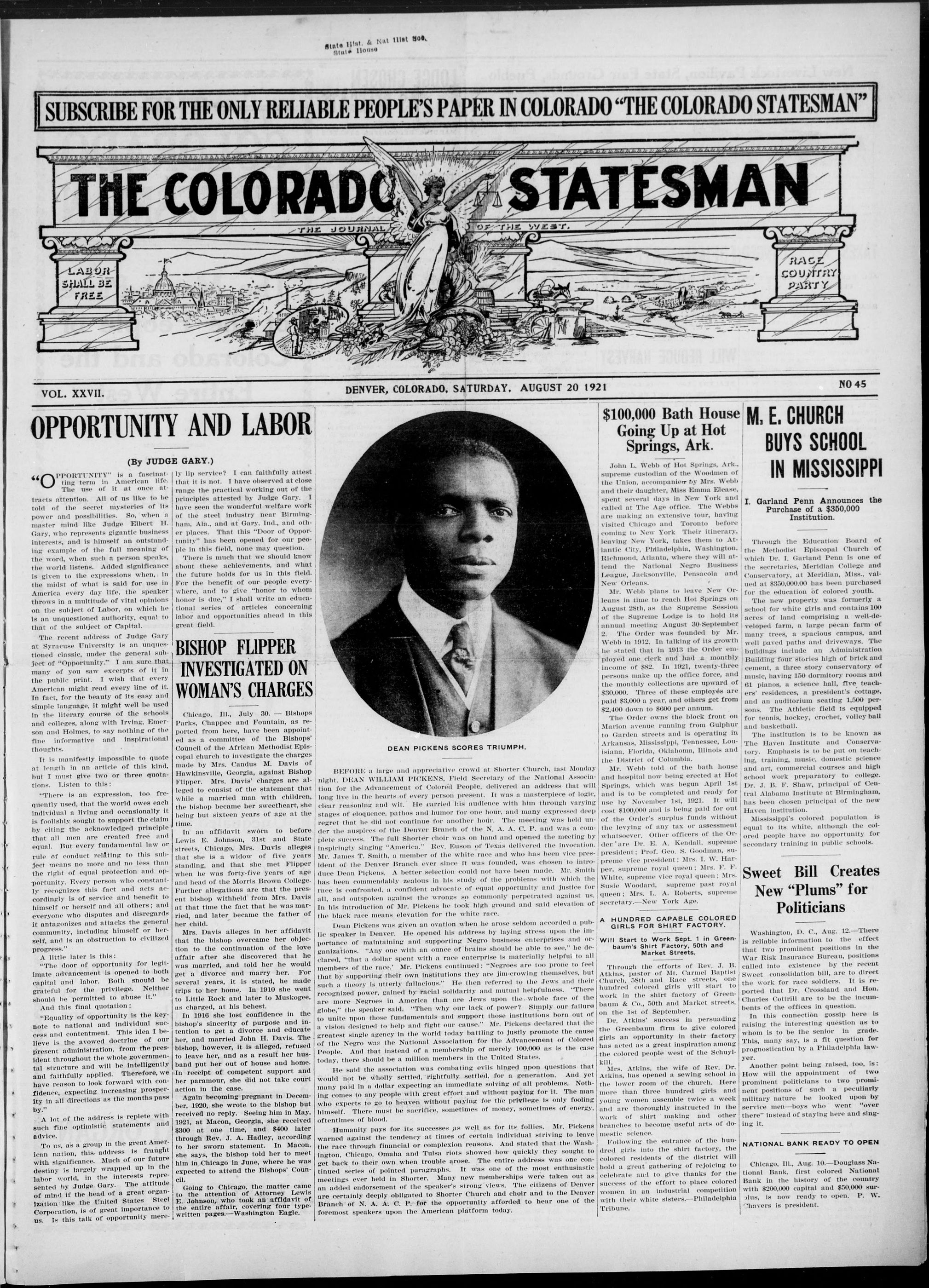
Page text (machine-generated)
SUBSCRIBE FOR THE ONLY RELIABLE PEOPLE'S PAPER IN COLORADO "THE COLORADO STATESMAN"
THE COLORADO STATESMAN
THE JOURNAL OF THE WEST.
LABOR SHALL BE FREE
RACE COUNTRY PARTY
OPPORTUNITY AND LABOR
(By JUDGE GARY.)
"OPPORTUNITY" is a fascinating term in American life. The use of it at once attracts attention. All of us like to be told of the secret mysteries of its power and possibilities. So, when a master mind like Judge Elbert H. Gary, who represents gigantic business interests, and is himself an outstanding example of the full meaning of the word, when such a person speaks, the world listens. Added significance is given to the expressions when, in the midst of what is said for use in America every day life, the speaker throws in a multitude of vital opinions on the subject of Labor, on which he is an unquestioned authority, equal to that of the subject or Capital.
The recent address of Judge Gary at Syracuse University is an unquestioned classic, under the general subject of "Opportunity." I am sure that many of you saw excerpts of it in the public print. I wish that every American might read every line of it. In fact, for the beauty of its easy and simple language, it might well be used in the literary course of the schools and colleges, along with Irving, Emerson and Holmes, to say nothing of the fine informative and inspirational thoughts.
It is manifestly impossible to quote at length in an article of this kind, but I must give two or three quotations. Listen to this:
"There is an expression, too frequently used, that the world owes each individual a living and occasionally it is foolishly sought to support the claim by citing the acknowledged principle that all men are created free and equal. But every fundamental law or rule of conduct relating to this subject means no more and no less than the right of equal protection and opportunity. Every person who constantly recognizes this fact and acts accordingly is of service and benefit to himself or herself and all others; and everyone who disputes and disregards it antagonizes and attacks the general community, including himself or herself, and is an obstruction to civilized progress."
A little later is this:
"The door of opportunity for legitimate advancement is opened to both capital and labor. Both should be grateful for the privilege. Neither should be permitted to abuse it."
"Equality of opportunity is the keynote to national and individual success and contentment. This idea I believe is the avowed doctrine of our present administration, from the president throughout the whole governmental structure and will be intelligently and faithfully applied. Therefore, we have reason to look forward with confidence, expecting increasing prosperity in all directions as the months pass by."
A lot of the address is replete with such fine optimistic statements and advice.
To us, as a group in the great American nation, this address is fraught with significance. Much of our future destiny is largely wrapped up in the labor world, in the interests represented by Judge Gary. The attitude of mind if the head of a great organization like the United States Steel Corporation, is of great importance to us. Is this talk of opportunity merc-
VOL. XXVII.
A little later is this:
ly lip service? I can faithfully attest that it is not. I have observed at close range the practical working out of the principles attested by Judge Gary. I have seen the wonderful welfare work of the steel industry near Birmingham, Ala., and at Gary, Ind., and other places. That this "Door of Opportunity" has been opened for our people in this field, none may question. There is much that we should know about these achievements, and what the future holds for us in this field. For the benefit of our people everywhere, and to give "honor to whom honor is due," I shall write an educational series of articles concerning labor and opportunities ahead in this great field.
BISHOP FLIPPER INVESTIGATED ON WOMAN'S CHARGES
Chicago, Ill., July 30. — Bishops Parks, Chappee and Fountain, as reported from here, have been appointed as a committee of the Bishops' Council of the African Methodist Episcopal church to investigate the charges made by Mrs. Candus M. Davis of Hawkinsville, Georgia, against Bishop Flipper. Mrs. Davis' charges are alleged to consist of the statement that while a married man with children, the bishop became her sweetheart, she being but sixteen years of age at the time.
In an affidavit sworn to before Lewis E. Johnson, 31st and State streets, Chicago, Mrs. Davis alleges that she is a widow of five years standing, and that she met Flipper when he was forty-five years of age and head of the Morris Brown College. Further allegations are that the present bishop withheld from Mrs. Davis at that time the fact that he was married, and later became the father of her child.
Mrs. Davis alleges in her affidavit that the bishop overcame her objection to the continuation of the love affair after she discovered that he was married, and told her he would get a divorce and marry her. For several years, it is stated, he made trips to her home. In 1910 she went to Little Rock and later to Muskogee, as charged, at his behest.
In 1916 she lost confidence in the bishop's sincerity of purpose and intention to get a divorce and educate her, and married John H. Davis. The bishop, however, it is alleged, refused to leave her, and as a result her husband put her out of house and home. In receipt of competent support and her paramour, she did not take court action in the case.
Again becoming pregnant in December, 1920, she wrote to the bishop but received no reply. Seeing him in May, 1921, at Macon, Georgia, she received $300 at one time, and $400 later through Rev. J. A. Hadley, according to her sworn statement. In Macon, she says, the bishop told her to meet him in Chicago in June, where he was expected to attend the Bishops' Council.
Going to Chicago, the matter came to the attention of Attorney Lewis E. Johnson, who took an affidavit of the entire affair, covering four type-written pages—Washington Eagle.
State Hist. & Nat Hist No.
State House
BLE PEOPLE'S
ADC
JOURNAL
DENVER, COLORA
PEOPLE'S PAPER IN COLORADO, SATURDAY, A
DENVER, COLORADO, SATURDAY, AUGUST 20 1921
DEAN PICKENS SCORES TRIUMPH.
BEFORE a large and appu
ight, DEAN WILLIAM PICK
on for the Advancement of C
ong live in the hearts of every
clear reasoning and wit. He c
ages of eloquence, pathos and
agret that he did not continue
over the auspices of the Denver
delete success. The full Shorter
aspiringly singing "America."
Mr. James T. Smith, a member
age and appreciative crowd at Shorter C
ILLIAM PICKENS, Field Secretary of the
accent of Colored People, delivered a
arts of every person present. It was a m
wit. He carried his audience with his
pathos and humor for one hour, and m
not continue for another hour. The m
of the Denver Branch of the N. A. A. C.
full Shorter choir was on hand and ope
"America." Rev. Euson of Texas deliv
a member of the white race and who
BEFORE a large and appreciative crowd at Shorter Church, last Monday night, DEAN WILLIAM PICKENS, Field Secretary of the National Association for the Advancement of Colored People, delivered an address that will long live in the hearts of every person present. It was a masterpiece of logic, clear reasoning and wit. He carried his audience with him through varying stages of eloquence, pathos and humor for one hour, and many expressed deep regret that he did not continue for another hour. The meeting was held under the auspices of the Denver Branch of the N. A. A. C. P. and was a complete success. The full Shorter choir was on hand and opened the meeting by inspiringly singing "America." Rev. Euson of Texas delivered the invocation. Mr. James T. Smith, a member of the white race and who has been vice president of the Denver Branch ever since it was founded, was chosen to introduce Dean Pickens. A better selection could not have been made. Mr. Smith has been commendably zealous in his study of the problems with which the race is confronted, a confident advocate of equal opportunity and justice for all, and outspoken against the wrongs so commonly perpetrated against us. In his introduction of Mr. Pickens he took high ground and said elevation of the black race means elevation for the white race.
Dean Pickens was given an ovation when he arose seldom accorded a public speaker in Denver. He opened his address by laying stress upon the importance of maintaining and supporting Negro business enterprises and organizations. "Any one with an ounce of brains should be able to see," he declared, "that a dollar spent with a race enterprise is materially helpful to all members of the race." Mr. Pickens continued: "Negroes are too prone to feel that by supporting their own institutions they are jim-crowing themselves, but such a theory is utterly fallacious." He then referred to the Jews and their recognized power, gained by racial solidarity and mutual helpfulness. "There are more Negroes in America than are Jews upon the whole face of the globe," the speaker said. "Then why our lack of power? Simply our failure to unite upon those fundamentals and support those institutions born out of a vision designed to help and fight our cause." Mr. Pickens declared that the greatest single agency in the world today battling to justly promote the cause of the Negro was the National Association for the Advancement of Colored People. And that instead of a membership of merely 100,000 as is the case today, there should be a million members in the United States.
He said the association was combating evils hinged upon questions that would not be wholly settled, rightfully settled, for a generation. And yet many paid in a dollar expecting an immediate solving of all problems. Nothing comes to any people with great effort and without paying for it. The man who expects to go to heaven without paying for the privilege is only fooling himself. There must be sacrifice, sometimes of money, sometimes of energy, oftentimes of blood.
Humanity pays for its successes as well as for its follies. Mr. Pickens warned against the tendency at times of certain individual striving to leave the race through financial or complexion reasons. And stated that the Washington, Chicago, Omaha and Tulsa riots showed how quickly they sought to get back to their own when trouble arose. The entire address was one continued series of pointed paragraphs. It was one of the most enthusiastic meetings ever held in Shorter. Many new memberships were taken out as an added endorsement of the speaker's strong views. The citizens of Denver are certainly deeply obligated to Shorter Church and choir and to the Denver Branch of N. A. A. C. P. for the opportunity afforded to hear one of the foremost speakers upon the American platform today.
$100,000 Bath House Going Up at Hot Springs, Ark.
$100,000 Bath House Going Up at Hot Springs, Ark.
John L. Webb of Hot Springs, Ark., supreme custodian of the Woodmen of the Union, accompanied by Mrs. Webb and their daughter, Miss Emma Elease, spent several days in New York and called at The Age office. The Webbs are making an extensive tour, having visited Chicago and Toronto before coming to New York Their itinerary, leaving New York, takes them to Atlantic City, Philadelphia, Washington, Richmond, Atlanta, where they will attend the National Negro Business League, Jacksonville, Pensacola and New Orleans.
Mr. Webb plans to leave New Orleans in time to reach Hot Springs on August 28th, as the Supreme Session of the Supreme Lodge is to hold its annual meeting August 30-September 2. The Order was founded by Mr. Webb in 1912. In talking of its growth he stated that in 1913 the Order employed one clerk and had a monthly income of $82. In 1921, twenty-three persons make up the office force, and the monthly collections are upward of $30,000. Three of these employés are paid $3,000 a year, and others get from $2,400 down to $600 per annum.
The Order owns the block front on Marion avenue running from Gulphun to Garden streets and is operating in Arkansas, Mississippi, Tennessee, Louisiana, Florida, Oklahoma, Illinois and the District of Columbia.
Mr. Webb told of the bath house and hospital now being erected at Hot Springs, which was begun April 1st and is to be completed and ready for use by November 1st, 1921. It will cost $100,000 and is being paid for out of the Order's surplus funds without the levying of any tax or assessment whatsoever. Other officers of the Order are Dr. E. A. Kendall, supreme president; Prof. Geo. S. Goodman, supreme vice president; Mrs. I. W. Harper, supreme royal queen; Mrs. F. F. White, supreme vice royal queen; Mrs. Susie Woodard, supreme past royal queen; Mrs. L. A. Roberts, supreme secretary.—New York Age.
A HUNDRED CAPABLE COLORED GIRLS FOR SHIRT FACTORY.
Will Start to Work Sept. 1 in Greenbaum's Shirt Factory, 50th and Market Streets.
Through the efforts of Rev. J. B. Atkins, pastor of M. Carmel Baptist Church, 58th and Race streets, one hundred colored girls will start to work in the shirt factory of Greenbaum & Co., 50th and Market streets, on the 1st of September.
Dr. Atkins' success in persuading the Greenbaum firm to give colored girls an opportunity in their factory has acted as a great inspiration among the colored people west of the Schuylkill.
Mrs. Atkins, the wife of Rev. Dr. Atkins, has opened a sewing school in the lower room of the church. Here more than three hundred girls and young women assemble twice a week and are thoroughly instructed in the work of shirt making and other branches to become useful arts of domestic science.
Following the entrance of the hundred girls into the shirt factory, the colored residents of the district will hold a great gathering of rejoicing to celebrate and to give thanks for the success of the effort to place colored women in an industrial competition with their white sisters.—Philadelphia Tribune.
NO 45
M. E. CHURCH BUYS SCHOOL IN MISSISSIPPI
I. Garland Penn Announces the Purchase of a $350,000 Institution.
Through the Education Board of the Methodist Episcopal Church of which Dr. I. Garland Penn is one of the secretaries, Meridian College and Conservatory, at Meridian, Miss., valued at $350,000.00 has been purchased for the education of colored youth. The new property was formerly a school for white girls and contains 100 acres of land comprising a well-developed farm, a large pecan farm of many trees, a spacious campus, and well paved paths and driveways. The buildings include an Administration Building four stories high of brick and cement, a three story conservatory of music, having 150 dormitory rooms and 61 pianos, a science hall, five teachers' residences, a president's cottage, and an auditorium seating 1,500 persons. The Athletic field is equipped for tennis, hockey, crochet, volley ball and basketball.
The institution is to be known as The Haven Institute and Conservatory. Emphasis is to be put on teaching, training, music, domestic science and art, commercial courses and high school work preparatory to college. Dr. J. B. F. Shaw, principal of Central Alabama Institute at Birmingham, has been chosen principal of the new Haven institution. Mississippi's colored population is equal to its white, although the colored people have no opportunity for secondary training in public schools.
Sweet Bill Creates New "Plums" for Politicians
Washington, D. C., Aug. 12.—There is reliable information to the effect that two prominent positions in the War Risk Insurance Bureau, positions called into existence by the recent Sweet consolidation bill, are to direct the work for race soldiers. It is reported that Dr. Crossland and Hon. Charles Cottrill are to be the incumbents of the offices in question.
In this connection gossip here is raising the interesting question as to whom is to be the senior in grade. This, many say, is a fit question for prognostication by a Philadelphia lawyer.
Another point being raised, too, is: How will the appointment of two prominent politicians to two prominent positions of such a peculiarly military nature be looked upon by service men—boys who went "over there" instead of staying here and singing it.
NATIONAL BANK READY TO OPEN
Chicago, Ill., Aug. 10.—Douglass National Bank, first colored National Bank in the history of the country with $200,000 capital and $50,000 surplus, is now ready to open. P. W. Chavers is president.
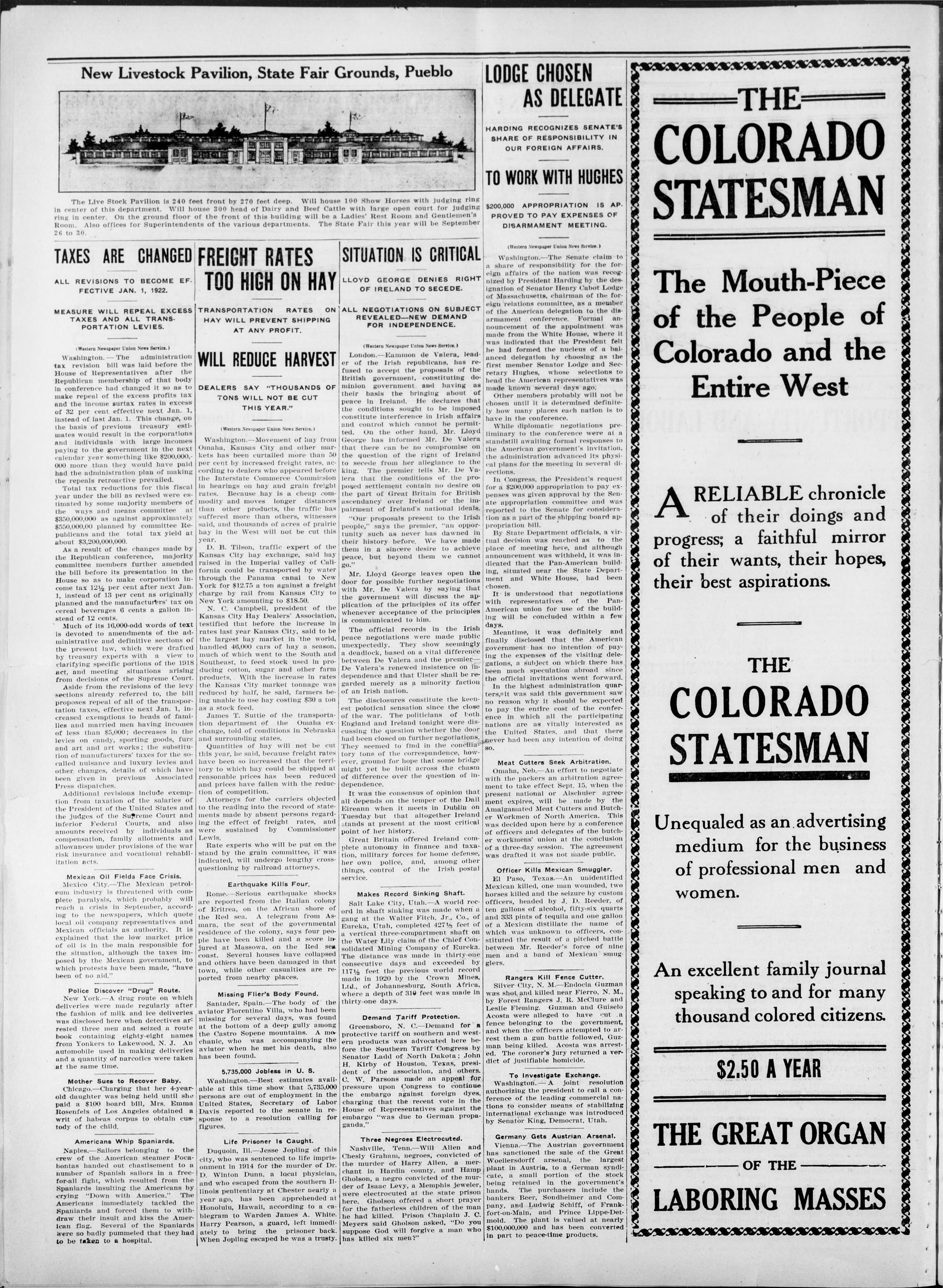
The Live Stock Pavilion is 240 feet front by 270 feet deep. Will house 100 Show Horses with judging ring in center of this department. Will house 300 head of Dairy and Beef Cattle with large open court for judging ring in center. On the ground floor of the front of this building will be a Ladies' Rest Room and Gentlemen's Room. Also offices for Superintendents of the various departments. The State Fair this year will be September 26 to 30.
TAXES ARE CHANGED
ALL REVISIONS TO BECOME EF
FECTIVE JAN. 1, 1922.
MEASURE WILL REPEAL EXCESS
TAXES AND ALL TRAN-
PORTATION LEVIES.
(Western Newspaper Union News Service.)
Washington. — The administration tax revision bill was laid before the House of Representatives after the Republican membership of that body in conference had changed it so as to make repeal of the excess profits tax and the income surtax rates in excess of 32 per cent effective next Jan. 1, instead of last Jan. 1. This change, on the basis of previous treasury estimates would result in the corporations and individuals with large incomes paying to the government in the next calendar year something like $200,000,000 more than they would have paid had the administration plan of making the repeals retroactive prevailed.
Total tax reductions for this fiscal year under the bill as revised were estimated by some majority members of the ways and means committee at $350,000,000 as against approximately $550,000,00 planned by committee Republicans and the total tax yield at about $3,200,000,000.
As a result of the changes made by the Republican conference, majority committee members further amended the bill before its presentation in the House so as to make corporation income tax $12½ per cent after next Jan. 1, instead of 13 per cent as originally planned and the manufacturers' tax on cereal beverages 6 cents a gallon instead of 12 cents.
Much of its 16,000-odd words of text is devoted to amendments of the administrative and definitive sections of the present law, which were drafted by treasury experts with a view to clarifying specific portions of the 1918 act, and meeting situations arising from decisions of the Supreme Court. Aside from the revisions of the levy sections already referred to, the bill proposes repeal of all of the transportation taxes, effective next Jan. 1, increased exemptions to heads of families and married men having incomes of less than $5,000; decreases in the levies on candy, sporting goods, furs and art and art works; the substitution of manufacturers' taxes for the so-called nuisance and luxury levies and other changes, details of which have been given in previous Associated Press dispatches.
Additional revisions include exemption from taxation of the salaries of the President of the United States and the judges of the Supreme Court and inferior Federal Courts, and also amounts received by individuals as compensation, family allotments and allowances under provisions of the war risk insurance and vocational rehabilitation acts.
Mexican Oil Fields Face Crisis.
Mexico City.—The Mexican petroleum industry is threatened with complete paralysis, which probably will reach a crisis in September, according to the newspapers, which quote local oil company representatives and Mexican officials as authority. It is explained that the low market price of oil is in the main responsible for the situation, although the taxes imposed by the Mexican government, to which protests have been made, "have been of no aid."
Police Discover "Drug" Route:
New York.—A drug route on which deliveries were made regularly after the fashion of milk and ice deliveries was disclosed here when detectives arrested three men and seized a route book containing eighty-eight names from Yonkers to Lakewood, N. J. An automobile used in making deliveries and a quantity of narcotics were taken at the same time.
Mother Sues to Recover Baby.
Chicago.—Charging that her 4-year-old daughter was being held until she paid a $100 board bill, Mrs. Emma Rosenfels of Los Angeles obtained a writ of habeas corpus to obtain custody of the child.
Americans Whip Spaniards.
Naples.—Sailors belonging to the crew of the American steamer Pocahontas handed out chastisement to a number of Spanish sailors in a free-for-all fight, which resulted from the Spaniards insulting the Americans by crying "Down with America." The Americans immediately tackled the Spaniards and forced them to withdraw their insult and kiss the American flag. Several of the Spaniards were so badly pummeled that they had to be taken to a hospital.
FREIGHT RATES TOO HIGH ON HAY
TRANSPORTATION RATES ON HAY WILL PREVENT SHIPPING AT ANY PROFIT.
WILL REDUCE HARVEST
DEALERS SAY "THOUSANDS OF
TONS WILL NOT BE CUT
THIS YEAR."
(Western Newspaper Union News Service.)
Washington.—Movement of hay from Omaha, Kansas City and other markets has been curtailed more than 50 per cent by increased freight rates, according to dealers who appeared before the Interstate Commerce Commission in hearings on hay and grain freight rates. Because hay is a cheap commodity and moves longer distances than other products, the traffic has suffered more than others, witnesses said, and thousands of acres of prairie hay in the West will not be cut this year.
D. B. Tilson, traffic expert of the Kansas City hay exchange, said hay raised in the Imperial valley of California could be transported by water through the Panama canal to New York for $12.75 a ton against a freight charge by rail from Kansas City to New York amounting to $18.50.
N. C. Campbell, president of the Kansas City Hay Dealers' Association, testified that before the increase in rates last year Kansas City, said to be the largest hay market in the world, handled 46,000 cars of hay a season, much of which went to the South and Southeast, to feed stock used in producing cotton, sugar and other farm products. With the increase in rates the Kansas City market tonnage was reduced by half, he said, farmers being unable to use hay costing $30 a ton as a stock feed. James T. Suttie of the transportation department of the Omaha exchange, told of conditions in Nebraska and surrounding states.
Quantities of hay will not be cut this year, he said, because freight rates have been so increased that the territory to which hay could be shipped at reasonable prices has been reduced and prices have fallen with the reduction of competition.
Attorneys for the carriers objected to the reading into the record of statements made by absent persons regarding the effect of freight rates, and were sustained by Commissioner Lewis.
Rate experts who will be put on the stand by the grain committee, it was indicated, will undergo lengthy cross-questioning by railroad attorneys.
Earthquake Kills Four.
Rome.—Serious earthquake shocks are reported from the Italian colony of Erlitrea, on the African shore of the Red sea. A telegram from Asmara, the seat of the governmental residence of the colony, says four people have been killed and a score injured at Massowa, on the Red sea coast. Several houses have collapsed and others have been damaged in that town, while other casualties are reported from nearby places.
Missing Flier's Body Found.
Santader, Spain.—The body of the aviator Florentino Villa, who had been missing for several days, was found at the bottom of a deep gully among the Castro Sopene mountains. A mechanic, who was accompanying the aviator when he met his death, also has been found.
5.735.000 Jobless in U. S.
Washington.—Best estimates available at this time show that 5,735,000 persons are out of employment in the United States, Secretary of Labor Davis reported to the senate in response to a resolution calling for figures.
Life Prisoner Is Caught.
Duquoin, Ill.-Jesse Jopling of this city, who was sentenced to life imprisonment in 1914 for the murder of Dr. D. Winton Dunn, a local physician, and who escaped from the southern Illinois pententary at Chester nearly a year ago, has been apprehended at Honolulu, Hawaii, according to a cableum to Warden James A. White. Harry Pearson, a guard, left immediately to bring the prisoner back. When Jopling escaped he was a trusty.
SITUATION IS CRITICAL
LLOYD GEORGE DENIES RIGHT OF IRELAND TO SECEDE.
ALL NEGOTIATIONS ON SUBJECT REVEALED—NEW DEMAND FOR INDEPENDENCE.
(Western Newspaper Union News Service.)
London.—Eammon de Valera, leader of the Irish republicans, has refused to accept the proposals of the British government, constituting dominion government and having as their basis the bringing about of peace in Ireland. He declares that the conditions sought to be imposed constitute interference in Irish affairs and control which cannot be permitted. On the other hand, Mr. Lloyd George has informed Mr. De Valera that there can be no compromise on the question of the right of Ireland to secede from her allegiance to the king. The premier tells Mr. De Valera that the conditions of the proposed settlement contain no desire on the part of Great Britain for British ascendancy over Ireland or the impairment of Ireland's national ideals.
"Our proposals present to the Irish people," says the premier, "an opportunity such as never has dawned in their history before. We have made them in a sincere desire to achieve peace, but beyond them we cannot go."
Mr. Lloyd George leaves open the door for possible further negotiations with Mr. De Valera by saying that the government will discuss the application of the principles of its offer whenever acceptance of the principles is communicated to him.
The official records in the Irish peace negotiations were made public unexpectedly. They show seemingly a deadlock, based on a vital difference between De Valera and the premier—De Valera's renewed insistence on independence and that Ulster shall be regarded merely as a minority faction of an Irish nation.
The disclosures constitute the keenest political sensation since the close of the war. The politicians of both England and Ireland tonight were discussing the question whether the door had been closed on further negotiations. They seemed to find in the conellatory tons of the correspondence, however, ground for hope that some bridge might yet be built across the chasm of difference over the question of independence.
It was the consensus of opinion that all depends on the temper of the Dail Eireann when it meets in Dublin on Tuesday but that altogether Ireland stands at present at the most critical point of her history.
Great Britain offered Ireland complete autonomy in finance and taxation, military forces for home defense, her own police, and, among other things, control of the Irish postal service.
Makes Record Sinking Shaft.
Salt Lake City, Utah.—A world record in shaft sinking was made when a gang at the Walter Fitch, Jr., Co., of Eureka, Utah, completed $427\frac{1}{2}$ feet of a vertical three-compartment shaft on the Water Lily claim of the Chief Consolidated Mining Company of Eureka. The distance was made in thirty-one consecutive days and exceeded by $117\frac{1}{2}$ feet the previous world record made in 1920 by the Crown Mines, Ltd., of Johannesburg, South Africa, where a depth of 319 feet was made in thirty-one days.
Demand Tariff Protection.
Greensboro, N. C.—Demand for a protective tariff on southern and western products was advocated here before the Southern Tariff Congress by Senator Ladd of North Dakota; John H. Kirby of Houston, Texas, president of the association, and others. C. W. Parsons made an appeal for pressure upon Congress to continue the embargo against foreign dyes, charging that the recent vote in the House of Representatives against the embargo "was due to German propaganda."
Three Negroes Electrocuted.
Nashville, Tenn.—Will Allen and Chesly Graham, negroes, convicted of the murder of Harry Allen, a merchant in Hardin county, and Hamp Gholson, a negro convicted of the murder of Isaac Levy, a Memphis jeweler, were electrocuted at the state prison here. Gholson offered a short prayer for the fatherless children of the man he had killed. Prison Chaplain J. C. Meyers said Gholson asked, "Do you suppose God will forgive a man who has killed six men?"
HARDING RECOGNIZES SENATE'S SHARE OF RESPONSIBILITY IN OUR FOREIGN AFFAIRS.
WORK WITH HUGHES
$200,000 APPROPRIATION IS AP
PROVED TO PAY EXPENSES OF
DISARMAMENT MEETING.
(Western Newspaper Union News Service.)
Washington.—The Senate claim to a share of responsibility for the foreign affairs of the nation was recognized by President Harding by the designation of Senator Henry Cabot Lodge of Massachusetts, chairman of the foreign relations committee, as a member of the American delegation to the disarmament conference. Formal announcement of the appointment was made from the White House, where it was indicated that the President felt he had formed the nucleus of a balanced delegation by choosing as the first member Senator Lodge and Secretary Hughes, whose selections to head the American representatives was made known several days ago. Other members probably will not be chosen until it is determined definitely how many places each nation is to have in the conference.
While diplomatic negotiations preliminary to the conference were at a standstill awaiting formal responses to the American government's invitation, the administration advanced its physical plans for the meeting in several directions.
In Congress, the President's request for a $200,000 appropriation to pay expenses was given approval by the Senate appropriation committee and was reported to the Senate for consideration as a part of the shipping board appropriation bill.
By State Department officials, a virtual decision was reached as to the place of meeting here, and although announcement was withheld, it was indicated that the Pan-American building, situated near the State Department and White House, had been chosen.
It is understood that negotiations with representatives of the Pan-American union for use of the building will be concluded within a few days.
Meantime, it was definitely and finally disclosed that the American government has no intention of paying the expenses of the visiting delegations, a subject on which there has been much speculation abroad since the official invitations went forward.
In the highest administration quarters, it was said this government saw no reason why it should be expected to pay the entire cost of the conference in which all the participating nations are as vitally interested as the United States, and that there never had been any intention of doing
Meat Cutters Seek Arbitration.
Omaha, Neb.—An effort to negotiate with the packers an arbitration agreement to take effect Sept. 15, when the present national or Alschuler agreement expires, will be made by the Amalgamated Ment Cutters and Butcher Workmen of North America. This was decided upon here by a conference of officers and delegates of the butcher workmens' union at the conclusion of a three-day session. The agreement was drafted it was not made public.
Officer Kills Mexican Smuggler.
El Paso, Texas.—An unidentified Mexican killed, one man wounded, two horses killed and the seizure by custom officers, headed by J. D. Reeder, of ten gallons of alcohol, fifty-six quarts and 333 pints of tequila and one gallon of a Mexican distillate the name of which was unknown to officers, constituted the result of a pitched battle between Mr. Reeder's force of nine men and a band of Mexican smugglers.
Rangers Kill Fence Cutter.
Rangers Rm Pence Outter.
Silver City, N. M.—Endocla Guzman was shot and killed near Fierro, N. M., by Forest Rangers J. R. McClure and Leslie Fleming. Guzman and Guiselo Acosta were alleged to have cut a fence belonging to the government, and when the officers attempted to arrest them a gun battle followed, Guzman being killed. Acosta was arrested. The coroner's jury returned a verdict of justifiable homicide.
To Investigate Exchange.
Washington.—A joint resolution authorizing the president to call a conference of the leading commercial nations to consider means of stabilizing international exchange was introduced by Senator King, Democrat, Utah.
Germany Gets Austrian Arsenal.
Vienna.—The Austrian government has sanctioned the sale of the Great Woellersdorff arsenal, the largest plant in Austria, to a German syndicate, a small portion of the stock being retained in the government's hands. The purchasers include the bankers Beer, Sondheimer and Company, and Ludwig Schiff, of Frankfort-on-Main, and Prince Lippe-Detmold. The plant is valued at nearly $100,000,000 and has been converted in part to peace-time products.
---
COLORADO STATESMAN
The Mouth-Piece of the People of Colorado and the Entire West
ARELIABLE chronicle of their doings and progress; a faithful mirror of their wants, their hopes, their best aspirations.
THE COLORADO STATESMAN
Unequaled as an advertising medium for the business of professional men and women.
An excellent family journal speaking to and for many thousand colored citizens.
$2.50 A YEAR
Pithy News Notes
From All Parts of
Colorado
arkatiag Valley,” Pali." Hacky” ora
Aug. 30-Sept, 2; J.-L. Milter, secre=
Washington Cou r, Akror F
Hee gene Teac
Teller County Fair, Cripple Creek, Sept,
5:"D. J. Tipton, secretary.
Larimer County’ Pair, Loveland, Sept,
8" J. W. Thompson, secretary.
Mortar County’ Pair ai “Maybell, Sept.
Henry Sebold, 9 years old, son of
Mr. and Mrs, Ben Sebold of Brighton,
was drowned while swimming in a
pond four miles west of Brighton.
Mrs, Mary Amanda Goodfellow, $1
years old, widow of Charles Goodfel-
low, pioneer mining man, and herself
8 resident of Colorado since 1862, ‘ied
suddenly at Greeley of heart trouble.
Carl W. Hall, 54 years old, of Den-
ver, was instantly killed a mile north
of Long's Peak inn, when an automo-
bile he was attempting to repalr
stipped from a jack and rushed his
head.
Bugene Wickham, Jr. 17, died in
Fort Collins after being compelled
to stop/there on account of filness
while on a trip from Arapahoe, Nebo,
to Estes Park with Dr. J. E. Walters
and party, for whom he was driving
the car,
More than $500 an acre off a truck
farm is the record pust made by Tim
Satio, 2 Japanese farmer, near Kelim,
who has started harvesting his early
cabbage crop. He has received $40 a
ton for the cabbage, and has sold over
$500 worth.
Entries for the running races, ladder
climbing contests and wet tests for the
state firemen’s convention to be held
at Loveland, Sept. 5, 6 and 7, during
the county fair, closed with nearly 500
runners entered from twenty-one dif:
ferent departments of the state.
‘The 1922 session of the state great
council of the Improved Order of Red-
men will be held at the top of Lookout
mountain, near Denver, it was decided
at the closing session of the two-day
convention at Colorado Springs. Of-
ficers elected, including Chris Court-
ney of Tobasco, as great sachem, wera
installed at the final meeting.
‘Thomas H, Boland, 49, a plumber of
Pueblo, was killed by a bolt of light-
ning as he was riding in an automo-
hile twenty-six miles west of’ Pueblo.
‘Three other occupants of the car were
neither injured nor shocked. It is re-
ported that Boland was riding alone
in the back seat of the car. ‘The bolt
knocked Boland out of the car.
Miss Geneva Bell, a society girl of
Boulder, has left for Honolulu, where
she has accepted a position as instruc-
tor in a girls’ college. She was ac
companied by her mother, Mrs. Del-
phine Bell. Miss Bell is the fourth of
her family to take up the teaching
profession, A brother, William Bell,
is.a professor in Willinms college, and
a sister, Mrs, R. B. Wolcott, 1s an in-
structor at the University of Colo-
rado.
Federal aid in the amount of $96,-
477.54 was requested by the State High-
way Commission of the United States
bureau of public roads In the proposed
construction of five miles of concrete-
paved road, covering two projects near
Denver. The first project consists of a
six-tenths of a mile stretch beginning
at the end of the Berkeley-Arvada
stretch and extending through the
town of Arvada; the second proposed
concrete stretch calls for four and
four-tenths miles on Federal boule:
yard toward Broomfield. ‘The total cost
of construction is estimated at $194,-
955.09.
‘The Loveland school district has re
ceived about $5,000 from the county
superintendent as its share of the $13,-
096 received by the county in the dis-
tribution of state school funds. The
apportionment was made at the rate of
$2 per school pupil as shown by the
last census.
‘The War Department has no inten-
tion of abandoning Fort Logan, Colo.,
fas an army post, but it will be impos-
sible to station a complete regiment
there, This information was given to
the Colorado senators by Secretary
Weeks, The action of Congress in re-
ducing the personnel of the army
makes it impracticable to increase
Fort Logan to a regimental post, they
were informed.
‘The July output of mines in the
Cripple Creek district amounted to
$194,580.78, an increase of $20,408.68
over June, while there were 647 cars
of ore shipped, bringing the total
shipped since Jan, 1 to 4,000. ‘The to-
tal number of tons treated in July
was 92,592, an increase of 3,211 over
June. ‘The Golden Cycle mill In Colo-
rado Springs treated 22,000 tons, the
Independence mill 15,882, and the Lin-
coln mill 1,710,
‘The Ignacio State Bank at Ignacio,
twenty-six miles southeast of Durango,
JENTENNIAL STATE ITEMS.
Practically complete reports from
tounty assessors to the State Inmigra-
ton Department show above 52,000
farms on which land Is being cultivated
in Colorado this year, compared with
49,117 farms reported by county as
sessors Inst year, While there Is ap-
parently a large area in cultivation In
the state this year than last, the ap-
parent increase in number of farms Is
perhaps due to more complete returns
being made by county assessors this
year than previous years. ‘Phe law re-
quiring county assessors to collect ag-
rieultural statistics annually became
effective in 1919, and this 1s the third
year such statistics have been col-
lected, Assessors are Improving thelr
reports this year, due largely to the
demands of local business men and
commercial organizations for complete
and accurate reports.
| Excavations now being made of
‘ruins on the San Juan National forest
at Chimney Rocks, near Pagosa
Springs, Colorado, are proving of great
‘Interest. ‘The ruins are doubtless the
oldest in the United States and show
more primitive workmanship than
those in other localities, A permit
covering the San Juan forest was
granted the Colorado State Historical
and Natural History Society and J. A.
Jeancon, director and curator of the
department of archaeology and ethnol-
ogy is in charge of the work.
‘Three iron bridges which were sent
to the forestry bureau for erection in
Larimer county by the government
during the war, and which have never
been put into service, are to be taken
over by the State Highway Depart-
ment and will be used on the South
Platte river not far from Denver.
They were Intended for use on the
Poudre river, but are only eleven feet
wide, and for this reason were never
erected, It is thought probable that
the bridges will be widened when they
are put up.
Colorado Springs Is going to attempt
to rival Cheyenne's Frontier Days. A
contract was signed by the Chamber
of Commerce with Irwin Brothers,
who for twenty-three years have
staged’ Wild West affairs, and the
event will be held Aug. 22, 28 and 24,
A site northeast of the elty is being
secured and grandstands will be bullt
immediately. It is the plan to make
the event an annual one and to ar-
range festivities on a large scale.
Relieved to have been one of the
victims of the Pueblo flood the night
of June 3, and given up for dead by
his daughters, the Rey. ©. C. Prentiss,
a retired Methodist’ minister, returned
to his daughter's house near Mosca,
unable to tell the story of his disap-
pearance. Mr. Prentiss recovered his
memory in a hospital in Oglethorpe,
Ga., last week, but was unable to tell
the attending physicians how he ar-
rived there.
‘The state of Colorado was enriched
by $51,847.77 when the administrators
of the estate of Judson M. Bemis,
Colorado Springs millionaire, who died
April 6, turned over to Roy H. Black-
man, state inheritance tax collector, 2
check for that amount, ‘This sum rep:
resents the state inheritance tax on a
net estate of $1,804,151.99. Bemis was
heavily interested in the Bemis Bug
Company of Boston.
Four hundred and fifty vocational
students are to receive Instruction at
the University of Colorado this fall,
according to W. J. Shirley, co-ordin-
ator for the government, who has
charge of the students sent to Boulder.
There are 350 men in training now,
twenty-five of whom will be trans:
ferred to other schools. Vocational
men are to hive a month's vacation,
beginning Aug. 27.
Publication of the natfonal potate
crop estimate of the United States De-
partment of Agriculture for August
caused much joy in the Greeley dis.
trict. ‘The estimate showed a decrease
from the July estimate of 61,000,000
bushels, a drop from 877,000,000 bush.
els to 316,000,000 bushels.
Fewer people in Larimer county will
be delinquent with thelr taxes this
year than for many years previous,
according to County ‘Treasurer WIl-
liam J. Ralph, who says 75 per cent
of the taxes were paid on time. With
those who: will pay before the list is
published, and after it appears in the
paper, it is thought that the sale of
property for taxes this year will be
quite small,
With the completion of tha half
mile track and the ‘gigantic grand:
stand and corrals, everything is now in
readiness for the opening of the “Ride
‘em rough roundup” at Colorado
Springs, Aug.2 2, 23 and 24. Already
more than 200 head of horses, includ
ing some of the most famous “buck
Ee AT ta ener ge Pome Wenig Ves aa
“GREATER UNDERSTANDING ON
ALL PROBLEMS OF PACIFIC,”
WOULD END WAR.
WANT U, S. FRIENDSHIP
JAPS PROVED FAITHFUL IN LATE
WAR AND DESERVE FAIR
TREATMENT.
(Wentere Newipiper Uaten! Rees Sartten)
London.—"If the alliance with Japan
could be merged Into a greater under-
standing with Japan and the United
States on all the problems of the Pa-
cific, that would be a great event, and
It would be a guarantee for the peace
of the world.”
‘Thus spoke David Lloyd George,
the British prime minister, before the
house of commons in outling the work
of the recent conference of the imper-
inl_premiers.
‘The premier was dealing specifical-
ly with the Anglo-Japanese alliance at
‘the time, and explaining how the con-
ference had unanimously recognized
that Japan loyally had carried out her
obligations to Great Britain during the
war in letter and spirit,
Mr, Lloyd George asked if it was to
be suggested that Great Britain should
now turn her back upon Japan with
a mere thank you and good-by, after
Japan's ald had proved to be one of
the turning factors in the war, in that
it had given protection to the transit
of dominion and Indian troops across
seas. Even countries disliking the
Anglo-Japanese alliance would despise
the British if after such services Great
Britain turned her back upon Japan,
he declared.
‘The premier said he saw no reason
why it should be impossible to remem:
ber obligations to Japan and at the
‘same time preserve a spirit of fra-
‘ternity with the United States,
It was a cardinal principle of Brit-
ish policy, the premier continued, that
Great Britain should act in as com-
plete accord with the United States as
possible, He did not know of any
country in the world with whom it
was more Important to act in concert,
He declared that the surest way to
make a success of the disarmament
conference was first to reach an un
derstanding on Pacific questions, and
he hoped his view in this respect
would be taken at the Washington
gathering.
During his address, Mr. Lloyd
George revealed the fact that the con:
ference of the premiers did not dis
cuss the Irish question, He said there
was no burning desire to touch upon
that difficult matters
Want Million Tobacco Fighters.
San Francisco —A million workers
are needed to aid in the anti-tobacco
educational program for the youth of
‘America and other projects, Miss An-
na A. Gordon of Evanston, Til, nation-
al president of the Women’s Christian
‘Temperance Union, declared in her an-
nual address at the opening of the for-
ty-eighth national convention of the
organization here. Fifteen hundred
delegates are in attendance,
Escapes Through Train Window.
Omaha, Neb.—William Bridgman,
said to be known also as William
Moore, escaped by leaping through
the window of 2 Union Pacific passen-
ger train near Cozad, Neb., while be-
ing taken from Honolulu to Des
Moines, Iowa, on a counterfeiting
charge, according to — information
reaching federal officers here.
NEW MEXICO VILLAGE SWEPT
OFF MAP BY CLOUDBURST.
Las Cruces, N. M.—The town of
Hatch, N. M, thirty-eight miles north
of here, was destroyed by a flood, fol-
lowing 2 cloudburst, according to rell-
able information reeelved here, ‘The
500 residents escaped to the hills, most
of them in their night clothes. The wa-
ter was seven feet deep in the town.
It is estimated that the loss of build-
ings in Hateh and crops in that vicin-
ity will reach $500,000.
Reindeer Meat in Frisco.
San Francisco, Calif—A shipment
of 30,000 pounds of dressed reindeer
meat has been received in San Fran-
cisco from Nome, Alaska, by a firm of
wholesale butchers here, and is on sale
in retail shops, according to an an-
nouncement, which said this marks
the opening of a new industry.
‘Noted Mexican Bishop Diee.
New York.—The Rt. Rev, Jose M.,
Ignacio Montes de Oca y Obregon, 81,
bishop of the diocese of San Luis Po:
tosi, Mexico, died nt the home of Mons.
Michael J. Layelle, rector of St. Pat
rick’s cathedral. ‘The Mexican prelate
came here* recently en route to his dio:
cese from a visit in Spain and was
taken ill while visiting Monsignor La-
velle. Bishop de Oca had been a bish-
op fifty years. For the last thirty:
seven years he had been head of the
San Luis Potosi diocese.
POTATO CROP IN COLORADO
THIS YEAR WILL BE PROF-
ITABLE.
Report by U. S, Bureau of Markets
Give Present Conditions in
Colorado,
Giieneea Mireaenel Csi Sires tharsten,)
ures, 2 condition Of al crops Ob She
state equalfng 104.4 per cent of the
ten-year average, a decline of 1.8
point during July, and the second
largest production of potatoes in the
history of the state, are the sullent
features of the regular state-federal
August 1 crop report released through
the Colorado Co-operative Crop Re-
porting Service,
‘Though all the principal crops suf-
fered some declines in condition dur
ing July, the percentages of decrease
were generally small compared with
the declines registered for the same
crops nationally.
‘The potato crop is of great interest
to the farmers and others at this time,
due to the facts that Colorado pota-
twes continue to show prospects for
excellent production, while nationally
the crop deteriorated 17.6 points since
the first of July, and on August 1 had
declined to a figure of 65.8 per cent
of normal with a forecast of only 316,-
000,000 bushels, compared with 431,-
000,000 bushels last year. ‘This is the
smallest prospect since 1908, except in
1911 and 1916, when the United States
potato production went below 300,000,
000 bushels. ‘The Colorado crop de-
clined only 1 point during July, and
on August 1 had @ condition of 93 per
cent of normal, or 2 points higher
than last year on August 1, 8 points
above the ten-year average for this
date, Good growing conditions until
harvest may raise this estimate an-
other 2,000,000. bushels, with more
complete returns from assessors, It
how appears that the area growers
estimated would be planted is in ex-
cess of 100,000 acres, ‘The final esti-
mote for the crop last year was 10,-
920,000 bushels. In 1919 the Census
Bureau showed 8,875,000 bushels har-
vested from about 77,000 acres, ‘The
largest crop in the history of the state
was in WIS, amounting to about 15,-
$40,000 oushels. Usually about 70 to
75 per cent of the cotal production in
Colorado Is considered commercial.
Winter wheat declined 5 points
during July and had a harvest time
figure of 84 per cent of normal. Based
on this condition the production ia
estimated at 24,500,000 bushels, com-
pared with about 19,841,000 bushels,
tentatively revised estimate for last
year, and 13,675,000 bushels in 1919.
‘The spring wheat crop declined 7
poluts during July and reached August
1 with a condition of 85 per cent, 5
points lower than lust year on August
1 and 2 points above the ten-year
average. ‘This condition promises a
production of 6,331,000 bushels, com-
pared with 5,626,000 bushels tast year.
‘The total production of both winter
and spring wheat in the state, as now
estimated, will amount to 30,831,000
bushels, compared with 25,467,000
bushels last year and 18,261,000 bush-
els the Census Bureau figure for
1919.
Colorado corn declined 11 points
during July, and on August 1 was 84
per cent of normal, 6 points below.
August 1 last year and 4 points high-
er than the ten-year average. With
this condition figure, this year’s crops
of corn still promises to be the rec:
ord crop for the state and amounts
to approximately 19,026,000 bushels,
as compared with a revised estimate
of 18,910,000 bushels for last year.
‘These production figures are based on
the estimate that approximately 80
per cent of the acreage planted to
corn lost year was harvested for grain
and that the percentage for grain will
be about the saie this year. In 1919
the corn crop of the state amounted
to 10,106,000 bushels, as shown by the
Censtis Bureau and was produced on
nbout 71 per cent of the corn acreage
planted.
‘All of the other principal crops in-
dicate production somewhat greater
than the ten-year average. Oats,
8,809,000 bushels: + barley, 4,888,000
bushels; rye, 1,540,000 bushels; all
hay, 8,214,000 tons; alfalfa, 1,994,000
tons; grain sorghums, 2,207,000 bush.
els; beans, 489,000 bushels; apples,
8,005,000. bushels; peaches, 758,000
bushels; pears, 314,000 bushels,
‘The cabbage and onion crops of the
state are both ‘n excellent condition,
being 94 per cent of normal, or soul
7 points above the ten-year average
‘The condition of cantaloupes is 87 per
cent, 4 points higher than the ten
year average, and sugar beets have a
condition of 96 per cent, compared
with a ten-yenr avernge condition on
August 1 of S9 per cent.
Seven Killed in Auto Accidents.
Vicksbudg, Miss—Charles Brown
driving a fruck with a trailer behind
loaded with human freight, attempted
to cross the railroad track ahead of
A northbound Yazoo & Mississipp’
Valley pessenger train one mile north
of Anguitla, Shelby county, and as
a result, Brown, another white mar
and three negroes were killed and one
white man and nine, negroes were in
Jured, The men had been working for
1 construction company —bulidins
onde.
Ce a
Phone Main 4843
J. GIBSON SMITH
Art Dealer
: 1638 Tremont St. Denver
OX DRI DOM OK DORI KDE OCR CIDR ACPO
| ©. V. FAIRBANKS —Props.— N. FAIRBANKS
: Fairbanks |
Hotel and
FIRST CLASS |
| | MEALS SERVED | | (Formerly Barnes Hotel) |
HOME COOKING 1 9716 WeltonSt.,Denver,Colo.
WESTERN BEEF CO
yw he
Gienany co ob ast One of the Most Up-to-
Date anc? Sanitary Mar-
Sundays Until 2:00 p. m. Ket in’ Gis Oley:
Fresh Oysters, Chitterlings, Pig Tails, Snouts, Ears, Pigs Feet, Neck
Bones, Spare Ribs Received Fresh Daily.
Fresh and Cured Meats of All Kinds,. Fresh Vegetables, Staple and
Fancy Groceries.
Our Prices Are Always the Lowest
Free Delivery to All Parts of the City.
Phone Champa 1641.
2048 LARIMER STREET DENVER, COLO.
Opposite the Three Rules.
Night and Day Caf
: y MRS. LENA WALTON, Proprietor.
poe TRA Best Meals in town at the lowest prices. Spe-
: ire aed cial prices for club dinners and parties. Meet
BRP ovour triends here atter the dance or theater.
Geer «All Kinds of Salads and Sandwiches Served.
i en FISH AND OYSTERS IN SEASON.
PHONE ORDERS PROMPTLY ATTENDED TO.
| PHONE MAIN 2867. 1865 CURTIS STREET.
Be cae ee
| A FULL LINE OF
Black and White Remedies
Ane a Full Line of Mme. C. J. WALKER’S Toilet Articles.
BUT WE KNOW YOU WILL LIKE
Jones West Hair Pomade Best.
Atlas Drug G.
2701 Welton St Phone Main 875
GRANBERRY TAXI COMPANY
Office 2741 Welton Street.
PHONE grrice
CHAMPA CHAMPA
86 8T-88
If you have a room for rent or want a room call us.
Phone Main 3737
Satisfaction Guaranteed
THE NEW WAY SHOE
REPAIRING
©. C. Dennis, Proprietor
1855 CHAMPA STREET
Denver, Colo.
Wor Ladies’ and Gents’ Tailoring, See
Cleaning, Pressing and Repairing. All Work
Guaranteed
Phone York 3786 720 EAST 26TH AVE. |
——— = a Diaalken cuit
THE COLORADO STATESMAN
Entered as second-class matter at the postoffice in the City of Denver, Colo.
JOSEPH D. D. RIVERS.....Proprietor
P. O. Box 116 1824 Curtis Street, Room 25 Phone Main 7417
One year ..... $2.50
Six months ..... 1.50
Three months ..... .75
MUST BE PAID IN ADVANCE.
Reading notices, ten lines or less, over ten lines, 12 cents per line. Display insertion and 50 cents per inch for each.
No discounts allowed on less than a company all orders from parties unknowlplication.
Communications to receive attention objects, plainly written only upon one side if possible, anyway not later than Wed author. No manuscript returned, unless communications of a personating nature withheld from the columns of this paper.
Remittances should be made by order, registered letter or bank draft, same as cash for the fractional part of
iss, ten lines or less, 15 cents per line. 15 cents per line. Display advertising. 75 cents cents per inch for each additional insertion. Allowed on less than three months' control from parties unknown to us. Further us to receive attention must be newsy, us often only upon one side of the paper, must not later than Wednesdays, and bear the script returned, unless stamps are sent a personating nature that are not common columns of this paper. Should be made by express money order better or bank draft. Postage stamps with the fractional part of a dollar. Only 1c a
Reading notices, ten lines or less, 15 cents per line. Each additional line over ten lines, 12 cents per line. Display advertising, 75 cents per inch for first insertion and 50 cents per inch for each additional insertion.
No discounts allowed on less than three months' contract. Cash must accompany all orders from parties unknown to us. Further particulars on application.
Communications to receive attention must be newsy, upon important subjects, plainly written only upon one side of the paper, must reach us Tuesdays, if possible, anyway not later than Wednesdays, and bear the signature of the author. No manuscript returned, unless stamps are sent for postage. All communications of a personating nature that are not complimentary will be withheld from the columns of this paper.
Remittances should be made by express money order, postoffice money order, registered letter or bank draft. Postage stamps will be received the same as cash for the fractional part of a dollar. Only 1c and 2c stamps taken.
JACK JOHNSON AND THE PULPIT.
THE astounding news was given to the
tist church in New York City, beli-
the need of bolstering up its finan-
son, champion pugilist, to speak from a
Johnson has done some very foolish thi-
a severe penalty for his folly, perha-
d doubtful if he has ever been guilty of
as has this church in prostituting its hir-
har. In his chosen profession, as a fig-
Johnson stands supreme. We believe
harsibly dealt with in many instances,
ably superior to many of those who so-
him. We believe him to be as good as
no better. But these things do not qua-
a worthy teacher of morals. We.had-
late years the church has come in for
institution on earth. Some times it is
ness. This is a little too strong. But
church or church leader or minister or
lofty pinnacle one iota for a dollar ha-
fulness. It is possible to imagine a c
where necessity can be made a virtue
news was given to the country last week. New York City, being in dire financialist listering up its finances, secured the seri-LIST, to speak from the pulpit at one dot, some very foolish things in his life and for his folly, perhaps too much so. I have been guilty of anything quite so for in prostituting its high calling to such a profession, as a fighter and all-around preme. We believe that he has been un- in many instances. We also believe him of those who so persistently and ma- him to be as good as the average of his p- these things do not qualify him for the pur- of morals. We had supposed the pulp- which has come in for about as much cris- it. Some times it is claimed that it has- little too strong. But it may be safely a leader or minister that will descend for biota for a dollar has gone far beyond the able to imagine a condition, even, in th- it be made a virtue, but certainly not
THE astounding news was given to the country last week that a large Baptist church in New York City, being in dire financial straits and feeling the need of bolstering up its finances, secured the services of Jack Johnson, champion pugilist, to speak from the pulpit at one dollar per head. Jack Johnson has done some very foolish things in his life and has certainly paid a severe penalty for his folly, perhaps too much so. But it is extremely doubtful if he has ever been guilty of anything quite so foolish and ridiculous as has this church in prostituting its high calling to such base uses for a dollar. In his chosen profession, as a fighter and all-around sporting man, Jack Johnson stands supreme. We believe that he has been unduly criticised and harshly dealt with in many instances. We also believe him to be immeasurably superior to many of those who so persistently and mercilessly persecuted him. We believe him to be as good as the average of his profession, certainly no better. But these things do not qualify him for the pulpit nor render him a worthy teacher of morals. We had supposed the pulpit more sacred. Of late years the church has come in for about as much criticism as any other institution on earth. Some times it is claimed that it has outlived its usefulness. This is a little too strong. But it may be safely contended that any church or church leader or minister that will descend from its supposedly lofty pinnacle one iota for a dollar has gone far beyond the pale of all usefulness. It is possible to imagine a condition, even, in the life of a church where necessity can be made a virtue, but certainly not in a case like this.
A WORTHY VENTURE.
THE COLORADO STATESMAN is in composition, but withal decidedly which are as follows:
"On some hot, sweltering afternoon express hits the open meadow spaces, see something that will make you thrill.
"In the distance, cutting the skyline teen stories above the city streets, you two-hundred-room hotel in the world.
"Yes, sir, in this, the greatest plea dollar palace is being built for the repeople of the world."
Thus it appears that another high way. We wish it abundant success, exhibit substantial faith in the matter lack of proper facilities and places of a report that Rye Beach, N. Y., had drawn. Now we propose to do something for our consumption in solving the race problem gerald.
NO STATESMAN is in receipt of a letter, but withal decidedly interesting, the open follows:
sweeting afternoon next summer when open meadow spaces on its way to Atlanta will make you thrill with joy.
cee, cutting the skyline, its pure white dale the city streets, you will see Hotel Fit hotel in the world.
is, the greatest pleasure resort in all the built for the recreation and enjoyment."
is that another highly pretentious race of abundant success, and it can be made faith in the matter. We have been cities and places of accommodation at supersite, N. Y., had drawn the color line to do something for ourselves. We couldaving the race problems than the success.
THE COLORADO STATESMAN is in receipt of a letter, rather poetical in composition, but withal decidedly interesting, the opening paragraphs of which are as follows:
"On some hot, sweltering afternoon next summer when the shore-bound express hits the open meadow spaces on its way to Atlantic City, you will see something that will make you thrill with joy.
"In the distance, cutting the skyline, its pure white dome towering fourteen stories above the city streets, you will see Hotel Fitzgerald—the finest two-hundred-room hotel in the world.
"Yes, sir, in this, the greatest pleasure resort in all the world, a million-dollar palace is being built for the recreation and enjoyment of the colored people of the world."
Thus it appears that another highly pretentious race enterprise is under way. We wish it abundant success, and it can be made so if our people exhibit substantial faith in the matter. We have been complaining of the lack of proper facilities and places of accommodation at summer resorts. The report that Rye Beach, N. Y., had drawn the color line was the last straw. Now we propose to do something for ourselves. We could ask for no greater consummation in solving the race problems than the success of the Hotel Fitzgerald.
MAINTAINING A CREDIT.
EVERY person should seek to establish situations or with some bank, an sacredly and zealously guarded value. And then it is as necessary to small transactions as it is in the large will bend every energy to meet a note other, borrow a dime from a neighbor an effort to repay it. One obligation difference in the magnitude of the amance in obligation. Then, it pays to be If your coal man carries you three waits till well in the summer before you in heaven's name, don't forget that the cash business should you become suddo to your grocer, your doctor, druggist or foolhardiness is to get five dollars' we next door and spend ten dollars in c business is upon the credit basis. H individual to secure, protect and maintain of which any man should be proud.
should seek to establish a credit with a bank with some bank, and once established, zealously guarded. A good credit is abl- it is as necessary to be careful of one' s as it is in the larger affairs. For ex- ergy to meet a note at a bank with pro- time from a neighbor for street car fare it. One obligation is just as binding: magnitude of the amount borrowed does Then, it pays to be fair. Man carries you through the long winter the summer before you are enabled to pay don't forget that this same coal man could you become suddenly affluent. The our doctor, druggist or department store. get five dollars' worth of credit in one and ten dollars in cash. Fully 90 per- the credit basis. How very important, protect and maintain a credit. It is a b- should be proud.
EVERY person should seek to establish a credit with reliable business institutions or with some bank, and once established, it should be most sacredly and zealously guarded. A good credit is absolutely priceless in value. And then it is as necessary to be careful of one's word or credit in small transactions as it is in the larger affairs. For example, many a man will bend every energy to meet a note at a bank with promptness, and on the other, borrow a dime from a neighbor for street car fare and never make an effort to repay it. One obligation is just as binding as the other. The difference in the magnitude of the amount borrowed does not mean a difference in obligation. Then, it pays to be fair.
If your coal man carries you through the long winter months and then waits till well in the summer before you are enabled to pay him in full, then in heaven's name, don't forget that this same coal man is entitled to your cash business should you become suddenly affluent. The same thing applies to your grocer, your doctor, druggist or department store. The only acme of foolhardiness is to get five dollars' worth of credit in one place and then go next door and spend ten dollars in cash. Fully 90 per cent of the world's business is upon the credit basis. How very important, then, for the individual to secure, protect and maintain a credit. It is a high badge of honor, of which any man should be proud.
COLORED SUPPORT GIVEN NEGRO WOMAN'S LEAGUE DELEGATION RECEIVED BY PRESIDENT.
President Harding recently received in his office a delegation from the Negro Women's National Republican League, which has headquarters at 1721 U street, and which includes in its membership many colored women voters throughout the states, who assured him of their loyal support and their hope for a successful administration. Mrs. M. L. Gray, chairman of the league, who headed the delegation, acted as spokesman. She called attention to the patriotism of the colored people of the nation.
We believe, she said, that the party which you so ably represent is preeminently the party of the people, a party that stands for democracy, for justice and for liberty and for an equal opportunity for all of our citizens in the several activities of American life. We want to see our race represented, so far as possible, in the various departments of the government. She also told the President of the coming convention of colored women, to be held in Kansas City, Mo., Aug. 22-27—Copied from The Evening Stur, Washington, D. C., July 20, '21.
5 cents per line. Each additional line is advertising. 75 cents per inch for first additional insertion.
three months' contract. Cash must accrue to us. Further particulars on ap-
n must be newsy, upon important sub-
of the paper, must reach us Tuesdays,
tuesdays, and bear the signature of the press stamps are sent for postage. All that are not complimentary will be.
express money order, postoffice money
Postage stamps will be received the a dollar. Only 1c and 2c stamps taken.
one country last week that a large Bap-
ing in dire financial straits and feeling
less, secured the services of Jack John-
ne pulpit at one dollar per head. Jack
ings in his life and has certainly paid
us too much so. But it is extremely
nothing quite so foolish and ridiculous
high calling to such base uses for a dol-
ter and all-around sporting man, Jack
that he has been unduly criticised and
We also believe him to be immeasur-
persistently and mercilessly persecuted
the average of his profession, certainly
fidify him for the pulpit nor render him
supposed the pulpit more sacred. Of
about as much criticism as any other
alimited that it has outlived its useful-
it may be safely contended that any
that will descend from its supposedly
gone far beyond the pale of all use-
condition, even, in the life of a church
but certainly not in a case like this.
VENTURE.
A receipt of a letter, rather poetical in
interesting, the opening paragraphs of
a next summer when the shore-bound
on its way to Atlantic City, you will
with joy.
He, its pure white dome towering four-
will see Hotel Fitzgerald—the finest
pure resort in all the world, a million-
creation and enjoyment of the colored
my pretentious race enterprise is under
and it can be made so if our people
We have been complaining of the
accommodation at summer resorts. The
own the color line was the last straw.
selves. We could ask for no greater
than the success of the Hotel Fitz-
lish a credit with reliable business in- once established, it should be most- good credit is absolutely priceless in be careful of one's word or credit in her affairs. For example, many a man at a bank with promptness, and on the for street car fare and never make is just as binding as the other. The amount borrowed does not mean a differ- fair.
though the long winter months and then you are enabled to pay him in full, then is same coal man is entitled to your only affluent. The same thing applies to department store. The only acme of of credit in one place and then go sh. Fully 90 per cent of the world's new very important, then, for the india credit. It is a high badge of honor,
Atlanta to Get Negro Government Hospital.
Washington, D. C.—The military reservation at Atlanta, will get the Negro tubercular and neuropsychiatric hospital that the public health service is to locate in the South, in the opinion of members of Congress who have been pressing their claims of various places. Congressman Lamar Jeffers, himself a World war veteran, has been looking into the matter and finds that the Consultants on Hospitalization are inclined to Atlanta, and moreover that the only hospital that will go to the South will be for Negroes. Since it has developed that the southern hospital is to be for colored, some southern cities have withdrawn their claims.
CHEYENNE, WYO. NEWS
CHEYENNE, WYO. NEWS
The Burden Concert Co. rendered a wonderful program at the Second Baptist church Thursday eve, Aug. 4. Among some of the leading numbers were: "Listen to the Lambs Crying," by Madam Houston & Co., and "Vocdi Prennavera," music by Strauss, sung by Madame Nannie C. Burden. The last was above the average.
The junior choir rendered very sweet music Sunday morning, twelve or fourteen children were present. The directoress, Mrs. Otis West, is to be complimented for her patience in training the children, also for the decoration of the pulpit.
The pastor, Rev. I. N. Whitten, preached a wonderful sermon on August 10th, accepted as a text, Matt. 25-56. Services were largely attended all day.
Dorothy Forbush received her Thrift Stamps, a first prize for the essay prepared by her on "Thrift." Miss Dorothy is the daughter of Mrs. Wm. Smith, 623 West 19th street.
Mrs. Robt. Johnson is in Guthrie, Okla., called there by the illness of her sister. Mrs. Johnson reports a slight improvement in her sister's condition.
Mrs. Frank McCombs is visiting in the city. Mrs. James Randle is visiting friends in Cleveland, Ohio, and Birmingham, Ala.
Gerald Ashford injured his arms by falling while playing tag. Gerald fractured a bone in each arm.
The picnic given by Frontier Lodge No. 285, I. P. B. O. E. W. at Bell's ranch on Aug. 4th, was the biggest of its kind given in the city. Just leave if to the Elks for peace and harmony and everything.
Mr. George Randall, our esteemed citizen, was the recipient of an extraordinary honor at the F. & A. Masonic convocation at Denver. Mr. Randall was duly installed Worshipful Master of Western Star Lodge No. 6 of this city, by the Grand Master of Colorado and its jurisdictions. "Behold, how good and how pleasant it is for brethren to dwell together in unity!" _____
Miss Etwood Troutman was slightly injured in an auto wreck.
DISTINGUISHED OKLAHOMA
VISITORS.
Mrs. C. A. Baukhead of Tulsa, Mrs. E. M. Adams of Okmulgee, and Master Ralph Chatman are visiting their niece, Mrs. Walter H. Davis.
Mrs. Baukhead was one of the most fortunate of riot victims, by having friends save most of her extensive holdings. Mrs. Adams is one of Okmulgee High school faculty and wife of Spencer Adams, of the firm of Adams, Bruce & Merryweaver, lawyers.
LEAGUE STOPS BOSTON BOAT
SEGREGATION.
The Institutions Commissioner Hears Committee of Equal Rights League and Agrees Colored Shall Not Be Given Separate Day Hereafter on Rundidge Excursion. Boston, Mass., August 14, 1921.
On the request of Mr. Matthew Bullock, secretary of the Boston Urban League to assist in endeavoring to prevent any all-Colored day for children is heretofore on the Rundidge Excursion down Boston Harbor, in the city's steamer, the Equal Rights League finally got face to face with Penal Institutions Commissioner O'Brien. With Secretary Trotter of the National body as spokesman, the League found Mr. O'Brien willing to accede to the desire of the race to have nothing severing of segregation and white children also will go on August 17.
The Reo Roorming House, 2710-12 Welton street. Phone Main 2759. Rooms for rent; all modern. E. R. Page, Prop.
For Rent—One furnished room for light housekeeping. Apply 2743 Lafayette St. Phone York 7508-J.
FIRST CLASS TONSORIAL
WORK
2244 LARIMER ST., DENVER
Ogden, Utah, News
Special to the COLORADO STATES
MAN:
I will ask your indulgence in the interest of the good people of Ogden. We have the most beautiful city and people north of the Mason and Dixon line; a fine, enterprising, industrious and some religious people; autos, fine residence homes, owned and controlled by our own people; fine club rooms, hotels and rooming houses, with nice clean beds and first-class decorum. Ogden, as you know, is a railroad center, and an exceptional blessing to the city is that we have residing and laying over in Ogden the most gentlemanly and manly set of young men from Chicago, Omaha and other points. They are brilliant and promising young men, and the church and older people are proud of them. Just now and then you find one that is void of politeness enough to speak to you. The boys are always ready to assist in any good or uplift project.
Mr. G. M. Smith, running in from Oakland, Calif., volunteered and worked up a play known as the Feast in the Wilderness for the Wall Avenue Baptist Church. It was a grand and unexpected success financially and otherwise. Mr. Smith is a Christian and filled with the right spirit.
The entertainment given by the Elk Lodge, No. 51, I. P. O. E. W., at the Ogden Cunion park on Thursday, the 4th, with Bro. L. Maninn, Exalted Ruler; Rev. C. O. Smith, pastor Wall Avenue Baptist Church, and Rev. H. L. Marque speakers for the occasion, was a success. Everybody enjoyed themselves until a late hour at night. The lodge still has on a membership drive and hopes to have 100 members by next season.
The ladies of the Wall Avenue Baptist Church seem to have taken on a spirit to work as never before. Having a debt of $354.38 hanging over the church, they have said to their pastor, Rev. C. O. Smith, "Bro. Pastor, you go back and sit down; we and our friends are going to pay off the debt on Monday after the fourth Lord's day in September."
Rev. H. L. Marque and family move to Omaha for future residence.
Georgia Republicans Defy Harding
Georgia Republicans Defy Harding
Atlanta, Ga., Aug. 11. — Defying President Harding in his efforts to create a silly-white Republican party in Georgia, representatives from all parts of the State, 2,000 strong, met in Bethel Church here Tuesday of last week and presented resolutions calling upon the State Central Committee to take action as will protect the interest of the Republican organization in the State and calling upon Henry Lincoln Johnson to find out whether he stands with the organization and with the colored Republicans in Georgia.
Henry Baker Appointed Postmaster
Chicago, Ill., Aug. 4.—Gov. Joseph M. Dixon of Montana has appointed Henry Baker of this city postmaster at the State Capital. In a personal letter to John D. Gainey, a Chicago friend, 4813 St. Lawrence avenue, Governor Dixon writes that he has always wanted to give the colored voters of the state of Montana something beside the janitor type of appointment, and though he had but twenty-two, appointive offices with over 1,000 applicants, he felt it his duty to appoint Henry Baker. Mr. Gainey states that Baker is one of the best known and most highly respected citizens of Montana, and that his appointment is being universally commended.
Charles Gilpin Refuses Big Offer
Charles Gilpin Refuses Big Offer
Mr. Charles Gilpin, star of "Emperor Jones," the drama which created a sensation in town and as a result, over the entire country, reported to a newspaper reported that he had refused an offer of $2,000 per week to appear in a new drama of colored American art because it was detriment to the race as a whole. This fact was found to be true when the same reporter went to the managers to get a statement concerning the seating arrangements. Shes tated that Mr. Gilpin had placed his whole heart and soul in the uplift of his race.
Famous French Soldier
Antoine de la Mothe Cadillac was a famous French military officer and explorer and the founder of Detroit. He was born about the year 1600 and died in 1730. His landing on the site of the present city of Detroit was made July 24, 1701. After founding the settlement, he remained there until 1711. He was later governor of Louisiana for five years, returning to France, where he died.
Now for the First Time the Turbulent Atlantic Has Become a Mill Pond
Now for the First Time the Turbulent Atlantic Has Become a Mill Pond
By G. B. M. HARVEY, Ambassador to Great Britain
The mutual helpfulness between the United States and Great Britain which we all desire cannot be realized until two great misapprehensions have been removed—one of which has prevailed Europe respecting the United States and the other has permeated the United States as to Europe. The two combined appear to constitute the chief barrier to full and effective play and co-operation based upon confidence and understanding.
B. C.
I find in Europe the common impression that the United States alone among the nations of the world, is today a land of milk and honey whose people not only are universally prosperous, but are rich beyond the traditional dreams of avarice. You have only to supplement the fancy with a suspicion which I find not wholly lacking that all this opulence and this happiness are direct results of the great war, to account for the wholly natural sense of resentment.
What are the facts? Did the United States really profit from the war to such a degree as to make the lives she sacrificed seem to the cynical and sordid mind relatively insignificant? In dollars, the cost to America of her participation in the war, when finally computed, will fall not so very far short of the entire indemnity upon Germany. I make no comparisons. There has been too much of that already. Surely no good can come now, when we all are striving to get together in common purpose for the common weal, from disputing over the relative sizes of the contributions to the great cause.
The second misapprehension to which I referred is that of my own countrymen, who have been led to doubt that the peoples of Europe have been doing the utmost for themselves before seeking help.
Gladly I pay the highest tribute to the courage and pride of these sorely smitten peoples. Already the better understanding between Great Britain and the United States has achieved one far-reaching result. For the first time in history the turbulent Atlantic has become as a mill pond and has practically been eliminated from considerations of danger so far as naval warfare is concerned. There is ground for good hope, moreover, that whatever apprehensions exist of perilous possibilities on the Pacific may be dispelled sooner than is commonly anticipated.
When, if at all, that splendid consummation shall have been attained, in response to the apparently universal desire, disarmament will follow inevitably, and peace on earth will be assured for years, and may be forever.
Jazz as It Seems to One Who Is Not Cultured in Current Music
To one who is not cultured in music, jazz seems to be the reproduction of a sick barnyard. Groans, moans, bellowings, barkings and every conceivable noise by which physical distempers express themselves, struggle together in an uproar that appears to have neither rhyme nor rhythm. Its quality, too, is suspected in that it lends itself to those sensual dances that have come to us, in recent years, out of the jungles of the Congo and Amazon and the brothels of Paris. Its jolts and jars neither soothe nor satisfy the nervous system. It seems to reverse the ordinary effects of music and lacerates where it ought to heal.
Its most incongruous place is at a banquet where men are wont to chat over their cups and where in former days soft and hidden music gave accompaniment to the flow of soul. Jazz, however, crowds close up against the tables, and then raves and snorts and stamps until one must talk in boiler-factory fashion if he would appear courteous to his companions. Table-talk, whose development had fine promise out of the ever increasing discussion luncheons and dinners of recent years, is threatened by this noisy interloper. To protest this uproar that is sweeping the world is futile.
Good music in abundance and available to all is the only antidote. Music that speaks the yearnings of the spirit will never be replaced by the jargon of the flesh. The one is as eternal as the divine deeps out of which it springs; the other is as ephemeral as the animal man to whom it appeals. When tens of thousands in a city feast upon the best that the masters' have produced and when myriads of little children sing the songs of the spirit one may smile with complacency as the jazz jazzes its jazz.
By PROF. W. B. PITKIN, Author of "Must We Fight Japan?"
I would recommend a Pan-Pacific League of Nations, if you please. We are not quite ready for a completely functioning league for the whole world. Why not begin with two leagues, one for the western world, with headquarters at Geneva, and one for the countries touching the Pacific, with headquarters, say, at Honolulu?
The United States can take the lead. Here is a concrete recommendation to President Harding. We now have a Pan-Pacific congress or union to which all governments and countries touching on the Pacific have delegates. Let an early meeting of the congress be called, and let the United States go there with a plan for developing and extending the scope of this congress into a real working Pan-Pacific commission. Let it be the central co-ordinating body, for considering the basic problems, such as emigration, overpopulation, tariff, commercial allocation and food supply which affect all countries on the Pacific.
This commission should immediately appoint committees of experts to make thorough studies of these problems, each country affiliated to be represented on these committees.
The primary functions of this Pan-Pacific commission should be twofold—first, to get the facts, by these investigations, and by means of a statistical interchange and research bureau of the highest type: second, to enforce compulsory publicity. That is, the commission should have the power to compel all interests seeking concessions or commercial advantages in the individual countries to file full information, to be safeguarded officially as our income tax returns are.
THE COLORADO STATESMAN
Emanuel Lewis left last week for Billings, Mont.
Mrs. Wm. Gibson, an employé of Woolworth Store, is enjoying a two weeks' vacation.
J. R. Contee visited Idaho Springs, Tuesday, the guest of his old friend, Alexander Johnson.
will be keenly felt. The presents will be beautiful and varied, among the fine four-year-old thoroughbred sax horse, the gift of the groom. The he was most artistically decorated with flowers by Mrs. Matilda Jacobs, w Mrs. Elizabeth Douglass presided over the serving of the dainty refreshments Miss Stella Reed and Mr. Wendell len rendered many selections on piano and violin. Mr. and Mrs. Br
Mrs. Eva Scott of Houston, Texas, is in the city the guest of her sister, Mrs. Minnie D. Stubbs, of 2910 Downing street.
J. M. Lewis of Floydhill, Colo., and nephew, Mr. Lewis of St. Louis, Mo. were in the city this week on business.
Mrs. Beatrice Garrett and Mr. Wm. Coleman of Newton, Kan., arrived last week and are the guests of their parents, Mr. and Mrs. Wm. Coleman of Chevenne and Fourteenth street.
Mrs. Watts and Miss Wilkinson are stopping with Mr. and Mrs. Geo. E. Gross of 1889 Lafayette, Miss Lewis with Mrs. Arthur Lyons, 3022 Gilpin, and Miss Marshall with Mrs. Nan Douglass.
Arrivals at Fairbanks hotel: Mr. C. H. Mannings, Cedar Lake, Texas; Mr. Chas, Woodward, Nacagdoches, Texas; Mr. Sam Nelson, Pueblo; Mr. and Mrs. Barnett, Tulsa, Okla.; Mr. Martin, Chicago; Mr. Powell, Chicago.
The Young Women's Progressive Club gave a very successful dancing party at Andrews' Park, Tuesday night. A large crowd was in attendance and greatly enjoyed an outing in Denver's new recreational park.
Mr. and Mrs. Chester Stell entertained at cards Wednesday night, complimentary to Mrs. Thos. Allen and Mrs. Bertha Revels Brown of Chicago, Mrs. Connor and Mrs. Howell of Manhattan, Kans., and Mrs. McDonald of San Diego, Calif. About thirty persons passed a most delightful evening.
Among this week's new arrivals are Mr. and Mrs. L. A. Russell, their daughter, Mrs. Robert Watts and infant son, Robt., Jr., Miss Marguerite Wilkinson, Miss Mabel Lewis and Miss Anna Marshall, Mr. and Mrs. Russell are the guests of their mother, Mrs. Handling.
Mrs. H. G. Williams and Mrs. R. T. Thomas of Pensacola, Fla., stopping with Mrs. G. F. Robinson, 2352 Humboldt street, was the guest of Mr. and Mrs. Frank S. Reed, Thursday evening on a trip to Lookout Mt., after which a delightful repass was enjoyed by all.
Mrs. Anna Baptiste, a formerly beloved Denver woman, but now a resident of Pasedena, Calif., is the guest of Mr. and Mrs. W. B. Stewart, 2535 Marion street. She was the guest of honor at a most delightful picnic given by Mrs. Stewart at City Park Thursday evening from 5 to 7, and later to cards at the Stewart home. Mrs. Baptiste is en route east and will visit Detroit, Buffalo, Niagara Falls and New York before returning home.
THE COLORADO STATESMAN is proud to note that our old time friend, W. O. Scholtz, has again entered the business field. We are advised that Mr. Scholtz is one of the incorporators and president of The Western Lime Company, and are producing a very fine grade of lime for building purposes, water purification and fertilizer. They have large possessions near Manitou and is strictly a Colorado company, owned entirely by Denver people. Our intimate knowledge of the business ability and fairness of Mr. Scholtz, our very pleasant relations with him for many years prompts the suggestion that Colorado people would do well to use and specify the product of this company; first, because it equals anything in the market, then because it is a home company employing Colorado workmen and building up the industry of this state.
The many friends of Mrs. Callie Campbell, our noted chiropodist, were completely surprised to hear of her marriage to Mr. Hamilton Brown of Aspen, Colo., which took place Thursday evening of last week at her home, 1398 So. Clarkson street, at 8 o'clock, the Reverend Wm. Thomas officiating. Mrs. Brown was the president of the Pond Lily Art Club, one of the most active in the city, and her departure
will be keenly felt. The presents were beautiful and varied, among them a fine four-year-old thoroughbred saddle horse, the gift of the groom. The house was most artistically decorated with flowers by Mrs. Matilda Jacobs, while Mrs. Elizabeth Douglass presided over the serving of the dainty refreshments. Miss Stella Reed and Mr. Wendell Allen rendered many selections on the piano and violin. Mr. and Mrs. Brown have the best wishes and heartiest congratulations of their numerous friends and will live in Aspen.
ON THE HEIGHTS.
Mr. and Mrs. A. S. Hamilton, living at 2630 Arapahoe street, have demonstrated beyond question the wonderful possibilities of united effort and energy. Their newly remodeled and refinished home is a veritable palace. Every known and requisite comfort is to be found there and the genius of rare taste and culture is manifest on every side. Indeed the Hamilton home must be seen to be fully appreciated. A model of richness, with elegant draperies, paintings and hangings, the Colorado Statesman confesses its inability to offer adequate description. And yet the most important point to be considered in connection with this beautiful home is the fact that it overshadows any home owned by the dominant race in that vicinity. Thus it stands alone upon heights to which all others must seek to climb if they are not to be out-distanced in material progress and prosperity. It has been our boast in the past and we now repeat that Denver is a city of beautiful homes owned by its Negro citizens. We stand upon the heights.
VISITORS IN THE CITY.
Visitors at Shorter Chapter, as announced by Shorter Usher Club, Aug. 14th, 1921:
Jas. T. Busk, St. Louis; T. H. Edwards, Oklahoma; M. Penn, Eagle Lake, Texas; E. W. Smith, Kansas City, Mo.; Ed. Jones, Jr., Indianapolis, Ind.; Edw. Lott, St. Louis; Mr. and Mrs. E. E. Carrington, Chicago; Mrs. D. P. Lewis, Dallas, Texas; Hattie McKim, Fulton, Mo.; Jane McKim, Fulton, Mo.; Mrs. L. F. Branch, Memphis; Mrs. F. D. Davis, Memphis; Dr. E. E. Craigin, Memphis; Mrs. Mary Boyd, Plattburg, Mo.; Mrs. Georgia Smith, St. Joseph; Miss Bertha Allen, Tyler, Texas; Mrs. P. Waldon, Tyler, Texas; Mrs. C. L. McGirt, St. Augustine, Fla.; Mr. and Mrs. St. Clair, Los Angeles; Mabel Lewis, St. Louis; Jas. W. Hardy, Pittsburg, Kan.; Anna Marshal, St. Louis; John Leonard, Racine, Wis.; Mrs. E. Slaughter Gamble, St. Louis; Mrs. Lon Payne, Tepke, Kan.; Mrs. H. G. Williams, Pensacola, Fla.; Miss Nannie I. Davis, Sumter, N. C.; Miss E. L. Thomas, Clebure, Texas; Geo. W. Elliot, Ft. Gibson, Okla.; Mrs. T. Hines, Palalaika, Fla.; Lulu Summers, Kansas City, Kan.; Benj. Mitchell, Gary, Ind.; Mr. and Mrs. J. C. Pitts and son, Jefferson, Texas; Miss Josephine Heel, Pueblo, Colo.; Mr. and Mrs. Jas. Nofles, St. Louis; Laurence Nofles, St. Louis; Mrs. C. M. Williams, Ft. Worth, Texas; Mrs. H. A. Brown, Hutchinson, Kan.; H. Clayton Allen, Pensacola, Fla.; Miss Irene Reynolds, Hutchinson, Kan.; W. B. Kirkpatrick, Waco, Texas; Mrs. Frances Parker, Kansas City, Mo.; E. C. Smith, Bogue, Kan.; Miss Fay Oliver, Wichita; Mr. Pat McWilliams, Walhena, Kan.; Mrs. Geo. E. Payne, Newton, Kan.; Mrs. R. C. Thomas, Pensacola, Fla.; Mrs. H. G. Williams, Pensacola, Fla.; Mrs. B. M. Crow, Hutchinson, Kan.; Emma Hendrick; Miss Maude Green, Kansas City, Kan.; Lucus Daniel, Rome, Ga.; Dana Caldwell, Indianapolis, Ind.; Mrs. Ethel Shores, Kansas City, Mo.; Mrs. Jeannette Williams, Kansas City, Mo.; Mrs. Maryanna Rowan, Kansas City, Mo.; Mrs. Ida McWilliams, Walhena, Kan.; Mr. and Mrs. J. E. Ornes, Cleveland, Ohio; V. T. Packer, Mobile, Ala.; Jno. H. Graham, Pensacola, Fla.; Mrs. Jno. H. Graham, Pensacola, Fla.; Erna Ward, Columbus, Ohio; Mrs. Catherine Weeden, Kansas City, Kan.; Sarah North, Grand Island, Nebr.; Frank North, Grand Island, Nebr.; Raymonda Tipps, Dallas, Texas; Ida Laurence, Kansas City, Mo.; Alex Walker, Selma, Ala.; Mrs. L. Updack, Palestine, Texas; Mrs. M. A. Stark Lewis, Crockett, Texas.
NOTICE.
The regular meetings of the Universal Negro Improvement Association and African Communities League, Denver Division No. 118, are held at the Masons' new hall, 2900 Welton street (entrance on 28th St.) every first and third Tuesday in the month at 8 o'clock. New Life! New Vigor! New Hope! for our people.
EDWARD C. DAVIS, Sec'y.
Office: 2626 Welton St.
Granberry Taxi Company
Quick and Prompt Service Day and Night. Call Us for Special Rates on Out-of-Town Trips.
Office
Phone
Champa
86
Time was when the Negro was dependent upon the white man for every possible convenience. That times have materially changed was satisfactorily evidenced last Monday, when the big Woodmen excursion train pulled into the Union Station. The problem of transporting such a large number, and especially the officials, from the depot to Shorter Church conveniently was a vexing one. The Granberry Taxi Company, with its train of high-class cars, with every chauffeur neatly groomed and genteel to the point of perfection, was called in and offered the contract. Mr. Granberry did not hesitate a moment. The magnitude of the job had no terrors for him, with the result that everything was carried out handsomely and without a hitch. The Granberry Taxi Company is an institution to be proud of.
Save Your Money
To save on our plan does not mean depriving yourself of the necessities of life.
J. J. Hill said, "If you want to know whether you are destined to be a success or not you can easily find out. The test is simple and infallible. Are you able to save money? If not, drop out, you will lose; you may think not, but you will lose as sure as fate, for the seed of success is not in you."
To investigate our Savings Plan will cost you nothing. To delay will cause regret. Write or phone for free booklet. CHARLES S. WEST, Special Representative. Champa 6968.
The Bond & Mortgage Company
821 Foster Bldg. Denver, Colo.
DOUGLAS UNDERTAKING CO
FUNERAL NOTICES.
Lee, Rogers, 32 years, departed this life Aug. 6, 2607 Glenarm Place. Funeral services was held 2 p. m., Tuesday, Aug. 16, from Douglas Chapel. Rev. Strickland officiated. Interment, Riverside.
Jackson, P. J., 56 years, who departed this life Aug. 11. Funeral services 2 p. m., Sunday, Aug. 21, from Central Bpts. Church, under the auspices of Centennial Lodge No. 4, A. F. & A. M. Rev. P. J. Price officiating. Interment, Riverside.
Dale, Florence Doyle, about 60 years, departed this life Aug. 11, at 1915 Market street, former resident of Chicago, III. Any person acquainted with whereabouts of relatives kindly inform the above named establishment.
The New York Ribbon store has just received a shipment of the Eastern Star ribbon, the five colors in one piece, two inches wide.
JOS. I. SCH
HOME
ORIGINAL
ART JEW
DIAMONDS
1000-16TH ST.
COR. 16 & CURTIS
HOWARD &
GROCERIES
Fresh Vegetables and Fruits Daily
Does your friend trade with us? If not, read this ad as an invitation for him to know how to get our service and city goods. Free delivery to any part of the city.
PHONE YORK 9552. 718 E. TWENTY-SIXTH
Does your friend trade with us? If not, read this advertisement as an invitation for him to know how to get our service and our quality goods. Free delivery to any part of the city.
NOTICE
was dependent upon the white man evidenced last Monday, when the such a large number, and especially Lemberry Taxi Company, with its traction, was called in and offered terrors for him, with the result that any is an institution to be proud of.
A. E.
HARVEY G. WEBSTER
PATRIOTIC
SHOE SHINING PARLOR
1526 Welton St Phone Main 2196
MICHAELSON'S
Are holding a special sale of Boys
Clothing.
Prepare your Boys for school.
$5.75 FOR BOY'S WOOL SUITS
Ages 6 to 10 Years.
$9.75 FOR BOY'S NEVER-RIP
CORDUROY SUITS
The Time and the Place
Michaelson's
GARDNER, THE TAILOR.
1025 Twenty-first Street; Phone
Champa 1019.
Invites you to inspect his line of
fall and winter woolens. I have a
special line of woolens for ladies'
suits, coats and skirts. Prices within
the reach of all.
HWARTZ
OF
QUALITY
WELER
GEM STONES
DENVER, COLO.
PHONE MAIN 1345
& HOWARD
AND MEATS
s? If not, read this advertisement now to get our service and our qual- itt of the city.
718 E. TWENTY-SIXTH AVE.
OFFICE 2741 WELTON STREET
on the white man for every possible Monday, when the big Woodmen ex-
umber, and especially the officials, fre-
pany, with its train of high-class ca-
d in and offered the contract. Mr.
with the result that everything was
on to be proud of.
W
Retail
is advertisement
and our qual-
Us for Special Rates on Out-of-Town
for every possible convenience. The Woodmen excursion train pulls the officials, from the depot to S of high-class cars, with every cha contract. Mr. Granberry did n everything was carried out hands
Bolden Ba
10
Bolden Barber Shop
R. B. BOLDEN, Proprietor
FACE MAD
FACE MADE YOUNG
```markdown
```
MME. T. J. H
Phone Ellsworth 24R1
W. K.
CHAMPA 3522
Retail Staple and
Retail Staple and Fancy Groceries
Fruits and Fresh Veg
Fruits and Fresh Vegetables of All Kinds
Baths, Electric Massages FIRST CLASS SERVICE
ACE MADE YOUN
MME. T. J. HAMMOND
sworth 24R1 1625 South L
W. K. HUNT
PA 3522 2962 W
CORN-FED MEATS
ail Staple and Fancy Grocer
Fresh Watermelons on Ice
tics and Fresh Vegetables of All K
926 19th St., Denver
DE YOUNG
The secret of a youth face is to have your faded hair turned back to its natural color by using Mme Hammond's hair ointment. Will turn in twenty minutes; guaranteed harmless. First class line of human hair goods. National bobs, straightening combs, pressing irons. Hair manufactured in any style.
HAMMOND
1625 South Lincoln St.
HUNT
2962 WELTON
d Fancy Groceries
melons on Ice
getables of All Kinds
Office
Phone
Champa
87-88
NATIONAL CAPITAL AFFAIRS
Poor Uncle Sam Has Well-Off Nephews
"Small Regular Army in Time of Peace"
"Small Regular Army in Time of Peace"
Query: Does He Really Carry a Gun?
Need of Navy Now Airplane Carriers
INCOME TAXES PAID HERE
WASHINGTON.—The government obtained $1,269,000,000 in revenue from personal income taxes in 1919—an increase of $141,900,000 compared with 1918—according to a preliminary report by Internal Revenue Commissioner Chair.
The commissioner's report showed there were 5,338,760 personal returns filed in the calendar year 1919, representing a growth of 907,646 from 1918, while the total amount of net income reported for 1919 was $18,859,000,000, an increase of $3,934,000,000 over the previous year.
The average net income per return for 1919 was $3,724.05, the average amount of tax $238.08, and the average tax rate 639 per cent.
There were 65 returns of net income of $1,000,000 and over; 189 of $500,000 to $1,000,000; 425 of from $300,000 to $500,000; 1,864 of $150,000
IN CONFORMITY with President Harding's interpretation of the army reorganization act of June 4, Secretary of War Weeks has instructed General Pershing, chief of staff, to employ all the available resources of the military establishment to organize, train, and otherwise develop the National Guard and reserve corps into the effective forces. Under the terms of this order no skeleton regiments will be maintained in the regular army, but the 150,000 men allowed by congress will be concentrated in fully manned, effective units, while surplus units will be placed "out of commission" and the surplus officers assigned to the organization and training of the National Guard and reserve corps.
"An examination of the statute," says the Weeks order, "shows that the new law is based on the idea that in the future, as in the past, great wars are to be fought, in the main, by armies composed of citizen soldiers. We still have the conception of a small regular army in time of peace. "But whereas in the past the necessary citizen forces have been com-
VIOLENT hostilities between Representative Ben Johnson of Kentucky and Charles A. Braun, brother of Grover C. Bergdoll, the draft slacker, broke up a Bergdoll investigation committee in riotous disorder. Hostilities burst from a tranquil sky while Representative Johnson was questioning Braun, who occupied the witness stand. Johnson didn't like the way Braun answered questions.
"You aren't telling the truth," remarked Johnson. Braun rose from his chair, leaned across the table, looked Johnson in the eye, and in even, measured tones said: "You are a liar." Johnson leaped to his feet, reached into his pocket as if about to draw a weapon, and started around the table
THE destruction by army air bombers of the German dreadnaught Oestfriesland has convinced leading military and naval strategists that control of the air is now the most urgent need of our national defense. The best of these experts, even those most enthusiastic and forward looking in their claims for aircraft, do not concede that the battleship, as the fighting bulldog of the sea, has been made obsolete, but they do insist vigorously that battleships, as the strong right arm of national defense, are going to be worse than handicapped unless they can be accompanied to sea with sufficient aircraft to drive off enemy bombing planes.
"Get airplane carriers and get them quickly," exclaimed one prominent naval officer who witnessed the sinking of the Oestfriesland. "England already has six airplane carriers," he continued. "Japan is getting two. The United States has none, except the old collier Jupiter now being turned into one, and unless congress changes its mind, will possess no adequate carriers for some time to come.
"In the naval appropriation bill congress refused to heed the recommendation for two airplane carriers. That was before the bombing of the Oest-
to $300,000; 2,983 of $100,000 to $150,000; 13,320 of $50,000 to $100,000; 37,477 of $25,000 to $50,000; 162,485 of $10,000 to $25,000; 438,851 of $5,000 to $10,000; 1,180,488 of $3,000 to $5,000; 1,560,741 of $2,000 to $3,000, and 1,924,872 of $1,000 to $2,000.
Wives making separate returns from husbands numbered 58,534; single men, heads of families, 362,797; single women, heads of families, 88,595; single men, all other, 1,602,277; single women, all other, 361,960.
New York filed the greatest number of returns, 683,085, or 12,781 per cent of the total. The amount of net income reported by New York was $3,436,343,179, or 17.31 per cent of the total, and the tax paid was $399,702,351, or 31.49 per cent of the total. The per capita income for New York, according to the population of the census for 1920 was $330,80.
Individuals with net incomes of $1,000,000 or more mounted from 60 in 1914 to 120 in 1915, and then to 206 in 1916. From that year they have decreased annually, there having been 141 in 1917, 67 in 1918 and only 65 in 1919.
The net income of individuals in the class from $1,000,000 to $1,500,000 is given as $41,698,483; from $1,500,000 to $2,000,000 as $22,106,906, and $2,000,000 and over as $88,748,856.
ARMS
pletely extemporized or materially re-organized upon the occurrence of an emergency, the new law provides that they shall be allocated by territory, that their officers and men shall be assigned to local units, and that as funds become available provision shall be made for the training of these officers and men.
"As the law provides for a military expansion by reinforcement of the regular army from the organized citizen forces, the President directs that these forces shall be developed to the fullest extent and that the maximum practicable number of carefully selected officers of the regular army be employed for that purpose."
after Braun. Women spectators shrieked. Mrs. Johnson was the first to act. She threw herself upon her husband, holding his right arm, screaming: "No, you must not do that."
A second later Representative Peters of Maine, chairman of the committee, tackled Johnson football fashion. Two more of his colleagues, Representatives Flood of Virginia and Lubring of Indiana, rushed to his assistance. Johnson, struggling with the fury of a madman, was on the verge of shaking off his captors, when a husky captain of marines went to their aid.
Meanwhile Sergeant-at-Arms Joe Rogers started to lead Braun out of the room. Johnson cursed with the vehemence of a pirate.
"Am I not going to have a chance to settle with that——?" he shouted.
"Won't this committee let me punish him; that flag-hating——?"
The committee and Mrs. Johnson and the marine captain held him tight.
As he left the hearing room, Johnson said: "I would have killed him in another second if I had not been held back."
friesland demonstrated the hard, cold fact that the battleship can be quickly sunk with heavy bombs dropped from the air, and that the dreadnaught can be disposed of by dropping bombs into the water, without even hitting the ship.
The airplane carrier, a gigantic naval vessel, larger and speedier than any warship afloat, fast as the destroyer, and carrying a cargo of many planes—pursuit, reconnoissance, and bombing—is regarded as the best way to meet this new aircraft bombing menace to the battleship.
Those in charge of naval aviation plans think the navy should be provided with eight airplane carriers, each to carry 80 planes ready for instant action, and 80 in knockdown condition, ready to be assembled at once. Each carrier would cost $28,000,000.
TRYING TO MAKE UP LOST YEARS
AMERICA UNDERTAKING TO DO WHAT WAS PROVIDED FOR IN VERSAILLES TREATY.
Ratification of Pact in 1919 Would Have Speeded Recovery From War Effects and Spared Present Administration Much Trouble.
Bv EDWARD B. CLARK.
Washington.—The new administration is reminded every day that ratification of the Versailles treaty by the United States senate in 1919 would have relieved the administration of a lot of trouble. Everyone of the leading questions relating to international affairs that are now up would have been answered by ratification. There is a general agreement that if the trety had been disposed of within a couple of months after it was submitted to the senate on July 10, 1919, the world would, by this time, have been well on the road to recovery from the effects of a great war.
The President, the secretary of state and the attorney general are still trying to find out what a congressional technical peace resolution means. If the treaty had been ratified, no such resolution would ever have been proposed, for it would not have been necessary, and the new administration would have been spared all the worry it has taken on over the problem of what to do with this resolution now that it has it.
Limitation of Armaments.
Public sentiment at home and abroad has compelled the new administration to take the initiative in a movement for limitation of armaments. Obviously, if the Versailles treaty had been ratified, the United States would not have been put to the necessity of inviting the principal allied powers of the world to meet it in a conference on limitation of armaments. The men who wrote the treaty saw clearly that limitation of armaments must come if the world was to be spared a greater burden of taxation than it could bear, and if effective steps toward preserving world peace were to be taken, and so the treaty made provision for taking up the subject of disarmament or limitation of armaments.
The representatives of other nations here while giving the plan for limitation of armaments their cordial support, remark that if the United States had ratified the treaty in the fall of 1919, limitation of armaments would, in all probability, be effective today. It is reasonable to assume, these diplomats point out, that limitation of armaments would have been one of the first steps taken by the League of Nations. Indeed, the council did take up this subject at its first meeting, but because the United States senate had not ratified the treaty, the council did not deem it wise to undertake to commit the other powers to any plan for limitation.
Then there is the association of nations, which the new administration has promised the world. It presents a hard problem—a problem that promises to give the new administration as much trouble as constitutional peace with the central powers of Europe or limitation of armaments. Of course, if the Versailles treaty had been ratified the new administration would not be engaged in trying to plan an association of nations "equally as good" as the League of Nations.
The truth is that the United States is today trying to make up for almost two years of lost time in international affairs. In four months and a half the new administration has become convinced that the work of the Paris conference was not, after all, wholly bad. The treaty in its present form can never be accepted by the United States, the administration says—particularly that portion of the treaty providing for the League of Nations—but this government realizes not only the importance but the necessity of the world doing things which the Paris conference said it should do, and for which that conference made provision in the treaty.
The principle underlying the foreign policy of the Harding administration is almost identical with the principle which guided the Wilson administration in dealing with world affairs. The former administration advocated an after-the-war policy of world co-operation. The peace conference at Paris undertook to bring about that co-operation through a League of Nations. The Harding administration seems disposed to go as far as its predecessor in urging world co-operation. It has a way of its own in approaching international subjects; it takes up things which the former administration handled and renames them, but it is striving to attain the same ends which the former administration sought to attain.
War Weapons Developed Rapidly. While the immediate purpose of the five great powers in limitation of armaments is to save money, the ultimate object is, of course, to save human lives. Every one of the powers that will be represented in the conference here is concerned over the rapid development of destructive weapons of war. It is doable, say the best of the army and navy ex-
perts, if the world could stand another general war at this time. In the 28 months that have gone by since the armistice was signed, developments in the production of death-dealing instruments of war have come with startling rapidity. The inventive minds which the war set to work did not cease activity with the signing of the armistice. From week to week and month to month they have gone right on developing new instruments for killing men in case of war.
The greatest developments have, of course, been in the air and gas services. In the meantime, however, all other implements of war, whether used by the army or the navy, are being brought to a degree of efficiency never attained before. These developments must be taken into consideration by the statesmen of the five great nations. There is, of course, a crying demand that money expenditures in preparations for war be reduced, but after all the big thing, as the leading statesmen of the day view the situation, is for the great powers to get together on some plan for limiting the use of the new agencies for killing people by the wholesale.
Gas Too Must Be Considered.
Gas, Too, Must Be Considered. When it first became known that the United States intended to invite the principal allied powers to attend the conference here on limitation of armaments, it was generally assumed that the conference would devote most of its time to a discussion of naval armaments. Now, however, partly as a result of the experiments off the Virginia capes, and partly due to the fact that it is going to be generally known that everyone of the powers is engaged in developing new poisonous gases, the general understanding is that the conference will probably devote much of its time to the question of what limitations shall be placed on the use of these modern implements of warfare.
Officers of our army and navy say it is inevitable that civilized nations, in case of another war, would permit the unlimited use of the destructive gases that are now in process of development. It is well known that some of the powers have developed gases that could be used in the wholesale destruction of fleets and vessels and of arms and men.
Reserves to Be Made Effective.
Reserves to Be Made Effective. Under the new military policy of the government the reserve officers' training corps and the citizens' training corps become an essential part of the fighting organization. Available officers and enlisted men of the regular army may be assigned appropriate duties in connection with the National Guard, the organized reserve officers' training corps and the training camps. Citizen officers on the general staff in the preparation of policies relating to the organization and training of the National Guard and the organized reserves.
The war force required for immediate mobilization in the event of emergency is to be constituted in time of peace and filled as far as practicable through the enrollment or enlistment of qualified volunteers. Under such a system it is reasonable to expect that the units of the National Guard will be maintained at sufficient strength to be effective as a first re-enforcement for the regular army, and that the units of the organized reserves will at least include a corps of officers, noncommissioned officers and specialists, organized and trained to receive and train recruits required in an emergency demanding the large forces.
It is with the requirements of this larger war establishment in view that the peace organization of the regular army must be determined. The law provides a limited number of regular enlisted men and a number of regular officers in excess of the number required for service with the regular army proper.
Work for Surplus Officers.
Work For Surplus Officers.
This provision shows clearly the intention of congress that a portion of the officers authorized are to be employed in the organization, administration and development of the National Guard, the organized "reserves, the reserve officers training corps and the citizens' training camps. It is the President's desire that the regular army shall be so organized as to carry out this intent of congress to the fullest extent.
As the regular army now contains more regiments and other units than can be maintained at effective strength with the authorized enlisted personnel, it is proposed to retain a suitable number of units at an enlisted strength effective for immediate military service and to place the units thus rendered surplus "out of commission" until such time as congress shall authorize an increase in the enlisted strength of the regular army. There will be assigned to the organizations retained "in commission" a sufficient number of officers to make them effective for immediate military service, leaving officers not required for service with regular organizations or otherwise to be employed in the development of the National Guard, the organized reserves and the reserve officers' training corps. As the law provides for a military expansion by reinforcement of the regular army from the organized citizen forces, the President has directed that these forces shall be developed to the fullest extent, and that the maximum practicable number of carefully selected officers of the regular army be employed for that purpose. The retention in the regular army of skeletonized military units ineffective for immediate military service is not deemed advisable.
True.
A millionaire can't make "has went" and "I done" sound any better than a day laborer.
OLD PILOT HAPPY
Nick Durand Has Big Store of Pleasant Memories.
His Recolections Cover Thirty-Three Years of Splendid Service on the Ohio River Ferries.
With the snubby-nosed old ferry tied up to await its doom, the planks of the rotting wharf drifting wearily out with the current, Nick Durand, aid to eloping couples and for thirty-three years on one after another of the Ohio river craft, is left once more without a vessel.
At the time he shipped on the Shallcross in 1888, the river surged with steamboats, bound for Cincinnati with Mississippi molasses or nosing their way downstream to Vicksburg, loaded with butter and candle wicks. That was the time when the ferry boat plied to and fro with white decks and the tops of the wheelhouses painted blue, carrying every one from fuzzy-whiskered farmers to nurse girls in pink-dotted sunbonnets—for there was no bridge and the only crossing to be had was by way of the dock-apron and the gangplank.
Names of vessels scarcely remembered along the river slip from the pilot's tongue as he recounts tales gathered from thousands of trips he has made.
The Rainbow, the Gray Eagle, the Drueland—in all that time, he boasts, although he has beaten his way back and forth through wind and fog and ice-clogged water, no serious accident has occurred.
With a chuckle, he tells of the couples that have made their way down the river front hand in hand and often coming aboard oblivious of passengers and staring deckhands—forgetting to pay their fare as they passed the little counter at the dock.
"Lor, yes, there's been a plenty of them," he smiles, wagging his chin. "You can tell 'em every time. They come down all eyes for each other, and none for anybody else. Usually they get off and get it over with as soon as possible, and when they come back they are more loving than ever, then they stand over in a corner unrolling the certificate to look at. How many? I couldn't tell—I expect some of them are famous by now, but I could never keep track of any."
During the years that Nick Durand has shipped on Ohio steamers, he has seen the river change from a heavily traveled thoroughfare to a mere alley way where an occasional paddle is seen. Before the building of the Big Four bridge at Loulsville, the ferries came bobbing daintily across at 15-minute intervals, but after its construction the farmers and nurse girls drifted away, and for a time the ferry, stanch of hull, but frowsy of rigging came hobbling by like a ragged old woman, shaggy-browed and with skirts tucked in.
But Durand will not be long without a boat; he has already been engaged as pilot of the Pilgrim, which was retained by the owners, and is now being fitted out for slow, lingering sapphire days up the river.—Loulsville Courier-Journal.
New Housing Idea in Rome.
Rome will become a city of odd appearance if the plans for the solution of the housing problem proposed by some Italian engineers are put in operation. The proposal is to build on the flat roofs of most of the buildings in Rome light houses of three and four stories. The engineers have placed their ideas before Henry Coit MacClean, United States commercial attache to the American embassy. They have asked that American capital become interested in the project. The material for the whole of the scheme, according to the engineers' suggestions, would come from America because of the adaptability of American light construction methods in the choice of materials and means of assembling.
Mr. MacClean has succeeded in interesting several American business men in the project and other projects along the line of building construction in Rome.
Worse and Worse.
Two Scotchmen who, though good friends, were poles apart on politics, were discussing the doings of their local representative. Said one: "He sent me a brace of fine birds before election last year." "Man," replied the other; "that was bribery." "But," said the first speaker, "we could-na eat them; they were sae high we just had to threw them awa." "Worse and worse," quoth his friend, "that was bribery and corruption."—Boston Transcript.
No Solitude.
"How pleasant it must be to dwell in the wilderness, far, far from the madding crowds;" we rhapsodically exclaimed.
"That is what I expected it would be before I came," sourly replied the hermit. "But soon after I got located a rumor started that I was making a pretty fair article of home brew in my cave here, and ever since I have had more callers than a prizefight champion. Kindly sign your name in the visitors' book, and go on your way."—Kansas City Star.
Wind and String.
"Peck is a great fellow for blowing his own horn in public."
"Well, poor man, I suppose it's a change for him from playing second diddle at home."—Boston Transcript.
DR. CLARIFENCE F. HOLMES, JR.
Invites the public of Denver to inspect his modern, electrically equipped dental clinic, 2602 Wetton St. Hours 9 a.m. to 12 noon: 1 to 6 p. m.; evenings and days of week. Office phone Champa 2807. Residence phone Champa 1536.
C. E. TERRY, M.D.
1027 Twenty-first St. Denver
Office Phone Main 2701. Hours
appointed: 8:30 a.m. to 5:30 p.m.
appointment: Res. 2337 Glen-
arm Place. Phone Champa 3303.
ERNEST HOWARD
Carpenter Contractor
Job and Requr Work a Specialty
Dealer in Hardware, Points, Olls
and Glass. Second-hand
Building Material
Residence: Olls Hardware St.
Shops 710 E. 26th Ave.
Phone: 8900
DR. HUFF'S office phone is Champlin 6001. And his residence Phone York 4101. When not reached at office or home, call Atlas Drug Store 875. Call 5. 6 and 7. 2701 Welton St., over Atlas Drug Store. Office hours, 11 to 12 a. m., and 3 to 5 p. m.
Office 600 27th St. Ph. Champa 1142
S. E. CARY
ATTORNEY-AT-LAW
Six Years City and County Attorney
at Russell Springs, Logan
County, Kansas
Office Hours—
9:00 A.M. to 12:00 M.
2:00 P. M. to 4:00 P. M.
DENVER, COLO.
MOVED
THE
WARD AUCTION CO.
TO
1617-23 LAWRENCE ST.
(Second Floor)
BETTER QUARTERS
—MORE CENTRALLY LOCATED—BETTER STREET CAR
SERVICE
Auction Every Day,
2 p. m.
Take Elevator to Second
Floor
Special Sale on Retail
Floor
Phone Main 1675
1617-23 Lawrence St.
Phone Main 8036
Res. Phone York 5774W
FRANK D. TAGGART
Attorney at Law—Notary Public
205-206 Cooper Building
Denver, Colorado
JOSEPH CARTER
Express, Moving,
and Storage
COAL AND WOOD
PROMPT DELIVERY.
Phone Main 6544.
2415 WASHINGTON STREET.
ORIENTAL RESTAURANT
Chop Suey, Noodles and Short Orders
Phone Champa 113
1848 Arapahoe
东洋轩
Do You
Use Good Paper When You Write?
We Can Print Anything and Do It Right.
FAMILY AUTOMOBILE FURNISHES
CHANCE FOR WEARY FARM WOMEN
. — eR We at ES
acey a Sick aa Nan
ad es) Bey ae we ar
hm i wi BRM ae i Za
Ke aA en
BRS oct Conger tick Race «REL MQUEER aed et!
Why Not Take the Ice Cream Freezer Along? 2
(Prepared by the United States Depart-
ment of Agriculture.)
Among 8,700 farm women, seven-
eighths reported “no vacation” in a
survey of the northern and western
states recently made by the states re-
lations service, United States Depart-
ment of Agriculture. A good number
mentioned scattered “days off” in the
family automobile, which apparently
offered the chief means of diversion
from the routine work of the home.
Lunch Easy as Possible.
‘There should be a deliberate effort
during the out-of-doors months to seize
every opportunity for providing the
mother of the family with this or other
means of relaxation. A whole day
without cooking, dishwashing, sewing,
or any of the heavier home tasks goes
a long way toward resting weary
muscles. But “Mother” is very apt to
retort that even a picnic meal Is a
good deal of bother to prepare before-
hand, that sandwiches take time to
make, and that a meal out-of-doors
never seems as hearty as one at the
table. “Mother” must be persuaded
that when everyone lends a hand, and
the right materials are chosen for the
picnic lunch, it may be both easy and
hearty and the change will do. her a
world of good.
If sandwiches are a bother, why
take them? Any summer afternoon
on the lazy, lovely Thames in England
may be seen boating parties drawn up
to the bank for the inevitable “tea,”
usually equivalent to a hearty supper.
A sandwich 4s rarely seen, Bread and
butter are passed, or the loaf of bread,
with a knife, for individual helping.
Freezer Keeps Foods Cool.
A characteristic American addition
to this simple luncheon, which can be
gathered up with very little extra
Best Quality of Rubber Is of
Great Importance.
Canning Demonstrators Have Proven
That Color, Despite Popular Opin-
ion, Has Nothing to Do With
Strength of Band.
(Prepared by the United States Depart-
ment of Agriculture.)
Spoilage of canned goods frequently
has been traced to the use of poor rub-
ber rings. ‘The fruit or vegetable
canned may be fresh from the garden,
the jars and tops may be perfect and
absolutely clean, the processing may
be done in the right way for the right
= oe
ie > oe
coe ae
Good.
length of time, but if the rubber rings
ure not reliable, much of the good
work done goes for naught.
‘Phe best quality of rubber ring is
needed by the housekeeper who uses
any method of canning in which the
ring is heated with the jar and its
contents. If the rubber ring develops
imperfections after {t has been heated
the required time, It is necessary to
replace it and again process the Jar.
Canning demonstrators of the United
States Department of Agriculture hitve
been studying the requirements of a
good rubber ring in order to eliminate
this cause of canning trouble.
Tests of thousands of rings dis-
closed the fact that color, despite pop-
ular opinion, bas nothing to do with
the quality or strength of the rubber.
‘A ring should be able to support a
weight of 13 pounds without break-
ing.
To make a perfect seal, rubber
rings should possess elasticity enough
to take up the unevenness of the jar
and the cover, and be strong enough
to resist cutting when the seal is
made. A ring that cannot be folded
or pinched without breaking is use-
less for canning by methods in which
the ring is heated (processed) with the
jar and contents.
work, is suggested by the dairy divi-
sion of the United States Department
of Agriculture. Why not take a freezer
full of ice cream along, or a frozen
‘fruit pudding, since the work of freez-
ng it Is usually done by the children
and not by “Mother”?
Elaborate baking should not be at-
tempted in advance, When the or-
dinary supply of bread is being made,
a few rulsins can be added to one loaf
for a change at the picnic, Good “buns”
can be quickly made of ordinary bis-
cult dough rolled out in a sheet, sprin-
kled with raisins, or dates, cinnamon,
‘and sugar, then rolled up like a jelly
roll and cut into pieces a quarter of
an inch thick. Dusting them with
sugar and brushing with milk helps
to brown them nicely while baking.
Frozen Fruit Pudding.
Any preferred fruit pulp and juice
may be used in the following easy
recipe, which makes a quantity suf-
ficient to serve about five persons:
1 cup frult pulp and 1 cup milk
Juice (strawberry, 1 cup sugar
raspberry, black: A Httle salt
berry, pewch, ete.) A few drops of
1eup cream lemon fulce
Heat the milk, add the sugar, and
when the sugar is dissolved and the
mixture cooled add the other ingredl-
ents.
Pienic dishes, cups, and tableware
can hardly be dispensed with, though
the mother of the family should not
be permitted to “wash up” a single
utensil. Paper will do wonders at a
picnic. If everybody bears in mind
that outings like this constitute “Moth-
ex's vacation,” there will be an affee-
tionate competition as to who shall
attend to the few details of prepara-
tion and clearing up connected with
the trip.
HOME CONFECTIONS BIG AID
When Berries Are in Season, Firm
Fruit Is Excellent When Dipped
in Icing or Fondant.
Occasionatly it happens that a Jelly
is too stiff or “tough” for the house-
keeper to be proud of, for table use.
‘As a confection, ent up in blocks and
dipped in the sweet chocolate that
comes for the purpose, the unsatisfac-
tory jelly is more than redeemed, sug-
gest home economies specialists of the
United States Department of Agricul-
ture. Figs, dates, raisins, nuts, and
marshmallows can also be dipped» in
chocolate to make wholesome confec-
tions for the children, Sweets of this
kind are especially good as surprises
in the monotonous school Iunch box.
Another quickly made home sweet
may be had when berries are in sea-
son, Firm berries, such as whole
strawberries, black raspberries, black-
berries, and also pleces of pineapple,
or other fairly firm fruit are excellent
when dipped in white icing or fon-
dant, if they may be served within
three or four hours, Here is a sug-
gestion for “a little something” to
serve with lemonade or grape Juice
at a club meeting.
DIFFICULTY IN DEEP FRYING
Secret of Success Is in Having Fat
‘at Right Heat—Test by Using
Piece of Bread.
Many people experience difficulty in
deep frying. ‘The secret of success
lies in having the fat just the right
heat. When ready for frying a thin
blue smoke rises. A simple test Is to
drop in a small piece of bread. If it
hardens immediately and, does not
change color quickly the fat is at the
right temperature.
4 Ouestwonys
Creampuffs are delicious filled with
whipped cream.
see
‘A rotary flour sieve will strain the
cranberries finely.
sae
Lettuce will keep fresh if wrapped
in a wet cloth and put on ice.
oo
‘An old mackintosh can be turned
into most useful apron for washing
days.
To prevent cakes burning In gas
ovens place water in a tin on the
lower’ shelf.
see
Fish omelet is an excellent disb for
using a small amount of left-over fish.
Serve with a border of hot diced but-
tered heets.
NG. 1831, Western Newspaper Union)
a
He who would bring home the wealth
of the indies must carry the wealth
Sf the indies with him, says the Hpan-
{ah proverb. ‘So it iw’ in. traveling:
ean’ must casey Knawiedee with. Him
ithe would bring home kuowledge.
HOT WEATHER GOOD THINGS.
A good-sized fowl Is not always
wade tender by ordinary cooking. The
following method
mm, Lae
V5) Cut he fowl In
FA siecex at the
ee
— ry, Fol in sea
soned flour and
= fry brown in hot
fe Butalito a
baking pan, sprinkle Over 8 ee
cupful of celery and two tablespoon
fuls of minced onion, Cover with hot
water; place another pan over It and
cook in the oven until tender. More
water may be needed If the chickeo
Is an old one,
Cottage Chicken.—To two cupfuls
of cooked chicken, cut in pieces, add
‘one cupful of cooked macaroni, one-
hulf a large canned pimento. one-
half of a grated onion. Prepare 4
white sauce, using one cupful each of
milk and chicken broth, three level
tablespoonfuls each of butter and
flour with one teaspoonful of salt;
mix with the first combination and
cover with a rich biscult dough, To
keep the gravy from going into the
erust, place an inverted cup or small
bowl, well greased, in the center of
the dish before pouring in the gravy,
‘The gravy will thus go under the cup.
Loosen the crust and remove the
bow! before serving.
Watermelon Cocktail,—Cut a chilled
melon into thick slices, remove the
seeds and cut out with a vegetable
stamp or a potato cutter into balls
or shapes. Sprinkle with a little pow-
dered sugar and serve in stemmed
glasses as a beginning for a luncheon
or dinner.
Peach Betty.—Use the soft crumbs
from the center of a stale loaf of
bread. Mix three cupfuls of crumbs
with one-half cupful of melted but-
ter. Have ready a pint and a half of
sliced peaches. Put the buttered
crumbs and fruit in layers In a bak-
ing dish, sprinkle each layer with
sugar, grated orange or lemon peel.
Bake one hour. Cover the dish during
the first half of the cooking, but re-
move to brown the crumbs. Serve hot,
with sugar and cream. Apples may
‘be used in place of peaches, or any
juley fruit.
Quinces are delicious baked In a
casserole. Add boiling water, o:ange
peel and sugar, filling the centers with
| pugar and butter.
Whertatal ane of haveh in that
‘Where's a dance of leaves in that
aspen. bower,
heres a titer of winds in that
beechen tree,
There's a smile on the fruit and a
finite on the flower,
And a laugh from the brook that
Tune to the sea Bryant
WHAT TO EAT.
It is not necessary to be a graduate
ot household economies to understand
Sar planning a well-
by, Dera balanced ration of
Tihs Fee) psttante and nn
Pee 7 teitous tor: hut
cy Wit Is essential that
UN ep study should be
” Qi put upon the se-
ET CG lection ot foods.
ets he eae
i,
Hi.
umount of food rightly combined will
give more energy than a large
amount filly combined, Some one has
sald that the selection and organiza-
tion of food in the diet is as impor-
tant as the organization of an army.
‘A properly disciplined force of soldiers
is more effective than an untrained
Hoh we silllingree!
Che cutie cae nual lines ators
hier initia ditemareerotnertel
foods:
1. Foods which provide protein
which builds muscle; these are milk,
SUE teed meth, Gauleey acne
peas, beans ard lentils, as well as
fish.
2 Foods which furnish us starch
and sugar; these are cereals, meals,
flours, bread, macaroni, potatoes and
such starchy foods; sugar in various
forms such as honey, molasses, can-
dies and sweet frults, preserves, sweet
oakes and desserts.
‘8. Foods which furnish fat. Sup:
piled by butter, cream, olive oil, corn
Sil, bacon, salt pork, suet and ‘other
cooking fats.
4, Foods which supply mineral
salts, vegetable acids and body-regu:
inting substances. This 1s a most im
portant group and has been slighted
ip the planning of the ration far too
often. We find these substances tn
Apples, pears. berries, melons, oranges,
lemons and other fruits; in salads of
green vegetables, snch as lettuce an¢
cress; in greens, like spinach, greer
peas, tomatoes: and squash.
If these four divisions are Includec
In the diet there will be no lack of
the necessaries for growth and health
When purchasing supplies for the
family table think in terms of these
groups. Some housemother will say:
“My family will not ent such und such.
foods, or certain members of my fam
ily will not eat the kinds of foo¢
necessary for them to keep in perfect
health.” With rare exceptions this ft
admitting your own lack of bropees|
training the children to eat the thing:
that they should eat.
Verece Mee wee
The Kitchen
Cabinet 7iv
a ce ae
GARDNER THE TAILOR
Is giving a United Certificate for each 25 cents spent with
him for cleaning, pressing, repairing or tailoring.
These Certificates are good for Community Silverware,
or may be exchanged for cash at the Globe National Bank
of Denver. |
Get your share of them by calling Champa 1019, i
1025 218T STREET. i
usa . POOR
FRU
Up ints wasters Hewavanst Unien?
But words are things, and % small
atop of Is tnluna ike dew upon
aeesae pontthe’ eitione” china
ps
MUTTON WITH SAUCES.
Mutton would be far more popular
ER he woolly favor 0 ob
Jectionable is found in
iS the skin, If the anima!
haw been well” dressed
there shuld be no strong
fava
( herd are two ways of
SF cooking mutton. For
VAD iose iio are! towt of
a ithe mutton flavor it is
tha peatsone mayor st 1s
tes a eke ont went eh oe re
A. HASER, Prop. Phone Main 6758
SEE j
Wholesale and Retail Staple and Fancy Groceries ,
Fish and Oysters
| Hotels and Restaurants Our Specialty k
Fresh and Cured Eastern Corn-Fed Meats &
Fruits, Vegetables, Poultry and Game k
FREE DELIVERY ;
1950 Larimer Street Denver, Colo. &
ee EY ony Solr Ser Mi? tS HPS Whar Wo? WENN a my
natural flavor; the other way unites tt
with highly flavored vegetables or sea
sonings which produce a combination
of flavors,
One of the important things to re-
member in serving mutton and ‘amo
witn the gravy containing any of the
fat 1s to have it piping hot, as the fat
hardens so quickly that it leaves ao
unpleasant furry feeling on the tongue.
Everything used in the serving of mut-
ton, service plates, platters and gravy
dishes, should be well heated.
Roast Saddle of Mutton.—A saddle
of mutton is the loin cut off in one
plece, It is a favorite roasting plece.
Sprinkle the meat with salt and pep-
per, place in the baking pan on a rack
and dredge with flour. Bake in a hot
oven, busting frequently and allow ten
or fifteen minutes to the pound, de-
pending upon whether it is to. be rare
or well done. ‘The leg of mutton ts
roasted in the same way. Serve with
a brown gravy with or without cur-
rant Jelly. In making the gravy allow
two tablespoonfuls of fat for eaci
cuptul of gravy desired. Pour off al!
the fat and measure the desired
amount, add three iablespoonfuls a1
tlour for each two of fat and cook
until well browned, Add broth or
boiling water—one cupful to the pro:
vortions of flour and fat given, Sea-
son with salt and pepper and add one
glass of currant jelly to a cupful of
gravy. This makes a delicious sauce
for reheated cold mutton.
Caper Sauce.—Melt one-third of a
wupful of butter, add two tablespoon-
fuls of flour and cook thoroughly.
Pour on gradually one and one-half
cupfuls of hot mutton broth, add one:
half cupful of capers drained from
their liquor and one-half teaspoonful
of salt. Chopped sour pickles may be
substituted for the capers. This sauce
's sefved with boiled mutton.
hi d ty
We
The Sears: aes visu
° Pog ENS EONS REND ,
Curtis ean ee oe
Park ° V4 AY yee
Ss Ae
Floral ae.
eNO
Company . ee,
FLORAL DESIGNS Sc"? NN
CHOICE PLANTS AND GUT FLOWERS Sw"ESES “WR
GREENHOUSES: Thirty-Fourth and Curtis Siesta.
All that fs great in man comes
<hrough work; and clvilization is its
product.
Success treads on the heels of every
right effort.—Samuel Smiles.
C. E. Weatherhead C. B. Weatherhead
PHONE MAIN 3203
= A Dot Nee
sey i! Pade ys ePaivees
Fone LD Lp) ?
« A Z
HIGHEST QUALITY. RENOVATING, REMODELING
AND FINISHING OF MEN’S AND WOMEN’S HATS
New Location, ALBANY HOTEL, 1722 STOUT ST., DENVER, COLO.
SUMMERY DISHES,
Take n choice of any of these ap:
petizing salad combinations whieh wil
supply the family
[Trl | for a week or
BJ two: Hurd-cooked
HE caus with lettuce
TTL ana mayonnaise
KTS lettuee and
NE ig cooked aspara-
cA ~~ kus, or tomato
iB of with asparagus;
aes
pay a
tomato stuled with chopped cucum-
bers or asparagus; head lettuce with
Roquefort dressing; green pepper
shredded, mixed with cottage cheese,
boiled dressing; watereress and egg;
pepper grass, radishes and French
dressing; orange and pineapple with
French dressing; spinach with eggs
and boiled) dressing; lettuce with
chopped peanuts, onions and French
dressing.
Chicken Jelly Salad.—Soften one-
half teaspoonful of gelatin in four
tablespoonfuls of cold water, add to
one cupful of boiling chicken broth,
stir till well dissolved, ndding sult, pep-
per, onion juice and celery salt to
sedson. Chill until cold, then add
part of this to a cupful of finely
chopped cooked chicken in layers
with the broth as it hardens, adding
cooked egg, carrots or bests cut In
shapes to decorate, Let each layer
become firm before adding another.
Cream of Spinach Soup.—Wash two
quarts of spinach and place in a
saucepan over a moderate tire, add-
ing no water. Stir with a fork and
leave the kettle uncovered. Cooked
in this way it loses none of Its flavor
and little color. When tender put
through a sieve and add to it six cup-
fuls of thin, white sauce prepared as
follows: Take one-fourth of a_cup-
{ul of butter, one-third of a cupful of
flour and cook until bubbling hot,
then add four cupfuls of chicken
broth; cook until smooth and add two
cupfuls of milk. Season to taste and
serve with croutons.
Golden Parfait.—Take one-half cup:
ful of finely chopped French fruit and
soak over night In orange juice to
tever, Cook two-thirds of a cupful
ench of water and sugar together un- |
til it is thick enough for frosting.
Pour the hot sirup In a fine stream on
five well-beaten egg yolks; beat until
the inixture thickens, setting the par
over hot water, Beat until catd.
Fold in one and one-half cupfuls of
heavy cream whipped. Put into a
mnold in Jayers with the fruit. Pack
‘ind let ripen in fee and salt.
THE CHAMPA PHARMACY
TWENTIETH AND CHAMPA,
Is the place to get your
DRUGS, CHEMICALS AND PATENT MEDICINES
WE SERVE DRINKS.
PRESCRIPTIONS OUR SPECIALTY.
Phone us and we will deliver the goods to all parts of the clty.
JAMES E. THRALL, Propr.
PHONE MAIN 2425.
C. KE. SMITH, Manager, Kes. Phone South 1608
The Market Company
Wholesale and Retail Staple and Fancy Groceries, Fish and Oysters.
Hotels and Restaurants Our Specialty. Fresh and Cured
Eastern Corn Fed Meats
Fruits, Vegetables, Poultry and Game.
‘Telephomes Main 4802, 4308, 4304, 4305
622-636 15TH STREET DENVER, COLORADO
NS Tete Se el ll CREE See
PHONE MAIN 3023 RES, PHONE GALLUP 942
_ 3
John K. Rettig
MEATS, FANCY AND STAPLE GROCERIES
1864 CURTIS STREET
Corner Nineteenth Denver, Colo.
Aiding Nature in Her Work
TO repair the damage done by destructive forces is a process of no short time. But to prevent these bad effects is but the routine of a few precious moments. In either case, Madam C. J. Wa'ker's Superfine Toilettes stand ready to aid you in the task a. hand.
Madam C. J. Walker's Vanishing Cream Superfine Face Powder (white, rose-flesh, brown) Compact Rouge
TO PREVENT THE ON-RUSH OF OLD AGE
Madam C. J. Walker's Cleansing Cream Witch Hazel Jelly Floral Cluster Talc
640 North West Street Indianapolis, Ind. Makers of 18 superfine preparations for the hair and skin
Tan-Off—A Skin Bleach
For many years thousands of Madam C. J. Walker's satisfied customers urged her to perfect an effective skin bleach, and in response to their demands, she made arrangements to place Tan-Off on the market, and her daughter, who succeeded her as President of the Company, after three years of effort, has perfected and recommends for frequent use Tan-Off—a safe and efficient compound for brightening dark and sallow skin, an effective treatment for tan, freckles and skin blotch and for clearing dull, lifeless complexions.
A TRIAL WILL CONVINCE YOU
Highly Recommended—Scientifically Indorsed
35 CENTS—OF AGENTS, DRUGGISTS, BY MAIL
ADDRESS ALL ORDER TO THE MADAM C. J. WALKER MFG. CO.
640 North West Street, Indianapolis, Ind.
WANTED
to place in each of the fifteen thousand homes of our people in Denver, a copy of Scott's Official History of the American Negro and the World War
SCOTT'S OFFICIAL HISTORY
of the
AMERICAN NEGRO
IN
THE WORLD WAR
EMMETT J. SCOTT
SPECIAL ASSISTANT TO SECRETARY OF WAR
A complete and authentic narration of the participation of American soldiers of the Negro race in the great fight for democracy. Illustrated with official and personal photographs of over two hundred in number, this work offers delightful reading of its 600 pages for the youth, the middle-aged and the old, and each home will add dignity and loyalty to our race and country by being provided with a copy of this commendable work. A very desirable gift in and out of season. This book is being offered at the very reasonable price of
$3.00
at the office of
THE COLORADO STATESMAN
P. O. Box 116 Room 25, 1824 Curtis St.
at the office of
Arrangements can also be made over phone. Call Main 7417
PRESS COMMENT: No library is complete without Scott's History of "The American Negro in the World War," and no better legacy could be left to posterity than this great work of Negro heroism and patriotism.
Suit-Frocks and Others
wraps to match but this is the exception and not the rule. The model pictured here, of dark blue cloth, has its bodice faced with beige-colored crepe de chine and turned back to form a collar. It opens to the waistline over a high-necked vest of batiste, voile, net or other sheer wash fabric and has a narrow tie of black ribbon at the throat. Wide, black, cire ribbon is used for the girdle and groups of plaits at the sides break the straight lines of the skirt.
JUDGING from the examples now on exhibition, of one-piece frocks for fall, we may prophesy a season in which these dresses will follow the lines of the natural figure. It would be more accurate to say that they adjust themselves to it easily and gracefully in a way that is flattering to all figures. Many of them are of the straight line type, showing a very slight definition of the waistline which they contrive to make a little long. Others have bodices bloused, over girdles, all around and still others are bloused at the front and hang straight at the back in the fashion of a "paletot," which extends below the waistline.
Several successful summer ideas are carrying over into fall and among them are long petal tunics as shown in the dress at the right. Four long petals rounded at the ends, are embroidered with a narrow band in a contrasting color and hung over a plain skirt. The embroidered band outlines the neck and finishes the sleeves. There is a vestee and a wide sash of crepe de chine which match the embroidery in color.
Box and side plattings are making themselves very useful in one-piece frocks, both in suit-frocks like that at the left of the picture and in dresses that do not simulate a suit. Some of the smartest of the suit-frocks have jackets, capes or other
THE HAT
frames, whose outlines are more or less definitely followed, crowns are soft, or at any rate soft looking, even in blocked shapes. A duvetyn hat at the upper left of the group is a good example, with a narrow braid that has the effect of embroidery, making an irregular scroll over it. A phi with a dangling head, studded with rhinestones, is thrust in the coronet at the right side. The lovely velvet hat at the right follows the lines of a similar shape more vaguely, and has rosettes of narrow cire ribbon set in a row at each side. The wide brimmed Breton sailor draped with duvetyn is faced with satin elaborated with braid. Beads and narrow ribbon cover the coronet of the round velvet turban, with a flower and leaf design. The felt shape, with overbrim, which may be either velvet or duvetyn, makes a fine background for the wreath of chenille flowers applied to its crown.
THE story of millinery for fall and winter is going to be interesting, not to say exciting. Its opening chapter, now being written in hats for early fall, is fascinating, introducing us to new arrivals in the realm of fabrics and trimmings, and intriguing us by the exhaustless ingenuity of designers. Starting with fabrics—duvetyn and similar cloths, satin, velvet, both plain and panne, are the old familiar favorites that make a foundation or a background for new kinds of brocade and new kinds of embroidery net; brocades that look like cut-out work, nets that look like metallic embroidery on heavy fabrics over which they are posed.
For trimmings, the designer looks to many things, beads of the bugle and seed varieties and larger wooden beads, soutache braid, narrow ribbons, feathers, silk embroidery and stitchery. And the public, it appears, puts a premium on originality in the use and combination of all these.
Julia Bottomley
COPYRIGHT BY WESTERN NEWSPAPER UNIONS
As may be gathered from the hats that appear in the group above, hats are far from simple, most of them artfully made by draping fabrics over
J. R. CONTEE, Pres. and Mgr. Phone Main 6123—Day or Night. Residence Phone York 7992
THE OLD RELIABLE
DOUGLASS UNDERTAKING CO.
INCORPORATED AND BONDED
NOTARY PUBLIC
FRANK S. REED,
Licensed Embalmer and Director
Lady Assistant. Polite Service to all.
Parlors, 2745 Welton Street.
DENVER, COLORADO.
Chop Suey :: Noodles
And Short Orders
1223 Twenty-First Street
THE
STAR HAIR GROWER
A Wonderful Hair Dressing and Grower.
1,000 AGENTS WANTED.
Good Money
Made
We want agents in every city and village to sell
THE
STAR HAIR
CROWER.
This is a wonderful preparation. Can be used with or without Straightening irons and by any person.
One 25 cents box proves its value. Any person that will use a 25c box will be convinced.
No matter what has failed to grow your hair, just give
THE
STAR HAIR
CROWER
a trial and be convinced.
Send 25c for full size box.
If you wish to become an agent for this wonderful preparation.
THE WORLD'S FINEST HAIR STUDIO
send $1.00 and we will send you a full supply that you can begin work with at once: also agent's terms. Send all money by money order to THE STAR HAIR GROWER MF'R., P. O. Box 812, Greensboro, N. C.
THE O. P. BAUR
CONFECTIONERY CO.
Established 1872
Caterers and Confectioners
1512 Curtis Street, Denver, Colo.
KNOW WHAT IS GOING ON
Every Home Needs the
BEST NEGRO WEEKLY PAPER
and the
LEADING MONTHLY MAGAZINE
We Offer Both
The Colorado Statesman, per year.....$1.50
The Competitor (National Magazine), per year.....1.00
Regular rate for both, per year.....4.50
You keep abreast of the times and save.....2.00
COLORADO STATESMAN
Box 116 Denver, Colorado
FILL IN THE COUPON BELOW AND MAIL TO US
Gentlemen:
Please send me THE COLORADO STATESMAN and
THE COMPETITOR for one year. I enclose herewith the
combination subscription price of $2.50.
Yours very truly,
Name ....
Street and number ....
Town... State ....
Date...