Colorado Statesman
Saturday, September 3, 1921
Denver, Colorado
Page text (machine-generated)
THE COLORADO STATESMAN
THE JOURNAL OF THE WEST.
LABOR SHALL BE FREE
RAGE COUNTRY PARTY
SUPREME LODGE
PYTHIAS ME
Twenty-First Biennial
Knights of Pythias
America, Europe
and Au
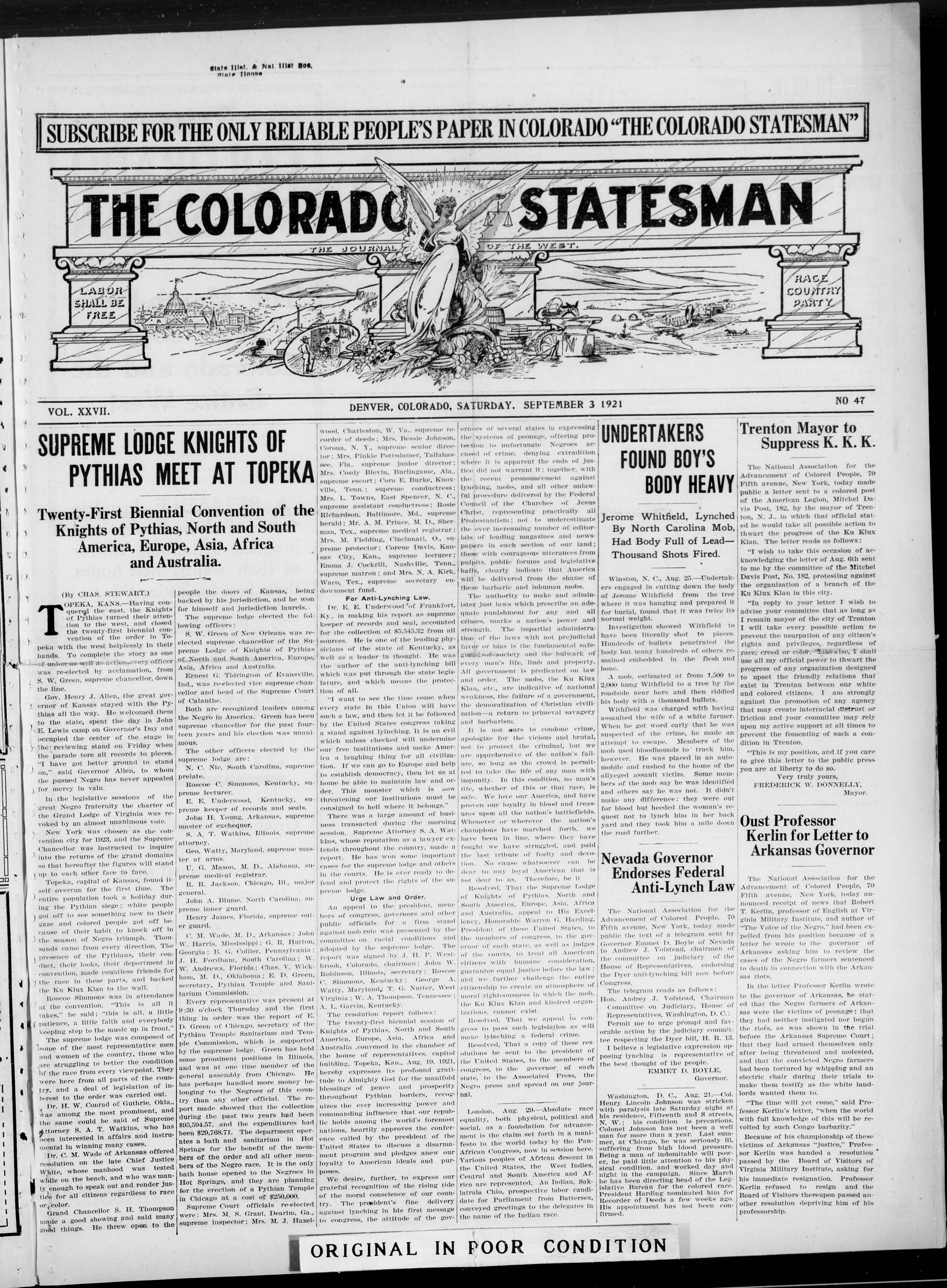
SUPREME LODGE KNIGHTS OF PYTHIAS MEET AT TOPEKA
Twenty-First Biennial Convention of the Knights of Pythias, North and South America, Europe, Asia, Africa and Australia.
---
(By CHAS. STEWART.)
TOPEKA, KANS.—Having conquered the east, the Knights of Pythias turned their attention to the west, and closed the twenty-first biennial convention of the order in Topeka with the west helplessly in their hands. To complete the story as one of union as well as action, every officer was re-elected by acclamation, from S. W. Green, supreme chancellor, down the line.
Gov. Henry J. Allen, the great governor of Kansas stayed with the Pythias all the way. He welcomed them to the state, spent the day in John E. Lewis camp on Governor's Day and occupied the center of the stage in the reviewing stand on Friday when the parade tore all records to pieces. "I have got better ground to stand on," said Governor Allen, to whom the pusued Negro has never appealed for mercy in vain.
In the legislative sessions of the great Negro fraternity the charter of the Grand Lodge of Virginia was revoked by an almost unanimous vote. New York was chosen as the convention city for 1923, and the Supreme Chancellor was instructed to inquire into the returns of the grand domains so that hereafter the figures will stand up to each other face to face. Topeka, capital of Kansas, found itself overrun for the first time. The entire population took a holiday during the Pythian siege; white people got off to see something new to their gaze and colored people got off because of their habit to knock off in the season of Negro triumph. Thousands came from every direction. The presence of the Pythians, their conduct, their looks, their deportment in convention, made countless friends for the race in these parts, and backed the Ku Klux Klan to the wall.
Roscoe Simmons was in attendance at the convention. "This is all it takes," he said; "this is all, a little patience, a little faith and everybody keeping step to the music up in front." The supreme lodge was composed of some of the most representative men and women of the country, those who are struggling to better the condition of the race from every viewpoint. They were here from all parts of the country, and a deal of legislation of interest to the order was carried out. Dr. H. W. Conrad of Guthrie, Okla., was among the most prominent, and the same could be said of Supreme Attorney S. A. T. Watkins, who has been interested in affairs and instrumental in winning many cases. Dr. C. M. Wade of Arkansas offered resolution on the late Chief Justice White, whose manhood was tested while on the bench, and who was manly enough to speak out and render justice for all citizens regardless to race or color.
Grand Chancellor S. H. Thompson made a good showing and said many good things. He threw open to the
VOL. XXVII.
THE ONLY RELIANCE
COLOR
THE KNIGHTS OF
EET AT TOPEKA
General Convention of the
s, North and South
oe, Asia, Africa
ustralia.
people the doors of Kansas, being backed by his jurisdiction, and he won for himself and jurisdiction laurels. The supreme lodge elected the following officers: S. W. Green of New Orleans was re-elected supreme chancellor of the Supreme Lodge of Knights of Pythias of North and South America, Europe, Asia, Africa and Australia. Ernest G. Tidrington of Evansville, Ind., was re-elected vice supreme chancellor and head of the Supreme Court of Calanthe. Both are recognized leaders among the Negro in America. Green has been supreme chancellor for the past fourteen years and his election was unanimous. The other officers elected by the supreme lodge are: N. C. Nic, South Carolina, supreme prelate. Roscoe C. Simmons, Kentucky, supreme lecturer. E. E. Underwood, Kentucky, supreme keeper of records and seals. John H. Young, Arkansas, supreme master of exchequer. S. A. T. Watkins, Illinois, supreme attorney. Geo, Watty, Maryland, supreme master at arms.
U, G. Mason, M. D. Alabama, supreme medical registrar.
R. R. Jackson, Chicago, Ill., major general.
John A. Blume, North Carolina, supreme inner guard.
Henry James, Florida, supreme outer guard.
C. M. Wade, M. D., Arkansas; John W. Harris, Mississippi; G. R. Hutton, Georgia; B. G. Collier, Pennsylvania; J. H. Fordham, South Carolina; W. W. Andrews, Florida; Chas. V. Wickham, M. D., Oklahoma; E. D. Green, secretary, Pythian Temple and Sanitarium Commission.
Every representative was present at 9:30 o'clock Thursday and the first thing in order was the report of E.D. Green of Chicago, secretary of the Pythian Temple Sanitarium and Temple Commission, which is supported by the supreme lodge. Green has held some prominent positions in Illinois, and was at one time member of the general assembly from Chicago. He has perhaps handled more money belonging to the Negroes of this country than any other official. The report made showed that the collection during the past two years had been $95,594.57, and the expenditures had been $29,768.71. The department operates a bath and sanitarium in Hot Springs for the benefit of the members of the order and all other members of the Negro race. It is the only bath house opened to the Negroes in Hot Springs, and they are planning for the erection of a Pythian Temple in Chicago at a cost of $250,000. Supreme Court officials re-elected were: Mrs. M. S. Grant, Dearim, Ga., supreme inspector; Mrs. M. J. Hazel-
C
State Hist. & Nat Hist Bee,
State House
ORIGINAL IN POOR CONDITION
wood, Charleston, W. Va., supreme recorder of deeds; Mrs. Bessie Johnson, Corona, N. Y., supreme senior director; Mrs. Pinkie Pottsdamer, Tallahassee, Fla., supreme junior director; Mrs. Cosly Blevin, Burlingame, Ala., supreme escort; Cora E. Burke, Knoxville, Tenn.; supreme conductress; Mrs. L. Towns, East Spencer, N. C., supreme assistant conductress; Rosie Richardson, Baltimore, Md., supreme herald; Mr. A. M. Prince, M. D., Sherman, Tex., supreme medical registrar; Mrs. M. Fielding, Cincinnati, O., supreme protector; Corene Davis, Kansas City, Kan., supreme lecturer; Emma J. Cockrill, Nashville, Tenn., supreme matron; and Mrs. N. A. Kirk, Waco, Tex., supreme secretary endowment fund.
For Anti-Lynching Law.
Dr. E. E. Underwood of Frankfort, Ky., in making his report as supreme keeper of records and seal, accounted for the collection of $5,545.32 from all sources. He is one of the leading physicians of the state of Kentucky, as well as a leader in thought. He was the author of the anti-lynching bill which was put through the state legislature, and which means the protection of all.
"I want to see the time come when every state in this Union will have such a law, and then let it be followed by the United States congress taking a stand against lynching. It is an evil which unless checked will undermine our free institutions and make America a laughing thing for all civilization. If we can go to Europe and help to establish democracy, then let us at home be able to maintain law and order. This monster which is now threatening our institutions must be consigned to hell where it belongs."
There was a large amount of business transacted during the morning session. Supreme Attorney S. A. Watkins, whose reputation as a lawyer extends throughout the country, made a report. He has won some important cases for the supreme lodge and others in the courts. He is ever ready to defend and protect the rights of the supreme lodge.
Urge Law and Order.
Urge Law and Order.
An appeal to the president, members of congress, governors and other public officials for a firm stand against mob rule was presented by the committee on racial conditions and adopted by the supreme lodge. The report was signed by J. H. P. Westbrook, Colorado, chairman; John W. Robinson, Illinois; secretary; Roscoe C. Simmons, Kentucky; George A. Watty, Maryland; T. G. Nutter, West Virginia; W. A. Thompson, Tennessee; A. L. Garvin, Kentucky.
The resolution report follows:
The twenty-first biennial session of Knights of Pythias, North and South America, Europe, Asia, Africa and Australia, convened in the chamber of the house of representatives, capitol building, Topeka, Kan., Aug. 19, 1921, hereby expresses its profound gratitude to Almighty God for the manifold blessings of peace and prosperity throughout Pythian borders, recognizes the ever increasing power and commanding influence that our republic holds among the world's foremost nations, heartily approves the conference called by the president of the United States to discuss a disarmament program and pledges anew our loyalty to American ideals and purposes.
We desire, further, to express our grateful recognition of the rising tide of the moral conscience of our country. The president's fine delivery against lynching in his first message to congress, the attitude of the gov-
ernors of several states in expressing the systems of peonage, offering protection to unfortunate Negroes accused of crime, denying extradition where it is apparent the ends of justice did not warrant it; together, with the recent pronouncement against lynching, mobs, and all other unlawful procedure delivered by the Federal Council of the Churches of Jesus Christ, representing practically all Protestantism; not to underestimate the ever increasing number of editors of leading magazines and newspapers in each section of our land; these with courageous utterances from pulpits, public forums and legislative halls, clearly indicate that America will be delivered from the shame of these barbaric and inhuman mobs.
The authority to make and administer just laws which prescribe an adequate punishment for any and all crimes, marks a nation's power and strength. The impartial administration of the laws with not prejudicial favor or bias is the fundamental safe guard of society and the bulwark of every man's life, limb and property. All government is predicated on law and order. The mobs, the Ku Klux Klan, etc., are indicative of national weakness, the failure of a government, the demoralization of Christian civilization—a return to primeval savagery and barbarism.
It is not ours to condone crime, apologize for the vicious and brutal, not to protect the criminal, but we are apprehensive of the nation's failure, so long as the crowd is permitted to take the life of any man with impunity. In this condition, no man's life, whether of this or that race, is safe. We love our America, and have proven our loyalty in blood and treasures upon all the nation's battlefields. Whenever or wherever the nation's champions have marched forth, we have been in line, where they have fought we have struggled, and paid the last tribute of fealty and devotion. No cause whatsoever can be dear to any loyal American that is not dear to us. Therefore, be it
Resolved, That the Supreme Lodge of Knights of Pythias, North and South America, Europe, Asia, Africa and Australia, appeal to His Excellency, Honorable Warren G. Harding, President of these United States, to the members of congress, to the governor of each state, as well as judges of the courts, to treat all American citizens with humane consideration, guarantee equal justice before the law; and we further challenge the entire citizenship to create an atmosphere of moral righteousness in which the mob, the Ku Klux Klan and kindred organizations, cannot exist.
Resolved, That we appeal to congress to pass such legislation as will make lynching a federal crime.
Resolved, That a copy of these resolutions be sent to the president of the United States, to the members of congress, to the governor of each state, to the Associated Press, the Negro press and spread on our journal.
London, Aug. 29.—Absolute race equality, both physical, political and social, as a foundation for advancement is the claim set forth in a manifesto to the world today by the Pan-African Congress, now in session here. Various peoples of Afrtecan descent in the United States, the West Indies, Central and South America and Africa are represented. An Indian, Saklatrala Chio, prospective labor candidate for Parliament from Battersea, conveyed greetings to the delegates in the name of the Indian race.
UNDERTAKERS FOUND BOY'S BODY HEAVY
Jerome Whitfield, Lynched By North Carolina Mob Had Body Full of Lead Thousand Shots Fired.
Winston, N. C., Aug. 25.—Undertakers engaged in cutting down the body of Jerome Withfield from the tree where it was hanging and prepared it for burial, found that it was twice its normal weight.
Investigation showed Withfield to have been literally shot to pieces. Hundreds of bullets penetrated the body but many hundreds of others remained embedded in the flesh and bone.
A mob, estimated at from 1,500 to 2,000 hung Withfield to a tree by the roadside near here and then riddled his body with a thousand bullets.
Withfield was charged with having assaulted the wife of a white farmer. When he got word early that he was suspected of the crime, he made an attempt to escape. Members of the mob used bloodhounds to track him, however. He was placed in an automobile and rushed to the home of the allyeged assault victim. Some members of the mob say he was identified and others say he was not. It didn't make any difference; they were out for blood but heeded the woman's request not to lynch him in her back yard and they took him a mile down the road further.
Nevada Governor Endorses Federal Anti-Lynch Law
Nevada Governor Endorses Federal Anti-Lynch Law
The National Association for the Advancement of Colored People, 70 Fifth avenue, New York, today made public the text of a telegram sent by Governor Emmet D. Boyle of Nevada to Andrew J. Volstead, chairman of the committee on judiciary of the House of Representatives, endorsing the Dyer anti-lynching bill now before Congress.
The telegram reads as follows: Hon. Andrey J. Volstead, Chairman Committee on Judiciary, House of Representatives, Washington, D. C.: Permit me to urge prompt and favorable action by the judiciary committee respecting the Dyer bill, H. R. 13. I believe a legislative expression opposing lynching is representative of the best thought of the people.
EMMET D. BOYLE,
Washington, D. C., Aug. 21—Colen Henry Lincoln Johnson was stricken with paralysis late Saturday night at his residence, Fifthteen and S streets N. W.; his condition is precarious Colonel Johnson has not been a well man for more than a year. Last summer, at Chicago, he was seriously ill suffering from high blood pressure Being a man of indomitable will power, he paid little attention to his physical condition, and worked day and night in the campaign. Since March he has been directing head of the Legislative Bureau for the colored race President Hardling nominated him for Recorder of Deeds a few weeks ago His appointment has not been confirmed.
NO 47
Trenton Mayor to Suppress K. K. K.
The National Association for the Advancement of Colored People, 70 Fifth avenue, New York, today made public a letter sent to a colored post of the American Legion, Mitchel Davis Post, 182, by the mayor of Trenton, N. J., in which that official stated he would take all possible action to thwart the progress of the Ku Klux Klan. The letter reads as follows:
"I wish to take this occasion of acknowledging the letter of Aug. 6th sent to me by the committee of the Mitchel Davis Post, No. 182, protesting against the organization of a branch of the Ku Klux Klan in this city.
"In reply to your letter I wish to advise your committee that as long as I remain mayor of the city of Trenton I will take every possible action to prevent the usurpation of any citizen's rights and privileges, regardless of race, creed or color. Likewise, I shall use all my official power to thwart the progress of any organization designed to upset the friendly relations that exist in Trentan between our white and colored citizens. I am strongly against the promotion of any agency that may create interracial distrust or friction and your committee may rely upon my active support at all times to prevent the fomenting of such a condition in Trenton.
"This is my position, and if you care to give this letter to the public press you are at liberty to do so.
Very truly yours,
FREDERICK W. DONNELLY,
Mayor.
Oust Professor Kerlin for Letter to Arkansas Governor
The National Association for the Advancement of Colored People, 70 Fifth avenue, New York, today announced receipt of news that Robert T. Kerlin, professor of English at Virginia Military Institute, and author of "The Voice of the Negro," had been expelled from his position because of a letter he wrote to the governor of Arkansas asking him to review the cases of the Negro farmers sentenced to death in connection with the Arkansas riots.
In the letter Professor Kerlin wrote to the governor of Arkansas, he stated that the Negro farmers of Arkansas were the victims of peonage; that they had neither instigated nor begun the riots, as was shown in the trial before the Arkansas Supreme Court; that they had armed themselves only after being threatened and molested, and that the convicted Negro farmers had been tortured by whipping and an electric chair during their trials to make them testify as the white landlords wanted them to.
"The time will yet come," said Professor Kerlin's letter, "when the world with full knowledge of this will be revolted by such Congo barbarity."
Because of his championship of these victims of Arkansas "justice," Professor Kerlin was handed a resolution passed by the Board of Visitors of Virginia Military Institute, asking for his immediate resignation. Professor Kerlin refused to resign and the Board of Visitors thereupon passed another resolution depriving him of his professorship.
FOREIGN
The Rev. Canon Edgar Sheppard, for many years royal chaplain at Windsor castle, died in London at the age of 76 years. He was chaplain to Queen Victoria, later to King Edward and Queen Alexander and to the present royal family.
The minister of the interior has prohibited the publication of a number of nationalist organs, including the Deutsche Zeitung, in accordance with the decree issued by President Ebert, barring publications "likely to encourage seditious movements."
Government officials would be authorized to send 10,000,000 pesos worth of food to relieve famine sufferers of Russia under provisions of a bill introduced in the Chamber of Deputies by Senor Muzlo at Buenos Aires. Socialist members of the chamber have indorsed the measure.
National lands in the territory of Quintina Roo, which have stood idle since 1906, are to be divided into small tracts and sold on easy terms to farmers who can give suitable financial references. The distribution of these lands was suspended on Dec. 18, 1909, in order to allow for a complete survey.
The deficit of the French telephone service, which is run by the state, will amount to more than 220,000,000 francs for this year, according to Louis Deschamps, who ought to be well informed, as he was under secretary of state for the department of posts, telephones and telegraphs in the previous cabinet.
Native Moroccan villages along the coast southeast of Melilla have been destroyed by bombardment by the Spanish warship Boniface, according to a message from Chafinus island, off the Moroccan coast. The fire from the warship also caused numerous casualties and forced the Moors to flee to the interior.
Fire worshippers have inaugurated headquarters of their own in London. Generous donations from rich Indians have secured for the Parsee Association of Europe a large house in the west end, where Zoroastrian religious ceremonies are to be conducted and where bodies of dead Parsees may find a resting place before burial.
GENERAL
Mrs. Betty Brennan and Jacob Pain were killed at St. Louis when the speeding automobile in which they were riding overturned at a sharp curve. Three other occupants of the car were seriously injured.
One dead, two dying and ten others for whom physicians hold out little hope, and two more with only a desperate chance for recovery, are victims of toadstools eaten by mistake for mushrooms at La Porte, Ind.
Edward Barnes, 47, merchant, was found shot and killed in a ward at the rear of his home at Cape Girardeau, Mo. His wife said $3,000 he had was missing. Mrs. Barnes is held by police pending an investigation. Fred Foeste, 29, a son-in-law, is sought by the police.
The largest crowd that has attended a memorial service for returned soldier dead gathered on the army pliers at Hoboken, N. J., to honor the bodies of 5.795 soldiers that arrived recently on the transport Wheaton. More than 10,000 attended the ceremonies, it was estimated. Los Angeles was selected as the 1922 convention city for the International Rotary clubs. The selection was made by the board of directors in session at Chicago, after a strong invitation had been presented by William Stephens, president of the Los Angeles Rotary club.
An attempt to fasten an electric light bulb into a socket while she was dressed in a wet bathing suit, caused the death of Miss Beatrice Schwartzler, 17, at her home on City Island. A pool of water collected about her feet and when her wet hand came in contact with the current she received a shock which proved fatal.
Dirigible balloon D-6, the largest American naval aircraft of its type, and the kite balloon AP were destroyed by a fire which also razed the hangar at the Rockaway Point naval air station. An explosion of gasoline, from an unknown cause, started the blaze. Although a number of men were in the hangar, only one man was slightly burned.
Petroleum exportations from Tampico, Mexico, totaled during the month of July approximately 5,500,000 barrels, or one-fourth the amount shipped during the month of June, according to information given out by oil companies. It was stated that August exportations will show a decrease from those of July, despite that drilling is almost as active as early in the year. The death of Miss Mary Louise Graffam, a missionary of the American Board of Commissioners for Foreign Missions, at Sivas, Asia Minor, was announced in a cable message, Miss Graffam, the only American at Sivas much of the time during the World war, incurred the displeasure of Turkish officials at times and an order for her execution was signed in one instance.
An estimate that $4,500,000 was paid by life insurance companies in death claims from automobile fatalities during 1920 is published by the Insurance Press. Statistics are quoted to show that during the year the automobile caused 12,000 fatalities and 1,500,000 non-fatal injuries. L. D. Merrill, former lieutenant in the United States aviation service, and Jack Rodeheaver, 18 years old, of Winona Lake, Ind., were instantly killed when an airplane in which they were taking a pleasure ride at Winona Lake crashed to the ground.
NEWS TO DATE IN PARAGRAPHS
CAUGHT FROM THE NETWORK OF WIRES ROUND ABOUT THE WORLD.
DURING THE PAST WEEK
RECORD OF IMPORTANT EVENTS
CONDENSED FOR BUSY
PEOPLE
(Western Newspaper Union News Service.)
WESTERN
Albert C. Baker, justice of the Arizona Supreme Court, died at Los Angeles, according to advises received.
Mrs. Bessie Keyes, charged with implication in the killing of the 5-months-old daughter of W. T. Aven, was arrested at Wylie, Texas, and taken to Waco.
While tapping a keg of near beer at Dubuque, Iowa, William Trainor had his right arm broken in two places when the keg exploded, blowing out the head.
H. E. Grimes, ticket agent at Suisun, Calif., was shot and killed by a robber who held up the railway ticket office at Suisun and escaped with $92, according to reports.
All records for sales of individual
rams at local auction were equilled at
Salt Lake City when Monarch, a show-
winning Rambouillet ram, owned by
the Butterfield Livestock Company of
Weiser, Idaho, was sold to Bullard
Brothers of Woodland, Calif., for $3,
000.
Hans Georgeson of Niagara, Grand
Fork county, was elected president of
the North Dakota Farm Bureau Fed-
eration at Fargo, N. D., by the state
executive committee to succeed Usher
L. Burdick, who resigned because of
work in connection with the Grain
Growers, Inc.
Two bandits broke through a screen door in the rear of the Chicago-Lake State bank in an outlying residence district in Minneapolis, Minn., lined up five men and two women employees and escaped with about $4,500 in cash. It was the second robbery of the bank in two years.
The Garber State Bank of Garber, Okla., was robbed by two unmasked men, who escaped with $2,500. The men held up Glenn R. Courter, cashier, and his father, locked both men in the vault and sped away in a motor car. Courter released his father and himself by an inside combination.
An unidentified Chinese was shot to death in his cabin at Mina, 175 miles southeast of Reno, Nev., by two Chinese who drove from Reno in a taxi-cab. Hughie Sing of Carson City and Lee John of San Francisco, both said to be Hop Sing tongmen, were arrested in Reno and are charged with the murder.
According to a tabulated statement by the Texas State Highway Department, 130 new road projects have been completed involving 1,106.1 miles at a total cost of $7,366,314.20 on which $1,312,258.85 state aid and $1,794,335.14 federal aid was paid. Of these roads, 32.4 miles were paved with concrete, 142.5 miles with bituminous materials and 607 miles with gravel.
WASHINGTON
Amusement-loving America spent nearly $1,000,000,000 during the fiscal year 1921 for the theatrical entertainment, according to statistics made public by Internal Revenue Commissioner Blair. The 10 per cent tax collection on theaters and places of amusement during the fiscal year just closed amounted to $80,725,905. Blair announced. Col. Thomas W. Miller, alien property custodian, has recommended to President Harding that the property seized by the United States from Germany during the war be used to pay the claims of American citizens for injuries and damages incurred before the entry of this country into the war.
A replica of the President of the United States in personal appearance is Capt. A. F. Johnson, commanding the ocean steamship City of St. Louis, plying between Savannah and Boston. In citizen's attire Captain Johnson resembles more closely President Harding than when the skipper is wearing the steamship uniform. Captain Johnson is about the age of the President and is a Republican.
A new basis of taxation to take the place of the House revenue measure and practically all present tax laws was proposed by Senator Smoot, Republican, Utah, who announced he was preparing a bill embodying the plan, which he estimated would yield $3,895,000,000 this year. He added that he would take the question up with the Senate finance committee when it begins consideration of revenue questions.
A pigeon which carried a message from Mayor Thompson of Chicago to President Harding in sixteen hours' actual flying time for the $614.12 miles broke a world's record; the Department of Agriculture announced. The bird was a product of the government's loft at Beltsville, Md. White House. Charles W. Pugsley of Nebraska has been selected by President Harding for appointment as assistant secretary of agriculture to succeed Dr. Elmer D. Bell, whose resignation, effective Oct. 1, was announced at the
Pithy News Notes From All Parts of Colorado
( Western Newspaper Union News Service. )
COMING EVENTS.
Moffat County Fair at Maybell, Sept.
9-10.
Routt County Fair, Hayden, Sept. 14-
16; B. T. Shelton, secretary.
Logan County Fair, Sterling, Sept. 13-
16; C. J. Fonk, manager.
16: C. J. Funk, manager, Sept. 15-
16: C. J. Funk, manager, A. N.
Minton, secretary, Sept. 13-16.
Bobson, secretary, Sept. 13-
17: Harry J. Niven, secretary,
Saguache County Fair, Saguache, Sept.
15: William Fellers, secretary,
Slope Fair, Montrose, Sept.
20-23.
Cheyenne County Fair, Cheyenne
Wells, Sept. 20-24; Carroll Brown,
Sept.
Adams County Fair, Brighton, Sept.
20-23; George R. Smith, secretary,
Weld County Fair, Greeley, Sept. 21-23;
Dreyfey, manager.
Rio Grande County Fair, Del Norte.
Sept. 21-23.
Sept. 21-23
Pepin, Fairy Fair, Goodpasture, Sept.
22-23; Fred Lyle, secretary, Pueblo
Yuma County Fair, Yuma, Sept. 21-24
W. W. Williams, secretary
Farm Bureau Fair, Byers, Colo, Sept.
21-22-23. B. H. Teller, secretary.
Crowley County Fair, Sugar City, Aug.
25-26; R. A. Hamilton, secretary.
Colorado State Fair, Pueblo, Sept. 26-
30; J. L. Beaman, manager.
Huerfano County Fair, Walsenburg,
Douglas County Fair, at Castle Rock.
Oct. 4-6; James E. Tressler, secretary,
Kit Carson County Fair, Burlington,
Oct. 5-8; J. M. Hefner, secretary,
El Paso County Fair, Calhan, Oct. 6-8;
D. E. Nance, secretary.
Louis Titus, formerly a member of the Denver police force, was sentenced to six months in jail and fined $300 and costs in the County Court at Fort Collins when he was tried on the charge of possessing liquor.
The rubber of a toy balloon caused the death of 2-year-old George Price at the home of Mrs. Morris Drachman, in Denver. An autopsy held by Dr. D. W. Dennis revealed a portion of a rubber balloon lodged in the windpipe of the child.
C. E. Martin, 31 years old, well-known breeder of fancy hogs in Morgan county, died at the Brush hospital from injuries received when he was knocked down and run over by two automobiles. He leaves a widow and seven children—all under 11 years. Approximately $150,000 in federal and state funds is to be expended in road and bridge construction directly south of Greeley this winter. The work includes the building and paving of two miles of trunk line highway and 150 feet of steel and concrete bridges.
Statistics for presentation at the Methodist ecumenical conference in London next month show American Methodism has gained 1,255,091 members, net, during the past decade, it was announced by the secular press bureau of the Methodist Episcopal church, South.
Down the quiet country road north of La Porte a horse and buggy came slowly. Upright in the buggy sat the body of Thomas Levi Elliott, 72 years old. W. M. Fuller and H. S. West of Fort Collins spoke to the aged man. He did not answer. They investigated and found him dead of heart disease. County, district and community fairs of the state are this year scheduled ahead of the State Fair, and from these will be taken to the state show the winning exhibits, so that aside from the usual display by counties, associations and individuals, the best from all the fairs will be shown. The State Fair has become a truly wonderful educational institution.
Construction of four and one-tenth miles of graded road between Buena Vista and Leadville, Colo., with 50 per cent federal aid is proposed by the State Highway Commission in a project statement submitted to District Engineer J. W. Johnson of the United States Bureau of Public Ronds. The cost is estimated at $73,000. This project will connect with the Granite-Twin Lakes stretch.
Eighty-five harness race horses have been entered for the Colorado State Fair at Pueblo. They come from six different states, and include many of the noted horses of the West. This is a third greater number than ever before.
Sixty of the leading business men of Boulder took the trip to Arapahoe glacier, where a meeting of the Commercial Association was held. This was the first meeting of a commercial body ever held on a living glacier. The Pathé Weekly took a movie of the meeting. The glacier is located twenty-five miles west of Boulder at the foot of the Arapahoe peaks and at the head of the Boulder water system.
Property owners in the Greeley-Poundre district are adhering to their determination not to pay the tax of $27.63 an acre which was levied against their lands last fall for the retirement of the bonds of the irrigation district which have matured. This will add two and a quarter millions of dollars to Weld county's list of delinquent taxes this fall, prorated among 361 property owners, according to their acrenge.
Colorado College will open the fall term with an enrollment of more than 700 students, according to an announcement made by President C. A. Dunway. Formal registration will be held Sept. 13. The term will open Sept. 14, it is announced. There is no change in the faculty. Colorado stock growers need not pay fees for use of the forest reserves for grazing purposes until Dec. 1, according to a bill passed by Congress and signed by President Harding. The law extends the time for the payment of these fees three months.
CENTENNIAL STATE ITEMS.
Weld county is second in the state in ownership of motor cars according to reports filed at the state house, citizens of that county possessing 8,834 motor vehicles of various sorts at that time. Denver county, which stands first on the list, has 31,548; ElPaso is third with 6,415; Pueblo is fourth with 5,480, and Larimer fifth with 5,072. Yuma county, which has the lowest number of passenger cars, leads the state in trucks, with 406. Adams county has 2,267 cars and 247 trucks. Logan county less than 3,000 cars and 250 trucks and Larimer county has 220 trucks. The total registration for the state is 117,204 passenger cars, 7,402 trucks and 823 motorcycles.
The finest state armory in the West is at Pueblo. It will house two splendid units of the Colorado National Guard, Battery A and Troop C. Troop C has already received about forty finely trained cavalry horses from the War Department, and sixty more are expected soon. Battery A is to be equipped with the very best field artillery, also from the nation's War Department. Both of these army units did splendid service during the great Pueblo flood, and their usefulness locally and for the state is sure to be up to the highest military standard. The armory is to be fashioned after the armory at Philadelphia, and will cost $100,000 or more.
A new cave of vast proportions has been discovered about five miles southwest of Victor, in Fremont county. It is believed by persons who have explored it partially that the cave probably extends a mile or more. The cavern is in the carboniferous lime formation and not far from the juncture of Wilson and High creeks. Spacious halls, with beautiful stalactite and stalagmite formations pillaring their walls run far off into the echoing and unexplored distance. Abrupt cliffs in the floors make exploring extremely difficult. A rock thrown over one of these dark abysses did not reach bottom for eight seconds.
The body of an unidentified man, who probably had been murdered, was found partially wrapped in a sack a few miles beyond Vineland on the Santa Fé trail east of Pueblo. One bullet hole in the head and another through the body were found. The man was well dressed, about five feet ten inches high, weighed about 200 pounds and about 40 or 45 years of age. A fedora hat bore a mark of a Pawnee, Okla., dealer, and in the man's pocket was found a token from the Ford garage at Fowler, Colo.
Revenue collections from Colorado for the 1921 fiscal year were $33,960,861.21 in comparison with $35,727,957.26 for 1920. This is a decrease of 5 per cent compared with the 15 per cent decrease for the entire country. The Colorado collections were divided between $25,084,574.17 from income and profits' taxes, and $8,876,287.04 from miscellaneous taxes. Only thirteen states showed increased collections, a 24 per cent in West Virginia being the largest.
The use of army airplanes for fire protection in western forests will be discontinued next summer, Secretary Weeks announced, because "the larger reduction now being made in appropriations" permitted expenditures "for only the most necessary strictly military needs." Mr. Weeks made this statement in a letter to Secretary Wallace, who had asked for army aid in protecting timber lands in the West.
Denver employés of the Colorado & Southern railroad will hold their eleventh annual picnic on Sunday, Sept. 4. at Idaho Springs. More than 1,200 employée and members of their families are expected to attend.
Many new and novel exhibits from far eastern and southern states are announced as coming to this year's Colorado State Fair at Pueblo, while there will be entertaining features never before seen in the West.
The Loveland Chamber of Commerce has started an advertising campaign for the city. Five thousand folders of the free camping ground are being issued, and 10,000 small booklets with scenes of Loveland and Estes Park will be issued this winter. More signs will be posted along the roads leading to Loveland, and special news feature articles will be sent to various trade publications of the country.
Edith Pinnello, 18-months-old daughter of Mr. and Mrs. A. L. Pinello, ranchers at Skimmers, Colo., was drowned when she fell in a horse trough. Her parents did not find her until some time later and immediately summoned two Colorado Springs physicians, who made a record run to the ranch, eight miles away, and applied a pulmotor. Efforts to revive the child proved futile.
One of the largest real estate deals in eastern Colorado was closed when George Waters of Kit Carson traded his 2,577-acre ranch, 2,300 head of cattle and all personal property to the Siemens brothers of Colorado Springs for income property in that city. The city property was put in at $75,000, while the land was valued at $30 an acre. Frank J. Hagenbarth, president of the National Wool Growers' Association, which held a joint meeting at Salt Lake with the American National Live Stock Association, declared in an address that the present will be the last "bad year" for stockmen in that conditions are becoming stabilized. He asserted that the live stock men could look with confidence to the future.
So many improvements have beer made and new buildings constructed on the State Fair grounds that it will not look like the same place when the 1921 fair opens on Sept. 26 at Pueblo.
THE COLORADO STATESMAN
The Mouth-Piece of the People of Colorado and the Entire West
RELIABLE chronicle of their doings and progress; a faithful mirror of their wants, their hopes, their best aspirations.
THE COLORADO STATESMAN
Unequaled as an advertising medium for the business of professional men and women.
An excellent family journal speaking to and for many thousand colored citizens.
$2.50 A YEAR
THE GREAT ORGAN OF THE
WASHINGTON SIDELIGHTS
Oil Shale When Our Crude Oil Is Gone
Oil Shale When Our Crude Oil Is Gone
Flood Prevention in Arkansas Valley
Flood Prevention in Arkansas Valley
DEFICIT
$70,000,000
LOSS EXPECTED ON
THIS YEAR
U.S.
MAIL
WASHINGTON.—Parcel post rates
must be increased, if an investiga-
tion shows that this service
is responsible for an expected deficit
of $70,000,000 in the postal revenue
this year. Postmaster General Hays
says. Accountants and post office
engineers are now checking through the
entire country to learn if the parcel
post is, as suspected, one of the two
big losing ventures of the department.
Until 1920 postal revenues exceeded expenditures for several years, but now deficits are showing, due to business depression, increased wages and increased compensation to railroads for carrying mail.
OIL-BEARING shale in the United States is capable of supplying all of the country's demands for petroleum when the supply of crude oil is exhausted. This announcement is contained in a report of the bureau of mines.
Oil shale up to the present time has not been mined on a commercial scale in this country. Since the middle of the last century oil shale mining has been an important origin of oil in Scotland and France.
Rich and easily accessible deposits of the oil-bearing shale are said to exist in Colorado, Utah, Montana, Nevada and California, where some shale oil already has been produced and used successfully. Several small reducing plants have been in operation for some time, and others are under construction near Debeque, Colo.; Watson, Utah; Elko, Nev., and Dillon, Mont.
Tests indicate that the yield of oil shale is all the way from practically nothing up to ninety gallons or more a ton. Much shale is too thin to be mined commercially, but there are extensive deposits running from several feet to 35 feet in thickness. "It is estimated by the geological survey," says the report. "that the curve of crude oil production will reach its peak within a few years, and then the country will have to look more and more to other sources for
PLANS TO
GUARD MAINT
BIG FLOODS
IN COLORADO
ENGINEERS of the federal reclamation service have completed a
preliminary report, based on a hasty, tentative survey, on flood prevention for the city of Pueblo and the Arkansas river valley. A copy of the report has been received by Secretary of the Interior Fall, and a second copy has been sent to the mayor of Pueblo.
The engineers, James Munn and J. L. Sayage of the Denver reclamation office, have suggested several different plans and combinations of plans for flood prevention which would entail estimated costs ranging from $9,000,-000 to $17,500,000.
One plan for the Arkansas river calls for flood detention storage of 210,000 acre feet with such repairs to present levees and channel as are required to provide a safe capacity of 25,000 second feet through Pueblo.
Another plan provides for the en-
A MOVEMENT asking congress to shift burdensome taxes from the people to nonalcoholic beer has been started throughout the country. Congress is urged to have the revenue bill provide for the manufacture and sale of beer containing 2.75 per cent alcohol, and in that way raise from $1,000,000,000 to $1,250,000,000 in taxes, and the proposition is being seriously considered.
---
A serious effort has been made to get Prohibitionists to agree to a tax of $10 per barrel on "nonintoxicating cereal beverages containing not more than $24 per cent of alcohol by weight."
The suggested legislation, it is argued, would not violate the spirit of the eighteenth amendment, but in effect amend the Volstead act by killing the provision prohibiting the manufacture of beer with an alcoholic content in excess of one-half of one per cent. A bill, or an amendment to that effect, will be introduced in the house to be considered when the regular revenue bill is taken up.
Prof. Edwin R. Seligman, professor of political economy at Columbia uni-
#
"The parcel post system is a commercial venture pure and simple," Mr. Hays said. "There is every reason, therefore, why it should be made at least self-supporting. This does not hold true of some other services of the post office, which necessarily must be accomplished at a loss."
Mr. Hays explained why a deficit is expected this year and gave an itemized statement showing where and how the department plans to reduce operating costs by nearly $15,000,000.
"For the fiscal year ending June 30, 1920," he said, "the deficit was $17,000,000. For the fiscal year ending June 30, 1921, the deficit will be found to be approximately $84,000,000 when the reports are all available.
"Of this, about $75,000,000 was due to increase in compensation ordered by congress to employees and $11,000,000 was additional pay to railroads under interstate commerce decisions.
"Since April 1 there has been a serious falling off of post office business and in consequence receipts, but economies have been instituted which prevent any deficit other than that for increased wages and railroad rates."
OIL SHALE TO SUPPLY U.S. IF WELLS DRY
its various grades of hydrocarbon oils.
"It is entirely possible that foreign oil fields, not extensively exploited as yet, will supply the deficit caused by declining production and increasing consumption in the United States for a time.
"When foreign oils cannot be obtained in sufficient quantities and at reasonable prices we can turn to our oil shales for our supply."
"More than 150 companies have been organized for the purpose of developing or selling stock in shale oil enterprises. Some apparently are essentially stock-selling organizations. Others have been organizing on a firm basis.
"Large amounts will have to be invested before the oil shale industry becomes of commercial importance.
"Estimates by engineers of the cost of a complete retorting plant, handling 1,000 tons of shale a day, are between $1,000,000 and $5,000,000.
largement of the channel through Pueblo and for a concrete channel. Bank protection is one of four plans suggested for Fountain creek. The engineers make it plain that their present recommendations are based on fragmentary data available at this time and that complete study of the problems involved will require much more time and more accurate hydrographic and topographic data than is now at hand and also much detailed engineering work. They found a dearth of accurate topographic and other essential data on which to base even a preliminary study.
All the alternative plans which include flood detention storage with possible use of the Steel Hollow reservoir site, would benefit property interests in the Arkansas valley below Pueblo, while the alternative plan embracing only channel enlargement or bank protection through Pueblo would not protect property interests in the valley below Pueblo.
"Due to the limited storage possibilities and as a very little, if any, water is available for storage in the Arkansas river above Pueblo, there does not appear to be any project of developing irrigation storage with economy in conjunction with flood detention storage," reads the report.
versity, testifying before the finance committee of the senate, made an impression when he said:
"We must remember that had we not adopted prohibition we should be getting at least $1,000,000,000 we will not get under the existing law."
Asked if he favored the repeal of the prohibition law, Professor Seligman replied:
"No, sir; although I should be glad to see it so interpreted as to permit the sale and the heavy taxation of beer and light wines. That would help us out immensely."
Practical experts have estimated that between 90,000,000 and 120,000,000 barrels of beer would be consumed if it contained $2\%$ per cent of alcohol.
ONE IN FOUR WAS UNABLE TO READ
ILLITERACY OF AMERICA WAS REVEALED IN THE WORK OF MAKING OUR BIG ARMY.
CONDITION WAS A SURPRISE
Utterances of General Pershing and Commissioner Tigert Arouse Anew Efforts to Have Federal Department of Education Created.
By EDWARD B. CLARK.
Washington.—Recent words uttered by Gen. John J. Pershing and by Dr. L. Tigert, United States commissioner of education, have roused interest again in the proposal to create a department of education with a cabinet officer at its head to be added to the other departments of government.
President Harding is committed to a department of welfare. One of the stumbling blocks in the way of securing the legislation to create such a department was the efforts of some of the educators to prevent the inclusion of education in the field of the department of welfare activities. Many of the educators wanted and still want a separate department of education.
Gen. Leonard Wood, for several years made a campaign for better teachers, better pay for teachers, and better teaching facilities a general companion piece to his campaign for proper military preparedness. Hardly a speech that he delivered for two years but contained some reference to this matter. General Wood trained two divisions of American soldiers for service in France, and he had learned at first hand some of the startling conditions of illiteracy which existed in the ranks of young America. Now General Pershing has said that one man in every four who entered the American army was unable to read or write. He added that the officers of the service had their hard work much increased by the fact that many of their men could not read and that, lacking the development of even a primary education, they were not quickly susceptible to instruction.
Tigert on Our Illiteracy.
The words of General Pershing have been buttressed by the words of Doctor Tigert, who, among other things, has said this:
"It has been declared that America, like Rome, will be destroyed by vandals from within, and not from without, through the forces of illiteracy.
"One man out of every four in the American army could neither read nor write, but there was only one illiterate in 5,000 in the German army. No one can realize without seeing the seemingly impenetrable terrain of the Argonne forest what we owe to our soldiers, but it was a crime to send them in as they were against men of such literacy. I hope that there will never be another war, but if there is it will be a disgrace to the nation if our men are not better prepared, and it is the task of the schools to prepare them."
Today Washington is told that before the war the United States spent more than any other nation on education, and that every state in the Union had laws requiring at least an education of an elementary kind, but it is said that the laws are not enforced and that only half of the children which the statutes require shall attend school actually are there.
It is said now that during the war 16,000 teachers gave up teaching because the American people were unwilling to pay them enough to live on the average salary being $500 a year while in one state it was only $234. It is said to be increasingly difficult to get young women to enter the teaching profession. The other day it was said that the churches were having hard work to get young men to enter the ministry
Poor Chance for Department.
From the present outlook it seems probable that no department of education will be established by act of congress, and that the bureau of education will be included in the department of welfare, if it shall be created. Of course there is today a bureau of education, and it is doing its work with limited appropriations in the best way it can. There is no lack of heart effort, nor of physical hard work.
It can be said that the disclosures made by the war that such a high percentage of illiteracy exists in the United States came as a shock to the law makers. The thing was impossible to believe, and yet the records proved the point. Prior to the war there was a general belief that the United States had a lower rate of illiteracy than any other great nation in the world. This was due, it was said, to misleading reports from the states in the Union, reports which were made on inadequate information. The 4,000,000 men who went into the service are called the flower of our youth, and yet it is a flower without education as one of its crowning beauties. It is held in Washington that if the war has done no other good, it probably accomplished something worth while because it forced Americans to know the true condition concerning the rate of illiteracy among the young men of the land.
Every government which has been invited to participate in the forthcoming conference in Washington on disarmament and Far East problems has given over its demand for anything
like a preliminary conference. If there had been insistence on a preliminary conference the United States would not have been that no conference at all would be held. There are constant streams of communications between the foreign offices of the various governments and the State department of this country. These streams will continue to flow until a short time before the gatherings of the chiefs of the clans which now definitely has been fixed for November 11. Armistice day.
It is pretty generally believed now that a fair understanding of just what subjects will be discussed will be reached before the conference begins. There also is a belief that in a general way the State department will know in advance what the results of the conference are to be. The words which have come from Japan show pretty clearly what the attitude of the Japanese is, and in a fairly specific way one can judge of the attitude of Great Britain and France by what already has been made public concerning their "needs and desires in the case."
Word has come from Great Britain that it has no intention further to urge a preliminary conference on matters pertaining to the Far East. It was known that the various premiers of the British dominions desired particularly to have some definite understanding in advance concerning the Pacific questions which are to be brought before the conference, but apparently the premiers have yielded.
Objections to Preliminary Meet.
It would have been impossible for all of the nations to have sent representatives to the preliminary conference. The United States government was wise enough to know that the unrepresented nations would object strongly to having the other countries arrange a program in advance to which the unrepresented ones might not agree. Furthermore, if representatives of some of the nations were given an opportunity to pass on certain questions in advance, a country like Japan or Italy, not being represented at the preliminary conference, would have some reason to say that the other countries which were represented at it had stacked the cards against it.
The State department now is calling together a large body of experts on foreign affairs. Some of them are coming from the Far East, some of them from Europe, and some of them from South America. They are all men who know the economic problems and some of the diplomatic problems of the countries in which they have been residing, and where in many cases they have been representing Uncle Sam's interests.
Herrick Can't Find a Residence. The ambassador of the United States to France, Myron T. Herrick, is having a time of it trying to find a plece in the French capital to lay his head. There are no residences to let. If the United States had a residence for its ambassador or its minister in each capital of the world, the appointee could go directly to it knowing that at least he would have a place to live. The United States government does not do things this way.
Mr. Herrick, generally is accounted a rich man, but the riches of men frequently are exaggerated. Mr. Herrick unquestionably is well to do. If he were not, the United States government might have wanted to send him to France as its ambassador, but he could not have taken the job although qualified for it, and beloved of the French people as unquestionably he is.
Paris is overcrowded today because there were no building operations during the war. There is not a vacant place at this writing which Mr. Herrick can find to turn into his abode. The ambassador has to live, and moreover he is absolutely compelled to entertain. If today he wishes to give a reception he will have to hire a salon in a hotel, or else ask the municipal authorities' permission to hold an outdoor hand-shaking party in the Place de la Concorde.
Congress Will Not Remedy It. No session of congress has been held in many years at which there was not some senator or member to propose in bill form that the United States provide at least lodging houses for its ministers and ambassadors to foreign countries. Frank O. Lowden of Illinois, one-time member of the house of representatives and recently governor of his home state, tried during the entire time that he was in congress to get action upon this matter. He failed where others failed before his time, and where several have failed since his time.
It is perhaps happy for Myron T. Herrick that he is an optimist. Mr. Herrick probably would be cheerful if he were compelled to seek lodging in the morgue on the Seine back of the Cathedral of Notre Dame. He unquestionably is taking the situation philosophically, and when he finds a place that he can hire to live in, he probably will pay the big sum necessary out of his own pocket without so much as a grimace. Every other minister and ambassador of the United States is in the same fix that Mr. Herrick is in, so far as paying for his own roof tree is concerned, and some of them probably do not take the self-compelled payment thereof with as good grace as does this philosopher of Cleveland.
Jud Tunkins says every boy would be keen for the classics if Hector and Achilles had put on the gloves and had the kind of a mixup that could be described on the sport page.
Phone Main 4843
J. GIBSO
Art
GIBSON SMIT
Art Dealer
ont St.
1638 Tremont St.
C. V. FAIRBANKS
FIRST CLASS
MEALS SERVED
HOME COOKING
WESTERN
Open Daily to 830 p. m.
Sundays Until 2:00 p. m.
Fresh Oysters, Chitterlings, Pig
Bones, Spare Ribs
Fresh and Cured Meats of All K
Fancy
Our Prices Are
Free Delivery to
Phone C
2048 LARIMER STREET
Opposite th
Night and
TERN BEER
WESTERN BEEF CO
Chitterlings, Pig Tails, Snouts, Ears, Ears, Jones, Spare Ribs Received Fresh Dallies, Meats of All Kinds.. Fresh Vegetable Fancy Groceries.
Prices Are Always the Latest Delivery to All Parts of the City. Phone Champa 1641.
STREET Opposite the Three Rules.
Best and Day Care
MRS. LENA WALTON, P.
Best Meals in town at the lower special prices for club dinners and your friends here after the day. All Kinds of Salads and Sand.
FISH AND OYSTERS IN.
THE ORDERS PROMPTLY ATTENDED.
AL SUNDAY DINNER
1867. 1865 CU
A FULL LINE OF and White Remedy of MME. C. J. WALKER'S BUT WE KNOW YOU WILL LIKE West Hair Pomade Atlas Drug Co.
BERRY TAXI CO.
Office 2741 Welton Street.
Fresh Oysters, Chitterlings, Pig Tails, Snouts, Ears, Pigs Feet, Neck Bones, Spare Ribs Received Fresh Daily.
Fresh and Cured Meats of All Kinds. Fresh Vegetables, Staple and Fancy Groceries.
Night and Day Cafe
Night and Day Cafe
MRS. LENA WALTON, Proprietor. Best Meals in town at the lowest prices. Special prices for club dinners and parties. Meet your friends here after the dance or theater. All Kinds of Salads and Sandwiches Served. FISH AND OYSTERS IN SEASON.
PHONE ORDERS PRO
SPECIAL SUN
PHONE ORDERS PROMPTLY ATTENDED TO.
SPECIAL SUNDAY DINNERS
A FULL
Black and White
Ane a Full Line of MME. C.
BUT WE KNOW
Jones West Ha
Atlas
Black and White Remedies
Ane a Full Line of MME. C. J. WALKER'S Toilet Articles.
BUT WE KNOW YOU WILL LIKE
Jones West Hair Pomade Best.
Atlas Drug C.
2701 Welton St Phone Main 875
GRANBERRY TAXI COMPANY
Office 2741 Welton Street.
GRANBERRY TAXI COMPANY
Office 2741 Welton Street.
```markdown
```
Quick and Prompt Service Day and
on Out-of-
If you have a room for r
NO CHARGE FOR
IT Service Day and night. Call Us for on Out-of-Town Trips.
Have a room for rent or want a room
O CHARGE FOR THIS INFORMATION
Quick and Prompt Service Day and night. Call Us for Special Rates on Out-of-Town Trips.
If you have a room for rent or want a room call us.
NO CHARGE FOR THIS INFORMATION
1
For Ladies' and G
H AND
Cleaning, Pressing and
Guar
dies' and Gents' Tailoring
H ANDERSON
Pressing and Repairing. A
Guaranteed
For Ladies' and Gents' Tailoring, See
Cleaning, Pressing and Repairing. All Work Guaranteed
720 EAST 26TH AV
EAGLE
PHONE MAIN 2867.
2701 Welton St
OFFICE
PHONE
CHAMPA
86
—Props.—
Fairbanks Hotel and Cafe
(Formerly Barnes Hotel)
2716 Welton St., Denver, Colo.
N BEEF CO
```markdown
```
One of the Most Up-to-Date and Sanitary Markets in the City.
Talls, Snouts, Ears, Pigs Feet, Neck Received Fresh Daily. Finds.. Fresh Vegetables, Staple and Groceries.
Always the Lowest
All Parts of the City.
Champa 1641.
All Day Cafe
ALENA WALTON, Proprietor.
In town at the lowest prices. Spe-
cial club dinners and parties. Meet
us here after the dance or theater.
Of Salads and Sandwiches Served.
AND OYSTERS IN SEASON.
COMPTLY ATTENDED TO.
SUNDAY DINNERS
1805 CURTIS STREET.
AIL LINE OF
White Remedies
J. J. WALKER'S Toilet Articles
N YOU WILL LIKE
Hair Pomade Best.
Drug Co.
Phone Main 87
TAXI COMPANY
11 Welton Street.
Good night. Call Us for Special Rates
of-Town Trips.
Event or want a room call us.
THIS INFORMATION
Phone Main 3737
Satisfaction Guaranteed
THE NEW WAY SHOE
REPAIRING
C. C. Dennis, Proprietor
1855 CHAMPA STREET
Denver, Colo.
Gents' Tailoring, See
ANDERSON
And Repairing. All Work
granteed
720 EAST 26TH AVE.
---
Denver
N. FAIRBANKS
DENVER, COLO.
OFFICE
PHONE
CHAMPA
87-88
THE COLORADO STATESMAN
Entered as second-class matter at the postoffice in the City of Denver, Colo.
JOSEPH D. D. RIVERS.....Proprietor
P. O. Box 116 1824 Curtis Street, Room 25 Phone Main 7417
SUBSCR. PTION RATES.
One year ..... $2.50
Six months ..... 1.50
Three months ..... .75
MUST BE PAID IN ADVANCE.
tices, ten lines or less, 15 cents per line. Each
12 cents per line. Display advertising. 75 cents
cents per inch for each additional insertion.
is allowed on less than three months' contract
orders from parties unknown to us. Further pr
ions to receive attention must be newsy, upon
written only upon one side of the paper, must re-
way not later than Wednesdays, and bear the
muscript returned, unless stamps are sent
of a personating nature that are not compil
the columns of this paper.
should be made by express money order, p
and letter or bank draft. Postage stamps will
or the fractional part of a dollar. Only 1c and
Reading notices, ten lines or less, 15 cents per line. Each additional line over ten lines, 12 cents per line. Display advertising, 75 cents per inch for first insertion and 50 cents per inch for each additional insertion.
No discounts allowed on less than three months' contract. Cash must accompany all orders from parties unknown to us. Further particulars on ap-
communications to receive attention must be news, upon important subjects, plainly written only upon one side of the paper, must reach us Tuesdays, if possible, anyway not later than Wednesdays, and bear the signature of the author. No manuscript returned, unless stamps are sent for postage. All communications of a personating nature that are not complimentary will be withheld from the columns of this paper.
Remittances should be made by express money order, postoffice money order, registered letter or bank draft. Postage stamps will be received the same as cash for the fractional part of a dollar. Only 1c and 2c stamps taken
LABOR DAY.
Information issued on the 29th of August by Gov. Calling upon the people to give general observance that Monday, sets forth the following reasons it would cease and the day dedicated to the dignity of labor are so closely interwoven with the life in the community that it would be most fitting to participate in the ceremonies and celestial that better understandings may be developed. Interested between the citizenry of the state, for a interest involved that demands the most to take part of every citizen of the commonwealth, need a most liberal sermon contained in the governor. Labor can no longer be looked upon as it is admittedly the very foundation upon which it continued, substantial progress is necessarily and prosperity of labor. And it is chiefly the creative organization that labor has come into as were those among the big labor leaders of the country from the religion of the Lord and Saviour John. It has done more to elevate humanity and all agency. We are not prepared to dispute the case. This we do know, however, that organizes its uses. Herein lies the danger; here is the ship of those who would lift and dignify labor itself. Then, again, labor must constantly must see men and not races, it must be moved best good to the greatest number and not be hardjudice. Last June the American Federation of labor in this city. There were some sixteen cases devoted to be representatives of the highest order and cosmopolitan greatness of the whole body. Are their homes with a more comprehensive knowledge for. In a sense, Labor Day is not a day observed at the same time by every state. Early approach will be the more eagerly looked for and higher significance, only to the extent the weight of its responsibilities, discharges its part in the solving of the world's perplexity.
THE proclamation issued on the 29th of August by Governor Oliver H. Shoup calling upon the people to give general observance to "Labor Day" next Monday, sets forth the following reasons why all gainful occupations should cease and the day dedicated to the dignity of labor:
"The interests of labor are so closely interwoven with the interests of all other classes in the community that it would be most fitting if the citizenship generally would participate in the ceremonies and celebrations of the day, to the end that better understandings may be developed and better feeling may be engendered between the citizenry of the state, for there is an interdependence of interest involved that demands the most tolerant and kindly treatment on the part of every citizen of the commonwealth.
There is indeed a most liberal sermon contained in the foregoing statements of our governor. Labor can no longer be looked upon as a thing apart from society. It is admittedly the very foundation upon which our social being rests and all continued, substantial progress is necessarily co-existent with the contestment and prosperity of labor. And it is chiefly through the agency of wise conservative organization that labor has come into such high recognition. There are those among the big labor leaders of the world who contend that aside from the religion of the Lord and Saviour Jesus Christ, that organized labor has done more to elevate humanity and alleviate suffering than any other agency. We are not prepared to dispute the claim, stupendous as it may seem. This we do know, however, that organized labor has its abuses as well as its uses. Herein lies the danger; here is where the envisioned leadership of those who would lift and dignify labor to its highest point must assert itself. Then, again, labor must constantly look through clear glasses. It must see men and not races, it must be moved by the actuality of the greatest good to the greatest number and not be halted by the barrier of color prejudice. Last June the American Federation of Labor held its annual convention in this city. There were some sixteen colored delegates present who proved to be representatives of the highest order. They added to the weight and cosmopolitan greatness of the whole body. We believe that they returned to their homes with a more comprehensive knowledge of what organized labor stands for. In a sense, Labor Day is not a national holiday though generally observed at the same time by every state in the Union. However, its yearly approach will be the more eagerly looked for, its advent will carry higher and higher significance, only to the extent that organized labor meets the weight of its responsibilities, discharges its bounden duty to society and does its part in the solving of the world's perplexing problems.
SCHOOL RE-OPENING
work will resume in the majority of the school after a respite of three months. Remitted temporary cessation from the arduous always seems to lend inspiration and activity present session, and with the usual pleasant general agreeableness which accompany the return engaged in by teachers and scholars that not has not had the grand privilege and great of thankfulness to the Creator for their existence again after such an interval; and the gladness the hearty handshakes, etc., appear to create a feelings as they reflect the sounds of the voices and sweeter form, indicating a welcome of the remaining in an apparent inanimate condition from the footseps passing o'er them, which cause them to respond cheerfully with the singing in the classrooms are entered upon. The attendant with the return to school is almost aicular feeling common only to the tutor and face to face with an obligation on the part of it the idea of the love for school. The years in thing into the college and university appear there are who harp and worry over this due the long waiting is minimized and the goal separately short time. Many of our boys and girls who started out with them, but in some cases lack of parental supervision in their work, has caused them to grow stopping short overtakes them. Being some help to the children we are glad to have keen interest in the education of the young pride in the same as we have a responsibility to them is persevere and persist in the manly units of education is one of the great agencies that works of prejudice, lessen the increase of crime, surmountable the obstructions that seem hard, work and study, and when you shall hardly you will not only win the plaudits of your faces, but the world will recognize in you a valiant progress and benefitting humanity. Toil on, and do not forget that:—
SCHOLASTIC work will resume in the majority of the schools and colleges next week, after a respite of three months.
This well-merited temporary cessation from the arduous labors of teachers and pupils always seems to lend inspiration and activity to pursue the work of the present session, and with the usual pleasant greetings, cheerful smiles and general agreeableness which accompany the return to school, there is a reciprocity engaged in by teachers and scholars that no one can really understand who has not had the grand privilege and great opportunity of attending school.
First, the thankfulness to the Creator for their existence having been spared to meet again after such an interval; and the gladness exhibited and expressed in the hearty handshakes, etc., appear to create a jealousy in the old school buildings as they reflect the sounds of the voices of the children in a greater and sweeter form, indicating a welcome of their return, as the sounding-boards remaining in an apparent inanimate condition during vacation become animated from the footseps passing o'er them day by day as the exercises which cause them to respond cheerfully with their echoing tones to the beautiful singing in the classrooms are entered upon.
The pleasure attendant with the return to school is almost indescribable, as it has a particular feeling common only to the tutor and the student, and this brings us face to face with an obligation on the part of parents to foster their children in the idea of the love for school. The years in the public, then the high, stretching into the college and university appear wearisome at a glance and some there are who harp and worry over this duration, but with the flight of time the long waiting is minimized and the goal of success is attained in a comparatively short time.
There are many of our boys and girls who started out with brilliant possibilities before them, but in some cases lack of parental support imbuing them with perseverance in their work, has caused them to grow weary and the misfortune of stopping short overtakes them.
In our offering some help to the children we are glad to say that we have always taken a keen interest in the education of the young and take more than ordinary pride in the same as we have a responsibility of our own; and our advice to them is persevere and persist in the manly undertaking of getting educated, as education is one of the great agencies that will help to break down the walls of prejudice, lessen the increase of crime, stem the tide of evil and make surmountable the obstructions that seem hard to overcome. Study and work, work and study, and when you shall have finished your course successfully you will not only win the plaudits of your parents, friends and acquaintances, but the world will recognize In you a valuable factor contributing to its progress and benefitting humanity. Toil on, therefore, and in your toll rejoice, and do not forget that:
"A little learning is a dangerous thing;
Drink deep or taste not the Pyerian spring,
For shallow draughts intoxicate the brain.
But drinking deeper sobers us again."
CHEYENNE, WYO. NEWS
A T a meeting of the Cheyenne Civic League of Colored People on Aug. 18, remarks were made commendable to the character and service of Rev. J. M. Endicott. The secretary was instructed to petition Rt.-Rev. H. B. Parks to reappoint Rev. Endicott to pastor Allen Chapel.
The Colorado Conference of the A. M. E. Church will be held in Allen Chapel in this city on Sept. 8-12. Rt. Rev. H. Blanton Parks is presiding bishop and he will be the house guest of Mr. and Mrs. William Redd. Rt. Rev. H. B. Parks has presided over the deliberations of this conference for eleven years with wonderful success, officially, financially and spiritually. His official conduct has been characterized by firmness, justice, a conscientious regard for the welfare of the flock committed to his care, and sympathetic consideration for the ministry under his direction. The church applauses him and the preacher gladly follows him.
His honesty of purpose and high moral determination touches the mainspring of public confidence. The citizens of Cheyenne welcome the conference to our city. The Colorado Statesman and readers of this paper join with the Civic League in fond hopes of the return to our city of Rev. J. M. Endicott.
Program rendered Sunday evening, Aug. 28, by A. M. E. choir, Mrs. James Smith, directress.
1—Organ Voluntary—Mrs. J. A. Baker.
2—No. 1A, No. 1—Choir.
2—No. 1A, No. 1—Choir.
3—Meter—229 Endearor hymn.
4—Prayer—Mrs. Sarah Hopkins.
5—No. 145. A No. 2.
6—Scripture reading—Mrs. M. Cooper.
7—Duet—Mrs. H. C. Jefferson and Mrs. James Smith.
8—Selection by the Orchestra.
9—Paper—Mrs. Hattie Gaskins.
10—Solo—B. B. Cowan.
16—Duet—Mrs. E. Leonard and Mrs James Smith. Remarks by J. M. Endicott.
Remarks by J. M. Endeout.
Invitation—No, 145 Songs of Service.
Offering—No, 165 Songs of Service.
Benediction.
Mr. and Mrs. Charles Rhone and family departed for their home in Laramie. They were the guests of Mr. and Mrs. Geo. Randall.
Mr. Otis West was a Sunday guest at the home of Mr. Clarence J. Toliver.
Mr. Clarence J. Toliver is the lucky purchaser of Block No. 524, consisting of eight lots in the city of Cheyenne.
LYNCHINGS THAT FAILED
How a lynching may be prevented where there is the will and the moral courage to prevent it on the part of the authorities is admirably shown by cases in point in a northern and a southern state.
At Barnstable, Mass., a mob which sought to take three Negroes from the jail was instantly halted by the resolve action of the guards, who fired over the heads of the crowd and by the warning of Chief Warden that the rioters would be "shot down like rats" if they attacked the jail. And not satisfied with these precautions the governor ordered troops armed with machine guns to defend the jail against a recurrence of the attempt.
At Knoxville, Tenn., following a similar repulse by deputies, unfortunately with bloodshed, of a mob which had attempted to take a Negro from the jail, the entire local police force and a state troop were detailed to preserve order.
This is the stern employment of the armed agencies of the law to uphold the supremacy of the law, and the honors are easy as between the southern and the northern state in the vindication of their dignity. In each instance the public authorities acted with promptness and energy to suppress lawlessness, and it was suppressed. Against such a spirit of devotion to duty mob violence can make no headway. Lynchings depend ordinarily for their success on the compliance or cowardiness of the jail custodians, and where instead of a determined resistance is encountered the attempt is certain to be frustrated. The simultaneous application in the North and South of this true principle of dealing with the mob spirit will be commended wherever ideals of law and order are cherished.
HRONIC GROVCHES ... by Hendrix.
HENRY—THE FIRE'S GOING OUT—
SING ME THE SONGS THAT TO ME WERE SO DEAR
HENRY!—GO AND FIX TH' FURNACE!
LON-N-G-LON-N-G AGO—LON-N-N-NO A-GO
HENRY! ARE YOU GOING TO FIX THAT FURNACE?
SURE! WHAT'RE YA HOLLERIN' ABOUT- WHY DIDN'T Y'SAY FIRE WUS OUT?
I DID SAY IT!
WOODLAND, CAL. NEWS
Rev, and Mrs. J. T. Muse have returned from their vacation after an absence of thirty days. On their way to Los Angeles they took in Modesto, Fresno and Bakersfield, returning the coast route, stopping in Santa Barbara, San Louis Obispo, San Jose and Oakland. While in Los Angeles they visited Pasadena, Santa Monica and Ocean Park benches, San Diego, and even went as far as Tin Juana, Mexico, making the entire trip in their five passenger Maxwell touring car without a single blowout or an accident. According to the registration of the speedometer on the car, they covered 1,567 5-10 miles. So Rev, and Mrs. Muse are quite proud of their Maxwell, and says the Lord certainly guided them on their trip. Rev. Muse
Rev. J. T. Muse.
has been driving his car only a few months, so the success was really more than Mrs. Muse expected. On their return home, to their surprise, the good sisters of the Missionary Society, of which Mrs. Ed. Mansfield is president, had gathered up groceries of various kinds and even a purse containing several dollars, already stored away in the parsonage to their surprise. All may know that this was much gratifying to them. Rev. Muse is pastor of the Second Baptist Church here and moderator of the Sacramento Valley Baptist district convention. Mrs. Muse holds the offices as district president of the W. H. & F. M. S. of the Sacramento Valley Baptist convention. Rev. and Mrs. Muse are both loving workers and have done much good since coming here. Many souls have been added to the church and the social life in the community has been greatly increased.
Mrs. J. T. Muse.
The Masonic Lodge had their installation here Monday night, August 22. The members of the Eastern Star Lodge were in charge of the banquet. A large delegation of both men and women from Sacramento lodges were present.
The choir of the Second Baptist Church gave a concert and chicken dinner Thursday night at the church, which was a complete success.
Mr. L, O. Gaither has overhauled and repainted his auto so it now looks like a new one.
Deacon Wm. Keith has put on a new coat of paint on his house, which made a great improvement to its looks.
Mr. and Mrs. O. H. Earl and three children, Mr. and Mrs. Wm. Ramus in company with them, motored to Oakland the other Sunday.
Mr. S. Keith has purchased a two-passenger Overland auto.
CARD OF THANKS.
Dear Friends-We acknowledge your sympathy extended us during our bereavement; also for the beautiful floral offerings.
Lulu Delano, Wife,
Eliza Delano, Mother,
Myrtle Delano, Sister,
Mathew, Delano and
Willie Delano, Brothers.
Roster of Corporal Wm. White Camp, U. S. W. V.
The following roster gives the name, rank, company, regiment, length of service and present residence in the order named.
U. J. Baxter, private, L, 23rd Ks.
U. S. V., 1 year, Denver, Colo.
Henry Anderson, sergeant, E, 9th U. S. Cav., 22 years, Denver.
Wm. Barnes, 1st sergeant, F, 10th U. S. Cav., sergeant, E, 9th U. S. Cav., Baxter, private, B, 23rd Ks.
U. S. V., 1 year, Denver.
Chas. Birdwhistle, sergeant, A, 23rd Ks. U. S. V., 1 year, Denver.
Henry Brown private, K, 9th U. S. Cav., sergeant, E, 9th Geo. W. Carter, sergeant, A, 9th U. S. Cav., 30 years, Cheyenne.
Henry Chambers, 1st sergeant, B, 25th U. S. Inf., 30 years, Denver.
J. V. Chatman, musician, E, 23rd Ks. U. S. V., 1 year, Denver.
Wm. Christian, private, I, 24th U. S. Inf., 3 years, Cheyenne.
MAJOR THOMAS CAMPBELL
Attorney-at-law, Past commissary
Corporate Attorney, First
Lieutenant, Seventh Immune, W. S.
Regiment in Cuban Campaign; Captu-
lain, Commanding Company C, Forty-
ty-Fifth Corps, Commily by
Commissioned Major by Governor
Gunter and Organized the Colored Battalion of Colorado When War Was De-
clined. Major in the United States, Residence, 614 Delaware Street,
Clarence Dickerson, corporal, B, 9th
John Gardner, private, E. 3rd N. C., U.S.V., 1 year, Denver.
Alex Gibbs, 1st sergeant, A. 25th U.S. Inf., 30 years, Junction City, KS.
Floyd Gilmer, sergeant, E. 10th U.S.C.A., 16 years, Denver.
D. H. Harris, 5th, musician, I. 24th U.S. Inf., 6 years, Billings, Mont.
Allen Hartnett, corporal, F, 24th U.S. Inf., 3 years, Denver.
Clifford Hill corporal, E, 23rd Ks. U.S.V., 1 year, Denver.
Thomas Jones, private, C, 9th U.S.Cav., 9 years, Denver.
Robert Lang, Q. M. sergeant, H, 10th U.S.Cav., 30 years, Denver.
Winn H. Lee, 1st, musician, C, 9th U.S.Cav., 12 years, D.N.V., Jackson Lewis, sergeant, L, 9th U.S.Cav., 6 years, Cheyenne.
David Long, Q. M. sergeant, A. 24th U.S. Inf., 30 years, Denver.
Thomson Lipson, 1st, D.C.D., D.U.S.N., S. Allarmy, 2 years, Denver.
Augustus Morris, musician, band, 25 U.S. Inf., 9 years, Denver.
Frank McCombs, private, musician, Class 24th U.S. Inf., 6 years, Cheyenne.
Henry McComack, Q. M. sergeant, E, 10th U.S.Cav., 30 years, Cheyenne.
Orna McComick, private 1st class, L, 10th U.S.Cav., 3 years, Denver.
W. K.
W. K. HUNT
CORN-FE Retail Staple and
Retail Staple and Fancy Groceries
Choice Sweet Potatoes
Fruits and Fresh Ve
ROVCHES . . .
BAG ME THE SONGS
AT TO ME WERE
SO
DEAR
HENRY!—
GO AND
FIX TH'
FURNACE!
Fruits and Fresh Vegetables of All Kinds
CHAMPA 3522
25th Inf. 30 years, Ft. Logan, Colo.
H. Pennington, private 1st class, F.
10th U.S. C. Av. & 6 years, Denver.
Wm. Pett. private 1st class, M. 25th
U.S. F. & 6 years, Denver.
Geo. Randall, private 1st class, A. 9th
U.S. C. Av. & 6 years, Cheyenne.
Artie Richardson, private 1st class, C. 10th U.S. C. Av. & 6 years, Los Angeles.
Call. Wm. Robinson, baker, E. 10th U.S.
Cav. 9 years, Denver.
Edward Russell, private F. 10th U.S.
Cav. 6 years, Denver.
Wm. H. Stell, private, E. 23rd Ks.
U.S. V. 1 year, Denver.
Aaron Taylor, corporal Q. M. Cs. U.
S. Army, 20 years, Ft. D. A. Russell,
Wyo.
J. E. Taylor, cook, E. 24th U.S. Inf.
12 years, Denver.
Jas Thomas, private, M. 3rd Ala. U.
S.V. 1 year, Denver.
Geo. H. Turner, corporal, G. 24th U.
S. Inf. 6 years, Denver.
Amos Wallay, private, M. Natl. U.S.
Am. 2 years, Denver.
W. H. Vennell, private 1st class, F.
24th U.S. Inf. 3 years, Denver.
Frank Voorse, corporal, C. 23rd Ks.
U.S. V. 1 year, D. A.
A. M. Webb, cook, H. 49th U.S. V.
2 years, Denver.
J. T. Willis, sergeant, B. 25th U.S.
Inf. 6 years, Denver.
Wm. H. Willis, physician, M. 9th U.S.
Cav. 6 years, Cheyenne.
Geo. F. Woods, private, I. 7th U.S.
V. 1 year, Little Rock, Ark.
A. E. H.
HARVEY G. WEBSTER
PATRIOTIC
SHOE SHINING PARLOR
1526 Welton St Phone Main 2196
Prof.
W. M. Mackey
FIRST CLASS TONSORIAL
WORK
2244 LARIMER ST., DENVER HUNT
D MEATS
Fancy Groceries
getables of All Kinds
by Hendrix.
LON-N-G - LON-NG
AGO -
LON-N-N-NG
A-GO
2962 WELTON
Mrs. E. Rosmen of Salina, Kan., is in the city, the guest of Mrs. E. Williams, 1719 Pennsylvania street.
F. W. Barton of 520 Josephine street, who was operated on a few weeks ago for appendicitis, is able to be at work.
For Sale—High school books at the price at 2426 Lafayette street.
While the American Woodmen were taking our city by storm on the evening of August 8th, a young couple the persons of Mr. William A. D.
Frank Osborne left last night for a month's vacation. He will visit New York and other eastern cities before returning home.
Miss Lucile Jamison, the popular guest of Mr. and Mrs. D. V. Hill, and Mr. and Mrs. Fred O'Neil, left Monday for Oklahoma City, Okla.
Mrs. May Bolden, a clerk in the county recorder's office, who has been enjoying two weeks' vacation, returned to work last Monday.
Dr. and Mrs. J. H. P. Westbrook will return home the first of the week from their vacation trip and the doctor will be in his office Tuesday, September 6th.
Mrs. John Porter of Kansas City, Kan., left last Saturday for her home after a very enjoyable visit with her sister, Mrs. Jerry Stone, of 2422 Lafayette street.
Attorney Thos. Campbell of the clerk's office of the District Court is taking his vacation and will be away from the office during the month of September.
Mrs. Clara Franklin, who has been visiting in the East for several months passed through the city this week en route to her home in Los Angeles, Calif. While in the city she was the guest of Mrs. O. Dishman.
Corporal White Camp, Spanish- American War Veterans, will give a big entertainment at Roy's Dancing Academy, Fifteenth and Arapahoe streets, Tuesday, Sept. 13. Morrison's Orchestra.
J. C. Steele of Trinidad, Cole., and Mrs. M. J. Bailey of Albuquerque, N. M., are in the city, the guests of Mr. and Mrs. Jerry Stone of 2422 Lafayette street. Mrs. Bailey is en route to Salt Lake.
D. W. Rease, husband of Mrs. Vassie David Rease, arrived in his old home town Sunday. Mr. Rease will leave the latter part of the week for New York and other eastern points, accompanied by his wife and mother.
Hewetson Watson will arrive home tomorrow from New York City, where he attended the Universal Negro Improvement Association and African Communities League convention.
On Sunday morning at 8:45 Mrs. Baptiste left over the Santa Fe on her trip through the East. She expects to visit for a week with friends in Chicago, then on to Detroit as the guest of Mr. and Mrs. F. W. Dempsey for a week; then to New York City. Mrs. Baptiste was more than royally entertained during her visit with old-time friends in Denver.
Mrs. Nettie Boalware, after a pleasant sojourn in California, visiting Oakland, San Francisco, Sacramento, Woodland and Los Angeles, returned to Denver this week looking the very picture of health. Her many friends are glad to see her back. She has many pleasant things to say of California and its people.
Mrs. Layton, a prominent social welfare worker of Philadelphia, was in the city for a few hours last Friday. She was the guest of Mr. and Mrs. J. C. Cooper, whose friendship she enjoyed years ago in Memphis. She also enjoyed a renewal of early day companionship with Mrs. L. M. Froman and Mrs. David E. Over.
The meeting to be held at Scott M. E. Church next Tuesday night by the Denver Branch should be largely attended. Every member and friend should be out and hear the reports of the officers and delegate to Detroit. This is your meeting, of your organization, and every one should find time to attend.
LOOK! ATTEND! SEE AND HEAR the little Misses Portia Washington and Hazel Hawkins, in elecutionary recital, under the auspices of the Progressive Art Club, at the People's Presbyterian church, Thursday, Sept. 8th, at 8 p. m. Admission 25 cents.
For Sale—High school books at half price at 2426 Lafayette street.
While the American Woodmen were taking our city by storm on the evening of August 8th, a young couple in the persons of Mr. William A. Dean and Miss Wilda A. Tibbs, unceremoniously had the Rev. Thomas of Shorters Chapel to pronounce them man and wife. The bride is the daughter of Mrs. Mary Tibbs, formerly of Jersey City, N. J., while the groom is one of our aspiring young business men, and the oldest son of Mrs. Nannie Dean.
The Church of the Redeemer Sunday morning was the scene of an unusual series of church services. Beginning at 7 a. m., with a confirmation class and holy communion, then a breakfast in the vicarage at 8:30 at which Bishop Ingley and Mr. Winnie, a prominent churchman of the cathedral, were guests of honor. At 10 o'clock a conference of the men of the church was held and presided over by Mr. Winnie. At the regular 11 o'clock service Bishop Ingley preached to a capacity audience. Taking all in all it was one of the most impressive services ever held in the Redeemer. Father Rahming is to be congratulated on the splendid showing made at these meetings.
Aaron Stan, Mary L. Stan and George Brakanich are charged with making threats and disturbance in an information sworn to before Deputy District Attorney Ben L. Pollock yesterday by Mr. and Mrs. W. H. Ballard, colored. The Ballards told Pollock that they had recently moved into the house at 4440 Fillmore street, and that since then they have been the subject of numerous threatening telephone calls. The white folk of the neighborhood at first demanded that the Ballards move away, according to Mrs. Ballard, and then openly threatened them if they failed to do so. The three persons named in the complaint are responsible for all the disturbance created over the issue, and have gone further in making threats than have the other neighbors, Mrs. Ballard alleged.
ANNOUNCEMENT
All members and friends of the National Association for the Advancement of Colored People are most cordially invited to be present at a public meeting of the association to be held at Scotts M. E. Church at 8 o'clock sharp, Tuesday evening, Sept. 6th. A very interesting program will be rendered by some of our best musical talent, together with the reports of our secretary and treasurer and our delegate to the national convention at Detroit. Light refreshments will be served.
WATCH THIS SPACE FOR FUTURE ANNOUNCEMENTS.
VISITORS AT SHORTER CHAPEL AS ANNOUNCED BY SHORTER USHER CLUB.
Mrs. John Boyd, Plattsburg, Mo.
Mrs. J. H. Weeden, K. C., Kan.
Eunice Hughes, K. C., Mo.
Wm. McKnight, Topeka, Kan.
Jas. Elom, K. C.
Mrs. Aaron Portis, Springfield, O.
Mrs. H. Holmes, Detroit.
Dr. and Mrs. E. A. Williams, Cin., O
Mrs. Rodgers, Oklahoma City.
Miss Johnson, Dallas.
Mrs. Wright, Omaha.
Mrs. Henry Payne, Wichita.
Miss Stella Smith, Wichita.
Ed Jones, Paola, Kan.
Mrs. W. G. Hill, Savannah, Ga.
Mrs. Mayne Bowden, Chicago, Ill.
E. W. Kyle, Chicago, Ill.
E. M. Haynes, Fort Worth.
John B. Hendrix.
Mrs. Gladys Doty, Florence, Kan.
Mrs. Thompson, Dallas.
Mrs. Mae White, St. Louis.
Mr. and Mrs. D. Patton, K. C.
Jessie S. Shepherd, Colo. Spring.
Odessa Smith, Moberly, Mo.
Mrs. Sam B. Mason, K. C., Mo.
Mr. and Mrs. Clarence Adam
Bloomfield.
Mrs. Riddell, Pueblo
M. S. Jennings, Salina, Kan
THE DENVER COLORED CIVIC ASSOCIATION.
The regular meeting of The Denver Colored Civic Association will be held on Wednesday eve, Sept. 7, at 8 p.m., at Old Fellows' hall, 2630 Welton street. All members will please take notice and be on hand early. A smoker will be the feature of the evening after the regular business is transacted. Come and hear the addresses by the invited guests and members.
SOCIAL CALENDAR
For tourists may come and tourists may go, but the social whirl in Denver goes on forever.
Like Tennyson's book apparently there is no end. Every week brings new stunts, new thrills and new tourists. Each week has its own climax, its own peculiar zenith and "not one star differeth from another star in glory." Yet what of this social gayety, this array of teas, dancing, parties, dinners, outings and breakfasts, that have become so essentially a part of the summer life in Denver?
Ours is the open gateway to visitors from far and near during twelve months in the year. But it is chiefly in the summer months, the regularly designated tourist season, that Denver becomes the great social "fueling pot." It is then that we become the Mecca of endless pilgrimages from all parts of the country. It is remarkable how many different states and cities may be represented at a single function.
It may be safely said that Denver's summer social calendar is reflectory of the beautiful home life, the incomparable western hospitality and the day spring of friendships that often lasts through a life time.
An auto party with the Mrs. Charley Barns and Lillian Horn as hostess, was royally entertained at dinner at Stanley hotel, Estes Park, Thursday, August 26, by Mr. Curtis Harris and Frank Dixon, both of Denver. The party returned highly elated over their
Mr. and Mrs. Leonard Anderson of East Thirtieth avenue entertained most lovely at a card party last Monday night in honor of Mrs. Anna Baptiste of Pasadena, Calif. About forty persons enjoyed an evening of varied amusements and an elegant repast.
The home of Mr. and Mrs. R. B. Anderson, 2415 Ogden street, was the scene of an unusually brilliant party Sunday afternoon from 4 to 6, which was attended by 150 persons. These Sunday afternoon receptions have been the popular form of entertainment this summer, and the one by Mrs. Anderson was in keeping with the high standard established.
E. A. Williams, M.D., of Cincinnati, Ohio, is a visitor in Denver. Besides being editor of "The Brotherhood," Dr. Williams is president of the Fraternal Mutual Benevolent Association; Sitting Past Supreme Chancellor K. of P.; Supreme Protector and Dictator United Knights and Ladies of Honor. He was royally entertained last night by the Knights of Pythias.
THE COLORADO STATESMAN is pleased to observe the constant growth and prosperity of the Santa Fe Lumber Company, located at First and Santa Fe drive. We enjoy a personal acquaintance with the officers of this company and no finer set of men can be found for square dealing and fair treatment. The officers are: J. Hamilton, president; E. H. DeChelin, vice president; James E. Thrall, secretary and treasurer, proprietar Champa Pharmacy.
FUNERAL NOTICES.
The Douglass Undertaking Company
De Lano, Benjamin H., 33 years, beloved husband of Mrs. Lula De Lano of 2221 Cleveland Place, son of Mrs. Eliza De Lano, brother to Mrs. Myrtle Kirkland of San Diego, Calif., Matthew and William De Lano of this city, whose funeral services were held at Shorter Chapel A. M. E. Church, Tuesday, Aug. 30, was laid to rest in Riverside Cemetery. Rev. W. H. Thomas officiated, assisted by Rev. Floyd T. Smith.
Ruby, Jessie, of 2335 Lawrence street, devoted husband of Mrs. Hazel Ruby, departed this lift Wednesday, Aug. 31, a member of the Building Labor Union. Notice of funeral later.
(Copy of Letter.)
Appreciation for the Public Welfare.
Aug. 5, 1921.
The Douglass Undertaking Co.:
Gentlemen:
The Board of Trustees of Shorter
Chapel desire to thank you for your
recent donation of fans. They have
helped to lessen the summer heat and
been a pleasure to our congregation.
Yours for uplift,
THE BOARD OF TRUSTEES,
Emil Norris, Secy.
NOTICE.
The regular meetings of the Universal Negro Improvement Association and African Communities League, Denver Division No. 118, are held at the Masons' new hall, 2900 Welton street (entrance on 28th St.) every first and third Tuesday in the month at 8 o'clock. New Life! New Vigor! New Hope! for our people.
EDWARD C. DAVIS, Sec'y.
Office, 2626 Welton St.
FIRST NATIONAL BANK
Who's Who at the First National THE COUNTRY BANK
The COUNTRY BANK is a sluice-gate in the financial irrigation system. Thru it flows the stream of gold which finances agriculture, stock-raising, mining and all forms of primary production.
Most of the thirty thousand banks of the United States are COUNTRY BANKS, intimately identified with the needs of their respective localities. No other American business institution has done more to develop the nation. "The winning of the West" would have been impossible without the COUNTRY BANK.
Fifty-six years ago, when Denver was only a frontier settlement, The First National began life as a COUNTRY BANK. Today one of its most necessary functions is to act as a depository for more than TWO HUNDRED AND FIFTY other banks in the Rocky Mountain region, with balances in this institution constantly aggregating many, many millions of dollars, and assist them in meeting the seasonal demands of the interests served by the COUNTRY BANK.
In more than one national economic crisis, The First National has been the abundant financial reservoir behind the COUNTRY BANK. We invite you to open an account with us and share the safety and all-around service, which have thus won the confidence and patronage of the banking fraternity itself.
THE FIRST NATIONAL BANK
One Dollar opens a savings account. Any Reasonable Sum opens a checking account. Member Federal Reserve Bank System.
Y. M. C. A. NOTES.
Secretary Thomas J. Bell, who has been confined to his room for more than two weeks, has been dismissed by the doctor and is out again. The secretary wishes to thank the good people for the many deeds of good-will and kindness which they showed during his illness. In speaking of it to a caller a few days ago Mr. Bell said: "The interest and expressions of good-will manifested by the neighbors and friends while I was sick shall never be forgotten by me. If it ever fell to the lot of any patient to receive better treatment from his friends, the fact by some curious circumstance has never been recorded. So kind were they, and so attentive, that had I permitted they would have kept my table piled up with food and fruit to such an extent that I should have never wanted to look at it again. I shall ever bear them in mind for the goodness they have shown me."
With the passing of the month the boys are perforce turning their minds towards school. They are trying, however, to make good of the few days still remaining.
The tennis players are having their fun on the splendid court at the Y. W., and the croquet fans are as enthusiastic as ever. The game was enlivened (if it is possible to make it more so) last week by the entrance of the Lightner boys for the first time this season. King, Starr, Blakemore, Sims, Stripling and Mason are all contending, and it is difficult to say who is leading. Townsend is also making them take notice. If there is any one who wants a good drubbing, there are those aplenty who are able and willing to administer it.
OBITUARY RECORD
Of the Cammel Undertaking Company.
Lytle—The funeral services of Mr. Fred Lytle, late of Chicago, Ill., who departed this life Saturday, Aug. 20, was held Wednesday, Aug. 31, from the Cammel Parlors, Rev. C. A. Miller officiating. Interment at Riverside. Rice—Mrs. Idonia Rice, late of 2942 Glenarm street, the beloved wife of Mrs. J. L. Rice and daughter of Mrs. Laura McCain, departed this life Saturday, Aug. 27, 1921. Funeral services will be held Sunday at 1:30 p. m. from Shorter's A. M. E. Church, Revs. W. H. Thomas and I. S. Wilson officiating. Interment at Fairmount cemetery. Watkins—Mrs. Georgia Watkins, late of Maitland, Colo., departed this life Aug. 28, 1921. The remains were shipped to Denver for interment. Funeral notice later.
THINKING OF MOTHER.
I'm thinking of you, mother,
Altho you've gone away,
And entered into Heaven
To wait for me some day.
I'm thinking of you, mother,
And of the songs you use to sing,
Which was the sweetest music;
Within me your voice rings.
I'm thinking of you, mother,
And the day that I left home,
Of how you pleaded with me
And begged me not to roam.
I'm thinking of you, mother,
Oh! how I wish you were here,
I can scarcely keep from crying
When I think of you so dear.
—By Wm. Copeland, August 17, 1921.
Of Denver, Colorado
SEVENTEENTH STREET AT STOUT
savings account. Any Reasonable Sum opens
Member Federal Reserve Bank System.
Bolden Barb
Baths, Electric
FIRST CLASS
Any Reasonable Sum opens a checking account
al Reserve Bank System.
Gilden Barber Sh
Baths, Electric Massages
FIRST CLASS SERVICE
BARBERSHOP
R. B. BOLDEN, Proprietor
FACE MADE
ACE MADE YOUN
FACE MADE YOUNG
```markdown
```
MME. T. J. HA
Phone Ellsworth 24R1
HOWARD & H
GROCERIES AN
MME. T. J. HAMMOND
Lewsworth 24R1 1625 South I
HOWARD & HOWARD
GROCERIES AND MEATS
Fresh Vegetables and Fruits Daily
Does your friend trade with us? It as an invitation for him to know how to ity goods. Free delivery to any part of PHONE YORK 9552. 718 E
our friend trade with us? If not, read this ad-
tation for him to know how to get our service and
Free delivery to any part of the city.
NEW YORK 9552. 718 E. TWENTY-SIXTH
Does your friend trade with us? If not, read this advertisement as an invitation for him to know how to get our service and our quality goods. Free delivery to any part of the city.
The secret of a youth face is to have your faded hair turned back to its natural color by using Mme Hammond's hair ointment. Will turn in twenty minutes; guaranteed harmless. First class line of human-hair goods. National bobs, straightening combs, pressing irons. Hair manufactured in any style.
HAMMOND
1625 South Lincoln St.
& HOWARD
AND MEATS
New Nation Out of Oldest Land
INTERNATIONAL
Treasury officials weighing bars of gold in the United States assay office in New York. In this building is about 250 tons of gold in bars and coin, approximately one-fifth of the world's supply of the precious metal. It is worth $1,500,000,000.
Supposed Site of Garden of Eden Included in Territory of Kingdom of Irak.
SLICE TAKEN FROM TURKEY
Under British Mandate and Arabian Rule the Section, Better Known as Mesopotamia, is Expected to Regain Former Glory.
Washington.—The impending addition of a new member to the family of nations—the kingdom of Irak, to function under a British mandate—is mentioned in recent dispatches from London. How this "new" country is in reality one of the oldest and most historic patches of the earth's surface is told in the following bulletin from the Washington headquarters of the National Geographic society:
"Irak has existed as a geographical name for ages," says the bulletin, "but in recent centuries it has had little more official sanction than 'Manhattan' for the American metropolis or 'Frisco' for a thriving Pacific port. Yet it covers more or less indefinitely a region known, and often famous, in every age of man from the dawn of tradition to the present—the fertile plain of the Tigris and Euphrates valleys, where the Garden of Eden is supposed by many students to have been situated. Strip Irak of its alias; call it Babylon — Nlneveh—Mesopotamia, and it is known to every school child.
"The country which it is proposed to erect into the practically independent kingdom of Irak was placed under the mandate of Great Britain on the breaking up of the Turkish empire following the World war, and was generally spoken of as 'the mandate for Mesopotamia.'
"It is difficult to exaggerate the agricultural paradise that might be built up in the lower valley of the two rivers, supplemented by the mineral wealth taken from the regions farther north, if the country were under a strong government, were peopled by alert, educated inhabitants, and if the necessary capital and modern machinery were available. Even with the factors as they are, the British, who will continue to hold the mandate, and the Arabians who will be in immediate charge of the government, are counting on the rise of a state which may be compared without disadvantage with some of the great governments that have occupied the land in the past.
"To gain an idea of what wonderful development can be brought about in Mesopotamia, one need only look into the past. At the beginning of history the plain of the Tigris and Euphrates was a garden-spot teeming with a well-fed and wealthy people. If there was a 'grandeur' that was Greece and a glory that was Rome' there was as truly a splendor that was Babylon. And the splendor of Babylon was made possible 6,000 years ago largely by the wealth that sprang from the intensive cultivation of the river plain under a gigantic system of irrigation which even the most ambitious modern systems probably have failed in many ways to surpass.
"Babylon's agricultural Utopia was not a short-lived affair, but continued for nearly ten times as long as the period which has passed since white men settled in America. The country throve with only minor interruptions under Babylonians, Assyrians, Chaldeans, Greeks and Romans. But always the settled civilization of the agriculturists was threatened by the turbulent hill people to the north and east. Finally the Parthians captured the country and were followed by the Persians. Under these more barbarous rulers the great irrigation systems, even then much less efficient than dur-
Study Ways to Better Leather
ing the golden age of Babylon, rapidly deteriorated.
Splendid, Gay, Wicked Bagdad.
"Under the Abbassid Caliphus, with a combination of Arabic and Persian culture, Bagdad was founded on the Tigris in the very center of the river plain—the splendid, gay, wicked Bagdad of the Arabian Nights. Mesopotamia's prosperity, though much less, was still relatively great, and Bagdad was for awhile the metropolis of the world, its inhabitants at one time numbering 2,000,000 souls.
"When the Turks got possession of the Caliphate and carried its seat to the west, Bagdad withered; and under Turkish rule the Tigris and Euphrates valley entered into its darkest period. Only a small percentage of the rich valley has for generations produced any crops.
"After the Young Turks came into power in 1908 reclamation work was undertaken in the Tigris and Euphrates plain and some headway was made. Since the British occupied Bagdad in 1917 this work has been carried much farther.
"It is planned under the new Arab state and the mandate to continue the work of rejuvenating the country's ancient irrigation system. But there is a Herculean task to be accomplished before 'the Garden of Eden' blooms again. It was estimated before the World war that the ambitious project of the Turks to reclaim 3,500,000 acres would cost $130,000,000. The total area that might be irrigated is placed at about 12,500,000 acres."
Study W Better
Noted Chemists in Conference to Discuss Improved Processes of Tanning.
LOWER PRICES MAY RESULT
Plan to Hasten Tanning Process Without Sacrificing Quality—Prominent Foreign Chemists to Take Part in Meeting.
New York.—Shoe prices may trend downward as a result of new processes of tanning based on studies of electrical discharges and other unusual factors, which will be discussed by the leather chemistry section of the American Chemical society.
The notable progress made in American tanning has gained such recognitions abroad that sessions of the section will be attended by the largest number of European leather chemists which has ever come at one time to the United States.
Some of these experts will also attend the meeting of the Society of Chemical Industry of Great Britain, which, after convening with its Canadian section, will cross the border to confer with its American branch and to hold a joint session with the American Chemical society.
The leather chemistry section of the American Chemical society will meet at Columbus university. At its session will be discussed revolutionary methods by which the tanning or nides can be hastened without the sacrifice of quality. The saving of time and the releasing of large sums of money from its investment in raw material thus would have the tendency to stabilize and, perhaps, eventually to lower leather prices, American chemists believe.
One of the marked influences in the sessions will be that of Alfred Sey-
old Gathered Here
Loneliest British Isle Has No Laws. No Crime
London.—A minister has been found who is willing to serve on the Island of Tristan da Cunha, according to the London Daily Mail, Rev. Henry Martyn Rogers, curate in charge at Alexent, Uppingham, Rutland, and his wife have volunteered to go to Britain's loneliest possession, Tristan da Cunha. a little island in the South Atlantic, to act as priest and schoolmaster. There are 119 inhabitants of the island, which is 1,512 miles west of Cape-town and is visited only once a year by a British warship, and on remote occasions by passing vessels.
The islanders have no laws and know no crime. They do not barter, and during the whole of last year the only sum of money on the island was 5s. Tea, cocoa and flour are rare delicacies.
Homestead, Pa.—An eagle gave battle to Mrs. George Williams of this city and Mrs. B. Ruffing of Greensburg, when the two women attacked the big bird after it had seized Mrs. Williams' two-and-a-half-year-old daughter and was about to fly away with the child in its talons.
Mrs. Ruffing, armed with a club, came to the aid of Mrs. Williams, and the two, after several minutes of desperate battle, forced the bird to flight, though it hovered menacingly over them for some time.
Barring deep scratches on her body, the child was un injured.
mour-Jones, the first president of the International Association of Leather Trades Chemists. He co-operated with Lord Allerton in forming the leather industries department of the University of Leeds, long reputed to be the greatest leather school in the world.
Foreign Chemists to Appear.
Another prominent figure in the leather industry of Great Britain, who will address the section, is Joseph Turney Wood. He is the discoverer of processes of tanning in which pancreatin is used instead of the crude and obnoxious mixtures employed by the old-time journeymen tanners. Mr. Wood was the first secretary of the Society of Leather Trades Chemists.
Some of the noted foreign chemists whose papers will be read if they cannot appear in person are Prof. H. R. Procter, affectionately known as the father of leather chemistry, who was long identified with the University of Leeds; Dr. E. Schell of Havre, France, and Fini Enna of Copenhagen, Denmark.
How tanning as a science has advanced in recent years is shown by the fact that among those who are to address the leather chemistry section, is Dr. Jacques Loeb, a noted American biologist connected with the Rockefeller Institute for Medical Research. Original and novel methods of tanning based upon the studies of electricity will be described by John Arthur Wilson of Milwaukee, chairman of the leather chemistry section. His discoveries have been termed revolutionary. His researches have shown the reasons for the chemical changes which take place in the tanning process as distinguished from methods which rested merely upon ancient traditions. Although tanning is one of the oldest arts in the world, it has not come under control of scientific research to the extent that many other industries have. It is expected that the papers of Mr. Wilson and of other leather chemists of the pioneer class will cause an earnest and heated discussion.
Studying Electrical Discharges. closely associated with Mr. Wilson in his investigations is Prof. Arthur W. Thomas, who is making important studies of the relation of electrical discharges of materials used in tanning to the manufacture of leather. His laboratory is in Haveneyer hall, Columbus university, where the sessions of the leather chemistry section are to be held. In it is unique and costly equipment provided from a special fund given by a well-known Milwaukee tanner. The results of these researches are made available, however, for the entire tanning industry. On a bench in this laboratory, occupying an area of a square yard, is what is reputed to be the smallest tannery in the world. With it complicated processes of tanning are perfectly conducted although on a miniature scale.
Dvinsk, Latvia.—Hundreds of families in the war-devastated territory about Dvinsk are still living in the dugouts used by German and Russian soldiers in the early days of the war. Little or no progress toward reconstruction has been made in the scores of razed villages because of the poverty of the people who for a long time after the war between Russia and Germany ended were under Bolshevils rule.
D
Charles A. Cox wanted a regular automobile, so his daddy sent to the factory and had one like his own built on a quarter-inch scale. Charles, who is only three and a half years old, is a member of the North Shore Motor club, and the youngest member of any motor club in Chicago. The automobile has a miniature four-cylinder engine, gear shifts, clutch, starter and transmission, and is a duplicate of a large-size car.
MOTOR'S FRIEND IS BIG OIL CAN
MOTOR'S FRIEND IS BIG OIL CAN
Auto Owner Should Have Well- Filled Squirter and Squirt Lubricant Frequently.
AVOID OVERHEATING ENGINE
Make Careful Study of Lubricating Chart Which Goes With Car and Become Acquainted With Mechanism—Oil All Bearings.
Some day I am going to write an essay about the "oil can." It will contain such phrases as "The Motorist's Best Friend"—"King of the Medicine Chest"—"A Friend in Need," etc., and every word will be true because the oil can ranks high among automobile accessories and is used only too seldom, says a writer in an exchange.
Recently a friend who I had always considered a careful driver, invited me for a short run. He suddenly seemed to have changed from a careful driver to one of the most reckless. If any car happened to cross the street he would almost drive into it and then jam on the brakes. I noticed his strained expression, and asked him what was the trouble. "The throttle will insist on staying open," he replied, "and I have to hook my toe under the accelerator pedal to close it."
Vistions of broken bell-cranks, bent rods, a broken spring or a tight bearing flashed through my mind. He stopped the engine and worked the accelerator while I traced the throttle action. The spring which operated the pedal ran along a guide and this part looked particularly dry. A few drops of oil from our faithful old friend, "the oil can," loosened the action so that the pedal worked freely once more. A few more drops on the bell-cranks and other joints and a complete cure was effected.
Sometimes an engine overheats and the owner is perplexed. He is observing all the rules to prevent overheating—running with spark advanced, keeping on high gear, not letting the engine race and taking proper care of the pump and the rest of the cooling system. Investigation in one case disclosed that the fan belt was broken, in another that it was slipping. A selzed fan bearing was found to be the cause—and an expensive replacement might have been avoided by timely recourse to our little friend—the oil can.
Such incidents could be multiplied almost indefinitely. Study the lubricating chart which goes with your car. Take up floor boards and become acquainted with the mechanism. Trace out the operating rods and connections and put oil wherever metal is in contact. Some bearings may be found to be inaccessible. In one car, which shall be nameless, the brake equalizing tubes under the body cannot be oiled from below except by an oil gun with a curved tip.
Economy Not Worth While.
I am sometimes asked if it will pay to use a cheaper oil in the oil can, instead of the expensive cylinder oil. Unquestionably a good lubricating oil for such purpose can be obtained for less money, one that will meet ordinary requirements. But economy in this respect is hardly worth while.
If you have no chart with your machine, put oil on every bearing where there is no grease cup. Trace out the connections for clutch, brakes, accelerator, spark and throttle lever, and oil them frequently. Do not overlook fan bearings, starter and generator, magneto, or any other part of the mechanism. It will be time well spent. Replacement will be lessened and your maintenance expense reduced accordingly.
GETTING CAR OUT OF MUD IS EASY MATTER
Hitch Machine to Tree and Motor Does the Rest.
Spool or Spindle Mounted on Front of Auto Is Rotated by Worm and Gear—Engine is Arranged to Wind Up Steel Cable.
Roads in the country are by no means always in perfect condition. Every driver of an automobile who has attempted cross-country tours, especially after an extended period of rain, knows that the danger of becoming stalled in the mud is ever present.
The device shown here, which is the work of an inventor in the southwestern part of Missouri, where muddy roads are frequent, offers an excellent suggestion.
In front the car has a spool or spindle on a horizontal shaft on which a long piece of cable is coiled. The
Another way of getting out of the mud: Hitch the car to a tree and the motor does the rest. spool can be rotated by a worm and gear, driven by the engine shaft. When the automobile becomes stalled in the mud, the cable is unwound, the free end is fastened to a tree, telegraph pole, or some other fixed object.
The engine is coupled to the worm shaft and started, winding up the steel cable, thus effectually pulling the car out of the mud. $ \frac{1}{2} $ C. A. Briggs in Popular Science Monthly.
DETERMINING LIFE OF TIRE
Ordinarily the More Air the Longer It Will Last—Safe to Start With 20 Pounds.
The life of a tire is the air it contains. The more air, ordinarily, the longer the life. Of course, there are exceptions, but it is a safe rule to start with 20 pounds of air pressure to the cross-section inch, and if more is needed, to add to it. Thus a three and a half-inch tire will require 70 pounds and a four-inch tire 80 pounds. Road, load and speed are determining factors in the pressure required.
AUTOMOBILE GOSSIP
Motor trucks are now displacing mules and carts for heavy hauling in Jamaica.
* * * *
In Denmark, a driver's license is issued only after a strict examination by the state officials.
* * * *
Of the 12,000 motor vehicles in Brazil fully one-half are found in Rio de Janeiro and Sao Paulo.
* * * *
The discovery of the process of vulcanizing rubber, for which a patent was granted, was in 1834.
* * * *
The wholesale business in automobile parts and accessories last year was valued at $725,136,942.
* * * *
A 30 by $3½ automobile tire makes approximately 667 revolutions to the mile; a 35 by 5 tire makes 571 complete turns to the mile.
DR. CLARK, BENEFICIARY
B.S. DADS.
Invites the public of Denver to
inspect his modern, electrically
equipped dental suite, 2602 Wellen
St. Hours 9 a.m. to 12 noon
1 to 6 p.m. each day and
days of appointment. Office
phone Champa 2867. Residence
phone Champa 1536.
1927 Twenty-first St. Denver
Office Phone Main 2701. Houses
with room 6 and 7 appointed by
appointment. Res. 2337 Cham-
arm Place. Phone Champa 3303.
ERNEST HOWARD
Contractor Worker
Job and Recruit Work a Specialty
Dent尔 in Hardware, Pallets, Olla
and Glass. Second-hand
Building Material
Residence, South Dearborn St.
Shop: 710 E. 26th Ave.
Phone York 8900
DR. HUFF'S office phone is
Champa 6001. And his residence
Phone York 4101. When not
reached at office phone St. Office
Atlanta D.C. Mall 870 St. Office
St. Atlanta and 7, 2701 Welton St.
Over Atlas Drug Store. Office
hours, 11 to 12 a. m., and 3 to 5
p. m.
Office 600 27th St. Ph. Champa 1142
S. E. CARY
ATTORNEY-AT-LAW
Six Years City and County Attorney
at Russell Springs, Logan
County, Kansas
Office Hours
9:00 A.M. to 12:00 M.
2:00 P.M. to 4:00 P.M.
DENVER, COLO.
MOVED
THE
WARD AUCTION CO.
TO
1617-23 LAWRENCE ST.
(Second Floor)
BETTER QUARTERS
—MORE CENTRALLY LOCATED—BETTER STREET CAR
SERVICE
Auction Every Day,
2 p. m.
Take Elevator to Second
Floor
Special Sale on Retail
Floor
Phone Main 1675
1617-23 Lawrence St.
Phone Main 8036
Res. Phone York 5774W
FRANK D. TAGGART
Attorney at Law—Notary Public
205-206 Cooper Building
Denver, Colorado
JOSEPH CARTER
Express, Moving,
and Storage
COAL AND WOOD
PROMPT DELIVERY.
Phone Main 6544.
2415 WASHINGTON STREET.
ORIENTAL RESTAURANT
Chop Suey, Noodles and Short Orders
Phone Champa 113
1848 Arapahoe
东洋轩
Do You
Use Good Paper When You Write?
We Can Print Anything and Do It Right.
THE CHILD'S FIRST EXPERIENCE WITH THE ELECTRIC CIRCUIT
The Ease With Which a House Can Be Lighted Is the Principal Reason That Most People Put Electricity Into Their Homes.
(Prepared by the United States Department of Agriculture.)
Power on the farm has proved to be one of the greatest time and labor savers the farmer knows. Power in the home is one of the greatest of boons to the busy housewife, but a recent survey made by the United States Department of Agriculture in 10,000 homes in the Northern and Western states discloses the fact that but 15 per cent of the farm homes in the country have this advantage. Power for such frequently recurring tasks as sweeping, running the washing machine and churning would not only remove drudgery but save time and money as well.
lines, central stations, or farm hydraulic plants taking current direct from the generator. It is usually supplied at 110 to 115 volts. Windmil electric plants may be of this voltage but on account of the relatively high battery investment, they are more likely to be of the 30 to 32-volt type. The engine-driven farm lighting and power plants, which are multiplying rapidly at present, are mostly of the 32-volt type; but many of the companies supply these plants operatin at 110 volts.
Uses Almost Unlimited.
The uses for electricity, or the task to which it can be applied about the farm home are almost unlimited.
The time required to operate the churn, the separator, and the washing machine, and to do the ironing, the cleaning with the vacuum cleaner, and the pumping of water is made available for other things and not infrequently it has been possible to reduce the amount of hired help.
Helps Solve Servant Problem.
Today as never before is the need of labor-saving devices in the home being felt. The servant problem is rapidly becoming more serious. The increasing wages of household servants and washerwomen are approaching a point which the family of average means cannot meet. Through electricity, the tireless servant, is perhaps to be found the solution.
Comparatively few of our farm homes today have electricity available. The number, however, is increasing rapidly, owing principally to the advent of the small farm lighting power plant. In addition to this means of supply, some farm homes are so situated that electricity can be obtained from high-power transmission lines that pass within a reasonable distance; others are near streams of water which may be developed as sources of energy for farm or community hydro-electric plants; while in some localities successful windmill electric generating plants have been the means of supply. Directions for conducting preliminary surveys to determine the possibilities of a particular stream have been given by the bureau of rural engineering of the United States Department of Agriculture and can be obtained for the asking.
Where farm homes are supplied with electricity from transmission
DRYING VEGETABLES AND FRUITS IN OVEN
May Prove Convenient and Time-
Saving Economy.
Currants, Gooseberries and Strawber-
ries Are Best Canned—Dried
Parsley and Celery Tops Are
Valuable for Seasoning.
(Prepared by the United States Depart-
ment of Agriculture.)
(Prepared by the United States Department of Agriculture)
Drying small quantities of surplus vegetables and fruits from time to time may prove a very convenient and time-saving economy. Soup ingredients, such as cabbage, corn, celery, onions, tomatoes, turnips, potatoes, carrots and lima beans, may be separately dried and stored to be combined for use according to taste. Dried parsley and celery tops are valuable additions to the seasoning shelf. Currants, gooseberries and strawberries are better canned than dried; but a variety of other fruits, including blackberries, black and red raspberries, plums, prunes, figs, apples, apricots and peaches may all be dried at home. Dried peas, young beans, cauliflower, okra and spinach are considered by specialists of the United States Department of Agriculture to be less satisfactory in flavor than other dried vegetables.
The oven of the cookstove may be used. The products to be dried should be spread thinly in baking pans or pie tins and these should be placed upon racks so that they are not in direct contact with the oven wall. The door of the oven should be left open so that the water vapor driven off may pass out, and the fire should be so regulated that the material may not be porroched. Trays suspended above a cookstove
lines, central stations, or farm hydroelectric plants taking current directly from the generator, it is usually supplied at 110 to 115 volts. Windmill electric plants may be of this voltage but on account of the relatively high battery investment, they are more likely to be of the 30 to 32-volt type. The engine-driven farm lighting and power plants, which are multiplying rapidly at present, are mostly of the 32-volt type; but many of the companies supply these plants operating at 110 volts.
Uses Almost Unlimited.
Uses Almost Omitted.
The uses for electricity, or the tasks to which it can be applied about the farm home, are almost unlimited. The man who may install it primarily for lighting will soon find himself applying it to other tasks, and as he begins to see what it can do for him and the multiplylity of its usefulness becomes apparent he will realize how electricity is each day lessening his labors and making this old world a happier and better place in which to live.
The first thought of electricity is usually for lighting, but it should not be overlooked as a source of power. The utility motor adapts itself wonderfully well to a number of uses, thus saving the expense of installing a separate motor for each job. Several types are available. Sometimes a support rod is attached to the motor base to steady it when in operation. This is a desirable asset.
Then there are the many tasks of the kitchen where a little motor can do in but a fraction of the time consumed by handwork jobs that, though not particularly tiresome, are nevertheless irksome, such as grinding meat and coffee, stuffing sausage, mixing bread, or sharpening knives. The electric range will be better appreciated as its advantages become better known, and will be used where electric plants of sufficient size to operate a range are available. Many heating units, such as table utensils, fireless cookers, water heaters, griddles and others, are already in use and are proving themselves to be desirable under different conditions. The washing machine, electric iron, vacuum cleaner, sewing-machine motor, and motor-driven pumping units are all helping to make life on the farm more enjoyable and appreciated.
may also be employed. Each tray is made of a rectangular piece of rather heavy galvanized-wire netting having four or five meshes to the inch. The finished trays should have approximately the same dimensions as the stove top. The edges are turned up so as to form sides for the tray. Four pieces of wood 1 by 2 inches in thickness form a frame for the drier which may be suspended by wires from the ceiling, or it may stand directly upon the top of the stove, if the slats making up the frame are allowed to extend six inches below the bottom of the lower tray and a good-sized nail is driven half its length into the end of each slat to form noninflammable feet upon which the drier may rest. Directions for making and using various types of home driers are given in Farmers' Bulletin 984, "Farm and Home Drying of Fruits and Vegetables."
OF INTEREST TO THE HOUSEWIFE
Fruit popovers are nice served with a sauce as dessert.
* * *
Culiflower is delicious served with mayonnaise dressing.
* * *
If a roast is basted many times it will be much more juicy.
* * *
Always save twine and brown paper and they will be at hand when required.
* * *
Clean brass beds with flannel dipped in kerosene; polish with chamois or flannel.
Linen insertion, with a shell
crocheted to it with linen thread
makes a handsome lace for buffet or
bureau scarfs.
The Kitchen Cabinet
The Kitchen Cabinet
(@ 1921, Western Newspaper Union.)
In the grammar of life the great verbs are "to be" and "to do." Do you know what fairy palaces you may build with good thoughts?—Ruskin.
HOT WEATHER BREAKFASTS.
During the sultry days of midsummer, which often last way into Sep-
tember, a - light breakfast is the most desirable.
```markdown
```
The delicious melons of all kinds make a most refreshing beginning for the morning meal. with peaches, grapes, plums and other fruits. A dish of plums or grapes with their own foliage for a breakfast table center-piece is especially attractive. The bare table with simple doilies or runners of the blue and white Japanese cloth with a breakfast set of blue is a cool and restful sight on a hot morning, especially with such a centerpiece of fruit.
A common practice in many hotels, and often in the home, is to serve canteloupe or muskmelons cut in halves, and the centers filled with ice. The delicious flavor of the fruit is thus destroyed. The fruit should be kept on ice long enough to be well chilled, for it is most undesirable otherwise.
A dish of cereal (if one is fond of the uncooked variety) may be a different one every morning. However, most of us prefer a good dish of cooked oatmeal, cream of wheat, or graham mush once in a while for variety.
An ordinary custard pie will become a special dish if a cupful of minced black walnut meats are added just before going into the oven. A few marshmallows on top will make a pleasant flavor. Any meringue will be more attractive if a half dozen marshmallows are placed on top just as the pie goes in for its browning.
There are often mornings when a waffle or griddle cake will be enjoyed. Sour milk is much better for the cakes than sweet. Beat two or three eggs, separating the whites from the yolks, add a cupful of sour milk, one-half teaspoonful of soda, a little melted shortening, and just flour enough to make a smooth, rather thin batter. Cook on waffle iron or on a griddle. A slice or two of bacon or slivers of broiled ham with toast and an egg, if desired, a cup of coffee or milk, with or without a cooky or doughnut, makes a very satisfactory meal for the average person.
The pleasures of the table may be enjoyed, in every climate at all ages, and by all conditions of men—Brillat-Savarin
It is a greater compliment to be trusted to be loved.
HELPFUL HINTS
A housekeeper who hates bed-making starts her victoria playing the quick, liveliest tunes she has and keeps time to the music in her work. She forgets the drudgery and the work is done in half the time it ordinarily takes. Even her laudress works faster and is happier while the mu-
ribbest tunes she has and keeps time to the music in her work. She forgets the drudgery and the work is done in half the time it ordinarily takes. Even her laundress works faster and is happier while the music is heard. This is recommended to keep laundresses happy.
When the screw tops on cans refuse to yield to ordinary twisting try a piece of sandpaper under the hand. Another use for sandpaper is to place a piece, rough side down, on the zinc top of the table to hold the meat grinder firmly to the table.
Use the pie racks for carrying pies when piercing. Slip the racks into a pail which will be needed for water.
When straightening the hem of linen in making table linen, save all the threads drawn to use for darning. The same thread makes the mended piece scarcely noticeable.
Melt up the small pieces of toilet soap and pour into a mold. Such a cake may be used for toilet purposes, saving several new cakes.
To brighten the fireplace brick, scrub with hot soap suds then apply a coat of hot boiled oil. The oil fills the pores of the brick and the dust and ashes do not settle in them.
An alarm clock is a handy memory jogger for a busy day. Set it for looking in the oven, putting on the vegetables and in many other ways it will be found to be helpful. When giving medicine to one who is ill it is a valuable assistant.
Watermelon Balls.—This is one of the prettiest of preserves and one which will be a delight to use as a garnish in various desserts. Use the firm pink part of the melon and scoop out the balls with a potato scoop. Soak these over night in a weak alum water, allowing an ounce of alum to a gallon of water. Pour off the water in the morning, weigh the fruit and allow three-fourths as much sugar as fruit, one thinly sliced lemon, the slices quartered, to each pound of fruit and one ounce of ginger root to every three pounds. Cook, with just enough water to melt the sugar, adding more, if there is not sirup enough to cover the fruit. Cook until clear, then boil down the sirup until thick. Can in jars and seal.
Nellie Maxwell
The KITCHEN CABINET
(©, 1921, Western Newspaper Union.)
To know what you prefer, instead of
humbly saying amen to what the world
tells you to prefer, is to have kept
your soul alive.
SUMMERY GOOD THINGS.
Prune whip is such a favorite dessert, especially in families with young children, that it is often served. It is nice for a company dish, but needing careful watching is not a convenient dish to prepare if one has no aid.
MILK
The following combination will be found a good substitute which may be prepared and served cold. The size of the pudding depends upon the number to be served. Take twice as many spoonfuls of powdered sugar as there are whites of eggs to be used, and as many sifted prunes as sugar—for example, to four egg whites use eight tablespoonfuls of sugar (a half cupful) and one-half cupful of prunes cooked soft and cut fine or sifted. If preferred, Butter a tube pan and bake 20 to 25 minutes in a slow oven. Turn out carefully and when cold serve in slices with cream or a thin custard sauce. Of course, the whites of the eggs are whipped until stiff, the sugar added lightly, then the prunes and a bit of flavoring.
The housewife who entertains her friends (and who does not enjoy that privilege often) will find that some of the accessories and extras for garnishing and flavoring will often add to a very plain meal when company is present. A bottle of preserved ginger, marischino cherries, capers, a glass of shelled walnuts, cheese and bacon, as well as dried beef in jars, olives, both green and ripe, will help out wonderfully. These things should be replaced at the first opportunity so that they will be ready when needed.
Red French Dressing.—Take paprika, one-half teaspoonful to four tablespoons of oil to that a French dressing, either with or without chili sauce or tomato catsup.
Peas With Cream.—Melt two tablespoonfuls of butter in a saucepan, add small whole onion, a head of lettuce well tied, a small bunch of parsley, three pints of peas, teaspoonful of salt, and just enough water, boiling hot, to cover the bottom of the saucepan. Cook rapidly ten minutes, then reduce the heat to simmering and cook an hour. When peas are tender remove the parsley and onion and add one half cupful of hot cream to the saucepan. Serve very hot on hot dishes.
Teach a man how to live properly, give him a good home, and he will be a good citizen. Preach the same fundamentals at him, but house him in a cheerless shack, and you still have a potential candidate. You can't teach Americanism with your lips only; it must be backed up by your deeds.—Dr. Harvey W. Wiley.
MIDSUMMER GOOD THINGS.
Just at the season when we all want to play, get away to lake, ocean or
to lake, ocean or woods and mountains, old mother nature lavishes upon us with all these delights, the wealth of fruit from field and garden, and if frugality crowds
tains, old mother nature lavishes upon us with all these delights, the wealth of fruit from field and garden, and if frugality crowds out pleasure, at least some days will be given to putting up good things to enjoy in the winter.
For those who are fond of the choice Bar-le-duc currants, the substitute made at home is almost as good as the real article, with the exception of the seeds. If you have plenty of leisure, the seeds may be carefully removed and you have a preserve unequalled. Put the currants in a saucepan with just enough water to cover the bottom of the pan. Bring to the boiling point, and add one-half of the sugar. Weigh the fruit and use one-half to three-fourths as much sugar as currants. Cook ten minutes, then add the rest of the sugar and cook half an hour. Pour into jars or glasses and let stand to become cold before covering with paraffin. Serve this preserve with cream cheese and lettuce. To change the flavor prepare some with spices, some with spice and vinegar, making a variety which will be used with meats, while the richest, thickest preserve is served with salads.
Gooseberries are delicious prepared in the same way; they are not difficult to seed, and a few glasses will add greatly to the winter supply of good things.
Cherry and Pineapple Marmalade.—Measure four quartes of cherries after they have been pitted, and shred one medium-sized pineapple. Weigh the fruit together and allow an equal amount of sugar. Boil together for three-quarters of an hour after it has begun boiling. Pour into glasses and let stand in the sun for one day, carefully covered with cheesecloth. An old coffee or teapot makes a fine receptacle for holding the paraffin and to use in pouring.
Breakfast Muffins.—Take one well-beaten egg, add one cupful of sour milk, one-half teaspoonful of soda, the same of salt, two tablespoonfuls of sugar, or less if you dislike them at all sweet, one cupful of graham flour. Beat, well, add three tablespoonfuls of melted fat and pour into deep gem pans, hot and well buttered, bake.
Nellie Maxwell
SOMETHING NEW
Is giving a United Certificate for each 25 cents spent with him for cleaning, pressing, repairing or tailoring. These Certificates are good for Community Silverware, or may be exchanged for cash at the Globe National Bank of Denver. Get your share of them by calling Champa 1019. 1025 21ST STREET.
A. HASER, Prop.
ARCH
Wholesale and I
Hotels and
Fresh and C
Fruits, Ve
Wholesale and Retail Staple and Fancy Groceries
Fish and Oysters
Hotels and Restaurants Our Specialty
Fresh and Cured Eastern Corn-Fed Meats
Fruits, Vegetables, Poultry and Game
FREE DELIVERY
1950 Larimer Street Denver, Co
```markdown
```
The Curtis Park Floral Company
FLORAL DESIGNS PUT U YOU CHOICE PLANTS AND CUP GREENHOUSES: Thirty- TELEPHONE, MAIN 1511
DESIGNS PUT UP WHILE YOU WAIT
PLANTS AND CUT FLOWERS CONSTANTLY ON HAND
HOUSES: Thirty-Fourth and Curtis Streets
MAIN 1511 DENVER. COLO
atherhead C. B. W.
PHONE MAIN 3203
WEATHERHEAD
HAT FACTORY
ESTABLISHED 1874
HIGHEST QUALITY RENOVATING, REMODELING AND FINISHING OF MEN'S AND WOMEN'S HAT
Station, ALBANY HOTEL, 1722 STOUT ST., DENVER
WE CHAMPA PHARMA
TWENTIETH AND CHAMPA,
Is the place to get your
BAGS, CHEMICALS AND PATENT MEDICINE
WE SERVE DRINKS.
PRESCRIPTIONS OUR SPECIALTY.
Us and we will deliver the goods to all parts of the
JAMES E. THRALL, Propr.
PHONE MAIN 2425.
WEAT
HAT
HIGHEST QUALITY
AND FINISHING
New Location, ALBANY
THE CHA
TWEN
Is
DRUGS, CHEMIC
W
PRESCRIPT
Phone us and we will
JAME
WEATHERHEAD
HAT FACTORY
ESTABLISHED 1876
HIGHEST QUALITY RENOVATING, REMODELING
AND FINISHING OF MEN'S AND WOMEN'S HATS
New Location, ALBANY HOTEL, 1722 STOUT ST., DENVER, COLO.
THE CHAMPA PHARMACY
TWENTIETH AND CHAMPA,
Is the place to get your
DRUGS, CHEMICALS AND PATENT MEDICINES
WE SERVE DRINKS.
PRESCRIPTIONS OUR SPECIALTY.
Phone us and we will deliver the goods to all parts of the city.
JAMES E. THRALL, Propr.
PHONE MAIN 2425.
C. E. SMITH, Manager, Res. Phone South 1608
The Market Compa
Wholesale and Retail Staple and Fancy Groceries, Fish and
Hotels and Restaurants Our Specialty. Fresh and C
Eastern Corn Fed Meats
Fruits, Vegetables, Poultry and Game.
Telephones Main 4302, 4303, 4304, 4305
e Market Company
and Retail Staple and Fancy Groceries, Fish and
Cakes and Restaurants Our Specialty. Fresh and C
Eastern Corn Fed Meats
Fruits, Vegetables, Poultry and Game.
Telephones Main 4302, 4303, 4304, 4305
5TH STREET DENVER, CO
Wholesale and Retail Staple and Fancy Groceries, Fish and Oysters.
Hotels and Restaurants Our Specialty. Fresh and Cured
622-63615TH STREET
PHONE MAIN 3023
John K. Rettig EATS, FANCY AND STAPLE GROCERI
John
MEATS, FANCH
MEATS, FANCY AND STAPLE GROCERIES
Nineteenth Dene
---
C. E. Weatherhead
Corner Nineteenth
Phone Main 6758
MARKET
and Fancy Groceries
ters
Our Specialty
Corn-Fed Meats
utry and Game
ERY
CONSTANTLY
ON HAND
Artis Streets
DENVER, COLO
RHEAD
FACTORY
STING, REMODELING
AND WOMEN'S HATS
STOUT ST., DENVER, COLO.
PHARMACY
CHAMPA,
get your
PATENT MEDICINES
BUNKS.
SPECIALTY.
bends to all parts of the city.
L, Propr.
2425.
Company
Groceries, Fish and Oysters.
Quality. Fresh and Cured
Ted Meats
Cry and Game.
4303, 4304, 4305
DENVER, COLORADO
RES. PHONE GALLUP 942
Rettig
APLE GROCERIES
STREET
Denver, Colo.
1864 CURTIS STREET
Denver, Colo.
C. B. Weatherhead
Aiding Nature in Her Work
TO repair the damage done by destructive forces is a process of no short time. But to prevent these bad effects is but the routine of a few precious moments.
In either case, Madam C. J. Wawker's Superfine Toilettes stand ready to aid you in the task a1 hand.
FOR PREMATURELY OLD COMPLEXIONS—
Madam C. J. Walker's Vanishing Cream
Superfine Face Powder
(white, rose-flesh, brown)
Compact Rouge
TO PREVENT THE ON-RUSH OF OLD AGE—
Madam C. J. Walker's Cleansing Cream
Witch Hazel Jelly
Floral Cluster Talc
640 North West Street Indianapolis, Ind. Makers of 18 superfine preparations for the hair and skin
For many years thousands of Madam C. J. Walker's satisfied customers urged her to perfect an effective skin bleach, and in response to their demands, she made arrangements to place Tan-Off on the market, and her daughter, who succeeded her as President of the Company, after three years of effort, has perfected and recommends for frequent use Tan-Off—a safe and efficient compound for brightening dark and sallow skin, an effective treatment for tan, freckles and skin blotch and for clearing dull, lifeless complexions.
ADDRESS ALL ORDER TO THE MADAM C. J. WALKER MFG. CO.
640 North West Street, Indianapolis, Ind.
WANTED
to place in each of the fifteen thousand homes of our people in Denver, a copy of Scott's Official History of the American Negro and the World War
SCOTTS OFFICIAL HISTORY
of the
AMERICAN NEGRO
IN
THE WORLD WAR
EMMETT J. SCOTT
SPECIAL ASSISTANT TO SECRETARY OF WAR
A complete and authentic narration of the participation of American soldiers of the Negro race in the great fight for democracy. Illustrated with official and personal photographs of over two hundred in number, this work offers delightful reading of its 600 pages for the youth, the middle-aged and the old, and each home will add dignity and loyalty to our race and country by being provided with a copy of this commendable work. A very desirable gift in and out of season. This book is being offered at the very reasonable price of
$3.00
at the office of
THE COLORADO STATESMAN
P. O. Box 116 Room 25, 1824 Curtis St.
Arrangements can also be made over phone. Call Main 7417
PRESS COMMENT: No library is complete without Scott's
History of "The American Negro in the World War." and no better
legacy could be left to posterity than this great work of Negro
heroism and patriotism.
---
NEW DECORATIVE TOUCHES SEEN IN SEPARATE SKIRTS
I
of buttons or odd ornaments. The model shown in the picture shows an embellishment of this kind. On alternate plats, near the bottom of the skirt, appear small decorations, made of a narrow strip of the fabric used in the skirt, and having hemmed edges. These pieces are stitched flat to the skirt and below each of them two little silk-covered, button-like ornaments finish up an effective and new detail in the styles for fall.
many seasons. So long as manufacturers turn out goods in plaid, striped and cross-bar patterns, they will challenge the ingenuity of designers to show what can be done with these patterns by the skillful management of skirts. In separate skirts for fall there are both plain and plaited models but the plaited ones far out-number other styles.
Among the woolen skirts there are a number having a dark, plain color alternating with a stripe in two or three colors and various patterns. In these the plaits conceal the colored stripes, but they are glimpsed all the time when the skirt is being worn. Dark blue and dark brown are the colors favored for the plain stripe.
The box plait and the double box plait appear to predominate, but there is really nothing new to report of these plaitings. It is the materials that make the fall skirts different from those of the passing season. Their colors and surfaces are wintry cozy and sometimes shaggy looking and these new patterns in fabrics are rich and beautiful as to colors. There is no end to the variety shown in them and designers are beginning to vary skirts by making small tailored ornaments of the fabric and applying them to the plats, often in the company
Skirts of satin and silk, usually in black are among the showings. An occasional model has an embellishment of fringe and indicates that fringes will be used on the dressy models for fall and winter.
SIMPLE SMALL FURNISHINGS FOR THE HOME CRAFTSMAN
board foundation is covered with the picture which is pasted over its edge. A circle of wire is wound with a long strip of yellow paper and this makes a swing for the bird which is fastened on it with a bit of wire. He can hang against a wall—or wherever he will do the most good.
IT IS pure joy to take commonplace, simple materials that everyone may have, and fashion out of them little decorative furnishings, that add something-beautiful to the home. Women have always loved "fancy work"—it is really play for them, and they are happily busy when they are doing it. And now come the makers of such familiar things as crepe and tissue paper and colored sealing wax, showing what amazingly varied and lovely decorative things for the home can be made of these things. The list is too long to print, but it includes things that the hostess will delight in—and many ornaments that will brighten the house for everyone. The brighten the house for everyone.
The basket containing grapes and apples is made of paper rope and shellac. The grapes in purple, green, red, and the small apples have centers of cotton and are covered with sealing wax. The grape leaves may be bought ready made and the tendrils are of wire wound with green paper.
Julia Bottomley
COPYRIGHT BY WESTERN NEWSPAPER UNIONS
Two small contributions to the nome beautiful are pictured here. They are a basket of fruit and a gay cockatoo or parakeet or whatever the brilliant plumaged bird is who delights the eye with his gay colors. One may cut him from crepe paper that pictures him raftfully—and cut from thin cardboard a replica of him, padding the board with a little cotton on the body portion on both sides or an one side only. Then this card-
Bright colors are to be in high favor for children next fall, and even now many vivid shades are featured. One clever and striking little suit for a boy recently seen had a smock of bright red linen and white trousers banded in red.
J. R. CONTEE, Pres. and Mgr. Phone Main 6123—Day or Night Residence Phone York 7992
THE OLD RELIABLE DOUGLASS UNDERTAKING CO. INCORPORATED AND BONDED NOTARY PUBLIC
FRANK S. REED,
Licensed Embalmer and Director
Lady Assistant. Polite Service to all.
Pariors, 2745 Welton Street.
DENVER, COLORADO.
Chop Suey -- Noodles
And Short Orders
1223 Twenty-First Street
THE
STAR HAIR GROWER
A Wonderful Hair Dressing and Grower.
1,000 AGENTS WANTED.
Good Money
Good Money Made
We want agents in every city and village to sell
THE
STAR HAIR
CROWER.
This is a wonderful preparation. Can be used with or without straightening irons and by any person.
One 25 cents box proves its value. Any person that will use a 25c box will be convinced.
No matter what has failed to grow your hair, just give
THE
STAR HAIR
CROWER
a trial and be convinced.
Send 25c for full size box.
If you wish to become an agent for this wonderful preparation.
THE WORLD'S FINEST HAIRDRESSER
send $1.00 and we will send you a full supply that you can begin work with at once: also agent's terms.
Send all money by money order to
THE STAR HAIR CROWER MF'R.,
P. O. Box 812,
Greensboro, N. C.
THE O. P. BAUR
CONFECTIONERY CO.
Established 1872
Caterers and Confectioners
1512 Curtis Street, Denver, Colo.
KNOW WHAT IS GOING ON
Every Home Needs the
BEST NEGRO WEEKLY PAPER
and the
LEADING MONTHLY MAGAZINE
We Offer Both
The Colorado Statesman, per year..... $1.50
The Competitor (National Magazine), per year..... 1.00
Regular rate for both, per year..... 4.50
You keep abreast of the times and save..... 2.00
COLORADO STATESMAN
Box 116 Denver, Colorado
FILL IN THE COUPON BELOW AND MAIL TO US
Gentlemen:
Please send me THE COLORADO STATESMAN and
THE COMPETITOR for one year. I enclose herewith the
combination subscription price of $2.50.
Name ...
Street and number ...
Town..... State ...
Date.....