Colorado Statesman
Saturday, January 21, 1922
Denver, Colorado
Page text (machine-generated)
SUBSCRIBE FOR THE ONLY RELIABLE PEOPLE'S PAPER IN COLORADO "THE COLORADO STATESMAN"
THE COLORADO STATESMAN
THE JOURNAL OF THE WEST.
LABOR SHALL BE FREE
RAGE COUNTRY PARTY
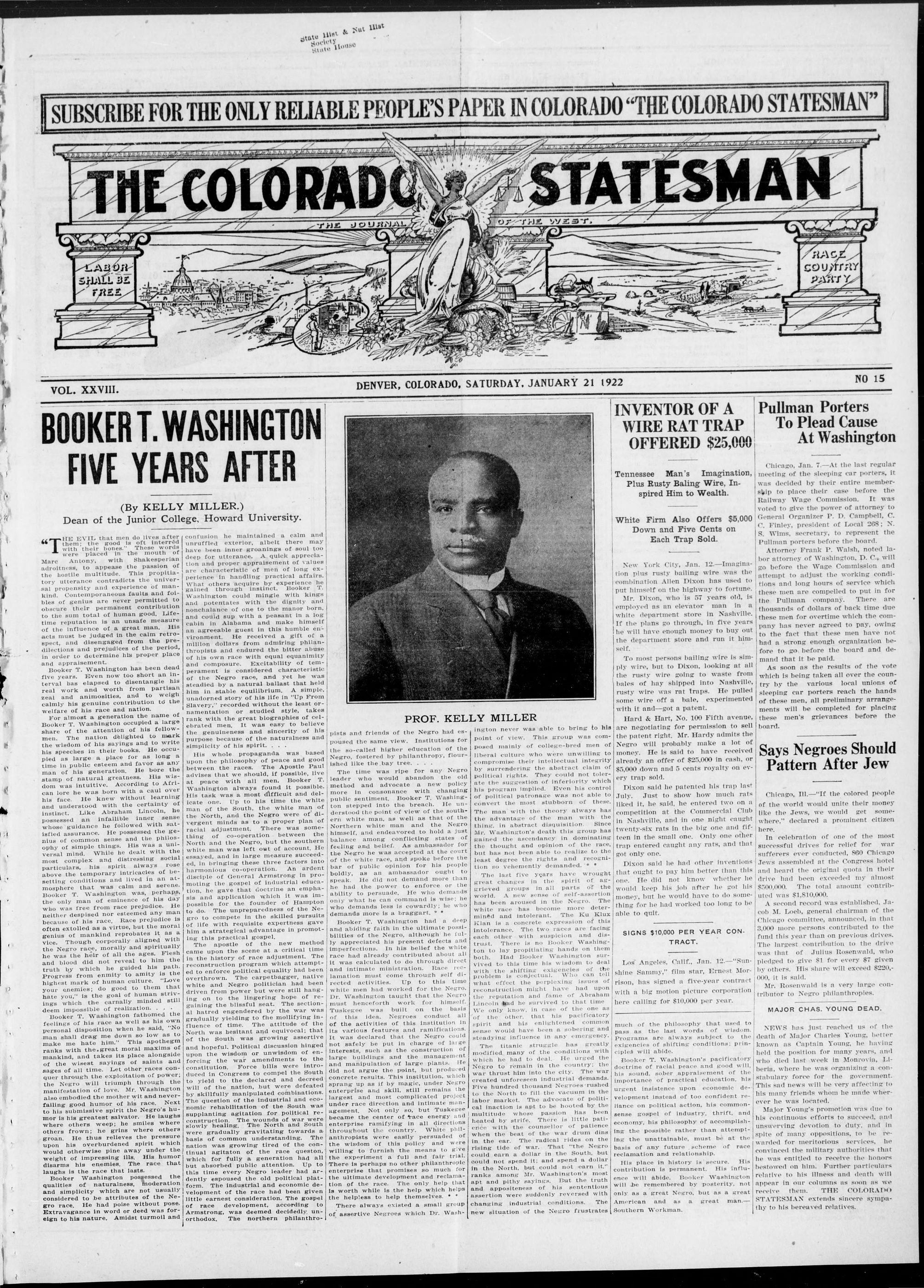
BOOKER T. WASHINGTON FIVE YEARS AFTER
(By KELLY MILLER.) Dean of the Junior College, Howard University.
VOL. XXVIII.
BOOKER T. W
FIVE YEA
(By KELLY
Dean of the Junior Coll
"THE EVIL that men do lives after them; the good is oft interred with their bones." Those words were placed in the mouth of Marc Antony, with Shakespearean adroitness, to appease the passion of the hostile multitude. This propitiatory utterance contradicts the universal propensity and experience of mankind. Contemporaneous faults and foibles of genius are never permitted to obscure their permanent contribution to the sum total of human good. Lifetime reputation is an unsafe measure of the influence of a great man. His acts must be judged in the calm retrospect, and disengaged from the predilections and prejudices of the period, in order to determine his proper place and appraisal.
Booker T. Washington has been dead five years. Even now too short an interval has elapsed to disentangle his real work and worth from partisan zeal and animosities, and to weigh calmly his genuine contribution to the welfare of his race and nation.
For almost a generation the name of Booker T. Washington occupied a large share of the attention of his fellowmen. The nation delighted to mark the wisdom of his sayings and to write his speeches in their books. He occupied as large a place for as long time in public esteem and favor as a man of his generation. He bore the stamp of natural greatness. His wisdom was intuitive. According to African lore he was born with a caul over his face. He knew without learning and understood with the certainty of instinct. Like Abraham Lincoln, he possessed an infallible inner sense whose guidance he followed with satisfied assurance. He possessed the genius of common sense and the philosophy of simple things. His was a universal mind. While he dealt with the most complex and distressing social particulars, his spirit always rose above the temporary intricacies of setting conditions and lived in an atmosphere that was calm and serene. Booker T. Washington was, perhaps, the only man of eminence of his day who was free from race prejudice. He neither despised nor esteemed any man because of his race. Race prejudice is often extolled as a virtue, but the moral genius of mankind reprobates it as a vice. Though corporally aligned with the Negro race, morally and spiritually he was the heir of all the ages. Flesh and blood did not reveal to him the truth by which he guided his path. Progress from enmity to amity is the highest mark of human culture. "Love your enemies; do good to them that hate you," is the goal of human strivings which the carnally minded still deem impossible of realization.
Booker T. Washington fathomed the feelings of his race as well as his own personal disposition when he said, "No man shall drag me down so low as to make me hate him." This apothegm ranks with the great moral maxims of mankind, and takes its place alongside of the wisest sayings of saints and sages of all time. Let other races conquer through the exploitation of power; the Negro will triumph through the manifestation of love. Mr. Washington also embodied the mother wit and never-failing good humor of his race. Next to his submissive spirit the Negro's humor is his greatest salvator. He laughs where others weep; he smiles where others frown; he grins where others groan. He thus relieves the pressure upon his overburdened spirit which would otherwise pine away under the weight of impressing ills. His humor disarms his enemies. The race that laughs is the race that lasts.
Booker Washington posessed the qualities of naturalness, moderation and simplicity which are not usually considered to be attributes of the Negro race. He had poise without pose. Extravagance in word or deed was foreign to his nature. Amidst turmoil and
confusion he maintained a calm and unruffled exterior, albeit there may have been inner groanings of soul too deep for utterance. A quick appreciation and proper appraisement of values are characteristic of men of long experience in handling practical affairs. What others acquire by experience he gained through instinct. Booker T. Washington could mingle with kings and potentates with the dignity and nonchalance of one to the manor born, and could sup with a peasant in a log cabin in Alabama and make himself an agreeable guest in this humble environment. He received a gift of a million dollars from admiring philanthropists and endured the bitter abuse of his own race with equal equanimity and composure. Excitability of temperament is considered characteristic of the Negro race, and yet he was steadied by a natural ballast that held him in stable equilibrium. A simple unadorned story of his life in "Up From Slavery," recorded without the least ornamentation or studied style, takes rank with the great biographies of celebrated men. It was easy to believe the genuineness and sincerity of his purpose because of the naturalness and simplicity of his spirit. . .
His whole propaganda was based upon the philosophy of peace and good between the races. The Apostle Paul advises that we should, if possible, live at peace with all men. Booker T. Washington always found it possible. His task was a most difficult and delicate one. Up to his time the white man of the South, the white man of the North, and the Negro were of divergent minds as to a proper plan of racial adjustment. There was something of co-operation between the North and the Negro, but the southern white man was left out of account. He essayed, and in large measure succeeded, in bringing these three factors into harmonious co-operation. An ardent disciple of General Armstrong in promoting the gospel of industrial education, he gave that doctrine an emphasis and application which it was impossible for the founder of Hampton to do. The unpreparedness of the Negro to compete in the skilled pursuits of life with requisite expertness gave him a strategical advantage in promoting this practical gospel.
The apostle of the new method came upon the scene at a critical time in the history of race adjustment. The reconstruction program which attempted to enforce political equality had been overthrown. The carpetbagger, native white and Negro politician had been driven from power but were still hanging on to the lingering hope of regaining the blissful seat. The sectional hatred engendered by the war was gradually yielding to the mollisifying influence of time. The attitude of the North was resistant and equivocal; that of the South was growing assertive and hopeful. Political discussion hinged upon the wisdom or unwisdom of enforcing the war amendments to the constitution. Force bills were introduced in Congress to compel the South to yield to the declared and decreed will of the nation, but were defeated by skillfully manipulated combinations. The question of the industrial and economic rehabilitation of the South was supplanting agitation for political reconstruction. The wounds of war were slowly healing. The North and South were gradually gravitating towards a basis of common understanding. The nation was growing tired of the continual agitation of the race question, which for fully a generation had all but absorbed public attention. Up to this time every Negro leader had ardently espoused the old political platform. The industrial and economic development of the race had been given little earnest consideration. The gospel of race development, according to Armstrong, was deemed decidedly unorthodox. The northern philanthro-
DENVER, COLORADO, SATURDAY, JANUARY 21 1922
PROF. KELLY MILLER
pists and friends of the Negro had espoused the same view. Institutions for the so-called higher education of the Negro, fostered by philanthropy, flourished like the bay tree. . .
The time was ripe for any Negro leader who would abandon the old method and advocate a new policy more in consonance with changing public sentiment. Booker T. Washington stepped into the breach. He understood the point of view of the southern white man, as well as that of the Northern white man and the Negro himself, and endeavored to hold a just balance among conflicting states of feeling and belief. As ambassador for the Negro he was accepted at the court of the white race, and spoke before the bar of public opinion for his people boldly, as an ambassador ought to speak. He did not demand more than he had the power to enforce or the ability to persuade. He who demands only what he can command is wise; he who demands less is cowardly; he who demands more is a braggart. *
Booker T. Washington had a deep and abiding faith in the ultimate possibilities of the Negro, although he fully appreciated his present defects and imperfections. In his belief the white race had already contributed about all it was calculated to do through direct and intimate ministration. Race reclamation must come through self directed activities. Up to this time white men had worked for the Negro. Dr. Washington taught that the Negro must henceforth work for himself. Tuskegee was built on the basis of this idea. Negroes conduct all of the activities of this institution in its various features and ramifications. It was declared that the Negro could not safely be put in charge of large interests, such as the construction of large buildings and the management and manipulation of large plants. He did not argue the point, but produced concrete results. This institution, which sprang up as if by magic, under Negro enterprise and skill, still remains the largest and most complicated project under race direction and intimate management. Not only so, but Tuskegee became the center of race energy and enterprise ramifying in all directions throughout the country. White philanthropists were easily persuaded of the wisdom of this policy and were willing to furnish the means to give the experiment a full and fair trial. There is perhaps no other philanthropic enterprise that promises so much for the ultimate development and reclamation of the race. The only help that is worth while is the help which helps the helpless to help themselves. *
There always existed a small group of assertive Negroes which Dr. Wash-
ington never was able to bring to his point of view. This group was composed mainly of college-bred men of liberal culture who were unwilling to compromise their intellectual integrity by surrendering the abstract claim of political rights. They could not tolerate the suggestion of inferiority which his program implied. Even his control of political patronage was not able to convert the most stubborn of these. The man with the theory always has the advantage of the man with the thing, in abstract disquisition. Since Mr. Washington's death this group has gained the ascendancy in dominating the thought and opinion of the race, but has not been able to realize to the least degree the rights and recognition so vehemently demanded. * *
The last five years have wrought great chances in the spirit of aggrieved groups in all parts of the world. A new sense of self-assertion has been aroused in the Negro. The white race has become more determined and intolerant. The Ku Klux Klan is a concrete expression of this intolerance. The two races are facing each other with suspicion and distrust. There is no Booker Washington to lay propitiating hands on them both. Had Booker Washington survived to this time his wisdom to deal with the shifting exigencies of the problem is conjectual. Who can tell what effect the perplexing issues of reconstruction might have had upon the reputation and fame of Abraham Lincoln had he survived to that time. We only know, in case of the one as of the other, that his pacificatory spirit and his enlightened common sense would have been a sobering and steadying influence in any emergency.
The titanic struggle has greatly modified many of the conditions with which he had to deal. He urged the Negro to remain in the country; the war thrust him into the city. The war created unforeseen industrial demands. Five hundred thousand Negroes rushed to the North to fill the vacuum in the labor market. The advocate of political inaction is apt to be hooted by the multitude whose passion has been heated by strife. There is little patience with the counsellor of patience when the beat of the war drum dins in the ear. The radical rides on the rising tide of war. That "the Negro could earn a dollar in the South, but could not spend it; and spend a dollar in the North, but could not earn it." ranks among Mr. Washington's most apt and pithy sayings. But the truth and appositeness of his sententious assertion were suddenly reversed with changing industrial conditions. The new situation of the Negro frustrates
INVENTOR OF A WIRE RAT TRAP OFFERED $25,000
Tennessee Man's Imagination Plus Rusty Baling Wire, Inspired Him to Wealth.
White Firm Also Offers $5,000 Down and Five Cents on Each Trap Sold.
New York City, Jan. 12.—Imagination plus rusty bailing wire was the combination Allen Dixon has used to put himself on the highway to fortune.
Mr. Dixon, who is 57 years old, is employed as an elevator man in a white department store in Nashville. If the plans go through, in five years he will have enough money to buy out the department store and run it himself.
To most persons bailing wire is simply wire, but to Dixon, looking at all the rusty wire going to waste from bales of hay shipped into Nashville, rusty wire was rat traps. He pulled some wire off a bale, experimented with it and—got a patent.
Hard & Hart, No. 100 Fifth avenue, are negotiating for permission to sell the patent right. Mr. Hardy admits the Negro will probably make a lot of money. He is said to have received already an offer of $25,000 in cash, or $5,000 down and 5 cents royalty on every trap sold.
Dixon said he patented his trap last July. Just to show how much rats liked it, he said, he entered two on a competition at the Commercial Club in Nashville, and in one night caught twenty-six rats in the big one and fifteen in the small one. Only one other trap entered caught any rats, and that got only one.
Dixon said he had other inventions that ought to pay him better than this one. He did not know whether he would keep his job after he got his money, but he would have to do something for he had worked too long to be able to quit.
SIGNS $10,000 PER YEAR CON-TRACT.
Los Angeles, Calif., Jan. 12.—"Sunshine Sammy," film star, Ernest Morrison, has signed a five-year contract with a big motion picture corporation here calling for $10,000 per year.
much of the philosophy that used to pass as the last words of wisdom. Programs are always subject to the exigencies of shifting conditions; principles will abide.
Booker T. Washington's pacificatory doctrine of racial peace and good will, his sound, sober appraisement of the importance of practical education, his urgent insistence upon economic development instead of too confident reliance on political action, his commonsense gospel of industry, thrift, and economy, his philosophy of accomplishing the possible rather than attempting the unattainable, must be at the basis of any future scheme of race reclamation and relationship.
His place in history is secure. His contribution is permanent. His influence will abide. Booker Washington will be remembered by posterity, not only as a great Negro, but as a great American and as a great man.—Southern Workman.
NO 15
Pullman Porters To Plead Cause At Washington
Chicago, Jan. 7. At the last regular meeting of the sleeping car porters, it was decided by their entire membership to place their case before the Railway Wage Commission. It was voted to give the power of attorney to General Organizer P. D. Campbell, C. C. Finley, president of Local 268; N. S. Wims, secretary, to represent the Pullman porters before the board.
Attorney Frank P. Walsh, noted labor attorney of Washington, D. C., will go before the Wage Commission and attempt to adjust the working conditions and long hours of service which these men are compelled to put in for the Pullman company. There are thousands of dollars of back time due these men for overtime which the company has never agreed to pay, owing to the fact that these men have not had a strong enough organization before to go before the board and demand that it be paid.
As soon as the results of the vote which is being taken all over the country by the various local unions of sleeping car porters reach the hands of these men, all preliminary arrangements will be completed for placing these men's grievances before the board.
Says Negroes Should Pattern After Jew
Says Negroes Should Pattern After Jew
Chicago, Ill.—"If the colored people of the world would unite their money like the Jews, we would get somewhere," declared a prominent citizen here.
In celebration of one of the most successful drives for relief for war sufferers ever conducted, 860 Chicago Jews assembled at the Congress hotel and heard the original quota in their drive had been exceeded my almost $500,000. The total amount contributed was $1,810,000.
A second record was established, Jacob M. Loeb, general chairman of the Chicago committee, announced, in that 3,000 more persons contributed to the fund this year than on previous drives. The largest contribution to the drive was that of Julius Rosenwald, who pledged to give $1 for every $7 given by others. His share will exceed $220,000, it is said.
Mr. Rosenwald is a very large contributor to Negro philanthropies.
MAJOR CHAS. YOUNG DEAD.
NEWS has just reached us of the death of Major Charles Young, better known as Captain Young, he having held the position for many years, and who died last week in Monrovia, Liberia, where he was organizing a constabulary force for the government. This sad news will be very affecting to his many friends whom he made wherever he was located.
Major Young's promotion was due to his continuous efforts to succeed, and unswerving devotion to duty, and in spite of many oppositions, to be rewarded for meritorious services, he convinced the military authorities that he was entitled to receive the honors bestowed on him. Further particulars relative to his illness and death will appear in our columns as soon as we receive them. THE COLORADO STATESMAN extends sincere sympathy to his bereaved relatives.
FOREIGN
During 1921 tourists and climbers to the number of 107 were killed in the central and eastern Alps, mostly from falls, according to official statistics just published. Eight persons have been killed in the last few days by avalanches.
Freight loss and damage claims in Canada and the United States during 1920 totaled $125,836,948, Joe Marshall, special representative of the freight claim prevention committee of the American Railway Association, told the Canadian Railway Club at Montreal.
With only approximately $250,000,000 in notes, backed up by one of the biggest gold reserves in the world, Australia occupies one of the strongest financial positions in the world, according to Sr Henry Braddon, former commissioner for Australia to the United States.
The campaign in Mexico against breweries is reaching its climax. It is stated in official circles that the present tax on beer is to be raised 100 per cent. It is contended that Mexican beer is chemically injurious and the government has appointed a commission to study the question.
The Paris police are using wireless equipped automobiles to rid the city of bandits and highwaymen and are ready to use airplanes in time of riots or demonstrations. They plan to employ airplanes primarily for the study of traffic problems, but also, when needed, to cope with rioters.
An ecclesiastical court presided over by the metropolitan of Athens, found the Most Rev. Meletois Metaxakis, recently elected patriarch of Constantinople, guilty of attempting to cause a schism in the church. It ordered that he be deprived of his every rank and secluded as a monk in the monastery at Zante.
A nurse in the employ of the American Red Cross at Goldingen, Latvia, lost ten sons in the war, her husband was shot by the Bolshevik and her three daughters died last year. Still she goes about her work with a smile. "Nitchevo," is her consolation, which means, among a million other things, "It can't be helped."
GENERAL
Fur buyers in the Adirondacks declared the present season would be marked by the largest harvest of pelts on record with the trappers receiving approximately $1,500,000 for their catch.
Construction projects aggregating $20,000,000 have been planned for the United States in 1922, W. O. Winston, president, declared at the opening of a three-day conference of the General Contractors of America at Cleveland, Ohio.
Leslie Hagwood of Woodlawn, a suburb of Birmingham, Ala., reported to police that he was severely flogged by five men after being enticed from his home. According to the police, he said his assailants accused him of some irregular real estate transactions with his mother.
Exports of American coal, excluding shipments to Canada and Mexico, increased by 100 per cent in 1921, as compared with 1913, according to a statement by the Commerce Department. Much of this increase, the department said, was due doubtless to the British coal strike.
When a teller momentarily left his cage in the Union Trust Company at Providence, R. L., an unidentified man reached through the wicket, stole a $10,000 Liberty bond, a bill of lading covering a carload of cotton and a bundle of checks, and escaped before an alarm could be given.
Total expenditure for building throughout the country for the year 1921 was $1,595,165,192, a gain of 14.9 per cent over the record year of 1920, Bradstreet's announced. Reports from 150 cities showed that $120,994,839 had been expended for building in December, a gain of 112.8 per cent over December, 1920.
Tony May of Chicago, who told Judge Friend he was a newsboy, was ordered to pay $600 a month to his wife as alimony. Questioning by the judge brought out that while Tony formerly sold papers on the street he now owned a string of news stands, quite a bit of real estate and interests in several business enterprises.
Convicted of annoying women, but saved from a straight jail sentence by the pleandings of his wife and children, August Shomeberger of West Hoboken, N.J., was sentenced to spend the next twenty week-ends in a cell. Recorder Walter arranged for the masher to be locked up every Saturday at noon and released on Monday.
The number of persons killed in automobile accidents in the United States in 1921 was estimated at between 12,000 and 15,000, probably nearer the higher figure, at a meeting of the officers of the public safety section of the National Safety Council and managers of various local safety councils in Chicago. The estimate was based on a comparison of the 1920 figures with reports received from several cities and states. This is an increase of from 1,000 to 4,000 over deaths from automobile accidents in 1920.
A portion of the $56,000 in gold amalgam taken in the holdup of the Argonaut mine at Jackson, Amador county, Dec. 1, has been traced to Nevada City, it was announced by officials of the Argonaut Mining Company, Grass Valley, Calif., who posted rewards totaling $10,250 for recovery of the money or arrest of the robbers. Crimes are decreasing in Chicago, according to figures made public by Charles Fitzmorris, chief of police. He gave the number in 1921 as 11,666, against 14,097 in 1920 and 16,656 in 1919.
THE WORLD IN PARAGRAPHS
A BRIEF RECORD OF PASSING EVENTS IN THIS AND FOR-EIGN COUNTRIES.
IN LATE DISPATCHES
DOINGS AND HAPPENINGS THAT
MARK THE PROGRESS
OF THE AGE.
(Western Newspaper Union News Service.)
WESTERN
J. D. Mizener, night city marshal, died at Brookfield, Mo., of bullet wounds incurred in a fight with automobile thieves. The thieves abandoned one automobile and escaped in the marshal's car.
San Francisco was awarded the 1922 convention of the American Bar Association by the executive committee of that organization in session at Tampa, Fla. The convention will be held during the week beginning Aug. 6.
Arthur O. Meininger, cashier of the Night and Day Bank of St. Louis, who disappeared after the closing of the bank by the state bank examiner, who discovered a shortage of $754,000, was arrested in Belleville, Ill. He was released on $20,000 bond.
Cutting two valuable spruce trees on the property of Magnus Swenson, president of the Norwegian-American steamship line, to decorate for a Christmas dance, cost members of the Phi Delta Theta fraternity of Madison, Wis., $350, when settlement was made.
At a special meeting of the State Board of Examiners at Helena, Mont., it was announced that the record book containing the minutes of the board during the years 1918, 1919 and 1920 had strangely disappeared from the vaults in the office of Clerk A. E. McFatridge.
Fifty pounds of brass passed a gold test applied by John Miller, assayer and pawnbroker at St. Louis, and was bought by him for $7,000, according to his report to police. Miller said the chemicals he used evidently had been tampered with. Two men asked $13,000 for the metal, he said.
Mont Berg, former banker of Loyalton, Quincy and Greenville, Calif., charged with embezzlement of funds of the proposed First National Bank of Quincy, pleaded guilty in Superior Court and was sentenced to from one to ten years in San Quentin penitentiary. He was arrested recently at Terrell, Texas.
The charred body of an unidentified man was found by a veteran of the Soldiers' Home in a ravine near a railroad south of the home at Leavenworth, Kan. County authorities believe the man was murdered. A bank book bearing the name of Walter Larsen and issued by the State Bank of Omaha, was found on the body.
WASHINGTON
The House has passed a bill authorizing the President to turn over surplus army medical supplies not to exceed $4,000,000 in value to the American relief organizations at work in Russia. The Senate passed a similar measure.
A tour unique in the history of the United States army will be undertaken in the course of the next few days when Capt. John T. Axton, chief of chaplains, will visit many posts and hold conferences with chaplains of the regular army, the officers' reserve corps and the National Guard. The itinerary will cover approximately 10,000 miles.
Lew Wallace, Jr., of Crawfordville, Ind., was appointed by Secretary Mellon to be director of savings in the Treasury Department. He is a grandson of the late General Lew Wallace, and himself served in the World War as captain of artillery.
Secretary of the Treasury Mellon appeared before the House ways and means committee to urge favorable action on the resolution to amend the constitution so as to prohibit the issuance of tax exempt securities by state, city and county governments.
President Harding by executive order has removed from civil service requirements the office of deputy commissioner of internal revenue, it was said at the treasury. There are five deputy commissioners, each office paying a salary of $5,000 a year.
A tax of 3 cents a gallon on gasoline, to be paid by the producer, the proceeds of which would be used for a soldiers' bonus, is proposed in a bill introduced by Representative Bacharach, New Jersey, Republican. The tax, he estimated, would yield from $240,000,000 to $250,000,000 annually—sufficient revenue, he said, to meet cash payments to former service men. The American government has notified Cuba that she may not negotiate a loan of $5,000,000 in the United States, but that the conclusion of the further loan of $50,000,000, suggested by Cuba, will depend upon the ability of the island authorities to reduce further the Cuban budget, it was said at the State Department.
Trade between the United States and Latin-America increased by 100 per cent in value during 1921, as compared with 1913, the last normal prewar year, according to summary issued by the Commerce Department.
Pithy News Notes From All Parts of Colorado
(Dwestern Newspaper Union News Service.)
Denver.—Approximately $42,760 was taken in by the State Board of Land Commissioners in the sale of 3,600 acres of state lands, according to a report made public. Most of the land sold is in Routt county.
Pueblo.—Firemen responding to an alarm found Mike Jones, 85 years old, Pueblo resident and one-time New York City contractor, suffering from serious burns. Department officials believe Jones was burned when the house in which he lived alone, caught fire from an overheated stove.
Longmont, Colo.—Miss Martha Donovan, 33 years old, the daughter of Postmaster T. P. Donovan, died at the Longmont hospital after an operation for appendicitis. For one year she was an instructress at the Canal Zone government school, giving up the teaching on account of ill health.
Littleton.—Less than ten hours after he was arrested by Sheriff Robert McNamara of Littleton and state officers on charges of violating the prohibition law, John Leblin, 39 years old, was sentenced to from one to two years in the Colorado penitentiary. Leblin pleaded guilty to the charge before Judge Samuel W. Johnson.
Denver.—The stranger in Colorado becomes confused when irrigation is spoken of and he hears the frequent expression of an "acre inch of water." He doesn't understand it. An acre inch of water is an acre of water one inch deep and it weights a little more than 100 pounds. Experts have figured the use of water down to a nicety, so the experienced irrigation farmer knows exactly how much water he needs for his crops.
Greeley.—Demosthenes Bland Wyatt, 71 years old, one of the most well-known pioneers of northern Colorado, ended his life by firing a bullet into his brain. Ill health, accompanied by a recent announcement by physicians that death was not far off prompted suicide, relatives say. Several weeks ago Wyatt burned his toe on an electric bed warmer. Gangrene developed in the wound and amputation was being considered.
Boulder, Colo.—One student has been expelled and nineteen others penalized by a faculty committee of the University of Colorado, which found them guilty of overindulgence in intoxicating liquor. Of these, seven have been suspended until the spring, and one refused admittance; six will not be allowed to register until September, 1922, and one has been suspended for a year. Four students were reprimanded and their parents notified of the action.
Denver.—This city has been visited by the stork at least 5,008 times during the past year, according to statements made by Miss Florence Leach, registrar of the bureau of vital statistics. The total birth record for the year 1921 compares to a total of 4,761 births during the preceding year. That a still greater increase in the number of births will be chalked up when all straggling reports have been received by the department was the opinion expressed by officials of the health department.
La Junta, Colo.—"You've stolen my watch!" With this accusation, Edward L. McInerny, 22 years old, a sailor patient on leave from the Fort Lyons naval hospital, leveled a pistol at a companion sailor, R. P. Brennan, and pulled the trigger. The shooting occurred in a chair car which was stopped in La Junta. The bullet, however, missed Brennan, although he was but three feet away from the revolver. Thinking that he had killed his companion, McInerny trained the gun on himself and blew out his brains.
Denver.—The United States census enumerators in 1920 found 420,702 horses and 31,126 mules in Colorado, but in the same year the county assessors found only 337,003 horses and 28,682 mules. However, the figures show that these animals have not become extinct in the state, despite the advent of the tractor and automobile.
Pueblo, Colo.—Two men are dend as a result of two accidents on the railways here. Jesus Miranda, an emile, 3,700,000 pounds of copper, and Western railroad, was killed when he was struck by a fast passenger train three miles west of here. A negro, said to be known as Van Bibbs, was fatally hurt when he fell between two cars of a moving Santa F6 freight train in the Pueblo yards.
Rocky Ford.—Colorado growers shipped 3,200 cars of cantaloupes in the 1921 season. For standards they received $5 a hundred, and $1.75 for flats. More than 8,000 acres were planted in cantaloupes, honeydews and watermelons and the total receipts amounted to $3,500,000. These cantaloupes were shipped to all sections of the United States, but the bulk went east of the Mississippi river.
Denver.—The metal mines of Colorado in 1921, according to C. W. Henderson, United States Geological Survey, Department of the Interior, produced $6,790,000 in gold, 5,400,000 ounces of silver, 20,600,000 pounds of lead, 3,700,000 pounds of copper, and 2,400,000 pounds of zinc, having a total value of $13,678,800, as compared with the total value of $21,898,974 in 1920. These figures show a decrease of $786,300 for gold, 9,335 ounces for silver, 26,000,000 pounds for lead, 343,000 pounds for copper, and 16,330,000 pounds for zinc.
CENTENNIAL STATE ITEMS.
Denver.—Denver spent $8.57 per capita for maintenance and operation of its public schools during the fiscal year ending June 30, 1920, according to the official report of the United States Bureau of Census at Washington, D. C. The total cost of school operation for that year was $2,215,962. For the fiscal year ending June 30, 1917, the total cost was $1,673,617, and the per capita cost was $6.82. Before the war, for the fiscal year of 1914, the total cost was $1,359,701, and per per capita cost $5.58.
Boulder.—At the co-operative oil shale laboratory where oil shale investigations are being conducted by the United States Bureau of Mines and the state of Colorado, a number of runs have been made with the large horizontal retort under different controlled conditions. All products are being examined, and as the work goes on, the belief that the oil yielded by a horizontal retort is not of as high quality as that from retorts of a vertical type, is confirmed.
Denver.—That Colorado farmers have planted about the usual acreage of winter wheat is shown in the cooperative federal-state crop report, just issued by W. W. Putnam, agricultural statistician of the United States Bureau of Markets and Crop Estimates. The preliminary estimate of winter wheat sown in the autumn of 1921 is placed at 1,466,000 acres, compared with 1,496,000 acres sown in the fall of 1920, and about 1,073,000 acres sown in the autumn of 1919.
Denver.—Colorado is seventh in size of the forty-eight states in the Union with an area of 66,341,120 acres. It is more than twelve times the size of Massachusetts; about twice as large as Iowa, and approximately the size of New York, Ohio, Connecticut and New Hampshire combined. East and west its extreme length is 387 miles, and north and south 276 miles. There are forty-two peaks that are 14,000 feet in elevation, or more.
Eads.—Kiowa county was the scene of the greatest Indian battle ever fought in what is now the state of Colorado. It was in territorial days, Nov. 29, 1864, that Col. John M. Chivington led 1,000 men against a Cheyenne Indian village on Big Sandy creek. The redskins were led by their noted chief, Black Kettle, and in the battle 300 Indians were killed. It caused, however, numerous other Indian wars.
Denver.—The first actual settlement of Colorado was in Denver in 1858, and the following year, 1859, marked the first real gold discovery that led to the greatest rush of people into a wilderness ever known in these United States. The growth as given by the United States census of the state follows: 1860, 34,277; 1870, 39,864; 1880, 194,327; 1890, 413,249; 1900, 539,700; 1910, 790,024; 1920, 939,629.
La Junta, Colo—Mrs. Bessie McConnell, a mother of six, who conducts a clothes cleaning establishment in the basement of a local furnishing company, will cease to toll. She has received word that through the death of a relative in Indianola, Iowa, she inherits $200,000. As soon as she can dispose of her cleaning shop Mrs. McConnell proposes to retire from work and invest her fortune in La Junta.
Hot Sulphur Springs, Colo.—Bruce Wallace, the 6-year-old son of Lew Wallace, Grand county editor, is dead after being run over by an automobile. The child was sliding down a hill on a sled which went directly into the pathway of the automobile driven by Edward Chattfield. A fractured skull caused death. Bruce was the only boy of Mr. Wallace's five children. Denver.—Colorado's vast ranges produced $81,812,000 worth of live stock during 1921, besides which the Denver Union Stockyards Company handled $26,307,100 worth of cattle, sheep and hogs during the year, thus giving the live stock industry of the state a grand total of $108,119,100 business for the year.
Colorado Springs.—A large igloo built of concrete without doors or windows is to be built in Colorado Springs by Dr. Fred M. Spliers of Ochotzgacagamute, Alaska, to test out his theory of curing tuberculosis. He plans to have his patients live in furs without any heat in the room whatever, following a plan he found successful in Alaska, where he says he cured 150 men.
Denver.—Only 100 of the 12,000 corporations reports which must be filed with Secretary of State Milliken on or before March 2 have been received, according to information given out. Officials of the office urge that all corporations of the state file their reports at the earliest date possible, in order to assist the department in maintaining its efficiency.
Greeley, Colo.-Clarence Day, 19 years old, was killed when an automobile, driven by an unknown person, ran over a sled on which he was riding. Day's sled was attached to an automobile and as it passed another car the other machine dropped back behind, running over the sled. The driver, becoming aware of what had happened, sped away.
Denver.—There are 60,341,120 acres in the state of Colorado. There are sixty-three counties, and Denver, with 37,120 acres is the smallest, and Las Animas with 3,077,760 acres is the largest county. There are approximately 30,000,000 acres of patented lands on the tax rolls, while there are more than 25,000,000 acres of government land, unpatented. This includes about 4,000,000 acres of government land withdrawn for -various reasons from homestead entry. There are about 28,000,000 acres in the state privately owned.
JOE
SHO
Mining E
1016-1018
Kneeland
Shoes
"They Tickle
the Feet"
Mining Exchange Building
1016-1018 Fifteenth Street
Phone Champa 2380
Denver
Phone Main 4843
J. GIBSON SMITH
ART DEALER
1638 TREMONT ST.
YOU WANT
butts, Neckbones or Chitlerings, or any
the squeal, go to
Y'S MARKET
2800-6 LARIMER STREET.
TAXI COMPANY
2741 Welton Street.
WHEN YOU W
The Heads, Feet, Tails, Snouts, Neckbone
other part of the hog except the squeal, go
EAST'S MARK
PHONE MAIN 1461.
280
GRANBERRY TAXI
Office 2741 Welton
WHEN YOU WANT
s, Feet, Tails, Snouts, Neckbones or Chitlering
of the hog except the squeal, go to
EAST'S MARKET
MAIN 1461.
2800-6 LARIMER
ANBERRY TAXI COMP
Office 2741 Welton Street.
WHEN YOU WANT
The Heads, Feet, Talls, Snouts, Neckbones or Chitlerings, or any other part of the hog except the squeal, go to
EAST'S MARKET
PHONE MAIN 1461. 2800-6 LARIMER STREET.
GRANBERRY TAXI COMPANY Office 2741 Welton Street.
OFFICE
PHONE
CHAMPA
86
Quick and Prompt Service Day and night. Call Us for
on Out-of-Town Trips.
If you have a room for rent or want a room
NO CHARGE FOR THIS INFORMATION
WESTERN BEEF
Prompt Service Day and night. Call Us for Spee
on Out-of-Town Trips.
You have a room for rent or want a room call
NO CHARGE FOR THIS INFORMATION
and night. Call Us for Special Rates
t-of-Town Trips.
or rent or want a room call us.
FOR THIS INFORMATION
N BEEF CO.
Quick and Prompt Service Day and night. Call Us for Special Rates on Out-of-Town Trips.
If you have a room for rent or want a room call us.
NO CHARGE FOR THIS INFORMATION
WESTERN BEEF CO.
C
Open Daily to 830 p. m.
Sundays Until 2:00 p. m.
Fresh Oysters, Chitterlings, Pig Tails, Snow
Bones, Spare Ribs Received by
Fresh and Cured Meats of All Kinds.. Free
Fancy Groceries.
Our Prices Are Always
Free Delivery to All Parts or
Phone Champa 164
2048 LARIMER STREET
Opposite the Three R
Meters, Chitterlings, Pig Tails, Snouts, Ears, Pigs
Bones, Spare Ribs Received Fresh Daily.
Cured Meats of All Kinds.. Fresh Vegetables, S
Fancy Groceries.
Our Prices Are Always the Lower
Free Delivery to All Parts of the City.
Phone Champa 1641.
IMER STREET DENVER
Opposite the Three Rules.
Big Tails, Snouts, Ears, Pigs Feet, Neck
Jobs Received Fresh Daily.
Kinds., Fresh Vegetables, Staple and
Fancy Groceries.
Always the Lowest
To All Parts of the City.
Champa 1641.
Fresh Oysters, Chitterlings, Pig Tails, Snouts, Ears, Pigs Feet, Neck Bones, Spare Ribs Received Fresh Daily.
Fresh and Cured Meats of All Kinds.. Fresh Vegetables, Staple and Fancy Groceries.
Our Prices Are Always the Lowest
HOWARD & HOWARD GROCERIES AND MEATS
Fresh Vegetables and Fruits Daily
Does your friend trade with us? If not, read this ad as an invitation for him to know how to get our service and its goods. Free delivery to any part of the city.
PHONE YORK 9552. 718 E. TWENTY-SIXTH
your friend trade with us? If not, read this ad-
dication for him to know how to get our service and
Free delivery to any part of the city.
NEW YORK 9552. 718 E. TWENTY-SIXTH
with us? If not, read this advertisement
how how to get our service and our quality part of the city.
718 E. TWENTY-SIXTH AVE.
Shop Phone, York 3390-J
Does your friend trade with us? If not, read this advertisement as an invitation for him to know how to get our service and our quality goods. Free delivery to any part of the city.
Residence Phone, York 7616-J
2536 Washington Street.
RED HOT SHOE REPAIR FACTORY
COOPER AND JEFFERSON, Props.
Only Colored Shoe Repair Shop in
Denver.
HAND MADE SHOES TO ORDER.
Work Called for and Delivered. All
Work Neatly Finished.
Denver, Colo.
PHONE MAIN 3023
John K. Rettig EATS, FANCY AND STAPLE GROCERI
K. Rettig AND STAPLE GROCERIES
John K. Rettig
MEATS, FANCY AND STAPLE GROCERIES
1864 CURTIS STREET
Corner Nineteenth
---
---
OFFICE
PHONE
CHAMPA
86
Corner Nineteenth
All the latest in Men's Shoes, both high and low, at a saving of $2 to $3 per pair.
One of the Most Up-to-Date and Sanitary Markets in the City.
RES. PHONE GALLUP 942
DENVER
OFFICE
PHONE
CHAMPA
87-88
DENVER, COLO.
Denver, Colo.
B.S., D.D.S.
Invites the public of Denver to
inspect his modern, electrically
equipped dental suite, 2602 Wet-
ton St. Hours 9 a.m. to 12 noon;
1 to 6 p.m. evening and Sundays
by appointment. Office
phone Champa 2807. Residence
phone Champa 1536.
C. E. TERRY, M.D.
1022 Twenty-first St. Denver
Office Phone Main 2701. Hours
12 to 2 and 6 to 8 p.m. or by
appointment. Res. 2337 Glen-
arm Place. Phone Champa 3303.
ERNEST HOWARD
Carpenter Contractor
Job and Repair Work a Specialty
Dealer in Hardware, Palts, Oils
and Glass. Second-hand
Building Material
Resident Uptown Warehouse St.
Shop: 710 E, 20th Ave.
Phone York 8900
DR. HUFF'S office phone is Champa 6001. And his residence Phone York 4101. When not reached at office Carr Co., Main 872 Office, Suite 5, 6 and 7, 2701 Welton St., over Atlas Drug Store. Office hours, 11 to 12 a. m., and 3 to 5 p. m.
Office 609 27th St. Ph. Champa 1142
S. E. CARY
ATTORNEY-AT-LAW
Six Years City and County Attorney
nt Russell Springs, Logan
County, Kansas
Office Hours
9:00 A.M. to 12:00 M.
2:00 P.M. to 4:00 P.M.
DENVER, COLO.
MOVED
THE
WARD AUCTION CO.
TO
1617-23 LAWRENCE ST.
BETTER QUARTERS
—MORE CENTRALLY LOCATED—BETTER STREET CAR SERVICE
Auction Every Day,
2 p. m.
Special Sale on Retail Floor
Phone Main 1675
1617-23 Lawrence St.
Phone Main 8036
Res. Phone York 5774W
FRANK D. TAGGART
Attorney at Law—Notary Public
205-206 Cooper Building
Denver, Colorado
JOSEPH CARTER
Express, Moving,
and Storage
COAL AND WOOD
PROMPT DELIVERY.
Phone Main 6544.
2415 WASHINGTON STREET.
乐泽轩
1848 Arapahoe
Phone Champa 113
ORIENTAL RESTAURANT Chop Suey, Noodles and Short Orders
Use Good Paper When You Write?
We Can Print Anything and Do It Right.
SHIP SUBSIDY IS COMING UP AGAIN
ADMINISTRATION PROBABLY IS TO RECOMMEND THE SCHEME UNDER ANOTHER NAME.
TO SAVE MERCHANT MARINE
Arguments For and Against the Plan, Heard in Congress During Many Years, Are Being Revived—Feared by Both Parties.
By EDWARD B. CLARK
Washington.—It seems certain today that legislation looking to something like a ship subsidy is to be recommended by the administration. Every effort which has been made to build up the American merchant marine has resulted in failure. There is no denial that some kind of a ship subsidy scheme is under consideration.
This renewed talk of subsidy for ships makes old men of a good many national legislators and Washington correspondents. Off and on they have been talking ship subsidy, sometimes under another name, all through the 18 years that the correspondent who writes this has been in Washington. Legislators have stood on their feet to say that through a subsidy the American flag can be restored to the seas of commerce, and that restoration can come in no other way.
The country, especially the noncoast part of it, shies at subsidies. The word has an expensive sound. Men who seem to know the shipping business say, that if there is no subsidy there will be no American merchant marine worth the name. Subvention was one word that was used instead of ship subsidy in an elder day, and now it is said that the administration will call subsidy "remuneration." Of course, whatever name is given to it, the sum total will be the same thing.
There are some subsidy advocates in the shipping board. One of them, a Maine man, knows more about merchant marine than any other man in Washington. He is a subsidy man because he believes that only through a subsidy can anything be done. Men here have respect for his views, but some of them say that he is an enthusiast and that he is wrong.
Senator La Follette Blamed.
Landsmen who live at a distance from the coast and who come to Washington as senators and representatives, or to act in some other capacity, find it hard to understand the merchant marine matter. Senator La Follette, who is a landsmen of landsmen save for the fact that he lives near one of the Great Lakes, is held by many of the advocates of a great American merchant marine as being partly responsible for the present ebb of things maritime. It is certain that legislation which Mr. La Follette fathered is making it difficult for the United States to establish a merchant marine on a basis of competition with the shipping of other nations, but long before La Follette came to Washington the merchant marine, as somebody has put it, was waterlogged in the trough of the sea.
Under both Republican and Democratic control congress has looked with unkindly eyes on subsidy legislation. Most of the Democrats look on it as an unmitigated evil, while most of the Republicans look on it as something to be avoided because it is "dangerous in the districts," especially in the Middle West.
There is one thing which is certain. If the United States government should subsidize its merchant marine, ships would sail the seas and fetch and carry goods under the Stars and Stripes. The argument of the subsidy men is that new trade routes would be opened and that the advantage to the people from increased industry would make up the subsidy a thousand fold. There are others who say that it is an evil thing for the government to "pay money to corporations."
Controversy Over Submarines.
Controversy Over Submarines.
The submarine controversy in the international conference was about as virulent, so far as external appearances go, within the last few days as it was along about the time that the Lusitania was sunk. However, no loss of life has been reported up to the present moment, though there has been some loss of hope.
The international conference has been principally "ups," but there are occasional "downs." Some of the pessimism concerning the general outcome apparently has been fathered by a desire for disaster. There can be no discounting this.
In administration circles in Washington there is some evidence of disappointment that savors of petulance at times because of the disposition in some places to hold that the conference may be a failure because some of the minor matters under discussion have not been or may not be settled to the satisfaction of all parties concerned. Auxiliary naval craft in truth are an auxiliary matter.
The settlement of big-ship problems, it seems to the administration's friends, should be considered a victory big enough to minimize disappointment because the questions concerning the smaller vessels may have to be discussed at a later conference. The view is that most of the floor space has been
swept while a little dust still remains to be collected from the corners.
French Playing a Hand.
The French government has some matters which it wants to have settled over in Europe. It wants a better understanding with Great Britain concerning certain continental matters. The French have been playing a hand. They know the exact position of the British brethren on the submarine matter and they are trying to secure some promises from the island government before yielding on U-boats. This is the way it looks to the side-line observers in this conference town.
The truth is that the administration does not seem to be worrying particularly over the smaller matters which have come to trouble the conference. It looks upon the four-power treaty as being an assured fact of the future; it looks upon the naval holiday as being a certainty, and it thinks that in a general way a firm foundation has been laid for peaceful proceedings in the Orient. If a man is given a million dollars he can afford to look with equanimity on the possible loss of hundreds.
Other Worries of Administration.
If the prophets of evil are right, and if Washington officialldom knows that they are right, the placidity with which the administration looks upon things today is astounding. The truth is that the President and his advisers are perhaps more than satisfied with the way that things have gone. It is known that they looked for trouble on certain minor matters, and instead of being worried at trouble's appearance they are somewhat surprised it did not loom larger than it has.
There are other things than temporary or possibly permanent difficulties in the way of a complete conference agreement to engage the attention of the administration. The party upon whose success perhaps depends a renomination for President Harding is not behaving itself as well as it might in the person of its representatives in house and senate. There are Republicans who say this boldly. It is only fair to say, however, that finally the advice of certain wise politicians who are not in congress seems to have had its effect.
War Exhibits in Museum.
Novel writers, essay writers, and even history writers seem to have taken notice of the fact that the people are tired of reading about the war. Perhaps the "tire" is more in the seeming than in the reality, but the truth remains that so-called war literature is just now at low ebb. Government officials, however, know that interest in the great war is bound to revive, and that the present generation will have a share of the revival, and that future generations in retrospect will have the keenest interest in the great conflict. Washington, therefore, is taking pains to preserve what may be called a complete series of pictures, of material and documents concerning the war for civilization.
In the great National museum in Washington today there is in process of emplacement for permanent exhibition purposes every possible thing which the government can lay hands on which bears a part in depleting the progress of the greatest war that the world has ever known. The government has an immense amount of material, and a large part of it has been turned over to the directors of the National museum for permanent ownership and permanent exhibition. When permanent ownership is spoken of it should be said that in truth it rests with the people, for everything that is in the keeping of the National museum belongs in the highest sense to the country.
Vast Mass of Material.
In the National museum the development step by step of all the great weapons of offense for use on sea and on land is portrayed. The first successful heavier-than-air flying machine, Langley's contrivance, is on exhibition, and with it is the latest of the great aircrafts. If any American father wants to see everything which his son came in touch with in the army or navy of his country, he can find it in the National museum, and it makes no difference whether the lad was an artilleryman, an engineer, an infantryman, a gas man, a machine gunner, an aeronaut, or was content to serve in any one of the equally necessary branches of the service of supplies. The National museum contains everything which had anything to do with service in the great war.
It takes days to go through this war material. Among the most interesting of the exhibits are some of the war pictures which were painted by American artists while actually at the front, or in the devastated regions just back of the front. It may not be generally known, but Uncle Sam realized in advance the value of paintings of the great war. He did not intend to wait on the possibilities of the future to secure them, nor did he intend to be compelled, if he could help it, to pay enormous sums for pictures painted by artists working on their own responsibility in the embattled regions.
The result was that the War department gave commissions in the army to a considerable number of noted American artists, and, then put them under orders "to paint." It should be said for these artists that they ran all the dangers of war in order to do their work properly and to get into it the spirit of the front.
Declines Responsibility.
He—Have you read my latest book of poems? You know they were inspired by you.
She—Oh, Mr. Scribbler, I don't think it's fair to put the blame on me.
FORTIFICATIONS HOLD UP TREATY
FINAL DRAFT OF NAVAL PACT
AWAITS DECISION ON
PACIFIC FORTS.
JAPS GET TOKIO NOTE
JAPS GET TOKIO NOTE
SETTLEMENT OF PACIFIC QUESTIONS NOW REACHING FINAL DECISIONS.
(Western Newspaper Union News Service.)
Washington.—The five-power treaty for limitation of naval armament has undergone further changes in the course of a final overhauling by experts and it now is complete except for the article establishing a fortification status quo in the Pacific.
When the fortifications problem will be solved is regarded by some delegates as dubious, but in some quarters there still is hope that a plenary session to announce publicly conclusion of the treaty may be held early next week. Some delegations propose that the troublesome article be dropped from the treaty altogether, and be attached to the four-power Pacific treaty already signed or embodied in a separate convention to be drawn later.
Conference leaders, however, are going ahead on the assumption that the provision will remain in the naval pact.
In the light of renewed instructions from Tokio to the Japanese delegation, the naval drafting experts will meet again to try to work out a new phrasing of the article. It was indicated that the Japanese advices from home were not entirely conclusive. It was revealed that in the final revision of other portions of the treaty, modifications had been agreed to in the limitations on aircraft carriers and on methods of scrapping, and that provision had been made which would require two years' notice from any power desiring to terminate the convention. The termination stipulation is applicable only after the initial fifteen-year preiod of the treaty's duration, and it is provided that should one signatory desire to terminate the treaty after that period, it automatically will become inoperative as among the others.
Other sections of the text remain virtually unchanged.
In the section dealing with airplane carriers, the proposal to limit individual carriers to 27,000 tons each is modified so as to permit each signatory to construct two of 33,000 tons each. It is provided specifically that these may be obtained by conversion of battleships now under construction, but which otherwise would be scrapped.
In addition, France and Italy each will be permitted to retain two-of the capital ships listed for scrapping in 1931, for conversion into training ships. For the same purpose the United States, Great Britain and Japan each is to be permitted to retain one proscribed capital ship each, but in all cases measures are provided to prevent the vessels so retained from becoming again active fighting units.
Governor's Case Postponed.
Springfield, Ill.—Arguments on motions for separate trials for Governor Len Small and Vernon S. Curtis at Waukegan on charges of conspiracy to defraud the state treasury, have been postponed until Jan. 28, on account of the quarantine of Mr. Curtis at his Grant Park home, where his son is ill with diptheria. State's Attorney C. F. Mortimer announced here.
Student Dies from Poison.
Washington.—An autopsy on the body of Eugene C. Neary, student at Georgetown medical school, led to the announcement by the coroner that death resulted from "an irritant poison." Neary was said to have been one of a number of students who, at class tasted a poison, which had been passed among them in order that they might familiarize themselves with its characteristics. The coroner was told that the students were warned that the substance was a deadly poison.
New Mexico Man Found Guilty.
Clovis, N. M.—James Todd of St. Vrain was found guilty of murder in the second degree in the killing of his brother-in-law, James Roy, on Nov. 23 last. The two men had quarreled over the settlement of an estate. Todd admitted the killing, but pleaded self defense.
Bank Messenger Held Up.
St. Louis.-Elliott Foster, negro messenger for the Easton-Taylor Trust Company, was held up and robbed of a satchel containing $6,000 in cash and $500 in non-negotiable papers on a street car here.
Strike Set for April 1st.
Washington.—Warning of an impending general strike in the country's coal industry was given by Secretary Hoover, who declared that the public should know what to expect when the national agreements covering the wages and working conditions of miners expire April 1. "The stage," he said, "appears to be set for a strike in the bituminous coal fields about the last of March." Mr. Hoover did not indicate what the government's plans for meeting such an emergency were.
Men's Suits cleaned and pressed.....75¢
Ladies' Suits cleaned and pressed.....$1.00
Plain Skirts cleaned and pressed.....50¢
Plain Waists cleaned and pressed.....50¢
Cleaners, Tailors and Dyers
We call and deliver any part of town. Better work for less money. Pressing Club for men, $1.50 per month.
MEN'S SUITS MADE TO ORDER
495 PH. BLOOM, Prop. 2810 Downing St.
A. HASER, Prop.
ARCHIE
Wholesale and Retail Store
Fish and
Hotels and Restaurant
Fresh and Cured Eats
Fruits, Vegetables
FREE D
1950 Larimer Street
The Curtis Park Floral Company
FLORAL DESIGNS PUT UP WHILE YOU WAIT
CHOICE PLANTS AND CUT FLOWERS
GREENHOUSES: Thirty-Fourth a TELEPHONE, MAIN 181.
C. E. Weatherhead
PHONE
WEATHER HAT
HIGHEST QUALITY REPAIR AND FINISHING OF METAL
New Location, ALBANY HOTEL,
THE CHAMP
2101 C
Is the place
DRUGS, CHEMICALS A
WE SERVE
PRESCRIPTIONS
Phone us and we will deliver
JAMES E. T
CHIE MARKET
ed Retail Staple and Fancy Groceries
Fish and Oysters
and Restaurants Our Specialty
ed Cured Eastern Corn-Fed Meats
Vegetables, Poultry and Game
FREE DELIVERY
T UP WHILE
OU WAIT
CUT FLOWERS CONSTANTLY
ON HAND
Party-Fourth and Curtis Streets
DENVER, COLO
FLORAL DESIGNS PUT UP WHILE YOU WAIT
CHOICE PLANTS AND CUT FLOWERS CONSTANTLY ON HAND
GREENHOUSES: Thirty-Fourth and Curtis Streets
TELEPHONE, MAIN 151. DENVER, COLO
FATHERHEAD
FACTORY
ESTABLISHED
QUALITY RENOVATING, REMODELING
ING OF MEN'S AND WOMEN'S HATS
NY HOTEL, 1722 STOUT ST., DENVER, COLO.
CHAMPA PHARMACY
2101 CHAMPA
Is the place to get your
CHEMICALS AND PATENT MEDICINES
WE SERVE DRINKS.
SCRIPTIONS OUR SPECIALTY.
will deliver the goods to all parts of the city.
JAMES E. THRALL, Propr.
PHONE 8444
TH, Manager, Res. Phone South 1608
Market Company
Staple and Fancy Groceries, Fish and Oysters.
Restaurants Our Specialty. Fresh and Cured
Corn Corn Fed Meats
Vegetables, Poultry and Game.
Tones Main 4302, 4303, 4304, 4305
ET
DENVER, COLORADO
WEATHERHEAD
HAT FACTORY
ESTABLISHED 1876
HIGHEST QUALITY RENOVATING, REMODELING
AND FINISHING OF MEN'S AND WOMEN'S HATS
New Location, ALBANY HOTEL, 1722 STOUT ST., DENVER, COLO.
2101 CHAMPA
Is the place to get your
DRUGS, CHEMICALS AND PATENT MEDICINES
WE SERVE DRINKS.
PRESCRIPTIONS OUR SPECIALTY.
Phone us and we will deliver the goods to all parts of the city.
JAMES E. THRALL, Propr.
C. E. SMITH, Manager
The Market
Wholesale and Retail Staple and
Hotels and Restaurants Our
Eastern Cor
Fruits, Vegetables,
Telephones Main 48
622-636 15TH STREET
Wholesale and Retail Staple and Fancy Groceries, Fish and Oysters. Hotels and Restaurants Our Specialty. Fresh and Cured
Fruits, Vegetables, Poultry and Game.
Telephones Main 4302, 4303, 4304, 4305
622-636 15TH STREET DENVER, COLORADO
1
---
---
FUENTE
PHONE MAIN 2425
Phone Main 6758
Denver, Colo.
C. B. Weatherhead
PHONE 8444
Phone Main 3737
Satisfaction Guaranteed
THE NEW WAY SHOE
REPAIRING
C. C. Dennis, Proprietor
1855 CHAMPA STREET
Denver. Colo.
THE COLORADO STATESMAN
CABON
SHADOW
TREE
NAXE
COURTIN
PARTY
Reading notices, ten lines or less, 15 cents per line. Each additional line over ten lines, 12 cents per line. Display advertising, 50 cents per square for first insertion and 40 cents per square for each additional insertion.
Remittances should be made by express money order, postoffice money order, registered letter or bank draft. Postage stamps will be received the same as cash for fractional part of a dollar. Only 1c and 2c stamps taken.
Communications to receive attention must be newsy, upon important subjects, plainly written only upon one side of the paper, must reach us Tuesdays, if possible, anyway not later than Wednesdays, and bear the signature of the author. No management returns. Postage stamps are sent for postage. All communications of a personal nature that are not complimentary will be withheld from the columns of this paper.
PLEADING A CAUSE
UNITY, unusual in many aspects, was offsprings of race friction and injustice squarely of the dominant group last Sunday with an invitation to address the Grace church for a Suspension of Judgment." Mr. C. C. is auditors with him in a manner seized he did not indulge in forensic oratory; he prejudices. He offered no overdrawn charges of a groundless nature. But with intimate knowledge of his subject, he manner that drew repeated applause for critical and finally approving. The bride delivered a wonderful address.
In message that drives home the essence as an attorney familiar with the fine stood him well in hand on this occasion before the jury of public opinion, and popular cause, but he won for it friend it be said in perfect fairness that he or he gave out straight, unvarnished truthly defied refutation. Never was the church, never was a speaker accorded it there a more magnificent stage setting ease than on last Sunday. The man chosen upon a struggling people arose in ITS size.
from the very first that the large white man, and the spirit of American fair play modified than on this occasion. Dr. G. S. Grace Church, clearly evidenced his brooding problems of American life today by offering before the great forum he has built up, other exalted, and the helpful influence in community for many years. THE COST of the occasion, proud of our eminent attitude citizens whose presence in such large in the most vital, burning problem that national government. We hope there will be our city. We trust the good white citizens doors of their churches and education of these problems, but that they minds until the evidence is all in and our intellectual plane as of last Sunday. In a moment.
AN OPPORTUNITY, unusual in many aspects, was offered for the placing of the problems of race friction and injustice squarely before thoughtful members of the dominant group last Sunday when Attorney S. E. Cary responded to an invitation to address the Grace church community services on "A Plea for a Suspension of Judgment." Mr. Cary stated the case well and carried his auditors with him in a manner seldom witnessed in a public meeting. He did not indulge in forensic oratory; he made no appeal to the passions or prejudices. He offered no overdrawn pictures nor did he make wholesale charges of a groundless nature. But with becoming compassion and a clear, intimate knowledge of his subject, he presented the cause of the Negro in a manner that drew repeated applause from an audience at first dubious, then critical and finally approving. The brilliant attorney was at his best and delivered a wonderful address.
It was such a message that drives home the essentials of conviction. Perhaps his training as an attorney familiar with the fine art of pleading a case before a jury stood him well in hand on this occasion. He was pleading a great cause before the jury of public opinion, and he won his case. True, it was an unpopular cause, but he won for it friends instead of arousing enmity. Let it be said in perfect fairness that he did not compromise or cavil, but rather he gave out straight, unvarnished truth with an intelligent grasp that utterly defied refutation. Never was there a greater service held in Grace Church, never was a speaker accorded a more respectfully hearing, never was there a more magnificent stage setting for the presentation of a great cause than on last Sunday. The man chosen to bespeak the ills and burdens heaped upon a struggling people arose to the occasion; he approached a MAN'S size.
It was evident from the very first that the large white audience was out to gain information, and the spirit of American fair play was never more beautifully exemplified than on this occasion. Dr. G. S. Lackland, the beloved pastor of Grace Church, clearly evidenced his broad vision and close touch with the problems of American life today by offering us a chance to plead our cause before the great forum he has built up. The privilege was not abused but rather exalted, and the helpful influences of close contact will be felt in this community for many years. THE COLORADO STATESMAN is proud of the occasion, proud of our eminent attorney and proud of the fair-minded white citizens whose presence in such large numbers presages a telling interest in the most vital, burning problem that today finds lodgement in our national government. We hope there will be many more such meetings held in our city. We trust the good white citizens of Denver will not only open the doors of their churches and educational institutions to a righteous consideration of these problems, but that they will maintain open hearts and open minds until the evidence is all in and our cause stated from the same highly intellectual plane as of last Sunday. In such a case we will not fear the judgment.
THE TROUBLES OF A FINANCIER.
to condemn, nor shall we at this time be menacingly toward Marcus Garvey, we was heralded by the Associated Press dis- thing of the actual causes leading up to in the papers. We are not disciples of us enemies by relentless onslaught have os it was the inherent racial instinct
IT is not ours to condemn, nor shall we at this time point the finger of accusation too menacingly toward Marecus Garvey, whose arrest by federal officials was heralded by the Associated Press dispatches a few days ago. We know nothing of the actual causes leading up to his arrest other than what we read in the papers. We are not disciples of his cult. Perhaps, as he claims, jealous enemies by relentless onslaught have brought about his troubles, or perhaps it was the inherent racial instinct to too quickly gain results that caused it. We do not always build on sure ground and are, as a rule, too hasty in our desire to realize dividends. Our reserve fund is seldom kept above water line.
During the past few years Garveyism has cut a wide swath in the affairs of the dark peoples of the world. Whether for weal or woe it has aroused a race consciousness that is almost unbelievable. At first a lurid, far-fetching dream, it has grown to the proportions of a consuming nightmare. Let us thoroughly undecelve ourselves. The Negro is not going to come in full possession of Africa for many centuries at most, if at all. We have nothing to back us up were such a consummation possible. Today it is wholly impossible. England, proud mistress of the seas, would not dare to vastly add to her territorial possessions in Africa, for to do so would draw the suspicious ire of other nations, and she would lay herself open to the charge of harmful aggression. The United States is content to limit her African possessions to a small area on the west coast. Any attempt at extension would be called into question by the other powers. The same would apply to Belgium, to France, to Russia and the other great nations, yet all possessing wealth, a navy and an army to back up their claims.
Territorial integrity is sometimes called a myth, but an encroachment always brings stubborn resistance. What, then, of our claims? The president of all the Africas is not yet born nor will he ever be! What being with a particle of mental balance would proclaim himself President of all the Americas, or of all the Asias, or of all of Europe? The German Kaiser with a powerful fighting machine of forty years' building, and with every lifedestroying device known to science at his command, sought a portion of Belgium and of France. His once powerful nation today grovels in the dust of humiliating defeat and national dishonor.
But all this has nothing to do with the honesty or dishonesty of Marcus Garvey. We make no charges and will await the federal conclusions of the case against him. He was a large figure, and history will have to pass on the value of his contributions to race consciousness. It is our hope that he may successfully extricate himself and be permitted to go on in his work. In such an event it would be more the part of prudence to modify his claims, dismantle some of his titles and build upon a more secure foundation. English historians tragically tell of the idiosyncracies of wilful King Canute, who interpreted his kingly prerogatives to mean that he could defy the elements of Nature and sweep back the ocean tide with a broom. He was the Marcus Garvey of his time.
GARVEY ARRESTED; IMMEDIATE. LY RELEASED ON BOND; SUP-PORTERS RALLY TO HIM.
Urged for a statement, Mr. Garvey says: "My arrest is but the starting point of a great international conflict that will one day show the Negro not the worse off for the result. Enemies of the Negro race and enemies of my movement within the race have been plotting for some time to besmirch my character in order to hold me up to public ridicule and to cause me to lose favor among my people.
The villains will have to go far to condemn or convict the conscience that is honest and true to itself, to man and to God. Let the combined forces of the world be mobilized on the principle of injustice, and 400,000,000 Negroes under the leadership of Jesus Christ shall put them to flight.
My race has suffered much and for long, and the fight of the Universal Negro Improvement Association is for our liberation everywhere and for the freeing of Africa from the grasp of the exploiting tyrant. Cheap, villainous, parasitic members of my race have tried to discredit me because the Universal has made an inroad into their schemes of exploiting the people. Several Negro organizations and a goodly number of preachers and politicians are fighting me. They fought and crucified Jesus Christ, yet Christianity succeeded. Let them crucify me, and the Universal Negro Improvement Association shall succeed the more. The fight is on and it will end only when Gabriel blows his horn.
The new Negro, through the Universal Negro Improvement Association, shall teach the wicked a signal lesson. I welcome one fight to damage my character. Watch the result between here and Africa. The Negro shall be free though the Heavens fall, and the enemies of human liberty and justice rage.
BOULDER, COLO., NEWS
Looks like a snow storm. We are looking for a storm in a short time now but of course we won't kick if it does not come.
Rev. Jackson spoke from the 12th chapter of Romans and the 19-20 verses. His subject was, "Avenge not yourselves."
He exhorted the audience to get a real, honest to goodness heart so we could pay our obligations to God. He said Christians had to be discreet in their actions, "wise as serpents but as harmless as doves." We should be a "pecular" people, not a "curious" people, but "pecular as being careful to do the thing as Christ would have us do, the way God would have us do. We should forbear and forgive one another as Satan is always looking for a loophole. Vengeance, if we give way to it, brings us down to the level of the world, is beneath the Christian or Christ follower, but when we let God avenge us that vengeance is thorough. Jesus can and will defend us at all times.
Rev. Carter of Allen Chapel spoke Sunday night from the 5th chapter of Romans. His subject, "Moral Depravity."
He impressed his audience. We had to have the new birth to be able to live right. Rev. Carter is going to take up "Justifications" and "How Are We Justified," "Results of Justifications in Regard to the Law," "Sanctifications," "Indwelling Sin and Its Remedy," "The Gospel," the "Seven Results of Justification" as a series of sermons.
The 11th of this month some of the friends and members of Allen Chapel met and gave Rev. Carter and family a pound shower. It came as a complete surprise to them, but they enjoyed it all the more as a surprise. Everyone that attended had a good time. It truly is "more blessed to give than receive."
Our sick are still on the mend, Mrs. S. Washington has been sick, but is better now, for which we are thankful. Miss Winn, Miss Roberts and Miss Anderson ares till improving.
DOUGLASS UNDERTAKING CO
FUNERAL NOTICES.
Grant—Ruby Grant, 22 years, late of 2726 Welton, died Jan. 16, 1922. Remains will be forwarded to Beland, Okla., for burial. Burton—Marion Burton, late of 1823 Humboldt, passed away Jan. 17, 1922. Funeral notice ater.
OBITUARY RECORD.
By the Cammel Undertaking Company.
LYONS—The funeral services of Mrs. Tinie Lyons, late of 1914 Washington street, the beloved wife of Mr. Wesley Lyons, and mother of Mrs. Pinchack, Mrs. Vernelle and Mr. Wesley Lyons, Jr., was held from the home Monday, January 16th, 1922. Rev. W. H. Thomas officiated. Interment at Riverside cemetery.
MORRIS—Mr. Augustus Morris, late of 2244 Washington street, the beloved husband of Mrs. Emma Morris, departed this life Saturday, January 14, 1922. Funeral services will be held Sunday, January 22nd, from Bethal Church of God under the auspices of the Veterans of the Spanish-American War. Interment at Riverside cemetery.
FRANKLIN—Mr. Edmond Frank Franklin, late of 1216 Twenty-sixth street, the beloved husband of Mrs. LaBelle Franklin, departed this life Tuesday, January 17th, 1922. Funeral services were held Friday, January 20th, from Mt. Pleasant Church, Rev. C. A. Miller officiated. Interment at Fairmount cemetery.
CARD OF THANKS
We take this way to thank our many friends who in our recent bereavement showed their kindness and sympathy also for the many and beautiful floral offerings. MR. WESLEY LYONS AND FAMILY.
Congress Agricultural Bloc Harmless; Social Bloc the Real Menace
that is all there is to the so-called bloc. They are doing nothing to injure any other industry or interest, not working against any other bloc, but trying to arrive at some satisfactory action that will assist agriculture.
The secretary of agriculture and the secretary of commerce have met with the bloc and talked over various matters and no one dreamed it was such a terrible thing to do. The senators have been derided, because they did not go to the older party leaders and ask: "Please, Mr. Leader, may we pass this little bill for the benefit of agriculture?" Instead, they have gone ahead and done things.
And what about the other blocs—the lumber men, bankers and other groups that come together naturally when matters come up concerning their interests? What has done more to influence legislation in Washington that any other influence is the social bloc.
The agricultural bloc prevented the adjournment of congress last July, and thus is responsible for legislation accomplished since. It produced the war finance corporation legislation and the packers' bill. Measures for loaning money to farmers and assisting them have been passed.
As to the future program of the bloc, it favors a co-operative marketing bill, placing a practical farmer on the federal reserve board and establishing a system of rural credits with longer term loans.
The Heaviest Burdens of Unemployment Fall on the Nation's Children
The Heaviest Burdens of Unemployment Fall on the Nation's Children
By O. R. LOVEJOY, Nat'l Child Labor Committee.
The heaviest burdens of unemployment fall on children. The employer seeking to cut costs is inclined to hire children, perhaps enabling himself to dispense with more expensive help thereby. In doing so he may not actually decrease the number of names on his payroll, but he may let another man go, and that man in turn may find himself up against the same necessity of calling on his children for help. Obviously the competition in the labor market is increased.
When a factory curtails its operations, or is shut, it is not only the men who are laid off. The boys and girls are laid off, too. As a rule they do not go back to school, once having left it to go to work.
Most of the child laborers in the United States are in blind alley occupations, out of line for any adequate vocational training, out of line for advancement. In normal times about half of them are regularly employed. The others are idle between jobs. This irregularity of employment not only leads to a heavy labor turnover in the trades that use child labor, but it develops in the children a habit of shifting and of shiftlessness. From such material the ranks of migrant labor are recruited.
Campaign on the Slogan, "Back to the States and to the Constitution"
Campaign on the Slogan, "Back to the States and to the Constitution"
Today we find many schools of propagandists seeking, the cure of thousands of social ills by means of federal agencies and the propagandists confidently say that there is constitutional warrant for their proposed action, because "general welfare" will be promoted by such action. If the "general welfare" clause can be properly and legally invoked as a justification for congressional action outside of the specific grant of powers under the Constitution, then no limit can be set to the federal power, because the judgment of congress as to what will promote the general welfare can not be reviewed in any court and any legislation which congress labels, "for the promotion of the general welfare," will stand.
We all ought to be clear enough in our convictions to say that before we will undertake the exercise of power, however desirable it may be, we will insist upon an amendment to the Constitution that would bring the issue squarely before the people.
I believe it is high time that there should be a reaction to the tendency toward concentration of governmental activities in Washington. I believe there are good reasons for promoting a campaign based upon the slogan, "Back to the States and to the Constitution."
"Flying Cloud Our Rheims, Sovereign of the Seas Our Parthenon"
"Flying Cloud Our Rheims, Sovereign of the Seas Our Parthenon"
By S. E. MORRISON, in "Maritime History of Massachusetts."
The maritime history of Massachusetts, then, as distinct from that of America, ends with the passing of the clipper. Never in these United States has the brain of man conceived, or the hand of man fashioned so perfect a thing as the clipper ship. In her, the long-suppressed artistic impulse of a practical, hard-worked race burst into flower. The Flying Cloud was our Rheims, the Sovereign of the Seas our Parthenon, the Lightning our Amiens; but they were monuments carved from snow.
For a brief moment of time they flashed their splendor around the world, then disappeared with the sudden completeness of the wild pigeon. One by one they sailed out of Boston to return no more. A tragic or mysterious end was the final privilege of many, favored by the gods.
Others, with lofty rig cut down to cautious dimensions, with glistening decks and topsides scarred and neglected, limped about the seas under foreign flags, like faded beauties forced upon the street. The master builders, reluctant to raise barnyard fowls where once they had reared eagles, dropped off one by one.
PETER B.
By SENATOR W. S. KENYON of Iowa.
The so-called agricultural bloc in congress is nothing more than a meeting of members from states, in which agriculture is one of the greatest industries, to talk over the need of the farmers. There is a social bloc in Washington that offers a real menace. Wellmeaning men from many states go to congress to accomplish certain things, but they find the tremendous influence of the social bloc too much for them.
I see no particular harm in the sitting down together of the senators from the West and the senators from the South to talk over agricultural interests, and
THE ZION BAPTIST CHURCH.
Twenty-fourth Avenue and Ogden.
David E. Over, D. D., Minister. Telephones: Residence, York 6007. Study, York 9377.
Regular Meetings.
Public Worship, Sunday, 11 a. m. and 7:45 p. m.
Sunday School, Sunday, 9:45 a. m.
B. Y. P. U., Sunday, 6:30 p. m.
Men's Bible Class, Tuesday, 8 p. m.
Women's Bible Class, Thursday,
2:30 p. m.
Mid-Week Prayer Service, Wednesday,
8 p. m.
For Rent-One furnished front room. Apply Mrs. N. H. Reeves, 1736 Downing street. Phone York 3818-J.
Nicely furnished rooms for light housekeeping. Apply 2232 Cleveland Place. Phone Champa 5527.
WE WISH EVERYBODY
A HAPPY NEW YEAR
And this is to notify the people that we are determined to increase our business materially and to deserve the additional patronage, because our policy shall be to furnish better values and to make it worth while for the people to visit this store. A hint to the wise. Michaelson's Head-to-Foot Outfitters for Man, Woman and Child. Corner 15th and Larimer Streets
A. E.
HARVEY G. WEBSTER
PATRIOTIC
SHOE SHINING PARLOR
1526 Welton St Phone Main 2196
PUBLIC TRUSTEE'S SALE.
Whereas, John W. Hoback, by deed of trust, dated the 13th day of June, 1919, which is recorded in book 1975, page 202, of the records in the office of the Clerk and Recorder of the City of Denver, to the City of Denver, duly conveyed to the Public Trustee in and for the City and County of Denver, Colorado, the following described real estate in the City and County of Denver, Colorado, to-wit: Lots numbered two hundred seven (207), two hundred two hundred seven (207), Denver, which deed of trust was made to secure the payment of one promissory note of even date with said deed of trust, for the sum of twenty-five dollars, the order of Henry L. Chapman (2) years after the date thereof, with interest thereon at six per cent per annum until paid, interest payable quarterly, as is more particularly set forth in the deed of trust, reference to which is hereby made for greater certainty; and.
Whereas, The said John W. Hoback, and all persons claiming by, through or under him, having defaulted in the interest thereon, and taxes for the year 1920, and the legal holder of said note, having elected on account of said default to declare said note unpaid, and paying it, Now, Therefore, At the written request of Henry L. Chapin, the legal holder of said note, pursuant to law, and under his jurisdiction, and for city and county of Denver, Colorado, do hereby give notice that I will, at the hour of 10 o'clock in the foremon of TUESDAY, JANUARY 24TH, 1922, at the Tremont street front door of the Court House, in the City and County of Denver, Colorado will public auction, to the highest and best bidder for cash, the said described premises, and all the right, title and persons with the said John W. Hoback, his wife and assign the reins of the purpose of paying the indebtedness secured by said deed of trust, and the cost and expenses of executing this trust, and will deliver to the purchaser certificate of sale as provided by law.
Dated at Denver, Colorado, December
21, 1921.
EDWARD M. SABIN,
Public Trustee in and for the city and
County of Denver, Colorado.
First publication, December 24, 1921.
Last publication, January 21, 1922.
ESTATE OF JOHN THOMPSON, DECEASED.
All persons having claims against said estate are hereby notified to present them for adjustment in the County Court of the City and County of Denver, Colorado, on the 7th day of February, 1922.
GEORGIANA THOMPSON,
By E. P. BLAKEMORE,
Attorney.
ESTATE OF PLIM JAMES JACKSON,
DECEASED. NO. 29235
All persons having claims against said estate are hereby notified to present them for adjustment in the County Court of the City and County of Denver, Colorado, on the 14th day of February, 1922. LULAH J. JACKSON, Executrix. Thomas Campbell, attorney. First publication, January 14, 1922. Last publication, February 11, 1922.
Mrs. Ruth Jones, an employé of the Denver Star, who was operated on last week, is improving.
H. Pratt, 2232 Washington street, who was taken to Mercy hospital last Thursday, suffering with pneumonia, is getting along nicely.
the following as Line Officers for 1922:
Colonel, Mrs. Mildred Westbrook.
Major, James C. Cooper.
Major, J. P. Perkins.
Captain, Mrs. Mary L. Elliston.
Captain, Mrs. Lillie Burton.
Captain, Mrs. Ida De Priest.
Mrs. Thelma Watkins of 2935 Glenarm place, Phone Champa 1442, will serve Chitterlings, Thursday and Saturday of each week. Send in your order and she will prepare them especially for you on those days.
The Champa Pharmacy has removed to its new location, 2101 Champa street, fronting the Broadway extension, a most desirable location, where the proprietor, James E. Thrall, will continue to serve his patrons to the best of his ability.
Mr. and Mrs. Hiram Gash of 1840 Marion street are the proud possessors of a bouncing baby boy, who peeped into the light of day Saturday, Jan. 7. Father Hiram is passing the cigars accompanied with his usual smiles. Congratulations!
The Sanitary Grocery and Market, 725 East Twenty-sixth avenue, is offering to the public the best that can be purchased in staple and fancy goods in this line. Prompt attention and civility of its clerks, with moderate prices, should be very attractive features towards its success.
Mrs. J. H. Davis, daughter of Mr. and Mrs. S. A. Anderson of 1815 Delgany street, died Thursday, Jan. 12, at her residence, 1008 Vine street, Kansas City, Mo., after an illness of several years with heart trouble. She leaves a mother and father, husband, son and daughter, and a host of friends to mourn her loss. Interment was in Kansas City.
SHORTER CHAPEL.
The services at Shorter Chapel last Sunday were very well attended. Sunday morning, Jan. 22, Dr. Bently, the dean of the Department of Religious Education of the Iliff School of Theology will preach the educational sermon. A special offering for Western University will be taken. Music by the splendid choir. In the evening the minister will preach. Everybody welcome.
FORMER PROMINENT DENVER
ITES VISITING THE CITY.
Mr. and Mrs. Arthur S. Newsome of Akron, Colo., formerly of Denver, are among the prominent colored visitors to our city during the Stock Show. Mr. Arthur Newsome was a clerk in the treasurer's office during the term of Mr. Fine, when he lived in this city, and was well known in politics and race activities. Mrs. Newsome was well known in social and club circles and they made many warm friends during their residence here. They are stopping at Mrs. Ralph Branford's, Washington avenue.
HIPASTHIA DEROLOC CLUB
ELECTS OFFICERS.
The Hipasthia Decoloc Club, an organization of the younger social elite that was the inspiration for many notable, beautiful functions a few years ago, has "come back." At the residence of Mr. Frank Barnes, 2333 Ogden street, Friday evening last, the club met for the annual election of officers. Those chosen to direct its affairs for the ensuing year are as follows:
Mr. Richard Allen, president.
Mr. Richard Allen, president.
Mr. McAlbert Banks, vice president.
Mr. James Gross, secretary.
Mr. Frank Barnes, treasurer.
Mr. Edward Beckwith, auditor.
With this club in full force again the public may look for some unusually brilliant functions before the winter season ends.
The next meeting of the club will be held at the residence of Richard Allen, Twenty-eighth and California, January 20th.
DENVER BRANCH, N. A. A. C. P.
Announces Selection of Line Officers.
At the close of the last membership campaign of the National Association for the Advancement of Colored People it was decided to perfect a permanent organization to be known as LINE OFFICERS that would, in the future, have full charge of membership campaigns. The Denver Branch announces
the following as Line Officers for 1922:
Captain, Mrs. Mary L. Elliston.
Captain, Mrs. Lillie Burton.
Captain, Mrs. Ida De Priest.
Captain, Mrs. L. M. Froman.
Captain, Dr. C. F. Holmes.
Captain, Mr. Frank Osborne.
INVESTMENT COMPANY HOLDS
ANNUAL MEETING.
At the annual meeting of the stockholders of the Bondurant-Jones Investment Company, Jan. 20, 1922, the same board of directors was elected for another year. S. A. Bondurant, R. L. Mason, Oglesvie L. Lawson, Edward Warfield, Fred L. Clement, Ledyard C. Jones.
Mr. Bondurant was elected president; R. L. Mason, vice president; Oglesvie L. Lawson, treasurer, and Ledyard C. Jones, secretary.
After a report of the loans and investments made during the year a dividend of 5 per cent was declared on all outstanding stock.
This company was organized nine months ago and is now a going concern, operating a wholesale and retail cleaning plant and first mortgage loans.
DISTINGUISHED VISITOR OF U. N.
I. A. IN TOWN.
Capt. E. L. Gaines, minister of the Legion and organizer of the Black Cross Nurses and Motor Corps, auxiliaries of the Universal Negro Improvement Association, arrived in the city last Wednesday and held a meeting at the offices of the Association on Friday evening preparatory to organizing the above branches of the organization. Captain Gaines is a man of wide military experience and has been traveling over the country since last September in the interests of the Association. The visitor will be the speaker at the Sunday afternoon meeting tomorrow at Scott M. E. Church, 3:30 o'clock. All members and friends should make a special effort to hear the captain. He is the house guest of Mrs. A. A. Waller, his sister-in-law, 2606 Gilpin.
ATTENTION! COLORED PEOPLE
We have left three desirable homes, 2-story, 5 rooms, modern, in an excellent location. Call at The Colorado Statesman, 1824 Curtis street, Room 25.
THE DENVER COLORED CIVIC ASSOCIATION LINCOLN-DOUGLASS BANQUET AT THE CHAMBER OF COMMERCE BUILDING, 8 P. M., FEB. 14, 1922.
All arrangements for the BIG BANQUET of the Denver Colored Civic Association in memory of Abraham Lincoln and Frederick Douglass have been practically completed. The doors at the Chamber of Commerce building will be open at 7 p. m., and all guests are expected to be on hand not later than 7:30 p. m. in order to be seated promptly at 8 p. m. Tickets to the banquet will be taken up on entering the banquet hall. All members are earnestly requested to purchase their tickets by Feb. 1st in order that many of the friends of members may be accommodated who desire to attend the banquet. Bear in mind that no tickets will be sold after 6 p. m., Feb. 11th. The Denver Colored Civic Association Glee Club will furnish the music for the occasion.
Attorney S. E. Carey will deliver the oration on Abraham Lincoln, and Mr. Geo. W. Gross will deliver the oration on Frederick Douglass. Attorney E. P. Blakemore will act as master of ceremonies. These two orations will be the event of the banquet and well worth hearing, as both speakers are able and eloquent, and no doubt will be in good form.
The tickets, can be secured from the following persons:
Mr. Jos, D. D. Rivers, Colorado Statesman.
Mr. O. L. Lawson, Assessor's office, Court House.
Mr. Jas. C. Cooper, Colorado National Bank, or 2227 Tremont Place.
Mr. Jesse Douglass of the Douglass Undertaking Co., 2745 Welton street.
Mr. E. V. Cammel, Cammel Undertaking Co., 2418 Welton street.
THE PRICE OF TICKETS is $1.50 per plate.
Sale of tickets closes at 6 p. m.
Feb. 11, 1922.
EMINENT DIVINE HOLDING SERVICES AT ZION BAPTIST CHURCH
Dr. Ernest Hall of Atlanta, Ga., a pastor-evangelist of the great Baptist church, opened a series of revival meetings at Zion Baptist Church on January 11th that will continue until the 26th. Dr. Hall is without question one of the most learned, polished and eminent divines that holds forth in the religious world today. A forceful speaker, scholarly to a masterful degree and with a bearing of Christian earnestness and sympathies, he stands out as the great, leading figure of the Baptist denomination. The series of meetings to be held here should bring vast good to the community, and if the interest already manifested may be taken as a criterion, the large Zion auditorium will be taxed to its limit in caring for those who will want to hear him. THE COLORADO STATESMAN is exceedingly proud to extend a word of welcome to Dr. Hall. At the same time we offer congratulations and thanks to Rev. D. E. Over in bringing such a high Christian leader and speaker to Denver.
```markdown
```
ORIGINAL IN POOR CONDITION
MRS. TENIE LYONS PASSES
AWAY.
Mrs. Tenie Lyons, the beloved wife of Wesley Lyons, and one of Denver's most highly respected and influential women, passed away early last Friday morning after a long and painful illness. The funeral services were held from the Lyons residence, 1914 Washington avenue, Monday, Jan. 16, at 2 p. m. Services were conducted by Rev. W. H. Thomas and Father H. E. Rahming of the Church of the Redeemer. The rich, resonant voice of Mrs. Vernal Barnett lent the charm of pathos to the occasion by a vocal solo feelingly rendered.
The floral offerings were many and beautiful, a blanket of white carnations from Mr. Lyons' fellow employés being especially striking.
The home was filled with sorrowing friends, among whom was the president of the Colorado Fuel and Iron Company, Mr. Jesse F. Welborn, and wife. Many other prominent white and colored citizens attended.
The COLORADO STATESMAN extends its heartfelt sympathy to Mr. Lyons and all surviving members of his family in their deep sorrow.
THE ZION BAPTIST CHURCH.
Twenty-fourth Avenue and Ogden, David E. Over, D.D., Minister.
GREAT revival is in progress at Zion Church. The wonderful pulpit eloquence and spiritual power of Dr. Hall is most certainly having its effect. The response has been large and the interest is still in the ascendant. Sunday night witnessed a tremendous outpouring and the flood tid of power which swept from the pulpit fairly engulfed the great congregation. Never has there been heard in our city a more forceful presentation of the simple Gospel of Jesus Christ. The Christian people are being awakened and enlightened and the uncon-
verted are being turned to the Lord. We are expecting that the coming Sunday will be a great day. In addition to the two regular services there will be held at 3 o'clock in the afternoon a special meeting for men. Every man in the city is invited to be present and each may well consider it a privilege to hear this message directed to the men of our community which will be both pleasing and powerful. The members of all the churches are invited to come and take a part and especially to remember us when they pray.
Y. M. C. A. NOTES
A splendid meeting of the City-Wide Boys' Work committee was held one evening last week, which was attended by a large number of committeemen. The meeting was full of enthusiasm. Secretary Townsend read an annual report of the work of the department, which showed fine and splendid results. He received the praise of all present for his work.
The meeting last Sunday afternoon proved to be one of the best held this season. The program was under the auspices of all the Boy-Work agencies, and was presided over by Mr. Parks, chairman of that department. The music was led by Mr. Liggins, formerly of Springfield, Mass., who also rendered two selections, to the great delight of those present. Mr. Valuarez Spratlin sat at the piano. The subject of the afternoon, "Men of To-morrow," was presented by Mr. Frank H. Cheley of the Father and Son League of America, who said that "stocks and bonds, wealth and bread and butter and clothing were all of minor importance to the care and training of the boy."
The meeting tomorrow (Sunday) after
ernoon will be adjourned in order to
give the men an opportunity to attend
the men's meeting held by the Rev.
Dr. Ernest Hall at Zion Baptist Church
at 3 o'clock. One week from tomor-
row afternoon (Sunday, Jan. 29), the regular monthly joint meeting of the Y. M. and the Y. W. will be held at Campbell A. M. E. Church.
ASKS FAIR PLAY AT FORUM
Negro Attorney Says His Race Wants No Special Favors.
"Justice and fair play—an honest reward of merit in whatever race found."
That is all the Negro wants in America, S. E. Cary, Negro attorney, told the Open Forum at Grace Community Church, Sunday afternoon.
Equal civil, legal and economic rights, not special laws or favors, and certainly not intermarriage, Cary asked for his race.
"It has been said the Negro problem is a problem of ignorance," he said.
"But ignorance is not confined to the black race. Illiteracy is not greater than in other groups.
"It is not a problem of poverty, for it was found after the Atlanta trouble that the mobs had attacked the Negroes who had shown the finer qualities and had accumulated property, leaving the others unhurt.
Purely Color Problem.
"It is purely a problem of color, caused largely by the press of this country playing up crimes said to be committed by Negroes and failing to play up the truth when it is found that white men have been the culprits.
"The same God made the black man who endowed the white race with the qualities to lead civilization.
"The only real friend the American white man has in the world is the American Negro. England is jealous of us, France is reaching out for power, Germany is stinging with defeat, and the little brown men of the Pacific are filled with race prejudice. They are smiling in our faces because we are the bankers of the world, but they do not love us.
10,000 Made Sacrifice.
"The Negro will fight when the need comes. Today 10,000 colored boys are sleeping in Flanders' fields, though they knew when they died that they were fighting for a liberty they did not have."
"The fourteen million cannot be kept separate from the 100 million. The black man cannot be kept in the gutter
```markdown
```
unless the white man stays in the gutter with him.
"When my people were brought over here in chains they were semi-barbaric, clinging like a vine to the strong branch. They worked in your clubs, homes, business houses, and they learned to think the same thoughts and love the same things. And the greatest thing you taught us to love was liberty.
"The solution is for the business man to promote the Negro when he shows merit. Don't give him goods, give him a chance. Show him that his effort will be crowned with promotion. Encourage him that much."
Pleads for Square Deal.
"Then if the friends of the Negro race would speak up when the Negro is attacked, speak against mob violence, speak for a square deal and a fair hearing.
"Mob violence must stop. There is not a place in the United States where a Negro may feel safe in his own home. If the Negro had possessed a spirit of vengeance and destruction, America would have been destroyed long ago."
In answering questions, Cary said from three to five times as much is spent for education on a white child as on a black, in Southern states, Pastors in Southern states dare not preach brotherhood.
In answer to the suggestion that the five races be given the five continents to live on, he said: "We would give this continent back to the Red man, I would go to Africa, where would you go?"—The Express.
The COLORADO STATESMAN is proud to reproduce the above report of the able speech delivered by Attorney Cary last Sunday, taken from the Daily Express of Monday evening. Prof. George Morrison and his full orchestra were out and enlisted the meeting with some rich selections. The vocal solos rendered by Mr. Gene Montgomery and Lee Morrison were enthusiastically received.
Washington's
Second
Invasion
by Jane Drew
AMBASSADOR
JUSSERAND
HARRIS & EWING
DARONESS
SHIDEHARA
© HARRIS & EWING
BRITISH EMBASSY
© HARRIS & EWING
other countries were appointed to serve in Wash-
H
AS this been Washington or has it been Tokyo, Paris or London?
Since November 11, visitors well may be excused for asking this question. It was then the foreigners came to town. In a way, Washington, for the second time in its history, has been in the hands of the invader. But this time he was on peaceful mission bent with no thought of burning the capitol and the White House, or of driving President and Mrs. Harding into hurried flight, with a few executive valuables gathered up under their arms.
The great conference of discussing the limitation of armaments and Far Eastern problems has overshadowed all things. The foreign diplomats in Washington with their secretaries, councillors and attaches and with the wives, sisters and daughters, if they had them, always have been strong factors in the solving of the problem of how to keep capital society moving. With a thousand or two additional foreigners here to buttress the social efforts, the really necessary social efforts, of the resident diplomats, the Old World has had a powerful social hand over the New World, as it is represented in this good capital of the United States.
The White House, of course, dominates the embassies in every social sense, but it is the only seat of social activity and social influence in,Washington which has so dominated them this winter. In society, Interest in the foreigners and in their doings temporarily has clouded interest in the social doings of the congressional, the judiciary, the army and navy and the residential coteries.
All the visiting foreigners, great and near great, have made the embassies of their country their rallying places. There have been so many of the French, British, Italian, Japanese and others here that no embassy has been big enough to hold all its countrymen even for a rapidly coming and going reception, but the embassies are home soil and there not only is the national standard displayed for each country, but there is set also what may be called the social standard for all the "alien doings."
The ambassadors and ministers of foreign countries and their families always have been hospitably inclined. It is, of course, a part of diplomatic duty to maintain relations with other countries through the medium of the teacup. They are back today to pre-war conditions with a good deal added to make them powerfully attractive.
Jules J. Jusserand, ambassador from France, is dean of the diplomatic corps, having arrived in this country to assume the duties of his office February 7, 1903. This gives him ten years more service than his nearest competitor, Senator Riano, the ambassador from Spain. During this nearly score of years Ambassador Jusserand has so familiarized himself with Americans and American affairs that he well might be called an American himself.
The social activities at the great French embassy on Sixteenth street are directed by Mine. Jusserand, who was born of American parents residing in Paris at the time of her birth. She speaks French and English equally well. As hosts the French ambassador and his acquaintives wife have no superiors in this or any other city. It is apparent to anyone at all familiar with the personnel of the foreign colony in Washington that the dean of the corps and his wife are looked up to as leaders for whom one and all have a sincere admiration and deep affection. This is the feeling also of most people who know them, for the Jusserands have made many strong and lasting friendships in the large circle of Americans who, through the exigencies of politics, have been here for a longer or shorter time.
It is the custom of diplomats to make more or less frequent visits to the home land and up to the time of the beginning of the great World war in 1914 the French ambassador and Mme. Jusserand always spent the summers in Europe. They were there when the war torch set Europe on fire, but managed to get back to this country, traveling separately and incognito. Then, while the strife continued, they remained here constantly, never leaving Washington for more than a few days at
AMBASSADOR GEDDES
PHOTO BY WESTERN NEWSPRIMER UNION
a time. Their relaxation consisted of a drive each afternoon in their victoria, drawn by a span of horses and recognized by all people in this region by the tricolor cockades in the tall hats of the driver and footman.
The French ambassador has adopted the American breakfast. When weather permits, he takes it on the roof of the embassy instead of following the custom with which all travelers to France are familiar. Also, when the weather is congenial, afternoon tea is served on a porch. It is at these teens, quite informal, that the Jusserand gets in close touch with Washington society, official, diplomatic and others. On these occasions Mne. Jusserand presides over the teacups with the dignified simplicity that characterizes her at all times. She is always well gowned, never overdressed, never appearing in anything approaching the lizard.
It is considered of the utmost importance to all the members of the diplomatic corps that they make their calls at the home of the dean and his wife as soon as possible after their arrival in Washington. It would be hard to estimate how many calls have been made in this way, hundreds surely, and possibly thousands. As the number of diplomats is small compared to the rest of the people who figure in Washington society, all of whom make many calls each year on the Jusserands, a person mathematically inclined might find some amusement in computing the approximate number of visits which probably have been made at the French embassy during the past eighteen years.
To the casual visitor in Washington, the embassies and legations seem practically inaccessible, whereas such is not the case. To say the official homes of the foreign colony are easy of access would be nearer the truth. The representatives of other countries and their families go more than halfway to meet Americans. It is true they follow the rules and regulations laid down by police society and are punctillous about calls, precedence and other social amenities, but they are most appreciative of courtesies which bring them in more intimate touch with the affairs outside of diplomatic formalities.
It is a pretty safe statement to say that all diplomats speak at least one language other than that which is native to them. The majority do better than that and are more or less familiar with half a dozen or so, speaking more than half of them fluently. It has been noticeable that for some years the wives of the men who are sent to Washington from countries in all parts of the world have perfected themselves in languages.
There are two ways of placing the rank of the heads of embassies and legations. In the matter of precedence at society doings the ambassadors rank the ministers, irrespective of the length of time of residence here. For instance, the minister of Portugal, Viscount d'Alte, came to Washington just nine months before the French ambassador, M. Jusserand, arrived. However, all the ambassadors must pass ahead of the viscount and all the wives of the ambassadors would precede the wife of Viscount d'Alte, if he had one.
The other method of rating the embassies takes into consideration the order of their establishment in Washington. The founding of embassies here is a part of history and goes deeper to the root of international relations than the appointment of ambassadors. The importance of the British embassy cannot be underestimated and yet Sir Auckland Geddes, the British ambassador, must take his place tenth in line because nine colleagues of
The British embassy, a great building on Connecticut avenue, whose warm red brick exterior, has recently received a coat of yellow paint, always has been the scene of frequent social hospitality. Today it has, as ambassador and host, a genial and naturally social chief. Lady Geddes is American born, a fact which probably is duly appreciated by her husband today in more ways than one, for this American wife of a British ambassador knows what the visiting foreigners expect and what Americans expect, and knows how to coalesce things so that the social current moves smoothly although it must move rapidly.
The Japanese are great entertainers. All Washington likes to go to the affairs given either by the Japanese ambassador, Baron Shidehara, and his wife, the baroness, or by his juniors in rank and place. Ordinarily the Japanese ladies wear the evening gowns of western usage, but occasionally and probably with sighs of relief they appear in the comfortable and beautiful costumes of the homeland. A real Japanese reception is a feast for the eye and Washington today more than ever before knows what real Japanese social affairs can be in picturesque effectiveness.
The Baroness Shidehara, who left Washington some months ago with her children, has recently returned. During her absence the ranking lady was Mme. Saburl, wife of the first secretary of the embassy, and in the absence of the wife of the ambassador she acted as hostess at the great formal affairs given by the ambassador. Mme. Saburl formerly was lady in waiting to the empress of Japan, and her husband, Mr. Sadao Saburl, was tutor to the crown prince. Both are clever linguists, speaking English fluently.
It is customary for all hostesses of embassies and legations to be assisted at receptions, teas or whatnot by the members of the staffs, their wives, sisters, daughters and mothers if they happen to possess them. One rarely hears of an entertainment being given by a diplomat outside of the official residences. It naturally follows that these official homes must be of generous dimensions. Some few are owned by the home governments, but the majority are leased. The Mexican government has purchased the residence on Sixteenth street of former secretary of the treasury, Franklin MacVegh, for use as an embassy. Russia, whose emissary occupies an anomalous diplomatic position, owing to the chaotic condition of Russian governmental affairs, purchased the great Pullman residence some years ago. It stands on Sixteenth street a few blocks north of the White House. Just across the street from the Mexican embassy, the Cuban government has erected a most pretentious legation to house its representatives. The British government owns its embassy and the legations of China, the Netherlands and Siam are the property of the countries which they represent. All the foreign official residences are located within a certain radius, a wide one to be sure, in the northwestern part of the national capital.
During the past few years and since the war the embassies and legations have increased materially in number. There are 44 official foreign homes here. Twelve of them are embassies and 34 are legations. As soon as international relations are thoroughly established between the United States and Germany and Austria there will be two more. Before the limitation of armaments conference brought the vast number of temporary diplomats to Washington there were approximately 400 members of the corps in residence here. Four embassies and one legation are presided over by women who, before their marriages, were Americans. This is not a large number compared with some former years, when the number ran up to more than twice that. It is interesting to learn what a mixture of nationalities through intermarriage there is in the diplomatic corps of Washington. For example, Rumania is represented by Prince Bibesco, whose wife, the princess, is the daughter of former Premier Asquith of Great Britain.
The assistant military attache of the Italian embassy is Captain Carlo Huntington, whose last name indicates his American ancestry. Many European diplomats have contracted international marriages, but those from the Latin-American countries and from Asia almost invariably marry women of their own race. However, the counselor of the Chinese legation, Mr. Yung Kwai, has, for his wife, a Massachusetts woman. They have a large family of children who, unlike the majority of foreign children in Washington, are being brought up as Americans.
The past year has seen many changes in the personnel of the diplomatic corps. Italy has sent a new ambassador, Senor Ricci, who with his wife, the ambassadress, are taking an important part in the social side of the capital city life.
```markdown
```
COLORADO STATESMAN
---
The Mouth-Piece of the People of Colorado and the Entire West
---
A RELIABLE chronicle of their doings and progress; a faithful mirror of their wants, their hopes, their best aspirations.
THE COLORADO STATESMAN
Unequaled as an advertising medium for the business of professional men and women.
An excellent family journal speaking to and for many thousand colored citizens.
$2.50 A YEAR
THE GREAT ORGAN
OF THE
LABORING MASSES
COOK RABBIT TO RESEMBLE FOWLS
Those Raised Especially for Food Are More Tender Than Those Running Wild.
They May Be Served in Any Way Chicken is Liked and Add Variety to Table Menu—Recipes Given Offer Suggestions.
(Prepared by the United States Department of Agriculture.)
During the winter months rabbits are on sale in many markets at a fairly reasonable price. Wild rabbits are often rellished, but those especially raised for food are apt to be more tender. A rabbit which, after being skinned, drawn, and prepared for cooking, weighs 2 pounds 14 ounces will have almost the same weight of cooked meat as a chicken similarly prepared weighing 3 pounds 15 ounces, according to Farmers' Bulletin 1090, Rabbit Rais-
Rabbit Croquettes and Casserole Rabbit Are Delicious.
Rabbit Croquettes and Casserole Rabbit Are Delicious. ing, issued by the United States Department of Agriculture. A rabbit of the above weight was cooked in 1 hour 15 minutes, and the chicken in 2 hours 30 minutes, but the rabbit meat was the more tender. The flavor and use of rabbit is comparable with chicken, and the meat may be prepared in most of the ways
MAKE BOILED STARCH THAT DOESN'T STICK
Good General Recipe Given for
Making Cooked Material.
Not Possible to Give Directions for
Definite Amounts to Be Used Because Fabrics Vary—Borax Helps to Whiten.
Clothes are starched to stiffen them,
to give them the gloss of new material,
and to make them keep clean longer.
The following is a good general recipe
for making cooked starch, recommended
by the United States Department
of Agriculture:
1 to 4 tablespoonfuls
starch, according to
stuffness desired.
1 cupful (½ pint) cold
water.
½ teaspoonful bor-
starch, according to
stuffness desired.
½ teaspoonful par-
affin or white fat.
1 quart boiling wa-
Make a paste of the starch and the cold water; add the borax, the paraffin or fat, and the bolling water. Boll the mixture, stirring it thoroughly, until it is clear, or for about 20 minutes. Remove any scum that forms and strain the starch while hot.
The borax may be omitted, but it helps whiten the clothes and it, as well as the paraffin or the fat, makes the starch smoother in froning. Alum is sometimes added (from one teaspoon to one tablespoonful to one quart of water) and is useful in making the starch penetrate the fiber. It apparently thins the paste but does not decrease its stiffening property.
It is impossible to give definite directions for amounts of cooked starch to be used, because all depends upon the fabric and the degree of stiffness desired. However, if the four tablespoonfuls of starch have been used to the quart of water, a cupful of this may be diluted with about three quarts of water for starching such articles as petticoats and gingham dresses. Garments should be starched wrong side out and left so until they are sprinkled.
If many clothes are to be starched it is wise to keep a part of the cooked starch hot and add it to the used starch as the latter becomes too cool and thin. The garments that are to be stiffest should be starched first. After thorough squeezing and dipping the surplus starch should be wrung out and the garments either rubbed or patted. Garments wrung very dry before starching will be stiffer than wetter ones. Stiff-bosomed shirts should not be starched too far down nor platted bosoms too stiff, else they will hunch up in wear, look clumsy, and feel uncomfortable. If one is starched too far down the lower part may be moistened enough to render it pliable.
A solution of borax water (about one teaspoonful of borax to one quart of water) may be used for stiffening very thin fabrics, such as laces, volles, organdles and dimities. It gives body and crispness, similar to the original dressing.
in which chicken is liked. The recipes below offer suggestions:
Baked Rabbit.
3 cups cream or a thin white sauce.
6 slices bacon.
Flour for dredging.
Skin, clean, and wash the rabbit, and split it into two pieces, cutting along the backbone. Rub with salt and a little pepper, place in a roasting pan, and dredge with flour. Lay strips of bacon across the rabbit. Pour over and around it 3 cups of the white sauce or 3 cups of cream. Bake $1\frac{1}{2}$ hours, basting frequently. Serve hot with the cream gravy. The liver may be boiled until tender, chopped, and added to the gravity before serving.
Rabbit Croquettes.
1½ cups milk or half milk and half rabbit broth.
1 teaspoon onion juice or finely chopped onion.
1 teaspoon finely chopped green pepper.
Few grains pepper.
2 cups ground or chopped rabbit.
Make a white sauce of the milk,
flour, butter, and seasonings. When it
is thoroughly cooked remove from fire
and add the ground rabbit. Cool and
shape into croquettes. Roll in egg and
bread crumbs and fry in deep fat or
bake in a hot oven until well browned.
Spiced Rabbit.
6 slices bacon.
1 medium-sized onion.
2 teaspoons salt.
½ teaspoon pepper.
1 tablespoon cloves.
Brown sauce:
1 tablespoon sugar.
½ cup of water.
1 tablespoon flour.
Skin, draw, and wash rabbit and cut it into pieces. Put it into stewpan with bacon cut into small pieces, onion cut fine, salt, pepper, and whole cloves in a bag. Cover with boiling water and cook slowly until tender.
Caramelize the sugar and add water thickened with flour well blended with 2 tablespoons of water. Pour this brown sauce over the spiced rabbit and allow the whole to simmer 2 hours.
Savory Rabbit
Skin, draw, and wash the rabbit and cut it into pieces. Dredge with 4 tablespoons of flour, 2 teaspoons of salt, and ½ teaspoon of pepper. Brown in tablespoons of bacon or other fat. Remove meat to stewpan and cover with boiling water, and add 1 medium-sized onion cut in small pieces and 2 bay leaves. Cook slowly until nearly tender. To the fat that was used to brown the rabbit add 2 tablespoons of flour, mix thoroughly, and add 1 cup of vinegar. Pour this sauce over the meat and simmer until it is very tender. Serve with dumplings.
PIES WITHOUT SOGGY CRUST
Secret of Turning Out Juicy Concoction Lies in First Baking Undercrust Until Browned.
A berry pie with an edible undercrust has always been a problem to the housekeeper, however expert she may be in her pastry cooking. Specialists in the United States Department of Agriculture say that the secret of turning out a juicy pie with a crisp undercrust, lies in baking the undercrust first until it is evenly browned. If overbaked, it will be too dark brown when cooked the second time; undercooked, it will be doughy. The crust should also be thoroughly pricked with a fork to prevent blisters. In the case of very juicy fruits such as dewberries, the fruit should be cooked first and part of the juice removed before the thickening and sugar are added. After the fruit is put in the shell and the edge moistened, the raw top crust is added and carefully tucked in, the pie is baked in the ordinary way.
GOOD KITCHEN LIGHT HELPS
Good Supply of Daylight and Sun Are Essential During Some Part of the Day.
Are sink, stove, work table, and other important parts of your kitchen well lighted? Every kitchen needs good artificial lighting as well as plenty of daylight and sun during some part of the day. Dark, gloomy kitchens may often be transformed into cheerful work rooms by cutting an additional window or even by painting walls and woodwork a color that reflects rather than absorbs light. Reflectors behind wall lamps and lights help in throwing light where it is most needed, the United States Department of Agriculture finds.
All Around the House
Raisins are good escalloped with apples.
Before chopping suet, flour it thoroughly.
If honey is kept tightly covered and in a dark place, it will not become sugary.
* * *
Worn-out hot water bags can be cut into rounds and used as mats under flower-pots.
* * *
The careful housekeeper will save plumbers' bills by thoroughly disinfecting the sink once a week.
The Kitchen Cabinet
Copyright, 1922, Western Newspaper Union.
A slender acquaintance with the world must convince every man that actions, not words, are the true criterion of the attachment of friends. That the most liberal professions of good will are very far from being the surest marks of it.-George Washington.
GOOD FOOD FOR THE FAMILY
Those who like a hot dish will enjoy the following. If well made and cooked-a long time, the flavor is excellent:
Chili Con Carne.—Take one-half pound of fresh lean and fat pork, one and one-half pounds of round steak; put through the meat grinder. Brown three good-
Chili Con Carne.—Take one-half pound of fresh lean and fat pork, one and one-half pounds of round steak; put through the meat grinder. Brown three good-sized onions sliced; add the meat, one dried chili pepper, two quarts of tomato, salt, pepper, two to three tablespoonfuls of chili powder, and cook for two or three hours slowly, then add two cans of kidney beans, and let the whole stand to cook another half hour. Serve hot.
Sour Cream Pie.—Take one cupful each of sugar and chopped raisins, one-half cupful of sour cream, one egg well beaten, one-fourth of a teaspoonful each of cinnamon, and cloves, one tablespoonful of flour. Cook all together. Cool and bake with two crusts.
Almond Horseradish Sauce.—Blanch and chop fine 24 Jordan almonds. Press the vinegar from four tablespoonfuls of horseradish, season with salt and cayenne and add to it the almonds and two tablespoonfuls of thick sweet cream. Mix well and serve with fish.
Luncheon Macaroni.—Cook three-fourths of a cupful of macaroni broken into inch lengths in boiling salted water until tender; drain, rinse in cold water and drain again. Melt three tablespoonfuls of butter; cook in this a slice each of onion and carrot until somewhat softened, then remove the vegetables, add two tablespoonfuls of flour, one-fourth of a teaspoonful of salt and a dash of pepper; cook until frothy, then add one-half cupful each of beef broth and tomato purée, a full cupful of either or half-cupful of each stir and cook until boiling, add the macaroni and one-half cupful of grated cheese, then with two forks mix the macaroni and cheese with the sauce. Cover and let stand over hot water for a few minutes. Serve very hot. If one desires, a cupful of chopped ham may be used with or in place of the cheese.
"If every tree in all the wood could take some mortal form
And leave the ground where it has stood, through sunshine and through storm,
The lofty pine pine would be a knight in armor, and rare,
The slender birch, with dress so white,
would be his lady fair."
SALADS AND SALAD DRESSINGS
Bananas are always in the market and make a most acceptable salad if one is fond of the fruit. Banana Salad. —Take one cupful of thick cream, three tablespoonfuls of lemon juice, one-half
Banana Salad. —Take one cupful of thick cream, three tablespoonfuls of lemon juice, one-half teaspoonful of paprika and a teaspoonful of powdered sugar. Whip the cream, add the lemon juice gradually. Place the bananas on lettuce and serve with the dressing poured over them.
Blackstone Dressing.—Take four tablespoonfuls each of mayonnaise and whipped cream, two tablespoonfuls each of chili sauce, tomato catsup and vinegar. Roquefort cheese may be added if desired.
Ginger Ale Salad.—Soften one-fourth of a package of gelatin in one-fourth of a cupful of cold water and let it dissolve in a dish of hot water; add a grating of lemon rind and one and three-fourths cupfuls of ginger ale. Turn into small molds to chill and set. Serve very cold on heart leaves of lettuce with either French or mayonnaise dressing, to a cup of which is added three tablespoonfuls or more of cocktail sauce.
Cheese Jelly Salad.—Mix one-half cupful of grated cheese with a cupful of whipped cream, season to faste with salt and pepper and add one tablespoonful of gelatin dissolved in a scant cupful of water. Mold in large or small molds. When the Jelly begins to harden, cover with grated cheese. Serve with French dressing to which grated cheese has been added. Tomatoes stuffed with cream cheese Jelly and served on lettuce with French dressing are savory and quickly prepared.
Tomato Salad.—Cut fresh tomatoes, peeled, into eighths, without separating the sections. Sprinkle with pearl onions and French dressing and chopped green pepper.
Holes in lace curtains may be mended very easily by dampening a piece of lace to match the curtain and ironing it over the worn place. Trim the edges, and it will last until the curtains go into water again.
Nellie Maxwell
"After you have been two weeks in the house with one o' these terrible handy men that ask their wives to be sure and wipe between the tines of the forks, and know just how much raisling bread ought to have, and how to hang out a wash so each piece will get the best sun, it's a real joy to get back to the ordinary kind of man."
WHAT TO HAVE FOR DINNER
As a beginning for any little company dinner a cocktail of various fruits is always acceptable.
Grapefruit Cocktail. — Make grapefruit baskets by cutting a small handle through to the center of a grape.
Grapefruit Cocktail. — Make grapefruit baskets by cutting a small handle through to the center of a grapefruit, scoop out the pulp and reserve for the filling. Take the grapefruit pulp, one orange, a little pineapple diced. Mix well and add a sirup made by using the fruit juice and sugar cooked together and cooled. Fill the shells and garnish the top of each handle with a sprig of mint thrust through the top of the handle, or a flower may be used for decoration.
White Cookies.—Take one-half cupful of shortening, one cupful of sugar, two well-beaten eggs, two tablespoonfuls of sweet milk, flour to make a soft dough to roll, adding two teaspoonfuls of baking powder. Flavor with vanilla. The recipe makes three dozen cookies.
Dinner Cheese.—Put through a meat grinder one-half cupful of stuffed olives, add to one cream cheese and when well blended add to two cupfuls of grated American cheese. Season well with salt, roll in the form of a long roll. Place on a doiley-covered plate and decorate with sliced stuffed olives. Place a cheese knife on the plate and let each serve himself.
Grapefruit Jelly and Cheese.—The grapefruit juice not used in the cocktail may be used the next day by thickening it with a little gelatin and when firm cut in small cubes and serve with balls of well-seasoned cottage cheese.
Salmon Salad.—Mix together one and one-half cupfuls of salmon flaked with one-half cupful of celery, two tablespoonfuls of chopped green pepper, one small onion and salt and pepper to taste. Peel two tomatoes and cut them into dice and mix with the salad, or cut them in quarters and use as a garnish. Arrange on a bed of lettuce and garnish with mayonnaise.
SEASONABLE GOOD THINGS
Where okra is not grown or found fresh in the market it is always obtainable canned.
Okra Savory. — Take one quart of okra and cut in quarter-inch slices crosswise, mix with two cupfuls of diced celery, one green pepper diced and one-half of a small onion, also diced. Cook in four tablespoonfuls of fat until the vegetables begin to get soft. Add
Okra Savory. — Take one quart of okra and cut in quarter-inch slices crosswise, mix with two cupfuls of diced celery, one green pepper diced and one half of a small onion, also diced. Cook in four tablespoonfuls of fat until the vegetables begin to get soft. Add two large ripe tomatoes (or the equivalent in canned tomato), salt and pepper and stew gently one hour. Serve hot.
Baked Dried Peaches.—Soak one pound of peaches over night. Place in a deep dish, sprinkle with cinnamon and pour over them one-fourth cupful of sugar sirup or honey. Cover with cold water and bake until nearly tender, add one tablespoonful of butter and finish baking.
Potatoes With Cream Cheese Sauce.
—Boil potatoes in their jackets, peel when cool and cut with a French cutter into potato balls. Scald one pint of milk. Add two tablespoonfuls each of butter and flour cooked together; season with salt and pepper and add one tablespoonful of minced parsley. When the flour, milk and butter are well cooked, add one cupful of good-flavored cheese cut in dice; stir until the cheese is melted and then add the potato balls. When well heated serve piping hot.
Feather Cake.—Take one cupful of sugar, one cupful of milk, two and one-half cupfuls of flour, one tablespoonful of lemon extract, one teaspoonful of cream of tartar, one-half teaspoonful of soda, one tablespoonful of butter and a pinch of salt. Mix and beat well. Bake in a loaf.
Apple Dessert.—Take one cupful of chopped apples, one-half cupful of raisins; place in the center of a rolled-out pastry shell. Pinch up the edges, place in a baking dish, add one cupful of boiling water, one cupful of maple sugar, two tablespoonfuls of butter, and bake until the pastry is well browned, basting occasionally.
Jam Omelet.—Beat the yolks of five eggs until light and lemon colored, add a tablespoonful of powdered sugar and three tablespoonfuls of milk mixed with a teaspoonful of cornstarch. Fold in the stiffly beaten whites of the eggs and cook in a buttered omelet pan until set. Then spread with jam and fold. Serve as a dessert, sprinkled with powdered sugar and garnish with jam. A delicious omelet may be prepared by adding a handful of blanched almonds to the pan just before pouring in the omelet. Fold and serve with a hot maple sauce.
Nellie Maxwell
Aiding Nature in Her Work
Aiding Nature in Her Work
TO repair the damage done by destructive forces is a process of no short time. But to prevent these bad effects is but the routine of a few precious moments.
In either case, Madam C. J. Wa'ker's Superfine Toilettes stand ready to aid you in the task at hand.
FOR PREMATURELY OLD COMPLEXIONS
Madam C. J. Walker's Vanishing Cream
Superfine Face Powder
(white, rose-flesh, brown)
Compact Rouge
TO PREVENT THE ON-RUSH OF OLD AGE
Madam C. J. Walker's Cleansing Cream
Witch Hazel Jelly
Floral Cluster Talc
Makers of 18 superfine preperations hair and skin
Makers of 18 superfine preparations for the hair and skin
Tan-Off—A Skin Bleach
For many years thous
tomers urged her to perfe
to their demands, she m
market, and her daughter,
pany, after three years of
frequent use Tan-Off—a
dark and sallow skin, an
skin blofch and for cleari
A TRIAL
Highly Recom
35 CENTS-OF
ADDRESS ALL ORDER
640 North
For many years thousands of Madam C. J. Walker's customers urged her to perfect an effective skin bleach, and to their demands, she made arrangements to place Tan-market, and her daughter, who succeeded her as President of pany, after three years of effort, has perfected and recurrent use Tan-Off—a safe and efficient compound for dark and sallow skin, an effective treatment for tan, skin blotch and for clearing dull, lifeless complexions.
A TRIAL WILL CONVINCE YOU
Highly Recommended—Scientifically Indorsed
35 CENTS—OF AGENTS, DRUGGISTS, BY MADAM
ADDRESS ALL ORDER TO THE MADAM C. J. WALKER
640 North West Street, Indianapolis, Ind.
For many years thousands of Madam C. J. Walker's satisfied customers urged her to perfect an effective skin bleach, and in response to their demands, she made arrangements to place Tan-Off on the market, and her daughter, who succeeded her as President of the Company, after three years of effort, has perfected and recommends for frequent use Tan-Off—a safe and efficient compound for brightening dark and sallow skin, an effective treatment for tan, freckles and skin blotch and for clearing dull, lifeless complexions.
A TRIAL WILL CONVINCE YOU
Highly Recommended—Scientifically Indorsed
35 CENTS—OF AGENTS, DRUGGISTS, BY MAIL
ADDRESS ALL ORDER TO THE MADAM C. J. WALKER MFG. CO.
640 North West Street, Indianapolis, Ind.
SUMMER "FLU"
IS BEST CURED BY
TAN OFF—MADA
The At
The Fi
PHONE MAIN 875.
HERE
IS BEST CURED BY THE SAN TOX COUGH AND
REMEDY.
TAN OFF—MADAM WALKER'S SKIN BLEA
The Atlas Drug
The Five Points Postal Station.
PHONE MAIN 875. 2701
HERE IT IS
Just re
Jazz is being taken from music, but I have
caught it and am putting it into
son's la
SUII
Come in and See
GARDN
PHONE CHAMPA 1019
CAMPBEE
C
C
W
HAY, GRAIN,
Office: 1401 W. 389
C. V. FAIRBANKS
SUITS
Come in and See My Jazz Styles.
GARDNER, THE TAILO
PHONE CHAMPA 1019 1025 TWE
Come in and See My Jazz Styles.
GARDNER, THE TAILOR
PHONE CHAMPA 1019 1025 TWENTY-FIRST
CAMPBELL BROTHER
COAL
COMPANY
Wholesale and Retail
HAY, GRAIN, COAL, WOOD AND POULTE
SUPPLIES
Office: 1401 W. 38th Ave. Yards: 1400 W. 3
C. V. FAIRBANKS —Proprietors— N. FAIR
CAMPBELL BROTHERS COAL COMPANY
HAY, GRAIN, COAL, WOOD AND POULTRY
SUPPLIES
HOME COOKING
GOOD A COLL
Painted a new be
trimmed in black,
Bean Auto Livery.
driver partitioned
GOOD NEWS
A COLE 8 LIMOUSINE
Painted a new beautiful blue with silver trimmed in black, has been put in service Bean Auto Livery. The car is heated and I driver partitioned off with glass and curtain
T. W. Bean says he has taken the
Painted a new beautiful blue with silver wheels trimmed in black, has been put in service by the Bean Auto Livery. The car is heated and has the driver partitioned off with glass and curtains.
The car is equipped with easy riding air springs.
640 North West Street Indianapolis, Ind. superfine preperations for the hair and skin
Mads of Madam C. J. Walker's satisfied customer an effective skin bleach, and in response to the arrangements to place Tan-Off on the who succeeded her as President of the Comfort, has perfected and recommends for safe and efficient compound for brightening effective treatment for tan, freckles and dull, lifeless complexions.
WILL CONVINCE YOU
Sended—Scientifically Indorsed
GENTS, DRUGGISTS, BY MAIL
TO THE MADAM C. J. WALKER MFG. CO.
West Street, Indianapolis, Ind.
THE SAN TOX COUGH AND COLD REMEDY.
WALKER'S SKIN BLEACH AT
as Drug Co.
Points Postal Station.
2701 WELTON
My Jazz Styles.
ER, THE TAILOR
1025 TWENTY-FIRST
Phone Gallup 473
ALL BROTHERS
GOAL
COMPANY
Wholesale and Retail
GOAL, WOOD AND POULTRY
SUPPLIES
Ave. Yards: 1400 W. 32d Ave.
—Proprietors— N. FAIRBANKS
FAIRBANKS CAFE First Class Meals Served 2444 Washington St., Denver, Colo.
D NEWS
8 LIMOUSINE
beautiful blue with silver wheels
has been put in service by the
The car is heated and has the
f with glass and curtains.
he has taken the
Just received 1,000 of the season's latest styles of Woolens for your inspection and selection.
WANTED
to place in each of the fifteen thousand homes of our people in Denver, a copy of Scott's Official History of the American Negro and the World War
SCOTTS OFFICIAL HISTORY
OF THE
AMERICAN NEGRO
IN
THE WORLD WAR
EMMETT J. SCOTT
SPECIAL ASSISTANT TO SECRETARY OF WAR
A complete and authentic narration of the participation of American soldiers of the Negro race in the great fight for democracy. Illustrated with official and personal photographs of over two hundred in number, this work offers delightful reading of its 600 pages for the youth, the middle-aged and the old, and each home will add dignity and loyalty to our race and country by being provided with a copy of this commendable work. A very desirable gift in and out of season. This book is being offered at the very reasonable price of
at the office of
No library is common
Negro in the World
osterity than this
ATIIN
EN YOUR
E, MAIL OF EX
920
DE
ASS BARR
ity
Arrangements can also be made
PRESS COMMENT: No library
History of "The American Negro in
legacy could be left to posterity the
heroism and patriotism.
USE SAT
STRAIGHTEN Y
SENT ANYWHERE, MAIN
R. B. BOLDEN
PHONE MAIN 4052.
FIRST CLASS
Arrangements can also be made over phone. Call Main 7417
PRESS COMMENT: No Library is complete without Scott's History of "The American Negro in the World War," and no better legacy could be left to posterity than this great work of Negro heroism and patriotism.
USE SATIN TOP
SENT ANYWHERE, MAIL OF EXPRESS, $1.25 JAR.
R. B. BOLDEN 926 NINETEENTH STREET
PHONE MAIN 4052. DENVER, COLORADO.
BARBERSHOP
Best Service in City
Credit to All!
$1.00 DOWN secures a fine watch, a diamond ring or other valuable jewelry; you wear and enjoy same while paying balance in small weekly payments. No red tape; no interest. See us today.
16th and Champa
225 Foster Bldg..
PHILLIPS & RAYMOND
---
P. O. Box 116
Room 25,1824 CurtisSt
Bath
LINGERIE IN BRIGHT COLOR; CLOTHES FOR OUTDOORING
RAINBOW in fashion's sky might be made up of the new lingerie which has just made its annual debut; it is so colorful. Of course, white is something more than a memory, but the displays are gay with color, including light turquoise blue, light and rose plink, peach, yellow and orchid in several tones, and gray in silk.
Much emphasis is put on style in the early showings and perhaps this accounts for the apparent dominance of tailored ideas. All the silks are
G
1
GL
used, but crepe de chine is far and away the favorite. Tailored models confine their decorative features to hemsstitching, fagoting, small tucks, herring-bone stitch and bindings in contrasting colors or narrow bands of it, let in with hemsstitching. Whoever wishes to follow the mode in this tailored fancy need only to study the matched set shown in the picture above, where pale blue satin is used for a step-in and a chemise to match.
In spite of the glamour of this silken sheen few women are long lined away from the refinement of soft They include fic uses, and o wear.
One of the o new lines is the erbockers, in worn with tail coats or sweat and smart, ma fabrics, and wool stockings with plain hat colors, and tans sometimes th
I
1920
Q
Handsome Outdooring Suit.
cotton fabrics adorned with hand work that depend upon pretty ribbons for a color note. It can afford to stand and wait in the background while new styles are flaunted—it is sure of itself.
In chemise and combinations and camisoles, shoulder straps of ribbon appear to have almost replaced the built-up shoulders. Speaking of ribbons, it is not to be overlooked that they play an important and often an essential part in lingerie, adding the prettiest of finishing touches to all sorts of garments. Many women are
---
adopting bloomers and canisoles to take the place of chemise or combinations, and bloomers are made in the same silks and colors as petticoats; glove silk is especially adapted to them and is woven in plain and drop-stitch stripes. Clothes for outdooring, in any sort of climate, make their appearance very early in the year, and those for southern tourists are especially interesting—not because every one tours—but because they are the vanguard of spring and summer styles.
I
They include sport clothes for specific uses, and others for more general wear.
One of the outstanding items in the new lines is the adoption of full knickerbockers, instead of skirts, to be worn with tailored blouses and with coats or sweaters. They are sensible and smart, made of the heavier wool fabrics, and worn in the company of wool stockings and walking shoes, and with plain hats. The knickers are in quiet colors, as tans, browns and mixtures, and tan is favored for coats, but sometimes these are in the high
12 11 10 9 8 7 6 5 4 3 2 1
colors, with bright green the most vivid among them.
A new note is sounded in the adoption of Navajo designs in the decoration of wool garments. The handsome outdooring suit pictured here has appropriated a Navajo motif for its embroidery and the warm shade of tan in woolly material used makes a charming background for it.
Julia Bottomley
COPYRIGHT BY WESTERN NEWSHARE UNIONS
MOTOR VEHICLE
Sanitary Grocery & M
Fresh Fruits and Vegetables, Staple and F
Groceries of all kinds. Fresh and Salt M
Pure Home-made Pork Sausage a specialty; n
daily.
Sanitary Grocery & Market
Fresh Fruits and Vegetables, Staple and Fancy Groceries of all kinds. Fresh and Salt Meats, Pure Home-made Pork Sausage a specialty; made daily. $ ^{*} $
725 EAST TWENTY-SIXTH AVENUE
THE
STAR HAIR GROW
A Wonderful Hair Dressing and Grow
1,000 AGENTS WANT
THE WORLD'S FINEST HAIR DRESSER
send $1.00 and we will send you a full supply that you work with at once: also agent's terms.
Send all money by money order to
THE STAR HAIR CROWER M
P. O. Box 812,
Greensboro
CHAS. BOMASH LOAN OFF
send $1.00 and we will send you a full supply that you can begin work with at once; also agent's terms.
Send all money by money order to
THE STAR HAIR CROWER MF'R.,
P. O. Box 812,
Greensboro, N. C.
CHAS. BOMASH LOAN OFFICE
"DO YOU NEED MONEY"? We loan on watches, diamonds, jewelry, suit cases, trunks, Victrolas, rifles, shotguns and pistols clothing of all kinds.
We loan on watches, diamonds, jewelry, suit cases, hand bags, trunks, Victrolas, rifles, shotguns and pistols and clothing of all kinds.
1755 CURTIS STREET Phone Main 3615
W. K. HUNT
W. K. HUNT
CHAMPA 3522
CORN-FED MEATS
Retail Staple and Fancy Grocery
Choice Sweet Potatoes
Fruits and Fresh Vegetables of All
New Mince Meat, 30c lb. Sauer Kraut, I
We have Oysters, Fresh Mackerel and BL
Peas.
Fruits and Fresh Vegetables of All Kinds
New Mince Meat, 30c lb. Sauer Kraut, 15c quart.
We have Oysters, Fresh Mackerel and Black Eyed
Peas.
Try Robinson's Bread; fresh ev-
ery afternoon. Two loaves for 15
cents.
JESSE DOUGLASS
Licensed Embalmer and Director
Lady Assistant. Polite Services to all.
Parlors, 2745 Welton Street.
DENVER, COLORADO.
ry & Market
les, Staple and Fancy
Fresh and Salt Meats,
message a specialty; made
ry & Market
THE GROWER
missing and Grower.
IS WANTED.
full supply that you can begin
interme.
to
GROWER MF'R.,
Greensboro, N. C.
LOAN OFFICE
D MONEY"?
jewelry, suit cases, hand bags,
shotguns and pistols and
all kinds.
HUNT
2962 WELTON
Fancy Groceries
etables of All Kinds
Sauer Kraut, 15c quart.
Mackerel and Black Eyed
s.
Good Money Made
We want agents in every city and village to sell
THE
STAR HAIR
CROWER.
This is a wonderful preparation. Can be used with or without Straightening irons and by any person.
One 25 cents box proves its value. Any person that will use a 25c box will be convinced.
No matter what has failed to grow your hair, just give
THE
STAR HAIR
CROWER
a trial and be convinced.
Send 25c for full size box.
If you wish to become an agent for this wonderful preparation.
Phone Main 3615