Colorado Statesman
Saturday, February 25, 1922
Denver, Colorado

Page text (machine-generated)
SUBSCRIBE FOR THE ONLY RELIABLE PEOPLE'S PAPER IN COLORADO "THE COLORADO STATESMAN"
THE COLORADO STATESMAN
THE JOURNAL OF THE WEST.
LABOR SHALL BE FREE
RACE COUNTRY PARTY
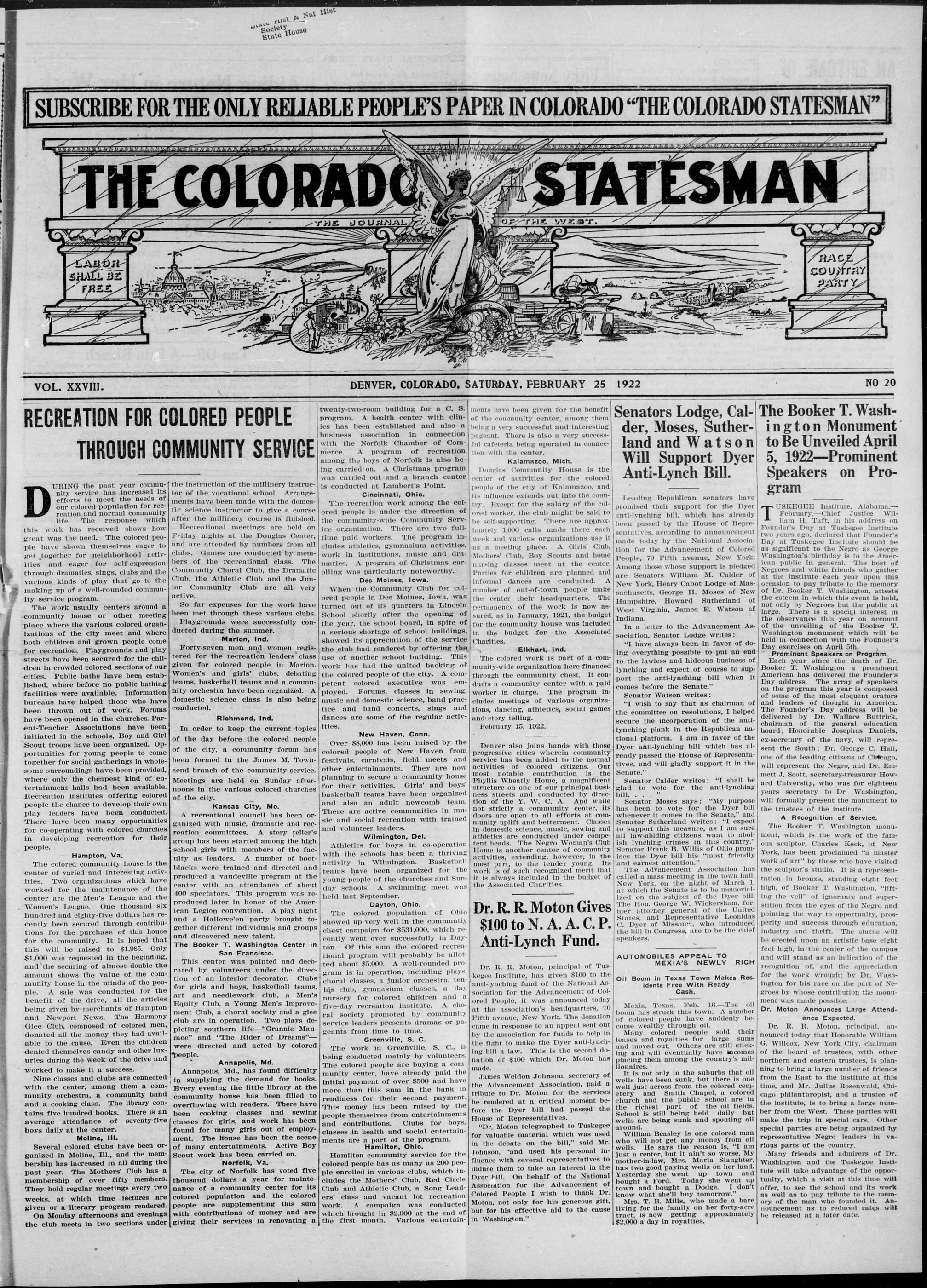
RECREATION FOR COLORED PEOPLE THROUGH COMMUNITY SERVICE
VOL. XXVIII.
DURING the past year community service has increased its efforts to meet the needs of our colored population for recreation and normal community life. The response which this work has received shows how great was the need. The colored people have shown themselves eager to get together for neighborhood activities and eager for self-expression through dramatics, sings, clubs and the various kinds of play that go to the making up of a well-rounded community service program.
The work usually centers around a community house or other meeting place where the various colored organizations of the city meet and where both children and grown people come for recreation. Playgrounds and play streets have been secured for the children in crowded colored sections of our cities. Public baths have been established, where before no public bathing facilities were available. Information bureaus have helped those who have been thrown out of work. Forums have been opened in the churches. Parent-Teacher Associations have been initiated in the schools, Boy and Girl Scout troops have been organized. Opportunities for young people to come together for social gatherings in wholesome surroundings have been provided, where only the cheapest kind of entertainment halls had been available. Recreation institutes offering colored people the chance to develop their own play leaders have been conducted. There have been many opportunities for co-operating with colored churches in developing recreation for their people.
Hampton, Va.
The colored community house is the center of varied and interesting activities. Two organizations which have worked for the maintenance of the center are the Men's League and the Women's League. One thousand six hundred and eighty-five dollars has recently been secured through contributions for the purchase of this house for the community. It is hoped that this will be raised to $1,985. Only $1,000 was requested in the beginning, and the securing of almost double the amount shows the value of the community house in the minds of the people. A sale was conducted for the benefit of the drive, all the articles being given by merchants of Hampton and Newport News. The Harmony Glee Club, composed of colored men, donated all the money they had available to the cause. Even the children denied themselves candy and other luxuries during the week of the drive and worked to make it a success.
Nine classes and clubs are connected with the center, among them a community orchestra, a community band and a cooking class. The library contains five hundred books. There is an average attendance of seventy-five boys daily at the center.
Moline. III.
Several colored clubs have been organized in Moline, Ill., and the membership has increased in all during the past year. The Mothers' Club has a membership of over fifty members. They hold regular meetings every two weeks, at which time lectures are given or a literary program rendered. On Monday afternoons and evenings
On Monday afternoons and evenings the club meets in two sections under
the instruction of the millinery instructor of the vocational school. Arrangements have been made with the domestic science instructor to give a course after the millinery course is finished. Recreational meetings are held on Friday nights at the Douglas Center, and are attended by numbers from all clubs. Games are conducted by members of the recreational class. The Community Choral Club, the Dramatic Club, the Athletic Club and the Junior Community Club are all very active. So far expenses for the work have been met through these various clubs. Playgrounds were successfully conducted during the summer.
Marion, Ind.
Forty-seven men and women registered for the recreation leaders class given for colored people in Marion. Women's and girls' clubs, debating teams, basketball teams and a community orchestra have been organized. A domestic science class is also being conducted.
Richmond, Ind.
In order to keep the current topics of the day before the colored people of the city, a community forum has been formed in the James M. Townsend branch of the community service. Meetings are held on Sunday afternoons in the various colored churches of the city.
Kansas City, Mo.
A recreational council has been organized with music, dramatic and recreation committees. A story teller's group has been started among the high school girls with members of the faculty as leaders. A number of bootblacks were trained and directed and produced a vaudeville program at the center with an attendance of about 400 spectators. This program was reproduced later in honor of the American Legion convention. A play night and a Hallowe'en party brought together different individuals and groups and discovered new talent.
The Booker T. Washington Center in San Francisco
This center was painted and decorated by volunteers under the direction of an interior decorator. Clubs for girls and boys, basketball teams, art and needlework club, a Men's Equity Club, a Young Men's Improvement Club, a choral society and a glee club are in operation. Two plays depicting southern life—"Grannie Maumee" and "The Rider of Dreams"—were directed and acted by colored people.
Annapolis, Md.
Annapolis, Md., has found difficulty in supplying the demand for books. Every evening the little library at the community house has been filled to overflowing with readers. There have been cooking classes and sewing classes for girls, and work has been found for many girls out of employment. The house has been the scene of many entertainments. Active Boy Scout work has been carried on.
Norfolk, Va.
The city of Norfolk has voted five thousand dollars a year for maintenance of a community center for its colored population and the colored people are supplementing this sum with contributions of money and are giving their services in renovating a
twenty-two-room building for a C. S. program. A health center with clinics has been established and also a business association in connection with the Norfolk Chamber of Commerce. A program of recreation among the boys of Norfolk is also being carried on. A Christmas program was carried out and a branch center is conducted at Lambert's Point.
Cincinnati, Ohio.
The recreation work among the colored people is under the direction of the community-wide Community Service organization. There are two full-time paid workers. The program includes athletics, gymnasium activities, work in institutions, music and dramatics. A program of Christmas carolling was particularly noteworthy.
Des Moines, Iowa.
When the Community Club for colored people in Des Moines, Iowa, was turned out of its quarters in Lincoln School shortly after the opening of the year, the school board, in spite of a serious shortage of school buildings, showed its appreciation of the service the club had rendered by offering the use of another school building. This work has had the united backing of the colored people of the city. A competent colored executive was employed. Forums, classes in sewing, music and domestic science, band practice and band concerts, sings and dances are some of the regular activities.
New Haven. Conn.
Over $8,000 has been raised by the colored people of New Haven from festivals, carnivals, field meets and other entertainments. They are now planning to secure a community house for their activities. Girls' and boys' basketball teams have been organized and also an adult newcomb team. There are active communities in music and social recreation with trained and volunteer leaders.
Wilmington, Del.
Athletics for boys in co-operation with the schools has been a thriving activity in Wilmington. Basketball teams have been organized for the young people of the churches and Sunday schools. A swimming meet was held last September.
Dayton, Ohio.
The colored population of Ohio showed up very well in the community chest campaign for $531,000, which recently went over successfully in Dayton. Of this sum the colored recreational program will probably be allotted about $5,000. A well-rounded program is in operation, including plays, choral classes, a junior orchestra, tenhis club, gymnasium classes, a day nursery for colored children and a five-day recreation institute. A choral society promoted by community service leaders presents dramas or pageants from time to time.
Greenville, S. C.
The work in Greenville, S. C., is being conducted mainly by volunteers. The colored people are buying a community center, have already paid the initial payment of over $500 and have more than this sum in the bank in readiness for their second payment. This money has been raised by the people themselves from entertainments and contributions. Clubs for boys, classes in health and social entertainments are a part of the program.
Hamilton, Ohio.
Hamilton community service for the colored people has as many as 200 people enrolled in various clubs, which includes the Mothers' Club, Red Circle Club and Athletic Club, a Song Leaders' class and vacant lot recreation work. A campaign was conducted which brought in $2,000 at the end of the first month. Various entertain-
ments have been given for the benefit of the community center, among them being a very successful and interesting pageant. There is also a very successful cafeteria being operated in connection with the center.
Kalamazoo, Mich.
Douglas Community House is the center of activities for the colored people of the city of Kalamazoo, and its influence extends out into the country. Except for the salary of the colored worker, the club might be said to be self-supporting. There are approximately 1,000 calls made there each week and various organizations use it as a meeting place. A Girls' Club, Mothers' Club, Boy Scouts and home nursing classes meet at the center. Parties for children are planned and informal dances are conducted. A number of out-of-town people make the center their headquarters. The permanency of the work is now assured, as in January, 1921, the budget for the community house was included in the budget for the Associated Charities.
Elkhart. Ind.
The colored work is part of a community-wide organization here financed through the community chest. It conducts a community center with a paid worker in charge. The program includes meetings of various organizations, dancing, athletics, social games and story telling.
February 15, 1922.
Denver also joins hands with those progressive cities wherein community service has been added to the normal activities of colored citizens. Our most notable contribution is the Phyllis Wheatly Home, a magnificent structure on one of our principal business streets and conducted by direction of the Y. W. C. A. And while not strictly a community center, its doors are open to all efforts at community uplift and betterment. Classes in domestic science, music, sewing and athletics are conducted under competent heads. The Negro Woman's Club Home is another center of community activities, extending, however, in the most part, to the tender young. Its work is of such recognized merit that it is always included in the budget of the Associated Charities.
Dr. R. R. Moton Gives $100 to N. A. A. C. P. Anti-Lynch Fund.
Dr. R. R. Moton Gives $100 to N. A. A. C. P. Anti-Lynch Fund.
Dr. R. R. Moton, principal of Tuskegee Institute, has given $100 to the anti-lynching fund of the National Association for the Advancement of Colored People, it was announced today at the association's headquarters, 70 Fifth avenue, New York. The donation came in response to an appeal sent out by the association for funds to help in the fight to make the Dyer anti-lynching bill a law. This is the second donation of $100 which Dr. Moton has made.
James Weldon Johnson, secretary of the Advancement Association, paid a tribute to Dr. Moton for the services he rendered at a critical moment before the Dyer bill had passed the House of Representatives.
"Dr. Moton telegraphed to Tuskegee for valuable material which was used in the debate on the bill," said Mr. Johnson, "and used his personal influence with several representatives to induce them to take an interest in the Dyer bill. On behalf of the National Association for the Advancement of Colored People I wish to thank Dr. Moton, not only for his generous gift, but for his effective aid to the cause in Washington."
Senators Lodge, Calder, Moses, Sutherland and Watson Will Support Dyer Anti-Lynch Bill.
Leading Republican senators have promised their support for the Dyer anti-lynching bill, which has already been passed by the House of Representatives, according to announcement made today by the National Association for the Advancement of Colored People, 70 Fifth avenue, New York. Among those whose support is pledged are Senators William M. Calder of New York, Henry Cabot Lodge of Massachusetts, George H. Moses of New Hampshire, Howard Sutherland of West Virginia, James E. Watson of Indiana.
In a letter to the Advancement Association, Senator Lodge writes:
"I have always been in favor of doing everything possible to put an end to the lawless and hideous business of lynching and expect of course to support the anti-lynching bill when it comes before the Senate."
Senator Watson writes:
"I wish to say that as chairman of the committee on resolutions, I helped secure the incorporation of the anti-lynching plank in the Republican national platform. I am in favor of the Dyer anti-lynching bill which has already passed the House of Representatives, and will gladly support it in the Senate."
Senator Calder writes: "I shall be glad to vote for the anti-lynching bill. . . ."
Senator Moses says: "My purpose has been to vote for the Dyer bill whenever it comes to the Senate," and Senator Sutherland writes: "I expect to support this measure, as I am sure all law-abiding citizens want to abolish lynching crimes in this country." Senator Frank B. Willis of Ohio promises the Dyer bill his "most friendly and earnest attention."
The Advancement Association has called a mass meeting in the town hall, New York, on the night of March 1, at which the Senate is to be memorialized on the subject of the Dyer bill. The Hon. George W. Wickersham, former attorney general of the United States, and Representative Leonidas C. Dyer of Missouri, who introduced the bill in Congress, are to be the chief speakers.
AUTOMOBILES APPEAL TO
MEXIA'S NEWLY
Oil Boom in Texas Town Makes Residents Free With Ready Cash.
Mexia, Texas, Feb. 16.—The oil boom has struck this town. A number of colored people have suddenly become wealthy through oil.
Many colored people sold their leases and royalties for large sums and moved out. Others are still sticking and will eventually have incomes placing them among the country's millionaires.
It is not only in the suburbs that oil wells have been sunk, but there is one well just across from the colored cemetery and Smith Chapel, a colored church and the public school are in the richest part of the oil fields. School is still being held daily but wells are being sunk and spouting all around.
William Beasley is one colored man who will not get any money from oil wells. He says the reason is, "I am just a renter, but it ain't so worse. My mother-in-law, Mrs. Maria Slaughter, has two good paying wells on her land. Yesterday she went up town and bought a Ford. Today she went up town and bought a Dodge. I don't know what she'll buy tomorrow."
Mrs. T. B. Mills, who made a bare living for the family on her forty-acre tract, is now getting approximately $2,000 a day in royalties.
NO 20
TUSKEGEE Institute, Alabama.—February.—Chief Justice William H. Taft, in his address on Founder's Day at Tuskegee Institute two years ago, declared that Founder's Day at Tuskegee Institute should be as significant to the Negro as George Washington's birthday is to the American public in general. The host of Negroes and white friends who gather at the institute each year upon this occasion to pay tribute to the memory of Dr. Booker T. Washington, attests the esteem in which this event is held, not only by Negroes but the public at large. There is a special interest in the observance this year on account of the unveiling of the Booker T. Washington monument which will be held in connection with the Founder's Day exercises on April 5th.
Prominent Speakers on Program. Each year since the death of Dr. Booker T. Washington a prominent American has delivered the Founder's Day address. The array of speakers on the program this year is composed of some of the most eloquent orators and leaders of thought in America. The Founder's Day address will be delivered by Dr. Wallace Buttrick, chairman of the general education board; Honorable Josephus Daniels, ex-secretary of the navy, will represent the South; Dr. George C. Hall, one of the leading citizens of Chicago, will represent the Negro, and Dr. Emmett J. Scott, secretary-treasurer Howard University, who was for eighteen years secretary to Dr. Washington, will formally present the monument to the trustees of the institute.
A Recognition of Service.
The Booker T. Washington monument, which is the work of the famous sculptor, Charles Keck, of New York, has been proclaimed "a master work of art" by those who have visited the sculptor's studio. It is a representation in bronze, standing eight feet high, of Booker T. Washington, "lifting the veil" of ignorance and superstition from the eyes of the Negro and pointing the way to opportunity, prosperity and success through education, industry and thrift. The statue will be erected upon an artistic base eight feet high, in the center of the campus and will stand as an indication of the recognition of, and the appreciation for the work wrought by Dr. Washington for his race on the part of Negroes by whose contribution the monument was made possible.
Dr. Moton Announces Large Attendance Expected.
Dr. R. R. Moton, principal, announced today that Honorable William G. Willecox, New York City, chairman of the board of trustees, with other northern and eastern trustees, is planning to bring a large number of friends from the East to the institute at this time, and Mr. Julius Rosenwald, Chicago philanthropist, and a trustee of the institute, is to bring a large number from the West. These parties will make the trip in special cars. Other special parties are being organized by representative Negro leaders in various parts of the country.
Many friends and admirers of Dr. Washington and the Tuskegee Institute will take advantage of the opportunity, which a visit at this time will offer, to see the school and its work as well as to pay tribute to the memory of the man who founded it. Announcement as to reduced rates will be released at a later date.
FOREIGN
Fifty-four men and women were prevented from committing suicide in the last six months through the efforts of an anti-sulcide league at Zurich, according to a report just issued. Some of the fifty-four also had planned to take other lives before their own.
Mexican diplomatic representatives are to be shorn of their resplendent uniform under the terms of a decree made public by the Department of Foreign Relations at Mexico City. Among other provisions of the decree, which completely reorganizes the diplomatic service, it is stipulated that members of the corps shall not wear uniforms which are not regarded as "necessary for the efficiency of the service or for national decorum."
Announcement of plans to scrap a total of twenty-four ships in the Japanese navy has been made by the navy ministry at Tokyo as Japan's first step toward placing into effect the Washington arms limitation agreement. The ships to be scrapped, according to the announcement, include ten obsolete cruisers, six battle cruisers now in course of construction and eight capital ships which have been planned but keels for which have not yet been laid.
With reference to a recently circulated rumor that Cardinal Gasparri was to be replaced as papal secretary of state by Monsignor Cerretti, now papal nunclo at Paris, a semi-official vatican statement said: "It is superfluous to state that such a report is absolutely unfounded. Cardinal Gasparri has not displayed any intention of leaving his high office and he enjoys the complete confidence of Pope Plus, as he in the past enjoyed that of Pope Benedict."
The basis upon which the heads of the American oil companies last September reached an agreement with the Mexican government relative to the payment of export taxes under the decree of June 7, were divulged in the outline of a decree given out by Minister of the Treasury De La Huerta. The decree lacks only the signature of President Obregon to become effective. The project contemplates the payment of 40 per cent of the tax as originally imposed by the June decree, and means the payment to the Mexican treasury of approximately 13,500,000 pesos.
To hasten a decision regarding the arrangements for the Olympia games of 1924, awarded to Paris, M. Ybarnegaray, deputy from the lower Pyrenees, has filed an interpellation of the government, pointing out that even the site for the games has not been designated nor any plans regarding them approved after eight months' controversy. It is declared that the French athletic federation officials and other leaders in sports have informally agreed to abandon their efforts to stage the games in Paris unless the government and the municipal city of Paris act on the proposition by March 15.
GENERAL
A spirited and unusual contest for control of the Philadelphia Rapid Transit Company in which the 10,000 employees have taken the side of the president of the corporation, has developed. In the scramble for proxies for the annual meeting on March 15 the employees voted to purchase 10,000 shares of the stock out of the funds in their Co-operative Welfare Association and throw them to the support of Thomas E. Mitten, president of the company.
Thousands of children in the Hocking valley coal mining district are undernourished and many cannot attend school because they have no shoes. Governor Davis of Ohio was told during an inspection trip. A year's unemployment of miners has brought hundreds of families to the point of starvation, the governor was informed by representatives of various civic and charitable organizations, including the Red Cross and Chamber of Commerce.
Seven "wire tappers," charged with having conspired to defraud Barney Knape, an Ohio farmer, of $25,000 on "sure thing" stock deals, were arrested at Mobile, Ala., it was announced in New York by Sherman Burns of the William J. Burns Detective Agency. The swindle is alleged to have been promoted at an Orlando, Fla., "stock exchange."
Federal Judge J. W. Woodrough of Omaha has signed an order granting authority to Keith Neville, former governor of Nebraska, and now receiver for the Skinner Packing Company, to bring suit in the United States District Court against 700 stockholders of the company, who, it is claimed, are in default in payment for $1,000,000 worth of stock.
Contracts for the building of sixty miles of new railroad from Satanta, Kan., to a point near Springfield, Colo., have been let by the Atchison, Topeka & Santa Fé railway and construction will begin by March 1. The beginning at Satanta, the new line, which has been under consideration for some time, will extend westward to the Colorado line. About 300 men will be employed in the work.
Mathilda McCormick, 16 years old, has permission of her father, Harold E. McCormick, to marry Max Oser, a horseman of Zurich, Switzerland. Mr. McCormick announced the engagement in a thirty-three-word statement. He said it was "hastened a few weeks by the fact of the recent newspaper publicity." The romance of the young granddaughter of John D. Rockefeller was pictured by Emil L Burgy, Chicago interior decorator, who says he is a first cousin of the Swiss equestrian, as a love of spring and winter.
AN EPITOME OF LATE LIVE NEWS
CONDENSED RECORD OF THE
PROGRESS OF EVENTS AT
HOME AND ABROAD.
FROM ALL SOURCES
SAYINGS, DOINGS, ACHIEVE
MENTS, SUFFERINGS, HOPES
AND FEARS OF MANKIND.
WESTERN
Isolated from the rest of the world, with no means of replenishing the supply of food, a father, mother and two children living on a homestead twelve miles north of Reno, Nev., were saved from possible starvation by the air mail service, which sent a food-laden plane to the district and while the plane circled over the house three large sacks of food were dropped in the yard.
Mrs. Alice M. Hills, Amherst, Mass., and Harold Holloway, colored, a waiter, flung themselves into the sea from the Matson liner Buckeye State within two hours of each other while the steamer was approximately 300 miles south of Los Angeles, according to a radio message received from the vessel's master, Capt. John T. Diggs Captain Diggs' message gave no reason for the supposed suicides.
With uniform marriage and divorce laws as their campaign slogan, Mrs. Irene C. Buell and Mrs. A. K. Gault, sisters, are building up political fences in the race for seats in the national House of Representatives. Mrs. Buell has been city prosecutor of Ashland, Neb., for eight years. Mrs. Gault is mayor of St. Peter, Minn. They are making the race as the result of a political pact between themselves, says Mrs. Buell.
Information through the forester at Blackleaf, Teton county, received at the Jefferson National forest headquarters at Great Falls, Mont., states that a geyser, or volcanic eruption occurred at Mount Black Leaf canon recently, mud and steam shooting 200 feet high for two days and then subsiding to a steady outpour of hissing steam. During the first outburst the noise of the eruption could be heard several miles.
Reduced railroad rates of unusual interest to land men of the West have been announced in Denver by the Denver & Rio Grande Western railroad in the form of homeseekers' rates from Eastern states to all interior points in Colorado, Utah and New Mexico. The rates will be one fare plus $2 for the round trip from all points in Michigan, Illinois, Iowa, the Missouri river and southern Minnesota. The return limit is twenty-one days.
After six years spent in construction, the Alaskan railroad is now ready for use, from sea level at Seward, on Resurrection bay, northward to Fairbanks, a distance of 467 miles. Fifty-two millions of dollars is the total sum which has been expended to date on the northern line and an additional $4,000,000 will be needed for bridges and other construction not essential to the initial operation, according to William Gerig, one of the construction engineers, who has just returned to Portland, Ore., from Alaska.
WASHINGTON
The American relief administration expects to withdraw from its undertaking in the famine stricken districts of Russia by next Sept. 1, Edgar Rickard of that organization said after he had conferred with Secretary Hoover. Disaster at the Hampton Roads army base to the army's Italian-built airship Roma, largest craft of her type in the world, cast gloom over the War and Navy departments as the long list of officers and men who were burned to death in the ship came in. Immediately on receipt of the news Major General Patrick, chief of the air service, left for the scene by airplane.
Detailed recommendations for additional government hospital construction in various parts of the country for former service men framed by a conference of specialists on mental diseases have been made public by the veterans' bureau. The proposed program would include a total of 12,000 beds needed for the care of mental patients.
Business conditions throughout the country are better than they were a year ago in the view of treasury officials who declared, however, that the improvement has been gradual and there was no immediate prospect of a sudden pick-up in business activities. Some seasonable activity might be looked for in the spring, they asserted, but in general only gradual betterment was to be looked for.
The seven Republicans of the House ways and means committee who are charged with solving the problem of financing the soldiers' bonus had another general discussion of the whole question with Secretary Mellon. The treasury secretary was heard behind closed doors, but he was understood to take taken substantially the same position that he did at the open hearings two weeks ago when he reiterated his opposition to a bonus at this time, but declared that if such legislation was to be passed it should be financed by a sales or some other-form of taxation.
Pithy News Notes
From All Parts of
Colorado
( Western Newspaper Union News Service. )
Greeley.—The attention of all Rotarians in this Rotary district has been called to the fact that the twenty-first annual district convention will be held at Greeley on March 22, 23 and 24.
Erie.—Leo Hauck, 7-year-old son of Albert Hauck, wealthy farmer living ten miles southeast of Longmont, was run over and instantly killed by a school truck in which he was about to return to his home.
Brighton.—During the year 1921 the Kuner Pickle Company at Brighton bought 1,100 cars of tomatoes, 800 cars of pickles, 500 cars of cabbage and 200 cars of beans, for which they paid the farmers over $1,000,000.
Hudson.—One bandit was killed and two others were wounded in a running battle with a sheriff's posse here after the three bandits, possibly accompanied by a fourth, robbed a store at Wiggins, Colo., removing the safe and cash register.
Fort Morgan.—The Rev. Neil Stewart of Shelby, Iowa, has been called to Fort Morgan to accept the pastorate of the United Presbyterian Church. The Rev. Mr. Stewart has wired his acceptance and will begin his work in Fort Morgan early in April.
Pueblo.—Of all strange thefts ever reported to the Pueblo police department the oddest one came to their notice recently when V. I. Provost, 205 South Main street, reported that the right front door of his car had been taken off the machine as it stood on the street.
Denver.—Colorado is one of the leading producing states in alfalfa meal, there being several large mills scattered in the agricultural districts. Those familiar with this product declare that Colorado alfalfa makes the finest meal of any alfalfa grown in the country.
Golden.—Establishment of a highway to the foot of the Mount of the Holy Cross was assured at a meeting of the Golden Chamber of Commerce when the counties tributary to the course of the highway announced that $270,000 had been raised toward completing the project.
Boulder.—Mary H. Cowie, assistant postmaster at Boulder for twenty-seven years, has been appointed postmaster to succeed J. O. Miller. Miss Cowie is a sister of James Cowie, former secretary of state, and she is the first woman postmaster in the history of the city.
Denver.—Postmasters for Littleton, Boulder and Wray have been announced in Washington. They are: Littleton, Fred M. Moore; Boulder, Miss Mary H. Cowie, and Wray, John Walter Hultquist. The appointments were made on recommendations of Representative Timberlake.
Steamboat Springs.—Citizens and business men of Routt county have petitioned the War Finance Corporation at Washington protesting the alleged discrimination against the Routt County Livestock and Loan Company in holding up the $40,000 loan recently approved of by the Denver branch of the corporation.
Denver.—Acting Gov. Earl Cooley pardoned Lafayette Jones, who was sent to the penitentiary in 1907 on a charge of horse stealing, because Cooley, who was Jones' attorney, believes that he did not defend him correctly. "The affair has been worrying me all these years," said Cooley, after posting Jones' pardon. "I am convinced to this day that he was innocent."
Sterling.—The annual convention of the Colorado Manufacturers and Merchants' Association will be held next fall in Sterling and, according to reports, the citizens of that city already have begun to make preparations for the entertainment of the delegates. Denver.—Indorsement of the campaign of the local committee of the American Jewish relief, which will begin on March 5, for the purpose of raising $150,000 in Colorado and Wyoming for the destitute orphans and refugees of eastern Europe, has been received from Governor Shoup by Milton M. Schayer, director general.
Denver.—For the first time in the history of the state a steamship and navigation company which is owned by eastern capital has come to Colorado to incorporate, it was learned from Secretary of State Milliken. The company is to be known as the United Polish Lines, Inc., and has been incorporated for $1,000,000, in addition to the carrying of 200,000 shares of no par value. The main offices of the company are to be maintained in New York city, while western headquarters are to be established in the Equitable building here.
Windsor.—The greatest sale of farm equipment ever held in Weld county was held at Windsor, with receipts totaling $19,654. The Great Western Sugar Company, which is abandoning its beet seed raising experiments in this county, sold all the horses, mules, farm implements and tractors which it has used to operate its farms in the Windsor, Ault and Eaton districts. Ninety horses and mules were put up for sale. More than 3,000 farmers attended the sales, including many from Wyoming and some from Nebraska and South Dakota.
County Fair Dates Set. Loveland.—The State Fair Association, in annual convention here, reelected all its officers and chose dates for 1922 county fairs and the Rocky Mountain racing circuit.
The state fair will be held at Pueblo Sept. 24 to 30.
Fairs will be held at Fort Morgan, Morgan county; Loveland, Larimer county, and Longmont, Boulder county, Aug. 29, 30 and 31 and Sept. 1.
The dates for the Rocky Ford fair and the Washington county fair at Akron were set for Sept. 4, 5, 6 and 7. At Greeley, Weld county; Brighton, Adams county, and Sterling, Logan county, the fairs will be Sept. 12, 13, 14 and 15. In the following week, Sept. 19, 20, 21 and 22, will take place the fairs at Yuma, Yuma county, and Colorado Springs, El Paso county.
The Douglas county fair will be held at Castle Rock Oct. 3, 4, 5 and 6. Several counties on the western slope will hold their fairs the second and third weeks in October.
Dates for the racing circuit were fixed as follows; Pueblo, week of July 3; Rocky Ford, July 10; Las Animas, July 17; Colorado Springs, Aug. 7; Fort Morgan, Aug. 21; Loveland, Aug. 28; Longmont, Sept. 4; Brighton, Sept. 11; Callahan, Sept. 18; Pueblo, Sept. 25, and Burlington, Oct. 4. The 1923 convention will be held at Rocky Ford the third week in February.
Denver.—Denver and all Colorado will benefit by the new summer tourist rates announced in Chicago recently to the Pacific coast, as under the rates stopovers are good at any point. The round-trip rate announced is $86 from Chicago; $72 from the Missouri river and $64 from Denver, Colorado Springs and Pueblo. The rates become effective May 15 and are in effect until Oct. 31. "There is no doubt but these rates will prove of immense benefit to Colorado," said W. K. Cundiff, assistant general passenger agent of the Union Pacific. "The fact that stopovers are allowed will give the tourists opportunity of coming through Colorado, visiting the Rocky Mountain National park, the Denver section and the Colorado Springs district and they will have plenty of time, too. The rates are for stopovers either way, so the tourists who go by the Yellowstone or Glacier park lines to the coast can come back through Colorado, so, to use a slang phrase, we 'get them coming and going.'"
Boulder.—February 14 was Insignia day at the University of Colorano and the associated student organization honored the four-year football men, Carl Fulghum, Alva Noggle, Lee Williard, Robert Muth and Walter Franklin, with sweaters. Blankets were awarded to Homer Britzman, Charles Shapiro, Harry Le Fevre and Clark Alexander, who earned their C last season for the second time, and to Donald McLean, Earl Losler, Carlisle Milner, John Wittemyer, Arthur Quinlan and John Mellett, received sweaters, having played on the varsity team last fall for the first time.
Denver. — The Colorado Highway Commission has decided tentatively which of its 48,000 miles of highways are to be maintained as interstate or primary routes under the provisions of the new federal aid bill, it was learned recently. Colorado is demanding at least three important interstate routes across its domain. One highway, stretching from Wyoming south to New Mexico and to be known as the North and South highway, will, it is planned, intersect two main east and west lines at Denver and Pueblo.
Colorado Springs.—Harold Holiday, 16-year-old son of Mr. and Mrs. George Holiday of Vancouver, B. C., was probably fatally injured recently when he attempted to board a Santa Fé passenger train as it left the railroad yards.
Greeley.—The Weld County Taxpayers' League voted to ask Governor Shoup not to call a special session of the Legislature. Resolutions adopted stated that the league has no prejudice against any project in the proposed call, but is opposed to the extra session because of the cost to the taxpayers. The league also passed resolutions opposing any increases in salaries or wages paid public officials.
Frederick.—Approximately five hundred miners employed in the coal fields near here have served notice they will not accept wage reductions corresponding with those affected several months ago by the Colorado Fuel and Iron Company in several of its southern Colorado mines, and a concerted walkout is threatened, according to information received by Col. P. J. Hamrock, head of the state rangers.
Arvada.—Burglarraided the H. J. Juchem drug store in Arvada several days ago, breaking open the safe, stealing a small amount of cash and several hundred dollars worth of merchandise. They backed their automobile up to the rear door of the store, loaded in their loot, and then drove away.
Durango.—The carrying of a woman five miles on a stretcher over a narrow path broken out of heavy snow drifts in order to get her to expert medical assistance and the discovery that a $30,000 mining mill had been completely wiped out by a snowslide were developments in the work of digging out Silverton, which had been isolated by snow for seventeen days.
Swink—Burglarls broke into the Swink Mercantile Company a few nights ago and removed about $1,000 worth of merchandise, hauling it away in motor trucks.
Aiding Nature in Her Work
TO repair the damage done by destructive forces is a process of no short time. But to prevent these bad effects is but the routine of a few precious moments.
In either case, Madam C. J. Weaker's Superfine Toilettes stand ready to aid you in the task at hand.
Madam C. J. Walker's Vanishing Cream
Superfine Face Powder
(white, rose-flesh, brown)
Compact Rouge
TO PREVENT THE ON-RUSH OF OLD AGE—
Madam C. J. Walker's Cleansing Cream
Witch Hazel Jelly
Floral Cluster Talc
of 18 superfine preperations hair and skin
Makers of 18 superfine preparations for the hair and skin
Tan-Off—A Skin Bleach
For many years thousands of Madam C. J. Walker's satisfied customers urged her to perfect an effective skin bleach, and in response to their demands, she made arrangements to place Tan-Off on the market, and her daughter, who succeeded her as President of the Company, after three years of effort, has perfected and recommends for frequent use Tan-Off—a safe and efficient compound for brightening dark and sallow skin, an effective treatment for tan, freckles and skin blotch and for clearing dull, lifeless complexions.
For many years thous
tomers urged her to perfo
to their demands, she m
market, and her daughter,
pany, after three years o
f frequent use Tan-Off—a
dark and sallow skin, an
skin blotch and for clearl
A TRIAL
Highly Recom
35 CENTS-OF
ADDRESS ALL ORDER 1
640 North
many years thousands of Madam C. J. Walker's said and her to perfect an effective skin bleach, and commands, she made arrangements to place Tan-Off her daughter, who succeeded her as President for three years of effort, has perfected and recone the Tan-Off—a safe and efficient compound for a shallow skin, an effective treatment for tan, frail and for clearing dull, lifeless complexions.
A TRIAL WILL CONVINCE YOU
-Highly Recommended—Scientifically Indorsed
CENTS—OF AGENTS, DRUGGISTS, BY MA
ALL ORDER TO THE MADAM C. J. WALKER
640 North West Street, Indianapolis, Ind.
A TRIAL WILL CONVINCE YOU
Highly Recommended—Scientifically Indorsed
35 CENTS—OF AGENTS, DRUGGISTS, BY MAIL
ADDRESS ALL ORDER TO THE MADAM C. J. WALKER MFG. CO.
640 North West Street, Indianapolis, Ind.
SUMMER "FLU"
IS BEST CURED BY
TAN OFF—MADA
The Ath
The Fifth
PHONE MAIN 875.
HERE
Jazz is being taken from
caught it and am
SUIT
Come in and See
GARDNE
PHONE CHAMPA 1019
CAMPBEE
C
CO
W
HAY, GRAIN,
Office: 1401 W. 38t
C. V. FAIRBANKS
CURED BY THE SAN TOX COUGH AND
REMEDY.
OFF—MADAM WALKER'S SKIN BLEACH
The Atlas Drug
The Five Points Postal Station.
MAIN 875. 2701
HERE IT IS
ing taken from music, but I have
shot it and am putting it into
SUITS
and See My Jazz Styles.
GARDNER, THE TAILOR
AMPA 1019 1025 TWENTY
IS BEST CURED BY THE SAN TOX COUGH AND COLD REMEDY.
AMPBELL BROTHER
COAL
COMPANY
Wholesale and Retail
AY, GRAIN, COAL, WOOD AND POULTRY
SUPPLIES
1401 W. 38th Ave. Yards: 1400 W. 32
BANKS —Proprietors— N. FAIR
FAIRBAN
CAFE
HOME COOKING
GOOD NEWS
A COLE 8 LIMOUSINE
a new beautiful blue with silver
d in black, has been put in service
auto Livery. The car is heated and
partitioned off with glass and curtain
W. Bean says he has taken the
GOOD
A COLLE
Painted a new be
trimmed in black,
Bean Auto Livery.
driver partitioned
A COLE 8 LIMOUSINE Painted a new beautiful blue with silver wheels trimmed in black, has been put in service by the Bean Auto Livery. The car is heated and has the driver partitioned off with glass and curtains.
The car is equipped with easy riding air springs.
640 North West Street Indianapolis, Ind. superfine preperations for the hair and skin
bands of Madam C. J. Walker's satisfied custo-
man an effective skin bleach, and in response
the arrangements to place Tan-Off on the
who succeeded her as President of the Com-
efort, has perfected and recommends for
life and efficient compound for brightening
effective treatment for tan, freckles and
dull, lifeless complexions.
WILL CONVINCE YOU
Extended—Scientifically Indorsed
AGENTS, DRUGGISTS, BY MAIL
TO THE MADAM C. J. WALKER MFG. CO.
West Street, Indianapolis, Ind.
THE SAN TOX COUGH AND COLD
REMEDY.
I WALKER'S SKIN BLEACH AT
as Drug Co.
Points Postal Station.
2701 WELTON
IT IS
music, but I have
titting it into
TS
Just received
—1,000 of the seas-
son's latest styles
of Woolens for
your inspection
and selection.
My Jazz Styles.
ER, THE TAILOR
1025 TWENTY-FIRST
Phone Gallup 473
ALL BROTHERS
GOAL
COMPANY
Wholesale and Retail
GOAL, WOOD AND POULTRY
SUPPLIES
Ave. Yards: 1400 W. 32d Ave.
—Proprietors— N. FAIRBANKS
FAIRBANKS
CAFE
First Class Meals Served
2444 Washington St., Denver, Colo.
D NEWS
8 LIMOUSINE
futiful blue with silver wheels
has been put in service by the
The car is heated and has the
ff with glass and curtains.
he has taken the
THE TRAIN
Grade Crossings Will Be Eliminated to Save Human Lives.
1918
CASUALTIES
KILLED 1852
INJURED 4683
TOTAL 6535
PEDESTRIANS 778
OCCUPANTS OF
AUTOMOBILES 4240
OTHER VEHICLES 1517
1919
OCCUPANTS OF
AUTOMOBILES 73%
4616
6400
698
4790
912
1920
OCCUPANTS OF
AUTOMOBILES 76%
5077
6868
687
5250
931
Distribution of Highway Grade Crossing Casualties.
(Prepared by the United States Department of Agriculture)
The grade crossings must go and they will be eliminated wherever possible on the roads of the federal ald highway system, which will be built as a result of the passage of the federal highway act. When the roads which form the primary or interstate system are constructed, no grade crossing will be allowed to remain that it is at all practicable to avoid. Every effort will be made to make the roads of the secondary system equally safe, but in this case it is recognized that elimination may not be practicable in all cases at this time.
Policy Meets Approval.
Policy Meets Approval.
In making this announcement the bureau of public roads, United States Department of Agriculture, under whose supervision the fund is allotted and construction is undertaken, is putting into effect a policy which it has long advocated in principle, and whose adoption it has urged with increasing effectiveness upon state highway officials for some time past. The policy is meeting with hearty co-operation on the part of the states, and the American Association of State Highway Officials by resolution has pledged its best efforts to co-operate to eliminate grade crossings on new construction.
In addition, the policy finds favor among the railroads, some of the lead-
OCCUPANTS OF
AUTOMOBILES
63%
1918
CASUALTIES
KILLED 1852
INJURED 4683
TOTAL 6535
PEDESTRIANS 778
OCCUPANTS OF
AUTOMOBILES 4240
OTHER VEHICLES 1517
Distribution of Highway
APPARATUS FOR RECLAIMING OIL
Device Conserves 60 to 80 Per Cent by Eliminating Extraneous Matter in It.
REDUCES BILLS OF MOTORIST
Through Distillation of Some Lighter Lubricants Quality Is Said to Be Improved—Abrasive Matter Is Removed.
To conserve present-day resources for the benefit of posterity is not a particularly attractive proposition to the man of today, who is rather likely to ask why he should do anything for posterity when, so far as he can see, posterity has done nothing for him.
But when conservation puts money in his own pocket, that is another story altogether.
That is exactly what can now be done for the motorist by a recent invention of an apparatus for reclaiming or cleansing crank case oil. From 60 to 80 per cent of this oil can now be salvaged and used over again.
Extends Life of Motor.
One of the considerable items in a motorist's budget is lubricating oil, most of which goes into the crank case of his car. Upon the lubrication of that part of the mechanism largely depends the efficiency and life of his car.
Lubricating oil does not actually deteriorate through use. It merely collects a mass of abrasive matter from the wear on moving parts; carbon and unburned gasoline leak from the cylinder into the crank case underneath, and moisture and grit find
ing carriers already having lent cheerful aid in avoiding the construction of more grade crossings. Instead of grade crossings there will be constructed, wherever possible, in the future either a bridge or an underpass where roadway and railway intersect. Important roads, which now cross and recross railroad lines at grades, hereafter will be located entirely on one side of the railroad, even though to do so may increase the cost of construction. Where crossings are unavoidable, or where local interests justify construction of highways to cross railroad lines, the road will be so located as to pass over the track or under it. In most instances of this sort the railroads bear one-half of the cost of building the bridge or underpass.
Saving of Human Lives.
The prime object of the department's policy to eliminate grade crossings on federal-aid roads is the saving of human lives. This policy probably will involve increased expense of construction in the case of some roads, but it is believed this is justified by the saving of life. During the three years ending with 1920, according to the best records available at the department, 3,626 lives were lost at grade crossings in the United States and 10,644 persons were injured.
OCCUPANTS OF
AUTOMOBILES
73%
1919
1784
4616
6400
698
1920
1791
5077
6868
687
4790
912
5250
931
Grade Crossing Casualties.
their way in from the outer air. Although the oil itself does not lose its lubricating quality, all this adulteration eventually forms a mixture which cannot give proper lubrication.
Eliminates Extraneous Matter.
What the new apparatus does is to eliminate all that extraneous matter and thus restore the original usefulness of the lubricant—frequently, indeed, through the distillation of the lighter oils, improving its original quality.
This new reclaiming machine is offered with the idea that when a motorist wishes to renew the oil in his crank chamber he will go to a garage equipped with the necessary outfit, have the old oil drained out and receive an allowance of new oil in return. A garage without the equipment will make an allowance for the used oil and send it to be salvaged by concerns organized for that sole purpose.
AUTOMOBILE NEWS
Wash the car frequently with clean, cold water.
Use no soap on the body where it can possibly be avoided.
An experienced chauffeur in Japan earns from $5 to $10 a week.
Never throw water in a pool or burning gasoline; it only spreads the fire.
Ammonia may be used to clean corrosion from connections and battery terminals.
Black smoke is an indication that the carbon in the fuel is passing through the engine unburned.
To make the tire valve accessible for disc wheel users, a right angle valve extension has been devised.
ECONOMY URGED BY GEN. PERSHING
ARMY LEADER SUGGESTS TWO FUNCTIONS BEFORE HOUSE.
MUST PRACTICE SAVING
SERVICE AND TRAINING GUARD AND U. S. RESERVES IS IMPORTANT.
(Western Newspaper Union News Service.)
Washington.—A new "economic principle" to govern peace-time maintenance of all branches of the army regulars, national guard or organized reserves, has been laid by General Pershing before the House subcommittee on army appropriations. General Pershing's statement did not deal with specific questions as to the strength of the regular army during the coming fiscal year, the officer saying, however, that "in view of a possible reduction" in army strength consideration of the "development of a national army from an economical standpoint" became especially important.
The general's statement concluded the hearings of the committee and it is expected to be prepared to submit its report in the near future.
After pointing out that the regular army was "relatively small at present" and limited in numbers first by the existing army organization act and later by the appropriations act, General Pershing said that the following economic principle might be stated as to the military organization the country should maintain:
"In organizing the peace establishment no unit should be maintained in a more expensive category if it can be safely and advantageously maintain1 in a less expensive category, and mobilized therefrom in time to meet the requirements of an emergency."
The officer said that the cost of each group of the new army was different, the regulars being more costly than the national guard, which in turn cost more than the organized reserves.
In explanation of this he added that "it would, of course, be understood that the regular army organizations must be maintained for duty in foreign garrisons, upon the Mexican border, for emergency service at home or expeditionary purposes abroad and for all other duties which in the nature of things could not be performed by the citizen soldiers."
Snow Storm Causes Death of Five
Minneapolis, Minn.—Five trainmer were killed and five injured and scores of passengers were shaken up when train No. 10, through flier on the Great Northern railway, and a snowplow collided head-on between Delano and Montrose, thirty miles west of here. The dead were buried under the wreckage of three engines. No. 10 was bound for Minneapolis carrying a heavy load and pulled by two engines. All the dead trainmen were residents of St. Paul and Wilmar, Minn.
Worth $10 to Meet Polite Cop.
Worth $10 to Meet Polite Cop.
Chicago—W. H. Clarkson took his three Russian wolf hounds for their daily automobile tour, but suddenly speeded for home when one of the dogs took a chill and began to tremble violently. Policeman Robert McCaull halted him and when Clarkson gave his reason for speeding the policeman quickly took off his heavy coat and buttoned it about the dog. But he arrested Clarkson. When the latter was fined $10 he told the magistrate that it was worth that much to meet such a polite policeman.
Seven Perish on Wrecked Ship.
Galveston, Texas.—The Morgan line steamer El Oriente, arriving from New York, brought the story of a sea tragedy in which seven men lost their lives after enduring days of suffering. The men were the crew of the Pensacola schooner Caldwell H. Colt, which was wrecked on a Florida reef Feb. 13 in a gale. The El Oriente brought one of the survivors, Capt. L. A. Smith, master of the schooner.
Road Body to Buy Pershing's Home.
Springfield, Ill.-Purchase of the early home of Gen. J. Pershing at La clede, Mo., by the Plike's Peak Ocean to Ocean Highway Association, and its maintenance by the state of Missouri, was voted by the association in annual convention here.
Five Hurt in Ship Explosion.
Newport News, Va.—Five men are in the hospital at Camp Eustice as the result of an explosion and fire on the shipping board wooden steamer Lake Creosco. The men are not in a serious condition.
Teacher, 45, Marries Boy Student.
Avon, N. Y.—Mrs. Laura Spencer, preceptress of the high school here, has notified the school commission of her recent marriage to Neil Cushing, 19 years old, a student in one of her classes. Mrs. Spencer, now Mrs. Cushing, is 45 years old and the mother of five children, the oldest of whom is a teacher in Rochester. Mrs. Cushing has been going about her duties paying no heed to the excitement her romance has created. Her husband continues to attend his classes.
WASHINGTON SIDELIGHTS
Chaplains of the U. S. War Department
Water Power Development in America
Industrial Code to Govern Coal Mining
ILL LOOK INTO THIS
ACTS OF PALMER
GRAND JURY
WASHINGTON.—A subpoena has been served on Col. Thomas W. Miller, the alien property custodian, ordering him to appear before the federal grand jury in Boston, with all records hearing upon the sale by his predecessor, A. Mitchell Palmer, of the vast properties of the Bosch Magneto company, which were seized by the government during the war.
The Bosch Magneto company, now the American Bosch Magneto company, was taken over by the United States as enemy-owned property in
THE first annual report from the office of chief of chaplains of the War department, Washington, D. C., written by John T. Axton, colonel, United States army, chief of chaplains, covering the fiscal year 1921, has been made public. This report shows a corps of 185 chaplains, including one colonel, nine lieutenant colonels, eight majors, 42 captains and 125 first lieutenants. These chaplains are classified as follows: Baptist, 26; Baptist, colored, 2; Congregational, 9; Disciples of Christ, 10; Lutheran, 12; Methodist Episcopal, 41; Methodist Episcopal, colored, 2; Methodist Protestant, 1; Presbyterian, 15; Protestant Episcopal, 17; Cumberland Presbyterian, 1; Reformed, 2; Roman Catholic, 42; Universalist, 2; Unitarian, 2; United Evangelical, 1.
Ninety-eight of these chapkins were appointed during the war. They were selected from among 600 applicants who had seen service during the World war and who had indicated a desire to enter the regular army. "These men had the unqualified command of their military commanders and were highly indorsed by their respective denominations. They were chosen because they were found to possess that fidelity, pulse of mind, breadth and tolerance of view, serenity of spirit, large outlook, patience
```markdown
```
FORTY per cent of the developed water power of the world is in the United States, where water wheels having a capacity of 9,243,000 horse power have been installed, according to a recent statement of the United States geological survey, Department of the Interior. The leading states in developed water power are New York, with 1,300,000 horse power and California with 1,111,000. These state totals compare favorably with those for some of the most progressive countries in water-power developments in Europe, where France leads with 1,400,000 horse power. Norway has 1,350,000 horse power, Sweden, 1,200,000 horse power and Switzerland 1,070,000 horse power. The largest percentage of power has
SENATOR KENYON's last act before accepting the President's nomination as United States Circuit judge of the Eighth district, was to recommend to the senate a federal mediation board and an industrial code to govern coal mining. The recommendations were the result of the investigation by the senate committee on education and labor of trouble between operators and union miners in West Virginia, which led to armed outbreaks and bloodshed last summer and resulted in the calling out of federal troops. The mediation board proposed by Kenyon would be composed of three representatives of the employees, three of the employers and three of the public, all to be appointed by the President. It would be operated like the United States railroad labor board, no penalties being provided for violation of its orders.
Among the basic principles which should be established as an industrial code for the guidance of such a board was suggested:
Coal is a public utility and in its production and distribution the public interest is predominant.
The right of operators and miners to organize is recognized and affirmed.
The right of operators and min-
Property Custodian
May, 1918, and was sold by Palmer to Martin E. Kern of Allentown, Pa., on December 7, 1918, for $4,150,000. Although it had been generally understood that the investigation of the Bosch company, ordered by the Department of Justice, was to be confined solely to its war contracts, it was revealed that the federal grand jury in Boston will inquire into the transfer of the former German properties from the allen property custodian to Howard D. Griffith, acting agent for Martin E. Kern.
Incidentally, there has been repetition of charges made against former Attorney General Palmer when he appeared before the senate judiciary committee in 1919, in connection with hearings on his confirmation. At that time efforts were made to block his confirmation because of the position which he held when the properties were sold. It was alleged then that the Bosch stock was worth approximately $7,000,000.
CHIEF ARMY
CHAPLAIN'S
REPORT
CHAPLAINS AS
and good temper, energy and enthusiasm, and that overmastering love of service for men which are essential to success."
The report tells of the work that has been undertaken by army chaplains, who in many cases with very few facilities have built up worthwhile centers of religious and moral inspiration.
"There have been exigencies of the service that have necessitated the detail of chaplains to various duties that are extraprofessional," Colonel Axton states. "They have served in the cemeterial section of the quartermaster department, as post exchange officers, directors of education and recreation, as morale officers, managers of Liberty theaters and of boxing exhibitions, school teachers and as counsel for the defense."
been developed in the New England states, where the capacity of the water wheels installed is 1,381,000 horse power, and the estimated potential power at low water without storage is 868,000 horse power. In the Pacific coast states—Washington, Oregon, and California—the capacity of those water wheels installed is 1,893,000 horse power and the potential power at low water without storage is 11,500,000 horse power.
The largest water power development in the world is at Niagara Falls, where the plants in operation have a capacity of 870,000 horse power, of which 385,000 horse power is on the United States side. The capacity of the plants at Niagara is being increased by 114,500 horse power in the United States and 300,000 horse power in Canada. Other large plants are one of 170,000 horse power on the Mississippi at Keokak, Iowa, from which power is transmitted to St. Louis, and two plants aggregating 268,500 horse power on St. Maurice river in Canada, from which power is transmitted to Montreal, Quebec and other cities. Canada ranks next to the United States in water-power development, with 2,418,000 horse power, or over 10 per cent of the world's total.
INDUSTRIAL CODE
CHILDREN UNDER
16 YEARS SMALL
NOT BE EMPLOYED
6-DAY WEEK
AGAINST CLOSED
SHOP
ers to bargain collectively through
representatives of their own
choosing is recognized and affirmed.
The miners who are not members
of a union have the right to work
without interference by fellow work-
men who may belong to the union. The
men who belong to a union have the
right to work without being harrassed
by operators who do not believe in
unionism.
Six days shall be the standard work week with one day's rest in seven. The standard work day shall not exceed eight hours a day. When a dispute or controversy arises between operators and mine workers, there should be no strike or lockout, pending a conference or a hearing and determination of the facts and principles involved.
DR. CLARENCE F. HOLMES, JR.
Invites the public of Denver to inspect his modern, electrically equipped dental suite, 2602 Welton St. Hours 9 a.m. to 12 noon; to 6 p.m. evenings and Sun. 10 a.m. to 12 noon; Office phone Champa 2807, Residence phone Champa 1536.
1027 Twenty-first St. Denver
Office Phone Main 2701. Hours
by appointment. Res. 2337 Glen-
arm Place. Phone Champa 3303.
ERNEST HOWARD
Carpenter Contractor
Job and Hand Ware Specialty
Denier in Hardware, Paints, Oils
and Glass. Second-hand
Building Material
Residential 51 St. Lawrence St.
Shop: 710 E. 26th Ave.
Phone York 8900
DR. HUFF'S office phone is
Champa 6001. And his residence
Phone York 4101. When not
reached at office or home, call
Atlas Drug Co., Main 875. Office,
Suite 5, 6 and 7, 2701 Welton St.
over Atlas Drug Store. Office
hours, 11 to 12 a. m., and 3 to 5
p. m.
Office 609 27th St. Ph. Champa 1142
S. E. CARY
ATTORNEY-AT-LAW
Six Years City and County Attorney
at Russell Springs, Logan
County, Kansas
Office Hours—
9:00 A. M. to 12:00 M.
2:00 P. M. to 4:00 P. M.
DENVER, COLO.
MOVED
THE
WARD AUCTION CO.
TO
1617-23 LAWRENCE ST.
BETTER QUARTERS
—MORE CENTRALLY LOCATED—BETTER STREET CAR SERVICE
Auction Every Day,
2 p. m.
Special Sale on Retail Floor
Phone Main 1675
1617-23 Lawrence St.
Phone Main 8036
Res. Phone York 5774W
FRANK D. TAGGART
Attorney at Law—Notary Public
205-206 Cooper Building
Denver, Colorado
JOSEPH CARTER
Express, Moving,
and Storage
COAL AND WOOD
PROMPT DELIVERY.
Phone Main 6544.
2415 WASHINGTON STREET.
ORIENTAL RESTAURANT
Chop Suey, Noodles and Short Orders
Phone Champa 113
1848 Arapahoe
乐缉轩
Do You
Use Good Paper When You Write?
We Can Print Anything and Do It Right.
Entered as second-class matter at the postoffice in the City of Denver, Colo.
JOSEPH D. D. RIVERS..... Proprietor
P. O. Box 116 1824 Curtis Street, Room 25 Phone Main 7417
SUBSCRIPTION RATES.
One year ..... $2.50
Six months ..... 1.50
Three months ..... 1.00
MUST BE PAID IN ADVANCE
their particular
THE COLORADO STATESMAN
LABOR
SHALL BE
FREE
DACA
COUNTRY
PARTY
Reading notices, ten lines or less, 15 cents per line. Each additional line over ten lines, 12 cents per line. Display advertising, 75 cents per square for first insertion and 50 cents per square for each additional insertion.
Remittances should be made by express money order, postoffice money order, registered letter or bank draft. Postage stamps will be received the same as cash for fractional part of a dollar. Only 1c and 2c stamps taken.
Communications to receive attention must be newsy, upon important subjects, plainly written only upon one side of the paper, must reach us Tuesdays, if possible, anyway not later than Wednesdays, and bear the signature of the author, manuscript returned unless stamps are sent for postage. All communications to us must state that are not complimentary will be withheld from the columns of this paper.
ANOTHER ERUPTION.
THOSE American citizens who have been thinking and certainly hoping that the Ku Klux Klan was dead will have to disillusion themselves somewhat. The afternoon papers of Tuesday last fairly brimmed with startling outbreaks of the hooded tribe throughout various sections of the country, and in some places where their strength was but little known. And even in our own city a demonstration took place that caused many to gasp at the very thought of it. Encouraged to further activity by the falling flat of farcical congressional investigation, and emboldened by a sudden silence on the part of the press, the Klan comes forth once more to ply its trade as an invisible empire to supercede the law and set up its own peculiar courts in place of the established authorities. We wonder how long American patience and American public opinion and decency is going to submit to the reign of terror spread by this secret horde. The day of reckoning is sure to come and a tolerance that is almost criminal now will have to pay an awful price.
SPEAKING OF DANCING.
IT HAS long been our view that there has been entirely too much hue and cry about what is termed the dancing evil. Just why dancing must be stamped an evil is entirely beyond our comprehension. Recently a publisher of a go-to-church magazine came out boldly in favor of dancing, and asserted that sooner or later the church would find it necessary to lift its ban against dancing if it was to continue to attract and hold its young people. There is no doubt that it required courage out of the ordinary for a religious leader to advance such a proposition, but we believe his views to be sound. In just what way does dancing approach an evil? The old hackneyed idea that it is productive of carnal suggestion is as absurd and fallacious as it is contemptible. We will not contend that an evil cannot be made of dancing, but only on the same theory that an evil may occur from anything else. Held under the proper influence and surroundings, nothing is more beautiful or health-giving than the dance. What of a dreamy waltz, or exhilarating two-step or graceful minuet? How can any organization or body, ecclesiastical or otherwise, arrogate to itself the right to stamp such as an evil? It is high time for fervid sanctity to throw aside some of its idiotic dominance and face the world truth, that human kind is going to worship God according to the dictates of the individual conscience and not in answer to man-made laws. The church assumes an arbitrary dictatorship whenever it decrees otherwise, a dictatorship that will neither be respected or obeyed. It will lose nothing of its charm nor its general influence if a more tolerant view is adopted, but it will cease to attract the young and continue to contribute to hypocrisy so long as it remains the very embodiment of intolerance. It is readily granted that many wholesome lessons can be imbibed in a Sunday school or church service. They make directly for God and righteousness. But the sum total of human endeavor does not begin and end in the church. Remove music and its charms from the world and there will be no dancing in either parlor or hall. By the same token, however, remove music and its charms from the church and the average Sunday preacher will have the pleasure of listening to the echoes of his own voice amid creaking rafters and empty pews. Music is a part of the plan of Divine creation just as much as is the solar system or law of gravitation, and mankind is going to harken to the strains of delightful music as long as a responsive chord remains in his soul. The dance therefore is a natural complement of music, and neigher preachments nor dogmatism will serve to remove it from the realms of human activities.
COMMUNITY RECREATION CENTERS.
WE NOTE with increasing pride the rapid growth in many of our larger cities of a sentiment favoring recreational playgrounds and community centers for the benefit of the colored citizens. In fact, a definite program has been outlined in many places and the results have proven so satisfactory that broad publicity is being given to the idea, with a view to having its adoption becoming general throughout the country. At first glance this may appear as a species of voluntary or suggested segregation, and to that extent would be objectionable to the finer sensibilities of our people. But a closer and more careful consideration of the matter suggests that there are some activities, more especially of a social nature, that we would prefer to be entirely of our own. And then when it is noted that the greatest benefits of recreational and community life is mostly needed in southern states, where exists a congested colored population, the wisdom of the movement becomes the more apparent. Better by far that we have a place where our young people may meet for social gatherings amid clean, wholesome surroundings, than risk the contamination of immoral dance halls or cheap, degraded moving picture houses. All humanity enjoys the play hour, or moments of relaxation from the ordinary cares of life. Human nature seeks amusement as surely as the plant life seeks the sunlight. The form of amusement, if conducted under proper refined and cultured influences, may become a positive force for good. On the other hand, if conducted along careless, immoral lines it becomes a positive element of character and soul destruction. In the one case the community has undertaken the safeguarding and preservation of honor and character. In the other it is a piling up of dollars against morality and decency. There can be no argument on the proposition that a Symphony Orchestra or a Harmony Glee Club in a community center or Y. W. C. A. is a far greater element of social uplift than a Jazz Band or barber shop quartette in a low dance hall. This new recreational and community life has reached that degree of importance where colored churches, lodges and civic organizations are including it in their programs. It therefore becomes a matter of self preservation. Hampton, Virginia, Kansas City, San Francisco, Cincinnati and many other places are conducting the work on a high plane. The idea has caught on in Denver, and while still in its infancy, we believe it will not be long before we, too, can boast of a system of clean amusements that will take our young people from questionable gathering places and iniquitous pool halls into a more wholesome atmosphere of refined society.
COLORADO MADE GOODS.
THE Colorado Industrial Exposition and Prosperity Carnival holding sway at the municipal Auditorium this week has proven a revelation to the thousands of visitors who have gone there to view the wonderful line of exhibits displayed by 137 Colorado manufacturers. It is a practical demonstration of the fact that Colorado is an empire within itself, capable of supporting in regal style a population many times larger than we now have. This exposition has become an annual event in the hope of implanting the idea of spending Colorado dollars with Colorado manufacturers and producers. This is not provincialism, it is common sense. It has long been recognized that one of the imperative needs of this great state is a large, substantial payroll. Mining booms are a relic of other days, and were a temporary revival possible, its value as to permanency is questionable. Agriculture of course is a safe background for any community, but the most ardent Colorado enthusiast will hardly claim great possibilities for this state in the agricultural line. Stock raising is and will remain a profitable industry, though upon a greatly reduced scale from other years, since great stretches of the public domain is no longer possible for the ranging of stock. Manifestly then our larger communities must have back of them a substantial payroll. Far-sighted business men have recognized this, hence the effort to build up our manufacturing interests by the slogan, "Buy Colorado made goods." THE COLORADO STATESMAN has no record of the number of our group who have visited this wonderful exposition, but it is our candid opinion that any number could do so with decided benefit to themselves. It would at least instil within them a spirit of pride and co-operation in the commendable efforts of capital to invite the investment of Colorado dollars in our own home produced goods.
Aid of America for the Rehabilitation of Europe Depends Upon This
By HERBERT C. HOOVER. Secretary of Commerce.
Whether the United States consents or declines to participate in the international economic conference at Genoa, American aid for the rehabilitation of Europe will depend upon Europe meeting these conditions:
Deflation and balancing of budgets.
Adjustment of German reparations within the power of Germany to pay.
Reduction of armies, the expense of which is largely responsible for European inflation.
A review of Europe's situation—the weak, dis-
Whether the United States consents or declines to participate in the international economic conference at Genoa, American aid for the rehabilitation of Europe will depend upon Europe meeting these conditions:
Deflation and balancing of budgets.
Adjustment of German reparations within the power of Germany to pay.
Reduction of armies, the expense of which is largely responsible for European inflation.
A review of Europe's situation—the weak, disturbed and unstable storm center in international trade and finance—draws us to the inevitable conclusion that there can be no stabilization of exchange upon any footing until there is a cessation of inflation in the principal continental states. Inflation is the result of unbalanced budgets, which themselves are the result of the necessary expenditures upon reconstruction, the unsettled situation of German reparations, the maintenance of land armaments, and increasing debts.
The disturbing forces are indeed predominately European, and while Europe has made great progress in agricultural, industrial, social and political stability since the war, the fiscal situation continues to disrupt exchange with great severity.
The German government is not meeting its reparation obligations by taxation; while other countries are unable to mobilize enough taxable resources to cover their expenditures for reconstruction, for military forces and other purposes. There can be no hope of stability in the world's exchange until, in the first place, German reparation payments have been put upon a basis not only securing a definite flow of economic strength into the just task of rehabilitating the devastated countries but also calculated to be within the practical power of the German people to pay.
Furthermore, it is necessary for economic stability that land armament on the continent of Europe should be reduced.
The situation in Russia and eastern Europe has also a bearing upon the problem. The total extinction of economic productivity in Russia from an export and import point of view seriously deranges the economy of western Europe. The slow healing of the economic disruption due to the creation of new states cannot be ignored.
Beyond this, again, there arises the question of domestic debt in some of the states of Europe. The increasing volume of these domestic debts under the pressure of unbalanced budgets makes more and more uncertain the point at which stability of values can be expected.
The situation in the United States is unfortunate in that the high premium on American exchange attracts to this country the gold flow of the world. We are today overstocked with gold beyond our currency needs.
The United States feels it to be to its own interest that this gold should be utilized in foreign channels, and also that it be redistributed.
```markdown
```
Vanity a Failing Especially Prevalent in the Male Sex in All Ages
Men hate to be called vain. Weightier indictments they will bear with a far greater degree of equanimity. Call them heartless, extravagant, lazy, pleasure-loving, selfish, deceitful, or even unprincipled and downright wicked, they may or may not admit the impeachment, but in any case they will be prepared to argue the point. Call them vain, and they will immediately fly into a passion.
By vanity is meant excessive pride in personal appearance, and it will be clearly shown that, contrary to the general view, this is a failing especially prevalent in the male sex, and has ever been so in all ages and countries.
Undoubtedly, the most manly of professions, perhaps the only one in which his supremacy is never likely to be seriously challenged, is the profession of arms. Yet what is it that first strikes the layman or the laywoman with regard to soldiers? Surely, it is the number, the intricacy and the magnificence of their uniforms. These beautiful clothes serve, alas, no useful purpose in the field of battle, and on the outbreak of war they have to be discarded, which proves that they were in the first place adopted solely to gratify man's passion for dressing up.
The military profession is, however, by no means the only one in which men have succeeded in airing their love of fancy dress. It would, in fact, be hardly too much to say that a man is unable to function in any capacity until he has put on what he considers the appropriate costume.
One Dollar Per Capita Is Minimum Support of Workable Public Library
Librarians have specialized training for their positions and stand in the same relation to the library systems of their cities as the superintendent of schools to the school system. But they do not receive even the pay that is accorded principals of high schools.
And because of this insufficient support for libraries there are institutions dropping far behind in their supply of new books. Nonfiction suffers most. Travel and biography books, which in 1917 ranged in price from $2.50 to $5, now demand $5 to $12, so in the retrenchment necessary such high-priced books suffer neglect.
One dollar per capita should produce a sum sufficient to provide a main library with reading-room facilities, branch libraries and reading-rooms within easy reach of all the people, a registration of card holders equal to at least 30 per cent of the population, and a considerable collection of the more expensive books of reference.
Communities desiring their libraries to supply these needs extensively and with the highest grade of trained service will even find it necessary to provide a support much larger than the minimum of $1 per capita. This should cover extension work sufficient to bring home to the children, the foreign-speaking people, business men, artisans, advanced students, public officials, and in general all classes of the people the opportunities that such a library is not only ready, but able, to afford, with a service that is administered by trained librarians having special knowledge in their particular departments
```markdown
```
COLORADO STATESMAN
---
The Mouth-Piece of the People of Colorado and the Entire West
---
A RELIABLE chronicle of their doings and progress; a faithful mirror of their wants, their hopes, their best aspirations.
THE COLORADO STATESMAN
Unequaled as an advertising medium for the business of professional men and women.
An excellent family journal speaking to and for many thousand colored citizens.
$2.50 A YEAR
THE GREAT ORGAN
OF THE
LABORING MASSES
---
THE COTTAGE GARDENER
ROSES SUITABLE FOR HOME LAWNS
Native Species Are Most Suitable for the Yard and for Border Planting.
THE PRUNING IS IMPORTANT
Different Treatments Required Where Blossoms Are to Be Produced for Different Purposes—Heavy Manuring Essential.
Advice as to the varieties of roses best suited to a particular region is best obtained from the nearest grower or nurseryman. A different type of rose is needed for each of the various purposes for which roses are used. Those which are suitable for lawns or borders will not give satisfactory cut flowers; special kinds are best for arbors or trellises and other ornamental purposes. In the opinion of the United States Department of Agriculture, roses are not very satisfactory for hedges, as most types are
The Hybrid Tea Rose.
neither sufficiently compact nor sufficiently branched to make a really good hedge.
Native species, and those least modified by man's crossing and selection are most suitable for lawn and border planting. Border roses should have little pruning, the removal of the dead wood and the cutting of the whole bush to the ground every five to eight years being the best way of handling most varieties. Climbing roses used for arbors and trellises may be managed either to give an abundance of bloom or to produce shade, but they cannot do both satisfactorily, and they are not well adapted to the production of shade as many other plants. Climbing roses should be pruned just after blooming by having the wood of the previous year's growth removed.
Cut-flower roses need clean culture, severe pruning and special care; therefore they should be planted by themselves in secluded beds and should not be used to beautify the grounds in place of the roses appropriate for lawns and borders. Cut-flower roses should be cut each spring to within six inches or one foot of the ground for finest blooms, or one-third to one-half the wood should be left if the object is a large quantity of blooms.
The essentials for satisfactory rosegrowing are a well-drained retentive soil, thoroughly enriched, preferably with rotted manure. Cut-flower roses particularly need heavy annual manuring. Special care must be exercised to prevent the roots from drying when out of the ground for transplanting. Dormant roses should have from one-half to two-thirds of the wood removed at the time of transplanting. Watchfulness is the price of success with roses.
MAKE GARDEN PERMANENT
With Little Attention Hardy Plants Will Produce Crops That May Be Depended Upon.
A bed of asparagus is known to have given continuous service for more than 30 years, and asparagus is one of the first of the spring vegetables. A row of blackberries along a garden fence has produced abundant crops for 12 successive years. A few hills of rhubarb have provided a delicious sauce and helped with the making of pies season after season, with very little cost or attention. Strawberries require more care, but they furnish the first ripe fruit in the spring, and a very small plot of ground in one corner of the garden will supply the family, says the United States Department of Agriculture.
WATCH FOR PLANT LICE
If you would be sure of getting a crop of egg-plants, cucumbers, cantaloupes, as well as other garden vegetables, watch for plant lice. A nicotine spray will get them, but don't wait until the under sides of the leaves are covered before you begin the treatment.
SHRUBS YOU WILL LIKE
Home builders who are planning to plant shrubbery on their lawns will find it worth while to make a study of shrubs. Set out shrubs that you will not tire of in a few years. It pays to take your time in selecting. To select plants intelligently a careful study should be made of the lawn, soil, position of buildings, walks, drives, bodies of water, the surrounding area, and adjacent buildings. Evergreens will not thrive in smoke zones of cities or near factories.
ASPARAGUS MUST HAVE RICH SOIL
Delicacy Will Grow in Drained Ground If Plant Food Is Properly Applied.
ROOTS BETTER THAN SEED
Spring Is Good Time to Transplant Shoots May Be Blanched by Ridging Up Over Rows With Loose Sandy Soil.
Asparagus should have a place in every home vegetable garden where it will thrive. This crop can be grown on almost any well-drained soil, but will do best on a deep, mellow sandy loam, says the United States Department of Agriculture. There is little possibility of having the land too rich, and liberal applications of partly rotted barnyard manure should be made before the plants are set. The seeds of asparagus may be sown during the early spring in the rows where the plants are to remain and the seedlings thinned to stand 14 inches apart in the row at the end of the first season. It is usually most satisfactory to purchase two-year-old roots from some seedsman or dealer. The roots should be transplanted during the late autumn or early spring.
Before setting out the plants, the land should be loosened very deeply, either by subsoil plowing or deep spading. It is a good plan to remove the topsoil and spade manure into the subsoil to a depth of 14 or 16 inches; then replace the topsoil and add more manure. There are two methods of setting an asparagus bed, depending entirely upon the kind of cultivation to be employed in the garden. If the garden space is limited, the plants should be set in a solid bed, one foot apart each way. In setting asparagus the crowns should be covered to a depth of four or five inches.
The part of the asparagus used as a vegetable is the young shoot that is thrown up during the early spring. The shoots are removed when about four or five inches in length by cutting slightly below the surface of the ground, but care should be taken that the knife is not thrust at an angle or the crowns will be injured. If so desired, the shoots may be blanched by ridging up over the rows with loose sandy soil or by allowing the mulch to remain and the shoots to make their way through it; but unblanched as
Asparagus
Asparagus Ready for Market.
paragus always has a better flavor than blanched, is more easily produced, and is more satisfactory for home use. Too heavy mulching has a tendency to retard the growth of the shoots by keeping the ground cold until late in the spring.
No shoots should be removed the first year the plants are set in the permanent bed, and the period of cutting should be short the second year. After the second year the plants become well established, and with proper fertilizing and care the bed will last indefinitely. During the cutting season all the shoots should be removed, as the roots will cease to throw up shoots as soon as one is allowed to mature.
PLENTY OF WORK BEFORE CONGRESS
LAW MAKERS ARE HUSTLING IN THE HOPE OF ADJOURNING JUNE 1 FOR CAMPAIGN.
BONUS BILL CAUSES TROUBLE
Nature of the Opposition Causes All Legion Men to Urge the Measure, For They Are Being Misrepresented and Abused.
By EDWARD B. CLARK
Washington.—Congress is in the throes of work. Some of the work belated, some of it of present origin and some of it labor which simply is contemplative of the future. Congress wants to adjourn June 1 so that its members may betake themselves to the home districts, there to fight their way for renomination and, if successful, to fight their way for re-election.
The adjusted compensation bill for ex-service men is engaging the attention of the house of representatives. Hearings have been held for some days pro and con on this matter. The committee on ways and means which has been holding the hearings is trying in the odd hours to fix some means of raising the revenue necessary to pay to the ex-soldiers the amount which each is expected to get in cash and which usually is called the bonus.
Bonus legislation has caused more trouble to the law-makers than the tariff, and this is saying much. The customs are not loaded with what might be called the dynamite of apprehension for members of congress, but the bonus bill is full of T. N. T., or at any rate some of the members seem to think that it is so loaded. Perhaps, however, it is not as highly charged as would seem to be the case.
The writer of this is a member of the American Legion and is not entirely sympathetic with the bonus proposal, but he can understand well enough the human side of the question and why it is that the American Legion is in favor of the legislation and why it is that most of the service men desire its passage.
Why They Ask the Bonus.
If the government had drafted capital and labor just as it drafted an army, there would be no demand for a bonus today and there would be fewer financial troubles to menace the well-being of the treasury of the United States. The ex-service men think they should be given the bonus because while they were fighting and being paid at the rate of thirty dollars a month, hundreds of thousands of their able-bodied American brothers were working in safety at from ten dollars a day up to almost any figure which in reason one may fix. This is the whole story. It is simple and it is human.
The very nature of some of the opposition, and the falsehoods which are being told to uphold objections to the bonus, have changed the minds of many legion men on the subject and have brought them to a position of support for a bill to which for months they were opposed.
Recently a lecturer in this town told a thousand women auditors who had gathered, that the American Legion was writing letters to members of congress declaring that if they did not vote for the bonus bill the legion would see to it that they were defeated for re-election. The lecturer had been mis-informed. The legion has urged the passage of the bonus bill, but it has not threatened congressmen with defeat if they do not support it.
Another thing said at this lecture, which was unhappily applauded by many of the women present, was to the effect that the men who wanted the bonus were able-bodied loafers. Let the writer say that it was these "able-bodied loafers" who went up against machine gun nests in the Argome, who slept in rat-infested dug-out, who suffered from cold and vermin, and from all of the unspeakable ills of trench life, and who were willing to give their lives for their flag. Thousands of them so gave their lives.
Lots of Work for Congress.
Congress still has the tariff on its hands. The senate did not like the tariff bill which the house presented and therefore the tariff is still troubling the legislators. Admission is now being made by many members of congress that the mistake was made when it was thought that tariff legislation could be passed quickly. It may be remembered that when congress came together last spring the leaders said that the tariff bill would present few difficulties and that a new law governing the customs would be on the statute books coincident with the coming of hot weather. It is now pretty cold weather in Washington and the tariff bill is not yet on the statute books.
When the treaties, formulated as a result of the international conference on the limitation of armament and Far East problems, have been submitted to congress there will be weeks of work confronting the senate. It is considered as highly probable today that if congress sees a way to fairly early adjournment the senate may be held in continuing session to ratify or reject the treaty 1 which the administration, through the State department, will present. It is idle today to try to predict the fate of the treaties. The chances are that they will be ratified.
Washington barely is recovering from the initial shock of the disaster at the Knickerbocker theater in which about 100 people lost their lives and something over 100 were badly injured. Four separate investigations are in progress to place the responsibility for the accident. The snow-burdened roof fell in and claimed its toll of human victims.
One has a full realization of the fact that he will be criticized and perhaps condemned for saying anything against the methods of local government in the capital of the United States. Any man who tells the truth about conditions here is, in the vernacular of the day, instantly called a knocker. One ventures the danger of being so-called in setting forth a few truths in his correspondence concerning conditions in this town.
Nobody knows today where the fault lies in this particular case of the theater disaster, but if finally the responsibility is placed, it is a fairly safe assumption that nobody will be punished. Washington loves investigations, and congress is particularly fond of them. They investigate, investigate and investigate, and it is all taken out in investigation.
At this writing the streets of Washington are almost impassable because of the quantities of snow and ice which lie packed and glary upon them. This happens, of course, after every snow storm in any city of the United States, but in Washington no householder and no building owner is obliged to clean his sidewalks. Snow and ice four feet deep may be allowed to lie in front of any residence in this city, and the owner or tenant of the building can sit smiling and immune from any fear of being haled to court for a condition which imperils the limbs and perhaps the lives of the passers-by.
Theater Aisles Crowded.
Theater Aisles Crowded.
In the theaters in Washington, or in some of them at any rate, chairs are frequently placed in the aisles for the use of the members of the audience who have not been able to secure the regular seats. Recently there was an extremely popular play presented in one of the Washington theaters; the house was packed; chairs were placed in the aisles and every one of them was occupied. If there had been a panic another disaster would have been added to the record of like happenings.
Congress has never seemed to care much about the city in which it governs. The late Senator Gallinger of New Hampshire tried in vain every succeeding winter to get congress to insist that Washington householders, and property owners generally, should be compelled to keep their sidewalks clear of dirt in summer and snow and ice in winter.
Senator Frelinghuysen of New Jersey, after the disaster at the Knickerbocker theater, stood up in the senate to say that to his personal knowledge there were many unsafe buildings in the city of Washington, unsafe because they were fire traps, and also because of hasty building operations,
It has been suggested that if a member of congress had made such statements as this prior to the time of the Knickerbocker theater tragedy, it might never have happened. Washington is always ready to put bars and a heavy padlock on the door after all of the property within has been stolen.
Jazz Nuisance Can't Be Stopped.
Dance halls are allowed in residence districts in the city of Washington. Here is a little story which points out the condition of helplessness in a certain matter on the part of the authorities in Washington. In a dance hall in a residence district in this town jazz music, produced by all the infernal appliances possible to jazz, is played every night in the year except for a short period in the summer time. All the neighbors are kept awake, and when at nine o'clock each evening the din starts up the babies in the blocks for some distance around about rouse themselves to add their more than petulant complaints to the discord of jazz.
This thing was so nerve-wrecking that $ \mathrm{I}_2 $ being venturesome and new to the complaint business in Washington, went to the chief of the department of health to ask him if the nuisance could not be stopped. His reply was that if the neighbors should die of nervous prostration and their deaths could be traced directly to the jazz bands' nightly discord, the authorities could not put a quietus on the so-called music.
Blow for Many Midshipmen. The country, in a contemplated action of the Navy department, will be able to see one of the direct results of the conference on limitation of armaments. Only 150 midshipmen at the Naval academy of the class of several hundreds which will graduate next June will be allowed to enter the service; the others who graduate will get their diplomas and be turned back into civil life.
This will be a hard blow to hundreds of Americans who looked forward to sea service for their country as a patriotic means of earning their livelihood. One thing, however, has been gained. The young men who graduate but do not enter the service will be trained sailors and will form a body of men who may later have to be drawn upon in case the country should get into war. This is one form of preparedness.
A Cloomy Report.
"Dad, can you sign your name with your eyes shut?"
"Certainly."
"Well, then, shut your eyes and sign my report card."
Men's Suits cleaned and pressed.....75¢
Ladies' Suits cleaned and pressed.....$1.00
Plain Skirts cleaned and pressed.....50¢
Plain Waists cleaned and pressed.....50¢
We Also Do Remodeling Relining at Reasonable Prices.
Cleaners, Tailors and Dyers
We call and deliver any part of town. Better work for less money. Pressing Club for men, $1.50 per month.
Wholesale and Retail Staple and Fancy Groceries Fish and Oysters Hotels and Restaurants Our Specialty Fresh and Cured Eastern Corn-Fed Meats Fruits, Vegetables, Poultry and Game
The Curtis Park Floral Company
FLORAL DESIGNS PUT UP WHILE YOU WAIT
CHOICE PLANTS AND CUT FLOWERS CONSTANTLY ON HAND
GREENHOUSES: Thirty-Fourth and Curtis Streets
TELEPHONE, MAIN 1511
DEMVER, COLO
WEATHERHEAD
HAT FACTORY
ESTABLISHED 1876
MEN'S AND WOMEN'S UNCLAIMED HATS FOR SALE—FELTS,
PANAMAS AND WHITE MILANS
1722 STOUT STREET
ALBANY HOTEL BLDG.
2101 CHAMPA
Is the place to get your
DRUGS, CHEMICALS AND PATENT MEDICINES
WE SERVE DRINKS.
PRESCRIPTIONS OUR SPECIALTY.
Phone us and we will deliver the goods to all parts of the city.
JAMES E. THRALL, Propr.
Cleaners,
We call and deli-
work for less mo-
$1.50 per month.
MEN'S SU
Phone York 495 PH. BLOO
A. HASER, Prop.
ARCHIE
Wholesale and Retail Stores
Fish and
Hotels and Restaurants
Fresh and Cured Eats
Fruits, Vegetables
FREE D
1950 Larimer Street
The Curtis Park Floral Company
FLORAL DESIGNS PUT UP WHILE YOU WAIT
CHOICE PLANTS AND CUT FLOWERS
GREENHOUSES: Thirty-Fourth and TELEPHONE, MAIN 1511
C. E. Weatherhead
PHONE
WEATHER HAT
MEN'S AND WOMEN'S UNCLASSIFIED PANAMAS AND
1722 STOUT STREET
THE CHAMPA
2101 C
Is the place
DRUGS, CHEMICALS AND
WE SERVE
PRESCRIPTIONS
Phone us and we will deliver to
JAMES E. T
PHONE MAIN 2425
C. E. SMITH, Manager
The Market
Wholesale and Retail Staple and
Hotels and Restaurants Our
Eastern Cor
Fruits, Vegetables,
Telephones Main 45
622-686 15TH STREET
2
PHONE MAIN 6758
MARKET
Sample and Fancy Groceries
Oysters
Grants Our Specialty
Eastern Corn-Fed Meats
Poultry and Game
DELIVERY
Denver, Colo.
ERS CONSTANTLY ON HAND
and Curtis Streets
DENVER, COLO
C. B. Weatherhead
MAIN 3203
ERHEAD
FACTORY
SMED 1874
MED HATS FOR SALE—FELTS,
WHITE MILANS
ALBANY HOTEL BLDG.
A PHARMACY
HAMPA
to get your
AND PATENT MEDICINES
BE DRINKS.
OUR SPECIALTY.
the goods to all parts of the city.
IRALL, Propr.
Res. Phone South 1608
Pet Company
Fancy Groceries, Fish and Oysters.
Specialty. Fresh and Cured
In Fed Meats
Poultry and Game.
902, 4303, 4304, 4305
DENVER, COLORADO
Phone Main 3737
Satisfaction Guaranteed
THE NEW WAY SHOE
REPAIRING
C. C. Dennis, Proprietor
1855 CHAMPA STREET
Denver, Colo.
A woman washing dishes in a kitchen sink.
Double Sinks Make Dish Washing an Easier Task.
(Prepared by the United States Department of Agriculture.)
Two pans on a table, filled with water carried from the stove, to be carried out again when the dishes were washed, was the usual method 50 years ago. A gallon of water weighs about eight pounds, and the woman in a house having no water system carried several tons of it in the course of a year. Today every well-equipped home has a water system. If it does not, it has at least a sink with a drain which saves carrying out of doors the waste water.
In buying a new sink many factors are to be taken into consideration. Some of them, given in a Farmers' Bulletin, "The Farm Kitchen As a Workshop," follow:
obtained, but it must be ted and nailed in place.
It is important that the true and level, for if it may be a point lower than where water can settle, sinks are built with a slip ward the drain. In case scarcity and it is difficult drainpipe properly after it been used, it may be best dishes on the table and the waste water. Openings in tubs and sinks should be to prevent clogging of the
Beware of the Musty
The plumbing must becess, and therefore, it is there should be no close
The size of the family, and of the kitchen, must determine the size of the sink installed, but a short sink with ample table and shelf room near it may be more convenient than a long sink. Two smaller sinks, one for the table dishes near the dining room and the other for general use in the kitchen, are very convenient.
With No Square Corners.
The material of the sink should be the best available, nonabsorbent of grease as well as moisture, and there should be no cracks or square corners to increase the work of keeping it clean. A wooden sink and sink spout, even when they receive an annual coat of paint, will absorb moisture and grease, which attract insects, are likely to be swarming with bacteria, and to "sour" and have an unpleasant odor. Even drain boards of wood are not recommended unless they have a waterproof finish of varnish, oil, or paint. If a wooden sink is necessary, it is better to have it metal lined, provided the sheets of metal, which usually is tin, zinc, galvanized iron, copper, or lead, are soldered where they are joined, and all parts of the sink, including the tops of the sides, covered with the metal, so that there is no chance for the wood to absorb moisture. Another plan is to have a cement sink built into a wooden frame and lined with sheet copper or tin.
Iron sinks of good quality are superior to wooden ones, since they 'do not absorb grease or moisture, and are durable. They are kept clean easily, if smooth, and they will soon wear smooth, but they have the disadvantage of neither showing dirt nor proclaiming their cleanliness. Unless the front is protected by a strip of wood the dresses and aprons of the worker are likely to become stained with iron rust.
A soapstone or a slate sink is durable, but sometimes becomes uneven with wear, and if this happens, much brushing and scrubbing are required to remove the sand and grease that gather in the depressions when vegetables are cleaned or dishes washed. Like iron, they do not show whether they are clean.
Some Expensive Sinks.
Enameled-iron sinks are smooth, last well with careful use, and may be kept clean easily, but they are more expensive than iron. Porcelain sinks are similar to the enameled ones, but their price is almost prohibitive. Perhaps the ideal plan would be to have an enameled or porcelain sink for the tableware in the kitchen or the pantry near the dining room, and an iron or soapstone sink for the heavier kitchen ware.
The double sinks, with one basin for washing and another for draining dishes, are very convenient, but unfortunately they are relatively expensive. A small sink with a rubber stopper for its escape pipe may be used as a dishpan when two sinks are used.
The wall behind the sink should be covered with some material that will not absorb water or grease, and that is high enough to hold the faucets if there are any. A solid back of the same material as the sink reduces the number of places which collect dirt and attract insects. Better than either of these, however, is a sink and back made in one piece. Sheet zinc may be used when a solid back cannot be
obtained, but it must be carefully fitted and nailed in place.
It is important that the sink stand true and level, for if it does not there may be a point lower than the drain where water can settle. Many good slinks are built with a slight slope toward the drain. In case water is scarce and it is difficult to flush the drainpipe properly after the sink has been used, it may be better to wash dishes on the table and carry away the waste water. Openings to all pipes in tubs and slinks should be screened to prevent clogging of the drains.
Beware of the Musty Closet.
The plumbing must be easy of access, and therefore, it is better that there should be no closet under the sink. Hooks or shelves under the sink or near it will accommodate everything usually kept in the dark, often musty, "sink closet" of older kitchens. A "sink closet" can be kept sweet and clean, but it means extra work to do it. It is far wiser to have the extra things in sight and in order than to have the extra work of keeping the "sink closet" clean or run the risk of having it an untidy place, which is no better just because it is out of sight. If there is a shelf under the sink it should be from 4 to 6 inches narrower than the sink, and at such a height that the floor under it can be easily cleaned.
If possible there should be a wide shelf or drain board on each side of the sink on the level with the rim of the latter, one to receive soiled dishes and the other clean ones. Some housekeepers have these covered with zinc, but, as in all other places where it is used, the metal must be neatly fitted and closely fastened down so as not to leave any chance for loose, rough edges, or to provide breeding places for insects or a lodging place for grease and dirt. If there is no place for permanent shelves, sliding or hinged shelves may be used. A right-handed person usually holds the dish in the left hand while washing or wiping it, and the dishcloth, dish mop, or towel in the right hand. It is convenient, therefore, to have the dishes move from right to left as they pass from dish pan to rinsing pan, and from rinsing pan to drainer and tray. This should be kept in mind and provision made for soiled dishes at the right and for a drain board at the left of the sink.
INEXPENSIVE DISH DRAINER
Quite Easy Matter to Arrange Convenient Kitchen Utensil by Using Old Milk Pan.
It isn't possible for all of us to buy a dish drainer, no matter how much we would like to have one, says a writer in an exchange.
However, the dish drainer described here is within the reach of everyone.
Punch holes in the bottom of an old milk pan, and nail four spools on it for legs. In the center, nail an old coffee can or baking powder can for the silverware.
All Around the House
Always start coffee with cold water.
Lemon juice improves whitefish salad.
Mix pastry with a knife and handle it as little as possible
The Kitchen Cabinet
Copyright, 1922, Western Newspaper Union.
Oh, it's hand in hand with the world before us,
All past but an outworn tale;
Marvel about us and wonder o'er us
Down the dip of the gypsy trail.
A cupful of cooked oatmeal left from the breakfast food may be prepared into:
Oatmeal Muffins.—Mix one-half cupful of milk with one cupful of oatmeal. Add one beaten egg and two tablespoon-
Oatmeal Muffins.—Mix one-half cupful of milk with one cupful of oatmeal. Add one beaten egg and two tablespoon.
fuls of melted fat. Add one and one-half cupfuls of flour, four teaspoonfuls of baking powder and one-half teaspoonful of salt, all sifted together. Bake twenty-five or thirty minutes in a moderate oven.
Peanut Loaf.—Take two cupfuls of breadcrumbs, three-fourths of a cupful of peanut butter, one cupful of cooked rice, one teaspoonful of salt, pepper to taste, one teaspoonful of poultry dressing, one teaspoonful of parsley and one teaspoonful of minced onton. Combine and form into a loaf. Bake one-half hour and serve with a tomato sauce.
Stuffed Figs—Take one pound of the pulled figs, steam them until tender, open each carefully and scrape out the pulp. Mix the pulp with one cupful of meats, one-fourth of a cupful of grated orange rind. Refill the figs with the mixture. Cook one and one-half cupfuls each of honey and water to a sirup and simmer the figs in this for fifteen minutes. Turn into a jar and pour the hot sirup over them.
Transparent Lemon Pie—Beat one whole egg and the yolks of two more, add three-fourths of a cup of water and the strained juice of one lemon. Mix one cup of sugar with two tablespoons of flour, then add the eggs, water and lemon juice. Cook until it begins to thicken, pour into a crust and bake. Beat up the whites of two eggs to a stiff froth, beat in one tablespoonful of sugar and place on the top of the pie. Brown lightly in the oven.
Apple Melons.—Take some small oval tins, melon shaped. Grease and dust with granulated sugar, then cover with pie crust pastry, dust with cinnamon, fill with finely chopped apples mixed with a little sugar, cinnamon and currants. Place a cover of the pie pastry on top and bake in a hot oven so that the sugar in the tin will melt. Take out of the tins while hot.
Peanut Butter Fudge.—Take two and one-half cupfuls of sugar, one-third of a cupful of corn syrup, one-half cupful of milk and one-half cupful of peanut butter. Boil to the soft ball stage and set away to cool. Stir until creamy, drop by spoonfuls on waxed paper.
Don't fret and fume and worry,
And make things worse, I say,
Since we can't help what's happened,
So laugh away the sigh,
And trust that on the morrow
The clouds will all take wing,
Believing God knows what best;
So just keep sweet and sing!
—Eben Rexford.
IN GRAPEFRUIT SEASON
There is no manner of serving grapefruit better than in the usual break-
fast way, cut in halves and sprinkled with sugar. For some the acid of the fruit is a little sharp and one may modify it by serving the fruit in other ways.
halves and sprinkled with sugar. For some the acid of the fruit is a little sharp and one may modify it by serving the fruit in other ways.
Grapefruit Custard.—Mix one cupful of grapefruit pulp with one cupful of milk, two tablespoonfuls of melted butter, one-half cupful of sugar; then add the yolks of two eggs and the white of one egg beaten together. Pour the mixture into greased fireproof individual dishes and bake until the mixture is set—about twenty minutes. Whip the remaining white of the egg stiff, mix with two tablespoonfuls of sugar and pile on top of each. Dredge with sugar; return to the oven a few minutes.
Grapefruit and Tomato Salad.—Remove the tops from firm ripe tomatoes and scoop out the pulp. Mix the tomato pulp with the pulp of two grapefruits, one small bunch of celery, one chopped pimento. Fill the tomato shells with this mixture to which enough mayonnaise has been added to season; garnish the top with a spoonful of the mayonnaise.
Grapefruit Dessert.—Remove the pulp from three large grapefruits, divide the sections removing all the connecting tissue. Put into a bowl with one can of pineapple cut in dice, the juice of an orange, one cupful of sugar and the juice of two lemons and one-half cupful of preserved cherries. Serve decorated with crystallized rose leaves.
Cranberry Conserve.—Take one quart of cranberries, juice and pulp of two oranges, one cupful each of raisins and water; cook together until the cranberries burst and the mixture becomes soft. Add one cupful each of sugar and corn sirup and simmer until thir
THE KITCHEN CABINET
Copyright, 1922. Western Newspaper Union.
A creature not too bright or good
For human nature's daily food;
For transient sorrows, simple wiles,
Praise, blame, love, kisses, tears and
smiles.
WINTER PRESERVES
Some of the nicest marmalades, fruit butters and preserves may be made in winter, a glass or two at a time, from fruits which are inexpensive at this season.
PICKLES
Apple Butter With Raisins. Pare and slice six tart apples and wash and seed one-half pound of fine raisins; chop them, add one-quarter of a pound of nut-meats, chopped not too fine. Mix all the ingredients and place over the fire with just enough water to keep from burning and cook slowly for three-quarters of an hour, then add one pound of brown sugar and cook until thick. Put into glasses and seal.
Spiced Prune Marmalade.—Take one pound of prunes, soak and simmer for an hour in the water in which they were soaked over night. Remove the pits and cut the prunes into small pieces. Return to the heat with the liquid. Add one cupful of vinegar, one and one-half cupfits of sugar and one-half teaspoonful each of cinnamon and cloves. Simmer until thick. This is a delicious accompaniment to roast pork.
Polychrome Conserve.—Take one-half pound each of dried prunes, evaporated peaches and apricots; soak and simmer until very tender, then put through a sieve. Grate the peel from an orange, add the juice and one-half pound of seeded raisins, one-quarter of a cupful of nutmeats and one and one-quarter pounds of sugar. Chop or cut fine the nutmeats and simmer altogether until rich and thick. The mixture may be cooked for ten minutes before adding the sugar; unless it is carefully watched it will burn easily after the sugar is added.
Harlequin Marmalade.—Take one medium-sized pineapple, three oranges, one and one-half pints of water, four cupfuls of sugar, three tablespoonfuls of blanched almonds. Wash the oranges and cut into small pieces, removing the seeds; let stand with the water overnight, cook until tender, then add the pineapple; simmer for twenty minutes, add the sugar and cook for half an hour, adding the nuts ten minutes before it has cooked the required time. A few cherries added make a very charming color.
Does the way seem far to go?
Cheery-O.
Longest lane to turn is tending.
Roughest road repays your mending.
Darkest path has brightest ending;
Sing a bit as you are wending.
Cheery-O.
EVERYDAY GOOD THINGS
Those who find the ordinary baked beans hard to digest will enjoy
C
Baked Lima Beans.—Soak a cupful of dried lima beans in water over night. In the morning drain and cover with boiling water and when cool repeat the process once more. Slip off the skins and place the beans in a baking dish, adding salt, pepper, and cover with scalding milk. Cover the dish and bake slowly for two hours. When the milk is all absorbed, remove the cover and dot with bits of butter and leave uncovered until a delicate brown. Serve in the baking dish.
Fig Marmalade.—After washing one pound of pulled figs, soak them overnight, then cut fine and put over the fire, with the water in which they were soaked; cook until very tender, adding the rind of a lemon and two ounces of candied or preserved ginger, then stir in the lemon juice from one lemon, and two cupfuls of sugar; simmer again until thick. Pour into small glasses.
Prune Souffle.—Put two cupfuls of prunes cooked and stoned through a colander. Beat the whites of three eggs to a stiff froth, add four table-spoonfuls of sugar and the prunes. Pour into a well-greased pudding dish and set in a dish of hot water in a moderate oven. Bake until the pudding sets. Serve sprinkled with chopped nuts.
Oysters With Rice.—Line buttered ramekins with boiled seasoned rice; cook a pint of oysters until their edges curl, chop rather coarsely, season with salt and pepper and molsten with the oyster liquor. Brush with melted butter and set in a hot oven to brown. Raisin Drop Cakes.—Take three-fourths of a cupful of butter, one cupful of sugar, one egg, one teaspoonful of soda, one-half cupful of hot coffee, three cupfuls of flour, three teaspoonfuls of baking powder, a little salt, one teaspoonful of vanilla, one cupful of citron, raisins and walnuts mixed. Prepare as usual and drop by spoonfuls on buttered sheet. Bake in a moderate oven.
Cottage Pineapple Salad. — Take equal parts of cottage cheese and drained shredded pineapple. Add cream to the cheese to season, as well as salt, and a bit of sugar, if needed. Mold into balls and pile on lettuce. Garnish with red cherries.
Nellie Maxwell
For Ladies' and Gents' Tailoring, See H. ANDERSON
Phone
J. GIBS
ART
WHEN
The Heads, Feet, Tails, Snout
other part of the hog except
EAST
PHONE MAIN 1461.
GRANBERRY
Office
Phone Main 4843
J. GIBSON SMITH
ART DEALER
WHEN YOU WANT
s, Feet, Tails, Snouts, Neckbones or Chitlerin
of the hog except the squeal, go to
EAST'S MARKET
MAIN 1461. 2300-6 LARIMED
ANBERRY TAXI COM
Office 2741 Welton Street.
WHEN YOU WANT
The Heads, Feet, Tails, Snouts, Neckbones or Chitlerings, or any other part of the hog except the squeal, go to
EAST'S MARKET
PHONE MAIN 1461. 2300-6 LARIMER STREET.
GRANBERRY TAXI COMPANY
Office 2741 Welton Street.
T
Quick and Prompt Service Day
on OCTOBER
If you have a room for
NO CHARGE
WESTER
Prompt Service Day and night. Call Us for S
on Out-of-Town Trips.
You have a room for rent or want a room ca
NO CHARGE FOR THIS INFORMATION
ESTERN BEEF
Quick and Prompt Service Day and night. Call Us for Special Rates on Out-of-Town Trips.
If you have a room for rent or want a room call us,
NO CHARGE FOR THIS INFORMATION
WESTERN BEEF CO.
WESTERN BEEF CO.
Open Daily to 830 p. m.
Sundays Until 2:00 p. m.
Fresh Oysters, Chitterlings, L
Bones, Spare R
Fresh and Cured Meats of All
Farms
Our Prices Are
Free Delivery
Phone
2048 LARIMER STREET
Opposite
HOWARD
Meters, Chitterlings, Pig Tails, Snouts, Ears, Pigs
Bones, Spare Ribs Received Fresh Daily.
Cured Meats of All Kinds.. Fresh Vegetables,
Fancy Groceries.
Our Prices Are Always the Lowest
Free Delivery to All Parts of the City.
Phone Champa 1641.
IMER STREET DENV
Opposite the Three Rules.
HOWARD & HOWARD
Fresh Oysters, Chitterlings, Pig Tails, Snouts, Ears, Pigs Feet, Neck Bones, Spare Ribs Received Fresh Daily.
Fresh and Cured Meats of All Kinds.. Fresh Vegetables, Staple and Fancy Groceries.
Our Prices Are Always the Lowest
GROCERIES AND MEATS
Fresh Vegetables and Fruits Daily
Does your friend trade with us? If not, read this ad
as an invitation for him to know how to get our service and
ity goods. Free delivery to any part of the city.
PHONE YORK 9552. 718 E. TWENTY-SIXTH
your friend trade with us? If not, read this ad
nation for him to know how to get our service and
Free delivery to any part of the city.
NEW YORK 9552. 718 E. TWENTY-SIXTH
Does your friend trade with us? If not, read this advertisement as an invitation for him to know how to get our service and our quality goods. Free delivery to any part of the city.
Residence Phone, York 7616-J
2536 Washington Street.
PHONE MAIN 3023
John K. Rettig EATS, FANCY AND STAPLE GROCERI
John MEATS, FANCY A 1864
MEATS, FANCY AND STAPLE GROCERIES
1864 CURTIS STREET
Nineteenth Denver
---
Kneeland Shoes "They Tickle the Feet"
OFFICE
PHONE
CHAMPA
86
Corner Nineteenth
Mining Exchange Building
1016-1018 Fifteenth Street
Phone Champa 2380
Denver
All the latest in
Men's Shoes, both
high and low, at a
saving of $2 to $3
per pair.
ON SMITH
T DEALER
YOU WANT
cuts, Neckbones or Chitlerings, or any
the squeal, go to
IT'S MARKET
2300-6 LARIMER STREET.
TAXI COMPANY
2741 Welton Street.
Day and night. Call Us for Special Rates
Out-of-Town Trips.
n for rent or want a room call us.
E FOR THIS INFORMATION
RN BEEF CO.
One of the Most Up-to-
Date and Sanitary Markets in the City.
One of the Most Up-to-Date and Sanitary Markets in the City.
Pig Tails, Snouts, Ears, Pigs Feet, Neck Albis Received Fresh Daily.
All Kinds.. Fresh Vegetables, Staple and Banquet Groceries.
We Always the Lowest
To All Parts of the City.
Champa 1641.
DENVER, COLO.
We the Three Rules.
O & HOWARD
with us? If not, read this advertisement
now how to get our service and our qual-
y part of the city.
718 E. TWENTY-SIXTH AVE.
Shop Phone, York 3390-J
RED HOT SHOE
REPAIR FACTORY
COOPER AND JEFFERSON, Props.
Only Colored Shoe Repair Shop in
Denver.
HAND MADE SHOES TO ORDER.
Work Called for and Delivered. All
Work Neatly Finished.
RES. PHONE GALLUP 942
K. Rettig
AND STAPLE GROCERIES
CURTIS STREET
Denver, Colo.
DENVER
OFFICE
PHONE
CHAMPA
87-86
DENVER, COLO.
Denver, Colo.
WANTED
to place in each of the fifteen thousand homes of our people in Denver, a copy of Scott's Official History of the American Negro and the World War
SCOTT'S OFFICIAL HISTORY
of the
AMERICAN NEGRO
IN
THE WORLD WAR
EMMETT J. SCOTT
SPECIAL ASSISTANT TO SECRETARY OF WAR
A complete and authentic narration of the participation of American soldiers of the Negro race in the great fight for democracy. Illustrated with official and personal photographs of over two hundred in number, this work offers delightful reading of its 600 pages for the youth, the middle-aged and the old, and each home will add dignity and loyalty to our race and country by being provided with a copy of this commendable work. A very desirable gift in and out of season. This book is being offered at the very reasonable price of
Arrangements can also be made over phone. Call Main 7417
PRESS COMMENT: No library is complete without Scott's History of "The American Negro in the World War," and no better legacy could be left to posterity than this great work of Negro heroism and patriotism.
USE SATIN TOP
STRAIGHTEN YOUR OWN HAIR
SENT ANYWHERE, MAIL OF EXPRESS, $1.25 JAR.
R. B. BOLDEN 926 NINETEENTH STREET
PHONE MAIN 4052. DENVER, COLORADO.
THE BARBER SHOP
FIRST CLASS BARBER SHOP Best Service in City
P. O. Box 116
at the office of
Room 25,1824 CurtisSt
No library is come
Negro in the World
posterity than this
ATIH
EN YOUR WAY
E, MAIL OF EX
926
DI
ASS BARE
ty
over phone. Call Main 7417
is complete without Scott's
the World War," and no better
in this great work of Negro
TIN TOP
OUR OWN HAIR
OF EXPRESS, $1.25 JAR.
926 NINETEENTH STREET
DENVER, COLORADO.
BARBER SHOP
Bath
Credit to All!
$1.00 DOWN secures a fine watch, a diamond ring or other valuable jewelry; you wear and enjoy same while paying balance in small weekly payments. No red tape; no interest. See us today.
931 15th
Between Champa and Curtis
KORTZ JEWELRY CO.
```markdown
```
```markdown
```
Bath
```markdown
```
TAILORED SUITS FOR SPRING CAPES AND CAPE-WRAPS LEAD
FASHION seems always eager to put winter behind it. It turns its wayward thoughts springward long before the most venturesome and optimistic robin pipes his cheering message in the North. Already many new styles have their tryouts in southern resorts, where they must stand or fall by the judgment of discriminating tourists. The suits for spring are sailing in with many new colors flying, and they are the most interesting of all the themes just now because there is a choice of styles and fabrics distinctly different. There are cape suits and coat suits, costume suits and skirt celving. They must be seen from the front before they can be placed, from the back they appear to be capes. After these come utility coats and sport coats, all roomy and vague as to lines but spirited and smart in style. Wraps are shorter than they were, ranging from knee length to three-quarter length, with sport coats abbreviated to finger-tip length. Even utility coats end six or seven inches from the hemline of the dress. Apparently the fairly large convertible collar has endeared itself to women who like it for motoring and other wear on cool days. The favorite
FOLI
FOLI
BLOOMSBURY
Two Smart, Typical Suits
suits, and attention is centered on style, fabric and color, all presenting novelties for us to think about.
Tweeds and homespuns have a new importance, proving the best of mediums for the kind of spring suit that is racing into favor. The rough fabrics are softer than they were, but it is in colors that they have made the most radical departures from their traditions. They interpret spring with new light tones—in green, lavender, blue, yellow, brown, gray or beige. In their company are smooth-faced cloths—as flannel (resembling broadcloth) and twilled materials in both fine and heavy weaves.
Twills were the choice of the designers of the two smart and typical suits
L
1
L
Cape-Wrap and Utility Coat
illustrated here. At the left a costume suit of poiret twill reveals a slip-over dress and a short cape coat. It is simply trimmed with an embroidered silk band and small metallic buttons. Navy tricotine was chosen for the suit with box coat, flaring sleeves and patch pockets, which pins its faith to a hand-tome embellishment of embroidery. in the procession of wraps for spring, capes are in the lead followed by capellike coats that are de-
---
celving. They must be seen from the front before they can be placed, from the back they appear to be capes. After these come utility coats and sport coats, all roomy and vague as to lines but spirited and smart in style. Wraps are shorter than they were, ranging from knee length to three-quarter length, with sport coats abbreviated to finger-tip length. Even utility coats end six or seven inches from the hemline of the dress. Apparently the fairly large convertible collar has endered itself to women who like it for motoring and other wear on cool days. The favorite
1
among collars is joined in a seam at the front to long revers that allow the coat to open to the waistline but may be drawn up about the throat if necessary. Both twilled fabrics and soft-finished suedelike materials find themselves popular again in the wraps for spring. The twilled fabrics include serge, tricotine and poret twill, the suede-finish embrace velours, bolivia cloth, duvety and similar weaves. The first three invite the use of braids and buttons in their decoration and these are very effectively managed in the cape-wrap at the left of the two pictured. It is made of tricotine, with silk braid and self-covered buttons providing a very neat finish for it.
1920
and is finished with a long scarf collar, ending in tassels. The handsome utility coat at the left of dark blue velours, features capellike sleeves and a metal girdle that equals it in good style.
Julia Bottomley
COPYRIGHT BY WESTBANK NEWSPAPER LONDON
T
Sanitary Grocer
Fresh Fruits and Vegetable
Groceries of all kinds. E
Pure Home-made Pork Sau
daily.
Sanitary Grocer
725 EAST TWENTY-
THE
STAR HAIR
A Wonderful Hair Dress
1,000 AGENT
send $1.00 and we will send you a
work with at once; also agent's
Send all money by money order
THE STAR HAIR C
P. O. Box 812,
W. K.
Grocery &
Kitts and Vegetables, Staple and
of all kinds. Fresh and S
made Pork Sausage a special
Grocery &
EAST TWENTY-SIXTH AVENUE
THE
HAIR GRE
Wearful Hair Dressing and
AGENTS WA
we will send you a full supply to
me; also agent's terms,
by money order to
HAIR HAIR GROWER
2,
Greens
K. K. HUN
A FEW SPECIAL
Peas, 3 lbs. for.....
lb.
t Spuds, 3 lbs. for.....
rel, each....
Sanitary Grocery & Market
Fresh Fruits and Vegetables, Staple and Fancy Groceries of all kinds. Fresh and Salt Meats, Pure Home-made Pork Sausage a specialty; made daily.
THE WORLD'S FINEST HAIRDRESSER
send $1.00 and we will send you a full supply that you can begin work with at once; also agent's terms.
Send all money by money order to
THE STAR HAIR GROWER MF'R.,
P. O. Box 812,
Greensboro, N. C.
A FEW SPECIAL
Black Eye Peas, 3 lbs. for.....
Pure Lard, lb. .....
Fancy Sweet Spuds, 3 lbs. for.....
Salt Mackerel, each.....
Fresh Oysters Daily
Sailor Also Skillful Hydographer.
Captain Cook, the famous navigator of the Eighteenth century, was the most skillful hydrographic surveyor of his time. His charts of the coast of Newfoundland are not yet wholly superseded by the more detailed surveys of modern times, and his charts of the Society Islands, in the Pacific, were used officially for 120 years after his death.
Jud Tunkins says he doesn't see how you are going to get rid of class distinctions when so many people are landlords and so many others are tenants
---
CHAMPA 3522
Jud Tunkina.
STAR HAIR
GROWER
a trial and be
convinced.
Send 25c for
full size box.
If you wish to
become an a-
gent for this
wonderful
preparation.
a full supply that you can begin
s terme.
er to
GROWER MF'R.,
Greensboro, N. C.'
HUNT
SPECIALS
for.....25c
.....15c
bs. for.....25c
.....15c-17½c
"My most embarrassing moment," said a minister. "was when, as a young candidate for a church, towering awkwardly in the pulpit, I twisted my words. I was recommending a small pamphlet, and suddenly I beard myself describe it as 'This book which I hold in my little hand.'"
Juvenile Edition Wanted. "Mamma," said little Fred, "this catechism is awfully hard. Can't you get a kittychism?"—Baptist Boys and Girls.
One 25 cents
box proves its
value. Any person
that will
use a 250 box
will be con-
vinced.
No matter
what has failed
to grow your
hair, just give
THE
2962 WELTON
Just Misplaced.