Colorado Statesman
Saturday, March 4, 1922
Denver, Colorado
Page text (machine-generated)
SUBSCRIBE FOR THE ONLY RELIABLE PEOPLE'S PAPER IN COLORADO "THE COLORADO STATESMAN"
THE COLORADO STATESMAN
THE JOURNAL OF THE WEST.
LABOR SHALL BE FREE
RACE COUNTRY PARTY
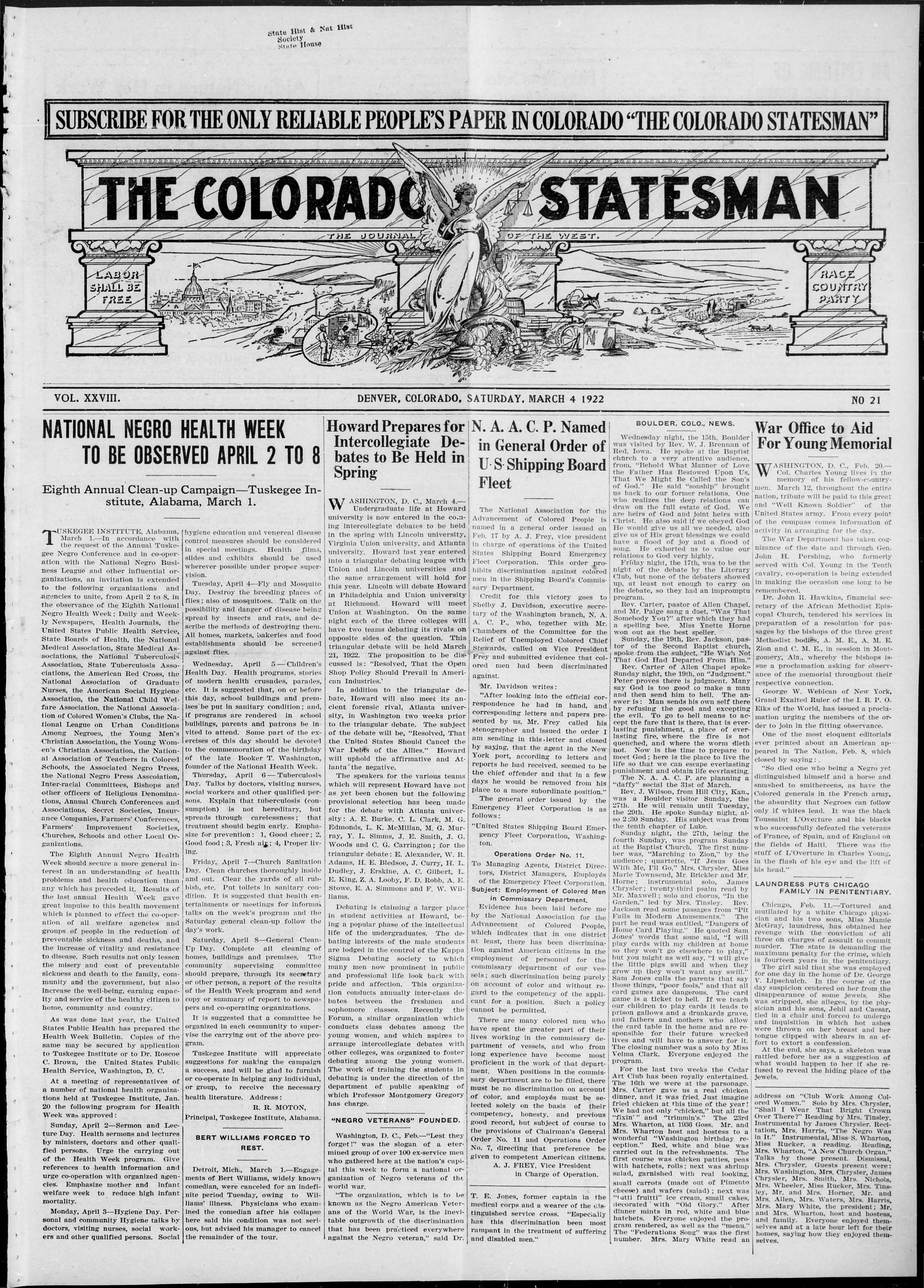
NATIONAL NEGRO HEALTH WEEK TO BE OBSERVED APRIL 2 TO 8
Eighth Annual Clean-up Campaign—Tuskegee Institute, Alabama, March 1.
VOL. XXVIII.
NATIONAL NEGRO TO BE OBSER
Eighth Annual Clean-up institute, Alaba
TUSKEGEE INSTITUTE, Alabama, March 1.—In accordance with the request of the Annual Tuskegee Negro Conference and in co-operation with the National Negro Business League and other influential organizations, an invitation is extended to the following organizations and agencies to unite, from April 2 to 8, in the observance of the Eighth National Negro Health Week; Daily and Weekly Newspapers, Health Journals, the United States Public Health Service, State Boards of Health, the National Medical Association, State Medical Associations, the National Tuberculosis Association, State Tuberculosis Associations, the American Red Cross, the National Association of Graduate Nurses, the American Social Hygiene Association, the National Child Welfare Association, the National Association of Colored Women's Clubs, the National League on Urban Conditions Among Negroes, the Young Men's Christian Association, the Young Women's Christian Association, the National Association of Teachers in Colored Schools, the Associated Negro Press, the National Negro Press Association, Inter-racial Committees, Bishops and other officers of Religious Denominations, Annual Church Conferences and Associations, Secret Societies, Insurance Companies, Farmers' Conferences, Farmers' Improvement Societies, Churches, Schools and other Local Organizations.
The Eighth Annual Negro Health Week should secure a more general interest in an understanding of health problems and health education than any which has preceded it. Results of the last annual Health Week gave great impulse to this health movement which is planned to effect the co-operation of all welfare agencies and groups of people in the reduction of preventable sickness and deaths, and the increase of vitality and resistance to disease. Such results not only lessen the misery and cost of preventable sickness and death to the family, community and the government, but also increase the well-being, earning capacity and service of the healthy citizen to home, community and country.
As was done last year, the United States Public Health has prepared the Health Week Bulletin. Copies of the same may be secured by application to Tuskegee Institute or to Dr. Roscoe C. Brown, the United States Public Health Service, Washington, D. C.
At a meeting of representatives of a number of national health organizations held at Tuskegee Institute, Jan. 20 the following program for Health Week was approved:
Sunday, April 2—Sermon and Lecture Day. Health sermons and lectures by ministers, doctors and other qualified persons. Urge the carrying out of the Health Week program. Give references to health information and urge co-operation with organized agencies. Emphasize mother and infant welfare week to reduce high infant mortality.
Monday, April 3—Hygiene Day. Personal and community Hygiene talks by doctors, visiting nurses, social workers and other qualified persons. Social
State Hist & Nat Hist Society State House
FOR THE ONLY RELIABLE
COLORA
HEALTH WEEK
VED APRIL 2 TO 8
Campaign—Tuskegee In-
ma, March 1.
---
hygiene education and venereal disease control measures should be considered in special meetings. Health films, slides and exhibits should be used wherever possible under proper supervision.
Tuesday, April 4—Fly and Mosquito Day. Destroy the breeding places of flies; also of mosquitoes. Talk on the possibility and danger of disease being spread by insects and rats, and describe the methods of destroying them. All homes, markets, bakeries and food establishments should be screened against flies.
Wednesday, April 5—Children's Health Day. Health programs, stories of modern health crusades, parades, etc. It is suggested that, on or before this day, school buildings and premises be put in sanitary condition; and, if programs are rendered in school buildings, parents and patrons be invited to attend. Some part of the exercises of this day should be devoted to the commemoration of the birthday of the late Booker T. Washington, founder of the National Health Week.
Thursday, April 6—Tuberculosis Day. Talks by doctors, visiting nurses, social workers and other qualified persons. Explain that tuberculosis (consumption) is not hereditary, but spreads through carelessness; that treatment should begin early. Emphasize for prevention: 1, Good cheer; 2, Good food; 3, Fresh air; 4, Proper living.
Friday, April 7—Church Sanitation Day. Clean churches thoroughly inside and out. Clear the yards of all rubish, etc. Put toilets in sanitary condition. It is suggested that health entertainments or meetings for informal talks on the week's program and the Saturday general clean-up follow the day's work.
Saturday, April 8—General Clean-Up Day. Complete all cleaning of homes, buildings and premises. The community supervising committee should prepare, through its secretary or other person, a report of the results of the Health Week program and send copy or summary of report to newspapers and co-operating organizations.
It is suggested that a committee be organized in each community to supervise the carrying out of the above program.
Tuskegee Institute will appreciate suggestions for making the campaign a success, and will be glad to furnish or co-operate in helping any individual, or group, to receive the necessary health literature. Address:
R. R. MOTON,
Principal, Tuskegee Institute, Alabama.
BERT WILLIAMS FORCED TO REST.
Detroit, Mich., March 1.—Engagements of Bert Williams, widely known comedian, were canceled for an indefinite period Tuesday, owing to Williams' illness. Physicians who examined the comedian after his collapses here said his condition was not serious, but advised his manager to cancel the remainder of the tour.
DENVER, COLORADO, SATURDAY, MARCH 4 1922
Howard Prepares for Intercollegiate Debates to Be Held in Spring
WASHINGTON, D. C., March 4. Undergraduate life at Howard university is now entered in the coming intercollegiate debates to be held in the spring with Lincoln university, Virginia Union university, and Atlanta university. Howard last year entered into a triangular debating league with Union and Lincoln universities and the same arrangement will hold for this year. Lincoln will debate Howard in Philadelphia and Union university at Richmond. Howard will meet Union at Washington. On the same night each of the three colleges will have two teams debating its rivals on opposite sides of the question. This triangular debate will be held March 21, 1922. The proposition to be discussed is: "Resolved, That the Open Shop Policy Should Prevail in American Industries."
In addition to the triangular debate, Howard will also meet its ancient forensic rival, Atlanta university, in Washington two weeks prior to the triangular debate. The subject of the debate will be, "Resolved, That the United States Should Cancel the War Debts of the Allies." Howard will uphold the affirmative and Atlanta the negative.
The speakers for the various teams which will represent Howard have not as yet been chosen but the following provisional selection has been made for the debate with Atlanta university: A. E. Burke, C. L. Clark, M. G. Edmonds, L. K. McMillan, M. G. Murray, Y. L. Simms, J. E. Smith, J. G. Woods and C. G. Carrington; for the triangular debate: E. Alexander, W. R. Adams, H. E. Bledsoe, J. Curry, H. L. Dudley, J. Erskine, A. C. Gilbert, L. E. King, Z. A. Looby, F. D. Robb, A. E. Stowe, E. A. Simmons and F. W. Williams.
Debating is claiming a larger place in student activities at Howard, being a popular phase of the intellectual life of the undergraduates. The debating interests of the male students are lodged in the control of the Kappa Sigma Debating society to which many men now prominent in public and professional life look back with pride and affection. This organization conducts annually inter-class debates between the freshmen and sophomore classes. Recently the Forum, a similar organization which conducts class debates among the young women, and which aspires to arrange intercollegiate debates with other colleges, was organized to foster debating among the young women. The work of training the students in debating is under the direction of the department of public speaking of which Professor Montgomery Gregory has charge.
"NEGRO VETERANS" FOUNDED.
Washington, D. C., Feb.—"Lest they forget!" was the slogan of a determined group of over 100 ex-service men who gathered here at the nation's capital this week to form a national organization of Negro veterans of the world war.
"The organization, which is to be known as the Negro American Veterans of the World War, is the inevitable outgrowth of the discrimination that has been practiced everywhere against the Negro veteran," said Dr.
N. A. A. C. P. Named in General Order of U.S. Shipping Board Fleet
The National Association for the Advancement of Colored People is named in a general order issued on Feb. 17 by A. J. Frey, vice president in charge of operations of the United States Shipping Board Emergency Fleet Corporation. This order prohibits discrimination against colored men in the Shipping Board's Commissary Department. Credit for this victory goes to Shelby J. Davidson, executive secretary of the Washington branch, N. A. A. C. P., who, together with Mr. Chambers of the Committee for the Relief of Unemployed Colored Chief Stewards, called on Vice President Frey and submitted evidence that colored men had been discriminated against.
Mr. Davidson writes:
"After looking into the official correspondence he had in hand, and corresponding letters and papers presented by us, Mr. Frey called his stenographer and issued the order I am sending in this letter and closed by saxing, that the agent in the New York port, according to letters and reports he had received, seemed to be the chief offender and that in a few days he would be removed from his place to a more subordinate position." The general order issued by the Emergency Fleet Corporation is as follows:
"United States Shipping Board Emergency Fleet Corporation, Washington.
Operations Order No. 11.
To Managing Agents, District Directors, District Managers, Employés of the Emergency Fleet Corporation. Subject: Employment of Colored Men in Commissary Department. Evidence has been laid before me by the National Association for the Advancement of Colored People, which indicates that in one district at least, there has been discrimination against American citizens in the employment of personnel for the commissary department of our vessels; such discrimination being purely on account of color and without regard to the competency of the applicant for a position. Such a policy cannot be permitted.
There are many colored men who have spent the greater part of their lives working in the commissary department of vessels, and who from long experience have become most proficient in the work of that department. When positions in the commissary department are to be filled, there must be no discrimination on account of color, and employés must be selected solely on the basis of their competency, honesty, and previous good record, but subject of course to the provisions of Chairman's General Order No. 11 and Operations Order No. 7, directing that preference be given to competent American citizens. A. J. FREY, Vice President in Charge of Operation.
T. E. Jones, former captain in the medical corps and a wearer of the distinguished service cross. "Especially has this discrimination been most rampant in the treatment of suffering and disabled men."
BOULDER, COLO., NEWS.
Wednesday night, the 15th, Boulder was visited by Rev. W. J. Brennan of Red, Iowa. He spoke at the Baptist church to a very attentive audience, from, "Behold What Manner of Love the Father Has Bestowed Upon Us, That We Might Be Called the Son's of God." He said "sonship" brought us back to our former relations. One who realizes the deep relations can draw on the full estate of God. We are heirs of God and joint heirs with Christ. He also said if we obeyed God He would give us all we needed, also give us of His great blessings we could have a flood of joy and a flood of song. He exhorted us to value our relations to God very highly.
Friday night, the 17th, was to be the night of the debate by the Literary Club, but none of the debaters showed up, at least not enough to carry on the debate, so they had an impromptu program.
Rev. Carter, pastor of Allen Chapel, and Mr. Paige sang a duet, "Was That Somebody You?" after which they had a spelling bee. Miss Ynette Horne won out as the best speller.
Sunday, the 19th, Rev Jackson, pastor of the Second Baptist church, spoke from the subject, "He Wish Not That God Had Departed From Him."
Rev. Carter of Allen Chapel spoke Sunday night, the 19th, on "Judgment." Peter proves there is judgment. Many say God is too good to make a man and then send him to hell. The answer is: Man sends his own self there by refusing the good and excepting the evil. To go to hell means to accept the fare that is there, that is everlasting punishment, a place of everlasting fire, where the fire is not quenched, and where the worm dieth not. Now is the time to prepare to meet God; here is the place to live the life so that we can escape everlasting punishment and obtain life everlasting. The N. A. A. C. P. are planning a "daffy" social the 31st of March.
Rev. J. Wilson, from Hill City, Kan., was a Boulder visitor Sunday, the 27th. He will remain until Tuesday, the 29th. He spoke Sunday night, also 2:30 Sunday. His subject was from the tenth chapter of Luke.
Sunday night, the 27th, being the fourth Sunday, was program Sunday at the Baptist Church. The first number was, "Marching to Zion," by the audience; quartette, "If Jesus Goes With Me, I'll Go," Mrs. Chrysler, Miss Marie Townsend, Mr. Brickler and Mr. Horne; instrumental solo, James Chrysler; twenty-third psalm read by Mr. Maxwell; solo and chorus, "In the Garden," led by Mrs. Tinsley. Rev. Jackson read some passages from "Pit Falls in Modern Amusements." The part he read was entitled, "Dangers of Home Card Playing." He quoted Sam Jones' words that some said, "I will play cards with my children at home so they won't go elsewhere to play," but you might as well say, "I will give the little pigs swill and when they grow up they won't want any swill." Sam Jones calls the parents that say those things, "poor fools," and that all card games are dangerous. The card game is a ticket to hell. If we teach our children to play cards it leads to prison gallows and a drunkards grave, and fathers and mothers who allow the card table in the home and are responsible for their future wrecked lives and will have to answer for it. The closing number was a solo by Miss Velma Clark. Everyone enjoyed the program.
For the last two weeks the Cedar Art Club has been royally entertained. The 16th we were at the parsonage. Mrs. Carter gave us a real chicken dinner, and it was fried. Just imagine fried chicken at this time of the year! We had not only "chicken," but all the "fixin'" and "trimmin'". The 23rd Mrs. Wharton, at 1936 Goss. Mr. and Mrs. Wharton host and hostess to a wonderful "Washington birthday reception." Red, white and blue was carried out in the refreshments. The first course was chicken patties, pens with hatchets, rolls; next was shrimp salad, garnished with real looking, small carrots (made out of Pimento cheese) and wafers (salad); next was "utti fruitti" ice cream, small cakes, decorated with "Old Glory." After dinner mints in red, white and blue hatchets. Everyone enjoyed the program rendered, as well as the "menu." The "Federations Song" was the first number. Mrs. Mary White read an
NO 21
War Office to Aid For Young Memorial
WASHINGTON, D. C., Feb. 20.—Col. Charles Young lives in the memory of his fellow-countrymen. March 12, throughout the entire nation, tribute will be paid to this great and "Well Known Soldier" of the United States army. From every point of the compass comes information of activity in arranging for the day. The War Department has taken cognizance of the date and through Gen. John H. Pershing, who formerly served with Col. Young in the Tenth cavalry, co-operation is being extended in making the occasion one long to be remembered. Dr. John R. Hawkins, financial secretary of the African Methodist Episcopal Church, tendered his services in preparation of a resolution for passages by the bishops of the three great Methodist bodies, A. M. E., A. M. E. Zion and C. M. E., in session in Montgomery, Ala., whereby the bishops issue a proclamation asking for observance of the memorial throughout their respective connection. George W. Webican of New York, Grand Exalted Ruler of the I. B. P. O. Elks of the World, has issued a proclamation urging the members of the order to join in the fitting observance.
One of the most eloquent editorials ever printed about an American appeared in The Nation, Feb. 8, which closed by saying :
"So died one who being a Negro yet distinguished himself and a horse and smashed to smithereens, as have the Colored generals in the French army, the absurdity that Negroes can follow only if whites lead. It was the black Toussaint L'Overture and his blacks who successfully defeated the veterans of France, of Spain, and of England on the fields of Haiti. There was the stuff of L'Overture in Charles Young, in the flash of his eye and the lift of his head."
LAUNDRESS PUTS CHICAGO
FAMILY IN PENITENTIARY.
Chicago, Feb. 11.—Tortured and mutilated by a white Chicago physician and his two sons, Miss Mamie McGray, laudress, has obtained her revenge with the conviction of all three on charges of assault to commit murder. The state is demanding the maximum penalty for the crime, which is fourteen years in the penitentiary. The girl said that she was employed for one day in the home of Dr. George V. Lipschulch. In the course of the day suspicion centered on her from the disappearance of some jewels. She was stripped, she alleges, by the physician and his sons, Jehil and Caesar, tied in a chair and forced to undergo and inquisition in which hot ashes were thrown on her breast and her tongue clipped with shears in an effort to extort a confession. At the end, she says, a skeleton was rattled before her as a suggestion of what would happen to her if she refused to reveal the hiding place of the jewels.
address on "Club Work Among Colored Women." Solo by Mrs. Chrysler, "Shall I Wear That Bright Crown Over There?" Reading by Mrs. Tinsley, Instrumental by James Chrysler, Recitation, Mrs. Harris, "The Negro Was in It." Instrumental, Miss S. Wharton, Miss Rucker, a reading, Reading, Mrs. Wharton, "A New Church Organ." Talks by those present. Dismissal, Mrs. Chrysler, Guests present were: Mrs. Washington, Mrs. Chrysler, James Chrysler, Mrs. Smith, Mrs. Nichols, Mrs. Wheeler, Miss Rucker, Mrs. Tinsley, Mr. and Mrs. Horner, Mr. and Mrs. Allen, Mrs. Waters, Mrs. Harris, Mrs. Mary White, the president; Mr. and Mrs. Wharton, host and hostess, and family. Everyone enjoyed themselves and at a late hour left for their homes, saying how they enjoyed themselves.
FOREIGN
The brokerage house of Tousaw Hartland Anderson, Montreal, has assigned for the benefit of creditors. The announcement was made from the rostrum of the Montreal Stock exchange.
Evacuation of British troops from Ireland will be resumed, it has been announced. Two special steamers under British government orders, will leave the port of Dublin soon with troops and military stores.
The universal suffrage bill, introduced in the diet by the opposition, was defeated by a vote of 243 to 147 at Tokio. The final debate was not attended by the promised demonstration, a snow storm accompanied by a cold wave interfering.
A fire that swept the Tondo district of Manila recently, destroyed 800 small nipa houses and rendered homeless more than 4,000 natives. As there has been no rain recently, the nipa houses are dry as tinder and burned rapidly in a high wind that carried the flames over a wide area. An exceeding faith is shown in the name and picture of George Washington, since the scramble for foreign moneys began in Moscow. Money changers refuse to take any checks, and the American cash they accept must bear the engraving of George Washington. Such bills they call "Washington."
J. B. Murray of Woburn, Mass., connected with the American relief administration, suffered a slight flesh wound when fired upon in the street in Moscow recently. He was accompanied by a Mr. Callahan of Fall River, Mass. Whether the shot was fired by a highwayman or by street patrols who misinterpreted the actions of the Americans has not been determined. American food now is beginning to tell in the fight for lives of children in the famine districts near Moscow, where the American relief administration is in operation. But elsewhere the situation is growing more ghastly every day. In some villages where, before the relief administration kitchens were established, the deaths of children ranged from five to seven daily.
Great Britain has not yet received a penny of war indemnity from Germany, the House of Commons was told by Slr Robert Horne, chancellor of the exchequer. The cost of maintaining the forces of occupation, however, amounting to more than 1,000,000,000 gold marks, had been repaid to the extent of 970,000,000 marks. Of this sum £2,640,000 had been paid to Canada and Australia.
GENERAL
Four bandits held up the cashier and twenty-five members of the Franklin Printers' Union local No. 4 at Chicago and escaped with $4,000 in union funds. The holdup took place at union headquarters, where L. S. Mills, the cashier, was paying out sick benefit funds.
Judge Kenesaw Mountain Landis issued a temporary restraining order enjoining Arthur C. Lueder, postmaster of Chicago, from preventing the Chicago Tribune from going through the mails on the ground that a contest in which cash prizes were awarded to the possessors of "lucky names" was a lottery.
Formal announcement of the candidacy of Governor Edwards for United States senator on a "wet" platform will be made soon after the Legislature adjourns, Mayor Frank Hague of Jersey City, has stated. Mayor Hague was the governor's campaign manager when he ran for his present office. James M. Cox, Democratic presidential candidate in 1920, has accepted an invitation to address Iowa Democrats at a rally at Des Moines, Iowa, this month, which will inaugurate the state campaign, according to an announcement by Dr. J. W. Reynolds of Creston, chairman of the state committee.
Contributions to the Woodrow Wilson foundation offer opportunity for persons of all political beliefs to aid the cause of world peace, Henry Ford declared in a letter made public by Woodbridge N. Ferris of Big Rapids, former governor of Michigan and state chairman of the foundation. Mr. Ford enclosed a check for $10,000.
Failing in their efforts to gain entrance to an apartment in Cleveland, Ohio, where it was reported a gang of alleged safe crackers were living, police resorted to a "tear bomb." A window was broken and the bomb thrown inside. The result was almost instantaneous. Four men and three women surrendered and were taken to police headquarters for investigation.
Alfred E. Lindsay, accused of swindling society women out of nearly $1,000,000 in fake stock deals, confessed that many of the charges against him were true, according to Richard Murphy, assistant district attorney. Lindsay, a stock broker, was arrested at Overbrook, Pa., on an indictment charging grand larceny and brought to New York by detectives. Mrs. Fred McCormick, 38, Dallas, Texus, whose husband shot and killed himself after he fired a bullet at her, was saved by a silver dollar in her pocketbook. The bullet fired at her struck the dollar after passing through her arm and was deflected from the direction of her heart. The bullet was found in the pocketbook.
Relief of the unemployment situation by the removal of more than 2,000,000 children from industry was advocated by James J. Davis, secretary of labor, in an address at Lima, Ohio, recently
AN EPITOME OF LATE LIVE NEWS
BONDENSED RECORD OF THE PROGRESS OF EVENTS AT HOME AND ABROAD.
BAYINGS, DOINGS, ACHIEVE
MENTS, SUFFERINGS, HOPES
AND FEARS OF MANKIND.
WESTERN
Alfred R. Wildman, veteran newspaper man and author of nature stories, died at his home at San Francisco after an illness of three years.
Hanford MacNider, national commander of the American Legion, received a challenge to debate the bonus question before the city club post American Legion at Mason City, Iowa. The challenge was forwarded to him in Chicago.
Mr. and Mrs. Paul E. Gray, their two children, a baby of 6 and a girl of 3, besides a nurse, Miss Lillian Spencer, were killed at Santa Barbara, Calif., by inhaling carbon monoxide gas, which filled the Gray home from a gas water heater.
Wellington D. Rankin, attorney general of Montana and a brother of Miss Jeannette Rankin, the first woman member of Congress, announced that he will be a candidate for the Republican nomination for United States senator at the primaries next August.
What is declared to be the worst landslide in many years in the Cajon pass, California, buried the westbound track of the Santa Fé railroad between Cajon and Summit, where an eighth of a mile of track was covered, in some places to a depth of thirty feet.
Eleven hundred and fifty-four new cases of influenza have been reported in Los Angeles, it was announced recently by the quarantine officer, Physicians estimated that thousands of cases daily were not reported, but the epidemic is lighter than that of several years ago.
A scathing attack upon Senator Truman H. Newberry of Michigan, praise for the courage of James A. Reed of Missouri, and a strong defense of the agricultural bloc in Congress characterized the address of William S. Kenyon, former senator from Iowa, before the students of the University of Missouri, recently.
Rain at Emporia, Kan., and in the watershed of the Neosho river from which the city water supply comes, was received with rejoicing not only because of its benefit to crops, but because it will mean an unlimited supply of water for Emporia bathtubs. Emporia has been virtually on a ration system as far as bath water went since last summer with residents urged to use the existing supply as frugally as possible.
WASHINGTON
The postal service would be required to provide weekly pay days for all employees under a bill introduced by Senator Lodge, Republican, of Massachusetts.
George E. Long, the War Department clerk, who confessed to sending threatening letters to capital social leaders demanding money, was liberated as an "eccentric crank." The women refused to prosecute him and the postoffice officials decided he had violated no postal law under which he could be held.
Attorney General Daugherty has instructed federal authorities at Boise, Idaho, to release a Pullman car seized there by prohibition enforcement officers.
The United States has made a formal protest to the Japanese government against the smuggling of opium, morphine, heroin and other narcotics into this country by means of Japanese steamships.
The woman's suffrage, or nineteenth amendment, was declared constitutional by the Supreme Court. The court dismissed, for want of jurisdiction, the suit brought by Charles S. Fairchild of New York, who sought to challenge the constitutionality of the amendment.
The conference of trade union women adopted a resolution expressing opposition to the blanket amendment, proposed by the National Women's party, to the federal constitution for securing equal rights for women. The action of the conference was based, the resolution declared, on the belief that the amendment would be interpreted as invalidating laws now in force which apply to laboring women.
The war claims board, created during the world war to adjust claims against the government, has been dissolved, the War Department announced recently. Of the 30,000 claims filed with the board, only thirty-one remain to be settled. These are claims to the Dupont Engineering Company, the Remington Arms Company and the United States Cartridge Company.
Senator Capper, Republican, Kansas, was elected unanimously as chairman of the unofficial agricultural bloc of the Senate, succeeding former Senator Kenyon of Iowa.
Pithy News Notes
From All Parts of
Colorado
(Western Newspaper Union News Service.)
Brush.—A. D. Leerskov, city manager of Brush and one of the city's leaders in civic affairs, has resigned to enter private business. His successor has not yet been named.
Denver.—Paul Stahr of Walsenburg, Colo., told the police a few nights ago that two armed men held him up and robbed him of $4 as he was walking down Twenty-first street near Larlmer.
Denver.—Jacob Goldhammer of 2633 West Colfax avenue reported to police that he had been swindled out of 5,000 shares of United Petroleum oil stock by "a suave, well-dressed, distinguished looking young man."
Fort Collins.—The movement for cooperative bargaining by the sugar beet farmers in contracting with the Great Western Sugar Company for their beet acreage is rapidly gaining headway in northern Colorado.
Bianca.—David E. Judd, a rancher near Bianca, was shot and killed by "Black Jack" Devaul, a trapper, when he entered Devaul's cabin with an elevated rifle and commanded the men inside to hold up their hands.
Frederick.—Men in several more coal mines of the Frederick district have failed to appear for work. The action of men in several mines was reported recently and the present strike is in support of their refusal to accept a reduction in wages.
Pueblo.—Five male inmates of the Colorado State Hospital for the Insane escaped recently, according to announcement of the hospital attaches, and only one has been recaptured. The inmates who escaped are not considered violent or dangerous. Denver.—Colorado is one of the leading producing states in alfalfa meal, there being several large mills scattered in the agricultural districts. Those familiar with this product declare that Colorado alfalfa makes the finest meal of any alfalfa grown in the country.
Denver.—President Harding has appointed the following Colorado postmasters: Hall Parmeter, at Byers; William J. Jones, at Erie; Orpha T. Brunner, at Johnstown; Samuel B. Wasson, at Grand Valley; Clara A. Glllespie, at Stoneham; Anna C. Hanson, at Strasburg, and Albert Neuman, at Elbert. Loveland.—Larimer county beet growers, meeting at Loveland, recently decided by a unanimous vote to reject the present beet contract as proposed by the Great Western Sugar Company, and decided to leave the matter of negotiation entirely in the hands of the Mountain States Beet Growers' Association for adjustment.
Pueblo.—An entire city block of houses in the Mexican quarter of Pueblo was destroyed by fire recently. The fire started from an explosion and because of lack of water supply in this district, which is outside the city limits, fire fighters were unable to make any headway fighting the blaze. There were no casualties.
Florence.—James A. McCandless, 86 years old, member of the State Legislature in the Second and Third assemblies and a senator in the Sixth and Seventh assemblies, and who raised the first alfalfa in Colorado and bored the first oil well in the Florence district, died recently at his home in Florence. Mr. McCandless was founder of the city and was its first mayor. He purchased all the land on which Florence is located in 1884, paying for it with a $1,500 ranch and 100 head of steers. He plotted a township, had it incorporated and named it in honor of one of his daughters.
Grand Junction.—Glenwood Springs, Montrose and Delta members of Lions Clubs were in Grand Junction en masse recently to receive their charters with the local club, from the international organization. Grand Junction, the oldest organization of this order in this section, was formed six months ago and has more than sixty members now.
Rocky Ford.—The body of Marclano Santillon, a leader in the Mexican colony at Swink for ten years, was found burled in a dumping ground west of this city, with evidence that the man had been beaten to death. A man named O'Cannis, countryman of Santillon, is in the county jail charged with the murder. Santillon was last seen at a dance given in Swink.
Pueblo.—An entire city block of houses in the Mexican quarter of Pueblo was destroyed by fire here recently. The fire started from an explosion, and because of lack of water supply in this district, which is outside the city limits, fire fighters were unable to make any headway fighting the blaze. There were no casualties. The damage was estimated at close to $10,000.
Denver.—Asserting that he had been barred from moving upon his homestead on penalty of death for himself and family, Bryant H. Stringham, a rancher of southwestern Moffat county, recently filed a petition for protection with the field division of the United States land office in Denver.
Pueblo.—Cracksmen entered the postoffice at Lime, a small town near Pueblo, recently, and made away with exactly $6 in cash. Authorities say the robbery is decidedly similar to the one at Avondale recently.
CENTENNIAL STATE ITEMS.
Denver.—The Colorado Supreme Court issued a writ against District Judge Samuel W. Johnson of the First judicial district, commanding him to show cause why he should not be prohibited from trying a suit brought against Secretary of State Milliken by eight discharged automobile inspectors of the state motor vehicle department. William Kelly and seven other discharged inspectors brought suit in Littleton to compel Milliken to put them back to work, claiming the action of the General Assembly was illegal.
Greeley.-Five dollars a ton for sugar beets, and probably more, was the prediction under the sliding scale contract made at a meeting here of Great Western Sugar Company officials and fieldmen from the Greeley, Eaton, Windsor and Brighton factories. The session was the first of a series to be held between officials of the company and the fieldmen in all districts, to explain in detail the contract proposed at the recent conference with the growers' committee in Denver.
Fort Lupton.—The appointment of a receiver for the Industrial Sugar Company, large independent sugar manufacturer, with a factory at Fort Lupton, has been asked in a petition filed in the District Court by the Hamilton National Bank, trustee for the company. The petition states that the last two sugar campaigns of the company resulted in heavy losses, and states that the business of the company due to present conditions, is largely speculative and uncertain.
Denver.—The amount of direct taxes paid per capita in Colorado is increasing steadily and rapidly, according to figures compiled by the State Immigration Department from the records of the State Tax Commission. These figures show that the total of state, county, municipal and school taxes assessed in the state in 1920 amounted to $41.95 per capita, compared with $35.44 per capita in 1919. Figures for 1921 are not yet available.
Colorado Springs.—Following a robbery at Falcon, fifteen miles east of Colorado Springs, in which merchandise valued at $1,000 was taken, Colorado Springs police have arrested two men and recovered the full amount of loot. The men in jail are: Dave Dotty and Marion Bratton, both of whom are alleged by the Colorado Springs police to have criminal records. It is believed that several similar robberies in the section can bet raced to them, the police say.
Denver.—The Colorado Society of the Sons of the American Revolution elected Judge George H. Bradfield of Greeley president of their annual meeting in the state house recently. Other officers elected were Victor E. Keyes, vice president; James Polk Willard of Denver, secretary; Walter D. Wynkoop, treasurer; Lathrop M. Taylor, Fort Collins, historian and the Rev. Frederick A. Hatch of Pueblo, chaplain.
Leadville.—Sazino Azeno was shot and killed during a fight at a dance here, and Mike La Zado is in jail here charged with having shot Azeno. According to witnesses, La Zado made a remark about a woman with whom Azeno was dancing. The latter resented La Zado's remark, it is said, and a fight started which developed into a free-for-all affair.
Castle Rock.—The body of a well-dressed man, believed to have come from Denver, was found hanging to a tree near the railroad tracks six miles south of Castle Rock recently by two coyote trappers. The man had committed suicide by hanging himself with his belt. Salida.—That the granito business would some day prove a great asset to Salida and its vicinity is about to be realized. Many new companies are being organized for business, a new road to the district is planned for the immediate future and the industry is picking up.
Breckenridge.—A rotary snowplow pushed by three locomotives left Breckenridge recently to remove two huge snowslides near Curtin Spur in Ten Mile canon on the Colorado & Southern route to Leadville. Denver trains were held at Dillon. One of the snow-slides was reported as being 150 feet long with ten feet of snow on the track and the other 200 feet long and fifteen feet deep.
Colorado Springs.—Viel Battle, a negro, charged with the holdup of Dan U. Hampton, prominent real estate man, was arrested by Officer Robert Wraith as he was about to board a southbound train in the D. & R. G. railroad yards. A roll of bills containing $90, alleged to have been taken from Hampton, was found on the negro, who submitted to arrest only after a sharp struggle with the officer.
Loveland. At a meeting of beet growers at Loveland, attended by 150 farmers of that section, the contract offered by the Great Western Sugar Company was rejected. The meeting voted to place the exclusive power of making contracts for beet growing in this region with the Mountain State Beet Growers' Association.
Fort Collins.—A mysterious stroller, whose name is believed to be Sabbett and who is believed to live in Washington, D. C., is in the county jail at Fort Collins pending an investigation into his mental condition. Residents near Lincoln park saw a man sitting on a park bench, and a little later he was seen to be lying down, apparently unconscious. A little paris green was left in a package which had contained a dime worth of the poison, so he was given treatment for poisoning under the supposition that he had made an effort to commit suicide.
Aiding Nature in Her Work
TO repair the damage done by destructive forces is a process of no short time. But to prevent these bad effects is but the routine of a few precious moments.
In either case, Madam C. J. Walker's Superfine Toilettes stand ready to aid you in the task at hand.
FOR PREMATURELY OLD COMPLEXIONS—
Madam C. J. Walker's Vanishing Cream
Superfine Face Powder
(white, rose-flesh, brown)
Compact Rouge
TO PREVENT THE ON-RUSH OF OLD AGE—
Madam C. J. Walker's Cleansing Cream
Witch Hazel Jelly
Floral Cluster Talc
640 North West Street Indianapolis, Ind. of 18 superfine preperations hair and skin
Makers of 18 superfine preperations for the hair and skin
Tan-Off—A Skin Bleach
any years thousands of Madam C. J. Walker's as-
sid her to perfect an effective skin bleach, and
commands, she made arrangements to place Tan-
l her daughter, who succeeded her as President
of three years of effort, has perfected and recor-
the Tan-Off—a safe and efficient compound for
sallow skin, an effective treatment for tan, fin-
and for clearing dull, lifeless complexions.
A TRIAL WILL CONVINCE YOU
Highly Recommended—Scientifically Indorsed
5 CENTS—OF AGENTS, DRUGGISTS, BY MA-
ALL ORDER TO THE MADAM C. J. WALKER
640 North West Street, Indianapolis, Ind.
For many years thousands of Madam C. J. Walker's satisfied customers urged her to perfect an effective skin bleach, and in response to their demands, she made arrangements to place Tan-Off on the market, and her daughter, who succeeded her as President of the Company, after three years of effort, has perfected and recommends for frequent use Tan-Off—a safe and efficient compound for brightening dark and sallow skin, an effective treatment for tan, freckles and skin blotch and for clearing dull, lifeless complexions.
A TRIAL WILL CONVINCE YOU
Highly Recommended—Scientifically Indorsed
35 CENTS—OF AGENTS, DRUGG'SY. BY MAIL
ADDRESS ALL ORDER TO THE MADAM C. J. WALKER MFG. CO.
640 North West Street, Indianapolis, Ind.
SUMMER "FLU"
CURED BY THE SAN TOX COUGH AND REMEDY.
OFF—MADAM WALKER'S SKIN BLEACH
The Atlas Drug
The Five Points Postal Station.
MAIN 875. 2701
S
l
pany
SIGNS PUT UP WHILE YOU WAIT
HATS AND CUT FLOWERS CONSTANTLY ON HAND
USES: Thirty-Fourth and Curtis Streets
MAIN 1511 DENVER. COLO
herhead
C. B. W.
PHONE MAIN 3203
EATHERHEAD
HAT FACTORY
ESTABLISHED 1874
D WOMEN'S UNCLAIMED HATS FOR SALE
PANAMAS AND WHITE MILANS
T STREET ALBANY HOTEL
C. E. SMITH, Manager, Res. Phone South 1608
e Market Compa
and Retail Staple and Fancy Groceries, Fish and
and Restaurants Our Specialty. Fresh and
Eastern Corn Fed Meats
Fruits, Vegetables, Poultry and Game.
Telephones Main 4302, 4303, 4304, 4305
TH STREET DENVER, C
IS BEST CURED BY THE SAN TOX COUGH AND COLD REMEDY.
The
Curtis
Park
Floral
Company
FLORAL DESIGNS PUT UP WHILE
YOU WAIT
CHOICE PLANTS AND CUT FLOWERS CONSTANTLY
ON HAND
GREENHOUSES: Thirty-Fourth and Curtis Streets
TELEPHONE, MAIN 1511
DEMVER, COLO
WEATHERHEAD
HAT FACTORY
ESTABLISHED 1874
MEN'S AND WOMEN'S UNCLAIMED HATS FOR SALE—FELTS,
PANAMAS AND WHITE MILANS
1722 STOUT STREET
ALBANY HOTEL BLDG.
Wholesale and Retail Staple and Fancy Groceries, Fish and Oysters.
Hotels and Restaurants Our Specialty. Fresh and Cured
Fruits, Vegetables, Poultry and Game.
Telephones Main 4302, 4303, 4804, 4305
622-636 15TH STREET DENVER, COLORADO
WHEN YOU WANT
The Heads, Feet, Talls, Snouts, Neckbones or Chitlerings, or any other part of the hog except the squeal, go to EAST'S MARKET PHONE MAIN 1461. 2300-6 LARIMER STREET.
Feet, Talls, Snouts, Neckbones or Chitlering of the hog except the squeal, go to EAST'S MARKET BAIN 1461. 2300-6 LARIMER
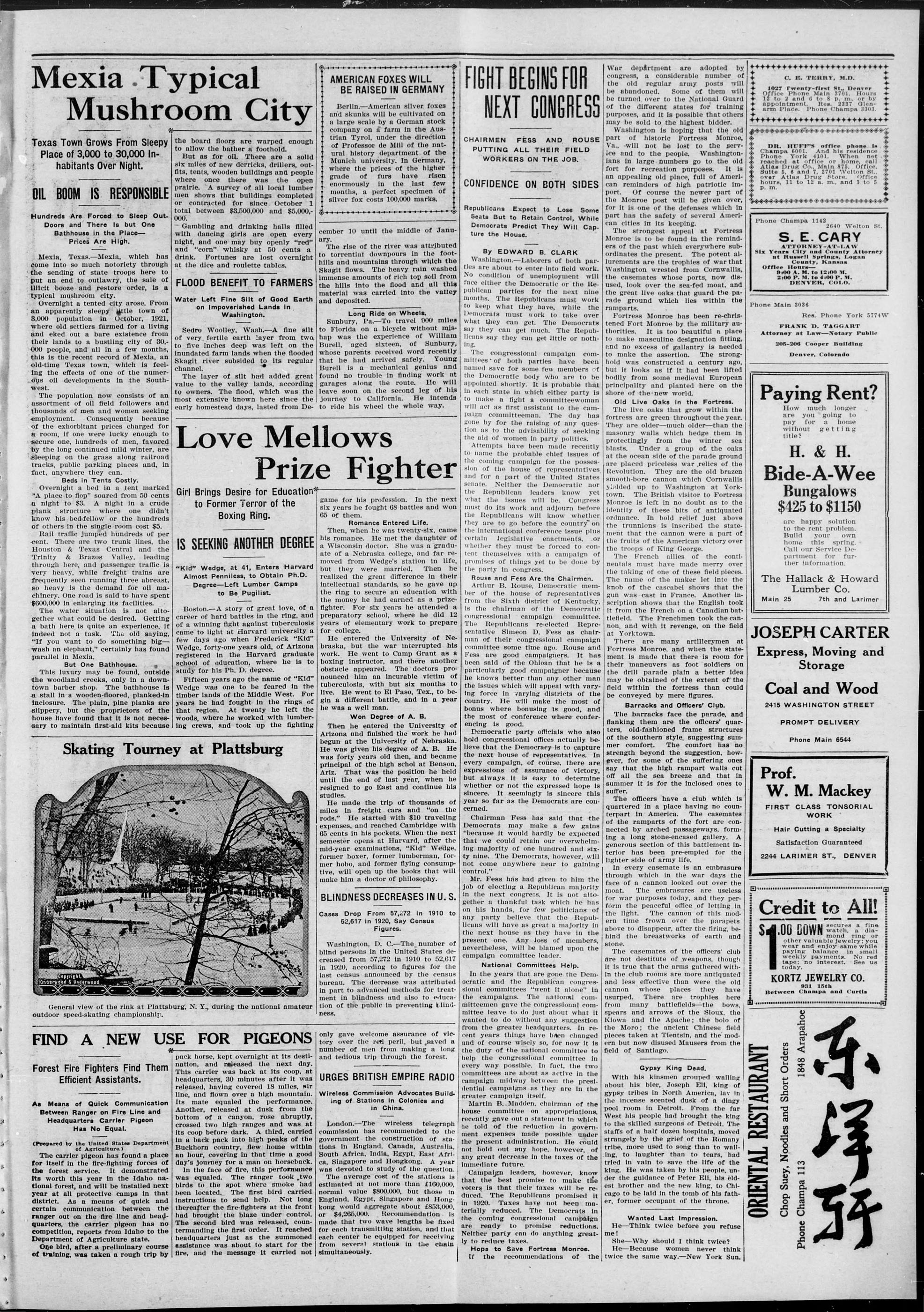
Mexia Typical Mushroom City
Copyright
Underwood & Underwood
General view of the rink at Plattsburg, N. Y., during the national amateur outdoor speed-skating championship.
FIND A NEW USE FOR PIGEONS
Texas Town Grows From Sleepy Place of 3,000 to 30,000 Inhabitants Over Night.
OIL BOOM IS RESPONSIBLE
Hundreds Are Forced to Sleep Out-Doors and There Is but One Bathhouse in the Place—Prices Are High.
Mexia, Texas.—Mexia, which has come into so much notoriety through the sending of state troops here to put an end to outlawry, the sale of illicit booze and restore order, is a typical mushroom city.
Overnight a tented city arose. From an apparently sleepy little town of 3,000 population in October, 1921, where old settlers farmed for a living and eked out a bare existence from their lands to a bustling city of 30,000 people, and all in a few months, this is the recent record of Mexia, an old-time Texas town, which is feeling the effects of one of the numerous oil developments in the Southwest.
The population now consists of an assortment of oil field followers and thousands of men and women seeking employment. Consequently because of the exhorbitant prices charged for a room, if one were lucky enough to secure one, hundreds of men, favored by the long continued mild winter, are sleeping on the grass along railroad tracks, public parking places and, in fact, anywhere they can.
Overnight a bed in a tent marked "A place to flop" soared from 50 cents a night to $3. A night in a crude plank structure where one didn't know his bed-fellow or the hundreds of others in the single room cost $5. Rail traffic jumped hundreds of per cent. There are two trunk lines, the Houston & Texas Central and the Trinity & Brazos Valley, leading through here, and passenger traffic is very heavy, while freight trains are frequently seen running three abreast, so heavy is the demand for oil machinery. One road is said to have spent $600,000 in enlarging its facilities. The water situation is not altogether what could be desired. Getting a bath here is quite an experience, if indeed not a task. The old saying, "If you want to do something big—wash an elephant," certainly has found parallel in Mexia.
But One Bathhouse.
This luxury may be found, outside the woodland creeks, only in a downtown barber shop. The bathhouse is a stall in a wooden-floored, planked-in enclosure. The plain, pine planks are slippery, but the proprietors of the house have found that it is not necessary to maintain first-aid kits because
Skating Tourne
Copyright
Underwood & Underwood
General view of the rink at Plattsburgh
outdoor speed-skating championship.
FIND A NEW US
Forest Fire Fighters Find Them Efficient Assistants.
As Means of Quick Communication Between Ranger on Fire Line and Headquarters Carrier Pigeon Has No Equal.
(Prepared by the United States Department of Agriculture.)
The carrier pigeon has found a place for itself in the fire-fighting forces of the forest service. It demonstrated its worth this year in the Idaho national forest, and will be installed next year at all protective camps in that district. As a means of quick and certain communication between the ranger out on the fire line and headquarters, the carrier pigeon has no competition, reports from Idaho to the Department of Agriculture state.
One bird, after a preliminary course of training, was taken a rough trip by
---
Love Mellows Prize Fighter
the board floors are warped enough to allow the bather a foothold.
But as for oil. There are a solid six miles of new derricks, drillers, outfits, tents, wooden buildings and people where once there was the open prairie. A survey of all local lumber men shows that buildings completed or contracted for since October 1 total between $3,500,000 and $5,000,-000.
Gambling and drinking halls filled with dancing girls are open every night, and one may buy openly "red" and "corn" whisky at 50 cents a drink. Fortunes are lost overnight at the dice and roulette tables.
FLOOD BENEFIT TO FARMERS
Water Left Fine Silt of Good Earth on Impoverished Lands In Washington.
Sedro Woolley, Wash.—A fine silt of very fertile earth layer from two to five inches deep was left on the inundated farm lands when the flooded Skagit river subsided to its regular channel.
The layer of silt had added great value to the valley lands, according to owners. The flood, which was the most extensive known here since the early homestead days, lasted from De-
Love Me
Prize
Girl Brings Desire for Education
to Former Terror of the
Boxing Ring.
IS SEEKING ANOTHER DEGREE
"Kid" Wedge, at 41, Enters Harvard Almost Penniless, to obtain Ph.D. Degree—Left Lumber Camps to Be Pugilist.
Boston.—A story of great love, of a career of hard battles in the ring, and of a winning fight against tuberculosis came to light at Harvard university a few days ago when Frederick "Kid" Wedge, forty-one years old, of Arizona registered in the Harvard graduate school of education, where he is to study for his Ph. D. degree.
Fifteen years ago the name of "Kid" Wedge was one to be feared in the timber lands of the Middle West. For years he had fought in the rings of that region. At twenty he left the woods, where he worked with lumbering crews, and took up the fighting
y at Plattsburg
burg, N. Y., during the national amateur
SE FOR PIGEONS
pack horse, kept overnight at its destination, and released the next day. This carrier was back at its coop, at headquarters, 30 minutes after it was released, having covered 18 miles, air line, and flown over a high mountain. Its mate equaled the performance. Another, released at dusk from the bottom of a canyon, rose abruptly, crossed two high ranges and was at its coop before dark. A third, carried in a back pack into high peaks of the Buckhorn country, flew home within an hour, covering in that time a good day's journey for a man on horseback.
In the face of fire, this performance was equaled. The ranger took two birds to the spot where smoke had been located. The first bird carried instructions to send help. Not long thereafter the fire-fighters at the front had brought the blaze under control. The second bird was released, countermanding the first order. It reached headquarters just as the summoned assistance was about to start for the fire, and the message it carried not
AMERICAN FOXES WILL BE RAISED IN GERMANY
Berlin.—American silver foxes and skunks will be cultivated on a large scale by a German stock company on a farm in the Austrian Tyrol, under the direction of Professor de Mill of the natural history department of the Munich university. In Germany, where the prices of the higher grade of furs have risen enormously in the last few months, a perfect specimen of silver fox costs 100,000 marks.
cember 10 until the middle of January. The rise of the river was attributed to torrential downpours in the foothills and mountains through which the Skagit flows. The heavy rain washes immense amounts of rich top soil from the hills into the flood and all this material was carried into the valley and deposited.
Long Ride on Wheels.
Sunbury, Pa.—To travel 900 miles to Florida on a bicycle without mishap was the experience of William Burell, aged sixteen, of Sunbury, whose parents received word recently that he had arrived safely. Young Burell is a mechanical genius and found no trouble in finding work at garages along the route. He will leave soon on the second leg of his journey to California. He intends to ride his wheel the whole way.
llows
e Fighter
game for his profession. In the next six years he fought 68 battles and won 65 of them.
Romance Entered Life.
Then, when he was twenty-six, came his romance. He met the daughter of a Wisconsin doctor. She was a graduate of a Nebraska college, and far removed from Wedge's station in life, but they were married. Then he realized the great difference in their intellectual standards, so he gave up the ring to secure an education with the money he had earned as a prize-fighter. For six years he attended a preparatory school, where he did 12 years of elementary work to prepare for college.
He entered the University of Nebraska, but the war interrupted his work. He went to Camp Grant as a boxing instructor, and there another obstacle appeared. The doctors pronounced him an incurable victim of tuberculosis, with but six months to live. He went to El Paso, Tex., to begin a different battle, and in a year he was a well man.
Won Degree of A. B.
Then he entered the University of Arizona and finished the work he had begun at the University of Nebraska. He was given his degree of A. B. He was forty years old then, and became principal of the high school at Benson, Artz. That was the position he held until the end of last year, when he resigned to go East and continue his studies.
He made the trip of thousands of miles in freight cars and "on the rods." He started with $10 travelling expenses, and reached Cambridge with 65 cents in his pockets. When the next semester opens at Harvard, after the mid-year examinations, "Kid" Wedge, former boxer, former lumberman, former hobo, and former flying consumptive, will open up the books that will make him a doctor of philosophy.
BLINDNESS DECREASES IN U. S.
Cases Drop From 57,272 in 1910 to 52,617 in 1920, Say Census Figures.
Washington, D. C.—The number of blind persons in the United States decreased from 57,272 in 1910 to 52,617 in 1920, according to figures for the last census announced by the census bureau. The decrease was attributed in part to advanced methods for treatment in blindness and also to education of the public in preventing blindness.
only gave welcome assurance of victory over the red peril, but saved a number of men from making a long and tedious trip through the forest.
URGES BRITISH EMPIRE RADIO
Wireless Commission Advocates Building of Stations in Colonies and in China.
London.—The wireless telegraph commission has recommended to the government the construction of stations in England, Canada, Australia, South Africa, India, Egypt, East Africa, Singapore and Hongkong. A year was devoted to study of the question. The average cost of the stations is estimated at not more than £160,000, normal value $800,000, but those in England, Egypt, Singapore and Hongkong would aggregate about £853,000, or $4,265,000. Recommendation is made that two wave lengths be fixed for each transmitting station, and that each center be equipped for receiving from several stations in the chain simultaneously.
---
FIGHT BEGINS FOR NEXT CONGRESS
CHAIRMEN FESS AND ROUSE PUTTING ALL THEIR FIELD WORKERS ON THE JOB.
CONFIDENCE ON BOTH SIDES
Republicans Expect to Lose Some Seats But to Retain Control, While Democrats Predict They Will Capture the House.
By EDWARD B. CLARK
Washington.—Laborers of both parties are about to enter into field work. No condition of unemployment will face either the Democratic or the Republican parties for the next nine months. The Republicans must work to keep what they have, while the Democrats must work to take over what they can get. The Democrats say they can get much. The Republicans say they can get little or nothing.
The congressional campaign committees of both parties have been named save for some few members of the Democratic body who are to be appointed shortly. It is probable that in each state in which either party is to make a fight a committeeewoman will act as first assistant to the campaign committeeman. The day has gone by for the raising of any question as to the advisability of seeking the aid of women in party politics.
Attempts have been made recently to name the probable chief issues of the coming campaign for the possession of the house of representatives and for a part of the United States senate. Neither the Democratic nor the Republican leaders know yet what the issues will be. Congress must do its work and adjourn before the Republicans will know whether they are to go before the country on the international conference issue plus certain legislative enactments, or whether they must be forced to content themselves with a campaign of promises of things yet to be done by the party in congress.
Rouse and Fess Are the Chairmen.
Arthur B. Rouse, Democratic member of the house of representatives from the Sixth district of Kentucky, is the chairman of the Democratic congressional campaign committee. The Republicans re-elected Representative Simeon D. Fess as chairman of their congressional campaign committee some time ago. Rouse and Fess are good campaigners. It has been said of the Ohioan that he is a particularly good campaigner because he knows better than any other man the issues which will appeal with varying force in varying districts of the country. He will make the most of bonus where bonusing is good, and the most of conference where conferencing is good.
Democratic party officials who also hold congressional offices actually believe that the Democracy is to capture the next house of representatives. In every campaign, of course, there are expressions of assurance of victory, but always it is easy to determine whether or not the expressed hope is sincere. It seemingly is sincere this year so far as the Democrats are concerned. Chairman Fess has said that the Democrats may make a few gains "because it would hardly be expected that we could retain our overwhelming majority of one hundred and sixty nine. The Democrats, however, will not come anywhere near to gaining control."
Mr. Fess has had given to him the job of electing a Republican majority in the next congress. It is not altogether a thankful task which he has on his hands, for few politicians of any party believe that the Republicans will have as great a majority in the next house as they have in the present one. Any loss of members, nevertheless, will be blamed upon the campaign committee leader.
National Committees Help.
In the years that are gone the Democratic and the Republican congressional committees "went it alone" in the campaigns. The national committee gave the congressional committee leave to do just about what it wanted to do without any suggestion from the greater headquarters. In recent years things have been changed and of course wisely so, for now it is the duty of the national committee to help the congressional committee in every way possible. In fact, the two committees are about as active in the campaign midway between the presidential campaigns as they are in the greater campaign itself.
Martin B. Madden, chairman of the house committee on appropriations, recently gave out a statement in which he told of the reduction in government expenses made possible under the present administration. He could not hold out any hope, however, of any great decrease in the taxes of the immediate future.
Campaign leaders, however, know that the best promise to make the voters is that their taxes will be reduced. The Republicans promised it in 1920. Taxes have not been materially reduced. The Democrats in the coming congressional campaign are ready to promise reductions. Neither party can do anything greatly to reduce taxes.
Hops to Save Fortress Monroe.
If the recommendations of the
War department are adopted by congress, a considerable number of the old regular army posts will be abandoned. Some of them will be turned over to the National Guard of the different states for training purposes, and it is possible that others may be sold to the highest bladder.
Washington is hoping that the old part of historic Fortress Monroe, Va., will not be lost to the service and to the people. Washingtonians in large numbers go to the old fort for recreation purposes. It is an appealing old place, full of American reminders of high patriotic import. Of course the newer part of the Monroe post will be given over, for it is one of the defenses which in part has the safety of several American cities in its keeping.
The strongest appeal at Fortress Monroe is to be found in the reminders of the past which everywhere subordinates the present. The potent allurements are the trophies of war that Washington wrested from Cornwallis, the casemates whose ports, now disused, look over the sea-fed moat, and the great live oaks that guard the parade ground which lies within the ramparts.
Fortress Monroe has been re-christened Fort Monroe by the military authorities. It is too beautiful a place to make masculine designation fitting, and no excess of gallantry is needed to make the assertion. The stronghold was constructed a century ago, but it looks as if it had been lifted bodily from some medieval European principality and planted here on the shore of the new world.
Old Live Oaks in the Fortress.
Old Live Oaks in the Fortress.
The live oaks that grow within the fortress are green throughout the year. They are older—much older—than the masonry walls which hedge them in protectingly from the winter sea blasts. Under a group of the oaks at the ocean side of the parade ground are placed priceless war relics of the Revolution. They are the old brazen smooth-bore cannon which Cornwallis yielded up to Washington at Yorktown. The British visitor to Fortress Monroe is left in no doubt as to the identity of these bits of antiquated ordnance. In bold relief just above the trunnions is inscribed the statement that the cannon were a part of the fruits of the American victory over the troops of King George.
The French allies of the continents must have made merry over the taking of one of these field pieces. The name of the maker let into the knob of the cascabel shows that the gun was cast in France. Another inscription shows that the English took it from the French on a Canadian battlefield. The Frenchmen took the cannon, and with it revenge, on the field at Yorktown. There are many artillerymen at Fortress Monroe, and when the statement is made that there is room for their maneuvers as foot soldiers on the drill parade plain a better idea may be obtained of the extent of the field within the fortress than could be conveved by mere figures.
Barracks and Officers' Club.
Barracks and Officers Club.
The barracks face the parade, and flanking them are the officers' quarters, old-fashioned frame structures of the southern style, suggesting summer comfort. The comfort has no strength beyond the suggestion, however, for some of the suffering ones say that the high rampart walls cut off all the sea breeze and that in summer it is for the inclosed ones to suffer.
The officers have a club which is quartered in a place having no counterpart in America. The casemates of the ramparts of the fort are connected by arched passageways, forming a long stone-encased gallery. A generous section of this battlement interior has been pre-empted for the lighter side of army life.
In every casemate is an embrasure through which in the war days the face of a cannon looked out over the moat. The embrasures are useless for war purposes today, and they perform the peaceful office of letting in the light. The cannon of this modern time frown over the parapets above to disappear, after the firing, behind the breastworks of earth and stone.
The casemates of the officers' club are not destitute of weapons, though it is true that the arms gathered within the club rooms are more antiquated and less effective than were the old cannon whose places they have usurped. There are trophies here from many battlefields—the bows, spears and arrows of the Sloux, the Klowa and the Apache; the bolo of the Moro; the ancient Chinese field pieces taken at Tlentsin, and the modern but now disused Mausers from the field of Santiago.
Gypsy King Dead.
With his kinsmen grouped walling about his bier, Joseph Ell, king of gypsy tribes in North America, lay in the incense scented dusk of a dingy pool room in Detroit. From the far West his people had brought the king to the skilled surgeons of Detroit. The staffs of a half dozen hospitals, moved strangely by the grief of the Romany tribe, more used to song than to walling, to laughter than to tears, had tried in vain to save the life of the king. He was taken by his people, under the guidance of Peter Ell, his oldest brother and the new king, to Chicago to be laid in the tomb of his father, former occupant of the throne.
Wanted Last Impression
He—Think twice before you refuse me!
She—Why should I think twice?
He—Because women never think twice the same way.—New York Sun.
1027 Twenty-first St., Denver
Office Phone Main 2701. Hours
10:00-5:00. Res. Appointment.
Res. 2337 Glenn-
arm Phone. Phone 3303.
DR. HUFF'S office phone is
Champa 6001. And his residence
Phone York 4101. When not
reached at or office or home, call
Dr. Huff's Office, Mail, Tech
Suite 5, 6 and 7, 2701 Wetton St.
over Atlas Drug Store. Office
hours, 11 to 12 a. m., and 3 to 5
p. m.
Phone Champa 1142
2640 Welton St.
S. E. CARY
ATTORNEY-AT-LAW
Six Years City and County Attorney
at Russell Springs, Logan
County, Kansas
Office Hours—
9:00 A.M. to 12:00 M.
2:00 P. M. to 4:00 P. M.
DENVER, COLO.
Phone Main 3036
Res. Phone York 5774W
FRANK D. TAGGART
Attorney at Law—Notary Public
205-206 Cooper Building
Denver, Colorado
Paying Rent?
How much longer are you going to pay for a home without getting title?
H. & H.
Bide-A-Wee Bungalows
$425 to $1150
are happy solution to the rent problem. Build your own home this spring. Call our Service Department for further information.
The Hallack & Howard Lumber Co.
Main 25 7th and Larimer
JOSEPH CARTER
Express, Moving and
Storage
Coal and Wood
2415 WASHINGTON STREET
PROMPT DELIVERY
Phone Main 6544
Prof.
W. M. Mackey
FIRST CLASS TONSORIAL
WORK
Hair Cutting a Specialty
Satisfaction Guaranteed
2244 LARIMER ST., DENVER
Credit to All!
$1.00 DOWN secures a fine watch, a diamond ring or other valuable jewelry you wear and enjoy same while paying balance in small weekly payments. No red tape; no interest. See us today.
KORTZ JEWELRY CO.
931 15th
Between Champa and Curtis
RESTAURANT
dies and Short Orders
1848 Arapahoe
乐绿
THE COLORADO STATESMAN
Entered as second-class matter at the postoffice in the City of Denver, Colo.
JOSEPH D. D. RIVERS
P. O. Box 116
1824 Curtis Street, Room 25
Phone Main 7417
SUBSCRIPTION RATES.
One year ... $2.50
Six months ... 1.50
Three months ... 1.00
MUST BE PAID IN ADVANCE
Reading notices, ten lines or less, 15 cents per line. Each additional line over ten lines, 12 cents per line. Display advertising, 75 cents per square for first insertion and 50 cents per square for each additional insertion.
Remittances should be made by express money order, postoffice money order, registered letter or bank draft. Postage stamps will be received the same as cash for fractional part of a dollar. Only 1c and 2c stamps taken.
Communications to receive attention must be newsy, upon important subjects, plainly written only upon one side of the paper, must reach us Tuesday if possible, anyway not later than Wednesdays, and bear the signature of the author. No manuscript returned, unless stamps are sent for postage. All communications of a personal nature that are not complimentary will be withheld from the columns of this paper.
THE BLACK BELT AND THE SOLID SOUTH.
THE experts are still at work, and in a current number of the Literary Digest a laborious effort is made to prove that the so-called black belt of the South is fading rapidly through immigration to the North and West, and that as a consequence such a thing as a Solid South will eventually be only a matter of history. There is a great deal more sentimentalism about this than truth, and the wish may be father to the thought in both conjectures. It is undoubtedly true that a very marked exodus of Negroes from the South has taken place in recent years, and no student of political economy and history will deny that it is for the Negro's good. A more equal distribution of the race throughout states of the North and West prompted and encouraged by industrial opportunities rather than by the glare of bright lights in a great city is a much-devoutly hoped-for consummation.
The article referred to in the Literary Digest deplores the tendency of the Negro to avoid the farm once he leaves the South. There is much reason for this, as the farming experience of the Negro in the South has been anything but sweet. He comes to the North a burnt child so far as agriculture is concerned. And yet, we have long felt that city life in the main was not conducive to the very best development of citizenship, especially for those of the South who escape the yoke of oppression and plunge almost simultaneously into a larger freedom. But a toning down of the so-called black belt or its gradual fading away will have but little effect on the political attitude of the South. Steeped in ignorance and prejudice, with no desire to see a better light, the South will remain solidly Democratic for a period much longer than the existence of the black belt. There is a possibility of at some time solving the economic problems of the South, but there is no possibility that the present generation will even see a change in its political leanings.
THE BEAM AND THE MOTE.
WE are sometimes called a complaining race, that is we are often loud in our protestations against existing conditions without offering an adequate plan for improvement.
The object of our plaint for the most part is the American white man and it must be admitted in perfect fairness that there exists ample ground for much that we complain of. But no people through whatever provocation can sustain itself by an eternal search for the beam in the eye of the other fellow with the utter forgetfulness of a possible existence of the mote in their own eye.
Know Then Thyself.
We wonder if the Negro really studies the Negro from every angle, seeks to know fully of his mannerisms, his characteristics and his real worth? Do we seek to learn any more about him than what we are anxious to tell the "white folks" to his own detriment and disadvantage? Do we stop for a real heart to heart talk with ourselves, or stand scrutinizingly before the mirror of self contemplation? If so, what is revealed to us?
As Others See Us.
Bobbie Burns once quaintly said, "Would to God the gift wa gle us, to see ourselves as iters see us." The Negro has no need of putting forth an extra effort to attract attention to himself when in public, but many of our young men and young ladies seem to over look that fact. Good manners, modesty and decent behavior serve to elevate the individual and win deserved public esteem no matter where they are practiced. But there comes to us from a reliable source a story of rowdyism and boisterous conduct by some of our young people on a street car last week that caused much hurtful comment among the white passengers and great embarrassment to the colored passengers who possessed a degree of race pride. Loud laughter, coarse and vulgar talk was indulged in to a degree that was disgusting.
Where Lies the Blame.
Something is wrong in home training and in lessons of civic pride when our young people go to such extremes in public unchecked. And in other places than upon the street cars this condition is noted. There are many places in the five point district where ladies and gentlemen of refinement dread to enter or pass because of a seeming lack of decency or good morals on the part of many of those who frequent them. Many faces of young boys coming from good families are seen too often in some of the five point resorts, they are becoming too common. Therefore it comes of ill grace for us to constantly offer complaint as to mistreatment or discrimination on the part of white citizens until we have undertaken a thorough house cleaning within our own castle. We deplore and properly so, the tendency of the press to hold us up to the ridicule and scorn of the public, always painting in lurid colors our bad features and seldom making mention our better virtues. But are wholly blameless in the matter.
Our Leaders Sincere
For the most part our leaders are absolutely sincere, and by leaders we mean those large hearted men and women of Denver who are always ready to respond to any call that will be of benefit to the race. We mean that class of citizens whose personal magnetism lift them to the fore-front on all public questions, whether they will have it so or not. So we repeat it as our belief that our leaders are scrupulously conscientious and sincere. But there is more need of the personal contact. Formative influences that go to mould character and habits must be applied first of all in the home, Good manners and respect for others unless first grounded in the hearts of the young around the home fire-side will never be manifest any other place to an appreciable degree. Denver is blessed with an able pulp, the club life reaches out as far here as in any city in the country, our civic organizations are high of aim and purpose, but these do not reach the suggested evil. Plain, hard headed facts must be driven home to the hearts of all, old and young alike that respectability in public is one of the very first requisites of good citizenship. Respect for others.
There is no greater folly than for one to feel that a seat purchased in the gallery of the Orpheum carries with it a privilege to become a public nuisance and cause other members of the race to hang their heads in shame.
The color of your skin alone will attract sufficient attention when on a street car without the aid of loud laughter and disgusting profanity. To attend a lecture or church services and indulge in constant whispering and noise-making without regard for the rights of others who may be attending for more sacred reasons is the very acuse of ill breeding. Therefore it would seem that a large work is cut out for us here in Denver. Let us keep up the good fight against the inequalities of living conditions, as well as for the fuller enjoyment of our civil and political liberty. But let us be just as zealous and alert in our effort to improve the standard of public actions among many of those of our race who just now cause our pride to suffer and our hearts to ache.
Maintaining Protection as a National Policy and Not as a Sectional One
By SENATOR P. J. McCUMBER of North Dakota.
In reading some of the eastern press comments pertaining to the finance committee, I have been some what surprised at the expression of fear sometimes indicated that the increasing membership of that committee from the western section of the country, and the increasing activities of western senators in shaping legislation, might possibly endanger the stability of the country and weaken the principle of protection to our American industries, a policy upon which depend in a great degree the prosperity of the people and the consequent stability of our institutions.
In reading some of the eastern press comments pertaining to the finance committee, I have been somewhat surprised at the expression of fear sometimes indicated that the increasing membership of that committee from the western section of the country, and the increasing activities of western senators in shaping legislation, might possibly endanger the stability of the country and weaken the principle of protection to our American industries, a policy upon which depend in a great degree the prosperity of the people and the consequent stability of our institutions.
This fear seems to be based upon the assumption that there are some radical differences between the interests of the East and those of the West. I fail to recognize any differences. Whatever may be the provincial ideas of some few of the people of either section, the great mass of thinking persons know that their interests are concurrent. We are one country and one people. The vitalizing blood of commerce must flow with equal freedom through the whole body politic.
We are a big country, and it is a long distance from the Atlantic to the Pacific. We of the West for many years have been trying to adjust our lenses to enable us to see and understand the eastern situation. From what I have read of late in some of our metropolitan dailies of the Atlantic states, I think we may be excused if we mildly suggest to some of them that they so adjust their optics as to see not only over the Alleghenies but also that vast empire watered by the Mississippi and its tributaries, and that further region reaching to our Pacific coast.
Come what will, we must maintain the protective policy in this country. But we must maintain it as a national policy and not as a sectional one. While it is impossible, by reason of varying conditions, to give every commodity exactly the same degree of protection, we should measure up to that standard just as nearly as we can.
The Jazz Is No Dance Music; There Is Nothing of Grace or Beauty in Jazz
By JUDGE ARNOLD HEAP, Chicago Morals Court.
I find this woman, a professional dancer in a cabaret, guilty of improper performances and fine her $200. The abdominal muscle dancer and the shimmyite must go.
You can do anything while listening to jazz music. The jazz is no dance music. There is no grace or beauty in jazz. You do not find the activity, the physical and mental exhilaration of the dance as manifested by our fathers and mothers, where real music was produced by which to dance.
This case smacks of the barbarism of the jungle. The very music was obscene. The evil genius of this place has artfully combined the grossness of primitive sensuality with the gilded refinement of modern licentiousness.
This cafe was open to the public, an admission fee was charged and a city license must have been obtained to conduct it, yet we find it running for months, catering to the worst and basest of human passions.
That these things happen in the fourth largest city in the world, in a so-called civilized community, where decency and religion are presumed to be supreme, must cause the average Chicagoan to hang his head.
```markdown
```
The Insects Have Now Developed Into the Most Powerful Rival of Man
The articulates have in the course of the ages been modified and perfected in their structure and in their biology until their many appendages have become perfect tools adapted in the most complete way to the needs of the species; until their power of existing and of multiplying enormously under the most extraordinary variety of conditions, of subsisting successfully upon an extraordinary variety of food, has become so perfected and their instincts have become so developed that the culminating type, the insects, has become the most powerful rival of the culminating vertebrate type, man.
Now, this is not recognized to the full by people in general—it is not realized by the biologists themselves. We appreciate the fact that agriculture suffers enormously, since insects need our farm products and compel us to share with them. We are just beginning to appreciate that directly and indirectly insects cause a tremendous loss of human life through the diseases that they carry.
But apart from these two generalizations we do not realize that insects are working against us in a host of ways, sometimes obviously, more often in unseen ways, and that an enormous fight is on our hands.
The Real Cure, So Old-Fashioned and Readily Within Our Reach, Is Work
By JOHN W. WEEKS, Secretary of War.
Citizens and governments have been wildly grasping at every suggested cure for their troubles, but the world has gradually learned after some painful experiments with these panaceas that the only remedy for its disease was time and work.
The great need for the present emergency is clear thinking; basing our action on facts, not fancies; putting our faith in work instead of words; relying on accomplishments, not promises; and not mistaking license for liberty. The world is surfeited with cure-alls offered by irresponsibles. These quack political doctors proclaim loudly and promise much. They even devise remarkable cures for ills that do not exist.
The real cure, however, is so old-fashioned and so readily within our reach that some of us fail to recognize it. It is work. The people who are recovering most rapidly from the effects of the war are those who are working instead of talking, who are practicing economy instead of indulging in extravagance; and in putting their own houses in order they are solving the problems confronting their country.
```markdown
```
COLORADO STATESMAN
---
The Mouth-Piece of the People of Colorado and the Entire West
---
ARELIABLE chronicle of their doings and progress; a faithful mirror of their wants, their hopes, their best aspirations.
THE
COLORADO
STATESMAN
Unequaled as an advertising medium for the business of professional men and women.
An excellent family journal speaking to and for many thousand colored citizens.
$2.50 A YEAR
THE GREAT ORGAN
OF THE
LABORING MASSES
R. J. Von Dickensohn is on the sick list this week.
Mrs. R. L. Lewis and children, of 2538 Lafayette street, are on the sick list.
Mrs. Estella Brown Cloman of Chicago is in Denver for an extended visit with her parents.
AMERICAN WOODMEN OFFICIO TO MOVE.
Chicago Defender Makes Surpr Announcement.
According to the Chicago Defe of Feb. 25, the American Wood one of the strongest Negro frate organizations, with headquarters Denver is contemplating moving
Mrs. Robert Roy of 3032 Columbine street is quite sick. Her many friends hope for her a speedy recovery.
Attorney Thos. Campbell of 614 Delaware is listed with the sick with a severe attack of la gripe.
Mrs. Carrie L. Smith, 250 South Pearl street, has been numbered with those on the sick list this week.
Mr. Marshall Coates, one of our popular citizens, underwent a serious operation last Monday. He is reported as getting along nicely.
R. B. Bolden, proprietor of the Bolden Barber Shop, is on the sick list. He has a large circle of friends who will be glad to see him out again.
Mrs. Mamie Bird Johnson of Muskogee, Okla., passed through the city this week en route to Los Angeles, Calif. On her return home she will visit Denver several weeks.
Mrs. Margaret McCormick is reported as being very ill at her home on High street again. Mrs. McCormick suffered a severe spell of illness some time ago and her friends had hoped her recovery was complete.
The regular monthly meeting of Denver Branch, N. A. A. C. P. will be held at the Negro Woman's Club, Twenty-fourth and Clarkson, on Thursday night, March 9. These meetings are open to the public and a program fully as interesting as the one of last month will be rendered.
Mrs. Vivian Rivers Greenwood is authorized to collect for the COLORADO STATESMAN, and any courtesies shown her will be appreciated by the proprietor, Joseph D. D. Rivers.
Sunday morning at 11 o'clock the minister will preach, subject, "The Glory of the Second Mile," followed by Communion. At 7:30 p. m. Dr. H. N. Jeter of Newport, R. L., will preach. Special music all day.
MEN'S CLUB PARTY A SUCCESS.
The party given at Old Colony Hall Monday night by the Men's Club was a very successful affair and we learn a neat sum was realized for the treasury. Hall's newly reorganized orchestra appeared and voluntarily offered several pieces of music. It was a handsome and generous thing for the orchestra to do and was highly appreciated by the large crowd present.
DENVER COLORED CIVIC ASSOCIATION.
The regular monthly meeting of the Denver Colored Civic Association at Odd Fellows hall Wednesday night was largely attended and full of interest. It was something of an echo meeting from the successful Lincoln-Douglass banquet of Feb. 14. The meeting was presided over by Vice President Jos. D. D. Rivers in the absence of Maj. Thos. Campbell, who has been confined to his home for a week because of illness. Everything points to a rapid growth of the association this year.
IN HONOR OF LATE COL.
CHAS. YOUNG.
The Corporal White Camp of Spanish War Veterans are preparing for an appropriate service at Shorter A.M. E. Church on the afternoon of March 12 to be held in memory of Col. Chas. Young, America's most distinguished Negro soldier. The services will be held jointly with the Denver Branch of the National Association for the Advancement of Colored People. Colonel Young was one of the National Board of Directors and March 12 has been set aside by the association as a day of memorial in honor of such a gallant soldier and notable citizen whose life service was given to his race.
---
AMERICAN WOODMEN OFFICES TO MOVE.
Chicago Defender Makes Surprising Announcement.
According to the Chicago Defender of Feb. 25, the American Woodmen, one of the strongest Negro fraternal organizations, with headquarters in Denver, is contemplating moving its main offices to some city nearer the center of Negro population. It was stated that Supreme Commander C. M. White had been extended an invitation to visit Cleveland with a view to locating the headquarters there, and that Chicago, St. Louis and several other cities were in the race. The announcement comes as a complete surprise to Denver residents as the Woodmen had builted from a small concern to a strong financial institution since locating in Denver some years ago. We do not know whether any efforts are being put forth to induce the Supreme Camp officers to retain the headquarters in Denver or not, but certainly this should be done.
Y. M. C. A. NOTES.
Last Saturday morning, Feb. 25, was some busy time about the Y. M. C. A. And not only in the morning, for it extended far into the afternoon. With the Olinger hall being turned into an apartment house, the Olinger Cadets have to temporarily lose their meeting hall, and must, for the time being, meet on the "Y" grounds. About ninety cadets filled the yard, covering every foot of available space. The little fellows were to get their suits that day, and they were so full of expectation and excitement that it was with difficulty that the officers could control them. Their rifles, too, are here, but these have not been given out yet.
The Glee Club sung on Saturday night before a packed gymnasium at the Central Y. M. C. A. on Feb. 25. Professor Hewetson Watson was in charge. The work of the club was highly praised by the management of the affair.
Considering the circumstances, the joint meeting of the Y. M. and Y. W. which was held at the People's Presbyterian Church last Sunday afternoon was quite a success. The address of Mr. Nelson Von Dickersohn on "Americanism" was very good and much appreciated. The solo work of one of the young ladies was also good. Young Miss Glenn was at the piano.
A "Railroad Social" will be given on Tuesday evening, March 15, at the "Y" building under the management of the reception committee. The program is now in preparation, and is one which is sure to please everybody who comes. It is running over with wit and fun, and must be seen in order to be fully appreciated. The fee will be 15 cents, which will admit a gentleman and lady. At the meeting tomorrow (Sunday) afternoon, the Rev. Clarence E. Wagner, pastor of the South Broadway Christian Church, will be the speaker. His subject will be, "The Great Thing in the World." Dr. Wagner is a very fine man and a very splendid speaker, and a fine friend of our people. The meeting begins at 4 o'clock. All will be cordially welcome.
NEW HOPE BAPTIST CHURCH.
Twenty-second and Arapahoe Street.
And as Moses lifted up the serpent in the wilderness, even so must the Son of man be lifted up.
And I, if I be lifted up from the earth, will draw all men unto me. John 3:14.12:32.
Reverend Henderson with the aid of the members are simply lifting up Jesus, no time for nothing else, this is the secret of our wonderful growth in the last two months.
At the close of the evening services last Sunday four came forward and united with the church, two for baptism.
The three candidates for baptism we stated in last week's news for March 5, at Rev. C. A. Miller's church were baptized there last Sunday, Feb. 26, as Reverend Henderson expected to be out of the city last Sunday, and he learned at a later date that he would be here with us. The sick of the church are all reported to be improving.
Our Wednesday evening prayer meetings are well attended and spiritual. Those that do not attend are missing a blessing.
We must thank Rev. C. A. Miller for opening wide his church door to us that we might baptize our candidates.
Cement, Plastering and Brick Work
Patch Work a Specialty.
Champa 7966. 526 30th St.
THE LENTEN SEASON.
With the ushering in of the Lenten season which began on Ash Wednesday, much of the social gayety for which Denver is noted will take on a sombre hue until Easter Sunday. The real meaning and significance of the Lenten season seems to be taking a firmer hold on the lives and activities of our people in later years. It is not so much the call for sacrifice or admonition of duty as it is a reminder that all humanity should adopt the very common sense habit of pausing for a given period each year and take invoice of the mental, moral and physical resources. It is a good time for the measuring of one's strength, whether "I will or "I won't," will determine our action for a period of forty days. There comes a time in the life of every person when they must square their conscience with performance by proving their complete mastery of self. One of the saddest and most pathetic of human pictures is that of being hopelessly enmeshed in the coils of any habit. It is an evidence of weakness and a lack of God-given powers that no man should give over to or feel that he did not possess. The season of Lent therefore becomes a test, a severe trial from which one should be able to emerge more than conqueror in the glad Easter day.
I WILL MISS YOU.
I will miss you among
The flowers wet with misty dew,
Will miss you in the sunbeams
Constant glimmering hue.
I will miss you when the sun,
Is rising in the East;
Making the birds and their young
To carol their songs of peace.
I will miss you in your home
With loved ones, gathered there,
I will miss you, O, yea alone
There will be a vacant chair.
I will miss you in your church
As the vespers are sung,
I will, will miss you, O yes!
But God's will be done.
I will miss you as the sun sets.
Shedding his shimmering ray
Light along the golden
To nestle at His feet.
Dedicated in remembrance of my dear friend, Mrs. Nancy Sloan, late of 2531 Clarkston street, who passed away on the 17th of February, 1922.
By MRS. KATIE FENNER,
1385 Osceola street.
Denver, Colo.
DOUGLASS UNDERTAKING CO.
FUNERAL NOTICE.
Jones—Walter Jones, 42 years of age, late of No. 2035 Walnut street, died Feb. 24, 1922. Funeral notice later.
Williams—Baby Williams, the beloved infant of Mr. and Mrs. Albert Williams of 2921 Welton street, passed away on Feb. 26, 1922. The remains were laid to rest on Tuesday, Feb. 28, 1922, in Riverside cemetery.
OBITUARY RECORD BY THE CAM
MEL UNDERTAKING CO.
Wm. J. Ramcey, son of George Ramsey died Feb. 23 at 4981 Washington street. Services were held from residence same day. Interment at Riverside, Cammely Undertaking Company in charge.
Mrs. Goldie Turk, the daughter of Mrs. E. Mitchell, died Feb. 24 at their residence, 1018 East Twenty-fourth avenue. Services were held Monday, Feb. 27, from the home at 2 p. m. Rev. P. J. Price, assisted by Rev. Stripling, officiated. Interment at Riverside.
Wm. N. Harris, the beloved brother of Albert and Joe Harris of 2325 Clarkson street departed this life at a local hospital Feb. 28. Services were held Friday, March 3, from the Cammel parors at 2 p. m. The Rev. S. A. Stripling officiated. Interment at Riverside.
Mrs. Bettie Yeowl, the beloved aunt of Mrs. Hattie Rayford, departed this life March 1, at 2450 Tremont Place. Funeral notice later. Remains in care of the Cammel Undertaking Co.
CARD OF THANKS.
We wish to express our sincere thanks to our many friends for their kindness and sympathy and for the beautiful floral offerings extended us during our bereavement.
Mr. J. W. Phillips, husband; Mrs. Jennie Parks McCullough, mother; Miss Oresa McCullough, sister; Mrs. F. L. Caldwell, Sister, Husand and Son, R. C. D. McCullough, father.
Many refined colored men and women seeking early marriage through the CREOLE CORRESPONDENCE CLUB. Stamp for Particulars. Address MRS. EUNICE R. FULGUM, BOX 8, FOLSOM, LOUISIANA.
WALL PAPERING AND PAINTING THE COLORADO WALL PAPER & PAINT CO.
---
J. R. Dressor, President
Call at Head
WALL PAPERING
THE COLOR
PAPER &
1454 Welton
Interior and Exterior Decorating. Quality the best. Service our motto. Try our $2.75 Paint and you will come again. Wall Paper, Paints, Oils and Glass.
ANNOUNCEMENT.
The undersigned has acquired the interests of Messrs. Wallace and A. B. Clow in the Colorado Wall Paper and Paint Company.
He has always appreciated your patronage in the past and most respectfully solicits a continuance of the same.
Our new stock of wall paper will be in soon and we shall be in better position than ever before to give you prompt and efficient service.
J. R. DRESSOR.
1454 Welton Street. Phone Main 871.
PUBLIC TRUSTEE'S SALE.
No. 8179
Whereas A. O. McMichael by deed of trust, dated the 1st day of October, 1921, which is recorded in book 3395, page 24, of the records in the office of the Clerk and Recorder of the City and County of Denver, Colorado, duly conveyed to the Public Trustee in and for the purpose of the annuity rado, the following described real estate in the City and County of Denver Colorado to-wit:
Lots twenty-one (21) twenty-two (22), twenty-three (23), twenty-four (24), and the south half ($S_2$) of lot twenty (20) block one hundred and 100 ($100.10$) to City of Denver, with the residence and improvements thereon; which deed of trust was made to secure the payment of one promissory note of even date of twenty-three and the sum of five thousand and $5,000.00$ dollars payable to the order of Lovina McGee, on or before three (3) years after the date thereof, with interest thereon at six per cent, per annum until paid; imputed to the order of Lovina McGee, particularly set forth in said deed of trust, reference to which is hereby made for greater certainty, and.
Whereas, The said A. O. McMichael and all persons claiming by, through payment of sixty-one and 70/100 ($61.70$) dollars due February 1st, $1222 on the balance of the principal note and the legal holder of said note, having elected on account of said default thereon said note unpaid, due and payable.
Now, Therefore, At the written request of Lovina McGee, the legal holder of said note pursuant to law, I. the City of Denver, the City and County of Denver, Colorado, do hereby give notice that I will at the hour of 10 o'clock in the forenoon, on TUESDAY, APRIL 4TH, 1922, at the Tremont street front door of the Court House, in the City and County of Denver, Colorado, sell at public auction, to the highest and best bidder for cash, the said described premises, and to the highest and most interested of the said A. O. McMichael, his heirs and assigns therein, for the purpose of paying the indebedness secured by said deed of trust, and the cost and expenses incurred in the purchase and delivery to the purchaser a certificate of sale as provided by law.
Dated at Denver, Colorado, March 3rd, 1922.
EDWARD M. SABIN,
Public Trustee in and for the City and
County of Cincinnati.
First publication March 4, 1922.
Last publication April 1, 1922.
ESTATE OF ALEXANDER AMES
EALY, DECEASED. NO. 20577.
All persons having claims against
present estate are hereby notified to the
present attorney in the Court of the City and County of Denver, Colorado, on the 7th day of March. 1922.
DRAWN.
STATE OF COLOON, LOS
City and County of Denver, lss.
In the District Court.
No. 76545. Div. I.
Anne Davis, Plaintiff.
vs.
William Davis, Defendant.
The People of the State of Colorado
Defendant Abmed Named —
Greeting
You are hereby required to appear in an action brought against you by the above named plaintiff, in the Disclosure of the State of Colorado, Denver, State of Colorado, and answer the complaint therein within thirty days after the service hereof, if you are served within this State; or with written notice of the State of Colorado; or, if served personally outside the State of Colorado; or, if served by publication, within sixty days from the date of the last publication; or trial will be had, same as though you were present.
This is an action brought to obtain a decree of divorce, brought by the plaintiff against the defendant being the plaintiff, and holding the defendant failed, neglected and refused to make reasonable provision for the support of his family for more than one year next before the beginning of the marriage, and upon further grounds that the defendant has deserved and abandoned this plaintiff and lived separate and apart from her for more than one year next before the beginning of the marriage, and for further costs, counsel fees, and such other and further relief as may seem to the Court just and equitable from the Court just and equitable from the evidence attached, copy of which is hereunto attached, the evidence adduced upon the trial.
Witness, my hand hereunto affixed,
at office, in the City of Denver, this
30th day of August, A. D. 1931
JOHN A. DEWEESE.
Attorney for Plaintiff.
Phone M. 871
THE STREET WALL PAPER & PRINT CO.
THE COLORADO
MILITARY AID
GOOD BUSINESS.
T. W. Bean of the Bean Auto Livery reports business is good. He has another Cole Aero Eight enclosed car. The demand for closed cars has been so great that this is the second one of those fine limousines that he has put in service in the last few weeks. They are heated and right up to date. The new location, 2014 Curtis street, is one of the best equipped taxicab stands in the city. There is a warm garage to keep the cars in out of the cold, a large wash rack to keep them in a clean, sanitary condition; also a repair shop, where the cars are kept in first-class running order. The wash rack and repair shop are open to the public at reasonable prices. Their rates and cars are the best.
These heated, enclosed cars will be at your service at the same cost or at a cheaper rate than the cars that are kept standing out in the cold, dirty streets. Call the same old number or the popular new number, which is the smallest out—Champa 2.
Wanted—An elderly lady to care for a child. Good home and good salary. Call at Colorado Statesman office, 1824 Curtis St. Room 25.
FREE
THIS BEAUTIFUL
HAIR STRAIGHTENING
AND SHAMPOO COMB
This Comb Is Well Worth $1.00
Solid Brass, wooden hand.
8¼ inches long weight 4 ounces.
given as a present to all who take
advantage of our great
JUST WRITE TO US AND SAY:
"I would like to get a hair straightening and shampoo combo. Send me particulars regarding your No. 1144 offer.
Be sure and write your name and address plainly and full particulars will be sent you.
Do not wait, write to day for this offer will not last long. We are doing this to advertise Ford Hair Powder and Bed Hair Straightening and Shampoo Comb.
Address your letter to
THE OZONIZED OX MARROW CO.
WARSAW
ILLINOIS
COAL
Very Highest Grade Lignite
at a Live-and-Let-Live Price
$6.25 Ton
2,000 lbs.
Full
No Dirt—No Slack
ALL COAL. Call
MAIN 8063
Mutual Coal Company
Yards 29th and Galapago
FIRE SALE
Michaelson's buy the entire stock of Miller-Levy, wholesalers, 1751 Lawrence St., more or less damaged by fire, smoke and water.
MEN'S AND BOYS' HATS AND FURNISHINGS
and the sale is now on at hardly 20 per cent on the dollar of regular prices, though the spots will come out in the wash, and the smell of smoke is fast leaving of its own accord.
Michaelson's
Head-to-Foot Outfitters for Man,
Woman and Child.
NEW PROPOSAL FOR LOAN BASIS
NEEDY VETERAN CAN GET CASH AT ONCE AND IN GREATER AMOUNT.
SERVICE CERTIFICATE
PLAN AGREED UPON TENTA
TIVELY BUT UNANI-
MOUSLY.
(Western Newspaper Union News Servioon.)
Washington.—A compromise soldiers' bonus plan under which the cash feature would be eliminated where the former service men would be entitled to more than $50 adjusted service pay, was agreed upon tentatively, but unanimously, by a special subcommittee of the Republican members of the House ways and means committee.
In the nature of a substitute for the discarded cash feature there would be added to the adjusted service certificate title a provision which would enable the men selecting the certificate the option to obtain immediately from banks a loan equal to one-half of the adjusted service pay to which they would be entitled on the basis of $1 a day for domestic service and $1.25 a day for overseas service.
In announcing the compromise agreement, Chairman Fordney said it would take some time before all details of the loan provision could be worked out and the original bill amended to conform to it. He expressed the opinion that the plan would be so well received by House members generally that it would not be necessary to submit the new bill to a party conference, thus speeding up the time of its submission to the House. Chairman Fordney and other committee said they believed the new plan would meet with general favor, in and out of Congress, for three reasons, which were summarized as follows, in a formal statement issued by Representative Green of Iowa, ranking Republican on the committee:
"One. The needy veteran can obtain money as soon as his certificate is issued and by the cash plan of the original bill.
"Two. No large drafts to be made on the treasury until the expiration of three years.
"Three. No new taxes required."
Word went around House members that the compromise plan was acceptable both to President Harding and to officers of the American Legion, and after there had been informal exchanges of views among members in cloak rooms and corridors, it was said that apparently a strong sentiment in favor of the new proposal was developing.
Representative Garner of Texas, the ranking Democrat on the ways and means committee, said that while there probably would be some opposition from the Democratic side, it was his opinion that a majority of the Democrats would support the amended bill. He thought the loan feature would tend to expand credits in the extent of half a billion dollars and thus result in some increase in the cost of living during the expansion period.
Still Gunning for Draft Evaders. Washington.—The house 264 to 269 passed the senate bill extending indefinitely the time during which draft evaders and deserters from the army or navy during the world was could be prosecuted, by continuing the military status of deserters.
Senate Confirms New Postal Chief.
Washington.—Dr. Hubert Work was paid the compliment of having his nomination as postmaster general confirmed by the Senate, sitting in open session, within a few minutes after receiving it from the White House. The President's desire to name the Colorado man as the successor of Will H. Hays received such a popular response in the Senate that Democratic as well as Republican senators favored immediate confirmation without stopping for formalities.
Business Prospects Brighter.
Washington.—Improved conditions during February have furnished a "more hopeful prospect" for trade in the coming months, according to the monthly business and financial review issued by the Federal Reserve Board. Changes occurring in the various industries during the month, the board declared have resulted in diminishing the irregularity and unevenness noted during the past year. Price stability was evidenced by current readjustments.
Washington.—Elimination of the cash feature of the soldiers' bonus bill but under a plan which would enable former service men to obtain funds from banks on adjusted service certificates immediately after they were issued, is under consideration by majority members of the house ways and means committee as a possible solution of the bonus problem. This would make unnecessary any heavy drain on the federal treasury during the next two years.
"The President's Forest"
REPARE for "The President's Forest!" Something new! Something significant!—Interesting!
P
A joint resolution (S. J. Res. 154) "creating the President's Forest within the present Kaibab National forest, Arizona," has been introduced by Senator Reed Smoot of Utah and referred to the committee on public lands and surveys. The resolution, after defining the boundaries, provides that the land and timber "are hereby withdrawn from settlement, location, occupancy, grazing or disposal under the laws of the United States and dedicated and set apart as a game sanctuary and forest preserve for the benefit and enjoyment of the people, and shall hereafter be known as the President's Forest."
"The President's Forest," if this resolution is passed by both houses, will therefore be the name of approximately 500,000 acres of timber forever set aside for the people and forever barred to purchaser, homesteader, miner, stockman, lumberman, resident, hunter and trapper. Under the present form of the resolution control will remain in the forest service of the Agricultural department, which controls the Kalibab National forest and all national forests. To all intents and purposes the forest will be a part of the Grand Canyon National park, which runs into it on the south and is in charge of the national park service of the Interior department.
So "The President's Forest," is something new. The name, for one thing, is new, And why "The President's Forest?"
Because the United States is a nation governed by laws rather than by men. Presidents come and presidents go. As long as there is a United States there will be a president. And as long as there is a president there will be "The President's Forest."
And "The President's Forest" is new in form too. There's nothing just like it. It's nearest in form to a national park. It has size, majesty and beauty. Private and commercial interests are barred. It is a game sanctuary. It is purely "for the benefit and enjoyment of the people." All of which closely describe a national park.
Certainly it is far removed in form from a national forest. The national forests, as established by law, are purely commercial and industrial institutions for the application for profit of scientific lumbering and grazing to the nation's woodlots, though as a matter of fact there is instead of a profit an annual deficit of a million and more and the forest service is exploiting the national forests as recreational rivals to national parks. Anyway, "The President's Forest" will be one forest where the forest service cannot insist upon trying to combine cattle and campers, wood-choppers and tree-lovers, sheep and tourists. Cattle in a wild beauty spot are a calamity; sheep are a catastrophe.
The movement to create "The President's Forest" has a significance that gladdens the nature-lover's heart. It betokens an increasing national appreciation of the value of scenery as a natural resource, as a national asset. It betokens an increasing national consciousness that it is not well to lay the ax to every forest, to turn the cattle and sheep loose on the shrubs and flowers of every wild beauty spot.
The Kalabab National forest is approximately 40 miles square, and contains 1,072,900 acres. It stands on the Kalabab plateau, which rises up from the desert that surrounds it on the north, east and west and slopes down to 8,000 feet at the North rim of the Grand canyon.
"The President's Forest" is the east half of the Katibab National forest. The northwest part of "The President's Forest" shoulders up on to Buckskin mountain. So there are mountains and valleys covered with gnarled one-seeded juniper and pinon and with majestic western yellow pine which are three and four feet through and rise 100 feet. There is some Douglas fir and some spruce. Ravines are clad with the lighter green of the aspen which changes to vivid yellow, gold and red in the fall. In the little parks within the forest the trees stop half-way down the rimming slopes and leave room for white clover, grass and
ENTRANCE
TO ZION
Photo by
National Park
Service
THE MIDDLE OF THE MOUNTAIN
flowers and for wild strawberries about a spring.
This vast, remote, rugged, heavily-timbered Kalabab National forest is still a wild place in spite of the fact that thousands of cattle and sheep have been grazing in it for years. It is still so wild that there are at least 10,000 black-tail deer in it, though they shrink in disgust from the cattle and sheep. There are many mountain lions that live on the deer.
This is the way Senator Smoot's joint resolution came to be introduced: Stephen T. Mather, director of the national park service, drove from the north through the Kalabab National forest to the North Rim of the Grand canyon. Upon his return to Washington he wrote the following letter to President Harding:
Dear Mr. President:
Last summer I visited the wonderful country at the North Rim of the Grand Canyon and was profoundly impressed with the splendid forest and the extraordinary display of wild life to be found there. This region has been so isolated from transportation centers that it has remained almost untouched, and is one of the very largest areas of virgin forest in the country. It is reliably estimated that there are some thirteen thousand deer in the Kalabar National forest.
He was accompanied by Mr. Emerson Hough, the well-known writer, who suggested for this splendid tract the name of "The President's Forest." A few weeks later in Los Angeles I met Mr. E. J. Marshall, president of the Grand Canyon Cattle company, the corporation which has conducted cattle grazing operations in this forest for a number of years, and was very much gratified to find a ready and enthusiastic response to the idea of maintaining this region solely as a game preserve and for public enjoyment. Since then he has very generously made the offer which I have the honor of transmitting to you in the accompanying letter. This offer means a very real sacrifice on the part of the Grand Canyon Cattle company in abandoning the improvements which they make and relinquishing the prospect of a considerable profit from their operations. Marshall's other interests, however, are considerable, and he cheerfully makes this sacrifice in a truly public-spirited manner.
May I express the hope, Mr. President, that you may find an opportunity of visiting the President's Forest yourself and feeling the inspiration of its vastness and unspoiled beauty.
The letter of Mr. Marshall to President Harding is in part as follows:
The Grand Canyon Cattle company, a California corporation, has been operating here for a number of years under leases from the United States forest service. Canyon has made extensive and willeful improvements, particularly in the development of water supply and the erection of stone cattle camp buildings. The company owns certain patented tracts of land within the boundaries of the forest reservation and several tracts of located script lands in the immediate vicinity. At the present time we are grazing a herd of breeding cattle, numbering about 4,500 head, under permit from the forest service. We desire to register our willingness to vacate and abandon the Grand Canyon forest reservation and the public land immediately adjoining to the east thereof, recognizing that by so doing the purposes of President Roosevelt in establishing a game preserve here could be more completely fulfilled, and making the entire region available for the public enjoyment.
Our only request is that a reasonable time be given the company to dispose of and move its livestock and equipment to another location, and that our action such grazing permits be not hereafter to other livestock interests in the area now covered by our permit.
Arrangements have been made through private individuals for acquiring the company's patented land and equipment to the United States without cost to the government.
It was the original suggestion that the President should create "The President's Forest" by executive order. The President however, preferred action by congress to insure permanency. Hence the joint resolution. Senator Smoot was pleased to introduce the resolution. Utah is tremendously interested in the exploitation of the region north of the Grand canyon. Senator Smoot says it is a "wonderland." It is indeed—a land of scenic beauties, of geological marvels, of strange contrasts, of romantic history.
The High plateau of Utah is divided by canyons into nine distinct plateaus which drop the surface in successive cliffs from nearly the summit-level of the Wasatch mountains to the desert out of which rises the Kalabab plateau. These cliffs expose in turn strata representing many millions of years of world-building. They curve and twist in fantastic outlines. They take every possible erosional form. They literally run the gamut of color and shade and tint.
There is no space here for detailed description of the Pink cliff, the White cliff and the Vermilion cliff; of the great Hurricane fault, the Natural bridges and the Rainbow bridge; of the Painted desert; of Lee's ferry across the Colorado, where John D. Lee hid out for 20 years after the Mountain Meadows massacre; of Utah's "Dixie", land of cotton and semi-tropical fruits; of the variegated hills of sediment from a prehistoric sea along the Parahi river where are gold and free mercury.
Zlon National park—a deep, many-colored gorge cut in the plateau by the Rio Virgin—is famous. Cedar breaks, a marvel of erosional forms and stratified color, is yet to be seen by the public. Bryce canyon, a thousand-foot niche in the top of the Pink cliff, an amphitheater-like canyon showing an endless variety of erosional forms painted in every color, shade and tint of the artist's palette, is one of the most gorgeous spectacles of the world.
Southern Utah and northern Arizona are working together to exploit this land of wonders. A branch railroad is likely to be run from Lund to Cedar City; the steel may be extended from Marysvale to Panguitch. Cedar breaks, Bryce canyon, Zlon and "The President's Forest" are to be connected by automobile highways over the routes indicated by the broken lines, according to present plans. A bridge across the Colorado at Lee's ferry is planned. Two of the Colorado-Utah highways to be constructed by Colorado under the federal aid plan will strike southern Utah, thus connecting this region with Mesa Verde and Rocky Mountain National parks.
There is a bill in congress to make Bryce canyon the Utah National park. It is more likely to be made a state park. Cedar breaks may be added to Zion National park.
So there will soon be thousands of tourists pushing from the north to the North Rim—there were 1,200 last season. And now that the Kalabb Suspension bridge has been built across the Colorado in the Grand canyon a large proportion of South Rim visitors—of whom there were 66,218 last year—will cross to the North Rim. On the North Rim there is scant room for the public within the national park lines. Hence the need of "The President's Forest."
"In these circumstances," asks Mr. Average Man, "why not make 'The President's Forest' a part of the Grand Canyon National park?"
"Because it can't be done," answers the experienced national park enthusiast, "at least not now. The people will be lucky to muster enough votes in congress to get the joint resolution through. The Agricultural department and the forest service as usual would fight to the last ditch to prevent the transfer of national forest land to a national park and the Interior department and the national park service. Huh! Didn't Theodore Roosevelt make the Grand canyon a national monument January 11, 1908, with the idea that it would be made a national park at once in response to the nation-wide demand? But the monument was put in charge of the Agricultural department instead of being transferred to the Interior department. And didn't it take the people just eleven years, one month and fifteen days from January 11, 1908, to get their Grand Canyon National park? Verb. sap.1."
One enthusiast writes of "The President's Forest" as "the grandest natural work of Almighty God now left in all the world." Suffice it to say that as a forest it is a worthy companion to the Grand Canyon—the Canyon of Canyons!
NATIONAL CAPITAL AFFAIRS
The Capital Growing Wickeder Yearly
Work Stopped on Building Battleships
Work Stopped on Building Battleships
Definite Moves Toward World Peace
Definite Moves Toward World Peace
Roosevelt-Sequoia Park Bill Amended
PROGRESS OF CRIME ETC IN CAPITAL
WICKED indeed is the capital these days—and growing wickeder right along. This is the sadder for the reason that the District of Columbia is under the government of congress itself. Anyway, Representative Tinkham of Massachusetts held forth at length the other day on this discouraging situation and here's the way he began:
Mr. Tinkham, Mr. Chairman, what I have to say might well be entitled "The progress in crime, social disintegration, or degeneracy of the capital of a great nation." The District of Columbia in 1910 had a population of 331,009 people and in 1920 a population of 437,571, an increase in the 10-year period of 32.2 per cent. It has been estimated that there has been a decrease in the population since the 1920 census of about
PRESIDENT HARDING is going to get practical results from the Washington conference on limitation of armament at once. Without waiting for ratification of the naval limitation treaty, the President already has directed that arrangements be made for stopping all work and further expenditure of money on ships which are now under construction and which are to be scrapped under the treaty. This action, it is said by naval experts, will accomplish a saving to taxpayers of approximately $5,000,000 a month.
The Executive has authority to hold up the expenditure without legislative action. He believes the senate will ratify the naval treaty, and wants to set an example to other nations by instituting immediately some of the economies made possible under the naval convention. The President has asked Secretary Denby for a report on the condition of ships under construction which are doomed under the treaty and he will issue a definite order for the cessation of work. Of course no completed ships can be scrapped, it was explained, until the naval treaty has been ratified by all
NATIONS' TREATIES TO PREVENT FUTURE CONFLICTS
WASHINGTON. — The conference resulted in definite moves toward world peace, including these:
A ten year quadruple treaty between the United States, Great Britain, France, and Japan, pledging the powers to respect each others' territory in the Pacific and calling for a conference of nations when the peace of the Pacific region is threatened, this compact to abrogate the long standing Anglo-Japan alliance.
A five-power treaty by the United States, Great Britain, France, Italy, and Japan, limiting the size of their navies; scrapping all building programs and nearly 850,000 tons of battleships, the pact to run for fifteen years.
THE Barbour bill for the creation of the Roosevelt-Sequoia National park in the Sierra of California has been amended. Representative Barbour did it himself after hearing from his district that the great majority of his constituents wanted what President William F. Bade of the Sierra club happily calls a "powerproof" park. As amended the bill provides for a park closed to waterpower projects, as are all the existing national parks. In this satisfactory shape the committee favorably reported it. This wholesome outcome of campaign preliminaries was achieved by hard work in California, this wise: Stephen T. Mather, director of the National Park service, persuaded local power companies that the claims of the Kings River valleys for parkhood were greater than for power. The Sierra Club of California won the support of many influential men of the state, and particularly in Mr. Barbour's district, for a complete-conserved park.
The people of the country are in great majority for the complete conservation of their national parks. So it became a matter of bringing this public sentiment to the attention of congress. The National Parks associa-
40,000 persons up to January 1, 1922. In the District of Columbia there are two courts where crimes are recorded. One is the police court of the District of Columbia, which has two branches, one known as the United States branch and the other as the District branch, each having congcurrent jurisdiction. The other court is the Supreme Court of the District of Columbia, to which reports are made by a grand jury after indictment. This is the court where major crimes are recorded. The official records show that in 1910 the total number of cases recorded in both branches of the police court of the District of Columbia was 22,779, and in 1920, 42,308, or an increase of 85.7 per cent, whereas in the same period the population had increased only 32.2 per cent.
The total number of cases recorded in both branches of the police court of the District of Columbia in 1921 were 47,736, an increase of 12.9 per cent over the number in 1920, the previous year, with an estimated population of 40,000 less than in the previous year, this latter number of cases being an increase of 100.9 per cent over the number of cases recorded in both branches of the police court of the District of Columbia in 1910.
HARDING TO SAVE
$5,000,000
A MONTH
ON SHIPS
TAX PAYER
signatorles and been proclaimed in force.
A saving of about $200,000,000 for the United States on the present building program of the navy will result. High naval officials, however, claimed the board's estimates were too high, as the scrapping of ships now under construction would involve the payment of claims to the builders which might offset a considerable portion of the savings resulting from halting the building program.
Limitation of armaments will effect immediately, the board declared, approximately equal savings in the United States, England, and Japan. In France and Italy, however, no increase in naval armaments had been contemplated.
A five-power treaty condemning and forbidding under international law the use of posoln gas in warfare and making it illegal and an act of piracy for a submarine to attack or sink a merchant ship.
A three-power agreement by the United States, Great Britain, and Japan, providing for the maintenance of the status quo in Pacific fortifications and naval bases.
Settlement between Japan and China of the long standing and threatening Shantung controversy, whereby Japan restores to China the province of Shantung and China acquires the Shantung railroad on terms satisfactory to the powers.
An agreement of the nine powers to adhere to and revitalize the "open door" policy incorporated into a treaty with China which makes many provisions for breaking the international shackles upon that republic.
Modification by Japan of the "twenty-one demands" upon China. Treaty making allocation of former German cables in the Pacific. A creation of an international commission to meet within three months.
tion, the National Parks committee, the General Federation of Women's Clubs, the New England Conference for the Protection of National Parks, the Massachusetts Forestry association, the Camp Fire Club of America, the Field Museum of Chicago, the Camp Fire Club of Chicago, the Appalachian Club of Boston, the Colorado Mountain Club of Denver, and scores of others submitted statements in writing or by telegraph.
The only opposition to amending the bill which appeared at the hearing came from Representative Addison T. Smith, of Idaho, a member of the public lands committee and author of the Smith bill of the last congress for an irrigation reservoir in the southwestern corner of Yellowstone National park.
A man is using a long-handled tool to adjust the temperature of a large metal furnace.
Of Much Importance That Heating Plant Be Thoroughly Understood.
(Prepared by the United States Department of Agriculture.) It admits just sufficient air to supply most that admitted through the dry
The Average house owner burns too much coal, principally because he does not know how to regulate his heater, say engineers of the United States Department of Agriculture in Farmers' Bulletin 1194, "Operating Home-Heating Plant," published by the department. Many rural homes are now provided with furnaces, and the publication was prepared as a guide to their efficient operation, particularly in getting the most heat out of the fuel used and in making the home as healthful as possible.
The satisfactory and efficient heating of homes, according to the bulletin, requires that the chimney flue be of proper size and in the proper place, that the proper heating equipment be installed correctly, that the plant be understood thoroughly and operated so that it gives the most heat from the fuel consumed, that the house be constructed so that the heat is held in, that the air be kept moist, and that enough fresh air be admitted either continuously or from time to time to avoid the discomfort or unhealthful conditions due to accumulation of carbonic-acid gas. In selecting fuel, the bulletin suggests that different kinds and sizes of coal should be tried out.
Should Be Properly Installed. The best and highest-priced heater improperly installed may give less satisfaction than the poorest and cheapest put in correctly, says the bulletin. For this reason a man known to understand his business should install the plant. In selecting the furnace, consult owners of homes who have had experience in operating furnaces of different types.
Practically all heating plants have four dampers. A draft damper in the door of the ash pit is opened to admit air through the fire, which causes it to burn rapidly. A check damper located in the smoke pipe is opened to admit cold air into the flue, thus interfering with the draft and retarding the burning of fuel in the heater. The damper located in the feed door is used for the same purpose. Through it cold air is admitted directly over the fire, and if opened wide it acts as a check. When regulated properly
CALORIMETER SHOWS
HARDEST HOME WORK
Washing, Sweeping and Scrubbing Most Laborious.
Series of Experiments Made on Energy Expended by Woman in Performance of Household Tasks
—Ways of Lightening.
(Prepared by the United States Department of Agriculture.)
It does not require a laboratory experiment to convince any woman that washing and scrubbing are about the hardest work she has to do; but it will be interesting to many housekeepers to know the order in which their tasks rank when tested under laboratory conditions. For this purpose a specially designed respiration calorimeter was used by the United States Department of Agriculture. The results were measured in calories, for a series of 53 experiments on energy expenditure in the performance of household tasks.
It was found that such light tasks as sewing, crocheting, knitting, darning, and embroidering required an average expenditure of nine calories per hour more than that when the same subject was sitting quietly in a chair. Washing, sweeping, and scrubbing floors caused an increased energy expenditure of about fifty calories per hour over the expenditure at rest. Ironing, dressing a child, and dishwashing each required about twenty-four calories per hour.
Ways of lightening the labor of various household tasks were also studied. It was found, for example, that when the height of the dishwashing table was varied the energy expenditure varied. If the subject worked in a comfortable position the expenditure of energy was 21 calories an hour. It was 25 calories when the wash pan was set too high so that her arms were raised during work, and 30 calories when she was obliged to bend over.
It admits just sufficient air to supplement that admitted through the draft damper and causes more perfect combustion of the fuel. The smokepipe damper is located between the furnace and the check draft and can be used to control the draft above the fuel in windy weather or at night.
Ashes should not be permitted to accumulate in the ash pit, as this retards the draft and the heat causes the grate bars to become warped and bent. As a rule it is not necessary to shake down the ashes more than once or twice a day, except in very cold weather, and shaking should be stopped as soon as live sparks begin to fall into the ash pit. In mild weather coal can be saved by permitting an accumulation of ashes in the grate.
Sealing Cracks Saves Heat.
It is economy to seal the cracks about doors and windows with weather strips, and where the weather is unusually cold, storm sash is recommended. With a wind velocity of 15 miles an hour a crack of three-thirty-seconds of an inch, which is much less than the average for doors and windows, permits the passage of about $ \frac{1}{2} $ cubic feet of air a minute for every lineal foot. An ordinary double-sash window (36 inches wide and 72 inches high) would thus admit 30 cubic feet of air a minute. In a room 10 feet wide by 20 feet long, having two windows of this kind, there would be required approximately 80 per cent more heat units to heat it properly than if the entrance of the air was controlled and a complete change allowed once every hour.
In addition to maintaining a proper temperature, the moisture present in the air is a great factor in heating homes. The water pan in the furnace should always be kept filled, and other means provided for the evaporation of water in the living room. Not only are rooms in which the air has a high percentage of moisture more economically heated, but living conditions are more healthful. Copies of the bulletin may be had upon request of the United States Department of Agriculture at Washington, D. C.
INCREASE SEATING CAPACITY
Extension May Be Added to One or Both Ends of Kitchen Table—Illustration Explains.
An ordinary kitchen table may have an extension at one or both ends that will greatly increase its seating capacity. When not required, the extension is easily removed. Use the same thickness of board from which the table is made for the extension. Cut the
Addition to Kitchen Table.
exact width of the table and as wide as required—about one foot is practicable.
Cut two strips of wood four inches wide, seven-eighths inch thick and two and one-half feet long. Screw the strips to the under side of the extension so they will just come inside the framework of the table. Well fitting slots are cut in the sides of the table through which the strips are pushed to hold the extension securely.
OF INTEREST TO THE HOUSEWIFE
Fine sandpaper is a neat eraser for ink.
Grease in the sink is a very prolific cause of disease.
THE KITCHEN CABINET
Copyright, 1822, Western Newspaper Union.
"The love we give is the only love we keep. The greatest and noblest men and women are those whose lives and actions are founded upon tender sympathies and who never fall to show kindness to the helpless who come within the sphere of their influence, whether a human being or an animal."
CAKE VARIATIONS; ONE BASE
Cream one-third to one-half cupful of fat, add gradually one cupful of
sugar, two eggs, two cupfuls of flour sifted with two and one-half teaspoonfuls of baking powder and one-half teaspoonful of salt, adding one-half cupful of milk alternately with the dry ingredients and flavoring to taste.
Cake Stand
For chocolate cake add one square of chocolate and two tablespoonfuls less of flour with a half teaspoonful of cinnamon and vanilla for flavoring.
Spanish Bun—Use one-half cupful of currants or raisins and cover the top with butter while hot and sprinkle thickly with cinnamon and powdered sugar well mixed.
Spice Cake—Add one-half teaspoonful of cloves, one teaspoonful each of cloves, one teaspoonful each of cinnamon and nutmeg, with one-half cupful of raisins if desired.
Nut Cake—Add one-third of a cupful of chopped nuts, floured.
Italian Cake—Use strong coffee instead of the milk, and one-half cupful each of nuts chopped and raisins floured.
Marble Cake—Add one tablespoonful of cocoa and a teaspoonful of cinnamon to half the batter, putting it by spoonfuls with the other uncolored batter into the cake tin.
Citron Cake—Use the yolks of four eggs instead of two whole eggs and one-fourth of a cupful of sliced citron.
Molasses Cake.—Take one-half cupful of brown sugar, one-half cupful of New Orleans molasses, one-third of a cupful of cold water, one egg, one-teaspoonful of soda, two tablespoonfuls of butter and flour to make a batter that drops like a vell from the spoon. Bake in layers and use the following for filling: Take one-third of a cupful brown sugar, boil to a sirup with three tablespoonfuls of water, pour this when thick over the beaten white of an egg, whip until cool; add one-half cupful of chopped raisins.
I wish I had my neighbor's child for just six weeks or so;
I'd like to try to teach him all the things he ought to know,
To guide his little footsteps in the way that he should go.
I cannot try my theories out upon my own dear three,
For deeply I regret to state that they are "on to me";
They know I'm never quite so fierce as I intend to be!
-Marian Van Buren Cleveland.
DELICIOUS PINEAPPLE WAYS
Prepare the usual cottage pudding, baking in a sheet; the mixture is a simple, plain cake recipe. Cut in squares while hot and serve with: Pineapple Sauce. — Mix together one-half cupful sugar and one tablespoonful
saple, plant cake recipe. Cut in squares while hot and serve with: Pineapple Sauce.—Mix together one-half cupful sugar and one tablespoonful of flour; when well blended pour over this one cupful of boiling hot pineapple juice and cook long enough to cook the starch in the flour; add a pinch of salt and a generous tablespoonful of butter; serve poured over each square of pudding.
Pineapple Pie.—Prepare the usual rich pastry shell and fill with the following: Take one and one-half cupfuls of milk, scalded; a pinch of salt, one-half cupful of sugar, two tablespoonfuls of cornstarch well mixed with the sugar, two eggs lightly beaten, one cupful of crushed or grated pineapple and one-half teaspoonful of vanilla. The crust may be baked and filled with the cooked filling of both be cooked at the same time. Cover with a meringue and brown.
Richelieu Sauce.—Boll one cupful of sugar with one cupful of water five minutes. Add a teaspoonful of cornstarch moistened with a bit of water; cook until the starch is well cooked. Remove from the heat, add one-half cupful of grated pineapple and a tablespoonful of maraschino. Mix well and stir in two tablespoonfuls of chopped maraschino cherries.
Peach and Apricot Lollypps.—Remove two tablespoonfuls of water from a cupful of boiling water and add to one and three-fourths cupfuls of sugar; add one-half teaspoonful of cream of tartar and cook slowly without stirring until the sirup becomes a golden brown. Set the pan into cold water at once to stop the boiling and then place in a pan of hot water to stand while dipping. Prepare the dried fruits by pulling them flat, then place in a colander and dip quickly into boiling water, then into cold. Dry with a towel and place a wooden meat skewer in each. Dip in the sirup, drain and place on well buttered plates until cold. Wrap each in waxed paper.
Nellie Maxwell
Copyright, 1922, Western Newspaper Union.
What do you think the wind says as it whistles in the sky,
Making the dead leaves dance and spin, throwing them up on high;
What does it say in the branches, tossing them to and fro?
"Come out and play," it whistles, as the seasons come and go.
-M. D. Cole.
TASTY GOOD THINGS
A cottage pudding is well liked out usually served with a sweet sauce
or better with a vinegar or lemon sauce; try it by baking it in gem pans and cover each with sliced bananas and heap over it a spoonful of whipped cream. Strawberries, peaches or any canned fruit may be used if the fresh is not
SALT
Glazed Apricot Rolls.—Take two dozen dried apricots, stretch and pull until there are no rolled edges; if necessary trim the edges with the scissors. Soak in water five minutes, then dry thoroughly and roll into small round rolls. Add one-half cupful of water to one cupful of sugar; when well dissolved, add one-fourth of a teaspoonful of cream of tartar and boll until the sirup is a light straw color. Remove the pan at once and set into cold water to stop the cooking. Place the pan over hot water while dipping the apricots on a hat pin or long fork; remove to a waxed paper to chill. Wrap each in waxed paper.
Prune and Apple Tart.—Fill a deep baking dish with sliced apples, sugar, well washed and soaked prunes, heaping the fruit well up in the center. Cover with pastry, brush with beaten egg or milk, score with a knife and bake in a moderately hot oven for three-quarters of an hour. Sprinkle with sugar, surround with a paper frill or place on a dolly and serve cold with cream.
If things don't go to suit you,
What use to frown and sigh?
You can't frown back the sunshine
That's missing from the sky,
Nor frown away the winter
In wishing it were spring.
The wisest thing to do, my friend,
Is just keep sweet—and sing!
—Eben Rexford.
SEASONABLE GOOD THINGS
This is the time of the year when scrape is enjoyed. It may be pre-
pared of cold roast of pork, pork chops or bits of the scraps left from trying out lard.
#
Scrapple.—Cook cornmeal in the broth left from a piece of bolled pork, or clear water may be used, adding a cupful or more of chopped, cooked bits of pork to the mush as it is turned out into the molds. When ready to serve cut in slices and fry in a little fat.
Carrot Pie.—Take two and one-half cupfuls of cooked and mashed carrots, add one egg, two tablespoonfuls of flour sifted with one and one-half teaspoonfuls of baking powder, one-half cupful each of sugar and molasses, two teaspoonfuls of clinnamon, salt to taste and one half-teaspoonful of ginger, with one cupful of milk. Cook in a double boiler until thick. Cool and spread in a baked shell.
Swedish Wafers.—Take one-third of a cupful of butter, one cupful of sugar, one egg, one-fourth of a cupful of milk, one and one-half cupfuls of flour, one-half teaspoonful of salt, one and one-fourth teaspoonfuls of baking powder, one teaspoonful of vanilla, one-fourth of a cupful of chopped almonds and one square of chocolate. Cream the butter, add the sugar gradually, then the egg well beaten, the flour sifted with the dry ingredients and the milk alternately with the flour. Chill, spread on a buttered sheet, sprinkle with nuts and bake. Cut in strips one by three inches.
Almond Macaroons.—To the beaten whites of six eggs add eight ounces of blanched and powdered almonds. With the yolks of the eggs beat one pound of powdered sugar, add the grated rind of two lemons and a little sliced citron and one-fourth pound of flour, mix well together, beat lightly into this the almond whip, drop from a spoon upon greased paper, and bake in a moderate oven until done.
Nellie Maxwell
The Savage Pike.
When bathing in Frensham pond, Surrey, Miss Shallis of Aldershot was bitten by a large pike on the leg, its teeth making deep cuts. "When the monster darted toward me with its mouth open it looked like a shark," said Miss Shallis, "and I was so frightened when it bit my leg that I had difficulty in shouting for assistance."-London Daily Mail.
Aluminum.
Aluminum is the most abundant metallic element in existence. Although it is more abundant than iron, it has not been used until the last 25 years, for it is found locked up so tight with oxygen that only the electric furnace can easily separate the two elements. It is an essential constituent of nearly all rocks except limestone and sandstone—Dearborn Independent.
For Ladies' and Gents' Tailoring, See H. ANDERSON
Cleaning, Pressing and Repairing. All Work
Guaranteed
720 EAST 26TH AVE.
PHONE YORK 8814
Call in and see my Spring Samples now on display. Prices reasonable.
GRANBERRY TAXI COMPANY
Office 2741 Welton Street.
1920
Quick and Prompt Service Day
on Our
If you have a room for
NO CHARGE I
WESTER
Prompt Service Day and night. Call Us for Spo on Out-of-Town Trips. you have a room for rent or want a room call NO CHARGE FOR THIS INFORMATION
Quick and Prompt Service Day and night. Call Us for Special Rates on Out-of-Town Trips.
If you have a room for rent or want a room call us.
NO CHARGE FOR THIS INFORMATION
WESTERN BEEF CO.
Open Daily to 830 p. m.
Sundays Until 2:00 p. m.
Fresh Oysters, Chitterlings, I
Bones, Spare R
Fresh and Cured Meats of All
Farm
Our Prices Are
Free Delivery to
Phone
2048 LARIMER STREET
Opposite
HOWARD
Meters, Chitterlings, Pig Tails, Snouts, Ears, Pigs
Bones, Spare Ribs Received Fresh Daily.
Cured Meats of All Kinds.. Fresh Vegetables,
Fancy Groceries.
Our Prices Are Always the Lowest
Free Delivery to All Parts of the City.
Phone Champa 1641.
IMER STREET DENVE
Fresh Oysters, Chitterlings, Pig Tails, Snouts, Ears, Pigs Feet, Neck Bones, Spare Ribs Received Fresh Daily.
Fresh and Cured Meats of All Kinds.. Fresh Vegetables, Staple and Fancy Groceries.
Opposite the Three Rules.
HOWARD & HOWARD
GROCERIES AND MEATS
Fresh Vegetables and Fruits Daily
Does your friend trade with us? If not, read this ad as an invitation for him to know how to get our service and ity goods. Free delivery to any part of the city.
PHONE YORK 9552. 718 E. TWENTY-SIXTH
your friend trade with us? If not, read this ad
ation for him to know how to get our service and
Free delivery to any part of the city.
NEW YORK 9552. 718 E. TWENTY-SIXTH
Does your friend trade with us? If not, read this advertisement as an invitation for him to know how to get our service and our quality goods. Free delivery to any part of the city. PHONE YORK 9552. 718 E. TWENTY-8IXTH AVE.
Residence Phone, York 7616-J
2536 Washington Street.
PHONE MAIN 3023
John
MEATS, FANCY A
1864 C
John K. Rettig EATS, FANCY AND STAPLE GROCERIE
MEATS, FANCY AND STAPLE GROCERIES
1864 CURTIS STREET
AMENEENTH
CHAMPA PHARMA
2101 CHAMPA
Is the place to get your
BAGS, CHEMICALS AND PATENT MEDICINE
WE SERVE DRINKS.
PRESCRIPTIONS OUR SPECIALTY.
and we will deliver the goods to all parts of
JAMES E. THRALL, Propr.
AIN 2425
ERE IT IS
Being taken from music, but I have
right it and am putting it into
SUITS
and See My Jazz Styles.
GARDNER, THE TAILOR
CHAMPA 1019
1025 TWEN
RBANKS — Proprietors— N. FAIR
THE CHAMBER
210
Is the p
DRUGS, CHEMICALS
WE SEE
PRESCRIPTION
Phone us and we will deliver
JAMES E
THE CHAMPA PHARMACY
THE CHAMPA PHARMACY
2101 CHAMPA Is the place to get your DRUGS, CHEMICALS AND PATENT MEDICINES WE SERVE DRINKS. PRESCRIPTIONS OUR SPECIALTY. Phone us and we will deliver the goods to all parts of the city JAMES E. THRALL, Propr.
PHONE MAIN 2425
HERE IT
Jazz is being taken from mu
caught it and am puttin
SUIT
Come in and See My
GARDNER
PHONE CHAMPA 1019
C. V. FAIRBANKS
HOME COOKING
---
OFFICE
PHONE
CHAMPA
86
Corner Nineteenth
Day and night. Call Us for Special Rates
Out-of-Town Trips.
for rent or want a room call us.
E FOR THIS INFORMATION
RN BEEF CO.
One of the Most Up-to-
Date and Sanitary Markets in the City.
One of the Most Up-to-Date and Sanitary Markets in the City.
S, Pig Tails, Snouts, Ears, Pigs Feet, Neck Ribs Received Fresh Daily.
All Kinds.. Fresh Vegetables, Staple and Fancy Groceries.
Are Always the Lowest
Easy to All Parts of the City.
One Champa 1641.
RD & HOWARD
with us? If not, read this advertisement know how to get our service and our qual- any part of the city.
718 E. TWENTY-SIXTH AVE.
J Shop Phone, York 3390-J
RED HOT SHOE
REPAIR FACTORY
COOPER AND JEFFERSON, Props.
Only Colored Shoe Repair Shop in Denver.
HAND MADE SHOES TO ORDER.
Work Called for and Delivered. All
Work Neatly Finished.
RES. PHONE GALLUP 942
K. Rettig
AND STAPLE GROCERIES
IMPA PHARMACY
2101 CHAMPA
the place to get your
ALS AND PATENT MEDICINES
SERVE DRINKS.
IONS OUR SPECIALTY.
deliver the goods to all parts of the city.
E. THRALL, Propr.
music, but I have
titting it into
TS
by Jazz Styles.
R, THE TAILOR
1025 TWENTY-FIRST
—Proprietors— N. FAIRBANKS
FAIRBANKS
CAFE
First Class Meals Served
2444 Washington St., Denver, Colo.
OFFICE
PHONE
CHAMPA
87-88
DENVER, COLO.
Denver, Colo.
Denver, Colo.
PHONE 8444
N. FAIRBANKS