Colorado Statesman
Saturday, March 25, 1922
Denver, Colorado
Page text (machine-generated)
SUBSCRIBE FOR THE ONLY RELIABLE PEOPLE'S PAPER IN COLORADO "THE COLORADO STATESMAN"
THE COLORADO STATESMAN
THE JOURNAL OF THE WEST.
LABOR SHALL BE FREE
RACE COUNTRY PARTY
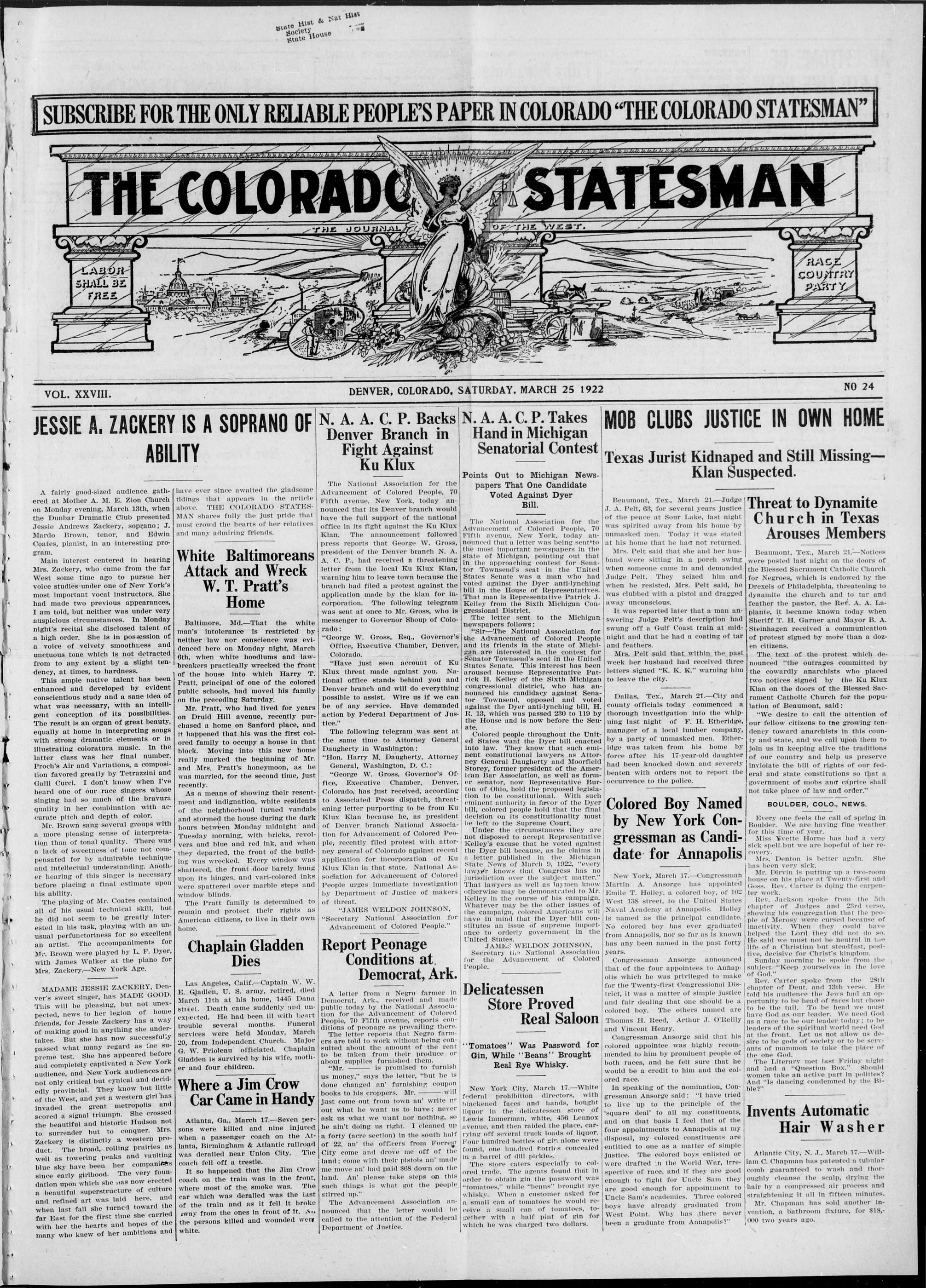
JESSIE A. ZACKERY IS A SOPRANO OF ABILITY
VOL. XXVIII.
A fairly good-sized audience gathered at Mother A. M. E. Zion Church on Monday evening, March 13th, when the Dunbar Dramatic Club presented Jessie Andrews Zackery, soprano; J. Mardo Brown, tenor, and Edwin Coates, pianist, in an interesting program.
Main interest centered in hearing Mrs. Zackery, who came from the far West some time ago to pursue her voice studies under one of New York's most important vocal instructors. She had made two previous appearances, I am told, but neither was under very auspicious circumstances. In Monday night's recital she disclosed talent of a high order. She is in possession of a voice of velvety smoothness and unctuous tone which is not detracted from to any extent by a slight tendency, at times, to hardness.
This ample native talent has been enhanced and developed by evident conscientious study and a sane idea of what was necessary, with an intelligent conception of its possibilities. The result is an organ of great beauty, equally at home in interpreting songs with strong dramatic elements or in illustrating coloratura music. In the latter class was her final number, Proch's Air and Variations, a composition favored greatly by Tetrazzini and Galli Curci. I don't know when I've heard one of our race singers whose singing had so much of the bravura quality in her combination with accurate pitch and depth of color.
Mr. Brown sang several groups with a more pleasing sense of interpretation than of tonal quality. There was a lack of sweetness of tone not compensated for by admirable technique and intellectual understanding. Another hearing of this singer is necessary before placing a final estimate upon his ability.
The playing of Mr. Coates contained all of his usual technical skill, but he did not seem to be greatly interested in his task, playing with an unusual perfunctoriness for so excellent an artist. The accompaniments for Mr. Brown were played by L. F. Dyer, with James Walker at the piano for Mrs. Zackery—New York Age.
MADAME JESSIE ZACKERY, Denver's sweet singer, has MADE GOOD. This will be pleasing, but not unexpected, news to her legion of home friends, for Jessie Zackery has a way of making good in anything she undertakes. But she has now successfully passed what many regard as the supreme test. She has appeared before and completely captivated a New York audience, and New York audiences are not only critical but cynical and decidedly provincial. They know but little of the West, and yet a western girl has invaded the great metropolis and scored a signal triumph. She crossed the beautiful and historic Hudson not to surrender but to conquer. Mrs. Zackery is distinctly a western product. The broad, rolling prairies as well as towering peaks and vaulting blue sky have been her companions since early girlhood. The very foundation upon which she has now erected a beautiful superstructure of culture and refined art was laid here, and when last fall she turned toward the far East for the first time she carried with her the hearts and hopes of the many who knew of her ambitions and
State Hist & Nat Hist
Society
State House
have ever since awaited the gladseason tidings that appears in the article above. THE COLORADO STATESMAN shares fully the just pride that must crowd the hearts of her relatives and many admiring friends.
White Baltimoreans Attack and Wreck W. T. Pratt's Home
Baltimore, Md.—That the white man's intolerance is restricted by neither law nor conscience was evidenced here on Monday night, March 6th, when white hoodlums and lawbreakers practically wrecked the front of the house into which Harry T. Pratt, principal of one of the colored public schools, had moved his family on the preceding Saturday.
Mr. Pratt, who had lived for years on Druid Hill avenue, recently purchased a home on Sanford place, and it happened that his was the first colored family to occupy a house in that block. Moving into this new home really marked the beginning of Mr. and Mrs. Pratt's honeymoon, as he was married, for the second time, just recently.
As a means of showing their resentment and indignation, white residents of the neighborhood turned vandals and stormed the house during the dark hours between Monday midnight and Tuesday morning, with bricks, revolvers and blue and red ink, and when they departed, the front of the building was wrecked. Every window was shattered, the front door barely hung upon its hinges, and vari-colored inks were spattered over marble steps and window blinds. The Pratt family is determined to remain and protect their rights as American citizens, to live in their own home.
Chaplain Gladden Dies
Las Angeles, Calif.—Captain W. W. E. Gladlen, U. S. army, retired, died March 11th at his home, 1445 Dana street. Death came suddenly and unexpected. He had been ill with heart trouble several months. Funeral services were held Monday, March 20, from Independent Church. Major G. W. Priolean officiated. Chaplain Gladden is survived by his wife, mother and four children.
Where a Jim Crow Car Came in Handy
Atlanta, Ga., March 17.—Seven persons were killed and nine injured when a passenger coach on the Atlanta, Birmingham & Atlantic railroad was derailed near Union City. The coach fell off a trestle. It so happened that the Jim Crow coach on the train was in the front, where most of the smoke was. The car which was derailed was the last of the train and as it fell it broke away from the ones in front of it. All the persons killed and wounded were white.
BLE PEOPLE'S PA
ADO
THE JOURNAL
DENVER, COLORADO,
DENVER, COLORADO, SATURDAY, MARCH 25 1922
N. A. A. C. P. Backs Denver Branch in Fight Against Ku Klux
The National Association for the Advancement of Colored People, 70 Fifth avenue, New York, today announced that its Denver branch would have the full support of the national office in its fight against the Ku Klux Klan. The announcement followed press reports that George W. Gross, president of the Denver branch N. A. A. C. P., had received a threatening letter from the local Ku Klux Klan, warning him to leave town because the branch had filed a protest against the application made by the klan for incorporation. The following telegram was sent at once to Mr. Gross, who is messenger to Governor Shoup of Colorado:
"George W. Gross, Esq., Governor's Office, Executive Chamber, Denver, Colorado.
"Have just seen account of Ku Klux threat made against you. National office stands behind you and Denver branch and will do everything possible to assist. Wire us if we can be of any service. Have demanded action by Federal Department of Justice."
The following telegram was sent at the same time to Attorney General Daugherty in Washington:
"Hon. Harry M. Daugherty, Attorney General, Washington, D. C.;
"George W. Gross, Governor's Office, Executive Chamber, Denver, Colorado, has just received, according to Associated Press dispatch, threatening letter purporting to be from Ku Klux Klan because he, as president of Denver branch National Association for Advancement of Colored People, recently filed protest with attorney general of Colorado against recent application for incorporation of Ku Klux Klan in that state. National Association for Advancement of Colored People urges immediate investigation by Department of Justice of makers of threat.
"JAMES WELDON JOHNSON,
"Secretary National Association for Advancement of Colored People."
Report Peonage Conditions at Democrat, Ark.
A letter from a Negro farmer in Democrat, Ark., received and made public today by the National Association for the Advancement of Colored People, 70 Fifth avenue, reports conditions of peonage as prevailing there. The letter reports that Negro farmers are told to work without being consulted about the amount of the rent to be taken from their produce or about supplies furnished them. "Mr. ____ is promised to furnish us money," says the letter, "but he is done changed an' furnishing coupon books to his croppers. Mr. ____ will just come out from town an' write out what he want us to have; never ask us what we want nor nothing, so he ain't doing us right. I cleaned up a forty (acre section) in the south half of 22, an' the officers from Forres' City come and drove me off of the land; come with their pistols an' made me move an' had paid $88 down on the land. An' please take steps on this such things is what got the people stirred up." The Advancement Association announced that the letter would be called to the attention of the Federal Department of Justice.
---
N. A. A. C. P. Takes Hand in Michigan Senatorial Contest
Points Out to Michigan Newspapers That One Candidate Voted Against Dyer Bill.
The National Association for the Advancement of Colored People, 70 Fifth avenue, New York, today announced that a letter was being sent* to the most important newspapers in the state of Michigan, pointing out that in the approaching contest for Senator Townsend's seat in the United States Senate was a man who had voted against the Dyer anti-lynching bill in the House of Representatives. That man is Representative Patrick J. Kelley from the Sixth Michigan Congressional District.
The letter sent to the Michigan newspaper follows:
"Sir—The National Association for the Advancement of Colored People and its friends in the state of Michigan are interested in the contest for Senator Townsend's seat in the United States Senate. This interest has been aroused because Representative Patrick H. Kelley of the Sixth Michigan congressional district, who has announced his candidacy against Senator Townsend, opposed and voted against the Dyer anti-lynching bill, H. R. 13, which was passed 230 to 119 by the House and is now before the Senate.
Colored people throughout the United States want the Dyer bill enacted into law. They know that such eminent constitutional lawyers as Attorney General Daugherty and Moorfield Storey, former president of the American Bar Association, as well as former senator, now Representative Burton of Ohio, hold the proposed legislation to be constitutional. With such eminent authority in favor of the Dyer bill, colored people hold that the final decision on its constitutionality must be left to the Supreme Court.
Under the circumstances they are not disposed to accept Representative Kelley's excuse that he voted against the Dyer bill because, as he claims in a letter published in the Michigan State News of March 9, 1922, "every lawyer knows that Congress has no jurisdiction over the subject matter." That lawyers as well as laymen know otherwise may be demonstrated to Mr. Kelley in the course of his campaign. Whatever may be the other issues of the campaign, colored Americans will have in mind that the Dyer bill constitutes an issue of supreme importance to orderly government in the United States.
JAMES WELDON JOHNSON,
Secretary the National Association for the Advancement of Colored People.
Delicatessen Store Proved Real Saloon
Delicatessen Store Proved Real Saloon
"Tomatoes" Was Password for Gin, While "Beans" Brought Real Rye Whisky.
New York City, March 17.—White federal prohibition directors, with blackened faces and hands, bought liquor in the delicatessen store of Lewis Immerman, white, 456 Lennox avenue, and then raided the place, carrying off several truck loads of liquor. Four hundred bottles of gin alone were found, one hundred bottles concealed in a barrel of dill pickles. The store caters especially to colored trade. The agents found that in order to obtain gin the password was "tomatoes," while "beans" brought rye whisky. When a customer asked for a small can of tomatoes he would receive a small can of tomatoes, together with a half pint of gin for which he was charged two dollars.
MOB CLUBS JUSTICE IN OWN HOME
Texas Jurist Kidnaped and Still Missing Klan Suspected.
Beaumont, Tex., March 21.—Judge J. A. Pelt, 63, for several years justice of the peace at Sour Lake, last night was spirited away from his home by unmasked men. Today it was stated at his home that he had not returned.
Mrs. Pelt said that she and her husband were sitting in a porch swing when someone came in and demanded Judge Pelt. They seized him and when he resisted, Mrs. Pelt said, he was clubbed with a pistol and dragged away unconscious.
It was reported later that a man answering Judge Pelt's description had swung off a Gulf Coast train at midnight and that he had a coating of tar and feathers.
Mrs. Pelt said that within the past week her husband had received three letters signed "K. K. K." warning him to leave the city.
Dallas, Tex., March 21.—City and county officials today commenced a thorough investigation into the whiping last night of F. H. Etheridge, manager of a local lumber company, by a party of unmasked men. Etheridge was taken from his home by force after his 17-year-old daughter had been knocked down and severely beaten with orders not to report the occurrence to the police.
Colored Boy Named by New York Congressman as Candidate for Annapolis
Colored Boy Named by New York Congressman as Candidate for Annapolis
New York, March 17.—Congressman Martin A. Ansorge has appointed Emile T. Holley, a colored boy, of 102 West 138 street, to the United States Naval Academy at Annapolis. Holley is named as the principal candidate. No colored boy has ever graduated from Annapolis, nor so far as is known has any been named in the past forty years.
Congressman Ansorge announced that of the four appointees to Annapolis which he was privileged to make for the Twenty-first Congressional District, it was a matter of simple justice and fair dealing that one should be a colored boy. The others named are Thomas H. Reed, Arthur J. O'Reilly and Vincent Henry.
Congressman Ansorge said that his colored appointee was highly recommended to him by prominent people of both races, and he felt sure that he would be a credit to him and the colored race.
In speaking of the nomination, Congressman Ansorge said: "I have tried to live up to the principle of the 'square deal' to all my constituents, and on that basis I feel that of the four appointments to Annapolis at my disposal, my colored constituents are entitled to one as a matter of simple justice. The colored boys enlisted or were drafted in the World War, irrespective of race, and if they are good enough to fight for Uncle Sam they are good enough for appointment to Uncle Sam's academies. Three colored boys have already graduated from West Point. Why has there never been a graduate from Annapolis?"
NO 24
Threat to Dynamite Church in Texas Arouses Members
Beaumont, Tex., March 21.—Notices were posted last night on the doors of the Blessed Sacrament Catholic Church for Negroes, which is endowed by the Drexels of Philadelphia, threatening to dynamite the church and to tar and feather the pastor, the Rev. A. A. Laplante, it became known today when Sheriff T. H. Garner and Mayor B. A. Steinhagen received a communication of protest signed by more than a dozen citizens.
The text of the protest which denounced "the outrages committed by the cowardly anarchists who placed two notices signed by the Ku Klux Klan on the doors of the Blessed Sacrament Catholic Church for the population of Beaumont, said:
"We desire to call the attention of our fellow citizens to the growing tendency toward anarchists in this county and state, and we call upon them to join us in keeping alive the traditions of our country and help us preserve inviolate the bill of rights of our federal and state constitutions so that a government of mobs and caprice shall not take place of law and order."
BOULDER, COLO., NEWS.
Every one feels the call of spring in Boulder. We are having fine weather for this time of year.
Miss Yvette Horne has had a very sick spell but we are hopeful of her recovery.
Mrs. Denton is better again. She has been very sick.
Mr. Dirvin is putting up a two-room house on his place at Twenty-first and Goss. Rev. Carter is doing the carpenter work.
Rev. Jackson spoke from the 5th chapter of Judges and 23rd verse, showing his congregation that the people of Merosy were cursed because of inactivity. When they could have helped the Lord they did not do so. He said we must not be neutral in the life of a Christian but steadfast, positive, decisive for Christ's kingdom.
Sunday morning he spoke from the subject "Keep yourselves in the love of God."
Rev. Carter spoke from the 28th chapter of Deut. and 13th verse. He told his audience the Jews had an opportunity to be head of races but chose to be the tall. To be head we must have God as our leader. We need God as a race to be our leader today; to be leaders of the spiritual world need God at the front. Let us not allow us desire to be gods of society or to be servants of mammon to take the place of the one God.
The Literary met last Friday night and had a "Question Box." Should women take an active part in politics? And "Is dancing condemned by the Bible?"
Invents Automatic Hair Washer
Atlantic City, N. J., March 17.—William C. Chapman has patented a tubular comb guaranteed to wash and thoroughly cleanse the scalp, drying the hair by a compressed air process and straightening it all in fifteen minutes. Mr. Chapman has sold another invention, a bathroom fixture, for $18,000 two years ago.
FOREIGN
Twelve hundred American troops of the army of occupation have left for the United States by way of Antwerp. A dispatch from Vienna says it is authoritatively stated there that Bulgarian militarists have overthrown the cabinet of Stambeulsky and established a dictatorship.
The American troops on the Rhine, who have been withdrawn, will be replaced in the Coblenz bridgehead by the French, who now occupy the sectors on both sides of Coblenz.
The first Swiss hospital train for Russian children started for Volga district a few days ago. It consisted of thirty-five cars of food and medical supplies, with which it is hoped to support 20,000 children for three months.
Eamon de Valera has issued a manifesto launching a new Irish organization the objects of which are to obtain international recognition of the Irish Republic and repudiation of the proposed agreement with Great Britain.
Disturbances in the provinces in connection with the general lockout in Denmark have necessitated the calling out of troops to patrol the streets. Thoe Geresh, leader of the Danish Communists, was arrested at Randers, in Jutland, charged with lese majesty and agitating for a revolution.
Dr. Otto Ludwig Wiedfeldt has been appointed German ambassador to the United States. Dr. Wiedfeldt will fill the post which has been vacant since February, 1917, when Count Johann Heinrich von Bernstorff left Washington, prior to the declaration of war between the United States and Germany.
The wettest and dryest spots—atmospherically speaking—in the territory of Hawaii during 1921 were only ten miles apart, on the island of Mauli, according to the annual report of the United States Weather Bureau. The heaviest rainfall was at Puu Kukul, Mauli, with 102 inches during the year, while Olowalu, ten miles away, bad the least, 7.54 inches.
A Stefani agency dispatch to Rome from Durazzo states that an extraordinary tribunal convened at Shlak, northeast of Durazzo, had sentenced to death by hanging Captain Bajramgiani, captain of the gendarmerie, for complicity in the recent rising in Albania, and that the sentence was carried out immediately. The tribunal ruled that the city of Durazzo must pay 100,000 francs damages and Shlak 60,000 francs in connection with the revolt.
William D. ("Big Bill") Haywood heads a group of American I. W. W. to whom Premier Lenin has granted a concession to operate the big Nadejdinsky iron works in the Ural mountain region, part of the coat mines in the Kosnetz basin and auxiliary factories. Haywood disappeared from the United States last year while under $65,000 bail after he and about ninety other I. W. W. had been convicted of espionage and conspiracy against the government in the war. He has since taken some part in the deliberations of the Third Internationale at Moscow.
GENERAL
Thirteen dipping vats in the eastern part of Cass county, Texas, were destroyed by dynamite. The trouble is said to be the outgrowth of hostility on the part of residents of that section to the compulsory dipping of cattle.
A world Holstein record was made on the Badger stock farms, near Hartford, Wis., by Pietertjie Ormsby Mercedes Frisby No. 624241, a 2-year-old. She produced 32.91 pounds of butter fat in seven days, or 452.1 pounds of milk.
Marcie Matthews, the 17-year-old schoolgirl who killed her alleged betrayer in a courtroom at Waco, Texas, Feb. 24, was freed on all charges brought against her. The grand jury adjourned without finding an indictment.
A formal call for a strike of both anthracite and bituminous coal miners on April 1 has been sent out from the headquarters of the United Mine Workers of America at Indianapolis. Students at the University of Michigan at Ann Arbor are waging an intensive "gum-shoe" campaign in an effort to locate one of their number, who in a letter in the Michigan Daily, the student publication, over the signature, "The Man Who Has Never Been Kissed," severely criticises the "promiscuous loving" in which he declares the male students and co-eds indulge. Male students are vowing vengeance on the writer.
Nineteen western railroads entered a plea of inability to pay the present scale of wages for shop crafts employés at a hearing of the United States Railroad Labor Board at Chicago. The hearing was on the roads' petition for a wage cut. Among the roads were the Chicago, Milwaukee & St. Paul, Chicago & Northwestern, Soo, Texas Pacific and Texas Midland. J. W. Higgins, executive secretary of the Western Railroad Association, submitted the statement of the western roads.
A quart bottle of strong ammonia foiled the cracksman who early blew open the safe of the Standard Oil filling station at Benton, Ill. The door of the safe succumbed before a strong charge of "soup." So did the bottle. And the fumes forced the burglar to decamp without stopping to investigate the contents of the safe.
Carlton M. Garver, coal operator, polled 9,453 votes for mayor against 8,952 by Mayor H. H. Barton in the recent primary election at Des Moines, Iowa. Ernest Quick, labor candidate, was eliminated. He polled 5,102 votes.
AN EPITOME OF LATE LIVE NEWS
CONDENSED RECORD OF THE PROGRESS OF EVENTS AT HOME AND ABROAD.
FROM ALL SOURCES
FROM ALL SOURCES
SAYINGS, DOINGS, ACHIEVE MENTS, SUFFERINGS, HOPES AND FEARS OF MANKIND.
(Western Newspaper Union News Service.)
WESTERN
Oregon's capital punishment law was upheld by the Supreme Court in denying the application of Elvie D. Kerby, under death sentence in connection with the murder of Sheriff Till Taylor of Umatilla county, for a writ of habeas corpus.
Two bandits walked into the office of the California theater, in the heart of the downtown district of Los Angeles and robbed the office safe of the day's receipts, estimated at between $10,000 and $12,000, according to reports to the police.
The retrial of Madalynne Obenchain, charged with the murder of J. Belton Kennedy, her sweetheart, in Beverly Glen, near Los Angeles, the night of Aug. 5, last, will commence June 5. The first trial of Mrs. Obenchain resulted in a disagreement of the jury.
Miss Lydia Fricke of Klamath Falls, Ore., Klamath county health nurse, is recovering from a hazardous trip of twenty-three miles on skis in a blinding snowstorm, which she undertook for the relief of a destitute family in the northern part of Klamath county, Oregon.
An inspection tour of the section of the Colorado river including the site of the proposed Boulder Cañon dam was made by Herbert Hoover, secretary of commerce, acting as chairman of the Colorado River Commission. He was accompanied by the governors of Arizona and Nevada and other officials.
Reckless automobile drivers of Spokane, Wash., and speeders hereafter will go to the rock pile, which up to the present has been operated for the benefit of drunks and vagrants, Police Judge Witt declared recently. "After this, those going over thirty miles an hour get no sympathy—they get the rock pile," he announced.
Robert Ford, 17 years old, was acquitted of the murder of his stepfather, C. B. Smith, killed at his home in Worley, Idaho, last November, by a jury which reported in District Court at Coeur D'Alene, Idaho. Judge W. F. Naughton adjudged the boy a juvenile delinquent and paroled him to the custody of his mother.
Freight rates on coal from Wyoming mines to Nevada points will be reduced April 22 as follows, according to announcement made by Union Pacific officials at Salt Lake City: Between Montello and Winnemucca $5.50 a ton, compared with the present rate of $6.37½; Winnemucca $5.90, present rate $6.75; Reno $6.25, present rate $7.12½.
WASHINGTON
When Raymond T. Baker retired as director of the mint he turned over to C. E. Scobey, his successor, approximately one-third of the world's gold supply. The gold bullion and gold coin held at the United States mints at Philadelphia, Denver and San Francisco and at the assay office in New York on March 1, totaled more than $3,000,000,000. The world's supply amounts to about $9,000,000,000.
A clause in the army appropriation bill, which provides that by July 1 the number of regular army officers must be reduced from approximately 13,000 to 11,000, has been approved by the House.
The Senate supported its appropriations committee, inserting in the annual postoffice appropriation bill an item of $1,100,000 for continuation of the New York-San Francisco air mail route. Such an appropriation failed in the House.
Approximately 2,500 aliens admitted into the United States under temporary permits which expired March 23 and left them liable to immediate deportation, have been given an indefinite extension of time for their stay, Commissioner General Husband of the immigration bureau has announced. Coal operators who face the prospect of a strike of their employes April 1, but who still refuse to enter a national conference with the coal miners' union, are not controlled by "imere madness, but a determination to cure a deep-seated disorder," George H. Cushing, managing director of the American Wholesale Coal Association, declared in an address before the Washington City Club.
Waving the stern wand of economy, Congress is threatening to shrink the United States navy to approximately nine battleships—half the number with which it emerged from the Washington conference. That, in effect, will be the result of the threatened cut to 65,000 men, according to naval estimates.
The resolution of Senator Lodge, Republican (Massachusetts), extending for twenty-five years the loan of $50,000,000 made to Austria for famine relief, has been adopted unanimously by the Senate and sent to the House.
Pithy News Notes
From A''l Parts of
Colorado
(Dwestern Newspaper Union News Service.)
Denver.—An electric "health garment" caused the death here of Mrs. Elizabeth Tipton.
Boulder.—A 20 per cent reduction in street car fares has been voluntarily ordered by the Boulder street railway company.
Golden.—Joseph E. Dennis has been confirmed as postmaster at Golden. Mr. Dennis is vice commander of an American Legion post at Golden.
Colorado Springs.—C. H. Dudley, Colorado Springs attorney, was selected as county judge to fill the place vacated by the death of William P. Kinney.
Rocky Ford.—The American Beet Sugar Company will distribute $26,000 among the beet growers of this section, the checks to be ready about the middle of next month.
Golden.—A fully equipped brewery, which, according to Jefferson county authorities, was turning out a product of 2.62 per cent alcoholic content, was raided on the Denver-Golden road by Sheriff G. C. Kerr.
Fort Morgan.—A record was established in the District Court here when eight alleged burglars, robbers and perjurers were given sentences totaling twenty-four to thirty-one years in the state penitentiary.
Denver.—A seven to twelve-story hotel to commemorate Dr. John Elsner, the noted specialist on internal medicine, will be erected on the site of the physician's present home, Fourteenth and Curtis streets, Denver.
Denver.—The bi-annual convention of District No. 15, United Mine Workers of America, which is being held in T. M. A. hall, voted overwhelmingly in favor of a strike April 1, Acting President Mike Livoda announced.
Denver.—The Colorado portion of the proposed Kansas City-Denver Airline highway—that section of the highway from Byers east to the state line—was declared a state highway by the Colorado highway advisory board.
Fort Collins.—A rural life conference, centering at Greeley with ten consolidated schools in that section of the state participating, has been announced by Prof. C. G. Surgent of the Colorado Agricultural College, director of rural education, for April 26 to 29.
Cañon City.—John D. Lloyd, Jr. proprietor of the Cañon cigar store, sustained a broken back and probably will die, and Herbert Meyers and Miss Anna Klimk were injured painfully in an automobile accident on Lincoln Park near "Dead Man's corner" on Elm street.
Pueblo—John W. Galloway, 38 years old and a member of the Pueblo city fire department, died from an illness originating in exposure at the Oper House block fire on the night of Feb. 28. Galloway had an excellent war record, having served at a second lieutenant in Company C, Eighth infantry.
Boulder.—Sale of $50,000 worth of the recently authorized school bonds for the new Boulder high school was made by the school board to James H. Causey & Co. of Denver in competitive bidding with ten banks and bond houses of Colorado at the highest price obtained for securities in this district in eight years.
Fort Collins.—Peter Moss of Loveland, charged with assault with intent to kill and assault with a deadly weapon, was acquitted of both charges by a Larimer county jury in the District Court. Moss was held in connection with the shooting of Robert Pomeranka, 13 years old, in his melon patch the night of Sept. 10.
Haxtun.—The first store in Paoli, ten miles east of Haxtun, known as the Dinsmore store, burned recently with all its stock of goods. The fire is supposed to have started in a trash box behind the stove, after the proprietors had locked the store for the evening. One member of the firm, who had his living room up-tairs, escaped by jumping from a window.
Pueblo.—John Latham, 21 years old, was instantly killed and Miss Edna Clark and her mother, Mrs. B. B. Clark, were painfully injured when an automobile in which they were riding struck soft sand on the Santa Fé trail twenty miles east of here and turned over. Latham was pitched out of the car, his head striking a rock, and was killed instantly.
Denver.—Murchants Park. This will be the name of the new baseball plant of the Denver Western League Club, at Broadway and Center street. Officials of the Denver Baseball Association, holders of the Denver franchise, gave the park its moniker in honor of the business and professional men who have given their support, financial and moral, toward bringing a franchise here.
Colorado Springs.—Gillbert John Premer, one month old, underwent the surgeon's knife at Bethel hospital. The infant was operated on for appendicitis and attending physicians announce the operation has been successful. The parents are Mr. and Mrs. John Premer of Elbert, Colo.
Loveland.—The Loveland band is preparing to enter the musical contest of bands in the Rocky Mountain region to be held in Denver some time in May, at which prizes will be given for the best bands. The Boys' band also will probably enter the contests.
CENTENNIAL STATE ITEMS
Denver:—Special session of the State Legislature will be called the week of April 10 to enact flood control legislation and a bonding law for construction of the Moffat tunnel, Governor Shoup announced at a luncheon of the members council of the Denver Civic and Commercial Association. "To save the people of our state the Moffat railroad and to build for the future, we must build the Moffat tunnel," he said. "The creation of the Pueblo flood control district and the building of the tunnel will distribute more than $10,000,000 in Colorado in wages and in pay for supplies. All the money will be spent in the state. Colorado labor and Colorado supplies will be used.
Cañon City.—Litigation of a farreaching character growing out of the floods of last June has been instituted in the courts of Fremont and Teller counties involving both the Arkansas Valley Railway, Light and Power Company and Beaver Water and Irrigation Company in suits for heavy damages on account of losses resulting from the bursting of dams and reservoirs along Beaver creek on June 5, 1921. Dispatches have told of the filing of suits for damages aggregating $450,000 by the Beaver Water and Irrigation Company against the Arkansas Valley Railway, Light and Power Company for the destruction of the Schaeffer dam and reservoir.
La Junta.—C. J. Matthews, said to be the missing cashier of the Osawatomi State Bank of Osawatomie, Kan., was arrested recently by Chief of Police Rose at La Junta and taken from a Santa Fé train on which he was riding from California to Kansas City. He is held in the Otero county jail at La Junta awaiting action by the Kansas authorities, who have been notified. The man was traveling without baggage and had only $7 on him when arrested.
Colorado Springs.—Although every effort is being made to find Mary Louise Cleary, she has neither been seen nor heard of in Colorado Springs, and therefore does not know that a legacy of $50,000 has fallen to her. The will of Adolph Norden, who died in New York city, gave the sum of $50,000 to Mary Louise Cleary of Camp Stratton near Colorado Springs, who was described in the document as "my faithful nurse and friend."
Brighton.—Arthur Sales, P. J. Bergman and Frank Olson, held in connection with the burglary of the Wiggins Mercantile Company of Wiggins, Colo., which resulted in the death of D. J. Ashmore, a fourth member of the alleged bandit gang, were turned over to Morgan county officials after they had been taken to the spot where Ashmore's body was found and had given additional information to the authorities.
Loveland.—The Loveland railway station was broken into recently and three trunks, one of them containing jewelry and clothing valued at $1,500, were stolen. The riffled trunks were found later in Lake Loveland. The trunk containing the $1,500 worth of valuables belonged to Mrs. Burt Davis.
Cripple Creek.—The Rittenhouse mine, property of the Moonlight Mining and Milling Company, has reopened after a shutdown of thirty days. Extensive development work is planned on various levels of the property and there will be considerable territory open for leasers.
Denver.—Mrs. May Gresdel, who has had charge of the cigar stand at the Brown Palace hotel for four years, was crushed to death near Cheyenne, Wyo., when the automobile in which she was riding with Samuel Wilson and Mrs. G. Betts, both of Denver, overturned and plined her underneath.
Cripple Creek.—Officers of five metal mines in the Cripple Creek district will make formal application to effect wage reductions at a hearing scheduled to take place before the Colorado Industrial Commission March 28.
Fort Collins.—The Boy Scouts in Fort Collins are enjoying a boom in the organization. The fourth troop in the city has just been organized with Assistant Scoutmaster Craig in charge. The Mexican boys of Fort Collins are taking to scouting in fine style and many of them are speeding up in their learning to read English through the studying of their Boy Scout manuals. Delta, Colo.—Reuben Fluke, a cripple 25 years old, shot and killed Arthur McConville, 40 years old, at the Fluke ranch at Crawford, forty miles from here. The shooting climaxed a quarrel in which McConville is said to have attacked Fluke.
Limon.—A woman, Mrs. Albert Mutzdorf, wife of a railway engineer, has been chosen as the taxpayers' nominee for mayor. She will oppose A. C. Sinclair, president of the First National Bank of Limon, nominated by the Citizens party caucus.
Fort Collins.—Organization of the Colorado Creamery Men's Association and the decision to meet twice a year, probably in Fort Collins, was the accomplishment of forty creamery men from the Rocky Mountain states at their meeting here.
Denver.—Notices of the dissolution and discontinuance of business of two state banks have been filed with Secretary of State Milliken. They are the IIiff State Bank at IIiff, Colo., and the Wellington State Bank at Wellington, Colo. According to the papers filed with the state, business operations of the two banks were suspended by agreement of the stockholders.
Akron.—Newton Myers, rancher, is under arrest at Akron following the mysterious shooting of John Stackhouse, a neighbor, in his home fifty miles southeast of Akron.
Cleaning, Pressing and Repairing. All Work Guaranteed 720 EAST 26TH AVE. PHONE YORK 8814 Call in and see my Spring Samples now on display. Prices reasonable.
GRANBERRY TAXI COMPANY
Office 2741 Welton Street.
1920
Quick and Prompt Service Day
on Our
If you have a room for
NO CHARGE I
WESTER
Prompt Service Day and night. Call Us for Sp
on Out-of-Town Trips.
you have a room for rent or want a room call
NO CHARGE FOR THIS INFORMATION
ESTERN BEEF
Quick and Prompt Service Day and night. Call Us for Special Rates on Out-of-Town Trips.
If you have a room for rent or want a room call us.
NO CHARGE FOR THIS INFORMATION
WESTERN BEEF CO.
Open Daily to 830 p. m.
Sundays Until 2:00 p. m.
Fresh Oysters, Chitterlings, H
Bones, Spare Ri
Fresh and Cured Meats of All
Fan
Our Prices Are
Free Delivery th
Phone
2048 LARIMER STREET
Opposite
HOWARD
GROCERI
ters, Chitterlings, Pig Tails, Snouts, Ears, Pigs
Bones, Spare Ribs Received Fresh Daily.
Cured Meats of All Kinds.. Fresh Vegetables,
Fancy Groceries.
Our Prices Are Always the Lowest
Free Delivery to All Parts of the City.
Phone Champa 1641.
IMER STREET DENV
Opposite the Three Rules.
HOWARD & HOWARD
GROCERIES AND MEATS
Fresh Oysters, Chitterlings, Pig Tails, Snouts, Ears, Pigs Feet, Neck Bones, Spare Ribs Received Fresh Daily.
Fresh and Cured Meats of All Kinds.. Fresh Vegetables, Staple and Fancy Groceries.
Fresh Vegetables and Fruits Daily
Does your friend trade with us? If not, read this ad as an invitation for him to know how to get our service and ity goods. Free delivery to any part of the city.
PHONE YORK 9552. 718 E. TWENTY-SIXTH
your friend trade with us? If not, read this ad
ation for him to know how to get our service and
Free delivery to any part of the city.
NEW YORK 9552. 718 E. TWENTY-SIXTH
Does your friend trade with us? If not, read this advertisement as an invitation for him to know how to get our service and our quality goods. Free delivery to any part of the city.
PHONE YORK 9552. 718 E. TWENTY-SIXTH AVE.
Residence Phone, York 7616-J
2536 Washington Street.
PHONE MAIN 3023
John K. Rettig EATS, FANCY AND STAPLE GROCER
John
MEATS, FANCY A
1864 C
MEATS, FANCY AND STAPLE GROCERIES
1864 CURTIS STREET
ANTEENTEenth De
E CHAMPA PHARMA
2101 CHAMPA
Is the place to get your
GES, CHEMICALS AND PATENT MEDIC
WE SERVE DRINKS.
PRESCRIPTIONS OUR SPECIALTY.
Is and we will deliver the goods to all parts of
JAMES E. THRALL, Propr.
AIN 2425 PH
HERE IT IS
being taken from music, but I have
right it and am putting it into
SUITS
and See My Jazz Styles.
GARDNER, THE TAILOR
CHAMPA 1019
1025 TWENTIETH
RBANKS —Proprietors—
N. FAIR
THE CHAMPA
210
Is the p
DRUGS, CHEMICALS
WE SEE
PRESCRIPTION
Phone us and we will deliver
JAMES E
PHONE MAIN 2425
HERE IT
Jazz is being taken from man
caught it and am putting
SUIT
Come in and See My
GARDNER
PHONE CHAMPA 1019
C. V. FAIRBANKS
THE CHAMPAPHARMACY
2101 CHAMPA
Is the place to get your
DRUGS, CHEMICALS AND PATENT MEDICINES
WE SERVE DRINKS.
PRESCRIPTIONS OUR SPECIALTY.
Phone us and we will deliver the goods to all parts of the city.
JAMES E. THRALL, Propr.
PHONE MAIN 2425 PHONE 8444
HOME COOKING
---
OFFICE
PHONE
CHAMPA
86
Corner Nineteenth
Day and night. Call Us for Special Rates
Out-of-Town Trips.
n for rent or want a room call us.
E FOR THIS INFORMATION
RN BEEF CO.
One of the Most Up-to-
Date and Sanitary Markets in the City.
One of the Most Up-to-Date and Sanitary Markets in the City.
, Pig Tails, Snouts, Ears, Pigs Feet, Neck Ribs Received Fresh Daily.
All Kinds.. Fresh Vegetables, Staple and Fancy Groceries.
Are Always the Lowest
Easy to All Parts of the City.
One Champa 1641.
WARD & HOWARD
BRIES AND MEATS
tables and Fruits Daily
with us? If not, read this advertisement
know how to get our service and our qual-
any part of the city.
718 E. TWENTY-SIXTH AVE.
Shop Phone, York 3390-J
RED HOT SHOE REPAIR FACTORY
COOPER AND JEFFERSON, Props.
Only Colored Shoe Repair Shop in
Denver.
HAND MADE SHOES TO ORDER.
Work Called for and Delivered. All
Work Neatly Finished.
Denver, Colo.
RES. PHONE GALLUP 942
K. Rettig
AND STAPLE GROCERIES
IMPA PHARMACY
2101 CHAMPA
We place to get your
HLS AND PATENT MEDICINES
SERVE DRINKS.
MONS OUR SPECIALTY.
Deliver the goods to all parts of the city.
E. THRALL, Propr.
PHONE 8444
music, but I have
getting it into
TS
by Jazz Styles.
R, THE TAILOR
1025 TWENTY-FIRST
—Proprietors— N. FAIRBANKS
FAIRBANKS
CAFE
First Class Meals Served
2444 Washington St., Denver, Colo.
OFFICE
PHONE
CHAMPA
87-88
DENVER, COLO.
Denver, Colo.
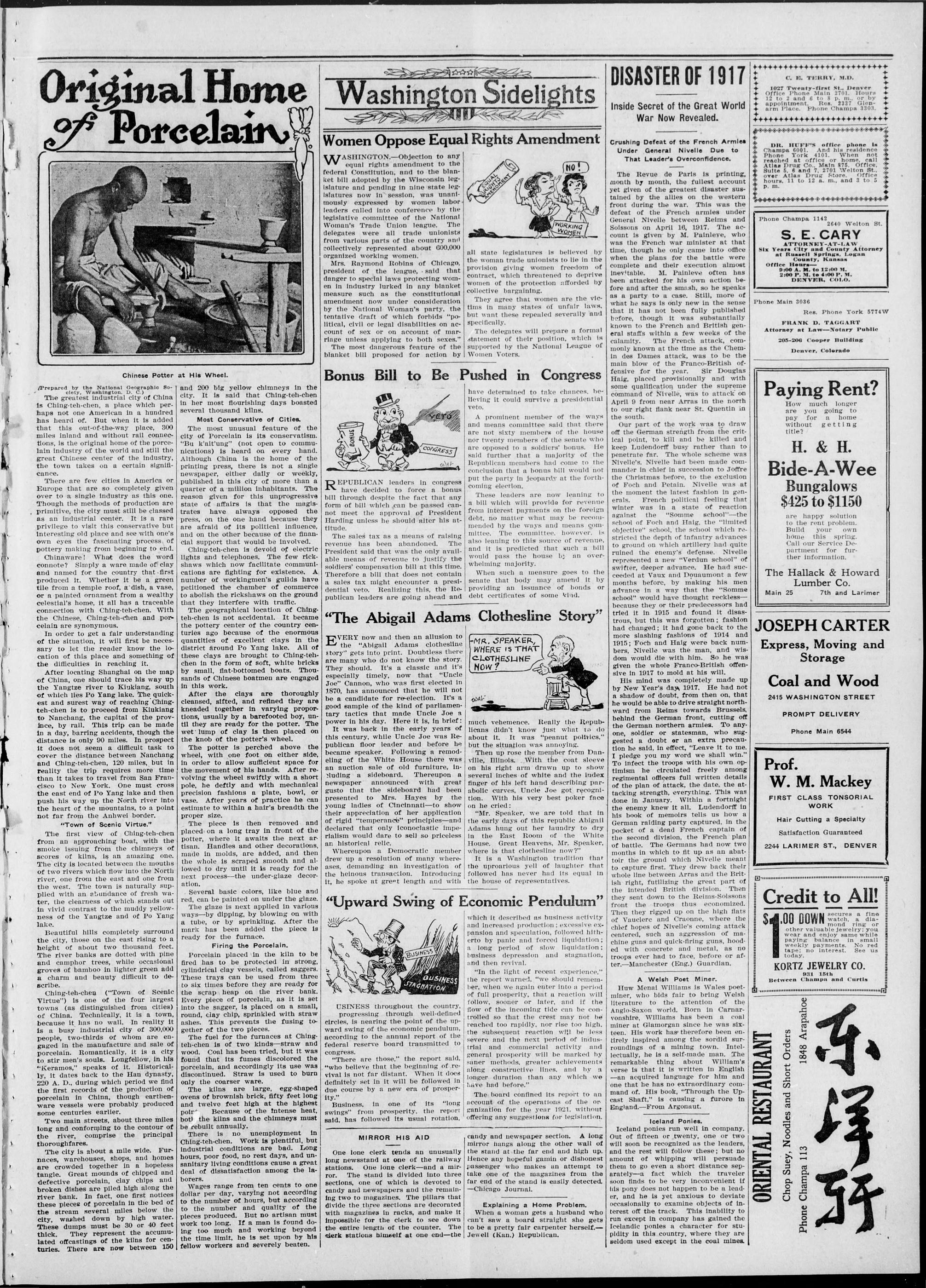
Original Home of Porcelain
A man working in a pottery workshop.
Chinese Potter at His Wheel.
(Prepared by the National Geographic So-
The greatest industrial city of China is Ching-teh-chen, a place which perhaps not one American in a hundred has heard of. But when it is added that this out-of-the-way place, 300 miles inland and without rail connections, is the original home of the porcelain industry of the world and still the great Chinese center of the industry, the town takes on a certain significance.
There are few cities in America or Europe that are so completely given over to a single industry as this one. Though the methods of production are primitive, the city must still be classed as an industrial center. It is a rare privilege to visit this conservative but interesting old place and see with one's own eyes the fascinating process of pottery making from beginning to end.
Chinaware! What does the word connote? Simply a ware made of clay and named for the country that first produced it. Whether it be a green tile from a temple roof, a dish, a vase, or a painted ornament from a wealthy celestial's home, it all has a traceable connection with Ching-teh-chen. With the Chinese, Ching-teh-chen and porcelain are synonymous.
In order to get a fair understanding of the situation, it will first be necessary to let the reader know the location of this place and something of the difficulties in reaching it.
After locating Shanghai on the map of China, one should trace his way up the Yangtze river to Klukiang, south of which lies Po Yang lake. The quickest and surest way of reaching Ching-teh-chen is to proceed from Klukiang to Nanchang, the capital of the province, by rail. This trip can be made in a day, barring accidents, though the distance is only 90 miles. In prospect it does not seem a difficult task to cover the distance between Nanchang and Ching-teh-chen, 120 miles, but in reality the trip requires more time than it takes to travel from San Francisco to New York. One must cross the east end of Po Yang lake and then push his way up the North river into the heart of the mountains, to a point not far from the Anhwei border.
"Town of Scenic Virtue."
The first view of Ching-teh-chen from an approaching boat, with the smoke issuing from the chimneys of scores of kilns, is an amazing one. The city is located between the mouths of two rivers which flow into the North river, one from the east and one from the west. The town is naturally supplied with an abundance of fresh water, the clearness of which stands out in vivid contrast to the muddy yellowness of the Yangtze and of Po Yang lake.
Beautiful hills completely surround the city, those on the east rising to a height of about two thousand feet. The river banks are dotted with pine and camphor trees, while occasional groves of bamboo in lighter green add a charm and beauty difficult to describe.
Ching-teh-chen ("Town of Scenic Virtue") is one of the four largest towns (as distinguished from cities) of China. Technically, it is a town, because it has no wall. In reality it is a busy industrial city of 300,000 people, two-thirds of whom are engaged in the manufacture and sale of porcelain. Romantically, it is a city to stir men's souls. Longfellow, in his "Keramos," speaks of it. Historically, it dates back to the Han dynasty, 220 A. D., during which period we find the first records of the production of porcelain in China, though earthenware vessels were probably produced some centuries earlier.
Two main streets, about three miles long and conforming to the contour of the river, comprise the principal thoroughfares.
The city is about a mile wide. Furnaces, warehouses, shops, and homes are crowded together in a hopeless tangle. Great mounds of chipped and defective porcelain, clay chips and broken dishes are piled high along the river bank. In fact, one first notices these pieces of porcelain in the bed of the stream several miles below the city, washed down by high water. These dumps must be 30 or 40 feet thick. They represent the accumulated offcastings of the kilns for centuries. There are now between 150
and 200 big yellow chimneys in the city. It is said that Ching-teh-chen in her most flourishing days boasted several thousand kilos.
Most Conservative of Cities.
The most unusual feature of the city of Porcelain is its conservatism. "Bu k'ait'ung" (not open to communications) is heard on every hand. Although China is the home of the printing press, there is not a single newspaper, either daily or weekly, published in this city of more than a quarter of a million inhabitants. The reason given for this unprogressive state of affairs is that the magistrates have always opposed the press, on the one hand because they are afraid of its political influence, and on the other because of the financial support that would be involved. Ching-teh-chen is devoid of electric lights and telephones. The few rickshaws which now facilitate communications are fighting for existence. A number of workingmen's gullds have petitioned the chamber of commerce to abolish the rickshaws on the ground that they interfere with traffic.
The geographical location of Ching-teh-chen is not accidental. It became the pottery center of the country centuries ago because of the enormous quantities of excellent clays in the district around Po Yang lake. All of these clays are brought to Ching-teh-chen in the form of soft, white bricks by small, flat-bottomed boats. Thousands of Chinese boatmen are engaged in this work.
After the clays are thoroughly cleansed, sifted, and refined they are kneaded together in varying proportions, usually by a barefooted boy, until they are ready for the potter. The wet lump of clay is then placed on the knob of the potter's wheel.
The potter is perched above the wheel, with one foot on either side, in order to allow sufficient space for the movement of his hands. After revolving the wheel swiftly with a short pole, he deftly and with mechanical precision fashions a plate, bowl, or vase. After years of practice he can estimate to within a hair's breadth the proper size. The piece is then removed and placed on a long tray in front of the potter, where it awaits the next artisan. Handles and other decorations, made in molds, are added, and then the whole is scraped smooth and allowed to dry until it is ready for the next process—the under-glaze decoration.
Several basic colors, like blue and red, can be painted on under the glaze. The glaze is next applied in various ways—by dipping, by blowing on with a tube, or by sprinkling. After the mark has been added the piece is ready for the furnace.
Firing the Porcelain.
Porcelain placed in the kiln to be fired has to be protected in strong, cylindrical clay vessels, called saggers. These trays can be used from three to six times before they are ready for the scrap heap on the river bank. Every piece of porcelain, as it is set into the sagger, is placed on a small, round, clay chip, sprinkled with straw ashes. This prevents the fusing together of the two pieces.
The fuel for the furnaces at Ching-teh-chen is of two kinds—straw and wood. Coal has been tried, but it was found that its fumes discolored the porcelain, and accordingly its use was discontinued. Straw is used to burn only the coarser ware.
The kilns are large, egg-shaped ovens of brownish brick, fifty feet long and twelve feet high at the highest point. Because of the intense heat, both the kilns and the chimneys must be rebuilt annually.
There is no unemployment in Ching-teh-chen. Work is plentiful, but industrial conditions are bad. Long hours, poor food, no rest days, and unsanitary living conditions cause a great deal of dissatisfaction among the laborers.
Wages range from ten cents to one dollar per day, varying not according to the number of hours, but according to the number and quality of the pieces produced. But no artisan must work too long. If a man is found doing too much and working beyond the time limit, he is set upon by his fellow workers and severely beaten.
Firing the Porcelain.
Women Oppose Equal Rights Amendment
Bonus Bill to Be Pushed in Congress
"The Abigail Adams Clothesline Story"
"Upward Swing of Economic Pendulum"
WASHINGTON.—Objection to any equal rights amendment to the federal Constitution, and to the blanket bill adopted by the Wisconsin legislature and pending in nine state legislatures now in session, was unanimously expressed by women labor leaders called into conference by the legislative committee of the National Woman's Trade Union league. The delegates were all trade unionists from various parts of the country and collectively represented about 600,000 organized working women.
Mrs. Raymond Robins of Chicago, president of the league, said that danger to special laws protecting women in industry lurked in any blanket measure such as the constitutional amendment now under consideration by the National Woman's party, the tentative draft of which forbids "political, civil or legal disabilities on account of sex or on account of marriage unless applying to both sexes."
The most dangerous feature of the blanket bill proposed for action by
REPUBLICAN leaders in congress have decided to force a bonus bill through despite the fact that any form of bill which can be passed cannot meet the approval of President Harding unless he should alter his attitude.
The sales tax as a means of raising revenue has been abandoned. The President said that was the only available means of revenue to justify the soldiers' compensation bill at this time. Therefore a bill that does not contain a sales tax might encounter a presidential veto. Realizing this, the Republican leaders are going ahead and
EVERY now and then an allusion to the "Abigail Adams clothesline story" gets into print. Doubtless there are many who do not know the story. They should. It's a classic and it's especially timely, now that "Uncle Joe" Cannon, who was first elected in 1870, has announced that he will not be a candidate for re-election. It's a good sample of the kind of parliamentary tactics that made Uncle Joe a power in his day. Here it is, in brief:
It was back in the early years of this century, while Uncle Joe was Republican floor leader and before he became speaker. Following a remodeling of the White House there was an auction sale of old furniture, including a sideboard. Thereupon a newspaper announced with great gusto that the sideboard had been presented to Mrs. Hayes by the young ladies of Cincinnati—to show their appreciation of her application of rigid "temperance" principles—and declared that only iconoclastic imperialism would dare to sell so priceless an historical relic.
Whereupon a Democratic member drew up a resolution of many whereas, demanding an investigation of the heinous transaction. Introducing it, he spoke at great length and with
BUSINESS
BUSINESS
STAGNATION
USINESS throughout the country, progressing through well-defined circles, is nearing the point of the upward swing of the economic pendulum, according to the annual report of the federal reserve board transmitted to congress.
"There are those," the report said, "who believe that the beginning of revival is not far distant. When it does definitely set in it will be followed in due course by a new era of prosperity."
Business, in one of its "long swings" from prosperity, the report said, has followed its usual rotation,
MIRROR HIS AID
One lone clerk tends an unusually long newsstand at one of the railway stations. One lone clerk—and a mirror. The stand is divided into three sections, one of which is devoted to candy and newspapers and the remaining two to magazines. The pillars that divide the three sections are decorated with magazines in racks, and make it impossible for the clerk to see down the entire length of the counter. The clerk stations himself at one end—the
EQUAL RIGHTS AMENDMENT
NO!
WORKING WOMEN
all state legislatures is believed by the woman trade unionists to lie in the provision giving women freedom of contract, which threatened to deprive women of the protection afforded by collective bargaining.
They agree that women are the victims in many states of unfair laws, but want these repealed severally and specifically.
The delegates will prepare a formal statement of their position, which is supported by the National League of Women Voters.
have determined to take chances, believing it could survive a presidential veto.
A prominent member of the ways and means committee said that there are not sixty members of the house nor twenty members of the senate who are opposed to a soldiers' bonus. He said further that a majority of the Republican members had come to the conclusion that a bonus bill would not put the party in jeopardy at the forthcoming election.
These leaders are now leaning to a bill which will provide for revenue from interest payments on the foreign debt, no matter what may be recommended by the ways and means committee. The committee, however, is also leaning to this source of revenue, and it is predicted that such a bill would pass the house by an overwhelming majority.
When such a measure goes to the senate that body may amend it by providing an issuance of bonds or debt certificates of some vlad.
MR. SPEAKER, WHERE IS THAT CLOTHESLINE NOW?
much vehement. Really the Republicans didn't know just what to do about it. It was "pennut politics," but the situation was annoying.
Then up rose the member from Danville, Illinois. With the coat sleeve on his right arm drawn up to show several inches of white and the index finger of his left hand describing parabolic curves, Uncle Joe got recognition. With his very best poker face on he cried:
"Mr. Speaker, we are told that in the early days of this republic Abigail Adams hung out her laundry to dry in the East Room of the White House. Great Heavens, Mr. Speaker, where is that clothesline now?" It is a Washington tradition that the unroarious yell of laughter that followed has never had its equal in the house of representatives.
which it described as business activity and increased production; excessive expansion and speculation, followed hitherto by panic and forced liquidation; a long period of slow liquidation; business depression and stagnation, and then revival.
"In the light of recent experience," the report warned, "we should remember, when we again enter into a period of full prosperity, that a reaction will follow, sooner or later, and if the flow of the incoming tide can be controlled so that the crest may not be reached too rapidly, nor rise too high, the subsequent reaction will be less severe and the next period of industrial and commercial activity and general prosperity will be marked by saner methods, greater achievements along constructive lines, and by a longer duration than any which we have had before."
The board confined its report to an account of the operations of the or organization for the year 1921, without offering any suggestions for legislation.
candy and newspaper section. A long mirror hangs along the other wall of the stand at the far end and high up. Hence any hopeful gamin or dishonest passenger who makes an attempt to take one of the magazines from the far end of the stand is easily detected. —Chicago Journal.
Explaining a Home Problem.
When a woman gets a husband who can't saw a board straight she gets to be a pretty fair carpenter herself.—Jewell (Kan.) Republican.
DISASTER OF 1917
Inside Secret of the Great World War Now Revealed.
Crushing Defeat of the French Armies Under General Nivelle Due to That Leader's Overconfidence.
The Revue de Paris is printing, month by month, the fullest account yet given of the greatest disaster sustained by the allies on the western front during the war. This was the defeat of the French armies under General Nivelle between Relims and Solssons on April 16, 1917. The account is given by M. Palnleve, who was the French war minister at that time, though he only came into office when the plans for the battle were complete and their execution almost inevitable. M. Palnleve often has been attacked for his own action before and after the smash, so he speaks as a party to a case. Still, more of what he says is only new in the sense that it has not been fully published before, though it was substantially known to the French and British general staffs within a few weeks of the calamity. The French attack, commonly known at the time as the Chemin des Dames attack, was to be the main blow of the Franco-British offensive for the year. Sir Douglas Haig, placed provisionally and with some qualification under the supreme command of Nivelle, was to attack on April 9 from near Arras in the north to our right flank near St. Quentin in the south.
Our part of the work was to draw off the German strength from the critical point, to kill and be killed and keep Ludendorff busy rather than to penetrate far. The whole scheme was Nivelle's. Nivelle had been made commander in chief in succession to Joffre the Christmas before, to the exclusion of Foch and Petain. Nivelle was at the moment the latest fashion in general. French political feeling that winter was in a state of reaction against the "Somme school"—the school of Foch and Haig, the "limited objective" school, the school which restricted the depth of infantry advances to ground on which artillery had quite ruined the enemy's defense. Nivelle represented a new "Verdum school" of swifter, deeper advance. He had succeeded at Vaux and Douaumont a few months before, by making his men advance in a way that the "Somme school" would have thought reckless—because they or their predecessors had tried it in 1915 and found it disastrous, but this was forgotten; fashion had changed; it had gone back to the more slashing fashions of 1914 and 1915; Foch and Haig were back numbers, Nivelle was the man, and wisdom would die with him. So he was given the whole Franco-British offensive in 1917 to mold at his will.
His mind was completely made up by New Year's day, 1017. He had not a shadow of doubt, from then on, that he would be able to drive straight northward from Reims towards Brussels, behind the German front, cutting off the German northern armies. To anyone, soldier or statesman, who suggested a doubt or an extra precaution he said, in effect, "Leave it to me. I pledge you my word we shall win." To infect the troops with his own optimism he circulated freely among regimental officers full written details of the plan of attack, the date, the attacking strength, everything. This was done in January. Within a fortnight the enemy knew it all. Ludendorff in his book of memoirs tells us how a German raiding party captured, in the pocket of a dead French captain of the second division, the French plan of battle. The Germans had now two months in which to fit up as an abattoir the ground which Nivelle meant to capture first. They drew back their whole line between Arrus and the British right, futilizing the great part of the intended British division. Then they sent down to the Reims-Solssons front the troops thus economized. Then they rigged up on the high flats of Vauclerc and Craonne, where the chief hopes of Nivelle's coming attack centered, such an aggression of machine guns and quick-firing guns, hooded with concrete and metal, as no troops ever had to face, before or after.—Manchester (Eng.) Guardian.
A Welsh Poet Miner.
Huw Menal Williams is Wales poet-miner, who bids fair to bring Welsh literature to the attention of the Anglo-Saxon world. Born in Carnarvonshire, Williams has been a coal miner at Glamorgan since he was sixteen. His work has therefore been entirely inspired among the sordid surroundings of a mining town. Intellectually, he is a self-made man. The remarkable thing about William's verse is that it is written in English—an acquired language for him and one that he has no extraordinary command of. His book, "Through the Upcast Shaft," is causing a furore in England.—From Argonaut.
Iceland Ponies.
Iceland ponies run well in company. Out of fifteen or twenty, one or two will soon be recognized as the leaders, and the rest will follow these; but no amount of whipping will persuade them to go even a short distance separately—a fact which the traveler soon finds to be very inconvenient if his pony does not happen to be a leader, and he is yet anxious to deviate occasionally to examine objects of interest off the track. This inability to run except in company has gained the Icelandic ponies a character for stupidity in this country, where they are seldom used except in the coal mines.
1027 Twenty-first St. Denver
Office Phone Main 2701. Hours
appointment. Res. 2337 Glen-
arm Place. Phone Champa 3303.
DR. HUFF'S office phone is
Champa 6001. And his residence
Phone York 4101. When not
reached at office or office,
call Dr. HUFF's M77 office.
Suite 5, 6 and 7, 2701 Welton St.
over Atlas Drug Store. Office
hours, 11 to 12 a. m., and 3 to 5
p. m.
2640 Welton St.
S. E. CARY
ATTORNEY-AT-LAW
Six Years City and County Attorney
at Russell Springs, Logan
County, Kansas
Office Hours
9:00 A. M. to 12:00 M.
2:00 P. M. to 4:00 P. M.
DENVER, COLO.
Phone Main 3036
Res. Phone York 5774W
FRANK D. TAGGART
Attorney at Law—Notary Public
205-206 Cooper Building
Denver, Colorado
Paying Rent?
How much longer
are you going to
pay for a home
without getting
title?
H. & H.
Bide-A-Wee
Bungalows
$425 to $1150
are happy solution
to the rent problem.
Build your own
home this spring.
Call our Service De-
partment for fur-
ther information.
The Hallack & Howard
Lumber Co.
Main 25 7th and Larimer
JOSEPH CARTER
Express, Moving and
Storage
Coal and Wood
2415 WASHINGTON STREET
PROMPT DELIVERY
Phone Main 6544
Prof. W. M. Mackey
FIRST CLASS TONSORIAL WORK
Hair Cutting a Specialty
Satisfaction Guaranteed
2244 LARIMER ST., DENVER
Credit to All!
$1.00 DOWN secures a fine watch, a diamond ring or other valuable jewelry you wear and enjoy same while paying balance in small weekly payments. No red tape; no interest. See us today.
KORTZ JEWELRY CO.
931 15th
Between Champa and Curtis
RESTAURANT
dies and Short Orders
1848 Arapahoe
THE COLORADO STATESMAN
CAN ONLY BE FIRM
CAN ONLY COUNTRY PARTY
JOSEPH D. D. RIVERS
P. O. Box 116 1824 Curtis Street, Room 25 Phone Main 7417
SUBSCRIPTION RATES.
One year $2.50
Six months 1.50
Three months 1.00
MUST BE PAID IN ADVANCE
Reading notices, ten lines or less, 15 cents per line. Each additional line over ten lines, 12 cents per line. Display advertising, 75 cents per square for first insertion and 50 cents per square for each additional insertion.
Remittances should be made by express money order, postoffice money order, registered letter or bank draft. Postage stamps will be received the same as cash for fractional part of a dollar. Only 1c and 2c stamps taken.
Communications to receive attention must be newsy, upon important subjects, plainly written only upon one side of the paper, must reach us Tuesdays, if possible, anyway not later than Wednesdays, and bear the signature of the author. No manuscript or returned unless stamps are sent for postage. All communications a personal nature that are not complimentary will be withheld from the columns of this paper.
CLEAN UP! CLEAN UP!
THIS sounds like a command and in reality it is one for the time of the year is near at hand when all good citizens should take a new hitch on their civic pride. The dread winter months are fast slipping into forgetfulness and the cobwebs of neglect need to be brushed aside for the entry of spring. But their is something more to "spring, gentle spring" than merely welcoming the first robin, or noting the early budding lilac or fast approaching greensward.
In the back yard some tin cans have accumulated between the first and the last of winter's snow fall, some ashes here, debriefs there and many other things have piled up to detract from the real buty of a well-kept home. Then perhaps some paint is needed places, or a crumbling walk around the house, or ill-kept shrubbery calls for your attention. Thus our city authorities, with an eye single to the up-keep and beauty of the community have declared a general Clean-Up week for early in April. This command should be heeded by all citizens and especially do we hope those of the colored race will take full advantage of it. We have stated before and we state now that Negro property owners really excel in the matter of beautiful lawns and attractive premises and there should be no relaxation this year. A neatly kept home, with equally neat surroundings answers many questions and gives the lie direct to our would-be defamers.
It is far better to have the praise of those who envy us than to be compelled to fall back upon the apologies of those who in charity would defend us.
THE NEGRO IN THE NORTH.
THE March number of Current History, a magazine published monthly by the New York Times Company, contains an article on the Negro in the North, by Eugene Kinckle Jones, executive secretary of the National Urban League. Mr. Jones is a keen student and shrewd observer of the domestic and economic status of the Negro, and therefore his observations are worthy of more than passing note. He is not given to large claims nor exaggerated statements, but confines his views to plain facts and actual conditions that are patent to all who take the pains to study them as he has. But he has a pleasing style and his deductions, logical to the point of severity, are yet easy of grasp. It is probable, as he observes, that the day of wholesale migration of the Negro from the South to the North is over for a good many years to come. And it is well, for there is imminent danger in a sudden planting of any people in a community under conditions that involve such a complete change as is afforded in the North. The great majority of southern laborers come from small rural districts of "come easy, go easy" environments that calls for but little worry as to every-day existence. True, there are some accumulations of comforts as comforts go in the South, but these are so hedged in by other detested conditions that makes life anything but safe and property anything but secure. Arriving in the North, it is found that a man must be a hustler, he must prepare for the proverbial rainy day and safeguard against the rigors of a northern winter. He must go to the butcher shop for his meat instead of reaching into his smoke house. A thirty-day credit at the grocery store or coal office stands out in bold contrast with a season's credit by an indulgent landlord, who figures most industriously at the end of the season. In the South, as we have said, he enjoys a rural existence with comparative outdoor freedom. In the North he lands in the big cities with its close-in tenements and narrow confines. In the South he has his garden spot, while in the North he looks out for the huckster wagon. But even with these advantages and disadvantages the Negro is finding life in the North far preferable to that of the South. The immediate danger lies in the very unfortunate inclination to locate in big cities. Chicago, Detroit, Buffalo, Cleveland, Philadelphia, Newark and New York seem to possess allurements for the southern Negro that are all but irresistible, and here lies the tragedy of the problem. Mr. Jones comments with painful accuracy upon the effects a larger freedom apparently has upon the Negro from the South once he has gained a foothold in the North. He tells of his rude, unbecoming behavior in public places, of how he boards the street cars while returning from work without changing his working clothes, of groups of men in shirt sleeves and women with cloths tied around their heads hanging out of windows or sitting on front porches in unkempt garb without regard for the refinement of their surroundings. This is all too true and adds a heavy burden to our already complex problems. Yet this does not altogether militate against substantial progress and accumulations of property and wealth by those of the Race who have a firm conception of opportunity. Hence we see a constant growth and upbuilding of business enterprises, of banks, drug stores, hotels and moving picture houses. Professional men arise to the call of the hour and count their accumulations by the thousands. Politicians and preaches find the Negro city within a great city a profitable quarter to ply their trades.
But after all, is this the safest ground upon which to build the fortunes and future of a great race? Far be it from us to offer a discouraging word to anyone whose ambitions lead them to flee the accursed oppressions of the South. Rather would we encourage it with the admonition to seek the land and outdoor life of the great West and Middle West. It is a lesson of history that the mortality rate among Negroes in some sections of a great city, improperly housed, poorly fed and clothed, is simply appalling. Thus we gain but little by the influx, even though the Urban League, by almost superhuman adherence to duty, has succeeded in remedying conditions in a measure. But there is still a large work ahead, and next to the securing of our civil rights and equality of opportunity, must come a real improvement in the conditions under which children are reared and homes provided in our greatly overcrowded cities. Then again, civic pride, neatness of dress, modesty of behavior and respect for others must be taught and accepted, else the Negro problem in the North will grow larger and larger as the years go on. Mr. Jones has presented a great picture and its lines must be carefully studied by leaders, community workers and those engaged in social uplift, for this is truly one phase of the problem that we must settle for ourselves. Churches we have a-plenty and to spare. Give us more and better schools, more and better homes, more and better community centers, more and better playgrounds. These form the constituent elements of substantial progress and moral outlook that must be ours if we are to ever become a great race.
C. M. E. CHURCH NOTES.
Nashville, Tenn. The membership has more than doubled. The following is Sundays program;
The services of the C. M. E. Church are now being held in the auditorium of the Y. M. C. A. building at 2800 Glenarm place, under the administration of the Revered C. E. Chapman, who recently came to Denver from
Sunday school at 9:45 a. m.
Praise and preaching at 11 a. m.
Praise and preaching at 7:45 p. m.
The pastor and members extend a cordial invitation to all church lovers.
---
Confidence That We Are Past Worst Phases of the Agricultural Crisis
By PRESIDENT HARDING, Letter to Minnesota Farmers.
I am glad to say that my utmost anticipations of useful results from the recent national agricultural conference in Washington were more than realized. I believe it has set a new mark in the aspirations not only of the agricultural community, but, indeed, of the entire country in behalf of a better understanding of our agricultural problem and of more effective measures for dealing with it.
PETER H. BURTON
The fine spirit of co-operation among the farmers, and the disposition on their part to unite their efforts in every possible way with those of the government, augurs particularly well for our hope of accomplishment. The conference gave serious and thorough consideration to the problems before it, and presented practicable proposals for doing practical and worthwhile things. It avoided all extremism and adopted the wise course of making no excessive demands for special favors or class treatment. I am very sure that the wisdom of this course will be demonstrated hereafter.
In the general industrial and business situation there is much to justify confidence that we are well past the worst phases of the agricultural crisis, that improvement is well begun, and that it will continue steadily from this time forward. This is not only a source of satisfaction to every friend of the farmer, but also to whoever is interested in any phase of American business, for we have all come to recognize the interdependence of all departments of the national industrial establishment.
No one of them can prosper permanently if any other great branch of national activity is depressed. Therefore, in expressing my conviction, based on a wide array of information, that the worst is past as concerns agriculture, I am recording my firm belief that an era of better business and more prosperous times, for the entire commercial establishment of the country, lies just ahead of us. I feel, therefore, that we are entitled to look with much satisfaction upon what we have accomplished in the last year, and with all confidence to the future.
Good Transportation Facilities a Great Source of National Wealth
Good transportation facilities constitute one of the greatest of the sources of national wealth. We really do not need to search the pages of history to realize the vital part that highways have played in world development.
In our day, I believe, the highway will become the great rival of the railroad. The passenger automobile and motor truck industries, two of the greatest in point of capital invested and output, are absolutely dependent for their stability and growth upon good roads. In establishing our highway systems and in building our roads the motor traffic of the future must be gauged and ample provision made for a rapid increase in the volume and weight of highway traffic.
While highway improvement has made tremendous strides in the United States in recent years it is still in its infancy. Eighty-five per cent of American roads are yet to be improved. It is not now so much a question of raising the money required to build good roads as it is the problem of spending wisely the large sums available in every state for this purpose. The number of road engineers is entirely too small for the existing demand.
Rendering Even Greater the Splendid Isolation of the Big Boss Himself
By C. T. HUTCHINSON, in Mining and Scientific Press.
In the old partnerships it was quite a thing to be a member of a firm in good standing. When the corporation came we had a president, a vice president, a secretary and a treasurer. Now the mere president is quite a distance below the actual throne. Over the president we have no less a personage than a chairman of the board of directors or, perhaps, a chairman of the executive committee.
It is an insignificant executive indeed who does not have a group of assistants in various capacities. Whereas the vice president in the old days was supposed to be second to the president, we now have a whole flock of vice presidents in charge of finance, sales, production, engineering, etc. Then we have assistants to the president, vice presidents, and so on down the line. Again we have secretaries to these various scions of the industrial aristocracy, and worse yet, there is the secretary to the secretary to the president, rendering greater the splendid isolation of the big boss himself.
Industrial life is indeed complex; in fact, as one might say, it is becoming "complexer and complexer."
We've Been Trying to Lift Ourselves by Our Boot Straps Long Enough
It is time to tear off the mask of false gayety, halt the carnival of extravagance, and get down to brass tacks. We've been trying to lift ourselves by our boot straps long enough.
Conditions in the United States have reached a point where federal reserve assistance and other major influences of tiding over the effects of World war have been all but exhausted. Individual effort is required to save the situation.
The clock has been turned back thirty years. This nation and other nations of the world must realize this fact and go to work as they had to do thirty years ago. All profiteering must cease. Protection of labor or any individual class can no longer be obtained by legislation. Those resources have been exhausted.
I am not in favor of lending vast sums of money to European nations unless we know that the money is to be spent in the upbuilding of industries and the putting of the masses to work and not in false extravagances
```markdown
```
COLORADO STATESMAN
---
The Mouth-Piece of the People of Colorado and the Entire West
---
A RELIABLE chronicle of their doings and progress; a faithful mirror of their wants, their hopes, their best aspirations.
THE COLORADO STATESMAN
Unequaled as an advertising medium for the business of professional men and women.
An excellent family journal speaking to and for many thousand colored citizens.
$2.50 A YEAR
THE GREAT ORGAN
OF THE
LABORING MASSES
Jesse Thrower presented his wife a beautiful Dodge touring car this week.
A. C. Battles arrived in the city last week from Ardmore, Okla.
We are glad to announce that Geo. A. Derry of 2421 Humboldt street, who has been very sick, is able to be out.
Mrs. Chas. E. Hackley of 1117 Twenty-first street, who has been very ill, is improving,
respectively, with the Market have opened up the American F. Store Co. at 1440 Welton street. predict for them a flourishing trac as each man has built up a large p personal following in Denver.
The Denver Colored Glee Club w the musical features of a splendid p gram rendered at the white Y. W. A. last Sunday afternoon, under auspices of the Business Woman's
Mr. I. H. Hickman returned to work last week after an illness of several weeks.
The Takas will celebrate "The Reunion of the States" at Shorter Chapel, May 11. Keep off the date.
Mrs. Purcell of 2835 Stout street, the daughter of W. G. Campbell, who has been very ill, is improving.
Mr. H. Haines of 715 East Twenty-fourth avenue, has been numbered among the sick for several days.
Mrs. Mose Robinson of 2934 California street is the proud possessor of a beautiful new sedan, the gift of her husband.
Otis West is in the city this week. He left Thursday for Los Angeles, Calif., where he has secured a good position.
Mrs. Lawrence Butts of Los Angeles, Calif., arrived in the city last week to be at the bedside of her sister, Mrs. Jessie Carter, who continues quite sick.
Mrs. Vivian Greenwood of 225 West Eleventh avenue, is much improved after three weeks' illness, suffering with tonsilitis, and hopes to be out soon again. She was under the care of Dr. C. E. Terry.
THE DENVER DRY GOODS CO. is offering to the public this SPRING many exceptionally attractive values, and MR. T. C. GREENE, its advertising agent, possesses the happy faculty of presenting the facts to a discriminating public in a manner both unique and catchy.
Rev. W. H. Thomas, the popular pastor of Shorter Church, and prominent race leader, has been confined to his home all of this week by a rather severe attack of la gripe. He hopes to be able to assume his accustomed duties on Sunday.
Curtis M. Harris was called to Pueblo, Colo., this week on account of the death of his uncle, A. L. Manuel, who had lived in Pueblo for the last thirty years. Mr. Manuel was a Mason and Odd Fellow in good standing
Mr. H. Anderson, the well known custom tailor at 720 East Twenty-sixth avenue, has on display a fine line of spring samples and you are especially invited to stop in and select your spring suit now.
Mr. and Mrs. I. H. Hickman wish to inform their many friends of the returning of their son, Mr. Geo. W. Hickman, who has been living in the Northwest for about seven years. They are expecting him about April 6. He will make Denver his home with his parents.
On last Wednesday evening, Mr. and Mrs. Howard Underwood entertained thirty-five of their friends at an informal dancing party at the beautiful home of Mr. and Mrs. J. W. White of 1402 East Twenty-fourth avenue. The house was elaborately decorated in rose buds and ferns. After an exceedingly enjoyable evening the guests declared Mr. and Mrs. Underwood among Denver's most charming hostesses.
THE CLOW BROTHERS Wall Paper and Paint Co. is preparing to enter the field during the spring cleanup campaign with a fine line of materials that should gain for them a large patronage. The growth of this firm has been remarkable and found wholly upon the principal of giving full values both in workmanship and quality of materials.
Mr. Harry La Rue McClain suffered a very painful accident last Sunday at Shorter Church immediately after the morning services. In an effort to crank his big machine the crank flew out of his hand striking him a severe blow on the forehead that necessitated several stitches to be taken. Mr. McClain is an employé of the state insurance department.
Our good friends, Julius M. Earlenborn, for three years with the Denver Retail Market, Jack Strohuber and Fred J. Meyer, for five and two years
respectively, with the Market Co. have opened up the American Food Store Co. at 1440 Welton street. We predict for them a flourishing trade, as each man has built up a large personal following in Denver.
The Denver Colored Glee Club were the musical features of a splendid program rendered at the white Y. W. C. A. last Sunday afternoon, under the auspices of the Business Woman's department. Since its organization some months ago the Glee Club has steadily arisen to fame and appeared before some of the most important gatherings in Denver. With Mr. S. A. Bondurant as business manager and Professors Shirley Liggins and Hewetson, V. P. Watson as musical directors, the club has shown wonderful talent and efficiency.
THE MODERN GIRLS OF '76.
The regular meeting of this interesting organization was held last Saturday afternoon at the residence of Mrs. Florence Slade, 3022 Welton street, when this party of merry-makers were entertained by Mrs. Clara Mason. Dainty refreshments were served and music befitting the occasion enlivened the proceedings. These young folks deserve every commendation for their efforts in keeping their organization up to its present standard.
HON. IVER DAILEY ADDRESSES
THE COLORED Y. M. C. A.
Before a good sized crowd at the Y. M. C. A. building at Twenty-eighth and Glenarm last Sunday, Hon. Iver Dailey, a member of the State Legislature from Huerfano county, delivered a wonderful address. His subject was "The Negro's Loyalty to Humanity, Home and Flag." Mr. Dailey ably presented the Negro's unquestioned loyalty under any and the most trying circumstances and closed with a plea for equal opportunity and social justice that fairly swept his audience off their feet. It is a rare, but a wholesome novelty for a white man in these days to come out so openly and without compromise as did the learned and eloquent legislator last Sunday. There was earnestness of power that carried conviction home to the heart of every person present.
THE COTTRELL CLOTHING CO., Denver's reliable men's furnishing house, has long catered to the refined tastes of our "best dressers," and their 1922 spring offerings will in every way sustain the high class reputation gained in the past. The Cottrell is a store of emminent merit and cordially invites the public to inspect their SPRING LINE.
HON. W. A. DOLLISON, CLERK OF DISTRICT COURT, GIVES OUT THIRD ANNUAL REPORT.
The third annual report of the transactions of the clerk of the District Court of the city and county of Denver, is a highly interesting and important public document. Mr. W. A. Dollison, clerk of the District Court, has, in the three years he has served the people, brought the office up to a high plane of efficiency. He has installed many reforms and conducted the affairs along definite business policies, with the result that the earnings of the civil division for the year 1921 show a considerable net profit over expenditures for the first time in the history of the office.
The city and county of Denver is fortunate in having at the helm of such an important branch of its government, Mr. Dollison, whose high conception of duty and obligation makes of him a worthy public servant. The COLORADO STATESMAN has long been an ardent admirer of Mr. Dollison, both as a citizen and as an official, for he has measured up to every requirement and proved worthy in ever trial. Were the same degree of careful painstaking and efficiency evidenced in other departments of our government there would be less of complaint over the burdens of taxation and a high regard for those who serve us.
WOMAN GETS EIGHT-YEAR TERM
FOR MURDER OF HUSBAND.
Mrs. Thelma Watkins, colored, recently found guilty by a West Side Court jury of implication in the murder of her husband, Arthur Watkins, who was shot to death several weeks ago, was sentenced to a penitentiary term of five to eight years by Judge Charles C. Butler in the West Side Court. She was granted a ten-day stay of execution, pending the settlement of Watkin's estate.
Cheyenne, Wyo. News
A memorial service in honor of Colonel Charles Young, U. S. A., who passed away recently in Liberia, where he was military attache of the American consulate, was held March 12th at the A. M. E. Church at 2:30 o'clock. Colonel Young was formally stationed at Fort Russell and made many friends in Cheyenne, and also among the officers and men of other regiments stationed at Fort Russell, Mr. James Gaskin, president of the N. A. A. C. P., acted as master of ceremonies. Program. I. Lead Kindly Light, choir; scripture reading, Rev. I. N. Whitten; prayer, Comrade William Witt; Nearer My God to Thee, choir; General Pershing's tribute to Col. Young, Lleut. B, B. Cowan; O. R. C. address, Sergt. Maj. Gore. Randall, corporal White Outpost No. 1, U. S. W. V.; military record of Col. Young, Sergt. R. B. Howard, Lee Lowry Post 508, A. L.; address, "Col. Young As I Knew Him," Col. S. B. Pearson, Q. M. C., U. S. A. Solo, "End of a Perfect Day," Mrs. James Smith; closing remarks, Rev. Endcott; taps by bugler, Comrade Geo. Ballinger.
Sunday, March 12th, the citizens of our city were startled with the sad intelligence of Mrs. H. A. Mitchell being stricken with a paralyx stroke about 7 o'clock a. m. Mrs. Mitchell never regained consciousness and quietly passed to the great beyond at 4:30 o'clock p. m. Mrs. Mitchell had many friends in Cheyenne among both white and colored. Mrs. Mitchell had lived in Cheyenne forty-six years and was numbered among the oldest citizens here. Mrs. Hannah Augustine Mitchell was born at Carol Parish, Baton Rouge, La., August 12, 1858; was 64 years of age at the time of her death. She was married to Mr. Wm. McGivens Dec. 5th, 1878. Of this union two children were born, one passing away in infancy, the other, Mrs. Adelaede Gaskin, wife of Mr. B. T. Gaskin, and grandchildren and other relatives mourn her absence from this world. Mrs. Mitchell united with Allen Chapel thirty-five years ago. Funeral services were held Wednesday afternoon at 3:30 o'clock. A large number of friends were in attendance. The floral offerings were many and beautiful. Mrs. Richard Gaskin of Omaha arrived Monday with Mildred Gaskin, granddaughter, who is attending school in Omaha.
Another dead sad death was that of Mrs. E. B. West, wife of Mr. Otis West, who passed away in Los Angeles, Cal., Saturday evening, March 11th, 1922, at 6:15 o'clock. The remains of Mrs. West were accompanied home by Mrs. Crowley, a dear friend, and the beaver husband, Mr. West, Thursday afternoon. Funeral services for Mrs. West were held from the Second Baptist Church amidst a large concourse of sorrowing relatives and friends. Floral offerings were very elaborate and beautiful. Mrs. West was a faithful worker in church and her last work was a splendid concert, which she trained forty little children, and success crowned her efforts. Mrs. West left Cheyenne shortly afterward for California, as this concert proved too much for her failing health, Mrs. West was a patient sufferer. Mrs. Emma Belle West was born in Fulton, Mo., June 28th, 1879; united with the church in 1895; came to Cheyenne in 1914; united with the Second Baptist Church in 1919. She leaves to mourn her loss, husband, daughter, son, little granddaughter and one sister and two brothers. Resolutions of condolence were read from the following auxiliaries of the church: The Mission Circle, Sunday school and church. Rev. I. N. Whitten paid a glowing tribute to the deceased. The music by the choir was very appropriate. All concerned have the sympathy of the community.
The sick are getting better slowly. Mr. Charles Hopkins, formerly of Cheyenne, departed for home at St. Paul, Minn., Friday afternoon. Mr. Hopkins paid a short visit to relatives and friends here. Mrs. Poole Turner is visiting Denver and other points in Colorado.
Mrs. J. H. Moss will spend Easter in Colorado Springs.
Mr. and Mrs. Geo. Randall will depart soon to attend the Shriners meeting in Washington, D. C., and then will go to the Pacific coast before returning home.
Mr. and Mrs. Wm. Stemons have purchased a home on the corner of Eleventh and Snyder streets.
The Improvement Club of Allen Chapel had an excellent time Friday evening at the trip around the world. The Willing Workers are planning to surprise us soon. The Woman's Mite Missionary of Allen Chapel are on the map, too. Look out for their big doings soon.
Rev. I. N. Whitten is spending a few days in Denver.
Miss Rachel Butler arrived in Cheyenne last Tuesday to attend the funeral of Mrs. Mitchell and returned to Denver Sunday.
OBITUARY RECORD.
By the Cammel Undertaking Co.
Smith—Wm. L. Smith departed this life March 16 at 2231 Washington street. Funeral services were held Sunday, March 19, from the parlors of the Cammel Undertaking Co. Rev. P. J. Price officiated. Interment at Riverside.
Henry—Mr. Zeake Henry, the beloved husband of Mrs. Martha Henry, departed this life March 21 at the residence, 2000 South Bannock street. Funeral will be held Sunday, March 26, from Bethel Church of God, at 2 o'clock. Rev. J. Perkins officiating. Interment at Fairmount.
Young—Mrs. Frances Young, the beloved brother of Mrs. Lula Myers and Mr. Edward James, departed this life March 22 at the residence, 2445 Glenarm place. Funeral services will be held Sunday, March 26, from the parlors of the Cammel Undertaking Co. Rev. I. S. Wilson officiating. Interment at Riverside.
Trunks and luggage repaired or exchanged. Sale of luggage all next week. The White Trunk Store, 1608 Welton street.
The near approach of Easter, with its consequent suggestion of the new SPRING FROCKS, ETC., is finding its highest expression in the meritorious advertising being put out by the JOSLIN DRY GOODS COMPANY. Mr. John E. Rice has charge of this department and he is not only popular, but energetic. The Joslin Dry Goods Company never permits its well-earned reputation to suffer by advertising beyond its power to deliver. And in this, Mr. Rice is the right man in the right place.
THE DENVER COLORED CIVIC ASSOCIATION.
Hon. Roblin H. Davis, President of the Denver Civic and Commercial Association, Will Be Present and Make a Brief Address.
On Wednesday eve, April 5, at 8 p. M., at Odd Fellows' Hall, the Denver Colored Civic Association will hold their regular monthly meeting, and all members are especially requested to be present to meet the new president of the Denver Civic and Commercial Association, who will give us a short and interesting talk.
Mr. O. T. Jackson of Dearfield will also be present and give an interesting address. President Thos. Campbell will announce the chairmen and secretaries of the committees for the year 1922, and all members are requested to be present promptly at 8 p. m.
A light smoker will be held in conjunction with the meeting. Come out early.
THOS. CAMPBELL,
President.
W. R. CHAPMAN,
Secretary.
PUBLIC TRUSTEE'S SALE.
Whereas, Michael S. O'Rourke, by deed of trust, dated the 28th day of May, 1913, which is recorded in book 2505, page 137, of the records in the office of the Clerk and Recorder of the City and County of Denver, Colorado, in and for the City and County of Denver, Colorado, the following described real estate in the City and County of Denver, Colorado, to-wit: The East One Hundred Forty-two and Nineteenth (E, 142 9.00) feet of Lots Twentieth (E, 142 9.00) feet of Lots Thirty-five (E, 35) feet of the West Sixty-five of lot Twenty-three (23), in Block Thirteen (13), Hunt's Addition, which deed of trust was made to secure the payment of one promissory note of even date with payment of the twenty-five and Fifteen Hundred ($1500.00), dollars, payable to the order of Queen V. Cole Three (3) years after the date thereof, with interest thereon at six per cent, per annum until paid, interested payable semi-annually, as is more particularly referred to in the reference to which is hereby made for greater certainty, and.
Whereas, the said Michael S. O'Rourke and all persons claiming by, through or under him having deftened in the manner of having said note together with interest thereon from November 28, 1920; also premiums for fire insurance on said premises, amounting to $82.26, which has been paid by the owners of said note, and the legal holders of said note, and the legal account of said default to declare said note unpaid, due and payable.
Now, therefore, at the written request of Louis Goldbloom and Isidore Goldbloom, the legal holders of said note, and the legal account of said signed, Public Trustee in and for the City and County of Denver, Colorado, do hereby give notice that I will, at the hour of 10 o'clock in the forenoon of
TUESDAY, APRIL 11TH, 1922.
at the Tremont street front door of the City of Denver, Colorado, sell at public auction, to the highest and best bidder for cash, the said described premises, and all the right, title and interest of the said Michael S. O'Rourke, his fellow agent in the City, for the pose of paying the indebtedness secured by said deed of trust, and the cost and expenses of executing this trust, and will deliver to the purchase a certificate of sale as provided by law.
Dated at Denver, Colorado, March 9th, 1922.
EDWARD M. SABIN,
Public Trustee in and for the City and County of Denver, Colorado.
First publication March 11th, 1922.
Last publication April 8, 1922.
PUBLIC TRUSTEE'S SALE.
Whereas, Thomas, the person McDowell, by deed of trust, dated the 8th day of February, 1921, which is recorded in Book 3275, page 155, of the records in the office of the Clerk and Recorder of the City and County of Denver. Colloquies in the 1921纪book to the Post office in the 1921, C.C. of Denver, and for the City and County described real estate in the City and County of Denver. Colorado, to-wit: that part. Lot. Thirty-two (32), in Biochem.s. Hundred, two (2), in C.D. of Denver. Clem.s Addition to the City of Denver, described as follows: Commencing at the most easterly corner of Lot Thirty-two (32) in said Block Clem.s Addition, 8th and 89th Clem.s Addition, three northwest-terriely along the northeastern line of said lot eighty-five (85) feet. to a point, thence southwesterly twenty-five (25) feet to division line between Lots 3 and 32, said block 3, south-northeast, along the south-northeast, also, the most division line eighty-five (85) feet to the most southerly corner of said Lot 32 thence northeast-terriely twenty-five (25) feet to point of beginning; which deeds of trust was made to the same section of the payment of promissory note of even date with said deed of trust, for the sum of fifteen hundred forty-seven and 50/100 (1,547,50) dollars payable to the order of the C.C. of an additional sum of $300,000 commencing March 1, 1921, after the date thereof, with interest thereon at 6 per cent per annum until paid. Interest payable quarterly on the deferred installments, is as follows: a particular year of month, said deed of trust, reference to which is hereby made for greater certainty; and.
Whereas, The said Thomas Jefferson McDowell and all persons claiming by, through or under him, having defaulted in the payment of installments on the balance of principal of said note, and the legal holder of said note, having elected on account of said default to declare said note unpaid, due and payable: law, therefore, at the written request of James P. Keegan, the legal holder of said note, pursuant to law, I, the undersigned, Public Trustee in, and for the City and County of Denver, Colorado, do hereby give notice that I will, at the hour of 10 o'clock in the foremourning, TUESDAY, APRIL 25, 1922, at the Tremont Street front door of the Court House, in the City and County of Denver, Colorado, with public auction for the highest and best bidder for cash, the said described premises, and all the right, title and interest of the said Thomas Jefferson McDowell, his heirs and assigns therein, for the purpose of auction by said deed of trust, and the cost and expenses of executing this trust, and will deliver to the purchaser a certificate of sale as provided by law. March 22
Dated at Denver, Colorado, March 23.
1922.
EDWARD M. SARIN.
Public Trustee in and for the City and
County of Denver, Colorado.
First publication, March 25. 1922.
Last publication, April 22. 1922.
Announcing the WARWICK
Comfort and style predominate in this softly draped English type of garment.~~
GOODMAN & SUSS CLOTHES
TAILORED AT ROCHESTER
NEW YORK SALESMOON
200 FIFTH AVE.
COTTRELL'S
621 Sixteenth Street
J. R. Dressor, President Estimates Furnished Call at Headquarters for WALL PAPERING AND PAINTING THE COLORADO WALL PAPER & PAINT CO. 1454 Welton Phone M. 871
For a Profitable Garden Plant Our
DEPENDABLE SEEDS
PRICES GREATLY REDUCED
COLORADO SEED CO.
1515 Champa Street, Near Fifteenth
Interior and Exterior Decorating. Quality the best. Service our motto. Try our $2.75 Paint and you will come again. Wall Paper, Paints, Oils and Glass.
For a Profitable
DEPENDANT
PRICES GREAT
COLORADO
1515 Champa Str
Y. M. C. A. NOTES.
The meeting last Sunday afternoon was full of interest from start to finish. The place was jammed with persons who had come to hear the program. The speaker, Mr. Iver H. Dailey, was introduced by Mr. George W. Gross, president of the local N. A. A. C. P., Mr. Dailey spoke on "The Negro's Loyalty to His Country, His Home and His Flag." He reviewed the history of the race from the revolutionary war down to the present time, and declared that in every instance the Negro was left free to choose for himself, he had thrown his strength on the right side.
The regular union monthly public meeting of the Y. M. and the Y. W. C. A. will be held tomorrow (Sunday) afternoon, at the Central Baptist church. Miss Josephine Davis, our Y. W. C. A. secretary, has consented to be the speaker. Special musical features will be rendered. The program will begin promptly at 3:30 o'clock. The entire public is asked to come out and witness the program.
KNIGHTS OF PYTHIAS THANKS
GIVING CEREMONY.
Next Sunday afternoon at 2 p. m., the Knights of Pythias Lodges of the city, consisting of Damon Lodge No. 5, Pythias Lodge No. 11 and Syracuse Lodge No. 10, will jointly conduct their forty-second annual Thanksgiving services at Shorter A. M. E. Church. All three of the lodges are making large preparations for the event and it is expected that every member whose standing is financial, will be in attendance. They will march in a body from Castle Hall to Shorter Church, led by the K. of P. band, with the various uniform rank companies, drill teams and courts in line it should be a beautiful and inspiring sight.
---
THE COLD BAR IN PARKLAND
The Colorado
BAR & BREWERY
PAINTERS
The Garden Plant Our
ABLE SEEDS
SATLY REDUCED
DO SEED CO.
Street, Near Fifteenth
THE COLORADO STATESMAN would be remiss of a very pleasant duty did it not call attention to the work and ability of Mr. J, E. Smith, the publicity agent of the A. T. Lewis and Son Company. Mr. Smith has introduced many new features in his manner of advertising that bids fair to be productive of very large returns to this company.
GOOD BUSINESS
T. W. Bean of the Bean Auto Livery reports business is good. He has another Cole Aero Eight enclosed car. The demand for closed cars has been so great that this is the second one of those fine limousines that he has put in service in the last few weeks. They are heated and right up to date. The new location, 2014 Curtis street, is one of the best equipped taxicab stands in the city. There is a warm garage to keep the cars in out of the cold, a large wash rack to keep them in a clean, sanitary condition; also a repair shop, where the cars are kept in first-class running order. The wash rack and repair shop are open to the public at reasonable prices. Their rates and cars are the best. These heated, enclosed cars will be at your service at the same cost or at a cheaper rate than the cars that are kept standing out in the cold, dirty streets. Call the same old number or the popular new number, which is the smallest out-Champa 2.
Cement, Plastering and Brick Work;
Patch Work a Specialty.
Champa 7966 526 30th St.
$13.95 GOODYEAR ALL-WEATHER
COAT FREE.
Goodyear Mfg. Co., 2903-R Goodyear Bldg., Kansas City, Mo., is making an offer to send a handsome, rain-proof, all-weather coat to one person in each locality who will show and recommend it to friends. If you want one, write today.
Hugo
Stinnes,
Financial
Kaiser
BERLIN, GERMANY
UGO STINNES, F. F.
Kaiser! German
pears to have exe
a political and
kaiser for a finan
industrial kaiser.
The Hotel Ad
the famous Uni
UGO STINNES, Financial Kaiser! Germany appears to have exchanged a political and military kaiser for a financial and industrial kaiser. The Hotel Adlon on the famous Unter den Linden is literally the new Imperial Palace in Berlin. On the third floor is the Stinnes suite and here sits the man who gives orders to Germany—and to other countries.
A glimpse of the corridors is sufficient to suggest the extent of Stilnes' operations. Here, day after day, a crowd of business men wait patiently to be summoned to the presence and be given their orders. Each has a portfolio. Each has come, from far or near, to report. They are the directors and executives of the many and far-reaching enterprises owned and controlled by Germany's new financial and industrial dictator. The list is endless—newspaper editors, bank presidents, coal miners, shipping officials, politicians, statesmen and what not.
When Stinnes appears in the corridor it is to rush through; he is always in a hurry; those with him are put to it to keep up. He acknowledges no salutations. He brushes interviewers and photographers aside. Awe falls upon all as he passes. "That was Stinnes!" they say, after he has passed.
Stinnes poses as a sphinx. But his power is very real. It seems literally true that the fall of the house of Hohenzollern brought about the rise of the House of Stinnes. Under cloak of the new republic Stinnes hides a sovereignty that is not the less absolute because financial and industrial instead of political and military.
Those who protest against Stinnes' power in Germany also declare that he is working toward a consolidated Central Europe to be created through economic domination instead of military means. His general plan is said to be first to secure economic resources and the newspapers in the various countries bordering on Germany. A chorus of protest is heard from the press of Central Europe.
Control of newspapers, not only in Germany but also in Austria, Czechoslovakia and Hungary, makes Stinnes a newspaper king, says this press, which charges that he is now negotiating with the owners of scores of well-known publications all through Central Europe. For instance, the Kassal-Hirup of Koscia, says he began by gaining control of the Deutsche Allgemeine Zeitung, after which he formed a kind of amalgamation of the following Berlin publications: Die Post, Deutsche Tageszeitung, Deutsche Zeitung and the Taglische Rundschau. This newspaper then continues:
"He bought the German news agency, known as the Telegrafenunion, and then one newspaper after the other in large provincial towns came under the control of the greatest financial juggler Germany ever produced. He bought the Munchen Augsburger Tageszettung, and threescore of other smaller and larger newspapers, and in order to be able to feed them with news, he purchased the Rammert telegraph agency, supplying news items to 400 other than Stinnes concerns. Several paper and pulp factories were secured in consequence of the newspaper purchases, among these being the Henckell-Donnersmarck paper mills." Another Czechoslovak newspaper, The Nep, advises its readers that Mr. Stinnes has got the controlling interest in the most popular morning and
STONE KEPT TIME
There is exhibited in the British museum a large stone, composed of carbonate of lime, which has served as a natural timekeeper. This stone is, indeed, an actual time record for the work done for a long period in an English coal mine. The stone was removed from a colliery drain. When the miners were at work the water passing through the drain left a deposit colored black by the coal dust;
Photo by International
WAL
evening publications of Budapest, including Az Est, the Besti Nuplo, and the Magyarorszag. Furthermore it states that "there are but few newspapers of any consequence in the Hungarian capital which are not owned by Stinnes." The explanation given of his wholesale buying of newspapers is that Stinnes intends to realize the dreams of Professor Naumann, who visioned a consolidated Central Europe, including Poland and Belgium, which should be created by military means. But Stinnes, it is said, aims to reach the same goal through economic domination. His purpose is to secure first economic resources and then press organs in the various countries bordering on Germany, in order that he may spread German political influence. As far as industrial possessions are concerned, it is asserted that he is well along his way. He left the Hamburg-American line, where he was one of the directors, and took a directorship in the Norddeutscher Lloyd, of which he is the principal stockholder. He owns the majority of the Air Route lines in Germany and Scandinavia, and he is now engaged in establishing others in Austria, Danube navigation in Germany and Austria, as well as in Hungary and Roumania, is in his hands. He is interested financially in the Austrian Daimler factory and the famous Skoda works, and he owns the Elbemühl paper mills. Finally, with these mills, the Elbemühl newspapers, as well as the Vienna Allegemeine Zeitung and the Der Neue Tag, two daily papers, came into his possession.
These are but a very small part of the assets Stinnes is in control of, says the Kassal Hirlap, and "just because of his extensive interests in almost every part of Europe, the dominating influence of his newspapers in foreign countries is the more dangerous. To allow a string of newspapers to be controlled and directed politically by foreign interests is just as dangerous as to allow political legislators to come under the dictation of foreigners."
Stinnes was born at Mulheim, in the Rhineland, in 1870. The report that he is a Jew is not true. He inherited coal mines. Today he controls 60 mines. Berlin bankers estimate that he is the richest individual in Germany.
The hand of Stinnes, it is charged, demolished the industries of northern France. The coal mines were particular objects of destruction. All told, 220 mining operations were rendered useless. They were flooded, dynamited, filled with waste materials or set on fire. Their rehabilitation has been especially difficult and slow. The French estimate that these mines cannot be brought up to pre-war production before 1930. In other important industries of the invaded district the degree of destruction ranged from 60 to 100 per cent. For example, the
but when no work was done the water ran down clear and left a white deposit. In the course of time these deposits built up the stone. Each day of work left a black streak, immediately followed by a white streak made during the night. Wide white streaks indicate the holidays and Sundays.
Destroyed the Destroyers.
Professional hunters of great skill and long experience were chiefly instrumental in the destruction of 27,611 beasts of stock-destroying species.
Photo by Underwood & Underwood
important sulphuric acid industry was 80 per cent damaged, the sugar mills 90 per cent, iron foundries 80 per cent and the textile mills were from 60 to 100 per cent destroyed. Five thousand factories were laid waste, and the entire vital productive capacity of the region reduced to a pitifully low figure. They were competitors of Stinnes' concerns. Today coke, coal, gas, electricity, railroads, steel, forests, factories, shipping, harbors, shipbuilding plants, hotels, newspapers and what not are all parts of Stinnes' industrial machine. He owns more than seventy newspapers and controls the Reiter Bureau, the Associated Press of Germany.
Stinnes' enemies charge him with being an industrial buccaneer. They say that in the creation of his vast enterprises he has used every device for coercing rivals and transforming opposing corporations into subsidiaries. In Germany he is chairman of the boards of twenty-one corporations and a member of twenty-six others. Stinnes is a member of the reichstag. He dominates the Volkespartel or People's party. Somehow or other he manages to pose as the spokesman of the laboring classes. Stinnes is rather short, and bulky. He has a black beard, bushy eyebrows and a crooked nose. His eyes are piercing. His manners are harsh and despotic. His dress is careless. The Stinnes derby hat is famous—it is black, with narrow brim and high crown and he always wears it.
They say in Germany that some day, this financial kaiser is going to pay America a visit—to effect an industrial alliance and establish markets.
In the meantime, he is doing his best to replace "Made in Germany" by "Made by Stinnes." But will he last? Any estimate of things German is no more than a guess.
Feminine Finance.
"I've decided to have you run the household on a budget. Are you satisfied?"
"How much more money do I get?"—Judge.
Naturally Run Wild.
Some people are all right so long as they stay in the rut, but when they try to get out of it they skid.—Syracuse Herald.
including 694 timber or gray wolves, 24,234 coyotes, 2,466 bobcats and Canada lynxes, 129 mountain lions and 88 bears. The exact total of animals killed in poisoning campaigns will never be known. In these campaigns 18,331,861 acres of federal, state and private lands received a first poison treatment, with follow-up work on 4,402,652 acres. From the number of bodies of poisoned animals which were found it is thought that between 25,000 and 30,000 coyotes died from poison.
SEA CAREER OF ST. LOUIS CLOSED
FIRST-CLASS CRUISER WITH AN INTERESTING HISTORY IS OUT OF COMMISSION.
FRUSTRATED A GERMAN PLOT
How Her Crew Prevented the Destruction of the Interned Gunboat Geier at Honolulu—Convoyed Many American Troops to Europe.
By EDWARD B. CLARK
Washington.—One of the former prides of the United States navy has just ended her long career at sea. The cruiser St. Louis, until recently flagship in Turkish waters, has been placed out of commission at the Philadelphia navy yard.
The St. Louis is a protected cruiser of the first-class type, with a displacement of 10,500 tons. A number of guns were removed to make way for troop spaces, but originally the cruiser's main battery consisted of 14 six-inch 50-calibre guns and a secondary battery of 18 three-inch 50-calibre guns. She was named for the city of St. Louis. She was launched at Philadelphia on May 6, 1905. She was first commissioned on August 18, 1906, at the Philadelphia navy yard, League Island, Pa., with Commander Nathaniel E. Usher in command.
After visiting Brazil, Chile, Peru and other ports along the Atlantic and Pacific coasts, she arrived at San Francisco on September 6, 1907. Before the war with Germany was declared the St. Louis entered in her log an account of warlike service in frustrating a German plot and saving the wharves and shipping of Honolulu from destruction. On February 4, 1917, the German gunboat Geier, which was interned at Honolulu in August, 1914, started fire in her boilers and a column of smoke was seen rising from her stacks, and the actions of the crew about the decks were suspicious.
Ready to Fire on German.
The St. Louis, then in the harbor, cleared for action and a party shoved off to board the Geier. Two of her officers went aboard and informed her German commander that they had come to take possession of the gunboat and extinguish the blaze for the protection of the water front.
One section of the party sent to secure the magazines found shrapnel fuses scattered about, ammunition holists dismantled and flood cocks battered into uselessness, with sea valves closed. A fire of wood and oil-soaked waste had been started under a dry boiler. The decks above and woodwork were ablaze, and the danger of exploding the dry boiler made it impossible to use water in extinguishing the fire.
The crew of the St. Louis used lines from bow to stern of the gunboat and warped her across to another pier, where she was more accessible to the chemical engines of the fire department and less a menace to adjacent shipping. After an all-day fight with the blaze it was extinguished without damage to other property. The St. Louis was again commissioned on April 6, 1917, and 72 hours after war was declared, left her peacetime station at Honolulu for a Pacific-to-Atlantic voyage. After passing through the Panama canal she visited Guantanamo, Cuba, to take on board more than 400 marines and went to the Philadelphia navy yard. She steamed more than 120,000 miles during her two years of war service, participating in eight outgoing convoys which accompanied transports and cargo ships carrying thousands of troops and vast amounts of supplies.
She trained more than 1,200 men and 50 officers for the armed guard and other duty.
New Calendar Is Urged.
Can you tell what a month is? Our months vary from 28 to 31 days—11 per cent difference. Yet the same monthly salaries and rents are inequitably paid. Monthly business charges for maintenance, depreciation, etc., are in that crude way unfairly proportioned; camouflaging monthly profits as though each month was productively one-twelfth of the year—a fallacy refuted by March of this year, which has 14 per cent more earning power than February, which is only one-thirteenth of the year.
These are but a few of the arguments of proponents of the plan of calendar reform embodied in the bill recently introduced by Representative Schall of Minnesota. Numerous other reasons are presented by the advocates to support the need for a substitution of the present time calendar by dividing the year into 13 months of 28 days each. The Liberty Calendar Association of America, which recently held a convention in Washington, is supporting the liberty calendar bill, which would put the new time schedule into effect in 1928, as affording a standard time schedule every year, which would definitely fix for all time the dates of every day of the week by the uniform 28-day month division and thus dispense with the need of yearly calendars and end the inconvenience of having to refer to these to establish the coincidence of days and dates.
"New Year Day" to Stand Alone.
In 365-day years the odd day remaining would be disposed of as "New Year day," the first of the year to be given no other designation and re-
trained as a legal holiday. In "leap year" the additional one day lap would be disposed of by creating a "Leap Year day" between the months of June and July, as a legal holiday. The extra month on the calendar would be called "Sol." The proposed calendar would begin the week with Sunday as now. Thus 1928 was selected for installing it because it then begins with the week. The same dates for every month then would be fixed for each day of the week until the end of time. An estimated saving of $25,000,000 a year now expended on calendars would result from the international adoption of the calendar bill.
Moses B. Cotsworth of Vancouver, British Columbia, secretary-treasurer of the International Fixed Calendar league, is probably the originator of the calendar reform movement. He attended the recent convention here of the Liberty Calendar Association of America and outlined his plan for a thirteen-month year, which was unanimously adopted.
"Yearal" and "Sol" Suggested.
Mr. Cotsworth's plan proposes to replace the dual names "calendar" and "almanac" by the name "yearal." The "yearal" is designed to abolish all calendar-caused inequalities. It is pointed out by Mr. Cotsworth that every nation now calendars its days through the year by weeks of seven days. The days, however, were not so grouped when the world's many different calendars of clumsy months were crudely imposed upon our remote ancestors about 2,000 years ago. "We cannot alter the lengths of days, weeks or years," he declares. "But all the months can be easily amended to the twenty-eight days used in February, 1914, when the weeks quartered February best for business and social convenience. That ideal month of February, 1914," he said "is my model for the new 'yearal' of thirteen months."
"Sol" has been selected as the name for the additional month by Mr. Cotsworth. "Sol," he said, can be inserted between June and July, as easily as "leap day" was put between February and March, 1920, as February 29. This proposed month, with the twelve existing months, will equally divide and complete the "yearal," according to his plan, which has been unanimously indorsed by the Royal Society and the government of Canada.
Watching "Equal Rights" Bills. Fourteen million women will be granted or denied "equal rights" under the laws of nine states by the legislatures now in session and scheduled to act soon on the "equal rights" bill drafted by the National Woman's party.
The women in these nine states form approximately one-quarter of the number of women in the entire United States, or according to the 1920 census, 13,821,879. The states are: New York, Massachusetts, Maryland, Virginia, Mississippi, South Carolina, Kentucky, New Jersey and Rhode Island.
61 Specific Disabilities.
Among these states are some of the worst in the country in regard to their laws concerning women. Of the list of 61 specific disabilities of women tabulated by the Woman's party experts, every one is found in the statutes of at least one of the nine states in question.
The disabilities suffered by women in these states are classified by the legal research department of the Woman's party under three heads: Discrimination against women as mothers, discrimination against women as wives, and discrimination in general, which includes property and inheritance rights, jury service and office holding.
Political, legal and civil disabilities alone are affected by the Woman's party bill which does not enter upon the industrial field, but specifically provides that "this act shall not affect laws regulating the employment of women in industry."
Called Vital by Alice Paul.
Alice Paul, vice president of the Woman's party, made the following statement in connection with the campaign for the blanket equal-rights bill in the states:
"Nothing so vital to the happiness and welfare of any great group of the people in this country will be decided within the next two weeks as these state bills affecting the lives of fourteen million women. Upon whether they are passed or not depends whether mothers shall be separated from their children; whether they shall have any voice in the education or training of their children; whether married women shall have control over the money which they earn; whether women shall have equal opportunity r training, and equal freedom in the choice of their professions."
International interest in the present campaign of the women in this country for equal rights is evidenced in a recent issue of the International Woman's Suffrage News, in which one of the editors expresses the vivid interest of the women of all countries in the effort of the women of America, and in commenting upon the group of women supporting protective industrial legislation for women, says:
"I confess myself amazed that any body of women with an advanced or feminist program should for a moment hesitate between the securing of full equal rights for the women of the United States and the power of imposing 'protective' legislation on women in industry. Women who are really placed in a position of equality with men, in law, custom and thought, will be found to be remarkably little in need of restrictions and protections."
Legislation, simil r to that proposed in the nine states mentioned above, was passed in Wisconsin in June, 1921.
MAJORITY GIVEN SOLDIER BILL
FATE NOW LIES WITH SENATE
WHERE OUTCOME IS UN-
CERTAIN.
HOUSE PASSES BONUS
HOUSE PASSES BONUS
BOTH FACTIONS APPLAUD AND
JEER DURING FOUR-HOUR
DEBATE.
(Western Newspaper Union News Service.)
Washington.—The $4,000,000,000 soldiers' bonus bill was passed by the House by an overwhelming majority. It now goes to the Senate, where its fate is regarded as uncertain.
The vote was 333 to 70, or sixty-four more than the two-thirds majority necessary for passage of the measure under the parliamentary procedure selected by Republican leaders for the expressed purpose of preventing the Democrats from offering a motion to recommit.
Party lines disappeared both in the general debate and on the final roll call, 242 Republicans, 90 Democrats and 1 Socialist supporting the bill, and 42 Republicans and 28 Democrats voting against it.
As passed by the House, the bonus bill would provide for immediate cash payments to veterans whose adjusted service pay would not exceed $50, and would give to other veterans the option of these four plans:
Adjusted service certificates, with provisions authorizing loans by banks in the first three years after next Oct. 1, and by the government thereafter, the certificates to run for twenty years and to have a face value at maturity of the amount of the adjusted service credit at the rate of $1 a day for domestic service and $1.25 a day for foreign service, increased by 25 per cent, plus interest at the rate of 4½ per cent compounded annually.
Vocational training aid after Jan. 1, 1923, at the rate of $1.75 a day, the total payments not to exceed, however, 140 per cent of the adjusted service credit.
Farm and home aid under which veterans purchase or improve farms or homes would be paid after July 1, 1923, a sum equal to their adjusted service credit increased by 25 per cent. Land settlement, under which lands would be reclaimed under the supervision of a special board and farm units established for sale to the veterans at a price fixed by the board less the amount of the adjusted service credit due the purchasers. In only two important particulars does this measure differ from the one passed by the House two years ago and that shelved in the Senate last July. The original cash bonus option was eliminated and the bank loan provision of the adjusted service certificate title substituted.
Not since the war days had the House galleries been jammed as they were from the time Speaker Gillett's gavel fell at 11 a. m., until the last vote had been cast as the shades of evening enveloped the capital. And not in many years had such scenes been enacted on the floor, where frequently there was an uproar with alternate applause, laughter and jeers.
Allies to Consider U. S. Claim.
London.—The American note concerning payment by the allies of the cost of America's Rhineland army will be considered forthwith by the allied governments, who will make a joint reply, it was stated here.
5,587 Persons Injured by Railroads.
Washington.—American railroad operation last year resulted in the accidental death of 5,587 persons and the injury, more or less serious, of 43,324, according to compilations made public by the Interstate Commerce Commission. This was, however, a decrease under the totals reported for 1920, when 6,495 persons were accidentally killed and 63,786 injured. The commission estimated that the decrease in number of persons killed was 14 per cent, and 32 per cent in the number injured.
Oklahoma Governor Arrested
Oklahoma Governor Arrested.
Okmulgee, Okla.—Gov. J. B. A. Robertson of Oklahoma submitted to arrest here on a charge of accepting a bribe to permit operation of the Guaranty State Bank of Okmulgee while it was in an insolvent condition. The governor immediately made a bond of $5,000 for his appearance at trial. The charge against Governor Robertson was based on a joint indictment returned by the grand jury here naming the executive and Fred Dennis as recipients of a $25,000 bribe from John R. Ebold, wealthy oil operator.
British Submarine H-42 Sinks
London.—The British submarine H-42 has been lost with all hands in the Mediterranean, says a dispatch from Gibraltar. She collided with a destroyer during maneuvers. The destroyer was the Versatile. The latest naval list says the submarine, commanded by Lieut. Douglas Sealy, had a complement of twenty-three men. An admiralty report says the H-42 was rammed by the Versatile, while exercising off Europa point, Gibraltar, in 500 fathoms of water.
THE WAREHOUSE
A Homemade Closet Is Inexpensive and Convenient. (Prepared by the United States Department of Agriculture.) vices will not be used oft e the scribbles on the card.
For generations housekeepers have taken pride in their orderly linen closets, well-stocked preserve and jelly closets, and their neat kitchen cupboards. While not so attractive to look at, the cleaning closet is just as important. By grouping together brooms, brushes, dusters, mops and all the many things needed in cleaning, and keeping the closet in order, the housekeeper need not waste time or take extra steps in collecting these things when she wants to use them. It is a more sanitary and tidy practice to store cleaning tools in a place by themselves than to leave them in a corner of the kitchen or pantry, as is often done, the United States Department of Agriculture points out.
The cleaning closet should be convenient to the whole house. Sometimes, especially in large houses, a good arrangement is to have a cleaning closet on each floor with a supply of the things most frequently used. If a built-in closet is not available, an old wardrobe may be fitted up. Sometimes the cleaning closet opens off the back hall or the combination laundry and washroom, which is found an almost indispensable room in many farmhouses. This, also, is a good place for it.
The cleaning closet should be ventilated by cutting holes in the door or by means of a transom. Shelves should be arranged for the cans and bottles of cleaning materials and other small articles, and there should be plenty of hooks at proper heights for brushes, brooms and mops. These should be hung so that the weight does not rest on the straws, bristles, or strings. The carpet sweeper, also, should be set or hung so that the weight does not come on the brushes. Good Tools More Economical. Well-made, durable tools are generally most economical in the end, though they may cost more at the outset. It is well, of course, to have a complete set of tools and materials for cleaning the many kinds of materials in the house, but this does not mean that a large collection should be bought hawazard. Some cleaning de-
WASH FRUITS FOR CHILDREN
All Market Produce Should Be Cleaned to Remove Dirt, Bacteria and Residue.
Children should have fruits, also celery, tomatoes, and salads not only to give variety in their school lunches, but especially to supply the vitamins and other food elements necessary for healthy growth, agree nutrition specialists of the United States Department of Agriculture. When they eat any of these uncooked foods at home it is probable that the mother has washed the fruit or vegetable properly before serving it. All market produce needs washing to remove dirt and dust, bacteria, and sometimes particles of spray residue. The best fruits and usually the best-looking fruits are those from trees which have been properly sprayed while the fruit was in its early stages and sometimes the spray may not have weathered off the fruit before harvest. Children should not be given money to buy their own fruit from hucksters or stands unless there are facilities at school for washing it. They should be drilled in the practice of washing what they eat of these uncooked products, as a matter of ordinary cleanliness.
MARSHMALLOW FUDGE RECIPE
Ingredients Include Granulated Sugar, Sirup, Milk, Bitter Chocolate and Walnuts.
Two cups granulated sugar, one-quarter cup corn sirup, two-thirds cups milk, two squares bitter chocolate, one tablespoon butter, one-half pound marshmallows, one cup English walnut meats, one-half teaspoon vanilla.
Put sugar, sirup and milk in sauce pan and, let stand until sugar is melted. Shave chocolate into mixture. Put over fire and bring to boiling point. Do not stir. Let boil two minutes and add butter. Cook until a soft ball is formed in cold water. Remove from fire. Line a long pan with marshmallows, sprinkle with nuts. Let fudge cool slightly in pan of cold water while beating. Fudge must be quite warm when poured over the marshmallows.
vices will not be used often enough in the ordinary house to justify their expense or the storage room they occupy, and the housekeeper will do well to consider these points before buying.
The oily cloths used in polishing floors and furniture, especially if moistened with linseed oil, are a serious fire hazard unless kept in a covered fireproof container. A tin or galvanized iron can with close-fitting lid is good for this purpose.
Tools last longer and work better if put back in the closet clean and ready for use the next time.
Care of Various Kinds of Mops.
Care of Various Kinds of Mops.
Once a week, or oftener, if necessary, the box of the carpet sweeper should be opened over dampened newspaper, the dirt emptied out; and hair and lint cleaned from the brushes with a buttonhook, coarse comb, or old scissors. The mechanism should be kept properly oiled. A vacuum cleaner should be looked after in the same way, except that in addition the bag should be emptied.
Dry or oiled mops should be well shaken each time after use, and occasionally should be washed in hot soapsuds, rinsed in clear hot water, and dried as quickly as possible. Oiled mops may be renewed by pouring on a few drops of kerosene or floor oil and leaving them stand until the oil spreads through the strings. If too much oil is used, the floors will be darkened, and a surplus of oil will be left on the surface.
Dust cloths should be washed frequently, because a little dirt comes out more easily and because dirty cloths often leave as much dust as they take up and may scratch highly polished surfaces. The oil in "dustless" cloths may be restored by adding to the rinse water a little kerosene or floor oil (about one tablespoonful to a quart of water), or by pouring a few drops of oil on the dry duster, rolling it tight, and letting it stand until the oil spreads evenly.
House cleaning often seems a hard task and it pays to plan the work carefully and to keep the home clean rather than labor to make it clean.
OYSTER DRESSING MIXTURE
Scalloped Kind Are Preferred by Many Cooks Because Flavor Is Lost in Cooking.
An oyster dressing is made by adding to a highly seasoned bread stuffing, oysters equal in bulk to the breadcrumbs. Mix thoroughly one quart of soft breadcrumbs, a cupful of butter, melted in two-thirds cupful hot milk or water, one-half teaspoonful salt, one teaspoonful of spiced poultry seasoning, and a beaten egg. Omit the egg if the dressing is to be eaten hot. A cold dressing slices well when the egg is used. Add oysters and stuff the turkey. As long cooking detracts from the flavor of oysters many cooks prefer scalloped oysters served with turkey.
OF INTEREST TO
THE HOUSEWIFE
Almost decorative are tiny enameled
kitchen scales.
* * *
Paint can be removed from window
panes with hot vinegar.
* * *
Keep a pencil and pad by the tele-
phone to take down numbers.
* * *
Fine blankets and shawls are best
dried on curtain stretchers.
* * *
A hammer and nails should be a
part of every kitchen equipment.
* * *
Chicken fat is excellent for cake
baking and shortening generally.
Cucumbers are nice served in a little
vinegar and cream mixed together.
* * * *
Charcoal powder will clean knife
blades which have become stained.
* * * *
Vegetables should be cooked just
long enough to make them tender, and
no longer.
* * * *
Do not keep partly solled garments
in an unaired space. They are likely
to become discolored.
THE KITCHEN CABINET
Copyright, 1922, Western Newspaper Union
To be bigger than circumstances,
that's the acid test of character.—Honore Willis.
EASTER DISHES
At Easter-time many housewives prepare the time honored dishes such as:
Easter Egg Rolls.—Scald and cool one-fourth of a cupful of milk, add one yeast cake broken in bits, mix well and add
Easter Egg Rolls—Scald and cool one-fourth of a cupful of milk, add one yeast cake broken in bits, mix well and add
a cupful of scaled and cooled milk.
Stir in two cupfuls of flour, beat well and set away in a warm place until light. Add the yolks of two eggs, half a teaspoonful of salt, half a teaspoonful of sugar, one-fourth of a cupful of melted butter and flour enough to make a dough to be kneaded. Knead until smooth. Cover and set aside to become light. Shape in small balls, cover on a board until double its bulk. Take a ball, press a cavity with the thumb and set into this half a teaspoonful of jelly; work the dough over the opening to enclose the jelly and have it just under the top crust. The roll should be shaped like an egg; let rise to double its bulk. Bake about twenty minutes in a hot oven.
Bavarian Easter Cake.—Cream one cupful of butter with one and one-half cupfuls of sugar; add the yolks of seven eggs, beaten until lemon colored and thick, alternately with three to three and one-half cupfuls of flour, stirring and beating well. Beat in the stiffly beaten whites of five eggs and one-half pound of Sultana raisins, Grease one or more deep layer cake plates, spread them with the batter, which should be about an inch thick; dot over the top with small comfits and bake.
White and Gold Bavaroise.—Sonk three-quarters of a package of gelatin in one cupful of cold water, add three cupfuls of hot milk, add two cupfuls of sugar mixed with the grated yellow rind of two lemons, then stir in the yolks of four eggs, beaten stiff and stirred into one pint of cream. Mix all well and let stand until cool. Beat with a large Dover egg beater until the whole is like yellow cream. A drop or two of saffron tied in a cloth, dipped in hot water and squeezed from the cloth, will deepen the tint if desired. Pour into a ring mold and when filled fill the center with whipped cream.
"I can teach sugar to slip down your throat a thousand ways."
A FEW DESSERTS
Do you enjoy the old fashioned cottage pudding, as many do? This is a good one: Take a tablespoonful of softened butter, one cupful of sugar, one well-beaten egg, a little salt and a grating of nut-meg. one-half
tablespoonful of softened butter, one cupful of sugar, one well-beaten egg, a little salt and a grating of nutmeg, one-half cupful of milk with flour to make a soft cake batter—about one and one-half cupfuls—and one teaspoonful of baking powder. Beat well and bake in a shallow pan. Cut in squares or rounds and serve with:
Vinegar Sauce.—Take one-half cupful of sugar, mix well with a tablespoonful of flour, add one-half cupful of boiling water and cook until the flour is well cooked. Add one-half teaspoonful of grated nutmeg, two tablespoonfuls of vinegar and one tablespoonful of butter. Serve both cake and sauce hot.
Pear and Jam Dessert.—Cut small circles from stale sponge cake. Pour over some of the syrup from a can of pears, arrange halves of pears on the cake, sprinkle with a bit of grated lemon rind and cover with raspberry jam and stick thickly with blanched and quartered almonds which have been slightly toasted in salted butter. Serve with a syrup, using the canned pear juice; slightly thicken, and flavor with grated lemon rind.
Cake Crumb and Cocoa Pudding.—Take a well buttered baking dish and cover the bottom with a cupful of cake crumbs, sprinkle with cocoa and sugar with a grating of nutmeg; repeat until the dish is nearly full, then pour over cupful of milk and two well-beaten eggs, adding a pinch of salt. Place in the oven and bake until firm.
Cranberry Punch.—Take one-fourth of a cupful of seeded raisins, cover with two cupfuls of polling water and simmer one-half hour. Wash three cupfuls of cranberries and add to the drained raisin liquor; boll ten minutes, force through a sieve. Add one and one-half cupfuls of sugar, three tablespoonfuls of lemon juice and a pinch of salt. Freeze to a mush.
Orange Pie.—Bake a rich pastry shell. Cool and fill with oranges that have been sliced and allowed to stand covered with sugar. Heap the sugared fruit into the shell top with whipped cream and serve. Or a meringue cooked in hot water may be heaped over the top.
Rhubarb Pudding.—Spread bread with butter on both sides, cut in small sized pieces, arrange in a buttered baking dish, add a cupful of diced fresh rhubarb and sugar to sweeten. Add a small amount of water and bake until the mixture is wall cooked, serve with a hard sauce.
Nellie Maxwell
The KITCHEN CABINET
Copyright, 1922, Western Newspaper Union
A cloud and a rainbow's warning,
Suddenly sunshine and glints of blue,
An April day in the morning.
WHAT TO EAT
center from an the shell and use it for a shell to bake macaroni with cheese. Cook one cupful of macaroni in salted water until tender, drain and put with well seasoned white sauce
After using the center from an Edam cheese, save it for a shell to bake macaroni with cheese. Cook one cupful of macaroni in salted water until tender, drain and put with well seasoned white sauce into the shell, cover with well buttered crumbs and let brown in the oven. Wrap the outside of the shell with a thick paper to keep the heat from destroying the color of the shell.
Green Butter.—This is nice to serve with various dishes on any occasion when green is to be the color note. Wash two ounces of fresh parsley and cook until tender in just the water that clings to the leaves, adding no more unless there is danger of burning. When tender pound to a paste with a little anchovy for flavor and mix with three ounces of butter, mixing well. Press the whole through a fine sieve and keep on ice until ready to serve. As a garnish for fish this is especially attractive.
Ribbon Salad.—For each service place a slice of fresh or canned pineapple on two or three heart leaves of lettuce; on the pineapple place two sections each of orange and grapefruit free from all membrane; between these sections place an eighth of an apple, with a bright red peeling left on. Serve with mayonnaise.
Hot Rice With Hot Chocolate Sauce.—Mix one-half cupful of rice with one teaspoonful of salt, one-half teaspoonful of grated nutmeg, one-third of a cupful of sugar, one-half cupful of raisins, with one quart of scalded milk. Turn into a buttered baking dish and bake slowly for two hours, stirring occasionally during the first hour. After two hours add one pint of cold milk and continue baking three-fourths of an hour longer. Serve with hot chocolate sauce.
Sponge Cake Custard.—Spread slices of sponge cake with raspberry or currant jam. Arrange them in a buttered, paper-lined pudding dish, sprinkled with finely crushed peanut brittle. Beat three eggs, add one-half teaspoonful of salt, three tablespoonfuls of sugar and a pint of hot milk. Pour over the cake and bake until firm. Serve hot or cold.
"Let future generations harvest the gains in peace which shall rest in part on today's discovery that war can never be depended upon hereafter to do so," he said. "We must worse off than others, but long, heavy misery of taxation for all concerned."
MORE TO EAT
A delicious little morsel found in a dainty tea room is toasted bread and
morsel found in a toasted bread and butter spread with scraped maple sugar and clinnamon well mixed.
I
Maple Sugar Cream Cake.— Mix one cupful of maple sugar and one egg, add one cupful of sour cream, a level teaspoonful of soda, two cupfuls of pastry flour, one-half teaspoonful of cinnamon and a pinch of salt. Mix well and bake in layer tins, top each with boiled frosting, substituting one-half the quantity of maple sugar for the frosting.
Cheese Cakes.—Scald two and one-half cupfuls of sour milk, strain through a cheese cloth and add one cupful of sugar to the drained curd, four egg yolks slightly beaten, the juice and grated rind of a lemon and one-fourth of a teaspoonful of salt. Line small patty tins with pastry, fill with the mixture and sprinkle with chopped almonds and nutmeg. Bake until the mixture is firm in the centers.
Fig Souffle.—Cook five washed figs in a light sugar syrup until very soft, drain and cut in very fine bits. Beat the whites of four eggs until stiff, add one-half cupful of sugar and a pinch of salt; continue beating until well blended then fold in the figs and add grated orange peel to flavor. Turn the mixture into buttered and sugared custard cups, set into a pan of water and bake until firm. Serve with sugar and whipped cream.
Creoles.—Beat three eggs until thick. add gradually one cupful of soft, light brown sugar. Mix and sift three-fourths of a cupful of flour with one-half teaspoonful of salt, one-fourth of a teaspoonful of ginger. Add to the first mixture and beat three minutes. Add one and one-half cupfuls of pecan nut meats. Fill small fluted tins two-thirds full of the batter and bake fifteen minutes. Spread with maple frosting and decorate with one-half of a pecan meat pressed in the center of each.
Tomato Celery Sauce.—Chop one onion, one green pepper and a large bunch of celery. Mix, add two and one-half cupfuls of canned tomato from which the liquor has been drained, one and one-half teaspoonfuls of salt, two tablespoonfuls of all-spice berries and two-thirds of a cupful of vinegar. Let simmer one and one-half hours.
Nerie Maxwell
Aiding Nature in Her Work
Aiding Nature in Her Work
TO repair the damage done by destructive forces is a process of no short time. But to prevent these bad effects is but the routine of a few precious moments.
In either case, Madam C. J. Ww'ker's Superfine Toilettes stand ready to aid you in the task at hand.
FOR PREMATURELY OLD COMPLEXIONS—
Madam C. J. Walker's Vanishing Cream
Superfine Face Powder
(white, rose-flesh, brown)
Compact Rouge
TO PREVENT THE ON-RUSH OF OLD AGE—
Madam C. J. Walker's Cleansing Cream
Witch Hazel Jelly
Floral Cluster Talc
The Madam C. J. Walker Mfg. Co.
640 North West Street Indianapolis, Ind. of 18 superfine preparations in hair and skin
Makers of 18 superfine preparations for the hair and skin
Tan-Off—A Skin Bleach
Many years thousands of Madam C. J. Walker's sailed her to perfect an effective skin bleach, and I demand, she made arrangements to place Tan-O and her daughter, who succeeded her as President of her three years of effort, has perfected and recom- use Tan-Off—a safe and efficient compound for b sallow skin, an effective treatment for tan, fre- and for clearing dull, lifeless complexions.
A TRIAL WILL CONVINCE YOU
Highly Recommended—Scientifically Indorsed
55 CENTS—OF AGENTS, DRUGGISTS, BY MADAM ALL ORDER TO THE MADAM C. J. WALKER
640 North West Street, Indianapolis, Ind.
For many years thousands of Madam C. J. Walker's satisfied customers urged her to perfect an effective skin bleach, and in response to their demands, she made arrangements to place Tan-Off on the market, and her daughter, who succeeded her as President of the Company, after three years of effort, has perfected and recommends for frequent use Tan-Off—a safe and efficient compound for brightening dark and sallow skin, an effective treatment for tan, freckles and skin blotch and for clearing dull, lifeless complexions.
A TRIAL WILL CONVINCE YOU
Highly Recommended—Scientifically Indorsed
35 CENTS—OF AGENTS, DRUGGISTS, BY MAIL
ADDRESS ALL ORDER TO THE MADAM C. J. WALKER MFG. CO.
640 North West Street, Indianapolis, Ind.
SUMMER "FLU"
CURED BY THE SAN TOX COUGH AND
REMEDY.
OFF—MADAM WALKER'S SKIN BLEACH
e Atlas Drug
The Five Points Postal Station.
MAIN 875. 2701 V
IS
al
pany
DESIGNS PUT UP WHILE
YOU WAIT
INTS AND CUT FLOWERS CONSTANTLY
ON HAND
USES: Thirty-Fourth and Curtis Streets
MAIN 1511 DENVER, COLO
atherhead
C. B. W
PHONE MAIN 3203
WEATHERHEAD
HAT FACTORY
ESTABLISHED 1876
AND WOMEN'S UNCLAIMED HATS FOR SALE
PANAMAS AND WHITE MILANS
OUT STREET ALBANY HOTEL
IS BEST CURED BY THE SAN TOX COUGH AND COLD REMEDY.
The
Curtis
Park
Floral
Company
FLORAL DESIGNS PUT UP WHILE
YOU WAIT
CHOICE PLANTS AND CUT FLOWERS CONSTANTLY
ON HAND
GREENHOUSES: Thirty-Fourth and Curtis Streets
TELEPHONE, MAIN 1511
DENVER, COLO
WEATHERHEAD
HAT FACTORY
ESTABLISHED 1876
MEN'S AND WOMEN'S UNCLAIMED HATS FOR SALE—FELTS,
PANAMAS AND WHITE MILANS
1722 STOUT STREET
ALBANY HOTEL BLDG.
C. E. SMITH, Manager, Res. Phone South 1608
The Market Company
and Retail Staple and Fancy Groceries, Fish and
als and Restaurants Our Specialty. Fresh and C
Eastern Corn Fed Meats
Fruits, Vegetables, Poultry and Game.
Telephones Main 4302, 4303, 4304, 4305
5TH STREET DENVER, CO
Wholesale and Retail Staple and Fancy Groceries, Fish and Oysters.
Hotels and Restaurants Our Specialty. Fresh and Cured.
WHEN YOU WANT
WHEN YOU WANT
The Heads, Feet, Tails, Snouts, Neckbones or Chitlerings or any
other part of the hog except the squeal, go to
EAST'S MARKET
PHONE MAIN 1461.
2300-6 LARIMER STREET.
Us, Feet, Tails, Snouts, Neckbones or Chitlering
at of the hog except the squeal, go to
EAST'S MARKET
MAIN 1461. 2300-6 LARIMER
WANTED
to place in each of the fifteen thousand homes of our people in Denver, a copy of Scott's Official History of the American Negro and the World War
SCOTTS OFFICIAL HISTORY
of the
AMERICAN NEGRO
IN
THE WORLD WAR
EMMETT J. SCOTT
SPECIAL ASSISTANT TO SECRETARY OF WAR
A complete and authentic narration of the participation of American soldiers of the Negro race in the great fight for democracy. Illustrated with official and personal photographs of over two hundred in number, this work offers delightful reading of its 600 pages for the youth, the middle-aged and the old, and each home will add dignity and loyalty to our race and country by being provided with a copy of this commendable work. A very desirable gift in and out of season. This book is being offered at the very reasonable price of
THE COLORADO STATESMAN
Arrangements can also be made over phone. Call Main 7417
PRESS COMMENT: No library is complete without Scott's History of "The American Negro in the World War," and no better legacy could be left to posterity than this great work of Negro heroism and patriotism.
THE STAR HAIR GROWER A Wonderful Hair Dressing and Grower. 1,000 AGENTS WANTED.
send $1.00 and we will send you a full supply that you can begin work with at once: also agent's terms.
Send all money by money order to
THE STAR HAIR CROWER MF'R.,
P. O. Box 812, Greensboro, N. C.
$3.00
at the office of
A
Made We want agents in every city and village to sell THE
STAR MAIR
GROWER
This is a wonderful preparation. Can be used with or without Straightening irons end by any person.
One 25 cents box proves its value. Any person that will use a 250 box will be convinced.
No matter what has failed to grow your hair, just give
FREE
THIS BEAUTIFUL
HAIR STRAIGHTENING
AND SHAMPOO COMB
This Comb Is Well Worth $1.00
Solid Brass, wooden handle
8% inches long weight 4 ounces.
given as a present to all who take
advantage of our great
JUST WRITE TO US AND SAY:
"I would like to get a hair straightening and shampoo comb free. Send me particulars regarding your hair. I have 444 and will write your name and address plainly and full particulars will be sent ven.
Do not wait, write to-day for this offer will not last long. We are doing this to advertise Ford's Hair Products and Ford's Hair Straightening and Shampoo Combs.
Address your letter to
THE OZONIZED OX MARROW CO.
WARSAW
ILLINOIS
COAL
Very Highest Grade Lignite
at a Live-and-Let-Live Price
$6.25 Ton
2,000 lbs.
Full
No Dirt—No Slack
ALL COAL. Call
MAIN 8063
Mutual Coal Company
Yards 29th and Galapago
FIRE SALE
Michaelson's buy the entire stock of Miller-Levy, wholesalers, 1751 Lawrence St., more or less damaged by fire, smoke and water.
MEN'S AND BOYS' HATS AND FURNISHINGS
and the sale is now on at hardly 20 per cent on the dollar of regular price, though the spots will come in the wash, and the smell of smoke is fast leaving of its own accord.
Michaelson's
Head-to-Foot Outfitters for Man,
Woman and Child.
Corner 15th and Larmer Streets
Estate of Alexander Ames Ealy, Deceased. No. 29537.
All persons having claims against said estate are hereby notified to present them for adjustment in the County Court of the City and County of Denver, Colorado, on the 18th day of April, 1922.
MORAL N. KEELAN,
Administrator.
PUBLIC TRUSTEE'S SALE.
No. 2179.
Whereas A. O. McMichael by deed of trust, dated the 1st day of October, 1921, which is recorded in book 3395, page 24, of the records in the office of the Clerk and Recorder of the City and County of Denver, Colorado to the Public Trustee in and for the City and County of Denver, Colorado, the following described real estate in the City and County of Denver, Colorado to-wit:
Lots twenty-one (21) twenty-two (22), twenty-three (23), twenty-four (24), and the south half (25) hundred and four (104), Berkeley Addition to the City of Denver, with the residence and improvements thereon; which deed of trust was made to secure the payment of one promissory note of even date said deed, and the sum of five hundred and $5,000.00, dollars, payable to the order of Lovina McGee, on or before three (3) years after the date thereof, with interest thereon at six per cent, per annum until paid; interest payable quarterly, as is more common with the order of the trust reference to which is hereby made for greater certainty, and.
Whereas, The said A. O. McMichael and all persons claiming by, through or under him having defaulted in the payment of sixty one thousand dollars of the February 1st, 1922 on the balance of the principal note and the legal holder of a note note, having elected on account of said default to declare said note unpaid, due and payable. Therefore, At the written request of Lovina McGee, the legal holder of said note pursuant to law, I, the undersigned, Public Trustee in and for the City and County of Denver, Colorado, do hereby give notice that I will at the hour of 10 o'clock in the forenoon of TUESDAY, APRIL 4TH, 1922, at the Trumbull street front door of the Trumbull in the City and County of Denver, Colorado, sell at public auction, to the highest and best bidder for cash, the said described premises, and all the right, title and interest of the said A. O. McMichael, his heirs and assigns therein, for the purpose of paying the debt of trust, the cost and expenses of executing this trust, and will deliver to the purchaser a certificate of sale as provided by law.
Dated at Denver, Colorado, March
3rd, 1922.
EDWARD M. SABI
Public Trustee in and for the City and
County of Denver, Colorado
First publication March 4, 1922.
Last publication April 1, 1922.
ESTATE OF WILLIAM MCARTER,
DECEASED. No. 28833.
All persons having claims against said estate are hereby notified to present them for adjustment in the County Court of the City and County of Denver, Colorado, on the 2d day of May, 1922.
J. R. CONTEE,
Administrator.
Thomas Campbell, Attorney.
First publication, March 25, 1922.
Last publication, April 22, 1922.
ORIGIN OF WORDS
Entertainment and Knowledge in the Search.
In the End, It Will Be Found That Explanations Are in the Nature of a Guess.
Most people take their words (and their phrases, too) ready made; that is, they learn a small vocabulary from hearing other people talk, and afterward, finding the same words in books and dictionaries, they are emboldened to use them in their speech and writing. If they ever wonder where these words came from originally it is in a vague, listless way, rather like the way they look upon mysterious astronomy.
If one pins a comparatively small class down to their actual knowledge of the English language one can learn something more definite, but still nebulous. This small educated class really has heard of the Angles and Danes who impinged their language on the Picts and thus started the Anglo-Saxon boom. It will tell you also how Julius Caesar brought his cohorts into Britain and almost succeeded in making it a Latin-speaking island.
Coming down to the year 1066, the same cultivated persons explain by means of the Conquest the large number of French words that have been more or less Aligned that we use every day. And when we ask why there are so many German words in our tongue it is only necessary to recall the fact of a common Teutonic origin of the sailors and beachcombers who lived either in the fens or along the shores of Europe and England. They spoke what may be called a common language.
After Shakespeare, Milton, Dryden, Ben Jonson, Sam Johnson and other notable writers had introduced more Latin, Italian and French words into the language and invented a few of their own English may be said to have been finished. Really every language, including English, is extraordinarily conservative and resents new words. All the same new words do get into them. These words are sometimes required to describe new things in the arts, sciences, etc.
When Morse invented his code a handy word had to be made and so arose telegraph and a variety of derivatives. The airplane has given us in turn several new words. Slang gives us a novel word now and then.
For instance, the word "boycott" had no trouble at all in finding its way into our tongue and into most European languages. It arose from the treatment of Capt. Boycott of Lough Mask House in the County May in 1880. "Boston," a new word for a new card game, got into the language earlier. It comes from the siege of our city of Boston in 1775-76 and the moves of the game follow all the strategic moves in this military history. Pomp, meaning a solemn procession, comes from the the Latin word pompe, which was in turn derived from the Latin verb pempeln, which means to send. Meddle, to mix, is a distortion of the word middle, but it has as good a place in the language now as its forebear.
Who knows where the word haberdashery comes from? Ask any man who sells neckties, collars and other little things to adorn (perhaps) the person of man and he hasn't the least idea. Look up the word in the standard dictionaries; the search will not be rewarded.
Quite otherwise is the origin of the word humble ple. It comes from the eating by servants long years ago of ple made from the umbles, or entrails, of the deer.
There is considerable entertainment and not a little knowledge to be gained by looking up the origin of words. Why not add it to the list of popular indoor sports?—New York Herald.
Long in Public Life.
"Uncle Joe" Cannon's announced intention to retire from service in congress at the expiration of his present term, completing forty-six years in the house, has called attention to the length of service of other house members.
Burton of Cleveland and Longworth of Cinchnati are the veterans of the Ohio delegation, each now serving his ninth term. The Clevelander, however, in addition, has served one term of six years in the senate.
Fess, of Yellow Springs, is serving his fifth term; Cooper of Youngstown, and Kearns of Bavaria, their fourth; and Cole of Findlay, Foster of Athens, Moore of Cambridge, Murphy of Steubenville, Stephens, of Cinchnati, and Thompson of Defiance, their second. The others are all first-termers.
Tone Producer for Violin.
It is said that a modern violin, of any ordinary make, can be converted into the equivalent of a Stradivarius, or other violin of Italy's golden days of string-instrument making, by the attachment to it of a newly invented tone producer. The device, according to an illustrated article in the March Popular Mechanics Magazine, is applicable to any kind of string instrument, is made of specially prepared wood, and is so constructed that it conforms to the shape of the instrument to which it is attached.
Edmonton Has a Guaher.
A new gas well north of Edmonton, Alberta, is gushing at a rate of 40-000,000 cubic feet a day and the roar of the gas can be heard at a distance of fifteen miles. Men working in the vicinity have to wear masks.
7
Sanitary Groce
Fresh Fruits and Vegetable
Groceries of all kinds. H
Pure Home-made Pork Sauce
daily.
Sanitary Groce
725 EAST TWENTY-
W. K.
Grocery & M
fruits and Vegetables, Staple and
of all kinds. Fresh and Salt
me-made Pork Sausage a specialty
Grocery & M
EAST TWENTY-SIXTH AVENUE
V. K. HUN
222 2962
Sanitary Grocery & Market
Fresh Fruits and Vegetables, Staple and Fancy Groceries of all kinds. Fresh and Salt Meats, Pure Home-made Pork Sausage a specialty; made daily.
A FEW SPECIALS
Black Eye Peas, 3 lbs. f
Pure Lard, lb. .....
Fancy Sweet Spuds, 3 lb
Salt Mackerel, each....
Peas, 3 lbs. for..... lb. ..... get Spuds, 3 lbs. for..... arel, each..... Fresh Oysters Daily
USE SAT
STRAIGHTEN YOUR
SENT ANYWHERE, MAIL C
R. B. BOLDEN
PHONE MAIN 4052.
FIRST CLASS B
SATIN
RIGHTEN YOUR OWN
WHERE, MAIL OF EXPRESS,
926 NINET
N 4052. DENVER,
T CLASS BARBER S
USE SATIN TOP
STRAIGHTEN YOUR OWN HAIR
SENT ANYWHERE, MAIL OF EXPRESS, $1.25 JAR.
R. B. BOLDEN 926 NINETEENTH STREET
PHONE MAIN 4052. DENVER, COLORADO.
BARBER SHOP
Best Service in City
Phone Gal
CAMPBELL
CO.
COMP
Wholesale a
HAY, GRAIN, COAL, W
SUPPLIE
Office: 1401 W. 38th Ave.
Phone Gallup 473
PBELL BROTH
COAL
COMPANY
Wholesale and Retail
GRAIN, COAL, WOOD AND POUL
SUPPLIES
1 W. 38th Ave. Yards: 1400
HAY, GRAIN, COAL, WOOD AND POULTRY SUPPLIES Office: 1401 W. 38th Ave. Yards: 1400 W. 32d Ave.
T
---
CHAMPA 3522
for.....25c
.....15c
bs. for.....25c
.....15c-17½c
TIN TOP
OUR OWN HAIR
OF EXPRESS, $1.25 JAR.
926 NINETEENTH STREET
DENVER; COLORADO.
BARBER SHOP
Bath
allup 473
BROTHERS
DAL
PANY
and Retail
WOOD AND POULTRY
PLIES
Yards: 1400 W. 32d Ave.
Phone Main 3737
Satisfaction Guaranteed
THE NEW WAY SHOE
REPAIRING
C. C. Dennis, Proprietor
1855 CHAMPA STREET
Denver, Colo.
2962 WELTON
Bath