Colorado Statesman
Saturday, May 6, 1922
Denver, Colorado
Page text (machine-generated)
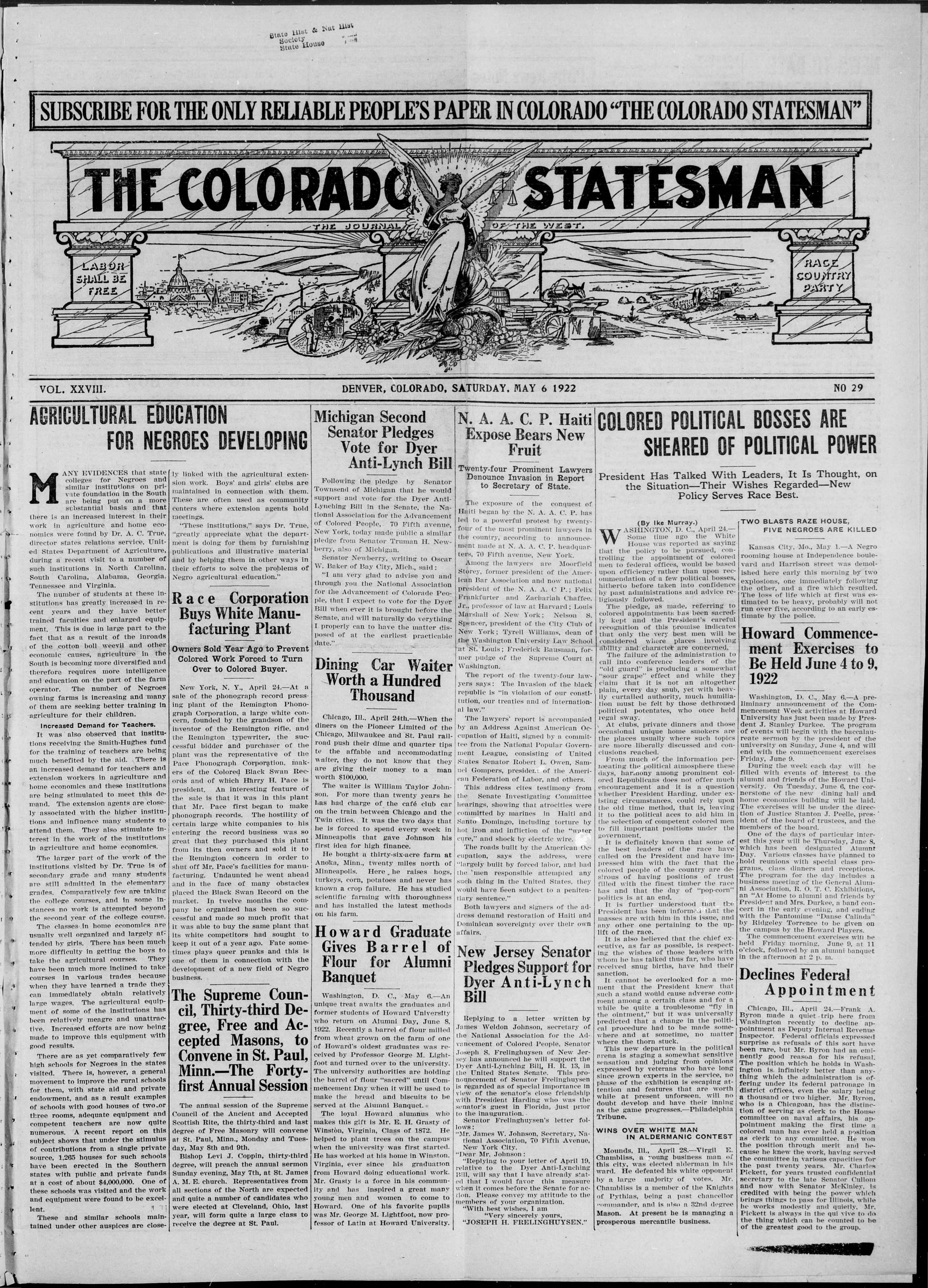
THE COLORADO STATESMAN
THE JOURNAL OF THE WEST.
LABOR SHALL BE FREE
RAGE COUNTRY PARTY
AGRICULTURAL EDUCATION FOR NEGROES DEVELOPING
VOL. XXVIII.
MANY EVIDENCES that state colleges for Negroes and similar institutions on private foundation in the South are being put on a more substantial basis and that there is an increased interest in their work in agriculture and home economics were found by Dr. A. C. True, director states relations service, United States Department of Agriculture, during a recent visit to a number of such institutions in North Carolina, South Carolina, Alabama, Georgia, Tennessee and Virginia. The number of students at these institutions has greatly increased in recent years and they have better trained faculties and enlarged equipment. This is due in large part to the fact that as a result of the inroads of the cotton boll weevil and other economic causes, agriculture in the South is becoming more diversified and therefore requires more intelligence and education on the part of the farm operator. The number of Negroes owning farms is increasing and many of them are seeking better training in agriculture for their children.
Increased Demand for Teachers.
It was also observed that institutions receiving the Smith-Hughes fund for the training of teachers are being much benefited by the aid. There is an increased demand for teachers and extension workers in agriculture and home economics and these institutions are being stimulated to meet this demand. The extension agents are closely associated with the higher institutions and influence many students to attend them. They also stimulate interest in the work of the institutions in agriculture and home economics. The larger part of the work of the institutions visited by Dr. True is of secondary grade and many students are still admitted in the elementary grades. Comparatively few are taking the college courses, and in some instances no work is attempted beyond the second year of the college course.
The classes in home economics are usually well organized and largely attended by girls. There has been much more difficulty in getting the boys to take the agricultural courses. They have been much more inclined to take courses in various trades because when they have learned a trade they can immediately obtain relatively large wages. The agricultural equipment of some of the institutions has been relatively meagre and unattractive. Increased efforts are now being made to improve this equipment with good results.
There are as yet comparatively few high schools for Negroes in the states visited. There is, however, a general movement to improve the rural schools for them, with state aid and private endowment, and as a result examples of schools with good houses of two or three rooms, adequate equipment and competent teachers are now quite numerous. A recent report on this subject shows that under the stimulus of contributions from a single private source, 1,265 houses for such schools have been erected in the Southern states with public and private funds at a cost of about $4,000,000. One of these schools was visited and the work and equipment were found to be excellent. These and similar schools maintained under other auspices are close-
State Hist & Nut Hist
Society
State House
ly linked with the agricultural extension work. Boys' and girls' clubs are maintained in connection with them. These are often used as community centers where extension agents hold meetings.
"These institutions," says Dr. True, "greatly appreciate what the department is doing for them by furnishing publications and illustrative material and by helping them in other ways in their efforts to solve the problems of Negro agricultural education."
Race Corporation Buys White Manufacturing Plant
Owners Sold Year Ago to Prevent Colored Work Forced to Turn Over to Colored Buyer.
New York, N. Y., April 24.—At a sale of the phonograph record pressing plant of the Remington Phonograph Corporation, a large white concern, founded by the grandson of the inventor of the Remington rifle, and the Remington typewriter, the successful bidder and purchaser of the plant was the representative of the Pace Phonograph Corporation, makers of the Colored Black Swan Records and of which Harry H. Pace is president. An interesting feature of the sale is that it was in this plant that Mr. Pace first began to make phonograph records. The hostility of certain large white companies to his entering the record business was so great that they purchased this plant from its then owners and sold it to the Remington concern in order to shut off Mr. Pace's facilities for manufacturing. Undaunted he went ahead and in the face of many obstacles placed the Black Swan Record on the market. In twelve months the company he organized has been so successful and made so much profit that it was able to buy the same plant that its white competitors had sought to keep it out of a year ago. Fate sometimes plays queer pranks and this is one of them in connection with the development of a new field of Negro business.
The Supreme Council, Thirty-third Degree, Free and Accepted Masons, to Convene in St. Paul, Minn.—The Fortyfirst Annual Session
The annual session of the Supreme Council of the Ancient and Accepted Scottish Rite, the thirty-third and last degree of Free Masonry will convene at St. Paul, Minn., Monday and Tuesday, May 8th and 9th.
Bishop Levi J. Coppin, thirty-third degree, will preach the annual sermon Sunday evening, May 7th, at St. James A. M. E. church. Representatives from all sections of the North are expected and quite a number of candidates who were elected at Cleveland, Ohio, last year, will form quite a large class to receive the degree at St. Paul.
ABLE PEOPLE'S PA
RADO
THE JOURNAL
DENVER, COLORADO,
Michigan Second Senator Pledges Vote for Dyer Anti-Lynch Bill
Following the pledge by Senator Townsend of Michigan that he would support and vote for the Dyer Anti-Lynching Bill in the Senate, the National Association for the Advancement of Colored People, 70 Fifth avenue, New York, today made public a similar pledge from Senator Truman H. Newberry, also of Michigan. Senator Newberry, writing to Oscar W. Baker of Bay City, Mich., said:
"I am very glad to advise you and through you the National Association for the Advancement of Colorado People, that I expect to vote for the Dyer Bill when ever it is brought before the Senate, and will naturally do everything I properly can to have the matter disposed of at the earliest practicable date."
Dining Car Waiter Worth a Hundred Thousand
Chicago, Ill., April 24th.—When the diners on the Pioneer Limited of the Chicago, Milwaukee and St. Paul railroad push their dime and quarter tips to the affable and accommodating waiter, they do not know that they are giving their money to a man worth $100,000.
The waiter is William Taylor Johnson. For more than twenty years he has had charge of the café club car on the train between Chicago and the Twin cities. It was the two days that he is forced to spend every week in Minneapolis that gave Johnson his first idea for high finance.
He bought a thirty-six-acre farm at Anoka, Minn., twenty miles north of Minneapolis. Here he raises hogs, turkeys, corn, potatoes and never has known a crop failure. He has studied scientific farming with thoroughness and has installed the latest methods on his farm.
Howard Graduate Gives Barrel of Flour for Alumni Banquet
Washington, D. C., May 6.—An unique treat awaits the graduates and former students of Howard University who return on Alumni Day, June 8, 1922. Recently a barrel of flour milled from wheat grown on the farm of one of Howard's oldest graduates was received by Professor George M. Lightfoot and turned over to the university. The university authorities are holding the barrel of flour "sacred" until Commencement Day when it will be used to make the bread and biscuits to be served at the Alumni Banquet. The loyal Howard alumnus who makes this gift is Mr. E. H. Grasty of Winston, Virginia, Class of 1872. He helped to plant trees on the campus when the university was first started. He has worked at his home in Winston, Virginia, ever since his graduation from Howard doing educational work. Mr. Grasty is a force in his community and has inspired a great many young men and women to come to Howard. One of his favorite pupils was Mr. George M. Lightfoot, now professor of Latin at Howard University.
---
N. A. A. C. P. Haiti Expose Bears New Fruit
Twenty-four Prominent Lawyers Denounce Invasion in Report to Secretary of State.
The exposure of the conquest of Haiti began by the N. A. A. C. P. has led to a powerful protest by twenty-four of the most prominent lawyers in the country, according to announcement made at N. A. A. C. P. headquarters, 70 Fifth avenue, New York.
Among the lawyers are Moorfield Storey, former president of the American Bar Association and now national president of the N. A. A. C. P.; Felix Frankfurter and Zachariah Chaffee, Jr., professor of law at Harvard; Louis Marshall of New York; Nelson S. Spencer, president of the City Club of New York; Tyrell Williams, dean of the Washington University Law School at St. Louis; Frederick Bausman, former pudge of the Supreme Court at Washington.
The report of the twenty-four lawyers says: The Invasion of the black republic is "in violation of our constitution, our treaties and of international law."
The lawyers' report is accompanied by an Address Against American Occupation of Haiti, signed by a committee from the National Popular Government League, consisting of United States Senator Robert L. Owen, Samuel Gompers, president of the American Federation of Labor, and others.
This address cites testimony from the Senate Investigating Committee hearings, showing that atrocities were committed by marines in Haiti and Santo Domingo, including torture by hot iron and infliction of the "water cure," and shock by electric wire.
The roads built by the American Occupation, says the address, were "largely built by forced labor, and had the 'men responsible attempted any such thing in the United States, they would have been subject to a penitentiary sentence."
Both lawyers and signers of the address demand restoration of Haiti and Dominican sovereignty over their own affairs.
New Jersey Senator Pledges Support for Dyer Anti-Lynch Bill
New Jersey Senator Pledges Support for Dyer Anti-Lynch Bill
Replying to a letter written by James Weldon Johnson, secretary of the National Association for the Advancement of Colored People, Senator Joseph S. Frelinghuysen of New Jersey has announced he will support the Dyer Anti-Lynching Bill, H. R. 13, in the United States Senate. This pronouncement of Senator Frelinghuysen is regarded as of special importance in view of the senator's close friendship with President Harding who was the senator's guest in Florida, just prior to the inauguration. Senator Frelinghuysen's letter follows:
"Mr. James W. Johnson, Secretary, National Association, 70 Fifth Avenue, New York City.
"Dear Mr. Johnson:
"Replying to your letter of April 19, relative to the Dyer Anti-Lynch Bill, will say that I have already stated that I would favor this measure when it comes before the Senate for action. Please convey my attitude to the members of your organization.
"With best wishes, I am
"Very sincerely yours.
"JOSEPH H. FRELINGHUYSEN."
COLORED POLITICAL BOSSES ARE SHEARED OF POLITICAL POWER
President Has Talked With Leaders, It Is Thought, on the Situation—Their Wishes Regarded—New Policy Serves Race Best.
WASHINGTON, D. C., April 24. Some time ago the White House was reported as saying that the policy to be pursued, controlling the appointment of colored men to federal offices, would be based upon efficiency rather than upon recommendation of a few political bosses, hitherto before taken into confidence by past administrations and advice religiously followed.
The pledge, as made, referring to colored appointments has been sacredly kept and the President's careful recognition of this promise indicates that only the very best men will be considered where places involving ability and character are concerned.
The failure of the administration to call into conference leaders of the "old guard" is producing a somewhat "sour grape" effect and while they claim that it is not an altogether plain, every day snub, yet with heavily curtailed authority, much humiliation must be felt by those dethroned political potentates, who once held regal sway.
At clubs, private dinners and those occasional unique home smokers are the places usually where such topics are more liberally discussed and conclusions reached.
From much of the information permeating the political atmosphere these days, harmony among prominent colored Republicans does not offer much encouragement and it is a question whether President Harding, under existing circumstances, could rely upon the old time method, that is, leaving it to the political aces to aid him in the selection of competent colored men to fill important positions under the government.
It is definitely known that some of the best leaders of the race have called on the President and have impressed him with the fact that the colored people of the country are desirous of having positions of trust filled with the finest timber the race has and that the day of "pop-corn" politics is at an end.
It is further understood that the President has been informed that the masses are with him in this issue, and any other one pertaining to the uplift of the race.
It is also believed that the chief executive, as far as possible, is respecting the wishes of those leaders with whom he has talked thus far, who have received snug births, have had their sanction.
It cannot be overlooked for a moment that the President knew that such a stand would cause adverse comment among a certain class and for a while be quite a troublesome "fly in the ointment," but it was universally predicted that a change in the political procedure had to be made somewhere and at sometime, no matter where the thorn stuck.
This new departure in the political arena is staging a somewhat sensitive sensation and judging from opinions expressed by veterans who have long since grown experts in the service, no phase of the exhibition is escaping attention and features that are worth while at present unforeseen, will no doubt develop and have their inning as the game progresses.—Philadelphia Tribune.
WINS OVER WHITE MAN
IN ALDERMANIC CONTEST
Mounds, Ill., April 28.—Virgil E. Chambliss, a young business man of this city, was elected alderman in his ward. He defeated his white opponent by a large majority of votes. Mr. Chambliss is a member of the Knights of Pythias, being a past chancellor commander, and is also a 32nd degree Mason. At present he is managing a prosperous mercantile business.
NO 29
TWO BLASTS RAZE HOUSE,
FIVE NEGROES ARE KILLED
Kansas City, Mo., May 1.—A Negro rooming house at Independence boulevard and Harrison street was demolished here early this morning by two explosions, one immediately following the other, and a fire which resulted. The loss of life which at first was estimated to be heavy, probably will not run over five, according to an early estimate by the police.
Howard Commencement Exercises to Be Held June 4 to 9, 1922
Washington, D. C., May 6.—A preliminary announcement of the Commencement Week activities at Howard University has just been made by President J. Stanley Durkee. The program of events will begin with the baccalaureate sermon by the president of the university on Sunday, June 4, and will end with the commencement exercises Friday, June 9.
During the week each day will be filled with events of interest to the alumni and friends of the Howard University. On Tuesday, June 6, the cornerstone of the new dining hall and home economics building will be laid. The exercises will be under the direction of Justice Stanton J. Peelle, president of the board of trustees, and the members of the board.
One of the days of particular interest this year will be Thursday, June 8, which has been designated Alumni Day. Various classes have planned to hold reunions with special class programs, class dinners and receptions. The program for the day includes a business meeting of the General Alumni Association, R. O. T. C. Exhibitions, an "At Home to alumni and friends by President and Mrs. Durkee, a band concert in the early evening, and ending with the Pantomime "Danse Callida" by Ridgeley Torrence to be given on the campus by the Howard Players.
The commencement exercises will be held Friday morning, June 9, at 11 o'clock, followed by an alumni banquet in the afternoon at 2 p. m.
Declines Federal Appointment
Chicago, Ill., April 24.—Frank A. Byron made a quiet-trip here from Washington recently to decline appointment as Deputy Internal Revenue Inspector. Federal officials expressed surprise as refusals of this sort have been rare, but Mr. Byron had an eminently good reason for his refusal. The position which he holds in Washington is infinitely better than anything which the administration is offering under its federal patronage in district offices, even the salary being a thousand or two higher. Mr. Byron, who is a Chicagoan, has the distinction of serving as clerk to the House committee on naval affairs, his appointment making the first time a colored man has ever held a position as clerk to any committee. He won the position through merit and because he knew the work, having served the committee in various capacities for the past twenty years. Mr. Charles Pickett, for years trusted confidential secretary to the late Senator Cullom and now with Senator McKinley, is credited with being the power which brings things to pass for Illinois, while he works modestly and quietly. Mr. Pickett is always in the qul vive to do the thing which can be counted to be of the greatest good to the group.
NEWS TO DATE IN PARAGRAPHS
CAUGHT FROM THE NETWORK OF WIRES ROUND ABOUT THE WORLD.
RECORD OF IMPORTANT EVENTS
CONDENSED FOR BUSY
PEOPLE.
(Western Newspaper Union News Service.)
WESTERN
Walter F. Thode, former assistant cashier of the defunct Overland National Bank of Boise, Idaho, has been arrested by Department of Justice operatives, charged with embezzlement of $11,686 of the bank's funds.
Three children, Mildred and Eunice Bergstrom, aged 18 and 10, and George Livesly, their cousin, aged 4, were burned to death at the ranch home of W. L. Bergstrom, near Bend, Ore., in a fire that started in an incubator.
Six armed and unmasked automobile bandits held up a messenger for the Central Bank of Oakland in a residence district and robbed him of $12,000 which he was taking in an automobile to a branch of the bank in North Oakland.
Two unmasked bandits held up Frank Webster, office manager, and Wilma Meyer, cashier, of the Seattle Star, as they descended from an automobile with the newspaper's weekly pay roll fund, secured the entire fund of $4,400 and escaped in a waiting automobile.
The tank steamer Whittier of the Union Oil Company, which went on the rocks at a point ten miles south of Point Arena, near San Francisco, is a total loss, the company was advised by radio. The steamer's cargo of 10,000 barrels of oil was lost. The crew of twenty-six was saved.
Low Friedman, said to have been one of the cleverest dice experts in the country, is dead in San Bernardino by his own hand—the hand that rolled "seven" and "eleven" for nearly $500,000 in the last twenty years. Friedman cheated for the first time in his life, his friends say, when he beat the specter of tuberculosis by shooting himself as fate was shaking the dice. He could have lived but a few days longer. Friedman died penniless.
WASHINGTON
A request for a special appropriation of $500,000 to be used in prosecution of war fraud cases has been sent to the House by President Harding. The budget communication explained that the fund would be used for investigation or prosecuting all cases, whether civil or commercial, growing out of the war.
August Probst, the Swiss waiter who has charged that he was "kidnaped" because of his romantic interest in the daughter of a wealthy member of the fashionable Rolling Rock Country Club near Pittsburgh, will be deported from the United States under an order issued by Assistant Secretary Henning of the Labor Department.
The packers and stockyards act of 1921 has been declared constitutional by the Supreme Court. The court, in disposing of cases brought by James E. Burton, and others representing Chicago traders, and Stafford Brothers in behalf of the Chicago commission merchants, declared that commission merchants, traders and dealers who buy and sell livestock after its arrival at Chicago stockyards are engaged in interstate commerce.
President Harding has given his approval to an appropriation of $200,000 to aid various southern states in preventing breaking of levees along the Mississippi river. The appropriation is to be used on levees not under the supervision of the Mississippi river commission, $1,000,000 having already been set aside for the levees over which the commission has jurisdiction.
Another plea for immediate termination of the military occupation of Haiti met with a refusal at the State Department. A committee of lawyers who brought to the department a brief declaring the occupation to be out of harmony with American principles, were plainly told by Secretary Hughes that their arguments appeared to him most inadequate and one-sided.
The charge that by leasing the Teapot dome, Wyoming naval oil reserve, to the Mammoth Oil Company, headed by Harry F. Sinclair, millionaire oil promoter, the Interior Department in reality turned one of the most valuable oil structures in the country over to the Standard Oil, was made by former Governor Brooks of Wyoming in a telegram received from him by Senator Kendrick, Democrat, of that state.
Checked somewhat by failure to see President Harding, the "children's crusade," which invaded the capitol thirty-seven strong on behalf of 114 war law violators now serving prison terms, got little encouragement from Attorney General Daugherty as to recommendation for executive clemency. The American government stands unshaken in its determination that Russia must put her own house in order before she can expect political recognition by the United States, Secretary Hughes recently told a delegation of women at the State Department.
FOREIGN
Five Russians including Kerensky's former secretary, Boris Slavinkoff, have been arrested in Genoa by the Italian police.
Spanish troops have suffered a severe reversal at the hands of Moroccan tribemen according to a Central News dispatch received in London from Madrid.
There have been 97 murders in Belfast since February, 57 attempted, 150 cases of housebreaking, 180 robberies, Lord Chief Justice Moore announced in opening the new court sessions at Belfast.
Ten persons were wounded by the police and ten were arrested while the police were dispersing a demonstration of municipal workers outside the town hall in Berlin. The demonstration was held in connection with a dispute over wages.
Agreement by both Gen. Wu Pei-Fu and Gen. Chang Tso Lin, rival Chinese leaders, to exclude Peking and Tientsin from the field of military operations was announced in an official dispatch received by the Chinese legation at Washington from the Peking government.
Fearing violent disorders in the zone of occupation along the Rhine and a general lack of restraint among troops in the borderland, the German government is drafting a "note of earnest appeal" to the United States, pleading for the retention of at least one regiment of American troops.
Sergt. Aaron Kaplan of the department of criminal investigation of the American forces in Germany is suffering from a gunshot wound through the left elbow, sustained during a May may demonstration in Mayence. The driver of Sergeant Kaplan's car and two German policemen who were in the machine were badly hurt. A group of British and American doctors has volunteered to treat outside Peking men wounded in battle. It is reported that many wounded were found at Changsintein and Fengtai who had received no attention. The assertion is made the contending armies are without base hospitals, dressing stations, bandages or means of transportation.
General Ludendorff has written to Maj. Julio Guerrero, Peruvian military attache at Berlin, thanking him for the "chivalrous and unprejudiced" accounts of events recorded in Guerrero's new history of the war. "We were not beaten on the field," said General Ludendorff in his letter, "but by the failure of politicians to adapt themselves to the requirements of war. Politics and war are one..
The discovery and isolation of the typhus germ by Dr. N. Kritch, a woman, under the guidance of Prof. Barakin, director of the Moscow biological institute, is confirmed by Dr. Walter F. Davenport of Chicago, acting head of the medical department of the American relief administration in Russia. Dr. Kritch is director of the laboratories of Sokolnichlesky hospital, at Moscow, where she has been engaged for two years in searching for the germ.
GENERAL
Mrs. Rose Grainger of White Plains, N. Y., mother of Perry A. Grainger, the Australian composer and pianist, was killed by a fall from an eighteenth-story window in the Aeolian Hall building in New York City.
When Chief David W. Scott and Felix Loury, Noz Perce Indians, return to their people, they will take with them the privilege of hunting and fishing in the state of Idaho, without a license, according to the Walla Walla treaty of 1855.
The "Invisible Empire has been rendered conspicuously visible," it was declared at the district attorney's office after a preliminary inspection of articles seized when agents of the district attorney and deputy sheriffs successfully raided the Los Angeles office of the Ku Klux Klan.
A 19-year-old youth was slain by a 16-year-old fellow camper near Jamaica, Long Island, as the climax of a rifle duel in which the two had stalked each other from behind trees.
"Agitated air" is the cause of the floods reported from many sections of the country. The radio craze is to blame, says Delbert Neal of Osceola, Mo., who has directed an appeal to all broadcasting stations to "cut out tickling the air."
Dr. C. E. Seashore, psychologist of the National Research Council and member of the National Academy of Sciences at Washington, has characterized Sir Arthur Conan Doyle's proofs of spirit communication as "the result of trickery" and "crass evidence which is certain to be exposed."
While daylight saving time is being observed in many cities and towns in the East, a survey of the middle western states indicates that, except the large cities, few towns advanced their clocks one hour this year. Summer time is not being observed in Iowa, Nebraska and Minnesota, the survey showed, while in Illinois, Chicago and some of its suburbs are the only cities that have gone on the new time.
The $100,000 damage suit brought by Miss Frances C. Birkhead, a stenographer, against Gov. Lee Russell of Mississippi, her former employer, has been dismissed in Federal Court at Jackson, Miss., by Judge Edwin Holmes on the ground of lack of jurisdiction.
Three members of the crew on a Baltimore & Ohio fast freight train were killed when the locomotive was blown to pieces by an explosion at Fairhope, Pa. Ten cars following the engine buckled and were destroyed by fire that followed the explosion.
(Western Newspaper Union News Service.)
Denver.—Sunday, May 14, was designated by governor Shovu as Mothers' day in Colorado in an executive proclamation issued here. Residents of the state are requested to observe the day with fitting exercises.
Ordway.—A cloudburst broke over Olney Springs, near here. The downpour lasted for forty minutes, flooding and destroying hay fields, irrigation ditches, creeks and farm lands and sending the flood of water down upon Ordway.
Delta.—Delta's million and a half-dollar sugar factory will operate this year. The Delta factory was erected in 1920 and ran fifty days, but last year stood idle on account of insufficient acreage being promised by growers.
Denver.—The Peterson flood prevention bill, passed by the State Senate, was passed in the House on second reading without a dissenting vote after previous tests of strength had shown an overwhelming sentiment for the measure.
Fort Collins.—Optimism for the future of the cattle industry in Colorado and the West was expressed here at a meeting of over three hundred stockmen from northern Colorado gathered at the Agricultural College for the annual feeders' day.
Pueblo.—Temporary spans have replaced nearly a dozen bridges over the St. Charles river and several other smaller streams in the Arkansas valley that were washed out when cloudbursts caused several streams to reach flood stages.
Silverton.—Wage readjustments are asked by five leading metal mining companies in the Silverton district, H. E. Curran, secretary of the Colorado Industrial Commission, has announced in Denver. Notices of wage reductions aggregating 50 cents daily were filed with the state industrial board, effective in thirty days. Denver.—Land in Colorado, including city and town lots, pays about 42 per cent of the general property tax assessed in the state, though only 46.54 per cent of the land in the state is on the tax rolls, according to compilations made by the State Immigration Department for the Colorado year book. Agricultural land pays nearly 30 per cent of this tax.
Cañon City.—The residents of what is known as Little Webster Park, a farming section, lying some fifteen to twenty miles north of Cañon City, are engaged in a volunteer road-building project which when completed will bring them within easy reach of Cañon City and open up a section said to rival in scenic grandeur the vistas of the Royal Gorge and the Red Cañons.
Colorado Springs—Col. F. W. Wood, grandfather of William Wood, city editor of the Durango Herald, slain in Durango by Rod S. Day, editor of the Durango Democrat, lost his life in Kansas as a result of his defense of prohibition in that state, John Wood, a brother of the Durango editor, stated here. Colonel Wood was slain while a member of the Kansas Legislature, Wood said.
Boulder.—The Caribou hill ore body, reported last week after over sixteen feet of drifting, has widened to over four feet of solid mineral, increasing in size and in value every round. Nuggets of high-grade silver ore are coming in the breast. It is expected that the body, according to the present indications, will continue at least another twenty or thirty feet, and will make one of the biggest ore shutes ever uncovered in this district.
Fort Collins.—John Burnside, 71 years old, must face trial here on a charge of violating the prohibition law.
Colorado Springs.—Four colleges have signified their intention of entering the intercollegiate golf tournament to be held at the Broadmoor, May 27. Three, Colorado College, the University of Colorado and the School of Mines, entered teams in the journey last year, while the Aggies will be represented for the first time. Efforts are being made to draw Denver University into the meet, but there seem few likely candidates from whom to choose a team.
Yuma.—Colorado's "rain belt section," comprising 600,000 acres of wheat land, is soaked. A twenty-four-hour rainfall has drenched the section and put thousands of dollars into the farmers' pockets. So heavy has the rain been that roads are flooded, bridges washed out and the basements of many homes filled with water. But these difficulties are being met with smiles. Dry winds have prevailed for the past few weeks and the wheat crop, it was feared, would be a loss. Loveland.—A situation said to be bordering on the verge of violence developed in the Dry Creek oil district near here when fifty stockholders of a local drilling company, believing they were being imposed on, it is alleged, by a driller brought from Casper, Wyo., forcibly took possession of the field.
Littleton.—Lester H. Gammon, a former teller of the First National Bank of Littleton, was apprehended and is charged with having embezzled $4,700 in Liberty bonds from a federal bank in 1921.
CENTENNIAL STATE ITEMS
Denver.—After enacting legislation for Pueblo flood prevention and for construction of the Moffat tunnel, which Governor Shoup in his farewell message to members described as "marking a new era in the progress and development of Colorado," the special session of the Twenty-third General Assembly adjourned. The Pueblo flood prevention bill became a law when it was signed by Governor Shoup immediately after adjournment of both houses. The tunnel bill, which also carries the emergency clause, which makes it a law as soon as the governor's signature has been affixed, will not be signed until interrogatories regarding its constitutionality have been submitted to the State Supreme Court.
Denver.—Statements showing all receipts and disbursements of the state coal mine inspection department, together with reports on coal mine disasters, accidents and the like, are contained in the ninth annual report of the state inspector of coal mines, which has just been issued by James Dalrymple, chief inspector. Coal production in Colorado last year was 9,141,947 tons, a decrease of 3,372,746 tons, as compared with the 1920 output, the report shows. This loss in tonage was attributed largely to the general depression in various industries, wage disputes and strikes.
Denver.—A deadlock of thirty hours over the Moffat tunnel bill in the state House of Representatives was broken when the House, by a vote of 54 to 7, adopted a compromise to the Godsman amendment. The Godsman amendment, which brought about a bitter debate in the House, called for appointment of the tunnel commissioners by the boards of county commissioners of Denver, Moffat, Routt and Grand counties. Under the amendment adopted the tunnel commissioners are to be appointed temporarily by the governor. The terms of the commissioners are to run until Aug. 31, 1923.
Denver.—Secretary of Agriculture Wallace has announced in Washington that he has allotted the following amounts of federal money toward the building of Colorado highways: Santa Fé trail, 2.273 miles of concrete between Pueblo and La Junta, $42,088.88; between Husty and Lamar, 11.82 miles of gravel road, $48,824.39; state road No. 2, between Fort Collins and Loveland, 3.8 miles concrete, $75,762.95; state road No. 9, between Sterling and Merino, 5 miles of concrete, $88,209.99.
Trinidad. — Although no specific blame is made for the recent Sopris No. 2 mine disaster near Trinidad, in which seventeen workmen lost their lives, the catastrophe was caused by an explosion of gases and coal dust, according to a report made public by State Coal Mine Inspector James Dalrymple at Denver. The explosive gases were accumulated through an open door in the underground workings, and the blast resulted when the gas was ignited by an electric arc.
Denver.—One more great permanent coal producing mine has been added to the state's revenue producers, located an entire section of land—Section 16, Township 1 North, Range 68 West—eighteen miles due north of the city of Denver, in the northern coal fields, and known as the "Morrison Mine."
Denver.—The mysterious shooting of Edward Schmidt, 18-year-old Leadville youth, in the home of his grandfather, Charles E. Kirchhoff here, is baffling police, Coroner Thomas M. Hunter and Philip S. Van Cise, district attorney. Grand Junction.—Breaking several western slope high school records, Montrose and Grand Junction fought out a track meet here recently. Montrose won, 68 to 65. The second annual observance of "National Hospital day," the anniversary of the birth of Florence Nightingale, will be held throughout the United States May 12.
Golden.—Athletic Director F. D. Aller, and the members of the athletic council of the Colorado School of Mines have entered actively upon a campaign to build a new athletic field in Golden. It is estimated that $15,000 will be required for this purpose. The trustees of the School of Mines have contributed $5,000, Ralph E. Brooks, a member of that body has pledged a similar amount, and an appeal has been made to the citizens of Golden to contribute the third part of the quota.
Akron.—An early morning fire here caused a loss estimated at $30,000. The Miller grocery store is a total loss and the Harwood Dry Goods Company and the Isaac Pelton block were badly damaged. This is the fourth fire in the same block within a few months. The buildings and contents destroyed were covered by insurance.
Denver.—State Treasurer Stong is preparing to issue $3,000,000 worth of highway bonds June 1. Governor Shoup Tuesday certified to the treasurer that issuance of the bonds is necessary to provide funds to meet the 1922 budget. The bonds will be the last of the $5,000,000 issue voted at the last election.
Yuma.—The inter-district state debate between Montrose and Yuma was held in the Yuma high school auditorium. The subject was: "Resolved, That a Court of Industrial Relations Similar to That of Kansas Should Be Adopted by the Several States," Montrose having the affirmative, Yuma the negative. The decision was unanimous for the affirmative.
Fort Collins.-The Colorado Aggies debating team lost the decision to the Penn State team here by a close margin. Morrison Shafroth, Denver attorney, gave the decision.
Call in and see my Spring Samples now on display. Prices reasonable.
CLOW
Wall Paper
1747 ARA
AGENCY FOR
Manufactured by
HOWARD & HOWARD
GROCERIES AND MEATS
Fresh Vegetables and Fruits Daily
Does your friend trade with us? If not, read this ad as an invitation for him to know how to get our service and ity goods. Free delivery-to any part of the city.
PHONE YORK 9552. 718 E. TWENTY-SIXTH
your friend trade with us? If not, read this ad
ation for him to know how to get our service an
Free delivery-to any part of the city.
NEW YORK 9552. 718 E. TWENTY-SIXTH
Does your friend trade with us? If not, read this advertisement as an invitation for him to know how to get our service and our quality goods. Free delivery-to any part of the city.
Residence Phone, York 7616.J
2536 Washington Street.
PHONE MAIN 3023
John K. Rettig
MEATS, FANCY A
1864 C
MEATS, FANCY AND STAPLE GROCERIES
1864 CURTIS STREET
Nineteenth Denver
THE CHAMPA PHARMACY
2101 CHAMPA
Is the place to get your
DRUGS, CHEMICALS AND PATENT MEDICINE
WE SERVE DRINKS.
PRESCRIPTIONS OUR SPECIALTY.
me us and we will deliver the goods to all parts of the
JAMES E. THRALL, Propr.
MAIN 2425 PHONE
THE CHAM
210
Is the p
DRUGS, CHEMICALS
WE SEE
PRESCRIPTION
Phone us and we will deliver
JAMES E
2101 CHAMPA Is the place to get your DRUGS, CHEMICALS AND PATENT MEDICINES WE SERVE DRINKS. PRESCRIPTIONS OUR SPECIALTY. Phone us and we will deliver the goods to all parts of the city. JAMES E. THRALL, Propr.
PHONE MAIN 2425
Special Attention Giv
SEWERAGE.
Phone Main 207 1907
HERE IT
Jazz is being taken from me
caught it and am putth
SUIT
Special Attention Given to VENTILATION AND SEWERAGE. All Work Guaranteed
Main 207 1907 Arapahoe St. Denver,
HERE IT IS
being taken from music, but I have
night it and am putting it into
SUITS
and See My Jazz Styles.
GARDNER, THE TAILOR
HAMPA 1019 1025 TWEET
Just re-
—1,000
son's la-
of Wor-
your
and sele-
Special Attention Given to VENTILATION AND SEWERAGE. All Work Guaranteed Phone Main 207 1907 Arapahoe St. Denver, Colo.
---
A. B. CLOW Gallup 3841-R
WINDSHIELDS
MIRRORS
Corner Nineteenth
WALLACE CLOW
South 1514-W
BROTHERS
Water & Paint Co.
RAPAHOE STREET
PROOF PRODUCTS
by Pittsburgh Plate Glass Co.
WINDOW GLASS
OIL AND TURPENTINE
with us? If not, read this advertisement now how to get our service and our qual- any part of the city.
718 E. TWENTY-SIXTH AVE.
Shop Phone, York 3390-J
RED HOT SHOE
REPAIR FACTORY
COOPER AND JEFFERSON, Props.
Only Colored Shoe Repair Shop in Denver.
HAND MADE SHOES TO ORDER.
Work Called for and Delivered. All
Work Neatly Finished.
Denver, Colo.
RES. PHONE GALLUP 942
IMPA PHARMACY
101 CHAMPA
the place to get your
MEDICINES AND PATENT MEDICINES
SERVE DRINKS.
MONS OUR SPECIALTY.
driver the goods to all parts of the city.
E. THRALL, Propr.
JOBBING
PROMPTLY ATTENDED TO
P. H. BALFE
PRACTICAL
PLUMBER
LICENSED DRAIN LAYER
Given to VENTILATION AND
All Work Guaranteed
07 Arapahoe St. Denver, Colo.
IT IS
music, but I have
telling it into
Just received
—1,000 of the season's latest styles of Woolens for your inspection and selection.
R, THE TAILOR
1025 TWENTY-FIRST
—Proprietors— N. FAIRBANKS
FAIRBANKS
CAFE
First Class Meals Served
2444 Washington St., Denver, Colo.
---
Denver, Colo.
PHONE 8444
WALL PAPERING AND PAINTING THE COLORADO WALL PAPER & PAINT CO.
STAR HAIR GROWER A Wonderful Hair Dressing and Grower. 1,000 AGENTS WANTED.
THE WORLD'S FINEST HAIR STYLE
send $1.00 and we will send you a full supply that you can begin work with at once: also agent's terms. Send all money by money order to THE STAR HAIR CROWER MF'R., P. O. Box 812, Greensboro, N. C.
USE SATIN TOP
STRAIGHTEN YOUR OWN HAIR
SENT ANYWHERE, MAIL OF EXPRESS, $1.25 JAR.
R. B. BOLDEN 926 NINETEENTH STREET
PHONE MAIN 4052. DENVER, COLORADO.
CITY BARBER SHOP
1454 Welton
Interior and Exterior Decorating. Quality the best. Service our motto. Try our $2.75 Paint and you will come again.
STAR HAIR
A Wonderful Hair D
1,000 AGENT
send $1.00 and we will send you
work with at once: also agent'
Send all money by money order
THE STAR HAIR
P. O. Box 812,
USE SAT
STRAIGHTEN Y
SENT ANYWHERE, MAH
R. B. BOLDEN
PHONE MAIN 4052.
FIRST CLASS
Best Service in City
The Wool Combers.
In the Latin quarter of Paris we often sees groups of bareheaded women, sitting in some quiet corner of the street, perhaps within a church door, pleking and combing the wool of their mattresses. No matter how poor a French peasant may be, he almost always possesses a comfortable bed with a wool mattress.
Phone M. 871
The
COLORADO
BAR & BAKERY
THE HAIR GROWER
Dressing and Grower.
ITS WANTED.
Good Money
Made
We want agents in every city and village to sell
THE
STAR HAIR
GROWER.
This is a wonderful preparation. Can be used with or without straightening irons and by any person.
One 25 cents box proves its value. Any person that will use a 25c box will be convinced.
No matter what has failed to grow your hair, just give THE
STAR HAIR
GROWER
a trial and be convinced.
Send 25c for full size box.
If you wish to become an agent for this wonderful preparation.
you a full supply that you can begin
agent's terme.
order to
R CROWER MF'R.,
Greensboro, N.C.'
ATIN TOP
YOUR OWN HAIR
HAIL OF EXPRESS, $1.25 JAR.
926 NINETEENTH STREET
DENVER, COLORADO.
S BARBER SHOP
Bath
"Tact."
Bath
Sir Chartres Biron, London's chief magistrate, once gave a lecture on "Tact" and incidentally related a story of a Scottish minister who on one occasion thus addressed a condemned criminal: "Donald, mon, the gallows are ready, the hangman's ready, the rope's ready—are ye ready?"—Chicago Herald.
SHIP SUBSIDY IS URGENTLY PUSHED
BILL'S CHANCES INCREASED BY EFFORTS OF THE "LITTLE NAVY" MEN IN CONGRESS.
NAVAL MEN WANT IT PASSED
Merchant Vessels Would Be Most Useful in Event of War—President Harding and Lasker Working Hard for the Measure.
By EDWARD B. CLARK
Washington.—If congress in its wisdom, or more likely unwisdom, shall cut the United States navy below the strength allowed to it by the international conference, the chances for success of the merchant marine subsidy bill are increased. The merchant ships are good for something besides the carrying trade. They can be used for certain purposes in time of war. If Warren G. Harding and Albert D. Lasker can have their way, and they are working hard to get it, the ship subsidy bill will be passed at the present session of congress. Mr. Lasker has been propagandizing in behalf of the measure, and so has President Harding. "Propagandizing" in this case is an affair of the heart and, as such, probably can be considered within the proprieties.
A good many years of watching things from the galleries of congress and of hearing things in the corridors of congress confessedly make one skeptical of the success at the present session of the effort of the Marion man and the Chicago man, but there seems to be something more than an even chance that a subsidy for the shipping interests will be provided by the congress of the United States which now is sitting. Next winter is not far off, as time is counted.
Of course a limitation is set upon the building of merchant ships with a view to converting them into warships. However, there is nothing to prevent the merchant fleet when war breaks out from becoming an auxiliary of such warships as there may be afloat. They are indispensable for the purpose of transporting troops, for the carrying of shot, shell and high explosives and other material of warfare.
Navy Men for the Subsidy.
It is apparent from what navy men say that they will rejoice if the ship subsidy bill shall become a law of the land. They never can look with equanimity upon the depletion of the crews of the warships and on the passing of the major men of war, but they can look on it more placidly if they know that in the day of possible war the country's carriers of peace-time products can be used to help out such a navy as Uncle Sam may have.
The United States, in a way, has tried to run its own merchant marine. Everybody knows what a mess has been made of things. Congress is being told that if a subsidy is not granted there will be no merchant marine at all worthy the name, unless actual government ownership comes into operation—and this neither the administration nor congress wants to have come to pass.
There has been some little surprise in Washington because of the seemingly intense interest which the President has taken and is taking in the subsidy proposal. Originally he belonged to the school of politicians and economists which did not believe in subsidies of any kind, although personally he may have held something of the views which he holds today.
Why Harding Wants It.
The fact is that the President at this time believes that if the country does not grant a subsidy we will have no merchant marine worthy of the name; that it will be impossible to open new markets and that other countries which are not hampered by laws regulating the kind of crews that they shall employ, the kind of quarters that they give them and some other things, will continue to have the cream of the trade.
It would be interesting today if one could determine definitely just how much progress has been made in converting individual Middle Westerners and Southerners to the cause of the proposed legislation. Naturally men whose cities and states will profit directly and, so to speak, visually, by a subsidy are in favor of the measure, but there are others from the South and from the Middle West who still seem to hold that subsidy legislation is a scheme of New England and other coastwise states to benefit themselves at the expense of persons who do not live within smelling distance of salt water, or within hearing distance of the sound of the waves on the beach.
Friends of the subsidy legislation in senate and house seem to think that it has more than a fighting chance for passage at the present session of congress. The trouble is that the congressmen want to get away as early as possible, and they know now that they cannot get away to enter the campaign within two months of the time that the leaders promised them should be the case. Therefore, if subsidy does not get into position to receive direct legislative attention until, say July, it probably is all off for this session. However, there is always another day, and that day will be next winter.
Senate May Talk Long on Tariff.
Congress reluctantly seems to have settled down, into the seat of convic-
tion that it must stay here all summer to discuss the tariff bill. The house passed the bill and the senate committee on finance received it, and then proceeded to the task of recasting. It has been reported to the senate and the lagging debate is on.
In a general way it may be said that the customs rates of the bill are somewhat higher than those of the Payne-Aldrich law, which was the last customs measure enacted by a Republican congress. The bill, when it goes into effect, will supersede the Democratic law produced by what is known as the Underwood-Simmons bill.
It is a sheer impossibility, unless one chose to take up every available inch of space of a newspaper issue, to discuss the various pros and cons of this new measure. The thing for men and women to do who happen to be interested in any specific items in the tariff bill is to send to their individual representatives in congress and to ask for copies of the house and senate measures, and in them look up the particular thing which is of personal or professional interest.
There are certain virtually new industries which are given recognition in the measure. Most of these industries, at least in an active form, were the creation of the war, and today seemingly consideration of them is vital to the industrial independence of the American people, at least so says the majority report of the senate finance committee.
These new industries include coat tar dyes and medicinal products, long staple cotton, the Wisconsin hemp industry, magnesite and potash mining industries, walnut, almond and citric acid industries in the West and new chemical and optical glassware manufactures.
American Valuation Rejected.
The senate committee made many changes in the house bill. The most marked is that which rejects the provision for American valuation and which substitutes a plan of assessment on foreign valuation. This change, if it shall be sanctioned by the senate, will cause a long drawn-out controversy between the two houses when the bill goes to conference. There is no attempt here to pass judgment on the wisdom or unwisdom of either scheme of valuation. American students of economics must judge for themselves.
It is admitted that previously in writing on the subject of the tariff it was intimated that the senate might put the bill through fairly quickly, because the senators are dead tired of talking. However, they seem to have taken a second breath and a second thought in the matter and the chances are that the debate will be long and perhaps be of a nature to admit of the use of the old-time expression "long and furious."
It is understood that the wool schedule may cause trouble. In the Payne-Aldrich days the wool item was known as Schedule K, and the people heard and read more about Schedule K than they did about all the other schedules in the entire length and breadth of the customs measure. It was Schedule K which was productive of both acrimony and humor in the elder day of Mr. Payne and Mr. Aldrich, both of whom have gone to their reward.
New Duty on Yeast Bread.
It may be of interest to the agriculturists who have not seen the bill to know that there is a duty put on yeast bread, the first duty of this kind ever imposed. This is said to mean that a Canadian baker at Windsor, which is on the river just across from Detroit, and a Mexican baker on the border just across the Rio Grande, will find their products taxed 15 per cent when they cross the line into the United States. The house left bread free, just as it was in the Underwood law. The senate has made the change in this tariff.
The house put a duty of 60 per cent on oatmeal. The senate has raised this duty to 90 per cent. The wheat rate is 5 cents more a bushel in the senate bill than in the house bill, the senate rate being 35 per cent. Under the present law wheat comes in free.
Long staple cotton, which has always been free of duty, is assessed at 7 cents a pound. This is 8 cents less than the rate asked for by the direct representatives of the agricultural interests. Short staple cotton remains on the free list.
The reason that a tariff debate lasts so long in the senate is that each section of the country is interested in some particular item in the bill, and as a result the senators representing the interested sections desire to speak at length on those things which concern their constituents.
Too Scientific for Her
I was enrolled in a large class in botany. The instructor was discussing the various means by which the pollen is transferred from one flower to another.
"Does any one happen to know how the wild ginger flower is pollenized?" he asked.
"I know that it is done by one certain insect better adapted to the purpose than any other." I said, eager to show my knowledge of natural history, "but I can't recall its name."
"Yes, it is a hard name to remember," he said, "a-n-t, ant."—Chicago Tribune.
Considerate Husband.
She—If I'm in it, greatly mistaken, I heard the clock strike two when you came in last night. Am I wrong? He—No, my dear, you are quite right. You heard it strike twice. As a matter of fact, it was going to strike eleven times, but, fearing that the noise would disturb you, I stopped the clock.
ASSERTS RED ARMY IS READY
TROTSKY DEFIES GENOA
(Western Newspaper Union News Service.)
Moscow. — The developments at Genoa "having made it clearly evident" that the European diplomats have misunderstood "what has happened" there, said Leon Trotsky, the soviet war minister, "America's carefulness in remaining outside the conference perhaps was right, in that it gives America the possibility better to orientate itself and more correctly solve the problems which Genoa has presented."
"I do not believe in intervention," he said. "If, however, it comes, the Red rmy will fulfill its duty."
In his statement M. Trotsky broke the silence which as a matter of policy the most important soviet officials have maintained while the delegates have been in Genoa.
In a frank presentation of Russia's position, in which he went deeply and concisely into the principles at stake, M. Trotsky declared he doubted the non-success of the conference would mean the beginning of military operations against Russia, but it would mean that the soviet economic work would progress more slowly than Russia had wished and than it might have done.
"The leading European diplomats," he continued, "appear still to consider that the labor revolution in Russia is not the beginning of a new and historical world epoch, but a mere temporary change of one form of property for another.
"They thought by force to induce us to the old form of property, but this failed, and now they are demanding that we pay indemnity for the revolution on the basis of the legal forms and calculations of capitalistic society. This is as foolish as if we should demand at Genoa that European capitalists, on the basis of our forms of property, should hand over their factories, works, banks and mines to the collective management of the working classes.
"Collapse of the Genoa conference would mean not only retardation of Soviet economic work, but ruination of the economics of Europe would proceed more quickly than is believed possible by the present directors of Europe's fate.
"Regarding France, it is evident to serious observers that she is approaching the greatest catastrophe in the world, which will begin with finance. The present French policy is a policy of despair. One cannot take it seriously into account, and, in any case, one could not follow it.
"America remained outside the conference. Perhaps this carefulness was right, in the sense that America perceived the possibility better to orientate itself and solve the question more correctly. Naturally this solution is impossible on the lines Secretary Hughes tried to fix, that is, dictating to us which forms of property and what methods of legislation and management we ought to inaugurate in our own country.
"For such advice and such counsel we did not and do not intend to go to Genoa, and even less across the ocean."
Make Fast Flight in Army Airplane.
San Diego, Calif.-Lieuts, J. H. Doolittle and L. I. Andrews, flying in an army airplane, made a fast flight recently from San Antonio, Texas. The start was made at 4:25 a. m., Pacific Coast time, and the airmen landed at Rockwell field at 4:55 p. m. Lleutenants Doolittle and Andrews made only two stops, at El Paso and Nogales. Those were for taking on fuel and consumed an hour, so that the actual flying time was about eleven hours. Both airmen received their early training here.
Father Lets Son Go to Jail.
New York.—Max Herzberg, a wealthy manufacturer, sat in Judge Rosalsky's court and saw his son Joseph, 21 years old, sentenced to three years in the penitentiary for the theft of $250 from the father. It was not the first time his son had stolen from him, the elder Herzberg told the court. The father sald his son had collected the money from some customers and eloped with Miss Laurette Holden, formerly a chorus girl.
Farm Plantings Delayed by Rain.
Washington.—"It's just one thing after another for the farmers in the Middle West," it was indicated by reports summarized by the weather bureau in its weekly weather and crop review. These reports for several weeks have said farm preparations were being delayed by rain, and now although the rain has stopped, the review said it "was mostly too cool in central and southern states for best germination and development of spring crops."
Mrs. Vivian Rivers Greenwood is authorized to collect for the COLORADO STATESMAN, and any courtesies that you may show her will be highly appreciated by the proprietor, Joseph D. D. Rivers.
Who Invented the Hot Cross Bun?
Many of our group probably believe that the Hot Cross Bun is of Christian origin or British invention. But the Hot Cross Bun was invented by Ethiopians who dwelt in the land of Cheml (ham) wrongly called Egypt. The Ethiopians were very much like the American Negro in looks. The black men offered these buns as to their favorite Moon Goddess for in those days Ethiopia had her own religion. The Greeks brought the custom with them when they immigrated to Greece, from Egypt, calling them Bouns. The Boun refers to the cross-like symbol with which the bun is marked to indicate the four quarttrs of the moon and does not symbolize the Christian cross.
All persons having claims against said estate are hereby notified to present them for adjustment in the County Court of the City and County of Denver, Colorado, on the 16th day of May, 1922. JACK D. FAGAN. Administrator. Per E. P. Blakemore, Attorney for Ad- First publication April 8, 1922. Last publication May 6, 1922.
T. GROSS AND N. LEE, Contractors for Cement, Plastering and Brick Work; Patch Work a Specialty. Champa 7966. 526 30th St.
Save Pennies—
Waste Dollars
Some users of printing save pennies by getting inferior work and lose dollars through lack of advertising value in the work they get. Printers as a rule charge very reasonable prices, for none of them get rich although nearly all of them work hard.
Moral: Give your printing to a good printer and save money.
Our Printing Is Unexcelled
FREE
THIS BEAUTIFUL
HAIR STRAIGHTENING
AND SHAMPOO COMB
This Comb Is Well Worth $1.00
Solid Brass, wooden handle.
8 1/4 inches long weight 4 ounces.
given as a present to all who take
advantage of our great
BIG OFFER NO. 1144
JUST WRITE TO US AND SAY: "I would like to set a hair straightening and sham comb comb free. Send me particulars regarding your No. 1144 offer."
Be sure and write your name and address plainly and full particulars will be sent you do not wait written for this notice will not
We are doing this to advertise Ford's Hair Pomade and Ford's Hair Straightening and Shampoo Combs.
Address your letter to
THE OZONIZED OX MARROW CO.
WARSAW ILINOIS
Our Hobby
Is Good
Printing
Ask to see
samples of
our business cards,
visiting
cards,
wedding
and other invitations, pamphlets, folders, letter heads,
statements, shipping tags,
envelopes, etc., constantly
carried in stock for your
accommodation.
Get our figures on that
printing you have been
thinking of.
New Type, Latest
Style Faces
A good cure for tonsillitis is a sleeve wrapped around your neck with a young lady's arm in it.
Employers everywhere have recognized the folly of attempting to handle men by the application of the old methods based on fear and wages. We have been passing through the era of panaceas in stimulating men to action. Prominent among these panaceas are profit-sharing, employee-representation, industrial democracy, piece-rate, bonus, welfare, rigid supervision and inspection and the open shop.
THE COLORADO STATESMAN
LABOR
LIVING
FREE
NAZCA
COUNTRY
PARTY
JOSEPH D. D. RIVERS ..... Proprietor
P. O. Box 116 ..... 1824 Curtis Street, Room 25 Phone Main 7417
SUBSCRIPTION RATES.
One year ..... $2.00
Six months ..... 1.25
Three months ..... .75
Reading notices, ten lines or less, 15 cents per line. Each additional line over ten lines, 12 cents per line. Display advertising, 75 cents per square for first insertion and 50 cents per square for each additional insertion.
Remittances should be made by express money order, postoffice money order, registered letter or bank draft. Postage stamps will be received the same as cash for fractional part of a dollar. Only 1c and 2c stamps taken.
Communications to receive attention must be newsy, upon important subjects, plainly written only upon one side of the paper, must reach us Tuesdays, if possible, anyway not later than Wednesdays, and bear the signature of the author. No manuscript returned. Postage stamps are sent for postage. All communications of a personal nature that are not complimentary will be withheld from the columns of this paper.
THE ILLUSIONS OF CONTENTMENT
THE RATHER trite suggestion of Shakespeare that "contentment is mortal's chiefest enemy," is of far deeper meaning and greater significance than would appear at a mere casual observance. Contentment is mortals enemy because it pre-supposes a passive acceptance of all surrounding conditions and implies non-resistance, no matter how prodding the circumstances may be. The world's progress has been a succession of eras of unrest, a continuing protest against established customs and existing conditions. Contentment then becomes the very antithesis of progress, the miasmatic pool of stagnation, the increment of decay. We are brought to this reverie just now by an apparent spirit of apathy that seems to have settled, like the pal of night over the Negro in many parts of the country, and notably here in Denver. That fighting spirit, that true, manly, indomitable fighting spirit that has ever bulked large as mile-stones upon civilizations highway, the fighting spirit that has harnessed natures elements and spanned continents seems utterly lost to us as a race. True, we have a few brave, stout hearted, outstanding figures who are valued exceptions to this rule, but they, too, often find themselves standing alone in crucial moments. There is no greater danger confronting us today than the possibility of general contentment becoming our common lot. It is the sleeping sickness of industry and initiative, and withers ombition as readily as it obscures opportunity. At present we have, as a part of our social system in Denver, two great organizations, the Denver Colored Civic Association and a virile branch of the National Association for the Advancement of Colored People. Both of these organizations carry possibilities of inestimable good to the Negro, and should be strengthened by the active membership of a large majority of our race. Unfortunately, however, many of those who are loud in their protestations of love of race, fail to meet the real test when called upon, and seek to conceal their actual lack of race loyalty by an expression of contentment with conditions as they now exist. The Negro race has traveled a considerable distance in a comparatively short time, but he who is not willing to fight for more and fight hard if need be, is either a fool or a knave; in many instances both. He may be likened unto the indolent, contented personage who was seated in a decrepit wagon behind a spiraled runaway team. A friend yelled lustily for him to jump out. The answer came back that he would await until he was thrown out. We have many Negroes of this type in Denver, and their unsavory presence is being revealed at each succeeding effort at racial uplift. "Tis a pity that the face of the earth must be scouraged by such barnacles of society, for they add nothing to the success, the achievements and progress of the race, being in reality a hindrance and obstacle so long as they are lulled to silence by the shadowy illusions of contentment.
FACING THE FUTURE.
THE COLORADO STATESMAN'S position on all matters affecting the interests of our race, civil, political or otherwise, is so well known and so openly espoused that an added word is hardly needed from us. And yet we deem it the part of sound sense and good citizenship to occasionally offer a word of warning on matters political. We are rapidly approaching another state campaign. Candidates are announcing themselves and beginning the regular biennial scramble to absorb the spotlight in setting forth their especial fitness and qualifications for positions to which they aspire. And as we near the time when the responsibility of casting our ballots aright confront us, it is manifestly our duty to concern ourselves less about what the candidate claims and more about what he represents and pledges. There are some definite problems before the Negroes of Colorado of more or less serious 'import that can only be safeguarded by an intelligent and manly use of the ballot. First of all we are interested in good government, and good government rightly interpreted means the upholding and proper enforcement of ALL the laws on our statute books. There is not a single one of them in which we are not as vitally interested as any other people. In order to secure good government we must put good men and women in office. We are an integral, not a separate part of the great electorate of this state and therefore must assume our share of responsibility for the type of public officers that represent us. Our party allegiance is fully understood and faithfully adhered to when conditions will admit. But a party label is not at all times a guarantee of efficiency, nor even of fitness. There can be no denial that many evils creep into our governmental affairs through a careless use of the ballot. The one great bulwark of security to which the Negro looks with decided equanimity is the civil rights bill, a measure of such strength and effectiveness that a puerile attempt was made during the last regular session of the General Assembly to impair its provisions somewhat. May this not happen again and with a larger possibility of success if we are caught off our guard.
There are insiduous enemies ever at work to strike at every opportune movement a deadly blow to anything that may be of aid to the cause of the race. Knowing this to be true, and no sane person will deny it, we must, by organized power and open inquisitiveness find out just who are our friends before voting this fall. How do you stand on the civil rights bill must be put squarely up to all candidates seeking our suffrage and any evasion in reply should be an instant signal for opposition voting.
The Negro is carrying now a sufficiency of social, economic and civil burdens now and to lift them as soon as possible is our bounden duty. A rigid wielding of the weapon at hand, the ballot, will be our most successful means of elimination of these burdens. The evil forces of corruption and intrigue are powerfully organized and are ever at work. They do not even possess the virtue of the rattlesnake that will always sound a warning note before striking, yet their fangs are just as poisonous. What the Negro wants from this day on and must have, is justice and this can only be attained by fighting for it. We are not seeking a panacea for ills that affect us, nor are we seeking new rights. We simply want those ills removed by a proper protection of the rights already ours. For years we have noticed the coils of prejudice slowly but surely tightening around us. The process is becoming painful and while our arms are still free we must exert every ounces of energy to strike a deadly blow. We want and must have fearless leaders in party conventions. We want and must have outspoken and clean-minded leaders to confront and question candidates. We want and must have, not the senseless bigot who runs amuck yelling "Your house is on fire," but the able patriot, the manly Negro, who stands his ground and fights the fire until the last glow of its deadly embers have been extinguished.
Consolidation of Railway Lines or Government Ownership and Operation
By SENATOR ALBERT B. CUMMINS of Iowa.
The interstate commerce commission is hearing the views of railroad officials and others on the various consolidation schemes which have been proposed to carry out the following provision of the transportation act of 1920:
J. B. H.
"A commission shall, as soon as practicable, prepare and adopt a plan for the consolidation of the railway properties of the continental United States into a limited number of systems."
I predict that if we do not succeed in carrying out the principle of consolidation, which has already gone forward in a satisfactory way, it will presently begin to appear to all the people of the country that there is just one other solution—that is, government ownership and operation. And I want it to be understood that I am unalterably opposed to government ownership and operation of our railroads.
The American railroad problem will never be finally solved unless all the railroads are consolidated into comparatively few systems, say, fifteen or twenty, and competitive in their character. I might add that there is no competition in the railroad world, and ought to be none, except the competition of good service.
When that is done we can fix rates so that the lowest schedules that will sustain these properties as a whole may be established.
There are new pending before congress, and especially in the senate, a great many bills which have for their purpose the modification of the transportation act of 1920 in vital respects. The farm organizations—and the farmers have my deepest sympathy because I know the hardships through which they are passing—demand the repeal of what is known as Section 15-A.
This section provides that the interstate commerce commission shall consider transportation from a national standpoint; that we shall no longer attempt to regulate our common carriers by reference to the particular condition of any specific carrier.
Some of the best people of the country impute to it all the ills which can flow from the most vicious legislation. But if I can prevent it, Section 15-A will not be repealed.
```markdown
```
Education in Industry Is Not a Function to Be Left to the Worker
By W. D. SCOTT. President Northwestern University
Education in industry is not a function that can be left to the worker. It is not a responsibility that can be shifted to the individual foreman and superintendent. It is not limited to such agencies as continuation schools and classroom instructions within or without the plant. Neither is it limited to the casual and incidental experiences that are had in the shop from day to day. Education in industry is progressing slowly, but in some firms it is provided for according to a plan formulated by an expert who attempts to utilize all the equipment and all the personnel of the plant and strives to provide an effective education for every employee of the company during the entire period of his service.
The application of science in discovering effective methods of stimulating men has been much greater than we are able to appreciate at the present time. The teaching of modern psychology on individual differences has had immediate application. Psychology has emphasized the fact that individual differences are relatively small in our physical qualities and in all qualities which we share with the higher animals, but that individual differences are enormous in acquired traits and in the higher human qualities.
The emphasis on individual differences has been of scarcely less importance than the emphasis on the complexity of each individual in his response to incentive to action. Every human being responds to an indefinite number of types of motivation. It is probable that no human being is enabled to make a maximum exertion unless he is moved by the simultaneous application of several motives.
```markdown
```
Two Kinds of Lawyers, Those of the Old School and Those of the New
The profession of law can regain much that it has lost in the confidence of the public if lawyers will establish business methods and business systems and deal with questions submitted to them less as professors of law as well.
There are today two kinds of lawyers, those of the old school and those of the new. The lawyer of the old type occupies a dingy, dark, dusty room in an unattractive building. The client and the book agent walk from the hall directly into his room.
With the lawyer of the new school, it is different. Everything is clean; no dust is visible; no papers are exposed to view. The lawyer the client or prospective client came to see sits before a flat-topped desk that has no books on it and no papers, except those on which he is working at the time. An office boy brings in the papers that may be required and restores them to their file in the vault when they are no longer needed. There is no delay in finding the papers.
In due course, within 30 or 60 days, the client receives a bill showing in general terms the services rendered. It indicates on its face that in making the charge the sender then had in mind just what services had been rendered, the time required, the importance of the transaction and the result accomplished. The fact that the bill was sent promptly and that the charge is fairly high does not in the least offend the client, because from his entrance into the building to the receipt of the bill he was impressed with the fact that the lawyer knew two things, his client's business and his own. The client "got service"—the thing he wanted above everything else—and is willing to pay the price.
THE COLORADO STATESMAN
H
The Mouth-Piece of the People of Colorado and the Entire West
RELIABLE chronicle of their doings and progress; a faithful mirror of their wants, their hopes, their best aspiration.
THE COLORADO STATESMAN
Unequaled as an advertising medium for the business of professional men and women.
An excellent family journal speaking to and for many thousand colored citizens.
$2.00 A YEAR
$1.25 SIX MONTH
$.75 THREE MONTH
THE GREAT ORGAN OF THE LABORING MASSES
THE COLORADO STATESMAN
Attorney S. E. Cary spent Saturday of last week in western Kansas on a murder case.
S. W. Phillip of Los Angeles, Calif., was a visitor in the city this week.
George S. Contee, an employé of the Denver National Bank, is on the sick list this week.
thuslastically and bringing in good ports. Senator L. C. Phipps this week sent in his check for $100, his annual contribution.
SHORTER CHAPEL NOTES.
Sunday will be Quarterly Meeting. Shorter Chapel. It will also be pastors' day. Dr. A. M. Ward of
Don't miss the Reunion of States at Shorter May 11th. Splendid music and fine oratory. Admission 25 cents.
Miss Edna Wilson of 2836 Stout street, who has been ill several days, is improving.
Mrs. H. G. Weston left Tuesday to visit with her mother and friends in Henderson, Ky., en route she will spend a few days in St. Louis.
Mr. C. A. Bally of 2441 Welton street is quite sick. He is a member of several secret organizations, among which are the Masons, K. of P.'s, Tabernacle and Sons and Daughters of Jerusalem
Mrs. Gussie Reed Conway, wife of our fellow townsman, Duke Conway, died Monday night after a brief illness. Mrs. Conway was reared in Colorado Springs and has many friends both in that city and Denver who will mourn her sudden death.
Under the guidance of a brand new set of officers the Polly-Anna Whist Club held an enjoyable social affair Wednesday afternoon at the residence of Mrs. Claude Bodenhammer. The club made a very neat donation to the anti-lynching fund of the N. A. A. C. P.
Illustrious Geo. A. Derry, Sovereign Grand Inspector General of the 33rd and last degree of the Ancient Accepted Scottish Rite of Free Masonry, Deputy Grand Commander of Colorado, will leave this week for St. Paul, Minn., where he will attend the grand session of the United Supreme Council of Sovereign Grand Inspectors Generals of the 33rd and last degree of the Ancient Accepted Scottish Rite of Free Masonry of the Northern Masonic Jurisdiction, U. S. A.
Mr. John R. Kinzy, a highly respected citizen of Denver some years ago, but who has made his home in Los Angeles for a good many years, is in Denver this week on a visit with friends and relatives. Mr. Kinzy still owns some valuable ranch property near Denver which he looked over while here. He returned to Los Angeles Friday evening.
Dr. and Mrs. J. H. P. Westbrook had as their guest on Tuesday and Wednesday, Mrs. Minnie Allen Trotman, a very noted race woman, formerly of Nashville, Tenn., but now of Brooklyn, N. Y. Mrs. Trotman has been on the Pacific coast for the past seven months and stopped over in Denver enroute home. She was very pleasantly entertained while in the city.
The Negro Women's Club Association held its regular monthly meeting at the Negro Women's Club Home on Tuesday evening, May 2.
We wish to thank Mr. Rosebough for his donation of candy to the home. There were 240 children cared for at the Day Nursery during the month of April. There are many cases of charity coming in to the association, and the club women are uncomplainingly trying to take care of them all.
Reverend C. E. Chapman of the C. M. E. Church, this city, left for St. Louis, Mo., Monday over the Union Pacific. He goes to St. Louis to attend the General Conference of the C. M. E. Church, to which he is a delegate, having been elected by the Tennessee Conference of which he was a member before transferring to Denver. This will be an epocal meeting. Many great issues are facing the C. M. E. Church. Rev. Chapman will be absent two or three weeks. Rev. J. J. Winns will serve his congregation until Rev. Chapman returns to Denver.
MEMBERSHIP CAMPAIGN OF DEN-
VER BRANCH N. A. A. C. P.
GROWS IN INTEREST.
With the closing of the second week of the membership campaign of the N. A. A. C. P. it becomes the more certain that the Denver Branch will go over the top. All line officers, majors, captains and lieutenants are working en-
thuslastically and bringing in good reports. Senator L. C. Phipps this week sent in his check for $100, his annual contribution.
SHORTER CHAPEL NOTES.
Sunday will be Quarterly Meeting at Shorter Chapel. It will also be expastors' day. Dr. A. M. Ward of Los Angeles, Calif., will occupy the pulpit at the morning service and Dr. R. L. Pope, our Presiding Elder, will minister at both the afternoon and evening services. Members and friends are urged to attend the quarterly communion service at 3 p. m. Special music will be furnished all day by Shorter's splendid choir. Everybody is invited to attend these services.
DINNER GIVEN AT CLARK HOME
The largest and most attractive formal dinner of the season was given on last Saturday evening at 8 o'clock, at the beautiful home of Mr. and Mrs. William Clark, 2928 High street. The occasion being the birthday of Mr. Clark.
A most elaborate eight-course menu, consisting of the choicest viands, was served.
Covers were laid for Messrs. and Mesdames Shirley Liggins, Octave Dishman, Max Wright, N. J. Skillern, O. R. McCormick, Will Brashear, R. Norman, C. N. Pitt; Mesdames L. E. Richardson, Frances Ratley; Miss Vera Ward; Messrs. Ralph Motley, Eugene Carter and Dr. E. F. Cantey. Stunning gowns were worn by the ladies.
Soft music was interspersed throughout the dinner, after which the guests danced until the wee small hours.
THIRTEEN CLUB WINS BALL GAME.
The much heralded ball game between the Thirteen Club and Bon Viviants drew a large crowd to Thirty-second and Humboldt streets last Sunday. If was a spirited contest and the "pep" displayed by the old-timers caused the Hoodoo youngsters to step some before the issue was finally settled by a score of 11 to 5 in their favor. The game proved a scream and was thoroughly enjoyed by all present. The battery work of Wilson and Gross, the first base playing of Robt. Roy and two thrilling circus catches by Dr. Holmes were the outstanding features.
THE FEDERATION.
On Thursday, April 27, the Denver Federation of Colored Women's Clubs entertained Mrs. Ollie H. Redd of Cheyenne, Wyo., who is the state president of the Federation of Colorado and jurisdiction.
A delegation of ladies, with Mrs. O. W. Glenn, the president of the Denver Federation, met Mrs. Redd at the Union station and were immediately taken to the Y. W. C. A., where a delicious and appetizing breakfast was served to twelve ladies, including the guest. After breakfast, Miss Davis, the secretary of the Y. W. C. A., took Mrs. Redd and a few of the ladies through the building. The Y. W. C. A. is a credit to our race in Denver and meets the approval of all who see it. From 1:30 to 2:30 in the afternoon a tea was served at the Negro Women's Club House. Quite a few of the club women were present and a very pleasant hour was spent with the state president
At 8:30 that evening a banquet was held at Shorter's Church. We regret that because of some misunderstanding Rev. Thomas was not present to welcome the Club Women to his church. However, a very interesting program was rendered, with Mrs. O. W. Glenn as mistress of ceremonies. The paper by Mrs. Redd, "What It Means to Be a Club Woman," was indeed very inspiring and instructive. We would have liked for every woman of our race to have been present. Short speeches were made by some of the guests, the presidents of the clubs and officers of the city and state federation. The final number of the program was the presentation of a gavel to Mrs. Redd in behalf of the Denver Federation, by the secretary of the Federation, to which Mrs. Redd made a splendid reply.
Too much praise and thanks cannot be given those who prepared the menu and we especially thank the high school girls who served us so nicely. The Federation is very grateful to Mr. A. A. Gatewood and Mr. Granberry for donating the use of their cars for that day. We also appreciate the splendid treatment given us by Mr. Howard of the Howard & Howard Grocery, from
whom all of the groceries were purchased for the banquet. We wish to thank all who helped to make the day a success.
MRS. IRENE PENDLEY,
Secretary.
THE DENVER COLORED CIVIC ASSOCIATION.
A large and enthusiastic meeting of THE DENVER COLORED CIVIC ASSOCIATION was held last Wednesday evening at Odd Fellows' Hall. Much important business was transacted and several new members were added to the roll.
The proposed purchase of a site for the erection of a Civic Building for our group was the occasion for much interesting discussion.
All, however, were enthusiastic for a Civic Building in Five Points.
The president, Thos. Campbell, was authorized by unanimous vote of the association, to appoint nine members to form the first board of directors for the Denver Colored Civic Building Association. The following members were named:
Thos. Campbell, T. S. Rector, Jos. D. D. Rivers, Chas. A. Burton, Dr. J. H. P. Westbrook, O. L. Lawson, Atty. S. E. Cary, Jas. C. Cooper and Jas. G. Adams. These directors will meet and draft a constitution and by-laws to be approved by the association proper and incorporate under the laws of Colorado. Prospects seem encouraging for a building for our people at last.
FUNERAL NOTICES
The Douglass Undertaking Co.
Hamlin—Mrs. Buelah Hamlin, 30 years of age, late of 1916 E. Forty-seventh avenue, passed away at her late residence April 28, 1922, leaving to mourn her demise two daughters, husband, two brothers, father, mother and a host of friends. Funeral was held Sunday, April 30, 1922, at St. Stephens Baptist Church, at 3 p. m., Rev. F. T. Smith officiating. Interment Riverside.
Conway—Mrs. Gussie Conway, 45 years of age, died May 1, 1922 at her late residence, 2543 Clarkson street. A faithful husband, relatives and a host of friends mourn her passing. Funeral will be held from St. Stephens Baptist Church Sunday, May 7, at 1 p. m. Daughters of Elks (the Doe's) in charge, with interment in Fairmont.
Goodie—Mr. Joseph Goodie, late of 2450 Tremont street, departed this life Friday, April 28th, 1922. Funeral services were held Tuesday, May 2nd, from the Cammel Parlors at 2:30 p.m., the Rev. Waters officiating. Interment at Riverside cemetery.
VALOUREZ B. SPRATLIN DE
LIGHTS LARGE AUDIENCE
AT SHORTER.
The pipe organ recital by Mr. Valaurez B. Spratlin, Denver's much loved musical artist and genius, at Shorter Church, Thursday night, was one of the most high class treats given a Denver audience in a long time. Every number of the rare program was rendered with perfect technique and interpretation of the genius and beauty of the old masters. The recital was given under the auspices of the Loyal Legion and a packed house was generous in its appreciation of Mr. Spratlin's masterful playing.
For Sale—9-room strictly modern house, two baths, two toilets, sleeping porch, four-car garage, three lots. Newly decorated. Apply 2256 Marion St. For sale by owner.
GRANBERRY TAXI
Office 2741
GRANBERRY TAXI AND BAGGAGE CO Office 2741 Welton Street.
```markdown
```
Quick and Prompt Service Day and on Out-of-
If you have a room for re
NO CHARGE FOR
Quick and Prompt Service Day and night. Call Us for Special Rates on Out-of-Town Trips.
If you have a room for rent or want a room call us.
NO CHARGE FOR THIS INFORMATION
1865 CURTIS STREET DENVER
Strictly First-class, Well Foods and Pastry S Give us
Strictly First-class, Well-seasoned, Home-cooked Foods and Pastry Served at-All Hours. Give us a trial.
OFFICE
PHONE
CHAMPA
86
Fruit Bowl
A porch with a wicker swing and a table with a vase of flowers.
You will be the gainer if you furnish your porch now, and make the most of Colorado's health-giving air in the delightful days ahead.
There is also a worth-while advantage in selecting from the full, new assortment of pieces.
The Denver has splendidly fortified itself against any failure to provide upon call anything its patrons may desire in summertime
Monday next we will sell a four-foot Fumed Oak Swing, well finished and with chain and hooks complete for hanging. Monday only for $3.95
Our big line of Porch Furniture on the fourth floor is an interesting show. Come and see it.
An
—The most
being offered
week. All n
—Se
—The Jos
SIXTEENTH AND CURTIS
AND BAGGAGE CO
elton Street.
right. Call Us for Special Rates
own Trips.
or want a room call us.
IS INFORMATION
BUY OUTDOOR FURNITURE EARLY
The Joslin Anniversary Sale
OFFICE
PHONE
CHAMPA
87-88
Porch and Lawn Furniture
furniture, and all care has been taken to combine in these pieces attractiveness and durability—every price is based upon an honest value.
You will never get too much of Colorado's pure air, and if you make the porch comfortable you will not be inclined to neglect its benefits.
To inaugurate the season of outdoor furniture we offer many attractive pieces at reduced priced.
THE DENVER DRY GOODS CO.
The D. P.
Baur Confectionery
Company
Established 1872
Caterers and Confectioners
1512 CURTIS ST. DENVER, COLO.
Swing Special
Swing Special
The Joslin
Anniversary Sale
Offers Exceptional
Buying Opportunities
Most unusual values offered in
red in every department of the
new 1922 merchandise.
See daily newspapers for detail
Joslin Dry Good
IS
The D.
Baur
Established
Caterers and Co
1512 CURTIS ST.
See daily newspapers for details.
Five rooms, modern except furnace, in very best repair. Price $3,000; $300 down, payments $20 month. A deed to the property clear of you die inside of five years. Call Greer, Main 4299.
Furnished rooms for light house keeping or single rooms. Apply Mrs. N. Becton, 2232 Cleveland place. Phone
The Season Is Here for
and Lawn
furniture
EARLY
all care has been taken to com-
pieces attractiveness and durabil-
ice is based upon an honest value.
ever get too much of Colorado's
if you make the porch comfort-
not be inclined to neglect its
ate the season of outdoor furni-
many attractive pieces at reduced
al
ished and with chain $3.95
DRY GOODS CO.
Sale
in years are
the store this
details.
oods Co.—
DENVER, COLORADO
D. P.
Confectionery
Company
ned 1872
Confectioners
DENVER, COLO.
Think twice before you speak, my son, and it won't do any harm to keep on thinking while you speak.
Spiritualistic Mania
From Southern Bavaria comes the report of an entire family of 11 members going insane through spiritualistic experiments. The neighbors found them, after destroying their furniture, about to offer up an infant as a sacrifice to the "spirit of pure light."—Scientific American.
Mother's Day
WALTERS
Photo by Frank Fournier
"PIES LIKE MOTHER USED TO MAKE"
PASS ANNA JARVIS
Photo by Underwood & Underwood
MOTHER O' MINE
If I were hanged on the highest hill,
Mother o' mine, O mother o' mine!
I know whose love would follow me still,
Mother o' mine, O mother o' mine!
If I were drowned in the deepest sea,
Mother o' mine, O mother o' mine!
I know whose tears would come down to me,
"GOLD STAR MOTHERS"
Mother o' mine, O mother o' mine!
If I were cursed in body and soul,
Mother o' mine, O mother o' mine!
I know whose prayers would make me
whole,
Mother o' mine, O mother o' mine!
—Rudyard Kipling.
By JOHN DICKINSON SHERMAN
MOTHER'S Day should be
celebrated 365 days in
the year. There's no
need to argue about it.
Every man and woman
blessed with a good
mother knows it's true
and knows why it's true.
It doesn't take a very
old child to understand
either.
OTHER'S Day should be celebrated 365 days in the year. There's no need to argue about it. Every man and woman blessed with a good mother knows it's true and knows why it's true. It doesn't take a very old child to understand, either.
But, since human nature is human nature, every day isn't observed as Mother's Day. There is all the more reason, therefore, for observing the second Sunday in May—May 14, this year—with a real celebration. Someone has tried to figure out a real celebration after this fashion for sons:
Wear a flower in mother's honor—a white one if mother is dead; a colored flower for a living mother.
Send mother a box of spring flowers.
Write her a letter—a long one.
Give mother a whole day of your time for that "good visit" she longs for.
Send mother your picture, and snapshots of your home, your children, your work.
Tell mother your plans and ambitions—she made them possible.
Tell mother your smaller troubles—she wants to help you.
Thank mother for her care and her teachings—tell her how they have helped you.
Don't forget that mother still likes candy.
Mother was your first and truest sweetheart—don't forget to say "I love you!"
For the daughters these things are suggested:
It's your chance to say "thank you"
to your best friend—your mother.
Be sure to celebrate by wearing a flower for mother: White for mothers not living; colored flowers for mother still with you.
Send mother some gay spring flowers, a brilliant bouquet or a thrifty plant.
Make a dainty cap or a "dress-up" gown or shirtwalst as a love gift to mother.
If mother is far away, send her a "special delivery letter" for her Sunday treat.
Send mother the book you just enjoyed reading.
Don't forget to send her pictures of yourself, your friends and your good times.
Looked Bad for Client
Looked Bad for Client
Attorneys, in making an appeal to a jury in behalf of a client, frequently make assertions which give rise to laughter. There is hardly a jury trial that does not offer some such mirth. Recently in one of the Indianapolis Superior courts the introduction of evidence had been completed and one of the attorneys in the case arose to address the jurors. He spoke in this manner: "Gentlemen of the jury, the
Tell mother your small joys and sorrows and ask her advice—it will be good.
Ask mother to tell you about her girlhood—you'll both enjoy it.
Mother is a girl too. She likes pretty things, love, laughter and compliments. Give her some.
The spirit of this celebration is right enough. The letter of it fails. Nobody can tell you how to observe Mother's Day. You know. If she's a red carnation mother make her happy. If she's a white carnation mother, do something that would make her happy if she were a red carnation mother.
Nobody can draw up a celebration schedule for Mother's Day. How can one, when nobody can find adequate words to write about Mother's Day?
Mother's Day is something new in the way of holidays—not like Christmas and Easter which are old, old holidays. And it's new, compared with the Fourth of July. In fact, it's just about the newest holiday we have.
It was no longer ago than 1906 that Miss Anne Jarvis of Philadelphia, honoring the memory of her own mother on the anniversary of her death, conceived of a day of which everyone should do reverence to his mother, whether living or dead. The World's Sunday School association adopted the plan, and, in the next few years, annually designated one Sunday as Mother's Day. The purposes of this celebration, as stated by Dr. George W. Bailey, then president of the association, were:
"To recall the memories of the mothers that are gone, and through loving words and loving care to brighten the lives of the mothers that remain, and to help children, men and women to a greater blessing in honoring their fathers and their mothers.
"To recall mother's prayers, mother's dying words, and the promises made to mother by the big boy that still mourns her, and to stop and think a little of what she was in her life to her family."
In 1908 Miss Jarvis founded an organization now known as Mother's Day International association.
The idea was taken up by the states. In 1910 the governor of Washington issued a proclamation designating May 8 of that year as "Mother's Day" and urged it be celebrated by special services and the wearing of a white flower in honor of all mothers. In 1912 the governor of Oklahoma issued a similar proclamation. National recognition was given Mother's Day by resolution of the Sixty-third congress, approved by the President of the United States on May 8, 1914, designating that the second position of my client in this case is identical with the preacher who was walking alone on a country road one day when he met a great, big grizzly bear." At this point the judge of the court turned and whispered to a bystander: "It looks like his client is going to be torn to pieces."
Origin of a Marriage Trousseau.
One of the earliest evidences of outfitting for the wedding is found in Genesis in the story of Abraham's servant Eliezer bringing handsome
GOLD STAR MOTHERS"
Photo by Univerwood & Univerwood
Sunday in May thereafter should generally be known as "Mother's Day," and directing that it should be the duty of the President to request its observance by issuing a proclamation calling upon the government officials to display the United States flag on all government buildings, and the people to display the flag at their homes or other suitable places on this day, "as a public expression of our love and reverence for the mothers of our country."
Originally the white carnation was the flower worn in observance of the day. Then the public settled on white carnations for mothers dead and red carnations for mothers living; then on white flowers and colored flowers. Now the tendency is to wear "mother's favorite flower."
The great of the world have been proud to pay tribute to mothers.
Unhappy is the man for whom his own mother has not made all other mothers venerable.—Richter.
A man never sees all that his mother has been to him till it's too late to let her know that he sees it.—W. D. Howells.
If you would reform the world from its errors and vices, begin by enlisting the mothers.—C. Simmons.
I think it must somewhere be written that the virtues of the mothers shall be visited on their children, as well as the sins of the fathers.—Charles Dickens.
The loving sacrifices of motherhood must burn on the altar of undying faith. If I could bequeath but one priceless heritage to youth, it would be the ability to know the full measure of her love. Her influence is the most changeless thing in the fiber of a man's character. It outweighs arts, science, literature and philosophy, for her faith and works are better than all the wise man's knowledge.—Senator Lawrence Y. Sherman.
Then there is the Gold Star Mother and the Mother in Time of War—oh, what's the use!
But they do say in France that in the moment of his wounding the British soldier thought first of his sweetheart, the French soldier of his wife and the American soldier of his mother. Never mind who won the World war; there's glory enough for all. But history will record this fact: America showed the world in this soldier who thought first of his mother, a new kind of fighting man:
He marched laughing to the front. Veterans pitted him as a mere youth. Children loved him as one of them. Women gave him smile for smile. The enemy found him terrible—a fighting man who could not be stopped.
jewels to Rebecca as a seal to the marriage compact. A trace of the custom may be found among the early Eskimos, where the bridegroom must supply his bride with all the clothes necessary for the "honeymoon." In Rumania, clothes and shoes are a very important part of the gifts to the bride. Largely from the customs practiced in this latter country, but also from Italy, Sweden, and Greece, the idea of the marriage trousseau sprang.
Be enthusiastic—it is contagious.
WASHINGTON
SIDELIGHTS
Blanton of Texas Unpopular in House
America Up in the Air Over Aviation
America Up in the Air Over Aviation
"Home Again, From a Foreign Shore?"
"Home Again, From a Foreign Shore?"
CLOSED BY ORDER OF SECY MELLON
WASHINGTON. — Part of the bureau of engraving and printing, which was reorganized under an executive order by President Harding, removing James L. Wilmeth, its director, and other high officials, was ordered closed later by Secretary Mellon for an inventory of the stock, valued at many millions of dollars.
Mr. Mellon's order applied only to the divisions of the bureau which handle the paper used in making bank notes, stamps and government securities, it being explained that a quicker and more accurate checking could be made by a temporary shutdown of all paper work. About 1,500 employees of the bureau force of 6,000 would ordinarily be af-
THOMAS BLANTON, a Democratic representative from Texas, does not seem to be exactly popular with either side of the house. Representative Garner, Democrat, of Texas, declared in the house the other day that if permitted by the rules to speak what was in the minds of 434 of the 435 house members he would say that Representative Blanton of that state "is a disgrace to this house and ought to be kicked out." At the ouset of his speech Garner said that in this world there "are all kinds of liars, the artistic liar, the inartistic liar and the common liar." Representative Blanton, sitting a few feet away jumped to his feet and exclaimed: "And I will hold you personally responsible if you call me a liar."
Garner did not notice the interruption, but Representative Summers, also of Texas, sitting nearby jumped to his feet and shouted "liar" at Mr. Blanton, at the same time starting in his direction.
It was at this point that the sergeant-at-arms rushed in and Blanton retired from the chamber. Then there came from the Democratic side of the chamber a cry of "throw him out."
WE WILL—and we won't—in aviation. The senate passed a resolution the other day which contains the following:
"Whereas immediate and adequate consideration and development of the science of aeronautics is vital to the commercial and industrial expansion and to the protection and prosperity of the United States; and
"Whereas it daily becomes more evident that if the United States is not to be completely outdistanced in the field of aeronautics, and is not therefore to be left defenseless, a separate school of aeronautics should be created and maintained or separate schools of aeronautics should be established in the United States Military academy
LIQUORS having a value in the legitimate market of more than $300,000,000 and worth in bootlegger channels more than $1,000,000,000 shipped from the United States to foreign countries just before the Volstead act went into effect on January 16, 1920, will eventually find their way back to this country, under the provisions of the Willis-Campbell act passed by congress last November to supplement the national prohibition law, according to John D. Appleby, general prohibition agent in charge of New York and New Jersey.
The passage of the Willis-Campbell law, which ostensibly was principally for the purpose of killing medicinal beer, has made it possible for the thirsty to be supplied with good liquors for a much longer period than appeared likely before the measure was adopted, prohibition officials here say. In some quarters the provision for the reimport of liquors is considered as a "joker" in the law.
The law stopped the importations of liquors, and also the manufacture of spirituous liquor in this country save alcohol "until the amount of such liquor to in distilleries or other
fected by the order, officials said, but about six hundred would be used as counters and all others having annual leave to their credit will be given the benefit of it.
Secretary Mellon in a formal statement said: "The statements to the effect that a vast volume of duplicate bonds and other securities have been fraudulently issued and are in circulation are wholly without foundation. There has been no evidence developed of any such situation either in the bureau of engraving and printing or elsewhere in the treasury department."
Following President Harding's declaration that the administration is conducting no drive on the civil service but is driving for greater government efficiency through the civil service, it was learned that some influential administration leaders plan to take many of the higher paid positions out of the fronclad jurisdiction of civil service regulations.
All positions paying $3,000 or $4,000 or over, positions of an administrative nature, would be placed in one group. Employees below the higher figures would be in the same position they occupy today.
which was picked up by other Democrats, and for a moment there was great confusion. Mr. Garner waited until quiet had been restored to proceed with his speech.
"But I have in mind an individual—not a man—a creature who is the commonest, the biggest liar that ever spoke a word of English in this country. I have in mind a creature who would go to the stationery room and make inquiry about a whisky flask and then ask the superintendent to get him one from Philadelphia that he might parade it in Texas as an evidence of what congressmen get."
The cause of the rumpus was several speeches by Blanton denouncing the stationery and mileage allowances of members as graft.
and in the United States Naval academy: Therefore be it
"Resolved that the secretary of war and the secretary of the navy are directed to report to congress (1) whether or not it is feasible and advisable to establish a school of aeronautics, to be known as the United States Academy for Aeronautics, with buildings, grounds, and equipment necessary for instructing and training cadets; (2) whether or not it is practicable to use a part of the buildings and grounds of the United States Military academy and of the United States Naval academy for separate schools in aeronautics, to the end that young men desirous of qualifying for commissions in the United States air service may be appointed as cadets to such separate aeronautical schools in the same manner as cadets are now appointed to qualify for commissions in the United States army and the United States navy; and (3) whether or not it is feasible to take over one of the existing navy yards or arsenals for the purpose of converting the same into a government plant for the development and manufacture of aircraft of various kinds suitable for national, commercial, and defense purposes."
bonded warehouses shall have been reduced to a quantity that in the opinion of the commissioner will, with liquor that may hereafter be manufactured and imported, be sufficient to supply the current need thereafter for all nonbeverage uses."
But it is provided "that the commissioner may authorize the return to the United States under such regulations and conditions as he may prescribe any distilled spirits of American produce exported free of tax, and reimported in original packages in which exported and consigned for redeposit in the distillery bonded warehouses from which originally removed." And there you are!
1027 Twenty-first St. Denver
Office Phone Main 2701. Hours
appointed. Res. 2337 Glenn-
arm Place. Phone Champla 3303.
DR. HUFF'S office phone is
Champa 6001. And his residence
Phone York 4101. When not
reached at office or home, 875
Atlas Drug Co. Belfast, Office
St. Alas 7, 7.2701 Wetton St.
over Atlas Drug Store. Office
hours, 11 to 12 a. m., and 3 to 5
p. m.
Phone Champa 1142
2640 Welton St.
S. E. CARY
ATTORNEY-AT-LAW
Six Years City and County Attorney
at Russell Springs, Logan
County, Kansas
Office Hours:
9:00 A.M. to 12:00 M.
2:00 P.M. to 4:00 P.M.
DENVER, COLO.
Phone Main 3036
Res. Phone York 5774W
FRANK D. TAGGART
Attorney at Law—Notary Public
205-206 Cooper Building
Denver, Colorado
Paying Rent?
How much longer
are you going to
pay for a home
without getting
title?
H. & H.
Bide-A-Wee
Bungalows
$425 to $1150
are happy solution to the rent problem. Build your own home this spring. Call our Service Department for further information. The Hallack & Howard Lumber Co. Main 25 7th and Larimer
JOSEPH CARTER
Express, Moving and Storage
Coal and Wood
2415 WASHINGTON STREET
PROMPT DELIVERY
Phone Main 6544
Prof. W. M. Mackey FIRST CLASS TONSORIAL WORK
2244 LARIMER ST., DENVER
Credit to All!
$1.00 DOWN secures a fine watch, a diamond ring or other valuable jewelry; you wear and enjoy same while paying balance in small weekly payments. No red tape; no interest. See us today.
KORTZ JEWELRY CO.
931 15th
Between Champu and Curtis
不洋弙
1848 Arapahoe
Phone Champa 113
---
GUMMED PAPER DRESS FORMS WILL ASSIST RURAL WOMAN IN SEWING
A woman is being fitted with a scarf by two women.
Making a Paper Press Form.
(Prepared by the United States Department of Agriculture.)
Women in every part of the country who have heard of the gummed paper dress forms have been eager for directions for making them. This form has been very extensively introduced by home demonstration agents of the United States Department of Agriculture and the state agricultural colleges, as a part of the general extension program relating to clothing to assist the rural woman with her sewing problems. So many requests for further information on the subject have reached the department that Department Circular 207, The Paper Dress Form, has been prepared and may be had upon request to the Department of Agriculture, Washington, D.C.
Gummed Paper Pasted On.
The foundation of the form is a
NEW WAY TO REMOVE STAINS ON LEATHER
NEW WAY TO REMOVE STAINS ON LEATHER
Gasoline or Other Grease Solvents Spread Spots.
Department of Agriculture Recommends Coating With Thick Solution of Rubber Solvent That Evaporates Easily.
(Prepared by the United States Department of Agriculture.)
Leather goods that have been made unsightly by grease spots and that cannot be cleaned by ordinary cleaning solutions can often be restored by methods developed by the bureau of chemistry of the United States Department of Agriculture. When shoes, traveling bags, and similar articles come in contact with butter, lard, vaseline, linseed oil, salad oil, lubricating oil, or anything of the same sort, ugly stains are produced, especially if the leather is of a light color, and attempts to remove them with gasoline or other ordinary grease solvents result in spreading them.
The method recommended by the department consists in coating the spots with a thick solution of rubber in a solvent that evaporates readily and peeling off the coating when it is almost dry. In some cases it may be necessary to repeat the operation several times. A solution of unvulcanized rubber (Para or Ceylon) in carbon bisulphide, in the proportion of 1 part to 10 parts by weight, as well as some of the prepared rubber cements, has been found satisfactory. It is important that the cement be very thick and quick drying, and that pure solvent be used. Since the fumes of carbon bisulphide are very inflammable and poisonous, it is necessary to work away from flames and where there is good ventilation. To keep the rubber from adhering too tightly the leather immediately around the spot may be wet slightly just before applying the rubber solution.
Milk produces spots on leather on account of the fat it contains. In addition it often leaves a white residue, and sometimes a dark stain. The white residue may be removed with soap and water, but no way is known for taking out the brown stain. The only way to improve the appearance of leather so damaged is to dye it darker than the original color. Any oil or grease spot should be removed as soon as possible. It is especially important that spots caused by linseed and other paint oils be removed before the oil dries, since the oxidized oils are but slightly soluble in the liquids ordinarily used.
It is often difficult, even with a sharp knife, to cut raw meat. You will find that the knife works easier if heated. Dip the blade in hot water at intervals.
Wash the zine covered table with soap and water and polish with a woolen cloth moistened with kerosene or vinegar dipped in whiting, baking soda or bath brick.
Knife HInt
close-fitting undervest worn over the usual underclothing by the model whose form is to be reproduced. On this are pasted, in two layers, strips of gummed paper, such as comes in rolls for bundle-wrapping. Two helpers are needed to paste the strips on the model and the work can be done more rapidly if two others cut and moisten the gummed paper. The circular describes all the materials neces sary for making this inexpensive household convenience, and gives each step of the process in detail. Illustrations accompany the text.
Form Is Useful.
If a woman intends planning and fitting new garments for herself or for a member of the family away from home, remodeling old dresses, or altering ready-to-wear clothes, she will find the paper dress form exceedingly useful in her sewing room.
WOODBOX HANDY WASHSTAND
When Painted to Match Kitchen Walls
It Can Be Made Attractive
Piece of Furniture.
Every housewife who burns wood in
her cook stove knows that the wood-
box is always in the way. Try keep-
ing the wood in a board box made as
follows:
From planks 1 inch thick, make a
box $3\frac{1}{2}$ feet high, 2 feet wide and
4 feet long. Leave an opening $1\frac{1}{2}$ feet
deep on one side through which the
Woodbox Handy as Washstand.
wood can be put. A curtain may be hung over this opening, but it should not be so long that it will hinder when putting the wood in the box.
The water bucket and wash basin may be kept on top of the box, and the towel hung on a rack above it. If painted to match the kitchen walls, or enameled white, such a woodbox makes an attractive piece of furniture
Household Questions
Rather different is a lamp stand made of Japanese pottery.
Rice pudding baked in cups is good with chopped nuts sprinkled over it.
Linen is greatly improved in color if you use some borax in the water.
When jelly will not set, add the juice of a lemon or some white vinegar.
Keep a button bag near the electric washer for any buttons that may be wrung off.
When gravy does not brown as it should add to it a tablespoonful of strong coffee.
When washing glassware use a small brush instead of a cloth. It will shine much better.
When the belt on the sewing machine gets loose rub the belt with soap and it will tighten it.
When waffles are served for a summer breakfast be sure that they are crisp and dry, without a suspicion of grease. Serve with them a mixture of powdered sugar and ground cinnamon instead of the more hearty and beating syrup.
The Kitchen Cabinet
Copyright, 1922, Western Newspaper Union
"For never anything can be amiss,
When simpleness and duty tender it."
GOOD THINGS FOR THE FAMILY
The apple is richer in phosphorus than any other fruit or vegetable; it contains malic acid which is a great germ destroyer and the water and other mineral matters make it an effective liver and stomach tonic.
"An apple a day keeps the doctor away," is an old and well-tried recipe. Fresh or cooked apples
is a great germ destroyer and the water and other mineral matters make it an effective liver and stomach tonic. "An apple a day keeps the doctor away," is an old and well-tried recipe. Fresh or cooked apples are equally wholesome, but are more digestible cooked.
Lettuce and Apple Salad.—Take six tablespoonfuls of olive oil, two tablespoonfuls of cider vinegar, a tablespoonful of salt, a few dashes of white pepper and two tablespoonfuls of grated apple. Beat the oil, vinegar and seasonings until thick. Wash and dry the lettuce. Add the grated apple to the dressing just before serving. The same amount of grated carrot may be added with the apple and a bit of onion juice, for variety.
Apple Fritters.—Take one cupful of flour, one-fourth teaspoonful of salt, one-half teaspoonful of baking powder, two eggs, one-half cupful of milk, one-half cupful of sugar and three apples. Sift the flour, salt and baking powder together. Beat the eggs and turn them and the milk into the flour. Beat these together thoroughly. Dip slices of apple into the batter and fry brown in deep fat.
Baked Apples With Nuts.—Peel and core as many apples as desired and place them in a deep pan with a heaping tablespoonful of sugar and one-half cupful of water for each apple. Place in the center of each apple a spoonful of chopped nuts and a strip of orange or lemon peel. Sprinkle with nutmeg or cinnamon and bake slowly until the juice becomes jelly-like.
Fried Apples.—Place a tablespoonful of butter in a frying pan; when hot fill the pan with apples cut into eighths. Sprinkle with sugar and flour and let them brown, then turn and let them brown again. If preferred, the apples may be cored, then sliced in rings. Leaving the skin on keeps the apple from breaking.
Apple Cake.—Make a one-egg cake batter, pour into a pan and cover the top with quarters of peeled apple. Bake and serve with a brown sugar sauce for dessert or as a cake with coffee or tea at luncheon.
"God bless the man who first invented sleep."
So Sancho Panza said, and so say I And bless him also that he didn't keep His great invention to himself.
And not go round advising, that artificial cut off Early Rising."
MORE LUNCHEON DISHES
For those who like tripe the following dish will be enjoyed:
Mock Sweet-breads. — Wash fresh tripe thoroughly in several waters and put it into cold water and boil until thoroughly soft and tender.
breads. — Wash fresh tripe thoroughly in several waters and put it into cold water and boil until thoroughly soft and tender changing the water once; cut in dice. Make a rich thick sauce of white stock or milk, season with salt, paprika and a grating of nutmeg; add the diced tripe and pour very hot over rounds of toast. Garnish with small point of dry toast and sprinkle with a little chopped parsley over all.
Smothered Lamb.—Line a mold with boiled rice, first buttering the mold thickly. Fill the cavity with finely-chopped lamb, seasoned with a little onion, salt, pepper, a little chopped green pepper and moistened with a few spoonfuls of good stock. Cover the meat with a little more rice, pressing it down well. Set the mold in a steamer and steam three-quarters of an hour. Tip out on a platter and serve with tomato sauce.
Boudins.—Chop beef, lamb or veal and mix with two well-beaten eggs, allowing one egg to each cupful of meat. Season highly with salt, pepper, onion juice and a little celery salt. Add a spoonful of stock. Put the mixture into well-buttered timbal molds and set them into a pan of hot water in a moderate oven to cook until the eggs are set—about twenty minutes. Turn out on a platter and serve with a rich tomato sauce.
Potato Omelet.—Hash cold boiled potatoes very fine, add enough milk to moisten, season well and turn into a well-greased omelet pan. Cook slowly until the potatoes are well browned on the bottom, cut across the center and turn like any omelet. Add cheese, parsley or onion for variety of seasoning.
Escaloped Eggs With Cheese.—Cook until hard six eggs, cut them in halves the long way. Remove the yolks, mash and season highly with stuffed olives, chopped chives and salt and pepper. Moisten with melted butter and fill each half rounding it up well. Arrange in a shallow baking dish, pour around the eggs a rich cream sauce and over the top place a thick layer of grated cheese. Brown lightly in the oven. Use a cheese which will not become stringy when heated.
Nellie Marwee
THE KITCHEN CABINET
Copyright, 1922, Western Newspaper Union.
"If to do were as easy as to know what were good to do, chapels had been churches, and poor men's cottages prince's palaces."
MORE GOOD THINGS
Egg contains about 15 per cent protein, 10 per cent fat, 1 per cent mineral salts and the rest water. It will be seen, then, that they lack carbohydrates (starches and sugar) and this must be supplied by combining with eggs the needed amount of carbohydrates to make a well balanced diet. The yolk of the
water. It will be seen, then, that they lack carbohydrates (starches and sugar) and this must be supplied by combining with eggs the needed amount of carbohydrates to make a well balanced diet. The yolk of the egg has 32 per cent of fat while the white has none. Often the yolk of a hard-cooked egg will agree better with a young child than a whole egg cooked soft.
Stuffed Eggs.—Cut hard-cooked eggs in halves, crosswise; remove the yolks and place them in a bowl. mash and mix them with an equal amount of chicken, seasoned, and mix with salt and pepper and a little cream. A few chopped mushrooms may be added. Fill the halves of the whites with the stuffing, press them together and roll in crumbs, then fry in hot fat. A cream or tomato sauce is good with these eggs.
Apple Balls.—Cut 24 balls from apples with a French potato cutter; add two tablespoonfuls of lemon juice and then add one-fourth cupful of sugar and one-half cupful of water; steam until tender, but not soft enough to lose their shape. Beat the whites of two eggs, add two tablespoonfuls of powdered sugar and a few drops of vanilla. Toast six rounds of bread until well browned, dip in hot milk, then butter and pile the apple balls on each round. Cover with the meringue and brown in the oven.
French Omelet—Scour the omelet pan with salt so that it will be perfectly smooth. Add to the hot pan one tablespoonful of butter; when melted, add the omelet. Break four eggs into a bowl and beat them just enough to mix the yolks and whites; add four tablespoonfuls of warm water, tablespoonful of minced parsley and a sprinkling of pepper. Place the pan where the heat is hottest and pour in the eggs, dust lightly with salt and shake the pan to keep the omelet in motion. Lift the edges with a knife so that the center will cook; fold and turn on to a hot platter. Serve at once.
Apple Drops.—Sift together one cupful each of flour and sugar, rub into this mixture two tablespoonfuls of butter. Reserve a quarter of a cupful for the top. Add $1\frac{1}{2}$ teaspoonfuls of baking powder, one egg, three tablespoonfuls of shortening and one-half cupful of milk; beat well and put the mixture into a shallow pan, cover with the reserved flour and shortening mixture and bake in moderate oven. Cut in rounds, cover with apple sauce and serve with whipped cream.
In matters of generosity a woman acts first and reasons afterward; a man reasons first—and generally forgets to act—Boston Transcript.
POTATO COOKERY
Potatoes are the common food and are popular because of the ease of preparation as well as for their wholesomeness and adaptability.
BUTTER
Any one is supposed to know how to boil potatoes if she knows how to boil water, but the fact is a good potato is not produced by all cooks. Potatoes should be of uniform size if cooked together, or the small ones will be ruined by the time the larger ones are cooked. This is true of both boiled and baked potatoes. The sweet potato should not be forgotten for it is a most valuable food. The yams are especially fine flavored and one never tires of them, while the too sweet potato cloys the appetite.
Potato Muffins.—Take one cupful of cold mashed potato, soften with three-fourths of a cupful of milk, sift one and one-half cupfuls of flour, one-half teaspoonful of salt, four teaspoonfuls of baking powder, add the potato, then two well-beaten eggs and two tablespoonfuls of melted fat. Bake thirty minutes. If the potato is very dry add a little more milk.
Potato Pudding.—Take two and one-fourth cupfuls of grated sweet potato, one cupful of milk, one-half cupful of sugar, two eggs, one teaspoonful of cinnamon and one-fourth teaspoonful of ginger. Mix well and bake in a moderate oven until firm. Serve with milk or cream.
Potato Soup.—Boil four medium-sized potatoes in salted water; when soft mash through a ricer. Add a slice of onion to one quart of milk; when scalded remove the onion. Add the milk to the potato. Melt three tablespoonfuls of fat, add two tablespoonfuls of flour, stir into the boiling soup, boil one minute. Sprinkle with parsley and serve hot.
Potato Cakes.—Form mashed and seasoned potato into small cakes and roll in seasoned flour. Melt some fat in a frying pan and brown the cakes on both sides, turning them carefully with a spatula.
Sanitary Grocery & Market
Fresh Fruits and Vegetables, Staple and Fancy Groceries of all kinds. Fresh and Salt Meats, Pure Home-made Pork Sausage a specialty; made daily.
Phone Gallup 473
CAMPBELL BROTHERS
COAL
COMPANY
Wholesale and Retail
HAY, GRAIN, COAL, WOOD AND POULTRY
SUPPLIES
Office: 1401 W. 88th Ave. Yards: 1400 W. 32d Ave.
For a Profitable Garden Plant Our
The
Curtis
Park
Floral
Company
FLORAL DESIGNS PUT UP WHILE
YOU WAIT
CHOICE PLANTS AND CUT FLOWERS CONSTANTLY
ON HAND
GREENHOUSES: Thirty-Fourth and Curtis Streets
TELEPHONE, MAIN 1511
DENVER, COLO
WEATHERHEAD
HAT FACTORY
ESTABLISHED 1876
MEN'S AND WOMEN'S UNCLAIMED HATS FOR SALE—FELTS,
PANAMAS AND WHITE MILANS
1722 STOUT STREET
ALBANY HOTEL BLDG.
Wholesale and Retail Staple and Fancy Groceries, Fish and Oysters.
Hotels and Restaurants Our Specialty. Fresh and Cured
1
Phone Main 3737
Satisfaction Guaranteed
THE NEW WAY SHOE
REPAIRING
C. C. Dennis, Proprietor
1855 CHAMPA STREET
Denver, Colo.
[Picture of a woman with dark hair styled in a bun, wearing a light-colored dress with a decorative collar. She is smiling gently at the camera. The background is a solid black shape with a rounded top and bottom.]
Human history and experience have taught us that many persons believe that a head of naturally long and beautiful hair, a healthy scalp and a lovely smooth complexion come from luck, but they do not. Constant care and the frequent use of preparations of proven merit are the secrets.
Vegetable Shampoo
Pure, thoroly cleanses
hair and scalp.
Wonderful H
Nourishes and stimulates the g
Tetter
For Tetter, Eczema:
Four preparations especially recom-
tetter and eczema of the scalp. See
Complexion Soap Superfine H
Witch Hazel Jelly Compa-
World renowned and made to aid y
For Sale at Drug Stores
Wonderful Hair Grower
dishes and stimulates the growth of stubborn, lifelike
Tetter Salve
For Tetter, Eczema and Itching Scalps.
preparations especially recommended for short, thin and fau-
and eczema of the scalp. Sent as trial treatment for $1.50
Lexion Soap Superfine Face Powder Cleansing
itch Hazel Jelly Compact Rouge Vanishing Cray
renowned and made to aid you have a lovely, smooth com-
For Sale at Drug Stores, of Agents and by Mail.
Wonderful Hair Grower Nourishes and stimulates the growth of stubborn, lifeless hair.
For Tetter, Eczema and Itching Scalps.
Four preparations especially recommended for short, thin and falling hair,
tetter and eczema of the scalp. Sent as trial treatment for $1.50.
Complexion Soap Superfine Face Powder Cleansing Cream
Witch Hazel Jelly Compact Rouge Vanishing Cream
World renowned and made to aid you have a lovely, smooth complexion.
For Sale at Drug Stores, of Agents and by Mail.
Free Booklet—Write To-day
The Madam C. J. Walker Mfg. Co., Inc.
640 N. West St., Indianapolis, Ind.
Madam C. J. Walker Mfg. Co.
640 N. West St., Indianapolis, Ind.
The Madam C.J.Walker Mfg. Co., Inc. 640 N.West St., Indianapolis, Ind.
SUMMER "FLU"
IS BEST CURED BY THE S
REM
TAN OFF—MADAM WA
The Atlas
The Five Point
PHONE MAIN 875.
Phone Ch
WESTERN SE
COM
NOT CURED BY THE SAN TOX COUGH AND
REMEDY.
OFF—MADAM WALKER'S SKIN BLEAC
e Atlas Drug
The Five Points Postal Station.
MAIN 875. 2701
IS BEST CURED BY THE SAN TOX COUGH AND COLD REMEDY. TAN OFF—MADAM WALKER'S SKIN BLEACH AT
Phone Champa 7889
STERN SHEET MET
COMPANY
WESTERN SHEET METAL COMPANY
WARM AIR FURNACES REPAIRS FOR ALL FURNACES—SHEET METAL CHIMNEY STACKS
S FOR ALL FURNACES—SHEET METAL CHIMNEY STACKS
REPAIRS FOR ALL FURNACES—SHEET METAL WORK
CHIMNEY STACKS
Estate of Oliver Hardwick, Deceased.
No. 30019.
All persons having claims against said estate are hereby notified to present them for adjustment in the County Court of the City and County of Denver, Colorado, on the 30th day of May, 1922.
FLORENCE SLADE.
Administrator.
Per E. P. Blakemore, Attorney for Administrator.
First publication, April 22, 1922.
Last publication, May 20, 1922.
This week we are offering
300 WOMEN'S BEAUTIFUL COATS AND WRAPS AND CAPES AT $11.95
PUBLIC TRUSTEES' SALE.
2200.
Whereas, Stanley Carver, by deed of trust dated the 14th day of July, 1920, which is recorded in book 3125, page 88, of the records in the office of the City and Recorder, the City and County Denoyer, Colorado, conveyed to the Public Trustee in and for the City and County of Denver, Colorado, the following described real estate in the City and County of Denver, Colorado, to-wit: Lot thirty-thirt (30), forty-one (40), forty-two (42), forty-three (43), forty-four (44) and forty-five (45), and five (5) feet of lot forty-six (46), block eighty-two (82), Breenlöw Park Subdivision, which deed of trust was made to secure the payment of one promise note of even date with said deed of trust, for the sum of fifteen hundred ($1,500.00) dollars, payable to the order of The Drovers Cattle Loan Company one hundred eighty (180) days after the date thereof, with interest due thereon.
Fine Velours, Polo Cloth, Poiret Twills, Piquetines; regular $30 and $27.50, $25 and $22.50 values. It seems almost impossible, and you must believe the evidence of your own eyes. Investigate.
Head-to-Foot Outfitters for Man, Woman and Child.
Corner 15th and Larimer Streets
NOTICE OF STOCKHOLDERS'
MEETING.
MEETING.
Denver, Colo., April 1, 1922.
To the Stockholders of the Western Loan and Investment Association:
You are hereby notified that the annual meeting of the stockholders of the Western Loan and Investment Association will be held on Tuesday, May 16, 1922, at the hour of 8 o'clock p.m. of said day, at room 25, Western Newspaper Union Building, 1824 Curtis Street, Denver, Colorado, for the election of officers and directors of said association and for the transaction of any and all other business which may properly come before said association.
JOSEPH D. D. RIVERS
President.
L. R. CONTEE, Secretary.
tion, to the highest and cash, the said described all the right title and said Stanley Carver, his signature the basis for the indebtedness as deed of trust, and the penses of executing this deliver to the purchase of sale as provided by Patted at Denver, Colo., 1922.
EDWARD
Public Trustee in and for County of Denver, Colo.
First publication, April
Last publication, May
I. R. CONTEE, Secretary.
Walker Mfg. Co., Inc.
Indianapolis, Ind.
AN TOX COUGH AND COLD
EDY.
KER'S SKIN BLEACH AT
Drug Co.
s Postal Station.
mpa 7889
HEET METAL
PANY
CES—SHEET METAL WORK STACKS
DENVER. COLORADO
PUBLIC TRUSTEE'S SALE.
2200.
Whereas, Stanley Carver, by deed of trust dated the 14th day of July, 1920, which is recorded in book 3125, page 88, of the records in the office of the Clerk and Recorder of the City and County. Denied by the Act, duly vested to the Public Trust in and for the City and County of Denver, Colorado, the following described real estate in the City and County of Denver, Colorado, to-wit: Lots thirty-nine (39), forty (40), forty-one (41), forty-two (42), forty-three (43), forty-four (44) and forty-five (45) and (5) feet of lot forty-six (46), blockeighty-two (82), Breenlow Park Subdivision, which deed of trust was made to secure the payment of one promissory note of even date with said deed of trust, the sum of fifteen hundred ($1,500.00) and the payable to the order of the Providers Cattle Loan Company one hundred eighty (180) days after the date thereof, with interest thereon at nine per cent per annum until paid, interest payable at maturity, as is more particularly set forth in said deed of trust, reference to which is hereby made for greater certainty and
Whereas, The said Stanley Carver, and all persons claiming by, through or under him, having defaulted the payment of the principal amount of the principal of said party and in interest thereon from June 28, 1921, and has defaulted in the payment of taxes on said property, and the legal holder of said note, having elected on account of said default to declare said nonamid and the public.
Nows. Therefore. At the written request of The Drowers Cattle Loan Company, the legal holder of said note, pursuant to law, I., the undersigned. Public Trusted in and for the City and Company of Dervil, Colorado, and Service give notice that I will at the hour of 10 o'clock in the forenoon of TUESDAY, MAY 23, 1922.
The Tremont street front door of the County House of the City and County of Denver, Colorado, sell at public sale, and, to the highest and best bidder for cash, the said described premises, and all the right, title and interest of the said Stanley Carver, his heirs and assortments in the city. The party of the indedness secured by said deed of trust, and the cost and expenses of executing this trust, and will deliver to the purchaser a certificate of sale as provided by law.
Dated at Denver, Colorado, April 19, 1922.
Public Trustee in and for the City and
County of Denver, Colorado.
First publication, April 22, 1922.
Last publication, May 20, 1922.
2701 WELTON
Flannel Replaces Silk; Ample Coats for Spring
AS THE leaves of fashion's book unfold, many versions of the sports suit are presented. There is an ever-increasing variety in clothes classed as "sports wear," and regulation sports suits are supplemented by many others, designed to serve, with equal propriety, for sports or for the street. Then there are those handsome affairs that dignify the mode by appropriating rich materials—as the velvet sports coat t is worn with a year, because there is no good reason why she should buy more. She undertakes to find one that will answer her needs for all usual occasions and, after thinking it over, her choice is almost sure to settle upon an ample coat of soft wool in a neutral or a dark color. With these essentials she has learned to demand good style. What she buys is really a between season's coat that may be helped out by an extra garment, worn under it, whor
THE FASHION WEEK
$
THE HOTEL
Flannel for Sports Suits.
sergo, linen or flannel skirts. It is a straw in a veering wind which late lately has blown quite steadily toward flannels for summer wear.
Flannels are used in the "sweater colors" to make chic coats, to be substituted for sweater coats or sweaters. They have a downy texture that makes these joyous coats of many colors as flattering as candle light, and they fit in with summer backgrounds in a way to make glad the hearts of all outdooring women. Along with this colorful coat comes the skirt of white flannel—a natural affinity for it as well as for dainty sweaters.
Fashion had only to took at these new arrivals, to greet them with a
Featuring
I
I
Featuring Wide Sleeves.
smile, having already approved the union of the dark blue or black coat with a white skirt. Just a glance at this combination as pictured here, is enough to prove that it cannot be improved upon for style or economy, for it is as well adapted to the street as to sports wear. The dark blue coat proclaims its loyalty to the skirt by wearing white on pockets and collar, and in a white belt. It fastens with white pearl buttons.
The average woman buys only one out for a season and perhaps for
---
a year, because there is no good reason why she should buy more. She undertakes to find one that will answer her needs for all usual occasions and, after thinking it over, her choice is almost sure to settle upon an ample coat of soft wool in a neutral or a dark color. With these essentials she has learned to demand good style. What she buys is really a between-season's coat that may be helped out by an extra garment, worn under it, when
the weather is cold, and its comfortable when it is merely cool.
Designers understand so well the demands made on the coat for general wear that they begin by taking care of them. The tax on their ingenuity comes, in varying composition, details and decorating of models so as to give individuality and interest to them. It is to their credit that coats are so remarkably varied as they are, considering that the cape is the inspiration of the majority of coats for spring, including the handsome model shown in the picture. It features the wide sleeve, with lining of plain satin in a lighter color, and an appropriate embroidery, but the cleverness of the
I
designer triumphs in the collar. This is a deep puff of the material, brought up close about the neck by a long, covered cord that is threaded through supports of narrow silk cord, placed at intervals. This cord is finished at the ends with silk ornaments and becomes a trimming for the collar.
Julia Bottomley
COPYRIGHT BY WESTERN NEWSPAPER UNION
1920
WANT
to place in each of the fifteen thousand Denver, a c
Scott's Official Book
American Negro World
SCOTT'S OFFICIAL
AMERICA
THE WORLD
EMMETT
SPECIAL ASSISTANT
A complete and authentic narrative
American soldiers of the Negro race
democracy. Illustrated with officials
of over two hundred in number,
reading of its 600 pages for the
one old, and each home will add
face and country by being provid
endable work. A very desirable
This book is being offered at t
$3.00
fifteen thousand Denver, a copy of
Official History
San Negro in World War
OFFICIAL
AERICAN HISTORY
IN WORLD
EETT J. S.
ASSISTANT TO SECRET
antic narration of
the Negro race in
with official and
on number, this
less for the youth
he will add dign
being provided w
very desirable gift
ferred at the ve
$3.00
WANTED
to place in each of the fifteen thousand homes of our people in Denver, a copy of Scott's Official History of the American Negro and the World War
SCOTT'S OFFICIAL HISTORY
of the
AMERICAN NEGRO
IN
THE WORLD WAR
EMMETT J. SCOTT
SPECIAL ASSISTANT TO SECRETARY OF WAR
A complete and authentic narration of the participation of American soldiers of the Negro race in the great fight for democracy. Illustrated with official and personal photographs of over two hundred in number, this work offers delightful reading of its 600 pages for the youth, the middle-aged and the old, and each home will add dignity and loyalty to our race and country by being provided with a copy of this commendable work. A very desirable gift in and out of season. This book is being offered at the very reasonable price of
at the office of
THE COLORADO S
P. O. Box 116 Room
Arrangements can also be made over p
PRESS COMMENT: No library is
History of "The American Negro in the
legacy could be left to posterity than
RADO S
Room
be made over p
WT: No library is
Cican Negro in the
to posterity than
Arrangements can also be made over phone. Call Main 7417
PRESS COMMENT: No library is complete without Scott's History of "The American Negro in the World War," and no better legacy could be left to posterity in this great work of Negro heroism and patriotism.
Pure Sorghum Syrup, per gal.....$1.40
We Handle the Windsor Nu-Roll
All Flavors
Loose Cocoanut, lb.....30c
8 lbs. Snowdrift.....$1.65
COURTESY AND SERVICE TO ALL
JESSE DOUGLASS Licensed Embalmer and Directer Lady Assistant. Polite Service to all.