Colorado Statesman
Saturday, July 8, 1922
Denver, Colorado
Page text (machine-generated)
THE COLORADO STATESMAN
THE JOURNAL OF THE WEST.
LABOR SHALL BE FREE
RAGE COUNTRY PARTY
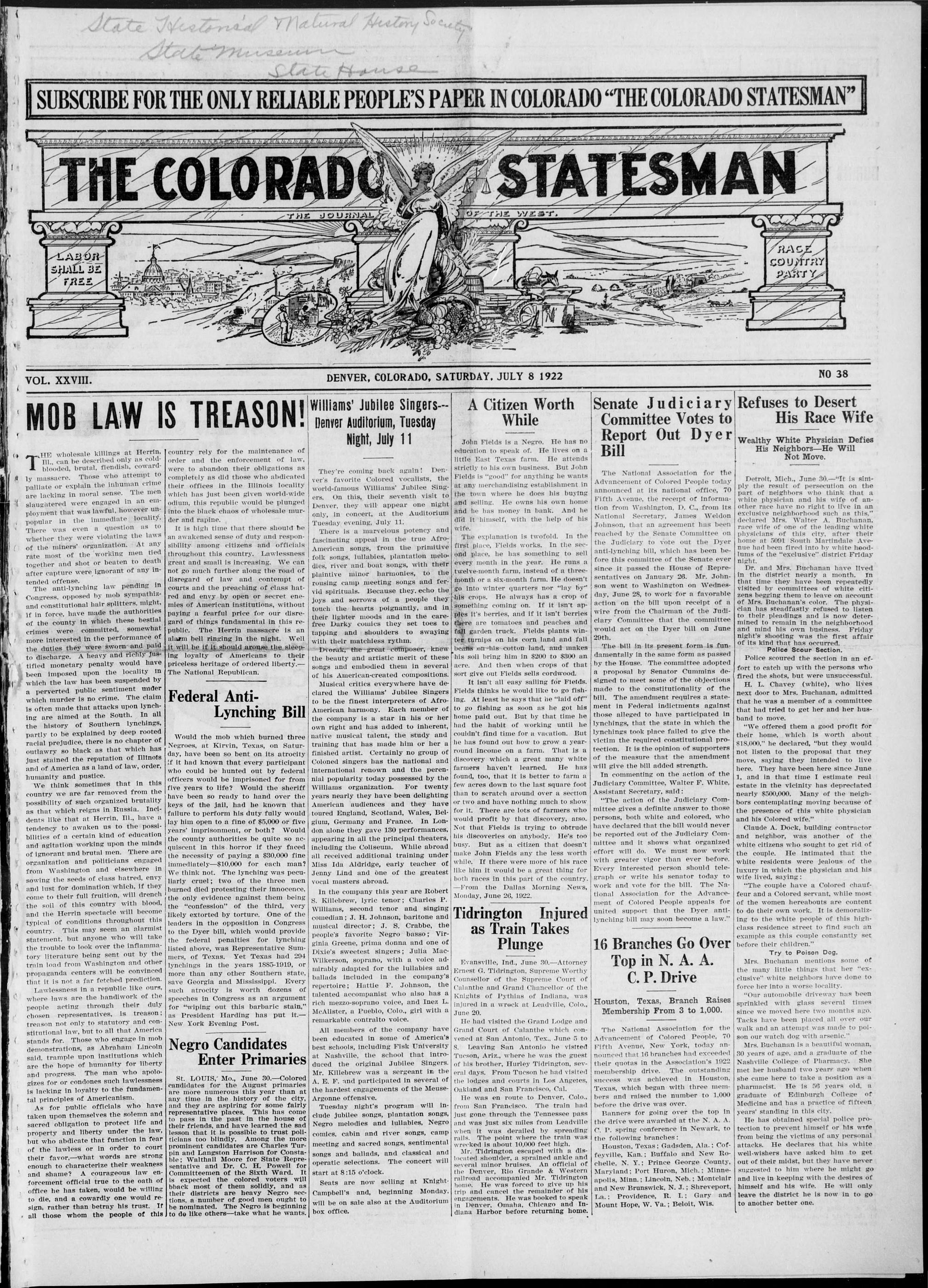
MOB LAW IS TREASON!
VOL. XXVIII.
THE wholesale killings at Herrin Ill., can be described only as cold-blooded, brutal, fiendish, cowardly massacre. Those who attempt to palliate or explain the inhuman crime are lacking in moral sense. The men slaughtered were engaged in an employment that was lawful, however unpopular in the immediate locality. There was even a question as to whether they were violating the laws of the miners' organization. At any rate most of the working men tied together and shot or beaten to death after capture were ignorant of any intended offense.
tended offense.
The anti-lynching law pending in Congress, opposed by mob sympathiz- and constitutional hair splitters, might, if in force, have made the authorities of the county in which these bestial crimes were committed, somewhat more interested in the performance of the duties they were sworn and paid to discharge. A heavy and richly justified monetary penalty would have been imposed upon the locality in which the law has been suspended by a perverted public sentiment under which murder is no crime. The claim is often made that attacks upon lynching are aimed at the South. In all the history of Southern lynchings, partly to be explained by deep rooted racial prejudice, there is no chapter of lawlaw so black as that which has just stained the reputation of Illnots and of America as a land of law, order, humanity and justice.
We think sometimes that in this country we are far removed from the possibility of such organized brutality as that which reigns in Russia. Incidents like that at Herrin, Ill., have a tendency to awaken us to the possibilities of a certain kind of education and agitation working upon the minds of ignorant and brutal men. There are organization and politicians engaged from Washington and elsewhere in sowing the seeds of class hatred, envy and lust for domination which, if they come to their full fruition, will drench the soil of this country with blood, and the Herrin spectacle will become typical of conditions throughout this country. This may seem an alarmist statement, but anyone who will take the trouble to look over the inflammatory literature being sent out by the train load from Washington and other propaganda centers will be convinced that it is not a far fetched prediction.
Lawlessness in a republic like ours, where laws are the handiwork of the people acting through their duly chosen representatives, is treason; treason not only to statutory and constitutional law, but to all that America stands for. Those who engage in mob demonstrations, as Abraham Lincoln said, trample upon institutions which are the hope of humanity for liberty and progress. The man who apologizes for or condones such lawlessness is lacking in loyalty to the fundamental principles of Americanism.
As for public officials who have taken upon themselves the solemn and sacred obligation to protect life and property and liberty under the law, but who abdicate that function in fear of the lawless or in order to court their favor,—what words are strong enough to characterize their weakness and shame? A courageous law enforcement official true to the oath of office he has taken, would be willing to die, and a cowardly one would resign, rather than betray his trust. If all those whom the people of this
country rely for the maintenance of order and the enforcement of law, were to abandon their obligations as completely as did those who abdicated their offices in the Illinois locality which has just been given world-wide odium, this republic would be plunged into the black chaos of wholesale murder and rapine.
It is high time that there should be an awakened sense of duty and responsibility among citizens and officials throughout this country. Lawlessness great and small is increasing. We can not go much further along the road of disregard of law and contempt of courts and the preaching of class hatred and envy by open or secret enemies of American institutions, without paying a fearful price for our disregard of things fundamental in this republic. The Herrin massacre is an alarm bell ringing in the night. Well it will be if it should arouse the sleeping loyalty of Americans to their priceless heritage of ordered liberty.—The National Republican.
Federal Anti- Lynching Bill
Would the mob which burned three Negroes, at Kirvin, Texas, on Saturday, have been so bent on its atrocity if it had known that every participant who could be hunted out by federal officers would be imprisoned for from five years to life? Would the sheriff have been so ready to hand over the keys of the jail, had he known that failure to perform his duty fully would lay him open to a fine of $5,000 or five years' imprisonment, or both? Would the county authorities be quite so acquiescent in this horror if they faced the necessity of paying a $30,000 fine immediately—$10,000 for each man? We think not. The lynching was peculiarly cruel; two of the three men burned died protesting their innocence, the only evidence against them being the "confession" of the third, very likely extorted by torture. One of the leaders in the opposition in Congress to the Dyer bill, which would provide the federal penalties for lynching listed above, was Representative Summers, of Texas. Yet Texas had 294 lynchings in the years 1885-1919, or more than any other Southern state, save Georgia and Mississippi. Every such atrocity is worth dozens of speeches in Congress as an argument for "wiping out this barbaric stain," as President Harding has put it.—New York Evening Post.
Negro Candidates Enter Primaries
St. LOUIS, Mo., June 30.—Colored candidates for the August primaries are more numerous this year than at any time in the history of the city, and they are aspiring for some fairly representative places. This has come to pass in the past in the house of their friends, and have learned the sad lesson that it is possible to trust politicians too blindly. Among the more prominent candidates are Charles Turpin; Waltham Moore for State Representative and Dr. C. H. Powell for Committeemen of the Sixth Ward. It is expected the colored voters will back most of them solidly, and as their districts are heavy Negro sections, a number of good men ought to be nominated. The Negro is beginning to do like others—take what he wants.
Williams' Jubilee Singers--- Denver Auditorium, Tuesday Night, July 11
They're coming back again! Denver's favorite Colored vocalists, the world-famous Williams' Jubilee Singers. On this, their seventh visit to Denver, they will appear one night only, in concert, at the Auditorium Tuesday evening, July 11.
There is a marvelous potency and fascinating appeal in the true Afro-American songs, from the primitive folk songs, lullabies, plantation melodies, river and boat songs, with their plaintive minor harmonies, to the rousing camp meeting songs and fervid spirituals. Because they, echo the joys and sorrows of a people they touch the hearts poignantly, and in their lighter moods and in the carefree Darky comics they set toes to tapping and shoulders to swaying with their matchless rhythm.
Dvorak, the great composer, knew the beauty and artistic merit of these songs and embodied them in several of his American-created compositions.
Musical critics everywhere have declared the Williams' Jubilee Singers to be the finest interpreters of Afro-American harmony. Each member of the company is a star in his or her own right and has added to inherent, native musical talent, the study and training that has made him or her a finished artist. Certainly no group of Coloned singers has the national and international renown and the perennial popularity today possessed by the Williams organization. For twenty years nearly they have been delighting American audiences and they have toured England, Scotland, Wales, Belgium, Germany and France. In London alone they gave 130 performances, appearing in all the principal theaters, including the Coliseum. While abroad all received additional training under Miss Ida Aldridge, early teacher of Jenny Lind and one of the greatest vocal masters abroad.
In the company this year are Robert S. Killebrew, lyric tenor; Charles P. Williams, second tenor and singing comedian; J. H. Johnson, baritone and musical director; J. S. Crabbe, the people's favorite Negro basso; Virginia Greene, prima donna and one of Dixie's sweetest singers; Julia MacWilkerson, soprano, with a voice admirably adapted for the lullabies and ballads included in the company's repertoire; Hattie F. Johnson, the talented accompanist who also has a rich mezzo-soprano voice, and Inez L. McAlister, a Pueblo, Colo., girl with a remarkable contralto voice.
All members of the company have been educated in some of America's best schools, including Fisk University at Nashville, the school that introduced the original Jubilee Singers. Mr. Killebrew was a sergeant in the A. E. F. and participated in several of the hardest engagements of the Meuse-Argonne offensive.
Tuesday night's program will include jubilee songs, plantation songs, Negro melodies and lullabies, Negro comics, cabin and river songs, camp meeting and sacred songs, sentimental songs and ballads, and classical and operatic selections. The concert will start at 8:15 o'clock.
Seats are now selling at Knight-Campbell's and, beginning Monday, will be on sale also at the Auditorium box office.
A Citizen Worth While
John Fields is a Negro. He has no education to speak of. He lives on a little East Texas farm. He attends strictly to his own business. But John Fields is "good" for anything he wants at any merchandising establishment in the town where he does his buying and selling. He owns his own home and he has money in bank. And he did it himself, with the help of his wife.
The explanation is twofold. In the first place, Fields works. In the second place, he has something to sell every month in the year. He runs a twelve-month farm, instead of a three-month or a six-month farm. He doesn't go into winter quarters nor "lay by" his crops. He always has a crop of something coming on. If it isn't apples it's berries, and if it isn't berries there are tomatoes and peaches and fall garden truck. Fields plants winter turnips on his corn land and fall beans on his cotton land, and makes his soil bring him in $200 to $300 an acre. And then when crops of that sort give out Fields sells cordwood.
It isn't all easy sailing for Fields. Fields thinks he would like to go fishing. At least he says that he "laid off" to go fishing as soon as he got his home paid out. But by that time he had the habit of working until he couldn't find time for a vacation. But he has found out how to grow a year-round income on a farm. That is a discovery which a great many white farmers haven't learned. He has found, too, that it is better to farm a few acres down to the last square foot than to scratch around over a section or two and have nothing much to show for it. There are lots of farmers who would profit by that discovery, also. Not that Fields is trying to obtrude his discoveries on anybody. He's too busy. But as a citizen that doesn't make John Fields any the less worth while. If there were more of his race like him it would be a great thing for both races in this part of the country. —From the Dallas Morning News, Monday, June 26, 1922.
Tidrington Injured as Train Takes Plunge
Tidrington Injured as Train Takes Plunge
Evansville, Ind., June 30.—Attorney Ernest G. Tidrington, Supreme Worthy Counsellor of the Supreme Court of Calanthe and Grand Chancellor of the Knights of Pythias of Indiana, was injured in a wreck at Leadville, Colo., June 20.
He had visited the Grand Lodge and Grand Court of Calanthe which convened at San Antonio, Tex., June 5 to S. Leaving San Antonio he visited Tucson, Ariz., where he was the guest of his brother, Hurley Tidrington, several days. From Tucson he had visited the lodges and courts in Los Angeles, Oakland and San Francisco, Cal.
He was en route to Denver, Colo., from San Francisco. The train had just gone through the Tennessee pass and was just six miles from Leadville when it was derailed by spreading rails. The point where the train was wrecked is about 10,000 feet high.
Mr. Tidrington escaped with a dislocated shoulder, a sprained ankle and several minor bruises. An official of the Denver, Rio Grande & Western railroad accompanied Mr. Tidrington home. He was forced to give up his trip and cancel the remainder of his engagements. He was booked to speak in Denver, Omaha, Chicago and Indiana Harbor before returning home.
Senate Judiciary Committee Votes to Report Out Dyer Bill
The National Association for the Advancement of Colored People today announced at its national office, 70 Fifth Avenue, the receipt of information from Washington, D. C., from its National Secretary, James Weldon Johnson, that an agreement has been reached by the Senate Committee on the Judiciary to vote out the Dyer anti-lynching bill, which has been before this committee of the Senate ever since it passed the House of Representatives on January 26. Mr. Johnson went to Washington on Wednesday, June 28, to work for a favorable action on the bill upon receipt of a wire from the Chairman of the Judiciary Committee that the committee would act on the Dyer bill on June 29th.
The bill in its present form is fundamentally in the same form as passed by the House. The committee adopted a proposal by Senator Cummins designed to meet some of the objections made to the constitutionality of the bill. The amendment requires a statement in Federal indictments against those alleged to have participated in lynchings, that the state in which the lynchings took place failed to give the victim the required constitutional protection. It is the opinion of supporters of the measure that the amendment will give the bill added strength. In commenting on the action of the Judiciary Committee, Walter F. White, Assistant Secretary, said:
"The action of the Judiciary Committee gives a definite answer to those persons, both white and colored, who have declared that the bill would never be reported out of the Judiciary Committee and it shows what organized effort will do. We must now work with greater vigor than ever before. Every interested person should telegraph or write his senator today to work and vote for the bill. The National Association for the Advancement of Colored People appeals for united support that the Dyer anti-lynching bill may soon become a law."
16 Branches Go Over Top in N. A. A. C. P. Drive
16 Branches Go Over Top in N. A. A. C. P. Drive
Houston, Texas, Branch Raises Membership From 3 to 1,000.
The National Association for the Advancement of Colored People, 70 Fifth Avenue, New York, today announced that 16 branches had exceeded their quotas in the Association's 1922 membership drive. The outstanding success was achieved in Houston, Texas, which began with three members and raised the number to 1,000 before the drive was over.
Banners for going over the top in the drive were awarded at the N. A. A. C. P. spring conference in Newark, to the following branches:
Houston, Texas; Gadsden, Ala.; Coffeyville, Kan.; Buffalo and New Rochelle, N. Y.; Prince George County, Maryland; Port Huron, Mich.; Minneapolis, Minn.; Lincoln, Neb.; Montclair and New Brunswick, N. J.; Shreveport, La.; Providence, R. I.; Gary and Mount Hope, W. Va.; Beloit, Wis.
NO 38
Refuses to Desert His Race Wife
Wealthy White Physician Defies His Neighbors—He Will Not Move.
Detroit, Mich., June 30.—"It is simply the result of persecution on the part of neighbors who think that a white physician and his wife of another race have no right to live in an exclusive neighborhood such as this," declared Mrs. Walter A. Buchanan, race wife of one of the leading white physicians of this city, after their home at 5091 South Martindale Avenue had been fired into by white hoodlums of the "exclusive" district Friday night.
Dr. and Mrs. Buchanan have lived in the district nearly a month. In that time they have been repeatedly visited by committees of white citizens begging them to leave on account of Mrs. Buchanan's color. The physician has steadfastly refused to listen to their pleadings and is now determined to remain in the neighborhood and mind his own business. Friday night's shooting was the first affair of its kind that has occurred.
Police Scour Section.
Police scoured the section in an effort to catch up with the persons who fired the shots, but were unsuccessful.
H. L. Chavey (white), who lives next door to Mrs. Buchanan, admitted that he was a member of a committee that had tried to get her and her husband to move.
"We offered them a good profit for their home, which is worth about $18,000," he declared, "but they would not listen to the proposal that they move, saying they intended to live here. They have been here since June 1, and in that time I estimate real estate in the vicinity has depreciated nearly $500,000. Many of the neighbors contemplating moving because of the presence of this white physician and his Colored wife."
Claude A. Dock, building contractor and neighbor, was another of the white citizens who sought to get rid of the couple. He intimated that the white residents were jealous of the luxury in which the physician and his wife lived, saying:
"The couple have a Colored chauffeur and a Colored servant, while most of the women hereabouts are content to do their own work. It is demoralizing to the white people of this high-class residence street to find such an example as this couple constantly set before their children."
Try to Poison Dog.
Mrs. Buchanan mentions some of the many little things that her "exclusive" white neighbors have done to force her into a worse locality.
"Our automobile driveway has been sprinkled with glass several times since we moved here two months ago. Tacks have been placed all over our walk and an attempt was made to poison our watch dog with arsenic."
Mrs. Buchanan is a beautiful woman, 30 years of age, and a graduate of the Nashville College of Pharmacy. She met her husband two years ago when she came here to take a position as a pharmacist. He is 56 years old, a graduate of Edinburgh College of Medicine and has a practice of fifteen years' standing in this city.
He has obtained special police protection to prevent himself or his wife from being the victims of any personal attacks. He declares that his white well-wishers have asked him to get out of their midst, but they have never suggested to him where he might go and live in keeping with the desires of himself and his wife. He will only leave the district he is now in to go to another better one.
FOREIGN
Most of the newspapers in Berlin are on strike.
A. Bruce Bielaski, the American kidnapped by Mexicans, escaped without the ransom his captors demanded having been paid, according to information from Cuernavaca, Mexico.
Germany manufactured a total of 10,000,000 field guns, rifles and pistols during the war, according to statistics just made public, besides hundreds of millions of tons of munitions. Enough barbed wire alone was produced to encircle Germany with a barricade sixty-five meters deep.
The entire Swedish, Finish and Norwegian paper output, the newspapers announce, will be sold to America. Most of the big paper mills have signed an agreement to export through a projected American syndicate headed by one of the officials of the Canadian Export Paper Company.
The treaty if Rappalo signed between Russia and Germany during the Genoa conference, has been ratified by the reichstag. There was no debate over the question of ratification, with the exception of remarks by a Communist deputy, who demanded that the treaty be amplified to include the other soviet republic.
Soviet Russia wants to win the world's confidence, so that tangible help may come from the outside world. Soviet Russia, without awaiting assistance from abroad, is itself laboring to improve Russia's financial condition, and has achieved results. These were the two main constructive thoughts which the Bolshevist delegates at The Hague have tried to fix in the public mind.
Despite his repeated assurances that he is no longer a bandit, but a gentleman farmer of the state of Durango, the movements of Francisco Villa are being closely watched in official circles in Mexico City. To some observers it is difficult to believe that this former guerrilla has accustomed himself to the routine of ranch life and is now finding in his growing crops and lowing herds the contentment that a man of his tremendous nervous energy derived in the past from daring deeds of warfare.
GENERAL
The fire which swept the Locust Point river front of the Baltimore & Ohio railroad at Baltimore recently, caused damage estimated by the company at $4,804,900 and seriously threatened the public health service hospital at Fort McHenry. Creditors of the stock brokerage firm of Kardos & Burke, New York, which failed for $3,000,000, were informed at a meeting that the two partners, John Burke, former treasurer of the United States and governor of North Dakota, and Louis Montgomery Kardos, Jr., were penniless. Eleven persons were killed and seventy-two injured when the "midnight flyer" on the Philadelphia & Reading railroad left the rails, through the mistake of a signalman, and plunged down a thirty-foot embankment near Winslow Junction, N. J., according to a complete casualty list issued by the state police. Thibodaux, surprise horse of the Kentucky Special, when he ran a sensational second to Whiskaway and beat the great Morvich, came back and won the Latonla derby from Yoshimi and Olympus in the easiest kind of fashion. Withdrawal of Broomster and Margaret Winsor had reduced the field to three starters.
The National Industrial Traffic League at Chicago issued a statement regarding the effect the recent Coronado case might have upon the nationwide rail strike. The statement, in part, follows: "If the strike should be conducted with violence and the destruction of life and property ensues, the organizations which have promoted the strike, their officers and agents, may be held liable in civil damages for losses entailed.
Bennie Leonard, world champion lightweight fighter, smashed Rocky Kansas almost at will all over the ring in the eighth round of their scheduled ten-round titular contest at Michigan City, Ind., and the Buffalo, N. Y., challenger's seconds threw in the sponge to save their man from something more than a technical knockout.
Watermelons for which Georgia growers are glad to get from 5 to $17½ cents each, are selling in the retail market in New York City at 70 cents to $1.50, said a statement issued by Hershell S. Jones, Director of the State Department Bureau of Farms and Markets. High freight rates, mostly equally high cartage charges and the "bit" taken in turn by four middlemen make up the difference, he said.
Adjt. Gen. C. E. Black today visited the scene of the recent mine war at the mine of the Southern Illinois Coal Company near Herrin, Ill., and held conferences with local officials. General Black is understood to have made the visit at the request of Governor Len Small. Before departing for Chicago, he declared that he found conditions entirely satisfactory in the Williamson county coal fields.
Frances DeCamp, 15 years old, daughter of Mrs. Lillian DeCamp of Helena, Montana, was drowned in the Woolston reservoir, on Mount Helena, while camping there with a party of picnickers. The child went to the reservoir to dip out water, leaned over to far and fell in.
The Douglas National Bank, said to be the only national bank in the country where all the officers and directors and stockholders are negroes, has opened at Cbicago. The bank is located in the negro residential and business district.
NEWS TO DATE IN PARAGRAPHS
CAUGHT FROM THE NETWORK OF WIRES ROUND ABOUT. THE WORLD.
DURING THE PAST WEEK
IECORD OF IMPORTANT EVENTS
CONDENSED FOR BUSY
PEOPLE.
WESTERN
Jimmy Murphy, sensational automobile race driver, added to his laurels at Tacoma, Wash., by winning the eleventh annual speedway classic. Murphy covered the 250 miles at the rate of 97.6 miles an hour. Tommy Milton took second place after leading Murphy nearly all the way.
Omer R. Woods, a former probate judge in Idaho, stands convicted of the murder of his wife, Maryetta Woods, who was burned to death as she lay in bed in the Woods apartment home in Salt Lake City last Jan. 9. It was the contention of the prosecution at the trial that Woods killed his wife to collect $16,000 life insurance.
Because he believed some of the members of his congregation would object to his action in striking, the Rev. Earnest Powell, pastor of the Congregational church at Wymore, Neb., and a shopman of the Burlington railroad, handed in his resignation as pastor. The congregation unanimously refused to accept the resignation.
John McCaphron, alleged counterfeiter, who escaped from Colorado deputy sheriffs near Helper about a month ago, was arrested near Storrs in Soring canon, Utah, by Deputy Sheriffs Ben McMillin and Lever Birch. McCaphron was being taken from Ely, Nev., where he was arrested, to Leadville, Colo., to face a charge of counterfeiting. He escaped from the Colorado deputies while the train stopped at Helper.
The United States Department of Agriculture reports that the drought and heat caused some damage to non-irrigated crops in the Rocky Mountain states during the last half of June, but irrigated crops were generally in good condition. Winter wheat harvest has begun as far north as northeastern Colorado and the crop is heading in Idaho. Considerable damage to this crop is reported especially on non-irrigated lands in Idaho, Colorado and New Mexico, but the condition is good in northeastern Colorado and in Arizona. Idaho spring wheat on irrigated lands is generally excellent. New Mexico's cotton crop is reported in excellent condition on an increased acreage, and Arizona's cotton has been brought up to a good condition by recent hot weather.
WASHINGTON
By a vote of 38 to 12 the Senate approved a tariff of 30 cents a bushel on wheat.
Selection of a site for a $1,000,000 hospital for disabled veterans, to be erected at Summerfields, in the vicinity of Beacon, Dutchess county, N. Y., has been announced in Washington by Assistant Secretary of the Treasury Clifford.
Japan led the world in exports to the United States in the month of May, with merchandise reaching a total value of $29,692,987, according to compilations made public by the Department of Commerce. Canada was second with $28,249,429, the United Kingdom third with $25,438,999, and Cuba a close fourth with $25,289,275.
France will take part in the conference at The Hague with the Russian delegates beginning June 26, it was officially announced. If political questions are introduced, however, the French delegates will promptly withdraw.
Recommendation that the agricultural producers of the United States "be encouraged to develop co-operative associations to hasten the standardization of agricultural production, improve the distributive process and reduce their costs" forms the foremost conclusion of the joint congressional commission of agricultural inquiry in its completed report on marketing and distribution, made public in Washington.
Approval of four applications for loans to assist in financing the orderly marketing of cotton and wheat aggregating $16,500,000, was announced by the War Finance Corporation. The applications approved were from Oklahoma Cotton Growers' Co-operative Association, $6,000,000; Arkansas Cotton Growers' Co-operative Association, $7,500,000; Oklahoma Wheat Growers' Association, $2,500,000, and the Texas Wheat Growers' Association, $500,000.
Despite the coal strike and the threatened railroad tieup, business in the United States continues to improve, high officials of the Treasury Department said recently. The improvement was accounted for by heavy summer buying of stocks in preparation for winter trade.
Rebel forces were defeated and scattered by federal troops near the Aguada camp of the Cortez Oil Company in the Tampico district of Mexico, according to a message received by the State Department from Consul Shaw at Tampico.
Pithy News Notes
From All Parts of
Colorado
Sept. 25-30—Colorado State Fair, Pueblo.
July 25-28—Frontier Days Celebration, Cheyenne, Wyo.
July 19-21—Cattlemen's Days, Gunnison.
Aug. 2-4—Stampede, Monte Vista.
Aug. 29-Sept. 1—Larimer County Fair, Loveland.
Sept. 5-8—Arkansas Valley Fair, Rocky Ford.
Sept. 5-8—Boulder County Fair, Louisville.
Sept. 5-8—Intermountain Fair and Stock Show, Grand Junction.
Sept. 5-8—Phillips County Fair, Holyoke.
Sept. 6-8—Washington County Fair, Akron.
Sept. 12-15—Delta County Fair, Hotchkiss.
Sept. 12-15—Weld County Fair, Greeley.
Sept. 12-15—LaPlatta County Fair, Durango.
Sept. 12-15—Logan County Fair, Sterling.
Sept. 13-16—Baca County Fair, Sprucefield.
Sept. 13-16—Adams County Fair, Brighton.
Sept. 14-16—Conejos County Fair, Manassa.
Sept. 14-16—Elbert County Fair, Keenan.
Sept. 19-22—Western Slope Fair, Montrose.
Sept. 19-22—Trinidad-Las Animas County Fair, Trinidad.
Sept. 20-21-Kiowa County Fair, Elda.
Sept. 20-22—Rio Grande County Fair, Del Nortte.
Sept. 21-22—Pueblo County Fair, Goodpasture.
Sept. 21-23—El Paso County Fair, Calhan.
Sept. 21-23—Lincoln County Fair, Hugo.
Sept. 20-23—Huerfano County Fair, Walsenburg.
Sept. 20-23—Kit Carson County Fair, Burlington.
Oct. 3-5—Douglass County Fair, Castle Rock.
Loveland.—The Loveland Herald, a daily newspaper, has been purchased by the owners of the Loveland Reporter, the city's oldest newspaper, for $15,000, according to an announcement recently.
Fort Collins.—George Vermilya, 35, who attained fame here last year as Mustang Jack, hero of the mustache war between Agricultural students and local cowboys, was acquitted of a robbery charge by a jury in the District Court.
Denver.—Purchase of land on which a spur track to the Fitzsimons general hospital is constructed is favored in a report made by the committee on military affairs of the national House of Representatives. The land will cost $1,500.
Wray.—The first moonshine still on wheels was discovered near Wray, Colo. Edward Ramey, who confessed to the ownership, according to federal prohibition officers report to Director E. H. McClenahan, conceived the idea of building a still which could be moved about at will, and thus avoid discovery by the bloodhounds of the law.
Boulder.—Instead of riding around India on the backs of camels, the Rev. and Mrs. Frank B. McCuskey will hereafter enjoy a car and trailer. Presentation of money to purchase a trailer was formally made at Boulder by the local Presbyterian church. The church at Davenport, Iowa, their former home, has presented them with money for the car.
Boulder.—Lee Willard, star University of Colorado athlete, has been farmed out by the Chicago White Sox to the Rockford, Ill., team in the Three-I league, according to news brought back to Boulder from Chicago by Homer Britzman, football star, who has been on a tour. Britzman enjoyed talking with Eddie Collins, star second baseman of the White Sox, who stated that Willard was as fast as lightning and had been farmed out in order to give him an opportunity to improve his batting. Willard is expected to remain with Rockford the greater part of the season.
Colorado Springs.—The heaviest sentence for bootlegging in the history of an El Paso County Court, was passed by Judge John W. Sheafer when he ordered Edward McConnell committed to the state prison for from two to three years.
Mancos.—Semeul Ortiz, 15, son of Petronilo Ortiz, committed suicide on his father's ranch, four miles east of here. The father had been hunting the boy for several days, thinking he had run away. After spending five days in Durango searching for the lad he came home discouraged. Recently he went out to look at his large herd of goats and accidentally came across the body lying in a large clump of brush.
Denver.—Articles of incorporation for the Western Slope Shale Oil and Products Company, a $1,000,000 organization, were filed with Secretary of State Milliken recently. Principal offices of the company will be maintained in Denver. The business of the company will be confined principally to Garfield, Mesa and Rio Blanco counties. The three incorporators are Charles W. Clogston, Crawford McLaughlin and C. A. Tygart.
Monte Vista.—A large force of men is actively at work cleaning up, remodeling and repairing the "stampede" grounds preparatory for the big wild west celebration scheduled for Aug. 2, 3 and 4. Last year the 10,000 capacity of the grandstand was overtaxed by several thousand. This year's seating capacity will be increased more than 30 per cent, or, to a total capacity of 15,000.
Brush.—D. E. McAdow, 19 years old, of Craig, accidentally shot himself through the left hand while loading a gun, at Brush, recently.
Cañon City.—The State Pardon Board held a meeting at the penitentiary recently with twenty-six cases on the docket. Two persons were given clemency to the extent of paroles being ordered for some time next fall, one case was continued and all other applications were denied. Robert Robitaille's application was continued. He was sentenced from Denver county Oct. 31, 1918, to life imprisonment on a conviction for murder. Walter W. Fugate, sentenced from Jefferson county, Dec. 14, 1920, to from five to six years for larceny, will be paroled Sept. 15. Robert Jackson, sentenced from Pueblo county, Aug. 15, 1919, to seven to ten years for robbery with a dangerous weapon, will be released on parole Dec. 19.
Denver.—More than a sufficient number of signatures have been obtained to the petitions being circulated over the state in support of the $5,000,000 state bond issue for the use in the construction and improvement of roads and in meeting federal aid until the close of 1526, according to an announcement by Rodney J. Bardwell, chairman of the bond boosters' committee. Following the obtaining of the required number of signers, the committee will be permitted to place the matter before the electors at the election this fall. The law requires that at least 24,000 signatures to the petitions be obtained and that they be filed with Secretary of State Milliken on or before July 6, before the bond proposal can be voted upon.
Victor.—A shortage in low grade ores is given as the reason for the announced partial closing down of the cyanide mill which has been working on the Portland Gold Mining property. Two stamps will be kept in operation, according to the announcement, and the others closed down July 1. The strike made in the Portland mine at the 2,600-foot level is proving as rich as at first stated. Assay tests of the ore return from $92 to $210 to the ton, while selected samples run higher. A north and south crosscut will be made to open the shoot further and establish its size.
Cafion City.—Mrs. Franeis Strainer was arrested at Cafion City on a charge of attempting to kill Mrs. Annie Parke, a neighbor, who is in a hospital suffering from severe scalp wounds, said to have been received when she was beaten over the head with a pistol. The women are said to have fought over a ticket taken by a child from a paper balloon which a local firm had sent up. Mrs. Strainer is charged with having first attempted to brain her antagonist with an ax, and then to have beaten her with a pistol. Mrs. Parke will recover.
Greeley.—The charred body of Thomas G. Meeker, Lucerne farmer, was found under the exhaust pipe of a big gasoline engine on the Walter Carlson farm at Lucerne, five miles north of Greeley recently, by Carlson. The clothing was burned from the body and the flesh over the chest and abdomen badly scorched. Physicians who were called said that Meeker had probably died from asphyxiation from gasoline fumes. When last seen by Carlson Meeker was apparently in good health. The gas engine was used to drive a big irrigating pump.
Colorado Springs.—Martin P. Nelson, former president of the Ordway State bank, at Ordway, was arrested at Colorado Springs on request of the Crowley county sheriff's office. According to Colorado Springs authorities, Nelson is named in ten indictments, in connection with the closing of the bank last October. Nelson is being held in the county jail.
Denver.—A rich silver strike has been made by the Sweet Home Gold and Silver Mining and Milling Company on Mount Bross, near Alma, in Park county, according to an announcement by officials of the company.
Hot Sulphur Springs.—Commissioners of nine counties met at Hot Sulphur Springs and Kremmling recently to discuss a proposed $6,000,000 highway bond issue. The commissioners were unanimous in favoring the issue and passed a resolution urging it. It was explained that the amount will not be obtained through a direct tax upon the people, but it will be paid out in nineteen years by the state motor vehicle tariff, and thus, motorists who enjoy the roads, will in that length of time pay for them.
Cripple Creek.—Roy Bourquin, 34 years old, was convicted of criminal assault in the District Court at Cripple Creek, the jury being out fifteen minutes. Judge Arthur Cornforth sentenced Bourquin to the state penitentiary for from twenty years to life. The verdict was returned at 5 o'clock and at 6 o'clock Sheriff Von Phil left for Cañon City with his prisoner.
Cripple Creek.—Roy Bourquin, an armless inmate of the county poor farm, was sentenced by Judge Cornforth in the District Court to a term of twenty years to life for an alleged assault upon a 13-year-old girl.
Pueblo.—A large forest fire in the San Isabel forest near Cañon City has been reported to A. G. Hamel, supervisor of the forest. The meager reports received so far is that the blaze is sweeping up the slopes of Verden mountain and covering a wide territory.
Pueblo.—A fortune of $250,000 is awaiting Charles H. Carpenter, one time employé of the Congress hotel in Pueblo, whose whereabouts are not known. Relations have appealed to police to locate the man, who is to inherit the money from an anunt.
R-U-Ready to Sign Up? I Make Signs of All Descriptions PHONE CHAMPA 4997
Phone G
CAMPBELL CO
COM
Wholesale
HAY, GRAIN, COAL,
SUP
Office: 1401 W. 38th Ave.
Phone Gallup 478
CAMPBELL BROTHERS
COAL
COMPANY
Wholesale and Retail
HAY, GRAIN, COAL, WOOD AND POULTRY
SUPPLIES
Office: 1401 W. 38th Ave. Yards: 1400 W. 32d Ave.
Phone Champa 7889
WESTERN SE
COM
WARM AIR
REPAIRS FOR ALL FURNAC
CHIMNEY
BURN SHEET COMPANY
FROM AIR FURN
ALL FURNACES—SHEET
CHIMNEY STACKS
WESTERN SHEET METAL COMPANY
REPAIRS FOR ALL FURNACES—SHEET METAL WORK CHIMNEY STACKS
920 NINETEENTH STREET
The Curtis Park Floral Company
FLORAL DESIGNS PUT UP WHILE YOU WAIT
CHOICE PLANTS AND CUT FLOWER
GREENHOUSES: Thirty-Fourth a
TELEPHONE. MAIN 1511
C. E. Weatherhead
PHONE
WEATHER HAT
MEN'S AND WOMEN'S UNCLASSIFIED
PANAMAS AND
1722 STOUT STREET
C. E. SMITH, Manager
The Market
Wholesale and Retail Staple and
Hotels and Restaurants Our
Eastern Cor
Fruits, Vegetables,
Telephones Main 48
622-636 15TH STREET
UP WHILE
WAIT
CUT FLOWERS CONST
Fourth and Curtis S
DENVER
PHONE MAIN 3203
THERE
FAST
STABILISMED
'S UNCLAIMED HATS
RAMAS AND WHITE M
AL
H, Manager, Res. Phone
Market Co
Staple and Fancy Grocery
Restaurants Our Specialty.
Corn Corn Fed
Vegetables, Poultry and
Times Main 4802, 4803, 4804
The Curtis Park Floral Company
FLORAL DESIGNS PUT UP WHILE YOU WAIT
CHOICE PLANTS AND CUT FLOWERS CONSTANTLY ON HAND
GREENHOUSES: Thirty-Fourth and Curtis Streets
TELEPHONE. MAIN 1511 DENVER. COLO
WEATHERHEAD
HAT FACTORY
ESTABLISHED 1876
MEN'S AND WOMEN'S UNCLAIMED HATS FOR SALE—FELTS,
PANAMAS AND WHITE MILANS
1722 STOUT STREET
ALBANY HOTEL BLDG.
Wholesale and Retail Staple and Fancy Groceries, Fish and Oysters.
Hotels and Restaurants Our Specialty. Fresh and Cured.
---
---
Shop Near Five Points 2421 WASHINGTON ST.
allup 478
BROTHERS
DAL
PANY
and Retail
WOOD AND POULTRY
PLIES
Yards: 1400 W. 32d Ave.
SHEET METAL
PANY
FURNACES
DES—SHEET METAL WORK
STACKS
ERS CONSTANTLY ON HAND
and Curtis Streets
DENVER, COLO
C. B. Weatherhead
MAIN 3203
ERHEAD
FACTORY
MED HATS FOR SALE—FELIS,
WHITE MILANS
ALBANY HOTEL BLDG.
Res. Phone South 1608
et Company
Fancy Groceries, Fish and Oysters.
Specialty. Fresh and Cured
Fed Meats
Poultry and Game.
902, 4303, 4304, 4805
DENVER, COLORADO
Phone Main 3737
Satisfaction Guaranteed
THE NEW WAY SHOE
REPAIRING
C. C. Dennis, Proprietor
1855 CHAMPA STREET
Denver, Colo.
Residence
2841 CALIFORNIA ST.
DENVER. COLORADO
A SALES FESTIVAL CELEBRATING OUR 30TH MILE POST ALONG THE HIGHWAY OF VALUE-GIVING
Ordinary standards of value disappear in the presence of an offering like this. Whether you consider them from the standpoint of fabric, of patterns, of tailering or of style, THEY ARE SUPERIOR SUITS, reflecting the good taste and the refinements of finish that you would justly look for in clothing priced at nearly double. Included are finest Stein-Bloch and Goodman & Suss three-piece suits. Splendid Blue Serges, plain weaves, stripes, shepherd checks and mixtures in plain or belted models. Smart, distinguished-looking suits for men and young men. Reduced from $65.00.....
$5, $6, $7 Values 5000 Superb Straw Hats $3.75
RAIL UNIONS ARE WILLING TO CONFER ON PROPOSALS FOR PEACE.
SETTLEMENT IS SEEN
MR. HOOPER OF THE LABOR BOARD DENIES "OUTLAW" CHARGES.
Chicago—Hope for the speedy settlement of the country-wide strike of the railway shopmen was seen in statements issued by Ben W. Hooper, chairman of the United States railroad labor board, and B. M. Jewell, leader of the shopcrafts, who ordered the walkout.
In reply to a letter from Mr. Hooper, which was regarded as conciliatory in tone, Mr. Jewell declared that the strikers were willing to consider any negotiations with anyone in authority for settlement of the strike.
"We are willing to confer with anybody authorized by the railroads to bring peace proposals to us," said Jewell. I include or exclude nobody, but if the labor board, for instance, came to us with a definite proposition we would not hesitate to consider it."
Mr. Jewell then made public for the first time the exact figures on the strike vote taken by the 400,000 members of the six shopcrafts. The vote was divided into three separate ballots, the first on accepting a $500,000-000 reduction in wages ordered by the labor board, the restoration of seven working rules altered by the board, and, third, the abolishment of outside contracting by the roads.
a tabulation of the ballots, Mr. Jewell said, showed 94.7 per cent of the men had voted to strike on the question of wages, the heaviest vote for a strike being on the question of outside contract labor which polled 97.1 per cent of the vote cast. The ballot on rules came second with 96.2 for strike. Union leaders said that the vote indicated the relative importance attached to the three points at issue by their membership.
In railroad circles it was declared that the way had already been cleared for a full settlement on the gravest issue—that of contract work—by the agreement of twelve roads to abolish outside contracting at the labor board meeting when Mr. Jewell ignored an order to appear and explain his strike order.
Mr. Jewell said that the intervention of the board had come too late and that the only way to prevent disorders was for him virtually to defy the board, and thus let the rank and file of the six shopcrafts organizations involved know that their leaders had their hands on the brakes and were in full control of the situation.
Mr. Jewell declared that his statement was in the nature of an explanation of labor's side of the situation and that he was not receding from any of the original demands made upon the railways. The statement was interpreted in railway circles, however, as clearing a way to a settlement by negotiation, the previous understanding being that Mr. Jewell would refuse to deal with the labor board and would insist on negotiations direct with the carriers.
Mr. Hooper, in his letter to Mr Jewell, denied the latter's charge that the labor board was unfriendly to the employés or that it had "outlawed" the strikers. "It has only accepted your own statement that the striking men are not now employés of the carriers," the letter said. "It has not, however, used the rasping word 'outlaw' at any time."
Harding Back on Old Job.
Marion, Ohio.—President Harding tried his hand again at his old job of writing editorials for the Marion Star. A recent edition carried a two-column editorial signed by "Warren G. Harding." It was headed, "The Essentials to Success," and brought out that honesty, simplicity, industry, capacity and determination "available to all who aspire," are the chief essentials of success.
Urges Help for Rural Schools.
Boston.—The attention of the delegates to the National Editorial convention for one whole day was directed almost entirely to the problems of rural life and education.
George A. Works of the New York State College of Agriculture urged that systems of state support be put on such a basis that the country child may have school facilities comparable with those of the city child.
The abolition of small district schools and the substitution of a county unit system was recommended by Agnes Samuelson of Clarinda, Iowa.
New York.—The Russian information bureau, established in New York in May, 1917, by the provisional government of Russia has officially closed its doors. A. J. Sack, director of the bureau, in a final statement, asserted that "Just as five years ago, we continue to believe that Russia's salvation lies neither in the preservation of the Red autocracy of Bolshevism, nor in at return to the Black czarism, but in the middle course of an orderly democratic development."
"30th Mile Post" Suit Special (Group Two)
At this price you can choose from high-grade fancy suits bearing Stylplus labels. Other well-known makes. Fine Blue Sorges and other popular fabrics. Latest shades and models. Not in years has it been possible to offer such splendid suits at such a remarkable price.
A summer suit value that will set Denver agog. Every one made of genuine Palm Beach cloth. All the wanted colors and patterns from the cluck to the light shades.
Our finest grade Palm Beach Suits. Made in plain and attractive Sport Styles. Finely tailored to retain their shape in scorching weather. All modish colors. A size for every man.
ne Top Coats Mer
$13.50 A summer suit value that will set Denver agog. Every one made of genuine Palm Beach cloth. All the wanted colors and patterns from the dark to the light shades.
Gabardine Top Co
Palm Beach Suits
$19.50 The finest coat in the world for motoring, or to ward off the chill of any occasion. Double-breasted. Belted all- round. Raglan shoulders. Highest quality and workman- ship.
$5, $6, $7 Values 5000
5000 Su
Finest $3 and $3.50 Straws
At this appealing pulse you'll find a complete assortment of latest Benitl Yachts in all dimensions.
Shirts for Street
2,000 good quality Shirts in Fruit of the B and Campus Cloth, $2 and $2.50 values.....
Bates-Street Outing Shirts, Khaki color. A Exceptional value at ...
Extraordinary offering of high quality shirts Madras Cloth. Neckband styles. Regular.
Beautiful Silk Shirts of Imported Pongees,—tan color. Also White Jerseys in a real in neat patterns. Neckband styles. Value.
Extra-heavy silks in neat and pronounced cloths, Jerseys and Crepes. Actual values
Shirts in Fruit of the Loom, fancy madras fa-
$2 and $2.50 values.
Shirts, Khaki color. A regular $2.50 quality
at.
Spring of high quality shirts. Self stripes and En-
ckband styles. Regular $3 and $3.50 values.
Shirts of Imported Ponges, White Jap Silk, Engli-
White Jorseys in a real good quality, Fibre S
Neckband styles. Values to $7.50
In neat and pronounced patterns. Wonderful Br
Crepes. Actual values to $8.50
Shirts for Street and Sport
2,000 good quality Shirts in Fruit of the Loom, fancy madras fabrics
and Campus Cloth, $2 and $2.50 values. $1.65
Beautiful Silk Shirts of Imported Pongees, White Jap Silk, English Broadcoths—tan color. Also White Joraysers in a reil good quality. Fibre Silks in neat patterns. Neckband styles. Wavy silk. $4.75 Extra-heavy silk in tan color. Actual values to $8.50 Wonderful Broadcoths—tan color. Actual values to $8.50 $5.65
Bathing Suits
A timely offering. 100 sample garments;
25% less during Anniversary Sale. Regular
values $1 to $5.75; re- 75c to $4.30
duced to ...
Alluring Neckwear
A big showing of Knitted Tiles in the new gray and Palm Beach shades. Fancy 55c Fashioned knit silks in the Cathedral Stitch and all the newest fancy mesh weaves. Plain colors and two-tone 90c Exem Extra heavy fashioned silk Knit Tiles that will give excellent service and re-tain shape; a real $3.50 value. $2.65 Fine silk Four-in-Hand in Foulards, Crepes, Fallies and Satin 35c
Three for $1
$1.50 silk values; heavy twill polka dots;
fancy Swiss silks and
grenadines $1
Satisfaction or
Your Money Back
free for $1
heavy twill polka dots;
and $1
A pair of 50c Pre
and a 25c pair of
Fineest all-allik fan
$1.25 value
n or
ey Back
How to Succeed.
Orlson Swert Marsden, well known as an apostle of the cult of optimism, cheerfulness and business efficiency, gives the following formula for success: "Exactly in proportion to the degree in which you increase your self confidence by the affirmation of what you are determined to be and to do your ability will increase."
"Cld" was a title given to Roy or Rodrigo Diaz de Biyar, who lived in the eleventh century. He was a national hero of Spain, famous for his exploits in the wars with the Moors, and a champion of Christianity. The name is pronounced as if spelled and a champion of Christianity. The theth, with a long "e."
---
26
A correspondent informs us that we did not quite complete our work about the little girl whose version of the national anthem was "My country (eases me)." He says she followed it with "Arthur of liberty." He adds: "And a close second to this in the following quotation from the 23d Psalm by another little miss. 'Surely the good Mrs. Murphy will follow me all the days of my life.'"
Thatched Roofs Last Long.
Thatched roofs in Holland are exceedingly durable, and some of the oldest buildings still have the original roof in place doing good service. There are many instances of a thatched roof 200 years old.
h Suits
finest grade
Bench Suits.
in plain and
active Sport
ess. Diners sell
to retain their
in scorching
her. All mod-
colors. A size
every man.
$17.50
$3.85 $4.75
Reduced from $6 Reduced from $7
10 Superb
Just think! Your free choice of all
regular $5, $6 and $7 imported Se-
raids. Every one is a fine piece
ent to don. All latest colors and
choice of all braided straws (except
t and Sport
com, fancy madras fabrics $1.65
regular $2.50 quality. $1.65
Self stripes and English
3 and $3.50 values $2.45
White Jap Silk, English Broadcoths
good quality. Fibre Silks
to $7.50 $4.75
terns, Wonderful Broad-
$8.50 $5.65
Seasonab
Just think! Your free choice of all Cottrell's finest Braid Straws. Regular $5, $6 and $7 imported Sennits, Split Braids and Fancy Braids. Every one is a fine piece of summer headgear as you'd want to don. All latest colors and styles. Remember, your free choice of all braided straws (except Panamas and Bangkoks).
500 pairs good cotton Hose, standard make, all colors; all sizes: 20c
Fine $1 slks in plain colors and novel two-tone, drop-stitch effects; all colors; all sizes, a pair.....65c
Splendid full-fashioned, heavy silk Hose. Made with reinforced heel and toe; plain colors; regular $1.50 values, a pair.....85c
FOR WOMEN
Heavy all-silk fancy lace Hose; color:
$7 grades, a pair
$4.90
$7 grades, a pair
Combination Garter
A pair of 50c President, Columbine
and a 25c pair of Boston or Paris G
Fineest all-silk fancy Suspenders; all
$1.25 value
621
A pair of 50c President, Columbine or Shirley Contless Suspenders and a 25c pair of Boston or Paris Garters 55c
Finest all-silk fancy Suspenders; all neat patterns; 75c
$1.25 value
Spanish National Hero.
---
$17.50 $6.75 These Khaki Norfolk suits are just right for all sporting activities. Finely tailored. Fine fitting. Extra hiking breeches to match, $3.50.
Men's Separate Trousers
This group includes splendid Blue Serges, Vorateds, Wreeds, Strikes, Checks, Fancy Mixtures, Made with Belt Loops, Cuffs or plain bottoms. Quality tailoring.
$3.85 Reduced from $6
$4.75 Reduced from $7
$6.75 Reduced from $10
$8.75 Reduced from $13.50
Superb Str
our free choice of all Cottrell's finest
and $7 imported Sennits, Split Braid
one is a fine piece of summer headge
All latest colors and styles. Remember
raided straws (except Panamas and Ban
Sport
eras fabrics $1.65
quality. $1.65
and English values $2.45
English Broadcoths
Silbe Silks $4.75
ful Broad- $5.65
Co
5,000 B. W.
Athletic U
Cooper's Athletic Under
$1.50 value
Cooper's regular $8.00
Athletic Underwear
Cooper's white satin-Usually sold for $3.50
Cooper's fine quality of
ankle length; a regular
Cooper's Superfine men
reduced from $4 to...
Seasonable Hosier
$4.75 $6.75 $8.75
Reduced from $7 Reduced from $10 Reduced from $13.50
erb Straw
choice of all Cottrell's finest Braid Straws.
Imported Sennits, Split Braids and Fancy
fine piece of summer headgear as you'd
colors and styles. Remember, your free
news (except Panamas and Bangkoks).
$31.65 5,000 B. V. D.s; $1.50 va
Athletic Union Suits.....
$31.65 Cooper's Athletic Underwear in the pajama
$1.50 value.....
$32.45 Cooper's regular $8.00 values in
Athletic Underwear.....
Cooper's white satin-striped Solsette Afi
Usually sold for $3.50.....
Bondcoths
$4.75 KNIT UNDERWE
Cooper's fine quality cotton Union Suits,
ankle length; a regular $2.00 value.....
$5.65 Cooper's Superfine mercerised cotton Uni
reduced from $4 to.....
Monable Hosiery
Seasonable Hosiery
FOR MEN
Garter and Suspender Offer
Columbine or Shirley Contless Suspenders 55c
or Paris Garters.....
suspenders; all neat patterns; 75c
combination Garter and Suspender Co.
The President, Columbine or Shirley Contless Sun
Hair of Boston or Paris Garters.
ilk fancy Suspenders; all neat patterns;
Combination Garter and Suspender Offer
621 Sixteenth St.
A Frenchman has perfected the invention of a "poison pistol." If one is not permitted to carry firearms, a poison pistol will do the work as efficiently. It is like an ordinary gun in appearance but without bullets or cartridges. The handle of the gun contains a poison gas fluid. If the trigger is pressed a thin stream of the poison fluid shoots out and acts instantly.
Antarctic El Dorado.
That gold will be discovered in the antarctic is now predicted. Coal is present and the Mawson expedition found molybdenite worth $2,500 per ton. Strong indications of copper, in the form of green carbonates, were also found.
---
"30thMilePost"SuitSpecial (Group Three)
Cooper's fine quality cotton Union Suits, white and ecru; short sleeves, $1.50
ankle length; a regular $2.00 value.
Cooper's Superfine mercerised cotton Union Suits,
reduced from $4 to $3.65
Plain all-silk full-fashioned; regular $3.25 and $3.50 grades; colors: Cordovan, African Brown, Nude, Polo, Castor and Black; a pair $2.75
Fine Fibertex Hose with hem tops; navy, white and cordovan; $75c value, a pair 60c
Imported golf Hose for men and in new patterns; Camels Hair; Regular $3.50 value $3.00
Hem top cotton Hose in navy, gray and white; a pair 35c
Our finest Stylplus Suits and some Goodman & Suss and Stein-Blochs. Received from the makers just in time to be included in this anniversary event. Here, too, you will find condiments, sauces, dressings and fabrics. Some of the suits have two pairs of trousers. Others are four-piece combination—extra knucklers for golf or hiking.
Vacation Suits
These Khaki Norfolk suits are just right for all sporting activities. Finely tailored. Fine fitting. Extra hiking breeches to match, $3.50.
The same style suit made of cotton Gabardine. Splendidly made and embodied with long length of satisfactory service. Extra Hiking breeches to match, $4.85.
$11.00
Made of good grade Khaki;
tough and good looking. Belt
loops. Cuff bottoms. Fine flitting.
At any other time you'd pay $2.50.
straw Hats $3.75
finest Braid Straws.
Braids and Fancy
or headgear as you'd
Remember, your free
and Bangkoks).
$2.50 Caps
These all-wool summer
lightweights come. all
sizes, all colors. Palm
Beaches, too. Finely
made. Stylish. Un-
equaled value.
Cool Underwear
000 B. V. D;s; $1.50 value
Athletic Union Suits. $1.15
Athletic Underwear in the pajama check and madras cloths. $95c
dlar $3.00 values in $2.15
Underwear
e satin-striped Soisette Athletic Under Garments. $2.75
for $3.50
KNIT UNDERWEAR FOR SUMMER
quality cotton Union Suits, white and ecru; short sleeves, $1.50
a regular $2.00 value.
offine mercerised cotton Union Suits, $3.65
$4 to
osiery
...
A Literary Find.
A new "bull" by the famous Sir Boyle Roche has been discovered in a manuscript letter dated 1705. Sir Boyle is quoted as saying: "Mr. Speaker, an honorable gentleman who sits behind me is persistently laughing in my face. I beg to move that before he laughs at me again he will be pleased to tell me what he is laughing at."—Boston Transcript.
October—A Definition.
Riley's poems had been read to the children on numerous occasions until they were familiar with many of them, but it took four-year-old Robert to show what a word painter the Hoosier poet really was. While out walking with his mother in the early fall he kicked up the leaves to his heart's content, then turning to her, he said: "I tell you, mother, 'Old
Strange Second Party.
I visited an aunt, who had a small boy, and a year later went there with my husband on our honeymoon. We were both taken in to see the little boy in his crib. He was asked if he remembered me. He looked up shyly and said: "I remember Ria, but I don't know the man of her."—Chicago Tribune.
Fair Play.
Heaven helps those who help themselves provided they do not help themselves at others' expense. Present conditions are largely the result of men helping themselves at the expense of other men. Whether in business or employment, play fair.
43.50
Khaki Trousers
Pajamas
Cool, thin garments made of fine, soft
materials; our best $2.25 and $2.50
values; plain colors trimmed $1.65
with frogs ..... $1.65
White Fruit of the Loom, the finest
cotton material for service; $1.85
regular $2.50 value ..... $1.85
28% discount on our entire line of
SILK PAJAMAS. Regular values $6
to $12.50.
$1.50 Fruit of the Loom
Night Shirts; full cut
$1.00
Munell Night Shirts, white with
neat trimming; $1 value
65c
Store Hours
8:30 a. m. to 5:30 p. m.
Saturdays to 6 p. m.
A Literary Find.
Riley's poems had been read to the children on numerous occasions until they were familiar with many of them, but it took four-year-old Robert to show what a word painter the Hoosier poet really was. While out walking with his mother in the early fall he kicked up the leaves to his heart's content, then turning to her, he said: "I tell you, mother, 'Old October knocks me out.'"
Fair Play.
Heaven helps those who help themselves provided they do not help themselves at others' expense. Present conditions are largely the result of men helping themselves at the expense of other men. Whether in business or employment, play fair.
1
THE COLORADO STATESMAN
CASTOR SHOULD BE FREE
BLACK GUARDIAN PARTY
Recognized by the Retail Merchants' Bureau of the Denver Civic and Commercial Association as an advertising medium.
JOSEPH D. D. RIVERS ..... Proprietor
P. O. Box 116 1824 Curtis Street, Room 25 Phone Main 7417
One year ..... $2.60
Six months ..... 1.25
Three months ..... .75
MUST BE PAID IN ADVANCE
Remittances should be made by express money order, postoffice money order, registered letter or bank draft. Postage stamps will be received the same as cash for fractional part of a dollar. Only 1c and 2c stamps taken.
Reading notices, ten lines or less, 15 cents per line. Each additional line over ten lines, 12 cents per line. Display advertising, 75 cents per square for first insertion and 50 cents per square for each additional insertion.
Communications to receive attention must be newsy, upon important subjects, plainly written only upon one side of the paper, must reach us Tuesdays, if possible, anyway not later than Wednesdays, and bear the signature of the author. No manuscript returned, unless stamps are sent for postage. All communications of a personal nature that are not complimentary will be withheld from the columns of this paper.
Remittances should be made by express money order, postoffice money order, registered letter or bank draft. Postage stamps will be received the same as cash for fractional part of a dollar. Only 1c and 2c stamps taken.
Reading notices, ten lines or less, 15 cents per line. Each additional line over ten lines, 12 cents per line. Display advertising, 75 cents per square for first insertion and 50 cents per square for each additional insertion.
Communications to receive attention must be newsy, upon important subjects, plainly written only upon one side of the paper, must reach us Tuesdays if possible, anyway not later than Wednesday, and bear the signature of the author. A manuscript returned, unless stamps are sent for postage. All communications of a personal nature that are not complimentary will be withheld from the columns of this paper.
MAKING THE MOST OF OPPORTUNITY.
item appearing in another column of the DO STATESMAN in reference to John Field is a wonderful success on a small East Texas not only to races and individuals but to individuals. Individualism does not carry with it a true progress as society now exists, but every who appear upon the horizon of success is that they must be pointed to as worthy,icularly marvelous in the fact that John is strictly to his own business, or that he owns in the bank. There are many others who the fact that he utilized every square foot sulously employed every moment of his time than important. John Field is a success, coupled with rare common sense that is less. His plan of doing something profitable those convenient seasons to raise and market be driven home in many lines other than extends beyond individual effort. Our only learning the lesson that has been adopted we are learning that it is folly to look men matter how extensive, as a means of building. It has been our preconceived notion that simply ours for mining purposes, and the leaver unless the hills were yielding gold, By a strange decree of fate, the mining found that the finest lettuce in the world only prospect holes were visible, and that more families sustained by this new industry mining. And what is true of this one man of this great state where it was once ended almost entirely upon the success of a story of John Field and his conquest of a wholesome lesson if carefully followed. Negro race but by the dominant group. There is something very meritorious in the John Field, else the Dallas News would not love wish it were somewhere other than in T
THE news item appearing in another column of this issue of THE COLORADO STATESMAN in reference to John Fields, a Negro who has made a wonderful success on a small East Texas farm, carries with it a lesson not only to races and individuals but to communities and commonwealths. Individualism does not carry with it a very hopeful outlook for definite progress as society now exists, but every once in a while there are those who appear upon the horizon of success with such outstanding bigness that they must be pointed to as worthy examples. There is nothing particularly marvelous in the fact that John Field was a man that attended strictly to his own business, or that he owned his own home and had money in the bank. There are many others who could similarly qualify. But the fact that he utilized every square foot of ground on his farm and scrupulously employed every moment of his time in fruitful industry is more than important. John Field is a success because he possessed initiative, coupled with rare common sense that is really so necessary to all of us. His plan of doing something profitable the year round rather than choose convenient seasons to raise and market his crops, is a lesson that can be driven home in many lines other than farming. It is a program that extends beyond individual effort. Our own state of Colorado seems slowly learning the lesson that has been adopted by this prosperous Negro. We are learning that it is folly to look merely to one or two industries, no matter how extensive, as a means of building up a thriving commonwealth. It has been our preconceived notion that the hills and mountains were simply ours for mining purposes, and that there was no incentive to endeavor unless the hills were yielding gold, silver and other precious metals. By a strange decree of fate, the mining industry is dead, and now it is found that the finest lettuce in the world can be grown where formerly only prospect holes were visible, and that more money is being made and more families sustained by this new industry than was ever afforded by mining. And what is true of this one industry is true of every section of this great state where it was once thought that its existence depended almost entirely upon the success of a single industry. Thus the simple story of John Field and his conquest on his East Texas farm may prove a wholesome lesson if carefully followed out, not only by members of the Negro race but by the dominant group. It may be safely presumed that there is something very meritorious in the life and accomplishments of John Field, else the Dallas News would not be so warm in its praise, but we wish it were somewhere other than in Texas.
DENVER AS HOST.
are pouring into Denver daily and the annu- ities will soon be on in full swing. So look forward to this season with added i- tourist season is becoming so necessary a pa- annual festival occasion when we may en- dies from home," or acquire many new or- country. Sometimes we find ourselves spru- ist from an aged father and mother who
TOURISTS are pouring into Denver daily and the annual gay round of social gayeties will soon be on in full swing. Somehow we have grown to look forward to this season with added zest as the years roll on. The tourist season is becoming so necessary a part of us that we count it a great annual festival occasion when we may enjoy reunion with old-time "friends from home," or acquire many new ones from various parts of the country. Sometimes we find ourselves sprucing up for that long expected visit from an aged father and mother who are coming out from the far East or South to see how we have been making it in the "Wild West." But do they really find a Wild West upon once reaching here. No, only as reproduced by some enterprising community for the special amusement of its visitors who have heard much of the yip! yip! of the cowboys, only to arrive here and find there is no such animal. If we are inclined to put on a few extra thrills we have to import Indians for the job, as we no longer have them in roaming bands seeking the scalp of the nervous tenderfoot. Denver's offering at the opening of the tourist season this year is a larger number of beautiful homes in the possession of Negroes than in any other city in America in proportion to our population. This is not an idle claim, and we openly invite comparisons. The doors of these homes are thrown wide to visitors and friends on the occasion of these annual pilgrimages, and within their portals will be found all the culture and refinement possible in other communities. We have the rare and happy gift of making our friends feel at home among us. Denver never has to offer apologies at the end of the season for the variety of our entertainment. The genuineness of our hospitality leaves no doubt of the delight we find in receiving our tourists. And we count no number too large for us to play host to. But while Denver is putting on her best front in every way, it is fittingly becoming that our visitors do the same thing. There have been occasions, rare we will admit, when our royally entertained guests have gravely mistaken our hospitality. There have been instances when freedom of spirit have been construed as license to trespass upon good nature, and sometime upon the sanctity of the home. If it is our job, and we so regard it, to show our friends the very best that Denver can offer, it is equally our job to see that our hospitality is not imposed upon.
A beautiful custom has grown up here in late years of making our Sunday church services especially attractive to visitors. It is the season when our choirs are at their best, when our ministers offer their most instructive sermons, when variety and polish mark each service. Thus for the summer months our churches become inviting social centers, not, however, to the loss of their religious influence. We have in mind one large church in the city that is crowded to the doors every Sunday morning by home folks and tourists as a common meeting ground. The custom is worthy of emulation by all our churches, for only good and betterment can accrue from such a meeting place. It is well to observe that there is nothing mercenary in Denver's capacity as host. It is never a proposition of dollars and cents, for it costs us far more than we get out of it. But if each year brings up more and truer friends; if we are able to better understand the East and South, and they in turn to better understand us; if a clearer light penetrates our souls and a mutuality of regard and even love springs from our recurring tourist season, then Denver as host is immeasurably better off for having entertained those who come and go.
IMPERIAL CAFE
MR. AND MRS. E. R. PAGE, PROPS.
Our Service Is Unsurpassed
715 EAST 26TH AVE.
USE SAT
STRAIGHTEN Y
SENT ANYWHERE, MAID
R. B. BOLDEN
PHONE MAIN 4052.
FIRST CLASS
Best Service in City
USE SATIN TOP
STRAIGHTEN YOUR OWN HAIR
SENT ANYWHERE, MAIL OF EXPRESS, $1.25 JAR.
R. B. BOLDEN 926 NINETEENTH STREET
PHONE MAIN 4052 DENVER, COLORADO.
BARBERSHOP
C. M. E. CHURCH.
Reverend C. E. Chapman, Minister;
Residence, 2926 Glenarm Place;
Phone Champa 4879.
Services every Sunday in the Y. M.
C. A. building at 2800 Glenarm Place.
Sunday School, 9:45 a. m. Praise
service and preaching 11 a. m.
Praise service and preaching at 8
p. m.
A cordial invitation to everybody. A
hearty welcome awaits.
Michaelson's
Corner 15th and Larimer Streets
If you imagine that being out of the high-rent district isn't an advantage by which you profit—get posted—then come here to make comparison—you will profit by this intelligent investigation.
Head-to-foot Outfitters for Man Woman and Child
NOTICE OF ADJUSTMENT DAY.
Estate of Basil Hill, Deceased.
No. 29910.
All persons having claims against
said estate are hereby notified to pres-
ent them for adjustment in the Coun-
ty Court of the City and County of
Denver, Colorado, on the 8th day of
August, 1922.
JACK D. FAGAN,
Executor.
By E. P. Blakemore, Attorney for
Basil Hill Estate.
First publication 8th of July; last publication 5th of August, 1922.
FREE
THIS BEAUTIFUL
HAIR STRAIGHTENING
AND SHAMPOO COMB
This Comb Is Well Worth $1.00
Solid Brass, wooden handle
8 1/4 inches long weight 4 ounces.
given as a present to all who take advantage of our great
JUST WRITE TO US AND SAY:—
JUST WRITE TO US AND SAY:-
"I would like to get a hair straightening and shampooing your hair, and the particulars regarding your No. 1144 offer."
Besure and write your name and address plainly, and full particulars will be sent you. Do not wait, full particulars will be offer you. We are doing this advertise Ford's Hair Pomade and Ford's Hair Straightening and Shampoo Combs.
THE OZONIZED OX MARROW CO.
WARSAW - - - ILLINOIS
"Jack Huggins was more than half an hour trying to persuade me to name the day." "Did you give way?" "Yes, I was afraid the chair would if I didn't."—Boston Transcript.
```markdown
```
-Class Meals at All Hours OPEN DAY AND NIGHT
PHONE MAIN 2759
ATIN TOP
YOUR OWN HAIR
AIL OF EXPRESS, $1.25 JAR.
926 NINETEENTH STREET
DENVER, COLORADO.
S BARBER SHOP
Bath
Bath
PUBLIC TRUSTEES' SALE.
2220.
Whereas, The O'Malley-Kelly Oil and Auto Supply Company, by deed of trust, hereby gives the layay in the City of Colorado which is recorded in book 2365, page 68, of the records in the office of the Clerk and Recorder of the City and County of Denver, Colorado, duly conveyed to the Public Trustee in and to City and County of Denver, Colorado, by deed of described reservation in the City and County of Denver, Colorado, to-wit.
That part of lot twenty (20), block nine (9), Highland Park, and a part of lot thirteen (13) Keith's Resubdivision of Block 6 of Highland Park, described as follows:
On a line drawn from a point on the east boundary line of said lot twenty (20) 130 feet north of the southeast corner of said lot, thence northwestierly line of said lot thirteen (13) 130 feet northeastierly from southwestierly corner of said lot thirteen (13), thence beginning at a point on said described line 35 feet northwestierly from easterly boundary line of said lot twenty (20) thence southwestierly along said westerly boundary line of lot thirteen (13), thence southwestierly along said westerly boundary line of lot thirteen (13), to southwestierly corner of said lot thirteen (13) thence southwestierly and eastwestierly along said westerly boundary line of lot thirteen (13) and twenty (20) to a point 50 feet west of southeast corner of said lot twenty (20), thence northeastierly to place of beginning except that part of lot twenty (20) of said lot thirteen (13), and part of lot thirteen (13), Keith's Resoundivision of parto f block nine (9), Highland Park, described as follows:
On a line drawn from a point on east boundary line of said lot twenty (20) 130 feet north of southeast corner of said lot twenty (20), thence northeastern to a point of beginning on western-X) 130 feet one of said lot thirteen (13) 130 feet northeastern from south-western corner of said lot thirteen (13):
beginning at a point on the line so determined . 35 feet northerly from east boundary line of said lot twenty (20), thence southwesterly from said lot twenty (20), thence northwesterly from said lot twenty (20), thence northwesterly feet to its intersection with westerly boundary line of said lot thirteen (13), thence southwesterly along said westerly boundary line of said lot thirteen (13) $6½ feet to a point $123½ feet to a point $123½ feet corner of said lot thirteen (13), thence eastwesterly $69½ feet to a point 15 feet southerly of place of beginning, thence northerly 15 feet to place of beginning, which deed of trust was made to secure the payment of two promissory notes of trust, for the sum of Twenty Thousand and no-100 Dollars ($20,000,000), payable to the order of John T. Berry, doing business as Home Oil & Supply Company, one not due on or before August 19, 1923, note due on or before August 19, 1923, after the date thereof, with interest thereon at 8 per cent per annum until paid, interest payable monthly, as is more particularly set forth in said deed hereby made for greater certainty, and
Whereas, The said The O'Malley-Kelley Oil and Auto Supply Company and all persons claiming by, through or under it, having defaulted in the payment of John T. Eberly debts and the legal holder of said notes, having elected on account of said default to declare said notes unpaid, due and payable.
Now therefore, at the written request of John T. Eberly debts and the legal holder of said notes, pursuant to law, I, the undersigned, Public Trustee in and for the City and County of Denver, Colorado, do hereby give notice that I will, at the hour of 10 o'clock in the TUESDAY, AUGUST 8TH, 1922, at the Tremont street front door of the Court House, in the City and County of Denver, Colorado, sell at public auction, to the highest and best bidder of the said The O'Malley-Kelley Oil & Auto Supply Company, its successors and assigns therein, for the purpose of paying the indebtedness secured by said deed of trust, and the cost and expenses incurred by the unpaid title and delivery to the purchaser a certificate of sale as provided by law.
Dated at Denver, Colorado, July 7th. 1922.
First publication, July 8th, 1922.
Last publication, August 5th, 1922.
Its Value Is Incalculable
Its Value Is Incalculable
THE value of Telephone Service can not be expressed in terms of cost to the user. Its measure runs outside and beyond dollars and cents.
The hurried call for the doctor, the nurse, for aid of any nature, may cost a few cents, but the value of the call may be incalculable.
It is difficult to think of any of the necessities of present-day life that costs so little in proportion to its actual value as does Telephone Service.
In every department of life—business, domestic or social—Telephone Service has become an indispensable factor.
Telephone Service can be as effective and as adequate as the public demands only when the public and the Telephone Company are in harmony and united in cooperative effort.
With adequate moral and financial support, the Telephone Company, through efficient and economical management, is enabled to render service satisfactory to the public.
Special Attention Given to VENTILATION AND SEWERAGE. All Work Guaranteed Phone Main 207 1907 Arapahoe St. Denver, Col-
STAR HAIR GROWER A Wonderful Hair Dressing and Grower. 1,000 AGENTS WANTED.
THE WORLD'S FINEST HAIR STYLE
send $1.00 and we will send you a full supply that you can begin
work with at once also agent terms.
send money by money order.
send
Bathroom
STAR HAIR
A Wonderful Hair
1,000 AGENT
send $1.00 and we will send your
work with at once; also agent
Send all money by money or
THE STAR HAIR
P. O. Box 812,
Observant Judge.
In a recent divorce suit, where the husband complained, among other things, that his wife neglected his buttons, the judge said: "My dear sir, you should remember that a woman is so used to plining things that she can't understand why a man should make a fuss about a missing button or two."—Boston 9 transcript.
JOBBING PROMPTLY ATTENDED TO
PRACTICAL PLUMBER
LICENSED DRAIN LAYER
even to VENTILATION AND
All Work Guaranteed
Arapahoe St. Denver, Col-
THE
HAIR GROWER
For Dressing and Grower.
NTS WANTED.
Good Money
Made
We want agents in every city and village to sell
THE
STAR HAIR
CROWER.
This is a wonderful preparation. Can be used with or without straightening irons end by any person.
One 25 cents box proves its value. Any person that will use a 25c box will be convinced.
No matter what has failed to grow your hair, just give THE STAR HAIR GROWER a trial and be convinced. Send 250 for full size box. If you wish to become an agent for this wonderful preparation, you a full supply that you can begin ent's terme. order to R GROWER MF'R., Greensboro, N. C.
Medals are of ancient origin. The word medal, or medallion, was first applied to productions of the mint of ancient Rome, or struck in provinces under the empire. Medals were made by belligerent nations during the war and awarded to soldiers in recognition of distinguished service.
---
Mr. George Wibecan of New York, grand exalted ruler of the Elks, is in the city.
Mrs. Clara Franklin of Kansas City, Mo., arrived in the city last week on a business trip.
Mrs. M. M. Oakes of Waco, Texas, is in the city, the guest of her daughters.
JUST before going to press COLORADO STATESMAN recorder to the effect that the VICT medal had been awarded to D. Branch of N. A. A. C. P. for it markably able report this year. are proud of this reward of merit offer our congratulations to both ficers and members.
Attorney E. P. Blakemore perf
Mrs. J. H. Vernell who has been very sick for two weeks, is convalescing.
Mrs. S. E. Starks and baby daughter of Dallas, Texas, are in Denver for the summer and are stopping at the Gardner home on East 22nd Ave.
A great many Denver citizens motored to Colorado Springs Tuesday to take in the annual Fourth of July dancing party at the Palm Gardens.
Mrs. N. D. Smith of Washington, D. C., is visiting her parents, Mr. and Mrs. J. H. Patton of 2300 South Clayton Street.
Wm. Petit, who shot and killed Wm. M. Wigley in his barber shop last June, was tried in the West Side Court last Wednesday and Friday and convicted of murder in the second degree.
Mrs. Mildred Westbrook returned Saturday from her trip to Newark, N. J., whither she went as a delegate to the annual conference of the N. A. A. C. P. She visited New York and Chicago en route home.
Miss Isabel Jenkins of Greeley, a student in the Teachers' College, was the house guest of Miss Myra Glenn a few days last week. Miss Glenn is also a student at Greeley and greatly enjoyed the visit from her "chum."
Miss Ollie Contee, who came to Denver to attend the funeral of her brother, the late George S. Contee, left for her home in Washington last Wednesday.
Mrs. Elizabeth Wallace, of San Diego, California, arrived in the city last week to be at the bed side of her sister, Mrs. J. H. Vernell, who is very ill.
Mrs. Miranda Martin, formerly Miss Mines, of Winnepeg, Canada, arrived in the city last week for an indefinite stay. She is the guest of Mrs. Rosetta Hyman, of 3224 Humboldt street.
Revs. W. H. Thomas and I. S. Wilson returned Saturday from a very important meeting of the A. M. E. church connections in New York, and each occupied their respective pulpits on Sunday.
Mrs. C. H. Cruzat of Vancouver, B. C., cousin of Mrs. J. D. D. Rivers, passed through the city Thursday en route to Kansas City, Mo., where she was called on account of the death of her mother, Mrs. Eliza Tipton. She and her sister, Miss Myrtle, will take the remains to Emporia, Kan., for burial.
The Imperial Cafe, of 715 East 26th avenue, which is now under the management of Mr. and Mrs. E. R. Page, is rated to be one of the best places to eat in the city. Mr. and Mrs. Page are too well known to the citizens of Denver to need any comment, other than to say that when you take your meals there, you may expect only the best service and best meals. Call and see them and be convinced.
The Rev. J. H. Wilson, most worthy grand master of the A. F. and A. M. of California jurisdiction, visited the city this week and was royally entertained by the Masons; also Samuel N. Nelson of Pueblo, grand master of the Colorado jurisdiction, who was highly entertained. The Rev. Wilson is the brother of Rev. I. S. Wilson, pastor of Campbell A. M. E. Church of this city.
Mrs. Mary Russell of 1621 East 30th avenue, entertained at a 6 o'clock dinner, last Wednesday. Mrs. S. H. Holson, who leaves soon for Los Angeles, California. The table was decorated with roses, which, together with the damaskeen linen and glittering silverware, added much to the beauty of the scene, while the menu was such as to please the most appeasing appetite. Music added much to the bliss of the occasion.
JUST before going to press THE COLORADO STATESMAN received word to the effect that the VICTORY medal had been awarded to Denver Branch of N. A. A. C. P. for its remarkably able report this year. We are proud of this reward of merit and offer our congratulations to both officers and members.
Attorney E. P. Blakemore performs worthy public SERVICE.
Miss Margurite De Frazier, a young girl of culture and refinement, came to Denver from Salt Lake City, two weeks ago, as maid for the wife and baby of R. F. Brandon, Manager of a stock company, playing a two week's engagement at the Denham theatre. Shortly after reaching Denver and far from home and friends, the abuse and mistreatment of Miss DeFrazier was of such a nature that she was compelled to leave their employ, whereupon Mr. Brandon refused to pay her the wages promised, and even hinted that she was indebted to him for her room and board. The young girl, inexperienced and penniless, sought shelter among friends here and the matter reached the ears of our good friend Rev. R. L. Pope, who at once took it up with the officers of the Denver branch, N. A. A. C. P., with the suggestion that the whole affair savored of southern peonage methods.
The State Labor commissioner was asked to make an investigation and when one of his representatives approached Brandon, she found him to be very haughty and defiant. He admitted that the girl had worked for him and also that he had refused to pay her on the ground that she had "sassed" his wife. This was more of that detestable southern peonage propaganda. The services of Attorney Blakemore were sought and when he heard the story, he became so incensed, that he volunteered to take the case without a penny of cost to Miss De Frazier. In two hours time, he secured her wages in full and brought forth an open apology from Brandon. It was a worthy piece of work on Mr. Blakemore's part and he should be generally commended for his generous action.
HOW THEY CELEBRATED ON THE FOURTH.
In welcome contrast to the weather conditions of a year ago, Fourth of July this year was one of those ideally beautiful days that makes all Coloradans proud of their state and brings visiting tourists to our established point of view that it is a glorious privilege to live here. It was one of those alluring days that prompt every one who can to lay aside all necessary labors and give one's self up to a season of complete pleasure. Not in many years, if ever, have so large a number heeded the "call of the wild." The many beautiful and spacious parks in and around Denver were all taxed to capacity by jolly picnic parties or sight-seers, while the roads leading to Bear Creek_Cañon, Boulder Cañon, Estes Park, Lookout Mountain, Inspiration Point and Colorado Springs were literally lined with automobile parties seeking out-door recreation.
Gene Carter, Ralph Motley, Fred Clements and Dr. C. F. Holmes formed one party to Colorado Springs, while James Gross, Dick Allen, Frank Barnes and Mr. Marshall formed another party that took in a swell dance in the Palm Gardens at the Springs. Mr. and Mrs. E. P. Blakemore loaded their big car with good eats and a congenial bunch of friends, among whom was Miss Ollie Contee of Washington, and spent a quiet but very pleasant day in Bear Creek Cañon. Rocky Mountain Lake was the scene of a field day tournament postponed from Memorial Day on account of inclement weather at that time. A very large crowd attended this event, which was characterized by a high class athletic program and many private picnic parties in various parts of the park. At the home of Mr. and Mrs. W. B. Stewart, 2535 Marion Street, a barbecue party was given from 3 p.m. till midnight with Clarence Cranberry and Will Stewart as hosts. This was without question one of the most unique and notable social functions ever given in Denver and was attended by nearly 200 guests. The beautiful Stewart home was artistically decorated and once the shades of night settled over the scene, no garden of fairyland could have been more charmingly inviting, with its endless festoon of Japanese lanterns, candelabra and ornamental electric lights. Many prominent out-of-town guests were present, among whom were Mrs. J. H.
Neal of Okmulgee, Okla., principal of one of the public schools; Miss Key, also of Okmulgee, Okla.; Mr. Jas, H. Mitchell of St. Paul, Minn., a member of the city detective department, and Mr. J. A. Brent of Chicago, who is the house guest of Mr. and Mrs. stewart,
FUNERAL NOTICES.
Douglass Undertaking Co.
SIMS—Mrs. Katie Sims, late of 2745 Glenarm Place, passed away at Mercy Hospital July 2, 1922, leaving a husband, two sisters, two brothers, other relatives and a host of friends to mourn her demise. Funeral from pariors Friday, July 7, at 2 p. m., Rev. W. H. Thomas officiating. Interment Riverside.
Newark Convention of National Association for the Advancement of Colored People, confers signal honor upon Denver branch.
The letter printed below, best tells its own story of the high regard in which the Denver branch is held by the National officers of the association. THE COLORADO STATESMAN has long contended that the Denver branch is one of the strongest and most active branches in the country and the action of the National convention as related by Mr. James Weldon Johnson, justifies our contention.
Mr. George W. Gross,
Governor's Office,
Denver, Colo.
My dear Mr. Gross:
I am taking this first opportunity of answering your letter which reached me at the Conference at Newark.
I was indeed very glad to meet Mrs. Westbrook, who was a spendid representative of the Branch. The report from the Denver Branch was one of the best reports ever rendered by one of our local organizations and called forth a special vote of appreciation from the entire Conference. We all regretted that you were not able to be present.
With kind regards, I am
Yours sincerely,
James W. Johnson,
Secretary.
Denver Clothing House Reaches 30th Mile Post
George F. Cottrell, Proprietor and Manager of Business From Beginning, Still the Active Head.
During the latter part of July a prominent merchant of Denver rounds out his thirtieth year of successful business.
The establishment celebrating its birthday is the Cottrell Clothing Company at 621 Sixteenth Street, one of the largest exclusive men's outfitters in the city. It has been conducted from the start by George F. Cottrell, who has been proprietor and manager of the business continuously throughout the entire thirty years.
To adequately celebrate the establishment's thirtieth natal day, Mr. Cottrell has made arrangements to conduct one of the biggest money-saving events in the history of his business.
Beginning July 5th, an event to be known as "A Sales Festival" is being inaugurated for the benefit of Denver men who seek quality plus economy. They will have a most unusual opportunity to purchase high grade wearing apparel and furnishings at greatly reduced prices—for a limited time. The practice of giving value to his customers is consistent with Mr. Cottrell's policy since the date of his entrance into local business circles. It is by strict application of this policy that he has won the complete confidence of the buying public, thereby assuming a place of foremost rank in the Denver retail business field.
The passing of the thirtieth mile post by the Cottrell Clothing Company, recalls to mind an exciting and memorable incident in the history of Denver. The store opened to the public on July 23, 1893, and on this day a number of Denver banking houses were forced to close their doors as a result of the nation-wide panic. Many residents of that time who are still here will remember the depression which followed in the wake of the collapse of these financial institutions. Notwithstanding the unfavorable conditions, Mr. Cottrell, with grim determination, launched on his business career and from that day forged steadily ahead. Mr. Cottrell is a broad-minded, clear-visioned man who is a whole-hearted booster for Denver and Colorado. He has identified himself with many movements designed to promote the welfare of city and state and has always demonstrated a firm belief in the spirit of twentieth century progress.
The success of the Cottrell Clothing Company can almost be entirely attributed to its adoption of these four meritorious policies:
Honest value to customers for every dollar spent.
Selling nothing but the highest quality merchandise backed by a personal guarantee of satisfaction.
Making courtesy a part of the service rendered every customer in every transaction.
Keeping the public well informed through constant and truthful advertising.
SEVENTH AND BEST DENVER ENGAGEMENT OF
WILLIAMS' JUBILEE SINGERS
Eight Colored Artists of National and International Renown in a Most Delightful Program of Negro Lullabies and Folk Songs, Plantation Melodies, Cabin and River Songs, Negro Spirituals, Darky Comics, Operatic and Popular Selections, etc. Don't Miss Hearing Them. STARTS A7 8:15 P.M.
TUESDAY,JULY11 ONE NIGHT ONLY
50c, 75c and $1. Box Seats, $1.50. Entire Parquet, $1. Advance Sale Now On at Knight-Campbell's. Also Auditorium Box Office, Monday and Tuesday
```markdown
```
TAXI Yell CHAMPA 26 NIGHT & CHAMPA 410 DAY TAXI
Oldest in Denver No Accidents No Fines for Speeding QUICK, RELIABLE AND CONFIDENTIAL SERVICE 1865 CURTIS ST. Organized 1908 DENVER, COLO.
ALBERT FISHER HOST TO ELABORATE DINNER PARTY.
The home of Mr. and Mrs. Albert S. Fisher, 2710 Williams street, was the scene of a very elaborate and pretty dinner Wednesday night. The occasion being Mr. Fisher's birthday. There were fifteen of jolly good fellows present and passed a most delightful evening. The menu consisted of six courses. Those present were Messrs. W. B. Stewart, Clarence Granberry, Robt. Mitchell, Robt. Ellsberry, Dr. T. E. McClain, Clarence Holmes, Sr., Fred Jackson, John Trusty, C. R. Pitt, Gene Carter, Robt. Roy, Jos. A. Brent of Chicago, Chester Stell, Geo. W. Gross and Albert Fisher.
SHORTER CHAPEL NOTES.
Sunday will be observed as Men's Day at Shorter Chapel. The men of the church marshalled under Lawyer Carry will have charge of the services. The address at the morning service will be delivered by Judge C. C. Butler, with appropriate music furnished by the choir. At the evening service, a special men's day programme will be rendered. An invitation is given to the public to attend these services.
THE WORLD-FAMOUS
WILLIAM
UBILE
NGER
Fired Artists of National and In-
terest Most Delightful Program of
Folk Songs, Plantation Melodies,
Negro Spirituals, Darky Con-
sular Selections, etc. Don't M
STARTS A7 8:15 P.
SDAY, JU
ONE NIGHT ONLY
POPULAR PRICES
Box Seats, $1.50. Entire Parquet
at Knight-Campbell's. Also A
box Office, Monday and Tueso
GET YOUR SEATS EARL
Yell CHAMPA 26
CHAMPA 410
r -- No Accidents -- No Fines
ABLE AND CONFIDENT
6 ST. Organized 1908 DEN
THE DENVER COLORED CIVIC ASSOCIATION.
The regular monthly meeting of the association was held on Wednesday evening at the Odd Fellows hall and a most enthusiastic gathering was present and business of vital importance transacted. The fund of the building association was increased by $140. The sum of $12.50 being collected on the final payment of the Presbyterian hospital pledge, and the fee for affiliation with the Denver Civic and Commercial Association was ordered paid by the treasurer.
Several new members were added to the rolls. Mr. Leroy J. Perkins was named to lead the big drive for stock subscription sales for the civic building and made a most stirring and eloquent appeal.
NOTICE
Because of error found in the divorce findings from his former wife, the marriage between Will Jones and Miss Ruth Green has been revoked.
TO LOVERS OF BASEBALL.
The White Elephants, the representative colored baseball team of Denver is made up of the best type of young men, who thoroly represent the athletic spirit among the race.
An effort is being made to put them back in the field, which has met with some success.
The question is, shall the White Elephants continue to be the representative of the colored folks in the baseball world of your city? If you say, yes, then get in and boost. If you say, no, then let us disband and quit fooling around, it is up to you. Kindly write your thoughts to this paper at once, before the season is over.
C. A. ANDERSEN,
Mgr. White Elephants, Toowey Hotel,
Denver.
ESTATE OF LOUIS BENTLEY, DE-
CEASED, NO. 30,42S.
All persons having claims against
said estate are hereby notified to pres-
ent them for adjustment in the County
Court of the City and County of Denver,
Colorado, on the 15th day of
August, 1922.
JONATHAN R. CONTEE,
Administrator.
Thos. Campbell, Attorney.
First publication, July 1, 1922.
Last publication, July 29, 1922.
NATIONAL CAPITAL AFFAIRS
To Carry Niagara Power to New York
Artillery and Infantry in U. S. Army
Westward the Farm Star Makes Its Way
Who Are the Alaskan Fish Pirates?
Who Are the Alaskan Fish Pirates?
雨
WASHINGTON.—An application filed here with the Federal Power commission shows that the American Super-Power corporation proposes to build a hydro-electric power transmission line all the way from Lewiston, Niagara county, to Yonkers, where connections would be made with local lines supplying New York City. The estimated cost of this line would be $27,457,000, the power corporation promising to supply not only the base load for the electric companies distributing power in New York City, but to supply communities in the south, central and southeastern parts of New York State where power is not now available. The plan to build a transmission line from the northwestern part of the state to the southeastern means, if carried out, that hydro-electric power would be transported, for the first time in history, several hundred
THE American army came out of the war with a vast amount of artillery, but still lacks the ideal types of guns and howitzers which a careful post-war study by army experts indicates to be the most desirable. On the basis of the report of the "caliber board," which made this study in 1918, however, existing artillery equipment has been apportioned among the troops to approximate as nearly as possible ideal conditions.
One striking fact was developed by the "caliber board" study. Despite the enormous increase in the amount of artillery used by the contending armies, the board concluded that "the principles of the use of field artillery continued unchanged."
Although the French coloned the saying during the war that "The artillery conquers; the infantry occupies the ground," post-war studies do not confirm this in American military opinion, which holds that the infantry armed with rifle and bayonet is the main line of the army and all other arms designed merely to aid the advance of the foot troops. The "callber board" found that for the purpose of American field opera-
$ $ $
OUR slowly emerging real figures of the census of 1920 now present fully to the public attention the gigantic fact of the surpassing farm wealth of the United States, says the Boston Transcript. They give the total value of the farm property of this country on January 1, 1920, as $77,924,100,000, and the value of farm crops for the year 1919 as $14,755,380,000. This was an increase in the value of farm property from $3,967,343,580 in 1850 and from $20,439,001,164 in 1900, and in the value of farm products from $8,417,000,000 in 1900, showing a rapid and indeed wonderful progress all around. The progress of the aggregate agricultural wealth of the United States is one of
VIGOROUS warfare, the Department of Justice has announced, will be made by the government this summer on the outlaws and fish pirates in southeastern Alaskan waters, whose depredations since 1919 have worked serious injury to the Pacific fisheries industry. Arrangements have just been completed for the three departments, Treasury, Commerce, and Justice, to work together.
The depredations of the fish pirates have been a serious menace to the industry for about three years, says the department. The protection afforded by the Navy department to fishing concerns during the war was withdrawn after the armistice, and during 1919, recent reports from Alaska indicate, there was a veritable bolsevist reign of terror along that coast. Fishing corporation employees were terrorized, traps were robbed and boats fired on.
On the other hand, denouncing as "preposterous and malignantly false" the statements of the salmon packing corporations which caused Attorney General Daugherty to declare war on "fish pirates" of Alaska, Dan Sutherland, delegate to congress from Alaska, addressed a heated protest to the Department of Justice, in which he charged that the complainants are the seal criminals who are seeking to
miles from Niagara. Up to this time, Niagara power on the American side has been used principally in Buffalo and the surrounding territory as far southwest as Jamestown and Westfield, and as far east as Syracuse. The plans were revealed when the Super-Power corporation asked the Federal Power commission for preliminary permits to develop the additional water diversion to be authorized in an amended treaty with Great Britain. The suggested amendment would allow 80,000 instead of 56,000 cubic feet of water per second to be diverted. It is understood the same application was made to the New York State Power commission in Albany.
Another project by the company will be to make the present power canal from La Salle to Lewiston suitable for water transportation and also to allow construction of a public waterway from the upper Niagara to the lower Niagara. The state of New York already has granted permission for this route, so that private interests may be induced to bring about the construction of a ship canal around Niagara Falls on the American side. Thus it is asserted an all-American route would be furnished connecting Lake Erie and Lake Ontario, in place of the Welland canal.
WE NEED A BETTER GUN
tions there should be six types of weapons, a lightweight gun and howitzer to accompany infantry divisions, a medium-weight pair for corps use, and a heavy team for each field army. The board found that for divisional use, a gun of about 3-inch caliber fire missiles of "man-killing characteristics" weighing not more than 20 pounds and with a maximum range of 15,000 yards, was "ideal," but that the American and French 75s, while not exactly filling requirements, formed a practical substitute. The army artillery as well as the National Guard field batteries are now equipped with these weapons supplemented by some American 3-inch guns.
the most salient phenomena of the world's history.
The tendency revealed is one of the movement of agricultural production from the east westward. The star of the farmer has been moving westward for a hundred years. It is now central over Iowa, which is by far the richest farm state in the Union. Farm property in 1920, in that state, was valued at $8,524,871,000, which is almost $2,000,000,000 ahead of the nearest rival state, Illinois, whose farm values were $6,606,707,000. But Texas surpassed Iowa in the value of its crops—a circumstance due to the immense money value of cotton and beef as well as of corn in 1919. In farm values, the states which come nearest to Iowa and Illinois are, in order, Texas, Nebraska, Minnesota, Missouri, California, Kansas, Ohio, Indiana, South Dakota and Wisconsin. The once imperial state of New York is thirteenth on the list.
The bulk of the farm value of the United States is in the upper Mississippi valley. It is there, where the black soil lies deep on the prairies, that the index of farm wealth rises highest.
WAR DE- CLARED ON FISH PIRATES divert attention from their own operations, and called upon the department to prosecute "both classes of Alaskan fish pirates."
"If the courts will punish the arrogant, selfish and avaricious pirates of Chicago, Seattle, Portland and San Francisco, who have always in the past and do at present consider themselves immune from punishment, to an extent commensurate with their crimes, the evidence of which is on file in the department, it will create wholesome regard for the laws by all classes in Alaska," Mr. Sutherland said.
The reference of the attorney general to the existence of a "veritable bolshevist reign of terror along the coast" particularly roused the indignation of Mr. Sutherland, who asserted that the department had been "misled and fooled by falsehoods."
LEAGUE OF PEACE TO BE PROPOSED
UNITED STATES WILL SUGGEST AN INTERNATIONAL ORGANIZATION IN DUE TIME.
DEVELOPING HARDING'S IDEA
Settlement of Several Great Problems In Europe Is Awaited—Adoption of the New Name Is Credited to Lady Astor.
Bv. JAMES P. HORNADAY
BY JAMES P. HORNADAY
Washington—In due time—and that time may not be very far in the future—the United States will propose the formation of an international league of peace. No definite time for making the proposal has been fixed because this government feels that it would be unwise to bring the subject to the attention of the world until conditions are more favorable than they are now. The treaties that were adopted at the Washington conference on the limitation of armaments must be ratified before the subject of a league that will embrace in its membership practically all the nations of the world is bronched, and the great enterprise must await certain developments in Europe.
The proposed league of peace springs from the association of nations germ about which Warren G. Harding, then a candidate for President, talked at Indianapolis August 28, 1920, and at Des Moines September 7, 1920, and to which he made frequent reference between the date of his election and the date of his inauguration, and even after his inauguration. The Harding administration from the outset has been committed definitely against taking the United States into the existing league of nations and in favor of the organization of an association of nations which would be a modification of the league of nations and would succeed that organization. The ambitions of President Harding along this line are well known to his friends. Undoubtedly he feels that if during his term in the White House he can be instrumental in bringing the nations of the world together in an organization pledged to maintain the peace of the world, he will have accomplished a great work. Charles E. Hughes, secretary of state, it is needless to say is thoroughly in sympathy with every effort that has been made or is likely to be made to bring the nations together in an endeavor to preserve the peace of the world.
League of Peace Its New Name.
Only recently the name "league of peace" was substituted for the original Harding conception "association of nations." A story is being related behind the scenes to the effect that it was Lady Astor, the woman of Virginia birth who is a member of the British parliament, who is responsible for the Harding administration's preferring the name "league of peace." Lady Astor, during her recent visit to the United States, made many speeches in favor of the formation of a league of peace. As she has pointed out since she returned to England, she avoided the use of the term "league of nations" because that combination of words has come to be an offense to many persons in the United States, while the title "league of peace" has a peculiarly effective appeal to the people.
Nothing else would satisfy the administration quite so well as international developments of a character that would open the way for the submission of the league of peace proposal during the present summer or early fall. There is a political side to the subject which is receiving more or less attention in a quiet way. The Democrats in the various states will, it is generally assumed, in making this year's platforms, indorse the league of nations. The Republicans who are shaping the coming campaign are by no means certain that the Republican party ought to take a definite position in opposition to the United States' going into the present league in case the league covenant should be properly modified. A happy way out of the situation so far as the Republicans are concerned, it is pointed out by some of the politicians, would be for the administration to make its league of peace proposal a month or so before the November elections. The danger of the whole enterprise, if it ever takes definite form, would seem to be that it will possibly become a political issue just as the league of nations became a football for the politicians.
Bread a "Horrible Example."
Fifty cents out of each dollar the consumer pays for bread is absorbed in the cost of distribution, according to a statement made by the joint congressional committee of agricultural inquiry.
This statement is based on average figures for 1913, 1916 and 1921, the report says, adding that in 1913 the entire producing cost was 44 cents and the distribution cost 56 cents. Bread is held up by the commission as a striking example of what happens to the farmer's product in the way of costs and profits before it reaches the consumer.
The farmer's wheat is the substantia raw material element from which bread is made, but it must be transported. handled through elevators, graded, sold to the miller and converted into flour before it is accept-
able raw material to the manufacturing baker, the report sets forth. These combined services during the period of the survey cost an average of 8.4 cents. The average cost of manufacturing the flour into bread was 10.16 cents of the dollar the consumer pays for bread.
Service Cost Is High.
A considerable factor in the baker's cost of distribution is the service element. His deliveries are made daily and his individual sales are comparatively small in terms of dollars. It is quite possible that the consumer finds the convenience of being able to get fresh bread daily of as great value as the commodity itself. However, it seems possible that greater efficiency can be developed, which will tend to reduce the manufacturing baker's selling cost and overhead and the retail dealer's operating expense. The inquiry does not indicate that the manufacturing baker has exacted an undue profit in taking 5.3 cents from the consumer's dollar for manufacturing bread and distributing it to the retailer.
It would appear, however, that the retailer's operating expense of 15 cents and the baker's average selling expense of 15.76 cents out of the dollar the consumer pays for bread should be reduced by improvement of method. To some degree consumers' demand for variety causes duplication of service on the part of the several bakeries making daily deliveries to the same retailers. The competitive element between manufacturing bakeries in their efforts to command markets naturally tends to increase the amount of service and the cost of selling. However, competition tends to maintain a high standard of quality and convenience of service.
Mothers Work; Children Suffer.
Gainful employment of mothers of young children frequently means that the children receive inadequate care during the day, or no care at all, according to a report entitled "Children of Wage-Earning Mothers, A Study of a Selected Group in Chicago," just made public by the United States Department of Labor through the children's bureau. Other conditions found include retarded school progress of the children, over-fatigue and ill-health of the mothers—with consequent loss to the children—and in some instances overwork by children who had the responsibility for household tasks beyond their strength.
The report presents the results of a study of 843 families of working mothers, in which were 2,066 children under the age of fourteen years. The group included families known to the Chicago United Charities and to the day nurseries, and included also a special group of 212 colored families. It was found that the problem of the employment of mothers had to do with both normal and broken families. Where the father was a member of the family group and worked regularly his earnings were, in the great majority of cases, inadequate for the family support.
The 45 day nurseries in Chicago at the time of the study did not maintain uniformly high standards with respect to sanitation and child care and training; many of them had not provided adequately for the care and training of the older children. Only two nurseries, with a capacity of 20 each, were available to colored children. Of the 1,328 children who were not cared for in day nurseries, at least a fourth were left with no provision for their care aside from that made in the schools.
School Attendance Is Poor.
School Attendance Is Poor.
The school attendance records of a group of 742 children were obtained, and these compared unfavorably with the attendance of all the children enrolled in nine selected schools in workers' neighborhoods. A large amount of retardation was found among the children of wage-earning mothers, over one-third of whom were below standard grade for their age.
The report emphasizes the skill in planning and management shown by many of the women in carrying the triple burden of wage-earner, housekeeper and mother, and states that a large proportion were doing their housework without assistance. More than half of the 380 mothers whose household arrangements were known were doing all the washing and cooking; the mothers in general showed a tendency to sacrifice themselves in order to save the children from tasks too heavy for their years.
Measures for reducing the necessity for wage earning by mothers of young children, the report states, include improved economic conditions that will make the fathers' earnings more adequate; training of mothers in household management and the care of children; preserving the normal family group through movements for the prevention of accident and the promotion of health; and providing substitutes for the father's support when he is dead or incapacitated, by means of mothers' pensions and aid from social agencies.
Special protection needed by children of wage-earning mothers, the report points out, include more adequate provision, through the nurseries or through the schools, for the care of school children outside school hours; higher standards of sanitation and care on the part of the nurseries; and the protection of the mother from over-fatiguing and ill health. "Casework agencies which include in their plans for certain families under care, the gainful employment of the mother," the report states, "clearly have the responsibility for making such arrangements that the mother will not have to carry in addition to full-time employment all the burden of household management."
THE COLORADO STATESMAN
```markdown
```
RELIABLE chronicle of their doings andgress; a faithful miracle their wants, their hope, their best aspiration.
THE COLORADO STATESMAN
equaled as an advertiser medium for the business of professional men and women.
excellent family journe speaking to and for thousands colored citizens
The Mouth-Piece of the People of Colorado and the Entire West
ARELIABLE chronicle of their doings and progress; a faithful mirror of their wants, their hopes, their best aspiration.
THE COLORADO STATESMAN
Unequaled as an advertising medium for the business of professional men and women.
An excellent family journal speaking to and for many thousand colored citizens.
$2.00 A YEAR
$1.25 SIX MONTH
$.75 THREE MONTH
THE GREAT ORG
OF THE
BORING MASS
THE GREAT ORGAN OF THE LABORING MASSES
1027 Twenty-first St., Denver
Office Phone: Main 2701. Hours
appointment. Res. 2337 Glenn-
arm Place. Phone: Glennarm 3303.
DR. HUFF'F office phone is Champa 6001. And his residence Phone York 4101. When not reached at office or home, call Office Corp. 578 Office Suite 5, 6 and 7, 2701 Welton St., over Atlas Drug Store. Office hours, 11 to 12 a. m., and 3 to 5 p. m.
Office House—9 n. m. to 12 m.
2 p. m. to 4 p. m.
Office Phone, M. 5034
Residence Phone, F591-W
S. E. CARY
ATTORNEY-AT-LAW
Six youth City and County Attorney at Russell Springs, Logan County, Kansas.
2640 Welton Denver, Colorado
Phone Main 3036
Res. Phone York 5774W
FRANK D. TAGGART
Attorney at Law—Notary Public
205-206 Cooper Building
Denver, Colorado
JOSEPH CARTER
Express, Moving and
Storage
Coal and Wood
2415 WASHINGTON STREET
PROMPT DELIVERY
Phone Main 6544
Prof. W. M. Mackey FIRST CLASS TONSORIAL WORK
2244 LARIMER ST., DENVER
DON'T FORGET
US
When you need any-
thing in the line of
neat and attractive
Printing.
乐
ORIENTAL RESTAURANT
Chop Suey, Noodles and Sh
Phone Champa 113
绎轩
Our Hobby
Is Good
Printing
Ask to see samples of our business cards, visiting cards, wedding and other invitations, pamphlets, folders, letter heads, statements, shipping tags, envelopes, etc., constantly carried in stock for your accommodation.
Get our figures on that printing you have been thinking of.
New Type, Latest Style Faces
---
LAMB MAKES HIGHLY APPETIZING DISH WHEN PROPERLY PREPARED
Five Main Cuts of Lamb Carcass.
any in excess of that amount. To the fat add three tablespoonfuls of flour for each cupful of gravy and cook thoroughly, browning it, but being very careful not to burn it. Add boiling water or broth and boil a short time, stirring constantly. Add salt and pepper. The proportions are two tablespoonfuls of fat, three of flour, and one cupful of water or stock. If the flour is not browned, only two level tablespoonfuls are needed for each cupful.
Currant-Jelly Gravy.
A gravy flavored and made acid with currant jelly is often served with roast mutton. To each cupful of brown gravy made from the fat of roast mutton add a glass or less of currant jelly. The addition of currant jelly is especially suitable when cold mutton is to be warmed up in gravy.
Remove superfluous fat and roll the flank about the tenderloin, fastening it with skewers. Place on a broiler greased with some of the mutton fat. Cook in hot oven six to eight minutes, turning frequently during the first part of the time and reducing the heat as soon as the meat is well seared. A sauce of butter to which a little lemon juice and chopped parsley have been added is sometimes rubbed over the chops. Since the chops themselves contain much fat, lemon juice and parsley only may be used, or the chops may be served on thin slices. lemon. Some people consider onion sauce a great delicacy for serving with broiled chops.
**Onion Sauce.**
8 large white onions. 1 teaspoonful sugar. $\frac{1}{4}$ cupful butter. $\frac{1}{2}$ cupful cream. 1 tablespoonful flour. Salt.
Cut the onions into two or three pieces each and cook them for ten minutes in boiling salt water. Strain and cook in a covered saucepan with the butter for about three-quarters of an hour until they are very tender. Press through a puree sieve and reheat. Sprinkle the flour over them, stirring it in thoroughly, and add the seasoning. Bring to the boiling point and heat long enough to cook the flour thoroughly.
TOMATO GOOD FOR CHILDREN
Valuable as Source of Important Ingredient of Diet—Now Recommended for Babies.
One of the easiest ways to be sure of getting sufficient amounts of vitamine C, the scurvy-preventing substance, is to eat tomatoes rather regularly, perhaps every day, or to make it a practice to put tomato juice in some of the dishes that are prepared for the family, says the United States Department of Agriculture.
In many homes it is a comparatively easy matter to can fairly large quantities of tomatoes, and to have these on hand for use when fresh tomatoes are unattainable or expensive. The remarkable part about the tomato with relation to this particular vitamine is that it still seems to be efficient in preventing scurvy after it has been heated or dried, which is not true of all foods which possess it in the raw state. This is probably due to the fact that the tomato contains such large amounts of vitamine C that part of it survives the heating process.
So valuable is the tomato as a source of this mysterious and important ingredient of the diet, that physicians now recommend it for babies fed on pasteurized milk, just as they have for some time prescribed orange juice.
If tomato juice is to be given to a child it should be carefully strained in order to eliminate any seed. One-half tablespoon of fresh tomato juice or one tablespoon of canned tomato juice, daily, is a safe allowance.
All Around the House
Young carrots scraped will cook in a few minutes.
Use two eggs to one cupful milk
for stiff custard.
* * *
Kerosene will remove stains left on
clothes wringers.
* * *
Cold cereal with cream is an excel-
lent summer dish.
* * *
Excellent cherry roly poly is made
with a biscuit crust.
* * *
One level tablespoonful of flour will
thicken one cupful of liquid for soup.
* * *
When doing any basting on velvet
use sewing silk instead of cotton. This
is not so liable to leave traces after
the bastings are pulled out.
---
(Prepared by the United States Department of Agriculture.)
Earliest records mention the use of the flesh of sheep for human food, and in a number of European countries it still is the staple meat. In some parts of the United States there is an apparent prejudice against it. This antipathy probably originated when the sheep of this country were bred mainly for wool production, and the meat was tough and stringy. Many persons today who think they do not like mutton have never tasted it, and many more probably would like it if they ate some that had been properly slaughtered and cooked.
The following recipes for its use are recommended by the office of home economics, United States Department of Agriculture.
Braised Leg of Mutton.
1½ te a s p o o n f u l s salt.
Have the leg of mutton boned. Wipe and remove outside papery skin from the meat, if it is present, stuff, sew and place in a deep pan. Cook the onion (sliced), the carrot, and the turnip (cut into dice), bay leaf, thyme and parsley five minutes in the butter or mutton drippings. Add the hot water, salt and peppercorns, and pour the mixture over the mutton. Cook slowly for three hours, with the dish covered except for the last half hour. Make a brown gravy out of the strained broth in which the meat has been cooked.
**Stuffing for Braised Leg of Mutton.** The stuffing for the braised leg of mutton is made as follows:
1. cupful cracker ½ teaspoonful peppercrums.
2. tablespoonfuls ½ teaspoonful poulmeted butter.
3. ½ teaspoonful salt. ¼ cupful boiling
Brown Gravy for Roast Mutton.
In making gravy for roast mutton or any other roast meat, allow two level tablespoonfuls of fat for each cupful of gravy desired, pouring off
SALT IS EFFECTIVE IN SETTING COLORS
Dyes in Various Fabrics Are Not Always Permanent.
Colored Clothes Should Be Washed in Lukewarm Water and Neutral Soap Solution—Should Be Ironed on Wrong Side.
(Prepared by the United States Department
Manufacturers endeavor to set the color of the dyes in their fabrics, but are not always able to fix them permanently. Special treatment before washing will sometimes help, according to Farmers' Bulletin 1099 on home laundering recently issued by the United States Department of Agriculture. Various chemicals may be used, but some of them are poisonous and for that reason undesirable. Common salt is measurably effective for setting most dyes, but is not likely to have a permanent effect, and the process may need to be repeated whenever the garment is laundered. No special rule can be given as to the amount of salt to use; about one cupful of salt to two gallons of water is a good proportion to try, and more salt may be added until the color stops "bleeding." The color is more likely to be set if the material can be left in the salt water overnight rather than for a shorter time, and if it can be dried before washing. Sometimes salt is put in the final rinsing water in laundering colored goods.
Colored clothes in general should be washed in lukewarm water and neutral soap solution, and the fabric squeezed rather than rubbed, according to the bulletin. Unless the color is fast, no colored clothes should be soaked for any length of time, nor should they be bolled or exposed to too high a temperature in washing, rinsing, starching, or ironing. If the color seems very delicate, very cool water is advisable, and soapbark, bran or cooked starch water should be used instead of soap. With a color likely to fade or run, rapid washing is safest; the material should be wrung as dry as possible and rolled in a cloth to absorb extra moisture; an even safer way is to shake the garment dry. For dark colors it is well to tint the starch; for example, tea may be used for blacks, browns and greens, and bluing for blues, and the specially prepared "mourning" starch for blacks. Colored clothes should be dried in the shade and should not be allowed to freeze. They should be ironed on the wrong side.
Currant-Jelly Gravy.
Onion Sauce.
JOB LIST
The KITCHEN CABINET
Copyright, 1922, Western Newspaper Union Each real home should be an institution of society so managed that the best and most efficient citizens may be given to the community.
GOOD EVERYDAY DISHES
Honey is not only one of the most wholesome of sweets, but medicinal.
and healing in its qualities. It is especially good for a cough, and one person suffering from catarrh was entirely cured by working with bees and eating honey every day. When it is made on the place it may be used more freely and can take the place of sugar in many
It is especially good for a cough, and one person suffering from catarrh was entirely cured by working with bees and eating honey every day. When it is made on the place it may be used more freely and can take the place of sugar in many dishes, often being an improvement. Honey Mousse.—Beut the yolks of four eggs, then add one cupful of strained honey. Heat gradually, stirring constantly until thick. Remove from the fire to cool, then add the stiffly beaten whites of the eggs, a teaspoonful of almond extract and one-half cupful of shredded almonds with a plint of whipped cream. Mix well, pack in ice and salt and freeze without stirring.
Honey Muffins.—Sift two cupfuls of flour with two teaspoonfuls of baking powder and one-half teaspoonful of salt. Rub in two tablespoonfuls of butter, add two well-beaten eggs, two-thirds of a cupful of honey and five tablespoonfuls of milk. Mix well and pour into well-buttered pans, filling half full and bake in a moderate oven.
Honey Breakfast Toast.—Beat one egg, add an inch of salt, two tablespoonfuls of honey and one cupful of milk. Dip half slices of stale bread in this mixture and fry in a little hot fat. Serve with honey and butter.
Green Apple Soup.—Chop ten sour apples without coring or paring and cook in two quarts of water until a smooth pulp. Strain, return the liquid to the kettle and thicken with four tablespoonfuls of arrowroot stirred to a paste with four tablespoonfuls of water; add to one-half cupful of the apple pulp, then add to the kettle, stirring until it has boiled and cooked the starch in the arrowroot. Add a dash of white pepper and two tablespoonfuls of sugar. Just before serving add the juice of half a lemon and garnish with lettuce in small rounds and scattered over the soup like confetti.
When lacking cream, the yolks of fresh eggs beaten and added to milk makes a good substance for cream in coffee.
Bran Griddle Cakes.—To two cupfuls of bran add four teaspoonfuls of baking powder and one cupful of flour one egg and one-half teaspoonful of salt. Mix well and pour in enough sweet milk or buttermilk to make a thin butter. Bake quickly on a hot griddle. Serve with butter and maple slurp.
May we have the wit to discover what is true and the fortitude to practice what is good.
What we call Luck
Is simply Pluck,
And doing things over and over;
Courage and will
Perseverance and skill
Are the four leaves of Luck's Clover.
To remove cakes from the pans, turn each cake upside down as soon as it is taken from the oven; cover the bottom with a wet cloth and steam for a few minutes. Then run a knife around the edge and the cake will
oven; cover the bottom with a wet cloth and steam for a few minutes. Then run a knife around the edge and the cake will come out easily.
Always keep a box of corks in the kitchen to use when a cork breaks. One is constantly adding to the collection, or it is possible to buy a few of assorted sizes to start the collection.
Corner shelves a few inches from the floor may be made to hold shoes. This part of the closet space is not used and the shoes are always to be found in a hurry. To keep shoes in good shape, always put in the shoot trees as you set them away.
Cream will whip very quickly if you use five drops of glycerine to a pint or cream. Added to chocolate when dipping bon-bons it gives them a gloss and they will harden more quickly.
Use an egg beater when making a cooked salad dressing or a custard beating well while it is cooking in the double boiler. The dressing will be of much smoother texture than if stirred with a spoon.
When planting small seeds, put them in a shaker with large holes. The seeds may then be scattered more evenly.
White hose that have become yellow may be dyed any color to match a gown, saving the price of a new pair.
The lids from lard cans and other small cans can be enameled and decorated in some simple border, making nice little coasters to use for serving lemonade. Dip the cover in the enamel; it makes a better surface than using a brush.
When preparing grape fruit for salads, plunge it in boiling water, then dip in cold; then the peeling will be removed with all the tough inner white portion very easily.
Nellie Maxwell
Cleaning, Pressing and Repairing. All Work Guaranteed 720 EAST 26TH AVE. PHONE YORK 8814 Call in and see my Spring Samples now on display. Prices reasonable.
The D. P.
Baur Confectionery
Company
Established 1872
Caterers and Confectioners
1512 CURTIS ST. DENVER, COLO.
HOWARD & HOWARD
GROCERI
Fresh Vegetable
Fresh Home-made Bread
Free Delivery
PHONE FRANKLIN 1552
GROCERIES AND MEATS
Fresh Vegetables and Fruits Daily
Home-made Bread, Rolls, Cakes and Pies
Free Delivery to any part of the city.
FRANKLIN 1552 718 E. TWENTY-SIX
GROW BROTHER
Wall Paper & Paint
1747 ARAPAHOE STREET
ENCY FOR PROOF PROD
CLOW
Wall Paper
1747 ARA
AGENCY FOR
CLOW BROTHERS Wall Paper & Paint Co. 1747 ARAPAHOE STREET
Manufactured by Pittsburgh Plate Glass Co.
---
MAIN 3091
Residence Phone, York 7616-J
Shop Phone,
RED HOT SHOE
REPAIR FACT
COOPER AND JEFFERS
Only Colored Shoe Repair
Denver.
HAND MADE SHOES TO
Work Called for and Del
Work Neatly Finish
2536 Washington Street.
THE CHAM
210
Is the e
DRUGS, CHEMICALS
WE SEE
PRESCRIPTION
Phone us and we will deliver
JAMES E
PHONE MAIN 2425
C. V. FAIRBANKS
CHAMPA PHARM
2101 CHAMPA
Is the place to get your
S, CHEMICALS AND PATENT MEDIC
WE SERVE DRINKS.
PRESCRIPTIONS OUR SPECIALTY.
and we will deliver the goods to all parts o
JAMES E. THRALL, Propr.
IN 2425
THE CHAMPA PHARMACY
2101 CHAMPA
Is the place to get your
DRUGS, CHEMICALS AND PATENT MEDICINES
WE SERVE DRINKS.
PRESCRIPTIONS OUR SPECIALTY.
Phone us and we will deliver the goods to all parts of the city.
JAMES E. THRALL, Propr.
First Class Meals
COOKING
2444 Washington St., De
RE IT IS
HOME COOKING
HERE IT
Jazz is being taken from man caught it and am puttin
SUIT
A. B. CLOW Gallup 3841-R
WINDSHIELDS
MIRRORS
RIES AND MEATS
Tables and Fruits Daily
Bread, Rolls, Cakes and Pies Daily
y to any part of the city.
718 E. TWENTY-SIXTH AVE.
BROTHERS
er & Paint Co.
RAPAHOE STREET
PROOF PRODUCTS
WINDOW GLASS
OIL AND TURPENTINE
MAIN 3091
MAIN 3091
Shop Phone, York 3390-J
RED HOT SHOE
REPAIR FACTORY
COOPER AND JEFFERSON, Props.
Only Colored Shoe Repair Shop in
Denver.
HAND MADE SHOES TO ORDER.
Work Called for and Dellivered. All
Work Neatly Finished.
Denver, Colo.
MPA PHARMACY
2101 CHAMPA
the place to get your
MEDS AND PATENT MEDICINES
SERVE DRINKS.
IONS OUR SPECIALTY.
deliver the goods to all parts of the city.
S E. THRALL, Propr.
PHONE 8444
—Proprietors— N. FAIRBANKS
FAIRBANKS CAFE
First Class Meals Served
2444 Washington St., Denver, Colo.
R, THE TAILOR
1025 TWENTY-FIRST
WALLACE CLOW
South 1514-W
N. FAIRBANKS
Just received
—1,000 of the season's latest styles of Woolens for your inspection and selection.
[Picture of a woman with a headband, wearing a white dress with a bow. She is looking slightly to the right.]
CONSTANT CARE — NOT LUCK
Human history and experience have taught us that many persons believe that a head of naturally long and beautiful hair, a healthy scalp and a lovely smooth complexion come from luck, but they do not. Constant care and the frequent use of preparations of proven merit are the secrets.
Vegetable Shampoo Glossine Pure, thoroly cleanses To soften dry hair and scalp. curly hair. Wonderful Hair Grower Nourishes and stimulates the growth of stubborn, lifeless hair.
For Tetter, Eczema and Itching Scalps.
Four preparations especially recommended for short, thin and falling hair,
tetter and eczema of the scalp. Sent as trial treatment for $1.50.
Complexion Soap Superfine Face Powder Cleansing Cream
Witch Hazel Jelly Compact Rouge Vanishing Cream
World renowned and made to aid you have a lovely, smooth complexion.
For Sale at Drug Stores, of Agents and by Mail.
Free Booklet—Write To-day
The Madam C. J. Walker Mfg. Co., Inc.
640 N. West St., Indianapolis, Ind.
CHARLOTTE HAIR NETS
Single Mesh 10c
Double Mesh, 15c; two for. 25c
TAN OFF—MADAM WALKER'S SKIN BLEACH AT
The Atlas Drug Co.
The Five Points Postal Station.
PHONE MAIN 875. 2701 WELTON
GRANBERRY TAXI AND BAGGAGE CO
Office 2741 Welton Street.
T
OFFICE
PHONE
CHAMPA
OFFICE
PHONE
CHAMPA
87-88
Quick and Prompt Service Day and night. Call Us for Special Rates on Out-of-Town Trips.
If you have a room for rent or want a room call us.
NO CHARGE FOR THIS INFORMATION
Under New Management
DAY AND NIGHT CAFE
Roy Maxwell, Proprietor
1865 CURTIS STREET DENVER
Under New Management
DAY AND NIGHT CAFE
Roy Maxwell, Proprietor
1865 CURTIS STREET DENVER
Strictly First-class, Well-seasoned, Home-cooked
Foods and Pastry Served at All Hours.
Give us a trial.
MILLINERY
Have your old hat changed to a new one. Mme. M. A. Lee, 2735 Welton Street, keeps latest style of hats on hand, and takes pleasure in showing you her display. Give her a trial.
IF YOU WANT SERVICE
bring your clothes for Remodeling, Cleaning and Pressing.
See
W. C. LEE
Sole Manager. Phone Champa 6728.
NECKWEAR NOW IMPORTANT; FOR THE BATHING BEACH
RIBBONS and laces, maintain their outward at the top or to extend places at the head of the process around the neck in a wide upstanding stop in decorative accessories, whith flounce.
RIBBONS and laces, maintain their places at the head of the procession, in decorative accessories, whether it be to "set off the faces" or do other service in the cause of beauty. They present nothing startlingly new, as yet, in neckwear, but gradually the frilled vestee and the jabot of lace are making headway, presaging a return of these flattering items with the early autumn styles. In the meantime the collar with vestee to match.
On the beaches interest is divided between the clothes of those who go in the water and those who stay out, with bathing suits, swimming suits and outing dresses all represented. When out of the water the swimmers are fortified by enveloping capes that allow only glimpses of their trim garb, but then capes are well worth
THE FASHION OF THE TWENTIETH CENTURY
looking at. Some of the bathing suits are supplemented with them also; routine in high colors and with fanciful decorations, appears to be the best fabric for them. There are impressive outfits of this material, including a suit, cape, pillow and umbrella.
of lace, of lace and net, or lace and embroidered swiss, leads in summer neckwear, followed by the sleeveless under-bodice of net with collar and full frills of lace falling from the "V" shaped neck opening.
The collar and vestee sets include a straight collar to be pinned over the cont, dress or tuxedo sweater, and a straight vestee to be worn under them, without a blouse if the wearer so wills it. The sleeveless net waist with collar and frills of lace, shown at the bottom of the picture, is newer and very smart for this purpose. The pretty lace chemisette on the figure at the left of the picture is made of val lace, set in rows on a net foundation, and comes in handy whenever a low neck line needs filling in. The collar with cuffs to match of Irish crochet, flet or other good lace, on the
Bathing suits predominate on the beaches, and ground fabrics in them are mostly quiet in color, the designs modest and becoming. Much attention is given to the neck line and many of them have cap sleeves. Jersey cloth is an ideal material for these with bodice and short skirt in one worn over knee-length bloomers or short pants. The picture portrays two practical swimming suits in knitted fabrics, one of them in dark blue with white stripes and one in gray with bindings or short pants. A suit of gray jersey
BANANA
Pretty Bathing and Beach Costumes. It is an equally servy. New item in accessor- season appears in brilis of gay chintz or cree sleeveless with long with simple embroidery in bands of yellow and orchid is pretty enough to challenge rivals and finds one at least in a suit of the same cloth embroidered in an all-over design in white wool.
dress at the right is an equally serviceable accessory. A fascinating new item in accessories for the midseason appears in brilliant sports vests of gay chintz or cretonne. They are sleeveless with long arms-eye, they extend below the waist line and are to be worn under a coat or tuxedo sweater. But the thing that seizes the attention is their very high, standing collars, either shaped to flare
Julia Bottomley
COPYRIGHT BY WESTERN NEWSPAYER UNION
MILWAUKEE
Lady Assistant. Polite Service to all.
Parlors, 2745 Welton Street.
DENVER, COLORADO.
---
WANTED
to place in each of the fifteen thousand homes of our people in Denver, a copy of Scott's Official History of the American Negro and the World War
SCOTTS OFFICIAL HISTORY
of the
AMERICAN NEGRO
IN
THE WORLD WAR
EMMETT J. SCOTT
SPECIAL ASSISTANT TO SECRETARY OF WAR
A complete and authentic narration of the participation of American soldiers of the Negro race in the great fight for democracy. Illustrated with official and personal photographs of over two hundred in number, this work offers delightful reading of its 600 pages for the youth, the middle-aged and the old, and each home will add dignity and loyalty to our race and country by being provided with a copy of this commendable work. A very desirable gift in and out of season. This book is being offered at the very reasonable price of
$3.00
at the office of
THE COLORADO STATESMAN
P. O. Box 116 Room 25, 1824 CurtisSt
at the office of
Arrangements can also be made over phone. Call Main 7417
PRESS COMMENT: No library is complete without Scott's History of "The American Negro in the World War," and no better legacy could be left to posterity than this great work of Negro heroism and patriotism.
W. K. HUNT
CHAMPA 3522 2962 WELTON
A FEW SPECIALS
Pure Sorghum Syrup, per gal.....$1.40 We Handle the Windsor Nu-Roll All Flavors
Loose Cocoanut, lb. .30c
8 lbs. Snowdrift. $1.65
We Now Handle Fresh Dressed Chickens
Can Please You
COURTESY AND SERVICE TO ALL