Colorado Statesman
Saturday, July 22, 1922
Denver, Colorado

Page text (machine-generated)
SUBSCRIBE FOR THE ONLY RELIABLE PEOPLE'S PAPER IN COLORADO "THE COLORADO STATESMAN"
THE COLORADO STATESMAN
THE JOURNAL OF THE WEST.
LABOR SHALL BE FREE
RAGE COUNTRY PARTY
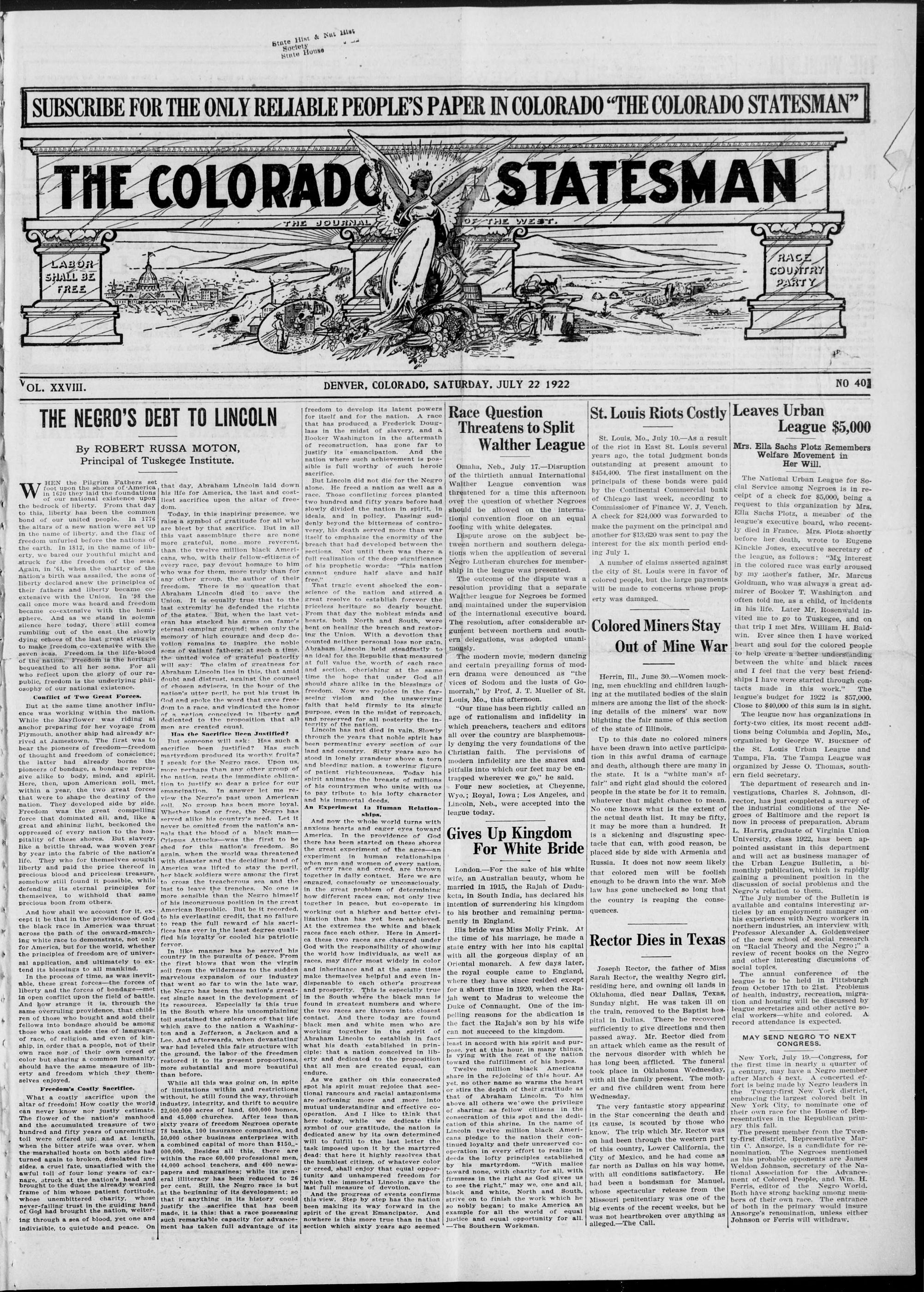
THE NEGRO'S DEBT TO LINCOLN
By ROBERT RUSSA MOTON, Principal of Tuskegee Institute.
WHEN the Pilgrim Fathers set foot upon the shores of 'America in 1620 they laid the foundations of our national existence upon the bedrock of liberty. From that day to this, liberty has been the common bond of our united people. In 1776 the altars of a new nation were set up in the name of liberty, and the flag of freedom unfurled before the nations of the earth. In 1812, in the name of liberty, we bared our youthful might and struck for the freedom of the seas. Again, in '61, when the charter of the nation's birth was assailed, the sons of liberty declared anew the principles of their fathers and liberty became co-extensive with the Union. In '98 the call once more was heard and freedom became co-extensive with the hemisphere. And as we stand in solemn silence here today, there still comes rumbling out of the east the slowly dying echoes of the last great struggle to make freedom co-extensive with the seven seas. Freedom is the life-blood of the nation. Freedom is the heritage bequeathed to all her sons. For all who reflect upon the glory of our republic, freedom is the underlying philosophy of our national existence.
Conflict of Two Great Forces.
Conflict of Two Great Forces.
But at the same time another influence was working within the nation. While the Mayflower was riding at anchor preparing for her voyage from Plymouth, another ship had already arrived at Jamestown. The first was to bear the pioneers of freedom—freedom of thought and freedom of conscience; the latter had already borne the pioneers of bondage, a bondage repressive allike to body, mind, and spirit. Here, then, upon American soil, met, within a year, the two great forces that were to shape the destiny of the nation. They developed side by side. Freedom was the great compelling force that dominated all, and, like a great and shining light, beckoned the oppressed of every nation to the hospitality of these shores. But slavery, like a brittle thread, was woven year by year into the fabric of the nation's life. They who for themselves sought liberty and paid the price thereof in precious blood and priceless treasure, somehow still found it possible, while defending its eternal principles for themselves, to withhold that same precious boon from others.
And how shall we account for it, except it be that in the providence of God the black race in America was thrust across the path of the onward-marching white race to demonstrate, not only for America, but for the world, whether the principles of freedom are of universal application, and ultimately to extend its blessings to all mankind.
In the process of time, as was inevitable, these great forces—the forces of liberty and the forces of bondage—met in open conflict upon the field of battle. And how strange it is, through the same overruling providence, that children of those who bought and sold their fellows into bondage should be among those who cast aside ties of language, of race, of religion, and even of kinship, in order that a people, not of their own race nor of their own creed or color but sharing a common humanity, should have the same measure of liberty and freedom which they themselves enjoyed.
Freedom's Costly Sacrifice.
What a costly sacrifice upon the altar of freedom! How costly the world can never know nor justly estimate. The flower of the nation's manhood and the accumulated treasure of two hundred and fifty years of unremitting toll were offered up; and at length, when the bitter strife was over, when the marshalled hosts on both sides had turned again to broken, desolated firesides, a cruel fate, unsatisfied with the awful toll of four long years of carriage, struck at the nation's head and brought to the dust the already weared frame of him whose patient fortitude, whose unembittered charity, whose never-failed trust in the guiding hand of God had brought the nation, weltering through a sea of blood, yet one and indivisible, to quietude and peace. On
OL. XXVIII.
that day, Abraham Lincoln laid down his life for America, the last and costliest sacrifice upon the altar of freedom.
Today, in this inspiring presence, we raise a symbol of gratitude for all who are blest by that sacrifice. But in all this vast assemblage there are none more grateful, none more reverent, than the twelve million black Americans, who, with their fellow-citizens of every race, pay devout homage to him who was for them, more truly than for any other group, the author of their freedom. There is no question that Abraham Lincoln died to save the Union. It is equally true that to the last extremity he defended the rights of the states. But, when the last veteran has stacked his arms on fame's eternal camping ground; when only the memory of high courage and deep devotion remains to inspire the noble sons of valiant fathers; at such a time, the united voice of grateful posterity will say: The claim of greatness for Abraham Lincoln lies in this, that amid doubt and distrust, against the counsel of chosen advisers, in the hour of the nation's utter peril, he put his trust in God and spoke the word that gave freedom to a race, and vindicated the honor of a nation conceived in liberty and dedicated to the proposition that all men are created equal.
Has the Sacrifice Been Justified?
But someone will ask: Has such a sacrifice been justified? Has such martyrdom produced its worthy fruits? I speak for the Negro race. Upon us, more perhaps than any other group of the nation, rests the immediate obligation to justify so dear a price for our emancipation. In answer let me review the Negro's past upon American soil. No group has been more loyal. Whether bond or free, the Negro has served alike his country's need. Let it never be omitted from the nation's animals that the blood of a black man—Crispus Attucks—was the first to be shed for this nation's freedom. So again, when the world was threatened with disaster and the deciding hand of America was lifted to stay the peril, her black soldiers were among the first to cross the treacherous sea and the last to leave the trenches. No one is more sensible than the Negro himself of his incongruous position in the great American Republic. But be it recorded, to his everlasting credit, that no failure to reap the full reward of his sacrifices has ever in the least degree qualified his loyalty or cooled his patriotic fervor.
In like manner he has served his country in the pursuits of peace. From the first blows that won the virgin soil from the wilderness to the sudden marvelous expansion of our industry that went so far to win the late war, the Negro has been the nation's greatest single asset in the development of its resources. Especially is this true in the South where his uncomplaining toll sustained the splendors of that life which gave to the nation a Washington and a Jefferson, a Jackson and a Lee. And afterwards, when devastating war had leveled this fair structure with the ground, the labor of the freedmen restored it to its present proportions, more substantial and more beautiful than before.
While all this was going on, in spite of limitations within and restrictions without, he still found the way, through industry, integrity, and thrift to acquire 22,000,000 acres of land, 600,000 homes, and 45,000 churches. After less than sixty years of freedom Negroes operate 78 banks, 100 insurance companies, and 50,000 other business enterprises with a combined capital of more than $150,000,000. Besides all this, there are within the race 60,000 professional men, 44,000 school teachers, and 400 newspapers and magazines; while its general illiteracy has been reduced to 26 per cent. Still, the Negro race is but at the beginning of its development; so that if anything in its history could justify the sacrifice that has been made, it is this: that a race possessing such remarkable capacity for advancement has taken full advantage of its
State Hist & Nut Hist
Society
State House
ABLE PEOPLE'S PA
ADO
E JOURNAL
DENVER, COLORADO, S
DENVER, COLORADO, SATURDAY, JULY 22 1922
freedom to develop its latent powers for itself and for the nation. A race that has produced a Frederick Douglass in the midst of slavery, and a Booker Washington in the aftermath of reconstruction, has gone far to justify its emancipation. And the nation where such achievement is possible is full worthy of such heroic sacrifice.
But Lincoln did not die for the Negro alone. He freed a nation as well as a race. Those conflicting forces planted two hundred and fifty years before had slowly divided the nation in spirit, ideals, and in policy. Passing suddenly beyond the bitterness of controversy, his death served more than war itself to emphasize the enormity of the breach that had developed between the sections. Not until then was there a full realization of the deep significance of his prophetic words: "This nation cannot endure half slave and half free."
That tragic event shocked the conscience of the nation and stirred a great resolve to establish forever the priceless heritage so dearly bought. From that day the noblest minds and hearts, both North and South, were bent on healing the breach and restoring the Union. With a devotion that counted neither personal loss nor gain, Abraham Lincoln held steadfastly to an ideal for the Republic that measured at full value the worth of each race and section, cherishing at the same time the hope that under God all should share alike in the blessings of freedom. Now we rejoice in the farseeing vision and the unswerving faith that held firmly to its single purpose, even in the midst of reproach, and preserved for all posterity the integrity of the nation.
Lincoln has not died in vain. Slowly through the years that noble spirit has been permeating every section of our land and country. Sixty years ago he stood in lonely grandeur above a torn and bleeding nation, a towering figure of patient righteousness. Today his spirit animates the breasts of millions of his countrymen who unite with us to pay tribute to his lofty character and his immortal deeds.
An Experiment la Human Relationships
And now the whole world turns with anxious hearts and eager eyes toward America. In the providence of God there has been started on these shores the great experiment of the ages—an experiment in human relationships when men and women of every nation, of every race and creed, are thrown together in daily contact. Here we are engaged, consciously or unconsciously, in the great problem of determining how different races can, not only live together in peace, but co-operate in working out a higher and better civilization than has yet been achieved. At the extremes the white and black races face each other. Here in America these two races are charged under God with the responsibility of showing the world how individuals, as well as races, may differ most widely in color and inheritance and at the same time make themselves helpful and even indispensable to each other's progress and prosperity. This is especially true in the South where the black man is found in greatest numbers and where the two races are thrown into closest contact. And there today are found black men and white men who are working together in the spirit of Abraham Lincoln to establish in fact what his death established in principle: that a nation conceived in liberty and dedicated to the proposition that all men are created equal, can endure.
As we gather on this consecrated spot his spirit must rejoice that sectional rancours and racial antagonisms are softening more and more into mutual understanding and effective cooperation. And I like to think that here today, while we dedicate this symbol of our gratitude, the nation is dedicated anew by its own determined will to fulfill to the last letter the task imposed upon it by the martyred dead; that here it highly resolves that the humblest citizen, of whatever color or creed, shall enjoy that equal opportunity and unhampered freedom for which the immortal Lincoln gave the last full measure of devotion.
And the progress of events confirms this view. Step by step has the nation been making its way forward in the spirit of the great Emancipator. And nowhere is this more true than in that section which sixty years ago seemed
Race Question Threatens to Split Walther League
Race Question Threatens to Split Walther League
Omaha, Neb., July 17.—Disruption of the thirtieth annual International Walther League convention was threatened for a time this afternoon over the question of whether Negroes should be allowed on the international convention floor on an equal footing with white delegates.
Dispute arose on the subject between northern and southern delegations when the application of several Negro Lutheran churches for membership in the league was presented.
The outcome of the dispute was a resolution providing that a separate Walther league for Negroes be formed and maintained under the supervision of the international executive board. The resolution, after considerable argument between northern and southern delegations, was adopted unanimously.
The modern movie, modern dancing and certain preyailing forms of modern drama were denounced as "the vices of Sodom and the lusts of Gomorrah," by Prof. J. T. Mueller of St. Louis, Mo., this afternoon.
"Our time has been rightly called an age of rationalism and infidelity in which preachers, teachers and editors all over the country are blasphemously denying the very foundations of the Christian faith. The pervisions of modern infidelity are the snares and pitfalls into which our feet may be entrapped wherever we go," he said. Four new societies, at Cheyenne, Wyo.; Royal, Iowa; Los Angeles, and Lincoln, Neb., were accepted into the league today.
Gives Up Kingdom For White Bride
London.—For the sake of his white wife, an Australian beauty, whom he married in 1915, the Rajah of Daduketa, in South India, has declared his intention of surrendering his kingdom to his brother and remaining permanently in England.
His bride was Miss Molly Frink. At the time of his marriage, he made a state entry with her into his capital with all the gorgeous display of an Oriental monarch. A few days later, the royal couple came to England, where they have since resided except for a short time in 1920, when the Rajah went to Madras to welcome the Duke of Connaught. One of the impelling reasons for the abdication is the fact the Rajah's son by his wife can not succeed to the kingdom.
least in accord with his spirit and purpose, yet at this hour, in many things, is vying with the rest of the nation toward the fulfillment of his hopes.
Twelve million black Americans share in the rejoicing of this hour. As yet, no other name so warms the heart or stirs the depth of their gratitude as that of Abraham Lincoln. To him above all others we owe the privilege of sharing as fellow citizens in the consecration of this spot and the dedication of this shrine. In the name of Lincoln twelve million black Americans pledge to the nation their continued loyalty and their unreserved cooperation in every effort to realize in deeds the lofty principles established by his martyrdom. "With malice toward none, with charity for all, with firmness in the right as God gives us to see the right," may we, one and all, black and white, North and South, strive on to finish the work which he so nobly began; to make America an example for all the world of equal justice and equal opportunity for all.—The Southern Workman.
St. Louis Riots Costly
St. Louis, Mo., July 10.—As a result of the riot in East St. Louis several years ago, the total judgment bonds outstanding at present amount to $454,400. The first installment on the principals of these bonds were paid by the Continental Commercial bank of Chicago last week, according to Commissioner of Finance W. J. Veach. A check for $24,000 was forwarded to make the payment on the principal and another for $13,620 was sent to pay the interest for the six month period ending July 1.
A number of claims asserted against the city of St. Louis were in favor of colored people, but the large payments will be made to concerns whose property was damaged.
Colored Miners Stay Out of Mine War
Herrin, Ill., June 30.—Women mocking, men chuckling and children laughing at the mutilated bodies of the slain miners are among the list of the shocking details of the miners' war now blighting the fair name of this section of the state of Illinois.
Up to this date no colored miners have been drawn into active participation in this awful drama of carnage and death, although there are many in the state. It is a "white man's affair" and right glad should the colored people in the state be for it to remain, whatever that might chance to mean. No one knows what is the extent of the actual death list. It may be fifty, it may be more than a hundred. It is a sickening and disgusting spectacle that can, with good reason, be placed side by side with Armenia and Russia. It does not now seem likely that colored men will be foolish enough to be drawn into the war. Mob law has gone unchecked so long that the country is reaping the consequences.
Rector Dies in Texas
Joseph Rector, the father of Miss Sarah Rector, the wealthy Negro girl, residing here, and owning oil lands in Oklahoma, died near Dallas, Texas, Sunday night. He was taken ill on the train, removed to the Baptist hospital in Dallas. There he recovered sufficiently to give directions and then passed away. Mr. Rector died from an attack which came as the result of the nervous disorder with which he has long been afflicted. The funeral took place in Oklahoma Wednesday, with all the family present. The mother and five children went from here Wednesday.
The very fantastic story appearing in the Star concerning the death and its cause, is scouted by those who know. The trip which Mr. Rector was on had been through the western part of this country, Lower California, the City of Mexico, and he had come as far north as Dallas on his way home, with all conditions satisfactory. He had been a bondsman for Manuel, whose spectacular release from the Missouri penitentiary was one of the big events of the recent weeks, but he was not heartbroken over anything as alleged.—The Call.
NO 40
Leaves Urban League $5,000
Mrs. Ella Sachs Plotz Remembers Welfare Movement in Her Will.
The National Urban League for Social Service among Negroes is in receipt of a check for $5,000, being a request to this organization by Mrs. Ella Sachs Plotz, a member of the league's executive board, who recently died in France. Mrs. Plotz shortly before her death, wrote to Eugene Kinckle Jones, executive secretary of the league, as follows: "Mx interest in the colored race was early aroused by my mother's father, Mr. Marcus Goldman, who was always a great admirer of Booker T. Washington and often told me, as a child, of incidents in his life. Later Mr. Rosenwald invited me to go to Tuskegee, and on that trip I met Mrs. William H. Baldwin. Ever since then I have worked heart and soul for the colored people to help create a better understanding between the white and black races and I feel that the very best friendships I have were started through contacts made in this work." The league's budget for 1922 is $57,000. Close to $40,000 of this sum is in sight.
The league now has organizations in forty-two cities, its most recent additions being Columbia and Joplin, Mo., organized by George W. Buckner of the St. Louis Urban League and Tampa, Fla. The Tampa League was organized by Jesse O. Thomas, southern field secretary.
The department of research and investigations, Charles S. Johnson, director, has just completed a survey of the industrial conditions of the Negroes of Baltimore and the report is now in process of preparation. Abram L. Harris, graduate of Virginia Union University, class 1922, has been appointed assistant in this department and will act as business manager of the Urban League Bulletin, a bi-monthly publication, which is rapidly gaining a prominent position in the discussion of social problems and the Negro's relation to them.
The July number of the Bulletin is available and contains interesting articles by an employment manager on his experiences with Negro workers in northern industries, an interview with Professor Alexander A. Goldenwelser of the new school of social research on "Racial Theory and the Negro;" a review of recent books on the Negro and other interesting discussions of social topics.
the annual conference of the league is to be held in Pittsburgh from October 17th to 21st. Problems of health, industry, recreation, migration and housing will be discussed by league secretaries and other active social workers—white and colored. A record attendance is expected.
MAY SEND NEGRO TO NEXT
CONGRESS.
New York, July 19.—Congress, for the first time in nearly a quarter of a century, may have a Negro member after March 4 next. A concerted effort is being made by Negro leaders in the Twenty-first New York district, embracing the largest colored belt in New York City, to nominate one of their own race for the House of Representatives in the Republican primary this fall.
The present member from the Twenty-first district, Representative Martin C. Ansorge, is a candidate for renomination. The Negroes mentioned as his probable opponents are James Weldon Johnson, secretary of the National Association for the Advancement of Colored People, and Wm. H. Ferris, editor of the Negro World. Both have strong backing among members of their own race. The entrance of both in the primary would insure Ansorge's renomination, unless either Johnson or Ferris will withdraw.
FOREIGN
The publicity department of the Irish irregular army has announced that Eamon de Valera is at field general headquarters, serving on the staff of the director of operations. It is believed headquarters has been transferred from Mallow to Limerick. The provisional government reaffirms its determination to suppress the revolt. Chen Chiung-Ming's troops have broken the drive of Sun Yat Sen's forces in the vicinity of Shiukwan, inflicting considerable losses. Chen Chiung-Ming, who controls the railway between Canton and Shiukwan has sent 14,000 troops northward from Canton. Reserves around Shiukwan appear to have lessened Sun's chances of recapturing Canton.
Famine and plague in Russia are under control, President Harding was informed by Secretary Hoover in a preliminary report on the use of United States Grain Corporation funds for relief work. The situation, Mr. Hoover added, promises to be much better after the harvest although it is too early to determine whether American relief work will be extended.
Chang Tse-Lin, rebellious Manchurian super-tuchan, still is holding onto the rolling stock he took from the railroad lines between Peking and Mukden when he made peace and retreated northward. As this amounts to about 75 per cent of the line's available equipment, resumption of normal traffic is impossible, despite the more peaceful conditions caused by his withdrawal.
Hermann Fischer and Edwin Kern, who for many days have been pursued by the German police as the assassins of Foreign Minister Rathenau, committed suicide, according to a dispatch to Berlin from Halle. The two men shot themselves, the dispatch said, as they were about to be captured in the turret of Saaleck castle, near Bad Koesen, whether they had been traced by the police.
A grave political situation is developing in Poland as the result of hostility between President Pilsudski and Adelbert Korfanty, the newly appointed Polish premier, according to advises in London from Warsaw. The Polish army is said to be supporting President Pilsudski, but the supporters of Premier Korfanty are standing firm and assert Korfanty will not heed the president's request that he resign.
Formal and official announcement that Great Britain will pay her debt of $4,300,000,000 to the United States, was made in the House of Commons by Sir Robert Horne, chancellor of the British exchequer. "Our debt to the United States is a solemn obligation and it will be met," said Sir Robert. It is expected this announcement will put an end to discussions of "debt cancellations."
Talk in Dublin continues to center around approaching operations on a big scale against the Republican irregulars, but the Free State commanders so far have successfully hidden their plans. Meanwhile the National army troops continue to reap scattered successes. Including the prisoners captured by Free State troops during the recent fighting in Dublin, the Nationals now hold approximately 2,000 prisoners.
GENERAL
Charles Bonzek, a deputy sheriff of Rock Creek, died in the Lutheran hospital at St. Louis of a fractured skull caused by a blow over the head with a baseball bat in the hands of Charles Woolesey of Valley Park. Woolesey, enraged over a decision made by Bouzek, who was umpiring a baseball game at Fenton, near St. Louis, struck Bouzek with a bat.
Millions of dollars are to be spent for building during the ensuing year by the Benevolent and Protective Order of Elks, according to the report of retiring Grand Exalted Ruler William Wallace Mountain, presented at Atlantic City. The assets of subordinate lodges now amount to $58,099,234, and the elaborate building program for the year shows that there are to be erected in various parts of the country thirty-one new homes.
Edward G. Workman, of Watertown, New York, evidently missed the war, so he brought it to his porch, in the form of a 155-millimeter shell, "a dud" salvaged from the artillery range at Pine Plains. Either the heat of the sun or the blow from a child's croquet mallet exploded the shell, killing eight children and wrecking the concrete house in which Workman's family and that of William L. Sallsbury lived.
Grand jury action to fix responsibility for the recent coal mine warfare near Herrin, Ill., will begin as soon as the community has had a chance to "cool down," Attorney General E. J. Brundage of Illinois declared in Chicago upon his return from a personal trip of investigation in Williamson county. Brundage said that "it looks as though the mine owners were indiscreet in their display of armed strength." He declared that the mine guards were accustomed to terrorize the community.
Gene Sarazen of Pittsburg a little 21-year-old native-born American of Italian descent, pushed his way out in front of the world's greatest golfers many of them old enough to be his father, and won the national open golf championship at Glencoe, Ill., with a score of 288 for seventy-two holes of play, lasting two days.
Clifton, W. Va., where four are known to have been shot to death and possibly several others are dead in the ruins of the McKinley mine tipple is quiet again. Forty-five prisoners were taken by Brooke county deputies
THE WORLD IN PARAGRAPHS
A BRIEF RECORD OF PASSING EVENTS IN THIS AND FOR-EIGN COUNTRIES.
DOINGS AND HAPPENINGS THAT MARK THE PROGRESS OF THE AGE.
WESTERN
Rudy Knepper, golfer de luxe, is the newly crowned trans-Mississippi champion, dethroning the reigning title holder, George Von Elm, by 5 up and 4 to go in a stirring match at the Omaha Country Club course. It required thirteen holes to decide the issue, although there was scarcely ever a doubt as to the final outcome.
Sheriff George White of Santa Cruz county was killed and Manuel Martinez and Placido Silvas, convicted murderers, escaped when an automobile in which the prisoners were being taken to the state penitentiary at Florence, Ariz., overturned on the Nogales-Tucson highway near Contenant, eighteen miles south of Tucson.
A coroner's inquest in Los Angeles found Mrs. Clara Phillips responsible for the death of Mrs. Alberta Meadows, her supposed rival for the affections of A. L. Phillips, her husband. The law having had its way with the smiling prisoner, husband and wife were then permitted to see each other for the first time since she was arrested. Mrs. Meadows was beaten to death with a hammer.
Twenty men and women, passengers aboard the Tourist, an excursion boat, which became disabled ten miles off Newport, on the Orange county coast, south of Long Beach, Calif., were rescued by the fishing smack Music and brought to Long Beach. When the Music sighted the Tourist the latter was wallowing in the trough of the sea, engine disabled and a sail set to keep her head in the wind.
WASHINGTON
Clerks employed in postoffices throughout the United States will, during the remainder of the summer season, be permitted to enjoy a half holiday each Saturday, providing the work assigned to them has been completed by noon on that day, under an order issued by First Assistant Postmaster General Bartlett.
Ordinary expenditures of the government during the fiscal year just closed fell off by $1,333,000,000 as compared with the previous year, while public debt disbursements showed a decline of $2,131,000,000, according to a statement of classified expenditures for the twelve months ending June 30, issued by the treasury.
While optimism as to the outcome of the railroad strike was reflected at the White House, there was further evidence that the administration intends to keep a firm grasp on the situation and that every force at the command of the government will be utilized to insure maintenance of necessary interstate transportation.
The final official step in the consummation of the Japanese-American treaty of Yap, concluded during the armament conference was taken by President Harding when he issued a presidential proclamation to the effect that the treaty had been concluded. The treaty recognizes Japan's mandate over the little island, but stipulates that America shall enjoy "open door" privileges and equal rights with Japan.
A charge by Senator Lenroot, Republican, Wisconsin, that threats to slash rates in the agricultural schedule has been used in an effort to keep Republican senators in line on rates in the cotton schedule of the pending tariff bill, enlivened Senate debate recently on that measure.
The farm population of the United States on Jan. 1, 1920, was 31,614,269, or 29.9 per cent of the total population of the country according to returns of the last census announced in Washington by the census bureau. Of this number, 31,350,640 were enumerated in rural territory and 255,629 on farms located within the limits of cities and other incorporated communities having 2,500 inhabitants or more.
President Harding recently sent telegrams directing the operators of all bituminous mines shut down because of strike conditions to resume operations at once, and requesting the governors of those states in which the mines operate to furnish such military protection as may be needed. If state troops find it impossible to cope with the situation, federal troops, it was understood, may be employed eventually.
Urging Congress to enact new legislation to destroy an alleged Standard Oil monopoly in the gasoline trade, the federal trade commission charged the corporation with "perpetuating the very monopolistic control which the United States Supreme Court sought to terminate."
James H. Wilkerson, a Chicago attorney, has been nominated by President Harding to be United States district judge for the northern district of Illinois. He succeeds Judge K. M. Landis, who resigned to become high commissioner of baseball.
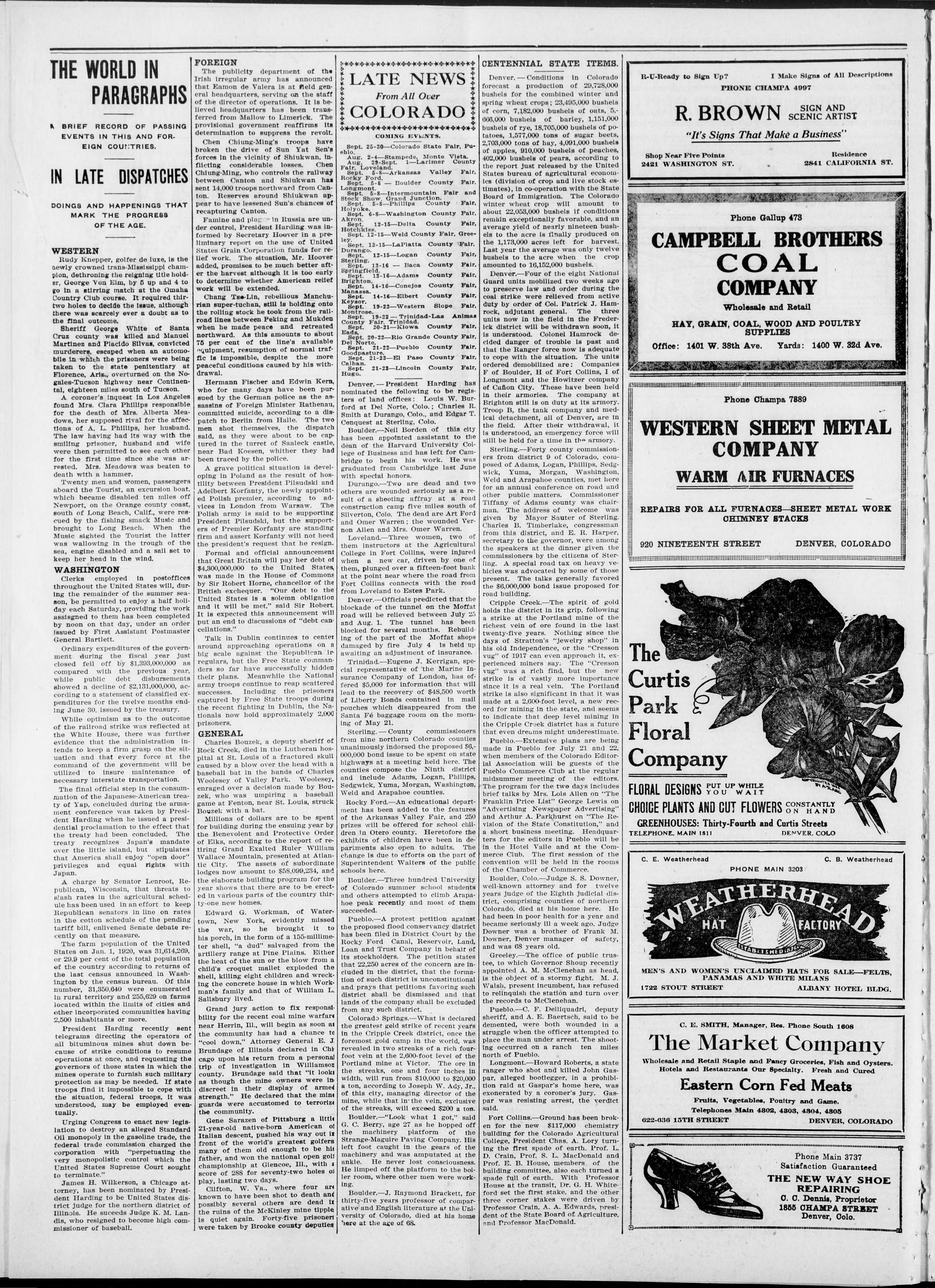
LATE NEWS
From All Over
COLORADO
COMING EVENTS.
Sept. 25-30—Colorado State Fair, Pueblo.
Aug. 2-4—Stampede, Monte Vista.
Aug. 18-Sept. 1—Larimer County Fair,
Fair, Loveland.
Sept. 5-8—Arkansas Valley Fair,
Rocky Ford.
Sept. 5-8—Boulder County Fair,
Louisiana.
Sept. 5-8—Intermountain Fair and Stock Show, Grand Junction.
Sept. 5-8—Phillips County Fair,
Holyoke.
Sept. 5-8—Washington County Fair,
Akron.
Sept. 12-15—Delta County Fair,
Hotchkiss.
Sept. 12-15—Weld County Fair, Gree-
lee.
Sept. 12-15—LaPlata County Fair,
Durango.
Sept. 12-15—Logan County Fair,
Stearing.
Sept. 13-16—Baca County Fair,
Springfield.
Sept. 13-16—Adams County Fair,
Brighton.
Sept. 14-16—Conejos County Fair,
Manassa.
Sept. 14-16—Elbert County Fair,
Keysor.
Sept. 19-22—Western Slope Fair,
Montrose.
Sept. 19-22—Trinidad-Las Animas
County Fair, Trinidad.
Sept. 20-21-Klowa County Fair,
El Paso.
Sept. 20-22—Rio Grande County Fair,
Dei Norte.
Sept. 21-22—Pueblo County Fair,
Goodpasture.
Sept. 21-23—El Paso County Fair,
Calhan.
Sept. 21-23—Lincoln County Fair,
Hugo.
Denver. — President Harding has nominated the following to be registers of land offices: Louis W. Burford at Del Norte, Colo.; Charles R. Smith at Durango, Colo., and Edgar T. Conquest at Sterling, Colo.
Boulder. — Neil Borden of this city has been appointed assistant to the dean of the Harvard University College of Business and has left for Cambridge to begin his work. He was graduated from Cambridge last June with special honors.
Durango. — Two are dead and two others are wounded seriously as a result of a shooting affray at a road construction camp five miles south of Silverton, Colo. The dead are Art Ford and Omer Warren; the wounded Vernon Allen and Mrs. Omer Warren.
Loveland.—Three women, two of them instructors at the Agricultural College in Fort Collins, were injured when a new car, driven by one of them, plunged over a fifteen-foot bank at the point near where the road from Fort Collins connects with the road from Loveland to Estes Park.
Denver.—Officials predicted that the blockade of the tunnel on the Moffat road will be relieved between July 25 and Aug. 1. The tunnel has been blocked for several months. Rebuilding of the part of the Moffat shops damaged by fire July 4 is held up awaiting an adjustment of insurance.
Trinidad.—Eugene J. Kerrigan, special representative of the Marine Insurance Company of London, has offered $5,000 for information that will lead to the recovery of $48,500 worth of Liberty Bonds contained in mail pouches which disappeared from the Santa Fe baggage room on the morning of May 21.
Sterling.—County commissioners from nine northern Colorado counties unanimously indorsed the proposed $6,000,000 bond issue to be spent on state highways at a meeting held here. The counties compose the Ninth district and include Adams, Logan, Phillips, Sedgwick, Yuma, Morgan, Washington, Weld and Arapahoe counties.
Rocky Ford.—An educational department has been added to the features of the Arkansas Valley Fair, and 250 prizes will be offered for school children in Otero county. Heretofore the exhibits of children have been in departments also open to adults. The change is due to efforts on the part of Superintendent Walters of the public schools here. Boulder.—Three hundred University of Colorado summer school students and others attempted to climb Arapahoe peak recently and most of them succeeded.
Pueblo.—A protest petition against the proposed flood conservancy district has been filed in District Court by the Rocky Ford Canal, Reservoir, Land, Loan and Trust Company in behal of its stockholders. The petition states that 22,250 acres of the concern are included in the district, that the formation of such district is unconstitutional and prays that petitions favoring such district shall be dismissed and that lands of the company shall be excluded from any such district.
Colorado Springs.—What is declared the greatest gold strike of recent years in the Cripple Creek district, once the foremost gold camp in the world, was revealed in two streaks of a rich four-foot vein at the 2,600-foot level of the Portland mine at Victor. The ore in the streaks, one and four inches in width, will run from $10,000 to $20,000 a ton, according to Joseph W. Ady, Jr., of this city, managing director of the mine, while that in the vein, exclusive of the streaks, will exceed $200 a ton. Boulder.—"Look what I got," said G. C. Berry, age 27 as he hopped off the machinery platform of the Strange-Maguire Paving Company. His left foot caught in the gears of the machinery and was amputated at the ankle. He never lost consciousness. He limped off the platform to the boiler room, where other men were working.
Boulder.—J. Raymond Brackett, for thirty-five years professor of comparative and English literature at the University of Colorado, died at his home here at the age of 68.
Denver. — Conditions in Colorado forecast a production of 29,728,000 bushels for the combined winter and spring wheat crops; 23,495,000 bushels of corn, 7,182,000 bushels of oats, 5,606,000 bushels of barley, 1,151,000 bushels of rye, 18,705,000 bushels of potatoes, 1,577,000 tons of sugar beets, 2,703,000 tons of hay, 4,091,000 bushels of apples, 910,000 bushels of peaches, 402,000 bushels of pears, according to the report just released by the United States bureau of agricultural economies (division of crop and live stock estimates), in co-operation with the State Board of Immigration. The Colorado winter wheat crop will amount to about 22,053,000 bushels if conditions remain exceptionally favorable, and an average yield of nearly nineteen bushels to the acre is finally produced on the 1,173,000 acres left for harvest. Last year the average was only twelve bushels to the acre when the crop amounted to 16,152,000 bushels.
Denver.—Four of the eight National Guard units mobilized two weeks ago to preserve law and order during the coal strike were relieved from active duty by order of Col. Patrick J. Hamrock, adjutant general. The three units now in the field in the Frederick district will be withdrawn soon, it is understood. Colonel Hamrock decided danger of trouble is past and that the Ranger force now is adequate to cope with the situation. The units ordered demobilized are: Companies F of Boulder, H of Fort Collins, I of Longmont and the Howitzer company of Cañon City. These have been held in their armories. The company at Brighton still is on duty at its armory. Troop B, the tank company and medical detachment, all of Denver, are in the field. After their withdrawal, it is understood, an emergency force will still be held for a time in the armory.
Sterling.—Forty county commissioners from district 9 of Colorado, composed of Adams, Logan, Phillips, Sedgwick, Yuma, Morgan, Washington, Weld and Arapahoe counties, met here for an annual conference on road and other public matters. Commissoner Tiffany of Adams county was chairman. The address of welcome was given by Mayor Sauter of Sterling. Charles B. Timberlake, congressman from this district, and E. R. Harper, secretary to the governor, were among the speakers at the dinner given the commissioners by the citizens of Sterling. A special road tax on heavy vehicles was advocated by some of those present. The talks generally favored the $6,000,000 bond issue proposed for road building.
Cripple Creek.—The spirit of gold holds the district in its grip, following a strike at the Portland mine of the richest vein of ore found in the last twenty-five years. Nothing since the days of Stratton's "jewelry shop" in his old Independence, or the "Cresson vug" of 1917 can even approach it, experienced miners say. The "Cresson vug" was a rich find, but the new strike is of vastly more importance since it is a real vein. The Portland strike is also significant in that it was made at a 2,600-foot level, a new record for mining in the state, and seems to indicate that deep level mining in the Cripple Creek district has a future that even dreams might underestimate.
Pueblo.—Extensive plans are being made in Pueblo for July 21 and 22, when members of the Colorado Editorial Association will be guests of the Pueblo Commerce Club at the regular midsummer meeting of the editors. The program for the two days includes brief talks by Mrs. Lois Allen on "The Franklin Price List" George Lewis on "Advertising Newspaper Advertising" and Arthur A. Parkhurst on "The Revision of the State Constitution," and a short business meeting. Headquarters for the editors in Pueblo will be in the Hotel Valle and at the Commerce Club. The first session of the convention will be held in the rooms of the Chamber of Commerce.
Boulder, Colo.—Judge S. S. Downer, well-known attorney and for twelve years judge of the Eighth judicial district, comprising counties of northern Colorado, died at his home here. He had been in poor health for a year and became seriously ill a week ago. Judge Downer was a brother of Frank M. Downer, Denver manager of safety, and was 65 years old. Greeley.—The office of public trustee, to which Governor Shoup recently appointed A. M. McClenehan as head, is the object of a stormy fight. M. J. Walsh, present incumbent, has refused to relinquish the station and turn over the records to McClenehan. Pueblo.—C. F. Delliquadri, deputy sheriff, and A. E. Baertsch, said to be demented, were both wounded in a struggle when the officer attempted to place the man under arrest. The shooting occurred on a ranch ten miles north of Pueblo.
Longmont.—Howard Roberts, a state ranger who shot and killed John Gaspar, alleged bootlegger, in a prohibition raid at Gaspar's home here, was exonerated by a coroner's jury. Gaspar was resisting arrest, the verdict sald.
Fort Collins.—Ground has been broken for the new $117,000 chemistry building for the Colorado Agricultural College, President Chas. A. Lory turning the first spade of earth. Prof. L. D. Crain, Prof. S. L. MacDonald and Prof. E. B. House, members of the building committee, also each turned a spade full of earth. With Professor House at the transit, Dr. G. H. Whiteford set the first stake, and the other three corner stakes were driven by Professor Crain, A. A. Edwards, president of the State Board of Agriculture, and Professor MacDonald.
R-U-Ready to Sign Up? I Make Signs of All Descriptions PHONE CHAMPA 4997
"It's Signs That Make a Business"
Shop Near Five Points Rest
2421 WASHINGTON ST. 2841 CALI
Phone G
CAMPBELL COAL COMM
Wholesale
HAY, GRAIN, COAL,
SUP
Office: 1401 W. 38th Ave.
Phone Gallup 473
AMPBELL BROTHE
COAL
COMPANY
Wholesale and Retail
AY, GRAIN, COAL, WOOD AND POULT
SUPPLIES
1401 W. 38th Ave. Yards: 1400 W.
Phone Gallup 473
CAMPBELL BROTHERS
COAL
COMPANY
Wholesale and Retail
HAY, GRAIN, COAL, WOOD AND POULTRY
SUPPLIES
Office: 1401 W. 38th Ave. Yards: 1400 W. 32d Ave.
Phone Champa 7889
WESTERN SE
COM
WARM AIR
REPAIRS FOR ALL FURNA
CHIMNEY
TERN SHEET MET
COMPANY
WARM AIR FURNACES
FOR ALL FURNACES—SHEET MET
CHIMNEY STACKS
WESTERN SHEET METAL COMPANY
REPAIRS FOR ALL FURNACES—SHEET METAL WORK CHIMNEY STACKS
920 NINETEENTH STREET
The Curtis Park Floral Company
FLORAL DESIGNS PUT UP WHILE YOU WAIT
CHOICE PLANTS AND CUT FLOWERS
GREENHOUSES: Thirty-Fourth a
TELEPHONE, MAIN 1511
C. E. Weatherhead
PHONE
WEATHER
HAT
MEN'S AND WOMEN'S UNCLASSIFIED
PANAMAS AND
1722 STOUT STREET
C. E. SMITH, Manager
The Market
Wholesale and Retail Staple and
Hotels and Restaurants Our
Eastern Cor
Fruits, Vegetables,
Telephones Main 48
622-636 15TH STREET
S
l
bany
SIGNS PUT UP WHILE
YOU WAIT
TTS AND CUT FLOWERS CONSTANTLY ON HAND
USES: Thirty-Fourth and Curtis Streets
MAIN 1511 DENVER. COLO
herhead C. B.
PHONE MAIN 3203
EATHERHEA
HAT FACTORY
ESTABLISHED IN
O WOMEN'S UNCLAIMED HATS FOR SALE
PANAMAS AND WHITE MILANS
T STREET ALBANY HO
E. E. SMITH, Manager, Res. Phone South 160
e Market Comp
and Retail Staple and Fancy Groceries, Fish
and Restaurants Our Specialty. Fresh and
Eastern Corn Fed Meat
Fruits, Vegetables, Poultry and Game.
Telephones Main 4802, 4803, 4804, 4805
TH STREET DENVER,
The
Curtis
Park
Floral
Company
FLORAL DESIGNS PUT UP WHILE
YOU WAIT
CHOICE PLANTS AND CUT FLOWERS CONSTANTLY
ON HAND
GREENHOUSES: Thirty-Fourth and Curtis Streets
TELEPHONE. MAIN 1511
DENVER. COLO
WEATHERHEAD
HAT FACTORY
ESTABLISHED 1876
MEN'S AND WOMEN'S UNCLADMED HATS FOR SALE—FELTS,
PANAMAS AND WHITE MILANS
1722 STOUT STREET
ALBANY HOTEL BLDG.
---
---
Residence
2841 CALIFORNIA ST.
fallup 473
BROTHERS
AL
PANY
and Retail
WOOD AND POULTRY
COMPLIES
Yards: 1400 W. 32d Ave.
SHEET METAL
COMPANY
FURNACES
DES—SHEET METAL WORK
STACKS
DENVER, COLORADO
ERS CONSTANTLY ON HAND
and Curtis Streets
DENVER, COLO
C. B. Weatherhead
MAIN 3203
ERHEAD
FACTORY
MED HATS FOR SALE—FELTS,
WHITE MILANS
ALBANY HOTEL BLDG.
Res. Phone South 1608
et Company
Fancy Groceries, Fish and Oysters.
Specialty. Fresh and Cured
on Fed Meats
Poultry and Game.
92, 4303, 4304, 4805
DENVER, COLORADO
Phone Main 3737
Satisfaction Guaranteed
THE NEW WAY SHOE
REPAIRING
C. C. Dennis, Proprietor
1855 CHAMPA STREET
Denver, Colo.
PUBLIC TRUSTEE'S SALE.
Whereas, The O'Malley-Kelly Oll and Auto Supply Company, by deed of trust dated the 8th day of August, 1921, which is recorded in book five of the page where the rooms in the office of the Clerk and Recorder of the City and County of Denver, Colorado, duly conveyed to the Public Trustee in and for the City and County of Denver, Colorado, to the City and County of Denver, Colorado, to-wit.
That part of lot twenty (20), block nine (9), Highland Park, and a part of lot thirteen (13), Resubdivision and Block nine (9), Highland Park described as follows:
On a line drawn from a point on the east boundary line of said lot twenty (20) 130 feet north of the southeast corner of said lot, thence northwesterly to a point on east boundary line (13) 130 feet northwesterly from southwesterly corner of said lot thirteen (13), thence beginning at a point on said described line 35 feet northwesterly from easterly boundary line of said lot twenty (20), thence northwesterly along said said lot boundary line with easterly boundary line of said lot thirteen (13), thence southwesterly along said westerly boundary line of lot thirteen (13) to southwesterly corner of said lot thirteen (13) thence southeasterly and easterly along southwesterly and southern boundary line of said lot twenty (20) to a point 50 feet west of southeast corner of said lot twenty (20), thence northeasterly to place of beginning except that part of lot twenty (20), block nine (9), Highland Park and part of lot thirteen (13), Keiths Park and part of lot thirteen (13), Highland Park, described as follows:
On a line drawn from a point on east boundary line of said lot twenty (20) 130 feet north of southeast corner of said lot twenty (20), thence northeastern to a point of beginning on western boundary line of said lot thirteen (13) 130 feet northeastern from south-western corner of said lot thirteen (13):
Beginning at a point on the line so determined 35 feet northerly from east boundary line of said lot twenty (20), thence northwesternly from east boundary line of said lot feet to its intersection with westerly boundary line of said lot thirteen (13), thence southwesternly along said westerly boundary line of said lot thirteen (13) 6½ feet to a point 123½ feet northwesternly to a point said lot thirteen (13), thence southeasternly 69½ feet to a point 15 feet southerly of place of beginning, thence northerly 15 feet to place of beginning, which deed of trust was made to secure the payment with said deed of trust, for the sum of Twenty Thousand and no-100 Dollars ($20,000.00), payable to the order of John T. Berry, doing business as Home Oil & Supply Company, one year due, upon 1921, and the second note due on or before August 1st, 1923, after the date thereof, with interest thereon at 8 per cent per annum until paid, interest payable monthly, as is more particularly set forth in which is hereby made for greater certainty, and.
Whereas, The said The O'Malley-Kelley Oil and Auto Supply Company and all persons claiming by, through or under it, having defaulted in the payment of the legal holder of said notes, having elected on account of said default to declare said notes unpaid, due and payable.
Now therefore, at the written request of John T. Berry, doing business at Home Oil and Supply Company, the legal holder of said notes, pursuant to law, I. the undersigned, Public Trustee in and for the City and County of Denver, Colorado do hereby give notice that in the hour of 10 o'clock in the forenoon of TUESDAY, AUGUST 8TH, 1922, at the Tremont street front door of the Court House, in the City and County of Denver, the highest and best bidder for cash, the said described premises, and all the right, title and interest of the said The O'Malley-Kelley Oil & Auto Supply Company, its successors and assigns therein, for the purpose of making a deed of trust, and the cost and expenses of executing this trust, and will deliver to the purchaser a certificate of sale as provided by law.
Colorado July 7th
1922. EDWARD M. SABIN,
Public Trustee in and for the City and
State.
First publication, July 8th, 1922.
Last publication, August 5th, 1922.
NOTICE OF ADJUSTMENT DAY.
Estate of Rasul. Deceased.
29110.
All persons having claims against said estate are hereby notified to present Court for adjustment in the County Court of the City and County of Denver, Colorado, on the 8th day of August, 1922.
ESTATE OF LOUIS BENTLEY, DE-
CEASED, NO. 30,428.
All persons having claims against
sale estate are hereby notified to pres-
ent them for adjustment in the County
Court of the City and County of Denver,
Colorado, on the 15th day of
August, 1922.
JONATHAN R. CONTEE.
Administrator.
Thos. Campbell, Attorney.
First publication, July 1, 1922.
Last publication, July 29, 1922.
Is now in progress—the title tells the story—everybody holding sales so are we, and we ask you to compare our offerings, our values, with any advertised or shown elsewhere and it is safe to say that you will find here better for less. The entire stock, in every department, reduced for a season's end complete clearance.
Head-to-foot Outfitters for Man, Woman and Child
Temporary Loan.
A little five-year-old came running into his aunt's home, which was not far from his own, and said: "Oh, auntie, mother wants to know will you please borrow me while she goes shopping."—Boston Transcript.
An Unclimbed Mountain.
It has been said that it would take two years to climb Mount Everest, in the Himalayas, the world's highest peak. So far no white man has won the honor of scaling this snow-clad giant.
The Start of Divorce.
The most primitive people held that a husband could repudiate his wife at will. This was gradually modified till separations could be obtained for cause. The hearing of cases came to be a function of the courts.
NATIONAL CAPITAL AFFAIRS
Cabinet Members to Address Congress?
Grand Canyon—"Senatorial Courtesy"
One in Every Seven Officers Must Go
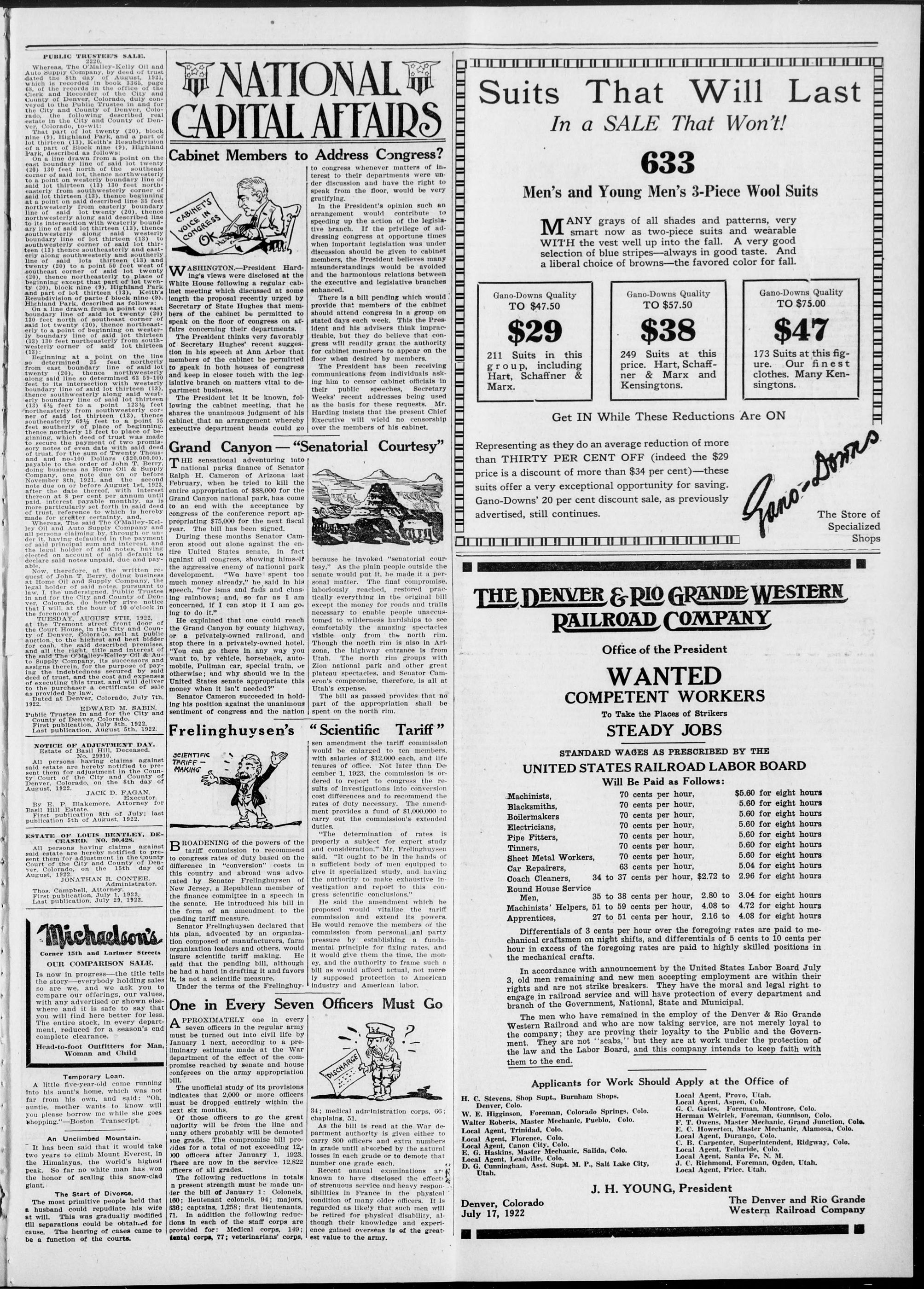
CABINET'S VOICE IN CONGRESS OK WASHINGTON.—President Harding's views were disclosed at the White House following a regular cabinet meeting which discussed at some length the proposal recently urged by Secretary of State Hughes that members of the cabinet be permitted to speak on the floor of congress on affairs concerning their departments.
The President thinks very favorably of Secretary Hughes' recent suggestion in his speech at Ann Arbor that members of the cabinet be permitted to speak in both houses of congress and keep in closer touch with the legislative branch on matters vital to department business. The President let it be known, following the cabinet meeting, that he shares the unanimous judgment of his cabinet that an arrangement whereby executive department heads could go
THE sensational adventuring into national parks finance of Senator Ralph H. Cameron of Arizona last February, when he tried to kill the entire appropriation of $88,000 for the Grand Canyon national park, has come to an end with the acceptance by congress of the conference report appropriating $75,000 for the next fiscal year. The bill has been signed. During these months Senator Cameron stood out alone against the entire United States senate, in fact against all congress, showing himself the aggressive enemy of national park development. "We have spent too much money already," he said in his speech, "for isms and fads and chasing rainbows; and, so far as I am concerned, if I can stop it I am going to do it."
He explained that one could reach the Grand Canyon by county highway, or a privately-owned railroad, and stop there in a privately-owned hotel. "You can go there in any way you want to, by vehicle, horseback, automobile, Pullman car, special train, or otherwise; and why should we in the United States senate appropriate this money when it isn't needed?" Senator Cameron succeeded in holding his position against the unanimous sentiment of congress and the nation
Frelinghuysen's
SCIENTIFIC TARiff- MAKING
BROADENING of the powers of the tariff commission to recommend to congress rates of duty based on the difference in "conversion" costs in this country and abroad was advocated by Senator Frelinghuysen of New Jersey, a Republican member of the finance committee in a speech in the senate. He introduced his bill in the form of an amendment to the pending tariff measure.
Senator Frelinghuysen declared that his plan, advocated by an organization composed of manufacturers, farm organization leaders and others, would insure scientific tariff making. He said that the pending bill, although he had a hand in drafting it and favors it, is not a scientific measure.
APPROXIMATELY one in every seven officers in the regular army must be turned out into civil life by January 1 next, according to a preliminary estimate made at the War department of the effect of the compromise reached by senate and house conferees on the army appropriation bill.
The unofficial study of its provisions indicates that 2,000 or more officers must be dropped entirely within the next six months.
Of those officers to go the great majority will be from the line and many others probably will be demoted one grade. The compromise bill provides for a total of not exceeding 12,000 officers after January 1, 1923. There are now in the service 12,822 officers of all grades.
The following reductions in totals in present strength must be made under the bill of January 1: Colonels, 160; lieutenant colonels, 94; majors, 836; captains, 1,258; first lieutenants, 71. In addition the following reductions in each of the staff corps are provided for: Medical corps, 149; dental corps, 77; veterinarians' corps,
to congress whenever matters of interest to their departments were under discussion and have the right to speak from the floor, would be very gratifying.
In the President's opinion such an arrangement would contribute to speeding up the action of the legislative branch. If the privilege of addressing congress at opportune times when important legislation was under discussion should be given to cabinet members, the President believes many misunderstandings would be avoided and the harmonious relations between the executive and legislative branches enhanced.
There is a bill pending which would provide that members of the cabinet should attend congress in a group on stated days each week. This the President and his advisers think impracticable, but they do believe that congress will readily grant the authority for cabinet members to appear on the floor when desired by members. The President has been receiving communications from individuals asking him to censor cabinet officials in their public speeches, Secretary Weeks' recent addresses being used as the basis for these requests. Mr. Harding insists that the present Chief Executive will wield no censorship over the members of his cabinet.
THE MOUNTAIN
because he invoked "senatorial courtesy." As the plain people outside the senate would put it, he made it a personal matter. The final compromise, laboriously reached, restored practically everything in the original bill except the money for roads and trails necessary to enable people unaccustomed to wilderness hardships to see comfortably the amazing spectacles visible only from the north rim. Though the north rim is also in Arizona, the highway entrance is from Utah. The north rim groups with Zion national park and other great plateau spectacles, and Senator Cameron's compromise, therefore, is all at Utah's expense. The bill as passed provides that no part of the appropriation shall be spent on the north rim.
"Scientific Tariff"
sen amendment the tariff commission would be enlarged to ten members, with salaries of $12,000 each, and life tenures of office. Not later than December 1, 1923, the commission is ordered to report to congress the results of investigations into conversion cost differences and to recommend the rates of duty necessary. The amendment provides a fund of $1,000,000 to carry out the commission's extended duties.
"The determination of rates is properly a subject for expert study and consideration," Mr. Frelinghuysen said. "It ought to be in the hands of a sufficient body of men equipped to give it specialized study, and having the authority to make exhaustive investigation and report to this congress scientific conclusions."
He said the amendment which he proposed would vitalize the tariff commission and extend its powers. He would remove the members of the commission from personal and party pressure by establishing a fundamental principle for fixing rates, and it would give them the time, the money, and the authority to frame such a bill as would afford actual, not merely supposed protection to American industry and American labor.
DISCHARGE
34; medical administration corps, 66; chaplains, 51.
As the bill is read at the War department authority is given either to carry 800 officers and extra numbers in grade until absorbed by the natural losses in each grade or to demote that number one grade each.
Recent annual examinations are known to have disclosed the effects of strenuous service and heavy responsibilities in France in the physical condition of many older officers. It is regarded as likely that such men will be retired for physical disability, although their knowledge and experience gained overseas is of the greatest value to the army.
Suits That Will Last In a SALE That Won't!
Men's and Young Men's 3-Piece Wool Suits
Gano-Downs Quality
TO $47.50
$29
211 Suits in this
group, including
Hart, Schaffner &
Marx.
Gano-Downs Quality
TO $57.50
$38
249 Suits at this
price. Hart, Schaffner &
Marx and
Kensingtons.
Gano-Downs Quality
TO $75.00
$47
173 Suits at this fig-
ure. Our finest
clothes. Many Kensingtons.
Representing as they do an average reduction of more than THIRTY PER CENT OFF (indeed the $29 price is a discount of more than $34 per cent)—these suits offer a very exceptional opportunity for saving. Gano-Downs' 20 per cent discount sale, as previously advertised, still continues.
```markdown
```
THE DENVER & RIO GRANDE WESTERN RAILROAD COMPANY
In accordance with announcement by the United States Labor Board July 3, old men remaining and new men accepting employment are within their rights and are not strike breakers. They have the moral and legal right to engage in railroad service and will have protection of every department and branch of the Government, National, State and Municipal.
The men who have remained in the employ of the Denver & Rio Grande Western Railroad and who are now taking service, are not merely loyal to the company; they are proving their loyalty to the Public and the Government. They are not "scabs," but they are at work under the protection of the law and the Labor Board, and this company intends to keep faith with them to the end.
H. C. Stevens, Shop Supt., Burnham Shops,
Denver, Colo.
W. E. Higginson, Foreman, Colorado Springs, Colo.
Walter Roberts, Master Mechanic, Pueblo, Colo.
Local Agent, Trinidad, Colo.
Local Agent, Florence, Colo.
Local Agent, Canon City, Colo.
E. G. Haskins, Master Mechanic, Salida, Colo.
Local Agent, Leadville, Colo.
D. G. Cunningham, Asst. Supt. M. P., Salt Lake City,
Utah.
Denver, Colorado July 17, 1922
MANY grays of all shades and patterns, very smart now as two-piece suits and wearable WITH the vest well up into the fall. A very good selection of blue stripes—always in good taste. And a liberal choice of browns—the favored color for fall.
Get IN While These Reductions Are ON
WANTED COMPETENT WORKERS To Take the Places of Strikers STEADY JOBS
Applicants for Work Should Apply at the Office of
Local Agent, Provo, Utah.
Local Agent, Aspen, Colo.
G. C. Gates, Foreman, Montrose, Colo.
Herman Weirick, Foreman, Gunnison, Colo.
F. T. Owens, Master Mechanic, Grand Junction, Colo.
E. C. Howerton, Master Mechanic, Alamosa, Colo.
Local Agent, Durango, Colo.
C. B. Carpenter, Superintendent, Ridgway, Colo.
Local Agent, Telluride, Colo.
Local Agent, Santa Fe, N. M.
J. C. Richmond, Foreman, Ogden, Utah.
Local Agent, Price, Utah.
Office of the President
Gano-Donnas
The Denver and Rio Grande Western Railroad Company
THE COLORADO STATESMAN
Entered as second-class matter at the postoffice in the City of Denver, Colo.
Recognized by the Retail Merchants' Bureau of the Denver Civic and Commercial Association as an advertising medium.
JOSEPH D. D. RIVERS..... Proprietor
P. O. Box 116 1824 Curtis Street, Room 25 Phone Main 7417
One year ..... $2.00
Six months ..... 1.25
Three months ..... .75
MUST BE PAID IN ADVANCE
Remittances should be made by order, registered letter or bank draft, same as cash for fractional part of a.
Reading notices, ten lines or less, over ten lines, 12 cents per line. Disp first insertion and 50 cents per square.
Communications to receive attentive objects, plainly written only upon one if possible, anyway not later than We author. No manuscript returned, until communications of a personal nature withheld from the columns of this par.
RUBBIN
THE COLORADO STATESMAN joining in the rue and cry raise Crises of last month relative to it. And even now we prefer that the state in another column, be accepted as our extended statement from us. How changes of race journals disclose that popular chord this time and is pulling upon his head. We have no desire to make it plain that we share no degcol no matter from what source it may Dr. Du Bois is an admitted learned scholar, but his eruption is not of suailiance that he can justify or even senses opportunities of another and especial hearts as America's greatest statesman surrounding Lincoln's birth, Dr. Du Boitake whether within the realm of trie the heels of an attempt by some of the with entire responsibility for the war would seem that the sacred vell surround unmercifully torn asunder. The name immortal as long as the pages of America English tongue endures. And for our Negro and the agencies seeking his acceptance of the sentiments of Dr. the unfortunate mouthings of Dr. Du Boitake.
OMEGA, OR THE LAST
SOMETHING more than a score of French scientist and writer, gave treatise under the ominous if not Last Days of the World." HeForese through space but at a much slacker come more aggravated as time worses altogether, leaving the inhabitants of of extreme cold or extreme heat. minded it was a most interesting, be unread and more simple folk, the stricly is hardly thinkable that either class deductions of the serious mind If whether Flammarion really expected conjured up by recalling this sensa that the world was tootling and upo that it was "slowing up." Let us so theories being advanced by those who All agree with Flammarion on the ceing dissolution, that decay has already far off. But instead of it being super the learned theorists of today content limit of common sense and safety, an with an acceleration that will be dis addressing an international convention as follows: "There probably I was so torn by doubts and fears; when The disregard of law and order born and money madness are the greatest countless thousands. There is some HAS SET IN." This startling and than the usual significance when it same day it was uttered, the evening of crime, recklessness and tragedy, world's history, such a succession of as today. The vices of Sodom and troduced with moving picture precision quote another able minister who says age of radicalism and infidelity in all over the country are blasphemous Christian faith." As to the control modern movie, others to the modern of Amendment and its much abused or the cause or causes, it is patent that most universal tendency to override of mob violence and the alarming stantiates the charge that something that DECAY HAS SET IN.
Man is no longer God-fearing in not as carefully emulated as should not approaching the last days of calamitous event. But there is an oval all those who call themselves Christ madness go hand in hand with cold need of the hour is service and simply be sustained by a bracing of the
prices should be made by express money orders
red letter or bank draft. Postage stamps wi
n for fractional part of a dollar. Only 1c and
notices, ten lines or less, 15 cents per line. Bills,
12 cents per line. Display advertising, 75 cents
and 50 cents per square for each additional
locations to receive attention must be newsy, u
written only upon one side of the paper, must
anyway not later than Wednesdays, and bear the
manuscript returned, unless stamps are sent
in the of a personal nature that are not com-
m of the columns of this paper.
Remittances should be made by express money order, postoffice money order, registered letter or bank draft. Postage stamps will be received the same as cash for fractional part of a dollar. Only 1c and 2c stamps taken.
Reading notices, ten lines or less, 15 cents per line. Each additional line over ten lines, 12 cents per line. Display advertising, 75 cents per square for first insertion and 50 cents per square for each additional insertion.
Communications to receive attention must be newsy, upon important subjects, plainly written only upon one side of the paper, must reach us Tuesdays, if possible, anyway not later than Wednesdays, and bear the signature of the author. No manuscript returned, unless stamps are sent for postage. All communications of a personal nature that are not complimentary will be withheld from the columns of this paper.
RUBBING IT IN.
IN the rue and cry raised over the Dr. Du Bois of last month relative to the birth and life of our we prefer that the statements of Dr. Du Bois column, be accepted as our estimate of the great statement from us. However, a glance through peace journals disclose that Dr. Du Bois struck this time and is pulling down the righted end. We have no desire to be bitter in our criticism that we share no degree of abuse heaped on her from what source it may come nor for what it is an admittedly learned man, a master of Ebola this eruption is not of such fine magnitude and we can justly or even sensibly frown upon the fact of another and especially one who is held of America's greatest statesman. In referring to Lincoln's birth, Dr. Du Bois made a serious and war within the realm of truth or not. Following an attempt by some of the southern federation's responsibility for the war of the rebellion and that the sacred vell surrounding the memory of the torn asunder. The name of Abraham Lincoln long as the pages of American history are turned endures. And for our part we believe that the agencies seeking his uplift will be far more of the sentiments of Dr. Moton, patriotically hate mouthings of Dr. Du Bois.
OMEGA, OR THE LAST DAYS OF THE WORLD
NG more than a score of years ago Camille B. scientist and writer, gave to the reading public under the ominous if not significant head of the World." He foresaw this old world of ice but at a much slackened speed, a condition aggravated as time wore on until at last it was leaving the inhabitants of the earth to the cold or extreme heat. To the cultured and as a most interesting, beautiful and instructive more simple folk, the story was uncanny andinkable that either class agreed to any greed of the serious minded Frenchman, and we summarion really expected anyone to do so.
By recalling this sensational classic at the old was toottering and upon its last legs, whole "slowing up." Let us see how this squares up advanced by those who claim to be in our Flammarion on the central point, that the con, that decay has already set in and that it instead of it being superinduced by the "slow theorists of today contend that we are all exom sense and safety, and that we are header declaration that will be difficult to check.
An international convention in Omaha recently shows: "There probably has never been a time by doubts and fears; when there was so much of law and order borders on mob rule. madness are the great idols that engrosses thousands. There is something wrong with the N." This startling and well studied declaration significance when it is noted that on the was uttered, the evening papers fairly brimcklessness and tragedy. Never before has a story, such a succession of crime, moral delicacy the vices of Sodom and the lusts of Gomorra moving picture precision in most of our large able minister who says, "Our time has been realism and infidelity in which preachers, tea country are blasphemely denying the very with." As to the contributing causes, some, others to the modern dance and still others and its much abused offspring, the Volunteer causes, it is patent that "man's inhumanal tendency to override law and order, the gence and the alarming increase in juvenile charge that something is radically wrong.
HAS SET IN.
No longer God-fearing in the aggregate and fully emulated as should be. Perhaps in the coaching the last days of the world, nor any event. But there is an overwhelming response who call themselves Christians. Pleasure man in hand in hand with color madness and race hour is service and sincerity. The pillars areained by a bracing of the pillars of Christian
THE COLORADO STATESMAN has been exceedingly reluctant about joining in the rue and cry raised over the Dr. Du Bois article in the Crises of last month relative to the birth and life of Abraham Lincoln. And even now we prefer that the statements of Dr. R. R. Moton, appearing in another column, be accepted as our estimate of the great emancipator, with an extended statement from us. However, a glance through the many exchanges of race journals disclose that Dr. Du Bois struck upon a very unpopular chord this time and is pulling down the righteous wrath of many upon his head. We have no desire to be bitter in our criticism, but we want to make it plain that we share no degree of abuse heaped upon Abraham Lincoln no matter what source it may come nor for what purpose advanced. Dr. Du Bois is an admittedly learned man, a master of English and a great scholar, but his eruption is not of such fine magnitude and scintillating brilliance that he can justly or even sensibly frown upon the lack of educational opportunities of another and especially one who is held dear to millions of hearts as America's greatest statesman. In referring to the circumstances surrounding Lincoln's birth, Dr. Du Bois made a serious and very hurtful mistake whether within the realm of truth or not. Following so closely upon the heels of an attempt by some of the southern confederacy to charge Lincoln with entire responsibility for the war of the rebellion and its dire results, it would seem that the sacred vell surrounding the memory of the dead had been unmercifully torn asunder. The name of Abraham Lincoln will be rendered immortal as long as the pages of American history are turned and read or the English tongue endures. And for our part we believe that the interest of the Negro and the agencies seeking his uplift will be far more advanced by an acceptance of the sentiments of Dr. Moton, patriotically expressed, than by the unfortunate mouthings of Dr. Du Bois.
OMEGA, OR THE LAST DAYS OF THE WORLD.
SOMETHING more than a score of years ago Camille Flammarion, noted French scientist and writer, gave to the reading public a remarkable treatise under the ominous if not significant head of "Omega, or the Last Days of the World." He foresaw this old world of ours still hurtling through space but at a much slackened speed, a condition that would become more aggravated as time wore on until at last it would stop moving altogether, leaving the inhabitants of the earth to the destructive elements of extreme cold or extreme heat. To the cultured and purely scientific minded it was a most interesting, beautiful and instructive story. To the unread and more simple folk, the story was uncanny and hair-raising. It is hardly thinkable that either class agreed to any great extent with the deductions of the serious minded Frenchman, and we doubt very much whether Flammarion really expected anyone to do so. But the thought conjured up by recalling this sensational classic at the present time, is that the world was tottering and upon its last legs, wholly upon the theory that it was "slowing up." Let us see how this squares with many of the theories being advanced by those who claim to be in on the know today. All agree with Flammarion on the central point, that the world is approaching dissolution, that decay has already set in and that the evil day is not far off. But instead of it being superinduced by the "slowing up" process, the learned theorists of today contend that we are all exceeding the speed limit of common sense and safety, and that we are headed toward the devil with an acceleration that will be difficult to check. An eminent divine, addressing an international convention in Omaha recently, viewed the situation as follows: "There probably has never been a time when the world was so torn by doubts and fears; when there was so much deceit and fraud. The disregard of law and order borders on mob rule. Pleasure madness and money madness are the great idols that engross the attention of countless thousands. There is something wrong with the world. DECAY HAS SET IN." This startling and well studied declaration carries more than the usual significance when it is noted that on the afternoon of the same day it was uttered, the evening papers fairly brimmed with accounts of crime, recklessness and tragedy. Never before has there been, in the world's history, such a succession of crime, moral delinquency and tragedy as today. The vices of Sodom and the lusts of Gomorrah are being reproduced with moving picture precision in most of our large cities daily. To quote another able minister who says, "Our time has been rightly called an age of radicalism and infidelity in which preachers, teachers and editors all over the country are blasphemously denying the very foundations of the Christian faith." As to the contributing causes, some charge it to the modern movie, others to the modern dance and still others to the Eighteenth Amendment and its much abused offspring, the Volstead act. Whatever the cause or causes, it is patent that "man's inhumanity to man," the almost universal tendency to override law and order, the growing viciousness of mob violence and the alarming increase in juvenile delinquency substantiates the charge that something is radically wrong with the world—that DECAY HAS SET IN.
Man is no longer God-fearing in the aggregate and the Christ life is not as carefully emulated as should be. Perhaps in the stricter sense we are not approaching the last days of the world, nor anything like such a calamitous event. But there is an overwhelming responsibility resting upon all those who call themselves Christians. Pleasure madness and money madness go hand in hand with color madness and racial madness. The need of the hour is service and sincerity. The pillars of civilization can only be sustained by a bracing of the pillars of Christianity.
"And he who preaches other than this,
BETRAYS HIS MASTER WITH A KISS."
SHORTER CHAPEL NOTES.
At Shorter Chapel Sunday the minister will preach at both services. The morning subject will be "The Great Confession" and the evening subject will be "The Sin of Achan." The choir will furnish special music at both services. Everybody welcomed. The Junior Missionary Society will give their annual entertainment Thursday evening, July 27th. Admission 25c. The public is invited to attend.
---
express money order, postoffice money
Postage stamps will be received the
dollar. Only 1c and 2c stamps taken.
15 cents per line. Each additional line
may advertising, 75 cents per square for
for each additional insertion.
In must be newsy, upon important sub-
e of the paper, must reach us Tuesdays,
tuesdays, and hear the signature of the
less stamps are sent for postage. All
that are not complimentary will be
bear.
BIG IT IN.
Has been exceedingly reluctant about
and over the Dr. Du Bois article in the
birth and life of Abraham Lincoln.
Elements of Dr. R. R. Moton, appearing
estimate of the great emancipator, with
ever, a glance through the many ex-
Dr. Du Bois struck upon a very un-
ung down the righteous wrath of many
the bitter in our criticism, but we want
free of abuse heaped upon Abraham Lin-
ly come nor for what purpose advanced.
Human, a master of English and a great
fine magnitude and scintillating brili-
ly frown upon the lack of educational
one who is held dear to millions of
one. In referring to the circumstances
is made a serious and very hurtful mis-
or not. Following so closely upon
southern confederacy to charge Lincoln
of the rebellion and its dire results, it
inding the memory of the dead had been
of Abraham Lincoln will be rendered
native history are turned and read or the
part we believe that the interest of the
loft will be far more advanced by an
Moton, patriotically expressed, than by Bois.
DAYS OF THE WORLD.
Years ago Camille Flammarion, noted
to the reading public a remarkable
not significant head of "Omega, or
the new old world of ours still hurtling
need speed, a condition that would be
until at last it would stop moving
in the earth to the destructive elements
To the cultured and purely scientific
beautiful and instructive story. To the
very was uncanny and hair-raising. It
agreed to any great extent with the
frenchman, and we doubt very much
anyone to do so. But the thought
national classic at the present time, is
in its last legs, wholly upon the theory
of how this squares with many of the
no claim to be in on the know today.
Central point, that the world is approach-
set in and that the evil day is not
induced by the "slowing up" process,
and that we are all exceeding the speed
that we are headed toward the devil
difficult to check. An eminent divine,
in Omaha recently, viewed the situ-
ment never been a time when the world
in was so much deceit and fraud.
orders on mob rule. Pleasure madness
idols that engross the attention of
thing wrong with the world. DECAY
well studied declaration carries more
was noted that on the afternoon of the
papers fairly brimmed with accounts.
Never before has there been, in the
crime, moral delinquency and tragedy
the lusts of Gomorrah are being repro-
nin most of our large cities daily. To
"Our time has been rightly called an
which preachers, teachers and editors
by denying the very foundations of the
putting causes, some charge it to the
ance and still others to the Eighteenth
fspring, the Volstead act. Whatever
"man's inhumanity to man," the al-
low and order, the growing viciousness
in juvenile delinquency sub-
radically wrong with the world—
At the aggregate and the Christ life is
been. Perhaps in the stricter sense we
in the world, nor anything like such a
worwhelping responsibility resting upon
ians. Pleasure madness and money
for madness and racial madness. The
verity. The pillars of civilization can
pillars of Christianity.
$200,000 CHURCH STARTED.
New York, July 7.—Thousands of persons witnessed the laying of the cornerstone of the $200,000 Abyssinian Baptist church on West 138th street, last Sunday afternoon. The spectators even packed roofs and fire escapes.
If a man worries, his wife thinks he is foolish. If he doesn't, she thinks he isn't maintaining a proper interest in his responsibilities.
Always Wrong.
SENATORS FAIL TO END STRIKE
SETTLEMENT OF SHOPMEN
STRIKE IS STILL FAR
DISTANT.
RAIL MEN HOLD FIRM
RAILROAD EXECUTIVES DISCUSS
PEACE WITH SENATE COM-
MITTEE.
Washington.—An effort to settle the railroad strike at a suddenly-arranged conference of heads of leading railroads and members of the Senate interstate commerce committee here failed.
Those attending the conference said it now appeared that a strike settlement was much more distant and expressed pessimism over the immediate outlook, viewing the coal and railroad strike together.
The conference was attended by Senator Cummins and Senators Watson of Indiana and Kellogg of Minnesota, members of the Senate interstate commerce committee.
The principal points in dispute between the executives, who were called here more or less secretly, and the union was gone over in detail at the conference, together with the possibility of legislation to meet the situation. It was said that no legislation was practicable to deal with the present strike.
The rail executives, it was stated, were insistent upon three points which the unions are demanding as a recession to send the men back to work. These are the seniority rule, the restoration of the pension status and the question of boards of adjustment between the employés and employers.
Earnest efforts were said to have been made by the senators present to secure modification of the railway executives' position. It was said that the possible menace to the public from the railway strike, combined with the coal strike, was stressed by the senators, but the attitude of the railway executives on the three main points regarded as necessary precedence to the return of the men to work was said to be unyielding.
No further conferences in Washington were planned, it was said. Some of the conferences said it was apparent that such efforts would be fruitless. Persons well informed said that President Harding did not contemplate calling the executives into conference himself, and that apparently any further moves must come through the railroad labor board, the railroad executives or the union representatives.
Fire Threatens Greenwich Village.
New York.—A stubborn, puzzling warehouse fire in the Greenwich village section of the city was finally checked after nearly 4,000,000 gallons of water had been played on the flames by forty hose lines. With the flames checked, investigation showed that two firemen had been killed, three more were missing, about fifteen persons had been taken to hospitals seriously injured.
Mexican Bandits Rob Train.
Mexico City.—A Southern Pacific train was attacked a few miles from Mazatlan, and the express car and a number of passengers were robbed of 20,000 pesos by more than 100 followers of Gen. Juan Carrasco, who has been in revolt against the Mexican federal government for several weeks, according to an official report received here.
William Allen White Arrested.
William Allen White Arrested.
Topeka.—Governor Henry J. Allen authorized the arrest of William Allen White, editor of the Emporia Gazette, for alleged violations of the anti-plet-keting provision of the Kansas Industrial Court, and issued a statement. Declaring in a signed statement, "no distinction will be made as to individuals, no matter what their standings may be in the state or nation." Gov. Henry J. Allen turned the prosecution of William Allen White of the Emporia Gazette over to the attorney general of the state. White had placed placards in the Gazette windows supporting the railway shopmen's strike.
Hapsburg Crown Is Stolen.
New York.—The diamond and ruby studded crown of the Hapsburg, former rulers of Austria-Hungary, has been stolen from the Spanish consulate in Vienna, where it was placed for safe keeping after the revolution began, it became known here. Count De Korwin Sokolowski, Austrian aviator, who carried the diamond from a convent to the consulate during the first days of the revolution, has been summoned to Paris.
U. S. to Ration Coal Supplies.
Washington.—Development of plans for stretching out the nation's coal supply, now dwindling under continued impact of the mine and railroad strikes, was the immediate concern of federal officials acting in the industrial situation. Secretary Hoover announced that the Interstate Commerce Commission and the Commerce Department would put into operation a scheme to supply coal to essential transportation lines.
C. M. E. CHURCH.
Reverend C. E. Chapman, Minister;
Residence, 2926 Glenarm Place;
Phone Champa 4879.
Services every Sunday in the Y. M.
C. A. building at 2800 Glenarm Place.
Sunday School, 9:45 a. m. Praise
service and preaching 11 a. m.
Praise service and preaching at 8
p. m.
A cordial invitation to everybody. A
hearty welcome awaits.
C. M. E. CHURCH NOTES.
Quite an interesting hour was spent in the study of the Sunday School last Sunday.
Reverend C. E. Chapman, minister in charge, returned last Friday and was at his post of duty at each service. Rev. Chapman gave a report of his trip which he claims was very pleasant and profitable. Rev. J. J. Wims was the speaker at the 11 o'clock service, while Rev. Chapman spoke at the evening hour, using as a subject, "Getting Back to Your Tents and Setting Your House in Order."
Next Sunday there will be the usual program: Sunday School at 9:45 a.m. Preaching at 11 a.m. Preaching at 8 p.m. A cordial invitation is extended everybody. A special invitation to the tourists in the city.
Rev, C. E. Chapman, minister of the C. M. E. Church, is just recovering from a billious attack. He hopes to be able to fill his pulpit next Sunday and says he is now feeling fine.
FUNERAL NOTICES.
The Douglass Undertaking Company.
GIBSON—William Gibson, late of
3230 Gilpin street, passed away on
July 18, 1922. To mourn his
passing a loving wife, relatives and a
host of friends. The funeral will be
held from Campbel Chapel Sunday,
July 23, at 1:30 p. m. Uniform rank
K. of P.'s in charge. Rev. I. S. Wilson
officiating. Interment family plot
Riverside.
FREE
THIS BEAUTIFUL
HAIR STRAIGHTENING
AND SHAMPOO COMB
This Comb Is Well Worth $1.00
Solid Brass, wooden handle
8 1/2 inches long weight 4 ounces.
given as a present to all who take
advantage of our great
JUST WRITE TO US AND SAY: "I would like to get a hair straightening and shampoo comb free. Send me particulars regarding your No. 1144 offer."
Be sure and write your name and address plainly, and full particulars will be sent you. We will write this up at least last month. We are doing this to advertise Ford's Hair Pomade and Ford's Hair Straightening and Shampoo Combs. Address your letter to:
THE OZONIZED OX MARROW CO.
WARSAW ILLINOIS
Juvenile Explanation.
"It is called the altar because that's where a girl alters her name when she gets married," explained Bobby to the little sister—Boston Transcript.
What a Whale Weighs.
Have you any idea of the size of the common Greenland whale? Nillson, the zoologist, estimates the full-grown animal to average 100 tons, or 224,000 pounds. That is to say, a whale weighs as much as about 80 elephants or 400 bears. Of course, some run larger than this. There are tales among old whalers of whales 110 feet long, and weighing at least 150 tons. But such are not seen these days. A 70-foot whale is a big one now. Still it may give some idea of what monsters are occasionally killed when we mention that a ton of oil has been extracted from the tongue alone of a single whale.
Childish Reading
The child worships heroes and accepts the printed word as an oracle. Plausible action, for him, is not continued to the four walls of his home or to the street that he knows. And books in the first reading years do not seem to reflect comment upon, or make amends for life. The tale that unwinds from their pages is more real than reality. Never again, for most of us, will come that complete immersion in the atmosphere of a story that is the even mildly intelligent child's inalienable birthright.—Exchange.
Proper Reading for Children.
It is in the home that the growing mind receives its most lasting impressions. Surround the child with good reading and you surround him with friends. An attractive title and good illustrations are no guaranty that the book contains good reading. If you have not time to read books yourself consult your librarian and let your choice be not only what will stimulate the imagination but above all something to warm the heart and impress the great truths of life.—Youth's Companion.
THE DENVER DRY GOODS CO.
Wash Lace Remnants
10c Each.
Wash lace remnants, originally 15c to 25c; 1 to 3-yard lengths; about 1,000 remnants.
Chamoisette Gloves
50c Pair
Kayser 2-clasp Chamoisette Gloves with three-row embroidered backs; gray, beige, beaver, covert; sizes 5½ to 8½.
Merchants Supreme Colonial Teas,
Afternoon Teas, Graham or Oatmeal,
Regular $1.50 finest India and Ceys.
Reg. bulk Teas, $1 for $80; 80c for
6 and 7 Coffee, 3 lbs. for $1; lb. 35
Antouin Olive Oil (finest French
Old Monk Olive Oil (finest French
Maraschino Cherries, $1.20 for $81;
No. 2½ Pineapple, Batavia, 45c; M.
20c Corn, Peas, Tomatoes or String
Pymouth Reel, Salmon, 1-1b, tail
Cilicou Club Ginger Ale, case $4.5
Dr. Price's Baking Powder, 12-oz.
Marie Eliz. Sardines, ½ boneless 3
skinless
Dies at Special Prices
Colonial Teas, Mabel Jane Cheese, Butter Brown
marm or Oatmeal Crackers.....10c
Cindia and Ceylon Tea, nothing better, per lb. $1.20
80c; 80c for 60c; 70c No. 1 Ceylon Blend.....60c
for $1; lb. 35c; 50c Tea Room Coffee.....45c
for $1; lb. 35c; 50c Tea Room Coffee; qt. 1/2 gal. $3.75
nest French, pt. 75c; $1.35; 1/2 gal. $2.63
.20 for $1; 65c size 50c; 40c size 30c; 25c size 20c
avia, 45c; Monsoon, 40c; Beauty bro sliced...35c
mes or String Beans, 15c; dozen $1.75
1-1b, tall 25c; 1-1b, flat 30c; 1/2-1b, flat. 15c
le, case 4.50c; doz. $2.35; each. 20c
winder, 12-oz, 20c; 2½-1b, can 5-1c, can. $1.25
½ boneless 35c; ¼ boneless 18c; ¼ boneless and
30c
Groceries at Special Prices
Merchants Supreme Colonial Teas, Mabel Jane Cheese, Butter Brown Afternoon Teas, Graham or Oatmeal Crackers.
Regular $1.50 finest India and Ceylon Tea nothing better, per lb. $1.20 Reg. bulk Teas, $1 for $0e; $0c for $0e; $0c No. 1 Ceylon Blend $0e; $0e for $0e; $0c for $0e; $0c No. 1 Ceylon Blend $0e; $0e for $0e; $0c for $0e; $0c No. 1 Ceylon Coffee Oil (finest Italian), pt. $1.05; pt. $1.95; $1.45
Old Monk Olive Oil (finest French), pt. 75e; pt. $1.35; ½ gal. $2.05 Maraschino Cherries, $1.20 for $1; 65c size 50c; 40c size 30c; 25c size 20c No. 2½ Pineapple, Batavia, 45¢; Monsoon, 40¢; Beauty bro sliced $30; 20¢ Peas Tomatoes or String Beans, 15¢; dozen $1.75 Plymouth Rock Salmon, 1 lb. tall, 25¢; 1 lb. flat, 30¢; 1½ lb. flat $1.50
Cliquet Club Ginger Ale, case $4.50; 10oz. $2.35; each $1.50 Dr. Price's Baking Powder, 12 oz. 20¢; 2½ lb. can 65¢; 5 lb. can $1.25 Marie Eliz. Sardines, ½ boneless 35¢; ¼ boneless 1¢; 1½ boneless 1¢; 1½ boneless 1¢; skinless $30c
Harlow Early June Peas.....25q
Harlow or Batavia Corn.....25q
Harlow Rat Tall Beans.....40q
B. & M. Paris Maine Corn.....20c
25c King Oscar Sardines 23c; 5 for.....$1
40c Jockey Club Sardines, 3.....$1
25c No. 1 Oval Sardines.....15c
Lobster or Crabmeat.....50c-90c
Pioneer M. Clams.....20c
15c B. & M. Fish Flakes.....12/4c
C. & B. Kippered Herring.....45c
C. & B. Yarmouth Bloater.....45c
C. & B. Chow Chow.....85c
Tuna, white meat. 15c, 25c. 45c
20c No. 1 Dry Shrimps.....15q
1 lb. Imported Macaroni.....25c
Bendorps' Cocoa, 1/4 45cl lb. 90c
Walter Baker's Cocoa, 1/4 lb. 25c
Walter Baker's Choc, 35c; 3, $1
1 lb. Bulk Cocoa or Pepper.....25c
Stereo Cubes, 27e; 4 for.....$1.00
New Shelled Nuts.....55c
$1 Cereal Meal.....75q
Calumet Baking Pdr. 1 lb. 33c
Rumford Baking Pdr. 12 oz. 23c
15c Ryzon FREE with can of Rumford, Price's or Calumet Baking Powder.
A full assortment of Jars, Jell
for the canning season.
Bargain Offer
Mid-Summer
Men's Dress Shirts, star
special .....
Men's Union Suits in balb
other materials. White an
sleeves; originally priced up
Men's Union Suits in sizes
quality; special .....
The famous Seal Pax Uni
cial .....
Men's lisle socks, 24¢ pair
Men's Fiber Silk Hose in
pair ....
In Offerings in Men's
Summer Furnishings
Shirts, standard quality, sizes 14 to 17,
89¢
tins in balbriggan, perfection mash and
White and natural, long or short
priced up to $1.25; special....78¢
tins in sizes 38 to 42, slightly soiled, 75¢
48¢
Pax Union Suits in sizes 36 to 44; spe-
$1.14
24¢ pair, or six pairs for....$1.25
Hose in sizes 9½ to 11½; special,
39¢
Men's Silk Cravats, 39¢ Each
A full assortment of Jars, Jelly Glasses, Rubbers, Caps, etc., for the canning season.
Bargain Offerings in Men's Mid-Summer Furnishings
Men's Dress Shirts, standard quality, sizes 14 to 17,
special ..... **89¢**
Men's Union Suits in balbriggan, perfection mash and
other materials. White and natural, long or short
sleeves; originally priced up to $1.25; special ..... **78¢**
Men's Union Suits in sizes 38 to 42, slightly soiled, 75c
quality; special ..... **48¢**
The famous Seal Pax Union Suits in sizes 36 to 44; special
..... **$1.14**
Men's lisle socks, **24¢** pair, or six pairs for..... **$1.25**
Men's Fiber Silk Hose in sizes $9½ to $11½; special,
pair ..... **39¢**
Men's knit and grenadine art silk cravats in Palm Beach and dark shades; each ..... 44c
USE SAT
STRAIGHTEN Y
SENT ANYWHERE, MAIN
R. B. BOLDEN
PHONE MAIN 4052.
FIRST CLASS
Best Service in City
SATIN TOP
TEN YOUR OWN HAIR
HERE, MAIL OF EXPRESS, $1.25 JAR.
926 NINETEENTH STREET
DENVER, COLORADO.
CLASS BARBER SHOP
City Bath
Vlvania.
USE SATIN TOP
STRAIGHTEN YOUR OWN HAIR
SENT ANYWHERE, MAIL OF EXPRESS, $1.25 JAR.
R. B. BOLDEN
926 NINETEENTH STREET
PHONE MAIN 4052.
DENVER, COLORADO.
THE BARBER SHOP
Cuba Size of Pennsylvania. The area of Cuba is about equal to that of the state of Pennsylvania.
Looking after a husband is like playing a game of cards. You must play with what is dealt you, and the glory consists not so much in the winning as in playing a poor hand well.—London Opinion.
```markdown
```
A clearance sale of French Val. Laces, mostly insertions. Some edges. Regular price 5c. On sale, while they last, 2c yard.
—Main Floor—
BARGAIN
SQUARE
SPECIALS
Thought for the Day.
Light and dark colors, attractive models. A number of special offerings in trimmed hats. Second Floor
Gal. Old Orchard Vinegar... 85c
5-lb. tin Extracted Honey... 88c
Luncheon Haddie ... 89c
Bulk Napol, Macaroni, lb... 12.12c
50c Paul's Jams, Loganberry
Blackberry, Peach, Apricot... 25c
Hotel Mushrooms ... 50c
Nrst. Ivory Mushrooms... 88c
No. 5 Foam House... 84.15
No. 5 Gennesse Jams... 81.30
$1.75 No. 5 Tea Garden Jams
for ... 81.50
55c and 60c Tea Garden Jams
for ... 69c
Instant Swansdown Flour... 25c
Kaffee Hag ... 75c
5 Crystal White Soap and 1
Creme Oil, or 1 large Sea Foam
Chips... 69c
Tantalal W. Soap Chips and 1 Creme
Oil, choice ... 25a
10c Keen Cleaner ... 5c
Ilex, 10c: Rinse ... 6c
Else Soap Chips, 7 for ... 25c
Sterifoam (for toilets) ... 19c
Light Sunflower, 3 for ... 25c
1 lb. Tetley's Tea ... 75c
15c Jiffy Jell, asst. flavors ... 10c
-Downstairs Store—
Bath
Probably the most pathetic of all the pathetic little features of every day life is some one trying to be funny, who can't—Ohio State Journal.
"He is a man of strong convictions" is a polite way of saying that the gent is bull-headed.—Atchison Globe.
Mrs. Emma Adams left Saturday for an extensive visit in Kansas. She will be gone several weeks.
Tom Harris has returned to Denver after spending eight months in Los Angeles, Cal. He looks greatly benefited from his Western trip.
Mrs. Jessie Andrews Zackery, of Denver's most talented girls, turned home Saturday night after ten months' stay in New York, where she went to further pursue her studies. When a year ago she nounced to her friends that she going East, she also declared that
Mr. Alfred Froman, one of our highly honored citizens and a member of Denver' fire department, left a few days ago for an extended trip to Seattle and other Pacific coast points.
Mr. and Mrs. Chas. Van Winkle moved into their comfortable home at 2534 Franklin street last week and are at home now to their many friends.
Mr. and Mrs. J. W. White have entered the lists of Denver's home owners by the purchase of another specious, modern residence at 2501 Marion street.
Everybody is going to the Mason's ball at City Auditorium, Thursday evening, July 27. The committee is making special arrangements for accommodation of their guests.
The Grand Lodge of Knights of Pythians will convene in Colorado Springs in its annual sessions from July 26 to 29. The officers are anticipating a grand session.
The grand lodge session of the U. B. F. and S. M. T. will convene in Seattle, Wash., this week. They are expecting a grand session. A special train left Sunday with delegates of Colorado and jurisdiction.
Mrs. James F. Clark announces the opening of an ice cream parlor at her home, 2136 Humboldt street. Open afternoons and evenings. Cordial welcome is extended to all.
The attractive bungalow of Mr. and Mrs. Ledger Jones at 2549 Franklin street is nearing completion and will soon be occupied by this progressive young couple. Ledger is one of the most thrifty and dependable young men in Denver and we are proud to see him climb.
Mrs. John R. Jackson of Long Beach, Calif., arrived in the city Tuesday, en route to her old home in Kentucky. She will visit friends in Denver until Monday.
A. R. Harris, formerly of Colorado Springs, has joined the ranks of our progressive people by purchasing a beautiful residence at 2409 Lafayette street. Mr. Harris is a resident of Colorado for thirty years and has decided to make Denver his permanent home.
Visitors registered at the Fairbanks Café, 2444 Washington street, are:
Mr. and Mrs. J. W. Wilkins, Boston, Mass.; Mr. Richard Martin, Chicago; Mr. and Mrs. L. M. Jones and family, Omaha, Neb.; Mrs. W. D. Kingston, Hueston, Texas; Mr. B. N. Jackups, Memphis, Tenn., and Miss Katie Manning, New York City.
Mrs. Ray Sawyer arrived in the city last week, from Indianapolis, Ind., to remain indefinitely. Mrs. Sawyer was formerly Miss Zenobia Fisher. She has many friends in Denver who were glad to welcome her. She will be the guest of Mme. Perkins while in the city.
Keep off the date of Wednesday, Aug. 16, Grand HEALTH BENEFIT FROLIC at Old Colony Hall.. Admission 50c. Morrison's Orchestra (Morrison Himself).
Mrs. Weona Price, a very pleasing matron of Omaha, Neb., is the house guest of her brother and sister, Mr. and Mrs. Thomas Williams, 2013 Glenarm place. Mrs. Price hopes to spend the summer here and has already expressed her pleasure over the development of Denver since her former visit of fifteen years ago.
Sir Knights and Daughters of the International Order of Twelve just closed their sixth annual grand session. This proved to be the best session of the order. All business was transacted in less time than heretofore. Porter S. Simpson, C. G. M., and his co-workers have worked faithfully in putting the order on the map, and now leaves the work to his successors, Sirs W. H. Steen and W. H. C. Stell, and their co-workers. WM. R. RHODES, C. G. S.
Mrs. Jessie Andrews Zackery, one of Denver's most talented girls, returned home Saturday night after a ten months' stay in New York, where she went to further pursue her musical studies. When a year ago she announced to her friends that she was going East, she also declared that she had definite high purposes in view which she hoped to accomplish before returning home. In this her own hopes and the fondest hopes of her friends have been fully realized, for she returns in triumph to her mountain home after a complete conquest of New York. She will remain with us about six weeks and then return East in response to many flattering bids for her services.
COLORED VACATION BIBLE SCHOOL WINS BANNER.
The Daily Vacation Bible School being held at People's Presbyterian Church won the fine Christian banner at the City Auditorium last Friday morning. The banner was offered as a prize to the school in the city having the best daily attendance average. Our school came out in flying colors with a grand average of 163 per cent, more than 40 per cent above the next school. More than 2,000 children were at the exercises, with as many parents, but the lamentable thing was though not a single colored parent was on hand to encourage our little ones. The school is making wonderful progress under the direction of Mr. H. W. Townsend, the principal, and he has as his assistants, Mrs. Washington, who is in charge of the primary children; Mrs. Richie, who is in charge of the intermediate girls and also acts as assistant to Mr. Townsend. Mrs. Ross is the pianist and assists with the Junior girls, and Miss Portia Washington is the story teller and assists with the primary children, while Mr. Townsend handles the boys. Send your children to the school and let them enjoy a worth while vacation where they will be benefited.
Tickets on sale at all coolred business places for the Health Benefit Frolic at Old Colony Hall, Wednesday, Aug. 16. Admission, 50c.
MR. TOWNSEND ELECTED DIRECTOR OF THE CITY DAILY VACATION BIBLE SCHOOLS TRACK MEET.
At a meeting of all the principals of the Daily Vacation Bible Schools of the city Monday, Mr. H. W. Townsend was unanimously elected director of the Track Meet and his plan of a shuttle type meet was accepted without a single change. This type of Track Meet is new to Denver, and it has the advantage of giving everyone a chance to shine as only team work can win. The program will consist of the following: Potato race, flag relay, tug war baseball throw, tunnel ball, wheelbarrow race, running broad jump and log race. The meet is to be held Thursday, July 27, at 10 o'clock. Mr. Townsend is rounding his school into form so that they will make a good showing and might bring home the bacon.
Keep off the date of Wednesday,
Aug. 16, Grand HEALTH BENEFIT
FROLIC at Old Colony Hall. Admission
50c. Morrison's Orchestra (Morrison Himself).
THE STORE OF SPECIALIZED SHOPS.
Gano-Downs, with their very energetic advertising agent, Miss Marion Spingel, is offering to the public a bargain in men's wool suits of all shades and patterns and at such stunning reductions that one cannot help from taking advantage of this timely sale. This firm for several years has become noted for its quality of goods and at prices defying competition, and visitors as well as home folks should not lose this opportunity of joining the rank and file of patrons who have always praised the firm for the satisfaction it guarantees. With such a head of the advertising department as Miss Spingel, there is every reason to believe that greater success will attend her efforts, as from her courtesy and general civility, the public can always be made welcome to this store of specialized shops. This firm is known to us for over 25 years and has always filled a unique place in our commercial life in Denver and therefore we are sure of an increased trade.
This Tells the Story
SCIENTIFIC SCALP SPECIALIST
A.
MADAME T. D. PERKINS (Copyright, 1910)
Beautifying, cultivating and growing the hair; stops falling hair; split ends cured; dandruff and scalp scurf removed; causes the hair to grow soft, long and straight from the bulbs. First treatment shows wonderful results.
Have place for six new customers just now. Call in person if you live in Denver; write if out of the city, enclosing 4 cts. postage. Alcott Station, Box 5, Denver, Colo. West Thirty-fifth Avenue between Vrain and Wolf Streets, North Denver. Car 16 to West Thirty-fifth and Tennyson, walk two blocks west.
Office hours every day except Sunday, Monday and Tuesday. No phone calls answered; call in person. More than ten thousand women using these treatments through mail. Write today.
Miss Gatewood, popular pianist with Junior's Orchestra, is taking a limited number of piano and vocal pupils at the Musislians' Union rooms over the Atlas Drug Store, corner 27th and Welton. Entrance on 27th street side. Hours, 10 a.m. to 5 p.m. Phone, Studio, Main 3547; Residence, Champa 7338.
BEAUTIFUL SOCIETY EVENT A HOME OF DR. AND MRS. C. E. TERRY.
The scintillating brilliancy of royal social splendor was in evidence Monday night when the doors of the specious home of Dr. and Mrs. C. E. Terry were thrown open to 300 guests at a reception of rare appointments given in honor of Mrs. W. E. Terry and Mrs. A. T. Jones of Columbus, Georgia., the mother and sister respectively of Dr. Terry. Floral decorations in ample profusion, consisting of American Beauty roses, pink and white carnations, shasta daisies, and pink and white sweet peas, with a bank of fern and palms adorned the beautiful reception hall, parlor and dining room. These, with a liberal placement of flickering candles and a gorgeous centerpiece of American Beauty roses and daisies upon the handsome laden serving table lent a charm of strange enchantment and allurement of almost indescribable grandeur. Standing well within the parlor and surrounded here and there by an assortment of flowers, the guests of honor graciously received Denver, social elite who called to pay them its highest respect. Mrs. W. E. Terry was handsomely gowned in a most becoming black chiffon taffeta and her stately modesty and pleasing personality was the triking event of the evening. To her left stood Mrs. Jones, beautifully gowned in black Spanish lace over black georgette and a corsage of Ophelia roses; on her right stood Mrs. C. E. Thomas in a striking gown of blue and gray crepe de chine. Mrs. Terry, the hostess, added vastly to her native beauty by appearing in a gown of peach colored
Thursday Evening
EVERYB
Where? To the biggest or
mandery No. 20, Kn
Thursday
Four—Cash Pr
Music absolutely the best
chestra. Refreshr
Fred O'Neil, Floor Manage
TAXI Ye
Oldest in Denver
QUICK, RELIABLE
1865 CURTIS ST.
EVERYBODY IS GOING
EVERYBODY IS GOING
Where? To the biggest event of the season, given by Hiram Commandery No. 20, Knights Templar, at the City Auditorium.
Music absolutely the best in the city—Joe Mann's Twelve-piece Orchestra. Refreshments Served. Admission, $1.00.
```markdown
```
TAXI Yell CHAMPA 26 NIGHT & CHAMPA 410 DAY TAXI
Oldest in Denver ::- No Accidents ::- No Fines for Speeding
---
---
brocated satin with silver and jet trimmings and gracefully bearing a black ostrich fan.
Those assisting Mrs. Terrey were: Mrs. J. H. P. Westbrook, radiant in a gown of pink satin, gold lace and diamond ornaments; Mrs. Chas. Burns in a gray crepe de chine, with pearl ornaments; Mrs. J. C. Canty, with black Spanish lace over black satin and wearing a jaunty black lace hat; Mrs. D. Z. Hill, a black satin, embroidered in gold, with steel cut beads; Mrs. Harry Townsend, in an orchid georgette trimmed with sequence; Mrs. R. C. Ridgeway, Nile green georgette over charmeuse, and a garden hat; Mrs. Vivian Greenwood, a ruffled frock of iridescent taffeta; Mrs. Bell, blue taffeta with gold trimmings, and Mrs. Clarence Holmes in a brown imported lace over taffeta. The cotor scheme of pink and white was admirably carried out in the refreshments served, with pink and white ice cream, pink and white cake, pink and white mints and almonds.
Mrs. Harry Townsend presided gracefully over the punch bowl, and Mrs. Burns and Mrs. Westbrook presided with equal grace at the serving table. Mr. J. C. Mitchell was at the door.
Denver is far noted for the exceptional exquisiteness of its exclusive social functions and the reception given by Dr. and Mrs. Terry will long live in the memory of all so fortunate as to attend.
The hours were from 7 to 10.
Help a Worthy Cause
The Grand Lodge of Elks of the World has under consideration the building in some suitable place a great home or sanatorium, a place under the sun for the cure and recuperation of the sick members of the Order of Elks. The scene being a place where persons of the Negro race can come and enjoy the wonderful sunshine and recuperative powers and health-giving climate of our mountains, without imposing upon the charity of the Colored people of Denver. We use the word "charity" to express the thought that as, the Colored people of Denver, open their private homes to accept a patient afflicted with tuberculosis, even though he may well be supplied with funds, therefore, the act is one of supreme charity. Denver is well supplied with hos
IS GOING
on, given by Hiram Com-
t the City Auditorium.
July 27, 1922
en Away—Four
Mann's Twelve-piece Or-
Admission, $1.00.
John Anderson, Chairman
MPA 26 NIGHT &
MPA 410 DAY TAXI
No Fines for Speeding
IDENTIAL SERVICE
DENVER, COLO.
P. H. BALFE
PRACTICAL
PLUMBER
LICENSED DRAIN LAYER
Given to VENTILATION AND
E. All Work Guaranteed
1907 Arapahoe St. Denver, Colo-
Special Attention Given to VENTILATION AND SEWERAGE. All Work Guaranteed Phone Main 207 1907 Arapahoe St. Denver, Col-
---
HOC
BRIGID
VINCES
YBODY IS
biggest event of the season, given
20, Knights Templar, at the C
Sunday Evening, July 27
Cash Prizes in Gold Given Away
Save the Coupons
the best in the city—Joe Mann
refreshments Served. Admiss
Manager John
Yell CHAMPA CHAMPA
-- No Accidents -- No
BLE AND CONFIDEN
ST. Organized 1908 D
Special Attention Given
SEWERAGE. All
Phone Main 207 1907 Ar
pitals and sanatoriums for the white race afflicted with tuberculosis, but there is not, at this time, a hospital in the whole state of Colorado where we could send the most eminent leader of the Negro race, no matter how fluent his means. The city designated for such a hospital or sanatorium will be considered at our 23rd annual meeting of the Grand Lodge of Colored Elks of the World at Newark, N. J., August 22, 1922. It is our purpose to send delegates to said convention to urge the claims of Denver and Colorado as the ideal place for such an institution. It is of interest to all the people of this city that the best health conditions be obtained among all classes of its citizens.
"Where the city of the healthiest father stands,
Where the city of the best bodied mother stands,
There the greatest city stands."
Therefore, we appeal to you to buy at least one 50c ticket to the Health Benefit Frolic Expense Fund, Old Colony Hall, 28th and Downing streets, Wednesday, August 16, 1922.
We need $5,000 expense fund for said delegation. Will you help us and thereby help the race?
Tickets on sale at Colored business places—50 cents each.
Morrison (himself) music.
Grand Esquire.
VICTOR WALKER.
Deputy Sheriff.
Exalted Ruler,
ED. P. BLAKEMORE,
Attorney-at-Law.
Past Exalted Ruler,
DR. J. H. P. WESTBROOK,
Medical Examiner.
July 27, 1922
JOBBING PROMPTLY ATTENDED TO
LICENSED DRAIN LAYER
FUNERAL NOTICE.
Wm. Gibson, late of 3230 Gilpin street, died Tuesday, July 18, at 3:30 p. m. He was a member of Dauen Lodge No. 5, K. of P., K. of P. band and Uniform rank. Funeral services will be held Sunday, July 23, at 1:30 p. m. Rev, I. S. Wilson officiating. All Knights in good standing are requested to meet at 2630 Welton street
DENVER & RIO GRANDE WESTERN
RAILROAD COMPANY ISSUES
STATEMENT AND OFFERS
JOBS TO WORKERS.
Defining its position relative to the matters in dispute between the U. S. Labor Board and the labor unions which brought on the present general strike, the Denver & Rio Grande Western Railroad Company, in a statement issued this week, throws open the doors of its shops to all who care to work for the standard of wages prescribed by the U. S. Railroad Labor Board. The statement was signed by J. H. Young, president of the road and contains the following significant views, after setting forth the standard of wages to be paid. i. e.:
"The men who have remained in the employ of the Denver & Rio Grande Western Railroad and who are now taking service, are not merely loyal to the company; they are proving their loyalty to the public and the government. They are not "scabs," but they are at work under the protection of the law and the Labor Board, and this company intends to keep faith with them to the end."
Keep off the date of Wednesday, Aug. 16, Grand HEALTH BENEFIT FROLIC at Old Colony Hall. Admission 50c. Morrison's Orchestra (Morrison Himself.)
$\textcircled{1}$ INTERNATIONAL
$\textcircled{2}$
$\textcircled{3}$ HUDDERWOOD & UNDERWOOD
1.—German troops re-entering Schleswig, restored to Germany by piebiscite. 2.—Huge elevators and warehouses in Baltimore burning, the loss being over $4,000,000. 3.—Passenger coaches tied up in Harlem yards, New York, by the shopmen's strike.
NEWS REVIEW OF CURRENT EVENTS
Railway Executives Refuse to Enter Negotiations to End Shopmen's Strike.
He Warns Against Interference With Mails and Strikers Reply—France Opposes Moratorium for Germany—Attitude of Russians Disrupts The Hague Conference.
By EDWARD W. PICKARD
STRENUOUS efforts to bring to an end the strike of railway shopmen were made last week by Chairman Hooper and his colleagues of the federal labor board, but up to the time of writing these had been entirely unsuccessful and the status of affairs did not give much hope of an early peace. Late Wednesday night the railway executives took action that in the minds of many placed on them the burden of blame for the failure of negotiations. They flatly refused to enter into a parley with B. M. Jewell, leader of the strikers, and their reasons were held by Mr. Hooper to be in the main quite insufficient. They demanded that the shopmen abandon their strike and then proceed to settle their grievances through the labor board. They declined to meet Jewell on the ground that, the men having struck in defiance of the decision and order of the board and the controlling provisions of the transportation act, "the issue thus raised is not one for consideration between the carriers and the representatives of the organized crafts on strike, except through the further orderly processes before the United States railroad labor board, as contemplated by the transportation act."
Unblased opinion will agree with Mr. Hooper's statement that the executive gave no reason that would satisfy the public. He continued: "In so far as the declination is based on a desire to preserve the authority and dignity of the railroad labor board, it is superfluous. The labor board will endeavor to take care of itself in that regard. The statement in the letter that 'the strike is a refusal to accept the results of the arbitration of the railroad labor board,' falls a little short of accuracy. One of the questions involved in the strike is violation of the board's decisions by certain carriers. It is true nearly all of the carriers have discontinued this practice, but some of them have not." Chairman Hooper intimated that new peace plans of the board involved appeals to the railway lines individually.
In many parts of the country, especially the Middle West, Texas, and on the Pacific coast, the disorders due to the strike became increasingly violent, and a number of men were killed. In several states the militia was called out, and in some localities, notably Bloomington, Ill., the engineers, firemen and trainmen rebelled against working under military guard. Sympathetic strikes were talked of. The leaders of the brotherhoods held several conferences and said their men would continue to operate trains up to the point where the military occupation began.
President Helt of the railway signalmen announced that his organization had postponed striking pending negotiations with the labor board which are now under way. On one Eastern road all the clerks struck.
Determined to guard federal interests, the administration at Washington has been keeping close tab on the developments, and President Harding issued a proclamation "directing all persons to refrain with all interference with the lawful efforts to maintain interstate transportation and the carrying of the United States malls." This was done after Postmaster General Work had submitted to the cabinet numerous instances of interference with the transportation of the malls and the information that a number of roads had been forced to aban-
don some of their mall trains. In case the proclamation were ignored, the administration laid plans for the institution of civil and criminal proceedings against individual offenders and the unions. It was understood that for the present the various states would be relied on for protection of workers and trains, but if any failed, the federal troops would be called out, and possibly soldiers and marines would be placed on the mall trains. The President is determined to back up the federal labor board to the full extent of his powers.
On Thursday, at the direction of the President, Secretary Weeks ordered troops held in readiness to protect the lines of the Missouri, Kansas and Texas road in Texas, where operations were impeded by lawlessness and violence. This was in response to an appeal from the receiver of the railway who was appointed by a United States court.
Announcement was made by the Post Office department that if every mall train should cease to run, it would continue to transport mails by motortrucks and airplanes. The department has 56 planes, and the government owns thousands of trucks belonging to various departments.
In response to the President's proclamation the executive council of the shopcrafts unions sent him a long telegram setting forth the grievances of the strikers. The labor board was, by implication, charged with partiality, and the railroads were accused of specific violations of the law and of disregarding the orders of the board. The workers, it was asserted, have been and are ready to negotiate with the railway executives and struck only as a last resort. "We respectfully insist," continued the telegram, "that no interruption of commerce or interference with the mails is caused by direct or unlawful acts of organized employees. Such interruption and interference results inevitably from attempts of railroads to operate with insufficient, incompetent and unskilled workmen."
At the close of the week all that prevented an immediate strike of the maintenance of way men was the determination of their president, E. F. Grable, to keep them at work for the present. A majority of their general chairmen had requested that they be called together to plan for a walk-out. The stationary firemen and oilers decided to quit work on July 17.
CHICAGO was facing an almost complete tieup of its local transportation facilities. The surface street car men already had voted to strike against a wage reduction of 20 cents an hour, and on Thursday the employees of the elevated roads also voted for a walkout. The unions agreed on a joint policy and plan of action, and there was hope that further negotiations might avert a strike. The situation was complicated by local politics and the desire of some of the city officials that the municipality should take over the surface roads and operate them.
THUS far only partial success has been achieved by President Harding in his attempt to end the coal strike. The anthracite operators submitted what he regarded as a complete acceptance of his plan of arbitration, but the bituminous operators and the miners' union had not at this writing sent in their reply. Government officials thought both sides were evading an immediate decision with the intention of rejecting the settlement plan if public opinion seemed to approve such a course. Two conditions to the anthracite operators' acceptance were that a separate commission consider wage scales, and that the commission render its decision by August 10, they agreeing to pay in the meantime the scale of March 17.
PREMIER MACKENZIE, KING of Canada, went to Washington last week and submitted to Secretary of State Hughes an interesting and, on the face of it, a reasonable proposal. This was that the Rush-Bagot agreement between Great Britain and the United States concerning the Great Lakes and the other boundary waters between this country and Canada be modernized and made permanent. The agreement, which has stood for 105 years and is terminable on six months' notice, limits the armament on the lakes and the St. Lawrence to
four vessels of not more than 100 tons burden, each carrying not more than one 18-pound gun. Mr. King thought this an opportune time to suggest to our government that the agreement be given permanency in a formal treaty. Some of the authorities in Washington thought the Canadian prime minister was "trying to take a filer of his own in the disarmament market for political purposes."
NOTWITHSTANDING the strong opposition of France, it appeared probable the allied reparations commission would grant Germany's formal request for a moratorium on cash reparations payments, after the payment by Berlin of the $8,000,000 due on July 15. The amount was reduced from $12,500,000 by the crediting of Germany with $4,500,000 on delivery of coal and dyes. The moratorium asked is for 30 months and the prediction was that it would be granted on condition that the allies be given control of Germany's finances during that period.
The French asserted the collapse of the mark and the threatened financial downfall of Germany is due to the German policy of issuing unlimited marks and to extravagant government expenditures, and that the granting of a moratorium would not change the basic factors. They believe, in fact, that Germany has deliberately engineered her own insolvency in order to obtain a reduction of the reparations bill. In Paris it was said the chamber of deputies would overthrow any cabinet that consented to a moratorium unless there was a remission of the allied debts.
GREAT BRITAIN has no intention of asking that her war debt to America be cancelled. Premier Lloyd George has decided to name delegates at once who will come to Washington to confer regarding the refunding of the debt in accordance with the terms of the Mellon act. These delegates are to have plenary powers and are to assure the United States officials that Great Britain does not consider the American debt as involved in Europe's war debts or in the reparations. Gold shipments to pay the interest will begin in August.
DODGING and squirming and evading direct replies to direct queries, the Russian delegates in the international conference at The Hague had, by the end of the week, brought that conference just about to the breaking-up point. Their efforts were directed toward rupturing the solidarity of the non-Russians so that they might lay the blame for failure on some and then enter separate negotiations with others, especially the British. In this they seemed to have failed, for the British stood solidly with the French and others in the demand that the Russians recognize the pre-war debts, give guarantees for the credits they asked, and state definitely on what terms they would restore foreign property to its owners. All this the Russians refused to do, and their attitude made so useless further continuation of the conference that many of the delegates arranged to start for home at once.
ALTHOUGH the Irish Free State forces are successfully "mopping up" the rebellious republicans, the disorder in the island is still such that the first session of the new parliament has been postponed again until August 15. By then, it is believed, conditions will be normal and there need be no involuntary absentees. Ulster has thrown another monkey wrench into the new Irish machinery. Premier Sir James Craig says Ulster will not participate in the joint commission which, under the treaty, was to have carefully marked out the frontier between the north and the south. The border, as it now stands, is a continual source of strife.
ON THE recommendation o. Senators McKinley and McCormick and the Illinois Bar association, President Harding has named James H. Wilkerson of Chicago to be federal judge of the northern district of Illinois to succeed Judge Landis. Mr. Wilkerson has had a long career as county attorney, member of the Illinois legislature, assistant and later United States district attorney and assistant to Attorney General Brundage of Illinois.
RAIL CONFEREES AGREED ON ALL POINTS EXCEPT SERVICE RIGHTS.
PEACE PLANS FAIL
LABOR BOARD WILL DISCON- TINUE PEACE, EFFORTS IN SHOPMEN'S STRIKE.
Chicago.—The failure of all efforts to bring about the settlement of the country-wide strike of the railway shopmen was announced in a statement issued by Ben W. Hooper, chairman of the United States Railway Labor Board.
"As there does not seem to be any probability of reconciling the antipodal views of the carriers and the men on the question at issue, the labor board and none of its members is now engaged in any further effort along that line," the statement said. At the same time the statement pointed out that virtual agreement had been reached between the rail heads and the strike leaders on all of the five points in dispute except that of the return to the strikers of their seniority rights—an incidental question which was not originally in dispute between the roads and their men.
Railroad executives through the western presidents' committee on public relations of the Association of Railway Executives, issued a statement corroborating Chairman Hooper's statement that no further peace conferences were being held and that the seniority issue was the principal stumbling block.
"There are now no conferences in progress looking to a settlement of the shopcrafts strike," the executives statement said. "Chairman Hooper of the labor board has held informal conferences with some railway executives, but these have had no results and are now at an end.
"Since the strike was called the so-called question of 'seniority rights' has arisen and has now become one of importance.
"The men who have stayed at work or accepted employment during the strike have been given assurances of protection, not only by the railroads, but by the government itself.
"Thus it will be seen the fact that the men who are now working have claims upon the railroads and the public."
Mr. Jewell, when informed at strike headquarters of the statements of Chairman Hooper and the railroad executives, refused to comment on them.
E. F. Grable, head of the maintenance of way union, made public a letter he received from Mr. Jewell, disposing of reports that there was hard feeling between the shopmen and maintenance of way union because the maintenance of way organization had decided against a strike.
The letter asserted that the shopmen were "delighted" that the maintenance of way union had found a way out of the difficulties confronting it that will bring justice to the membership.
Two Killed in Train Smash.
Muskogee, Okla.—Two men were killed and more than a half dozen other persons injured in a head-on collision between a passenger train and an extra freight train on the Missouri, Kansas & Texas railway four miles east of Tulsa. The freight crew misread orders. The engineer and fireman of the passenger train were killed.
Governors Support President.
Washington.—Replies from governors of coal-producing states, who were called on by President Harding to cooperate with the federal government in protecting mines at which operations are resumed, have been received in the White House. Most of the governors sald they would support the federal policy, if any emergency should arise, and outlined their plans for so doing. Meanwhile plans went forward to put the government fully in a position to fulfill the pledge of "every assistance at its command," given by President Harding.
Prince of Wales Assists at Wedding.
London.—The prince of Wales was best man at the wedding of Prince Louis Mountbatten, nephew of King George, and Miss Edwina Ashley, richest girl in Great Britain. King George, Queen Mary, Viscountess Lascelles and other members of the royal family were present. It was announced that the bride and groom would postpone their honeymoon until autumn, when they will go to the United States.
Accuse Republicans or Pinchbuster.
Washington. — Senate Republicans were accused by Senator Robinson, Damocrat, Arkansas, of conducting a filibuster against their tariff bill. His charge came after Senator Gooding of Idaho, chairman of the Republican agricultural-tariff bloc, and Senator Ladd of North Dakota had consumed four hours in reading prepared addresses. Senator Robinson declared that Senator Gooding's speech—a general treatment of the tariff—was irrelevant and meaningless"
```markdown
```
THE COLORADO STATESMAN
```markdown
```
the Mouth-Piece
the People of
Colorado and the
Entire West
RELIABLE chronicle
of their doings and
gress; a faithful mirror
their wants, their hopes,
ir best aspiration.
THE
COLORADO
STATESMAN
equaled as an advertising
medium for the business
of professional men and
women.
excellent family journal
speaking to and for many
thousand colored citizens.
The Mouth-Piece of the People of Colorado and the Entire West
RELIABLE chronicle of their doings and progress; a faithful mirror of their wants, their hopes, their best aspiration.
THE COLORADO STATESMAN
Unequaled as an advertising medium for the business of professional men and women.
An excellent family journal speaking to and for many thousand colored citizens.
$2.00 A YEAR
$1.25 SIX MONTH
$.75 THREE MONTH
THE GREAT ORGAN
OF THE
BORING MASSES
THE GREAT ORGAN OF THE LABORING MASSES
1027 Twenty-first St., Denver
Office Phone Main 2701. Hours
appointment. Res. 2337 Glen-
arm Place. Phone Champa 3303.
DR. HUFF'S office phone is Champa 6001. And his residence Phone York 4101. When not reached at Dr. Office or call at Dr. Office Main 875, Office Suite 5, 6 and 7, 2701 Welton St., over Atlas Drug Store. Office hours, 11 to 12 a. m., and 3 to 5 p. m.
Office House—9 a. m. to 12 m.
2 p. m. to 4 p. m.
Office Phone, M. 5034
Residence Phone, F591-W
S. E. CARY
ATTORNEY-AT-LAW
Six years City and County Attorney at Russell Springs, Logan County, Kansas.
2640 Welton Denver, Colorado
Phone Main 3036
Res. Phone York 5774W
FRANK D. TAGGART
Attorney at Law—Notary Public
205-206 Cooper Building
Denver, Colorado
JOSEPH CARTER
Express, Moving and
Storage
Coal and Wood
2415 WASHINGTON STREET
PROMPT DELIVERY
Phone Main 6544
Prof. W. M. Mackey
FIRST CLASS TONSORIAL WORK
Hair Cutting a Specialty
Satisfaction Guaranteed
2244 LARIMER ST., DENVER
DON'T FORGET US
When you need anything in the line of neat and attractive Printing.
Phone Champa 113 1848 Arapahoe
乐泽轩
Our Hobby
Is Good
Printing
Ask to see
samples of
our business cards,
visiting
cards,
wedding
Printing Ask to see samples of our businesscards, visiting cards, wedding and other invitations, pamphlets, folders, letter heads, statements, shipping tags, envelopes, etc., constantly carried in stock for your accommodation. Get our figures on that printing you have been thinking of. New Type, Latest Style Faces
---
THE LABORATORY
A Number of Utensils Are Needed for Different
(Prepared by the United States Department of Agriculture.)
The housewife who intends to do canning this season had better see to it that she has all the needed equipment ready, suggests the United States Department of Agriculture. Unless she looks over her equipment beforehand, says the department, she may find at the busiest time that some of the utensils that help to make the work easier and quicker are lacking.
Whether she uses a steam-pressure canner or a wash-boiler for the actual processing, a number of utensils will be needed for different stages in handling fruit and vegetables. Farmer's Bulletin No. 1211, recently issued by the department, says that for grading, sorting and washing shallow trays, pans or bowls are needed. Vegetable brushes are necessary for some of the
Provide Means for Keeping Jars Off Bottom of Boiler.
Provide Means for Keeping Jars Off Bottom of Boiler. thick-skinned fruits and vegetables, while for delicate fruit, like berries, a colander or sieve may be preferred. Useful Utensils. Several squares of cheesecloth, or wire baskets, may be used for holding the fruits or vegetables during the blanching process. Some kind of container, such as a large enameled buck-
JAVELLE WATER USED AS BLEACHING AGENT
Excellent for Removing Stains From Linen and Cotton.
Obstinate Blemishes Made by Coffee and Tea, Fruits or Ink Will Yield to Application of This Useful Liquid.
(Prepared by the United States Department of Agriculture.)
Javelle water, which can be made at home, is a good bleaching agent to use in removing stains from white linen and cotton when more simple methods fall. Obstinate stains made by clear coffee and tea, fruits, or ink, for instance, will yield to an application of this useful liquid.
Javelle water should be applied only to uncolored cotton or linen materials, because it bleaches colors and rots silk or wool. In treating stains with javelle water, stretch the stained portion over a bowl filled with water and apply the javelle water to the stain with a medicine dropper. Do not allow the javelle water to remain in contact with the stain for more than one minute. Apply oxalic-acid solution to neutralize the javelle water, and rinse by dipping the stain in the bowl of water.
If allowed to remain too long in contact with the fibers, javelle water rots even linen and cotton materials, and it should, therefore, always be neutralized with oxalic acid and the fabric rinsed thoroughly to remove all traces of the chemical. For very persistent stains the javelle water may have to be applied several times, but should be neutralized with oxalic-acid solution after each application.
Prepare javelle water as follows: Dissolve one pound of washing soda in one quart of cold water. To this solution add one pound of ordinary bleaching powder (calcium hypochlorite). Filter this liquid through a piece of muslin to remove the sediment. Keep the clear liquid in tight stoppered bottles in a dark place.
Cleaning Soapy Sponges
The way to clean a slimy sponge is to put it into a strong solution of salt and water. Let it stay for some hours, changing the water occasionally, and squeezing the sponge, then finally rinse in clean water.
Handling Fruit and Vegetables in Stages.
et, galvanized lard can or washboiler, which will hold enough water to cover a convenient quantity of the product to be blanched, should be provided. Several kettles will be needed for blanching, for rinsing after blanching and other purposes. A teakettle should be on hand for boiling water, which is needed from time to time for filling jars and for renewing the blanching water.
Sharp-pointed paring-knives are convenient for peeling and cutting. (It is well to use a silver knife for peeling fruits that are sometimes discolored by steel). Tablespoons, teaspoons, measuring cups and spatulas should be at hand. Some means must be provided for lifting the jars out of the boiling water and for keeping them off the bottom of the boiler during the processing. This may be a tray with tall handles, or a false bottom to the boiler may be used with some sort of utensil to lift the jars. Many kinds of patent holders or lifters may be purchased, or a lifter may be improvised at home. A large buttonhook works well with jars that have a wire spring clamp over the top.
Make Work Progress Rapidly.
When canning in large quantities, such conveniences as strawberry hullers, vegetable slicers, apple corers, cherry pitters, apple parers, food choppers, scales and saccharometer to determine sugar density will make the work progress more rapidly.
If the product to be packed is to be cooked first, spoons, slaves and sauce pans are necessary. Funnels and packing spoons or flexible metal spatulas or wooden paddles will aid in filling the jars and in removing air bubbles.
If the canning is to be done out of doors, tables of convenient height, a covered garbage pail and flytraps are needed. A kerosene stove is convenient for heating water. All jars or tins should be washed, before the work is begun, and new metal lids, rubber rings, or sanitary caps provided.
HOUSE FLY MOST DANGEROUS
Clean Up All Manure Piles, Garbage Accumulations and Other Filthy Spots.
Entomologists say the progeny of a single hibernating fly in a single season would, if unchecked, be sufficient to cover the surface of the earth to a depth of two feet or more. Moral, "swat the early fly."
In Special Bulletin No. 48, Dr. W. A. Riley, chief of the division of entomology, University of Minnesota, divided the methods of combating the house fly into those directed towards extermination by the prevention of breeding and those serving as protection against the insect. As flies are born and reared in filth of all sorts, the obvious thing to do is to clean up all manure piles, garbage accumulations and slop pools.
"However much one's neighbors may continue to breed files for the community, this does not render useless the keeping of one's own premises free from such nuisances nor does it excuse neglect," says Doctor Riley.
As the entire development from egg to adult fly may be spanned in eight or ten days and a new generation started every 11 to 14 days, it is plain that every fly killed early means heavy mortality among the possible fly population.
OF INTEREST TO
THE HOUSEWIFE
Purchase a coarse scrubbing brush for cleaning muddy shoes.
* * * *
A stiff vegetable brush will remove the skins of new potatoes.
* * * *
The higher the blunt end of an egg rises out of water the older the egg is.
* * * *
To complete the guestroom have some good reading matter conveniently placed.
* * * *
A large cork is an excellent thing with which to apply polish when cleaning knife blades.
* * * *
The best way to clean lamp burners is to boil them for twenty minutes in strong vinegar to which a few yellow onion peelings have been added.
Copyright, 1922, Western Newspaper Union.
If you're feelin' kind o' lonesome, if you're feelin' kind o' blue,
If you're apt to be forgetful of the blessin' owned by you,
Then it's time you went to doctorin' for each little burn and smart,
Give yourself a little doctorin' in the region of the heart—Keech.
These are good filling dishes, and not hard to prepare or at all complicated as to materials:
Plymouth Succotash.—Take two cupfuls of corned beef stock, two cupfuls of chicken stock, one
Plymouth Succotash.—Take two cupfuls of corned beef stock, two cupfuls of chicken stock, one cupful of diced corned beef, one cupful of diced chicken, two cupfuls of sweet corn, one and one-half cupfuls of diced potato, the same of diced turnip and dry lima beans. Soak the beans over night and cook two hours, add stock and beans and cook slowly, then add the vegetables and seasoning one hour before serving.
Cornish Pasty.—Cut a pound of round of beef in one-half inch dice, slice potatoes and two or three onions. Make a rich biscuit dough and line a deep pastry tin; put in a layer of the meat, cover over all, leaving vents for the steam to escape. Bake until the vegetables are tender—two hours or less. When done, wrap the pastry in a cloth and set out to steam for ten minutes. This softens the crust and seasons it. Serve cut up like pie. The moisture in the fresh meat and vegetables will be sufficient.
Rice and Egg Dish.—Take one-half cupful of rice, wash and drain, add a tablespoonful of butter with the rice in a saucepan and fry until yellow; add water and cook until tender, then add a little milk, seasonings and three eggs; stir until the eggs are scrambled and serve hot. This makes a dish which extends the egg, and one which is wholesome.
Suet Pudding.—To one quart of boiling milk add one-half cupful of cornmeal, one-half teaspoonful of salt; stir until scalded, add another quart of milk, two beaten eggs, a cupful of sugar, a cupful or less of raisins and one-half cupful of chopped suet, mixed with a tablespoonful or two of flour. Bake in a slow oven for three hours, stirring occasionally for the first half of the cooking.
"Just as the purest gold needs a little alloy to harden it and make it practical for use, so the person with the most brilliant mind needs common sense in order to succeed."
DELECTABLE DISHES
For a nice occasion the following dessert is one especially good to serve:
Coronado Bavarian Cream.—Soak two ounces of gelatin in cold water. Take one quart of the ripe strawberries, crush and mix with one pound of
Coronado Bavarian Cream. Soak two ounces of gelatin in cold water. Take one quart of the ripe strawberries, crush and mix with one pound of powdered sugar. Beat three cupfuls of double cream until stiff. Add the dissolved gelatin to the crushed fruit, then stir until the mixture begins to set. Mix lightly with the whipped cream; fill the molds and set on ice to harden. When ready to serve, dip the molds in hot water an instant and mold. Decorate with whipped cream and nice ripe berries.
Scotch Shortbread. — Weigh two pounds of bread flour, one pound of butter and one and one-half pounds of sugar. Sift the flour, and set the pan in the oven until it is slightly warm, using a spoon to stir and expose it to the heat. Cream the butter until it is white and will keep its shape when lifted with a spoon, then add the sugar gradually, beating until the whole is well mixed. Using the hands, mix the butter, sugar and flour together, squeezing and kneading until the ingredients are well mixed. The better the mixing the shorter the bread. Lay the dough on a molding board, very lightly floured, and press out the mixture with the palms of the hands into a sheet one-half inch thick. Do not use the rolling pin or add any more flour. Heat a sharp knife and cut the dough in squares oblong or triangular. Bake in a moderate oven until a golden brown. Some prefer to bake the bread in a sheet, pricking it well with a fork.
Clabbered Milk.—Set away a pan of milk rich with cream to sour and thicken. Chill and serve with scraped maple sugar or brown sugar and grated nutmeg. This is not only good but exceedingly wholesome.
Cherry Betty.—Take fresh ripe cherries and well buttered crumbs, put a layer with sugar alternating until the baking dish is full. Bake until the cherries are well done. Serve with hard sauce.
Apple Salad.—Take two cupfuls of diced apples, one cupful of diced celery and one-fourth cupful of pecan meats, mix with a highly-seasoned mayonnaise and serve on lettuce.
Mint Jelly.—Prepare apple or plum Jelly and, when cooling, add a bunch of mint. When pouring into the glasses, a few drops of peppermint may be added to enhance the flavor.
Nicole Marwee
The D. P.
Baur Confectionery
Company
Established 1872
Caterers and Confectioners
1512 CURTIS ST. DENVER, COLO.
HOWARD & HOWARD
GROCERIE
Fresh Vegetable
Fresh Home-made Bread
Free Delivery
PHONE FRANKLIN 1552
GROCERIES AND MEATS
Fresh Vegetables and Fruits Daily
Home-made Bread, Rolls, Cakes and Pie
Free Delivery to any part of the city.
FRANKLIN 1552 718 E. TWENTY-SI
OW BROTHE
All Paper & Paint
1747 ARAPAHOE STREET
ENCY FOR PROOF PROD
CLOW BROTHE
Wall Paper & Paint
1747 ARAPAHOE STREET
AGENCY FOR PROOF PROD
Manufactured by Pittsburgh Plate Glass Co.
WINDSHIELDS
MIRRORS
WINDO
OIL AND TUR
MAIN 3091
Residence Phone, York 7616-J
2536 Washington Street.
THE CHAM
CHAMPA PHARM
2101 CHAMPA
Is the place to get your
S, CHEMICALS AND PATENT MEDIC
WE SERVE DRINKS.
PRESCRIPTIONS OUR SPECIALTY.
and we will deliver the goods to all parts of
JAMES E. THRALL, Propr.
IN 2425 P
BANKS —Proprietors— N. FA
THE CHAMPA PHARMACY
2101 CHAMPA
Is the place to get your
DRUGS, CHEMICALS AND PATENT MEDICINES
WE SERVE DRINKS.
PRESCRIPTIONS OUR SPECIALTY.
Phone us and we will deliver the goods to all parts of the city.
JAMES E. THRALL, Propr.
First Class Meals S
COOKING
2444 Washington St., De
RE IT IS
A. B. CLOW
Gallup 3841-R
WINDSHIELDS
MIRRORS
RIES AND MEATS
Cables and Fruits Daily
Bread, Rolls, Cakes and Pies Daily
y to any part of the city.
718 E. TWENTY-SIXTH AVE.
BROTHERS
er & Paint Co.
RAPAHOE STREET
PROOF PRODUCTS
by Pittsburgh Plate Glass Co.
WINDOW GLASS
OIL AND TURPENTINE
MAIN 3091
J Shop Phone, York 3390-J
RED HOT SHOE REPAIR FACTORY
COOPER AND JEFFERSON, Props.
Only Colored Shoe Repair Shop in
Denver.
HAND MADE SHOES TO ORDER.
Work Called for and Delivered. All
Work Neatly Finished.
Denver, Colo.
IPA PHARMACY
2101 CHAMPA
the place to get your
MEDS AND PATENT MEDICINES
SERVE DRINKS.
ONS OUR SPECIALTY.
deliver the goods to all parts of the city.
E. THRALL, Propr.
PHONE 8444
—Proprietors— N. FAIRBANKS
FAIRBANKS CAFE
First Class Meals Served
2444 Washington St., Denver, Colo.
R, THE TAILOR
1025 TWENTY-FIRST
WALLACE CLOW
South 1514-W
PHONE 8444
Just received
—1,000 of the season's latest styles of Woolens for your inspection and selection.
[Image of a woman with short hair, wearing a light-colored dress with a decorative collar.]
CONSTANT CARE NOT LUCK
Human history and experience have taught us that many persons believe that a head of naturally long and beautiful hair, a healthy scalp and a lovely smooth complexion come from luck, but they do not. Constant care and the frequent use of preparations of proven merit are the secrets.
Vegetable Shampoo
Pure, thoroly cleanses
hair and scalp.
Wonderful
Nourishes and stimulates the
Tett
For Tetter, Eczer
Four preparations especially reco
tetter and eczema of the scalp.
Complexion Soap Superfine
Witch Hazel Jelly Com
World renowned and made to aid
For Sale at Drug Sto
Wonderful Hair Grower
uses and stimulates the growth of stubborn,
Tetter Salve
For Tetter, Eczema and Itching Scal
rations especially recommended for short, thin an
eczema of the scalp. Sent as trial treatment for
On Soap Superfine Face Powder Clear
Hazel Jelly Compact Rouge Vanishin
owned and made to aid you have a lovely, smooth
For Sale at Drug Stores, of Agents and by Ma
Wonderful Hair Grower Nourishes and stimulates the growth of stubborn, lifeless hair.
For Tetter, Eczema and Itching Scalps.
Four preparations especially recommended for short, thin and falling hair,
tetter and eczema of the scalp. Sent as trial treatment for $1.50.
Complexion Soap Superfine Face Powder Cleansing Cream
Witch Hazel Jelly Compact Rouge Vanishing Cream
World renowned and made to aid you have a lovely, smooth complexion.
For Sale at Drug Stores, of Agents, and by Mail.
Free Booklet—Write To-day
The Madam C. J. W.
640 N. West St.,
CHARLOTTE
CAP SHAPE
Single Mesh ...
Double Mesh, 15c; two for...
TAN OFF—MADAM WA
The Atlas
The Five Point
PHONE MAIN 875.
GRANBERRY TAXI
Office 274
Madam C. J. Walker Mfg. C.
440 N. West St., Indianapolis, I.
CHARLOTTE HAIR NE
CAP SHAPE AND FRINGE
sh, 15c; two for.
OFF—MADAM WALKER'S SKIN BLUE
Atlas Drug
The Five Points Postal Station.
AIN 875.
ERRY TAXI AND BAGG
Office 2741 Welton Street.
The Madam C.J.Walker Mfg. Co., Inc. 640 N.West St., Indianapolis, Ind.
CHARLOTTE HAIR NETS
CAP SHAPE AND FRINGE
Single Mesh .....10c
Double Mesh, 15c; two for.....25c
TAN OFF—MADAM WALKER'S SKIN BLEACH AT
The Atlas Drug Co.
The Five Points Postal Station.
PHONE MAIN 875. 2701 WELTON
GRANBERRY TAXI AND BAGGAGE CO
Office 2741 Welton Street.
```markdown
```
quick and Prompt Service Day and
on Out-office
If you have a room for me
NO CHARGE FOR
Under New Man
DAY AND NIGHT
Roy Maxwell, Pro
1365 CURTIS STREET
Strictly First-class, W
Foods and Pastry
Give
MILL
Have your old hat change
Lee, 2735 Welton Street,
hand, and takes pleasure
Give her a trial.
IF YOU WA
bring your clothes for Rem
W. C
Imprompt Service Day and night. Call Us for on Out-of-Town Trips.
have a room for rent or want a room
NO CHARGE FOR THIS INFORMATION
Under New Management
AND NIGHT CAFE
Roy Maxwell, Proprietor
TIS STREET DENVER
First-class, Well-seasoned, H
oods and Pastry Served at All H
Give us a trial.
MILLINERY
Your old hat changed to a new one. M
5 Welton Street, keeps latest style
and takes pleasure in showing you h
a trial.
YOU WANT SERV
for clothes for Remodeling, Cleaning and
See
W. C. LEE
Quick and Prompt Service Day and night. Call Us for Special Rates on Out-of-Town Trips.
If you have a room for rent or want a room call us.
NO CHARGE FOR THIS INFORMATION
Strictly First-class, Well-seasoned, Home-cooked Foods and Pastry Served at All Hours. Give us a trial.
Have your old hat changed to a new one. Mme. M. A. Lee, 2735 Welton Street, keeps latest style of hats on hand, and takes pleasure in showing you her display. Give her a trial.
bring your clothes for Remodeling, Cleaning and Pressing.
Sole Manager. Phone Champa 6728.
---
OFFICE
PHONE
CHAMPA
DENVER
Glossine
To soften dry,
curly hair.
rorn, lifeless hair.
Scalps.
rin and falling hair,
for $1.50.
Cleansing Cream
washing Cream
smooth complexion.
Mail.
g. Co., Inc.
is, Ind.
NETS
.....10c
.....25c
BLEACH AT
g Co.
n.
2701 WELTON
GGAGE CO
OFFICE
PHONE
CHAMPA
87-88
for Special Rates
om call us.
ION
Home-cooked
all Hours.
MR. AND MRS. E. R. PAGE, PROPS. First-Class Meals at All Hours
Our Service Is Unsurpassed
715 EAST 26TH AVE.
STAR HAIR
A Wonderful Hair D
1,000 AGENT
send $1.00 and we will send you
work with at once; also agent'
Send all money by money order
THE STAR HAIR
P. O. Box 812,
THE HAIR GROWER
Ferful Hair Dressing and Grower.
GENTS WANTED.
THE WORLD'S FINEST HAIRDRESSER
STAR HAIR
CROWER.
This is a wonderful preparation. Can be used with or without straightening irons end by any person.
One 25 cents box proves its value. Any person that will use a 25c box will be convinced.
No matter what has failed to grow your hair, just give THE
STAR HAIR
CROWER
a trial and be convinced.
Send 25c for full size box.
If you wish to become an agent for this wonderful preparation.
We will send you a full supply that you can begin
here: also agent's terms.
By money order to
STAR HAIR CROWER MF'R.,
2,
Greensboro, N.C.
send $1.00 and we will send you a full supply that you can begin work with at once: also agent's terms.
Send all money by money order to
THE STAR HAIR CROWER MF'R.,
P. O. Box 812, Greensboro, N. C.
WOODLAND, CALIF., NEWS.
Mr. J. B. Bass of Los Angeles, the District Grand Master of the Grand United Order of Odd Fellows, made his official visit to the Odd Fellows lodge here Friday night.
The ladies of the Household of Ruth gave a big chicken dinner Friday evening and at the close of the dinner Grand Master Bass was introduced by Mr. S. L. Hogan and gave a very interesting address. Others were called on for short talks.
Mr. and Mrs. W. M. Ramus, 418 N street, entertained at dinner Thursday of last week their two daughters, Miss Lydia Ramus of Oakland and Mrs. Mable Miller and two children of this city.
Mrs. A. Stanley is back from Sacramento where she went to attend the funeral of Dr. Fletcher a couple of weeks ago, an old acquaintance of her's.
Master Harold has returned from a two weeks' visit with his aunt, Mrs. Logan, of Guinda. Harold is quite an active lad in the Sunday School, and was greatly missed the two Sundays he was absent.
Mrs. C. Miller and Miss Florence Machen attended a private picnic in Guinda last Sunday week.
There was no preaching service at the Second Baptist Church Sunday, account of pastor and wife being away on their vacation.
The Sunday School and B. Y. P. U. meetings were interesting and enjoyed by a goodly number.
Old Incas Used Brass.
That the ancient Inca Indians had a knowledge of brass is shown by the analysis of an axe head composed of a mixture of copper and zinc.
A woman's newspaper recently started promises to "print the general news in unbiased fashion." J. M. thinks it ought to have a bias in it to be compleatly feminine.
After a woman finds out that nobody believes her when she lies about her age she begins to boast about the beauty and brightness of her grandchildren.
---
```markdown
```
A-Hem.
Not Till Then;
OPEN DAY AND NIGHT
PUBLIC TRUSTEE'S SALE.
No. 2225.
Whereas, Edith Fay, by deed of trust, dated the 15th day of March, 1922, which is recorded in book 3455, page 80, of the records in the office of the Clerk and Recorder of the City and County of Denver, Colorado, duly conveyed to the Public Trustee in and for the City and County of Denver, Colorado, the following described real estate in the City and County of Denver, Colorado, to-wit: Lot numbered Twenty-five (25), Block numbered Fifty-eight (58), Evans Addition to the City of Denver, together with all improvements thereon or hereafter erected, also known as number 1132 Cherokee Street, Denver, Colorado, which deed of trust was made for a cure the payment of one promissory note, for the date with said deed of trust, for the sum of Four Hundred ($400.00) dollars, payable to the order of Earl M. Howland twenty months after the date thereof, with interest thereon at one per cent per month until paid, interest payable monthly, as is more particularly set forth in said deed of trust, reference to which is hereby made for greater certainty, and
Whereas, the said Edith Fay, and all persons claiming by, through or under the name having a claim of $20.00) dollars and interest due April 15th, 1922, and in the payment of all payments of principal and interest since that date; in the case of the said note, dated April 22nd, 1922, on first loan, and the legal holder of said note, having elected on account of said default to declare said note unpaid, due and payable. The said note, having written request of Earl M. Howland, the legal holder of said note, pursuant to law, I, the undersigned, Public Trustee in, for the City and County of Denver, and thereby giving notice that I will, at the hour of 9 o'clock in the foreonow of
AUGUST 22
at the Town Court front door of the Court House, in the City and County of Denver, Colorado, sell at public auction, to the highest and best bidder for cash, the said described premises, and all the right, title and interest of the said property, to the highest and best therein, for the purpose of paying $15.00 for a new abstract and $40.00 attorney's fee to be allowed in case of foreclosure, and the indebtedness secured by said deed of trust, and the cost and expenses exerted by the trust, and will deliver to the purchaser certificate of sale as provided by law.
Dated at Denver, Colorado, July 18,
1922.
EDWARD M. SABIN,
Public Trustee and for the City and
County of Denver, Colorado.
First publication July 22, 1922.
Last publication August 19, 1922.
"Dar's mighty few people," said Uncle Eben, "dat don't believe dey's entitled to sympathy; an mighty few dat won't resent it, if you offers it too liberal."
Any Little Thing Like That.
Professor—"Frankly, madam, your son lacks brains." Mrs. Nooritch—"Get them for him immediately, then send the bill to me. Nothing shall stand in the way of my Archie's education." — The American Legion Weekly.
PHONE MAIN 2759
Good Money Made
We want a
gents in every
city and village
to sell
THE
Uncle Eben.
MOTOR VEHICLE
WANT
to place in each of the fifteen thousand
Denver, a c
Scott's Official Book
American Negro
World
SCOTT'S OFFICIAL
AMERICA
THE WORLD
EMMETT
SPECIAL ASSISTANT
A complete and authentic narrative
American soldiers of the Negro race
mocracy. Illustrated with officials
of over two hundred in number,
reading of its 600 pages for the
the old, and each home will add
race and country by being provid
mendable work. A very desirable
This book is being offered at th
$3.00
fifteen thousand
Denver, a copy
OFFICIAL HISTORY
of the
American Negro
World War
ETT J. S.
ASSISTANT TO SECRET
antic narration of
the Negro race in
with official and
on number, this
series for the youth
he will add dign
being provided w
very desirable gift
ferred at the ve
WANTED
to place in each of the fifteen thousand homes of our people in Denver, a copy of Scott's Official History of the American Negro and the World War
SCOTTS OFFICIAL HISTORY
of the
AMERICAN NEGRO
IN
THE WORLD WAR
EMMETT J. SCOTT
SPECIAL ASSISTANT TO SECRETARY OF WAR
A complete and authentic narration of the participation of American soldiers of the Negro race in the great fight for democracy. Illustrated with official and personal photographs of over two hundred in number, this work offers delightful reading of its 600 pages for the youth, the middle-aged and the old, and each home will add dignity and loyalty to our race and country by being provided with a copy of this commendable work. A very desirable gift in and out of season. This book is being offered at the very reasonable price of
$3.00
at the office of
THE COLORADO
P. O. Box 116
Arrangements can also be made
PRESS COMMENT: No library
History of "The American Negro in the
legacy could be left to posterity th
heroism and patriotism.
W. K. H
RADO S
Room
be made over
No library is co
Negro in the Wor
posterity than ta
THE COLORADO STATESMAN
Arrangements can also be made over phone. Call Main 7417
PRESS COMMENT: No library is complete without Scott's History of "The American Negro in the World War," and no better legacy could be left to posterity than this great work of Negro heroism and patriotism.
W. K. HUNT
WE HAVE SPRING
RANCH EVERY SA
FRESH VEGETABLE
WATERMELON.
We Now Handle Fres
Can Pleas
WE HAVE SPRING CHIX FROM THE RANCH EVERY SATURDAY; ALSO FRESH VEGETABLES, BERRIES AND WATERMELON. We Now Handle Fresh Dressed Chickens Can Please You
COURTESY AND SERVICE TO ALL
CHAMPA 3522
2962 WELTON