Colorado Statesman
Saturday, August 12, 1922
Denver, Colorado
Page text (machine-generated)
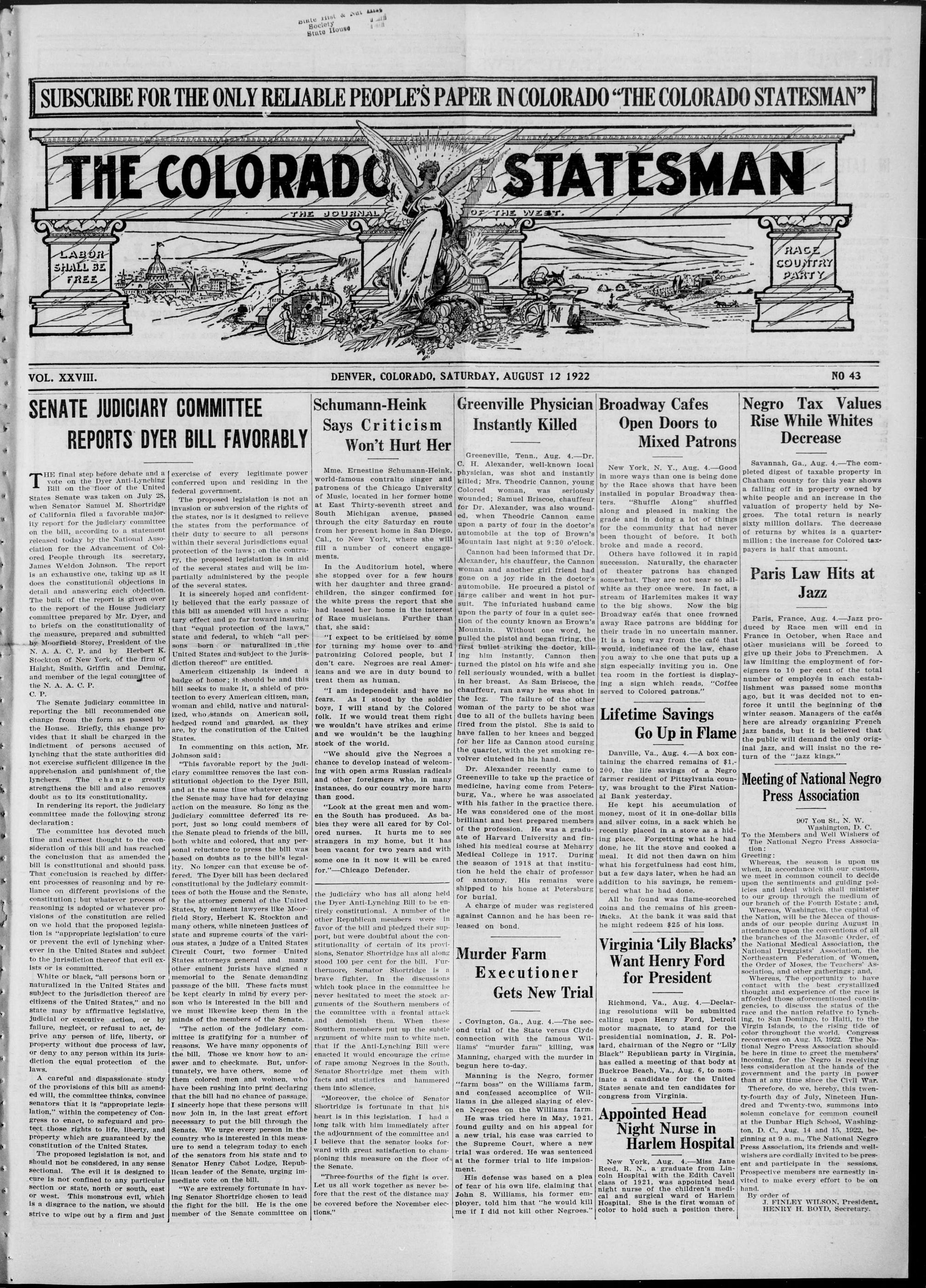
SUBSCRIBE FOR THE ONLY RELIABLE PEOPLE'S PAPER IN COLORADO "THE COLORADO STATESMAN"
THE COLORADO STATESMAN
THE JOURNAL OF THE WEST.
LABOR SHALL BE FREE
RAGE COUNTRY PARTY
SENATE JUDICIARY COMMITTEE REPORTS DYER BILL FAVORABLY
VOL. XXVIII.
THE final step before debate and a vote on the Dyer Anti-Lynching Bill on the floor of the United States Senate was taken on July 28, when Senator Samuel M. Shortridge of California filed a favorable majority report for the judiciary committee on the bill, according to a statement released today by the National Association for the Advancement of Colored People through its secretary, James Weldon Johnson. The report is an exhaustive one, taking up as it does the constitutional objections in detail and answering each objection. The bulk of the report is given over to the report of the House judiciary committee prepared by Mr. Dyer, and to briefs on the constitutionality of the measure, prepared and submitted by Moorfield Storey, President of the N. A. A. C. P. and by Herbert K. Stockton of New York, of the firm of Haight, Smith, Griffin and Denning, and member of the legal committee of the N. A. A. C. P.
The Senate judiciary committee in reporting the bill recommended one change from the form as passed by the House. Briefly, this change provides that it shall be charged in the indictment of persons accused of lynching that the state authorities did not exercise sufficient diligence in the apprehension and punishment of the lynchers. The change greatly strengthens the bill and also removes doubt as to its constitutionality.
In rendering its report, the judiciary committee made the following strong declaration:
The committee has devoted much time and earnest thought to the consideration of this bill and has reached the conclusion that as amended the bill is constitutional and should pass. That conclusion is reached by different processes of reasoning and by reliance on different provisions of the constitution; but whatever process of reasoning is adopted or whatever provisions of the constitution are relied on we hold that the proposed legislation is "appropriate legislation" to cure or prevent the evil of lynching wherever in the United States and subject to the jurisdiction thereof that evil exists or is committed.
White or black, "all persons born or naturalized in the United States and subject to the jurisdiction thereof are citizens of the United States," and no state may by affirmative legislative, judicial or executive action, or by failure, neglect, or refusal to act, deprive any person of life, liberty, or property without due process of law, or deny to any person within its jurisdiction the equal protection of the laws.
A careful and dispassionate study of the provisions of this bill as amended will, the committee thinks, convince senators that it is "appropriate legislation," within the competency of Congress to enact, to safeguard and protect those rights to life, liberty, and property which are guaranteed by the constitution of the United States.
The proposed legislation is not, and should not be considered, in any sense sectional. The evil it is designed to cure is not confined to any particular section or state, north or south, east or west. This monstrous evil, which is a disgrace to the nation, we should strive to wipe out by a firm and just
exercise of every legitimate power conferred upon and residing in the federal government.
The proposed legislation is not an invasion or subversion of the rights of the states, nor is it designed to relieve the states from the performance of their duty to secure to all persons within their several jurisdictions equal protection of the laws; on the contrary, the proposed legislation is in aid of the several states and will be impartially administered by the people of the several states.
It is sincerely hoped and confidently believed that the early passage of this bill as amended will have a salutary effect and go far toward insuring that "equal protection of the laws," state and federal, to which "all persons born or naturalized in the United States and subject to the jurisdiction thereof" are entitled.
American citizenship is indeed a badge of honor; it should be and this bill seeks to make it, a shield of protection to every American citizen, man, woman and child, native and naturalized, who stands on American soil, hedged round and guarded, as they are, by the constitution of the United States.
In commenting on this action, Mr Johnson said;
"This favorable report by the judiciary committee removes the last constitutional objection to the Dyer Bill, and at the same time whatever excuse the Senate may have had for delaying action on the measure. So long as the judiciary committee deferred its report, just so long could members of the Senate plead to friends of the bill, both white and colored, that any personal reluctance to press the bill was based on doubts as to the bill's legality. No longer can that excuse be offered. The Dyer bill has been declared constitutional by the judiciary committees of both the House and the Senate, by the attorney general of the United States, by eminent lawyers like Moorfield Story, Herbert K. Stockton and many others, while nineteen justices of state and supreme courts of the various states, a judge of a United States Circuit Court, two former United States attorneys general and many other eminent jurists have signed a memorial to the Senate demanding passage of the bill. These facts must be kept clearly in mind by every person who is interested in the bill and we must likewise keep them in the minds of the members of the Senate.
"The action of the judiciary committee is gratifying for a number of reasons. We have many opponents of the bill. Those we know how to answer and to checkmate. But, unfortunately, we have others, some of them colored men and women, who have been rushing into print declaring that the bill had no chance of passage. I sincerely hope that these persons will now join in, in the last great effort necessary to put the bill through the Senate. We urge every person in the country who is interested in this measure to send a telegram today to each of the senators from his state and to Senator Henry Cabot Lodge, Republican leader of the Senate, urging immediate vote on the bill.
"We are extremely fortunate in having Senator Shortridge chosen to lead the fight for the bill. He is the one member of the Senate committee on
Schumann-Heink Says Criticism Won't Hurt Her
Mme. Ernestine Schumann-Heink, world-famous contralto singer and patroness of the Chicago University of Music, located in her former home at East Thirty-seventh street and South Michigan avenue, passed through the city Saturday en route from her present home in San Diego, Cal., to New York, where she will fill a number of concert engagements.
In the Auditorium hotel, where she stopped over for a few hours with her daughter and three grandchildren, the singer confirmed for the white press the report that she had leased her home in the interest of Race musicians. Further than that, she said:
"I expect to be criticised by some for turning my home over to and patronizing Colored people, but I don't care. Negroes are real Americans and we are in duty bound to treat them as human.
"I am independent and have no fears. As I stood by the soldier boys, I will stand by the Colored folk. If we would treat them right we wouldn't have strikes and crime and we wouldn't be the laughing stock of the world.
"We should give the Negroes a chance to develop instead of welcoming with open arms Russian radicals and other foreigners who, in many instances, do our country more harm than good.
"Look at the great men and women the South has produced. As babies they were all cared for by Colored nurses. It hurts me to see strangers in my home, but it has been vacant for two years and with some one in it now it will be cared for."—Chicago Defender.
the judiciary who has all along held the Dyer Anti-Lynching Bill to be entirely constitutional. A number of the other Republican members were in favor of the bill and pledged their support, but were doubtful about the constitutionality of certain of its provisions, Senator Shortridge has all along stood 100 per cent for the bill. Furthermore, Senator Shortridge is a brave fighter. In the discussions which took place in the committee he never hesitated to meet the stock arguments of the Southern members of the committee with a frontal attack and demolish them. When these Southern members put up the subtle argument of white man to white men, that if the Anti-Lynching Bill were enacted it would encourage the crime of rape among Negroes in the South, Senator Shortridge met them with facts and statistics and hammered them into silence.
"Moreover, the choice of Senator Shortridge is fortunate in that his heart is in this legislation. I had a long talk with him immediately after the adjournment of the committee and I believe that the senator looks forward with great satisfaction to championing this measure on the floor of the Senate.
"Three-fourths of the fight is over. Let us all work together as never before that the rest of the distance may be covered before the November elections."
Greenville Physician Instantly Killed
Greeneville, Tenn., Aug. 4.—Dr. C. H. Alexander, well-known local physician, was shot and instantly killed; Mrs. Theodric Cannon, young Colored woman, was seriously wounded; Samuel Briscoe, chauffeur for Dr. Alexander, was also wounded, when Theodric Cannon came upon a party of four in the doctor's automobile at the top of Brown's Mountain last night at 9:30 o'clock.
Cannon had been informed that Dr. Alexander, his chauffeur, the Cannon woman and another girl friend had gone on a joy ride in the doctor's automobile. He procured a pistol of large caliber and went in hot pursuit. The infuriated husband came upon the party of four in a quiet section of the county known as Brown's Mountain. Without one word, he pulled the pistol and began firing, the first bullet striking the doctor, killing him instantly. Cannon then turned the pistol on his wife and she fell seriously wounded, with a bullet in her breast. As Sam Briscoe, the chauffeur, ran away he was shot in the leg. The failure of the other woman of the party to be shot was due to all of the bullets having been fired from the pistol. She is said to have fallen to her knees and begged for her life as Cannon stood cursing the quartet, with the yet smoking revolver clutched in his hand.
Dr. Alexander recently came to Greeneville to take up the practice of medicine, having come from Petersburg, Va., where he was associated with his father in the practice there. He was considered one of the most brilliant and best prepared members of the profession. He was a graduate of Harvard University and finished his medical course at Meharry Medical College in 1917. During the season of 1918 at that institution he held the chair of professor of anatomy. His remains were shipped to his home at Petersburg for burial.
A charge of muder was registered against Cannon and he has been released on bond.
Murder Farm Executioner Gets New Trial
Murder Farm Executioner Gets New Trial
Covington, Ga., Aug. 4.—The second trial of the State versus Clyde connection with the famous Williams' "murder farm" killing, was Manning, charged with the murder in begun here to-day.
Manning is the Negro, former "farm boss" on the Williams farm, and confessed accomplice of Williams in the alleged slaying of eleven Negroes on the Williams farm.
He was tried here in May, 1921, found guilty and on his appeal for a new trial, his case was carried to the Supreme Court, where a new trial was ordered. He was sentenced at the former trial to life imprisonment.
His defense was based on a plea of fear of his own life, claiming that John S. Williams, his former employer, told him that "he would kill me if I did not kill other Negroes."
Broadway Cafes Open Doors to Mixed Patrons
New York, N. Y., Aug. 4.—Good in more ways than one is being done by the Race shows that have been installed in popular Broadway theaters. "Shuffle Along" shuffled along and pleased in making the grade and in doing a lot of things for the community that had never been thought of before. It both broke and made a record.
Others have followed it in rapid succession. Naturally, the character of theater patrons has changed somewhat. They are not near so all-white as they once were. In fact, a stream of Harlemites makes it way to the big shows. Now the big Broadway cafés that once frowned away Race patrons are bidding for their trade in no uncertain manner. It is a long way from the café that would, indefiance of the law, chase you away to the one that puts up a sign especially inviting you in. One tea room in the fortiest is displaying a sign which reads, "Coffee served to Colored patrons."
Lifetime Savings Go Up in Flame
Danville, Va., Aug. 4.—A box containing the charred remains of $1,200, the life savings of a Negro farmer resident of Pittsburgh county, was brought to the First National Bank yesterday.
He kept his accumulation of money, most of it in one-dollar bills and silver coins, in a sack which he recently placed in a stove as a hiding place. Forgetting what he had done, he lit the stove and cooked a meal. It did not then dawn on him what his forgetfulness had cost him, but a few days later, when he had an addition to his savings, he remembered what he had done.
All he found was flame-scorched coins and the remains of his green-backs. At the bank it was said that he might redeem $25 of his loss.
Virginia 'Lily Blacks' Want Henry Ford for President
Virginia 'Lily Blacks' Want Henry Ford for President
Richmond, Va., Aug. 4.—Declaring resolutions will be submitted calling upon Henry Ford, Detroit motor magnate, to stand for the presidential nomination, J. R. Pollard, chairman of the Negro or "Lily Black" Republican party in Virginia, has called a meeting of that body at Buckroe Beach, Va., Aug. 6, to nominate a candidate for the United States senate and ten candidates for congress from Virginia.
Appointed Head Night Nurse in Harlem Hospital
New York, Aug. 4.—Miss Jane Reed, R. N., a graduate from Lincoln Hospital with the Edith Cavell class of 1921, was appointed head night nurse of the children's medical and surgical ward of Harlem Hospital. She is the first woman of color to hold such a position there.
NO 43
Negro Tax Values Rise While Whites Decrease
Savannah, Ga., Aug. 4.—The completed digest of taxable property in Chatham county for this year shows a falling off in property owned by white people and an increase in the valuation of property held by Negroes. The total return is nearly sixty million dollars. The decrease of returns by whites is a quarter-million; the increase for Colored taxpayers is half that amount.
Paris Law Hits at Jazz
Paris, France, Aug. 4.—Jazz produced by Race men will end in France in October, when Race and other musicians will be forced to give up their jobs to Frenchmen. A law limiting the employment of foreigners to 10 per cent of the total number of employés in each establishment was passed some months ago, but it was decided not to enforce it until the beginning of the winter season. Managers of the cafés here are already organizing French jazz bands, but it is believed that the public will demand the only original jazz, and will insist no the return of the "jazz kings."
Meeting of National Negro Press Association
Meeting of National Negro Press Association
907 You St., N. W.
Washington, D. C.
To the Members and Well Wishers of
The National Negro Press Association:
Greeting:
Whereas, the season is upon us when, in accordance with our custom, we meet in common council to decide upon the sentiments and guiding policies and ideal which shall minister to our group through the medium of our branch of the Fourth Estate; and,
Whereas, Washington, the capital of the Nation, will be the Mecca of thousands of our people during August in attendance upon the conventions of all the branches of the Masonic Order, of the National Medical Association, the National Druggists' Association, the Northeastern Federation of Women, the Order of Moses, the Teachers' Association, and other gatherings; and,
Whereas, The opportunity to have contact with the best crystallized thought and experience of the race is afforded those aforementioned contingencies, to discuss the status of the race and the nation relative to Lynching, to San Domingo, to Haith, to the Virgin Islands, to the rising tide of color throughout the world. Congress reconvenes on Aug. 15, 1922. The National Negro Press Association should be here in time to greet the members' incoming, for the Negro is receiving less consideration at the hands of the government and the party in power than at any time since the Civil War.
Therefore, do we, hereby, this twenty-fourth day of July, Nineteen Hundred and Twenty-two, summons into solemn conclave for common council at the Dunbar High School, Washington, D. C., Aug. 14 and 15, 1922, beginning at 9 a. m., The National Negro Press Association, its friends and well-wishers are cordially invited to be present and participate in the sessions. Prospective members are earnestly invited to make every effort to be on hand.
By order of
J. FINLEY WILSON, President,
HENRY H. BOYD, Secretary.
FOREIGN
The Japanese capital has been in the grip of a wave of extreme heat. Prostrations averaged twelve daily.
The London Mirror recently quoted an arrival at Liverpool from Cork as saying that Eamon de Valera has been wounded in Cork.
Mj. W. T. Blake has completed another lap of his airplane journey around the world, arriving at Delhi, India, a few days ago.
All the villagers of Baddeck, N. S., trudged to the peak of Beinn Bhreagh mountain and stood in reverence at sunset while the body of Dr. Alexander Graham Bell was laid tenderly to rest after a life of seventy-five years, in which he gave to the world the telephone and other inventions.
Locusts have become so numerous in Luzon that their bodies covered the railway tracks, causing the driving wheels of the locomotives to slip, and prevented the movement of a passenger train from Manila to Calamba, twenty-five miles from Manila. An extra engine was called before the train could be moved.
The Prussian minister of the interior issued a decree ordering the removal of all monarchial emblems from the interior and exterior of all communal and state buildings, besides signboards, milestones, frontier stones, etc., which bear similar emblems. The decree thus carries into effect a threat made several months ago.
The whole Chilean cabinet resigned recently following the retirement of Armando Jarmillo, minister of the interior, and Angel Guarillo, minister of justice. The resignations were precipitated by disagreement with the government's policy concerning the recent prototol signed in Washington with Peru, for settlement of the Tacna-Arlica controversy.
The congress of the International Federation of Miners recommended that a message be sent to every national organization of miners urging them to contribute $10,000 apiece for the support of the coal strike in the United States. At the same time the congress decided not to cut down production of coal in Europe as a means of assisting the American strikers.
President Obregon has gone to Ocotlan, a resort near Guadalajara, for several weeks to recuperate from his illness, it was learned recently in reliable quarters. His condition is improving steadily. The president intends to return to Mexico City as soon as possible in order to consult with department heads relative to his message to congress when it opens early in September.
GENERAL
Surface and elevated railway employés at Chicago voted 9,022 to 5,086, to accept a 10-cent an hour slash in wages and return to work, thus ending a strike which paralyzed the city's electric transportation system. Shortly after the result of the vote was announced, the first elevated train was pounding toward the "loop."
Fourteen-year-old Helen Krawgoff sailed off alone from New York on the last lap of a 12,000-mile journey that will take her to a country she has never seen, and where she knows no one. She is bound for a convent in Germany, where her father, Serge Krawgoff, a Vladivostok merchant, is sending her to safety from Siberian bandits, who, he declares, have slain or carried off thousands of children.
Police believe the swindlers who sold a pawnbroker a gold brick in San Francisco recently are the same men who sold a Juarez merchant a brass brick with the Mexican mint stamp on it for $1,200 last summer. The Juarez man took his brick to an assayer and succeeded in capturing the swindlers and getting his money back. The gang, said to be composed of Mexicans and Arabs, had been working in various parts of Mexico and managed to escape to the United States.
Fifteen persons were killed and twenty-five injured, more or less seriously, when two Cincinnati, Lebanon & Northern passenger trains crashed together head on at Lester road crossing in Pleasant Ridge, near Cincinnati. One of the engines was driven backwards, telescoping the first coach behind it and killing everyone inside.
Earl E. Patterson, teller in the Lumbermen's Trust Bank at Portland, arrested recently charged with embezzlement of $34,000, has made a confession, according to the police, admitting shortages extending over a period of eighteen months and had said "J. C. Osler, an automobile dealer, received the proceeds." A warrant was issued for Osler.
The wet and dry issue played the major role in political activity in preparation for Ohio's primary election. In some sections of the state, while ministers from their pulpits were urging support of candidates for state office indorsed by the Anti-saloon League, persons on the outside filled the church-goers automobiles with unsigned campaign literature strongly attacking the Anti-Saloon League and the candidates indorsed by it.
Death by shooting of thirty of the social revolutionists on trial at Moscow, including four women, was demanded by the prosecutor, M. Kryleko, in summarizing the evidence against the defendants. The prisoners shouted their defiance in answer to his accusations.
Four men were asphyxiated at a fire in the basement of Harris-Forbes building, 28 Federal street, Boston. Painting materials, with which the four were working, exploded and the fumes overcame them as they ran for exits.
THE WORLD IN PARAGRAPHS
A BRIEF RECORD OF PASSING EVENTS IN THIS AND FOR-EIGN COUNTRIES.
IN LATE DISPATCHES
DOINGS AND HAPPENINGS THAT
MARK THE PROGRESS
OF THE AGE.
WESTERN
Federal officials, assisted by Sheriff W. J. Hoggatt of Cowlitz county, Wash., raided the ranch house of Jacob Tulskus, two miles north of Kalama, and interrupted a meeting of delegates of the Workers' Party of America.
Marriages in Cook county, Illinois, increased nearly 12,000 during the fiscal year ending July 31, while divorces reached the total of one for less than every four weddings. Marriage licenses issued totaled 39,588, while 10,046 divorces were granted.
Miss Elizabeth Jones, 17-year-old daughter of Prof. L. W. Jones, head of the department of chemistry of Princeton University, met a tragic death in Yosemite valley recently when she slipped and fell over a cliff into the swirling waters of the Merced river.
Confronted by the first airplane theft in this country's annals when J. C. Johnson discovered someone had flown his plane away, officers at San Mateo, Calif., resorted to the radio as a means of capturing the thief, broadcasting a description of the stolen plane.
Eight of the sixty members of the United States Naval Academy of 1881, who have been attending a reunion of the class in Tokio, returned to this country a few days ago on the United States transport Logan. Secretary of the Navy Denby, a member of the class, and the rest of the party are expected to arrive on the transport Henderson about Sept. 1.
Two men are dead at Stevenson, Wash., as the result of a raid on a moonshiner's still. W. E. Rorison, deputy sheriff of Vancouver, Wash., and Paul Hickey, moonshiner, are the victims. J. A. Morgan of Tacoma, federal prohibition officer, who conducted the raid on Hickey's camp in the hills, was seriously wounded, but it was believed he would recover.
But for her presence of mind, Mary Miles Minter might have suffered serious disfigurements recently when she was thrown into a window in the vestibule of her private railroad car by the jar of a switch engine, at Victor, Idaho. Throwing up her arms, the petite blonde star escaped with a severe cut on her left arm and numerous scratches and bruises about her body.
WASHINGTON
The State Department has just received word from Tokio that Japan has just produced its first automobile, a three-wheeler, it was announced.
William B. Stewart, assistant clerk of the Senate finance committee and for many years a familiar figure at the capitol, died suddenly at his home a few days ago.
Dental that he had ever engaged in cotton speculation on the New York exchange, as charged recently in the Senate by Senator Hefflin, Democrat, Alabama, was made by W. P. G. Harding, governor of the federal reserve board, in a letter to Senator McLean, Republican, Connecticut.
Retail food prices in fifteen out of twenty-four representative cities in the United States showed an increase during the month from June 15 to July 15, the Department of Labor's bureau of labor statistics announced. A 2 per cent increase was noted at Denver and a 1 per cent increase at Salt Lake City. American citizens sending parcel post packages to Mexico no longer need worry about them being lost. Effective July 1, a regular registered indemnity will be paid by the Postoffice Department for packages sent to the Central American republic that disappear while in transit. This notice was sent to all postmasters by Third Assistant Postmaster General Glover.
Nullification of the decision of the Supreme Court, ordering dissolution of the Southern Pacific-Central Pacific combine would be of "untold disadvantage to the mountain and middle western states," according to a letter from Governor Shoup of Colorado, received by Senator Phipps. Similar letters and telegrams have been received by other senators from western and middle western states urging that no action be taken by any federal agency to nullify the purpose of the Supreme Court decision.
Indictments were returned recently by the special grand jury investigating alleged war frauds against Ernest C. Morse, former director of sales of the War Department; Everly M. Davis, president of the E. M. Davis Chemical Company of New York, and Alexander W. Phillips, associated with Davis. The three men, all of whom live in New York, were charged in the indictment with having defrauded the government out of more than $1,000,000. The alleged fraud was in connection with the sale of the war-built plant of the Old Hickory Powder Company
LATE NEWS
From All Over
COLORADO
COMING EVENTS.
Sept. 25-30—Colorado State Fair, Pueblo.
Aug. 30-31—Crowley County Fair,
Sugar City.
Aug. 31-34 Sept. 1—Larimer County
Fair, Loveland.
Sept. 5-8—Arkansas Valley Fair,
Rocky Ford.
Sept. 5-8—Boulder County Fair,
Longmont.
Sept. 5-8—Intermountain Fair and
Stock Show, Grand Junction.
Sept. 5-8—Phillips County Fair,
Holyoke.
Sept. 6-8—Washington County Fair,
Austin.
Sept. 12-15—Delta County Fair,
Hotchkiss.
Sept. 12-15—Weld County Fair, Greeley.
Sept. 12-15—LaPlatta County Fair,
Durango.
Sept. 12-15—Logan County Fair,
Sterling.
Sept. 13-16—Baca County Fair,
Springfield.
Sept. 13-16—Adams County Fair,
Brighton.
Sept. 14-16—Conejos County Fair,
Manassa.
Sept. 14-16—Elbert County Fair,
Keyos.
Sept. 19-22—Western Slope Fair,
Montrose.
Sept. 19-22—Trinidad-Las Animas
County Fair, Trinidad.
Sept. 20-21—Klowa County Fair,
Eada.
Sept. 20, 21, 22—Morgan Agricultural
Fair, Fort Morgan.
Sept. 20-22—Rio Grande County Fair,
Del Norte.
Sept. 21-22—Pueblo County Fair,
Goodpasture.
Sept. 21-23—El Paso County Fair,
Chihuahua.
Sept. 21-23—Lincoln County Fair,
Hugo.
Sept. 20-23—Huerfano County Fair,
Walsenburg.
Sept. 21-23—Kit Carson County Fair,
Burlington.
Oct. 3-5—Douglass County Fair,
Castle Rock.
Morrison.—Francis T. Green, 13, was drowned at Allen's lake, near Morrison, Colo., while swimming with boy companions.
Denver.—Reports reaching Adjt. Gen. P. J. Hamrock of the Colorado National Guard indicate that 500 of the normal force of 1,100 rail employés are working at La Junta, despite the strike of certain of the rail employés.
Pueblo.—D. Z. Bray and Mr. and Mrs. Phillip Morrow, negroes, were drowned recently when they were caught by a wall of water as they were crossing Peck creek, ten miles west of Pueblo, in an automobile. Mrs. D. Z. Bray was saved.
Loveland.—As William Juliffe of Berthoud was driving a load of hay along the highway, a swarm of bees descended upon his wagon. The team was stung to death and Mr. Juliffe has been in a serious condition since. He lives one mile south of Berthoud.
Boulder.—A bond election has been called by city officials for Aug. 22, on a reservoir project for University hill, involving an expenditure of $100,000. The growth of the city in that direction makes necessary the construction of a storage reservoir, city officials claim.
Boulder.—Mrs. Mitchell Leavitt, 24 years old, is believed to have been fatally injured, and her husband, Mitchell Leavitt, 26, suffered fractures of shoulder blade and jaw and may lose an eye, when their car failed to make a turn on the highway at Boulder a few days ago.
Trinidad.—J. E. Thatcher was painfully injured when a motor truck which he was driving was struck by a railroad handcar at a grade crossing at Trinidad. The truck was completely turned over and nearly demolished. None of the occupants of the handcar were injured. Colorado Springs.—Maywood Watson, 12 years old, son of Mr. and Mrs. J. P. Watson of Grand Junction, Colo., was severely injured when a motor car driven by his father plunged over a seventy-five-foot embankment in Ute Pass highway a few days ago. Mrs. William Emmal, a sister of Mrs. Watson, also was painfully injured while Mr. and Mrs. Watson escaped with comparatively slight injuries.
Trinidad.—Stella, 11-year-old daughter of Mr. and Mrs. Paul Comi, was severely injured when a railroad torpedo, with which she was playing, exploded. She hit the torpedo with an ax on the sidewalk in front of her home. Brush.—Fire caused by an exploding film resulted in a stampede of the audience and damage of $500 at the Emerson theater at Brush. Because of a teachers' institute that was being held a special feature was being shown and the film pavilion was crowded. Several received minor injuries in the rush for exits. The coolness of several ex-service men who were in the audience prevented anyone being seriously injured.
Grand Junction.—The fourth violent death in western slope counties in two days was reported recently in the death of Del McKinney, 23 years old, resident of Mesa. McKinney was swimming in the Gunnison river, near Delta, when overcome by heart disease. The other three deaths are: Sulcide at Fruita of Fred T. Turner, 42 years old; drowning at Ekert of Lillian Williams, 2 years old, and the crushing out of the life of Charles Kile, 4, near Cedaredge, under a coal wagon. Colorado Springs.—The geographical center of Colorado is located at a point in Park county, thirty miles northwest of Pike's peak, according to data given out by the United geological survey at Washington. The department has recently compiled data showing the geographical center of every state in the Union.
Superior.-Seven cars of a Colorado & Southern southbound freight train were derailed 200 feet west of the depot of Superior a few days ago. The cars were badly damaged. Iron ore was scattered for a great distance.
Canon City.—There are 837 prisoners in the Colorado state prison at Canon City, according to a report to the governor's office from the penitentiary. Only once in the history of the state has there been more than that number in confinement. The record was established in February, 1916. The prison population has increased 42 per cent since December, 1920. Young men, many well educated, are swelling the prison roll today, in sharp contrast to the criminals of the last generation, the report said. The smallest prison population in Colorado's history was recorded in 1919, following the coming of prohibition in the state in 1916, according to Thomas J. Tynan, warden of the prison. The warden blames the aftermath of the war and the illicit liquor traffic for the present increase.
Denver.—Immediate relief from the Interstate Commerce Commission is insight in the prompt movement of fruit and perishable produce from the western slope this season, following a detailed conference between the Interstate Commerce Commissioners of the federal government and representative fruit growers of Mesa, Delta, Montrose, Garfield and Eagle counties. Approximately 8,953 cars of peaches, pears, apples, potatoes and onions were shipped from these five counties last year, and it was estimated that 11,771 cars would be shipped this year.
Pueblo.—Establishment of a flood district at Pueblo will not be opposed by the railroads that traverse the Rocky mountain district. A conference at Denver in the offices of the Colorado & Southern railroad of legal representatives and engineers of the road took up discussion of the provisions of the flood conservation program. Representatives of the Colorado & Southern, the Rock Island, Missouri Pacific, Denver & Rio Grande Western and Santa Fé lines attended and declared themselves in harmony with the conservation program.
Monte Vista.—The San Luis Valley H. O. G. Stock Association, whose annual show, held at Monte Vista, has become one of Colorado's important events, is perfecting plans for the erection of a magnificent exhibition pavilion on the Stampede grounds near Monte Vista. The plans for the buildings were approved at a meeting of the building committee and bids are now being solicited for the work and the contract will no doubt be awarded in time for the completion of the buildings for the big show in February.
Pagosa Springs.—The archaeological expedition from the State Historical and Natural History Society and the University of Denver, which is working in the prehistoric ruins twenty-two miles west of Pagosa Springs, reports the finding of a rare piece of pottery in the form of a mountain sheep. This is an extremely valuable object, because of the fact that animal figurines made from pottery have been found in only one or two cases in the prehistoric ruins of the Southwest.
Walsenburg.—A ranchman searching for lost cattle came on the bodies of two men lying by a wrecked car in an arroyo of Big Sandy, a creek bed near the Pueblo-Walsenburg road. The bodies were identified as those of Antonio Tessitore and Frank Leone of Walsenburg. The two men were overtaken by a cloudburst in the arroyo a few days ago.
Denver.—Population figures showing that the number of residents in Denver is increasing at such a tremendous rate that the city is virtually assured of reaching its goal of "500,000 by 1930" were released recently from the office of Robert B. Rockwell, member of the "500,000 in 1930" publicity committee. Denver.—Denver stands a good chance to win the national sanatorium to be built by the Grand Lodge of Colored Elks of the World, according to information received recently.
Sterling.—The body of P. P. Tyrell, 53 years old, has been taken to his home in Snyder, where the coroner will hold an inquest to determine responsibility for his death. Tyrell was a garage keeper at Snyder. He was driving his automobile across the Union Pacific tracks near Snyder when his car was struck.
Fort Collins.—The Colorado Agricultural College at Fort Collins is among twenty-five institutions designated by the War Department as distinguished colleges in its last list, issued in Washington, of distinguished colleges and honorary military schools for 1922. It is the only "distinguished college" in the intermountain region.
Sterling.—John Dillenberg, who had been charged with the murder of his brother, Truey Dillenberg, at Sterling, July 3, slashed his throat while in the county jail, using a razor belonging to another prisoner. He died soon after the jail officials found him lying on the floor of his cell.
Delta.—The 2-year-old daughter of Mr. and Mrs. Percy Williams was drowned in Butte ditch near Eckert, eleven miles from Delta.
Cañon City.—Construction work on the Cañon City-Florence section of the Rainbow Route highway was begun recently by the C. A. Allen Construction Company of Morrison, Colo., to which the State Highway Commission recently awarded the contract for the rebuilding of this important road. The contract price for the completion of the road is $63,342.95. The length of the highway between Cañon City and Florence is practically nine miles, and extends from Ninth street, Cañon City, through Lincoln park to Florence by way of Brewster.
R-U-Ready to Sign Up? I Make Signs of All Descriptions PHONE CHAMPA 4997
"It's Signs That Make a Business"
Shop Near Five Points Resh
2421 WASHINGTON ST. 2841 CALI
Phone G
CAMPBELL
CO
COM
Wholesale
HAY, GRAIN, COAL,
SUP
Office: 1401 W. 38th Ave.
Phone Gallup 473
AMPBELL BROTHE
COAL
COMPANY
Wholesale and Retail
Y, GRAIN, COAL, WOOD AND POULT
SUPPLIES
1401 W. 38th Ave. Yards: 1400 W.
Phone Gallup 478
CAMPBELL BROTHERS
COAL
COMPANY
Wholesale and Retail
HAY, GRAIN, COAL, WOOD AND POULTRY
SUPPLIES
Office: 1401 W. 38th Ave. Yards: 1400 W. 32d Ave.
Phone Champa 7889
WESTERN SHOP
COMM
WARM AIR
REPAIRS FOR ALL FURNACES
CHIMNEY
920 NINETEENTH STREET
The Curtis Park Floral Company
FLORAL DESIGNS PUT UP WHILE YOU WAIT
CHOICE PLANTS AND CUT FLOWERS
GREENHOUSES: Thirty-Fourth a
TELEPHONE, MAIN 1811
C. E. Weatherhead
PHONE
WEATHER HAT
MEN'S AND WOMEN'S UNCLASSIFIED
PANAMAS AND
1722 STOUT STREET
C. E. SMITH, Manager
The Market
Wholesale and Retail Staple and
Hotels and Restaurants Our
Eastern Corner
Fruits, Vegetables,
Telephones Main 48
622-636 15TH STREET
EUTERN SHEET MEAT COMPANY
WARM AIR FURNACES
FOR ALL FURNACES—SHEET METAL
CHIMNEY STACKS
SEVENTH STREET
DENVER, C
S
l
pany
SIGNS PUT UP WHILE
YOU WAIT
HATS AND CUT FLOWERS CONSTANTLY ON HAND
AGES: Thirty-Fourth and Curtis Streets
MAIN 1811
DENVER, COLO
erhead
C. B.
PHONE MAIN 3203
EATHERHEA
HAT FACTORY
WOMEN'S UNCLAIMED HATS FOR SALE
PANAMAS AND WHITE MILANS
STREET
ALBANY HO
E. E. SMITH, Manager, Res. Phone South 100
e Market Comp
and Retail Staple and Fancy Groceries, Fish
and Restaurants Our Specialty. Fresh and
Eastern Corn Fed Meat
Fruits, Vegetables, Poultry and Game.
Telephones Main 4802, 4808, 4804, 4805
STREET
DENVER,
REPAIRS FOR ALL FURNACES—SHEET METAL WORK CHIMNEY STACKS
The
Curtis
Park
Floral
Company
FLORAL DESIGNS PUT UP WHILE
YOU WAIT
CHOICE PLANTS AND CUT FLOWERS CONSTANTLY
ON HAND
GREENHOUSES: Thirty-Fourth and Curtis Streets
TELEPHONE, MAIN 1811
DEVER. COLO
PHONE MAIN 3203
WEATHERHEAD
HAT FACTORY
ESTABLISHED IN 1878
MEN'S AND WOMEN'S UNCLAIMED HATS FOR SALE—FELTS,
PANAMAS AND WHITE MILANS
1722 STOUT STREET
ALBANY HOTEL BLDG.
D
---
Residence
2841 CALIFORNIA ST.
fallup 473
BROTHERS
DAL
PANY
and Retail
WOOD AND POULTRY
PLIES
Yards: 1400 W. 82d Ave.
SHEET METAL COMPANY
FOR FURNACES
ICES—SHEET METAL WORK
STACKS
DENVER, COLORADO
ERS CONSTANTLY ON HAND
and Curtis Streets
DENVER, COLO
C. B. Weatherhead
MAIN 3203
ERHEAD
FACTORY
MED HATS FOR SALE—FELTS,
WHITE MILANS
ALBANY HOTEL BLDG.
Res. Phone South 1608
et Company
Fancy Groceries, Fish and Oysters.
Specialty. Fresh and Cured
Fed Meats
Poultry and Game.
802, 4808, 4804, 4805
DENVER, COLORADO
Phone Main 3737
Satisfaction Guaranteed
THE NEW WAY SHOE
REPAIRING
C. C. Dennis, Proprietor
1855 CHAMPA STREET
Denver, Colo.
LED BY EDWARD CLIFFORD, THE ASSISTANT SECRETARIES IN WASHINGTON GET WISE.
TELEPHONE INSTEAD OF PEN
"Initialed" Correspondence No Longer Necessary in Transacting Government Business of Which a Written Record Is Not Required.
By JAMES P. HORNADAY
Washington.—The 24 assistant secretaries in the ten administrative departments are now successfully demonstrating that government red tape can be cut. Edward Clifford of Chicago, one of the assistant secretaries of the treasury, who got his business training under Charles G. Dawes, recently retired first chief of the bureau of the budget, is responsible primarily for the tape cutting campaign.
One of the first things Clifford observed after he took service with the Treasury department was the seeming impossibility of transacting interdepartmental business with promptness. If his branch of the Treasury department desired certain information from some other administrative branch of the government, it was necessary under the rules that had stood for more than a century for him to take the subject up through correspondence. This meant that if he wrote to an assistant secretary in another department the letter must be "initialed" by either the secretary of the treasury or the assistant secretary of the treasury, and that after it reached the other department it would have to go through the process of being "initialed" up and down until an answer was ready to be forwarded. This red tape process frequently consumed days, but the prevailing view was that tradition must be followed or the government would probably not survive.
Use the Phone. Said Clifford.
"All these administrative departments are connected by telephones. I take it," said Assistant Secretary Clifford one day to a member of his office force.
"Oh yes, we have perfect telephone service between the departments," was the response.
"Well, I think we will use the telephone in transacting some of this business instead of writing so many letters," said Clifford.
That was the first step in the reform that has been successfully accomplished. Clifford soon learned that the 24 assistant secretaries, four in the Department of Justice, four in the Post Office department, one in the Navy department, one in the Department of Commerce, and one in the Department of Labor, were not even acquainted. "There should be some cooperation in managing the business of the federal government," said he, and forthwith he, proposed that the 24 secretaries in the administrative departments hold a meeting and get acquainted. The invitation to this meeting was accepted by 23 of the 24 assistants and before the evening was over an organization had been perfected. It was agreed to meet each Tuesday evening in the week.
The outcome of the formation of this organization by the assistant secretaries who, after all, are the men who handle nine-tenths of the routine business of importance, is that interdepartmental business handled by these secretaries has been greatly simplified. The telephone has practically supplanted the stenographer, the type-writing machine and the mails.
Secretary Mellon's Victory.
Apparently Andrew W. Mellon, secretary of the treasury, has won a big victory over the Republican politicians who set out to force him to resign. His victory received its finishing touches when President Harding decided to accept the resignation of Elmer Dover, an assistant secretary and chief political headman. As a result of various developments during the last few months the merit system as applied to government services seems to be on a sounder foundation than at any time since March 4, 1921. The National Civil Service Reform league is entitled to a large measure of credit for the outcome. The league called attention from time to time to what was going on and did this in an effective way.
The dismissal of some thirty-four chiefs of divisions in the bureau of engraving and printing without a hearing, and without reference to the protection which the civil service law is supposed to give them, stirred up such a commotion that no attempt has been made to repeat the performance in any of the other branches of the government. It is generally understood that the officials who were responsible for those dismissals in the bureau now admit privately that the whole performance was a blunder; but no steps toward correcting the mistake have been taken.
After all, as things turned out, the bureau dismissals were probably a good thing for the government service. They served to call attention to a program set up by the spoilsmen for a general raid on the departments. The employees who were dismissed have nearly all obtained positions outside of the government service at much bet-
ter pay than they were receiving when dismissed.
Undoubtedly the appointment of Dover as an assistant secretary of the treasury with the understanding in certain quarters that he was to find places in the Treasury Department for several hundred deserving party workers, was a part of the general scheme which called first of all for the dismissal of the bureau chiefs.
Dover for a few months after his appointment was the most popular office holder in Washington. Republican senators and representatives believed that they had in him a faithful friend, Members of the Republican national committee heralded the fact that at last there was one man connected with the administration who was in favor of putting out Democrats, even though they were in the classified service.
Some of the high-up Republicans were so enthusiastic at that particular time as to believe that sooner or later Dover would succeed Mellon as secretary of the treasury. While the intriguing was going on, Secretary Mellon remained silent. When it came time for him to take a stand he simply said that the politicians could not run the treasury department, and that so long as he was secretary they would not be permitted to have any hand whatever in the administration of the department. In the end, the President had to choose between Mellon and Dover. Although he had appointed Dover at the solicitation of the Republican politicians, he could not afford to let a satisfactory secretary of the treasury go in order that he might keep a man who was in great favor with the spoilsmen. And so after nearly three months of turmoll Dover decided to get out.
Professional Politicians Vexed.
The professional politicians are very much distressed over the Dover resignation. They feel that the President has to some extent gone back on them. With Dover out there is no one in the service of the government in an important capacity to whom they can turn with confidence. Newly appointed cabinet officers, whatever their personal inclinations may be, soon learn that they cannot permit the political spoilsmen to interfere with the government's business. Three or four members of the present cabinet are not wedded to civil service, but not one of them is willing to take on himself the responsibility of tearing down the merit system in his department. Unquestionably the civil service law needs revision, but every well-informed person realizes that the merit system is here to stay. The system has at least two ardent supporters in the cabinet. These are Charles Evans Hughes, secretary of state, and Herbert Hoover, secretary of commerce. Neither of these men has given the slightest consideration of politics in making appointments in his department.
It is true that Republican politicians have been appointed to the diplomatic service since Mr. Hughes became secretary of state, but they are, without exception personal appointees of the President. The one question Secretary Hoover asks of an applicant for a place in his department is "Have you any special qualifications for this particular place?"
Ready for Navy Scrapping.
The Navy Department is ready to begin the work of scrapping 28 battleships the day Great Britain, France, Japan, Italy and the United States exchange ratification of the treaty limiting naval armaments. It is estimated that it will cost $70,000,000 to wreck these fighters of the sea.
The vessels to be destroyed, new and old, are estimated to represent an outlay of $500,000,000. Most of this money was expended on battle cruisers and battleships not yet completed but on which construction was started. It was figured that the United States has invested in these new vessels about $330,000,000. Add to this the cost of the 15 old capital ships that are to be scrapped, and the half-billion mark is not far away. The fifteen old ships range from the Maine, 20 years old, to the Michigan, 13 years old.
Thirteen uncompleted vessels, six battle cruisers of most modern type and seven battleships are also to go. The battleships range from 11 to 75 per cent completed, the average being about one-third. The doomed battle cruisers are from 12 to 35 per cent complete. However, two of the cruisers are to be converted into airplane carriers—the treaty permitting this—and the actual scrapping will apply to only four cruisers. The Lexington and the Saratoga, each 33 per cent complete, have been selected for airplane carriers. The remaining four cruisers—Constellation, Ranger, Constitution and the United States—must be used as targets or sold for the metal that is in them.
In disposing of all the vessels, old and new, the naval board recommends that they "be disposed of by sale unless sunk by gunfire." However, it is explained at the Navy Department, it is hard to sell war vessels. They are unsuited for merchant use because of the weight of their armor and small freight-carrying capacity. Their machinery will fit into no other ship, and the expense and inconvenience of removing the machinery are practically prohibitive. The most that can be expected is a buying order from some one who wants to strip the vessels of their metal and furnishings.
Indications are, therefore, that most of the condemned vessels will be towed to sea and sunk. The Navy Department, nevertheless, has already sold two of the vessels—the Maine and the Missouri. Each was bought for junk purposes.
PUBLIC TRUSTEES' SALE.
No. 2235.
Whereas, Thomas S. Flynn by deed
on trust, dated the 17th day of July,
1914, is recorded in book 755
page 73, of the Recorded in the office
of the Clerk and Recorder of the City
and County of Denver, Colorado, duly
conveyed to the Public Trustee in and for
the City and County of Denver, Colorado,
the following described real est-
sance in the City and County Dale-
Colorado to-wit: Tract numbered
twelve (12), Sunny Side Acres, as
shown in the map recorded in the re-
cords of the City and County of Dene-
sity, the deed of trust was made
secure the payment a promissory
note of even date with said deed of
trust, for the sum of three hundred
fifty ($350.00) dollars, payable to
the order of The American Investment
House, after the year that the
theproof with interest after 6 per
per annum until maturity, interest
payable quarterly with interest after
maturity at the rate of 10 per cent per
annum, as is more particularly set
forth in said deed of trust, reference
to which thereby made for greater
certainty, and
Whereas, The said Thomas S. Flynn and all persons claiming by, through or under him having defaulted in the January 17th, 1921, less $4.35; and in the payment of taxes for 1918 in the sum of $3.36 and in the payment of water taxes for 1919 and 1920, the sum of $4.55 and in the holder of note, having elected on account of said default to declare said note unpaid, due and payable. Now. Therefore, the written request of will Shetterly, the legal holder of said note pursuant to law, I, the undersigned, Public Trustee in and for the City and County of Denver, Colorado, do hereby give notice that I will, at the hour of 10 o'clock in the
TUESDAY, SEPTEMBER 12, 1922,
at the Tremont street front door of the
Court House, in the City and County
of Denver, Colorado, sell
auction, to the highest bidder best bidder
of the house, to the highest bidder
described premises, and all the right, title and interest
of the said Thomas S. Flynn, his heirs,
assigns therein, for the purpose of paying
the indebtedness secured by said
deed of trust, and for expenses
of this trust, and will
offer to the purchaser a certificate of
sale as provided by law.
Dated at Denver, Colorado, August
12th, 1922.
EDWARD M. SABIN.
Public Trustee in and for City and
County of Colorado.
First publication August 12, 1922.
Last publication September 9, 1922.
PUBLIC TRUSTEE'S SALE.
Whereas, Edith Fay, by deed of trust, dated the 15th day of March, 1922, which is recorded in book 3455, page 80, of the records in the office of the City and County of Denver, Colorado, duly conveyed to the Public Trustee in and for the City and County of Denver, Colorado, the following described real estate in the City and County of Denver, Colorado, as numbered Twenty-five (25), Block numbered Fifty-eight (58), Evans Addition to the City of Denver, together with all improvements thereon or hereafter as shown as number 323 Cherokee Street, Denver, Colorado, which deed of trust was made to secure the payment of one promissory note of even date with said deed of trust, to the City of Denver, Colorado, $400,000 dollars, payable to the order of Earl M. Howland twenty months after the date thereof, with interest thereon at one per cent per month until paid, interest payable monthly, as shown in the City and County deed of trust, reference to which is hereby made for greater certainty, and,
Whereas, the said Edith Fay, and all persons claiming by, through or under the having of a note of $20.00 dollars and interest due April 15th, 1922, and in the payment of all payments of principal and interest since that date; in the case of a note of $20.00 dollars and interest due April 15th, 1922, on first loan, and the legal holder of said note, having elected on account of said default to declare said note unpaid, due and payable. A written request of Earl M. Howland, the legal holder of said note, pursuant to law, I, the undersigned, Public Trustee in and for the City and County of Denmark, hereby give notice that I will, at the hour of 10 o'clock in the foreonow of
at the Tremont street front door of the Court House, in the City and County of Denver, Colorado, sell at public auction, to the highest and best bidder for cash, the said described premises, and all the right, title and interest of such property for sale, for the purpose of sign therein, for the purpose of paying $15.00 for a new abstract and $40.00 attorney's fee to be allowed in case of foreclosure, and the indebtedness secured by said deed of trust, and the cost and expenses of such its assets, and will deliver to the purchaser a certificate of sale as provided by law.
Dated at Denver, Colorado, July 18,
1922.
EDWARD M. SABIN.
Public Trustee in and for the City and
Country of Denver, Colorado.
First publication July 22, 1922.
Last publication August 19, 1922.
FREE
THIS BEAUTIFUL
HAIR STRAIGHTENING
AND SHAMPOO COMB
This Comb Is Well Worth $1.00
JUST WRITE TO US AND SAY:
"I would like to get a hair straightening and hair and scalp treatment, and the particular regarding your No. 1144 offer."
Be sure and write your name and address plainly, and full particulars will be sent you not last long. We are doing this to advertise Ford's Hair Pomade and Ford's Hair Straightening and Shampoo Combs.
Raw Onion Purifies Air.
Disease germs cannot flourish in the veins of any person who makes a habit of eating the humble but invaluable onion. In remote villages the old custom still exists of placing a plate full of sliced onion beside the bed or coffin of any person who has died of an infectious disease. Although those who follow this practice cannot explain it, the fact is that the raw onion destroys germs and purifies the infected air of the death chamber.
The Denver & Rio Grande Western Railroad System Office of the Receiver
Differentials of 3 cents per hour over the foregoing rates are paid to mechanical craftsmen on night shifts, and differentials of 5 cents to 10 cents per hour in excess of the foregoing rates are paid to highly skilled positions in the mechanical crafts.
In accordance with announcement by the United States Labor Board July 3, old men remaining and new men accepting employment are within their rights and are not strike breakers. They have the moral and legal right to engage in railroad service and will have protection of every department and branch of the Government, National, State and Municipal.
The men who have remained in the employ of the Denver & Rio Grande Western Railroad and who are now taking service, are not merely loyal to the Railroad; they are proving their loyalty to the Public and the Government. They are not "scabs," but they are at work under the protection of the law and the Labor Board, and this Railroad intends to keeps faith with them to the end.
Applicants for Work Should Apply at the Office of
H. C. Stevens, Shop Supt., Burnham Shops, Denver, Colo.
W. E. Higginson, Foreman, Colorado Springs, Colo.
Walter Roberts, Master Mechanic, Pueblo, Colo.
Local Agent, Trinidad, Colo.
Local Agent, Florence, Colo.
Local Agent, Canon City, Colo.
E. G. Haskins, Master Mechanic, Salida, Colo.
Local Agent, Leadville, Colo.
D. G. Cunningham, Asst. Supt. M. P., Salt Lake City, Utah.
1914
TAXI Yell CHAMPA 26 NIGHT & CHAMPA 410 DAY TAXI
Oldest in Denver No Accidents No Fines for Speeding QUICK, RELIABLE AND CONFIDENTIAL SERVICE 1865 CURTIS ST. Organized 1908 DENVER, COLO.
Special Attention Given to VENTILATION AND SEWERAGE. All Work Guaranteed Phone Main 207 1907 Arapahoe St. Denver, Col-
Denver, Colorado
July 22, 1922
TAXI
Oldest in Denver
QUICK, RELIAB
1865 CURTIS
Special Attention Given
SEWERAGE. AL
Phone Main 207 1907 A
NOTICE.
NOTICE.
Dr. T. E. McClain, pioneer dentist, has opened his new electrical office with Dr. J. H. P. Westbrook, Sixteenth and Larimer streets, Good block. Office phone, Main 7416.
WANTED COMPETENT WORKERS To Take the Places of Strikers STEADY JOBS
Local Agent, Provo, Utah.
Local Agent, Aspen, Colo.
G. C. Gates, Foreman, Montrose, Colo.
Herman Weirick, Foreman, Gunnison, Colo.
F. T. Owens, Master Mechanic, Grand Junction, Colo.
E. C. Howerton, Master Mechanic, Alamosa, Colo.
Local Agent, Durango, Colo.
C. B. Carpenter, Superintendent, Ridgway, Colo.
Local Agent, Telluride, Colo.
Local Agent, Santa Fe, N. M.
J. C. Richmond, Foreman, Ogden, Utah.
Local Agent, Price, Utah.
JOBBING
PROMPTLY ATTENDED TO
PRACTICAL
PLUMBER
LICENSED DRAIN LAYER
en to VENTILATION AND
All Work Guaranteed
Arapahoe St. Denver, Col-
Beware of Corsets!
A bone in corsets recently caused
the death of a young woman who was
skiing in Switzerland. She fell over
a ledge into deep snow. The bone
pierced her heart and she died imme-
diately.
The Denver and Rio Grande Western Railroad System
26 NIGHT &
410 DAY TAXI
Fines for Speeding
INTIAL SERVICE
DENVER, COLO.
Michaelson's
Is now in progress—the title tells the story—everybody holding sales so are we, and we ask you to compare our offerings, our values, with any advertised or shown elsewhere and it is safe to say that you will find here better for less. The entire stock, in every department, reduced for a season's end complete clearance.
Head-to-foot Outfitters for Man, Woman and Child
The Largest Butterfly.
The largest known moth or butterfly in the world is the Great Atlas Moth of India. With wings outstretched it measures nearly a foot across from tip to tip.
THE COLORADO STATESMAN
Entered as second-class matter at the postoffice in the City of Denver, Colo.
Recognized by the Retail Merchants' Bureau of the Denver Civic and Commercial Association as an advertising medium.
JOSEPH D. D. RIVERS..... Proprietor
P. O. Box 116 1824 Curtis Street, Room 25 Phone Main 7417
Remittances should be made by express money order, postoffice money order, or cash. Remittances of the same as cash for fractional part of a dollar. Only 1c and 2c stamps taken
PARTY UNITY.
THERE was just enough spirited rivalry in the contest for places on the Republican state ticket at the convention held here Wednesday to give ample assurance that the party is in a good healthy state and will be a hard factor to overcome in the approaching fall elections. And it was particularly noteworthy that no traces of factional bitterness was in evidence at any time. Nothing is more helpful to an organization than spirited, good-natured contests such as marked the proceedings of the Republican state assembly at every stage. Of course, the early interest of the delegates and party leaders centered around the possibility of Governor Shoup allowing his name to go before the assembly as a candidate for the third time. For a while it appeared that the vast concourse would stampede and go against the advice of his friends and against the Governor's strongly expressed wishes. However, when it became certain that he was no longer a factor in the contest, the convention settled down and went about its work in a businesslike way. The candidates selected to go upon the ticket are exceptionally high class as a whole and Colorado Republicans will have no cause to apologize for any of those finally selected at the September primaries. The resolutions adopted by the assembly were clean-cut and forceful, emphasizing the party's unswerving adherence to the policy of law and order that has ever marked its political course in Colorado. Of special interest to our group was the plank in the party platform urging the Senate of the United States to pass without delay the Dyer anti-lynching bill. When it is understood that at least a dozen different groups awaited outside the meeting place of the committee on resolutions with special planks to be inserted in the platform, and that our own group was the only one to meet with success, the effectiveness of the work of those charged with the responsibility of presenting our case can be better understood. To return again to the personnel of the candidates selected to go before the party voters at the statewide primary, Sept. 12, the COLORADO STATESMAN is pleased to observe that all are persons of high character and established integrity. There is a very striking lesson in the harmonious conduct of political contests of the nature in vogue at the state assembly. Colorado still needs the wisdom and safe conduct of the Republican party. The present would be a very unfortunate time for the affairs of government to be turned over to a radically inclined element. With industrial unrest surrounding us on every side, nothing short of a firm hand in the executive chair, backed by able and conservative associates, will give assurance of a continued policy of law and order that has made our state an outstanding one at this particular time. It is therefore a source of eminent gratification that we look upon the future of the great state of Colorado as being closely allied with the unified efforts of the Republican party.
PROPAGANDA.
THE collapse of the Russian government and the scrapping of her army and navy at the most crucial period of the great world war served one useful purpose, at least, and that was the meaning, the use and far-reaching power of PROPAGANDA. It has been found to be a two-edged sword, capable of cleaving for good or evil, depending much on the hands holding it. Nations totter and tremble beneath its weight or flourish and prosper because of its presence. The real uses of propaganda were found during the progress of the world war, and what organized society now regards its most threatening menace, i. e., Bolshevism, is the direct progeny of a carefully planned use of propaganda. We have stated that it was capable of being a weapon for good as well as for evil, but the assertion is subject to modification upon afterthought. For propaganda is a thing greatly complained of, since it spreads much more rapidly as an agency for destruction than as a builder-up. For instance, the growing revolt against the provisions of the Eighteenth Amendment is generally charged to a liberal use of propaganda as to the invasion of man's personal liberties. There has not as yet been found an effective means of putting out the bootleg and moonshine fire, and while it continues to rage and its flames of lawlessness leap higher, the cry for light wine and beer grows with alarming rapidity. And if there should ever be a complete breakdown of the Volstead act, which certainly seems within the range of possibilities just now, it will be mainly because of a well-directed campaign of the propagandist at an opportune moment. Only a few years ago we were seeing things politically, and almost before we were aware there arose to temporary power an organization that struck terror to the old order of things and known as the Non-Patisan League. It developed at once to be an invidious foe to the orderly processes of government, and its tenets were declared both dangerous and un-American. Its rise to power was spectacular as well as sweeping, causing statesmen and political experts to sit up in amazement. An investigation as to the cause of its rapid growth revealed a spreading of venom among the discontented farmers of North Dakota and Minnesota, that was of the most deadly substance. Here propaganda again had its inning and brought to the surface political hybrids, demagogues and firebrands whose every effort was to overthrow the existing political powers. Once in a while, however, there are notable evidences of it being used for higher purposes, and we know no present-day example more striking than the successes recorded from time to time by the National Association for the Advancement of Colored People. A militant organization, yet using propaganda mainly for the carrying forth of its standards, it has achieved great things for the people it would serve. At present there are brilliant prospects for the Dyer anti-lynching bill to soon become a law, and if it does it will be a monumental triumph for the most intelligent uses of propaganda that the world has ever seen. Progressing against the evil forces of race prejudice, of sectional hatred and a dormant public opinion, it has steadily gone forward until victory now seems a certainty.
Anarchy, Pure and Simple, Defiance of Constituted Law and Authority
By HENRY LEE MYERS, U. S. Senator From Montana.
The Herrin massacre was one of the most atrocious assaults that has ever been made in this country on constitutional government, on the constitutional guaranty to every resident of the United States of the right to life, liberty and the pursuit of happiness; it is one of the worst acts of defiance to all law and government ever committed in this country. If that sort of thing is to continue and to go unpunished, constitutional government cannot endure. If the time has come when that sort of thing can exist without punishment, without vindication of the law, constitutional government in this country is nearing its end. That
The Herrin massacre was one of the most atrocious assaults that has ever been made in this country on constitutional government, on the constitutional guaranty to every resident of the United States of the right to life, liberty and the pursuit of happiness; it is one of the worst acts of defiance to all law and government ever committed in this country. If that sort of thing is to continue and to go unpunished, constitutional government cannot endure. If the time has come when that sort of thing can exist without punishment, without vindication of the law, constitutional government in this country is nearing its end. That act was one of the most horrible and reprehensible that has ever disgraced the annals of this country. It is anarchy pure and simple, ruthless defiance of the federal government and state government, defiance of the federal Constitution and the state constitution, defiance of all constituted law and authority. It substitutes for all thereof the lawless individual will and judgment of the perpetrators of the atrocity.
What is worse than the commission of the crime itself is the fact that the united populace of the county where it occurred appears to approve of it. The populace of Williamson county, Illinois, appears to be unitedly and 100 per cent disloyal to the United States and its constitution. There we have an instance of an entire county being in rebellion against the government of the United States and its Constitution, and against the government of the state in which it is situate and its constitution as well, disloyal to both federal and state governments, with no prospect of anything being done about it.
If this horrible crime and atrocious assault upon government is to go unpunished, the dereliction of the officers who neglect to do their duty will be worse than the commission of the crime.
The belief of the perpetrators of this atrocious crime apparently is that men who want to work and do not belong to their union have no right to live, and that the penalty is death.
Vacation Is the Best Device for Man to Restore His Individuality
By DR. DAVID ORR EDSON, in New York Tribune.
The vacation is the best device for enabling a man to restore his individuality. Without it modern industrial organization would be impossible. Man could not endure the confining, inactive life of the shop for physical reasons, nor could he endure the psychic robbery of the large business enterprises.
It is a psychic relief from a too complicated existence to turn to the woods. Camp life puts drama into the necessities of existence. It makes breakfast a gamble and the achievement of dinner a masterpiece of ingenuity, patience and physical prowess. Man must be constantly achieving; he must be eternally pitting his ability against the world and conquering it.
Now, what is there to make a man proud of himself as he eats bacon and eggs at home in the morning? He did not find those eggs, nor cook them; he will be lucky if he can pay for them. Contrast this with the exultation of providing his own breakfast in camp—of outwitting the cagy trout in his pool, of leaping up the path shouting to his slothful campmates, of cooking the beauties and then hearing the sweet words of praise which, if they be decent human beings, his fellows cannot fail to shower upon him.
Illinois Waterway as Connecting Link Between Atlantic and Gulf
By JOHN DAILEY, Illinois State Senator.
Immediate construction should be begun of the Illinois waterway, as a connecting link between the Great Lakes-St. Lawrence waterway and the Mississippi river system. The valley of the Mississippi river and its tributaries is the most productive region in the world in products of the mine and soil.
Chicago is now the greatest distributing center in the United States. The completion of the Illinois waterway will connect Chicago with the Mississippi river system, representing 15,000 miles of inland waterways, thus also connecting her with Pittsburgh, Cincinnati and Louisville on the Ohio, Chattanooga and Nashville on the Tennessee, and New Orleans and St. Louis on the Mississippi—as well as with Minneapolis and St. Paul when the upper Mississippi is improved, and with Kansas City when the Missouri river is improved.
Direct water communication will then be given the Middle West to the Gulf ports, South America, the Orient and our west coast states.
Since the approval by the Illinois legislature of the authorization of a $20,000,000 bond issue for the project innumerable delays have occurred—political, railroad, legislative and engineering. These have all been overcome. Work should begin at once.
Conditions Not Materially Worse Than They Have Been for a Long Time
By HARRY PRATT JUDSON, President University of Chicago.
There is always more or less discussion as to the younger generation. As far as my experience goes, and it covers now not a few years, the younger generation is always changing. It is changing now. Some of these changes I should rather not have. Others I am very glad to see.
I do not believe, on the whole, that the conditions are materially worse than they have been for a long time. No doubt the war unsettled society at large. In this unsettlement perhaps our younger people share to some extent. But mind you, it is only a sharing of what goes with the entire community.
In short, I do not believe that society, especially the younger part of it, is undergoing a radical revolution either in morals or manners. It is passing through a condition of change certainly in manners, perhaps to some extent in morals, but I do not believe that there is any serious danger. We need to do what we have always needed to do—to use the best efforts for wise direction and proper education. May I add that these efforts belong to the home and the church even more than to the schools?
1
THE COLORADO STATESMAN
```markdown
```
The Mouth-Piece of the People of Colorado and the Entire West
RELIABLE chronicle of their doings and progress; a faithful mirror of their wants, their hopes, their best aspiration.
THE COLORADO STATESMAN
Unequaled as an advertising medium for the business of professional men and women.
An excellent family journal speaking to and for many thousand colored citizens.
$2.00 A YEAR
$1.25 SIX MONTH
$.75 THREE MONTH
THE GREAT ORGAN OF THE LABORING MASSES
THE COLORADO STATESMAN
Mr. and Mrs. Jno. Bayres have returned from Estes Park after two months' absence.
W. E. Huntley made a flying trip to Colorado Springs last Saturday on business, returning Sunday evening.
DENVER COUNTY REPUBLIC ASSEMBLY DESIGNATE T RACE MEMBERS FOR LEGIS TURE.
The Denver County Republican sembly last Monday design
Charlie A. White, formerly of this city but now a resident of Trinidad, Colo., visited with friends here for a few days last week.
Mrs. Laura Lewis of Chicago is visiting with her brother and sister, Mr. and Mrs. Richard Oliver of 2603 South Pennsylvania street. She will be here for two weeks.
Dr. Wickham of Oklahoma City, Grand Chancellor of the Knights of Pythias of that jurisdiction, spent a few days here, the guest of Dr. Westbrook.
The summer frock dancing party given at Old Colony hall, Tuesday night, by the Carnation Art Club, attracted a large crowd and brought out a display of many pretty frocks.
Messrs. Percy Lawrence, Eugene Kittrell and Jos. Marsh of Pueblo, and W. F. Briley of Colorado Springs were in Denver Wednesday as delegates to the Republican State Convention.
Orestes Murphy returned to Denver Tuesday night after a very pleasant visit through Kentucky, Illinois and Michigan. He will spend several days with his many Denver friends before returning to his home in Los Angeles.
Prof. J. P. Starks of Dallas, Texas, arrived in Denver Monday last and will spend the balance of the summer months in Colorado's healthful climate recuperating from a severe spell of sickness that called Mrs. Starks from Denver some weeks ago.
Mrs. Beatrice Reed Turner and three daughters of Portland, Oregon, were the house guests of Mrs. Geo. F. Robinson, 2352 Humboldt, on Friday and Saturday of last week. They will visit in Colorado Springs for a short while and then return to Denver for a more extended visit.
Mrs. Laura Bell, Miss Emma Scott, Messrs. William Harris, Curtis Bell and Esau Chambers motored from Fulton and Kansas City, Mo., to Denver, arriving last Friday. They are the guests of Mrs. Julia Cole, 2546 Clarkson. Visits to the Mountain Parks and Chevenne were made by the party.
Mountain Lodge of Elks held a very interesting meeting last Wednesday evening at their lodge rooms, Old Colony hall, when discussions beneficial to the fraternity and inspiring talks to the delegates to convention at Newark, New Jersey, were made by the brothers.
Mrs. Harry E. Barnett entertained at breakfast Friday morning, complimentary to Mrs. Lester Washington of Lincoln, Nebr. Covers were laid for Mesdames Watkins, Canada, Nelson, Todd. The out-of-town guests were Mesdames Kruze, Holmes and Cornell of Lincoln.
Bolden Brothers, William and Rufus, are like young roosters with their first spurs, being elated over the visit of their brother, A. L. McBride of Chicago, whom they have not seen for forty years. Mr. McBride is in residence at 2325 Clarkson street with his brother William.
A REPRESENTATIVE delegation of Masons left today to attend the Annual Grand Lodge Session to be held at Salt Lake City, Utah. Among them are some of our popular citizens, Titus S. Rector, William Sprague, Oglesvie Lawson. The session promises to be one of particular interest, and Denver lodges are looking forward to some very advanced ideas in Masonic progressiveness.
H. ANDERSON, the popular merchant tailor at Five Points, 720 East Twenty-sixth avenue, is again inviting his patrons and the public to inspect his Fall and Winter Samples of the best material, and at prices the most reasonable. The satisfaction guaranteed by this tailoring establishment should be an incentive for all persons to avail themselves of this opportunity. Call and be convinced.
DENVER COUNTY REPUBLICAN ASSEMBLY DESIGNATE TWO RACE MEMBERS FOR LEGISLATURE.
The Denver County Republican Assembly last Monday designated Mrs. Mary E. Holmes with a vote of 566, and Attorney S. E. Cary with a vote of 279, to be upon the legislative ticket before the Republican primaries in September.
J. W. Jackson and Atty. S. E. Cary were hosts to a most elaborate dinner Wednesday at the Fairbanks Café, complimentary to the colored delegates in attendance at the State Republican Convention. Covers were laid for fourteen, and a very harmonious discussion of current events marked the affair.
Mr. and Mrs. Thos. Mohamet of Omaha, Mr. and Mrs. Herbert Gleed of Lawrence, Kan., Mrs. Pinkett of Omaha, and Mrs. Fred Gleed of Kansas City, Mo., formed a jolly party that motored into Denver last week. They are the guests of Mr. and Mrs. Wm. Sprague, 2432 Gilpin street. On Wednesday they motored to Estes Park, viewing the sights of that beautiful spot. They will start on their return trip east Monday or Tuesday.
Keep off the date of Wednesday, Aug. 16, Grand HEALTH BENEFIT FROLIC at Old Colony Hall. Admission 50c. Morrison's Orchestra (Morrison Himself).
REPUBLICAN STATE CONVENTION URGES PASSAGE OF DYER ANTI-LYNCHING BILL.
The Republican party of Colorado took high ground Wednesday in its deliberations by urging the United States Senate to pass immediately the Dyer Anti-Lynching Bill. The resolution was prepared by the Denver Branch, N. A. A. C. P., and was carried before the committee on resolutions by Rev. W. H. Thomas, Dr. J. H. P. Westbrook, Maj. Thos. Campbell, president of the Denver Colored Civic Association, and Geo. W. Gross, president of the Denver Branch. Dr. Westbrook presented the resolution in a most impressive and masterful address, and its adoption was a notable achievement for the excellent team work of the N. A. A. C. P. and the Civic Association.
Professor George Morrison, leader and manager of the Morrison Orchestra, returned home last Saturday from an extensive tour in the southern and western states, also Mexico, and is again ready to receive engagements from his patrons and the public in general. The professor and his associates had a very successful tour after filling a special engagement with the Denver Shriners (white), and the general expression of opinion in the cities visited gave him credit for being the leader of one of the best orchestras in the West. We welcome the Morrison Orchestra home again.
VERY PROMISING YOUTH IN GOV
ERNMENT SERVICE DROWNS.
Edgar Walker, a very promising young man, who was a mail carrier of the Denver postoffice, was the victim of an accident which proved fatal, when he went on a fishing trip last Sunday, accompanied by Mr. Hamilton, at Fort Collins. Mr. Walker was one of a party of twelve persons who left Denver for Fort Collins early Sunday morning for an outing. Information given by those present as to the unfortunate incident relates his being in a boat with Mr. Hamilton, when it sprung a leak while they were fishing and started to go down. Both men leaped into the water and started swimming, when Walker was seen to be struggling, and before assistance could reach him he sank. Hamilton also had a narrow escape. Mrs. Walker was also a member of the party. Quite a grief is thrown over the associates of the deceased and a gloom among the Masonic fraternity, of which he was a very active member. The body was found Wednesday and brought to Denver in charge of the Donglass Undertaking Company.
Keep off the date of Wednesday,
Aug. 16, Grand HEALTH BENEFIT
FROLIC at Old Colony Hall. Admission
50c. Morrison's Orchestra (Morrison Himself.)
FOR RENT—Nicely furnished room
for gentleman in quiet family within
easy reach of two car lines. 426 Twenty-fourth street. Phone Main 7417.
MONTHLY REPORT OF NEGRO WOMEN'S CLUB HOUSE.
The Negro Women's Club Home Association met the first Tuesday in August, and the following partial report is respectfully submitted for July:
Attendance 273
Meals 546
Cost per meal 18 1-5c
From dormitory and nursery $ 50.80
Janitor and repairs 11.60
Expenses 166.72
Taken in 172.80
In treasury 460.85
Donations—Mrs. Fuller, 1835 Lincoln, 13 jars canned fruit; Mrs. Ethel Render, 3 childrens' dresses; Dr. Woods, cookies, rolls, wieners; Mrs. Westbrook, watermelon, gallon honey, box children's clothes; Mrs. Beckwith, cake; Mrs. McBeth, bed.
MRS. HELEN GATEWOOD,
President.
MRS. M. DIETTE W. GROSS,
Corresponding Secretary.
Tickets on sale at all coolred business places for the Health Benefit Frolic at Old Colony Hall, Wednesday, Aug. 16. Admission, 50c.
SHORTER CHAPEL NOTES.
Sunday will be observed as Ushers' Day at Shorter Chapel. The male ushers will sit in a body and the girl ushers will serve. The sermon will be preached by the minister at the morning service. Subject, "Hero or Slave." At 3 p. m. a mass meeting for women only, addressed by Mrs. H. H. Jones, a missionary from Africa. Subject, "The African Woman." At 8 p. m. Dr. H. H. Jones, a medical missionary from Africa, will speak on "The Needs of the Dark Continent," and on Monday evening he will deliver his famous illustrated lecture on Africa in the church. No admission will be charged. Everybody is invited to attend. The stereopticon will be operated by Mr. Roy Brown, a Western University student.
Y. M. C. A. NOTES
Mr. Hutchinson, secretary of the Y. M. C. A. in Wichita, and J. D. Jones, a member of his committee of management, returned last week from Estes Park, where they had been attending the Y. M. C. A. school for "Y" workers. They reported that everything was very congenial there, and the session was most helpful. The committee of management gave a dinner for them at the Y. W. C. A., to which several persons were present. It was a very pleasant affair.
Secretary Townsend writes back that he, Mrs. Townsend and little Betty Jane had a pleasant trip across the country, and reached Newport, his home, in safety. We wish them a very pleasant vacation.
Chairman L. H. Lightner reports that while his recent eastern trip was a purely business one, he nevertheless had a wonderful time meeting different business men and women, and noting the development of new businesses in different cities which he visited.
The Olinger Cadets will not meet again for drill until Saturday, Sept. 2. The absence of so many of the leaders and instructors is the cause of the putting off of the date to September. In the meantime the band meets twice a week, as usual.
Quite a number of persons visiting the city have called by to see us during the past week, and to wish us well. We hope to have a splendid new building when they return next summer.
C. M. E. CHURCH NOTES.
Reverend C. E. Chapman, Minister Residence, 2926 Glenarm PI.
Last Sunday's services were very helpful. There is evidently an increase in interest as well as in attendance. Quite a helpful hour was spent in the Sunday School. Several new faces were seen among the Sunday School pupils. Two very feeling enlightening and inspiring messages were given during the day. The Reverend C. E. Chapman, minister in charge, was the speaker at both morning and evening services.
Tomorrow (Sunday) there will be the usual program: Sunday School at 9:45 a. m. Praise service and preaching at 11 a. m. Praise service and preaching at 8 p. m. The minister in charge and the congregation extend a cordial invitation to all church-goers. A hearty welcome awaits everybody. Visitors in the city are extended a special invitation.
FALSE PRIDE A BANE.
Some men are proud of their profession or of some salutary accomplishment, and proud they should be; but in most cases these men have not been sufficiently cultured to assign the proper limitations to their pride. It is this class of men that work hardships on the so-called polite society, thus rendering what would otherwise be resplendent in its aesthetic beauty, an assembly of fidgety prigs. It is high time that the so-called intelligent men should learn that self-appointed men and self-set standards are never acceptable to the laity, who are in the majority, or even to the professional group. To be generally accepted, the status of men should be properly set in, and by and through their deportment and their accomplishment in and for society.—H. H.
USE SATIN TOP
STRAIGHTEN YOUR OWN HAIR
SENT ANYWHERE, MAIL OF EXPRESS, $1.25 JAR.
R. B. BOLDEN 926 NINETEENTH STREET
PHONE MAIN 4052. DENVER, COLORADO.
THE BARBER SHOP
ALL TAXICABS ARE ALIKE
ALL TAXICABS ARE ALIKE
That is, they will take you there and bring you back. The question is HOW?
Careful, courteous drivers; minute service at minimum cost; late Cole "8" Touring and Limousines characterize CHAMPA TWO TAXI SERVICE.
Call the Smallest Number in Denver----
"Champa 2"
THE
STAR HAIR GROWER
A Wonderful Hair Dressing and Grower.
1,000 AGENTS WANTED.
Good Money
THE AIR GROWER Air Dressing and Grower. NTS WANTED. Good Money
THE STAR HAIR GROWER A Wonderful Hair Dressing and Grower. 1,000 AGENTS WANTED.
THE WORLD'S FINEST ACTRESS
send $1.00 and we will send you a full supply of work with at once; also agent's terms. Send all money by money order to THE STAR HAIR GROWER P. O. Box 812, Green
preparation.
and you a full supply that you can begin
agent's terme,
y order to
IR GROWER MF'R.,
Greensboro, N. C.
send $1.00 and we will send you a full supply that you can begin work with at once; also agent's terms.
Send all money by money order to
THE STAR HAIR GROWER MF'R.,
P. O. Box 812,
Greensboro, N. C.
Miss Gatewood, popular pianist with Junior's Orchestra, is taking a limited number of piano and vocal pupils at the Musicians' Union rooms over the Atlas Drug Store, corner 27th and Welton. Entrance on 27th street side. Hours, 10 a.m. to 5 p.m. Phone, Studio, Main 3547; Residence, Champa 7338.
sage of george, read out $90,- On the Gulf of Aden is a spot of barren sand where a city springs up every winter and almost disappears in the summer. This place is called Berbera. A market is held there every winter and during the height of trading it becomes a city of rude huts and tents with a population of over 20,000. During the summer the place is deserted.
---
DO YOU WANT?
MORE MONEY?
Go into business for yourself our way. We supply you with all the goods that you need on duty right now. We are here today. The Fowler Medicine Co.
Dept. A4, Memphis, Tenn.
K. OF P. FUND $90,851.
Scranton, Pa., Aug. 1.—At the session here of the Grand Lodge of Knights of Pythias last week, George H. Wilson, secretary of endowment, reported that $26,847 had been paid out in death claims last year and that $90,851 remained in the treasury.
Bath
One 25 cents
box proves its
value. Any per-
son that will
use a 250 box
will be con-
vinced.
Half City, Half Desert
This Tells the Story
THE WORLD'S FIRST WOMEN'S HISTORY MUSEUM
MADAME T. D. PERKINS
(Copyright, 1910)
MADAME T. D. PERKINS
(Copyright, 1910)
Beautifying, cultivating and growing the hair;
stops falling hair; split ends cured; dandruff and scalp scurf removed;
causes the hair to grow soft, long and straight from the bulbs. First treatment shows wonderful results.
Have place for six new customers just now. Call in person if you live in Denver; write if out of the city, enclosing 4 cts. postage. Alcott Station, Box 5, Denver, Colo. West Thirty-fifth Avenue between Vrain and Wolf Streets, North Denver. Car 16 to West Thirty-fifth and Tennyson, walk two blocks west.
Office hours every day except Sunday, Monday and Tuesday. No phone calls answered; call in person.
More than ten thousand women using these treatments through mail. Write today.
PUBLIC TRUSTEE'S SALE.
No. 8730
Whereas, Opha Stella Neely, by deed of trust, dated the 15th day of March, 1922, which is recorded in book 3445, number 202 of the record in the office of the Clerk, and deed of the and County of Denver, Colorado, duly conveyed to the Public Trustee in and for the City and County of Denver, Colorado, by described real estate in the City and Denver, Colorado, to-wit: Lots numbered Four (4), Block numbered Four (4), Monat's Addition to Swansea, together on hereafter erected, also among a numbered 4652 Josephine Street, Denver, Colorado, which deed of trust was made to secure the payment of one hundred and a half date with deed of trust, for the sum of One Thousand One Hundred and Fifty ($1,150.00) dollars, payable to the order of Earl M. Howland, one to seventh and all, of with interest thereon at seven per cent per annum until paid, principal and interest payable monthly, and in case of default, interest to two and all, of with interest thereon is more particularly set forth in said deed of trust, reference to which is hereby made for greater certainty, and, besides, the said Opha Stella Neely and all, of with interest the payment of the and all, of under them, having defaulted in the payment of monthly installment on said note, together with interest on said note, and default having been paid the payment of the and all, of dueest June 15th, 1922, on a first mortgage and interest since that date, and the legal holder of said note, having elected on account of said default thereon said note unpaid, due and payable.
Now, therefore, at the written request of M. W. Ward, the legal holder of said note, pursuant to law, I, the Trustee, in aid for the City and County of Denver, Colorado, do hereby give notice that I will, at the hour of 10 o'clock in the foremoon of M. W. SEPTEMBER 12TH 1922, at the Tremont street front door of the Court House, in the City and County of Denver, Colorado, sell at public auction, to the highest and best bidder for cash, the said described premises, and to the highest bidder for the said Opha Stella Neely, her heirs and assigns therein, for the purpose of paying the indebtedness secured by said deed of trust, and the cost and expenses of executing this trust, and for the sale of sale as provided by law. Dated at Denver, Colorado, August 9th, 1922.
EDWARD M. SABIN,
Public Trustee in and for the City and County of Denver, Colorado.
First publication August 12, 1922.
Last publication September 9, 1922.
Dr. Johnson's Dictionary
Doctor Johnson received for the dictionary which made him so famous about $8,000 and spent seven years completing that work. For his other writings he received small amounts.
Our Calendar Needs Improving
World Conference May Make Radical Changes
THE STANDARD MONTH.
THE NEW(13th) MONTH "SOL" to measure all months, and form our "YEARAL" of 13 months, thus:
SUN MON TUE WED THU FRI SAT
*1 2 3 4 5 6 7
8 9 10 11 12 13 14
15 16 17 18 19 20 21
22 23 24 25 26 27 28
STONE HENGE
FEBRUARY
SUN MON TUE WED THU FRI SAT
1 2 3 4
5 6 7 8 9 10 11
12 13 14 15 16 17 18
19 20 21 22 23 24 25
26 27 28
PIRATIDS and PHOINX
HE Gregorian calendar that we use is an evolution which had its beginnings in the prehistoric times with the purpose of ascertaining and recording the most propitious dates for the sowing of crops. Since the World war, the Russians, Siberians, Turks, Chinese, Japanese, Egyptians
World war, the Russians, Siberians, Turks, Chinese, Japanese, Egyptians and other nations have adopted the Gregorian calendar for governmental, legal and other natural purposes. Nevertheless, as everyone knows, the Gregorian calendar has defects and every now and then somebody comes forward with a scheme for changing it. Now it is purposed to assemble the International Government Conference of All Nations to make changes which seem advisable and adopt an "international fixed calendar."
The defects in the Gregorian calendar and the changes which seem advisable, together with other useful and interesting information are set forth in an illustrated article in the Pan American Union with the title, "The Evolution of Calendars and How to Improve Them," by Moses B. Cotsworth, F. G. S., F. S. A., F. C. A., secretary treasurer of the International Fixed Calendar league. The defects in our calendar are summarized in the following outline:
We earn and pay by the month, but have not an equal monthly measure, except for prisoners, whose time is counted in months of 30 days.
Our months vary from 28 to 31 days—11 per cent difference—yet the same monthly salaries, rents, etc., must be inequitably paid. Monthly business charges for maintenance, depreciation, etc., are unfairly apportioned, and monthly profits credited as though each month were productively one-twelfth of the year.
The confusing changes in week-day names for the same dates in successive months, through the intrusion of New Year and leap days, cause further disparities which are misleading in business, as evidenced when comparing monthly output of full working days from Monday to Friday, plus a half day on Saturday. On this basis March, 1922, has 14 per cent more earning time than February, which is only one-thirteenth of the year.
The changing week-day names bring Christmas, New Year's, and other holidays on Sunday and into weeks which they split, depriving tolling millions in all countries of the more-prized holiday extensions combined with week ends.
The shifting range of weeks through the months burdens business and social life with many tiresome references, limitations, and troubles. A few examples here may suffice:
We are constantly forced to consult the calendar to trace how many weeks intervene between any given dates, and to ascertain the week-day names throughout the months. Periodical
Silk Stockings
It appears that Henry II, when preparing for the marriage of his sister in 1559, first had the idea for silk hose, M. F. (Bradford), and at that epoch-making event he was the first to wear knitted silk stockings. A hundred years later one Hindres established a factory for stockings in the Bols de Boulogne. This was the first factory in France. It was a success from the start, and when it re-
business and social meetings held on selected weekdays have to be described in by-laws, etc., as the "first and third Wednesdays," "the Friday nearest the twentieth," etc. Dates for national holidays, festivals, etc., falling on Sundays have to be postponed by proclamation, etc. Bank drafts, trade bills, etc., due on Sunday have to be held over, and one day's interest thereon lost. Monthly trade balances, wage adjustments, etc., are complicated by weekly wages being split up in the week which, beginning in any one month, quarter, semester, or year, end in the next following. Nine of the months extend into five weeks, and three into six, as a glance at the chart will show.
There were five Saturdays each in January, April, July, October, and December, 1921, when housekeepers were calendar-forced to buy a fifth week's supply of meats, groceries, etc., out of equal monthly income quotas. Conversely, storekeepers In the months of five Saturdays are encouraged by their inflated incomes to overbuy. Now for the ways of remedying the calendar defects:
We cannot alter the length of the days, weeks, or years, but we can easily amend the months, so that each, like February in 1914, will contain 28 days in 7-day weeks, which exactly and best quarter the month for business and social convenience. That ideal month is the standard proposed, because it is not an experiment but the easiest and best now used. To expedite long counts of days between any two dates, it would be better to number, instead of to name, the months; but if names are more desirable, the new month "Sol" could be inserted between June and July as readily as "leap day" was inserted between February and March. 1920.
This proposed new month, with the other 12 equal 28-day months, will constitute the amended calendar year proposed, after "New Year day" (without any week-day name) is prefixed as an extra whole Saturday or Sunday holiday to precede the 1st of January, in which month New Year day will be included as "January 0." This will absorb the extra week-day (over and above the 52 weeks) which now needlessly and most inconveniently causes the names of all week-days to change throughout the successive 365 dates of each year. In leap years, leap day should precede
ceived protection from the ministers it became a gold mine. In 1666 the venture was turned into a company. From it arose the society of stocking makers. At this time ribbed stockings were made in England, but it was not until nearly a century later that such wear was introduced into France.
The Worthy Amateur.
There is no excuse for amateur work being bad. Amateurs often excuse their shortcomings on the ground
either "Sol 1" or July 1 as "0," being in either case an extra Saturday international holiday with no week-day name. When these changes are made, it follows that the same day in each week will always fall on the same four fixed dates each month, so that each week-day name will always denote its monthly dates, and vice versa, as the "standard month" would then apply to all months. A less essential change is the proposal to abolish moon-wandering Easters by the international churches fixing Easter at the most convenient date in April.
Referring to the illustrations given herewith: Stonehenge, the collection of great monoliths in England whose purpose was so long a mystery, is now known to have been for calendar purposes. Sir Norman Lockyear has calculated that the so-called "Sunrise Stone" was erected about 1680 B. C.
The pyramids were erected by the ancient Egyptians in order to measure the shortest noon-shadows, that the days between might be counted. The sphinx played its part in the calculations by which the Egyptians reckoned a year of 365 days and a fraction. Thus the pyramids were built to safeguard the life of Egypt, which depended upon utilizing the Nile valley's advantages by applying calendar knowledge to agriculture. The various pyramids were used as tombs for Pharaohs only after each one except the one in use had been superseded by a more perfectly sloped pyramid.
"The Standard Month" and the "Day Pointer" below it practically explain themselves. "Sol," it will be noted, is twenty-eight days, four complete weeks. Every month is to be like it and will be ticked off by the "Day Pointer."
The calendars for January and February of 1922 show unequal months split the weeks at month-ends most awkwardly, causing many inconveniences. The remaining figure of monthly dates show the broken weekly range in 1922, which includes 42 complete and 21 broken weeks, including also the odd day, December 31. The latter, by being Sunday, like January 1, forces the inconvenient change of week-day names in all the months and years which follow. This shows the need of a monthly measure in which the day names are "fixed" as to the numerical dates.
that they are not professionals, the professional could plead with greater justice that he is not an amateur. . . . The question is, what is the amateur an amateur of? What is he really in love with? Is he in love with other people, thinking he sees something which he would like to show them? . . . If this is his position he can do no wrong, the spirit in which he works will insure that his defects will be only as bad spelling or bad grammar in the pretty saying of a child--Samuel Butler.
FAVOR SEIZURE OF MINES BY U. S.
FAVOR SEIZURE OF MINES BY U. S.
GOVERNMENT OPERATION OF COAL MINES AND RAILROADS APPROVED BY NORTHWEST.
THE UNIONS' DEMANDS
LEWIS SAYS MINERS HAVE WON FIGHT AND IT IS PRACTICALLY OVER.
St. Paul.—Government operation of all coal mines and railroads serving these mines would be approved by the people of the Northwest, according to a resolution adopted at the conference of governors of five Northwest states. The resolution was sent to President Harding.
The resolution declared that a coal shortage exists that threatens "the health and happiness of our people and imperils the prosperity of our business." It was signed by Gov. J. A. O. Preus of Minnesota, Gov. R. A. Nestos of North Dakota, Gov. W. H. McMaster, South Dakota; Gov. J. J. Blaine, Wisconsin, and Gov. N. E. Kendall, Iowa.
It was decided to appoint a representative from each of the five states to a Joint committee to be maintained at Washington to advance the interests of the Northwest in the present coal emergency.
The resolution followed a declaration by Governor Kendall that, regardless of what action is taken now, hundreds of industries in the Northwest will be closed for lack of fuel, and thousands of men thrown out of employment. Iowa, he said, has only a two weeks' supply of coal on hand, in spite of the fact that the state has mines capable of producing a million tons of coal a month.
"It isn't possible to operate the Iowa mines, as I wrote the president, unless the union men in the state can be induced to return to work," Governor Kendall said. "I see no relief for our country whatever, except for the federal government to operate the mines."
Governor Preus had previously suggested to the conference that government operation of roads serving the mines that are now producing coal might be the better solution of the problem.
Governor Blaine was also strongly in favor of government operation of the mines, and what railroads necessary, in case the mediation proves unavailing in a brief period.
J. J. Murphy, South Dakota railroad commissioner, supported the proposal of Governor Kendall of Iowa that the government take over and operate the mines.
Frank Milholland, railroad commissioner of North Dakota, made an urgent appeal in support of drastic action by the federal government.
The union's demands for a settlement center on the re-establishment of the wage contracts that expired last March 31, the eve of the strike. This was made clear by Mr. Lewis at the meeting of the union policy committee when he declared "there will be no reduction of wages, and the miners will not go back to work except under the old contracts." No announcement came from the operators of their demands.
- The committee of twenty-one that will frame the settlement, which will be presented to the general conference for acceptance or rejection, will include eleven miners and ten operators.
Cork Buildings Blown Up.
Dublin.—National forces entered the city of Cork, according to an official announcement at Dublin. Patrick street, the Victoria hotel, the military barracks and the newspaper offices were burned following dynamite explosions which blew up many buildings.
London.—The Central News reports that the irregular troops have evacuated Cork city. The report says the Victoria hotel, the military barracks and the newspaper offices have been blown up.
Nonunion Rail Workers Slain.
Cleveland.—Two nonunion employés of the New York Central railroad in its Collinwood roundhouse were shot and killed a few days ago. The men had been standing on a street corner arguing with a third man, according to the police, when the latter suddenly drew a revolver and began shooting. The assailant escaped. The men were identified by New York Central employés as William Down, about 30, an engine dispatcher, and Fritz Forscher, about 20 years old, a call boy.
Santa Fé Trainmen Quit.
Los Angeles.—Members of the engineers, firemen, conductors and trainmen's brotherhoods on several far western divisions of the Santa Fé lines notified railroad officials at Los Angeles that they would no longer move trains through points where armed guards were employed on railroad property. Within an hour trains were reported tied up at Seligman, Arlona, and Barstow and Needles, Calif., one of them being the eastbound California Limited.
PICKED BY TYPE
Observant Man Explains Average Stenographic Force.
Generally Selected as the Result of the Boss' Early Experience—Wife Sometimes an Influence.
"How do you account for the fact that in some offices all the stenographers are fat, in other offices all the stenographers are thin, and in still other offices are medium sized?" demanded the loquacious commuter, the New York Sun states.
"They aren't," replied the sleepy commuter crossly. "In offices I know there are thick, thin and medium stenographers, all together."
"No, you're wrong, old man," commented the loquacious commuter cheerfully. "I've given this matter my serious attention for some time. The offices where stenographers are of mixed sizes are the exception. In nine offices out of ten you'll find the stenographers all run true to form—whether the form is light, heavy or medium.
"It's the same way with coloring, in some of the offices all stenographers are dark and in other offices all, or almost all, of the stenographers have medium coloring."
"Well, what's the answer?" sighed the sleepy commuter, resigning himself to instructions.
"My opinion is," explained the loquacious commuter happily, "that it's all due to the proprietor's early experience.
"When he began business and was only able to employ one stenographer, he happened to draw a plump one. She proved amiable, reliable, and just what he wanted, and without realizing it, he stored away in the back of his mind the experience that fat stenographers are desirable. When engaging stenographers ever since he has always leaned to this type. He may have had many good stenographers who were plump, but in a big office the work goes on in such a way that this would scarcely come to his attention. Quite unconsciously he continues to cling to the type he first favored."
"But suppose the plump stenographer whom he first employed proved a total loss?" questioned the sleepy commuter.
"That's just where it is!" said the loquacious commuter, happily. "In the event you speak of he would naturally store away in his inner consciousness a distrust of plump stenographers and in his selection would go to the other extreme—he would want the thinnest stenographer obtainable."
The sleepy commuter smiled irritatingly.
"That's a queer theory," he remarked, "but as a matter of fact, it isn't the boss who selects the stenographers, it's the office manager."
The loquacious commuter looked decidedly crestfallen and the sleepy commuter would have scored an unmixed triumph if a commuting friend had not joined them as they disembarked.
"Say, have you been in Bill Jones' office recently?" asked the commuting friend. "He's got the greatest line of lady help that ever I saw—every one of 'em as round as a barrel. You see, Bill's wife is a heavyweight, and she won't stand for a girl in the office who tips the scale at less than 180."
Strange Tribal Legend.
From the Navajo country, embracing the adjoining corners of Utah, Colorado, Arizona and New Mexico, there has recently been smuggled one of the rarest patterns of Indian blankets that has been permitted to fall into the hands of white men. The pattern, described and illustrated in Popular Mechanics Magazine, is known as the "Yebitsai dancers," and involves a tribal tradition about which the Navajos are decidedly uncommunicative. The word "smuggled" is used advisedly, for the blanket was removed with extreme secrecy, inasmuch as knowledge by the Indians of its removal probably would have resulted in unpleasantness, to say the least.
Collectors of Indian curios, who have inspected the blanket assert that they have never seen another of the same pattern, although it has been understood that one of a similar type was obtitled some years ago and sent to the Smithsonian institution.
Fierce.
Gus, the eccentric little colored boy, was the pick of the school. In fact, every one from the professors on down picked on him. One afternoon he stayed to make up some chemistry work. Laboriously he worked, between interruptions—they were many, for as each of the boys passed, he bestowed a friendly, forcible slap on the shoulder or made some remark. Gus stood it for awhile. The climax came when some one, in passing, tweaked his ear. "Say," he said fiercely, "there's only two tough guys in this town and I'm both of them." He turned to find himself face to face with his instructor.
Hard Water Softened by Peat
Hard Water Softened by Peat. Hard water can be softened by merely pouring it through a bed of raw peat, the softening being caused by the formation of insoluble calcium and magnesium salts by reaction with acids that are normal constituents of the peat, and all the hardness is taken out of the water in passing through it. It is thought that if this process could be profitably adopted the result would be quite an achievement, as an economical outlet for peat would thus be found.—Popular Mechanics Magazine.
1027 Twenty-first St. Denver
Office Phone Main 512-345-6789 p. m. or
by appointment. Res. 2337 Glen-
arm Place. Phone Champa 3303.
DR. HUFF'S office phone is
Champa 6001. And his residence
Phone York 4101. When not
reached at office or home, call
Coca-Cola Co. Main 875, Office
Suite 5, 6 and 7, 2701 Welton St.,
over Atlas Drug Store. Office
hours, 11 to 12 a. m., and 3 to 5
p. m.
Office House—9 a. m. to 12 m.
2 p. m. to 4 p. m.
Office Phone, M. 5034
Residence Phone, F591-W
S. E. CARY
ATTORNEY-AT-LAW
Six years City and County
Attorney at Russell Springs, Logan
County, Kansas
2040 Welton Denver, Colorado
Phone Main 3036
Res. Phone York 5774W
FRANK D. TAGGART
Attorney at Law—Notary Public
205-206 Cooper Building
Denver, Colorado
JOSEPH CARTER
Express, Moving and Storage
Coal and Wood
2415 WASHINGTON STREET
PROMPT DELIVERY
Phone Main 6544
Prof. W. M. Mackey
FIRST CLASS TONSORIAL WORK
Hair Cutting a Specialty
Satisfaction Guaranteed
2244 LARIMER ST., DENVER
DON'T FORGET US
When you need anything in the line of neat and attractive Printing.
ORIENTAL RESTAURANT
Chop Suey, Noodles and Short Orders
Phone Champa 113
1848 Arapahoe
乐泽轩
Our Hobby
Is Good
Printing
Ask to see samples of
our business cards,
visiting cards,
wedding
and other invitations, pamphlets, folders, letter heads,
statements, shipping tags,
envelopes, etc., constantly
carried in stock for your
accommodation.
Get our figures on that
printing you have been
thinking of.
New Type, Latest
Style Faces
---
THE WORKSHOP
Group of Business Women Making Garments.
(Prepared by the United States Department of Agriculture.)
A great deal has been written and said on the cost of women's clothes, with special attention to the attire of the business woman and the amount of money that should be spent on dress in proportion to what is earned. The United States Department of Agriculture has received an interesting record of what can actually be done when a sensible girl makes up her mind that she ought to keep her clothing expenses down to a minimum and at the same time look attractively and appropriately dressed both at the office and at social affairs outside of business hours.
ing almost daily for which form was a great convenience. Here are the details Brown's wardrobe, which cash outlay of $108.34, tive estimate places the o alent ready-made garment in quality at $210.
After pricing coats in and finding that she co one of the quality or k wanted for less than $2 decided to make her own with the aid of the dress bought tan broadcloth and material and made it h total outlay of $24.61.
In the first place the premise must be granted that the most successful way to reduce the cost of a commodity is to eliminate as far as possible the items of labor and distribution cost. A girl who cannot sew has little chance of reducing her clothing budget unless she meets with extraordinary luck in finding bargains. One who is willing and has the time to substitute some of her own labor for that represented in the price of the ready-made garment is on the road to real economy.
The business girl may justly claim that she has little time or energy to make clothes for herself, when her day at the office is over. In the case of a skilled sewer, however, who enjoys an occupation that is a change from desk work and has a creative element, both the time and energy may be found.
Returned Sewing Record.
A girl, who for convenience may be called Elizabeth Brown, recently returned a record of her own sewing which greatly interested extension
Mary E.
Dress Fitted on a Homemade Dress Form as Described in Accompanying Article.
specialists of the United States Department of Agriculture. She is a government employee at Washington, D.C., and had learned to make a dress form in one of the early demonstrations of the art of making gummed paper dress forms, which have been a popular feature of extension work in clothing in practically every state. This type of dress form is made by pasting, over a tight-fitting vest worn by the model, several layers of the gummed paper which comes for bundle wrapping. When the paper casing is cut off the model and fastened together it is a stiff, light, but perfect reproduction of that person's form.
Elizabeth Brown, of course, had the counterpart of her own figure to use as she worked. She did her sewing after office hours, finding time nevertheless to enjoy wearing the clothes frequently at pleasant social gatherings. It would be impossible to estimate the amount of time this simple device saved Elizabeth when it came to designing, measuring, pinning or fitting. Parts could be basted accurately in place right on the form and sewed up without delay; patterns could be adapted, draperies hung, dresses designed entirely. Putting washable sleeves into winter dresses by means of the dress form was one little time-saving use for it; arranging the straps of camisoles and tacking collars on straight were tasks occur-
ing almost daily for which the dress form was a great convenience. Here are the details of Elizabeth Brown's wardrobe, which required a cash outlay of $106.34. A conservative estimate places the cost of equivalent ready-made garments as good in quality at $210.
After pricing coats in the stores and finding that she could not buy one of the quality or kind that she wanted for less than $50, Elizabeth decided to make her own winter coat with the aid of the dress form. She bought tan broadcloth and good lining material and made it herself for a total outlay of $24.61. A blue volle dress with a slip, was next attempted. Commercial hemstitching for trimming was $1.85, bringing the cost of a very useful dress up to $11.09. A tissue gingham dress came to $6.33, including organdie for trimming and also hemstitching; another gingham dress made out of scraps and a remnant cost only 45 cents.
Dresses for Social Affairs.
Dresses for Social Affairs.
A dress of pussy willow taffeta and georgette crepe served for informal social occasions. The investment of $16 for materials produced a dress that could not have been bought ready made in the same quality for less than $35. Similarly Elizabeth's business dress of serge and crepe de chine would have been priced at $40 or more if made of the good fabrics for which she paid $18.39. Her evening dress, which was of taffeta and silver lace, cost only $21, although it was modeled after one seen in a store at a much higher price.
This wardrobe, augmented by two made-over dresses for which new materials had to be purchased, bringing the entire expenditure up to $108.34, is not elaborate. It is sufficient for the particular needs of the wearer, who remarked in this connection that because of having a variety of clothes this year she had been able to attend many enjoyable social affairs which required more than business clothes.
Without the aid of the dress form it is doubtful if any business girl in the time at her disposal could make so many garments. Elizabeth, at any rate, did not believe so; in addition to her other activities she made ten dress forms for other girls, holding meetings at which more than fifty altogether also learned how to make the forms and were enabled in turn to demonstrate this convenience to others.
ICE IN HOME IS NECESSITY
Can Be Made to Last Considerably Longer if Covered With Few Newspapers.
Although quite expensive, ice in the home is a necessity and not a luxury. For that reason it is very desirable to make it last as long as possible. While it is true that most of the refrigerators and ice boxes are reasonably well insulated, at the same time the life of the ice can be prolonged from one-fourth to one-third provided it is well covered with five or six thicknesses of newspapers. The best way to put this paper on is to spread it over the top and sides of the ice, taking particular palms to see that it is well covered in front where the door closes.
Household Questions
Tomato rubbed into the hands will remove fruit stains.
Hard water may be softened with borax, lemon juice or an oatmeal bag.
Three level tablespoonfuls of browned flour will thicken one cupful of liquid for gravy.
Black specks on mirrors are quite easy to remove. Dip a flannel in either spirits of wine or turpentine, and rub the specks. Afterward polish the glass with powdered whitening.
To remove oil stains on carpets, dip a rag in petrol and begin by rubbing around the outside edge of the stain. Work around and round to the center. As soon as one portion of the rag becomes dirty, change to a clean part.
True love is better than glory, and a tenuil flames, with the woman of your heart seated by it, the greatest good the gods can send us.-Thacker-ay.
LIKE MOTHER USED TO MAKE
In every family there are certain formulas for foods which are cherished
and handed down from mother to daughter. We outgrow some food combinations but there are others which grow old and are each year "put up" for the
and market them to mother to daughter. We outgrow some food combinations but there are others which grow old and are each year "put up" for the winter. Here are a few worth noting:
Sliced Green Tomato Pickles.—Slice a peck of well developed green tomatoes, also slice one-half dozen good-sized onions. Put a layer of the sliced tomatoes in a large kettle or jar, sprinkle with salt and add a layer of onions, repeat until all are used; a cupful of salt will be sufficient for this amount. Let them stand over night. In the morning drain, add one quart of vinegar, one cupful of brown sugar, two sticks of cinnamon and a tablespoonful of cloves tied in a bag and cooked with the vegetables; when tender but not mushy, put into a small stone jar, pour over the vinegar and when the pickles are cold add one half cupful of grated horseradish and a tablespoonful of mustard seed. If the roots are too small to grate put them in whole. Cover with a weight and keep the jar well covered. These pickles are best for serving with meats if not too sweet.
Tomato Catsup.—Take three dozen ripe tomatoes, three red peppers (hot ones), six onions, all chopped fine. Add two teaspoonfuls each of cinnamon, mustard, and one of cloves, all ground. To three cupfuls of vinegar add one cupful of brown sugar and three tablespoonfuls of salt. Cook all together for two hours, very slowly, then put through a sieve, reheat, bottle and seal.
Spiced Peaches.—Take three pounds of sugar, three cupfuls of good vinegar, one ounce of cloves, two sticks of cinnamon, boll all together, then add seven pounds of ripe firm peaches. Let them heat through slowly, then when tender remove to the jar and boll the sirup until quite thick. Pour boiling hot over the fruit. Cover tightly and tie a cloth over the jar. It is not necessary to seal them.
Tomatoes With Macaroni and Cheese.—Scald one plint of cream over hot water, add one-half pound of good cheese cut in dice and when it is melted add four tablespoonfuls of butter and a dash of salt and paprika. Arrange macaroni well cooked in a wreath around five baked tomatoes and pour over the cheese mixture.
The first lesson in life is to burn our own smoke; that is not to inflict on outsiders our personal sorrows and petty morbidity, not to keep thinking of ourselves as exceptional cases.—James Russel Lowell.
SEASONABLE GOOD THINGS
Peas are one of the most valuable sources of vegetable protels.
Green Pea Soup. — Take a pint of shelled peas, six spring onions, a bunch of mint, a bunch of parsley, a handful of spinach, two table-
Green Pea Soup. — Take a pint of shelled peas, six spring onions, a bunch of mint, a bunch of parsley, a handful of spinach, two table-spoonsful of butter and salt to taste. Wash the vegetables and cook in a quart of seasoned stock. When the vegetables are tender put through a sleeve and reheat. Season with butter and salt and serve hot.
Hot Cherry Pudding.—Cream one-half cupful of sugar with two beaten eggs, add one cupful of flour, a teaspoonful of baking powder, a table-spoonful of cherry juice and one-half pound of ripe stoned cherries. Mix and steam in buttered cups for an hour. Serve with cream and sugar.
Spanish Salad.—To two cupfuls of diced chicken add one cupful of diced cucumber, a cupful of walnut meats and a cupful of cooked peas; mix with boiled dressing and serve on lettuce. Another good salad combination is peas, pickles or green olives, peanuts and a bit of celery. Serve in heart leaves of lettuce.
Peas and Peppers.—Cut the tops from half a dozen peppers, remove the seeds and soak in a strong brine for several hours. Drain and fill the shells with cooked peas, one-half cupful of chopped meat, using a cupful of peas, one-half cupful of bread crumbs, onion juice, salt and some of the liquor from the peas to moisten. Bake until tender. Sprinkle the tops with buttered crumbs and brown quickly under the gas flame.
Pound Cake.—Cream one cupful of fresh sweet butter until soft, add one and two-thirds cupfuls of fine granulated sugar, beating constantly until all is added, then add five eggs one at a time beating vigorously after each addition; then add two cupfuls of pastry flour folded in lightly; flavor with any desired flavoring—lemon rind is especially good. Bake one hour in a slow oven; line the tin with buttered paper.
Neeleie Maxwell
The KITCHEN CABINET
I love the smell of apples when they're getting streaky red.
And I love the smell that crinkles from an old-time posy bed;
The earthy spice of new-plowed fields is e'en a most sublime;
But there ain't no smell that ekals the smell of picklin' time.
SOME GOOD EAT8.
Some day when it is hard to decide what to have for a meal try
frying a few bananas in bacon fat and serving them with crisp slices of curled bacon.
Fruit Basket
Cherry Sherbet.—Take a cupful of cherry juice left from a can of cherries, add the juice of half a lemon, a cupful of sugar and a pint of thin cream. Freeze as usual.
Brook Trout Baked in Cream. When the fisherman gets tired, if ever, of fried or boiled trout, butter a baking dish and lay a well dressed trout in it. Cover with rich sweet cream, heat slowly in the oven, then cook until brown. Season late in the cooking so that the cream will not curdle with the adding of the salt.
Peach Ple.—Bake a pastry shell and when cold fill with thinly sliced peaches mixed with sugar. Cover with whipped cream to which sugar and almond flavoring has been added.
Krimmel Torte.—Put one-half pound each of dates and walnuts and a quarter of a pound of figs through the meat chopper, add three tablespoonfuls of bread crumbs, the yolks of six eggs beaten and stirred in, then the whites beaten stiffly and folded in, in one-half cupful of sugar. Bake very slowly in layers; put together with whipped cream. If baked in a loaf this may be used as a pudding, serving with whipped cream.
A delicious sauce to use for fillings for cakes or sauce for various dishes may be prepared in peach season and if kept in a cool place will be good long into the winter. Peel ripe peaches removing any spots or bruises, put through a colander or ricer and mix with equal parts of sugar. Put into chilled sterilized jars and seal. Place in the ice chest or on the stone floor of a cool cellar. This makes excellent fruit for a shortcake. If too sweet a bit of lemon juice or a little sour apple may be added when using the fruit.
Truly wise you are not, unless your wisdom be constantly changing from your childhood to your death.—Maeterrinck.
SOME BEST RECIPES
For an inexpensive cake that is easy to prepare and delicious in flavor the following is recommended:
CAKE
Spanish Bun.—Soften two-thirds of a cupful of butter, add two cupfuls of sugar, one cupful of sour milk, four well-beaten eggs, two teaspoonfuls of baking powder, one teaspoonful of cloves, two of clinnamon, with one cupful of chopped raisins. Bake in a large flat tin. The baking powder with the sour milk gives the cake its characteristic flavor.
Chicken Pie.—Cook the chicken as usual, stewing with an onion or a clove of garlic. Lay the chicken, well-seasoned, in the dish, removing the onion, or garlic, cover with the broth and place the small baking powder biscuit closely together over the top. Just before serving pour into the dish a cupful of good rich cream. This will make the queen of chicken ples.
Roll Jelly Cake.—This is a cake when well made everybody asks for: Take three eggs, beat very light; add one cupful of sugar, a pinch of salt and two tablespoonfuls of cold water. Stir in gradually one cupful of flour sifted with two teaspoonfuls of baking powder. Bake in a dripping pan in a moderate oven. Grease the pan and when the cake is baked turn out on a towel wrung out of cold water. If the edges are at all crisp trim them after spreading the jelly. Roll with the towel while still warm.
Peach Marmalade. — Boil twelve pounds of peaches until reduced to a pulp, adding a small amount of water, then put them through a sieve and add a pound of sugar to each pound of fruit. Boil, stirring almost constantly until thick. Put away in glasses or lars for winter use.
Calves Hearts en Casserole.—Fry an onion with a little salt pork fat, roll four calves' hearts in seasoned flour and brown them all over, turning until well browned. Put them in a hot casserole, add a cupful of stock, a shredded pepper and one-half teaspoonful of mixed spices. Cover and bake for two hours. Serve garnished with curled bacon.
Pea Scuffle.—Cook a pint of peas until soft, put them through a sieve, add two tablespoonfuls of butter and one pint of milk into which three beaten yolks have been stirred. Mix thoroughly, season with salt and pepper, beat the whites of the eggs and fold in the mixture. Pour into a buttered baking dish and bake twenty minutes.
Nellie Maxwell
The D. P.
Baur Confectionery
Company
Established 1872
Caterers and Confectioners
1512 CURTIS ST. DENVER, COLO.
HOWARD & HOWARD
GROCERIE
Fresh Vegetable
Fresh Home-made Bread
Free Delivery to
PHONE FRANKLIN 1552
GROCERIES AND MEATS
Fresh Vegetables and Fruits Daily
Home-made Bread, Rolls, Cakes and Pies
Free Delivery to any part of the city.
FRANKLIN 1552 718 E. TWENTY-SI
WALLA
-R
Sor
LOW BROTHER
Wall Paper & Paint
1747 ARAPAHOE STREET
ENCY FOR PROOF PROD.
Manufactured by Pittsburgh Plate Glass Co.
FIELDS
WINDOW
OIL AND TUR
MAIN 3091
GROCERIES AND MEATS Fresh Vegetables and Fruits Daily Fresh Home-made Bread, Rolls, Cakes and Pies Daily Free Delivery to any part of the city. PHONE FRANKLIN 1552 718 E. TWENTY-SIXTH AVE.
CLOW
Wall Paper
1747 ARA
AGENCY FOR
Manufactured by
CLOW BROTHERS Wall Paper & Paint Co. 1747 ARAPAHOE STREET
Residence Phone, York 7616-J
2536 Washington Street.
THE CHAMBER
210
Is the p
DRUGS, CHEMICALS
WE SHE
PRESCRIPTION
Phone us and we will deliver
JAMES E
PHONE MAIN 2425
C. V. FAIRBANKS
CHAMPA PHARM
2101 CHAMPA
Is the place to get your
BAS, CHEMICALS AND PATENT MEDIC
WE SERVE DRINKS.
PRESCRIPTIONS OUR SPECIALTY.
and we will deliver the goods to all parts o
JAMES E. THRALL, Propr.
MAIN 2425
RBANKS —Proprietors— N. FA
THE CHAMPA PHARMACY
THE CHAMPA PHARMACY
2101 CHAMPA
Is the place to get your
DRUGS, CHEMICALS AND PATENT MEDICINES
WE SERVE DRINKS.
PRESCRIPTIONS OUR SPECIALTY.
Phone us and we will deliver the goods to all parts of the city.
JAMES E. THRALL, Propr.
HOME COOKING
HERE IT
Jazz is being taken from me
caught it and am putti
SUIT
Come in and See My
HERE IT IS
ing taken from music, but I have
ht it and am putting it into
SUITS
HERE IT IS
Jazz is being taken from music, but I have
caught it and am putting it into
SUITS
Come in and See My Jazz Styles.
GARDNER, THE TAILOR
PHONE CHAMPA 1019
1025 TWENTY-FIRST
Just received
—1,000 of the seas-
son's latest styles
of Woolens for
your inspection
and selection.
A. B. CLOW Gallup 3841-R
WINDSHIELDS
MIRRORS
BIES AND MEATS
Tables and Fruits Daily
head, Rolls, Cakes and Pies Daily
to any part of the city.
718 E. TWENTY-SIXTH AVE.
BROTHERS
er & Paint Co.
RAPAHOE STREET
PROOF PRODUCTS
y Pittsburgh Plate Glass Co.
WINDOW GLASS
OIL AND TURPENTINE
MAIN 3091
Shop Phone, York 3390-J
RED HOT SHOE REPAIR FACTORY
COOPER AND JEFFERSON, Props.
Only Colored Shoe Repair Shop in
Denver.
HAND MADE SHOES TO ORDER.
Work Called for and Delivered. All
Work Neatly Finished.
Denver, Colo.
IMPA PHARMACY
101 CHAMPA
the place to get your
MEDS AND PATENT MEDICINES
SERVE DRINKS.
ONS OUR SPECIALTY.
deliver the goods to all parts of the city.
E. THRALL, Propr.
PHONE 8444
—Proprietors— N. FAIRBANKS
FAIRBANKS CAFE
First Class Meals Served
2444 Washington St., Denver, Colo.
IT IS
music, but I have
telling it into
Just received
—1,000 of the seas-
son's latest styles
of Woolens for
your inspection
and selection.
WALLACE CLOW South 1514-W
[Image of a woman with a headband, wearing a white dress with a bow, and a necklace. She is smiling and looking slightly to the right.]
CONSTANT CARE—NOT LUCK
Human history and experience have taught us that many persons believe that a head of naturally long and beautiful hair, a healthy scalp and a lovely smooth complexion come from luck, but they do not. Constant care and the frequent use of preparations of proven merit are the secrets.
Vegetable Shampoo Glossine Pure, thoroly cleanses To soften dry hair and scalp. curly hair. Wonderful Hair Grower Nourishes and stimulates the growth of stubborn, lifeless hair.
For Tetter, Eczema and Itching Scalps.
Four preparations especially recommended for short, thin and falling hair,
tetter and eczema of the scalp. Sent as trial treatment for $1.50.
Complexion Soap Superfine Face Powder Cleansing Cream
Witch Hazel Jelly Compact Rouge Vanishing Cream
World renowned and made to aid you have a lovely, smooth complexion.
For Sale at Drug Stores, of Agents and by Mail.
Free Booklet—Write To-day
The Madam C. J.W.
640 N. West St.,
CHARLOTTE
CAP SHAPE
Single Mesh
Double Mesh, 15c; two for...
TAN OFF—MADAM WA
The Atlas
The Five Point
PHONE MAIN 875.
GRANBERRY TAXI
Office 2741
The Madam C.J.Walker Mfg. Co., Inc. 640 N.West St., Indianapolis, Ind.
CHARLOTTE HAIR NETS
TAN OFF—MADAM WALKER'S SKIN BLEACH AT
GRANBERRY TAXI AND BAGGAGE CO
Office 2741 Welton Street.
1920
Quick and Prompt Service Day and on Out-of-
If you have a room for re
NO CHARGE FOR
Prompt Service Day and night. Call Us for Special Rates on Out-of-Town Trips.
You have a room for rent or want a room call us.
NO CHARGE FOR THIS INFORMATION
Quick and Prompt Service Day and night. Call Us for Special Rates on Out-of-Town Trips.
If you have a room for rent or want a room call us.
NO CHARGE FOR THIS INFORMATION
Under New Management
DAY AND NIGHT CA
Roy Maxwell, Proprietor
1365 CURTIS STREET DE
Strictly First-class, Well-season
Foods and Pastry Served
Give us a tria
IMPERIAL
RY AND NIGHT CAFE
Roy Maxwell, Proprietor
URTIS STREET DENVER
Y First-class, Well-seasoned, Home-cooked
Foods and Pastry Served at All Hours.
Give us a trial.
Strictly First-class, Well-seasoned, Home-cooked Foods and Pastry Served at All Hours. Give us a trial.
MR. AND MRS. E. R. PAGE. PROPS.
First-Class Meals at All Hours
Our Service Is Unsurpassed
715 EAST 26TH AVE.
Most Italian cities have permanent resident companies of marionette managers. Genoa has a very good show now and always has an excellent season at Christmas and at carnival time and at Easter, when a Venetian manager generally brings a good company of marionettes to town.
---
OFFICE PHONE CHAMPA
```markdown
```
2701 WELTON
OFFICE
PHONE
CHAMPA
87-88
VINEGAR
OPEN DAY AND NIGHT
PHONE MAIN 2759
To two well-beaten eggs add two tablespoons of sugar, two tablespoons of butter, melted, one cup each of white flour and whole wheat flour sifted with two rounding teaspoons of baking powder and one-half teaspoon of salt and one cup of milk. Beat well and stir in one cup of seeded raisins floured. Bake in greased gem pans in a hot oven twenty-five minutes.
---
SNUGLY
SNUGLY CLAD IN
SNUGLY CLAD IN WOOL
NEW frocks for early fall are making a dignified and impressive entrance. They are less simple, but not less graceful, than their predecessors of summer and very generally have adopted the vogue for drapery and the uneven hem line, together with some entirely new features. And again they place an emphatic accent on sleeves which are endlessly ingenuous and beautifully decorated. But, with true feminine inconsistency, there are sleeveless frocks among them and others, sponsored by great names, that have plain sleeves shorter
U
1
U
than elbow length. In afternoon and evening dresses at all events one may expect to see elaborate sleeves.
The rumored return of the normal waistline is not borne out by present displays; the waist line continues low and very often is bloused. Skirts grow longer and panels continue to adorn them, usually draped and falling below the hem line. Facings in contrasting colors, ornamental buckles, or cabochons, for holding drapery, and little silver buttons are much in evidence.
school children, big concerned with those from the baby to g sturdy products are folks because they and durable.
Meantime those designing dresses for out many practical for school wear. They dependable old fat serge, tweed and jo wool crepes. Some resented and duvet
Several of these new style-points make their appearance in the afternoon dress of satin-crepe that is pictured here. It is one of the sleeveveless models in which both bodice and skirt are ingeniously draped and the drapery faced with satin-crepe in a contrasting color. The small silver buttons and ornamental buckle will harmonize with any color combination.
Another frock of crepe shown in the picture has adopted the loose strap trim. In this instance the straps are
M
THE FILM "THE LITTLE GIRL" BY JOHN HARRISON.
THE FASHION OF THE TWENTIETH CENTURY
IN WOOL FROM HEAD TO FOOT
amplified into narrow panels, pointed where they are set on to the bodice, and edged with flat silk braid. They fasten under the hem of the skirt. Elbow sleeves, flaring slightly, add to their reputation for beauty by wide borders of georgette, edged with braid. This little French lass will never feel the tooth in the wind of autumn while she is clad in her smart outfit of knitted wool. She is fortified against it by a coat that has a muf-
---
CLAD IN WOOL
fler collar and fastens up snugly at one side from collar to hem. It is of knitted wool in a very dark red combined with white. She wears also knitted tights in the same color, white wool sox and a pretty wool cap with little yarn tassel hanging on a cord at the back. Comfy pockets offer a warm refuge for small hands and the designer, having discovered a place above one of them where quaint flowers might bloom, immediately ordered them to be embroidered there. Manufacturers of knitted outer wear have anticipated the fall needs of
1
school children, big and little, and are concerned with those of everybody else from the baby to grandmother. Their sturdy products are ideal for the little folks because they are warm, elastic and durable.
Meantime those whose business is designing dresses for girls have turned out many practical and pretty models for school wear. They are using that dependable old favorite, navy blue serge, tweed and Jersey textures and wool crepes. Some wool poplin is represented and duvetyn is forecast for wear later on.
Styles retain the straight, low-belted lines of the summer and look to novelties in trimmings to give them a distinctive flavor of fall. Pin-checked taffetas are used for Peter Pan collars, plaited vestes and puffs from elbow to wrist on sleeves. Gally colored ribbons, silk braid—including soutache—applique of colored leather in leaf designs and other applique trimmings of materials are among the new trimming ideas. Red, yellow or green are liked
A
on navy blue serges, and they make at- tractive collars and cuffs.
The demand for bloomers to match dresses for all school girls, appears to be growing, and even grownups are experimenting with this combination for winter wear.
Julia Bottomley
COPYRIGHT BY WESTERN NEWSPAPER UNION
T
WANT
to place in each of the fifteen thou-
Denver, a c
Scott's Official Book
American Negro
World
SCOTT'S OFFICIAL
AMERICA
THE WORLD
EMMETT J.
SPECIAL ASSISTANT
A complete and authentic narrative
American soldiers of the Negro ra-
mocracy. Illustrated with officia-
of over two hundred in number,
reading of its 600 pages for the
the old, and each home will add
race and country by being provid-
mendable work. A very desirable
This book is being offered at t
$3.00
WANTED
in each of the fifteen thousand homes of our p
Denver, a copy of
Scott's Official History of the
American Negro and the
World War
SCOTT'S OFFICIAL HISTORY
of the
AMERICAN NEGRO
IN
THE WORLD WAR
EMMETT J. SCOTT
SPECIAL ASSISTANT TO SECRETARY OF WAR
ete and authentic narration of the participa
s soldiers of the Negro race in the great fight
Illustrated with official and personal photo
two hundred in number, this work offers de
of its 600 pages for the youth, the middle-a
and each home will add dignity and loyalty
country by being provided with a copy of the
work. A very desirable gift in and out of
k is being offered at the very reasonable p
$3.00
WANTED
to place in each of the fifteen thousand homes of our people in Denver, a copy of Scott's Official History of the American Negro and the World War
SCOTTS OFFICIAL HISTORY
of the
AMERICAN NEGRO
IN
THE WORLD WAR
EMMETT J. SCOTT
SPECIAL ASSISTANT TO SECRETARY OF WAR
A complete and authentic narration of the participation of American soldiers of the Negro race in the great fight for democracy. Illustrated with official and personal photographs of over two hundred in number, this work offers delightful reading of its 600 pages for the youth, the middle-aged and the old, and each home will add dignity and loyalty to our race and country by being provided with a copy of this commendable work. A very desirable gift in and out of season. This book is being offered at the very reasonable price of
at the office of
THE COLORADO ST
P. O. Box 116 Room
Arrangements can also be made over p
PRESS COMMENT: No library is co-
History of "The American Negro in the Wor-
legacy could be left to posterity than this
heroism and patriotism.
COLORADO STATESM
Box 116 Room 25, 1824 C
ments can also be made over phone. Call M
RESS COMMENT: No library is complete without S
of "The American Negro in the World War," and no
should be left to posterity than this great work of
and patriotism.
THE COLORADO STATESMAN
Arrangements can also be made over phone. Call Main 7417
PRESS COMMENT: No library is complete without Scott's History of "The American Negro in the World War," and no better legacy could be left to posterity than this great work of Negro heroism and patriotism.
W. K. HUNT
HAVE SPRING CHIX FROM MECH EVERY SATURDAY; AND VEGETABLES, BERRIES, BERMELON.
CHAMPA 3522
WE HAVE SPRING
RANCH EVERY SA
FRESH VEGETABLE
WATERMELON.
We Now Handle Fres
Can Pleas
WE HAVE SPRING CHIX FROM THE RANCH EVERY SATURDAY; ALSO FRESH VEGETABLES, BERRIES AND WATERMELON. We Now Handle Fresh Dressed Chickens Can Please You
COURTESY AND SERVICE TO ALL
Licensed Embalmer and Director
Lady Assistant. Polite Service
to all.
Parlors, 2745 Wilton Street.
DENVER, COLORADO.
UNTED
thousand homes of our people in
copy of
History of the
Negro and the
War
HISTORY
OF THE
NEGRO
WILD WAR
M. SCOTT
SECRETARY OF WAR
tion of the participation of
race in the great fight for de-
tal and personal photographs
this work offers delightful
youth, the middle-aged and
dignity and loyalty to our
led with a copy of this com-
e gift in and out of season.
the very reasonable price of
price of
STATESMAN
Room 25, 1824 CurtisSt
over phone. Call Main 7417
is complete without Scott's
the World War," and no better
in this great work of Negro
2962 WELTON
CHIX FROM THE
SATURDAY; ALSO
BERRIES, BERRIES AND
H Dressed Chickens
Please You