Colorado Statesman
Saturday, September 2, 1922
Denver, Colorado
Page text (machine-generated)
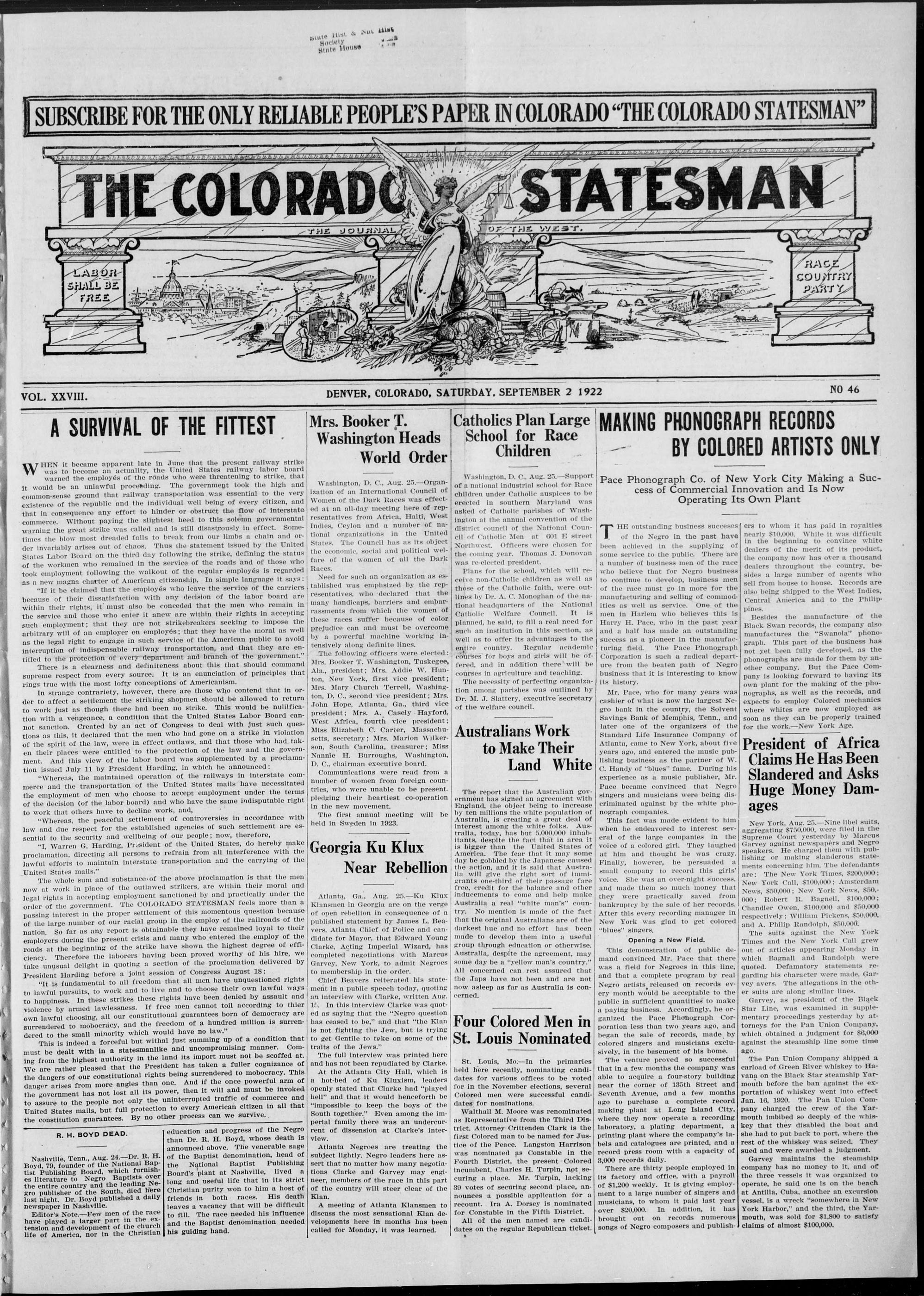
SUBSCRIBE FOR THE ONLY RELIABLE PEOPLE'S PAPER IN COLORADO "THE COLORADO STATESMAN"
THE COLORADO STATESMAN
THE JOURNAL OF THE WEST.
LABOR SHALL BE FREE
RACE COUNTRY PARTY
A SURVIVAL OF THE FITTEST
A SURVIVAL OF THE FITTEST
WHEN it became apparent late in June that the present railway strike was to become an actuality, the United States railway labor board
was to become an accustomed witness, warned the employees of the roads who were threatening to strike, that it would be an unlawful proceeding. The government took the high and common-sense ground that railway transportation was essential to the very existence of the republic and the individual well being of every citizen, and that in consequence any effort to hinder or obstruct the flow of interstate commerce. Without paying the slightest heed to this solemn governmental warning the great strike was called and is still disastrously in effect. Sometimes the blow most dreaded falls to break from our limbs a chain and order invariably arises out of chaos. Thus the statement issued by the United States Labor Board on the third day following the strike, defining the status of the workmen who remained in the service of the roads and of those who took employment following the walkout of the regular employés is regarded as a new magna charter of American citizenship. In simple language it says:
"If it be claimed that the employés who leave the service of the carriers because of their dissatisfaction with any decision of the labor board are within their rights, it must also be conceded that the men who remain in the service and those who enter it anew are within their rights in accepting such employment; that they are not strikebreakers seeking to impose the arbitrary will of an employer on employés; that they have the moral as well as the legal right to engage in such service of the American public to avoid interruption of indispensable railway transportation, and that they are entitled to the protection of every department and branch of the government."
There is a clearness and definiteness about this that should command supreme respect from every source. It is an enunciation of principles that rings true with the most lofty conceptions of Americanism.
In strange contrariety, however, there are those who contend that in order to affect a settlement the striking shopmen should be allowed to return to work just as though there had been no strike. This would be nullification with a vengeance, a condition that the United States Labor Board cannot sanction. Created by an act of Congress to deal with just such questions as this, it declared that the men who had gone on a strike in violation of the spirit of the law, were in effect outlaws, and that those who had taken their places were entitled to the protection of the law and the government. And this view of the labor board was supplemented by a proclamation issued July 11 by President Harding, in which he announced:
"Whereas, the maintained operation of the railways in interstate commerce and the transportation of the United States mails have necessitated the employment of men who choose to accept employment under the terms of the decision (of the labor board) and who have the same indisputable right to work that others have to decline work, and,
"Whereas, the peaceful settlement of controversies in accordance with law and due respect for the established agencies of such settlement are essential to the security and wellbeing of our people; now, therefore,
"I, Warren G. Harding, President of the United States, do hereby make proclamation, directing all persons to refrain from all interference with the lawful efforts to maintain interstate transportation and the carrying of the United States mails."
The whole sum and substance of the above proclamation is that the men now at work in place of the outlawed strikers, are within their moral and legal rights in accepting employment sanctioned by and practically under the order of the government. The COLORADO STATESMAN feels more than a passing interest in the proper settlement of this momentous question because of the large number of our racial group in the employ of the railroads of the nation. So far as any report is obtainable they have remained loyal to their employers during the present crisis and many who entered the employ of the roads at the beginning of the strike have shown the highest degree of efficiency. Therefore the laborers having been proved worthy of his hire, we take unusual delight in quoting a section of the proclamation delivered by President Harding before a joint session of Congress August 18:
"It is fundamental to all freedom that all men have unquestioned rights to lawful pursuits, to work and to live and to choose their own lawful ways to happiness. In these strikes these rights have been denied by assault and violence by armed lawlessness. If free men cannot toil according to their own lawful choosing, all our constitutional guarantees born of democracy are surrendered to mobocracy, and the freedom of a hundred million is surrendered to the small minority which would have no law."
This is indeed a forceful but withal just summing up of a condition that must be dealt with in a statesmanlike and uncompromising manner. Coming from the highest authority in the land its import must not be scoffed at. We are rather pleased that the President has taken a fuller cognizance of the dangers of our constitutional rights being surrendered to mobocracy. This danger arises from more angles than one. And if the once powerful arm of the government has not lost all its power, then it will and must be invoked to assure to the people not only the uninterrupted traffic of commerce and United States mails, but full protection to every American citizen in all that the constitution guarantees. By no other process can we survive.
VOL. XXVIII.
WHEN it became apparent late in time was to become an actuality, the warned the employés of the road it would be an unlawful proceeding, a common-sense ground that railway traffic existence of the republic and the indictment in consequence any effort to hire commerce. Without paying the slight warning the great strike was called and times the blow most dreaded falls to order invariably arises out of chaos. The States Labor Board on the third day of the workmen who remained in the took employment following the walkout as a new magna charter of American law.
"If it be claimed that the employee because of their dissatisfaction within within their rights, it must also be the service and those who enter it and such employment; that they are not arbitrary will of an employer on employ as the legal right to engage in such interruption of indispensable railway titled to the protection of every department. There is a clearness and definite supreme respect from every source. rings true with the most lofty conceptions. In strange contrariety, however, tender to affect a settlement the striking to work just as though there had been with a vengeance, a condition that not sanction. Created by an act of actions as this, it declared that the men of the spirit of the law, were in effect on their places were entitled to the moment. And this view of the labor position issued July 11 by President Harding.
"Whereas, the maintained operation and the transportation of the employment of men who choose to of the decision (of the labor board) and to work that others have to decline with "Whereas, the peaceful settlement law and due respect for the establishment sensial to the security and wellbeing of "I, Warren G. Harding, President proclamation, directing all persons to lawful efforts to maintain interstate United States mails."
The whole sum and substance of the now at work in place of the outlawed legal rights in accepting employment as order of the government. The COLOS passing interest in the proper settlement of the large number of our racial groupation. So far as any report is obtain employers during the present crisis and roads at the beginning of the strike deficiency. Therefore the laborers having take unusual delight in quoting a secreal President Harding before a joint session.
"It is fundamental to all freedom to lawful pursuits, to work and to live to happiness. In these strikes these violence by armed lawlessness. If from own lawful choosing, all our constituent surrendered to mobocracy, and the fraterd to the small minority which would. This is indeed a forceful but with must be dealt with in a statesmanlike ing from the highest authority in the We are rather pleased that the President the dangers of our constitutional right danger arises from more angles than the government has not lost all its power to assure to the people not only the United States mails, but full protection the constitution guarantees. By no other
B. H. BOYD DEAD.
Nashville, Tenn., Aug. 24.—Dr. R. H. Boyd, 79, founder of the National Baptist Publishing Board, which furnishes literature to Negro Baptists over the entire country and the leading Negro publisher of the South, died here last night. Dr. Boyd published a daily newspaper in Nashville.
Editor's Note.—Few men of the race have played a larger part in the extension and development of the church life of America, nor in the Christian
education and progress of the Negro than Dr. R. H. Boyd, whose death is announced above. The venerable sage of the Baptist denomination, head of the National Baptist Publishing Board's plant at Nashville, lived a long and useful life that in its strict Christian purity won to him a host of friends in both races. His death leaves a vacancy that will be difficult to fill. The race needed his influence and the Baptist denomination needed his guiding hand.
DENVER, COLORADO, SATURDAY, SEPTEMBER 2 1922
State Hist & Nat Hist
Society
State House
ABLE PEOPLE'S PA
RADO
THE JOURNAL
DENVER, COLORADO, SA
Mrs. Booker T. Washington Heads World Order
Washington, D. C., Aug. 25.—Organization of an International Council of Women of the Dark Races was effected at an all-day meeting here of representatives from Africa, Haiti, West Indies, Ceylon and a number of national organizations in the United States. The Council has as its object the economic, social and political welfare of the women of all the Dark Races. Need for such an organization as established was emphasized by the representatives, who declared that the many handicaps, barriers and embarrassments from which the women of these races suffer because of color prejudice can and must be overcome by a powerful machine working intensively along definite lines.
The following officers were elected: Mrs. Booker T. Washington, Tuskegee, Ala., president; Mrs. Addie W. Hunton, New York, first vice president; Mrs. Mary Church Terrell, Washington, D. C., second vice president; Mrs. John Hope, Atlanta, Ga., third vice president; Mrs. A. Casely Hayford, West Africa, fourth vice president; Miss Elizabeth C. Carter, Massachusetts, secretary; Mrs. Marlon Wilkerson, South Carolina, treasurer; Miss Nannle H. Burroughs, Washington, D. C., chairman executive board.
Communications were read from a number of women from foreign countries, who were unable to be present. pledging their heartiest co-operation in the new movement.
The first annual meeting will be held in Sweden in 1923.
Georgia Ku Klux Near Rebellion
Atlanta, Ga., Aug. 25.—Ku Klux Klansmen in Georgia are on the verge of open rebellion in consequence of a published statement by James L. Beavers, Atlanta Chief of Police and candidate for Mayor, that Edward Young Clarke, Acting Imperial Wizard, has completed negotiations with Marcus Garvey, New York, to admit Negroes to membership in the order.
Chief Beavers reiterated his statement in a public speech today, quoting an interview with Clarke, written Aug. 15. In this interview Clarke was quoted as saying that the "Negro question has ceased to be," and that "the Klan is not fighting the Jew, but is trying to get Gentile to take on some of the traits of the Jews."
The full interview was printed here and has not been repudiated by Clarke. At the Atlanta City Hall, which is a hot-bed of Ku Kluxism, leaders openly stated that Clarke had "played hell" and that it would henceforth be "impossible to keep the boys of the South together." Even among the imperial family there was an undercurrent of dissension at Clarke's interview.
Atlanta Negroes are treating the subject lightly. Negro leaders here assert that no matter how many negotiations Clarke and Garvey may engineer, members of the race in this part of the country will steer clear of the Klan. A meeting of Atlanta Klansmen to discuss the most sensational Klan developments here in months has been called for Monday, it was learned.
Catholics Plan Large School for Race Children
Washington, D. C., Aug. 25.—Support of a national industrial school for Race children under Catholic auspices to be erected in southern Maryland was asked of Catholic parishes of Washington at the annual convention of the district council of the National Council of Catholic Men at 601 E street Northwest. Officers were chosen for the coming year. Thomas J. Donovan was re-elected president.
Plans for the school, which will receive non-Catholic children as well as those of the Catholic faith, were outlines by Dr. A. C. Monoghan of the national headquarters of the National Catholic Welfare Council. It is planned, he said, to fill a real need for such an institution in this section, as well as to offer its advantages to the entire country. Regular academic courses for boys and girls will be offered, and in addition there will be courses in agriculture and teaching.
The necessity of perfecting organization among parishes was outlined by Dr. M. J. Slattery, executive secretary of the welfare council.
Australians Work to Make Their Land White
The report that the Australian government has signed an agreement with England, the object being to increase by ten millions the white population of Australia, is creating a great deal of interest among the white folks. Australia, today, has but 5,000,000 inhabitants, despite the fact that in area it is bigger than the United States of America. The fear that it may some day be gobbled by the Japanese caused the action, and it is said that Australia will give the right sort of immigrants one-third of their passage fare free, credit for the balance and other inducements to come and help make Australia a real "white man's" country. No mention is made of the fact that the original Australians are of the darkest hue and no effort has been made to develop them into a useful group through education or otherwise. Australia, despite the agreement, may some day be a "yellow man's country." All concerned can rest assured that the Japs have not been and are not now asleep as far as Australia is concerned.
Four Colored Men in St. Louis Nominated
St. Louis, Mo.—In the primaries held here recently, nominating candidates for various offices to be voted for in the November elections, several Colored men were successful candidates for nominations.
Walthall M. Moore was renominated as Representative from the Third District. Attorney Crittenden Clark is the first Colored man to be named for Justice of the Peace. Langston Harrison was nominated as Constable in the Fourth District, the present Colored incumbent, Charles H. Turpin, not securing a place. Mr. Turpin, lacking 39 votes of securing second place, announces a possible application for a recount. Ira A. Dorsey is nominated for Constable in the Fifth District.
All of the men named are candidates on the regular Republican ticket.
MAKING PHONOGRAPH RECORDS BY COLORED ARTISTS ONLY
Pace Phonograph Co. of New York City Making a Success of Commercial Innovation and Is Now Operating Its Own Plant
THE outstanding business successes of the Negro in the past have been achieved in the supplying of some service to the public. There are a number of business men of the race who believe that for Negro business to continue to develop, business men of the race must go in more for the manufacturing and selling of commodities as well as service. One of the men in Harlem who believes this is Harry H. Pace, who in the past year and a half has made an outstanding success as a pioneer in the manufacturing field. The Pace Phonograph Corporation is such a radical departure from the beaten path of Negro business that it is interesting to know its history.
Mr. Pace, who for many years was cashier of what is now the largest Negro bank in the country, the Solvent Savings Bank of Memphis, Tenn., and later one of the organizers of the Standard Life Insurance Company of Atlanta, came to New York, about five years ago, and entered the music publishing business as the partner of W. C. Handy of "blues" fame. During his experience as a music publisher, Mr. Pace became convinced that Negro singers and musicians were being discriminated against by the white phonograph companies. This fact was made evident to him when he endeavored to interest several of the large companies in the voice of a colored girl. They laughed at him and thought he was crazy. Finally, however, he persuaded a small company to record this girls' voice. She was an over-night success, and made them so much money that they were practically saved from bankruptcy by the sale of her records. After this every recording manager in New York was glad to get colored "blues" singers.
Opening a New Field.
This demonstration of public demand convinced Mr. Pace that there was a field for Negroes in this line, and that a complete program by real Negro artists, released on records every month would be acceptable to the public in sufficient quantities to make a paying business. Accordingly, he organized the Pace Phonograph Corporation less than two years ago, and began the sale of records, made by colored singers and musicians exclusively, in the basement of his home.
The venture proved so successful that in a few months the company was able to acquire a four-story building near the corner of 135th Street and Seventh Avenue, and a few months ago to purchase a complete record making plant at Long Island City, where they now operate a recording laboratory, a plating department, a printing plant where the company's labels and catalogues are printed, and a record press room with a capacity of 3,000 records daily.
There are thirty people employed in its factory and office, with a payroll of $1,200 weekly. It is giving employment to a large number of singers and musicians, to whom it paid last year over $20,000. In addition, it has brought out on records numerous songs of Negro composers and publish-
NO 46
ers to whom it has paid in royalties nearly $10,000. While it was difficult in the beginning to convince white dealers of the merit of its product, the company now has over a thousand dealers throughout the country, besides a large number of agents who sell from house to house. Records are also being shipped to the West Indies, Central America and to the Philippines. Besides the manufacture of the Black Swan records, the company also manufactures the "Swanola" phonograph. This part of the business has not yet been fully developed, as the phonographs are made for them by another company. But the Pace Company is looking forward to having its own plant for the making of the phonographs, as well as the records, and expects to employ Colored mechanics where whites are now employed as soon as they can be properly trained for the work.-New York Age.
President of Africa Claims He Has Been Slandered and Asks Huge Money Damages
New York, Aug. 25.—Nine libel suits, aggregating $750,000, were filed in the Supreme Court yesterday by Marcus Garvey against newspapers and Negro speakers. He charged them with publishing or making slanderous statements concerning him. The defendants are: The New York Times, $200,000; New York Call, $100,000; Amsterdam News, $50,000; New York News, $50,-000; Robert R. Bagnell, $100,000; Chandler Owen, $100,000 and $50,000 respectively; William Pickens, $50,000, and A. Philip Randolph, $50,000.
The suits against the New York Times and the New York Call grew out of articles appearing Monday in which Bagnall and Randolph were quoted. Defamatory statements regarding his character were made, Garvey avers. The allegations in the other suits are along similar lines.
Garvey, as president of the Black Star Line, was examined in supplementary proceedings yesterday by attorneys for the Pan Union Company, which obtained a judgment for $6,000 against the steamship line some time ago.
The Pan Union Company shipped a carload of Green River whiskey to Havana on the Black Star steamship Yarmouth before the ban against the exportation of whiskey went into effect Jan. 16, 1920. The Pan Union Company charged the crew of the Yarmouth imbibed so deeply of the whiskey that they disabled the boat and she had to put back to port, where the rest of the whiskey was seized. They sued and were awarded a judgment. Garvey maintains the steamship company has no money to it, and of the three vessels it was organized to operate, he said one is on the bench at Antilla, Cuba, another an excursion vessel, is a wreck "somewhere in New York Harbor," and the third, the Yarmouth, was sold for $1,800 to satisfy claims of almost $100,000.
FOREIGN
Robbers blew open the safe of the Bank of Hamilton branch at Killarney, Manitoba, and escaped in an automobile with $10,000 in cash.
Republican irregulars fired on a congregation of mourners as they were leaving a West Port (Mayo) church, having attended mass in honor of Michael Collins.
The American steamship Septo has sailed for New York from Marseilles with the bodies of sixty-three Americans killed on the French front during the war.
The newspapers of Naples report the discovery by the police of a band of criminals whose principal activities were devoted to counterfeiting American bank notes.
Twenty of Montreal's smartest and prettiest girls, rebelling against the attempt of style creators to foil long skirts on women have formed a "no-longer-skirt league."
The American consul warned more than 500 American tourists in Vienna to leave the city as soon as possible for fear of riots, unless detained on absolutely urgent business.
The Turkish Nationalists launched a mass attack against Afiun Karahisar in an attempt to pierce the Greek front. It is officially stated that they were repulsed by the Greeks.
Increase in the population of Cuba from 3,000,000 to 10,000,000 mainly through Spanish immigrants, is one of the purposes of the new secretary of state, Carlos Manuel de Cespedes, former Cuban minister at Washington.
A small party of Free State troops was ambushed recently at Glasson, a village near Athlone, by thirty Republicans. Free State Lieutenant McCormack was shot dead and the driver of his car badly wounded. A civilian wounded during the fighting succumbed later.
In an ambush near Tullamore, national troops in an automobile were fired upon, and one officer was killed and another mortally wounded. In Maryboro jail, where 600 irregulars are confined, fire broke out. It is asserted that prisoners set fire to their mattresses, the flames spreading to many of the cells.
All is in readiness for the opening at Fairbanks, Sept. 18, of the farthest north college on this continent, the Alaska Agricultural College and School of Mines. The college, which is about three miles outside Fairbanks in the heart of a rich mining country, will teach mine engineering. Teachers and students will live in Fairbanks.
The possibility of Mexico being made bone dry again is discussed seriously at Mexico City. It is announced that several deputies will propose a "dry" bill as soon as Congress begins its session. The belief prevails that a dry law modeled after the Volstead law in the United States will be introduced, although it is not believed the measure will be enacted.
GENERAL
Henry Ford has refused to avert a shutdown of his automobile plants Sept. 16 at the expense of the domestic coal users of the Northwest, it has been learned from a reliable source. The rapid spread of typhus in Poland constitutes a menace to the while world, said Health Commissioner Royal S. Copeland on his return to New York from Europe, where he has been studying health conditions.
Mrs. Franklin Hatch Jones, only daughter of Gen. U. S. Grant, one of the country's few "White House brides," and one of the nation's popular heroines of a century, died at her home in Chicago a few days ago.
Shipping board vessels cannot be seized as an outgrowth of prohibition laws, it was ruled by Federal Judge Henry D. Clayton, whose opinion dismissing libel proceedings brought against the shipping board steamship Coldwater was handed down at Jacksonville, Florida.
Leon Rupkowsky, a Chicago alderman, mistaking his son, Frank, 21, for a burglar, shot and perhaps fatally wounded him at their home.
Appointment of Edward R. Finch, Justice of the Supreme Court of New York, to take the place of Cyrus H. K. Curtis, Philadelphia publisher, on the official American mission to the Brazilian Centennial Exposition has been announced at the White House. Mr. Curtis was unable to go.
Fourteen-year-old Howard Wilson told his parents that he would not return to school—and he kept his word. A few moments after the bell sounding through the little mining village of Herminie, Pa., announced the end of summer vacation, the boy went to his room and shot himself through the head.
The skull of Miss Nona Skinner, Bloomington, Ill., school teacher, who, it was at first believed, died in the explosion of a gasoline stove at the home of a relative in Greeley, Colo., had been fractured, local authorities said after exhumation of the young woman's body at Leroy, Ill. Albert Lowe, her brother-in-law, is held at Greeley on a murder charge.
Indications that Mexico's status is being considered in League of Nation circles were received with much interest in newspaper circles in Mexico City, but there was no inclination to believe that the Mexican government would make formal overtures for admission to the League.
Mistaken by her fliance for a burglar attempting to enter the home which he was guarding in the absence of her sister's husband, Miss Calantha Atkins of Texarkana, Ark., was shot and instantly killed by Ernest Barfield.
NEWS TO DATE IN PARAGRAPHS
CAUGHT FROM THE NETWORK OF WIRES ROUND ABOUT THE WORLD.
DURING THE PAST WEEK
RECORD OF IMPORTANT EVENTS
CONDENSED FOR BUSY
PEOPLE.
WESTERN
Senator Hiram W. Johnson and State Treasurer Friend W. Richardson will be the Republican nominees in California for United States Senator and governor at the November election, returns indicate.
E. Ralph and Ben Aldridge, federal prisoners, who escaped from the Lewis and Clark county jail at Helena, Mont., were recaptured by the sheriff of Hill county as the men were heading by automobile for the Canadian line.
N. B. Solner, president of the First National Bank of Bremerton, Wash., and formerly prominent in Seattle banking circles, leaped or fell from a window on the sixteenth floor of a building in Seattle and was killed.
Howard D. Ranson of Ogden, a brakeman, was burned to death; Conductor Thomas Burke of Provo was badly injured and Fireman Honeycup of Provo slightly hurt in a collision in a tunnel on the Utah Railway Company line at Spring canon, near Helper, Utah.
A complete skeleton of a saber-tooth tiger which roamed southern California and the Southwest generally in the pleistocene period, some 500,000 years ago, has been assembled at the Los Angeles County Museum of History, Art and Science in Exposition park, Los Angeles, after a long period of research.
Led by Admiral W. H. Bullard, U. S. N., the passengers on the steamship President Grant, which arrived at Seattle recently from the Orient, unanimously signed a protest to the United States Shipping Board against a limitation of speed, which they declared was the only reason the Canadian Pacific liner Empress Russia beat the President Grant in a race across the Pacific ocean from Yokohama.
Twenty-eights triking Northern Pacific shopment at Asco, Wash., are starting suits for $1,000 each against the railroad because they have lost their jobs. After the strike was declared the railroad management decided to build a fence around the shops as a protection to the property and the workers. The contract for building the fence was let to a construction concern. The twenty-eight idle shopmen immediately applied for jobs helping put up the fence, and got them. When the Northern Pacific found it out, the twenty-eight allege in their lawsuit, they lost their new jobs. Boycott and blacklisting are charged.
WASHINGTON
The Colorado river commission will meet in Santa F6, N. M., Nov. 9, Secretary Hoover, its chairman, has announced.
Foodstuffs exported during July declined sharply, according to foreign trade reports issued by the Commerce Department.
Instructions have been sent to all postmasters by First Assistant Postmaster General Bartlett to require all householders within four months to install mail boxes or cut slots in doors to facilitate the delivery of mail.
The McNary land reclamation amendment to the soldiers' bonus bill was approved by the Senate. 43 to 26.
A bill designed to obviate any necessity of removing officers of marked efficiency from the army in reducing the commissioned personnel to the strength now set by law, was introduced in the house by Representative Anthony, Republican, Kansas, who also issued a statement that the war department had "blundered" in framing its personnel legislation.
New regulations covering distribution of wine for sacramental purposes in accord with the recent opinion of Attorney General Daugherty, were issued by Internal Revenue Commissioner Blair, to become effective Sept. 25. The regulations provide that manufacturers or importers of sacramental wine may sell only to rabbis, ministers, priests or other authorized officials of a church. Church officers may not manufacture wine for their individual use nor for the use of the congregation, but may qualify as proprietors of bonded wineries for the purpose of manufacturing wine for religious purposes, or may be employed by qualified wine makers to supervise the production of sacramental wines.
Funds amounting to $600,000 have been authorized by President Harding to enable army engineers to begin construction work on the Wilson dam at Muscle Shoals, Ala., on an extensive scale, pending use of the $7,500,000 appropriated by Congress, which becomes available Oct. 1.
The first general movement of troops incident to the army reorganization from 150,000 enlisted strength to 125,000, made in accordance with congressional directions, was announced recently by the war department.
LATE NEWS From All Over COLORADO
Sept. 25-30—Colorado State Fair, Pueblo.
Sept. 12-15—Delta County Fair, Hotchkiss.
Sept. 12-15—Weld County Fair, Greeley.
Sept. 12-15—LaPlata County Fair, Durango.
Sept. 12-15—Logan County Fair, Shiloh.
Sept. 13-16—Baca County Fair, Springfield.
Sept. 13-16—Adams County Fair, Brighton.
Sept. 14-16—Conejos County Fair, Manassa.
Sept. 14-16—Elbert County Fair, Keysor.
Sept. 19-22—Western Slope Fair, Mirose.
Sept. 19-22—Trinidad-Las Animas County Fair, Trinidad.
Sept. 20-21—Klowa County Fair, Elk.
Sept. 20, 21, 22—Morgan Agricultural Fair, Fort Morgan.
Sept. 20-22—Rio Grande County Fair, Del Norte.
Sept. 21-22—Pueblo County Fair, Goodpasture.
Sept. 20-23—Yuma County Fair, Yuma.
Sept. 21-23—El Paso County Fair, Caldwell.
Sept. 21-23—Lincoln County Fair, Hugo.
Sept. 20-23—Huerfano County Fair, Walsenburg.
Oct. 3-16—Kit Carson County Fair, Burlington.
Oct. 3-5—Douglas County Fair, Castle Rock.
Frederick.-More than 350 men, women and children aided recently in the construction of the first and only church Frederick ever has had.
Fleming—Mrs. John J. Vorlander, 37 years old, was instantly killed by lightning while sitting in the kitchen of the E. D. Dutcher home near Fleming, Colo.
Loveland.-The attendance at the opening day of the Larimer county fair was the largest in the history of the organization, more than 5,000 paying their way through the gates.
Pueblo.-John Plenentosh, 48 years old, a rancher residing near Keating, Custer county, Colorado, died at a Pueblo hospital from injuries received when he accidentally shot himself.
Walsenburg.—Fourteen freight cars went into a ditch five miles south of Walsenburg on the Colorado & Southern railroad a few days ago, tying up traffic over the road for several hours.
Denver.—Figures made public by engineers of the Mountain States Telephone Company show that the population of Denver has grown from 256,491, the 1920 census total, to 266,000 at present.
Grand Junction.—Grand Valley's great peach crop is on the move. One hundred cars were moved out of Palisade and Clifton as the fruits of the opening day's labors. The crop is one of the largest on record.
Boulder.—The University of Colorado training school for nurses, which has graduated more than sixty young women, will close Sept. 1 until the completion of the new state hospital and medical school in Denver.
Colorado Springs.—Three alumnae chapters of Delta Sigma Epsilon, national sorority, were installed in Colorado at the closing session of their annual convention here. They are located in Colorado Springs, Denver and Greeley.
Palmer Lake.—One woman and four men were injured critically in a mystery accident on the Denver-Colorado Springs highway, one mile south of Palmer Lake, a few days ago, when two automobiles "side-swiped" at a sharp turn in the road.
Denver.—C. E. Moore, recently sent to Denver to serve as district passenger representative of the Pennsylvania railroad, announced that the Pennsylvania system has established permanent offices for its passenger traffic agency in 716 First National Bank building.
Colorado Springs.—Mrs. Elizabeth Allen, a working woman, was held up while on her way to her home, passing through Monument Valley park, a few days ago. She says that a man accosted her, ordered her to hand over her purse, took the $3 he found in it, and then disappeared.
Denver.—Legislation authorizing the construction of Denver's federal reserve bank building will be enacted at this session of Congress, it was announced by the congressional committee on banking and currency. The bill, which practically assures the construction of the building, has passed the Senate and will soon be taken up by the House.
Pueblo.—Two men, giving the names of J. E. Keyton of Childers, Texas, and Box Martin of Kansas City, were arrested by Sheriff Sam Thomas and special agents of the Denver & Rio Grande Western railroad on the charge of breaking into a Rio Grande freight car and attempting to steal fourteen cases containing 168 pairs of high-grade shoes as the freight train was moving between Colorado Springs and Pueblo. Twelve cases of shoes have been recovered. Colorado Springs.—Through the will of the late Mrs. Edith Sobernheimer, tuberculous children in the Pike's Peak region are to have a sanatorium of their own. The will, just admitted for probate, provides that Mrs. Sobernheimer's beautiful stone mansion near Manitou, valued at $70,000, be turned over to a board of trustees and operated as a home for children suffering from the white plague.
Salida—Adolph Rivera, section foreman at Malta, was fatally shot in a pool hall at Salida by George Theotohatos in a dispute over a card game
Pueblo.—Suit for damages against seventeen Colorado coal operators probably will be brought by District No. 15, United Mine Workers and an effort made to collect between $300,-900 and $500,000 in back pay alleged to be due the coal miners employed in those mines, according to Felix Pogliano, secretary of district No. 15. Mr. Pogliano claims about seventeen coal operators working under a signed agreement with the union, broke their contracts several months before the contracts expired on April 1, 1922, and the men were forced to take a lesser wage for several months previous to April 1, when the contracts expired and the mine workers went out on strike.
Durango.—Believing that the man addressing her was a representative of a telegraph company led to the arrest of Mrs. Allie Johnson, alias Mrs. Martin, at the auto camp grounds at Durango, on a charge of forgery. The arrest was made by Sheriff George A. Rowe upon telegraphic orders from Sheriff Calmas Merritt at Lake Village, Ark. The woman, in company with a male companion, had been trailed to Durango, the pair traveling in an auto. Mrs. Johnson was known to be in Durango, she having wired back for money to be sent her by telegraph.
Denver,—Districts along the Denver and Rio Grande Western Railroad will yield 13,850 carlot shipments of potatoes this year, compared with 11,967 in 1921, according to estimates in a bulletin just issued by the railroad company. This year's crop will be divided as follows: San Luis valley, 6,250 carlots; Engle-Gypsum district, 900; Carbondale-Aspen, 1,200; Riffle and Lower Grande valley, 1,000; Montrose-Olathe-Delta, 3,000, and Utah and Salt Lake basin, 1,500.
Boulder.—For four weeks, fourteen hours a day, students in the field geology course offered at the University of Colorado summer session, during the term just closing, studied nature in the heart of the mountains, thirty miles from Boulder. Last week they made a thorough survey of the Rocky Mountain National Park. Now they are back on the campus and have started reports on the work of the course, which are to be called in Dec. 1.
Fort Collins,—Miss Maude Sheridan of this city, state leader for Colorado Boys and Girls' Clubs, has been selected as judge of the Girls' Club work to be exhibited at the interstate fair to be held at Sioux City, Iowa, Sept. 17 to 22, according to information received here. The judge for the boys' work will be S. T. Newlon, superintendent of the extension service of the Canadian Department of Agriculture, with headquarters at Winnipeg.
Boulder.—An automobile obtained from J. M. Pike of Boulder, through what is said to be a fraudulent transaction, last October, has been recovered at Spokane, Wash., along with a child, which Mr. Pike stated was not included in the accessories sold a man who gave his name as Fred R. Hoffman. The child is being held in the detention home at Spokane and the car, which has been badly used, at the city garage.
Pueblo.—With the arrest here of a woman giving the name of Grace Hays of Topeka, Kan., police believe they have in custody one of the persons connected with the selling of defaulted bonds of the Chicago, Rock Island & Pacific Railroad Company. In her possession, according to the police, she had six of these defaulted bonds of twenty-dollar denomination.
Pueblo.—Colorado coal miners who have been on strike since April 1 were authorized to return to work as soon as the wage scale in effect prior to Nov. 1, 1921, is restored by mine owners, following a meeting of the executive board of District 15 of the United Mine Workers of America at Pueblo. Colorado Springs.—Clarence McCain, the 3-year-old son of Mr. and Mrs. R. R. McCain, West Colorado Springs, was instantly killed when struck by an automobile driven by Warren B. Garrott of Houston, Texas. The child was playing behind a tree on the street parking and suddenly darted across the path of the car, it was reported.
Denver.—Lightning struck and instantly killed W. B. Heath of 3090 South Acoma street a few days ago. Heath, who is a widely known contractor and former city alderman, was fishing along the Platte river seven miles south of Denver when the electrical disturbance arose. Colorado Springs.—Two were seriously but not fatally injured when an auto plunged off an embankment on the Pike's Peak highway. Four others were slightly injured. Lona Walters and Edward M. Campbell were those receiving most severe injuries. Pueblo.—A contract was signed a few days ago between the Black Cannon Coal and Fuel Company, operating a mine near Walsenburg and District No. 15. United Mine Workers, according to an announcement by Felix Pogliano, secretary of the union.
Denver.—A first fight between District Attorney Philip S. Van Cise and Attorney William A. Bryans, counsel for more than thirty alleged confidence men arrested in the former's raid, was a finishing touch of a hearing on motions for reduction in the bonds on which the men can be released. Pueblo.—High water in the Arkansas river washed out an approach to a bridge on the Denver & Rio Grande Western railroad near Portland, Colo., twenty-five miles west of Pueblo, a few days ago.
IMPERIAL CAFE
First-Class Meals at All Hours
Our Service is Unsurpassed
715 EAST 26TH AVE.
Ladies' and Gents' Tailoring, See
H. ANDERSON
MERCHANT TAILOR
ing, Pressing and Repairing. All Work
Guaranteed
720 EAST 26TH AVE.
PHONE YORK 8814
see my Samples now on display. Prices reasonable.
HOWARD & HOWARD
GROCERIES AND MEATS
Fresh Vegetables and Fruits Daily
Home-made Bread, Rolls, Cakes and Pies Daily
Free Delivery to any part of the city.
FRANKLIN 1552 718 E. TWENTY-SIXTH AVE.
CHAMPA PHARMACY
2101 CHAMPA
Is the place to get your
S, CHEMICALS AND PATENT MEDICINES
WE SERVE DRINKS.
PRESCRIPTIONS OUR SPECIALTY.
and we will deliver the goods to all parts of the city.
JAMES E. THRALL, Propr.
IN 2425 PHONE 8444
For Ladies' aid
H. A.
Cleaning, Pressi
720 P
Call in and see my!
HOWA
GROCE
Fresh Veg
Fresh Home-made
Free Deliver
PHONE FRANKLIN 15
THE CHAM
Is
DRUGS, CHEMIC
W
PRESCRIPT
Phone us and we will o
JAME
MERCHANT TAILOR
Cleaning, Pressing and Repairing. All Work
Guaranteed
720 EAST 26TH AVE.
PHONE YORK 8814
Call in and see my Samples now on display. Prices reasonable.
THE CHAMPA PHARMACY
2101 CHAMPA
Is the place to get your
DRUGS, CHEMICALS AND PATENT MEDICINES
WE SERVE DRINKS.
PRESCRIPTIONS OUR SPECIALTY.
Phone us and we will deliver the goods to all parts of the city.
JAMES E. THRALL, Propr.
PHONE MAIN 2425 PHONE 844
C. V. FAIRBANKS —Proprietors— N. FAIRBANKS
HOME COOKING
First Class Meals Served
2444 Washington St., Denver, Colo.
A..
MEATS, FANCY
180
A. J. HAHN
ATS, FANCY AND STAPLE GROCERIES
MEATS, FANCY AND STAPLE GROCERIES
Feteenth Denver, Colo.
C. E. Weatherhead
WEAT
HAT
MEN'S AND WOMEN'S
PANAMA
1722 STOUT STREET
GRANBERRY T
Office
PHONE MAIN S203
EATHERHEAD
HAT FACTORY
ESTABLISHED 1875
WOMEN'S UNCLAIMED HATS FOR SALE—FELTS,
PANAMAS AND WHITE MILANS
T STREET
ALBANY HOTEL BLDG,
ERRY TAXI AND BAGGAGE CO
WEATHERHEAD
HAT FACTORY
ESTABLISHED 1876
MEN'S AND WOMEN'S UNCLAIMED HATS FOR SALE—FELTS,
PANAMAS AND WHITE MILANS
1722 STOUT STREET
ALBANY HOTEL BLDG
Office 2741 Welton Street.
Quick and Prompt Service
on
If you have a room
NO CHARGE
ompt Service Day and night. Call Us for Special Rates on Out-of-Town Trips.
have a room for rent or want a room call us.
NO CHARGE FOR THIS INFORMATION
Quick and Prompt Service Day and night. Call Us for Special Rates on Out-of-Town Trips.
If you have a room for rent or want a room call us.
NO CHARGE FOR THIS INFORMATION
THISTLE
PHONE MAIN 2425
PHONE MAIN 3023
Corner Nineteenth
OFFICE
PHONE
CHAMPA
87-88
OPEN DAY AND NIGHT
PHONE MAIN 2759
PHONE 8444
N. FAIRBANKS
Proprietors N. FAIRBANKS FAIRBANKS CAFE
RES. PHONE GALLUP 942
1864 CURTIS STREET
Denver, Colo.
C. B. Weatherhead
OFFICE
PHONE
CHAMPA
87-88
SECOND BUDGET IS BEING PREPARED
DIRECTOR LORD READY TO USE
THE PRUNING KNIFE FREELY
IF IT IS NECESSARY.
ESTIMATES NOT SO LIBERAL
Seven Agencies, Established by General Dawes, Are Co-ordinating the Routine Activities of the Federal Departments and Establishments.
By JAMES P. HORNADAY
Washington.—The second federal budget is now in the course of preparation. Gen. Herbert M. Lord, the new director of the bureau of the budget, is already getting out his pruning knife. The estimates from the various branches of the government which must be ready for the inspection of the President of the United States by September 15 are coming in. While they show much improvement over the estimates of former years, they reveal a lingering disposition on the parts of the chiefs of bureaues to ask for exceedingly liberal appropriations. The estimates are not yet in such shape as would warrant the bureau of the budget in saying whether or not the budget for the next fiscal year will call for more money than was set aside for the operation of the government during the present fiscal year. If the total of the estimates should exceed the amount authorized for the present year, it will certainly be reduced.
The outstanding fact about the preparation of the second budget is that the federal government for the first line in its history is now transacting its routine business according to modern methods. Never before did it have a complete balance sheet, and it now has complete inventories of its properties, something which it never had before. But most important of all, there are now in existence and in working order agencies which are engaged in co-ordinating in all matters of routine business the activities of the separate departments and establishments. Charles G. Dawes, the first director of the budget, was obliged to prepare the first budget without the assistance of these agencies, which he established during his term of office.
Federal Purchasing Board.
At the head of the list of these new agencies is the federal purchasing board. This board is made up of the chief purchasing officer of each department or establishment, with a chief co-ordinator as chairman. The chief co-ordinator has the authority, limited by a right of appeal in case of any difference of opinion, to impose co-ordinating orders. He can prevent and is preventing competition between the different departments in outside purchases, not only by preventing them from raising the prices on each other, but where large quantities of standard commodities are purchased, by ordering one department to execute the purchase for itself and as agent for the others.
The federal liquidation board co-ordinates sales, under a unified plan, of the surplus stocks of the various departments of the government. It is composed of one representative from each department, or establishment, having sales activity and is presided over by a chief co-ordinator. The third agency in the new organization is what is known as the corps of area co-ordinators. This agency expands the principles involved in the federal purchasing board and federal liquidation board over the entire country. The country as a whole is divided into nine areas corresponding to the nine army corps areas and in each area an official has been selected by the President, by detail from the department, who is known as the co-ordinator for general supplies for the several executive departments in that area.
Surveyor General of Real Estate.
Surveyor General of Real Estate. Then there is the surveyor general of real estate who determines, subject to the approval of the secretary of the treasury, in what manner and to what extent real estate owned by the United States outside of the District of Columbia shall be occupied and used, etc. He has the power to assign and reassign rooms to all federal officials, clerks and employees throughout the country as his judgment and discretion may direct. Since this agency was established large sums of money have been saved by occupying space in government buildings that was going to waste instead of renting from private owners.
The fifth agency in the new scheme is the federal motor transport agent. The director of the budget found that civilian trucks were being employed to a large extent by some departments while other departments had motortrucks standing idle. The business of the federal motor transport agent is to see that motortrucks owned by the government are properly distributed. The next agency is the federal traffic board which is designed to prevent overlapping of service and the duplication of effort in the traffic business of the government. The seventh new agency is the federal board of hospitalization. The duty of this board is to consider all questions relative to the co-ordination of federal hospitalization.
Government statistics show that one section of the United States is about as healthful as another. The statistics are those dealing with
the expectation of life. Kansas folk have a slight advantage over the people of any other state. Every Kansen may expect to stay around until he is about sixty—53.73 for men and 60.89 for women, to be exact. Wisconsin is not for behind Kansas as a health resort, and Minnesota holds out an inviting hand. Census experts say that if a record as a standard of comparison be desired, it may be found in the figures for females in the County of West Sussex, England, whose expectation of life, the highest ever published officially by any country, was 63.05 years in 1911-12. Among the cities named in the computation Pittsburgh comes at the foot of the list with 47.16 years as the expectation of life for white males and 50.42 for white females.
As 51.55 is the number of years given as the average expectation of life for white males in the large cities, it is apparent that the census figures indicate that the span of life in New York city among white males is only 0.03 below the average for the large cities.
How the States Stand.
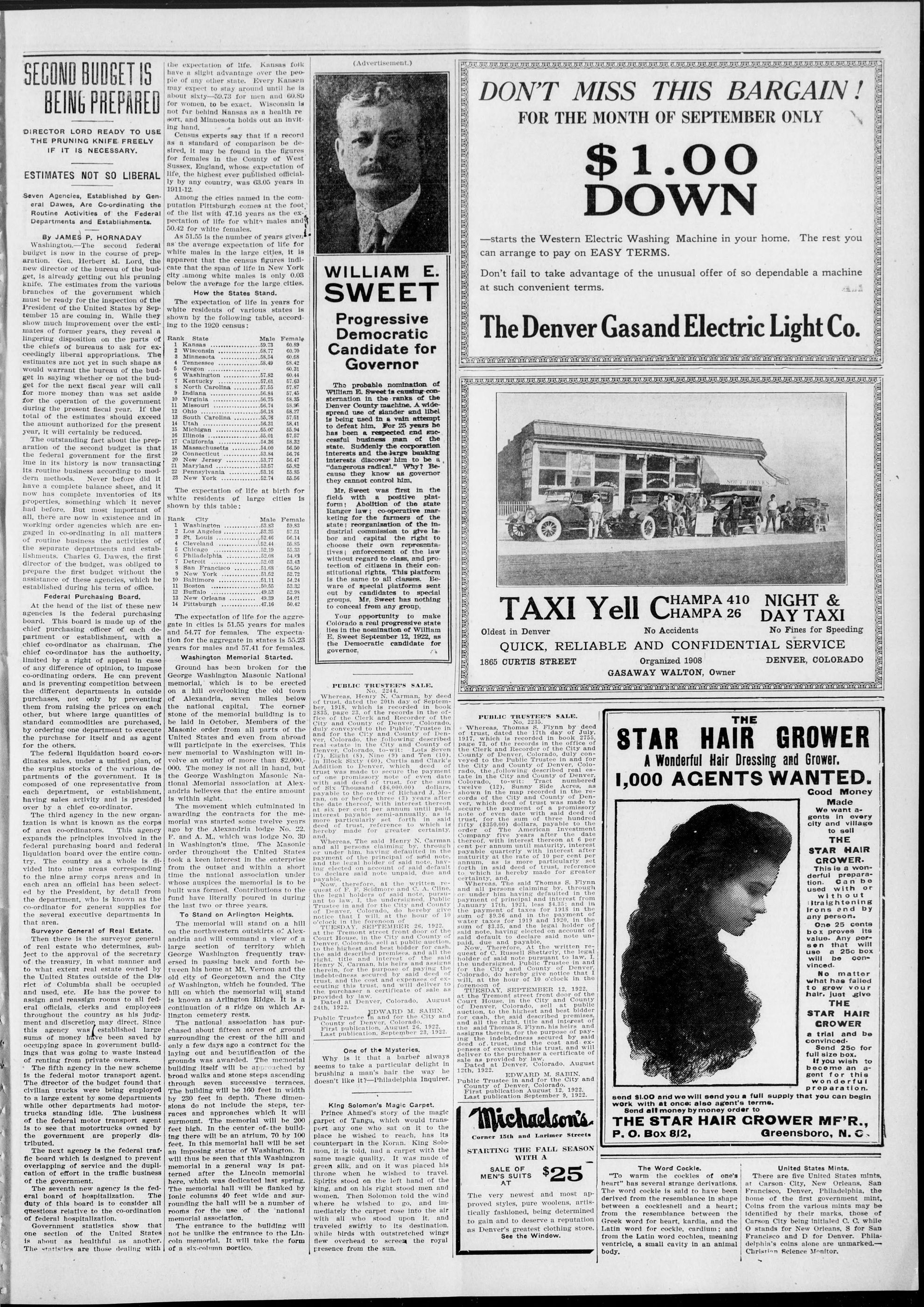
The expectation of life in years for white residents of various states is shown by the following table, according to the 1920 census:
Rank State Male Female
1 Kansas 59.73 60.89
2 Wisconsin 68.77 60.70
3 Minnesota 68.54 60.68
4 Tennessee 68.49 68.42
5 Oregon 60.31
6 Washington 57.82 60.44
7 Kentucky 57.61 57.63
8 North Carolina 57.55 57.87
9 Indiana 56.84 57.45
10 Virginia 56.75 58.35
11 Missouri 56.74 58.96
12 Ohio 56.18 58.27
13 South Carolina 55.76 57.51
14 Utah 56.31 58.41
15 Michigan 55.07 55.94
16 Illinois 55.01 57.57
17 California 54.36 58.32
18 Massachusetts 54.00 56.50
19 Connecticut 53.84 56.76
20 New Jersey 53.77 56.47
21 Maryland 53.57 55.82
22 Pennsylvania 53.16 55.85
23 New York 52.74 55.56
The expectation of life at birth for white residents of large cities is shown by this table:
| Rank | City | Male | Female |
| :--- | :--- | :--- | :--- |
| 1 | Washington | 53.83 | 59.83 |
| 2 | Los Angeles | 53.35 | 57.51 |
| 3 | St. Louis | 52.46 | 56.14 |
| 4 | Cleveland | 52.44 | 56.85 |
| 5 | Chicago | 52.19 | 55.32 |
| 6 | Philadelphia | 52.08 | 54.83 |
| 7 | Detroit | 52.03 | 53.43 |
| 8 | San Francisco | 51.68 | 56.50 |
| 9 | New York | 51.52 | 52.72 |
| 10 | Baltimore | 51.11 | 54.24 |
| 11 | Boston | 50.55 | 53.23 |
| 12 | Buffalo | 49.53 | 52.98 |
| 13 | New Orleans | 49.39 | 54.01 |
| 14 | Pittsburgh | 47.16 | 50.42 |
The expectation of life for the aggregate in cities is 51.55 years for males and 54.77 for females. The expectation for the aggregate in states is 55.23 years for males and 57.41 for females.
Washington Memorial Started.
Ground has been broken for the George Washington Masonic National memorial, which is to be erected on a hill overlooking the old town of Alexandria, seven miles below the national capital. The cornerstone of the memorial building is to be laid in October. Members of the Masonic order from all parts of the United States and even from abroad will participate in the exercises. This new memorial to Washington will involve an outlay of more than $2,000,000. The money is not all in hand, but the George Washington Masonic National Memorial association at Alexandria believes that the entire amount is within sight.
The movement which culminated in awarding the contracts for the memorial was started some twelve years ago by the Alexandria lodge No. 22. F. and A. M., which was lodge No. 30 in Washington's time. The Masonic order throughout the United States took a keen interest in the enterprise from the outset and within a short time the national association under whose auspices the memorial is to be built was formed. Contributions to the fund have literally poured in during the last two or three years.
To Stand on Arlington Heights.
The memorial will stand on a hill on the northwestern outskirts of Alexandria and will command a view of a large section of territory which George Washington frequently traversed in passing back and forth between his home at Mt. Vernon and the old city of Georgetown and the City of Washington, which he founded. The hill on which the memorial will stand is known as Arlington Ridge. It is a continuation of a ridge on which Arlington cemetery rests.
The national association has purchased about fifteen acres of ground surrounding the crest of the hill and only a few days ago a contract for the laying out and beautification of the grounds was awarded. The memorial building itself will be approached by broad walks and stone steps ascending through seven successive terraces. The building will be 160 feet in width by 230 feet in depth. These dimensions do not include the steps, terraces and approaches which it will surmount. The memorial will be 200 feet high. In the center of the building there will be an atrium, 70 by 100 feet. In this memorial hall will be set an imposing statue of Washington. It will thus be seen that this Washington memorial in a general way is patterned after the Lincoln memorial here, which was dedicated last spring. The memorial hall will be flanked by Ionic columns 40 feet wide and surrounding the hall will be a number of rooms for the use of the national memorial association.
The entrance to the building will not be unlike the entrance to the Lincoln memorial. It will take the form of a six-column portico.
M. B.
WILLIAM E. SWEET Progressive Democratic Candidate for Governor
The probable nomination of William E. Sweet is causing consternation in the ranks of the Denver County machine. A widespread use of slander and libel is being used in a vain attempt to defeat him. For 25 years he has been a respected end successful business man of the state. Suddenly the corporation interests and the large banking interests discover him to be a "dangerous radical." Why? Because they know as governor they cannot control him.
Mr. Sweet was first in the field with a positive platform; Abolition of the state Ranger law; co-operative marketing for the farmers of the state; reorganization of the industrial commission to give labor and capital the right to choose their own representatives; enforcement of the law without regard to class, and protection of citizens in their constitutional rights. This platform is the same to all classes. Beware of special platforms sent out by candidates to special groups, Mr. Sweet has nothing to conceal from any group.
Your opportunity to make Colorado a real progressive state lies in the nomination of William E. Sweet September 12, 1922, as the Democratic candidate for governor.
PUBLIC TRUSTEE'S SALE.
Whereas, Henry N. Carman, by deed of trust, dated the 20th day of September, 1918, which is recorded in book 2835, page 23 of the records in the office of City and County of Denver, Colorado, duly conveyed to the Public Trustee in and for the City and County of Denver, Colorado, the following described City and County of Denver, Colorado to-wit: Lots Seven (7), Eight (8), Nine (9) and Ten (10), in Block Sixty (60), Curtis and Clark's Addition to Denver, which deed of trust was made to secure the lot of even date with said deed of trust, for the sum of Six Thousand ($6,000.00) dollars, payable to the order of Richard J. Moran, or on behalf thereof (7) year and three months thereof with interest thereon at six per cent per annum until paid, interest payable semi-annually, as is more particularly set forth in said deed of trust, reference to which is hereby made for greater certainty,
Whereas, The said Henry N. Carman and all persons claiming by, through or under him, having default in the said note and the legal holder of said note, having elected on account of said default to declare said note unpaid, due and payable, therefore, at the written request of F. F. Scidmore and C. A. Cline, the legal holders of said note, pursuant to law, I, the undersigned, Public Trustee in and for the City of Denver, notice that I will, at the hour of 10 o'clock in the forenoon of TUESDAY, SEPTEMBER 26, 1922, the door of the Court House, in the City and County of Denver, Colorado, sell at public auction, to the highest and best bidder for cash, the said described premises, and all other goods, in the interest of F. F. said Henry N. Carman, his heirs and assigns therein, for the purpose of paying the indebtedness secured by said deed of trust, and the cost and amount of the said note and will deliver to the purchaser a certificate of sale as provided by law.
Dated at Denver, Colorado, August
24th, 1922.
ENRIQUE M. SAINN
24th, 1922. EDWARD M. SABIN.
Public Trustee In and for the City and
Park District.
First publication, August 26, 1922.
Last publication, September 23, 1922.
One of the Mysteries.
Why is it that a barber always seems to take a particular delight in brushing a man's hair the way he doesn't like it?—Philadelphia Inquirer,
King Solomon's Magic Carpet.
King Solomon's magic Carpet.
Prince Ahmed's story of the magic carpet of Tangu, which would transport any one who sat on it to the place he wished to reach, has its counterpart in the Koran. King Solomon, it is told, had a carpet with the same magic quality. It was made of green slik, and on it was placed his throne when he wished to travel. Spirits stood on the left hand of the king, and on his right stood men and women. Then Solomon told the wind where he wished to go, and immediately the carpet rose into the air with all who stood upon it, and traveled swiftly to its destination. while birds with outstretched wings flew overhead to screen the royal presence from the sun.
DON'T MISS THIS BARGAIN! FOR THE MONTH OF SEPTEMBER ONLY
—starts the Western Electric Washing Machine in your home. The rest you can arrange to pay on EASY TERMS.
Don't fail to take advantage of the unusual offer of so dependable a machine at such convenient terms.
The Denver Gasand Electric Light Co.
The Denver Gasand Electric Light Co.
SOFT DRINKS
PUBLIC TRUSTEE'S SALE.
N. 8937
Whereas, Thomas S. Flynn by deed of trust, dated the 17th day of July, 1917, which is recorded in book 2755, page 73, of the records in the office of the Clerk and Recorder of Colorado, duly conveyed to the Public Trustee in and for the City and County of Denver, Colorado, the following described real estate in the City and County of Denver, Colorado, the following described real estate in the City and County of Denver, the following described real estate in the City and County of Denver, which deed of trust was made to secure the payment of a process of trust, for the sum of three hundred fifty ($350.00) dollars, payable to the order of The American Investment Company five years after the date of deed, for the sum of three hundred per annum until maturity, interest payable quarterly with interest after maturity at the rate of 10 per cent per annum, as is more particularly set forth in said deed of trust, reference thereby made for greater certainty and,
Whereas, The said Thomas S. Flynn and all persons claiming by, through or under him having defaulted in the payment of principal interest from the payment of taxes for 1918 in the sum of $9.36 and in the payment of water taxes for 1919 and 1920, in the sum of $3.35, and the legal bidder said default to declare said note unpaid, due and payable.
Now, Therefore, At the written request of C. Russell Shetterly, the legal holder of said note pursuant to the agreement of Trustee in and for the City and County of Denver, Colorado, do hereby give notice that I will, at the hour of 10 o'clock in the forenoon of BOM. SEPTEMBER 12, 1922, at the Tramont street front door of the Court House, in the City and County of Denver, Colorado, sell at public auction, to the highest and best bidder for cash, the said described interest of the said Thomas S. Flynn, his heirs and assigns therein, for the purpose of paying the indebtedness secured by said deed of, trust, and the cost and expenses of the purchase of the land to the purchaser a certificate of sale as provided by law.
Dated at Denver, Colorado, August
12th, 1922.
EDWARD M. SABIN,
Public Trustee in and for the City and
County of Denver, Colorado.
First publication August 12, 1922.
Last publication September 9, 1922.
Michaelson's.
Corner 15th and Larimer Streets
STARTING THE FALL SEASON
WITH A
SALE OF
MEN'S SUITS
AT
$25
The very newest and most approved styles, pure woolens, artistically fashioned, being determined to gain and to deserve a reputation
as Denver's greatest clothing store.
See the Window.
STAR HAIR GROWER A Wonderful Hair Dressing and Grower. 1,000 AGENTS WANTED.
THE WORLD'S FINEST HAIRDRESSER
send $1.00 and we will send you a full supply that you can begin work with at once: also agent's terms.
Send all money by money order to
$1.00 DOWN
Electric Washing Machine in your home on EASY TERMS.
Advantage of the unusual offer of so many terms.
Yell CHAMPA 410
CHAMPA 26
No Accidents
MARIABLE AND CONFIDENTIAL
Organized 1908
GASAWAY WALTON, Owner
THE STAR HAIR
A Wonderful Hair Dress
1,000 AGENTS
send $1.00 and we will send you a full work with at once; also agent's ten. Send all money by money order to THE STAR HAIR GR
P. O. Box 8/2,
The Word Cockle.
"To warm the cockles of one's heart" has several strange derivations. The word cockle is said to have been derived from the resemblance in shape between a cockleshell and a heart; from the resemblance between the Greek word for heart, kardia, and the Latin word for cockle, cardium; and from the Latin word cochlea, meaning ventricle, a small cavity in an animal body.
United States Mints.
There are five United States mints, at Carson City, New Orleans, San Francisco, Denver, Philadelphia, the home of the first government mint, Colins from the various mints may be identified by their marks, those of Carson City being initialed C. C, while O stands for New Orleans, S for San Francisco and D for Denver. Philadelphia's coins alone are unmarked.—Christian Science Monitor.
THE COLORADO STATESMAN
Entered as second-class matter at the postoffice in the City of Denver, Colo.
Recognized by the Retail Merchants' Bureau of the Denver Civic and Commer- cial Association as an advertising medium.
Recognized by the Retail Merchants' Bureau of the Denver Civic and Commercial Association as an advertising medium.
JOSEPH D. D. RIVERS.....Proprietor
P. O. Box 116 1824 Curtis Street, Room 25 Phone Main 7417
Reading notices, ten lines or less, 15 cents per line. Each additional line over ten lines, 12 cents per line. Display advertising, 75 cents per square for first insertion and 50 cents per square for each additional insertion.
Remittances should be made by express money order, postoffice money order, registered letter or bank draft. Postage stamps will be received the same as cash for fractional part of a dollar. Only 1c and 2c stamps taken. Communications to receive attention must be newsy, upon important subjects, plainly written only upon one side of the paper, must be timely. The papers must be later than the notices, and bear the signature of the author. No manuscript returned, unless stamps are sent for postage. All communications of a personal nature that are not complimentary will be withheld from the columns of this paper.
September number of the "bids" for Negroes have been be states during the last eight nearly five million dollars. T raging. When one will stop, educational facilities invaria the South, one cannot help exempled generosity is pointi er the Negro youth of the so tional movement is said to be. Booker T. Washington and aropist, is the benefactor. On res shown in the Crisis to be in these rural schools. The ward the education of the Neg itself, it has labored under the Negro in his place," whatever its continually unfolding gift an established policy, it is award to the point of disgrace its most prolific though value parted to us some cheering good start has been made wi eventually find its way in the hea city of encouraging a more future.
ACCORDING to the September number of the Crisis, fourteen hundred "Rosenwald schools" for Negroes have been built in rural districts of fourteen southern states during the last eight years. These represent a total investment of nearly five million dollars. The figures are not only monumental but encouraging. When one will stop and reflect upon the meager and inadequate educational facilities invariably afforded Negroes in the rural districts of the South, one cannot help arising and calling him blessed who by such unexampled generosity is pointing the way to a brighter light and better day for the Negro youth of the southland.
This notable educational movement is said to have grown out of the thought of the late Dr. Booker T. Washington and Mr. Julius Rosenwald, eminent Chicago philanthropist, is the benefactor. One has but to look upon the "before and after" pictures shown in the Crisis to be convinced of the needed and miraculous change in these rural schools. The South has long been derelict in its duty toward the education of the Negro. Steeped in laziness and inherent ignorance itself, it has labored under the misguided belief that the way to "keep the Negro in his place," whatever that may mean, was to withhold from him God's continually unfolding gift—education. With such a condition accepted as an established policy, it is not to be marveled that the whole South is backward to the point of disgrace in the matter of education. Its illiteracy is its most prolific though valueless asset. We confess that the Crisis has imparted to us some cheering information in this line, and now that such a good start has been made we trust that a spark of common justice will eventually find its way in the heart of southern commonwealths to the possibility of encouraging a more equitable distribution of the school fund in the future.
RETURNING TO SCHOOL.
WE ARE now approaching the entire heads of our educational departors, guardians, being alive to their response renewed vigor and energy their intents whose shoulders will be placed on along educational, political and industrial It is gratifying to note how the a his or her studies, expresses a desire Wednesday, September 6, to the deligirl will be seen bounding away to school will bring to them the pleasures of that ancient feeling of the human riches; and it is deeply and sacredly. We have been following very close of college professors and other educators among a fair percentage of the peopleinuous appeal for education of the response from those who would be prompt not only "the brave and the free," but cation as to merit our taking a place generally, we cannot help from view the public by the government, city and public schools thoroughly equipped, equal to any in the country—the bus requirements, and every means provide youth and even to those of advanced universities and other institutions for these point to the adequate provision these, some of our citizens are unm society and the commonwealth, and of the opportunity for advancement sympathy, urge the attendance of our the OPPORTUNITY SCHOOL or so older ones who might not have been a little sacrifice to acquire that know a position to avert such incidents as a lawlessness, disregard for government other cultured nations.
With the return to school, let us receive inspiration from our encounters with the student who is delving into learning, scientific agriculture, domestic ing, etc.; who is in preparation to people, by the people; with the teach imparting of such instructions and success in the advancement of a people advantages to be derived from such order of their existence. We have always ene the minds of our youth, and in continue anything that is done for the education Sydney Smith, offer this very inspiring embarked his life in the pursuit of doubling or fearing the event; but that guards him, and as the Genius last into the light of day, and exhibit acquirements, fertile in resources, rich prudent and powerful above his fellow affairs of life." The COLORADO S teacher and pupil during the forthcoming
teaching the end of our school in national departments, as well as to their responsibility to the energy their interest and encele placed the development of the local and industrial lines. Note how the average pupil, who possesses a desire for returning to school, to the delight of our citizens going away to school, to again pleasures of knowledge, rests the human heart, that knew and sacredly true. Drawing very closely the lectures and other educationists relative to the people of the United States of the masses should be proud of being ideal of the free," but of such a stance taking a place second to none. Help from viewing with pride,iment, city and state for edully equipped, with a teaching country—the buildings with the means provided for the give of advanced years; colleges institutions for the instruction provisions made for us; citizens are unmindful of the wealth, and through negligence advancement in learning, and advance of our children to the CHOOL or some other industry that have been fortunate in the desire that knowledge which we incidents as we are now face our government, which discerns in school, let us go in spirit with our encouragement and thus delving into the classics, culture, domestic commerce and preparation to take his place with the teacher and all the instructions and management of the moment of a people who cannot find from such opportunities offer have always endeavored to do and in continuing our program for the education of the people very inspiring expression: "The pursuit of KNOWEDGE is event; but let him ever find the Genius of his life. She may, and exhibit him to the resources, rich in imagination above his fellows in all the COLORADO STATESMAN wishing the forthcoming term.
WE ARE now approaching the end of our school vacation period, and the heads of our educational departments, as well as teachers, parents and guardians, being alive to their responsibility to the youth, are starting with renewed vigor and energy their interest and encouragement in those on whose shoulders will be placed the development of this country and nation along educational, political and industrial lines.
It is gratifying to note how the average pupil, with eagerness to resume his or her studies, expresses a desire for returning to school; and on next Wednesday, September 6, to the delight of our citizens, the merry boy and girl will be seen bounding away to school, to again pursue that course which will bring to them the pleasures of knowledge, resulting in a reminder of that ancient feeling of the human heart, that knowledge is better than riches; and it is deeply and sacredly true.
We have been following very closely the lectures, writings and opinions of college professors and other educationists relative to the lack of education among a fair percentage of the people of the United States, and their continuous appeal for education of the masses should meet with a hearty response from those who would be proud of being identified with a nation of not only "the brave and the free," but of such a standard educational qualification as to merit our taking a place second to none. In Denver and Colorado generally, we cannot help from viewing with pride the facilities afforded the public by the government, city and state for educational uplift; as our public schools thoroughly equipped, with a teaching staff and curriculum equal to any in the country—the buildings with the most modern sanitary requirements, and every means provided for the giving of education to the youth and even to those of advanced years; colleges and industrial schools, universities and other institutions for the instruction of the technical—all these point to the adequate provisions made for us here. But in spite of these, some of our citizens are unmindful of the duty to themselves, to society and the commonwealth, and through negligence deprive themselves of the opportunity for advancement in learning, and therefore we, in all sympathy, urge the attendance of our children to the regular graded schools, the OPPORTUNITY SCHOOL or some other industrial school; also the older ones who might not have been fortunate in the former days, to make a little sacrifice to acquire that knowledge which will enable them to be in a position to avert such incidents as we are now facing—industrial disputes, lawlessness, disregard for government, which discredits us in the eyes of other cultured nations.
With the return to school, let us go in spirit with the children who will receive inspiration from our encouragement and their devotion to duty; with the student who is delving into the classics, literature, architectural learning, scientific agriculture, domestic commerce and foreign trade, engineering, etc.; who is in preparation to take his place in government of the people, by the people; with the teacher and all those entrusted with the imparting of such instructions and management of affairs insuring greater success in the advancement of a people who cannot but be grateful for the advantages to be derived from such opportunities offered them in the heyday of their existence. We have always endeavored to do our part in developing the minds of our youth, and in continuing our program we heartily endorse anything that is done for the education of the people, and in the words of Sydney Smith, offer this very inspiring expression: "If any young man have embarked his life in the pursuit of KNOWEDGE let him go on without doubting or fearing the event; but let him ever follow her as the Angel that guards him, and as the Genius of his life. She will bring him out at last into the light of day, and exhibit him to the world comprehensive in acquirements, fertile in resources, rich in imagination, strong in reasoning, prudent and powerful above his fellows in all the relations and in all the affairs of life." The COLORADO STATESMAN wishes every success to teacher and pupil during the forthcoming term.
BOULDER, COLO., NEWS.
More rains, more rest; we are getting rains but not the rest.
Mr. Dolph of Boulder spoke at the Baptist church Sunday morning, the 27th. Mrs. R. V. Robinson of Denver spoke at night.
Rev. Carter filled the pulpit at both services at Allen Chapel, Sunday.
Mrs. G. Washington and son, Strother, of Chicago, Mrs. Chrysler and son, James Chrysler, her mother, Mrs. Washington of Boulder, Mrs. S. E. Tinsley and daughter, Josephine, spent Wednesday, the 30th, in Nederland, Colo.
Mrs. Chrysler and Mrs. Tinsley en-
---
---
of our school vacation period, and the
ments, as well as teachers, parents and
ability to the youth, are starting with
rest and encouragement in those on
development of this country and nation
serial lines.
average pupil, with eagerness to resume
for returning to school; and on next
night of our citizens, the merry boy and
school, to again pursue that course which
knowledge, resulting in a reminder of
heart, that knowledge is better than
true.
likely the lectures, writings and opinions
consists relative to the lack of education
of the United States, and their com-
passes should meet with a hearty re-
ed of being identified with a nation of
such a standard educational qualifi-
cation to none. In Denver and Colorado
with pride the facilities afforded
state for educational uplift; as our
with a teaching staff and curriculum
dings with the most modern sanitary
bed for the giving of education to the
years; colleges and industrial schools,
the instruction of the technical—all
made for us here. But in spite of
mindful of the duty to themselves, to
through negligence deprive themselves
in learning, and therefore we, in all
children to the regular graded schools,
one other industrial school; also the
fortunate in the former days, to make
edge which will enable them to be in
are now facing—industrial disputes,
which discredits us in the eyes of
go in spirit with the children who will
agreement and their devotion to duty;
at the classics, literature, architectural
commerce and foreign trade, engineer-
make his place in government of the
other and all those entrusted with the
management of affairs insuring greater
le who cannot but be grateful for the
opportunities offered them in the heyday
indeavoured to do our part in developing
using our program we heartily endorse
on of the people, and in the words of
or expression: "If any young man have
KNOWEDGE let him go on without
get him ever follow her as the Angel
of his life. She will bring him out at
at him to the world comprehensive in
in imagination, strong in reasoning,
news in all the relations, and in all the
STATESMAN wishes every success to
long term.
tertained the Cedar ArtClub in honor of Mrs. S. J. Washington's 80th birthday, as well as the visit of her sister, Mrs. Washington of Chicago and son Strother.
Mrs. Mary Reeves and daughter Cleora are giving a social gathering at their home, 1921 Goss, Thursday night, the 31st.
The presiding elder, Rev. Pope of Denver, is in Boulder attending the Allen Chapel board meeting.
Flowers for Luck.
In Switzerland when the cows are driven to the mountain pastures for the summer, the leader, which wears a bell, has her neck garlanded with flowers for luck.
---
EDUCATION.
Flowers for Luck
HON. WM. R. EATON,
Candidate for State Senator.
REPUBLICAN PRIMARIES
Tuesday, Sept. 12, 1922.
[Picture of a man in a suit with a tie].
Hon. William R. Eaton, designated at the recent Republican county convention for the office of state senator, is one of Denver's very best citizens and one of Colorado's ablest lawyers. He has lived in Denver since 1881 and enjoys the esteem and confidence of all who know him. His eminent fairness in his dealing with all people and the use of rare good judgment on all questions has won for him the unusual badge of honor of being "a squareshooter" at all times. He served with distinction as state senator from 1914 to 1918.
In endorsing the candidacy of this honorable gentleman, whom we have personally and intimately known for many years, THE COLORADO STATESMAN further states, and with emphasis, that the citizens of Colorado can look forward to the same soundness of judgment and conscientious deliberations, as well as careful analysis of every bill that comes before him in the future as in the past, and we are sure he will be returned by a constituency that is always proud to maintain a good record.
WOODLAND, CALIF.
Rev. E. B. Reed of Spokane, Wash., an ex-pastor of the Second Baptist Church of this city, passing through last week on his way to the National Baptist Convention which meets in Los Angeles the 6th of September, stopped over and spent a few days with relatives and friends. He preached at the Second Baptist Church Friday night, of which he was pastor for four years, resigning 1913, this being his first visit since his resignation nine years ago. He was received with a warm welcome.
The Sunday School had a very interesting lesson Sunday and the attendance was indeed encouraging. Supt. W. M. Keith is putting on a Musical Program Thursday night for the benefit of his school.
After a very able sermon preached by the pastor Sunday morning, Mrs. C. J. Toliver of Cheyenne, Wyo., who is here visiting with Rev. and Mrs. Muse was introduced and made a most excellent address on the accomplishment of club and church work among the women of the race. Her address was inspirational and instructive, which was expressed by many of her hearers.
Mr. Albert Bardain, who is in the restaurant business in Sacramento, came home to his parents last week seriously ill and his condition is no better. Mrs. Mary Earl, his sister, has gone to Sacramento to take charge of his restaurant business while he is unable to care for it himself.
Rev, and Mrs. Muse returned on the 17th ult. from their month's vacation. They spent the major part of their time around the bay cities. On their return, to their surprise, they found the parsonage all cleaned up and the front room nicely papered. This was much appreciated by both the Rev, and Mrs. Muse.
Mrs. S. Ramus and Mrs. Mary Earl were the leading spirits in putting over the job.
On the evening of the arrival of Rev, and Mrs. Muse from their vacation they were royally entertained at supper by Deacon and Mrs. Ed Mansfield.
Rev, and Mrs. Muse on their return also found a large box from the Galther family, Esparto, containing all kinds of preserves and canned goods. You may know that there were smiles.
Mr. and Mrs. W. M. Keith have purchased a seven-passenger Buick car.
Mrs. J. T. Muse, while away on her vacation, took a course in the Poro Hair Dressing system.
Mrs. Jennie Elligan has returned after a month's visit with her daughter in Oakland, Calif.
Mrs. L. O. Gaither, who has been spending the summer in Auburn, Calif., is at home in Esparto this week. She says her husband is still improving, but slowly. She will return for the rest of the warm weather.
CHEYENNE WYO.NEWS
Reverend and Mrs. J. M. Endicott were the honored guests at a reception given by the Cheyenne Civic League of Colored People on Tuesday evening, Aug. 29. It was an event not soon to be forgotten by those who were fortunate to attend. It was a token of respect and esteem to those faithful leaders who have rendered excellent service during the past four years in this city. The various fraternal organizations and clubs and the public were cordially invited to attend, and every
FOR STATE AUDITOR.
ARTHUR M. STONG.
Republican Primary Ticket, Sept. 12
1922.
P. A.
Fearless in administration of public affairs.
Experienced—The public interests always safeguarded.
I am a candidate for the office of STATE AUDITOR on the Republican Primary Ticket, Sept. 12, 1922.
I am now State Treasurer. However, a term of two years passes by so quickly that an official scarcely has time to become thoroughly acquainted with the office to which he has been elected before another campaign is in progress, and especially is this true with the offices of State Auditor and State Treasurer, for in either case the constitution forbids the present incumbent to succeed himself.
During my first term as State Auditor, as is true of my present office, every effort has been made to conduct state affairs on business principles, and should I receive the primary nomination and be elected to the office of State Auditor, the business of that important office will be conducted with the same degree of efficiency and business methods that has characterized my official public record during the past three years.
My record as a Public Officer has been for the people's interest and, being fearless, I have incurred the emity of some politicians who dislike exposure of conditions affecting departments, but I shall continue to advise the citizens of Colorado concerning all public matters coming under my jurisdiction, in which they are interested.
It is unnecessary to make a detailed statement of my efforts of combining business with politics in the administration of public affairs, as our citizens are well informed on these matters and I gladly place my candidacy for the office of State Auditor in their hands.
Personal Platform.
A firm belief in fair and good wages for the producer as well as the consumer, so that all shall enjoy the benefit of a good living for their families and proper education for their children. Consolidation or abolishment of Boards and Commissions, thus saving thousands of dollars to the taxpayers. A revision downward of taxes. Creating a reserve fund instead of continually issuing bonds against the State. Enactment of just laws for the protection of labor and capital.
Better care and protection for children and good wages for teachers.
Better highways for our farmers.
Efficiency in the conduct of public as well as private enterprises.
The Federal Government should assist and care for ex-service men as they should be assisted and cared for:
A man tried and proven, giving that satisfaction to the public which is only meritorious of one's ability for the performance of his duties, is the general opinion of Arthur M. Stong, and our years of acquaintanceship with this official, who is a candidate for the position he once occupied with credit to the State of Colorado, and our knowledge of him as a conscientious, faithful servant of the people, make us feel that his return at the Republican Primaries Tuesday, Sept. 12, will assure the State of Colorado an official that is worthy of the position of Auditor.
effort was made to prove fidelity to those who have done much to make Cheyenne a better place in which to live. The speakers of the evening spoke in glowing terms of the sterling characters, the helpfulness and need of such efficient people in this city. It would require a large space to contain all of the tributes of praise to the honored guests by those in attendance. Never was the worth of a couple more generally recognized. Creed was forgotten when men, women and children spoke of these lovely characters. Reverend Endicott has completed his fourth year in Cheyenne. He has endeared himself to those who know his Christian character. He will not be returned to this charge. He will be sent into a community which must need a strong man, a preacher who knows how to pastor with love and helpfulness.
Mrs. Lizzie Carter complained to The Statesman's agent about no publication of Cheyenne news. The agent informed her that "no news is good news." When men, women or organizations do things worth while, things that tend to elevate, such is good news and will be mentioned. Then too, the society matrons are on vacation, so there will be nothing doing in society. This year society is En arriere.
Mr. James Gaskin has located in Denver. Mr. Gaskin will open a grocery store on Five Points. We wish him success.
Mr. Henry Montgomery, formerly of this city, has returned and is employed as machinist at U. P. shops. We have a dozen of our men employed as machinists at the shops.
The Denver & Rio Grande Western Railroad System STEADY JOBS
QUALIFIED RAILROAD MECHANICS To Take the Place of Strikers
STANDARD WAGES WITH
FROM TIME OF EMPLOYMENT
United States Rail
Will Be Paid
Machinists
Blacksmiths
Boiler Makers
Pipe Fitters
Tinners
Sheet Metal Workers
Car Repairers
Machinists' Helpers
Round House Service Men
Coach Cleaners
Apprentices
Differentials of 3 cents per
paid to mechanical craftsmen or
cents to 10 cents per hour in exce
to highly skilled positions in the
Overtime at T
Applicants for work should
Union Station, or the office
tive Power, Shop Superintend
Shop Foreman at Denver, H
turn, Grand Junction, Mo
Alamosa, Chama, Salt Lake
Agent.
JOSEPH H. Y.
The Denver and Rio Gran
THE DENVER DRY GOODS CO.
Men's and Boys'
Clothing
AGES WITH SENIORITY BENEFIT EMPLOYMENT AS PRESIDENT
States Railroad Labor
Will Be Paid As Follows
70
70
70
70
70
70
Workers. 70
63
Helpers. 51 to 59
Service Men. 35 to 38
S. 34 to 37
27 to 51
Of 3 cents per hour over the hour, craftsmen on night shifts, and per hour in excess of the foregoed positions in the mechanical craft Overtime at Time and One-half
work should apply at roster for the office of the Superior Superintendent, Master at Denver, Burnham, Pueblo function, Montrose, Ridge, a, Salt Lake City, Ogden
H H. YOUNG, R
and Rio Grande Western R
STANDARD WAGES WITH SENIORITY RIGHTS DATING FROM TIME OF EMPLOYMENT AS PREScribed BY THE
United States Railroad Labor Board
Applicants for work should apply at room 309 Denver Union Station, or the office of the Superintendent of Motive Power, Shop Superintendent, Master Mechanic or Shop Foreman at Denver, Burnham, Pueblo, Salida, Minturn, Grand Junction, Montrose, Ridgway, Gunnison, Alamosa, Chama, Salt Lake City, Ogden, or any Local Agent.
SUMMER LINES REDUCED FOR CLEARANCE AND NEW FALL APPAREL PRESENTED AT LOW PRICES.
Forty Suits for men, young men and students. Broken lines in all wool cassimeres, cheviots and $15 tweeds
Remarkable values in men's Overcoats at $15.95
Men's Raincoats made of heavy government drill in khaki or color, guaranteed rain-proof $6.75
Boys' caps ... $69c and $95c
Smart new models in Men's Suits for fall wear. Fine worsteds. Extra pair of trousers included at the special price of $29.95
Boys' School Suits in cassimeres, tweeds and cheviots. Extra pair of knickers at $9.95
Boys' Wash Blouses in light and dark stripes and plain colors $69c
Boys' Corduroy trousers $1.59
DOWNSTAIRS STORE
ARE YOU R
MARY E.
REPUBLICAN
STATE REPR
Your X Will Show Appreciation
General Publi
PRIMARIES, SER
ARE YOU REGISTERED?
RY E. HOLL
REPUBLICAN CANDIDATE
FOR
STATE REPRESENTATIVE
show Appreciation for Service
General Public for 31 Years.
MARIES, SEPTEMBER 12, 19
ARE YOU REGISTERED?
MARY E. HOLMES
REPUBLICAN CANDIDATE
FOR
STATE REPRESENTATIVE
Your X Will Show Appreciation for Service Rendered the General Public for 31 Years.
PRIMARIES, SEPTEMBER 12, 1922
Powerful Argument. Agent—The best thing for you is a life insurance. Just think of the heap of money you will get when you are dead.
---
SENIORITY RIGHTS DATING
UNT AS PRESCRIBED BY THE
Railroad Labor Board
And As Follows:
.70 cents per hour
.70 cents per hour
.70 cents per hour
.70 cents per hour
.70 cents per hour
.70 cents per hour
.63 cents per hour
.51 to 59 cents per hour
.35 to 38 cents per hour
.34 to 37 cents per hour
.27 to 51 cents per hour
A hour over the foregoing rates are
night shifts, and differentials of 5
less of the foregoing rates are paid
machanical crafts.
time and One-half.
We apply at room 309 Denver
of the Superintendent of Mo-
ndent, Master Mechanic or
Curnham, Pueblo, Salida, Min-
ntrose, Ridgway, Gunnison,
City, Ogden, or any Local
DOUNG, Receiver
side Western Railroad System
PUBLIC TRUSTEE'S SALE.
No. 2238.
Whereas, Orpha Stella Neely, by deed of trust, dated the 15th day of March, 1922, which is recorded in book 3445, page 22, of the records in the office of the Clock Keeper of the City and County of Denver, Colorado, duly conveyed to the Public Trustee in and for the City and County of Denver, Colorado, the following described real estate in the City of Denver, Colorado, to-wit: Lots numbered Four (4), Block numbered Four (4), Mount's Addition to Swansea, together with improvements thereon or hereafter enclosed in the numbered 4562 Josephine Street, Denver, Colorado, which deed of trust was made to secure the payment of one promissory note of even date with said fund or for the Thousand One Hundred and Fifty ($1,150.00) dollars, payable to the order of Earl M. Howland, one to seven-six months after the date thereof, per cent per annum until paid, principal and interest payable monthly, and in case per default, interest to have per cent per annum, as is more appropriate, so forth, deed of trust, reference to which is hereby made for greater certainty, and,
Whereas, the said Opha Stella Neely and all persons claiming by, through or under them, having defaulted in the payment of monthly installment on note, together with interest on said note, and default had been made in the payment of $12.25 interest due June 15th, 1922, on a first mortgage and interest since that date, and the legal holder of said note, having elected on account of said default, there said note unpaid, due and payable.
Now, therefore, at the written request of M. W. Ward, the legal holder of said note, pursuant to law, I, the undersigned, Public Trustee in and County of Denver, Colorado, do hereby give notice that I will, at the hour of 10 o'clock in the forenoon of
TUESDAY, SEPTEMBER 12TH, 1922,
at the Tremont street front door of
the Court House, in the City and Coun-
tity of Colorado, sold at public
auction, to the high street be-
seller for cash, the said described premises,
and all the right, title and interest of
the said Opha Stella Neely, her heirs and
assigns therein, for the purpose of
paying the indebtedness secured by
deed of the purchaser, the cost and
expenses of executing this cost, and
will deliver to the purchaser a certi-
cate of sale as provided by law.
Dated at Denver, Colorado, August
9th, 1922.
EDWARD M. SABIN.
Public Trustee in and for the City and
County of Denver, Colorado.
First publication, August 12, 1922.
Last publication, September 9, 1922.
FOR RENT—Nicely furnished room
for gentleman in quiet family within
easy reach of two car lines. 426 Twenty-fourth street. Phone Main 7417.
Two nicely furnished rooms for rent at 2917 Marion street. Gentlemen or man and wife. Telephone York 6250W
REGISTERED?
HOLMES
CANDIDATE
FOR
PRESENTATIVE
ention for Service Rendered the
e for 31 Years.
SEPTEMBER 12, 1922
Speeding Up Production.
Alice—"Why do you go shopping
when you haven't any money?" Virginia—"Oh, I get through so much quicker!"—Judge.
You can register daily at the Court House from 8:30 a. m. to 5 p. m., until Sept. 5. (Election Commissioners' office, basement.)
Keep off date Friday evening, Sept. 15. Big Picnic and Barbecue by Centennial Building Club at Andrews Park. Refreshments, good music, dancing 6 to 12 p. m. Admission 35c.
DR. E. F. CANTEY, PROMINING BUSINESS MAN, QUIETLY MARRIED.
Denver society was treated to a tinct surprise Sunday morning an announcement was made that Dr. Cantey, manager and directing of the Elite Drug Stores, had been married on Saturday night.
Mesdames Jos. Gaines and Geo. W. Brooks entertained at an automobile ride and card party Wednesday evening, complimentary to Mrs. Mary Washington Sanders of Los Angeles.
Mrs. Irene Krafft and Baby Victor left for their home in Chicago Monday afternoon after a very pleasant three months' visit with Mr. and Mrs. Victor B. Walker, 2829 Lafayette street.
Mesdames Albert Woodward and Hattie Butts of Kansas City, Mo., who were the guests Mr. and Mrs. V. T. James of 26 Clarkson Street, left last Thursday for their home. While here they were royally entertained.
Miss Trussie Smothers, a teacher in the public schools of Kansas City, Mo., and one of the most popular of our summer visitors, left for her home in Lawrence, Kan., Tuesday evening for a few days' visit with her mother before resuming her school duties.
Mrs. M. L. Stewart of Montgomery, Ala., is visiting her sister, Mrs. I. C. McKenzie on account of sickness. As her sister is indisposed her stay is indefinite. We welcome her to our beautiful city and wish my many friends to call to see her. She reports that the heat is very intense in the Southland.
Mr. and Mrs. Geo. W. Brooks of 2530 Franklin street were hosts to an elegantly appointed six-course dinner, Wednesday evening, complimentary to Miss Trussie Smothers of Kansas City, Mrs. Irene Krafft of Chicago, and Mrs. Eva Carter Bradley of Galesburg, Ill. Covers were laid for twelve. The table decorations consisted of sweet peas, American Beauty roses and ferns.
MEMPHIS LADIES HERE ON
VACATION.
Mrs. Laura Mosby and Mrs. Deborah Levi of Memphis, Tenn., are in Denver and have been for six weeks. Mesdames Mosby and Levi will remain here until about Sept. 15. They are the guests of Mrs. Emma Locke of 2233 Clarkson Street, who is showing them much of Denver's hospitality.
THE DENVER COLORED CIVIC ASSSOCIATION.
The regular monthly meeting of the Association will be held on Wednesday, Sept. 6, at 8:15 p. m., at Odd Fellows Hall, 2630 Welton Street. All members are urgently requested to be present and get a prospectus of the proposed Civic Building. This is the first meeting of the Fall season and there is considerable important business that must be disposed of. Let every member be present. THOS. CAMPBELL, Pres. W. R. CHAPMAN, Sec'y.
SHORTER CHAPEL NOTES.
Sunday will mark the closing of the conference year at Shorter Chapel. The minister will preach at both services. The morning subject will be, "The Stripping of Jesus," followed by the Holy Communion. The evening subject will be, "The Uniting Power of Prayer," Communion continued. Music will be furnished by the Choir. Everybody welcomed.
TOURIST FAREWELL PARTY GIVEN BY BUSINESS AND PROFESSIONAL MEN OF DENVER.
The gay tourist season of 1922 is fast drawing to a close and it can be said to have gone out in a blaze of glory in one of the most beautiful and enjoyable dancing parties of the year at Fern hall, last Friday night. The affair known as a "tourist party" grew out of the inspired efforts of Drs. Terry, Holmes, Lee and Westbrook. Fully 200 guests responded, and with the full Morrison orchestra at its best an evening of unusual pleasure and splendor was indulged in. During this week many of the tourists departed for their homes, carrying only the happiest memories of a summer spent in delightful Denver.
---
DR. E. F. CANTEY, PROMINENT BUSINESS MAN, QUIETLY MARRIED.
Denver society was treated to a distinct surprise Sunday morning when announcement was made that Dr. E. F. Cantey, manager and directing head of the Elite Drug Stores, had been quietly married on Saturday night to Miss Edna E. Fleming of Tuskegee, Ala. Dr. Cantey has been long recognized as one of the most successful business men in the West, and by strict devotion to duty and uniform courtesy has built up a very lucrative business. His bride is a charming Southern beauty of high intellectual attainments, having been a teacher at Tuskegee Institute for many years. She is also an accomplished musician and will prove a valuable acquisition to the social circles of Denver. They will soon be at home to their many friends as per announcement cards to be mailed later. THE COLORADO STATESMANjoins in congratulations to the very happy couple.
BISHOP E. T. DENBY OF THE EPISCOPAL DIOCSEE OF ARKANSAS VISITS DENVER.
A surprise visit from the Right Reverend Denby, Suffragan Bishop of the Episcopal Diocese of the Province of Arkansas, was given the priest and congregation of the Church of the Holy Redeemer last Sunday, when greetings were exchanged and beautiful reminiscences of the life and work of the parish delighted those whose good fortune it was to sit under the sound of the voice of the first Negro to be elevated to the Episcopate of the Protestant Episcopal Church, with assignment in these United States.
The visit lent quite an impression, as something historical is attached to the relationship of the Bishop and the Church of the Holy Redeemer, he having been confirmed a member here and devoted some portion of his ministry to this cause. A large congregation listened attentively to a resumé of the work of the parish since its founding and the real missionary work that has been accomplished, in his preliminary statements, and then became greatly interested in the address of the Bishop on his work in Arkansas, which was very touching as the many and varied experiences were related. The Bishop exhorted his hearers not to lose heart, but run with patience the race set before them, and encouraged both priest and members to fight on until the power of their work is felt in the community, and innumerable blessings will be theirs.
Bishop Denby is a very powerful, forceful and impressive speaker, and endeared himself to the people during his short stay. He was accompanied by Mrs. Denby. They left Monday evening to attend the Triennial Convention of the Episcopal Church in Portland, Ore.
C. M. E. CHURCH NOTES.
Rev. C. E. Chapman, Minister; Residence 2926 Glenarm Place; Phone Champa 4879.
Last Sunday there was the usual interest in all services. The hour in the Sunday School was very profitable and enlightening. The lesson was well discussed.
At the morning hour the Rev. A. C. Taylor was the speaker. His message found a ready response. There was one accession at the morning hour.
At the evening hour the Rev. C. E. Chapman, minister in charge, was the speaker.
Next Sunday's program calls for Sunday School at 9:45 a. m.; praise service and preaching at 11 a. m.; praise service and preaching at 8 p. m. The Rev. C. E. Chapman will be speaker both morning and evening. Morning subject, "The Master at Hand;" evening subject, "Following the Master."
The minister in charge and the members of the congregation extend a cordial invitation to all churchgoers to worship with them at any and all services. A hearty welcome is awaiting.
CAMPBELL CHAPEL NOTES.
Sunday, Sept. 3, promises to be the day of days. It is our closing day for the Annual Conference year, and we are having three services. At 11 a.m., the Rt. Rev. H. B. Parks, D.D., our bishop, will preach and administer the holy communion.
Do you want to hear a great sermon, one that will rejoice your heart, and bring tears to your eyes? If so, some to Campbell Sunday at 11 a.m. and hear Bishop Parks.
3 p. m., Dr. S. A. Stripling from Scott M. E. Church will bring the message, and a message of hope and joy. It is a service which will be under the direction of Trustee Helpers' Board, who will show you how to put over a big program with a, few members.
Come out at 3 p. m and hear Dr. Stripling.
7:45 p. m. will be the closing service for the day, at which time the pastor will speak, close up the work and read the Annual Conference report.
Pay your Dollar Money and be in the real number
For Rent—Nicely modern furnished room. Apply 1821 Marion St. Phone York 5631-W.
NOTICE
Dr. T. E. McClain, pioneer dentist has opened his new electrical office with Dr. J. H. P. Westbrook, Sixteenth and Larimer streets, Good block. Office phone, Main 7416.
THE DOUGLASS UNDERTAKING CO. FUNERAL NOTICES.
Kerl—George Kerl, late of 2632 Walnut street, passed away on Aug. 25, 1922, leaving to mourn his passing a mother, four brothers and one sister. Services were held from the Parlors, Sunday, Aug. 27, at 2 p. m., Sister Perry officiating. Interment, Riverside. Overstreet — William Overstreet, late of 1028 Twenty-third street, died in a local hospital on Aug. 26, 1922. Funeral arrangements not complete.
CARD OF THANKS
We choose this way of thanking our many friends for their kind acts and sympathy during the illness and passing of our beloved wife and aunt, Mrs. Josephine Campbell, Aug. 19, 1922, and also for the beautiful floral offerings. We specially appreciate the valued service rendered by the palbearers and the Douglass Undertaking Co.
ALFRED G. CAMPBELL
ALFRED G. CAMPBELL,
MR. AND MRS. GEO. BARNES,
MR. AND MRS. TOP FIRST.
This Tells the Story
MADAME
T. D. PERKINS
SCIENTIFIC SCALP
SPECIALIST
WILLIAMS
MADAME T. D. PERKINS
(Copyright, 1910)
MADAME T. D. PERKINS (Copyright, 1910)
Beautifying, cultivating and growing the hair; stops falling hair; split ends cured; dandruff and scalp scurf removed; causes the hair to grow soft, long and straight from the bulbs. First treatment shows wonderful results.
Have place for six new customers just now. Call in person if you live in Denver; write if out of the city, enclosing 4 cts. postage. Alcott Station, Box 5, Denver, Colo. West Thirty-fifth Avenue between Vrain and Wolf Streets, North Denver. Car 16 to West Thirty-fifth and Tennyson, walk two blocks west.
Office hours every day except Sunday, Monday and Tuesday. No phone calls answered; call in person.
More than ten thousand women using these treatments through mail. Write today.
FREE
THIS BEAUTIFUL
HAIR STRAIGHTENING
AND SHAMPOO COMB
This Comb Is Well Worth $1.00
Solid Brass, wooden handle
8 3/4 inches long weight 4 ounces.
given as a present to all who take
advantage of our great
JUST WRITE TO US AND SAY:-
I would like to get a hair straightening and shampoo comb free. Send me particulars regarding your No. 1144 offer."
Be sure and write your name and address plainly, and full particulars will be sent you. Do not wait, write to day for this offer will not last long. We are doing this to advertise Ford's Hair Pomade and Ford's Hair Straightening and Shampoo Combs.
Address your letter to
THE OZONITE OX MARROW CO.
WARSAW
ILLINOIS
Will the School Children Have New Shoes
—The pride that goes with a new pair of shoes helps wonderfully in getting the child started right in school—and a good start means much to every child.
WE TAKE pride in telling you about our school shoes because they are the best that money can buy. We are living up to the reputation that we have established that of selling "Good School Shoes at Moderate Prices."
Black Calf Brown Calf Patent Brown Calf Black Calf
Joslin's School Shoes
Greater preparations have been made this year than ever before to take care of the children's school shoe problem.
A larger selection than ever before has been provided. The good sturdy shapes that most boys require and the dressier shoes as well. Foot form shoes, English lasts—to fit wide or narrow feet. A special feature added to our Shoe Department is the combination shoe for children. "A combination last with narrow heels and low instep which insures a good fit for so many feet that are hard to fit."
Patent Colt Shoes with fancy tops, all white, and the more staple and sturdy kinds as well. Every pair with selected oak soles.
—Sizes 5 to 8.....$2.50
—Sizes 8½ to 11.....$3.50
—Sizes 11½ to 2.....$4.00
—Boys' Shoes in brown and black, welt soles.
—Sizes 9 to 13½.....$3.50
—Sizes 1 to 6.....$4.00
The Joslin Dry Goods Co.
A. E.
S. E. CARY, FOR MEMBER OF LOWER HOUSE OF REPRESENTATIVES, at Primary Election, Tuesday, September 12. Designated by Republican State Assembly, Wednesday, August 9, with large support. A graduate of Washburn Law School, Topeka, Kansas, he took up practice of law 1910, in western Kansas in partnership with W. L. Sayers of Hill City, Kansas. Served as city and county attorney of Russell Springs, Logan county, Kansas, for six years. A practicing attorney-at-law in Denver for last three years, winning the respect and commendation of the courts and the public. Will serve faithfully and support every measure beneficial to the community if elected. Your gracious consideration is requested at the Primary Election on Tuesday, Sept. 12. Vote for Representative Lower House
PETER H.
—Sizes $11\frac{1}{2}$ to 2.....$4.00
—Boys' Shoes in brown and black, welt
soles.
—Sizes 9 to $13\frac{1}{2}$.....$3.50
—Sizes 1 to 6.....$4.00
PUBLIC TRUSTEE'S SALE.
Whereas Bernice B. Morrell, by deed of trust, dated the 27th day of October, 1921, which is recorded in book 3395, page 127, of the records in the office of the Clerk and Recorder of the City and County of Denver, Colorado, July concludes the City and County of Denver, Colorado, the following described real estate in the City and County of Denver, Colorado, to-wit. Lots numbered nine (9) and ten (10), in Block numbered five (5) (jetted from to-wit) to which the Liquor Clause in Warranty recorded in Book 808. Page 255, City ords, which deed of trust was made to secure the payment of her promissory note of even date with said deed of trust, for the sum of fourteen hundred dollars, to which Liquor Clause in Warranty recorded in Book 808. Page 255, City ords, which deed of trust was made to secure the payment of her promissory note of even date with said deed of trust, for the sum of fourteen hundred dollars, to which Liquor Clause in Warranty recorded in Book 808. Page 255, City ords, which deed of trust was made to interest thereon at seven per cent per annum until maturity, interest payable quarterly, as is more particularly set forth in said deed of trust, reference to thereon hereby made for greater certainty; and
Whereas, The said Bernice B. Morrell, and all persons claiming by through or under her, having deferred interest note for $25.38 due April 27th, 1922, also in the payment of the coupon interest note for $25.38 due July 27th, 1922, and the legal holder of said note, having elected on account of said default here said note unpaid, due and payable.
Now, therefore, at the written request of F. E. Gates, the legal holder of said note, having elected on account of said default, designated, Public Trustee in and for the City and County of Denver, Colorado, do hereby give notice that I will, at the hour of 10 o'clock in the forepoon of the City and County of Denver, a the Tremont street front door of the Court House, in the City and County of Denver, Colorado, sell at public auction, to the highest and best bidder for cash, at the right title and interest of the said Bernice B. Morrell, her heirs and assigns therein, for the purpose of paying the indebtedness secured by said deed and executing this trust, and will deliver to the purchaser a certificate of sale as provided by law.
Dated at Denver, Colorado, August 30th, 1922.
EDWARD M. SABIN,
Public Trustee in and for the City and
City of Colorado
First publication, September 2, 1922.
Last publication, September 30, 1922
For Entertainment.
The groceryman was "kidding" little Marie one day and asked her whose girl she was, to which she replied: "Papa's." "Well, then, whose little girl is Maybelle?" "She belongs to mamma." "What about brother James, then?" he said. She was nonplussed for a minute, then said: "Oh, he's just for entertainment."
ARE YOU REGISTERED?
VOTE FOR
Simpson D. Butler
Candidate for
REPRESENTATIVE
From the Denver County, in the State Legislature
REPUBLICAN PRIMARIES
September 12, 1922, 7 A. M. to 7 P. M.
You can register daily at the Court House from 8:30 A. M. to 5P. M. Until September 5.
WILSON ELECTED GRAND EXALTED RULER I. B. P. E. OF W.
J. Finley Wilson, editor of the Washington Eagle, was elected at 6 p. m., Thursday, as Grand Exalted Ruler of the Improved Benevolent Protective Order of the Elks of the World at their 23rd session at Newark, New Jersey.
The announced platform of the new Exalted Ruler, the progressive features of which doubtless carried him to victory, included: (1) The erection of a National Shrine here in the Nation's Capital, for the Order of Elks of the World; (2) ten thousand new members; (3) placing the beneficial features of the Order upon an insurance basis; (4) an extension of the sentiment of Brotherhood to include every Lodge and member of the Order of Elks, and (5) developing the Order to the highest position among beneficial and protective organizations in the Nation.
Other officers elected
J. Carter of Richmond, Va., was elected Grand Treasurer.
George Bates of Newark, N. J., was elected Grand Secretary.
H. A. Hall of New York City was elected Esteemed Leading Knight. Schaefer of Louisville, Ky., was elected Grand Loyal Knight. Brawichshands of Philadelphia was elected Grand Esteemed Lecturer; Shands, Grand Trustee; Ed Green of Alexandria, Va., was elected Grand Inner Guard; Richards of Rhode Island, Grand Esquire, and H. Wilson, Grand Tyler. A banquet held Thursday night closed the 23rd session. The L. B. P. O. E. have about 50,000 members in the United States, Canada and West Indies.
Turned Down:
"Boss," whined the beggar, "speakin' as man to man. I'm hungry."
"Friend," replied the pedestrian, "speaking as man to man. I have just one dime left for car fare and I propose to see that a greedy corporation gets it."—Birmingham Age.Herald.
Unanimous.
"Have the ladies of the jury brought in their verdict yet?" "You mean 'Gulty' or 'Not Gulty'?" "Of course. What else?" "They decided that the woman in the case was a perfect frump without leaving the jury box." —Birmingham Age-Herald.
A WORKINGMAN'S SOLILOQUY
I am the blind giant.
I am a part of the incomprehensible mind of the universe.
I am the man who first conceived the plow.
My hands fashioned its rude shares of wood and with it turned the soil.
I raise the grain that feeds the armies of the world.
And I walk to and fro throughout the land seeking a Master.
The Master rubs the Lamp.
I build factories and mills and palaces for him.
My children toil and sweat in his service; we live in a hut.
I delve deep in the earth and mine the coal and iron that give mankind dominion over brutes.
I build roads of stone and steel, and bridge the torrents and chasms that divide the mountains.
I build great ships and sail them o'er the seas, then bring them safely into port laden with treasure and meekly lay it at the Master's feet.
Without my loyalty to Mastership, ignorance and poverty would vanish from the earth.
And still I feel the goad.
Of human needs and bend beneath my load.
The Master rubs the Ring.
I fight the battles of the king.
At his command, I wound and slay my fellow worker without cause.
I dive beneath the waters of the sea and sink and destroy that which I have built.
The fabled powers of Jove are mine; the zephyr, my easy pathway to the skies.
I drive my car among the clouds and mount above the storm.
Beside me the grim reaper sits and grins
As I hurl thunderbolts of death and fire
Upon the children of the land—for hire.
Then back on earth, creeping and crawling.
By dyke and trench, a thing of filth and slime,
I wait the dreaded hour to sally forth and kill.
Sated with scenes of carnage and suffring the torments of the damned,
I envy the felon his prison life and easy death.
I am a creature who feels
Upon his neck the crush of iron heels.
I have made the lightning my messenger and conquered time and space.
I speak across continents and seas with tongues of fire and herald the Pentecost of War.
Listen! a message to you, O fellow workingman!
"Thy brother's blood crieth unto me from the ground."
Listen! a message to you, ye rulers of the world!
"Thou shalt not kill."
And above the awful raging of the storm of war and battle,
I hear voices saying, "Peace, be still."
"Tis the weeping of the Mothers and the children;
'Tis the broken-hearted sisters crying peace;
But when I speak the word, war shall forever cease.
The scales are falling from my eyes;
I think I see a light arise.
—Denver Labor Bulletin.
Annual Summary by Labor Law Association Shows Continued Extension of Safety and Health Measures in the Interest of the Workers.
New labor laws enacted by congress and more than forty states show continued gains in the protection of the safety and health of wage earners, although on the pressing issue of unemployment the legislative record is practically blank, according to a summary of the year's labor legislation issued by the American Association for Labor Legislation.
"Of particular import is the progress made during the year in federal-state co-operation for maternity protection and for vocational rehabilitation and of industrial cripples," says Secretary John B. Andrews. "Passing by congress of the Sheppard-Towner bill for maternity and infancy protection, crowning for victory a three-year intensive campaign, found six states prepared for immediate action, having accepted in advance the federal aid now available. This advance acceptance of the federal act is in several instances based upon the bill for state action prepared by the Association for Labor Legislation. Twenty-three additional states in 1921 enacted legislation accepting the new federal act for vocational rehabilitation, making a total of 30 that have adopted this significant development in workmen's compensation legislation.
"Acute unemployment continued throughout the year," he states, "yet congress and more than forty states met in legislative session and adjourned with apparent indifference to the immediate need for adopting a constructive program of legislation for permanently combating the disastrous results of industrial depression. California, alone, took a forward step in enacting a law for long-time advance planning of public works by the state to help in preventing unemployment. The Kenyon bill, in congress, aimed to set the federal government upon a similar course of distributing public works intelligently. The nation-wide interest in this legislation, as reflected in the press, gives promise of state action that may open the door to an era of statesmanship in America in dealing with unemployment."
The President's conference on unemployment is referred to in the statement as the outstanding official development of the year in relation to unemployment. Emphasis is placed upon the importance of the conference in setting unemployment before the country in an official way as primarily a problem of industry. Its program of emergency relief, it is stated, is in line with and strongly reinforces the "Standard Recommendations" as formulated by the Association for Labor Legislation in 1915 with the co-operation of more than 300 organizations in 115 different communities and reaffirmed and republished, together with the results of the association's unemployment survey of 1921, in the American Legislative Review.
Social Insurance.
Thirty-one states and congress amended the existing compensation laws, extending the acts to cover more persons and injuries, reduce the waiting period, increase benefits, and, in the case of Ohio, to cover occupation-
al diseases. Missouri passed a new act to replace the one repeated by referendum, but it is suspended, until November 1922, by a new referendum petition. The federal vocational rehabilitation act was accepted by 22 states, bringing the total number of states having accepted the act, to 30. The Sheppard-Towner act was passed by congress, creating a board of maternity and infant hygiene and appropriating money for state and federal use. Six states have accepted the act,
Safety and Health.
New Mexico enacted child-labor legislation for the first time and school attendance and minimum work age requirements were extended in 13 states and Porto Rico. The lifting by women of receptacles weighing 75 pounds or over was forbidden by California; a mining code was created in Illinois; and a new law regulating tenement manufacture was enacted in Wisconsin.
Hours.
Women's hours were restricted for the first time in New Mexico, the eighth day being extended to factories, laundries, hotels, restaurants and places of amusements. Hours and standard working conditions for women determined by the industrial welfare commission of California were made legal requirements for all industries.
Employment.
Free employment services were created for the first time in Nebraska, North Carolina and North Dakota; and in Illinois they were extended to towns and villages. The California state board of control was directed to arrange for the extension of public works to relieve unemployment in times of emergency.
Immigration.
Immigration was restricted by congress in a law limiting the number of aliens of any nationality who may be admitted to the United States in any year to 3 per cent of the number of foreign-born persons of that nationality resident of the United States, according to the census of 1910.
Administration.
Departments of labor and industrial relations were created, and the various existing commissions and bureaus consolidated or abolished, in California, Minnesota, Montana, Ohio and Washington. The New York labor law was recodified, completely re-organizing the department of labor.
Every advance of labor marks an advance in the education of employers.
The constructive ability of the movement is called upon to the utmost to bring the full flood of life back to our industries under conditions of freedom, with the democratic ideal dominating everywhere.
We will not be driven back. We will go forward. The light that has come into the life and work of our people can never be shut away from them. There must be more, and more, and more—more tomorrow than today, more the next day than tomorrow, and more for every coming tomorrow.
The times of today are severely trying. They are not of our making, but they are for our redemption.
A. F. of L. Forty-One Years Old. The American Federation of Labor dates from November, 1881, when the Federation of Organized Trades and Labor Unions of the United States and Canada was formed. The American Federation of Labor as such did not come into existence until 1886, but in 1889 it acknowledged the continuity of its existence by dating the proceed ings to 1881.
BRIDGES BURNED AND DYNAMITED
TEN ARE UNDER ARREST ON CONSPIRACY CHARGE THROUGHOUT NATION.
TERROR REIGN BEGINS
ALBUQUERQUE POLICE REPORT
FINDING OF COMPLETE
BOMB PLANT.
Chicago. The disclosure of a new train wrecking plot, an attempt to blow up a train, the burning and dynamiting of bridges and other railway property, greasing of tracks, slugging of workers and other acts of lawless violence has marked the strike of the railroad shopmen throughout the country.
A pile of debris heaped in the path of an expected Chicago train near Spring Lake, Iowa, was reported to have resulted in the death of one man and the injury of three others when a motor handcar on which they were riding in advance of the train struck the obstruction. An attempt to blow up a Chicago & Alton train near Alton, Ill., the bombing of a bridge in Wilmington, Del., and the burning of seven bridges on the "Cotton Belt" line also were reported simultaneously with the arrest of three men in Chicago charged with a plot to dynamite and wreck the New York-Chicago "Western Express" of the New York Central lines.
The latest arrests followed the holding of four other men accused of wrecking the "Million Dollar" express of the Michigan Central near Gary, Ind., recently, by removing thirty-seven spikes from the rails, causing the death of two enginemen, and efforts were being made by federal and state officials to determine whether there was any connection between the two groups. Railroad detectives, posing as strikers, obtained the first information concerning the alleged plot. The men were questioned in an attempt to learn if others were connected with the conspiracy, and also to find the location of the dynamite which was to have been used. Wholesale arrests of terrorists were promised by the Chicago police, and federal agents continued their activity in all parts of the Central West.
Albuquerque, N. M.—W. P. Seyfred, president of the State Federation of Labor, and Andrew Bruno, both of Albuquerque, were arrested on Santa Fé train No. 2 at Hahn, four miles north of Albuquerque, by Sheriff Tony Ortiz, A. R. Gere, special agent of the department of justice and Santa Fé special officers. The officers reported that they found in the men's grips three complete bombs, fuses and a quantity of caps.
The men were taken to Albuquerque and a search was made of Seyfred's room where, according to the officers, they found a number of bombs practically completed, powder and fuses. Seyfred is a plumber and Bruno a taxi driver.
Officials are of the opinion that the men had planned to blow up Raton tunnel, which would have blocked traffic on the main line of the Santa Fé railroad. They had tickets to Trinidad, Colo., when arrested, the officers said.
Slater, Mo.—Five arrests, the first in the western Missouri district, for alleged interference with the mails were made at Slater a few days ago by O. A. (Buck) Lindsay, deputy United States marshal.
The five men arrested, who later were taken to Kansas City, were Leo F. Winkle, chairman of the federated shopcarts in Slater; 'Barney Mayfield, chairman of the machinists' organization; J. W. Nichols, striking machinist and plcket; Emmett Todd, a stationary fireman, and E. L. Johnson, brakeman.
American Consulate Closed.
London.—The American consulate in New Castle has been closed and the consular authority suspended by the British government. It is asserted that the Washington government has been furnished with proof that consular officials in New Castle abused their positions to the disadvantage of British interests, among other things having refused to vise British passports to the United States on trivial pretexts unless the holders of the passports agreed to travel on American vessels.
Washington.—The President nominated John D. Wallingford of Iowa to be United States judge for the Canal zone.
France Surrenders Position
Paris.-The reparations commission has relieved Germany of the necessity of making any further cash payments in reparations for the remainder of 1922, but defers its decision on the question of a moratorium until radical reforms in Germany's finances are carried out. These include the balancing of her budget, reduction in Germany's foreign obligations, currency reform and the issue of foreign and internal loans.
1922, by Western Newspaper Union.
The richest man, whatever his lot.
Is he who's content with what he's got.
"I'm tired of 'mustn'ts,'" said Dorothy D.
"I'm tired of 'mustn'ts' as I can be."
SEASONABLE IDEAS
Take time to enjoy the lovely out-of-doors during the warm weather, for in the northern climate we are shut in so many weeks of the year that we need to store up "the beauty in the blossoming tree, and the
in the northern climate we are shut in so many weeks of the year that we need to store up "the beauty in the blossoming tree, and the message in the wayside flower."
message in the wayside flower.
This is the time when fruits of all kinds must be put away for winter, just when it is the most enjoyable to be out of doors. If one plans ahead, much out of door life may be enjoyed in one's own back yard, or on one's porch.
The jars for the fruit may be sterilized, then sealed and when cool the fruit may be picked over in some sightly out-of-door spot, the jars filled and when all are ready, filled with hot srup, covered not too tightly, placed in the oven on a cloth or folds of paper dipped in water in a dripping pan and baked in the oven. When the berries have bolled, remove, seal and put away for winter. This method is a good one for the busy housewife as it does away with the hot open kettle canning. The fruit has a lovely color and the flavor is well preserved.
Delicious Uncooked Grape Jelly.—Crush the ripe fruit, drain and mix with twice as much sugar as juice; stir well until the sugar is dissolved, then pour into jelly glasses. The next day the jelly will be firm enough to cover and pack away.
Buttermilk Soup.—Heat a quart of buttermilk in a double boiler; when boiling stir in two tablespoonfuls of flour that has been rubbed smooth in a little cold milk. Stir until the flour is cooked, then serve hot.
Grape Sherbet.—Take three pounds of Concord grapes, three lemons, three pints of water, and three cupfuls of sugar. Wash the grapes and put them into a saucepan, mash and squeeze out all the juice, measure the juice, add an equal quantity of water to the sugar, boil to a rather thick sirup, cool and add more water to equal the amount before boiling, combine the fruit juices and sirup and freeze.
The causes of failure are: No positive aim in life; no special preparation; lack of appreciation of the many opportunities for self-improvement in fashion; be in 'the swim of fashion and pleasure; haste to get rich—selfishness.
HOMELY MEAT DISHES
The coarser cuts of meat which sell for five cents and more a pound cheaper than the steaks and roasts, have more of the extractives which give the flavor to meat, and if they are well cooked are tender and appetizing.
G
Brown Stew. — Take four pounds or less of the shoulder, neck or part of the leg of beef, cut in inch-sized pieces and brown one-half of the meat in a little hot fat, stirring until all are well browned, season well, then add the uncooked meat and enough water to simmer, adding a very little water from time to time; an hour before serving add potatoes and one chopped onion, dredge with a little flour, add more seasonings and continue to simmer until the vegetables are tender. Carrots, cabbage, peas and other vegetables may be added if desired. Serve on a platter with the meat in the center. potatoes around the meat and a thickened gravy poured over all.
Broiled Hamburger. — Take two pounds of round steak, chop fine, add one-quarter of a teaspoonful of pepper, $1\frac{1}{2}$ teaspoonfuls of salt, one small onion finely chopped and a pinch of powdered cloves. Mix well and make into a large flat cake. Place on a well-greased broiler and turn every eight counts until it is well seared, then cook slowly until as well cooked as desired.
Scotch Stew.—Take three to four pounds of mutton from the fore quarters, one onion, one turnip, one carrot, one-half cupful of barley, two stalks of celery, one tablespoonful of flour and salt and pepper to taste. Soak the barley overnight, cut the meat in small pieces, put into the kettle with the barley, add two cupfuls of boiling water and simmer until the meat is tender. Chop the vegetables and cook them five minutes in a little fat, then add to the meat and finish cooking.
Barret Potatoes.—Peel the number of potatoes to be served. One-half hour before the roast is done roll the potatoes in the fat in the pan so that they are well covered with fat, then cook until soft, on a top burner. Serve around the roast.
Popcorn Marguerites.—Make a sipup of one cupful of sugar, one tablespoonful of vinegar and boll until it threads; then pour it upon the whites of two eggs. Beat until thick, then stir in three cupfuls of freshly popped corn; spread wafers with the mixture and bake in the oven until brown.
Nellie Maxwell
```markdown
```
THE COLORADO STATESMAN
```markdown
```
the Mouth-Piece
the People of
Colorado and the
Entire West
RELIABLE chronicle
of their doings and
gress; a faithful mirror
their wants, their hopes,
r best aspiration.
THE
COLORADO
STATESMAN
equaled as an advertising
medium for the business
of professional men and
women.
excellent family journal
speaking to and for many
thousand colored citizens.
The Mouth-Piece of the People of Colorado and the Entire West
ARELIABLE chronicle of their doings and progress; a faithful mirror of their wants, their hopes, their best aspiration.
THE COLORADO STATESMAN
Unequaled as an advertising medium for the business of professional men and women.
An excellent family journal speaking to and for many thousand colored citizens.
$2.00 A YEAR $1.25 SIX MONTH $.75 THREE MONTH
E GREAT ORGAN OF THE BORING MASSES
THE GREAT ORGAN OF THE LABORING MASSES
1027 Twenty-first St. Denver
Office Phone Main 2701. Hours
appointed and 6 p. h. Res 2337 Glen-
arm Place. Phone Champsa 3203.
DR. HUFF'S office phone is Champa 6001. And his residence Phone York 4101. When not reached at office or home, call Dr. Drug Co. Main 87.5 Office Suite 5, 6 and 7, 2701 Welton St., over Atlas Drug Store. Office hours, 11 to 12 a. m., and 3 to 5 p. m.
Office House—9 n. m. to 12 m.
2 p. m. to 4 p. m.
Office Building—5654
Residence Phone, F531-W
S. E. CARY
ATTORNEY-AT-LAW
Six years City and County
Attorney at Russell Springs, Logan
County, Denver, Colorado
2640 Welton
Phone Main 3036
Res. Phone York 5774W
FRANK D. TAGGART
Attorney at Law—Notary Public
205-206 Cooper Building
Denver, Colorado
JOSEPH CARTER
Express, Moving and
Storage
Coal and Wood
2415 WASHINGTON STREET
PROMPT DELIVERY
Phone Main 6544
Prof.
W. M. Mackey
FIRST CLASS TONSORIAL
WORK
2244 LARIMER ST., DENVER
DON'T FORGET US
When you need anything in the line of neat and attractive Printing.
1848 Arapahoe
乐
Chop Suey, Noodles and Short Orders
ORIENTAL RESTAURANT
Chop Suey, Noodles and Sho
Phone Champa 113
洋弙
Our Hobby
Is Good
Printing
Ask to see
samples of
our businesscards,
visiting
cards,
wedding
Phone Champa 113
Printing Ask to see samples of our businesscards, visiting cards, wedding and other invitations, pamphlets, folders, letter heads, statements, shipping tags, envelopes, etc., constantly carried in stock for your accommodation. Get our figures on that printing you have been thinking of. New Type, Latest Style Faces
---
DIRTIES
N91
CHECKS.
ROTMAN
A Strong Light Renders Contents of Egg Visible and Its Quality Is Indicated.
(Prepared by the United States Department of Agriculture.)
Do you know how to tell the quality of an egg without breaking the shell? All you need is a pasteboard box with a hole $1 \frac{1}{4}$ inches in diameter, a strong light such as is furnished by a lamp of the yolk, the white and the air space at the blunt end. By comparing the egg with charts furnished by the United States Department of Agriculture in Department Bulletin 51, it is possible to learn the exact condition of eggs before it is broken.
```markdown
```
Making Use of Pasteboard Box. or an electric-light bulb, a dark room, and the egg. When the egg is held close against the hole the strong light renders its contents visible and its quality is indicated by the appearance
PROMPTLY CAN FRESH VEGETABLE OR FRUIT
If Permitted to Stand, Bacteria Have Chance to Multiply.
Product Which Is Unduly Soft, Overripe, Partly Moldy or Decayed, Withered or Bruised, Should Be Carefully Discarded.
(Prepared by the United States Department of Agriculture)
Many of the bacteria which form heat-resistant spores are found in the soil, and thus are quite likely to occur upon the surface of fruits and vegetables. If these products stand for some days, or even hours, after being picked, the United States Department of Agriculture finds that certain bacteria will have a chance to multiply, which they did not have while the fruits or vegetables were growing in the field, garden, or orchard. When packed or piled together, the vegetable or fruit mass may heat in the center, even if stored in a comparatively cool place. Thus these bacteria will be supplied with all the conditions that most favor their rapid development—warmth, moisture, darkness, and an abundant food supply. The result is rapid growth and development of several new crops of bacteria. Evidently, then, our chances of success in the effort to kill all the bacteria and their spores in the canning process will be much less than if the perfectly fresh vegetables or fruit had been promptly canned.
For similar reasons, no fruit or vegetable which is unduly soft, over-ripe, partly moldy or decayed, withered, or bruised, should be canned. Most of these conditions mean that there is already present an unusually large number of those microorganisms which have caused or aggravated the undesirable condition of the fruit or vegetable. In case of bruising or oversoftness, the injured or dying plant tissues have a very low resistance to bacterial attacks, consequently the bacteria grow much more rapidly than would otherwise be possible.
There is another reason why speed is imperative when handling these perishable products. There are present in all plant, as well as animal tissues, certain substances called enzymes, which have power to produce very great changes in the tissues, independently of the changes wrought by the growth of bacteria. The apple, as it ripens, becomes less starchy and more sweet, because its sugar-forming enzymes transform the starch to sugar; at the same time, other enzymes cause the disappearance of the acids of the green apple. As ripening progresses still further, another set of enzymes brings about the softening of the cell walls which results in mealiness, and still another set causes the gradual disappearance
of the yolk, the white and the air space at the blunt end. By comparing the egg with charts furnished by the United States Department of Agriculture in Department Bulletin 51, it is possible to learn the exact condition of an egg before it is broken.
Candling By Housewife.
Testing eggs by candling, as it is called, may not only be used by the housewife in obtaining fresh eggs for her table but has also proved to be commercially practicable in preventing loss by separating for local consumption, eggs, that, because of cracks, wetness, incipient spoilage, and other defects, are likely to spoil in shipment. Such eggs are suitable for immediate use but will not stand shipping.
Candling as near as possible to source of production will not only save transportation and storage charges for the farmers who wish to buy and sell on an accurate quality basis but will prevent the loss of a valuable food product. This method of conservation was tried out during the World war and the results have been so gratifying that many states have made it a permanent feature of their food-control work.
Department bulletin 51, which contains these charts, may be obtained from the Superintendent of Documents, Government Printing Office, Washington, D. C., for 40 cents.
of the sugar, so that the "dead-ripe" apple is no longer as sweet as it was. Equally important changes of one sort or another take place in all fruits and vegetables during ripening.
In some actively growing products, such as young green peas, asparagus, and sweet corn, these enzymes work with exceeding rapidity, and sweetness is lost with each succeeding hour that passes after they are gathered.
"One Hour From the Field to the Can," is an excellent slogan for home canners, especially when canning that most difficult of all products, corn. Its adoption as a working guide would do much to improve the quality and insure the safe-keeping of canned products.
SAVE SEWING TIME
If a woman's time sewing at home is worth 30 cents an hour, and if, through learning to make a foundation pattern, according to the United States Department of Agriculture, she saves an hour or more of time each sewing day, the 371 women in two training classes in Dunklin county, Mo., who saved a total of 408 hours after they had studied with the home demonstration agent, must obviously have saved time worth $734.40. These women made 74 foundation patterns among them, 324 undergarments, 409 outer garments and 148 garments that would have been bought or hired made under ordinary circumstances. In addition to the time saved, and its value, these garments represented a saving of $975 cash outlay.
Household Questions
Oysters are considered best if bought in shells.
Use gelatin immediately after dissolving for ice cream.
Panned chicken is delicious served with currant jelly sauce.
It takes more time to freeze water ice than it does ice ceram.
Dip fish into boiling water for a minute and the scales will be much easier to remove.
The inkstain on the rug will disappear if you shift the rug so that the sun will shine on the spot.
When putting cooked currants in cookies, add them to the butter, sugar and egg mixture before the flour is added.
The KITCHEN CABINET
(©, 1922, by Western Newspaper Union.)
It ain't the guns nor armament,
Nor funds that they can pay,
But close co-operation
That makes them win the day.
It ain't the individual,
Or the army as a whole,
But the everlasting team-work
Of every blooming soul.
Set the dishes left from baking at once into the sink and put them to soak; don't let the food dry on.
Don't put egg dishes into hot water; it cooks the egg on to the dish.
Seak in cold water.
Don't pour boiling water over china or glass;
it may not crack at the
Don't put egg dishes into hot water; it cooks the egg on to the dish. Seak in cold water. Don't pour boiling water over china or glass; it may not crack at the time, but it will drop off when least expected. Don't forget to dash on cold water on a spot of grease spilled on the floor or wooden table. It will harden and most of the grease can be scraped off. Don't lay a greasy spoon or fork on the table or stove; use a small tray or a pie tin; this will hold a number of utensils and save the table. Don't use silver spoons or knives about the stove for cooking; cheap ones are made for such purposes.
Don't pour boiling water on grease spots or greasy clothes; wash in cold water with a bit of soda. Dish towels treated this way will keep sweet and white. Don't allow the soap to soak in tubs or dish pan. Don't dry soldered dishes on a hot stove, or put bright tin dishes into greasy water; it dulls them. Don't use steel knives or forks on fish, as the steel gives an unpleasant taste to the fish. Don't salt meat before cooking; wait until it is well seared over so that the juices and flavor will be retained. Don't forget to use at once hot compresses on a stiff neck. Witch hazel should be applied every few minutes by saturating a cloth and heating it on the top of a range in a shallow pie plate.
Don't blacken a stove while hot, if at all. Simply wipe it off with a damp cloth kept for that purpose, dipping it in slightly greasy dishwater. This treatment two or three times a day will keep the stove in good appearance.
Blood stains should be soaked in cold water, then washed as usual. If very obstinate, apply hydrogen peroxide and sunshine.
Don't forget to use a good antiseptic on a small wound; such treatment may save a life.
Fashion is rarely founded on reason, usually violates common usage, sometimes common decency, and uniformly common sense.
SEASONABLE GOOD THINGS
There is nothing that can take the place of the good old-fashioned dump-
Baking
Apple Dumplings With Peanut Butter.—Sift a pint of flour, two teaspoonfuls of baking powder, one-half teaspoonful of salt, then rub in one-half cupful of peanut butter; molten with iced water as for a pie crust. Roll and cut in squares. Lay on each square a cored peeled apple, sprinkle with sugar and cinnamon and pinch the edges. Bake and serve with cream and sugar.
Green Grape Preserves.—When the grapes have grown full size, but before they begin to turn in color is the time to prepare them for the preserves. Cook until soft, remove the seeds then cook and pulp with an equal measure of sugar until thick. Put in glasses and seal. Prepared in this way they keep their beautiful green color and are very attractive for garnishing.
Grape Juice Ice Cream.—Take one cupful of grape juice, add a pint of thin cream, a tablespoonful of lemon juice and sugar to sweeten. Mix well and freeze. This makes an ice cream of a beautiful watermelon pink.
Delicious Tea Biscuit.—Prepare a baking powder biscuit dough, roll out and spread with creamed butter, sprinkle thickly with maple sugar, chopped nuts and a little nutmeg or cinnamon. Roll up and cut in slices. Bake in a hot oven.
Green and White Salad.—Cut cooked chicken or sweetbreads in small cubes, mix with seeded skinned grapes and tender stalks of white celery; take equal parts of meat and celery. Mix with French dressing and let stand an hour before serving.
Quince and Apple Jelly.—Cut up the quinces without peeling and cook until nearly tender before adding the apples. Drain and proceed as in apple Jelly. The Jelly will be a beautiful color and a distinct flavor.
Chestnuts cooked in chicken broth and mixed with equal parts of white tender celery and served with French dressing, make a most delicious salad.
Butter Scotch.—Take one cupful of sugar, two tablespoonfuls of butter, one-fourth of a cupful of milk. Boll until it hairs. Use on spice cake.
Nellie Maxwell
PINEAPPLE
Roy Maxwell, Proprietor
1365 CURTIS STREET DENVER
Strictly First-class, Well-seasoned, Home-cooked
Foods and Pastry Served at All Hours.
Give us a trial.
Phone Gallup 473
CAMPBELL BROTHERS
COAL
COMPANY
1365 CURTIS STREET DENVER Strictly First-class, Well-seasoned, Home-cooked Foods and Pastry Served at All Hours. Give us a trial.
Phone Gallup 473
Wholesale and Retail
HAY, GRAIN, COAL, WOOD AND POULTRY
SUPPLIES
Office: 1401 W. 38th Ave. Yards: 1400 W. 32d Ave.
HAY, GRAIN, COAL, WOOD AND POULTRY
SUPPLIES
Office: 1401 W. 38th Ave. Yards: 1400 W. 32d Ave.
Phone Champa 7889
WESTERN SHEET METAL
COMPANY
WARM AIR FURNACES
REPAIRS FOR ALL FURNACES—SHEET METAL WORK
CHIMNEY STACKS
WESTERN SHEET METAL COMPANY
WARM AIR FURNACES
REPAIRS FOR ALL FURNACES—SHEET METAL WORK CHIMNEY STACKS
DENVER. COLORADO
920 NINETEENTH STREET
The
Curtis
Park
Floral
Company
FLORAL DESIGNS PUT UP WHILE
YOU WAIT
CHOICE PLANTS AND CUT FLOWERS CONSTANTLY
ON HAND
GREENHOUSES: Thirty-Fourth and Curtis Streets
TELEPHONE, MAIN 1511 DENVER, COLO
HERE IT IS
---
The
Curtis
Park
Floral
Company
FLORAL DESIGNS PUT UP WHILE
YOU WAIT
CHOICE PLANTS AND CUT FLOWERS CONSTANTLY
ON HAND
GREENHOUSES: Thirty-Fourth and Curtis Streets
TELEPHONE, MAIN 1511
DENVER, COLO
Jazz is being taken from music, but I have caught it and am putting it into SUITS
Come in and See My Jazz Styles.
GARDNER, THE TAILOR
PHONE CHAMPA 1019 1025 TWENTY-FIRST
C. E. SMITH, Manager, Res. Phone South 1608
The Market Company
Wholesale and Retail Staple and Fancy Groceries, Fish and Oysters.
Hotels and Restaurants Our Specialty, Fresh and Cured
C. E. SMITH, Manager, Res. Phone South 1608
Wholesale and Retail Staple and Fancy Groceries, Fish and Oysters. Hotels and Restaurants Our Specialty. Fresh and Cured
Single Mesh ..... 10c
Double Mesh, 15c; two for ..... 25c
TAN OFF—MADAM WALKER'S SKIN BLEACH AT
The provided image is a graphic design and does not contain any chart, graph, or data to be converted into a table.
CONSTANT CARE — NOT LUCK
Human history and experience have taught us that many persons believe that a head of naturally long and beautiful hair, a healthy scalp and a lovely smooth complexion come from luck, but they do not. Constant care and the frequent use of preparations of proven merit are the secrets. Use Madam C. J. Walker's
Mile Shampoo
propoly cleanses
and scalp.
Glossine
To soften dry,
curly hair.
Wonderful Hair Grower
and stimulates the growth of stubborn, lifeless hair.
Tetter Salve
for Tetter, Eczema and Itching Scalps.
Options especially recommended for short, thin and falling hair,
Eczema of the scalp. Sent as trial treatment for $1.50.
Soap
Superfine Face Powder
Cleansing Cream
Mazel Jelly
Compact Rouge
Vanishing Cream
med and made to aid you have a lovely, smooth complexion.
For Sale at Drug Stores, of Agents and by Mail.
Vegetable Shampoo
Pure, thoroly cleanses
hair and scalp.
Wonderful
Nourishes and stimulates the
Tette
For Tetter, Eczema
Four preparations especially record
tetter and eczema of the scalp. S
Complexion Soap Superfine
Witch Hazel Jelly Comp
World renowned and made to aid
For Sale at Drug Store
Wonderful Hair Grower
Nourishes and stimulates the growth of stubborn, lifeless hair.
Tetter Salve
For Tetter, Eczema and Itching Scalps.
Four preparations especially recommended for short, thin and falling hair,
tetter and eczema of the scalp. Sent as trial treatment for $1.50.
Complexion Soap Superfine Face Powder Cleansing Cream
Witch Hazel Jelly Compact Rouge Vanishing Cream
World renowned and made to aid you have a lovely, smooth complexion.
For Sale at Drug Stores, of Agents, by Mail.
Free Booklet—Write To-day
The Madam C. J. W.
640 N. West St.,
USE SAT
STRAIGHTEN Y
SENT ANYWHERE, MAID
R. B. BOLDEN
PHONE MAIN 4052.
FIRST CLASS
Best Service in City
Take in Your Fax
AT REDUCTION
Lookout Mountain ...
Mountain Parks ...
Estes Park ...
Idaho Springs ...
Georgetown Loop ...
Arapahoe Glacier ...
Colorado Springs and Pine
Let Us Help You Plan
Cole “8” Touring
CHAMPA TWO
PHONES: CHAMPA
SATIN TOP
RIGHTEN YOUR OWN HAIR
YWHERE, MAIL OF EXPRESS, $1.25 JAR.
IN 4052.
DENVER, COLORADO.
ST CLASS BARBER SHOP
in City Bath
Your Favorite Scenic Trip
AT REDUCED RATES
Mountain ... $1.50
Parks ... 3.50
Park ... 3.50
Springs ... 4.50
Town Loop ... 6.50
Glacier ... 7.50
Springs and Pike's Peak ... 9.50
Help You Plan Your Out-of-Town Trip
While "8" Touring Cars and Limousines
TAXI TWO TAXI SERVICE
ONES: CHAMPA 575, CHAMPA "2"
The Madam C.J.Walker Mfg. Co., Inc. 640 N.West St., Indianapolis, Ind.
USE SATIN TOP
STRAIGHTEN YOUR OWN HAIR
SENT ANYWHERE, MAIL OF EXPRESS, $1.25 JAR.
R. B. BOLDEN 926 NINETEENTH STREET
PHONE MAIN 4052. DENVER, COLORADO.
SUNSHINE BARBERSHOP
FIRST CLASS BARBER SHOP Best Service in City
Lookout Mountain . . . $1.50
Mountain Parks . . . 3.50
Estes Park . . . 3.50
Idaho Springs . . . 4.50
Georgetown Loop . . . 6.50
Arapahoe Glacier . . . 7.50
Colorado Springs and Pike's Peak . . . 9.50
Let Us Help You Plan Your Out-of-Town Trip
Cole "8" Touring Cars and Limousines
CHAMPA TWO TAXI SERVICE
PHONES: CHAMPA 575, CHAMPA "2"
Dreadland
P. H. BALFE
PRACTICAL
PLUMBER
LICENSED DRAIN LAYER
Attention Given to VENTILATION AND
BREWERAGE. All Work Guaranteed
in 207 1907 Arapahoe St. Denver, Col-
Special Attention Given
SEWERAGE. All
Phone Main 207 1907 Ar
Special Attention Given to VENTILATION AND SEWERAGE. All Work Guaranteed Phone Main 207 1907 Arapahoe St. Denver, Col
The River Jordan has a length of 120 miles. It rises at the foot of Lebanon, and flowing through Lake Tiberias, reaches the Dead sea, 1,310 feet below sea level.
---
Glossine To soften dry, curly hair.
Bath
JOBBING PROMPTLY ATTENDED TO
PRACTICAL PLUMBER
LICENSED DRAIN LAYER
For recovering sunken timbers a grappling device has been invented in Sweden that remains open when lowered into water, but closes as it is raised.
MODERN women, like the Athenians, are always looking for something new, and blouse makers are determined that this fall they shall find what they are looking for. Troops of lovely new costume blouses are pussing in review, almost no two of them alike, endlessly varied in design, many of them made of novel materials that the season has brought in. These new materials immediately gained a foothold and are industriously climbing. They include satin-faced pebble crepes, crepe metalasse, varied rushhares, chiffon velvets and various blits- vorite and is shown in several varieties, of which the polo tam, in tan shades, appears with quill or flower trim of black velvet. The polo tam is made to match the polo coat, and almost any coat can find its matching hat, either in a tam or a soft, round hat, with a brim that can be turned up or down. These hats are made of coat fabrics, as tweed or velours, but there are some felts among them. Some of the tams are made to fit snugly by the insertion of an elastic band across the back, which holds them firmly to the head.
A
THE FASHION OF THE TWENTIETH CENTURY
One of Coming Season's Blouses.
sween silks that appear in company with familiar crepe-back satin, crepe de chine and georgette, and there are a few fancy tricolore weaves. Variations in style keep pace with those in fabrics and trimmings, and the costume blouse 's cast for the most interesting of all roles in the new season's fashion play. Swees and trimmings lend themselves to the whims and vagaries of the designer's fancy, and among them appear the deep bertha sleeves, like capes over the arms, and those that emerge from epaulettes on the shoulder and are fairly close-fitting above the elbow but flare below it. There are also many sleeves in two sections, with hanging drapery or a deep puff set on above the elbow. The puffed sleeves are gathered in to a band at the wrist.
Everything in trimmings brings grist to the designer's mill, sequences of covered buttons, parallel rows of narrow fancy ribbons, pump bows, bead
T
T
Headwear That Suits Schoolgirl.
and silk embroidery, tucks, inserted medallions of embroidered net, fancy ornaments, or anything else that happens along. For instance, little tag ends of material are set, like small flags, from neck to elbow on the sleeves of the pretty crepe de chine blouse pictured. It appropriated, also, hemstitching about the neck and bottom, needlework medallions and embroidery of silk at the front and an uneven girdle finished with rosettes posed over the draped sides.
Many costume blouses are very long waisted, ending in hip bands that encircle the figure below the hip bone. Others are not confined at all, hanging straight from shoulder to hem, and still others are draped. Be prepared to meet all sorts of eccentricities in blouses.
The shops are displaying headwear for school days, to suit girls little and big, and the preference of their patrons has already decreed simple and soft hats. The tam is the fa-
vorite and is shown in several varieties, of which the polo tam, in tan shades, appears with quill or flower trim of black velvet. The polo tam is made to match the polo coat, and almost any coat can find its matching hat, either in a tam or a soft, round hat, with a brim that can be turned up or down. These hats are made of coat fabrics, as tweed or velours, but there are some felts among them. Some of the tams are made to fit snugly by the insertion of an elastic band across the back, which holds them firmly to the head.
7
The display of hats to match coats might be a little too sedate in color if it were not for the bright hats in cherry red, of cloth or velvet, which are usually trimmed with an ornament made of black grosgrain ribbon. Enterprising shops sell these ornaments ready-made, so that the home milliner can buy them for trimming the hat she has made or acquired. They reveal the art of the professional and give a hat the right finish.
The summary of school hats includes many tams of black velvet and some very attractive knitted models. Hats made by manufacturers of knitted apparel are in the ring with every promise of making a triumph, and two of them are pictured here. The school-girl is well outfitted for autumn and winter with one of these hats worn with a wide warm scarf of angora wool.
The "hat to match" idea promises the success of felt hats in all colors for
A.
juniors, and the bright red hat is worn with any color frock or coat.
Besides the knitted hats there are some very classy crocheted hats for older girls and young women. They are handmade, by a peculiar process and are necessarily higher priced than the machine-made hats, but both have one attraction in common. Bands and other decorations can be introduced on the hat in the making—that is, they can be knitted or crocheted in. Even the trimmings that are added to the completed hat are often knitted or crocheted of yarn, like that in the hat, but in several different colors. School colors or emblems may be knitted in, in bands of contrasting color against a plain-color background which is usually dark.
Julia Bottomley
COPYRIGHT BY WESTERN NEWSPAPER UNIONS
MOTOR VEHICLE
WANT
to place in each of the fifteen thousand Denver, a c
Scott's Official Book
American Negro World
SCOTT'S OFFICIAL
AMERICA
THE WORLD
EMMETT J.
SPECIAL ASSISTANT TO
A complete and authentic narrative
American soldiers of the Negro race
mocracy. Illustrated with official
of over two hundred in number,
reading of its 600 pages for the
the old, and each home will add
race and country by being provid
mendable work. A very desirable
This book is being offered at the
$3.00
WANTED
in each of the fifteen thousand homes of our
Denver, a copy of
Scott's Official History of
the American Negro and the
World War
SCOTTS OFFICIAL HISTORY
of the
AMERICAN NEGRO
IN
THE WORLD WAR
EMMETT J. SCOTT
SPECIAL ASSISTANT TO SECRETARY OF WAR
ete and authentic narration of the participa
s soldiers of the Negro race in the great fight
Illustrated with official and personal photo
two hundred in number, this work offers de
of its 600 pages for the youth, the middle-a
and each home will add dignity and loyalty
country by being provided with a copy of the
work. A very desirable gift in and out of
k is being offered at the very reasonable
$3.00
WANTED
to place in each of the fifteen thousand homes of our people in Denver, a copy of Scott's Official History of the American Negro and the World War
SCOTTS OFFICIAL HISTORY
of the
AMERICAN NEGRO
IN
THE WORLD WAR
EMMETT J. SCOTT
SPECIAL ASSISTANT TO SECRETARY OF WAR
A complete and authentic narration of the participation of American soldiers of the Negro race in the great fight for democracy. Illustrated with official and personal photographs of over two hundred in number, this work offers delightful reading of its 600 pages for the youth, the middle-aged and the old, and each home will add dignity and loyalty to our race and country by being provided with a copy of this commendable work. A very desirable gift in and out of season. This book is being offered at the very reasonable price of
at the office of
THE COLORADO ST
P. O. Box 116 Room
Arrangements can also be made over p
PRESS COMMENT: No library is co-
History of "The American Negro in the Wor-
legacy could be left to posterity than this
heroism and patriotism.
COLORADO STATESM
Box 116 Room 25, 1824 C
ments can also be made over phone. Call Ma
PRESS COMMENT: No library is complete without S
of "The American Negro in the World War," and no b
ould be left to posterity than this great work of N
and patriotism.
THE COLORADO STATESMAN P. O. Box 116 Room 25,1824 CurtisSt Arrangements can also be made over phone. Call Main 7417
PRESS COMMENT: No library is complete without Scott's History of "The American Negro in the World War," and no better legacy could be left to posterity than this great work of Negro heroism and patriotism.
W. K. HUNT
HAVE SPRING CHIX FROM THE CH EVERY SATURDAY; AND VEGETABLES, BERRIES, BERMELON.
CHAMPA 3522
WE HAVE SPRING O RANCH EVERY S A FRESH VEGETABLE WATERMELON.
We Now Handle Fresh
Can Please
WE HAVE SPRING CHIX FROM THE RANCH EVERY SATURDAY; ALSO FRESH VEGETABLES, BERRIES AND WATERMELON. We Now Handle Fresh Dressed Chickens Can Please You
COURTESY AND SERVICE TO ALL
JESSE-DOUGLASS
Licensed Embalmer and Director
Lady Assistant. Polite Service to all.
Parlors, 2745 Welton Street.
DENVER, COLORADO.
UNTED
thousand homes of our people in
copy of
History of the
Negro and the
War
SPECIAL HISTORY
IN NEGRO
WILD WAR
R. SCOTT
SECRETARY OF WAR
edition of the participation of
force in the great fight for de-
l and personal photographs
this work offers delightful
youth, the middle-aged and
dignity and loyalty to our
need with a copy of this com-
gift in and out of season.
The very reasonable price of
price of
STATESMAN
Room 25, 1824 CurtisSt
over phone. Call Main 7417
this complete without Scott's
the World War," and no better
in this great work of Negro
2962 WELTON
CHIX FROM THE
SATURDAY; ALSO
S, BERRIES AND
In Dressed Chickens
e You