Colorado Statesman
Saturday, September 23, 1922
Denver, Colorado
Page text (machine-generated)
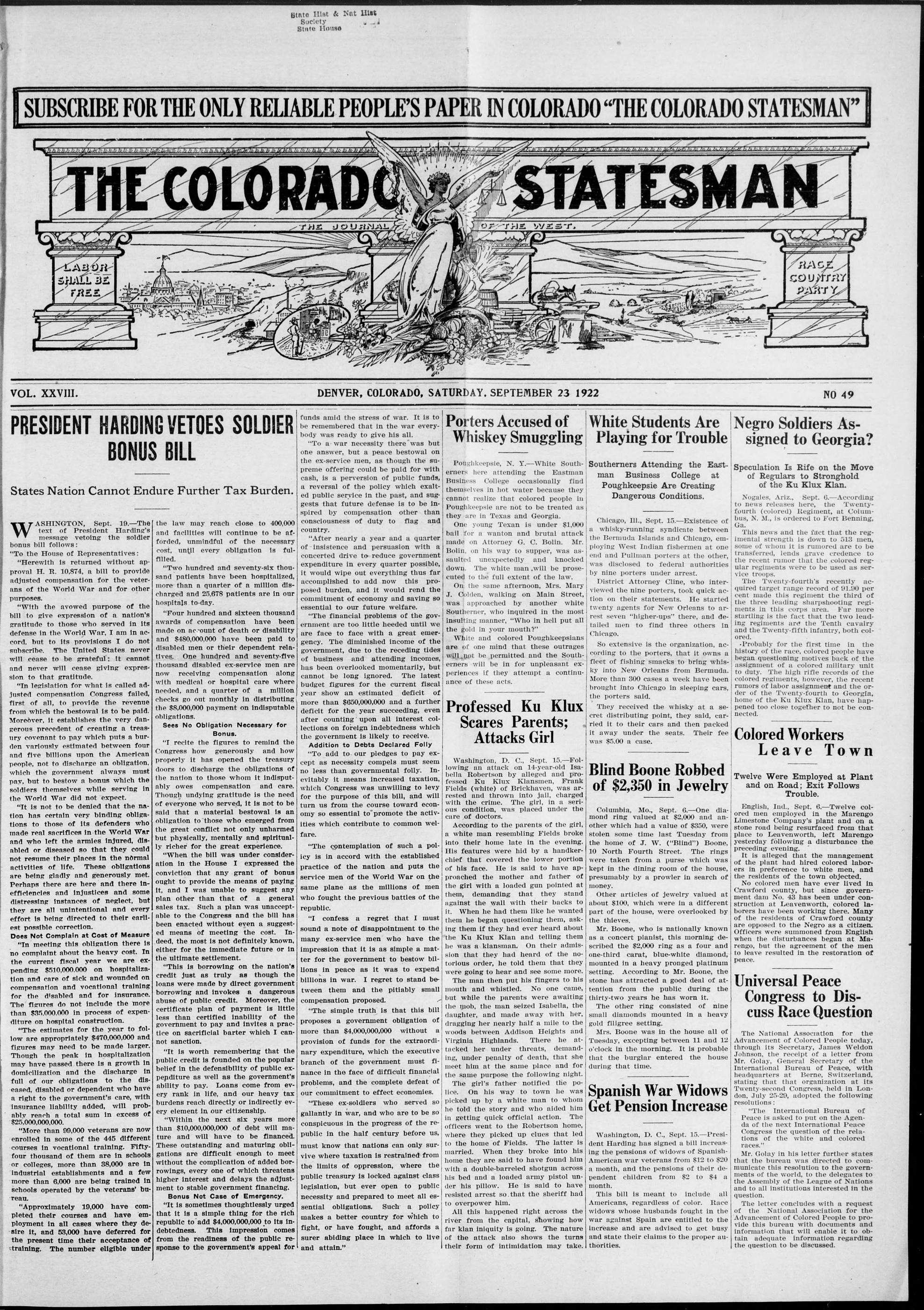
SUBSCRIBE FOR THE ONLY RELIABLE PEOPLE'S PAPER IN COLORADO "THE COLORADO STATESMAN"
THE COLORADO STATESMAN
THE JOURNAL OF THE WEST.
LABOR SHALL BE FREE
RACE COUNTRY PARTY
PRESIDENT HARDING VETOES SOLDIER BONUS BILL
States Nation Cannot Endure Further Tax Burden.
VOL. XXVIII.
PRESIDENT HARDIN
BONUS
States Nation Cannot En
WASHINGTON, Sept. 19.—The text of President Harding's message vetoing the soldier bonus bill follows:
"To the House of Representatives:
"Herewith is returned without approval H. R. 10,874, a bill to provide adjusted compensation for the veterans of the World War and for other purposes.
"With the avowed purpose of the bill to give expression of a nation's gratitude to those who served in its defense in the World War, I am in accord, but to its provisions I do not subscribe. The United States never will cease to be grateful; it cannot and never will cease giving expression to that gratitude.
"In legislation for what is called adjusted compensation Congress failed, first of all, to provide the revenue from which the bestowal is to be paid. Moreover, it establishes the very dangerous precedent of creating a treasury covenant to pay which puts a burden variously estimated between four and five billions upon the American people, not to discharge an obligation, which the government always must pay, but to bestow a bonus which the soldiers themselves while serving in the World War did not expect.
"It is not to be denied that the nation has certain very binding obligations to those of its defenders who made real sacrifices in the World War and who left the armies injured, disabled or diseased so that they could not resume their places in the normal activities of life. These obligations are being gladly and generously met. Perhaps there are here and there inefficiencies and injustices and some distressing instances of neglect, but they are all unintentional and every effort is being directed to their earliest possible correction.
Does Not Complain at Cost of Measure
"In meeting this obligation there is no complaint about the heavy cost. In the current fiscal year we are expending $510,000,000 on hospitalization and care of sick and wounded on compensation and vocational training for the disabled and for insurance. The figures do not include the more than $35,000,000 in process of expenditure on hospital construction.
"The estimates for the year to follow are appropriately $470,000,000 and figures may need to be made larger. Though the peak in hospitalization may have passed there is a growth in domicilization and the discharge in full of our obligations to the diseased, disabled or dependent who have a right to the government's care, with insurance liability added, will probably reach a total sum in excess of $25,000,000,000.
"More than 99,000 veterans are now enrolled in some of the 445 different courses in vocational training. Fifty-four thousand of them are in schools or colleges, more than 38,000 are in industrial establishments and a few more than 6,000 are being trained in schools operated by the veterans' bureau.
"Approximately 19,000 have completed their courses and have employment in all cases where they desire it, and 53,000 have deferred for the present time their acceptance of training. The number eligible under
the law may reach close to 400,000 and facilities will continue to be afforded, unmindful of the necessary cost, until every obligation is fulfilled.
"Two hundred and seventy-six thousand patients have been hospitalized, more than a quarter of a million discharged and 25,678 patients are in our hospitals to-day.
"Four hundred and sixteen thousand awards of compensation have been made on account of death or disability and $480,000,000 have been paid to disabled men or their dependent relatives. One hundred and seventy-five thousand disabled ex-service men are now receiving compensation along with medical or hospital care where needed, and a quarter of a million checks go out monthly in distributing the $8,000,000 payment on indisputable obligations.
Sees No Obligation Necessary for Bonus.
"I recite the figures to remind the Congress how generously and how properly it has opened the treasury doors to discharge the obligations of the nation to those whom it indisputably owes compensation and care. Though undying gratitude is the need of everyone who served, it is not to be said that a material bestowal is an obligation to those who emerged from the great conflict not only unharmed but physically, mentally and spiritually richer for the great experience.
"When the bill was under consideration in the House I expressed the conviction that any grant of bonus ought to provide the means of paying it, and I was unable to suggest any plan other than that of a general sales tax. Such a plan was unacceptable to the Congress and the bill has been enacted without even a suggested means of meeting the cost. Indeed, the most is not definitely known, either for the immediate future or in the ultimate settlement.
"This is borrowing on the nation's credit just as truly as though the loans were made by direct government borrowing and invokes a dangerous abuse of public credit. Moreover, the certificate plan of payment is little less than certified inability of the government to pay and invites a practice on sacrificial barter which I cannot sanction.
"It is worth remembering that the public credit is founded on the popular belief in the defensibility of public expenditure as well as the government's ability to pay. Loans come from every rank in life, and our heavy tax burdens reach directly or indirectly every element in our citizenship.
"Within the next six years more than $10,000,000,000 of debt will mature and will have to be financed. These outstanding and maturing obligations are difficult enough to meet without the complication of added borrowings, every one of which threatens higher interest and delays the adjustment to stable government financing."
Bonus Not Case of Emergency.
"It is sometimes thoughtlessly urged that it is a simple thing for the rich republic to add $4,000,000,000 to its indebtedness. This impression comes from the readiness of the public response to the government's appeal for
DENVER. COLORADO. SATURDAY. SEPTEMBER 23 1922
funds amid the stress of war. It is to be remembered that in the war everybody was ready to give his all.
"To a war necessity there was but one answer, but a peace bestowal on the ex-service men, as though the supreme offering could be paid for with cash, is a perversion of public funds, a reversal of the policy which exalted public service in the past, and suggests that future defense is to be inspired by compensation other than consciousness of duty to flag and country.
"After nearly a year and a quarter of insistence and persuasion with a concerted drive to reduce government expenditure in every quarter possible, it would wipe out everything thus far accomplished to add now this proposed burden, and it would rend the commitment of economy and saving so essential to our future welfare.
"The financial problems of the government are too little heeded until we are face to face with a great emergency. The diminished income of the government, due to the receding tides of business and attending incomes, has been overlooked momentarily, but cannot be long ignored. The latest budget figures for the current fiscal year show an estimated deficit of more than $650,000,000 and a further deficit for the year succeeding, even after counting upon all interest collections on foreign indebtedness which the government is likely to receive.
Addition to Debts Declared Folly
"To add to our pledges to pay except as necessity compels must seem no less than governmental folly. Inevitably it means increased taxation, which Congress was unwilling to levy for the purpose of this bill, and will turn us from the course toward economy so essential to promote the activities which contribute to common welfare.
"The contemplation of such a policy is in accord with the established practice of the nation and puts the service men of the World War on the same plane as the millions of men who fought the previous battles of the republic.
"I confess a regret that I must sound a note of disappointment to the many ex-service men who have the impression that it is as simple a matter for the government to bestow billions in peace as it was to expend billions in war. I regret to stand between them and the pitiably small compensation proposed.
"The simple truth is that this bill proposes a government obligation of more than $4,000,000,000 without a provision of funds for the extraordinary expenditure, which the executive branch of the government must finance in the face of difficult financial problems, and the complete defeat of our commitment to effect economies.
"These ex-soldiers who served so gallantly in war, and who are to be so conspicuous in the progress of the republic in the half century before us, must know that nations can only survive where taxation is restrained from the limits of oppression, where the public treasury is locked against class legislation, but ever open to public necessity and prepared to meet all essential obligations. Such a policy makes a better country for which to fight, or have fought, and affords a surer abiding place in which to live and attain."
Porters Accused of Whiskey Smuggling
Poughkeepsie, N. Y.—White Southerners here attending the Eastman Business College occasionally find themselves in hot water because they cannot realize that colored people in Poughkeepsie are not to be treated as they are in Texas and Georgia.
One young Texan is under $1,000 bail for a wanton and brutal attack made on Attorney G. C. Bolin. Mr. Bolin, on his way to supper, was assaulted unexpectedly and knocked down. The white man will be prosecuted to the full extent of the law.
On the same afternoon, Mrs. Mary J. Colden, walking on Main Street, was approached by another white Southerner, who inquired in the most insulting manner, "Who in hell put all the gold in your mouth?"
White and colored Poughkeepsians are of one mind that these outrages will not be permitted and the Southerners will be in for unpleasant experiences if they attempt a continuance of these acts.
Professed Ku Klux Scares Parents; Attacks Girl
Professed Ku Klux Scares Parents; Attacks Girl
Washington, D. C., Sept. 15.—Following an attack on 14-year-old Isabella Robertson by alleged and professed Ku Klux Klanmen, Frank Fields (white) of Brickhaven, was arrested and thrown into jail, charged with the crime. The girl, in a serious condition, was placed under the care of doctors.
According to the parents of the girl, a white man resembling Fields broke into their home late in the evening. His features were hid by a handkerchief that covered the lower portion of his face. He is said to have approached the mother and father of the girl with a loaded gun pointed at them, demanding that they stand against the wall with their backs to it. When he had them like he wanted them he began questioning them, asking them if they had ever heard about the Ku Klux Klan and telling them he was a klansman. On their admission that they had heard of the notorious order, he told them that they were going to hear and see some more.
The man then put his fingers to his mouth and whistled. No one came, but while the parents were awaiting the mob, the man seized Isabella, the daughter, and made away with her, dragging her nearly half a mile to the woods between Addison Heights and Virginia Highlands. There he attacked her under threats, demanding, under penalty of death, that she meet him at the same place and for the same purpose the following night. The girl's father notified the police. On his way to town he was picked up by a white man to whom he told the story and who aided him in getting quick official action. The officers went to the Robertson home, where they picked up clues that led to the home of Fields. The latter is married. When they broke into his home they are said to have found him with a double-barreled shotgun across his bed and a loaded army pistol under his pillow. He is said to have resisted arrest so that the sheriff had to overpower him. All this happened right across the river from the capital, showing how far klan iniquity is going. The nature of the attack also shows the turns their form of intimidation may take.
White Students Are Playing for Trouble
Southerners Attending the Eastman Business College at Poughkeepsie Are Creating Dangerous Conditions.
Chicago, Ill., Sept. 15.—Existence of a whisky-running syndicate between the Bermuda Islands and Chicago, employing West Indian fishermen at one end and Pullman porters at the other, was disclosed to federal authorities by nine porters under arrest.
District Attorney Cline, who interviewed the nine porters, took quick action on their statements. He started twenty agents for New Orleans to arrest seven "higher-ups" there, and detailed men to find three others in Chicago.
So extensive is the organization, according to the porters, that it owns a fleet of fishing smacks to bring whisky into New Orleans from Bermuda. More than 300 cases a week have been brought into Chicago in sleeping cars, the porters said.
They received the whisky at a secret distributing point, they said, carried it to their cars and then packed it away under the seats. Their fee was $5.00 a case.
Blind Boone Robbed of $2,350 in Jewelry
Columbia, Mo., Sept. 6.—One diamond ring valued at $2,000 and another which had a value of $350, were stolen some time last Tuesday from the home of J. W. ("Blind") Boone, 10 North Fourth Street. The rings were taken from a purse which was kept in the dining room of the house, presumably by a prowler in search of money.
Other articles of jewelry valued at about $100, which were in a different part of the house, were overlooked by the thieves.
Mr. Boone, who is nationally known as a concert pianist, this morning described the $2,000 ring as a four and one-third carat, blue-white diamond, mounted in a heavy pronged platinum setting. According to Mr. Boone, the stone has attracted a good deal of attention from the public during the thirty-two years he has worn it.
The other ring consisted of nine small diamonds mounted in a heavy gold filigree setting.
Mrs. Boone was in the house all of Tuesday, excepting between 11 and 12 o'clock in the morning. It is probable that the burglar entered the house during that time.
Spanish War Widows Get Pension Increase
Spanish War Widows Get Pension Increase
Washington, D. C., Sept. 15.—President Harding has signed a bill increasing the pensions of widows of Spanish-American war veterans from $12 to $20 a month, and the pensions of their dependent children from $2 to $4 a month.
This bill is meant to include all Americans, regardless of color. Race widows whose husbands fought in the war against Spain are entitled to the increase and are advised to get busy and state their claims to the proper authorities.
NO 49
Negro Soldiers Assigned to Georgia?
Speculation Is Rife on the Move of Regulars to Stronghold of the Ku Klux Klan.
Nogales, Ariz., Sept. 6.—According to news releases here, the Twenty-fourth (colored) Regiment, at Columbus, N. M., is ordered to Fort Benning, Ga.
This news and the fact that the regimental strength is down to 513 men, some of whom it is rumored are to be transferred, lends grave credence to the recent rumor that the colored regular regiments were to be used as service troops.
The Twenty-fourth's recently acquired target range record of 91.90 per cent made this regiment the third of the three leading sharpshooting regiments in this corps area. Far more startling is the fact that the two leading regiments are the Tenth cavalry and the Twenty-fifth infantry, both colored.
Probably for the first time in the history of the race, colored people have began questioning motives back of the assignment of a colored military unit to duty. The high rifle records of the colored regiments, however, the recent rumors of labor assignment and the order of the Twenty-fourth to Georgia, home of the Ku Klux Klan, have happened too close together to not be connected.
Colored Workers Leave Town
Colored Workers Leave Town
Twelve Were Employed at Plant and on Road; Exit Follows Trouble.
English, Ind., Sept. 6.—Twelve colored men employed in the Marengo Limestone Company's plant and on a stone road being resurfaced from that place to Leavenworth, left Marengo yesterday following a disturbance the preceding evening.
It is alleged that the management of the plant had hired colored laborers in preference to white men, and the residents of the town objected.
No colored men have ever lived in Crawford county, but since government dam No. 43 has been under construction at Leavenworth, colored laborers have been working there. Many of the residents of Crawford county are opposed to the Negro as a citizen. Officers were summoned from English when the disturbances began at Marengo, but the agreement of the men to leave resulted in the restoration of peace.
Universal Peace Congress to Discuss Race Question
Universal Peace Congress to Discuss Race Question
The National Association for the Advancement of Colored People today, through its Secretary, James Weldon Johnson, the receipt of a letter from Mr. Golay, General Secretary of the International Bureau of Peace, with headquarters at Berne, Switzerland, stating that that organization at its Twenty-second Congress, held in London, July 25-29, adopted the following resolutions:
"The International Bureau of Peace is asked to put on the Agenda of the next International Peace Congress the question of the relations of the white and colored races."
Mr. Golay in his letter further states that the bureau was directed to communicate this resolution to the governments of the world, to the delegates to the Assembly of the League of Nations and to all institutions interested in the question.
The letter concludes with a request of the National Association for the Advancement of Colored People to provide this bureau with documents and information that will enable it to obtain adequate information regarding the question to be discussed.
FOREIGN
Serious damage is believed to have resulted from a typhoon which recently swept over the Philippines. It is reported that the typhoon was severest in northern Luzon.
A French note was received in London offering French co-operation in defending the Turkish straits, but deprecating the warlike tone of the British semi-official statement of Saturday.
Russia intends to support the Turks morally, and perhaps will give them munitions, if they should be needed; but it is considered in Moscow as extremely unlikely that Russian troops will be sent to assist the Kemalists if they attempt to take Constantinople, soviet officials indicated.
John H. Clark, American cashier of the Atlantic, Gulf and West Indies Petroleum Corporation in Tampico, was wounded seriously and his Mexican chauffeur killed when six bandits held up their automobile less than half a mile from Tampico and robbed them of pay roll funds amounting to 42,000 pesos. The Hungarian foreign committee of parliament at Budapest heard the government's explanations concerning the allegations that it was concerned in the recent plot against the Rumanian royal family. Premier Bethlen declared the incident was "merely a maneuver against Hungary's good reputation."
With the utter collapse of the Greek army in Asia Minor before the Turks, the long smoldering Near Eastern problem again confronts Europe and in some quarters is considered as constituting a threat against the peace and well being of Europe, owing to the differing interests and conflicting views of the principal allied governments.
Ten republicans and six nationalists were killed in a conflict at Eris, in County Mayo, when the republicans, retreating from Ballina, were attacked by government troops. The military were at a disadvantage, as they had no machine guns, and they suffered severely in the earlier stages of the fight. Later their accurate markmanship took a heavy toll from the republicans.
With British troops intrenched at strategic points on the Dardanelles, French and Italian battalions rushing to join them, and from far New Zealand word that an Anzac contingent will be dispatched to the scenes of their hericiac sacrifices in the late war, to assist in dealing with the Turkish Nationalists, there has been a swift carrying into effect of the allied pronouncements regarding a firm determination to preserve the freedom of the Dardanelles and the Bosphorus.
GENERAL
Walter Allen, one of those held responsible for the Logan county mine war last summer, was convicted to Charleston, W. Va., for treason against the state of West Virginia, with the recommendation that he be sentenced to serve ten years in the state penitentiary. The jury was out only forty-six minutes.
An international co-operative body for promoting police efficiency through all countries, and to be known as the world police conference, came into being at the national police conference in New York. The present membership of the organization is comprised only of the heads of police departments of cities of this country. A committee of one was appointed to devise a secret, confidential code, to be used by the world organization.
Police of Canton, Ohio, are hoping that Joseph Nola, husband of one of the women murdered in the triple staying in Canton, can give them information that will lead them to the capture of the crusher who beat two women and a man to death with an iron bar. Mr. and Mrs. Frank Burns were beaten to death in their home and their slayer waited until Mrs. Mary Nola and Luther Armstrong entered the house, killed Mrs. Nola and wounded Armstrong, who escaped and called police. One of the greatest present menaces to the prosperity of the United States is the unwillingness of large groups of people "to accept any result of government regulation which are not directly adverse to the development of the railways," declared Samuel O. Dunn, editor of Railway Age, in an address before the Des Moines Chamber of Commerce.
Applicants for admission to Harvard University will be asked to state whether "any change has been made since their birth in their names or the names of their fathers," it became known in Cambridge. The appearance of this and similar queries on the questionnaires was said to result from the movement initiated last spring to limit enrollment of persons of certain races.
Developments in the United States air mail service within a year will include a twenty-eight-hour mail service between New York and San Francisco and the air mail to the interior of Alaska, Second Assistant Postmaster General Paul Henderson said in an address in New York City to the Aeronautical Chamber of Commerce and Aeronautical executives at the Automobile Club of America.
A destructive fire that originated in a building at the rear of the Wilson hotel at Platte, S. D., destroyed nearly two blocks of business houses and the Chicago, Milwaukee & St. Paul passenger station. Only the newspaper office and one other small concrete building remain north of the spot where the Wilson hotel stood. The 1922 world series baseball championship will open Oct. 4 in New York City, it was decided in Chicago at a meeting of National and American League representatives here. Last year's prices will prevail.
THE WORLD IN PARAGRAPHS
A BRIEF RECORD OF PASSING EVENTS IN THIS AND FOR-EIGN COUNTRIES.
IN LATE DISPATCHES
IN LATE DISPATCHES
DOINGS AND HAPPENINGS THAT
MARK THE PROGRESS
OF THE AGE.
WESTERN
Seventy thousand acres of forest fires are burning in California, according to dispatches received in Washington by the United States Forest Service from its San Francisco office. Three fires on the Shasta National Forest have burned over 19,000 acres. With a total of 97,740 visitors this season, Yellowstone Park has broken all records for travel and leads its nearest rival, Yosemite Park in California, by more than 2,500 tourists, according to figures announced by Horace M. Albright, superintendent of the Yellowstone.
James E. Mahoney, convicted of murder of his aged and wealthy wife, Kate M. Mahoney, in April, 1921, was sentenced in Superior Court at Seattle, Wash., to be hanged Dec. 1. Mahoney's counsel gave notice of an appeal to the Supreme Court of the United States.
Seven men were injured in a fire in the engine room and crews' quarters of the motorship William Donovan, a lumber carrier. The vessel was saved from destruction by flooding the hold and permitting it to sink in the harbor at Los Angeles. Damage was estimated at $75,000.
Wage increases for mine workers in all mines of the Coeur d'Alene mountains will be effective on Oct. 7, it was announced at Wallace, Ida. Miners will receive a 75-cent increase to $5 a day; muckers will receive a 50-cent wage increase to $4.50; timber men will get a 75-cent increase to $5.50.
Connection between the Argonaut mine at Jackson, Calif., where forty-seven men entombed more than three weeks, and the adjoining Kennedy mine resulted in the discovery of the bodies of all the men. Formal announcement was made that the crew on the 3,600-foot level, all members of which are Argonaut miners, had won the $5,000 bonus offered by the mine officials to the first crew to break into the Argonaut.
Edward F. Winkler, a member of a band of six men who attempted to hold up the Golden State Limited on the Chicago, Rock Island & Pacific at Jaynes station, six miles from Tucson, Ariz., on May 15, was arrested in Albuquerque. He admitted his identity and told officers a detailed story of the attempted holdup in which H. Stewart, an express messenger, killed Tom Dupat, one of the holdup men, and foiled the plans of the band.
WASHINGTON
The Senate adopted the conference report on the new Republican tariff bill, thereby completing Congressional action on the legislation.
With his open palm, Representative Oliver, Democrat, Alabama, gave Representative Dempsey, Republican, New York, a slap on the cheek in the House the other day during the hubbub which usually attends calling of the roll, and then as he was attempting to strike a second time, members rushed between them. As explanations came later, the House found that the encounter was due to a misunderstanding.
Mrs. Harding, now safely on the road to complete recovery from her recent serious illness, probably will spend the entire recuperative period at the White House.
The soldiers' bonus bill was vetoed by President Harding. In returning the measure to Congress without his approval, the Executive in a message to the House declared that he was in accord with the avowed purposes of the bill, but that he could not subscribe to its provisions.
Without a record vote the House approved the conference report on the soldiers' bonus bill. The measure now goes to the Senate, and with final action there it will be sent to President Harding. An effort to send the soldiers' bonus bill back to conference for the insertion of a land reclamation option failed.
Approval by Congress of the rates on dyes agreed upon by the Senate and House conferees will mean the "final doom" of the newly created American chemical industry, Dr. Charles H. Herty, president of the Synthetic Organic Chemical Manufacturers' Association of the United States, declared in Washington.
The highest coal production since the big strike was called on April 1 was attained last week when between 10,200,000 and 10,500,000 tons were produced, the geological survey announced at Washington. Of this amount, between 900,000 and 950,000 tons were anthracite.
This week is expected to mark the close of second session of the sixty-seventh Congress. Enactment of the tariff bill and final disposition of the soldiers' bonus bill are expected to provide the principal features of the closing week of legislation.
LATE NEWS
From All Over
COLORADO
COMING EVENTS.
Sept. 25-30- Colorado State Fair, Pueblo.
Oct. 3-5- Douglas County Fair, Castie Rock.
Oct. 3-6- Kit Carson County Fair, Burlington.
Sterling.—After the 1922 Logan county fair cl sed here many exhibitors removed their displays to the Fort Morgan fair.
Brighton.—The Adams county annual fair was a huge success from the point of view of thrilling horse races, huge attendance and splendid cattle exhibits, which, in quality and number, have set a record of excellence.
Denver.—The city council voted District Attorney Philip S. Van Cise a special appropriation of $15,000 with which to prosecute cases against alleged bunco men arrested during the district attorney's recent raids.
Loveland.—The National Home for Dependents of Members of the Yeoman organization will be established near Namaqua, three miles west of Loveland. The site has been purchased and a home to cost $50,000 will be erected. Pueblo.—One thousand feet of track was torn up and twelve cars of fruit were dumped into the Ankansas river when a fast freight train was derailed in the Royal gorge. All traffic was held up, the eastbound trains being held up at Salida and the westbound trains at Pueblo. The cause of the wreck is unknown.
Glenwood Springs.—W. F. Brown of Denver, traffic manager of the Mountain States Telephone and Telegraph Company, was elected president of the Colorado Public Service Association here. J. F. Dostal of Colorado Springs was elected president of the Rocky Mountain division of the National Electric Light Company. Greeley.—Colorado-made goods were given the hearty indorsement of the American Legion at the state convention of the former service men here. They adopted a resolution indorsing the Colorado-made goods movement as an effort to "develop the common wealth by creating opportunities for employment within the state."
Craig.—John Zingre, a wealthy hotel man of Switzerland, in company with Swiss Consul Paul Weiss of Denver, has been investigating conditions in Moffat county, as envoy of 500 young Swiss farmers, who desire to immi- grate to this country and form a colony, having been thrown out of employment in their native country. Fort Collins.—The digging of sugar beets in the Fort Collins district, according to the officials of the Great Western Sugar Company, will be begun Sept. 27, and the factory will open Sept. 29 or 30. Delivery of beets to the factory will be restricted until Oct. 8, by which time the factory will be ready to receive beets at its various dumps at full harvest speed.
Denver.—Colorado has 167 fewer predatory animals as a result of August operations of federal and state hunters, according to Stanley P. Young of Denver, in charge of predatory animal control. One hundred and twelve coyotes, forty-two bobcats, two lynx and one predatory brown bear were killed. The number exceeds the August record of several recent summers. Denver.—Fire Prevention week will be observed in Colorado from October 2 to October 9, according to a special proclamation issued by Governor Shoup at the statehouse. "Only by arousing the public to the appalling situation created by our excessive fire waste can the evil be corrected," the executive declared. All civic organizations and societies of the state were asked to arrange special educational programs for the week.
Pueblo.—Oscar Kronke, night man at the Continental filling station at Lake and Northern avenues, was perhaps fatally injured when he grappled with Elmer Beasley, lone bandit, who attempted to hold up the station. Beasley was captured and is in jail. Akron.—Julian Dies, a laborer, employed in the railroad yards here, was shot and instantly killed by local officials while resisting arrest. A short time before Dios had shot an officer in the foot, and the sheriff accompanied by other officers, was called to place him under arrest. When accosted by the sheriff he immediately opened fire and was killed almost instantly when they returned his fire.
Denver.—Abandonment of the Silverton Railway Company, between Silverton and Ouray, Colo., has been authorized by the Colorado Public Utilities Commission. The order permitting the discontinuance of service and tearing up of the narrow-gauge tracks was entered following a long hearing on the application of the road before the state commission several months ago. It was declared the railroad has failed to return a profit for more than ten years.
Loveland.—The Rocky Mountain Boys' camp has been purchased by John H. Stevens of Chicago. He plans to make the camp near Loveland one of the nation's greatest recreation centers for boys. The camp was established two years ago by Dr. John Timothy Stone of Chicago.
Glenwood Springs.-To permit the enrolling of gas companies in its membership, the Colorado Light, Power & Railway Association at its nineteenth annual convention here, voted to change the name to the Colorado Public Service Association.
CENTENNIAL STATE ITEMS.
Denver.—The following is a complete list of nominations for state offices, on both Republican and Democratic tickets that will appear on the general election ballot, Tuesday, Nov. 7, 1022. For Governor: Republican, Benjamin Griffith. Democratic, William E. Sweet. For Lieutenant Governor: Republican, Robert F. Rockwell. Democratic, Walter F. O'Brien. For Congressman: First Congressional District, Rep., William N. Valle. Benjamin Hilliard. For Congressman, Second Congressional District, Rep., Charles B. Timberlake. Dem., Dr. C. M. Worth. For Congressman, Third Congressional District: Rep, Guy U. Hardy. Dem., Chester B. Horn. For Congressman, Fourth Congressional District: Rep, Merle C. Vincent. Dem., Edward T. Taylor. For Justice of Supreme Court (full term): Rep, John W. Sheafer. Dem., William A. Hill. For Justice of Supreme Court (to fill vacancy): Rep, John Campbell. Dem., Francis E. Bouck. For Secretary of State: Rep, Carl S. Milliken. Dem., James R. Norland. For Auditor: Rep, Arthur M. Stong. Dem., William H. McNichols. For Treasurer: Rep, Harry E. Mulinix. Dem., Wesley Staley. For Attorney General: Rep, Willard B. Gordon. Dem., Russell W. Fleming. For Superintendent of Public Instruction: Rep, Katherine L. Craig. Dem, Mary C. C. Bradford. For Regents of University of Colorado: Rep, Clark G. Mitchell and C. F. Parker. Dem., F. W. Lockwood and Clifford W. Mills.
Aspen.—Aspen, one of the great mining camps of the state, whose production of the white metal amazed the world in the past and was a factor in the demonetization of silver, is on the eve of a revival which will surpass its palmiest days. The treasure vaults of this camp are being opened with surprising results. Such oldtime producers as the Aspen, Durant, Hope, Newman, Smuggler and many others are again on a productive basis. New enterprises have been started, mills have been remodeled, roads and tramways have been built—all this activity has resulted in an increase in both the output of ore and population of the district.
Las, Animas.—Forrest, the 12-year-old son of Mr. and Mrs. Asa Bowman, lies in the Las Animas hospital with both feet almost severed from his legs as the result of an accident at the Bowman ranch, twenty-six miles south of here. The father was cutting hay and the boy went to the field to be with him and thought to play a joke on his father by hiding in the tall grass. As the mower approached the boy jumped up and the team became frightened and leaped forward, bringing the sickle against the boy's legs.
Pueblo.—The largest cash transaction ever handled by the Pueblo county sheriff's office took place when the land and water rights of the Cucharas Land and Water Company were sold to J. Will Johnson of Pueblo for $400,000. The company properties include the Cucharas reservoir and dam, over twenty miles of main irrigation ditches, the townsite of Wilson and other properties. The sale was made to satisfy a foreclosure judgment recently issued out of District Court.
Denver.—"Appalling situation at Smyrna has made necessary a nationwide appeal for relief," read a part of a telegram received by the Near East relief last week from James L. Barton, national chairman of the Near East relief. Following the receipt of this telegram, machinery immediately was put in motion in all parts of Colorado to collect $100,000 for the immediate relief of the sufferers of the scourge of the Turks in their massacre and burning of Smyrna.
Aspen.—Joseph Miller, an employé at a construction camp near this city, has been arrested, charged with the murder of a fellow employé, George Toness, aged 35. The police state that Miller in a fight slashed Toness with a knife across the abdomen.
Glenwood Springs.—The civil service commission certified to the Postoffice Department the names of Olie Thorson, Miss Laura W. Hammond and John C. Moser as the three receiving the highest grades and made eligible for appointment as postmaster at Glenwood Springs. One of this number will be recommended for appointment. The examination was held July 18.
· Estes Park.—A crusade against illiteracy is to be featured in the year's work of the National Federation of Women's Clubs under the branch of applied education, of which Mrs. John Dickinson Sherman of Estes Park and Chicago is chairman. This was indicated at the opening session of the Colorado Federation of Women's Clubs here.
Denver.—Contracts have been let for construction work on Colorado's newest industry—a plant for the manufacture of carbon-black, at White River, Rio Blanco county, by the Rio Blanco Carbon Company, recently organized in Denver, now fully financed and prepared to erect a factory, according to Thomas J. Dixon, its president.
Denver.—The primary vote fell far below that of 1920. In that year for governor there was a total vote cast in the state of 120,658, and in Denver of 32,687, and for United States senator in the state 129,483 and in Denver 36,607. About 24,000 voted in Denver, while the vote in the state was under 100,000.
Rocky Ford.—Elmer Forbes, an automobile salesman, is being held here in connection with the death of Edward Henderson, his friend, who was fatally shot several days ago while riding with Forbes near Pueblo.
IMPERIAL CAFE
MR. AND MRS. E. R. PAGE, PROPS.
Our Service Is Unsurpassed
715 EAST 26TH AVE.
Ladies' and Gents' Tailoring, See
H. ANDERSON
MERCHANT TAILOR
ing, Pressing and Repairing. All Work
Guaranteed
720 EAST 26TH AVE.
ONE MAIN 6751 Prices reasonable.
I'd see my Fall and Winter Samples now on display.
For Ladies' a
H. A
Cleaning, Pressi
720
PHONE MAIN 6
Call in and see my Fa
Cleaning, Pressing and Repairing. All Work Guaranteed
720 EAST 26TH AVE.
PHONE MAIN 6751 Prices reasonable.
Call in and see my Fall and Winter Samples now on display.
HOWARD & HOWARD
HOWARD & HOWARD
GROCERIES AND MEATS
Fresh Vegetables and Fruits Daily
Fresh Home-made Bread, Rolls, Cakes and Pies Daily
Free Delivery to any part of the city.
PHONE MAIN 6338 718 E. TWENTY-SIXTH AVE.
GROCERY
Fresh Veg
Fresh Home-made
Free Deliver
PHONE MAIN 6338
THE CHAPTER
Is
DRUGS, CHEMIC
W
PRESCRIPT
Phone us and we will
JAMIE
GROCERIES AND MEATS
Fresh Vegetables and Fruits Daily
Home-made Bread, Rolls, Cakes and Pies Daily
Free Delivery to any part of the city.
MAIN 6338 718 E. TWENTY-SIXTH AVE.
CHAMPA PHARMACY
2101 CHAMPA
Is the place to get your
S, CHEMICALS AND PATENT MEDICINES
WE SERVE DRINKS.
PRESCRIPTIONS OUR SPECIALTY.
and we will deliver the goods to all parts of the city.
JAMES E. THRALL, Propr.
MAIN 2425 PHONE 8444
W. K. HUNT
THE CHAMPA PHARMACY
Is the place to get your
DRUGS, CHEMICALS AND PATENT MEDICINES
WE SERVE DRINKS.
PRESCRIPTIONS OUR SPECIALTY.
Phone us and we will deliver the goods to all parts of the city.
JAMES E. THRALL, Propr.
PHONE MAIN 2425 PHONE 8444
W. K. HUNT
Sweet Spuds, the best there are.
We handle n
e handle nothing but the best Meats.
We handle nothing but the best Meats.
CALL AND GIVE A TRIAL
We Now Har
COURTESY
Now Handle Fresh Dressed Chickens
We Now Handle Fresh Dressed Chickens
RTESY AND SERVICE TO ALL
COURTESY AND SERVICE TO ALL
WEAT
HAT
MEN'S AND WOMEN'S
PANAM
1722 STOUT STREET
GRANBERRY T
Office
PHONE MAIN 3203
EATHERHEAD
HAT FACTORY
ESTABLISHED 1876
O WOMEN'S UNCLAIMED HATS FOR SALE—FELTS,
PANAMAS AND WHITE MILANS
T STREET
ALBANY HOTEL BLDG.
ERRY TAXI AND BAGGAGE CO.
Office 2741 Welton Street.
WEATHERHEAD
HAT FACTORY
ESTABLISHED 1876
MEN'S AND WOMEN'S UNCLAIMED HATS FOR SALE-FELTS,
PANAMAS AND WHITE MILANS
1722 STOUT STREET
ALBANY HOTEL BLDG.
T
Quick and Prompt Service
on
If you have a room
NO CHARGE
ompt Service Day and night. Call Us for Special Rates on Out-of-Town Trips.
have a room for rent or want a room call us.
NO CHARGE FOR THIS INFORMATION
Quick and Prompt Service Day and night. Call Us for Special Rates on Out-of-Town Trips. If you have a room for rent or want a room call us. NO CHARGE FOR THIS INFORMATION
```markdown
```
PHONE MAIN 2425
CHAMPA 3522
C. E. Weatherhead
OFFICE
PHONE
CHAMPA
87-88
First-Class Meals at All Hours
OPEN DAY AND NIGHT
ur Service Is Unsurpassed
VE. PHONE MAIN 2759
Miloring, See
SON
ing. All Work
VE.
prices reasonable.
ples now on display.
EATS
Suits Daily
Pies and Pies Daily
of the city.
ENTY-SIXTH AVE.
ARMACY
our
MENT MEDICINES
SPECIALTY.
all parts of the city.
propr.
PHONE 8444
2962 WELTON
best Meats.
ssed Chickens
CE TO ALL
C. B. Weatherhead
HEAD
FACTORY
S FOR SALE--FELTS,
ILANS
BANY HOTEL BLDG.
BAGGAGE CO.
et.
Us for Special Rates
a room call us.
MATION
Can Please You
OFFICE
PHONE
CHAMPA
87-88
CONTRACT LET FOR GIANT DIRIGIBLE
WAR DEPARTMENT DECIDES
THAT WE CAN'T GET ALONG
WITHOUT SUCH AIRSHIPS
WILL USE HELIUM GAS ONLY
New Vessel Will Be of Semi-Rigid Type and Will Be Equipped With Suspension Landing Devices for Airplanes.
Washington.—After mature consideration the War department has decided that the United States cannot get along safely without giant dirigible airships equal to those built by any other nation. In some quarters regret is expressed that the conference on the limitation of armaments did not place some limitation on dirigibles. As things stand there is bound to be an unrestricted race between nations in this sort of construction. Contracts for the first giant dirigible of American make and American design have been closed. The great airship will be somewhat larger than the Il-fated Roma and, if successful as a flyer, will be tried out as an airplane carrier.
The chief of the army air service says that a series of experiments with suspension landing devices for airplanes had been arranged for the Roma before she was destroyed, and the same experiments it is now intended shall be carried out with the new ship. These devices, it is understood, are intended to provide a base for landing and departure at any height in the air. The American-made ship will be built under the direction of the building company's engineers and those of the army working together. The vessel will be of the semirigid type, as was the Roma, will be 300 feet in length and have a gas bag capacity of 750,000 cubic feet.
No kind of gas will be used in the new aircraft except helium, as a necessary protection against fire, which destroyed within the year both the giant ZR-2 and the Roma. Construction of the ship has not yet begun, and when it does it is estimated that one year and six months will be required before it is completed.
Cruising Radius of 4,000 Miles.
Engineers claim that the new craft will have a cruising radius of 4,000 miles, which would enable it easily to cross the Atlantic ocean. They plan that on low speed its engines shall be capable of maintaining a speed of $44\frac{1}{2}$ miles an hour and on high speed 70 miles an hour.
All details as to the landing devices or heavier-than-air machines on the big gas-supported ship are at present being kept a secret, though the general scheme of seizing the smaller machines by some appartus suspended below the great dirigible is indicated by the War Department engineers. On the new army dirigible airplanes can be carried and dropped with the airship in full flight. Likewise an airplane can fly underneath the dirigible and be picked up with a big hook and hoisting apparatus and brought up on board while the ship is flying 60 miles an hour. It will have two power cars and a navigator's car, all attached to the metal keel of the ship. It will be capable of making the 3,000-mile trip from New York to San Francisco or from Liverpool to New York at a speed of 50 miles an hour, completing the journey in 60 hours.
Delano Service is Started.
The first two Red Cross nurses to engage in a missionary form of service provided for in the will of the late Jane A. Delano, who died in France while director of the nursing service of the American Red Cross, have been detailed for duty in Alaska and in the islands off the Maine coast. Miss Bertha B. Steeves, formerly superintendent of the Ottawa (Can.) hospital, and long in nursing and settlement work, has been selected for the Alaskan field. Miss Stella Fuller, a graduate of the Milwaukee training school, who served with the A. R. C. in France during the war, takes up the work in Maine.
The conditions of the bequest require that the nurses selected be so situated that demands of dependents will not interfere with their work. In addition to being enrolled Red Cross nurses, candidates for the distinction must have had two years' experience in public health nursing, be qualified to teach, and be not less than thirty years old. Miss Delano's purpose in endowing this special service as a memorial to her father and mother was to create nursing facilities in isolated districts where no funds are available from governmental or other agencies or from individuals. The Delano nurses will be under the supervision of the American Red Cross.
A memorial in recognition of the achievements of Miss Delano in the form of a monument is to be erected by popular subscription on the grounds of the Red Cross national headquarters in Washington at a cost of $50,000. It will stand as a shrine commemorating not only Miss Delano, but all American nurses who responded to the call of their country in the World war.
To Improve Health of Indians.
In order to test the feasibility of public health nursing and general welfare work on the Indian reservations, the Red Cross is inaugurating a survey in the Navajo, Pima and Popoago and other reservations in Arizona, New Mexico and South Dakota. This work
is being done at the request of Charles H. Burke, United States commissioner of Indian affairs, and will cover one year. Mr. Burke, having in view the improvement of health conditions among the Indians and a demonstration of organized service among the various tribes to prove whether it is possible to instruct Indian mothers particularly in health methods, urgently requested that the Red Cross assign trained personnel to the task.
"I am very solicitous to get into the Indian service some young women trained for welfare work," said Mr. Burke. "I know what the American Red Cross has done in encouraging the counties in the various states to employ county nurses. I am sure if we have some co-operative assistance it will show that it is possible greatly to improve health conditions on the reservations."
Great Value of Geophone.
Great Value of Geophone.
As the result of experiments made by the bureau of mines, the geophone, a novel instrument used amid the reek and slaughter of the World war for the detection of earth and rock sounds made in the construction of military mines and tunnels, promises to become an active factor in the saving of the lives of miners entombed as the result of fires and explosions. In the course of tests conducted in the bureau's experimental coal mine near Pittsburgh, blows with a sledge on the coal face were heard, by means of the geophone, at a distance of 650 feet, with various rooms and entries intervening.
On a suspended pipe fine, light hammering with the knuckles was detected at a distance of 1,500 feet. Ordinary talking and singing could be detected through 150 feet of solid coal. By the use of two geophones, one instrument to each ear, it is possible to determine the direction from which a sound is coming through the earth, and thus to locate the approximate position of an entombed miner. The bureau gives recommendations for a signal code of poundings by sledges or other means which will establish communication between the rescuing party and those entombed.
Another promising use of the geophone is in the location of leaks in water pipes. By means of the instrument is is possible to hear water circulating in the pipes of ordinary city mains situated 10 to 15 feet below the surface. Tests conducted at a busy corner in the downtown district of Pittsburgh located a leak in a water main which the water company had for two weeks vainly sought to detect.
It's a Small Seismograph.
The mine geophone is sensitive, yet extremely simple and easily portable. The instrument was invented by the French during the war to detect sapping and underground mining operations. It was developed by the United States engineers, and the instruments now used by the bureau of mines were made according to plans drawn by them, except for the introduction of different diaphragms. The geophone is essentially a small seismograph, as it embodies the same principles as the ponderous apparatus that records earthquake tremors. It really consists of a lead weight suspended between two electric diaphragms cutting across a small air-tight box. If the instrument is placed on the ground and anyone is pounding or digging in the vicinity, energy is transmitted as wave motion to the earth, and the earth waves shake the geophone case. The geophone, therefore, transforms the earth wave into an air wave, which is heard by the ear as sound, and at the same time magnifies the wave so that the sound is louder than if the ears were placed in direct contact with the earth.
The observations of the bureau of mines indicate that the geophone should be quite useful in the location of mine fires. Usually a mine fire makes enough noise, either by drawing air or by breaking off slate and coal, to be heard for a considerable distance through the coal and even through the strata above. The distance that these sounds can be heard depends a great deal on the nature of the strata above the mine, yet the sounds originating at a mine fire should be detected through 100 to 300 feet of cover and through 500 to 800 feet of coal.
Geophones supply a quick and fairly accurate method of mine surveying. If two tunnels were being brought together from any direction, the progress of the tunnels could be observed by means of the geophones, and their relative positions determined.
Another application of the possibilities of the instrument in mine surveying is in the prevention of accidents in blasting through. If two tunnels are approaching each other, or are passing a short distance apart, it is necessary to determine the relative location in order that men may be warned to keep away from the point of danger. As the sounds transmitted through the geophone are so characteristic, frequent observation would enable a trained observer to follow the progress of the work in the opposite tunnel. He would thus be able to tell when blasts were to be fired.
Occasionally churn-drill holes are dropped from the surface to mine workings for running pipes and for ventilation. When these borings come for considerable distances they sometimes drift, and instead of breaking through into the workings, they come down into the solid. The question then is to locate them and to determine whether or not the hole is deep enough to come into the workings. Here the geophone finds a useful field, for not only the direction of the hole, but its elevation can be determined accurately.
PUBLIC TRUSTEE'S SALE.
No. 2244.
Whereas, Henry N. Carman, by deed of trust, dated the 20th day of September, 1918, which is recorded in book 2835, page 23, of the records in the office of City and County of Denver, Colorado, duly conveyed to the Public Trustee and for the City and County of Denver, Colorado, the following described estate, Colorado, to-wit. Lots Seven (7), Eight (8), Nine (9) and Ten (10), in Block Sixty (60), Curtis and Clark's Addition to Denver, which deed of trust was made to secure the date of death, Colorado, to-even the date with said deed of trust, for the sum of Six Thousand ($6,000.00) dollars, payable to the order of Richard J. Moran, on or before three (3) years after the date, in the thereof at six per cent per annum until paid. interest payable semi-annually, as is more particularly set forth in said deed of trust, reference to which is hereby made for greater certainty,
Whereas, The said Henry N. Carman and all persons claiming by, through or under him, having defaulted in the payment of the said note, and the legal holder of said note, having elected on account of said default to declare said note unpaid, due and payable, therefore, at the written request of F. F. Scidmore and C. A. Cline, the legal holders of said note, pursuant to law, I, the undersigned, Public Trustee in and for the City of Denver, hereby give notice that I will, at the hour of 10 o'clock in the forenoon of TUESDAY, SEPTEMBER 25, 1922, at the Tremont Street front door of the Denver, Colorado, sell at public auction, to the highest and best bidder for cash, the said described premises, and all the right, N. Carman, his heirs and assigns therein, for the purpose of paying the indebtedness secured by said deed of trust, and the cost and expenses incurring this trust, and will deliver to the legal holder of certificate of sale as provided by law.
PRESENTED
Dated at Denver, Colorado, August
24th, 1922.
EDWARD M. SABIN.
24th, 1922. EDWARD M. SABIN,
Public Trustee in and for the City and
Public Trustee in and for the City and County of Denver, Colorado
First publication, August 26, 1922.
Last publication, September 23, 1922.
PUBLIC TRUSTEE'S SALE.
2246
Whereas, Bernice B. Morrell, by deed of trust, dated the 27th day of October, 1521, which is recorded in book 3395, page 127, of the records in the office of the City and County of Denver, Colorado, duly conveyed to the Public Trustee in and for the City and County of Denver, Colorado, the following described real estate in the City and County of Denver, bounded by the City and County nine (9) and ten (10), in block number five (5). First Addition to Berkeley, subject to Liquor Clause in Warranty deed recorded in Book 808. Page 255. City and County, which deed of trust was made to secure the payment of her promissory note of even date with said deed of trust, for the sum of fourteen hundred and fifty ($1,450.00) dollars, payable to the City and County, E. Gates, two years after the date thereof, with interest thereon at seven per cent per annum until maturity, interest payable quarterly, as is more particularly set forth in the deed of trust, referred to which is hereby made for greater certainty; and.
Whereas, The said Bernice B. Morrell, and all persons claiming by, through or under her, having deed or interest note for $25.38 due April 27th, 1922, also in the payment of the coupon interest note for $25.38 due July 27th, 1922, and the legal holder of said note, having elected on account of said default note, said note unpaid, due and payable.
Now, therefore, at the written request of F. E. Gates, the legal holder of said note, pursuant to a warrant in Trucks in, and for the City and County of Denver, Colorado, do hereby give notice that I will, at the hour of 10 o'clock in the foreground of TUESDAY, OCTOBER 29th, 1922, at the front door of the Court House, in the City and County of Denver, Colorado, sell at public auction, to the highest and best bidder for cash, the said described premises, and at the highest and best bidder for Bernice B. Morrell, her heirs and assigns therein, for the purpose of paying the indebtedness secured by said deed of trust, and the cost and expenses of ex-merchant credit, and will determine to the purchaser a certificate of sale as provided by law.
Dated at Denver, Colorado, August
30th, 1922.
EDWARD M. SABIN,
Boston, Massachusetts.
EDWARD M. SABIN,
Public Trustee in and for the City and
Gov't of New York.
First publication, September 9, 1922.
Last publication, October 7, 1922.
Solid Brass, wooden handle
8 1/2 inches long weight 4 ounces.
given as a present to all who take advantage of our great
BIG OFFER NO. 1144
JUST WRITE TO US AND SAY:—
"I would like to get a hair straightening and shampoo comb free. Send me particulars regarding your No. 1144 offer."
Be sure and write your name and address plainly, and full particulars will be sent you.
Do not write to-day for this offer will not last long. We are doing this to advertise Ford's Hair Pomade and Ford's Hair Straightening and Shampoo Combs.
Address your letter to
THE OZONIZED OX MARROW CO.
WARSAW
ILLINOIS
FOR RENT—Nicely furnished room for gentleman in quiet family within easy reach of two car lines. 426 Twenty-fourth street. Phone Main 7417.
Two nicely furnished rooms for rent at 2917 Marion street. Gentlemen or man and wife. Telephone York 6250W.
NOTICE.
Dr. T. E. McClain, pioneer dentist, has opened his new electrical office with Dr. J. H. P. Westbrook, Sixteenth and Larimer streets, Good block. Office phone, Main 7416.
Mahogany.
A cork dipped in a mixture of equal parts of oxalic acid and water on then rubbed over the stains on a mahogany plano will remove them. When the stains have disappeared, wash the wood well with clear water and polish as usual.
DON'T MISS THIS BARGAIN! FOR THE MONTH OF SEPTEMBER ONLY
—starts the Western Electric Washing Machine in your home. The rest you can arrange to pay on EASY TERMS.
Don't fail to take advantage of the unusual offer of so dependable a machine at such convenient terms.
The Denver Gasand Electric Light Co.
OPEN MONDAY
MIGHTS CLUB
SOFT DRINKS
STARTING THE FALL SEASON WITH A
The very newest and most approved styles, pure woolens, artistically fashioned, being determined to gain and to deserve a reputation as Denver's greatest clothing store. See the Window.
Olive Introduced into America.
During the course of the emigration to the new-found land, the Spaniards brought the seeds of the olive tree with them. As far as historians and eminent agriculturists can determine, the olive tree was not a habitat of the western hemisphere, and since it had been known to have been transplanted all over the Mediterranean region, it is not unreasonable to suppose its origin in this country can be attributed to its having been brought here.
Orthographical Verification
It is the common opinion that the Irish dearly love a scrap and that without something to stir their passions they would become dull and spiritless. Is this opinion justified? We can only answer, in our flippant way, that obviously the "Ire" cannot be removed from "Ireland" without at the same time removing a portion of its "elan."—Boston Transcript.
Curious South-Sea Jargon.
Beach-in-mer is a curious jargon which has developed as a means of communication between English-speaking traders and the islanders of the western Pacific. It derives its name from that of an edible marine organism, the fishing of which flourished in the South sens in the middle of the last century. Nearly all the words in this language are English, but they are strung together by the natives in accordance with the rules of their own speech.
Good Plot Everything.
A plot, after all, is a design to which everything else must be subordinated if the reader's attention is to be enticed and enthralled. Rude life may not conform to this design, and the psychologist may despise it, yet there is no such thing as a good novel that has not a good plot.—Francis Hackett.
STAR HAIR GROWER A Wonderful Hair Dressing and Grower. 1,000 AGENTS WANTED.
THE WORLD'S FINEST HAIRDRESSER
send $1.00 and we will send you a full supply that you can begin work with at once: also agent's terms.
Send all money by money order to
THE STAR HAIR GROWER MF'R.,
P. O. Box 812, Greensboro, N. C.
$1.00 DOWN
Electric Washing Machine in your
own EASY TERMS.
vantage of the unusual offer of so d
terms.
Gasand Electric
Yell CHAMPA 410
CHAMPA 26
No Accidents
AVAILABLE AND CONFIDENTIAL
Organized 1908
GASAWAY WALTON, Owner
THE
STAR HAIR
A Wonderful Hair Dress
1,000 AGENTS
send $1.00 and we will send you a f
work with at once; also agent's ten
Send all money by money order to
THE STAR HAIR C
P. O. Box 812,
Mark Twain says that when Bret Harte came east in 1870 to take the editorship of the proposed Lakeside Magazine in Chicago, that he crossed the continent in such a prodigious blaze of national interest and excitement that one might have supposed that he was the viceroy of India or a progress of Halley's comet come again after 75 years of lamented absence.
Made
We want agents in every city and village to sell
THE
STAR HAIR
CROWER.
This is a wonderful preparation. Can be used with or without straightening irons and by any person.
One 25 cents box proves its value. Any person that will use a 25c box will be convinced.
No matter what has failed to grow your hair, just give THE STAR HAIR GROWER a trial and be convinced. Send 25c for full size box. If you wish to become an agent for this wonderful preparation. a full supply that you can begin terms. or to GROWER MF'R., Greensboro, N. C.
Miss C. L. S. send us the following which she receive direct from the lady referred to: Marjory, five years old, after hearing for the first time the story of Eve and the apple, remarked: 'You know, Miss Smith. I think the trouble was that tree wasn't sprayed, and Eve should never have eaten an apple off of a tree that wasn't sprayed. You never can tell what will happen.'"—Boston Transcript.
THE COLORADO STATESMAN
Entered as second-class matter at the postoffice in the City of Denver, Colo.
Recognized by the Retail Merchants' Bureau of the Denver Civic and Commercial Association as an advertising medium.
JOSEPH D. D. RIVERS..... Proprietor
P. O. Box 116 1824 Curtis Street, Room 25 Phone Main 7417
SUBSCRIPTION RATES.
One year.....$2.00
Six months.....1.25
Three months......75
Reading notices, ten lines or less, 15 cents per line. Each additional line over ten lines, 12 cents per line. Display advertising, 75 cents per square for first insertion and 50 cents per square for each additional insertion.
first insertion and the first insertion should be made by express money order, postoffice money order, registered letter or bank draft. Postage stamps will be received the same as cash for fractional part of a dollar. Only 1c and 2c stamps taken. Communications to receive attention must be news, upon important subjects, plainly written only upon one side of the paper, must reach us Tuesdays if possible, anyway not later than Wednesdays, and bear the author. No manuscript or personal nature, stamps are sent for postage. All communications to the personal nature that are not complimentary will be audited from the columns of this paper.
CHRISTIANITY MUST ANSWER.
AN EDITORIAL of more than passing interest, under the above caption, appeared in the Rocky Mountain News one day this week, inspired, doubtless, by the recent horrible massacres of Christians by the Turkish army throughout Asia Minor. The writer advances the opinion that much of the human slaughter could have been avoided had the Christian nations dealt more sternly with the Turkish government when they had her begging for mercy at a critical hour during the world war. No doubt this is true. But a weak-kneed policy prevailed at an hour when rigid diplomacy should have been manifest, and as a result as barbarous a foe as ever threatened civilization is at this moment triumphant and the lives and liberties of hundreds of thousands of Christians are in jeopardy. The situation is deplorable indeed, and it is small wonder that the whole civilized world is being called upon at this time for contributions to a large fund to aid the stricken ones of Smyrna and its surroundings. Far more deplorable than the awful plight of those "keepers of the faith" within the ancient citadel—Constantinople—is the deplorable fact that in an hour of opulence and prosperity the Christian nations of the world, without exception, become vanglorious, selfish and tyrannical. In the present drive to give relief to those sufferers of the Near East our own dear United States, erroneously referred to often as the most advanced Christian nation on earth, will give generously of her prayers and money. Doubtless there will be a certain ease of conscience in the knowledge that we are again being called upon to serve in the role of the good samaritan and do what can be done to lighten the horrors of a people at the mercy of fanatics who imagine they are doing God's work by murdering innocents who have a different way of worshipping God. There is an evident smack of hypocrisy about the whole thing, however. The mischief is; there is now an attempt to lock the barn door at an unseemly hour. Christian nations are seeking to atone in dollars and cents for what it failed to do by precept and example. The question is asked, "Why tolerate or countenance Turkey in Europe at all?" and Christianity is being called upon for an answer. But there is serious business on this side of the water also and Christianity is again being called upon to give an answer. Why countenance or tolerate lynching, mob violence and the burning of human beings at the stake within the borders of the United States? The Near East has its serious problems, but no more so than the nearer west. In Asia Minor it is the murderous Mohammedan against the helpless Christian. In the United States it is Christian against Christian. There is found here a lack of social conscience and courage of utterance that tragically marks Christianity's departure from the ideals of its founder. Else why辱辱 the Dyer bill? CHRISTIANITY MUST ANSWER.
THE PRESIDENT AND THE BONUS BILL.
PRESIDENT Harding sums up in a sound and comprehensive manner his reasons for returning to Congress the soldier's bonus bill without executive approval. The President's action was freely forecasted by party leaders close to him as it was definitely understood that he held strong objections against any adjusted compensation legislation that did not carry with it a substantial means of raising the revenue. It goes without the saying that President Harding's action will blast the hopes of many, but we believe that by far the major portion of our citizens will place the stamp of approval upon his veto message as a step founded upon a sound governmental policy.
He says with emphasis what every patriotic American citizen must feel in his heart, i. e., "That the United States never will cease to be grateful; it cannot and never will cease giving expression to that gratitude." Of those injured disabled or diseased during the great world war he says:
"It is not to be denied that the nation has certain very binding obligations to those of its defenders whom made real sacrifices in the world war and who left the armies injured, disabled or diseased so that they could not resume their places in the normal activities of life. These obligations are being gladly and generously met. Perhaps there are here and there inefficiencies and injustices and some distressing instances of neglect, but they are all unintentional and every effort is being directed to their earliest possible correction.
No Complaint As to Cost.
"In meeting this obligation there is no complaint about the heavy cost. In the current fiscal year we are expending $510,000,000 on hospitalization and care of sick and wounded on compensation and vocational training for the disabled and for insurance. The figures do not include the more than $35,000,000 in process of expenditure on hospital construction."
These are sentiments that certainly will be applauded by all right thinking citizens, for while a deep conviction abides in every heart that the nation owes a debt of gratitude to defenders living and defenders dead that can never be fully repaid, it is a mandatory requirement to look first of all after those who are incapacitated for useful employment by the sacrifice of health or loss of limbs. The President deals at length upon the nations inability to meet the heavy financial drainage upon the treasury by the enactment of this bill. From the first, both he and Congress have been far apart as to the best means of raising the needed revenue. He is not willing, as the executive head of this nation, to further impair the public credit by a compensation bestowed upon 5,000,000 people, to meet which a heavy burden must be placed upon 110,000,000. And in this he is right. The world is still groaning under the heavy cost of the war. There is an insistent cry arising from every quarter for rigid economy in public expenditures. And while it would be parsimonious, economy for this rich nation to definitely withhold from its brave defenders any bestowal of gratitude, no matter how rich, it is plain, following the President's reasoning, that the means suggested in the bill just passed are wholly inadequate. It would be an unfortunate error on the part of any President, and certainly a disastrous blunder on the part of any political party, to assume a blunt attitude that in the aggregate meant a denial to our soldier boys the fullest meed of compensation. American sentiment and justice could not and would not countenance it. We must as surely meet our obligations to the brave boys who gave added glory and honor to our country's flag, as that we met the enemy on foreign land. Let no one despair. A bonus bill worthy of our traditions and worthy of our gratitude will be forthcoming. Just now, however, President Harding takes the high ground that "The pressing problem of the government is that of diminishing our burdens, rather than adding thereto. It is the problem of the world. War inflations and war expenditures have unbalanced budgets and added to indebtedness until the whole world is staggering under the load. We have been driving in every direction to curtail our expenditures and establish economies without impairing the essentials of governmental activities. It has been a difficult and unpopular task. It is vastly more applauded to expend than to deny.
"After nearly a year and a quarter of insistence and persuasion with a concerted drive to reduce government expenditure in every quarter possible, it would wipe out everything thus far accomplished to add now this proposed burden and it would render the commitment of economy and saving so essential to our future welfare."
By HUBERT WORK, U. S. Postmaster General.
I would make an appeal for the relief of those who work with both head and hand from those who work only with their hands and who are being exploited by leaders for their immediate personal gain.
124
Those labor organizations which restrict the available employment in a community to its preferred members and prohibit other members from seeking employment where they may find it, have not in mind the principles of unionism and collective bargaining. They are blindly bidding for the open shop; the competition of disorganization within their own ranks and a return to the old method of wage determination by efficiency, governed by the law of supply and demand, rather than by their own formulated rules.
As one who believes in the principles of unionism, and in collective bargaining, I would warn all organized labor that sanctions or commits violence that, although the laws may be diverted, or may be tardy in execution, and although public sentiment is slow to anger, yet the 100,000,000 of unorganized people in the United States will surely control public sentiment, will frame their laws and will compel their enforcement, for the greatest union of all is the union of the Stars and Stripes.
One half of organized labor is conservative. They are home owners and their children become good citizens. They must very soon break away from those in their own crafts who disregard the rights and necessities of others, who do not approve or practice the creed "An honest day's work for an honest day's wage," or who are willing to do murder to kill competition.
The pageant of savagery that recently stalked abroad by day in Illinois, still unrebuked, would have pallored the painted Indian. Have these people wholly forgotten God?
A strike in an industry essential to the public welfare without violence cannot succeed, and a strike with violence defeats itself.
---
"Let's Get Together and Elect Misers, Sour Balls, Grouches, Tightwads"
By T. W. ROSS. Somewhere in Oregon.
Just now everyone is complaining about high taxes. The real fault behind the unholy burden of taxes is that we have elected to office good fellows, handshakers, name rememberers, baby-kissers, spenders, good-natured drunkards, heroes, relatives of relatives, orators, lawyers and prominent citizens.
Yet we need stingy, successful business men in public office, men who would be just as close with public money as they are with their own, and men who would get a dollar and ten cents of worth for every dollar of public money spent. There are hundreds of such men who couldn't bear to spend your money or my money recklessly, because their mind is developed that way, instead of being warped to squander money because it is money.
We are now paying for the orgies of friendly, neighborly and criminal graft that the handshakers, good fellows, have slipped us for years. Let's get together and elect misers, sour-balls, grouches and tightwads, who have made money for themselves, lived within their incomes; men who wouldn't lend you a dime without a dollar security and bonus. The remedy is easy; never vote for the good fellows, lodge brothers, smilers, spenders or orators, but for the miserly cuss you dislike because he wouldn't loan his money or someone else's money to you or your sister's husband, or uncle or best friend, without their right arm for security.
```markdown
```
Care and Education of the Dependent or Orphaned Child of the Soldier
The child life of America is the chief and most important asset. The duty of the state and the government to dependent child life is supreme from an economic standpoint were all decent and humane considerations forgotten.
To the dependent or orphaned child of a soldier the state and the government owes that duty for special reasons.
The soldier has given, shortened or incapacitated his life in service to his country, in defense of its institutions, in preservation of the government itself. All material prosperity depends upon this service rendered. All material wealth, therefore, is obligated to that service, and if it took it all to compensate, to provide for the care, decent contentment and restoration of the soldier or his dependents, left so by reason of his service, there is no reason why it should not be contributed.
Every consideration, religious, economic and patriotic, dictates the necessity of adequate provision for and education of the dependent or orphaned child of the soldier.
This care and education should include the manual and professional training of a child for usefulness in life as well as scholastic and religious training.
Outgrowth of Mistaken Viewpoint of the Public in Regard to Fire
By W. E. MALLALIEU, Nat'l Fire Protective Ass'n.
The major part of our waste by burning is really an outgrowth of the mistaken viewpoint of this general public in regard to fire. Too many persons still think that only the fire insurance companies should worry when a fire occurs. They do not stop to consider that the institution of insurance is simply a form of protection for which the many contribute to pay the losses of the comparatively few.
Few stop to consider the part which the fire waste plays in increasing these taxes; that when buildings are destroyed by fire, and not rebuilt, the taxes those properties would have yielded are added, pro rata, to the remaining structures. Neither do they realize that localities where many fires occur must maintain large fire departments, with increased budgets for men and equipment, water supply, alarm system and other necessary items of defense.
The colossal fire waste is endangering our economic future. Consequently our people must be taught in the press, in the schools and by public speaking, first, the unnecessary burden imposed by preventable fire, and, second, the way in which to eliminate it.
The Denver & Rio Grande Western Railroad System STEADY JOBS
for QUALIFIED RAILROAD MECHANICS To Take the Place of Strikers STANDARD WAGES WITH SENIORITY RIGHTS DATING FROM TIME OF EMPLOYMENT AS PRESCRIBED BY THE United States Railroad Labor Board
Applicants for work should apply at room 309 Denver Union Station, or the office of the Superintendent of Motive Power, Shop Superintendent, Master Mechanic or Shop Foreman at Denver, Burnham, Pueblo, Salida, Minturn, Grand Junction, Montrose, Ridgway, Gunnison, Alamosa, Chama, Salt Lake City, Ogden, or any Local Agent. JOSEPH H. YOUNG, Receiver The Denver and Rio Grande Western Railroad System
THE DENVER DRY GOODS CO.
Outing Flannel Nightshirts and Pajamas
A special showing of UNIVERSAL BRAND Nightshirts. Made especially for us, these garments are perfect fitting, finely finished and of a serviceable quality.
Outing Domet and Teagle Down Flannels, regular and extra sizes; plain, silk braid or frog trimmed. Priced according to quality, $1.50, $2.00 and $2.50.
Several styles in beautifully tailored Pajamas. They come in the same quality materials as the nightshirts. Plain or trimmed with silk frogs or braid. Priced according to quality, per suit, $1.50, $2, $2.50, $3 and $3.50.
Seems So.
ARE YOU
GUILTY?
A FARMER carrying an express package from a big mail-order house was accosted by a local dealer.
"Why didn't you buy that bill of goods from me? I could have saved you the express, and besides you would have been patronizing a home store, which helps pay the taxes and builds up this locality."
The farmer looked at the merchant a moment and then said:
"Why don't you patronize your home paper and advertise? I read it and didn't know that you had the stuff I have here."
MORAL—ADVERTISE
One reason why it would be a waste of money to maintain a chorus girl's home is that no chorus girl ever gets old enough to retire.
Kansas Lesson in History.
This era has no corner on clever men. Eumenes, an ancient Greek, borrowed money from his enemies, to keep them from killing him.—Atchlson Globe.
Women Careful With Letters
Women, as a rule, are more careful in addressing their letters than are the men, according to a veteran attacke of the dead letter office in Washington.
Curious Currency.
On Renneu island, the least visited in the Pacific, the only currency consists of the teeth of flying foxes; the island is surrounded by walls of coral limestone over 300 feet high.
Sealing Wax Etiquette
In the days when all correspondence was sealed there was etiquette about the use of sealing wax. Royalty would give some favorite courtier the sole right to use a certain colored wax, and officers of the state would each have distinguishing colors, in much the same way as staff officers of the army wear colored "tabs" nowadays.
Some users of printing save pennies by getting inferior work and lose dollars through lack of advertising value in the work they get. Printers as a rule charge very reasonable prices, for none of them get rich although nearly all of them work hard. Moral: Give your printing to a good printer and save money.
Votes of British Parliament Chlefs.
The difference between the speaker of the English house of commons and the lord chancellor, who occupies a similar position in the house of lords, is that while the speaker cannot take part in debates and can vote only when there is a tie, the lord chancellor is entitled to speak and vote on all occasions.
Ravages by Rats.
It has been estimated that the economic loss from rats in the United States is $200,000,000 a year. In other estimates before the war, the annual damage in the United Kingdom was $70,000,000. As a carrier of bubonic plague and other diseases, the rat is charged with the loss of more human lives than all the wars in history.
G. A. Haynes of Chicago, Ill., is visiting his sister, Mrs. H. J. M. Brown of 1115 Inca Street.
Mrs. Ida B. Redwood left last Sunday for Chicago to visit relatives and friends.
Mrs. Louise Burrell of Chapelton, Colo., left last week for Duluth, Minn., where she will spend a few weeks.
passed away early Sunday morning at St. Luke's hospital after a brief illness. Mrs. Cooper, before her marriage to Dr. George Cooper, a prosperous veterinary surgeon at Rogge Colo., was a well-known Denver girl and a social favorite among the younger set. Her death will prove a decided shock to all. Besides her grievedicken husband and parents, she leaves a small baby just two weeks old. THE COLORADO STATESMAN
A very pretty dancing party was given at Old Colony Hall Wednesday night by the young ladies of the Narcissus Literary and Art Club.
Mrs. Frances Ratley was hostess to a delightful affair Wednesday afternoon, complimentary to the Pollyanna Whist Club.
Troop No. 50 of Shorter A. M. E. Church resumed their meetings last Saturday evening with a good feed for the boys.
Dr. W. S. Ellington Lampton, of Nashville, Tenn., arrived in the city last Wednesday, en route to Los Angeles, Calif. While in the city he was the guest of Attorney E. P. Blakemore.
Mrs. Robert Mitchell of 2744 Marion Street, one of our city's leading dressmakers, is undergoing treatment by a specialist this week for nasal troubles.
Curtis J. Williams, son of James Williams, popular city barber at Bolden's Famous Tonsorial Parlors, left for Wilberforce University to pursue his studies in higher education.
Mrs. Charlotte Anderson, mother of Mrs. Allie Spencer of 2819 California Street, and niece, Miss Clara Holland, both of Kansas City, Mo., are visiting Mrs. Spencer. Miss Holland left today for Salt Lake City.
Mrs. Booker T. Washington, Jr., arrived this week to accompany her childred to Los Angeles. The youngsters were here for a few months, the guests of Mr. and Mrs. Robert Russ, 2612 South Logan Street.
Mrs. Josephine Hamilton of Chicago, who has spent the summer in Denver as the guest of her sister, Mrs. Henry Weston, left for her home Wednesday afternoon.
Mayzelma Stell, daughter of W. Chester Stell, returned to the city after spending her vacation a few miles beyond Boulder, Colo. Miss Stell, who appears in the best of health, rejoined her class this week at the East Denver High School, from which she will graduate next spring.
Visiting guests at the Fairbanks Café, 2444 Washington Street: Mr. and Mrs. C. L. Philips, Memphis, Tenn.; Mr. W. Broaden, St. Joseph, Mo.; Mr. L. C. Mays, Omaha, Neb.; Mr. and Mrs. L. L. Buccana, Atlanta, Ga.; Mr. M. C. Cole, Kansas City, Mo.; Miss L. Carter, Pueblo, Colo.
J. G. Guilford, teacher of practical shoemaking for over two years at Paul Quinn College, Waco, Texas, is visiting for a few days with E. R. Waite of 2737 California Street. Mr. Guilford is looking the field over with a view of permanently residing here and opening a business.
The Twenty-seventh Annual Session of the District Grand Lodge, No. 33, G. U. of O. F., Colorado and jurisdiction, convened in Billings, Mont., Sept. 11, 12 and 13, and elected the following officers for the ensuing year: Edward Miller, Helena, Mont., District Grand Master; Benjamin F. Malona, Pueblo, Colo., Deputy District Grand Master; Henry Nelson, Pueblo, Colo., District Grand Secretary; W. E. Proctor, Colorado Springs, District Grand Treasurer; T. S. Clinkscale, Denver, District Grand Director.
LUCILLE, the 5-year-old daughter of John McKettrick, 2821 California Street, who was so badly burned last Sunday morning while she was playing with matches, died at the county hospital last Monday and was buried Tuesday afternoon. Mr. McKettrick, who has been a widower for some years, has the sympathy of his many friends and associate employés of the John Thompson Grocery Company, where he is employed.
Mrs Nina Kelly Cooper, daughter of Mr. and Mrs. Chas. Van Winkle,
passed away early Sunday morning at St. Luke's hospital after a brief illness. Mrs. Cooper, before her marriage to Dr. George Cooper, a prosperous veterinary surgeon at Roggen, Colo., was a well-known Denver girl and a social favorite among the younger set. Her death will prove a decided shock to all. Besides her grief-stricken husband and parents, she leaves a small baby just two weeks old. THE COLORADO STATESMAN offers its sympathy.
Sunday morning Dr. W. S. Ellington Langston will preach the opening sermon of the "new Conference year." Subject, "Let Us Not Be Weary in Welldoing." At the evening service Rev. J. M. Endicott, the new Presiding Elder of the Albuquerque District, will preach. Special music will be furnished by the choir. Strangers given a cordial welcome.
NIGHT AND DAY CAFE UNDER NEW MANAGEMENT.
Messrs. George W. Davis and L. H. Hanna, the sole proprietors of the Night and Day Café, 1865 Curtis street, are offering the most up-to-date sanitary and best of cuisine in their catering to the appetites of all classes in the restaurant line. Thoroughly renovated, with every modern convenience for their patrons, the proprietors promise to give the best cooked meals at very moderate prices, and a trial will be the most convincing proof of what this house of edibles will do towards appeasing the merchant, the clerk and the workingman in that which delights their stomachic organ. The proprietors are popularly known, and being professionals in this line, there is every reason to believe that success will crown their efforts, which mean quite an outlay.
Y. M. C. A. NOTES.
Following the example of one boy who runs an apartment house elevator, some of the boys have formed a Readers' Club. There are nine boys in the club, and although it is only a week old, the members have read fifteen books during the past week. An effort is being made to increase the membership of the club.
The Citywide Boys' Work Committee held its first fall meeting last Thursday evening. There are twenty-one members on the committee, among them being somit of the best workers in the city. They are expecting to put over some good boys' work during the fall and winter.
Everything is in readiness for the opening of the Sunday afternoon meetings to-morrow (Sunday) afternoon. This meeting will be held at the Y. M. C. A. building at 4 o'clock, with Rev. Dr. Colman, pastor of the New Hope Baptist Church, as speaker. A large group of young men will be on hand to lead in the singing. Next Sunday afternoon (the 24th) the meeting will be held at the Scott M. E. Church, Twenty-sixth Avenue and Clarkson Street. All men are invited to attend the meeting.
CHICAGO LADY LAVISHLY EN TERTAINED BY DENVER CITIZENS.
Mrs. Ellen Turner, 5408 $ \frac{1}{2} $ Dearborn Street, Chicago, Ill., spent several days in Denver as the guest of Mr. and Mrs. W. M. Wilson, 2555 Clarkson Street. Mrs. Turner, after having spent several days, left the city Wednesday afternoon for Colorado Springs, Colo., Topeka, Leavenworth, Kansas City, Kan., and Kansas City, Mo.
While in Denver Mrs. Turner was the recipient of much of Denver's rare hospitality, as Mr. and Mrs. Wilson spared neither pains nor means that Mrs. Turner should enjoy her stay while here. Mrs. Turner made many friends in Denver through her winning disposition. She will return to Chicago the latter part of October.
DOUGLASS UNDERTAKING CO.
Funeral Notices
JIPSON—Dennis Jipson (Franklin) passed away at his late residence, 3434 Chestnut Street, on Sept. 15, 1922. Services were held from parlors Tuesday, Sept. 19, at 2 p. m., Rev. Jno. Perkins officiating. Interment G. A. r. plot, Riverside. COOPER—Mrs. Nina Kelly-Cooper, late of 2534 Franklin Street, and more recently of Keensburg, Colo., the beloved wife of Dr. George Cooper and daughter of Mrs. Charles Van Winkle, passed away at St. Luke's Hospital Sept. 17, 1922. Funeral was held from the residence, 2534 Franklin Street, Thursday, Sept. 21, at 2 p. m., Rev. W. H. Thomas officiating. Interment Fairmont.
McKITTRICK—Lucile McKittrick, beloved daughter of Mr. Dee McKittrick, departed this life Sunday, Sept.
17, 1922, at the hospital. Funeral services were held from the Cammel Undertaking Parlors. Interment at Riverside, Rev. I. S. Wilson officiating. DE NEAI—James De Neal, beloved uncle of Mrs. Albertha Hamlet, departed this life Sunday, Sept. 17, 1922, at the home of his niece, 2634 Downing. The funeral was held Wednesday from the late residence. Interment at Riverside, Rev. Thomas officiating. WHITE—Baby Eugene White, beloved nephew of Mrs. Fannie Johnson, 2526 Walnut Street, departed this life Sunday, Sept. 17, 1922, at the home of his aunt. Funeral services were held from the Cammel Undertaking Parlors. Interment at Fairmont, Rev. Wilson officiating.
MORGAN—Sophia Morgan, beloved wife of Elie Morgan, departed this life Sept. 16, 1922, at the late residence, 500 King Street. Funeral services were held Thursday, Sept. 21, 1922, from the Cammel Undertaking Parlors. Interment at Fairmont, Rev. Wilson officiating.
C. M. E. CHURCH NOTES.
Reverend C. E. Chapman, Minister
Residence 2926 Glenarm Place.
Phone Champa 4879.
The lesson of last Sunday in the Sunday School had as its subject, "The Message of Malachi," and had as its theme, "What the Bible teaches about giving." Quite a helpful hour was spent in the Sunday School. Some of the high points stressed were: Man's duty to give; the greatness of gratitude; the baseness of ingratitude, and the consequences therefor, and that there is a sure reward for the righteous.
Rev. C. E. Chapman, minister in charge, was the speaker at both services last Sunday. The morning subject was "The Poor and the Gospel." Evening subject, "Temptation—a Necessity to Human Perfection." Next Sunday there will be the usual services: Sunday School at 9:45 a. m.; praise service and preaching at 11 a. m.; praise service and preaching at 7:45 p. m. Morning subject for Sunday will be "Called Back," with the Rev. T. J. Bell., A.B., as speaker; evening subject, "Our Brightest Visions," with the Rev. C. E. Chapman, minister in charge, as the speaker. A cordial invitation is extended everybody. A hearty welcome is awaiting.
POPULAR PIONEER CITIZEN CROSSES THE BAR.
James De Neal, a citizen of Denver for upwards of forty years, who was characterized as an authority on the growth and development of Denver, as he was so often sought for information, "cossed the bar" last week Thursday, when he answered the summons brought by the Messenger—Death Born in Lowden County, Virginia, in 1856, he came to Denver, Colo., at a very early age, and had been a resident for all these years up to the time of his death. He was one of the first caterers and head waiters of the Rocky Mountain region, and instructed many of his associates to make this sphere of business professional. The deceased was very well thought of by the leading white citizens also, and in many instances their appreciation was shown to him in a marked manner.
Funeral services were held last Wednesday afternoon from the residence of his niece, Mrs. Clarence Hamlet, 2034 Downing. Rev. W. H. Thomas officiated and a number of friends paid their last respects to a man who endeard himself to all classes of the community, thereby winning their respect. He leaves a brother, sister and other relatives to mourn their loss. Interment at Riverside Cemetery. Cammel Company, funeral directors.
THE COLORADO STATESMAN offers its sincere condolence to the bereaved relatives.
WOODLAND, CALIF., NEWS.
Albert Bardalm, the son of Mrs. S. Ramus of 418 North street, who had been confined to his bed for about two weeks, departed this life Tuesday, Sept. 12, and was buried from the Second Baptist Church, of which he was a member. The Rev. J. T. Muse officiating, being assisted by Rev. J. E. Allen of Sacramento, Calif.
Rev. Muse preached a very impressive sermon. His text, "Ye Shall Pass Over This Jordan."—Joshua 1:11.
The music by the choir was conducted by Mrs. Muse, which was also very timely and impressive. The Masonic Order turned out and held their ceremonies at the Woodland cemetery. He was also a member of the Odd Fellow Lodge.
Mr. Bardain was born in Ashville, N.C. He came to Woodland with his mother when he was 7 years old. He was reared and schooled here in this city. He was a cook by trade. At the time of his death he was 35 years, 9 months and 3 days old. He leaves to mourn his loss a loving mother, Mrs. S. Ramus, step-father, W. M. Ramus, sister, Mrs. Mary Earl, one brother, several nieces and nephews, and many friends. Mr. Bardain was loved by everyone who knew him and was indeed an affectionate young man. We extend to the bereaved our heartfelt sympathy.
Mrs. C. J. Toliver of Cheyenne, Wyoming, who has been here visiting with Mrs. and Rev. Muse for the past few weeks, departed Sunday afternoon for her home in Cheyenne. Mrs. Toliver says that she will spend a couple of days at home and then leave with her husband on a trip to Chicago and other points East. Mrs. Toliver Sunday morning at the Second Baptist
Church, in her pleasant way of speaking, expressed that she had enjoyed herself most excellent while being in our city. We hope Mrs. Toliver will call again.
Rev. Muse is quite busy now getting ready for the General Association which will convene in San Francisco the first week in October.
Mr. and Mrs. Morris of Guinda, Calif., are the proud young parents of an eight-pound baby boy, born unto them a few days ago at the Mrs. M. F. Gaither's Sanitarium, Esparto, Calif.
Deacon and Mrs. Keith entertained at diner Sunday Mrs. C. J. Toliver of Cheyenne, Wyo., Rev. and Mrs. Muse, W. Clayton of Davis, Calif., M. Keith of Los Angeles, Jesse Keith, and Harold Keith.
The Second Baptist Church had excellent services at both morning and evening, Sunday. Pastor Muse's text Sunday morning was "Take ye away the stone." John 11:39. At the evening worship the text was "For I am not ashamed of the Gospel of Christ." Romans 1:16.
MADAME
T. D. PERKINS
SCIENTIFIC SCALP
SPECIALIST
THE WOMAN WHO WAS THE LADY OF THE WORLD
MADAME T. D. PERKINS
(Copyright, 1910)
Beautifying, cultivating and growing the hair; stops falling hair; split ends cured; dandruff and scalp scurf removed; causes the hair to grow soft, long and straight from the bulbs. First treatment shows wonderful results.
Have place for six new customers just now. Call in person if you live in Denver; write if out of the city, enclosing 4 cts. postage. Alcott Station, Box 5, Denver, Colo. West Thirty-fifth Avenue between Vrain and Wolf Streets, North Denver. Car 16 to West Thirty-fifth and Tennyson, walk two blocks west.
Office hours every day except Sunday, Monday and Tuesday. No phone calls answered; call in person.
More than ten thousand women using these treatments through mail. Write today.
N. A. A. C. P. Secures Release of Innocent Man
N. A. A. C. P. Secures Release of Innocent Man
After more than a year of seeking information and investigating the murder of a Mrs. Weber, whose body was found in Maryland, Joseph Keller, a colored man, charged with the commission of the crime, was on Friday, Sept. 8, 1922, released from the custody of the Maryland authorities, the evidence thus far found not warranting his detention longer. Credit is due to the Prince George County Branch of the N. A. A. C. P., as well as to the co-operation of the District of Columbia Branch, for the favorable outcome of this celebrated case.
From the time of the arrest the Prince George County Branch used every means to keep in touch with the case as it progressed, while the Washington Branch during his inocceration in the District of Columbia, observed closely the third degree process as it was used to force a confession from Keller and instituted steps, when extradition proceedings were begun, to have him released. When this failed, and he was carried to Upper Marl-
Expansion Depends Upon Earnings
THE telephone system must keep ahead of the needs of its community. That costs money. The expenditures for expansion, however, do not come from earnings, but from new money which is constantly being invested in the securities of the company.
A reasonable dividend must be paid on this investment exactly the same as reasonable wages must be paid to employees. If earnings are too low there will be no dividends and therefore no new investments and no extensions and no important betterments.
Remember that a company which is not prosperous cannot render good service nor extend its system to meet the demands of growing communities.
The Mountain States Telephone and Telegraph Co.
boro, Md., the District of Columbia Branch, advised by the Prince George County Branch, was instrumental in interesting the State's Attorney, Mr. Kline. From information furnished by the Chairman of the Legal Committee, Mr. James A. Cobb, Mr. Kline took up the matter.
On invitation of the State's Attorney, Mr. Cobb appeared at the first hearing in May, reviewed the evidence with the State's Attorney's office and was called in consultation when final reports were made by Maryland detectives and was successful in convincing them that evidence was lacking to further hold Keller. In the last conference with Justice of Peace J. A. Joyce and the State's Attorney, Mr. Cobb, was advised of the discharge of the prisoner and was asked to give assurances that when Keller was discharged he would not become a charge upon the state. Mr. Cobb assented to the proposition. Funds were furnished by the District of Columbia Branch for the transportation of Keller to his home in Summerville, S. C. Accompanied by Mr. Shelby J. Davidson, Executive Secretary of the District of Columbia Branch, and Mr. J. A. G. LuValle of the Washington Tribune, Mr. Cobb appeared at the court house located at Mt. Runier, Md., and after formalities attending the release, received Keller in the name of the N. A. A. C. P. At the adjournment of court, accompanied by the sheriff and his deputy on either side of the car, Keller was brought into the District of Columbia and sent home the following morning with his brother, who had been summoned for that purpose.
CHEYENNE WYO.NEWS
Rev. and Mrs. J. M. Endicott and Mr. and Mrs. H. C. Jefferson were dinner guests at the home of Mr. and Mrs. Henry McCormack.
Mrs. H. C. Green, formerly Miss Elizabeth Dotson, and Miss Beulah Baker have returned from a brief visit to Denver. Mrs. Green expects to spend the winter in Denver.
Mrs. Mattie Crawley entertained at an elaborate dinner Sunday afternoon. The invited guests were Presiding Elder J. M. Endicott and wife of Albuquerque District, Rev. W. T. Thornton and Clarence Toliver.
Mrs. Samuel James has returned to the city to join her husband. Mr. James is in the employ of the Union Pacific Company.
Mrs. J. H. Moss has returned to spend the winter season with her husband.
Rev. W. T. Thornton, pastor of Allen Chapel, resides in the parsonage, 1811 Thomas Street. Mrs. Thornton is expected to arrive during the month.
Rev. Thornton preached an able sermon Sunday night. "Opportunity" was the subject which furnished food for thought to an interested congregation. We have two "brand new" ministers to pastor our little city, and we will have an opportunity to prove our fidelity to the cause.
Miss Sallie Thistle of New York, formerly of Cheyenne, is the house guest of Mr. and Mrs. H. C. Jefferson.
Mrs. Al Taylor is a visitor in Cheyenne.
Mr. James Gaskin and family motored to Cheyenne from Denver, spending Sunday here. "Jim" just can't stay away.
Mrs. Clarence J. Toliver returned from a brief visit to California. At Woodland she was the guest of Rev. and Mrs. J. T. Muse.
Sometimes the weather comes in bunches like bananas, and sometimes it's all strung out like spaghetti.
Mackerel Run in Great Schools.
Some schools of mackerel are half a mile wide and twenty miles long, and are estimated to contain 1,000,000 barrels of fish.
Has the Right Idea.
A clever traveling man studies his customer and you can't blame him for regarding a stubborn man as a puzzle to be worked out as well as a human being.
Tongue of the river
The tongue of the frog is fixed to the floor of its mouth, near the lip; when not in use, the tongue lies back, pointing down the throat. The frog is very adept in the use of his tongue.
Duration of Thunder
The chief factor in the prolongation of a peal of thunder is the difference of time required for the sound to travel to the observer from different points along the path of discharge, which may be a mile, or perhaps several miles, in length. Under some conditions reflections of the sound from clouds, hills, etc., further prolongs the peal.
Our Clerics.
Little by little the jokesmith's stock in trade is being depleted through scientific discovery. An English professor now declares that people get sleepy during the sermon because they hypnotize themselves gazing fixedly at the preacher. It is not because they are inattentive, but because they are too attentive. Therefore, jokes on the subject are not knocks for the parson, but boosts.
Dogs Trained to Hunt Truffles
The truffle is an edible fungus growth found in certain parts of Europe, growing a few inches underground, and is considered a delicacy for the table. Dogs are often trained to find them. They learn to detect the presence of the truffle under the surface of the soil by a faint odor given out by the truffle. The dog, when over the spot, stops and pats the ground with his paw. Then the man digs up the truffle.
Effect of High Altitudes
At a high altitude the atmospheric pressure is much less than at sea level. This decrease in pressure produces a lowering of the temperature at which water boils. Since water can be boiled at a lower temperature, an egg can be cooked more quickly at sea level, provided the temperature is sufficiently high to cook the egg. At a height of 18,000 feet, water cannot be heated in open vessels above 180 degrees Fahrenheit, and this is not hot enough to set the white of an egg.
WASHINGTON SIDELIGHTS
Britain's War Debt to the United States
Colored Canvas Now the Proper Caper
Court by Mail and Repent at Leisure
Importance of Thrift by the People
Gt Britain
4,135,000,000
WASHINGTON.—Funding of the
$4,135,000,000 war debt owed by
Great Britain to the United States is
declared by Secretary Mellon to have
no relation to the war loans made by
the United States and Great Britain
to other governments or to questions
arising in connection with reparations
payments of the former central powers.
The treasury secretary made his declaration in a formal statement, issued, he said, on account of numerous inquiries reaching the treasury as to the exact status of the obligations of the various European governments held by the United States with respect to the British debt. Reports have been published and statements made in some quarters, Mr. Mellon said, that the British liability was not incurred for the British gov-
THOSE who use heavy canvas covers to protect their crops, machinery and materials against the weather can almost double the life of the fabric if they treat it to afford protection against light as well as moisture and mildew, the Department of Agriculture declares in a recent circular. After a series of experiments with canvas in which waterproofing mixtures were made with the addition of earth pigments, such as are used in paints, the experimenters arrived at the conclusion that keeping out the light from the inner fibers affords considerable protection to the fabric.
Since several pigments are suitable, there is more or less freedom of choice as to color, the statement continues. For a buff or khaki color, yellow ochre can be used. For a darker buff or light brown, raw sienna is good; for dark red or reddish brown, burnt sienna; for olive brown, raw umber, and for dark brown, burnt umber is added to the mixture.
The usual formulas for waterproofing canvas may be used with the addition of the earth pigment, using one pound, either dry or ground, in linseed
THE Post Office department disclaims all responsibility for the permanency of marriages effected through matrimonial advertisements in newspapers and through mail courtships.
Solicitor Edwards of the legal division of the Post Office department is daily besieged with letters from deserted brides, distraught and frantic in their short-lived marriages, asking for governmental assistance in locating runaway husbands and pleading for aid in prosecuting them.
In some instances these wives blame the postal service for their marital woes, demanding redress and insisting that as they were wooed entirely through the mails the department is directly responsible.
IN A letter to the American Banker, secretary of the Treasury Mellon explains the policy of the government in the sale of treasury savings certificates. The letter answers the appeal of the Kansas State Bankers' association requesting that the federal government stop the sale of these certificates because the practice is detrimental to the agricultural interests of that state.
The letter states that the government has no intention in its savings campaign of entering into competition with existing banking agencies and that the interests of the treasury and of the banks are not at all in conflict in the promotion of savings among the people. Secretary Mellon says that he would welcome greater co-operation from the banks of the country in the sale of treasury savings certificates to investors. The letter says in part:
"Among the early debt maturities are more than six hundred million dollars in war savings stamps, which mature on January 1, 1923. The purpose of the new issue of treasury savings certificates is to aid the government to finance these obligations and also to stimulate savings activities generally. If the habit of thrift
ermment, but for the other allies, and that the United States, in making the original arrangements, had insisted, in substance, that, though the other allies were to use the money borrowed, it was only on British security the United States was prepared to lend it. "In answer to these inquiries," Mr. Mellon stated, "it should be said the obligations of foreign governments in question had their origin almost entirely in purchases made in the United States, and the advances made by the United States government were for the purpose of covering payments for these purchases by the allies.
"The statement that the United States government virtually insisted on a guarantee by the British government of amounts advanced to the other allies is evidently based on a misprehension. Instead of insisting on a guarantee or any transaction of that nature, the United States government took the position that it would make advances to each government to cover the purchases made by that government and would not require any government to give obligations for advances made to cover the purchase of any other government. Thus, the advances to the British government, evidenced by its obligations, were made to cover its own purchases."
oil, to each gallon of the prepared solution.
The department experts have also found that a solution of dark or yellow petroleum (vaseline), beeswax, gasoline and kerosene with the desired pigment makes a good waterproofing and lightproofing mixture.
Another recipe just as good is the same as the first, substituting asphalt (petroleum or bermudez) for the beeswax.
For canvas that remains in a fixed position, such as permanent wagon covers, the circular adds, boiled linseed oil containing one pound of the desired pigment to each gallon may be used.
A typical excerpt from one of the many letters reads:
"I want to know if I can start suit against my husband. We married through a correspondent club advertised in the newspapers, and he sent me money by a post office money order to come and marry him. He also courteed me by mail. After the wedding he failed to support and take care of me, and finally left me altogether. I want to know if I can do anything through the Post Office department, as our business, such as arranging for the marriage details, was transacted entirely by mail."
In replying to the deserted wives Solicitor Edwards points out that the Post Office department deals only with the collection, dispatch and distribution of the mails and has no control over the persuasive language written in sealed envelopes by unscrupulous lovers seeking matrimonial alliances.
Of course a censorship of letters by the Post Office department would be a blow at the bulwarks of our liberty. Imagine a cynical post office official reading our letters to our best girls! And yet—just think how many fool letters would be suppressed and the work of the breach of promise courts lessened!
IS HE RIGHT?
and saving can be instilled in the minds of the people and if a small portion of the many millions of dollars annually lost through fraud and speculation can be diverted into legitimate channels a great good will have been accomplished, and the farmer, the laborer, all classes of industry and the bankers themselves will be benefited."
Secretary Mellon adds that far from being injured by this system, banking and savings institutions will reap perhaps the most tangible rewards, for no man can save and invest for long without opening a personal bank account. Those are some of the reasons why many banks throughout the country, including savings banks, are cooperating with the government in the sale of these savings securities.
WILL NOT TAKE PART IN PARLEY
U. S. DOES NOT DESIRE PART IN TURK PEACE CONFERENCE.
GREEKS ASK U. S. AID
GREEKS APPEAL FOR HELP IN CARING FOR CHRISTIAN REFUGEES.
Washington.—Suggestions in press dispatches that Great Britain would welcome the presence of the United States in the forthcoming conference on the problems of the Dardanelles, brought the statement from Washington administration officials that possible American participation is being given no consideration in Washington. Since the United States, without having been consulted, was manned in the treaty of Sevres as one of the nations to share in an international administration of the Dardanelles, suggestions for American participation in the proposed peace conference with the Angola government are not unexpected. It was emphasized, however, that whatever interest the United States may have in the ultimate disposition of the problem is confined to the necessity that free passage for American ships through these waters be assured.
Thus far, no official suggestion that this government participate in the conference has reached Washington.
Rear Admiral Bristol at Constantinople reported that his efforts to arrive at a joint plan of relief for all refugees at Smyrna with the British, Italian and French high commissioners had been delayed, as the French commissioner was absent in Smyrna, and neither the British nor the Italian commissioners had received instructions on the point.
The American admiral said destroyers under his command were assisting in evacuation work in Smyrna in every possible way, and that an additional destroyer had been ordered to that port. The American relief committee at Constantinople, Admiral Bristol said, had decided to continue its emergency work in Smyrna and to send a relief unit to Rodisto, where 50,000 refugees had been collected.
Armenian and Greek officials at Constantinople, Admiral Bristol said, had been asked to send ships to transport refugees from Smyrna and as Greek ships had been denied admission to the port by the Turkish Nationalist authorities there, it was planned that they take on refugees at Miteylene or other nearby islands, where they would be brought from Smyrna on destroyers. The question of possible utilization of shipping board or other vessels also is being considered by the American relief committee.
The Greek Red Cross has cabled the American Red Cross, appealing for assistance in its attempt to care for assistance in its attempt to care for Christian refugees who have fled to Greece from Asia Minor.
Latest reports from Maj. C. Claflin Davis, in charge of American Red Cross relief operations at Smyrna, indicate that repatriation of refugees to their homes in Asia Minor is impossible at this time and that the only solution of the problem is to move them to Europe, naturally to Greece.
Missing Junker Arrives at Victoria.
Victoria, B. C.—After being tossed about by the giant waves on the Pacific, their rudder carried away twice during typhoons, Capt. George W. A. Waard and his wife arrived here with the Chinese junk Amoy, ninety-one days out from Shanghai.
Pretty Co-ed Loses Court Fight.
Detroit.—Miss Alice Tanton, pretty, bobbed-haired co-ed, who was expelled from Ypsilanti Normal College, along with nineteen other normal students, for alleged "social indiscretions," will carry her fight for reinstatement to the Supreme Court, her attorneys intimated, after reading a decision handed down by Judge George Sample, Wastenaw county, denying her a writ of mandamus, compelling the college authorities to show cause why she should not be reinstated. The Detroit girl was the only student to start legal action against the college.
Ford Plants Reopen.
Detroit.—Henry Ford's industrial strike has ended. His great automobile plants in the Detroit district, employing upwards of 70,000 men, which were closed for an indefinite period as the manufacturer's protest against what he termed "excessive coal prices," again are the scenes of industrial activity. Edsel Ford made arrangements to obtain coal during a long conference in Cincinnati with fifty mine operators.
American Held for Ransom.
Oklahoma City.—John C. Cheney, an American oil man, is being held captive by Mexican bandits, who are demanding $5,000 for his release, according to a special dispatch from Tampico, Mexico, received by the Daily Oklahomaman here. Cheney, general field superintendent of the International Petroleum Company (Mexican Seaboard) was captured at Agua Nacida, Sept. 10, while on a trip of inspection covering drilling operations, the dispatch says.
ENTOMBED MEN KILLED BY GAS
TRAPPED MEN MET DEATH WITH IN FIVE HOURS AFTER FIRE
47 MINERS ARE DEAD
ARGONAUT VICTIMS DIED AFTER
HEROIC FIGHT FOR
LIFE
Jackson, Calif.—All forty-seven miners, entombed in the Argonaut mine Aug. 27, are dead. A note found on one of the bodies indicated that all the men had died within five hours of the beginning of the fire. Aug. 27, officials said.
All the miners were found behind the second of two bulkheads they had built in a crosscut, 4,350 feet down in the Argonaut mine. Byron O. Pickard, chief of the federal bureau of mines for this district, was the first man to go behind the bulkhead and discover the bodies.
The note which was found read: "3 a. m. gas bad."
The same note bore a scrawled figure "4," apparently indicating the same man had attempted to leave a word of the condition of the mine at that hour for those who might come after.
Mine officials declared that the condition of the crosscut behind the bulkhead was such that life could not have been sustained there by the entombed men for more than five hours.
The bodies were found piled one on top of another and decomposition had progressed so far that identification would be impossible. Pickard reported.
The officials declared the mute evidence of the men's struggles showed they were forty-seven of the most cool-headed men imaginable.
Sixteen of the entrapped miners removed their clothes to provide material for stuffing the cracks in the wooden barrier, hastily constructed, which was found only this evening. The barrier was built of earth, rock and debris. However, the gas and fumes from the fire apparently seeped through the first bulkhead and the men fled the site where they were building the second to start a third, farther on.
This third attempt to wall off the death-dealing gas was made at the end of the 4,350-foot crosscut in the Argonaut, but the fact that only a bare start was made at it proved, the mine officials said, that the deadly carbon monoxide and the suffocating carbon dioxide had reached it and performed their fatal office before the forty-seven unfortunates could raise even an excuse for a barrier.
Mine officials said that death had come to the entombed men painlessly. The gases, they said, would produce first a lethargy, then a coma and finally death.
After the discovery of the fire, Aug. 27, government and state mining experts joined with mine officials in forming an official rescue committee and it was decided to cut through to the Argonaut from the adjoining Kennedy mine by means of two abandoned tunnels which were closed up in a fire in the Argonaut two years ago. These constituted extensions of the 3,600 and 3,900-foot levels of the Kennedy. Their progress at times was fairly rapid, at others handicapped by loose and sticky muck.
Jackson Takes Tragedy in Silence.
Jackson, Calif.—Jackson took its greatest tragedy in silence. After the first hasty news that forty-seven men had been found dead in the Argonaut mine, crowds flowed from homes, stores and hotels. Relatives of some of the dead could be seen walking slowly, calmly, to the telegraph office to send word to other relatives in distant cities that there no longer was any hope. Jackson's long period of bitter anxiety, desperate struggle and suspense was over.
British Plan to Prevent War.
London.—The declaration that Great Britain does not intend to engage in any new war, obtained from authoritative sources, coupled with other statements of a modified policy, is taken to mean that the series of cabinet meetings and ministerial conferences in the last few days has been partly in preparation for possible attacks on the British forces by the Kemalists and partly as a plain preparation for the contemplated general conference for the settlement of the Turkish question.
Unions Win Injunction Tilt.
Chicago.—More than one-third—in volume of the government's evidence in its injunction suit against the striking railway shopcrafts was ruled out when Judge James H. Wilkerson upheld the contention of the defense that 283 affidavits recounting violence at the hands of supposed strikers failed to show the persons making them knew they were to be used in court. The strike leaders thus disposed of a large part of the slightly less than 700 affidavits.
---
THE COLORADO STATESMAN
JUN
the Mouth-Piece
of the People of
Colorado and the
Entire West
RELIABLE chronicle
of their doings and
gress; a faithful mirror
their wants, their hopes,
r best aspiration.
THE
COLORADO
STATESMAN
equaled as an advertising
medium for the business
of professional men and
women.
excellent family journal
speaking to and for many
thousand colored citizens.
The Mouth-Piece of the People of Colorado and the Entire West
A RELIABLE chronicle of their doings and progress; a faithful mirror of their wants, their hopes, their best aspiration.
THE COLORADO STATESMAN
Unequaled as an advertising medium for the business of professional men and women.
An excellent family journal speaking to and for many thousand colored citizens.
$2.00 A YEAR
$1.25 SIX MONTH
$.75 THREE MONTH
THE GREAT ORGAN
OF THE
BORING MASSES
THE GREAT ORGAN OF THE LABORING MASSES
PASE EPPPTIT ITIP OTT I TT TT TS
4
t ©. 8, TERRY, M.D. 3
$ 1027 Twenty-first St. Denver 4
office Phone Mam 2701. Hours
fete 2and 6 to 8 Pom. or by 4
Appointment, Tes, 2337 Glen- 4
thm Biace. Phone Champa 3203, 3
TEEttt ttt ttt ss tees eee t tts
AD SARBLSADARSLADDAAAD ADS
pPOOeoOeeeHee DOVES OOOS
.
DR. HUFF'S office phone tn
Champa 6001. And his residence
Phone. York 410i, "When not
Feached at office ‘or home, call
Kas Drug Co., Main 875. Office,
Bulte 6, 6 and 7, 2701 Welton St.
over, Atlas Drig Store. | Office
fours, 11 to 12 a. m, and $ to &
p.m.
4
Pees eseoossesesooe’
Ce ——_________——
Office Howse—0 a, m. to 12 m.
2p. m, to 4 p.m.
Office, Phone, M. 5034
Realdence Phone, “F501-W
8. E. CARY
ATTORNEY-AT-LAW
six years City and County At-
torney at. Russell Springs, Logan
County, Kansas.
2640 Welton Denver, Colorado
Phone Main 3036
Res, Phone York S174W
FRANK D. TAGGART
Avirmer ak Lae Wetmey Eetilé
205-208 Cooper Bullding
Denver; Cetera
JOSEPH CARTER
Express, Moving and
Storage
Coal and Wood
2415 WASHINGTON STREET
PROMPT DELIVERY
Phone Main 6544
Prof.
W. M. Mackey
FIRST CLASS TONSORIAL
WORK
Hair Cutting a Specialty
Satisfaction Guaranteed
2244 LARIMER ST., DENVER
DON’T FORGET
thing in the line of
neat and attractive
Printing.
3
oO
=
g<
suis 4
ce
=a
— 7
a: bg
3
ae
2 oo
sa
Bie
a
°o
sss
5
ss
a
Is Good
Printing || ‘amicsct
our busi-
|| neesscards,
Sa visiting
cards,
wedding
and other invitations, pam-
phlets, folders, letter heads,
Statements, shipping tags,
envelopes, etc., constantly
carried in stock for your
accommodation.
Get our figures on that
printing you have been
thinking of.
New Type, Latest
Style Faces
START CAMPAIGN
FOR RIGHT FOOD
Movement for Better Nourish-
ment for Adults as Well as
Children Is Inaugurated.
USE OF MORE MILK FAVORED
Plan to Alleviate Such Common All-
ments as Headaches, Constipation,
Irritability, Ete——Some Su-
perior Recipes.
(Prepared by the United States Department
of Agriculture.)
A successful campaign for better
nourishment of adults as well as chil-
dren is being conducted in Connecti-
cut, which the United States Depart-
ment of Agriculture believes could
well be extended to other states, ‘The
purpose of the campaign is to induce
people to udd more milk and fibrous
material to the diet, with the result
that such ailments as headaches, con-
stipation, nervous irritability, and
other disorders, due to faulty food
habits may become less common. ‘The
recipes on this page are being used
to introduce these much-needed food
substances into the bill of fare of
many families.
Cabbage, which ts made up largely
of fibrous material, is inexpensive and
available to both rural and elty dwell-
ers. Both milk and the vegetables
recommended in these recipes supply
the vitamins essential to good health.
Cream Soups.
General rules: ‘These soups are
thickened by cooking butter and flour
together. ‘This prevents a separation
of the thicker and thinner parts of the
soup and is called “binding.”
Heat the butter until it bubbles, add
the flour and seasoning gradvally and
stir until well mixed, add the liquid
and cook until about the consistency
of good cream. Stir constantly. Add
the vegetable pulp and liquid and serve
hot. If too thick, thin with more milk.
Soda is added to tomatoes in
cream of tomato soup to prevent the
milk from curdling when It is added to
the tomato, One-elghth teaspoonful
soda to one cup tomato fulce.
Cream Soups.
J tablespoon flour. 1 cup milk.
1 tablespoon butter. 1 cup strained ver-
Y teaspoon salt. etable pulp and
Julce.
Vegetables Used for Cream Soups.
Tomato Potato
Spinach Carrots
Peas Onions
Beans Corn
Asparagus Cabbage
Celery Cauliflower
Beets
Prunes and Other Dried Fruits.
Wash well. Sonle over night In wa-
ter to cover. Boil gently in the same
water until tender. Add a little sugar
if necessary. Prunes do not usually
need sweetening.
Medium White Sauce for Greamed
Dishes.
2 tablespoons butter. 1 cup milk.
2 tablespoons flour. % teaspoon salt,
Make like thin white suuce for
cream soup.
Foods Which May Be Creamed.
AN vegetables. Macaroni.
Egrs. Meats.
Fish,
CABBAGE SALADS
Cabbage and Fish.
Tuna Any cold flaked
Salmon fish.
‘The proportion of cabbage and fish
may be varied. However, 2 cups of
cabbage and 1 cup of fish make a pal-
atable combination,
Cabbage and Pineapple. .
2 cups shredded eab- 1 cup cubed pine-
bage. apple.
Pear and Cabbage.
2 halves canned or Shredded cabbage
fresh pear. to cover.
Peanut and Cabbage.
2 cups cabbage. 1 cup peanuts (salted
are best.)
Peanut, Cabbage and Carrots.
2 cups cabbage. % cup chopped raw
1 cup peanuts. ‘carrots.
Cabbage and Cranberry.
2 cups cabbage. 4 cup chopped cran-
% cup celery. berries.
Cabbage and Ghili Sauce Dressing.
2 cups cabbage. 2 tablespoons horse-
% cup chili sauce or — radish.
‘catsup.
Ten-Minute Cabbage.
6 cups finely chopped. 2 tablespoons butter
cabbage. 1 teaspoon salt
Put cabbage In boiling salted water,
boll hard for ten minutes, drain and
season.
Escalloped Cabbage®
2 cups boiled cab- % cup white sauce,
bage. Bread crumbs.
Put creamed cabbage in a baking
dish, cover with crunibs and bake.
Creamed Cabbage Au Gratin.
1 cup cooked cab- 4% cuip white sauce.
oes as tablabcoone cheena:
GENERAL RULES FOR
SELECTION OF BEEF
Choose Cuts According to Cook-
ing Method Desired.
Buy Only Tender Meat for Broiling o
Roasting—Tough Pieces Are Use-
ful for Stews, Soups, Etc.—
Two Recipes.
(Prepared by the United States Department
of” Agriculture.)
‘Two general rules may be laid down
for the selection of beef, says the
United States Department of Agrl-
culture. First: Buy, only the tender
cuts when meat is to be prepared by
such methods as broiling or roasting:
Second: Buy the less tender cuts it
all cases for stews, botled or braised
meat, pot roasts, Hamburg steak, meat
loaves, and soups. It should be re
membered that tender cuts of meat
are best not overcooked, also that
plenty of time must be allowed for the
cooking of the less tender cuts. One
exception to this Inst may be made
in the case of ground meat, Finely
ground beef may be formed Into cakes
or into a large roll and these broiled
or roasted and served rare Just as in
the case of tender meat.
The tough tall of a porterhouse
steak, so often discarded, may be re
moved and trimmed, put through the
grinder, made into cakes, and these
broiled and served along with the
tender part of the steak. The tender
cuts of beef are the rib roasts, elub,
porterhouse, and sirloin steaks. ‘The
rump and the flank steak also are
tender if cut from a prime carcass.
All these cuts are best prepared by
browning the surface with high heat,
then reducing the heat to avoid over-
cooking the outside. Allow 8 to 20
Grinding Beef for Making Cakes.
minutes for a steak, and 15 to 30 min-
utes for each pound of roast, depend-
ing on the thickness of the steak, the
size and shape of the roast and
whether the meat is preferved rare,
medium, or well done.
| Soup.
"Tn case a large quantity of soup ts
needed, it is well to buy freshly
trimmed bones. such as the hind shank
or hock, the lower fore shank, or any
other fresh bone trimmings, but for
the average small family it is more
satisfactory as well as economical to
select cuts having considerable meat
along with the bone. The neck, fore
shank, shoulder clod, tal, and the
lower cuts of the hind shgnk are all
good. If these are well seasoned, put
to cook In hot water and allowed to
simmer slowly until the meat Is ten-
der, the stock will be found to be
sufliciently strong for soup and the
meat itself will be usable in many.
ways, such as stew, jellied meat, cro-
quettes, and meat pie.
Swiss Steak.
‘Any lean beef cut two inches thick
ean be prepared as Swiss steak. Sea-
son on both sides and pound flour into
it until the surface is well coated.
Brown well in hot suet. Add hot
water to about half cover the meat
Cook very slowly in a covered skillet
until the meat Is tender enough to be
cut with a fork. This will require from
two to three hours, according to the
toughness of the meat. It may be
necessary to add a little water during
the cooking, but there should be no
liquid in the pan when the steat is
finished.
Homemade Furniture Polish.
Many requests have recently come
to the office of home economies of the
United States Department of Agricul-
ture for a recipe for a good homemade
furniture polish. ‘The following formu
la, which is an old, well-tried recipe,
gives good results:
1 pint linseed oll or 1 pint turpentine,
vegetable drying oll, 1 cup vinegar.
Shake well together in the hottle
each time before using.
Jacking Up Car in Mud.
When it becomes necessary to Jack
up a car on soft ground, where there
is no support for the tool, take out
the floor-board or toe-boart and use
it for the Jack*to rest upot
Delicious Filling.
A délicious filling is made with
chopped figs and walants, boiling water
and sugar, thiexened with flour ané
ftlayored with lemon juice.
phe
} CABINET |
Under New Management
DAY AND NIGHT CAFE
1365 CURTIS STREET DENVER
Strictly First-class, Well-seasoned, Home-cooked
Foods and Pastry Served at All Hours.
Give us a trial.
(@, 1923, Western Newspaper Union.)
“It takes more than one fail to keep
a determined man down; 10. have
failed once doce not make one @ fail-
Ure; to have strayed once cannot make
one a lost soul
SEASONABLE DISHES
Just « plain apple ple may be made
very stylish by a garnish of whipped
cream into which
is stirred a few
spoonfuls of grat-
y ed cheese,
ET Apple ple a la
oe mode is so well
— known and Uked
eo. + that it need not
oo = SORT, Dee eee eee
7
Phone Gallup 473
CAMPBELL BROTHERS
| COAL
| COMPANY
Wholesale and Retail
HAY, GRAIN, COAL, WOOD AND POULTRY
SUPPLIES
Office: 1401 W. 38th Ave. Yards: 1400 W. 32d Ave.
iceeaiaen a
any pie is good with a spoonful of
fee cream.
Fish Pudding—ree the fish from
skin and bones and flake with a fork;
there should be enough to fill a quart
bowl lightly pressed down. Make a
Soft custard with a pint of milk and
the yolks of six eggs; while warm stir
In one-fourth cupful of butter, salt
and pepper, one tablespoonful of
Worcestershire sauce or anchovy paste
softened with a litte hot water, and
‘two teaspoonfuls of lemon juice. Pour
into a baking dish after mixing well
with the fish, and bake in a slow oven.
_ Tomato Cocktails.—Prepare six pep-
‘pers by cutting off the stem end; re-
move the seeds and white portion. Peel
four tomatoes, cut in halves and
squeeze out the seeds; chop one onion
fine, put in a small cloth, tie and wash
wringing out dry. Cut the tomatoes
in cubes, add the onion and a light
seasoning; fill the peppers and add
French dressing, Dust the top with
chopped parsley and serve.
Cafe Glace—ill iced ten glasses
with cubes of tce leaying an inch
space; add a lump or two of sugar and
pour over hot coffee. Do not stir, but
add cream immediately and serve,
‘The flavor seems better than when
the hot coffee is poured over the Ice,
cream and sugar.
A sweet omelet is a delicious lunch:
eon dish. Add a teaspoonful ot pow:
dered sugar to the eggs and fruit Jam
or jelly is spread very thinly over the
omelet before it 1s folded. Fresh
fruits are cut fine rind sprinkled with
powdered sugar, spread on one-half of
the omelet and fold over. In case of
Juicy fruits like the orange, the julee
is saved and poured over the omelet
Just before it goes to the taple.
Phone Champa 7889
WESTERN SHEET METAL
COMPANY
WARM AIR FURNACES
| REPAIRS FOR ALL FURNACES—SHEET METAL WORK
| CHIMNEY STACKS
| 920 NINETEENTH STREET DENVER, COLORADO
Oh on.
e Ge Le Pee i
Curtis 42 re
Sey | fy A
Park © 69 G25 or
Floral a as
ora SA
C re
ompany ee
FLORAL DESIGNS Su7"ws'+¢ “SN
GHOICE PLANTS AND CUT FLOWERS cw'siAvs “WN
GREENHOUSES: Thirty-Fourth and Curtis Streets
Rhodora! If the sages ask thee why
Thy charm Is wasted on the earth and
sky
Tell ‘them, dear, that If eyes were
made for seeing
Then beauty is {t# own excuse for
being.
< —Emerson.
SEASONABLE GOOD THINGS
Did you ever make rhubarb jelly?
September rhubarb is the kind to use
for jelly, as that
rl fal ey’ made in the
seu A Ua spring will not
VW thicken, owing to
i miley of pectin
Py in the fruit at
7K that time. Wash
QO \ @ the rhubarb, but
ARTE Daal If) eae
5h ee?
Wy
Y
OK"
it in small pieces and do not mind if
it is stringy. To every pound of rhu-
barb add one-half cupful of water and
let it stew ina granite saucepan until
it Is all in shreds. Strain through a
cloth. Measure the juice and allow
4 pound of sugar to a pint of juice.
Tet simmer ten minutes then add the
sugar und cook until it jellies when
a little is dropped on a cold plate. Re-
move the scum carefully and turn into
glasses, Cover with paraftin when
cold.
Perfection Muffins. — Mix together
three eupfuls of flour, one cupful of
corn meal, two teaspoonfuls of baking
powder, one. tablespoonful of sugar
and one teaspoonful of salt. Add two
tublespoonfuls of shortening, three
well-beaten eggs and two cupfuls of
mill. Beat quickly and bake in well-
butered muffin pans.
Preserved Citron Melon—Cut the
melon in halves and then in sections
to remove the seeds. Remove every
seed and cut the melon into small
cubes, the more perfect the more at-
tractive will be the result, Put the
harder outside portions by themselves.
Weigh the fruit and allow an equal
welzht or slightly less of sugar. Cook
the citron in clear water until tender,
cooking the harder portions first. As
the fruit Is cooked put i+ into a deep
dish and sprinkle with sugar. When
it js all done let it stand in the sugar
until it Is dissolved, then put over the
fire «id heat slowly until the fruit Is
heated through, Remove the fruit to
the Jars, boil the sirup until it is very
rich, then pour it bolling hot over the
frult and seal, Some add the thinly
shaved rind and juice of a lemon or
crystallized ginger cut fine to the cit-
ron while cooking.
Uncooked Grape Jelly—A little of
this is worth trying, as It has the most
delicious flavor of the grape after
standing for months, ‘Take very ripe
Concord grapes, crush and drain the
juice through a cloth. ‘To each cupful
of juice use two cupfuls of sugar; stir
and let stand where it can be stirred
occasionally until the sugar is all dis-
solved. Then pour into glasses. Set
in the sun or leave Ia the warm
kitchen overnight and the Juice will
be thick in the morning. ie
HERE TT |S =...
Just te betmg taken from music, but 1 have —1,000 of the sea-
of Woolens for
SUITS oan eaiien
and selection.
Come in and See My Jazz Styles. ecm
GARDNER, THE TAILOR
PHONE CHAMPA 1019 1085 TWENTY-FInsT
©. E. SMITH, Manager, Res. Phone South 1608
YN s aN y
The Market Company
Wholesale and Retail Staple and Fancy Groceries, Fish and Oysters.
Hotels and Restaurants Our Specialty, Fresh and Cured
Eastern Corn Fed Meats
Fruits, Vegetables, Poultry and Game.
‘Telephones Main 4302, 4303, 4304, 4805.
622-636 15TH STREET DENVER, COLORADO
_ 00 SS ES SPREE bie 1 RE Oa
EEF PET TET Te ee eee ere
CHARLOTTE HAIR NETS |
: CAP SHAPE AND FRINGE
ex Singles Mosh sates ae an acae Gein eas Osco sh Re Oe
> Double Mesh, Be; two for... ee lets ee eee es BBO
; TAN OFF—MADAM WALKER’S SKIN BLEACH AT
The Atlas Drug Co..
: The Five Points Postal Station. 7
> PHONE MAIN 876. 2701 WELTON
[Picture of a woman with dark hair styled in a bun, wearing a light-colored dress with a decorative neckline. The background is a solid black oval frame.]
[The image is likely a portrait of a woman, but the details are not clearly visible. The focus is on her face and upper body.]
CONSTANT CARE — NOT LUCK
Human history and experience have taught us that many persons believe that a head of naturally long and beautiful hair, a healthy scalp and a lovely smooth complexion come from luck, but they do not. Constant care and the frequent use of preparations of proven merit are the secrets.
Use Madam C. J. Walker's
Vegetable Shampoo Glossin
Pure, thoroly cleanses To soften d hair and scalp. curly hair
Wonderful
Nourishes and stimulates the
Tette
For Tetter, Eczema
Four preparations especially record
tetter and eczema of the scalp. S
Complexion Soap Superfine
Witch Hazel Jelly Comp
World renowned and made to aid
For Sale at Drug Store
Wonderful Hair Grower
and stimulates the growth of stubborn,
Tetter Salve
for Tetter, Eczema and Itching Scal
ations especially recommended for short, thin an
ema of the scalp. Sent as trial treatment for
Soap Superfine Face Powder Clear
Iazel Jelly Compact Rouge Vanishin
ned and made to aid you have a lovely, smooth
for Sale at Drug Stores, of Agents and by Ma
Wonderful Hair Grower Nourishes and stimulates the growth of stubborn, lifeless hair.
For Tetter, Eczema and Itching Scalps.
Four preparations especially recommended for short, thin and falling hair,
tetter and eczema of the scalp. Sent as trial treatment for $1.50.
Complexion Soap Superfine Face Powder Cleansing Cream
Witch Hazel Jelly Compact Rouge Vanishing Cream
World renowned and made to aid you have a lovely, smooth complexion.
For Sale at Drug Stores, of Agents and by Mail.
Free Booklet—Write To-day
The Madam C. J.W.
640 N. West St.,
USE SAT
STRAIGHTEN Y
SENT ANYWHERE, MA
R. B. BOLDEN
adam C. J. Walker Mfg. C.
100 N. West St., Indianapolis, I
SATIN T
RIGHTEN YOUR OWN
YWHERE, MAIL OF EXPRESS, $
926 NINETEEN
The Madam C. J.Walker Mfg. Co., Inc. 640 N. West St., Indianapolis, Ind.
USE SATIN TOP
STRAIGHTEN YOUR OWN HAIR
SENT ANYWHERE, MAIL OF EXPRESS, $1.25 JAR.
R. B. BOLDEN 926 NINETEENTH STREET
PHONE MAIN 4052. DENVER, COLORADO.
FIRST CLASS
ST CLASS BARBER SH
BARBERSHOP
FIRST CLASS BARBER SHOP Best Service in City
ASK FOR
Niles & Mosers
Quality Cigars
Chancellors-
Cincos, 2 fo
MAKE YOUR APPOINTMENTS AT
ELSIE L.
ANDERSON'S
BEAUTY PARLOI
SCIENTIFIC SCALP AND
FACIAL MASSAGE
Treatment for Dandruff, Falli
MARCEL WAVING, HAIRD
ALL HAIR GOOD
Hytone Hair Grower, Tette
Combs for Sale
EVERYTHING ST
All Work
Phone York 7645R
For Dandruff, Falling Hair and Baldness
AVING, HAIRDRESSING AND M
LL HAIR GOODS MADE TO ORD
Hair Grower, Tetter Salve, Pressing C
Combs for Sale. Agents Wanted.
VERYTHING STRICTLY SANITAR
All Work Guaranteed
7645R 1521 East
Treatment for Dandruff, Falling Hair and Baldness a Specialty MARCEL WAVING, HAIRDRESSING AND MANICURING ALL HAIR GOODS MADE TO ORDER
ASK FOR
Hair Grower
length of stubborn, lifeless hair.
Salve
and Itching Scalps.
ended for short, thin and falling hair,
as trial treatment for $1.50.
ice Powder Cleansing Cream
Rouge Vanishing Cream
have a lovely, smooth complexion.
of Agents and by Mail.
Walker Mfg. Co., Inc.
Indianapolis, Ind.
TIN TOP
OUR OWN HAIR
OF EXPRESS, $1.25 JAR.
926 NINETEENTH STREET
DENVER, COLORADO.
ARBER SHOP
Bath
Chancellors-10c
Cincos, 2 for 15
```markdown
```
Hair and Baldness a Specialty
PRESSING AND MANICURING
MADE TO ORDER
Salve, Pressing Oil for Sale
Agents Wanted.
CTLY SANITARY
guaranteed
1521 East 22nd Avenue
Glossine
To soften dry,
curly hair.
Bath
Pretty Things that are made at Home
NOW the days grow shorter and longer evenings provide leisure that most women like to spend making pretty things. One cannot be always reading and work for the fingers does not interfere with thinking or with conversations. A little excursion in the fancywork stores and departments is sure to fire one with an ambition to copy some of the delightful bits of furnishings and personal belongings that they are showing. There are new and fascinating cushions, table and dresser scarfs, woven baskets, candle and lamp shades, luncheon sets, winter bouquets and many other things for the house and there is no end to the personal belongings that will interest the needlewoman.
Above is a group of two bags and a card case that are all good examples of work done with small, colored beads. These are worked on canvas foundations, printed in colors with the design to be covered with colored beads. At the top a card case is worked with beads in two colors to form stripes—as black and white, black and steel, blue and green. At
THE FASHION WEEKLY
1920
Two Pretty Afternoon Frocks
each corner a dalys with dark center and light petals introduces a telling finishing touch. Below a' the left, an amusing little bag in black and steel beads, simulates a cat's head and at the bottom a bag in a solid color makes a background for water lilies on one side of it and stripes on the handle.
Every housewife will appreciate a waterproof apron like that one shown at the right of the picture above. It is made of rubberized cloth, which may be had in several colors and patterns, and is bound with white tape, which also provides its ties and support for the bib. A cluster of fruit cut from rubberized cloth, is tacked to the apron at one corner, and discarded bathing caps in red, green or other high colors might be used for making these fruit clusters. Rubberized cloth is made in gingham checks and cross bars in all the usual colors, and on these patterns the fruit is not used.
Cross-barred organdle or net with narrow laces, lend themselves easily to the making of fashionable neck wear. The all-white cross-barred organdle is liked for sets consisting of collar and cuffs, or collar, chemisette and cuffs, and cross-stitch or other embroidery in colored floss makes delightful decorations for it. The pieces are finished with narrow hems and these are hemsstitched, giving them a decorative value also.
Single collars of fine net are edged with narrow filet or val lace, and either embroidered or decorated with small squares, triangles or medallions of filet lace set in at the corners.
There are some members of the younger set who balk at the longer skirt and, occasionally, a willful maid puts her foot down—considerably more than six inches below the hem of her garment, which the arbiters of fashion allow. We are forced to concede that the shorter skirt is more youthful and a little more convenient than its successor, which has got down to within four inches of the floor. Accommodating manufacturers of dresses leave them with hems only basted in; thus they throw the responsibility for the short skirt upon the individual. Fashion does not countenance it.
In the illustration herewith two afternoon frocks, in all but their length, have accepted the dictates of the mode in a graceful manner. The dress at the left, of canton crepe, is very handsomely embroidered with small beads. It is open at the front from the low neckline to the hem, revealing a satin slip worn under it. An uneven hemline is trimmed into points, making it longer than the slip at the side and shorter at the front and back. The neck is embroidered by a bead em-
1
broidery and the satin slip forms plain chemisette at the front where a sequence of five buttons, that correspond with the bead trimming, fasten under the loops of crepe. The sleeves are long, with a slight, pointed flare and the girdle is made of the crepe slipped through handsome metal slides. The model is dignified and with a longer skirt would be well suited to older women.
The pretty frock at the right might be developed either in lightweight wool or silk crepe fabrics. It is distinguished by panels at the sides, each having three tucks at the hipline, and gathered in at the waistline. Little silver buttons outline the panels below the tucks and finish the short sleeves. The bodice is a surplice model, fastening to one side, the overlapping side edged with little buttons. It is cut long enough to serve as a girdle.
Julia Bottomley
It is coming back in favor—alpaca, the fabric that many of us rejoiced in some years ago, its hard-finished, shiny surface was so clean and dust-shedding, though rather scratchy to the arms and neck. In its appearance a coat and dress of blue alpaca have green silk embroidery and pipings of white organdle, not a bit like the old demure affair that the alpaca coat and skirt suit once was.
1000
WANT
to place in each of the fifteen those in Denver, a copy of Scott's Official Book, American Negro World.
SCOTT'S OFFICIAL BOOK
AMERICA
THE WORLD
EMMETT J.
SPECIAL ASSISTANT
A complete and authentic narrative of American soldiers of the Negro race in moracy. Illustrated with official of over two hundred in number, reading of its 600 pages for the old, and each home will add race and country by being provident mendable work. A very desirable book is being offered at the office.
$3.00
at the office
THE COLORADO
P. O. Box 116
Arrangements can also be made
PRESS COMMENT: No library history of "The American Negro in the legacy could be left to posterity the heroism and patriotism.
fifteen thousand Denver, a copy of
Official History
an Negro in World War
OFFICIAL
AMERICAN J
IN
WORLD
BETT J. S.
EXISTANT TO MOVE
antic narration of
the Negro race in
with official and
on number, this
ies for the youth
we will add dign
ing provided w
very desirable gift
ferred at the ve
$3.00
WANTED
to place in each of the fifteen thousand homes of our people in Denver, a copy of Scott's Official History of the American Negro and the World War
SCOTTS OFFICIAL HISTORY
of the
AMERICAN NEGRO
IN
THE WORLD WAR
EMMETT J. SCOTT
SPECIAL ASSISTANT TO SECRETARY OF WAR
A complete and authentic narration of the participation of American soldiers of the Negro race in the great fight for democracy. Illustrated with official and personal photographs of over two hundred in number, this work offers delightful reading of its 600 pages for the youth, the middle-aged and the old, and each home will add dignity and loyalty to our race and country by being provided with a copy of this commendable work. A very desirable gift in and out of season. This book is being offered at the very reasonable price of
at the office of
RADO ST.
Room
be made over
No library is co-
n Negro in the Wor-
posterity than tail
—Proprietors—
ADO STATESMAN
Room 25, 1824 CurtisSt
be made over phone. Call Main 7417
no library is complete without Scott's
negro in the World War." and no better
utterity than this great work of Negro
THE COLORADO STAT ESMAN
P. O. Box 116 Room 25,1824 CurtisSt
Arrangements can also be made over phone. Call Main 7417
PRESS COMMENT: No library is complete without Scott's History of "The American Negro in the World War," and no better legacy could be left to posterity than this great work of Negro heroism and patriotism.
FAIRBANKS CAFE
First Class
2444 Washin
First Class Meals Served
2444 Washington St., Denver, Colo.
Life pays big dividends to those who hear and obey the immemorial and immutable commandments of the Master of life. The broken man of forty is a misfit. His sins of omission and commission have found him out. He goes to the rubbish heap. But men like our octogenarian disciples of work, having earned the right to live, go on through the years confident and serene, relizing that life is worth while. They make it worth while for themselves and for multitudes of their fellow men.—Cincinnati Enquirer.
```markdown
```
---
C. V. FAIRBANKS
HOME COOKING
The pictures in a home are apt to suffer from the lack of attention which in time detracts from their appearance. Oil paintings should be lightly cleaned once a year, being wiped gently with a very fine sponge or chamois leather wet with clear water. Do not use soap or any other cleansing substance in the water. Immediately after sponging polish the surface lightly with a dry silk handkerchief. Gilt frames should be dusted frequently. A camel's hair paintbrush is effective for this. Fly marks can be removed by the use of a little white of egg.
N. FAIRBANKS