Colorado Statesman
Saturday, November 25, 1922
Denver, Colorado
Page text (machine-generated)
SUBSCRIBE FOR THE ONLY RELIABLE PEOPLE'S PAPER IN COLORADO "THE COLORADO STATESMAN"
THE COLORADO STATESMAN
THE JOURNAL OF THE WEST.
LABOR SHALL BE FREE
RAGE COUNTRY PARTY
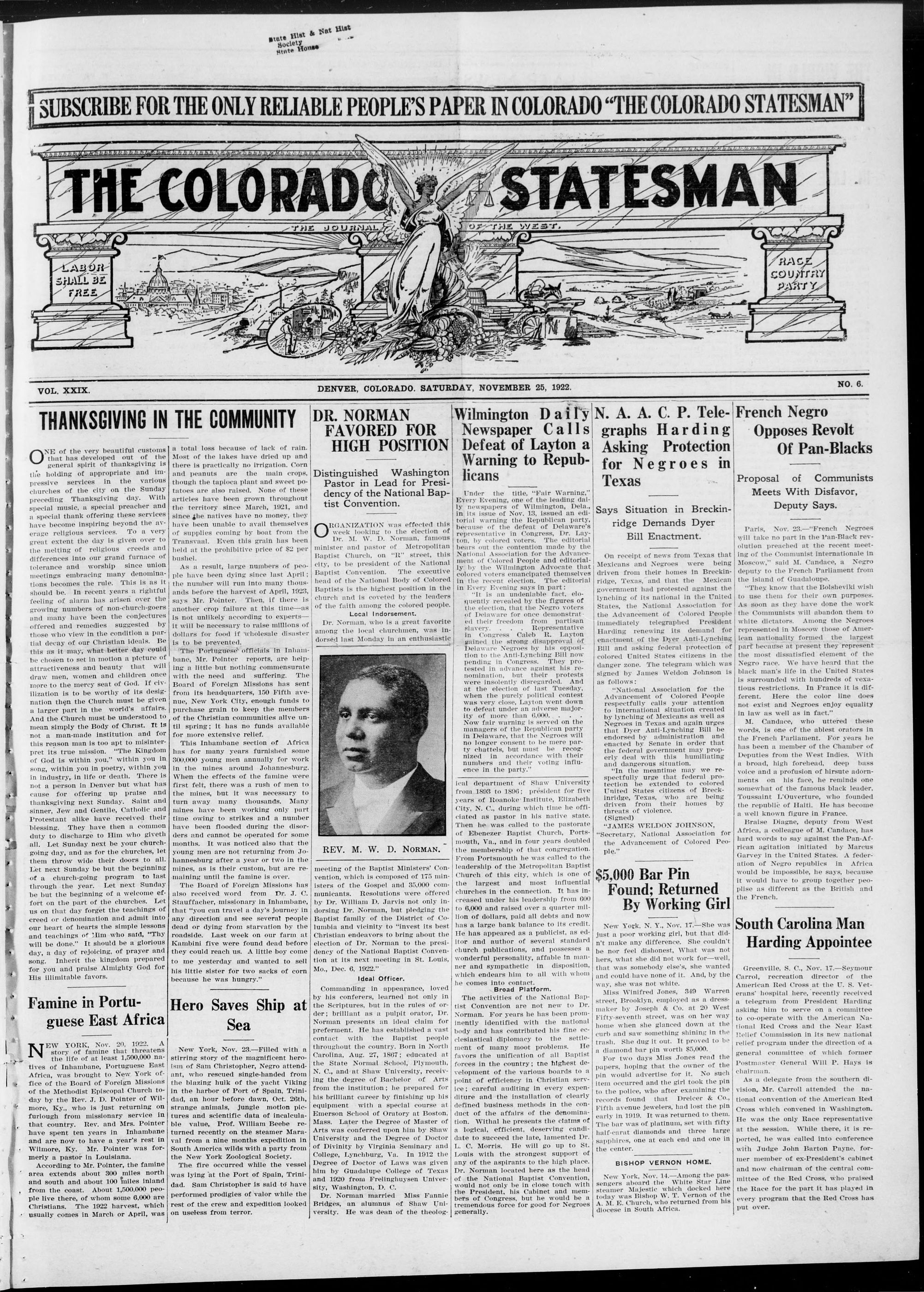
THANKSGIVING IN THE COMMUNITY
VOL. XXIX.
ONE of the very beautiful customs that has developed out of the general spirit of thanksgiving is the holding of appropriate and impressive services in the various churches of the city on the Sunday preceding Thanksgiving day. With special music, a special preacher and a special thank offering these services have become inspiring beyond the average religious services. To a very great extent the day is given over to the melting of religious creeds and differences into our grand furnace of tolerance and worship since union meetings embracing many denominations becomes the rule. This is as it should be. In recent years a rightful feeling of alarm has arisen over the growing numbers of non-church-goers and many have been the conjectures offered and remedies suggested by those who view in the condition a partial decay of our Christian ideals. Be this as it may, what better day could be chosen to set in motion a picture of attractiveness and beauty that will draw men, women and children once more to the mercy seat of God. If civilization is to be worthy of its designation then the Church must be given a larger part in the world's affairs. And the Church must be understood to mean simply the Body of Christ. It is not a man-made institution and for this reason man is too apt to misinterpret its true mission. "The Kingdom of God is within you," within you in song, within you in poetry, within you in industry, in life or death. There is not a person in Denver but what has cause for offering up praise and thanksgiving next Sunday. Saint and sinner, Jew and Gentile, Catholic and Protestant all have received their blessing. They have then a common duty to discharge to Him who giveth all. Let Sunday next be your church-going day, and as for the churches, let them throw wide their doors to all. Let next Sunday be but the beginning of a church-going program to last through the year. Let next Sunday be but the beginning of a welcome effort on the part of the churches. Let us on that day forget the teachings of creed or denomination and admit into our heart of hearts the simple lessons and teachings of Him who said, "Thy will be done." It should be a glorious day, a day of rejoicing, of prayer and song. Inherit the kingdom prepared for you and praise Almighty God for His illimitable favors.
Famine in Portuguese East Africa
Famine in Portuguese East Africa
NEW YORK, Nov. 20, 1922. A story of famine that threatens the life of at least 1,500,000 natives of Inhambane, Portuguese East Africa, was brought to New York office of the Board of Foreign Missions of the Methodist Episcopal Church today by the Rev. J. D. Pointer of Wilmore, Ky., who is just returning on furlough from missionary service in that country. Rev. and Mrs. Pointer have spent ten years in Inhambane and are now to have a year's rest in Wilmore, Ky. Mr. Pointer was formerly a pastor in Louisiana. According to Mr. Pointer, the famine area extends about 300 miles north and south and about 100 miles inland from the coast. About 1,500,000 people live there, of whom some 6,000 are Christians. The 1922 harvest, which usually comes in March or April, was
State Hist & Nat Hist
Society
State House
a total loss because of lack of rain. Most of the lakes have dried up and there is practically no irrigation. Corn and peanuts are the main crops, though the tapioca plant and sweet potatoes are also raised. None of these articles have been grown throughout the territory since March, 1921, and since the natives have no money, they have been unable to avail themselves of supplies coming by boat from the Transvaal. Even this grain has been held at the prohibitive price of $2 per bushel.
As a result, large numbers of people have been dying since last April; the number will run into many thousands before the harvest of April, 1923, says Mr. Pointer. Then, if there is another crop failure at this time—as is not unlikely according to experts—it will be necessary to raise millions of dollars for food if wholesale disaster is to be prevented.
The Portuguese officials in Inhambane, Mr. Pointer reports, are helping a little but nothing commensurate with the need and suffering. The Board of Foreign Missions has sent from its headquarters, 150 Fifth avenue, New York City, enough funds to purchase grain to keep the members of the Christian communities alive until spring; it has no funds available for more extensive relief.
This Inhambane section of Africa has for many years furnished some 300,000 young men annually for work in the mines around Johannesburg. When the effects of the famine were first felt, there was a rush of men to the mines, but it was necessary to turn away many thousands. Many mines have been working only part time owing to strikes and a number have been flooded during the disorders and cannot be operated for some months. It was noticed also that the young men are not returning from Johannesburg after a year or two in the mines, as is their custom, but are remaining until the famine is over.
The Board of Foreign Missions has also received word from Dr. J. C. Stauffacher, missionary in Inhambane, that "you can travel a day's journey in any direction and see several people dead or dying from starvation by the roadside. Last week on our farm at Kambini five were found dead before they could reach us. A little boy come to me yesterday and wanted to sell his little sister for two sacks of corn because he was hungry."
Hero Saves Ship at Sea
Hero Saves Ship at Sea
New York, Nov. 23.—Filled with a stirring story of the magnificent heroism of Sam Christopher, Negro attendant, who rescued single-handed from the blazing hulk of the yacht Viking in the harbor of Port of Spain, Trinidad, an hour before dawn, Oct. 26th, strange animals, Jungle motion pictures and scientific data of incalculable value, Prof. William Beebe returned recently on the steamer Maraval from a nine months expedition in South America wilds with a party from the New York Zoological Society. The fire occurred while the vessel was lying at the Port of Spain, Trinidad. Sam Christopher is said to have performed prodigies of valor while the rest of the crew and expedition looked on useless from terror.
BLE PEOPLE'S PA
ADC
E JOURNAL
DENVER, COLORADO. SATUR
DENVER, COLORADO, SATURDAY, NOVEMBER 25, 1922
DR. NORMAN FAVORED FOR HIGH POSITION
DR. NORMAN FAVORED FOR HIGH POSITION
Distinguished Washington Pastor in Lead for Presidency of the National Baptist Convention.
ORGANIZATION was effected this week looking to the election of Dr. M. W. D. Norman, famous minister and pastor of Metropolitan Baptist Church, on "R" street, this city, to be president of the National Baptist Convention. The executive head of the National Body of Colored Baptists is the highest position in the church and is coveted by the leaders of the faith among the colored people.
Local Indorsement.
Dr. Norman, who is a great favorite among the local churchmen, was indorsed last Monday in an enthusiastic
REV. M. W. D. NORMAN.
meeting of the Baptist Ministers' Convention, which is composed of 175 ministers of the Gospel and 35,000 communicants. Resolutions were offered by Dr. William D. Jarvis not only indorsing Dr. Norman, but pledging the Baptist family of the District of Columbia and vicinity to "invest its best Christian endeavors to bring about the election of Dr. Norman to the presidency of the National Baptist Convention at its next meeting in St. Louis, Mo., Dec. 6, 1922."
Commanding in appearance, loved by his conferers, learned not only in the Scriptures, but in the rules of order; brilliant as a pulpit orator, Dr. Norman presents an ideal claim for preferment. He has established a vast contact with the Baptist people throughout the country. Born in North Carolina, Aug. 27, 1867; educated at the State Normal School, Plymouth, N. C., and at Shaw University, receiving the degree of Bachelor of Arts from the institution; he prepared for his brilliant career by finishing up his equipment with a special course at Emerson School of Oratory at Boston, Mass. Later the Degree of Master of Arts was conferred upon him by Shaw University and the Degree of Doctor of Divinity by Virginia Seminary and College, Lynchburg, Va. In 1912 the degree of Doctor of Laws was given him by Guadalupe College of Texas and 1920 from Frelinghuysen University, Washington, D. C.
Dr. Norman married Miss Fannie Bridges, an alumnus of Shaw University. He was dean of the theolog-
---
Ideal Officer.
Wilmington Daily Newspaper Calls Defeat of Layton a Warning to Republicans
Wilmington Daily Newspaper Calls Defeat of Layton a Warning to Republicans
Under the title, "Fair Warning," Every Evening, one of the leading daily newspapers of Wilmington, Dela., in its issue of Nov. 13, issued an editorial warning the Republican party, because of the defeat of Delaware's representative in Congress, Dr. Layton, by colored voters. The editorial bears out the contention made by the National Association for the Advancement of Colored People and editorially by the Wilmington Advocate that colored voters emancipated themselves in the recent election. The editorial in Every Evening says in part:
"It is an undeniable fact, eloquently revealed by the figures of the election, that the Negro voters of Delaware for once demonstrated their freedom from partisan slavery. Representative in Congress Caleb R. Layton gained the strong disapproval of Delaware Negroes by his opposition to the Anti-Lynching Bill now pending in Congress. They protested in advance against his renomination, but their protests were insolently disregarded. And at the election of last Tuesday, when the purely political contest was very close, Layton went down to defeat under an adverse majority of more than 6,000. Now fair warning is served on the managers of the Republican party in Delaware, that the Negroes will no longer consent to be mere party chattels, but must be recognized in accordance with their numbers and their voting influence in the party."
ical department of Shaw University from 1893 to 1896; president for five years of Roanoke Institute, Elizabeth City, N. C., during which time he officiated as pastor in his native state. Then he was called to the pastorate of Ebenezer Baptist Church, Portsmouth, Va., and in four years doubled the membership of that congregation. From Portsmouth he was called to the leadership of the Metropolitan Baptist Church of this city, which is one of the largest and most influential churches in the connection. It has increased under his leadership from 600 to 6,000 and raised all a quarter million of dollars, paid all debts and now has a large bank balance to its credit. He has appeared as a publicist, as editor and author of several standard church publications, and possesses a wonderful personality, affable in manner and sympathetic in disposition, which endears him to all with whom he comes into contact.
The activities of the National Baptist Convention are not new to Dr. Norman. For years he has been prominently identified with the national body and has contributed his fine ecclesiastical diplomacy to the settlement of many moot problems. He favors the unification of all Baptist forces in the country; the highest development of the various boards to a point of efficiency in Christian service; careful auditing in every expenditure and the installation of clearly defined business methods in the conduct of the affairs of the denomination. Withal he presents the claims of a logical, efficient, deserving candidate to succeed the late, lamented Dr. L. C. Morris. He will go up to St. Louis with the strongest support of any of the aspirants to the high place. Dr. Norman located here as the head of the National Baptist Convention, would not only be in close touch with the President, his Cabinet and members of Congress, but he would be a tremendous force for good for Negroes generally.
N. A. A. C. P. Telegraphs Harding Asking Protection for Negroes in Texas
N. A. A. C. P. Telegraphs Harding Asking Protection for Negroes in Texas
Says Situation in Breckinridge Demands Dyer Bill Enactment.
On receipt of news from Texas that Mexicans and Negroes were being driven from their homes in Breckinridge, Texas, and that the Mexican government had protested against the lynching of its national in the United States, the National Association for the Advancement of Colored People immediately telegraphed President Harding renewing its demand for enactment of the Dyer Anti-Lynching Bill and asking federal protection of colored United States citizens in the danger zone. The telegram which was signed by James Weldon Johnson is as follows:
"National Association for the Advancement of Colored People respectfully calls your attention to international situation created by lynching of Mexicans as well as Negroes in Texas and again urges that Dyer Anti-Lynching Bill be endorsed by administration and enacted by Senate in order that the federal government may properly deal with this humiliating and dangerous situation.
"In the meantime may we respectfully urge that federal protection be extended to colored United States citizens of Breckinridge, Texas, who are being driven from their homes by threats of violence."
"JAMES WELDON JOHNSON, Secretary, National Association for the Advancement of Colored People."
$5,000 Bar Pin Found; Returned By Working Girl
$5,000 Bar Pin Found; Returned By Working Girl
New York, N. Y., Nov. 17.—She was just a poor working girl, but that didn't make any difference. She couldn't be nor feel dishonest. What was not hers, what she did not work for—well, that was somebody else's, she wanted and could have none of it. And, by the way, she was not white.
Miss Winifred Jones, 349 Warren street, Brooklyn, employed as a dressmaker by Joseph & Co. at 20 West Fifty-seventh street, was on her way home when she glanced down at the curb and saw something shining in the trash. She dug it out. It proved to be a diamond bar pin worth $5,000.
For two days Miss Jones read the papers, hoping that the owner of the pin would advertise for it. No such item occurred and the girl took the pin to the police, who after examining the records found that Dreicer & Co., Fifth avenue jewelers, had lost the pin early in 1919. It was returned to them. The bar was of platinum, set with fifty half-carat diamonds and three large sapphires, one at each end and one in the center.
BISHOP VERNON HOME.
New York, Nov. 14.—Among the passengers aboard the White Star Line stenner Majestic which docked here today was Bishop W. T. Vernon of the A. M. E. Church, who returned from his diocese in South Africa.
NO. 6.
French Negro Opposes Revolt Of Pan-Blacks
French Negro Opposes Revolt Of Pan-Blacks
Proposal of Communists Meets With Disfavor, Deputy Says.
Paris, Nov. 23.—"French Negroes will take no part in the Pan-Black revolution preached at the recent meeting of the Communist Internationale in Moscow," said M. Candace, a Negro deputy to the French Parliament from the island of Guadaloupe.
"They know that the Bolsheviki wish to use them for their own purposes. As soon as they have done the work the Communists will abandon them to white dictators. Among the Negroes represented in Moscow those of American nationality formed the largest part because at present they represent the most dissatisfied element of the Negro race. We have heard that the black man's life in the United States is surrounded with hundreds of vexatious restrictions. In France it is different. Here the color line does not exist and Negroes enjoy equality in law as well as in fact."
M. Candace, who uttered these words, is one of the ablest orators in the French Parliament. For years he has been a member of the Chamber of Deputies from the West Indies. With a broad, high forehead, deep bass voice and a profusion of hirsute adornments on his face, he reminds one somewhat of the famous black leader, Toussaint L'Ouverture, who founded the republic of Haiti. He has become a well known figure in France.
Braise Diagne, deputy from West Africa, a colleague of M. Candace, has hard words to say against the Pan-African agitation initiated by Marcus Garvey in the United States. A federation of Negro republics in Africa would be impossible, he says, because it would have to group together people as different as the British and the French.
South Carolina Man Harding Appointee
Greenville, S. C., Nov. 17.—Seymour Carrol, recreation director of the American Red Cross at the U. S. Veterans' hospital here, recently received a telegram from President Harding asking him to serve on a committee to co-operate with the American National Red Cross and the Near East Relief Commission in its new national relief program under the direction of a general committee of which former Postmaster General Will P. Hays is chairman.
As a delegate from the southern division, Mr. Carroll attended the national convention of the American Red Cross which convened in Washington. He was the only Race representative at the session. While there, it is reported, he was called into conference with Judge John Barton Payne, former member of ex-President's cabinet and now chairman of the central committee of the Red Cross, who praised the Race for the part it has played in every program that the Red Cross has put over.
FOREIGN
A motion made by the provincial government calling upon the dominion government to prohibit the immigration of Asiatics into Canada was unanimously adopted by the British Columbia Legislature at Victoria, B. C.
Premier Poincare of France, Lord Curzon, British foreign secretary, and Baron Avezzano, Italian ambassador to France, reached a complete accord at a conference in Paris on the general outlines of the attitude to be taken by the allies toward the Turks at Lausanne peace conference.
“There is no bolshevism in Mexico and consequently there is no reason for a Fascist movement in the republic,” President Obregon told the newspaper correspondents in Mexico City recently when questioned relative to reports that such a movement had been inaugurated in Jalapa and Vera Cruz.
Stories of a female pirate leader and her desperate band of Chinese buccaneers, who seized the British steamer Sul-An, overcame the crew after a sanguinary battle and then escaped with all the cash and valuables on board, were related by the passengers who were landed from the vessel at Hongkong.
With bitter cold approaching in northern Korea, the condition of the 7,000 Russian refugees at Gensan is pitiable, according to arrivals in Seoul, Korea. Those ashore sleep on the bare ground or under clapboard sheds, while the crowding aboard the ships in the harbor is reminiscent of the floating hell of the old galley slave days and the Australian convict bulks.
Ismet Pasha and his associates of the Turkish delegation to the conference at Lausanne appear less confident than when they arrived and the feeling is growing that they will reduce their program materially in the hope of restoring peace and re-establishing trade relations with the outside world. It is becoming evident that they are beginning to realize that it was Greece and not the great powers of Europe that they defeated in their recent successful campaign about Smyrna.
GENERAL
Fifty thousand dollars for a single strawberry plant was paid by Frank E. Beatty, president of the R. E. Kellogg Company, fruit growers at Three Rivers, Mich. The price is believed to be the highest ever paid for a single strawberry plant.
The New York office of the Department of Justice has been appended to by a number of citizens to prevent Lleut. Capt. Hellmuth von Muecke, second in command to Captain Muelier of the German raider Emden, from lecturing in this country.
Discovery was announced at Omaha by Dr. Robert F. Gilder, an archaeologist of this city, of two mounds near Blair, Neb., which he estimated contained the skeletons of at least 1,000 humans, probably Indians, so ancient that there are no modern records of them. Human bones were found protruding from the mounds, which were not opened.
Frank Bacon, one of the most widely known actors on the American stage as the result of his extraordinary success in the part of Bill Jones in "Lightnin", which he helped to write, dled at his hotel in Chicago. After four and one-half years in the role, Bacon was compelled by illness to retire from the cast of the play a week before his death.
The Pennsylvania system, which recently announced its determination to file counter suits against motorists seeking damages as a consequence of collisions won its initial case in County Court at Pittsburg. On December 5, 1921, a Pennsylvania flyer hit an automobile belonging to C. J. Ramsey of Sewickley, near Dixmont. Ramsey sued for $3,000 damages, claiming his machine was wrecked. The railroad countered with a claim for $106.08. The jury returned a verdict for the defendant.
The Illinois Supreme Court has ordered William Bross Lloyd, millionaire Chicago communist, to Joliet prison for five years for violation of the state anti-syndicalism law. Judge Thompson denied Lloyd's plea for a thirty-day stay to permit him to arrange for the handling of his $1,800,000 estate.
"The explosion in No. 1 mine of the Reilly-Collery Company at Spangler, Pa., which resulted in the loss of seventy-nine lives, was caused either by a dynamite shot fired by a miner or by a miner walking through a gas pocket with an open lamp," declared an announcement by Seward Button, chief inspector of the State Bureau of Mines.
Approximately 400 employees left their jobs in the Pennsylvania railroad shops at Dennison, Ohio, following the posting of an order that a 35-cent charge will be made for each meal received in the company's restaurant. Since the beginning of the shopmen's strike July 1 the company has furnished free lodging and board to the employés. The men who quit are said to have taken the places of strikers.
Government officials have reserved decision with regard to the proposed consolidation of Armour and Company and Morris and Company, two of the "big five" Chicago meat packing concerns, which was placed before them by J. Ogden Armour. It was indicated there would be no final opinion for some days.
Whedelm Cuno is Germany's fifteenth chancellor and the first nonpartisan nonparliamentary holder of that post in the new republic. He has succeeded in forming his new cabinet.
THE WORLD IN PARAGRAPHS
A BRIEF RECORD OF PASSING EVENTS IN THIS AND FOR-EIGN COUNTRIES.
DOINGS AND HAPPENINGS THAT
MARK THE PROGRESS
OF THE AGE.
WESTERN
Eighty-two dead was believed to be the death toll of the sinking of a Mexican freight and passenger steamer in the Gulf of California at La Bomba, a Mexican port at the junction of the Colorado river and the gulf, thirty-five miles south of Calexico, Calif.
Because he declared that he bought all the food he needed for 6 cents a day, Arthur Belour is being held by Spokane police as an insanity suspect. Belour had $672.85 in his pockets when apprehended, which he said was his savings as a result of frugal living.
"They came to their death from gunshot and knife wounds inflicted by Hjalmar Anderson," was the verdict returned by a coroner's jury which held an inquest over the bodies of Tansy Bolton, 24 years old, and Mrs. J. T. O'Brien, 38, who were killed in a cabin at Copalis beach, twenty miles west of Honquilam, Wash.
Mutiny charges against five members of the steam schooner Jacinto were dismissed in the United States Commissioner's Court at San Francisco after it developed that the disturbances that brought the vessel back to San Francisco after she had put out for Grays harbor was merely a "drunken brawl." Kansas opened a legal fight on the Ku Klux Klan when ouster proceedings were filed in the State Supreme Court at Topeka by the attorney general under the direction of Gov. Henry J. Allen. The ouster proceedings are directed against the Knights of the K. K. K., a Georgian corporation, and against officers of the klan in Kansas.
Twenty-two years of almost continuous effort to "bring the main line to Bolse" ended in conditional victory through Bolse's acceptance of the offer of the Oregon Short Line to build a railroad line from Orchard to the capital city. The railroad company will spend approximately $3,200,000 in and near Bolse to comply with its end of the contract.
With seventy-five delegates from all parts of the Rocky Mountain region and the Pacific in attendance, the Northwest mining section of the National Safety Council has just closed at Butte. Speakers emphasized the statement that metal mining was the least dangerous of all the hazardous industries, pointing out that of the 80,000 accidental deaths in the United States last year, only 20,000 were attributable to industry, of these only a small fraction occurred in mining.
WASHINGTON
The United States Supreme Court has held that Liberty bonds held by national banks are taxable by the states for state purposes. An appeal brought by the Peoples bank of Kingfisher, Okla., from a lower court decision that national banks are not entitled to deduct from their capital, surplus and undivided profits in paying state taxes, money invested in Liberty bonds and other forms of tax-exempt securities, was dismissed by the Supreme Court on the authorities cited.
A plot to smuggle ammunition into Fortress Monroe, Fort Storey and Camp Eustis was unearthed recently at Norfolk, Va., by postal inspectors. Large boxes of rifle cattridges were found in mail cars bound for each place. United States agents are puzzled. One man is held for questioning. Shipments were made from a house in Norfolk.
The star of woman suffrage reached its highest ascendency in American history when Mrs. W. H. Felton, the "grand old lady of Georgia," won her fight for a seat for a day as the first woman senator. Mrs. Felton won her senatorship when chivalry triumphed over legality. A single objection from any one of the ninety-five male senators would have prevented her taking her seat.
Frankly recognizing at the outset the formidable opposition to the administration's ship program, President Harding went in person before a joint session of Congress and sought, by the sheer force of business logic and patriotic appeal, to impress upon the nation's lawmakers the urgent need for enacting the Harding-Lasker ship subsidy bill without further delay.
A vigorous assault upon the Ku Klux Klan was made by Secretary of the Navy Denby in an address before the national convention of the Order of the Eastern Star in Washington. Although he did not mention the Ku Klux Klan by name, the secretary left no doubt that it was that organization to which he referred.
Truman H. Newberry of Michigan, whose right to a place in the Senate has been a subject of long and bitter controversy, has submitted his resignation with a request that it become effective immediately.
LATE NEWS From All Over COLORADO
```markdown
```
Denver.—Dr. Heber R. Harper, until recently of the faculty and administrative department of the Boston University, has assumed his new duties as chancellor of the University of Denver. Denver.—As a climax to Denver's biggest and best flower show, two hundred Colorado florists formed a statewide organization that will be known as the Colorado State Flower Association. Durango.—The jury trial of Rod S. Day, editor of the Durango Democrat, charged with the killing of William Wood, city editor of the Durango Herald, on the main street of the city on April 24, has been set for Dec. 4.
Denver.—There will be an approximate increase of 2,191,000 bushels in the Colorado corn crop this year over that of last year, according to the report of W. W. Putnam, statistician of the United States bureau of agricultural economics.
Denver.—There were sixteen more deaths as a result of automobile accidents in Denver in the first ten months of 1922 than during the entire year of 1921, statistics prepared by Police Sergt. Henry Reno, police department statistician, show.
Littleton.—Albert F. Hines, 45 years old, of Littleton, was killed instantly, and his daughter, Phyllis, 15, was injured, probably fatally, in a crash between an inbound Fort Logan "Uncle Sam" train at West Mexico avenue and the Rio Grande tracks in Denver.
Denver.—James M. Hamill, assistant to E. H. McClenahan, prohibition enforcement officer for Colorado, has been relieved of duties in the Colorado prohibition enforcement department, under general orders from the Washington headquarters to eliminate assistants of this rank in states west of the Mississippi river as a matter of economy.
Fort Collins.—One million dollars' worth of bonds will be issued by the North Poudre Irrigation Company to take up outstanding bonds and other indebtedness, it was decided at a meeting of stockholders held here recently. In addition to taking up the outstanding bonds and indebtedness, heavy expenditures will be made on improvements.
Grand Junction.—The Red Cliff Chamber of Commerce recently sent word to this city that the county commissioners of Eagle and Lake counties have received machinery that will keep Tennessee pass open to motor traffic the year round. This is an announcement of great importance to the western slope, which has long felt the need of a twelve-month in the year auto route.
Pueblo.—A whisky manufacturing plant rivaling any Tennessee moonshiner's den, two fifty-gallon stills, 600 gallons of mash and fifty gallons of whisky almost as good as before prohibition bonded brand, were found in a raid made in a mountain glen near Rye, Colo., by Federal Prohibition Agent C. D. Badovinac and State Rangers Mitchell and Carix. The outfit belonged to John Gardner and his wife.
Pueblo.—Mrs. M. C. McCall was shot and painfully wounded by Pueblo police officers when the automobile she was riding in failed to halt when the officers commanded it to. The police were searching for four bandits, said to have robbed a jewelry store in Cañon City, and were stopping all the automobiles coming into Pueblo from the west. F. L. Duffield was driving the automobile, and when the officers ordered the car to stop he put on more speed and the officers opened fire.
Boulder.—The seventh annual Boulder County Corn show will be held at Boulder, Dec. 8 and 9, in the Woodman hall. The placing of the grain exhibits will begin at 9 a. m., Friday and the program will begin at 2 p. m., continuing over all day Saturday. There will be all kinds of small grain exhibited and a poultry show will be held in connection with this event. Poultry judging and culling demonstrations will be given.
Denver.—The Department of Commerce at Washington has announced that the census reports show an increase in the quantity of beet sugar produced during the year 1921, although there was a decrease in the value. The output of beet sugar in 1921 amounted to 1,018,700 tons, valued at $127,103,000, and in 1919 to 721,900 tons, valued at $138,000,000. The total value of products reported by the establishments engaged in the industry was $135,997,000 for 1921, as compared with $149,156,000 for 1919, a decrease of 8.8 per cent. Colorado, the leading state in the industry in 1921, produced 29 per cent of the total value of products in that year.
Denver. — Improvement of more than 1,100 miles of state highways during the current year by the State Highway Department will be reflected in the 1923 highway budget by a large increase in the appropriation for maintenance purposes, it was announced at the highway headquarters. Although no definite decision has been reached by the highway advisory board and Highway Engineer Blauvelt, now at work upon the budget, it is certain that not less than $800,000 will be set aside for keeping the roads in shape during the coming year.
CENTENNIAL STATE ITEMS.
Denver. After a two-day discussion during which opposition to a decrease in the assessed valuation of the property of the Great Western Sugar Company was led by Carl S. Milliken, secretary of state, the state board of equalization turned down the company's application for a decrease of $4,520,000 in the valuation of the company's seven plants in Weld, Boulder Logan and Larkmer counties. Instead of valuation of $8,000,000 put on the plants by the company the valuation of $12,480,000, fixed by the county assessors and the county boards of equalization, will stand.
Denver.—Denver is the second largest Hereford cattle center in the United States. Colorado beef is now being sold in California. A stable and steady demand for Colorado feeder stock is now apparent at the Denver stockyards. Colorado sheepmen are enjoying prosperity, and this state is the leading sheep-raising and lamb-feeding center of the west. These and other interesting facts were presented to the members of the Denver Real Estate Exchange by Arthur C. Johnson at a recent luncheon.
Denver.—There has been a slight increase in the number of silos in the state in the past twelve months, according to reports of county assessors to the State Immigration Department. Reports this year show 3,809 silos, compared with 3,774 reported in 1921. The increase is smaller, however, than it has been any year since county assessors began making reports on agricultural statistics in 1919. The number reported that year was 2,528, and the number reported in 1920 was 3,309.
Denver.—Republicans are assured control of the lower House of the next State Assembly by a majority of one vote. Official counts, completed in all doubtful districts, give Republicans thirty-three and Democrats thirty-two seats in the House. In three doubtful districts — Clear Creek, Saguache and Teller and Park counties—Republicans were elected. In the fourth, that comprising Hinsdale, Archuleta and Mineral counties, a Democrat won.
Denver.—Rather than take chances on getting their salaries after the expiration of the biennial period of the state government on Nov. 30, and because they have succeeded in obtaining other employment, eight members of the Colorado Rangers have handed in their resignations to Adjutant General Hamrock. Some of the resignations have been accepted, while on others Colonel Hamrock has not acted thus far.
Boulder.—A damage suit for $24,777, directed against Dr. C. W. Bixler of Lafayette, has been filed in the Boulder County Court by Mr. and Mrs. Earl J. Burns of Lafayette. Mrs. Burns asks for $15,000, charging "incompetence, negligence and unskillful treatment at childbirth, which resulted in her permanent disability."
Grand Junction.—Up to Nov. 1 there had been building permits issued in this city during the year amounting to more than $650,000 and all the inhabitants have the feeling that this augers a tremendous jump in the importance of Grand Junction as a future center of activities. New and important businesses are coming in every week.
Denver.—The first step in Colorado's 1922 livestock invasion of the East took place when local breeders bade farewell to this state's finest herds of cattle, which are now in the East to wrest the laurels from the eastern breeders at the Kansas City show.
Denver.—Denver now ranks twenty-sixth among the cities of the United States in respect to postal savings, it was announced in Washington recently. Postal saving deposits in Denver amounted to $393,257 on Oct. 31, the announcement said.
Walden.—The fall roundup in this county ends Nov. 25. Victor Hanson has charge of the northwestern district, Charles P. Murphy of the Hebron and Splcer districts, Hugh Stemler, the Rand and Illinois river district; Montle Blevins, Jr., the northeastern district, and J. H. Dickens the Upper Canadian and Michigan district. The east side will finish at Ovid Allard's and the west side at Hebron.
Greeley.—Otto Morrison was injured fatally and the Rev. Stanford Brinckley of Eaton was injured so seriously that his life is in danger when a car driven by Morrison turned over five miles north of Greeley. The Rev. Mr. Morrison was returning from Greeley to his home in Eaton in the auto driven by Morrison, when the latter attempted to pass a car ahead. Limon.—Four persons were burned, one seriously, in an explosion and fire which destroyed a section house of the Rock Island railway near here recently. Clifford Salisbury, 30 years old, is in the Limon hospital and his brother, Max Salisbury, Mrs. Max Salisbury and Charles D. Collew were badly burned about the hands and face.
Julesburg.—Aimed like an arrow at the Lincoln highway, running northeast from Denver through Fort Morgan and Sterling to the state line at Julesburg, is one of the finest graveled roads in Colorado. For lack of an expenditure of approximately $3,000, the road between Julesburg and Big Springs is little better than a cow trail, according to E. C. Hamilton, Sedgwick county highway engineer of Julesburg. G. H. Austin, president of the Julesburg Chamber of Commerce, is seeking aid to put the road through to the Lincoln highway.
Phone Gallup 473
WELL BRO
COAL
COMPANY
Wholesale and Retail
IN, COAL, WOOD AND
SUPPLIES
38th Ave. Yards:
Phone Ga
CAMPBELL
CO
COMI
Wholesale
HAY, GRAIN, COAL, V
SUPP
Office: 1401 W. 38th Ave.
Phone Gallup 473
CAMPBELL BROTHERS
COAL
COMPANY
Wholesale and Retail
HAY, GRAIN, COAL, WOOD AND POULTRY
SUPPLIES
Office: 1401 W. 38th Ave. Yards: 1400 W. 32d Ave.
Phone Champa 7889
WESTERN SHEET
COMPANY
WARM AIR FURN
REPAIRS FOR ALL FURNACES—SHE
CHIMNEY STACKS
920 NINETEENTH STREET DE
IN SHEET COMPANY
IN AIR FURNITURE
FURNACES—SHE
CHIMNEY STACKS
STREET DE
REPAIRS FOR ALL FURNACES—SHEET METAL WORK CHIMNEY STACKS
TELEPHONE MAIN 1511
HERE IT
Jazz is being taken from music,
caught it and am putting it
SUITS
Come in and See My Jazz
GARDNER, T
PHONE CHAMPA 1019
C. E. SMITH, Manager,
The Market
Wholesale and Retail Staple and F
Hotels and Restaurants Our
Eastern Corn
Fruits, Vegetables,
Telephones Main 480
622-636 15TH STREET
CHARLOTTE
CAP SHAPE A
Single Mesh
Double Mesh, 15c; two for.....
TAN OFF—MADAM WALL
The Atlas
The Five Points
PHONE MAIN 875.
IT IS
from music, but I have
putting it into
ITS
To My Jazz Styles.
NER, THE T
H, Manager, Res. Phone
Market Co
Staple and Fancy Grocery
Restaurants Our Specialty.
Corn Fed
Vegetables, Poultry and
Les Main 4802, 4803, 48
T
GOTTE HAIR
SHAPE AND FRING
two for.
DAM WALKER'S SE
Atlas Dr
Five Points Postal St
Fruits, Vegetables, Poultry and Game.
Telephones Main 4802, 4803, 4804, 4805
622-636 15TH STREET DENVER, COLORADO
LICENSED D
on Given to VENTI
AGE. All Work Gua
1907 Arapshoe St.
Special Attention Given to
SEWERAGE. All Y
Phone Main 207 1907 Arap
Special Attention Given to VENTILATION AND SEWERAGE. All Work Guaranteed Phone Main 207 1907 Arapahoe St. Denver, Col-
HOME COOKING
Maude
First Class Meals Served 2444 Washington St., Denver, Colo.
Phone Gallup 473
ALL BROTHERS
WOAL
COMPANY
Wholesale and Retail
WOAL, WOOD AND POULTRY
SUPPLIES
Ave. Yards: 1400 W. 32d Ave.
SHEET METAL
COMPANY
AIR FURNACES
FURNACES—SHEET METAL WORK
MNEY STACKS
The Curtis Park
Floral Company
Floral Designs Put Up
While You Wait
Choice Plants and Cut Flowers
Constantly on Hand
Greenhouses: Thirty-fourth and
Curtis Streets
Denver, Colo.
BY Jazz Styles.
R, THE TAILOR
1025 TWENTY-FIRST
Manager, Res. Phone South 1608
Market Company
Meats and Fancy Groceries, Fish and Oysters.
Our Specialty. Fresh and Cured
Corn Fed Meats
Tables, Poultry and Game.
Main 4802, 4803, 4804, 4805
DENVER, COLORADO
TE HAIR NETS
CAPE AND FRINGE
10c
or. 25c
WALKER'S SKIN BLEACH AT
as Drug Co.
Points Postal Station.
2701 WELTON
JOBBING
PROMPTLY ATTENDED TO
PRACTICAL
PLUMBER
LICENSED DRAIN LAYER
Given to VENTILATION AND
All Work Guaranteed
97 Arapshoe St. Denver, Col-
DENVER, COLORADO
Just received 1,000 of the season's latest styles of Woolens for your inspection and selection.
W. K. HUNT
We Have Velva Syrup, 35c and 55c Size.
Don't for give u Thanksgi der. We plenty Dressed Ducks, CL
Sweet Spuds, the best the
We handle nothing but the b
PROMPT DELIVEY SE
COURTESY AND SERVIC
MR. DUKES OF LOUISIANA HAS MADE
HUNDREDS OF DOLLARS
the best there are.
ing but the best Meats.
DELIVEY SERVICE
D SERVICE TO ALL
HAS MADE
OF DOLLARS—READ HIS STORY
Sweet Spuds, the best there are. We handle nothing but the best Meats. PROMPT DELIVEY SERVICE COURTESY AND SERVICE TO ALL
MR. DUKES OF LOUISIANA HAS MADE HUNDREDS OF DOLLARS—READ HIS STORY
International Distributors,
Memphis, Tenn.
Dear Sirs:
I have made hundreds of dollars and
many friends selling Fair Plex Beauty
Preparations and any honest man or
woman can do the same. Whenever you
sell Fair Plex Preparations you need not
worry about future sales. If you don't
call, the customer will come after the
goods.
Send today to the International Distributors, Memphis, Tenn., for positive proof that you, too, can make big money.
THE IR GROWER
Dressing and Grower.
TS WANTED.
Good Money
THE
STAR HAIR GRE
A Wonderful Hair Dressing and
1,000 AGENTS WA
send $1.00 and we will send you a full supply
work with at once; also agent's terms.
Send all money by money order to
THE STAR HAIR GROW
P. O. Box 812, Gree
STAR HAIR GROWER A Wonderful Hair Dressing and Grower. 1,000 AGENTS WANTED.
A
STAR HAIR CROWER.
This is a wonderful preparation. Can be used with or without straightening irons end by any person.
you a full supply that you can begin
n'ts terms.
rder to
R GROWER MF'R.,
Greensboro, N. C.
send $1.00 and we will send you a full supply that you can begin work with at once: also agent's terms.
Send all money by money order to
THE STAR HAIR GROWER MF'R.,
P. O. Box 812,
Greensboro, N. C.
If you suffer with FEMALE TROUBLES, such as Ovarian Pains, Pains in the lower part of your Stomach, Bearing-down Pains, Headache, Backache, Painful or Irregular Periods. If you have three or more painful run-down feeling so common to women. If you have tried all kinds of medicines and doctors, and even though you have been told that an operation is necessary YOU MAY BE MADE WELL BY THING AGAIN. Write for FREE booklet of information and advice today.
When the people of northern Europe were living in reed huts the Mayas of Yucatan seem to have been on the verge of true civilization. The cause of their decline is unknown. When the conquistadores came, soon after the year 1500, their temples, palaces and cities were already in ruins.
Once in a while a man picks up a ten-dollar bill on the street, but most ten-dollar bills are earned. Those who earn them do not spend much time on the streets, for they are too busy elsewhere. Thrift is the inveterate foe of idleness.
---
CHAMPA 3522
S. K. B.
FOR RENT—Nicely furnished room for gentleman in quiet family within easy reach of two car lines. 428 Twenty-fourth street. Phone Main 7417.
Two nicely furnished rooms for rent at 2917 Marion street. Gentlemen or man and wife. Telephone York 6250W.
ARE YOU GUILTY?
A FARMER carrying an express package from a big mail-order house was accosted by a local dealer.
"Why didn't you buy that bill of goods from me? I could have saved you the express, and besides you would have been patronizing a home store, which helps pay the taxes and builds up this locality."
The farmer looked at the merchant a moment and then said:
"Why don't you patronize your home paper and advertise? I read it and didn't know that you had the stuff I have here."
MORAL—ADVERTISE
2962 WELTON
Don't forget to give us your Thanksgiving Order. We will have plenty Fresh Dressed Turkeys, Ducks, Chickens.
DAN DUKES.
Made We want a gents in every city and village to sell THE
One 25 centsa box proves its value. Any person that will use a 250 box will be convinced. No matter what has failed to grow your hair, just give THE
STAR HAIR
GROWER
If you wish to become an agent for this company, please prepare a proposal.
WEAK WOMEN ATTENTION
THE PELVO MEDICINE CO.
MEMPHIS, TENN.
Their History Lost.
Thrift Foe of Idleness.
PLAN MEANS SAVING OF MILLIONS YEARLY, PRESIDENT TELLS CONGRESS.
URGES SHIP SUBSIDY
GOVERNMENT AID FOR SHIPPING WILL CUT BURDEN, HARDING INSISTS.
Washington, Nov. 21.—Enactment of the administration merchant marine bill was urged upon Congress by President Harding as necessary to relieve the government of present "staggering losses" in operation of war-built merchant fleet, and to establish a program of assured shipping to serve the nation in war and give a guaranty of commercial independence in time of peace.
Personally addressing a joint session of the House and Senate, the executive declared an actual monetary saving to the government would result from the proposed law. He challenged every insinulation of favored interests and the enriching of the special few at the expense of the public treasury. The legislation, he asserted, automatically guarded against enrichment or perpetual bestowal.
"If success attend, as we hope it will," he added, "the government outlay is returned, the inspiration of opportunity to earn remains and American transportation by sea is maintained."
The President said concern about the American merchant marine policy was not limited "to our own domain," adding that the maritime nations of the world "were in complete accord with the opposition here to the pending measure." He declared those nations had a perfect right to sucen an attitude, but that he wished to stress the American viewpoint, which, he said, should be the viewpoint "from which one sees American carriers at sea, the dependence of American commerce and American vessels for American reliance in the event of war."
Mr. Harding declared it would be most discouraging if a measure of "such transcending national importance" must have its fate depend on geographical, occupational, professional or partisan objection. A commercial eminence on the seas and ample agencies for the promotion in carrying of American commerce, he asserted, were of no less importance to the people of the Mississippi and the Missouri valley, the great Northwest and the Rocky Mountain states than to the seaboard states and industrial communities inland.
"It is a common cause, with its benefits commonly shared," said he.
If government aid is a fair term to apply to authorizations aggregating $75,000,000 to promote good roads for market highways, the President added, it is equally fit to be applied to the establishment and maintenance of American market highways on the "salted seas."
As to present government operation of the Shipping Board fleet, Mr. Harding said there was the unavoidable task of wiping out a $50,000,000 annual loss, and losses aggregating annually hundreds of millions in wormout, sacrificed or scrapped shipping. He called attention that the government ships were being worn out without any provision for replacement and that a program of surrender and sacrifice and the liquidation which he declared would be inevitable unless the proposed legislation were enacted would cost scores of billions. The cost of the proposed legislation giving direct aid, he said, with ocean-carrying maintained at the present average would not reach $20,000,000 a year and the maximum direct aid if American shipping were so promoted that it carried one-half the nation's deep-sea commerce would not exceed $30,000,000 annually.
The President devoted practically all his message to the subsidy, mentioning only one other national problem—additional relief for agriculture. This and other questions will be dealt with in his message to the regular session which will meet Dec. 4.
Legion Protests Lecture Tour
Indianapolis.—Garland W. Powell, director of the Americanism commission of the American Legion, in a statement issued here, protested against the proposed American lecture tour of Capt. Helmuth Von Muecke, former German naval officer in command of the cruiser Emden. "Captain Von Muecke's coming to the United States to lecture is deplorable," the statement said.
Sailors Mutiny at Golden Gate.
San Francisco, Calif.-Two men were injured, probably seriously, when the deck crew of the steam schooner Jacinto, bound from this port to Grays Harbor, Wash., mutinied shortly after the vessel had cleared the Golden Gate. Captain Werteman and his officers forced the mutineers into the forecastle at the points of revolvers and finally subdued them. Two members of the crew were stabbed by shipmates in the rioting incident to the mutiny, the ships' officers reported.
SOFT DINAS
BLE AND CONFIDEN
Organized 1908
GASAWAY WALTON, Owner
CASH FOR
S CONTEST
SPECIAL CASH FOR CHRISTMAS CONTE
SPECIAL CASH FOR CHRISTMAS CONTEST
$175.00 IN CASH—EVERYBODY WINS
Liberal Commissions—No Loss of Time.
Woman's Voice, a monthly magazine edited for w
women and by women, positively guarantees to give
ting prizes to the successful contestants in our special t
"Cash for Christmas" Subscription Contest.
$100.00 for the first largest number of yearly su
over 50 sent in wifhin 30 days, beginning November 20,
$50.00 for the second largest number over 50.
magazine edited for women, of guarantees to give the follow- stants in our special thirty days in Contest. number of yearly subscriptions beginning November 20, 1922. number over 50.
Woman's Voice, a monthly magazine edited for women, of women and by women, positively guarantees to give the following prizes to the successful contestants in our special thirty days "Cash for Christmas" Subscription Contest.
$100.00 for the first largest number of yearly subscriptions over 50 sent in wifhin 30 days, beginning November 20, 1922.
$50.00 for the second largest number over 50.
$25.00 for the third largest number over 50.
Fifty cents for each subscription over 25 and not exceeding 50.
Twenty-five cents for each subscription less than 25.
Fifty cents for each subscription over 25 and not ex-
Twenty-five cents for each subscription less than 25.
Woman's Voice is chock full of good live readin-
Stories, feature articles, editorials and humorous opinio-
a-jack magazine for $1.50 a year. It is not a new mag-
eighty months old and backed by sufficient capital to
its continued and consecutive monthly appearance. Wom-
should be in every home; we want you to help us put it
help us is your chance to win a neat sum of extra cash
mas.
Men, women, school boys and girls enter this cont-
today. Send us your name and address at once, we de-
Contest opens November 20th and closes December 20th
time to have your extra earnings reach you for Christ-
information and necessary supplies will be sent by re-
Act now.
on over 25 and not exceeding 50.
subscription less than 25.
All of good live reading matter.
and humorous opinion, a crack-
It is not a new magazine, but
very sufficient capital to guarantee
healthy appearance. Woman's Voice
but you to help us put it there, to
heat sum of extra cash for Christ-
gid girls enter this contest now—
address at once, we do the rest.
and closes December 20th, just in
its reach you for Christmas. All
es will be sent by return mail.
EDITOR
S VOICE
Woman's Voice is chock full of good live reading matter. Stories, feature articles, editorials and humorous opinion, a crack-a-jack magazine for $1.50 a year. It is not a new magazine, but eight months old and backed by sufficient capital to guarantee its continued and consecutive monthly appearance. Woman's Voice should be in every home; we want you to help us put it there, to help us is your chance to win a neat sum of extra cash for Christmas.
Men, women, school boys and girls enter this contest now—today. Send us your name and address at once, we do the rest. Contest opens November 20th and closes December 20th, just in time to have your extra earnings reach you for Christmas. All information and necessary supplies will be sent by return mail. Act now.
CONTEST EDITOR
WOMAN'S VOICE
Indianapolis, Indiana.
---
---
Save Pennies Waste Dollars
Some users of printing save pennies by getting inferior work and lose dollars through lack of advertising value in the work they get. Printers as a rule charge very reasonable prices, for none of them get rich although nearly all of them work hard.
Moral: Give your printing to a good printer and save money.
Our Printing Is Unexcelled
Thought for the Day.
Men who render counterfeit work will not accept counterfeit money for that work.
Grain Exports From New York.
Nearly 100,000,000 bushels of grain is exported from New York every year.
Western Respect for Women,1
Western Respect for Women
The best story of the westerner's reverence for women, writes a correspondent of a London paper, "is concerned with the conclusion of a little fight with Indians. The latter got the best of it and the squaws arrived with stone hammers to finish off the wounded. As a squaw thus armed was approaching a half-conscious victim his friend called out to him: 'Look out, Bill, there's a lady coming.'"
For a man to dream of reading a newspaper indicates that he will be successful in whatever he undertakes, become very rich and arrive at great honors in the state. To a maid it denotes that she will marry a man who will become rich and powerful and that her children will be people of great consequence. To dream you buy or sell them denotes hard work and small profit. To dream of one printed in a foreign language denotes a letter from afar.
---
Oldest in Denver
1865 CUPTIS STREET
640 N. West Street.
Michaelson's Corner 15th and Larimer Streets
ANY MAN—ANY AGE—WHO BUYS AN ADLER COLLEGIAN SUIT OR OVERCOAT AT MICHAELSON'S, IS SURE TO GET $10 OR BETTER VALUE AND BETTER STYLE, OR PAY $10 LESS THAN ANY OTHER MAKE WOULD COST HIM OF THE SAME HIGH GRADE.
FREE
THIS BEAUTIFUL
HAIR STRAIGHTENING
AND SHAMPOO COMB
This Comb Is Well Worth $1.00
Solid Brass, wooden handle
8¼ inches long weight 4 ounces.
given as a present to all who take
advantage of our great
JUST WRITE TO US AND SAY: "I would like to get a hair straightening and shampo comb free. Send me particulars regarding your. No. 1144 offer."
Besure and write your name and address plainly, and full particulars will be sent you written, and written for this course last long. We are doing this to advertise Ford's Hair Pomade and Ford's Hair Straightening and Shampoo Combs. Address your letter to
THE OZONIZED OX MARROW CO.
WARSAW ILINOIS
Found Ancient Coin.
A very ancient coin was kicked out of the ground by a ten-year-old boy at Menford, England. The lad's toe came in contact with a battered and rusted silver match case, the lid being missing. When he lifted the case the boy noticed another shiny substance and picked up a silver coin the size of a ten-cent piece. On one side was the impress of a queen's head and on the other side the figures "1572." Apparently the coin is 350 years old.
No Accidents
Dream Lore.
NIGHT & DAY TAXI
DENVER, COLORADO
YOUR PRINTING
in
A Valuable Asset
of Your Business
We Help Our Customers to Success
With Presentable,
Profitable
PUBLICITY
Would Seem Reasonably Safe.
Two keys are needed to open a new burglar-defying door lock, and an owner must know how to use them.
Daily Thought.
He who waits to do a great deal of good at once will never do anything.—Dr. Johnson.
Something to Worry About.
"I am never able to figure out," an Atchison loafer tells the Globe, "what a switch engine or a piano tuner is trying to do."—Atchison Globe.
Preferred 'Em to Nighties,
"Mamma," whispered a little miss in church as she saw the surplaced collar entering, "I should think they'd wear pajamas."—Boston Transcript.
Great Things.
The gravest events dawn with no more noise than the morning star makes in rising. All great developments complete themselves in the world, and modestly wait in silence, praising themselves never, and announcing themselves not at all. We must be sensitive, and sensible, if we would see the beginnings and endings of great things.—Beecher.
Be Faithful in Small Things.
"I tell you, friends, there is a finer, nobler quality in being true and faithful in the little things of life, than in being heroic and grand in the great things."—Exchange.
Character Told by Smile.
Something of a person's character may be discovered by observing when and how he smiles. Some people never smile, they merely grin.—Bovee.
Dome Requires Much Paint.
One thousand gallons of paint are required to paint the dome of the capitol at Washington.
Miles of Thread in Pound.
Out of a single pound of cotton 4,770 miles of thread have been spun.
Aurora Borealis Record.
The record aurora borealis lasted for a week in August, 1859.
Explaining Dream.
Frightful dreams foretell a sudden rush of blood to the head, while dreams about blood point to inflammation in some part of the body. In this connection a person may suffer from nothing more serious than a festered finger, and yet the spectacle of blood will form part of his dream.
Such Is Fame.
A famous bishop was waiting for his train in an out-of-the way village when he saw a stranger eyeing him askance. Fearing he might be cutting a slight acquaintance, the bishop nodded to the man. "Excuse me, mister," said the possible acquaintance, "but I think I seen your picture in the paper onceet." "Very probably," answered the bishop. "Kin I ask," the stranger inquired respectfully, "what wuz you cured of?"
THE COLORADO STATESMAN
Entered as second-class matter at the postoffice in the City of Denver, Colo.
Recognized by the Retail Merchants' Bureau of the Denver Civic and Commercial Association as an advertising medium.
JOSEPH D. D. RIVERS. Proprietor
P. O. Box 116 1824 Curtis Street, Room 25 Phone Main 7417
SUBSCRIPTION RATES.
One year ..... $2.00
Six months ..... 1.25
Three months ..... .75
Reading notices, ten lines or less, 15 cents per line. Each additional line over ten lines, 12 cents per line. Display advertising, 75 cents per square for first insertion and 50 cents per square for each additional insertion.
Communications to receive attention must be newsy, upon important subjects, plainly written only upon one side of the paper, must reach us Tuesdays, if possible, anyway not later than Wednesdays, and bear the signature of the author. No manuscript returned, unless stamps are sent for postage. All communications of a personal nature that are not complimentary will be withheld from the columns of this paper.
Remittances should be made by express money order, postoffice money order, registered letter or bank draft. Postage stamps will be received the same as cash for fractional part of a dollar. Only 1c and 2c stamps taken.
TRUTH CRUSHED TO EARTH.
THE afternoon papers of Monday startled the reading public by a telegraphic announcement that Governor John M. Porter of Louisiana had journeyed to Washington and appealed to President Harding for federal intervention against the Ku Klux Klan, whose invisible empire threatened the overthrow of the duly constituted authorities. The nation stood aghast at the uncanny spectacle of the chief executive of a sovereign state confessing his inability to cope with the hooded tribe. Governor Hardwick of Georgia, aroused by the pronouncement, at once volunteered to join forces with the Louisiana executive. He had endured troubles of his own. The New York Tribune sent wires to every governor in the Union as to their stand on the case. But before answers could be framed, Governor Parker comes out with much gusto and says it was all a mistake; that the Ku Klux Klan were really mild lambkins in his state. And then another telegraphic dispatch told this simple story:
FORMAL DEMAND TO OUST NEGRO IS MADE ON HARDING.
Washington, Nov. 21.—President Harding Tuesday received a formal demand from Governor John M. Parker and members of the Louisiana delegation to Congress to remove from office Walter L. Cohen, a Negro, appointed as surveyor of customs at New Orleans. Cohen was given a recess appointment to succeed a Democratic incumbent.
After reading the foregoing is it any wonder that the Ku Klux Klan flourishes menacingly in Louisiana? Verily, truth crushed to earth will arise again.
AN OUNCE OF PREVENTION.
THE present epidemic of black smallpox in Denver has reached such alarming proportions that on Tuesday the Manager of Health and Charity, Dr. W. H. Sharpley, promulgated an order to the effect that all persons living within the City and County of Denver must be vaccinated or be subject to a severe penalty. This is the first time in years, if ever before, that such a sweeping order has been issued from city hall, but we believe the exigencies of the hour justifies the action. There may or may not be remedial virtue in vaccination, and disease may or may not be a state of mind, depending upon what school one has been reared in. But the argument seems to be largely on the side of those statistics which go to show that the dread malady deals more harshly and with a larger percentage of fatalities upon those who were never vaccinated. The city health authorities have a big problem on hand. They are fighting bravely to overcome a further spread of the dread disease. It is the imperative duty of every citizen to offer all possible assistance, and in no wise is it an hour for our belief or unbelief. Up to the present time the black smallpox has not invaded our group to any great extent. But racial distinction is not a species of immunity, and following the drastic order of the city authorities, issued no doubt as a principle of public policy, we hope all will abide its injunction. Whatever else may be said, it is plain that vaccination follows the line of the least resistance, and if greater security and safety lies therein it is our bounden duty to accept it. Vaccination may prove that ounce of prevention universally recognized as far more potent than a pound of cure. We have boasted ourselves to be law-abiding citizens; let us prove it in this crucial period of our city's history.
THANKSGIVING.
THREE centuries ago there came to this continent a resolute band of God-fearing men and women who, with their descendants, through toil and sacrifice, gave to us a fruitful land in which to dwell and a great country as a heritage.
Humbly, in acknowledgment of divine guidance and favor, they established a day of prayer and thanksgiving for blessings bestowed upon them throughout the year. It was a beautiful custom and has survived the centuries until today it amounts to a great national festival. Manifestly times have changed greatly for the better since the days when our New England forebears were moved to offer up thanks for their deliverance from the rigors and some of the perils of that far off period in our national history. Following the practice then instituted, we, too, have abundant reason to be thankful that the present November has brought us to a turn in the road which promises far easier traveling for us than has been the case in the past twelve months. If progress is to be gaged only by material things, then surely we have ample warrant for thanksgiving; and lest we be disposed to doubt this let us review some of the more outstanding of our blessings. No rational being can help being thrilled by the glories of the golden and red aspens, dotting the green of the pines on the mountain-sides. The woodbine in the city and the sumac in the hills add touches of scarlet that few painters can imitate. The very grandeur of the scene is a signal for serious thought and enables the beholder to see in the autumn haze and changing leaves much that is wholesome and uplifting. We have passed safely through another year. The soil has returned an abundant harvest. From our fields and orchards we are garnering the riches of our labors. We are emerging from a period of business depression and economic tumor. We have not been distressed by war nor seriously disturbed by internal discord. We have witnessed a growing feeling of growing security of life, property and the pursuit of happiness. We are realizing a broader vision and a clearer faith, sensible of our opportunities and responsibilities. Ministers of the gospel take advantage of the occasion for harvest home services. The young and buoyant look forward to the gayer festivities, while father and mother dwell upon the approach of Thanksgiving when sons, daughters and grandchildren will again sit about the old homestead's hospitable board, reveling alike in good food and fond memory. Congress, after months of quibbling and delay, has passed through one branch the Dyer anti-lynching bill and bids fair to complete its work by passing it through the other branch, up to the President for his signature. We have learned that there must inevitably be a better understanding among ourselves, closer co-operation along all lines of our social and industrial lives, and a more faithful clinging to the finer ideals of Christian principles and worship. And in the fuller realization of all of this it behooves us on that day, in our homes and churches, to give thanks to Almighty God for the manifold blessings we have so bountifully received. Our duty in this transcends a meek observance of a proclamation from state or national executive. Let us in our prayers ask for the continued blessing of all honorable industry, that we may be saved in the future violence and discord, that the many kindreds and tongues of our common land may be fashioned into one happy, law-abiding people, that justice may prevail, that our cause as a nation may be so ordered by our efforts that we may merit the confidence, good will and praise of all the peoples of the earth. For in these factors, so interwoven with our happiness and our content, there is indeed abundant cause for thanksgiving.
Repudiation of Loans Made by the United States to Allied Nations
By HERBERT HOOVER, Secretary of Commerce.
Repudiation of the loans made by the United States to the allied and associated nations during the war would undermine the whole fabric of international good faith.
JOHN A. PARK
These loans are, in fact, debts owing to our taxpayers. They were made at the urgent request of the borrowers and under their solemn assurances of repayment. The loans were individual to each nation. They have no relation to other nations or to other debts.
The American taxpayer did not participate in reparations and acquired no territory or any other benefits under the treaty as did our debtors. There is no question as to the moral or contractual obligation.
With the exception of some minor amounts, perhaps 5 per cent, I am convinced that these debts can be repaid in some reasonable period of time without realization of the oft-expressed undue strain on the debtor countries or the threat of a flood of goods from debtor countries in such quantity as would endanger employment of the factories and workmen of the United States.
Omitting the possible 5 per cent that is hopeless of collection, it will be found that respective annual payments due to us from different countries vary in their burden upon them from 2 to 12 per cent of their governmental income.
If there be some of these countries who should be relieved of the annual payments for a few years in order to promote economic stability, then there needs be a demonstration of the facts in respect to each individual country that would be convincing to America.
America has dealt with Europe during the last few years in terms of idealism. We have always given; we have never received.
Rio Is Well Called Magnificent If Only for Its Scenic Surroundings
By BURTON STILLMAN, in The Spur.
Rio de Janeiro would well deserve to be called magnificent if only because of its scenic surroundings, which are superb beyond description. To paraphrase the familiar strawberry saying, doubtless God might have made more beautiful surroundings for a city but doubtless He never did. From the moment of landfall the eye of the traveler by sea is keyed to expectation, but with the unfolding of the scenic panorama there is revelation upon revelation, until the fullness of the splendor of the bay—dotted with one hundred or more islands—and the city, dominated by the two peaks, Corcovada and Tijuca, is disclosed.
To northward the Organ mountains, some six thousand feet in height, close in upon the bay. One is in an inland sea, with an amphitheater of 1,000 hills. But the first great single impression is Pao de Assucar—known the world over as Sugar Loaf—which points skyward nearly fourteen hundred feet. It is a marvelous introduction to a great city.
Of course, every visitor to Rio de Janeiro makes the trip to the top of Sugar Loaf by the aerial cable car at least once. Time and space appear to be eliminated in this speedy journey through the air and the eventual reward in the way of the broad view unfolded at the summit is too much for words. One has about as little to say as when one looks into the yawning gap of the Grand canyon of the Colorado for the first time.
Public Libraries Adapted to Shape the Destinies of Many City People
By CARL H. MILAM. American Library Association.
We should circularize the public libraries to bring educational facilities before the people in a concrete manner. There are thousands of young men and women in the cities, looking toward the future, who do not realize what the public library is able to do for them. Thousands of young business men and women could better their positions by reading books on commercial subjects at the libraries. Wives and brides-to-be could make home a better place to live in and have happier families by reading suitable books on subjects relating to the home.
The public libraries are adapted to shape the destinies of finance, labor, religion, education, love affairs, home and other phases of life.
To reach those who do not come to the library of their own initiative in search of education a census should be taken of all persons interested in certain lines of work. These people should be circularized according to the subjects in which they are interested, and books compiled and listed accordingly. No one set of books on a subject, but a thousand if necessary should be on the library's bookshelves, depending on the population of a city.
Not as Soldiers Boasting of Victory But Broad Minded Citizens—
By GENERAL PERSHING. Address to American Legion.
War in its sordid details is a shock to our finer instincts and depressing to moral standards, yet there is something of the ideal about community of service in a righteous war that touches the nature of the noble and elevates the spirit of the patriotic. And, whether recognized or not such service most certainly leaves the devotee with a broader and clear conception of his obligations.
As we recede from the period of the great war, we think less of its righteous discipline, its deprivation and drudgery that often deeply impresses us at the time, and come to cherish more highly the memory of affectionate comradeship and mutual sacrifice, and recall more proudly the patriotic devotion of our associates.
No army of any such size as ours was ever raised, equipped, trained and sent to battle in so short a time and none ever fought more gallantly nor with such strikingly vital effect upon the outcome.
Without awaiting the verdict of the future, let us today, not as soldiers boasting of victory, but as broadminded citizens contemplate the fullness of our national effort, and measure its bearing upon ourselves as men, both in our relation to the nation as a whole and to our countrymen as individuals
R.
Start Early Planning for Christmas
We know of no one gift that will be more appreciated by the homefolk than a
HOOVER ELECTRIC SUCTION SWEEPER
Make a Christmas present of a Hoover. Pay a small deposit now and we will deliver any time you wish.
Only ONE MORE WEEK to take advantage of our Special Terms. Campaign ends DECEMBER 2.
The Denver Gas & Electric Light Co.
THE DENVER DRY GOODS CO.
Beautiful China to Adorn The Thanksgiving Table
Our annual Thanksgiving selling of open stock dinnerware and dinner sets begins tomorrow. Practically all lines have been reduced for this big event. Haviland and Noritake China, English and American porcelain—our entire stock marked at—
20% DISCOUNT We Mention a Number of Dinner Sets at Savings Averaging 33 1-3%
Complete Service for Twelve Persons, 95 Pieces—Open Stock Patterns:
souls—Open Stock Patterns.
$9.48, floral spray decoration,
at ..... $5.95
$11.07, semi-border pattern,
at ..... $6.95
$18.00, blue border decoration,
at ..... $9.95
$18.04, green conventional border
pattern ..... $10.95
$28.17, pink conventional border
pattern ..... $17.50
$31.98, green and floral border
pattern with coin gold handles,
at ..... $19.95
$27.02, floral spray decoration,
at ..... $19.50
$51.59, green and gold border
decoration ..... $29.50
$48.66, blue border with overlay
and flowers ..... $35.00
NORITAKE CHINA
DINNER SETS
Service for Six Persons:
$35.00, border pattern.. $25.00
$25.00, white and gold border,
at ..... $15.00
FOURTH FLOOR.
Angling Made Easy.
The Biggest Saws.
A Californian keeps a lake properly stocked with fish where anglers may throw their line and fish to their hearts' content by paying a fee for each fish caught. It is much cheaper and just as much fun as taking a long trip into the country.
The world's biggest circular saws were made in Philadelphia. There are two of them, each measuring nine feet in diameter. Whirring at the rate of 134 miles an hour, they daily cut their way through giant logs at Hoquiam, Wash.
Ose ae ee
Pte A aes meee
= a
THANKSGIVING DINNER, 75c
SOUP
Potage a la Russe
Radish
Queen Olives Celeri
Roast Young Turkey, Oyster Dressing
VEGETABLES
Potatoes a la Marie
Petit Pois en Cream Escallop Tomatoes
SALAD
Apple Salad en Mayonnaise
DESSERT
Special Imperial Pudding
Pate D Emince Chaud or With Sauce or Froid
CAFE NOIR
Arranged by Chef GEO, W. HICKMAN,
a
A ministre! will be given by St. Per-
petua Guild Tuesday, Nov. 28, at Old
Colony Hall. Admission, 50c, Every-
body welcome.
WADE HARRIS, former employé of
the Denver Athletic Club, and popular
in the Elks* Fratern#f Order, continues:
ill at the hospital. He still keeps
cheerful and is hopeful of recovery.
Mrs. Samuel A, Rhodes of Kansas
City, Mo. came in on a surprise to
her sister, Mrs. Capt. Geo, M, Logan,
of 2017 California street. Her stay
will be indefinite, as she will remain
with her nephew, Mr. Thomas John-
son, son of Mrs. Logan, who is quite
sick with stomach trouble.
Mrs. Hilda Woods, wife of Dr. E. G.
Woods, was given a temporary mp
pointment in the State Highway De-
partment Tuesday by the Civil Serv-
ice Commission. Mrs. Woods stands
high on the civil service eligible list
and has been given assurance of a per-
manent appointment at an early date.
One by one we are climbing.
The many friends of Mrs. Golden
Price will be pained to learn that she
suffered a severe injury by having her
ankle broken last Tuesday morning.
She was about her accustomed duties
when she slipped and fell in a way as
to fracture the bones in her right an-
kle. Mrs. Price is one of Denver's
most popular matrons, being active in
the club and social life of the city. The
COLORADO STATESMAN wishes for
her speedy recovery and full restora-
tion to her former health,
FAIRBANKS CAFE.
A Thanksgiving turkey dinner, with
all the trimmings, will be served at
the Fairbanks Cafe on Thanksgiving
day. Everybody welcome.
IT 1S YOUR BUSINESS.
The COLORADO STATESMAN
trusts that there will be a large crowd
at the Negro Womun’s Club Home
next Wednesday night at the annual
election of officers of the Denver
Branch N. A. A. C. P. This is one in-
stitution that belongs solely to the peo-
ple. It is YOUR association and all
of its transuctions are a part of your
business. Be on hand Wednesaay
night, Nov. 29 and hear the reports of
officers. The Denver Branch had a
big year.
SHORTER CHAPEL NOTES.
‘The services at Shorter Chapel Sun-
day are expected to be helpful and in-
spiring. At the morning service the
minister will preach a Thanksgiving
sermon; subject: “Reviving Old Cus-
toms,” and in the evening the subject
will be, “Laying Aside Weights.” Spe-
cial music will be rendered at both
services by Shorter's splendid choir,
under the directorship of Miss Dimple
Gatewood. Union Thanksgiving serv-
ices will be held at Campbell Chapel
at 11 o'clock Thanksgiving morning.
Everybody invited.
NOTICE.
‘The funeral of our brother, D. H.
Williams, late of Boulder, Colo., will
take place at that city on Sunday,
Noy. 26th, at 2 p. m.
Brother Williams departed from this
life Noy. 19th, Ail members of Dua-
mon Lodge No. 5, K. P., are requested
to attend.
By order of
J. W. TAYLOR, C. C.
WM. H. LEE, K. R. & S.
NOTICE.
All members of Damon Lodge No.
5, Knight of Pythias, are hereby notl-
fied that on and after Dec, 1st the
meeting place for the lodge will be
at 2535 Washington street.
J. W. TAYLOR, C. C.
WM. H. LEE, K. of R. & S.
COLORED QUINTETTE DELIGHT-
ED LARGE CHURCH
AUDIENCE.
BELL'S QUINTETTE, consisting of
first tenor, second tenor, baritone and
pass, also planist, comprised the spe-
cial music last Sunday evening at the
Warren Memorial Methodist Episcopal
Church, Fourteenth Avenue and Gilpin
Street. Negro melodies by Negro com-
posers, and folk songs were the chief
features, and quite an impression of
real harmony was made on the large,
interesting and appreciative audience,
who requested repetition of the num-
bers. The Rey. Dr. Henry Guy Good-
sell, minister, was responsible for their
appearance, and commended the ren-
dition very highly. ‘The minister's ser-
mon, “The Tragedy of a Guilty Con-
science,” made a profound impre&sion
on his hearers. Already there is an-
other call for this quintette that is do-
ing much service in the community,
A VERY USEFUL CHRISTMAS GIFT
‘The great desire and yearning for
the Negro Race to know something
about itself, its contribution to the
world’s civilization, its intellectual, po-
litfeal and financial standing, its Race
relations and Inter-Racial Co-opera-
tion, its wonderful rise and advance-
ment, and its recognition by the other
races and nations since the late war,
can be satisfied in a Xmas Gift of The
Negro Year Book, 1921-22, to oneself
or to a friend. ‘This book, an encyclo-
paedia of the Negro, edited by Monroe
N. Work, Director Department of Ree-
ords and Research, Tuskegee Institute,
is the standard book of reference on
all matters relating to the Negro, and
is the most extensively used compendi-
um of information on this subject.
Don’t miss this opportunity of over a
million facts for a very small price.
Call Hewetson-Watson, COLORADO
STATESMAN'S Office. Main 7417.
Room 25, 1824 Curtis St.
A BETTER CHRISTMAS GIFT FOR
LESS.
The wonderful military and naval
achievements of the Negro in the late
World’s War is to be found in the au-
thentie HISTORY OF THE AMERI-
CAN NEGRO IN THE WORLD Wan,
by Emmet J. Scott, Secretary-Treas-
urer of Howard University, and for-
merly on the staff of the Secretary of
War as Special Assistant. ‘There is
such a demand for this work that al-
ready thousands upon thousands of
copies are in the homes of both col-
ored and white people. It makes a
better Xmas gift for less money, and
any person or home without one
should make a special effort to secure
some now. We haye a consignment
Just arrived and can supply your or-
der, Call COLORADO STATESMAN,
Main 7417, or a few minutes’ wolk or
ride to 1824 Curtis street, Room 25,
Western Newspaper Building, will se-
cure your order. A splendid bargain
for your money.
Cc. M. E. CHURCH NOTES.
C. E. Chapman, Minister; Residence,
2926 Glenarm Place; Phone
Champa 4879-W.
Excellent audiences were present at
all services last Sunday and keen in-
terest was} msnizested throughout the
lay.
Next Sunday there will be the usual
program: Sunday School, 9:45 a. m.;
morning praise and worship, 11 a. m.;
evening praise and worship, 7:30 p.
m. Rey. C. E. Chapman will deliver
both messages. Morning subject:
“The Master at Work.” Evening sub-
ject: “Launching Out Into the Deep.”
‘A cordial invitation is extended every-
body. A hearty welcome is awaiting.
SELF-IMPROVEMENT CLUB GIVES
SUCCESSFUL PARTY.
‘The Self-Improvement and Social
Service Club maintained. its pop-
ularity ‘Thursday night at Fern
hall by giving one of the
most enjoyable dancing parties of
the season. A very large crowd at-
tended and a neat sum was realized
for the club treasury.
For Rent—Furnished rooms for gen-
tlemen only. 2357 Ogden street.
T EC WwrTe cl) AT
Ly WAN CZ SAT NS EAE
LEWIS &SON
A 7 SAS y) ; es A J AS
ri] 3 J & WZ SZ WW YZ BG S|
The Christmas Spirit Reigns in the
Already scores of forethoughtful parents are choosing from full stocks the toys they
know will be greeted with squeals of delight—already eager children are wonderingly eye-
ing the marvels, and asking when Santa will come.
Why not choose all you know you mean Dolls to dress, 24 inches high, with mov-
to get eventually, today? Besides bet- ing eyes and lovely hair; they have pretty
ter stocks and better service, there are many aetna eee 31.0078” rae
surprisingly low-priced specials, reduced to a Sea pen aah
Samal z : s oe ‘Snow King” Sleds, 34 inches long,
StU IAG) CAEL YR HO RUE amma Tey D Ge well-known for speed; special...... $1.50
very things you want! tears Rote in wali clara di! ih
Get your little girl a real English Doll | ors Japanese set; very special for Satur-
Buggy today at half price—a limited GAY, Seah secs tacos tesa sens «cy te SOND,
number, a little soiled from display, but Hidde Ieee GW alve No =the nioReaper
hardly more than from one week of normal ular size of this strong, safe wheel toy;
play, BPECIGL ss cis isle wos oe ooes sos oo OD
NEW BLOOMER DRESSES EXTRAORDINARY COAT VALUES AT
Made in becoming new styles of wool $9.95
crepe and jemey , iisee comscstable creates The warm coat every little youngster from
do away with bulkly, troublesome sweaters, | 9 to 6 needs; of soft velours, Polaire, chin-
and jackets which usually have to be slipped | chilla and broadcloth ; models for little boys’
on’ eveniini the Hues (Cue: wash frocks. In sturdiness and for dainty little girls. Priced
many pretty colors, sizes 2 to 6 years— many dollars under the usual figure for
$5.00 and $8.50 equal quality.
| ; ‘ :
| Gaily-Painted Tin Makes
Buy plenty of the Decorated Tin Boxes, Square Serving Trays, decorated with
especially—filled with delicious home-made | fruit .......+.sse+sceceeeeceeseee es TOE
fruit cake or little Christmas cookies, or with Bae sa ae
candies? thagheiiltseaive that aapreciative Round Trays, in convention and Persian de-
weleome of most expensive gifts. One, two, SIGNS ......60.20c eee eee sense eee OE
three and five-pound sizes, each— Satin-Finished Metal Waste Paper Baskets,
839¢, 49¢, 59¢ and 79¢ Rinetand Blades oso. eS LOO
Gift Shop—Second Floor.
ee eae ce eae UROL go OR
REV. J. W. BRAXTON PASSES
AWAY AT LOS ANGELES,
CALIFORNIA.
(Special to The Colorado Statesman.)
Rey, James W. Braxton, member of
the Colorado Conference of the A. M.
BF. Church, passed away Wednesday,
Noy, 15, at 8 a. m,, at his residence in
Lon Angeles, Calif, after a confining
illness of ten days, caused by uremic
poisoning from the kidneys.
His wife, daughter, son-in-law and
numerous friends were present at his
bedside.
Interment at Rosedale cemetery, Los
Angeles, Nov. 21, 1922.
Rey. Braxton was a pioneer of the
Missouri, Kansas and Colorado Confer-
ences, a minister for fifty-one years,
and organized much of the work in
Kansas and Colorado; was pastor of
Shorter Chapel and many of the lead-
ing churches in the West ; was presid-
ing elder for sixteen years. His last
pastorate was at Colorado Springs,
which charge he resigned to take up
the work of the Nutional Preachers’
Home, to which he gave his time and
means for years.
He lived for ten months in Denver
in feeble health, went to Los Angeles,
Calif, and for a time improved, but
finally succumbed to the disease which
afflicted him for several years.
FUNERAL NOTICES.
The Douglass Undertaking Company.
Mayo—David A. Mayo, late of 2509
Lafayette street, the beloved son of
Mr. and Mrs. William D. Mayo, de-
parted this life Nov, 16, 1922. Funeral
services were held from Shorters’
Chapel Sunday, Nov. 19, at 1 p. m,
the Rev. W. H. Thomas officiating.
Interment followed in Riverside.
MeWilliams—Mrs, Ida MeWilliams,
late of 1428 ‘Twenty-seventh street,
passed away at quarantine hospital
Noy. 21, 1922, leaving to mourn her
demise three sisters and a host of
friends. Interment private, Riverside.
WOODLAND, CALIF., NEWS.
Jesse A. Keith of this city and Miss
Sadie Viola Clay of Esparto, Calif.,
were united in marriage Saturday
evening, Nov. 11, 1922, at the parson-
age of the Second Baptist Church with
the Rey. J. T. Muse officiating. The
groom was 25 years old and the bride
18 years old. Both the groom and the
bride are quite industrious and well
liked by the entire community. They
are making their home in Beammon
Park addition, where the groom had al-
ready furnished up a house for the oc-
easion,
On Tuesday night, Noy. 14, some
eighteen or twenty persons went out
‘and give the couple a storm party,
each person carrying something that
was acceptable for new housekeepers.
Refreshments were served and every-
body had a real pleasant evening.
Mrs. Sophie Ramus of 418 North
street gave a delightful birthday din-
ner Wednesday evening, Noy. 15, in
honor of her daughter, Mrs. O. H.
Earl. Those present were: Mrs. 0. H.
Earl, Rey. and Mrs. J. ‘T. Muse, Mrs.
Jennie Elligan, Mr. Ben Padmore.
Milton Miller, Harold and Helen Earl,
Mr. and Mrs. Wm. Ramus.
‘The trustees of the Second Baptist
Church have laid in their supply of
wood for the winter.
The church is getting along splen-
didly in every department and is now
making ready for the holiday pro-
grams.
Rey. und Mrs, Muse met with anoth-
er very pleasing surprise when an
auto truck drove up with a whole cord
of wood as a gift from Deacon J. C.
Champ.
——SSSSSSSananana]]|}|=ajajQrS=—c. ene s es
in Dry Goods C
—=
The Joslin Dry Goods Co.---
SIXTEENTH AND CURTIS DENVER, COLO.
Soy S
@ hool Sweat
i es 3 Choo weaters
rs FOR BOYS AND GIRLS
yj, eI)
GB Hi at $2.95
Yd. i Another shipment of those splendid Sweaters offered at a spe-
At cial low price.
pelle —Boys’ Sweaters are slipover style with roll collars and body
eh ae stripes in contrasting color; sizes 6 to 12 years........ $2.95
nN iil HF} —Girls’ Sweaters are coat style—navy blue, brown, heather, tan,
NLP Pekin blue and red; sizes 6 to 12 years, at.......-.... $2.95
uM ete Third Floor—Joslin’s
3-in-1 Shopping Bags A New Coat for Daughter
39¢ In Time for Thanksgiving, Too
Black auto leather, double handle. Bag —The Junior Department has some extra-
is strongly stitched. Adjustable sizes. ordinary values. Coats just recently se-
a ae ics cured in New York City. For instance:
r—Jos!
—Coats with fur collars— |
and tailored Coats in Polaire |
cloth. Brown, tan and navy |
GOOD STOCKINGS blue. All good, warm win- | $12.75
FOR THE CHILDREN fer -Goatal siseay 1ONtE 6)
—Buster Brown’? Stockings—you know years. |
‘} now well they wear—light weight cotton, Third Floor—Joslin's
black, white and dark brown. For boys (Eig A i a A
and girls, Sizes 5 to 914. Pair....85¢ Se ae
Dares c :
—Boys’ heavy ribbed Stockings in black. Girls’ Union Suits
mica and strong. Sizes 7 to ea —Winter weight, with warm fleece lining.
Pair. . eceesessseeeseeeee sees BOG High neck, long sleeves, ‘ankle length;
—Mercerized Cotton Stockings for boys sizes 2 to 12 years—
and girls. English rib. Black, white and
cordovan brown. Pair...........--60¢ 65e
First Floor—Joslin’s Fourth Floor—Joslin’s
PEE RSE SS i pipe | [Fe |S ee AR
|
A nice large front room; also a
‘smailer room in private home, with all
modern conveniences. Mrs. V. L.
Fleming, 2732 California street. Phone
Main 4379.
Good, industrious men and women
can make good money In a pleasant
way in handling exclusive agency con-
tract for International Distributors,
Memphis, Tenn. Write them for free
information about this great offer to-
ee
Once Pride
of Flock
Nowhere else in the world except at home, right in the U. S. A., will dinners for Thanksgiving be plentifuf and "the best you ever ate." You see here the grand old farmer and the turkey—doesn't it portray the real American Thanksgiving spirit? This is the 1922 Thanksgiving, and it's the best of them all.
IS TURK A TURK?
Question Has Never Been Satisfactorily Answered.
But Whether American or Asiatic, No One Has Ever Denied Its Delectable Flavor.
"The Mystery of the Turkey" has been agitating Paris. A learned Arab—Al Antaki—has discovered in Ancient Arabic books written long before the discovery of America a description of what he thinks must be the modern turkey-bird—and the old author found it in fact in Asia Minor, which the Turks of his religion had already conquered. Such a piece of news goes along well with the conquering of what we used to call Turkey by Mustapha Kemal and, if it were true, he would be warranted in taking our turkey for his own Thanksgiving emblem.
French naturalists have started up at once and give the reasons, which they say are imperative, why the turkey bird is genuine American, in the woods when Columbus came and in the Puritan Pilgrim's pot. No foreigners need apply—and, as for the enigma of the name "turkey," what's in a name, anyway? That can be explained, and so can what the old Arab said.
This is the sum of the French argument. The very type of all turkeys is found in Honduras and was fully described in all his glory—speckled, with eye spots small, but bright, almost as those of the peacock's plumage, with a deep-sea blue head and orange-red dewlaps—35 years after Columbus first glimpsed America. Now, the Arab of the Turkish conquest uses a good deal of literature to describe what may easily be only a guinea hen. And he is the only traveler or writer who ever used language that could be even remotely applied to our American bird until the turkey had become a domestic fowl in Europe, after being brought over from America as a curiosity. The misfortune was that somehow the English baptized him "turkey." They got hold of him very early, with their usual love of good eating. Perhaps he was brought over by Cabot, in which case he would have been one of our United States or Canadian turkeys, but more likely some buccaneer brought him back from Panama, where the "Christians" were breeding him as a domestic fowl even before Spanish Oviedo described him so scientifically.
"He makes a wheel of his tall," says Ovledo, to distinguish him from other birds of this wonderful world that resemble him in other ways—but, he hastens to add, "his tail is not as beautiful as that of our Spanish peacocks."
Here the French make their point. The Romans were as great and curious eaters as the English, and they ate peacocks and brought back from Colchis in Asia Minor (or Turkey in Asia) pheasantst for the sake of eating them, and their Latin books speak of them with all particulars. Who can imagine they would have passed by the turkey, which is no end better eating than the most golden pheasant? They never speak of any bird like him—but they know the guinea hen which the old Arab seems to have meant to describe.
Now here the mistake of early naturalists in Europe comes in. They never tried to reason out why in the world the English called the bird a "turkey," but they must have been
influenced by the name—and they decided to call it "Meleagris Gallopavo"—a three-barreled blunder which was intended to mean a combination of guinea hen, Gallic cock and peacock This was the bright idea of the great Linnaeus who cannot have seen one or eaten one in his native Sweden. Perhaps he was influenced by the unlucky common names for the glorious bird. The English called him "turkey," but the French call him "dindon," which means Indian bird. Now, at the beginning, America was universally spoken of as "India," and we ourselves still say "West Indies." Put that alongside of the Italian name for Indian corn—"Grano Turco" or Turkish grain—and we may guess how Turk and Indian got mixed up for something only, uniquely, solely and exclusively American in its origin.
Testimony for America.
Therefore the turkey which we eat at Thanksgiving and, as Tusser said in 1573 for England before the first century of America was done—"in Christmas husbandile fare"—is a native of the New World where it was first described and not of the Old World, where no one ever described it at all until long after.
"If there had been anything like the American bird," says a French naturalist, "how could it have ever been forgotten in Turkey or Asia or Europe, leaving not a footprint or progeny or any memory behind?"
On the contrary, all the woods of America were full of them, so that no European or Turk or Arab could ever talk of having introduced them. And doubtless the same may be said of Indian corn, which goes along with Turkey even in the mixture of names. But the worst mixture was that of the Germans, who called our bird a "Kale buttish Hun" or Calcutta hen from a place in Malabar of quite another India. It is time the turkey should make its Declaration of American Independence.
For man in the midst of his work to pause and look about him, and to set the relatively little that he is or can be, over against the infinities, is good for him. It is good, although the pause be only for an hour, and the reflection fall short of a thought of divinity. If the pause be for a day, and if the thoughts reach up to the unsearchable, and some emotion of thankfulness for natural blessings be quickened in the heart, that is far better. And that is what Thanksgiving day should bring.
Little Boy
"Hi Jimmie, come on! I got two tickets to de newsboys' dinner.
"Nope. I done et five free feeds an' now I gotter go home an' tackle our own tolkey."
WHERE UNCLE SAM MIGHT SAVE MUCH
POSTMASTER GENERAL WORK IN FAVOR OF GOVERNMENT OWNERSHIP OF POST OFFICES.
HE URGES IT ON CONGRESS
Present System of Leasing Such Buildings Is Very Costly and Has Various Other Serious Disadvantages, He Asserts.
By JAMES P. HORNADAY
Washington.—Postmaster General
Work originated and has urged before
congress the government ownership
of post office buildings on the ground
that annually a great saving of money
will result to the American taxpayers.
In a communication to the joint commission on postal service of congress,
the postmaster general points out that the government can borrow money on
pratically a 4 per cent basis to build post offices, whereas when it
leases it pays a rental sufficient to permit the lessor to borrow money at
7 per cent and in some cases as
much as 10 per cent. In other words,
by this lease policy the government is indirectly paying 7 per cent and
10 per cent interest on money when it is able to borrow at 4 per cent.
The postmaster general in further
explaining the advantage of this plan said:
"When the government owns a post office building it is free from taxation, whereas when it leases an office it is indirectly paying taxes at the rate of about 2 per cent on the investment and many times at a very much higher rate. When a building required for postal purposes represents an investment of a large amount of money, it is readily seen that the tax alone which the government must pay to the lessor in the form of rent is a very considerable sum.
"Another way of stating in a combined form the two preceding propositions is that the ordinary lessor usually obtains about 10 per cent gross on his investment, whereas if the government owned the property, building it with 4 per cent money, it would be costing the government about one-half as much as it is obliged to pay in the form of a lease for the use of the building.
"If the government adopted the policy of owning its post office buildings, it would be in a position to take property by right of eminent domain, whereas it cannot take a leasehold interest by such right.
"In our negotiations for leases with prospective lessors we are confronted with the fact that we cannot build, and therefore we must pay what they ask. If we could say to bidders, unless you bring your rental down to a certain reasonable figure the government will put up a building of its own, we would then have a weapon of negotiation where we now have none. But that is only possible when the government has adopted a policy of ownership and provided funds to carry out such a policy.
"Leased buildings are constantly being outgrown, confronting the department with the necessity of either adding additional space or seeking an entirely new location. With a lease policy and without the right of condemnation the additional adjacent space is often held at unconscionable figures, and we are often compelled to pay far more than we know to be reasonable on account of the situation.
"When a government post office or postal building is erected by a lessor, in a very large percentage of cases it enhances the value of all property in the vicinity, so that it becomes necessary to renew such lease at much higher figures, whereas if the government owned the building it would receive the benefit of the enhancement of values which it has created.
An Expensive Proposition.
"The lessor who builds a post office or postal station for the government on a contract for lease for 10 or 20 years is obliged to figure on absorbing either the whole or a large percentage of the original cost of the building, and this he does. He is obliged to do this because he knows he may be compelled at the end of the lease to reconvert it into other uses. The result of such a lease policy is that the government not only pays about 10 per cent of the original investment but it pays in addition there to a certain per cent of all the original investment distributed over a term of years, so that at the end of the lease the government has nothing, but is obliged to start over again, still at the mercy of lessors, with no efficient weapon to compel fair prices.
"It frequently is impossible to lease buildings having satisfactory working conditions, such as natural light and ventilation. In erecting government-owned buildings ideal working conditions would be provided, thereby incurring the health and comfort of employees, which should always be given first consideration. Then, too, such buildings would be erected in accordance with plans and specifications either made or approved by the Post Office department based upon its experience with a view to efficiency of service, as well as cost of service." Farmer Can't Stand Freight Rates. "One of the heavy burdens which the farmer has been forced to carry
at a time when he was least able to carry it has been the large increase in freight rates," said Secretary of Agriculture Wallace in talking of the troubles of the farmers. He pointed out that in 1920 freight rates on many of the more important farm crops were almost double what they were before the war; these increased rates, not only imposed a grievous financial burden but in many cases narrowed the market for crops, which were not worth enough to carry the freight rate to distant markets.
"At the same time," said he, "the increased rates on the things the farmer had to buy added to his cost of living and the cost of production by just that much. Had prices of farm crops remained at the 1919 and early 1920 levels, the higher freight rates could have been paid without inconvenience. A freight rate of 25 cents a bushel when corn is selling for $1.75 a bushel is not a serious matter, but a 25-cent rate on 50-cent corn is ruination. During 1920 the influence of the administration was exerted in every proper way to bring about a reduction in freight rates on farm crops, and a number of important reductions were secured. Rates are still altogether too high, however, with relation to the selling value of crops, and further substantial reductions must come in the near future.
"This railroad question is exceedingly complex and difficult. When the federal government took over the roads it was on the agreement that in addition to proper maintenance they should be assured of earnings equal to the average of the three years, June 30, 1914, to June 30, 1917. Costs of operation were increasing steadily and the government advanced both passenger and freight rates.
Railroad Costs Too High.
Railroad Costs Too High.
"Inlquitous working agreements and shop rules which greatly reduced labor output were accepted. The result was that railroad costs of operation increased far more than railroad receipts. During this period practically everything shipped was selling at a price high enough to have carried a correspondingly high freight rate. Good business administration would have provided for railroad income during those prosperous times large enough to meet the government contract and would thus have saved the hundreds of millions which the government afterward had to pay. Also it should have made it possible for a prompt reduction in rates when the prices of farm crops made it necessary.
"The urgent demand by farmers for large reductions in freight rates have led some people to think that if the farmers could have their way they would put rates so low that the roads could not possibly operate. Nothing could be further from the truth. The farmer is almost wholly dependent on the railroad for the movement of his surplus crops and live stock. Much agricultural freight is perishable and must have expedited movement. The farmer, therefore, has a direct interest in efficient railroad operation and knows that the roads must be permitted to charge enough to cover all proper costs of operation and enough in addition to give a fair return upon the money invested and thus keep capital in the business. Neither does the farmer want government operation of the railroads. He had enough of that in his three years' experience to satisfy him for all time. He will never forget the losses, both direct and indirect, which he suffered because he could not ship when his stuff was ready for market, and because of bad service.
Rates Must Come Down.
Rates Must Come Down.
"Nevertheless, freight rates on farm crops and live stock must come down. With present prices for his crops and with probable prices for the next year or so, the farmer simply cannot afford to pay the present rates. They are out of all proportion to the pay he gets for what he grows.
"A hopeful sign which points toward the possibility of reductions in railroad rates is the gradual reduction in the part wages contribute to the total operating cost. Apparently, the railroads are making steady progress in the reduction of these costs, and should therefore be able soon to make substantial reductions in freight rates on farm products. In considering the matter of freight rates of agricultural products there are two things which should always be kept in mind. First that the cost of transportation is essentially a part of the cost of production, so far as agriculture is concerned, and any increase in transportation costs must come out of the price the farmer receives. Second, our business and industrial life has been built up on a system of relatively low railroad rates for agricultural crops designed to encourage their movement over long distances to industrial and business centers."
Continent Edge Out in Sea.
The eastern continent edge of North America stands 150 miles or more east of the present shore, says the Detroit News. Maine, Massachusetts, Long Island, New Jersey and the eastern peninsula of Maryland are not the limits of the United States, strictly speaking. The limit is far out to sea. Places that were formerly dry land are now beneath the water of the Atlantic ocean. The Hudson river is now drowned for a great part of its length. The land has subsided and lowered the river bed below the sea level. Careful soundings south of Long Island reveal a former river channel winding along on what is now the bed of the ocean. The water shelves out gradually to 100 fathoms, then plunges sharply down as the edge of the continent is reached.
THE COLORADO STATESMAN
[ ]
RELIABLE chronicle of their doings andgress; a faithful miner their wants, their hope for best aspiration.
THE COLORADO STATESMAN
equaled as an advertiser medium for the business of professional men and women.
excellent family journe speaking to and for thousands colored citizens
The Mouth-Piece of the People of Colorado and the Entire West
ARELIABLE chronicle of their doings and progress; a faithful mirror of their wants, their hopes, their best aspiration.
Unequaled as an advertising medium for the business of professional men and women.
An excellent family journal speaking to and for many thousand colored citizens.
$2.00 A YEAR
$1.25 SIX MONTH
$.75 THREE MONTH
THE GREAT ORG
OF THE
BORING MASS
THE GREAT ORGAN OF THE LABORING MASSES
1027 Twenty-first St. Denver
Office Phone Main 2701. Hours
appointment. Res. 2337 Glen-
arm Place. Phone Champa 3203.
DR. HUFF'S office phone is Champa 6001. And his residence Phone York 4101. When not reached at office or home, sat at Main 875 Office Suites 5, 6 and 7, 2701 Welton St. over Atlas Drug Store. Office hours, 11 to 12 a. m., and 3 to 5 p. m.
Office House—9 a. m. to 12 m.
2 p. m. to 4 p. m.
Office Phone, M. 5034
Residence Phone, F591-W
S. E. CARY
ATTORNEY-AT-LAW
Six years City and County
Attorney at Russell Springs, Logan
County, Kansas.
2040 Welton Denver, Colorado
Res. Phone York 5774W
FRANK D. TAGGART
Attorney at Law—Notary Public
205-206 Cooper Building
Denver, Colorado
JOSEPH CARTER
Express, Moving and Storage
Coal and Wood
2415 WASHINGTON STREET
PROMPT DELIVERY
Phone Main 6544
Our Advertising
Service
Means More Sales for
You, Mr. Business Man
When you begin advertising
in this paper you start on the
road to more business. There
is no better or cheaper me-
dium for reaching the buyers
of this community.
We can also provide
Artistic Printing
of every description.
Prof.
W. M. Mackey
FIRST CLASS TONSORIAL WORK
Hair Cutting a Specialty
Satisfaction Guaranteed
2244 LARIMER ST., DENVER
Our Hobby
Is Good Printing
Ask to see samples of our business cards, visiting cards, wedding and other invitations, pamphlets, folders, letter heads, statements, shipping tags, envelopes, etc., constantly carried in stock for your accommodation.
Get our figures on that printing you have been thinking of.
New Type, Latest Style Faces
You Say You Can't Advertise?
That's what others have said and all of a sudden found some competitor was doing what they thought they couldn't do. And getting away with it.
Get the bulge on your competitors by telling your story in an attractive manner so it will be read. You'll get the results.
We Are Anxious to Help
```markdown
```
Best Canned Peas or Beans Will Stir Family to Rebellion If Always Cooked In Same Way.
(Prepared by the United States Department of Agriculture.)
Turnips, carrots, cabbage, onions, potatoes, parsnips, kale, celery, and winter squash—for a good many winter months these are the only fresh vegetables that appear on the table, so that for the sake of variety it is necessary to fall back on the stock of canned vegetables. Even the best canned string beans or peas, however, will stir the family to rebellion if always served in exactly the same way.
No matter how canned vegetables are served, they should be boiled thoroughly after they are poured from the can and before they are tasted.
Scalloped canned tomatoes are not only good in themselves but help use up stale bread. Canned sweet potatoes may be mashed and baked, or made into sweet potato pie, or baked in layers with slices of apple between.
table combinations which the family is certain to enjoy.
Fresh or canned turnips cooked with fresh or canned celery may be an innovation to many. The combination may be served with white sauce, or after being covered with a white sauce in a baking dish, it may be sprinkled with grated cheese, bits of butter, seasoning, and bread crumbs, and browned in the oven.
Carrots diced and mixed with canned peas or string beans cut in small pieces, are one of the best known and best liked of the vegetable mixtures. Peas or small lima beans in beet or turnip cups, are attractive for a change; and lima beans with corn, need no introduction. Pastry trimmings baked in patty pans or muffin tins make good cups for creamed vegetables, which are also good when served on toast.
Impove Flavor of Vegetables.
A little onion juice or celery salt, or a bit of green pepper or celery tops, or a tiny piece of bay leaf, improves the flavor of many vegetable dishes. The United States Department of Agriculture has a number of other suggestions for varying the appearance and flavor of canned vegetables. Canned asparagus may be cut up and spread in layers in a baking dish, with bread crumbs in between, sprinkled with salt, pepper or paprika, seasoned with the liquor from the can, and baked. Okra or egg-plant scalloped in this way is equally delicious. Scalloped canned corn is good, and is improved by a little chopped onion and pimento. A corn pudding may be made by adding milk and egg to canned corn.
Canned vegetables may be combined with each other or with the so-called winter vegetables. Tomatoes and peppers are a popular combination, whether stewed, scalloped, or used in soup; and potatoes, okra, and onion added to meat stock make a good soup. Tomatoes and corn may be baked or bolled together or scalloped. Tomatoes and string beans; tomatoes, corn and string beans; tomatoes and celery, are all good vege-
FACTORS AFFECTING COST OF BREAD LOAF
Quality of Flour and Price of Much Importance.
Where Different Materials Are Purchased in Small Quantities Cost Is Much Higher—Use of Milk Increases Expense.
(Prepared by the United States Department of Agriculture.)
Tests in the experimental kitchen of the United States Department of Agriculture show that the quality of flour used, the retail price paid for it, the method of buying, whether in small quantities or by the barrel, the bread formula used, the kind and price of fuel, the sort of oven used, and the number of loaves made at one time are all factors affecting the final cost of the homemade loaf of bread.
In case of a batch of five loaves for which materials were bought in small quantities and which were baked in an uninsulated gas oven when gas cost $1.20 a thousand feet, a single pound loaf was found to cost 7 l-3 cents. The recipe called for shortening, sugar and compressed yeast. Milk was not used in the formula tested and would have increased the cost of the bread.
A batch of eight loaves was made by a more economical formula, and all materials, though bought at retail prices, were purchased to better advantage. "Strong" flour which gives a high bread yield was selected, and it was bought by the barrel, as the farm woman would be likely to buy it. Dried yeast was used, shortening was omitted, and the baking was done in a kerosene range. Under these conditions the cost of a one-pound loaf was to be only 4 1-5 cents. The details and figures obtained in these tests are available upon application to the department.
ECONOMY IN USE OF CEREALS
Relatively Low In Price and Furnish Some Tissue-Building Materials and Body Fuel.
Because cereals are relatively low in price and because most of them furnish some tissue-building materials, as well as body fuel, the United States Department of Agriculture considers it a good economy to use them freely, and sometimes in place of part of the more expensive foods.
table combinations which the family is certain to enjoy.
Fresh or canned turnips cooked with fresh or canned celery may be an innovation to many. The combination may be served with white sauce, or after being covered with a white sauce in a baking dish, it may be sprinkled with grated cheese, bits of butter, seasoning, and bread crumbs, and browned in the oven.
Carrots diced and mixed with canned peas or string beans cut in small pieces, are one of the best known and best liked of the vegetable mixtures. Peas or small lima beans in beet or turnip cups, are attractive for a change; and lima beans with corn, need no introduction. Pastry trimmings baked in patty pans or muffin tins make good cups for creamed vegetables, which are also good when served on toast.
Reheating canned string beans with a ham bone or a piece of bacon and then serving them with vinegar makes them seem an entirely different vegetable. A sour sauce can be made for canned string beans by blending one tablespoonful of fat, the liquor from a pint can, one tablespoonful of vinegar, salt and pepper to taste. After simmering the beans in this sauce for several minutes a well-beaten egg is added just before serving.
Spinach Souffle Recipe.
To make spinach souffle, chop drained canned spinach very fine and rub it through a coarse sieve. Heat with one tablespoonful of flour, one tablespoonful of butter, salt, pepper, a dash of nutmeg, and one-half cupful of milk. Separate an egg, beat both yolk and white very stiff, fold into the spinach mixture and bake in individual ramekins for fifteen minutes, or longer if baked in a larger dish.
When serving canned baked beans, reheat them with a little extra seasoning consisting of a tablespoonful of molasses, a pinch of mustard, and a bit of bacon or salt pork; put into the oven to brown. The canning process saves the long preliminary cooking necessary with home-cooked baked beans, and yet a similar flavor may be developed in this way.
BREAD CAUSES INDIGESTION
When It Does So It Is Because of Lack of Essential Characteristics, Not Because Hot.
Hot bread is often thought to cause indigestion, but the United States Department of Agriculture says that when it does so it is because it lacks some of the characteristics of good bread, not because it is hot. Large or thick biscuits, whether raised with yeast, baking powder or soda, are likely, if cooked only a short time, to be soggy on the inside, and this, when it happens, is the objection to them, rather than the fact that they are served hot.
MEAT BONES FOR FLAVORING
Those From Veal Especially Useful With Cream Sauces and Soups—Pork Is Excepted.
Meat bones, especially those from veal, that have been slightly browned in cooking, as in the case of steaks, chops, or roasts give a particularly good flavor to cream sauces and soups. This is a suggestion made by the United States Department of Agriculture, which adds that pork bones are an exception to this statement. Their taste is less acceptable in this way.
Household Questions
Good quality knives should be cleaned with charcoal powder.
The life of baskets can be prolonged by scrubbing them occasionally with hot soapsuds.
The water in which vegetables have been boiled is an excellent foundation for soup stock.
Discolored brass curtain rings may be boiled in soda and water and afterward enameled in any color desired.
Dampen a piece of grease paper with vinegar and wrap it around cheese. This keeps the cheese moist and prevents it from going moldy.
* * *
Try removing spots from your bat-tub with olive oil. The oil is sprinkled on a flannel cloth and the spot rubbed with this. Warm water and soap is then applied to the spot.
The Kitchen Cabinet
(©. 1922, Western Newspaper Union.)
In the last analysis, a bore bores, because he keeps us from something more interesting than himself. He becomes a menace to happiness in prose as the man who lives in shortened by an imminent number of things to do and places to go between the crib and the coffin.—Contributor' Club.
SEASONABLE FOODS
This is the season of the year when we turn to our recipes for fruit cake. Fruit Cake. Take one cupful each of sugar, butter, molasses, strawberry preserve or jelly, butter, milk, one half cupful of strong coffee, two
Take one cupful each of sugar, butter, molasses, strawberry preserve or jelly, butter, milk, one half cupful of strong coffee, two eggs, one nutmeg grated, two teaspoonfuls each of cinnamon and soda, the latter dissolved in one-half cupful of hot water; one teaspoonful of cloves, two pounds each of currants and raisins, one pound of candied fruit, chopped (orange, lemon and citron), six cupfuls of flour. Mix the fruit in the flour and combine as usual. Steam one hour, bake one-half hour. Keep in a stone jar the cake wrapped in waxed paper.
Creole Steak—Put a flank steak through the meat chopper, adding three onions and one green pepper, minced fine, one-quarter of a cupful of suet chopped fine, one-half cupful of bread crumbs and one teaspoonful of salt. Mold into shapes like sirloin steak and place in a well-greased casserole. Pour over one cupful of stewed tomatoes and bake in a hot oven 15 minutes.
Brunswick Roast.—Split a flank steak, taking care not to separate. Spread flat and fill with the following: Sonk bread in cold water and press dry—take three-quarters of a cupful. Place in a bowl three chopped onions, one green pepper chopped, one-half teaspoonful of poultry seasoning, one-quarter cupful of chopped suet, one and one-half teaspoonfuls of salt, one-half teaspoonful of pepper, one teaspoonful of Worcestershire sauce. Mix well and spread on the meat. Roll and tie securely, roll in seasoned flour and brown in hot oven, turning until well-browned. Now add one cupful of hot stock or water, and cook slowly for one and one-half hours. Serve either hot or cold. If hot, garnish with potato and carrot balls, cooked until tender and well-seasoned.
Egg Hollandaise.—Place a poached egg in a small casserole or ramekin, cover with Hollandaise sauce, lay a boiled mushroom on top of the sauce and set the casserole in a hot oven for five minutes. Serve hot.
A Sabbath well spent
Brings a week of content
And health from the toils of tomorrow;
But a Sabbath profaned,
What so 'eer may be gained,
Is a certain forerunner of sorrow.
—Sir Mathew Hale.
MORE THANKSGIVING DISHES
A good soup to begin the meal is an economy in several ways; it prevents overeating of the heartier food and saves too serious onslaughts on the "piece de resistance."
Cooking
A salad is always a welcome addition to the dinner; it may be pleasing because of the note of color which may thus be introduced to add to the beauty of the table, but it need not add to the expense or the bulk of the meal. The dessert being the crowning point of the meal, should be as pleasing to the eye as to the palate.
We usually think of Thanksgiving in terms of roasted, stuffed turkey, but the meal may be just as appetizing and attractive with a dish of squirrels or rabbit, venison or wild duck. Rabbit pie is not well enough appreciated.
Guinea hens are fine eating; serve stuffed, rubbed with butter and seasonings, and cooked in a casserole with a pint of stock. An hour before serving add potato balls, small onions and bits of carrot. Serve from the casserole.
Spanish Pie.—Line a deep baking dish with a rich biscuit crust, put in a layer of cold stewed chicken, a layer of sausage meat, chopped green pepper and onion, seasoning to taste with salt and pepper. Add two tablespoonfuls of flour blended with three-quarters of a cup of chicken broth and a tablespoonful of vinegar. Cover with a crust and bake until the crust is a golden brown.
Beef and Corn Pudding.—Drain a can of corn from the liquid, reserving it for soup. Put a pound of lean beef through the meat chopper. Cook in a tablespoonful of fat, one tablespoonful of minced onion, stir in a tablespoonful of browned flour, add one cupful of stock and cook until smooth. Put the meat and orn in alternate layers in a baking dish, sprinkle with seasonings, moisten each layer with a little of the sauce and have the corn and sauce on top of the dish. Cover with grated cheese and bake in a moderate oven twenty minutes.
Nellie Maxwell
IMPERIAL CAFE
MR. AND MRS. E. R. PAGE, PROPS. First-Class Meals at Hours
Our Service Is Unsurpassed
715 EAST 26TH AVE.
Ladies' and Gents' Tailoring, See
H. ANDERSON
MERCHANT TAILOR
ing, Pressing and Repairing. All We
Guaranteed
720 EAST 26TH AVE.
ONE MAIN 6751 Prices reasonable
d see my Fall and Winter Samples now on dis
For Ladies' a
H. A.
Cleaning, Pressi
720 I
PHONE MAIN 6
Call in and see my Fa
Cleaning, Pressing and Repairing. All Work Guaranteed
720 EAST 26TH AVE.
PHONE MAIN 6751 Prices reasonable.
Call in and see my Fall and Winter Samples now on display.
HOWARD & HOWARD
HOWARD & HOWARD
GROCERIES AND MEATS
Fresh Vegetables and Fruits Daily
Fresh Home-made Bread, Rolls, Cakes and Pies Daily
Free Delivery to any part of the city.
PHONE MAIN 6338 718 E. TWENTY-SIXTH AVE.
GROCERY
Fresh Veg
Fresh Home-made
Free Deliver
PHONE MAIN 6338
THE CHAPTER
Is it
DRUGS, CHEMIC
W
PRESCRIP
Phone us and we will
JAMES
PHONE MAIN 2425
MADAM
GROCERIES AND MEATS
Fresh Vegetables and Fruits Daily
Home-made Bread, Rolls, Cakes and Pies Daily
Free Delivery to any part of the city.
MAIN 6338 718 E. TWENTY-SIXTH A
CHAMPA PHARMA
2101 CHAMPA
Is the place to get your
ESS, CHEMICALS AND PATENT MEDICINE
WE SERVE DRINKS.
PRESCRIPTIONS OUR SPECIALTY.
and we will deliver the goods to all parts of the
JAMES E. THRALL, Propr.
MAIN 2425 PHOTO
ADAM NICHOL
THE CHAMPA PHARMACY
Is the place to get your
DRUGS, CHEMICALS AND PATENT MEDICINES
WE SERVE DRINKS.
PRESCRIPTIONS OUR SPECIALTY.
Phone us and we will deliver the goods to all parts of the city.
JAMES E. THRALL, Propr.
MADAM NICHOLS
Swedish Body Massage
Scalp and
alp and Facial. Manicuring
Scalp and Facial. Manicuring
Phone Champa 2220-J
WASHINGTON STREET (Up-Sta
DENVER, COLORADO
herhead C. B. Wea
PHONE MAIN 3203
2444 WASHINGTON STREET (Up-Stairs) DENVER, COLORADO
WEATHERHEAD
HAT FACTORY
ESTABLISHED 1876
MEN'S AND WOMEN'S UNCLAIMED HATS FOR SALE—FELTS,
PANAMAS AND WHITE MILANS
1722 STOUT STREET
ALBANY HOTEL BLDG.
Granberry Taxi & Baggage Co. OFFICE; 2713 WELTON STREET
If you have a room for rent or want a room call us TAXI RATES: $3.00 per hour. DAY and NIGHT SERVICE T. G. GRANBEREY, Mgr. DENVER, COLORADO
```markdown
```
t-Class Meals at All Hours
OPEN DAY AND NIGHT
ce Is Unsurpassed
PHONE MAIN 2759
Miloring, See
SON
ing. All Work
VE.
prices reasonable.
roles now on display.
BEATS
Suits Daily
Pies and Pies Daily
of the city.
ENTY-SIXTH AVE.
ARMACY
for
ENT MEDICINES
or
SPECIALTY.
all parts of the city.
propr.
PHONE 8444
CHOLS
nicuring
O-J
ET (Up-Stairs)
ADO
C. B. Weatherhead
HEAD
FACTORY
S FOR SALE—FELTS,
ILANS
RANY HOTEL BLDG
Appointments
[Picture of a woman with dark hair styled in waves, wearing a light-colored dress with a decorative collar.]
CONSTANT CARE—NOT LUCK
Human history and experience have taught us that many persons believe that a head of naturally long and beautiful hair, a healthy scalp and a lovely smooth complexion come from luck, but they do not. Constant care and the frequent use of preparations of proven merit are the secrets. Use Madam C. J. Walker's
Vegetable Shampoo
Pure, thoroly cleanses
hair and scalp.
Wonderful H
Nourishes and stimulates the g
Tetter
For Tetter, Eczema
Four preparations especially recommen
tetter and eczema of the scalp. Sen
Complexion Soap Superfine F
Witch Hazel Jelly Compac
World renowned and made to aid you
For Sale at Drug Stores,
Le Shampoo
Corply cleanses
and scalp.
Wonderful Hair Grower
and stimulates the growth of stubborn,
Tetter Salve
for Tetter, Eczema and Itching Scales especially recommended for short, thin andema of the scalp. Sent as trial treatment for
Soap Superfine Face Powder Clear
Aazel Jelly Compact Rouge Vanishened and made to aid you have a lovely, smooth
for Sale at Drug Stores, of Agents and by Ma
Vegetable Shampoo Glossine
Pure, thoroly cleanses To soften dry,
hair and scalp. curly hair.
Wonderful Hair Grower
Nourishes and stimulates the growth of stubborn, lifeless hair.
For Tetter, Eczema and Itching Scalps.
Four preparations especially recommended for short, thin and falling hair,
tetter and eczema of the scalp. Sent as trial treatment for $1.50.
Complexion Soap Superfine Face Powder Cleansing Cream
Witch Hazel Jelly Compact Rouge Vanishing Cream
World renowned and made to aid you have a lovely, smooth complexion.
For Sale at Drug Stores, of Agents and by Mail.
Free Booklet—Write To-day
The Madam C. J.W.
640 N. West St.,
USE SAT
STRAIGHTEN YOU
SENT ANYWHERE, MAIL
R. B. BOLDEN
SATIN T
RIGHTEN YOUR OWN
YWHERE, MAIL OF EXPRESS, S
926 NINETE
The Madam C.J.Walker Mfg. Co., Inc. 640 N.West St., Indianapolis, Ind.
USE SATIN TOP
STRAIGHTEN YOUR OWN HAIR
SENT ANYWHERE, MAIL OF EXPRESS, $1.25 JAR.
R. B. BOLDEN 926 NINETEENTH STREET
PHONE MAIN 4052. DENVER, COLORADO.
ST CLASS BARBER SH
FIRST CLASS
BARBERSHOP
FIRST CLASS BARBER SHOP Best Service in City
ASK FOR
Niles & Mosers
Quality Cigars
MAKE YOUR APPOINTMENTS AT
ELSIE L.
ANDERSON'S
BEAUTY PARLOR
SCIENTIFIC SCALP AND
FACIAL MASSAGE
Treatment for Dandruff, Falling
MARCEL WAVING, HAIRDRY
ALL HAIR GOODS
Hytone Hair Grower, Tetter
Combs for Sale.
EVERYTHING STR
All Work
Phone York 7645R
For Dandruff, Falling Hair and Baldness
HAVING, HAIRDRESSING AND M
MALL HAIR GOODS MADE TO ORD
Hair Grower, Tetter Salve, Pressing G
Combs for Sale. Agents Wanted.
EVERYTHING STRICTLY SANITAI
All Work Guaranteed
7645R 1521 East
Treatment for Dandruff, Falling Hair and Baldness a Specialty
MARCEL WAVING, HAIRDRESSING AND MANICURING
ALL HAIR GOODS MADE TO ORDER
Hytone Hair Grower, Tetter Salve, Pressing Oil for Sale
Combs for Sale. Agents Wanted.
EVERYTHING STRICTLY SANITARY
All Work Guaranteed
Phone York 7645R 1521 East 22nd Avenue
Glossine
To soften dry,
curly hair.
Hair Grower
growth of stubborn, lifeless hair.
Salve
and Itching Scalps.
ended for short, thin and falling hair,
as trial treatment for $1.50.
Face Powder Cleansing Cream
t Rouge Vanishing Cream
have a lovely, smooth complexion.
of Agents and by Mail.
Walker Mfg. Co., Inc.
Indianapolis, Ind.
TIN TOP
OUR OWN HAIR
OF EXPRESS, $1.25 JAR.
926 NINETEENTH STREET
DENVER, COLORADO.
BARBER SHOP
Bath
Chancellors-10c Cincos, 2 for 15
```markdown
```
Hair and Baldness a Specialty
PRESSING AND MANICURING
MADE TO ORDER
Salve. Pressing Oil for Sale
Agents Wanted.
ICTLY SANITARY
Guaranteed
1521 East 22nd Avenue
Bath
Gifts Made By Their Donors
ARE ADORABLY PRETTY
Youthful eyes will brighten when they see among their gifts girdles made of gay ribbons, and older lips will smile when corsage flowers bloom on the Christmas tree. One of the girdles pictured here is made of narrow fallie ribbons, in three colors, braided together and picot-edged ribbons, in two colors, are used for the other. A shower corsage of violets and a rose set in millinery foliage are adorably pretty.
SPARKLE ON THE TREE
Tribal Emblem
Small horns of paper or tin wound
with bright crepe paper and tied with
sparkling tinsel, that falls in tassels
from them, are among the new Christmas
tree ornaments that any one can
make.
THREE GIFTS FOR MEN
$ \textcircled{1} $
Small and unimportant gifts are the kind that make Christmas merry. Here are three of them that men will appreciate. They are an astonished gentleman, with painted face, made of a ball of twine and wearing a stiff white collar and tie of paper, a pair of painted and initialed shoe-trees and a cretonne-covered ash tray, fitted with a glass bottom.
SANTA MAKES MERRY
```markdown
```
Santa Claus sometimes jokes with folks, big and little, and he nearly always has some comic toys for the children. This year he will leave them funny spoon dolls made of paper picnic spoons and dressed in crepe paper clothes. A clown doll, with dangling legs, a Chinaman and a Puritan have had their pictures taken so that any one can make them.
PRETTY SEWING BASKET
```markdown
```
Work baskets of figured cretonne or silk may be made, in several sizes, of two circular pieces of the material. For the foundation of the basket a light, square cardboard box is used, split at the corners, so that it can be flattened out. A pocket, gathered on one edge over an elastic band, and ar oblong pin cushion, are sewed to one of the circular pieces. The two pieces are then pasted together with the flattened box between them. Eyelet holes in the spaces between the sides of the cardboard foundation carry a small cord that holds the basket in shape as shown in the picture.
PAINTED TEA TRAY
```markdown
```
This good-looking, home-made tea tray is only a shallow tin baking pan painted gray. Circular figures on the bottom make backgrounds for a number of things, in gay colors, that look like futurists' sun, moon and stars. At any rate, the tray is a vivid and cheerful affair that will be useful to the housewife.
A PULLMAN HANGER
```markdown
```
Everyone who travels will like this handy Pullman hanger which folds up so that it will slip into a suitcase. It is merely a large pocket made of cretonne and plain chambray, 18 inches long and 11 inches wide and it is made over a jointed, metal hanger. A large safety pin hangs from a loop of tape at each end and the plain side has a small pocket that fastens down with snap fasteners.
NEW CARD TABLE COVERS
Something new in card table covers will make a charming gift for the hostess. This cover is made of black sateen and provided with two little pockets of figured cretonne attached to each corner. Guests are delighted to find a parking place for their handkerchiefs, score cards, pencils, etc. Either black ribbon or braid serves for ties that fasten the cover to the table.
T
COAL YOU NEED
Indications Point to Scarcity
OUR LIGNITE SPECIAL $6.95
Telephone Franklin 7-W.
The GREAT WESTERN FU
33 Fifteenth St.
WANT
to place in each of the fifteen th
Denver, a
Scott's Official
American New
World
SCOTT'S GREAT
AMERICA
THE WORLD
EMMETT
SPECIAL ASSISTANT
A complete and authentic narrative
American soldiers of the Negro
mocracy. Illustrated with office
of over two hundred in number,
reading of its 600 pages for the
the old, and each home will ad
race and country by being prov
mendable work. A very desirab
This book is being offered at
$3
at the of
THE COLORADO
P. O. Box 116
Arrangements can also be made
PRESS COMMENT: No library
History of "The American Negro in the
legacy could be left to posterity th
heroism and patriotism.
YOU NEED COAL
Point to Scarcity of Coal and Higher Prices
LIGNITE SPECIAL $6.95 Other Grades at Market Prices
7-W.
Pearl J. Porter, 2335 Glencoe
WESTERN FUEL & HARDWARE CO.
Main 5400-5401
WANTED
of the fifteen thousand homes of our people in Denver, a copy of
Official History of the American Negro and the World War
OFFICIAL HISTORY OF THE AMERICAN NEGRO IN THE WORLD WAR
MMETT J. SCOTT
SPECIAL ASSISTANT TO SECRETARY OF WAR
An authentic narration of the participation of years of the Negro race in the great fight for desegrated with official and personal photographs hundred in number, this work offers delightful 100 pages for the youth, the middle-aged and each home will add dignity and loyalty to our duty by being provided with a copy of this comedy. A very desirable gift in and out of season being offered at the very reasonable price of
$3.00
COAL YOU NEED COAL
Telephone Franklin 7-W. Pearl J. Porter, 2335 Glencoe
The GREAT WESTERN FUEL & HARDWARE CO.
633 Fifteenth St. Main 5400-5401
WANTED
to place in each of the fifteen thousand homes of our people in Denver, a copy of Scott's Official History of the American Negro and the World War
SCOTT'S OFFICIAL HISTORY
of the
AMERICAN NEGRO
IN
THE WORLD WAR
EMMETT J. SCOTT
SPECIAL ASSISTANT TO SECRETARY OF WAR
A complete and authentic narration of the participation of American soldiers of the Negro race in the great fight for democracy. Illustrated with official and personal photographs of over two hundred in number, this work offers delightful reading of its 600 pages for the youth, the middle-aged and the old, and each home will add dignity and loyalty to our race and country by being provided with a copy of this commendable work. A very desirable gift in and out of season. This book is being offered at the very reasonable price of
at the office of
COLORADO STATESMAN
P. O. Box 116 Room 25, 1824 Curtis
can also be made over phone. Call Main 741
ENT: No library is complete without Scott's
American Negro in the World War." and no better
left to posterity than this great work of Negro
potism.
ight and Day Cafe
THE COLORADO STATESMAN
P. O. Box 116 Room 25,1824 CurtisS Arrangements can also be made over phone.Call Main 7417
PRESS COMMENT: No library is complete without Scott's History of "The American Negro in the World War." and no better legacy could be left to posterity than this great work of Negro heroism and patriotism.
New Night and Day Cafe
(Under New Management)
Meals at all hours; home cooking, strictly first class; prices right.
Sunday Dinners served from 6 p. m. to 8 p. m.
Private booths. Party service our specialty.
DAVIS & HANNA. Proprietors.
e You. Tell OTHERS: If Not. Tell US
PA 7471 1865 CURTIS ST.
If We Please You, Tell OT
PHONE CHAMPA 7471
If We Please You, Tell OTHERS; If Not. Tell US PHONE CHAMPA 7471 1865 CURTIS ST.
Fruit Basket
JESSE DOUGLASS
Licensed Embalmer and Director
Phone F414W
Lady Assistant. Polite Service
to all.
Parlors. 2745 Welton Street.
DENVER. COLORADO.