Colorado Statesman
Saturday, February 17, 1923
Denver, Colorado
Page text (machine-generated)
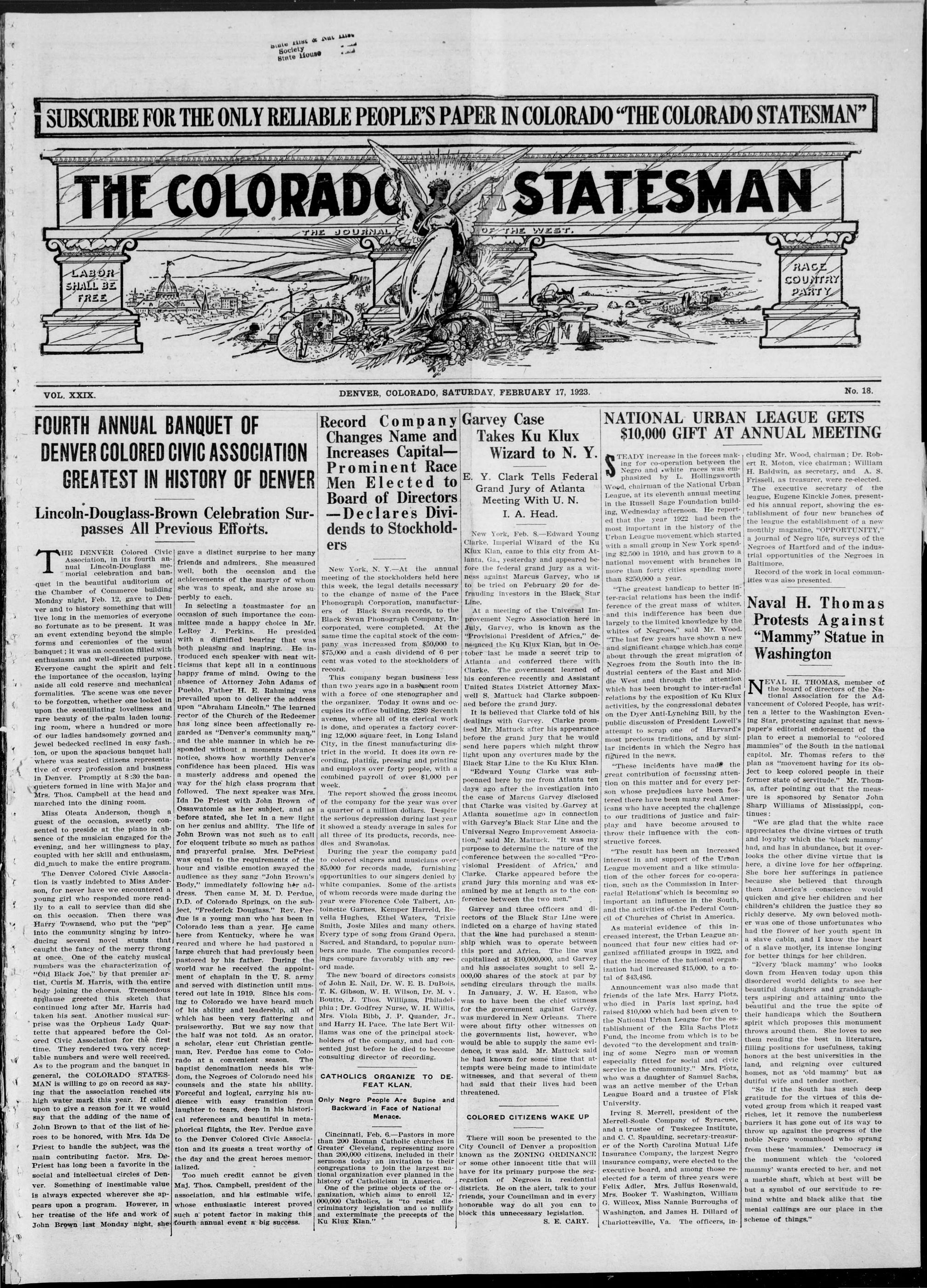
THE COLORADO STATESMAN
THE JOURNAL OF THE WEST.
LABOR SHALL BE FREE
RACE COUNTRY PARTY
FOURTH ANNUAL BANQUET OF DENVER COLORED CIVIC ASSOCIATION GREATEST IN HISTORY OF DENVER
Lincoln-Douglass-Brown Celebration Surpasses All Previous Efforts.
---
VOL. XXIX.
FOURTH ANNUAL B
DENVER COLORED C
GREATEST IN H
Lincoln-Douglass-Bre
passes All Pre
THE DENVER Colored Civic
Association, in its fourth an-
nual Lincoln-Douglass memorial celebration and ban
moral celebration and banquet in the beautiful auditorium of the Chamber of Commerce building Monday night, Feb. 12, gave to Denver and to history something that will live long in the memories of everyone so fortunate as to be present. It was an event extending beyond the simple forms and ceremonies of the usual banquet; it was an occasion filled with enthusiasm and well-directed purpose. Everyone caught the spirit and felt the importance of the occasion, laying aside all cold reserve and mechanical formalities. The scene was one never to be forgotten, whether one looked in upon the scentillating loveliness and rare beauty of the palm laden lounging room, where a hundred or more of our ladies handsomely gowned and jewel bedecked reclined in easy fashion, or upon the spacious banquet hall where was seated citizens representative of every profession and business in Denver. Promptly at 8:30 the banqueters formed in line with Major and Mrs. Thos. Campbell at the head and marched into the dining room.
Miss Oleata Anderson, though a guest of the occasion, sweetly consented to preside at the piano in absence of the musician engaged for the evening, and her willingness to play, coupled with her skill and enthusiasm, did_much to make the entire program.
The Denver Colored Civic Association is vastly indebted to Miss Anderson, for never have we encountered a young girl who responded more readily to a call to service than did she on this occasion. Then there was Harry Townsend, who put the "pep" into the community singing by introducing several novel stunts that caught the fancy of the merry throng at once. One of the catchy musical numbers was the characterization of "Old Black Joe," by that premier artist, Curtis M. Harris, with the entire body joining the chorus. Tremendous applause greeted this sketch that continued long after Mr. Harris had taken his seat. Another musical surprise was the Orpheus Lady Quartette that appeared before the Colored Civic Association for the first time. They rendered two very acceptable numbers and were well received. As to the program and the banquet in general, the COLORADO STATESMAN is willing to go on record as saying that the association reached its high water mark this year. If called upon to give a reason for it we would say that the adding of the name of John Brown to that of the list of heroes to be honored, with Mrs. Ida De Priest to handle the subject, was the main contributing factor. Mrs. De Priest has long been a favorite in the social and intellectual circles of Denver. Something of inestimable value is always expected wherever she appears upon a program. However, in her treatise of the life and work of John Brown last Monday night, she
---
State Hist & Nat Hist
Society
State House
FOR THE ONLY RELIANCE
COLORA
BANQUET OF
CIVIC ASSOCIATION
HISTORY OF DENVER
own Celebration Sur-
evious Efforts.
gave a distinct surprise to her many friends and admirers. She measured well, both the occasion and the achievements of the martyr of whom she was to speak, and she arose superbly to each.
In selecting a toastmaster for an occasion of such importance the committee made a happy choice in Mr. LeRoy J. Perkins. He presided with a dignified bearing that was both pleasing and inspiring. He introduced each speaker with neat wit, ticisms that kept all in a continuous happy frame of mind. Owing to the absence of Attorney John Adams of Pueblo, Father H. E. Rahming was prevailed upon to deliver the address upon "Abraham Lincoln." The learned rector of the Church of the Redeemer has long since been affectionally regarded as "Denver's community man," and the able manner in which he responded without a moments advance notice, shows how worthily Denver's confidence has been placed. His was a masterly address and opened the way for the high class program that followed. The next speaker was Mrs. Ida De Priest with John Brown of Ossawatomie as her subject, and as before stated, she let in a new light on her genius and ability. The life of John Brown was not such as to call for eloquent tribute so much as pathos and prayerful praise. Mrs. DePriest was equal to the requirements of the hour and visible emotion swayed the audience as they sang "John Brown's Body," immediately following his address. Then came M. M. D. Perdue, D.D. of Colorado Springs, on the subject, "Frederick Douglass." Rev. Perdue is a young man who has been in Colorado less than a year. He came here from Kentucky, where he was reared and where he had pastored a large church that had previously been pastored by his father. During the world war he received the appointment of chaplain in the U. S. army and served with distinction until mustered out late in 1919. Since his coming to Colorado we have heard much of his ability and leadership, all of which has been very flattering and praiseworthy. But we say now that the half was not told. As an orator, a scholar, clear cut Christian gentleman, Rev. Perdue has come to Colorado at a convenient season. The baptist denomination needs his wisdom, the Negroes of Colorado need his counsels and the state his ability. Forceful and logical, carrying his audience with easy transition from laughter to tears, deep in his historical references and beautiful in metaphorical flights, the Rev. Perdue gave to the Denver Colored Civic Association and its guests a treat worthy of the day and the great heroes memorialized.
Too much credit cannot be given Maj. Thos. Campbell, president of the association, and his estimable wife, whose enthusiastic interest proved such a potent factor in making this fourth annual event a big success.
DENVER, COLORADO, SATURDAY, FEBRUARY 17, 1923.
Record Company Changes Name and Increases Capital Prominent Race Men Elected to Board of Directors Declares Dividends to Stockholders
New York, N. Y.—At the annual meeting of the stockholders held here this week, the legal details necessary to the change of name of the Pace Phonograph Corporation, manufacturers of Black Swan records, to the Black Swan Phonograph Company, Incorporated, were completed. At the same time the capital stock of the company was increased from $50,000 to $75,000 and a cash dividend of 6 per cent was voted to the stockholders of record.
This company began business less than two years ago in a basement room with a force of one stenographer and the organizer. Today it owns and occupies its office building, 2289 Seventh avenue, where all of its clerical work is done, and operates a factory covering 12,000 square feet, in Long Island City, in the finest manufacturing district in the world. It does its own recording, plating, pressing and printing and employs over forty people, with a combined payroll of over $1,000 per week.
The report showed the gross income of the company for the year was over a quarter of a million dollars. Despite the serious depression during last year it showed a steady average in sales for all three of its products, records, needles and Swanolas.
During the year the company paid to colored singers and musicians over $5,000 for records made, furnishing opportunities to our singers denied by white companies. Some of the artists of whom records were made during the year were Florence Cole Talbert, Antoinette Garnes, Kemper Harreld, Revella Hughes, Ethel Waters, Trixie Smith, Josie Miles and many others. Every type of song from Grand Opera, Sacred, and Standard, to popular numbers are made. The companies recordings compare favorably with any record made.
The new board of directors consists of John E. Nail, Dr. W. E. B. DuBols, T. K. Gibson, W. H. Wilson, Dr. M. v. Boutte, J. Thos. Williams, Philadelphia; Dr. Godfrey Nurse, W. H. Willis, Mrs. Viola Bibb, J. P. Quander, Jr., and Harry H. Pace. The late Bert Williams was one of the principal stockholders of the company, and had consented just before he died to become consulting director of recording.
CATHOLICS ORGANIZE TO DE-
FEAT KLAN.
Only Negro People Are Supine and Backward in Face of National Menace.
Cincinnati, Feb. 6.—Pastors in more than 200 Roman Catholic churches in Greater Cleveland, representing more than 200,000 citizens, included in their sermons today an invitation to their congregations to join the largest national organization ever planned in the history of Catholicism in America.
One of the prime objects of the organization, which aims to enroll 12,000,000 Catholics, is "to resist discriminatory legislation and to nullify and exterminate the precepts of the Ku Klux Klan."
Garvey Case Takes Ku Klux Wizard to N. Y.
Garvey Case Takes Ku Klux Wizard to N. Y.
E. Y. Clark Tells Federal Grand Jury of Atlanta Meeting With U. N. I. A. Head.
New York, Feb. 8.—Edward Young Clarke, Imperial Wizard of the Ku Klux Klan, came to this city from Atlanta, Ga., yesterday and appeared before the federal grand jury as a witness against Marcus Garvey, who is to be tried on February 20 for defrauding investors in the Black Star Line.
At a meeting of the Universal Improvement Negro Association here in July, Garvey, who is known as the "Provisional President of Africa," denounced the Ku Klux Klan, but in October last he made a secret trip to Atlanta and conferred there with Clarke. The government learned of his conference recently and Assistant United States District Attorney Maxwell S. Mattuck had Clarke subpoenaed before the grand jury.
It is believed that Clarke told of his dealings with Garvey. Clarke promised Mr. Mattuck after his appearance before the grand jury that he would send here papers which might throw light upon any overtures made by the Black Star Line to the Ku Klux Klan.
"Edward Young Clarke was subpoenaed here by me from Atlanta ten days ago after the investigation into the case of Marcus Garvey disclosed that Clarke was visited by Garvey at Atlanta sometime ago in connection with Garvey's Black Star Line and the Universal Negro Improvement Association," said Mr. Mattuck. "It was my purpose to determine the nature of the conference between the so-called 'Provisional President of Africa,' and Clarke. Clarke appeared before the grand jury this morning and was examined by me at length as to the conference between the two men."
Garvey and three officers and directors of the Black Star Line were indicted on a charge of having stated that the line had purchased a steamship which was to operate between this port and Africa. The line was capitalized at $10,000,000, and Garvey and his associates sought to sell 2,000,000 shares of the stock at par by sending circulars through the mails.
In January, J. W. H. Eason, who was to have been the chief witness for the government against Garvéy, was murdered in New Orleans. There were about fifty other witnesses on the governments list, however, who would be able to supply the same evidence, it was said. Mr. Mattuck said he had known for some time that attempts were being made to intimidate witnesses, and that several of them had said that their lives had been threatened.
COLORED CITIZENS WAKE UP
There will soon be presented to the City Council of Denver a proposition known as the ZONING ORDINANCE or some other innocent title that will have for its primary purpose the segregation of Negroes in residential districts. Be on the alert, talk to your friends, your Councilman and in every honorable way do all you can to block this unnecessary legislation. S. E. CARY.
NATIONAL URBAN LEAGUE GETS $10,000 GIFT AT ANNUAL MEETING
STEADY increase in the forces making for co-operation between the Negro and white races was emphasized by L. Hollingsworth Wood, chairman of the National Urban League, at its eleventh annual meeting in the Russell Sage Foundation building, Wednesday afternoon. He reported that the year 1922 had been the most important in the history of the Urban League movement which started with a small group in New York spending $2,500 in 1910, and has grown to a national movement with branches in more than forty cities spending more than $250,000 a year.
"The greatest handicap to better inter-racial relations has been the indifference of the great mass of whites, and this indifference has been due largely to the limited knowledge by the whites of Negroes," said Mr. Wood. "The last few years have shown a new and significant change which has come about through the great migration of Negroes from the South into the industrial centers of the East and Middle West and through the attention which has been brought to inter-racial relations by the exposition of Ku Klux activities, by the congressional debates on the Dyer Anti-Lynching Bill, by the public discussion of President Lowell's attempt to scrap one of Harvard's most precious traditions, and by similar incidents in which the Negro has figured in the news.
"These incidents have mad the great contribution of focussing attention on this matter and for every person whose prejudices have been fostered there have been many real Americans who have accepted the challenge to our traditions of justice and fairplay and have become aroused to throw their influence with the constructive forces.
"The result has been an increased interest in and support of the Urban League movement and a like stimulation of the other forces for co-operation, such as the Commission in Interracial Relations' which is becoming so important an influence in the South, and the activities of the Federal Council of Churches of Christ in America. As material evidence of this increased interest, the Urban League announced that four new cities had organized affiliated groups in 1922, and that the income of the national organization had increased $15,000, to a total of $43,486.
Announcement was also made that friends of the late Mrs. Harry Plotz, who died in Paris last spring, had raised $10,000 which had been given to the National Urban League for the establishment of the Ella Sachs Plotz Fund, the income from which is to be devoted "to the development and training of some Negro man or woman especially fitted for social and civic service in the community." Mrs. Plotz, who was a daughter of Samuel Sachs, was an active member of the Urban League Board and a trustee of Fisk University.
Irving S. Merrell, president of the Merrell-Soule Company of Syracuse, and a trustee of Tuskegee Institute, and C. C. Spaulding, secretary-treasurer of the North Carolina Mutual Life Insurance Company, the largest Negro insurance company, were elected to the executive board, and among those re-elected for a term of three years were Felix Adler, Mrs. Julius Rosenwald, Mrs. Booker T. Washington, William G. Willcox, Miss Nannie Burroughs of Washington, and James H. Dillard of Charlottesville, Va. The officers, in-
No.18.
cluding Mr. Wood, chairman; Dr. Robert R. Moton, vice chairman; William H. Baldwin, as secretary, and A. S. Frissell, as treasurer, were re-elected. The executive secretary of the league, Eugene Kinckle Jones, presented his annual report, showing the establishment of four new branches of the league the establishment of a new monthly magazine, "OPPORTUNITY," a journal of Negro life, surveys of the Negroes of Hartford and of the industrial opportunities of the Negroes in Baltimore. Record of the work in local communities was also presented.
Naval H. Thomas Protests Against "Mammy" Statue in Washington
NEVAL H. THOMAS, member of the board of directors of the National Association for the Advancement of Colored People, has written a letter to the Washington Evening Star, protesting against that newspaper's editorial endorsement of the plan to erect a memorial to "colored mammies" of the South in the national capitol. Mr. Thomas refers to the plan as "movement having for its object to keep colored people in their former state of servitude." Mr. Thomas, after pointing out that the measure is sponsored by Senator John Sharp Williams of Mississippi, continues:
"We are glad that the white race appreciates the divine virtues of truth and loyalty which the 'black mammy' had, and has in abundance, but it overlooks the other divine virtue that is here, a divine love for her offspring. She bore her sufferings in patience because she believed that through them America's conscience would quicken and give her children and her children's children the justice they so richly deserve. My own beloved mother was one of those unfortunates who had the flower of her youth spent in a slave cabin, and I know the heart of a slave mother, its intense longing for better things for her children.
"Every 'black mammy' who looks down from Heaven today upon this disordered world delights to see her beautiful daughters and granddaughters aspiring and attaining unto the beautiful and the true the spite of their handicaps which the Southern spirit which proposes this monument throws around them. She loves to see them reading the best in literature, filling positions for usefulness, taking honors at the best universities in the land, and reigning over cultured homes, not as 'old mammy' but as dutiful wife and tender mother.
"So if the South has such deep gratitude for the virtues of this devoted group from which it reaped vast riches, let it remove the numberless barriers it has gone out of its way to throw up against the progress of the noble Negro womanhood who sprang from these 'mammies.' Democracy is the monument which the 'colored mammy' wants erected to her, and not a marble shaft, which at best will be but a symbol of our servitude to remind white and black alike that the menial callings are our place in the scheme of things."
FOREIGN
Dr. Thomas O'Higgins was assassinated at Dublin. Dr. O'Higgins was the father of Kevin O'Higgins, minister of home affairs in the Free State government. The council of state in Manila has amended regulations governing exploration and drilling for petroleum in the Philippines in an endeavor to encourage oil prospectors in the islands and the investment of outside capital. Liam Lynch, Republican chief of staff, issued a proclamation in Dublin, declaring that "the war will go on until the independence of our country is recognized by our enemies, foreign and domestic," and calling upon the army to "continue activities with vigor."
Six women and a man, arrested at Limerick, are reported to have attempted to obtain the release of thirty prisoners from the Jail there. They bribed the sentry to allow the prisoners to escape over the wall. This he agreed to do, but soldiers in disguise came over instead and captured the waiting plotters. A violent cyclone swept Portugal recently, causing numerous deaths and great material damage. Numerous wrecks along the coast and in the rivers have been reported. Nine barques loaded with merchandise foundered at Oporto and hundreds of fishing boats went down in the Tagus river with a loss of seven lives.
Roy H. Finch, assistant director of Killuaea volcano observatory, in charge of the seismograph at Hawaii, said that he was inclined to accept the deductions of those mainland scientists who placed the origin of the recent disturbances, which developed the tidal waves that swept the islands, as somewhere northwest of Hawaii.
Metal and other products from the Ruhr and the Rhineland will not be permitted to go into unoccupied Germany. The French and Belgian governments served notice that in consequence of the efforts of the Germans to create difficulties for the occupational forces, this further embargo is to be imposed on exports from the two regions.
Lieut. Walter Hinton, the American aviator, arrived in Rio Janeliro, completing his seaplane flight from New York for Rio Janeliro, a journey of more than 5,000 miles, undertaken as a mark of friendship between the United States and Brazil on the occasion of the latter nation's centennial celebration. He was beset with difficulties almost from the start.
GENERAL
As the culmination of a family quarrel in a remote village of the far north Edward O'Brien is dead; his son, Clifton, is dangerously wounded, and Canadian army are searching for Frederick O'Brien, an 18-year-old son and brother, who is alleged to be responsible for the shooting, according to reports received in Winnipeg, Canada.
A rate war among stockyard commission men was forecast with the announcement by the Progressive Live Stock Commission Company of Chicago of a 40 per cent reduction in their charges for handling cattle and hogs in carload lots. The reduction takes effect immediately. A saving to the farmer and live stock producer of from $300,000 to $400,000 a year will be effected if the reduction becomes general.
An amazing story of intrigue and deception was unfolded when Frank P. Walsh, attorney for twenty-two communists who are facing trial at St. Joseph, Mich., for advocating criminal syndicalism, began taking the deposition of Albert Ballin, alias Balanow, self-confessed spy and agent provocateur. By Balanow's testimony Mr. Walsh is seeking to show that radical organizations and "red" scares were invested at will by private detective agencies to assist them in collecting large sums of money from banking and other interests for the purpose of investigating the imaginary radical menace.
Kansas City.—Coal miners and operators negotiating a new contract at Kansas City, Mo., for the southwestern coal fields have agreed on continuation of the present wage scale for one year, but the operators are seeking certain other concessions, F. W. Lukins of Kansas City, chairman of the joint conference sub-committee, announced.
Chief Gabriel White Horse, a Cherokee Indian, went to the happy hunting grounds recently in New York City by a self-inflicted bullet wound through his heart. He had just learned, police said, that the pale face girl he adored had been merely "kidding" him. The cause of it all, according to the police, was Mrs. Norma Smith, 27 years old, cashier in a lunch room.
Charges that a letter sent to the postmaster of New York City in October, 1920, threatening to kill him and blow up the Woolworth building was inspired by an official of the W. J. Burns Detective Agency were made by Albert Ballin, alias Balanow, confessed spy and agent provocateur, continuing his sworn deposition for use by the defense in the trial of twenty-two alleged communists at St. Joseph, Mich., Feb. 26.
Earl B. Mayfield, United States senator-elect, and Silliman Evans, staff correspondent of the Fort Worth Star-Telegram, came to blows at Austin, Texas, in a hotel lobby. The clash followed an argument about a news story, in the room of a mutual friend, it is said. Both went to the floor.
Joseph N. Self, night watchman at the University of Kentucky at Lexington, is dead, and William H. Middleton, 19, of Paducah, Ky., a student at the university, is dying, as a result of a pistol battle fought on the university campus.
AN EPITOME OF LATE LIVE NEWS
CONDENSED RECORD OF THE PROGRESS OF EVENTS AT HOME AND ABROAD.
FROM ALL SOURCES
SAYINGS, DOINGS, ACHIEVE
MENTS, SUFFERINGS, HOPES
ANDFEARS OF MANKIND.
WESTERN
All but fourteen bodies of the 122 miners entombed in mine No. 1 at Dawson, N. M., following the recent explosion, have been removed by rescue crews. The list of official dead now numbers 106, two of the entombed men having walked out uninjured. J. E. Chilberg, former president of the defunct Scandinavian-American Bank of Seattle, stands cleared of a charge of illegally borrowing $65,000 from the bank. An indictment against him was dismissed on motion of the prosecuting attorney, who said there was no evidence to substantiate the charge.
Felipe (Little Phil) Alguin, recently deported from Mexico after a continent-wide search for him, has confessed to Chief of Police Louis D. Oaks of Los Angeles the slaying of Detective Sergeant John J. Fitzgerald eighteen months ago, according to a report printed in the Los Angeles Times.
A storm, marked by every characteristic of extreme winter weather from below zero temperatures to mile-a-minute gales, swept the Pacific coast from the "cradle of storms" south of the Aleutian islands to the plateau regions west of Denver, prostrating wire communications and crippling train service.
Assurances that Japan and the United States have no vital mutual problems that conflict or any that are serious which cannot be adjusted by better understandings and a desire to be fair were given in San Francisco by Masunao Hanihara, Japan's ambassador to the United States, and by Charles B. Warren, United States ambassador to Japan.
Firing without warning, two bandits in Los Angeles shot and killed Sam McGee, negro chauffeur, held up and armed automobile of the First National Bank, in charge of O. L. Callan, bank guard, and W. Blizzard, head of the bank's mailing department, and escaped with a suitcase containing registered mail, the value of which was estimated at $100,000.
WASHINGTON
Predleting that the United States in the future would begin to export gold, Comptroller of the Currency Crissinger in his annual report declared this would represent a long step in the restoration of world economic equilibrium.
The American foreign policy was raked over the coals in satirical vein at the midwinter dinner of the Gridrion Club of Washington newspaper correspondents. Several hundred guests, among them authors, artists and cartoonists, mingled with statesmen, diplomats and leaders of finance and industry enjoying the fun.
The British debt framing bill unexpectedly was given a clear field in the Senate, and the administration shipping bill was formally sidetracked, temporarily, and possibly permanently. The shipping bill was voted aside as the result of a parliamentary situation, which developed suddenly, and Democratic opposition to the measure. Charles Beecher Warren is quitting as United States ambassador to Japan because he has accomplished the purpose for which he was sent to Tokio, he declared on his arrival in San Francisco, on his way to Washington.
Administration leaders in all branches of the government have expressed confidence that speedy and favorable action would be taken by Congress on the British debt funding settlement once it is submitted by the President. While it was generally admitted that opposition to the plan would develop considerable strength, administration spokesmen argued that a free discussion of the plan would win support for it both in Congress and throughout the country.
The Norris amendment to the federal constitution eliminating the present session of an old Congress after election of a new Congress and changing the date of inauguration of President from March 4 to the third Monday in January has been approved by the Senate. The resolution embodying the amendment was adopted after brief debate and by a vote of 63 to 6. It now goes to the House, with approval there before adjournment of Congress regarded as problematical.
Another effort to have Congress provide funds for the distribution of free seeds by its members failed, the House agricultural committee on a tie vote refusing to report out a bill by Representative Langley, Republican, Kentucky, proposing an annual seed appropriation of $500,000.
The application of the Southern Pacific Company to retain its present control of the Central Pacific railroad by ownership of its stock and lease of its lines was granted in full, by a decision of the Interstate Commerce Commission.
LATE NEWS
From All Over
COLORADO
Denver.—Selecting the name, Columbine post No. 41, five American Legion posts were consolidated here.
Fort Collins.—George H. Shaw, state Republican chairman, was appointed county attorney by the board of commissioners of Larimer county.
Leadville.—President Harding recently sent to the Senate the nomination of Mrs. Eva A. Britain of Colorado to be registrar of the land office at Leadville, Colo.
Denver.—The compiled statutes of 1021, now being printed and which will replace the revised statutes of 1908, will be sold for $15 a copy, according to an announcement by Secretary of State Carl Milliken.
Breckenridge.—Citizens of Breckenridge have passed a resolution condemning State Senator William Renshaw of Idaho Springs for his presentation of a bill giving the right of eminent domain to dredging and hydraulic mining companies.
Golden.—The Woodmen of the World have elected to the board of head managers J. W. Klein of Golden, it was announced at the national headquarters in Denver. Klein fills a vacancy caused by the death of F. P. Hawke of Pueblo.
Colorado Springs.—Colorado Springs is to have a new and powerful radio broadcasting station, and the operator in charge is to be William D. Pyle, at present operator in charge of KDZQ of Denver. Mr. Pyle will take up his new duties the latter part of this month.
Deer Trail.—Unless possible special motions are granted, George Griffith of Carthage, Ill., charged with killing Howard Hamilton, as the latter left a dance hall at Deer Trail the night of Dec. 24 with Miss Pearl Coeur, will not be tried in the Arapahoe county District Court until October.
Denver.—A 4-year-old child was injured fatally, ten other persons were injured and five were lodged in the city jail as a result of a series of automobile and tram car accidents in one night here. The dead child is Hazel Pease, daughter of Carl J. Pease, instructor of mechanical drawing at a Denver high school.
Boulder.—Boulder is to have a road of remembrance ten miles in length as a memorial for the war heroes of 1917-18. Plans are being made for the road. Trees are to be planted and other improvements made. The road to be improved is the Arapahoe road which connects with the Lincoln highway. Denver.—If the present rate of increase continues, Colorado will in a very few years produce all the hogs necessary to supply the demand of local packers, which in the past has been brought in annually from other states to be butchered at the Denver stockyards and at smaller packing centers in the state.
Rifle.—That bad booze was responsible for the gun duel near Rifle in which Edward Brunes was killed and Bert Taylor wounded, was the verdict of a coroner's jury. First dispatches of the affray stated that Taylor and Brunes engaged in a pistol duel after the former had been fired upon. The shooting occurred in the cabin of Ed Bois on Corral creek.
Denver.—Thriving under favorable conditions not found outside the state, Colorado's bee industry now produces between 5,000,000 and 6,000,000 pounds of honey yearly from about 125,000 colonies of bees. An unusually dry climate help the bee in keeping down the moisture content in his honey, and the specific gravity is therefore considerably higher than in foreign honeys.
Greeley.—An investigation of the cost of growing sugar beets, expected to take many months, was launched here by the Mountain States Beet Growers' Association, with United States Tariff Commissioner E. P. Costigan, formerly of Denver, in the role of official observer.
Canon City.—Four mountain lions bagged in one week is the record of Dave L. Couch, hunter of predatory animals for the United States biological survey. The animals were all killed in the San Isabel national forest in the western part of Fremont county, and are said to be the largest kill of lions by one man in this part of the state in recent years.
Colorado Springs.—A decision laid down by the State Public Utilities Commission recently, it is believed, will prevent the junking of a part of the Cripple Creek Short Line railroad that is necessary for the operation of many mines in the vicinity of Cripple Creek. A controversy of years' standing was settled by the decision. Under the ruling, no railroad lying wholly within the state can abandon service and take up its track without first obtaining the permission of the commission.
Fort Morgan.—Sugar beet growers from Sterling, Atwood, Brush, Merino, Weldona, Fort Morgan and other sugar raising sections of the South Platte valley met in Fort Morgan for a discussion of the new contract proposed by the Great Western Sugar Company for 1923. There was no set program for the meeting and the discussion was on statements of experiences by growers who contended that they could not make money in raising sugar beets at the prices that were paid last year or that were proposed for the coming season.
CENTENNIAL STATE ITEMS
Denver.—The condition of cattle on the ranches and ranges of Colorado on Feb. 1 shows further improvement, being reported as 96 per cent of normal on Feb. 1, compared with 92 per cent on Jan. 1, and 89 per cent on Dec. 1, according to the report just issued by W. W. Putnam, agricultural statistician of the United States division of crop and live stock estimates. This improvement is largely because nearly all cattle are now being fed and that the mild open winter is resulting in few losses. The condition of sheep also shows further improvement, being reported as 98 per cent of normal on Feb. 1.
Denver.—Chambers of Commerce, commercial organizations, traffic clubs and express shippers of Colorado have been asked to send representatives to Denver for a conference March 5 on express rates, the invitations having been malled out by the State Public Utilities Commission. The interstate commerce hearing on express rates will be held in Denver March 15, and the March 5 conference is for the purpose of preparing definite and specific plans for the presentation of all matters pertinent to the express rate question to the Interstate Commerce Commission.
Denver.—The problem of cornering between twelve and fifteen million dollars for the trade area of the Rocky Mountain region is being undertaken by the Rocky Mountain Motorists, Inc., an organization of business and professional men of the mountain states' institutions interested in the development and exploitation of the scenic attractions, climatic advantages and recreational opportunities of the Rocky Mountain region. Last year tourists spent more than $42,000,000 in Colorado.
Meeker.—A coroner's jury has held Bert Taylor, cattleman, wounded in the Bar B ranch gun battle in which a cowboy named Brunt was shot dead, on the charge of murder. According to the story told the jury Taylor rode up to Ed Bols' cabin, accompanied by Brunt, and challenged all to battle. Boies asked Brunt to try to get Taylor's gun, which lay on a table, and when Brunt made the effort, Taylor "beat him to it" and shot him dead. Greeley.—That failure to include physical education in a course for school teachers is largely responsible for low health standards and physical imperfections in the students entering the university, as pointed out by Miss Clare Small, director of physical education for women at Colorado University, is the opinion of the members of the physical education department at Colorado's teacher training institution, State Teachers' College, at Greeley.
Pueblo. Governor Sweet and members of the Twenty-fourth General Assembly were guests of the Pueblo Commerce Club. Members of the Assembly, Pueblo business men and the county clerks and county commissioners of eleven counties who were here attending the Arkansas Valley Association of County Commissioners meeting inspected the Colorado hospital for the insane and state fair grounds.
Denver. Record prices were brought by registered mountain Herefords in the local livestock market at the auction sale of Johnson Bros. of Eagle, Colo. More than 150 cows, calves and bulls were disposed of. The show herd which took prizes at the National Western Stock Show in January was placed on the block.
Golden.—The board of commissioners of Jefferson county dealt a blow to roadhouses in this community when it turned down a second application for a license at the so-called Pete's place on the Denver-Arvada cement road at Perrin, adjoining Lakeside park, for permission to operate a soft drink and dancing place.
Lafayette.—Charles A. Scholes, proprietor of the Lafayette Cash Grocery and Bakery, was arraigned on a charge of selling liquor and held in $500 bond.
Denver.—Announcement has been made of a change in the administrative policy of the University of Denver by Dr. Heber R. Harper, chancellor. Hitherto, separate departments have been under charge of the respective deans. Under the new policy the routine work at the college of liberal arts will be taken over by Vice Chancellor W. D. Engle, leaving Dr. Harper free to look after the affairs of the university as a whole.
Denver.—Colorado roads are in good condition, with the exception of the mountain passes, according to reports received by Robert Higgins, chief of the maintenance division of the State Highway Department. In the San Luis valley all roads between towns are open. The southwestern part of the state has had many roads closed temporarily because of the snow.
Kersey.—An unsuccessful attempt was made to rob the Kersey State Bank, eight miles east of Greeley. This was the fourth attempt that has been made on the bank and in only one case did the robbers succeed. The latest attack on the bank was frustrated at the inner vault doors, which apparently resisted the assaults of the would-be bank robbers.
Fort Collins.—Beet growers of the Fort Collins district, at a meeting here agreed not to sign contracts for growing beets during the coming season unless they are paid a scale assuring them 50 per cent of the price of the sugar manufactured from the beets they produce.
Durango.—Francis Heit, Ouray hotel man, was saved from death when a rescuing party from Silverton found him half frozen in a snow-filled cannon two miles from Silverton. Heit had attempted to snowshoe over the mountains from Ouray to Silverton.
W. K. HUNT Champa 3522 2962 Welton
Orders Promptly Delivered
Canned Mushrooms.....35c and 60c size
Olive Butter, fine for sandwiches; jar.....15c
We have Hairslick, can.....25c
Del Monte Brussel Sprouts, can.....25c
COURTESY AND SERVICE TO ALL
Cleaning, Pressing and Repairing. All Work Guaranteed
720 EAST 26TH AVE.
PHONE MAIN 6751 Prices reasonable.
Call in and see my Fall and Winter Samples now on display.
GROCERIES AND MEATS Fresh Vegetables and Fruits Daily
Free D
PHONE MAIN 6
THE CH
DRUGS, CHE
PRESC
Phone us and we
Free Delivery to any part of the city.
E MAIN 6338 718 E. TWENTY-SIXTH
E CHAMPA PHARMA
2101 CHAMPA
Is the place to get your
BAGS, CHEMICALS AND PATENT MEDICINE
WE SERVE DRINKS.
PRESCRIPTIONS OUR SPECIALTY.
us and we will deliver the goods to all parts of
JAMES E. THRALL, Propr.
E MAIN 2425 PH
Adam C. D. Nich
Artific Facial & Scalp Treatment
Swedish Body Massage
Manufacturer and Dispenser of
the Nichols Hair Restorer
Violet Ray and Vibratory Treatment
Free Delivery to any part of the city.
PHONE MAIN 6338 718 E. TWENTY-SIXTH AVE.
THE CHAMPA PHARMACY
2101 CHAMPA
Is the place to get your
DRUGS, CHEMICALS AND PATENT MEDICINES
WE SERVE DRINKS.
PRESCRIPTIONS OUR SPECIALTY.
Phone us and we will deliver the goods to all parts of the city.
JAMES E. THRALL, Propr.
PHONE MAIN 2425
Manufacturer and Dispenser of the Nichols Hair Restorer Violet Ray and Vibratory Treatments
PHONE CHAMPA 2220-J
4 WASHINGTON STREET (Upsta
DENVER, COLORADO
2444 WASHINGTON STREET (Upstairs) DENVER, COLORADO
WEATHERHEAD
HAT FACTORY
ESTABLISHED 1876
MEN'S AND WOMEN'S UNCLAIMED HATS FOR SALE—FELTS,
PANAMAS AND WHITE MILANS
1722 STOUT STREET
ALBANY HOTEL BLDG.
Granberry Taxi & Baggage Co. OFFICE; 2713 WELTON STREET
If you have a room for rent or want a room call us TAXI RATES: $3.00 per hour. DAY and NIGHT SERVICE T. G. GRANBERRY, Mgr. DENVER, COLORADO
```markdown
```
MEMBERS OF CONGRESS SEEM TO BE WEARY AND READY TO TAKE A LONG REST.
People Want Some Months Undisturbed by Legislative Uncertainties Farming Interests Perhaps Not Quite Satisfied.
By EDWARD B. CLARK
Washington. At this writing nothing apparently is looming which demands an extra session of congress. Curiously enough, perhaps, today the senators and the representatives who at the outset of the session seemed determined to force an extra session if such a thing were possible, are now to all appearances as glad of the promised freedom from legislative thraldom for a time as are any of the original opponents of the extraordinary session project.
It is always possible, of course, that something may happen overnight to change the whole trend of legislative events, and to make probable what hitherto seemingly was improbable. Therefore let it be said that now it looks as if there will be a long vacation ahead for the representatives and the senators, but if untoward things shall happen the advance word that they might happen will stand as an excuse for what otherwise might seem to be a case of faulty prophecy.
What is it that has changed the desire of some of the members of congress for an extra session into a willingness that none shall be called? A good many reasons have been advanced, but probably the basic reason is that the strenuous endeavors for this thing or that thing by virtually every member of the present congress seem to have tired them out and made them willing for physical reasons to take a rest.
Sense the Country's Desire.
There is another reason, however, which in a way is similar to the one just given and yet it is different. There seems to be a feeling in the house and senate today that the country is tired of congress. It is not meant by this that the communities of the country, according to their varying viewpoints upon legislative matters, are tired of the efforts which men in congress are exerting to secure specific kinds of legislation, but simply that congress feels that the people of the country generally would like to get release from the uncertainties of legislative activities, and would welcome the opportunity to get back to work undisturbed by economic or financial theorizing for eight months or so.
There was a fear on the part of some of the members of congress at the outset of the session that a drive was to be made in behalf of ship subsidy legislation to the exclusion of all other matters of public moment. It is true, probably, that the leaders of the majority party in the two houses of congress could have prevented consideration of anything at the present short session except ship subsidy and the appropriation bills, but even if any of them felt so inclined they believed that to follow such a course would be bad politics, if not bad economics.
A great deal has been said publicly about the victory which certain elements in the Republican party in congress galanced over the leadership of the majority when the virtual slidetracking of ship subsidy was secured and bills for the economic relief of agriculture were given the right-of-way. Of course in a sense the pleaders for first consideration for agricultural credits and the like won a victory, but it was a victory over a force which was willing to yield victory in advance.
Farm Bloc May Not Be Satisfied.
Some men here say that the men who are working for laws which will give relief to agriculture are not entirely satisfied with the form which the legislation is taking, and hold that it was prevented from taking the form they wished because of opposition from the majority leadership. Whether the farming interests will be entirely satisfied with such legislation as it is to get at the present session of congress is much to be doubted, but it seems to be true that some of the farming interest exponents in congress are fairly well pleased with what it is doing and what is yet to be done.
Certain it is that the so-called conservatives in the senate and house yielded much more to the arguments of those who sought relief for agriculture than it was believed at first they could be made to yield. Agriculture has gained a little or has gained much according to the viewpoint, but it has gained more than was thought possible at the beginning of things, and so it is possible that things may prove fairly acceptable.
Archives Building Approved.
Archives Building Approved.
Priceless documents of the rarest historic value, the property of the United States and its people, possibly may be saved from the danger of fire and theft by action of congress prior to adjournment.
The senate has approved an amendment to ar appropriation bill which will set aside $2,500,000 for the erection of a fireproof national archives building on a square of ground belonging to the government, lying virtually due north of the Lincoln memo-
rial, and removed from the memorial only by a distance great enough so that the new structure will in no way interfere with the general vistas of the Washington Mall. For a great many years various organizations of the country, scholars, research men, and persons patriotically inclined, have been urging congress to take means to preserve for all time the historic papers which Uncle Sam owns. These papers are invaluable for research purposes, to say nothing of their sentimental value. Some of these archives have escaped damage by fire on several occasions only by the prompt action of government employees and the fire department.
Congress always has recognized the danger to the documents and always has been ready to say they should be saved. While money in the past was generally forthcoming for other structures less important from a historic and sentimental point of view, the plga of economy has prevented action to save these priceless records of the past.
All Archives In One Building.
Every winter students, men who intend to write articles or exhaustive histories, come to Washington to consult the records. They are compelled to go hither and yon to find what they want. Some things are in the Congressional library, others in the War department, others in the library of the Navy department and others in this department and that department. The plan is, if the archives building measure shall pass, to gather all the archives together and to place them in the new building where they will be catalogued and made accessible under proper conditions to the seeker after information—and all this in absolutely fireproof surroundings.
It may be that the original copy of the Declaration of Independence, which is accounted the most valuable of all the government's paper or parchment possessions, will be kept where it is today, in a corner of a vault in the State, War and Navy building. It is said that the Declaration will be safe where it is now even if the building in which the vault is located should be destroyed by fire. Whatever is done with the Declaration, it is certain that all the other records and archives, except the modern ones in almost daily use, will be moved to the new building. The Declaration of Independence is shown only on the rarest of occasions. Light affects ink, and it is said there are evidences of fading. A facsimile of the Declaration is on public view almost constantly.
Within the keeping of the government are letters, orders, and communications of various kinds concerning all the wars and greater peace activities in which the government has been engaged. There are documents of Colonial times, of Revolutionary war times, of early days of the established republic, of the times of the Seminole the Mexican, the Civil, the Spanish and the World wars. The autographs attached to these letters if placed at public auction would bring a fairly staggering sum of money. The government looks at these documents not only from the cash value viewpoint but from that of the historic and sentimental.
Weeks Resents Insult to Harbord.
The statement of Secretary of War Weeks to the effect that congress has offered an insult to Major General Harbord, to the government and to the United States by recent legislative action, has aroused considerable feeling in Washington, the preponderance of which, at least seemingly, is charged with sympathy tor what the secretary had to say.
The house of representatives amended the army appropriation bill in such a way as to deny retirement pay to Maj. Gen. James G. Harbord, who upon leaving the active service after 40 years of labor therein, became president of the Radio Corporation of America.
The reason that the house took this action was because General Harborb is to draw some pay from the company for his work, and members of the house said that some time the corporation might have dealings with the government, and therefore the intimation was that the general might use his personal influence with the government authorities to secure some privileges for the corporation.
General Harbord commanded the second division of the American troops in one of the most brilliant campaigns in the war. Later he served as the director of the service of supplies in France, a service upon which the armies depended for everything which was necessary for operations, food munitions, and all the things that life between. His record is what some one has called a monumental one. This is perhaps beside the mark in connection with what has been done or is likely to be done unless the senate or the President shall intervene.
To say that General Harbord, because he is on the retired list of the army, might use his influence in some particular way to seek favors for the company for which he is working, is to say that mentally at least he is dishonest, and perhaps it would go even further than this in suggestion.
Bits From an English Play.
"I might be induced to marry again if I could find a man to induce me."
"I think marrying again is such a nice compliment to one's first husband."
"We women rather like selfish men. They give us a chance of sacrificing ourselves."
"There are times when all nice men regard all nice women as their mothers. After a good dinner is one of them."—Boston Evening Transcript.
.....
STATE CAPITOL NEWS LETTER
STATE CAPITOL NEWS LETTER
A measure passed on second reading appropriates $5,000 for the payment of expenses in the negotiation of interstate river compacts.
A bill raising the salary of the secretary of the adult blind fund from $300 to $900 a year was passed on final reading by the House.
Senator John J. Tobin, Democrat, of Montrose, asserted that unless some relief came to the farmers that 90 per cent of Colorado farmers would be broke.
Senate Bill No. 1, by Senator Eaton, making slight changes in the industrial law, was passed by the House on final reading, four Democrats voting against the measure.
S. B. 63, by Toll, providing for a deputy public trustee, and S. B. 130, by Knauss, providing for collections of judgments against a deceased person, passed on second reading.
A raise of from $10 to $12 a week as a maximum to be received from the workmen's compensation fund was granted by a bill that passed the House on final reading.
Members of the Legislature visited Pueblo as guests of the Chamber of Commerce of that city. While there they inspected the state hospital for the insane and the state fair grounds.
The Senate passed S. B. 365, by Burke, that would allow the state land commissioners to make an exchange of eighty acres in southern Baca county to replace land privately owned that a resurvey showed belonged to the state.
This week will probably see the ratification of the Colorado and La Plata river water compacts, negotiated on behalf of Colorado by Delph E. Carpenter. Unless there is a sudden change in sentiment, the ratification will be by overwhelming majorities in both Senate and House. Opposition to the treaty has disappeared.
By a vote of 38 to 16, the House killed a measure that would allow for an appeal to the District Court of decisions made by the State Board of Medical Examiners. Representative R. W. Calkins of Montezuma county said that if the bill passed, it would be impossible to keep undesirable physicians and surgeons out of the state.
The State Board of Pardons will be the first board abolished by the Twenty-fourth General Assembly of Colorado unless unforeseen circumstances delay the bill providing for putting it out of existence. The State House of Representatives passed on second reading the measure by Senator Harry G. Saunders of Denver, providing for such abolishment, and the bill already has been passed by the State Senate.
The resolution calling upon the governor to investigate car shortage conditions was passed unanimously by the House of Representatives when it came up on final reading. The resolution now goes to the Senate for action and it leaves members of that body in a predicament. Last week a similar resolution was completely changed by them and the governor was left out and the public utility and interstate commerce commissions substituted.
The Senate in committee passed S. B. 272, by Eaton, on second reading. This is to correct H. B. 2, that did away, presumably, with all free automobile licenses. When the House bill reached the governor it was found that section 1 of the old law had not been amended and the words allowing motor vehicles "used solely on official business by federal, state, county or municipal officers" had been left in the bill. This exempted these officials from paying any tax.
The bill enabling the state treasurer to issue the $6,000,000 bond issue for good roads voted by the people at the last election, was passed on final reading by the State House of Representatives. Ten Democrats voted against the bill. Those voting against the measure protested against the clause in the measure which allowed the levying of a tax to pay the bonds and interest.
After being called upon by a committee of three, the Rev. J. R. Rader, chaplain of the House, appeared before the House and re-read his prayer of the previous morning and pointed out that no reference to Colorado courts was made. After being closedet with the special committee the Rev. Mr. Rader asked permission to make a few remarks. He then told the members that the position of chaplain was very trying as he had to think of a new prayer every morning. "I did not refer to officials of Colorado in my prayer," he said. "I did not say 'our courts are corrupt,' but that 'many of our courts are corrupt.' I didn't say God had been excluded from the churches, but said 'from many of our churches.'"
- Legislation pending in the Colorado Assembly which would establish a marketing bureau and make possible co-operative marketing organizations among Colorado farmers is assured of passage, John J. Tobin, senator from the western slope, said before the weekly luncheon meeting of the members council of the Civic and Commercial Association.
A bill allowing district attorneys to draw money received for expenses monthly instead of annually was passed by the House on second reading.
TERRIFIC STORM ON WEST COAST
8. O. S. CALLS FILL AIR FROM VESSELS THAT ARE IN DISTRESS.
FOUR SHIPS WRECKED
FURIOUS GALES ON PACIFIC OCEAN TAKE TOLL OF LIVES.
Seattle, Wash.—The North Pacific's "graveyard of ships" claimed three more vessels as victims in a furious gale that swept the ocean off the Washington and British Columbia coast lines. The last word wirelessed from the fourth, the steamer Tuscan Prince, with a crew of forty-two aboard, was; "We are breaking up."
The vessels known to be lost were the steamer Nika, burned to the water's edge, near Umatilla reef; the freighter Santa Rita, lodged on a rock lodge near Ole Oose, Vancouver is and, British Columbia; the motorship Coolcha, pounded by huge waves as she lay on an exposed reef at Albert head, near Victoria, B. C. The crews of the three ships were saved.
Earlier reports that the steamer Tuscan Prince had gone aground and that her crew of forty-two had landed safely were set at naught by a wireless message from the coast guard cutter Algonquin indicating that the fate and even the whereabouts of the vessel were a mystery.
The last heard from the ship direct was a dramatic message, broken off in the middle, which said: "We are breaking up."
Word by word, the message often halted or broken, the wireless brought the story of the storm's toll into Seattle during the night and day. First came word from the coast guard cutter Snobomish, Capt. R. R. Waesche: "We are going to aid steamer Nika, reported, lost rudder, dangerous position off Umatilla reef."
The Snohomish was at Port Angeles, eight hours' run from the disabled vessel.
A little later another message, from Victoria, said the Coolcha had been abandoned and her crew taken off by the salvage steamer Algerine.
Later the Santa Rita broke into the aerial conversation.
"We will be there at 4 o'clock," said the Santa Rita's key.
An hour later and the Santa Rita had struck a Vancouver island ledge and was herself calling for help.
Commercial messages filled the air again, and then came the Snohomish:
"Rescued total crew of thirty-four men from burning Nika. Now standing by wreck. Will give obstruction report later."
Ships on Atlantic Send S. O. S.
New York.-Out of the fury of the storm-swept Atlantic came wireless calls for aid from two sinking vessels and news of the disabling of several others. The Italian freighter Moncenisce, from Norfolk, Va., to Marselles, with a crew of thirty, sent out frantic appeals for help. "We are sinking," said the Moncenisce radio giving the vessel's position as about 510 miles east of Cape Henry, Va. A later message said she was being washed by heavy seas.
Machine Guns Placed in Essen.
Dusseldorf.—A company of French infantry with machine guns occupied the Essen city hall simultaneously with the declaration of a twenty-four-hour general strike against the recent arrests. The street car and electrical plants continue to function. Trouble is again brewing at Gelsenkirchen, where feeling is running high against the occupying forces. A French officer was attacked in the street and beaten by a mob, but was finally rescued. The French made several arrests.
Packing Plant Fire Under Control.
Omaha, Neb.-The fire at the plant of Armour and Company, South Omaha, which caused a loss estimated near $2,000,000 and which threw more than a thousand men out of work, was declared to be under control after a forty-two-hour fight. Collapse of the ice-covered nine-story walls of the gutted buildings spelled the doom of the fire. With the walls down firemen were able to throw huge streams of water into the center of the blaze.
Dancer's Suit Is Dropped.
Los Angeles.—The $200,000 suit brought against Herbert Rawlinson, motion picture actor, by Mrs. Ethel E. Clark on behalf of her daughter, Dorothy Clark, professional dancer, has been settled out of court, according to Mrs. Clark. "There will be no trial of the case," she announced here. "Mr. Rawlinson has made a settlement on my daughter." This settlement, she explained, would secure the dancer, now 17, $50 a week until she reaches the age of 21.
```markdown
```
THE COLORADO STATESMAN
[M]
the Mouth-Piece
the People of
Colorado and the
Entire West
RELIABLE chronicle
of their doings and
gress; a faithful mirror
their wants, their hopes,
ir best aspiration.
THE
COLORADO
STATESMAN
equaled as an advertising
medium for the business
of professional men and
women.
excellent family journal
speaking to and for many
thousand colored citizens.
The Mouth-Piece of the People of Colorado and the Entire West
A RELIABLE chronicle of their doings and progress; a faithful mirror of their wants, their hopes, their best aspiration.
THE COLORADO STATESMAN
Unequaled as an advertising medium for the business of professional men and women.
An excellent family journal speaking to and for many thousand colored citizens.
$2.00 A YEAR
$1.25 SIX MONTH
$.75 THREE MONTH
THE GREAT ORGAN OF THE BORING MASSES
THE GREAT ORGAN OF THE LABORING MASSES
THE COLORADO STATESMAN
Entered as second-class matter at the postoffice in the City of Denver, Colo.
Redognized by the Retail Merchants' Bureau of the Denver Civic and Commercial Association as an advertising medium.
LACK OF CO-OPERATION.
between the president of the Victor Walker, editor of the book delivered at the Lincoln-Doole pupils in the social affairs—the News and the Devices which tends towards the organization and the utter de Co-operation is one of the ever members, whether offight of conducting the affairs and actions detrimental to it, think we are correct in statid of the Civic Association to publication until the committee met in conference with the out; but it is clear that somebody might have lost the honor social feeling between high school and cause unsavory commonuld suggest that the president more confidence in his ass which will eventually save his heart the attempt of individual
THE controversy between the president of the Denver Colored Civic Association and Victor Walker, editor of the New American Weekly, over the address delivered at the Lincoln-Douglass banquet on the segregation of high school pupils in the social affairs of the school, as we read in the daily papers—the News and the Denver Post—is another of those unfortunate incidents which tends towards the disruption of the successful working of an organization and the utter destruction of its usefulness in a community. Co-operation is one of the keynotes of the Civic Association, and whenever members, whether official or otherwise, take unto themselves the right of conducting the affairs of the Association and arriving at conclusions and actions detrimental to its cause, the whole Association suffers. We think we are correct in stating that it was agreed by the Executive Board of the Civic Association that nothing should be offered the press for publication until the committee appointed from the Association should have met in conference with the Education Board and a settlement brought about; but it is clear that somebody anxious to get into print, fearing that they might have lost the honor and credit for giving publicity to a little racial feeling between high school pupils, thought it wise to stir public opinion and cause unsavory comment. We advise against any recurrence and would suggest that the president of the Colored Civic Association place a little more confidence in his associates, thereby securing their ready help, which will eventually save him from such unfortunate incidents and thwart the attempt of individuals to destroy our work.
CIVIC PRIDE.
He was one among the merry banquet of the Denver College of Commerce building Monday of such a public-spirited, united Denver Colored Civic Association human agencies seldom do. Have it so or not. But it is for contributing untold volumes the association has already acco progressed farther is due solely hundred organizations, it is the on the outside and grumbles if it maintains an even ten. As it will be certain to grow it is an affiliated body of the institution is a valuable asset and but too much reliance must it is. God helps those who lift the American white man is mighty in this regard. The God institution with the Denver-lifting to hear the president's progressive Negroes had the right brand of civic prideber next year.
WE doubt if there was one among the merry throng that attended the Lincoln Day banquet of the Denver Colored Civic Association at the Chamber of Commerce building Monday night but who visualized the real need of such a public-spirited, unselfish organization to the community. The Denver Colored Civic Association may not as yet approach perfection. Human agencies seldom do. Inaccuracies will creep in whether we would have it so or not. But it is founded upon right principles and is capable of contributing untold volumes of good to the Negro welfare of this city. The association has already accomplished many things and that it has not progressed farther is due solely to its limited membership. Like many kindred organizations, it is the victim of the chronic fault-finder, who stays on the outside and grumbles about the things that should be done. But if it maintains an even tenor and steers clear of easily discernible pitfalls it will be certain to grow in strength and influence. The fact that it is an affiliated body of the powerful Denver Civic and Commercial Association is a valuable asset and means much to its present importance. But too much reliance must not be placed upon this affiliation, valuable as it is. God helps those who help themselves, and it is our observation that the American white man is not constituted vastly different from the Almighty in this regard. The Lincoln Day banquet has now become a fixed institution with the Denver Colored Civic Association, and it was soul-lifting to hear the president announce on Monday night that 150 of Denver's progressive Negroes had enrolled as members. A proper exercise of the right brand of civic pride should enable him to report twice that number next year.
THIRTEEN STATES.
or colonies we believe they most conspicuous and formative history of these United States song springs from the tree planted by the colonists without lessons taught by the Example and precept are goradoans, Denverites to be loved the state's early history valleys fertile through myrmers, strangers as it were, taught by "thirteen states." A strange connection of number Hill Improvement Association associations are bent upon "crow" laws in Denver pattern states of the South. That the purpose, we quote as follows
THE thirteen states, or colonies we believe they called them in those days, played a most conspicuous and formative influence upon the early and subsequent history of these United States. Much that we now cherish in legend and song springs from the tap root of the tree of liberty and independence planted by the colonists of old. American history means nothing without lessons taught by the patriotism of the thirteen original colonies. Example and precept are gained from them. But it has been left to Coloradoans, Denverites to be more specific; not the hardy pioneers who carved the state's early history from rugged mountain side and made the valleys fertile through myriad silvery irrigation streams, but the newcomers, strangers as it were, to find an entirely new use for the examples taught by "thirteen states." In a morning paper of February 13 (note the strange connection of numbers) we are told that members of the Capitol Hill Improvement Association and visiting members from other similar associations are bent upon bringing about segregation and other "jim crow" laws in Denver patterned after similar laws in force in "thirteen" states of the South. That there may be no mistake as to their declared purpose, we quote as follows:
"Segregation Is Needed.
speakers at last night's meeting of the South. These laws, that with Negro schools the education unhampered by any in small part of the Negro pop said, because social equality of Negro population of Colorado objection was formed was pointed ar to those in effect in the Hill Association and visiting
"Segregation laws, speakers at last night's meeting declared, were in effect in thirteen states of the South. These laws, they said, were more fair to the Negro, in that with Negro schools the children felt at liberty to complete their education unhampered by any interference from white children. Only a very small part of the Negro population complete their course of study, it was said, because social equality does not exist for them in the public schools.
"The increased Negro population of Colorado over that at the time when the state constitution was formed was pointed to and the feasibility of enacting laws similar to those in effect in the South was discussed. Members of the Capitol Hill Association and visiting members from Park Hill and other districts of the city declared that it was the purpose of the committees to bring the matter before the present legislature for a resolution. It is planned, they said, to bring it before the people at the next state election, in 1924.
"In view of the increased Negro population of Colorado and especially in Denver, leaders of the movement declared last night that it is their intention of procuring legislative steps patterned after the 'jim crow' laws of the states of the South."
The above may be far easier of conjecture than fulfillment. Let no one suppose for a moment that the Negro citizens of Colorado will sit supinely by and witness their rights thus ruthlessly taken from them. The prime movers in this matter find convenient consolation in a Supreme Court decision from Mississippi in which the rights of a state to enact 'jim crow' legislation is upheld. No human being possessing anything like a nodicum of sanity would expect a decision of any other character from Mississippi or from any one of the "thirteen" states now looked to as a haven. But Colorado is a much different battle ground. Happily, the Supreme Court of this state is made of sterner and better stuff. Racial conditions in Colorado are far from ideal. We are confronted with many handicaps and obstacles that are daily becoming more monumental. The framers of the constitution in 1876 did not look to any one of the "thirteen" states—just fairly merging from a state of rebellion against the established government—for its model, nor is it at all likely that a Supreme Court will take its model from a Southern court decision at this time.
To say that the framers of the constitution did not anticipate an increased Negro population is a species of veritable rot that can be met with the counter-argument that they did not at all anticipate an increased population of Negro hating, race prejudiced southerners. On the contrary, it is fairly reasonable to presume that they did anticipate that very thing, hence the constitution and strong civil rights bill. Denver is a growing city and gives promise of even greater prosperity and growth. But if it looks to a future worthy of endurance, its growth and greatness will have to be premised upon something more secure than bitter race prejudice. It is written that "righteousness exalteth a nation, but sin is a reproach to any people."
Child Labor Cannot Be Consistent With American System of Education
By SENATOR MEDILL M'CORMICK of Illinois.
consistent with a system of education, free, universal, and compulsory. Obviously a child denied play and forbidden school is refused that physical development and opportunity for learning so important to its citizenship in a democracy. Certainly the nation has an interest in the matter of citizenship. Child labor injures not only the individual child, but also it injures society at large.
It appears that the only formidable opponents of action by congress are those who ably hold that the national government is now powerless to forbid child labor, and further that under our federal system it ought not by constitutional amendment be vested with such powers. But it will be remembered that the Supreme court's decisions have been by narrow margins. The first decision was handed down by a majority of 5 to 4, the majority holding that the federal act of 1916 invaded the rights of the states.
Since the toleration of child labor by any group of states establishes unrighteous competition with the industries of states which more effectively prevent the labor of little children, we know that such competition tends to delay or thwart advanced legislation by the states.
The country has become an economic unit; production in one state is affected by costs and conditions of production in another state. The country is becoming increasingly a social and political unit. Its citizens everywhere must suffer from a continuing injury to its citizens in any part of the union.
In Character Analysis There Is No Substitute for Long Acquaintance
By PROF. F. A. KINGSBURY, University of Chicago.
As yet there has not been developed a sufficiently reliable system for character analysis. There is no substitute for long acquaintance. So be just a little bit doubtful about those pet systems—character reading by palms, bumps, handwriting, photographs, letters and short interviews. They may work out in some instances, but they cannot be used as standard, reliable ways of analyzing character.
So far, scientific laboratories, business establishments and others have failed to produce a reliable standardized scale for character reading.
Of course older persons can be judged somewhat by the stamp of vice or good character on their face, but it is of younger persons we are talking, and the relationship of character to short cut reading such as bumps and features and handwriting.
Environment, influence of friends and family, and change of circumstance will often change a person's character, and it does not necessarily change any of his features, or make a bump or two less. It is only after prolonged acquaintance that we are capable of judging the character of our associates or friends.
From No Viewpoint Can Co-operative Marketing Be Considered Socialistic
By ALVIN T. STEINEL, Colorado Agricultural College.
The history of the co-operative movement in Europe indicates that it came of necessity and force of circumstances, and that is the reason for its present growth in America. What far-sighted leaders of agricultural thought in this country are doing now is to capitalize sentiment while the farmer is in a mood to act and before prosperity again makes him as independent as a rooster on the fence at sunrise.
Herbert Hoover declared that the development of co-operative marketing was of value to business in general, in that it helped to stabilize farm commodities.
"From no viewpoint can co-operative marketing be considered socialistic," said Mr. Hoover, "because it is based upon self-interest of the individual grower. Co-operative marketing is a form of organized capital with the producers providing their own capital. They also will have to develop their own personnel and system. It holds out the greatest hope for the American farmer to organize himself on an equality with other industries."
The problem is bigger than any industry or party, or class or group. It affects all the people and it deserves careful study by every citizen, be he producer, consumer or middleman.
Tests for Car-Driving Ability Should Be Varied According to Tasks
By DR. RAYMOND DODGE, Wesleyan University.
Slow and uncertain or wavering actions are undoubtedly the occasion of many automobile accidents. This slowness is in part due to lack of practice and training and in part due to the natural tendencies of the individual. Both of these factors can be made matters of test.
Tests for car-driving ability should be varied according to the sort of tasks which the drivers are called upon to perform. Tests for drivers of light pleasure vehicles might be very different from tests for drivers of fast ambulances and fire appliances, and they in turn might be quite different from tests for drivers of heavy motor trucks. High-powered fast machines obviously should not be entrusted to poor or relatively untrained chauffeurs. A specific form of test for various types of machines is good common sense and good science.
It is notorious that tests for drivers in one community are entirely different from tests in other communities. Licenses from different localities are quite incomparable in value. It is obvious that the same ability to drive is not required on a country road as in the city, but if the farmer is to drive into town, he must be able to handle his machine under city traffic conditions or else not be allowed to come in. Standard tests would help remedy this situation.
PETER H. BURTON
Figures available indicate that as a result of last May's decision of the Supreme court invalidating the child labor act, the number of children employees in industry has already increased 20 to 30 per cent. Unless congress be empowered by constitutional amendment to act, plainly, matters will grow worse. We have no recourse but to amend the Constitution for the sake of the children who otherwise will be driven into the mills of the country to their own injury. Child labor, it is obvious, cannot be accepted as
COAL YOU NEED COAL
PUBLIC TRUSTEE'S SALE. 2276
Whereas, William Anderson, by deed of trust, dated the 4th day of October, 1921, which is recorded in book 3495, page 155, of the records in the office of the Clerk and Records of the City of Colorado, duly conveyed to the Public Trustee in and for the City and County of Denver, Colorado, the following described real estate in the City and County of Denver by the Hunt's Addition; which deed of trust was made to secure the payment of one promissory note of even date with said deed of trust, for the sum three hundred ($300.00) dollars, six months after the date thereof, with interest thereon at 10 per cent per annum until paid, interest payable monthly, as is more particularly set forth in said deed of trust, reference which thereby made for greater certainty; and
Whereas, The said William Anderson, and all persons claiming by, through or under him, having defaulted in the case of the debt, have paid the interest thereon from date of note, and also in payment of $17.84 premium on fire insurance policy, and $20.00 interest paid on prior lien, and the legal holder of said note, having elected on note unpaid, and the same said note unpaid, due and payable.
Now, Therefore, At the written request of L. J. De Bar, the legal holder of said note pursuant to law, I, the undersigned, Tuwee County, and the County of Denver, Colorado, do hereby give notice that I will, at the hour of 10 o'clock in the forenoon of TUESDAY, FERRUARY 20, 1923 at the Tremont street front door of the Court House, in the City and County of Denver, Colorado, sell at public auction, to the highest and best bidder for cash, the said described premises, to the full and said the amount of the said William Anderson, his heirs and assigns therein, for the purpose of paying the indebtedness secured by said deed of trust, and the cost and expenses of executing this cost, and will deliver to the purchaser a certificate of sale as provided by law.
Dated at Denver, Colorado, January
18, 1923.
EDWARD M. SABIN,
Public Trustee in and for the City and
County of Denver, Colorado.
First publication, January 20, 1923.
Last publication, February 17, 1923.
Office House—9 a. m. to 12 m.
2 p. m. to 4 p. m.
Office Phone, M. 5034
Residence Phone, F591-W
S. E. CARY
ATTORNEY-AT-LAW
Six years City and County
attorney at Russell Springs, Logan
County, Kansas.
2640 Welton Denver, Colorado
1027 Twenty-first St., Denver
Office Phone Main 2701. Hours
11 to 12 a. m., 3 to 5 p. m., or by
appointment. Res. 2337 Glon-
arm Place. Phone Champa 3303.
Cuff Link Watches.
Watches are being made small
enough to be worn as cuff links.
Terrible Tommy
Mr. Dubbleigh—"Why do you bring me so much water, Tommy? I merely asked for a drink." Tommy—"I thought you'd need more than a glassful, 'cause sister said you was the dryest old stick she ever knew."
Life In New York.
In some apartment houses there are so many screaming sopranos that it would be impossible to recognize a call for help if a person were being murdered.—New York Evening Mall.
Speech Without Backing.
A gentleman that loves to hear himself talk, and will speak more in a minute than he will stand to in a month.—Shakespeare.
Waterproofing With Paraffin
To waterproof canvas with paraffin, dissolve one part of paraffin in four parts of gasoline. Allow the canvas to soak in this solution, then hang it up to dry. Be careful about keeping away from fire during the process.
Still Another Want.
A Swedish inventor has patented a glass bottle that won't break. Now for some genius to invent a broken bottle that won't cut an automobile tire.—Nashville Southern Lumberman.
To Prevent a Cut Thumb.
Putting a piece of adhesive tape on thumb of right hand when paring fruit for canning will save thumb from being cut.
ARE YOU
GUILTY?
A FARMER carrying an express package from a big mail-order house was accosted by a local dealer.
"Why didn't you buy that bill of goods from me? I could have sewed you the express, and besides you would have been patronizing a home store, which helps pay the taxes and builds up this locality."
The farmer looked at the merchant a moment and then said:
"Why don't you patronize your home paper and advertise? I read it and didn't know that you had the stuff I have here."
MORAL—ADVERTISE
Whereas, Louis Grives, by deed of trust dated the 22nd day of June, 1922, which is recorded in book 3505, page 12% of the records in the office of the Triary County of Denver, Colorado, duly conveyed to the Public Trustee in and for the City and County of Denver, Colorado, the following described real estate records: all deed of trust, radio, to-wit. All of Lots numbered thirty-one (31), and the south one-half of thirty-two (S1/2 32) in Block numbered fifteen (15). Arlington Park, fur-ruled by the Trustee, order deed of trust was made to secure the payment of one promissory note of even date with said deed of trust, for the sum of Two Thousand (S2,000.00) for the sum of Thousand order A Amanda V. MacLeod; $100.00 per month after the date thereof, with interest thereon at six per cent per annum until paid, interest payable monthly, as is more particularly set forth in said deed hereby made for greater certainty; and.
Whereas, The said Louis Grives and all persons claiming by, through or under him, having defaulted in the payment of all installments on principal at the time of the tender thereon, and the legal holder of said note, having elected on account of said default to declare said note unpaid, due and payable.
Now, therefore, At the written request of the Pioneer Bank, there the holder of said note, pursuant to law, I, the undersigned, Public Trustee in and for the City and County of Denver, Colorado, do hereby give notice that I will, at the hour of 10 o'clock in the morning, MARCH 6TH, 1923, at the Tremont street front door of the Court House, in the City and County of Denver, Colorado, sell at public auction, to the highest and best bidder for cash, the said described premises, and all the Louis Grives and interest of the said Louis Grives, his wife and assistant therein, for the purpose of paying the indebtedness secured by said deed of trust, and the cost and expenses of executing this trust, and will deliver to the purchaser a certificate of sale as payable therein.
Dated at Denver, Colorado February 1st, 1923.
Public Trustee in and for the City and
County of Denver, Colorado.
First publication, February 3rd, 1923.
Last publication, March 3rd, 1923.
FREE
THIS BEAUTIFUL
HAIR STRAIGHTENING
AND SHAMPOO COMB
This Comb Is Well Worth $1.00
Solid Brass, wooden handle
8 1/4 inches long weight 4 ounces.
given as a present to all who take
advantage of our great
JUST WRITE TO US AND SAY:
"I would like to get a hair straightening and Shampoo Co. to help with the particulars regarding your No. 1144 offer."
Be sure and write your name and address plainly, and full particulars will be sent you.
Do not wait, write to-day for this offer will not last long. We are doing this to advertise the Hi Hair Pods and Hair Straightening and Shampoo Combs.
Address your letter to
THE OZONIZED OX MARROW CO.
WARSAW
ILLINOIS
JOSEPH CARTER
Express, Moving and
Storage
Coal and Wood
2415 WASHINGTON STREET
PROMPT DELIVERY
Phone Main 6544
Prof. W.M. Mackey
FIRST CLASS TONSORIAL WORK
Hair Cutting a Specialty
Satisfaction Guaranteed
2244 LARIMER ST., DENVER
Our Annual Manufacturer's Outlet Sale
Is now in progress, and is the bargain event of the year. Big advertisements will appear in the daily papers, and circulars will be distributed, telling the story in detail. If there is anything you need in the way of wearing apparel for man, woman or child, for Mercy's Sake, look for it, and buy it at—
Michaelson's
Corner 15th and Larimer Streets
---
MINNIE SANDERLIN Russell received her final decree of divorce from James B. Russell on Feb. 13, 1923.
Arthur Newsom of Akron, Colo., arrived in the city Thursday morning to attend the funeral of Mrs. Elizabeth Branford.
BANQUET GIVEN BY COURT SILVER CORD LODGE.
Don't forget to attend the bar given by the Court of Silver Lodge, No. 104, F. & A. A., York Masons, at New Hope Baptist Ch 2521 Ogden street. There will be
Mrs. J. B. Stewart, mother of Mrs. T. E. McClain, Mrs. Granberry and William B. Stewart, who was reported very ill in an hospital in Nashville, Tenn., is gradually improving, according to information recently received. The many friends of this popular and well respected matron are pleased to note her progress.
Mr. and Mrs. Herbert Mosely of 2330 Marion street entertained at cards on Saturday evening last. Mrs. Cora Jackson won first prize and - T. K. Price easily won the booby. A bountiful lunch was served after the game.
Rev. M. M. D. Perdue of Colorado Springs, and one of the principal speakers at the Denver Colored Civic Association banquet on Monday night, was the house guest of Mr. and Mrs. Geo. W. Gross while in the city.
Mr. and Mrs. T. J. Elliott, of Muskogee, Okla., enroute to California on their winter's vacation, were visitors this week at the home of their niece, Mrs. H. H. Martin, 3630 S. Logan.
The Denver Branch N. A. A. C. P. held a most interesting meeting Thursday night at the Negro Woman's Club Home, with Dr. J. H. P. Westbrook as speaker. A good crowd was in attendance.
Mrs. Pollard, who has been in Los Angeles, Calif., for the past eight months, arrived home last Saturday. She is very much impressed with the Angel City as well as its hospitable citizens, who made her stay there a very pleasant one.
GUILD OF ST. PERPETUA RE
PEATS MINSTREL SUCCESS.
A large crowd greeted the second appearance of the girls in the Guild of St. Perpetua, at Fern hall, Tuesday night, in their rather noted minstrel show. While lacking much of the "pep" and go of the first performance still the show was very creditably put on and seemed to please all who attended. As the lenten season is now on the girls will no doubt take the next six weeks in resting upon their well-earned laurels.
Mr. and Mrs. Allen Collins, 1018 E. Twenty-third avenue, entertained the C. M. E. Church Aid Club in their home last Wednesday evening. After the usual program and business transactions the guests were served candies, fruits, delicious ice cream and cake. Everybody present verily enjoyed the program and the wholesome repast served by Mr. and Mrs. Collins, and the entire evening was very pleasantly spent.
POPULAR VESPERS AT CHURCH OF THE HOLY REDEEMER.
This Sunday at 5 o'clock will mark the beginning of the Lenten Vesper services at the Church of the Holy Redeemer, East Twenty-second avenue and Humboldt street. There will be good music by the choir, and the address will be given by the vicar. From 4 until 5 o'clock, a friendly social hour will be held in the parish house, and refreshments served by the young ladies of St. Perpetua's Guild.
The other services will be as follows: Low masses at 7 and 9 o'clock; church school at 10, and high mass at 11 o'clock. At this service the second subject in the course on Christian Doctrine, "The Resurrection of the Body," will be discussed. Baptisms at half past four during the week.
Requiem mass for the departed on Friday morning at 9 o'clock.
Junior confirmation class on Wednesdays and Fridays at 4:30 p. m.
"Stations of the Cross and Instruction" on Friday nights at 8 o'clock. Visitors and friends are welcomed.
NEGRO IS FOUND GUILTY OF
VOLUNTARY MANSLAUGHTER
J. W. Sneed, Negro, tried last week on a charge of murder, was convicted of voluntary manslaughter by the verdict Sunday of the jury which tried the case. The state has asked for the death penalty. Sneed was charged with slaying Silbyl Price, colored, early in December. The conviction carries a prison term of from one to eight years.
BANQUET GIVEN BY COURT OF SILVER CORD LODGE.
Don't forget to attend the banquet given by the Court of Silver Cord Lodge, No. 104, F. & A. A., York Rite Masons, at New Hope Baptist Church, 2521 Ogden street. There will be an address by Grand Master Rev. J. A. Broadnax of the Jurisdiction of Colorado. Don't fail to hear this wonderful speaker talk. Come one, come all. Admission, 50c, including dinner. Don't forget date and place. Tuesday evening, Feb. 20, 1923.
In every way the Mary B. Talbert Club will try to make it pleasant for everyone at their first entertainment of the season. At Fern Hall on Feb. 22, 1923. Admission 50c. Geo. Morrison himself and orchestra. You are invited.
ORATORICAL CONTEST.
The first annual oratorical contest to be given under the auspices of the Men's Club of the Church of the Holy Redeemer will be held in the Shorter Chapel auditorium, Thursday evening, Feb. 22, at 8:15 p. m. Admission free. Program. Selection—Boy Scout orchestra. Remarks by President, Dr. J. H. P. Westbrook.
Piano rendition, Prof. Charles Oliver. "Manhood"—John Harrington, Church of the Holy Redeemer. "What Is Truth?"—Miss Vivian Eccles, Central Baptist S. S. Vocal selection, Mrs. Clifford Freeman. "Toussaint L'Overture" — Charles Banks, Campbell A. M. E. S. S. "Gettysburg Address"—Miss Madge Berry, Church of the Holy Redeemer S. S. "On the Death of John Brown"—James Smith, New Hope Baptist S. S. String Instrument Rendition—The Misses Stanley. "At the Grave of Napoleon"—Miss Hazel Hawkins, Shorter A. M. E. S. "The Uplifting of the Negro Race"—Charles Bishop, Central Baptist S. S. Instrumental solo, Mrs. Zenobia Sawyer.
"The Present Age"—Miss Winifred Steele, Shorter A. M. E. S. S.
"Buying at the Store of Life"—Fred Polk, New Hope Baptist S. S.
MRS. ELIZABETH BRANFORD BE LOVED PIONEER PASSES AWAY
The death angel continues to visit the homes of Denver's pioneer citizens and on Monday morning Mrs. Elizabeth Branford, one of our oldest and most beloved residents passed away after a brief illness with pneumonia. The Branford family came to Denver in 1873 and were always prominent in church, fraternal and club work. Mrs. Branford was one of Shorter's most beloved members and her death following so close upon that of Mrs. Wims, leaves two vacant seats among the faithful that can never be refilled. Funeral services were held from Shorter, Thursday afternoon, Rev. I. S. Wilson officiating. A profusion of beautiful floral tributes attested the love and esteem in which she was held by all who knew her. She leaves a daughter, Mrs. Corinne O'Bryant, a son-in-law and two sisters, besides a host of friends to mourn her loss.
Y. M. C. A. NOTES.
The hearts of all the friends of the Y. M. C. A. must have leaped with joy as they read the article in the Rocky Mountain News of last Wednesday morning which told the good news concerning the prospective new Y. M. C. A. building. For after all the weary years of watching and waiting, and criticism and disappointment, and new hopes and much prayer, we are at last to have a "Y" building in the city of Denver! For we feel sure that the splendid gife of $5,000 conditionally made by Mr. Johnson will be readily taken up and met by our people. They will have this opportunity within a few weeks, for the movement is to be taken up at once.
The program last Sunday afternoon was rendered by the members of the American Legion, with Mr. Franklin in charge. The meeting was held at the Scott M. E. Church, and was well attended despite the inclement weather. The meeting tomorrow (Sunday) afternoon is expected to be a record-breaking one, for we are scheduled to have as speaker the Rev. Ralph M. Gilbert, field secretary of the Negro Baptist Educational Society. Mr. Gilbert is the young man who captured the people of Denver on his visit here six weeks ago. The meeting will begin at 4 o'clock. Everybody is invited to come and hear this brilliant young man.
C. M. E. CHURCH NOTES.
Reverend C. E. Chapman, Minister.
The hour in the Sunday School last Sunday was one of the most interesting, inspiring and helpful yet had in the Sunday School. The Sunday School has taken on unusual interest, and the pupils and teachers are showing a willingness to go still further on in their work.
At the morning hour of worship, Rev. C. E. Chapman, minister, began his series of sermons on the Apostle Paul.
Tomorrow there will be Sunday School at 9:45. Praise service and morning worship, 11 a.m. Praise service and evening worship, 7:30 p.m. Rev. C. E. Chapman, minister in charge, will continue the series of sermons on the Apostle Paul and will deliver the message at both hours. The morning hour theme*will be "Paul, the Apostle; a Hebrew of Hebrews." Evening theme, "Paul, the Apostle; Unafraid." All are cordially invited. A hearty welcome is awaiting.
ZION. BAPTIST CHURCH NOTES.
Welcome—Come and Hear.
Rev. M. M. Perdue of Colorado Springs, Colo., will preach for Zion all day Sunday, Feb. 18. Dr. Perdue is an able young minister, having come to Colorado recently from Kentucky. Dr. D. E. Over, pastor of Zion, having been called to Chicago to meet in conference with the national leader of the Baptists to effect plans relative to the program of the great Baptist Family for 1923. Colorado, though, far from the masses geographically speaking is nigh in the heart of our great Baptist activities.
CARD OF THANKS.
We desire to thank our many friends and neighbors for their kindness and sympathy, also for the beautiful floral offerings, in the recent death of our beloved wife and friend.
Louis Callahan,
Walter H. Pritchette,
Mrs. Walter H. Pritchette,
Helen Pritchette,
AN EXPLANATION.
Denver, Colo., Feb. 14, 1923.
To the COALORADO STATESMAN:
To the COLORADO STATESMAN:
I hand you herewith a statement over my signature, which I trust you will kindly publish.
As president of the Denver Colored Civic Association, with full authority to speak for and represent the said association, I wish to state that the article which appeared in the Denver Post of the issue of Feb. 13th inst. relative to the stand taken by the Denver Colored Civic Association at their Fourth Annual Lincoln-Douglass Banquet on Monday evening, Feb. 12, at the Chamber of Commerce auditorium concerning the recent high school prom affair was a false misrepresentation.
The association did not take any stand in the matter at their banquet whatever. Nor did they choose Victor Walker to speak for them or represent them upon any question or matter whatsoever at the banquet, or at any other time and place.
The association should not be held responsible for any statement made by any individual who attempts to presume upon the public or the association. The regularly prepared and printed program of our banquet was carried out to the letter and no discussion, debate, or action of any kind was taken by the association at the banquet relative to the subject mentioned in the article.
Victor Walker was not on the regular program. And again, as president of the Denver Colored Civic Association, I desire to state emphatically that Victor Walker is not an officer of the association, and did not have authority to give an interview to the Denver Post as representing the Denver Colored Civic Association upon any subject or matter pertaining to the public at any time or in any manner.
We sincerely trust hereafter that the Denver Post, and all other papers, will refrain from giving unauthorized and hurtful interviews from individuals who do not represent the Denver Colored Civic Association. Respectfully, THOS. CAMPBELL. President.
WOODLAND, CALIF., NEWS.
The Second Baptist Church closed on Sunday, Feb. 4, a very successful revival meeting with four additions to the church, three by baptism and one by Christian experience. Rev. Dr. J. P. Hubard of the Beth Eden Baptist Church, Oakland, Calif., preached one week and got things fired up in pretty good shape, and as he was unable to stay any longer. Pastor Muse did the preaching for another week and took in the four mentioned above.
The Reverend, with the heads of the various auxiliaries of the church, has put on a program this week known as Church Congress. A different auxiliary will have charge of the program each night.
But at the back of this, on Sunday past, Feb. 11, Rev. Muse offered his resignation as the pastor of the above named church to take effect March 1, 1923, which was indeed a shock to the church, notwithstanding that they were aware of the fact that he was in receipt of a unanimous call to the Mount Pleasant Baptist Church, Berkeley, Calif., extended to Jim Jan. 5.
Berkeley, of course, is a much larger field than Woodland, and many more people to work with.
Rev. and Mrs. Muse, through the guidance of the Holy Spirit, have done great work since coming to Woodland a little over three years ago, and really the church regrets to have to depart from them.
This last revival plainly shows that their reputation and good standing
TAXI Yell CHAMPA 410 NIGHT & DAY TAXI
Oldest in Denver No Accidents No Fines for Speeding
QUICK, RELIABLE AND CONFIDENTIAL SERVICE
Organized 1908 DENVER, COLORADO
GASAWAY WALTON, Owner
with the church and community are unquestioned.
So may God bless these God-fearing people wherever they may go.
BOULDER, COLO, NEWS.
"Elijah," put on at Macky Auditorium, was a decided success. Many of our people went and enjoyed the singing and music, Sunday, the 11th, at 2 o'clock.
Mrs. Elliott of Denver was a Boulder visitor Sunday. She came up on the 12:30 and went back on the 5:30. Mrs. Elliott came up to conduct a service at 3 o'clock at the former Pentecostal Mission. Six held up their hands for prayer.
Our weekly prayer service is a real spiritual treat. We are still having weekly cottage prayer services.
The Cedar Art Club was entertained at the president's home last Thursday, the 8th, and was served with a dainty and tasty luncheon. (Mrs. Mary White, president.)
Rev. Brannan was a Boulder visitor Sunday. He preached both morning and evening at the Baptist Church. We were very glad to learn.
The Lincoln-Douglass affair held at Allen Chapel Sunday night of the 11th was a success in every way. Members of the race turned out fine and a few of the white race being present. The first number was "America," sung by the choir and audience. Lincoln's well-known Gettysburg address was rendered by Master Muriel Wharton in a creditable manner. Song by the choir, "The Flag."
Mayor J. O. Billig spoke on the wonderful life of Abraham Lincoln on the 112th anniversary of that noted man.
Mr. Long spoke on his life and death as he had charge of 300 men (who had fought for the same cause), who viewed the remains of "Honest Abe" at Cleveland, Ohio.
Miss Sarah Carter played an instrumental solo very prettily. The "prelude" vocal solo by Mr. James Mance. Rev. A. C. Murphy gave an address on "Frederick Douglass," a very instructive and eloquent speech that was well received by a very attentive audience.
A jubilee number, "Steal Away," was sung by the choir.
"Awakening Chorus," sung by choir while the offering of $8 was taken.
A $500 rally will be put on the second week in April for the benefit of Allen Chapel.
TAXI Y
Oldest in Denver
QUICK, RELIA
Cheyenne, Wyo., News
Friday evening, Feb. 9, eight ladies belonging to the Searchlight Club celebrated their natal day by entertaining the other club members, their husbands and children, at a grand reception at the A. O. U. W. hall. There was a large number present and an enjoyable evening was spent by all present.
An elaborate repast was enjoyed by the guests and the hostesses were congratulated on being so fortunate that eight could celebrate their birthdays together.
The hostesses were Mrs. Allie Smith, Ollie Redd, Eva Leonard, Eunice Cave, Daisy Hill, Fannie Butler, Cora Brown and daughter, Miss Hattie Brown. Every member of the S. L. C. will celebrate their birthday in the form of a party to our families.
Mr. and Mrs. Harry McCormack celebrated their twenty-fifth anniversary Monday afternoon and evening, Feb. 12, from 3 o'clock p. m. until 6 o'clock p. m.; from 8 o'clock up. m. until 12 o'clock.
Mr. and Mrs. McCormack received some beautiful sterling silver from friends far and near. The ladies were gowned in the latest styles for the occasion. The gentlemen, as usual, were in full dress. Mr. and Mrs. McCormack were assisted in receiving their guests by Mrs. W. H. Redd and Mrs. James Smith. Mrs. William J. Smith and Mrs. C. J. Toliver served the delicious repast with the young ladies as waitresses, who were very sweet in their
---
BUILDING BUSINESS
Every business man wants more business. He wants every possible purchaser in his trade territory to be his patron. He ought to use every possible instrumentality to get that business.
Today the telephone is used by the most progressive houses to get new accounts, to close contracts and generally to transact business which formerly was handled by slow mail or by the more expensive method of sending a representative.
Study the possibilities of the telephone, or, better still, talk to the telephone man about how it can be made more useful and profitable to you. There are low rates which may suit your needs. Get acquainted with this valuable and inexpensive system of business building.
Station - to - Station Calls Are Quicker and Cost Less
Mountain S
and Te
ell CHAMPA 41
CHAMPA 26
No Accidents
BLE AND CONFIDEN
Organized 1908
GASAWAY WALTON, Owner
ABERN
COAL, EXPRESS
COAL BY TON OR IN
Call Your
The Mountain States Telephone and Telegraph Co.
CHAMPA 410
CHAMPA 26
NIGHT & DAY TAX
No Accidents
CONFIDENTIAL SERVICE
Organized 1908
DENVER, COL.
BY WALTON, Owner
ABERNATHY'S
RAL, EXPRESS AND MOVING
BY TON OR IN LARGER QUANTITY
Call York 7845-J
The Mountain States Telephone and Telegraph Co.
COAL, EXPRESS AND MOVING COAL BY TON OR IN LARGER QUANTITIES
RESIDENCE 2718 MARION STREET
PROMPT DELIVERY
costumes, namely, Misses Elaine Gaskin, Frances Gaskin, Edyth Gaskin and Hattie Brown.
The beautiful home was resplendant with roses and carnations and beautiful lights.
The many friends of Mr. and Mrs. McCormack wish them another twenty-five years of success and happiness. The orchestra from the Winter Garden furnished entrancing music for the reception.
Mr. and Mrs. Hugh Hopkins arrived home Wednesday to visit relatives.
Mrs. Anna Dickerson and Mrs. Chas. Horn are no the sick list, and many are suffering from colds. Mr. Wm. Redd is ill and at home. Mr. E. W. Wright is much improved at this time. Mrs. Myrtle Ashford is ill at this time also.
2
---
The
states Telephone
tegraph Co.
NIGHT & DAY TAXI
No Fines for Speeding
INTEAL SERVICE
DENVER, COLORADO
ATHY'S
S AND MOVING
LARGER QUANTITIES
k 7845-J
OBITUARY RECORD BY THE CAM
MEL UNDERTAKING CO.
Callahan—Alice Callahan, Feb. 8, 1923, beloved wife of Lewis Callahan of Deer Trail, Colo. Short funeral services were held Feb. 10, 1923, from the Chapel of the Cammel Undertaking Co., Rev. D. E. Over officiating Remains were forwarded to Deer Trail for burial.
Branford—Mary Elizabeth Branford, Feb. 12, 1923, late of 1951 Washington street, beloved mother of Mrs. Corine O'Brien. Funeral services were held Feb. 15, 1923, from Shorter A. M. E. Church, Rev. I. S. Wilson officiating Interment at Riverside.
---
WASHINGTONIANA,1923
By JOHN DICKINSON SHERMAN
G
EORGE WASHINGTON was the Father of His Country. And don't you forget it! If you do, you will feel lonesome. For the American people haven't forgotten it and are not forgetting it. On the contrary the American people are getting to think more and more of George Washington with every succeeding year. They are trying to get a clearer mental vision of George. For a time George was too great and good and perfect to be true. Now the people are trying to visualize George as a regular fellow.
clearer mental vision of George. For a time George was too great and good and perfect to be true. Now the people are trying to visualize George as a regular fellow.
For example, William Roscoe Thayer has just brought out "George Washington," intended to be the definite one-volume biography of Washington. Mr. Thayer's purpose as expressed in his preface has been to give a sketch of George Washington's life and acts, which should disclose "the human residue" which he felt sure must persist in Washington's character. "No other great man in history," he says, "has had to live down such a mass of absurdities and deliberate false inventions," including the picture of an imaginary Father of His Country amusing himself with a fictitious cherry tree and hatchet. In short, the author has written his book to help those who complain that they cannot find a flesh and blood man in the George Washington of historians. He expresses the confident hope that those who read this biography will no longer consider George Washington the most illusive of historic personages.
Here's the way "Campion" in the Chicago Tribune's "Line o' Type or Two" puts it:
For example, William Roscoe Thayer has just brought out "George Washington," intended to be the definite one-volume biography of Washington. Mr. Thayer's purpose as expressed in his preface has been to give a sketch of George Washington's life and acts, which should disclose "the human residue" which he felt sure must persist in Washington's character. "No other great man in history," he says, "has had to live down such a mass of absurdities and deliberate false inventions," including the picture of an imaginary Father of His Country amusing himself with a fictitious cherry tree and hatchet. In short, the author has written his book to help those who complain that they cannot find a flesh and blood man in the George Washington of historians. He expresses the confident hope that those who read this biography will no longer consider George Washington the most illusive of historic personages.
Here's the way "Campion" in the Chicago Tribune's "Line o' Type or Two" puts it:
"O Clio! Muse of buried time,
What trick is this you play,
Who sing to us in prose or'rhyme
The hero born today?
"Your blazing torch athwart the gloom
Lights up our noble dead,
Your record snatches from the tomb
The lives our heroes led.
"You show us Jackson, crude and bold,
Impetuous, quick to fight,
Sworn foe of caste and graft and gold—
I
A man, or wrong or right.
"You show us Grant in gain and loss,
His early waning star.
The gold that gleamed amid the dross,
Purged by the fires of war.
"You show us Lincoln, calm in strife,
With homely men and jest,
The shambling gait, the kindly life,
The freedom of the West.
"But when we seek on history's scroll
The Father of the free,
The name that leads our muster-roll,
We ask, "Can this be he?"
"We see a demigod of old,
Grim, faultless and serene,
Olympian grandeur stern and cold,
A god from the machine.
"Oh lead him down from heights above
And set his feet on earth,
To show his sons the man they love
In weakness and in worth."
Photographs reproduced herewith show Arthur Dawson, official portrait painter at the United States Military academy at West Point, and the original Gilbert Stuart bust portrait of George Washington, which he discovered by accident in an unnoticed corner of the Washington and Lee university, Lee Memorial chapel at Lexington, Va., last summer. The portrait is painted on the peculiar "twilled" wood panel used by Stuart and was discovered by Mr. Dawson while looking over the paintings in the chapel. It is estimated by art experts to be worth from $75,000 to $100,000 and is pronounced the finest Stuart in America at the present time. It has been in the Washington and Lee university for many years, but until Mr. Dawson's discovery, its true value was unknown. Records fall to show where the picture came from. The panel measures 25 by 30 inches.
Congress has passed a joint resolution as follows:
"Whereas, by a joint resolution of the senate and house of representatives, approved March 4, 1844, the sword of George Washington and the staff of Benjamin Franklin were accepted in the name of the nation as gifts from Samuel T. Washington and deposited for safe-keeping in the Department of State; and
"Whereas, by a joint resolution of the senate and house of representatives, approved February 28, 1855, the sword of Andrew Jackson was accepted in the name of the nation as a gift from the family of Gen. Robert Armstrong and deposited for safe-keeping in the Department of State; and
"Whereas it is represented by the secretary of state that he has no appropriate place for the exhibition of these relics: Therefore be it
"Whereas it is represented by the secretary of state that he has no appropriate place for the exhibition of these relics; Therefore be it
WASHINGTON AS COMMANDER-IN-CHEST "Resolved, etc., That the secretary of state be, and he is hereby, authorized to transfer the said relics to the custody of the secretary of the Smithsonian institution for safe-keeping and exhibition in the National museum."
The resolution accepting the Washington sword and Franklin staff was passed by both houses on the same day. The proceedings in the house were especially impressive, many senators and diplomats being present. The speech of presentation was delivered by Representative George W. Summers of Virginia. The part of his address referring to the Washington sword contains the following interesting information concerning the weapon carried so long by the Father of His Country:
Mr. Summers—Mr. Speaker, I rise for the purpose of discharging an office not connected with the ordinary business of a legislative assembly. Yet, in asking permission to interrupt, for a moment, the regular order of parliamentary proceedings, I cannot doubt that the proposition which I have to submit will prove as gratifying as it may be unusual.
Mr. Samuel T. Washington, a citizen of Kanawha county, in the commonwealth of Virginia, and one of my constituents, has honored me with the commission of presenting, in his name and on his behalf, to the congress of the United States, and through that body to the people of the United States, two most interesting and valuable relics connected with the past history of our country and with men whose achievements, both in the field and in the cabinet, best illustrate and adorn our annals.
The resolution accepting the Washington sword and Franklin staff was passed by both houses on the same day. The proceedings in the house were especially impressive, many senators and diplomats being present. The speech of presentation was delivered by Representative George W. Summers of Virginia. The part of his address referring to the Washington sword contains the following interesting information concerning the weapon carried so long by the Father of His Country: Mr. Summers—Mr. Speaker, I rise for the purpose of discharging an office not connected with the ordinary business of a legislative assembly. Yet, in asking permission to interrupt, for a moment, the regular order of parliamentary proceedings, I cannot doubt that the proposition which I have to submit will prove as gratifying as it may be unusual.
Mr. Samuel T. Washington, a citizen of Kanawha county, in the commonwealth of Virginia, and one of my constituents, has honored me with the commission of presenting, in his name and on his behalf, to the congress of the United States, and through that body to the people of the United States, two most interesting and valuable relics connected with the past history of our country and with men whose achievements, both in the field and in the cabinet, best illustrate and adorn our annals.
One is the sword worn by George Washington, first as a colonel in the colonial service of Virginia in Forbes' campaign against the French and Indians, and afterwards during the whole period of the War of Independence as commander in chief of the American army.
It is a plain cutleau, or hanger, with a green hilt and silver guard. On the upper ward of the scabbard is engraven "J. Bailey; Fishkill." It is accompanied by a buckskin belt, which is secured by a silver buckle and elap, whereon are engraven the letters "G. W." and the figures "1757." These are all of the plainest workmanship, but substantial and in keeping with the man and with the times to which they belonged. The history of this sword is perfectly authentic, and leaves no shadow of doubt as to its identity.
It is a plain cutlean, or hanger, with a green hilt and silver guard. On the upper ward of the scabbard is engraven "J. Bailey; Fishkill." It is accompanied by a buckskin belt, which is secured by a silver buckle and clasp, whereon are engraven the letters "G. W." and the figures "1757." These are all of the plainest workmanship, but substantial and in keeping with the man and with the times to which they belonged. The history of this sword is perfectly authentic, and leaves no shadow of doubt as to its identity.
The last will and testament of George Washington, bearing date on the ninth day of February, 1799, contains, among a great variety of bequests, the following clause: "To each of my nephews, William Augustine Washington, George Lewis, George Steploe Washington, Bushrod Washington, and Samuel Washington, I give one of the swords or cutleaux of which I may die possessed; and they are to choose in the order they are named. These swords are accompanied with an injunction not to unsheathe them for the purpose of shedding blood, except it be for self-defense or in defense of their country and its rights; and, in the latter case, to keep them unsheathed and prefer failing with
them in their hands to the relinquishment thereof." In the distribution of the swords, hereby devised among the five nephews therein enumerated, the one now presented fell to the lot of Samuel Washington, the devisee last named in the clause of the will which I have just read. This gentleman, who died a few years since, in the county of Kanawha, and who was the father of Samuel T. Washington, the donor, I knew well. I have often seen this sword in his possession, and received from him the following account of the manner in which it became his property, in the division made among the devisees:
He said that he knew it to have been the side arm of General Washington during the Revolutionary war—not that used on occasions of parade and review, but the constant service sword of the great chief—that he had himself seen General Washington wear this identical sword—he presumed for the last time—when, in 1794, he reviewed the Virginia and Maryland forces, then concentrated at Cumberland, under the command of Gen. Lee, and destined to co-operate with the Pennsylvania and New Jersey troops, then assembled at Bedford, in suppressing what has been called "the whisky insurrection."
General Washington was at that time president of the United States, and, as such, was commander in chief of the army. It is known that it was his intention to lead the army in person on that occasion, had he found it necessary; and he went to Bedford and Cumberland prepared for that event. The condition of things did not require it, and he returned to his civil duties at Philadelphia. Mr. Samuel Washington held the commission of a captain at that time himself, and served in that campaign.
He was anxious to obtain this particular sword, and preferred it to all others, among which was the ornamented and costly present from the great Frederick.
At the time of the division among the nephews, without intimating what his preference was, he jocosely remarked, "that, inasmuch as he was the only one of them who had participated in military service, they ought to permit him to take choice." This suggestion was met in the same spirit in which it was made; and the choice being awarded him, he chose this, the plainest and intrinsically the least valuable of any, simply because it was "the battle sword."
I am also in possession of the most satisfactory evidence, furnished by Col. George Washington of Georgetown, the nearest male relative of General Washington now living, as to the identity of this sword. His information was derived from his father, William Augustine Washington, the devisee first named in the clause of the will which I have read, from his uncle the late Judge Bushrod Washington, of the Supreme court, and Maj. Lawrence Lewis, the acting executor of General Washington's will; all of whom concurred in the statement that the true service sword was that selected by Capt. Samuel Washington.
NEWS and GOSSIP of WASHINGTON
Secretary Hughes to Keep on the Job
Grip'll Git Ya' if Y' Don't Watch Out
Grip'll Git Ya' if Y' Don't Watch Out
Race Between Farmer and Boll Weevil
Race Between Farmer and Boll Weevil
Oil on the Troubled Political Waters
Oil on the Troubled Political Waters
I AM NOT GOING TO RESIGN
WASHINGTON.—A considerable segment of the Republiccan side of the senate would like to bring President Harding to its own way of thinking—cut loose entirely from any connection with European affairs and following a policy of "splendid isolation."
A few members of the group have such a dislike for Mr. Hughes that they are counting on making the drive so determined that Mr. Hughes may see his way to leaving the Harding cabinet. It is they who are responsible for the circulation of a rumor that Mr. Hughes was about to resign.
"The story that I intend to resign has not a particle of truth in it," said Secretary Hughes. "I have had no disagreement with the President or Ambassador Harvey. We have the closest and most cordial relations."
A WAVE of grip secondary to the influenza epidemic of 1918-19 is sweeping the country, with unpleasant but not widespread fatal results, according to reports to the public health service. Surgeon General Cumming explained that the disease has been most severe in the southern section of the country, although spreading so generally that it has become prevalent in all parts of the United States. Influenza proper, Doctor Cumming said, is not much more in evidence than usual. A modification of it seems to be followed by less pneumonia than in the cases of influenza, but with much prostration. The common name of the wave would be "grip," the surgeon general said, but it could also be called influenza in a milder form.
Symptoms at first, it was said, are similar to a severe cold, but they develop frequently into a fever, sometimes rising to high temperatures. When this fever begins, officials of the public health service said, is the time to call the doctor. The first thing to do when a victim feels that his slight cold is developing more serious proportions is to take no chances, officials said, but to go to
UNDER the boll weevil conditions, the prime necessity is to mature the largest crop of cotton in the shortest time: It is a race between the farmer and the boll weevil. So the farmer may have every possible advantage in the race, some of the best qualified cotton specialists in the country have collaborated in preparing recommendations which include the following:
Select for cotton planting only land capable of producing with the use of a reasonable amount of ferti-
OIL, the international trouble maker, may provide the fuel for fires of domestic politics before long. Senator LaFollette, who figured in the battles waged by the insurgents in the middle of the Taft administration, is on the hunt for disclosures that will justify the assertions of his group that the present administration has favored private interests as against public welfare.
A reopening of the entire record of the government's negotiations with the Sinclair Oil company with respect to oil leases in the famous Teapot Dome region is in process as a consequence of a senate resolution of inquiry but the testimony being sought by the Wisconsin senator doesn't turn upon the details of the lease itself, but upon certain collateral phases of the deal itself, the purchase and sale of securities which were affected by the making of the lease.
President Harding has let it be known that he stands by what Secretary Fall of the Interior department did in making the lease. The view of Mr. Fall has been that he made the best contract possible to get the oil out of Teapot Dome for the benefit of the American navy. Mr. Harding feels the record will prove this and Secre-
With the Hughes resignation rumor there was coupled a story that there have been differences lately between President Harding and Mr. Hughes over policies connected with the French occupation of the Ruhr valley. One of the reasons for the present display of hostile feeling toward the secretary of state on the part of certain senators is that he is suspected of having a too kindly sympathy for the principle underlying the League of Nations, not with the league itself, but with international conferences designed to adjust differences between governments and pave the way for permanent peace.
The course of the Harding administration in keeping troops on the Rhine, in maintaining an observer with the reparations commission, in sending "official observers" to the Lausanne conference on Near Eastern affairs, in having Ambassador Harvey sit with the allied supreme council and Ambassador Herrick sit with the allied council of ambassadors, and in suggesting informally that a commission of international financiers should undertake to fix the amount of reparations Germany would be able to pay, has not been pleasing to most of the old irreconcilable group in the senate.
oed, and stay there until danger of the fever is past.
The most outstanding symptom of the wave of grip, Doctor Cumming points out, seems to be the extreme prostration, or feeling of weakness and fatigue.
Alarmed at the spread of pneumonia and influenza, Health Commissioner Herman Bundesen of Chicago sounded a warning "to watch your health." He said, "To maintain health a person should sleep eight hours, walk a mile every morning, breathe deeply, break up colds, evaporate one gallon of water every day for each room in the house, bathe daily in hot water, eat a balanced diet and keep the windows open in bedrooms and dress warmly."
lizer at least one-half bale on each acre. Plant good seed of an improved early-maturing variety when danger from frost and cold is past. The planting of seed of a single variety, by entire communities and counties, is urged. Rows should be only wide enough to allow proper cultivation. Give early and frequent cultivation and continue until fairly late in the season. Care should be taken, particularly in the later part of the season, to cultivate shallow and not too close to the row. If weevils are numerous when the cotton is beginning to square, destroy all possible adult weevils. It is probable that only at this stage the molasses and calcium arsenate mixture can be used effectively.
Since the weevil will hibernate successfully not only in woodland but in any trash or rubbish, it is good practice to burn such situations around the cotton fields during the winter.
TEAPOT DOME
tary Fall himself has been most anxious that every fact of the negotiations will be made public. He has insisted from the time the subject was first mentioned in the senate that it be probed to the bottom.
Ever since the lease was made there have been vague rumors current that various persons who were "on the inside" knew about the making of the Teapot Dome lease and were able to profit accordingly.
When Mr. Fall resigned, the President offered him a place on the Supreme court. There was a mark of confidence in itself, but it can be stated positively that the President holds Mr. Fall in such high esteem he would like to have him remain in the cabinet.
THE HOME OF THE HUNTERS
Poultry House 22 by 60, Which Will Hold 330 Fowls—it Was Built by Mrs. Kruse of Clinton County, Iowa, the Receipts From Her Flock Paying for It In One Year—Below Is Shown a House 22 by 24.
POPULAR DRINKS AT DAIRY SHOW
Club Girls From Wisconsin High School Put on One of Most Attractive Features.
PLEASING WAYS TO USE MILK
Captain Explained Clearly Properties of Beverage for Building Food for Bones, Muscle and Teeth —Helps Children.
(Prepared by the United States Department of Agriculture.)
A group of club girls from Wauwatosa high school, Milwaukee county, Wisconsin, put on one of the most attractive features of the National Dairy show at St. Paul, according to reports received by the United States Department of Agriculture. These girls were under the direction of the home economics teacher of the Milwaukee county agricultural school, a former home demonstration agent, and their purpose was to show as many as possible of the pleasing ways in which milk may be used as a beverage.
The captain of the club gave little talks on the reasons why milk should be used by everybody. She explained clearly its properties as a building food for bones, teeth and muscles; how it provides energy; and why it makes children grow and helps to keep them well. The cost of each drink served was shown at current market rates, and compared with the cost of "pop." The other members
WILLIAMS
Milk Makes Children Grow and Helps Them to Keep Well.
of the club assisted in the talks and in preparation of the drinks. The following milk drinks were prepared by the youthful demonstrators and sold at the booth:
Cherry Milk Blossom, consisting of three tablespoonfuls of home-made cherry sirup in a half-pint glass of cold milk.
Rural Rooter's Special, half ginger ale, and half milk, with one teaspoonful of sugar to the glass, and crushed macaroons floating on top.
Milk Julep, a new name for an old drink sometimes called eggnog—a beaten egg blended with one teaspoonful of sugar and half-pint of milk, flavored with one-fourth teaspoon of vanilla.
POULTRY HOUSE P
WELL CULL
Poultry House 22 by 60, Which Will H
Kruse of Clinton County, Iowa, t
for It in One Year—Below Is S
(Prepared by the United States Department of Agriculture.)
The results obtained by Mrs. F. L. Kruse of Clinton county, Iowa, through poultry culling under the direction of the county extension agent should be an encouragement to anyone who may have hesitated to cull the home flock to get rid of "boarder" hens.
In July, 1921, when Mrs. Kruse had 210 hens, she called in the extension agent and with her assistance took out 80 "loafers," which were sold while the price was good. A number of neighbors attended the culling demonstration. The egg production was not cut down after the culling. The
---
ORIGINAL IN POOR CONDITION
Chocolate Malted Milk, made by stirring three tablespoonfuls of malted milk into a little water until well mixed, and then adding two tablespoonfuls of home-made chocolate sirup. After the mixture has been beaten a half-pint glass is filled with cold water.
Grape Milk Punch is made by combining one gill of condensed milk with three tablespoonfuls of grape juice. After filling a half-pint glass containing this combination three-fourths full of water, it is finished with a little carbonated water, which is not entirely necessary but a great improvement.
Raspberry Creme illustrates how powdered milk can be used. To three tablespoonfuls of milk powder, blended with one-fourth cupful of hot water, three tablespoonfuls of raspberry syrup are added, and one-half cupful of cold water. The glass—a half-pint—is filled with carbonated water, and served with chopped nuts on top. All of these drinks are best when served cold. The colder the drink the better it tastes. The drinks may also be served hot in cold weather. Adding a little whipped cream or a spoonful of ice cream is a pleasing variation for any of the drinks. Ordinary milk may be used in the same amounts as the liquid called for in the case of malted, powdered or condensed milk.
WAYS FOR UTILIZING SUPERFLUOUS CRUST
WAYS FOR UTILIZING SUPERFLUOUS CRUST
Left-Over Dough Can Be Made Into Cakes or Cookies.
(Prepared by the United States Department of Agriculture.)
In the making of plies a small portion of dough, insufficient for another ple, is frequently left over. This may be utilized in various ways. The following are recommended by household specialists of the United States Department of Agriculture:
Pastry Crisps.
The dough may be simply rolled thin, cut into squares, sprinkled with sugar and cinnamon, and baked until crisp. These do well to serve with sauce or other desert, and are more economical of time and money than are most cookies or cake.
Roly-Poly.
Roll pastry until one-fourth inch in thickness, cover with dried currants or with blackberries, raspberries or blueberries well sweetened, sprinkle with flour, and then roll like a jelly roll. Bake in a moderately hot oven until well done. Serve with liquid sance.
Cheese Straws.
Roll pastry thin, cover with grated cheese or with a highly seasoned soft cheese; fold into thirds and roll again into a thin, long sheet; cut into narrow strips and bake in a hot oven until delicately browned. These are good to serve with salads.
METHODS OF HOME DAIRYING
Farm Women Are Reported as Having Made 3,300,000 Pounds of Butter During War.
As a result of 12,000 demonstrations in improved methods of home dairying given by extension agents, farm women are reported to the United States Department of Agriculture as having made according to demonstrated methods 3,300,000 pounds of butter during the year, 1,550,000 of which were sold, and in addition they sold 750,000 gallons of cream.
AID FOR BY
RED FLOCK OF HENS
old 330 Fowls—It Was Built by Mrs.
the Receipts From Her Flock Paying
shown a House 22 by 24.
culls were watched for four days, but laid no eggs.
Mrs. Kruse kept a record of eggs produced and sold during the year, but did not include those used in the home, which amounted to a good many dozens. The flock has more than paid for a new poultry house built last fall, from plans furnished by the extension agent. Eggs sold during the year brought $477.50, the old hens sold for $77.80. Several cockerels were sold for breeding purposes, and the rest were marketed while young, bringing in considerable additional money. Three neighbors who saw Mr. Kruse's poultry house borrowed the plans and built similar ones.
ORI
The Kitchen Cabinet
(©, 1923, Western Newspaper Union.)
The men of the past overcame because they had convictions. We of the present frequently fall because we have nothing but opinions.
LUNCHES AND DINNERS
If children carry a lunch to school, it should be carefully packed with
food that is wholesome and also substantial. Sweets should be used sparingly, though. surprise in the form of a cake, a few dates, or pieces
wholesome and also substantial. Sweets should be used sparingly, though. surprise in the form of a cake, a few dates, or pieces of candy, or a little fruit in season, hidden in a corner, is a source of keen pleasure to a youngster. Sandwiches are the usual food first put into the basket. These may be varled as to fillings, making some sweet, some sour, or filled with meats, cheese and eggs.
Pickles are not especially good food for the young, but a good homemade dll pickle sliced very thin, and only one or two slices used, will help to make a meat-filled sandwich tasty. Lay the slice of pickle over the meat. Oll cucumber pickles, finely minced and mixed with clopped meat makes another good sandwich. Jelly, jam and preserves are all good, and when used the piece of cake may be omitted.
Molded Chicken.—Remove all the meat from the bones of an uncooked fowl and put it twice through the meat chopper. Into a saucepan place one half cupful of bread crumbs and one cupful of milk; heat, stirring until a paste is formed. Take from the heat and gradually beat in the chicken, adding a teaspoonful of salt, pepper and paprika to taste and a tablespoonful of minced parsley with three well-beaten egg yolks. Fold in the stiffly beaten egg whites, turn into a buttered baking dish, stand in hot water and bake in a moderate oven for 40 minutes. Turn out and serve with a white sauce.
Beets with cardinal sauce are delicious with this dinner. Boil the beets until tender, chop and serve with the following: To three tablespoonfuls of melted butter's added three tablespoonfuls of flour, then add one cupful of the red liquor from the beets, boil until thick, then add one-fourth cupful of vinegar or the juice of half a lemon. Boil up again, add one-half cupful of cream and pour over the chopped or diced beets.
Gingerbread is a cake that most children like, and with a dish of apple sauce and one of cottage cheese one can, with a bottle of milk, make a good meal.
Chopped raisins and nuts mixed with a teaspoonful of any fruit juice makes a delicious cake filling which the children will like again and again.
"Defeat is for those who accept de-
fense, because is for those who
scknowledge it."
MORE GOOD THINGS
Date Balls.—Stone and chop three rupfuls of dates, add one cupful of black walnut meats, one teaspoonful of sirup and a tablespoonful of the preserved ginger, finely chopped. Make into balls. roll in coconut.
meats, one teaspoonful of sirup and a tablespoonful of the preserved ginger, finely chopped. Make into balls, roll in coconut.
Sour Cabbage.—Cut a two-inch cube of fat salt pork in dice and fry until a light brown. Add one cupful of boiling water, two quarts of shredded cabbage and one sour apple cut fine. Cook for an hour very slowly. When half done add one-half cupful of not too sour vinegar.
Buttermilk Bran Bread.—Mix a pint each of bran and white flour with one cupful each of brown sugar and ralsins and one teaspoonful each of salt and soda. Beat up with a pint of buttermilk and bake in a moderate oven an hour.
Chestnut Sauce.—Take one cupful of chestnuts cooked as above, add to a rich brown sauce prepared by thickening the fat in the pan, with two to three tablespoonfuls of flour; brown, well season and serve with the roast or fowl.
Chestnut Cakes. — Cook a pound of chestnuts for fifteen minutes, shell and skin them, then cook in boiling water until tender. Rub through a sleeve and to every cupful add the yolk of an egg, white pepper, celery salt, onion juice and salt to taste. Make in neat cakes, dip in egg and fry in butter and serve with broiled steak.
Baked Hash.—Butter a shallow baking dish, pile in the hash loosely, smooth the top, dot with bits of butter and bake until brown and crisp. Turn out on a platter or serve from the baking dish.
Orange Frosting.-Take one cupful of confectioner's sugar, mix with one tablespoonful of cream, pulp and rind of an orange and a little orange extract with some yellow vegetable coloring. Beat until smooth and spread over the cake.
Sardine Scramble.-Add the juice of half a lemon to one cupful of finely-cut sardines. Use the oil from the can instead of butter, beat six eggs, mix well with the sardines and cook in the oil.
Nellie Maxwell
The KITCHEN CABINET
(© 1923, Western Newspaper Union.)
The secret of success is constancy of purpose.—Disraeli.
EVERYDAY GOOD THINGS.
To keep the family happy with good food, a variety, and (quite important) accomplish this with economy, is the daily task of millions of women in our country. The planning of meals, cooking and marketing, even if enjoyed, becomes at times monotonous. So often the remark is made by the housewife, "does it pay to spend so much time, energy
jj
and material on a meal and have it consumed within an hour?" Let us see if it is worth while—that a well-prepared, daintily served meal sent the brain worker out with energy to accomplish a hard task; perhaps it was winning a case, charging the jury, writing a poem or selling goods; whatever his work is he is better equipped in mind and body to win. The same food which does this for the brain or hand worker, builds tissue and bone, making the child sturdy and strong, laying the foundation for good citizenship. There is no inheritance of wealth or the possession of the best education which will take the place in life of robust health and a happy disposition; these are largely in the hands of the mother who plans the meals and feeds her family. So then it seems quite worth while to put time, thought, energy and the money we can afford, into good food, for it goes out in countless ways to energize the world.
A good dish is to use any leftover roast of beef is the following:
Spanish Meat Dish.—Into a baking dish put a layer of thinly sliced raw potatoes; over this a layer of cold roast beef cut in thin slices and a little gravity added, then a thin layer of shredded onion and a cupful of cooked tomatoes. Bake after seasoning well for 45 minutes or until the potatoes are tender. Scatter a few teaspoonfuls of cooked green peas over the top just a few minutes before taking from the oven. Other meat or fowl may be used in place of beef.
White House Cordial.—Take one pint each of pineapple juice and orange juice, fourteen lemons, two quarts of water, two pounds of sugar and one careful of fresh mint. Bruise the mint with part of the sugar. Boil the rest of the sugar and water 15 minutes. Add the crushed mint leaves and let simmer five minutes more. Strain and cool. Add the strained fruit juices, turn into a chilled punch bowl; add one quart of charged water. a pint at a time. Garnish with sprigs of mint, thin slices of orange and lemon and a few cherries.
True happiness leaves no reactions. The mind is at rest with itself and the consciousness is filled with the joy of living—David Star Jordan.
EVERYDAY FOODS
Even the common, everyday foods may be varied by different serving, or combinations which will relieve the monotony.
Bread
Crumb Pan
Cakes. — Take two cupfuls of bread, soak over night in sour milk, add two well-beaten eggs, one-half teaspoonful of soda, salt to taste and flour to make a thin batter. Cook on a hot griddle.
Graham Muffins.—Take one cupful each of graham flour and sour milk, one-half teaspoonful of soda, two tablespoonfuls of sugar, one egg and three tablespoonfuls of melted shortening. Bake in gem pans in a moderate oven.
Lemon Filling.—Take two lemons, grated rind and juice; one cupful of sugar, one-half cupful of water, one egg, one tablespoonful of butter and three tablespoonfuls of flour mixed with the sugar. Cook all together over boiling water until thick.
Plain Cake.—Take one tablespoonful each of sweet fat, lard or fryings and butter, cream together and add one cupful of sugar; mix until creamy and add the yolk of an egg; beat again until the sugar is well softened. Add gradually one-half cupful of milk with one and three-quarters cupfuls of flour, well sifted with two teaspoonfuls of baking powder. Add flavoring of orange extract and fold in the stiffly beaten whites of two eggs. Bake in a square pan and cover with the following leing:
Stewed Cucumbers.—Pare large cucumbers, cut in quarters lengthwise and remove the seeds. Soak one-half hour in cold water. Cook in boiling salted water until tender. Drain off the water, add butter, salt, pepper and a little cream or a thin white sauce may be used. Serve on toast.
Corn Meal Mush With Fruit.—Cook the meal mush as usual, then add before serving some ralsins, stewed prunes, figs or any stewed, dried fruit. Serve with sugar and cream. Fried corn meal mush is good for breakfast on a cool morning. Stuffed dates and prunes—stuffed with nuts, make a good finish to such a meal. Nellie Maxwell
First Class Meals Served 2444 Washington St., Denver, Colo.
Phone Gallup 473
BELL BRO
COAL
COMPANY
Wholesale and Retail
N, COAL, WOOD AND
SUPPLIES
38th Ave. Yards:
one Gallup 473
ALL BROTHERS
GOAL
COMPANY
Wholesale and Retail
GOAL, WOOD AND POULTRY
SUPPLIES
Ave. Yards: 1400 W. 32d Ave.
Phone Ga
CAMPBELL
CO
COMB
Wholesale
HAY, GRAIN, COAL, W
SUPP
Office: 1401 W. 38th Ave.
Phone Gallup 473
CAMPBELL BROTHERS
COAL
COMPANY
Wholesale and Retail
HAY, GRAIN, COAL, WOOD AND POULTRY
SUPPLIES
Office: 1401 W. 38th Ave. Yards: 1400 W. 32d Ave.
Phone Champa 7889
WESTERN SHEET
COMPANY
WARM AIR FURN
REPAIRS FOR ALL FURNACES—SHE
CHIMNEY STACKS
920 NINETEENTH STREET DE
BURN SHEET COMPANY
FROM AIR FURNACE
L FURNACES—SHEET
CHIMNEY STACKS
STREET DE
SHEET METAL COMPANY
AIR FURNACES
FURNACES—SHEET METAL WORK
MNEY STACKS
WARM AIR FURNACES
REPAIRS FOR ALL FURNACES—SHEET METAL WORK CHIMNEY STACKS
1
HERE IT
Jazz is being taken from music,
caught it and am putting it
SUITS
Come in and See My Jazz
GARDNER, T
PHONE CHAMPA 1010
C. E. SMITH, Manager,
The Market
Wholesale and Retail Staple and B
Hotels and Restaurants Our
Eastern Corn
Fruits, Vegetables,
Telephones Main 430
622-636 15TH STREET
CHARLOTTE
CAP SHAPE A
Single Mesh
Double Mesh, 15c; two for...
TAN OFF—MADAM WALK
The Atlas
The Five Points
PHONE MAIN 875.
E IT IS
from music, but I have
from putting it into
HITS
Me My Jazz Styles
NER, THE T
H, Manager, Res. Phone
Market Co
Staple and Fancy Grocery
Restaurants Our Specialty.
Corn Corn Fed
Vegetables, Poultry and
ines Main 4802, 4803, 4804
LOTTE HAIR
UP SHAPE AND FRID
two for.....
DAM WALKER'S SE
Atlas Dr
Five Points Postal St
IT IS
My Jazz Styles.
R, THE TAILOR
1025 TWENTY-FIRST
Manager, Res. Phone South 1608
Market Company
Table and Fancy Groceries, Fish and Oysters.
Ts Our Specialty. Fresh and Cured
Corn Fed Meats
Vegetables, Poultry and Game.
Main 4802, 4803, 4804, 4805
DENVER, COLORADO
ITTE HAIR NETS
SHAPE AND FRINGE
.....10c
for.....25c
WALKER'S SKIN BLEACH AT
as Drug Co.
Points Postal Station.
2701 WELTON
Wholesale and Retail Staple and Fancy Groceries, Fish and Oysters.
Hotels and Restaurants Our Specialty. Fresh and Cured
Fruits, Vegetables, Poultry and Game.
Telephones Main 4302, 4303, 4304, 4305
622-636 15TH STREET DENVER, COLORADO
CHARLOTTE HAIR NETS
CAP SHAPE AND FRINGE
Single Mesh .....10c
Double Mesh, 15c; two for.....25c
TAN OFF—MADAM WALKER'S SKIN BLEACH AT
The Atlas Drug Co.
The Five Points Postal Station.
PHONE MAIN 875. 2701 WELTON
Dusken
ion Given to VENTI
AGE. All Work Gus
1907 Arapahoe St.
Given to VENTILATION AND
E. All Work Guaranteed
007 Arapahoe St. Denver, Col-
Special Attention Given to
SEWERAGE. All
Phone Main 207 1907 Ara
Special Attention Given to VENTILATION AND SEWERAGE. All Work Guaranteed Phone Main 207 1907 Arapahoe St. Denver, Col-
HOME COOKING
The Curtis Park Floral Company
Floral Designs Put Up
While You Wait
Choice Plants and Cut Flowers
Constantly on Hand
Greenhouses: Thirty-fourth and
Curtis Streets
Denver, Colo.
JOBBING
PROMPTLY ATTENDED TO
P. H. BALFE
PRACTICAL
PLUMBER
LICENSED DRAIN LAYER
DENVER, COLORADO
Just received 1,000 of the season's latest styles of Woolens for your inspection and selection.
The provided image is a graphic design and does not contain any chart or data.
CONSTANT CARE—NOT LUCK
Human history and experience have taught us that many persons believe that a head of naturally long and beautiful hair, a healthy scalp and a lovely smooth complexion come from luck, but they do not. Constant care and the frequent use of preparations of proven merit are the secrets.
Vegetable Shampoo
Pure, thoroly cleanses
hair and scalp.
Wonderful
Nourishes and stimulates the
Tett
For Tetter, Eczer
Four preparations especially reco-
tter and eczema of the scalp.
Complexion Soap Superfine
Witch Hazel Jelly Com-
World renowned and made to aid
For Sale at Drug Sto
Wonderful Hair Grower stimulates the growth of stubborn, lifeless hair.
Tetter Salve
Tetter, Eczema and Itching Scalps.
especially recommended for short, thin and falling hair,
of the scalp. Sent as trial treatment for $1.50.
Superfine Face Powder Cleansing Cream
Jelly Compact Rouge Vanishing Cream
and made to aid you have a lovely, smooth complexion.
Sale at Drug Stores, of Agents and by Mail.
Wonderful Hair Grower Nourishes and stimulates the growth of stubborn, lifeless hair.
For Tetter, Eczema and Itching Scalps.
Four preparations especially recommended for short, thin and falling hair,
tetter and eczema of the scalp. Sent as trial treatment for $1.50.
Complexion Soap Superfine Face Powder Cleansing Cream
Witch Hazel Jelly Compact Rouge Vanishing Cream
World renowned and made to aid you have a lovely, smooth complexion.
For Sale at Drug Stores, of Agents and by Mail.
Free Booklet—Write To-day
WANTED
of the fifteen thousand homes of our people
Denver, a copy of
Official History of the
American Negro and the
World War
OFFICIAL HISTORY
of the
AMERICAN NEGRO
IN
THE WORLD WAR
JIMETT J. SCOTT
SPECIAL ASSISTANT TO SECRETARY OF WAR
authentic narration of the participation
in the Negro race in the great fight for de-
cated with official and personal photograp-
hed in number, this work offers delightful
100 pages for the youth, the middle-aged and
home will add dignity and loyalty to owe
by being provided with a copy of this co-
mplaint. A very desirable gift in and out of seas-
ing offered at the very reasonable price
$3.00
The Madam C.J.Walker Mfg. Co.,Inc. 640 N.West St., Indianapolis, Ind.
WANTED
place in each of the fifteen thousand homes of our people in Denver, a copy of Scott's Official History of the American Negro and the World War
SCOTT'S OFFICIAL HISTORY
of the
AMERICAN NEGRO
IN
THE WORLD WAR
EMMETT J. SCOTT
SPECIAL ASSISTANT TO SECRETARY OF WAR
A complete and authentic narration of the participation of American soldiers of the Negro race in the great fight for democracy. Illustrated with official and personal photographs of over two hundred in number, this work offers delightful reading of its 600 pages for the youth, the middle-aged and the old, and each home will add dignity and loyalty to our race and country by being provided with a copy of this commendable work. A very desirable gift in and out of season. This book is being offered at the very reasonable price of
COLORADO STATESMAN
P. O. Box 116Room 25, 1824 Curtis
can also be made over phone. Call Main 74
IMMENT: No library is complete without Scott's
American Negro in the World War." and no better
left to posterity than this great work of Negro
otism.
Arrangements can also be made over phone. Call Main 7417
PRESS COMMENT: No library is complete without Scott's History of "The American Negro in the World War." and no better legacy could be left to posterity than this great work of Negro heroism and patriotism.
Glossine
To soften dry,
curly hair.
at the office of
IF THE replenishing of undergarments, which is stressed in the shops with the beginning of the year, is not yet completed, Lent gives an opportunity to needlewomen to finish up the work. Styles are important and are established. Buying has shown that radium and crepe de chine are the preferred silks, batiste and triple volle favored cottons and pastel colors as much in demand as white. One may the quest for a new hat, especially when it is a spring hat; all they need is a reminder that Easter is nearing and that new millinery is on display. A group of spirited tallored hats as shown here, includes fine models suited to any climate. In the south alrier millinery will be worn but any of these hats might serve with propriety. They are all made of new, lustrous millinery fabrics—as visca cloth, satin hair-
D
A
T
PRETTY ENVELOPE CHEMISE
choose what are called "tailored" styles as distinguished from lace trimmed garments, the former employing drawn work, stitchery, pin tucks. French knots and a little embroidery for their adornment. Some very handsome garments are made entirely of small squares of crepe de chine or radium silk, set together with narrow hand-made lace. Fine crochet insertions may be used in this way, but good val lace contin-
1
THE HAT MARKET
1
GROUP OF SPRING HATS
ues to hold first place in the esteem of women as a trimming for lingerie and is shown in the pretty envelope themise pictured here.
Pink, orchid, china blue and Nile green appear, just now, to be the colors that rival white in the esteem of womankind, but in this matter of color they have a wayward fancy that apt to wander to any of the pastel stones. Fine cottons as well as silks, are shown in colors and ribbons play an important part in beautifying underthings. They are made up into pretty ornaments, bows, rosettes or flowers and provided with snap fasteners so that they can be snapped on.
Few women need urging to start
---
---
the quest for a new hat, especially when it is a spring hat; all they need is a reminder that Easter is nearing and that new millinery is on display. A group of spirited tallored hats as shown here, includes the models suited to any climate. In the south 'airier millinery will be worn but any of these hats might serve with propriety. They are all made of new, lustrous millinery fabrics—as viscose cloth, satin hair-
L
cloth and novelty weaves in light weight, brilliant materials. They are shown in black and in colors, among them beautiful brown, blue, reseda and henna shades and also rich color combinations in which the Paisley or cashmere inspiration appears.
A pretty mushroom shape with brim curving upward at the front leads off in the group pictured. It is of novelty hair-cloth faced with crepe de chine and trimmed with grapes that tone
THE HAT
into it. It is handsome in any of the fashionable colors, "strawberry," "blue bell," brown, reseda or in which a smart bunch of burnt peacock springs A charming development of the poka is trimmed with very wide ribbon and an ornament. It has a strong French accent. A turban at the lower left contents itself with two soft quilts and a pretty ribbon trim and next to it a modified Breton employs wider ribbon lavishly, folded into-points and set about the crown.
Julia Bottomley
---
New Night ar
Night and Day Cafe
New Night and Day Cafe
(Under New Management)
Meals at all hours; home cooking, strictly first class; prices right.
Sunday Dinners served from 6 p. m. to 8 p. m.
Private booths. Party service our specialtv.
DAVIS & HANNA. Proprietors.
Please You. Tell OTHERS: If Not. Tell US
HAMPA 7471 1865 CURTIS ST.
If We Please You. Tell OT PHONE CHAMPA 7471 NIGHT AND D
If We Please You. Tell OTHERS: If Not. Tell US
PHONE CHAMPA 7471 1865 CURTIS ST.
NIGHT AND DAY SERVICE
AT THE NIGHT AND DAY CAFE Careful and Confidential Drivers "A Service That Satisfies" Hanna's Blue Line
na's Blue Line Taxi Mountain Trips a Specialty
Phones: Champ
1867 Curtis St.
USE SAT
STRAIGHTEN YOUR
SENT ANYWHERE, MAIL
R. B. BOLDEN
ones: Champa 8460-8684
St. Denver
E SATIN TOP
LIGHTEN YOUR OWN HAIR
NYWHERE, MAIL OF EXPRESS, $1.25 JAR.
926 NINETEENTH STREET
Phones: Champa 8460-8684
1867 Curtis St. Denver
USE SATIN TOP
STRAIGHTEN YOUR OWN HAIR
SENT ANYWHERE, MAIL OF EXPRESS, $1.25 JAR.
R. B. BOLDEN 926 NINETEENTH STREET
CHAMPA 9051-W.
FIRST CLASS B
FIRST CLASS BARBER SHOP
e in City Bath
THE BARBER'S CAFE
FIRST CLASS BARBER SHOP
Best Service in City
MAKE YOUR APPOINT-
MENTS AT
ELSIE L.
ANDERSON'S
BEAUTY PARLOR
SCIENTIFIC SCALP AND
FACIAL MASSAGE
Treatment for Dandruff, Falling
MARCEL WAVING, HAIRDRE
ALL HAIR GOODS M
Hytone Hair Grower, Tetter S
Combs for Sale.
EVERYTHING STRICT
All Work G
For Dandruff, Falling Hair and Baldness a Specialty
WAVING, HAIRDRESSING AND MANICURING
ALL HAIR GOODS MADE TO ORDER
Hair Grower, Tetter Salve, Pressing Oil for Sale
Combs for Sale. Agents Wanted.
EVERYTHING STRICTLY SANITARY
All Work Guaranteed
7645R 1521 East 22nd Avenue
Treatment for Dandruff, Falling Hair and Baldness a Specialty MARCEL WAVING, HAIRDRESSING AND MANICURING ALL HAIR GOODS MADE TO ORDER Hytone Hair Grower, Tetter Salve, Pressing Oil for Sale
A new fabric is being made for belts and tire patches by removing the elasticity from rawhide and covering it with rubber frictioned cotton duck. —Exchange.
---
Fruit Bowl
Phone York 7645R
Bath
```markdown
```
Satisfaction Means Stagnation.
Be always displeased at what thou art, if thou desirest to attain to what thou art not; for where thou hast pleased thyself, there thou abidest.— St. Augustine.