Colorado Statesman
Saturday, February 24, 1923
Denver, Colorado
Page text (machine-generated)
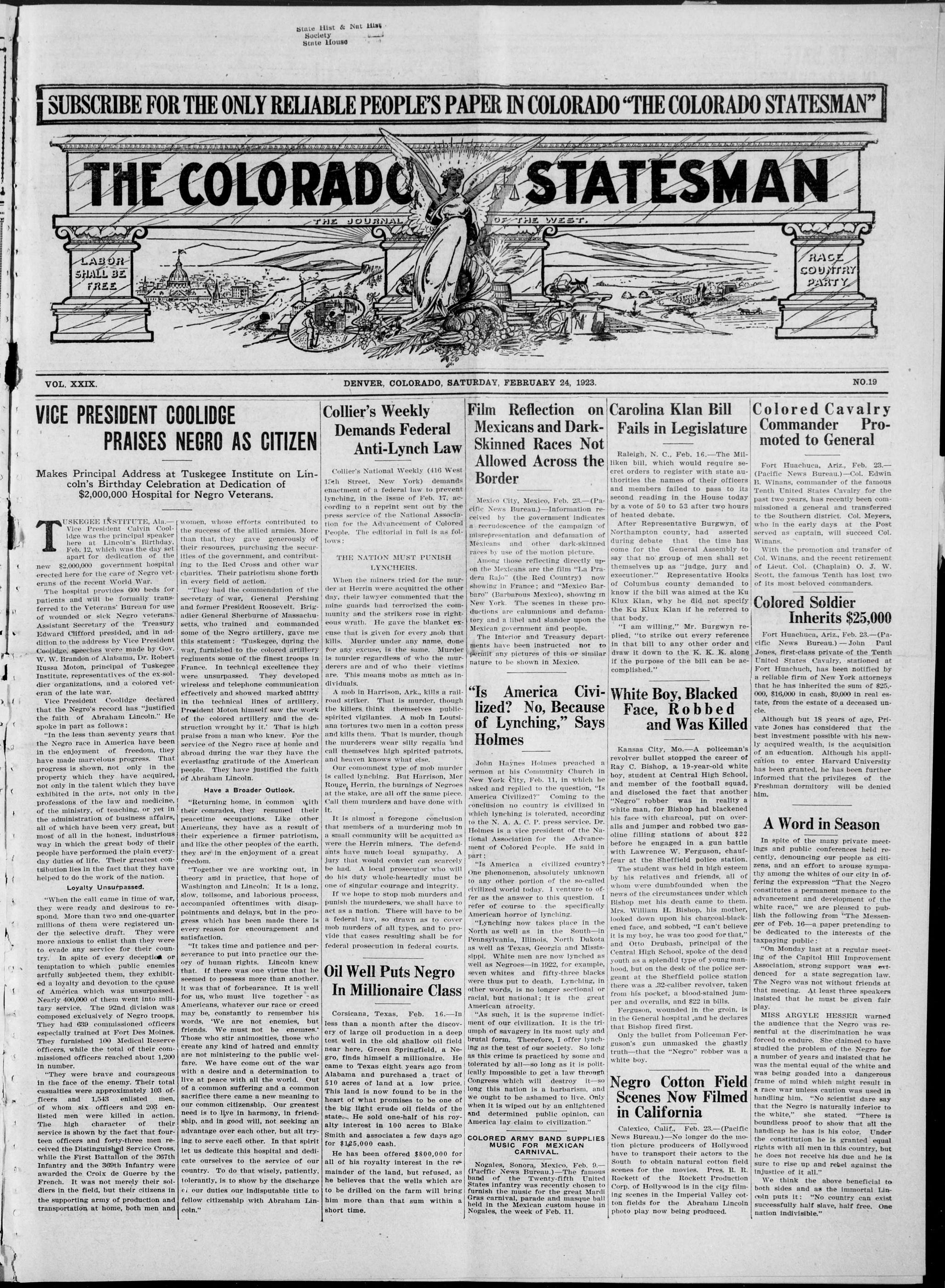
THE COLORADO STATESMAN
THE JOURNAL OF THE WEST.
LABOR SHALL BE FREE
RAGE COUNTRY PARTY
VICE PRESIDENT COOLIDGE PRAISES NEGRO AS CITIZEN
Makes Principal Address at Tuskegee Institute on Lincoln's Birthday Celebration at Dedication of $2,000,000 Hospital for Negro Veterans.
VOL. XXIX.
VICE PRESIDENT C
PRAISES
Makes Principal Address at
coln's Birthday Celebr
$2,000,000 Hospital
TUSKEGEE INSTITUTE, Ala.—
Vice President Calvin Coolidge was the principal speaker
here at Lincoln's Birthday,
Feb. 12, which was the day set
apart for dedication of the
new $2,000,000 government hospital
erected here for the care of Negro veterans of the recent World War.
The hospital provides 600 beds for patients and will be formally transferred to the Veterans' Bureau for use of wounded or sick Negro veterans. Assistant Secretary of the Treasury Edward Clifford presided, and in addition to the address by Vice President Coolidge, speeches were made by Gov. W. W. Brandon of Alabama, Dr. Robert Russa Moton, principal of Tuskegee Institute, representatives of the ex-soldier organizations, and a colored veteran of the late war.
Vice President Coolidge declared that the Negro's record has "justified the faith of Abraham Lincoln." He spoke in part as follows:
"In the less than seventy years that the Negro race in America have been in the enjoyment of freedom, they have made marvelous progress. That progress is shown, not only in the property which they have acquired, not only in the talent which they have exhibited in the arts, not only in the professions of the law and medicine, of the ministry, of teaching, or yet in the administration of business affairs, all of which have been very great, but most of all in the honest, industrious way in which the great body of their people have performed the plain everyday duties of life. Their greatest contribution lies in the fact that they have helped to do the work of the nation.
Loyalty Unsurpassed.
"When the call came in time of war, they were ready and desirous to respond. More than two and one-quarter millions of them were registered under the selective draft. They were more anxious to enlist than they were to evade any service for their country. In spite of every deception or temptation to which public enemies artfully subjected them, they exhibited a loyalty and devotion to the cause of America which was unsurpassed. Nearly 400,000 of them went into military service. The 92nd division was composed exclusively of Negro troops. They had 639 commissioned officers especially trained at Fort Des Molines. They furnished 100 Medical Reserve officers, while the total of their commissioned officers reached about 1,200 in number.
"They were brave and courageous in the face of the enemy. Their total casualties were approximately 103 officers and 1,543 enlisted men, of whom six officers and 203 enlisted men were killed in action. The high character of their service is shown by the fact that fourteen officers and forty-three men received the Distinguished Service Cross, while the First Battalion of the 367th Infantry and the 369th Infantry were awarded the Croix de Guerre by the French. It was not merely their soldiers in the field, but their citizens in the supporting army of production and transportation at home, both men and
women, whose efforts contributed to the success of the allied armies. More than that, they gave generously of their resources, purchasing the securities of the government, and contributing to the Red Cross and other war charities. Their patriotism shone forth in every field of action.
"They had the commendation of the secretary of war, General Pershing and former President Roosevelt. Brigadier General Sherburne of Massachusetts, who trained and commanded some of the Negro artillery, gave me this statement: 'Tuskegee, during the war, furnished to the colored artillery regiments some of the finest troops in France. In technical excellence they were unsurpassed. They developed wireless and telephone communication effectively and showed marked abitity in the technical lines of artillery. President Moton himself saw the work of the colored artillery and the destruction wrought by it.' That is high praise from a man who knew. For the service of the Negro race at home and abroad during the war they have the everlasting gratitude of the American people. They have justified the faith of Abraham Lincoln.
"Returning home, in common with their comrades, they resumed their peacetime occupations. Like other Americans, they have as a result of their experience a firmer patriotism, and like the other peoples of the earth, they are in the enjoyment of a great freedom.
"Together we are working out, in theory and in practice, that hope of Washington and Lincoln. It is a long, slow, toilsome, and laborious process, accompanied oftentimes with disappointments and delays, but in the progress which has been made there is every reason for encouragement and satisfaction.
"It takes time and patience and perseverance to put into practice our theory of human rights. Lincoln knew that. If there was one virtue that he seemed to possess more than another, it was that of forbearance. It is well for us, who must live together" as Americans, whatever our race or creed may be, constantly to remember his words, "We are not enemies, but friends. We must not be enemies." Those who stir animosities, those who create any kind of hatred and enmity are not ministering to the public welfare. We have come out of the war with a desire and a determination to live at peace with all the world. Out of a common suffering and a common sacrifice there came a new meaning to our common citizenship. Our greatest need is to live in harmony, in friendship, and in good will, not seeking an advantage over each other, but all trying to serve each other. In that spirit let us dedicate this hospital and dedicate ourselves to the service of our country. To do that wisely, patiently, tolerantly, is to show by the discharge of our duties our indisputable title to fellow citizenship with Abraham Lincoln."
Have a Broader Outlook
State Hist & Nut Hist
Society
State House
LIABLE PEOPLE
RAD
THE JOURN
DENVER,
BLE PEOPLE'S PA
ADO
THE JOURNAL
DENVER, COLORADO, SAT
DENVER, COLORADO, SATURDAY, FEBRUARY 24, 1923.
Collier's Weekly Demands Federal Anti-Lynch Law
Collier's National Weekly (416 West 15th Street, New York) demands enactment of a federal law to prevent lynching, in the issue of Feb. 17, according to a reprint sent out by the press service of the National Association for the Advancement of Colored People. The editorial in full is as follows:
THE NATION MUST PUNISH LYNCHERS.
When the miners tried for the murder at Herrin were acquitted the other day, their lawyer commented that the mine guards had terrorized the community and the strikers rose in righteous wrath. He gave the blanket excuse that is given for every mob that kills. Murder under any name, done for any excuse, is the same. Murder is murder regardless of who the murderers are and of who their victims are. This means mobs as much as individuals.
A mob in Harrison, Ark., kills a railroad striker. That is murder, though the killers think themselves public-spirited vigilantes. A mob in Louisiana tortures two men in a cotton press and kills them. That is murder, though the murderers wear silly regalia and call themselves high spirited patrots, and heaven knows what else.
Our commonest type of mob murder is called lynching. But Harrison, Mer Rouge, Herrin, the burnings of Negroes at the stake, are all off the same piece. Call them murders and have done with it.
It is almost a foregone conclusion that members of a murdering mob in a small community will be acquitted as were the Herrin miners. The defendants have much local sympathy. A jury that would convict can scarcely be had. A local prosecutor who will do his duty whole-heartedly must be one of singular courage and integrity. If we hope to stop mob murders and punish the murders, we shall have to act as a nation. There will have to be a federal law, so drawn as to cover mob murders of all types, and to provide that cases resulting shall be for federal prosecution in federal courts.
Oil Well Puts Negro In Millionaire Class
Offer his
his, but
rememers.' Se who
nennity
nic wel-
ne war
tion to
ul. Out
common
naming to
greatest
friend-
ing an
all try-
t spirit
d dedi-
of oui
tiently,
recharge
title to
m Lin-
Corsicana, Texas, Feb. 16.—In
less than a month after the discovery
of large oil production in a deep
test well in the old shallow oil field
near here, Green Springfield, a Negro, finds himself a millionaire. He
came to Texas eight years ago from
Alabama and purchased a tract of
510 acres of land at a low price.
This land is now found to be in the
heart of what promises to be one of
the big light crude oil fields of the
state. He sold one-half of his royalty interest in 100 acres to Blake
Smith and associates a few days ago
for $125,000 cash.
He has been offered $800,000 for
all of his royalty interest in the re-
mainder of the land, but refused, as
he believes that the wells which are
to be drilled on the farm will bring
him more than that sum within a
short time.
---
Film Reflection on Mexicans and DarkSkinned Races Not Allowed Across the Border
Mexico City, Mexico, Feb. 23.—(Pacific News Bureau.)—Information received by the government indicates a recrudescence of the campaign of misrepresentation and defamation of Mexicans and other dark-skinned races by use of the motion picture. Among those reflecting directly upon the Mexicans are the film "La Pradera Rajo" (the Red Country) now showing in France; and "Mexico Barbaro" (Barbarous Mexico), showing in New York. The scenes in these productions are calumnious and defamatory and a libel and slander upon the Mexican government and people. The Interior and Treasury departments have been instructed not to permit any pictures of this or similar nature to be shown in Mexico.
"Is America Civilized? No, Because of Lynching," Says Holmes
John Haynes Holmes preached a sermon at his Community Church in New York City, Feb. 11, in which he asked and replied to the question, "Is America Civilized?" Coming to the conclusion no country is civilized in which lynching is tolerated, according to the N. A. A. C. P. press service. Dr. Holmes is a vice president of the National Association for the Advancement of Colored People. He said in part:
"Is America a civilized country? One phenomenon, absolutely unknown to any other portion of the so-called civilized world today. I venture to offer as the answer to this question. I refer of course to the specifically American horror of lynching.
"Lynching now takes place in the North as well as in the South—in Pennsylvania, Illinois, North Dakota as well as Texas, Georgia and Mississippi. White men are now lynched as well as Negroes—in 1922, for example, seven whites and fifty-three blacks were thus put to death. Lynching, in other words, is no longer sectional or racial, but national; it is the great American atrocity.
"As such, it is the supreme indictment of our civilization. It is the triumph of savagery in its most ugly and brutal form. Therefore, I offer lynching as the test of our society. So long as this crime is practiced by some and tolerated by all—so long as it is politically impossible to get a law through Congress which will destroy it—so long this nation is a barbarism, and we ought to be ashamed to live. Only when it is wiped out by an enlightened and determined public opinion, can America lay claim to civilization."
COLORED ARMY BAND SUPPLIES
MUSIC FOR MEXICAN
CARNIVAL.
Nogales, Sonora, Mexico. Feb. 9.—(Pacific News Bureau.)—The famous band of the Twenty-fifth United States infantry was recently chosen to furnish the music for the great Mardi Gras carnival, parade and masque ball held in the Mexican custom house in Nogales, the week of Feb. 11.
Carolina Klan Bill Fails in Legislature
Raleigh, N. C., Feb. 16.—The Milliken bill, which would require secret orders to register with state authorities the names of their officers and members failed to pass to its second reading in the House today by a vote of 50 to 53 after two hours of heated debate.
After Representative Burgwyn, of Northampton county, had asserted during debate that the time has come for the General Assembly to say that no group of men shall set themselves up as "judge, jury and executioner." Representative Hooks of Columbus county demanded to know if the bill was aimed at the Ku Klux Klan, why he did not specify the Ku Klux Klan if he referred to that body.
"I am willing," Mr. Burgwyn replied, "to strike out every reference in that bill to any other order and draw it down to the K. K. K. alone if the purpose of the bill can be accomplished."
White Boy, Blacked Face, Robbed and Was Killed
Kansas City, Mo.—A policeman's revolver bullet stopped the career of Ray C. Bishop, a 19-year-old white boy, student at Central High School, and member of the football squad, and disclosed the fact that another "Negro" robber was in reality a white man, for Bishop had blackened his face with charcoal, put on overalls and jumper and robbed two gasoline filling stations of about $22 before he engaged in a gun battle with Lawrence W. Ferguson, chauffeur at the Sheffield police station.
The student was held in high esteem by his relatives and friends, all of whom were dumb-founded when the news of the circumstances under which Bishop met his death came to them. Mrs. William H. Bishop, his mother, looked down upon his charcoal-blackened face, and sobbed, "I can't believe it is my boy, he was too good for that," and Otto Drubash, principal of the Central High School, spoke of the dead youth as a splendid type of young manhood, but on the desk of the police sergeant at the Sheffield police station there was a .32-calliber revolver, taken from his pocket, a blood-stained jumper and overalls, and $22 in bills. Ferguson, wounded in the groin, is in the General hospital, and he declares that Bishop fired first.
Only the bullet from Policeman Ferguson's gun unmasked the ghastly truth—that the "Negro" robber was a white boy.
Negro Cotton Field Scenes Now Filmed in California
Calexico, Calif., Feb. 23.—(Pacific News Bureau.)—No longer do the motion picture producers of Hollywood have to transport their actors to the South to obtain natural cotton field scenes for the movies. Pres. R. R. Rockett of the Rockett Production Corp. of Hollywood is in the city filming scenes in the Imperial Valley cotton fields for the Abraham Lincoln photo play now being produced.
NO.19
Colored Cavalry Commander Promoted to General
Fort Huachuca, Ariz., Feb. 23.—(Pacific News Bureau.)—Col. Edwin B. Winans, commander of the famous Tenth United States Cavalry for the past two years, has recently been commissioned a general and transferred to the Southern district. Col. Meyers, who in the early days at the Post served as captain, will succeed Col. Winans. With the promotion and transfer of Col. Winans, and the recent retirement of Lieut. Col. (Chaplain) O. J. W. Scott, the famous Tenth has lost two of its most beloved commanders.
Colored Soldier Inherits $25,000
Fort Huachuca, Ariz., Feb. 23.—(Pacific News Bureau.)—John Paul Jones, first-class private of the Tenth United States Cavalry, stationed at Fort Huachuch, has been notified by a reliable firm of New York attorneys that he has inherited the sum of $25,000, $16,000 in cash, $9,000 in real estate, from the estate of a deceased uncle.
Although but 18 years of age, Private Jones has considered that the best investment possible with his newly acquired wealth, is the acquisition of an education. Although his application to enter Harvard University has been granted, he has been further informed that the privileges of the Freshman dormitory will be denied him.
A Word in Season
In spite of the many private meetings and public conferences held recently, denouncing our people as citizens, and an effort to arouse sympathy among the whites of our city in offering the expression "That the Negro constitutes a permanent menace to the advancement and development of the white race," we are pleased to publish the following from "The Messenger of Feb. 16—a paper pretending to be dedicated to the interests of the taxpaying public:
"On Monday last at a regular meeting of the Capitol Hill Improvement Association, strong support was evidenced for a state segregation law. The Negro was not without friends at that meeting. At least three speakers insisted that he must be given fair play.
MISS ARGYLE HESSER warned the audience that the Negro was resentful at the discrimination he was forced to endure. She claimed to have studied the problem of the Negro for a number of years and insisted that he was the mental equal of the white and was being goaded into a dangerous frame of mind which might result in a race war unless caution was used in handling him. "No scientist dare say that the Negro is naturally inferior to the white," she stated. "There is boundless proof to show that all the handicap he has is his color. Under the constitution he is granted equal rights with all men in this country, but he does not receive his due and he is sure to rise up and rebel against the injustice of it all."
We think the above beneficial to both sides and as the immortal Lincoln puts it: "No country can exist successfully half slave, half free. One nation indivisible."
FOREIGN
Sixteen persons were reported killed and thirty-five injured when the Strasburg express was wrecked near Dormans-Marne.
Scores of German customs officials who had refused to work under French supervision have been ordered expelled from the Rhineland by the Rhineland commission, sitting at Coblenz.
The residence of Field Marshal the Earl of Ypres, at Drumdoe, County Roscommon, was raided recently. The members of the gang removed the costly furniture, completely stripping the interior of the house, and carried off their loot in carts.
In a fight between Free State troops and irregulars in the glen of Aherlow, Tipperary, Commandant Dennis Lacey, one of the most prominent of the irregular leaders in Tipperary, was killed. Captain MacDonnell, also of the irregulars, was wounded seriously, and twelve of the rebels were captured. Four Free State soldiers were wounded.
A Dortmund dispatch received in London says that French troops accompanied by detectives and gendarme and escorted by twenty tanks, surrounded the main police barracks in Essen and disarmed the thousand men within. Police duty was resumed by the men who had not been disarmed, but later left their posts and Essen is again without police.
J. Ramsay MacDonald, one of the chief labor members of the House of Commons, in a speech in Cardiff, Wales, sald it it was erroneous to suppose the Labor party had any antagonism toward France. But, he added, if France was able to afford the expense of sending soldiers to the Ruhr, she also was able to afford to pay off her debt to Great Britain.
Terror exists in some parts of the Ruhr with Germans attacking the French, according to advices received in London. Germans seized dynamite and gunpowder from coal mine magazines for the manufacture of bombs. A dispatch from Dusseldorf said German nationalists were secretly concentrating in and near Gelsenkirchen, Essen, Recklinghauen and Bochum.
Tons of limestone will be dumped over the 3,000-year-old tomb of Tutankhamen in the Valley of the Kings when it is resealed until next autumn, with the ancient Pharaoh's mummy undisturbed within, it was announced by the chiefs of the exploration party at Luxor, Egypt. Every precaution will be taken to prevent the tomb from being disturbed during the summer.
GENERAL
Mrs. Onezima De Bouchelle, wealthy New Orleans beauty, has filed suit in District Court of New Orleans for $500,000 damages against Asa G. Candler, soft drink king, alleging breach of promise and aggravated damages.
Edward Furey, who escaped from New York, where he was indicted with Julius (Nickey) Arnstein, for attempted larceny of $5,000,000 in securities, was arrested at Lynn, Mass. Furey was captured at revolver point as he attempted to escape.
The Wisconsin National Guard lost its fight for existence in the lower house of the Legislature when the Assembly by a vote of 65 to 14 refused to indefinitely postpone the Polakowski bill, calling for complete abolition of the state's military force.
Harry K. Thaw, slayer of Stanford White, who is an inmate of the Pennsylvania Hospital for Mental and Nervous Diseases in West Philadelphia, was recently granted a ten days' leave from the institution to visit his mother in Pittsburgh.
Twenty-two maniacs and three attendants perished in a fire that swept through a three-story building of the Manhattan state hospital on Wards Island, New York. Sixteen hundred violently insane men imperiled in the building refused to be removed from the building and battled with their rescuers.
Former Governor J. B. A. Robertson of Oklahoma was freed of charges that he accepted a bribe while in office to permit an Okmulgee bank to operate after it had become insolvent.
To prove that his system of bonuses and employe-management of the Philadelphia Rapid Transit Co. is not a "one man management" and can operate without his actual direction, Thomas E. Mitten resigned as president of the company. He will retain the chairmanship of the board, however.
As the culmination of a family quarrel in a remote village of the far north Edward O'Brien is dead; his son, Clifton, is dangerously wounded, and Canadian police are searching for Frederick O'Brien, an 18-year-old son and brother, who is alleged to be responsible for the shooting, according to reports received in Winnipeg, Canada.
What is declared by veteran packing men to be the most destructive fire in the history of America's packing industry, razed the nine-story buildings, seventeen, eighteen and nineteen, in the Armour & Co. plant in South Omaha. It caused an estimated loss of $2,000,000 and threw more than 1,000 men temporarily out of work.
Henry Ford, in a statement printed at Williamson, Va., after he had inspected his coal properties in West Virginia, declared that "unless the railroads furnish us with satisfactory service, I will build the Detroit, Toledo and Ironton railroad to this section, electrify it and haul my own coal."
The Nebraska State Senate, after considerable wrangling, adopted a resolution inviting Henry Ford to come to Nebraska and make a survey of the state's waterpower and engage in its development. A similar resolution was adopted in the lower house last week.
NEWS TO DATE IN PARAGRAPHS
CAUGHT FROM THE NETWORK OF WIRES ROUND ABOUT THE WORLD.
DURING THE PAST WEEK
RECORD OF IMPORTANT EVENTS
CONDENSED FOR BUSY
PEOPLE
WESTERN
one hundred Los Angeles business men faced death as the yacht Eloise, out of fuel, was tossed about helplessly in a storm 100 miles out at sea. The body of Earl Remington, prominent aviator and Los Angeles businessman, was found in the yard of his home in the exclusive Wilshire district, riddled with bullets. One ship is wrecked, another is on the rocks and a third was burned at sea on the Washington coast as a result of a terrific southwest gale, according to wireless messages picked up by the Seattle harbor radio. Music is part of the regular court calendar again in Police Judge S. J. Lazarus' court in San Francisco, after an interval of several months. "Everybody is a sort o' grouchy in the morning and music puts us all in a better humor," the court explained.
A story of a long battle through thick fog and heavy seas that culminated in shipwreck on the barren coast of Village island, of a long walt in bitter cold and driving snow before rescue finally came, was told by survivors of the wrecked steamer Tuscan Prince on board the coast guard cutter Snohomish, after reaching Seattle.
After a two-day session in Chicago devoted principally to discussion of a 1923 schedule, owners of the Western League adjourned without accepting one. Two schedules were submitted, but neither proved satisfactory to a majority of the members, who adjourned to meet in Kansas City on March 5 to further consider the matter.
Word that the United States army air service will make a systematic attempt this year to break every world's record not already held by an American aviator was received in San Diego from Washington. Orders for special training of airmen have been prepared. The War Department has sent word that there now is in building a plane which is expected to eclipse by more than forty miles an hour the fastest time ever made over a measured course.
WASHINGTON
The Supreme Court held that a high caste Hindu is not a "free white person," within the meaning of the naturalization law, and therefore is not entitled to citizenship.
A "universal calamity" resulting from a world-wide shortage of textile fabrics is threatened by the rapid spread of the boll weevil in the southern cotton fields, President Harding declared recently.
The nomination of Senator Polindexter, Republican, Washington, to be ambassador to Peru, was sent by President Harding to the Senate, which quickly confirmed it by unanimous vote in open session.
The bill of Senator McNary, Republican, Oregon, providing for government advances of $1,065,000 to the city of Astoria, Ore., to replace municipal improvements lost in the recent fire, was reported favorably by the Senate finance committee.
Passenger fares to and from points in Arizona, Nevada and New Mexico on the principal lines traversing these states are unduly high and prejudiced to the extent that they expected similar fares to and from points in other states, a report submitted to the Interstate Commerce Commission by Henry C. Keene, one of its examiners, declared.
A large delegation of congressmen will go to Alaska in April as guests of the War Department, it was announced in Washington recently. This makes the eighth trip planned to take officials away from Washington after Congress adjourns on March 4, offering wide opportunity for travel and change of scenery extending all the way from the frozen north to balmy southern seas.
A congressional investigation of the recent enforced retirement from the army of Maj. Gen. Adelbert Cronkhite, Eightieth division commander in France, was requested by Jennings C. Wise, who served as a lieutenant colonel in the division, and who said that 50,000 of his former comrades in arms under General Cronkhite were "determined to stand by their old commander."
Dr. Louis L. Jacobs, captain in the United States public health service, was arrested at Camp Kearney, Calif., by county officers, on the charge of having murdered pretty Fitzit Mann, Denver dancer, whose body was found a month ago on the beach at Torrey Pines, near San Diego.
An adverse report on Mrs. John L. Henderson's offer of a $300,000 residence to be used as a home for the vice president was made by the Senate public buildings committee, which said it could not recommend an outlay of $15,000 annually for maintenance.
CENTENNIAL STATE ITEMS
Denver.—A suit involving over $20,000,000 worth of property extending along the entire Arkansas river basin, has been filed by the Finney County Water Users' Association of Kansas against the Colorado users of the river in United States District Court here. The association, as plaintiff, states in the complaint that it is representing all "the Kansas users of the Arkansas river waters" and names as defendant fifty-five Colorado towns, corporations and individuals located along the river course in this state. La Veta, Trinidad, Walsenburg, the Colorado Fuel and Iron Company, with other towns and corporations, are listed. The complaint charges the Coloradoans with wilfully diverting the waters of the Arkansas river through their building of dikes, ditches, dams and reservoirs and preventing the natural flow and normal volume of the river from going through Kansas territory.
Denver.—Reports received by the state irrigation department from various sections of Colorado indicate that, under favorable conditions, the acreage of corn and forage crops grown in 1923 will be the largest in the history of the state. The acreage of such crops actually planted will depend, of course, upon weather conditions for the next four months, but weather conditions in Colorado generally are favorable for the planting of spring crops, and much of the land to be planted already has been broken. The acreage of winter wheat grown in Colorado has increased very rapidly in the past four years, while the acreage of corn has remained almost stationary, and there has been but little change in sorghum acreage. There has been a very noticeable increase in numbers of hogs and dairy cattle in eastern Colorado counties, where corn and sorghums are grown most extensively.
Denver.—Through the co-operation of live stock growers, stockmen's associations and state inspection boards, statistics of vital interest to the live stock industry are being gathered and disseminated. This was the assertion at the meeting of live stock statisticians from fourteen states who met here to perfect a system of reporting the number and condition of cattle, hogs and sheep on western ranges and on farm feed lots. Boulder.—The Colorado state geological survey has mapped in considerable detail 6,800 square miles of territory containing mineral deposits of widely varying kinds, according to the summary of a report that is published by State Geologist R. D. George. The report shows an expenditure of $195,000 during the sixteen years. The survey is conducted in connection with the geology department of the University of Colorado.
Montrose.—Bond to the amount of $1,000 was furnished by sixteen of the persons arrested at Telluride when federal prohibition officers raided the entire city. The prisoners were arraigned before J. L. Atkinson, United States commissioner, and were taken back to Telluride. The town of Telluride is dry, according to reports reaching here, and but little activity is evident, except for discussion over the raids.
Denver.—The inaugural ceremonies at the University of Denver when Dr. Heber R. Harper, formerly of Boston University, became the new chancellor, took on an added significance as to the importance of the university with an announcement that more than 40,000 citizens of Colorado have been sufficiently interested in its permanency to contribute to its support with large and small gifts.
Nederland.—The Cold Spring, one of the most famous of the tungsten mines of this district, is to be opened in March, according to information given out by the Colorado Power Company, which has been instructed to provide power. Manager William Loach of the Wolfe Tongue Company, which owns the mine, is now in the East.
Brighton.—One woman was injured and a score of persons narrowly escaped with their lives when the New Hotel Henderson at Henderson was completely destroyed by fire. The loss is estimated at $20,000. Although the fire department and Sheriff Miller and his entire staff from Brighton covered the few miles between Brighton and Henderson in record time, lack of water made it impossible to check the flames.
Greeley.—Mr. and Mrs. W. D. Brown, wealthy residents of Greeley, are the defendants in a $50,000 alienation suit filed by their son-in-law, Clyde Lagrone, who is now living in Clayton, N. M. Lagrone, a New Mexico rancher, alleges that his parents-in-law by "malicious contriving" have deprived him of the society, comfort, aid and advice of his wife, Lolita Brown Lagrone.
Durango.—A two-inch piece of wire swallowed some time ago caused the death here of the 2-year-old daughter of Mr. and Mrs. Claude Brooks. The child complained of sharp pains in the intestines and the attending physician not knowing the cause tried internal treatment. The child did not respond and gradually grew worse.
Craig.—The releasing by the government of 14,800 acres of homestead lands, extending from three to twenty miles northeast of Craig, for settlement thereon by ex-service men was announced through the United States land offices in Denver. Ex-soldiers will be allowed preferential privileges to make homestead filings, from April 9 to July 8, inclusive, according to M.D. McEniry, divisional chief of the offices in Denver. After that, said Mr. McEniry, any tracts remaining and not filed upon will be made subject to immediate entry by the general public.
LATE NEWS
From All Over
COLORADO
Manitou.—Charles E. Lelbold, postmaster of Manitou, died following an operation for appendicitis. He was 61 years old.
Pueblo.—More than half of the $200,000 bond issue for the new temple of Al Kaly shrine was subscribed at a dinner of the southern Colorado consistory held in Memorial hall here.
Greeley.—Antonio Gomez, Mexican, was arrested here on complaint made by Postoffice Inspector Hudson, charging him with the theft of a package of parcel post mailing matter at Eaton, recently.
Boulder.—Rudy Schuler, Manitou, was elected president of the Colorado Soda Bottlers' Association at the close of the annual convention here. Mrs. D. C. Fonda of this city was elected vice president.
Grand Junction.—The highest price that has been paid for wool for several years past was paid to George Gordon, prominent sheep man of the Piñon Mesa section, who received a contract of $43\%$ cents a pound for the wool from 4,500 head of sheep. Pueblo.—Carbonated beverages is the new name under which soda pop will be known in the future according to resolutions passed by the 150 delegates attending the Colorado soda bottlers' convention here. The resolution changing the name was passed on recommendation of A. C. Smith, L. G. Gilbreth and Albert Rule.
Cañon City.—Entries will close soon for the first Colorado International Egg Laying Contest, to open at Cañon City November 1, 1923. The contest pens will house only fifty entries and twenty-five have already been received. Rock, Wyandotte, Ancona and Minorca breeders are urged to enter without delay. Boulder.—A seven-act vaudeville show was given here recently by students of the University of Colorado to raise money for the support of the state high school basketball tournament, the state high school track meet, and for a party to be given in Denver in April for members of the senior high school classes.
Telluride.—Telluride, snowbound in the mountains with its 3,000 population who believed themselves safe from prohibition, is bone-dry, following a swooping and spectacular raid staged by eight federal prohibition agents from Denver under the direction of George A. Crowder, legal advisor for the raiders. The agents arrested 312 persons, confiscated 205 gallons of whiskey and a big store of wine.
Estes Park.—Legislation that has passed Congress carries an appropriation of $55,000 for administration, maintenance and protection of the Rocky Mountain national park for the fiscal year of 1924, dispatches from Washington say. For permanent improvements $11,000 has been provided and $8,280 for the purchase of lands for public camp grounds. An administration building costing $6,000 will be constructed, it is planned, on a site presented to the government by the Women's Club of Estes Park.
Montrose.-Postmaster General Hubert Work, if appointed secretary of the interior at Washington will visit the local irrigation project immediately after appointment, so as to procure first hand information as to relief needed by the reclamations, according to a telegram received from Congressman Edward Taylor of this district. Congressman Taylor, with President Dale of the Uncompahgre project, conferred with Mr. Work relative to the local project situation. President Dale reports that indications are the relief will be granted the Colorado projects in the form of deferred payments.
Denver.—Dr. Heber R. Harper, new chancellor of the University of Denver, knows that he is most welcome in Colorado. Six hundred persons, among them presidents of fifteen colleges and eighty representatives of universities in every state of the Union, attended the alumni inaugural dinner given in honor of the new chancellor.
Greeley.—A month after Charles Nowlin was shot and killed in the holding up of a card game at Erie, F. Munoz and Secundo Hernandez were found guilty of first degree murder by a jury here. Life imprisonment was recommended. Three men were implicated in the holdup, Jan. 15, in which Nowlin was slain when he jerked the mask from the face of one of the bandits.
Denver.—Mrs. Charles F. Linton, the wife of the veteran bank guard killed in the $200,000 holdup of a reserve bank truck in front of the Denver mint Dec. 18, will receive $4,000, approximately the maximum allowed, from the State Industrial Commission under the workman's compensation act, according to Rees D. Rees, Denver attorney, who appealed to the commission in Mrs. Linton's behalf.
Colorado Springs.—W. D. Corley, recent purchaser of the Cripple Creek Short Line railroad, received a peremptory order of the Colorado State Public Utilities Commission that none of the track must be taken up without an order of the commission. His attention was called to a previous order of the commission to this effect.
Brighton.—An average of fifty tons of boxboard paper a day is now being manufactured by the Myers Pulp and Paper Company, the plant of which, located on the Denver-Brighton road, is the center of the new industry.
Phone Ga
CAMPBELL
CO
COM
Wholesale
HAY, GRAIN, COAL, W
SUPP
Office: 1401 W. 38th Ave.
Phone Gallup 473
HELL BROOK
COAL
COMPANY
Wholesale and Retail
N, COAL, WOOD AND
SUPPLIES
38th Ave. Yards:
Phone Gallup 473
CAMPBELL BROTHERS
COAL
COMPANY
Wholesale and Retail
HAY, GRAIN, COAL, WOOD AND POULTRY
SUPPLIES
Office: 1401 W. 38th Ave. Yards: 1400 W. 32d Ave.
Phone Champa 7889
WESTERN SHEET
COMPANY
WARM AIR FURN
REPAIRS FOR ALL FURNACES—SHEET
CHIMNEY STACKS
920 NINETEENTH STREET DE
BURN SHEET COMPANY
FROM AIR FURN
L FURNACES—SHEET
CHIMNEY STACKS
STREET DE
WESTERN SHEET METAL COMPANY
REPAIRS FOR ALL FURNACES—SHEET METAL WORK CHIMNEY STACKS
TELEPHONE MAIN 1511
HERE IT
Jazz is being taken from music,
caught it and am putting it
SUITS
Come in and See My Jazz
GARDNER, T
PHONE CHAMPA 1019
C. E. SMITH, Manager,
The Market
Wholesale and Retail Staple and H
Hotels and Restaurants Our
Eastern Corn
Fruits, Vegetables,
Telephones Main 480
622-636 15TH STREET
CHARLOTTE
CAP SHAPE
Single Mesh ...
Double Mesh, 15c; two for...
TAN OFF—MADAM WALK
The Atlas
The Five Points
PHONE MAIN 875.
IT IS
from music, but I have
m putting it into
ITS
Fruits, Vegetables, Poultry and Game.
Telephones Main 4302, 4303, 4304, 4305
622-636 15TH STREET DENVER, COLORADO
CHARLOTTE HAIR NETS
CAP SHAPE AND FRINGE
Single Mesh .....10c
Double Mesh, 15c; two for.....25c
TAN OFF—MADAM WALKER'S SKIN BLEACH AT
The Atlas Drug Co.
The Five Points Postal Station.
PHONE MAIN 875. 2701 WELTON
M. H. H.
Special Attention Given to SEWERAGE. All Phone Main 207 1907 Ara
Special Attention Given to VENTILATION AND SEWERAGE. All Work Guaranteed Phone Main 207 1907 Arapahoe St. Denver, Col-
HOME COOKING
First Class Meals Served 2444 Washington St., Denver, Colo.
Stone Gallup 473
ALL BROTHERS
WOAL
COMPANY
Wholesale and Retail
WOAL, WOOD AND POULTRY
SUPPLIES
Ave. Yards: 1400 W. 32d Ave.
SHEET METAL COMPANY
AIR FURNACES
FURNACES—SHEET METAL WORK
MNEY STACKS
The Curtis Park
Floral Company
Floral Designs Put Up
While You Wait
Choice Plants and Cut Flowers
Constantly on Hand
Greenhouses: Thirty-fourth and
Curtis Streets
Denver, Colo.
Y Jazz Styles.
R, THE TAILOR
1025 TWENTY-FIRST
manager, Res. Phone South 1608
ket Company
e and Fancy Groceries, Fish and Oysters
DENVER, COLORADO
Just received 1,000 of the season's latest styles of Woolens for your inspection and selection.
STATE CAPITOL NEWS LETTER
A bill passed by the Senate extended the right of entering the State Soldiers' and Sailors' Home to the veterans of all wars.
S. B. 258, Tobin, providing that premiums from the State Live Stock Commission shall be given only to animals bred in Colorado, was passed on final reading.
Party lines were entirely disregarded in the State Senate during consideration of Senate bill No. 32, by Senator Glurd, DeBusk and Saunders, amending the primary law.
Some Republicans say that the hopes for a short session are fast glimmering. The first week of the session it was agreed to hold a caucus in thirty days and set a time for adjournment. The caucus was not held, and the Legislature is plodding along with no definite end in sight.
The House passed a resolution calling upon Congress to recognize the government of Mexico. It was pointed out by Representatives Carlos F. Romero of Las Animas county and Addison B. Manning of Denver that a resumption of trade relations would be of enormous benefit to Colorado.
The House struck the enacting clause from a bill by Senator W. E. Renshaw of Idaho Springs giving placer mining companies the right to dredge through the land of others without their consent, when it was necessary to reach adjoining property owned by the company. The defeat of the bill was recommended by Senator Renshaw.
S. B. 144, Knauss, Fairfield, Toll, Saunders and Eaton, raising the salaries of district judges to $6,000 a year, was referred to the committee on finance, as the action on the boost in salaries of the Supreme Court justices indicated that it, too, would be shelved in a committee. The Senate seems very much averse to, raising anybody's salary.
On second reading the Senate passed S. B. No. 341, by Senator Fairfield, preventing the sale of real estate for delinquent personal property taxes. S. B. No. 145, by Senator Elliot, providing for the inspection of building and loan associations by the state bank examiner, was recommitted with the understanding that an early report would follow.
When the bill authorizing the creation of the office of state market director was before the House it passed on second reading with representatives from the city and those from the country both voting for the bill. The fact that it was reported back to committee was no indication of opposition, but was done so that the co-operative marketing measure could be passed first.
Of the series of bills introduced at the present session of the Legislature at the request of Governor Sweet, not one has been passed by either branch. The bill establishing the office of state market director is the only one that has been on the floor of the House for action. After being passed on second reading it was referred back to the agricultural committee and now rests there.
Drunkenness in a public place is made a crime against the state under S. B. No. 227, which was passed by the Senate on second reading without a record vote. Passage followed a protracted debate in which the bill was defended by Senator J. F. Church, Republican, of Broomfield, and Senator George E. Colgate, Republican, of Cannon City, and was criticized by Senator Henry Wolcott Toll, Republican, of Denver.
The Senate and House members recently visited Boulder to attend chapel exercises at the University of Colorado, at the invitation of Senator L. E. Girard.
The first move for the fulfillment of both party platform pledges to reduce taxation was taken in the Senate when S. B. 71, by Senator John F. Dickinson, Republican, Hugo, was passed on second reading. This bill repeals the half mill levy for the highway department passed in the 1919 session and raises $750,000 a year. It was passed only after the most extensive discussion held thus far in the session, and by the complete elimination of party lines.
Senator William H. Adams, Democrat, of Alamosa made final protest in the Senate against the continuation in office of any public trustee appointed in the closing days of Oliver H. Shoup's administration as governor of Colorado. The protest was against a line in the S. B. 62, by Senator Henry Wolcott Toll, Republican, of Denver, making the terms of office of a public trustee two years instead of four, to conform with a recent decision of the State Supreme Court.
Despite the protests of Senator L. A. Puffer, Republican, of Colorado Spring, the Senate, in committee of the whole, passed on second reading S. B. 154, by Senator Golding Fairfield, Republican, of Denver. This is the bill authorizing corporations to establish non-employment insurance, social welfare movements and the like. S. B. 409, Eaton, transferring the minimum wages for women and minors commission from the State Industrial Commission to the Labor Department, under the secretary of state, was passed on final reading.
GOING TO ALASKA BY WATER ROUTE
PRESIDENT HARDING PLANNING TO MAKE THE TRIP ON THE YACHT MAYFLOWER.
WILL START ABOUT JUNE
Secretaries of the Interior and the Navy Are Certain to Be Members of the Party—Return From Coast Overland.
· By EDWARD B. CLARK
Washington.—It is possible that some American cities which have thought of preparing welcomes for President Harding on his way to Alaska next summer may be disappointed to learn that the present plan calls for an all the way trip by water on the government yacht Mayflower. If the plan is carried out, the Mayflower will have a long journey, and the President will have a long rest from the importunities of politicians and office seekers unless they use the wireless.
It is understood that Mrs. Harding, if she is sufficiently recovered, will make the trip to Alaska with her husband. Of course, if she is not sufficiently recovered from her illness to make the trip, the President may decide to stay at home, but she apparently is on the high road to recovery and the promise is held out that she will be well enough to undertake the long sea journey, which, as she is a good sailor, it is said, probably will complete her recovery.
As soon as congress adjourns, it is the intention of President and Mrs. Harding to go to Florida for a six weeks' rest. They will return to Washington the latter part of April and it it believed that the trip to Alaska will start about June 1.
To Go Via Panama Canal
To Go Via Panama Canal.
It will take the Mayflower eight days to reach the entrance to the Panama canal. A few days probably will be spent on the isthmus and then the journey up the Pacific coast will begin. There is no expectation that the Mayflower will touch at any point on the Pacific coast before it reaches the northwestern territory.
Already Washington is guessing as to the personnel of the President's traveling party. In the case of some of the traveling companions guessing is hardly necessary, for it seems to be assured that the President will be accompanied by the secretary of the interior, Secretary of the Navy Denby, Private Secretary George Christian and Mrs. Christian, and possibly by one or two army and navy officers of high rank. It is thought that Gen. Wilds P. Richardson, who spent 20 years in Alaska directing the building of the wagon roads and trails in the territory, will be one of the party.
Denby to Study Naval Bases. Secretary of the Navy Denby, who almost certainly will accompany the President, will study certain naval base conditions in Alaska with a view to determining the availability of coaling stations. One of the prime arguments made for the building of the government constructed, government owned and government operated Alaska railroad was that the road could bring out coal cheaply to one of the ports where it could be utilized for navy purposes. There has been some trouble over this matter, because it is said that the facilities for the coal transportation are not what they should be, even with the railroad nearly completed. Scott Bone, a former newspaper man of Washington and Seattle, is now governor of Alaska under the Harding appointment. The President and his party probably will be guests of Governor Bone for some few days. They will make a personally conducted journey through such parts of the territory as the President thinks it advisable to see. It is understood that the party will remain about three weeks in the northern land.
It is intimated that the return trip will be made overland, at least from some port on the northwestern coast of the United States proper. It is possible the President may take the Mayflower from an Alaskan port to San Francisco and from there proceed north by rail and start from a northwestern point for Washington.
President Harding, since he took office, has had few outings. If the Alaska trip can be called an outing, he will have next summer a fairly long one and one which ought to do him some physical good, although he looks fit enough today.
Plan for Veterans' Legislation.
The United States veterans' bureau is the biggest bureau in Washington. Possibly the country has no realizing sense of the burden of work which has fallen on the shoulders of the men and women whose duty it is to look after the records of the cases of the men who fought in the war and who came out of it disabled mentally or physically. Just now congress is discussing a resolution presented by Representative Royal C. Johnson of South Dakota, providing for new standing committees in the house and senate whose sole duty it shall be to consider legislation affecting former service men. The understanding is that representatives of the American Legion and other veteran organizations are anxious that all of the veterans' matter shall be taken before one committee.
As things are now, various commit-
tees of the house and senate take charge of legislation affecting the veterans, the assignment of a subject to this committee or to that committee depending upon the nature of the matter presented. There is opposition in both house and senate to the plan, but masmuch as the former service men seem to be back of the proposition it is thought that the legislators may yield.
Why Unification Is Opposed.
Why Unification is Opposed.
One reason for opposition to the resolution is that some of the legislation affecting the veterans is economic in character, some of it agricultural, some of it hospitalization, and some of it something else. There are regularly established committees of congress to deal with matters touching these questions and it is felt that if one great committee shall be given charge of everything, it may not have in its membership men qualified to discuss every case with knowledge of the basic things which underlie the subject.
It is said that there are today about 700,000 claims in the veterans' bureau for compensation because of disease or injury incurred as a result of wartime conditions. It would seem, therefore, that about one man out of every five who served has, or thinks he has, some trouble arising from that service for which he should be compensated. The task of passing on these claims is a heavy one and a large force of men and women is necessary in order that the work may be given proper care.
There has been a great deal of complaint in one place or another because of the slowness of the bureau in arriving at decisions in cases which have been presented, but it ought to be said—and an ex-service man says it—that, taking everything into consideration, the wonder probably should be not that progress has been so slow, but that it has been as rapid as is the case. Ex-Service Men Throng Capital. Washington is the capital of the country and because the main veterans' bureau is located here and because here are all the records in the cases, there are hundreds of ex-service men coming to Washington monthly, thinking that, being on the ground, they more easily can press their cases to a hearing and to a satisfactory conclusion.
The result of this is that the ex-service men living here are put to it at times to find means to care for the veterans who come here seeking relief, many of whom come without the necessary money to keep them in food and lodging for even brief periods. Some of the cases are pathetic. The men of the American Legion are doing all they can to help men who come here and find themselves stranded. They call official attention to individual cases in the hope that matters can quickly be straightened out and the men seeking relief can get it from the bureau if it is proved that they deserve it. It is not in all cases that affairs can be expedited and therefore there is at times a real problem here to find means to provide properly for the incoming seekers after relief.
Recently there have been a number of changes in the personnel of the veterans' bureau. Sometimes charges have been made that politics has had something to do with the changes, but in the main it could be said that most of the discharges and most of the appointments have concerned themselves with replacing employees who did not see war service by men who did see it.
* First Steam Warship.
The first steam war vessel was launched 108 years ago at the shipyard of Adam and Noah Brown in New York, and was christened the Demologos. This pioneer ship of the world's steam navies was the creation of Robert Fulton, and flew the Stars and Stripes of the infant republic. It was in 1813, when the United States was at war with Great Britain, that Fulton suggested the building of a steam war vessel. His plans were accepted by the Washington authorities, and in June of 1814 the keel of the Demologos was laid.
Designed for the purpose of wiping the British navy off the sea, the Demologos was completed too late to accomplish that object, and her career was brief and inglorious. After the close of the war she was rechristened the Robert Fulton, in honor of her inventor, and she became a receiving ship at the Brooklyn navy yard. In 1829 an explosion of powder in her hold sent her to the bottom, at the same time killing 24 and wounding 19 of her crew.
Too Much for a Neophyte
To a colored convert a southern clergyman said: "Supposing you were walking along the road and saw a low-hanging branch and on that branch was a nice fat chicken, what would you do?" "Please don't ask dat question, boss," begged the convert. "Oh, yes, tell me what you would do." "Well, boss, you know I'm only an infant in klingdom," was the significant reply."—Boston Evening Transcript.
Four Long-Lived Brothers.
Four Long-Lived Brothers.
Young America, Minnesota, is the home of the Truwe brothers, four in number, whose ages aggregate 352 years. Samuel Truwe is ninety-two years of age, Jacob eighty-nine, and Benjamin and John eighty-seven and eighty-four years, respectively. Each is still alert and active, and Samuel, Jacob and John are said to be the only three brothers alive today who are Civil war veterans.
Throughout the United States there are 81,000 retail trade units for the distribution of automotive products.
FEDERAL AGENTS STAGE ROUNDUP
RAIDS BREAK UP INTERNATION
AL COUNTERFEITING RING;
600 ARRESTED.
COUNTERFEITERS HELD
RECENT KILLINGS IN EASTERN CITIES IS LAID TO PLOTTERS UNDER ARREST.
New York.—With the international counterfeiting system wrecked by secret service agents who laid its workings bare here recently and with 500 to 600 persons connected with the ring in a dozen countries under arrest, federal authorities are prepared for a court fight to send the counterfeiters to jail for the maximum term of forty-five years.
While court evidence was being set in order, the dragnet of the secret service was extended to most of the large cities of the United States to catch hundreds of passers of counterfeit money, implicated by claws captured in raids here. Joseph A. Palma, chief of the special secret service squad which for eight months tracked the makers and distributors of spurious money, gave evidence of widespread international ramification of the plot by announcing that fifteen persons had been arrested in England, France, Egypt, Germany, Cuba, Austria and the Bahamas as a result of information furnished by the American secret service.
New York police, who began an independent investigation, professed to find a direct connection between the counterfeit plot and many hitherto unsolved gang murders of the past few years.
Several of the murders were believed to have resulted from passage of bogus money and from double-crossing in the ranks of the counterfeiters. A number of crimes, it was said, had been committed in or near the Broome street café owned by John Dirosa, arrested as one of the gang's large wholesalers of counterfeits.
Palma agreed that scores of important criminals were in the ranks of the counterfeiters.
Immigrants unfamiliar with American money, he said, were the easiest victims, but the gang also hunted out small stores kept by aged women and stores left at times in charge of children.
Seizure of large quantities of counterfeit internal revenue stamps, physicians liquor prescription blanks and Quebec liquor stamps in the raids indicated, secret service men said, that the counterfeiters, in addition to making vast purchases of liquor from international rum runners, were also in league with illicit manufacturers of whisky in interstate traffic.
Some of the dies used in making spurious specie were smuggled here from Italy in large cheeses, officials said.
Nitro Blast Kills Three.
Ardmore, Okla.—Three men were killed and two others injured in an explosion on the Carter Oil Company lease near Dillard, eighteen miles west of here. The explosion occurred when the men were preparing to shoot the casing in an abandoned well. A charge of nitroglycerine being lowered into the well exploded near the surface. The cause of the premature blast has not been determined. The injured men were taken to a hospital in Wilson.
Refuses Bribe of $50,000.
Pittsburgh, Pa.—Declaring he was offered from $20,000 to $50,000 if he would allow Austin H. Montgomery of New York City to escape while en route from Los Angeles, Calif., to New York City, Deputy United States Marshal W. H. Lessner of Los Angeles related the details here. Lessner said he left Los Angeles with two guards and four prisoners, including Montgomery, who was charged with using the mails to defraud to the extent of about $3,000,000.
French Soldiers Fire on Germans.
French Soldiers Fire on Germans.
Bochum.—Two French soldiers fired point blank into a crowd of Germans in front of the law courts, killing one man and severely wounding two others. The trouble occurred while French troops, with tanks, were engaged in occupying the law court's building and the neighboring prison on suspicion that certain Frenchmen had been incarcerated as spies. Some of the bystanders hooted the soldiers, two of whom fired then into the crowds.
Catholic Churches Guarded by Police.
Catholic Churches Guarded by Polices New York. A police guard was posted at every Roman Catholic church in Greater New York upon orders issued by Chief Inspector Leahy. The bluecoats were instructed 'prevent persons carrying suspicious bundles from entering the churches, and also to prevent loitering. Inspector Leahy refused to give any reason for the unusual action. There have been several fires recently in Catholic churches in Montreal, Canada, and in northern New York.
THE COLORADO STATESMAN
```markdown
```
RELIABLE chronicle of their doingsgress; a faithful mi their wants, their hoir best aspiration.
THE COLORADO STATESMAN
equaled as an adverti medium for the busi of professional men women.
excellent family jou peaking to and for m thousand colored citiz
The Mouth-Piece of the People of Colorado and the Entire West
ARELIABLE chronicle of their doings and progress; a faithful mirror of their wants, their hopes, their best aspiration.
THE COLORADO STATESMAN
Unequaled as an advertising medium for the business of professional men and women.
An excellent family journal speaking to and for many thousand colored citizens.
$2.00 A YEAR
$1.25 SIX MONTH
$.75 THREE MONTH
THE GREAT ORG
OF THE
BORING MASS
THE GREAT ORGAN OF THE LABORING MASSES
sible moment. Without all important nations participating in such an
agreement the plan would not be effective. And in striking at the evil
at its source the plan should include restriction of the acreage devoted to
the growth of the poppy in such countries as China, India, Persia and
Arabia,
In addition, the United States must limit use of narcotics in this
country. The government must supervise rigidly their manufacture and
must limit the sale of such drugs to properly licensed drug stores and
only on the prescriptions of reputable physicians. The United States
further must prohibit exporting narcotics and stop smuggling of these
same drugs back into this country.
There is vast distinction between alcohol and drugs. An alco-
holic, deprived of alcohol, is a dishrag. He is insane only while he is
using it. A drug addict becomes insane as soon as drugs are taken
from him, An addict will plan and execute a crime 60 atrocious that it
cannot be conceived by sane persons.
In our New York list we found that about 10 per cent of the
addicts were operators of vehicles. No wonder people are killed. I would
recommend that no license be issued to any driver without proper physical
examination to make certain that the applicant is not a user of drugs.
I feel sure that this would reduce automobile accidents,
The state has established that the man is guilty beyond a reason-
able doubt; that he murdered without cause; that he showed no mercy;
that he was a menace to life—therefore it has decreed he must die, for
that is the law of the state as passed by the will of the people. ‘The law
is the will of the majority and the death penalty for murder the people
have imposed upon themselves as a method of restraint.
Brainless men and women who have no ability to think, who be-
lieve in free license and rebel against all law—those will condemn and rage
and spout as usual. ‘
Unthinking religious fanatics will plead and pray and forget that
God is a God of justtve and mercy and that judgment is as much a duty
of love as mercy is the delight of love. They forget that love, while the
greatest of all laws, is the most perfect in its working and the most
exacting in its demands.
America is cursed today with a lot ofispineless, unthinking, cowardly,
would-be reformers, editors, speakers, who crave approval more than they
crave to be right.
They with one accord will all condemn a minister, of the gospel for
performing the duties of the state. ‘They think of a minister as a sexless,
spineless creature.
Taking another's life, hurling some one over the precipice into
eternity, is the most terrible of all tasks. I am going to hang Orrie Cross
because it is my duty and because there is no way to evade that terrible
task except the way of the coward. The memory of it will be with me
always. I would to God there were some way out of it, but ther® is none.
The Ice-Covered Antarctic Continent the Fourth
Largest in the World ‘
The north polar region consists mainly of water. The Antarctic is
chiefly land. ‘That is one reason why the latter demands much more inter-
est than the former. Another is that explorers have agreed that there lies
a new continent. The shore of this huge stretch of land is near or within
the polar region, that is to say, in a latitude corresponding to Drontjem,
Norway, and Thomsoe in the northern hemisphere. This new continent
has, according to present calculations, an area equal to that of Europe and
Australia. It would therefore be the fourth largest continent of the world.
The great new land has high mountain chains and in the interior ex-
tensive high plains covered by an ice shield from 300 to 600 feet in’ thick-
ness. The “inland ice” shows great gulfs and glaciers. The only visible
landmarks are rocks and mountain ridges penetrating the cover of ice. -
On both the Pacific and the Atlantic sides of the continent there are
deep bays. On the Pacific side the Ross sea penetrates the land in a shape
like the contour of France. On the Atlantic side the Weddell sea pene-
trates the land. The area of this sea is as large as the Baltic, the Black
and the North seas.
The main objection I have against a college graduate is that he
objects to work, especially if it is dirty.
‘The college graduate doesn’t want a job with work in it, and when
he does get a position he expects to be appointed foreman at the end of
six weeks. Most men working for me never attended college. ‘The college
men I have usually show lack of imagination. They scarcely have any
suggestions to make in their daily routine which might lead to improve-
ment in their various departments.
College is a good place for a man who wants to work, but, unfortunate-
ly, there are very few of this type nowadays. Yet, if a man wants to suc-
ceed it is not necessary for him to go to college. He will broaden himself
without it. We have enough lawyers, doctors and literary men. Also we
have many $100,000 jobs with no one capable of filling them. The main
quality for success, in my estimation, is ambition with a will to work.
‘
ph ht neta och ci nen cent em
CG SSE EGP
OLORADO\24 STATESMAN -
hn hi le) SG Me
tne? A
k | DX SS
(Pe tarnish Nd Bo MS ree
pe ht Mie acoder AEN b =
A NORE LE G ~*
Recognized by the Retail Merchants’ Bureau of the Denver Civic and Gommer-
PF. 0, nox 116 1824 Curtin Street, Room 25 Phone Main 7417
SUBSCRIPTION RATES.
Three months — somaeaeveceesononsen moressosenesamnsossene = — 18
THE HANDWRITING ON THE WALL.
HIS trite expression or hackneyed quotation presents itself to our
T mind's eye whenever we least think of it, and the incidents of good
or ill that ave of daily occurrence coming under our observation force
us to the timely use of the expression—‘the handwriting on the wall.” In
dealing with the religious, moral and social life of our country, certain
phases have been presented to us since the beginning of the post-war sea-
son, that make us wonder whether we are making progress or if retrogres-
sion stares us in the face. More religious leaders of the various denomina-
tions have been the victims of the assassin’s bullet, murderous assault,
slander, leading in factional fights in their respective churches, destroying
the very foundations of work long established—more of these have hap-
pened than in pre-war days. Some of the great divines have gone so far
as to introduce what is termed “occult science” and other strang beliefs
in their churches, while others are expressing doubts of the very doctrine
they have taught and preached to thousands for years. Fortunately, we
have been spared from the aforementioned ills in Colorado up to the pres-
ent, and our hope is that the fever may never come our way so that we
too would become victimized.
How joyous would we be if we made the same record in the moral and
social life of our community!
We are moved to tears over the series of crime and the crime wave
that grips us in its wake, and especially do we note the CAPITAL CRIME
in which both races vie with each other for the greater sensational role
that they can inflict on honest and peaceful citizens. BANDITRY, daring
daylight robbery, in which the gun-play forms a very important part;
MURDER, an apparent pastime in killing for the slightest provocation or
minor domestic difficulties; IMMORALITY, debauchery and other indecent
acts, in which both old and young, forgetful of “the womb that bare them
or the paps that gave them suck” (using a biblical expression), indulge
with a so-called license that in their opinion Society dares not question or
criticise.
In this turpitude we find a condition among some of our people who
prefer being copyists and imitators of the evil rather than the good traits
of the other side, and while we have not reached the standard of lawless-
ness that others boast of, yet with the evidences of the joy-rider, the de-
spoiler of the home, the midnight and early morning parties, the utter
disregard and disrespect for heads of the family, for older relatives and
others—with these confronting us, we become alarmed, and the fear of the
uselessness of the coming generation almost strikes us with a mental
‘paralysis.
But, thanks for a redeeming feature, as our institutions for good are
beginning to take on new life. New activities begin to appear on the
shorizon, and Chureh, Y. M. ©. A., Y. W. C. A., Civic Association, Fraternal
Society and others are redoubling their efforts, shouldering greater respon-
sibilities for the propagation of a creed, a dogma, a propaganda that will
in a comparatively short time obliterate the evil and usher in that good of
which we are sure to become permanent beneficiaries. TO THIS END
LET US ALL STRIVE!
THE SPIRIT OF '76
George Washington is one of the immortals of American history. He
still abides affectionately in the faith of a nation that will not die. More
and more as years crowd on the American people seem inclined to do
greater homage to him, so reverently designated “the Father of his coun-
try.” Looking back through the maize of a century and a half we find
ourselves earnestly striving to get a clearer mental vision of him who led
valiant hosts to American independence from which has sprung our pre-
sent American greatness, Doubtless this is (rue in a large part to the fact
that a day is set aside each year for a general observance of Washington's
birthday, February 22nd has become memorable in the annals of our
common history, and on that day, in school house and public forum, in
the halls of Congress and State Legislatures; within the diminishing circles
of the Grand Army of the Republic or the more buoyant ranks of the Amer-
ican Legion, unbounded patriotism is poured out as an evidence of our
devotion to the virtues and principles of the nation’s first great hero and
president. Light the fires of liberty and justice on the altar of unsullied
honor and keep them burning with constant brilliancy in the hearts of
the young and no country, whatever its besetments, will stray far from
its high purposes of equal fairness to all. Counted in the ordinary cycle
of years and a century and a half seems a long time. Within that forma-
tive period the American people have withstood many hard knocks and
vicissitudes. We were compelled to reaffirm our national independence
in the War of 1812, we met and vanquished worthy foemen during the
Mexican War, we suffered internal strife that set North and South at each
other's throats from 1860 to '65, we extended the flag of freedom from
Porto Rico to the Philippines in 1918 and sent our warring millions into
the seething hell of a World's War and added new glory to the valor of
the American soldier. All of this is a glorious part of our country’s his-
tory, All of this the schools must teach, the pulpits preach and the hearts
conceive if we would enjoy a true appreciation of George Washington and
the spirit of '76. Yet in a contemplative consideration of a nation’s prog-
ress, its triumphs or failures, is it essential that memory recur only to the
conquest of arms? Can we not visualize beyond the battlefield and war
trumpet? Are there not victories of peace no less renowned than those
of war? This must be the teaching of the new day; our young must learn
more of peace and less of conflict; more of human kindness and less of
bloodshed; more of Christ and less of Mammon, We sometimes fear that
the tendencies of civilization in late years has been toward a goal of ultra-
selfishness. ‘The almighty dollar seems to have taken a severe strangle-
hold upon the world. Intolerance, the most deadly of all human poisons,
has become both religious and social. No man can now predict the end
with human life held so cheaply and a threatened resort to violence on the
slightest provocation. George Washington is said to have possessed more
of the “human residue” than any man in American history, with the pos-
sible exception of LINCOLN. He was essentially a man of flesh and blood
and not an elusive historic personage. The spirit of '76 is needful in our
day, The finer elements of the human equation seem to quake and totter
as we go on building up our national wealth. There are those who predict
a*ecrumbling of the world’s civilization, but we cannot as yet share this
strain of pessimism. However, we believe this will be a grander, healthier
and stronger nation if upon every American heart there be sacredly en-
grayed the newly adopted but beautiful American creed:
“I believe in the United States of America as a government of the
people, by the people, for the people; whose just powers are derived from
the consent of the governed; a democracy in a republic; a sovereign nation
of many sovereign states; a perfect Union, one and inseparable; established
upon those principles of freedom, equality, justice and humanity for which
American patriots sacrificed their lives and fortunes,
“I therefore believe it is my duty to my country to love it; to support
its constitution; to obey its laws; to respect its flag; and to defend it
against all enemies.”
esasesesasesesesaseseSeseseseseseSeSeseSASe CSE SESESESESESESESESESES
International Conference to Strike at |
Production of Opium at Its Sources
By DR. R. 8S. COPELAND, U. S. Senator From New York.
Fa ‘The consumption of opium, from which most of
% the drugs brinch, is amazing, Records show that
Pew §— 730,000 pounds were consumed in one year, equiv-
as alent to 6 grains to every man, woman and child in
* om America, We need only between 30,000 and 50,000
7 pounds for legitimate purposes.
aon An international conference to strike at the
oe opium production at its source is the surest, swiftest
4 and, in fact, the only effective step to be taken to
stop the narcotic drug evil. |
Lam in favor of the President of the United
Atateeealling sucha conteranos atibaveamiont wees |
| wl
America Is Cursed Today With a Lot of
Spineless Would-Be Reformers
By SHERIFF W. E. ROBB, Former A. E. F. Chaplain.
By WILHELM FILCHER, German Explorer.
Boe eS SESS ESE SSE Sep es ag eS OSes ee a eS Ea eg es Enns es eORSeSRSPSOSESESESES
College Graduate Expects to Be Made Foreman
at the End of Six Weeks
By THOMAS A. EDISON, American Inventor.
'r. G. Granberry, Curtis M. Harris,
Lady Assistant SERVICE DAY AND NIGHT Manager
and Soloist Z and
With Al Phone Champa 88 Director
Funerals Funeral
THE PEOPLES’ MORTUARY
Funeral Directors and Licensed Embalmers -
Parlors, 2713 Welton Street
Denver, Colorado
Consideration for the dead. gatintaction guaranteed,
Gomfort for the bereaved acne Sue Pane
_ Kamittealy” ‘tho “terpeat reco “'mgne St YOU aay
eqlanlishment or st klad in'the square treatment to a
Bapenses moderate, Beonomy, our watchword,
Loyalty to the pubile, Service Incomparable
Ever ready to dentat the worthy. Employes courteous,
N-O-T-I-C-E
Spring and Summer Suitings
Latest shades and weaves. Hard and soft
el voraety tern ae O20 UD
For Cleaning, Pressing, Repairing and Alterations
Phone Champa 1019AV, and Satisfaction Is Assured
A. V. GARDNER---1025 21st Street
Se ene te nae oan eine ya) ee re
: THE |
A Wonderful Hair Dressing and Grower.
1,000 AGENTS WANTED.
Good Money
Made
We want a-
gents In every
Sd city and village
4 cs e to sell
THE
STAR HAIR
CROWER.
es This te a won-
es derful prepara-
* a / tion. Gan be
5 cS , used with or
= without
ea ‘straightening
iv es Irons ond by
= any person. 9
q = One 25 cente
box proves ite
value. Any per-
sen that will
i use a 250 box
ES will be con=
a vinced.
G No matter —
. what has failed |
Y 4 to grow vour
yl Ss hair, just give |
es THE
¢ F: STAR HAIR
‘ iy CROWER
8 ae @ trial and be
i ‘ Bs convinced.
Beas psa, Send 250 for
Psy PEPER Te full size box.
ieee Sa lf you wish to
cect Rama es Pee become an a-
eR eee gent for thie
pe wonderful
Preparation,
send $1.00 and we wil send you a full supply that you can begin
work with at once; also agent's terme,
Bend all money by money order to
%
THE STAR HAIR CROWER MPF’R.,
P, O. Box 812, Greensboro, N.c.
VEF
es
e
eS rats Beaurirur
HAIR STRAIGHTENING
AND SHAMPOO COMB
This Comb Is Well Worth $1.00
Solld Brass, wooden handle
«a tlcherioni weleht | ounces.
fiven as a present to all who take
sdvantage of our great
BIG OFFER NO. 1144
IUST WRITE TO US AND SAY -—
IS Teauldifue (oveet a hale strachcening and
spantgss come fret, Spade pris Fo
seine Zea Nerite your ame and address
i Stl all ourdTcutare wil be sent ou
iii see a cage
Sircightening aad Shampoo Combs.
iabton\gicess your letter f0
THE OZONIZED OX MARROW CO.
WARSAW - - ILLINOIS
JOSEPH CARTER
Express, Moving and
Storage
Coal and Wood
2415 WASHINGTON STREET
PROMPT DELIVERY
Phone Main 6544
o Jee TRON BAe
: ©, B. TERRY, M.D. 3
; 1027 Twenty-first St. Denver 4
- Office Phone Main 2701, Hours 4
- 11 to 12 a.m. 8 to 5 p.m. or by 4
- appointment.” Res. 2397" Glen- 4
- arm Place. Phone Champa 3303. 4
PON PO CU ULES
Prof.
W. M. Mackey’
FIRST CLASS TONSORIAL
WORK
Hair Cutting a Specialty
Satisfaction Guaranteed
2244 LARIMER ST., DENVER
Our Annual
>,
Manufacturer’s
Outlet Sale
Is now in progress, and is
the bargain event of the
year. Big advertisements
will appear in the daily pa-
‘pers, and circulars will be
distributed, telling the story
in detail. If there is any-
thing you need in the way of
wearing apparel for man,
woman or child, for, Mercy’s
Sake, look for it, and buy
it at—
e
“Michaclsons.
THE COLORADO STATESMAN
Rev. I. S. Wilson was on the sick list this week.
Andrew J. Riley, who was operated on a few weeks ago for appendicitis is able to be out again.
DENVER COLORED CIVIC ASSOCIATION REPRIMAND VICTOR WALKER FOR LINCOLN DAY ADDRESS.
Through its board of directors,
SAMUEL H. HOBSON is on the sick list this week and unable to get out on his run to Los Angeles, Calif. His many friends hope a speedy recovery.
Mrs. William Price, 1750 Humboldt, was called to her home in Kentucky last Saturday on account of the death of her sister. Mrs. Price has the sympathy of her many friends.
George A. Derry attended the Council of Deliberation of Scottish Rite Masons of Colorado Jurisdiction, which met in Pueblo, Saturday and Sunday of last week.
Rev. Wm. H. Thomas, pastor of Shorter Chapel, has returned from Columbia, S. C., where he was in attendance at the Council of Bishops of the A. M. E. Church.
The first of a series of Lenten teas under auspices of the Parish Guild was held at the residence of Mr. and Mrs. Victor B. Walker, 2829 Lafayette street, with a goodly attendance. Mesdames Skillern, Norris and Walker were the hostesses for the occasion.
Many of our local motor enthusiasts took advantage of the beautiful weather of last Sunday to witness the ski tournament at Genessee mountain, which proved to be a record-breaking affair. Dr. C. F. Holmes as usual led the way.
Rev. M. M. Perdue of Colorado Springs, who thrilled his hearers at the Lincoln-Douglass banquet held in the Chamber of Commerce hall on Feb. 12, filled the pulpit at Zion Baptist Church last Sunday in the absence of Rev. Over, who is in the East.
MR. AND MRS. G. D. DADE of 3412 Columbine street returned to the city last week after a six months' absence in Silver City, N. M., with the 7XD Ranch Company. They appear very much improved in health and report conditions very satisfactory for our people.
WEALTHY MISSOURIANS VISIT DENVER.
Mr. and Mrs. Kenneth Campbell (the latter formerly Miss Sarah Rector, wealthiest member of our race) accompanied by their brother, are visiting with their sister, Mrs. Williamson, at 2459 Lafayette street. Mrs. Williamson, who came to Denver several months ago, has wonderfully improved in health under the care and treatment of Dr. C. E. Terry, one of our leading physicians. Mrs. Rosa Rector, mother of Mrs. Campbell and Mrs. Williamson, is expected in the city in a few days to visit with her children. We welcome these distinguished visitors to our city.
BREAKING OUT AGAIN.
Three murders or near murders in a week is a pretty large size record to be charged against any group in Denver, but that is the record made by our group within the last week. We are by no means proud of it, and if it is an epidemic we trust it will soon pass by. The daily papers have enough of these accounts recently to suit our morbid desire for some time to come.
SHORTER CHAPEL NOTES.
Sunday will mark the beginning of the revival at Shorter Chapel. Rev. J. M. Endicott will conduct the meetings, assisted by the minister. Dr. Endicott will preach at both services Sunday and every night during the week. Come and hear this Gospel preacher. Appropriate music will be furnished by the choir. Everybody welcomed.
THE PEOPLE'S MORTUARY.
The People's Mortuary, 2713 Welton street, an addition to our undertaking establishments, opens its doors to the public tomorrow, at which time there will be the dedication of the chapel by a leading minister of our city at 3 p.m. Messrs. T. G. Granberry and Curtis M. Harris, popular business men and citizens for several years in Denver, are the president and manager respectively of this firm. We welcome them into the new business fraternity and hope they will give that satisfaction to the public as will result in the usual successful business role.
DENVER COLORED CIVIC ASSOCI
ATION REPRIMAND VICTOR
WALKER FOR LINCOLN
DAY ADDRESS.
Through its board of directors, the Denver Colored Civic Association, on Wednesday night, held Victor B. Walker to be guilty of conduct harmful to the welfare and good of the association by giving to the Denver Post Feb. 13 a copy of an address delivered at the Lincoln Day banquet, purporting to be the views of the association on the school question of social equality. The charges considered were filed with the board by Thos. Campbell, president of the association following the publication of the Address referred to, in which it was stated that Walker was chosen to speak on the matter. This was clearly disproven and Mr. Walker was called before the board and given a reprimand, with the reminder that the association must be regarded at all times as bigger than any individual, and that leaders were developed, not acclaimed. This brought to a close an ugly and very unpleasant incident that has been agitating the minds of our people for the past two weeks.
ORATORICAL CONTEST PROVES INTERESTING EVENT.
The first annual oratorical contest at Shorter Church, Thursday night, given under the auspices of the Men's Club of the Church of the Holy Redeemer, brought out a large crowd and proved to be an event of an unusually high order. Dr. J. H. P. Westbrook presided, with O. L. Lawson, Leroy J. Perkins and Dr. C. F. Holmes in direct charge of the contest. The young contestants, representing nearly every Sunday School in Denver, did both the occasion and themselves proud. Each displayed wonderful native ability and an ease of manner before the large crowd that was remarkable, and made the work of the judges exceedingly difficult. After much deliberation, the first prize, "Darkwater," by DuBois, was awarded to Miss Madge Berry of the Redeemer, and second prize to Miss Hazel Hawkins of Shorter. Each of the other seven contestants was given a year's subscription to the Crits. Mrs. Katie White Harris presented the prizes in a neat and complimentary address. The program rendered was as follows:
Remarks by President—Dr. J. H. P.
Westbrook.
Piano Rendition—Prof. Chas. Oliver.
"Manhood" — John Harrington,
Church of the Holy Redeemer.
Vocal Selection—Mrs. Clifford Freeman.
"Touissant L'Overture" — Charles
Banks, Campbell A. M. E. S. S.
"Gettysburg Address"—Miss Madge
Berry, Church of the Holy Redeemer
S. S.
"On the Death of John Brown"—
James Sims, New Hope Baptist S. S.
String Instrument Rendition—The
Misses Stanley.
"At the Grave of Napoleon"—Miss
Hazel Hawkins, Shorter A. M. E. S. S.
—Charles Bishop, Central Baptist S. S.
"The Present Age"—Miss Winifred
Steele, Shorter A, M. E. S. S.
"Buying at the Store of Life"—Fred
Polk, New Hope Baptist S. S.
Awarding of prizes by judges.
A MOTOR CLUB.
One of the most commendable movements brought to our attention recently is that of the proposed Motor Club, which gives promise of becoming a reality in the very near future. There is an opportunity for mutual helpfulness in such a club that can hardly be overestimated. We trust to be able to announce a complete organization in a short time.
Y. M. C. A. NOTES
The most important meeting ever held by the Y. M. C. A. was the one of last Sunday afternoon, when the committee of management met at the Y. M. C. A. at 2:15 o'clock to listen to an address by Mr. Ira E. Lute, general secretary of the Denver Y. M. C. A., and Mr. McDonough of the board of directors, on the proposed new building for the "Y." With them also were Mr. Titus Rector and Mr. William Sprague and a few other laymen. Great enthusiasm prevailed as Mr. Lute explained the action of the board of directors and as Mr. McDonough gave in detail the account of his interview with Mr. Johnson, who made the great conditional gift of $5,000 towards the fund for the building.
On Wednesday evening a company of twenty-five men met for a dinner in the tea room of the Y. W. C. A., the object being to meet Mr. William C. Craver, student work secretary of the International Committee, who had been making a tour of the schools of the
Southwest and a few western centers where a considerable number of colored students happen to be in attendance. Mr. Craver's coming was very timely and lent inspiration to the gathering. After the dinner was over, the men went into a business session and went into a discussion of plans looking to the setting up of the drive for the $5,000, which it is hoped may be brought on about the middle of March. From this time until the drive is over there will not be a single idle moment or let-up in the plans of the committee.
Beginning on Monday next a threeday drive will begin for boy members in the Y. M. C. A. During that time it is the plan to bring 100 boys into the membership of the branch. The fee will be only 75 cents a year for all boys.
The regular meeting will be held tomorrow (Sunday) at 4 o'clock. Dr. Powell of Little Rock, who disappointed the audience last Sunday afternoon, promises to make good tomorrow. Other prominent speakers will also be present. Meeting begins at 4 o'clock, and all will be welcome.
THE PEOPLE'S MORTUARY. FUNERAL NOTICE.
Prince Albert Stevens, late of 2316 Franklin street, departed this life, Feb. 16th. Funeral services were held from Shorter's Church, Feb. 18th, under the auspices of the American Legion Post, No. 29. Remains forwarded to Memphis, Tenn., in charge of Comrade Henderson.
THE DOUGGLASS UNDERTAKING CO. FUNERAL NOTICES.
Brinkley—William Brinkley, Jr., the infant son of Mr. and Mrs. Wm. Brinkley, 1019 Twenty-first street, passed away Feb. 13, 1923.
Harper—Robert Harper, late of 2810 Welton street, the beloved husband of Mrs. Flora Harper, died suddenly Feb. 15, 1923. Funeral services from Bethel Church. Sunday, Feb. 18, at 2 p. m., Rev. John Perkins officiating. Silver Cord Lodge No. 104, in charge. Interment, Riverside.
Gordon—Geo. W. Gordon, late of 2963 Stout street, passed away Feb. 17, 1923, leaving to mourn his demise a wife, five children, relatives and friends. Funeral from Campbell Chapel, Feb. 20, at 2:30 p. m., Rev. Stripling officiating. Interment, Riverside.
Jenkins—Chas. W. Jenkins, late of 2550 Lawrence street, departed this life Feb. 16, 1923. Funeral arrangement not complete.
Sibley—Oscar Sibley, late of 2108
Arapahoe, passed away at a local
hospital, Feb. 20, 1923. Funeral arrangements not complete. F. & A. M. take
notice.
OBITUARY RECORD BY THE CAM
MEL UNDERTAKING CO.
Olomos—Louise Olomos, Feb. 17, 1923, beloved daughter of Mr. and Mrs. Lazans Olmos, 1214 Mariposa street. Interment at Riverside.
Sumpter—Baby Sumpter, Feb. 18, 1923, beloved daughter of Mr. and Mrs. Orville Sumpter, 2152 Stout street. Interment at Riverside.
Ramey—Mrs. Eva Ramey, Feb. 19, 1923, late of 2361 Ogden street, beloved wife of Mr. Sidney Ramey of Chrisman. Ill. Remains were forwarded to Chrisman, Ill., for burial.
Johnson—Robert Johnson, late of Riverside, Calif., formerly of Denver-Colo. Remains received by the Camel Undertaking Co., Feb. 22. Funeral services were held from Shorter Chapel, Feb. 23, 2 p. m., Rev. W. H. Thomas officiating. Interment at Fairmount.
PUBLIC TRUSTEE'S SALE
Whereas, Louis Grives, by deed of trust dated the 22nd day of June, 1922, which is recorded in book 3505, page 192, of the records in the office of the County of Denver, Colorado, by deed of the County of Denver, Colorado, duly conveyed to the Public Trustee in and for the City and County of Denver, Colorado, the following described real estate to the City and County of Denver, Colorado, to the City and County of Denver, thirty-one (31), and the south one-half of thirty-two (S1/2 32), in Block numbered fifteen (15) Arlington Park, further known as the Wonderland was made to secure the payment of one promissory note of even date with said deed of trust, for the sum of Two Thousand (S2,000.00) dollars, payable to the order of Amanda H. H. H. H. after the date thereof, with interest thereon at six per cent per annum until paid, interest payable monthly, as is more particularly set forth in said deed hereby made for greater certainty; and
Whereas, The said Louis Grives and all persons claiming by, through or under him, having defaulted in the payment of all installments on payment of all interest thereon, and the legal holder of said note, having elected on account of said default to declare said note unpaid, due and payable.
There also Plebei A, the written request of The Plebei State Bank, the legal holder of said note, pursuant to law, I, the undersigned, Public Trustee in and for the City and County of Denver, Colorado, do hereby give notice that I will, at the hour of 10 o'clock in the TUESDAY, MARCH 6TH, 1923, at the Tremont street front door of the Court House, in the City and County of Denver, Colorado, sell at public auction, to the highest and best bidder for cash, the right, title and interest of the said Louis Grives, his heirs and assigns therein, for the purpose of paying the indebtedness secured by said deed of trust, and the cost and expense of the right, title and will deliver to the purchaser a certificate of sale as provided by law.
1st, 1923.
Dated at Denver, Colorado, February
1923.
REWARD M. SAINN
EDWARD M. SABIN,
Public Trustee in and for the City and
County of Denver, Colorado.
First publication, February 3rd, 1923.
Last publication, March 3rd, 1923.
Office House—9 n. m. to 12 m.
2 p. m. to 4 p. m.
Office Phone, M. 5034
Residence Phone, F501-W
S. E. CARY
ATTORNEY-AT-LAW
Six years city and County Attorney at Russell Springs, Logan County, Kansas.
2640 Welton Denver, Colorado
SOUTH DRINKS
CARD OF THANKS.
We wish to express our deepest gratitude to each and all and to the members of Evergreen Chapter No. 36, O. E. S., who so generously helped us during the recent illness and death of our dearly beloved mother and sister, and also for the beautiful floral offerings.
MRS. CORINNE OBRYANT,
MR. WM. OBRYANT,
MRS. MINNIE DOGANS.
IN MEMORIAM.
In fond and loving memory of our dear daughter Goldie A. Turk, who departed this life Feb. 23, 1922.
Surrounded by friends, we are lonely.
In the midst of pleasure we are blue.
A smile, yet a heartache,
baking and lonely for you.
and lonely for you.
MRS. E. MITCHELL,
(Mother.)
MRS. F. M. JOHNSON,
(Mother-in-Law.)
IN MEMORIAM.
In loving memory of our dear Myra
the Phillips, who passed away one year
ago, Feb. 20.
If I could have had my way,
I would have gone instead of you.
But God knew best which one to take,
So he left us and has taken you.
But the vacancy can never be filled,
For He has taken you, Darling,
And left us still.
Sadly missed by:
Husband, Mr. J. W. Phillips,
Mother, Mrs. J. P. McCullough,
Father, Mr. R. C. D. McCullough,
Sister and Husband, Mr. and Mrs.
Frank Coldwell
Frank Caldwell. Sister, Miss Onessa A. McCullough.
PUBLIC TRUSTEE'S SALE
2276
Whereas, William Anderson, by deed of trust, dated the 4th day of October, 1921, which is recorded in book 3495, page 155, of the records in the office of the City and County of Denver and County of Denver, Colorado, duly conveyed to the Public Trustee in and for the City and County of Denver, Colorado, the following described real estate in the City and County of Denver, Colorado, dated the 4th day of October, Hunt's Addition; which deed of trust was made to secure the payment of one promissory note of even date with said deed of trust for the sum of three hundred ($300.00) dollars, payable in trust on January 1, 20xx months after the date thereof, with interest thereon at 10 per cent per annum until paid, interest payable monthly, as is more particularly set forth, said deed of trust, reference which thereby be made for greater certainty; and
Whereas, The said William Anderson, and all persons claiming by, through or under him, having defaulted in the payment of the principal of said note, the payment of the interest of said note, also in payment of $17.84 premium on fire insurance policy, and $20.00 interest paid on prior lien, and the legal holder of said note, having elected on note unpaid, and the said note unpaid, due and payable.
Now, Therefore, At the written request of L. J. De Bar, the legal holder of said note pursuant to law, I the said holder, and public Prosecutor, and the City and County of Denver, Colorado, do hereby give notice that I will, at the hour of 10 o'clock in the forenoon of SEDDAY, FEBRUARY 20, 1923, at the Tremont street front door, of the Court House, in the City and County of Denver, Colorado, sell at public auction, to the highest and best bidder for cash, the said described interest for cash, the said right title and interest of the said William Anderson, his heirs and assigns therein, for the purpose of paying the indebtedness secured by said deed of trust, and the cost and expenses of executing this contract, will give to the said Anderson a certificate of sale as provided by law.
Dated at Denver, Colorado, January
18, 1923.
EDWARD M. SABIN,
Public Trustee in and for the City and
County of Denver, Colorado.
First publication, January 20, 1923.
Last publication, February 17, 1923.
The above sale is continued to 10
olls to the foremen of
TUESDAY FEBUARY 27TH, 1923,
at same place.
Mixed Tune.
"Radio Tune Plan Successful in Part," says a headline. It couldn't have been the part we heard.—New York Morning Telegraph.
No Accidents
AND CON
Organized 1908
WAY WALTON
```markdown
```
HEAR MAN
GREATEST
I
CAMPBELL
under auspices Mov
A
proceeds to be give
AR MADAM PATTI BROW
GREATEST COLORATURA SOPRANO
In Song Recital
CAMPBELL CHAPEL—MONDAY, MARCH 5.
Uspices Mountain Lodge, No. 39, I. B. P. O. E. of
ADMISSION 50 CENTS.
is to be given to the Y. M. C. A., Y. W. C. A. and
Women's Day Nursery.
HEAR MADAM PATTI BROWN
CAMPBELL CHAPEL-MONDAY, MARCH 5. Under auspices Mountain Lodge, No. 39, I. B. P. O. E. of W.
Proceeds to be given to the Y. M. C. A., Y. W. C. A. and the Women's Day Nursery. Don't fail to hear this world-famed singer.
ABE
COAL, EX
COAL BY TON
CS
RESIDEN
ABERNATHY'S
SAL, EXPRESS AND MOVING
BY TON OR IN LARGER QUANTITIES
Call York 7845-J
RESIDENCE 2718 MARION STREET
ABERNATHY'S
COAL. EXPRESS AND MOVING
COAL BY TON OR IN LARGER QUANTITIES
OKeh Records Send No Money Just send your order for any of the thousands of records in our complete stock. Pay the postman when he delivers your records. We have thousands of records, including those of famous race artists like Mamie Smith, Lizzie Miles, etc. Wonderful Blues, Mammy Songs, Sacred Music - we have
Just send your order for any of the thousands of records in our complete stock. Pay the postman when he delivers your records. We have thousands of records, including those of famous race artists like Mamie Smith, Lizzie Miles, etc. Wonderful Blues, Mammy Songs, Sacred Music — we have Catalog sent free on request. ORDER TODAY.
L
8040—Hot Lips
By Lizzie
8042—How Can
You Are
Cut Off
By Lavie
4682—The Chi
Monolog
4752—I Ain't
Jelly Ro
mie Smith
COAL YOU NEED COAL
Indications Point to Scarcity of Coal and Higher Prices
OUR LIGNITE $6.95 Other Grades at
SPECIAL Market Prices
Telephone Franklin 7-W. Pearl J. Porter, 2335 Glencoe
The GREAT WESTERN FUEL & HARDWARE
633 Fifteenth St. Main 5400-5401
PROMPT DELIVERY
Send No Money
Last Minute Hits
The COTTAGE GARDENER
HOW TO HAVE AN ATTRACTIVE LAWN
Frequent Seeding, With Use of Suitable Fertilizers Will Give Results.
When there is a partial stand of grass on a lawn, even though the ground is not more than one-fourth covered, the best plan is to seed freely about twice a year and apply suitable fertilizers at frequent intervals, the United States Department of Agriculture advises. If soil is composed partially of clay or is a clay subsoil, then Kentucky blue grass and redtop would be suitable to use in equal quantities, by weight. If in shade as much red fescue as either of the other grasses should be added. If, however, the soil
```markdown
```
is largely sand, redtop, red fescue, and, if obtainable, creeping bent or Rhode Island bent should be used in equal parts by weight. For Kentucky blue grass the soil needs to be alkaline. This can be assured by applying lime or unleached wood ashes at the rate of one to three tons per acre. If there is half a stand of grass one would use seed at the rate of 50 pounds per acre or one pound for every 1,000 square feet of surface. With less grass, one would use more seed.
It is well to seed in March and the last of August or first of September. To stimulate as vigorous a growth of grass as possible a liberal application of either ground bone or one of the prepared stock yard manures, like prepared sheep manure or prepared cow manure, should be broadcast on the surface. From one to one and one-half tons of bone per acre is required, and of the prepared manures an even larger quantity. After the grass has well started, nitrate of soda could be used to advantage at the rate of 50 pounds per acre. This could be repeated a month later, although as a rule it is not advisable to use this material after the beginning of September. It should be applied when the ground is wet either from rain or from watering.
Bone or stock yard manure should be applied late each fall and nitrate of soda could be used as a stimulant from June to September at intervals of a month. Reseeding is desirable each March and August until a really good lawn is secured, when the August seeding may be omitted.
Clipping the lawn should begin as soon as the lawn mower will cut the tops when set high. It should be repeated at intervals of five days or a week. The clippings should be permitted to remain about the roots of the grass.
Watering should not be oftener than once in five days but should wet the soil to a depth of four inches when applied. Usually watering is too light and too frequent.
TO HAVE FINE ROSE BLOOMS
Cut Away All Surplus Wood When Trimming the Bush Early in the Spring.
In the spring, dormant roses which were set in the fall should be cut back, leaving only two or three stems with four or five eyes on each. This will leave them 6 inches or less in length. When dormant roses are planted in the spring they should be pruned at the time of planting, leaving four or five on a stem.
After the first year, the pruning should be done as soon as freezing weather is over, says the United States Department of Agriculture. In regions where roses never suffer from cold it may be done in the fall. All weak wood and crossing branches should be removed every year. For greatest mass of bloom only one-third to one-half of the shoots should be cut away.
ROLL THE LAWN
A good, heavy roller is a valuable asset to the painstaking lawn lover. A roller is easy to make. Obtain a rimless tile, provide a piece of gas pipe to run through the center, then pour the tile full of cement and sand mixed. A gas pipe or wood handle can be arranged to suit. Frequent use of the roller in the early spring will roll down the bumps in the lawn caused by freezing.
POSIES AND SHRUBS FOR HOME GROUNDS
Rich Blossoms and Colorful Foliage Add to the Appearance of Yard.
"Man shall not live by bread alone," even with the addition of a few vegetables. In planning a home garden some space should be devoted to shrubbery and a few flowers to delight the eye and add to the beauty of the home surroundings, the United States Department of Agriculture advises. Although many flowers are suitable for planting close to the house, it may be more desirable to place permanent shrubbery against the foundations of the house and give the annual flowering plants a place in the garden proper or as a border. A bed of flowers may well be used to separate the lawn from a neighboring property or from the vegetable garden.
Old-fashioned zinnias, petunias, bachelor's buttons, cockscomb, scarlet sage, cosmos, are among the most easily cultivated flowers which serve to brighten up the exterior of the home. Where space is available, one may choose plants that will furnish cut flowers for the house as well as beautify the surroundings. Dahillas, asters, peonies, roses and gladioli are among the many excellent flowering plants for this purpose.
Dahillas are propagated in two ways, by the tubers, which look something like small sweet potatoes, and by cuttings. By the tuber method of propagation a single root or tuber is placed in each hill and allowed to develop a cluster of stems. These tubers may be placed in pots or boxes in the house to form roots and make a start before, they are set in the open ground, but as dahlias are primarily a late summer and fall flower-
[Image of a building with a balcony and a garden with tall plants].
Flowers and Vines. ing plant, there is no particular need of getting them started early and the bulbs can be planted right where the plants are to stand. The other method of propagating, by cuttings, is practiced by florists. By this method the tubers are planted during January in the greenhouse and as the young shoots form about three leaves they are cut off, the leaves trimmed slightly, and the cutting rooted in a warm bed of sand. After the roots are formed the cuttings are potted in rich soil and grown to good sized plants in five or six-inch pots. The tuber method of propagation is the only practical one for the average person.
SHOULD PLANT PEAS EARLY
Seed May Be Put Into Ground as Soon as Freezing Weather Is Over.
Peas can be planted almost as soon as the frost is out of the ground, the United States Department of Agriculture says. One pint of seed will plant 100 feet of row. One hundred feet of row will yield four to six pickings of sufficient quantity to supply a family of five over a period of about eight or ten days. The important point in providing a continuous supply of peas is to make at least three, and preferably four, plantings. The first planting should be one of the extremely early sorts; the second planting, which should follow just a few days later, should be one of the intermediate sorts like Gradus, and the third planting may be Telephone or a tall growing sort, about two weeks after the first planting.
KOHL RABI
Plant a few kohl rabi for an early crop, but remember it must be transplanted carefully and usually does better when allowed to remain where it is sown.
NATIONAL CAPITAL AFFAIRS
No "Fairy Godmother Wand" for Harding
No "Fairy Godmother Wand" for Harding
Picture Brides of Hawaiian Japanese
To Take Teeth Out of Railroad Act
To Take Teeth Out of Railroad Act
National Guard to Be 250,000 Strong
National Guard to Be 250,000 Strong
WASHINGTON. President Harding believes there is a mistaken idea, more or less prevalent in the United States, that the American government can wave a wand at the nations of Europe to which they will respond.
It was made clear at the White House the other day that the President hopes this feeling will not grow stronger, because the Washington government is not going to wave any magic wand at Europe in the present reparations mess, and is going to make no proposals either to France or Germany until proposals for assistance are sought.
The administration's firm attitude against intervening in Europe now appeared to be making an impression in the senate when the foreign relations committee, after brief consideration of reparations data furnished by Secretary Hughes, decided to take no action that might tend to complicate the delicate international situation.
Senator Borah (Rep., Idaho), however, is planning to revive his proposal for a world economic conference. Another development was the introduction in the house by Representative Chalmers (Rep., O.) of a resolution requesting the President to call a new world peace conference.
The attitude of certain members of
CONTINUED importation of "picture brides" into Hawaii threatens to give Japanese full control in the territory and menaces United States security. Secretary of Labor Davis was told by a special commission, which has just completed an investigation in the islands.
The traffic in "picture brides," coupled with the present policy of "parental adoption," has defeated the purpose of the so-called "gentleman's agreement" between Japan and the United States.
"The menace from a military standpoint," its report stated, "can be fully verified by referring to the records of related federal departments. The question of self-defense submerges all others into insignificance.
"If these islands are to remain American, the assured control of the islands must also be American and the
PREPARATION of a bill emasculating the transportation act of 1920 for introduction during the present session of congress has been begun by Senator Brookhart (Rep., Ia.), who was elected on an anti-railroad platform last November.
Reduction of the net valuation of the railroads to approximately $12,000,000,000, as compared with the valuation of $18,900,000,000 tentatively fixed by the interstate commerce commission, is probably the principal object of the Brookhart bill.
It would also abolish the United States railroad labor board and wipe out the section of the transportation act directing the interstate commerce commission to prescribe rates that will yield a fair return on the value of the property devoted to transportation.
The "fair return" is now designated by the commission as $5\frac{1}{4}$ per cent, but the railroads have never earned but slightly in excess of 4 per cent in any year since the act was passed in 1920, and that was last year. Senator Brookhart would reduce the valuation on railroad property by
RECOMMENDATION that further development of the National Guard should be predicted on a minimum peace strength of 250,000, is contained in the report of the special committee of National Guard and regular army officers appointed by Secretary of War Weeks last November.
The report, approved by Secretary Weeks, also approves the present plan of national guard organization and indorses the work of the War department and militia bureau as satisfactory, considering limitations that have been imposed on congress.
I CAN WAVE NO MAGIC WAND
congress prompted a White House spokesman to discuss the President's attitude. It was easy for a senator or a representative, it was explained, to put forth proposals for world economic and peace conferences, but quite a different thing for the President or secretary of state to do.
When the latter speak, they sound the voice of America on foreign affairs. The President is convinced that there cannot be world conferences until the nations are ready for them. The President cannot understand how, with the situation in Europe as it is today, any one can insist that the United States should attempt to pose as a savior. He does not comprehend how any one without super authority can say to Germany, "You must yield to France," or say to France, "You must come out of the Ruhr and collect your reparations, without resort to force."
sooner we wake up to a fuller appreciation of this imperative and immediate need, the sooner we will make the people of the Hawailin islands feel generally a greater sense of security." Immediate remedial legislation by congress, the commission said, was necessary, "in the interests of national defense and the welfare of American citizenship in the territory."
The commission was sent to Hawaii by Secretary Davis at the request of the governor of the territory and with the approval of President Harding.
The investigators included L. E. Shepard, chief of the order of railroad conductors; John Donlin, president of the building trades department of the American Federation of Labor; O. R. Hartwig of Oregon, Fred C. Keatley of Pittsburgh and H. L. Davis of the Department of Labor.
The commission reported that the labor supply in Hawaii is at present equal to the requirements of the sugar and pineapple industries, the only apparent shortage being in the rice industry, which is dependent on Chinese labor. The Japanese, it was stated, control the building trades of Honolulu "as well as most of the small stores and business places."
Brookhart Dll squeezing the "water" out of railroad capitalization
"The Brookhart bill would not only break the hold of Wall street," says the Railway Review. "It would ruin countless institutions which hold large amounts of railroad securities and individual investors who have put their savings into railroad stocks. The bill would settle the rate question for the farmer by wiping out freight rates. Railroads would go out of business, and the farmer would not any longer need to worry about rates. The Brookhart bill is as truly Bolshevistic in spirit and theory as any measure of the kind ever instituted in soviet Russia."
Before submitting its report, the committee received the written views and recommendations of corps area commanders and the adjutants general of several states. Adjutants general or representatives from the following states appeared before the committee: Illinois, Alabama, Connecticut, Colorado, District of Columbia, Georgia, Missouri, Minnesota, New Jersey, Michigan, North Carolina, Oklahoma, Pennsylvania, West Virginia, Wisconsin and Texas.
The strength above indicated, 250,000 men, will permit of the maintenance of the following organizations at peace strength within the United States which should be developed in the order of priority stated:
Eighteen infantry divisions.
Four cavalry divisions.
One hundred and thirty companies harbor defense troops.
Twelve infantry regiments, special allotments.
WELD CALIFORNIA
Old Well in a Sahara Oasis.
(Prepared by the National Geographic So-
Its ground traversed since our history began only by camels, the Sahara desert has just been conquered by automobiles which crossed the 2,000 miles from Algiers to Timbuktu in twenty-nine days—a third of the time camels would have required. The feat serves to bring into bold relief some of the misconceptions we have been harboring about the world's greatest desert. The chief and most persistent fallacy about the Sahara is that it is a "sea of sand." As a matter of fact, while there is much sand, the desert is predominantly a land of rocky plateaus and mountains.
There is the idea, too, that the Sahara is tremendously hot. It is—hay day. But at night the temperature falls, often to below freezing in a few hours. So well does this night coolness balance the extreme heat of day that the mean annual temperature of the Sahara is no higher than that of regions much farther north.
This great desert is used as a synonym for dryness. Except for a few tiny oases it is ordinarily thought of as "bone dry" throughout its entire area. But in reality the mountains of the interior receive considerable precipitation and are even said by some travelers to be capped with snow during a part of every year. Furthermore, area after area, formerly considered hopelessly dry, is being shown to have water available from artesian reservoirs in the earth below
There are good enough reasons for the prevalent misconceptions and the general lack of knowledge about the Sahara. It was known first from its northeastern corner, where it stretches westward from the Nile, and there it is in truth a "sea of sand." The vast billowy, shifting dunes of the Libyan desert, then, inspired a striking word picture which came to be applied by the world to the Sahara. The fact that a band of sand dunes also extends pretty much along the entire northern edge of the great desert for a hundred or more miles inland from the Mediterranean coast, furnished further circumstantial evidence to convict the Sahara of being a "sea of sand."
The desolate sand dunes were enough in themselves to discourage most would-be travelers who might have found the truth to the south. Add to this that the people who came out of the sands were fierce, fanatical warriors who early established reputations for massacring strangers first and wondering about their errands afterwards, and it is small wonder that the European world went on century after century without knowing anything about the Sahara.
Behind the bulwarks of sand that stretch in a semicircle from the Nile south of the Mediterranean, below the Atlas mountains and to the Atlantic, lies the real, and until recently the unknown, Sahara. Recent estimates are that loose sands make up between only one-tenth or one-ninth the area of the Sahara. South of Algeria the northern sands give way to rising, rocky ground, which leads to an extensive plateau of massive rock, pebbles and boulders, and finally 900 miles from the coast are crags of the Hoggar mountains, 8,000 to 9,000 feet high. This roof-peak of the Sahara is almost exactly midway between the Mediterranean and the Gulf of Gulnea, and not far from the half-way point between the Nile and the Atlantic. From it plateaus slope in every direction; but to the southeast the descent is only temporary, for farther in that direction lie other ranges, culminating in the Tibestis with a peak 10,600 feet high.
It is the highland portions of the
Sahara, regions strikingly different from the sand dune sections, that are the homes of the fierce Tuaregs—the real "people of the desert"—who have constantly preyed on the camel caravans that Arabs and Jews have sent periodically from the Mediterranean toward Central Africa.
Tuaregs, Land Buccaneers.
These people, natives and rulers of the middle desert, are the allies of no one, but wage a furtive guerrilla warfare with all who invade their inhospitable domain. They are land buccaneers, forever at war with all civilization and its restraints. Masked Tuaregs are Berber nomads, a white desert people, whose country is probably the most inaccessible on earth. Even before Egyptian civilization began to leave coherent records of its history, the Tuaregs, or Berbers, were long established along Northern Africa. The great Arab invasion of the Eleventh century displaced them from their possessions upon the seacoast and drove them into the savage area of the interior desert, where, with their hands raised against all who come into their pathless country, they have maintained themselves through the intervening centuries, despite paucity of water, dust storms, and lack of farming land, requisitioning by force of arms from the Arabs and Egyptians, to the north and east, and from the blacks of the Soudan, in the south, such necessities and luxuries as their cheerless portion of mother earth cannot supply them.
There are five main tribes' in the Tuareg confederation, and they inhabit the desert from Tuat to Timbuktu and from Fezzan to Zinder. These fierce adventurers who have forced the great desolation to yield them a support number 300,000 or more, according to estimate; and they have made themselves feared by the natives from the Mediterranean to the jungles of Central Africa.
The Tuaregs wear the end of their turban cloth drawn around the face, allowing nothing but the eyes to be seen. It is worn for the purpose of protecting the throat and lungs from the cutting blasts of fine desert sand, and also, probably, as an element enhancing the mystery of their life, for they seldom or never remove these masks, whether roving over the desert or visiting in the cities on the coast. Due to these cloths, they are called Masked Tuaregs, while the Arabs call them "People of the Veil." The masks are dark blue and white, the former being worn by Tuareg nobles and the latter by the serfs and slaves.
Some centers for trade, Tuareg towns, are situated in the middle desert. However, the Tuareg has little cares for trade and industry. He is a fearless, enduring, hard-fighting adventurer along the merchandise trails that cross the desert. Sometimes, a single caravan consists of thousands of camels and merchandise to the value of hundreds of thousands of dollars
The Tuaregs are of the purest Berber stock, the noble families unmixed with other blood, and, in their own language, they call themselves "the noble people" Nominally, they are Mohammedans, and some of their number compose the most intolerant and warlike sect in Islam, the Senussite sect. Their hatred for the foreigner is greater even than that bred by their religion, and so they are more exclusive than ever were the Chinese or Japanese. Their social organization divides them into five classes, the nobles, the priests, the serfs, the cross-breeds and the slaves. All of these classes have this that is democratic—they form together the Tuareg family, which holds itself superior to all the other peoples of the earth.
Try Some Cottage Cheese Pie.
(Prepared by the United States Blend one tablespoonful) of cornstarch sugar, one cupful of cottage cheese, the butter or melted fat, one-eighth teaspoon. Bake in a pie shell that has bee begins to color slightly. It must not be and unpalatable. Bake in a moderately cover with a meringue made by add beaten white of two eggs; one-half Brown the meringue in a slow oven.
Blend one tablespoonful of cornstarch gradually with two-thirds cupful of sugar, one cupful of cottage cheese, two beaten egg yolks, one tablespoonful butter or melted fat, one-eighth teaspoonful salt, one-fourth teaspoonful vanilla. Bake in a pie shell that has been prebaked for ten minutes or until it begins to color slightly. It must not be brown, or the finished pie will be dark and unpalatable. Bake in a moderately cool oven. When set, cool slightly and cover with a meringue made by adding two tablespoonfuls of sugar to the beaten white of two eggs; one-half teaspoonful of vanilla may be added. Brown the meringue in a slow oven.
BUYING KITCHEN STOVE OR RANGE
Convenient Position Should Be Decided Upon Before Any Selection Is Made.
ALLOW FOR OPENING OF OVEN
Hot-Water Boiler Should Never Be Placed Below Level of Firebox— Floor Should Be Covered With Fireproof Material.
(Prepared by the United States Department of Agriculture.)
Before choosing a stove or range its proper position in the kitchen should be determined. For the comfort and convenience of the workers the stove is generally placed somewhat apart from the other equipment. Allowance
12
13
14
15
16
17
18
19
20
21
22
23
24
25
26
27
28
29
30
31
Kitchen Range Conveniently Located. must be made for opening the oven door readily. The oven is usually on the right and the firebox on the left, but in some stoves this is reversed. Where room is limited, an oven door that opens downward instead of to right or left is a convenience.
Room for Water Boiler.
Room must be allowed for the hot-water boiler, if there is one. It need not, however, be placed at the side of the range, but may be suspended from the ceiling, though the horizontal boiler is not so effective as the vertical type.
It must, however, never be placed below the level of the range, as the water will not circulate and heat satisfactorily under this condition. Since a boiler gives off considerable heat, it may be economical sometimes to put it a little distance from the stove and where this heat may be utilized, as for example, in the bathroom, say household specialists of United States Department of Agriculture.
The floor under the stove or range should be made of or covered with some fireproof material. A built-in base of cement or brick is best, but when this is impossible some one of the composition materials, made of a mixture of cement and asbestos, which can be bought by the square foot, will do very well as a protection for the floor and also for the walls back of the stove. Sheets of metal placed directly over wooden walls near the fire box of a stove are not sufficient protection. Some architects recommend a layer of plaster, preferably on metal laths, and separated from the wooden wall by metal furring. As an added precaution, sheet metal should be blocked away from the plaster with metal pieces.
The kind of cook stove chosen will be determined largely by the available fuel supply, and its size by the amount of work to be done with it. It should be of reliable make, not only to insure good construction but also to make sure that parts can be easily renewed as needed. A larger range than is needed for cookery is often selected in many homes where the kitchen fire is used for cooking and also for heating in cold weather. It would be wiser in many cases to use a liquid fuel stove in winter for cooking purposes or else to have a small range for cooking and additional heater for warming the kitchen in winter, thus saving fuel and avoiding the everheating of the house in summer.
---
Department of Agriculture.)
arch gradually with two-thirds cupful of two beaten egg yolks, one tablespoonful of onion salt, one-fourth teaspoonful vanilla prebaked for ten minutes or until it be brown, or the finished pie will be dark cool oven. When set, cool slightly and bring two tablespoonfuls of sugar to the teaspoonful of vanilla may be added.
LEFT-OVER RICE FOR MAKING HOT MUFFINS
LEFT-OVER RICE FOR MAKING HOT MUFFINS
Easiest Ways for Disposing of Waste Material.
(Prepared by the United States Department of Agriculture.)
One of the easiest and most palatable ways of disposing of a small amount of left-over cooked rice is to use it for hot muffins or waffles in combination with corn meal or wheat flour, suggests the United States Department of Agriculture.
* Rice Waffles.
1 cupful cooked rice. % cupful sweet
1 cupful wheat flour. milk.
Press the rice through a coarse sieve. Sift the flour, the salt, and the baking powder together, then add the milk, the yolks of eggs, the rice, and the melted fat, and finally fold in the beaten whites of eggs. Have the waffle iron hot and well greased. This recipe may also be used for rice fritters by adding one tablespoonful of sugar and frying in deep fat. If preferred, the grains of rice may be left whole.
Rice and Corn Muffins.
2 cupfuls corn meal. 1 cupful cooked
1 tablespoonful sugar. rice.
2 cupfuls sweet
Sift the meal, the sugar, the salt, and the baking powder together. Mix the rice, the milk, the well-beaten egg, and the melted fat; then add the meal and other dry ingredients. Bake the mixture in well-greased muffin pans. This will make 14 to 18 average muffins.
COOKING MOST DRIED FRUITS
Most Important Point to Be Observed Is Not to Soak or Cook In Too Much Water.
Dried fruits are usually given a long, slow cooking in water below the boiling point. They may be soaked for a few hours, or they may simply be washed and put directly into the warm water for cooking. The important point to be observed, says the United States Department of Agriculture, is not to soak or cook in too much water. The dried product cannot be expected to have as much flavor as does the fresh, so pains must be taken to dilute that flavor as little as possible.
Most recipes for cooking dried prunes and apricots direct that two cupfuls of water be used to one cupful of fruit; but a better-flavored product will result if equal measures of water and fruit be used, and the cooking is done slowly in a tightly covered vessel, so that little of the steam escapes. Dried fruits may be sweetened slightly with sugar, or with any sort of sirup. They usually contain a good deal of sugar themselves. They are to be used for sauce, in puddings, fruit cakes and cookies, compotes, whips, souffles, and even salads, much as fresh fruits are used.
Rub the mud stains from clothing with a raw potato.
* * * *
Use a red-hot iron for softening the putty to be removed.
* * * *
Wipe out the bathtub occasionally with a cloth dipped in kerosene.
* * * *
Spinach and carrots are iron-building vegetables. Don't neglect them.
* * * *
A crust of stale bread boiled with the cabbage will absorb the disagreeable odor.
* * * *
If a small piece of soap is added to the stove blackening it will make it stick to the stove.
* * * *
Beat a pinch of soda into a custard cooked a moment too long and it will entirely change its consistency.
A few slices of raw potato added to soup that is too salty will make it just right. After the soup has been boiled a few minutes remove them.
1 teaspoonful butter, drippings, or other fat
The Kitchen Cabinet
(©. 1925. Western Newspaper Union.)
"I am tired of 'mustn't,'" said Dorothy D.
Oh, all day long it is nothing but 'don't.'
Some time or other, I hope—Don't you?
Someone will say, 'Please, do.'
Eggs, when plentiful, can be used as a main dish, taking the place of meat.
Savory Omelet.—Separate the yolks and whites of six eggs; heat the yolks with one-quarter of a cupful of cold water; add salt, pepper, chopped onion, chives or seillon tops; add the yolks to the stiffly-beaten whites and stir lightly until well-mixed. Pour into a hot omelet pan in which a tablespoonful or two of oil or butter has been heated; cook over a slow fire until the bottom is set; stir and lift the edges while cooking, so that the omelet will be evenly cooked. Set into a hot oven to cook the top; fold and serve, after spreading with a cupful of any preferred kind of creamed vegetable.
Valenciennes Eggs.—Put one cupful of strained tomato into a saucepan; when hot add four tablespoonfuls of cheese and one cupful of boiled rice; stir until well blended and hot, then add salt, pepper and one-quarter of a teaspoonful of grated nutmeg. Brush an earthenware dish with a little melted butter and make a border of rice, using one cupful, then a border of the tomato and cheese. Into the center drop four eggs. Season, sprinkle with minced parsley and cook for four or five minutes in a hot oven.
Eggs in Bread Cases.—Cut slices of bread two and one-half to three inches thick, then cut the slice into rounds. With a small cutter cut out the center, scooping out a hollow to hold an egg. Brush the cases with butter on the inside and out; break an egg in each; sprinkle with seasoning and set into a hot oven to brown the bread and cook the egg. Serve garnished with a spray of parsley and curled bacon.
Rice and Baked Eggs.—Arrange a platter of boiled rice, making depressions with the back of a spoon for each egg to be served. The rice should be well seasoned. Break an egg into each cavity, sprinkle with seasonings and set into the oven to bake long enough to set the egg. The platter may be placed in a dripping pan containing hot water to keep it from glazing.
Escoffler, the famous chef, says the lack of enthusiasm about cooking rabbits is prejudice, which he ascribes to a lack of knowledge of how to cook them. However, it is neither prejudice nor lack of knowledge which troubles the most of us; it is the lack of rabbit. First catch your hare, then try the following, which the above chef!
Rabbit Saute With Mushrooms.—Skin a young rabbit carefully, clean and cut in pieces. Put the liver inside and add the rabbit to hot fat in a frying pan; season with salt and pepper as soon as it is well seasoned; add one onion, chopped fine, a small clove of garlic, also chopped, a dozen peeled mushrooms, three tomatoes, peeled and chopped, and a good pinch of finely-chopped parsley, with a quarter of a cupful of sour fruit juice (white wine is asked for, but the fruit juice makes a good substitute). Cover the saucepan and finish cooking over a moderate fire. If the rabbit is young 20 minutes will be sufficient time for the cooking.
Broiled Rabbit.—For this dish the neck, breast and shoulders are not used. Break the bones in the fat part of the legs, salt and brush with butter, then broil. Cook about twenty minutes; sprinkle with toasted bread crumbs, moisten with butter and serve surrounded by broiled bacon. Serve with a piquante sauce. A little mayonnaise dressing, to which sour, chopped pickle and a few olives have been added, is good.
Pilaff of Rabbit.—Prepare the rabbit and cut it into serving-sized pieces. Into a saucepan place four tablespoonfuls of lard or butter; add the rabbit and, when slightly brown, season with salt, pepper and a medium-sized onion, finely chopped. Allow to cook ten minutes, then add six tablespoonfuls clear consomme. Add one and one-half pints of boiling water and reduce by boiling. Cover the pan and cook over a slow fire for 20 minutes.
Curry of Rabbit.—Cut up the rabbit and cook in heated fat, seasoning well when the meat is slightly cooked; add two medium-sized onions, chopped, and two teaspoonfuls of curry powder; cook 15 minutes. Moisten with boiling water to cover the saucepan and cook 25 minstutes. Serve with a dish of hot rice.
Nellie Maxwell
(©, 1923, Western Newspaper Union.)
Let us be better men!
Let us begin again.
Trying all over the best we know
To climb and develop and grow.
A pretty and delicious fruit salad which is not expensive may be prepared in the following manner: Fruit Salad. Take a small can of pears and a pint of pineapple. Pour off the juices from each can and thicken with
Fruit Salad.—
Take a small can of
pears and a pint of pineapple.
Pour off the juices
from each can
and thicken with
two tablespoonfuls of softened gelatin. Arrange the fruit, the pears in quarters and the sliced pineapple in a mold and when the juice is rather thick begin to fill the mold; after each layer wait for the jelly to stiffen before adding another layer of fruit. Set away to stiffen and serve unmolded on a bed of lettuce. Serve at the table with a bowl of mayonnaise. The mayonnaise should be highly seasoned and mixed with whipped cream.
Dessert de Luxe.—Fill cream puff shells or eclairs with ice cream and serve with a hot chocolate sauce poured over them. Serve at once.
Stuffed Potatoes.—Peel large potatoes, make a hole through the center with an apple corer and draw a small sausage or a roll of bacon through the hole. Place in a baking pan and roast, basting with a little bacon fat. A piece of bacon may be placed on top of each potato and it will do the basting.
Luncheon Salad.—This is filling enough to serve as a main dish: Take a small can of peas, drain them, add three-fourths of a cupful of peanuts shelled and rolled like coarse crumbs, one-half cupful each of chopped olives and celery, a slight grating of onion, seasoning to taste; add a good, well-seasoned salad dressing either boiled or mayonnaise and serve on a leaf of lettuce.
A can of clear tomato soup will make a most delicious tomato sauce. Add any desired seasoning, reheat and serve poured over the meat loaf or with the fish or sliced, reheated cold meat.
Fish Hash.—Pass hot, boiled, salted potatoes through a ricer; to one pint of potatoes add one egg well-beaten, two tablespoonfuls of butter, salt and pepper to season; add an equal amount of seasoned, cooked fish flaked, hot or cold. Make into small cakes and fry in hot bacon fat. Serve garnished with parsley.
Maple Sauce.—Take one cupful of maple sirup, add one teaspoonful of cornstarch mixed with two tablespoonfuls of butter, cook until the starchy taste is entirely removed, stirring constantly. This sauce is good on ice cream, cornstarch pudding, custard, junket or plain boiled rice.
Let us be better men!
Let us find things to do
Saner and sweeter, yet
Higher and nobler and true.
COME TO DINNER!
The housewife who has members of her family with flagging appetites which must be catered to, is not so fortunate as she who has husky ones and the only problem is to furnish quantity; however, in all homes such times will come and it is necessary to meet these conditions with a reserve of ideas which
is not so fortunate as she who has husky ones and the only problem is to furnish quantity; however, in all homes such times will come and it is necessary to meet these conditions with a reserve of ideas which will give variety to the meals.
Potatoes are the common staple food and with the three or more hundred ways of serving them we should reasonably expect to have them prepared in other ways than baked and boiled and mashed and fried. The following is a way to serve them which will appeal to the appetite and give a pleasant change:
Spanish Potatoes.—Boll potatoes as usual, using the small even-sized ones. In the serving dish which is hot, put two tablespoonfuls each of butter and finely-minced onion, turn in the hot potatoes which have been drained and shaken over the heat, to remove all moisture, salt and chop the potatoes, turning and mixing them well with the butter and onion. Serve hot, at once.
Cabbage is one of our good winter vegetables, available throughout the year—is rich in vitamins, mineral salts and furnishes bulk which is needed to cleanse the alimentary canal. Twice a week is not too often to serve cabbage; oftener is better. Cabbage is more valuable uncooked. It is good as a salad, as cold slaw, or cooked and served with a dressing of butter, milk and a few crumbed crackers.
A most tasty satad, which is simple, cheap and easy to prepare is this:
Cabbage Salad.—Chop one small head of cabbage with one medium-sized onion. Fry a slice of salt pork cut into very small cubes, pour over the fat, reserving the browned cubes for garnishing the top of the salad. Season well with salt and pepper, and into the frying pan add a little vinegar; when boiling hot pour over the cabbage which has been well-mixed with the fat. The amount of fat and vinegar will be determined by the size or amount of cabbage used. The dressing should be enough to season and molsten well with none to drain away.
Savory Omelist.—Separate the yolks and whites of six eggs; heat the yolks with one-quarter of a cupful of cold water; add salt, pepper, chopped onion, chives or scallion tops; add the yolks to the stiffly-beaten whites and stir lightly
Let's resolve: "To see the big things and forget
The little maddening ones that feed
Can fill with bitterness like its cup."
WAYS WITH RABBIT
bits is prejudice, which he ascribes to a lack of knowledge of how to cook them. However, it is neither prejudice nor lack of knowledge which troubles the most of us; it is the lack of rabbit. First catch your hare, then try the following, which the above chef recommends:
W. K. HUNT Champa 3522 2962 Welton
Orders Promptly Delivered
Canned Mushrooms.....35c and 60c size
Olive Butter, fine for sandwiches; jar.....15c
We have Hairslick, can.....25c
Del Monte Brussel Sprouts, can.....25c
COURTESY AND SERVICE TO ALL
Cleaning, Pressing and Repairing. All Work Guaranteed 720 EAST 26TH AVE. PHONE MAIN 0751 Prices reasonable. Call in and see my Fall and Winter Samples now on display.
GROCERIES AND MEATS Fresh Vegetables and Fruits Daily
Free Delivery to any part of the city.
E MAIN 6338 718 E. TWENTY-SIXTH AVE.
E CHAMPA PHARMACY
2101 CHAMPA
Is the place to get your
GES, CHEMICALS AND PATENT MEDICINES
WE SERVE DRINKS.
PRESCRIPTIONS OUR SPECIALTY.
us and we will deliver the goods to all parts of the city.
JAMES E. THRALL, Propr.
MAIN 2425 PHONE 8444
dam C. D. Nichols
Artific Facial & Scalp Treatments
Swedish Body Massage
Manufacturer and Dispenser of
the Nichols Hair Restorer
Violet Ray and Vibratory Treatments
Free Delivery to any part of the city.
PHONE MAIN 6338 718 E. TWENTY-SIXTH AVE.
THE CHAMPA PHARMACY
2101 CHAMPA
Is the place to get your
DRUGS, CHEMICALS AND PATENT MEDICINES
WE SERVE DRINKS.
PRESCRIPTIONS OUR SPECIALTY.
Phone us and we will deliver the goods to all parts of the city.
JAMES E. THIRALL, Propr.
Madam C. D. Nichols
Scientific Facial & Scalp Treatments Swedish Body Massage
Manufacturer and Dispenser of the Nichols Hair Restorer Violet Ray and Vibratory Treatments
WASHINGTON STREET (Upstairs)
DENVER, COLORADO
atherhead
C. B. Weatherhead
PHONE MAIN 3203
WEATHERHEAD
HAT FACTORY
ESTABLISHED 1876
AND WOMEN'S UNCLAIMED HATS FOR SALE—FELTS,
PANAMAS AND WHITE MILANS
UT STREET
ALBANY HOTEL BLDG.
berry Taxi & Baggage Co.
OFFICE; 2713 WELTON STREET
2444 WASHINGTON STREET (Upstairs)
DENVER, COLORADO
WEATHERHEAD
HAT FACTORY
ESTABLISHED 1876
MEN'S AND WOMEN'S UNCLAIMED HATS FOR SALE—FELTS,
PANAMAS AND WHITE MILANS
1722 STOUT STREET
ALBANY HOTEL BLDG.
Granberry Taxi & Baggage Co. OFFICE:2713 WELTON STREET
you have a room for rent or want a room call us
TES: $3.00 per hour. DAY and NIGHT SERVICE
ANBERRY, Mgr. DENVER, COLORADO
If you have a room for rent or want a room call us TAXI RATES: $3.00 per hour. DAY and NIGHT SERVICE T. G. GRANBERRY, Mgr. DENVER, COLORADO
Free
PHONE MAIN
THE CH
DRUGS, CH
PRES
Phone us and w
PHONE MAIN 2444
Mada
Scientific
Sw
Man
th
Violet H
PP
2444 WAS
D
C. E. Weatherhead
PHONE 8444
PHONE CHAMPA 2220-J
```markdown
```
[Picture of a woman with dark hair styled in a bun, wearing a light-colored dress with a decorative collar. The background is a dark, indistinct area. The portrait is framed within a rounded oval border.]]
CONSTANT CARE—NOT LUCK
Human history and experience have taught us that many persons believe that a head of naturally long and beautiful hair, a healthy scalp and a lovely smooth complexion come from luck, but they do not. Constant care and the frequent use of preparations of proven merit are the secrets.
Vegetable Shampoo Glossine Pure, thoroly cleanses To soften dry hair and scalp. curly hair.
Wonderful Hair Grower Nourishes and stimulates the growth of stubborn, lifeless hair.
For Tetter, Eczema and Itching Scalps.
Four preparations especially recommended for short, thin and falling hair,
tetter and eczema of the scalp. Sent as trial treatment for $1.50.
Complexion Soap Superfine Face Powder Cleansing Cream
Witch Hazel Jelly Compact Rouge Vanishing Cream
World renowned and made to aid you have a lovely, smooth complexion.
For Sale at Drug Stores, of Agents, and by Mail.
Free Booklet—Write To-day
WANTED
of the fifteen thousand homes of our people in
Denver, a copy of
Official History of the
American Negro and the
World War
SCOTT'S OFFICIAL HISTORY
OF THE
AMERICAN NEGRO
IN
THE WORLD WAR
MMETT J. SCOTT
SPECIAL ASSISTANT TO SECRETARY OF WAR
and authentic narration of the participation of
ers of the Negro race in the great fight for de-
trated with official and personal photographs
hundred in number, this work offers delightful
600 pages for the youth, the middle-aged and
each home will add dignity and loyalty to our
try by being provided with a copy of this com-
. A very desirable gift in and out of season.
being offered at the very reasonable price of
$3.00
The Madam C.J.Walker Mfg. Co., Inc.
640 N.West St., Indianapolis, Ind.
WANTED
to place in each of the fifteen thousand homes of our people in Denver, a copy of Scott's Official History of the American Negro and the World War
SCOTTS OFFICIAL HISTORY
of the
AMERICAN NEGRO
IN
THE WORLD WAR
EMMETT J. SCOTT
SPECIAL ASSISTANT TO SECRETARY OF WAR
A complete and authentic narration of the participation of American soldiers of the Negro race in the great fight for democracy. Illustrated with official and personal photographs of over two hundred in number, this work offers delightful reading of its 600 pages for the youth, the middle-aged and the old, and each home will add dignity and loyalty to our race and country by being provided with a copy of this commendable work. A very desirable gift in and out of season. This book is being offered at the very reasonable price of
at the office of
THE COLORADO STATESMAN
P. O. Box 116Room 25, 1824 CurtisS
can also be made over phone. Call Main 7417
COMMENT: No library is complete without Scott's
the American Negro in the World War." and no better
be left to posterity than this great work of Negro
riotism.
Arrangements can also be made over phone. Call Main 7417
PRESS COMMENT: No library is complete without Scott's History of "The American Negro in the World War." and no better legacy could be left to posterity than this great work of Negro heroism and patriotism.
VARIETY IN STREET WEAR; COATS FOR THE NEW SEASON
YOU are sure to like these two street costumes for spring, because the hallmark of the new season is so plainly stamped on them—to start with—and then they are handsome and practical. The classic, two-piece tallored suit has not disappeared but the mood of the mode calls for softer and less severe lines—not more beautiful but different. The three-piece suit and the street frock—each represented by a hand-
OAK
KAN
1
some example in the picture—present their claims for consideration in all the displays, outnumbering in many collections, the more familiar type of street suit. They all follow the lead of fashion in adopting the straight-line silhouette, but there is, nevertheless, an endless variety of design in both dresses and three-piece suits. In the latter the attached blouse or bodice, is very often of figured crepe or silk, in oriental designs, and often quite vividly colored, but there are plenty of quiet color combinations.
One of those new knitted weaves appears in the frock pictured at the left. It is in burnt taffy color with a stripe effect made by variation in the weave
There is a tendeffects, in some lineeless having the body entirely covered with a contrasting color, clude straight line a with ample and novel collars of the muftive features of brail broidered effects.
The color range in Tan, deer, navy, brear at their best in are in demand, and will always favor s stant wear.
The model at the coat's pictured is a s
```markdown
```
1
M
Coats Follow Winter Styles
and the fabric has been ingeniously managed. A panel, with stripes running horizontally, is introduced at the front, extending from a short yoke to the bottom of the dress. Pockets on the hips are also cut with horizontal stripes and below them a sequence of buttons, covered with the fabric, runs to the hemline on both sides. A smart metallic girdle fastens with elaps at the front. The two-piece suit has a long-sleeved bodice of plain crepe de chine, jacket and skirt of twill. The jacket is covered with all-over embroidery in the color of the suit and has a platted peplum finished
---
with cascaded drapery at the front. The skirt is a wrap-around model. Coats for spring are emulating their predecessors; they are much like those of winter. Soft, velvety fabrics still have the call, including gerona and similar cloths and small fur collars, especially those of caracul, dyed to match the coat fabric, are freely used. The "summer fur" idea has apparently come to stay, but fur confines itself to collars in spring coats.
There is a tendency toward dressy effects, in some lined, with smart models having the body portion and sleeves entirely covered with soutche braid in a contrasting color. The collections include straight line and bloued models, with ample and novel sleeves, generous collars of the muffler type and decorative features of braid, applique and embroidered effects.
The color range in coats is not wide, Tan, deer, navy, brown and black appear at their best in the soft cloths that are in demand, and conservative taste will always favor such tones for constant wear.
The model at the left of the two coats pictured is a spring design in tan
7
gerona cloth with muffler collar and novel sleeves. They are finished with rows of narrow braid stitched on, with beautiful accuracy, in parallel rows. The coat at the right is a lustrous black, in a pile fabric, with caracul collar. The sleeves are cut in one with the upper part of the garment, which achieves a cape effect, and silk braid forms the decorative feature, finished off by tassels.
Julia Bottomley
COPYRIGHT BY WESTERN_NEWSPAIR UNION
New Night an
New Night and Day Cafe
New Night and Day Cafe
(Under New Management)
Meals at all hours; home cooking, strictly first class; prices right.
Sunday Dinners served from 6 p. m. to 8 p. m.
Private booths. Party service our specialtv.
DAVIS & HANNA. Proprietors.
We Please You. Tell OTHERS: If Not. Tell US
Es: Champa 8460 and 8648 1865 Curtis Street
NIGHT AND DAY SERVICE
If We Please You. Tell OT
Phones: Champa 8460 and 8648
If We Please You, Tell OTHERS: If Not. Tell US
Phones: Champa 8460 and 8648 1865 Curtis Street
NIGHT AND DAY SERVICE
AT THE NIGHT AND DAY CAFE Careful and Confidential Drivers "A Service That Satisfies" Hanna's Blue Line
anna's Blue Line Taxi Mountain Trips a Specialty
Phones: Champ
1867 Curtis St.
USE SAT
STRAIGHTEN YOUR
SENT ANYWHERE, MAIL.
R. B. BOLDEN
Phones: Champa 8460-8648
Curtis St. Denver
SE SATIN TOP
STRAIGHTEN YOUR OWN HAIR
NT ANYWHERE, MAIL OF EXPRESS, $1.25 JAR.
OLDEN
926 NINETEENTH STREET
USE SATIN TOP
STRAIGHTEN YOUR OWN HAIR
SENT ANYWHERE, MAIL OF EXPRESS, $1.25 JAR.
R. B. BOLDEN 926 NINETEENTH STREET
CHAMPA 9051-W.
THE BARBER SHOP
THE BARBER'S CAFE
BARBERSHOP
FIRST CLASS BARBER SHOP Best Service in City
MAKE YOUR APPOINTMENTS AT
ELSIE L.
ANDERSON'S
BEAUTY PARLOR
SCIENTIFIC SCALP AND
FACIAL MASSAGE
Treatment for Dandruff, Falling
MARCEL WAVING, HAIRDRESS
ALL HAIR GOODS M
Hytone Hair Grower, Tetter S
Combs for Sale.
EVERYTHING STRICT
All Work G
ment for Dandruff, Falling Hair and Baldness a Specialty
HEEL WAVING, HAIRDRESSING AND MANICURING
ALL HAIR GOODS MADE TO ORDER
One Hair Grower, Tetter Salve, Pressing Oil for Sale
Combs for Sale. Agents Wanted.
EVERYTHING STRICTLY SANITARY
All Work Guaranteed
York 7645R 1521 East 22nd Avenue
Treatment for Dandruff, Falling Hair and Baldness a Specialty MARCEL WAVING, HAIRDRESSING AND MANICURING ALL HAIR GOODS MADE TO ORDER
Phone York 7645R
Ice cream was enjoyed by the Romans between their periods of fighting, and the Chinese and Japs partook of it in A. D. 1200. It was a favorite dish with Catherine de Medici and with English royalty.
---
Fruit Basket
Licensed Embalmer and Director
Phone F414W
Bath
2
Better in Future Existence.
There is, I know not how, in the minds of men a certain presage, as it were, of a future existence; and this takes the deepest root, and is most discoverable, in the great geniuses and most exalted souls.-Cicero