Colorado Statesman
Saturday, December 29, 1923
Denver, Colorado
Page text (machine-generated)
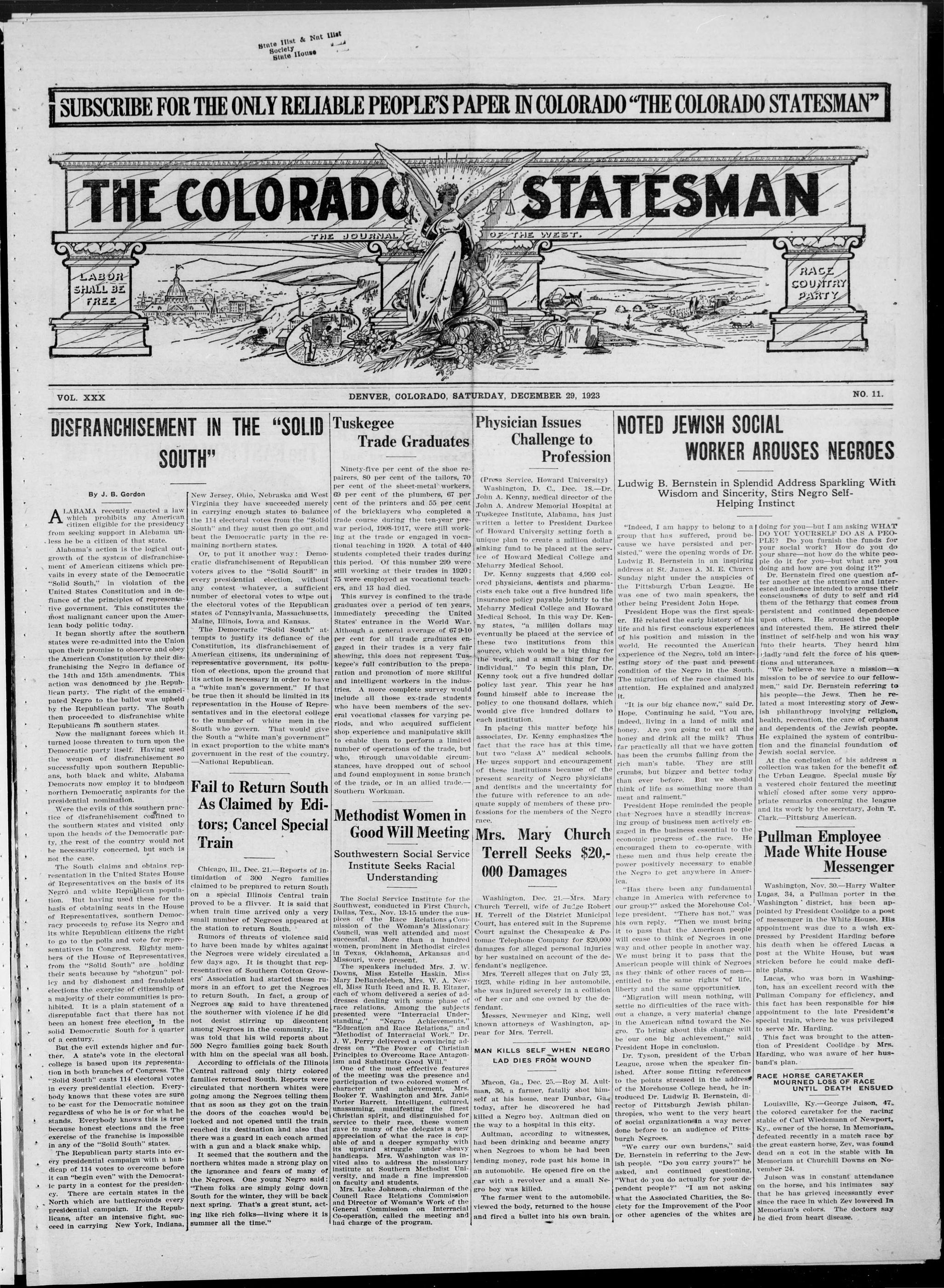
SUBSCRIBE FOR THE ONLY RELIABLE PEOPLE'S PAPER IN COLORADO "THE COLORADO STATESMAN"
THE COLORADO STATESMAN
THE JOURNAL OF THE WEST.
LABOR SHALL BE FREE
RACE COUNTRY PARTY
DISFRANCHISEMENT IN THE "SOLID SOUTH"
VOL. XXX
ALABAMA recently enacted a law which prohibits any American citizen eligible for the presidency from seeking support in Alabama unless he be a citizen of that state.
Alabama's action is the logical outgrowth of the system of disfranchisement of American citizens which prevails in every state of the Democratic "Solid South," in violation of the United States Constitution and in defiance of the principles of representative government. This constitutes the most malignant cancer upon the American body politic today.
It began shortly after the southern states were re-admitted into the Union upon their promise to observe and obey the American Constitution by their disfranchising the Negro in defiance of the 14th and 15th amendments. This action was denounced by the Republican party. The right of the emancipated Negro to the ballot was upheld by the Republican party. The South then proceeded to disfranchise white Republicans in southern states.
Now the malignant forces which it turned loose threaten to turn upon the Democratic party itself. Having used the weapon of disfranchisement so successfully upon southern Republicans, both black and white, Alabama Democrats now employ it to bludgeon northern Democratic aspirants for the presidential nomination.
Were the evils of this southern practice of disfranchisement confined to the southern states and visited only upon the heads of the Democratic party, the rest of the country would not be necessarily concerned, but such is not the case.
The South claims and obtains representation in the United States House of Representatives on the basis of its Negro and white Republican population. But having used these for the basis of obtaining seats in the House of Representatives, southern Democracy proceeds to refuse its Negro and its white Republican citizens the right to go to the polls and vote for representatives in Congress. Eighty members of the House of Representatives from the "Solid South" are holding their seats because by "shotgun" policy and by dishonest and fraudulent elections the exercise of citizenship of a majority of their communities is prohibited. It is a plain statement of a disreputable fact that there has not been an honest free election. In the solid Democratic South for a quarter of a century.
But the evil extends higher and further. A state's vote in the electoral college is based upon its representation in both branches of Congress. The "Solid South" casts 114 electoral votes in every presidential election. Everybody knows that these votes are sure to be cast for the Democratic nominee regardless of who he is or for what he stands. Everybody knows this is true because honest elections and the free exercise of the franchise is impossible in any of the "Solid South" states.
The Republican party starts into every presidential campaign with a handicap of 114 votes to overcome before it can "begin even" with the Democratic party in a contest for the presidency. There are certain states in the North which are battlegrounds every presidential campaign. If the Republicans, after an intensive fight, succeed in carrying New York, Indiana,
New Jersey, Ohio, Nebraska and West Virginia they have succeeded merely in carrying enough states to balance the 114 electoral votes from the "Solid South" and they must then go out and beat the Democratic party in the remaining northern states.
Or, to put it another way: Democratic disfranchisement of Republican voters gives to the "Solid South" in every presidential election, without any contest whatever, a sufficient number of electoral votes to wipe out the electoral votes of the Republican states of Pennsylvania, Massachusetts, Maine, Illinois, Iowa and Kansas.
The Democratic "Solid South" attempts to justify its defiance of the Constitution, its disfranchisement of American citizens, its undermining of representative government, its pollution of elections, upon the ground that its action is necessary in order to have a "white man's government." If that be true then it should be limited in its representation in the House of Representatives and in the electoral college to the number of white men in the South who govern. That would give the South a "white man's government" in exact proportion to the white man's government in the rest of the country. —National Republican.
Fail to Return South As Claimed by Editors; Cancel Special Train
Fail to Return South As Claimed by Editors; Cancel Special Train
Chicago, Ill., Dec. 21.—Reports of intimidation of 300 Negro families claimed to be prepared to return South on a special Illinois Central train proved to be a flivver. It is said that when train time arrived only a very small number of Negroes appeared at the station to return South. Rumors of threats of violence said to have been made by whites against the Negroes were widely circulated a few days ago. It is thought that representatives of Southern Cotton Growers' Association had started these rumors in an effort to get the Negroes to return South. In fact, a group of Negroes are said to have threatened the southerner with violence if he did not desist stirring up discontent among Negroes in the community. He was told that his wild reports about 500 Negro families going back South with him on the special was all bosh.
According to officials of the Illinois Central railroad only thirty colored families returned South. Reports were circulated that northern whites were going among the Negroes telling them that as soon as they got on the train the doors of the coaches would be locked and not opened until the train reached its destination and also that there was a guard in each coach armed with a gun and a black snake whip. It seemed that the southern and the northern whites made a strong play on the ignorance and fears of many of the Negroes. One young Negro said: "Them folks are simply going down South for the winter, they will be back next spring. That's a great stunt, acting like rich folks—living where it is summer all the time."
DENVER. COLORADO. SATURDAY. DECEMBER 29. 1923
Tuskegee Trade Graduates
Ninety-five per cent of the shoe repairers, 80 per cent of the tailors, 70 per cent of the sheet-metal workers, 69 per cent of the plumbers, 67 per cent of the printers and 55 per cent of the bricklayers who completed a trade course during the ten-year prewar period, 1908-1917, were still working at the trade or engaged in vocational teaching in 1920. A total of 440 students completed their trades during this period. Of this number 299 were still working at their trades in 1920; 75 were employed as vocational teachers, and 13 had died.
This survey is confined to the trade graduates over a period of ten years, immediately preceding the United States' entrance in the World War. Although a general average of 67.9-10 per cent for all trade graduates engaged in their trades is a very fair showing, this does not represent Tuskegee's full contribution to the preparation and promotion of more skillful and intelligent workers in the industries. A more complete survey would include all those ex-trade students who have been members of the several vocational classes for varying periods, and who acquired sufficient shop experience and manipulative skill to enable them to perform a limited number of operations of the trade, but who, through unavoidable circumstances, have dropped out of school and found employment in some branch of the trade, or in an allied trade. Southern Workman.
Methodist Women in Good Will Meeting
Southwestern Social Service Institute Seeks Racial Understanding
The Social Service Institute for the Southwest, conducted in First Church, Dallas, Tex., Nov. 13-15 under the auspices of the Race Relations Commission of the Woman's Missionary Council, was well attended and most successful. More than a hundred women, prominent in Methodist circles in Texas, Oklahoma, Arkansas and Missouri, were present.
The speakers included Mrs. J. W. Downs, Miss Estelle Haskin, Miss Mary DeBardeleben, Mrs. W. A. Newell, Miss Ruth Reed and R. B. Eltazer, each of whom delivered a series of addresses dealing with some phase of race relations. Among the subjects presented were "Interracial Understanding," "Negro Achievements," "Education and Race Relations," and "Methodist of Interracial Work." Dr. J. W. Perry delivered a convincing address on "The Power of Christian Principles to Overcome Race Antagonism and Substitute Good Will."
One of the most effective features of the meeting was the presence and participation of two colored women of character and achievement, Mrs. Booker T. Washington and Mrs. Janie Porter Barrett, Intelligent, cultured, unassuming, manifesting the finest Christian spirit, and distinguished for service to their race, these women gave to many of the delegates a new appreciation of what the race is capable of and a deeper sympathy with its upward struggle under heavy handicaps. Mrs. Washington was invited also to address the missionary institute at Southern Methodist University, and made a fine impression on faculty and students. Mrs. Luke Johnson, chairman of the Council Race Relations Commission and Director of Woman's Work of the General Commission on Interracial Co-operation, called the meeting and had charge of the program.
Physician Issues Challenge to Profession
(Press Service, Howard University) Washington, D. C., Dec. 18.—Dr. John A. Kenny, medical director of the John A. Andrew Memorial Hospital at Tuskegee Institute, Alabama, has just written a letter to President Durkee of Howard University setting forth a unique plan to create a million dollar sinking fund to be placed at the service of Howard Medical College and Meharry Medical School. Dr. Kenny suggests that 4,999 colored physicians, dentists and pharmacists each take out a five hundred life insurance policy payable jointly to the Meharry Medical College and Howard Medical School. In this way Dr. Kenny states, "a million dollars may eventually be placed at the service of these two institutions from this source, which would be a big thing for the work, and a small thing for the individual." To begin this plan, Dr Kenny took out a five hundred dollar policy last year. This year he has found himself able to increase the policy to one thousand dollars, which would give five hundred dollars to each institution.
In placing this matter before his associates, Dr. Kenny emphasizes the fact that the race has at this time, but two "class A" medical schools. He urges support and encouragement of these institutions because of the present scarcity of Negro physicians and dentists and the uncertainty for the future with reference to an adequate supply of members of these professions for the members of the Negro race.
Mrs. Mary Church Terrell Seeks $20,- 000 Damages
Washington, Dec. 21.—Mrs. Mary Church Terrell, wife of Judge Robert H. Terrell of the District Municipal Court, has entered suit in the Supreme Court against the Chesapeake & Potomac Telephone Company for $20,000 damages for alleged personal injuries by her sustained on account of the defendant's negligence.
Mrs. Terrell alleges that on July 23, 1923, while riding in her automobile, she was injured severely in a collision of her car and one owned by the defendant.
Messrs. Newmeyer and King, well known attorneys of Washington, appear for Mrs. Terrell.
MAN KILLS SELF WHEN NEGRO
LAD DIES FROM WOUND
Macon, Ga., Dec. 25.—Roy M. Aultman, 36, a farmer, fatally shot himself at his home, near Dunbar, Ga. today, after he discovered he had killed a Negro boy. Aultman died on the way to a hospital in this city.
Aultman, according to witnesses, had been drinking and became angry when Negroes to whom he had been lending money, rode past his home in an automobile. He opened fire on the car with a revolver and a small Negro boy was killed.
The farmer went to the automobile. viewed the body, returned to the house and fired a bullet into his own brain.
NOTED JEWISH SOCIAL WORKER AROUSES NEGROES
Ludwig B. Bernstein in Splendid Address Sparkling With Wisdom and Sincerity, Stirs Negro Self-Helping Instinct
"Indeed, I am happy to belong to a group that has suffered, proud because we have persisted and persisted," were the opening words of Dr. Ludwig B. Bernstein in an inspiring address at St. James A. M. E. Church Sunday night under the auspices of the Pittsburgh Urban League. He was one of two main speakers, the other being President John Hope.
President Hope was the first speaker. He related the early history of his life and his first conscious experiences of his position and mission in the world. He recounted the American experience of the Negro, told an interesting story of the past and present condition of the Negro in the South. The migration of the race claimed his attention. He explained and analyzed it doing for you—but I am asking WHAT DO YOU YOURSELF DO AS A PEO- PLE? Do you furnish the funds for your social work? How do you do your share—not how do the white people do it for you—but what are you doing and how are you doing it?"
Dr. Bernstein fired one question after another at the attentive and interested audience intended to arouse their consciousness of duty to self and rise them of the lethargy that comes from persistent and continued dependence upon others. He aroused the people and interested them. He stirred their instinct of self-help and won his way into their hearts. They heard him gladly and felt the force of his questions and utterances.
"We believe we have a mission—a mission to be of service to our fellow- men," said Dr. Bernstein referring to his people—the Jews. Then he re
"It is our big chance now," said Dr. Hope. Continuing he said, "You are indeed, living in a land of milk and honey. Are you going to eat all the honey and drink all the milk? Thus far practically all that we have gotten has been the crumbs falling from the rich man's table. They are still crumbs, but bigger and better today than ever before. But we should think of life as something more than meat and raiment."
President Hope reminded the people that Negroes have a steadily increasing group of business men actively engaged in the business essential to the economic progress of the race. He encouraged them to co-operate with these men and thus help create the power positively necessary to enable the Negro to get anywhere in America.
"Has there been any fundamental change in America with reference to our group?" asked the Morehouse College president. "There has not," was his own reply. "Then we must bring it to pass that the American people will cease to think of Negroes in one way and other people in another way. We must bring it to pass that the American people will think of Negroes as they think of other races of men—entitled to the same rights of life, liberty and the same opportunities.
"Migration will mean nothing, will settle no difficulties of the race without a change, a very material change in the American mind toward the Negro. To bring about this change will be our one big achievement," said President Hope in conclusion.
Dr. Tyson, president of the Urban League, arose when the speaker finished. After some fitting references to the points stressed in the address of the Morehouse College head, he introduced Dr. Ludwig B. Bernstein, director of Pittsburgh Jewish philanthropies, who went to the very heart of social organization in a way never done before to an audience of Pittsburgh Negroes.
"We carry our own burdens," said Dr. Bernstein in referring to the Jewish people. "Do you carry yours?" he asked, and continued questioning, "What do you do actually for your dependent people?" "I am not asking what the Associated Charities, the Society for the Improvement of the Poor or other agencies of the whites are
NO.11.
doing for you—but I am asking WHAT DO YOU YOURSELF DO AS A PEOPLE? Do you furnish the funds for your social work? How do you do your share—not how do the white people do it for you—but what are you doing and how are you doing it?" Dr. Bernstein fired one question after another at the attentive and interested audience intended to arouse their consciousness of duty to self and rid them of the lethargy that comes from persistent and continued dependence upon others. He aroused the people and interested them. He stirred their instinct of self-help and won his way into their hearts. They heard him gladly and felt the force of his questions and utterances.
"We believe we have a mission—a mission to be of service to our fellowmen," said Dr. Bernstein referring to his people—the Jews. Then he related a most interesting story of Jewish philanthropy involving religion, health, recreation, the care of orphans and dependents of the Jewish people. He explained the system of contribution and the financial foundation of Jewish social service.
At the conclusion of his address a collection was taken for the benefit of the Urban League. Special music by a vested choir featured the meeting which closed after some very appropriate remarks concerning the league and its work by the secretary, John T. Clark.—Pittsburg American.
Pullman Employee Made White House Messenger
Pullman Employee Made White House Messenger
Washington, Nov. 30.—Harry Walter Lugas, 34, a Pullman porter in the Washington district, has been appointed by President Coolidge to a post of messenger in the White House. His appointment was due to a wish expressed by President Harding before his death when he offered Lucas a post at the White House, but was stricken before he could make definite plans.
Lucas, who was born in Washington, has an excellent record with the Pullman Company for efficiency, and this fact has been responsible for his appointment to the late President's special train, where he was privileged to serve Mr. Harding.
This fact was brought to the attention of President Coolidge by Mrs. Harding, who was aware of her husband's plan.
RACE HORSE CARETAKER
MOURNED LOSS OF RACE
UNTIL DEATH ENSUED
Louisville, Ky.—George Juison, 4t, the colored caretaker for the racing stable of Carl Wiedemann of Newport, Ky., owner of the horse, In Memoriam, defeated recently in a match race by the great eastern horse, Zev, was found dead on a cot in the stable with In Memoriam at Churchill Downs on November 24. Juison was in constant attendance on the horse, and his intimates say that he has grieved incessantly ever since the race in which Zev lowered In Memoriam's colors. The doctors say he died from heart disease.
QUALITY AT POPULAR PRICES.
Hansen & Hansen
Jewelers
428 16th St.
FREE
THIS BEAUTIFUL
HAIR STRAIGHTENING
AND SHAMPOO COMB
This Comb Is Well Worth $1.00
Solid Brass, wooden handle
8 1/4 inches long weight 4 ounces.
given as a present to all who take
advantage of our great
JUST WRITE TO US AND SAY: "I would like to get a hair straightening and shampoo comb free. Send me particulars regarding your hair. Be sure and write your name and address plainly, and full particulars will be sent you. Do not wait, write to-day for this offer will not last long. We are doing this to advertise for our Pamela and for Hair Straightening and Shampoo Comb. Address your letter to THE OZONIZED OX MARROW CO. WARSAW ILLINOIS
Michaelson's
CORNER 15TH AND LARIMER
STREETS
OUR
WONDER
SALE
Now in progress, is the bargain event of the hour.
Don't miss it.
PEOPLE'S PRESBYTERIAN
CHURCH
Rev. C. H. Uggams, D.D., Pastor.
Sunday School, 9:30 a.m.
Wednesday—Prayer meeting, 8 p. m.
Thursday—Choir rehearsal, 8 p. m.
The People's Presbyterian Church is always open to the community for the purpose of CHRISTIAN DEVELOPMENT and a hearty welcome awaits those who seek to know the teachings of JESUS CHRIST and the PRACTICAL APPLICATION OF CHRISTIANITY TO THE WORLD.
ESTATE OF JOHN S. WILLIAMS, DECEASED, NO. 33.397.
All persons having claims against said estate are hereby notified to present them for adjustment in the County Court of the City and County of Denver, Colorado, on the 29th day of January, 1924.
LEROY F. WILLIAMS,
Administrator.
Thos. Campbell, Attorney for Administrator.
First publication, December 15, 1923.
Last publication, January 12, 1924.
Two Sad Cases.
Recently a tramp taken up in a New York police court for drunkenness gave his birthplace as Boston. "Yours," said the magistrate, "is a sad case. Yet you don't seem to thoroughly realize how low you have sunk." The prisoner struck his brow with a palmed gesture. "Heavens!" he exclaimed devoutly, "I ha' stood many indignities, but to be scened by a magistrate that splits his infinitives! This is the fast blow!"
Ocean Bed Rising.
A cable ship of the Eastern Telegraph company, searching for a broken cable between St. Helena and Cape Town, found that the ocean bed had risen two and a quarter miles since 1899. When the original soundings were taken in that year the chart showed a depth of three miles.
Rail Safety Record
A record of safety in railway travelling in Great Britain was established last year, when only five passengers were killed in accidents out of a total of 1,186,479,000 carried by the railways—or one in 200,000,000.
LATE NEWS
From All Over
COLORADO
Pueblo—Two brothers, 16 and 17 years old, sons of a dairyman near Pueblo, were drowned while skating in Lake Minnequa, near the southern limits of the city.
Fort Collins—Three Fort Collins boys, Chester Hadley, Ralph Connell and Everett Manning, all 17 years old, were arraigned on charges of stealing an automobile from Clark Bouton, clerk of the County Court.
Loveland—Oil experts and geologists of the Sinclair Oil Company are expected to arrive in Loveland soon to start investigation of the company's lenses on 10,000 acres of land in the vicinity of Boyd lake, east of Loveland.
Loveland.—Mary Johnson, the 14-months' old daughter of Mr. and Mrs. W. D. Johnson of east of Loveland, was severely burned about the face, neck and right arm when a pan of scalding water was accidentally spilled on her while she was playing.
Denver.—Victor Walker, colored, former deputy sheriff under Mayor Dewey C. Bailey and editor of the New American Weekly, a negro newspaper, was convicted on charges of criminal libel by a West Side Court jury before Judge George F. Dunklee.
Denver.—Lillian Wood, sister of Joseph Wood, an employee in the state motor vehicle department, received word from United States Senator Lawrence C. Phipps that President Coolidge has appointed her postmistress at Louisville, Colo.
Denver.—Word of the appointment of H. B. Westover as agent in charge of the narcotic division of the bureau of internal revenue has been received from Washington. Westover has been acting agent in charge of the Colorado, Utah and Wyoming division since last April.
Sterling.—Following a chase of several blocks in the railroad yards at Sterling, Magnus Reeves, 19 years old, was arrested by Chief of Police James Kerr for grand larceny. The youth, police say, is responsible for numerous burglaries in the resident district of Sterling.
Denver.—Postal receipts for the year have passed $3,000,000, according to Postmaster Frank L. Dodge, after the heaviest malls in the history of the Denver postoffice had been experienced before Christmas. It was necessary for thirty-five men to work eight hours each on Sunday in order to cope with the tremendous volume of first-class letter mall, amounting to more than 1,250,000 pieces, received during three days.
Denver.—Governor Sweet will deliver an address in Pittsburg on Feb. 29, and following that will spend a few days in New York city with Col. E. M. House, famous "silent man" of the Democratic party, he said in a letter sent to Edward A. Filene, prominent Boston man and owner of a large department store in that city. It is planned to schedule other addresses if sufficient time may be spared from executive duties, the letter added.
Wellington.-Days of effort, rebuffs, and careful planning met success for the Union Oil Company when workers gained control of the terrific pressure of its phenomenal gasser here. The valves, constructed at the new well after hours of difficult labor, were closed, shutting off the flow of oil and gas, to conserve the pressure for an expected production of 800 barrels a day from other wells soon to be drilled. News of this feat at the well was watched for by people here momentarily since construction of the concrete forms for the valve mechanism began.
Denver.—Samuel J. Lewis, state printing commissioner and one of the state's most widely known newspaper men, died at his home, 1406 Gaylord street, a few days ago. Death was due to a complication of diseases and came after an illness of less than a week, though Mr. Lewis had been in bad health for a number of years.
Boulder.—Burglaries who entered the Tri Delta sorority house at Boulder recently worked unmolested as the occupants were all away for the holidays. Evidences of a thorough job were revealed when the house was found littered with dainty bits of fingerle, party dresses and other feminine attire. The loss has not yet been estimated.
Colorado Springs.—The St. James eleven of Haverhill, Mass., was turned back by the fighting Terror squad by the score of 35 to 0. Handicapped by a long trip and high altitude, the "Fighting Irish" put up a game fight until they were exhausted in the final quarter and the Terror steam roller began to work havoc. At no time, however, were the Springs boys in danger and clearly demonstrated superiority at all times.
Pagosa Springs—The public schools of Pagosa Springs are closed down until Jan. 7 and all indoor Christmas exercises, together with Sunday schools, are temporarily called off on account of the fresh outbreak of scarlet fever. In the home of Claude Keith, the mother and four children are suffering from the disease. There are numerous other cases in and near town. The town authorities permitted the community Christmas tree and the sacred services therewith as these were outdoors. No deaths have yet occurred from the disease.
PUBLIC TRUSTEES SALE
2375.
Whereas Grace B. Sandahl, by deed of the date of day of July 1923, which is recorded in book 3765, page 288, of the records in the office of the Clerk and the Recorder of the City Court, conveyed to the Public Trustee in and for the City and County of Denver, Colorado, the following described real estate in the City and County of Denver, one and twenty-two (21 and 22), in block thirteen (13), First Addition to Berkeley; which deed of trust was made to secure the deed of one prescriptive of even date with add deed of trust, for the sum of five hundred and fifty ($550.00) dollars, payable to the order of Eva L. Reno in the date thereof, with interest at six per cent per annum until paid, interest payable monthly, as is more particularly set forth in said deed of the date thereof, with interest thereby made for greater certainty; and
Whereas, The said Grace B. Sandahl, and all persons claiming by, through payment of interest and installments on the principal, and the legal holder of said note, having elected on account of the notice, there said note unpaid, due and payable; Now, Therefore, At the written request of Eva L. Reno, the legal holder of said note, having elected on account of the notice, Public Trustee in and for the City and County of Denver, Colorado, do hereby give notice that I will, at the hour of 10 o'clock in the fore-
TUESDAY, JANUARY 15, 1924.
at the Tremont street front door of
the Court House, in the City and
county of Denver, colloquially called
public auction, to the highest and best
bidder for cash, the said described
premises, and all the right, title and
interest of the said Grace B. Sandahl,
her heirs and assigns therein, for
the purpose of paying said indebtedness,
the indebtedness secured by the
principal and interest on same at
six per cent per annum to date of sale
and $75.00 as attorney fees and costs
of foreclosure, the indebtedness secured
by the said deed of trust, and the
purchaser of the said deed, this
tust and will deliver to the purchaser
a certificate of sale as provided by law.
Dated at Denver, Colorado, December
13, 1923.
EDWARD M. SABIN,
Public Trustee in and for the City and
County of Denver, Colorado.
First publication, December 15, 1923.
Last publication, January 12, 1924.
PUBLIC TRUSTEE'S SALE.
No. 2268.
Whereas, Nannie E, Briggs by deed of trust, dated the 12th day of January, 1923, which is recorded in book 3675, page 57, of the records of the City and County of Denver, the duly conveyed to the Public Trustee in and for the City and County of Denver, Colorado, the following described rename, Denver, Colorado, to-wit: Lot numbered thirty-nine (39) and the North fifteen (15) feet of Lot numbered thirty-eight (38) in Block numbered one hundred and fifty-one (101) feet of Hill Addition, Second Filing; together with the improvements thereon situate known as and numbered 663 Clarkson street, which deed of trust was made in the same year (1923) in issory note of even date with said deed of trust, for the sum of Eleven hundred seventy-five and no-100 ($1175.00). Dollars, payable to the order of The City of Denver, are to be received after the date thereof, with interest thereon at ten per cent per annum until maturity, interest payable quarter-annually, as is more particularly set forth in said deed of trust, reference to which hereby made for greater certainty, and.
Whereas, The said Nannie E. Briggs, and all persons claiming by, through or under her having defaulted in the payment of the he nc omeance $20.123 due on June 2, 1923; general taxes for the year 1922 amounting to $201.22; and in the payment of the interest of $29.38 due October 12, 1923, and the legal holder of said note, having elected on account of said default there are said note unpaid, due and payable.
Now, Therefore, At the written request of The J. H. Wilkins Realty Company, the legal holder of said note pursuant to law, the undersigned of the City and County of Denver, Colorado, do hereby give notice that I will, at the hour of 10 o'clock in the forenoon of Wednesday, January 2, 1924, at the Tremont street office of the City and County of Denver, Colorado, sell at public auction, to the highest and best bidder for cash, the said described premises, and all the right, title, interest and the fee for the Biggest Hours and assigns therelie, for the purpose of paying the indebtedness secured by said deed of trust, and the cost and expenses of executing this trust, and will deliver to the purchaser a certificate of sale as provided by the Dated at Denver, Colorado, November 30th, 1923.
EDWARD M. SABIN,
Public Trustee in and for the City and County of Denver, Colorado.
First Publication, December 1, 1922.
Last Publication, December 29, 1923.
PUBLIC TRUSTEE'S SALE
2282
Whereas, The said T. D. Harris, and all persons claiming by, through or under him, having defaulted in the payment of interest due to December 1929 the skimmer, skimmer dollars and 25/100 ($61.25), and the legal holder of said note, having elected on account of said default to declare said note unpaid due to payable: as herefore, the written request of Jos. L. Brenesch, the legal holder of said note pursuant to law, I the undersigned, Public Trustee in and for Denver Colorado, in the City and County Colorado, do hereby give notice to will, at the hour of 10 o'clock in the foreonon of JANUARY 22, 1924 at the Trustee's office door of the Court House, in the City and County of Denver, Colorado, sell at public auction, to the highest and best bidder for cash, the said described premises, and is hereby the interest of the said T. D. Harris is held, and signs therein, for the purpose of paying $500.00 principal, $61.25 interest, $75.00 attorney's fees as provided in case of interest in the deadenedness secured by said deed of trust cost and expenses of executing this trust, and will deliver to the purchaser a certificate of sale as provided by law. Dated at Denver, Colorado, December 19
First publication. December 22. 1923.
Last publication. January 19. 1924.
A TREASURE HOUSE OF GIFTS
THE DENVER
THE DENVER DRY GOODS CO.
Express, Moving and Storage
Coal and Wood
2415 WASHINGTON STREET
PROMPT DELIVERY
Phone Main 6544
Telephone
when you want
that next job of
You will get first-class work, and you will get it when promised, for having work done when promised is one of the rules of this office.
If you prefer, send the order by mail or bring it to the office in person.
Let Us Show You What We Can Do
Our Hobby
Is Good
Printing
Ask to see samples of our business cards, visiting cards, wedding
Ask to see samples of our businesscards, visiting cards, wedding
and other invitations, pamphlets, folders, letter heads, statements, shipping tags, envelopes, etc., constantly carried in stock for your accommodation.
Get our figures on that printing you have been thinking of.
New Type, Latest Style Faces
Front room for rent, upstairs. Apply 1217 Gaylord St. Phone Franklin 379.
THE DE LUXE
Furnished apartments, 2 and 3 rooms, hot and cold water, kitchen, also kitchenette; electric lights and gas, to desirable tenants only. 2352-2358 Ogden St. Phone Champa 8943W. Mrs. R. M. Blakey.
The EAST INDIA HAIR GROWER
The EAST INDIA HAIR GROWER
Hair Trouble, we want you to try a jar of EAST INDIA HAIR GROWER. The remedy contains medical proprieties that go to the roots of the Hair, stimulates the skin, helping nature do its work. Leaves the hair soft and silky. Perfumed with a balm of a thousand flowers. The best known remedy for
Heavy and Beautiful Black Eye-Brows, also restores Gray Hair to its Natural Color. Can be used with Hot Iron for Straightening.
Heavy and Beautiful Hair to its Natural Co Straightening. Price Sent by Ma
Beautiful Black Eye-Brows, also restores Gray
s Natural Color. Can be used with Hot Iron for
drying.
Sent by Mail. 50c; 10c Extra for Postage
Price Sent by Mail, 50c; 10c Extra for Postage
1924
the Old Reliable
ASS UNDERTAKING
COMPANY
1907
The Old
DOUGLASS L
COM
2745 Wel
We want you to think
and counselor in time
Wishing You a M
and a Happy a
New
The J. C. Bloo
Diamonds
Watches
and Jewelry
New L
821
2745 Welton Street
you to think of us as your friend
or in time of need.
You a Merry Christmas
Happy and Prosperous
New Year.
. Bloom Jewelry Co.
New Location
821 15TH St.
Jewelers
and
Optometrists
We want you to think of us as your friend and counselor in time of need. Wishing You a Merry Christmas and a Happy and Prosperous New Year.
The J. C. Bloom Jewelry Co.
Diamonds New Location Jewelers
Watches 821 15TH St. and
Jewelry Optometrists
ESTATE OF FLEMING SINGLETON,
DECEASED. NO. 30.142
Notice is hereby given that on the 15th day of January, 1924, I will present to the County Court of the City and County of Denver, Colorado my accounts for final sale and institution of final estate, when and where all persons in interest may appear and object to them, if they so desire.
MABEL SINGLETON
Administratrix.
E, P. Blakemore, Attorney for Estate.
First publication, December 1, 1923.
Last publication, December 29, 1923.
---
---
AGENTS OUTFIT
1 Hair Grower, 1 Temple
Oil, 1 Shampoo, 1 Press-
and Directions for Sell-
ing Oil, 1 Face Cream
Postage.
Office House—9 n. m. to 12 m.
2 p. m. to 4 p. m.
Office Phone, M. 5034
Residence Phone, F501-W
S. E. CARY
ATTORNEY-AT-LAW
Six years City and County
Attorney at Russell Springs, Logan
County, Kansas
2640 Welton Denver, Colorado
Will Promote a Full Growth of Hair, Will also Restore the Strength, Vitality and the Beauty of the Hair. If your Hair is Dry and Wiry Try
East India Hair Grower
S. D. LYONS
316 N. Central Dept. B.
Oklahoma City, Okla.
NOTICE OF ANNUAL MEETING.
Notice is hereby given that the annual meeting of the stockholders of the Bondurant-Jones Investment Company will be held at its office, 6 East Eleventh avenue, Denver, Colo., on the 8th day of January, 1924, at 8 p. m., for the election of directors for the ensuing year and the transaction of such other business as may properly come before said meeting.
LEDYARD C. JONES,
Secretary.
COLORED Men wanted to qualify for sleeping car and train porters. Experience unnecessary. Transportation furnished. Write T. McCaffrey, Supt., St. Louis, Mo.
The Mouth-Piece
of the People of
Colorado and the
Entire West
RELIABLE chronicle
of their doings and
progress; a faithful mirror
their wants, their hopes,
or best aspiration.
THE
COLORADO
STATESMAN
equaled as an advertising
medium for the business
of professional men and
women.
excellent family journal
speaking to and for many
thousand colored citizens.
THE GREAT ORGAN OF THE BORING MASSES
COLORADO STATESMAN
```markdown
```
The Mouth-Piece of the People of Colorado and the Entire West
ARELIABLE chronicle of their doings and progress; a faithful mirror of their wants, their hopes, their best aspiration.
THE COLORADO STATESMAN
Unequaled as an advertising medium for the business of professional men and women.
An excellent family journal speaking to and for many thousand colored citizens.
$2.00 A YEAR
$1.25 SIX MONTH
$.75 THREE MONTH
THE GREAT ORGAN OF THE LABORING MASSES
WHAT
the OLD
YEAR
said.to
the NEW
AVERY OLD GENTLEMAN wearing a long, white toga and carrying a scythe, sat down on a stone. It was exactly five minutes before midnight on December thirty-first. The very old gentleman seemed to be waiting for somebody.
"Where is that young rascal?" he murmured to himself. "I have a few words to say to him which .....ah.....I see him coming now."
A rosy cherub of a youngster ran laughing to the old man's side. The elderly fellow patted him on the head and said: "Listen to me, my boy. I'm leaving now for good. In five minutes I must step out forever, and you must take my place. It's a job—a man-sized job.
"I began as young and eager as you. Look at me now! People are never satisfied. But you must not let their grumbling disturb you. If it's winter, they want you to hurry the
months towards spring. In summer they cry for fall. The nights are too long and the days too short. What makes happiness for some brings distress to others. But this is not your job. All you have to do is to keep steadily on schedule. Minute by minute, hour by hour; never varying a second through storms and sunshine, heat and snow. Your responsibility is for the correct passage of time. This is your sole duty. Joy and sorrow may not change for a second the law you keep. This is the way of life. 'Hew to the line,' my boy, and never give up."
The old gentleman smiled, arose from his seat and disappeared. The rosy cherub of a youngster danced into the New Year to the ringing of bells. There was a great welcome for him and he determined to fulfill his duty to the very last second.
-MARTHA B. THOMAS
The Resolutioners
by
Clara
Delafield
Copyright, 1923 Western Pennsylvania Union
HAT do you suppose can be
the matter with the Nag-
gits?" asked-Charley Rich-
mond of his wife.
"They must have had a
"They must have had a dreadful quarrel."
"Something's gone wrong. I never saw such a pair of down-in-the-mouths as when we were over there last night. They hardly said a word to each other."
"And they used to be such an affectionate couple."
"Um—more or less, yes. By the way, did you notice Will didn't smoke?"
"Yes. He told me he'd give up smoking for the New Year."
"Um—um!" Charley reached for his pipe. "I guess his wife made him, and that's at the bottom of the trouble."
Now, this is what had really happened: On the thirty-first of December Will Naggitt broke his new pipe in two. "Dear," he said, "I'm never going to smoke again, and that's my New Year resolution."
"And I hope you'll keep it," said Dorothy. "You know you've said that every New Year's eve for the past nine years."
"I know I have, Dorothy. But this time I mean business. And now, what are you going to resolve?"
"I don't know what there is for me to resolve," said Dorothy. "I'm perfect."
"You've got a perfect nerve, I'll say that for you."
"Oh, but my dear, you told me so yourself before we were married. Don't you remember?"
"A man isn't responsible for what he says in a condition of mental aberration. Didn't you know that, my dear? See here, I'll make a compact with you. I'll stop smoking just as long as you stop nagging."
"Now, Will Naggitt, you stop making unfounded charges against me, because I won't stand for it. I've been a good wife to you and looked after you like a slave while you've been indulging in your extravagances and filthy tobacco, and loafing about the house and at your office, and never a word out of me, because I'm the most long-suffering woman alive and now you tell me I nag you and I'll never open my mouth again."
"All right, Dorothy, as long as you keep your mouth closed in anger I'll keep mine closed to tobacco."
Will thought he'd have an excuse to start smoking again next day, but that was where Dorothy fooled him. She suddenly turned into a model wife. To his most petulant outbreaks there came no reply. And Will became more and more petulant as the days went
by and his coveted smoke failed to materialize.
There was no question who was the nagger now. Poor Dorothy was having the hardest time of her life. And yet, for Will's sake, he refrained from answering him. His nervous system was totally unbalanced from want of a smoke, and she knew that and made excuses for him.
She had always wanted to cure him of his filthy habit, and it was now or never.
Will's pride kept him to the fulfillment of his vow. A week passed.
He got up one morning feeling desperate.
"Whatchermean by giving me this nasty coffee?" he growled. "Haven't you got sense enough to clarify it with an egg? I don't care if eggs cost a thousand dollars a dozen. I'm not going to drink blige."
Dorothy said nothing, but smiled sweetly upon him.
"For the Lord's sake, can't you make toast without burning it? And
"You've Got a Perfect Nerve, I'll Say That for You."
"You've Got a Perfect Nerve, I'll Say That for You."
where did you get this grapefruit? Grapefruit? Huh! I like to see the parent tree; I guess it's a cannon-ball tree more likely."
Dorothy went softly out of the room. Presently, as Will bent over his meal, two soft hands were placed over his eyes.
"Open his mouth and shut his eyes and see—"
"Oh, for heaven's sake quit your foolish tricks. I'm not a kid. Hey, what's this?"
"It's your pipe, you wicked monster!" sobbed Dorothy. "And now I can tell you what I think of you, you fiend in human form, before I go home to mother. I've stood for all I'm going to stand from you. I hate you and I wish you'd never been born. Of all the wretched, worthless loafers who ever encumbered the face of the earth you take the cake—is your pipe a light now, darling?" Dorothy perched herself upon his knee.
"Aren't we happy!" she cooed, as the fragrant fumes floated into the air. "Um—um!" said Will. "What delicious coffee. Give me another cup, Say—I guess I've been pretty rotten to you."
"Oh, Will, you're always lovely. I've had that new pipe waiting for you for days, but I tried not to give it to you till you started nagging at me, and then it was either your smoking again or me doing so. Will, darling, we mustn't make any resolutions next New Year."
TURKEYS
Hunt's Grocery
Corner 30th and Welton
Red Sweet Spuds, 3 lbs. for.
Try our bulk Coffee, 3 lbs. for.
Black Eye Peas, lb.....
Maple Sugar, cake.....
Dill Pickles, 5 for.....
Bulk Mince Meat, 2 lbs. for.
Black Walnuts, 2 lbs. for....
Fresh C
Don't forget we will have plen
Gent's Grocery-Market
10th and Welton
Phone Champa 3522
Set Spuds, 3 lbs. for.....25c
Bulk Coffee, 3 lbs. for.....$1.00
Pea Peas, lb.....10c
Sugar, cake.....5c. 15c. 20c
Meles, 5 for.....10c
Piece Meat, 2 lbs. for.....35c
Alnuts, 2 lbs. for.....15c
Fresh Oysters Daily
get we will have plenty of Turkeys, Ducks and Chickens
Hunt's Grocery-Market
Don't forget we will have plenty of Turkeys, Ducks and Chickens
HOWARD & HOWARD
GROCERIES AND MEATS Fresh Vegetables and Fruits Daily Free Delivery to any part of the city.
CHAMPA PHARMACY
2101 CHAMPA
Is the place to get your
BAGS, CHEMICALS AND PATENT MEDICINES
WE SERVE DRINKS.
PRESCRIPTIONS OUR SPECIALTY.
Us and we will deliver the goods to all parts of the city.
JAMES E. THRALL, Propr.
MAIN 2425
PHONE 8444
PHONE MAIN 6338
THE CHAMBER
2101
Is the pl
DRUGS, CHEMICALS
WE SEE
PRESCRIPTION
Phone us and we will deliver
JAMES E.
PHONE MAIN 2425
THE CHAMPA PHARMACY
Is the place to get your DRUGS, CHEMICALS AND PATENT MEDICINES WE SERVE DRINKS. PRESCRIPTIONS OUR SPECIALTY. Phone us and we will deliver the goods to all parts of the city. JAMES E. THRALL, Propr.
PHONE MAIN 3203
WEATHERHEAD
HAT FACTORY
ESTABLISHED 1876
BEST QUALITY RENOVATING AND REMODELING OF
MEN'S AND WOMEN'S HATS
OUT STREET
ALBANY HOTEL BLDG.
berry Taxi & Baggage Co.
OFFICE; 2713 WELTON STREET
WEATHER
HAT
HIGHEST QUALITY RENO
MEN'S AND
1722 STOUT STREET
Granberry Tax
OFFICE; 2713
WEATHERHEAD
HAT FACTORY
ESTABLISHED 1876
HIGHEST QUALITY RENOVATING AND REMODELING OF
MEN'S AND WOMEN'S HATS
1722 STOUT STREET
ALBANY HOTEL BLDG.
Granberry Taxi & Baggage Co. OFFICE;2713 WELTON STREET
We Move and Store Furniture you have a room for rent or want a room call us TES: $3.00 per hour. DAY and NIGHT SERVICE ANBERRY, Mgr. DENVER, COLORADO
If you have a room for TAXI RATES: $3.00 per hour T. G. GRANBERRY, Mgr.
If you have a room for rent or want a room call us TAXI RATES: $3.00 per hour. DAY and NIGHT SERVICE T. G. GRANBERRY, Mgr. DENVER, COLORADO
Dianaard
P. H. BALFE
PRACTICAL
PLUMBER
LICENSED DRAIN LAYER
Special Attention Given to VENTILATION AND
SEWERAGE. All Work Guaranteed
Main 207 1907 Arapahoe St. Denver, Col-
We Are
Special Attention Given to VENTILATION AND SEWERAGE. All Work Guaranteed Phone Main 207 1907 Arapahoe St. Denver, Col-
Special Attention Give
SEWERAGE.
Phone Main 207 1907
DON'T FORGET
US
When you need any-
thing in the line of
neat and attractive
Printing.
---
---
C. E. Weatherhead
Phones:
CHAMPA
86
87
88
PHONE 8444
C. B. Weatherhead
We Move and Store Furniture
JOBBING
PROMPTLY ATTENDED TO
PRACTICAL PLUMBER
LICENSED DRAIN LAYER
to serve you with good printing. No matter what the nature of the job may be we are ready to do it at a price that will be Satisfactory
THE COLORADO STATESMAN
THE SUPERIOR STATE
LARGE SQUARE OF FREE
RACE COURT PARTY
JOS. D. D. RIVERS.......Proprietor
1824 Curtis Street, Room 25
PHONE MAIN 7417
end-class matter at the postoffice in mail.
SUBSCRIPTION RATES:
Payable in Advance
Retail Merchants' Bureau of the Dem-
cial Association as an advertising mea-
ture
75 cents per square. A square conten-
tioned on less than three months' conten-
tion from parties unknown to us. Further
ten lines or less, 10 cents per line.
tals per line.
Obsons of a personating nature that ar-
m from the columns of this paper.
Should be made by Express Money Orde-
etter or Bank Draft. Postage stamps
are fractional part of a dollar. Only 1-ce-
mphens that papers sent to subscriber
receive any number when due, inform u-
forward a duplicate of the missing m
to receive attention must be newsy,
only upon one side of the paper; must
not later than Wednesdays, and bear
script returned, unless stamps are sent
Entered as second-class matter at the postoffice in the city of Denver, Colorado.
Recognized by the Retail Merchants' Bureau of the Denver Civic and Commercial Association as an advertising medium.
Display advertising, 75 cents per square. A square contains ten agate lines. No discounts allowed on less than three months' contract. Cash must accompany all orders from parties unknown to us. Further particulars on application.
Reading notices, ten lines or less, 10 cents per line. Each additional line over ten lines, 5 cents per line.
All communications of a personating nature that are not complimentary will be withheld from the columns of this paper.
Remittances should be made by Express Money Order, Postoffice Money Order, Registered Letter or Bank Draft. Postage stamps will be received the same as cash for the fractional part of a dollar. Only 1-cent and 2-cent stamps
It occasionally happens that papers sent to subscribers are lost or stolen. In case you do not receive any number when due, inform us by postal card and we will cheerfully forward a duplicate of the missing number.
Communications to receive attention must be newsy, upon important subjects, plainly written only upon one side of the paper; must reach us Tuesdays, if possible, anyway, not later than Wednesdays, and bear the signature of the author. No manuscript returned, unless stamps are sent for postage.
THE NEW YEAR
is, the period forming our calendar on when one estimates the tremendous possible to plan and do many things, amplifications of the calendar period effort unaccompanied by good fortune other hand a year may be crowded sadness. Yet each condition goes and must be counted in the balance one of things.
At the threshold of a New Year man which one may look back upon the rough places, and to look forward pathway veiled in mystery and clouds be beaten path with a feeling of a what one looks to the future with New Year with song and loud acclaim
TWELVE months, the period forming our calendar year, rolls around in rapid fashion when one estimates the tremendous responsibilities of life. It is possible to plan and do many things within a year and sometimes the accomplishments of the calendar period may be equivalent to a life time of effort unaccompanied by good fortune and careful management. On the other hand a year may be crowded with failure, disappointment and sadness. Yet each condition goes to make up life's uncertain portion and must be counted in the balances of profit and loss in the eternal scheme of things.
Standing upon the threshold of a New Year may be likened unto an eminence from which one may look back upon the road already trod, with its pitfalls and rough places, and to look forward to the further journey along a pathway veiled in mystery and clouds. It is possible to look back upon the beaten path with a feeling of a victory gained, it is always probable that one looks to the future with hope and gladness. Thus we hail the New Year with song and loud acclaim.
Making Resolutions
We do not know from whence sprang the custom of adopting the New Year as a convenient season for making of resolutions calculated to guide our actions and habits for a period of twelve months. The whole of life consists of two essentials, i.e. "I will or I won't" and any other time in the year will as conveniently serve our purpose if we will only adopt it. The simple proposition resolves itself into a species of self control, and he admits lamentable weakness who cannot take hold of himself and face square around only at the ringing of bells that tell of the birth of a New Year.
now from whence sprang the custom
auvenient season for making of resul-
tions and habits for a period of twelve m
two essentials, i.e. "I will or I wo
will as conveniently serve our purp
ple proposition resolves itself into
limits lamentable weakness who ca-
quare around only at the ringing of a
car.
Always Do Your Best
ing, there is no time of the year when we or dodge responsibility. We must citizenship and give of our best to society escape the designation of a separate e face with the fact that whatever a citizens must eminate from our
Strictly speaking, there is no time of the year when one can safely neglect opportunity or dodge responsibility. We must at all times make the most of our citizenship and give of our best to society and civilization. We are seeking to escape the designation of a separate entity and yet we are constantly face to face with the fact that whatever may be our future status as American citizens must eminate from our ability to rise as a race.
Progress Must Be Sure and Steady
No other race of people in America to what we must solve. It abides by is splendid debatable ground for that is not all sunshine and roses here so were it possible. There must be a real mettle and qualities of stick-to-nation and decay of slothfulness.
Know The
Some time ago a gathering of open discussion on "What is the matter as an appropriate New Year resolution ant question. "What is the matter unique and unheard of proposition we know him from day to day, as we find him on the street and in at the dominant group and have not just we insist in every instance. I use see what 1924 can bring to us in the past year our progress has been tion. We have kept up the good work Ous social life is all that could be ww
Our churches are showing health meeting the new day requirements days a week instead of on Sunday and happy advance along business lines we have brought unusual distinction to that has to a large extent obliterated
Look to
But there is still much ahead to live in ourselves and in one another support them; likewise, Mr. Business conduct your business along lines as to make it inviting to those who w o basis of security; color or race is m Believe in your professional group and Believe in your race journals, take
If there be a resolution worth to Denver and to Colorado a concrete in a single year by union of effort of self control, born of the principle and desire to be of greater service, w vience in the future, the COLORAD and friends, and for all who have f HAPPY NEW YEAR.
of people in America have before to solve. It abides here, there and even ground for the Negro seeking a and roses here by any means, now. There must be a spur to action, so qualities of stick-to-it-ness, it we wow of slothfulness.
No other race of people in America have before them a problem equal to what we must solve. It abides here, there and every where. Denver is splendid debatable ground for the Negro seeking a chance in life. It is not all sunshine and roses here by any means, nor would we have it so were it possible. There must be a spur to action, something to try our real mettle and qualities of stick-to-it-ness, if we would escape the stagnation and decay of slothfulness.
Know Then Thyself
to a gathering of men on a Sunday.
"What is the matter with Denver New Year resolution, a careful survey that is the matter with the Negro's end of proposition of studying the day to day, as we meet him in locus the street and in the home. We group and have not been at all sparing every instance. But study the Negro can bring to us in racial unity and progress has been steady and sure it up the good work of buying and in that could be wished for in a grease showing healthy signs of growth day requirements of serving God and of on Sunday alone. We have made business lines and our professional distinction to the group through the extent obliterated the color line.
Some time ago a gathering of men on a Sunday afternoon had an open discussion on "What is the matter with Denver?" Let us suggest as an appropriate New Year resolution, a careful survey of a more important question. "What is the matter with the Negro?" Let us try the unique and unheard of proposition of studying the Negro is he is, as we know him from day to day, as we meet him in lodge, club or church, as we find him on the street and in the home. We have had our flaring at the dominant group and have not been at all sparing in our criticisms, just we insist in every instance. But study the Negro for a year. Let us see what 1924 can bring to us in racial unity and confidence. During the past year our progress has been steady and sure in material acquisition. We have kept up the good work of buying and improving our homes. Ous social life is all that could be wished for in a great metropolitan city. Our churches are showing healthy signs of growth and more capably meeting the new day requirements of serving God and His people seven days a week instead of on Sunday alone. We have made substantial and happy advance along business lines and our professional men and women have brought unusual distinction to the group through distinguished service that has to a large extent obliterated the color line.
Look to the Future
still much ahead of us. The importance and in one another. Believe in you, twice, Mr. Business Man, believe in your business along lines of cleanliness, efficiency to those who would patronize your color or race is not a sufficient real professional group and have then mind the journals, take them, read them, the resolution worth the observance let Colorado a concrete example of what no union of effort and a simple adoption of the principle "I will." With greater service, with gratitude for praise, the COLORADO STATESMAN who for all who have faith in a bigger and R.
But there is still much ahead of us. The important thing is to believe in ourselves and in one another. Believe in your business men and support them; likewise, Mr. Business Man, believe in your customers and conduct your business along lines of cleanliness, efficiency and honesty as to make it inviting to those who would patronize you. Merit is the only basis of security; color or race is not a sufficient reason for patronage. Believe in your professional group and have then minister to your wants. Believe in your race journals, take them, read them, and pay for them.
If there be a resolution worth the observance let us resolve to give to Denver and to Colorado a concrete example of what may be accomplished in a single year by union of effort and a simple adoption and application of self control, born of the principle "I will." With these observations and desire to be of greater service, with gratitude for past favors and confidence in the future, the COLORADO STATESMAN wishes for its patrons and friends, and for all who have faith in a bigger and better Denver—A HAPPY NEW YEAR.
Y. M. C. A. NOTES
Prevented by the weather from the enjoyment of the out-door sports planned for the boys of the Pioneer groups, they bombarded Mr. Parks in the bath house gymnasium last Wednesday evening. Added to their number were also the high school boys. They had a great time, and all went away feeling good.
Twenty-five members of the Hi-Y boys met last Friday evening and had an inspiring lecture by one of the best boy lecturers in the country. The boys then planned a practical and effective program for Christmas.
The program for the celebrating of the Sixty-first Emancipation Proclamation, which will be held on Sunday afternoon of January 6th, is now practically complete. Prominent and well-known persons will take part on the o'clock, and will be open to both men and women.
---
---
America have before them a problem equal here, there and every where. Denver the Negro seeking a chance in life. It may any means, nor would we have it a spur to action, something to try our itness, it we would escape the stag-
men Thyself
men on a Sunday afternoon had an utter with Denver?" Let us suggest, a careful survey of a more importa-
tive with the Negro?" Let us try the of studying the Negro is he is, as we meet him in lodge, club or church, in the home. We have had our fling been at all sparing in our criticisms, but study the Negro for a year. Let us racial unity and confidence. During steady and sure in material acquisition of buying and improving our homes,ished for in a great metropolitan city,hy signs of growth and more capably of serving God and His people seven alone. We have made substantial and and our professional men and women one group through distinguished service in the color line.
the Future
of us. The important thing is to beer. Believe in your business men and is Man, believe in your customers and of cleanliness, efficiency and honesty would patronize you. Merit is the only not a sufficient reason for patronage, and have them minister to your wants, them, read them, and pay for them. The observance let us resolve to give example of what may be accomplished and a simple adoption and application "I will." With these observations with gratitude for past favors and COND STATESMAN wishes for its patrons with in a bigger and better Denver—A
Bowman and Company, architects, sat in their office last Monday morning receiving bids for the new building. There was quite a wide range in the bids that came in, and the members of the board of directors and of our committee of management are greatly pleased with the steps that have been taken. Information will be given out from time to time as progress is made.
A splendid and attractive New Year's program will be rendered at our meeting tomorrow (Sunday) afternoon by the choir of the Third Congregational Church. "On to Bethhehem" is the subject of the cantata which will be rendered. This splendid choir is composed altogether of white singers, and we hope that our people will attend in large numbers. The meeting will be held at Scott M. E. Church, program begins promptly at 4 program, and a splendid and profitable time is anticipated.
---
Cheyenne, Wyo. News
Henry Cooper, aged 84 years, Civil War veteran, residence 621 West 25th street, died at Memorial Hospital, Sunday, Dec. 16. Funeral services were held Wednesday, 2:30 p. m., at Allen Chapel. Rev. S. E. Newell officiated. Henry Cooper had been a resident of this state for nearly a half of a century and was respected by all who knew him. He is survived by a brother and three nephews, living at Atchison, Kan. Two nephews, Messrs. Eugene Moore and J. C. George, attended the funeral, departing for Atchison on Sunday.
Mr. A. G. Blair departed for Chicago to be at the bedside of his sister, who died Saturday, Dec. 22. Mr. Blair is expected home next week.
Mrs. Lizzie Horn departed for a brief visit with relatives at Lucas, Kan.
The reception room of the Mutual Social Club, 922 West Eighteenth street, was the scene of Christmas cheer on Monday evening. A mammoth Christmas tree, heavily ladened with Christmas presents which were presented to members and friends. The evening was spent singing Christmas carols and dancing. The members and guests departed, wishing Merry Christmas and many Happy New Years to President Davis and our excellent stewardess, Miss Crosby.
The recent dinner given in honor of out of town guests by Mr. and Mrs. H. C. Green, was one long to be remembered by those who were fortunate to attend. The honored guests were Mr. and Mrs. J. Brown, Mesdames Wanetta Anderson, Neoma Clark and F. Hedgecloth, and Messrs. Willis, Mathews and Emeral Blackwell of Denver.
The A. M. E. and Baptist churches held children concerts and Christmas trees at their respective churches.
Mr. and Mrs. S. F. Ketchul, vocalists, are engaged in Casper, and are expected to return to this city today.
Mrs. Emma Wilson. 1822 Snyder street, has recovered from the effects of a sore foot caused by a cut from glass.
Mrs. Anise Lee is much improved from la gripie, but not yet able to leave her home.
Mr. Jared Brown was host at a "stag" on Saturday evening in honor of Messrs. Eugene Moore and J. C. George of Atchison, Kan.
Mr. and Mrs. W. M. Black of Gainesville, Texas, arrived in Cheyenne to make this city their future home. Mr. Black is a brother to Mrs. Anna Kelly of this city.
Mr. and Mrs. Dorsey McDowell are visiting their parents at Sedalia, Mo.
Mrs. Geo. Taylor and son George departed for Seattle, Wash., to visit her sister.
Mr. and Mrs. H. C. Jefferson departed for Atchison, Kam., to spend the winter season with their parents.
Wonderful Electric Lamp.
An electric lamp, which will burn for three years without current, has been invented by an Italian engineer. The lamp is described as a self-sustaining, incandescent electric light that will burn a long time without connection with any source of electric supply other than itself. The light itself is radiated from a minute metal.
Noisy Actors.
The woman had seen the play before and was at great pains to explain the development of the plot. Finally the man behind her leaned over and said, "Excuse me, madam, but the people on the stage are making such a noise that I cannot catch all you're saying!"
May and June Suicide Months.
May and June are the most popular months for committing suicide, but the self-slaughter rate among farmers and others employed in steady manual labor in the open air is low, a recent investigation made by the Johns Hopkins university shows.
Pope Bans Low Necks.
Women visitors to the pope must wear dresses which reach to the wrists, ankles and chin; while gloves, "make-up," such as powder and rouge and all rings, save wedding and engagement rings are placed under the ban.
Sometimes First
A trade journal has compiled a table of comparative turnovers in various lines of articles which shows that umbrellas are third in turnover. On a windy day they should be first.
President's Flag.
The President's flag, as it is now, shows the President's seal in bronze on a blue background and a large white star in each corner. There have been several different presidential flags, but this latest one is not easily confused with any other. The four stars denote the rank of an admiral or a general, and the seal signifies the commander n chief.-Youth's Companion.
INDIANS ATTACK HUERTA FORCES
REBEL TROOPS CAPTURE THREE
HUNDRED IN IRAPUATO
CLASH
INSURGENTS LOSE 400
GEN. CARDENAS WITH MOUNTED COLUMN AND STAFF TAKEN PRISONER BY ESTRADA
Mexico City.—Three thousand Indians from the mountain fastnesses of Oaxaca attacked the city of Oaxaca, which is controlled, by the rebellious forces of Gen. Fortunato Maycotte, chief of military operations, and Gen. Manuel Garcia Vigil, governor, according to information given out at the offices of Gen. Arnulfo Gomez, commander of the Mexico City garrison and of military operations in the valley of Mexico.
Isaac Ibbera, senator of Oaxaca and administration leader, announced recently that Garcia Vigil had imprisoned three Indian generals at Oaxaca after calling a conference for the purpose of organizing volunteer forces to repel invasion of the state
Jose Vasconcelas, minister of public instruction, has been approved as a compromise presidential candidate by approximately half a hundred De la Huerta congressmen still remaining in Mexico City. These legislators held secret meetings for the purpose of defining a policy of opposition to the administration which has been manifest in the Senate in blocking approval of the United States-Mexican claims conventions and preventing a quorum, thereby rendering impossible the election of a Joint House-Senate permanent congressional commission which functions between the regular sessions of Congress.
Vera Cruz.-Gen. Lazaro Cardenas and his entire staff and 300 cavalry have been taken prisoner by the revolutionary forces, according to a statement issued at general revolutionary headquarters at Vera Cruz.
The rebels were under command of Rafael Duelna of General Estrada's army. They attacked the Obregonists at Irapuato, state of Guanajuato.
Nogales. One hundred rebels were killed and more than thirty captured in the first clash of the Jalisco offensive against the insurgent forces of Gen. Enriquez Estrada at Tamacula, according to official advices received by the Mexican consul. The federal army is continuing its march to the Estrada headquarterers at Guadalajara.
The offensive launched by federal troops against the rebel fortress of Guadalajara is continuing successfully with the advancing army victorious in minor clashes north of Tamacula, which was captured, according to an official war bulletin received by the Mexican consul at Nogales.
Rebel forces in northern Jalisco, commanded by Generals Fermin Carpio and Magano, which were trying to reach General Estrada's army, were overtaken by government forces. The rebels suffered heavy losses in the battle which followed and were completely routed, the bulletin said. General Carpio, his brother, Jose Maria Carpio, and General Magano were all killed in action. The federals are now in full control of the west coast of Mexico with the exception of the small port of Nacalillo Colima.
Nicaragua Protests Raid
Washington. — Nicaragua has dispatched a vigorous protest to Honduras as a result of a reported raid by Honduras troops into Nicaraguan territory. Detailed information regarding the incident is lacking at Washington, but in some Latin-American quarters there is a fear that the situation may lead to serious international consequence. Word of the raid reached Washington recently in private advices which said that a body of Honduran troops, after crossing into Nicaragua had sacked an estate belonging to the Nicaraguan minister of finance.
Turkish Leader Guilty of Treason
Constantinople—Loufti Fikri Bey, head of the Turkish bar, has been convicted of treason and sentenced to a term of five years' imprisonment. The sentence carries with it hard labor. The charge of treason was based on an open letter sent by Fikri to the Caliph imploring him not to resign because his resignation would be disastrous to the dynasty and the country.
Earley to Quit Shipping Board
Farley to Quit Shipping Board Washington.—Edward P. Farley, chairman of the shipping board, announced after a conference with President Coolidge that he had requested the executive to withdraw his nomination as a commissioner of the board now pending before the Senate and that upon its withdrawal he would resign as chairman of the board, which office he now fills by recent appointment. Mr. Farley indicated that the President would accede to his request for withdrawal of his nomination.
A. B. C.
T. G. Granberry,
President
Lady Assistant
and Soloist With
All Funerals
W. T. C.
Licensed B
SERVICE DAY
Phone Ch
THE PEOPL
Funeral Directors and
Parlors, 2713
Denver,
T. G. Granberry,
President
Lady Assistant
and Soloist With
All Funerals
W. T. Collins
Licensed Embalmer
SERVICE DAY AND NIGHT
Phone Champa 88
Consideration for the dead.
Comfort for the bereaved.
Admittedly the largest race
establishment of its kind in the
West.
Expenses moderate.
Loyalty to the public.
Ever ready to assist the worthy.
DO YOU NE
WE MAKE
Jewelry, Clothing, Trunks, Hat
In Fact, Any
MAS. BOMASH
Established
DO YOU NEED MONEY
WE MAKE LOANS ON
ing, Trunks, Hand Bags, Musical
In Fact, Anything of Value
Established 15 Years
DO YOU NEED MONEY WE MAKE LOANS ON Jewelry, Clothing, Trunks, Hand Bags, Musical Instruments; In Fact, Anything of Value
WANTED
AMERICAN
THE WO
EMMETT
SPECIAL ASSISTANT
A complete and authentic narrative of the Negro race in the grief with official and personal photographs this work offers delightful reading middle-aged and the old, and each in our race and country by being provoked work. A very desirable gift in and offered at the very reasonable price.
at the
THE COLORAD
P. O. Box
Arrangements can also be made.
PRESS COMMENT: No librarian History of "The American Negro legacy could be left to posteritie heroism and patriotism.
A. BRAD
OF the fifteen thousand homes of our
a copy of
Special History of the American NEG
World War
OFFICIAL HISTORY
OF THE
AMERICAN NEGRO
IN
THE WORLD WAR
MMETT J. SCOTT
SPECIAL ASSISTANT TO SECRETARY OF
authentic narration of the parthi-po-
ng race in the great fight for demos
personal photographs of over two hui
delightful reading of its 600 pages f
the old, and each home will add digni-
try by being provided with a copy of
durable gift in and out of season. Th
by reasonable price of
$3.00
at the office of
COLORADO STATES
P. O. Box 116 Room 25, 1824
can also be made over phone. Can
MMENT: No library is complete
the American Negro in the World War
he left to posterity than this great
riotism.
BRADSH
out St. Near 15
to place in each of the fifteen thousand homes of our people in Denver, a copy of Scott's Official History of the American Negro and the World War
SCOTTS OFFICIAL HISTORY
of the
AMERICAN NEGRO
IN
THE WORLD WAR
EMMETT J. SCOTT
SPECIAL ASSISTANT TO SECRETARY OF WAR
A complete and authentic narration of the participation of American soldiers of the Negro race in the great fight for democracy. Illustrated with official and personal photographs of over two hundred in number, this work offers delightful reading of its 600 pages for the youth, the middle-aged and the old, and each home will add dignity and loyalty to our race and country by being provided with a copy of this commendable work. A very desirable gift in and out of season. This book is being offered at the very reasonable price of
$3.00
at the office of
THE COLORADO STATESMAN
P. O. Box 116 Room 25, 1824 Curtis
Arrangements can also be made over phone. Call Main 7417
PRESS COMMENT: No library is complete without Scott's History of "The American Negro in the World War." and no better legacy could be left to posterity than this great work of Negro heroism and patriotism.
A. BRADSHAW
1447 Stout St.
Gordon
HOBOKEN
Ladies' all wool Uni pri
wool Underwear a
prices.
Ladies' all wool Underwear at reduced prices.
LES' MORTUARY
and Licensed Embalmers
3 Welton Street
4 Colorado
Satisfaction guaranteed.
Always at your service, day or
night.
Square treatment to all.
Employes courteous.
Economy our watchword.
Service incomparable.
SEED MONEY
FREE LOANS ON
Hand Bags, Musical Instruments;
Thing of Value
11 15 Years 1755 Curtis St
OFFICIAL HISTORY
of the American Negro in World War
J. SCOTT
ATT TO SECRETARY OF WAR
A record of the participation of American great fight for democracy. Illustrated photos of over two hundred in number, of its 600 pages for the youth, the home will add dignity and loyalty to covered with a copy of this commendable out of season. This book is being sale of
8.00
office of
DO STATESMAN
116 Room 25, 1824 Curtis
made over phone. Call Main 7417
Library is complete without Scott's book in the World War." and no better city than this great work of Negro
DSHAW
Near 15th St.
Forest Mills Underwear and Gordon Silk Hosiery Colors and Black Regular and extra size $1.00 Pair Burson Seamless Hose, mercerized lisle, Black and Colors, 50c pair. Ladies' Balbriggan Hose white sole. Extra size top 45c pair.
derwear at reduced prices.
Curtis M. Harris
Manager
and
Director
Funeral
THE COLORADO STATESMAN
Lee Blagburn, former Denverite, who has been away for three years, returned last Saturday from Des Moines, Ia., appearing in very good health. Mr. Blagburn is the house guest of Mr. and Mrs. McCain, 2501 Clarkson street.
AN APPRECIATION
Through the kindness of the COLORADO STATESMAN I wish to the following friends: Mrs. J. Thrower, Mrs. Frank Turner, Mrs. cob Jones, Mr. and Mrs. Sam Mu Geo Murry, Jr. of Littleton Co.
"The World's Redeemer," Christmas Cantata, will be repeated Sunday afternoon at 5 o'clock, supported by an orchestra, with twenty-five voices in the rendition, at the People's Presbyterian Church, Twenty-third avenue and Washington street.
We acknowledge with thanks the receipt of a new publication, "Veiled Aristocrats," by Gertrude Sanborn, beautifully gotten up and boldly attacking the strongholds of race prejudice, at the same time in its original theme offers an amelioration for existing conditions. The work is decidedly interesting and commends itself to every mind of fairplay. The book is published by the Associated Publishers, Washington D. C., and can be purchased for $1.50.
SHORTER CHAPEL NOTES
The minister will preach Sunday morning at the 11 o'clock service and at the evening service at 7:30 p. m. the choir will repeat the Christmas morning service. Come early and get a good seat. Watch meeting Monday night. Open forum Thursday night. Community sing with debate.
FATHER H. E. RAHMING AN
NOUNCES MUNIFICENT GIFT
In the course of the services at the Church of the Redeemer Monday night, Father H. E. Rahming, vicar, made announcement of a Christmas gift to the church in the sum of $3,500 to aid in a proposed building program. This splendid offering came from the Diocesan Board and from Bishop Ingley. The erection of a parish house or guild hall is planned and it is expected that work of construction will begin soon after* the New Year.
A CITY BEAUTIFUL
Municipal Christmas Decorations Surpass Any Previous Effort
Nothing in the line of Christmas decorations has ever approached in any sense the beauty and splendor displayed in the Civic Center this year. In fact, all Denver seems to have taken on a richer Yuletide garb that ever before. But it is in the Civic Center that one gets a fair glimpse into a fairy land. Our city authorities have done well and are to be commended for taking such a commanding lead in the matter of civic pride.
DENVER GIRLS MAKING GOOD Washington Sisters Prove Worth in Eastern Cities
Misses Georgia and Isabelle Washington, talented daughters of Mr. and Mrs. George Washington, 250 So. Pearl street, are making enviable records in their school work in New York and Washington, D. C., respectively. Miss Georgia, who graduated from Howard University with high honors a few years ago, recently passed all examinations with satisfactory marks, which gave to her a license to teach in any public school in New York City. At present she is doing special work teaching forty-five boys, but will be appointed to permanent place Feb. 1. Her younger sister, Isabelle, is a student at Howard University, and so splendid has been her record that she also is often assigned special work.
POPULAR YOUNG DENVER MA
TRON DIES AFTER A LONG
ILLNESS
Mrs. Theta Graham, wife of Fred H. Graham and daughter of Mr. and Mrs. R. J. Von Dickersohn, well known residents of this city for several years, died last Thursday morning at the residence of her parents, 2312 Humboldt street, following an illness of several months in Burlington, In., and coming to Denver a few days ago. She was popular among the younger set and took an active part in church and club circles when she was in good health. Funeral services will be held from Shorter Church tomorrow (Sunday) afternoon. The Colorado Statesman offers its deepest sympathy to the bereaved parents and other relatives.
It's Much Better to Go Away.
If a wise man contendeth with a foolish man, whether he rage or laugh, there is no rest—Solomon.
AN APPRECIATION
Through the kindness of the COLORADO STATESMAN I wish to thank the following friends: Mrs. J. T. Thrower, Mrs. Frank Turner, Mrs. Jacob Jones, Mr. and Mrs. Sam Murry, Geo. Murry, Jr., of Littleton, Colo.; Mrs. Lon Hannah, Mrs. J. C. Burger, Mrs. Wright of Gaylord street, Mrs. Rodney Bardwell, Miss Margaret Shaffer, Miss Katherine Sheehan, Mrs. Ladd, Mrs. J. B. Humphreys, Mr. Geo. Washington, for the lovely box of canned fruits and jelly sent to Howard University for Miss Ophelia Settles and Isabelle Washington. May God bless each one of you.
NELLIE WASHINGTON.
250 South Pearl.
SOCIAL DENVER REPLLETE WITH
BRILLIANT FUNCTIONS
Christmas Season a Merry One
Gay society soared to new heights in its many Christmas day observances this year and, from the holy hour when the melodious strains of Christmas carols resounded through the corridors of various churches and at community gatherings Monday night, to the last stroke of the clock Tuesday night, a series of affairs were given that reflected in their brilliancy and completion a gladsome Christmas spirit. Foremost of these was a delightful dinner dance given at the beautiful country home of Mr. and Mrs. Mack Wright, with Eugene Carter, Marshall Coates and Mack Wright as hosts. The very fact that this trio of good fellows were entertaining marked its success from the start. At 7:30 o'clock thirty-six guests were escorted to the dining room and seated to a wild duck dinner of ample proportions. The dining room and tables were beautifully and gayly decorated, which, with the soft glow of numberless lighted candles, blended richly with the handsomely gowned ladies and the strictly formal dress of the men. Following the dinner, dancing was indulged in to almost the break of dawn. Mr. and Mrs. John H. Warden of Henderson, Ky., were the out-of-town guests.
Mrs. William Gibson of 3230 Gilpin street had as her guests at a most delightful dinner Tuesday night, Mr and Mrs. Joseph D. D. Rivers and Mr. Frank DeMar. As a hostess, Mrs. Gibson has no superior and her efforts on this occasion was in happy keeping with the many noted functions of the past, given in her home. Mrs. Gibson's many friends were lavish in their Christmas remembrances and one whole room was laden with presents of rich variety and usefulness. Her house was decorated in Christmas colors and flowers.
The home of Mrs. Belle Contee, 2456 Lafayette, was the scene of an exquisite dinner party following the beautiful midnight services at the churches Monday night. Christmas decorations were much in place and the night was gayly spent in games and music following the dinner.
DR. OVER CLOSES 15 YEARS OF
PASTORATE WITH ZION
BAPTIST CHURCH
The fifteen years of service which Dr. David E. Over has rendered the Zion Baptist church will be brought to a close the night of the first of January, at which time, also, his successor, Dr. G. L. Prince, formerly of the Francis Street Baptist Church, St. Joseph, Mo., will be installed to direct the affairs of Zion. The church is preparing a rather elaborate reception, including a program to be rendered at 8 o'clock the evening of the first, followed by a reception and banquet served free to the friends of the other churches and the public generally. It is not needful to speak particularly of these appointments as the whole will be carried out in Zion style. Preparations are being made for a capacity congregation.
This occasion will give to Denver its first opportunity to become acquainted with Dr. and Mrs. Prince, two of the most able and experienced Christian workers to be found in the race. Dr. Prince is a member of the famous Prince family that has given to the Baptist Church six of the most able and influential ministers in any denomination. Dr. and Mrs. Over will leave shortly on a lengthy tour of the west to the Pacific coast, covering a period of about two and a half months. Rev. Over has taken the work as general representative of Baptist interests, nationally, and expects next fall to assume personal direction of the work of the National Baptist Theological and Missionary Training Seminary as its president. They will say good bye to
their Denver friends on that evening. Miss Edna Over, after spending the holidays with her parents and Denver friends, will returns to Lawrence to finish the work of her senior year at the Kansas University.
CHRISTMAS SPIRIT REIGNS O'ER
ALL DENVER
An Ideal Day Rendered the More Perfect by Generous Hearts
Denver's Christmas spirit, as manifested last Tuesday, will serve to mark the day as the greatest observance of the world's most beloved festival ever known to the history of the city.
The annual visit of dear old Santa Claus gave happiness to so many hearts, and found its way into so many homes that today there are none too poor nor too rich to do him reverence. The Yuletide spirit was evidenced in various activities, largely of a charitable nature, and prevailed everywhere, in mansion and house, jail house and cathedral, hospital and orphanages—no part of the city was overlooked by the generous-hearted patron saint and Denver's needy poor were sought out and remembered as never before.
Men's Club Makes City Pilgrimage
Chief among those organizations that put in the day spreading good cheer among needy families was the Men's Club of the Church of the Redeemer, assisted generously by Pythian Lodge No. 11. With a caravan of autos laden with all the good things of the season, scores of our leading business and professional men lent themselves to the task of reaching those in far, inaccessible places. Their mission was a success. It was a grand and glorious day.
Forty Homes Visited.
In the distribution of gifts forty homes were visited, many of them barren and cold, some where two and three members of the family were upon the bed of affliction, and others who had despaired of a visit from Santa Claus. There was candy, apples and nuts in plenty for the "kiddies" and flour, coffee, sugar, dressed chickens and coal for the family needs.
Churches Hold Special Services Denver churches throughout the city held special services and Christmas musical programs that were of high order and drew forth large attendance. In fact, it is reported that at practically every church large numbers were turned away, so great was the interest and so eager were the people to hear the especially prepared programs. Wallace Simpson Post Does Noble Once a soldier always a soldier. Once the comradeship of arms and warfare is shared among men there lingers a fellowship and solicitude that stretch of years cannot efface. Under this spell the Wallace Simpson Post of the American Legion extended its Christmas spirit to the imprisoned men of the 24th United States Infantry at Leavenworth by sending a Christmas box to each of the fifty-five men and a similar treat was given each ex-service man confined in Fitzsimmons Hospital.
Carolers Make Merry
The true spirit of Christmas was symbolized Monday night when the entire city was made to resound with the echoes of Yuletide carols sung by various and enthusiastic groups. Starting from the Phyllis Wheaty home at 10:30 sharp, the carolers invaded all parts of Denver carrying the beautiful Christmas message in melody to many sick persons and to homes that have known recent sadness. It was a lovely thing to do and gave buoyant spirits to many who otherwise would have been denied this delightful feature of the Christmas spirit.
NEGRO IS CONVICTED OF CRIM<sub>4</sub>
INAL LIBEL
Victor Walker Is Liable to Year in Prison and Fine of $500.
Victor Walker, colored, former deputy sheriff under Mayor Dewey C. Bailey and editor of the New American Weekly, a Negro newspaper, was convicted on charges of criminal libel by a West Side court jury before Judge George F. Dunklee in the West Side court last Monday. Conviction of Walker, resulting from charges brought against him by Thomas Campbell, colored attorney, marked the first verdict of guilty under the criminal libel laws in local criminal court history. Walker will be liable to imprisonment in the penitentiary for not more than one year and a fine of $500 as the result of his conviction.
Immediately after the verdict of guilty was returned in the court, Walker was permitted freedom under $2,500 bond until next Thursday under orders of Judge Dunklee. The bond was fixed by the court over the protests of Deputy District Attorney Earl Wetteneng, who, with Prosecutor H. N. Sales, prosecuted the case.
The order of the court fixing the bonds was taken in line with a rarely used precedent under which the court can permit release of a convicted man under bail if circumstances require. The action last night, it was said, was due to the fact that the crime for which Walker was convicted was the least serious of all the felonies and on account of the Christmas season.
Charges against the Negro editor were filed several months ago by officials of the district attorney's office after Walker had attacked Campbell in his paper in the course of the political campaign last spring. The articles in question, written under Walker's name, charged Campbell wrongfully, it was decided by the jury, with irregularities in connection with the
handling of funds for a colored battalion during the war. The newspaper attacks were directed in an attempt to oust Campbell as a leader in the colored civic association. At the time Campbell was employed in the office of the clerk of the District Court. The charges by Walker were held to be false by the action of the jury in returning its verdict of guilty. The verdict was returned three hours after the case was placed in the hands of the jury.—Rocky Mountain News.
DOUGLASS UNDERTAKING COMPANY
FUNERAL NOTICE
MRS. P. W. WALKER PASSES AWAY
Mrs. Nellie Walker, the beloved wife of P. W. Walker of 1623 Gilpin street, died Friday morning after an illness of several years. Funeral arrangements not yet completed.
Remember our services are of the velvet kind.
PUBLIC TRUSTEE'S SALE
Whereas, Joseph Nucci, by deed of trust, dated the 4th day of December, 1922, which is recorded in book 3635, page 259 of the records in the office of the City of Denver, records the office and County of Denver, Colorado, duly conveyed to the Public Trustee in and for the City and County of Denver, Colorado, the following described real estate in the City and County of Denver, Colorado, entitled four (4) and all of lot five (5), block thirty-four (34), Eicholtz Resubdivision of blocks thirty-three (33) to thirty-four (36), addition, which deed of trust was made to secure the payment of his promissory note of even date with said deed of trust, for the sum of twenty-five hundred thousand dollars, payable to the F. E. H. Trustee after the date thereof, with interest thereon at 10 per cent per annum, interest payable quarterly, as is more particularly set forth in said deed of trust, for greater certainty; and
Whereas, The said Joseph Nucci, and all persons claiming by, through or under him, having defaulted in the payment of said note in the final sale of the property, and the Act of 1904, the Act of 1905, the Act of 1906, the Act of 1907, the Act of 1908, the Act of 1909, the Act of 1910, the Act of 1911, and the Act of 1912, respectively, and, in the case of the Act of 1912, the Act of 1913, the Act of 1914, the Act of 1915, the Act of 1916, the Act of 1917, the Act of 1918, the Act of 1919, the Act of 1920, and the Act of 1921, respectively, and, in the case of the Act of 1921, the Act of 1922, the Act of 1923, the Act of 1924, the Act of 1925, the Act of 1926, the Act of 1927, the Act of 1928, the Act of 1929, the Act of 1930, the Act of 1931, the Act of 1932, the Act of 1933, the Act of 1934, the Act of 1935, the Act of 1936, the Act of 1937, the Act of 1938, the Act of 1939, the Act of 1940, the Act of 1941, the Act of 1942, the Act of 1943, the Act of 1944, the Act of 1945, the Act of 1946, the Act of 1947, the Act of 1948, the Act of 1949, the Act of 1950, the Act of 1951, the Act of 1952, the Act of 1953, the Act of 1954, the Act of 1955, the Act of 1956, the Act of 1957, the Act of 1958, the Act of 1959, the Act of 1960, the Act of 1961, the Act of 1962, the Act of 1963, the Act of 1964, the Act of 1965, the Act of 1966, the Act of 1967, the Act of 1968, the Act of 1969, the Act of 1970, the Act of 1971, the Act of 1972, the Act of 1973, the Act of 1974, the Act of 1975, the Act of 1976, the Act of 1977, the Act of 1978, the Act of 1979, the Act of 1980, the Act of 1981, the Act of 1982, the Act of 1983, the Act of 1984, the Act of 1985, the Act of 1986, the Act of 1987, the Act of 1988, the Act of 1989, the Act of 1990, the Act of 1991, the Act of 1992, the Act of 1993, the Act of 1994, the Act of 1995, the Act of 1996, the Act of 1997, the Act of 1998, the Act of 1999, the Act of 2000, the Act of 2001, the Act of 2002, the Act of 2003, the Act of 2004, the Act of 2005, the Act of 2006, the Act of 2007, the Act of 2008, the Act of 2
17, 1923. EDWARD M. SABIN.
Public Trustee in and for the City and
First publication, December 22, 1923.
Last publication, January 19, 1924.
PORO COLLEGE
MR. and MRS. Malone
R AND TOILET PRODUCTS
Wishing You a Happy New Year
opportunity of thanking you for your patrons
to hope for a continuance of your favors
WM. K. HUNT
T GROCERY CO, 2962 Welton St.
CHRISTMAS
AND
NEWYEAR'S GREETING
you for past favors and your future busi-
ness a Merry Christmas and a Happy New
L. Anderson, Beauty Par
k 7714J 1521 East 22nd
We take this opportunity of thanking you for your patronage in the past, and to hope for a continuance of your favors in the future.
HUNT GROCERY CO, 2962 Welton St.
CHRISTMAS AND NEWYEAR'SGREETING Thanking you for past favors and your future business, I wish you a Merry Christmas and a Happy New Year.
Elsie L. Anderson, Beauty Parlor Phone York 7714J 1521 East 22nd Ave.
CHRISTMAS GREETINGS
means the Yuletide? What typifies a Christmas spirit, the Christmas cheer? It is a long sentiment of UNIVERSAL GOOD WEEK when the minds of men turn toward their less fortunate brothers and sisters. Men brotherhood and humanity take on new meanings in recalling with tenderness wonderful dreams of childhood. It is a not of joy for ourselves alone. There is eminence in a joy arising from alleviating distress; in assuaging the pangs in ministering unto the suffering.uch a creed and with a heart swayed by emotions, I extend unto all the season's great earnest good will.
WHAT means the Yuletide? What typifies the Christmas spirit, the Christmas cheer? It is the ever-recurring sentiment of UNIVERSAL GOOD WILL. It is the season when the minds of men turn toward the needs of their less fortunate brothers and sisters. It is the time when brotherhood and humanity take on new and more soulful meanings in recalling with tenderness and pathos the wonderful dreams of childhood. It is a time of joy, but not of joy for ourselves alone. There is sublimity and eminence in a joy arising from alleviating pain and succoring distress; in assuaging the pangs of poverty and in ministering unto the suffering.
With such a creed and with a heart swayed by the tenderest emotions, I extend unto all the season's greetings and an earnest good will.
DR. J. H. P. WESTBROOK.
---
Greetings
Merry Christmas and a New Year of gr
prosperity express but my formal sea
yet behind it there is the pure gold of g
DR. C. E. TERRY
A very Merry Christmas and a New Year of greater success and prosperity express but my formal season's wish to you, yet behind it there is the pure gold of genuine sincerity.
Chronology
of the
Year 1923
Compiled by E. W. PICKARD
INTERNATIONAL
Jan. 1—Turkey reported mobilizing three armies to move against Constantinople, Mosul and other points.
Jan. 2—Allied preemiers met in Paris and British and French plans for repatriation of the armies.
Jan. 4—Conference of allied premiers in Paris broke up in disagreement. France prepared for isolated action to collect from Germany. The United States funding negotiations began in Washington by British and American commissions.
Jan. 9—Reparations committee declared Germany in wilful default in soal deliveries. British member voting negated French began move. Germans adopted passive resistance program.
Jan. 10—Germany, formally notified by France of its intention to occupy the Ruhr, protested to the allied powers and withdrew its ambassadors from France, Belgium and Italy. Near East peace of Greece decided between in Greece must be moved to Turkey and Christians in Turkey to Greece.
President Harding recalled American troops from Germany.
Jan. 11—French forces occupied Essen and the Ruhr.
Lithuanian irregulars occupied the
Mengel district, besieging the city.
Jan. 13—Reichstag, by vote of 283 to 12, backed Chancellor Cuno's "moral war." Jan. 15—German mine owners defend the French, who proceeded to extend their occupation to the entire Ruhr region. Lithuanians seized Memel, announcing the revolt was only against the French administration and the German
Jan. 16 — Reparations commission voted Germany in default in material d. lieries.
Jan. 20 — Germany ordered all state employees to refuse to obey the French, international commercial arbitration court inaugurated in Paris.
Jan. 20 — French arrested many German industrial leaders, officials and bank branches.
question in Lausanne conference.
Jan. 24 — American army of occupation of Germany.
Jan. 25 — Reparations commission voted Germany in general default.
Jan. 26 — German completed the Ruhr from ratification. Germany completed.
Jan. 29 — Hundreds of German officials deported from Ruhr and Rhineland.
Jan. 31 — French seized Ruhr customs at the end of months of coal to unoccupied Germany.
Allies submitted peace treaty to Turks at Lausanne.
Henry Koehler — American terms for funding of war debt.
Czechoslovakia and Hungary accepted League of Nations plan to settle their debt.
Jan. 1 — European nations guaranteed loan of $100,000 to Austria.
Feb. — General Allen ordered by Dutch government relations with Rhineland commission.
Feb. 4—Turks at Lausanne refused to sign peace treaty, rejecting 20 per cent of the clauses, and Lord Curzon departed.
French occupied Goddelan in Hesse, Chancellor Cuno appointed a dictator to ration and fix prices in the Ruhr.
Feb. 6—Ismet Pasha refused British demand to sign peace treaty in issuing to sign peace treaty as submitted, and Lausanne conference broke up.
Feb. 7—Turks ordered allied warships to leave Smyrna, but were defeated. French demanded that Central American conference in Washington ended successfully.
Feb. 16—Council of ambassadors awarded Memel to Lithuania.
Feb. 17—Council of Lithuanians beaten to Granary.
Feb. 26—Great Britain and France ordered their warships out of Smyrna harbor, as courtesy to Turkish government. Lithuania and Poland agreed on a truce. March 3—French crossed Rhine and occupied Mannheim, Darmstadt and Karkauge.
March 19—United States agreed to accept payment of $250,000,000 for expenses of Rhine army, in 12 installments. March 25—President of Chile, in welcoming delegates to Pan-American conference, urged alleviation of "armed conditions and war on alcoholism. March 26—Socialists of England, France, Italy, Belgium and Germany, in consultation Berlin, devised repara- program.
France rejected any League of Nations' guarantee for neutralization of the Rhineland. March 30—German mine owners refused to pay coal tax levied by the French. March 31—Eleven Krupp workers killed in clash with French troops at Essen. April 2—Turks agreed to resume peace conference at Lausanne. April 22—League of Nations council approved April 23—2010 peace conference. April 23—Lausanne peace conference resumed. Russia excluded.
May 1—Count Krupp von Bohlen und Halbach head of Krupp works, arrested for insultable fight in Krupp works.
May 2—Germany made new reparations offer of $7,500,000,000 with many contracts.
May 3—France rejected German offer.
May 4—French court-martial gave Krupp a prison and heavy firing. Other participants in Essen riot fined and imprisoned.
British government served ten-day term the soviet government of Moscow demanding compliance with the laws of nations.
May 13—Great Britain told Germany insufficient and invited her to make a bet.
May 23—Russia yielded to British demands.
May 25—Four European powers yielded on all points made by the United States and signed agreement for the costs of American army on the Rhine.
May 26—Turks and Greeks at Lausanne reached agreement on reparations.
June 5—Germany asked new reparations conference on total sum, and offered annuities of 1,500,000,000 gold marks.
June 18—World court began second session in The Hague.
June 21—France withdrew Saar ordinances of March 7, to which England objected.
June 27—Pope issued letter condemning French policy in the Ruhr.
June 29—Ten Belgian soldiers killed by bomb in the Ruhr; French and Belgians took severe sanctions.
July 2—Pope urged Germany to cease sabotage and satisfy her obligations.
July 3—League of Nations council
decided to investigate French regime in the Saar.
July 9—Four-power Pacific treaty ratified by French chamber.
July 11—French senate ratified naval and Pacific treaties.
July 12—Great Britain invited France and Italy to join in reply to Germany's latest reparations note.
July 15—Premier Poincaré of France, in speech, rejected most of the demands made by British prime minister on German reparations. July 16—Allies and Turks agreed on terms of treaty, leaving oil concessions.
July 24—Turks and allies signed peace treaty with Tunisia. Aug. 5—Great Britain and France agreed on a mutual guarantee pact on cooperation, to lead to reduction of armaments.
Aug. 6—United States and Turkey signed treaties of amity and commerce and on extradition at Lausanne. Aug. 7—Greece included to France and Belgium note declaring Ruhr occupation illegal and a failure, to France and Belgium quarry and declaring France must pay enough of the money lent her to enable Britain to pay America. The United States-Mexico commissioners completed their conference. Aug. 17—Ratifications of four-power pact and naval reduction treaty negotiated at Washington conference for enforcement.
Aug. 21—France's reply to British note delivered to Great Britain; offered little agreement
Aug. 26—Italy obtained from Greece abject apology and reparations for murder of Italian military commissioner
Aug. 30—Greece accepted some of Italy's demands and rejected others.
Aug. 31—Italy, declaring Greece's reply to the request of the seized Corfu and landed on Samos and other Aegean islands. Greece appealed to League of Nations. Greece formally recognized by the United States.
Sept. 8—Greece and Italy formally accepted terms laid down by council of ambassadors. Sept. 10—Lieutenant of France announced Germany must settle reparations question before an economic accord could be reached. Sept. 10—Irish Free State admitted to League negotiations. Sept. 12—Italy agreed to evacuate Corfu on Sept. 27. Sept. 16—Italy appointed Gen. Giardino military governor of Flume. Sept. 18—United States made formal demand on Sweden and Great Britain for right to build navy coal and oil base in Tangier across from Gibraltar. Sept. 24—Chancellor Stresemann of Germany formally announced official abandonment of passive resistance in the Ruhr.
Italy informed Jugo-Slavia it intended to keep Flume.
Italy declined to evacuate Corfu until Germany did not impose the indemnity.
Sept. 25—Council of ambassadors ordered Greece to pay indemnity to Italy.
Sept. 27—Italy evacuated Corfu.
Sept. 28—America won international seaplanet raise off Cowes, England.
All other countries accepted the evacuation of Constantinople.
Oct. 18—Chancellor Stresemann announced Germany would pay no more reparations.
Oct. 14—Germany asked allies for reparations conference and moratorium.
Oct. 24—France accepted British plan for appointment by the reparations commission of board of experts to fix Germany's capacity to pay.
Oct. 28—Premier Poincaré announced France would not permit reduction of reparations by the board of experts, nor abandon the guarantee.
Nov 4 - Poincare said France would
would reapreparations unless her
creditors waived their claims.
Nov. 5—China refused to pay Boxer
intensity to France.
Nov. 9—United States refused to participate in examination of Germany's capacity to pay because of French restrictions. Nov. 13—France proposed appointment of experts' committee to investigate Germany's resources and capacity to pay during the next three years. Nov. 14—Chancellor Stremesmann announced that he would renounce the authority of Versuilles and abandon the Ruhr and Rhineland to the French. Nov. 21—France and Great Britain reached accord as to demands on Germany concerning formality of payment of militia control commissions, and sent mild notes to Berlin. Nov. 23—Industrial magnates of the Ruhr and Rhineland signed treaty with it's French for resumption of work and payments.
Dec. 4—France began restoring the Ruhr to German rule. He landed troops in Canton to protect custom house from Sun Yat Sen. Dec. 10—H. Griffin and two others sentenced to prison by German court for attempt to kidnap Bergdoll.
Dec. 11—President Coolidge announced he approved of the participation of American experts in the German inquiries authorized by reparations commission. Dec. 18—Tangler open port convention signed.
FOREIGN
Jan. 14—President Obregon of Mexico
appoints a diplomat to negotiate
Pillips) as the new foreign
Feb. 14—Italian Fascisti ordered all Free Masons to leave its ranks.
Great Britain cut $37,000,000 out of
new plans
March 29—Labor party in British parliament demanded end of capitalism.
March 24—Gandhi in India as president of secret papers reeled plan of German Nationalists to March on capital.
March 26—Twenty thousand farm laborers of Norfolk county, England, struck.
Archbishop Zeplik of Roman Catholic church condemned to death by Russian court for revolution-activities.
March 31—Mgr. Butchkavich, Roman Catholic vicar general, executed at Moscow for revolutionary activities; Archbishop Zeplak's sentence commuted to imprisonment for ten years.
Rumania prohibited all Roman Catholic congregations.
April 7—Rumania threatened with civil war; Premier Branauo resigned.
April 10—Liam Lynch, chief of staff of Irish irregulars, captured in night and died of wounds.
April 14—Great plot of Irish republicans to kill British officials and wreck London uncovered.
April 27—De Valera ordered the Irish
republicans to cease hostilities and to negotiate peace with the Free State.
May 8—Chinese bandits wrecked the Pelelias many foreign passengers, including Americans, demanding one million dollars' ransom.
May 8—Chinese government ordered the all demands of bandits who kidnapped foreigners should be complied with.
May 9—Irish Free State announced rejection of De Valera's peace offer.
May 9—Communist strike and riots in Ireland increased in violence.
May 27—Cabinet resigned; Witos made premier.
June 9—Stamhousilly's peasant government in Bulgaria overthrown in almost complete revolution; Professor Zankoff mads premier.
June 12—All foreign captives released by Chinese bandits.
Chile broke out in Bulgaria.
President El Yuan-hung of China fled from Peking.
June 14—Li Yuan-hung resigned as president of China.
Stamboulisky captured and killed in Bulgarian village.
June 22 - Manitoba voters killed pro-
hibition law, substituting sale by go-
vernment.
July 15 - Mussolini clinched his grip
as Italy by forcing parlia-
mental pause, but failed.
July 20—Gen. Francisco Villa, noted
rebels and bandits, stain from gambrel.
July 22—Belleau Wood, in France.
July 23—memorial to Americans who died there.
Aug. 8—Chancellor Cuno presented to rechristify his rescue plan for Germany, including a gold loan, taxation on a gold basis and a heavy levy on industries.
Aug. 12—Chancellor Cuno and the German government resigned. Gustave Strafte added to the cabinet, the first coalition majority government in Germany's history.
Aug. 15—Eamon de Valera arrested by Irish Free State.
Aug. 28-Admiral Yamamoto made premier of Japan, succeeding the late Baron Kato.
Sept. 12-Spanish army revolted against the Spanish.
Sept. 13-Spanish cabinet resigned; directorate established under presidency of Gun. Primo Rivera, leader of the revolution.
Sept. 19—William Cosgrave re-elected president of Irish Free State.
Sept. 26—Germany officially abandoned passive resistance in the Ruhr. Hitler's government gave von Kahr as dictator of the state. Sept. 27—President Ebert appointed War Minister Gessler military dictator and gave him power in the Ruhr declared a general strike.
Oct. 2—Kustrin recaptured by German government troops.
Oct. 6—Marsal Tsao-Kun elected president of China.
German Socialists yielded to Stresemann.
Oct. 7—Finland refused to pay Russia indemnity for death of cheka agent.
Oct. 8—Reichstag, by heavy majority, gave chancellor Stresemann vote of confidence.
Oct. 9—Chancellor Stresemann refused to resumption of work in Germany, other industrialists, which would have made them dictators of Germany.
Oct. 16—France refused to negotiate with Germany on resumption of work in Germany, other industrialists. Panic on Berlin bourse, the mark going to 7,000,000,000 to the dollar.
Oct. 17—Socialist government of Saxony and Thuringia defied Stresemann.
Oct. 21—Rhineland republic set up in Aix-Charlesme; movement spread to other cities.
Oct. 23—Communists fought bloody battle with police in Hamburg; 44 German separatists ousted from several cities.
Oct. 27—German government ordered
district of Saxon cabinet.
Oct. 28—German government defied the
rech.
29—Chancellor Stresemann ousted
the Saxon cabinet.
Angora associate proclaimed Turkey
Angora associate elected Mustapha Kemal
president.
Oct. 30—Ismet Pasha made premier of Turkey on monarchists mobilized for march on Berlin.
Nov. 1—Krupp signed Ruhr accord with French, Strelaufists quit German cabinet and Streaufists assumed dictatorial powers.
Nov. 8—Hittler and Ludendorff tried to throw Bavarian government royalist coup. Von Sessel made supreme military dictator of Germany by President Ebert.
Nov. 10—Bavarian Fascist suppressed and Ludendorff arrested.
Nov. 10—Former Crown Prince Frederick William returned to Germany.
Nov. 2—Adolf Hitler arrested.
Nov. 2—Philippine separatists captured Mainz
Nov. 21—Mobs from Upper Silestan town looted and burned estates of rich farmers who refused to sell food; many killed.
Nov. 23—German Chancellor Stresemann and his cabinet, denied a vote of confidence by the reichstag, resigned.
Nov. 27—Failing to form a ministry, Doctor Albert resigned as German chancellor.
Nov. 28—Matthes, head of Rhineland republic, ousted by associates.
Nov. 29—Stegerwal falling to form German cabinet, Dr Wilhelm Marx, German minister for Justice.
Dec. 2—Germany completed negotiations for foreign loan to support her new currency.
Dec. 3—May German manufacturers arrested for big tax frauds.
Dec. 6—Conservatives defeated in British elections. Rebellion in Mexico, led by Adolfo de la Huerta.
Dec. 7—German government decided to retain office until meeting of new parliament.
Dec. 16—Liberals won in Greek elections.
Dec. 17—The Greek government informed King George it considered advisable for him to leave Greece until the national assembly had decided on the regime best befitting the country.
Dec. 20 — Secret papal consistory opened in the Vatican.
DOMESTIC
Jan. 2—Secretary of the Interior Fall announced his retirement from the cabinet on March 4.
Jan. 3—President Harding vetoed the Bursum bill for larger pensions.
Jan. 6—Senate requested the President to recall troops from Germany.
Jan. 9—House judiciary committee voted for dismisal of impeachment charges against Attorney General Daugherty.
Jan. 11—Ira Nelson Morris, minister to Sweden, resigned.
Jan. 15—Harry Pratt Judson, president of University of Chicago, resigned;
E. DeW. Burton selected to succeed him.
Jan. 19—Senate passed the agricultural credits bill.
Five defendants in Herrin mine massacre trial acquitted.
Jan. 23—House passed resolution for constitutional amendment prohibiting further issuance of tax-exempt securities.
Jan. 24—Federal Judge E. T. Sankorn of Tennessee nominated by President Harding to be associate justice of Supreme court to succeed Justice Pittenberry. Jan. 25—House voted, 204 to 77, to approve report of judiciality committees giving Attorney General Daugherty full power of health in impeachment investigation.
Jan. 29—Robert Woods Bliss nominated as minister to Sweden.
Feb. 2—Senate passed the rural credits bill.
Feb. 7—Last American troops from Germany landed at Savannah, Ga.
Feb. 9—House passed British debt funding bill.
Feb. 10—Senate passed British debt-funding bill.
E. Mont Refly resigned as governor of Porto Rico.
Feb. 27—President Harding appointed Hubert Work secretary of the interior and Harry S. New postmaster general, effective March 4.
Brig. Gen. Frank T. Hines appointed director of the veterans' bureau. 28—Ship subsidy bill killed in senate. Mondell of Wyoming appointed member of War Finance corporation and Towner of Iowa governor of Porto Harbor. March 1—House passed rural credits bill. Senate requested President to urge nations to limit production of habit-forming drugs.
March 4—Congress adjourned after Democratic filibuster tied up legislation.
March 5—President and Mrs. Harding and party started for vacation in Florida.
March 7—Wisconsin senate, 26 to 4, defeated bill to abolish National Guard.
March 10—United States debt commenced arranged to fund Finland's $9,-000,000 war debt.
March 17—Attorney General Daugherty
decided the filing was candidate for renomination.
Two Federal court decisions forbade search of autos and homes by dry agents without search warrants. March 31—Mayor of Gary, Ind., and 54 officers convicted of liquor conspiracy. April 3—Judge W. E. Dever, Democrat elected mayor of Chicago. April 8—Minister (IL) mine massacre case again acquitted. April 8—President Harding returned from vacation in South. April 14—United States Supreme court unbounded rationality of Capper-Tincher grain futures act. April 19—Government began suit to stop speculation in sugar futures.
Charles E. Warren, former ambassador to Japan, and John Barton Payne of Michigan named as American members of the State Council. April 10—Supreme court in 7 to 2 decision, barred foreign vessels carrying liquor into American ports, but overruled Daugherty opinion that American ships cannot sell liquor outward. May 2—Charles E. Ruthenberg, noted radical, was found guilty of violating the Michigan anti-syndicalism law. May 11—Lieutenants MacReady and Kelly made nonstop flight from Hempstead, N. Y., to San Diego. May 14—New York legislature repeated state prohibition law. May 5—E. H. Cunningham of Iowa made E. J. Jones of federal reserve board, E. J. Jones of Maryland member of farm loan board.
May 11—Frank McMamamy of Washington, D. C., made member of interstate commerce commission.
May 13—Secretary commissiontee of 100 named by Secretary W. to survey problems of the American Indians.
May 17—Alva B. Adams appointed United States senator from Colorado.
May 21—William R. Day resigned as senator of mixed claims commission; Judge E. B. Parker of Texas appointed to succeed him.
June 4—United States Supreme court declared unconstitutional state laws under the statute of foreign languages in schools.
Convention of Shriners opened in Washington. The Supreme court held Kansas industrial court was without power to regulate wages in packing houses. June 20—President Harding started on his trip to the West and Alaska. June 24—President Harding imposed for obstructing conduct of war commuted by the President. June 23—United States seized sealed liquor stores on several British liners
June 28—Budget Director Lord announced surplus of $310,000,000 for fiscus July 1—R. W. Bowden resigned as American Secretary. Conviction of radicals, opened
July 6—Farmer-Labor party in Chicago convention repudiated the Reds who arl to form Federated Farmer-Labor party. July 7—Army balloon won national elimination contest. Lieutenants Roth and Null, piloting a navy balloon, lost in Lake Huron. July 8—United States anthracite commission reported in favor of government supervision of mines but against government ownership. July 9—President Harding landed at Junquay, Alaska. July 16—Magnus Johnson, Farmer-Labor candidate, elected United States senator from Minnesota. July 17—President Harding and other officials resigned after controversy with Governor General Wood. July 28—President Harding taken ill in San Francisco. July 30—President Harding worse; California program canceled. July 30—President Harding gravely ill with broncho-pneumonia. Aug. 2—President Harding died suddenly.
Aug. 8. s-State funeral services for
buried held in the capitol, Washington.
Aug. 10—Warren G. Harding's body
services in all lands. Marton; memorial
Coal commission summoned heads of
anthracit* operators and miners to confer
Governor Walton of Oklahoma placed
Tulsa under martial law after renewed
Aug. 15—Powerful bootlegging ring
avannah, Ga., broken up by 84 arm-
rors.
Aug. 21—Anthracite negotiations collapsed.
Aug. 22—Successful tests made for coast-to-coast air mail service.
Aug. 23—Governor Pinchot asked by President Coolidge to try to settle anthracite problem.
Aug. 29—Governor Pinchot offered compromise plan to avert anthracite strike.
Aug. 30—Savage riot in Perth Amboy
AUG., when big mob attacked Klu Klux
Clover.
F. E. Scobey, director of the mint,
resigned, effective October 1.
Sept. 3—American relief measures for Japan earthquake victims started on great scale. 6—G. A. R. in annual parade in Milwaukee. Sept. 6—G. M. Saltzgaber of Vanwert, O. elected commander-in-chief of G. A. Sept. 7—Anthracite miners' representatives accepted Pinchot's proposals. Sept. 15—Governor put all Oklahoma into initial law. Sept. 26—Under orders from Governor Walton, the Oklahoma National Guard prevented the meeting of the house of representatives. Sept. 28—Governor Walton of Oklahoma proclaimed indefinite postponement of special election which was to decide, whether legislature should meet
Oct. 2—Oklahoma voted decisively in favor of constitutional amendment au-
venge itself's state legislature to reach
charges against state officials.
Oct. 4—Resignation of George Har-
vett. Oct. 5—Oklahoma legislature
informed. Oct. 11—Oklahoma legislature
met and prepared for impeachment of Gov.
Jack Walton.
Oct. 12—John R. Quinn of California
elected commander of American Legion.
Oct. 23—Lower house of Oklahoma
legislature voted to impeach Governor
and the senate suspended him from
office.
Oct. 26—Former United States Senator Frank B. Kellogg named ambassador to Great Britain. Nov. 15—States Supreme court decided allens can be prohibited by states from owning land, provided there is no treaty stipulation to the contract. Robert J. Grant of Denver made director of the mint. Nov. 15—Senator Hiram Johnson formally declared himself a candidate for Republican presidential nomination. Nov. 15—Governor Walton of Oklahoma found guilty by senate court of impeachment and ousted from office. Nov. 15—Frederick North pole dismembered, convicted of oil stock frauds and sentenced to prison. Nov. 24—Former Governor Walton of Oklahoma indicted on criminal charges. Nov. 20—Governor of India indicted for embezzlement.
Dec. 3—Sixth-eighth congress met but progressive Republican bloc prevented organization of the house. Dec. 4—In South Dakota state proposal conventions the Republicans indorsed Coolidge, Democrates picked McAdoo and Farmer-Laborites favored Liberty the president organized. Dec. 5—House organized, Speaker
Dec. 10—United States Supreme court
Dec. 12—Republican national committee
selected Cleveland as place and
June 10 as date for national conven-
Dec. 15—President Coolidge ordered
repatriation of American imprisoned
violators of war laws.
Dec. 27—American Association for the Advancement of Science met in Cincinnati.
DISASTERS
Jan. 8—Twenty persons killed in collisions. Feb. 8—Mine explosion at Dawson, N. M., entombed and killed 120 men. B. C., crew near Cumberland B. C., crew 20 men.
Feb. 18—Twenty-two patients and
tumors from the New York
york on Ward island, New York.
April 12—Six hundred persons killed by tidal waves in Corea and Japan. The party destroyed Hot Springs, Ark. May 17—Severe earthquake at Quito, Ecuador. August three killed in burning of schoolhouse at Cleveland, S. C. June 10—Disastrous floods in Kansas, Oklahoma and Colorado. June 15—Reports received of earthquakes in Persia in which 6,000 perished.
Aug. 13—Terrific typhoon at Hong-
kong, destroying vessels, property and
Sept. 1—Earthquakes and resultant fires destroyed most of Tokyo, and Osaka and other cities; 225,000 killed.
Sept. 8—Nine United States destroyers and one liner wrecked on coast of southern California in fog; 27 liner killed.
Sept. 15—Typhoon and floods killed 5,000 in Japan. Nine typhoon blocks of Berkeley, Cal., destroyed by fire.
Sept. 23—Three balloons destroyed by lightning in Gordon Bennett cup race killed. Four bombists killed, including two Americans.
Sept. 27—Fort persons killed when Burlington train plunged into river at Lockett.
Sept. 28—Twenty-seven miners killed by gas explosion in West Virginia.
Dec. 1—Nearly 500 killed by bursting of dam near Bergamo, Italy.
Dec. 9—Nine killed, many injured in wreck of Twentieth Century train at Forsyth, the U.S.
INDUSTRIAL
Jan. 9—Erie railway signed new wage agreement with shop crafts workers.
Jan. 31—Railway labor board restored to signalmen the eight-hour day and time and a half pay for overtime. Jan. 31—Manhattan City Pullman-plant struck in protest against employment of negroes.
March 28—Armour-Morris packer
April 13—Chicago packing house employees and building trades workers given raise of pay.
May 21—Pennsylvania railroad gave shorthand $400 pay raise.
Aug. 2—Elbert H. Gary announced immediate elimination of the 12-hour day in the steel industry and adjustment of wages.
Aug. 21—Anthracite operators and miners broke off wage negotiations.
United Typothetica of America ordained a commission to discontinue practices which the commission declared would enable employing printers to maintain standard prices for commissions to printing.
Aug. 24—Governor Pinchot selected by President Coolidge to handle the anthracite problem.
Aug. 19—Anthracite compromise plan to settle anthracite trouble offered by Pinchot.
Aug. 31—Anthracite strike officially began, negotiations continuing.
Sept. 7—Pinchot's compromise plan assumed by leaders of anthracite miners.
sept. 8.-Miners and operators agreed on resumption of mining on September 20.
Oct. 9.-American Federation of Labor, in convention at Portland, Ore., voted against formation of a labor party and also against the recognition of soviet Russian government.
Oct. 11.-Samuel Gompers re-elected president of A. F. of L.
Dec. 3—Federal railway labor board increased wages of maintenance of way other bonds reached separate agreements. Dec. 5—Railway labor board increased
NECROLOGY
Jan. 2—W. T. Whiting, Wisconsin paper mill magnate, at Stevensa Park
Rev, Mrs. *ra* L. V. Richmond, noted Spiritualist and Emil G. Hirsch, eminent Jewish divine and scholar, in Chicago. Jan. 6. George Hamlin, noted American
Jan. 11—Constantine, former king of Greece.
Victor M. Moore, financier, in New York.
Jan. 13—Congressman Nestor Montoya of New Mexico.
Alexandre Ribot, French statesman.
Frederic Harrison, English philosopher.
Jan. 25—Dr. Paul Reinsch, former United States minister to China, in Shanghai.
March 31—Henry Clews, New York bank.
Feb. 6—E. E. Barnard, astronomer of the University of Chicago.
Feb. 10—Former Senator J. A. Hemerwien, W. C. Roentgen, discoverer of the X-ray, in Munich.
Judge Martin A. Knapp of Federal Court of Appalachia.
Feb. 14—R. Rev. C. D. Williams, bishop of Michigan.
Feb. 22—Mrs. John A. Logan.
George R. Peck, noted lawyer and author.
Feb. 24—Charlemagnet Tower, former ambassador to Russia and Germany.
Feb. 26—Former United States Senator George C. Perkins of California.
Mary G. Muggerman W. Bourke Cockran of New York.
March 2—William G. Beale, prominent Chicago attorney.
March 3—Orson Smith, Chicago banker.
March 6—Charles D. Norton, New York banker.
Senator Samuel D. Nicholson of Colorado.
March 26—Mme. Sarah Bernhardt in Paris.
March 27—Congressman John R. Tyson of Alabama.
April 5—Earl of Carnarvon.
April 10—Oliver F. Fuller, pioneer Chicago wholesale druggist.
Stuyvesant Fish, financier and railway man in New York.
George M. Yule, Wisconsin financier, at Kenosha.
April 11—John G. Rodgers, vice president, Pennsylvania railroad.
W. T. Hewlett head of United States secret service.
April 14—Bishop G. Mott Williams of the Episcopal diocese of Europe.
W. T. Hewlett, David Tuttle, presiding bishop of Episcopal church in United States, in St. Louis.
Rev. Dr. G. C. Houghton, pastor of "Little Church Around the Corner" of New York.
April 22—Maj. Gen. Frank D. Baldwin in Denver.
April 28—United States Senator Knut Nelson of Minnesota.
April 30—Emerson Hough, American author.
May 4—Congressman John W. Rainey of Chicago.
May 14—Dr. J. A. Macdonald, former editor of Toronto Globe.
May 15—George Jay Gould in Menton Frisco.
May 20 Dr. Florenz Ziegfeld, veteran leader in musical education, in Chicago.
May 28—Joseph W. Folk, former governor of Mississippi.
May 31—Claude Kitchin, congressman from North Carolina.
June 10—Louis Viaud (Pierre Lotti) famous French writer.
June 15—Gen Luis Terrazas, once Metz's chief man.
Maurice Hewlett, English novelist.
June 16—John McCarland, president International Typographical union.
June 22—Edward R. Potter, noted American sociologist.
July 2—Rt. Rev. James Ryan, bishop of Alicon, Ill.
July 10—Helen Ring Robinson, writer
July 10—Helen Ring Robinson, writer
Colorado's first woman
July 12—United States senator William P. Dillingham of Vermont.
John M. Siddall editor American Magazine.
July 19—Rear Admiral C. D. Siggsbee, captain of the Maine when it was blown up in 1898. William Holabird of Chicago, architect. July 20—Sir Charles Hawtrey, English actor. Aug. 7—Warren Gamaliel Harding, President of the United States. Aug. 8—Randall Parrish, author, in Peoria, Ill. Aug. 10—Juaquin Sorolla, Spanish painter. Aug. 17—Marie Wainwright, actress, in Stanton, Pa. Aug. 23—Baron Kato, premier of Japan.
Kate Douglas Wiggin, American author.
Sept. 15—Dr. C. F. Millspaugh, botanist, in Chicago.
Sept. 16—Paul J. Ralney, explorer and artist, in Sea.
Sept. 19—Max Bohm, American artist
Sept. 23—Viscount Morley, British statesman and author.
Sept. 28—Edwin G. Cooley, educator, in Chicago.
Oct. 24—Dr. Boris Sidis, psychopathologist, at Portsmouth, N. H.
Oct. 26—Dr. C. P. Steinmetz, famous educator, at New York.
Oct. 30—Andrew Bonar, Law, former prime minister of Great Britain.
Nov. 3—G. R. Huntington, president of the Soo Railway.
Nov. 31—R. McCall, former governor and congressman from Massachusetts.
Nov. 13—Clifford Thorne, noted attorney of Iowa, in London.
Nov. 17—Anthony Camnetti, former United States commissioner of immigration.
Nov. 18—George C. Taylor, president American Railway Express company, in New York.
A. O. Bunnell, veteran newspaper editor, at Dansville, N. Y.
Dec. 5—Sir William MacKenzie, Canadian railway magnate.
Bishop James Atkins of M. E. Church, South.
Edward O. Brown, omitted.
Dec. 8—Edward O. Brown, eminent Chicago attorney.
aviator, drowned in English channel.
Ex-Congressman Ben T. Cable of
Rock Island, Ill.
Dec. 14—Dr. Harold N. Moyer, noted
alienist, in Chicago.
Dec. 18—Edna Dean Proctor, author
and poet.
ENGLISH WOMEN TO LEARN HOW TO MAKE PAPER-GUMMED DRESS FORMS
A woman is being fitted for a dress by a woman in a dark coat and a woman in a light dress. Two women sit in the background.
Gummed-Paper Dress Forms Are Aid to Home Sewing. (Prepared by the United States Department of Agriculture.) home demonstration agents nature, often, compiling, t
As a result of a recent visit to the United States Department of Agriculture, an Englishwoman has become so keenly interested in the making of gummed-paper dress forms as an aid to home sewing, that she intends to introduce this labor-saving device to English housewives as soon as she returns, through the medium of women's institutes. Miss Minnie Zimmerman, the visitor, is president of the Loughton Woman's institute in Essex, near London, which has about 370 members. As there are over 2,000 similar local women's institutes scattered throughout England, and as it is required that members "give as well as get" instruction in practical new ways of doing things, the paper dress form seems likely to be taken up widely in England as it has been in the United States. Thousands of women in this country, especially those in rural districts who cannot
Applying Gummed-Paper to Living Model.
get help with their sewing, have made dress forms according to instructions given by extension agents so that they can fit their own clothes more easily and remodel old garments.
Exchange of Instruction.
Miss Zimmerman spent some time with extension and home economics workers in the department studying the organization of work for farm women, the methods used and subjects taught, with a view to adapting some of our ideas to English needs. An exchange of instruction was tentatively arranged for when three of our
DIFFERENT WAYS OF USING CRANBERRIES
They Help Greatly to Replace Fruits and Berries
(Prepared by the United States Department of Agriculture.)
Cranberries have many uses in addition to the traditional sauce or jelly that accompanies the Thanksgiving and Christmas turkeys. Coming on the market, as they do, when cold weather begins, they help to replace the fresh fruits and berries that have disappeared from the menu, and furnish fruit acids and other valuable constituents needed in the diet.
Cranberry sauce is, of course, the easiest use for these berries, because it takes but a few minutes to cook the cranberries and sugar sufficiently. When made with a small amount of water the sauce will be firm enough to turn out of molds when cold. Any good cookbook gives directions for making cranberry sauce to accompany turkey or other poultry. When cranberry jelly is preferred the sauce must be strained. Cranberry ice or sherbet, made with the juice of fresh berries, is often served with the meat course instead of the more common cranberry sauce.
Either the sauce or jelly may be stored, like any other preserves, in sterilized glasses covered with paraffin. It is then useful as a spread for bread, as a sandwich filling, in tart shells for desserts, on ice cream or plain blanc mange, on shortcake, as a sauce for hot cake-like desserts such as cottage pudding or puffs, with pancakes, in jelly rolls, layer cake or charlotte russe.
In addition to being spread on shortcake, cranberry sauce can be combined with biscuit dough in several ways. Served in a baking dish, covered with a biscuit top, it becomes "cranberry cobbler"; spread on a square of biscuit dough, such as one makes for Dutch apple cake, and then baked, it makes a cranberry cake, which many people would prefer to a tart or other pastry.
home demonstration agents on their return after completing scholarship in France will be taking special courses of training in England. These agents will go to the Loughton Woman's institute to learn glove making and other leather work, and give, in return, demonstrations in making paper dress forms, bottling pectin extracts and packing one or two attractive canned products.
Aim of English Institutes.
In describing before a group of extension specialists the plan and scope of the women's institutes in England, Miss Zimmerman explained that the aim of these organizations is social as well as educational. Women of various interests and in different walks of life are urged to join them for the sake of community solidarity. The regular meetings are social in nature, including lectures, pageants, historical, musical and dramatic entertainments, folk and period dancing and similar features in which all can participate. In addition there are a great variety of classes conducted in which any woman, who wishes to, can learn to do or make something which saves expenditure or by which she can earn money. Such work as making rush seats, gloves, bags, upholstery, umbrella covers, blouses, whitewashing or soldering is in great demand. The institutes resemble extension work in that voluntary local leaders do a great deal of the actual instruction. They attend special training classes at their own expense and must pass tests before they can qualify as instructors. One-half of the expense of conducting the institutes is raised locally, the remainder is borne by the British department of agriculture, but the state support is to be withdrawn.
Fixed Annual Charge.
The institutes differ from our extension groups in that a fixed annual charge of 2 shillings is made, and there are other small fees for class instruction and for any refreshments served at meetings. Apparently no meetings occur, either in the daytime or evening, without the customary English cup of ten, but the usual charge of 3 pence seems to be cheerfully met by all of the many members who find that both the social and educational aspects of the institutes add much to their enjoyment of life.
Cranberry pie may be made of cranberry sauce or cranberries, either with or without raisins. When equal parts of raisins and cranberries are used it is often called "mock cherry" pie. Cranberry pies are usually made without a top crust, although a lattice of pastry strips may be used, or a meringue may be spread over the top and delicately browned. In a variation of "mock cherry" pie, chopped, pitted, cooked prunes are substituted for raisins.
Cranberries may be introduced in many dishes where cherries would be used in the spring. A hot steamed pudding, made by a biscuit dough recipe, is excellent if one cupful of cranberries is stirred in for each pint of flour. Cranberries may be used in richer steamed puddings with more eggs and other ingredients; they may be put into baked or boiled bread puddings, "cabinet" or stale-cake pudding, or plain batter pudding. Most of these desserts require a sauce of some sort. A soft "hard" sauce is excellent with any of them, or a liquid sauce, such as foamy or lemon sauce, thickened with egg and cornstarch, or cranberry sauce itself. Cranberry souffle can be made if it is not necessary to economize on eggs. Steamed brown bread may have cranberries in it.
Candied cranberries are easy to make and have many uses. The United States Department of Agriculture has a recipe for preparing them which will be furnished to those interested. They can be put into many of the desserts mentioned instead of fresh cranberries, and used in all the ways in which glaced cherries are used. Dropped in batter and fried, candied cranberries make unusual fritters as an accompaniment to meat or for a luncheon dessert. They are good on or in ice cream, in cake icing, on cookies, in mixed fruit gelatins, in coffee rings, buns or other raised doughs; dipped in sweet chocolate, or eaten just as they are.
A very good cranberry relish or conserve can be made of cranberries, sugar, raisins, orange peel and juice, vinegar, sugar and spices. The proportions are about the same as in other fruit conserves containing oranges and raisins.
The KITCHEN CABINET
(©) 1923, Western Newspaper Union.
The roses, the roses that lately
blossomed, red.
Are wreathed in frosty bud and bloom of sparkling white instead;
The sunflower's golden plunder of buccaneering bees
Has turned to weathered hostelries for hungry chickadees;
The fountain's voice is silent, the dial capped and blind
With winter stretching bleak before and sunny hours behind.
And yet—like far, faint voices of March-awakened streams—
I seem to catch the laughter of little garden dreams.
That raise shy eyes of greeting where the circled illac stands. And guard frail blight-brown promiscuity within small fragrant bands.
In various parts of the country where deer abound, venison is now being served. The game, wild flavor of the meat is especially attractive to all lovers of the chase. Venison is one of the meats which should not be overcooked; it should be served rare to have it at its best.
X
Sauted Venison Steaks,
Cumberland Sauce. — Cut venison steaks into circular pieces and use the trimmings for making stock. Sauce the steaks in hot butter in a frying pan and serve with
Cumberland Sauce.—Soak two tablespoonfuls of citron cut into short matchlike pieces, two tablespoonfuls of glazed cherries, one tablespoonful of sultana raisins, in orange juice for several hours. Drain and cook the fruit in a little fruit juice, add one-third of a cupful of currant jelly, and as soon as the jelly is dissolved add one and one-third cupfuls of brown sauce and two tablespoonfuls of shredded almonds.
Venison Cutlets.—Clean and trim slices of venison cut from the loin. Sprinkle with salt and pepper, brush with melted butter and roll in soft bread crumbs. Place on a hot broiler and broil five minutes or saute in butter. Serve with a currant jelly sauce. A roast or a saddle of venison are prepared as one does lamb or mutton and served with currant sauce.
Roast Leg of Venison.—Lay a leg of venison in mild vinegar with one-fourth teaspoonful of ginger, one sliced onion, six cloves and ten peppercorns. Turn once and leave two days. Remove from the vinegar, wipe, season well, dredge with flour and roast as usual.
A fine roast, if one desires a good-sized one, is fresh ham. Roast until well done, seasoning well with a bit of garlic thrust into the meat, baste often and serve with apple sauce.
Amid the clamor of the street
The fancy often fills
With far-off thoughts; I live again
Among the streams and hills.
—William Dunn.
GOOD THINGS FOR THE TABLE
For a change from the usual method
of serving chicken try
Cadillac Chicken.—Wipe a chicken, dressed as for broiling, sprinkle with salt and pepper, place in a well-greased broiler and cook eight minutes. Remove
Cadillac Chicken.—Wipe a chicken, dressed as for broiling, sprinkle with salt and pepper, place in a well-greased broiler and cook eight minutes. Remove to pan and rub over with the following: Cream four tablespoonfuls of butter, add one teaspoonful of mustard, one-half teaspoonful of salt, one teaspoonful of vinegar, and a few dashes of cayenne. Sprinkle with three-fourths of a cupful of soft, buttered crumbs and bake until the chicken is tender and the crumbs are brown.
French Macaroon Cream.—Soak one tablespoonful of gelatin in three tablespoonfuls of cold water. Scald two cupfuls of milk with one square of chocolate, add the yolks of three eggs beaten with one-half cupful of sugar. Stir constantly until the mixture thickens, then add the stiffly-beaten whites, two-thirds of a cupful of macaroons rolled and one teaspoonful of vanilla. Turn into individual molds and chill. Serve with whipped cream.
Molded Salmon—Cook one cupful of stale bread crumbs and one cupful of milk to a smooth paste. Add four tablespoons of butter, one cupful of flaked salmon, one-half teaspoonful of salt, one-eighth of a teaspoonful of pepper, fold in the stiffly-beaten whites of two eggs, fill buttered mold two-thirds full and set in a pan of hot water, cover with buttered paper and bake in a moderate oven until firm. Garnish with slices of hard-cooked eggs and parsley.
Richmond Corn Cakes.—To three-fourths of a cupful of canned corn add one-half cupful of milk, one-half tablespoonful of sugar and two eggs well beaten. Mix and sift seven-eighths of a cupful of flour, one tablespoonful of baking powder, one-half teaspoonful of salt. Combine mixtures, drop by tablespoonfuls into buttered muffin rings, set into a dripping pan and bake in a moderate oven. Very nice to serve with chicken or a roast of beef.
Nellie Maxwell
The KITCHEN CABINET
Is there any harmony of tints that has such stirrings of delight as the sweet modulations of a woman's voice.—G. Ellot.
GOOD THINGS FOR OCCASIONS
A most delightful salad combination is tomato and pineapple. When the fresh fruits are unobtainable the canned may be used, varying the method of serving. For fresh tomatoes use the following:
```markdown
```
Tomatoes With
Pineapple.—Peel medium-sized ripe tomatoes, removing a slice from the top of each, and take out the seeds and pulp. Sprinkle the inside with salt and invert, let stand one-half hour. Fill the tomatoes with fresh pineapple cut into fine bits, or shredded, with nuts, using two-thirds of pineapple and one-third of nut meats. Mix with a rich mayonnaise or a cream dressing and serve on a bed of lettuce.
Stewed Chicken With Onions.—Remove the breasts and second joints from two chickens. Cook in water to cover with a dozen small onions, until tender. Remove the chicken, reduce the stock to one and one-half cupfuls, drain the onions from the stock. Melt three tablespoonfuls of butter, add four tablespoonfuls of flour and the stock. Bring to the boiling point, add one-half cupful of heavy cream, season with salt, pepper and lemon juice. Add the onions and chicken and bring to the boiling point.
Mock Sweetbreads.—Chop one pound of veal, add two ounces of chopped salt pork and mix until well blended; then add two-thirds of a cupful of soft bread crumbs, two eggs, one-third of a cupful of flour, one-half cupful of milk, one-half teaspoonful of salt and one-eighth of a teaspoonful of pepper. Form into eight pieces, dot with butter, using one and one-half tablespoonfuls, and pour around three-fourths of a cupful of chicken stock. Cover and bake one hour, basting every ten minutes. Serve with tomato or white sauce.
Russian Salad Dressing.—Take one half teaspoonful each of mustard and salt, one-eighth teaspoonful each of paprika and white pepper, add to these one tablespoonful each of vinegar and lemon juice, one teaspoonful of grated onion, one tablespoonful of chill sauce, one teaspoonful of worcestershire sauce and one tablespoonful of minced green pepper, two teaspoonfuls of minced parsley. Beat all into one-half cupful of salad oil, put into a glass jar and shake well to emulsify. Chill before using. This dressing will also keep for some time if kept cold. Shake well before using.
Somehow, in poetry, as nowhere else, there flows along, side by side with words skilfully used, a current that carries us beyond the intrinsic value of sense—Contributors' Club.
In using citrus fruits for salads, scald the fruit in boiling water for five minutes, then the rind may be easily peeled, the white skin coming off with it. Fruit Salad. A very attractive and yet simple salad may be pre-
minutes, then the rind may be easily peeled, the white skin coming off with it.
Fruit Salad.—A very attractive and yet simple salad may be prepared from a grape fruit, an orange and a bright red-skinned apple. Peel the orange and grape fruit and separate into sections, removing all the tough stringy fiber of the fruit. Cut the apple without peeling into eighths, removing the section of core. Arrange a section of grape fruit, then pieces of the red apple, a section of orange, another piece of grape fruit and apple, making a small hemisphere. Place this on lettuce and serve with a spoonful of rich mayonnaise at the side of the salad.
Ox Joints en Casserole.—Have the oxtails cut at the joints, cover with boiling water and cook six minutes. Drain, dredge with flour and saute in butter, with one sliced onion. Put into a casserole, sprinkle with one-fourth of a cupful of flour, one teaspoonful of salt, and one-eighth of a teaspoonful of pepper. Pour over two and one-half cupfuls of water and canned tomatoes and cook three hours. Remove oxtails and strain sauce; return both to the dish. Add two-thirds of a cupful of carrot and turnip cut into cubes. These vegetables may be cooked with the meat, making a better flavored sauce.
Chestnut Croquettes.—Take one cupful of mashed French chestnuts, two tablespoonfuls of thick cream, the yolks of two eggs, one teaspoonful of sugar. Mix well, shape into balls, dip into egg and crumbs, fry in deep fat and drain. Nice as a garnish for turkey or any fowl.
If the conserve shelf is getting low try this tasty combination:
Molded Salad.—Add gelatin to tomatoes that have been put through a sieve, seasoned and molded in small egg cups. Serve on lettuce with small spoonfuls of pineapple heaped around the tomato. Add mayonnaise, a spoonful at the side, and serve.
Phone Champa 7839
EASTERN SHEET MET
COMPANY
WARM AIR FURNACES
FOR ALL FURNACES—SHEET META
CHIMNEY STACKS
WESTERN SHEET METAL COMPANY
REPAIRS FOR ALL FURNACES—SHEET METAL WORK CHIMNEY STACKS
1932 CURTIS STREET
The Curtis
Floral Con
Floral Designs
While You
Choice Plants and C
Constantly on
Greenhouses: Thirty
Curtis Street
Denver, Co
TELEPHONE MAIN 1511
C. E. SMITH, Manager,
The Market
Wholesale and Retail Staple and I
Hotels and Restaurants Our
Eastern Corr
Fruits, Vegetables,
Telephones Main 431
622-636 15TH STREET
CHARLOTTE
CAP SHAPE
Single Mesh .....
Double Mesh, 15c; two for....
TAN OFF—MADAM WAR
THE ATLAS
The Five Point
PHONE MAIN 875.
For Ladies' and G
H. AND
MERCHAN
Cleaning, Pressing and
Guara
720 EAST
PHONE MAIN 6751
Call in and see my Fall and W
Main 1274
"WE SELL THE
WOODRUFF IN
C. E. SMITH, Manager, Res. Phone South 1600
The Market Company
and Retail Staple and Fancy Groceries, Fish and Restaurants Our Specialty. Fresh and
Eastern Corn Fed Meats
Fruits, Vegetables, Poultry and Game.
Telephones Main 4302, 4303, 4304, 4305
TH STREET
DENVER,
CHARLOTTE HAIR NET
CAP SHAPE AND FRINGE
fresh . . .
fresh, 15c; two for.
OFF—MADAM WALKER'S SKIN BLEA
E ATLAS DRUG
The Five Points Postal Station.
MAIN 875. 2701
For Ladies' and Gents' Tailoring,
H. ANDERSON
MERCHANT TAILOR
ining, Pressing and Repairing. All
Guaranteed
720 EAST 26TH AVE.
ONE MAIN 6751 Prices reason
and see my Fall and Winter Samples now on
2620
"WE SELL THE EARTH."
DRUFF INVESTMENT
Wholesale and Retail Staple and Fancy Groceries, Fish and Oysters.
Hotels and Restaurants Our Specialty. Fresh and Cured
Fruits, Vegetables, Poultry and Game.
Telephones Main 4302, 4303, 4304, 4305
622-636 15TH STREET DENVER, COLORADO
CHARLOTTE HAIR NETS
CAP SHAPE AND FRINGE
Single Mesh.....10c
Double Mesh, 15c; two for.....25c
TAN OFF—MADAM WALKER'S SKIN BLEACH AT
THE ATLAS DRUG CO.
The Five Points Postal Station.
PHONE MAIN 875. 2701 WELTON
MERCHANT TAILOR
Cleaning, Pressing and Repairing. All Work
Guaranteed
720 EAST 26TH AVE.
PHONE MAIN 6751 Prices reasonable.
Call in and see my Fall and Winter Samples now on display.
Try Us on Rentals, Insurance and Loans
J. M. Williamson, Jr., Notary Public
J. G. Woodruff, President and Manager
T. W. COOK &
Tile and Marble,
W. COOK & Tile and Marble, tels, Grates and Place Good
T. W. COOK & CO.
Tile and Marble, Mantels, Grates and Fire-Place Goods
Phone Main 1960
1623 Tremont Pl. Denver, Colo.
DENVER, COLORADO
The Curtis Park Floral Company
Floral Designs Put Up
While You Wait
Choice Plants and Cut Flowers
Constantly on Hand
Greenhouses: Thirty-fourth and
Curtis Streets
Denver, Colo.
Res. Phone South 1608
Pet Company
Fancy Groceries, Fish and Oysters.
Specialty. Fresh and Cured
Fed Meats
Poultry and Game.
2, 4303, 4304, 4305
DENVER, COLORADO
HAIR NETS
AND FRINGE
10c
25c
KER'S SKIN BLEACH AT
DRUG CO.
Postal Station.
2701 WELTON
ents' Tailoring, See
ERSON
T TAILOR
Repairing. All Work
unteed
6TH AVE.
Prices reasonable.
Enter Samples now on display.
2620 Welton St.
THE EARTH."
INVESTMENT CO.
OK & CO. nd Marble, Man-
[Picture of a woman with a headband, wearing a white dress with a bow. She is smiling and looking slightly to the right.]
CONSTANT CARE NOT LUCK
Human history and experience have taught us that many persons believe that a head of naturally long and beautiful hair, a healthy scalp and a lovely smooth complexion come from luck, but they do not. Constant care and the frequent use of preparations of proven merit are the secrets. Use Madam C. J. Walker's
Vegetable Shampoo
Pure, thoroly cleanses
hair and scalp.
Wonderful
Nourishes and stimulates
Te
For Tetter, Eccl
Four preparations especially n
tetter and eczema of the scalp
Complexion Soap Super
Witch Hazel Jelly C
World renowned and made to
For Sale at Drug
Free Book
The Madam C. J.
640 N. West St.
BIRD'S ART-CRAFT
over old shingles—it is.
Beautiful, fire-safe, will
you money. Ask for a
MOUNTAIN STA
Table Shampoo
choroly cleanses
and scalp.
Wonderful Hair Grower
is and stimulates the growth of stubborn hair.
Tetter Salve
For Tetter, Eczema and Itching Scalp
operations especially recommended for short, thin and eczema of the scalp. Sent as trial treatment for men.
Soap Superfine Face Powder Clean
Hazel Jelly Compact Rouge Vanishing
Downed and made to aid you have a lovely, smooth hair.
For Sale at Drug Stores, of Agents and by Mail.
Free Booklet—Write To-day
Madam C. J. Walker Mfg. C.
40 N. West St., Indianapolis, I
RT-CRAFT is the most practical ringles—it is.
Fire-safe, will last a life-time and
Ask for an estimate.
TAIN STATES ROOFING
St. Ave. Phone
BIRD'S
Art-Craft Roof
Vegetable Shampoo
Pure, thoroly cleanses
hair and scalp.
Glossine
To soften dry,
curly hair.
Wonderful Hair Grower
Nourishes and stimulates the growth of stubborn, lifeless hair.
Tetter Salve
For Tetter, Eczema and Itching Scalps.
Four preparations especially recommended for short, thin and falling hair,
tetter and eczema of the scalp. Sent as trial treatment for $1.50.
Complexion Soap Superfine Face Powder Cleansing Cream
Witch Hazel Jelly Compact Rouge Vanishing Cream
World renowned and made to aid you have a lovely, smooth complexion.
For Sale at Drug Stores, of Agents and by Mail.
The Madam C.J.Walker Mfg. Co., Inc. 640 N.West St., Indianapolis, Ind.
BIRD'S ART-CRAFT is the most practical roof for over old shingles—it is. Beautiful, fire-safe, will last a life-time and will save you money. Ask for an estimate.
Art-C
BIRD'S Art-Craft Roof
S. Ban Co.
Importers
2009-11 LA
Importers of Japanese Prov
Work, Etc. Wholes
General
Importers and Exporters
2009-11 LARIMER STREET
Japanese Provisions, Curios, Fine Art
, Ete. Wholesale and Retail Dealer
General Merchandise.
3570 DENV
Importers of Japanese Provisions, Curios, Fine Arts, Silk Emb.
Work, Etc. Wholesale and Retail Dealers in
General Merchandise.
TEL. MAIN 3570 DENVER, COLO.
NOTICE OF FINAL SETTLEMENT
AND DETERMINATION OF
free phone
For the convenience of our patrons we have installed a free phone at Page's Restaurant, Five Points. This phone can be used by any one desiring Champa "2" Taxi Service. In addition to this service we have secured the companion numbers of Champa "2", having two new trunk lines, Champa "0" and Champa "1". Remember that we have the smallest numbers in Denver to serve you—
Champa "0"
Champa "1"
Champa "2"
which is coupled with Taxi Service unexcelled.
BEAN AUTO LIVERY
2014 Curtis Street
C. E. TERRY, M.D.
1027 Twenty-first St., Denver
Office Phone Champa 7914. Res.
2337 Glenarm Place. Phone
Champa 3303.
---
101 W. First Ave.
TEL. MAIN 3570
Glossine
To soften dry,
curly hair.
Hair Grower
the growth of stubborn, lifeless hair.
Salve
na and Itching Scalps.
commended for short, thin and falling hair,
agent as trial treatment for $1.50.
Face Powder
Cleansing Cream
act Rouge
Vanishing Cream
you have a lovely, smooth complexion.
ces, of Agents and by Mail.
—Write To-day
Walker Mfg. Co., Inc.
Indianapolis, Ind.
the most practical roof for
just a life-time and will save
estimate.
TES ROOFING CO.
ft Roof
and Exporters
CUSTOMER STREET
Ins, Curios, Fine Arts, Silk Emb.
e and Retail Dealers in
merchandise.
NOTICE OF FINAL SETTLEMENT AND DETERMINATION OF HEIRSHIP
Estate of Charlotte Clark, Deceased.
No. 31,339.
Notice is hereby given that on the 5th day of February, 1924, I will present to the County Court of the City and County of Denver, Colorado, my account for final settlement of administration of said estate, where all persons in interest may amear and object to them, if they so desire.
The matter is also hereby given that in the matter of said estate William Clark, claiming to be an heir at law of said deceased, has filed in said court account for final petition asking for a judicial assessment of the heirs of such deceased, and setting forth that the names, postoffice addresses and relationship of all other heirs of said deceased so far as known to the petitioner, are as follows, to-wit:
William Clark, 2928 High street, husband of the deceased.
Accordingly, notice is, also hereby given that union said 5th day of February, 1924, or the day to which the hearth may be continued, the court will proceed to receive and hear proofs conforming to the decree, and will, upon the proofs submitted, a decree in said estate determining who are the heirs of such deceased person and the descent of the lands, tenements and bereftittments of such deceased, at the time of the claim to be heirs at law of such deceased may appear and present their proofs.
E. P. Blakemore, Attorney.
First publication, December 22, 1923.
Last publication, January 19, 1924.
Phone South 7228
DENVER, COLO.
IT IS quite a temptation to creative genius and nimble fingers, when the scrap bag reveals bits of lovely silks, laces and ribbons. If one will, one can save many a pretty penny, conjuring pretty things at home. The dainty boudoir caps ribbon banden, powder puff receptacle should prove an inspiration to those deft with the needle. The little cap with the fitted piece of all-over lace, has the effect of a cunning Dutch bonnet.
THE FASHION OF THE TWENTIETH CENTURY
THE HAT
THE HAT
LATEST IN DRESS ACCESSORIES
Rows of footing across the top of the head give a perky air, and there are ribbon streamers at one side.
The other much be-ruled cap gives one the impression of having been inspired by the famous Charlotte Corday headaddress. There is quite a little pintucked net used in conjunction with lace in this model.
Now that mid-winter children's parties are flourishing, little girls delight in wearing ribbon rosettes and bows which match or contrast their dainty frocks. The one in the picture is interesting and well worth copying, as it is different from the stereotyped big butterfly bow.
These days we do not buy our handbags solely from the standpoint of be-
L
1
A
PRETTY FROCK OF GEORGETTE
ing a receptacle for kerchief, purse and small belongings. No, indeed! Handbags are as capricious as military when it comes to style. A passe bag can mar the effect of the entire costume. It follows that we should be very discriminating in our selection. The models shown in the picture are the last word in silk bags.
While debutante daughter is making her bow to society and mother's calendar is filled with receptions, banquets, club affairs and grand opera, what of little sister and her playmates? True, school does take up the major part of one's youthful existence, but
---
then "all work and no play" would be an ill-advised program for any normal child. It is essential that children have "parties" once in a while. Dame Fashion shows her approval by creating loveliest of juvenile party frocks. It is said that the simple dress of georgette is in greatest demand. Could anything be prettier or more expressive of youth than the dainty frock in the picture? It is fashioned of rosepetal pink georgette. The pointed
A
frills at neck and sleeves reaffirm the report that plaiting is still very much in favor. Through a series of shirrings the airy-fairy skirt is deftly attached to the waist portion. Designers have a way of using two shades of the same color this season, with charming results. A dress of faint pink chiffon is plaited from neck to hem in the fashionable straightline model. It has a girdle made of little satin rosebuds of a deeper tone. Another instance of the two-color scheme is that of a maize-colored frock with horizontal insets, row and row of a crocus yellow chiffon, the same edged on each side with butter-colored val lace. Little rosettes of the lace are placed at various vantage points
I
on the sleeves and at the waistline.
Undoubtedly high colors will be exploited more and more in children's dresses. The coming new shades will include red, rosewood, orange and Havana brown, gentian blue and cocoa. Trimmings on the latest French frocks feature laces, rosettes of self flowers, plaitings, smocking, drawn work and cunning applique designs.
Julia Bottomley
(©, 1923, Western Newspaper Union.)
HUNTINGTON
MEN IMPROVE YOU
Have wonderful, soft, straight, best
Why use hot towels and irons, why w
order to dress it in the position that
Satin Top will straighten the worst k
of nature did the work itself.
Satin Top is harmless.
It will not turn the hair red or leav
It will not smart or burn the scalp
It will thicken your hair and make
It will cleanse the scalp and remove
Satin Top straightens your hair to s
Men it is a wonderful product and
a equal it. Call for your jar today,
based to ship parcel post paid.
LARGE SIZE
Nature intended that every man sh
l make bad hair good and good hair
B. Bolden,
19th St.
Liver.
Please send me a jar of your Satin
time
address
CHILDS'C
IMPROVE YOUR APPEARANCE
fabulous, soft, straight, beautiful hair in two
towels and irons, why worry pressing and
stretching in the position that you desire.
It is lighten the worst kind of hair and give
the work itself
warmless.
In the hair red or leave it colorless.
Start or burn the scalp.
Your hair and make it soft and beautiful.
The scalp and remove dandruff.
Lightens your hair to stay straight.
Wonderful product and there is nothing o
for your jar today, or mail the coupe
cel post paid.
LARGE SIZE JAR $1.25
And that every man should have straight
or good and good hair better.
e a jar of your Satin Top. I have incl
LDS’ COAL
MEN IMPROVE YOUR APPEARANCE
THE BARBER SHOP
Have wonderful, soft, straight, beautiful hair in twenty minutes. Why use hot towels and irons, why worry pressing and combing your hair with a comb?
Men it is a wonderful product and there is nothing on the market that can equal it. Call for your jar today, or mail the coupon and we will be pleased to ship parcel post paid.
LARGE SIZE JAR $L25
Nature intended that every man should have straight hair. Satin Top will make bad hair good and good hair better.
Den
Please send me a jar of your Satin Top. I have inclosed $1.25 to cover
same.
Name ..... 1
Address ..... 1
COAL, WOOD, ETC.
CLEAN COAL GOOD WEIGHT
SEE US FOR THAT NEXT ORDER
2620 WELTON STREET
Our Motto—"The Golden Rule."
MAKE YOUR APPOINTMENTS AT
ELSIE L.
ANDERSON'S
BEAUTY PARLOR
SCIENTIFIC SCALP AND
FACIAL MASSAGE
For Dandruff, Falling Hair and Baldness
LEAVING, HAIRDRESSING AND M
MILL HAIR GOODS MADE TO ORDER
Hair Grower, Tetter Salve, Pressing O
Combs for Sale. Agents Wanted.
VERYTHING STRICTLY SANITARY
All Work Guaranteed
Treatment for Dandruff, Falling Hair and Baldness a Specialty
MARCEL WAVING, HAIRDRESSING AND MANICURING
ALL HAIR GOODS MADE TO ORDER
COAL $5.50 TON
This is the Best Buy on the Market for the Money. OUR GREAT WESTERN MIXTURE Is the ideal coal for moderate and extreme cold weather clean, lasting, economical.
Quality Steam Coal for Apartment Houses, Garages, Office Buildings, Eetc.
JESSE DOUGLASS
Licensed Embalmer and Director
Phone F414W
Lady Assistant. Polite Service
to all.
Parlors, 2745 Welton Street.
DENVER, COLORADO.
OUR APPEARANCE
beautiful hair in twenty minutes.
worry pressing and combing your hair
you desire.
and of hair and give it the appearance
be it colorless.
it is soft and beautiful.
dandruff.
stay straight.
there is nothing on the market that
or mail the coupon and we will be
JAR $1.25
should have straight hair. Satin Top
better.
Top. I have inclosed $1.25 to cover
```markdown
```
Hair and Baldness a Specialty
MISSING AND MANICURING
MADE TO ORDER
Salve, Pressing Oil for Sale
Agents Wanted.
CTLY SANITARY
Phone C-9051W
MAIN 1274