Colorado Statesman
Saturday, February 23, 1924
Denver, Colorado
Page text (machine-generated)
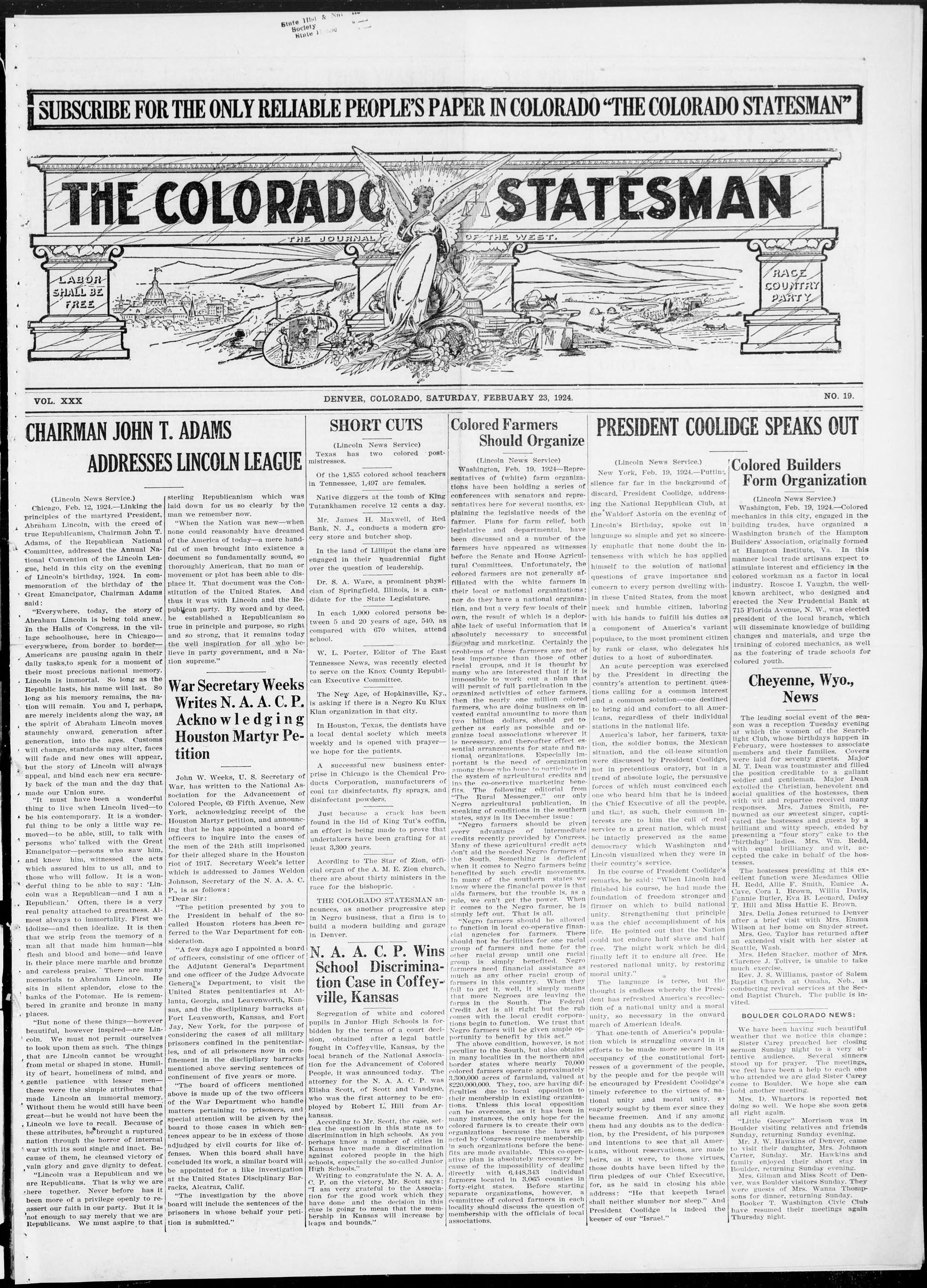
THE COLORADO STATESMAN
THE JOURNAL OF THE WEST.
LABOR SHALL BE FREE
RAGE
COUNTRY
PARTY
CHAIRMAN JOHN T. ADAMS ADDRESSES LINCOLN LEAGUE
VOL. XXX
(Lincoln News Service.)
(Lincoln News Service).
Chicago, Feb. 12, 1924.—Linking the principles of the martyred President, Abraham Lincoln, with the creed of true Republicanism, Chairman John T. Adams, of the Republican National Committee, addressed the Annual National Convention of the Lincoln League, held in this city on the evening of Lincoln's birthday, 1924. In commemoration of the birthday of the Great Emancipator, Chairman Adams said:
"Everywhere, today, the story of Abraham Lincoln is being told anew. In the Halls of Congress, in the village schoolhouse, here in Chicago everywhere, from border to border Americans are pausing again in their daily tasks, to speak for a moment of their most precious national memory. Lincoln is immortal. So long as the Republic lasts, his name will last. So long as his memory remains, the nation will remain. You and I, perhaps, are merely incidents along the way, as the spirit of Abraham Lincoln moves staunchly onward, generation after generation, into the ages. Customs will change, standards may alter, faces will fade and new ones will appear, but the story of Lincoln will always appeal, and bind each new era securely back of the man and the day that made our Union sure.
"It must have been a wonderful thing to live when Lincoln lived—to be his contemporary. It is a wonderful thing to be only a little way removed—to be able, still, to talk with persons who talked with the Great Emancipator—persons who saw him, and knew him, witnessed the acts which assured him to us all, and to those who will follow. It is a wonderful thing to be able to say: 'Lincoln was a Republican—and I am a Republican.' Often, there is a very real penalty attached to greatness. Almost always to immortality. First we idolize—and then idealize. It is then that we strip from the memory of a man all that made him human—his flesh and blood and bone—and leave in their place mere marble and bronze and careless praise. There are many memorials to Abraham Lincoln. He sits in silent splendor, close to the banks of the Potomac. He is remembered in granite and bronze in many places.
"But none of these things—however beautiful, however inspired—are Lincoln. We must not permit ourselves to look upon them as such. The things that are Lincoln cannot be wrought from metal or shaped in stone. Humility of heart, homeliness of mind, and gentle patience with lesser men—these were the simple attributes that made Lincoln an immortal memory. Without them he would still have been great—but he would not have been the Lincoln we love to recall. Because of these attributes, he brought a ruptured nation through the horror of internal war with its soul single and inact. Because of them, he cleansed victory of vain glory and gave dignity to defent.
"Lincoln was a Republican and we are Republicans. That is why we are here together. Never before has it been more of a privilege openly to reassert our faith in our party. But it is not enough to say merely that we are Republicans. We must aspire to that
sterling Republicanism which was laid down for us so clearly by the man we remember now.
"When the Nation was new—when none could reasonably have dreamed of the America of today—a mere handful of men brought into existence a document so fundamentally sound, so thoroughly American, that no man or movement or plot has been able to displace it. That document was the Constitution of the United States. And thus it was with Lincoln and the Republican party. By word and by deed, he established a Republicanism so true in principle and purpose, so right and so strong, that it remains today the well inspiration for all who believe in party government, and a Nation supreme."
War Secretary Weeks Writes N. A. A. C. P. Acknowledging Houston Martyr Petition
John W. Weeks, U. S. Secretary of War, has written to the National Association for the Advancement of Colored People, 69 Fifth Avenue, New York, acknowledging receipt of the Houston Martyr petition, and announcing that he has appointed a board of officers to inquire into the cases of the men of the 24th still imprisoned for their alleged share in the Houston riot of 1917. Secretary Week's letter which is addressed to James Weldon Johnson, Secretary of the N. A. A. C. P., is as follows: "Dear Sir: "The petition presented by you to the President in behalf of the so-called Houston rioters has been referred to the War Department for consideration.
"A few days ago I appointed a board of officers, consisting of one officer of the Adjutant General's Department and one officer of the Judge Advocate General's Department, to visit the United States penitentiaries at Atlanta, Georgia, and Leavenworth, Kansas, and the disciplinary barracks at Fort Leavenworth, Kansas, and Fort Jay, New York, for the purpose of considering the cases of all military prisoners confined in the penitentiaries, and of all prisoners now in confinement in the disciplinary barracks mentioned above serving sentences of confinement of five years or more.
"The board of officers mentioned above is made up of the two officers of the War Department who handle matters pertaining to prisoners, and special attention will be given by the board to those cases in which sentences appear to be in excess of those adjudged by civil courts for like offenses. When this board shall have concluded its work, a similar board will be appointed for a like investigation at the United States Disciplinary Barracks, Alcatraz, Calif.
"The investigation by the above board will include the sentences of the prisoners in whose behalf your petition is submitted."
DENVER, COLORADO, SATURDAY, FEBRUARY 23, 1924.
SHORT CUTS
(Lincoln News Service)
Texas has two colored postmistresses.
Of the 1,855 colored school teachers in Tennessee, 1,497 are females.
Native diggers at the tomb of King Tutankhamen receive 12 cents a day.
Mr. James H. Maxwell, of Red Bank, N. J., conducts a modern grocery store and butcher shop.
In the land of Lilliput the clans are engaged in their quadrennial fight over the question of leadership.
Dr. S. A. Ware, a prominent physician of Springfield, Illinois, is a candidate for the State Legislature.
In each 1,000 colored persons between 5 and 20 years of age, 540, as compared with 670 whites, attend school.
W. L. Porter, Editor of The East Tennessee News, was recently elected to serve on the Knox County Republican Executive Committee.
The New Age, of Hopkinsville, Ky., is asking if there is a Negro Ku Klux Klan organization in that city.
In Houston, Texas, the dentists have a local dental society which meets weekly and is opened with prayer—we hope for the patients.
A successful new business enterprise in Chicago is the Chemical Products Corporation, manufacturers of coal tar disinfectants, fly sprays, and disinfectant powders.
Just because a crack has been found in the lid of King Tut's coffin, an effort is being made to prove that undertakers have been grafting for at least 3,300 years.
According to The Star of Zion, official organ of the A. M. E. Zion church, there are about thirty ministers in the race for the bishopric.
THE COLORADO STATESMAN announces, as another progressive step in Negro business, that a firm is to build a modern building and garage in Denver.
N. A. A. C. P. Wins School Discrimination Case in Coffeyville, Kansas
N. A. A. C. P. Wins School Discrimination Case in Coffeyville, Kansas
Segregation of white and colored pupils in Junior High Schools is forbidden by the terms of a court decision, obtained after a legal battle fought in Coffeyville, Kansas, by the local branch of the National Association for the Advancement of Colored People, it was announced today. The attorney for the N. A. A. C. P. was Elisha Scott, of Scott and Vandyne, who was the first attorney to be employed by Robert L. Hill from Arkansas. According to Mr. Scott, the case, settles the question in this state as to discrimination in high schools. As you perhaps know a number of cities in Kansas have made a discrimination against colored people in the high schools, especially the so-called Junior High Schools." Writing to congratulate the N. A. A. C. P. on the victory, Mr. Scott says: "I am very grateful to the Association for the good work which they have done and the decision in this case is going to mean that the membership in Kansas will increase by leaps and bounds."
Colored Farmers Should Organize
(Lincoln News Service)
(Washington, Feb. 19, 1924—Representatives of (white) farm organizations have been holding a series of conferences with senators and representatives here for several months, explaining the legislative needs of the farmer. Plans for farm relief, both legislative and departmental, have been discussed and a number of the farmers have appeared as witnesses before the Senate and House Agricultural Committees. Unfortunately, the colored farmers are not generally affiliated with the white farmers in their local or national organizations; nor do they have a national organization, and but a very few locals of their own, the result of which is a deplorable lack of useful information that is absolutely necessary to successful farming and marketing. Certainly the problems of these farmers are not of less importance than those of other racial groups, and it is thought by many who are interested that if it is impossible to work out a plan that will permit of full participation in the organized activities of other farmers, then the nearly one million colored farmers, who are doing business on invested capital amounting to more than two billion dollars, should get to together as early as possible and organize local associations wherever it is necessary, and thereafter effect essential arrangements for state and national, organizations. Especially important is the need of organization among those who home to participate in the system of agricultural credits and in the co-operative marketing bene fits. The following editorial from "The Rural Messenger," our only Negro agricultural publication, in speaking of conditions in the southern states, says in its December issue:
"Negro farmers should be given every advantage of intermediate credits recently provided by Congress. Many of these agricultural credit acts don't aid the needed Negro farmers of the South. Something is deficient when it comes to Negro farmers being benefited by such credit movements. In many of the southern states we know where the financial power is that aids farmers, but the trouble is, as a rule, we can't get the power. When it comes to the Negro farmer, he is simply left out. That is all.
"Negro farmers should be allowed to function in local co-operative financial agencies for farmers. There should not be facilities for one racial group of farmers and none for the other racial group until one racial group is simply benefited. Negro farmers need financial assistance as much as any other racial group of farmers in this country. When they fail to get it, well, it simply means that more Negroes are leaving the farms in the South. The Federal Credit Act is all the right but the rub comes with the local credit corporations begin to function. We trust that Negro farmers will be given ample opportunity to benefit by this act."
The above condition, however, is not peculiar to the South, but also obtains in many localities in the northern and border states where nearly 70,000 colored farmers operate approximately 3,300,000 acres of farmland, valued at $220,000,000. They, too, are having difficulties due to local opposition to their membership in existing organizations. Unless this local opposition can be overcome, as it has been in many instances, the only hope for the colored farmers is to create their own organizations because the laws enacted by Congress require membership in such organizations before the benefits are made available. This co-operative plan is absolutely necessary because of the impossibility of dealing directly with 6,448,343 individual farmers located in 3,065 counties in forty-eight states. Before starting separate organizations, however, a committee of colored farmers in each locality should discuss the question of membership with the officials of local associations.
PRESIDENT COOLIDGE SPEAKS OUT
PRESIDENT COOLIDGE SPEAKS OUT
(Lincoln News Service.)
New York, Feb. 19, 1924.—Putting silence far far in the background of discard, President Coolidge, addressing the National Republican Club, at the Waldorf Astoria on the evening of Lincoln's Birthday, spoke out in language so simple and yet so sincerely emphatic that none doubt the intenseness with which he has applied himself to the solution of national questions of grave importance and concern to every person dwelling within these United States, from the most meek and humble citizen, laboring with his hands to fulfill his duties as a component of America's variant populace, to the most prominent citizen by rank or class, who delegates his duties to a host of subordinates.
An acute perception was exercised by the President in directing the country's attention to pertinent questions calling for a common interest and a common solution—one destined to bring aid and comfort to all Americans, regardless of their individual stations in the national life.
America's labor, her farmers, taxation, the soldier bonus, the Mexican situation, and the oil-lease situation were discussed by President Coolidge, not in pretentious oratory, but in a trend of absolute logic, the persuasive forces of which must convinced each one who heard him that he is indeed the Chief Executive of all the people, and that, as such, their common interests are to him the call of real service to a great nation, which must be intactly preserved as the same democracy which Washington and Lincoln visualized when they were in their country's service.
In the course of President Coolidge's remarks, he said: "When Lincoln had finished his course, he had made the foundation of freedom stronger and firmer on which to build national unity. Strengthening that principle was the chief accomplishment of his life. He pointed out that the Nation could not endure half slave and half free. The might work which he did finally left it to endure all free. He restored national unity, by restoring moral unity."
The language is terse, but the thought is endless whereby the President has refreshed America's recollection of a national unity and a moral unity, so necessary in the onward march of American ideals.
That one-tenth of America's population which is struggling onward in its efforts to be made more secure in its occupancy of the constitutional fortresses of a government of the people, by the people and for the people will be encouraged by President Coolidge's timely reference to the virtues of national unity and moral unity, so eagerly sought by them ever since they became freemen. And if any among them had any doubts as to the dedication, by the President, of his purposes and intentions to see that all Americans, without reservations, are made heirs, as it were, to those virtues, those doubts have been lifted by the firm pledges of our Chief Executive, for, as he said in closing his able address: "He that keepeth Israel shall neither slumber nor sleep." And President Coolidge is indeed the keeper of our "Israel."
NO.19.
Colored Builders Form Organization
(Lincoln News Service)
(Lincoln News Service.)
Washington, Feb. 19, 1924.—Colored mechanics in this city, engaged in the building trades, have organized a Washington branch of the Hampton Builders' Association, originally formed at Hampton Institute, Va. In this manner local trade artisans expect to stimulate interest and efficiency in the colored workman as a factor in local industry. Roscoe I. Vaughn, the well-known architect, who designed and erected the New Prudential Bank at 715 Florida Avenue, N. W., was elected president of the local branch, which will disseminate knowledge of building changes and materials, and urge the training of colored mechanics, as well as the fostering of trade schools for colored youth.
Cheyenne, Wyo., News
The leading social event of the season was a reception Tuesday evening at which the women of the Searchlight Club, whose birthdays happen in February, were hostesses to associate members and their families. Covers were laid for seventy guests. Major M. T. Dean toastmaster and filled the position creditable to a gallant soldier and gentleman. Major Dean extolled the Christian, benevolent and social qualities of the hostesses, then with wit and repartee received many responses. Mrs. James Smith, renowned as our sweetest singer, captivated the hostesses and guests by a brilliant and witty speech, ended by presenting a "four story" cake to the "birthday" ladies. Mrs. Wm. Redd, with equal brilliancy and wit, accepted the cake in behalf of the hostesses.
The hostesses presiding at this excellent function were Mesdames Ollie H. Redd, Allie F. Smith, Eunice A. Cave, Cora L. Brown, Willia Davis, Fannie Butler, Eva B. Leonard, Daisy T. Hill and Miss Hattle E. Brown.
Mrs. Della Jones returned to Denver after a brief visit with Mrs. Emma Wilson at her home on Snyder street.
Mrs. Geo Taylor has returned after an extended visit with her sister at Seattle, Wash.
Mrs. Helen Stacker, mother of Mrs. Clarence J. Toliver, is unable to take much exercise.
Rev, J. S. Williams, pastor of Salem Baptist Church at Omaha, Neb., is conducting revival services at the Second Baptist Church. The public is invited.
BOULDER COLORADO NEWS:
We have been having such beautiful weather that we notice this change: Sister Carey preached her closing sermon Sunday night to a very attentive audience. Several sinners stood up for prayer. The meetings, we feel have been a help to each one who attended we are glad Sister Carey come to Boulder. We hope she can hold another meeting.
Mrs. D. Whartors is reported not doing so well. We hope she soon gets all right again.
"Little George" Morrison was in Boulder visiting relatives and friends Sunday, returning Sunday evening.
Mr. J. W. Hawkins of Denver, came to visit their daughter, Mrs. Johnson Carter, Sunday. Mr. Hawkins and family enjoyed their short stay in Boulder, returning Sunday evening.
Mrs. Gilman and Miss Scott of Denver, was Boulder visitors Sunday. They were guests of Mrs. Wanza Thompson for dinner, returning Sunday.
Booker T. Washington Clvie Club have resumed their meetings again Thursday night.
FEBRUARY House Wares Sale
NOW IN PROGRESS
Practically every line in The household utilities is represent of the special items are alum eled cooking utensils, tinwa wooden ware, wire goods, la dusters, bird cages, baskets,
THE DENVER
SHIRLEY J. LIGGE
Sheet Music, classic and p and music of
every line in The Denver's immense
utilities is represented in this annual evi-
cial items are aluminum cooking utensils,
ing utensils, tinware, ironware, japan-
ware, wire goods, laundry supplies, br
ard cages, baskets, brooms and mops.
DENVER DRY GOODS
KEY J. LIGGINS MUSIC
AND ST
usic, classic and popular, Octavo an-
and music of every variety
Practically every line in The Denver's immense stock of household utilities is represented in this annual event. Some of the special items are aluminum cooking utensils, enameled cooking utensils, tinware, ironware, japanned ware, wooden ware, wire goods, laundry supplies, brushes and dusters, bird cages, baskets, brooms and mops. THE DENVER DRY GOODS CO.
SHIRLEY J. LIGGINS MUSIC SHOP AND STUDIO
Sheet Music, classic and popular, Octavo and Folios and music of every variety THE LATEST RECORDS
Vocal Training and Piano Tuning
PHONE MAIN 1536
---
WANTED
SCOTT'S OFFICIAL
AMERICAN
THE WO
EMMETT
SPECIAL ASSISTANT
A complete and authentic narrative
soldiers of the Negro race in the gr
with official and personal photogra
this work offers delightful reading
middle-aged and the old, and each
our race and country by being prov
work. A very desirable gift in and
offered at the very reasonable price
$3
at the
THE COLORADO
P. O. Box
Arrangements can also be made
PRESS COMMENT: No life
History of "The American Negro
legacy could be left to posterit
heroism and patriotism.
and authentic narration of the participation in the Negro race in the great fight for democracy and personal photographs of over two hundred offers delightful reading of its 600 pages for the old, and each home will add dignity and country by being provided with a copy of this very desirable gift in and out of season. This be the very reasonable price of
at the office of
THE COLORADO STATESM
P. O. Box 116 Room 25, 1824 Curtisements can also be made over phone. Call Mr.
S COMMENT: No library is complete with "The American Negro in the World War." and should be left to posterity than this great work and patriotism.
to place in each of the fifteen thousand homes of our people in Denver a copy of Scott's Official History of the American Negro and the World War
SCOTTS OFFICIAL HISTORY
of the
AMERICAN NEGRO
IN
THE WORLD WAR
EMMETT J. SCOTT
SPECIAL ASSISTANT TO SECRETARY OF WAR
A complete and authentic narration of the participation of American soldiers of the Negro race in the great fight for democracy. Illustrated with official and personal photographs of over two hundred in number, this work offers delightful reading of its 600 pages for the youth, the middle-aged and the old, and each home will add dignity and loyalty to our race and country by being provided with a copy of this commendable work. A very desirable gift in and out of season. This book is being offered at the very reasonable price of
Arrangements can also be made over phone. Call Main 7417
PRESS COMMENT: No library is complete without Scott's History of "The American Negro in the World War." and no better legacy could left posterity than this great work of Negro heroism and patriotism.
Largest Coal Hoist
The largest coal hoist in the world, operated by electricity, with a capacity of lifting 26,000 pounds and a speed of 4,000 feet a minute, has been recently installed in an American coal mine. Two 2,200-horsepower electric motors operate the hoist, upon which a coal car, with a load of 13 tons, is raised from the bottom of the mine to the coal dump above, a distance of 697 feet, in 16 seconds.
Divine Wisdom
The highest, the divine wisdom consists in having investigated and mastered the innermost nature of all that pertains to mankind, in being surprised at nothing which happens, and in believing, before the event, that everything is possible.
---
the Denver's immense stock of
ed in this annual event. Some
minum cooking utensils, enam-
re, ironware, japanned ware,
laundry supplies, brushes and
rooms and mops.
DRY GOODS CO.
NS MUSIC SHOP
AND STUDIO
popular, Octavo and Folios
every variety
2603 WELTON ST.
IMCIAL HISTORY
of the
AMERICAN NEGRO
IN
WORLD WAR
J. SCOTT
TO SECRETARY OF WAR
of the participation of American
cat fight for democracy. Illustrated
hits of over two hundred in number,
of its 600 pages for the youth, the
home will add dignity and loyalty to
ed with a copy of this commendable
out of season. This book is being
of
000
office of
O STATESMAN
116 Room 25, 1824 Curtis
tele over phone. Call Main 7417
library is complete without Scott's
in the World War." and no better
y than this great work of Negro
ESTATE OF JAMES W. JONES, DE-
CEASED, NO. 33,624.
All persons are hereby notified to presen-
t and estate are hereby notified to presen-
t and estate for adjustment in the County
Court of the City and County of Dene-
sior Colorado, on the 11th day of March,
1924.
BERTHA JONES,
Administratrix.
Thos. Campbell, Attn: Attorney.
First publication, January 26, 1924.
Last publication, February 23, 1924.
Steel Magnetism.
The United States bureau of standards says: "Place the steel within a solenoid or between the poles of a direct-current electromagnet and subject it to the influence of a gradually decreasing magnetic field which is being reversed at a comparatively low frequency, approximately one or two cycles per second being most satisfactory."
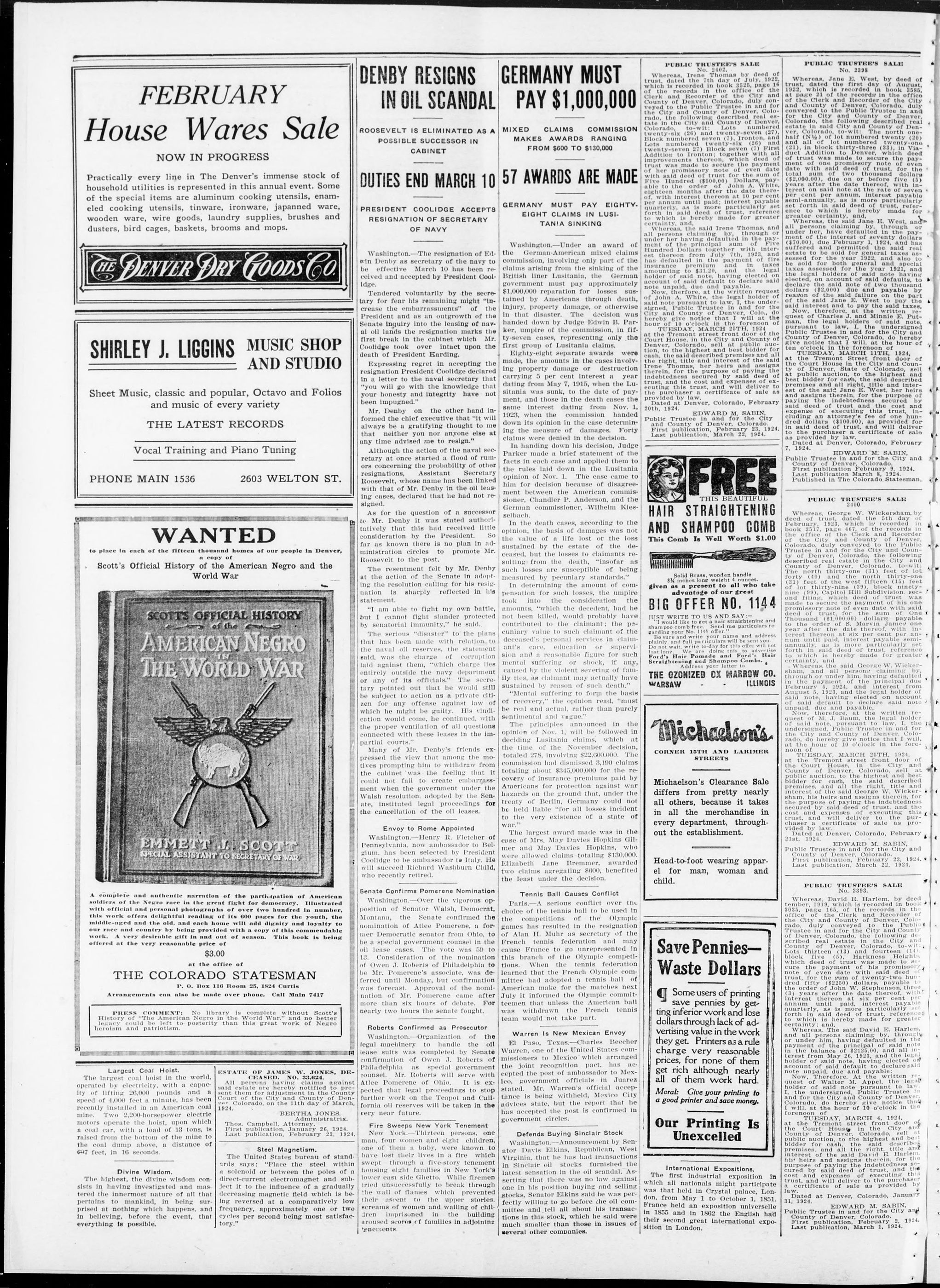
DENBY RESIGNS IN OIL SCANDAL
DENBY RESIGNS IN OIL SCANDAL
ROOSEVELT IS ELIMINATED AS A
POSSIBLE SUCCESSOR IN
CABINET
DUTIES END MARCH 10
PRESIDENT COOLIDGE ACCEPTS
RESIGNATION OF SECRETARY
OF NAVY
Washington.—The resignation of Edwin Denby as secretary of the navy to be effective March 10 has been received and accepted by President Coolidge.
Tendered voluntarily by the secretary for fear his remaining might "increase the embarrassments" of the President and as an outgrowth of the Senate Inquiry into the leasing of naval oil lands the resignation marks the first break in the cabinet which Mr. Coolidge took over intact upon the death of President Harding.
Expressing regret in accepting the resignation President Coolidge declared in a letter to the naval secretary that "you will go with the knowledge that your honesty and integrity have not been impugned."
Mr. Denby on the other hand informed the chief executive that "it will always be a gratifying thought to me that neither you nor anyone else at any time advised me to resign."
Although the action of the naval secretary at once started a flood of rumors concerning the probability of other resignations, Assistant Secretary Roosevelt, whose name has been linked with that of Mr. Denby in the oil leasing cases, declared that he had not resigned.
As for the question of a successor to Mr. Denby it was stated authoritatively that this had received little consideration by the President. So far as known there is no plan in administration circles to promote Mr. Roosevelt to the post.
The resentment felt by Mr. Denby at the action of the Senate in adopting the resolution calling for his resignation is sharply reflected in his statement.
"I am able to fight my own battle, but I cannot fight slander protected by senatorial immunity," he said.
The serious "disaster" to the plans that has been made with relation to the naval oil reserves, the statement said, was the charge of corruption laid against them, "which charge lies entirely outside the navy department or any of its officials." The secretary pointed out that he would still be subject to action as a private citizen for any offense against law of which he might be guilty. His vindication would come, he continued, with the proper ventilation of all questions connected with these leases in the impartial courts."
Many of Mr. Denby's friends expressed the view that among the motives prompting him to withdraw from the cabinet 'was the feeling that it could not fall to create embarrassment when the government under the Walsh resolution, adopted by the Senate, instituted legal proceedings for the cancellation of the oil leases.
Envoy to Rome Appointed
Washington.—Henry R. Fletcher of Pennsylvania, now ambassador to Belgium, has been selected by President Coolidge to be ambassador to Italy. He will succeed Richard Washburn Child, who recently retired.
Senate Confirms Pomerene Nomination
Washington.—Over the vigorous opposition of Senator Walsh, Democrat, Montana, the Senate confirmed the nomination of Atlee Pomerene, a former Democratic senator from Ohio, to be a special government counsel in the oil lease cases. The vote was 59 to 13. Consideration of the nomination of Owen J. Roberts of Philadelphia to be Mr. Pomerene's associate, was deferred until Monday, but confirmation was forecast. Approval of the nomination of Mr. Pomerene came after more than six hours of debate. For nearly two hours the senate fought.
Roberts Confirmed as Prosecutor
Washington.Organization of the legal machinery to handle the oil lease suits was completed by Senate confirmation of Owen J. Roberts of Philadelphia as special government counsel. Mr. Roberts will serve with Atlee Pomerene of Ohio. It is expected that legal proceedings to stop further work on the Teapot and California oil reserves will be taken in the very near future.
Fire Sweeps New York Tenement
New York.—Thirteen persons, one man, four women and eight children, one of them a baby, were known to have lost their lives in a fire which swept through a five-story tenement housing eight families in New York's lower east side Ghetto. While firemen tried unsuccessfully to break through the wall of flames which prevented their assent to the upper stories, screams of women and walling of children imprisoned in the building aroused scores of families in adjoining tenements.
GERMANY MUST PAY $1,000,000
MIXED CLAIMS COMMISSION
MAKES AWARDS RANGING
FROM $600 TO $130,000
57 AWARDS ARE MADE
GERMANY MUST PAY EIGHTY-
EIGHT CLAIMS IN LUSI-
TANIA SINKING
Washington.—Under an award of the German-American mixed claims commission, involving only part of the claims arising from the sinking of the British liner Lusitania, the German government must pay approximately $1,000,000 reparation for losses sustained by Americans through death, injury, property damage, or otherwise in that disaster. The decision was handed down by Judge Edwin B. Parker, umbrella of the commission, in fifty-seven cases, representing only the first group of Lusitania claims.
Eighty-eight separate awards were made, the amounts in the cases involving property damage or destruction carrying 5 per cent interest a year dating from May 7, 1915, when the Lusitania was sunk, to the date of payment, and those in the death cases the same interest dating from Nov. 1, 1923, when the commission handed down its opinion in the case determining the measure of damages. Forty claims were denied in the decision.
In handing down his decision, Judge Parker made a brief statement of the facts in each case and applied them to the rules laid down in the Lusitania opinion of Nov. 1. The case came to him for decision because of disagreement between the American commissioner, Chandler P. Anderson, and the German commissioner, Wilhelm Kieselbach.
In the death cases, according to the opinion, the basis of damages was not the value of a life lost or the loss sustained by the estate of the deceased, but the losses to claimants resulting from the death, "insofar as such losses are susceptible of being measured by pecuniary standards." In determining the amount of compensation for such losses, the umpire took into the consideration the amounts, "which the decedent, had he not been killed, would probably have contributed to the claimant; the pecuniary value to such claimant of the deceased's personal services in claimant's care, education or supervision and a reasonable figure for such mental suffering or shock, if any, caused by the violent severing of family ties, as claimant may actually have sustained by reason of such death."
"Mental suffering to form the basis of recovery," the opinion read, "must be real and actual, rather than purely sentimental and vague."
The principles announced in the opinion of Nov. 1, will be followed in deciding Lusitania claims, which at the time of the November decision, totaled 278, involving $22,600,000. The commission had dismissed 3,190 claims totals about $345,000,000 for the recovery of insurance premiums paid by Americans for protection against war hazards on the ground that, under the treaty of Berlin, Germany could not be held liable "for all losses incident to the very existence of a state of war."
The largest award made was in the case of Mrs. May Davies Hopkins Gilmer and May Davies Hopkins, who were allowed claims totaling $130,000. Elizabeth Jane Bremmer, awarded two claims aggregating $600, benefited the Ieust under the decision.
Tennis Ball Causes Conflict
Paris.—A serious conflict over the choice of the tennis ball to be used in the competitions of the Olympic games has resulted in the resignation of Alan H. Muhr as secretary of the French tennis federation and may cause France to go unrepresented in this branch of the Olympic competitions. When the tennis federation learned that the French Olympic committee had adopted a tennis ball of American make for the matches next July it informed the Olympic committeemen that unless the American ball was withdrawn the French tennis team would not take part.
Warren Is New Mexican Envoy
El Paso, Texas.—Charles Beecher Warren, one of the United States commissioners to Mexico which arranged the joint recognition pact, has accepted the post of ambassador to Mexico, government officials in Juarez stated. Mr. Warren's official acceptance is being withheld, Mexico City advices state, but the report that he has accepted the post is confirmed in government circles.
Defends Buying Sinclair Stock
Washington.—Announcement by Senator Davis Elkins, Republican, West Virginia, that he has had transactions in Sinclair oil stocks furnished the latest sensation in the oil scandal. Asserting that there was no law against one in his position buying and selling stocks, Senator Elkins said he was perfectly willing to go before the oil committee and tell all about his transactions in this stock, which he said were much smaller than those in issues of several other companies.
PUBLIC TRUSTEE'S SALE
No. 3402.
Whereas, Irene Thomas by deed of trust, dated the 7th day of July, 1922, which is recorded in book 3525, page 16 of the records in the office of the Clerk and Recorder of the City and County of Denver, Colorado, duly everyed to the Public Trust in and for the City and County of Denver. Colorado, the following described real estate in the City and County of Denver, Colorado, to-wit: Lots numbered twenty-six (26) and twenty-seven (27), Block numbered seven (7), Ironton, and Lots numbered twenty-six (26) and twenty-seven (27) Block seven (7). First Addition to Ironton, together with all improvements thereof which deed of the city was made to secure the payment of her promissory note of even date with said deed of trust for the sum of Five Hundred ($500,000) Dollars, payable to the order of John A. White, eighteen months after the date thereof, with interest thereon at 10 per cent per annum until paid; interest payable quarterly, as is more particularly set forth, is said deed of trust, reference which is hereby made for greater certainty.
Whereas, the said Irene Thomas, and all persons claiming by, through or under her having defaulted in the payment of the principal sum of $10,000 with interest thereon from July 7th, 1923, and has defaulted in the payment of fire insurance premium and in taxes amounting to $31.20, and the legal holder of the claim having defected of said default to declare said note unpaid, due and payable.
Now, therfore, at the written request of John A. White, the legal holder of said note pursuant to law, I, the underwriter of City and County of Denver, Colo., do hereby give notice that I will at the hour of 10 o'clock in the forenoon of
TUESDAY, MARCH 25TH, 1924
at the Tremont street front door of the City Hotel, with a valid copy of Denver, Colorado, sell at public auction, to the highest and best bidder for cash, the said described premises and all the right, title and interest of the said Irene Thomas, her heirs and assigns therein, for the purpose of paying the indebtedness secured by the cost and expenses of executing this trust, and will deliver to the purchaser a certificate of sale as provided by law.
Dated at Denver, Colorado, February 20th, 1924.
EDWARD M. SABIN,
Public Trustee in and for the City and County of Denver, Colorado.
First publication, February 23, 1924.
Last publication, March 22, 1924.
FREE
THIS BEAUTIFUL
HAIR STRAIGHTENING
AND SHAMPOO COMB
This Comb Is Well Worth $1.00
Solid Brass, wooden handle
8 1/2 inches long weight 4 ounces.
given as a present to all who take
advantage of our great
BIG OFFER NO. 1144
JUST WRITE TO US AND SAY:
I would like to get a hair straightening and
shampoo comb free. Send me particulars re-
ordering your No. 1144 offer.
Besure and write your name and address plainly and full particulars will be sent you. Do not wait write today for a reply. We are doing this to advertise Ford's Hair Pomade and Ford's Hair Straightening and Shampoo Combs. Address your letters to
THE OZONIZED OX MARROW CO.
WARSAW ILINOIS
Michaelson's CORNER 15TH AND LARIMER STREETS
Michaelson's Clearance Sale differs from pretty nearly all others, because it takes in all the merchandise in every department, throughout the establishment.
Head-to-foot wearing apparel for man, woman and child.
Save Pennies Waste Dollars
Some users of printing save pennies by getting inferior work and lose dollars through lack of advertising value in the work they get. Printers as a rule charge very reasonable prices, for none of them get rich although nearly all of them work hard.
Moral: Give your printing to a good printer and save money.
Our Printing Is Unexcelled
The first industrial exposition in which all nationals might participate was that held in Crystal palace, London, from May 1 to October 1, 1851. France held an exposition universelle in 1855 and in 1862 the English had their second great international exposition in London.
PUBLIC TRUSTEES SALE
No. 2398
Whereas, Jane E. West, by deed of trust, dated the first day of August, 1322, which is recorded in book 3585, of the Clerk and Recorder of the and County of Denver, Colorado, duly conveyed to the Public Trustee in and for the City and County of Denver, Colorado, the following described real estate in Denver, Colorado, to-wit. The north one-half (N½) of lot numbered twenty (20) and all of lot numbered twenty-one (21), in block thirty-three (33), in Via. of trust was made to secure the payment of one promissory note of even date with said deed of trust, for the total sum of two thousand dollars (400) on the date of trust, for 5 years after the date thereof, with interest on said note at the rate of seven per cent per annum, interest payable semi-annually, as is more particularly set forth in the deed of trust, reference which is hereby made for greater certainty, and.
Whereas, the said Jane E. West, and all persons claiming by, through or her, the date of death in the payment of the interest of seven (70.00), due February 1, 1924, and has suffered and permitted the said real estate to be sold for general taxes assessed for the year 1922, and also to be sold for general taxes assessed for the year 1921, and the legal holders of said note having elected, on account of said defaults, to declare the said note of two thousand dollars for the year 1921, and the reason of the said failure on the part of the said Jane E. West to pay the said interest and to pay the said taxes. Now, therefore, at the written request of the Judge, and Mistress Man, the legal holders of said note, pursuant to law, I, the undersigned Public Trustee in and for the City and County of Denver Colorado, do hereby grant the said note for the hour of ten o'clock in the foregoing of
TUESDAY, MARCH 11TH, 1924,
at the Tremont Street front door of
the Court House in the City and Coun-
tory of New York, bounded by
at public auction, to the highest and
best bidder for cash, the said described
premises and all right, title and inter-
est of the said Jane E. West, her hei-
res attorney in lieu of delivery, pay-
ing the indebtedness secured by
said deed of trust and the cost and
deed of executing this trust, in-
cluding an attorney's fee of one hund-
red and sixty-five dollars in said deed of trust, and will deliver to the purchaser a certificate of sale
as provided by law.
Dated at Denver, Colorado, February
7, 1924.
EDWARD M. SABIN,
Public Trustee in and for the City and
County of Denver, Colorado.
First publication February 9, 1924.
Lacrosse, Colorado, 1924.
Published in The Colorado Statesman.
PUBLIC TRUSTEE'S SALE
2400
Whereas, George W. Wickersham, by deed of trust, dated the 5th day of February, 1923, which is recorded in book 3517, page 467, of the records in office of the City and County of Denver, Colorado, duly conveyed to the Public Trustee in and for the City and County of Denver, Colorado, the following described real estate in the City and County of Denver, the north thirty-one (31) feet of lot forty (40) and the north thirty-one (31) feet of the west fifteen (15) feet of lot thirty-nine (39), block ninety-nine (39), block seventy-nine (39), and filing, which deed of trust was made to secure the payment of his one promissory note of even date with said deed of trust, for the sum of One Thousand ($1,000,000) dollars, payable to the City and County of Denver, year after the date thereof, with interest thereon at six per cent per annum until paid, interest payable semiannually, as is more particularly set forth in said deed of trust, reference which thereby be made for greater certainty, and
Whereas, the said George W. Wickerham, and all persons claiming by, through or under him, having defaulted February 5, 1924, and interest from August 5, 1923, and the legal holder of said note, having elected on account of said default to declare said note unpaid, due and payable.
The written request of M. J. Baum, the legal holder of said note, pursuant to law, I, the undersigned, Public Trustee in and for the City and County of Denver Colorado, hereinafter the City I will, at the hour of 10 o'clock in the forenoon of TUESDAY, MARCH 25TH, 1924, at the Tremont street street of the City House, the City and County of Denver, Colorado, sell at public auction, to the highest and best bidder for cash, the said described premises, and all the right title and shum, his heirs and assigns therein, for the purpose of paying the indebtedness secured by said deed of trust, and the cost and expenses of executing this act will deliver to the purchaser a certificate of sale as provided by law.
Dated at Denver, Colorado, February 21st, 1924.
EDWARD M. SABIN,
Public Trustee in all for the City and
County of Denver, Colorado.
First publication, February 23, 1924.
Last publication, March 22, 1924.
PUBLIC TRUSTEES SALE
No. 2393.
Whereas, David E. Harlem, by deed tember, 1919, which is recorded in book 3035, page 165, of the records in the office of the Clerk and Recorder of the City of Denver, Colorado, by deed Colorado, duly conveyed to the Public Trustee in and for the City and County of Denver, Colorado, the following described real estate in the City and County of Denver, Colorado, the thirteen (13), and the eighteen (14), block five (5), Harkness Heights, which deed of trust was made to secure the payment of his promissory note of even date with said deed of hundred fifty ($2250) dollars, payable to the order of John W. Stephenson, three (3) years after the date thereof, with interest thereon at six per cent per annum until paid, interest payable or under lien is held forth in said deed of trust, references to which is hereby made for greater certainty; and.
Whereas, The said David E. Harlem, by deed, of persons chosen by the judge or under lien, having defaulted in the payment of the principal of said note in the balance of $2125.00, and all interest from May 26, 1923, and the legal holder of said note, having elected or account of said default to declare said
Now, Therefore, At the written request of Walter M. Appel, the legal holder of the property to the City, I understated Public Trustee in and for the City and County of Denver, Colorado, do hereby give notice that I will, at the hour of 10 o'clock in the foreseen TUESDAY, MARCH 4, 1924, at the Tremont street front door of the Court House, in the City and State, of Colorado, at public auction, to the highest and best bidder for cash, the said described premises, and all the right, title and possession of the property of his heirs and assists theein, for the purpose of paying the indebtedness secured by said deed of trust, and the cost and expenses of exertion, and the utility and delivery of sale to the purchaser a certificate of sale as provided by law.
Dated at Denver, Colorado, January
31, 1924.
EDWARD M. SARIN.
Public Trustee in and for the city and
County of Denver, Colorado.
First publication, February 2, 1924.
Last publication, March 1, 1924.
FOREIGN
Dr. von Kahr, the Bavarian military dictator, has resigned and General Von Lossow, commander of the Bavarian reichswehr, has tendered his resignation.
Fires in four sugar plantations in Camaguey province, Cuba, caused an estimated loss of 11,000,000 pounds of sugar cane as it stood in the fields. While cane fields burn easily at this season and accidental fires are common, investigations are being made on the theory that some of these fires were of incendiary origin.
Owing to what he characterized as the "discoursy" of the Egyptian public works department, Howard Carter, head of the excavation work at Luxor, closed Tutankhamen's tomb and abandoned operations. It is understood the crisis was precipitated by the refusal of the Egyptian government to permit the wives of the excavators to visit the tomb.
A decree prohibiting exportation from France of cotton and wool has just been published in Paris. Most of the combed wool produced is sold abroad, and it is feared several factories will be forced to close. The Lille Woolen Trade Association has telegraphed to Premier Poincare declaring the measure is likely to throw 15,000 persons out of employment.
The committees of experts who recently returned to Paris from Berlin, where they investigated the reparation problem, have begun the formulation of their reports. Dr. Schacht, president of the relchbank, still is to be heard regarding the details of the organization of the proposed gold bank. The members of the committees are now exchanging texts setting forth their individual opinions with a view to a final agreement.
GENERAL
Funeral services for the Rt. Rev. Alexander C. Garrett, presiding bishop of the Protestant Episcopal Church of America, who died at his home in Dallas, Tex., were held last Friday.
A renewal of the present bituminous miners' wage scale for a term of three years was approved unanimously by the sub-committee of miners and operators of the central competitive field at Jacksonville, Florida.
Judge William M. Morning of the Court of Domestic Relations and Wallace G. Wallick, well digger, are dead and Minor Bacon, court reporter, is suffering from a slight wound under the right arm, the sequel to a tragedy enacted in Judge Morning's court at Lincoln, when Wallick, appearing to answer a charge of nonpayment of allmony, drew a revolver and began shooting.
Successful flotation of the $150,000,000 Japanese loan overshadowed all other developments in the bond market last week. Substantial over-subscription of the issue, which took the form of thirty-year $6½ per cent, priced at 92½ to yield 7.10 per cent, was reported by J. P. Morgan and Co., head of the nation-wide offering syndicate, within two hours after the sale was opened.
Joe Jackson, former outfielder for the Chicago club of the American League, emerged victor in his salary suit and $18,500 bonus claim, when a jury in Circuit Court in Milwaukee brought in a verdict awarding him $15,700.40. Judge John J. Gregory, however set aside the verdict after severely scoring the jury for the verdict in the face of the evidence presented and dismissed the action.
James J. McGrath, a promoter, was fined $1,000 in Chicago by Federal Judge Cliffe on a plea of guilty to transporting motion picture films of the Dempsey-Gibbons fight at Shelby, Mont., in interstate commerce. The pictures were brought to Chicago from Shelby and shown there, the federal statute providing for penalties for transportation of fight films between the states, but not for showing the pictures. French francs dropped to a new record low level at 4.25 cents in New York, a decline of twelve points. The fall was apparently based on the difficulties of the French government in forwarding its fiscal program.
Lieut. Corliss Hooven Griffis, the Ohio boy who went into Germany after Grover Cleveland Bergdoll, draft dodger, and was imprisoned for six months and deported as an undesirable for his palms, couldn't have received a more rousing welcome if he had succeeded than the one given him in Chicago. Traveling from New York in a special car, he was accorded the honors of a conquering hero.
Sale of the Armour interests in the stockyards at South Omaha is about to be completed between J. Ogden Armour and a syndicate composed of present stockholders in the yards headed by W. Farnam Smith of Omaha, R. J. Dunham, representative of Mr. Armour, stated in Chicago, Armour and Company have no connection with the deal as the Armour interests are personal holdings of Mr. Armour.
Leut. Eugenio Mendes and eight constabulary soldiers under his command, and thirty-five religious fanatics, including two of their leaders, were killed in a fight at Balete, Agusan province, according to a constabulary report received in Manila. Several other fanatics were wounded.
Thirteen lives were snuffed out in a few minutes in a fire believed to have been of incendiary origin which swept from basement to roof of a five-story tenement in the heart of New York's lower East Side Ghetto. Seven of those killed were children.
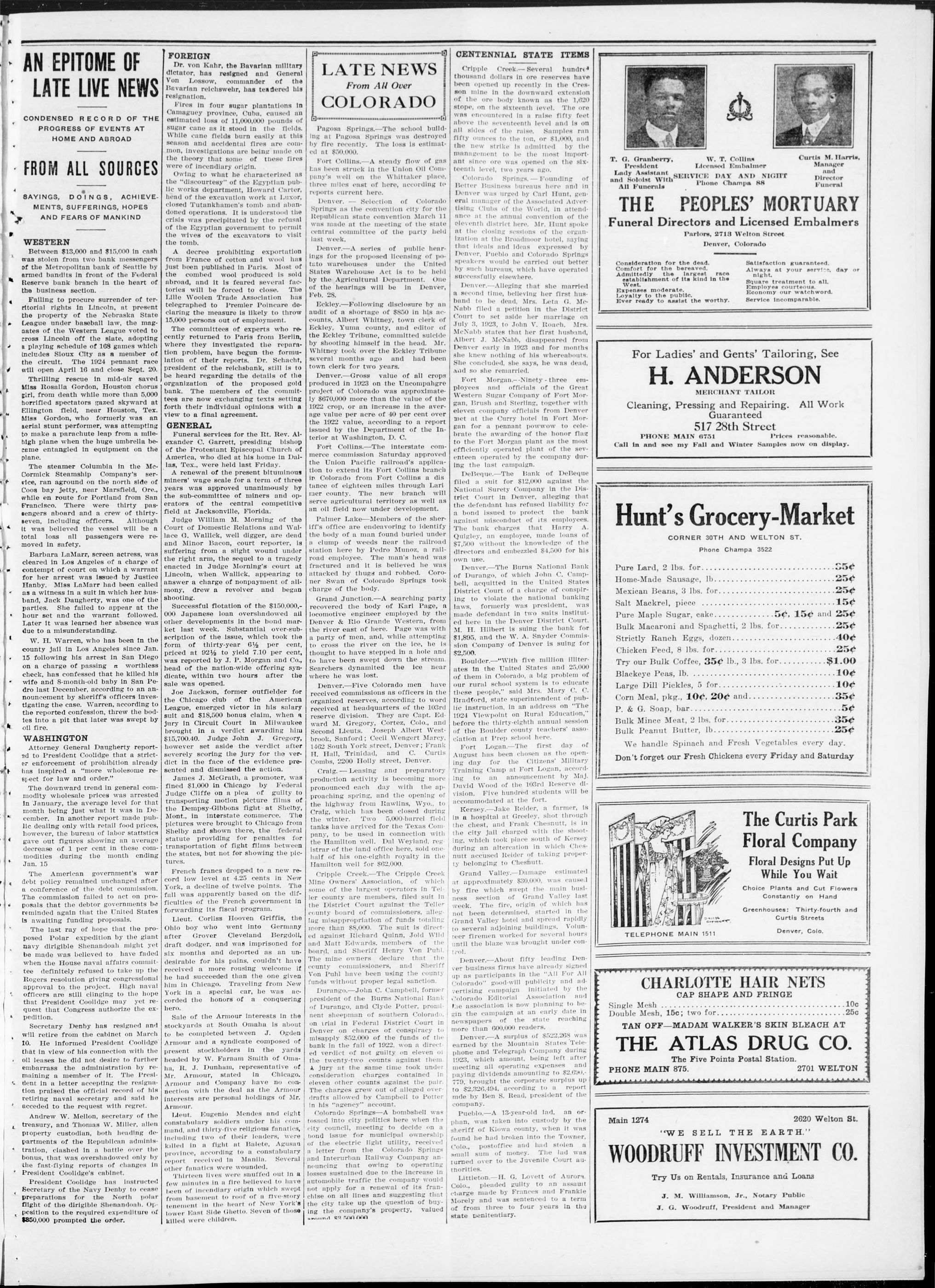
AN EPITOME OF LATE LIVE NEWS
CONDENSED RECORD OF THE
PROGRESS OF EVENTS AT
HOME AND ABROAD
FROM ALL SOURCES
SAYINGS, DOINGS, ACHIEVE MENTS, SUFFERINGS, HOPES AND FEARS OF MANKIND
WESTERN
Between $13,000 and $15,000 in cash was stolen from two bank messengers of the Metropolitan bank of Seattle by armed bandits in front of the Federal Reserve bank branch in the heart of the business section.
Failing to procure surrender of territorial rights in Lincoln, at present the property of the Nebraska State League under baseball law, the magnates of the Western League voted to cross Lincoln off the slate, adopting a playing schedule of 168 games which includes Sioux City as a member of the circuit. The 1924 pennant race will open April 16 and close Sept. 20.
Thrilling rescue in mid-air saved Miss Rosalia Gordon, Houston chorus girl, from death while more than 5,000 horrified spectators gazed skyward at Ellington field, near Houston, Tex. Miss Gordon, who formerly was an aerial stunt performer, was attempting to make a parachute leap from a mile-high plane when the huge umbrella became entangled in equipment on the plane.
The steamer Columbia in the McCormick Steamship Company's service, ran aground on the north side of Coos bay jetty, near Marsfield, Ore., while en route for Portland from San Francisco. There were thirty passengers aboard and a crew of thirty-seven, including officers. Although it was believed the vessel will be a total loss all passengers were removed in safety.
Barbara LaMarr, screen actress, was cleared in Los Angeles of a charge of contempt of court on which a warrant for her arrest was issued by Justice Hanby. Miss LaMarr had been called as a witness in a suit in which her husband, Jack Daugherty, was one of the parties. She failed to appear at the hour set and the warrant followed. Later it was learned her absence was due to a misunderstanding.
W. H. Warren, who has been in the county jail in Los Angeles since Jan. 15 following his arrest in San Diego on a charge of passing a worthless check, has confessed that he killed his wife and 5-month-old baby in San Pedro last December, according to an announcement by sheriff's officers investigating the case. Warren, according to the reported confession, threw the bodies into a pit that later was swept by oil fire.
WASHINGTON
Attorney General Daugherty reported to President Coolidge that a stricter enforcement of prohibition already has inspired a "more wholesome respect for law and order."
The downward trend in general commodity wholesale prices was arrested in January, the average level for that month being just what it was in December. In another report made public dealing only with retail food prices, however, the bureau of labor statistics gave out figures showing an average decrease of 1 per cent in these commodities during the month ending Jan. 15.
The American government's war debt policy remained unchanged after a conference of the debt commission. The commission failed to act on proposals that the debtor governments be reminded again that the United States is awaiting funding proposals.
The last ray of hope that the proposed Polar expedition by the giant navy dirigible Shenandoah might yet be made was believed to have faded when the House naval affairs committee definitively refused to take up the Rogers resolution giving congressional approval to the project. High naval officers are still clinging to the hope that President Coolidge may yet request that Congress authorize the expedition.
Secretary Denby has resigned and will retire from the cabinet on March 10. He informed President Coolidge that in view of his connection with the oil leases he did not desire to further embarrass the administration by remaining a member of it. The President in a letter accepting the resignation praised the official record of his retiring naval secretary and said he acceded to the request with regret.
Andrew W. Mellon, secretary of the treasury, and Thomas W. Miller, allen property custodian, both heading departments of the Republican administration, clashed in a battle over the bonus, that was overshadowed only by the fast-flying reports of changes in President Coolidge's cabinet.
President Coolidge has instructed Secretary of the Navy Denby to cease preparations for the North polar flight of the dirigible Shenandoah. Opposition to the required expenditure of $850,000 prompted the order.
LATE NEWS From All Over COLORADO
Pagosa Springs.—The school building at Pagosa Springs was destroyed by fire recently. The loss is estimated at $50,000.
Fort Collins.—A steady flow of gas has been struck in the Union Oil Company's well on the Whittaker place, three miles east of here, according to reports current here.
Denver. — Selection of Colorado Springs as the convention city for the Republican state convention March 11 was made at the meeting of the state central committee of the party held last week.
Denver.—A series of public hearings for the proposed licensing of potato warehouses under the United States Warehouse Act is to be held by the Agricultural Department. One of the hearings will be in Denver, Feb. 28.
Eckley.—Following disclosure by an audit of a shortage of $850 in his accounts, Albert Whitney, town clerk of Eckley, Yuma county, and editor of the Eckley Tribune, committed suicide by shooting himself in the head. Mr. Whitney took over the Eckley Tribune several months ago and had been town clerk for two years.
Denver.—Gross value of all crops produced in 1923 on the Uncompahgre project of Colorado was approximately $670,000 more than the value of the 1922 crop, or an increase in the average value per acre of 40 per cent over the 1922 value, according to a report issued by the Department of the Interior at Washington, D. C.
Fort Collins.-The interstate commerce commission Saturday approved the Union Pacific railroad's application to extend its Fort Collins branch in Colorado from Fort Collins a distance of eighteen miles through Laramer county. The new branch will serve agricultural territory as well as an oil field now under development. Palmer Lake-Members of the sheriff's office are endeavoring to identify the body of a man found buried under a clump of weeds near the railroad station here by Pedro Munoz, a railroad employee. The man's head was fractured and it is believed he was attacked by thugs and robbed. Coroner Swan of Colorado Springs took charge of the body.
Grand Junction.—A searching party recovered the body of Karl Page, a locomotive engineer employed by the Denver & Rio Grande Western, from the river east of here. Page was with a party of men, and, while attempting to cross the river on the ice, he is thought to have stepped in a hole and to have been swept down the stream. Searchers dynamited the ice near where he was lost.
Denver.—Five Colorado men have received commissions as officers in the organized reserves, according to word received at headquarters of the 103rd reserve division. They are Capt. Edward M. Gregory, Cortez, Colo., and Second Lleuts. Joseph Albert Westbrook, Sanford; Cecil Wengert Marcy, 1462 South York street, Denver; Frank H. Hall, Trinidad, and C. Curtis Combs, 2200 Holly street, Denver.
Craig. — Leasing and preparatory production activity is becoming more pronounced each day with the approaching spring, and the opening of the highway from Rawlins, Wyo., to Craig, which has been closed during the winter. Two 5,000-barrel field tanks have arrived for the Texas Company, to be used in connection with the Hamilton well. Dal Weyland, registrar of the land office here, sold one-half of his one-eighth royalty in the Hamilton well for $62,000.
Cripple Creek.—The Cripple Creek Mine Owners' Association, of which some of the largest operators in Teller county are members, filed suit in the District Court against the Teller county board of commissioners, alleging misappropriation of funds totaling more than $8,000. The suit is directed against Richard Quinn, Jold Wild and Matt Edwards, members of the board, and Sheriff Henry Von Puhl. The mine owners declare that the county commissioners, and Sheriff Von Puhl have been using the county funds without proper legal sanction.
Durango,—John C. Campbell, former president of the Burns National Bank of Durango, and Clyde Potter, prominent sheepman of southern Colorado, on trial in Federal District Court in Denver on charges of conspiracy to misapply $52,000 of the funds of the bank in the fall of 1922, won a directed verdict of not guilty on eleven of the twenty-two counts against them. A jury at the same time took under consideration charges contained in eleven other counts against the pair. The charges grew out of alleged overdrafts allowed by Campbell to Potter in his "agency" account.
Colorado Springs—A bombshell was tossed into city politics here when the city council, meeting to decide on a bond issue for municipal ownership of the electric light utility, received a letter from the Colorado Springs and Interurban Railway Company announcing that owing to operating losses sustained due to the increase in automobile traffic the company would not apply for a renewal of its franchise on all lines and suggesting that the city take up the question of buying the company's property, valued around $350,000.
CENTENNIAL STATE ITEMS
Cripple Creek—Several hundred thousand dollars in ore reserves have been opened up recently in the Cresson mine in the downward extension of the ore body known as the 1,620 stope, on the sixteenth level. The ore was encountered in a raise fifty feet above the seventeenth level and is on all sides of the raise. Samples ran fifty ounces to the ton, or $1,000, and the new strike is admitted by the management to be the most important since ore was opened on the sixteenth level, two years ago.
Colorado Springs. — Founding of Better Business bureaus here and in Denver was urged by Carl Hunt, general manager of the Associated Advertising Clubs of the World, in attendance at the annual convention of the eleventh district here. Mr. Hunt spoke at the closing sessions of the organization at the Broadmoor hotel, saying that ideals and ideas expressed by Denver, Pueblo and Colorado Springs speakers would be carried out better by such bureaus, which have operated successfully elsewhere.
Denver.—Alleging that she married a second time, believing her first husband to be dead, Mrs. Leta G. McNabb filed a petition in the District Court to set aside her marriage on July 3, 1923, to John V. Roach, Mrs. McNabb states that her first husband, Albert J. McNabb, disappeared from Denver early in 1923 and for months she knew nothing of his whereabouts. She concluded, she says, he was dead, and so she remarried.
Fort Morgan,--Ninety - three employees and officials of the Great Western Sugar Company of Fort Morgan, Brush and Sterling, together with eleven company officials from Denver met at the Curry hotel in Fort Morgan for a pennant powwow to celebrate the awarding of the honor flag to the Fort Morgan plant as the most efficiently operated plant of the seventeen operated by the company during the last campaign.
DeBeque.—The Bank of DeBeque filed a suit for $12,000 against the National Surety Company in the District Court in Denver, alleging that the defendant has refused liability for a bond issued to protect the bank against misconduct of its employees. The bank charges that Harry A. Quigley, an employee, made loans of $7,500 without the knowledge of the directors and embezzled $4,500 for his own use.
Denver.—The Burns National Bank of Durango, of which John C. Campbell, acquitted in the United States District Court of a charge of conspiring to violate the national banking laws, formerly was president, was made defendant in two suits instituted here in the Denver District Court. M. H. Hilbert is suing the bank for $1,895, and the W. A. Snyder Commission Company of Denver is suing for $2,500. Boulder.—"With five million illiterates in the United States and 25,000 of them in Colorado, a big problem of our rural school system is to educate these people," said Mrs. Mary C. C. Bradford, state superintendent of public instruction, in an address on "The 1924 Viewpoint on Rural Education," before the thirty-eighth annual session of the Boulder county teachers' association at Prep school here.
Fort Logan.—The first day of August has been chosen as the opening day for the Citizens' Military Training Camp at Fort Logan, according to an announcement by Maj. David Wood of the 103rd Reserve division. Five hundred students will be accommodated at the fort.
Kersey.—Jake Reider, a farmer, is in a hospital at Greeley, shot through the chest, and Frank Chesnutt, is in the city jail charged with the shooting, which took place south of Kersey during an altercation in which Chesnutt accused Reider of taking property belonging to Chesnutt.
Grand Valley.—Damage estimated at approximately $30,000, was caused by fire which swept the main business section of Grand Valley last week. The fire, origin of which has not been determined, started in the Grand Valley hotel and spread rapidly to several adjoining buildings. Volunteer firemen worked for several hours until the blaze was brought under control. Denver.—About fifty leading Denver business firms have already signed up as participants in the "All For All Colorado" good-will publicity and advertising campaign initiated by the Colorado Editorial Association and the association is now planning to begin the campaign at an early date in newspapers of the state reaching more than 600,000 readers.
Denver.—A surplus of $522,268 was earned by the Mountain States Telephone and Telegraph Company during 1923, which amount, being left after meeting all operating expenses and paying dividends amounting to $2,690,779, brought the corporate surplus up to $2,326,494, according to a report made by Ben S. Read, president of the company.
Pueblo.—A 13-year-old Ind, an orphan, was taken into custody by the sheriff of Kiowa county, when it was found he had broken into the Towner, Colo., postoffice and had stolen a small sum of money. The lad was turned over to the Juvenile Court authorities.
Littleton—H. G. Lovett of Aurora, Colo., plued guilty to an assault charge made by Frances and Frankle Morely and was sentenced to a term of from three to four years in the state penitentiary.
PETER B.
T. G. Granberry,
President
Lady Assistant
and Soloist With
All Funerals
THE PEOPLE
Funeral Directors and
Parlors, 2713
Denver,
Berry, W. T. Collins Curr
tent Licensed Embalmer
tant SERVICE DAY AND NIGHT
With Phone Champa 88
mals
PEOPLES' MORT
Directors and Licensed Em
Parlors, 2713 Welton Street
Denver, Colorado
T. G. Granberry,
President
Lady Assistant
and Soloist With
All Funerals
W. T. Collins
Licensed Embalmer
SERVICE DAY AND NIGHT
Phone Champa 88
Consideration for the dead.
Comfort for the bereaved.
Admittedly the largest race establishment of its kind in the West.
Expenses moderate.
Loyalty to the public.
Ever ready to assist the worthy.
For Ladies' and Guest
H. AND
MERCHANE
Cleaning, Pressing and
Guara
517 28th
PHONE MAIN 6751
Call in and see my Fall and W
Hunt's Grocery
CORNER 30TH A
Phone Ch
Pure Lard, 2 lbs. for.....
Home-Made Sausage, lb.....
Mexican Beans, 3 lbs. for.....
Salt Mackrel, piece .....
Pure Maple Sugar, cake.....
Bulk Macaroni and Spaghetti
Strictly Ranch Eggs, dozen.
Chicken Feed, 8 lbs. for.....
Try our Bulk Coffee, 35¢ lb.
Blackeye Peas, lb.....
Large Dill Pickles, 5 for.....
Corn Meal, pkg., 10¢, 20¢
P. & G. Soap, bar.....
Bulk Mince Meat, 2 lbs. for.....
Bulk Peanut Butter, lb.....
We handle Spinach and F
Don't forget our Fresh Chicken
Ladies' and Gents' Tailoring
H. ANDERSON
MERCHANT TAILOR
Pressing, Pressing and Repairing. All
Guaranteed
517 28th Street
ONE MAIN 6751
Prices reas
I see my Fall and Winter Samples now o
at's Grocery-Mall
CORNER 30TH AND WELTON ST.
Phone Champa 3522
d, 2 lbs. for.
Dale Sausage, lb.
Beans, 3 lbs. for.
Xrel, piece
Dale Sugar, cake...5¢, 15¢
Baroni and Spaghetti, 2 lbs. for.
Ranch Eggs, dozen.
Feed, 8 lbs. for.
Bulk Coffee, 35¢ lb., 3 lbs. for.
Peas, lb.
1 Pickles, 5 for.
d, pkg., 10¢, 20¢ and.
Soap, bar.
Free Meat, 2 lbs. for.
Nut Butter, lb.
Daddle Spinach and Fresh Vegetables every
get our Fresh Chickens every Friday and
For Ladies' and Gents' Tailoring, See H. ANDERSON
Cleaning, Pressing and Repairing. All Work Guaranteed
517 28th Street
PHONE MAIN 6751 Prices reasonable.
Call in and see my Fall and Winter Samples now on display.
Hunt's Grocery-Market
Pure Lard, 2 lbs. for.....35¢
Home-Made Sausage, lb.....25¢
Mexican Beans, 3 lbs. for.....25¢
Salt Mackrel, piece.....15¢
Pure Maple Sugar, cake.....5¢, 15¢ and 25¢
Bulk Macaroni and Spaghetti, 2 lbs. for.....25¢
Strictly Ranch Eggs, dozen.....40¢
Chicken Feed, 8 lbs. for.....25¢
Try our Bulk Coffee, 35¢ lb., 3 lbs. for.....$1.00
Blackeye Peas, lb.....10¢
Large Dill Pickles, 5 for.....10¢
Corn Meal, pkg., 10¢, 20¢ and.....35¢
P. & G. Soap, bar.....5¢
Bulk Mince Meat, 2 lbs. for.....35¢
Bulk Peanut Butter, lb.....25¢
We handle Spinach and Fresh Vegetables every day. Don't forget our Fresh Chickens every Friday and Saturday
TELEPHONE MAIN 1511
CHARLOTTE
CAP SHAPE
Single Mesh
Double Mesh, 15c; two for...
TAN OFF—MADAM WALK
THE ATLAS
The Five Points
PHONE MAIN 875.
Main 1274
"WE SELL T
WOODRUFF IN
Try Us on Rentals,
CHARLOTTE HAIR NET
CAP SHAPE AND FRINGE
h, 15c; two for.
FF—MADAM WALKER'S SKIN BLEE
E ATLAS DRUG
The Five Points Postal Station.
MAIN 875. 270
2620
"WE SELL THE EARTH."
DRUFF INVESTMENT
Try Us on Rentals, Insurance and Loans
CHARLOTTE HAIR NETS
CAP SHAPE AND FRINGE
Single Mesh .....10c
Double Mesh, 15c; two for.....25c
TAN OFF—MADAM WALKER'S SKIN BLEACH AT
THE ATLAS DRUG CO.
The Five Points Postal Station.
PHONE MAIN 875. 2701 WELTON
J. M. Williamson, Jr., Notary Public
J. G. Woodruff, President and Manager
---
A. B.
S' MORTUARY
Licensed Embalmers
Velton Street
Colorado
Satisfaction guaranteed.
Always at your service, day or
night.
Square treatment to all.
Employees courteous.
Economy our watchword.
Service incomparable.
ents' Tailoring, See
ERSON
TAILOR
Repairing. All Work
meeted
Street
Prices reasonable.
Enter Samples now on display.
Every-Market
D WELTON ST.
Empa 3522
35¢
25¢
25¢
15¢
5¢, 15¢ and 25¢
2 lbs. for... 25¢
40¢
25¢
3 lbs. for... $1.00
10¢
10¢
35¢
5¢
35¢
25¢
Fresh Vegetables every day.
Is every Friday and Saturday
The Curtis Park Floral Company Floral Designs Put Up While You Wait
Choice Plants and Cut Flowers Constantly on Hand
Greenhouses: Thirty-fourth and
Curtis Streets
Denver, Colo.
HAIR NETS
AND FRINGE
10c
25c
ER'S SKIN BLEACH AT
DRUG CO.
Postal Station.
2701 WELTON
2620 Welton St.
THE EARTH."
INVESTMENT CO.
Insurance and Loans
.
FIRM
Curtis M. Harris,
Manager
and
Director
Funeral
THE COLORADO STATESMAN
JOS. D. D. RIVERS.....Proprietor
1824 Curtis Street, Room 25
PHONE MAIN 7417
Entered as second-class matter at the postoffice in the city of Denver, Colorado.
SUBSCRIPTION RATES:
One Year .....$2.00
Six Months .....1.25
Three Months .....7.75
Payable in Advance
Recognized by the Retail Merchants' Bureau of the Denver Civic and Com-
mercial Association as an advertising medium.
Reading notices, ten lines or less, 15 cents per line. Each additional line over ten lines, 12 cents per line.
Display advertising, 75 cents per square. A square contains ten agate lines.
No discounts allowed on less than three months' contract. Cash must accompany all orders from parties unknown to us. Further particulars on application.
It occasionally happens that papers sent to subscribers are lost or stolen. In case you do not receive any number when due, inform us by postal card and we will cheerfully forward a duplicate of the missing number.
All communications of a personating nature that are not complimentary will be withheld from the columns of this paper.
Remittances should be made by Express Money Order, Postoffice Money Order, Registered Letter or Bank Draft. Postage stamps will be received the same as cash for the fractional part of a dollar. Only 1-cent and 2-cent stamps
Communications to receive attention must be newsy, upon important subjects, plainly written only upon one side of the paper; must reach us Tuesdays, if possible, anyway, not later than Wednesdays, and bear the signature of the author. No manuscript returned, unless stamps are sent for postage.
DENVER'S INDUSTRIAL EXPOSITION
Burial Exposition and Prosperity carnival history this week has become a regular avail- able Week, the Flower Show and Automatic interest of thousands of Denver citizens. A lot of an annual stock taking event in wide value and extent of Colorado Made Good needs that of former years and shows by undying the needs and catering to the tastes and adaptability the goods on exhibit that of any state in the union. Colorado of these day and bids fair to meet not only Colorado capital a safe investment for time consumption. We are finding excellent entertainment in the booths, and many striking innovations in ex- tents, where a bath preparation is being ex- bate bathtub, a bare arm protruding over the bare shoulder peeping from beneath the neck. One of the many unique features mak- ing amusement. We who won high favor with the big crow- ners presenting the Rocky Mountain Labora- nevin Candy company. Both of them- ers and seem to stand out along with the other contenders in the contest for "Industri- zers are turning out in large numbers a position believe all attendance records will The slogan, "Buy Colorado Made Good" as some would think, but an evidence- y. We cannot hope to have others belie- unless we first show our willingness to not hope to open a large and growing ma- ter, unless we establish a ready market at- eve justified all the painstaking and expre- ces that pride and faith essentially ne- great commonwealth and it's varied indust-
THE Industrial Exposition and Prosperity carnival being held at the City Auditorium this week has become a regular annual event along with Music Week, the Flower Show and Automobile Show that commands the interest of thousands of Denver citizens.
It is a sort of an annual stock taking event in which we come to know better the value and extent of Colorado Made Goods. The display of this year exceeds that of former years and shows that our manufacturers are studying the needs and catering to the tastes of Colorado buyers. In variety and adaptability the goods on exhibition will compare favorably with that of any state in the union. Colorado is finding herself in many avenues these day and bids fair to meet not only outside competition but offer to Colorado capital a safe investment for those commodities necessary for home consumption.
The crowds are finding excellent entertainment in the displays made in the various booths, and many striking innovations in exhibits are found.
In one booth, where a bath preparation is being exploited, a woman sits calmly in the bathtub, a bare arm protruding over the side of the tub, and a glimpse of bare shoulder peeping from beneath the towel thrown loosely about her neck.
This is but one of the many unique features making up a program full of thrills and amusement.
Two others, who won high favor with the big crowd, were Princess La Paloma, representing the Rocky Mountain Laboratory, a Spanish dancer, and the Nevin Candy company. Both of them are proving excellent performers and seem to stand out along with the Hawaiian dance princess, as likely contenders in the contest for "Industrial Queen."
Denver citizens are turning out in large numbers and those having charge of the exposition believe all attendance records will be broken during the week. The slogan, "Buy Colorado Made Goods" is not a species of provincialism as some would think, but an evidence of home pride, faith and loyalty. We cannot hope to have others believe in the virtue of our products unless we first show our willingness to use and boost them. We cannot hope to open a large and growing market to the west, north and south, unless we establish a ready market at home. The exposition will have justified all the painstaking and expense attached to it if only it creates that pride and faith essentially needed in the upbuilding of a great commonwealth and it's varied industries.
MORAL UNITY
are, in it's finer relationship to things, if it seeks the ripened fruit of it's cherished and a almost romantic contentment in achievement arises from a highly moral concern. Some times by perusal of some well written some beautiful picture one is carried by our national life when village and hamlet in church contributed to our moral aid of a great cosmopolitan city with it's mankind deeds needful for it's happily circularly a gregarious being. He instills this fellow man and will embrace such circumstances surrounding him be wholesaling in long and loud preachments upon general. We still have a full crop of reveres broadcast without gaining any visit here are times when it would seem that we really losing ground in their fight for
HUMAN nature, in it's finer relationship to things, invariably reaches out for and seeks the ripened fruit of its cherished strength. There is a peculiar, almost romantic contentment in achievement, especially when such achievement arises from a highly moral conception of duty and responsibility. Some times by perusal of some well written book or contemplation of some beautiful picture one is carried back to those far away days in our national life when village and hamlet, the red school house and country church contributed to our moral upbuilding and pleasures, instead of a great cosmopolitan city with it's modern appurtenances for all that mankind deems needful for it's happiness. Man is essentially and peculiarly a gregarious being. He instinctively craves association with his fellow man and will embrace such whether the conditions and circumstances surrounding him be wholesome or evil. The world is not lacking in long and loud preachments upon the moral status of society in general. We still have a full crop of reformers on hand peddling their wares broadcast without gaining any visible benefits whatever. Indeed there are times when it would seem that the moral forces of the nation are really losing ground in their fight for better things.
LAW ENFORCEMENT
Accepting as a fact that a bridge is no stronger than it's weakest part it must be manifest that the strength and durability of our moral fibre cannot exceed our respect for the law and observance of the provisions of the constitution. Here lies the path of the surest approach to real moral unity. Real patriotism and loyalty to flag and country may be shouted from every hill and from all the house tops in America, but they are meaningless unless they instill a reverential regard for existing laws and their enforcement. Too much stress cannot be laid upon this principle and in order to be effectual must be national and not sectional in it, it's scone.
has a fact that a bridge is no stronger than a manifest that the strength and durability need our respect for the law and observance institution. Here lies the path of the survival. Real patriotism and loyalty to flag on every hill and from all the house tops unless unless they instill a reverential reinforcement. Too much stress cannot be order to be effectual must be national best type of an American citizen is one wield in being charitable, just, loving and for he sees it, who believes in his fellow man his world of ours and is willing to grant enjoyment of it's bounties, who believes in who does his best whenever and when is daily life to carry out these principles day manner. Such a man believes in law with the most inward exactions of moral unthat is not license because he knows theirerty without law and that there can be a burden. While he believes firmly in giving a count of personal liberty consistent with good government, yet he does not submit a license for liberty and that permits the unrestrained, to pursue his own sweet
The very best type of an American citizen is one who finds the true and the beautiful in being charitable, just, loving and faithful; one who does his duty as he sees it, who believes in his fellow man and in humanity, who loves this world of ours and is willing to grant every man the fullest right to enjoyment of it's bounties, who believes in his country and its institutions, who does his best whenever and wherever called, and who tries in his daily life to carry out these principles and ideals in a practical every-day manner. Such a man believes in law and order; his soul is fired with the most inward exactions of moral unity. He believes in that liberty that is not license because he knows there can be no real and lasting liberty without law and that there can be no enduring freedom without order. While he believes firmly in giving to the individual the greatest amount of personal liberty consistent with good morals, good citizenship and good government, yet he does not subscribe to a doctrine that substitutes license for liberty and that permits the individual, untrammeled and unrestrained, to pursue his own sweet way.
HIGHER IDEALS NEEDED
When we are permitted to do as we please without regard to the health, comfort and safety of others, and without regard to our duties to society, we are plainly sliding down the scale of civilization, good government fails and anarchy becomes the order of the day. The likelihood of such a danger is what brings into being such a virile, energizing force as the National Urban League. Here is an organization doing the work hardly within the province of the church and yet born of highest Christian influences. Here is an organization planting the lessons of the golden rule and the beatitudes in many a budding heart yet without preaching a german.
are permitted to do as we please with and safety of others, and without regard plainly sliding down the scale of civil and anarchy becomes the order of the day or what brings into being such a virile Urban League. Here is an organization the province of the church and yet born. Here is an organization planting the less attitudes in many a budding heart yet will practical application of principles needful, to a sensible realization of the certain deals can be realized and our ambitions a
It is in the practical application of principles needful to lift humanity to a higher plane, to a sensible realization of the certain benefits of moral unity, that our ideals can be realized and our ambitions attain their loftiest expression. There is no on-rushing force more difficult to reckon with than a moral force justly aroused and conscious of it's power, and given the benefit of unity it becomes a double blessing to mankind.
One of the plainest duties confronting America, today is a house cleaning in politics and by this we do not mean any particular political party for it is certain that no one party has a monopoly on righteousness and virtue. But it would be wholesome to greet some political party that enunciated a creed it honestly believed in and adopted a set of principles it actually sought to live up to. Political hypocrisy is responsible for a great deal of turmoil in the United States today. The moral element has but small space in our political life. The pot calls the kettle black today, and may, by a reversal of testimony take on a darker hue itself tomorrow. Antagonism however is not confined to party opposition as the party in power is now finding out. Most of it's present ills, and they are many, come from a break within the ranks, from accusation and counter accusation hurled back and forth within it's own household. One does not necessarily have to be a Christian in order to be a Republican, but an honest application of Christian principles would just now help the elephant over many rough places and bumps that makes the hard and the future perilous. Greed and avarice, fear and doubt, deceit and hypocrisy are millstone around the neck of our nation today that paralyze industry and spreads disension. There is but one force, sufficiently strong to remove them and that is a moral guidance and leadership, born of moral unity.
MR. CHARLES BURDINE VOTED
HONORARY MEMBERSHIP IN
LOCAL NO. 229
Denver, Colo., Feb. 19, 1924.
Mr. Charles Burdine, Denver, Colo.:
Dear Sir and Brother—It gives me great pleasure to extend to you and your good wife this message of esteem and affection from your brother employees of Local 229, N. F. P. O. C.
You were old in the service in the Denver postoffice when most of us were still in the sub. class. We have voted you an honorary membership in Local 229.
There is scarcely a man in the Denver postoffice who has not some recollection of a kindly act that has been done to him by Charles Burdine.
We feel that it is an honor and a privilege to have had you for so many years a member of our local, and hope to have you as an honorary member for many years to come.
In your well-earned retirement you have the comfort of knowing that your associates in the postal service feel that:
It is not wealth,
It is not wit;
Deny the fact who can,
But noble thoughts,
And kindly deeds,
And soul that makes the man.
And thus in extending to you and yours a message of good will we feel more honored than honoring.
As you sit on the side lines now and watch the work to which you gave the best years of your life, you have that priceless treasure that money cannot pay or thieves steal from you, the knowledge that in all your host of coworkers there is not one who has anything except a kindly wish and a feeling of love for the Patrarch of the Denver Postal Service.
Hoping that you may be able in your retirement,
"To husband out life's taper at its close,
And keep the flame from wasting by repose."
for many years to come.
We are, fraternity yours,
Joseph L. Howard, Vice President.
A. E. Hagel, Secretary.
WORK BEGUN ON NEW "Y"
BUILDING.
The people of Denver are to be heartily congratulated. Workmen have at last begun excavating for the new building. This cheering event took place on Wednesday afternoon of last week after this paper had gone to press. The contract was awarded to H. Stenmark on Monday, and immediately set to work Wednesday. Twenty days were allowed for the removing of the earth, but such rapid progress is being made that that portion of the work will be finished early next week. The bricklayers are to begin work immediately after the earth is removed, and perhaps earlier.
Thus after years of waiting and praying, and setbacks and discouragements and hard work, the people are about to see the fulfilment of their hopes and the crowning of their ambition. No city in the country has wished more earnestly for a building than has Denver. As always happens, there were those who declared that "Denver will never have a building." Some declared it so loud that it looked as if they hoped their prediction might come true. They now see for themselves, and can no longer doubt. Hearty congratulations to the good people of Denver!
The meeting tomorrow (Sunday) afternoon will be held at the Zion Baptist Church, and will be in the form of a testimonial to Mr. George W. Olinger who is now fostering the Olinger Cadet Band. The meeting will be under the auspices of the mothers of the boys band. In addition to the Cadet band, the K. P. and the Union bands will also take part. The program will begin promptly at 3:30 o'clock. The entire public is invited.
BAR BODY PROPOSES TWELVE
FOR JUDGES
Association Selects Men of Both Parties as Choice in Coming Election
Members of the Denver Bar Association have named three Democrats and nine Republicans as candidates for the association's nomination for judges of the Denver District Courts at the election next fall, according to an announcement by Jacob Schaetzel, secretary.
One Republican and one Democrat have been named by the association as candidates for nomination for judges of the County Court.
Republicans named for the District bench are Charles C. Butler, Barnwell S. Stuart, Charles J. Blakeney, Charles F. Morris, Henry J. Hersey, Booth M. Malone, Julian H. Moore, Charles C. Sackmann and T. E. McIntyre.
Henry B. Babb, William F. Mowry and George F. Dunkle are the Democrats named for the nomination.
George A. Luxford has been named for nomination as judge of the Coun-
ty Court on the Republican ticket, Robert W. Steele being the Democrat named for the same bench.
Schaetzel stated that additional names are expected to be filed with him before Feb. 25. Each candidate for the nomination must be supported by the names of at least ten Denver attorneys admitted to practice law in the state.
The attorneys named are believed by Bar Association members to be men who would be acceptable for service on the benches to be filled next fall.
SHORTER CHAPEL NOTES
Special evangelistic meetings are being held in Shorter Chapel. Sunday at the 11 o'clock service, Rev. J. F. Bryant of La Junta, Colo., will preach and will also conduct revival meetings each evening during the week.
Sunday evening at 7:30 p. m. the choir in grand recital will render Negro spirituals and folk songs under the leadership of Prof. H. W. Scott.
Strangers given a cordial welcome.
The choir of Shorter Chapel will give a Recital in Spirituals and Folk Songs Sunday evening, Feb. 24, 1924, at 7:30 o'clock.
Processional . . . Choir
Prayer . . . Pastor
Organ Voluntary, "He Rose" . . .
Mrs. Gertie N. Ross
"Our Spirituals," "Our Sacred Melody"
Mrs. Jenniece Clark.
Chorus, "Every Time I Feel the Spirit"
..... Carl Diton
Leader, Mrs. Marie O'Nell.
Solo, "Bye and Bye" ..... Dett
Miss Eula Hicks
Special Number—Our "G" Clef Club
(a) Christians Hold up Your Heads.
(b) Swing Low, Sweet Charlot.
Paper—"Our Negro Composers" ..... Mrs. Irene Fife.
(a) Couldn't Hear Nobody Pray.
(b) Were You There?
Special Number.....Our Male Chorus
Solo, "Oh, Didn't It Rain" ..... Mrs. Owen Eastman Jones.
(a) Camp Meeting, "Walk Together,
Children"
(b) It's Me, O Lord.
"Listen to the Lambs" ..... Dett
Prof. George Morrison, violinist.
Mrs. Gertie N. Ross, organist.
Miss Frances White, ass't organist.
Prof. H. W. Scott, chorist.
FUNERAL OBITUARY BY THE
PEOPLE'S MORTUARY
Brown—Mr. Archie, the beloved husband of Mrs. Ann Brown of 1330 Twenty-first street, departed this life Thursday, Feb. 14, at the General Hospital. Funeral services were held Wednesday, Feb. 20, from the residence. The Rev. John E. Allen officiated. Interment at Riverside in family plot. Curtis M. Harris, funeral director.
DOUGLASS UNDERTAKING CO.
Funeral Notices
WILLIAMS—Peter, late of 2209
Welton street; departed this life on
Feb. 16, 1924. Funeral arrangement
not complete.
Remember our services are of the
velvet kind.
IN MEMORIAM
In loving memory of Oscar Sibley who departed this life Feb. 20, 1923. A faithful and true friend while he lived MRS. IDA FROST,
IN MEMORIAM
In loving memory of our beloved mother, Hattie Andrews, who departed this life, Feb. 15, 1915. Her memory is blissful to our existence.
(Son, daughter, granddaughter.)
IN MEMORIAM.
In loving memory of our dear one, Myrtle Phillips, who passed away two years ago, Feb. 20. Gone but not forgotten.
Sadly missed by husband, mother, father and sister.
Telephone
when you want
that next job of
Printing
You will get first-class
work, and you will get
it when promised, for
having work done
when promised is one
of the rules of this office.
If you prefer, send the
order by mail or bring
it to the office in person.
Let Us Show You
What We Can Do
---
"The Cloudiness, the Incompetence, the Ineptitude of the Human Mind"
By PRESIDENT ADA LOUISE COMSTOCK, in New York Herald.
THE last decade has given the Western World, I suppose, an almost paralyzing revelation of certain of its own weaknesses. To the idea that the human heart was wicked it was not so unaccustomed; perhaps one of its major fallacies was the cool assumption of such a state.
The most striking revelation has been less moral than intellectual—the revelation of the cloudiness, the incompetence, the ineptitude of the human mind. The actual fact of illiteracy here and in other countries, the sensational disclosures of mental tests have been only minor details in the general exhibition of the incapacity of masses of people to think at all even in the defense of their property and lives.
Nor among those fitted by training and experience to be leaders has the exhibition of human capacity been much more gratifying. Failure to reach any agreement, to get beyond the consideration of the welfare of a particular group, to surmount native or acquired prejudice, to unite in a constructive program has been the common phenomenon. It has sometimes seemed as if truth in such essential matters as economic and social questions and relations among countries either did not exist or could not be so conveyed to masses of people as to be accepted. More than one writer of importance has seen democracy and civilization hanging in the balance.
One point of agreement there seems to be—that education, more widely diffused, more effective is the only trustworthy means of relief. In that faith we of America have been bred. We see it now worldwide in scope and among ourselves revived and quickened.
For the demand that is made is not so much for special knowledge, for preparation for skilled workers in any profession or calling as it is for wisdom—for men and women who have the capacity, the training and the will to think. It is such men and women whom the college of liberal arts aims to develop.
Is the Short Story to Be Standardized or Is It to Be a Work of Art?
By EDWARD O'BRIEN, in Boston Transcript.
I would give a great deal for a more relaxed humanism. I am tired of our sense of strain, and, I doubt its value. It seems to me to be chiefly machinery for machinery's sake, a card catalog of the human mind after the mental vultures have picked it. Why can we not cultivate the loafabilities a bit more, to use Jay Gould's excellent phrase, and stop striking noble attitudes? The American short-story writer is so self-conscious about structure, and so stiff in his mental attitude toward his gospel, that his reader can seldom relax. The writers drug us; the others tire us. Meanwhile, I dare say, Chekhov and Maupassant are selling shoestrings on Broadway.
If the short story is to be standardized, I suggest that New York business men might well erect an assembling plant upon University Heights, or any suitable location which they may choose, and offer prizes for the inventor of the cheapest and most durable model. If cheapness is what is most desired, let us put a greater premium upon it. If durability is merely a matter of structure, let us offer a great reward to our short-story engineers. Once the model is whittled into shape, endless reproduction without toil will then ensue.
But if the short story is to be a work of art, we shall proceed in a very different manner.
Conditions Under Which Calves Are Being Shipped to American Tables
By DR. W. A. STILLMAN, President American Humane Assn.
One of the most important reforms in stock transportation, which should receive prompt and effective attention, is the regulation by law of the railroad transportation of young calves. We believe that calves should not be shipped until they have been weaned. It is idle to contend that there is any practical method by which unweaned calves can be fed on the journey. These baby calves simply starve to death if carried long distances. They make poisonous food and are fit only for fertilizer.
In some states an attempt to solve this abuse is made by requiring that calves shall be shipped with their mothers. The result has been that poor, old, bologna cows, not in milk, are sent with the calves, with disastrous results for the babies. Sometimes these calves are shipped from northern sections in open-slatted cars, in cold weather, without food or protection. They have been known to freeze to death, supplementing the large mortality which results from lack of food. Frequently they have been kept without food for a long time at the shipping point until a carload has been secured.
These are the conditions under which calves are being shipped which supply veal for American tables. It is small wonder that the evils resulting from these conditions are very serious and cause much human sickness. The only possible practical solution of the bob veal problem is to absolutely restrain the shipment of calves until they have been weaned and learn to feed themselves. Any other course results in inexcusable cruelty. To ship the unweaned animals means starvation for the baby calves and human poisoning from ptomaine. If people must eat beef babies, at least it should be required that conditions are sanitary.
Theater Should Be Required to Measure Up to This Minimum Standard
By DEETS PICKETT, Methodist Episcopal Board.
Objectionable passages in plays that I have denounced have been deleted. It is better to let the producers clean up, if they will. However, merely temporary changes in dialogue and costuming should not allay indignation unless action can be taken under present laws which will deter theatrical producers in the future.
New York city should have a license system under which permits to operate theaters would be revocable for due and proved cause. It should be remembered that New York has the duty, responsibility and privilege of acting for the entire country in this matter. The New York theater is the American theater.
It would be absurd to expect the theater to conform to the standards which the Methodist church erects for its own communicants. There are standards of common decency, however, which are common to all Americans, Christian, Catholic, Jew and unbeliever. The theater should be required to measure up to this minimum standard.
The vast majority of stage people are self-respecting and clean-minded. They want decent scenes, especially the women of the stage, who should at this time in their own interest demand a thorough house- cleaning
Mr. and Mrs. Arthur Newsome of Akron, Colo., arrived in the city Sunday to visit a few days in Denver.
Mrs. Young and daughter, Mrs. Hobson of Chicago, arrived in the city Sunday to visit Mrs. Jennie Hall of 1866 Downing street, who is ill.
N. A. A. C. P. PLAN MASS MING OF SOLEMN DETERMNATION
Great Gathering to Be Held at Sh Church Sunday, March 2
The executive committee of De
Dr. E. W. D. Abner, supreme commander of the American Woodmen, was initiated into Mountain Lodge No. 39 of Elks, before leaving for an extended trip South.
Dr. Robert W. Bagnall of New York, eminent race leader and director of branches of the N. A. A. C. P., is expected to be in Denver for a stay of a week during the month of March.
Mr. W. G. Campbell of 2835 Stout street, an employee of U. S. mint, who for several weeks was confined to his bed with a severe attack of illness, is able to return to his duties at the mint.
MRS. CARRIE SIMMONS of Oklahoma City, Okla., arrived last Tuesday to attend the wedding of her brother-in-law, James C. Farrell, which took place on Wednesday last. She is in residence at the Y. W. C. A., and will spend some time here.
The Idle Hour Billiard and Pool parlors, Rufus Bolden and William Hall, proprietors, was entered last Wednesday evening after closing hours, by a Mexican with intent of robbery. He was pursued by an employee who captured him, summoned an officer and sent him to jail.
The Men's Club met at the residence of Mr. Keene Langford, 2344 Ogden, Wednesday night with Messrs. Chester Steel and Henry Lange assistant hosts. A large crowd was in attendance. The club is preparing for a minstrel show to be given immediately following Lent. It promises to be a scream.
Mrs. Amanda Coleman of Nashville, Tenn., departed this life Feb. 16, 1924, age 86 years. She leaves to mourn her loss two daughters, Mrs. Annie Stewart of 2538 Marion street; Mrs. Susie Cunningham of Nashville; four sons and two grand daughters, two grandsons, John and Wm. Stewart, Mrs. T. E. McClain and Mrs. Susie Granberry, and three great-grandchildren, Ernestine and Josephine McClain of Denver, and Johnnie L. Stewart of Nashville.
MEN OF ZION CHURCH BANQUET
MEMBERS OF THE FAIR SEX
From the splendour of the richly appointed banquet and the jolly good mature attendant therto at the Zion Baptist Church Thursday night, it was evident that a good Baptist of the male persuasion can accept defeat gracefully. In a money raising contest some time ago with the men of the church arrayed on one side and women on another, the women, as was to be expected, came out victorious. The men at once took steps to acknowledge the better financial prowess of the women by giving them a banquet at the church, and the affair came off Thursday night with a large crowd present and every one having a good time. The decorations were profuse and beautiful and reflected much credit on the decorators. Garland's orchestra furnished the music to the delight of the banqueteers.
AN ACKNOWLEDGEMENT
I BEG to acknowledge with many thanks receipt of an invitation to become a life member of the National Capital Country Club, Washington, D.C., which recently came to hand. The invitation is in the form of a beautifully bound volume, forming a prospectus setting forth the purpose of this "National Institution," and containing sketches of the club rooms and the various compartments. Emmett J. Scott, secretary-treasurer of Howard University, is president; Victor R. Daly, secretary, and Dr. Michel O. Dumas, treasurer. This is one of a limited number of invitations issued to representative men in business and in the professions, and the editor and proprietor of THE COLORADO STATESMAN again expresses his appreciation with the hope that he may be able to take advantage of this offer in the near future.
"Official Manslaughter."
"Official manslaughter" is the term used by one editorial writer in reference to the failure of municipal officials to use every possible means in safeguarding public water supplies.
N. A. A. C. P. PLAN MASS MEET ING OF SOLEMN DETERMINATION
Great Gathering to Be Held at Shorter Church Sunday, March 2
The executive committee of Denver Branch N. A. A. C. P. met at the residence of Miss Nelsine Howard, 2334 Emerson street, Tuesday night, February 19. A number of the leading and most influential citizens in Denver met in conference with the committee and a decision was reached to hold a monster mass meeting at Shorter Church Sunday, March 2, at 3 o'clock. The object of the meeting will be to impress the citizens of Denver that we are united in the solemn determination to clear the name of Julius P. Perkins. A well arranged program will be rendered, but tolerance will mark every feature. Every minister and his congregation in the city has been invited to take part in the services and it is expected that one of the greatest crowds in history will be in attendance.
TRIUMPH OF F. & A. M. SHORT
LIVED—SUPERSEDEAS GRANTED TO YORK MASONS.
Before the last echoes of the noisy demonstration held by the F. & A. M. last Monday night, February 11, over the death and burial of the York Masons
Before the last echoes of the noisy demonstration held by the F. & A. M. last Monday night, February 11, over the death and burial of the York Masons had faded into the gray mists of morning, a SUPERSEDEAS had been granted to the York Masons by Chief Justice Teller of the State Supreme Court of Colorado, and the body which they thought was dead and buried became very much alive and at this time still continues to function normally.
Almost immediately upon its resurrection the erstwhile York cadaver began to take nourishment and spent all of Wednesday night, last, in jubilation.
Immediately after the announcement of this action of the High Court, a shadow of gloom fell athwart the high councils of the mighty F. & A. M. The mountain had labored mightly but brought forth only a tiny mouse; the hen had cackled but laid no egg; the big Bertha had roared but the shell was only a "dud"; the hand writing on the wall began to appear, the potentates began to be troubled, and well they might. Hamon's gallows may yet hang Hamon rather than Mordical. The highly praised decision of Judge Stephenson, that there cannot be two Masonic lodges in the same jurisdiction, endangers the existence of all Negro masons in Colorado. Why do our F. & A. M. friends omit the "A" for Ancient, which they allege that their parent lodge uses in Kansas and which, only the white masons use in Colorado. If, as Judge Stephenson says, "There can be only one Masonic Lodge in a given jurisdiction" then the white grand lodge is to all intents and purposes the only Masonic Grand Lodge in the State of Colorado and its right is protected in this decision. If tomorrow the white masons should decide to enjoin the F. & A. M. then the F. & A. M. would cease to do business in the State of Colorado, or they would have to operate under the control of the white grand lodge of this State.
If on the other hand the A. F. and A. M. and the F. & A. M. operate, being two Masonic orders under the same jurisdiction, why may not the acknowledged parent of the F. & A. M. which is the York Masons, operate in the same place.
Have a care F. & A. M. don't raise up a Nemesis, don't allow yourself to be hoisted on your own petard, and whatever else you do, allow that homely maxim which says "The five cents of wisdom. Of whom you speak, to whom you speak. How, when, and where," to sink into your hearts.
D. D. G. M. W. C. Warren,
F. & A. A. Y. Masons.
PERMANENT ALIMONY
By Judge Geo. A. Luxford of the County Court
The case of Maynard Fagan came up in the County Court on Thursday morning on final hearing for permanent alimony. After hearing oral testimony in the matter the court ordered Wm. Fagan to pay Maynard Fagan $20 per month permanent alimony and an additional attorney's fee for her attorney, Thosa Campbell, in the sum of $50.
IN MEMORIAM
In sad but loving memory of our beloved brother and father, Belford Greer, who passed into eternal rest two years ago, Feb. 21, 1923.
He bade no one a last farewell;
He said goodbye to none;
His loving heart has ceased to beat,
And before we knew it he was gone.
His cheerful smile and his kind ways
We pleasantly recall.
He had a kind word for everyone,
And died beloved by all.
Sadly missed by
Celia Turner,
Clara Baker,
Belford Greer,
(Sister, daughter, son)
FARRELL-COLE WEDDING A VERY
SUCCESSFUL EVENT
James C. Farrell and Virgie Sevelta Cole were the contracting parties in a beautiful wedding ceremony held at the home of the bride's sister, Mrs. Grace Hewetson-Watson, 2435 Court place, last Wednesday evening. Over one hundred persons were in attendance, when at 9 o'clock promptly, Miss Omie Brown, in her usual pleasing manner, sang "Dearest," accompanied by Miss Alicetine Kinchelow, this rendition preparing the guests for the evening's event. To the trains of Mendelssohn's wedding march, very nicely played by Mrs. Estelle Snow, proceeded the groom and groomman in the conventional evening dress, taking up their positions in front of the Rev. Coyden H. Uggans, who was selected to officiate. Then little Miss Clementina, daughter of Mr. and Mrs. McCarver, very gracefully and in a manner attracting every attention, performed the part of ring-bearer, as she carried the ring in a lily up the aisle, which was formed by the four ushers with their white-ribboned lines stretching from the entrance to the point for the religious ceremonies. Miss Mabel Cole, another sister of the bride, was the bridesmaid, and charmingly gowned in a creation of blue Canton crepe, with gold slippers and stockings to match and carrying bouquet of sweet peas and ferns, proceeded with measured steps compelling an attractiveness that aroused particular interest in the event. Leaning on the arm of her brother-in-law, Hewetson-Watson, musician of several years standing, Philadelphia and Denver, with erect poise and magnificent appearance, came the bride in a dress of white Canton crepe with regular bridal veil, sapphire and rhinestone ornaments on white kid slippers and carrying bridal bouquet of roses and sweet peas.
Her mother, Mrs. Julia Cole, and elder sisters, Arula and Grace, were in positions commanding a clear view and hearing, and they were beautifully attired for the occasion. The minister, in clear and unmistakable tones, read the wedding ceremony of the Preshytterian Church, pronounced the bridal couple man and wife and then closed with the benediction.
Mrs. Furrell is a real Denverite, having been born in Denver twenty-one years ago this month, and educated in the graded and high schools here. She is a very efficient stenographer and typist, being clerk at the Young Men's Christian Association for a long time. She is quite a musicians, being a rising pianist of our city, and also organist of the People's Presbyterian Church. She also sings. Well known in the younger circles and respected by the older citizens, she always won the admiration of the public with whom she came in contact in her capacity as clerk. Virgile, as she was popularly called, is one of the "bright spots" among our youths, and the large number of persons who did her honor by their presence at the wedding ceremony and the numerous and rare gifts from home and abroad, some almost priceless, are evidences of the esteem and love in which she was held in the community.
Mr. Farrell hails from Atlanta, Ga., but in recent years operated a business in Oklahoma City, Okla. He is impressed with the West and may permanently locate here. In the receiving line were the bride, groom, the mother and sisters of the bride, Mr H. T. Mance, groomssman, Mrs. Carrie Simmons, sister of the bridegroom, who arrived last Tuesday for the wedding. The ushers were Secretary Thos. J. Bell, Y. M. C. A.; Wallace Brickler, Harvey Collins and Wm. T. Fields, who were in evening dress with pink buds on their lapels. Dainty refreshments were served by the Misses Berry, Elizabeth Wright; Mesdames Chadwick and Vera Walker. Mrs. Estelle Snow delighted with "The Dance" at the piano, while Mesdames Anna McLanda and Lillie Hughes functioned at the table. Miss Jennie Harris and Madam J. E. Thomas were in charge of the gifts, while Master Vernon Cole attended on the door and Misses Pauline Cole and Hyacinth assisted in the cloak room. Mr. and Mrs. Farrell will be at home to their friends after March 1st at 2435 Court Place. THE COLORADO STATESMAN wishes them a very happy married life.
MID-WINTER RECITAL BY PROF.
GEORGE MORRISON AND COMPANY FOR BENEFIT OF THE Y.
W. C. A.
On Monday night at the People's Presbyterian Church, Prof. Morrison and his orchestra will appear in Mid-Winter Recital for the benefit of the Y. W. C. A. Associated with Mr. Morrison in the recital will be some of Denver's best talent.
The members of Morrison's orchestra have at all times given their fullest co-operation and support to all worth while organizations and institutions.
They are known from New York to San Francisco. Each individual member is an artist on his particular instrument. For more than ten years this musical organization has sung and played its way into the hearts of the most critical of audiences. "To share with others" is their motto, and so they are giving their services in this—the Annual "Y" entertainment. Denver citizens feel proud of the accomplishments of Mr. Morrison and his orchestra and most assuredly do the citizens appreciate and endorse the efforts of the Y. W. C. A. in bringing to the women and girls of Denver a more abundant life. Let's pack the Presbyterian Church. The admission is 35 cents. The hour 8 p. m. Come early and be assured of a seat.
Your Big Opportunity
Do you want to make big money
quicker and easier than ever before?
Do you want to give your full time
or spare time and be handsomely paid for it?
IF SO, BECOME A PORO AGENT
PORO COLLEGE or a nearby PORO AGENT will teach you the PORO SYSTEM quickly at small cost, and show you how.
There are openings for enterprising, ambitious Race Women, as our representatives, to supply the nation-wide demand for PORO HAIR AND TOILET PREPARATIONS AND PORO TREATMENTS and to teach the PORO SYSTEM OF HAIR AND BEAUTY CULTURE.
Thousands are earning big money through PORO
If Men Presided Over the Kitchens of the World
BECAUSE the modern business man demands the best working conditions in his office or factory, he would see to it that the kitchen the workshop of the home is adequately lighted.
Special Offer
We will install the Daylight Kitchen Unit in your kitchen for 30 days' free trial. If you wish to keep it, you can buy it for 50 cents a month until you have paid $6. If you do not decide to keep it after 30 days' free trial, we will remove the fixture at our expense.
Main 4000
Public Se
Main 4000 Public Service Company of Colorado
PULLMAN COMPANY ADDS $1,000,000 TO PAYROLL OF PORTERS
Chicago, Feb. 20.—The Pullman Company announced Wednesday an 8 per cent wage increase, the annual total of which will exceed $1,000,000 for its porters.
The increase will be distributed among all Pullman porters, numbering between 9,000 and 10,000.
Recently the company advanced the wages of its conductors 6 per cent.
ANOTHER POLICE OUTRAGE
Harry LaRue McClain, Denver born boy, educated in the public schools of this city and long recognized as one of our very best young men, was on Wednesday subjected to the orgy or police brutality that seems to be a fixed habit just at present. While waiting on the corner of Fifteenth and Welton streets to take a car to the state capitol where he is employed, he was told to move on by Sergt. Geo. Morland. Upon his refusal to do so he was taken to the police station in the patrol
Every Kitchen would be Daylighted with a Daylight Kitchen Unit
```markdown
```
This same offer is effective not only in Denver, but also in—
Boulder Berthoud Windsor
Lafayette Loveland Cheyenne
Louisville Fort Collins
Δ
and held for several hours without being given a chance to notify his wife or friends. This mistreatment of highly respected Negro citizens by the police department of Denver is becoming entirely too common and the feeling of indignation among our people in all parts of the city is fully justified. The Denver Branch N. A. A. C. P. called upon Mayor Stapleton and entered a vigorous protest against what appears an organized movement to abuse and mistreat Negroes upon every and any occasion.
```markdown
```
WASHINGTON SIDELIGHTS
Mrs. Magnus Johnson at Home in Capital
Parking Space at Premium in Capital
Farm Families Larger Than in Cities
WASHINGTON.--At a conference on the alley situation in this city before the subcommittee of the District committee of which Senator Copeland is chairman, the New York senator said that living conditions in the slums of the national capital are worse than in the slums of New York. This statement, he added, was based upon his personal inspection of Washington's alleys. The general discussion of the entire subject resulted in the adoption of a program of which the salient features are:
Publication of the names of owners of alley properties that are in insnaiary condition; district commissioners, acting under existing law to notify owners to clean up or tear down property that has gone beyond possible repair; residents of alley houses and owners of vacant lots used as dumping places for rubbish to be notified to place all refuse material by a specific date where it may be removed; district commissioners to work out a plan for the removal of this refuse; senate committee to use its influence for an appropriation that will enable a thorough cleaning up of the capital; wooden fences dividing dooryards and along alleys, constituting a fire menace, to be removed and wire substituted where necessary.
Senator Copeland, who, as health
LIVING in a doll's house, cooking with gas, paying milk bills, eating baker's bread and getting letters from the farm—these head the list of thrills which Mrs. Harriet Dorman Johnson, wife of Senator Magnus Johnson of Minnesota, has experienced since taking up her residence in Washington. The magnificence of the capitol, the beauty of the White House, the splendor of the Lincoln memorial—none of these has delighted Mrs. Johnson as much as the simple joys which come to her day to day in her little bungalow out Takoma park way. In fact, since arriving in Washington about the middle of November, and with the exception of the week spent at the Hotel Portland in the city, Mrs. Johnson has spent most of her time "getting settled" in her $75 a month doll's house and hasn't bothered about seeing many of the sights
Harriet Dorman Johnson, native Minnesota, who had never been more than 100 miles from her birthplace in her life, arrived in Washington in as calm and knowing a mood as if she had been a native daughter of the District.
"I saw no need of getting excited about it," says Mrs. Johnson. "I had seen so many pictures and 'movies' of Washington and read so much about
WASHINGTON now has 105,690 vehicles, as against 85,425 last year, an increase of 23.7 per cent. The question of parking space "downtown" is rapidly becoming a far more burning issue in the capital than home rule for the District, taxation, soldiers' bonus, or the amount spent by Edward Bok in promoting his peace plan project. Eleven thousand cars are parked every morning in the congested area, according to a survey made recently by Colonel Sherrill, chief military aid to President Coolidge and superintendent of public buildings and grounds.
In addition to his duties at the White House and the War department Colonel Sherrill seeks to find parking space within walking distance of their offices for the thousands of automobile owners. The majority of these are officers and employees of the government, who come to work every morning in their cars ranging from limousines to filvers and from homes within the city limits to farms and bungalows in Maryland and Virginia. In Washington the horse and carriage has pretty well passed into history. From President Coolidge all the
AN INTERESTING fact has been dragged out from its hiding place in a maze of census report figures and presented to the American people for consideration. This fact is that the farms, which are responsible for most of the nation's food supply, have the added burden of being a main source of the child supply. In other words, while the city family tends to dwindle to proportions that fit a city flat, the farm family continues to fill an entire farmhouse. This contrast has been noted for some years, but statistics on farm population were not tabulated until the last census, and the country has not realized how great a proportion of non-producers the farms were supporting.
To put it into plain figures, if you compare the 30,000,000 of our farm population with an equal amount of city population, you find that the farms have 2,000,000 more children under ten years than those cities have.
This statement is made by Dr. C. J. Galpin, who is in charge of farm popu-
Its "Alley-Houses"
officer of New York city has had considerable experience in municipal housecleaning, made it plain he was not advocating the ejection of occupants of alley houses. "I do not believe in paternalism or in the government going out and building houses," he said; "but we can have regulations and enforce them regarding decent living conditions."
Engineer Commissioner Bell said the owners got a return of from 15 to 30 per cent on their ramshackle houses. He reported that 271 buildings, valued at $58,000, had been condemned, and that better work in that direction could be done if there were an adequate number of inspectors.
In the course of the discussion of one phase of the situation when the commissioners pleaded lack of authority, Senator Copeland replied grimly:
"Sometimes it is a good thing to go ahead and do these things and get the authority afterward." Observing that the federal authorities had gone into the Canal Zone, into Porto Rico and other territories and "cleaned them up," Senator Ball, chairman of the District committee, said he could see no reason why the federal authorities should not clean up the national capital. He thought congress had neglected its duty in this respect.
it that I felt like it was a sort of old friend. Of course, it is a beautifully laid out city and filled with interesting historic spots and buildings. Sometimes I shall go on a sightseeing expedition, but not until I finish fixing up our home. The senator and my two girls come first."
Her sons, Victor, twenty-one years old; Francis, twenty, and Magnus, Jr., aged fourteen, together with the eldest of the family, Lillian, now twenty-four, are running the farm while their mother is in Washington making a home for the senator and their two younger daughters, Agnes and Florence.
Contrary to general belief, Mrs. Johnson is not Swedish. She was Harriet Dorman, and was born and reared on the next farm to the one on which she went to live when she married Magnus Johnson. Two or three trips up state in Minnesota to visit relatives were her sole journeyings away from home until she set out for Washington. Mrs. Johnson's father, Samuel Dorman, a widower of eighty-two years, keeps bachelor quarters on a little farm not a mile from where the Magnus Johnsons live. The late Mrs. Dorman, mother of Mrs. Johnson, was a native of Kentucky. Mr. Dorman was born in Maine.
way around the official circle automobiles have replaced the carriage and pair of former days. Every cabinet officer and all other high ranking officers of the administration use cars today, their own or those provided for them by the government. In the diplomatic corps the last carriage and pair to survive was the smart little turnout of the French ambassador, recognized all over Washington by the cockades on the bridles of the horses and in the hats of the coachman and footman on the box. But even this is seen no more.
According to statistics compiled by the B. F. Goodrich Rubber company, 1923 was a record breaking year in the automotive industry. Every state in the Union registered an increase in the number of cars in use. The total registration for the United Sates amounted to 15,221,183 cars and trucks, which is nearly 90 per cent of the total world registration of motor vehicles. Today there is a car for every seven people in the country. Ten years ago there was one car for every seventy inhabitants.
lation studies in the Department of Agriculture. To make his figures more vivid, he shows that 2,000,000 is, roughly, about the population of Oklahoma. If you imagine the task of feeding, clothing and educating a group of people of this size, you have an idea of the situation. Then think of the farmers supporting their excess burden of young children and trying to keep up with the rising standard of living. Children between ten and twenty years are more numerous on the farms than in the cities in almost the same proportion as those under ten. So, altogether, the farms have an excess burden of nearly 4,000,000 children, as compared with the same amount of city population.
It is true that the farmer can feed a large family almost as cheaply as a city man can feed a small one. Some other expenses are lower, too, in rural districts. And the child on the farm helps in the work. In its surveys, the United States children's bureau finds that farm work is an important form of child labor.
PUBLIC HEALTH SERVICE TRY
ING TO DETERMINE MEANS
CF OVERCOMING IT.
By EDWARD B. CLARK
Washington.—If the people of the United States are not interested in the subject of "colds" they are mentally disregardful of allments from which one-third of them, according to Washington statistics, continually are suffering.
The public health service is making a survey of what is called the "health habits" of 20,000 persons living in various parts of the United States. The army and navy authorities and the authorities of the various universities throughout the country are showing an interest in the subject and are working with the officials of the public health service in an effort to find out why people contract diseases when they might avoid them and why "colds" are so frequent. Of course the whole thing leads up to an attempt to "overcome colds."
The belief is in Washington that the attempt to find out all about "colds," their constant recurrence and the reason therefor, is based on a sort of a resentment which has become articulate among the people of the world in recent years because while medical science seems to have been able to overcome virtually every other form of human aliment or to prevent it, the "common cold" still hangs on, progresses and seemingly defies the attempt of science to give it the knockout blow.
Not long ago a Washington man interested in this subject of colds approached his family physician on the subject, asking this:
"Why is it that you doctors who can take a man's insides out, repair them and put them back, who have overcome smallpox, yellow fever, typhoid, typhus and have given tuberculosis a hard run for its continued existence, and who have done things almost miraculous, never have been able and seemingly never will be able to cure a common cold?"
Doctors Blame the People.
The reply of the physician who thus was attacked with the personal, pertinent or perhaps impertinent question was this: "We can cure colds, or at least we can help them, but we can't prevent people from taking cold because they won't take the common precautions against this pestilence, for that is what it is that stalketh by day and by night: by dawn and by twilight."
Dr. J. G. Townsend of the public health service is chief of its "flu" section. He has charge of the work of investigation. According to the Washington Post, Doctor Townsend is unable to make as yet a comprehensive survey of the results, but he points out "that about thirty-five per cent of the persons enrolled in the study have colds continually." The survey further shows that the number of colds mounted continually during October and November and had a slight drop in December.
Doctor Townsend attributes the upper trend in October and November to football, saying that many persons go to football games in these months and subject themselves to unfavorable climatic conditions. Naturally the layman does not know much about these things and possibly it is unwise to venture any kind of an opinion, but service in France in the A. E. F. in the year 1918, a part of the time at the front and a part of the time at the rear, proved to the satisfaction of the writer that the men who were serving in the open, or virtually in the open, no matter how much exposed they were to the elements, were not as much afflicted with colds and influenza as were the men who were housed in considerable numbers in barracks or in billets.
Cold Air Thought Curative.
The open air treatment for throat and lung troubles was not thought of at all until about fifty years ago when Doctor Trudean undertook the treatment of tubercular patients in the bracing outdoor climate of the Adirondacks. It was not long thereafter that the medical profession recognized that pure air, even if it was cold, was better than warm impure air. Within the past fifty years patients suffering from lung and throat troubles have not been molly-coddled as they were in other days. They have been kept warm, of course, but the cold air which once was thought deadly to them is now thought to be curative in its properties.
As the matter is set forth in the article from the paper above quoted, it is said that the public health service already has established communication with 12,000 individuals and with 1,600 families, and is receiving reports every two weeks. The individuals are chosen principally from colleges, it being said that officials of the service feel that it will be easier to make comparisons "between persons similarly situated," and in addition, that the college students are in a position to give intelligent reports upon their ailments.
Move for Better Living.
One of the minor grievances of Theodore Roosevelt against his successor in the White House, William Howard Taft, was that the rural life commission brought into existence by the colonel was allowed by his successor to pass away. Its report never was printed by the government. It is a long while ago now, but there are some persons who will remember
that Roosevelt's desire was to increase the comforts of country living in the United States, to find means to make more contented the people who were living at a distance from the populous centers, and to do other things in behalf of the ruralite.
There was some resentment at the time the appointment of the commission was suggested, but it died away, and when a few of the findings had been given place in the public prints there was general applause of the effort.
The report of the rural life commission finally was printed by private subscription, but it never received the circulation that would have been given it if the government had put it out as a public document.
Now there has been incorporated a noncommercial organization with Herbert Hoover as president for the purpose of securing better homes for all the people of the United States who need them. This effort is not to be confined to the rural communities where, as a matter of fact, many if not most of the homes are better than those to be found in the cities.
Better Homes Week Announced.
Better Homes Week Announced.
Dr. James Ford, now on leave of absence from Harvard university, is the executive director of the organization. His aim is "to help the man of small income to learn how to live in more comfort, more health, and with more certainty that his children will regard the home as the center of interest."
The week of May 11-18 has been designated as a Better Homes Week. Communities are being organized on a nationwide scale to prepare exhibits of homes properly planned, built and furnished. It is said that no commercial features of any kind will attend the exhibits and that all efforts will be confined to services for the individual home owners in the communities at large.
To the guide book of the Better Homes plan Herbert Hoover has written a foreword. He says among other things:
"There is danger that the shortage of homes which was occasioned by the great war and the increasing drift to the cities may deprive an increasingly large portion of our population of the inestimable values which lie in the true homes. Through organizations, however, it is possible to increase the amount of available housing. It is possible and desirable also to maintain and develop high standards, not only of safety, convenience and comfort, but also of privacy and beauty which may be expressed in the house itself, its equipment and its surroundings."
"One definite objective," Doctor Ford said in outlining the purposes of the movement, "will be the inclusion in high school curricula of required courses in home-making and the care of a home. The one sure product of every school is an army of men and women who will head homes, yet for this most important function in life there is often not even a pretense of practical training."
Bits of Valuable Advice.
A host of simple but collectively important ways to improve small homes are being recommended by the group behind the new organization that aided informally in the setting up of approximately 1,000 Better Homes exhibits in 1923.
Here are some of the proscale bits of advice:
Put the kitchen sink under a window so that the homemaker may enjoy the fresh air and the beauty of nature while engaged at necessary household tasks.
Put rollers on the kitchen table and save about fifteen miles of walking a month for the housewife.
Place your bed in relation to the bedroom windows so that you can have plenty of fresh air without a draft.
Dedicate the sunny south bedroom to your children instead of to occasional guests.
Build your house so that the living room and dining room constitute one big room. Then your daughter can have dances, parties and other social events at home instead of somewhere else.
Give the housewife the share of the living expense money which should come under her jurisdiction, and let her be responsible for the budgeting of it.
Boy Scout Movement
In a decade the boy scout movement has become known, and its value in training the character of the boy recognized throughout the length and breadth of the land . . . Already the boy scouts have a recognized and valuable place in every community.—New Haven (Conn.) Register.
Woman County Judge
One of the few women holding office as county judge is Mrs. Bessie Bellinger of Pensacola, Fla., who succeeded her husband when the latter died after a service of 18 years on the bench.
Woman Has Big Job
One of the most important municipal positions filled by a woman in the United States is that of Miss Nell J. Roche, who holds the office of comptroller of the city of Nashville.
Wanted to Beat Her to It
Wanted to Beat Her to It
"Why do you drink so much water,
Edwin?" asked a mother of her five-
year-old son.
"So you won't have so much to wash
me with," replied the youngster.
Why?
Why is the first street car along
Jammedjustlikethis,
While in the next one passing by
F-o-1-k-s s-i-t l-l-k-e t-h-l-s?
THE COLORADO STATESMAN
```markdown
```
RELIABLE chronicle of their doingsgress; a faithful min their wants, their hoir best aspiration.
THE COLORADO STATESMAN
equaled as an advertis medium for the business of professional men and women.
excellent family journe speaking to and for thousands colored citizen
The Mouth-Piece of the People of Colorado and the Entire West
ARELIABLE chronicle of their doings and progress; a faithful mirror of their wants, their hopes, their best aspiration.
THE COLORADO STATESMAN
Unequaled as an advertising medium for the business of professional men and women.
An excellent family journal speaking to and for many thousand colored citizens.
$2.00 A YEAR
$1.25 SIX MONTH
$.75 THREE MONTH
THE GREAT ORGAN OF THE ABORING MASS
THE GREAT ORGAN OF THE LABORING MASSES
VEGETABLES
Vegetables and Fruits Are Rich in Essential Salts.
(Prepared by the United States Department are cooked is thrown aw
of. Agriculture.)
Vegetables should be freely included in the winter diet as well as in the summer one. Doctors say that that tired-out feeling which many people have at the end of winter—"spring fever"—often comes from a lack of fruits and vegetables in the winter diet. Plenty of vegetables keep the children well and make their meals more appetizing. Vegetables mashed and put through a sieve are more easily digested by little children. Salts of many kinds are needed by the body, or it will not work smoothly. Vegetables and fruit are rich in them and if you eat a variety you are sure to get all the salts that you need. When the water in which vegetables
SUITABLE MEAL FOR CHILDREN OF THREE
Forethought and Planning Are of Much Importance.
(Prepared by the United States Department of Agriculture.)
Many parents make the mistake of allowing their children to eat whatever has been prepared for the grown members of the family, no matter how unsuitable it may be. Sometimes this is from ignorance of the results to the child, but more often because the mother and housekeeper feels she is too busy to prepare a special diet for the small members of the family.
Oftentimes part, or even all, of the food in the child's ration may be selected from the family meals. When unsuitable food, however, comprises the adult menu, only a little forethought and planning will be needed to enable suitable food being served the children, according to the United States Department of Agriculture. The sturdiness of the youngsters will more than compensate for the extra work.
Not only is the health of the whole family improved, but less effort is re-
Milk Is Needed by All Children.
quired of the mother where the menu for the grown-ups is kept so simple that many of the dishes may be given the younger children. In this way the need of preparing special dishes for the youngsters under five is eliminated. At least one of the foods called for in each meal is milk, which is needed by all children; in others, the string beans and the beans and the prunes, for example, can safely be replaced by other foods of the same general kind. Leaf vegetables, such as lettuce and spinach, are particularly valuable because of the vitamins, or the growth-producing substances, they supply. One good way to serve them is to chop them fine, cook them in a little water, and make a soup by adding them to hot milk. Lettuce finely chopped can be mixed with butter to make a sandwich filling.
A good dinner for a child of three might consist of: One large or two small slices (1 oz.) of bread or toast; two-thirds cubic inch or one-third ounce of butter; one poached or boiled egg; one glassful of milk; four ounces of string beans or cooked celery with one level teaspoonful of butter or a little cream; one-half cupful of rice served with stewed fruit.
Rice molded and served with a sauce of fresh or cooked fruit, or hot boiled rice served with maple sirup or sugar, or ordinary sugar mixed with cinnamon, also makes a wholesome dessert. To mold rice it should be cooked about ten minutes longer than for ordinary cooked rice. Pour it into molds, place weights over the top, and chill it. Serve it with fresh sugared fruit or cooked fruits, or, if desired, dried fruits, such as ralsins, prunes, figs or dates, may be cooked with the rice and the molds served with soft custard.
The KITCHEN CABINET
To be thankful for each new day and put into it and to get out of it all the good I can. To give, expecting nothing in return, to help to bear the burdens of others without burdening them with mine, to know enough of sorrow to be able to sympathize, to bear the right of sin others into right paths, is Life's Symphony.—Catherine C. Jenney.
The important work of the house- keeper in every home is the planning and serving of three meals a day. In 98 per cent of the homes all the other work of dish-washing and cooking is part of that daily task—no small part in life does a housemother play. To serve meals so that they appeal to the appetite of the family to be served, and supply the proper balance of food is no small task. The woman who can do her marketing herself, as a rule is the one who gets the best service, and often choice foods which will add variety may be found which would otherwise be missed.
Steak Stew.—Take a thin slice of round steak weighing one pound. Slice two large onions, and put them into a saucepan with two tablespoonfuls of sweet fat; cook for three minutes and when very hot add the steak, cooking until brown on both sides. To the steak add the water from a quart of small cooked onions, one-half dozen nasturtium seeds, one diced sweet pepper and salt to taste. Thicken the sauce with two tablespoonfuls of chopped mushrooms (dry ones, soaked) and two tablespoonfuls of tomato catsup. Let the whole simmer then surround with baking powder biscuit or dumplings with the cooked onions alternating. Serve very hot. The serving of the dumplings or biscuit extends the dish.
Hamburg Steak Savoy.—Put round steak through the meat grinder, adding a slice of salt pork; form lightly into cakes, flat and thin, dip in seasoned flour and fry in bacon fat and when brown place in the center of a hot platter. Pour a cupful of tomato sauce into the frying pan, stir to blend with the fat and pour around the balls. Garnish with curly bacon and parsley.
The young green onions when cooked make a most delicious dish.
Buttered Green Onions.
Cook two bunches of the tender green onions in boiling water until tender, then drain. Lay the onions on buttered toast, pour over each serving a tablespoonful of melted butter and serve very hot. A thick cream sauce may be used if desired.
Apple Frappe With Maple Sauce.
Bake without coring or paring eight good-flavored apples. Sift through a sieve, pressing out all the part next the skin where the finest flavor lies. Add one and one-half cupfuls of sugar, a few cloves, stir until the mixture boils. Cool and freeze. Serve in sherbet glasses garnished with red jelly. Serve with:
Hot Maple Sauce.—Cook together two cupfuls of maple syrup with one cupful of cream until a soft ball stage is reached. Remove from the fire, set saucepan in hot water and dip a spoonful over the top of each glass of frappe.
Raisin Taploca.—Soak one cupful of pearl taploca over night in cold water and cook in a double boiler in a quart of milk until soft. Remove from the fire and let cool slightly, stirring in three tablespoonfuls of butter. Heat two cupfuls of milk and stir into it three beaten eggs. Add to the warm taploca. Stir in one cupful of sugar and one-half pound of seeded raisins with the grated rind of one-half lemon and bake in a moderately warm oven for an hour, stirring occasionally until the consistency is even all through, then allow to brown on top.
Blueberry Pudding.—This is a simple dessert that one may give the children. Use as many slices or sections of bread as will be needed to serve the family. Arrange the bread lightly buttered in layers in a shallow baking dish, pour over enough canned blueberries to cover. Place in a moderate oven and bake until thoroughly hot. Set away to cool, unmold and serve with sugar and cream.
A slice of well-browned ham with a few eggs fried in the fat is a dish which is most appetizing and will appeal to most appetites.
Fig Brittle.—Melt a pound of sugar in a saucepan, stir in a half pound of figs chopped fine, and pour into a greased pan a half-inch thick; cut into strips and serve. Nuts may be added if desired.
Boiled chestnuts seasoned with herbs makes another most delectable stuffing especially well liked for turkey.
Chicken arranged in layers with macaroni or rice with well-seasoned sauce and baked, makes a good scalloped dish. Turkey or veal may be served in the same manner.
Nellie Maxwell
are cooked is thrown away, valuable salts are often wasted. Sometimes the flavor is not desirable, but if it is good save this water for soup or gravy. An even better process is to cook the vegetables in as little water as possible so there is none left to drain off, or bake or steam them. Canned and dried vegetables often need only skillful seasoning to make them taste as good as the fresh variety. Canned corn is very good when turned into a baking dish with the addition of milk and seasoning added, heated through, in the oven, and allowed to brown on top. Outside stalks of celery, a green pepper, or both, chopped and added before baking, will vary the flavor of the dish.
USE SWEET POTATOES IN MAKING BISCUITS
Department of Agriculture Gives Recipes for Bread.
(Prepared by the United States Department of Agriculture.)
Good muffins and biscuits can be made from sweet potatoes, says the United States Department of Agriculture, which furnishes the following recipes:
1 cupful mashed
sweet potatoes
3 tablespoonfuls
shortening
1 teaspoonful salt
3 teaspoonfuls
baking powder
baking powder Liquid sufficient to mix
Sift together the flour, salt, and baking powder. Cut or rub into this the cold shortening. In the same way rub into this flour mixture the mashed potatoes. Finally, add just enough cold liquid to make the mass cling together. Do not knead. Place on floured board, roll until one-third-inch thick, and cut into rounds. Place these in lightly-fluoured biscuit tins and bake fifteen to twenty minutes in a moderately hot oven. Bake all potato breads more slowly than those made with flour alone.
Sweet Potato Muffins
(12 to 15 muffins)
1 1/2 cupfuls wheat flour
1 or 2 eggs
2 tablespoonfuls
shortening
% teapooonful salt
3 teapooonful puffs
baking powder
1 cupu
pudu potogala
3 teaspoonfuls Liquid sufficient to baking powder make a rather cupful cooked stiff batter sweet potatoes (about ½ cupful)
Boil the potatoes in the skins until tender; drain, peel, and mash fine, or still better put them through a ricer or colander. Sift together the flour, salt, and baking powder. Beat the eggs until light and add to the cool mashed potato. Next add the melted shortening, then the flour mixture, alternating with portions of the liquid, until a batter is formed somewhat stiffer than for ordinary flour muffins. Bake in muffin pans for about thirty minutes in a moderately hot oven.
Round Steak on Biscuit
Makes Appetizing Dish
Cut round steak into pieces about one-half-inch square. Cover with water and cook it at a temperature just below the boiling point until it is tender, or boil five minutes, and while still hot put it into a fireless cooker and leave it for five hours. Thicken the gravy with flour mixed with water, allowing two level tablespoonfuls to a cupful of water. Pour the meat and gravy over split baking-powder biscuits so baked that they have a large amount of crust.
All Around the House
Eggs that are to be kept should be stood on the small end and not the broad end.
Boll the clothes line when it is new
and it will not then twist as new rope
always does.
* * * *
Select lamp wicks which are soft
and loosely woven; they will burn far
better than the others.
* * * *
A good memory, and pencil and paper,
are two ways of making sure the
needed household supplies are
purchased when needed.
* * * *
An apple kept in the cake box will
keep a moderately rich cake moist for
a great length of time if the apple is
renewed when withered.
The KITCHEN CABINET
It isn't so much people's ignorance that does the harm as it is their knowing so many things that ain't so.—Artemus Ward.
AMOUNT OF FOOD WE NEED
It is necessary to remind ourselves quite frequently that the average adult eats at least one-third more food than he is able to use, digest or assimilate. This excess of food overtaxes the digestive system and is thrown off as waste and stored up in the liver as excess fat.
Fletcher, who has given us so much good
that if we masticate our food at least three times as long as it seems necessary we would eat less, feel more comfortable, eliminate a large amount of illness and look and think better.
Such sane advice costs nothing to try, but a hundred per cent stick-to-itiveness. Results will begin to be apparent in a few weeks.
Science has worked out for us the hundred calorie portions of common foods. For example, one small baked apple without sugar yields 100 calories. One-half of a medium-sized grapefruit, a large banana, three prunes with a tablespoonful of juice, two thin slices of bread or one cut one-half inch thick, all equal 100 calories.
A calorie is a measure of heat or energy which a certain amount of food produces when burned in the body. Just as so much gas per cubic foot produces so much heat or light, so a definite amount of food gives off so much heat and energy measured in calories when it is used or burned in the body.
An active adult needs at least 3,700 calories per day to cover all the bodily needs.
It is not necessary that one be a scientist, a college graduate or a highbrow to provide the family with a well-balanced diet and of sufficient quantity to keep them well.
Magazines are full of helpful articles which any thinking housewife may read, enjoy, use and profit by. But it is important that enough stress be laid upon the proper amount of food needed for each individual and that can be worked out only by careful thought and observation by the person himself or by the mother for the small child.
He is happy whose circumstances suit his temper; but he is more excellent who can suit his temper to any circumstances.—Hume.
WHAT THE FAMILY WILL LIKE
Meat bills may be reduced by using the cheaper cuts and cooking them in
```markdown
```
spoonful of marjoram, one tablespoonful each of sweet basil and thyme, one hot red pepper, all tied in a small bag, the red pepper cut into small pieces. Simmer for two hours or until the veal is tender. Remove the veal from the stock. Cut the tripe which has been washed in salt water and then in soda water and cut in julienne strips. Simmer in the stock for one hour. Add two large potatoes cut into dice and add egg balls the size of marbles made by beating an egg and adding flour to make a dough stiff enough to roll in the hands. Cook for half an hour longer, then thicken with two tablespoonfuls of fat blended with three tablespoonfuls of flour. Cook until well blended and serve hot. The veal may be chopped, or part of it, and added to the dish. This will serve ten portions.
Chocolate Cream Pie. Line a deep pie plate with plain paste, wet the edge and put on a half-inch rim. Prick with a fork and bake in a hot oven. Prepare a filling by mixing five tablespoonfuls of cornstarch with one-half cupful of sugar and one-fourth teaspoonful of salt. Dilute with one-fourth cupful of cold milk, add two cupfuls of scalded milk and cook over hot water for half an hour, stirring often. Melt two squares of chocolate, add four tablespoonfuls of hot water, stir until smooth and add to the mixture. Remove from the stove, fold in the whites of two eggs beaten stiff, flavor with a teaspoonful of vanilla. While still hot pour into the pie just as the crust comes from the oven. Serve cold covered with whipped unsweetened cream.
Chiffon Salad.—Take one-half cupful each of dates, figs and pineapple, three oranges and three-fourths of a cupful of sugar. Cut the oranges into halves, remove the pulp and put the shells on ice. Cut all the fruit into small pieces, mix with mayonnaise dressing and fill each cup with a mixture of fruit, sugar and dressing. On top of each place a tablespoonful of whipped cream. Serve on green leaves.
Nellie Maxwell
(© 1924. Western Newspaper Union.)
DAILY FOOD
and serving of three meals a day. In 98 percent of the homes all the other work of dish-washing and cooking is part of that daily task—no small part in life does a housemother play.
To serve meals so that they appeal to the
The wind doth blow and we shall
And what will poor robin do then?
SIMPLE GOOD THINGS
Buttered Green Onions.
—Cook two bunches of the tender green onions in boiling water until tender, then drain. Lay the onions on buttered toast, pour over each serving a tablespoonful of melted butter and serve very hot. A thick
(©. 1924. Western Newspaper Union.)
eats at least one third more food than he is able to use, digest or assimilate. This excess of food overtaxes the digestive system and is thrown off as waste and stored up in the liver as excess fat. Fletcher, who has given us so much good advice about diet, says
Pepper Pot.—Take a knuckle of veal and one and one-half pounds of honeycomb tripe. Cook the veal with a table-spoonful of salt, two large sliced onions, six allspice, ten peppercorns, two bay leaves, one table-
COAL
This is the Best Buy on the Ma
OUR GREAT WESTERN
Is the ideal coal for moderate and
—clean, lasting, eco
ANTHRACITE
For all heating purposes at a
Other Grades of Coal at L
Quality Steam Coal for Apartment
Office Buildings,
GREAT WESTERN
633 15th St. MAIN 540
The Home of Black Rose—D
is the Best Buy on the Market for the
OUR GREAT WESTERN MIXTURE
ideal coal for moderate and extreme coo
—clean, lasting, economical.
ANTHRACITE PEA
for all heating purposes at a very low p
Other Grades of Coal at Market Price
Steam Coal for Apartment Houses
Office Buildings, Eetc.
EAT WESTERN FUEL
& HDW
Nth St.
MAIN 5400
635
e Home of Black Rose—Denver's Best
This is the Best Buy on the Market for the Money.
OUR GREAT WESTERN MIXTURE
Is the ideal coal for moderate and extreme cold weather
—clean, lasting, economical.
ANTHRACITE PEA
For all heating purposes at a very low price.
Other Grades of Coal at Market Prices.
Quality Steam Coal for Apartment Houses, Garages,
Office Buildings, Eetc.
HOWARD & HOWARD
GROCERIES AND FRESH Vegetables and F
GROCERIES AND MEATS Fresh Vegetables and Fruits Daily
GROCERIES AND MEATS Fresh Vegetables and Fruits Daily Free Delivery to any part of the city.
CHAMPA PHARM
2101 CHAMPA
Is the place to get your
ESS, CHEMICALS AND PATENT MEDIC
WE SERVE DRINKS.
PRESCRIPTIONS OUR SPECIALTY.
and we will deliver the goods to all parts o
JAMES E. THRALL, Propr.
MAIN 2425
herhead
C. B.
PHONE MAIN 3203
WEATHERHEAD
HAT FACTORY
ESTABLISHED 1816
SET QUALITY RENOVATING AND REMODEL
MEN'S AND WOMEN'S HATS
ST STREET
ALBANY HOUSE
berry Taxi & Baggage
OFFICE; 2713 WELTON STREET
You have a room for rent or want a room e
TES: $3.00 per hour. DAY and NIGHT
NBERRY, Mgr. DENVER, C
718 E. TWENTY-SIXTH AVE.
PA PHARMACY
11 CHAMPA
place to get your
AND PATENT MEDICINES
DRIVE DRINKS.
NS OUR SPECIALTY.
er the goods to all parts of the city.
THRALL, Propr.
PHONE MAIN 6338 718 E.
THE CHAMPA PLAZA
2101 CHAMPA
Is the place to get the
DRUGS, CHEMICALS AND PAT
WE SERVE DRINK
PRESCRIPTIONS OUR S
Phone us and we will deliver the goods
JAMES E. THRALL,
2101 CHAMPA
Is the place to get your
DRUGS, CHEMICALS AND PATENT MEDICINES
WE SERVE DRINKS.
PRESCRIPTIONS OUR SPECIALTY.
Phone us and we will deliver the goods to all parts of the city.
JAMES E. THRALL, Propr.
PHONE MAIN 2425
C. B. Weatherhead
THE MAIN 3203
HERHEAD
FACTORY
BILISHED BY
EVOVATING AND REMODELING OF
WOMEN'S HATS
ALBANY HOTEL BLDC.
xi & Baggage Co.
38 WELTON STREET
We Move
and
Store
Furniture
or rent or want a room call us
our. DAY and NIGHT SERVICE
DENVER, COLORADO
C. E. Weatherhead
PHONE MAIN 32
WEATHER
HAT
ESTABLISHED 1917
HIGHEST QUALITY RENOVATING A
MEN'S AND WOMEN'S
1722 STOUT STREET
Granberry Taxi &
OFFICE; 2713 WELTON
Phones:
CHAMPA
86
87
88
If you have a room for rent or w
TAXI RATES: $3.00 per hour. DAY
T. G. GRANBERRY, Mgr.
C. E. Weatherhead C. B. Weatherhead
PHONE MAIN 3203
WEATHERHEAD
HAT FACTORY
STABLISHED 1876
HIGHEST QUALITY RENOVATING AND REMODELING OF
MEN'S AND WOMEN'S HATS
1722 STOUT STREET ALBANY HOTEL BLDG.
Granberry Taxi & Baggage Co. OFFICE;2713 WELTON STREET
If you have a room for rent or want a room call us TAXI RATES: $3.00 per hour. DAY and NIGHT SERVICE T. G. GRANBERRY, Mgr. DENVER, COLORADO
Dunlop
JOBBING
PROMPTLY ATTENDED TO
LICENSED DRAIN LAYER
en to VENTILATION AND
All Work Guaranteed
Arapahoe St. Denver, Col-
We Are
Always Ready
Special Attention Given to VENTILATION AND SEWERAGE. All Work Guaranteed Phone Main 207 1007 Arapahoe St. Denver, Col-
Special Attention Given to VEN
SEWERAGE. All Work C
Phone Main 207 1907 Arapahoe S
DON'T FORGET US
When you need anything in the line of neat and attractive Printing.
PATRONIZE OUR A
ONIZE OUR ADVERT
UR ADVERTISERS
PRACTICAL PLUMBER
to serve you with good printing. No matter what the nature of the job may be we are ready to do it at a price that will be Satisfactory
PHONE 8444