Colorado Statesman
Saturday, March 1, 1924
Denver, Colorado
Page text (machine-generated)
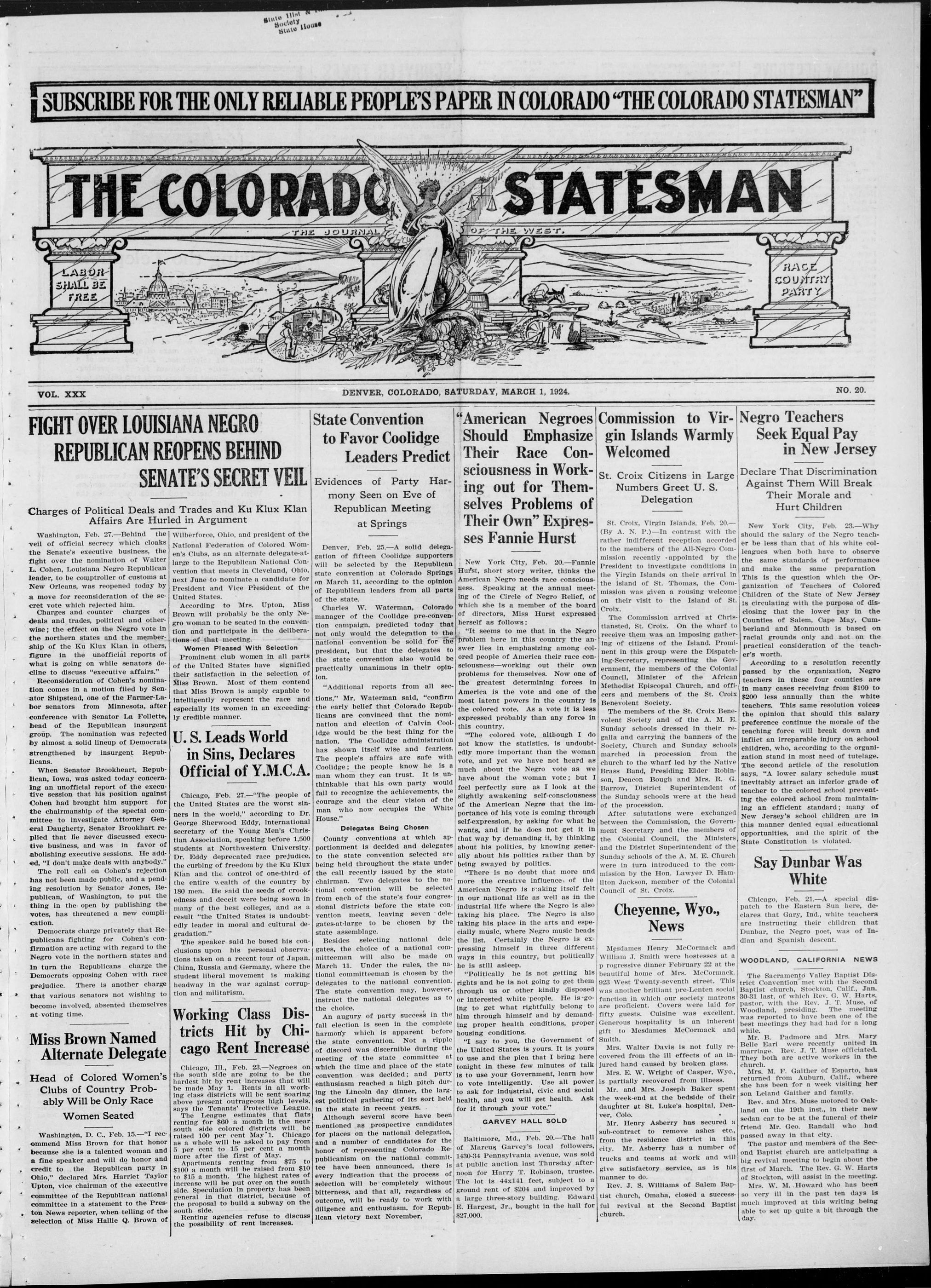
SUBSCRIBE FOR THE ONLY RELIABLE PEOPLE'S PAPER IN COLORADO "THE COLORADO STATESMAN"
THE COLORADO STATESMAN
THE JOURNAL OF THE WEST.
LABOR SHALL BE FREE
RACE COUNTRY PARTY
FIGHT OVER LOUISIANA NEGRO REPUBLICAN REOPENS BEHIND SENATE'S SECRET VEIL
Charges of Political Deals and Trades and Ku Klux Klan Affairs Are Hurled in Argument
VOL. XXX
FIGHT OVER LOUISE
REPUBLICAN RE
SEN
Charges of Political Deals and
Affairs Are Hurt
Washington, Feb. 27.—Behind the veil of official secrecy which cloaks the Senate's executive business, the fight over the nomination of Walter L. Cohen, Louisiana Negro Republican leader, to be comptroller of customs at New Orleans, was reopened today by a move for reconsideration of the secret vote which rejected him.
Charges and counter charges of deals and trades, political and otherwise; the effect on the Negro vote in the northern states and the membership of the Ku Klux Klan in others, figure in the unofficial reports of what is going on while senators decline to discuss "executive affairs."
Reconsideration of Cohen's nomination comes in a motion filed by Senator Shipstead, one of the Farmer-Labor senators from Minnesota, after conference with Senator La Follette, head of the Republican insurgent group. The nomination was rejected by almost a solid lineup of Democrats strengthened by insurgent Republicans.
When Senator Brookheart, Republican, Iowa, was asked today concerning an unofficial report of the executive session that his position against Cohen had brought him support for the chairmanship of the special committee to investigate Attorney General Daugherty, Senator Brookhart replied that lie never discussed executive business, and was in favor of abolishing executive sessions. He added, "I don't make deals with anybody."
The roll call on Cohen's rejection has not been made public, and a pending resolution by Senator Jones, Republican, of Washington, to put the thing in the open by publishing the votes, has threatened a new complication. Democrats charge privately that Republicans fighting for Cohen's confirmation are acting with regard to the Negro vote in the northern states and in turn the Republicans charge the Democrats opposing Cohen with race prejudice. There is another charge that various senators not wishing to become involved, absented themselves at voting time.
Miss Brown Named Alternate Delegate
Miss Brown Named Alternate Delegate
Head of Colored Women's Clubs of Country Probably Will be Only Race Women Seated
Washington, D. C., Feb. 15. "I recommend Miss Brown for that honor because she is a talented woman and a fine speaker and will do honor and credit to the Republican party in Ohio," declared Mrs. Harriet Taylor Upton, vice chairman of the executive committee of the Republican national committee in a statement to the Preston News reporter, when telling of the selection of Miss Hallie Q. Brown of
Wilberforce, Ohio, and president of the National Federation of Colored Women's Clubs, as an alternate delegate-atlarge to the Republican National Convention that meets in Cleveland, Ohio, next June to nominate a candidate for President and Vice President of the United States.
According to Mrs. Upton, Miss Brown will probably be the only Negro woman to be seated in the convention and participate in the deliberations of that meeting.
Women Pleased With Selection
Prominent club women in all parts of the United States have signified their satisfaction in the selection of Miss Brown. Most of them contend that Miss Brown is amply capable to intelligently represent the race and especially its women in an exceedingly credible manner.
U. S. Leads World in Sins, Declares Official of Y.M.C.A.
Chicago, Feb. 27.—"The people of the United States are the worst sinners in the world," according to Dr. George Sherwood Eddy, international secretary of the Young Men's Christian Association, speaking before 1,500 students at Northwestern University. Dr. Eddy deprecated race prejudice, the curbing of freedom by the Ku Klux Klan and the control of one-third of the entire wealth of the country by 180 men. He said the seeds of crookedness and deceit were being sown in many of the best colleges, and as a result "the United States is undoubtedly leader in moral and cultural degradation."
The speaker said he based his conclusions upon his personal observations taken on a recent tour of Japan, China, Russia and Germany, where the student liberal movement is making headway in the war against corruption and militarism.
Working Class Districts Hit by Chicago Rent Increase
Chicago, Ill., Feb. 23—Negroes on the south side are going to be the hardest hit by rent increases that will be made May 1. Rents in all working class districts will be sent soaring above present outrageous high levels, says the Tenants' Protective League. The League estimates that flats renting for $60 a month in the near south side colored districts will be raised 100 per cent May<sup>1</sup>. Chicago as a whole will be asked to pay from 5 per cent to 15 per cent a month more after the first of May.
Apartments renting from $75 to $100 a month will be raised from $10 to $15 a month. The highest rates of increase will be put over on the south side. Speculation in property has been general in that district, because of the proposal to build a subway on the south side.
Renting agencies refuse to discuss the possibility of rent increases.
DENVER, COLORADO, SATURDAY, MARCH 1, 1924.
State Convention to Favor Coolidge Leaders Predict
State Convention to Favor Coolidge Leaders Predict
Evidences of Party Harmony Seen on Eve of Republican Meeting at Springs
Denver, Feb. 25.—A solid delegation of fifteen Coolidge supporters will be selected by the Republican state convention at Colorado Springs on March 11, according to the opinion of Republican leaders from all parts of the state.
Charles W. Waterman, Colorado manager of the Coolidge pre-convention campaign, predicted today that not only would the delegation to the national convention be solid for the president, but that the delegates to the state convention also would be practically unanimous in their opinion.
"Additional reports from all sections," Mr. Waterman said, "confirm the early belief that Colorado Republicans are convinced that the nomination and election of Calvin Coolidge would be the best thing for the nation. The Coolidge administration has shown itself wise and fearless. The people's affairs are safe with Coolidge; the people know he is a man whom they can trust. It is unthinkable that his own party would fail to recognize the achievements, the courage and the clear vision of the man who now occupies the White House."
Delegates Being Chosen
County conventions at which apportionment is decided and delegates to the state convention selected are being held throughout the state under the call recently issued by the state chairman. Two delegates to the national convention will be selected from each of the state's four congressional districts before the state convention meets, leaving seven delegates-at-large to be chosen by the state assemblage. Besides selecting national delegates, the choice of a national committeeman will also be made on March 11. Under the rules, the national committeeman is chosen by the delegates to the national convention. The state convention may, however, instruct the national delegates as to the choice.
An augury of party success in the fall election is seen in the complete harmony which is apparent before the state convention. Not a ripple of discord was discernible during the meeting of the state committee at which the time and place of the state convention was decided; and party enthusiasm reached a high pitch during the Lincoln day dinner, the largest political gathering of its sort held in the state in recent years. Although several score have been mentioned as prospective candidates for places on the national delegation, and a number of candidates for the honor of representing Colorado Republicanism on the national committee have been announced, there is every indication that the process of selection will be completely without bitterness, and that all, regardless of outcome, will be ready to work with diligence and enthusiasm, for Republican victory next November.
American Negroes Should Emphasize Their Race Consciousness in Working out for Themselves Problems of Their Own" Expresses Fannie Hurst
New York City, Feb. 20.—Fannie Hurst, short story writer, thinks the American Negro needs race consciousness. Speaking at the annual meeting of the Circle of Negro Relief, of which she is a member of the board of directors, Miss Hurst expressed herself as follows:
"It seems to me that in the Negro problem here in this country the answer lies in emphasizing among colored people of America their race consciousness—working out their own problems for themselves. Now one of the greatest determining forces in America is the vote and one of the most latent powers in the country is the colored vote. As a vote it is less expressed probably than any force in this country.
"The colored vote, although I do not know the statistics, is undoubtedly more important than the woman vote, and yet we have not heard as much about the Negro vote as we have about the woman vote; but I feel perfectly sure as I look at the slightly awakening self-consciousness of the American Negro that the importance of his vote is coming through self-expression, by asking for what he wants, and if he does not get it in that way by demanding it, by thinking about his politics, by knowing generally about his politics rather than by being swayed by politics.
"There is no doubt that more and more the creative influence of the American Negro is making itself felt in our national life as well as in the industrial life where the Negro is also taking his place. The Negro is also taking his place in the arts and especially music, where Negro music heads the list. Certainly the Negro is expressing himself in three different ways in this country, but politically he is still asleep.
"Politically he is not getting his rights and he is not going to get them through us or other kindly disposed or interested white people. He is going to get what rightfully belong to him through himself and by demanding proper health conditions, proper housing conditions.
"I say to you, the Government of the United States is yours. It is yours to use and the plea that I bring here tonight in these few minutes of talk is to use your Government, learn how to vote intelligently. Use all power to ask for industrial, civic and social health, and you will get health. Ask for it through your vote."
GARVEY HALL SOLD
Baltimore, Md., Feb. 20.—The hall of Marcus Garvey's local followers, 1430-34 Pennsylvania avenue, was sold at public auction last Thursday afternoon for Harry T. Robinson, trustee. The lot is 44x141 feet, subject to a ground rent of $204 and improved by a large three-story building. Edward E. Hargest, Jr., bought in the hall for $27,000.
Commission to Virgin Islands Warmly Welcomed
Commission to Virgin Islands Warmly Welcomed
St. Croix Citizens in Large Numbers Greet U. S. Delegation
St. Croix, Virgin Islands, Feb. 20.—(By A. N. P.)—In contrast with the rather indifferent reception accorded to the members of the All-Negro Commission recently appointed by the President to investigate conditions in the Virgin Islands on their arrival in the island of St. Thomas, the Commission was given a rousing welcome on their visit to the Island of St. Croix.
The Commission arrived at Christiansted, St. Croix. On the wharf to receive them was an imposing gathering of citizens of the Island. Prominent in this group were the Dispatching-Secretary, representing the Government, the members of the Colonial Council, Minister of the African Methodist Episcopal Church, and officers and members of the St. Croix Benevolent Society.
The members of the St. Croix Benevolent Society and of the A. M. E. Sunday schools dressed in their regalia and carrying the banners of the Society, Church and Sunday schools marched in procession from the church to the wharf led by the Native Brass Band, Presiding Elder Robinson, Deacon Bough and Mrs. R. G. Barrow, District Superintendent of the Sunday schools were at the head of the procession.
After salutations were exchanged between the Commission, the Government Secretary and the members of the Colonial Council, the Ministers and the District Superintendent of the Sunday schools of the A. M. E. Church were in turn introduced to the commission by the Hon. Lawyer D. Hamilton Jackson, member of the Colonial Council of St. Croix.
Cheyenne, Wyo., News
Mesdames Henry McCormack and William J. Smith were hostesses at a p regressive dinner February 22 at the beautiful home of Mrs. McCormack. 923 West Twenty-seventh street. This was another brilliant pre-Lenten social function in which our society matrons are proficient. Covers were laid for fifty guests. Cuisine was excellent. Generous hospitality is an inherent gift to Mesdames McCormack and Smith.
Mrs. Walter Davis is not fully recovered from the ill effects of an injured hand caused by broken glass.
Mrs. E. W. Wright of Casper, Wyo., is partially recovered from illness.
Mr. and Mrs. Joseph Baker spent the week-end at the bedside of their daughter at St. Luke's hospital, Denver, Colo.
Mr. Henry Asberry has secured a sub-contract to remove ashes etc., from the residence district in this city. Mr. Asberry has a number of trucks and teams at work and will give satisfactory service, as is his manner to do.
Rev. J. S. Williams of Salem Baptist church, Omaha, closed a successful revival at the Second Baptist church.
NO. 20.
Negro Teachers Seek Equal Pay in New Jersey
Declare That Discrimination Against Them Will Break Their Morale and Hurt Children
New York City, Feb. 23.—Why should the salary of the Negro teacher be less than that of his white colleagues when both have to observe the same standards of performance and make the same preparation This is the question which the Organization of Teachers of Colored Children of the State of New Jersey is circulating with the purpose of disclosing that the lower pay in the Counties of Salem, Cape May, Cumberland and Monmouth is based on racial grounds only and not on the practical consideration of the teacher's worth.
According to a resolution recently passed by the organization, Negro teachers in these four counties are in many cases receiving from $100 to $200 less annually than the white teachers. This same resolution voices the opinion that should this salary preference continue the morale of the teaching force will break down and inflict an irreparable injury on school children, who, according to the organization stand in most need of tutelage. The second article of the resolution says, "A lower salary schedule must inevitably attract an inferior grade of teacher to the colored school preventing the colored school from maintaining an efficient standard; many of New Jersey's school children are in this manner denied equal educational opportunities, and the spirit of the State Constitution is violated.
Say Dunbar Was White
Chicago, Feb. 21.—A special dispatch to the Eastern Sun here, declares that Gary, Ind., white teachers are instructing their children that Dunbar, the Negro poet, was of Indian and Spanish descent.
WOODLAND, CALIFORNIA NEWS
The Sacramento Valley Baptist District Convention met with the Second Baptist church, Stockton, Calif., Jan. 30-31 last, of which Rev. G. W. Harts, pastor, with the Rev. J. T. Muse, of Woodland, presiding. The meeting was reported to have been one of the best meetings they had had for a long while.
Mr. B. Padmore and Mrs. Mary Belle Earl were recently united in marriage. Rev. J. T. Muse officiated. They both are active workers in the church.
Mrs. M. F. Gaither of Esparto, has returned from Auburn, Calif., where she has been for a week visiting her son Leland Gaither and family.
Rev. and Mrs. Muse motored to Oakland on the 19th inst., in their new sedan car to be at the funeral of their friend Mr. Geo. Randall who had passed away in that city.
The pastor and members of the Second Baptist church are anticipating a big revival meeting to begin about the first of March. The Rev. G. W. Harts of Stockton, will assist in the meeting. Mrs. W. M. Howard who has been so very ill in the past ten days is much improved at this writing being able to set up quite a bit through the day.
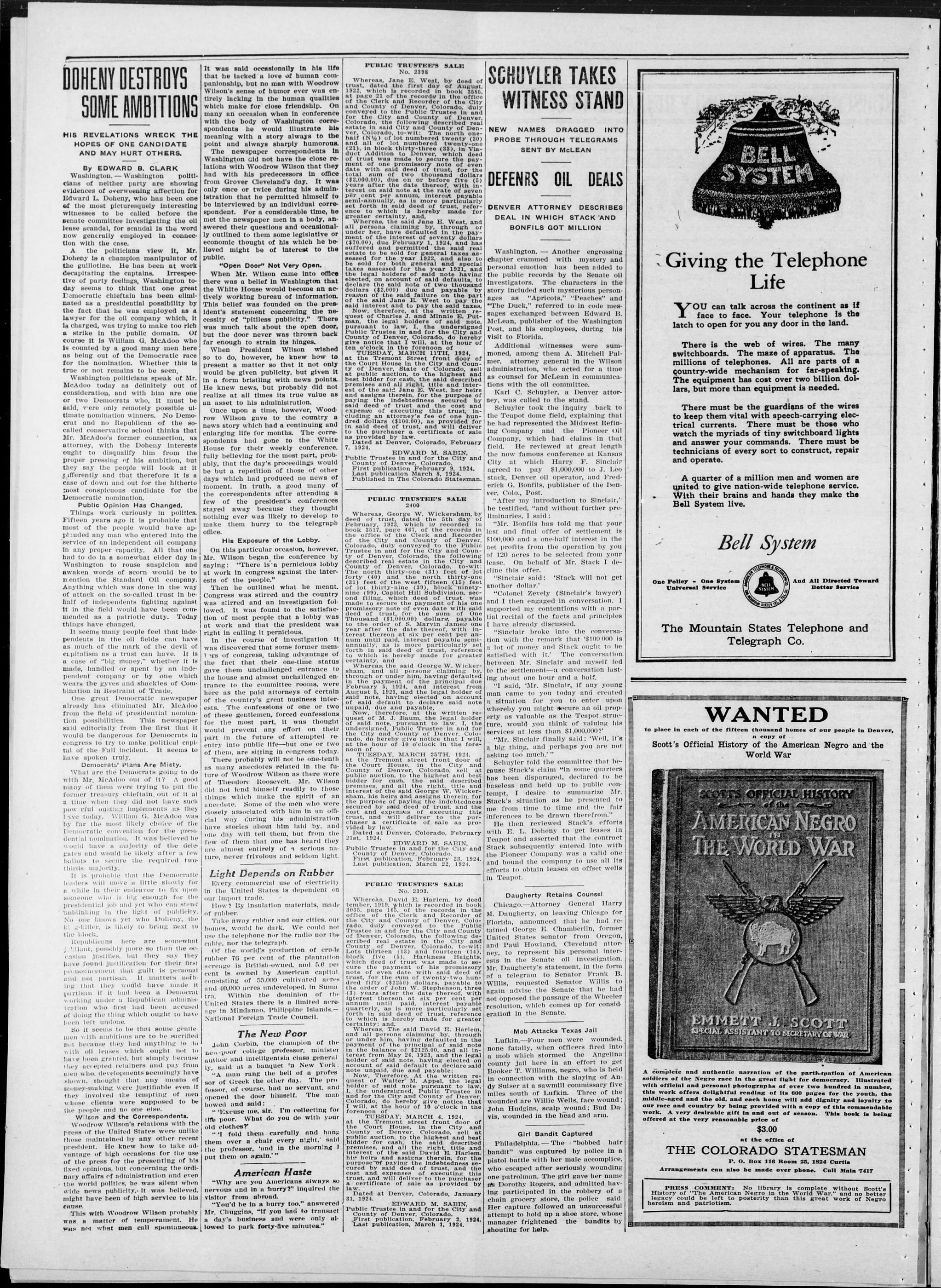
DOHENY DESTROYS SOME AMBITIONS
HIS REVELATIONS WRECK THE HOPES OF ONE CANDIDATE AND MAY HURT OTHERS.
By EDWARD B. CLARK
Washington. — Washington politicians of neither party are showing evidences of overweening affection for Edward L. Doheny, who has been one of the most picturesquely interesting witnesses to be called before the senate committee investigating the oil lease scandal, for scandal is the word now generally employed in connection with the case.
A the politicians view it, Mr. Doheny is a champion manipulator of the guillotine. He has been at work decapitating the captains. Irrespective of party feelings, Washington today seems to think that one great Democratic chieftain has been eliminated as a presidential possibility by the fact that he was employed as a lawyer for the oil company which, it is charged, was trying to make too rich a strike in the public domain. Of course it is William G. McAdoo who is counted by a good many men here as being out of the Democratic race for the nomination. Whether this is true or not remains to be seen.
Washington politicians speak of Mr. McAdoo today as definitely out of consideration, and with him are one or two Democrats who, it must be said, were only remotely possible ultimate nomination winners. No Democrat and no Republican of the so-called conservative school thinks that Mr. McAdoo's former connection, as attorney, with the Doheny interests ought to disqualify him from the proper pressing of his ambition, but they say the people will look at it differently and that therefore it is a case of down and out for the hitherto most conspicuous candidate for the Democratic nomination.
Public Opinion Has Changed.
Public Opinion Has Changed.
Things work curiously in politics. Fifteen years ago it is probable that most of the people would have applauded any man who entered into the service of an independent oil company in any proper capacity. All that one had to do in a somewhat elder day in Washington to rouse suspicion and awaken words of scorn would be to mention the Standard Oil company. Anything which was done in the way of attack on the so-called trust in behalf of independents fighting against it in the field would have been commended as a patriotic duty. Today things have changed.
It seems many people feel that independents in the oil fields can have as much of the mark of the devil of capitalism as a trust can have. It is a case of "big money," whether it is made, handled or spent by an independent company or by one which wears the gyves and shackles of Combination in Restraint of Trade.
One great Democratic newspaper already has eliminated Mr. McAdoo from the field of presidential nomination possibilities. This newspaper said editorially from the first that it would be dangerous for Democrats in congress to try to make political capital of the Fall incident. It seems to have spoken truly.
Democrats' Plans Are Misty.
What are the Democrats going to do with Mr. McAdoo out of it? A good many of them were trying to put the former treasury chieftain, of it at a time when they did not have such pow ruf ousting implements as they have today. William G. McAdoo was by far the most likely choice of the Democratic convention for the presidential nomination. It was believed he would have a majority of the delegates and would be likely after a few ballots to secure the required two-thirds majority.
It is probable that the Democratic leaders will move a little slowly for a while in their endeavor to fix upon someone who is big enough for the presidential job and yet who can stand unblinking in the light of publicity. No one knows yet who Doheny, the kl-gkiller, is likely to bring next to the block.
Republicans here are somewhat ill-attent, possibly more so than the occasion justifies, but they say they have found justification for their first pronouncement that guilt is personal and not partisan. It matters nothing that they would have made it partisan if it had been a Democrat working under a Republican administration who first had been accused of doing the thing which ought to have been left undone.
So it seems to be that some gentlemen with ambitions are to be sacrificed not because they had anything to do with oil leases which ought not to have been granted, but simply because they accepted retailers and pay from men who, developments seemingly have shown, thought that any means of money-making were justifiable even if they involved the tempting of men whose clients were supposed to be the people and no one else.
Wilson and the Correspondents. Woodrow Wilson's relations with the press of the United States were unlike those maintained by any other recent president. He knew how to take advantage of high occasions for the use of the press for the presenting of his fixed opinions, but concerning the ordinary affairs of administration and even the world politics, he was silent when wide news publicity, it was believed, might have been of high service to his cause. This with Woodrow Wilson probably was a matter of temperance. He was not what men call spontaneous.
It was said occasionally in his life that he lacked a love of human companionship, but no man with Woodrow Wilson's sense of humor ever was entirely lacking in the human qualities which make for close friendship. On many an occasion when in conference with the body of Washington correspondents he would illustrate his meaning with a story always to the point and always sharply humorous.
The newspaper correspondents in Washington did not have the close relations with Woodrow Wilson that they had with his predecessors in office from Grover Cleveland's day. It was only once or twice during his administration that he permitted himself to be interviewed by an individual correspondent. For a considerable time, he met the newspaper men in a body, answered their questions and occasionally outlined to them some legislative or economic thought of his which he believed might be of interest to the public.
"Open Door" Not Very Open.
When Mr. Wilson came into office there was a belief in Washington that the White House would become an actively working bureau of information. This belief was founded on the president's statement concerning the necessity of "pitiless publicity." There was much talk about the open door, but the door never was thrown back far enough to strain its hinges. When President Wilson wished so to do, however, he knew how to present a matter so that it not only would be given publicity, but given it in a form bristling with news points. He knew news, but probably did not realize at all times its true value as an asset to his administration.
Once upon a time, however, Woodrow Wilson gave to the country a news story which had a continuing and enlarging life for months. The correspondents had gone to the White House for their weekly conference, fully believing for the most part, probably, that the day's proceedings would be but a repetition of those of other days which had produced no news of moment. In truth, a good many of the correspondents after attending a few of the president's conferences stayed away because they thought nothing ever was likely to develop to make them hurry to the telegraph office.
His Exposure of the Lobby.
On this particular occasion, however, Mr. Wilson began the conference by saying: "There is a pernicious lobby at work in congress against the interests of the people." Then he outlined what he meant, Congress was stirred and the country was stirred and an investigation followed. It was found to the satisfaction of most people that a lobby was at work and that the president was right in calling it pernicious.
In the course of investigation it was discovered that some former members of congress, taking advantage of the fact that their one-time status gave them unchallenged entrance to the house and almost unchallenged entrance to the committee rooms, were here as the paid attorneys of certain of the country's great business interests. The confessions of one or two of these gentlemen, forced confessions for the most part, it was thought would prevent any effort on their part in the future of attempted reentry into public life—but one or two of them, are sitting in congress today.
There probably will not be one-tenth as many anecdotes related in the future of Woodrow Wilson as there were of Theodore Roosevelt. Mr. Wilson did not lend himself readily to those things which make the spirit of an anecdote. Some of the men who were closely associated with him in an official way curing his administration have stories about him laid by, and one day will tell them, but from the few of them that one has heard they are almost entirely of a serious nature, never frivolous and seldom light.
Light Depends on Rubber
Every commercial use of electricity in the United States is dependent on our import trade. How? By insulation materials, made of rubber. Take away rubber and our cities, our homes, would be dark. We could not use the telephone nor the radio nor the cable, nor the telegraph. Of the world's production of crude rubber 70 per cent of the plantation acreage is British-owned, and 5.6 per cent is owned by American capital consisting of 55,000 cultivated acres and 40,000 acres undeveloped. In Sumatra. Within the dominion of the United States there is a limited acreage in Mindanao, Philippine Islands.—National Foreign Trade Council.
The New Poor
John Corbin, the champion of the new-poor college professor, minister author and intelligentsia class generally, said at a banquet in New York: "A man rang the bell of a professor of Greek the other day. The professor, of course, had no servant, and opened the door himself. The man bowed and said: "Excuse me, sir. I'm collecting for the poor. What do you do with your old clothes?" "I fold them carefully and hang them over a chair every night," said the professor, 'and in the morning I put them on again.'"
American Haste
"Why are you Americans always so nervous and in a hurry?" inquired the visitor from abroad. "You'd be in a hurry too," answered Mr. Chuggins, "if you had to transact a day's business and were only allowed to park forty-five minutes."
PUBLIC TRUSTEE'S SALE
No. 2398
Whereas, Jane E. West, by deed of trust, dated the first day of August, 1922, which is recorded in book 3585, as page 6 of the records in the office of Clark University, and County of Denver, Colorado, duly conveyed to the Public Trustee in and for the City and County of Denver, Colorado, the following described real property: Colorado, to-wit. The property half (N/2) of lot numbered twenty (20) and all of lot numbered twenty-one (21), in block thirty-three (33), in Vila de Trust, Colorado, to-wit. The deed of trust was made to secure the placement of one promissory note of even date with said deed of trust, for the total sum of two thousand dollars (2000) for the deferred live (5) years after the date thereof, and terest on said note at the rate of seven per cent per annum, interest payable semi-annually, as is more particularly set forth in said deed of trust, referenced in the prow made for greater certainty, and.
Whereas, the said Jane E. West, and all persons claiming by, through or under her, have defaulted in the payment of the interest of seventy dollars ($70.00), due February 1, 1924, and has suffered and permitted the said real estate to be sold for general taxes assessed for the year 1922, and also to be sold for both general and special taxes assessed for the year 1921, and the legal holders of said note having elected, on account of said defaults, to declare the said note of two thousand dollars ($2,000) due and payable by reason of the said failure on the part of the said Jane E. West to pay the said interest and to pay the said taxes. Now, therefore, at the written request of Charles J. and Minnie E. Putman, the legal holders of said note, pursuant to law, I, the undersigned Public Trustee in and for the City and County of Denver, Colorado, do hereby give notice that I will, at the hour of ten o'clock in the forenoon of
TUESDAY, MARCH 11TH, 1924,
at the Tremont Street front door of
the Court House in the City and Coun-
tory, where the chief of the court
at public auction, to the highest and
best bidder for cash, the said described
premises and all right, title and inter-
est of the said Jane E. West, her heirs
and heirs of the said E. West, paying
the indebtedness secured by
said deed of trust and the cost and
expense of executing this trust, in-
cluding an attorney's fee or one hund-
dred and one hundred and one hundred and
in said deed of trust, and will deliver
to the purchaser a certificate of sale
as provided by law.
Dated at Denver, Colorado, February
7, 1924.
EDWARD M. SARIN
Public Trustee in and for the City and County of Denver, Colorado.
First publication February 8, 1924.
Last publication December 20, 1924.
Published in The Colorado Statesman
PUBLIC TRUSTEE'S SALE
2400
Whereas, George W. Wickersham, by deed of trust, dated the 5th day of February, 1923, which is recorded in book 3517, page 467, of the records in of the City and County of Colorado, duly conveyed to the Public Trustee in and for the City and County of Denver, Colorado, the following described real estate in the City and County of Denver, the north thirty-one (31) feet of lot forty (40) and the north thirty-one (31) feet of the west fifteen (15) feet of lot thirty-nine (39), block ninety-second and filing, which deed of trust was made to secure the payment of his one promissory note of even date with said deed of trust, for the sum of One Thousand ($1,000.00) dollars, payable to the date thereof, and year after the date thereof, with interest thereon at six per cent per annum until paid, interest payable semi-annually, as is more particularly set forth in said deed of trust, reference which is hereby made for greater certainty, and
Whereas, the said George W. Wickerham, and all persons claiming by, through or under him having defaulted on payment of the debt, on the February 5, 1924, and interest from August 5, 1923, and the legal holder of said note, having elected on account of said default to declare said note unpaid, due and payable.
Not, therefore, of the written request of M. J. Baum, the legal holder of said note, pursuant to law, I, the undersigned, Public Trustee in and for the City and County of Denver, Colorado, to the hour of 10 o'clock in the forenoon of TUESDAY, MARCH 25TH, 1924, at the Tremont street front door of the City and County of Denver, Colorado, sell at public auction, to the highest and best bidder for cash, the said described premises, and all the right, title and payment of the said W. Wickerham, his heirs and assigns therein, for the purpose of paying the indebtedness secured by said deed of trust, and the cost and expenses of executing this note, to the purchaser a certificate of sale as provided by law.
Dated at Denver, Colorado, February 21st, 1924.
EDWARD M. SABIN,
Public Trustee in and for the city and
County of Denver, Colorado.
First publication, February 23, 1924.
Last publication, March 22, 1924.
PUBLIC TRUSTEES SALE
No. 2393
Whereas, David E. Harlem, by deed tember, 1919, which is recorded in book 3035, page 165, of the records in the office of the Clerk and Recorder of Denver, Colorado, duly conveyed to the Public Trustee in and for the City and County of Denver, Colorado, the following described real estate in the City and County of Denver, Colorado, to-wit; (1) block five (5), Harkness Heights, which deed of trust was made to secure the payment of his promissory note of even date with said deed of ten years before, (2) dredge fifty ($2250) dollars payable to the order of John W. Stephenson, three (3) years after the date thereof, with interest thereon at six per cent per annum until paid, interest payable in the balance of ten years forth in said deed of trust, reference to which is hereby made for greater certainty; and.
Whereas, The said David E. Harlem, by deed of persons claiming by, through or under his behalf by, payment of the principal of said note in the balance of $2125.00, and all interest from May 26, 1923, and the legal holder of said note, having elected on behalf of the default holder, said note unpaid due and payable.
Now, Therefore, At the written request of Walter M. Appel, the legal counsel of the City Court, the law, I, the undersigned, Public Trustee, and for the City and County of Denver, Colorado, do hereby give notice that I will, at the hour of 10 o'clock in the forement, TUESDAY, MARCH 4, 1924, at the Tremont street front door of the Court House, in the City and County of Denver, public auction, to the highest and best bidder for cash, the said described premises, and all the right title and his heirs and assisn them in his heirs and assisn them in purpose of paying the indebtedness secured by said deed of trust, and the cost and expenses of executing this trust, and will deliver to the purchaser a certificate of sale as provided by law.
Dated at Denver, Colorado, January 31, 1924.
EDWARD M. SABIN,
Public Trustee in and for the City and County of Denver, Colorado.
First publication, February 2, 1924.
Last publication, March 1, 1924.
SCHUYLER TAKES WITNESS STAND
NEW NAMES DRAGGED INTO
PROBE THROUGH TELEGRAMS
SENT BY McLEAN
DENVER ATTORNEY DESCRIBES
DEAL IN WHICH STACK 'AND
BONFILS GOT MILLION
Washington. — Another engrossing chapter crammed with mystery and personal emotion has been added to the public records by the Senate oil investigators. The characters in the story included such mysterious personages as "Apricots," "Peaches" and "The Duck," referred to in code messages exchanged between Edward B. McLean, publisher of the Washington Post, and his employees, during his visit to Florida.
Additional witnesses were summoned, among them A. Mitchell Palmer, attorney general in the Wilson administration, who acted for a time as counsel for McLean in communications with the oil committee.
Karl C. Schuyler, a Denver attorney, was called to the stand.
Schuyler took the inquiry back to the Teapot dome field, explaining that he had represented the Midwest Refining Company and the Pioneer Oil Company, which had claims in that field. He reviewed at great length the now famous conference at Kansas City at which Harry F. Sinclair agreed to pay $1,000,000 to J. Leo stack, Denver oil operator, and Frederick G. Bonfills, publisher of the Denver, Colo., Post.
"After my introduction to Sinclair," he testified, "and without further preliminaries, I said:
"Mr. Bonfills has told me that your last and final offer of settlement is $100,000 and a one-half interest in the net profits from the operation by you of 120 acres to be selected from your lease. On behalf of Mr. Stack I decline this offer.
"Sinclair said: 'Stack will not get another dollar.'
"Colonel Zeverly (Sinclair's lawyer) and I then engaged in conversation. I supported my contentions with a partial recital of the facts and principles I have already discussed.
"Sinclair broke into the conversation with the remark that $100,000 is a lot of money and Stack ought to be satisfied with it." The conversation between Mr. Sinclair and myself led to the settlement—a conversation lasting about one hour and a half.
"I said, 'Mr. Sinclair, if any young man came to you today and created a situation for you to enter upon whereby you might secure an oil property as valuable as the Teapot structure, would you think of valuing his services at less than $1,000,000?
"Mr. Sinclair finally said: 'Well, it's a big thing, and perhaps you are not asking too much.'"
Schuyler told the committee that because Stack's claim "in some quarters has been disparaged, declared to be baseless and held up to public contempt, I desire to summarize Mr. Stack's situation as he presented to me from time to time and the fair inferences to be drawn therefrom." He then reviewed Stack's efforts with E. L. Doheny to get leases in Teapot and asserted that the contract Stack subsequently entered into with the Pioneer Company was a valid one and bound the company to use all its efforts to obtain leases on offset wells in Teapot.
Daugherty Retains Counsel
Chicago.—Attorney General Harry M. Daugherty, on leaving Chicago for Florida, announced that he had retained George E. Chamberlin, former United States senator from Oregon, and Paul Howland, Cleveland attorney, to represent his personal interests in the Senate oil investigation. Mr. Daugherty's statement, in the form of a telegram to Senator Frank B. Willis, requested Senator Willis to again advise the Senate that he had not opposed the passage of the Wheeler resolution, which comes up for consideration in the Senate.
Mob Attacks Texas Jail
Lufkin.—Four men were wounded, none fatally, when officers fired into a mob which stormed the Angelina county jail here in an effort to get Booker T. Williams, negro, who is held in connection with the slaying of Andy Sulser at a sawmill commissary five miles south of Lufkin. Three of the wounded are Willie Wells, face wound; John Hudgins, scalp wound; Bud Davis, wounded in the head and arm.
Girl Bandit Captured
Philadelphia. — The "bobbed hair bandit" was captured by police in a pistol battle with her male accomplice, who escaped after seriously wounding one patrolman. The girl gave her name Dorothy Rogers, and admitted having participated in the robbery of a chain grocery store, the police said Her capture followed an unsuccessful attempt to hold up a shoe store, whose manager frightened the bandits by shouting for help.
BELL
SYSTEM
Giving the Telephone Life
YOU can talk across the continent as if face to face. Your telephone is the latch to open for you any door in the land.
There is the web of wires. The many switchboards. The maze of apparatus. The millions of telephones. All are parts of a country-wide mechanism for far-speaking. The equipment has cost over two billion dollars, but more than equipment is needed.
There must be the guardians of the wires to keep them vital with speech-carrying electrical currents. There must be those who watch the myriads of tiny switchboard lights and answer your commands. There must be technicians of every sort to construct, repair and operate.
A quarter of a million men and women are united to give nation-wide telephone service. With their brains and hands they make the Bell System live.
One Policy - One System
Universal Service
The Mountain
Te
The Mountain States Telephone and Telegraph Co.
WANTED
to place in each of the fifteen thousand homes of our people in Denver, a copy of Scott's Official History of the American Negro and the World War
SCOTTS OFFICIAL HISTORY
of the
AMERICAN NEGRO
IN
THE WORLD WAR
EMMETT J. SCOTT
SPECIAL ASSISTANT TO SECRETARY OF WAR
A complete and authentic narration of the participation of American soldiers of the Negro race in the great fight for democracy. Illustrated with official and personal photographs of over two hundred in number, this work offers delightful reading of its 600 pages for the youth, the middle-aged and the old, and each home will add dignity and loyalty to our race and country by being provided with a copy of this commendable work. A very desirable gift in and out of season. This book is being offered at the very reasonable price of
THE COLORADO STATESMAN
P. O. Box 116 Room 25, 1824 Curtis
Arrangements can also be made over phone. Call Main 7417
PRESS COMMENT: No library is complete without Scott's
History of "The American Negro in the World War." and no better
legacy could be left to posterity than this great work of Negro
herolism and patriotism.
And All Directed Toward Better Service
Telephone and
Co.
FOREIGN
The British cabinet has decided to carry out the naval construction program previously agreed upon and will probably work upon six new cruisers immediately.
Secretary of War Serrano declared in a statement issued in Mexico City that a crushing defeat had been administered by Obregon troops on rebel forces under Jose Moran at De la Curue.
A Chinese court at Herbin, Manchuria, denied the appeal of Alexis Karniloff, Russian desperado, and reaffirmed the death sentence passed last November. Korniloff was the first white man ever sentenced to death in a Chinese court.
Two fallen military Idols—General Erich Ludendorff, known during the great war as the "brains of the German army," and Adolph Hitler leader of the Bavarian Fascist—have been placed on trial in Munich charged with treason for their part in the "beer cellar revolt" last November.
The Canadian embargo on cattle from the states of California, Oregon and Nevada will remain in effect until assurance is received from the United States that the foot and mouth disease is wiped out in the three states, it was made known in Ottawa by the Department of Agriculture.
Carlos Largos, commander of troops supporting the dictatorship of former President Lopez Guilterrez, in Honduras, and General Vincente Tosta, commanding one of the revolutionary armies have agreed upon a forty-eighteen hour armistice, according to advises received in New Orleans by Manuel Paz, acting consul general for Honduras.
Gen. Marquis de Cavalcantl has been acquitted by the Supreme Tribunal of War, before which he was brought for trial in connection with the annihilation of a Spanish convoy at Tisza in October, 1921. Three of his subordinate officers, in Morroco, were found guilty. Generals Tuero and Sirvent were convicted and sentenced to one year and one day in prison, and General Lacanal was given six months and one day.
The English. dock strike, lasting ten days, was settled quickly when the delegates met in conference. Acceptance of the terms was almost unanimous, only two minor ports having objected. A feature of the strike, which involved many thousands of men, was complete absence of disorders, although the strike extended over all parts of the kingdom and dockers generally are regarded as a somewhat unruly class of workers.
GENERAL
The estate of Woodrow Wilson goes to his widow, Mrs. Edith Bolling Wilson, under the terms of the ex-President's last will filed for probate in Washington.
William Baker, private in the marine corps stationed at San Diego, Calif., rode into the union station at Dallas, Texas, a few days ago nailed inside a coffin. The young leatherneck arrived safely laid out in a pine box in the baggage coach of a Santa Fe passenger train. Trainmen, who suspected the "corpse" they were hauling ripped the lid off the box and turned the "body" over to authorities. Baker said he ran out of money at Prescott, Ariz., and had a stranger at the station nail on the lid and ship him C. O. D.
Three, men believed by the New Orleans police to have been implicated in the escape several weeks ago of Emory Connell from the Arkansas state penitentiary at Little Rock a few days before the date set for his execution were arrested in New Orleans last week. Several days after his escape, Connell was shot and killed by prison guards who had followed his trail. The men taken into custody were Jack Nelson, of Omaha, Neb., Melvin Stofer and Joseph Lee both of New Orleans.
Almost continuous blasting of ice gorges at points on the Platte river between Omaha and Columbus, Neb., seventy-five miles west, has been necessary in the last week to prevent the destruction of railroad bridges at two points across the river, railroad officials stated in Omaha.
Former Secretary of the Interior Albert S. Fall, accompanied by Mrs. Fall, have returned to their ranch home at Three Rivers, N. M., after a stay of several days at their residence in El Paso. Mr. Fall, while withholding a statement of his plans, seemed much improved in health and walked to the train without assistance.
Work to straighten the channel of the Rio Grande in order to definitely fix the boundaries of the United States and Mexico was started last week in El Paso, Texas, by a joint commission composed of one delegate from each of the nations. Due to the meandering of the river, misunderstandings have occurred between border guardians while enforcing the national laws. Smugglers have frequently retreated to disputed territory.
Katherine Malm, 19 years old, was found guilty in Chicago of the murder of Edward Lehman, a watchman, during a robbery. The jury fixed her punishment at life imprisonment. The jury returned its verdict after deliberating an hour and a half. George Randolph Chester, author, playwright and creator of a number of popular fictional characters, among them "Get-Rich Quick Wallingford," died suddenly of a heart attack a few days ago at his home in New York City. He was born in Cincinnati in 1869.
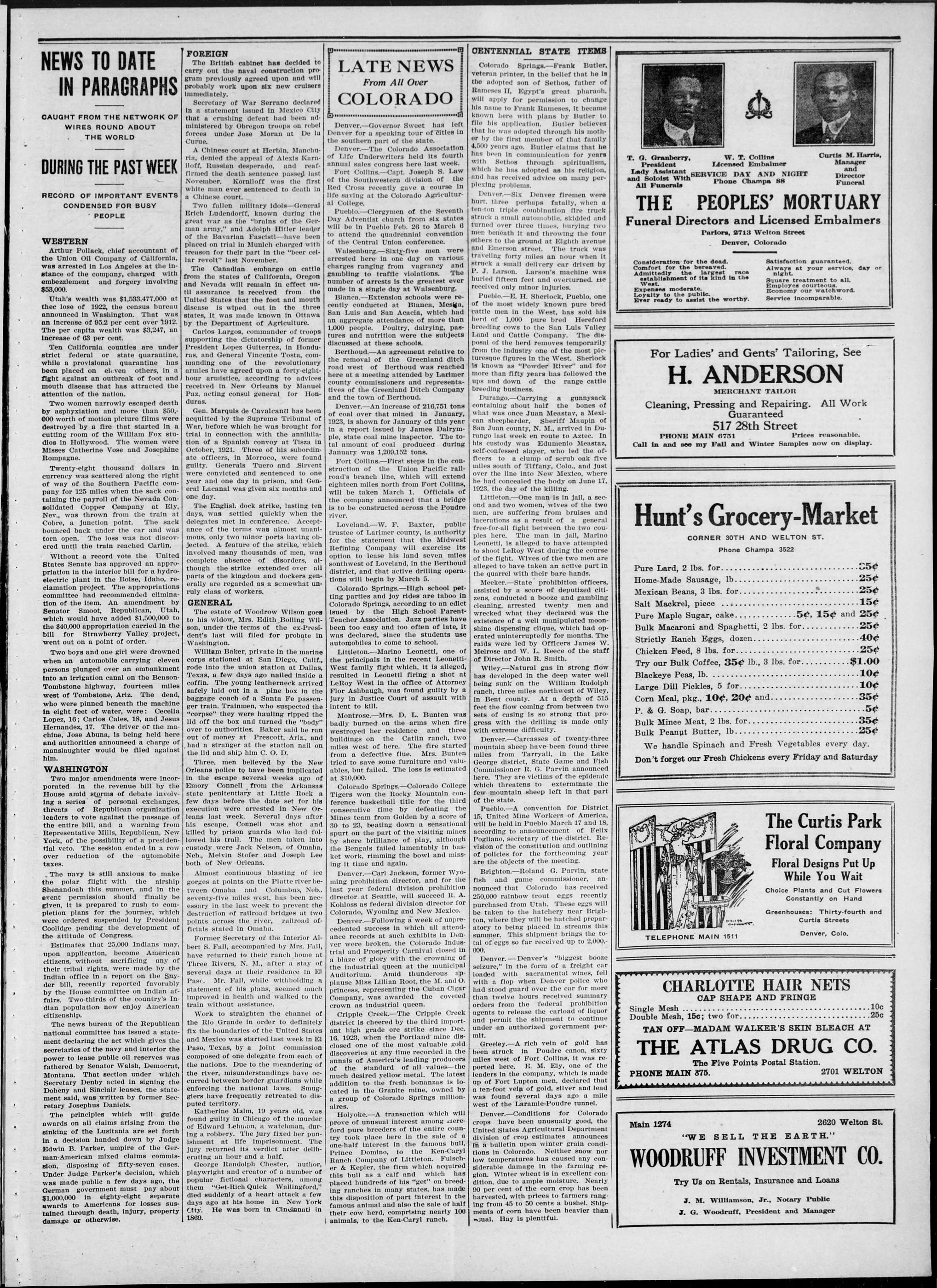
NEWS TO DATE IN PARAGRAPHS
CAUGHT FROM THE NETWORK OF
WIRES ROUND ABOUT
THE WORLD
DURING THE PAST WEEK
RECORD OF IMPORTANT EVENTS
CONDENSED FOR BUSY
WESTERN
Arthur Pollack, chief accountant of the Union Oil Company of California, was arrested in Los Angeles at the instance of the company, charged with embezzlement and forgery involving $53,000.
Utah's wealth was $1,533,477,000 at the lose of 1922, the census bureau announced in Washington. That was an increase of 95.2 per cent over 1912. The per capita wealth was $3,247, an increase of 63 per cent.
Ten California counties are under strict federal or state quarantine, while a provisional quarantine has been placed on eleven others, in a fight against an outbreak of foot and mouth disease that has attracted the attention of the nation.
Two women narrowly escaped death by asphyxiation and more than $50,000 worth of motion picture films were destroyed by a fire that started in a cutting room of the William Fox studios in Hollywood. The women were Misses Catherine Vose and Josephine Rompagne.
Twenty-eight thousand dollars in currency was scattered along the right of way of the Southern Pacific company for 125 miles when the sack containing the payroll of the Nevada Consolidated Copper Company at Ely, Nev., was thrown from the train at Cobre, a junction point. The sack bounced back under the car and was torn open. The loss was not discovered until the train reached Carlin.
Without a record vote the United States Senate has approved an appropriation in the interior bill for a hydroelectric plant in the Boise, Idaho, reclamation project. The appropriations committee had recommended elimination of the item. An amendment by Senator Smoot, Republican, Utah, which would have added $1,500,000 to the $40,000 appropriation carried in the bill for Strawberry Valley project, went out on a point of order.
Two boys and one girl were drowned when an automobile carrying eleven persons plunged over an embankment into an irrigation canal on the Benson-Tombstone highway, fourteen miles west of Tombstone, Ariz. The dead, who were pinned beneath the machine in eight feet of water, were: Cecelia Lopez, 16; Carlos Cales, 18, and Jesus Hernandez, 17. The driver or the machine, Jose Abuna, is being held here and authorities announce a charge of manslaughter would be filed against him.
WASHINGTON
Two major amendments were incorporated in the revenue bill by the House amd storms of debate involving a series of personal exchanges, threats of Republican organization leaders to vote against the passage of the entire bill, and a warning from Representative Mills, Republican, New York, of the possibility of a presidential veto. The session ended in a row over reduction of the automobile taxes. The navy is still anxious to make the polar flight with the airship Shenandoah this summer, and in the event permission should finally be given, it is prepared to rush to completion plans for the journey, which were ordered suspended by President Coolidge pending the development of the attitude of Congress.
Estimates that 25,000 Indians may, upon application, become American citizens, without sacrificing any of their tribal rights, were made by the Indian office in a report on the Snyder bill, recently reported favorably by the House committee on Indian affairs. Two-thirds of the country's Indian population now enjoy American citizenship.
The news bureau of the Republican national committee has issued a statement declaring the act which gives the secretaries of the navy and interior the power to lease public oil reserves was fathered by Senator Walsh, Democrat, Montana. That section under which Secretary Denby acted in signing the Doheny and Sinclair leases, the statement said, was written by former Secretary Josephus Daniels.
The principles which will guide awards on all claims arising from the sinking of the Lustania are set forth in a decision handed down by Judge Edwin B. Parker, umpire of the German-American mixed claims commission, disposing of fifty-seven cases. Under Judge Parker's decision, which was made public a few days ago, the German government must pay about $1,000,000 in eighty-eight separate awards to Americans for losses sustained through death, injury, property damage or otherwise.
LATE NEWS
From All Over
COLORADO
Denver.—Governor Sweet has left Denver for a speaking tour of cities in the southern part of the state. Denver.—The Colorado Association of Life Underwriters held its fourth annual sales congress here last week. Fort Collins.—Capt. Joseph S. Law of the Southwestern division of the Red Cross recently gave a course in life saving at the Colorado Agricultural College. Pueblo.—Clergymen of the Seventh Day Adventist church from six states will be in Pueblo Feb. 26 to March 6 to attend the quadrennial convention of the Central Union conference. Walsenburg.—Sixty-five men were arrested here in one day on various charges ranging from vagrancy and gambling to traffic violations. The number of arrests is the greatest ever made in a single day at Walsenburg.
Bianca.—Extension schools were recently conducted at Bianca, Mesa, San Luis and San Acacia, which had an aggregate attendance of more than 1,000 people. Poultry, dalrying, pastures and nutrition were the subjects discussed at these schools.
Berthoud.—An agreement relative to the removal of the Greenland ditch road west of Berthoud was reached here at a meeting attended by Larimer county commissioners and representatives of the Greenland Ditch Company and the town of Berthoud.
Denver.—An increase of 216,751 tons of coal over that mined in January, 1923, is shown for January of this year in a report issued by James Dralrymple, state coal mine inspector. The total amount of coal produced during January was 1,209,152 tons.
Fort Collins.-First steps in the construction of the Union Pacific railroad's branch line, which will extend eleighteen miles north from Fort Collins, will be taken March 1. Officials of the company announced that a bridge is to be constructed across the Poudre river. Loveland.-W. F. Baxter, public trustee of Larimer county, is authority for the statement that the Midwest Refining Company will exercise its option to lease his land seven miles southwest of Loveland, in the Berthoud district, and that active drilling operations will begin by March 5.
Colorado Springs.—High school petting parties and joy rides are taboo in Colorado Springs, according to an edict issued by the High School Parent-Teacher Association. Jazz parties have been too easy and too often of late, it was declared, since the students use automobiles to come to school.
Littleton.—Marino Leonetti, one of the principals in the recent Leonetti-West family fight which, it is alleged, resulted in Leonetti firing a shot at LeRoy West in the office of Attorney Flor Ashbaugh, was found guilty by a jury in Justice Court of assault with intent to kill.
Montrose.—Mrs. D. L. Bunten was badly burned on the arms when fire wrestroed her residence and three buildings on the Cattlin ranch, two miles west of here. The fire started from a defective flue. Mrs. Bunten tried to save some furniture and valuables, but failed. The loss is estimated at $10,000.
Colorado Springs.—Colorado College Tigers won the Rocky Mountain conference basketball title for the third consecutive time by defeating the Mines team from Golden by a score of 30 to 23, beating down a sensational spurt on the part of the visiting mines by sheer brilliance of play, although the Bengals failed lamentably in basket work, rimming the bowl and missing it time and again.
Denver.—Carl Jackson, former Wyoming prohibition director, and for the last year federal division prohibition director at Seattle, will succeed R. A. Kohloss as federal division director for Colorado, Wyoming and New Mexico.
Denver.—Following a week of unprecedented success in which all attendance records at such exhibits in Denver were broken, the Colorado Industrial and Prosperity Carnival closed in a blaze of glory with the crowning of the industrial queen at the municipal Auditorium. Amid thunderous applause Miss Lillian Root, the M. and O. princess, representing the Cuban Cigar Company, was awarded the coveted crown as industrial queen.
Cripple Creek.—The Cripple Creek district is cheered by the third important high grade ore strike since Dec. 16, 1923, when the Portland mine disclosed one of the most valuable gold discoveries at any time recorded in the annals of America's leading producers of the standard of all values—the much desired yellow metal. The latest addition to the fresh bonanzas is located in the Granite mine, owned by a group of Colorado Springs millionaires.
Holyoke.—A transaction which will prove of unusual interest among therefor pure breeders of the entire country took place here in the sale of a one-half interest in the famous bull, Prince Domino, to the Ken-Caryl Ranch Company of Littleton. Fulscher & Kepler, the firm which acquired this bull as a calf and which has placed hundreds of his "get" on breeding ranches in many states, has made this disposition of part interest in the famous animal and also the sale of half their cow herd, comprising nearly 100 animals, to the Ken-Caryl ranch.
CENTENNIAL STATE ITEMS
Colorado Springs.—Frank Butler, veteran printer, in the belief that he is the adopted son of Sethos, father of Rameses II, Egypt's great pharaoh, will apply for permission to change his name to Frank Rameses, it became known here with plans by Butler to file his application. Butler believes that he was adopted through his mother by the first member of that family 4,500 years ago. Butler claims that he has been in communication for years with Sethos through spiritualism, which he has adopted as his religion, and has received advice on many perplexing problems.
Denver.—Six Denver firemen were hurt. three perhaps fatally, when a ten-ton triple combination fire truck struck a small automobile, skidded and turned over three times, burying two men beneath it and throwing the four others to the ground at Eighth avenue and Emerson street. The truck was traveling forty miles an hour when it struck a small delivery car driven by P. J. Larson. Larson's machine was hurled fifteen feet and overturned. he received only minor injuries.
Pueblo,—E. H. Sherlock, Pueblo, one of the most widely known pure breed cattle men in the West, has sold his herd of 1,000 pure bred Hereford breeding cows to the San Luis Valley Land and Cattle Company. The disposal of the herd removes temporarily from the industry one of the most picturesque figures in the West. Sherlock is known as "Powder River" and for more than fifty years has followed the ups and down of the range cattle breeding business.
Durango.—Carrying a gunnysack containing about half the bones of what was once Juan Meastav, a Mexican sheepherder, Sheriff Maupin of San Juan county, N. M., arrived in Durango last week en route to Aztec. In his custody was Edumenio Meastaz, self-confessed slayer, who led the officers to a clump of scrub oak five miles south of Tiffany, Colo., and just over the line into New Mexico, where he had concealed the body on June 17, 1923, the day of the killing.
Littleton.—One man is in jail, a second and two women, wives of the two men, are suffering from bruises and lacerations as a result of a general free-for-all fight between the two couples here. The man in jail, Marino Leonetti, is alleged to have attempted to shoot LeRoy West during the course of the fight. Wives of the two men are alleged to have taken an active part in the quarrel with their bare hands.
Meeker.—State prohibition officers, assisted by a score of deputized citizens, conducted a booze and gambling cleaning, arrested twenty men and wrecked what they declared was the existence of a well manipulated moonshine dispensing clique, which had operated uninterruptedly for months. The raids were led by Officers James W. Melrose and W. L. Reece of the staff of Director John R. Smith.
Wiley.—Natural gas in strong flow has developed in the deep water well being sunk on the William Rudolph ranch, three miles northwest of Wiley, in Bent county. At a depth of 515 feet the flow coming from between two sets of casing is so strong that progress with the drilling is made only with extreme difficulty.
Denver.—Carcasses of twenty-three mountain sheep have been found three miles from Tarryall, in the Lake George district, State Game and Fish Commissioner R. G. Parvin announced here. They are victims of the epidemic which threatens to exterminate the few mountain sheep left in that part of the state.
Pueblo.—A convention for District 15, United Mine Workers of America, will be held in Pueblo March 17 and 18, according to announcement of Felix Pogliano, secretary of the district. Revision of the constitution and outlining of policies for the forthcoming year are the objects of the meeting.
Brighton.—Roland G. Parvin, state fish and game commissioner, announced that Colorado has received 250,000 rainbow trout eggs recently purchased from Utah. These eggs will be taken to the hatchery near Brighton, where they will be hatched preparatory to being placed in streams this summer. This shipment brings the total of eggs so far received up to 2,000,000.
Denver.—Denver's "biggest booze seizure," in the form of a freight car loaded with sacramental wines, fell with a flop when Denver police who had stood guard over the car for more than twelve hours received summary orders from the federal prohibition agents to release the carload of liquor and permit the shipment to continue under an authorized government permit.
Greeley.—A rich vein of gold has been struck in Poudre canon, sixty miles west of Fort Collins, it was reported here. E. M. Ely, one of the leaders in the company, which is made up of Fort Lupton men, declared that a ten-foot veil of gold, silver and lead was found several days ago a mile west of the Laramie-Poudre tunnel.
Denver.—Conditions for Colorado crops have been unusually good, the United States Agricultural Department division of crop estimates announces in a bulletin upon winter grain conditions in Colorado. Neither snow nor low temperatures has caused any considerable damage in the farming region. Winter wheat is in excellent condition, due to ample moisture. Nearly 90 per cent of the corn crop has been harvested, with prices to farmers ranging from 45 to 50 cents a bushel. Shipments of corn have been heavier than usual. Hay is plentiful.
A. B.
T. G. Granberry,
President
Lady Assistant
and Soloist With
All Funerals
W. T. Co.
Licensed En-
SERVICE DAY
Phone Cha
THE PEOPLE
Funeral Directors and
Parlors, 2713 W
Denver, C
T. G. Granberry,
President
Lady Assistant
and Sololist With
All Funerals
W. T. Collins
Licensed Embalmer
SERVICE DAY AND NIGHT
Phone Champa 88
Curtis
M
THE PEOPLES' MORTU
Funeral Directors and Licensed Embal-
Parlors, 2713 Welton Street
Denver, Colorado
Consideration for the dead.
Comfort for the bereaved.
Admittedly the largest race
establishment of its kind in the
West.
Expenses moderate.
Loyalty to the public.
Ever ready to assist the worthy.
Satisfaction guarantee.
Always at your serv-
night.
Square treatment to
Employees courteous.
Economy our watchw
Service incomparable.
For Ladies' and Gentle
H. ANDRE
MERCHANT
Cleaning, Pressing and Guarana
517 28th
PHONE MAIN 6751
Call in and see my Fall and Winter
Hunt's Grocery
CORNER 30TH AVE
Phone Chase
Pure Lard, 2 lbs. for.....
Home-Made Sausage, lb.....
Mexican Beans, 3 lbs. for.....
Salt Mackrel, piece.....
Pure Maple Sugar, cake.....
Bulk Macaroni and Spaghetti
Strictly Ranch Eggs, dozen.
Chicken Feed, 8 lbs. for.....
Try our Bulk Coffee, 35¢ lb.
Blackeye Peas, lb.....
Large Dill Pickles, 5 for.....
Corn Meal, pkg., 10¢, 20¢ a
P. & G. Soap, bar.....
Bulk Mince Meat, 2 lbs. for.....
Bulk Peanut Butter, lb.....
We handle Spinach and Fry
Don't forget our Fresh Chicken
Ladies' and Gents' Tailoring,
H. ANDERSON
MERCHANT TAILOR
Pressing, Pressing and Repairing. All
Guaranteed
517 28th Street
ONE MAIN 6751 Prices reason
and see my Fall and Winter Samples now on
nt's Grocery-Mart
CORNER 30TH AND WELTON ST.
Phone Champa 3522
d, 2 lbs. for.
ade Sausage, lb.
Beans, 3 lbs. for.
bkrel, piece
Apple Sugar, cake...5¢, 15¢
caroni and Spaghetti, 2 lbs. for.
Ranch Eggs, dozen.
Feed, 8 lbs. for.
Bulk Coffee, 35¢ lb., 3 lbs. for.
Peas, lb.
Full Pickles, 5 for.
al, pkg., 10¢, 20¢ and.
Soap, bar.
Buce Meat, 2 lbs. for.
anut Butter, lb.
Handle Spinach and Fresh Vegetables every
get our Fresh Chickens every Friday and
Cleaning, Pressing and Repairing. All Work Guaranteed
517 28th Street
PHONE MAIN 6751 Prices reasonable.
Call in and see my Fall and Winter Samples now on display.
Hunt's Grocery-Market
Pure Lard, 2 lbs. for.....35¢
Home-Made Sausage, lb.....25¢
Mexican Beans, 3 lbs. for.....25¢
Salt Mackrel, piece.....15¢
Pure Maple Sugar, cake.....5¢, 15¢ and 25¢
Bulk Macaroni and Spaghetti, 2 lbs. for.....25¢
Strictly Ranch Eggs, dozen.....40¢
Chicken Feed, 8 lbs. for.....25¢
Try our Bulk Coffee, 35¢ lb., 3 lbs. for.....$1.00
Blackeye Peas, lb.....10¢
Large Dill Pickles, 5 for.....10¢
Corn Meal, pkg., 10¢, 20¢ and.....35¢
P. & G. Soap, bar.....5¢
Bulk Mince Meat, 2 lbs. for.....35¢
Bulk Peanut Butter, lb.....25¢
We handle Spinach and Fresh Vegetables every day.
Don't forget our Fresh Chickens every Friday and Saturday
DANIEL COPPENHART.
TELEPHONE MAIN 1511
CHARLOTTE
CAP SHAPE
Single Mesh .....
Double Mesh, 15c; two for.....
TAN OFF—MADAM WALK
THE ATLAS
The Five Points
PHONE MAIN 375.
HARLOTTE HAIR NET CAP SHAPE AND FRINGES
sh, 15c; two for.
OFF-MADAM WALKER'S SKIN BLEA
ATLAS DRUG
The Five Points Postal Station.
TAIN 875.
2701
2620
"WE SELL THE EARTH."
DRUFF INVESTMENT
CHARLOTTE HAIR NETS
CAP SHAPE AND FRINGE
Single Mesh .....10c
Double Mesh, 15c; two for.....25c
TAN OFF—MADAM WALKER'S SKIN BLEACH AT
THE ATLAS DRUG CO.
The Five Points Postal Station.
PHONE MAIN 375. 2701 WELTON
WE SELL THE EARTH.
WOODRUFF INVESTMENT
Try Us on Rentals, Insurance and Loans
J. M. Williamson, Jr., Notary Public
J. G. Woodruff, President and Manager
---
Main 1274
JOHN H. BROWN
S' MORTUARY
Licensed Embalmers
Selton Street
Colorado
Satisfaction guaranteed.
Always at your service, day or
night.
Square treatment to all.
Employes courteous.
Economy our watchword.
Service incomparable.
ents' Tailoring, See
ERSON
TAILOR
Repairing. All Work
uiteed
Street
Prices reasonable.
Enter Samples now on display.
Every-Market
D WELTON ST.
ampa 3522
35¢
25¢
25¢
15¢
5¢, 15¢ and 25¢
2 lbs. for. 25¢
40¢
25¢
3 lbs. for. $1.00
10¢
10¢
35¢
5¢
35¢
25¢
fresh Vegetables every day.
is every Friday and Saturday
The Curtis Park Floral Company
Floral Designs Put Up
While You Wait
Choice Plants and Cut Flowers
Constantly on Hand
Greenhouses: Thirty-fourth and
Curtis Streets
Denver, Colo.
HAIR NETS
AND FRINGE
10c
25c
KER'S SKIN BLEACH AT
DRUG CO.
Postal Station.
2701 WELTON
2620 Welton St.
THE EARTH."
INVESTMENT CO.
---
Curtis M. Harris,
Manager
and
Director
Funeral
THE COLORADO STATESMAN
JOS. D. D. RIVERS.....Proprietor
1824 Curtis Street, Room 25
PHONE MAIN 7417
Entered as second-class matter at the postoffice in the city of Denver,
Colorado.
SUBSCRIPTION RATES:
One Year ..... $2.00
Six Months ..... 1.25
Three Months ..... .75
Payable in Advance
Recognized by the Retail Merchants' Bureau of the Denver Civic and Com-
mercial Association as an advertising medium.
Reading notices, ten lines or less, 15 cents per line. Each additional line over ten lines, 12 cents per line.
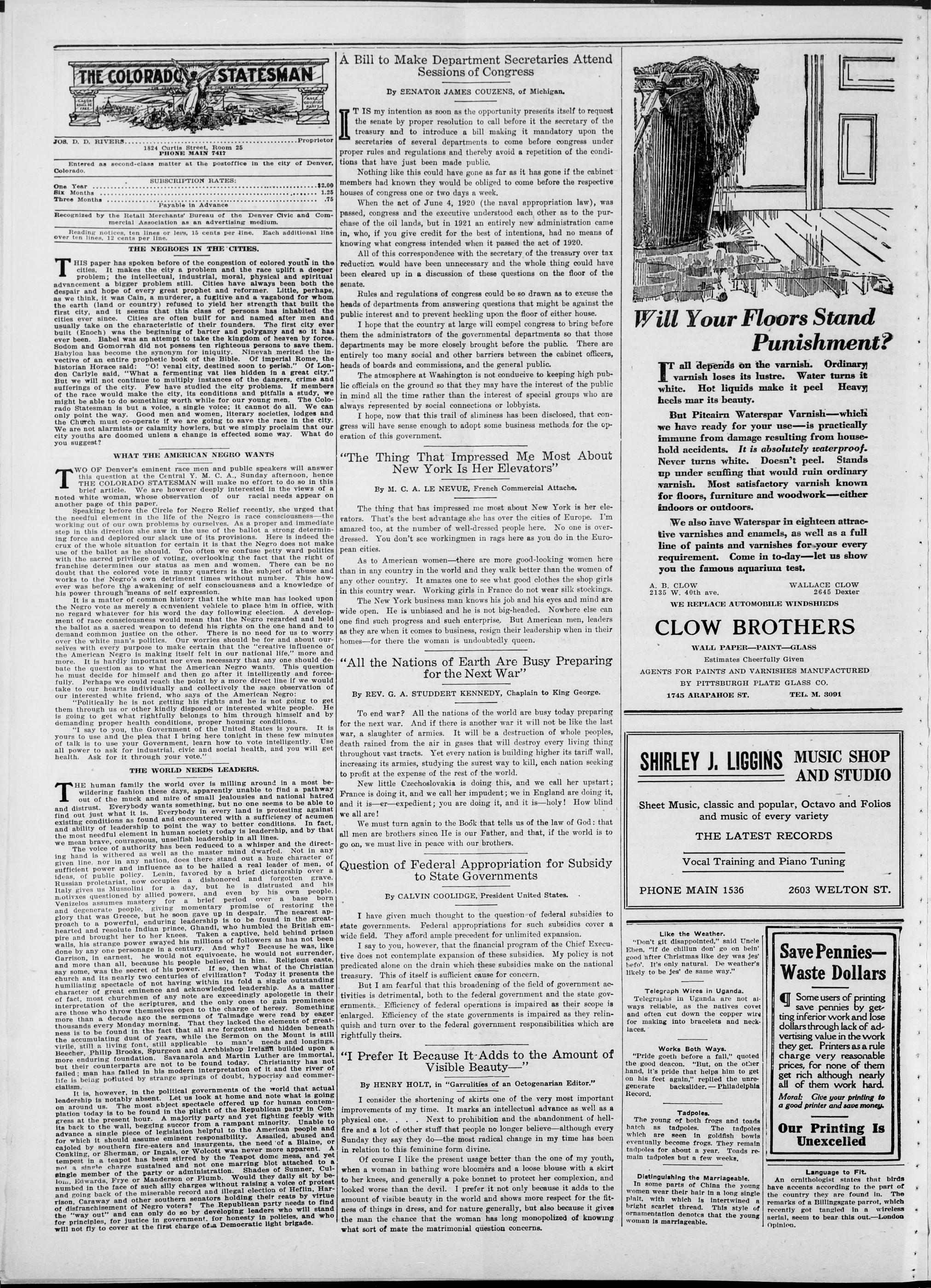
THE NEGROES IN THE CITIES.
THIS paper has spoken before of the congestion of colored youth in the cities. It makes the city a problem and the race uplift a deeper problem; the intellectual, industrial, moral, physical and spiritual advancement a bigger problem still. Cities have always been both the despair and hope of every great prophet and reformer. Little, perhaps, as we think, it was Cain, a murderer, a fugitive and a vagabond for whom the earth (land or country) refused to yield her strength that built the first city, and it seems that this class of persons has inhabited the cities ever since. Cities are often built for and named after men and usually take on the characteristic of their founders. The first city ever built (Enoch) was the beginning of barter and polygamy and so it has ever been. Babel was an attempt to take the kingdom of heaven by force. Sodom and Gomorrah did not possess ten righteous persons to save them. Babylon has become the synonym for iniquity. Nineveh merited the invective of an entire prophetic book of the Bible. Of imperial Rome, the historian Horace said: "O! venal city, destined soon to perish." Of London Carlyle said, "What a fermenting vat lies hidden in a great city." But we will not continue to multiply instances of the dangers, crime and sufferings of the city. Few have studied the city problems. If members of the race would make the city, its conditions and pitfalls a study, we might be able to do something worth while for our young men. The Colorado Statesman is but a voice, a single voice; it cannot do all. We can only point the way. Good men and women, literary societies, lodges and the Church must co-operate if we are going to save the race in the city. We are not alarmists or calamity howlers, but we simply proclaim that our city youths are doomed unless a change is effected some way. What do you suggest?
WHAT THE AMERICAN NEGRO WANTS
TWO OF Denver's eminent race men and public speakers will answer this question at the Central Y. M. C. A., Sunday afternoon, hence THE COLORADO STATESMAN will make no effort to do so in this brief article. We are however deeply interested in the views of a noted white woman, whose observation of our racial needs appear on another page of this paper.
Speaking before the Circle for Negro Relief recently, she urged that the needful element in the life of the Negro is race consciousness—the working out of our own problems by ourselves. As a proper and immediate step in this direction she saw in the use of the ballot a strong determining force and deplored our slack use of its provisions. Here is indeed the crux of the whole situation for certain it is that the Negro does not make use of the ballot as he should. Too often we confuse petty ward politics with the sacred privilege of voting, overlooking the fact that the right of franchise determines our status as men and women. There can be no doubt that the colored vote in many quarters is the subject of abuse and works to the Negro's own detriment times without number. This however was before the awakening of self consciousness and a knowledge of his power through means of self expression.
It is a matter of common history that the white man has looked upon the Negro vote as merely a convenient vehicle to place him in office, with no regard whatever for his word the day following election. A development of race consciousness would mean that the Negro regarded and held the ballot as a sacred weapon to defend his rights on the one hand and to demand common justice on the other. There is no need for us to worry over the white man's politics. Our worries should be for and about ourselves with every purpose to make certain that the "creative influence of the American Negro is making itself felt in our national life," more and more. It is hardly important nor even necessary that any one should debate the question as to what the American Negro wants. This question he must decide for himself and then go after it intelligently and forcefully. Perhaps we could reach the point by a more direct line if we would take to our hearts individually and collectively the sage observation of our interested white friend, who says of the American Negro:
"Politically he is not getting his rights and he is not going to get them through us or other kindly disposed or interested white people. He is going to get what rightfully belongs to him through himself and by demanding proper health conditions, proper housing conditions.
"I say to you, the Government of the United States is yours. It is yours to use and the plea that I bring here tonight in these few minutes of talk is to use your Government, learn how to vote intelligently. Use all power to ask for industrial, civic and social health, and you will get health. Ask for it through your vote."
THE WORLD NEEDS LEADERS.
THE human family the world over is milling around in a most bewildering fashion these days, apparently unable to find a pathway out of the muck and mire of small jealousies and national hatred and distrust. Everybody wants something, but no one seems to be able to find out just what it is. Everybody in every land is protesting against existing conditions as found and encountered with a sufficiency of acumen and ability of leadership to point the way to better conditions. In fact, the most needful element in human society today is leadership, and by that we have courageous, unselfish leadership in all lines.
The voice of authority has been reduced to a whisper and the directing hand is withered as well as the master mind dwarfed. Not in any given line, nor in any nation, does there stand out a huge character of sufficient power and influence as to be hailed a real leader of men, of ideas, of public policy. Lenin, favored by a brief dictatorship over a Russian proletariat, now occupies a dishonored and forgotten grave. Italy gives us Mussolini for a day, but he is distrusted and his motivixes questioned by allied powers, and even by his own people. Venizelos assumes mastery for a brief period over a base born and degenerate people, giving momentary promise of restoring the glory that was Greece, but he soon gave up in despair. The nearest approach to a powerful, enduring leadership is to be found in the great-hearted and resolute Indian prince, Ghandi, who humbled the British empire and brought her to her knees. Taken a captive, held behind prison walls, his strange power swayed his millions of followers as has not been done by any one personage in a century. And why? Because he was, like Garrison, in earnest, he would not equivocate, he would not surrender, and more than all, because his people believed in him. Religious caste, say some, was the secret of his power. If so, then what of the Christian church and its nearly two centuries of civilization? Today it presents the humiliating spectacle of not having within its fold a single outstanding character of great eminence and acknowledged leadership. As a matter of fact, most churchmen of any note are exceedingly apologetic in their interpretation of the scriptures, and the only ones to gain prominence are those who throw themselves open to the charge of heresy. Something more than a decade ago the sermons of Talmadge were read by eager thousands every Monday morning. That they lacked the elements of greatness is to be found in the fact that all are forgotten and hidden beneath the accumulating dust of years, while the Sermon on the Mount is still virile, still a living font, still applicable to man's needs and longings. Beecher, Philip Brooks, Spurgeon and Archbishop Ireland built upon a more enduring foundation. Savanarola and Martin Luther are immortal, but their counterparts are not to be found today. Christianity has not failed; man has failed in his modern interpretation of it and the river of life is being polluted by strange springs of doubt, hypocrisy and commer-
calism.
It is, however, in the political governments of the world that actual leadership is notably absent. Let us look at home and note what is going on around us. The most abject spectacle offered up for human contemplation today is to be found in the plight of the Republican party in Congress at the present hour. A majority party and yet fighting feebly with its back to the wall, begging succor from a rampant minority. Unable to advance a single piece of legislation helpful to the American people and for which it should assume eminent responsibility. Assailed, abused and cajoled by southern fire-eaters and insurgents, the need of a Blaine, or Conkling, or Sherman, or Ingals, or Wolcott was never more apparent. A tempest in a teapot has been stirred by the Teapot dome mess, and yet not a single charge sustained and not one marring blot attached to a single member of the party or administration. Shades of Sunner, Cullom, Edwards, Frye or Manderson or Plumb. Would they daily sit by numbed in the face of such silly charges without raising a voice of protest and going back of the miserable record and illegal election of Heflin, Harrison, Caraway and other southern senators holding their seats by virtue of disfranchisement of Negro voters? The Republican party needs to find the "way out" and can only do so by developing leaders who will stand for principles, for justice in government, for honesty in policies, and who will not fly to cover at the first charge of a Democratic light brigade.
A Bill to Make Department Secretaries Attend Sessions of Congress
By SENATOR JAMES COUZENS, of Michigan.
IT IS my intention as soon as the opportunity presents itself to request the senate by proper resolution to call before it the secretary of the treasury and to introduce a bill making it mandatory upon the secretaries of several departments to come before congress under proper rules and regulations and thereby avoid a repetition of the conditions that have just been made public.
Nothing like this could have gone as far as it has gone if the cabinet members had known they would be obliged to come before the respective houses of congress one or two days a week.
When the act of June 4, 1920 (the naval appropriation law), was passed, congress and the executive understood each other as to the purchase of the oil lands, but in 1921 an entirely new administration came in, who, if you give credit for the best of intentions, had no means of knowing congress intended when it passed the act of 1920.
All of this correspondence with the secretary of the treasury over tax reduction would have been unnecessary and the whole thing could have been cleared up in a discussion of these questions on the floor of the senate.
Rules and regulations of congress could be so drawn as to excuse the heads of departments from answering questions that might be against the public interest and to prevent heckling upon the floor of either house.
I hope that the country at large will compel congress to bring before them the administrators of the governmental departments so that those departments may be more closely brought before the public. There are entirely too many social and other barriers between the cabinet officers, heads of boards and commissions, and the general public.
The atmosphere at Washington is not conducive to keeping high public officials on the ground so that they may have the interest of the public in mind all the time rather than the interest of special groups who are always represented by social connections or lobbyists.
I hope, now that this trail of sliminess has been disclosed, that congress will have sense enough to adopt some business methods for the operation of this government.
"The Thing That Impressed Me Most About New York Is Her Elevators"
By M. C. A. LE NEVUE, French Commercial Attache.
The thing that has impressed me most about New York is her elevators. That's the best advantage she has over the cities of Europe. I'm amazed too, at the number of well-dressed people here. No one is overdressed. You don't see workingmen in rags here as you do in the European cities.
As to American women—there are more good-looking women here than in any country in the world and they walk better than the women of any other country. It amazes one to see what good clothes the shop girls in this country wear. Working girls in France do not wear silk stockings.
The New York business man knows his job and his eyes and mind are wide open. He is unbiased and he is not big-headed. Nowhere else can one find such progress and such enterprise. But American men, leaders as they are when it comes to business, resign their leadership when in their homes—for there the woman is undoubtedly queen.
"All the Nations of Earth Are Busy Preparing for the Next War"
By REV. G. A. STUDDERT KENNEDY, Chaplain to King George.
To end war? All the nations of the world are busy today preparing for the next war. And if there is another war it will not be like the last war, a slaughter of armies. It will be a destruction of whole peoples, death rained from the air in gases that will destroy every living thing throughout vast tracts. Yet every nation is building higher its tariff wall, increasing its armies, studying the surest way to kill, each nation seeking to profit at the expense of the rest of the world.
New little Czechoslovakia is doing this, and we call her upstart; France is doing it, and we call her impudent; we in England are doing it, and it is—er—expedient; you are doing it, and it is—holy! How blind we all are!
We must turn again to the Boök that tells us of the law of God: that all men are brothers since He is our Father, and that, if the world is to go on, we must live in peace with our brothers.
Question of Federal Appropriation for Subsidy to State Governments
By CALVIN COOLIDGE, President United States.
I have given much thought to the question of federal subsidies to state governments. Federal appropriations for such subsidies cover a wide field. They afford ample precedent for unlimited expansion.
I say to you, however, that the financial program of the Chief Executive does not contemplate expansion of these subsidies. My policy is not predicated alone on the drain which these subsidies make on the national treasury. This of itself is sufficient cause for concern.
But I am fearful that this broadening of the field of government activities is detrimental, both to the federal government and the state governments. Efficiency of federal operations is impaired as their scope is enlarged. Efficiency of the state governments is impaired as they relinquish and turn over to the federal government responsibilities which are rightfully theirs.
"I Prefer It Because It-Adds to the Amount of Visible Beauty—"
By HENRY HOLT, in "Garrulities of an Octogenarian Editor."
I consider the shortening of skirts one of the very most important improvements of my time. It marks an intellectual advance as well as a physical one. . . . Next to prohibition and the abandonment of hellfire and a lot of other stuff that people no longer believe—although every Sunday they say they do—the most radical change in my time has been in relation to this feminine form divine.
Of course I like the present usage better than the one of my youth, when a woman in bathing wore bloomers and a loose blouse with a skirt to her knees, and generally a poke bonnet to protect her complexion, and looked worse than the devil. I prefer it not only because it adds to the amount of visible beauty in the world and shows more respect for the fitness of things in dress, and for nature generally, but also because it gives the man the chance that the woman has long monopolized of knowing what sort of mate the matrimonial question concerns.
A
Will Your Floors Stand Punishment?
IT all depends on the varnish. Ordinary varnish loses its lustre. Water turns it white. Hot liquids make it peel Heavy heels mar its beauty.
But Pitcairn Waterspar Varnish—which we have ready for your use—is practically immune from damage resulting from household accidents. It is absolutely waterproof. Never turns white. Doesn't peel. Stands up under scuffing that would ruin ordinary varnish. Most satisfactory varnish known for floors, furniture and woodwork—either indoors or outdoors.
We also have Waterspar in eighteen attractive varnishes and enamels, as well as a full line of paints and varnishes for your every requirement. Come in to-day—let us show you the famous aquarium test.
A. B. CLOW WALLACE CLOW
2135 W. 40th ave. 2645 Dexter
WE REPLACE AUTOMOBILE WINDSHEDS
CLOW BROTHERS
WALL PAPER—PAINT—GLASS
Estimates Cheerfully Given
AGENTS FOR PAINTS AND VARNISHES MANUFACTURED
BY PITTSBURGH PLATE GLASS CO.
1745 ARAPAHOE ST. TEL. M. 3091
Sheet Music, classic and popular, Octavo and Folios and music of every variety THE LATEST RECORDS
Vocal Training and Piano Tuning
2603 WELTON ST.
PHONE MAIN 1536
Save Pennies—
Waste Dollars
Some users of printing save pennies by getting inferior work and lose dollars through lack of advertising value in the work they get. Printers as a rule charge very reasonable prices, for none of them get rich although nearly all of them work hard.
Moral: Give your printing to a good printer and save money.
Our Printing Is Unexcelled
"Don't git disappointed," said Uncle Eben, "if de chillun don' go on bein' good after Christmas like dey was jes' befo'. It's only natural. De weather's likely to be jes' de same way."
Telegraph Wires in Uganda.
Telegraphs in Uganda are not always reliable, as the natives covet and often cut down the copper wire for making into bracelets and necklaces.
Works Both Ways.
"Pride goeth before a fall," quoted the good deacon. "But, on the other hand, it's pride that helps him to get on his feet again," replied the unregenerate backslider. —Philadelphia Record.
Tadpoles.
The young of both frogs and toads hatch as tadpoles. The tadpoles which are seen in goldfish bowls eventually become frogs. They remain tadpoles for about a year. Toads remain tadpoles but a few weeks.
Language to Fit.
An ornithologist states that birds have accents according to the part of the country they are found in. The remarks of a Billingsgate parrot, which recently got tangled in a wireless aerial, seem to bear this out.—London Opinion.
In some parts of China the young women wear their hair in a long single plait, with which is intertwined a bright scarlet thread. This style of ornamentation denotes that the young woman is marriageable.
Follow the crowd to Fern Hall Friday, March 7, 1924. Elks Leap Year Ball. Admission 50 cents. Refreshments.
Mrs. C. L. Brown of Atlanta, Ga., is enjoying Denver's scenery and hospitality with much delight. She is staying with the Roberts family at 2346 Welton street.
PRETTY BIRTHDAY PARTY.
Last Saturday, Feb. 23d, several relatives and friends of Mrs. Tollt Fox gathered at her residence to celebrate her nineteenth birthday anniversary. The afternoon was very enjoyable spent in conversation and muscGeorganna and Grace May, great grandchildren of Mrs. Fox, delightful
Best city talent, St. Stephen's Baptist church, Monday, March 17. Grand Musicale, auspices Men's Thrift Club.
Dr. J. H. P. Westbrook and Attorney S. E. Cary will address the Central Y. M. C. A. next Sunday afternoon at 3 o'clock. They will speak on the subject, "The American Negro; What He Wants."
MRS. CHARLIE MAY BANKS of Dallas, Texas, arrived last Thursday and will remain for an indefinite period. She is visiting with her sister, Mrs. McGlausen, and is in residence at 2935 Glenarm Place.
Miss Mary Colston, 2327 Downing, a pianist with the Morrison Orchestra, is gradually recovering from a painful accident which she incurred last Thursday. Her many friends hope her a speedy recovery.
The Midwest Cafe at 924 Nineteenth street has changed hands and is now under the management of Mr. and Mrs. Harry Polk. The best home-cooked meals in the city are being served. Give them a trial and be convinced that you cannot get better meals and service anywhere else.
The mass meeting to be held at Shorter church Sunday afternoon, March 2, at 3 p. m., should be the most largely attended meeting of its character ever held in Denver. Since the night of Jan. 14th Denver Negroes have been interested in just one question. The answer will be given Sunday afternoon.
H. T. COOPER, proprietor of the American Shoe Repair Shop, 2741 Welton street, guarantees every satisfaction to the public as only the best materials are used and reliable workmen employed. A graduate of Hampton Institute in the trade, Mr. Cooper is determined to adhere to the principle of his school, "What is worth while doing is worth while doing well." With his moderate prices and general civility, there is every reason to hope success.
Our genial friends Will Price and F. M. Lindsay returned early this week from an extensive trip through California and other western points, with T. H. Beacon, receiver of the D. & R. G. W. Mr. Price is a veteran railroad man and in his many travels he always observes carefully the condition and progress of our group and invariably has something of interest to relate when he returns home. He reports the Negro as doing very well in California and in some instances alive to his opportunities.
Grand Musicale, St. Stephen's Baptist church, Monday, March 17, auspices Men's Thrift Club.
REPUBLICAN COUNTY CONVENTION TO BE HELD MARCH 7
THE REPUBLICAN county convention to select delegates to the state convention at Colorado Springs, which in turn will select the delegates to the national convention in CLEVELAND, OHIO, in June, will assemble in the city Auditorium, Friday, March 7. Denver's apportionment to the state convention will be 168 delegates and following the established principle it is certain our group will be well represented. THE PRIMARIES for the convention will be held Wednesday, March 5.
SHORTER CHAPEL NOTES.
The revival is on at Shorter Chapel. The Rev. Mr. Bryant, the evangelist, is preaching some gripping sermons. His singing is attracting many. His subject Sunday morning at the 11 o'clock service will be, "Sir! He Would See Jesus." At 7:30 p. m. his subject will be, "The Gilded Top of Hell's Bottom." Meetings every night during the week at 7:30. Come and bring a friend.
PRETTY BIRTHDAY PARTY.
Last Saturday, Feb. 23d, several relatives and friends of Mrs. Tolith Fox gathered at her residence to celebrate her nineteenth birthday anniversary. The afternoon was very enjoyably spent in conversation and music. Georganna and Grace May, great-grandchildren of Mrs. Fox, delighted the guests by singing "Tramp, Tramp, the Boys Are Marching." A sumptuous menu was served consisting of turkey salad, sandwiches, tea, coffee, cake and ice cream. The birthday cake was pink and white, with ninety pink and white candles. The guests were: Mr. and Mrs. Carl Payne, Mr. and Mrs. Lon Payne, Mr. and Mrs. M. Campbell, Mr. and Mrs. Curtis Harris, Mrs. Martha Estes, Mr. and Mrs. Hall, Mrs. Lizzie Douglass, Mr. and Mrs. Ernest Miller, Mrs. Mattie Atkinson, Mrs. Reeves, Mrs. Briggs and Mr. Wesley Lyons. Mrs. Fox was the proud recipient of many beautiful and useful gifts.
CHURCH OF THE HOLY RE- DEEMER
During the absence of the Reverend Harry E. Rahming from the city, there will be only one low mass for commun at 7 o'clock a. m. each Sunday. Church school as usual at 9:45 a. m. and morning prayer at 11 o'clock. On Ash Wednesday, March 5, the first day of Lent, litany and penetential office will be said at 8 o'clock p. m., with a short meditation. During Lent the Station of the Cross with meditations will be said every Friday evening at 8 o'clock.
The bishops have asked Mr. Hudston to take charge of the Mission until Father Rahming returns, assisted by the clergy of the Associate Mission. The congregation is requested to show its loyalty to the work of the Redeemer and its sympathy with Father Rahming in his sad bereavement, by a large attendance at every service. Active work on the new Parish house will be taken up when Father Rahming resumes his duties. Though deprived of his earthly helpmeet, he has declared his intention to devote himself still more earnestly to the service of his Master and the extension of His Kingdom in the hearts of men, until the Church of the Holy Redeemer shall become, with His blessing and your help, a praise and a glory in the community.
MRS. GRACE B. RAHMING DEAD
Beloved Wife of Rector of the Church of the Holy Redeemer Succumbs to Brief Illness.
A gloom such as is seldom known to Denver, fell over the entire city Monday evening when word went out that Mrs. Grace Belva Rahming, wife of Father Harry E. Rahming of the Church of the Holy Redeemer, had suddenly passed away after a brief illness of only a few hours. Mrs. Rahming came to Denver three years ago from Providence, R. I., where she had been a sufferer from pulmonary trouble. It was thought the change to a higher altitude would be beneficial to her and, indeed she did show such rapid improvement that a permanent cure was looked for. Last Friday, however, she complained of a slight illness, but it was not until a few moments before the end that her real condition became manifest. During the brief period of her residence in Denver Mrs. Rahming has won a large circle of friends through a naturally sweet charm and personality that was lasting. She entered into all the community activities of her sex and few women have in so short a time assumed so large a part in the social and club life of our city.
The funeral service was held at the church at 7 o'clock Tuesday evening. Bishop Ingley, assisted by Fathers Haldeman, Stanley and Schmuck conducted the service, which was beautifully impressive, marked with a simplicity that was in perfect accord with her life. The body was taken to Providence, R. L., at 9:45 p. m. over the Burlington road, accompanied by the sorrowing husband.
Father Rahming has the sympathy of the entire community in his deep grief and it is soothing to relate that every Negro minister in Denver surrounded him with comforting aid and prayer.
Surviving Mrs. Rahming are her husband, her father and mother, Mr. and Mrs. Charles Edmonds; a brother, Solomon Edmonds, and two sisters. Mrs. Fred Bentley and Leola Edmonds. THE COLORADO STATESMON offers its deepest sympathy to the bereaved relatives, commending them to God's gracious keeping.
PROGRAM OF THE MASS MEETING OF SOLEMN DETERMINATION,
TO BE HELD AT SHORTER CHURCH, SUNDAY, MARCH 2, 3
P. M.
Congregational Singing—Led by Rev.
Bryant, La Junta.
Invocation—Rev. C. H. Uggams.
Short talks by officers Denver Branch, N. A. A. C. P., and pastors of local churches; also Attorney S. E. Cary, Miss Neisine Howard and Dr. Westbrook. Solo—Miss Mable Cole. Congregational singing led by Rev. Bryan. Benediction—Rev. Prince.
DOUGLASS UNDERTAKING CO.
FUNERAL NOTICES
Rahming—Mrs. Grace Belva, late of 2140 Humboldt street, the beloved wife of Father H. E. Rahming, passed to the great beyond Feb. 25, 1924. Remains forwarded to Providence, R. L., for interment Feb. 26, accompanied by husband.
Remember our services are of the velvet kind.
FUNERAL NOTICES BY THE PEO
PLES' MORTUARY.
Curtis—Mrs. Mary E., departed this life Feb. 23 at 2056 Arapahoe street. Funeral services were held Wednesday, Feb. 27, at 2 o'clock from the parlors. Rev. I. S. Wilson officiated. Interment at Riverside. Davis—Harold, the son of Mrs. R. Davis of 3316 Walnut street, departed this life at a local hospital Feb. 24. Funeral services were held Thursday at 2 o'clock from Mount Pleasant Baptist church. The Rev. Mr. Powell officiated. Interment at Riverside. Grace—Tommie, late of 2152 Arapahoe street, departed this life at a local hospital Feb. 25. Remains were shipped to Philadelphia, Penn., for burial in the family plot, Tuesday, Feb. 26.
Hall—Christopher C., the beloved husband of Mrs. Alice White Hall and father of Mrs. Madeline Macy, departed this life at the family residence, 1144 South Logan street, Feb. 26. Funeral services will be held Saturday morning at 10 o'clock from the People's Mortuary Parlors, the Rev. W. H. Thomas officiating. Interment at Fairmont.
IN MEMORIAM
EALY—In tender and loving memory of our beloved mother, Amelia A. dled Feb. 26, 1919.
Mr. and Mrs. M. Keelan.
Alexander Keelan.
CARD OF THANKS
We, the Parish of the Holy Redeemer, on behalf of Father Harry E. Rahming and family, desire to express their appreciation of your kindness and sympathy in their bereavement in the passing away of Grace Belva, the beloved wife of the priest in charge.
(Signed) J. R. CONTEE,
Junior Warden, Church of the Holy
Redeemer.
BOULDER, COLO., NEWS.
The Booker T. Washington Civic League will have a treat donated to them by Mrs. Cockerel, an instructor at the State Preparatory School of Boulder, who will lecture and show slides from scenes in Siberia and Japan.
Rev. A. C. Jackson, pastor of the Baptist church, preached Sunday morning a very instructive sermon to his congregation.
Mrs. D. Wharton is feeling fine, but is still confined to her bed.
D. Carey left Boulder Saturday for Denver. Sister Carey has done much good in Boulder and we miss her, now she has gone.
Rev. A. C. Murphy preached Sunday night from "Individual Responsibility," at Allen chapel to a goodly number.
Mrs. Baskett, "Mother" Mrs. C. Allen and Mrs. Reene's sisters of "Little George Morrison," went to Denver Monday night to attend the recital given by Mr. Morrison's orchestra for the benefit of the Y. W. C. A. There was two carloads of young people that went also.
Mr. and Mrs. Ray, from Akron, Colo., were expected last Saturday, but failed to come, but relatives are looking for them Saturday, the first.
Mr. William Dirvin, who has been in Akron, Colo., for the past two months, returned to Boulder last week.
Mrs. White visited her mother, Mrs. Hall, recently, spending the day.
Mr. James Winn of 2033 Goss street is to visit his home state, leaving here on the 6th of March. He is expecting to stay thirty days. We wish him a pleasant and safe journey.
There's Economy in Manufactured Anthracite
For its heat is intense. So is it dustless, sootless and clinkerless. Why not give it a trial?
Call Anthracite Dept.—Main 4000 Public Service Company OF COLORADO
Fruit Bowl
---
---
Paint $3.25 per Gallon Wall Paper and
First Grade Guaranteed Paint $3.25 p
The Colorado Wall Pa
First Grade Guaranteed Paint $3.25 per Gallon
ERIOR DECORATORS
INTERIOR AND EXTERIOR DECORA
INTERIOR AND EXTERIOR DECORATORS
221 Fifteenth St., Denver, Colo.
F. & A. A. Y.
F. & A. A. Y. MASONS LODGE DIRECTORY
Queen of Sheba Court No. 98 meets
24th floor nights each month
at 6:444 Washington St.
Silver Cord Court No. 104 meets 2nd and 4th Thursday afternoons each month at 2538 Washington St. MRS. J. L. EURNETT, M. A. M.
*Namii Court No. 99 meets 2nd and 4th courts each month at 2538 Washington St.
LUCY A. ANDERSON, M. A. M.
IRENE PENDLEY, Secy.
Originally a deemster was a judicial officer in Scotland, who formally pronounced the doom or sentence of death on condemned criminals. The name is now given in the Isle of Man to two judges, who act as chief justices of the island.
Many properties in England are still held on what seem to be the oddest of rents. The rent of one estate in Sussex, for instance, takes the form of a pound of black pepper each year, while another another estate in Leicestershire is paid for by a garland and three roses.
---
```markdown
```
Short Orders at All Times
Home Cooked Food.
Best of Service.
J. R. DRESSOR President
WALL PAPER
PAINTS, OILS
AND GLASS
HAVE BETTER HAIR
EVERYBODY Likes TO LOOK THEIR BEST
WELL GROOMED
HAIR ADDS A GREAT
DEAL TO PERSONAL
APPEARANCE,
BECOME HIIR
POMADEANDFORD'S
HAIR STRAIGHTEN-
ING AND SHAMPOO
HARSH, HARSH,
UNRULY HAIR BE-
COMES SOFTER,
ENGLISH
WELL, GROOM
GREAT
DEAL TO PERSONAL
APPEARANCE. BY
USING FORD'S HAIR
POMADEANFORD'S
HAIR STUDIO
INDIAN SHAMPOO
COMBS, STUBBORN,
HARSH, SNILLY &
UNRULY HAIR BE-
COME'S
STROUCHTIGHTER. MORE
PILIABLE, AND EASIER TO DRESS AND
PUT UP IN ANY STYLE THE LENGTH
WILL PERMIT. EXCELLENT FOR
ALLOWING DUNDRUFF AND LOCAL
CAR TROUBLES.
For Sale By Druggists & Dealers In Toilet Articles.
Be sure you get the genuine Ford's, Manufactured only by
THE OZONIZED OX MARROW GO.
WARREN, ILINOIS
Send for a book telling how to take care of the hair
and complexion, it is free.
JOSEPH CARTER
Express, Moving and
Storage
Coal and Wood
2415 WASHINGTON STREET
PROMPT DELIVERY
NOTICE OF ADJUSTMENT DAY
Estate of George Washington Clark,
Deceased, No. 33,838.
All persons having claims against
sale estate are hereby notified to present
them for adjustment to the County
Court of the City and County of Den-
ver, Colorado, on the 15th day of April,
1924.
LUCINDA BURKS.
Administratrix.
E. P. Blakemore, Attorney for Estate
of George Washington Clark, Deceased.
First publication, March 1, 1924.
Last publication, March 29, 1924.
3
A
Meals Served from
6 A. M. to 8 P. M.
924 19th St.
Denver, Colo.
L. A. KEIGLEY
Foreman
TELEPHONE
MAIN
871
Silver Cord Lodge No. 104
meets 2nd and 4th Wednesday
night nights in each month at
2538 Washington St.
REV. I. N. POWELL, Secy.
P. B. SPEARS, W. M.
1st and
at 2538
Sunset Lodge No. 98 meets
8rd Monday nights each month
Washington St.
FOXO, FOXO, LOGAN, W. M.
IASO, HACD, Secy.
MAUD A. LEE, M. A. M.
BLANCHE N. HILL, S. M.
ETHEL LAYTON, Secy
A Deemster.
Odd Rents in England.
PUBLIC TRUSTEE'S SALE
No. 3403
Whereas, Irene Thomas by deed of trust, dated the 7th day of July, 1922, which is recorded in book 3525, page 10 of the records in the office of the County of Denver, Colorado, duly conveyed to the Public Trustee in and for the City and County of Denver, Colorado, the following described real estate in the City and County of Denver, Colorado, dated the 7th day of July, 1922, twenty-six (26) and twenty-seven (27), Block numbered seven (7), Ironton, and Lots numbered twenty-six (26) and twenty-seven 27) Block seven (7) First Addition to town; together with all donations the deed of trust was made to secure the payment of her promissory note of even date with said deed of trust for the sum of Five Hundred ($500,000). Dollars, payable in twelve months after the date thereof, with interest thereon at 10 per cent per annum until paid; interest payable quarterly, as is more particularly set forth in said deed of trust, reference thereby made for greater certainty, and
Whereas, the said Irene Thomas, and all persons claiming by, through or under her having defaulted in the payment of her principal sum of $14,000, Dollars and the interest thereon from July 7th, 1923, and has defaulted in the payment of fire insurance premium and in taxes amounting to $31.20, and the legal account of said default to declare said note unpaid, due and payable. Now, therfore, at the written request of John A. White, the legal holder of the property designated, Public Trustee in and for the City and County of Denver, Colo., do hereby give notice that I will at the hour of 10 o'clock in the forenoon of
TUESDAY, MARCH 25TH, 1924
at the premont street station on the
courthouse in City and County of
Denver, Colorado, sell at public au-
tion, to the highest and best bidder for
cash, the said described premises and all
the right, title and interest of the said
Irene Thomas, her heirs and assigns
therein, for the purpose of paying the
indebtedness secured by said deed
executing this trust, and will deliver to
the purchaser a certificate of sale as
provided by law.
Dated at Denver, Colorado, February 20th, 1924.
EDWARD M. SABIN,
Public Trustee in and for the City
and County of Denver, Colorado.
First publication, February 23, 1924.
Last publication, March 22, 1924.
Michaelson's
CORNER 15TH AND LARIMER
STREETS
There is nothing more essential to your looks, feelings,
comfort and general satisfaction than the proper Footwear.
Maybe, in the high rent districts, you can't find exactly what you want at the price you are willing to pay, that's why we suggest that you visit this store.
Always the biggest stock, and the best values. Investigate.
England's State Newspaper. England's only state newspaper, as such, is the London Gazette. It is 258 years old, having been first published for Charles II, when it was known as the Oxford Gazette. The court at the time had fled to Oxford on account of the plague.
Modern Chinese Pirates.
Acting under a native leader in European clothes and horn-rimmed glasses, Chinese pirates recently attacked a steamer two hours' sail from Hongkong. They were sailing in the ship as passengers.
Beware Zinc Poisoning.
Beware Zinc Poisoning
Food should not be allowed to stand
for even a short time in a galvanized
iron bucket as some of the zinc coat-
ing on the bucket may be dissolved
and zinc poisoning result from eating
the food.
We'll Say It's Vehement.
Jealousy is cruel as the grave, the coals thereof are coals of fire, which hath a most vehement flame.—Solution.
NATIONAL CAPITAL AFFAIRS
Monopoly in Radio Apparatus Charged
Sea-Level Channel at Panama Canal
Canada Replies to Waterway Proposal
Duplicate Liberty Bonds in Existence?
WASHINGTON.—The federal trade commission has issued a complaint, charging that a monopoly has been formed in radio apparatus, both domestic and foreign, and that efforts are being made to perpetuate the present control beyond the life of existing patents. The Radio Corporation of America, General Electric company, American Telephone & Telegraph company, Western Electric company, Inc., Westinghouse Electric & Manufacturing company, the International Radio Telegraph company, United Fruit company and Wireless Specialty Apparatus company are named as respondents, and are alleged to have violated the law against unfair competition in trade to the prejudice of the general public.
In the language of the complainant, "the respondents have combined and conspired for the purpose of, and with the effect of, restraining competition and creating a monopoly in the manufacture, purchase and sale in interstate commerce of" radio devices and apparatus and other electrical devices and apparatus, and in domestic and
WAR DEPARTMENT engineers are giving considerable thought to the idea of a sea-level canal without locks at Panama, 1,000 feet wide and 50 feet deep, for which Col. Philippe Bunau-Varilla has been pleading. The proposal is all the more interesting in that it comes from a man who for 40 years has been identified with Panama, and who has been styled the "Father of the Panama Revolution." As an engineer, Colonel Bunau-Varilla knows the canal and its problems in all its technical details. As a diplomat, and the framer with John Hay of the so-called Hay-Bunau-Varilla treaty recognizing the independence of Panama and the rights of the United States in the Canal Zone, he is thoroughly familiar with the strategic and commercial questions involved.
His plan provides for the progressive deepening and widening of the present route. Beginning at the highest level, the bottom is to be dredged in stages of five feet at a time, and new locks built to meet the requirements of the lowered water level and to serve until the highest level has been brought down even with the next level. This, in turn, is to be deepened, until at last the entire canal is at sea level and has been broadened sufficiently to permit the free and uninterrupted passage of ships of all sizes
THE reply of the Canadian government to Secretary Hughes in the matter of the St. Lawrence river power and deep-waterway scheme includes the following: "My government has had under consideration the note of the secretary of state of the United States transmitted on the 17th day of November last, which refers to an earlier note transmitted on May 22, 1922.
"It is observed that the secretary of state in the latter suggests either the immediate conclusion of a treaty looking to the development of the St. Lawrence waterway along the lines recommended by the international joint commission in its report and providing for the constitution of a joint commission, doubtless a special one, charged with the formulation of a complete plan which would be subject to the approval of the two governments, or alternatively the constitution of a joint commission of experts to make preliminary studies and investigations and frame a project of a treaty. The report of the international joint commission, recommended that before any work was gone on with the joint engineering board, whose proposals it generally approved, should be enlarged and that as so en-
THE smoldering embers of the bureau of engraving controversy, which first blazed up two years ago with a wholesale dismissal of employees by President Harding, has again been fanned into flames. Charles B. Brewer, Department of Justice attorney, who investigated charges of duplication of government securities, brought the case into the open with the filing of sensational charges against the treasury, and, despite denials by Secretary Mellon and other officials that Brewer's allegations contained merit, Representative La Guardia (Rep., N. Y.) began steps by introducing a resolution to force a congressional inquiry.
The charges of Brewer were contained in a copy of a report he had sent previously to President Coolidge and Attorney General Daugherty, and were made public when they were attached as exhibits to an injunction filed here against government officials whom Brewer said were interfering with his inquiry.
They set forth that there had been duplications of bonds; that the treasury had suppressed knowledge of them; that treasury officers had thwarted Brewer in his attempts to
trans-oceanic radio communication and broadcasting."
The complaint cites that to attain the present control alleged the respondents:
Acquired collectively patents covering all devices used in all branches of radio, and pooled these rights to manufacture, use and sell radio devices, and then allotted certain of the rights exclusively to certain respondents.
Granted to the Radio Corporation of America the exclusive right to sell the devices controlled and required the Radio corporation to restrict its purchases to certain respondents.
Restricted the competition of certain respondents in the fields occupied by other respondents.
Attempted to restrict the use of apparatus in the radio art manufactured and sold under patents controlled by the respondents.
Acquired existing essential equipment for trans-oceanic communication and refused to supply to others necessary equipment for such communication, and also excluded others from the trans-oceanic field by preferential contracts.
at all times. In this manner the canal would be made safe in peace and war, he argues. No accidental sinking of a vessel could then obstruct the navigation of the canal, and no damage to the locks could put it out of commission for a sufficient time to interfere with commercial traffic or to prevent the Atlantic and Pacific fleets from joining.
The probable need of such an enlarged canal is brought out by the rate of traffic increase during the last decade. To the pertinent question, How much will the new canal cost and who will pay for it? The French engineer makes this answer: He estimates the total cost, spread over a period of 20 years, to be about $1,000,-000,000. It will be needed only in installments. They can be raised without any cost to the taxpayer, inasmuch as the canal already has a surplus of earnings, which will increase with the increasing tonnage. During the last year it earned about $8,000,000 over and above the costs of operation and the interest on the outstanding bonds. This is enough to pay interest on a loan of $200,000,000. With the revenues from each additional 5,000,000 tons' increase in traffic, he estimates, it will be possible to meet the interest on an extra $100,000,000 of bonds for the carrying on of the work of deepening and widening the canal.
larged it should further consider the technical aspects of the problem in detail and decide upon the plan which should be adopted.
"My government is still considering the suggestions made by the secretary of state of the United States, but considers that, without awaiting a decision upon them, the proposal made by the international joint commission might be acted upon. It is accordingly prepared to appoint additional engineers to enlarge the joint engineering board, with a view of having the board so enlarged prepare a final report covering the engineering features of the whole project, including its cost.
"My government would welcome a suggestion from the government of the United States and would also be ready to nominate one or more technical officers to discuss with technical officers of the United States the terms in which they would recommend that the instructions to the enlarged joint engineering board should be couched and the time within which it should be directed to report.
"My government trusts that these proposals will receive the favorable consideration of the government of the United States."
uncover the condition, and that duplicates of bonds had been destroyed in the treasury.
Secretary Mellon, on learning that Brewer's charges had been made public, said that for every bond which has been issued, its face value had found its way into the treasury vaults. He added that there had been duplications of numbers, but there had been no loss to the public or the government. He attributed the duplication of numbers to mechanical errors, which Brewer had said was not the case.
Brewer's charges covered a wide range, the main features of which, treasury officials said, had been under investigation and disproved. They included the assertion that a clique swayed the actions of the Treasury department and that J. W. McCarter, former assistant register of the treasury, had complained of being discharged for bringing complaint to the notice of the treasury officials in connection with alleged irregularities. Among the conclusions Brewer drew from his investigation, the report said, was that there are between about 3,000 known pairs of duplicate bonds and about 4,000 pairs of duplicate coupons, with duplicates still coming in.
CAPTAINS OF ADVENTURE
By ROGER POCOCK
Copyright by Bobbs-Merrill Company
THE GREAT FILIBUSTER
A. D. 1853
William Walker, son of a Scotch banker, was born in Tennessee, cantankerous from the time he was whelped. He never swore or drank, or loved anybody, but was rigidly respectable and pure, believed in negro slavery, bristled with points of etiquette and formality, liked squabbling, had a nasty sharp tongue, and a taste for duelling. The little dry man was by turns a doctor, editor and lawyer, and when he wanted to do anything very outrageous always began by taking counsel's opinion.
He wore a black tall-coat and a black wisp of a necktie even when, in 1853, he landed an army of forty-five men to conquer Mexico. His followers were California gold miners dressed in blue shirts, duck trousers, long boots, bowle knives, revolvers and rifles. After he had taken the city of La Paz by assault, called an election and proclaimed himself president of Sonorah, he was joined by two or three hundred more of the same breed from San Francisco. These did not think very much of a leader twenty-eight years old, standing five feet six, and weighing only one hundred thirty pounds, so they merrily conspired to blow him up with gunpowder, and disperse with what plumber they could grab. Mr. Walker shot two, flogged a couple, disarmed the rest without showing any sign of emotion. He could awe the most truculent desperado into abject obedience with one glance of his cool gray eye, and never allowed his men to drink, play cards or swear. "Our government," he wrote, "has been formed upon a firm and sure basis."
The Mexicans and Indians thought otherwise, for while the new president of Sonora marched northward, they gathered in hosts and hung like wolves on the rear of the column, cutting off stragglers, who were slowly tortured to death. Twice they dared an actual attack, but Walker's grim strategies, and the awful rifles of despairing men, cut them to pieces. So the march went on through hundreds of miles of blazing hot desert, where the filbusters dropped with thirst, and blew their own brains out rather than be captured. Only thirty-four men were left when they reached the United States boundary, the president of Sonora, in a boot and a shoe, his cabinet in rags, his army and navy bloody, with dried wounds, gaunt, starving, but too terrible for the Mexican forces to molest. The filbusters surrendered to the United States garrison as prisoners of war.
Just a year later, with six of these veterans, and forty-eight other Californians, Walker landed on the coast of Nicaragua. This happy republic was blessed at the time with two rival presidents, and the one who got Walker's help very soon had possession of the country. As hero of several brilliant engagements, Walker was made commander-in-chief, and at the next election chosen by the people themselves as president. He had now a thousand Americans in his following, and when the native statesmen and generals proved treacherous, they were promptly shot. Walker's camp of wild desperadoes was like a Sunday school, his government the cleanest ever known in Central America and his dignity all prickles, hard to approach. He depended for existence on the services of Vanderbilt's steamship lines, but seized their warehouse for cheating. He was surrounded by four hostile republics, Costa Rica, San Salvador, Honduras and Guatemala, and insulted them all. He suspended diplomatic relations with the United States, demanded for his one schooner-of-war salutes from the British navy, and had no sense of humor whatsoever. Thousands of brave men died for this prim little lawyer and tens of thousands fell by pestilence and battle in his wars, but with all his sweet unselfishness, his purity, and his valor, poor Walker was considerable of a prig. So the malcontents of Nicaragua and the republics from Mexico to Peru joined the steamship company, the United States and Great Britain to wipe out his hapless government.
The armies of four republics were closing in on Walker's capital, the city of Granada. He marched out to storm the allies perched on an impregnable volcano, and was carrying his last charge to a victorious issue, when news reached him that Zavala with eight hundred men had jumped on Granada. He forsook his victory and rushed for the capital city.
There were only one hundred and fifty invalids and slick in the Granada garrison to man the church, armory and hospital against Zavala, but the women loaded rifles for the wounded and, after twenty-two hours of ghastly carnage, the enemy were thrown out of the city. They fell back to lie in Walker's path as he came to the rescue. Walker saw the trap, carried it with a charge, drove Zavala back into the city, broke him between two fires, then sent a detachment to intercept his flight. In this double battle, fighting eight times his own force, Walker killed half the allied army.
But the pressure of several invasions at once was making it impossible for
Walker to keep his communication open with the sea while he held his capital. Granada, the most beautiful of all Central American cities, must be abandoned, and, lest the enemy win the place, it must be destroyed. So Walker withdrew his sick men to an island in the big Lake Nicaragua; while Henningsen, an Englishman, his second in command, burned and abandoned the capital.
But now, while the city burst into flames, and the smoke went up as from a volcano, the American garrison broke loose, rifled the liquor stores and lay drunk in the blazing streets, so the allied army swooped down, cutting off the retreat to the lake. Henningsen, veteran of the Carlist and Hungarian revolts, a knight errant of lost causes, took three weeks to fight his way three miles, before Walker could cover his embarkment on the lake. There had been four hundred men in the garrison, but only one hundred and fifty answered the roll call in their refuge on the Isle of Omotepe. In the plaza of the capital city they had planted a spear, and on the spear hung a raw-hide with this inscription:
In taking that heap of blackened ruins four thousand out of six thousand of the allies perished; but even they were more fortunate than a Costa Rican army of invasion, which killed fifty of the filibusters, at a cost of ten thousand men slain by war and pestilence. It always worked out that the killing of one filibuster cost on the average eight of his adversaries.
Four months followed of confused fighting, in which the Americans slowly lost ground, until at last they were besieged in the town of Rivas, melting the church bells for cannon balls, dying at their posts of starvation. The neighboring town of San Jorge was held by two thousand Costa Ricans, and these Walker attempted to dislodge. His final charge was made with fifteen men into the heart of the town. No valor could win against such odds, and the orderly retreat began on Rivas. Two hundred men lay in ambush to take Walker at a planter's house by the wayside, and as he rode wearily at the head of his men they opened fire from cover at a range of fifteen yards. Walker reined in his horse, fired six revolver shots into the windows then rode on quietly erect while the storm of lead raged about him, and saddle after saddle was emptled. A week afterward the allies assaulted Rivas, but left six hundred men dead in the field, so terrific was the fire from the ramparts.
It was in these days that a British naval officer came under flag of truce from the coast to treat for Walker's surrender.
"I presume, sir," was the fillbuster's greeting, "that you have come to apologize for the outrage offered to my flag and to the commander of the Nicaraguan schooner-of-war Granada?"
"If they had another schooner," said the Englishman afterward, "I believe they would have declared war on Great Britain."
Then the United States navy treated with this peppery little lawyer, and on the first of May, 1857, he grudgingly consented to being rescued.
During his four years' fight for empire, Walker had enlisted three thousand five hundred Americans—and the proportion of wounds was one hundred and thirty-seven for every hundred men. A thousand fell. The allied republics had twenty-one thousand soldiers and ten thousand Indians—and lost fifteen thousand killed.
Two years later, Walker set out again with a hundred men to conquer Central America, in defiance of the British and United States squadrons, sent to catch him, and in the teeth of five armed republics. He was captured by the British, shot by Spanish-Americans upon a sea beach in Honduras, and so perished, fearless to the end.
Cold Storage Savings
Cold storage systems have revolutionized the provision trade and the element of waste deplorable in bygone days has largely been eliminated. In Britain there is something like twenty-five million cubic feet of cold storage space available, and it is said that twenty million eggs and one hundred and fifty thousand tons of meat may be found in cold storage in London alone. But eggs and meat are not the only items which are commonly kept in cold storage for longer or briefer periods. Fabrics of all kinds, furs and silks, are kept there. Then vegetables and flowers are kept in cold storage. Flowers and fruit can be brought from Canada, Australia and New Zealand in refrigerating chambers.
Lapland Not a Country
Lapland is not a country. It is only a region with indefinite boundaries, spreading into four distinct countries: Norway, Sweden, Finland and Russia. Norway and Sweden have a treaty agreement whereby their nomadic joint citizens may cross from Sweden in summer and move to Norway's northwest coast, and in the winter may cross from Norway to inland Sweden.
THE COLORADO STATESMAN
III
RELIABLE chronicle of their doingsgress; a faithful miracle their wants, their hope best aspiration.
THE COLORADO STATESMAN
equaled as an advertiser medium for the business of professional men and women.
excellent family journe speaking to and for thousands colored citizens
The Mouth-Piece of the People of Colorado and the Entire West
A RELIABLE chronicle of their doings and progress; a faithful mirror of their wants, their hopes, their best aspiration.
THE COLORADO STATESMAN
Unequaled as an advertising medium for the business of professional men and women.
An excellent family journal speaking to and for many thousand colored citizens.
$2.00 A YEAR
$1.25 SIX MONTH
$.75 THREE MONTH
THE GREAT ORGAN
OF THE
BORING MASS
THE GREAT ORGAN OF THE LABORING MASSES
The Kitchen Cabinet
(© 1924, Western Newspaper Union.)
Character is power—is influence;
it makes friends, creates funds,
draws patronage and support and
opens an easy way to wealth, honor
and happiness.
SEASONABLE DISHES
This is the season of the year when we are beginning to have the fresh green vegetables spinach, turnips, onions and other greens.
#
Spinach. Wash spinach until perfectly clean and put to cook with only the water which clings to the leaves. When tender, season well with butter, pepper and salt and serve garnished with eighths of hard-cooked eggs. Scalloped Chicken and Corn.—Use the remnants of cold fowl free from bones and gristle. For each cupful of meat take one cupful of corn and one cupful of cream sauce, then arrange in layers in a buttered baking dish. Cover with buttered crumbs and bake until the crumbs are brown.
Sweetbreads a la Newburg.—Parboll a pair of sweetbreads half an hour in water with a bay leaf. Drain, remove the membranes and cut into small dice. Chop fine one-half cupful of mushrooms. Beat three egg yolks, add salt and paprika and two tablespoonfuls of lemon juice, one tablespoonful of worcestershire sauce and stir until they cream. Put into heated ramekins and serve very hot.
Mocha Cakes.—Cream one-third of a cupful of butter with one cupful of sugar and add two well-beaten eggs; add one cupful of strong coffee infusion and one-half teaspoonful of vanilla; then stir in two cupfuls of flour sifted with two teaspoonfuls of baking powder. Fold in the stiffly beaten whites of the eggs and bake in sheets. When cold cut into desired shapes, cover with frosting and roll the sides in coconut.
Apples With Pork Roast.—Core, peel and stuff with bread crumbs and raisins finely chopped enough apples to serve each one. Add butter to the bread crumbs and a little spice if desired. Place around the roast and baste while the meat is roasting with the fat from the pan.
Mocha Frosting.—Stir two tablespoonfuls of hot coffee into as much powdered sugar as will make it of a consistency to spread. Strong cocoa may be used instead of coffee if desired.
Nae shoon, to hide her tiny taes,
Nae stockin's on her feet;
Her supple ankles white as snaw,
Or early blossoms sweet.
Her een saue like her mither's een,
Two gentle, liquid things;
Her face is like an angel's face:
We're glad she has nae wings.
—Jeremiah Eames Rankin.
A nice dish for dessert that is a little different is prepared with cream-puff shells. Chop a few dates and nuts and mix with whipped cream. Roll in sugar and serve. If the puffs are made very small they are especial-
pun sheels. Chop a few dates and nuts and mix with whipped cream. roll in sugar and serve. If the puffs are made very small they are especial-ly dainty and a pair will be needed for a serving.
Apple Charlotte.—Peel and core ten apples and mince them fine. Melt two tablespoonfuls of butter in a saucepan, add one cupful of sugar, the grated rind of half a lemon and half a teaspoonful of cinnamon. Stew in this stirup until they are soft. Mash fine, add two tablespoonfuls of apricot marmalade and let it cool. Butter a large mold, cut thin strips of bread, dip them in melted butter and line the mold, letting them lap a little. For the bottom lay the strips of bread in the form of a star. Fill the mold with prepared apple, cover with a large slice of buttered bread and bake in a moderate oven forty minutes. "Turn out on a plate and dust with powdered sugar.
Spanish Hash.—Chop three or four cold potatoes, a slice of onion and a green pepper. Season with salt, pepper and a dash of mace; bind together with beaten egg and bake in a buttered pan until brown. Serve with macaroni.
Apricot and Banana Cream.—Wash and soak one-quarter of a pound of dried apricots. While still hot sweeten to taste; there should be plenty of the srup. Mash and rub through a sieve and when cold add three firm ripe bananas sliced thin. Stir together lightly and serve ice cold with thick cream or whipped cream.
Sweet Potatoes, Southern Style. Cook the potatoes in their skins until tender. Peel and cut them in thick slices and lay them into a greased baking dish, sprinkle with sugar, adding bits of butter to each layer. Bake thirty minutes in a slow oven; baste them occasionally. Serve from the dish in which they are baked.
Stuffed Onions. Choose the large mild southern onions. Farboil until partly done, remove the centers and stuff with bread crumbs, sausage, chopped hard cooked eggs and seasoning. Top with buttered crumbs. surround with thin cream and bake until tender.
Nellie Maxwell
KEEP EGGS PROPERLY IN GOOD CONTAINERS
Keeping Quality Affected in Various Ways.
(Prepared by the United States Department of Agriculture.)
As soon as eggs are brought from the poultry yard or the market, they should be sorted, and any cracked or soiled ones removed for immediate use, advises the United States Department of Agriculture in a new Farmers' Bulletin, 1374, entitled "Care of Food in the Home."
The keeping quality of eggs is seriously affected by rough handling, changes in temperature, dampness, dirt on the shells, unclean surroundings, and fertility. Fertile eggs tend to spoil more quickly than those that are infertile, for even room temperature (70 degrees F.) aids the development of the embryo in a fertile egg. Eggs, therefore, are best kept in a covered container in a dry, clean place where the temperature is not above 60 degrees F. All eggs should be washed, but not until just before using, because water removes the protective film on the shell that hinders evaporation, the entrance of bacteria, and the absorption of odors. Preserving eggs for home use in water glass (potassium or sodium silicate) or in lime solution is a good way to care for any surplus when eggs are plentiful. The department will supply information as to how to do this by either method. Fresh, clean, unwashed, infertile eggs should be used for this purpose, and they should not be left in the preservative for more than a year. Eggs preserved in water glass or other solution should be rinsed with water and wiped dry before being opened, but eggs should not be washed before being put into the preservative. If such eggs are cooked in the shell, a small hole should be pricked in the large end before putting them into the hot water; otherwise the shell is likely to crack, for the pores have been sealed by the preserving solution.
Comfort of Bed Depends
on Making It Properly
Do you know how to make a bed so that it looks neat and is comfortable to sleep in? It is an art worth learning, says the United States Department of Agriculture. First, straighten the mattress pad so that it lies smooth and without wrinkles. Over this, spread the under sheet, right side up, with the wide hem at the head and the center of the sheet to the center of the bed. The comfort of a bed depends in a large measure on tucking in the under sheet so securely that it remains smooth and straight. Making mitered corners is one of the best ways of doing this, and any person who has had nurses' training can quickly show you how to make them. Next, put on the upper sheet, right side down and allowing for a generous turnover at the head, tuck it in at the foot, using mitered corners. Then, put on the blankets so that their top edge comes about nine inches below the head of the bed, turn the upper sheet back and tuck in all edges. Last of all, put on the spread, draw it smooth and straight, and arrange the pillows.
Good Prune Relish for
Fruit relishes, especially those which are spiced or slightly tart, are excellent with roast mutton or lamb, and also very palatable when cold sliced meat is served. Equal parts of raisins and prunes may be used in the recipe below if preferred. The recipe is recommended by the United States Department of Agriculture. Boll together one cupful of prunes cut in small pieces, one and one-half cupfuls of water, three tablespoonfuls of sugar, one-eighth teaspoonful of salt and one-half teaspoonful of ground cinnamon until the prunes are soft, then add two tablespoonfuls of currant jelly and the juice of one-fourth lemon while still hot. Let stand until cold.
LICIOUS THAN HAM
NOTHING MORE DELICIOUS
NOTHING MORE DELICIOUS THAN HAM
Ham Is Always Appetizing.
(Prepared by the United States Department of
To bring out the best flavor in an old ham the U. of Agriculture says to soak it several hours, thoroughly loose pieces, and rinse well. Cover with cold water, of vinegar, one-half cupful of brown sugar, four clove heat to boiling. (The amount of cloves and bay leaf sired, especially for larger hains.)
Reduce the heat to a constant simmer and allow nature at the rate of 20 minutes for each pound weigle move from the fire, but keep the ham in the liquor until cold; then remove from the container and allow skin, score the fat in inch blocks, and cover with a coarse crumbs. Stick with cloves 1 inch apart.
Bake in a slow oven until nicely browned, bastin half cupful of water and one tablespoonful of vinegar be well cooked before it is eaten.
mess Department of Agriculture.)
old ham the United States Department
hours, thoroughly remove all mold and
with cold water, add two tablespoonfuls
sugar, four cloves and one bay leaf, and
ses and bay leaf may be increased if de-
sumer and allow to cook at this temper-
ach pound weight, or until tender. Re-
lin the liquor in which it was cooked,
miner and allow to drain. Take off the
cover with a coating of brown sugar and
browned, basting at intervals with one-
ful of vinegar. A ham should always
To bring out the best flavor in an old ham the United States Department of Agriculture says to soak it several hours, thoroughly remove all mold and loose pieces, and rinse well. Cover with cold water, add two tablespoonfuls of vinegar, one-half cupful of brown sugar, four cloves and one bay leaf, and heat to boiling. (The amount of cloves and bay leaf may be increased if desired, especially for larger hams.) Reduce the heat to a constant simmer and allow to cook at this temperature at the rate of 20 minutes for each pound weight, or until tender. Remove from the fire, but keep the ham in the liquor in which it was cooked, until cold; then remove from the container and allow to drain. Take off the skin, score the fat in inch blocks, and cover with a coating of brown sugar and emmys. Stick with cloves 1 inch apart.
crumbs. Bake in a slow oven until nicely browned, basting at intervals with one half cupful of water and one tablespoonful of vinegar. A ham should always be well cooked before it is eaten.
THICK SOUP MAY BE
MAIN WINTER DISH
Department of Agriculture Tells How to Make It.
(Prepared by the United States Department of Agriculture.)
The French would call it a "potage," and make a supper of it; the Scotch would use barley rather than the other starchy vegetables mentioned, and call it "cockleeekie;" the Armenians would doubtless select rice for the chief filling element; while the Italians would choose spaghetti and several other vegetables and have "minestrone" sup. The United States Department of Agriculture tells how to make it in an American way.
Thick soup, which may be served as the main dish at luncheon or supper, may be prepared from the neck, rib ends, shanks and other bony parts of the carcass.
Place meat and bones together in a kettle, using water sufficient to cover. Season with salt and two or three cloves and peppercorns. Let simmer until the meat can be easily separated from the bones, then pour through a colander. Set the strained broth aside to cool in order that the fat may be removed easily. Carefully free the meat from the bones and chop it fine. After removing the excess fat from the broth return the latter to the kettle and add any desired combination of chopped carrots, onion, celery turnips, and potatoes which have been previously cooked together either in a little water or in a steam-
WHOLE BREAD
Preparing Soup for Winter Day.
er above the soup kettle; also previously cooked rice, barley, macaroni, or spaghetti may be added if desired.
Reheat the soup, add the chopped meat, and serve hot. If dumplings are liked, these may be cooked in the soup just before the meat is added. After the dumplings are done, add the meat. It has already been cooked and will not be improved by further cooking.
Dough prepared as for baking-powder biscuit may be rolled out about half an inch thick, cut with a small cutter, and cooked for ten minutes on the top of the boiling soup. The kettle should be kept covered during the entire time of cooking the dumplings.
Salad Dressing Recipe Where Oil Is Disliked
A good salad dressing for those who do not like oil can be made from sour cream, according to the following recipe furnished by the United States Department of Agriculture.
$ \frac{1}{4} $ teaspoonful mustard $ \frac{1}{2} $ tablespoonful sugar
$ \frac{1}{2} $ teaspoonful salt 1 egg
$ \frac{1}{4} $ teaspoonful cupful vinegar
paprika 1 cupful sour cream
% mustard % sugar
¼ teaspoonful salt 1 egg
¼ teaspoonful cupful vinegar
paprika 1 cupful sour cream
Beat the egg until very light, add the other ingredients, and cook in a double boiler, stirring constantly until thickened. Remove from the fire and beat well. If this dressing is cooked properly, it will have, when cool, a thick, smooth consistency. If it is overcooked, so that there is a tendency to separate, it should be strained before cooling.
The Kitchen Cabinet
(©. 1924, Western Newspaper Union.)
Health is the greatest of all possessions; a hale cobbler is better than a sick king—Bickerstaff.
FEEDING THE CHILD
The child of the family being the most important member as to feeding.
it is wise to follow
the English
custom of having
a table for the
children. Here
there is no temptation
for them
to taste food not
good for them, for
it is wise to follow the English custom of having a table for the children. Here there is no temptation for them to taste food not good for them, for it is not seen or desired and there is no compromise between what they ought to have and what they want. The result when intelligently fed will be sturdy, healthy youngsters. Not so many American families follow this custom because of indifference, but more because of necessity. In homes where they cannot be fed alone and properly they are too often allowed to eat at the family table where they usually cry and get what they cry for, for the sake of peace and at the sacrifice of health, manners and morals.
There are ways where meals may be simplified so that the children may be served at the same time without harm. One may restrict the diet of the adults to conform to the food needed for the children, having dinner at noon or letting the little people have a simple supper by themselves earlier in the evening than the dinner hour.
Children under five years of age should be given food easy of digestion, avoiding rich food of all kinds, pastries and cakes, except sponge. No rich puddings or sauces and very little meat, and that at long intervals.
Fortunately the child who has not been pampered and is in good health does not desire a variety of food. Good cooked cereals, toast, eggs, plenty of milk and fresh fruits, stewed prunes, orange juice every day with potatoes cooked in various ways and chicken once in a while, will be enough variety for any normal child.
One must remember that a growing child needs plenty of food, to build the body and supply heat and energy, too, for his active body. A child's digestion is more active than an adult's and it is able to take an extra meal or two daily without trouble. A light luncheon in the morning and afternoon, if only a glass of milk or a slice of bread and butter, will be found quite necessary to keep the little active body growing properly.
The year's at the spring;
The day's at the morn;
Morning's at seven;
The hillside's dew-pearled;
The lark's on the wing;
The snail's on the thorn;
God's in his heaven—
All's right with the world!
—Robert Browning.
A good breakfast dish for any whi-
ter morning may be made as follows:
Get a shank bone
with plenty of
meat, adding the
chopped marrow;
cook all until the
meat drops from
the bones. Let
stand after cook-
ing until the next
Get a shank bone with plenty of meat, adding the chopped marrow; cook all until the meat drops from the bones. Let stand after cooking until the next day, then chop the meat fine. There should be three or four cupfuls of the broth. In this broth cook oatmeal, adding enough to make a thick mixture to mold. Cook until the oatmeal is well cooked, then add the chopped meat, season well and mold. Season with onion, celery salt or any desired seasoning. When cold cut into slices and fry. One may use cornmeal for this mixture making the scrapple which is so well liked.
**Stuffed Peppers.**—If there should be a small chop of lamb or pork left with not enough meat to serve the family otherwise, add a cupful of bread crumbs well-buttered to the meat after putting it through a meat grinder, a bit of chopped onion and the trimmings from the top of peppers which have been prepared to stuff. Parboll the pepper shells after removing the white fiber and seeds and place them in greased gem pans. Fill with the stuffing, add any bits of vegetable like a spoonful or two of peas, a few chopped nuts, a little peanut butter, or any good tasty food; even a small amount of cooked oatmeal will add to the toast ensemble. Bake until the peppers are thoroughly hot, then serve.
Scalloped Potatoes.—Cut a peeled onion into very thin slices and then into quarters. Melt three tablespoonfuls of fat, add the onion and cook very slowly on the back part of the range until softened, stirring occasionally. Slice a layer of potatoes into a buttered dish holding a quart. Sprinkle with onion, salt, pepper and parsley—continue until the dish is full; add milk or broth from leftover roasts until it can be seen through the potatoes. Bake until the potatoes are soft, then serve from the dish.
Codfish a la Mode.—Take one cupful of shredded codfish, two cupfuls of mashed potato well seasoned, a pint of milk, two beaten eggs, one-half cupful of softened butter, salt and red pepper to taste. Bake in a buttered dish twenty minutes.
Nellie Maxwell
COAL
This is the Best Buy on the Main
OUR GREAT WESTERN
Is the ideal coal for moderate and
—clean, lasting, eco
ANTHRACITE
For all heating purposes at a
Other Grades of Coal at B
Quality Steam Coal for Apartm
Office Buildings,
GREAT WESTERN
633 15th St. MAIN 540
The Home of Black Rose—D
is the Best Buy on the Market for the
OUR GREAT WESTERN MIXTURE
ideal coal for moderate and extreme coo
—clean, lasting, economical.
ANTHRACITE PEA
for all heating purposes at a very low p
Other Grades of Coal at Market Price
Steam Coal for Apartment Houses
Office Buildings, Eetc.
EAT WESTERN FUEL
& HDW
North St. MAIN 5400 634
The Home of Black Rose—Denver's Best
OUR GREAT WESTERN MIXTURE Is the ideal coal for moderate and extreme cold weather —clean, lasting, economical.
HOWARD & HOWARD
GROCERIES AND F
Fresh Vegetables and F
Free Delivery to any part
PHONE MAIN 6338 718 E. T
THE CHAMPA PLAZA
2101 CHAMPA
Is the place to get the
DRUGS, CHEMICALS AND PAT
WE SERVE DRINK
PRESCRIPTIONS OUR S
Phone us and we will deliver the goods
JAMES E. THRALL,
PHONE MAIN 2425
C. E. Weatherhead
PHONE MAIN 32
WEATHER
HAT
ESTABLISHED 1917
HIGHEST QUALITY RENOVATING A
MEN'S AND WOMEN'S
1722 STOUT STREET
Granberry Taxi &
OFFICE; 2713 WELTON
Phones:
CHAMPA
86
87
88
If you have a room for rent or w
TAXI RATES: $3.00 per hour. DAY
T. G. GRANBERRY, Mgr.
GROCERIES AND MEATS
Fresh Vegetables and Fruits Daily
Free Delivery to any part of the city.
MAIN 6338 718 E. TWENTY-SIXT
CHAMPA PHARM
2101 CHAMPA
Is the place to get your
S, CHEMICALS AND PATENT MEDIC
WE SERVE DRINKS.
PRESCRIPTIONS OUR SPECIALTY.
and we will deliver the goods to all parts of
JAMES E. THRALL, Propr.
MAIN 2425
otherhead C. B.
PHONE MAIN 3203
WEATHERHEAD
HAT FACTORY
ESTABLISHED 1874
BEST QUALITY RENOVATING AND REMODEL
MEN'S AND WOMEN'S HATS
ST STREET ALBANY HC
berry Taxi & Baggage
OFFICE; 2713 WELTON STREET
You have a room for rent or want a room
TIES: $3.00 per hour. DAY and NIGHT
BERRY, Mgr. DENVER, C
BESS AND MEATS
Males and Fruits Daily
to any part of the city.
718 E. TWENTY-SIXTH AVE.
PA PHARMACY
I M CHAMPA
place to get your
AND PATENT MEDICINES
SERVE DRINKS.
IS OUR SPECIALTY.
er the goods to all parts of the city.
THRALL, Propr.
PHONE 8444
C. B. Weatherhead
E MAIN 3203
ERHEAD
FACTORY
UBLISHED 1874
REVATING AND REMODELING OF
WOMEN'S HATS
ALBANY HOTEL BLDG.
xi & Baggage Co.
38 WELTON STREET
We Move
and
Store
Furniture
or rent or want a room call us
our.
DAY and NIGHT SERVICE
DENVER, COLORADO
THE CHAMPA PHARMACY
Is the place to get your DRUGS, CHEMICALS AND PATENT MEDICINES WE SERVE DRINKS. PRESCRIPTIONS OUR SPECIALTY. Phone us and we will deliver the goods to all parts of the city. JAMES E. THRALL, Propr.
C. E. Weatherhead
C. B. Weatherhead
PHONE MAIN 3203
WEATHERHEAD
HAT FACTORY
ESTABLISHED 1874
HIGHEST QUALITY RENOVATING AND REMODELING OF
MEN'S AND WOMEN'S HATS
1722 STOUT STREET
ALBANY HOTEL BLDG,
Phones:
CHAMPA
86
87
88
We Move and Store Furniture
If you have a room for rent or want a room call us
TAXI RATES: $3.00 per hour. DAY and NIGHT SERVICE
T. G. GRANBERRY, Mgr. DENVER, COLORADO
Downtown
JOBBING
PROMPTLY ATTENDED TO
LICENSED DRAIN LAYER
en to VENTILATION AND
All Work Guaranteed
Arapahoe St. Denver, Col-
We Are
Always Ready
Special Attention Given to VEN
SEWERAGE. All Work
Phone Main 207 1907 Arapahoe S
DON'T FORGET
US
Alv
to se
Special Attention Given to VENTILATION SEWERAGE. All Work Guaranteed Main 207 1907 Arapahoe St. Denver FORGET US We A Always
Special Attention Given to VENTILATION AND SEWERAGE. All Work Guaranteed Phone Main 207 1907 Arapahoe St. Denver, Col-
When you need anything in the line of neat and attractive Printing. ATRONIZE OUR ART
ONIZE OUR ADVERT
UR ADVERTISERS
PRACTICAL PLUMBER
to serve you with good printing. No matter what the nature of the job may be we are ready to do it at a price that will be Satisfactory
图
CONSTANT CARE—NOT LUCK
Human history and experience have taught us that many persons believe that a head of naturally long and beautiful hair, a healthy scalp and a lovely smooth complexion come from luck, but they do not. Constant care and the frequent use of preparations of proven merit are the secrets.
Vegetable Shampoo Glossine Pure, thoroly cleanses To soften dry hair and scalp. curly hair. Wonderful Hair Grower Nourishes and stimulates the growth of stubborn, lifeless hair.
For Tetter, Eczema and Itching Scalps.
Four preparations especially recommended for short, thin and falling hair,
tetter and eczema of the scalp. Sent as trial treatment for $1.50.
Complexion Soap Superfine Face Powder Cleansing Cream
Witch Hazel Jelly Compact Reuge Vanishing Cream
World renowned and made to aid you have a lovely, smooth complexion.
For Sale at Drug Stores, of Agents and by Mail.
Free Booklet—Write To-day
The Madam C. J. W
640 N. West St.,
The EAST INDIA
C. J. Walker Mfg. Co., Inc. West St., Indianapolis, Ind. INDIA HAIR GROWER
The Madam C.J.Walker Mfg. Co., Inc. 640 N.West St., Indianapolis, Ind.
The EAST INDIA HAIR GROWER
The EAST INDIA HAIR GROWER
jar of EAST INDIA HAIR GROWER. The remedy contains medical proprieties that go to the roots of the Hair, stimulates the skin, helping nature do its work. Leaves the hair soft and silky. Perfumed with a balm of a thousand flowers. The best known remedy for
Heavy and Beautiful Hair to its Natural Co Straightening. Price Sent by Ma
and Beautiful Black Eye-Brows, also restores Gray
its Natural Color. Can be used with Hot Iron for
enling.
Sent by Mail, 50c; 10c Extra for Postage
Heavy and Beautiful Black Eye-Brows, also restores Gray Hair to its Natural Color. Can be used with Hot Iron for Straightening. Price Sent by Mail. 50c; 10c Extra for Postage
s Spring Suits
Many With Extra Trousers
$37.50 and Up
act our spring display of Suits you'll be im-
e smartness of the styles, the quality of
workmanship and the moderateness of pricing.
checks and pencil stripes are seen in single-
its for men and young men. Many with
Winter Suits in Broken Assortments,
20% Reduction
DENVER DRY GOODS CO
n Shoe Repair Shop
Men's Sp
Many With P
$37.50
When you inspect our spring
pressed with the smartness
materials and workmanship and
Rich overplaids, checks and p
breasted sack suits for men
extra trousers.
Fall and Winter Suits
20% Red
THE DENVER
American Shop
H. T. COO
WORK CALLED FOR
PHONE CHAMPA 9583W
HALF SOLES
WOMEN'S HALF SOLES
RUBBER HEELS
Best of Leather, Quality
Mail Orders
This shop proposes to use only the
best talent, so that, if there is the
thank you to report it, assuring y
and that our customers will always
Men's Spring Suits
When you inspect our spring display of Suits you'll be impressed with the smartness of the styles, the quality of materials and workmanship and the moderateness of pricing. Rich overplaids, checks and pencil stripes are seen in single-breasted sack suits for men and young men. Many with extra trousers.
Fall and Winter Suits in Broken Assortments,
20% Reduction
THE DENVER DRY GOODS CO
American Shoe Repair Shop
H. T. COOPER, Prop
BK CALLED FOR AND DELIVERED
883W 2741 WELTON STREET
... $1.00
LES ... 85e
... 40e
Leather, Quality Work and Quick Service
Mail Orders Promptly Filled
to use only the best materials and to employ the
if there is the slightest dissatisfaction, we will
it, assuring you that mistakes will be rectified,
ers will always be given the benefit of any doubt.
PHONE CHAMPA 9538W 2741 WELTON STREET
HALF SOLES $1.00
WOMEN'S HALF SOLES 85c
RUBBER HEELS 40c
This shop proposes to use only the best materials and to employ the best talent, so that, if there is the slightest dissatisfaction, we will thank you to report it, assuring you that mistakes will be rectified, and that our customers will always be given the benefit of any doubt.
In Ashanti grows a tree resembling in appearance the English oak, which is said to furnish excellent butter. This vegetable butter keeps in perfect condition all the year round in spite of the heat.
---
---
AGENTS OUTFIT
1 Hair Grower, 1 Temple Oil, 1 Shampoo, 1 Press and Directions for Selling Oil, 1 Face Cream Postage.
A Butter Tree.
Will Promote a Full Growth of Hair, Will also Restore the Strength, Vitality and the Beauty of the Hair. If your Hair is Dry and Wiry Try
East India Hair Grower
If you are bothered with Falling Hair, Dandruff, Itching Scalp, or any Hair Trouble we want you to try a
S. D. LYONS
316 N .Central Dept. B.
Oklahoma City, Okla.
Dawn.
I have seen dawn upon the mountain
tops often, not to trust that it will
presently descend into the shadowed
homes and sleeping hearts of men.—
Eden Phillipots.
Pretty Brocks for Girls; Ribbons Put To Many Uses
THE designers of children's clothes are not concerning themselves with bringing out styles or using fabrics that are startlingly new. Keeping in mind that the mode, in all directions, is conservative and approves simplicity (insisting upon it in children's clothes) their efforts are concentrated on original finishing touches and on making clothes that are practical and pretty—they use well-known fabrics and accepted styles. The new displays in the shops are confined mostly to fabrics we have been familiar with always. In cottons, gingham, chambray, percale, volles and heavier plain weaves, overshadow the novelties. Now is a favorable time to dispose
L
A
A girl and a boy in a dress.
of spring sewing for the young folks. Lent is nearing and a late Easter gives time to get the work out of the way before spring lures everyone out of doors.
For little girls many dresses are made of plain chambers, cut on the simplest lines, or of gingham in small checks. Sometimes they have short yokes and set-in sleeves, but just as often they are even simpler. Round collars and plain cuffs—or bands—of white lawn, provide the usual finish for neck and sleeves, but on the checked ginghams plain chambers, to match in color, is often used instead. Even these accessories are left out
no intention of adorned by furreys of pretty, frivolous sents all sorts of bands and innu for both outer are made of ribbon.
A head band a ribbon are show bring distinction ting of evening froing in brilliant metaserves to make the plied to head bar bands themselves a ribbon. Silk in a with the tinsel thim
I
THE FILM OF "THE LADY OF THE RING" BY JOHN HARRISON.
X
on such simple affairs as the small smock shown at the left of the illustration, where a little stitchery of colored floss answers for all the decoration. Hems on the sleeves and skirt are headed with a line of fancy stitching, as cat or feather stitching, the slit pockets are edged with buttonhole stitch and cross stitching makes the small baskets on the front of the frock that so pleases the little wearer. Nearly all dresses for little girls are made with knickers to match.
able color combinations bands are endlessly varied the headband the ribbon is the one item of m as an accessory to the ernoo frock which we pass almost unnoticed. There is another r women delight to honen that is in many small conveniences in their l JULIA H (@ 1924. Western New
---
For girls from eight to twelve nothing makes a prettier dress-up frock than taffeta silk. In the darker colors it is very useful and in lighter colors it is the ideal party frock. A pretty model is shown at the right of the illustration. Neck and sleeves are finished with piping and narrow valce and the skirt has a tucked panel at each side. A pretty rosette of taffeta, edged with lace, is centered with a cluster of tiny rosebuds and this frock satisfies the sense of appropriate dress for one of the buds in the rosebud garden of girls.
The mode may dictate the utmost simplicity in frocks for the coming season, and even extend this mandate to cover evening dress, but it has
A
no intention of leaving beauty unadorned by furbelows. Just by way of pretty, frivolous touches, it presents all sorts of scarfs, girdles, headbands and innumerable belongings, for both outer and underwear, that are made of ribbons.
A head band and a scarf of wide ribbon are shown here which will bring distinction to the most unassuming of evening frocks. Narrow ribbons in brilliant metallic weaves usually serves to make the flower motifs applied to head bands even when the bands themselves are of silver or gold ribbon. Silk in all colors, woven in with the tinsel threads, make innumer
X
able color combinations so that headbands are endlessly varied. Next to the headband the ribbon girdle or sash is the one item of most importance as an accessory to the evening or afternoon frock which without it might pass almost unnoticed.
There is another realm in which women delight to honor ribbons, and that is in many small furnishings and conveniences in their homes.
JULIA BOTTOMLEY.
(© 1924. Western Newspaper Union)
DOUGLASS UNDERTAKING CO.
INCORPORATED AND BONDED
NOTARY PUBLIC
BROOKLYN
Have wonderful, soft, straight, beard. Why use hot towels and irons, why not in order to dress it in the position that Satin Top will straighten the worst knot as if nature did the work itself. Satin Top is harmless. It will not turn the hair red or leave it not smart or hurt the scalp. It will thicken your hair and make it will cleanse the scalp and remove Satin Top straightens your hair to s Men it is a wonderful product and can equal it. Call for your jar today, pleased to ship parcel post paid.
LARGE SIZE
Nature intended that every man she will make bad hair good and good hair
R. B. Bolden,
926 19th St.
Denver.
Please send me a jar of your Satin same.
Name
Address
IMPROVE YOUR APPEARANCE
wonderful, soft, straight, beautiful hair in twenties, towels and irons, why worry pressing and curl straighten the worst kind of hair and give the work itself. Harm less.
turn the hair red or leave it colorless. Smart or burn the scalp. Use your hair and make it soft and beautify. Use the scalp and remove dandruff. Straightens your hair to stay straight. Wonderful product and there is nothing on your wonderful product today, or is the coupon barcel post paid.
LARGE SIZE JAR $1.25
added that every man should have straight hair and good hair better.
me a jar of your Satin Top. I have inclose
MEN IMPROVE YOUR APPEARANCE
THE BARBER SHOP
Have wonderful, soft, straight, beautiful hair in twenty minutes. Why use hot towels and irons, when worry pressing and combing your hair can make it look worse?
in
Satin Top will straighten the worst kind of hair and give it the appearance as if nature did the work itself.
Men it is a wonderful product and there is nothing on the market that can equal it. Call for your jar today, or mail the coupon and we will be pleased to ship parcel post paid.
LARGE SIZE JAR $1.25
Nature intended that every man should have straight hair. Satin Top will make bad hair good and good hair better.
Den.
Please send me a jar of your Satin Top. I have inclosed $1.25 to cover
same.
Name
Address
MAKE YOUR APPOINTMENTS AT
ELSIE L.
ANDERSON'S
BEAUTY PARLOR
SCIENTIFIC SCALP AND
FACIAL MASSAGE
Treatment for Dandruff, Falling
MARCEL WAVING, HAIRDRE
ALL HAIR GOODS M
Hytone Hair Grower, Tetter S
Combs for Sale. A
EVERYTHING STRI
All Work G
Phone York 7714 J
SMITH'S
for Dandruff, Falling Hair and Baldness
WAVING, HAIRDRESSING AND MAKE
ALL HAIR GOODS MADE TO ORDER
Hair Grower, Tetter Salve, Pressing Oil
Combs for Sale. Agents Wanted.
EVERYTHING STRICTLY SANITARY
All Work Guaranteed
k 7714 J
1521 East 22
ITH'S MARK
Treatment for Dandruff, Falling Hair and Baldness a Specialty MARCEL WAVING, HAIRDRESSING AND MANICURING ALL HAIR GOODS MADE TO ORDER Hytone Hair Grower, Tetter Salve, Pressing Oil for Sale
SMITH'S MARKET
C. E. Smith, Prop. Wholesale and Retail Staple and I Fish and Oysters. Hotels and Restau
esale and Retail Staple and Fancy Gro Oysters. Hotels and Restaurants Our
Wholesale and Retail Staple and Fancy Groceries Fish and Oysters. Hotels and Restaurants Our Specialty. FRESH AND CURED
Fruits, Vegetables, Poultry and Game.
TELEPHONE MAIN 8359
621 FIFTEENTH STREET DENVER, CO
C. E. TERRY, M.D.
1027 Twenty-first St., Denver
Office Phone Champa 7914. Res.
2337 Glenarm Place. Phone
Champa 3303.
Office House—9 a.m.
2 p. m. to 4 p. m.
Office Phone
Residence Phone
S. E. CA
ATTORNEY-
COLORED Men wanted to qualify for sleeping car and train porters. Experience unnecessary. Transportation furnished. Write T. McCaffrey, Supt., St. Louis, Mo.
Royal Observatory
The Royal Observatory of England was located at Greenwich and was one of the great institutions of its kind at the time that the world was finding itself, from a geographical standpoint. Great Britain was also coming into a maritime dominance. For these reasons Greenwich came to be the basic meridian.
---
Licensed Embalmer and Director
Phone F414W
Lady Assistant. Polite Services
to all.
Parlors, 2745 Welton Street.
DENVER, COLORADO.
OUR APPEARANCE
beautiful hair in twenty minutes.
worry pressing and combing your hair
at you desire.
kind of hair and give it the appearance
love it colorless.
0.
use it soft and beautiful.
we dandruff.
stay straight.
there is nothing on the market that
or mail the coupon and we will be
JAR $1.25
should have straight hair. Satin Top
better.
Top. I have inclosed $1.25 to cover
Hair and Baldness a Specialty
PRESSING AND MANICURING
MADE TO ORDER
Salve, Pressing Oil for Sale
Agents Wanted.
ECTLY SANITARY
Guaranteed
1521 East 22nd Avenue
MARKET
ch, Prop.
Apple and Fancy Groceries
d Restaurants Our Specialty.
DENVER, COLORADO
Office House—8 a. m. to 12 m.
2 p. m. to 4 p. m.
Office Phone, M. 5034
Residence Phone, F591-W
S. E. CARY
ATTORNEY-AT-LAW
Six years City and County
Attorney at Russell Spring, Logan
County, Kansas
2640 Welton Denver, Colorado
TAXI?
THE EASIEST NUMBER
TO REMEMBER IS THE
SMALLEST NUMBER IN DENVER
CHAMPA "2"
WE HAVE TAKEN THE TAX OUT OF TAXI
Phone C-9051W