Colorado Statesman
Saturday, August 2, 1924
Denver, Colorado
Page text (machine-generated)
THE COLORADO STATESMAN
THE JOURNAL OF THE WEST.
LABOR SHALL BE FREE
RAGE COUNTRY PARTY
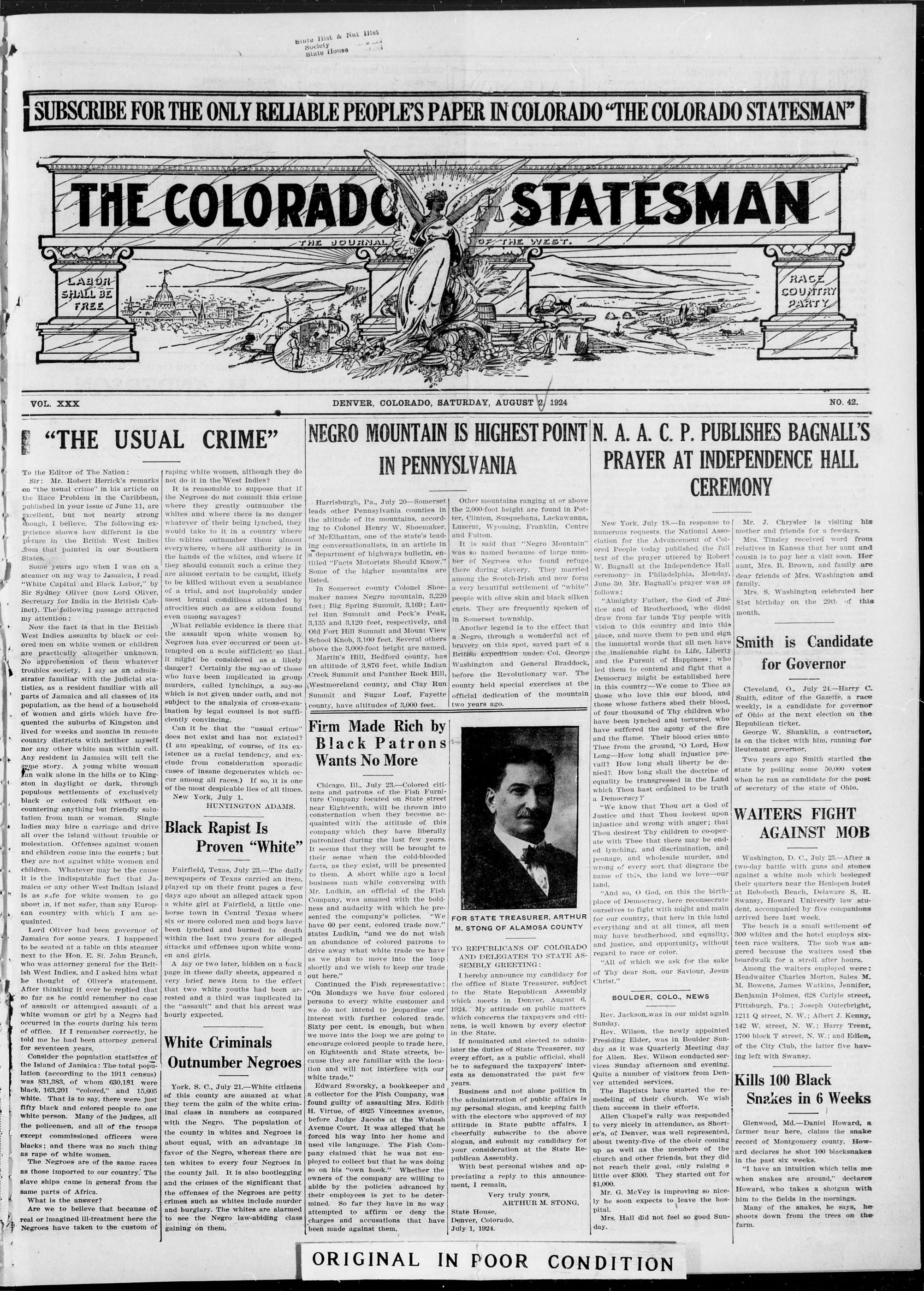
"THE USUAL CRIME"
VOL. XXX
To the Editor of The Nation:
Sir: Mr. Robert Herrick's remarks on "the usual crime" in his article on the Race Problem in the Caribbean, published in your issue or June 11, are excellent, but not nearly strong enough, I believe. The following experience shows how different is the picture in the British West Indies from that painted in our Southern States.
Some years ago when I was on a steamer on my way to Jamaica, I read "White Capital and Black Labor," by Sir Sydney Oliver (now Lord Oliver, Secretary for India in the British Cabinet). The following passage attracted my attention:
Now the fact is that in the British West Indies assaults by black or colored men on white women or children are practically altogether unknown. No apprehension of them whatever troubles society. I say as an administrator familiar with the judicial statistics, as a resident familiar with all parts of Jamaica and all classes of its population, as the head of a household of women and girls which have frequented the suburbs of Kingston and lived for weeks and months in remote country districts with neither myself nor any other white man within call. Any resident in Jamaica will tell the same story. A young white woman can walk alone in the hills or to Kingston in daylight or dark, through populous settlements of exclusively black or colored folk without encountering anything but friendly salutation from man or woman. Single ladies may hire a carriage and drive all over the island without trouble or molestation. Offenses against women and children come into the courts; but they are not against white women and children. Whatever may be the cause it is the indisputable fact that Jamaica or any other West Indian island is as safe for white women to go about in, if not safer, than any European country with which I am acquainted.
Lord Oliver had been governor of Jamaica for some years. I happened to be seated at a table on this steamer next to the Hon. E. St. John Branch, who was attorney general for the British West Indies, and I asked him what he thought of Oliver's statement. After thinking it over he replied that so far as he could remember no case of assault or attempted assault of a white woman or girl by a Negro had occurred in the courts during his term of office. If I remember correctly, he told me he had been attorney general for seventeen years.
Consider the population statistics of the Island of Jamaica: The total population (according to the 1911 census) was 831,383, of whom 630,181 were black, 163,201 "colored," and 15,605 white. That is to say, there were just fifty black and colored people to one white person. Many of the judges, all the policemen, and all of the troops except commissioned officers were blacks; and there was no such thing as rape of white women.
The Negroes are of the same races as those imported to our country. The slave ships came in general from the same parts of Africa.
What is the answer?
Are we to believe that because of real or imagined ill-treatment here the Negroes have taken to the custom of
raping white women, although they do not do it in the West Indies?
It is reasonable to suppose that if the Negroes do not commit this crime where they greatly outnumber the whites and where there is no danger whatever of their being lynched, they would take to it in a country where the whites outnumber them almost everywhere, where all authority is in the hands of the whites, and where if they should commit such a crime they are almost certain to be caught, likely to be killed without even a semblance of a trial, and not improbably under most brutal conditions attended by atrocities such as are seldom found even among savages?
What reliable evidence is there that the assault upon white women by Negroes has ever occurred or been attempted on a scale sufficient so that it might be considered as a likely danger? Certainly the say-so of those who have been implicated in group murders, called lynchings, a say-so which is not given under oath, and not subject to the analysis of cross-examination by legal counsel is not sufficiently convincing.
Can it be that the "usual crime" does not exist and has not existed? (I am speaking, of course, of its existence as a racial tendency, and exclude from consideration sporadic cases of insane degenerates which occur among all races.) If so, it is one of the most despicable lies of all times. New York, July 1. HUNTINGTON ADAMS.
Black Rapist Is Proven "White"
Fairfield, Texas, July 23.—The daily newspapers of Texas carried an item, played up on their front pages a few days ago about an alleged attack upon a white girl at Fairfield, a little onehorse town in Central Texas where six or more colored men and boys have been lynched and burned to death within the last two years for alleged attacks and offenses upon white women and girls.
A lay or two later, hidden on a back page in these daily sheets, appeared a very brief news item to the effect that two white youths had been arrested and a third was implicated in the "assault" and that his arrest was hourly expected.
White Criminals Outnumber Negroes
White Criminals Outnumber Negroes
York, S. C., July 21.—White citizens of this county are amazed at what they term the gain of the white criminal class in numbers as compared with the Negro. The population of the county in whites and Negroes is about equal, with an advantage in favor of the Negro, whereas there are ten whites to every four Negroes in the county jail. It is also bootlegging and the crimes of the significant that the offenses of the Negroes are petty crimes such as whites include murder and burglary. The whites are alarmed to see the Negro law-abiding class gaining on them.
NEGRO MOUNTAIN IS HIGHEST POINT IN PENNYSLVANIA N. A. A. C. P. PUBLISHES BAGNALL'S PRAYER AT INDEPENDENCE HALL CEREMONY
ORIGINAL IN POOR CONDITION
State Hist & Nat Hist
Society
State House
NABLE PEOPLE'S PA
RADO
THE JOURNAL
DENVER, COLORADO, S
NEGRO MOUNTAIN
IN PENNY
Harrisburgh, Pa., July 20—Somerset leads other Pennsylvania counties in the altitude of its mountains, according to Colonel Henry W. Shoemaker, of McElhattan, one of the state's leading conversationalists, in an article in a department of highways bulletin, entitled "Facts Motorists Should Know." Some of the higher mountains are listed.
In Somerset county Colonel Shoemaker names Negro mountain, 3,220 feet; Big Spring Summit, 3,169; Laurel Run Summit and Peck's Peak, 3,135 and 3,120 feet, respectively, and Old Fort Hill Summit and Mount View School Knob, 3,100 feet. Several others above the 3,000-foot height are named. Martin's Hill, Bedford county, has an altitude of 3,876 feet, while Indian Creek Summit and Panther Rock Hill, Westmoreland county, and Clay Run Summit and Sugar Loaf, Fayette county, have altitudes of 3,000 feet.
Firm Made Rich by Black Patrons Wants No More
Chicago, Ill., July 23.—Colored citizens and patrons of the Fish Furniture Company located on State street near Eighteenth, will be thrown into consternation when they become acquainted with the attitude of this company which they have liberally patronized during the last few years. It seems that they will be brought to their sense when the cold-blooded facts, as they exist, will be presented to them. A short while ago a local business man while conversing with Mr. Ludkin, an official of the Fish Company, was amazed with the boldness and audacity with which he presented the company's policies. "We have 60 per cent, colored trade now," states Ludkin, "and we do not wish an abundance of colored patrons to drive away what white trade we have as we plan to move into the loop shortly and we wish to keep our trade out here."
Continued the Fish representative: "On Mondays we have four colored persons to every white customer and we do not intend to jeopardize our interest with further colored trade. Sixty per cent, is enough, but when we move into the loop we are going to encourage colored people to trade here, on Eighteenth and State streets, because they are familiar with the location and will not interfere with our white trade."
Edward Sworsky, a bookkeeper and a collector for the Fish Company, was found guilty of assaulting Mrs. Edith H. Virtue, of 4925 Vincennes avenue, before Judge Jacobs at the Wabash Avenue Court. It was alleged that he forced his way into her home and used vile language. The Fish Company claimed that he was not employed to collect but that he was doing so on his "own hook." Whether the owners of the company are willing to abide by the policies advanced by their employees is yet to be determined. So far they have in no way attempted to affirm or deny the charges and accusations that have been made against them.
ORIGINAL
Other mountains ranging at or above the 2,000-foot height are found in Potter, Clinton, Susquehanna, Lackawanna, Luzernt, Wyoming, Franklin, Centre and Fulton.
It is said that "Negro Mountain" was so named because of large number of Negroes who found refuge there during slavery. They married among the Scotch-Irish and now form a very beautiful settlement of "white" people with olive skin and black silken curls. They are frequently spoken of in Somerset township.
Another legend is to the effect that a Negro, through a wonderful act of bravery on this spot, saved part of a British expedition under Col. George Washington and General Braddock, before the Revolutionary war. The county held special exercises at the official dedication of the mountain two years ago.
FOR STATE TREASURER, ARTHUR
M. STONG OF ALAMOSA COUNTY
FOR STATE TREASURER, ARTHUR M. STONG OF ALAMOSA COUNTY
TO REPUBLICANS OF COLORADO AND DELEGATES TO STATE ASSEMBLY GREETING:
I hereby announce my candidacy for the office of State Treasurer, subject to the State Republican Assembly which meets in Denver, August 6, 1924. My attitude on public matters which concerns the taxpayers and citizens, is well known by every elector in the State.
If nominated and elected to administer the duties of State Treasurer, my every effort, as a public official, shall be to safeguard the taxpayers' interests as demonstrated the past few years.
Business and not alone politics in the administration of public affairs is my personal slogan, and keeping faith with the electors who approved of my attitude in State public affairs, I cheerfully subscribe to the above slogan, and submit my candidacy for your consideration at the State Republican Assembly.
With best personal wishes and appreciating a reply to this announcement, I remain.
Very truly yours,
ARTHUR M. STONG,
State House,
Denver, Colorado.
July 1, 1924.
New York, July 18.—In response to numerous requests, the National Association for the Advancement of Colored People today published the full text of the prayer uttered by Robert W. Bagnall at the Independence Hall ceremony in Philadelphia, Monday, June 30. Mr. Bagnall's prayer was as follows:
"Almighty Father, the God of Justice and of Brotherhood, who didst draw from far lands Thy people with vision to this country and into this place, and move them to pen and sign the immortal words that all men have the inalienable right to Life, Liberty and the Pursuit of Happiness; who led them to contend and fight that a Democracy might be established here in this country—We come to Thee as those who love this our blood, and those whose fathers shed their blood, of four thousand of Thy children who have been lynched and tortured, who have suffered the agony of the fire and the flame. Their blood cries unto Thee from the ground, 'O Lord, How Long—How long shall injustice prevail? How long shall liberty be denied? How long shall the doctrine of equality be transgressed in the Land which Thou hast ordained to be truth a Democracy?
"We know that Thou art a God of Justice and that Thou lookest upon injustice and wrong with anger; that Thou desirest Thy children to co-operate with Thee that there may be ended lynching, and discrimination, and peonage, and wholesale murder, and wrong of every sort that disgrace the name of this, the land we love—our land.
"And so, O God, on this the birthplace of Democracy, here reconsecrate ourselves to fight with might and main for our country, that here in this land everything and at all times, all men may have brotherhood, and equality, and justice, and opportunity, without regard to race or color.
"All of which we ask for the sake of Thy dear Son, our Saviour, Jesus Christ."
BOULDER, COLO., NEWS
Rev. Jackson was in our midst again Sunday.
Rev. Wilson, the newly appointed Presiding Elder, was in Boulder Sunday as it was Quarterly Meeting day for Allen. Rev. Wilson conducted services Sunday afternoon and evening. Quite a number of visitors from Denver attended services.
The Baptists have started the remodeling of their church. We wish them success in their efforts.
Allen Chapel's rally was responded to very nicely in attendance, as Shorter's, of Denver, was well represented, about twenty-five of the choir coming up as well as the members of the church and other friends, but they did not reach their goal, only raising a little over $300. They started out for $1,000.
Mr. G. McVey is improving so nicely he soon expects to leave the hospital.
Mrs. Hall did not feel so good Sunday.
NO.42.
Mr. J. Chrysler is visiting his mother and friends for a few days. Mrs. Tinsley received word from relatives in Kansas that her aunt and cousin is to pay her a visit soon. Her aunt, Mrs. B. Brown, and family are dear friends of Mrs. Washington and family. Mrs. S. Washington celebrated her 81st birthday on the 29th of this month.
Smith is Candidate for Governor
Cleveland, O., July 24.—Harry C. Smith, editor of the Gazette, a race weekly, is a candidate for governor of Ohio at the next election on the Republican ticket. George W. Shanklin, a contractor, is on the ticket with him, running for lieutenant governor. Two years ago Smith startled the state by polling some 50,000 votes when he ran as candidate for the post of secretary of the state of Ohio.
WAITERS FIGHT AGAINST MOB
Washington, D. C., July 23.—After a two-day battle with guns and stones against a white mob which besieged their quarters near the Henlopen hotel at Reboboth Beach, Delaware S. R. Swansy, Howard University law student, accompanied by five companions arrived here last week.
The beach is a small settlement of 300 whites and the hotel employs sixteen race waiters. The mob was angered because the waiters used the boardwalk for a stroll after hours.
Among the waiters employed were: Headwaiter Charles Morton, Sales M. M. Bowens, James Watkins, Jennifer, Benjamin Holmes, 628 Carlyle street, Pittsburgh, Pa.; Joseph Outerbright, 1211 Q street, N. W.; Albert J. Kenny, 142 W. street, N. W.; Harry Trent, 1700 block T street, N. W.; and Elden, of the City Club, the latter five having left with Swansy.
Kills 100 Black Snakes in 6 Weeks
Kills 100 Black Snakes in 6 Weeks
Glenwood, Md.—Daniel Howard, a farmer near here, claims the snake record of Montgomery county. Howard declares he shot 100 blacksnakes in the past six weeks. "I have an intuition which tells me when snakes are around," declares Howard, who takes a shotgun with him to the fields in the mornings. Many of the snakes, he says, he shoots down from the trees on the farm.
FOREIGN
Australian aviator.
Soon after leaving port the liner Ber-
gensfjord caught fire after there had
been an eyplosion in the after-engine.
The ner anchored in a side-arm of
Christianford and landed all of her
450 passengers, ‘The damage to the
vessel {s considerable,
One hundred and sixty-nine persons
were drowned in the wreck of the Tai-
rel Maru off Cape Notoro, northeast of
Hokkaido, says a dispatch to the
Asahi, a leading Tokio newspaper. The
‘aire! Maru nominally is a freighter,
but was carrying a number of passen-
gers.
Miguel Costa, commander of the
Brazilian rebels at Sao Paulo, com-
mitted suicide in the main street of
the city when he saw federal troops
entering, said a dispatch from Sao
Paulo received in Rio De Janeiro.
Rebel forces fled from Sao Paulo
towards the interior in two military
trains.
‘The soviet government has appropri-
ated $32,000,000 for the purpose of cop-
ing with the threatened famine in Rus-
sla, according to an announcement
made in Moscow by the central com-
mittee of the Communist party. Of
this amount $15,000,000 will be used
for seed and the rest for the direct as-
sistance of the peusants in the worst
affected areas,
A pogrom in which It Is known fif-
teen Jewish passengers were killed has
tuken place on a Russian boat in the
river Djesna, between Hakoshin and
Novgorod SewJersk, according to re-
ports recelved at Riga from soviet
Russia. The report asserts that an or-
ganized band, which attacked the boat,
picked out the Jewish passengers,
leaving the non-Jews alone,
As’ the fighting between Brazilian
government and revolutionary forces
ut Sao Paulo continues, conflicting
reports as to the number of persons
killed or injured as a result of the
battle are being received in official
advices reaching the State Department
at Washington, D. C. A summary of
the reports issued by the department
says “it is believed that the rumors
overestimate the casualties.”
Flood waters have submerged half
the state of Cochin, causing loss of life
and widespread damage among cattle
and crops, according to messages
received In Madras, British India, by
the newspaper, Hindu. A teacher and
sixty-four pupils in a boys’ school at
Cheruthumby are stated to have per-
ished In the collapse of the school
building. Thousands of persons in
Calicut haye been rendered homeless
through the destruction of their dom-
iciles.
GENERAL
Between $80,000 and $40,000 was ob-
tained by six bandits who held up the
First National bank at Highland, Til.
Limitation of political campaign
speeches by radio to fifteen minutes,
except in rare Instances, is under con-
sideration by some of the largest com-
panies operating broadcasting stations
in the Eastern states, was announced
in Washington.
‘Twenty persons, mostly negroes, and
more than 6,000 head of cattle are re-
ported dead In Tennessee, Arkansas
and Mississippi from anthrax. An ad-
ditional government expert has been
rushed to Mississippi where Governor
Whitfield reports eight persons and
5,000 head of cattle dead,
Mrs. Mary Shank, held in Jail at
Frederick, Md., in default of $2,000 bail
us the ringleader in the tarring and
feathering of Miss Dorothy Grandon at
Myersville, disclaimed the responsibil-
ity she assumed for the affair when
she testified at the preliminary hear-
Ing and laid the blame for it on men
of the village.
A buffalo stampede and hunt In a
residential district of San Francisco
ended with the rounding up of twenty
bulls and cows that broke from thelt
paddock in Golden Gate park, The
bisons, after breaking down the wire
fence that kept them in thelr paddock,
stampeded to nearby lawns und forced
citizens to seek places of safety.
Five forest fires in California, two
in Washington and one In Oregon en
gaged the attention of Pacific coast
fire fighters last week. One fire in
Oregon burned over 1,500 acres of
Mayer park, on the Columbia River
highway, near the Dalles. Cooler
wenther and higher humidity had re;
Heved the general situation through:
out California.
The United States Railroad Labor
Board postponed until Sept. 8 further
hearing on the controversy between en:
gine operatives and the western car
riers. The two brotherhoods formally
Aree ae Biren aha Ue ale hr ae
IN PARAGRAPHS
1
CAUGHT FROM THE NETWORK OF
WIRES ROUND ABOUT
THE WORLD
DURING THE PAST WEEK
RECORD OF IMPORTANT EVENTS
CONDENSED FOR BUSY
PEOPLE
WESTERN
Despite the fact that gold placers in
Galifornia have produced more than
$1,000,000,000 since their discovery in
1848, they are not exhausted, according,
to a statement issued by the state 1ain-
ing bureau at Sucramento,
Grain prices have only started to
climb, in the opinion of James A. Pat-
ton, noted millionaire Board of ‘Trade
expert. Patton declared that he be-
Meves wheat will go: to $2, corn to
$1.25 or $1.50, and outs to at least 60
or 65 cents.
Fire that swept out a solid block at
Yakima, Wash., with the exception of
@me building, was finally put under
control. ‘The damage is estimated at
$850,000 to buildings and supplies, in-
‘eluding a great amount of box shooks
and paper assembled in anticipation of
the near begtnning of the frult rush.
“Give me a speedy trial and shoot
me or hang me—I want to Join by
baby in a happier land than this,” Mrs.
George White, 20 years old, pleaded
with Boise, Idaho, officers after ahe
had einptied four chambers of a .82
caliber revolver into the head of her
38 months old daughter at their ranch
home, three miles southeast of Boise.
The body of Miss Katherine Good of
Point Loma, Calif, was found beside
the Union Pacific tracks near Leroy,
‘Wyo., after the young woman had been
missed from her berth and a seareh in-
stituted. The body, when found, was
fully clothed except for one shoe and
stocking. Railroud officials are una-
ble to explain how the woman fell from
the train and are co-operating with
Wyoming officials in an investigation.
The air mail proved its value for the
first time In a fire fighting emergency.
Asbestos suits, for the protection of
workmen arranging to extinguish the
burning gas well of the Union Oil
Company near Wellington, Colo., thirty
miles south of Cheyenne were rushed
from Chicago to Cheyenne by alr mail
and from Cheyenne to the well by
automobile. Postage on the packages
ranged from $88 for the lightest to $45
for the heaviest.
WASHINGTON
"ntsc Eat haces hh a So ot calla
regurd prohibition an issue in this
year's presidential campaign, It was
announced at the home of Senator
Robert M, LaFollette. ‘The statement
wos made on behalf of the Progressive
candidate, in reply to the charge of the
Anti-Siloon league that LaFollette ts
the “only wet” in the race for the
White House. ‘The Issues are “all eco-
nomic,” LaQollette’s managers ex-
plained,
Apportionment of $700,000 appro-
printed by Congress for the survey und
resurvey of public linds belonging to
the government during the fiscal year
of 1925 was made public by the Inter
for Department a few days ago
through the general lind office. Colo-
rado is among three states receiving
the largest apportionments, deducting
$122,000 necessary to cover the ex
penses of the supervisor's office,
equipment, freight and express, and
other administrative costs.
Forty-five children were made home-
less when fire swept through the Bru-
en Home for Children, u private Institu-
tition, Fireman arrived just in time to
rescue Mrs. E. K. Fleck, matron of the
home, «an invalid. She was carried to
safety from the second floor Inher
wheel chuir. Many children were also
carried from the blazing buitding,
President Coolidge turned the first
three spudes of earth for the Hamline
Methodist Episcopal church In Wash-
ington. Only the first spadecul was
on the president's program, but he did
his work so well that he was prevailed
upon to turn two more before sur-
rendering the spade to the church of-
ficials, The women of the church gave
the president a large bouquet of roses
for himself and Mrs, Coolidge.
With a view to aiding the 2,712 for-
mer service men who will complete
their vocational training this month,
and the 15,882 additional to be rehab:
Alttated from now until the first of the
new year, Frank T. Hines, director of
the Veterans’ Bureau appealed to em-
ployers throughout the country to give
the veterans an opportunity to start
Ufe anew by providing them with posi-
tions for which they have been trained.
‘As the result of the murder of Maj.
Robert Imbrie, the American vice con-
sul at Teheran, the United States gov-
ernment hus served a vigorous demand
upon Persia for the protection of
american lives and interests In that
country, it was announced officially at
the State Department. The American
tote was lengthy, but blunt, No words
were minced in muking.it plain to Per-
dian authorities that the United States
regurds the killing of Unbrie as serious
and that adtquate repurations will be
wxpected.
| LATE NEWS.
From All Over
COLORADO |
United States Championship Cowboy
Rodeo, Knights cf columbus, Denver
~Anfariena, ‘Vall Otero ci
‘kansas “Valley Fair, Oterg Cos
Rocky Ford, Je Ln Miller, sec.-—-Sept. 4
Bayfield Fair, Bayfield, A. F. Hop-
per, Pres —Sept, 18-20.
Houlder County Falr, Longmont, C.
E. Rue, Sec.,—sept. 2 to 5.
Colorado "State Fair, Bueblo, D. A
Jay, Manayer, Sec—Sept, 22 to 27.
Conejos County Fair, Manassa
Crowley County Fuir, Mrs, Z Be
Righarda, SecA. 21 to, 28.
Delta County Fair, Hotchkiss, A. M.
Minton, Sec.—Bept. 9 to 12.
eaerel County Fair, Castle Rock,
©. A. Reeves, Secr—Oct."2 to 4.
Elbert County Fair, Matheson
_ El Pago County Fyir, Calhan, D. B
Nance, Sec—Sept, 29-40—Oct.
Grand County’ Fair, Kremmling
Huerfano County Fair, Walsenburg,
C._O, Unfug, Sec.
Kit Carson County Fair, Burlington,
HL G. PAORE IO, Sec.—Oct, 1-2-3-4.
‘Klowa County Pair, Bads, J.C. Mil-
ler, Sec.—Sept. 11-12-13.
Larimer County Fair Loveland, W.
L. Warnock, Sec.—Aug. 26-27-28-29,
Lincoin County Fair, Hugo, G. W.
Hicks, Sec—
Logan County Fair, Sterling, J. H.
King, Sec. Sept. 9 to 12.
Meza County” Fair, Grand Junction,
JF. Behultz, Seo
aoe County Fair, Craig—Sept. 12-
Northern New_ Mexico Fair, Raton,
E. D. Reynolds, Sec.—Sept. 9 to 12.
Phillips County Pair, Holyoke, F. EB.
Brollint, Sec.
Pueblo County Fair, Goodpasture, H.
P, Bornachelmn, See.—Sept. 18-19.
Routt County. Fair, Hayden, 8. A.
Stoddard, Sec-Sept. 9-10-11,
Saguache County. Fair, Harry B.
Sherman, Sec, Sept 11, 12, 18.
‘Trinidad-Late Animas County Falr,
‘trinidad, Chas, ‘Talley, Sec.—Sept. 16
1g
Washington County Fair, Akron,
Robert We Vance, Sec-—Sept. 4 to 6
Weld County ‘Fair, Greeley, C. W.
Henry, Sec--Sept. 9 to 12,
Western Slope Tair, Montrose, J. J.
‘Tobin, See.—-Sept. 16 to 19.
Central” Colorado | Fair, Colorado
Springs, R. W. ‘Lewis, See—Sept. 17
Te a8,
Fourth Annual Pike's Peak Rodeo,
Colgrade. Springs—AWg. 12-13-14,
Western Slope. Fair, Montrose, 3. J.
Tobin, Sac.—Sept, 16-19.
Greeley.—Captured after a series of
knife and fist fights during pursuit
down the main street of the city, An-
tonio Solis and Antonio Gomez are in
the county jail here charged with
grand larceny.
Fort Morgan.—H. J. Whitney and
George Paris, both of Fort Morgan,
were absolved from criminal liability
for the death at Brush of Lydia Gros-
kopf, 8, who met her death beneath
the wheels of a heavy sedan driven
by Whitney.
Denver.— Preparations are being
made for what promises to be the
greatest of the yearly Denver Market
Week and Merchants’ Festivals, which
this year has been scheduled for the
week of Aug. 11. It will be the sixth
annual event.
Fort Morgan.—The most important
celebration ever held in Colorado by
the colored people was held at Deer-
field for three days, Aug, 1, 2, 3, when
the fourteenth anniversary of the
founding of that negro settlement was
observed.
Gunnison.—Prof. W. A. Manuel, head
of the department of chemistry at
Western State College, here, was seri-
ously injured, perhaps fatally, when a
tank of acetylene gas which he was
filling, exploded. The explosion de-
stroyed the sight of one eye, tore off
one ear, and caused severe burns and
lacerations about the head.
Hayden.—Caught under the falling
sweep of a hnystacker operating on
the Carey ranch, six miles from here,
William Gourley, Jr. a School of
Mines student, received Injuries from
which he died a short time later.
Gourley bled to death from a severed
jugular within a few minutes after the
aceident. At the time he was working
with a gang of men stacking hay. He
was employed on the ranch by the
Harvester Investment Company for
the summer.
Silverton—What police authorities
term the largest raid ever staged in
southwestern Colorado was made by
state prohibition officers under direc-
tion of John R. Smith in Silverton.
Twenty-four persons, including three
women, were arrested and a large sup-
pty of liquor confiscated,
Las Animas—Baggage and letters
found in the wreckage of a new ear
which was struck by a Santa Fe pas-
senger train twenty miles east of here
identified the two passengers, a man
and a woman, who appeared to be
about 50 years old, as Mr, and Mrs.
C. M. Darrin of Pleasanton, Kan, Mr.
Darrin was killed instantly, while his
wife was injured fatally. They were
both brought to Las Animas.
Colorado Springs.—Dr. A. J. Mona-
han, county health officer at Pueblo,
was killed, George Willock of Denver
was Injured seriously, and his wife,
Mrs. Minnie Willock, and daughter,
Eulalia, suffered minor injuries when
the car which Willock was driving
with Monahan in the front seat, skid-
ded in the sand and turned over in a
ditch while rounding a right angle
CENTENNIAL STATE ITEMS
ss
'T. G. Granberry, W. T. Collins
President Licensed Embalmer
Lady Assistant
and Soloist WithSERVICE | DAY AND aes
All Funerals 6) SSE
THE PEOPLES’ MORTUARY
Funeral Directors and Licensed Embalmers
Parlors, 2713 Welton Street
Denver, Colorado
Consideration, for the dead. Satisfaction guaranteed.
omfort. for roared. .
Samittealy. ‘the “largest | race Always st lyour, AerViow iGa7i2e
Gflablienment of te Kind inthe giugre treatment to all
ys Banitises saonerae Emhomy our watchword,
ETA REDS wortny. Service incomparable
of three Denver youths came to an
end, according to Sheriff Roy Laird
of Ouray, when the daring attempt of
the youths to escape from the Ouray
Jail was frustrated only after a loaded
shotgun and a quantity of shells had
been taken from under a bunk in their
cell. The daring chain of crimes which
the youths have admitted, according
to the sheriff, Includes the robbery of
two stores and a postoffice, the hold-
up of pedestrians and the theft of
several automobiles. Their trail of
banditry, they ure said to have ad-
mitted, began in Denver and led to a
number of Colorado towns until they
were captured near Norwood, Colo., by
a lone, unarmed citizen.
| ‘Trinidad—A father and two of his
‘daughters were killed and four chil
‘aren were injured, one of them pos-
sibly fatully, when the automobile in
Which the Seven were riding was
‘struck by a coal train at a grade cross-
ing near Berwind, fifteen miles north
of here, The dead man was the father
of two of the injured children and
the other two youngsters were their
playmates who had gone with them
for an afternoon ride. ‘The coal train
which struck the automobile was being
pushed by an engine which hud been
placed at the end of the cars. The
dead: Edward Bludworth, Trinidad;
Katle Bludworth, 10 years old, his
daughter; Anna Bludworth, 11 years
old, another daughter.
Colorado Springs.—Eastern E] Paso
county und eustern Colorado farmers
are experiencing their best season in
history, according to word brought
here by F. H. Faus, general agent for
the Rock Island railroad with head-
quarters in Colorado Springs, who has
just returned from a swing around a
fifty-mile circle radiating from Colo-
rado Springs. Crop and stock produc
oe will be bigger than for several
yeurs with a high market anticlpated
already on the up-grade. Wheat al-
ready has begun to move.
Colorado Springs.—The movement
initlated at a meeting here by the wom-
en, at which resolutions were udopted
protesting the plan of the War De-
partment for National Defense day,
was roundly scored by ex-service men
in Colorado Springs, with Legion-
naires, C. M. T. C. leaders and veterans
of the World war denouncing such ac-
tion. The resolutions adopted at the
meeting called for women to hold
peace services Sept. 12 and to protest
in every way against the War Depart-
ment’s plan,
Monte Vista—Boosters for the Mon:
te Vista Ski-Hi stampede, 150 strong,
in automobiles, made a trip through
the state. They visited Saguache, Sa-
lida, Canon City and Florence, stop-
ping for a night at Colorado Springs.
They were accompanied by two bands.
‘They also visited Rocky Ford, La Jun-
ta, Trinidad, Walsenburg, La Veta and
Alamosa.
Denver.—Satisfactory progress Is re-
ported from both portals of the Moffat
tunnel. Reports made public by the
tunnel commission are that 1,455 feet
of the railroad tunnel had been com-
pleted, 974 from the east and 481 from
the west portal. ‘The ploneer tunnel
had been driven 3,776 feet from the
west portal, and 3,924 from the east.
Castle Rock.—I. J. Noe, 75 years old,
widely known pioneer rancher Iying
near Greenland, sixteen miles from
here, shot and killed Noble Cutts, 41,
during # fight between Cutts and Noe's
son, Frederick, 40 years old, according
to testimony offered before a coroner's
jury which returned a verdict of “un-
intentional homicide”
Colorado Springs.—After breaking
jail at Cheyenne Wells, Colo., where he
Was arrested for wholesile thefts at
garages at Arapahoe, Colo, Leland
Gresham, alias BE. F. Bunn, wanted in
Denver for forgeries and confidence
games, was arrested In Colorado
Springs, charged with burglary and
forgery.
Denver.—Farmers of Colorado were
saved $274,515 in crops and land yalues
by rodent extermination campaigns
c6nducted by the United States bureau
of biological survey, the state entomol-
ogist’s department and the state agri-
cultural extension during the fiscal
year 1923-1924, according to estimates
contained in the annual report, made
public a few days ago, of Leo L.
Laythe, juntor biologist of the federal
bureau in charge of rodent control op-
erations in Colorado.
Boulder.—Ninety members of the
Boulder Rotary Club, aided by other
Rotarians from several cities of north-
ern Colorado, and nearly thirty Rotar-
jans who are spending the summer in
Estes Park, met with Allen Sweet of
Oklahoma City and Chester Simons of
Boston in Estes Park, to impress upon
For Ladies’ and Gents’ Tailoring, See
H. ANDERSON
MERCHANT TAILOR
Cleaning, Pressing and Repairing. All Work
Guaranteed
517 28th Street
PHONE MAIN 6751 Prices reasonable,
Call in and see my Fall and Winter Samples now on display.
SESIEESEISLELLISTEITSST TITTIES aaa aa aaa aa aaa assesses sssesecsr eres
Wm. K. HUNT’S |
| m. ° :
CORNER 30TH AND WELTON ST.
Phone Champa 3522
i es 1h ee ee ee eee
| Chicken Feed
PS Uibse oe R Nose eeysocenes cesar eases tee 25¢
| Large cans Brer
| Rabbit Syrup Le te EL skh ge dnote OUR
' Large package Carnation Mush 35
| with preniiamy package!) 0047.02 cate ee eOe
Fresh Strawberries and Fruit in Season.
| Try our bulk Hunt's Special
fai Coretta) 1bai fun. Wee auseteasaa de anette 85¢c
—
| WE HAVE PLENTY OF SPRINGS AND HENS EVERY
FRIDAY AND SATURDAY
Ape Z The Curtis Park
ant We Gz Floral Company
| ab ee Floral Designs Put Up
her ta | ie While You Wait
\ We xe BY joice Plants and Flow
ey ce caecnte teas
| (ey Greenhouses: ead ee, and
WEA Won Sinueee
Mile !
TELEPHONE MAIN 1511 Benyar colo.
ee ee ee OOO OL, alm Seek” pels ie Reet) ae as Ean aro yey eae
CHARLOTTE HAIR NETS :
CAP SHAPE AND FRINGE
i Singles Maaht ceee me Raen Anant CNTY <0) oo agai
¢ Double Mesh, 150; two fore. 2.002.000. abe 3
; ‘TAN OFF—MADAM WALKER'’S SKIN BLEACH AT
| THE ATLAS DRUG CO. :
The Five Points Postal Station. :
| PHONE MAIN 875, 2701 WELTON |
ee eek bok ee ee ee ee ee ek ak eee a ge ke oe a ok a ace Blk eng oe
eee ee PSTD ae, Pees Seeke yc cep eee et ee
Main 1274 2620 Welton St.
“WE SELL THE EARTH.”
WOODRUFF INVESTMENT (CO.
Try Us on Rentals, Insurance and Loans
J. M. Williamson, Jr., Notary Public
J. G. Woodruff, President and Manager
CAPTAINS OF ADVENTURE
By ROGER POCOCK
Copyright by Bobba-Merrill Company
In the heart of the city of Victoria, B. C., I once found an old log barn, the last remnant of Fort Camosun, and climbing into the loft, kicked about in a heap of rubbish from which emerged some damp rat-gnawed manuscript books. From morning to evening, and far into the dusk, I sat reading there the story of a great adventures, a heroine of tonnage and displacement, the first steamer which ever plied on the Pacific ocean.
Her builders were Messrs. Boulton and Watt, and Watt was the father of steam navigation. She was built at Blackwall on London river in the days of George IV. She was launched by a duchess in a poke bonnet and shawl, who broke a bottle of wine against the ship's nose and christened her the Beaver. Then the merchant adventurers of the Hudson's Bay company, in bell toppers, Hessian boots and white chokers, gave three hearty cheers.
The Beaver was as ugly as it was safe to make her, but built of honest oak, and copper bolted, her engines packed in the hold, and her masts brigantine-rigged for the sailing voyage round Cape Horn. She went under convoy of the barque Columbia, a slow and rather helpless chaperon, who fouled and nearly wrecked her at Robinson Crusoe's island. Her master, to judge by the ship's books, was a peppery little beast, who logged the mate for a liar: "Not correct D. Hone;" drove his officers until they went sick, quarreled with the Columbia's doctor, found his chief engineer "in a beastly state of intoxication," and finally, at the Columbia river, hounded his crew into mutiny.
"Mr. Phillips and Mr. Wilson behaved," says the mate, "in a most mutinous manner." So the captain had all hands aft to witness their punishment with the cat o'-nine-tails. Phillips called on the crew to rescue him, and they went for the captain. Calling for his sword, the skipper defended himself like a man, wounding one seaman in the head. Then he "succeeded in tying up Phillips, and punishing him with two dozen lashes with a rope's end over his clothes," whereupon William Wilson demanded eleven strokes for himself, so sharing the fun, for better or worse, with a shipmate.
Fort Vancouver, on the Columbia river, an old stockade of the Nor'westers, was at this time the Hudson's Bay company's capital on the Pacific coast, where reigned the great Doctor McLauchlan, founder of Oregon. Here the Beaver shipped her paddles, started up her engines, and gave an excursion trip for the ladies. So came her voyage under steam out in the open Pacific of eight hundred miles to her station on the British Columbian coast. She sailed on the last day of May in 1836, two years before the Atlantic was crossed under steam. On the Vancouver coast she discovered an outcrop of steam coal, still the best to be had on the Pacific ocean.
In her days of glory, the Beaver was a smart little warship trading with the savages, or bombarding their villages, all the way from Puget Sound to Alaska. In her middle age she was a survey vessel exploring Wonderland. In her old age the boiler leaked, so that the engineer had to plug the holes with a rag on a pointed stick. She was a grimy tug at the last, her story forgotten; and after fifty-two years of gallant service, was allowed to lie a weed-grown wreck within a mille of the new city of Vancouver, until a kindly storm gave her the honor of sea burial.
It was in 1851 that the Beaver brought to the factor at Fort Simpson some nuggets of the newly discovered Californian gold. At first he refused to take the stuff in trade, next bought it in at half its value, and finally showed it to Edenshaw, head chief of the Haida nation. As each little yellow pebble was worth a big pile of blankets, the chief borrowed a specimen and showed it to his tribe in the Queen Charlotte islands.
There is a legend that in earlier days a trader found the Haidas using golden bullets with their trade guns, which they gladly exchanged for lead. Anyway an old woman told Edenshaw that she knew where to find the stuff, so next day she took him in a small dugout canoe to the outer coast. There she showed him a streak seven inches wide, and eighty feet in length, of quartz and shining gold, which crossed the neck of a headland. They filled a bushel basket with loose bits, and left them in the canoe while they went back for more. But in the stern of the canoe sat Edenshaw's little son watching the dog fish at play down in the deeps. When the elders came back Charlie had thrown their first load of gold at the dog fish, and later on in life he well remembered the hands of blessing laid on by way of reward.
Still, enough gold was saved to buy many bales of blankets. Edenshaw claimed afterward that, had he only known the value of his find, he would have gone to England and married the queen's daughter.
News spread along the coast and
soon a ship appeared, the Hudson's Bay company's brigantine Una. Her people blasted the rocks, while the Indians, naked and well oiled, grabbed the plunder. The sailors wrestled, but could not hold those oily rogues. In time the Una sailed with a load of gold, but was cast away with her cargo in the Straits of Fuca.
Next year Gold Harbor was full of little ships, with a gunboat to keep them in order while they reaped a total harvest of two hundred eighty-nine thousand dollars. The British warship Thetis had gone away when the schooner Susan Sturgis came back for a second load, the only vessel to brave the winter storms. One day while all hands were in the cabin at dinner the Indians stole on board, clapped on the hatches and made them prisoners. They were marched ashore and stripped in the deep snow, pleading for their underwear, but only Captain Rooney and the mate were allowed that luxury. The seamen were sold to the Hudson's Bay company at Fort Simpson, but the two officers remained in slavery. By day they chopped firewood under a guard, at night crouched in a dark corner of a big Indian house, out of sight of the fire in the middle, fed on such scraps of offal as their masters deligned to throw them. Only one poor old woman pitted the slaves, hiding many a dried clam under the matting within their reach. Also they made a friend of Chief Bearskin's son; and Bearskin himself was a good-hearted man, though Edenshaw proved a brute. Rooney was an able-bodied Irishman, Lang a tall, broad-shouldered Scot, though this business turned his hair gray. For after the schooner was plundered and broken up, a dispute arose between Bearskin and Edenshaw as to their share of the captives. Edenshaw would kill Lang rather than surrender him to Bearskin, and twice the Scotchman had his head on the block to be chopped off before Bearskin gave in to save his life. At last both slaves were sold to Captain McNeill, who gave them each a striped shirt, corduroy trousers and shoes, then shipped them aboard the Beaver. Now it so happened that on the passage southward the Beaver met with the only accident in her long life, for during a storm the steering gear was carried away. Lang was a ship's carpenter, and his craftsmanship saved the little heroine from being lost with all hands that night. This rescued slave became the pioneer shipbuilder of Western Canada.
ANDREW JACKSON
A. D. 1813
The nations were playing a ball game: "Catch!" said France, throwing the ball to Spain, who muffed it. "Quick!" cried Napoleon, "or England will get it—catch!" "Caught!" said the first American republic, and her prize was the valley of the Mississippi. Soon afterward the United States joined Napoleon at war with Great Britain; and the old lion had a wild beast fight against a world-at-arms. In our search for great adventure let us turn to the warmest corner of that world-wide struggle, poor Spanish Florida.
Here a large Indian nation, once civilized, but now reduced to savagery, had taken refuge from the Americans; and these people, the Greeks and Seminoles, fighting for freedom themselves, gave shelter to runaway slaves from the United States. A few pirates are said to have lurked there, and some Scottish gentlemen lived with the tribes as traders. Thanks perhaps to them, Great Britain armed the Greeks, who ravaged American settlements to the north, and at Fort Minns butchered four hundred men. Northward in Tennessee the militia were commanded by Andrew Jackson, born a frontiersman, but by trade a lawyer, a very valiant man of high renown, truculent as a bantam.
Without orders he led two thousand five hundred frontiersmen to avenge Fort Minns by chasing the Spanish governor (in time of peace) out of Pensacola, and a British garrison from Fort Barrancus, and then (after peace was signed) expelled the British from New Orleans, while his detachment in Florida blew up a fort with two hundred seventy-five refugees. Such was the auspicious prelude to Jackson's war with the Creeks, who were crushed forever at the battle of Horseshoe Bend.
Exercise for Tired Eyes
Lie on your back and roll the eyes now to the left and then to the right, look up and then down. Look straight at the ceiling and then down. This exercises all the muscles and rests the eyes. Use a diluted boric acid eye wash; rest the eyes as much as possible.
Pride of Ignorance
Emerson once said, "There is guidance for each or us, and by lowly listening we shall hear the right word." Great minds are apt to be humble. It is the second-rate intellect that is so full of pride that it sneers at the very idea of guidance.
PERSIA REPLIES TO U.S. DEMANDS
ALL HONORS ARE TO BE PAID
BODY OF SLAIN CONSUL
BY PERSIA
KILLERS BEING SOUGHT
MODERATION OF THE DEMANDS IN UNITED STATES NOTE RELIEVES PERSIA
Teheran, Persia. The press is generally relieved at what is regarded as the moderation of the American demands made in connection with the killing of Vice Consul Imbrie. The tone of the United States note is said to be greatly appreciated.
The reply of the Persian government to the American communication apparently meets with the approval of the majority here.
Washington.—The Persian note was forwarded to Washington by American Minister Kornfeld, at Teheran, to whom it had been addressed by the Persian foreign minister. It apparently was a full acceptance of the American demand that reparation be made, that those involved be punished, that Persia bear the cost of sending an American warship to bring home the body of the murdered vice consul, and that hereafter complete protection be given American citizens. It said:
"As your excellency has observed, the government and people of Persia are extremely charged and depressed by the lamentable incident of Friday, July 18 (the day on which Vice Consul Imbrule was killed), and have expressed their feelings to that effect in numerous instances and in various ways.
"You state that your excellency's government does not desire to approach the situation in such manner as to offend my government. The Persian government regards this as an evidence of the unequivocal good will and friendship of the American government and requests your excellency to be good enough to communicate its thanks and appreciation to the authorities of your government.
"As I stated in the course of my letter number 9,155, the imperial government is making extreme efforts in pursuing and punishing the persons who caused and perpetrated the killing of Mr. Imbrie, and it will no hesitate to take any kind of steps in this connection.
"Considering the official status of Mr. Imbrie, the deceased, the Persian government agrees with the suggestions of the United States government that the body of Mr. Imbrie be accorded honors during its transportation. The Persian government is concerned over the matter to such an extent that it would ship the remains of the /deceased consul to America aboard a Persian man-of-war if Persia possessed one. But inasmuch as it is unable to do so it agrees to pay the expenses which may be incurred by the dispatch of an American man-of-war to receive the remains.
"As to the security of American citizens and particularly of American official representatives, the Persian government has always considered and will continue to consider this as its positive duty and gives assurance that it will by no means hesitate to fulfill this duty. It goes without saying that if the honorable legation deems it necessary the guards of the American legation and consulates will be increased.
Railroad in Hands of Receiver.
Sheridan, Wyo.—The Wyoming North & South Railroad Company and the North & South Railroad were ordered to be placed in the hands of a receiver by Judge James H. Burgess in the District Court at Buffalo, Wyo. The receivership was granted to satisfy a claim of $33,000 by O. A. Bartholomew, manager of the Cloud Peak Timber Company. He was joined in the action by the Chicago, Milwaukee & St. Paul Railroad and Roberts Brothers, Peterson, Shirley and Gunther, general contractors for the North & South road.
Nine Sentenced Following Riots.
Haverhill, Mass. The trial in District Court of twenty-one men alleged to have been concerned in the early morning clash here between klansmen returning from an initiation ceremony in Groveland and others resulted in a sentence of thirty days for one man and fines of $10 each for eight others on charges of disturbing the peace. They all appealed. Two of the four men who received gunshot wounds in the encounter are in the hospital.
Spreckles Leaves $10,000,000 Estate
San Francisco.—The will of the late Adolph B. Spreckles, San Francisco capitalist, filed for probate here, leaves the bulk of an estate, variously estimated from $8,000,000 to $10,000-000 to his three children and his widow, Mrs. Alma de Brettville Spreckles. The children are: Alma E., Adolph F., and Dorothy C. Spreckles. A bequest of $100,000 was made to charities and numerous smaller ones totaling about $18,000 to friends and domestics of the family.
POINTS ON KEEPING WELL
Dr. Frederick R. Green, Editor of "Health."
DIABETES is a disease characterized by the presence of sugar in the urine. It has been known for thousands of years.
Formerly regarded as a disease of the kidneys, it was found, about forty years ago, to be due to degeneration of the pancreas, following some infection, such as influenza or typhoid fever. It may be caused by obesity.
In 1890, Langerhans found that only a part of the gland was destroyed in diabetics and that the pancreas was really two glands in one.
One gland secretes the pancreatic juice, which goes into the small intestine and aids digestion. The other gland manufactures a substance which is taken up by the blood and which is necessary for sugar digestion.
The parts of the gland which secrete this second substance are called the Islands of Langerhans.
If these islands degenerate, then the sugar in the food, instead of being used by the body, is discharged through the kidneys. So that, no matter how much the patient eats, he is unable to get enough nourishment, because much of his food is thrown away.
Diabetic patients have enormous appetites, but the more they eat the more poorly nourished they are. To make matters worse, the changed chemistry of the body produces an acid condition of the blood called acidosis, which eventually poisons the patient.
He becomes unconscious—what is known as diabetic coma—and usually never awakens.
In 1921, Dr. F. G. Banting, a young Canadian physician, determined to find this mysterious substance, the absence of which caused diabetes.
After many experiments he succeeded in making a serum containing the secretion of the Islands of Langerhans, which he called insulin. It is now made from the pancreas of the hog, which contains more insulin than that of any other animal. Before the discovery of insulin the only thing the doctor could do for diabetics was to give them a starch and sugar-free diet. Since Doctor Banting's discovery it is possible to restore the diabetic patient to practically normal condition. The doctor weighs the patient's food, estimates the amount of sugar eaten and the amount of sugar excreted. Then he gives the patient enough insulin to digest the sugar taken into the body. This enables the body to absorb it.
Insulin is not a cure for diabetes. It replaces the missing substance in the blood of the diabetic patient and so enables him to lead a normal life. It is not a substitute for other methods of treatment. Careful diet and ways of living are still necessary. It is possible that its continued use may restore the pancreas to normal, it least in mild cases, but this we do not know, as yet.
GOOD FOOD SURPASSES
DRUGS
NEW YORK city spends thirty-five million dollars each year maintaining its hospitals. Of this amount, ten millions, or nearly one-third, are spent for food. This is quite different from the old idea of a hospital. People used to think they went to a hospital to take medicine. They know better now. A hospital is a place for making slick people well, not for dosing them unnecessarily.
A hundred years ago doctors didn't know what caused diseases or how they could be prevented, so the only thing they could do was to give such medicines as they had, in the hope of restoring the patient to health. The wise doctor today doesn't give any medicine unless he knows that it's going to help the patient. Of course, this means that what medicine is given today is much more necessary and beneficial than the larger quantitles that used to be administered. Doctors give fewer drugs today because they know more than their predecessors did. Hospitals spend more money for food than they do for medicines, because they know that every patient needs to be properly nourished, while comparatively few need drugs.
With our better knowledge of the chemistry of foods and the processes of digestion we are able to combine feeding and medication in a way that the old-time doctor never thought of. A certain amount of iron is necessary for health. If you must have it in a hurry your doctor gives you a prescription containing iron, which will rapidly increase the amount of iron in your blood. But he would rather give it to you in a natural way through your food. The iron you get in fresh vegetables and fruits is better suited for your bodily needs than the iron you get in pills and in bottles.
So the doctor today gives his patients, either at home or in the hospital, many needful substances in their food which he formerly had to give in the form of medicines. When he does give medicine, he gives it because it is necessary and he gives the smallest amount that will do the work.
Every capable physician knows today that it is just as important for his patient to have the right kind of food as the right kind of medicine.
THE COLORADO STATESMAN
```markdown
```
RELIABLE chronicle of their doingsgress; a faithful mi their wants, their hoir best aspiration.
THE COLORADO STATESMAN
equaled as an adverti medium for the busi of professional men women.
excellent family jour peaking to and for m thousand colored citizen
The Mouth-Piece of the People of Colorado and the Entire West
ARELIABLE chronicle of their doings and progress; a faithful mirror of their wants, their hopes, their best aspiration.
THE COLORADO STATESMAN
Unequaled as an advertising medium for the business of professional men and women.
An excellent family journal speaking to and for many thousand colored citizens.
$2.00 A YEAR
$1.25 SIX MONTH
$.75 THREE MONTH
THE GREAT ORGAN
OF THE
BORING MASS
THE GREAT ORGAN OF THE LABORING MASSES
THE COLORADO STATESMAN
GRANT SHALL BE FREE
MASS COUNTRY PARTY
JOS. D. D. RIVERS.....Proprietor
1824 Curtis Street, Room 25
Entered as second-class matter at the postoffice in the city of Denver.
Colorado.
Recognized by the Retail Merchants' Bureau of the Denver Civic and Com-
mercial Association as an advertising medium.
SUBSCRIPTION RATES:
One Year ..... $2.00
Bix Months ..... 1.25
Three Months ..... .75
Reading notices, ten lines or less, 15 cents per line. Each additional line over ten lines, 12 cents per line.
Display advertising, 75 cents per square. A square contains ten agate lines.
It occasionally happens that papers sent to subscribers are lost or stolen. In case you do not receive any number when due, inform us by postal card and we will cheerfully forward a duplicate of the missing number.
All communications of a personating nature that are not complimentary will be withheld from the columns of this paper.
Communications to receive attention must be newsy, upon important subjects, plainly written only upon one side of the paper; must reach us Tuesdays, if possible, anyway, not later than Wednesdays.
Remittances should be made by Express Money Order, Postoffice Money Order, Registered Letter or Bank Draft. Postage stamps will be received the same as cash for the fractional part of a dollar. Only 1-cent and 2-cent stamps
LET US DO OUR DUTY
HAVE you ever thought of how much it would mean to yourself and to others if you would just resolve to do your duty? Duty is the debt you owe for citizenship, protection and privilege; if you want these to be kept free and untrammeled then we ought to do our duty. Duty is a graver term than obligation and should receive the more allegiance. The progressive, clear-sighted, colored citizens of the City and County of Denver and State of Colorado have important duties to perform this year at the primaries and precinct caucuses. The selection of officers and the proper delegates to the convention determines the kind of nominees we may expect on the ticket. The time to think of the harvest is after you have cleared the ground, broken the soil and planted the seed. If you don't do your duty before the harvest, there will be no harvest. This law is as true in politics as it is in nature.
We admit we can not do much alone. There must be numbers acting together to secure results. To do your duty then is to convince others of the justice of your position and the necessity of making their service and vote count for the party and the race. Every additional voter that you interest and secure to co-operate for the cause you help forward the movement for justice to the Negro just so much. There are four places where your full duty ought to be done, i. e., the Assembly primaries, the convention and the polls, and the one grand insignia of your sovereignty at these crucial stages of citizenship is the ballot. The Citizens with their ballots have built up this city and state just as carpenters and masons have built it with their tools, and it remains for them to keep it in a healthy condition by their continued interest in the state's welfare. This interest is determined by the way and manner in which you do your duty.
WHERE THE SHOE PINCHES
GENERALLY speaking, the sharpest race prejudice in the South is exhibited by the poorer class of white people, whether farmers, artisans or unskilled workers, who come into active competition with the Negroes, or from politicians who are seeking the votes of this class of people. It is this element which has driven the Negroes out of more than one community in the South and it commonly forms the lynching mobs. A similar antagonism of the working classes exists in the North wherever the Negro has appeared in large numbers—as I shall show when I come to write of the treatment of the Northern Negro.
On the other hand, the large land owners and employers of the South, and all professional and business men who hire servants, while they dislike and fear the Negro as a race (through often loving and protecting individual Negroes), want the black man to work for them. More than that, they MUST HAVE HIM; for he has a practical monopoly on labor in the South. White men of the employing class will do almost anything to keep the Negro on the land and his wife in the kitchen—so long as they are obedient and unambitious workers.
The Negro's improvement, his slow but steady growth in culture and capacity, is the thing that galls the poorer classes of white people. To imagine himself a less fit human being that a Negro severely wounds the pride of the white man of small culture. The more ignorant he is the greater is his prejudice. The accompanying fear of a growing competition in the labor field makes the situation all the more aggravating, for the struggle for existence is not most easily met by those who have the least difficulty in preparing for it. But the inflamed sentiment arising out of these conditions of embittered pride and fear of material superiority does not promise well for the future of either race. A change of some kind will have to come over existing conditions. The justice of the case demands laws that will cultivate the higher instincts of both races. These the politicians will oppose as long as selfishness and cupidity are allowed to hold sway in American public affairs. But this will not be forever, for the salvation of the country depends upon the universal realization of those ideals upon which the earliest struggles of the nation were founded.
TOO EASILY CONTENTED
THE progress of the world indicates that contentment is one of the greatest afflictions that can beset mankind. If contentment were an asset that could never be disturbed this assertion might not be regarded as true, but as progress brings power and power ever seeks its own increase, a contented people, and therefore a non-progressive people, is sure, in time to become the prey and the serf of the restless elements of humanity. That discontent which makes a people strive ceaselessly for greater power is not an attribute of unhappiness, as unhappiness is measured in the minds of men, for the knowledge of increasing power is a greater source of happiness than the knowledge of temporary, but precarious peace and plenty.
The assurance and security and the inherent power of self-protection is the greatest asset of happiness that a people can attain and this condition of self-sufficiency can only be maintained by ceaseless effort and striving.
The unequalled power of the Caucasian races has grown out of this unremitting effort for self-security and improvement. It has carried them to the nominal mastery of the world, and made all meek and contented races their subjects or their prey. It is asserted in the individual the same as in the collective race, and is reflected in the pride, the self-assumption and the authority over others which the power of their kind makes them to feel to be their heritage and their right. The development of a similar power in other races is the only thing that preserves the autonomy of those races and gives them respect and independent character and standing in the world.
The Negro remains the only great race on earth that is content. In the depth of barbarity there is no ground for censure, but the Negro in civilization is far too easily satisfied. The liberty for which he strives is not of that insatiable character which yearns for self-reliance and independent power. He has not yet caught the spirit of unrest, though of all freemen his lot is the hardest. Individually he is too content with peace and little. Those who direct the activities of this groping race, ought to endeavor to make more and more keen the discontent and unrest which its real progress depends.
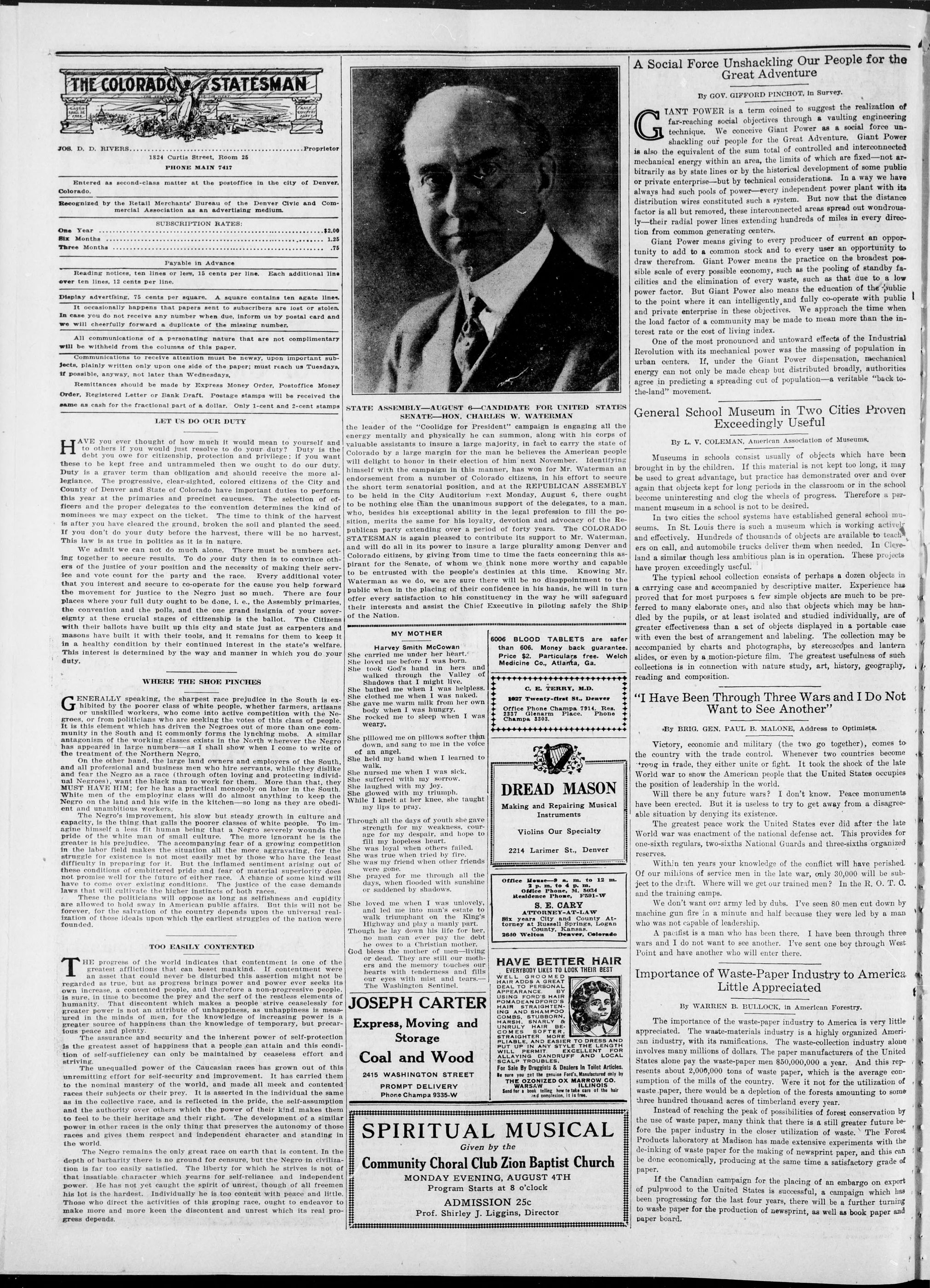
STATE ASSEMBLY—AUGUST 6—CANDIDATE FOR UNITED STATES
SENATE—HON. CHARLES W. WATERMAN
the leader of the "Coolidge for President" campaign is engaging all the energy mentally and physically he can summon, along with his corps of valuable assistants to insure a large majority, in fact to carry the state of Colorado by a large margin for the man he believes the American people will delight to honor in their election of him next November. Identifying himself with the campaign in this manner, has won for Mr. Waterman an endorsement from a number of Colorado citizens, in his effort to secure the short term senatorial position, and at the REPUBLICAN ASSEMBLY to be held in the City Auditorium next Monday, August 6, there ought to be nothing else than the unanimous support of the delegates, to a man, who, besides his exceptional ability in the legal profession to fill the position, merits the same for his loyalty, devotion and advocacy of the Republican party extending over a period of forty years. The COLORADO STATESMAN is again pleased to contribute its support to Mr. Waterman, and will do all in its power to insure a large plurality among Denver and Colorado citizens, by giving from time to time the facts concerning this aspirant for the Senate, of whom we think none more worthy and capable to be entrusted with the people's destinies at this time. Knowing Mr. Waterman as we do, we are sure there will be no disappointment to the public when in the placing of their confidence in his hands, he will in turn offer every satisfaction to his constituency in the way he will safeguard their interests and assist the Chief Executive in piloting safely the Ship of the Nation.
6006 BLOOD TABLETS are safer than 606. Money back guarantee. Price $2. Particulars free. Welch Medicine Co., Atlanta, Ga.
Harvey Smith McCowan
She carried me under her heart.
She loved me before I was born.
She took God's hand in hers and
splelled through the Yellow of
She pillowed me on pillows softer than down, and sang to me in the voice of an angel.
She held my hand when I learned to walk
Making and Repairing Musical Instruments
Through all the days of youth she gave strength for my weakness, courage for my despair, and hope to fill my hopeless, heart.
Violins Our Specialty
She was loyal when others failed.
She was true when tried by fire.
She was my friend when other friends were gone.
2214 Larimer St., Denver
She prayed for me through all the days, when flooded with sunshine or saddened by shadows.
Office House-9 a. m. to 12 m.
2 p. m. to 4 p. m.
Office Phone, M. 5034
Residence Phone, F591-W
S. E. CARY
ATTORNEY-AT-LAW
Six years City and County
Attorney at Russell Springs, Logan
County, Kansas
2640 Welton Denver, Colorado
She loved me when I was unlovely, and led me into man's estate to walk triumphant on the King's Highway and play a manly part. Though he lay down his life for her, no man can ever pay the debt he owes to a Christian mother. God bless the mother of men—living or dead. They are still our mothers and the memory touches our hearts with tenderness and fills our eyes with mist and tears.—The Washington Sentinel.
HAVE BETTER HAIR
EVERYBODY LIKES TO LOOK THEIR BEST
1580
Express, Moving and Storage
PLIABLE, AND EASIER TO DRESS AND
PLIUP IN UP ANY STYLE THE LENGTH
WILL PERMIT, EXCELLENT FOR
ALLAYING DANDRUFF AND LOCAL
SCALP TROUBLES.
For Sale By Druggists & Deserts In Toilet Articles.
Be sure you get the genuine Ford's, Manufactured only by
THE OZONIZED OX MARROW CO.
WARSAN INOIS
Send for a book telling how to take care of the hair
and complexion. It is free.
2415 WASHINGTON STREET
PROMPT DELIVERY
Phone Champa 9335-W
Be sure you get the genuine Ford's, Manufactured only by
THE OZONIZED OX MARROW CO.
WARSAW
ILLINOIS
Send for a book telling how to take care of the hair
and complexion. It is free.
SPIRITUAL MUSICAL
Given by the
Community Choral Club Zion Baptist Church
MONDAY EVENING, AUGUST 4TH
Program Starts at 8 o'clock
ADMISSION 25c
Prof. Shirley J. Liggins, Director
A Social Force Unshackling Our People for the Great Adventure
GIANT POWER is a term coined to suggest the realization of far-reaching social objectives through a vaulting engineering technique. We conceive Giant Power as a social force unshackling our people for the Great Adventure. Giant Power is also the equivalent of the sum total of controlled and interconnected mechanical energy within an area, the limits of which are fixed—not arbitrarily as by state lines or by the historical development of some public or private enterprise—but by technical considerations. In a way we have always had such pools of power—every independent power plant with its distribution wires constituted such a system. But now that the distance factor is all but removed, these interconnected areas spread out wondrously—their radial power lines extending hundreds of miles in every direction from common generating centers.
Giant Power means giving to every producer of current an opportunity to add to a common stock and to every user an opportunity to draw therefrom. Giant Power means the practice on the broadest possible scale of every possible economy, such as the pooling of standby facilities and the elimination of every waste, such as that due to a low power factor. But Giant Power also means the education of the public to the point where it can intelligently and fully co-operate with public and private enterprise in these objectives. We approach the time when the load factor of a community may be made to mean more than the interest rate or the cost of living index.
One of the most pronounced and untoward effects of the Industrial Revolution with its mechanical power was the massing of population in urban centers. If, under the Giant Power dispensation, mechanical energy can not only be made cheap but distributed broadly, authorities agree in predicting a spreading out of population—a veritable "back to the-land" movement.
General School Museum in Two Cities Proven Exceedingly Useful
Museums in schools consist usually of objects which have been brought in by the children. If this material is not kept too long, it may be used to great advantage, but practice has demonstrated over and over again that objects kept for long periods in the classroom or in the school become uninteresting and clog the wheels of progress. Therefore a permanent museum in a school is not to be desired.
In two cities the school systems have established general school museums. In St. Louis there is such a museum which is working actively and effectively. Hundreds of thousands of objects are available to teachers on call, and automobile trucks deliver them when needed. In Cleveland a similar though less ambitious plan is in operation. These projects have proven exceedingly useful.
The typical school collection consists of perhaps a dozen objects in a carrying case and accompanied by descriptive matter. Experience has proved that for most purposes a few simple objects are much to be preferred to many elaborate ones, and also that objects which may be handled by the pupils, or at least isolated and studied individually, are of greater effectiveness than a set of objects displayed in a portable case with even the best of arrangement and labeling. The collection may be accompanied by charts and photographs, by stereoscopes and lantern slides, or even by a motion-picture film. The greatest usefulness of such collections is in connection with nature study, art, history, geography, reading and composition.
"I Have Been Through Three Wars and I Do Not Want to See Another"
By BRIG. GEN. PAUL B. MALONE, Address to Optimists.
Victory, economic and military (the two go together), comes to the country with the trade control. Whenever two countries become strong in trade, they either unite or fight. It took the shock of the late World war to snow the American people that the United States occupies the position of leadership in the world.
Will there be any future wars? I don't know. Peace monuments have been erected. But it is useless to try to get away from a disagreeable situation by denying its existence.
The greatest peace work the United States ever did after the late World war was enactment of the national defense act. This provides for one-sixth regulars, two-sixths National Guards and three-sixths organized reserves.
Within ten years your knowledge of the conflict will have perished. Of our millions of service men in the late war, only 30,000 will be subject to the draft. Where will we get our trained men? In the R. O. T. C. and the training camps.
We don't want our army led by dubs. I've seen 80 men cut down by machine gun fire in a minute and half because they were led by a man who was not capable of leadership.
A pacifist is a man who has been there. I have been through three wars and I do not want to see another. I've sent one boy through West Point and have another who will enter there.
Importance of Waste-Paper Industry to America Little Appreciated
The importance of the waste-paper industry to America is very little appreciated. The waste-materials industry is a highly organized American industry, with its ramifications. The waste-collection industry alone involves many millions of dollars. The paper manufacturers of the United States alone pay the waste-paper men $50,000,000 a year. And this represents about 2,000,000 tons of waste paper, which is the average consumption of the mills of the country. Were it not for the utilization of waste-paper, there would be a depletion of the forests amounting to some three hundred thousand acres of timberland every year.
Instead of reaching the peak of possibilities of forest conservation by the use of waste paper, many think that there is a still greater future before the paper industry in the closer utilization of waste. The Forest Products laboratory at Madison has made extensive experiments with the de-inking of waste paper for the making of newsprint paper, and this can be done economically, producing at the same time a satisfactory grade of paper.
If the Canadian campaign for the placing of an embargo on export of pulpwood to the United States is successful, a campaign which has been progressing for the last four years, there will be a further turning to waste paper for the production of newsprint, as well as book paper and paper board.
THE COLORADO STATESMAN
Isaac Hodge, of 2019 East Third avenue, is quite sick at Fitzsimons hospital.
Fred Clements and a party of fair ones enjoyed a delightful outing in Deer Creek canon last Sunday.
Forty-five of the young friends Miss Harriett Montgomery, eld daughter of Mr. and Mrs. Eug Montgomery, responded to invitati sent out for a birthday tea on Mon afternoon last. The hours from 2 4 o'clock were given over to
Mrs. Ira Hickey of Atchison, Kan., is having a delightful visit with her sister, Mrs. F. M. Johnson, 2847 California St.
Mr. W. G. Howell of Columbus, O., is in the city to take charge of the First Battallon K. of P. band. He is stopping at 1741 Logan street.
Mrs. Will Adams of 1631 E. 22nd Ave., had the misfortune to fall down the steps of her home last Sunday morning and break her left arm. She is doing nicely at this time.
Mrs. James Took, who is spending the summer at Greystone, Colo., was in the city a few days this week on a visit to her husband.
Mrs. Mae Brooks, 2530 Franklin street, was hostess to a delicious steak fry on Lookout Mt. last Sunday evening in honor of Mrs. McFadden of Kansas City, Mo.
Mr. and Mrs. Frank H. Gross entertained at dancing and cards Monday night, complimentary to the Mesdames Hoskins and Wilson and Miss Mae Miller, of Oklahoma City.
Miss Bessie Jacobs, former Denver girl and at present a teacher in the public schools of Kansas City, Mo., is making a short business trip to Denver. She is the house guest of Dr. and Mrs. Westbrook.
Geo. W. Gross, clerk in the state highway department is enjoying his annual vacation and expects to spend a major portion of the time fishing in some of the mountain streams.
Mr. and Mrs. Robt. T. Roy had as their guests at dinner Sunday last Mesdames Cora Jackson, Marian Bryant, Maude Greenway and Messrs. Mack Wright and Gene Carter.
McKinley Hunter, auto salesman with the Walker Bros. Motor Co., left for Lovejoy Ill., last Sunday on receiving the sad news of the death of his only sister. The funeral was held last Wednesday. The Colorado Statesman extends its sincere sympathy.
Miss Madge Benoit was given a delightful birthday party by her parents, Mr. and Mrs. J. Rene Benoit, at City park Monday afternoon, complimentary to her 13th birthday, with twenty-two of her young friends present to enjoy the occasion. After an elaborate spread of a birthday dinner, the afternoon was spent in games, swings and dancing.
Messrs. G. Simpson and C. Moore of St. Louis, Mo., arrived here last Saturday by way of Colorado Springs. They are visiting with friends and express themselves as being much delighted with Colorado scenery and hospitality.
Fr. H. E. Rahming, Vicar of the Church of the Redeemer was guest of the class in Sociology of Denver University, to dinner in the Y. M. C. A. dining room Wednesday evening, at which time he delivered an abie address on "Race Relationship."
Elder and Mrs. J. H. Lawrence of the third Seventh Day Adventist, Twenty-sixth Avenue and Odgen St., are the proud parents of an eight-pound boy who peeped into the sunshine last Saturday, July 26. Mother and son are doing nicely and the Rev. Lawrence is all smiles in this the sixth addition to his family.
H. Anderson, popular tailor at 517 28th street continues to branch out and add to his line of goods and novelties. Located in his own building, he is offering some unusually handsome and attractive bargains in late summer and fall styles. The inauguration novelties now on display. Come in and see them.
"Bob's" lunch counter at 910 19th is a new race enterprise that is proving very popular among those who enjoy a good lunch or dinner.
Forty-five of the young friends of Miss Harriett Montgomery, eldest daughter of Mr. and Mrs. Eugene Montgomery, responded to invitations sent out for a birthday tea on Monday afternoon last. The hours from 2 to 4 o'clock were given over to the younger girls, while from 4 to 6 those of more advanced age were entertained. It was a very pretty party from every viewpoint, with lavish decorations of white and pink, sweet peas in profusion, and 14 pink candles adorning the birthday cake.
Mr. and Mrs. T. Douglas of 2420 Downing street, had as their house guest last week their cousins Mr. and Mrs. Levi Young and daughter of Chicago. Last Friday evening a reception was given in their honor at the beautiful home of Mr. and Mrs. Douglas with about 50 friends present. Sunday they motored to Colorado Springs. The party consisted of Mr. and Mrs. Young, Mr. and Mrs. Geo. Derry and Mr. and Mrs. Douglas. The day was enjoyably spent in sight seeing and a delightful dinner served to them by Mrs. Wm. Gudgell.
STREET FIGHT VICTIM DIES OR
STAB WOUNDS
Evermont Williams of Derby, Colo., died of stab wounds inflicted by William Lewis, 2335 Lawrence street, in a street fight at Twenty-third and Arapahoe streets Sunday night, according to the verdict of a coroner's jury returned at the verdict Tuesday afternoon. Deputy Coroner George Bostwick presided.
A charge of murder will be filed against Lewis, according to Deputy District Attorney Harry N. Sales.
Mrs. Carrie McClain and James G. Adams to Speak at Central Church Sunday Afternoon on Phila. Conference N. A. A. C. P.
Denver's two representatives to the Philadelphia Conference of the National Association for the Advancement of Colored People, Mrs. Carrie McClain and James G. Adams, will make public their reports at a large mass meeting at Central Baptist church, Sunday afternoon at 3:30. Roth have interesting reports and their addresses will be well worth hearing. Mrs. Myrtelle Brown Wallace, the third delegate, has mailed her report from Philadelphia and it will be read at the meeting. Central choir will furnish the music.
TOPEKA GIRL WINS HONORS AT
DENVER UNIVERSITY
Miss Thelma Wilkerson, resident of Topeka, Kan., and teacher in the public schools of Kansas City, Mo., completed her six weeks' course at Denver University with high honors. Miss Wilkerson is a charming young lady, very energetic and studious. She has won many admiring friends during her brief stay in Denver, all of whom will be pleased to learn of the high averages she gained in her work, and the warm words of praise personally given by her instructors. She is a cousin of Mrs. Geo. F. Robinson, 2352 Humboldt street.
REPUBLICAN COUNTY ASSEMBLY
TO MEET MONDAY, AUG. 4.
Much interest in already attached to the Republican county assembly that will meet next Monday to elect delegates to the state assembly, and designate candidates for the state senate, members of the house of representatives, district attorney and district judges. Delegates will also be selected for the Congressional assembly. The state assembly will meet in the city auditorium Wednesday, Aug. 6.
COLORED REPUBLICANS TO HOLD BIG STATE MEETING IN COLO- RADO SPRINGS
The colored Republican voters of Colorado are being invited to be guests of the El Paso County Colored Republican club at Colorado Springs, Monday, Aug. 11, in a great state wide conference and barbecue in Stratton Park. Plans have been completed for a great dance in Stratton Park pavilion at night. Invitations have been extended to the most prominent white and colored citizens of the west to attend, including Secretary of the Interior Dr. Hubert Work, Senator Lawrence C. Phipps, Hon. Geo. H. Shaw and other notables. A general committee of prominent race men from our own state will have charge of the affair. The national ticket of Coolidge and Dawes will be formally ratified at this meeting. The barbecue and all refreshments will be free to the public and it is anticipated that it will be the largest gathering of colored voters ever held in the state.
PROMINENT COUPLE TO WED
Mr. and Mrs. William Mathes have announced the approaching marriage of their sister, Mrs. Katherine Mathes Gay, to William A. Brown, Wednesday, August 6, at high noon, in Cheyenne, Wyo.
Mrs. Gay has been in Denver a little more than a year, having come here from Wichita, Kansas, and during her residence here has won a large circle of admiring friends. Mr. Brown has been employed at the state capitol for several years and is very prominent in both the church and musical circles of the city. They will motor to Cheyenne early Wednesday morning, where the ceremony will be performed by Rev. S. S. Fairly. Mrs. M. A. Morrison and Mrs. Mathes will accompany them. Returning to Denver, a reception will be tendered them Thursday evening, August 7, at 2955 Glenarm place.
SHORTER CHAPEL A. M. E.
CHURCH
Twenty-third and Washington
Rev. A. Wayman Ward, B.D.
This Sunday marks the fourth and last Quarterly Meeting for the Conference year. Our new Presiding Elder, Rev. I. S. Wilson, will be in charge. The communion service will be held at 3 p. m., at which time the Rev. Mr. Simms of the C. M. E. church will preside. The City Quarterly Conference will be held on Monday evening.
Rt. Rev. A. J. Carey, D.D., of Chicago, the newly assigned bishop over the Fifth Episcopal district, comes to Denver on his first visit on Sunday, August 10. He will occupy the pulpit of Shorter Chapel at 10:45 on Sunday morning, and the Campbell Chapel pulpit on Sunday evening. He will preach in Boulder on Tuesday evening. A church and community reception will be tendered him on Thursday eve, August 14, at Shorter. Mrs. Carey and son will accompany the Bishop. Every effort is being made to complete the conference assessments in order to send the pastor the Annual Conference Sept. 3, with the usual good reports. The friends especially are urged to contribute to the renowned Dollar Money Fund.
VACATION BIBLE SCHOOL AT
SHORTER CLOSES
Summer Innovation Proves Highly Popular
The summer vacation school conducted at Shorter church under direction of Mrs. Josephine Davis Price, as principal, with an able corps of assistants, came to a close with beautiful and appropriate exercises Monday night. The occasion attracted a very large crowd which was well repaid by the splendid program rendered and the general display of work turned out during the six weeks period. Every detail of the affair on Monday night was inspiring and gave proof that the need and uses of a summer school cannot be questioned. We congratulate all who have taken part in this needful work, realizing it meant sacrifice and hard work, with no possible compensation.
The Program
Opening—America, the Beautiful (verses.)
Prayer—Lord's Prayer.
Psalm 23—Led by Olive Ormes.
Name of Book of Bible—Juanita
Nalley.
I Cor. 13—Dorothy Taylor.
Song, School—The Bible.
Story of Ruth—Junior Department.
Exercises, Kindergarten—Mrs. Nelson.
Demonstration—Physical Dept.
Pledges to Flags—American, Christian.
Josephine Davis Price, principal; Mrs. Gertie N. Ross, deputy; Mrs. Fannie Nelson, kindergarten department; Miss Myra Glenn, registrar and assistant kindergarten.
Mrs. Lena Williams, primary; Miss Lillian Graham, Miss Dorothy Jarrett, Miss Margaret Thomas, assistants; Miss Mathilda Randolph, basketry; Miss Dorothy Burdine, physical; Mr. Theodore Von Dickersohn, handwork for boys; Miss Lena Payne, clay modeling.
Modern furnished rooms for rent at 2248 Clarkson St., phone Champa 1205J. Dinners served daily at 5 p. m. Sunday dinners at 2 p. m. MRS. M. MARTIN, Prop.
Nicely modern furnished rooms for rent. Mrs. M. Mackey, 2230 Ogden St. Phone Franklin 2771-J.
Nicely modern transient furnished rooms for rent. Apply Mrs. Josephine Graves, 2250 Cleveland Place. Phone Champa 2037W.
THEY BELIEVE IN THE COLO-
RADO STATESMAN
WE are very grateful to our subscribers for the prompt manner in which they are responding to our collector, and according to the telephone messages and letters received, the same is due to the courtesy of our solicitors and agents, coupled with the bright, newsy, clean and up-to-date newspaper that we have been giving the public for thirty years. Our experience in dealing with the public for this length of time, convinces us that a careful study of human nature will reveal not only the finer qualities and sensibilities of the educated and those having superior advantages due to their environments, but also the masses, who being intensely practical, give a greater evidence of their ability to cope with that larger and more useful side of life—"Live and let live"—as from beyond the seas, from remote corners of this country, from the largest and wealthiest firms of Denver and other places of the Mid-West to the peasant in his humble cot, each succeeding mail brings to the office of the COLORADO STATESMAN from high and low, rich and poor, "a business remembrance," which materially assists us to insure the publication of this—THE RELIABLE PEOPLE'S PAPER OF COLORADO. While we are thankful, yet as is generally known, the whole being made up of its parts, we trust that the good that some have done will lend an incentive to others so that we can continue to give the public the SAME GOOD SERVICE. Again we thank you!
ADVENTIST LECTURES CONTINUE
DURING AUGUST
The great interest manifested in the lectures now being delivered in the S. D. A. church, Twenty-sixth and Ogden streets, compels the evangelist to continue during the month of August.
Some of the most profound subjects will be delivered besides a good "old-time religion" revival and prayers for the sick. God has done great things with this man of God in other cities in saving the bodies as well as the souls of men, so don't miss the August series.
His subject for Sunday, August 3: "Who Changed the Sabbath?—Was it the Father, Son, Holy Spirit, or the Apostles?" A few of the other specials for August:
God's Mark in the Forehead Positively Shown, The Beas of Revelation 13 and His Mark, The Coming of the Stinging Scorpions and Locus, Blasphemy Against the Holy Ghost, Seven Women for One Man, The U. S. A. in Prophecy, The Negro—His Post, Present and Future as Foretold in Prophecy, God to Move His Throne—When and Where? etc. Don't fail to hear these and the many other great subjects during the month.
J. H. W. LAWRENCE.
PEOPLE'S PRESBYTERIAN
CHURCH NOTES
The Daily Vacation Bible School closed its successful term of five weeks' session last Friday night in a brilliant exhibition of biblical knowledge. Every child performed well and the large audience went away much pleased with the splendid reflection of the careful, thorough and constructive work done by the teachers, the Rev. Uggams, Mesdames Uggams and Pendley. Each pupil received a certificate or an equivalent for their meritorious performances of the term. Alice Mayes and Marie Evans were recommended for best all-round work to the Board of Church Extension of the Presbyterian church, for the scholarship to the summer camp. The Dahlia Club will provide a fine chicken dinner to be served in the chapel, Saturday, August 2, beginning at 4 o'clock. Mrs. Lander, its chairman, cordially invites all to come and enjoy a pleasurable and satisfying meal.
Sunday, August 3, the main auditorium will be re-opened for regular services, having been close since July 7 for extensive repairs and renovation. All of our sister churches are invited to participate with us in our reopening services of that day, which will be of fine specialties at 11 a. m. and 5:30 p. m.
THE DOUGLASS UNDERTAKING CO. FUNERAL NOTICES
Black.—Mrs. Elizabeth, late of 2010
Williams street, mother of Robert D.
Black, passed away July 27, 1924.
Funeral arrangements not complete.
Williams.—Evermont, late of 2011
East Third avenue, departed this life
July 27, 1924. Funeral arrangements
not complete.
"OUR MOTTO:
"FOR THE SAKE OF HUMANITY"
National Identification Bureau
"ASK US"
NOTICE OF ADJUSTMENT DAY
Estate of Harry W. Clay, Deceased.
No. 34,536.
All persons having claims against
said estate are hereby notified to
present them for adjustment to the County
Court of the City and County of Denver,
Colorado, on the 12th day of
August, 1924.
ANNIE CLAY,
Administratrix
E, P. Blakemore, Attorney.
Last publication, August 2, 1924.
Last publication, August 2, 1924.
M. B.
Granberry
Manager
James
Sec'y. &
PEOPLES' MORTU
day or night, we are as near your
phone, ever ready to render servi
on Display in
New Room
Rease
HARRY N. CARPER
Licensed Embalmer and Funeral Director
MILLIAN E. GRANBERRY, Lady Assis
Motto: "Service Our Success."
Telephone Champa 88
ELTON ST. DENVER
ER! HEAR!! HE
THE LAST MESSAGE OF M
TO A DOOMED WORLD
THE SEVENTH DAY ADVENT
CHURCH
Ogden, Each Night at 8 O'clock
West Indian Evangelist
Wonderful Pictures which are use
trate each sermon.
SPIRIT AND BRIDE SAY CO
T. G. Granberry Manager
THE PEOPLES'
Call us day or night, we are
phone, ever ready to
Caskets on Display in
Show Room
HARRY N. C.
Licensed Embalmer and
LILLIAN E. GRANBERE
Motto: "Service
Telephone CL
2713 WELTON ST.
HEAR! HEAR!
"THE LAST MESSAGE
TO A DOOMER
AT THE SEVENTH D
CHURCH
26th and Ogden, Each Nig
West Indian H
See the Wonderful Pictures
trate each s
"THE SPIRIT AND BR
Forty-Eighth
of F. & A.
COLORADO JURISDICTION
Wyo., August 10-13 Inclusive.
Lodge of Sorrows, Sunday
7:30 p. m.
Open Grand Lodge Monday
at EAGLE'S HALL, Monday even
Call us day or night, we are as near you as your phone, ever ready to render service.
Caskets on Display in Prices
Show Room Reasonable
HEAR! HEAR!! HEAR!!!
"THE LAST MESSAGE OF MERCY TO A DOOMED WORLD"
AT THE SEVENTH DAY ADVENTIST
CHURCH
26th and Ogden, Each Night at 8 O'clock, by the
West Indian Evangelist
See the Wonderful Pictures which are used to illustrate each sermon.
"THE SPIRIT AND BRIDE SAY COME!!"
y-Eighth Grand L
of F. & A. Mason
DRADO JURISDICTION will be held at
August 10-13 Inclusive.
of Sorrows, Sunday August 10, A. M.
Grand Lodge Monday, August 11, en-
E'S HALL, Monday evening, August 11
Forty-Eighth Grand Lodge of F. & A. Masons
COLORADO JURISDICTION will be held at Cheyenne, Wyo., August 10-13 Inclusive. Lodge of Sorrows, Sunday August 10, A. M. E. Church 7:30 p. m. Open Grand Lodge Monday, August 11, entertainment at EAGLE'S HALL, Monday evening, August 11.
Short Sessions on Tuesday. "LET ER BUCK." FROM AFTERNOON. On Wednesday evening at Cheyenne." Souvenir prizes for Maids and Cow-Boys, etc.
"ER BUCK." .FRONTIER PARK,
OON.
Wednesday evening at Eagles Hall, "D
" Souvenir prizes for the best Cow G
I Cow-Boys, etc.
"LET 'ER BUCK." .FRONTIER PARK, TUESDAY AFTERNOON. On Wednesday evening at Eagles Hall, "Days of old Cheyenne." Souvenir prizes for the best Cow Girls, Indian Maids and Cow-Boys, etc. COMMITTEE ON ARRANGEMENT
W. H. Davis, Chairman. W. H. Redd, Secretary. Benjamin Davis, Poole Turner, Spencer Caves and Tillford Ashford.
W. H. Davis, Chairman.
Benjamin Davis, Poole Turner,
ford Ashford.
SEE HUNTER
2707 Welton St., Phone
Representing Walker P.
Authorized Ford and Lincoln Dealers
Gallup 26
We also have or can get it, practically a
up. Very attractive terms. Best be
Phone Champa
I. Davis, Chairman. W. H. Redd, Davis, Poole Turner, Spencer Caves, Ford.
SEE HUNTER FIRST
2707 Welton St., Phone Champa 9583J
Representing Walker Bros. Motor Co.
Brd and Lincoln Dealers, 2985 Federal
Gallup 260
or can get it, practically any make of used or attractive terms. Best bargains. Come and Phone Champa 9583-J.
---
THE FORD
We also have or can get it, practically any make of used car from $100 up. Very attractive terms. Best bargains. Come and see Hunter, Phone Champa 9583-J.
Estate of Louis W. Wilson, Deceased
No. 34459
All persons having claims against said estate are hereby notified to present them for adjustment in the County Court of the City and County of Denver, Colorado, on the 2nd day of September, 1924.
MRS. DOVE W. PIERCE.
Executrix.
Thos. Campbell, Attorney.
First publication July 19, 1924.
Last publication August 16, 1924.
---
James T. Sims
Sec'y. & Asst. Mgr.
WE'RE MORTUARY
We are as near you as your
way to render service.
Prices
Reasonable
N. CARPER
and Funeral Director
BERRY, Lady Assistant
ce Our Success."
Champa 88
DENVER, COLO.
AR!! HEAR!!!
MESSAGE OF MERCY
FED WORLD"
BISH DAY ADVENTIST
CHURCH
Night at 8 O'clock, by the
on Evangelist
res which are used to illus-
h sermon.
BRIDE SAY COME!!"
Grand Lodge
A. Masons
ATION will be held at Cheyenne,
e.
Day August 10, A. M. E. Church
day, August 11, entertainment
by evening, August 11.
day.
FRONTIER PARK, TUESDAY
at Eagles Hall, "Days of old
for the best Cow Girls, Indian
ER FIRST
Phone Champa 9583J
Bros. Motor Co.
Lers, 2985 Federal Blvd., Phone
p 260
Only any make of used car from $100
best bargains. Come and see Hunter,
Champa 9583-J.
NOTICE OF ADJUSTMENT DAY
Estate of Mary Foreman, Deceased.
No. 34,369.
All persons having claims against
said estate are hereby notified to
present them for adjustment in the County
Court of the City and County of Denver,
Colorado, on the 19th day of
August, 1924.
MRS. FAIRFAX B. HOLMES.
Executrix.
Thomas Campbell, Attorney,
First publication, July 5, 1924.
Last publication, August 2, 1924.
"Cradle of the U.S. Navy"
We're poor little mids who have lost our way—
Bah! Bah! Bah! Bah!
Cruising around on Chesapeake bay—
Bah! Bah! Bah! Bah!
Gentlemen sailors from over the lee,
Bound to hell for eternity;
God have pity on such as we—
Bah! Bah! Bah!
By JOHN DICKINSON SHERMAN
UBTLESS this time-honored navy song was warranted in the days when it was written. But it's old stuff now. The United States Naval academy at Annapolis, Md., "Cradle of the Navy," doesn't seem to be such an awful bad sort of place. And it's a fair guess that the 1,900 undergraduate midshipmen who are off in four battleships for a three-
OUBTLESS this time-honored navy song was warranted in the days when it was written. But it's old stuff now. The United States Naval academy at Annapolis, Md., "Cradle of the Navy," doesn't seem to be such an awful bad sort of place. And it's a fair guess that the 1,900 undergraduate midshipmen who are off in four battleships for a three-months' practice cruise in European waters will not be in continuous need of pity.
It was back in the old days before the Civil war that the middies used to cruise around on Chesapeake bay. It was in the early Fifties that the practice cruises were begun. The first cruising middles navigated Chesapeake bay on the John Hancock and finished up on the sloop of war Preble off the coast of Maine. During the Civil war the middies got their practice on Union ships searching for Confederate privateers. One of the later practice ships was the famous old sailing frigate Constellation, built in 1798, which took a summer cruise every year from 1871 to 1893. In the period of American naval decadence after the Civil war the middies got their practice on almost any old kind of hull that would float.
At that their lot was happy compared with that of the middies of the still older days. Originally a midshipman was a sort of messenger boy on a ship of war to run errands for the officers. The old sea dogs of early days did not believe in educating these embryo admirals and gave them few advantages.
In the American navy of a hundred years ago the middies were so much to be pitied that they came to be a scandal. They were a penniless, a knocked-about, half-starved and ragged lot. Here's what usually happened when one of our warships touched at a foreign port. The middles took ashore with them everything portable and salable — sextants, chronometers and the like—determined to have a square meal at all costs.
Nowadays a middle has clothes, lots of clothes —white service, blue service, dress uniforms, etc., etc., a whole wardrobe. In those days there weren't clothes enough to go around. Why, the scarcity of clothing got to be a joke all along our coast. It was well understood that not more than a third or a half of the midshipmen's mess could be counted on to attend a governor's ball or other social function. So the hosts and hostesses had a good laugh over the minority representation and the "bare majority" that stalked aboard ship.
Speaking of clothes, everyone knows that a uniform plays havoc with a maiden's heart. Why, no less than ten of this year's class got married the minute the graduating exercises were over, Chaplain Sydney K. Evans performing seven marriages right on the spot. Doubtless there were some real romances; the fame of the sailor as a lover is world-wide. Anyway, an ensign from Arizona married a maid from Charleston, S. C.; a hero from New York city captured a bride from Hallfax, N. S., and an embryonic admiral from Utah made an Annapolis beauty strike her colors. And when the 1,900 undergraduates went aboard the warships for foreign waters bound—what a scene was staged at Santee basin. Girls, girls, girls in the crowd on the dock to say farewell for three long months—and maybe forever—and not few of them in tears as subchasers and cutters carried away the middles to the big fighting ships out on the bay.
These are the warships of the squadron: Wyoming (flagship), New York, Texas and Arkansas. Vice Admiral Newton A. McCully is the squadron commander. The senior officer aboard the flagship, representing the Naval academy and In direct charge of the middles, is Commander Charles
C. Clayton. The itinerary of the cruise includes Brest, Weymouth, Rotterdam, Antwerp, Gibraltar and Ponta Delgrada.
It was in 1912 that the experiment of putting the middles of the two upper classes on battleships of the Atlantic fleet was first tried. The experiment proved a great success. These practice cruises are much allike. The first night is usually spent at anchor, while the middles are getting settled in their quarters and being assigned to the various technical divisions. It's a picturesque night; landlubbers struggling with hammocks would make a fetching circus stunt. At dawn the bugle rouses them from uneasy slumbers and the old-time cries are heard:
"Rise and shine! Up, you lubbers! Lash and carry! Hit the deck, sailor! Hey! Show a leg there!"
Thereupon the lubbers certainly rise. They may or may not shine in a strange world of deck-scrubbing and boiler-stoking and what not. However, mldldles are now—as ever—a hard-bolled lot and soon get down to business. They are usually allotted the starboard side of the ship, with the regular enlisted force on the port side, and they are sent in rotation to every part of the ship.
How the times have changed, now that steam has supplanted sail! When Admiral Mahan—his name is a "household word" in the navy—began his days at sea a common drill for the mldldles, with the aid of a gunners mate, was "Up topgallant masts and yards and loose sail to a bowline!" To do it in three and a half minutes from the time the topmen and the masts started together from the deck was first-class seamanship. Nowadays a first-class man tending water in the fireroom takes just as much pride in holding the glass steady and doing a good job of coaling the fires. Pretty soon, with ships using oil for fuel the mldldles will no longer have cause to dread the fireroom; indeed, oil has already almost superseded coal.
The "gentlemen sailors" will soon be fixed so nicely that they will not even be forced to listen to the remark sarcastic, if the new secretary of the navy, Curtis D. Wilbur, has his way. Secretary Wilbur is an 1888 Annapolis man himself—there's a tablet in the gymnasium recording his record high kick—and someone must have talked real mean to him in his day. Anyway, he said at the graduating exercises this year:
Real leadership is based upon respect for the leader and such leadership can only be achieved by the possession of powers worthy of respect. Professional ability and accomplishments are the best foundation for permanent leadership, but there is an altogether different basis of leadership which finds its source in the heart rather than the head. Such leadership may command the ardent affection and devotion of the follower.
Unless your rule over the 86,000 enlisted men of the navy be tempered by firmness, justice, sympathy and courtesy their services in many cases may be lost to the navy. Remember especially that sarcasm or biting witticism at the expense of a subordinate, especially if he is an enlisted man and thus incapable of retaliation, is unmanly and fatal to one's standing as a amused, the object of it has received a wound in his soul which may not heal. It is a safe rule, in dealing with a man under you to put yourself, by imagination, in his place. What I crave for you is that you may have and be worthy of exercising moral leadership.
Middles of the present day are not starved on the battleships of the Atlantic fleet and when they are at the academy they get pure milk and good eats galore from the academy farm. Funny to think of sailors running a farm, isn't it? But that's just what the bureau of supplies and accounts does. This particular bureau, by the way, is said to be one of the most efficient business organizations in existence. Rear Admiral David Potter is at its head and it is bank, gents' furnishings store, grocery store and nearly everything else, all in one. And here's part of what Herbert Corey says about the farm in the Chicago Dally News:
It sounds incredible. Sailors are persons in bell-muzzled breeches who go aboard about the land. But the sailors of the United States navy no longer haps the best farm in the United States. Listen: Near Annapolis, Md., the United States navy stores more than 900 acres. It was forced
to buy that farm because the local farmers had been furnishing milk filled with typhoid germs to the students in the United States Naval academy. Congress loaned the navy $300,000 with which to buy and equip that farm. That money wasn't given. It was loaned. The total cost of running fund was included in it. That farm is today one of the best in the United States. It has $25 of the best cows you ever saw, pedigree, profitable, healthy, of which more than 200 are always fresh. It has paid back $50,000 of the borrowed money. It has $100,000 more ready to pay back if congress insists. And it is getting better and better in every way. It can be sold at a big profit except that the navy could not afford to sell.
It used to be thought that the only way to get into Annapolis was through congressional appointment. In 1919 Lieut. Com. J. H. Falge and En-
RESTIARY
LBUR
Mrs. Ewing
ADMIRAL WILSON
@Western Newspaper Union
sign Wesley McL. Hague—the latter an ex-enlisted man who had just been graduated from the academy as an honor man—inaugurated a campaign to get enlisted men "of officer caliber." The incoming class has 70 enlisted men in it.
An object lesson of what can be done in this way is the experience of George Nelson Robbillard. He enlisted in the navy in 1910. He was sent to the Oklahoma as an apprentice seaman and went through the regular routine for enlisted men. In addition he attended the Oklahoma's "Annapolis class," which was organized aboard for the purpose of coaching enlisted candidates. He then went to Newport, R. L., and joined the "N. A. P. C." This Naval academy preparatory class contained the pick of the navy's enlisted men sent from all ships and stations to compete for Annapolis appointments. Finally Robbillard was transferred to Annapolis, discharged from the navy and sworn in as a midshipman. He was graduated this year and has been assigned to the New York navy yard.
A young fellow has to be a good deal of a chap to get into Annapolis. He must be between the ages of sixteen and twenty, unmarried. He must be of good moral character, physically sound, well formed and of robust constitution. The preliminary physical and mental examinations are rigid. But they are easy compared with the constant tests of the course. From 40 to 50 per cent is dropped before graduation because of inability to keep up with the game.
Did you ever stop to think of the responsibilities of the commander of a United States warship in foreign waters even in times of peace? Well it is something tremendous. Aside from being responsible for the safety of the ship and the small army aboard, he represents the United States—he is the United States to all intents and purposes. So he must be fighting man, navigator, disciplinarian, diplomat and patriot—all kinds of man, each one just about 100 per cent efficient. So Uncle Sam cannot afford to waste time at his Naval academy on material that weakens under test.
The course at the Naval academy specializes on requirements of the naval service. Instruction includes the following: discipline, seamanship, ordinance and gunnery, navigation, steam and marine engineering and naval construction, electrical engineering, physics, chemistry, mathematics, astronomy, history, tactics, naval hygiene and physiology, modern languages, drawing and physical training. There are 50 instructors, practically all of them naval officers. The midshipman binds himself for eight years, including the four in the academy. He must furnish his own clothing and books and receives $750 a year from Uncle Sam.
The Naval academy was founded in 1845 by George Bancroft, secretary of the navy in Polk's administration. In those days it was called the "Naval school" and the boys were "naval cadets." Along about 1898 Uncle Sam complained to congress that the buildings were old and inadequate. Congress told Uncle Sam to go ahead and fix the place up right. Uncle Sam did—to the extent of about $12,000,000. And along about 1908 Uncle Sam completed by far the finest and best-equipped naval school in the world. There are 200 acres on the Severn river at Annapolis. The buildings include Bancroft hall, with Memorial hall at its center, Dahlgren hall, the Armory, the Seamanship and Gymnasium building, the Steam Engineering building and the Chapel, with a dome 210 feet high.
In short, the United States Naval academy is a first-class institution. This is emphasized by the fact that the present superintendent is no less a man than Admiral Henry B. Wilson. He is himself a graduate of the academy class of 1881 and thus has worked his way up through all the grades from midshipman to commander in chief of the Atlantic fleet. The graduating class this year numbered 525. They have been assigned by the Navy department to ships and to shore stations. Not all of the graduates will remain in the service. About 60 have availed themselves of the privilege of resigning, in accordance with an order of the Navy department. Twenty-five have accepted commissions in the Marine corps and seven have joined the supply corps of the navy.
Commencement week at Annapolis is a great performance and attracts many visitors. This year there was a mimic war game, in addition to the dress parade. The climax is the "farewell ball" in Dahlgren hall. This year Mrs. Wilson handed the receiving line and more than 2,000 attended the ball. Secretary Wilbur presented the diplomas and made the commencement address.
WASHINGTON SIDELIGHTS
C. W. Bryan Next President? Capital Asks
Vets Still at Sea Over Bonus Payments
Expect Plea Soon for Cut in Sugar Duty
U. S. Turns Down Mutual Assistance Pact
WASHINGTON. "The greater brother tried in vain for it three times. Now it begins to look as though the lesser brother has a real chance." This is the talk in Washington. The subject is the Presidency of the United States. The greater brother is William Jennings Bryan. The lesser is Charles W. Bryan, Democratic nominee for the vice presidency. It has been announced that William Jennings will campaign for the Democratic ticket, but, it is asserted, the object in view is not the election of John W. Davies, but of the lesser brother, Charles W.
The basis of all calculations is the independent candidacy of Robert La-Follette for President. The Wisconsin senator, it is believed, will force the election of President into the house of representatives, and if he can effect a deadlock there, which is held likely, the vice president elected by the senate will become President. At national elections, the people in reality vote for presidential electors and not for the candidates. It is possible for a candidate to receive the popular vote and still be defended because of the uneven powers given to the states in the electoral college. The number of electors from each state is equal to that state's representation in congress, so heavily populated states, like New York, Pennsylvania and Illinois, have preponderant strength, as they do in conventions.
MANY letters to Washington these days come from World war veterans who are anxious to know how much money they are to receive and when they are to receive it—all despite the repeated and widely announced statements during the progress of the passage of the adjusted compensation bill that the law would not provide for the payment of a cash bonus.
Only in one case will a payment be made in cash, officials announce, and that is in the instance where adjusted service credits amount to $50 or less. Such veterans will be paid the full amount in cash, but no payments will be made until March 1, 1925. The same exception is made for the duly entitled dependents of such veterans who are deceased.
All other veterans or their dependents will receive adjusted service certificates, dated January 1, 1925, when application has been made prior to that date, but when the application is made thereafter the certificates will be dated as of the first day of the month in which the applications are made.
At the end of 20 years from date the certificates will be redeemed in cash, or if the veteran should die within that period the full amount due un-
THREE of the six members of the tariff commission are expected shortly to recommend to President Coolidge a reduction in the duty on sugar by about one-fourth, it is understood in Washington.
A duty of about 1.35 cents per pound will be recommended by these three members, it is believed. The present rate on Cuban sugar, after allowing for the 20 per cent preferential rate applying on all imports from Cuba, is 1.76 cents per pound. The emergency tariff rate was 1.6 cents and the former Underwood rate was 1 cent. The three commissioners who are expected to recommend that President Coolidge reduce the rate to about 1.35 cents under the authority of the flexible tariff are W. S. Culbertson, vice chairman, Republican; David J. Lewis, Democrat, and E. P. Costigan, Independent.
Retention of the present duty will be urged, it is thought, by Thomas O. Marvin, chairman, and William Burgess, the two protectionist Republican members of the commission. The sixth member, H. H. Glassie, Democrat, withdrew from participation in the sugar investigation because of the financial interest of a member of his family in a Louisiana sugar company,
THE United States government has refused to enter into the treaty of mutual assistance
proposed by the League of Nations and has made known its decision to the assembly of the league at Geneva.
Believing that the fundamental principle of the treaty is to provide guarantees of mutual assistance and to establish the competency of the council of the league with respect to any decisions contemplated, the government said that in view of the United States Constitution and of the fact that America is not a member of the league, it would find it impossible to give its adherence to the treaty.
The communication from Washington added that the government has not failed to note that under article 17 of the treaty any state may give its partial adherence provided it is prepared to reduce its armaments in conformity with the treaty.
To be elected President, a candidate must receive a majority of the electoral college vote. With LaFollette in the race this year, and certain to carry several states, some with large electoral college power, the three-sided struggle is very likely to result in no candidate winning a majority in the electoral college. The Constitution provides that in such case the house of representatives shall elect, from the three highest candidates, the next President and that the senate shall elect, from the three highest candidates for that office, the next vice president, and that if the house cannot elect, the senate's choice for vice president shall become President.
It would be within the power of LaFollette and three other radical Republican senators and the two Farmer-Laborites to put over Gov. Charles W. Bryan.
The Nebraska governor advocates measures that do not widely differ from some of the major planks of the LaFollette platform. There is no gainsaying the fact that he would be preferred to Dawes by most of the radical Republican senators and that he would stand a better chance than Dawes of being elected by the present senate in which LaFollette and his group hold the balance of power.
All this according to the wiseacres and gossips of the capital.
der the certificate will be paid the beneficiary named by him. Certificates will not be issued to dependents of veterans who died without having made applications, but the amounts of the adjusted service credits due will be paid to the dependents in cash in ten equal quarterly installments, except as noted, when the amount is less than $50. These cash payments will not be begun prior to March 1, 1925.
Another feature of the bonus letters that are being received is the surprisingly large number of veterans said to have left their wives and families. One wife writes that after she had been married but a few months she went visiting and when she returned home she found her husband had disappeared. Now she has a baby to remind her of him and she also has his discharge papers and a fixed determination to get his bonus. Unfortunately unless she has proof of his death she has no claim under the law. Another wife says her husband is at large and she has no means of knowing where he is, as he gives no address when he reports. She wants to know what will become of his bonus if he does not claim it. The only definite information that can be given her is that she cannot claim it until she knows he is dead.
his withdrawal following action by congress prohibiting the payment of salaries to members of the tariff commission who might take part in cases affecting industries in which they were in any way interested. The sugar investigation has been the most important before the tariff commission since enactment of the flexible tariff law in September, 1922. The investigation of sugar duties has been in progress for about a year and a half. It was ordered on the basis of an application for a decrease in duty filed by Americans with sugar interests in Cuba. The proposed decrease in duty has been opposed by western beet sugar interests and Louisiana cane sugar growers, both of whom have insisted that the Fordney-McCumber rate is not high enough.
President Coolidge's action in this case will be of far reaching importance not only because of its effect upon the sugar industry, but also because precedent will be established in constructing the flexible tariff law. One of the most important questions upon which the President must pass is whether average costs of production should be figured over a period of a number of years or whether present conditions should be taken as a basis.
However, it concludes that it would not serve any useful purpose to consider the question of conditional or partial adherence when the conditions imposed "would of necessity be of such a character as to deprive adherence of any substantial effect."
The communication emphasized the desire of the United States that appropriate agreements be reached to limit armaments and thus to reduce heavy burdens on the nation.
It was pointed out that this desire was manifested when the American government convoked the great military and naval powers to the Washington conference.
"The government of the United States," the Washington message read, "having reduced its armament, continues to cherish the hope that the desired result in the case of the other powers may be achieved, and notes with keen and sympathetic interest every endeavor to that end."
FAMILY PICNIC
Ice Cream Can Be Carried on an Automobile Picnic Trip.
(Prepared by the United States Department of Agriculture.)
There should be a deliberate effort during the summer months to seize every opportunity for providing the mother of the family with this or other means of relaxation. A whole day without cooking, dishwashing, sewing or any of the heavier home tasks goes a long way toward resting weary muscles. Even if a picnic meal is a good deal of bother to prepare beforehand, and sandwiches take time to make, when everyone lends a hand and the right materials are chosen for the picnic lunch, it may be both easy and hearty, and the change will do everyone a world of good.
Then have cheese, luscious whole tomatoes, fruit, simple buns of some sort, and bottled milk for the Also, why not take a freeze ice cream along, suggests the States Department of Agriculture. The freezer will help to keep and the butter chilled, also the toes and possibly other salad d or any berries in season.
Picnic dishes, cups and t can hardly be dispensed with the mother of the family she be permitted to wash a single Paper will do wonders at a p everybody bears in mind that like this constitute mother's there will be an affectionate t as to who shall attend to details of preparation and cle connected with the trip.
AVERT UPHEAVAL IN SPRING BY SYSTEM
Discomfort to Entire Household Can Be Avoided.
(Prepared by the United States Department of Agriculture.)
Housecleaning need not be the bugbear it has long been regarded in many households, says the United States Department of Agriculture. If the work is carefully planned, if the kind of furnishings that are easy to keep clean are chosen and handled in the right way, and if provision is made for keeping all the dirt possible out of the house, there will be no need for the upheavals that result in discomfort to the entire household. Moreover, this systematic housecleaning saves labor in the end and is economical of the materials used in the furnishings and care of the house.
The more important points to keep in mind may be summarized as follows:
Keep dirt out of the house by cleaning the walks, steps, porches and sills regularly and often, by screening windows and doors near the ground and by insisting on having muddy shoes and coats cleaned or left outside.
Lessen the number of dust-collecting places, such as unnecessary cupboards, grooved and carved woodwork, floors with cracks, rough-finished walls, elaborately carved and upholstered furniture, superfluous draperies and brica-brac.
Remove dirt frequently and systematically. This keeps the house and furnishings in better condition and makes the need of heavy cleaning less frequent. Clean by taking the dirt away, not by scattering it to settle again elsewhere. Do heavy cleaning a little at a time to avoid the hard work and discomforts of the old-fashioned spring and fall housecleaning.
Have a supply of good cleaning tools, such as your work calls for, and keep them in good order in a convenient place. Use water and cleaning agents sparingly, because otherwise they may spill finishes and weaken glue, paste, or cement. Be on the lookout for troublesome insects and animals and take prompt measures to get rid of them if they appear. Make all the family help by leaving things where they belong and in good condition.
Why Food Spoils
Food generally shows when it is spoiled by an unpleasant look, taste, or smell. It may, however, be contaminated with organisms that make it unsafe for use, even though it still appears good. The causes of spoilage are many and varied, and foods differ greatly in the kind of care needed. Foods may be spoiled by bacteria, greases, molds; by changes produced by heat and cold, light, and loss or absorption of moisture; by insects and other household pests; and by parasites of food animals. Dirt and careless handling increase the chances of spoilage at every stage from the time food is produced until finally used. Right methods of care in the home can prevent or at least check much waste from these causes, the United States Department of Agriculture points out in a new Farmers' Bulletin, 1374, entitled "Care of Food in the Home."
Quick Potato Soup
A good soup that can be quickly made and served hot at school for lunch is recommended by the United States Department of Agriculture and made as follows:
2 teaspoonfuls butter or other fat
A few drops of onion juice
1½ teaspoonful A few drops of salt onion juice Add the potatoes to the milk. Bring to the boiling point, then add the fat, salt, and onion juice. Serve with or without straining. This serves about six children with medium-sized portions, about a cupful each. Allow 1½ cupfuls for large portions.
The KITCHEN CABINET
Love is not getting, but giving;
not a wild dream of pleasure, and
a madness of desire—oh, no, love
is not that—it is goodness and
a joyous and noble life.
Yes, love is that, and is the best
thing in the world, and the thing
that lives longest.—Henry Van
Dyke.
For the thirsty persons on a long outing by auto the vacuum bottle is the best of friends. Fill it with cold water, lemonade or leed tea, in fact anything you enjoy drinking. Milk, if flavored with a chocolate sirup, a little strong coffee, caramel or fruit sirups, malted milk combined with chocolate, if that is liked, makes a very wholesome and sustaining beverage. The following suggestions will be found easy to keep in the vacuum bottle.
To prepare the chocolate slurp which is so well liked and which may be added to so many drinks, take four ounces of unsweetened chocolate, or seven-eighths of a cupful of cocoa, one and three-fourths cupfuls of sugar, one-eighth of a teaspoonful of salt, and one and one-half cupfuls of boiling water. Melt the chocolate over water, add the sugar, salt and the boiling water gradually, stirring and cooking until smooth. Boll five minutes, turn into a jar and keep in a cool place.
Leftover cocoa may be iceed and served with a spoonful of whipped cream, making a tasty refreshing and nourishing drink. Adding a sprig of mint, a grating of orange or when the hot drink is made a small piece of stick cinnamon to the cocoa or chocolate, or two tablespoonfuls of pineapple sirup is a delicious addition to a chocolate drink. Chocolat ice cream soda is a delicious and cooling concoction if one has a siphon. Put three tablespoonfuls of chocolate sirup in a tall glass. Add one small ball of vanilla ice cream and fill the glass with soda water drawn from a siphon. Stir and serve at once. When plenicing, take the sirup and add the soda just before serving.
Lemonade or other fruit drinks may be prepared already for the water and carried. Thermos bottles are a great help for those who do not care to make a fire, as hot coffee, ten milk or cocoa may be carried and served piping hot; as well as cold drinks.
Butterscotch Sauce.—Take one and one-fourth cupfuls of brown sugar, one-half cupful of corn sirup, four tablespoonfuls of butter and cook until a soft ball is formed when tried in water. Now add three-fourths of a cupful of thin cream. If served on ice cream, add finely-chopped nuts sprinkled over the dessert. Maple sirup may be substituted for the brown sugar if one has plenty of that delectable sweet.
Cookery means carefulness, inventiveness, watchfulness and readiness of appliances.—Ruskin.
FOR PICNIC AND MOTOR PARTIES
Many of these good things may be prepared on the spot when there are any conveniences for a fire; giving the outing the proper zest, if one helps to prepare the food. Egg Club Sandwich. Toast one side of sliced bread over a fire. Cook bacon in a frying pan and remove to the untoasted side of the bread. Fry eggs in the bacon fat. While the eggs are cooking lay a slice of tomato on the bacon, cover with mayonnaise dressing and a few bits of cooked chicken on the tomato, put the hot fried egg on the chicken, lay slices of cucumber on egg, cover with lettuce and mayonnaise and another slice of toast.
Brambles.—Take one cupful of ralsins and one cracker put through the meat grinder, add one egg, one cupful of sugar, the juice and grated rind of a lemon. Mix well. Roll out pastry very thin and cut in four-inch squares; lay on a baking sheet. Put two teaspoonfuls of the mixture in one corner of the pastry, molten the edges with cold water halfway round, fold the pastry diagonally, making a triangle and press the edges together with a three-timed fork dipped in flour. Bake about fifteen minutes in a hot oven. Wrap in waxed paper and pack in a food hamper.
Tongue Salad.—Take two cupfuls of diced boiled tongue, one cupful of diced celery, one-half cupful of walnut meats, a dozen minced olives and a cupful of mayonnaise dressing. Mix well and carry in a carton. Serve on fresh crisp lettuce, also packed and carried wrapped in a damp cloth and wrapped in waxed paper.
An old-fashioned drink that is much enjoyed by the thirsty is prepared by stirring a tablespoonful of ground ginger with three or four tablespoonfuls of sugar, adding a pint or more of chilled water. Stir well; add ice and serve in lemonade glasses.
Potatoes roasted in their skins, corn roasted in their husks are delicious eating.
Nellie Maxwell
sort, and bottled milk for the children.
Also, why not take a freezer full of ice cream along, suggests the United States Department of Agriculture? The freezer will help to keep the milk and the butter chilled, also the tomatoes and possibly other salad material, or any berries in season.
Picnic dishes, cups and tableware can hardly be dispensed with, though the mother of the family should not be permitted to wash a single utensil. Paper will do wonders at a picnic. If everybody bears in mind that outings like this constitute mother's vacation, there will be an affectionate competition as to who shall attend to the few details of preparation and clearing up connected with the trip.
RECIPE FOR CHEESE
AND MACARONI LOAF
RECIPE FOR CHEESE
AND MACARONI LOAF
Combination Is Appetizing and Quite Popular.
(Prepared by the United States Department of Agriculture.)
The combination of cheese or cheese sauce with macaroni, spaghetti or noodles is always popular. As a variation of this way of serving cheese, the United States Department of Agriculture gives the following recipe for a Cheese and Macaroni Loaf.
$ \frac{1}{2} $ cupful of maca- 1 table spoonful broken into butter
1 teaapoonful each of chopped onion and parsley
3 eggs
small pieces
1 cupful of milk
1 cupful of soft
bread crumbs
1 teaspoonful of salt
½ cupful of grated cheese
Cook the macaroni in boiling water until tender and rinse in cold water. Cook the parsley, onion and pepper in a little water with the butter. Pour
THE CHEESE BOX
Cheese and Macaroni Loat.
off the water or allow it to boil away.
Beat the egg white and yolk separately.
Mix all the ingredients, cutting and folding in the stiffly beaten whites at the last. Line a quart baking dish with buttered paper; turn the mixture into it; set the baking dish in a pan of hot water and bake in a moderate oven from one-half to three-fourths of an hour. Serve with tomato sauce.
Prunes With Nut Meats
For an emergency dessert, pit and mash cooked prunes, and add to them a few chopped nut meats—half a cupful to a pint of prune pulp. Strin in a tablespoonful of lemon juice and sprinkle 2 tablespoonfuls of sugar over the dish and serve with cream. This dessert may be put into individual pastry shells and decorated with whipped cream or a meringue of eggwhite and sugar, browned delicately. Children like this prune and nut mixture for a sandwich filling in their school lunches occasionally. Served on plain crackers, or between two crackers, it is appetizing with a cup of tea, surges the United States Department of Agriculture.
Glaze for Pies
When making a number of pies it is worth while to glaze them by brushing the upper crust with a mixture of 3 tablespoonfuls of milk to one well-beaten egg, says the United States Department of Agriculture. For a single pie it would hardly pay to use the egg unless what remained of the mixture could be utilized for pudding. French toast, or some other cooking. Brush the glaze on with a fork wrapped in a bit of clean muslin.
(@.1924. Western Newspaper Union.)
ICY DRINKS FOR HOT DAYS
the best of friends. Fill it with cold water, lemonade or iceed tea, in fact anything you enjoy drinking. Milk, if flavored with a chocolate sipup, a little strong coffee, caramel or fruit sirups, malted milk combined with chocolate, if
Who has no inward beauty, none
perceives though all around is
inward beauty.
the spot when there are any conveniences for a fire; giving the outing the proper zest, if one helps to prepare the food.
Egg Club Sandwich. Toast one side of sliced bread over a fire. Cook bacon in a frying pan and remove to the untoasted side of the bread.
( ©, 1924, Western Newspaper Union. )
The sweetest lives are those to duty wed,
Where deeds both great and small,
Are close-knit strands of an unbroken thread,
Where love ennobles all.
Bread is such a necessity in some form for all meals that we enjoy a
Baking Pan
Whole Wheat Nut Bread.—Take two cupfuls of scaled milk, add one-fourth of a cupful of sugar or molasses, one teaspoonful of salt, and when lukewarm add one one yeast cake, which has been softened in one-fourth of a cupful of lukewarm water; add two cupfuls of wheat flour and two and three-fourths cupfuls of whole wheat flour, beat well and let rise until double its bulk; beat again, flour the board well and knead lightly, adding one cupful of broken walnut meats. Put into bread pans and when light, bake in a moderate oven.
Southern Spoon Bread.—Pour one cupful of boiling water over one-half cupful of cornmeal, stir, and cook for five minutes to keep from lumping. Add one-half teaspoonful of salt, a tablespoonful each of butter and sugar, one well-beaten egg and one-half cupful of milk. Pour into a well-buttered baking dish and bake in a moderate oven twenty minutes, letting it brown well before removing. Serve from the dish.
Bran Bread.—Take four cupfuls of bran, two cupfuls of whole wheat flour, three-fourths of a cupful of New Orleans molasses, a teaspoonful each of salt and soda, two cupfuls of sweet milk, two tablespoonfuls of shortening, a few raisins or nuts if desired, and bake in a moderate oven one hour.
Fig Bread.—Take two cupfuls of light bread dough, put into a bowl with one-half cupful of butter a pound of sugar, a cupful of milk a pound each of raisins and figs, a teaspoonful of salt, and spices to taste. Mix and place in bread pans. The fruit should be cut fine and be carefully blended with the dough. Two cupfuls of flour will be needed. Bake when well risen. This will keep and be as good as most fruit cakes. When food is burned on to cooking utensils, cover with soda and cold water, let stand for a few hours, and steel wool will remove every speck.
Let every dawn of morning be to you as the beginning of life, and every setting sun be to you its close; then let every one of these short lives leave its sure record of some kindly thing done for others, some goodly strength or knowledge gained for yourselves.—Ruskin.
INVITING DISHES
In these days of outings when a day autoing through the beautiful country gives us an appetite for all good food, the lunch basket is an important factor on a trip. The following are a few suggestions which may be helpful:
JACKSON COUNTY
MASSACHUSETTS
Chicken and Nut Sandwiches.—Chop fine cold roast chicken, using such bits as are unavailable for other use. Mix with an equal part of finely minced celery, a generous amount of salad dressing and such seasonings as one likes. Spread on buttered bread.
Fig and Sardine Sandwiches.—Take equal quantities of chopped hard-cooked eggs and skinned boned sardines. Season with salt, mustard and any other seasoning liked, adding a bit of lemon juice. Spread on fresh crackers and serve at once sandwich fashion.
Russian Egg Sandwiches.—Take four hard-cooked eggs, chopped and mixed with one-fourth of a cupful of thick mayonnaise, one tablespoonful of chili sauce, one-fourth teaspoonful of salt and a little onion juice. Mix well and spread on buttered bread.
Bacon and Cheese Sandwiches.—Spread buttered slices of bread with grated cheese, add a layer of fried bacon, which has been cut very thin, cover with a leaf of lettuce and another buttered slice of bread and serve at once.
Potato Salad.—Cut up a pint of cold boiled potatoes into small dice, add one small onion, finely minced, a diced cucumber and a handful of blanched and shredded almonds. Mix with a highly seasoned mayonnaise, adding more seasoning, as the potato takes a good deal to make it palatable. Put into a carton or jar, after mixing well. When serving add a cupful of whipped, slightly sour, cream.
Smothered Chicken.—Cut up a chicken as for frying, roll in seasoned flour, brown in hot chicken fat, add a tablespoonful of hot water, cover closely and cook until tender, adding more water by tablespoonfuls as needed to keep from burning. Chicken cooked in this way is of much finer flavor than the ordinary open frying method.
A delicious dessert, which is easy to prepare, is cup cakes, whose centers have been removed and the cavity filled with whipped cream. Crushed berries with the cream makes a change and is even more delicious.
Nellie Maxwell
1900
The St. Rose Branch of the Holy Name Society, Springfield, Kentucky the oldest Colored Holy Name Society in the United States. Many of the members of this society will take part in the National Holy Name Rally to be held in Washington, September 21st, next. More than 200,000 Catholic Men will take part in this great demonstration which will be the largest in the history of America. The Colored Catholic Men will play an important part in this great demonstration which will commemorate the 650 th anniversary of that organization.
HOWARD & HOWARD
GROCERIES Fresh Vegetables
GROCERIES AND MEATS Fresh Vegetables and Fruits Daily Free Delivery to any part of the city.
PHONE MAIN 6338
THE CHAMPA
2101 C
Is the place
DRUGS, CHEMICALS AND
WE SERVE
PRESCRIPTIONS
Phone us and we will deliver to
JAMES E. TH
CHAMPA PHARM
2101 CHAMPA
Is the place to get your
ESS, CHEMICALS AND PATENT MEDIC
WE SERVE DRINKS.
PRESCRIPTIONS OUR SPECIALTY.
and we will deliver the goods to all parts of
JAMES E. THRALL, Propr.
AIN 2425
herhead
C. B.
PHONE MAIN 3203
EATHERHEAD
HAT FACTORY
ESTABLISHED 1876
BEST QUALITY RENOVATING AND REMODEL
MEN'S AND WOMEN'S HATS
T STREET
ALBANY HOT
berry Taxi & Baggage
OFFICE; 2713 WELTON STREET
You have a room for rent or want a room o
TES: $3.00 per hour. DAY and NIGHT
NBERRY, Mgr.
DENVER, C
THE CHAMPA PHARMACY
2101 CHAMPA
Is the place to get your
DRUGS, CHEMICALS AND PATENT MEDICINES
WE SERVE DRINKS.
PRESCRIPTIONS OUR SPECIALTY.
Phone us and we will deliver the goods to all parts of the city.
JAMES E. THRALL, Propr.
C. E. Weatherhead
PHONE
WEATHER
HAT
HIGHEST QUALITY RENOVATION
MEN'S AND W
1722 STOUT STREET
Granberry Taxi
OFFICE; 2713 V
WEATHERHEAD
HAT FACTORY
ESTABLISHED 1876
HIGHEST QUALITY RENOVATING AND REMODELING OF
MEN'S AND WOMEN'S HATS
1722 STOUT STREET
ALBANY HOTEL BLDG.
If you have a room for r
TAXI RATES: $3.00 per hour
T. G. GRANBERRY, Mgr.
If you have a room for rent or want a room call us
TAXI RATES: $3.00 per hour. DAY and NIGHT SERVICE
T. G. GRANBERRY, Mgr. DENVER, COLORADO
JOBBING
PROMPTLY ATTENDED TO
P. H. BALFE
PRACTICAL
PLUMBER
LICENSED DRAIN LAYER
Special Attention Given to VENTILATION AND
SEWERAGE. All Work Guaranteed
Phone Main 207 1907 Arapahoe St. Denver, Col-
Special Attention Given
SEWERAGE. All
Phone Main 207 1907 Ar
Special Attention Given to VENTILATION A
SEWERAGE. All Work Guaranteed
Phone Main 207 1907 Arapahoe St. Denver
DON'T FORGET US
When you need any-thing in the line of neat and attractive Printing.
We Are Always
to serve you in printing. No m
the nature of th
be we are read
at a price th
Satisfac
PATRONIZE OU
ONIZE OUR ADVERT
PHONE MAIN 2425
Phones:
CHAMPA
86
87
88
ES AND MEATS
les and Fruits Daily
PA PHARMACY
1 CHAMPA
place to get your
AND PATENT MEDICINES
SERVE DRINKS.
NS OUR SPECIALTY.
for the goods to all parts of the city.
THRALL, Propr.
NERHEAD
FACTORY
BILISHED 1876
ADVATING AND REMODELING OF
WOMEN'S HATS
ALBANY HOTEL BLDG.
xi & Baggage Co.
3 WELTON STREET
We Move
and
Store
Furniture
or rent or want a room call us
our. DAY and NIGHT SERVICE
DENVER, COLORADO
JOBBING
PROMPTLY ATTENDED TO
PRACTICAL PLUMBER
LICENSED DRAIN LAYER
en to VENTILATION AND
All Work Guaranteed
Arapahoe St. Denver, Col-
We Are
Always Ready
to serve you with good
printing. No matter what
the nature of the job may
be we are ready to do it
at a price that will be
Satisfactory
UR ADVERTISERS
PHONE 8444
C. B. Weatherhead
Will Promote a Full Growth of
Bn, 8 Hair, Will also Restore the
A ae Strength, Vitality and the Beauty
eee of the Hair. If your Hair is Dry
a and Wiry Try
fae . .
eee |, Cast India Hair Grower
Ss TTT
RS Le a If you are bothered with Falling
ie oe Hair, Dandruff, Itching Scalp, or any
‘ Cag ; Hair Trouble, we want you to try a
nN jar of EAST INDIA HAIR GROWER. The
ys. Se) remedy covtins medical proprieties that go to
Eee the roots ot .4e Hair, stimulates the skin, help-
ae ing nature do fts work. Leaves the hair soft
| .: and silky. Perfumed with a ba!m of a thous-
a and flowers. The best known remedy for
| 5 Heavy and Beautiful Black Hye-Brows, also restores Gray
¥ Hair to its Natural Color. Can be used with Hot Iron for
Straightening.
. Price Sent by Mail, 50c; 10c Extra for Postage
|
1 HAGENS 62 Eampte S. D. LYONS
and ‘Directions for, Sell- 316 N .Central Dept. B.
Ane Ou, a Face Cream a
OM postasses Oklahoma City, Okla.
Li
Peialese anlcachier. tne! titeselmeasens atten ot eux ipaspiaiiatitenter
Renee
Scott’s Official History of the American Negro and the
World War
i Ps |e eM DeTE RTT eek e nore ere |
3 i en
SCOUTS.OFFICIAL HISTORY |
POP BE cry al thal! eater 3h AE
Pee ee EE ap fe STE
Dee VES@Ae incre) Ip
Merny
| JHE WORLD WART |
5 AL MED RREE F Te Aes cod A
MB re Pe |
4 Ce Re! Reet: see A aaa, |
Pest GAN si) MeO cot AR Re gr!
Se ce Ae
pees AR Goat | IE
OS ene eT Res |
ER sia? eas ee Cea |
4 Ei Sema yey Near CS
ee Nt ion cE
Piet. Gh Hd
oN > OD) Dt el |
abe eel ey yee ee a we. bet arene hae
: et Pomme ON RY
j De ae bake INN cance Te |
{ 7 Ca th Oe ae
| qe Ce eel
} ve i can ta es
PP let nee nie I
eg le Taare) ernie | Ey
ese ree one ce gt F:
aka ore eee saat
A complete and authentic narration of the parthtpation of American
pela atie iiie) Moueiears ia Gee geome nunetee seesecane: suicetarea
Efi otra queieasses alin etogsepsulatic ver <wielesarealaiaeeeen
Tiel eve. setae las aRitel Pennine (orliCetOns| wages tear tnels seth tse
Balad ecreed nual uajard) aaa Chan ea eherllitRadigliealts, aba IegarCZTas)
Paeieace toa gut soaite inetd cone lacus thi cteserratiia sles caan ene
Sev avery dealieole Git manaeat atitencon Wuininieek aibaie
fraen at tnoteeer ene sabieteriee tar
$3.00
sé tnavsfties ot
THE COLORADO STATESMAN
P.O. Nox 116 Ftoom 25, 1824 Curttn
Astvusera sete enn! sidsjualeiawalaveniecens: Vomtlstatelza7
LAR ORS Saat ce ac aR ten aT
PRESS COMMENT: No library, is complete without a
rise att LOMENTS, , No MPT et Wfond Wark and no Wetter
HIBEOEY Of Te Aerie eee tne aie wteet work. of Necro
atte 2a petite
BUY YOUR HOME NOW
We will secure you the best for
the lowest prices and on the best
terms.
The May Realty Co.
Phone Main 7517 725 E. 26th Ave.
ene ee PERE we PA a ane Pee
For Ladies’ and Gents’ Tailoring |
The Inauguration Novelties Now on Display. Come in and |
See Them
| H. ANDERSON
° )
MERCHANT TAILOR |
| Cleaning, Pressing and Repairing. All Work Guaranteed
Prices Reasonable
PHONE MAIN 6751 » 517 28TH STREET
Gall in and see my Fall and Winter Samples now on display.
Penge RIA et
FOR MIDSUMMER COSTUME;
INFORMAL DAYTIME WEAR
UP, AND down, around and around, and old Ince” with tates of gentle
this way and that, In riotous} women resplendent in grosgrain which
color, thus do stripes play a spectacu-| “stands alone" or sweetly feminine In
lar part in the modes of the day. Some | demure gray “surah.”
of the wash silks and fine dress fisn-| In this age and generation It 1s can-
nels look as if the striped tents of|ton crepe, flat crepe, taffeta, crepe-
Arabia or the Bedouin headscarfs of | satin, faille, bengaline and hosts of
thelr native chiefs must have been the | novelty silk weaves which are mak-
source of inspiration so exotic ure| ing dress history which shall be read
thelr fascinating colors. Not less hand- | by posterity.
some are the Roman stripes which so| Years and years ago when “grand-
gayly fly the Italian colors in our|tmamma was young” her “Sunday
| faerriarad ale gaara
this way and that, In riotous
color, thus do stripes play a spectacu-
lar part in the modes of the day. Some
of the wash silks and fine dress flan-
nels look as if the striped tents of
Arabia or the Bedouin headscarfs of
thelr native chiefs must have been the
source of inspiration so exotic are
thelr fascinating colors. Not less hand-
some are the Roman stripes which so
gayly fly the Itallan colors in our
a)
ee ap a
F, \ fe
oh iP R A a b
(hy on
‘at (WA \ SP
I | ami “a
A P| [\ ZENS
Ay th if ah i
ag as Aw Se co
: oe f i ff if )
E = i ae ae rs
$ Ob ae lt &
eS aN bi or | g
a. wy eg TREE =
Wed |S eee ae med fre ee
RE reg fee eer
Pacey. \sBmENTEY OR” dtm AAR EO pace nce
STRIPES PLAY IMPORTANT PART
best” was trimmed in tucks and puffs,
rufiling and shirring of the very same
/silk us the dress itself, In the fash-
fons of today history repeats itself
‘in terms of “self-trim.” ‘The smart
present-day note In dress design Is
‘featured through intriguing plaiting,
shirrlyg, folding, cording, piping.
and smocking.
We modernists differ from our re-
| vered ancestors In that we do not hold
our silken frocks Zor “state oecasions.”
We wear silk any day and every day,
finding {t the practical thing to do.
Of course for Informal daytime wear,
we choose a conservative style, of
which the model In the picture Is a
representative type. This pretty aft-
ernoon frock bas its decorative scheme
of flutings about skirt and sleeves,
with snirrings at the walst worked out
in material self-same as that of the
dress itself. I4 the fullness of Its skirt
It emphasizes the fact that the bout-
fant silhouette is quite as fashionable
as the straightline effects.
Spenking of the types of ‘silk in
fashion, the forecast for fall places
special Importance on benzaline and
ribbed silks in general. ‘These silks
will be used not only for dresses but
for coats especially.
Tucks, ranging from wide to pin,
feature many of the frocks made of
the smooth surfaced silks such as
taffeta and flat crepe. Pin tucks are
‘most fashionable scarfs, ribbons und
silken fabries. Even our own humble
awnings bear the proud distinction of
having thelr stripes copied by Madame
‘Fashion. All of which goes to prove
‘the popularity of stripes this season.
The effectiveness of striped mate-
‘rials for midsummer frocks ts set
[forth in the two smart summer models
in the picture. Crepe de chine in yury-
Ing stripes of blue, green und Ameri-
can Beauty Is the chosen fabrie for
the gown on the seated figure.
‘The clever sports costume by its
side is made of a camel's hair mate-
rial striped in green, tan and blue,
Washable silks of shirting variety,
especially accenting stripes, are great-
ly favored for blouses as wel as one-
plece frocks which in thetr making ure
simplicity Itself. Many of these ex-
plot lovely soft color combinations.
There may be a stripe of bright color,
narrower than the usual blazer, sub-
dued by hatrlines of some contrasting
shade with perhaps black used ber
tween the gay colors.
|_Pastel striped tub silks define such
exquisite combinations as pale green
with white, the green stripes of gradu-
ated width; corn color on white, gray
with white and in the striped mate-
rials black-and-white 1s especially
good.
For informal dress models of striped
ilk are exhanced with lace and
See \
Gm: o>
So aE, UN
i ee 2 Pal Ne uh
ee a \ed, ‘Ge
- ON hi fe 2g He hy’
ie j aM ae
rae” | g ey a
+ om Bee : tener A TTR BLY
Ses) seca Ve
bs “ote UB So fees 4 | ati
ne |
fmm 8) eI
“a RNS 1 se
Say fl Hee es
ngerfe cuffs and collars with often! She wey
iat Gane vee or ee 2
1e frock of this description. i pet Tee
lingerie cuffs and collars with often
cunning lace pockets. A patent leath-
er belt, white or black, {s worn with
the frock of this description.
In making up the two-plece dress
consisting of skirt and overblouse, it
adds to the attractiveness to use the
stripes horizontally in the blouse and
vertically in the skirt.
Apropos of the fashion for stripes
are sleeveless Jacquettes made of
bright striped fine flannel. The blazer
stripes are particularly recommended
for these. Bold red, blue, green and
yellow on white feature in blazer-
striped sportswear.
For every day and any day the
silken frock remains the mode su-
preme. It has ever been thus. ‘The
soft rustle of silk has come down to
\s through the ages in poetry and
prose which halo the days of “lavender
SILK IS MODE SUPREME.
Inset in panels and various motifs.
A favorite employment of wider
tucks is that of running them horizon-
tally from neckline to hem of the fash-
ionable tube silhouette dress. These
straightline all-over tucked frocks
fasten down one side of the front
with a row of buttons supplemented
with a plaited frill or cascade of lace
traversing the opening from top to
‘bottom.
JULIA BOTTOMLEY.
| @, 1924, Western Newspaper Union?
TR CONTEE, Pros. and Mgr —-—~Phone Main 612s—Day er Nigne, |
Residence Phone Franklin 1167W.
THE OLD RELIABLE
DOUGLASS UNDERTAKING CO.
INCORPORATED AND BONDED é
NOTARY PUBLIC
Sse JESSE DOUGLASS
aye License Empaimer and Director
Rage os eas as eR Lad ‘Aucune Polite Servies
eee ers 270 When en
DENVER, COLORADO,
MEN IMPROVE YOUR APPEARANCE
Se fee
2a e Sie ORO Cae ag
fl Sb ae ce Pk Bee as ee
Sg BA all Eo cae
as a8 y IP Sealsah tens 18 Bo,
.. eg 5s a Wine ay >
By eek ee aa
a ks ice
pom Tye ee ee
omen Os 208 ee ge
eel gee er 22322
Sen aa aE St
<a eo. (eae oa
Have wonderful, soft, straight, beautiful hair in twenty minutes,
Why use hot towels and irons, why worry pressing and combing your halr
in order to dress it in the position that you desire.
Satin ‘Top will straighten the worst kind of hair and give it the appearance
as if nature did the work itself.
Satin Top is harmless.
it will not turn the hair red or leave it colorless.
It will not smart or burn the scalp.
It will thicken your hair and make it soft and beautiful.
It will cleanse the scalp anc -emove dandruff.
Satin Top straightens your nair to stay straight,
Men it is a wonderful product and there {s nothing on the market that
can equal it. Call for your jar today, or mail the coupon and we will be
pleased to ship parcel post pald.
LARGE SIZE JAR $1.25
Nature intended that every man should have straight hair. Satin Top
will make bad hair good and good hair better.
Mrs, Mary Bolden...c..ssseescseseesseserssesseeeeeeee+sPhone Champa 9051W
926 19th St.,
Denver.
same lense send me a Jar of your Satin Top, I have inclosed $1.25 to cover
s Ron iia Ure. Mick Kak. soon eee il dls as echo Bea tis chp wiacdaet oho ONG Lined Soe ee.
MAKE YOUR APPOINT- me 2.
MENTS AT es PSs
Ha Vi eeN
ELSIEL. (ag
Ps so OH etiok
9Q VaR eee
{eS ea
a Se ee
LLL Ea
BEAUTY PARLOR Gna # Wee
eas ao Sad Ras >) -
SCIENTIFIC SCALP AND 5 \ epee a5
FACIAL MASSAGE a
Treatment for Dandruff, Falling Hair and Baldness a Specialty
MARCEL WAVING, HAIRDRESSING AND MANICURING
ALL HAIR GOODS MADE TO ORDER
Hytone Hair Grower, Tetter Salve, Pressing Qil for Sate
Bae cae TAR a
REE TSR
Combs for Sale. Aents Wanted.
EVERYTHING STRICTLY SANITARY
~ £8 Work Guaranteed
Phone York 7714 J: 1521 East 22nd Avenue
The First Clearance in Our
New Store for Men and Boys
20% Off
$27.60 $30 $34
$38 $42 $46
Unrestricted choice of three-piece Wool Suits
The following sale prices are 20 per cent less than regular.
Store for Men—Separate Entrance on I6th St.
fo
G Fone
CEQENIER DRY GO0DSCO
16th to 15th St., on California
Midwest Gate
_ UNDER NEW MANAGEMENT
Polk & Polk, Proprietors
Short Orders at All ey Meals Served from
Times ope 6 A.M. to8 P.M.
Ce eee arte
Home Cooked Food. Taba Agua 924 19th St.
Best of Service. Pum Denver, Colo.
$2