Gary American
Friday, March 30, 1928
Gary, Indiana
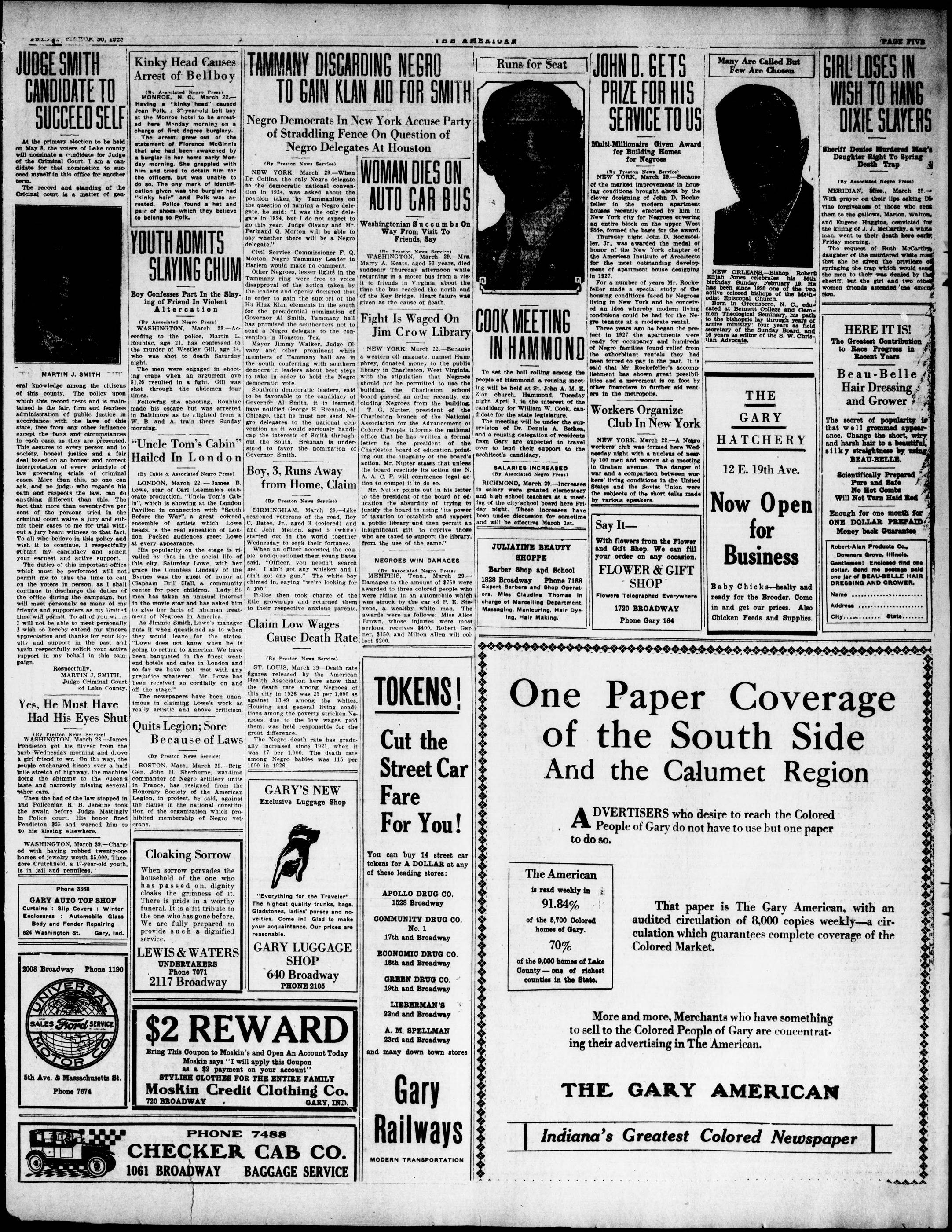
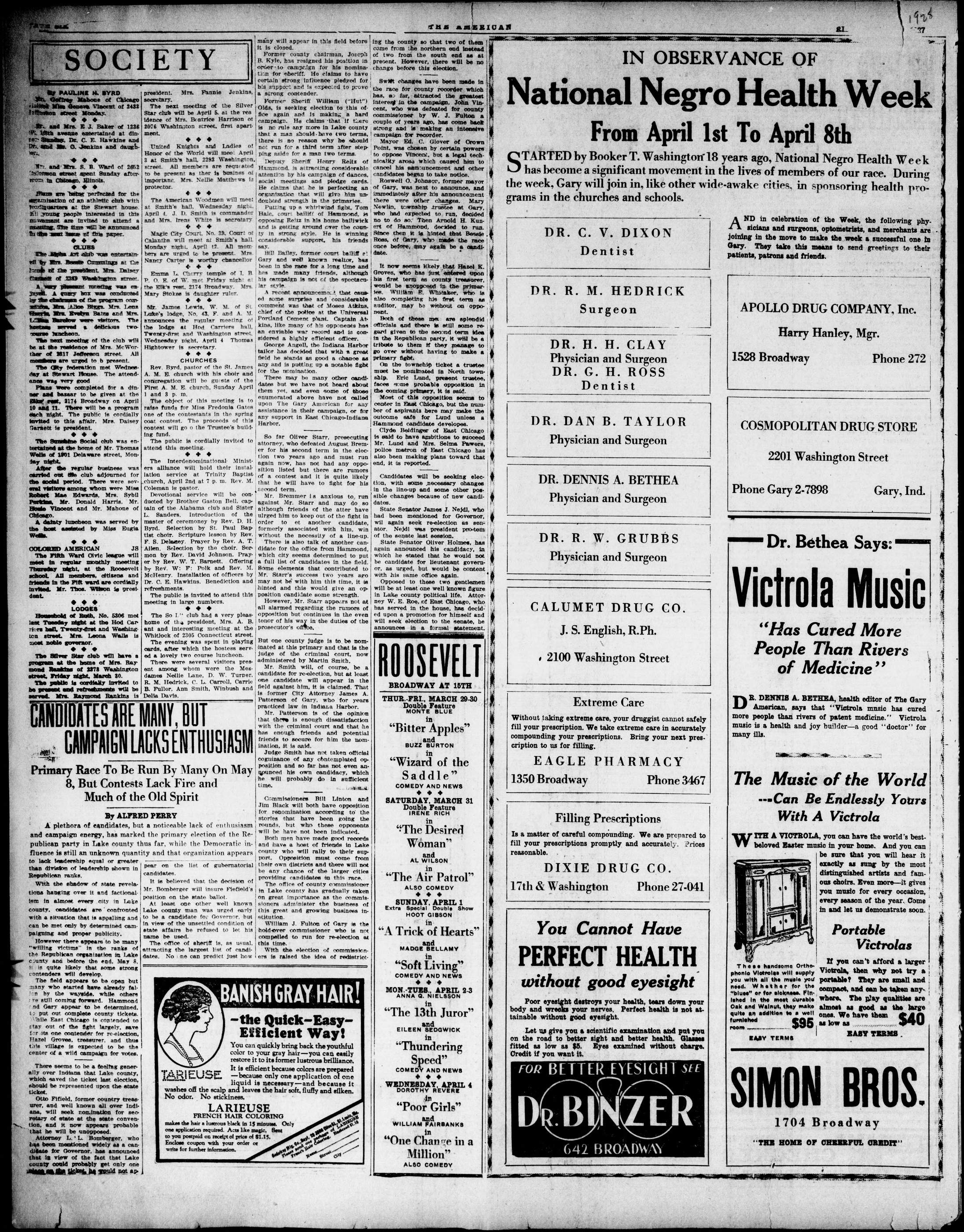
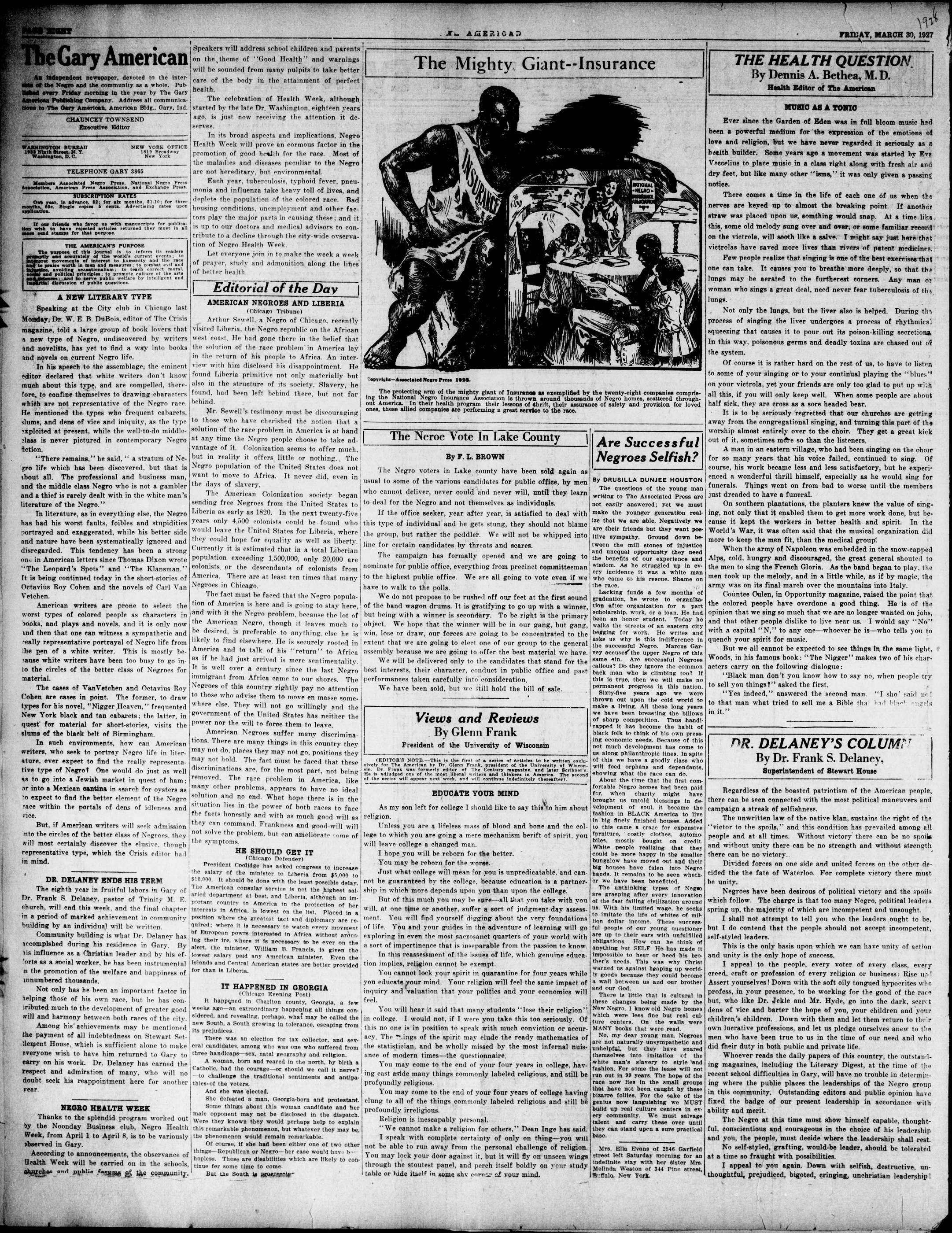
Page text (machine-generated)
"The Public Be Served"
An Independent Weekly Devoted To the Best Interests of All
Doll For Mrs. Coolidge Br
White House By Phil
WASHINGTON, D. C.—Philadelphians from
Coolidge. Mrs. Rosa Norwood (right) of the C
Committee and Miss Gertrude Allen, honor st
High School for Girls presented the President
Friendship and Mrs. Coolidge's Negro doll on
human students of the public schools. The pres-
sident's "Friendship Week" observed under the suspices
ance Committee.
DARROW RAPS RACE PR
IN SPEECH; ASKS
Noted Criminal Lawyer De-
But One Human Race; "Col
sult of Environment," He T
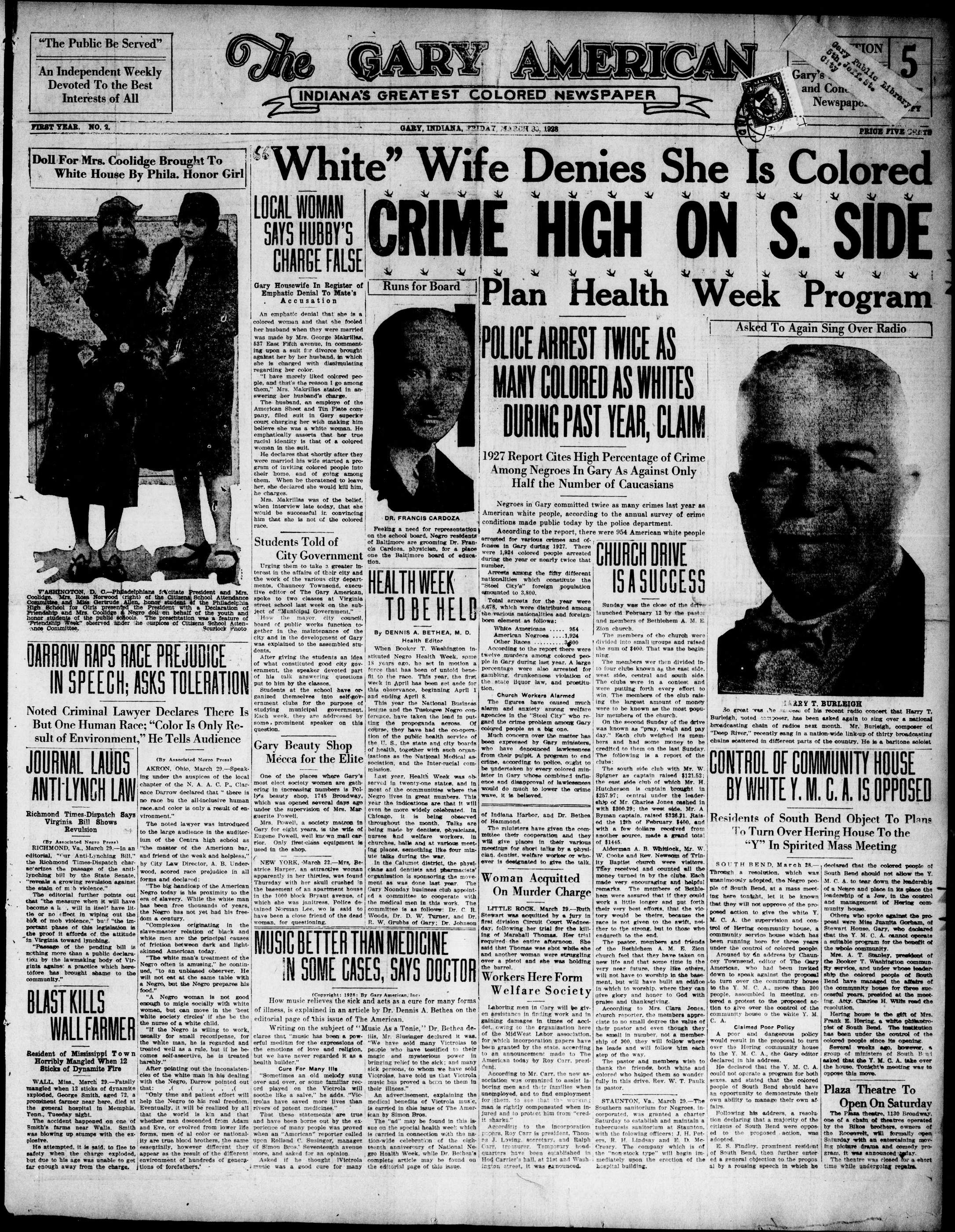
Doll For Mrs. Coolidge Brought To White House By Phila. Honor Girl
THE WEEKLY NEWS
FAHINGTON, D. C.-Philadelphia Ipcitate President and Mrs. Coolidge, Mrs. Ross Norwood (right) of the Citizens School Attendance Committee and Miss Gertrude Allen, honor student of the Philadelphia High School for Girls presented the President with a Declaration of Friendship and Mrs. Coolidge a Negro doll on behalf of the youth and honor students of the public schools. The presentation was a feature of "Friendship Week" observed under the auspices of Citizens School Attenance Committee.
DARROW RAPS RACE PREJUDICE IN SPEECH; ASKS TOLERATION
Noted Criminal Lawyer Declares There Is But One Human Race; "Color Is Only Result of Environment," He Tells Audience
AKRON, Ohio, March 29.—Speaking under the auspices of the local chapter of the N. A. A. C. P., Clarence Darrow declared that, "there is no race but the all-inclusive human race, and color is only a result of environment."
The noted lawyer was introduced to the large audience in the auditorium of the Centra high school as "the master of the American bar, and friend of the weak and helpless," by City Law Director, A. B. Underwood, scored race prejudice in all forms and declared:
"The big handicap of the American Negro today is his proximity to the era of slavery. While the white man has been free thousands of years, the Negro has not yet had his freedom a century.
"Complexes originating in the slave-master relation of black and white men are the principal causes of friction between dark and light-skinned American today.
"The white man's treatment of the Negro often is amusing," he continued, "to an unbiased observer. He will not eat at the same table with a Negro, but the Negro prepares his food."
"A Negro woman is not good enough to mingle socially with white women, but can move in the 'best white society circles' if she be the nurse of a white child.
"If the Negro is willing to work, usually for small recompense, for the white man, he is regarded and treated well as a rule, but if he becomes self-assertive, he is treated harshly."
After pointing out the inconsistencies of the white man in his dealing with the Negro, Darrow pointed out that: ,, (, , , , (
Only time and patient effort will help the Negro to his real freedom. Eventually, it will be realized by all that the world is kind and that whether man descended from Adam and Eve, or evolved from lower life forms, men of all color or nationality are true blood brothers, the same essentially, however different they appear as the result of the different environment of hundreds of generations of forefathers.
---
FIRST YEAR. NO. 2.
JOURNAL LAUDS ANTI-LYNCH LAW
Richmond Times-Dispatch Says Virginia Bill Shows Revulsion
(By Associated Negro Press)
RICHMOND, Va., March 29.—In an editorial, "Our Anti-Lynching Bill," the Richmond Times-Dispatch characterizes the passage of the anti-lynching bill by the State Senate, "reveals a growing revulsion against the stain of mob violence."
```markdown
```
The editorial further points out that "the measure when it will have become a law, will in itself have little or no effect in wiping out the back of mob violence," but "the important phase of this legislation is the proof it affords of the attitude in Virginia toward lynching.
"Passage of the pending bill is nothing more than a public declaration by the lawmaking body of Virginia agains' a practice which heretofore has brought shame to the community."
BLAST KILLS
WALL FARMER
Resident of Mississippi Town Horribly Mangled When 12 Sticks of Dynamite Fire
WALL. Miss., March 29.-Fatally mangled when 12 sticks of dynamite exploded, George Smith, aged 72, a prominent farmer near here, died at the general hospital in Memphis. Penn., Tuesday night. The accident happened on one of Smith's farms near Walls. Smith was blowing up stumpe with the explosive. He attempted, it is said, to flee to safety when the charge exploded, but due to his age was unable to get far enough away from the charge.
(By Associated Negro Press)
"White" Wife Denies She Is Colored LOCAL WOMAN SAYS HUBBY'S CHARGE FALSE CRIME HIGH ON S. SIDE
MUSIC BETTER THAN MEDICINE IN SOME CASES, SAYS DOCTOR (Copyright: 1928: By Gary American, Inc. How music relieves the sick and acts as a cure for many forms of illness, is explained in an article by Dr. Dennis A. Bethea on the editorial page of this issue of The American
Gary Housewife In Register of Emphatic Denial To Mate's Accusation
An emphatic denial that she is a colored woman and that she fooled her husband when they were married was made by Mrs. George Makrillas, 537 East Fifth avenue, in commenting upon a suit for divorce brought against her by her husband, in which she is charged with dissimulating regarding her color.
"I have merely liked colored people, and that's the reason I go among them," Mrs. Makrillas stated in answering her husband's charge.
The husband, an employee of the American Sheet and Tin Plate company, filed suit in Gary supervise court charging her with making him believe she was a white woman. He emphatically asserts that her true racial identity is that of a colored woman in the suit.
He declares that shortly after they were married his wife started a program of inviting colored people into their home, and of going among them. When he theratenated to leave her, she declared she would kill him, he charges.
Mrs. Makrillas was of the belief, when interview late today, that she would be successful in convincing him that she is not of the colored race.
Students Told of
Urgging them to take a greater interest in the affairs of their city and the work of the various city departments, Chauncey Townsend, executive editor of The Gary American, spoke to two classes at Virginia street school last week on the subject of "Municipal Government." How the mayor, city council, board of public works function together in the maintenance of the city and in the development of Gary was explained to the assembled students.
After giving the students an idea of what constituted good city government, the speaker devoted part of his talk answering questions put to him by the classes.
Students at the school have organized themselves into self-government clubs for the purpose of studying municipal government. Each week, they are addressed by some, prominent speaker on this question.
Gary Beauty Shop Mecca for the Elite
One of the places where Gary's most elect society women are gathering in increasing numbers is Polly's beauty shop, 1745 Broadway, which was opened several days ago under the supervision of Mrs. Marguerite Powell.
Mrs. Powell, a society matron in Gary for eight years, is the wife of Eugene Powell, well known mall carrier. Only first-class equipment is used in the shop.
NEW YORK, March 22.—Mrs. Beatrice Harper, an attractive woman apparently in her thirties, was found Thursday with her skull crushed in the basement of an apartment house in the 1000 block Bryant avenue, of which she was janitress. Police detained Norman Lee, wo is said to have been a close friend of the dead woman, for questioning.
MUSIC BETTER THAN IN SOME CASE
(Copyright: 1928: B
How music relieves the sick of illness, is explained in an article editorial page of this issue of Th
Writing on the subject of "clares that "music has been a powerful medium for the expressions of the emotions of love and religion, but we have never regarded it as a health builder."
Cure For Many Ills
"Sometimes an old melody sung over and over, or some familiar record played on the Victrola will soothe like a salve," he adds. "Victrolas have saved more lives than rivers of patent medicines."
That these statements are true and have been borne out by the experience of many people was proved when an "American" reporter called upon Rolland C. Susinger, manager of Simon Bros.' Seventeenth avenue store, and asked for an opinion.
Asked if he thought IVictrola music was a good cure for many
M.
Feeling a need for representation on the school board. Negro residents of Baltimore are grooming Dr. Francis Cardoza, physician, for a place one the Baltimore board of education.
HEALTH WEEK TO BE HELD
By DENNIS A. BETHEA, M. D. Health Editor
When Booker T. Washington instituted Negro Health Week, some 18 years ago, he set in motion a force that has been of untold benefit to the race. This year, the first week in April has been set aside for this observance, beginning April 1 and ending April 8.
This year the National Business league and the Tuskegee Negro conference, have taken the lead in putting the propoganda across. Of course, they have had the co-operation of the public health service of the U. S., the state and city boards of health, together with such organizations as the National Medical association, and the Inter-racial commission.
Last year, Health Week was observed in twenty-one states, and in most of the communities where the Negro lives in great numbers. This year the indications are that it will even be more widely celebrated. In Chicago, it is being observed throughout the month. Talks are being made by dentists, physicians, nurses and welfare workers. In churches, halls and at various meeting places, something like four minute talks during the war.
In the Calumet district, the physicians and dentists and pharmacists' organization is sponsoring the movement as was done last year. The Gary Noonday business club appointed a committee to cooperate with the medical men in this work. The committee is as follows: Dr. C. R. Woods, Dr. D. W. Turner, and Dr. R. W. Grubbs of Gary; Dr. Johnson
Music As a Tonic," Dr. Bethea dellis, Mr. Slusinger declared it was. "We have sold many Victrolas to people who have testified to their magic and mysterious power in bringing relief to the sick; and many sick persons, to whom we have sold Victrolas, have told us that Victrola music has proved a born to them in their illness."
An advertisement, explaining the medical benefits of Victrola music, is carried in this issue of The American by Simon Bros.
The "ad" may be found in this issue on the special health week; which is carried in connection with the nineteenth anniversary of National Negro Health Week, while Dr. Bethea's complete article may be found on the editorial page of this issue.
POLICE ARREST TWICE AS MANY COLORED AS WHITES DURING PAST YEAR, CLAIM
1927 Report Cites High Percentage of Crime Among Negroes In Gary As Against Only Half the Number of Caucasians
Negroes in Gary committed twice as many crimes last year as American white people, according to the annual survey of crime conditions made public today by the police department.
According to the report, there were 954 American white people arrested for various crimes and offenses in Gary during 1927. There were 1,924 colored people arrested during the year or nearly twice that number.
Arrests among the fifty different nationalities which constitute the "Steel City's" foreign population amounted to 3,800.
Total arrests for the year were 6,678, which were distributed among the various nationalities and foreign-born element as follows:
White Americans ... 954
American Negroes ... 1,924
Other Races ... 3,600
According to the report there were twelve murders among colored people in Gary during last year. A large percentage were also arrested for gambling, drunkenness violation of the state liquor law, and prostitution.
Church Workers Alarmed
Sunday was the close of the drive launched February 12 by the pastor and members of Bethlehem A. M. E Zion church.
The members of the church were divided into small groups and raised the sum of $400. That was the beginning.
The members were then divided into four clubs known as the east side, west side, central and south side. The clubs were in a contest and were putting forth every effort to win. The members of the club rais-
Church Workers Alarmed
The figures have caused much alarm and anxiety among welfare agencies in the "Steel City" who regard the crime problem among Gary colored people as a big one.
Much concern over the matter has been expressed by Gary ministers, who have denounced lawlessness from their pulpit. A program to end crime, according to police, ought to be undertaken by every colored minister in Gary whose combined influence and disapproval of lawlessness would do much to lower the crime wave, it is believed.
of Indiana Harbor, and Dr. Bethea of Hammond.
The ministers have given the committee their cooperation and they will give places in their various meetings for short talks by a physician, dentist, welfare worker or whoever is designated to give the talk.
Woman Acquitted On Murder Charge
LITTLE ROCK. March 29—Ruth Stewart was acquitted by a jury in first division Circuit Court Wednesday, following her trial for the killing of Marshall Thomas. Her trial required the entire afternoon. She said that Thomas was shot while she and another woman were struggling over a pistol and she was holding the barrel.
Workers Here Form Welfare Society
Laboring men in Cary will be given assistance in finding work and ingraining damages in times of accident, owing to the organization here of the MidWest Labor association, for which incorporation papers have been granted by the state, according to an announcement made to The American today by Roy Carr, president.
According to Mr. Carr, the new association was organized to assist laboring men and their families when unemployed, and to find employment for them, to see that the working man is rightly compensated when injured and to protect him from "credit sharks."
According to the incorporation papers, Roy Carr is president, Thomas J. Loving, secretary, and Ralph Carr, treasurer. Temporary headquarters have been established in Hod Carrier's hall, at 21st and Washington street, it was announced.
CHURCH DRIVE IS A SUCCESS
Sunday was the close of the drive launched February 12 by the pastor and members of Bethlehem A. M. E. Zion church.
The members of the church were divided into small groups and raised the sum of $400. That was the beginning.
The members were then divided into four clubs known as the east side, west side, central and south side. The clubs were in a contest and were putting forth every effort to win. The members of the club raising the largest amount of money were to be known as the most popular members of the church.
On the second Sunday of the drive was known as "pray, weigh and pay day." Each club weighted its members and had some money to be credited to them on the last Sunday. The following is a report of the clubs:
The south side club with Mr. W. Spligner as captain raised $121.52; the east side club of which Mr. H. Hutcherson is captain brought in $257.97; central under the leadership of Mr. Charles Jones cached in with $300.29; the west side, Mr. A. Byman captain, raised $326.21. Raised the 12th of February $400, and with a few dollars received from another source, made a grand total of $1445.
Alderman A. B. Whitlock, Mr. W. W. Cooke and Rev. Newcom of Trinity Baptist church were visitors. They received and counted all the money turned in by the clubs. Each made very encouraging and helpful remarks. The members of Bethlehem were assured that if they could work a little longer and put forth their very best efforts, that the victory would be theirs, because the race is not given to the swift, neither to the strong, but to those who endureth to the end.
The pastor, members and friends of the Bethlehem A. M. E. Zion church feel that they have taken on new life and that some time in the very near future, they like others, will not have to worship in the basement, but will have built an edifice in which to worship, where they can give glory and honor to God with praise and thanksgiving.
According to Mrs. Clara Jones, church reporter, the members appreciate to no small degree the value of their pastor and even though they be small in number, not a membership of 200, they will follow where he leads and will follow him each step of the way.
The pastor and members wish to thank the friends, both white and colored who helped them so wonderfully in this drive. Rev. W. T. Paulk is pastor.
STAUNTON, Va., March 29.—The Southern sanitarium for Negroes, incorporated, was granted a charter Saturday to establish and maintain a tuberculosis sanitarium at Staunton, with the following officers: J. H. Peters, R. H. Lindsay and E. D. McCreary. The company which is of the "non stock type" will begin immediately upon the erection of the hospital building.
Asked To Again Sing Over Radio
M. B.
So great was the success of his recent radio concert that Harry T. Burleigh, noted composer, has been asked again to sing over a national broadcasting chain of radios next month. Mr. Burleigh, composer of "Deep River," recently sang in a nation-wide link-up of thirty broadcasting chains scattered in different parts of the country. He is a baritone soloist
CONTROL OF COMMUNITY HOUSE
BY WHITE Y. M. C. A. IS OPPOSED
SOUTH BEND, March 28.—Through a resolution, which was unanimously adopted, the Negro people of South Bend, at a mass meeting here tonight, let it be known that they will not approve of the proposed action to give the white Y. M. C. A. the supervision and control of Hering community house, a community service house which has been running here for three years under the control of colored people. Aroused by an address by Chauney Townsend, editor of The Gary American, who had been invited down to speak against the proposal to turn over the community house to the Y. M. C. A., more than 300 people, assembled in meeting, entered a protest to the proposed action to give over the control of the community house o the white Y. M. C. A.
Claimed Poor Policy
A poor and dangerous policy would result in the proposal to turn over the Hering community house to the Y. M. C. A., the Gary editor declared in his address.
He declared that the Y. M. C. A. could not operate a program for both sexes, and stated that the colored people of South Bend should have an opportunity to demonstrate their own ability to manage their own affairs.
Following his address, a resolution declaring that a majority of the citizens of South Bend were opposed to the proposed action, was adopted. E. S. Findley, prominent resident of South Bend, then further entered a general objection to the proposal by a rousing speech in which he
declared that the colored people of South Bend should not allow the Y. M. C. A. to tear down the leadership of a Negro and place in its place the leadership of a Jew, in the control and management of Hering community house.
Others who spoke against the proposal were Miss Juanta Gorham, of Stewart House, Gary, who declared that the Y. M. C. A. cannot operate a suitable program for the benefit of the whole community.
Mrs. A. T. Stanley, president of the Booker T. Washington community service, and under whose leadership the colored people of South Bend have managed the affairs of the community house for three successful years, presided at the meeting. Atty. Charles H. Wilks read the resolution.
Hering house is the gift of Mrs. Frank E. Hering, a white philanthropist of South Bend. The institution has been under the control of the colored people since its opening.
Several weeks ago, however, a group of ministers of South Bend asked that the Y. M. C. A. take over the house. Tonight's meeting was to oppose this move.
The Plaza theatre, 1130 Broadway, one of a chain of theatres operated by the Blhos brothers, owners of the Roosevelt, will formally open Saturday with an entertaining moving picture drama and comedy program, it was announced today. The theatre was closed for a short time while undergoing reserve
PULLMA
BRIBE ACT FALLS FLAT IN ATTEMPT
NEW YORK, March 29.—How the Pullman company attempted to bribe officials of the Brotherhood of Sleeping Oor Porters was revealed by Brother Roy Lancaster at a meeting of the Brotherhood at St. Luke's hall, last night.
Brother Lancaster told how P. A. Sample, instructor of porters for his company, came to him and asked for a private interview. When this had been granted, Sample indicated that he came from F. J. Mitchel, District Superintendent of Ne York, and that even higher officials were backing him.
The proposition which Sample offered was a simple one. He must merely pick a quarrel with the union and use that as a pretext to quit. For this, the Pullman company offered him a lump sum of from thirty-five to fifty thousand dollars, and $250 a month for the rest of his life.
He would have to work for the company for a few months in order not to raise too much noise, but after that he could retire. Moreover, Sample said that a little trip to Europe could be arranged in order to get him out of the way during the first publicity which might arise.
Brother Lancaster listened to this proposition with interest, as did the two other brothers whom he had smuggled in, unknown to Sample, to listen privately to the conversation.
He then demanded an interview with Mitchell himself, and that too was arranged. But Mitchell, after appearing on the scene twice, each time got cold feet and never turned up for the interview. Lancaster had arranged a reception committee for him consisting of Arthur Garfield Hays, two other witnesses and two stepgraphers.
The principal speaker of the evening was A. Philip Randolph, general organizer of the Brotherhood. He urged the members to strengthen their organization, pointing out that five million ews in this country, although also an oppressed race, had more power than the 15 million negroes, because the ews were organized. Brother W. H. Des Verney reported on the progress of the organization throughout the South. Brother Grain announced a dance for Mach 11 and urged the support of the brothers to the union. About five hundred members of the union were present.
Jury Asks Prayer In Returning a Verdict
(By Associated Negro Press)
AUGUSTA, Ga., March 29—According to the jurors who last week freed Mrs. Lillian McKie of the charge of killing her husband in 1926, the verdict was influenced by the appeal for divine guidance made by Rev. J. H. Williams, one of two Negroes who served on the jury.
When the jury went out to assemble a verdict, Rev. Williams was asked to pray.
He responded to the call, and the jurymen who heard the petition declared it was a fervent appeal for guidance in a case where society and souls of humanity were invoked.
Spanish War Vet Dies In Carolina
DURHAM, N. C., March 29.—Captain Peyton H. Smith died here at his home Sunday afternoon after an illness of three weeks following an automobile accident. Funeral services were held Tuesday afternoon.
No Tricks
The American does not give away Insurance Policies in order to get people to subscribe to the paper.
It does not have to use any artificial means to build up a mighty circulation. Readers of The American find the paper clean enough, good enough and interesting enough to buy and read, without such inducements.
Thus, the quality of the circulation of The American is not impaired one bit by the use of tricks and artifices in attaining subscribers.
THE
GARY
AMERICAN
"PRINTS ALL THE NEWS"
---
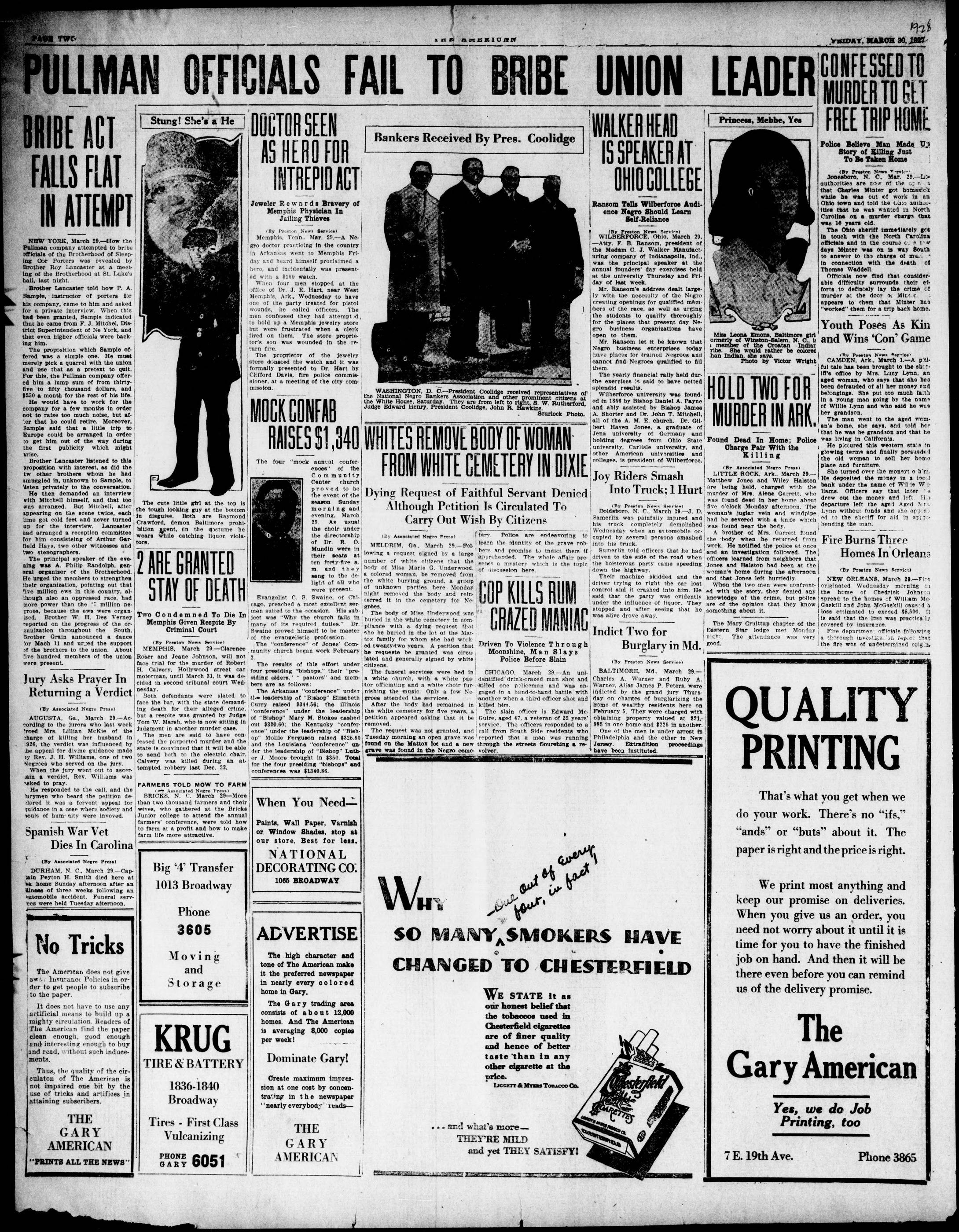
Stung! She's a He
The cute little girl at the top is the tough looking guy at the bottom in disguise. Both are Raymond Crawford, demon Baltimore prohibition agent, in the posture he wears while catching liquor violators.
2 ARE GRANTED STAY OF DEATH
Two Condemned To Die In
Memphis Given Respite By
Criminal Court
(By Preston News Service)
MENPUB> Monoch> .Glas
MEMPHIS, March 29.—Clarence Roser and Jeane Johnson, will not face trial for the murder of Robert H. Calvery, Hollywood street car motorman, until March 31, it was decided in second tribunal court Wednesday.
Both defendants were slated to face the bar, with the state demanding death for their alleged crime, but a respite was granted by Judge Tom W. Marsh, who is now sitting in judgment in another murder case.
The men are said to have confessed the purported murder and the state is convinced that it will be able to send both to the electric chair. Calvery was killed during an attempted robbery last Dec. 22.
FARMERS TOLD MOW TO FARM
Associated Negro Press
BRICKS, N. C. March 29—More than two thousand farmers and their wives, who gathered at the Bricks Junior college to attend the annual farmers' conference, were told how to farm at a profit and how to make farm life more attractive.
Big '4' Transfer
1013 Broadway
Phone
3605
Moving
and
Storage
KRUG
TIRE & BATTERY
1836-1840
Broadway
Tires - First Class
Vulcanizing
PHONE 6051
GARY
DOCTOR SEEN AS HERO FOR INTREPID ACT
DOCTOR SEEN AS HERO FOR INTREPID ACT
Jeweler Rewards Bravery of Memphis Physician In Jailing Thieves
(By Preston News Service)
Memphis, Tenn. 201.—A Negro doctor practicing in the country in Arkansas went to Memphis Friday and heard himself proclaimed a hero, and incidentally was presented with a $120 watch.
When four men stopped at the office of Dr. J. E. Hart, near West Memphis, Ark. Wednesday to have one of the party treated for pistol wounds, he called officers. The men confessed they had attempted to hold up a Memphis jewelry store but were frustrated when a clerk fired on them. The store proprietor's son was wounded in the return fire.
The proprietor of the jewelry store donated the watch and it was formally presented to Dr. Hart by Clifford Davis, fire police commissioner, at a meeting of the city commission.
MOCK CONFAB
RAISES $1,340
The four "mock annual confer-
annual conferences" of the Community Center church proved to be the event of the season Sunday morning and evening. March 25. As usual the choir under the directorship of Dr. R. O. Mundin were in their seats at ten forty-five a.m. and they sang to the delight of all who were present.
Center church proved to be the event of the season Sunday morning and evening. March 25. As usual the choir under the directorship of Dr. R. O. Mundin were in their seats at ten forty-five a.m and they sang to the delight of all who were present.
Evangelist C. S. Swaine, of Chicago, prescheduled a most excellent seren man suited to the occasion. His subject was "Why the church fails in many of its required duties." Dr Swaine proved himself to be master of the evangelistic profession.
The "conference" of Jones' Community church began work February 2.
The results of this effort under four presiding "bishops," their "presiding elders," "pastors" and members are as follows:
The Arkansas "conference" under the leadership of "Bishop" Elizabeth Curry raised $344.56; the illinois "conference" under the leadership of "Bishop" Mary M. Stokes cashed out $320.60; the Kentucky "conference" under the leadership of "Bishop" Mollie Ferguson raised $325.80 and the Louisiana "conference" under the leadership of "Bishop" Luther J. Moore brought in $350. Total for the four presiding "bishops" and conferences was $1340.86.
Paints, Wall Paper, Varnish or Window Shades, stop at our store. Best for less. NATIONAL DECORATING CO. 1065 BROADWAY
The high character and tone of The American make it the preferred newspaper in nearly every colored home in Gary.
The Gary trading area consists of about 12,000 homes. And The American is averaging 8,000 copies per week!
Dominate Gary!
Create maximum impression at one cost by concentrating in the newspaper "nearly everybody" reads—
THE GARY AMERICAN
AGE AMERIURN
AIL TO
Bankers Received
WASHINGTON, D. C.—President of the National Negro Bankers Association, the White House, Saturday. They are Judge Edward Henry, President Cool
WHITES REMOVE E
FROM WHITE C
Dying Request of Fail
Although Petition
Carry Out Wi
(By Associated Negro Press)
received By Presi
C.—President Coolidge rec
inkers Association and other
day. They are from left to n
President Coolidge, John R.
MOVE BODY OF
WHITE CEMETER
rest of Faithful Se
Petition Is Circ
Out Wish By Ci
THE MAYOR OF BROOKLYN, N.Y., WAS IN AWARD OF THE MAYOR OF BROOKLYN, N.Y., FOR THE EXCELLENCE OF HIS JOB. HE WAS IN AWARD OF THE MAYOR OF BROOKLYN, N.Y., FOR THE EXCELLENCE OF HIS JOB.
WASHINGTON, D. C.—President Coolidge received representatives of the National Negro Bankers Association and other prominent citizens at the White House, Saturday. They are from left to right, S. W. Rutherford, Judge Edward Henry, President Coolidge, John R. Hawkins.
Carry Out Wish By Citizens
MELDRIM, Ga., March 29—Following a request signed by a large number of white citizens that the body of Miss Marie G. Underwood, a colored woman, be removed from the white burying ground, a group of unknown parties here Monday night removed the body and reinterred it in the cemetery for Negroes.
The body of Miss Underwood was buried in the white cemetery in compliance with a dying request that she be buried in the lot of the Mattox family for whom she had worked twenty-two years. A petition that he requeste be granted was circulated and generally signed by white citizens.
The funeral services were hed in a white church, with a white pastor officiating and a white chair furnishing the music. Only a few Negroes attended the services.
After the body had remained in the white cemetery for five years, a petition appeared asking that it be removed.
The request was not granted, and Tuesday morning an open grave was found on the Mattox lot and a new grave was found in the Negro ceme-
---
WHY
- One out of every four, in fact!
SO MANY SMOKERS HAVE CHANGED TO CHESTERFIELD
WE STATE it as our honest belief that the tobaccos used in Chesterfield cigarettes are of finer quality and hence of better taste than in any other cigarette at the price.
LUCKEY & MYERS TOBACCO CO.
... and what's more—
THEY'RE MILD
and yet THEY SATISFY!
BRIBE
By Pres. Coolidge
Coolidge received representatives of nation and other prominent citizens at from left to right, S. W. Rutherford, bridge, John R. Hawkins.
Scurlock Photo.
BODY OF WOMAN
EMETERY IN DIXIE
Faithful Servant Denied
Is Circulated To
Sh By Citizens
fery. Police are endeavoring to learn the Identity of the grave robbers and promise to indict them if apprehended. The whole affair presents a mystery which is the topic of discussion here.
COP KILLS RUM
CRAZED MANIAC
Driven To Violence Through
Moonshine, Man Slays
Police Before Slain
CHICAGO. March 29.—An unidentified 'drink-crazed man shot and killed one policeman and was engaged in a hand-to-hand battle with another when a third officer shot and killed him.
The slain officer is Edward McGuire, aged 47, a veteran of 22 years' service. The officers responded to a call from South Side residents who reported that a man was running through the streets flourishing a revolver.
WALKER HEAD IS SPEAKER AT OHIO COLLEGE
Ransom Tells Wilberforce Audience Negro Should Learn Self-Reliance
(By Preston News Service)
WILBERFORCE, Ohio, March 29.
-Atty. F. B. Ransom, president of the Madam C. J. Walker Manufacturing company of Indianapolis, Ind., was the principal speaker at the annual founders' day exercises held at the university Thursday and Friday of last week.
Mr. Ransom's address dealt largely with the necessity of the Negro creating openings for qualified members of the race, as well as urging the students to qualify thoroughly for the places that present day Negro business organizations have open to them.
Mr. Ransom let it be known that Negro business enterprises today have places for trained Negroes and cannot find Negroes qualified to fill them.
The yearly financial rally held during the exercises is said to have netted splendid results. Wilberforce university was founded in 1856 by Bishop Daniel A. Payne and ably assisted by Bishop James A. Shorter and Dr. John T. Mitchell, all of the A. M. E. church. Dr. Gilbert Haven Jones, a graduate of Jena university of Germany and holding degrees from Ohio State university, Carlisle university, and other American universities and colleges, is president of Wilberforce.
Joy Riders Smash Into Truck;1 Hurt
(By Preston News Service)
Doldsir, N. C., March 29. J.-D. Samerlin was painfully injured and his truck completely demolished Wednesday when an automobile occupied by several persons smashed into his truck.
Samerlin told officers that he had driven to the side of the road when the boisterous party came speeding down the highway.
Their machine skidded and the driver trying to right the car lost control and it crashed into him. He said that the party was evidently under the influence of liquor. They stopped and after seeing that he was alive drove away.
Indict Two for Burglary in Md.
(By Preston News Service)
BALTIMORE, Md., March 29.
Charles A. Warner and Ruby A. Warner, Alias James P. Peters, were indicted by the grand jury Thursday on charges of burglarizing the home of wealthy residents here on February 5. They were charged with obtaining property valued at $21,985 in one home and $225 in another.
One of the men is under arrest in Philadelphia and the other in New Jersey. Extradition proceedings have been instituted.
J.
Miss Leona Emons, Baltimore girl formerly of Winston-Salem, N. C. is a member of the Croatan Indian tribe. She would rather be colored than Indian she says. Photo by Victor Wright
HOLD TWO FOR MURDER IN ARK.
Found Dead In Home; Police Charge Pair With the Killing
(BY ASSOCIATED NEGRO PRESS)
LITTLE ROCK, ARK. March 29.—Matthew Jones and Wiley Halston are being held, charged with the murder of Mrs. Alene Garrett, who was found dead in her home about five o'clock Monday afternoon. The woman's juglar vein and windpipe had be severed with a knife which was found near the body.
A brother of Mrs. Garrett found the body when he returned from work. He notified the police at once and an investigation followed. The officers learned from neighbors that Jones and Halston had been at the woman's home during the afternoon and that Jones left hurriedly.
When the two men were confronted with the story, they denied any knowledge of the crime, but police are of the opinion that they know something about it.
The Mary Gruptuist chapter of the Eastern Star lodge met Monday night. The attendance was very good.
QUA
PRIN
That’s what
do your work.
“ands” or “but
paper is right and
We print m
keep our prom
When you give
need not worry a
time for you to
job on hand. A
there even before
us of the deliver
T
Gary A
QUALITY PRINTING
That's what you get when we do your work. There's no "ifs," "ands" or "buts" about it. The paper is right and the price is right.
We print most anything and keep our promise on deliveries. When you give us an order, you need not worry about it until it is time for you to have the finished job on hand. And then it will be there even before you can remind us of the delivery promise.
Yes, we do Job Printing, too
7 E. 19th Ave.
CONFESSED TO MURDER TO GET FREE TRIP HOME
Police Believe Man Made U
Story of Killing Just
To Be Taken Home
(By Preston News Service)
Jonesboro, N. C. Mar. 29.—LOS
authorities are low of the opi
that Charles Minter got homest
while he was out of work in an
Ohio town and told the Ohio auth
ities that he was wanted in North
Carolina on a murder charge that
was 10 years old.
The Ohio sheriff immediately get
in touch with the North Carolina
officials and in the course of two
days Minter was on its way South
to answer to the charge of muni
in connection with the death of
Thomas Waddell.
Officials now find that consider
able difficulty surrounds their ef
forts to definitely lay the crime of
murder at the door of Minter.
appears to them that Minter has
"worked" them for a trip back home.
Youth Poses As Kin and Wins 'Con' Game
(CAMDEN, Ark. March 1.—A painful tale has been brought to the sheriff's office by Mrs. Lucy Lynn, an aged woman, who says that she has been defrauded of all her money and belongings. She put too much faith in a young man going by the name of Willie Lynn and who said he was her grandson. The man went to the aged woman's home, she says, and told her that he was grandson and that he was living in California. He pictured this western state in glowing terms and finally persuaded the old woman to sell her home place and furniture. She turned over the monsyt o him. He deposited the money in a local bank under the name of Willie Williams. Officers say that later she drew out the money and left. His departure left the aged Aged Mrs Lynn without funds and she appalled to the sheriff for aid in apprehending the man.
Fire Burns Three Homes In Orleans
(By Preston News Service)
NEW ORLEANS, March 29.—Fired originated Wednesday morning in the home of Chedrick Johnson spread to the homes of William McGaskill and John McGaskill caused a loss estimated to exceed $8,500. It is said that the loss was practically covered by insurance.
Fire department officials following a thorough investigation on report that the fire was of undetermined origin.
LITY
TING
you get when we
There’s no “ifs,”
s” about it. The
d the price is right.
most anything and
wise on deliveries.
us an order, you
about it until it is
have the finished
and then it will be
are you can remind
ry promise.
he
American
---
1928
---
Phone 3865
FRIDAY, MARCH 30, 1928
MAN,81,WEDS 18 YEAR GIRL
NASHVILLE, Tenn. March 29. *Uncle Alex Vaughn is one who does not put any credence in the Oler theory, nor does he believe that men over thirty are incapable of love.* Saturday morni, *Uncle Alex, who is a mere strip of a lad, and who has recently passed his eighty-first birthday, appeared at the courthouse here with Miss Ura Williams, who is just eighteen.* He secured marriage license and in due time they were "Mr. and Mrs. Alexander Vaughn."
Legal Notices
NOTICE
By order of the Board of Public Works
CHEMISTRY
JOHN A. BRENNAN
HARRY BRUNOL
BARRY BRENNAN
ATTEST: ANNA BRENNAN, Clerk.
NOTICE
NOTICE IS HEREBY GIVEN: That on the 26th day of March, 1928, the Board of County, Indiana, adopted DECLARATORY PROVEMENT OF BUCHANAN STREET SECTION 5, from the Center Line of 58th Street in said Garg, by the construction therom of a 7' reinforced concrete pavement or a sheet aphalt, asphaltic concrete, or asphalt macadam on sing or stone base, or wood blocks on concrete foundation 24' wide or wood blocks on concrete foundation 24' wide; 5' also reinforced curb and gutter the street, together with all necessary appurtenances and applications now on file in the office of the City Engineer. We will meet on the 16th day of April, 1928, at ten a.m. in office in the City Hall to receive and all persons interested and will decide all persons interested and will decide able to be assessed for such improvement will equal the estimated cost thereof, and will be assessed for modify or reciting its Preliminary Rationale.
By order of the Board of Public Works,
BOARD OF PUBLIC WORKS
JOHN A. BRENNAN
HARRY NOLD
BOARD OF PUBLIC WORKS
ATTEST: ANNA BRENNAN Clerk.
3-80-4-6
NOTICE TO CONTRACTORS
NOTICE IS BEERBY GIVEN: That the
BOARD OF PUBLIC WORKS, Lake County, Indiana, will meet on
the 14th of April, 1928, in its office in the
office of the IMPROVEMENT OF HOVEY
for the IMPROVEMENT OF HOVEY,
all in accordance with the plan's
circifications now on file in the office of
the Engineer.
The cost of said improvement shall be
assessed as special benefits to the abut-
ture of the Engineer, and a certificate check for at least 2%
of the Engineer's estimate of the cost of
returned to successful bidders, and contract
and bond have been executed for the
certified check will be received in a less
than 10 percent discount. The right is reserved to reject any and all bids. Bids must be on file in the
BOARD OF PUBLIC WORKS, Lake County, Indiana, on the 9th of April, 1928.
NOTICE TO CONTRACTORS
NOTICE IS HEREBY GIVEN: That the Board of Public Works of the City of Seattle has received and will be on the 6th day of April, 1928. In its office in the City HQ, it will receive and consider bids for the SEWER NO. 76 in said City of Gary, all specifications now on the plan and specifications of the Board of Public Works. The assessment as special benefits to the abutting and benefitted property. Bidders must be assessed as special benefits to the abutting and benefitted property. Bidders must be assessed as special benefits to the percent of the Engineer's estimate of the cost of the certified check will be returned to unsuccessful bidders, and the successful bidden when a contract and certification check will be received in a less amount than One Hundred ($100.00) Dollar checks and all bids. Bids must be on file in the City HQ on the 9th day of April, 1928.
NOTICE IN HEREBY GIVEN: That the Board of Public Works of the City of Chicago has authorized the 2nd day of April, 1928, in its office in the City Hall, to receive and consider and consider the report of the Board of Public Works NO. 60 EAST, SECTION 1, from the Council of Cypress Avenue in Center Square of Cypress Avenue in Center Square of Bary, all in accordance with the plans and the office of the Board of Public Works.
The cost of said improvement shall be determined and benefited property. Bidders must be appointed as the Engineer's estimate of the cost if said improvement which will be returned has been executed for the work. No ceramic have been executed for the work. The cost amount than One Hundred ($100.00) Dollar and all bids. Bids must be on file in the Board's Office of said City by ten oclock By order of the Board of Public Works.
**NOTICE TO CONTRACTORS**
Notice to the Board of Public Works of the City of parry, Lake County, Indiana, will meet on the 10th of October in the City, Hall, to receive and consider the STREET, SECTION 1.5 from the Center Line of Oak Avenue to the South Line of Oak Avenue, in accordance with the plains and special in accordance with the office of the Board of Public Works.
The cost of said improvement shall be determined by the cost of building and benefited property. Bidders must submit a cost estimate for the cost of the Engineer’s estimate of the cost of the improvement, which will be returned to the successful bidders.
safely bidden when a contract and bond have been executed for the work. No ceramic have been executed for the amount than One Hundred ($1600.00). Dollars. The right is reserved to reject any work. The Board of Office of said City by ten clock a. m. on the 2nd day of April, 1923. By order of the Board of Office of Work. CHESTER J. DUNN JOHN A. BRENNAN BOARD OF PUBLIC WORKS BOARD OF PUBLIC WORKS ATTEST: ANNA BARRETT, CLEER.
NOTICE TO CONTRACTORS
NOTICE IS HERBBY GIVEN: That on the 12th day of March, 1928, the Board of Public Works of the City of Gary L�er County, Indiana, adopted DECLARATO BY RESOLUTION, NUMBER OF WORKS, the适用的 REVENTMENT OF TWENTY-FIFTH AVE NUE, SECTION 4, from the Center Line of Grant Street to the Center Line of Grant Street, in the said City of Gary, by the construction thereon of a cement curb and gutter twenty-four inches (24") in width and a pavement thirty-five (85) feet in width, being seventeen feet six inches (17 6") on each side of an eight-een foot (18" maxdam center strip to be constructed hereunder, with a wearing surface of one of the following kinds of modern city pavements, all on concrete base: sheet asphalt, asphalt concrete, brick or wood block; or a reinforced concrete pavement thirty-five feet (85) in width, being seventeen feet six inches (17 6") on each side of a center strip to be paved with mecdam hereunder, together with sidewalks five feet (5) in width where necessary, and all the new carcass base and gutter inlets, and other appurrences, and all in accordance with the plans and specifications for said improvement.
"The Board of Public Works will meet on Monday, the 10th of October, at o'clock m., in its office in the City Hall to receive and hear remonstrance from all members of the city, and to benefit the benefits to the property liable to be rented, by the Board, by the estimated cost thereof, and will therefore request or request its Preliminary Resolution.
NOTICE
NOTICE IS HEREBY GIVEN: That on the 18th day of March, 1928, the March 18th County, Indiana, adopted DECLARATORY RESOLUTION NUMBER 6834 for the Section 5, from the North Line of 5th Avenue to the South Line of 8th Avenue. The section is the therofe of a pavement 25' in width with a wearing surface of one of the following: plafit, asphaltic concrete, bithuthic or sheath asphaltic concrete, sheet asphaltic concrete, brick or wood block on concrete foundation; or a wood block on concrete foundation; together with all necessary appurtenances and all in accordance with the plans and city ordinances on file in the City Engineer's Office.
The Board of Public Works will meet on Monday, the 10th of oclock a.m. in its office in the City Hall to receive and hear remonstrations from all members of the public. The benefits to the property liable to be estimated must improvement will equal an estimated cost after confirm, modify or rescind its Preliminary By order of the Board of Public Works. JOHN A. BRENNAN BARRY A. ARNOLD BARRY A. PRELIMINARY PUBLIC WORKS ATTEST: ANNA BARRETT. CLEK.
NOTICE
NOTICE IS HEREBY GIVEN: That on the 19th day of March, 1928, the Board of Public Works of the City of Gary, Lake County, Indiana, adopted DECLARATORY RESOLUTION NUMBER 6333 for the IMPROVEMENT OF THIRTY-SEVENTH AVENUE, SECTION 6, from the Center Line of Broadway, to the Center Line of Ridge Road, in said City of Gary, by the structure that is of a pavement at 87° N, width being 18° 6" including lip on each side of an 8" macadam center strip to be constructed hereunder, with a wearing surface of one of the following kinds of modern city pavements all on concrete base; sheet asphalt, asphaltic concrete, brick or wood blocks; or a reinforced concrete pavement, together with all necessary opportunities. The law of the United States with the plans and specifications now on file in the office of the City Engineer.
The Board of Public Works will meet on the 9th day of April, 1928, at ten o'clock a. m., in its office in the City Hall to receive and hear remonstrances from all persons interested and will decide whether the work will be to be performed in line of the released for such improvement will be equal to the estimated cost thereof, and will thereafter confirm, modify or rescind its Preliminary Resolution.
NOTICE
NOTICE IS HEREBY GIVEN: That the Board of Public Works of the City of Gary, Lake County, Indiana, will meet on the 2nd day of April 1925, in its office in the City, Hall to receive and consider bids for the IMPROVEMENT OF 4TH AVENUE & OTHERS, in said City of Gary, all in accordance with the plans and specifications now on file in the office of the Board of Public Works.
The cost of an improvement shall be assessed as special benefits to the abutting and benefited property. Bidder's must file a certified check for at least 2% per cent of the Engineer's estimate of the cost of said improvement which will be returned to unsuccessful bidders, and to the successful bidder when a contract and bond have been executed for the work. No certified check will be received in a less amount than One Hundred ($100,000) Dollars. The right is reserved to reject any and all bids. Bids must be on file in the Board's Office of said City by ten o'clock a. m., on the 2nd day of April, 1928. By order of the Board of Public Works.
COMMISSIONERS' ALLOWANCES
FEBRUARY SESSION
The Board orders that the following Treasury, upon the warrant of the County
Commercial Printing Co. print-
ing term. John Killigrew, expires.
Wm B. Burford, supplies.
Wm B. Burford, supplies.
Wm B. Burford, supplies.
Wm B. Burford, supplies.
Tribe of 'K' supplies.
Crown Point Register, printing of
Burrough Adding Mach Co. at-
tention to machine
Burrough Adding Mach Co. at-
tention to machine
III. Bell Co. co. service - Sunt.
III. Bell Co. co. service
III. Bell Co. co. service
III. Bell Co. Co. Sup. Ct. E.
Crown Point Tel. co. service.
Western Union Tel. co. service.
Burrough additional com-
pensation
Ribbons
Tribe of "K", typewriter ribbons
Remington Rand Bus. Serv. Inc.
one line—nime-t
Deputy, salary as 'Asst'
Deputy
Hazelel K. Groves, salary as
Hazelel K. Groves, salary as
Hazelel K. Groves, expense
Management
Donald K. Groves, supplies
Donald K. Groves, supplies
Donald K. Groves, one performa
Donald K. Groves, one performa
Tribe of W. supplies
Burroughs Adding, Mach. Co.
Burroughs Adding, Mach. Co.
John Mcadden, copying Gary
personal
Crown Point Register, printing
of tax levy sheets ..... 75.00
Crown Point Register, supply
Machine Shop, book im-
gers ..... 13.55
Crown Point Passenger Co. magazine
Nick Hoffman, building book-
racks ..... 39.00
James Clements, salary as North
Clement, pos. assistant
James Clement, expense
Minnie Clements, salary as chief
Rose Stubbler, deputy.
Amanda M. Rennie, deputy
Amy Rennie, deputy.
Chas. D. Hardesty, deputy.
L. B. Whitaker, deputy.
B. L. Godfrey, deputy.
B. L. Godfrey, deputy.
Godfrey H. Hunting, deputy.
Chas. A. Johnson, deputy.
H. Hunting, chief.
Pearl Steinbiller, clerical
Pearl Lennert, plats and blue
cars
Sanborn Map Co. corrections
& addition of
K. Griggs appl.,
K. Griggs appl.,
Luke Rudolph Co. of office
and secretary of
sahary at Cal.
Tp. gaseeners.
Katie Morgan, care of children
Katie Annamink, care of children
Ana Saminoff, care of children
Edith Krieger, care of children
Edith Toth, care of children
Mary Toth, care of children
Mary Sturn, care of children
Theo Meyer, care of children
Theo Meyer, care of children
Theo Dado, care of children
Sobia Knotowski, care of children
THE AMERICAN
PAGE THREE
WILLIAM E. WHITAKER.
Auditor Lake County, Indiana
That he is now located in his New Offices and Yards at 1202 Chicago Ave. Phone East Chicago 3000 East Chicago, In
A huge amount of charitable work was done by the Salvation Army in East Chicago during the year ending March 1, 1928, according to the annual report of the army just made public. In addition to that the organization was highly active in other lines, holding many meetings of various kinds, visiting families, and advising unfortunates.
The greater part of the work of the army was done in the Twin City, for needy of this community. However, transients were aided in a number of cases, and garments and shoes were sent to the sufferers in the flooded Mississippi valley last year. The bundles sent to the flooders weighed 600 pounds, the report shows.
Relief given during the year included furnishing clothing, shoes, meals, lodgings, transportation to other points, and toys for children at Christmas time.
A total of 964 garments were given away to needy persons, and 55 pairs of shoes were donated, 55 persons being aided in this way. Lodging played only a small part of the work, five persons being helped in that way. Meals were furnished to 47 persons at various times and for varying periods. Four persons stranded in this city and wishing to leave were aided by being supplied transportation. Groceries were supplied to 76 families, 132 Christmas dinners were given away, and 150 children were given toys at the holidays. The number of persons in the families relieved totalled 513, and the total number of persons given relief, which included transients, was 596. The "War Cry" a magazine of the army was distributed in jails and hospitals, 11,450 copies being given away in such institutions Six girls were sent to homes and hospitals.
The work of the army in the Twin City is in charge of Capt. and Mrs. Leon E. Geer, with headquarters at 1843 Forsyth av. Mrs. R. F. Robinson is secretary of the organization, and the advisory board is as follows: H. K. Groves, chairman; A. Ottenheimer, vice chairman; Mrs. Robinson, secretary; Milton Lewin, treasurer; G. C. Hansen, John C. Horn, William Jewell, J. M.ulligan, Jay Olsen, Dr. A. G. Schleiker, and Mrs. W. W. Smith.
Suspended Prison Sentences Given Three Local Boys
Suspended jail sentences were given three Twin City youths in Lake criminal court this week, by Judge Martin Smith, after they pleaded guilty to charges of grand larceny, in connection with the theft of six typewriters from Washington high school here.
The three lads were Carl Johnson, Perry Carroll, and Frank Halnes. It was alleged that they entered the high school commercial department one night recently, and made off with the typewriters.
BLOOMINGTON, Ind., March 30—Miss Audrey Smith, of East Chicago, will take part in "Jazz and Minuet," a play to be given by the Studio Players of Indiana university at concoction the second week in April. The play depicts the likenesses of the younger generation of yesterday and today. The cast for the play includes seven I. U. students.
Even if Harry Sinclair can't be put in jail, he ought to have a slap on the wrist.
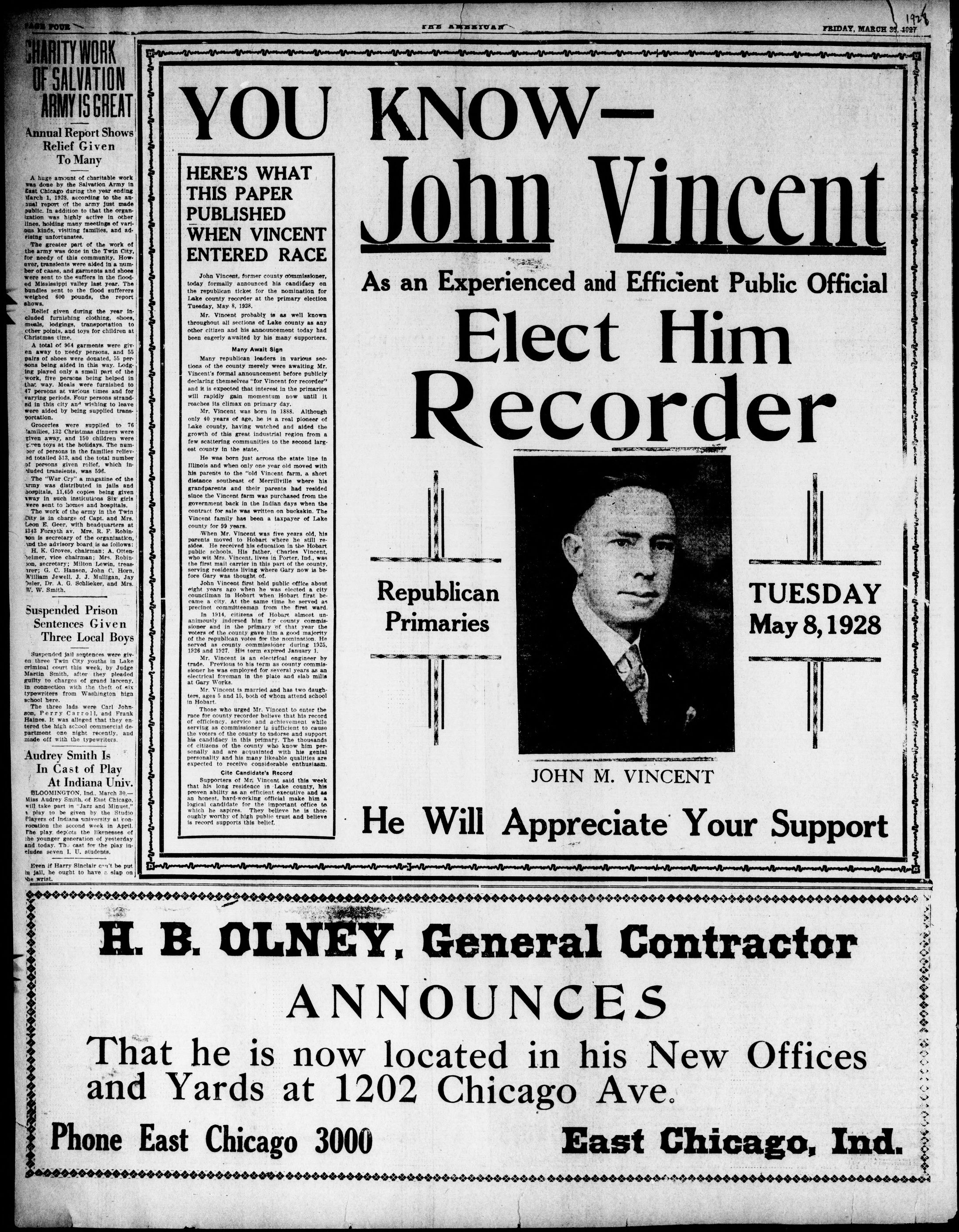
HERE'S WHAT THIS PAPER PUBLISHED WHEN VINCENT ENTERED RACE
John Vincent, former county commissioner, today formally announced his candidacy on the republican ticket for the nomination for Lake county recorder at the primary election Tuesday, May 8, 1928.
Mr. Vincent probably is as well known throughout all sections of Lake county as any other citizen and his announcement today had been eagerly awaited by his many supporters.
Many Await Sign
Many republican leaders in various sections of the county merely were awaiting Mr. Vincent's formal announcement before publicly declaring themselves "for Vincent for recorder" and it is expected that interest in the primaries will rapidly gain momentum now until it reaches its climax on primary day.
Mr. Vincent was born in 1888. Although only 40 years of age, he is a real pioneer of Lake county, having watched and aided the growth of this great industrial region from a few scattering communities to the second largest county in the state.
He was born just across the state line in Illinois and when only one year old moved with his parents to the "old Vincent farm, a short distance southeast of Merrillville where his grandparents and their parents had resided since the Vincent farm was purchased from the government back in the Indian days when the contract for sale was written on buckskin. The Vincent family has been a taxpayer of Lake county for 99 years.
When Mr. Vincent was five years old, his parents moved to Hobart where he still resides. He received his education in the Hobart public schools. His father, Charles Vincent, who wit Mrs. Vincent, lives in Porter, Ind., was the first mail carrier in this part of the county, serving residents living where Gary now is before Gary was thought of.
John Vincent first held public office about eight years ago when he was elected a city councilman in Hobart when Hobart first became a city. At the same time he served as preconit committeeman from the first ward.
In 1914, citizens of Hobart almost unanimously indorsed him for county commissioner and in the primary of that year the voters of the county gave him a good majority of the republican votes for the nomination. He served as county commissioner during 1925, 1926 and 1927. His term expired January 1.
Mr. Vincent is an electrical engineer by trade. Previous to his term as county commissioner he was employed for several years as an electrical foreman in the plate and slab mills at Gary Works.
Mr. Vincent is married and has two daughters, ages 5 and 15, both of whom attend school in Hobart.
Those who urged Mr. Vincent to enter the race for county recorder believe that his record of efficiency, service and achievement while serving as commissioner is sufficient to cause the voters of the county to indorse and support his candidacy in this primary. The thousands of citizens of the county who know him personally and are acquainted with his genial personality and his many likeable qualities are expected to receive considerable enthusiasm.
Cite Candidate's Record
Supporters of Mr. Vincent said this week that his long residence in Lake county, his proven ability as an efficient executive and as an honest, hard-working official make him a logical candidate for the important office to which he aspires. They believe he is thoroughly worthy of high public trust and believe is record supports this belief.
KNOW- John Vincent
As an Experienced and Efficient Public Official Elect Him Recorder
He Will Appreciate Your Support
M. B.
Republican Primaries
JOHN M. VINCENT
FRIDAY, MARCH 30, 1927
cent
ublic Official
m
er
nt
Official
TUESDAY May 8,1928
---
East Chicago, Ind.
JUDGE SMITH
CANDIDATE TO
SUCCEED SELF
At the primary election to be held on May 8, the voters of Lake county will nominate a candidate for Judge of the Criminal Court. I am a candidate for that nomination to succeed myself in this office for another term.
The record and standing of the Criminal court is a matter of gen-
MARTIN J. SMITH
eral knowledge among the citizens of this county. The policy upon which this record rests and is maintained is the fair, firm and fearless administration of public justice in accordance with the laws of this state, free from any other influence except the facts and circumstances in each case, as they are presented. This assures to every person and to society, honest justice and a fair deal based on an honest and correct interpretation of every principle of law governing trials of criminal cases. More than this, no one can ask, and no judge who regards his oath and respects the law, can do anything different than this. The fact that more than seventy-five per cent of the persons tried in the criminal court waive a jury and submit their cases to me for trial without a jury beam: witness to that fact. To all who believe in this policy and wish it to continue, I respectfully submit my candidacy and solicit your earnest and active support.
The duties of this important office which must be performed will not permit me to take the time to call on the voters in person, as I shall continue to discharge the duties of the office during the campaign, but will meet personally as many of my friends and supporters as my limited time will permit. To all of you w. m I will not be able to meet personally I wish to hereby extend my sincere appreciation and thanks for your loyalty and support in the past and again respectfully solicit your active support in my behalf in this campaign.
Respectfully.
respectivity,
MARTIN J. SMITH,
Judge Criminal Court
of Lake County
Yes, He Must Have Had His Eyes Shut
Yes, He Must Have Had His Eyes Shut
(By Preston News Service)
WASHINGTON, March 28—James Pendleton got his fliver from theurb Wednesday morning and drove a girl friend to wr. On the way, thecouple exchanged kisses over a half mile stretch of highway, the machinedoing the shimmy to the queen's taste and narrowly missing severalother cars.
Then the had of the law stepped in and Policeman R. B. Jenkins took the swain before Judge Mattingly in Police court. His honor finedPendleton $25 and warned him to to his kissing elsewhere.
WASHINGTON, March 29—Charged with having robbed twenty-one homes of jewelry worth $5,000. Theodore Crutchfield, a 17-year-old youth, is in jail and penniless.
GARY AUTO TOP SHOP
Curtains : Slip Covers : Winter
Enclosures : Automobile Glass
Body and Fender Repairing
624 Washington St. Gary, Ind.
UNIVERSAL
SALES Ford SERVICE
MOTOR CO.
Kinky Head Causes Arrest of Bellboy
(By Associated Negro Press)
MONROE, N. C., March 22—Having a "kinky head" caused Jean Polk, a 3°-year-old bell boy at the Monroe hotel to be arrested here Monday morning on a charge of first degree burglary.
The arrest, grew out of the statement of Florence McGinnis that she had been awakened by a burglar in her home early Monday morning. She grappled with him and tried to detain him for the officers, but was unable to do so. The ony mark of identification given was the burglar had "kinky hair" and Polk was arrested. Police found a hat and pair of shoes which they believe to belong to Polk.
YOUTH ADMITS SLAYING CHUM
Boy Confesses Part In the Slaying of Friend In Violent Altercation
(By Associated Negro Press)
WASHINGTON. March 29—Ace
WASHINGTON, March 29 — According to the police, Martin L. Roulac, age 21, has confessed to the murder of Westley Gill, age 24, who was shot to death Saturday night.
The men were engaged in shooting craps when an argument over $1.25 resulted in a fight. Gill was shot through the abdomen four times.
Following the shooting, Roulac made his escape but was arrested in Baltimore as he alighted from a W. B. and A. train there Sunday morning.
"Uncle Tom's Cabin" Hailed In London
(By Cable & Associated Negro Press)
LONDON, March 22. — James B. Lowe, star of Carl Laemmle's elaborate production, "Uncle Tom's Cabin", which is showing at the London Pavilion in connection with "South Before the War", a great colored ensemble of artists which Lowe heads, is the real sensation of London. Packed audiences greet Lowe at every appearance.
His popularity on the stage is rivalled by that in the social life of this city. Saturday Lowe, with her grace the Countess Lindsay of the Byrnes was the guest of honor at Clapham Drill Hall, a community center for poor children. Lady Simon has taken an unusual interest in the movie star and has asked him to give her facts of inhuman treatment of Negroes in America.
As Jimmie Smith, Lowe's manager puts it when questioned as to when they would leave for the states, "Lowe does not know when he is going to return to America. We have been banqueted in the finest west-end hotels and cafes in London and so far we have not met with any prejudice whatever. Mr. Lowe has been received so cordially on and off the stage."
The newspapers have been unanimous in claiming Lowe's work as really artistic and above criticism.
Quits Legion; Sore Because of Laws
(By Preston News Service)
BOSTON, Mass., March 29.—Brig. Gen. John H. H. Sherburne, war-time commander of Negro artillery units in France, has resigned from the Honorary Society of the American Legion, in protest, he said, against the clause in the national constitution of the organization which prohibited membership of Negro veterans.
Cloaking Sorrow
When sorrow pervades the household of the one who has passed on, dignity cloaks the grimness of it. There is pride in a worthy funeral. It is a fit tribute to the one who has gone before. We are fully prepared to provide such a dignified service.
LEWIS & WATERS
UNDERTAKERS
Phone 7071
2117 Broadway
TO GAIN KLAN AID FOR SMITH
Negro Democrats In New York Accuse Party of Straddling Fence On Question of Negro Delegates At Houston
NEW YORK, March 29—When Dr. Collins, the only Negro delegate to the democratic national convention in 1824, was asked about the position taken by Tammanites on the question of naming a Negro delegate, he said: "I was the only delegate in 1824, but I do not expect to go this year. Judge Olvany and Mr. Ferinand Q. Morton will be able to say whether there will be a Negro delegate."
Civil Service Commissioner F. Q. Morton, Negro Tammany Leader in Harlem would make no comment.
Other Negroes, lesser lights in the Tammany ring were free to voice disapproval of the action taken by the leaders and openly declared that in order to gain the sup;ort of the Ku Klux Klan elements in the south for the presidential nomination of Governor Al Smith, Tammany hall has promised the southernners not to send a Negro delegate to the convention in Houston, Tex.
Mayor Jimmy Walker, Judge Olvany and other prominent white members of Tammany hall are in the south conferring with southern democratic leaders about best steps to take in order to hold the Negro democratic vote. Southern democratic leaders, said to be favorable to the candidacy of Governor Al Smith, it is learned, have notified George E. Brennan, of Chicago, that he must not send Negro delegates to the national convention as it would seriously handicap the interests of Smith through out the South. Brennan is understood to favor the nomination of Governor Smith.
Boy,3, Runs Away from Home, Claim
(By Preston News Service)
BIRMINGHAM, March 23.—Like seasoned veterans of the road, Roy C. Bates, Jr., aged 3 (colored) and and John Melton, aged 5 (white) started out in the world together Wednesday to seek their fortunes.
When an officer accosted the couple and questioned them young Bates said, "Officer, you needn't search me. I didn't got any whiskey and I didn't got any gun." The white boy chimed in, saying "we're looking for a job."
Police then took charge of the little grownups and returned them to their respective anxious parents.
Claim Low Wages Cause Death Rate
(By Preston News Service)
ST. LOUIS, March 29—Death rate figures released by the American Health Association here show that the death rate among Negroes of this city in 1926 was 25 per 1,000 as against 13.49 among the whites. Housing and general living conditions among the poverty stricken Negroes, due to the low wages paid them, was held responsible for the great difference.
The Negro death rate has gradually increased since 1921, when it was 17 per 1,000. The death rate among Negro babies was 115 per 1000 in 1926.
GARY'S NEW
Exclusive Luggage Shop
"Everything for the Traveler"
The highest quality trunks, bags,
Gladstones, ladies' purses and novelties. Come in! Glad to make your acquaintance. Our prices are reasonable.
GARY LUGGAGE
SHOP
640 Broadway
PHONE 2105
WARD
It's and Open An Account Today
THE AMERICAN
RDING NEGRO
N AID FOR SMITH
New York Accuse Party
ce On Question of
es At Houston
WOMAN DIES ON AUTO CAR BUS
Washingtonian S u c c u m b s On Way From Visit To Friends, Say
(By Preston News Service)
WASHINGTON, March 29—Mrs. Marry A. Keats, aged 53 years, died suddenly Thursday afternoon while returning in a motor bus from a visit to friends in Virginia, about the time the bus reached the north end of the Key Bridge. Heart failure was given as the cause of death.
Fight Is Waged On Jim Crow Library
NEW YORK, March 22.—Because a western oil magnate, named Humphrey, donated money to the public library in Charleston, West Virginia, with the stipulation that Negroes should not be permitted to use the building, the Charleston school board passed an order recently, excluding Negroes from the building. T. G. Nutter, president of the Charleston branch of the National Association for the Advancement of Colored People, informs the national office that he has written a formal letter to the president of the Charleston board of education, pointing out the illegality of the board's action. Mr. Nutter states that unless the board rescinds its action the N. A. A. C. P. will commence legal action to compel it to do so.
Mr. Nutter points out in his letter to the president of the board of education the absurdity of trying to justify the board in using "its power of taxation to establish and support a public library and then permit an insignificant gift to deprive those who are taxed to support the library from the use of the same."
NEGROES WIN DAMAGES
(By Associated Negro Press)
MEMPHIS, Tenn., March 29.—Damages to the amount of $750 were awarded to three colored people who were riding in an automobile which was struck by the car of P. E. Stevens, a wealthy white man. The awards were as follows: Miss Alice Brown, whose injuries were most serious, receives $400, Robert Garner, $150, and Milton Allen will collect $200.
TOKENS!
Cut the Street Car Fare For You!
You can buy 14 street car tokens for A DOLLAR at any of these leading stores:
APOLLO DRUG CO.
1528 Broadway
COMMUNITY DRUG CO.
No. 1
17th and Broadway
ECONOMIC DRUG CO.
18th and Broadway
GREEN DRUG CO.
19th and Broadway
LIEBERMAN'S
22nd and Broadway
A. M. SPELLMAN
23rd and Broadway
and many down town stores
Gary
Railways
MODERN TRANSPORTATION
Runs for Seat
M.
COOK MEETING IN HAMMOND
To set the ball rolling among the people of Hammond, a rousing meeting will be held at St. John A. M. E. Zion church, Hammond, Tuesday night, April 3, in the interest of the candidacy for William W. Cook, candidate for the state legislature.
The meeting will be under the supervision of Dr. Dennis A. Bethea, and a rousing delegation of residents from Gary are expected to travel over to lend their support to the architect's candidacy.
SALARIES INCREASED
(By Associated Negro Press)
RICHMOND, March 29.—Increases in salary were granted elementary and high school teachers at a meeting of the city's school board here Friday night. These increases have been under discussion for sometime and will be effective March 1st.
JULIATINE BEAUTY
SHOPPE
Barber Shop and School
Barber Shop and School
1828 Broadway Phone 7188
Expert Barbers and Shop Operators, Miss Claudia Thomas In charge of Marceling Department, Massaging, Manicuring, Hair Dyeing, Hair Making.
One
of t
And
A DV
P
to do so
The American
is read weekly in
91.84%
of the 5,700 Colored
homes of Gary.
70%
to sell t ing thei
THE
One Paper Coverage of the South Side And the Calumet Region
ADVERTISERS who desire to reach the Colored People of Gary do not have to use but one paper to do so.
More and more, Merchants who have something to sell to the Colored People of Gary are concentrating their advertising in The American.
THE GARY AMERICAN
Indiana's Greatest Colored Newspaper
of the 6,000 homes of Lake County — one of richest counties in the State.
That paper is The Gary American, with an audited circulation of 8,000 copies weekly-a circulation which guarantees complete coverage of the Colored Market.
JOHN D. GETS PRIZE FOR HIS SERVICE TO US
Multi-Millionaire Given Award for Building Homes for Negroes
(By Preston News Service)
NEW YORK, March 29.—Because of the marked improvement in housing conditions brought about by the clever designing of John D. Rockefeller in the modern apartment houses recently elected by him in New York city for Negroes covering an entire block on the upper West Side, formed the basis for the award.
Thursday night John D. Rockefeller, Jr., was awarded the medal of honor of the New York chapter of the American Institute of Architects for the most outstanding development of apartment house designing in 1927.
For a number of years Mr. Rockefeller made a special study of the housing conditions faced by Negroes living in New York and he conceived an idea whereby modern living conditions could be had for the Negro tenants at a moderate rental. Three years ago he began the project in 1827 the apartments were ready for occupancy and hundreds of Negro families found relief from the exhuberant rentals they had been forced to pay in the past. It is said that Mr. Rockefeller's accomplishment has shown great possibilities and a movement is on foot by other financiers to further aid renters in the metropolis.
Workers Organize Club In New York
NEW YORK, March 22.—A Negro workers' club was formed here Wednesday night with a nucleus of nearly 100 men and women at a meeting in Graham avenue. The danger of war and a comparison between workers' living conditions in the United States and the Soviet Union were the subjects of the short talks made by various speakers.
With flowers from the Flower and Gift Shop. We can fill your order on any occasion.
FLOWER & GIFT SHOP
Flowers Telegraphed Everywhere
1720 BROADWAY
Phone Gary 164
Many Are Called But Few Are Chosen
A.
NEW ORLEANS—Bishop Robert Elijah Jones celebrates his 66th birthday Sunday, February 19. He has been since 1920 one of the two bishops of the Methodist Episcopal Church. Born in Greensboro, N. C., educated at Bennett College and Gammon Theological Seminary, his path to the bishopric lay through years of the S. W. Christian Board, and 16 years as editor of the S. W. Christian Advocate.
THE
GARY
HATCHERY
12 E. 19th Ave.
Now Open for Business
Baby Chicks-healty and ready for the Brooder. Come in and get our prices. Also Chicken Feeds and Supplies.
Cove
PAGE FIVE
GIRL LOSES IN WISH TO HANG DIXIE SLAYERS
Sheriff Denies Murdered Man's Daughter Right To Spring Death Trap
MERIDIAN, Miss., March 29.
With prayer on their lips asking Divine forgiveness of those who sent them to the gallows, Marion, Walton, and Eugene Haggins, convicted for the killing of J. J. McCarthy, a white man, went to their death here early Friday morning.
The request of Ruth McCarthy daughter of the murdered white man that she be given the privilege of springing the trap which would send the men to their denied by the sheriff, but the girl and two other women friends attended 'the execution.
HERE IT IS!
The Greatest Contribution
to Race Progress in
Recent Years
Beau-Belle
Hair Dressing
and Grower
The secret of popularity is
that well groomed appear-
ance. Change the short, wiry
and harsh hair to a beautiful,
silky straightness by using
BEAU-BELLE.
Scientifically Prepared Pure and Safe No Hot Combs Will Not Turn Haid Red
Enough for one month for ONE DOLLAR PREPAID Money back Guarantee
Robert-Alan Products Co. Downers Grove, Illinois.
Gentlemen: Enclosed find one dollar. Send me postage paid one jar of BEAU-BERLE HAIR DRESSING AND GROWER.
Name ..... Address ..... City..... State.....
---
SOCIETY
BY PAULINE H. BYRD
Mr. Geoffrey Mabone of Chicago
visited Miss Geneva Viscount of 2433
Jefferson street Monday.
Mr. and Mrs. E. J. Baker of 1236
19th avenue entertained at dinner.
Sunday, Dr. C. E. Hawkins and
Dr. and Mr. O. Jenkins and daughter.
Mr. and Mrs. S. B. Ward of 2652
Jefferson street spent Sunday afternoon in Chicago, Illinois.
Plans are being perfected for the organization of an athletic club with headquarters at the Stewart house.
All young people interested in this movement are invited to attend a meeting. The time will be announced in the next issue of this paper.
The Alma Art club was entertained by Mrs. Bessie Cummings at the lounge of the president, Mrs. Daisey Garnett of 223 Washington street. A very pleasant meeting was enjoyed. A easy box was conducted by the chairman of the program committee, Mrs. Alice Bigga, Mrs. Lena Hurria, Mrs. Evelyn Bates and Mrs. Lillian Barlow were visitors. The hostess served a delicious two-course luncheon. The next meeting of the club will be at the residence of Mrs. McWorther of 2817 Jefferson street. All members are urged to b present. The City federation met Wednesday at Stewart House. The attendance was very good. Plans were completed for a dinner and bazaar to be given at the Blair seat, 2174 Broadway on April 10 and 11. There will be a program each night. The public is cordially invited to this affair, Mrs. Daisey Garnett is president.
The Sunshine Social club was entertained at the home of Mr. Thomas Wells of 1901 Delaware street, Monday night.
After the regular business was carried out the club adjourned for the social period. There were several visitors among whom were Miss Robert Mae Edwards, Mrs. Sybil Portima, Mr. Donald Harris, Mr. House Vincent and Mr. Mahone of Chicago.
A dainty luncheon was served by the host assisted by Miss Eugia Wells.
COLORED AMERICAN JS
The Fifth Ward Civic league will meet in regular monthly meeting Thursday night, at the Roosevelt school. All members, citizens and friends in the Fifth ward are cordially invited. Mr. Thos. Wilson is president.
Household of Bush, No. 5306 most last Tuesday night at the Hod Carriers hall, Twenty-first and Washington street. Mrs. Leona Walls is most noble governor.
The Silver Star club will have a program at the home of Mrs. Raymond Rankins of 2278 Washington street, Friday night, March 30. The public is cordially invited to be present and refreshments will be served. Mrs. Raymond Rankins is
CANDIDATES ARE MANY, CAMPAIGN LACKS E
Primary Race To Be Run By 8, But Contests Lack Much of the Old S
By ALFRED PERRY
A plethora of candidates, but a noticeable and campaign energy, has marked the primal publican party in Lake county thus far, whose fluence is still an unknown quantity and that
A plethora of candidates, but a noticeable lack of enthusiasm and campaign energy, has marked the primary election of the Republican party in Lake county thus far, while the Democratic influence is still an unknown quantity and that organization appears
to lack leadership equal or greater than division of leadership shown in Republican ranks.
With the shadow of state revelations hanging over it and factionalism in almost every city in Lake county, candidates are confronted with a situation that is appalling and can be met only by determined campaigning and proper publicity.
However there appears to be many "willing victims" in the ranks of the Republican organization in Lake county and before the end, May 8, it is quite likely that some strong contenders will develop.
The field appears to be open but many who started have already fallen by the wayide, while others are still coming forward. Hammond and Gary appear to be determined, to put out complete county tickets. While East Chicago is contended to stay out of the fight largely, save for its one contender for re-election, Hazel Groves, treasurer, and thus this village is expected to be the center of a wild campaign for votes.
There seems to be a feeling generally over Indiana that Lake county, which saved the ticket last election, should be represented upon the state ticket.
Otto Fifield, former country treasurer, and well known all over Indiana, will seek nomination for secretary of state at the state convention, and it now appears probable that he will be unopposed.
Attorney L. L. Bomberger, who has been mentioned widely as a candidate for Governor, has announced that in view of the fact that Lake county could probably get only one ticket he would not ap
CLUBS
♦ ♦ ♦
COLORED AMERICAN
LODGES
president. Mrs. Fannie Jenkins, secretary.
The next meeting of the Silver Star club will be April 5 at the residence of Mrs. Beatrice Harrison of 2076 Washington street, first apartment.
United Knights and Ladies of Honor of the World will meet April 3 at Smith's hall. 2293 Washington street. All members are requested to be present as they is business of importance. Mrs. Nellie Matthews is protector.
The American Woodmen will meet at Smith's hall, Wednesday night. April 4. J. D. Smith is commander and Mrs. Irens White is secretary.
Magic City Court, No. 29, Court of Calanifa will meet at Smith's hall, Monday night. April 12. All members are urged to be present. Mrs. Nancy Carter is worthy chancellor.
Emma L. Cherry temple of L. B. P. O. E. of W. met Friday night at the Elk's rest. 2174 Broadway. Mrs. Mary Stokes is daughter ruler.
Mr. James Lewis, W. M. of St. Luke's lodge, No. 43. F. and A. M. announces the regular meeting of the lodge at Hod Carriers hall, Twenty-first and Washington street, Wednesday night. April 4 Thomas Hightower is secretary.
Rev. Byrd, pastor of the St. James A. M. E. church with his choir and congregation will be guests of the First A. M. E. church, Sunday April 1 and 3 p. m.
The object of this meeting is to raise funds for Miss Fredonia Gates one of the contestants in the spring coat contest. The proceeds of this contest will go o the Trustee's building fund.
The public is cordially invited to attend this meeting.
The Interdenominational Ministers alliance will hold their installation service at Trinity Baptist church, April 2nd at 7 p. m. Rev. M. Coleman is pastor.
Devotional service will be conducted by Brother Gaston Bell, captain of the Alabama club and Sister L. Sanders, Introduction of the master of ceremony by Rev. D. H. Byrd. Selection by St. Paul Baptist choir. Scripture lesson by Rev. F. S. Delaney. Prayer by Rev. A. T. Allen. Selection by the choir. Sermon by Rev. David Johnson. Prayer by Rev. W. T. Barnett. Offering by Rev. W. F: Polk and Rev. M. McHenry. Installation of officers by Dr. C. E. Hawkins. Benediction and refreshments.
The public is invited to attend this meeting in large numbers.
The evening was spent in playing cards, after which the hostess served a lovely two course luncheon. There were several visitors present among whom were the Mesdames Nellie Lane, D. W. Turner, R. M. Hedrick, C. L. Carroll, Carrie B. Fuller, Ann Smith, Winbush and Della Davis.
MANY, BUT HACKS ENTHUSIASM
Run By Many On May's Lack Fire and the Old Spirit
ED PERRY
It a noticeable lack of enthusiasm and the primary election of the Rehus far, while the Democratic inity and that organization appears appear on the list of gubernatorial candidates.
It is believed that the decision of Mr. Bomberger will insure Flefield's position on the state ballot.
At least one other well known Lake county man was urged early to be a candidate for Governor, but in view of the unsettled condition of state affairs he refused to let his name be used.
The office of sheriff is, as usual, attemting the largest list of candidates. No one can predict just how
BANI
-th the E2
TARIEUSE
BANISH GRAY HAIR!
—the Quick—Easy—Efficient Way!
You can quickly bring back the youthful color to your gray hair—you can easily restore it to its former lustrous brilliance. It is efficient because colors are prepared—because only one application of one liquid is necessary—and because it washes off the scalp and leaves the hair soft, fluffy and silken. No odor. No stickiness.
LARIEUSE
FRENCH HAIR COLORING
makes the hair a lustrous black in 15 minutes. Only one application required. Acts like magic. Sent to you postpaid on receipt of price of $1.15.
Enclose coupon with your order or write for further information.
♦ ♦ ♦
♠ ♠ ♠
CHURCHES
many will appear in this field before it is closed.
Former county chairman, Joseph B. Kyle, has resigned his position in order to campaign for his nomination for sheriff. He claims to have certain strong influence pledged for his support and is expected to prove a strong contender.
Former Sheriff William ("Hut") Olds, is seeking election to this office again and is making a hard campaign. He claims that if there is no rule any more in Lake county that a man should have two terms, there is no reason why he should not run for a third term after stepping aside for a man two terms.
Deputy Sheriff Henry Reitz of Hammond, is attracting considerable attention by his campaign of dances, social meetings and pledge cards. He claims that he is perfecting an organization that will give him undoubted strength in the primaries.
Putting up a whirlwind fight, Tom Hale, court bailiff of Hammond, is opposing Reitz in his home bailiwick and is getting around over the country in strong style. He is winning considerable support, his friends say.
Bill Bailey, former court bailiff of Gary and well known realtor, has been in the race for a long time and has made many friends, although his campaign is not of the spectacular style.
A recent announcement that caused some surprise and considerable comment was that of Moses Atkins, chief of the police at the Universal Portland Cement plant. Captain Atkins, like many of his opponents has an enviable war record and is considered a highly efficient officer. George Angell, the Indiana Harbor tailor has decided that with a great field he stands as good a chance as any and is putting up a notable fight for the nomination.
There may be many other candidates but we have not heard about them yet, and even some of those enumerated above have not called upon The Gary American for any assistance in their campaign, or for any support in East Chicago-Indiana Harbor.
So far Oliver Starr, prosecuting attorney, who defeated August Bremer for his second term in the election two years ago and must run again now, has not had any opposition listed but there are rumors of a contest and it is quite likely that he will have to fight for his second term.
Mr. Bremer is anxious to, run against Mr. Starr and may do so although the protection of the atter have ulrged him to keep out of the fight in order to et another candidate, formerly associated with him, win without the necessity of a line-up.
There is also talk of another candidate for the office from Hammond, which city seems determined to put a full list of candidates in the field. Some elements that contributed to Mr. Starr's success two years ago may not be with him this time, it is hinted and this would give an opposition candidate some strength. However, Mr. Starr appears not at all alarmed regarding the rumors of opposition but continues in the even tenor of his way in the duties of the prosecutor's office.
But one county judge is to be nominated at this primary and that is the judge of the criminal court, now administered by Martin Smith.
Mr. Smith will, of course, be a candidate for re-election, but at least one candidate will appear in the field against him, it is claimed. That is former City Attorney James A. Patterson of Gary, who for years practiced law in Indiana Harbor.
Mr. Patterson is of the opinion that there is enough dissatisfaction with the criminal court and that he has enough friends and potential friends to secure for him the nomination, it is said.
Judge Smith has not taken official cognizance of any contemptulated opposition and so far has not even appended his own candidacy, which he will probably do in sufficient
Commissioners Bill Linton and Jim Black will both have opposition for renomination according to the stories that have been going the rounds, but who these opponents will be have not been indicated. Both men have made good records and have a host of friends in Lake county who will rally to their support. Opposition must come from their own districts and there will not be any chance of the larger cities providing candidates in this race. The office of county commissioner in Lake county has gradually taken on great importance as the commissioners administer the business of this great and growing business institution. William J. Fulton of Gary is the holdover commissioner who is not compelled to run for re-election at this time. With the election of commissioners is raised the idea of redistrict-
ing the county so that two of them come from the northern end instead of two from the south end as at present. However, there will be no change before this election.
Swift changes have been made in the race for county recorder which has, so far, attracted the greatest interest in the campaign. John Vincent, who was defeated for county commissioner by W. J. Fulton a couple of years ago, has come back strong and is making an intensive campaign for recorder.
Mayor Ed. C. Glover of Crown Point, was chosen by certain powers to oppose Vincent, but a legal technicality arose which caused him to cancel his announcement and other candidates began to take notice.
Roswell O. Johnson, former mayor of Gary, was next to announce, and immediately after his announcement there were other changes. Mary Newlin, township trustee at Gary, who had expected to run, decided no to do so. Then Arnold H. Kunert of Hammond, decided to run. Since then it is hinted that Besiede Ross, of Gary, who made the race once before, may again be a candidate.
It now seems likely that Hazel K. Groves, who has just entered upon his first term as county treasurer, would be unopposed in the primaries. William E. Whistaker, who is also completing his first term as auditor, may be without on opponent.
Both of these men are splendid officials and there is still some regard given to the second term idea in the Republican party, it will be a tribute to them if they manage to go over without having to make a primary fight.
On the township ticket a trustee must be nominated in North township. Eric Lund, present trustee, faces some probable opposition in the coming primary, it is said.
Most of this opposition seems to center in East Chicago, but the number of aspirants here may make the outcome safe for Lund unless a Hammond candidate develops.
Clyde Beldinger of East Chicago is said to have ambitions to succeed Mr. Lund and Mrs. Selma Pawers, police matron of East Chicago has also been making plans toward that end, it is reported.
Candidates will be seeking election, with some necessary changes in the line-up and some other possible changes because of new candidates.
State Senator James J. Neidl, who had been mentioned for Governor, will again seek re-election as senator. Neidl was president protem of the senate last session. State Senator Oliver Holmes, has again announced his candidacy, in which he stated that he would not be candidate for lieutenant governor, as urged, but would be content with his same office again. Opposed to these two gentlemen will be at least one well known figure in Lake county political life. Attorney W. E. Roe, of East Chicago, who has served in the house, has decided upon a promotion for himself and will seek election to the senate, he announces in a formal statement.
ROOSEVELT
BROADWAY AT 15TH
THUR.-FRI., MARCH 29-30
Double Feature
MONTE BLUE
in
"Bitter Apples"
and
BUZZ BURTON
in
"Wizard of the
Saddle"
COMEDY AND NEWS
SATURDAY, MARCH 31
Double Feature
IRENE RICH
in
"The Desired
Woman"
and
AL WILSON
in
"The Air Patrol"
ALSO COMEDY
SUNDAY, APRIL 1
Extra Special Double Show
HOOT GIBSON
in
"A Trick of Hearts"
and
MADGE BELLAMY
in
"Soft Living"
COMEDY AND NEWS
MON.-TUES., APRIL 2-3
ANNA G. NIELSSON
in
"The 13th Juror"
and
EILEEN SEDGWICK
in
"Thundering
Speed"
COMEDY AND NEWS
WEDNESDAY, APRIL 4
DOROTHY REVERE
in
"Poor Girls"
and
WILLIAM FAIRBANKS
in
"One Change in a
Million"
ALSO COMEDY
National Negro Health Week From April 1st To April 8th
STARTED by Booker T. Washington 18 years ago, National Negro Health Week has become a significant movement in the lives of members of our race. During the week, Gary will join in, like other wide-awake cities, in sponsoring health programs in the churches and schools.
DR. C. V. DIXON Dentist
DR. R. M. HEDRIC Surgeon
DR. R. M. HEDRICE Surgeon
DR. R. M. HEDRICK Surgeon
DR. H. H. CLAY
Physician and Surgeon
DR. G. H. ROSS
Dentist
DR. DAN B. TAYLOR
Physician and Surgeon
DR. DAN B. TAYLOR Physician and Surgeon
DR. DAN B. TAYLOR Physician and Surgeon
DR. DENNIS A. BETHEA Physician and Surgeon
DR. R. W. GRUBBS
Physician and Surgeon
CALUMET DRUG CO
J. S. English, R.Ph.
CALUMET DRUG CO
J. S. English, R.Ph.
CALUMET DRUG CO.
2100 Washington Street
Extreme Care
Without taking extreme care fill your prescription. We talk compounding your prescripti ccription to us for filling. EAGLE PH 1350 Broadway
it taking extreme care, your druggist cannot
or prescription. We take extreme care in acce-
tending your prescriptions. Bring your next
to us for filling.
EAGLE PHARMACY
Broadway Phone
Without taking extreme care, your druggist cannot safely fill your prescription. We take extreme care in accurately compounding your prescriptions. Bring your next prescription to us for filling. EAGLE PHARMACY
Filling Prescriptions
Is a matter of careful compo fill your prescriptions prom reasonable.
better of careful compounding. We are pref
er prescriptions promptly and accurately.
able.
Is a matter of careful compounding. We are prepared to fill your prescriptions promptly and accurately. Prices reasonable.
DIXIE DRUG CO.
17th & Washington Phone 27-041
You Cannot Have
PERFECT HEALTH
without good eyesight
You Cannot Have PERFECT HEALTH without good eyesight
You Cannot Have PERFECT HEALTH without good eyesight
Poor eyesight destroys your health, tears down your body and wrecks your nerves. Perfect health is not attainable without good eyesight.
Let us give you a scientific examination and put you on the road to better sight and better health. Glasses fitted as low as $5. Eyes examined without charge. Credit if you want it.
FOR BETTER EYESIGHT SEE
DR. BINZER
642 BROADWAY
DRICK
AYLOR
urgeon
UG CO.
. Ph.
re
ruggist cannot safely
me care in accurately
ring your next press.
MACY
Phone 3467
We are prepared to accurately. Prices
Phone 27-041 Have EALTH eyesight
AND in celebration of the Week, the following physicians and surgeons, optometrists, and merchants are joining in the move to make the week a successful one in Gary. They take this means to send greetings to their patients, patrons and friends.
APOLLO DRUG COMPANY, Inc.
Harry Hanley, Mgr.
1528 Broadway Phone 27
COSMOPOLITAN DRUG STORE
MOPOLITAN DRUG ST
COSMOPOLITAN DRUG STORE
2201 Washington Street
Phone Gary 2-7898
Dr. Beth
Victrola
"Has Cure
People Th
of Me
DR. DENNIS A. BETHE
American, says that
more people than rivers of
music is a health and joy b
many ills.
Dr. Bethea Says
Victrola Mus
"Has Cured More
People Than Rivers
of Medicine"
ENNIS A. BETHEA, health editor of
American, says that "Victrola music
mole than rivers of patent medicine."
health and joy builder—a good "c
Dr. Bethea Says: Victrola Music
"Has Cured More People Than Rivers of Medicine"
DR. DENNIS A. BETHEA, health editor of The Gary American, says that "Victrola music has cured more people than rivers of patent medicine." Victrola music is a health and joy builder—a good "doctor" for many ills.
The Music of the World
---Can Be Endlessly Yours
With A Victrola
WITH A VICTROLA, you can have the world's best-beloved Easter music in your home. And you can
Music of the W
Can Be Endlessly
With A Victrola
A VICTROLA, you can have the w
oved Easter music in your home. A
The Music of the World
---Can Be Endlessly Yours
With A Victrola
WITH A VICTROLA, you can have the world's best-
beloved Easter music in your home. And you can
be sure that you will hear it
exactly as sung by the most
distinguished artists and fam-
ous choirs. Even more—it gives
you music for every occasion,
every season of the year. Come
in and let us demonstrate soon.
Portable
Victrolas
These handsome Ortho-
phonic Victrolas will supply
you with all the music you
need. Whether for the
"blues" or for sickness. Fin-
ished in the most durable
Oak and Walnut, they make
quite an addition to a well
furnished
room
$95
If you can't afford a larger
Victrola, then why not try a
portable? They are small and
compact, and can be taken any-
where. The play qualities are
almost as good as the large
ones. We have them
as low as
$40
EASY TERMS
MON BRO
1704 Broadway
SIMON
1704 Br
THE HOME OF CH
SIMON BROS.
1704 Broadway
"THE HOME OF CHEERFUL CREDIT"
TAN DRUG STORE
thea Says:
La Music
Cured More Than Rivers Medicine"
THEA, health editor of The Gary
that "Victrola music has cured
of patent medicine." Victrola
y builder—a good "doctor" for
of the World
the Endlessly Yours
A Victrola
A, you can have the world's bestsic in your home. And you can be sure that you will hear it exactly as sung by the most distinguished artists and famous choirs. Even more—it gives you music for every occasion, every season of the year. Come in and let us demonstrate soon.
Portable
Victrolas
If you can't afford a larger Victrola, then why not try a portable? They are small and compact, and can be taken anywhere. The play qualities are almost as good as the large ones. We have them as low as $40 EASY TERMS
I BROS.
Broadway
CHEERFUL, CREDIT"
Phone 272
Gary, Ind.
MISS TABITHA wiped her eyes and replaced her gold-rimmed spectacles.
"It's pretty hard on an old one like me to be giving up my home and all the furniture, Jim, but I s'pose I've got to. With the mill shut down, I don't have any money from the stock I own. Twasn't much, but it kept me going."
Jim, her grandnephew, helped Miss Tabitha into the palpitating auto.
"Well, cheer up, Aunt Tabitha. I'll tend to everything all right." The car lurched over the rutted road. Jim went on; "I'll stay right through the auction and see that everything goes all right. Course it's hard, and I'm as sorry as you. If I had the money, you can bet I'd buy it. I'll leave you with Marms, and you can stay 'till it's over."
Miss Tabitha lamented as they passed telegraph poles and fences
THE dark, eager young man was fascinated by the weaving hands and eloquent lips of the girl seated or, more literally, perched, opposite him at the table. "She's a bird!" he thought awedly. "Has flitted all over the world, and born to the purple, too." "And now," Nancy wound up her travelogue, her moleskin toque shadowing her thrilling eyes and tilted nose, "this old town seems pretty poky to Aunt Joe and me." Feeling pretty poky himself, Jimmy paid the check, adding a liberal tip. Girls of Nancy's calibre didn't come his way every day. Steve Bender, a college mate didn't introduce him to many of his new crowd. Steve was riding up in the world. He hailed a taxi, tucked her into it and demanded her address.
"Put me down at Gordon's," she decided grandly. "I'm shopping this afternoon. Jimmy prevailed upon her to lunch with him again on the morrow.
Something must be done, he decided on his way back to the office. James Arlington Drew must bestir himself and catch up with the great procession, in which the white finger of Nancy Fink beckoned.
After a week of expensive lunch-
A CIRCUS woman's son play me with my Timmy? Never!" e Mrs. Tarr set her lips. r "You're too hard on the boy," his w grandmother replied. "Of course he'll play with his next door neigh- bor. And Alvin seems like a nice little chap." a Mrs. Tarr shook her head. "Heaven knows what things that creature would teach my little Timmy!" s Grandma knit in discreet silence. h She had been with her daughter long enough to be a trifle suspicious of golden-haired Timmy, with his la angel's face and heavenly voice. b Secretly she hoped he was too good to be true. "There he comes now," she ob- served, an obscure satisfaction in her voice. Mrs. Tarr looked up with e a startled cry.
"Timmy, precious, whatever has happened?" she cried.
Timmy wiped an arm across his
OFFICER BANGS had traced the contraband goods as far as Freetown. From there on he was stumped. Without success he had interviewed all suspicious characters in the village and carefully searched their premises. Still, Officer Bangs knew the "stuff" had been landed in Freetown, so he could not well give up the chase.
"Get a soap-box, Tim," he ordered his deputy, jocosely but with determination, "and when the movies let out next Tuesday night, stand out in the square and offer a reward for any information that will lead to the arrest and conviction of these lawbreakers. This rum-running has got to be stopped!"
Most of the movie patrons who listened to the deputy's jerky little speech regarded it as an amusing incident—a humorous bit of comedy from real life after the rather harrowing melodrama they had just witnessed on the screen. Among those who took the offer of reward seriously was the impoverished Widow Ward.
Mrs. Ward was a gaunt, gray woman—her skin and hair were gray from worry and toil, her clothing was gray and threadbare, and her
Antiques Are Sold
```markdown
```
The Angel Child
```markdown
```
plastered with the notice of the impending disaster:
"AUCTION TODAY
RAMBLER ROSE FARM"
"I s'pose I'll get used to being without it. I was setting store by laying out some new borders of sweet alysum and hellotrope along the front walk, next Spring, and moving the pink rambler to the trellis over the door. And I was siming to give the house a good cleaning. I sure will feel like a ship without a rudder."
The little car reeled into Marm's dooryard. Jim's mother appeared at the shed door, wiping her hands on an ample apron.
"Whatever do you think! Capt'n Alden's house over to Four Corners burned flat last night, so Ira Tasker said, when he left the mail this morning. Nice house it was, too."
"Yes," sympathetic Miss Tabitha,
"tyas a mighty fine house. Tain't
eons, Jimmy was no longer an insurance man, but a globe trotter. He sailed tropic seas in the wake of a small white shallop, trailing a silver rudder in the shape of a luncheon fork. True, he made calls on "prospects" during the forenoon. But the late afternoon found him penciling whirligigs on the daily memo, waiting for the muezzin's call, and brushing the desert sand of failure from his eyes. The odd thing about it was that he knew as little of the girl at the end of the week as he had at the beginning. She simply kept him in foreign lands, carrying her travelogue with a lake or an ocean, an Alp or a chasm.
And here she left him—alone in a chasm. He couldn't invite her again. His exchequer was flat. The walls of finance seemed high and slippery indeed, the insurance business hovering above him like a wet blanket of fog. Jimmy was young.
Was he in love with her? he asked himself. Hanged if he knew!
At this depressing moment, a junior partner rounded on Jimmy and "ate him alive." Tingling with resentment. Jimmy went forth to call on "Old Man" Crockett. All the chaps had labored to sell Silas
mouth, leaving a dark smear, and edged away. "Nothing, Mother," he replied, his sweet, clear voice somewhat thickened by the loss of a tooth. His mother caught his arm in growing horror. "Who you been fighting, Timmy?" asked his grandmother with interest. He shot her a swift side glance. "Alvin and I had—words," he answered with an intonation so like his father's that his grandmother laughed aloud. Mrs. Tarr colored angrily. "Don't laugh at him, please, Mother," she begged. "Sweetheart, tell me what that dreadful boy did to you." Timmy wriggled from her grasp. "It ain't what he done to me," he cried, suddenly forgetting his mother's careful schooling in grammar. "It's what I done to him!" "What did you fight about?" Grandma's interest was genuine.
"He said I couldn't stand on my life itself was gray and cheerless. Extra money to her meant a sturdy pair of shoes upon her tired feet, a new hat for Sunday wear, and a choice cut of meat once in awhile. Before retiring that night, Mrs. Ward made a mental list of the people of her acquaintance who might be guilty of liquor smuggling. Many of these folks she had known for years, and there was not one upon whom she could cast suspicion. "If there is a guilty one in town, it must be a newcomer," she reflected thoughtfully. "The folks in Freetown are all good, law-abiding citizens. I wonder if it could possibly be that girl who moved in across the street last month." She is
across the street last month. She is such a young and pretty creature. I hate to think of her as being underhanded. But the papers say that lady-crooks are getting more common every day, and the pretty ones are the most daring."
pansive waistline, while he surveyed the furnishings with a practiced eye. By this time the audience had followed and filled the little house.
"Now, ladies and ge'mn'; How much am I offered? Here's a fine antique mahogany low boy—dandy curved legs, carved feet, original brasses," he gibly recited. "Do I hear thirty-five? Can't let it go at that. Who'll give more?"
Competition in bidding-g continued until $150 had been offered.
"One hundred and fifty!" cried the auctioneer. Who'll give me one hundred seventy-five?
There was a murmur from the bidders, and then silence. No one was willing to part with this amount.
"One hundred seventy-five," finally offered a resonant voice.
"Sold, at one hundred seventy-five," concluded the auctioneer. The purchaser was a man with gray hair and blue eyes, of kindly
Arca
Around the
She'll ride a camel, plowing the desert sands, and visit the bazaars of Indian towns, seated on a swaying elephant—Jupiter! Where am I," gasped Jimmy, inwardly. But the silence and growing dimness encouraged him.
Around the World
She'll ride a camel, plowing the shell tramp the deck and listen to desert sands, and visit the bazaars snatches of music from the city, of Indian towns, seated on a swaying while dark ships with yellow ports elephant—Jupiter! Where am I," slip silently by against the lights on gasped Jimmy, inwardly. But the waterfront. Her ship sails for silence and growing dimness encour- home at midnight—" Jimmy's voice aged him.
He shamelessly abandoned the un- Suddenly the place seemed to certain beast with its precious crackle with life. The lights were freight and took a long jump to the on. Snapping out of his self-hyp-"clean, flowered streets of Geneva" nosis, Jimmy confronted a strange where he tellingly lingered. After glare from under bushy brows. The lightly stressing Rome and Venice, eyes were gilstening.
he moved on to Paris, then London, "She'll need a lot of ready cash where he breathed quite freely. Here for all that," gasped "Old Man" he bolstered his weak narrative con- Crockett.
siderably.
Nancy had rhapsodied over London his stomach, Jimmy hitched his don. Hadn't she dabbled her lily chair forward and plunged into the white fingers in the muddy Thames? opening. He emerged with a whack- Now he had "Daughter" on the ing big policy. Calmer now, he approached Atlantic.
"She'll be entranced by the indigo sea dashing to white and green spray on Moro Castle in the harbor of Havana. Under the warm stars.
el Child
Mother, I've taught him a lot of things. He says himself he's improved."
Grandma choked. Mrs. Tarr felt a sudden rush of pride. The little darling!
"Dearest"—she stroked his yellow curls—"when you are older I hope you will do lots of good. But just now, dear, it might be misunderstood." With loving hands she clothed a long-suffering Timmy in brown velvet and ruffles for the party.
For once Timmy did not care. Alvin, too, had been invited to the party and Timmy was anxious that he should be a success. He stepped in for a word with his grandmother before leaving.
"Thanks for the cakes, Gram," he whispered. "Al was real tickled you remembered his birthday. Wish you were coming today," he added re-gretfully.
At the Si
e Sign of th
At the Sign of the Geranium
Mr. Bangs!"
Fifteen minutes later a delegation composed of Mrs. Ward, Officer Bangs and his deputy, and two of the town idlers (who were looking for excitement), burst unceremoniously into Marjorie Harland's kitchen. They found three young men seated at a table and Marjorie was serving them with sandwiches and tea.
"Young lady," said Mr. Bangs, displaying his badge, "you are under arrest. Who are these men you are entertaining?"
"Why, my husband and brothers," answered the astonished girl. "But I don't understand you."
"You will directly," continued the officer. "Is it true that you put a plant in your window every afternoon—as a signal?"
Marjorie laughed, and glanced nervously toward the front of the house. "Yes, a red geranium," she said, lowering her voice. "You see I.
---
```markdown
```
him- as though he couldn't afford to build p another, but as it was the place to where he was born, he wanted to set- t lie in it after being away most of l having his life. You don't have trouble of by your own but what you can always r of find someone who has worse. Even a long if I have to sell the house, at least o and it ain't burned to the ground. I can b rel- go and look at it once in a while." h ing Having uttered this philophy, t. I Miss Tabitha climbed out of the now at a docile auto and warmly embraced u her niece, who hospitably pushed her m's into the house. a at Jim cranked the car and returned d on to "Rambler Rose Farm."
There was already a crowd on the front lawn, some interested, others merely curious. The auctioneer arrived, nailed a red flag with the word "Auction" on it to a maple tree, and followed him into the house.
He tipped his derby at an angle and jerked his vest down over an ex-
Crockett, a "hopeless" prospect who wasn't so very old, but made up for it tigerishly. It was almost closing time when he gained admittance to the lair of the Toughest Proposition. A cold stare and a grumpy nod greeted him. But Jimmy wasn't bothering about either. He was gazing, fascinated, at a pale finger of sun, receding, like a gleaming sail, from the expanse of sea-blue rug.
"Mr. Crockett, he recklessly monotoned, "you have a young daughter, and some day she'll want to travel. She'll want to see this whole God's country; to peer down the awesome canon and take winding trails over mountain ranges, where the American eagle screams a welcome. She'll want to sail through the Golden Gate to China, and watch the barefoot coolies loading silks and tea and rice. She'll climb the crooked streets of cities, thousands of years old, and listen to the temple hells of Asia
head!" cried the boy, and bolted from the room.
"Stand on his head!" cried Mrs. Tarr. "And my son a descendant of Governor Bradford!" She drew a deep breath. "Well, now they've quarrelled, Timmy will give up that boy."
"Not till he can stand on his head," remarked Grandma, but her daughter did not hear.
Timmy mentioned Alvin no more, and Mrs. Tarr's fears were lulled. It was, therefore, with a distinct sense of shock, two months later, that she came suddenly upon the two boys in close converse.
"Timmy," she called, "I want you."
The boy came reluctantly. "Don't forget Greta's party this afternoon," she admonished him. "And Timmy, you mustn't associate with that boy. He is not the sort of person we care to know."
Timmy's eyes were wide. "But.
ly she adored the girl as she would, a daughter, and yet she was forced to admit that Marjorie did "act queer" at times. She always sat on the porch alone and never attended any of the local social functions. If she was the person that Officer Bangs was after, Mrs. Ward intended to collect the money before anyone else had a chance. Then, one day, Mrs. Ward made what she considered a startling discovery. Trembling with excitement, she hastened to headquarters and cautiously divulged her information to Officer Bangs.
"I've found your rum-runner, Mr Bangs," she announced breathlessly. "It's the girl who lives opposite me! Every afternoon, at 3 o'clock, she puts a red geranium in the window to indicate that the coast is clear. This afternoon three men watched the window until they saw the plant, then they went in, without knocking
and the World
el, plowing the she'll tramp the deck and listen to
listen to the bazaars snatches of music from the city, re
ed on a swaying while dark ships with yellow ports o
Where am I," slip silently by against the lights on
ardly. But the the waterfront. Her ship sails for a
dimness encour- home at midnight—" Jimmy's voice
died.
```markdown
```
By Monte Darrell
---
mien and had the bearing of one who had faced the gale of the sea. It was Captain Alden, whose homestead had burned the previous day. All through the day, he was not to be outdone in bidding. He became the owner of it all, including the house, much to the disappointment of those who wanted to buy the lovely antiques. Gradually the gathering dispersed. The auctioneer took down his flag and departed, leaving the Captain and Jim alone. "I reckon this will make me a fine, comfortable home," said the captain.
"Well, I do feel it quite a loss on account of it's being my boyhood home, and all the furniture had been in the family a long time. I've been away many years, but now I'd hoped to settle on the old place. That's why I was determined to buy everything here—so many antiques similar to what I've lost—about the nearest I can get to replace them."
Suddenly the place seemed to crackle with life. The lights were on. Snapping out of his self-hypnosis, Jimmy confronted a strange glare from under bushy brows. The eyes were glistening.
"She'll need a lot of ready cash for all that," gasped "Old Man" Crockett.
With an odd feeling at the pit of his stomach, Jimmy hitched his chair forward and plunged into the opening. He emerged with a whacking big policy. Calmer now, he appraised the rugged man.
"I'm sound." growled Crockett.
"You certainly look it," agreed Jimmy hastily. However, the doctor would sound his heart.
of Grandma pondered over that parting sentence. She never asked for confidences. Timmy trusted her, and felt had asked her for a miscellaneous assortment of articles, knowing that she would provide them without asking for explanations. But somethingope was in the air today, and she had an ust inkling that was soon due to find out what those boys had been up to. she Greta's party was about half over in when her mother telephoned to Mrs. the Tarr. "It's a children's party, of course," she explained, "but I wish that you and your mother could come the over. There's something rather un-that usual going on."
She had not exaggerated, as Mrs. Tarr discovered to her horror. The party, which had begun as the usual pink tea, had been taken out of Greta's hands entirely. Timmy and Alvin had captured the center of the floor and were staging a creditable one-ring circus. Before Mrs. Tarr's
```markdown
```
live with my aunt, who is a man-" I
don't hater and won't allow a man in the e-
ncer house. I have recently been married, re-
sults and am afraid that when Auntie I
for hears of it she will inherit me, yea-
ly I don't care about losing money; it's
they what will happen to her when I e-
t a leave that worries me. She positive, yea-
ly refuses to hire a companion. Auntie
takes a nap every afternoon o
dis- at 3, and then I signal to my hus-
band and brothers, and we discuss
are her welfare and try to make arrange-
ments for my future." a
ars." "But," concluded the girl, growt-
But ing angry, "I don't know why I am " telling you all this—it's no concern I the of yours. You have no right to ques- g a tion me like this; you have no right V
ter to be here at all!"
Suddenly, a winsome old lady, her hungry eyes denoting a life of distillation and sorrow, appeared in the doorway. "Don't you worry about your old aunt, honey." she chirped.
"My Aunt Tabitha will be glad to know that you own it," said Jim, and left the captain walking about, looking over his purchases.
"Tabitha, Oh, yes, Tabitha Fenwick. A mighty pretty girl she was, too." He went on musing. "I can see her now, fluttering around at the church festivals. Hm-m, who can tell now what might have happened if I hadn't gone to sea so young!" The captain smiled.
Jim returned home, satisfied with the unexpected outcome of the auction, and glad that he could tell Aunt Tabitha that her home had an appreciative owner, only to find his mother much agitated.
"Aunt Tabitha's gone, and where I don't know." Marms wrung her hands. "I went out to feed the hens and stayed longer than I meant to, and when I came back she was gone. I'm afraid this upset's too much for her."
"Don't worry, she's around here somewhere," reassured Jim.
"No, she's not, for I've looked everywhere," wailed Marms.
Jim telephoned to the nearest neighbors. No one had seen her. With the sun setting and the cold dusk dropping over the countryside
By Joella Johnson
But a doctor was not Jimmy's need. After some delay he got Steve on the telephone.
"Old man, let me have Miss Fern's address."
"How come, James, m'boy?"
"Never mind; let me have it."
"The old heart stuff, eh?"
"No, just a business matter."
"Oh, ho! Come along out."
"Where?"
"You'll forgive me, old chap, won't you?" begged Steve Bender later of the stricken Jimmy. Jimmy's Nancy was squirming in the arms of his friend. "However," Steve went on. "Str loves the mystery stuff."
"Sis!" should Jimmy, snatching her away from him.
Nancy Fern Bender gasped on his lapel: "I—I've never travelled any where. I—I saw it all in the movies. Steve thought you needed my—my stratled gaze were three chafs grouped on top of a table, with Alvin balanced on them, and above Alvin, his head almost against the ceiling, her angel Timmy.
Mrs. Tarr, shaking with indignation, turned to her hostess to protest, but in the eyes of Greta's mother shone only admiration.
"Those boys are so clever," she cried. "I'm so glad Timmy persuaded me to invite Alvin. We're fond of him already."
The protest died on Mrs. Tarr's lips. No use making a fuss here. But to herself she vowed that her Timmy should not suffer one more day of contamination from that circus woman's son, whatever Greta's mother said.
The performance, practiced daily in Alvin's barn with painstaking care, was a huge success, and the children swarmed excitedly forward when Alvin made his final sweeping bow. Timmy, with a sidelong glance toward his mother, began to speak hastily, but Alvin turned on him with an injured glance.
"I ain't through yet," he announced, and proceeded to conclude his performance, while his hearers sat in stunned silence. Such a
By Hazel Courtney
"I've heard your conversation, and everything's going to be all right—money and all! If there's one thing I admire in a person it's spunk, and you have it, Marge."
"And, now, she added with considerable fire for one of her age, "now, you busybodies, get out of my house and give us a chance to attend to our own affairs in peace!"
Mrs. Ward managed to stay after the others had gone. Her eyes were misty and she was sorely ashamed. "I am to blame for all that happened," she said brokenly. "I needed the money so much, and I was too hasty and thoughtless. I guess, and I judged you too quickly. Won't you please forgive me? I am terribly sorry."
It was Marjorie's aunt who answered her. "You needn't be sorry," she said kindly, "because you have really done us all a great service. You have brought Marjorie and her
"Right here."
"What do you mean?"
Bender had rung off.
---
Jim was now alarmed himself. Cranking the already overworked auto, he went to find Aunt Tabitha.
His searching brought him on the road to Tabitha's house. In the blinking lights of his car he saw a dark object. He jerked his brakes, got out and picked up Aunt Tabitha's pathetically flat handbag.
She must have come this way," he thought. "Probably couldn't resist the old place!"
He left the auto and continued to look for her. Reaching her former home, he walked up the front path. There, through the open window, he saw Captain Alden standing, silhouetted against the light of the oil lamp. Miss Tabitha was sitting in her old rocker, dabbing her eyes with an inadequate handkerchief.
The captain was speaking:
"Everything is youra's again—the house and all your beloved antiques. And, Tabitha, I'm thinking I'm an antique, so won't you have me, too?" "Have you ever laughed until you cried?" Willie—"Yes I did this morning." "How?" "Father stepped on a tack. I laughed. He saw me. Then I cried."
's imagination," she ended in a wall. "He's blamed right well, I did," gasped Jimmy in turn, then en-wrapped her.
"Is her heart sound?" asked Steve, sardonically, as an elderly woman entered and stood agast. "Don't worry, Aunt Joe," he continued, "Jimmy's just talking business."
Jimmy seized this second opening assuring himself of Nancy for life.
Said the mistress to the new servant who sang at early morn: "Jane, I wish you would not sing that frivolous song any more." "Bless your heart, ma'am," replied Jane, "it ain't frivolous. That's what I cook the eggs by—two verses for soft and four for hard."
"I can't use your play, sir. It's too long for the stage."
Amateur Playwright—"But, I say—aw—look here—aw! Can't you lengthen the stage, you know?"
smooth and lurid flow of profanity had never before been heard by the guests. And Alvin spoke with pride in his accomplishment, as if he had spent hours in learning his lesson and had it letter perfect.
Mrs. Tarr rose grimly, triumph at last in her eye. This settled it.
"Come home, Timmy," she said authoritatively, "and try to forget those terrible words." She coldly ignored the rest of the assembly.
Of the company, Alvin alone was at ease, and he laughed aloud now. "Terrible? Say, Mrs. Tarr, that's nothing at all. Timmy's saving up the best words to teach me after I show him my trapeze stunts."
"I ought to have something to say about the expenditure in this house," said the angry husband. "I make the money—don't I?"
"Yes," retorted his wife. "You make the money; but, remember, I make it stretch!"
In front of a dark house he stopped his car to light his pipe. Two strange men came out and loaded in a case of bottled goods. "Now get away quick," they whispered. So he did.
husband together, and you have also made a selfish, unreasonable old woman see things in a new light! And, furthermore, I will need someone to care for me after Margie goes, and if you would like to come over, you need some worry about money again. Is it a bargain?"
The photographer was taking a picture of a newly-engaged pair, and there was some difficulty in getting the right expression.
"To strained," he said, "too strained. Don't think of each other all the time. Just look pleasant."
"Did you see the pleased expression on Mrs. Brown's face when I told her she doesn't look any older than her daughter?" asked Mr. Jones, after the reception.
"No." said Mrs. Jones; "I was looking at the expression on her daughter's face."
Certain Signs
By Claire Wesson
D IDN't I say it was going to storm?" Seth watched the few white flakes floating in the air. "You know what Friday was," he added, as his wife, intent on frying doughnuts, made no comment, "twas the last Friday in the month, and I told you what to expect. That shows all your old radio knows about it."
Placing the last doughnut carefully among the others to drain on the brown paper in the pan, his wife looked out the window to appraise the weather for herself.
"Tahn't storming much," she said. "Besides, the radio didn't say it wouldn't. He just said 'increasing cloudiness and warmer.'"
"Warmer—uh!" the old man chuckled derisively, "warmer, and it's snowing!"
"Look here, Pa"—his wife shock her head disapprovingly—"don't it always up and get warmer before it snows, after a cold snap like we've just had? Besides, we never say anything when the radio's right, and 'tis, most times. Everybody makes some mistakes. You was mighty proud when John had it set up for us n' we heard his voice. And tonight he's going to speak again." She took a white envelope from her pocket and handed it to her husband. "You were out in the barn when it came."
The old man, whose son had lived to walk in high places, opened the envelope eagerly. He had finally grown to like the radio because it enabled him to hear his boy's voice. Yet, having waged a battle with Nature all his life, he was rather opinionated. His years of struggle with the soil had made him distrustful of the weather. He did not enjoy having his prophecies turn out wrong. Hence the hint of triumph in his voice as, having read John's letter carefully, he glanced out the window and exclaimed, "There, Marthy, jest look now."
"I guess you're right, Pa," she admitted with a sigh.
Seth's eyes moved from the storm outside to his wife's figure in the window, rigid in the effort to control her grief and disappointment. The triumph faded from his eyes. The correctness of his prediction was leaving a bitter taste.
"Marthy," he said, quite humbly, "don't worry. You know everybody—I make mistakes sometimes. Remember that big storm last Summer in hayin? I said—in we never got a drop of rain, we were just on the fringe—" His voice quavered slightly. Seth watched the snow piling about the shed door in the afternoon as he chopped wood. Several trips to the house were merely excuses to glimpse his wife's face as she sat near the radio with her mending. Once he was sure he had seen tears. For a few moments after that he chopped savagely. Finally he reachfor the snow shovel hanging on a nail and shovelled a path from the house to the barn. The snow was not deep yet.
He stepped through a small door cut in the larger one and entered the barn. The sweet fragrance of hay, the soft lowing of his cattle always filled his farmer's heart with delight. Today he heeded neither. His forehead was creased in deep lines of care. Climbing a ladder into the loft, he walked toward a small window and looked in the direction of the house. Suddenly his expression changed to one of relief.
"Sure's preachin'" he murmured, joyfully, "the smoke's going straight up from the chimney." After a few minutes he returned to the ground, inhaling the sweetness of the hay happily as he fed his cattle. "I'll bide my time, though," he continued to himself. "Don't want to raise poor Marthy's hopes too high. Seems like all signs fail sometimes."
After supper he stood for nearly half an hour and watched apprehensively out of the window. Suddenly he left the kitchen and went into the sitting room where his wife sat near the radio, crocheting, now and again glancing at the clock on the mantle. Seth picked up the two pairs of headphones from the stand "Stars are shining, Marthy," he said quietly, passing a pair to her. His wife started and the color flew into her cheeks.
"Oh, Pa, you was right, after all—n now the storm's over."
And in the little house by the country road, while the world listened in, the old couple with proud and loving hearts heard their boy's voice.
An independent newspaper, devoted to the interest of the Negro and the community as a whole. Published every Friday morning in the year by The Gary American Publishing Company. Address all communications to The Gary American, American Blge., Gary, Ind
One year, in advance, $2; for six months, $1.10; for three
months, $60. Single copies $5 cents. Advertising rates upon
application.
If our friends who favor us with manuscripts for publica-
tion wish to have rejected articles returned they must in all
cases send stamps for that purpose.
THE AMERICAN'S PURPOSE
The purpose of this journal is to inform its readers promptly and accurately of the world's current events; to teach them the importance of respect and praise worth in man and measures; to combat evil and injustice, avoiding secessionism; to teach correct moral, and civic education; to cultivate the arts and sciences; and to serve public welfare by intelligent and impartial discussion of public questions.
A NEW LITERARY TYPE
Speaking at the City club in Chicago last Monday, Dr. W. E. B. DuBois, editor of The Crisis magazine, told a large group of book lovers that a new type of Negro, undiscovered by writers and novelists, has yet to find a way into books and novels on current Negro life.
In his speech to the assemblage, the eminent editor declared that white writers don't know much about this type, and are compelled, therefore, to confine themselves to drawing characters which are not representative of the Negro race. He mentioned the types who frequent cabarets, slums, and dens of vice and iniquity, as the type exploited at present, while the well-to-do middle-class is never pictured in contemporary Negro fiction.
"There remains," he said, "a stratum of Negro life which has been discovered, but that is about all. The professional and business man, and the middle class Negro who is not a gambler and a thief is rarely dealt with in the white man's literature of the Negro."
In literature, as in everything else, the Negro has had his worst faults, foibles and stupidities portrayed and exaggerated, while his better side and nature have been systematically ignored and disregarded. This tendency has been a strong one in American letters since Thomas Dixon wrote "The Leopard's Spots" and "The Klansman." It is being continued today in the short-stories of Octavius Roy Cohen and the novels of Carl Van Vetchen.
American writers are prone to select the worst types of colored people as characters in books, and plays and novels, and it is only now and then that one can witness a sympathetic and really representative portrayal of Negro life from the pen of a white writer. This is mostly because white writers have been too busy to go into the circles of the better class of Negroes for material.
The cases of VanVetchen and Octavius Roy Cohen are cases in point. The former, to draw types for his novel, "Nigger Heaven," frequented New York black and tan cabarets; the latter, in quest for material for short-stories, visits the slums of the black belt of Birmingham.
In such environments, how can American writers, who seek to portray Negro life in literature, ever expect to find the really representative type of Negro! One would do just as well as to go into a Jewish market in quest of hammer or into a Mexican cantina in search for oysters as to expect to find the better element of the Negro race within the portals of dens of idleness and vice.
But, if American writers will seek admission into the circles of the better class of Negroes, they will most certainly discover the elusive, though representative type, which the Crisis editor had in mind.
DR. DELANEY ENDS HIS TERM
The eighth year in fruitful labors in Gary of Dr. Frank S. Delaney, pastor of Trinity M. E. church, will end this week, and the final chapter in a period of marked achievement in community building by an individual will be written.
Community building is what Dr. Delaney has accomplished during his residence in Gary. By his influence as a Christian leader and by his efforts as a social worker, he has been instrumental in the promotion of the welfare and happiness of unnumbered thousands.
Not only has he been an important factor in helping those of his own race, but he has contributed much to the development of greater good will and harmony between both races of the city.
Among his achievements may be mentioned the payment of all indebtedness on Stewart Settlement House, which is sufficient alone to make everyone wish to have him returned to Gary to carry on his work. Dr. Delaney has earned the respect and admiration of many, who will no doubt seek his reappointment here for another year.
NEGRO HEALTH WEEK
Thanks to the splendid program worked out by the Noonday Business club, Negro Health Week, from April 1 to April 8, is to be variously observed in Gary. According to announcements, the observance of Health Week will be carried on in the schools, churches and public forums of the community.
Speakers will address school children and parents on the theme of "Good Health" and warnings will be sounded from many pulpits to take better care of the body in the attainment of perfect health.
The celebration of Health Week, although started by the late Dr. Washington, eighteen years ago, is just now receiving the attention it deserves.
In its broad aspects and implications, Negro Health Week will prove an earmous factor in the promotion of good health for the race. Most of the maladies and diseases peculiar to the Negro are not hereditary, but environmental.
Each year, tuberculosis, typhoid fever, pneumonia and influenza take heavy toll of lives, and deplete the population of the colored race. Bad housing conditions, unemployment and other factors play the major parts in causing these; and it is up to our doctors and medical advisors to contribute to a decline through the city-wide observation of Negro Health Week.
Let everyone join in to make the week a week of prayer, study and admonition along the lines of better health.
Editorial of the Day
AMERICAN NEGROES AND LIBERIA
(Chicago Tribune)
Arthur Sewell, a Negro of Chicago, recently visited Liberia, the Negro republic on the African west coast. He had gone there in the belief that the solution of the race problem in America lay in the return of his people to Africa. An interview with him disclosed his disappointment. He found Liberia primitive not only materially but also in the structure of its society. Slavery, he found, had been left behind there, but not far behind.
Mr. Sewell's testimony must be discouraging to those who have cherished the notion that a solution of the race problem in America is at hand at any time the Negro people choose to take advantage of it. Colonization seems to offer much, but in reality it offers little or nothing. The Negro population of the United States does not want to move to Africa. It never did, even in the days of slavery.
The American Colonization society began sending free Negroes from the United States to Liberia as early as 1820. In the next twenty-five years only 4,500 colonists could be found who would leave the United States for Liberia, where they could hope for equality as well as liberty. Currently it is estimated that in a total Liberian population exceeding 1,500,000, only 20,000 are colonists or the descendants of colonists from America. There are at least ten times that many Negroes in Chicago.
The fact must be faced that the Negro population of America is here and is going to stay here, and with it the Negro problem, because the lot of the American Negro, though it leaves much to be desired, is preferable to anything, else he is likely to find elsewhere. He is securely rooted in America and to talk of his "return" to Africa as if he had just arrived is mere sentimentality. It is well over a century since the last Negro immigrant from Africa came to our shores. The Negroes of this country rightly pay no attention to those who advise them to move en masse somewhere else. They will not go willingly and the government of the United States has neither the power nor the will to force them to leave.
American Negroes suffer many discriminations. There are many things in this country they may not do, places they may not go, positions they may not hold. The fact must be faced that these discriminations are, for the most part, not being removed. The race problem in America, like many other problems, appears to have no ideal solution and no end. What hope there is in the situation lies in the power of both races to face the facts honestly and with as much good will as they can command. Frankness and good-will will not solve the problem, but can ameliorate some of the symptoms.
HE SHOULD GET IT (Chicago Defender)
President Coolidge has asked congress to increase the salary of the minister to Liberia from $5,000 to $10,000. It should be done with the least possible delay. The American consular service is not the highest salaried department at best, and Liberia, although an important country to America in the protection of her interests in Africa, is lowest on the list. Placed in a position where the greatest tact and diplomacy are required; where it is necessary to watch every movement of European powers interested in Africa without arousing their irre, where it is necessary to be ever on the alert, the minister. William B. Francis, is given the lowest salary paid any American minister. Even the Islands and Central American states are better provided for than is Liberia.
IT HAPPENED IN GEORGIA
(Chicago Evening Post)
It happened in Charlton county, Georgia, a few weeks ago—an extraordinary happening all things considered, and revealing, perhaps, what may be called the new South, a South growing in tolerance, escaping from its prejudices.
There was an election for tax collector, and several candidates, among who was one who suffered from three handicaps—sex, natal geography and religion.
A woman, born and reared in the north, by birth a Catholic, had the courage—or should we call it nerve?—to challenge the traditional sentiments and antipathies of the voters.
And she was elected.
She defeated a man, Georgia-born and protestant.
Some things about this woman candidate and her male opponent may not be disclosed in the dispatch.
Were they known they would perhaps help to explain this remarkable phenomenon, but whatever they may be, the phenomenon would remain remarkable.
Of course, if she had been either one of two other things—Republican or Negro—her case would have hopeless. These are disabilities which are likely to continue for some time to come.
But the South is progressing
The Mighty. Giant--Insurance
INSURANCE
NATIONAL
NEGRO
INSURANCE
ASSOCIATION
The protecting arm of the mighty giant of Insurance as exemplified by the twenty-eight companies comprising the National Negro Insurance Association is thrown around thousands of Negro homes, scattered throughout America. In their health program their lessons of thrift, their assurance of safety and provision for loved ones, these allied companies are performing a great service to the race.
AMERICAN
The Mighty. Giant INSURANCE
Copyright-Associated Negro Press 1828.
The protecting arm of the mighty giant of Insurance as exem ing the National Negro Insurance Association is thrown around out America. In their health program their lessons of thrift, the ones, these allied companies are performing a great service to the
The Neroe Vote In Lake County
By F. L. BROWN
The Negro voters in Lake county have been sold an usual to some of the various candidates for public office, who cannot deliver, never could and never will, until they to deal for the Negro and not themselves as individuals.
If the office seeker, year after year, is satisfied to do this type of individual and he gets stung, they should not the group, but rather the peddler. We will not be whipping line for certain candidates by threats and scares.
The campaign has formally opened and we are going nominate for public office, everything from precinct committees to the highest public office. We are all going to vote ever have to walk to the polls.
We do not propose to be rushed off our feet at the first of the band wagon drums. It is gratifying to go up with a but being with a winner is secondary. To be right is the object. We hope that the winner will be in our gang, but win, lose or draw, our forces are going to be concentrated extent that we are going to elect one of our group to the assembly because we are going to offer the best material we will be delivered only to the candidates that stand best interests, their character, conduct in public office and performances taken carefully into consideration.
The Negro voters in Lake county have been sold again as usual to some of the various candidates for public office, by men who cannot deliver, never could and never will, until they learn to deal for the Negro and not themselves as individuals.
If the office seeker, year after year, is satisfied to deal with this type of individual and he gets stung, they should not blame the group, but rather the peddler. We will not be whipped into line for certain candidates by threats and scares.
The campaign has formally opened and we are going to nominate for public office, everything from precinct committeeman to the highest public office. We are all going to vote even if we have to walk to the polls.
We do not propose to be rushed off our feet at the first sound of the band wagon drums. It is gratifying to go up with a winner, but being with a winner is secondary. To be right is the primary object. We hope that the winner will be in our gang, but gang, win, lose or draw, our forces are going to be concentrated to the extent that we are going to elect one of our group to the general assembly because we are going to offer the best material we have. We will be delivered only to the candidates that stand for the best interests, their character, conduct in public office and past performances taken carefully into consideration. We have been sold, but we still hold the bill of sale.
Views and Reviews By Glenn Frank
President of the University of Wisconsin
(EDITOR'S NOTE—This is the first of a series of Articles to be written by the author. The first article is the president of the University of Wisconsin. Dr. Frank was formerly editor of The University of Wisconsin. He is adjudged one of the most liberal writers and thinkers in America. The of the series will appear next week, and will continue indefinitely thereafter.)
(EDITOR'S NOTE—This is the first of a series of articles to be written exclusively for The American by Dr. Glenn Frank, president of the University of Wisconsin. The author was former editor of the century magazine, and later Scribner. He is adjunct professor at the university where he writes. Second of the series will appear next week, and will continue indefinitely thereafter.)
EDUCATE YOUR MIND
As my son left for college I should like to say this to his religion.
Unless you are a lifeless mass of blood and bone and leg to which you are going a mere mechanism berift of spirit will leave college a changed man.
As my son left for college I should like to say this to him about religion.
Unless you are a lifeless mass of blood and bone and the college to which you are going a mere mechanism berift of spirit, you will leave college a changed man.
I hope you will be reborn for the better.
You may be reborn for the worse.
Just what college will mean for you is unpredictable, and not be guaranteed by the college, because education is a ship in which more depends upon you than upon the college. But of this much you may be sure—all that you take we will, at one time or another, suffer a sort of judgment-day ment. You will find yourself digging about the very four of life. You and your guides in the adventure of learning exploring in even the most sacrosanct quarters of your work a sort of impertinence that is inseparable from the passion to In this reassessment of the issues of life, which genuine implicies, religion cannot be exempt.
You cannot lock your spirit in quarantine for four years you educate your mind. Your religion will feel the same in inquiry and valuation that your politics and your economy feel.
You will hear it said that many students "lose their re in college. I would not, if I were you take this too serious this no one is in position to speak with much conviction or acy. The things of the spirit may elude the ready mathem the statistician, and be wholly missed by the most infernance of modern times—the questionnaire.
You may come to the end of your four years in collec ing cast aside many things commonly labeled religious, and profoundly religious.
You may come to the end of your four years of college elung to all of the things commonly labeled religious and profoundly irreligious.
Just what college will mean for you is unpredictable, and cannot be guaranteed by the college, because education is a partnership in which more depends upon you than upon the college.
But of this much you may be sure—all that you take with you will, at one time or another, suffer a sort of judgment-day assessment. You will find yourself digging about the very foundations of life. You and your guides in the adventure of learning will go exploring in even the most sacrosanct quarters of your world with a sort of impertinence that is inseparable from the passion to know.
In this reassessment of the issues of life, which genuine education implies, religion cannot be exempt.
You cannot lock your spirit in quarantine for four years while you educate your mind. Your religion will feel the same impact of inquiry and valuation that your politics and your economics will feel.
You will hear it said that many students "lose their religion" in college. I would not, if I were you take this too seriously. Of this no one is in position to speak with much conviction or accuracy. The wings of the spirit may elude the ready mathematics of the statistician, and be wholly missed by the most infernal nuisance of modern times—the questionnaire.
You may come to the end of your four years in college, having cast aside many things commonly labeled religious, and still be profoundly religious.
You may come to the end of your four years of college having clung to all of the things commonly labeled religious and still be profoundly irreligious.
Religion is inescapably personal.
"We cannot make a religion for others." Dean Inge has I speak with complete certainty of only on thing—not be able to run away from the personal challenge of it. You may lock your door against it, but it will fly on unseen through the stoutest panel, and perch itself boldly on your table or hide itself in some shy corner of your mind.
"We cannot make a religion for others." Dean Inge has said. I speak with complete certainty of only on thing—you will not be able to run away from the personal challenge of religion. You may lock your door against it, but it will fly on unseen wings through the stoutest panel, and perch itself boldly on your study table or hide itself in some shy corner of your mind.
Are Successful Negroes Selfish?
By DRUSILLA DUNJEE HOUSTON
The questions of the young man writing to The Associated Press are not easily answered; yet we must make the younger generation realize that we are able. Negatively we are their friends but they want positive sympathy. Ground down between the mill stones of injustice and unequal opportunity they need the benefits of our experience and wisdom. As he struggled up in every incidence it was a white man who came to his rescue. Shame on the race.
Lacking funds a few months of graduation, he wrote to organization after organization for a part scholarship, work, or a loan. He had been an honor student. Today he walks the streets of an eastern city begging for work. He writes and asks us why is this indifference in the successful Negro. Marcus Garvey accuses the upper Negro of this same sin. Are successful Negroes callous? Do they ignore the common back man who is climbing too? If this is true, then we will make no permanent progress in this nation.
sixty-five years ago we were thrown out upon the cold world to make a living. All these long years we have been breasting the billows of sharp competition. Thus handicapped it has become the habit of black folk to think of his own pressuring economic needs. Because of this not much development has come to us along philanthropic lines. In spite of this we have a goodly class who will feed orphans and dependants, showing what the race can do.
About the time that the first comfortable Negro homes had been paid for, when charity might have brought us untold blessings in development of soul, it became the fashion in BLACK America to live in big finely finished houses. Added to this came a craze for expensive furniture, costly clothes, automobiles, mostly bought on credit. White people realizing that they could be more happy in the smaller bungalow have moved out and their big houses have fallen into Negro hands. It remains to be seen whether we have been benefitted.
The unthinking types of Negro are grasping after every innovation of the fast failing civilization around us. With his limited wage, he seeks to imitate the life of whites of million dollar income. These successful people of our young questioner are up to their ears with unfulfilled obligations. How can he think of anything but SELF. He has made it impossible to hear or heed his brother's needs. This was why Christ warned us against heaping up worldly goods because they could become a wall between us and our brother and our God.
There is little that is cultural in these changes being made by the New Negro. I know old Negro homes which were less fine but real culture centers. On the walls were MANY books that were read.
No, my dear young man. Negroes are not naturally unsympathetic and unhelpful, but they have snared themselves into imitation of the white man's slavery to style and fashion. For some the lease will not run out in 99 years. The hope of the race now lies in the small groups that have not been caught by these bizarre follies. For the sake of the genius now languishing we MUST build up real culture centers in every community. We must salvage talent and carry these over until they can stand upon a sure practical base.
Mrs. Ella Evans of 2546 Garfield street left Saturday morning for an indefinite stay with her sister Mrs. Mellinda Weston of 344 Pine street, Buffalo, New York.
THE HEALTH QUESTION
By Dennis A. Bethea, M.D.
Health Editor of The American
was in full bloom music had expression of the emotions of my regarded it seriously as a movement was started by Eva light along with fresh air and it was only given a passing of each one of us when the breaking point. If another would snap. At a time like ever, or some familiar record I might say just here that rivers of patent medicines, one of the best exercises that the more deeply, so that the rest corners. Any man or ever fear tuberculosis of the also is helped. During the process a process of rhythmical fits poison-killing secretions, mild toxins are chased out of rest of us, to have to listen continual playing the "blues" only too glad to put up with. When some people are about dled bear. That our churches are getting and turning this part of the noir. They get a great kick listeners. Had been singing on the choir led, continued to sing. Of satisfactory, but he experiicially as he would sing for to worse until the members knew the value of sing-get more work done, but be health and spirit. In the musical organization did medical group. Embedded in the snow-capped the great general shouted to the band began to play, the le while, as if by magic, the mountains into Italy. Magazine, raised the point that good thing. He is of the are no longer wanted on jobs, near us. I would say "No" ever he is—who tells you to see things in the same light, anger" makes two of his char- to say no, when people try man. "I sho' said no! Bible that had black angels
MUSIC AS A TONIC
Ever since the Garden of Eden was in full bloom music is a powerful medium for the expression of the emotions and religion, but we have never regarded it seriously as a builder. Some years ago a movement was started by musicians to place music in a class right along with fresh air, but like many other "isms," it was only given a place.
There comes a time in the life of each one of us when we are keyed up to almost the breaking point. If a man was placed upon us, something would snap. At a time some old melody sung over and over, or some familiar one by victrola, will sooth like a salve. I might say just hereolas have saved more lives than rivers of patent medicine. New people realize that singing is one of the best exercises to take. It causes you to breathe more deeply, so that may be aerated to the furtherest corners. Any man who sings a great deal, need never fear tuberculosis.
Not only the lungs, but the liver also is helped. During mass of singing the liver undergoes a process of rhythmicizing that causes it to pour out its poison-killing secret. Its way, poisonous germs and deadly toxins are chased by a system.
Of course it is rather hard on the rest of us, to have to tune one of your singing or to your continual playing the "blow our victrola, yet your friends are only too glad to put us on, if you will only keep well. When some people are sick, they are cross as a sore headed bear.
It is to be seriously regretted that our churches are gone from the congregational singing, and turning this part of life almost entirely over to the choir. They get a great deal if it, sometimes more so than the listeners.
A man in an eastern village, who had been singing on the so many years that his voice failed, continued to sing, his work became less and less satisfactory, but he ended up a wonderful thrill himself, especially as he would singals. Things went on from bad to worse until the men threaded to have a funeral.
On southern plantations, the planters knew the value of not only that it enabled them to get more work done, but it kept the workers in better health and spirit. His War, it was often said that the musical organization to keep the men fit, than the medical group.
When the army of Napoleon was embedded in the snow-cold, hungry and discouraged, the great general should sing the French Gloria. As the band began to play up the melody, and in a little while, as if by magic was on its final march over the mountains into Italy.
Sountee Oulen, in Opportunity magazine, raised the point colored people have overdone a good thing. He is so on that we sing so much that we are no longer wanted out of that other people dislike to live near us. I would say a capital "N," to any one—whoever he is—who tells us your spirit for music.
But we all cannot be expected to see things in the same way, in his famous book: "The Nigger" makes two of his carry on the following dialogue:
"Black man don't you know how to say no, when people tell you things?" asked the first.
"Yes indeed," answered the second man. "I sho' said man what tried to sell me a Bible that had black
Ever since the Garden of Eden was in full bloom music had been a powerful medium for the expression of the emotions of love and religion, but we have never regarded it seriously as a health builder. Some years ago a movement was started by Eva Veccelius to place music in a class right along with fresh air and dry feet, but like many other "isma," it was only given a passing notice.
There comes a time in the life of each one of us when the nerves are keyed up to almost the breaking point. If another straw was placed upon us, something would snap. At a time like this, some old melody sung over and over, or some familiar record on the victrola, will sooth like a salve. I might say just here that victrolas have saved more lives than rivers of patent medicines.
Few people realize that singing is one of the best exercises that one can take. It causes you to breathe more deeply, so that the lungs may be aerated to the furtherest corners. Any man or woman who sings a great deal, need never fear tuberculosis of the lungs.
Not only the lungs, but the liver also is helped. During the process of singing the liver undergoes a process of rhythmical squeezing that causes it to pour out its poison-killing secretions. In this way, poisonous germs and deadly toxins are chased out of the system.
Of course it is rather hard on the rest of us, to have to listen to some of your singing or to your continual playing the "blues" on your victrola, yet your friends are only too glad to put up with all this, if you will only keep well. When some people are about half sick, they are cross as a sore headed bear.
It is to be seriously regretted that our churches are getting away from the congregational singing, and turning this part of the worship almost entirely over to the choir. They get a great kick out of it, sometimes more so than the listeners.
A man in an eastern village, who had been singing on the choir for so many years that his voice failed, continued to sing. Of course, his work became less and less satisfactory, but he experienced a wonderful thrill himself, especially as he would sing for funerals. Things went on from bad to worse until the members just dreaded to have a funeral.
On southern plantations, the planters knew the value of singing, not only that it enabled them to get more work done, but because it kept the workers in better health and spirit. In the World's War, it was often said that the musical organization did more to keep the men fit, than the medical group.
When the army of Napoleon was embedded in the snow-capped Alps, cold, hungry and discouraged, the great general shouted to the men to sing the French Gloria. As the band began to play, the men took up the melody, and in a little while, as if by magic, the army was on its final march over the mountains into Italy.
Countee Culen, in Opportunity magazine, raised the point that the colored people have overdone a good thing. He is of the opinion that we sing so much that we are no longer wanted on jobs, and that other people dislike to live near us. I would say "No" with a capital "N," to any one—whoever he is—who tells you to quench your spirit for music.
But we all cannot be expected to see things in the same light. Woods, in his famous book: "The Nigger" makes two of his characters carry on the following dialogue:
"Black man don't you know how to say no, when people try to sell you things?" asked the first.
"Yes indeed," answered the second man. "I sho' said no to that man what tried to sell me a Bible that had black angels in it."
DR. DELANEY'S COLUMN By Dr. Frank S. Delaney, Superintendent of Stewart House
DR. DELANEY'S COLUMN By Dr. Frank S. Delaney, Superintendent of Stewart House
Regardless of the boasted patriotism of the American people can be seen connected with the most political maneuver to sign a streak of selfishness. The unwritten law of the native klan, sustains the right or to the spoils," and this condition has prevailed among and at all times. Without victory there can be no without unity there can be no strength and without strength can be no victory. Divided forces on one side and united forces on the other the fate of Waterloo. For complete victory there is unity.
ism of the American people, most political maneuvers and lan, sustains the right of the ion has prevailed among all story there can be no spoil strength and without strength united forces on the other decomplete victory there must
Regardless of the boasted patriotism of the American people, there can be seen connected with the most political maneuvers and campaign a streak of selfishness.
The unwritten law of the native klan, sustains the right of the "victor to the spoils." and this condition has prevailed among all people and at all times. Without victory there can be no spoils and without unity there can be no strength and without strength there can be no victory.
Divided forces on one side and united forces on the other decided the fate of Waterloo. For complete victory there must be unity.
Negroes have been desirous of political victory and the spoils which follow. The charge is that too many Negro, political leaders spring up, the majority of which are incompetent and unsought.
I shall not attempt to tell you who the leaders ought to be, but I do contend that the people should not accept incompetent, self-styled leaders.
This is the only basis upon which we can have unity of action and unity is the only hope of success.
I appeal to the people, every voter of every class, every creed, craft or profession of every religion or business: Rise up, Assert yourselves! Down with the soft oily tongued hypocrites who profess, in your presence, to be working for the good of the race but, who like Dr. Jekle and Mr. Hyde, go into the dark, secret dens of vice and barter the hope of you, your children and your children's children. Down with them and let them return to their own lucrative professions, and let us pledge ourselves anew to the men who have been true to us in the time of our need and who did their duty in both public and private life.
Whoever reads the daily papers of this country, the outstanding magazines, including the Literary Digest, at the time of the recent school difficulties in Gary, will have no trouble in determining where the public places the leaderships of the Negro group in this community. Outstanding editors and public opinion have fixed the badge of our present leadership in accordance with ability and merit.
The Negro at this time must show himself capable, thoughtful, conscientious and courageous in the choice of his leadership and you, the people, must decide where the leadership shall rest.
No self-styled, grafting, would-be leader, should be tolerated at a time so fraught with possibilities.
I appeal to you again. Down with selfish, destructive, unthoughtful, prejudiced, bigoted, cringing, unchristian leadership!