The Freeman
Saturday, February 24, 1900
Indianapolis, Indiana
Page text (machine-generated)
Subscribe at Once! We Want Agents Everywhere.
THE FREEMAN
A NATIONAL ILLUSTRATED COLORED NEWSPAPER
VOLUME 13
NUMBER 8
THE UNDERGROUND
RAILWAY-REVIEW OF THE SYS-
TEM BY WHICH MANY
THOUSANDS OF SLAVES WERE
Liberated--How the Operation Was
Systematized--A Review of the Life
and Works of Moses L. Dixon
the Founder.
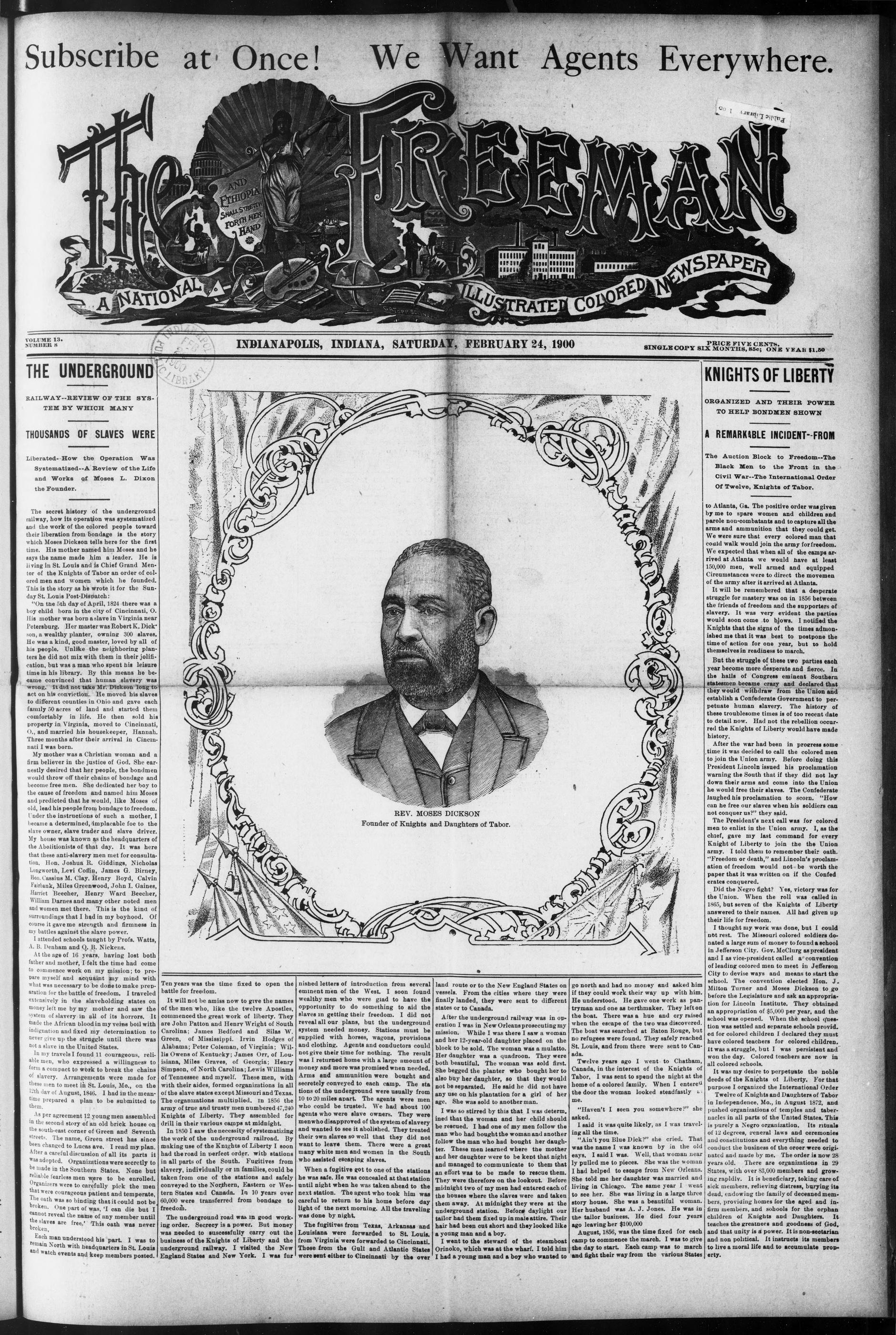
The secret history of the underground railway, how its operation was systematized and the work of the colored people toward their liberation from bondage is the story which Moses Dickson tells here for the first time. His mother named him Moses and he says the name made him a leader. He is living in St. Louis and is Chief Grand Mentor of the Knights of Tabor an order of colored men and women which he founded. This is the story as he wrote it for the Sunday St. Louis Post-Dispatch:
"On the 5th day of April, 1824 there was a boy child born in the city of Cincinnati, O. His mother was born a slave in Virginia near Petersburg. Her master was Robert K. Dickson, a wealthy planter, owning 300 slaves. He was a kind, good master, loved by all of his people. Unlike the neighboring planters he did not mix with them in their jolification, but was a man who spent his leisure time in his library. By this means he became convinced that human slavery was wrong. It did not take Mr. Dickson long to act on his conviction. He moved his slaves to different counties in Onio and gave each family 50 acres of land and started them comfortably in life. He then sold his property in Virginia, moved to Cincinnati O., and married his housekeeper, Hannah. Three months after their arrival in Cincinnati I was born.
My mother was a Christian woman and a firm believer in the justice of God. She earnestly desired that her people, the bondmen would throw off their chains of bondage and become free men. She dedicated her boy to the cause of freedom and named him Moses and predicted that he would, like Moses of old, lead his people from bondage to freedom. Under the instructions of such a mother, I became a determined, implacable foe to the slave owner, slave trader and slave driver. My house was known as the headquarters of the Abolitionists of that day. It was here that these anti-slavery men met for consultation. Hon. Joshua R. Giddings, Nicholas Longworth, Levi Coffin, James G. Birney, Cassius M. Clay. Henry Boyd, Calvin Fairbank, Miles Greenwood, John I. Gaines, Harriet Beecher, Henry Ward Beecher, William Darnes and many other noted men and women met there. This is the kind of surroundings that I had in my boyhood. Of course it gave me strength and firmness in my battles against the slave power.
I attended schools taught by Profs. Watts, A. B. Denham and B. B. Nickens. At the age of 16 years, having lost both father and mother, I felt the time had come to commence work on my mission; to prepare myself and acquaint my mind with what was necessary to be done to make preparation for the battle of freedom. I traveled extensively in the slaveholding states on money left me by my mother and saw the system of slavery in all of its horrors. It made the African blood in my veins boil with indignation and fixed my determination to never give up the struggle until there was not a slave in the United States. In my travels I found 11 courageous, reliable men, who expressed a willingness to form a compact to work to break the chains of slavery. Arrangements were made for these men to meet in St. Louis, Mo., on the 12th day of August, 1846. I had in the meantime prepared a plan to be submitted to them.
As per agreement 12 young men assembled in the second story of an old brick house on the south-east corner of Green and Seventh streets. The name, Green street has since been changed to Lucas ave. I read my plan. After a careful discussion of all its parts it was adopted. Organizations were secretly to be made in the Southern States. None but reliable fearless men were to be enrolled. Organizers were to carefully pick the men that were courageous patient and temperate. The oath was so binding that it could not be broken. One part of was, 'I can die but I cannot reveal the name of any member until the slaves are free.' This oath was never broken. Each man understood his part. I was to remain North with headquarters in St. Louis and watch events and keen members posted.
REV. MOSES DICKSON
Founder of Knights and Daughters of Tabor.
Ten years was the time fixed to open the battle for freedom.
It will not be amiss now to give the names of the men who, like the twelve Apostles, commenced the great work of liberty. They are John Patton and Henry Wright of South Carolina; James Bedford and Silas W. Green, of Mississippi. Irwin Hodges of Alabama; Peter Coleman, of Virginia; Willis Owens of Kentucky; James Orr, of Louisiana, Miles Graves, of Georgia; Henry Simpson, of North Carolina; Lewis Williams of Tennessee and myself. These men, with their aides, formed organizations in all of the slave states except Missouri and Texas. The organizations multiplied. In 1856 the army of true and trusty men numbered 47,240 Knights of Liberty. They assembled for drill in their various camps at midnight.
In 1850 I saw the necessity of systematizing the work of the underground railroad. By making use of the Knights of Liberty I soon had the road in perfect order, with stations in all parts of the South. Fugitives from slavery, individually or in families, could be taken from one of the stations and safely conveyed to the Northern, Eastern or Western States and Canada. In 10 years over 60,000 were transferred from bondage to freedom.
The underground road was in good working order. Secrecy is a power. But money was needed to successfully carry out the business of the Knights of Liberty and the underground railway. I visited the New England States and New York. I was fur
nished letters of introduction from several eminent men of the West. I soon found wealthy men who were gad to have the opportunity to do something to aid the slaves in getting their freedom. I did not reveal all our plans, but the underground system needed money. Stations must be supplied with horses, wagons, provisions and clothing. Agents and conductors could not give their time for nothing. The result was I returned home with a large amount of money and more was promised when needed. Arms and ammunition were bought and secretly conveyed to each camp. The stations of the underground were usually from 10 to 20 miles apart. The agents were men who could be trusted. We had about 100 agents who were slave owners. They were men who disapproved of the system of slavery and wanted to see it abolished. They treated their own slaves so well that they did not want to leave them. There were a great many white men and women in the South who assisted escaping slaves.
When a fugitive got to one of the stations he was safe. He was concealed at that station until night when he was taken ahead to the next station. The agent who took him was careful to return to his home before day light of the next morning. All the traveling was done by night.
The fugitives from Texas, Arkansas and Louisiana were forwarded to St. Louis. from Virginia were forwarded to Cincinnati. those from the Gulf and Atlantic States were sent either to Cincinnati by the over
land route or to the New England States on vessels. From the cities where they were finally landed, they were sent to different states or to Canada. After the underground railway was in operation I was in New Orleans prosecuting my mission. While I was there I saw a woman and her 12-year-old daughter placed on the block to be sold. The woman was a mulatto. Her daughter was a quadroon. They were both beautiful. The woman was sold first. She begged the planter who bought her to also buy her daughter, so that they would not be separated. He said he did not have any use on his plantation for a girl of her age. She was sold to another man.
I was so stirred by this that I was determined that the woman and her child should be rescued. I had one of my men follow the man who had bought the woman and another follow the man who had bought her daughter. These men learned where the mother and her daughter were to be kept that night and managed to communicate to them that an effort was to be made to rescue them. They were therefore on the lookout. Before midnight two of my men had entered each of the houses where the slaves were and taken them away. At midnight they were at the underground station. Before daylight our tailor had them fixed up in male attire. Their hair had been out short and they looked like a young man and a boy.
I went to the steward of the steamboat Orinoko, which was at the wharf. I told him I had a young man and a boy who wanted to
PRICE FIVE CENTS.
SINGLE COPY SIX MONTHS, 85c; ONE YEAR $1.50
go north and had no money and asked him if they could work their way up with him. He understood. He gave one work as pantryman and one as berthmaker. They left on the boat. There was a hue and cry raised when the escape of the two was discovered. The boat was searched at Baton Rouge, but no refugees were found. They safely reached St. Louis, and from there were sent to Canada.
Twelve years ago I went to Chatham, Canada, in the interest of the Knights of Tabor, I was sent to spend the night at the home of a colored family. When I entered the door the woman looked steadfastly at me.
"Haven't I seen you somewhere?" she asked.
I said it was quite likely, as I was traveling all the time.
"Ain't you Blue Dick?" she cried. That was the name I was known by in the old eays. I said I was. Well, that woman near ly pulled me to pieces. She was the woman I had helped to escape from New Orleans. She told me her daughter was married and living in Chicago. The same year I went to see her. She was living in a large three story house. She was a beautiful woman. Her husband was A. J. Jones. He was in the tailor business. He died four years ago leaving her $100,000. August, 1856, was the time fixed for each camp to commence the march. I was to give the day to start. Each camp was to march and fight their way from the various States
KNIGHTS OF LIBERTY
KNIGHTS OF LIBERTY
ORGANIZED AND THEIR POWER
TO HELP BONDEN SHOWN
A REMARKABLE INCIDENT--FROM
The Auction Block to Freedom--The Black Men to the Front in the Civil War--The International Order Of Twelve, Knights of Tabor.
to Atlanta, Ga. The positive order was given by me to spare women and children and parole non-combatants and to capture all the arms and ammunition that they could get. We were sure that every colored man that could walk would join the army for freedom. We expected that when all of the emps arrived at Atlanta we would have at least 150,000 men, well armed and equipped Circumstances were to direct the movement of the army after it arrived at Atlanta.
It will be remembered that a desperate struggle for mastery was on in 1856 between the friends of freedom and the supporters of slavery. It was very evident the parties would soon come to blows. I notified the Knights that the signs of the times admonished me that it was best to postpone the time of action for one year, but to hold themselves in readiness to march.
But the struggle of these two parties each year become more desperate and fierce. In the halls of Congress eminent Southern statesmen became crazy and declared that they would withdraw from the Union and establish a Confederate Government to perpetrate human slavery. The history of these troublesome times is of too recent date to detail now. Had not the rebellion occurred the Knights of Liberty would have made history.
After the war had been in progress some time it was decided to call the colored men to join the Union army. Before doing this President Lincoln issued his proclamation warning the South that if they did not lay down their arms and come into the Union he would free their slaves. The Confederate laughed his proclamation to scorn. "How can he free our slaves when his soldiers can not conquer us?" they said.
The President's next call was for colored men to enlist in the Union army. I, as the chief, gave my last command for every Knight of Liberty to join the Union army. I told them to remember their oath. "Freedom or death," and Lincoln's proclamation of freedom would not be worth the paper that it was written on if the Confederates conquered.
Did the Negro fight? Yes, victory was for the Union. When the roll was called in 1865, but seven of the Knights of Liberty answered to their names. All had given up their life for freedom.
I thought my work was done, but I could not rest. The Missouri colored soldiers donated a large sum of money to found a school in Jefferson City. Gov. McChurg as president and I as vice-president called a convention of leading colored men to meet in Jefferson City to devise ways and means to start the school. The convention elected Hon. J. Milton Turner and Moses Dickson to go before the Legislature and ask an appropriation for Lincoln Institute. They obtained an appropriation of $5,000 per year, and the school was opened. When the school question was settled and separate schools provided for colored children I declared they must have colored teachers for colored children. It was a struggle, but I was persistent and won the day. Colored teachers are now in all colored schools.
It was my desire to perpetuate the noble deeds of the Knights of Liberty. For that purpose I organized the International Order
Twelve of Knights and Daughters of Tabor in Independence. Mo., in August 1872, and pushed organizations of temples and tabernacles in all parts of the United States. This is purely a Negro organization. Its rituals of 12 degrees, general laws and ceremonies and constitutions and everything needed to conduct the business of the orer were originated and made by me. The order is now 28 years old. There are organizations in 29 States, with over 83,000 members and growing raplidly. It is beneficiary, taking care of sick members, relieving distress, burying its dead, endowing the family of deceased members, providing homes for the aged and infirm members, and schools for the orphan children of Knights and Daughters. It teaches the greatness and goodness of God, and that unity is a power. It is non-sectarian and non political. It instructs its members to live a moral life and to accumulate property.
THE FREEMAN, AN ILLUSTRATED COLOR? NEWSPAPEii.
RAI \\M- GG,
ig Get) ATEER See
‘pane Ge WAULEN ey eo DB
ED piney nels i a Var NU
ie oS YL iii ae en)
) ac | it i fis es OC heS )) 7
y -- elie
+: as = SS === *
ml. <- | a
BAN ce OE SaeaenEaan eRe Tice eee
Ss a fy come and men may go.
i A Soe f But tipping will go on forever.
ik aa Speaking of tipping the “Lon
aa Globe” says, few people know
(i origin of the word “tip” It comes fi
\ Ree a he the old coffee house of which I bel
As hija Offiey’s in Henrietta street Que
Pare Garden, was the last surviver.
y e nal << door of these coffee houses was a
a A Ere made, usually, of brass with lock
- } 7 key and having engraved upon it “J
" P,” (observe the stop between
5 a letters) “T Insure Promptne
« s\ Customers, as they would pase
O26 4 dropped a coin in for waiters, He
feos | < . the word “tip.”
a ‘The Grand Hotel, Mackinac Isla
EDITED BY
W. FORREST COZART.
Each waiter of the Colonial Hotel,
Cleveland O-, (twenty-two in number)
recently bought a copy of ““The Waiter’s
Manual.”
The “Hotel World” a weekly published
at Chicago, produced a very fine half-
tone group picture of the Head Wait-
er’s Association, in itsissue of Feb. 3.
‘The waiters of the Knutsford Hotel,
Salt Lake City, Utah, haye been sup-
plied with rubber heels. This is much
better than supplying them with rubber
‘necks,
‘The Employment Bureau of the Head
and Second Waiter’s National Benefit
Association, recently senc Taylor El-
Grige as headwaiter, to the West Hotel,
Sandusky 0.
The colored waiters lost a little
fortune, in tips on the gallant little Geo.
Dixon, whemhe was defeated for the
feather weight championship of the
‘weed, by Teery McGovern.
Paul Lawrence Dunbar, the great
colored poet, will recite a few of his
gems, at Dayton, O., March 2. Dayton
is Mr. Dunbar's home and the local
waiters and other members of the race
will give him a rousing welcome.
A headwaiter once asked a guest if
the waiter was waiting on him? and the
guest replied: “No, I am waiting on
the waiter. Now, the question is.
‘Does the guest wait upon the waiter, or
does the waiter wait upon the guest?
Mr. T. J. Simons, one of the best
kmown headwaiters of the South and
vice president of the state of North
Carolina of the headwaiters National
Benefit Association, is headwaiter at
the Duval House, Jacksonville, Fla.,
‘this season.
At the reguest of Mr. Daniel Murray
assistant librarian of Congress, a’copy
of ‘The Waiters Manual” has been for-
‘warded to be exhibited at the Paris Ex-
position. Thus the colored waiter of
Aumerica will be intellegently represent:
ed at Paris Exposition.
‘The late Alvin Hulbert, who died in
Chicago on Feb. 4, was one of the best
known hotel men in the country. Mr.
Hulbert was formerly proprietor of the
‘Tremont House Chicago, and the Lindell
Hotel, St.Louis, Mo. He has always
‘een a true friend to the colored waiter
and his generosity will be greatly
missed.
Oh that the hotel proprietors ofiito-
ay, would personify this good man to
whom, we bow our heads in sorrow. *
It may not be generally known, but it
isafact that the chances for colored
waiters in New York City is very
limited owing to the fact that there ar
only three or four small hotels employ
ing volored waiters. In this respec
‘New York City is strictly a white man’s
town.
Iam pleased to note, however that Mr
‘'T. H. Frazier headwaiter at the Endi
cott Hotel and who is one of the bes
men in the profession is doing much tc
change the situation.
eel Neon 5 at la ciel
saying, that colored waiters could not
render first class service, in European
plans hotels. This it seems aroused the
ire of the colored waiters, in general,
and they set out to disprove the asser-
tion. How well they have succeeded
can be seen by the number of European
plan hotels that are now employing
colored waiters. The Bellevuea new
European plan hotel which has recently
‘opeded in Boston, Mass., employ’s 25
colored waiters. and tis said
that they are giving general satisfaction.
Mr. F. D. Tutt a well known waiter in
Chicago and Indianapolis holds @ posi-
tion at the Bellevue.
A few unsophistical hotel proprietors
as well as a sleeping car Company has
‘established the “no tip rule” hut tipping
is like the babling brook. Men may
{HE INDIANAPOLIS FREEMAD
Greatest of Them All!
%t has ee ee Artiste.
| & has its own force of Colored Printers.
SUBSCRIPTION PRICE:
ONE YEAR....$1.50. SIX MONTHS. ...85c. SINGLE COPY. ...6:
AGENTS WANTED EVERYWHERR,
GEORGE L, KNOX, Publisher,
INDIANAPOLIS, INO
come and men may go.
But tipping will go on forever.
Speaking of tipping the “London
Globe” says, few people know the
origin of the word “tip” It comes from
the old coffee house of which I believe
Offiey’s in Henrietta street Queen’s
Garden, was the last surviver. At a
door of these coffee houses wag a box
made, usually, of brass with lock and
key and having engraved upon it “T. I.
P,” (observe the stop between, the
letters) “T Insure _ Promptness.”
Customers, as they would pass ont,
dropped a coin in for waiters. Hence
the word “tip.”
The Grand Hotel, Mackinac Island,
Mich., has changed hands. Mr. J. R.
Hayes, who has been conducting this
favorite summer resort, for the past ten
years, retires-and Mr. Henry Weaver,
proprietor of the Planters’ Hotel, St.
Lonis becomes proprietor.
‘This 1s indeed bad news for the colored
waiters as Mr. Hayes has always em-
ployed colored helpat the Grand and
also at the Wayne hotel in Detroit, both
of which he is proprietor. Mr. Weaver
is a believer in white waiters and em-
ployes them at his St. Lonis hotel. Just
what he will do in this respect at the
Grand is not yet know.
Mr. Samuel Bledsoe, a well-known
colored headwaiter has been in charge
of the dining-room at the Grand in the
summer and at the Wayne daring the
winter for several years where ho has
won the admiration of the traveling
public, as well as the respect of the
large crew of waiters employed by him.
nm! a ODEO
UAE Sexe
Bo sit
ea) “EA: So
Ry preted 5) ‘
Tom Johnson, a Negro returned to his
home in Hannibal, Mo., with $500,000
which he tiade during his four years
stay in the Klondike.
The ninth annnal session of the
Tuskegee Negro Conference convened
Feb. 21. The influences set in operation
by this coming together of the masses
are bound to be potential in solving the
race problem.
‘Mr. J. Edgar Smith, for several years
foreman of the Zion Publication House
at Chalotte, N. C., has been appointed
to, and accepted a position as compositor
in the Government Printing Office,
‘Washington, D.C.
It is said that the Chattanooga Plow
company employs 700 or 800 hands and
that a large percentage of these are
colored men and boys. Eighty men are
employed in the foundry and in this cas
they are all Negroes.
Among the exhibits that Tuskegee
sends to the Paris Exposition, is the
wood work ofa minature two horse
wagon. It was made by a student
working in the division of wheel-
wrighting and does him much credit.
A little colored girl, Mary Ledine. of
New York, will succeed “Blind Tom. ’
Her friends noticed that every time the
child could get at a piano, she, with no
knowledge whatever of the technique of
music, was able to coax melody out of
the ivory} keys. Although “She” can
read music fairly well, the knowledge is
not of great value to her. She is a keen
imitator—has a musical ear of wonder-
falacnteness. It is claimed that her
talents are nearer like those of Blind
Tom than anybody else has ever
reached.
| Livingtone College Charlotte, N. C.,
is now crowded with students to over
‘flowing. More than 260are in attendance
‘and more room is needed. The upper
‘story of Stantord Seminary needs to be
finished and it will afford accommoda-
tion for 36 girls.
| ‘The bread that is eaten by the nearly
eleven hundred students in Booker T.
| Washington's great industrial schoot, at
| Taskeree, Ala., is baked in the baking
plant that is operated by the students at
‘the head of which is a young man of the
‘senior class.
| ‘The Capital Saving Bank of Washing-
ton#is one of the strongest and most
reliable finanical institations in the
country. It has a capital of $50,000, It
is under the shrewd and far seeing
management of Hon. John R. Lynch.
It went throngh the panic of 93 withont
a tremor.
P. G. Groves, of Edwardsville,
Wyandotte County, Kans, 18 recognized
to bethe wealthest colored man in
Kansas. Ae owns large potato farms in
the Kaw Valley and ships potatoes by
the car load to all parts of the country.
He owns 340 acres of land and city‘and
town property, his personal property
amounts to several thousand dollars,
a a alee 4 aati aan
Prof, John Uri Lloyd, the eminent
scientist and scholar, of Cincinnati, who,
a few years ago fairly startled and
charmed the literary world by his
remarkable genins and skill displayed
in his book entitled “Etidorhpa,” has
written a wonderfal serial story for
The Bookman, published by Dodd,
Mead & Co., of Néw York, bearing the
homely title of “Stringtown on the
Pike.” This story will, no doubt, prove
pecaliarly valuable to the Negro race,
as it is a kindly study of race character
istics, and for that reason I have under-
taken to give it a critical review, which
review will appear in this journal the
latter part of the summer. My review
will be mainly devoted to the character,
Cupe, of whom The Bookman, in its
February announcement, has the follow-
ing to say:
“But of all the characters in the story,
none can be said to be so distinctly a
creation of whichany author might be
proud, as Old Cupe. He is the great
triumph of “‘Stringtown on the Pike.”
If for no other reason, this character
Wonld litt the book far above mediocrity
and give it mani
Salosemear worto tet @ aolie toe
Cupe, proud, kindly, dignified, last scion
ofan ancient African monarchy, is every
inch the King he claims to be by
hereditary right. He dominates the
story as’ does his fatefal spell. He
threads its sitmations and crowns its ac:
tion in the climax.” Yours for the
race, CHARLES ALEXANDER.
L. S, STOCKMAN 34281
INDIANAPOLIS, IND,,
Dealer in Drags, Medicines, Chemicals,
Fine Toilet Soaps, Brushes, Combs, Ete.
Physicians’ Perscriptions Accurately Com-
pounded.
Best Work, Best Time. Best Prices.
Many years’ ex-
AMER cre ant
Matches wo comnts op weiae
ee oe
Si eae et ou
City es Bite 1S Won
ha
53@ Big Seed
Bargai
Here’s the biggest
bargain for vegetable growers and flower
lovers—people with small gardens—that was ever
offered by a first-class, reliable house. It is not made for
profit, but to interest seed sowers in VICK’S SEEDS—to lay the
foundation of a trade that will continue from year to year. The name of
the collection is VICK’S HOME GARDEN. Experts of long experience have
given months of careful study to concentrate in it the best seeds to make a fine veg-
etable garden for an ordinary family and furnish a beautiful display of flowers. Look at
the long list of varieties—2s choice vegetables, 11 flowers—comprising the collection.
Compare it with what you ordinarily pay for the seeds ; remember the reputation of the house
offering it, and we believe you will agree with us that Wace .
; Sas
VICK’S HOME GARDEN is the Greatest Seed Offer Ever'Made
Reant-Yick's Improved Golden Was, lc) Water Melon—Oeloe Rani, 5 | ao wuanBlowgr Seed
Bont yleek Mimtrare? iigenat + UP) Sigs Mele te ere © | atar_viow NOSES sea, 1s
femcyichs a 1B | Onn yaler ieee $ | Siepaucwns, : B
Beet Improved Harz loga Train, "p| Parslos “Uhampiot Mow Curted, 8 | Calliopais Fine Mixed 5
Caipagerimproved HarlySummers” — § | Paranip—Long Hollow Crowe. & | DianthaeChineasie (china Pinky, 5
wees “premium Late Fiat Dutch, 8 | Radish—Vick's Barly Seariet Globe, | Eachscholtzia (California Popps)? —&
curotpareaiitigeome | Mae Tee egeagcien,, § | genset ck
Cacamber—imp. Early White Sploc, 6 | Salsify-Mammoth Sandwich Island,” § | Nasturtinm’Climbing, Mixed Colors, 8 ff
* Improved Long Greea, | Squash—Boston Marrow, 5 | Pansy—Fine Mixed, 0
calery Gotta Hoe, $ | Santee Betyht Reet, Fear ESS ated, i BR
Lattace Vicks New oral E/Eeminpecie om |g | Sevpactenmuatatstien, 2
‘Musk Melon—Vick's irondequoit, 10 | Total Cost Vegetabie Seeds, $1.50. |” Total Cost Flower Seeds, 75
.
$2.25 Worth of Seeds—all for $1.00, Postpaid.
All packets are full size. Seeds selected from the best stock. Collection put up in
handsome, attractive style. Full directions in each box how to grow the seeds
best, where to grow them, when to grow them. We guarantee it will please
‘you—if it doesn’t, don’t hesitate to send the collection back.
We'll refund te money.
JAMES VICK’S SONS,
17 Elm Street,
Rochester, N. Y.
ww
THIS “AD” IS WORTH SAVING
READ!
BEATS THEM ALL
RECTOR’S
‘The New Negro for the New Century, with
Facts, Theories and Statistics =: 9: :
ORNAMENTAL FOR HOMES - USEFUL FOR CHILDREN!
If you have no library you can not do without it. Your children have no in
centive to labor unless they see it. It contains our Leading Institutions of Learn-
ing Leading Living Creators of Thought and Sentiment. Every man represents
an idea—Bowen, forscholarship; Turner, for colonization; Morris, for organization
Dunbar, for poetry; Tanner, for art; Washington, for education, ete., Seventeen
portraits of distinguished Leaders and hundreds of’ facts, concerning the Race’s pro-
gress. Onr lamented Douglas and Cuba's Martyr, Maceo. Best in material and
subject matter ever offered the public. Lithographs on Canvas sent postpaid to
any address tor $1.00. Most rapid seller ever handled by agents. ame
AGENTS WANTED im every county and state in the Union. Secure’ term
and territory on the first edition. Price, $1.00. Address
JOHN K. RECTOR, Publisher: °°: P38" 3% ex, ark
CROWN BLOOD LIVER & KIDNEY
CLEANSER,
Ts a guaranteed cure for all diseases of
Stomach, Blood, Liver and
Kidney Troubles
CROWN BLOOD LIVER AND KIDNEY
CLEANSER CURES
Catarrh, Indigestion or Dyspepsia, Biltous-
ness, Costiveness, Rheumatism, Kidney
‘and Bladder Troubles, Serofula and
Blood Diseases, ChilisyFever and
‘Ague, Nervoumess, Male and
‘Female Weakness,Female
Complaints, and never
fails to remove all
disease germ.
Onr remedy is not a cure all. We dc
not claim that it will cure every ailment
that flesh is liew to, but we positively
assert that it will do more than any
other remedy of the kind on the market.
‘The tonic, acting as it does on the nery-
‘ons system, strengthens and invigorates
‘the brain and nerves. Has a direct in-
finence on the genital organs making
it one of the most ‘powerful restoratives
TRY KINGAN’S
Utility S
IN YOUR LAUNDRY
Does its work better han other
and sells 2 Cakes for 5c.
FOR SALE BY ALL DEALERS
@ very prevalent dis-
ALALT case.” Crown Blood
Liver and Kidney
Cleanser positively cares CATARRH
with its many symptoms by giving a
thorough constitutional treatment, thus
purifying the blood and removing the
cause of this dread disease,
+ is not a disease
eumatism 25,“
growth and gives
ample warning of ite approach
‘ally matured, it is themost stubborn
and the most agonizing of human ail-
ments. There is, however, a reliable
safe-guard against its developement into
the chronic place. Professional, as well
as popular testimony moreover abund-
ently shows that «rown Blood Liv-
er and Kidney Cl-anser checks the
‘progress of rheumatism when other rem-
edies employed for its relief have proved
eae oon PRICE ONE DOLLAR
ER BOTTLE.
BURN-O-LINE
Chemical Co., FPANAPORIS..
Examining the Clothes A I ( f ih qj
, A Teall OL UNG AIMS
re A \) The ‘$1900’ Washer saves
“NO. lie f women’s lives, Do not rub your
i mh, if 4 W clothes to pieces and your life
G Bu : Vf) away over an old washboard,
Sh Tf Si dDurabl
zai Simple and Durable
= (aN Fj Use common sense, common soap
—— “JS'8e). and lots of boiling hot water and
Ke know dey are Kean I'wash dem the ‘‘1900 Washer’’ will do the rest.
Fans 57 Sap oe Hes Galfer: Ror fall partionlar and cironlars, addres ot
ing,” call on
WINTER & HUMMEL |
221 W. Washington Street, INDIANAPOLIS, IND
SPECIAL NOTICE —Chp this ‘ad’
and with 50c in cash send it to the
Burn-o-line Chemical Company, Indian-
apolis, Ind., U. 8. A., and we will send
as a trial bottle one of our regular $1.00
Bottles. Mention The Freeman.
BURN- O-LINE CHEMICAL ©O.,
INDIANAPOLIS, IND.
Groceries
a saturday sma
iis ia tow tina ot Said a
Mendy, webs e aad
ib pont es reli eet
Hawkey Kolled Oats, 4%4c. package,
ess sugar ones Calticea Heeb pound
aoa ee en eet
Hac oct Seal omnes
Best Grade Star Tobacco, 38%4¢ pound
Grape Nuts, 10(c package.
On Pampas te fave & Mocca Coffee goes in
Fells Naptha Soap, éc cake.
iy
io grtie at deer cea ontascis
ftheen Climate Baking Forder tne
Buu utewanerorte is toa a
argabes ceucs dy cv nutaacgastgeo
pleonearth for good groceries by calling on
faye
4—BIG STORES—4
eee rae cie corner Washington and
Branch, 151 N. Delaware Street, near Ohio.
wr Is W. Washington Besse, naarWoat
“$38 Indiana Avenue, near Senate.
‘Telephone 2230 Old and New.
L. A. JACKSON, Proprietor.
334 INDIANA AVENUE
Oxford Mufflers. 25¢, 500, 75c, $1 and 1.50
A swell line of Puffs and imperial Ties, 490
‘The latest designs in Fancy Shirts, 98¢
Fall Dress outfits.
Read THE FRERMAN $1.50
nae
THE CUBAN HEROINE
Why, of course, I'll tell the’story if
you care to hear about it, Don’t sup-
jose anybody better knows the details
fe the affair. The Acquackanock was
jrached to our blockading squadron.
{. SS. Acquaekanock, according to
the official register, but, in spite of
high sounding title, only a mean little
sea-going tugboat with a one-pounder
mounted on the roof of thepilothouse.
Ensign Dunean. was skipper, and a
jeter seaman of cooler headed fighter
under fire, L never want to sail with,
One day we were running coastwise
at half speed. None of the other block-
fuing vessels were in sight. The part
of the island whieh we were cruis-
ing was practically untenanted, owing.
to the Spanish concentration ‘orders,
aud there were no fortifications that
amounted to anything for twenty
niles either way. With the exception
of those actually engaged in navigat-
ng, our whole erew were taking it
easy, snuggled in shady corners und
otherwise recuperating after a night
of incessant watehfulness. I happened
to be lying on top of @ lot of commis-
_ LiKe
yt ¥2 Gs
SCE Re
(| aie
) f
MAT
el!
dle
("I thank you, noble American.”)
suriat stuff that occupied our after
deck, From my position, which was of
course a considerably elevated one, I
had a pretty wide field of vision by
simply turning my head in any de-
sired direction.
“Say, Landiss,” called our skipper
from the shaky old deck chair on
which he was reclining, “what do you
make out of that bright red thing
down near the edge of the water,
about three points on our quarter?”
“Looks as if it might be a woman,
sir,” I said at a venture. “Those Cu-
ban girls are fond of bright colors
when they ean get them, and perhaps
it is her dress. I'll take a look through
the glass.”
‘The binoeulars were good ones. Had
to be for our business. I suppose T
must have gazed steadily through
them for five minutes at the very
jeast. At any rate the skipper got im-
patient and came up alongside of me.
“You're taking long enough to see
right through the island and half way
across the Yucatan,” he says, joking-
ly. “May I inquire the reason of this
intentness?”
“You may, sir,” I replied, handing
him the glasses as I spoke; “but the
best answer I can give Is to let you
Jook for yourself. “I? that sight does
not glue your own eyes for a dozen
doctor's watches, I'm no judge of pet-
ticoat folk.”
It was this way. As pretty a girl as
T ever want to look at—big eyes, black
hair, and face just like an angel's ta-
ken bodily out of some great painting
was Standing there upon the sand
beach gazing directly at us, and, at
the same time, waving slowly to and
fro a big red thing which turned out
to be a blanket. Even at that distance
I fancied that I could detect a sort of
wild longing in the expression of her
face, The skipper must have seen as
much, if not more than I did. Anyway
he took the glasses down from his
eyes only long enough to order our
course changed so as to head directly
for the spot where she was standing,
and then recommenced his inspection
through the lenses until we were near
enough to use the naked eye to better
advantage.
Landiss, you and I will go ashore
in the small boat and see what this
scarlet signal means,” said the skip-
per; “the rest of you boys, keep your:
eyes peeled for treachery; and if any
Spanish soldiers try to rush us, just
drop a shot from our main battery
where it will do the most good.
‘The men cheered him, and even be-
fore T got well to work sculling the
boat in | heard the snap of the breech
block on the little one-pounder, which
sail in the plainest kind of language
under the sun: “Now I am all loaded
and ready for business.”
Tho skipper sat up in the bow of
the skit, which was just a little dingy
such as’harbor tugboats usually ear-
ty, and told me how to head her.
Luckily, there was mo sea on, to
unount to anything, and we made the
landing without getting very wet.
It that Cuban girl looked a real pte.
ture through the glasses a point blank
Sight at her merely improved the ef-
fect, if sueh a thing could be possible.
Not but what she had a sort of piti-
fully haggard look, and besides, her
‘kiinp dress was torn to rags, But
somehow, even such disadvantages
could not queer her style of beauty.
She might have come out a_ shade
preter when all togged up in ball fol-
devols, although I doubt it. But UI
Stop deseribing her to you, for I
couldn't do the subject justice if I
rie
I was a mighty sad story she told
the ensign, half in broken English
and the rest to her own lingo. I picked
oot enough of it to size the whole
thing up. Her peopie had been well off
and she was partly educated in the
Stiles, but the rebellion came along
ani her brothers joined the insur-
xenis, and the Spaniards burnt down
‘heir plantation, and looted everything.
The same old story so far, But thi
s'|—~ Her name was a longish one
“wi hard to pronounce. The skipper:
Sot it down fine, but we always just
filled her “the Senorita.” She certain.
Hi.is as Plucky as they make them.
Tan tther and mother and halt a
‘lozen aunts or servants of one kind
“r another were all old and pretty!
nish helpless; so when the reconcen-
‘ration ediets went into effect they,
Simply could not obey. So what does
qe lo but pitch in and rig up a lit!
'c hot im among the trees, and lugged
THE FREEMAN, AN ILLUSTRATED COLORED NEWSPAPER.
‘ann’ AeA 2, Ae ee ae
ilone finding food for halt a dozen
months beside her own, in a country
that was well nigh devastated. But
she did it, somehow or other. ‘Then
came sickness to vary the routine, and
her father and mother were pretty
nigh dying for want of medicines.
‘That was how she eame to run the
risk pf signalling. us.
Of course I sculled out to the ship
again and brought back our medicine
chest and som cans of soup and
things to go with it. Meanwhile the
skipper had gone along with her to
the hut she had built, and so I toted
the things up there myself, In a haif
a dozen loads or so.
Her shanty was a pretty tough look-
ing plece of architecture, made of
brush and long grass, but it served
every purpose, and I don't wonder at
the Dons not having sighted it on
their coast patrols. ‘The old people
were ina pretty bad state. We possi-
bly could not move the sickest ones,
and the others were not a great deal
petter,
“AS soon as one of our ships that
has a doctor on board comes round I'll
bring him ashore with me,” said the
skipper to the young lady; ‘“mean-
while, as you say you have a little
knowledge of medicine and its uses I
presume you can do something with
our chest.”
I never did see sa girl carry on so
about being grateful, and “how noble
we were,” and all that sort of theatri-
cal talk. But of course you must ex-
pect such from those Cubans. They're
all hot-blooded creatures, and say ex-
actly what they mean right out But
for that matier the Senorita scarcely
needed to talk, Her eyes told every-
thing. She followed us out of the hut
when we went down towards the boat
again,
“Is there anything more we can do
for you, madam?” says the ensign,
with his hat in his hand and bending
forward as if he was talking to the
Queen of England and not a bare-
footed Cuban girl with enough good
looks to supply an ordinary dozen.
“T should earnestly repeat my aaviee
to you of seeking safety, on board my
vessel with all_your companions that
can be moved. Lam truly sorry to say
that I fear the days of your parents
are already numbered.”
“I thank you, noble American,” re-
plied the Senorita in her pretty sping
fashion; “but we both have sacred du-
ties. Yours with your ships to the
fight! I my people to nurse! But one
thing there is you can do for me more,
and every moment shall I call bless:
ings upon the heads of my preservers.
Give to me the—what call you it?—
that thing.” (Pointing to the revolver
in his belt). “I know its good use, but
not_your name.”
Without a word the skipper took
the weapon from its bélt, saw that its
chambers were properly’ loaded and
handed it to her. He was about to
give her extra cartridges from his
pouch, but she stopped him.
“No, no,” she cried; “one shot will
my purpose serve—two at most!”
‘Then we understood, and I imag-
ined I heard the skipper sniffle once
or twice as we went down to the
beach. I'm free to acknowledge that
T did as much. Pshaw!
Well, sir, the Acquackanock cruised
up and down that part of the coast
for a week or more. Not a day but
what we managed to pass by the
place where the Senorita and her field
hospital hung out, and usually she
would come down to the shore, where
she was rather hid from landsighting,
and wave that old red blanket to let
us know that all went well. Of course
we did not dare answer back very
much for fear of having others see
the signals that were not intended for
them; but it made every soul on board
mighty glad to see that old serape
bobbing about, I can tell you. And
once or twice’ I took the ‘skipper
ashore there again, with a lot of our
duds for her to make clothes out of,
and little knicknacks of food and such
and he would have palayered with her
by the hour if I had not made believe
to see smoke out to seaward or some-
thing like that. And one time he put
a ring that had belonged to his moth-
er—I heard him tell her so—on her
finger, and the last time he kissed her
when'I made believe not to be look:
ing. And I don’t blame either him or
her for that matter. 1 enjoyed the
war-time love making almost as much
as they did, Hang me for a regu’ar
soft soap swab! Here's my blamed old
eyes filling up just as if they'd been
scuttled for insurance!
Well, the next day we were steam-
ing along towards what we called the
“Senorita’s landing.” Our pilot had
got so used to being ordered to head
the ship in there that he steered at
an easy angle on his own account,
just to save time, And so we were
within niee range of the shore. I'l
never know just what made me climb,
up on top of the pilot house alongside
of our little cannon. At any rate there
I happened to be, and the ammunition
chest was handy. Just as we came
abreast of an open piece of country 1
gave a careless look ashore, and then
my eyes fairly bulged out of my head.
I saw about half a dozen Spanish eay-
alry soldiers riding along in a little
compact troop, and the middle fellow
had a different sort of saddle cloth
from the rest!
“What in blankety-blank do you
mean firing off that gun without my
orders, Landiss?” bellowed the skip-
per, coming out from his cabin at the
sound of the report: “And good gra-
cious, man, you're nothing else than
ey ae eee cen. eee
A worthy citizen who attended a
church on Staten Island remarked one
day that there was more caste in his
church than there was in Calcutta.—
Nemo.
I never lie down to sleep at night
without praying for the salvation of
my men, and also for that of our
friends overthe river-—Gen. R. E. Lee,
during the Civil War.
THE COLLIE AND SHEEP.
Wonderful Sagacity Shown In the
‘Gare of Flocks:
‘Tle sheep dogs in this country come
by their nature and training honestly,
for either they or their ancestors
came from the sheep-dotted hills of
England, Scotland or Wales, where
-for generations past the supreme ef.
fort of the shepherd has been to pro-
duce a perfect sheep dog. They have
succeeded well, for no man could ex-
cel them in sheep lore, no man could
be more useful to the sheep owner, for
man is neither so persistent and agile,
possesses such endurance, or is 80
gentle under training and reproof.
‘The dog doesn’t reason as to the why
and wherefore of his affection, for the
worst sort of a brutal shepherd may
have the most faithful dog, one that
will mind the sheep on the hills, pa.
tiently await his master's coming and
guide his reeling foosteps to his
home.
On the great plains of the west
these dogs have made it possible for
one man to care for three or four
thousand sheep in one flock. All they
ask is a bite to eat, and once in a
while when their feet are filled with
the sharp thorns of the cactus they
will come to have them taken out.
‘There is no value on a well-trained
sheep dog. The welL-bred collie which
takes the prizes at the bench snow
is beautiful to look at, but this home
lier brother, the trained dog of the
range, is worth more than he is be-
yond price. The sheep owner holds
him as beyond purchase. The sheep
herder who falls so low as to part
with his companion is yet to be found,
and if the dog were to be bought the
buyer might rue his bargain, for the
master must go with the dog.
In the new country the work of the
sheep dog is hard; it is on a big scale.
In the old country the work is easier,
but it has its finer points. In the new
country the dog may drive two thou:
sand sheep; in the old country a dog
may drive three or four, which takes
more thought and skill. In the old
country the feature of every country
fair in a sheep district is the sheep
dog trials. A trophy is the annual
prize, and the shepherds and theit
dogs come from afar to try for the
cup. The dog that carries away the
trophy may be a little, short-haired,
homely and insignificant brute, which
slinks to the heels of his master like
a creature of no spirit, but send him
after the sheep and his whole charac
ter seems to change. He is slow and
gentle or quick and bold, as the sheep
may require. His whole attitude is
tense and nervous. No human'being
could manifest a greater responsibil
ity—Kansas City Star.
Fewer Lynchings.
Probably ninety-nine _ newspaper
readers out of every hundred, if asked
for their impressions at the end of
1899, would have said that they sup-
posed there had been more cases of
lynching in this country last year than
ip any previous twelvemonth. It is
therefore a pleasant surprise to find
that the statistician of the Chicago
Tribune, who has kept track of the
figures for many years, can report that
the record was really the smallest
since 1885. There is no explanation
of the apparent mystery which is not
generaly thought of. Public sentiment
against lynching has been growing
steadily throughout the country, and
especially in the south, where the
practice has been most common. The
result is that the press gives much
greater publicity to reports of all
such outrages now than formerly, and
107 cases during 1899 consequently at-
tracted more attention than would
twice as many fifteen years ago.—N.
Y. Evening Post.
What He Wanted.
There was an enterprising Liverpool
tailor who has never been known te
acknowledge that he didn’t have any:
thing a possible customer might ask
for.
One day a customer entered the
shop and asked if he had any trousers
made especially for one-legged men,
“Certainly,” replied the merchant
“What kind do you want?”
“Dress trousers,” said the man
“The best you've got.”
Hurrying to the rear of the store
thggenterprising merchanj snatched
up* pair of trousers and snipped off
the right leg. Hastily turning under
the edges he presented them to the
customer,
“That's the kind I want. What's the
price?” ‘
“One guinea.”
“Well give me a pair with the left
leg off.”
A month later the merchant was
pronounced convalescent and on the
high road to recovery.—London Tit
Bits.
American Locomotive Buildinc.
As an instance of the speed with
which work can be executed by one
of our great American locomotive
firms, it is worth noting that an order
was given on Dec. 16, 1897, for forty
Mogul locomotives for two Russian
railways. The first of the forty was
erected and tried under steam on Jan.
5. 1898, three weeks after the receipt
of the order, and was finished, ready
to dismantle and pack for shipment
one week later. The last engine was
competed on Feb. 13. The forty en-
gines were then constructed in about
eight weeks, besides twenty-eight ad-
ditional engines on other orders built
in the works, wholly or partially, and
shipped during the same period. No
wonder the Americans have gained
a reputation for smartness.—Cassier’s
Magazine.
Mushrooms for the Million.
What is claimed to be the largest
mushrom house in America is being
built on the John Wyeth farm, near
‘West Chester, Pa. It will be equipped
with four tiers of bees for the grow-
ing of mushrooms, giving a total area
of 196,650 square feet for the purpose.
Tons of Flowers Used.
Vast quantities of flowers are gath-
erd for perfumery purposes. It is esti-
mated that each year 1,860 tons of
orange flowers are used, besides 930
tons of roses, 150 toys each of violets
and jasmine, 75 tons of tuberose, 30
tons of cassie and 15 tons of jonquils.
OO a ee he
Every day there hangs over London
a vast smoke cloud that is estimated
to weigh about 300 tons.
‘News Items.
‘Terre Haute Ind., Special.—Mr. and Mrs.
Simon Hughes, of Brazil Ind., was visiting
‘Mr. and Mrs, Charles Carter last week. Mrs.
Docia Parker, of Chicago, is visiting her
daughter Mrs, Mamie Ridgely, of South 1314
st. Grandfather Charles Row, of North
twentieth st. is very sick. Mrs. Perlina
Jones of Marion, Ind was in the city last
week visiting her son in Third avenue. Mrs.
Addie Anderson, of South Fourteenth
st., who was very sick lnst-week is able to be
out again. The Free-Will Baptist and the
Second Baptists are holding a grand revival
meeting.
Interesting Notes.
Crawfordaville, Ind, Special. Rev. D. M
‘Turner, pastor Second Baptist church of the
city bas gone to Terre Haute to assist in the
series of meetings held there. Rev. Turner
is doing a great and good work here, Under
his able management the church is in a pros:
perous with their future hopes and pros:
pects bright. Under the leadership of Rev.
MM. V. Saunders, the A. M. E. Church of this
place has made remarkable progress. ‘The
work and interest is steadily increasing and
much is being done toward the upbuilding
of the cause. The following statistics speak.
Amount paid pastor during last quarter
$154, Trustees raised $51.03. Sunday Schoo!
$10.00.
H. CO.
MAT TONe LMS |
cen Deformity Braces, Trusses,
& GG} Crutches, Bandages, Anti
G ceptic Materials, ete,
By D. P. STIRK
B Ve} | vormerly with A. HAY.
(F} | woob, for 25 years.
\ JFK | 27.W. Ohio st.
b>. US) IypiANAPOLIS IND.
Curly Hair Made Straight By
Ai Fs
De LIGA >>
Lai tA)
AVG) ”y Wah
‘TAKEN PROM LAPE,
nsvond Seb Sek Hotcowen
OZONIZED OX MARROW
‘HE ORIGINAL~-COPYRIOHTED,
EE ober gine
ee ee
eee er eee tel
te rade raed renee
quest. It was the first preparation ever sold for
Rasen degae une Mak™ Roane tat
Boer Tei ek ert
Becca hicduale miata? aaa
fetes cara Gears eae
ee ee oe
edets aaitieea etuar aaah tet
Beare teateg ft ieaeensien stay
faeries oat atte
Pee ey dav eeaatnae Bree
cone
OZONIZED OX MARROW CO.,
76 Wabash Ave., Chicago, ill
COKE, _COKE'
Lump and Crushed
Indianapolis Gas
Le
A.G. Kreitlein Co,
Bareail Shoe Store
Boots & Shoes
336 a ew
The Freeman S150
——
$14 fagp IT COSTS NOTHING
Fee eeyone Seving Machines. We
aay wer Sse rome nce aon
al \></ Bie Peer gat Mi 500 sl Warrantee
BPRS Scere” al aeachoents Fee
eS $1e.88 Arosioe for Bh8 98
7 He 0 Sactines tes, 8811-50
i iar etneeneraecmecn
frightotter_aadren, CASH RUYERS UNION.
freightofter. address, CASH BUTE cugo,Xi.
oN BRYCES
" ‘SG, ft) OLD HOMESTEAD
ae y BREAD
Wij?” |= MAKES. MUSCLE
4 The Largest and
2 A Hovza, ‘Purest Loafiin
We The City
: Sf " ALL GROCERS SELL IT
DRINK
Indianapolis Brewing Company's
5
autuly/,
2/7 FAMOUS: BEERS
SQimezs
= ah a Pure and
ata For Bottle veer Use
OFF Ts ra
3 7 es ee ue
Sav! Have You Heard of the
American Mutual Aid Association Of
St. Louis, Mo.
That pays Accident, Sick and Death benefits weekly?
Yes, I am insured in it. Did they pay you when you got
hurt? Yes, I was paid up promptly and I tell you that is
he company to insurein, Call on
EB. B. HAMPTON, Organizer,
OFFice ovr | ier Room 43 Baldwin Block
Sto6p m Cor. Deleware & Market St.
BIG MONEY FOR AGENTS
“Obstinate’”’
a eee Sea eee eww
Pex.
Aig tePees
Gee
Wee gene
law ap CNY)
q PAB
X )
Bah Sa
NR :
afi Ra
MA i f i
a
SHAM Wasi SAA
TE
Becky Jones,
of Ballston Spa, N. ¥., recelved the aboye
Sie because she. would we esate re
pears ana aaa conmeunuy wae conned
Inthe Lndiow street full by the irate judge
She says in a letter recently received:
66When I was released from
prison my health was broken
down, ly nervous system
could not recover from the
strain. For ten years life was
a burden. Good physicians
did meno good. I used Dr.
Miles’ Nervine and Tonic and
today I am entirely well. 99
DR. MILES’
Restorative
is sold by all druggists on guarantee,
first bottle benefits or money back.
Book on heart and nerves sent free.
Dr. Miles Medical Company, Elkhart, Ind.
Reader! we want a lady or gentleman
agent in every neighborhood to sell
Gonond’s Great Female and Liver Med-
icine. In order to get this great remedy
before the people, we bring the prices
very low; on trial orders the packages
sell for 25¢ each; we will send $3.20
worth by mail for $1.20 after this we
will let you sell on commission—allow
40c on the dollar, Jn this way you
make $2.05 out of this outfit. Great
Thunderbolt Liniment sold under posi-
tive guarantee to cure all pains. It is
‘use internally and externally; ask your
druggist and merchant for the same
andif he can't supply you send One
Dollar for three large size fifty-cent
potties express pre-paid and also we
want a few traveling agents to travel
for salary by the day—pay good money
and railroad fare and those that write
in regard to this matier send a self-ad-
dressed envelope, stamp, and remember
this is a colored firm and the only firm
of its kind to employ colored and pay
them money and their railroad fare and
the success lay in the race; and notice to
3
—_—_——=—
BLACK SKIN REMOVER.
is
BEFORE, ‘AFTER.
A WONDERFUL FACE BLEAQH.
‘Ths preparation, if used as directed, will
turn the skin of a'black person four or five
shades whiter and that of mulattoes perfectly
white. “Any person using it eam see the re-
sult in forty-eight hours,
It does not turn the skin in spots but bleach-
es out white. Itis a very, good thing for the
eyes it allowed to get'm the eye while wash-
ing the face.
One box ot this preparation is all that ts
required ittused as directed, the skin rematn=
ing beautiful without continual use, and is
perfectly harmless.
Will remove wrinkles, freckles, dark spots,
and pimples from the face without harm to
e skin.
Direction and_ preparation will be sent to
any address on recelpt of $2.00, 0-0. D.. oF
send money order. Packed 80’ that no one
can know contents except the receiver.
THOMAS B. CRANE,
12% W. Broad St,, Richmond, Va,
Fea Sa oh an aac a? oe a
| iGivenFree
EUGENE $ tocach person Interested in
Sunerttng to the, Bagene
FIELD'S jee
oma
ise bacaeleaee
[ooo
POEMSe | isees
A $7.00 ; 822-255:
a! fond. ‘Book coutaloe a selec.
Eaereees
; representative works and is
reine
THE Book of the century $ bation of the world's erestess
noni § baie gece
Se ie
se anna ademas een ne
Peta better tet bert ot
: ‘ory of the beloved poet of childhood, Address
Tt Fiduy woRUMaN sodtttin voxD,
: (Also at Book Stores) 180 Monroe St,, Chicnge
ae eee
the ministers, preachers or pastors, those
desiring to handle our remedies we will
be please to have them to give samples
away to their members and yon can
send 25¢ in stamps to half pay postaze,
‘we will send you one package and many
samples to give away; we have valuable
presenta to give those that get us good
agents to sell and we also have a great
Hair Restorative, will make the hair grow
when nothing else will and we resom-
mend it very highly for restoring hair to
its natural color, and as a remedy for
baldness, we guarantee to make gray
hair black. We will sell anyone this
Great Hair perscription and three more
that can't be beat; and we have said
nothing about the remedies as sure cure
for Rheumatism, Piles and Female
Trouble, satisfaction guaranteed—each
One Dollar or the four (including the
Hair Restorative) for 25¢ or will send
you a sample of all for One Dollar. As
& test trial any drnggest will fill either
‘one of the prescriptions at a little cost to
ee ‘Address C. G. GONOND, M,D.,
the strong intellectual forces of the church. His books on theology are well known and widely read. He has been very favorably mentioned for the bishop bench for several years. Heis qualified and would serve the church with zeal and ability.
It is very evident that the South will be represented in the bishops selected. Any slate that is formed, as a matter of policy will bear the names of either Tyree, Smith or Conner. These three men from their geographical situation are unfortunate or else at least two out of the three would be selected. The A. M. E. church is strongest in the North, and like the Republican party, it draws its administrative strength from the North.
Governor Roosevelt has emphatically declined in advance the nomination for Vice-President which seemed so sure to be offered to him, by the Republican party in June. He evidently wants another term as Governor of New York and the Presidency. That he is a brilliant and able man no one will deny and he has managed to make the public impression, that he is fair in all things. This is an enviable reputation in any walk of life especially in politics.—The Gdd Fellows Journal.
That "he has managed to make the public impression, that he is fair in all things" is quite to the point. As this excellent journal intimates, Mr. Roosevelt has got some squaring up to do with the Negroes who are eagerly watching and opportunity to show their "love" for him.
Mr, Roosevelt, on returning from Cuba, had nothing but words of commendation for the Negro troops, that were said to have so ably seconded his movements at ElCaney and at San Juan Hill. It was a chagrining surprise to know that during his gubernatorial campaign he saw fit to give utterances as to the conduct of the Negro troops that were diametrically opposed to his previous statements.
It may be that the public is not truly informed as to what the Governor of New York did say. But be that as it may, the impression certainly obtains among Negroes generally that Mr. Roosevelt has studiously belittled the actions of the Negro troops while in battle. It is to be hoped that the misunderstanding is the result of some error which a word from him can set right. It would ill become the Negroes to impeach the integrity of one who has served his country so worthily, the Governor of our greatest state and a formidable candidate for the presidency unless there are grave reasons for such an impeachment.
As the matter stands, the Negroes are hostile towards Governor Roosevelt and for no other reason than his reputed utterances. The charges against him are not in keeping with his reputation as a heightened, dignified, American citizen who would rather be right than president. Notwithstanding all that, the question is, what did Mr. Roosevelt say?
The Afro-American Council is very desirous of testing the constitutionality of recent amendments to the Constitution of Louisiana. It is soliciting funds for pushing the case.
The investigation goes merrily on. A penalty for laughing at the wrong time seems to be one of the unwritten laws. The policemen had all better laugh in their sleeves in the future in order to avoid detection. S'death to the laughers.
Call on your member of the legislature, at once, and interest him in house bill No. 369 which seeks to strengthen our Ohio anti-lynching law. Let our ministers and leaders in all the Ohio communities be especially active. Don't delay. Cleveland Gazette
The above from Hon. H. C. Smith's paper shows his ruling passion. In the legislature of Ohio, of which Mr. Smith was a member, he succeeded in having passed an anti-lynching law. He is now in the senate, where he hopes to strengthen the old law, the necessity for which has been seen during its operations.
Anti-lynching laws are, at the best, only salutary measures; they cannot prohibit a lynching but they can make it very unpleasant for the participants afterwards. They can so bind sheriffs and other officials to their duties that they wil not wink at the disorders; if they did they would run the risk of forfeiting their positions.
Lynching laws cannot keep down the passions of the people but they can compel the proper officials to disperse crowds assembled for violence.
THE FREEMAN
A NATIONAL ILLUSTRATED COLORED NEWSPAPER.
PUBLISHED EVERY SATURDAY.
At 809 Indiana Avenue,
INDIANAPOLIS, INDIANA.
SUBSCRIPTION RATES:
Any part of the United States and Canada, one year, postage paid, $1.50
Bik Month, $80
Three Months, $80
Foreign Countries, $1.00 extra
Send Money by Express, Money Order, Post office Order or Registered Letter to
THE FREEMAN,
INDIANAPOLIS, INDIANA
communications, embracing news matter
be publication, must be sent with the name of the
publication, but as a guarantee of good faith.
TO CONTRIBUTORS:
We prefer not to return manuscript where the articles are short, and copies easily taken—such as poems, anecdotes and brief sketches, and in no cases will we undertake to return manuscripts unless stamps for that purpose are compounded or unless it is ordered. All matter for publication must reach this office by Monday of each week, to insure insertion in the current issue.
AGENTS.
agents are wanted in every town and city not now occupied, and liberal inducements will be given to the same. Send for our extraordinary inducements to agents.
ADVERTISING RATES
Regular display - 10 cents per line per insertion - agate measure, (14 lines to the inch) 4 months, 10 months, 30 per cent. 6 months, 50 per cent, 30%, 83% per cent. Pure reading matter; 50 cents per line per insertion. Business locals 156 per line per insertion. All pure reading matter and business locals a discount of 5 per cent will be allowed for each 100 lines up to 1.00 lines. Advertisements should reach us on Saturday or Monday in order to appear the following week. Omnis to be made up at expiration of contract. Lost Relative advertisements, $1.00 for one month, in advance.
Entered at the post-office at Indianapolis, Indiana, as second class matter.
matter should be addressed to
THE FREEMAN.
O. L. Knox, Pub., Indianapolis, Ind.
SATURDAY FEBRUARY 24, 1900.
A. M. E. GENERAL CONFERENCE
As the month of May approaches the interest manifested in the next quadrennial or general Conference of the A. M. E. church, to be held in Columbus, O., at that time, is greatly increasing.
The creating of at least four Bishops by the conference is fairly conceded and unless something very unusual happens, Drs. M. M. Moore, T. W. Henderson, and C. T. Shaffer will be three of that four. Tyree of Tennessee, looms up well from the South but a new Richmond is in the field in the person of Dr. C. S. Smith, of Tyree's state. The candidacy of Dr. Smith has assumed great proportions and it may be set down that in any contest Smith is in, he is certain to be reckoned with. Well, he is a big brainy man, whom some are trying to disparage, but he has been a prince of the church, a strong supporter of the cause through thick and thin. His giant intellect could have secured him greater recognition in other fields had he chosen to have thus asserted him self.
The Freeman is no particular advocate of Smith's but it has noted the tendency to club the big brainy fellow and for no reason other than that he is big and brainy. The chances are that he will be clubbed right into the bishopricy of the A. M. E. church.
The white journals are becoming a factor in this Methodist family powwow. The Dispatch, of Vicksburg has the following to say:
"The consensus of opinion in many sections of the A. M. E. church as gathered from what is being said by newspapers, delegates and the people is that the coming general conference of the A. M. E. Church which meets in Columbus, Ohio next May, will elect four or five more bishops, and among those who may be successful are Revs. T. W. Henderson, C. T. Shaffer, H. T. Johnson E. Tyree, of Tennessee; Rev. J. M. Conner of Mississippi. All of them are excellent men. Of these will go to Africa for the foreign fields.
It is believed that Dr. Conner of Mississippi will just suit the African work and is very much needed in that field. He has given his consent to go if elected.
When asked: "Is it true that you said before the Louisiana conference of the A. M. E. Church, as it appeared in the Daily New Orleans Piscayne, that you would not accept the Bishopric?" he replied:
"The first of my knowing anything about it was when it appeared in the Picayune and some other papers. The whole thing is untrue, as Bishop Handy had the whole conference know. I said nothing of the kind. I was selected unanimously to represent the visitors and being struck with the warm reception given us and how Bishop Handy and Bishop Derrick's conference resembled each other in freedom of speech and increase in membership, money for the cause of education and missions, etc. I spoke mostly along that line in a congratulatory manner of the excellent appearance of the ministers of the conference."—Dispatch
It will be seen that the South is not slow in presenting candidates for consideration. Dr. J. M. Conner is one of
THE FREEMAN, AN ILLUSTRATED COLORED NEWSPAPER intellectual forces of the THE GREAT PAPER. have unlimited resources, and are un- The Freeman in New
Dr. M. A. Majors, of Texas, a well known newspaper correspondent has the following to say of The Freeman: "The great paper is always in the happy mean, never extreme, fanatical or given to lassitude. It knows when and how to speak on all public, religious or social issues and because of this it has long since been adopted as the only safe newspaper of the American Republic, published by the race. Its solidity from a financial standpoint makes it a certainty. Its firmness from a political standpoint makes it a safe paper. Its truthfulness and high purpose makes it a great paper.
Here is honesty, the brightest jewel that bedecks the American crown of citizenship. the palladium of the American home, sustained in its publication by the Negro throughout the world and by lovers of liberty wherever the English language is spoken.
"Some men are born great, some achieve greatness, while others have greatness thrust upon them," or something very much like that, Shakespeare has said. The doctor dubs The Freeman great, is he sustained? If he means great in intentions, great in endeavors, great in doing the right as God gives it light to see the right then The Freeman pleads guilty to the effort to be great, at least. But as to results, as to the construction put on its efforts, as to the verdict its many readers may bring in as to the course it pursues, we leave it to Dr. Majors and others, to decide as to its greatness.
The managers of this paper are flesh and blood. They, while publishing this paper, are not opposed to a good thing said about them occasionally. These journalistic sweets should come. They are as oases in the great desert—the sandy—the waste places of life. However we are not to be surfeited by them, and there is not much danger of that, for like all luxury that is too constantly indulged in, it inervates. At times the journalistic mast cries out for these tid-bits as the stomach craves a blood element. If they are not forthcoming the managers feel to ground their instruments and slink unobtrusively from the field.
Let the Dr. Majors and others say on. They can afford to be lavish, fulsome, with their praise. Like that of the politician: let it come in an exaggerated form for while we know the purport, it like alcohol warms for a while at least and the individual is loved more for his ingenuity. So there is something gained.
These men, the Dr. Majors and others, are building better than they know. The whole Negro craft needs those blessings which do not impoverish the givers but makes the receivers rich indeed.
Strange, we have not heard of the little southern game of "lynch" lately. Is it really too cold down there or has the advance in hemp had a dampening effect upon very obliging gentlemen.—The Chicago World.
The tendency to let up on the little game of "lynch" is decidedly marked. There was one reported case last week, which was not in an exaggerated form. In 1899 there was but 173 cases of lynching according to statistics compiled by very good authority. While that is 173 too many, it is an excellent showing in contrast with other years. Let 1900 be the banner year for the diminishment of the maunia.
As it was expected the Boers at last are compelled to retire before the British forces. They do not retire in disgrace for they have contested ever inch of the ground. The world will admire their courage regardless of their disposition as a nation.
THE TIME RIPE FOR ACTION.
The Afro-American Council's Appeal. Contributions Needed to Help the Cause of our Brother in the South.
The time is dowr梨 for action on the part of the Afro-American Council to justify its right to the continued support of the people, by taking steps to meet their laudable desire to test through the courts the constitutional provisions in force in the State of Louisiana, whereby thousands of American citizens are unjustly denied the suffrage rights guaranteed them by the Fourteenth and Fifteenth Amendments to the constitution of the United States, such denial operating solely upon American citizens of African descent.
It is not the part of freemen to tamely submit to outrage against their rights, and our fitness for citizenship will be estimated by our unity of purpose to resist by every possible means, encroachments on our rights, and our willingness to make individual sacrifices for the protection of the same.
Our brethren in Louisiana can not unaid, meet the issue. Our opponents
have unlimited resources, and are unscrupulous in the use of them to work our undoing.
In view of the facts in the case, it is expected that every man and woman in sympathy with the effort to bring before the courts the question of the validity of the constitutional provisions of the State of Louisiana, will make a liberal contribution of money for that purpose, and induce others to do likewise.
Contributions should be sent to the Secretary of the Committee on Finance 2011 Vermont Avenue, Washington D.C. Remittances should be by postal orders or registered letters.
Papers publishing this call are also instructed to collect moneys for the purpose set forth above and to acknowledge the receipt of same throughout the columns of said papers.
Bishop Alexander Walters, D.·D president of the Afro-American Council. Jno. H. Harmon, Chairman, Finance Committee. Jesse Lawson, Secretary, Finance Committee. N. B—Contributions will be promptly acknowledged.
News Notes.
Greencastle, Ind., Special.—Mr. John Lucus, of Kokomo, visited Rev. G. W. Hardiman last week. Mrs. Lou Tisdale after spending several weeks with Mr. and Mrs. Chas. W. Herring returned to her home in Russellville, Ky., last week. Messrs. Wm. Hope and Wheeler of Terre Haute spent Sunday forenoon with friends in the city while enroute to Lafayette. Miss Estelle Horney is visiting her Grand Father Mr. Isaac Horney in Indianapolis this week. Rev. James Herring, of Terre Haute, preached at Hinton Chapel last Sunday in the absence of the pastor, Rev. Henry. Mr. Frank Taylor has returned from Indianapolis for an indefinite stay. Mr. Harry Rhodes attended the William & Walker show at Indianapolis last week. Mr. Bass of Bloomington spent a few hours last Sunday while enroute to Anderson. Mr. John C. Payne is quite low with consumption. The revival at St. Paul Baptist church closed Sunday Feb. 4, with two confessions. The Stewards and Trustees of Bethel A. M. E. church gave an entertainment on last Wednesday evening which was well attended. Mr. Wm. Nichols was in Indianapolis last week in the interest of the Sons and Daughters of Jerusalem. Mr. Thomas Nichols who married Roseana Elmore on Jan. 8, has mysteriously disappeared. Owing to the heavy indebtedness of Bethel A. M. E. church. The officers has dismissed their pastor Rev. G. W. Hardiman. They could not support a pastor as he should be and pay the debt of the church. The affair was settled satisfactory to both parties. Rev. J. H. Henry will start a revival at Hinton Chapel soon
Gem City Notes.
Frankfort, Ind., Special.—Mr. Albert Idle has been spending a few days in the country, he thus caused a little excitement in the Gem City. Mrs. Frank Lincy has recovered. Mrs. Horner is reported much better. Mrs. Mary E. Williams is better. Mr. Charles Emory of Michigan town, was in town last week. Be posted on all race happenings by reading The Freeman. Rev. J. H. Johnson preached an excellent sermon on Sunday night, in which was shown the progress of Christ's Works. Do not forget the grand rally to be given in June. Give a helping hand now. Church services every Sunday. Christian Endeavor at 6:30. Sunday School promptly at 2:30 J. D. Kersey, Supt. Teacher meeting Monday night. The K of V. C. club meet at Willard hall Monday night. The revival services ended Saturday night. Prayer meeting Wednesday night. Sunday School was largely attended Sunday afternoon. Miss Mary Idle is still in our city. Fire bugs are getting numerous the firemen having to make several call within a week. Many of the show windows that are on the square, caused a great deal of attraction by having some of Cupid's work on Valentine day. Mrs. J. H Johnson has returned from Noblesville, Ind., after spending two or three weeks in the revival work with the church of that city. She reports that excellent work has been done during the revival. Mr. Elroy Cummings was in Indianapolis, Wednesday. Mr. Joe Homes has been on the sick list. Miss Hale, of Crawsfordsville, Ind., passed through this city Wednesday enroute to Logansport. Mr. Hope, of Terre Haute, Ind., passed through this city Wednesday enroute to Peru, Ind. at which place he will attend the ball given Wednesday night. Hoyt's "A Black Sheep" made a very entertaining play Wednesday night. The Gem City is soon to have a new bicycle shop, which will be located on East Clinton street. Mrs. Amanda Edwards, of Lafayette, Ind., is some better. Mr. John Morgan, of Michigan town, was in this city Thursday.
Items of Interest
Weatherford, Tex., Special—Rev. Cooper, of Fort Worth, preached at the C. M. E. church last week. The B. C. B. of K., gave a supper at their hall on the 10th which was well attended. Webb Cass jr., suffered from an abcess on his face last week. The following is the representatives of the Second Ward. H W. Harper, Prof. G. P. Lewis and six white delegates.
THE INDIANAPOLIS FREEMAN
It has its own force of Colored Artists. It has its own force of Colored Printers.
ONE YEAR.....$1.50. SIX MONTHS.....85c. SINGLE COPY.....
AGENTS WANTED EVERYWHERE
GEORGE L. KNOX, Publisher
The Freeman in New Orleans.
H. G. Caillox, corner Caulal and Franklin streets, New Orleans, La., has excepted the agency of The Freeman. Copies on hand at all times.
A PROFESSIONAL
Colored Base Ball Team for St. Louis
--A Practical Profession.
St. Louis has at last come to the front with a first-class professional base ball team. The Imperial Base Ball Club has been recently organized and have elected the following well-known gentlemen as officers: James L. Todd, president; William R. Thompson, secretary; George Anderson, manager.
The management has secured park and perfected all arrangements and are prepared to meet all comers. We solicit correspondence from all first-class teams.
For further particulars, address,
WILLIAM R. THOMPSON, Sec.,
1407 Market Street, St. Louis, Mo.
Newsy Pick Ups.
Marion, Ind., Special.-Mr. David Gastin and family, of Kokomo, Ind. have moved here preparatory to going into the junk business and keeping private boarding house. We welcome them and wish them success. Mrs. Ada Weaver, of Wabash, is in the city visiting Hattie and Harry Hammonds. Mr. Upthegrove, of Muncie, Ind., is in the city visiting his sister Mrs. Julia Grant.
Interesting News Items.
Interesting News Items.
Louisville, Ky., Special.—Rev. Luckett we are glad to state is out, and filled his pulpit Sunday evening to a large and appreciated audience. Rev Dr. Thompson of Quinn Chapel, has been blessed in his revival they have reached the hungry sinner from all parts of the city, and I learn that the ninty-three have professed the word of God. It is to be hoped the good work will still go on until there is not a soul left unsaved. Rev. Smith Claiborne and Rev. Anderson are holding revival meeting at their churches and it is said are meeting with good results. The Auxiliary Hospital under the management of Dr. H. Fitzbutler had a banquet Monday evening. While the weather was very unpleasant their was a large gathering present. The Hospital at 1029 West Green corner 11th streets is a two story brick building of 12 large rooms. Bath and operating room to their credit. They have successfully managed forty child births, six cases of laparotomy, two ovarotomy, thirty-seven minor surgery and many acute diseases. There I found every thing nice and cherishing to the patient, nurses are trained free of charge uniform furnish and District work abundant. The object of this gathering was to refurnish their operating room which means that the ladies of the auxiliary are grateful to those who give their present Monday evening, we are glad such interest are shown to such a worthy cause.
Of Importan Interest.
Petersburg, Va., Special.—A grand and agreeable surprise was given on the 13th to Mrs. Kittle Booling of 209 Burn street, who is ill with paralysis. The affair was under the command of Rev. Mme. Louisa Cooley. The donaters met at Peabody school and marched from there to the home of Mrs. Booling. She was the recipient of $5.50 in money and two well filled baskets. Mr. Samuel Thornton is now located with Mr. John H. Davis, the popular butcher. He was hurt last week by a side of beef falling on him and had to have the services of Dr. C. R. Alexander. At this writing he is improving, and the chances of a serious injury were very narrowly averted.
Dr. Miles' Pain Fills are guaranteed to stop Headache in 20 minutes." One cent + dose.
Marietta, Ga., Special.-C. L. Pinkney, the
colored plumber of this city is having good
success. L. V. Stokes is the gentleman's
tailor. The Freeman will be on sale for five
cents a copy every Saturday at J. H. Fair's
barbershop, or by the city agent, R. A.
Henry. Look for "B. Square's Bluster."
Read The Freeman friends!
Left the Bates House.
The Dalton Hat Co., has removed to
111 W. Washington street, opposite the
Bates House. They will positively sell
the best $2 hat in America.
Something New
HITZ'S FAVORITE Crackers
Finest ever put on sale. Ask your grocer for them.
HITZ'S BAKERY
For SHERIFF of Marion County,
FRANK M. HAY,
Subject to decision of Republican County Convention.
Agents Wanted
TO HANDLE OUR
FRED DOUGLASS
PICTURE size-22x28. This picture is a work of art, and the best seller ever placed on the market. It will pay you to take an agency for us, as we are offering extraordinary inducements to those who will push the work.
Send 15 cents in stamps with which to pay postage on one copy, with prospectus and instructions, and we will forward to your address a complete outfit. Address: The Freeman. Indianapolis, Indiana.
DOLIS FREEMAN
THE
Them All!
of Colored Artists.
of Colored Printers.
ION PRICE:
IS...85c. SINGLE COPY...$0
EVERYWHERE.
NOX, Publisher.
INDIANAPOLIS, IND
on THE STAGE. |
Ae ee
‘THE FREEMAN POST OFFICE.
mped envelope, piamiy addressed,
tative enclosed for each Lotter, and the
fie of business, followed by the person
Miressed should begiven, in order to pre-
"Gice-Protessionals and others should
pear in mind that all letters, ete., in tran-
Etetween the United States snd Can
cot ‘are
Me Sivardet
LADIES List.
en. Beasle Byer. Ma;
Alsnit'Nettic @) | Jackson, Mrs. 3.w.
grown, Cassio Lewis, Nettie
finckwell, Clara 2 | Liverpool, Mrs. Leath
Garay Lally ‘Mackay-Accooe, ‘Alice
Gillam, Bessie Russell, Tenie
Grey. Miss Alice ‘Thurman-Perry Lizzie
Goin Nettie ‘Watts, Mrs. ATF.
nein aaa
Allen, J. G.
Autson, Wan
AfrocAmerican league
Banks, David J.
Brown.G. W.
Banta. R.A.
Back, Bily De
Bape te
Bull, tke
Bundy, Geo., 19
Blind Boone
Unatian Jub. Singers
Carter, WH
Chapman, John
Gui, Bob
Ghats, Arthor @)
Clare, BW.
Collins, Ben
Cooper, Win B
ey Me
oooke Wm,
Cottrell. Witt
Crayton, Harry
Camninigée Alexander
besdunes, Dan
Dobbins. Joo
Devine, Ralph
Douglais, Jas,
Emery & Asher
(iin, ares
day. Geon
Gina, Budde
Handy, WC.
Hampton, Pete G
Henderson. Robt.
Hogan, Ernest (8)
Hom, Wit
Jackson, Arthur
Tackson; Prof. B. 3
Tenkins, Wesley
Johnson, Ea We
Johnson, Chas.
Johnnon: Burt B,
em
emp Robie
Lewis, Chas.
MeCabe. D. w @)
MeQuitiy, 3 A
Mahara, W A
Martell, WH @)
Martin, Al W
Miller, Billy
MINCE PDI sg
fontgomery, A. H.
Montgomery, Walter
Morris. 3. W.
Morton.Jos
Oliver, Jack
Owens, W. J.
Patrick, Frank .
Barker, Chas.
Borter, W. A. (2)
Powell, Olarenee
Pittman, John C.
Preston, Charlie
Prince, Arthur b
guine. Geo. W.
ese, Geo.
Roberts, Walter M
Scotte, ©. Jukes}
Shelton, Ollie C.
Smart & Williams
Sinith, A.J.
Simmons. Geo. @.
Stevenson, Ara
Stevens, Augustus
Sutton, Frank”
Phearle, EB.
jompson, RN.
‘Titchner, Geo.
Parner, Jas. Ae
Walker, O
Wallace. J. A,
Washington, Lewis
Wood, Geo. W.
Wood. Fountain
Wiltis, Jas A
Willis, Broest
Wilkens, Nathan
Winfred’ Henry
“The Two Electric Seals’—Tutt and
Tutt.
see
“I got a letter from Billy Cumsam’—
Sea Lion,
eee
‘The Trustys are not with Allen's New
Orleans Minstrels as was reported in our
last isme.
eae
On account of illness, Chas. A. Hun-
ter closed with the Nashville Students
and Gideon’s Minstrels, at Memphis,
~ Tenn, Feb, 11.
eee
Male and female talent is wanted for
the Harrison Bros.’ production of the
“New and Ancient South.” See their
“ad” elsewhere on this page.
see
Billy D. Black and Billy Rabe have
joined hands ina new and original act
entitled “I Never Was in the South.”
‘They send regards to all friends,
~oe
Ike Devine and Chas. Miller, two old
Indianapolis boys, are making a big hit,
nightly, with Clittord and Huth’s farce-
vomedy ‘“‘Courted into Court.”
eee
Billy and Madrid Jackson are now in
the East appearing in the leading vau-
deville houses. They were at Hurtig &
Seamon's Music Hall, New York City,
laet week, with Tony Pastor's and Kos
ter & Bial’s to follow,
sen
‘Tutt and Tutt, champion grotesque
cake walkers of the world, are scoring a
bighit with Slayton’s Jubilee Singers,
Mr. Tutt has invested $800 in seal-siin
wraps for himself and wife, and they
arenow known as the “Two Electric
Seals.
wee
The Full Weight Quartette, of New
York City, that have been engaged this
season with a prominent Philadelphia
cigar manufacturer, as _ advertisers,
closed with the firm at Indianapolis,
Feb. 19, The qnartette is com-
posed as follows: John Miller, 1st tenor;
Charles Harberd, 2nd tenor; Lawrence
Reddix, baritone, “and Frank Bolden,
basso,
see
James W. Campbell, stage and amuse-
ent director of the Little Solo Theatre,
Galveston, Tex. writes: “We re-opened
Feb 10, to good business. Everybody
is well and hitting them hard. Glenn,
Davis and Daugherty are still pleasing
‘the andience nightly. Miss Estella
Freeman, our pleasing prima donna, is
singing with great success. Regards to
all professionals.
eee
Messrs. W. C. Buckner, Wm. A. Weir,
lester Helm and A, L. ‘Patt, who by
the way, was accompanied by his $500
sealskin overcoat, were pleasant callers
at The Freeman office Tuesday morning.
‘They are with Slayton’s Jubilee Singers
Which stopped over here fora few hours,
¢uzonte to Tipton. Mr. Buckner who is
business manager of the company, re-
torts that they have been doing a won-
(erfal business through the New Eng-
land States,
see
‘The Slayton Jubilee Singers No. 1,
fu route for the West after a loug: ap
though the East and New Englan
latesand Canada as far as Quebec,
have been a howling success. ‘The pub-
ae they are without-a-doubt ths
st concert company ever appeared
the New England states. ‘The sompany
tas nine in number, four ladies and ve
Sentlemen, all artists in their line. ‘The
manager, W. ©. Buckner has spared no
pains in securing ladies and gentlemen
{imakeup this company, ‘The roster of
the company isas follows: N. 'T. Wash-
THE FREEMAN, AN ILLUSTRATED COLORED NEWSPAPER.
ington, W. A. Weir, Lester Helms, Mrs.
E. P. B. Helms, Mrs. V. A. Greene,
Mrs. E. L. Tutt, Mme. Sylvester, A. L.
‘Tutt, stage director and W. C. Buckner,
business manager.
eee
Miss Nettie Goff, trombone soloist,
writes that during her recent engage-
ment in Havana, Caba, she was tender.
ed a reception by the musicians of that
city, that was simply grand. ‘They
could not understand how such a smail
lady conld get so much music ont of
that difficult instrament. She had sey-
eral offs to remain, but she thought
she would rather see the Rusco and Hol-
land boys once more.
eee
New Orleans, La., Notes—John E.
Lewis, the great Southern tenor, who is
the manager of the New Orleans Color-
ed Tronbadours sends regards to
Holmes and Burk, Miss J. A. Harris and
other members of the company and
friends. Look out for A. Brooks in his
female impersonation the coming sea-
son, Frank Clermont, of the firm of
Clermont & Tucker, has just received
from Bobby Kemp, his likeness, which
will be placed on the title page of their
latest coon song: “Dat Gal Got to Give
Me Back My Home.” Of conrse little
Bobby Kemp is well known all over the
country. He is now being featnred with
Rusco & Holland’s Big Minstrel Festival.
Prof et and Tucker have ar-
ranged the orchestration and profession-
al copies will soon be ready. Bobby
Kemp will introduce this song.
tes
J. Ea. Green, of the Oliver Scott's
Minstrels, writes:—‘‘The cold icy winds
of the North have blown in on us and
seems to be an unwelcomevisitor, Onr
Southern ronte throngh Florida having
been cancelled we are now enronte
through the mother state of presidents,
‘The Henderson brothers entertained a
few members of the company at their
home, Athens Tenn. (larence took his
old familiar role of ‘the cop’ during our
eugagement there W.H. Russell left
for a flying visit home, from Athens, re-
joining the show at Lynchburg. At
Chattanooga, Tenn., Tom Cross enter-
tained Mesers Clarence Powell, ‘Kitchie’
and J. Ed. Green, the boys also enjoyed
a pleasant time at Jake Earles rag-time
ball. Standing room was at a premium
during our engagements at Chattanooga
and at Knoxville, the company being
greeted with storms of applause. Max:
well the trick cyclist proves a. strong
feature James White has added to
his repertoire that funny meaning song
of Irving Jones,’ “My money never runs
out,” and ismaking a wonderful _hit.
Richard Lewis is featuring, “My Littie
Georgia Rose.” Bob Pannel, Harry
Creighton, W. H. Russell were at home
at Lynchburg and a general hand-shak-
ing and “‘Hello there!” was exchanged.
Every one is well and sends best regards
to all members of the profession.
‘The following is a letter from Mr. R.
F. Donge,, Cabanatuan, P. I., Dec. 15,
1899; to editor The Freeman; dear sir.—
“Your esteem paper, The Freeman comes
to hand in every mail and is read with
much interest. Being an ex-profession-
al, [have derived much pleasure from
the perusal of The Freeman professional
columns, and send enclosed a roster of
our band with a recent programme,
thinking they may be of interest to The
Freeman readers. At Cabanatuau,
Luzon, P. I, a concert was given by the
24th U.S. Infantry Band at the regi-
mental headquarters, Dec. 10, 1899 :
Programme—March—‘2ith U. 8, Infan-
try,"’ Thompson, (respectfully dedicated
to the officers and men of the regiment. )
Overture—"Zampa,” Herald; Waltz—
“The Skater,” Waldteufel; Grand Se-
lection — ‘‘Cavalleria-Rusticana,” Mas-
cagni; Patrol — ‘Turkish,” Michaelis;
Star Spangled Banner.—Wilfred 0.
‘Thompson, chief musician. The roster
is as follows: Wilfred O. Thompson,
leader; W. A. Gage, Ist cornet; William
Quarles, 2d cornet; @. Simpson, 3rd cor-
net; W. J. Townsend, piccolo: T. N.
Fitch, Eb clarionet; R. F. Donge, solo
Bb clarionet; R. J. Brown, 1st clarionet;
M, J. Bell, 2d clarionet; K. Smith, 2d
clarionet; C, W. Eubanks, 3rd clarionet;
‘T. N. Green, 3rd clarionet; T. White,
ist alto; William Porter, 2d alto; E. O.
Cartis, 3rd alto; P. Bonnseler, 1st trom:
bone; 'C. Camel, 24 trombone; J. Gra-
ham, 3rd trombone; A. H. Wall, bari-
tone; J. A. McUoy, euphonium; Edward
E. Lee, tuba; Joseph Clark, bombardon;
Zack Ewing, snare dram; C. N. Fuiler,
bass drum; E. L, Gaines, cymbals; Hen:
ry Johnson, tenor saxophone,”
eee
Notes from Stowe’s Double Mam-
month Uncle Tom's Cabin Company. It
has been a little while sizce our many
friends have heard from usthrongh your
esteemed Journal. Owing to indis-
position of our company correspondent,
but we are still in the ring playing
generally to standing room ouly, in
many ‘instances turning them away
through Ininoig, Missouri and Kansas,
Everybody is well, and asis an establish-
ed rale, the “Ghost” preambulates every
Sunday after breakfast. Our business
has been phenominal this season so far
with excellent booking ballance season.
‘We followed very closely in wake of the
Martin’s Uncle Tom's Cabin Company
throngh Southwest Missouri and in
every instance turned them away. At
Springfield, and Jefferson City, our
business far surpassed the capacity of
DORN Far SOS Nae Oapeeey oF,
Wanted! Colored Minstrel People
LADIES AND GENTLEMEN-who are alround minstrel people. Singers, dancers, comedians
Cal tes an Cae Peete Sakae Tar gl people, Ooior doug two ur mete
Spaulehioe! Biaes lowest cee Pow a ee Boo ae and machete save stage
Address CHARLES DUVALL, Manager, Lock Box 115, Petersburg, Ind.
Se ee
: ;
Wanted for Harrison Bros.
BIG SPECTACULAR PRODUCTION OF THE
“ee a
NEW AND ANCIENT SOUTH
$0 Colored artists, 30 Mon aad 20 Young Woroen: Mon to be decidedly dark; Women Octoroons,
Bone te ese ree ie. cicada Bien given preference
sho ia urna rt oad sa ff te Hanno sag experenrs Ipoeary
Men End Women who play tstrotscnts pene f play by note. raved in, Harrison Bros’ Own
Meee Palaee Cares Lae aa Sa aE eal of arg for dining or sleeping accommo”
dntgnof a creat on Show eye Ruan peru cum ers hoe tg
Me aciOSS acne Ne legraseee TP ieae of dotormcd is any thauner: don't writ,
‘Addrent' HARRISON BROS., 11 South 9tn St, Philadelphia, Pa.
———————
MADISON OPERA HOUSE,
« MADISON, SOUTH DAKOTA.
LOUIE H. WILEHITE, Manager and Lessee. Now. booking for 10001001, Upto-Date
Stowualyarawente, Shan toate war Seaman Wasa Sconery. Hlectl Tipi
Stage Saal” Wopeition sta Gob relisoa accorisatigty and tal accogtodations, "Ou te
Che g'atip. Bay connectioneth Slows Fall Bipstonee Aberdoen, Watertows, Harton
The Ever-winning Favorites:
AND THEIR OWN GIGANTIC COMPANY,
60—PEOPLE—50
Sergei ar
Introducing WILLIAMS & WALKER
the Two Rea! Coons.
MISS MATTIE WILKES, MALLORY BROS. & BROOKS,
REESE BROS. & DOUGLAS, THE GREAT CATLIN,
THE WILLIAMS & WALKER QUARTETTE:
LIAMS @ WALEED'S BAND, QVERTON © BALLIDAY,
wit g ,
Evssuaae | RBRSE enone
And a chorus of thirty trained voices in gorgeons costumes. A show
fall of new and bright original features and surprises. A carload of
special soenery and electrical effects. An inepired innovation of a new
ea.
Direction of HURTIG & SEAMON.
s£GyNO iM HO vel FOO. = WUT a,
selotly eprtodate, ees reas
up-to-date, an
orion ‘Biorta, "Tho ‘Stowe Callope
Quartette is a special feature and never
fails to captivate the audience nightly.
‘Mme. Banks in her Ophelia is true to
nature.-Tho Marshalls in their swell
turn “Society” with little Walter the
‘Mascot are simply interesting and amus-
ing, Little Greeta Bromly the smallest
ard youngest Eva on the American
stage is ae pretty aes doll ands
henomina. Jas. and Tilley Marshall,
BC. Shelton and Miss Annie Dorsey
are setting a pace for them all inour
“pas ma-la’ cake walk, a creation of
our own. Miss Damon in_ her creation
of Topsy, “‘golly aint ” keeps
them howllng. Geo. Israel and Wa.
Bine sends regards to Henry Carter, and
little Willie Bostwick. Mr. Ruben
Lawrence rings the bell threo times a
day, and we put our feet under the
table regular.
see
Notes from the Mahara’s Minstrel
Festival. — ‘After a most successful
Southern tour, we sailed from Port
Tampa, Fla., for the sunny isle of Cuba
February 1, playing Key West three
nights to crowded houses. Our genial
proprietor and manager, Mr. W. A.
fahara is much gratified with our re-
ception everywhere in the South and
has received showers of congratulations
upon the brilliant array of talent he has
secared, and upon the general deport-
ment of the company as ladies and ger-
tlemen. Requests for return dates have
‘been numerous. Mr. Gordon C. Collivs,
our leading comedian has created a
furror everywhere and has been royally
banqueted and entertained. Life for
him seems one continuous round of ap-
plause and plcenure: and everyone wants
toxee the ‘fat fanny boy’ and his little
dog ‘Roxie.’ He sends regards toall the
boys. Mr. Leroy Bland, the versatile
singing comedian and character artist,
has added many laurels to his bright
crown of fame. He ranks as peerless in
his line. Mr. George Hamilton, come-
dian, has been “‘hitting em hard” and is
*malsing good’ all along the line. Prof.
William Handy, our eminent bandmas-
ter, and his military band are discours-
ing sweet music to the delight of all.
‘Their stzeet concerts are marvels, of
feccnnand) are highly appreciated by
the admiring public. Mr. Will Malone,
conductor of orchestra, controls a_ num-
ber of very efficient musicians and their
rendition of standard overtures are re-
gelved with much applanse.. Mr. Ma
lone’s partner, Mr. C. Jakes Scotte, has
quite recovered from his long illness and
will soon rejoin. During their separa:
tion, Mr. Malone has put on their musi-
cal act unassisted, and has been very
successful. Mr. Malone is rendering
‘Chrystal Beach.’ cornet solo, with bril-
liant effect. Miss Nettie Goff, lady
trombonist is cansing the people to
stand in open-mouth wonder at her bril-
liancy. She is a great favorite with the
music-loving public. Mr. Oliver Perry
is making a hit with his solo alto and
sgnds regurds to, Nathan Wilkins and
fearl Brewer. The Thornton Sisters,
soubrettes and cake walkers, have proven
themselves artists in their lineand are
prime favorites everywhere, Mr. Will
Garland, tenor, is singing with grand
effect and is complimented greatly upon
the strength and beauty of his voice.
‘Miss India B. Gordon, soubrette, gains
much favor from our audiences. Ont
roster is as follows: Gordan C. Collins,
Leroy Bland, George Hamilton, Prof.
William Handy, Will Malone, Lonis
Wright, W. N.P. Spiller, Will Garland,
arthar Turnball,, Will Smith, - Oliver
Perry, John Holland, Milton’ Graves,
Will Walls, Edgar Clark, Clifford Bell,
Will Lacy, Bert De Leo, John English,
Ulysses Nichols, Cliff Lewis, Albert
Fredricks, Mrs. William Handy, the
Misses Mary Thornton, Rosa Paine, Clara
‘Thornton, India Gordon, Nellie Thorn-
ton, Dora Wilson, Nettie Goff, Sophie
Nelson, Mrs. Albert Fredricks.
OUR AUSTRALIAN LETTER.
They say that Frank Poole ‘‘cleaned
up” for Jack Hearde.
Jack Evans the dancer will remain ix
Australia—Good reason why.
Charley Alexander musical director
is doing nicely and sends regards.
‘Wise & Miltonand the Bartons are
big favorites with McAdoo's Company.
Amon Davis is on_ the sick list. The
three Jones Bros, , and Miss Katie Carter
have left the Hogan show and are play.
ing dates
‘The many friends of Tom Logan will
be pained to learn of the death of his
father at Kansas City, Mo., the 8th of
last month.
The Three Connor Bros. Acrobats
who came over with Hicks” & Sawyer
12 years ago, are permanently located at
Dunnedin, N. Z.
At a sacred concert recently Miss Vin-
cent Bradley (Mrs. C. F. Alexander) dis-
played considerable talent and thorongh-
ness As an elocationist.
Billy McClain who came over with
Ernest Hogan as-one of the principal
comedians 15 now stage manager for ©.
M. Medoo and has written a play called
“Boer Justive” of which the papers
make favorable comment.
Mr. Robert ©. Logan has succeeded
‘Tom Logan as stage manager of Hogan's
Minstrels, Mr. Tom Logan having
severed his connection with said
company several weeks ago and is play-
ing dates,
L. H. Saulsbury and Kid Alston
settled their differences in the hotel ai
the hotel at Nelson New Zealand recent-
ly by thowing glasses ete at each other.
Result: Saulsbury being the poorer
marksman of the two got the worst of
the encounter,
Mr. and Mrs, H. S. Stafford of
Hogan's Ministrels send regards to all.
Ernest Hogan has dramatized Uncle
‘Tom's Cabin and is making a tremen.
dous hit as ‘Uncle Tom.” "The paper:
also have said some nice things of
Lawrence Jhenault as “Mr. St. Clare,”
©. F. Alexander as “Marks” Madab
Hyer as “Eliza” Muriel Ringold a
“Topsy” Tom Logan as ‘‘Simon Legree”
and Liver” 9s the bloodhound.
‘The members of Curtis American
Ministrely brought suit recently at
Christ church N. Z., and_ obtained
judgement for back salary. Mr. Curtis
immediately departed’ for parts un
known. The show was immediately
reorganized with Ernest Hogan and
Carl Dante as proprietors and_ will be
known hereafter as Hogan's Minstrels
They ape to xeturn to America some
time in June. Hanpy ANDY.
AT LIBERTY
LEW HATTIE
Peyton and Harris
Comedy Sketch Artists; in their new act en-
titled “Honey Pick Up and Follow Me.”
Singing and Talking Comedians. Grotesque
Cake Walker, Managers of good companies
Address care'The Freeman, Indianapolis Ind
er
FUNNY, FUNNY, =
FUNNY Skater!
Who makes them scream. Nightly working
with “CHRisTIAN.”—Rusco & Holland’s Big
Miguel Feetval
P, S.—All Fall’s copyrighted.
HARRY H. BOBBY
GoopaLLanp Kemp
Comedians, Singers and
nN aucers
Introducing their trial buck and ragtime
patting “Pick the Winner.”
ee e°
RUSCO & HOLLANDS’ BIG ATTRACTIONS
88S
Richards, Pringle-Rusco & Holland
Big Minstrel Festival
55 People---3 Bands---Special Trains,
The Largest Minstrel Show in the World,
Se ee ee ne eae
Richards and Pringles Famous
Georgia Minstrels
ol of RUSCO & HOLLAND.
45 People-- 2 Bands --Special Train,
The 5 Whirlwinds, Arabian Acrobats.
gon oma CO Sie
| . = .
Nashville: Minstrel)
- |
| tse
‘Students ; Carnival
I
: x
| Direction of RUSCO & HOLLAND.
| Fifty People-- --Two ‘Cars----Two. Bands, |
| "Tian OfRow oF SUID G.AIOE Lan ohewaige A |
Chicago, Ill., care National Printing Co.
eh ia es geo aren Ve ag eae
To Our Friends and Patrons:
Please read and try and realize what we are offering our patrons for the
Season of 1899-1900 with——
Mahara’s Big Carnival Minstrels
50 Best Dookn Neatest Dreased and Most Derry Storie Colored People.
Richly Costumed 18-Piece Military Band and Orchestra.
12 Handsome Performing Shetland Ponies. © 25 Wonderful Performing Dogs.
4 High-Class Comedians. 16 Pretty Singing and Dancing Soubrettes.
strletly tu gutertninaent for ales Gan Sao ee nein Bowron.
strgnu apa ata Rit tm are rele wa Sk mga
WEE PAID Th ute ea icmp Ora ular gtaatan ASU pam
Buglers, Ponies, Wagonettes, Dogs and Grand Military Concert Band. S21 diferent kinde of
SUES pac atone DORR en, Grand Mikey Concer
W.A, & JACK MAHARA,
. Managers and Proprietors
Permanent address: 160 Clark street, CHICAGO.
8rd Annual Tour of...
The Leading Colored Theatrical Organization
of the World...
HEADED BY
BOB COLE * BILLY JOHNSON
SUPPORTED BY
Ur. Lloyd G. Gibbs, ‘Miss Edna Alexander,
Mr. Walter Dixon, ‘Miss Mollie Dill,
Mr. Sam Consins, ‘Miss Alice Mackay (Accooe),
Mr. Barrington Carter, Miss Pauline Freeman,
Mr. Thomas Craig, ‘Miss Clara Freeman,
Mr. Samuel King, Miss Jennie Hillman,
Mr. Geo. Ledbetter, Miss Jennie Sheper,
Mr. George Brown, Miss Lavinia Jones,
Mr. Willis Accooe, Miss Estella Ware,
‘Miss Willetta Duncan,
Miss Nettie Glenn,
Miss Albertina Martin,
Miss Myrtyle Conzzins,
Mise Pearl LeVan,
AND
MR. SAMUEL LUCAS
PRESENTING
ED.E, LESTER, Rep. Management of ED.W. COOK
INTERLOCUTOR:
RUSCO & HOLLAND'S BIG MINSTREL FESTINAL. “Alright too”—Say"
Seein’ is belervin’—— 3
If you lead others will follow.
EXPERT BOUILTBRIST. featured with ihe
Rusco & Holland-Richards & Pringle’s Big
‘Minstrel Festival, Season 1600-190
a
PETE STANLEY
TRAP DRUMMER
with Rusco & Holland's Big Minstrel
Festival. Per. Address, The Freeman.
—_—_—_——
5
Simpson, Pittman & Patrick
HIGH-CLASS MUSICAL ARTISTS
Richards, Pringigs Georgia Minstrele -ee.on
, ‘abont the
fature—
there are
enough ite Jn this budget to give, ten
Shows—only 28." Quinn's Comic Bul-
Jetin contains 100 new End Gags, 100
"Team Gnas, Funny News Items, twoireat
: Sohal reo new
monologue Turns and ten |Parodies, in-
cluding "Sunny Tennessee," "Hello, Ma
Baby,” “ain't No Lie, "The Teemiap,”
“Boonie, Sweet Home, ’ etc...ete, Now is
‘your chance to get a ine collection of gags
Inondlogtee and perodienfor onvy 2B
F. 0. QUINN, Box 532, Rochester, N. ¥.
6
COLONEL JESSUP
The sharp sound of horses' hoofs ringing against the level, sun-baked road rouse 'Mandy Jessup from a state of hopeful abstraction, and leaning from her low seat in the door she shaded her eyes with her hands and peered anxiously out up the winding path.
A young man on a stout "cane tacky" (Creole pony) parted the bushes and alighted without a word, "Well, 'Riah?' interrogated Mrs. Jessup; then as he shook his head dejectedly, 'sho'ly they ain't goin'——"
"Well!" ejaculated Mrs. Jessup with indignation, as she hung 'Riah's hat on a nail in the whitewashed wall. "Well, well! an' you ar ole Zach Jessup's own gran chile by his second wife—why athern't no jesist in Mississippi, if the liers can't see with one eye that it's all yourn!"
"I was kinder hopeful at fust, but soon I saw ther wasn't any chance for me; Judge Gary is all for Cunnel Jessup's claim an' I'm no whar!"
"Riah, f'you had a leetle change ter slip inter the jury's hands you'd git thar too," insinuated Mrs. Jessup, "Lawsy! how you skeered me!" she whaked, as Amariah's clinched fist down on the table with a crash.
"Don't say any mo!' I've got no money, an' if I had 'twould never go dishonestly! This little shanty is mean enough," looking sadly around at the dirty walls and wretched furniture, "but it's come by honestly."
"You're right, 'Rlah, an' don', 'fret 'bout Lissy!' Ther's ez good fish in the river ez ever was caught; if she's too fine for yo' place why the's the Spinner gals is handy an'—well, I never if he ain't gone off in the heat o' the day!" as Amarih impatiently jerked his gun from the rack, and pulling his slouch hat down over his eyes, hurried away from his miserable home, which resembled a chicken-coop set up on pugs to avoid high water. He pushed through the bending canebrake, crackling the fallen stalks under his feet, roughly tearing aside the poisonous red and yellow vines that clung to him, heedless of the gray moss that brushed his cheek as he passed under the water-paks, and the wild ducks that, frightened by his footsteps, flew up from the swamp with hoarse cries. The ripple and splash of the river lapping against the bank, roused him from his abstraction as a bend in the willows brought him close to the golden Mississippi rushing down to its death in the great seas.
Across this arm of the river lay the Jessup plantation stretching far out into the water like the finger of a great hand and half hid by the rank growth of moss-covered trees he could catch a glimpse of the once stately home of the Jessups—now glim and deserted, with its acres of untilled land lying fallow the year round.
Pausing a moment to look at the spot where his brightest dreams had been centered and where now lay the grass grave of his dead hopes, the young man turned resolutely away. Following the narrow path on top of the high levee for some distance, he then took a road to his right which wound its way through a dense forest and was soon lost in the gathering gloom.
Colonel Jessup of the hill Jessups, so called because his neat white cotage was built on a green mound, sat on his gallery, from which a fine view could be obtained of the Jessup plan-
("What!" velted the colonel.)
tation, which he was now regarding with the indulgent eye of ownership, and as the colonel called his pretty daughter Lissy and asked for another glass of mint julep anyone could see at a glance that he was in an extraordinary fine humor.
"I am certainly glad," Judge Gary was saying, that we have succeeded in wresting that fine old place from the grasp of those shiftless, downstream Jessups it was really a duty we owed society in general to decide against them."
"Damme, sah! you' hand on that!" energetically from the colonel. "An' you may be sho', sah, if I see him loafin 'round Lissy any mo' I'll kick him off, so" and the irrasible colonel administered a sharp rap on the judge's August shin.
"Softly, softly, colonel!" cried that gentleman, rubbing his bruised member, "don't do anything to arouse the young lady's anger—1 am afraid I have already offended her in some way."
"Hang it, no, sah! She's jest like all girls—devilish skittish when a man's 'round! She shely ought to respect a gentleman that has saved a piece of property like that for her ole dad, an dam'me if I think she cares a picayune! Anyhow, she's yours by to-morrow evenin' as soon as that place is put pintely in my possession," and Colonel Jessup, waling a tiresome discussion, leaned back with closed eyes enjoying his new-found property.
The judge also indulged in pleasant meditations, occasionally talking a sip from the glass at his side as he mused upon Lissy's tempting red lips and glowing eyes.
"Evenin', cunnel, evenin', judge?" Both men started from their reveries and looking saw Amariah standing before them.
The colonel's face was purple with
THE FREEMAN. AN ILLUSTRATED COLORED NEWSPAPER.
anger and astonishment while a sardonic grin sped across the lawyer's thin features.
"Well, 'Riah, is yo' blz-ness pressing?" asked the colonel sarcastically, As he straightened his rotund figure Amariiah looked from one to the unsympathetic face and his own flushed painfully.
"My blz-ness is mo' private than pressin', cunnel," he answered with dignity after a pause.
"Well, you couldn't be mo' private than with me an' Jedge Gary."
"My blz-ness have nothin' to do with Judge Gary; it's—about—Lissy!" he jerked forth with so visible an effort that great drops of perspiration stood out on his forehead which he wiped away with a large plaid handkerchief.
"Oh, as to that—if it's 'bout Lissy,' chuckled the colonel, with a knowing wink at the judge. 'Jedge Gary has a half interest there; too; mind, jedge, I've only said half to-day."
Amariah's limbs were stiff and tired, but he would not sit down uninvited, and now an angry gleam shot from his dark eyes.
"I see you air very sho' of my grandfather's place, cunnel, an' much joy may you have—for whatever is come by honestly is boun' to be enjoyed."
"Humph!" growled the colonel, "who told you to come here with your impudent, known' talk."
"Avery Solon," giggled the judge.
The young man felt that he was not pushing his suit with policy, but his blood was decidedly up.
"You may sneer, jedge, an' you, cannel may laugh, but as she' as that's a God in heaven that plantation is mine! an' but for kinks an' law terms, that us folks can't understand that wouldn't a' been any suit 'tween my father an' you! As for Lissy-I love her, an' she-she keers for me but so long as I have only a po' shelter sich as mine to offer her, I ain't fit to kiss the groun' she walks on! God will help me through—I feel it—an' I warn you, the Jessup plantation'll never be yours!"
"What!" yelled the colonel, springing from his chair and glaring suspiciously at the two men.
"What! I tell you, you lyn raskill, that I'm as sartin of that plantation as I am of the—the the judge's honesty," laying a heavy hand threateningly on the judge's shoulder.
"An' to show you how sartin I am, I promise you that if to-morrow evenin' that plantation ain't in my possession you can have Lissy an'—an' half my place to boot."
"Softly, colonel," expostulated the judge.
"Yes, I mean it," cried the excited colonel; "you know, judge, I put my trust on you; no half-way measures suit me, an' you see I am mighty sho' of you, 'cause I never break my word.
"Well, I have yo word, cunnel," said Amariah, calmly, "an' the judge is my witness." Then before either could speak he had vanished among the trees.
The moon was at its full when Amarah shut and fastened the door of his little room in the old stable, and so bright and soft was the light she gave that he smothered the feeble flame of his candle till it flickered and went out; then groping around on his knees he found a plank, very loose at one end, and running his hand along the edge drew out a small, leathern bag and emptied its contents on the floor—gold eagles and a handful of silver the savings of his life. It had seemed a great deal of money to 'Riah, but now he realized how little it would buy.
"It itain't much," he muttered, "but it might do a good deal. If somebody could at them law papers—if they could be burnt—then—then—no, no!" he cried, burying his face in his hands; "things come by dishonestly don't do any good; it ain't in me! I can't cheat and steal!"
Slowly he dropped the pieces one by one into the bag and put them back in their hiding place; but his sleep that night was disturbed by strange dreams, and eer the sun was fairly up, he had left his bed to breathe the cool morning air. Idly shouldering his gun, as was his habit, he once more turned his footsteps toward the Jesup plantation, now gone from him forever.
Colonel Jessup, also desirous of seeing his newly acquired wealth by early sunrise, had taken his accustomed seat on his verandah, field-glass in hand, and was surveying the beautiful wilderness at his leisure.
As Amariah stood looking, it seemed to him that the tall willows bent until their heads almost touched the river; a low, rumbling sound smote his ears; the willows bent lower, and with a crash, sank into the river; the gray old house toterted and trembled, and, with a hoarse rattle of wood and stones, was devoured by the greedy waters.
"My God, the plantation's caving off!" Amariah gasped as he dashed into the woodland path to the hill Jessups, shouting as he came nearer.
"Bring men—men! the plantation's caving!" He roused the hands, who came running to the point of land and worked with all their might to save the old cotton-gin and its valuable machinery. Amariah gave orders and lent himself willingly to the almost hopeless task, while Colonel Jessup sat stock still in his chair, holding Lissy's hand tight in his own clumsy fingers. In an hour the Jessup plantation had vanished from earth like a spectre, and nothing was left to tell of it but a mass of trees and planks whirling down to the sea.
"Riah," called the colonel, faintly, "you've worked for me this mornin' like my own son, but even nature was against me. I'm wore out with lawsuits! Take Lissy if you like an 'he' ten' this place. Seems to me I'm gettin' ole all of a sudden," with a tremulous smile, taking Lissy's hand and placing it in Amariah's warm chap. After a moment's silence, during which he seemed almost asleep, Colonel Jessup half rose from his chair, gazed with startled eyes at the seething river, where once had been his every thought, then, with a low moan, fell back lifeless in Amariah's arms. The river had taken from him the hope that made the old man's heart beat, and now it lay at rest forever.
A woman once asked Rudyard Kipling whether Cecil Rhodes was a married man. "Yes," was the reply she received, "to 10,000 square acres of British territory. England cannot afford to let such a man as that marry in any other way."
THE CASCADE TUNNEL.
Trains Will Be Running Through the Mountain by 1900.
The Cascade tunnel of the Great Northern, one of the great railroad tunnels of the west, is rapidly nearing completion. The tunnel will be 13.253 feet in length, and its cost will exceed $13,000,000.
This tunnel has been excavated at a point where the Cascade range is the highest, and the distance from the roof of the tunnel to the pinnacle of the mountain through which it runs is 2,300 feet. The contractors have broken all records for tunneling. Work was begun in January, 1897, and by Oct. 1 next the tunnel will be turned over to the Great Northern fully completed. It will take about thirty days to lay the track and get trains running after the tunnel is finished.
The contractors are now working two camps, one at each end. Wellington is the western end and Cascade the eastern. On Jan. 1 the tunneling had progressed 4,700 feet on the Wellington end and 4,300 feet on the Cascade end. This leaves 5,253 feet yet to be completed. Seven hundred and fifty men in all are employed, and are driving about ten feet a day on each end. The men are worked in three shifts of eight hours each, and fourteen drills are employed by each crew. The tunnel will be uniform in size all the way through, 24 feet high and 20 feet wide. The drilling is being followed up by the concrete work, so that shortly after the tunnel is cut this portion of the work will be finished. Seventy men are, employed in each shift to do the tunneling, about 150 are employed at the concrete work and about fifty engineers and helpers are engaged.
When the tunnel is turned over to the Great Northern the cars will be operated through it by electricity, or some smokeless device that may yet be adapted to the work. President Hill has found nothing that promises to appear to offer more desirable service than an electric motor. The old switchback road which climbs and crosses the Cascade mountains near the new tunnel, will give place to the new and short route via the tunnel by the end of 1900.
JOE JEFFERSON'S NAP.
Effect It Had Upon an Irish Hotel
Porter.
A good story is told of an experience of Joseph Jefferson, the great actor. A number of years ago he played a one-night engagement in a small Indiana town, appearing in his favorite part of Rip Van Winkle. In the hotel in which he stopped was an Irishman "recently landed," who acted as porter and general assistant. Judged by the deep and serious interest he took in the house, he might have been clerk, lessee and proprietor, rolled into one.
At about 6 o'clock in the morning Mr. Jefferson was startled by a violent thumping on the door. When he struggled into consciousness and realized that he had left no "call" order at the office he was naturally very indignant. But his sleep was spoiled for that morning, so he arose and soon after appeared before the clerk.
"See here," he demanded of that individual, "why was I called at this unearthly hour?" "I don't know, sir," answered the clerk. "I'll ask Mike."
The Irishman was summoned. Said the clerk: "Mike, there was no call for Mr. Jefferson. Why did you disturb him?" Taking the clerk by the lapel of the coat the Hibernian led him to one side and said, in a mysterious whisper: "He were shnoring loke a horse, sir, and Oi he'd heerd the b'y says as how he was onct afther shaping for twiety years, so Oi ses to meself, ses Oi, 'Moike, it's a cooming onto him again, and it's yer juty to git the crayter out o' yer house instantly!"—Leslie's Weekly.
Texas Under Six Flags.
Scarcely another state in the union has as remarkable an interesting a history as Texas. In one respect at least it occupies a unique position in the history of American states. Since its discovery six different governments have at different times claimed its allegiance and as many different flags have waved over it, those of France, Spain, Mexico, Independent Texas, the United States and the Confederate States. The foundation of Texas statehood was not laid as a British colony, nor under the grant or control of the British crown, as were those of the original thirteen states. Its first settlement dates back more than two hundred years ago, and its first American colonists went there under terms and conditions imposed by a foreign state to whose language, laws and institutions they were total strangers.—St. Louis Globe Democrat.
The Wily Native.
"Nothing," says a man who spent many years in South Africa, "gives a native greater pleasure than to read the countenance of a white man when he knows the latter wants information. For a piece of tobacco he will trump up an exciting story, and for an extra quarter he will lay it on thickly. I have often seen them at this game, their eyes twinkling with delight while they have been imparting some confidential statement to myself and others; and it is quite clear that they are making wild statements as to these supposed battles and the terrible loss of life which has been inflicted upon the enemy."
She Can Boast.
Philadelphia can boast of the longest smoothly asphalted street in the world. Broad street has that distinction. It is the only street which is of even width for eleven miles, and this width is the gratest ever attained by any street for a course of eleven miles. It is also the straightest street, for from League Island to the county line it does not vary an inch, except where the great city building causes the building to turn around it. Seven miles of the street are asphalted, but the remainder is provided with a bed of fine macadam, which is about twenty miles further on.
Shoesoles Eight Feet Thick
We wear away two inches of shoe leather in a year. A pair of shoes that would "last" a lifetime would. would with shoes from 8 feet to 9 feet, thick
Dr. Colley's Private For the Accommodation of all Colored People in attention is still doing business on strictly p Dr. Colley's Systemic Regulator and Blood Purifier, Restored for $5.00. Send money with order, as For information write
Dr. Colley's Private Hospital.
For the Accommodation of all Colored People in need of Surgical or Medical attention is still doing business on strictly private basis.
Dr. Colley's Systemic Regulator and Blood Purifier, $1.00 per bottle. Nerve Vigor Restored for $5.00. Send money with order, as no medicines are sent C. O. D.
For information write
DR. E. DUVAL COLEY.
Write for Dr. Colley's SYSTEMIC REGU-
LATOR and BLOOD PURIFIER, $1 bottle.
KNOXVILLE COLLEGE. Classical, Scientific, Literary, A
and Common School Courses, together with Theologi
Sve Dollars a Year will cover all expenses of board, tuition
Separate home and matron for little girls and another for
Team berina last Monday in September. Send for cat-
College, Knoxville, Tenn.
Write for Dr. Colley's SYSTEMIC REGULATOR and BLOOD PURIFIER. $1. bottle. 437 Pioneer St. Cincinnati, O
NOXVILLE COLLEGE Classical, Scientific, Literary, Agricultural, Mechanical, Normal and Common School Courses, together with Theological and Medical Schools. Fifty five Dollars a Year will cover all expenses of board, tuition, fuel light and furnished room separate home and matron for little girls and another for little boys from 6 to 15 years. Term begins last Monday in September. Send for catalogue to President of Knoxville College, Knoxville, Tenn.
News of Importance.
Marion, Ind., Special.-Mr. Heart of St. Joe, Mich., passed through here on his way home from a visit with his (intended.) Two of our most popular young men still persist in great investments, after investing (heavy) in the street car line from here to Anderson. They went to Wabash to see about buying stock in the Wabash railroad and while in Wabash they bought a coal yard. We wish them success. Miss Mayme Clay returned to her home in Indianapolis last Monday to witness her sister's wedding after an extended visit with Miss Cora A. Julius, Miss Libbie Hill who has been on the sick list for several days is able to be out again. Beware of too much corn bread and cabbage. The cake walk given by James Booth in the grand opera house last Monday night was a success Ella Austin, Anna Boyd and Merry Bex, are on the sick list. Elizia Smith is not expected to live. Mrs. Stella Burdan entertained the Needle and Thimble or the Twentieth Century Pleasure Club last Wednesday afternoon Mrs. Ed. Waters will entertain them next Wednesday. Mrs. Anna Julius entertained Mrs. Young and family and Mr. John Holland of Benton Harbor at dinner Sunday Get cheap but useful wisdom by reading The Freeman, you will find it for sale at John H. Robinson's barbershop.
CAUTION TO OUR READERS!
In buying the remedy "To Cure a Cold in One Day",
I INDIVIDUE BROMO-QUININE TABLETS
be sure the signature of the inventor
WANTED! WANTED!! A competent barber to take position in a first class shop. Must be good workman. Apply before the 10th of March to William Harver, 109 Portage avenue, Sault Ste Marie, Mich.
Trance Medium---A True Christian Medium.
Writes your fortune in Dead Trance.
Reveals everything of Past, Present and Future.
Can clear all obsticles, especially Business, Marriage, Courtship and Family Affairs.
Can tell missing friends and their whereabouts. Can describe enemies and keep them in fear of you.
Can make life easy for one who consults the Madam. Write for satisfaction at once, do not delay. Answer these questions for 25 cents and enclosed stamp.
For life-reading letters must enclose name, age and $1.00 and enclosed stamp.
No letters noticed unless $1.00 and enclosed stamp sent for life-reading.
Address letters to Mrs. M. F. Harper, 711 W. Spring street, Lima, O.
Take Soldiers Relief.
A sure cure for pains or cramps in the stomach, Cholera Morbus. Diarrhoea, Dysentery Summer Complaint, Cholera Infantum and indigestion, Testimonials. Manufactured by A. Michols, 407 W. Northst. state, Indianapolis, ind. For sale by all drugstores.
A GOOD THING
Some of the Late Claims Paid Colored Members of the American Mutual Aid Association of St. Louis, Mo
The American Mutual Aid Association
St. Louis have paid the following late claims in Indianapolis:—M. M. Meadows 719 West Eleventh st., fell and skinned face, $8.58; Alfred Outland, 430 Yandest., fell down steps, $7.15; W. H. Johnson, 632 West North st., mashed foot, $15.70; Geo. H. Goins, 543 West 12th street, broken arm, $50.00; John Prince 1707 Alvord st., foot mashed $15.71; O. S. McGee, 1022 Senate avenue fell and hurt arm; three days, $3.00. O. S. McGee, 1022 Senate ave., injured finger, $7.00; G. St. Clair, 920 Muskingham street, struck with brass knucks, $5.75; Andrew Smith, 1019 N. Missouri street, injured foot, $6.85; John N. Beck sick list, $14.30; and Mary Hampton struck nail in foot, $1.00; Jno. M. Beck 2½ days, strained limb, $3.55; Ellis White arm broke, $35. Rufus Allison, Anderson Ind., $5; J. R. Gaskin, 210 Roanoke street, $5.00 Mrs. F. Taylor, 1419 N. Missouri street, $2.85; Rev. A. L. Murray, $24.29 Mr. E. B. Hampton is the agent in this city, at room 43 Baldwin Block, corner of Deleware and Market tr eets.
SANTAL-MIDY
In 48 hours Gonorrhea and
discharges from the urinary ori-
ganis, arrested by Santa Midy
Capital without concession.
Price $4.00 of All Drugges,
or P. O. Box 2091, New York.
SENT FREE Bottle of B. B. B.--Cures All Blood Troubles.
CANCER, BLOOD POISON, ACHES,
Pains, All Run-Down. Old Sores, and Pimples.
RHEUMATISM AND CATARRH
Is your blood poor? Is it thin? Nose bleeding and headache? Pricking pains in the skin? Shin feels hot and swollen? All run down? Blood bad? Have you pumps? Eruptions? Scrofaic? Eating sores? Itching, Eczema? Boils, Scaly Eruptions Skin or Scalp Itch? Cancer? Blood, Hair or Skin Humors? Tired out, with Aches and Pains in Bones or Joints? As tired in the morning as when you went to bed? Her diary or contracted Blood Poison? Ulcers in throat and mouth? Swollen glands? Rheumatism? Catarrh? Have they resisted medical treatment? If you have any of the above troubles, B. B. B. (Botanic Blood Balm) should be taken at once. B. B. B. is different from any other remedy because B. B. B.drains from the blood and entire system the Humors and Poisons which cause all the above-named troubles, and thus makes a permanent cure and heals every sore, giving the rich glow of health to the skin.
Everyone says that B. B. B. B. is the most wonderful Blood Purifier of the age, for it has cured the most deep seated, obstinate cases (even the most deadly cancer) after doctors and patent medicines had failed.
If any sufferer has not tried B. B. B. we will be glad to send them a sample bottle absolutely free.
Large bottles are sold at the drug store for $1, six large bottles, full treatment, $5. Full directions with each bottle.
For free trial bottles enclose 5 cents stamps or coin, and address Blood Balm Company, 51 Mitchell street, Atlanta, Ga., and bottle and medical book will be sent, all charges prepaid. Describe your trouble, and we will include free personal advice. Write to-day.
A NEW GERMICIDE TREATMENT FOR CANCER.
A Blessing TO Humanity
This is the only Treatment in the World that destroys the largest CANCER or TUMOR by a single application of medicine, and is the least Painful of all treatments. An application is made that penetrates at once the depths of the CANCER, destroying every ROOT, BRANCH and FIBER no matter how deep they may go. A permanent cure assured in from 2 to 5 weeks. Home Treatment sent to any part of the United States for $20.00 with full instructions an when directions are followed closely a cure is sure to follow.
Address for full particulars,
THE M'CARTY CANCER CURE
121 N. Capitol Ave. Indianapolis, Ind
NELSONS
STRAIGHTINE
THE
EATEST DISCOVERY
FOR MAKING
KNOTTY, KINKY, CURLY HAIR STRAIGHT
BEFORE
AFTER
STRAIGHTINE is no experiment, but a thornyly reliable preparation. It has been successfull by Wounded in portland and the country in several letter speeches in the highest terms of its merit, and every mail brings us fresh testimonials. Straightine is a highly perfumed oil that removes Dandruff, Keeps the Hair from Failing Out, cures Rising, Irrritating Scalp and removes head of hair so much to be desired. Guaranteed perfectly harmless. Price, 25 Cents can at all drug stores, or sent by mail to the Drug Store or driver. Address, NELSON M'F'G GO Richmond, Va. #-Big Money for Agents. Write for Terms.
Private Hospital.
People in need of Surgical or Medical
districtly private basis.
and Purifier, $1.00 per bottle. Nerve Vigor
in order, as no medicines are sent C. O. D.
OLEY,
137 Pioneer St. Cincinnati, O
EMPLOYMENT
BUREAU .....
Has the address and hotel record of over
200 head and second waiters throughout
the country, all of whom are members of
the association. Addresses of Heads and
Seconds furnished free of charge. All
business confidential. Address.
W. FORREST COZART, President,
Beckel House, Dayton, Ohio
A GREAT NEWSPAPER
It has always been claimed for The Chicago Tribune that it would. In all probability, pass with the highest average in any competitive examination of the newspapers of the United States for excellence in all departments of journalism.
"Under date of May 2, 1880, the Omaha World-Herald, editorially authorized by the newspaper, asked the names of the five newspapers in this country, points and names of the newspapers in one may and be inferior in another. The World-Herald gives lists under the names of the American newspapers distinguished especially for excellence, mentioning the
THE FOLLOWING ARE THE HEADINGS
(1) Most and best news, foreign and domestic, presented effectively.
(2) Presentation of news briefly.
(3) Tragicism in the appearance.
(4) Classification of news by departments.
(5) Short stories.
The Chicago Tribune is the newspaper in the United States, which the World-Herald considers worthy of mention under four different heads." - From the October Plain Text.
Practically all high-class intelligent newspaper readers, comprising the best and middle classes. In Chicago and vicinity read The Chicago Tribune. A great majority of them read no other magazine than The Chicago Tribune prints more advertising year in and year out than any newspaper in the West.
A Great Advertising Medium
M.
BUSINESS MEDIUM
MRS. MARTH, the world renowned and highly celebrated business and test MEDIUM, reveals everything. No imposition. Can be and Marriage a speciality. Every mystery revealed, also of absent, deceased and living friends. There are couples and entrapment friends any more. Any Marriage her in her startling revelation of the past, present and future event in one's life. Remember she will not, for any price, laster you, you will not. You will not nonsense. She can be consulted on all affairs of Life, Love, Courtship, Marriage, Friends, etc., with description of future companion. She will not nonsense. She can be consulted on all affairs of Life, Love, Courtship, Marriage, Friends, enemies, etc. Her advice upon sickness, change in business, journeys, lawsuits, contested wills, divorce and speculation is valuable and hard; she withholds nothing.
There are some persons who believe that there is no truth to be gained from consulting elitism, but such beliefs are contrary to truth that such a conclusion can be reached. It is not everyone who placards himself or her, he or she claims, or his or her opinion of any enquiring mind may ask the reason why. It is simply that these advisers do not take the trouble to understand the reasons their thoughts for moment with acquiring the art of phrenology and kindred branches that will have a tendency to make the pathway to the business clear and devoid of obstacles.
MRS. M. B. MARTE.
NEW YORK CITY N. Y.
Mention The Freeman.
No Money in Advance!
$1550
HIGH GRADE BICYCLES
Shipped anywhere by G. C. with
mattress, coated with
Latest styles for Men,
women, and girls
well made and durable.
$60 "Oakwood" $24.50
$50 "Arlington" $24.50
$60 Others at $19, $12.50, $15.50, $17.50 & $19.50 all splendid
value. Buy direct from manufacturers, thus save
dealers' large profits. Write to: BUYERS UNION,
168 W. Van Buren St. OAKHAM BUYERS UNION,
168 W. Van Buren St. OAKHAM BUYERS UNION,
First call for parade had sounded at West Point and the cadets had gathered in little groups on the infantry plain, laughing and chatting while waiting for the drums to roll off the "fall in". It is the close of a rare June day and the sun sinking behind the ruined battalements of old Fort Putman, towering westward of the barracks, throws the slowly lengthening shadow of the old revolutionary relic across the parade ground.
There is unusual jollity in "D" company to night. The names of the cadet officers for the coming year have been announced, and of the cadets who will wear chevrons a large number have been chosen from the boys of this command. The unlucky ones are busy congratulating their fortunate fellows and giving them the initiatory backslapping usual on such occasions. Along there is a good deal of noise and skylarking being crowded into that brief interval between drums.
At a little distance from the rollick-
ling gray-clad groups stands a cader
learning on his rifle. He is taking no
part in the fun of his fellows. John
Masters, that is his name, is a tall,
well-knit boy, with a face that is per-
sonal grave and thoughtful be.
years. He has been at West Point a full year now and is a full-fledged third classman, or "yearling" as the cadets prefer to call it. John Masters's cut by nearly his fellow cadets. The few who speak to him do so only on rare occasions, for the cadets have pronounced this boy a coward. When he reported at the academy for some weeks his course run as did that of the other cadets. He took his hazing good-natured, and there was nothing to mark him different from his comrades. Then one day by the usual order from the superintendent the new cadets were formed into two sections for the purpose of taking dancing lessons. The corps of cadets was something more than mildly astonished the next day when a special order from General O. O. Howard, the superintendent, was read excusing cadet John Masters from attendance at the dancing class on account of "expressed conscientious scruples against dancing." Such a thing as this had never happened be.ore in the whole history of the academy. The cadets laughed at Masters a little and most of them called him a "milksoop." It was not until a month after this, however, that the real trouble of the new cadet's life began. In accordance with old-time cadet usage it seemed to the body of the boys that a certain class difficulty made it necessary for Masters to engage in a fight with an upper classman behind the ramparts of old Fort Clinton, which for eighty years had been the place where cadets settled their difficulties with their
H
("I was the first to call you oeward.")
fists. Masters said: "There is no reason for my fighting; I do not believe in it. While I will always defend myself from assault and resent an intended insult I will under no circumstances engage in an arranged fight. It is against my conscience."
The cadets at once voted Masters a coward and cut him off from all comradeship. His room-mate secured other quarters and the ostracism was made complete.
It is mid July at the academy, one month after the opening scene of this story. The first-class men are drilling with the heavy "seacoast guns," which frown over the parapets near the north pier. The third-class men, standing in detachments by the caissons and light field pieces on the artillery plain, are waiting the ringing trumpet signal, "Cannoneers, mount." In front of the white-tented camping ground, under the shade of the great elms, are gathered hundreds of spectators, mostly women and children, waiting eagerly for the yearlings' inspiriting artillery drill. The trumpets sound "Mount," and the cannoneers spring to their seats on caisson and limber chest. There are four horses two leaders and two at the pole for each piece and its attached limber. On the extreme left of the battery is the field ride, to which Cadet Masters is assigned. He has sprung to his place on the limber chest and is sitting there with folded arms, facing forward, with his feet upon the pole between the flanks of the rear horses. On either side of him, facing to the rear, is another cadet, his companion cannoneer for the drill. The horses drawing the limber chest and its attached field piece as a recent government purchase. They are absolutely new to the drill and are restive and frightened. The two enlisted men, whose duty it is to ride one leader and one wheel horse and to act as drivers during the evolution, have slipped to the ground for a moment to adjust a twisted trace.
At this instant there comes from below the hill, where the senior cadets are at work with the great guns, the heavy reverberating boom of the glant twenty-two smooth bore. The four mettlesome horses attached to Cadet Masters' field-piece and limber jump forward without the warning of a fraction of a second, hurling the two enlisted men to the ground and dashing forward in wild flight over the artillery plain dragging as though it were but a feather, the ammunition chest and the three inch rifle. The two cadets who are Masters' fellow caneens, with the ease born of training, jump from the limber chest clear of the thundering wheels of the trail-
THE FREEMAN, AN ILLUSTRATED COLORED NEWSPAPER. ing cannon and alight uninjured on the ground. ONE GAVE RELIEF.
Cadet Masters is about to follow them. His right hand is on the flank of the nigh pole horse and he makes ready to leap forward beyond and to the left of the crunching caisson wheel. Then for a moment he looks ahead. In the direct course of the flying horses are the hundreds of gathered spectators for the great part women and children. They are sitting as if paralyzed by the sight of the runway. Masters' thoughts act quickly. There is no time here to spare. He stands upright on the pole between the rearmost two of the maddened horses. He makes his way slowly forward, his hand now upon the back of one, now upon the back of the other. One slip means instant death beneath the hoofs or the grinding of the gun wheels. Masters' body sways as the animals dash over the rough ground of the drill plain. He looks ahead once more. Many of the crowd have sought safety in flight, but scores of women and children are still in the direct line of danger. Reaching the end of the swaying pole Masters stands for one instant pole. He makes no one ever knew, he made a flying leap and landed squarely astride one of the frenzied leaders. They are within thirty yards of the group of frightened lookers. Masters leans forward, well over the neck of his mount, grasps the bridle at the right side near the bit, and by a mighty effort brings the leader's head to the right. As if in obedience to the enforced movement, the other leader complies and there is a slight change of direction. Once more the cadet brings his whole force to bear upon the bridle and still further do the runaways change their course. They are almost upon the terrified group of people. One more tugging effort. The leaders are turned still more and the children under the shade of the elms are saved.
With speed unchecked the horses dash on. Almost in their path stands a great tent post. Masters makes an effort to bring them clear, but only half succeeding, the wheels crash into the obstruction and the boy is thrown headlong to the plain, stunned and bleeding.
When thought in some degree comes back and objects shape themselves once more to his eye he becomes conscious that a cadet is bending over him and saying: "Masters, I was the first one to call you a coward. You've got more grit than the whole corps of cadets put together." A cheer that came as an echo to the words told John Masters, coward, that he had won his case with his comrades.—Chicago Record.
Toasting the General.
At a family party where young people predominated, the grandmother of a dozen lively boys and girls suggested a game which had been in vogue in her childhood. With the substitution of the name of the President for that she gave, the game was played with great success and much merriment.
"It was called 'Toasting the General,'" she said, "and was handed down from my grandmother, who was a contemporary of George Washington.
"The boys and girls were seated around the table, and a glass of water was placed before each one. The leader took up his glass, saying gravely, 'I drink to the health of Gen. George Washington!' Then he nodded his head once, took one sip of water, and touched the bottom of his glass once to the table before setting it down. He then patted the table once with his right hand and the floor once with his right foot. This formula went around the table.
"Next the leader said, 'I drink for the second time to the health of Gen. George Washington. As he took up his glass he nodded twice, took two sips of water, touched his glass twice to the table, patted the table twice with his left hand and the floor twice with his left foot. This again went the rounds.
"Then the leader raised his glass again, saying, 'I drink for the third and last time to the health of Gen. George Washington!' nodded three times, took three sips of water, touched his glass three times to the table, patted the table three times, first with his left and then with his right hand, and the first with his left and then with his right foot.
"This ended the game, save for the forfeits which were called in consequence of mistakes. And there was scarcely a person in the room who had not nodded or slipped in the wrong order, or patted too many or too few times, or with the wrong hand or foot; so there was much sport."
Fun, as well as history, repeats itself, and the same old-time game was nounced one of the best forfeit plays the boys and girls had ever tried.
Rusian Wolf Story.
"Well," said the red-faced man, "the most exciting case I ever had happened a few days ago in Russia. One night, when sleighing about ten miles from my destination, I discovered, to my intense horror, that I was being followed by a pack of wolves. I fired blindly into the pack, killing one of the brutes, and to my delight, saw the others stop to devour it.
"After doing this, however, they still came on. I kept on repeating the dose, with the same result and each occasion gave me an opportunity to whip up my horses. Finally there was only one wolf left, yet on it came, with its fierce eyes glaring in anticipation of a good, hot supper."
Here the man who had been sitting in the corner burst forth into a fit of laughter.
"Why, man," said he, "by your way of reckoning that last wolf must have had the rest of the pack inside of him."
"Ah!" said the red-faced man, "now I remember, it did wabble a bit."—London Tit-Bits.
In Wall Street.
Wayfarer from Arcadia—As I came up Wall street it struck me as being a sordid rift in something. "Sordid rift" is good, but what's it a rift in? Eh?
Denizen of the Street—Sordid rift. Yes, that's good. What ails it's being a rift in the loot?—Life.
"Why do men stay away from the church?"
"Well, sometimes I don't go because I haven't got new shoes, and then again I don't go because I have new shoes."—Indianapolis Journal.
ONE GAVE RELIEF.
The Journey of a Cough Drop Across the Hall to a Woman.
The clever Russian violinist who who charmed all his hearers at the Peabody recital, on Friday, was not to blame for the incident. Although his name begins with something that sounds like a squeeze and ends in a "koff," yet the outbreak cannot be traced to that source. It was simply the result of the cold weather, and, probably, a draught. When the cough started the lady who found herself the victim of it was as mortified as could be. She knew that it was disturbing the audience and feared that it might give pain to the performer. She would have given worlds to have it stop, but the cough went on with all the regularity of a piece of clockwork.
But there was a Good Samaritan in the audience, and this Good Samaritan happened to have a box of cough drops in her pocket. She had been to a concert before, and knew what a good, strong, healthy cough can do to a sonata in C minor. Her fellow woman with the irritated tonsils sat far from her, almost at the other end of the large room—but that made no difference. She must have a cough drop, and must have it right away. The noise must be stopped. She could not get up and carry the drop to the cougher. That would make the disturbance worse than it was. There was but one way to do it. The cough drop must be passed down the line. So she wrapped it up in a piece of paper, asked her neighbor to pass it on, and thus started it on its mission of peace. There was a smile, there was even a number of perceptible titters as it made its way slowly from lady to another. Some of them insisted on unwrapping the little bundle and making a special study of the drop, and more than one came near laughing in meeting when they found what burden they were bearing. But, in spite of all obstacles, the cough drop reached its goal and at once did its work.
A more grateful woman than the one to whom it was sent did not sit in the hall, and no one enjoyed the rehearsal. In Good Samaritan—Baltimore American
A FAMOUS PLATE.
The First Engraving Was Printed on a Laudress' Bundle.
Two groups of tourists were standing in the Pitti palace before the large plate of pure silver upon which Finiguerra, the great master of early engraving, had depicted his lovely "Madonna and Child" in a trellised arbor covered with roses. An Italian lady was telling her friends in an undertone the charming anecdote of Finiguerra and the laudress.
The artist, it seems, in mastering the new and difficult art of engraving upon metal, had acquired a singularly keen eye and delicate touch, and he also possessed a number of very fine and sharp instruments, which he used in his work.
Being a kindly man he sometimes placed both his sure hand and his fine tools at the service of his friends and neighbors in performing for them some of the simpler operations of surgery, until he acquired quite a reputation for his skill in doctoring their hurts.
One day a poor laudress who had been washing clothes, in wringing out a garment in which a needle had been carelessly left, ran it deeply into her hand. Worse yet, it broke off in the wound and a part remained imbedded in the flesh. She was in much pain, and on her way back from the stream where she had been washing she stopped at the house of the artist and was admitted.
Entering his studio she hastily set down her wet and heavy bundle and held out the injured hand, begging his assistance. Finignera left his work to help her, and after long and delicate manipulation extracted the broken needle. The woman thanked him and turned to go, lifting her bundle from its resting place. Then he saw that she had set it upon one of his engravings. Like all others at that time, it was a plate of engraved metal, complete in itself, and regarded as a single and sufficient picture, exactly as if it had been a painting.
But as the damp bundle was raised the quick eye of Finiguerra saw that it had received an impression from the engraved picture beneath, and his quick mind seized at once the suggestion of the possibility of indefinite reproduction from a single original. So that from the kindness of a great artist to a poor washerwoman sprang the discovery which has placed the beautiful products of the engraver's art within the reach of all of us today!--Youth's Companion.
The Gem Laundry
Don't forget us, we are still doing business at 235 and 237 Indiana Ave. The largest and best Laundry in the city.
THE GEM LAUNDRY. Phone 1671
THE OUTHERN HOTEL
First-class accommodations. Meals at all Hours. Private Dining-routes. Everyday dining. Also fine Groceries and Provisions in a 1223 Lombard street. JLYE, Proprietor. PHILADELIA, PA.
THE FREEMAN A National Negro News-paper. It is conceded to be the leading Newspaper published by the race in the world. No expense is spared by the publisher INDIANAPOLIS, in ideal home journal. More special contributors than any two other Negro papers. We want an active agent in every town and city. Add: The Freeman, Indianapolis.
Dr. Shea, Marvelous Medium.
Gives the names of dead and living friends, tells who and when you will marry, also of business journeys, lawsuits, absent friends, health or anything you wish to know, no matter what it is. He can call up your spirit friends and show them to you. Can make them rap all around the room. He asks no questions, don't ask you to write names for him. Don't try to pump you in any way, but tells you right off. He is thoroughly indorsed by leading spiritualists everywhere, received from them a gold medal and special license to practice his wonderful powers; credentials no one else can show, can give thousands of references to both white and colored patrons. Twenty-five years' practice—seven in Brooklyn—will show you that he can do all he tells of. Can tell what business is best for you and wnere, how to win speedy marriage with the one you love. How to be successful in all your doings, in short, what is best to do. He succeeds when all others fall. Positive satisfaction or no pay. Call and see. You will find it lucky to consult this Christian gentleman. He has a medicine that will cure drunkenness, can be given patients not knowing it. Thousands through him are now
RICH, HAPPY AND SUCCESSFUL with all their undertakings, while those who neglect his advice are still laboring against poverty. Through his perfect knowledge of chemistry he can impart to you a secret that will overcome your enemies and win you friends. His aid and advice has often been solicited; the result has always been the securing of speedy and happy marriages and all your wishes. In love affairs he never fails. He has the secret of winning the affections of the opposite sex.
It is the curse of Spiritualism that in all large cities there is a class of men and women who claim powers they do not possess. They have neither gifts, credentials nor references. Surely the colored people are not so wanting in sense as to throw their time and money away on such. Dr. Shea refers to the Hon. Chas. Miller, capitalist, 2451 Atlantic avenue; the Hon. Wm. Denmore, architect and builder, 47 Cleveland avenue, and Mr. Fred Lampe, grocer, 641 Fulton street, Brooklyn. All have known him for the past ten years. He gives a free test of his power to all. The Doctor has practiced five years in New Orleans, St. Louis, Memphis and Louisville; understands thoroughly the diseases, spells or influences the race is directed to. He has now and always had a patronage from them.
PLEASE READ FOLLOWING:
Brooklyn, Aug. 15.—This is to certify that I came to New York from Albany. I was a stranger in a strange city, out of work and out of money. I had no luck in anything I undertook. What to do I did not know. A friend advised me to go and see Dr. Shea. I did. He told me the cause of my troubles; he took me in and treated me as a brother. Through him I got a good position that very week. I had been to others; they took my money and did me no good. I bless the day I first met Dr. Shea. I would advise all in bad luck, slick or in trouble to go to him at once. Sincerely,
ALBERT AYRES.
Plainfield, N. J.
A SENSATION IN BROOKLYN—A MINISTER'S STATEMENT:
I wish to state that one of my parishoners was sick and in trouble for a long time, Mrs. Brown, 37 Gay street. No one seemed to understand her case. She had several doctors, but none of them seemed to know what was the matter. None could do her any good. It was my duty as her pastor to call and see her. Hearing of the wonderful work being done by Dr. Shea the last few years, I thought I would call and see him myself. I found him a sympathetic gentleman. He gave me a wonderful test of his powers; told me to send him a lock of the patient's hair, which I did by her daughter. He told at once what was the matter and in a short time cured her sound and well. Her family had seemingly been under a cloud. Now all is changed. All are well and prosperous. I can truly and heartily recommend Dr. Shea to all those in sickness or distress of any kind.
REV. WILIAM JOHNSON.
Pastor Lebanon Church, Brooklyn.
Dr. Shea can show thousands such as he above.
DR. SHEA.
Has been carefully educated in the Homoeopathic and Electric schools of medicine. His success is wonderful in curing paralysis, rneumatism, asthma, sore eyes, tumors, cancers, constipation, ague dyspepsia, tape worms, liver complaints deatarr, catarrh, dropsy, piles, nervous debility, heart diseases, consumption, diseases of women and children, fits, kidney disease and all strange, mysterious diseases which others don't understand. All diseases, no matter what they be. Nothing but honorable treatment. He can and will honestly tell you if you can be cured. Has all new remedies and new success. Has an ample experience in public hospitals and private clinics. No trifling with human life. Call at once. Do not delay. Diplomas hang in parlors. Is a registered physician. A new remedy for rheumatism just discovered, not a limin. Hopeless cases and those that others can not cure solicited to call. Fat folks thin, the childless made parents. All letters must contain $1.00, two stamps, age, lock of hair. Charges for medical treatment only. Closed Sundays. Mention this paper.
651 Fulton StBrookln N. Y
THE WAITERS' MANUAL Price, $1.00 Every waiter who wishes to make money should buy this book. Every headwaiter who desires to make a reputation should advise his men to obtain it. Compiled by W FORREST COZART, Head- Waiter
CONTENTS: How to Become a Good Waiter; How to Get Up an Order; How to Serve Meals; How to Serve a Banquet; Remarks to Young Head waiters, etc., etc., etc. Address: THE FREEMAN, Indianapolis, Ind.
THE TEA PARTY
Ripans Tabules are just the thing for work of this kind, where a large amount of writing is done in poorly ventilated rooms.
WANTED—A case of bad health that B-F-T-A-N*S will not benefit. They banish pain and prolong life. One woman with a severe case of bad health has been given two packets for 24 months, may be bad at any drug store. Ten samples and one thousand testimonials will be collected.
TESTIMONIALS
Union City, Tenn., June, 20, 99—Dr. Sadie F. Porter; I have used your medicine and find it to be as you have advertised it. I only used your hair preparation twice and my hair began to grow and stopped falling on. My hair is now growing beautifully. I tried everything I heard of, but nothing proved successful. I used Magic Hair Grower. I will also accept an agent for your medicine. I have had several calls for your medicine and have recommended it to my sister, at Fort Smith, Ark. She will also send for some of the remedies. Yorus for success. PEARLIE F. LONG.
Prescott, Ark., Sept, 30, 1899—Dr. Sadie F. Porter, 904 Cedar街, Nashville, Tenn. Dent doctor: I beg leave to say that about three days ago you treated me for neuralgia at your office, but not felt a symptom of it since. Your medicine is spring instant relief. I have had treatments before but nothing to compare with yours. You rubbed my head very lightly once and gave me one dose of that Magic Blood and Nerve Tonic, and the pain disappeared. I don't think that any one should hesitate in purchasing your medicines, for they are what they are recommended. Respectfully,
Prices, Blood Tonic.....$1.00
" 6 Bottles.....5.00
" Liniment.....50
" Lung Balsam.....50c $1.00
" Hair Grower.....50cts
" Muscle Grower.....25cts
" Hair Oil.....25cts
" Wash for Skin.....25cts
" Mexican Indian Soap Cake.....10cts
Agents wanted. For further particulars address, Dr. Sadie F. Porter, 904 Cedar street, Nashville. Tenn. Ffty dollars reward for any person claiming to sell my remedies with out proper credentials and signed by me. When writing for information please send stamps.
Dr. SADIE F. PORTER,
904 Cedar street. Nashville
THE WAITER
Price, $1.00 Every waiter this book. reputation
Compiled by W Fo
CONTENTS: How to Become a Go How to Serve Meals; How to Serve waiters, etc., etc., etc. Address: THE
SCOTT'S MAGIC
HAIR STRAIGHTENER AND GROWER
BEFORE USING. AFTER USING.
In guaranteed to be perfectly safe and harmless, it is almost wonderful hair separation in the world, to make kinky, harsh and stubborn hair grow long, straight, soft, pliable and glossy. It is used on small haircuts and small thin places. A great hair tonic for all Scalp Diseases. Price, 25 and 60 cents. SCOTT'S FACE BLEACH AND BEAUTIFIER, 25 cts. LITTLE HERO PILLS, 25 cts. As tall as the stock on each small lid Liver, Headache, Loss of Appetite, Dyspepsia, Kidney Affection, Complexion and Dyspepsia, Blood Price 10 and 25 cts. As tall as the stock on each small on receipt of price. Stamps accepted. Agents wanted. Can make $75 to $150 per month. Write for instructions. Enclose 2c. stamp for reply. P. O. Box 570 SCOTT REMEDY CO., Louisville, Ky.
DR. B. F. BYE'S SANATORIUM, Indianapolis, Ind.
Cured With Soothing Balmy Oils.
Cancer, Fistula, Fistulae, Eczema and skin diseases.
Cancer that uses oil, by inward exposure, such, womb- in fact, all internal or external organs or tissues, cured without knife or burning plasters, but with soothing aromatic oils. Send for an illustrated book on the above diseases. Home treatment seek in most cases. Address as above.
Cured with Soothing Baby Oils
Cancer. The ointment, lip, ear, neck, breast, stomach, wom—in fact, all internal or external organs or tissues, cured without knife or burning plasters, but with soothing aromatic oils. Send for an illusion of soothing aromatic oils. A message sent in most cases. Address as above.