The Freeman
Saturday, December 29, 1900
Indianapolis, Indiana
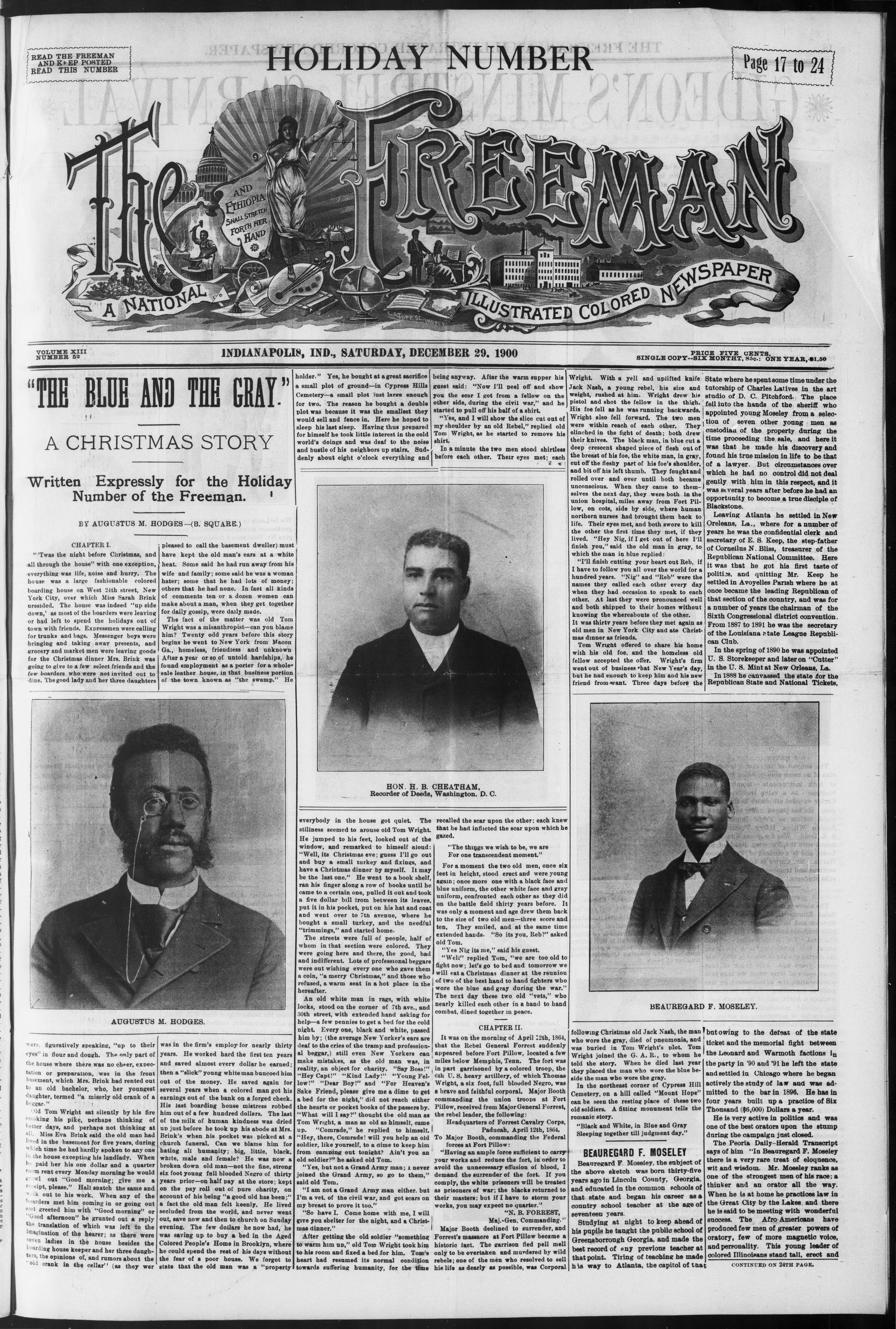
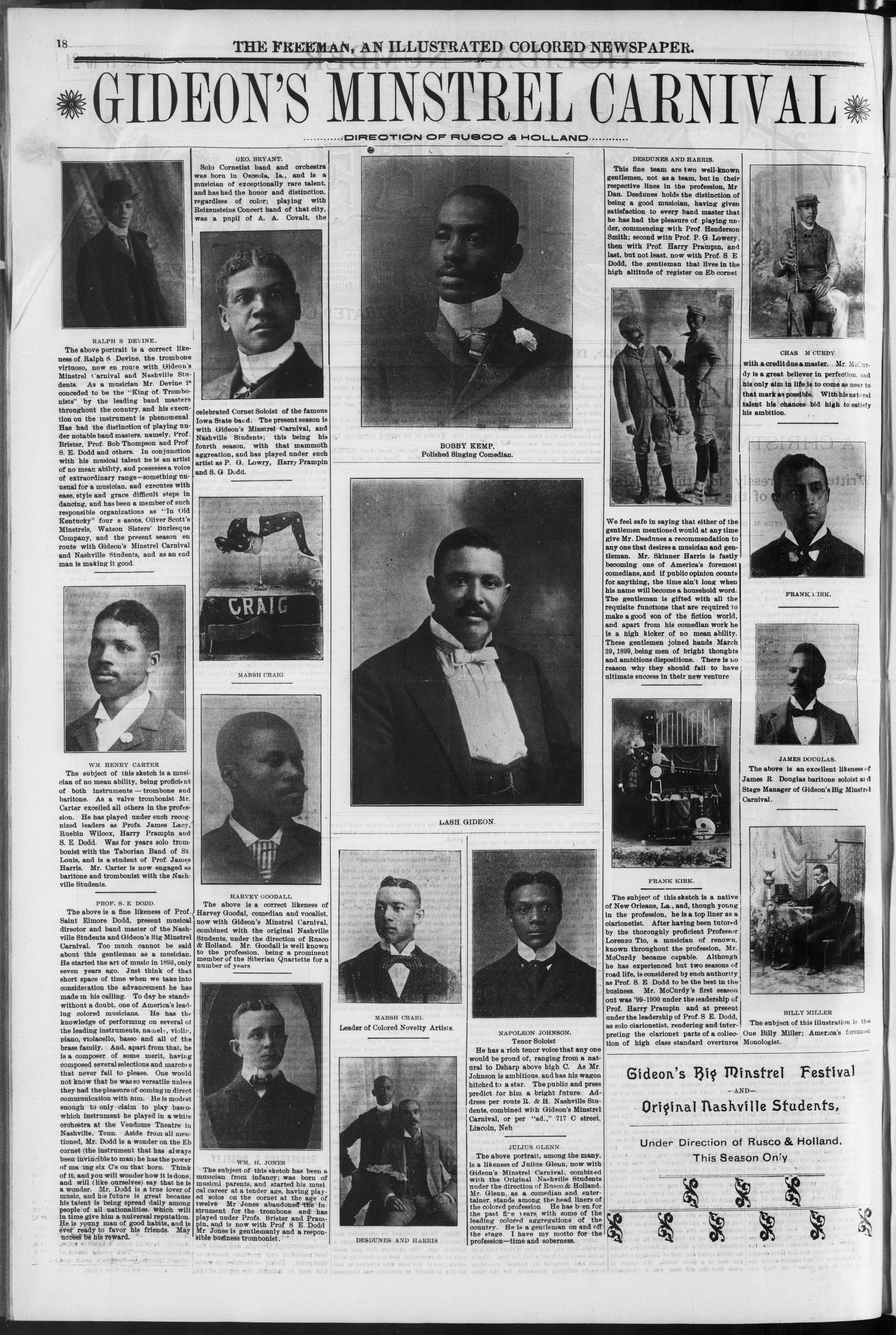
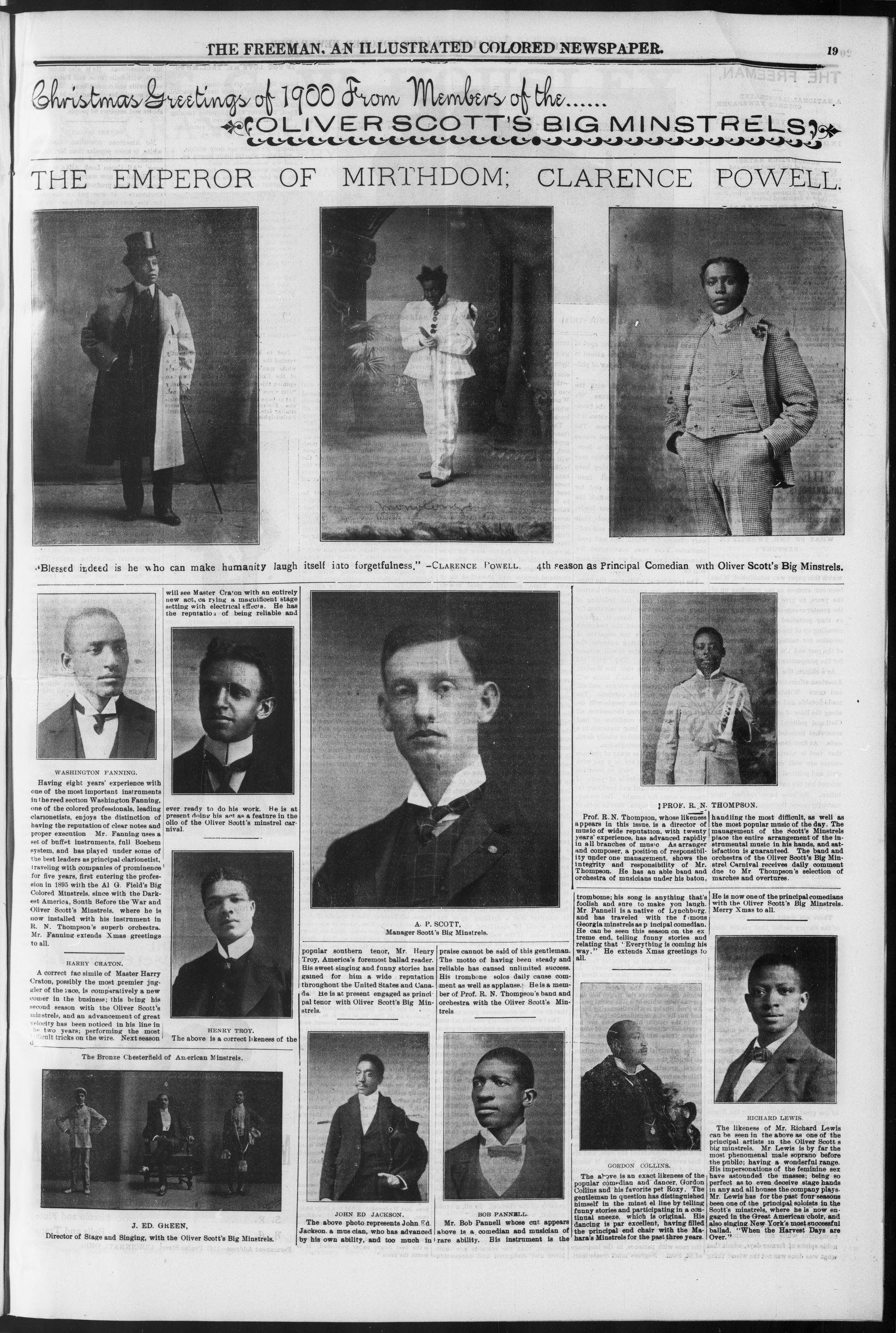
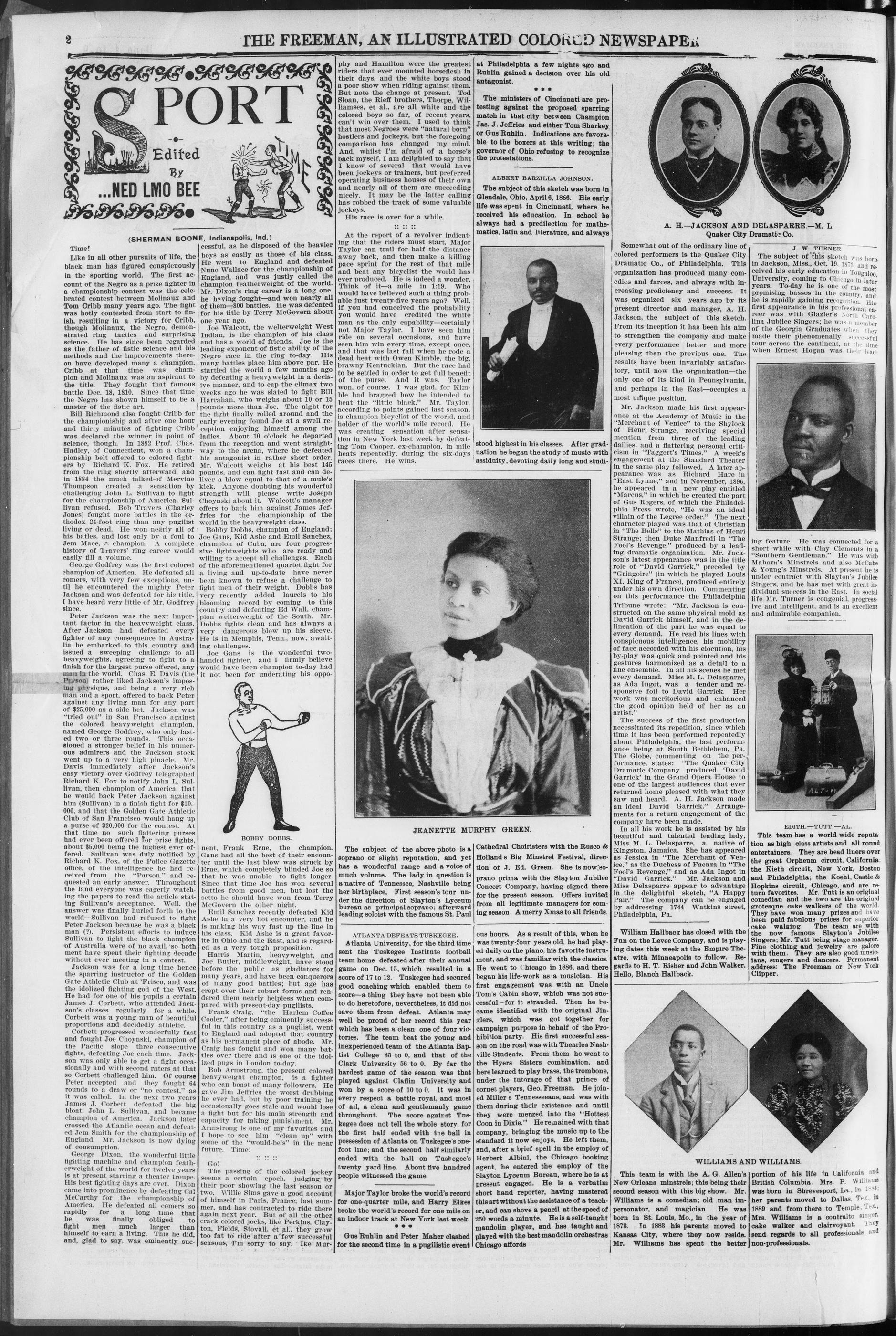
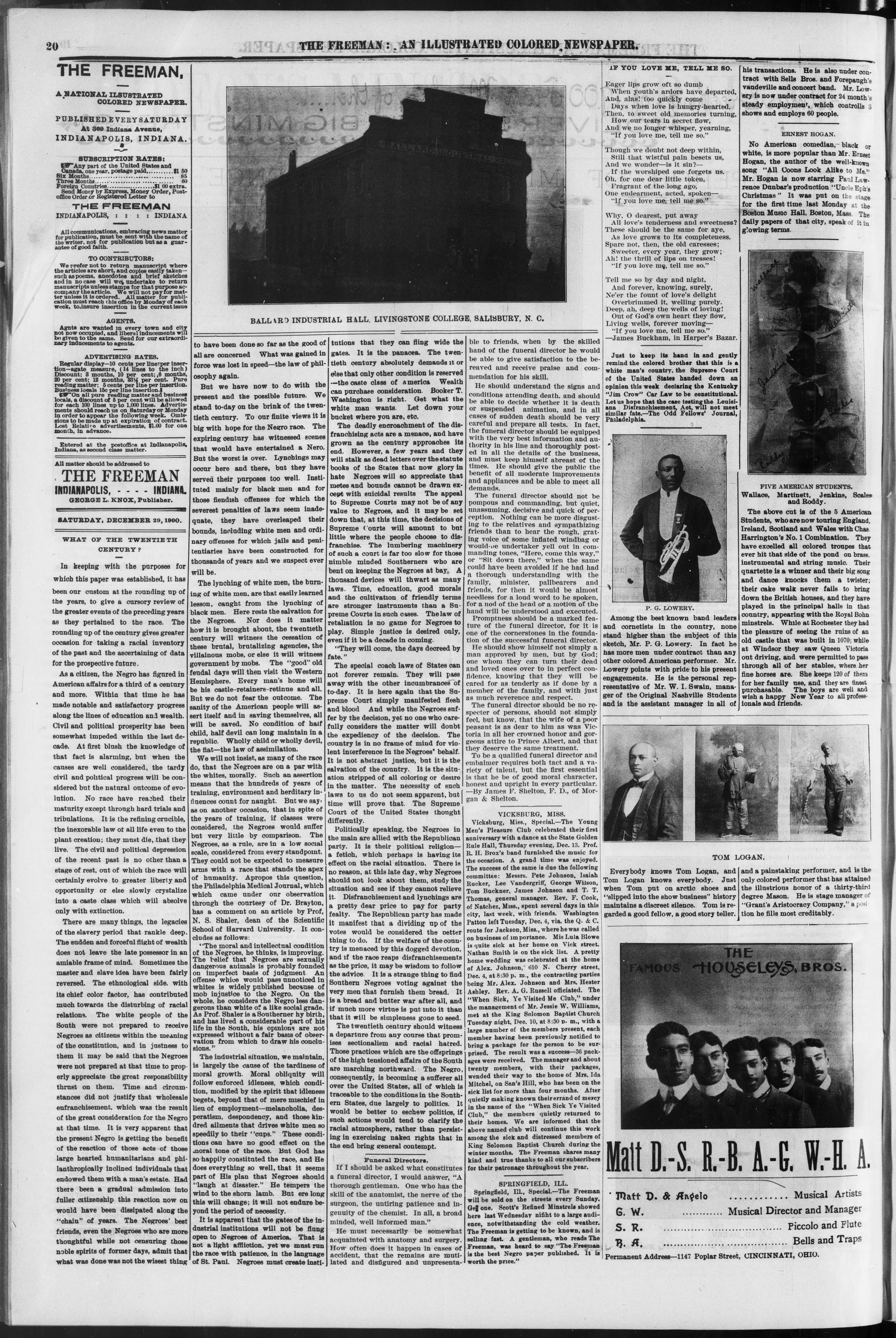
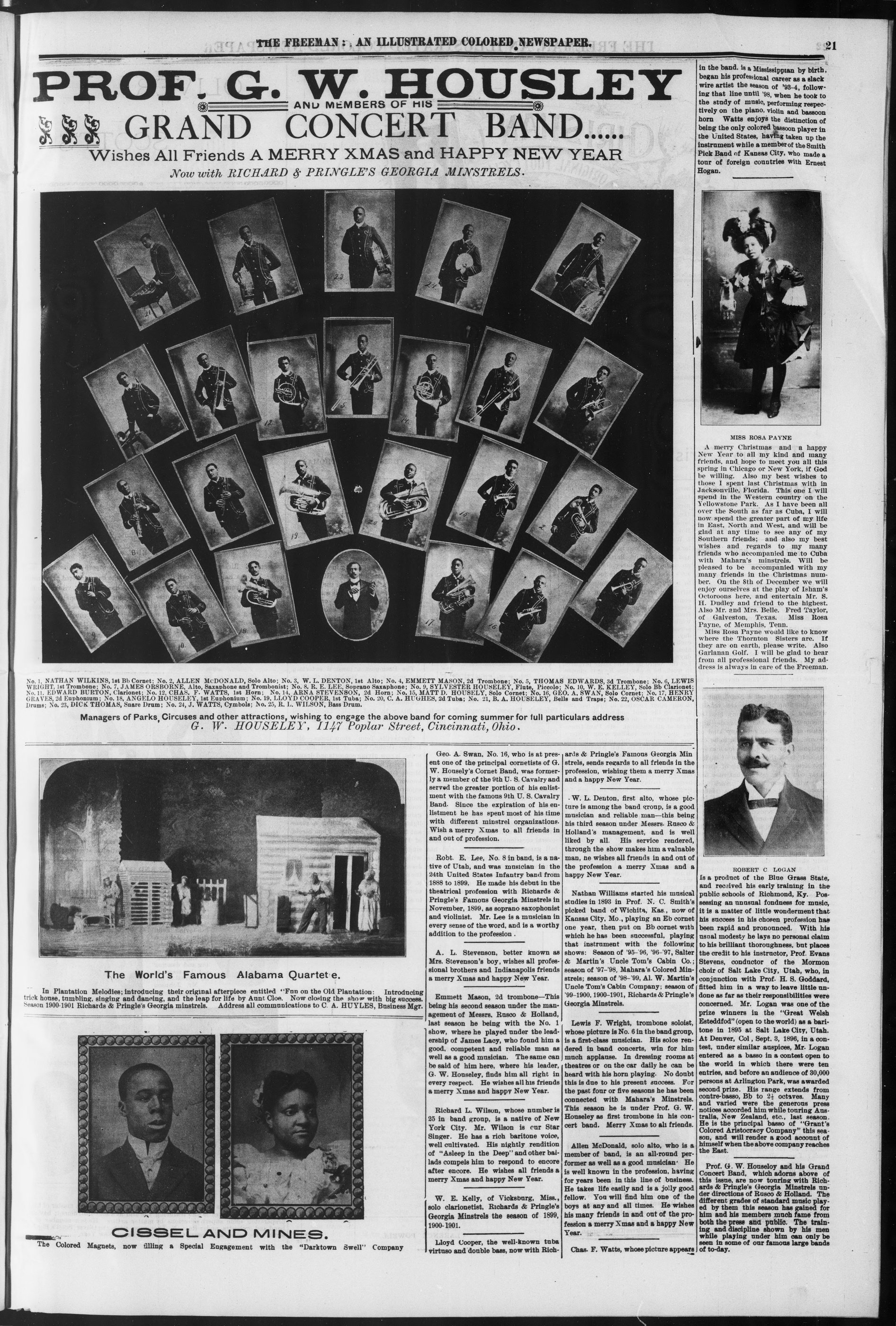
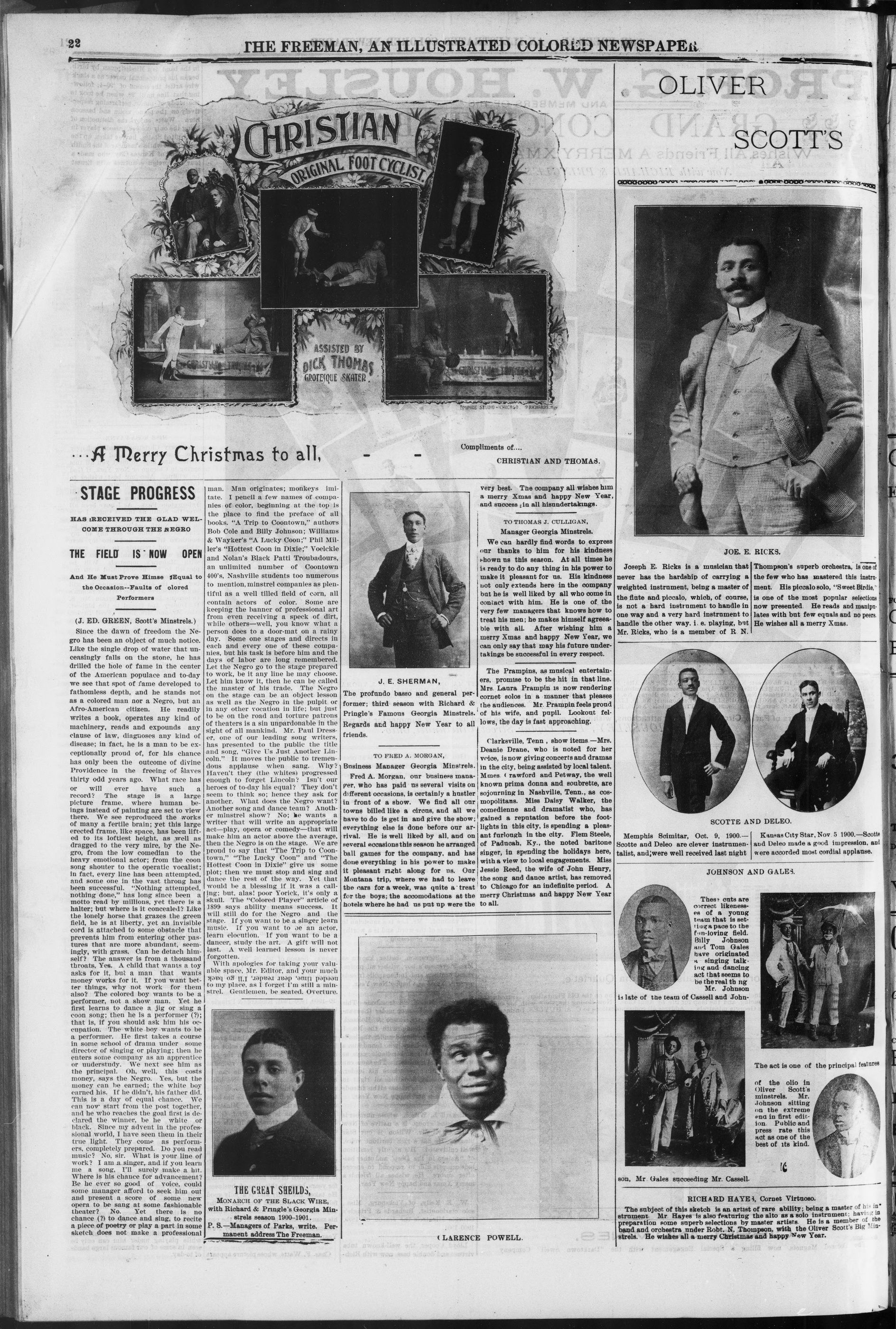
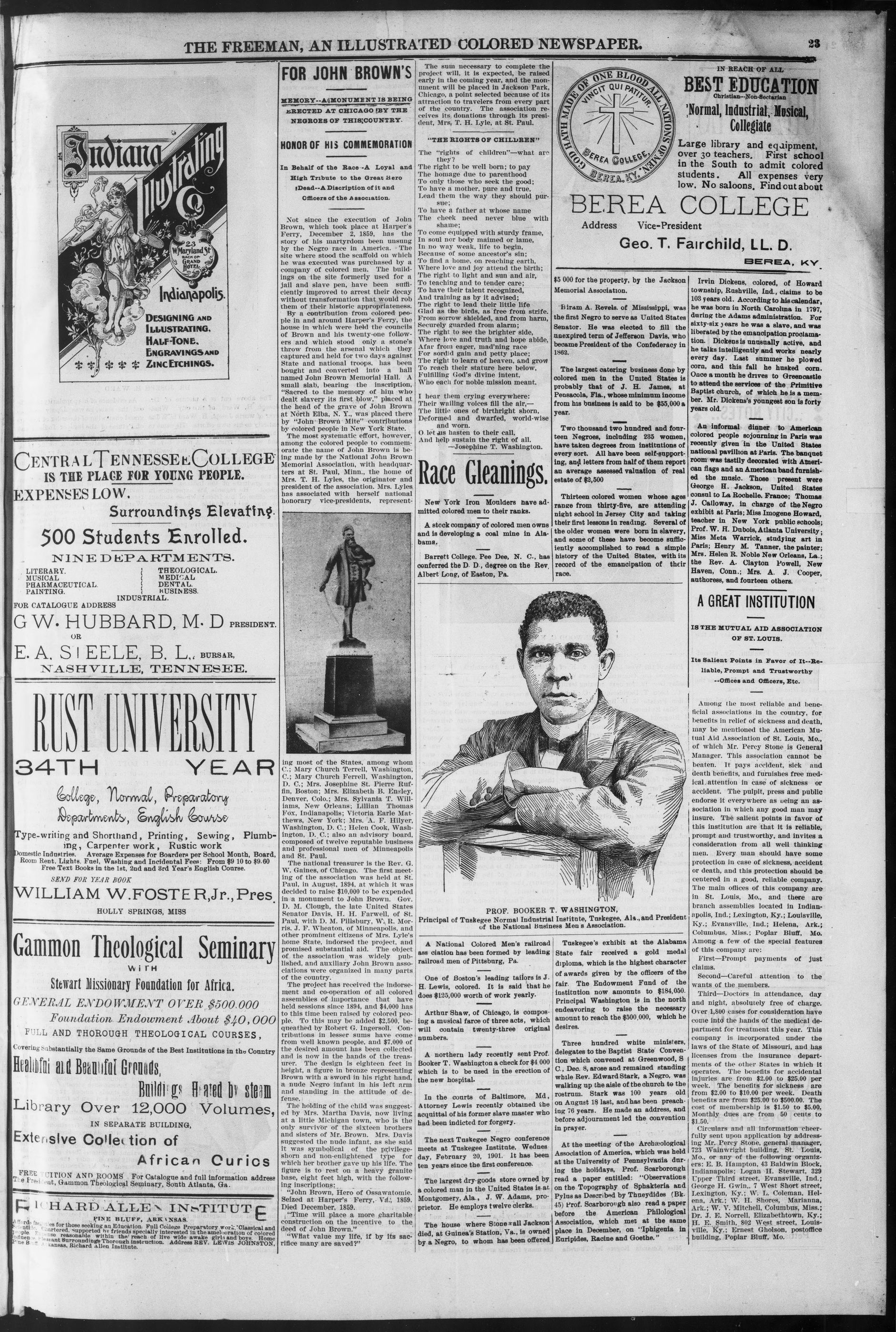
Page text (machine-generated)
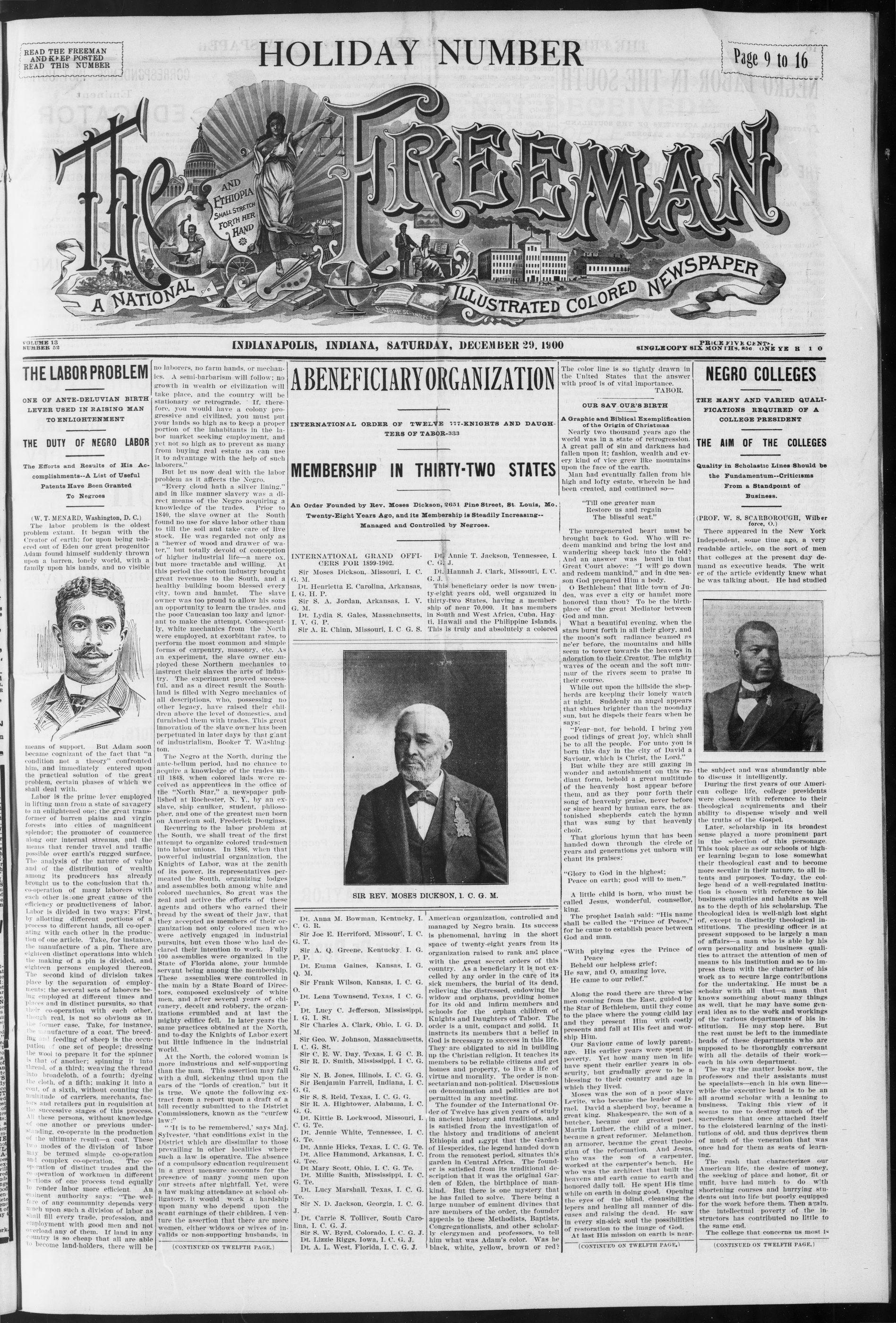
THE FREEMAN
AND ETHIOPIA SHALL STRETCH FORTH HER HAND
A NATIONAL
ILLUSTRATED COLORED NEWSPAPER
VOLUME XIII
NUMBER 52
A TEN MINUTES' TALK BY ONE
WHO "HAS BEEN THERE"
The Growing Needs and Demands of Our Race Publications--By a Newspaper Man
(HON. ROBERT PELHAM, Washington, D.C.
Only those who have "been there" can know of and fully appreciate the hardships the brave men who are striving to maintain the Afro-American journals of to-day have to endure. As one who gave ten years of his life to the cause, I am free to say that of all the handicaps that militate against the successful prosecution and maintenance of Afro-American journals. I put the indifference of the masses and the lack of appreciation of the classes above all the other drawbacks.
Hours of scheming, sleepless nights and days of worrying, to make both ends meet, fall to the lot of all of our newspaper men, but they could the better bear these ills if there was more evidence of appreciation shown their efforts to accomplish something for the race.
To their great credit, be it said, however, that notwithstanding this and the pecuniary disadvantages under which they labor at all times, they have accomplished and are accomplishing much good in spite of those for whom it is done.
With many it seems to be a question as to the need and necessity for the maintenance of Afro-American journals—an open question—until perchance their own parsnips need butter
J. H.
ing—until a change in the school system is threatened which may effect them personally or a seeming desire on the part of their chosen political party that past blessings suffice and that they stand steadfast in their allegiance to the party without representation in the "good things" or "something equally as good." For these reasons it is uphill work for Afro-American newspaper men to maintain creditable journals. The fact is that our journalists must be contented with a modicum of reward and plenty of condemnation. It is a stubborn fact, little thought of by many, that newspaper men are the only professional men that are expected to give freely of their time and talents without due recompense. That each and every individual in the community expects something for nothing from the newspaper man goes without saying.
A child is born. The doctor is there under pay, of course, but the newspaper man or his medium, gets no reward for announcing that most important event in the household of Mr. and Mrs. John Jones, but much condemnation if perchance his paper says:
"To Mr. and Mrs. John Jones—a son—nine pounds."
Instead of:
"To Mr. and Mrs. John Jones—a son—ten pounds."
And to think of it, the error is all the more grievous because Mrs. Jones has not forgotten the fact that when she was married twelve months previous, that same newspaper in its two-column account of her marriage to Mr. Jones, announced that one of her six bridesmaids "wore a dress of white tulle," instead of saying: "Miss Amie Smith
INDIANAPOLIS, IND., SATURDAY, DECEMBER 29, 1900
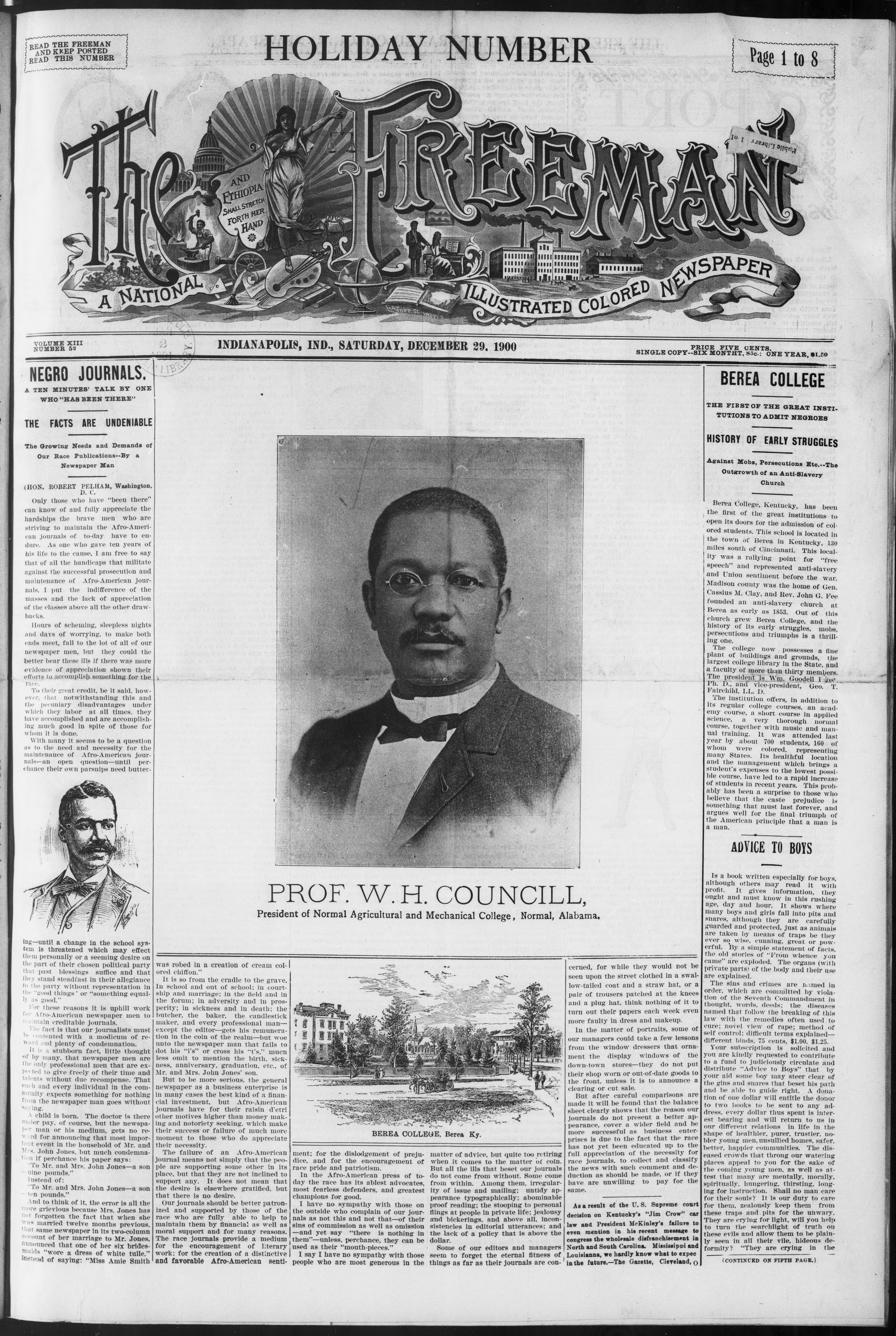
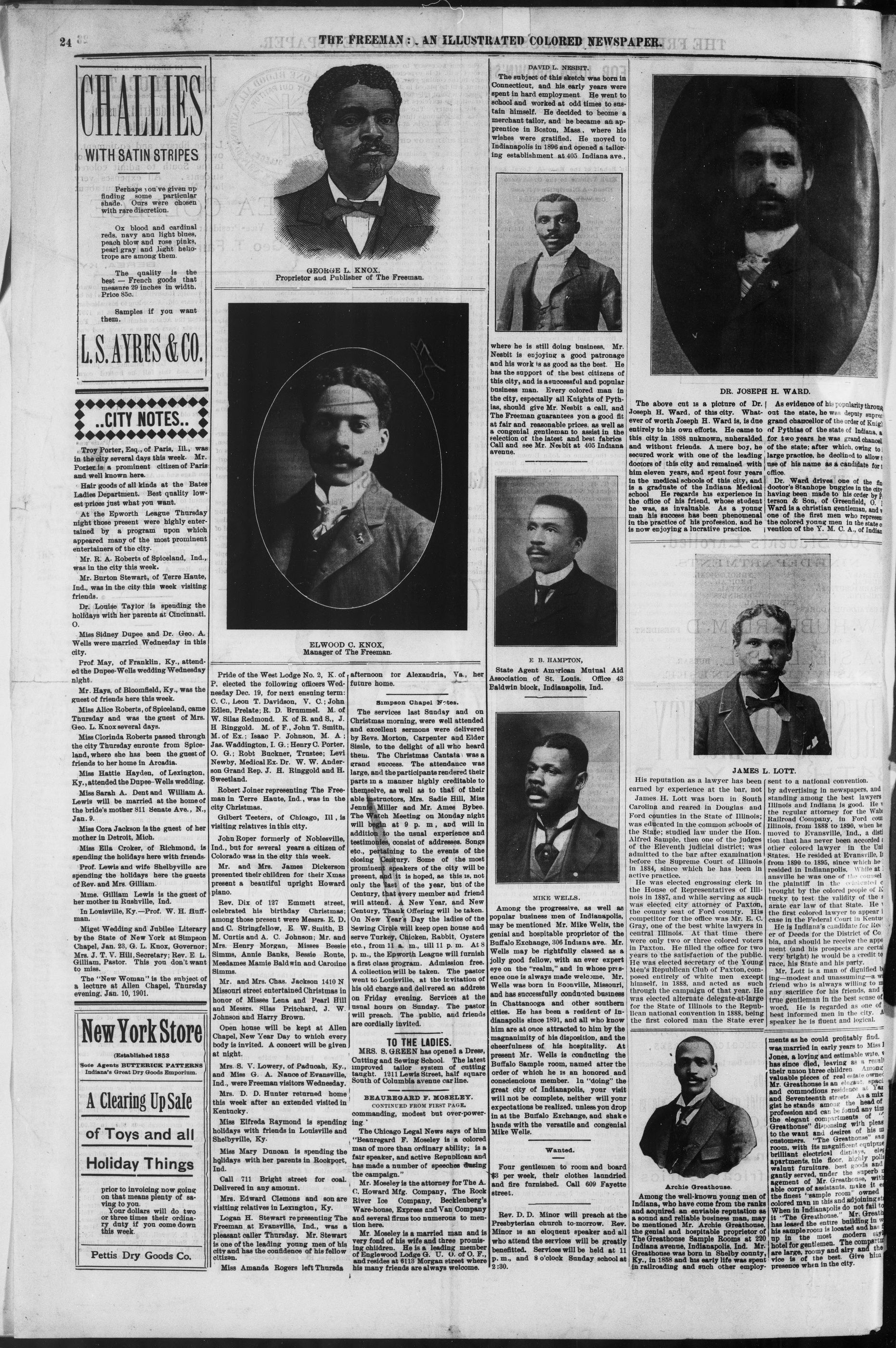
PROF. W.H. COUNCILL President of Normal Agricultural and Mechanical College, Normal, Alabama.
was robed in a creation of cream colored chiffon."
It is so from the cradle to the grave. In school and out of school; in courtship and marriage; in the field and in the forum; in adversity and in prosperity; in sickness and in death; the butcher, the baker, the candlestick maker, and every professional man—except the editor—gets his remuneration in the coin of the realm—but woe unto the newspaper man that falls to dot his "its" or cross his "its," muen less onit to mention the birth, sickness, anniversary, graduation, etc., of Mr. and Mrs. John Jones' son.
But to be more serious, the general newspaper as a business enterprise is in many cases the best kind of a financial investment, but Afro-American journals have for their raisin d'etri other motives higher than money making and notoriously seeking, which make their success or failure of much more moment to those who do appreciate their necessity.
The failure of an Afro-American journal means not simply that the people are supporting some other in its place, but that they are not inclined to support any. It does not mean that the desire is elsewhere gratified, but that there is no desire.
Our journals should be better patronized and supported by those of the race who are fully able to help to maintain them by financial as well as moral support and for many reasons. The race journals provide a medium for the encouragement of literary work: for the creation of a distinctive and favorable Afro-American senti-
HOLIDAY NUMBER
[Image of a man in a suit with a bow tie, wearing round glasses and a mustache.]
BEREA COLLEGE, Berea Ky.
BEREA COLLEGE, Berea Ky.
ment; for the dislodgement of prejudice, and for the encouragement of race pride and patriotism.
In the Afro-American press of today the race has its ablest advocates, most fearless defenders, and greatest champions for good.
I have no sympathy with those on the outside who complain of our journals as not this and not that—of their sins of commission as well as omission—and yet say "there is nothing in them"—unless, perchance, they can be used as their "mouth-pieces."
I say I have no sympathy with those people who are most generous in the
matter of advice, but quite too retiring when it comes to the matter of coin. But all the ills that beset our journals do not come from without. Some come from within. Among them, irregularity of issue and mailing; untidy appearance typographically; abominable proof reading; the stooping to personal flings at people in private life; jealousy and bickerings, and above all, inconsistencies in editorial utterances; and the lack of a policy that is above the dollar.
Some of our editors and managers seem to forget the eternal fitness of things as far as their journals are con-
PRICE FIVE CENTS,
SINGLE COPY--SIX MONTH,TB, $8c.: ONE YEAR, $1.50
cerned, for while they would not be seen upon the street clothed in a swallow-tailed coat and a straw hat, or a pair of trousers patched at the knees and a plug hat, think nothing of it to turn out their papers each week even more faulty in dress and makeup.
In the matter of portraits, some of our managers could take a few lessons from the window dressers that ornament the display windows of the down-town stores—they do not put their shop worn or out-of-date goods to the front, unless it is to announce a clearing or cut sale.
But after careful comparisons are made it will be found that the balance sheet clearly shows that the reason our journals do not present a better appearance, cover a wider field and be more successful as business enterprises is due to the fact that the race has not yet been educated up to the full appreciation of the necessity for race journals, to collect and classify the news with such comment and deduction as should be made, or if they have are unwilling to pay for the same.
As a result of the U. S. Supreme court decision on Kentucky's "Jim Crow" car law and President McKinley's failure to even mention in his recent message to congress the wholesale disfranchisement in North and South Carolina. Mississippi and Louisiana, we hardly know what to expect in the future. The Gazette, Cleveland,
BEREA COLLEGE
THE FIRST OF THE GREAT INSTITUTIONS TO ADMIT NEGROES
HISTORY OF EARLY STRUGGLES
Against Mobs, Persecutions Etc.--The Outgrowth of an Anti-Slavery
Berea College, Kentucky, has been the first of the great institutions to open its doors for the admission of colored students. This school is located in the town of Berea in Kentucky, 130 miles south of Cincinnati. This locality was a rallying point for "free speech" and represented anti-slavery and Union sentiment before the war. Madison county was the home of Gen. Cassius M. Clay, and Rev. John G. Fee founded an anti-slavery church at Berea as early as 1853. Out of this church grew Berea College, and the history of its early struggles, mobs, persecutions and triumphs is a thrilling one.
The college now possesses a fine plant of buildings and grounds, the largest college library in the State, and a faculty of more than thirty members. The president is Wm. Goodell I. Pst. Ph.D., and vice-president, Geo. T. Fairchild, LL. D.
The institution offers, in addition to its regular college courses, an academy course, a short course in applied science, a very thorough normal course, together with music and manual training. It was attended last year by about 700 students, 160 of whom were colored, representing many States. Its healthful location and the management which brings a student's expenses to the lowest possible course, have led to a rapid increase of students in recent years. This probably has been a surprise to those who believe that the caste prejudice is something that must last forever, and argues well for the final triumph of the American principle that a man is a man.
ADVICE TO BOYS
Is a book written especially for boys, although others may read it with profit. It gives information, they ought and must know in this rushing age, day and hour. It shows where many boys and girls fall into pits and snares, although they are carefully guarded and protected, just as animals are taken by means of traps be they ever so wise, cunning, great or powerful. By a simple statement of facts, the old stories of "From whence you came" are exploded. The organs (with private parts) of the body and their use are explained.
The sins and crimes are named in order, which are committed by violation of the Seventh Commandment in thought, words, deeds; the diseases named that follow the breaking of this law with the remedies often used to cure; novel view of rape; method of self control; difficult terms explained—different binds, 75 cents $1.00 $1.25
Your subscription is solicited and you are kindly requested to contribute to a fund to judiciously circulate and distribute "Advice to Boys" that by your aid some boy may steer clear of the gins and snares that beset his path and be able to guide right. A donation of one dollar will entitle the donor to two books to be sent to any address, every dollar thus spent is interest bearing and will return to us in our different relations in life in the shape of healthier, purer, trustier, nobler young men, unsullied homes, safer, better, happier communities. The diseased crowds that throng our watering places appeal to you for the sake of the coming young men, as well as attest that many are mentally, morally, spiritually, hungering, thirsting, longing for instruction. Shall no man care for their souls? It is our duty to care for them, zealously keep them from these traps and pits for the unwary. They are crying for light, will you help to turn the searchlight of truth on these evils and allow them to be plainly seen in all their vile, hideous deformity? "They are crying in the
(CONTINUED ON FIFTH PAGE.)
NEGRO LABOR IN THE SOUTH
A FACTOR IN THE INDUSTRIAL ACTIVITIES OF THE SOUTHLAND-- HIS PROFICIENCY AS A LABORER.
THE SOUTH IS THE HAVEN OF LABOR
The Light of Love and Industry Will Exterminate--Want, Misery,
Injustice, Riot and Bloody Strife.
(W. H. COUNCILL, Normal Ala)
"In the sweat of thy face shalt thou eat bread" is the Magna Charta of labor which no man has the right to wring from another. Men may differ in politics and religion, but all men in all ages have stood upon this broad and liberal plattform laid down by the Father of us all. The Negro shares this high privilege in common with all other men. He has a right to air, water and a crust of bread if he is willing to work for them. Men may refuse to sit at the same hotel table with me, to ride in the same car, or sleep in the same room, or occupy seats in the same church, school or amusement hall. These are rights which reside in the taste and choice of the individual. But no man has a right, moral or legal, to interfere with my honest efforts to earn shelter, food and raiment. No class of people has a higher claim to earn a living in the South than the Negro. He has the right by Divine command. He holds the right by two hundred and fifty years of training in the school of slavery. He holds it by loyalty and devotion to the South. I believe that he will ever hold it by his competency, and by the loyalty and devotion of the South to me Negro, who has produced the "Black dammy," one of the brightest stars in the firmament of Southern glory. The South has never been backward in inviting the Negro to participate in all of her industrial activities. He has been welcomed everywhere work is carried on, except in the political convention, which has more of a degrading than an elevating effect upon the American citizen. The South is earnest, persistent and liberal in throwing wide open to the Negro the doors of the church, the school room and the work shop. These are the greatest civilizing influences of the human race.
One by one the questions raised by the new relations between the races in the South have been accepted and satisfactorily settled. The Negro's freedom and citizenship are fixed facts. His ability to take on higher forms of civilization and education is no longer doubted by well informed and unbiased people. His capacity for every form of industrial life, skilled and unskilled, is not an open question, but an accepted fact wherever he has been permitted a chance. Both friend and foe agree that the suffrage has suffered in his hands, and that the time has come for its restriction on some fair and equitable basis upon which all men may stand, independent of race, color or previous condition of whatsoever character. He is fast breaking away from fondly cherished dogmas, and falling in line with the new political, social and economic thought of the times. He has churches, colleges, universities, theologians, linguists, poets, painters, doctors, authors, editors, blacksmiths, carpenters, farmers, merchants shipwrights, wheelwrights, masons, engineers, electricians, tlegraphers and every other worker known in this country. He stands ready to enter any industrial field to win a living.
Although the Negro has met and settled many questions in the public mind and conscience, still there confronts him at this time the gravest question which he has ever met, equalling that of freedom itself. It is, to him, the vital question of the hour, and upon it hangs his entire tuture in this country. It is the question of food, raiment and shelter.
We live in a world of matter, and however much higher thought may strive for the spiritualization of the material, it still remains a fact that materialistic and utilitarian ideas must, in large measure, influence the operation of the masses. The people everywhere are struggling for bread.
In the higher order of things, it would appear that fitness should be the standard, in which case, the Negro would go up or down on his merit as a laborer.
What the Negro has already attained in proficiency as a laborer ought to be an "open sesame" wherever competent, faithful servants, laborers and mechanics are needed. But what are the signs of the times in this regard? Shall a man's fitness recommend him, or shall some accident of birth, over which no man has control, shape his life and settle his destiny? In other words, will the South continue to guarantee to the Negro an equal and fair chance to earn a living, or will the South yield to the unreasonable demands of labor organizations and thereby throttle capital and also place the Negro laborer in worse than antebellum servitude?
The Negro has refused at all times to take any part in labor agitations and has been faithful in everything. His own strong arms have brought the industries of the South from the weak and helpless condition, in which they were left by the civil war. Had he allowed himself to be seduced by the labor agitator, the South would have suffered industrial stagnation. The labor agitator is now avenging himself on the Negro by trying to displace him as the labor element of the South. The South, should not forget its old friends and should not allow them to be thus displaced, and be humbled by the enemy who will dictate to capital and take charge of the entire South if per-
10
mitted to go on unrestrained. This labor movement is strongly tainted with Socialism, Nihilism and anarchy. This exotic, heterogeneous army of peace-breakers will force the Negro to starve or seek to use him as a part of their suicidal schemes to overthrow society. Give the Negro labor of all kinds, and we pledge continued loyalty and obedience, and prophesy an era of prosperity and happiness never seen before in all the history of our American republic—because truth and justice will lead us on.
LABOR UNIONS OPPOSE HIM.
The Negro does not combat any labor organizations. He has no war to make on anybody. He asks only for a fair chance. He begs only for the privilege to do an honest day's labor for an honest day's pay at rates understood between him and his master. He is willing to make fitness the test, putting aside all racial, religious and political considerations. The unions, often based on everything else than faithful and competent service, pursue the Negro with an aggressiveness, not born of patriotic sentiments or founded on the Golden Rule.
The same lawlessness which says that a Negro shall not spin into yara the cotton which he produces; that he shall not make into steel the ore which he digs from the earth; that he shall not lay in the wall the bricks which he has kilmed; that he shall not polish and set stones which he has quarried, can go a step further and say, that a Negro shall not produce cotton, shall not dig ore, shall not make bricks, shall not quarry stones. Is it possible to see the baneful results of such mob-spirit in any community? It says that capital shall employ only certain men, certain hours at certain wages, or suffer the torch and the assassin. If this mob spirit is allowed to obtain in the South, Southern progress will receive a setback from which it will be hard to recover. Laboring men have a right to organize for mutual benefit. All fair men grant this right. But no man has either moral or legal right to interfere with whatever arrangement may be made between other men for work, wages and hours of labor. Whenever a community permits such interference it opens the way for more lawlessness and crime.
REGULATE UNIONS BY LAW.
This unwise and dangerous spirit has shown itself at times in the South, and unless regulated by the stern, positive sense of justice of the business community, or by legislative limitations, it will bring into the South disorder which will exceed the disturbances of "Reconstruction days." In a certain city last summer some Negro plumbers were awarded the contract for the plumbing work of a building being erected by Negro carpenters for Negroes. The Plumbers' Union so overawed the local dealers that they declined to sell fixtures to the Negro plumbers. The South should not harbor such oppression. Men born and reared in the South as well as good men investing their money in the South, do not indorse such a lawless, barbarous practice.
The vagrant law, a paid mounted constabulary in every county in every State, the saw-horse, and the saw with a pile of wood, should stand as a menace to the idle, the vicious, and to the unworthy labor agitator, whether black or white.
A NEEDLESS PROBLEM.
As I have before stated, the South having settled most satisfactorily all of her past problems, should not now permit the needless introduction of grave questions, which will not only injure the progress and prospects of her strongest labor element, numbering ten millions of people, but which must domineer and cripple capital itself. In the whole period of Negro slavery, and since emancipation, Southern white men have worked side by side with Negroes. There has been no place in Southern industrial life which the Negro has not filled, and that by the teaching of the Southern white man. The Negro has not been only a hod carrier, but he has prepared the materials and constructed our magnificent buildings all over the South.
No gallent Southern man, who wore the gray, ever yet shrank from the "Negro with the spade." Have we not stood side by side, and shoulder to shoulder in all the long years of our weary toil, and yet as distinct in our social life as stars in the firmament above? Why change now? Why bring in endless strife? Let us still be friends.
NEGRO LABOR GROWING WITH THE SOUTH.
The Negroes are taking deep interest in the proper education of their children in order that they may be competent to do the work of the South. A thorough industrial training is being constructed on a sound intellectual and moral basis that every exigency in Southern development may be met. One hundred and seventy-five schools are training to-day thousands of Negro boys and girls in all the leading trades so that they may take intelligent part in building up the South. These schools are aided by North and South as doing a grand work in bringing about the right kind of citizenship. At Normal we are giving our girls
THE FREEMAN, AN ILLUSTRATED COLORED NEWSPAPER
EDUCATION OF NEGRO LABOR.
The proper education of the Negro will overcome all objections to him as a laborer. Education, like righteousness, exalts a nation; but ignorance, like sin, is a curse to any people. There is no kind of service which will not be more satisfactory when performed by intelligent servants. Educated farm hands, mechanics, domestic servants, are a hundred fold better for the South. Intelligence sweetens toil, when the toiler knows that there is no more honorable station in life than at the top of his chosen field of labor—whether plowman or Congressman—whether queen in the kitchen or mistress of the White House. Instead of degrading common labor by leaving it to the most ignorant part of our population and then dishonor the human soul by leaving it down in ignorance—let us lift up man and he will lift up labor. Instead of materializing man let us spiritualize matter. Then we fill all human effort with that sublime heroism in which the wisest and best find the sweetest blessing in the humbleest service. The common labor by the common people will work out a “new heaven and a new earth.” The light of love and industry will drive out want, misery, injustice, riot and bloody strife. Then will peace and prosperity spread their white wings over our blessed Southland forever.
The refined and delicate odor of the Original Ozonized Ox Marrow makes it the pleasantest preparation to use for straightening the hair. Besides it does the work just right and always gives perfect satisfaction. It makes the hair straight, soft and beautiful. Warranted harmless. Only 50 ounces. For a full price, press paid, one bottle for 65 cents. Address Ozonized Ox Marrow Co., 76 Wabash Avenue, Chicago, Illinois.
$1.00
60c buys a pair of black
kinky hair Braids 16 inches
long.
30c buys a Single Braid
kinky hair 16 inches long.
Bangs Hair Pin and Orna-
ments of every description.
Most complete line of
hair goods in this
country for
Colored * People
Send stamp for
well Illustrated Catalogue.
DON'T BE DUPED
---
thorough training in the science and art of coking, cutting and sewing, nursing the sick, laundering and everything pertaining to domestic life; we give our boys the best training in foundry and machine shop work, blacksmithing, plumbing, saw milling, all kinds of wood work, shoe making, carpentry, printing, painting, farming and other industries. There is no sham about our instruction. The students manufacture goods for the market.
Now, after all of this training, in all of these industrial schools, shall these thousands of our young people go forth to be tyrannized and enslaved by the power of organizations based upon everything else but competency, law and Christian principles? Or will some new prophet arise and say that this training was wrong and the Negro should be taught something else? Where is the end? Shall these thousands of young people, who, under the sanction and patronage or our laws are learning all the trades of the country, be told that the color of their skin is a bar to employment? Twenty-five million dollars by Northern charity, $50,000,000 by Southern sympathy, $100,000,000 by Southern legal enactments to Negro education in the South in the last thirty-seven years! For what? To educate Negro girls and boys to be paupers? Or to make them hard working citizens? Shall the unfriendly labor union cancel the philanthropic and patriotic intentions of charity and legislation?
The South has the best labor in the world. It is true that the Negro is not yet always mindful of all of his obligations; but no community with Negro labor will ever go to bed in peace and get up next morning and find its entire business paralyzed and a howling mob making selfish and unreasonable demands. The Negro is easily controlled. He is always ready to work in a happy mood because it is his religion The Negro is not a criminal race, and does not form conspiracies to commit crime and destroy property. He is the humble, docile race of the earth. Shall he remain so by your kind treatment, by education, or shall his nature be changed so that he will not be a power in the continuation of our industrial evolution? The Negro has long since learned that with the olive branch of peace in one hand, and the pick axe in the other, we are a rising people; but with the dagger in one hand and the other idle we are doomed to everlasting destruction.
THE SOUTH THE HAVEN OF LABOR.
The South is indeed the friend of every man who labors. All nationalities find a chance to earn a livelihood beneath her blue skies. The South should continue to offer protection to every class of honest labor which may seek employment within her borders. The Negro has a priority claim upon all labor in the South which he is capable of doing. He appeals to the South, through public sentiment and legal enactments to protect him in the enjoyment of his birthright. He does not ask that others be debarred nor does he desire such discrimination; but he asks only an opportunity to stand or fall on his merit in every industrial field in the South. The engorged European population can use America for dumping ground for centuries to come and still there will be room and work for all under normal conditions. But there should be no toleration of oppression, no disturbance of the present friendly relations between master and servant.
Wil the South in her haste for wealth allow organizations to create more "walking delegates," more criminals, more paupers? The "Stars and Stripes" should give protection only to those who strive for an honest living, and respect the rights of every other person under that flag. There should be no constitution which is not in harmony with our National bill of rights, no organization which is not according to that constitution, and no flag or banner over which our National emblem does not float—our own "Stars and Stripes," placed by black hands on San Juan hill.
CILE NEGRO LABOR, OR
BENDING ANARCHY.
WHICH?
Unless the South regulates by law the operations of labor unions and labor organizations, as well as mark out a just course for capital, the best labor in the world will be ultimately driven out of her markets; and when the South permits this, her best and most loyal friends will be gone. When the white man brings foreign labor to displace his true and tried friend, the Negro, then will communism drive the white man's coach. Nihillism cook and serve his food, agrarianism plow his fields, and the red flag of anarchy float over every Southern industry. They may bring on civil strife more deadly than many foreign wars. Unassimilated foreigners have no right by the law of God or man to displace, by unlawful methods long standing labor. Can the Negro and can the white South afford to run wild over the suffrage question, or can both sit supinely down while these unfriendly forces wind their loathsome and deadly colls around our free institutions and throttle every element of justice and liberty in them?
A PLAIN DUTY.
Will the South in her haste for open, and warning from all sides, permit the introduction and growth upon its industrial institutions of organizations opposed to its best interests? It must direct its labor element, as well as place around capital proper limitations, or it must suffer. It must enact law, or make disorder. It must by proper methods of assimilation permanently and wisely ingraft the heterogeneous population flooding its territory. This population is entirely exotic to its manners and customs, ignorant of its sacred traditions and disloyal to its interests. Falling to control it, the South must be trodden beneath the feet of brobdingnagian communism, more blasting and blighting than the barbarian hordes, which stamped the best life out of the highest
civilization of Greece and Rome. I am proud to say that the heart of Nebro labor throbs in unison with every sacred tradition, with every loyal impulse and with every industrial interest in the South. Disorder has no scruples. It takes liberty for license to commit brutal deeds. The mob spirit too often found in labor unions may become emboldened by the rush of the South to unwisely welcome every kind of new comer. The mob spirit which is now against Negro labor may turn to-morrow and seek to enlist into its ranks the worst element of the Negro. What evils may come upon us then, it takes not a prophet to foresee. The suffrage question does not threaten more evil consequences. But let the South protect the law-abiding, industrious Negro, and he will ever stand with his strong black arm as a conservative force between the mob and Southern industry. He will throw his own black body between the white man's home and danger, as he did thirty-seven years ago when the horrors of a bloody civil war stalked abroad in the South.
Worth Knowing.
HAIR SWITCHES
```markdown
```
like cut 22 inches long short stem made of black kinky hair. Sent postpaid on receipt of
T. W. TAYLOR
1431 State Street, Chicago, Ill
[In writing please mention the Freeman.]
There have been placed upon the market several cheap reprints of an obsolete edition of "Webster's Dictionary." They are being offered under various names at a low price
By dealers, agents, etc., and in a few instances as a premium for subscriptions to papers, announcements of these comparatively Worthless reprints are very misleading. They are advertised to be the substantial equivalent of a higher-priced book, while they are all Reprint Dictionaries, prototype copies of a book of over fifty years ago, which was sold for about $5.00, and which was much superior to these imitations, being a work of some merit instead of one Long Since Obsolete.
The Webster's Unabridged Dictionary published by our house is the only meritorious of the best of the works imprint on the title-page and is protected by copyright from cheap imitation. As a dictionary lasts a lifetime will it not be better to purchase the
Webster's International Dictionary
OF ENGLISH, Biography, Geography, Fiction, etc.
Size 10x12½ x 4¼ inches.
This Book is the Best for Everybody.
STANDARD AUTHORITY of the U. S. Supreme
Court, all the State Supreme Court, all the
State Supreme Court and of nearly all the
Schoolbooks. WARMLY COMMENDED by
College Presidents, State Superintendents
of Schools and many other eminent authorities.
Webster's Collegiate Dictionary.
Recently abridged from the International and next
to it the best for the family and student.
Size 10x12½ inches.
Specimen pages either book sent for the asking.
G. & C. MERRIAM CO. Springfield, Mass.
CORRESPONDENCE INSTRUCTION
Eminent
EDUCATORS
Commend it as being as thorough and satisfactory as
oral teaching. By using spare hours while continu-
ing their regular occupation, thousands have thor-
oughly prepared for the practice of their profession in Law,
Pharmacy or Illustrating and Newspaper Sketching.
Personal Instruction
and criticism on all work throughout a course in either of
these professions, moderate rates. Easy terms. Write for
catalogue of the profession you have chosen addressing either:
NATIONAL CORRESPONDENCE SCHOOL of LAW
NATIONAL CORRESPONDENCE SCHOOL of PHARMACY
NATIONAL CORRESPONDENCE SCHOOL of ILLUSTRATING
NATIONAL CORRESPONDENCE SCHOOL of MEDICAL Branches
30 to 38 N. Pennsylvania St.
INDIANAPOLIS IND.
(Please Mention this Paper.)
ANANTISEPTIC SKIN PURIFIER Wonderful Discovery A-ton-a
GOTO AGLOVE STORE FORGLOVES
AFineMustashfor50c
Mr. La Macre of Paris has established an agency in the United States for the sale of his Mustache and Beard grower. Never in the history of the world has such a discovery been made. Any boy of 16 where the hair follicle or bulb is formed may cultivate a fine Mustache by nurishing the secretive glands, which will cause the shaft to shoot forth, rich and glossy. No gentleman can appear maaly without mustache and is never admired by the opposite sex. Send your order to day and be convinced. Address
DO YOU LOVE HEALTH?
CONTENTS: How to Become a Good Writer; How to Get Up and Go
How to Serve Meals, How to Serve a Banquet; Remarks to Young He
writers etc. etc. etc. Address: THE FREEMAN, Indianapolis, Ind.
```markdown
```
TUCKER'S Glove ST
A Fine Must
Mr. La Maore of Paris has established sale of his Mustache and Beard grower, such a discovery been made. Any boy of formed may cultivate a fine Mustache by will cause the shaft to shoot forth, rich and amaly without mustache and is never ad order to-day and be convinced. Address
NEW ORLEANS, LA., Station E.
DO YOU LOVE
MANSFIELD
L. J. HAYDEN
Proprietor and Manufacturer of
The J. P. Kerr Indian Medicines
620 N. Eutaw St., Baltimore, Md.
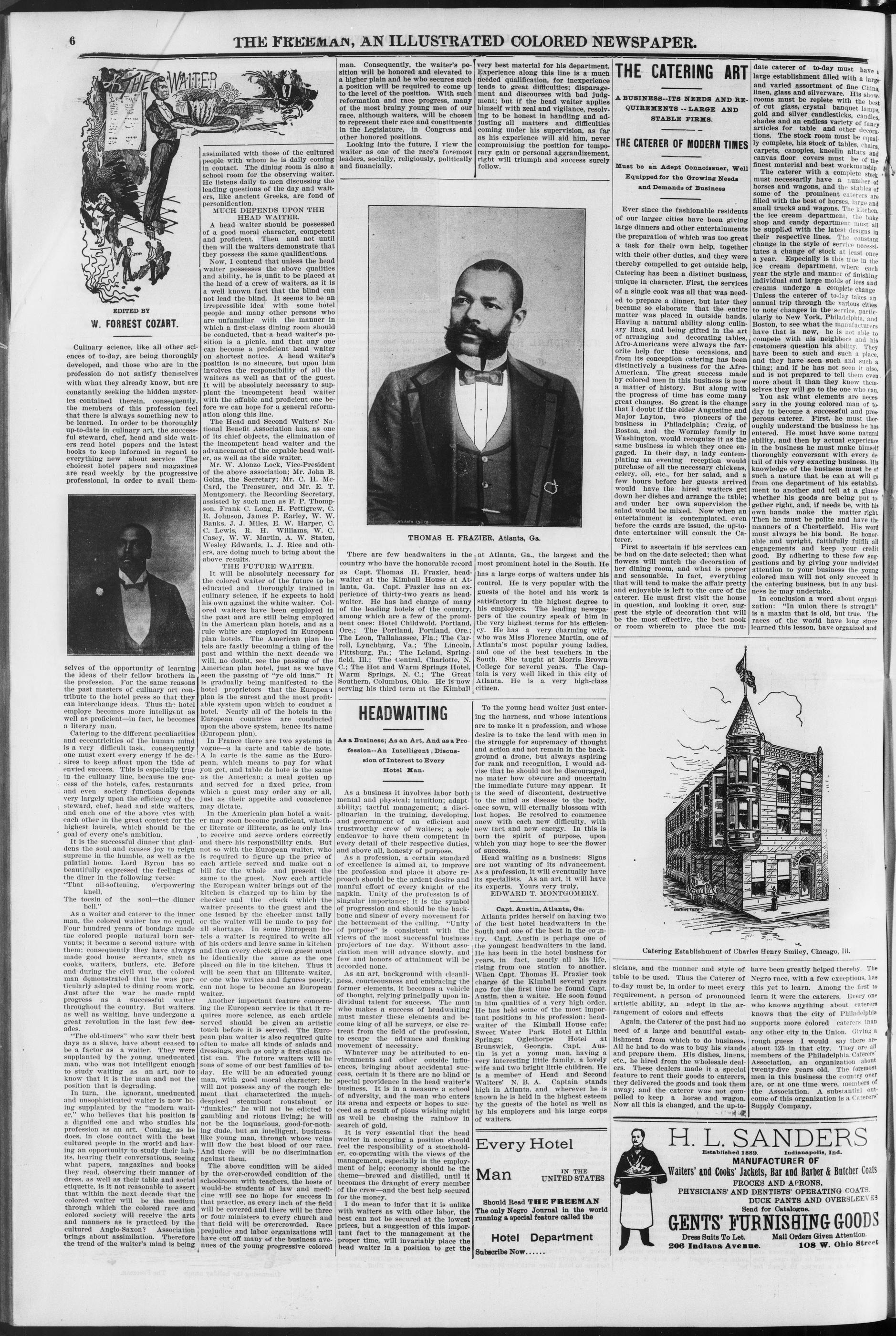
THE WAITER
Price, $1.00
Every wait
this book.
reputation
Compiled by W. Fo
INDIANAPOLIS IND
STORE FOR GLOVES
Men and Women's
Gloves and Mittens
25c, 35c, 50c, 75c, 85c,
$1.00, $1.25, $1.50 and up.
SILK LINED GLOVES
85c, $1.00, $1.25, $1.50
and up.
Largest Line in the State
Store, Washington Street.
tashfor 50c
ed an agency in the United States for the
Never in the history of the world has
of 16 where the hair follicle or bulb
nurishing the secretive glands, which
and glossy. No gentleman can appea
imired by the opposite sex. Send you
LA MAGRE MUSTACHE CO.
VE HEALTH?
If so, consult the Indian Herb Medicine Man, L J Hayden, Manufacturer of the J KERK Medicines, 693 N. Euwat s. I cure all diseases that are known to man or be or no charge, no matter what your disease, sickness or affliction may be, and restore you to perfect health. Milions of people, the best and leading ones in the United States and Europe, will testify that I am the most wonderful healer of all complains in the world. I use nothing but herbs, roots, barks, gums, balsams, leaves, seeds, berries, flowers and plants made into teas, for all complaints. I have cured thousands that the most skillful physicians and the best hospital physicians in America and Europe have given up to die, and said there was no cure for them.
I cure the following diseases: Heart Disease, Consumption, Blood, Kidney, Bladder Stricture, Piles in any form, Vertigo Quiney, Sore Throat, Lung, Dyspepsia, Indigestion, Constipation, Rheumatism in any form, Pains and aches of any kind, Cold, Bronchial troubles, So es, Skin Diseases, all it things happen, all Female Complaints, La Gripe or Pneumonia, Ulcers, Carbuncles, Boli Cancer, the worst forms without the use of knife or instruments, Eczema, Pimples on face and body, Diabetes of Kidneys or Bright Disease of the Kidneys. I cure any disease, no matter of what nature. All venereal diseases a speciality. Medicine sent to any address by express. Consultation free by mail.
ERS' MANUAL
ter who wishes to make money should buy
Every headwaiter who desires to make
should advise his men to obtain it
ORFEST COZART, Waiter
NOT A DEMOCRATIC FORM OF GOV
ERNMENT AS GUARANTEED
BY THE CONSTITUTION
STATE RIGHTS INCREASING
And the Negro is the Sufferer--The Fourteenth and Fifteenth Amendments Regarded as Premature in Some Sections
While in name our form of government is that of a representative democracy, the truth is that it has never been a government of all of the people, for all of the people, and by all of the people. From the very beginning citizenship and the rights, privileges and immunities of citizenship have been limited or qualified by the circumstances of property, education or race relation.
Until the adoption of the Fourteenth Amendment, the accident of race could exclude a native born American Negro from all citizenship. In a great section of our country the authority of the National government has never been sufficient to overcome the authority of long-established customs which oppose the granting of the full rights, powers, privileges and immunities of citizenship to American Negroes.
During recent years the National government has been boldly defied by State after State, which have adopted and enforced laws that deny or abridge the right of citizens of the United States to vote because of race, color, or previous condition of servitude. This movement has enjoyed such immunity and has become so bold that the press of the South has already begun to openly advocate the repeal of the Fifteenth Amendment to the Constitution of the United States.
It is quite likely that the advocacy of the repeal of the Fifteenth Amendment will be widely taken up by the Southern press and that this course will be followed by a general disfranchisement of the Negroes in the South. The National government has the authority, through its judiciary and legislative branches, to enforce the constitution, but it is obvious that the delicate and dangerous task of National interference in the affairs of the States until the violation of the political and civil rights of a large portion of citizens has become extremely pronounced and unmistakable, will not be undertaken, but recent history affords reason to believe that when, in the fullness of time, this task is begun, it will be thoroughly completed.
It is quite natural that individual citizens should regard the slow and deliberate movements of the National government with impatience. The Republican party being in control of the government could have been charged with delay and indifference and much campaign capital could have been manufactured, but there are weighty reasons why the Democratic party had no desire to goad its opponent to activity in this matter.
Before the National government moves in the matter of enforcing the Fifteenth Amendment the fitness of the Negro to share all of the rights and privileges of American citizenship will have been thoroughly discussed and public opinion will have taken shape and been given expression.
There are tens of thousands of Northern white men and thousands of white Southern men who are bitterly opposed to the treatment given the Negro by many Southern States and who would advocate the immediate intervention of the National government, but suppose an ex-rebel were now the President and should cause the National government to interpose its arm in the affairs of the State of New York?
New York would rise up and say: "We can attend to our own affairs."
The American people would side with New York. Likewise the people of this nation would side with any State with the affairs of which the National government might interfere unless the action were justified by most unmistakable grounds.
There are thousands of citizens of both races who regard the Fifteenth Amendment as premature. There is, possibly, no Northern State which, if it suddenly found within its borders a majority of Negro voters, as poor and ignorant as are the masses of our peo- nor rival any Southern State in the invention of methods to prevent that ignorant majority from assuming political control. But no Northern State is confronted with such conditions, while just such conditions exist in many or most Southern States. The problem caused by the Fifteenth Amendment is, therefore, largely a sectional one, which is being dealt with by the people who have all of the facts daily before them, and the memories of the days of reconstruction still vivid in mind.
These people would not tamely submit to hostile interference upon the part of people from a section where circumstances present no element of the race problem such as exist in the South. This is known to the leaders of the Republican party and they are suddenly prudent not to act without due warrant. It is evident that the situation must become much worse before there is any hope of steps being taken by the North to make it any better.
When the issues growing out of the race conflicts and the Fifteenth Amendment come to a head, it is not certain that the government will say, "The amendment is law and must be obeyed," but there is a probability that it will say, "The good of the whole people demands that the amendment be repealed."
There can be no doubt but that the
THE FREEMAN, AN ILLUSTRATED COLORED NEWSPAPER
leading element of Southern whites will spare no effort to convince the country that its best interests would be promoted by the repeal of this amendment. In this effort they will find the task of gaining public sympathy and finding arguments greatly facilitated by the blunders of many Negroes who pose, unmolested, as the representatives and leaders of their race.
Any Negro who would at this hour give public utterance to the counsel that his people should actually have, would pay for it by beng made the object of hatred and persecution from one end of the country to the other.
No negro can with impunity point out the defects of his race or of any institution of the race; the price that each Negro in public life must pay for the favor of his people is the surrender of candor and the practice of flattery.
At this present time there is absolutely no Negro in high position who is perfectly candid and fearless in his utterances and at the same time reasonable. Bishop Turner is candid enough, but he is so unreasonable and extravagant that he commands but very little influence.
In the crucial period of our citizenship we are without true leaders. The probabilities are that the Fifteenth Amendment will be repealed and that the mass of the race will be condemned to a condition of qualified and restricted citizenship so full of disadvantages and discouragements as to greatly hinder future progress beyond the condition of hewers of wood and drawers of water which the prophetic eye of Booker T. Washington has already discerned and for which he is laboring to prepare the people.
Our only hope is in the coming of candid, honest, fearless leaders who will put us on the right track before it is too late.
J. M. HENDERSON, M. D.
1914 Lombard Street,
Philadelphia, Pa.
IN THE REFLECTIVE MOOD
"Bowed down by the weight of centuri s he leans upon his boe
And gazes on the ground,
The emptiness of ages on his face
And on his back the burden of the world,
Who made him dead to rapture and despair
A thing that grieves not and the never hopes
Stold and stunned, a brother to the ox?"
A MAN WITHOUT A HOPE.
Bound down by oppression's laws, he lies
A giant, prostrate on the pitiless clay.
Plowed deep in his hands his surcharged face
As if ashamed the glorious day.
Might mock the deep humility of his race.
A criss cross chart upon his back has he;
Lash carved—a nation's bloody history.
Nigh to the earth this inanimate black.
The butt of ridicule, the target of attack.
Unattuned to the harmonies of the rythmic
god.
Near kidred with the voiceless clod.
Sullen—grovelling as a cart beneath the
sheaves
A buble for opinion's capricious breeze.
Awakened once at the thunderbolt of Mars.
But now rests his head for the juggernaut cars.
Who plowed the tremulous main with slanting
keel
And pitched their tents in the fiery zone,
Braving elemental hell!
Who laid the baited saare? Who drove
The dusky demon from his rust throne
And chased the forest child to his r gged lair:
The clink of gold—the devil's own—a pity
Remorseless, le腻less—deafness ears to all
Thus was he satched—a sacrifice to greed.
Trans-planted as an exotic, with care hls seed.
That they might thrive to vast benefit.
You who hold the unive se for sway,
Claiming tite to seas, and the milky way,
What heriance has this unutored black?
Has he the impress of God's image?
What will he the Christ, the God.
Who notes the sparrows fall? Did he less die
For you black form? Is God a respecter of
persons?
—Wm. M. LFwis, Indianapolis, Ind.
Chicago, Ill., Nov. 7.
Geo. L. Knox, Editor, Indianapolis, Ind. Dear Friend. —It's all now. The most roaring farce, the most exhuberant display of idiocy, the grandest exhibit of ignorance, fraud and impudence that was ever paraded before the astonished gaze of the world has at last come to an end and the political bunco man, false prophet, charlatan, humbug and fakir, has been retired to the background. The old flag still waves in triumph. The country is safe. We are redeemed. Bryan and Anarchy are defeated and all classes can breathe free again. What fearful disasters we have escaped! A debased currency; a dishonest country; poverty and misery for the poor; discouragement and disaster for the well-to-do in life. The strong common sense of the common people has averted the calamity. While many were deceived and misled, the great body was open to reason, saw the danger to our country and its benign institutions and built up an impregnable citadel with their votes, against the enemies of liberty, law and order, honest money and the honor of business men. With their votes they smashed the most dangerous conspiracy since the overthrow of the slaveholders' rebellion. Popocracy, Rottengergergy, Mobrocry, Ballot-stuffing-o-cracy, Bryan, Debs, Altgeld, Croker, Waite, Cochran, Coxey, Jones and Tillman-exent omnes. (The curtain falls) You have been one of the important factors in producing the good results. Accept congratulations.
C F. ADAMS,
Member National Advisory Committee
Notice.
The Freeman has secured for the benefit of its many subscribers the exclusive right of the Bohannan's Music Co.'s latest success. C. H. cake walk and two-step, as Mr. Bohannan is one of our able colored writers and publishers wefeel that every reader of The Freeman should have a copy of our own brothers publication. Hoping it may encourage others to soon following
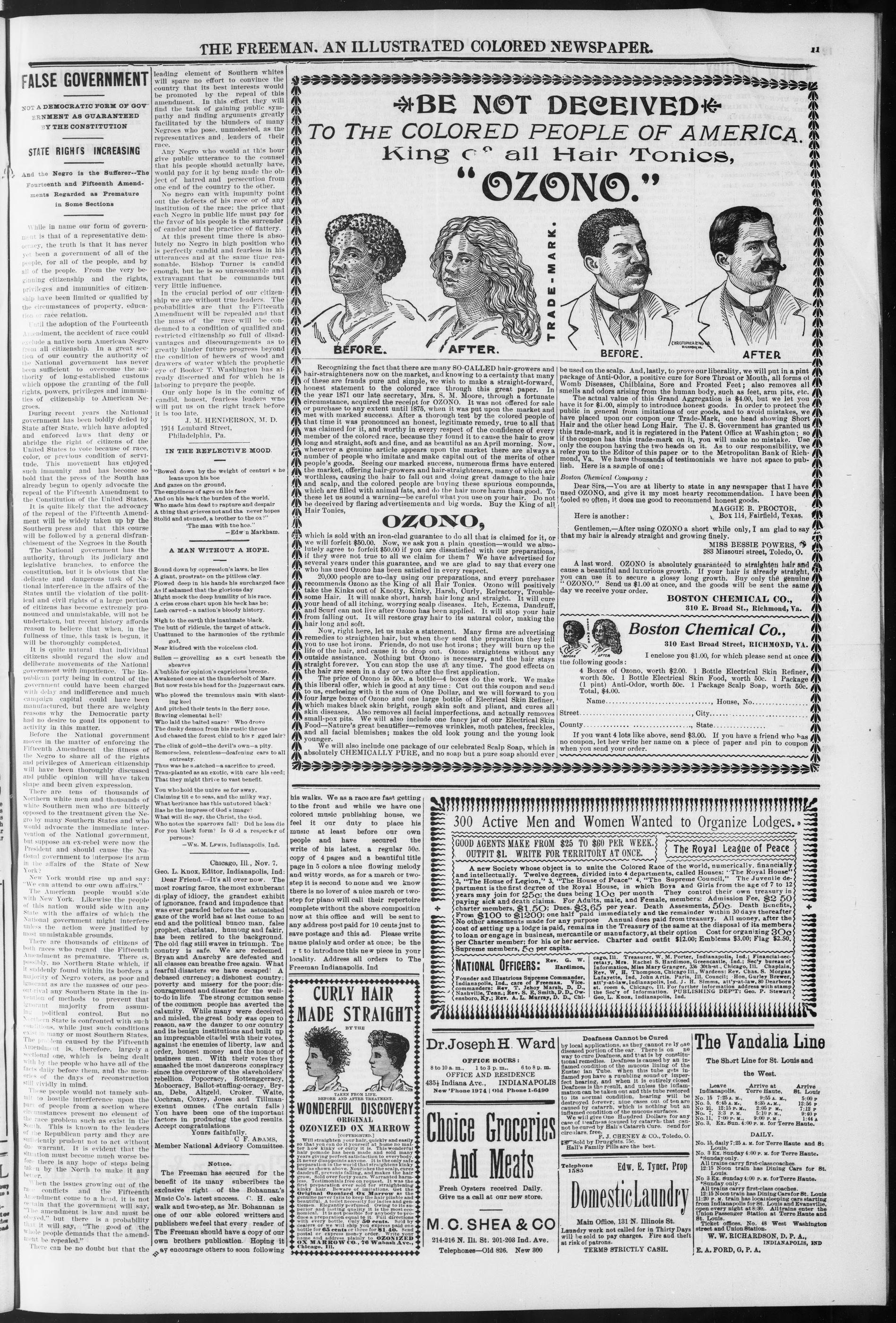
BE NOT DECEIVED TO THE COLORED PEOPLE OF AMERICA. King of all Hair Tonics, "OZONO."
BEFORE. AFTER. TRADE-MARK.
Recognizing the fact that there are many SO-CALLED hair-growers and hair-straighteners now on the market, and knowing to a certainty that many of these are frauds pure and simple, we wish to make a straight-forward, honest statement to the colored race through this great paper. In the year 1871 our late secretary, Mrs. S. M. Moore, through a fortunate circumstance, acquired the receipt for OZONO. It was not offered for sale or purchase to any extent until 1875, when it was put upon the market and met with marked success. After a thorough test by the colored people of that time it was pronounced an honest, legitimate remedy, true to all that was claimed for it, and worthy in every respect of the confidence of every member of the colored race, because they found it to cause the hair to grow long and straight, soft and fine, and as beautiful as an April morning. Now, whenever a genuine article appears upon the market there are always a number of people who imitate and make capital out of the merits of other people's goods. Seeing our marked success, numerous firms have entered the market, offering hair-growers and hair-straighteners, many of which are worthless, causing the hair to fall out and doing great damage to the hair and scalp, and the colored people are buying these spurious compounds, which are filled with animal fats, and do the hair more harm than good. To these let us sound a warning—be careful what you use on your hair. Do not be deceived by flaring advertisements and big words. Buy the King of all Hair Tonics.
OZONO,
which is sold with an iron-clad guard we will forfeit $0.00. Now, we ask lately agree to forfeit $0.00 if you if they were not true to all we cler several years under this guarantee, who has used Ozone has been satisfied 20,000 people are to-day using it recommends Ozone as the King of take the Kinks out of Knotty, Kind some Hair. It will make short, hair your head of all itching, worrying and Scurf can not live after Ozone h from falling out. It will restore gra hair long and soft. Now, right here, let us make a remedies to straighten hair, but who you to use hot irons. Dooms, do life of the hair, and cause it to drow outside assistance. Nothing but O straight forever. You can stop the hair are seen in a day or two after The price of Ozone is 50c. a be this liberal offer, which is good at at to us, enclosing with it the sum of four large boxes of Ozone and one which makes black skin bright, rou skin diseases. Also removes all face small-pox pits. We will also include Food—Nature's great beautifier—re and all facial blemishes; makes the younger. We will also include one package absolutely CHEMICALLY PURE,
ron-clad guarantee to do all that. Now, we ask you a plain question: $50.00 if you are dissatisfied with all we claim for them? We is guarantee, and we are glad it has been satisfied in every respect to-day using our preparations, and the King of all Hair Tonics. On Knotty, Kinky, Harsh, Curly, take short, harsh hair long and short, worrying scalp diseases. Itch after Ozono has been applied. I will restore gray hair to its nature. Let us make a statement. Many of our friends, do not use hot irons; use it to drop out. Ozono stains nothing but Ozono is necessary; can stop the use at any time. day or two after the first application, is 50c. a bottle—4 boxes do it in good at any time: Cut out the sum of One Dollar, and we one and one large bottle of Eleon bright, rough skin soft and removes all facial imperfections, will also include one fancy jar of beautifier—removes wrinkles, mezes; makes the old look young.
We one package of our celebrated LLY PURE, and no soap but a p
which is sold with an iron-clad guarantee to do all that is claimed for it, or we will forfeit $50.00. Now, we ask you a plain question—would we absolutely agree to forfeit $50.00 if you are dissatisfied with our preparations, if they were not true to all we claim for them? We have advertised for several years under this guarantee, and we are glad to say that every one who has used Ozono has been satisfied in every respect.
20,000 people are to-day using our preparations, and every purchaser recommends Ozono as the King of all Hair Tonics. Ozono will positively take the Kinks out of Knotty, Kinky, Harsh, Curly, Refractory, Troublesome Hair. It will make short, harsh hair long and straight. It will cure your head of all itching, worrying scalp diseases. Itch, Eczema, Dandruff, and Scurf can not live after Ozono has been applied. It will stop your hair from falling out. It will restore gray hair to its natural color, making the hair long and soft.
Now, right here, let us make a statement. Many firms are advertising remedies to straighten hair, but when they send the preparation they tell you to use hot irons. Friends, do not use hot irons; they will burn up the life of the hair, and cause it to drop out. Ozono straightens without any outside assistance. Nothing but Ozono is necessary, and the hair stays straight forever. You can stop the use at any time. The good effects on the hair are seen in a day or two after the first application.
The price of Ozone is 50c. a bottle-4 boxes do the work. We make this liberal offer, which is good at any time: Cut out this coupon and send to us, enclosing with it the sum of One Dollar, and we will forward to you four large boxes of Ozone and one large bottle of Electrical Skin Refiner, which makes black skin bright, rough skin soft and pliant, and cures all skin diseases. Also removes all facial imperfections, and actually removes small-pox pits. We will also include one fancy jar of our Electrical Skin Food—Nature's great beautifier—removes wrinkles, moth patches, freckles, and all facial blemishes; makes the old look young and the young look younger.
We will also include one package of our celebrated Scalp Soap, which is absolutely CHEMICALLY PURE, and no soap but a pure soap should ever
his walks. We as a race are fast getting to the front and while we have one colored music publishing house, we feel it our duty to place his music at least before our own people and have secured the write of his latest, a regular 500c copy of 4 pages and a beautiful title page in 5 colors a nice flowing melody and witty words, as for a march or two-step it is second to none and we know there is no lover of a nice march or two-step for piano will call their repertoire complete without the above composition now at this office and will be sent to any address post paid for 10 cents just to save postage and this ad. Please write name plainly and order at once; be the r t to introduce this new piece in your locality. Address all orders to The Freeman Indianapolis, Ind
CURLY HAIR
MADE STRAIGHT
BY THE
WASH FROM LIFE.
BEFORE AND AFTER TREATMENT.
WONDERFUL DISCOVERY
ORIGINAL
OZONIZED OX MARROW
Will straighten your hair, quickly and easily so that you can do it yourself at home no matter the bottle size or the hair pomade has been made and sold many years giving perfect satisfaction to everybody. It never disappoints anyone. It is the only safe preparation ever sold for straightening kinky hair as shown above. Nourishes the scalp, cures dandruff, prevents falling and makes the hair grow. Sold over forty years. Warranted harmless. Testimonial free on request. It was the first preparation ever sold for straightening kinky hair. Beware of imitations. Get the bottle center or live for $1.40 and the genuine never fails to keep the hair pliable and beautiful. A toilet necessity for ladies and gentlemen. Elegantly perfumed. Owing to its gentleness, it is not possible for anybody to produce it with every bottle (only 50 cents). Sold by dealers we will ship you express paid one for 60 cents or express mony order. Write your name, address plainly to OZONIZED ON MARROW CO., 76 Wabash Ave., Chicago, Ill.
---
guarantee to do all that is claimed for it, or you a plain question—would we absorb dissatisfied with our preparations, for them? We have advertised for and we are glad to say that every one died in every respect. Our preparations, and every purchaser will hair Tonics. Ozoono will positively, heavily, harsh, curly, Refractory, Trouble-shair long and straight. It will cure scalp diseases. Itch, Eczema, Dandruff, has been applied. It will stop your hair and hair to its natural color, making the statement. Many firms are advertising on them they send the preparation they tell not use hot irons; they will burn up the out. Ozoono straightens without any ozoono is necessary, and the hair stays use at any time. The good effects on the first application.
Little—4 boxes do the work. We make any time: Cut out this coupon and send one Dollar, and we will forward to you large bottle of Electrical Skin Refiner, skin soft and pliant, and cures all imperfections, and actually removes one fancy jar of our Electrical Skin moves wrinkles, moth patches, freckles, the old look young and the young look of our celebrated Scalp Soap, which is and no soap but a pure soap should ever
300 Active Men and W
GOOD AGENTS MAKE FROM $25 TO OUTFIT $1. WRITE FOR TERRE
A new Society whose object is to and intellectually. Twelve degrees, do 2, "The House of Legion." 3. "The House partiment is the first degree of the Royal years may join for 250; the dues being paying sick and death claims. For Ad charter members, $1.50; Dues, $3. From $100 to $1200; one half pay. No other assessments made for any purp cost of setting up a lodge is paid, remain to loan or engage in business, mercantile per Charter member; for his or her service Supreme members, 50 per capita.
NATIONAL OFFICERS:
Rev. G. W.
Hardimon,
GOOD AGENTS MAKE FROM $25 TO $60 PER WEEK.
OUTFIT $1. WRITE FOR TERRITORY AT ONCE.
The Royal League of Peace
A new Society whose object is to unite the Colored Race of the world, numerically, financially and intellectually. Twelve degrees, divided into 4 departments, called Houses: "The Royal House"
2, "The House of Legion," 3, "The House of Peace" 4, "The Supreme Council," The Juvenile department is the first degree of the Royal House, in which Boys and Girls from the age of 7 to 12 years may join for 25c; the dues being 10c per month They control their own treasury in paying sick and death claims. For Adults, male, and Female, members: Admission Fee, $2.50 charter members, $1.50; Dues, $3.65 per year. Death Assessments, 50c. Death Benefits, From $100 to $1200; one half paid immediately and the remainder within 30 days thereafter. No other assessments made for any purpose Annual dues paid from treasury. All money, after the cost of setting up a lodge is paid, remains in the Treasury of the same at the disposal of its members to loan or engage in business, mercantile or manufacture, at their option. Cost for organizing 30c per Charter member; for his or her service. Charter and outfit $12.00; Emblems $3.00; Flag $2.50. Supreme members, 5c per capita.
Dr.Joseph H. Ward
OFFICE HOURS:
8 to 10 a.m., 1 to 3 p.m., 6 to 8 p.m.
OFFICE AND RESIDENCE
4351 Indiana Ave.. INDIANAPOLIS
New 'Phone 1974 | Old Phone 1-6490
Choice Groceries
And Meats
Fresh Oysters received Daily.
Give us a call at our new store.
M.C.SHEA & CO
214-216 N. Ill. St. 201-203 Ind. Ave.
Telephones—Old 826. New 300
BEFORE. AFTER.
be used on the scalp. And, lastly, to prove our liberality, we will put in a pint package of Anti-Odor, a positive cure for Sore Throat or Mouth, all forms of Womb Diseases, Chilblains, Sore and Frosted Feet; also removes all smells and odors arising from the human body, such as feet, arm pits, etc.
The actual value of this Grand Aggregation is $4.00, but we let you have it for $1.00, simply to introduce honest goods. In order to protect the public in general from imitations of our goods, and to avoid mistakes, we have placed upon our coupon our Trade-Mark, one head showing Short Hair and the other head Long Hair. The U.S. Government has granted us this trade-mark, and it is registered in the Patent Office at Washington; so if the coupon has this trade-mark on it, you will make no mistake. Use only the coupon having the two heads on it. As to our responsibility, we refer you to the Editor of this paper or to the Metropolitan Bank of Richmond, Va. We have thousands of testimonials we have not space to publish. Here is a sample of one:
**Boston Chemical Company:**
Dear Sirs,—You are at liberty to state in any newspaper that I have used OZONO, and give it my most hearty recommendation. I have been fooled so often, it does me good to recommend honest goods.
Gentlemen.—After using OZONO a
that my hair is already straight and gro
A last word. OZONO is absolutely
cause a beautiful and luxurious growth.
you can use it to secure a glossy loo
"OZONO." Send us $1.00 at once, and
day we receive your order.
BOST
3
er using OZONO a short while only, I am glad to say
dy straight and growing finely.
MISS BESSIE POWERS,
883 Missouri street, Toledo, O.
ZONO is absolutely guaranteed to straighten hair and
luxurious growth. If your hair is already straight,
secure a glossy long growth. Buy only the genuine
s $1.00 at once, and the goods will be sent the same
order.
Gentlemen.—After using OZONO a short while only, I am glad to say that my hair is already straight and growing finely.
MISS BESSIE POWERS,
383 Missouri street, Toledo, O.
A last word. OZONO is absolutely guaranteed to straighten hair and cause a beautiful and luxurious growth. If your hair is already straight, you can use it to secure a glossy long growth. Buy only the genuine "OZONO." Send us $1.00 at once, and the goods will be sent the same day we receive your order.
Boston Chemical Co.,
310 East Broad Street, RICHMOND, VA.
I enclose you $1.00, for which please send at once
the following goods:
4 Boxes of Ozono, worth $2.00.
worth 50c. 1 Bottle Electrical $1 (1 pint) Anti-Odor, worth 50c.
Total, $4.00.
Name
Street
County
If you want 4 lots like above, send $2 no coupon, let her write her name on a when you send your order.
and Women Wanted to
$25 TO $60 PER WEEK.
L TERRITORY AT ONCE.
It is to unite the Colored Race of the degrees, divided into 4 departments, called the House of Peace' 4, "The Supreme Royal House, in which Boys and Girls being 10, per month They can For Adults, male, and Female, members $3,65 per year. Death Assess half paid immediately and the remainder any purpose Annual dues paid from the end, remains in the Treasury of the same mercantile or manufactory, at their option her service. Charter and outfit $12.00.
G. W. Hardimon, Commander, D. Vice, D. K. Lafayette, Ind. John Artis. Paris, att-at-law, Indianapolis, Ind. J. at town & Chicago, Ill. For further the Secy of Information. PUBLIC Geo. L. Knox, Indianapolis, Ind.
Wanted to Organize Lodges.
WEEK.
ANCE.
The Royal League of Peace
Explored Race of the world, numerically, financially departments, called Houses: "The Royal House"
4. "The Supreme Council." The Juvenile dean which Boys and Girls from the age of 7 to 12 per month They control their own treasury in and Female, members: Admission Fee, $2.50 per. Death Assessments, 50¢. Death Benefits, timely and the remainder within 30 days thereafter. All money, after the treasury of the same at the disposal of its members factory, at their option Cost for organizing 30¢ and outfit $12.00; Emblems $3.00; Flag $2.50.
reasurer, W. M. Porter, Indianapolis, Ind.; Financial-sec. Rachel S. Hardimon, Greencastle, Ind.; Secy bureau of Misa Mary Granger, 336 50th-st. Chicago, Ill.; Chaplain, Thampton Chicago, Ill.; Wardent; Rev. Chas. S. Morgan and, John Artis. Paris, Ill. Council; Hon. Gurley Brewer, Indianapolis, Ind. J. H. Simms, atty-at-law, 80 Dearborn Chicago, Ill. For further information address with stamp information, PUBLISHING DEPT: Geo. P. Stewart, Indianapolis, Ind.
4 Boxes of Ozono, worth $2.00. 1 Bottle Electrical Skin Refiner
worth 50c. 1 Bottle Electrical Skin Food, worth 50c. 1 Package
(1 pint) Anti-Odor, worth 50c. 1 Package Scalp Soap, worth 50c.
Total, $4.00.
If you want 4 lots like above, send $3.00. If you have a friend who has no coupon, let her write her name on a piece of paper and pin to coupon when you send your order.
Deafness Cannot be Cured
by local applications, as they cannot rely on lye diseased portion of the ear. There is on new way to cure Deafness, and that is by constitutional remedies. Deafness is caused by an inflamed condition of the mucous lining of the Eustachian tube. The Eustachian tube you have a rumbling sound or imperfect hearing, and when it is entirely closed Deafness is the result, and unless the inflammation can be taken out and this tube restored to its normal condition, hearing will be destroyed forever, which is nothing but an inflamed condition of the mucous surfaces.
We will give One Hundred Dollars for any case of deafness caused by catarrh that cannot be cured by Hall's Catarrh Cure. Send for circulators, free. F. J. CHENEY & CO., Toledo, O. Sold by Drungists. 75c. Hall's Family Pills are the best.
Telephone 1585 Edw. E. Tyner, Prop DomesticLaundry
Main Office, 131 N. Illinois St. Laundry work not called for in Thirty Days will be sold to pay charges. Fire and theft at risk of patrons
TERMS STRICTLY CASH
TENNIS SIMULTY CASH.
---
Boston Chemical Company :
Here is another :
BEFORE AFTER
11
MAGGIE B. PROCTOR,
Box 114, Fairfield, Texas.
BOSTON CHEMICAL CO.,
310 E. Broad St., Richmond, Va.
The Vandalia Line
The Vandalia Line
Leave Indianapolis, Terre Haute. Arrive St. Louis.
No. 15. 7:25 A.M., 9:55 A.M., 5:00 P
No. 5. 6:45 A.M., 8:35 A.M., 12:56 P
No. 6. 2:45 A.M., 2:45 A.M., 7:12 P
No. 7. 3:3 P.M., 5:10 P.M., 1:44 P
No. 11. 7:00 P.M., 9:00 P.M., 1:44 A
No. 3. Ex. Sun. 4:00 P.M. for Terre Haute.
DAILY.
No. 15. daily 7:25 A.M. for Terre Haute and St. Louis.
No. 3. Sunday 4:00 P.M. for Terre Haute.
*Sunday only.*
12:15 Noon train has Dining Cars for St. Louis
11:20 p.m. train has local sleeping cars starting from Indianapolis for St. Louis and Evansville, open every night at 8:30. All trains enter the Union Passenger Station at Terre Hante and St. Louis.
Ticket offices. No. 48 West Washington street and Union Station. W. W. RICHARDSON, D. P. A., INDIANAPOLIS, END E. A. FORD, G. P. A.
12
IS NOW UPON US- THE DUTY OF
THE NEGRO IS IMMINENT
AND IMPERATIVE
HON. HENRY O. FLIPPER, Santa Fe
New Mexico.)
We are on the threshold of a new century. The century which has witnessed the greatest achievements of the human race is nearing its close. In no one thing, perhaps, have greater deeds been done than in the emancipation of the slave. In all parts of the world, beginning in Mexico, in 1810, the shackles have been struck from the bondman. Not only has his person been made free, but he is now permitted the enjoyment of life, liberty and property, and the pursuit of happiness, according to his enlightenment and the requirements of government. He may live where he chooses, follow the calling he prefers and worship his God according to the dictates of his own conscience. So say the laws of the land, but in this closing year of this marvelous century, in which so much has been accomplished in the cause of human liberty, we find the forces of oppression just as active and a large portion of the human family just as much enslaved as ever, albeit the manner and form are different. He is denied a voice in his government and security in his person and property. In some manner and to some extent he is still a slave, and this is true in all parts of the world where slavery once existed and had ostensibly been abolished. In this fair land of ours, "the home of the free and the land of the brave," property in slaves no longer exists. Oh! that we could say that slavery no longer existed in any form.
Some of the States of our Union have seen fit to disfranchise a portion of their citizens by establishing an educational qualification for voters. This is not a new feature in our government. Massachusetts and Connecticut have long maintained such a requirement, but the percentage of illiteracy in those States is so infinitesimal that the qualification has not been found an objectionable one. Unfortunately in the other States where this qualification has been established by law the Negro predominates, the percentage of illiteracy is large, and this burden falls most heavily upon him. To be sure, he is not to blame for this, but the condition exists and has been met by disqualifying him as a voter.
That the States have the right to disfranchise any of their citizens for litteracy, want of property or for any other cause, except "race, color or previous condition of servitude," is beyond all question. In U. S. vs. Reese et al., brought up from the Circuit Court of the United States for the District of Kentucky, October term 1875 U. S. 92, 247, Mr. Justice Hunt dissenting from the opinion of the Court; said:
"By the second section of the Fourteenth Amendment, each State had the power to refuse the right of voting at its elections to any class of persons; the only consequence being a reduction of its representation in Congress, in the proportion which such excluded class should bear to the whole number of its male citizens of the age of twenty-one years. This was understood to mean, and did mean, that if one of the late slaveholding States desire to exclude all its colored population from the right of voting at the expense of reducing its representation in Congress, it could do so."
The "grandfather" clause of the Louisiana law excepting all citizens who enjoyed the right of suffrage in that State prior to January 1, 1867, (I believe that is the date), and the descendants of such citizens, is clearly unconstitutional, because it discriminates between the whites and the blacks. In U. S. vs. Cruikshank, brought up from the Circuit Court of the United States for the Discretion of Louisiana, 92 U. S., 555. October term, 1875, Mr. Chief Justice Waite, delivering the opinion of the Court, sad:
"In U. S. vs. Reese et al., supra, p. 214, we held that the Fifteenth Amendment has invested the citizen of the United States with a new constitutional right, which is exemption from discrimination in the exercise of the elective franchise, on account of race, color or previous condition of servitude. From this it appears that the right of suffrage is not a necessary attribute of national citizenship, but that exemption from discrimination in the exercise of that right on account of race, etc., is. The right to vote in the States comes from the States; but the right of exemption from the prohibited discrimination comes from the United State. The first has not been granted or secured by the constitution of the United States, but the latter has been."
If this matter is again brought before the Supreme Court, and I understand that such a plan is now well under way, that tribunal will again decide it in accordance with this view and with this decision. The illiterate Negro will remain disfranchised; the discriminating clause will be declared unconstitutional, and his illiterate white brother will be disfranchised along with him. What benefit, however, would it be to the Negro to take this matter to the Supreme Court and get such a decision, as he surely will? The control of the voting will be in the hands of the whites, the illiterate white will be allowed to vote notwithstanding, and there will be no remedy that Congress can apply. Possibly
THE FREEMAN: AN ILLUSTRATED COLORED NEWSPAPER
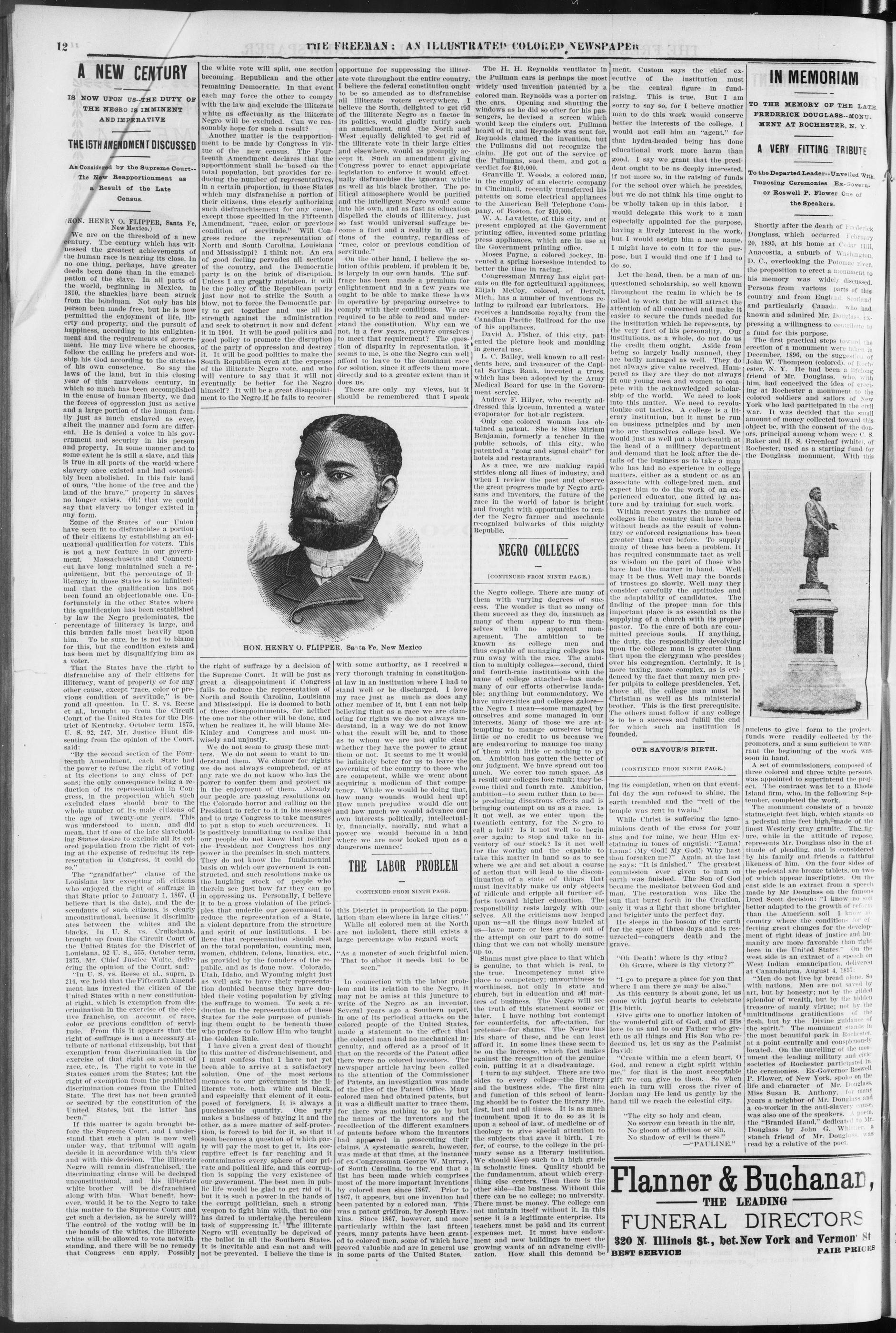
HON. HENRY O. FLIPPER. Santa Fe. New Mexico
the white vote will split, one section becoming Republican and the other remaining Democratic. In that event each may force the other to comply with the law and exclude the illiterate white as effectually as the illiterate Negro will be excluded. Can we reasonably hope for such a result?
Another matter is the reapportionment to be made by Congress in virtue of the new census. The Fourteenth Amendment declares that the apportionment shall be based on the total population, but provides for reducing the number of representatives, in a certain proportion, in those States which may disfranchise a portion of their citizens, thus clearly authorizing such disfranchisement for any cause, except those specified in the Fifteenth Amendment, "race, color or previous condition of servitude." Will Congress reduce the representation of North and South Carolina, Louisiana and Mississippi? I think not. An era of good feeling pervades all sections of the country, and the Democratic party is on the brink of disruption. Unless I am greatly mistaken, it will be the policy of the Republican party just now not to strike the South a blow, not to force the Democratic party to get together and use all its strength against the administration and seek to obstruct it now and defeat it in 1904. It will be good politics and good policy to promote the disruption of the party of oppression and destroy it. It will be good politics to make the South Republican even at the expense of the illiterate Negro vote, and who will venture to say that it will not eventually be better for the Negro himself? It will be a great disappointment to the Negro if he fails to recover
HON. HENRY O. FLIPPE
the right of suffrage by a decision of the Supreme Court. It will be just as great a disappointment if Congress fails to reduce the representation of North and South Carolina, Louisiana and Mississippi. He is doomed to both of these disappointments, for neither the one nor the other will be done, and when he realizes it, he will blame McKinley and Congress and most unwisely and unjustly.
We do not seem to grasp these matters. We do not seem to want to understand them. We clamor for rights we do not always comprehend, or at any rate we do not know who has the power to confer them and protect us in the enjoyment of them. Already our people are passing resolutions on the Colorado horror and calling on the President to refer to it in his message and to urge Congress to take measures to put a stop to such occurrences. It is positively humiliating to realize that our people do not know that neither the President nor Congress has any power in the premises in such matters. They do not know the fundamental basis on which our government is constructed, and such resolutions make us the laughing stock of people who therein see just how far they can go in oppressing us. Personally, I believe it to be a gross violation of the principles that underlie our government to reduce the representation of a State, a violent departure from the structure and spirit of our institutions. I believe that representation should rest on the total population, counting men, women, children, felons, lumatics, etc., as provided by the founders of the Republic, and as is done now. Colorado, Utah, Idaho, and Wyoming might just as well ask to have their representation doubled because they have doubled their voting population by giving the suffrage to women. To seek a reduction in the representation of these States for the sole purpose of punishing them ought to be beneath those who profess to follow Him who taught the Golden Rule.
I have given a great deal of thought to this matter of disfranchisement, and I must confess that I have not yet been able to arrive at a satisfactory solution. One of the most serious menaces to our government is the illiterate vote, both white and black, and especially that element of it composed of foreigners. It is always a purchaseable quantity. One party makes a business of buying it and the other, as a mere matter of self-protection, is forced to bid for it, so that it soon becomes a question of which party will pay the most to get it. Its corruptive effect is far reaching and it contaminates every sphere of our private and political life, and this corruption is sapping the very existence of our government. The best men in public life would be glad to get rid of it, but it is such a power in the hands of the corrupt politician, such a strong weapon to fight him with, that no one has dared to undertake the herculean task of suppressing it. The illiterate Negro will eventually be deprived of the ballot in all the Southern States. It is inevitable and can not and will not be prevented. I believe the time is
JEAD LEONARD
opportune for suppressing the illiterate vote throughout the entire country. I believe the federal constitution ought to be so amended as to disfranchise all illiterate voters everywhere. I believe the South, delighted to get rid of the illiterate Negro as a factor in its politics, would gladly ratify such an amendment, and the North and West, equally delighted to get rid of the illiterate vote in their large cities and elsewhere, would as promptly accept it. Such an amendment giving Congress power to enact appropriate legislation to enforce it would effectually disfranchise the ignorant white as well as his black brother. The political atmosphere would be purified and the intelligent Negro would come into his own, and as fast as education dispelled the clouds of illiteracy, just so fast would universal suffrage become a fact and a reality in all sections of the country, regardless of "race, color or previous condition of servitude."
On the other hand, I believe the solution of this problem, if problem it be, is largely in our own hands. The suffrage has been made a premium for enlightenment and in a few years we ought to be able to make these laws in operative by preparing ourselves to comply with their conditions. We are required to be able to read and understand the constitution. Why can we not, in a few years, prepare ourselves to meet that requirement? The question of disparity in representation, it seems to me, is one the Negro can well afford to leave to the dominant race for solution, since it affects them more directly and to a greater extent than it does us. These are only my views, but it should be remembered that I speak
R, Santa Fe, New Mexico
with some authority, as I received a very thorough training in constitutional law in an institution where I had to stand well or be discharged. I love my race just as much as does any other member of it, but I can not help believing that as a race we are clamoring for rights we do not always understand, in a way we do not know what the result will be, and to those as to whom we are not quite clear whether they have the power to grant them or not. It seems to me it would be infinitely better for us to leave the governing of the country to those who are competent, while we went about acquiring a modicum of that competency. While we would be doing that, how many wounds would heal up? How much prejudice would die out and how much we would advance our own interests politically, intellectually, financially, morally, and what a power we would become in a tand where we are now looked upon as a dangerous menace!
THE LABOR PROBLEM
this District in proportion to the population than elsewhere in large cities." While all colored men at the North are not indolent, there still exists a large percentage who regard work
"As a monster of such frightful mien, That to abhor it needs but to be seen."
In connection with the labor problem and its relation to the Negro, it may not be amiss at this juncture to write of the Negro as an inventor. Several years ago a Southern paper, in one of its periodical attacks on the colored people of the United States, made a statement to the effect that the colored man had no mechanical ingenuity, and offered a proof of it that on the records of the Patent office there were no colored inventors. The newspaper article having been called to the attention of the Commissioner of Patents, an investigation was made of the files of the Patent Office. Many colored men had obtained patents, but it was a difficult matter to trace them, for there was nothing to go by but the names of the inventors and the recollection of the different examiners of patents before whom the inventors had appeared in prosecuting their claims. A systematic search, however, was made at that time, at the instance of ex-Congressman George W. Murray, of South Carolina, to the end that a list has been made which comprises most of the more important inventions by colored men since 1867. Prior to 1867, it appears, but one invention had been patented by a colored man. This was a patent gridiron, by Joseph Hawkins. Since 1867, however, and more particularly within the last fifteen years, many patents have been granted to colored men, some of which have proved valuable and are in general use in some parts of the United States.
```markdown
```
The H. H. Reynolds ventilator in the Pullman man is perhaps the most widely used invention patented by a colored man. Reynolds was a porter on the cars. Opening and shutting the windows as he did so offer for his passengers, he devised a screen which would keep the cinders out. Pullman heard of it, and Reynolds was sent for. Reynolds claimed the invention, but the Pullmans did not recognize the claim. He got out of the service of the Pullmans, sued them, and got a verdict for $10,000.
Granville T. Woods, a colored man, in the employ of an electric company in Cincinnati, recently transferred his patents on some electrical appliances to the American Bell Telephone Company, of Boston, for $10,000.
W. A. Lavette, of this city, and at present employed at the Government printing office, invented some printing press appliances, which are in use at the Government printing office.
Moses Payne, a colored jockey, invented a spring horseshoe intended to better the time in racing. Congressman Murray has eight patients on file for agricultural appliances, Elijah McCoy, colored, of Detroit, Mich., has a number of inventions relating to railroad car lubricators. He receives a handsome royalty from the Canadian Pacific Railroad for the use of his appliances. David A. Fisher, of this city, patented the picture hook and moulding in general use. L. C. Bailey, well known to all residents here, and treasurer of the Capital Savings Bank, invented a truss, which has been adopted by the Army Medical Board for use in the Government service. Andrew F. Hilyer, who recently addressed this lyceum, invented a water evaporator for hot-air registers.
Only one colored woman has obtained a patent. She is Miss Miriam Benjamin, formerly a teacher in the public schools, of this city, who patented a "gong and signal chair" for hotels and restaurants. As a race, we are making rapid strides along all lines of industry, and when I review the past and observe the great progress made by Negro artisans and inventors, the future of the race in the world of labor is bright and fought with opportunities to render the Negro farmer and mechanic recognized bulwarks of this mighty Republic.
NEGRO COLLEGES
(CONTINUED FROM NINTH PAGE.)
the Negro college. There are many of them with varying degrees of success. The wonder is that so many of them succeed as they do, inasmuch as many of them appear to run themselves with no apparent management. The ambition to be known as college men and thus capable of managing colleges has run away with the race. The ambition to multiply colleges—second, third and fourth-rate institutions with the name of college attached—has made many of our efforts otherwise laudable; anything but commendatory. We have universities and colleges galore—the Negro I mean—some managed by ourselves and some managed in our interests. Many of those we are attempting to manage ourselves bring little or no credit to us because we are endeavoring to manage too many of them with little or nothing to go on. Ambition has gotten the better of our judgment. We have spread out too much. We cover too much space. As a result our colleges lose rank; they become third and fourth rate. Ambition, ambition—to seem rather than to be—is producing disastrous effects and is bringing contempt on us as a race. Is it not well, as we enter upon the twentieth century, for the Negro to call a hail? Is it not well to begin over again; to stop and take an inventory of our stock? Is it not well for the worthy and the capable to take this matter in hand so as to see where we are and set about a course of action that will lead to the discontinuation of a state of things that inevitably make us only objects of ridicule and cripple all further efforts toward higher education. The responsibility rests largely with ourselves. All the criticisms now heaped upon us—all the flicks now hurled at us—have more or less grown out of the attempt on our part to do something that we can not wholly measure up to.
Shams must give place to that which is genuine, to that which is real, to the true. Incompetency must give place to competency; unworthiness to worthiness, not only in state and church, but in education and all matters of business. The Negro will see the truth of this statement sooner or later. I have nothing but contempt for counterfeits, for affectation, for pretense—for shams. The Negro has his share of these, and he can least afford it. In some lines these seem to be on the increase, which fact makes against the recognition of the genuine coin, putting it at a disadvantage.
I turn to my subject. There are two sides to every college—the literary and the business side. The first aim and function of this school of learning should be to foster the literary life, first, last and all times. It is as much incumbent upon it to do so as it is upon a school of law, of medicine or of theology to give special attention to the subjects that gave it birth. I refer, of course, to the college in the primary sense as a literary institution. We should keep such to a high grade in scholastic lines. Quality should be the fundamentum, about which everything else centers. Then there is the other side—the business. Without this there can be no college; no university. There must be money. The college can not maintain itself without it. In this sense it is a legitimate enterprise. Its teachers must be paid and its current expenses met. It must have endowment and new buildings to meet the growing wants of an advancing civilization. How shall this demand be
320 N. Illinois St., bet. New York and Vermon' St BEST SERVICE FAIR PRICES
ment. Custom says the chief executive of the institution must be the central figure in fundraising. This is true. But I am sorry to say so, for I believe another man to do this work would conserve better the interests of the college. I would not call him an "agent," for that hydra-headed being has done educational work more harm than good. I say we grant that the president ought to be as deeply interested, if not more so, in the raising of funds for the school over which he presides, but we do not think his time ought to be wholly taken up in this labor. I would delegate this work to a man especially appointed for the purpose, having a lively interest in the work, but I would assign him a new name. I might have to coin it for the purpose, but I would find one if I had to do so.
Let the head, then, be a man of unquestioned scholarship, so well known throughout the realm in which he is called to work that he will attract the attention of all concerned and make it easier to secure the funds needed for the institution which he represents, by the very fact of his personality. Our institutions, as a whole, do not do us the credit them ought. Aside from being so largely badly manned, they are badly managed as well. They do not always give value received. Hampered as they are they do not always fit our young men and women to compete with the acknowledged scholarship of the world. We need to look into this matter. We need to revolutionize out tactics. A college is a literary institution, but it must be run on business principles and by men who are themselves college bred. We would just as well put a blacksmith at the head of a millinery department and demand that he look after the details of the business as to take a man who has had no experience in college matters, either as a student or as an associate with college-bred men, and expect him to do the work of an experienced educator, one fitted by nature and by training for such work.
Within recent years the number of colleges in the country that have been without heads as the result of voluntary or enforced resignations has been greater than ever before. To supply many of these has been a problem. It has required consummate tact as well as wisdom on the part of those who have had the matter in hand. Well may it be thus. Well may the boards of trustees go slowly. Well may they consider carefully the aptitudes and the adaptability of candidates. The finding of the proper man for this important place is as essential as the supplying of a church with its proper pastor. To the care of both are committed precious souls. If anything, the duty, the responsibility devolving upon the college man is greater than that upon the clergyman who presides over his congregation. Certainly, it is more taxing, more complex, as is evidenced by the fact that many men prefer pulpits to college presidencies. Yet, above all, the college man must be Christian as well as his ministerial brother. This is the first prerequisite. The others must follow if any college is to be a success and fulfill the end for which such an institution is founded.
OUR SAVOUR'S BIRTH.
(CONTINUED FROM NINTH PAGE.)
ing its completion, when on that eventful day the sun refused to shine, the earth trembled and the "vell of the temple was rent in twain."
While Christ is suffering the ignominious death of the cross for your sins and for mine, we hear Him exclaiming in tones of anguish: "Lama! Lama! (My God! My God!) Why hast thou forsaken me?" Again, at the last he says: "It is finished." The greatest commission ever given to man on earth was finished. The Son of God became the mediator between God and man. The restoration was like the sun that burst forth in the Creation, only it was a light that shone brighter and brighter unto the perfect day.
He sleeps in the bosom of the earth for the space of three days and is resurrected—conquers death and the grave.
"Oh Death! where is thy sting? Oh Grave, where is thy victory?"
"I go to prepare a place for you that where I am there ye may be also."
As this century is about gone, let us come with joyful hearts to celebrate His birth.
Give gifts one to another intoken of the wonderful gift of God, and of His love to us and to our Father who giveth us all things and His Son who redeemed us, let us say as the Psalmist David:
"Create within me a clean heart, O God, and renew a right spirit within me," for that is the most acceptable gift we can give to them. So when each in turn will cross the river of Jordan may He lead us gently by the hand till we reach the celestial city.
"The city so holy and clean.
No sorrow can breath in the air,
No gloom of affliction or sin,
No shadow of evil is there"
—"PAULINE."
TO THE MEMORY OF THE LATE
FREDERICK DOUGLASS--MONU.
MENT AT ROCHESTER, N. Y
A VERY FITTING TRIBUTE
To the Departed Leader--Unveiled With Imposing Ceremonies Ex-Governor Roswell P. Flower One of the Speakers.
Shortly after the death of Frederick Douglass, which occurred February 20, 1895, at his home at Cedar Hill, Anacostia, a suburb of Washington, D. C., overlooking the Potomac river, the proposition to erect a monument to his memory was widely discussed. Persons from various parts of this country and from England, Scotland and particularly Canada, who had known and admired Mr. Douglass, expressing a willingness to contribute to a fund for this purpose.
The first practical steps toward the erection of a monument were taken in December, 1896, on the suggestion of John W. Thompson (colored), of Rochester, N. Y. He had been a lifelong friend of Mr. Douglass, who, with him, had conceived the idea of erecting at Rochester a monument to the colored soldiers and sailors of New York who had participated in the civil war. It was decided that the small amount of money collected toward this object be, with the consent of the donors, principal among whom were C. S. Baker and H. S. Greenleaf (white, of Rochester, used as a starting fund for the Douglass monument. With this
MARK TWAIN
nucleus to give form to the project, funds were readily collected by the promoters, and a sum sufficient to warrant the beginning of the work was soon in hand. A set of commissioners, composed of three colored and three white persons, was appointed to superintend the project. The contract was let to a Rhode Island firm, who, in the following September, completed the work.
The monument consists of a bronze statue, eight feet high, which stands on a pedestal nine feet high made of the finest Westerly gray granite. The figure, while in the attitude of repose represents Mr. Douglass also in the attitude of pleading, and is considered by his family and friends a faithful likeness of him. On the four sides of the pedestal are bronze tablets, on two of which appear inscriptions. On the east side is an extract from a speech made by Mr Douglass on the famous Dred Scott decision; "I know no soil better adapted to the growth of reform than the American soil. I know no country where the conditions for effecting great changes for the development of right ideas of justice and humanity are more favorable than right here in the United States." On the west side is an extract of a speech on West Indian emancipation, delivered at Canandaigua August 4, 1857:
"Men do not live by bread alone. So with nations. Men are not saved by art, but by honesty; not by the gilded splendor of wealth, but by the hidden treasure of manly virtue; not by the multitudinous gratifications of the flesh, but by the Divine guidance of the spirit." The monument stands in the most beautiful park in Rochester, at a point centrally and conspicuously located. On the unveiling of the monument the leading military and civic societies of Rochester participated in the ceremonies. Ex-Governor Roswell P. Flower, of New York, spoke on the life and character of Mr. Douglass. Miss Susan B. Anthony, for many years a neighbor of Mr. Douglass and a co-worker in the anti-slavery cause was also one of the speakers. A poem the "Branded Hand," dedicated to Mr. Douglass by John G. Whittier, a stanch friend of Mr. Douglass, was read by a relative of the poet.
NTELLIGENT DISCUSSION OF
LATEST AND BEST PUB-
LICATIONS
LITERARY NOTES AND COMMENTS
jniust Criticisms Often Work Hard-
ps on Reputable Publications
and Greatly Effects the
ales
ARLES) AEN Er
.)
yo so-called dlosynerasies or work-
processes of men of genius Is oft-
theme of profound interest to
snd women who diseuss literary
Js, and the subject very often suf-
hiuch from misconceptions and ex-
tions at the hands of those de-
hg these processes. It was the
pleasure of the writer to visit, a few
jh 90, ane of the most remarkable
jie writers of the present day,
John Uri Lloyd, of Cincinnitt,
je with him, some very interest:
observations were made, In bis
it library, the best of the kind in
world, a strange sight was pre-
nied to the visitor, Seated before a
juull table, with an open book before
in, was the skeleton of a man, This
Kook \ \\ y! Le
skeleton held in his hand a pen, and
on the page before him were these
words:
Stranger: Pause as you pass by;
As you are now, So onee Was 1;
As Tam now, so you will be;
Prepare to meet Eternity.”
And such a thought may have in-
spired Prof. Lyold to write: “Books
aire as tombstones made by the Iv-
ing, but destined soon only to remind
us of the dead. A modern book, no
matter how talented the author, ear-
ries with it a familiar personality
which may often be treated with neg-
Wet or even contempt, but a volume
1 century old demands some rever-
nee: a vellum-hound or hog-sicin
point, regardless of its contents, im-
presses one with an indescribable
focling akin to awe and veneration.”
Vrof, Lloyd's scientific study of Ne-
zr dialect a8 discovered in his novel,
Siringtown on the Pike,” is a splen-
did contribution to our literature. It
slinws that the pathois spoken by the
plintation Negro, even fifty years
ue, WAS NOL as grotesque and. Indi-
coos as IS So often represented, even
by some of ont own writers. | ‘Phis
story, conceived and elaborated with a
skill that is consonant with the al
ruly world-wide fame of the author:
rich in occult dealings, and shrouded
in deep psyehological mystery, is. per-
ieated With a realism and "a sent
nent that is highly stimulating to ev-
ory fair-minded reader.
The story is a genuine drama of
everyday life im the old Kentucky of
Ul! Century ago, ‘The pathos, the
wnuite, Invesistible humor of the si
xaclous Cupe, the stirring dramatic
scene between the colonel and the par-
son, terminating in a tragedy, the de-
seription of which is as thrilling as
wything in the English language; the
“Jorn mountaineer whose entire life is
lovoted to avenging himself upon his
oiomles, the traditional Jew, the judge
nt all the rest, conspire to make the
‘Initia pne of profound interest. Cupe
~ the prineipal character, and his
personality dominates the entire work,
lv is a Negro of the olden time, one
Who lived in the almost forgotten
just; but one whose splendid quali-
sof head and heart will ever com-
Ww! our adiniration—for there was
‘evily even in the humble life he
dignity bought by honest, loyal
to his charge. Cupe was an
faithful, hopeful, sympathette
one whose heart was full of
«and unfailing devotion
thfully portray such a char-
eter Prof. Lloyd has given usin
‘npe rowuires a genius of a very high
wer. The work is perfect; and a
wplinent is paid to the qualities of
Negro of the humbler walks of
ese
No late Senator J, J. Ingalls, unique
wsonality, possessing a rare gift
oreible “expression, a man who
“things in a different way from
one else, a cynic, a man of many
wit impulses, and. possessing an
© but unbalanced mind, will long
membered by all who have either
the productions from his pen or
(ond his eloquent public utterances,
“1 very severe critie when dealing
) the Negro problem. As a recent
er has said of him, “His hatred
umbug and cant, exeept when it
~ his own aumbug and his own
© was so fervid, and his powers of
bal excoriation were so remarka-
« that his tongue kept him in hot
‘er during much of his varigated
‘reer. Mr. Ingalls was quite witty
imes, and he was never in a hap-
tWE FREEMAN: | AN ILLUSTRATEY COLORED, NEWSPAPER,
pier element than when he was telling
a joke at the expense of the Negro.
Some years ago he related the follow-
ing to show the educational weakness
of the race: “Suppose you make the
Negro a judge. Can he protect himself?
Can he attain by that process the real
powers of the judiciary? A Negro was
elected judge in a certain magistrate’s
court in the South, ‘They were trying
a case before him. The lawyers had
argued it, and had taken their seats.
It was time for him to charge the
jury. He sat and looked around the
room. The lawyer sitting near him
arose and went to his side, and whis-
pered in his ear: ‘It is now time for
you to charge the jury’ ‘The judge
arose with the utmost gravity, and
turning to the jury said, ‘Well, gem-
men of de jury, dis is a small case, so
I'll jes charge you one dollars and fifty
cents each.”
It will be remembered that some
time since the Helman-Taylor Com-
pany, of Cleveland, Ohio, published
Prof. Daniel Webster Davis’ little book
of poems, “*Weh Down Souf.” In this
beautiful volume are to be found
many dialect poems that are valuable
as character studies. In his “Keep
Inchin’ Along,” will be found this
étanses
What do’ de load is hebby
An’ de burden mek yo’ sigh,
Jes’ ben’ yer back a litle;
"Pwill be better biem-by5
De cloud’s a-hangin’ hebby
Ez yo" journey on de way.
But dar’s a silber Minin;
You'll see it, too, some day.
Keep inchin’ along.
Beside this one there are many oth-
ers that are equally unique and inter-
esting, among which might be men-
tioned: “OY Virginny Reel,” “Skeetin’
on de Tee,” “When you gits a Rabbit
Foot” and “Uncle Rastus amd the
Whiskey Question.”
Dr, E. B. Jefferson, of Nashville,
‘Tenn., is one of the most skillful, pro-
gressive and successful dentists in the
South, He started out as a doctor of
dental surgery in 1894, with practical-
ly nothing but a bit of hard-earned ex-
perience and a little self-confidence,
amd he has since built up a practice
chiefly among the better element ot
Negro and white people of Nashvilte,
that is highly gratifying both to him-
self and to his many friends. He is
a graduate of Knox Institute, of
Athens, Georgia, and of the Central
‘Tennessee College.
During the sumer of this year, Dr
Jefferson completed a special course
in porcelain, crown and bridge work,
and porcelain inlay, together with ir-
regularity of the teeth, at the Chtea-
xo University. Having completed
these important studies, he has since
been performing a branch of work that
is thoroughly up-to-date; and he is one
of the most prosperous dentists in the
city of Nashville. His skill and abil-
ity is highly appreciated by all who
know him. He has put in the very
latest electrical appliances, and the
best possible equipment for the execu-
tion of his work, and his parlors are
as attractive and beautiful as those of
any dentist in Nashville,
“Christianity in the Nineteenth Cen-
tuyr.” by George C. Lorimer. Ameri-
can Baptist Publication Society, Phiia-
delphia, Pa. Price $2.25.
When Dr. Lorimer speaks the world
stands ready to listen, He is well
known as a ripe scholar, and his eln-
eidations of theological subjects are
taken by all who know him as anthor-
ity and as a worthy defense of Chris-
tianity of the Protestant type. Mueh
of the present volume is devoted to
an outline of the progress of Christ-
janity during the nineteenth century,
while other topics of a subsidiary
character are taken up in the remain-
der of the work. Dr. Lorimer’s critique
upon the various phases of religious
progress during the century about to
close is clear and unclonded by nar-
row views peculiar to the dogmatist,
His style is smooth and easy, and
very frequently, by his most eloquent
expressions, he transports his reader
from the cold scenes of heartless ma-
terialism and the dominant commer-
cialism of the present day to realm ot
real spiritual beauty and delight.
“Whence and Whither,” by Dr. Paul
Carus, Published by the Open Court
Publishing Company, Chicago, Il.
‘The spirit of investigation into
monistie philosophy conducted by Dr,
Paul Carus is helpful and wholesome,
notwithstanding his, in some in-
stances, radical departure from ac-
cepted views on the subject. This 1s
an age when the interrogation point is
brought prominently in use in all sys-
tems of philosophy, and the inquiry:
Whence and Whither? permeats all
literature of real worth to humanity.
‘The mental grasp and the moral stam-
ina required of a writer to take issue
with those writers of the past, whose
views have become regarded as right
and true, commands both onr admira-
tion and most profound consideration.
It is no easy matter to break loose
from the conventional and so-ealled
established standard in diseussions of,
the kind dealt with in “Whence and
Whither.” It is the tendency of the
modern writer to put more stress upon
the production of an elegant phrase
than to bring prominently before his
reader plain, bold facts, The doctor's
view of life and death, and of those in-
fluences which impell men to action,
while not fully in aecord with the
view held by the average devotee of
natural science, is at least logical and
forceful: and since these problems are
‘only dealt with by minds of a superior
order, perhaps it is as well that too
serious a view is not taken by the
reader.
eee
“The Head of A Hundred in the
Colony of Virginia,” by Maud Wilder
Goodwin. Published by Little, Brown
& Company, Boston, Mass.
Here is a book that presents a pte-
ture of early Southern life that Is ad-
mirable in every detail. The ways of
“PATIENCE’ IS A VIRTUE
nal ote —
| a
|X: ae OTE.
as ter fel ee
DSS A ata PRET oe palieats
| RMN) | fsccscatens Bec
[Pw Ss ia ere
Oo EAE Pere
] fe Ne Gu Mees seta | | ices ee css
AM % aan BC he ferme eo]
| 0 eRe a op
A CASS Mt ae py
AA ae gsm EE NN
RRS Swag \ i, a’
coat Si SSN a
ae Ng SNR,
2 Tea \ erp ya
SRS el ty, cd
AS 24d ee
LS Me
; ee Ws JPY
Ley Se po
ef ae Mer 7 ee J
eis: Oca sg
The Intelligent Negro in America is
Still To-day Displaying an Overabund-
ance of Patience.
a charm that no one will fail to ap-
preciate who will read this well and
carefully written story. The lofty tone,
delicate touches, graceful style, and
withal, strong presentation of char-
acters and scenes have the effect of
transporting us to a period when Eng-
Jand's sturdy civilization was so rude-
ly tried in a new country, and we live
again the life of a simple, serious, pat-
rlotie people, who gave birth to an as:
piration and a movement in national
governmental experiment which has
resulted In a development more won:
derful, we are sue, than anything ever
dreamed of by them; the fruitage and
realization of which would appeal to
us more forcibly if we could rightly
understand the strength of theic faith
in ultimate results. This new edition
appears in holiday dress, and it is em:
bellished with five full-page pictures,
making a splendid presentation vol
ume for Christmas,
NEWPORT NEWS, VA
‘The Home of Energeticand Prosperous
Neeroes--A Haven for Young Men
Newport News, Va., special: A few
miles from the famous Hampton Nor-
mal and Industrial School lies a city
which, although possessing one of the
finest harbors in the world, has just of
recent years attracted the attention of
the capitalists ard publie in general
to such an extent to induce the former
to invest, and the latter to migrate to
in any considerable numbers until
sprung from the tiny acorn of a coun-
try town into the mighty oak of a
healthy and prosperous city, in a most
Incredible short space of time. New-
port News is the wonderful little city,
the terminus of the great C. & O. R. R.,
affording a harbor of sixty-five feet in
depth, thirty-five feet from the shore;
also the largest. dry dock and ship-
building plant in the United States.
Its grain shipments of 1899 and_ 1900
exceeded that of any port in the Unit-
ed States, being only outstripped by
Montreal, Ten years ago a little vil-
lage of four thousand people and to-
day a progressive city of 25.000—
such is the wonderful record of this
equally wonderful city.
Newport News is a young man’s
town, distinctively so, and the young
colored man is in great evidence. We
have five colored lawyers, three of the
old school, and two of the young. 0.
Arthur Neal and JJ. Thomas Newsome
represent the younger set, and enjoy
‘a large practice. ‘They are both vig-
orous, and intelligent. In the older
school Capt. J, A. Fields stands with-
‘out a peer, Our real estate agents are
Brown & Brown, and they are hus-
tlers.. ‘They haye the people's confi-
dence and are doing a great business.
Mr, B, C. Brown, the junior member
of the firm, was formerly traveling
representative for the Freeman, He
has made rapid strides here in the real
estate line, and is well liked. About
ten insurance companies are represent:
ed here, but the largest membership
enjoyed in this city 1s by our home
company, the Newport News Bene-
ficial Association, of which Mr. B. A.
Cephas is the Secretary and Manager,
and it is through his untiring efforts
that the company enjoys this distine-
tion. He is a pleasant, affable young
man, energetic and honest. W. 8.
Cooke, a young man of 24 years, is our
undertaker. He is a young man of
modest, quiet habits, and has accumu-
lated considerable | real estate. W.
Ward Pinkett is our merchant tailor.
He is a young man of sound business
ideas and quite a social favorite. Drs.
W, 'T. Jones and W. P. Dickinson are
our physicians, and they both are en-
joying very lucrative practices. Geo.
‘\. Banks and Benj. Wingfield are our
leading young grocers. Both keep
well stocked places and are striet to
business. John W. Ricks is our con-
fectioner. He keeps a clean place and
does a good business. ‘There are quite
a number of hustling insurance agents
—Jeremiah Smith, W. J. Graves, J.
Smith, J. Bland and Emory Carter be-
ing the foremost, and last, but not
least, old Doc. Irwin, the old trial
horse. All of the above named are
‘young men who have barely passed
the twenty-five-years-old mark, all
single with one or two exceptions.
Among the older business men, Mr.
William Washington and Philip
Brown easily rank foremosi. Mr,
Washington is a grocer of high order,
He is conservative and progressive.
Mr. Philip Brown is the only colored
wholesale and retail liquor dealer in
the city. He is doimg a tremendous
business. He is as full of business as
an egg is rull of meat. Other popular
‘saloonists are Geo. L. Pugh, Jas. W.
Freeman, James Hill, Samuel Hall and
W. H. Bryant.
| One of the very few daily colored
papers in the United States is pub-
lished here, The Daily Recorder. M.
N. Lewis, editor and proprietor.
| Our churehes are plenty and for a
young town exceptionally fine, adding
to the material as well as the spiritual
progress of our people. Our leading
divines are Revs. 8. A. Howell, W. H.
Dickinson, George Garner, Mitchell,
Jones and’ Allen,
If space would only permit, I would
like to mention all the good friends of
the Freeman, but a whole page would
hardly suflice, so many has it in this
little city. But I want to say a word
about our Freeman agent, J. A. Boone.
He is a born hustler and gets around
in all kinds of weather.
A few of those who are dear friends
of the Freeman are: Chas. Tucker, Ma-
mie Alfriend, Geo. Diggs, Willie Sum-
ner, Ben Jones, James Tyler, S. Mul
lin, John Freeman, 8. Cooke, 8. Moore,
J. C. Moore, 8. 8. Brooks, A. R. Flem-
ing, James Green, Benj. Wiugtield,
James Robinson, Edmond Jones, Rey.
E. R. Butler, Bettie Daniel, Henry
Read, John Spivey, C. Lawrence, W.
P. Blackwell. The Freeman can be ob-
tained at old Ben Wingtield’s reliable
grocery store, Twenty-third and Madi-
son avenue, or J. A. Gardiner's fruit
stand, 23d street and Warwick avenue,
or the agent, J. A. Boone, or at Brown
& Brown's real estate office.
MACNUS L, ROBINSON
Editor “The Leader,” Washington, D.
©--A Masonic Publication
‘The above fine portrait of Mr. Mag-
nus L. Robinson, editor National Lead-
er, of Washington, D. ©., represents
the sole colored Masonic editor of the
country. Mr. Robinson was first made
a Mason in Baltimore, Md., and then
after working as Craftsman for ten
years, removed to his native city,
Alexandria, Va., and conected himself
with Universal Lodge, No. 1, the oldest
colored lodge in Virginia, He has
served his lodge as Worshipful Master
three consecutive years, and is now
present Secretary. He is an honored
member of the Virginia Grand Lodge.
He is active in many benevolent socie-
ties and hold the rank of Captain on
the staft of the Butler Zouave Corps
of Washingtou. Mr. Robinson is Su-
preme Financial Seeretasy of the
Knights and Daughters of Solomon, a
new organization recently started. The
new order is growing and promises
soon to give an endowment of $100 on
death of a member. ‘The Colored
American, the Washington neighbor,
in its issue of Dee. 8th, says: “Mr,
Magnus L. Robinson is a very remark-
able man, He is a distinguished man
and has served in honorable stations
in the great Masonic body for many
years, and the whole fraternity has
been benefited by his membership. Mr.
Robinson has devoted his life work to
the Masonic fraternity and under-
‘stands the workings of the great body
as well as any man living. His resent
withdrawal from the Jones faction of
Masonic tribes brought him many con-
gratulations, Mr. Rouinson stands for
the highest attainments in any line and
thinks that the Negro ought to be high
minded in all matters, as well as one
of another race, and he himself is a
as example of that which is good
and true in life.”
THE ASSISTANCE TO THE NEGRO
HaS BEEN UNIVERSAL AND
NOT SECTIONAL
WE ARE OUR OWN MILLSTONE
As Viewed by an Intelligent Southern
Divine--Prejudicos in Religion--
Intellectual and Social
Gomasdeeations:
(REY, J. A. JONES, Chattanooga, Tenn!
None but those blinded by the deep-
est-seated prejudice toward the white
race fail to recognize the thousands of
benefits bestowed upon the Negro race
by the Anglo-Saxons of America.
Whether these benefactions have come
in a general or a special; whether they
haye come as voluntary acts out of
the bigness of some great heart, or as
a result of special legislation, ihere is
much reason to be thankful.
None but the. stupidest ingrate
would refuse to give expression of his
gratitude for the kind consideration
shown the race for the past thirty
years.
We must also remember that all the
favors extended to the Afro-American
Isince the war did not come from the
RAR ARIE NSS Le SRI
Haters goa rl
Sean eee eee
“ti Wee
z SA ees
} rs yee
BOS:
Z 3
Bi oie
Say
Et
|
:
| Hi
=
people north of the Mason and Dixon
line; nor that all the philanthropists
and humanitarians are in New Eng-
land. Every section of this great
country, at Some period in its history,
ete ara ee a
institution of slavery. The South fi
nally came to be the dumping ground
of the rotten affair, where it remained,
the stench inereasing year by year in
offensiveness, till It reached ail parts
of the civilized world, and even stunk
in the nostrils of God Almighty,
Just here let me say that whenever
a nation becomes rotten, and becomes
unable to purge itself, God always
steps in and does the work himself,
even if He has to baptize the nation
in its own blood, and fill the land with
widows and orphans. He sometimes
does like the schoolboy, who, after
trying in vain to work a problem, be-
comes vexed, spits on his hand’ and
Wipes the whole thing off the slute and
starts afresh, So God sometimes, who
has in His own hands the destiny of
nations, after viewing with His omutp:
otent eye the complex condition of
affairs, with one mighty sweep of His
hand wipes the whole thing out, and
lets them begin anew.
Now, while it 1s true that the whole
people bad a hand in the perpetuation
of the slave tratfie, the entire nation,
in some way or other, contributed to
the emanelpation of the race, and att-
er the South had finally overcome the
stupor resulting from the four Iong,
weary years of bloody strife, and had
settled down to a realization of the
fact that the former slave was a free-
mian, she accepted the situation, and
along with the work of teconstrue-
tion, the well-being of the Negro was
also considered,
The North has done much along
these lines, but the South has not been
asleep. Not only has there ever been
an open door of some kind through
which the Negro may enter to earn
his daily bread, but Southern purse
strings haye always been tied in a
loose knot, ready to answer the call
to help lift up the race, religiously
and intellectually.
No longer do the thoughtful Negroes
consider all Southern people their ene-
mies. ‘The best friends of the race
can be numbered among Southern
men and women.
THE ONE GREAT OBSTACLE.
While all the foregoing is true, there
Is one great obstacle to the progress
of the American Negro, and that Is
prejudice. What is prejudice? It is
an unreasonable predilection for or
against anything. Webster defines it
as being “a leaning towards one side
or the other of a question from othee
considerations than those belonging to
it.” Speaking of race prejudice, we
mean an unreasonable predilection on
the part of one race against another;
or race antipathy. Race prejudice is
not only contagious, but it is a breed
er of many other kinds of social dis-
eases which are calculated to blight
the body politic. Among these is a
silly sentimentalism, which is some-
times not only ludicrous and ridiculous
in the extreme, but very sickening. So
unreasonable and foolish are some of
the conventionalities of the white
‘American people that not one in a
thousand would dare attempt to offer
a reason for his actions.
Perhaps race antipathy is a better
phraze to express the idea under treat
ment. Antipathy is composed of two
Greek words. viz: Anti, against; an¢
13
by one class to hinder another from
rising in the scale of CWvitization witn.
out a reasonable excuse.
When we consider the many qin.
drances brought to bear against ‘the
advancement of the race, both North
and South, it is wonderful how muon,
progress the Afro-Americat bas mage,
AS TO RELIGION.
What exeuse can the white Amer.
ean people render for presenting
whole gospel to all the people and ay
the same time denying to our race q
seat in their places of worship as
members of the same congregation? Is
that not the very thing that the Jews
practiced, and the very thing that
Jesus denounced and condemned? Is
Christ divided? Well might Mr. Shel-
don ask: “What would Jesus do?
Would He sanction the methods adopt-
ed by the white Christian churehes in
this country? I think not. In this
particular respect, is Mr. Sheldon him-
self doing as he believes Jesus would
do? Or is he not catering to the same
capricious sentimentalism of his con
gregation that is manifest among the
rest of his kith and kin of the cloth?
Look at the Salvation Army, with all
of their show of piety and holiness;
their blowing of trumpets, beating of
tin pans and drums; see them as they
“have left all and have followed Je-
sus,” screaming in the streets, bowing
down in the mud of the highways,
pleading to a wicked world to come to
Jesus! Lf a Negro happened to be
Silly enough to heed their entreaties
and come forward to offer his hand to
the “holier than thou,” the saintly Sal-
yationists would be frightened into
convulsions, and the poor “brother In
black” would be quickly given to un-
derstand that this gospel is for white
folks, and “no Negro need apply.”
Strange it is, in the face of ail this
hypocrisy, that this country is not
flooded with infidels. For the gospel
recognizes no white Christ and black
Christ. It knows neither Jew nor
Gentile, bond nor free, race nor color.
But it teaches that God who is no re-
specter of persons, is Father of us all,
and that Jesus Christ Is the Saviour
of the world: that He by the grace of
God tasted death for every man.
Religious worship is not social
equality, and has no relation to it, and
yet it IS hard for the American’ peo-
ple to see it in any other light, Using
the white man’s form of worship as
the standard, who can estimate the
great distance that the Negro race
would have advanced religiously had
it been permitted to keep in tonen with
the white man through all these years
of their sojourn together in this coun-
try. But it is not only unkind but
wicked to deny us the benefits of these
blessings, and then ridicule us for our
ignorance and blunders.
HINDRANCES INTELLECTUALLY.
In treating the intellectual phase of
this subject, the social equality night
mare again lifts its head. Legislation
in favor of separate schools is not
based upon the fear, as some seem to
think, of an unpleasant intellectual
competition between the races, ‘That
may be a part of the trouble, but it
does not weigh much as compared to
the real fear of the contingency of
social equality, arising from constant
association in the schoolroom, How-
ever, the end fs reach, just the same,
and the race is hampered.
Under existing circumstances, es-
pecially in the South, Iam in favor ot
separate schools, Those conditions be-
ing removed, I would be opposed to
them. ‘The same conditions obtain in
church matters,
A movement is on foot in some of
the Southern cities and States to di-
vide the school fund according to the
amount of taxes paid by the blacks
and the whites. If it carries in one
State, it is more than likely to be
adopted by others. Hence the colored
school fund will be reduced to a min-
imum; the wheel of progress will be
turned backward, and the illiteracy of
the Afro-American will be greater at
the end of the next decade than at
present. God torbid that any State
Legislature will do a thing so rash.
If it is the Invasion of the social re-
lations that is so mueh feared, let the
white man remember that the Negro,
like other men, becomes more sensi-
tive of his surroundings in proportion
as he becomes intelligent. ‘The man
of culture and refinement is more apt
to choose his associates than the 1g
horant. ‘The educated Negro does not
insinuate himself into the company of
the whites. It is the ignorant who is
always ready to poke his mouth into
the face of the man who repels his ad-
vance; and the fool is too blind to see
that his presence is offensive, The rap-
ist is never found among the cultured
class of the race. Would it not be bet-
ter for all concerned to give the Ne-
gro the fairest chance for improve-
ment, and remove every obstacle out
of his way for his intellectual ad-
vancement?
OBSTACLES TO BREAD WINNING.
‘To deny an individual or race the
privilege of earning his daily bread 1s
a greater sin than slavery itself. ‘The
rule in this country among the tavor
unions and trades unions to shut out
Negro labor, and reduce the colored
wage-earner and mechanic to beggary,
is a crime against heaven.
MAJOR'S HOLIDAY MELANGE
IS IT CHARACTERISTIC OF THE NEGRO TO OPPOSE THE PROGRESS OF HIS RACE--HIS WEAKNESS FOR FLATTERY.
IS AMERICA A FREE COUNTRY TO-DAY?
A Concise and Exacting View of Laws that Disfranchises--Peculiar Environments that Besiege the Race--Pert Saying of Some Negroes.
(DR. M. A. MAJORS, Waco) Tex.)
The holiday number of The Freeman is the race's LOOKING GLASS. After thirty-six years of freedom, and on the threshold of the twentieth century, the Negro having procured his extravagant wardrobe consisting of all manner of paraphernalia, regalia and habiliment, embracing every conceivable variety of polish and cultivation, may for the sake of introspection, and with buoyant heart, find much consolation in contemplating the pages of the holiday number of The Freeman, the Negro, as it were, looking at himself as in a looking glass.
who have taken our places, and same to us whose places we have taken. It may always be so. Sax Claus is President of the United States during Christmas, at least, as the children are the citizens and vers.
We are not quite certain that it is characteristic of the race to oppose race progress. It is a fact that certain elements in our composition which we may have borrowed from former period of our racial growth tends largely to aid the spirit of je
It is a great opportunity to enjoy the present age. To imbibe and inculcate all the good fought by the world's best forces, and now at the close of a century that has been so much to the Negro—in fact, his century—we can breathe without the fear of foe, or speak a manly sentiment concerning that which holds the world's best ear. Anyhow, it is grand and ennobling to breathe the spirit of the times; to witness the world's best right arm tugging at the wheel of goodness, bearing up the hill with aggressive earnestness the righteous potency of all great nature's laws.
The Christmas Freeman in many ways may seem to be the Negro's twentieth century offering, especially in literature, in journalism, poetry, and in all other respects appertaining to its high and fine art methods of portraying in attractive form the high latitude of the race, meanwhile with lavish splendor enhancing itself and gorgeously demonstrating the winning graces of those so recently snatched from the tenets of the slave system and disenthralled from the yoke of bondage by the parchment of emancipation, upon whose scroll was laid the most sacred touch of nature, the signature of Lincoln. The Negro in gratitude for all the good has shared the cruel loss by war equal alike with all our cosmopolitan civilization, and should he ever be accorded higher and nobler duties, no age to come will find a nobler nor more generous response to duty's call.
Fortunately, in this era is the candid, loyal heart, the convinced mind, the trustful confidant. Having this vantage, no arduous task can brook his stalwart effort in any department of thought, of art, or war, or work, or woe. He is approaching maturity surely, and proved right well the force within him. He now awaits the verdict of the just.
Such is the epitome of NEGRO EFORT. He may with pride look at himself in the Christmas Freeman.
Sentiment, the color ghost of prejudice.
Blind to all the good, when dark-hued skin
Displays its helplessness.
Has placed defiant, reckless hands.
Upon the throat of right.
To stifle men with noble impulse.
And with hearts too warm and souls too good
This odious, cruel, unreasoning in-
cubus
And perseveres as if to ascend the hill
Was duty's call. Why should he climb
at all?
Why fix a mark for him, and let all
white men pass?
For should he reach the mark, yet is
the gulf.
And there no bark, no passport and no gale.
And yet at bidding of some unseen power.
He struggles on, impatient, toward the mark.
Oh Sentiment, cruel coward thou art, Why be not honest and with all in justice
Equal and alike; like as to Nature's laws?
Why fasten fetters on him because he loves the sun?
Why spurn him because of honest sweat?
Why persecute him because of others' wrong?
Why outrage him because of helplessness?
IS COLOR CAUSE SUFFICIENT FOR THY CRIME?
Christmas is just as jovial, as hate, and hearty as it use to be when we were younger. It is just as sublime, and stands yet for all the lofty attributes of "the glad tidings" of an incoming Prince of Peace, whose message to the world was joy evermore. It is not quite so funny as it use to be, but in its serious aspect, it is more glorious and far more splendid. The Santa Claus we first knew was a gray, long-bearded, old, good-natured man, who came down the chimney, and with a thief's manners of quietude would fill our empty stockings hanging from the mantel, and with such noiseless and light tread could depart, how we know not, but no matter, we could always see one of his tracks on or near the chimney. Those were indeed the halcyon days. But how dread age can magically change our child mind from this rich-fruited phantasma to calm, stolid, cold reflection seems imposition upon the innocent. Christmas is the same to those
14
THE FREEMAN. AN ILLUSTRATED COLORED NEWSPAPER.
who have taken our places, and the same to us whose places we have taken. It may always be so. Santa Claus is President of the United States during Christmas, at least, and the children are the citizens and voters.
We are not quite certain that it is a characteristic of the race to oppose race progress. It is a fact that certain elements in our composition, which we may have borrowed from a former period of our racial growth, tends largely to aid the spirit of jealousy and envy, rather than proving to be a racial trait. The spirit of rivalry is not a bad omen, but there is always a distinction and a difference between jealousy and rivalry. Other races may boast the two to be winning graces, but the Negro can not hope to attain all God would have our race to attain by copying the monstrous failings of other races. Christ said to His disciples: "Love ye one another," and He on another occasion said, "I am the way," and still upon another occasion said, "Bear ye one another's burdens."
The untiring, industrious spirit dominating us to own something, educate the children, presenting a good and respectable appearance, seem to be in the divine nature of things. While the other races are carving upon the high pinnacles names that shall make history ring with their renown, we are not indifferent in the least, though we don't make any great pretense about writing our names upon those high pinnacles. If the eagle soars beyond the clouds for the other fellow, our orators can also make nim beat his well-used wings in the dewey mist of the ether regions. In fact, we have reached all the high notes and played or sung in harmony all their mimicry of nature, gorgeous or otherwise. We are on the way.
We are too easily pleased; too easily flattered, and often, when we find the race overestimated, too willing to let a wide, sweeping misrepresentation of facts stand uncorrected. It requires no courage to acquiesce in matters truthful; it simply requires an honest, earnest, righteous heart. The progress made by the race is very great. The progress that could be made by the Negro if he were to use the powers he has to take the opportunities so rife and so transcendently greater for him than all other races! Great heaven! he himself in a very short time would sweep away the prejudices throughout the country. Negroes, get everything, do everything, study everything, and when you claim a partnership with the world in everything, then you are ceasing to be regarded as Negroes, but rapidly becoming a member of the Universal Brotherhood, inneed.
"This is a free country" is very frequently abused by men in all ranks, in stations of greatness, whether politician, statesman, bishop or priest. The uppermost conclusion is that because "this is a free country" I can do to suit myself. This may be very simple to the man who revels in thought or fancies he is some kind of a leader. The Negro is indeed very pliant and initiative. Now apply "this is a free country" to the race that Bishop Turner is trying to preach into Africa and see how dangerous it is for such a man as Bishop Turner to advocate this "doing to suit oneself". It was not discreet nor sensible for a man so easy a race leader to act so contrary to the sentiment of the race he proposes to lead.
Ergo: "If I can't get you to go to Africa, then I am satisfied with Democracy, and will put the people in power who are disfranchising you in North and South Carolina, Louisiana and Mississippi." Excellent leader this! The good and reverend sage of sanctification, bishop of a great church, but the self same greatness that Dr. John M. Henderson termed four years ago in this very paper a "maniac toterting to his grave" and whom the eloquent, versatile doctor now chooses to applaud, apologize for and eulogize.
We are of the candid belief that of the two, Bishop Turner is more excusable for error than Dr. John M. Henderson is for insincerity.
Were Mr. Fortune and Prof. Booker T. Washington called upon to solve this question, the reading world would doubless get some strong and forcible argument. In many respects the two scholarly gentlemen would differ in logical deductions and conclusions. Aware of my frailties and weak efforts in matters of great pith and moment, I shall beg the indulgence of those who read and think to hear with me in my illucidation upon that subject.
I think the Negro is very much at home anywhere, whether it be in the North or in the South. I had rather see a Negro making a living shining shoes in any Northern city, provided he had sense enough to be decent and to economize, than to see him farming in the South year after year, drifting deeper in debt to the white landlord, who knows how to keep (doctor) the
books and collect a compound, complex comminuted interest that in many respects amounts to double the principle.
I think the Negro with a temperament suitable to the South should live in the South. The South is doing a great thing for such Negroes. I believe the South is the better place for the vast majority of the race because the kind of work the Negro is so competent to perform is peculiarly Negro labor and other races don't seem to "unionize" him out of it.
I believe the race should be more like the Caucasian in manners of habitation. Wherever the lost can be accomplished whether it be education, acquiring property, living peaceful and happy. Go there as an individual. If it be in Georgia, or Minnesota, Mexico or the Klondike, Cuba or Hawaii, the Philippines or China, anywhere, everywhere, wherever human foot has trod the sod, or human thought evolved an idea. The Negro makes himself too much of a local subject. Venture and adventure father experience, and wisdom comes from experiment. What the white man has to undergo, the Negro will have to write down in his diary too. True, the white man is educated, and takes to adventure in quest of something like a duck to a mill pond. The world is the white man's sphere, and the South is the Negroe's, and he doesn't enjoy much of that.
The peculiar environments which, like an idiotic spell, hang to the Negro, may be portrayed in a few words. He is a relative or friend of some person or persons and he can't separate from them. He belongs to the church and he helped to build it, and he can't leave that. He has a dead relative in the cemetery—he doesn't put fresh flowers oe'r their grave, doesn't even go out to drop a tear where their "pole form is laid," but he can't leave that. When the whole thing is simmered down, the fact stands out that this specimen of a Negro has a typical Southern temperament, and anywhere else than there about the white people who once owned his parents in slavery days, he would starve to death, or die of the hysteria. The trouble with this specimen is simply this: he hasn't got sense enough to know and to feel that the world expects him to be A MAN.
I believe that so far as the North and South appertain to the Negro's well being, the same rule is readily applied, and as often obtain among white men.
There are Negroes who are making greater marks at the present day in the North than any Negroes are making in the South. I believe that climate is the potent factor that has settled for all time the Negro's habitation.
The Negro has not reached that stage in his civilization where he can with light heart throw off grave feelings. Nor can he prove himself to be as acute in matters of wealth-hunting where rugged ordeals and liferisking is the daily routine, as the Caucasian. Until the Negro ceases to be a child, a boy, we must leave him at home—his home in the South. There some kind nature will provide, and he can be at east with a full stomach, work, be cheated often, and sleep. Accumulate property; yes, that's so, some property. Surely six teet of earth.
It has been demonstrated that the Negro can stand as much cold as anybody, but he does not like to do it. He is a child of the sun. It is a great good thing the sun does not move like Venus, for if it did the Negro would be as much at home in Manitoba as he is in Alabama. Now really should the Negro remain in the South? I am sure my points are weak, but my racial conclusions are fair. I did not go up to the main thought, simply cantered around it, leaving more profound and riper thinkers to put the unsaid in maturer form. I think I answered fully and freely. A sensible conclusion would be that the Negro is not advanced sufficiently to compete with the other more advanced race anywhere, only in manual labor, and hence he should remain in the South, where he meets the least resistance at bread-wining and making moderate support, and where he may better prepare himself for usefulness in better climes if the times should allow, and he should ever decamp.
A sheet of paper, a bottle of ink;
A writing pen, now let me think;
What shall I write? O! yes, a verse;
The poets 'll have a chance to curse.
I light my pipe, and watch the smoke
Fill up my den until I choke;
But stubborn thought won't make the
verse,
And devil take it, I'm about to curse.
Now, let me see! I'll take a drink.
That may kind o' help he think;
I'm going to write that devilish verse.
But my brain keeps growing worse.
Now I think, since I took a drink,
And poet-like, can drinking think;
I'll write the tough confounded verse,
If all the poets in Poetdom curse.
The liquid I imbibed was fixed for me. Being drugged I slept. When I aroused from my slumbers the grawing appetite for a much-needed meal shut the door ere the muse arrived, and if she has ever tapped upon my "chamber door" I am sure could never enter on account of dull obstructions and ever present impediments.
The "Owl Club" of Dallas, Texas, is becoming quite noted for its social entertainments. This club is very largely patronized by the waiters, and is now in the zenith of its social functions and prosperity. Waiters are money spenders, and when they are interested in any business enterprise it is usually a success.
The Freeman on Sale
Copies of The Freeman on sale at Coleman's restaurant 1314 Wylie Ave. Pittsburg, Pa., every Saturday.
We want
every
reader
of the
Freeman
that is troubled
with Dyspepsia or
Indigestion to try
a 10 cent box of
our discs, for
sale by all druggists.
DEAN'S
DYSPEPSIA
ISCS
They do the work.
MARY
BUSINESS MEDIUM.
MRS. MARTH, the world, renowned and highly celebrated business and test MEDIUM, reveals everything. No imposition. Can be a business, a marriage, a love and Marriage a specialty. Every woman vealed, also of absent, deceased and living friends. Removes all troubles and estrangement. Can exceed her in her startling revelation of present and future event in one's life. Remember, she will not, for any price, flatter you; you will not, for any price, flatter her; you will not, for any price, flatter her. She can be consulted on all affairs of Life, Love, Courtship, Marriage, Friend, etc, with description of future companion. She can be consulted on all affairs of friends, enemies, etc. Her advice upon change, change in business, journeys, waits, contests wills, divorce and speculation is valuable. She can be consulted on destiny-good or bad; she withholds nothing.
There are some persons who believe that there is no truth to be gained from consulting a psychologist, and that it is only from the lack of discrimination that such a conclusion can be reached. It is not everyone who placards himself or her with the claim that someone is personified or who she or she claims that she is personified or enquiring mind may ask the reason why. It is simply that these advisers do not take the trouble to acquire the knowledge of their thoughts for a moment with acquiring the art of phrenology and kindred branches that will have a tendency to make the pathway to the loss of the business clean and devoid of obstacles.
It is an undeniable fact that persons will come for advice—in full knowledge of what they want to know, and yet as soon as they do, they will either their utmost desire to dispel from their minds what they know so as to hear if it will be rehearsed by the Medium. To get the secret out of a person by the Medium, you must many unprincipaled Mediums, but to take hold of the hand and gain control of the mind thereby, is a matter of impossibility to most of them. By this can be done, and by consulting Mrs. M. M. H this seeming mystery becomes a realization. This subject has received no little attention by eminent members. 86 years ago, conclusively that although there are infringers in our minds with "oily tongues," perhaps, the gates of wisdom have not been closed to the entire profession by Mrs. M. M. H, to become an accomplished Medium, and by a continuous and untiming effort, the key to the well of apparently unaffonable mysteries have been procured by Mrs. M. M. H, by letter, and $1.00. Hours from 10 a.m. to 9 p.m. All letters must contain stamps for answers.
MRS. M. B. MARTE.
246 West 31st.
NEW YORK CITY.
Subscribe for the Freeman.
NELSONS
STRAIGHTINE
THE
LATEST DISCOVERY
FOR MAKING
KNOTTY, KINKY, CURLY HAIR STRAIGHT
BEFORE
AFTER
American Mutual Aid Association of St. Louis, Mo.
This association cannot be beat. It pays Accident, Sick and Death Benefits and furnishes Free Medical attention in case of Sickness or Accident. The Pulpit, Press and Public endorse it as being the association in which any good man should insure.
E. B. HAMPTON Chief Organizer,
ROOM 48 BALDWIN BLOCK,
cor. Delaware and Market Street.
INDIANAPOLIS, IND.
Old Homestead Bread
Makes Muscle
The Largest
AND
Purest Loaf
In the City
All GROCERS Sell It
are the shoes that we are offering this fall.
Most Stylish
Most Thoroughly Made
Most Serviceable Stock
Most Excellent Fitters
Most Satisfactory to Wearer
y SHOES where you can buy them cheapest. The
goods will surprise you. Your whole family can
or a very little outlay of money. Give us a trial.
NIA SHOE STORE
t. H. W. Rodgers, Manager
OIN MONEY!
It is to your interest to buy SHOES where you can buy them cheapest. The low prices at which we sell our goods will surprise you. Your whole family can be fitted with good footwear for a very little outlay of money. Give us a trial.
MAY COIN MONEY
MAY COIN MONEY
Will sell exclusive rights for the celebrated
HAIR STRAIGHTENER
or city. Write at once for terms. 5 000 sold last year.
HARRIS
HAIR STRAIGHTENER...
HARRISHAIR STRAIGHTENER for State, County or city. Write at once for terms. 5000 sold last year.
IT TAKES OUT THE CURL
This is the renowned Harris Hair Straightener which does such effective work and is in demand from all parts of the country. Try one—its a good thing.
PAT. APR. 2.95.
intent
er will
est val-
rance.
This instrument surpasses everything of its intent or purpose now before the public. Your hair will remain straight for months after using this most valuable need for the beautifying of your appearance.
For very short hair purchase the Straightener and Curier combined, which is to be used like the Straightener. After having straightened the hair turn the iron and you will have nice fluffy curls.
ELECTRODINE POMADE
is to be used with the Harris Hair Straightener. It is free from all animal and chemical substances, is a superior preparation for the hair, and a needy tool for all scalp diseases, gives a new life to the most stubborn hair and makes it very soft. For thin hair or bald places on the temples all preparation has not been done in a growth room. In case we would advise you to rub it in the scalp thoroughly and in a short time the results will be desirable. ELECTRODINE is warranted not to become rancid. 2 oz. bottle 25c each, or 3 for 70c. 4 oz. bottle 50c " " 3 for $1.25.
Genuine Creole Hair Braids
We carry a superb line—in all shapes of od perfectly fine hair and we. We carry an easy line of fine grey and hard to obtain. Satisfaction guaranty-$1.50.
When
hair. Your hair can be matched perfectly by sending a seas
will return your braid by mail. We carry an especially fine line of
grey hair which is so much sought and hard to obtain. Satisfaction guan-
teed. Prices: 50c, 75c, $1.00 and $1.50.
When your hair is short or bald on the temple
secure a beautiful Wave. It will be so much to one’s appearance. Price $1.00.
STRAIGHTENER CO.,
a St.
INDIANAPOLIS, INDIANA.
ELECTRODINE
POMADE
FOR
STRAIGHTENING HAIR
```markdown
```
NEGRO TRAVELERS IN EUROPE
DIFFERENCE IN TREATMENT OF RESPECTABLE PEOPLE OF COLOR
BY ENGLISHMEN AND FRENCHMEN
In Hotels, Restaurants, Railroads, Etc.-Negrophobia, A Disease
Peculiar to Americans.
No person, whatever his color may be need have any fear of being discriminated against when traveling in England or France on business or pleasure. As soon as a colored man gets out of sight of the shores of America upon an English, French or German steamer he is never reminded of his color by the sneering remarks or contemptible conduct of a white American. Of course, the foreigner is a stranger to our American habits and practices and the white American leaves it behind him when he goes abroad. Times without number have I met my white fellow citizens abroad and they were as sincerely glad to see me as if we were intimately acquainted and all of one color. Young white men from the South have dined with me in Paris and London that would not remain in the same hotel or carriage with me in America. Negrophobia is not popular in Europe and the people are taught to judge character more than color; to esteem worth above conditions or accident of birth. The hotels, theaters, restaurants and public conveyances are open to all, regardless of color and the patrons are accorded the same degree of services. No need for a man of color with his pockets full of money to hunt for a "colored barber shop," or a a "colored hotel," or a a "colored street car," in London or Paris. He will not find one, and there is no necessity for one there or in any other place on earth. The American abroad is quite a different person from the American at home, so far as his propensity goes to objecting to riding in the same car, dining at the same table or shaving in the same shop with a man of color. No public house in England or France would think of refusing to serve any person on account of color. To be an Englishman is to be a man in the fullest sense of the term so far as civil rights are concerned. It is true there are different grades of hotels as well as different fares upon the railroads. The different rates are fixed for the benefit of the financial ability of the people. The laborer may ride in the first-class compartment, or the man of wealth in the third class compartment if he desires to. A penny a mile is the fare fixed by Parliament for third class fare on all lines in the kingdom. When a passenger pays first class fare for transportation from London to Edinburgh he can not be hustled out of his seat when he crossed the line of Scotland, because that State enacts some foolish law to humiliate and degrade passengers of certain races. The empire will not allow it. Here in our own country, if I purchase a first class ticket from Philadelphia to points in Texas, I am denied my accommodation as soon as I cross certain State lines, and subjected to assault or imprisonment if I refuse to give up the accommodations for which I have paid an extra fare, and take my wife and children into some dirty car hardly fit for transporting cattle in. Appeals to our government are expensive and useless. The courts will compel the railroad companies to provide proper cars for cattle, but are utterly powerless, it seems, to protect the lives and liberty of its citizens if they have a dark skin. England nor France would submit to such outrageous indignities being practiced upon its citizens, nor the stranger within their gates. No back doors for any race to purchase tickets nor degrading waiting rooms with insulting signs hanging around to be found abroad.
The houses dedicated to the service of Almighty God are open to all, and you are made welcome when you visit them. The writer visited the finest and most historical churches in London, Manchester*. York and Burton-on-
A SOLDIER, BRAVE AND TRUE
WRITES AN INTERESTING
LETTER--THE
Periences in the Tropics--Rough Treatment in Voyage--A Soldier's Life on Water as Portrayed by a Brave Boy in Blte.
United States transport Hancock
left San Francisco, Cal., for Manila,
P. L. Oct. 1, 1900, with between the
number of 1,200 and 1,400 enlisted men
of the U. S. army, under command of
Major Dent, Major 24th U. S. Inf.
Companies B, D and M, 24th In., Compa-
ies A, C, D, and G of 25th Inf., and
Company A of marines and a detachment
of the 9th Cavalry. Names of
officers:
Major Dent, commanding.
Capt. Cabeniss, Capt. Co. M, 24th
inf.
Lieut. Nelson, First Lieut. Co. B.
24th Inf.
THE FREEMAN. AN ILLUSTRATED COLORED NEWSPAPER.
Trent, and never once was shown a seat in the gallery or in a corner near the entrance. Those in the pew with you do not draw away as if they feared you were afflicted with a loathsome contagion, but they supply you with books of the services and in every way show a true Christian spirit. God is not mocked in His temple and the humble of the earth driven from His services by cold and repelling
10
HON. C H. BROOKS of Philadelphia, Pa.
frowns of alleged worshipers. In England a person of color is made to feel that God's house is intended for holy service by all who profess to be followers of the meek and lowly Nazarene. In America, how is it? The vilest wretch, if white, is welcome; the educated, refined, gentleman or lady, if colored, is unceremoniously dumped in a corner or stuck away in the gallery to be scornfully commented upon. And this they call Christianity. The dean of the famous and historical Minister at York was not ashamed or afraid to refer to my presence at the services on the 1st of July last, and he welcomed me publicly from the sacred altar. The Lord Mayor, the members of Parliament, and the corporation were all present and did not feel offended at this gracious act of the dean. Could you imagine a white pastor in America doing such a brotherly thing without giving offense to his parishioners? I think not. There may be a few rare exceptions, but I am speaking of the rule in America compared with the rule in England and France. Go where you please across the Atlantic and act as gentlemen and you will be treated as such without regard to color. It is merit and quality over there, and not a disease which we commonly call prejudice or Negrophobia in America.
C. H. BROOKS.
Philadelphia, Pa.
Lieut. Friever, Second Lieut. Co. D,
24th Inf.
Elicks, First Lieut. Co. A, 6th Marine.
Capt. R. L. Bush, Co. C, 25th Inf.
Lieut. Dodd, Second Lieut. Co. A,
25th Inf.
N. M. Green, Second Lieut. Co. D,
25th Inf.
Capt, J. D. Leach, Co. G. 25th Inf.
About the number of ladies on board of the transport Hancock, U. S.; Mrs. Cabenen, Mrs. Leach and three children, Mrs. Bush, two children, one nurse girl; Capt. Atkins, 6th Inf., wife and three children, one nurse girl; Pvt. Dabe, Co. D. 25th Inf., wife as nurse for Mrs. Bush. About eight or ten civilian passengers. We arrived at Honolulu on the 8th of October, 1900; left on the 11th of October. Arrived at Guam Island Oct. 22, 1900. The Hancock took on some more ladies at Honolulu, a number of dead bodies of soldiers. Left Guam Island Oct. 24, 1900. Taken on boat seven dead bodies of marines and sailors, and will kindly say to the public and to all it may concern that we have had a very mild trip, so far as the weather permitted. We can only thank the Almighty God for it, and I will kindly say that we poor unfortunate soldiers had a very god trip of it until we got to Honolulu. After we left Honolulu then our troubles began. Of course I will say there is no one able to give a true account of this trip but the poor
---
suffering ones who endured the pain. The day we crossed the zone it got worse. There was no way for anyone to rest down in the hull—what they call the quarters—day or night. That was no name for it. To—say about 1,400 men—they gave us one deck. Well, to tell the truth, really there was not standing room. I have had some hard service in the army, and have been in some very tight places in days gone by, but in those days it could not be helped, but in these days such a trip as we have had on this voyage is really uncleaved for. Our eating was fair part of the time. It could have been better if some one would be there on the cooks' heels and whoop them up, but it was better than the Cuba trip. The water was hot the best portion of the trip. It was just by luck we got any to drink at times. The ship was inspected every morning at 10 a. m. by the commanding officer and quartermaster of the ship, officer of the day, the doctor and company commanders and other officials. I remember one day some one in the command made the report to the officials about the condition of the water, being not fit and too hot to drink, and the ship quartermaster came down and tasted the water, poured some of it in a cup which we had to drink out of, and stuck his fin-
```markdown
```
ger in it, jerked it out quickly and shook his head and walked away. The water was boiling hot. As far as I can see Capt. Leach is the only friend we poor soldiers had on this trip. He acted more like a heartfelt man for us than any of the rest of the would-be officers when he was on duty. He was not afraid to go through and around among the men and tasted the water. He did not stick his finger into it to see if it was cold or warm. He drank it from the same cup we drank from. He was in Cuba on the 1st of July, 1898, and he knows how to treat men. Capt. Leach is a man whom I like. He is a gentleman. In a manner speaking, we have no one to command us and look out for us. This is the trip we needed our dear
DON'T BE D
MME TUR
CHEVELINE is acknowledged by thouse
straighten kicky hair with
for a short time.
CHEVELINE is acknowledged by thousands of people for the last 12 years that will
straighten kihy hair without the use of hot irons. Price $3.00 per outfit
BEFORE AFTER
These cuts were taken from one of my customers, whose hair was changed, as you see by our treatment. Straight, Soft and Glossy produced by the use of
CHEVELINE. We use hot irons or pasting down with grease in this treatment, and the hair is not changed from damp washing, and the straightening appears as natural if borne with it. Send a piece of your hair soft and I will return it as a sample of my work. Cheveline is undoubtedly the greatest of all hair preparations. Price $0.00 per outfit.
The Mystic Pomade which will mase the hair soft, straight and glossy and as beautiful as Cheveline, but not so lasting, at 50 cper bottle, Use Mine Turner's Scalp Soap, a great remedy for scalp diseases, only 25c.
Medicated Hair Grower For Family Use. Our Improved Medicated Hair Grower or Scalp Cleaner is an unexcelled article for promoting the growth of the hair even on the temple where the hair of a man's every man is like remove it dandruff and impurities from the scalp. Persons whose hair is fading or turning gray should order r. Hair Grower No. 2. It will restore the color, Price $1.00 per bottle.
Mystic Face Bleach Mine Turner's Mystic Face Bleach is the only bleach on the market that will positively remove Liver Spots, Blackheads, Pimples, Exzema and all blisters in 8 or 10 days. Wrinkles and small-pox Pits are greatly diminished by Mystic Face Bleach and the skin is made at least two-shades fairer. It will remove all hair that has been the age to appear beautiful. Price $1.00. Always use Mine Turner's Complexion Soap.
old Col. Lisbon—our dear old friend—may God bless him! The small space that was given to us all on one deck, we were driven from one side to the other and from place to place like dogs by the deck hands, and by old guards, and on each side of the deck which we were on there is a guard. On one of the sides the guard has his post, which extends 36 feet, and on the other side, 59 feet. No enlisted man is allowed to stop in those two spaces to eat meals or anything else. It causes a deal of dissatisfaction, as most of them have to stand up to eat and do the best they can. We are not allowed to eat down in the hull where we sleep, even if we were allowed to do so on account of the heat. It is a perfect shame and a disgrace to the United States of America in the way we are treated on this trip. This is more than I can really explain. You know the cause of our being treated this way. I understood general orders somewhere back that there were no women allowed on these transports to go to the Philippines, and these transports were only to convey troops from the United States to foreign countries for war, and not for women. They occupied the whole upper deck where the soldiers should be, had it not been for them. It would be a great favor to us all for some official that is interested in the welfare of the soldiers just to have happened on the steamer Hancock most any time during the trip. Of all miserable sights, both night and day, to see why it is more than one heart could say. It was really beyond mention. Nothing in history to compare with it. There were numbers of other conspicuous looking ladies, as I have learned. They have not seen daylight since they left San Francisco. I did not get the chance to learn their names.
Permit me to ask how the United States government expects their faithful soldiers to do justice by it at the same time going to another country to fight? Just think of fourteen hundred men—how they had to suffer on account of women being on this boat. Well, I will kindly say from my own experience, I know what hard times are. It must be the Almighty's work. After all our hard trip we can only thank God that we are living with a very few sick.
Mr. Editor, I would say more, but circumstances will not permit. Hoping you will enter this in your paper, I remain, respectfully and obligingly yours.
FRANK W. WHITESIDE.
24th Inf., U. S. Co.
P. S.—We are going into Manila this evening.
George W. Sheets et al State of Indiana, Marion CO. ty, ss in the Circuit County, CO. tom Hirn *M. A. Richardson* et al State of Ind. No. 10701 Complaint title BEIT KNOWN, That on the 10th day of December, 1900, the above named plaintiff, by their attorneys, filed in the office of the Clerk of the Circuit Court of Marion County, in the case of a competent person, showing that the resigned above-famed defendants and the said plaintiff having also filed in said Clerk's office the affidavit of a competent person, showing that the resigned above-famed defendants and the said plaintiff the unknown beirs of Hiram A. Richardson deceased. Polly Ann Richardson and the unknown heirs of Polly Ann Richardson deceased is unknown and contained and they are believed to be non-residents of the State of Indiana; that said action is to quiet title to real estate in said county and that each of them are necessary parties thereto and whereas said plaintiff has ing by endorsement on said complaint required said defend-nt to appear in court and that the emmum to him is the 10th day of February, 1900.
NOW. THEREFORE, sy order of said Court, said defendants last above named are hereby notif d of the filling and pendency of said complaint against them and t a unless they appear guilty of the same. The complaint was said on the 15th day of February, 1901, the same being the 11th judicial day of a term of said Court, to b begin and held at the Court House in the City of Indiana, on the lest Monday in February, 1901, said complaint and the matters and things therein contained in the complaint, in their absence. GEORGE B. ELLOTT. Clerk. A. L. OGG, Attorney for Plaintiff.
2A
Gives the names of dead and living friends, tells who and when you will marry, also of business journeys, law-suits, absent friends, health or anything you wish to know, no matter what it is. He can call up your spirit friends and show them to you. Can make them rap all around the room. He asks no questions, don't ask you to write names for him. Don't try to pump you in any way, but tells you right off. He is thoroughly indorsed by leading spiritualists everywhere, received from them a gold medal and special license to practice his wonderful powers; credentials no one else can show, can give thousands of references to both white and colored patrons. Twenty-five years' practice-seven in Brooklyn-will show you that he can do all he tells of. Can tell what business is best for you and where, how to win speedy marriage with the one you love. How to be successful in all your doings, in short, what is best to do. He succeeds when all others fail. Positive satisfaction or no pay. Call and see. You will find it lucky to consult this Christie gentleman. He has a medicine that will cure drunkenness, can be given patients not knowing it. Thousands through him are now
RICH, HAPPY AND SUCCESSFUL with all their undertakings, while those who neglect his advice are still laboring against poverty. Through his perfect knowledge of chemistry he can impart to you a secret that will overcome your enemies and win you friends. His aid and advice has often been solicited; the result has always been the securing of speedy and happy marriages and all your wishes. In love affairs he never fails. He has the secret of winning the affections of the opposite sex.
It is the curse of Spiritualism that in all large cities there is a class of men and women who claim powers they do not possess. They have neither gifts, credentials nor references. Surely the colored people are not so wanting in sense as to throw their time and money away on such. Dr. Shea refers to the Hon. Chas Miller, capitalist, 2481 Atlantic avenue; the Hon. Wm. Denmore, architect and builder, 47 Clevale avenue, and Mr. Fred Lampe, grocer, 461 Fulton street, Brooklyn. All have known him for the past ten years. He gives a free test of his power to all. The Doctor has practiced five years in New Orleans, St. Louis, Memphis and Louisville; understands thoroughly the diseases, spells or influences the race is 'u'ect to. He has now and always bad re patronage from them.
PLEASE READ FOLLOWING:
Brooklyn, Aug. 15.—This is to certify that I came to New York from Albany. I was a stranger in a strange city, out of work and out of money. I had no luck in anything I undertook. What to do I did not know. A friend advised me to go and see Dr. Shea. I did. He told me the cause of my troubles; he took me in and treated me as a brother. Through him I got a good position that very week. I had been to others; they took my money and did me no good. I bless the day I first met Dr. Shea. I would advise all in bad luck, sick or in trouble to go to him at once. Sincerely.
I wish to state that one of my parishoners was sick and in trouble for a long time, Mrs. Brown, 37 Gay street. No one seemed to understand her case. She had several doctors, but none of them seemed to know what was the matter. None could do her any good. It was my duty as her pastor to call and see her. Hearing of the wonderful work being done by Dr. Shea the last few years, I thought I would call and see him myself. I found him a sympathetic gentleman. He gave me a wonderful test of his powers; to tell me to send him a lock of the patient's hair, which I did by her daughter. He told at once what was the matter and in a short time cured his sound and well. Her family had seemingly been under a cloud. Now all is changed. All are well and prosperous. I can truly and heartily recommend Dr. Shea to all those in sickness or distress of any kind.
REV. WILLIAM JOHNSON.
Pastor Lebanon Church, Brooklyn.
Dr. Shea can show thousands such as he above.
DR. SHEA.
Has been carefully educated in the Homoeopathic and Electric schools of medicine. His success is wonderful in curing paralysis, rheumatism, asthma, sore eyes, tumors, cancers, constipation, ague dyspepsia, tape worms, liver complaints deafness, catarrh, dropsy, piles, nervous debility, heart diseases, consumption, diseases of women and children, fits, kidney disease and all strange, mysterious diseases which others don't understand. All diseases, no matter what they be. Nothing but honorable treatment. He can and will honestly tell you if you can be cured. Has all new remedies and new success. Has an ample experience in public hospitals and private clinics. No trifling with human life. Call at once. Do not delay. Diplomas hang in parlors. Is a registered physician. A new remedy for rheumatism just discovered, not a liminer. Hopeless cases and those that others can not cure solicited to call. Fat folks thin, the childless made parents. All letters must contain $1.00, two stamps, lock of hair. Charges for medical treatment only. Closed Sundays. Mention this paper.
15
No other house in the city gives better terms of credit than at The Reliable We sell everything for housekeeping on Easy Weekly or Monthly Payments without charging you one penny Extra for Credit. Come in and let us explain our Easy Credit System and Show you our big Stock—Everybody Courted to inspect our goods—No trouble to show you anything in our store.
THE RELIABLE
Furniture & Carpet
Co.,
32, 34 and 36 South Illinois Street.
City Loan Office
119 W. Washington Street
200 Unredeemed Watches
for Sale
P CONLEN, Prop.
COKE, COKE,
Lump and Crushed
FOR SALE BY
Indianapolis Gas
:For Tickets, Call at Office:-
The Gem Laundry
Don't forget us. we are still doing business at 235 and 237 Indiana Ave. The largest and best Laundry in the city.
THE GEM LAUNDRY, Phone 1671
GRAVES
The Cut Rate
Druggist
isfighting the Drug Trust. Is selling Goods cheaper than the
The only Drug Store
North of Washington Street, that is
not in the Trust
Cor. 12th and N. West Sts.
Morgan&Shelton
417 Indiana Ave.
Undertakers and Embalmers
Fine Caskets
Best Service
Open Day and Night—Lady attendant
FITCH'S PURITAN GUM
Strictly First-Class.
For fine trade aids digestion—Beautifies the teeth and Purfumes the breath. Ask for PURITAN GUM and take no other.
SANTAL-MIDY
In 49 hours Gonorrhea and discharge from urinary organs, arrested by Santa Midy Capsules without inconvenience.
Price $1.00, of All Jurguitas, or P.O. Box 2081, New York.
```markdown
```
"THE BLUE AN
A CHRISTM
Written Expressl
Number of t
"THE BLUE AND THE GRAY."
Written Expressly for the Holiday Number of the Freeman.
BY AUGUSTUS M. HODGES—(B. SQUARE.)
CHAPTER I.
"Twas the night before Christmas, and all through the house" with one exception, everything was life, noise and hurry. The house was a large fashionable colored boarding house on West 24th street, New York City, over which Miss Sarah Brink presided. The house was indeed "up side down," as most of the boarders were leaving or had left to spend the holidays out of town with friends. Expressmen were calling for trunks and bags. Messenger boys were bringing and taking away presents, and grocery and market men were leaving goods for the Christmas dinner Mrs. Brink was going to give to a few select friends and the few boarders who were not invited out to dine. The good lady and her three daughters
[Name]
AUGUSTUS M. HODGES.
were, figuratively speaking, "up to their eyes" in flour and dough. The only part of the house where there was no cheer, expectation or preparation, was in the front basement, which Mrs. Brink had rented out to an old bachelor, who, her youngest daughter, termed "a miserly old crank of a beggar."
Old Tom Wright sat silently by his fire smoking his pike, perhaps thinking of better days, and perhaps not thinking at all. Miss Eva Brink said the old man had lived in the basement for five years, during which time he had hardly spoken to any one in the house excepting his landlady. When he paid her his one dollar and a quarter room rent every Monday morning he would growl out "Good morning; give me a receipt, please." Halt snatch the same and walk out to his work. When any of the boarders met him coming in or going out and greeted him with "Good morning" or "Good afternoon" he grunted out a reply the translation of which was left to the imagination of the hearer; as there were seven ladies in the house besides the boarding house keeper and her three daughters, the opinions of, and rumors about the old crank in the cellar" (as they were
---
VOLUME XIII
NUMBER 52
pleased to call the basement dweller) must have kept the old man's ears at a white heat. Some said he had run away from his wife and family; some said he was a woman hater; some that he had lots of money; others that he had none. In fact all kinds of comments ten or a dozen women can make about a man, when they get together for daily gossip, were daily made.
The fact of the matter was old Tom Wright was a misanthropist—can you blame him? Twenty old days before this story begins he went to New York from Macon Ga., homeless, friendless and unknown After a year or so of untold hardships, he found employment as a porter for a wholesale leather house, in that business portion of the town known as "the swamp." He
A.
was in the firm's employ for nearly thirty years. He worked hard the first ten years and saved almost every dollar he earned; then a "slick" young white man buncoed him out of the money. He saved again for several years when a colored man got his earnings out of the bank on a forged check. His last boarding house mistress robbed him out of a few hundred dollars. The last of the milk of human kindness was dried up just before he took up his abode at Mrs. Brink's when his pocket was picked at a church funeral. Can we blame him for hating all humanity; big, little, black, white, male and female? He was now a broken down old man—not the fine, strong six foot young fall blooded Negro of thirty years prior—on half pay at the store; kept on the pay roll out of pure charity, on account of his being "a good old has been." a fact the old man felt keenly. He lived secluded from the world, and never went out, save now and then to church on Sunday evening. The few dollars he now had, he was saving up to buy a bed in the Aged Colored People's Home in Brooklyn, where he could spend the rest of his days without the fear of a poor house. We forgot to state that the old man was a "property
---
HOLIDAY NUMBER
INDIANAPOLIS, IND., SATURDAY, DECEMBER 29, 1900
I GRAY."
TORY
holder." Yes, he bought at a great sacrifice a small plot of ground—in Cypress Hills Cemetery—a small plot just large enough for two. The reason he bought a double plot was because it was the smallest they would sell and fence in. Here he hoped to sleep his last sleep. Having thus prepared for himself he took little interest in the cold world's doings and was deaf to the noise and bustle of his neighbors up stairs. Suddenly about eight o'clock everything and being anyway. After the w guest said: "Now I'll peek you the scar I got from a other side, during the civil to pull off his half of "Yes, and I will show the my shoulder by an old Reb Tom Wright, as he started shirt.
In a minute the two men before each other. Their
[Name]
M. B.
HON. H. B. CHEATHAM,
Recorder of Deeds, Washington, D. C.
everybody in the house got quiet. The stillness seemed to arouse old Tom Wright. He jumped to his feet, looked out of the window, and remarked to himself asid: "Well, its Christmas eve; guess I'll go out and buy a small turkey and fixings, and have a Christmas dinner by myself. It may be the last one." He went to a book shelf, ran his finger along a row of books until he came to a certain one, pulled it out and took a five dollar bill from between its leaves, put it in his pocket, put on his hat and coat and went over to 7th avenue, where he bought a small turkey, and the needful "trimmings," and started home.
The streets were full of people, half of whom in that section were colored. They were going here and there, the good, bad and indifferent. Lots of professional beggars were out wishing every one who gave them a coin, "a merry Christmas," and those who refused, a warm seat in a hot place in the hereafter.
An old white man in rags, with white locks, stood on the corner of 7th ave., and 30th street, with extended hand asking for help—a few pennies to get a bed for the cold night. Every one, black and white, passed him by; (the average New Yorker's ears are deaf to the cries of the tramp and professional beggar), still even New Yorkers can make mistakes, as the old man was, in reality, an object for charity. "Say Boss!" "Hey Capt!" "Kind Lady!" "Young Fellow!" "Dear Boy!" and "For Heaven's Sake Friend, please give me a dime to get a bed for the night," did not reach either the hearts or pocket books of the passers by. "What will I say?" thought the old man as Tom Wright, a man as old as himself, came up. "Comrade," he replied to himself. "Hey, there, Comrade! will you help an old soldier, like yourself, to a dime to keep him from camping on tonight? Ain't you an old soldier?" he asked old Tom.
"Yes, but not a Grand Army man; I never joined the Grand Army, so go to them," said old Tom.
"I am not a Grand Army man either. but I'm a vet. of the civil war, and got scars on my breast to prove it too."
"So have I. Come home with me, I will give you shelter for the night, and a Christmas dinner."
After getting the old soldier "something to warm him up," old Tom Wright took him to his room and fixed a bed for him. Tom's heart had resumed its normal condition towards suffering humanity, for the time
being anyway. After the warm supper his guest said: "Now I'll peel off and show you the scar I got from a fellow on the other side, during the civil war," and he started to pull off his half of a shirt.
"Yes, and I will show the slice cut out of my shoulder by an old Rebel," replied old Tom Wright, as he started to remove his shirt.
In a minute the two men stood shirtless before each other. Their eyes met; each
```markdown
```
recalled the scar upon the other; each knew that he had inflicted the scar upon which he gazed.
"The things we wish to be, we are For one transcendent moment."
For a moment the two old men, once six feet in height, stood erect and were young again; once more one with a black face and blue uniform, the other white face and gray uniform, confronted each other as they did on the battle field thirty years before. It was only a moment and age drew them back to the size of two old men—three score and ten. They smiled, and at the same time extended hands. "So its you, Reb?" asked old Tom.
"Yes Niz its me," said his guest.
"Well" replied Tom, "we are too old to fight now; let's go to bed and tomorrow we will eat a Christmas dinner at the reunion of two of the best hand to hand fighters who wore the blue and gray during the war." The next day these two old "vets," who nearly killed each other in a hand to hand combat, dined together in peace.
It was on the morning of April 12th, 1864, that the Rebel General Forrest suddenly appeared before Fort Pillow, located a few miles below Memphis, Tenn. The fort was in part garrisoned by a colored troop, the 6th U.S. heavy artillery, of which Thomas Wright, a six foot, full blooded Negro, was a brave and faithful corporal. Major Booth commanding the union troops at Fort Pillow, received from Major General Forrest, the rebel leader, the following:
Headquarters of Forrest Cavalry Corps,
Paducah, April 12th, 1864.
To Major Booth, commanding the Federal forces at Fort Pillow:
"Having an ample force sufficient to carry your works and reduce the fort, in order to avoid the unnecessary effusion of blood, I demand the surrender of the fort. If you comply, the white prisoners will be treated as prisoners of war; the blacks returned to their masters; but if I have to storm your works, you may expect no quarter."
Major Booth declined to surrender, and Forrest's massacre at Fort Pillow became a historic fact. The garrison fled pell mell only to be overtaken and murdered by wild rebels; one of the men who resolved to sell his life as dearly as possible, was Corporal
CHAPTER II.
Wright. With a yell and upifted knife Jack Nash, a young rebel, his size and weight, rushed at him. Wright drew his pistol and shot the fellow in the thigh. His foe fell as he was running backwards. Wright also fell forward. The two men were within reach of each other. They olinched in the fight of death; both drew their knives. The black man, in blue cut a deep crescent shaped piece of flesh out of the breast of his foe, the white man, in gray, cut off the fleshy part of his foe's shoulder, and bit off his left thumb. They fought and rolled over and over until both became unconscious. When they came to themselves the next day, they were both in the union hospital, miles away from Fort Pillow, on cots, side by side, where human northern nurses had brought them back to life. Their eyes met, and both swore to kill the other the first time they met, if they lived. "Hey Nig, if I get out of here I finish you," said the old man in gray, to which the man in blue replied:
"I'll finish cutting your heart out Reb, if I have to follow you all over the world for a hundred years. "Nig" and "Reb" were the names they called each other every day when they had occasion to speak to each other. At last they were pronounced well and both shipped to their homes without knowing the whereabouts of the other. It was thirty years before they met again as old men in New York City and ate Christmas dinner as friends. Tom Wright offered to share his home with his old foe, and the homeless old fellow accepted the offer. Wright's firm went out of business that New Year's day, but he had enough to keep him and his new friend from want. Three days before the
[Name]
BEAUREGARD F. MOSELEY.
following Christmas old Jack Nash, the man who wore the gray, died of pneumonia, and was buried in Tom Wright's plot. Tom Wright joined the G. A. R., to whom he told the story. When he died last year they placed the man who wore the blue beside the man who wore the gray. In the northeast corner of Cypress Hill Cemetery, on a hill called "Mount Hope" can be seen the resting place of these two old soldiers. A fitting monument tells the romantic story. "Black and White, in blue and Gray Sleeping together till judgment day."
BEAUREGARD F. MOSELEY
Beauregard F. Moseley, the subject of the above sketch was born thirty-five years ago in Lincoln County, Georgia, and educated in the common schools of that state and began his career as a country school teacher at the age of seventeen years.
Studying at night to keep ahead of his pupils he taught the public school of Greensborough Georgia, and made the best record of any previous teacher at that point. Tiring of teaching he made his way to Atlanta, the capitol of tha
State where he spent some time under the tutorship of Charles Latives in the art studio of D. C. Pitchford. The place fell into the hands of the sheriff who appointed young Moseley from a selection of seven other young men as custodian of the property during the time proceeding the sale, and here it was that he made his discovery and found his true mission in life to be that of a lawyer. But circumstances over which he had no control did not deal gently with him in this respect, and it was several years after before he had an opportunity to become a true disciple of Blackstone.
Leaving Atlanta he settled in New Oreleans, La., where for a number of years he was the confidential clerk and secretary of E. S. Keep, the step-father of Cornelius N. Bliss, treasurer of the Republican National Committee. Here it was that he got his first taste of politics, and quitting Mr. Keep he settled in Avoyelles Parish where he at once became the leading Republican of that section of the country, and was for a number of years the chairman of the Sixth Congressional district convention. From 1887 to 1891 he was the secretary of the Louisiana state League Republican Club. In the spring of 1890 he was appointed U. S. Storekeeper and later on "Cutter" in the U. S. Mint at New Orleans, La. In 1888 he convassed the state for the Republican State and National Tickets,
T. H. W.
butowing to the defeat of the state ticket and the memorial fight between the Leonard and Warmth factions in the party in '90 and '91 he left the state and settled in Chicago where he began actively the study of law and was admitted to the bar in 1896. He has in four years built up a practice of Six Thousand ($6,000) Dollars a year. He is very active in politics and was one of the best orators upon the stump during the campaign just closed.
The Peoria Daily-Herald Transcript says of him "In Beauregard F. Moseley there is a very rare treat of eloquence, wit and wisdom. Mr. Moseley ranks as one of the strongest men of his race; a thinker and an orator all the way. When he is at home he practices law in the Great City by the Lakes, and there he is said to be meeting with wonderful success. The Afro-Americans have produced few men of greater powers of oratory, few of more magnetic voice, and personality. This young leader of colored Illinoisans stand tall, erect and
CONTINUED ON 24TH PAGE.
GIDEON'S MINSTREL CARNIVAL
18
RALPH S. DEVINE.
The above portrait is a correct likeness of Ralph S. Devine, the trombone virtuoso, now en route with Gideon's Minstrel Carnival and Nashville Students. As a musician Mr. Devine is conceded to be the "King of Trombonists" by the leading band masters throughout the country, and his execution on the instrument is phenomenal. Has had the distinction of playing under notable band masters, namely, Prof. Brister, Prof. Bob Thompson and Prof. S. E. Dodd and others. In conjunction with his musical talent he is an artist of no mean ability, and possesses a voice of extraordinary range—something unusual for a musician, and executes with ease, style and grace difficult steps in dancing, and has been a member of such responsible organizations as "In Old Kentucky" four s asons, Oliver Scott's Minstrel, Watson Sisters' Burlesque Company, and the present season en route with Gideon's Minstrel Carnival and Nashville Students, and as an end man is making it good.
WM. HENRY CARTER
The subject of this sketch is a musician of no mean ability, being proficient of both instruments — trombone and baritone. As a valve trombonist Mr. Carter excelled all others in the profession. He has played under such recognized leaders as Profs. James Lacy, Ruebin Wilcox, Harry Prampin and S. E. Dodd. Was for years solo trombonist with the Taborian Band of St Louis, and is a student of Prof. James Harris. Mr. Carter is now engaged as baritone and trombonist with the Nashville Students.
PROF, S. E DODD
The above is a fine likeness of Prof. Saint Elmore Dodd, present musical director and band master of the Nashville Students and Gideon's Big Minstrel Carnival. Too much cannot be said about this gentleman as a musician. He started the art of music in 1898, only seven years ago. Just think of that short space of time when we take into consideration the advancement he has made in his calling. To day he stands without a doubt, one of America's leading colored musicians. He has the knowledge of performing on several of the leading instruments, namely, violin, piano, violacello, basso and all of the brass family. And, apart from that, he is a composer of some merit, having composed several selections and marchs that never fail to please. One would not know that he was so versatile unless they had the pleasure of coming in direct communication with him. He is modest enough to only claim to play basso which instrument he played in a white orchestra at the Vendome Theatre in Nashville. Teen. Aside from all mentioned, Mr. Dodd is a wonder on the Eb cornet (the instrument that has always been invincible to man) he has the power of making six O's on that horn. Think of it, and you will wonder how it is done, and will (like ourselves) say that he is a wonder. Mr. Dodd is a true lover of music, and his future is great because his talent is being spread daily among people of all nationalities, which will in time give him a universal reputation. He is young man of good habits, and is ever ready to favor his friends. May success be his reward.
THE FREEMAN, AN ILLUSTRATED COLORED NEWSPAPER.
DIRECTION OF RUSCO & HOLLAND.....
GEO. BRYANT.
Solo Cornetist band and orchestra was born in Osceola, Ia., and is a musician of exceptionally rare talent, and has had the honor and distinction, regardless of color; playing with Reizensteins Concert band of that city, was a pupil of A. A. Covalt, the
[Name]
celebrated Cornet Soloist of the famous Iowa State band. The present season is with Gideon's Minstrel Carnival, and Nashville Students; this being his fourth season, with that mammoth aggression, and has played under such artist as P. G. Lowry, Harry Prampin and S. G. Dudd.
GRAIG
MARSH CRAIG.
A.
HARVEY GOODALL
The above is a correct likeness of Harvey Goodal, comedian and vocalist, now with Gideon's Minstrel Carnival, combined with the original Nashville Students, under the direction of Rusco & Holland. Mr. Goodall is well known to the profession, being a prominent member of the Siberian Quartette for a number of years
WM. H. JONES
The subject of this sketch has been a musician from infancy; was born of musical parents, and started his musical career at a tender age, having played solos on the cornet at the age of twelve. Mr Jones abandoned the instrument for the trombone and has played under Profs. Brister and Prampin, and is now with Prof S E Dodd. Mr Jones is gentlemanly and a responsible business trombonist.
THE LEGEND OF THE WORLD
[Picture of a man in a suit with a bow tie].
LASH GIDEON.
MARSH CRAIG.
Leader of Colored Novelty Artists.
1900
DESDUNES AND HARRIS
[Name]
He has a rich tenor voice that any one would be proud of, ranging from a natural to Dsharp above high C. As Mr. Johnson is ambitions, and has his wagon hitched to a star. The public and press predict for him a bright future. Address per route R. & H. Nashville Students, combined with Gideon's Minstrel Carnival, or per "ad.," 717 C street, Lincoln, Neb
The above portrait, among the many, is a likeness of Julius Glenn, now with Gideon's Minstrel Carnival, combined with the Original Nashville Students under the direction of Rusco & Holland. Mr. Glenn, as a comedian and entertainer, stands among the head liners of the colored profession He has been for the past five years with some of the leading colored aggregations of the country. He is a gentleman on and off the stage I have my motto for the profession—time and soberness.
JULIUS GLENN
Under Direction of Rusco & Holland. This Season Only.
DESDUNES AND HARRIS.
DESDUNES AND HARRIS.
This fine team are two well-known gentlemen, not as a team, but in their respective lines in the profession, Mr Dan. Desdunes holds the distinction of being a good musician, having given satisfaction to every band master that he has had the pleasure of playing under, commencing with Prof. Henderson Smith; second with Prof. P. G. Lowery, then with Prof. Harry Prampin, and last, but not least, now with Prof. S. E Dodd, the gentleman that lives in the high altitude of register on Eb cornet
T
We feel safe in saying that either of the gentlemen mentioned would at any time give Mr. Desdues a recommendation to any one that desires a musician and gentleman. Mr. Skinner Harris is fast becoming one of America's foremost comedians, and if public opinion counts for anything, the time ain't long when his name will become a household word. The gentleman is gifted with all the requisite functions that are required to make a good son of the fiction world, and apart from his comedian work he is a high kicker of no mean ability. These gentlemen joined hands March 29, 1899, being men of bright thoughts and ambitions dispositions. There is no reason why they should fail to have ultimate success in their new venture
FRANK KIRK.
The subject of this sketch is a native of New Orleans, La., and, though young in the profession, he is a top liner as a clarionist. After having been tutored by the thoroughly proficient Professor Lorenzo Tio, a musician of renown, known throughout the profession, Mr. McCurdy became capable. Although he has experienced but two seasons of road life, is considered by such authority as Prof. S. E Dodd to be the best in the business. Mr. McCurdy's first season out was '99-1000 under the leadership of Prof. Harry Prampin and at present under the leadership of Prof. S. E Dodd, as solo clarionist, rendering and interpreting the clarionet parts of a collection of high class standard overtures
F
CHAS M'CURDY.
with a credit due a master. Mr. McCurdy is a great believer in perfection, and his only aim in life is to come as near to that mark as possible. With his natural talent his chances bid high to satisfy his ambition.
FRANK LIRK.
[Image of a man in a suit with a bow tie].
The above is an excellent likeness of James R. Douglas baritone soloist and Stage Manager of Gideon's Big Minstrel Carnival.
A. M.
BILLY MILLER The subject of this illustration is the One Billy Miller; America's foremost Monologist.
Christmas Greetings of 1900 From Members of the..... OLIVER SCOTT'S BIG MINSTRELS
THE EMPEROR OF MIRTHDOM; CLARENCE POWELL.
"Blessed indeed is he who can make humanity laugh itself into forgetfulness." -CLARENCE POWELL. 4th season as Principal Comedian with Oliver Scott's Big Minstrels.
Y. THOMAS H. HARRIS
A. B. H. HARRIS
F. H. HARRIS
O. A. HARRIS
Y. J. HARRIS
M. HARRIS
A. B. HARRIS
F. H. HARRIS
O. A. HARRIS
Y. J. HARRIS
M. HARRIS
Henry Institution and
University of London
Having eight years' experience with one of the most important instruments in the reed section Washington Fanning, one of the colored professionals, leading clarionetists, enjoys the distinction of having the reputation of clear notes and proper execution Mr. Fanning uses a set of buffet instruments, full Boehm system, and has played under some of the best leaders as principal clarionetist, traveling with companies of prominence for five years, first entering the profession in 1895 with the Al G. Field's Big Colored Minstrels, since with the Darkest America, South Before the War and Oliver Scott's Minstrels, where he is now installed with his instrument in R. N. Thompson's superb orchestra. Mr. Fanning extends Xmas greetings to all.
A correct fac simile of Master Harry Craton, possibly the most premier juggler of the race, is comparatively a new comer in the business; this being his second season with the Oliver Scott's minstrels, and an advancement of great velocity has been noticed in his line in the two years; performing the most difficult tricks on the wire. Next season
J. ED. GREEN,
Director of Stage and Singing, with the Oliver Scott's Big Minstrels.
WASHINGTON FANNING.
HARRY CRATON.
will see Master Craton with an entirely new act, carying a magnificent stage setting with electrical effects. He has the reputation of being reliable and
[Name]
ever ready to do his work. He is at present doing his act as a feature in the olio of the Oliver Scott's minstrel carnival.
[Name]
HENRY TROY.
The above is a correct likeness of the
THE FREEMAN, AN ILLUSTRATED COLORED NEWSPAPER.
Mamillene
[Name]
A. P. SCOTT,
Manager Scott's Big Minstrels.
popular southern tenor, Mr. Henry Troy, America's foremost ballad reader. His sweet singing and funny stories has gained for him a wide reputation throughout the United States and Canada. He is at present engaged as principal tenor with Oliver Scott's Big Minstrels.
A. B. C.
praise cannot be said of this gentleman. The motto of having been steady and reliable has caused unlimited success. His trombone solos daily cause comment as well as applause. He is a member of Prof. R. N. Thompson's band and orchestra with the Oliver Scott's Mintrels.
[Name]
Mr. Bob Pannell whose cut appears above is a comedian and musician of rare ability. His instrument is the
30T
M. B. M.
PROF. R. N. THOMPSON.
Prof. R. N. Thompson, whose likeness appears in this issue, is a director of music of wide reputation, with twenty years' experience, has advanced rapidly in all branches of music. As arranger and composer, a position of responsibility under one management, shows the integrity and responsibility of Mr. Thompson. He has an able band and orchestra of musicians under his baton.
trombone; his song is anything that's foolish and sure to make you laugh. Mr. Pannell is a native of Lynchburg, and has traveled with the famous Georgia minstrels as p incipial comedian. He can be seen this season on the extreme end, telling funny stories and relating that 'Everything is coming his way.' He extends Xmas greetings to all.
He is now one with the Olive Merry Xmas
GORDON COLLINS.
The above is an exact likeness of the popular comedian and dancer, Gordon Collins and his favorite pet Roxy. The gentleman in question has distinguished himself in the minst el line by telling funny stories and participating in a continual sneeze, which is original. His dancing is par excellent, having filled the principal end chair with the Mabara's Munstrels for the past three years.
handling the most difficult, as well as the most popular music of the day. The management of the Scott's Minstrels place the entire arrangement of the instrumental music in his hands, and satisfaction is guaranteed. The band and orchestra of the Oliver Scott's Big Minstrel Carnival receives daily comment due to Mr. Thompson's selection of marches and overtures.
He is now one of the principal comedians with the Oliver Scott's Big Minstrels. Merry Xmas to all.
[Name]
RICHARD LEWIS.
The likeness of Mr. Richard Lewis can be seen in the above as one of the principal artists in the Oliver Scott's big minstrels. Mr Lewis is by far the most phenomenal male soprano before the public; having a wonderful range. His impersonations of the feminine sex have astounded the masses; being so perfect as to even deceive stage hands in any and all houses the company plays. Mr Lewis has for the past four seasons been one of the principal soloists in the Scott's minstrels, where he is now engaged in the Great American choir, and also singing New York's most successful ballad. "When the Harvest Days are Over."
19
e O PORT ¢
@ PORT
Sh PY Eee ed
—- ty =
ions A :
Like in all other pursuits of life, the
black man has figured conspicvously
in the sporting world. The first ac
count of the Negro as a prize fighter in
a championship contest was the cele:
brated contest between Molinaux and
‘Tom Cribb many years ago. The fight
was hotly contested from start to fin.
ish, resulting in a victory for Cribb,
though Molinaux, the Negro, demon
strated ring tactics and surprising
science. He has since been regarded
as the father of fistic science and his
methods and the improvements there-
on have developed many a champion,
Cribb at that time was cham
pion and Molinaux was an aspirant to
the title, They fought that famous
battle Dec. 18, 1810. Since that time
the Negro has shown himself to be a
master of the fistic art.
Bill Richmond also fought Cribb for
the championiship and after one hour
and thirty minutes of fighting Cribb
was declared the winner in point of
science, though. In 1882 Prof. Chas.
Hadley, of Connecticut, won a cham-
pionship belt offered to colored fight
ers by Richard K. Fox. He retired
from the ring shortly afterward, and
in 1884 the much talked-of Mervine
Thompson created a sensation by
challenging John 1. Sullivan to fight
for the championship of America. Sul-
livan refused. Bob ‘Travers (Charley
Jones) fought more battles in the or-
thodox 24-foot ring than any pugilist
living or dead. He won nearly all of
his batles, and lost only by a foul to
Jem Mace, » champion. A complete
history of “Iravers’ ring career would
easily fill a volume.
George Godfrey was the first colored
champion of America. He defeated all
comers, with very few exceptions, un-
til he encountered the mighty Peter
Jackson and was defeated for his title.
Uhaye heard very little of Mr. Godfrey
since.
Peter Jackson was the next impor-
tant factor in the heavyweight class.
After Jackson had defeated every
fighter of any consequence in Austra
lia he embarked to this country and
issued a sweeping challenge to all
heavyweights, agreeing to fight to a
finish for the largest purse offered, any
manim the world. Chas. E. Davis (the
~ Pysson) rather liked Jackson's impos.
ing physique, and being a very rich
man and a sport, offered to back Peter
against any living man for any part
of $25,000 as a side bet. Jackson was
“tried out” in San Francisco against
the colored heavyweight champion,
named George Godfrey, who only last-
ed two or three rounds. ‘This occa-
sioned a stronger belief in his numer-
ous admirers and the Jackson stock
went up to a very high pinacle. Mr.
Davis immediately after Jackson's
easy victory over Godfrey telegraphed
Richard K. Fox to notify John L. Sul-
livan, then champion of America, that
he would back Peter Jackson against
him (Sullivan) in a finish fight for $10,
000, and that the Golden Gate Athletic
Club of San Francisco would hang up
a purse of $20,000 for the contest. At
that time no such flattering purses
had ever been offered for prize fights,
about $5,000 being the highest ever of.
fered. Sullivan was duly notified by
Richard K. Pox, of the Police Gazette
office, of the intelligence he had re
ceived from the “Parson,” and re
quested an early answer. Throughou
the land everyone was eagerly watch
ing the papers to read the article stat
ing Sullivan's acceptance. Well. th
answer was finally hurled forth to the
world—Sullivan had refused to fight
Peter Jackson because he was a black
man (2). Persistent efforts to indue¢
Sullivan to fight the black champtor
of Australia were of no avail,’so bot!
ment have spent their fighting decaa
without ever meeting in a contest.
Jackson was for a long time hence
the sparring instructor of the Golder
Gate Athletic Club at Frisco, and wa:
the idolized fighting god of the West
He had for one of his pupils a certait
James J. Corbett, who attended Jack
son's classes regularly for a while
Corbett was ‘a young man of beautifu
proportions and decidedly athletic.
Corbett progressed wonderfully fas‘
and fought Joe Choynski, champion o'
the Pacific slope three consecutive
fights, defeating Joe each time. Jack
son was only able to get a fight ocea
sionally and with second raters at thai
so Corbett challenged him. Of course
Peter accepted and they fought 6:
rounds to a draw or “no contest,” a
it was called. In the next two year
James J. Corbett defeated the bis
bloat, John L. Sullivan, and became
champion of America. Jackson late
crossed the Atlantic ocean and defeat
ed Jem Smith for the championship of
England. Mr, Jackson is now dying
of consumption,
George Dixon, the wonderful littl
fighting machine and champion feath
erweight of the world for twelve years
is at present starring a theater troupe.
His best fighting days are over. Dixon
came into prominence by defeating Cal
MeCarthy for the championship of
America. He defeated all comers so
rapidly for a long time that
he was finally obliged _ to
fight men much larger than
himself to earn a living. This he did,
and, glad to say, was eminently suc-
2
THE FREEMAN, AN ILLUSTRATED COLORiD NEWSPAPEi:
ee as he disposed of the heavier
boys as easily as those of his class.
He went to England and defeated
Nune Wallace for the championship of
England, and was justly called the
champion featherweight of the world.
Mr. Dixon’s ring career is a long one.
jhe having gought—and won nearly all
‘of them—800 battles. He was defeated
ie his title by Terry McGovern about
one year ago.
Joe Walcott, the welterweight West
Indian, is the champion of his class
and has a world of friends. Joe is the
leading exponent of fistic ability of the
Negro race in the ring to-day His
jmany battles place him above par. He
stariled the world a few months ago
by defeating a heavyweight in a decis-
ive manner, and to cap the climax two
weeks ago he was slated to fight Bill
Harrahan, who weighs about 10 or 15
{pounds more than Joe. The night for
the fight finally rolled around and the
early evening found Joe at a swell re-
ception enjoying himself among the
ladies, About 10 o'clock he departed
from the reception and went straight-
way to the arena, where he defeated
his antagonist in rather short order.
Mr. Walcott weighs at his best 145
pounds, and can fight fast and ean de-
liver a blow equal to that of a mule’s
kick. Anyone doubting his wonderful
strength will please write Joseph
Choynski about it. Walcott’s manager
offers to back him against James Jef-
fries for the championship of the
world in the heavyweight class.
Bobby Dobbs, champion of England;
Joe Gans, Kid Ashe and Emil Sanchez,
champion of Cuba, are four progres-
sive lightweights who are ready and
willing to accept all challenges. Each
of the aforementioned quartet fight for
a living and up-to-date have never
been known to refuse a challenge to
fight men of their weight. Dobbs has
|very recently added laurels to his
blooming record by coming to this
country and defeating Ed Wall, cham-
pion welterweight of the South. Mr.
Dobbs fights clean and has always a
very dangerous blow up his sleeve.
He is in Memphis, Tenn., now, await-
ing challenges.
Joe Gans is the wonderful two-
handed fighter, and I firmly believe
would have been champion to-day had
'it not been for underating his oppo-
GA
i
q. =
(4 =
nent, Frank Erne, the champion.
Gans had all the best of their encoun-
ter until the last blow was struck by
Erne, which completely blinded Joe so
that he was unable to fight longer.
Since that time Joe has won several
battles from good men, but lost the
setto he should have won from Terry
MeGovern the other night.
Emil Sanchez recently defeated Kid
Ashe in a very hot encounter, and he
is making his way fast up the line in
his class. Kid Ashe is a great favor-
ite in Ohio and the East, and is regard-
ed _as a very tough proposition,
Harris Martin, heavyweight, and
Joe Butler, middieweight, have’ stood
before the public as gladiators for
many years, and have been conquerors
of many good battles; but age has
crept over their robust forms and ren-
dered them nearly helpless when com-
pared with present-day pugilists,
Frank Craig, ‘the Harlem Coffee
Cooler,” after being eminently success-
ful in this country as a pugilist, went
to England and adopted that country
as his permanent place of abode. Mr.
Craig has fought and won many bat-
les over there and is one of the idol-
ized pugs in London to-day.
Bob Armstrong, the present colored
heavyweight champion, is a fighter
who ean boast of many followers. He
gave Jim Jeffries the worst drubbing
he ever had, but by poor training he
oceasionally goes stale and would lose
a fight but for his main strength and
capacity for taking punishment. Mr,
Armstrong is one of my favorites and
I hope to see him “clean up” with
some of the “would-be's” in the near
future. ‘Time!
| Go!
‘The passing of the colored jockey
Seems a certain epoch, judging: by
their poor showing the last season or
two, Willie Sims gave a good account
of himself in Paris, France; last sum-
mer, and has contracted: to ride there
again next year. But of all the other
crack colored jocks, like Perkins, Clay-
ton, Fields, Stovall, et al., they grow
too fat to ride after afew successful
seasons, I'm sorry to say: Ike Mur-
phy and Hamilton were the greatest
riders that ever mounted horseflesh in
their days, and the white boys stood
a poor show when riding against them.
But note the change at present. ‘Tod
Sloan, the Rieff brothers, Thorpe, Wil-
liamses, et al. are all white and the
colored boys so far, of recent years,
can't win over them. I used to think
that most Negroes were “natural born”
hostlers and jockeys, but the foregoing
comparison has changed my mind.
And, whilst I'm afraid of a horse's
back myself, I am delighted to say that
I know of several that would have
been jockeys or trainers, but preferred
operating business houses of their own
and nearly all of them are succeeding
nicely. It may be the latter calling
has robbed the track of some yaluable
Jockeys.
His race is over for a while.
At the report of a revolver indicat-
Ing that the riders must start, Major
Taylor can trail for half the distance
away back, and then make « killing
pace sprint for the rest of that mile
and beat any bicyclist the world has
ever produced. He is indeed a wonder.
Think of it—a mile in 1:19. Who
would have believed such a thing prob-
able just twenty-five years ago? Well,
if you had conceived the probability
you would have credited the white
man as the only eapability—certainly
not Major Taylor. I have seen him
ride on several occasions, and have
seen him win every time, except onee,
and that was last fall when he rode a
dead heat with Owen Kimble, the big,
brawny Kentuckian. But the race had
to be settled in order to get full benefit
of the purse. And it was. Taylor
won, of course, I was glad, for Kim-
ble had bragged how he intended to
beat the “little black.” Mr. Taylor,
according to points gained last season,
is champion bicyclist of the worid, and
holder of the world’s mile record. He
was creating sensation after sensa-
tion in New York last week by defeat-
ing Tom Cooper, ex-champion, in mile
heats repeatedly, during the six-days
races there. He wins.
Ae INGAAS
Mm 17
ro Ve
JEANETTE MURPHY GREEN.
‘The subject of the above photo is a| Cathedral Choiris
soprano ot slight reputation, and yet| Hollands Big Mi
has a wonderful range and a voice of| tion ot J. Ed. ¢
much volume. The lady in question is
Iainatlyecof Giemiesseel Nashville being) oe
Concert Compan;
her birthplace, First season's tour un-|¢. the present
der the direction of Slayton's Lyceum| oom all legitims
bureau as principal soprano; afterward | 7m i! te
leading soloist with the famons St. Paul | ing season. A mer
ATLANTA DEFEATS TUSKEGEE. (i hours. Asa}
Atlanta University, for the third time
sent the ‘I'uskegee Institute football
team home defeated after their annual
game on Dec. 15, which resulted in a
score of 17 to 12. ‘Tuskegee had secured
good coaching which enabled them to
score—a thing they have not been able
to do heretofore, nevertheless, it did not
save them from defeat. Atlanta may
well be proud of her record this year
which has been a clean one of four vic-
tories, The team beat the young and
inexperienced team of the Atlanta Bap-
tist College 85 to 0, and that of the
Clark University 56 to 0. By far the
hardest game of the season was that
played against Claflin University and
won by a score of 10to0. 1t was in
every respect a battle royal, and most
of all, a clean and gentlemanly game
throughout. The score against Tns-
kegee does not tell the whole story, for
the first half ended with the ball in
possession of Atlanta on Tuskegee’s one-
foot line; and the second half similarly
ended with the ball on Taskegee's
twenty yard line. About five hundred
people witnessed the game.
Major Taylor broke the world’s record
for one-quarter mile, and Harry Elkes
broke the world’s record for one mile on
an indoor track at New York last week.
eee
Gus Rublin and Peter Maher —
for the second time in a pugilistic event
OPS! SN I Se EES ee
at Philadelphia a few nights ago and
Rublin gained a decision over his old
antagonist.
eee
The ministers of Cincinnati are pro-
testing against the proposed sparring
match in that city between Champion
Jas. J. Jeffries and either Tom Sharkey
or Gus Rablin. Indications are favora-
ble tothe boxers at this writing; the
governor of Ohio refusing to recognize
the protestations.
ALBERT BARZILLA JOBNSON.
The subject of this sketch was born in
Glendale, Ohio, April 6, 1866. Bis early
life was spent in Cincinnati, where he
received his education. In school he
always had a predilection for mathe-
‘matics, latin and literature, and always
i
an
stood highest in hisclasses. After grad-
uation he began the study of music with
assiduity, devoting daily long and studi-
Cathedral Choiristers with the Rusco &
Hollands Big Minstrel Festival, direc
tion ot J. Ed. Green. She is now‘so-
prano prima with the Slayton Jubilee
Concert Company, having signed there
for the present season. Offers invited
from all legitimate managers for com:
ing season. A merry Xmas to all friends.
| ons hours. Asa result of this, when he
was twenty-four years old, he had play-
ed daily on the piano, his favorite instrn-
‘ment, and was familiar with the classics.
He went to Chicago in 1886, and there
began his life-work asa musician. His
first engagement was with an Uncle
‘Tom's Cabin show, which was not suc-
cessfal-for it stranded. Then he te-
came identified with the original Jin-
glers, which was got together for
‘campaign parpose in behalf of the Pro:
hibition party. His first successful sea-
son on the road was with Thearles Nash-
ville Stndents, From them he went to
the Hyers Sisters combination, and
here learned to play brass, the trombone,
under the tutorage of that prince of
cornet players, Geo. Freeman. He join-
ed Miller s Tennesseeans, and was with
them during their existence and until
they were merged into the ‘‘Hottest
Coon in Dixie.” Heremained with that
‘company, bringing the music up to the
standard it now enjoys, He left them,
and, after a brief spell in the employ of
Herbert Albini, the Chicago booking
agent, he entered the employ of the
Slayton Lyceum Bureau, where he is at
present engaged. He is a verbatim
short hand reporter, having mastered
thisart without the assistance of a teach-
er,and can shove a pencil at thespeed of
250 words a minute. Heisaself-tanght
mandolin player, and has taught and
played with the best mandolin orchestras
Chicago affords
gE, SES
Ln fr *R
be b
{ me | ;
| ae mee }
1 : ‘ 2 }
Y ay
x yy ay
Se wee
A. H—JACKSON AND DELASPARRE—M. L.
Quaker City Dramatic Co.
| Somewhat out of the ordinary line of
colored performers is the Quaker City
Dramatic Co., of Philadelphia, ‘This
‘organization has produced many com-
edies and farees, and always with in-
creasing proficiency and success. It
was organized six years ago by its
present director and manager, A. H.
Jackson, the subject of this sketch.
From its inception it has been his aim
to strengthen the company and make
every performance better and more
pleasing than the previous one. ‘The
results have been invariably satisfac-
tory, until now the organization—the
only one of its kind in Pennsylvania,
Jand perhaps in the Bast—oecupies a
‘most ufique position.
| Mr. Jackson made his first appear-
ance at the Academy of Music in the
“Merchant of Venice” to the Shylock
of Henri Strange, receiving special
mention from three of the leading
dailies, and a flattering personal criti-
cism in “Taggert’s Times.” A week's
engagement at the Standard Theater
in the same play followed. A later ap-
pearance was as Richard Hare in
“East Lynne,” and in November, 1896,
he appeared in a new play entitled
“Marcus,” in which he created the part
of Gus Rogers, of which the Philadel-
phia Press wrote, “He was an ideal
villain of the Legree order.” The next
character played was that of Christian
in “The Bells” to the Mathias of Henri
Strange; then Duke Manfredi in “The
Fool's Revenge,” produced by a lead-
ing dramatic organization. Mr. Jack-
son’s latest appearance was in the title
role of “David Garrick,” preceded by
“Gringoire” (in which he played Louis
XI, King of France), produced entirely
under his own direction. Commenting
on this performance the Philadelphia
Tribune wrote: “Mr. Jackson is con-
structed on the same physical mold as
David Garrick himself, and in the de-
lineation of the part he was equal to
every demand. He read his lines with
conspicuous intelligence, his mobility
of face accorded with his elocution, his
by-play was quick and pointed and his
gestures harmonized as a detail to a
fine ensemble. In all his scenes he met
every demand. Miss M. L. Delasparre,
as Ada Ingot, was a_ tender and re-
sponsive foil to David Garrick. Her
work was meritorious and enhanced
the good opinion held of her as an
artist.”
‘The suecess of the first production
necessitated its repetition, since which
time it has been performed repeatedly
about Philadelphia, the last perform-
ance being at South Bethlehem, Pa.
The Globe, commenting on the per-.
formance, states: “The Quaker City
Dramatic Company produced ‘David
Garrick’ in the Grand Opera House to
one of the largest audiences that ever
returned home pleased with what they
saw and heard. A. H. Jackson made
an ideal David Garrick.” Arrange-
ments for a return engagement of the
company have been made,
In all his work he is assisted by his
beautiful and talented leading lady,
Miss M. L. Delasparre, a native of
Kingston, Jamaica. She has appeared
as Jessica in “The Merchant of Ven-
ice,” as the Duchess of Faenza in “The
Fool’s Revenge,” and as Ada Ingot in
“David Garrick.” Mr. Jackson and
Miss Delasparre appear to advantage
in the delightful sketch, “A Happy
Pair.” The company can be engaged
by addressing 1744 Watkins street,
Philadelphia, Pa.
William Hallback has closed with the
Fun on the Levee Company, and is play-
ing dates this week at the Empire The-
atre, with Minneapolis to follow. Re-
gards to H. T. Risher and John Walker.
Hello, Blanch Hallback.
; ae ane ‘
Aap iciite: 5,
Ve: ee
Cr 7
me |
A MeN Pay fe
AG b \ ei |
VY Si
A
Gi
rs a tae :
fee
4 ey eS. r A
_ ) .
o | vie
fi a - C
{ 4 ) ES aE
0 VA Eye Pay
y A ery Ge ee
Us 5 3 ;
WILLIAMS AND WILLIAMS.
This team is with the A.G. Allen’s/portion of his life in Califorvia =
New Orleans minstrels; this being their| British Columbia. Mrs. P. W1 7
second season with thie big show. Mr.| was born in Shrevesport, La, in |“
Williams is a comedian; old man im-|her parents moved to Dallas, Te*. '
personator, and magician He was| 1880 and from there to Temple
born in St. Louis, Mo., in the year of|Mre. Williams is a contralto 90°"
1878. In 1883 his parente moved Sa walker and clairvoyant. ‘.
Kansas City, where they now reside, |send regards to all profersionals «0
Mr. Willams has spent the better|non-professionals.
‘The subject of 'fhis sketel wis porn
in Jackson, Miss., Oct. 19. 1975, and re.
ceived his early education in Tougatoo,
University, coming to Chicago in later
years. To-day he is one of the most
promising bassos in the country, ang
he is rapidly gaining recozuition. iqis
first appearance in his pr: tessicnat es
reer was with Glazier’s \ ‘Caro
lina Jubilee Singers; he was ef
of the Georgia Graduates as
made their phenomenally syovssfi)
when Ernest Hogan was ea
| See eS 4
Peas , a
hee aed Ps ‘a
ea ee F ee
ed ore Py.
Ieee %
ot a
| So Sl =
ag es
" ‘ie . ki:
| ‘ —~
q
ing feature. He was connected for a
short while with Clay Clements in a
“Southern Gentleman.” He was with
Mahara’s Minstrels and also McCabe
& Young's Minstrels. At present he is
under contract with Slayton’s Jubilee
Singers, and he has met with great in-
dividual success in the East. In social
life Mr. Turner is congenial, progress.
ive and intelligent, and is an excellent
and admirable companion.
‘ba
m
wy
This team has a world wide reputa-
tion as high class artists and all round
entertainers. ‘They are head liners over
the great Orphenm circuit, California;
the Kieth circuit, New York, Boston
and Philadelphia; the Koebl, Castle &
Hopkins circnit, Chicago, and are re
turn favorites. ’ Mr. Tatts an original
comedian and the two are the origins!
grotesque cake walkers of the worl.
‘They have won many prizes and have
been paid fabulous prices for superior
cake walking The team are with
the now famous Slayton's Jubilee
Singers; Mr. Tutt being stage manager.
Fine clothing and jewelry are galore
with them. They are also good mnsic-
fans, eingers and dancers. Permanent
address: The Freeman or New York
Clipper.
JW TURNER
EDITH.—TUTT —AL.
20
THE FREEMAN.
A NATIONAL ILSUSTRATED
COLORED NEWSPAPER.
PUBLISHED EVERY SATURDAY
At 300 Indiana Avenue,
INDIANAPOLIS, INDIANA.
SUBSCRIPTION RATES:
Any part of the United States and
Canada, one year, postage paid. $1 50
Six Months. $1 60
Three Months. $90
Foreign Countries. $1 00 extra.
Send Money by Express, Money Order, Post-
office Order or Registered Letter to
THE FREEMAN
INDIANAPOLIS, F: : : : INDIANA
All communications, embracing news matter
for publication, must be sent with the name of
the writer, not for publication but as a guar-
rature of state.
TO CONTRIBUTORS:
We prefer not to return manuscript where the articles are short, and copies easily taken—such as poems, anecdotes and brief sketches and in no case will we undertake to return manuscripts unless stamps for that purpose accompany the article. We will not pay for maturation until we receive a copy. Manuscripts must reach this office by Monday of each week, to insure insertion in the current issue
AGENTS.
Agents are wanted in every town and city not now occupied, and liberal inducements will be given to the same. Send for our extraordinary inducements to agents.
ADVERTISING RATES.
Regular display—10 cents per line; insertion—agate measure, (14 lines to the inch) Discount; 3 months, 10 per cent; 8 months, 10 per cent; 100 per cent; reading matter; 5 cents per line per insertion. Business locals 150 per line insertion. On all pure reading matter and business locals 5 cents per line. Allow for each 100 lines up to 100 lines. Advertisements should reach us on Saturday or Monday in order to appear the following week. Omissions to be made up at expiration of contract. Lost Relative advertisements, $1.00 for one month, in advance.
Entered at the postoffice at Indianapolis, Indiana, as second class matter.
SATURDAY, DECEMBER 29, 1900.
WHAT OF THE TWENTIETH
CENTURY?
In keeping with the purposes for which this paper was established, it has been our custom at the rounding up of the years, to give a cursory review of the greater events of the preceding years as they pertained to the race. The rounding up of the century gives greater occasion for taking a racial inventory of the past and the ascertaining of data for the prospective future.
As a citizen, the Negro has figured in American affairs for a third of a century and more. Within that time he has made notable and satisfactory progress along the lines of education and wealth. Civil and political prosperity has been somewhat impeded within the last decade. At first blush the knowledge of that fact is alarming, but when the causes are well considered, the tardy civil and political progress will be considered but the natural outcome of evolution. No race have reached their maturity except through hard trials and tribulations. It is the refining crucible, the inexorable law of all life even to the plant creation; they must die, that they live. The civil and political depression of the recent past is no other than a stage of rest, out of which the race will certainly evolve to greater liberty and opportunity or else slowly crystalize into a caste class which will absolve only with extinction.
There are many things, the legacies of the slavery period that rankle deep. The sudden and forceful flight of wealth does not leave the late possessor in an amiable frame of mind. Sometimes the master and slave idea have been fairly reversed. The ethnological side, with its chief color factor, has contributed much towards the disturbing of racial relations. The white people of the South were not prepared to receive Negroes as citizens within the meaning of the constitution, and in justness to them it may be said that the Negroes were not prepared at that time to properly appreciate the great responsibility thrust on them. Time and circumstances did not justify that wholesale enfranchisement, which was the result of the great consideration for the Negro at that time. It is very apparent that the present Negro is getting the benefit of the reaction of those acts of those large hearted humanitarians and philanthropically inclined individuals that endowed them with a man's estate. Had there been a gradual admission into fuller citizenship this reaction now on would have been dissipated along the "chain" of years. The Negroes' best friends, even the Negroes who are more thoughtful while not censuring those noble spirits of former days, admit that what was done was not the worst thing
THE FREEMAN: AN ILLUSTRATED COLORED NEWSPAPER.
BAY LARD INDUSTRIAL HALL
BALLARD INDUSTRIAL HALL, LIVINGSTONE COLLEGE, SALISBURY, N. C.
to have been done so far as the good of all are concerned What was gained in force was lost in speed—the law of philosophy again.
But we have now to do with the present and the possible future. We stand to-day on the brink of the twentieth century. To our finite views it is big with hope for the Negro race. The expiring century has witnessed scenes that would have entertained a Nero. But the worst is over. Lynchings may occur here and there, but they have served their purposes too well. Instituted mainly for black men and for those fiendish offenses for which the severest penalties of laws seem inadequate, they have overleaped their bounds, including white men and ordinary offenses for which jails and penitentiaries have been constructed for thousands of years and we suspect ever will be.
The lynching of white men, the burning of white men, are that easily learned lesson, caught from the lynching of black men. Here rests the salvation for the Negroes. Nor does it matter how it is brought about, the twentieth century will witness the cessation of these brutal, brutalizing agencies, the villainous mobs, or else it will witness government by mobs. The "good" old feudal days will then visit the Western Hemisphere. Every man's home will be his castle-retainers-retinue and all. But we do not fear the outcome. The sanity of the American people will assert itself and in saving themselves, all will be saved. No condition of half child, half devil can long maintain in a republic. Wholly child or wholly devil, the flat—the law of assimilation.
We will not insist, as many of the race do, that the Negroes are on a par with the whites, morally. Such an assertion means that the hundreds of years of training, environment and hereditary influences count for naught. But we say as on another occasion, that in spite of the years of training, if classes were considered, the Negroes would suffer but very little by comparison. The Negroes, as a rule, are in a low social scale, considered from every standpoint. They could not be expected to measure arms with a race that stands the apex of humanity. Apropos this question, the Philadelphia Medical Journal, which which came under our observation through the courtesy of Dr. Brayton, has a comment on an article by Prof. N. S. Shaler, dean of the Scientific School of Harvard University. It concludes as follows:
"The moral and intellectual condition of the Negroes, he thinks, is improving. The belief that Negroes are sexually dangerous animals is probably founded on imperfect basis of judgment. An offense whice would pass unnoticed in whites is widely published because of mob injustice to the Negro. On the whole, he considers the Negro less dangerous than white of a like social grade. As Prof. Shaler is a Southerner hy birth, and has lived a considerable part of his life in the South, his opinions are not expressed without a fair basis of observation from which to draw his conclusions."
The industrial situation, we maintain, is largely the cause of the tardiness of moral growth. Moral obliquity will follow enforced idleness, which condition, modified by the spirit that idleness begets, beyond that of mere mischief in lieu of employment—melancholia, desperatism, despondency, and those kindred ailments that drives white men so speedily to their "cups." These conditions can have no good effect on the moral tone of the race. But God has so happily constituted the race, and He does everything so well, that it seems part of His plan that Negroes should "laugh at disaster." He tempers the wind to the shorn lamb. But ere long this will change; it will not endure beyond the period of necessity.
It is apparent that the gates of the industrial institutions will not be flung open to Negroes of America. That is not a light affliction, yet we must run the race with patience, in the language of St. Paul. Negroes must create insti-
tutions that they can fling wide the gates. It is the panacea. The twentieth century absolutely demands it or else that only other condition is reserved—the caste class of america Wealth can purchase consideration. Booker T. Washington is right. Get what the white man wants. Let down your bucket where you are, etc.
The deadly encroachment of the disfranchising acts are a menace, and have grown as the century approaches its end. However, a few years and they will stalk as dead letters over the statute books of the States that now glory in hate Negroes will so appreciate that metes and bounds cannot be drawn except with suicidal results. The appeal to Supreme Courts may not be of any value to Negroes, and it may be set down that, at this time, the decisions of Supreme Courts will amount to but little where the people choose to disfranchise. The lumbering machinery of such a court is far too slow for those nimble minded Southerners who are bent on keeping the Negroes at bay. A thousand devices will thwart as many laws. Time, education, good morals and the cultivation of friendly terms are stronger instruments than a Supreme Courts in such cases. The law of retaliation is no game for Negroes to play. Simple justice is desired only, even if it be a decade in coming.
"They will come, the days decreed by fate."
The special coach laws of States can not forever remain. They will pass away with the other incumbances of to-day. It is here again that the Supreme Court simply manifested flesh and blood. And while the Negroes suffer by the decision, yet no one who carefully considers the matter will doubt the expediency of the decision. The country is in no frame of mind for violent inference in the Negroes' behalf. It is not abstract justice, but it is the salvation of the country. It is the situation stripped of all coloring or desire in the matter. The necessity of such laws to us do not seem apparent, but time will prove that. The Supreme Court of the United States thought differently.
Politically speaking, the Negroes in the main are allied with the Republican party. It is their political religion—a fetish, which perhaps is having its effect on the racial situation. There is no reason, at this late day, why Negroes should not look about them, study the situation and see if they cannot relieve it. Disfranchisement and lynchings are a pretty dear price to pay for party fealty. The Republican party has made it manifest that a dividing up of the votes would be considered the better thing to do. If the welfare of the country is menaced by this dogged devotion, and if the race reaps disfranchisements as the price, it may be wisdom to follow the advice. It is a strange thing to find Southern Negroes voting against the very men that furnish them bread. It is a bread and butter war after all, and if much more virtue is put into it than that it will be simplexes gone to seed.
The twentieth century should witness a departure from any course that promises sectionalism and racial hatred. Those practices which are the offsprings of the high tensioned affairs of the South are marching northward. The Negro, consequently, is becoming a sufferer all over the United States, all of which is traceable to the conditions in the Southern States, due largely to politics. It would be better to eschew politics, if such actions would tend to clarify the racial atmosphere, rather than persisting in exercising naked rights that in the end bring general contempt.
Funeral Directors:
If I should be asked what constitutes a funeral director, I would answer, "A thorough gentleman. One who has the skill of the anatomist, the nerve of the surgeon, the untiring patience and ingenuity of the chemist. In all, a broad minded, well informed man." He must necessarily be somewhat acquainted with anatomy and surgery. How often does it happen in cases of accident, that the remains are mutilated and disfigured and unpresenta-
ble to friends, when by the skilled hand of the funeral director he would be able to give satisfaction to the bereaved and receive praise and commendation for his skill.
He should understand the signs and conditions attending death, and should be able to decide whether it is death or suspended animation, and in all cases of sudden death should be very careful and prepare all tests. In fact the funeral director should be equipped with the very best information and authority in his line and thoroughly posted in all the details of the business, and must keep himself abreast of the times. He should give the public the benefit of all moderate improvements and appliances and be able to meet all demands.
The funeral director should not be pompous and commanding, but quiet, unassuming, decisive and quick of perception. Nothing can be more disgusting to the relatives and sympathizing friends than to hear the rough, grating voice of some inflated windbag or would-be undertaker yell out in commanding tones, "Here, come this way," or "Sit down there," when the same could have been avoided if he had had a thorough understanding with the family, minister, pallbearers and friends, for then it would be almost needless for a loud word to be spoken, for a nod of the head or a motion of the hand will be understood and executed.
Promptness should be a marked feature of the funeral director, for it is one of the cornerstones in the foundation of the successful funeral director. He should show himself not simply a man approved by men, but by God; one whom they can turn their deed and loved ones over to in perfect confidence, knowing that they will be cared for as tenderly as if done by a member of the family, and with just as much reverence and respect. The funeral director should be no respecter of persons, should not simply feel, but know, that the wife of a poor peasant is as dear to him as was Victoria in all her crowned honor and gorgeous attire to Prince Albert, and that they deserve the same treatment. To be a qualified funeral director and embalmer requires both tact and a variety of talent, but the first essential is that he be of good moral character, honest and upright in every particular.—By James F. Shelton, F. D., of Morgan & Shelton.
VICKSBURG. MISS.
Vicksburg, Miss., Special—The Young Men's Pleasure Club celebrated their first anniversary with advance at the State Golden Rule Hall, Thursday evening, Dec. 13. Prof. R. H. Brox's band furnished the music for the occasion. A grand time was enjoyed. The success of the same is due the following committee: Messrs. Pete Johnson, Isaiah Rucker, Lee Vandergriff, George Wilson, Tom Buckner, James Johnson and T. T. Thomas, general manager. Rev. F. Cook, of Natchez, Miss., spent several days in this city, last week, with friends. Washington Patton left Tuesday, Dec. 4, via the Q. & C. route for Jackson, Miss., where he was called on business of importance. Mis Lula Blowe is quite sick at her home on Vick street. Nathan Smith is on the sick list. A pretty home wedding was celebrated at the home of Alex, Johnson; 610 N. Cherry street, Dec. 4, at 8:30 p. m., the contracting parties be Mr. Alexson and Mrs. Hester Ashley. Rev. A. G. Russell officiated. The "When Sick, Ye Visited Me Club," under the management of Mr. Jessie W. Williams, met at the King Solomon Baptist Church Tuesday night, Dec. 10, at 8:30 p. m., with a large number of the members present, each member having been previously notified to bring a package for the person to be surprised. The result was a success—36 packages were received. The manager and about twenty members, with their packages, wended their way to the home of Mrs. Ida Mitchell, on San's Hill, who has been on the sick list for more than four months. After quietly making known their errand of mercy in the name of the "When Sick Ye Visited Club," the members quietly returned to their homes. We are informed that the above named club will continue this work among the sick and distressed members of King Solomon Baptist Church during the winter months. The Freeman shares many kind and true thanks to all our subscribers for their patronage throughout the year.
SPRINGFIELD. ILL.
Springfield, Ill., Special. The Freeman will be sold on the streets every Sunday, Gee one. Scott's Refined Minstrels showed here last Wednesday nifft to a large audience, notwithstanding the cold weather. The Freeman is getting to be known, and is selling fast. A gentleman, who reads The Freeman, was heard to say "The Freeman is the best Negro paper published. It is worth the price."
THE
FAMOUS HOUSELEYS, BROS.
Matt D.-S. R.-B. A.-G. W.-H. A.
Matt D. & Angeelo ..... Musical Artists
G. W. ..... Musical Director and Manager
S. R. ..... Piccolo and Flute
B. A. ..... Bells and Traps
IF YOU LOVE ME, TELL ME SO.
Eager ups grow ort so dumb
When youth's ardors have departed,
And, alas! too quickly come
Days when love is hungry-hearted.
Then, to sweet old memories turning,
How our tears in secret flow
Though we doubt not deep within,
Still that wistful pain besets us,
And we wonder—is it sin?—
If the worshiped one forgets us.
Oh, for one dear little token,
Fragrant of the long ago,
One endearment, acted, spoken—
"If you love me, tell me so."
Why, O dearest, put away
All love's tenderness and sweetness?
These should be the same for aye,
As love grows to its completeness.
Spare not, then, the old caresses;
Sweeter, every year, they grow;
Ah! the thrill of lips on tresses!
"If you love me, tell me so."
Tell me so by day and night,
And forever, knowing, surely,
Ne'er the fount of love's delight
Overbrimmed it, welling purely.
Deep, ah, deep the wells of loving!
Out of God's own heart they flow.
Living wells, forever moving—
"If you love me, tell me so."
—James Buckham, in Harper's Bazar.
Just to keep its hand in and gently remind the colored brother that this is a white man's country, the Supreme Court of the United States handed down an opinion this week declaring the Kentucky "Jim Crow" Car Law to be constitutional.
Let us hope that the case testing the Louisiana Disfranchisement, Act, will not meet similar fate.—The Odd Fellows' Journal, Philadelphia.
P. G. LOWERY.
Among the best known band leaders and cornetists in the country, none stand higher than the subject of this sketch, Mr. P. G. Lowery. In fact he has more men under contract than any other colored American performer. Mr. Lowery points with pride to his present engagements. He is the personal representative of Mr. W. I. Swain, manager of the Original Nashville Students and is the assistant manager in all of
TOM LOGAN
Everybody knows Tom Logan, and Tom Logan knows everybody. Just when Tom put on arctic shoes and "slipped into the show business" history maintains a discreet silence. Tom is regarded a good fellow, a good story teller.
THE
FAMOUS HOUSE
his transactions. He is also under contract with Sells Bros. and Forepaugh's vaudeville and concert band. Mr. Lowery is now under contract for 24 month's steady employment', which controls 3 shows and employs 60 people.
ERNEST BOGAN.
No American comedian, black or white, is more popular than Mr. Ernest Hogan, the author of the well-known song "All Coons Look Alike to Me." Mr. Hogan is now starring Paul Lawrence Dunbar's production "Uncle Eph's Christmas." It was put on the stage for the first time last Monday at the Boston Music Hall, Boston, Mass. The daily papers of that city, speak of it in glowing terms.
Wallace
Melvin
Judith
Rodger
Kiddy
FIVE AMERICAN STUDENTS.
Wallace, Martinett, Jenkins, Scales and Roddy.
The above cut is of the 5 American Students, who are now touring England, Ireland, Scotland and Wales with Chas Harrington's No.1 Combination. They have excelled all colored troupes that ever hit that side of the pond on brass, instrumental and string music. Their quartette is a winner and their big song and dance knocks them a twister; their cake walk never fails to bring down the British houses, and they have played in the principal halls in that country, appearing with the Royal Bohn minstrels. While at Rochester they had the pleasure of seeing the ruins of an old castle that was built in 1070; while at Windsor they saw Queen Victoria out driving, and were permitted to pass through all of her stables, where her fine horses are. She keeps 120 of them for her family use, and they are finest purchasable. The boys are well and wish a happy New Year to all professionals and friends.
LOGAN.
and a painstaking performer, and is the only colored performer that has attained the illustrious honor of a thirty-third degree Mason. He is stage manager of "Grant's Aristocracy Company," a position he fills most creditably.
THE FREEMAN: AN ILLUSTRATED COLORED NEWSPAPER.
PROF. G. W. HOUSLEY AND MEMBERS OF HIS GRAND CONCERT BAND.....
Wishes All Friends A MERRY XMAS and HAPPY NEW YEAR Now with RICHARD & PRINGLE'S GEORGIA MINSTRELS.
21 23 24 25 26 27 28 29 30 31 32 33 34 35 36 37 38 39 40 41 42 43 44 45 46 47 48 49 50 51 52 53 54 55 56 57 58 59 60 61 62 63 64 65 66 67 68 69 70 71 72 73 74 75 76 77 78 79 80 81 82 83 84 85 86 87 88 89 90 91 92 93 94 95 96 97 98 99 100
No.1. NATHAN WILKINS, 1st Bb Cornet; No.2. ALLEN MCDONALD, Solo Alto; No.3. W. L. DENTON, 1st Alto; No.4. EMMETT MASON, 2d Trombone; No.5. THOMAS EDWARDS, 3d Trombone; No.6. LEWIS WRIGHT, 1st Trombone; No.7. JAMES ORSBORNE, Alto, Saxaphone and Trombonist; No.8. R. E. KLEY, Soprano Saxaphone; No.9. SYLVESTER HOUSELEY, Flute, Piccolo; No.10. W. E. KELLEY, Solo Bb Clarinet; No.11. EDWARD BURTON, Clarionet; No.12. CHAS, F. WATTS, 1st Horn; No.14. ARNA STEVENSON, 2d Horn; No.15. MATT D. HOUSELY, Solo Cornet; No.16. GEO. A. SWAN, Solo Cornet; No.17. HENRY GRAVES, 2d Euphonium; No.18. ANGELO HOUSELEY, 1st Euphonium; No.19. LLOYD COOPER, 1st Tuba; No.20. C. A. HUGHES, 2d Tuba; No.21. B. A. HOUSELEY, Bells and Traps; No.22. OSCAR CAMERON, Drums; No.23. DICK THOMAS, Snare Drum; No.24. J. WATTS, Cymbols; No.25. R. L. WILSON, Bass Drum.
Managers of Parks, Circuses and other attractions, wishing to engage the above band for coming summer for full particulars address
G. W. HOUSELEY, 1147 Poplar Street, Cincinnati, Ohio,
Geo. A. Swan, No. 16, who is at present one of the principal cornetists of G. W. Honsely's Cornet Band, was formerly a member of the 9th U. S. Cavalry and served the greater portion of his enlistment with the famous 9th U. S. Cavalry Band. Since the expiration of his enlistment he has spent most of his time with different minstrel organizations. Wish a merry Xmas to all friends in and out of profession.
A man stands in front of a log cabin, holding a rifle. Two women stand nearby, one holding a rifle and the other holding a hat. A man stands in the background, holding a rifle.
Robt. E. Lee, No. 8 in band, is a native of Utah, and was musician in the 24th United States Infantry band from 1888 to 1899. He made his debut in the theatrical profession with Richards & Pringle's Famous Georgia Minstrels in November, 1899, as soprano saxophonist and violinist. Mr. Lee is a musician in every sense of the word, and is a worthy addition to the profession.
A. L. Stevenson, better known as Mrs. Stevenson's boy, wishes all professional brothers and Indianapolis friends a merry Xmas and happy New Year.
The World's Famous Alabama Quartette.
In Plantation Melodies; introducing their original afterpiece entitled "Fun on the Old Plantation: Introducing trick house, tumbling, singing and dancing, and the leap for life by Aunt Cloe. Now closing the show with big success. Season 1900-1901 Richards & Pringle's Georgia minstrels. Address all communications to C. A. HUYLES, Business Mgr.
Emmett Mason, 2d trombone—This being his second season under the management of Messrs. Rusco & Holland, last season he being with the No. 1 show, where he played under the leadership of James Lacy, who found him a good, competent and reliable man as well as a good musician. The same can be said of him here, where his leader, G. W. Housesley, finds him all right in every respect. He wishes all his friends a merry Xmas and happy New Year.
M. B.
Richard L. Wilson, whose number is 25 in band group, is a native of New York City. Mr. Wilson is our Star Singer. He has a rich baritone voice, well cultivated. His nightly rendition of "Asleep in the Deep" and other ballads compels him to respond to encore after encore. He wishes all friends a merry Xmas and happy New Year.
W. E. Kelly, of Vicksburg, Miss., solo clarionetist. Richards & Pringle's Georgia Minstrels the season of 1899, 1900-1901.
CISSEL AND MINES.
Lloyd Cooper, the well-known tuba virtuos and double bass, now with Rich-
The
ards & Pringle's Famous Georgia Min strels, sends regards to all friends in the profession, wishing them a merry Xmas and a happy New Year.
W. L. Denton, first alto, whose picture is among the band group, is a good musician and reliable man—this being his third season under Messrs. Rusco & Holland's management, and is well liked by all. His service rendered, through the show makes him a valuable man, ne wishes all friends in and out of the profession a merry Xmas and a happy New Year.
Nathan Williams started his musical studies in 1893 in Prof. N. C. Smith's picked band of Wichita, Kas., now of Kansas City, Mo., playing an Eb cornet one year, then put on Bb cornet with which he has been successful, playing that instrument with the following shows: Season of '95-'96, '96-'97, Salten & Martin's Uncle Tom's Cabin Co. season of '97-'98, Mahara's Colored Minstrel; season of '98-'99, Al. W. Martin's Uncle Tom's Cabin Company; season of '99-1900, 1900-1901, Richards & Pringle's Georgia Minstrels.
Lewis F. Wright, trombone soloist, whose picture is No. 6 in the band group, is a first-class musician. His solos rendered in band concerts, win for him much applause. In dressing rooms at theatres or on the car daily he can be heard with his horn playing. No doubt this is due to his present success. For the past four or five seasons he has been connected with Mahara's Minstrels. This season he is under Prof. G. W. Houseley as first trombone in his concert band. Merry Xmas to all friends.
Allen McDonald, solo alto, who is a member of band, is an all-round performer as well as a good musician. He is well known in the profession, having for years been in this line of business. He takes life easily and is a jolly good fellow. You will find him one of the boys at any and all times. He wishes his many friends in and out of the profession a merry Xmas and a happy New Year. Chas. F. Watts, whose picture appears
21
in the band. is a Mississippiian by birth, began his professional career as a slack wire artist the season of '93-4, following that line until '98, when he took to the study of music, performing respectively on the piano, violin and bassoon horn Watts enjoys the distinction of being the only colored bassoon player in the United States, having taken up the instrument while a member of the Smith Pick Band of Kansas City, who made a tour of foreign countries with Ernest Hogan.
THE LADY OF THE LANE
MISS ROSA PAYNE
A merry Christmas and a happy New Year to all my kind and many friends, and hope to meet you all this spring in Chicago or New York, if God be willing. Also my best wishes to those I spent last Christmas with in Jacksonville, Florida. This one I will spend in the Western country on the Yellowstone Park. As I have been all over the South as far as Cuba, I will now spend the greater part of my life in East, North and West, and will be glad at any time to see any of my Southern friends; and also my best wishes and regards to my many friends who accompanied me to Cuba with Mahara's minstrels. Will be pleased to be accompanied with my many friends in the Christmas number. On the 8th of December we will enjoy ourselves at the play of Isham's Octoonores here, and entertain Mr. S. H. Dudley and friend to the highest. Also Mr. and Mrs. Belle. Fred Taylor, of Galveston, Texas. Miss Rosa Payne, of Memphis, Tenn.
Miss Rosa Payne would like to know where the Thornton Sisters are. If they are on earth, please write. Also Garlanan Golf. I will be glad to hear from all professional friends. My address is always in care of the Freeman.
ROBERT C. LOGAN
Is a product of the Blue Grass State, and received his early training in the public schools of Richmond, Ky. Possessing an unusual fondness for music, it is a matter of little wonderment that his success in his chosen profession has been rapid and pronounced. With his usual modesty he lays no personal claim to his brilliant thoroughness, but places the credit to his instructor, Prof. Evans Stevens, conductor of the Mormon choir of Salt Lake City, Utah, who, in conjunction with Prof. H. S. Goddard, fitted him in a way to leave little undone as far as their responsibilities were concerned. Mr. Logan was one of the prize winners in the "Great Welsh Esteddedfod" (open to the world) as a baritone in 1895 at Salt Lake City, Utah. At Denver, Col., Sept. 3, 1896, in a contest, under similar auspices, Mr. Logan entered as a basso in a contest open to the world in which there were ten entries, and before an audience of 30,000 persons at Arlington Park, was awarded second prize. His range extends from contre-basso, Bb to $2 \frac{1}{2}$ octaves. Many and varied were the generous press notices accorded him while touring Australia, New Zealand, etc., last season. He is the principal basso of "Grant's Colored Aristocracy Company" this season, and will render a good account of himself when the above company reaches the East.
Prof. G. W. Houseloy and his Grand Concert Band, which adorns above of this issue, are now touring with Richards & Pringle's Georgia Minstrels under directions of Rusco & Holland. The different grades of standard music played by them this season has gained for him and his members much fame from both the press and public. The training and discipline shown by his men while playing under him can only be seen in some of our famous large bands of to-day.
THE FREEMAN, AN ILLUSTRATED COLORED NEWSPAPE&.
Sa ee re
SO TTWVAl FE eet —
aie LS a i me)
iain > a IE OS | a 7
de re NeINAL. FOOT Crcajs es Yi -\
3 cr N i ea
y Ay Ss yi i '
< ] ie AL
ce . Ne Hy 2
Va a: on : ey i
mm pee oy kK i /
eee Kee ce
Ee eS GRC LS _ SONS oe
{ oe ee
és 7 ee oy oe i ) a
(a a La LASMG issisie0 5 .
CAG = Ws wl eval Heat Wa
[AA Sieemencmemriaieitmm } OTE(QUE SKATER °° se Pa
rere ovement ESR NAN NaS
- 4 Merry Christmas fo all,
22
a
HAS (RECEIVED THE GLAD WEL
COME THROUGH THE NEGRO
THE FIELD IS" NOW OPEN
And He Must Prove Himse sEqual tc
the Occasion--Faults of olored
araiemnars
(J. ED. GREEN, Scott's Minstrels.)
Since the dawn of freedom the Ne-
gro has been an object of much notice.
Like the single drop of water that un-
ceasingly falls on the stone, he has
drilled the hole of fame in the center
of the American populace and to-day
‘we see that spot of fame developed to
fathomless depth, and he stands not
as a colored man nor a Negro, but an
Afro-American citizen, He readily
writes a book, operates any kind of
machinery, reads and expounds any
clause of law, diagnoses any kind of
disease; in fact, he is a man to be ex-
ceptionally proud of, for his chance
has only been the outcome of divine
Providence in the freeing of Slaves
thirty odd years ago. What race has
or will ever have such a
record? The stage is a large
picture frame, where human be-
ings instead of painting are set to view
there. We see reproduced the works
of many a fertile brain; yet this large
erected frame, like space, has been lift-
ed to its loftiest height, as well as
dragged to the very mire, by the Ne-
gro, from the low comedian to the
heavy emotional actor; from the coon
song shouter to the operatic vocalist;
in fact, every line has been attempted,
and some one in the vast throng has
been successful. “Nothing attempted,
nothing done,” has long since been a
motto read by millions, yet there is a
halter; but where is it concealed? Like
the lonely horse that grazes the green
field, he is at liberty, yet an invisible
cord is attached to some obstacle that
prevents him from entering other pas-
tures that are more abundant, seem-
ingly, with grass. Can he detach him-
self?’ The answer is from a thousand
throats, Yes. A child that wants a toy
asks for it, but a man that wants
money works for it. If you want bet.
ter things, why not work for them
also? The colored boy wants to be a
performer, not a show man. Yet he
first learns to dance a jig or sing a
coon song; then he is a performer (2);
that is, if you should ask him his oc-
cupation. ‘The white boy wants to be
a performer. He first takes a course
in some school of drama under some
director of singing or playing; then he
enters some company as an apprentice
or understudy. We next see him as
the principal. Oh, well, this costs
money, says the Negro. Yes, but the
money can he earned; the white boy
carned his. If he didn’t, his father did
This is a day of equal chance, We
can now start from the post together.
and he who reaches the goal first is de
clared the winner, be he white _o1
black. Since my adyent in the profes
sional world, T have seen them in thei
true light. “They come as perform.
ers, completely prepared. Do you read
music? No, sir. What is your line of
work? I am a singer, and if you leary
me a song, ll stirely make a hit
Where is his chance for advancement:
Be he ever so good of voice, could
some inanager afford to seek him out
and present a score of some new
opera to be sang at some fashionable
theater? No. Yet there is ne
chance (2) to dance and sing, to recite
a plece of poetry or play a part in some
sketch does not make a professional
man. Man originates; monkeys imi-
tate. I peneil a few names of compa-
nies of color, beginning at the top is
the place to find the preface of all
books. “A ‘Trip to Coontown,” authors
Bob Cole and Billy Johnson; Williams
& Wayker’s “A Lucky Coon;” Phil Mil
ler's “Hottest Coon in Dixie;” Voelckle
and Nolan's Black Patti Troubadours,
an unlimited number of Coontown
400’, Nashville students too numerous
to mention, minstrel companies as plen-
tifnl as a well tilled fleld of corn, all
contain actors of color. Some are
keeping the banner of professional art
from even receiving a speck of dirt,
while others—well, you know what a
person does to a door-mat on a rainy
day. Some one stages and directs in
each and every one of these compa-
nies, but his task is before him and the
days of labor are long remembered.
Let the Negro go to the stage prepared
to work, be it any line he may choose.
Let him know it, then he can be called
the master of his trade, ‘The Negro
on the stage can be an object lesson
as well as the Negro in the pulpit, or
in any other vocation in life; but just
to be on the road and torture patrons
of theaters is a sin unpardonable in the
sight of all mankind. Mr. Paul Dress:
er, one of our leading song writers,
has presented to the public the title
and song, “Give Us Just Another Lin-
coln.” It moves the public to tremen-
dous applause when sang. Why?
Haven't they (the whites) progressed
enough to forget Lincoln? Isn't our
heroes of to-day his equal? They don’t
seem to think so; hence they ask for
another. What does the Negro want?
Another song and dance team? Anoth-
er minstrel show? No; ke wants a
writer that will write an appropriate
act—play, opera or comedy—that will
make him an actor above the average,
then the Negro is on the stage. We are
proud to say that “The Trip to Coon-
town,” “fhe Lucky Coon” and “The
Hottest Coon in Dixie” give us some
plot; then we must stop and sing and
dance the rest of the way. Yet that
would be a blessing if it was a call-
ing; but, alas! poor Yorick, it’s only a
Skull. ‘The “Colored Player” article of
1899 says ability means success. It
will still do for the Negro and the
stage. If you want to be a singer learn
music. If you want to ve an actor,
learn elocution, If you want to be a
dancer, study the art. A gift will not
last. A weil learned lesson is never
forgotten.
With apologies for taking your yalu-
able space, Mr. Editor, and your much
yonq oF ILI ‘taptar map ‘atin popaan
to my place, as I forget Pm still a min-
strel. Gentlemen, be seated. Overture.
| c
\ Beas
| e !
| some B !
THE GREAT SHEILDS,
MONARCH OF THE SLack Wire,
with Richard & Pringle’s Georgia Min-
strels season 1900-1901.
P. S.—Managers of Parks, write. Per-
manent address The Freeman,
Compliments of....
ny a CHRISTIAN AND THOMAS.
very best. ‘The company all wishes him
Sas a merry Xmas and happy New Year,
Sade: 3 SS and success ; in all hisundertakings.
We can hardly find words to express
our thanks to him for his kindness
shown us this seacon, At all times he
is ready to do any thing in his power to
make it pleasant for us, His kindness
uot only extends here in the company
bat he is well liked by all who come in
contact with him. He is one of. the
very few managers that knows how to
treat his men; he makes himeelf agreea-
ble with all. After wishing him a
merry Xmas and happy New Year, we
can only say that may his future under-
tabings be succesefal in every respect.
‘The Prampins, as musical entertain-
ers, promise to be the hit in that line.
Mrs. Laura Prampin 1s now rendering
cornet eolos in a manner that pleases
the audiences, Mr. Prampin feels prond
of his wife, and pupil. Lookout fel-
lows, the day is fast approaching,
| Clarksville, Tenn , show items. —Mrs,
Deanie Drane, who is noted for her
voice, isnow giving concerts and dramas
in the city, being assisted by local talent.
Mmes. ( rawford and Petway, the well
‘imown prima donna and soubretite, are
sojourning in Nashville, Tenn., as cos:
mopdlitans. Miss Daisy Walker, the
comedienne and dramatist who, has
gained a reputation before the foot.
lights in this city, is spending a pleas:
‘ant farlough in the city. Flem Steele,
of Paducah, Ky., the noted baritone
singer, in spending the holidays here,
witha view to local engagements. Miss
Jessie Reed, the wife of John Henry,
the song and dance artist, has removed
to Chicago for an indefinite period. A
merry Christmas and happy New Year
toate
LIN
(LARENCE POWELL.
©
ss
A beh
A
at
ON NBA
! . a
‘| me
J. E. SHERMAN,
The profando basco and general per-
former; third season with Richard &
Pringle’s Famous Georgia Minstrels
Regards and happy New Year to all
friends.
TO FRED A, MORGAN,
Business Manager Georgia Minstrels.
Fred A. Morgan, onr business mana-
ver, who has paid us several visits on
different occasions, is certainly a hustler
in front of a show. We find all our
towne billed like a cirens, and all we
‘have to do is get in and give the show:
‘everything else is done before our ar-
rival. He is well liked by all, and on
several occasions this season he arranged
ball games for the company, and has
done everything in his power to make
it pleasant ight along for us, Oot
Montana trip, where we had to leave
the cars for a week, was quite a’ treat
for the boys; the accomodations at the
hotels where he had us put up were the
‘TO THOMAS J. CULLIGAN,
Masdser Georgia Minstrels
<s
isvA awotdsatl” *
ec OLIVER) FF. ~-
~ SCOTT'S
r >.
4 : Z aoe
; a oar 4|
f 2 oat a
=| - joo
r a |
m _ 4 P ;
JOE. E. RICKS.
Joseph E. Ricks is a musician that
never has the hardship of carrying a
weighted instrament, being a master of
the flute and piccalo, which, of course,
is not @ hard instroment to handle in
one way and a very hard instrament to
handle the other way. i.e. playing, bat
Mr. Ricks, who is a member of RB. N.
Joseph E. Ricks is a musician that]/Thompson’s superb orchestra, is one of
never has the hardship of carrying #|the few who has mastered this instro-
weighted instrament, being a master of} ment. His piccalosolo, ‘‘Sweet Birdie,
the flute and piccalo, which, of course,|is one of the most popular selections
js not a hard instrument to handle in| now presented. He reads and manipu-
ne way and a very hard instrament to| lates with but few equals and no peers
nandle the other way. i.e. playing, but | He wishes all a merry Xmas.
Mr. Ricks, who is a member of RN.
ae
_— \
a On
o a 2
q ae
a iE
\e ae Mg
Xa an i a
< g New’
Kansas City Star, Nov 5 1900.—Scotte
avd Deleo made a good impression, an!
sere accorded most cordial applause.
Memphis Scimitar, Oct. 9, 1900.—
Scotte and Deleo are clever instramen-
talist, and; were well received last night
JOHNSON AND GALE3.
< lm
ee
mea
\
Nh i
BLL
6 Thes> cuts are
fe ee 2 leone
A ESA cs of a young
(BPR) team that is set:
pea ee ting pace to the
=
$e Ee i Billy obnson
es ES |) A aud Tom Gales
ee Sh) bave originated
oF | 7] % singing talk
VEER 2&7 ing and: dancing
E x En Y act that seems to
1 es be thereal th ng
ae Mr. Johnson
is late of the team of Cassell and John-
P me
"ae @
| a | ee
Ne
CoA)
a ns
Ad 78
The act is one of the principal features
of the olio in ee
Oliver Scott's pur.
minstrels. Mr. ‘a
Johnson sitting a
on the extreme bt q
end in first edit- Siar
ion. “Public and Bi eo
press rate this jee Ae~
net as one of the | i
best of its kind. 3
¢ a j
EA?
of the olio in
Oliver Scott's
minstrels, Mr.
Johnson sitting
on the extreme
end in first edit-
ion. Public and
press rate this
act as one of the
best of its kind.
son, Mr. Gales succeeding Mr. Cassell. —
RICHARD HAYE3, Cornet Virtuoso.
The subject of this sketch is an artist of rare ability; being a master of !)- in”
stroment. Mr. Hayes is also fenturing the alto as s solo instrament: hav!’ i2
Preparstion some superb elections by master arise, He member of, the
and orchestra under Robt. N, Thompson, with the Oliver Seott’s Big ‘iar
strels. He wishes alla merry Christmas and happy Yew Year.
THE FREEMAN, AN ILLUSTRATED COLORED NEWSPAPER.
“4G
RA uy
| SM Te be
\ eed pai EASY >
Be Vi Wess
id yor Any ae)
af eX yy ew Be
B Y./ 5 Indianapolis.
ey =} . AND
Ze. ASS \vustRamne,
wy HaLF-TONE,
oy ENGRAVINGS AND
te ¢] 2 ¢ % ZincErcHines.
BSAA Cr, 08S 101. ae cates
oH ty sttig <meta peda ee
ast G0 mnt Ta ra, Bie
HoT aA Daa RA Be ghyere & RDN Sp
af aes ae ature saber ois:
CENTRAL T ENNESSEK COLLEGE
IS THE PLACE FOR YOUNG PEOPLE.
.XPENSES LOW.
Surroundings Elevating.
500 Students Enrolled.
NINE DEPARTMENTS.
LITERARY. THEOLOGICAL.
eect, |
PAINTING. INDUSIRELE
FOR CATALOGUE ADDRESS
GW. HUBBARD, M. D vaeswenr.
E. A, S!EELE, B, L,, sos,
NASHVILLE, TENNESEE.
f
Gollege, Normat, Preparatory
Regartimenty, English Gownse
‘ype-writing and Shorthand, Printing, Sewing, Plumb-
ing, Carpenter work, Rustic work
Domestic Industries. Average Expenses for Boarders per School Month, Board,
Room Rent. Lights, Fuel, Washing and Incidental Fees: From $9 10 to $9.60
Free Text Books in the ist, 2nd and rd Year's English Course.
SEND FOR YEAR BOOK
WILLIAM W.FOSTER,Jr., Pres,
HOLLY SPRINGS, MISS
Gammon Theological Seminary
WiTH
Stewart Missionary Foundation for Africa.
GENERAL ENDOWMENT OVER. $500.000
Foundation. Endowment About $40,000
FULL AND THOROUGH THEOLOGICAL COURSES,
Covering 5; abstantially the Same Grounds of the Best Institutions in the Country
Healifai aud Boewfal Grensds,
Builtiegs Fated by steem
Library Over 12,000 Volumes,
IN SEPARATE BUILDING,
Extensive Collection of
African Curics
Pe a AE GOMS ; Zot Catalogue and fll information addres
Fe! HARD ALLELES INSFITUTE
&. FINE BLUFF, ARK Uys,
ab or. og fort an Education. Pull Coil tory work: "Olassical and
cath artered Scopes tr fiend specter {tore ithe sulierationt colored
(Ble Se" neagonebie within ane se wide awake girls 0
Siieig "y_ "0sAne Sutzonadingy Thorough instruction. “addreas REY. LEWIS: SOGNSTOR.
: “ansan, Richard alien Tews
FOR JOHN BROWN’S
MEMORY--Ai/MONUMENT IS BEING
"ERECTED AT CHICAGO [BY THE
NEGROES OF THIS;COUNTRY-
HONOR OF HIS COMMEMORATION
In Behalf of the Race-A Loyal and
High Tribute to the Great Hero
1Dead--A Discription of it and
oe eae
Not since the execution of Jobn
Brown, which took place at Harper's
Ferry, December 2, 1859, has the
story of his martyrdom been unsung
by the Negro race in America. « The
site where stood the scaffold on which
he was executed was purchased by a
company of colored men. The build-
ings on the site formerly used for a
jail and slave pen, have been sutfi-
ciently improved to arrest their decay
without transformation that would rob
them of their historie appropriateness.
By a contribution from colored peo-
ple in and around Harper's Ferry, the
house in which were hekl the councils
of Brown and his twenty-one follow-
ers and which stood only a stone's
throw from the arsenal which they
captured and held for two days against
State and national troops. has been
bought and converted into a hall
named John Brown Memorial Hall. A
small slab, bearing the inscription,
“Sacred to the memory of him who
dealt slavery its first blow,” placed at
the head of the grave of John Brown
at North Blba, N. ¥., was placed there
by ‘John~Brown Mite” contributions
by colored people in New York State.
‘The most systematic effort, however,
among the colored people to commem-
orate the name of John Brown is be-
ing made by the National John Brown
Memorial Association, with headquar-
ters at St, Paul, Minn., the home of
Mrs. 'T. H. Lyles, the originator and
president of the association. Mrs. Lyles
has associated with herself national
honorary vice-presidents, _represent-
; Ww fe
te
we
< a
: , es
aM de ea
Dee eae
ing most of the States, among whom
€.; Mary Chureh ‘Terrell, Washington,
€.; Mary Chureh Ferrell, Washington,
D. C.; Mrs. Josephine St. Pierre Rut.
fin, Boston; Mrs. Elizabeth B. Ensley,
Denver, Colo.; Mrs, Sylvania 'T. Will
iams, New Orleans; Lillian Thomas
Fox, Indianapolis; Victoria Earle Mat-
thews, New York; Mrs. ‘A. F. Hilyer,
Washington, D. C.; Helen Cook, Wash:
ington, D. G.; also an advisory board,
composed of twelve reputable business
and professional men of Minneapolis
and St. Paul.
‘The national treasurer is the Rev. G.
W. Gaines, of Chicago. The first meet:
ing of the association was held at St.
Paul, in August, 1894, at which it was
decided to raise $10,000 to be expended
ina monument to John Brown. Gov.
D. M. Clough, the late United States
Senator Davis, H. H. Farwell, of St.
Paul, with D. M. Pillsbury, W, R. Mor-
ris, J. F. Wheaton, of Minneapolis, and
other prominent citizens of Mrs. Lyle’s
home State, indorsed the project, and
promised substantial aid. The object
of the association was widely _pub-
lished, and auxiliary John Brown asso-
elations were organized in many parts
of the country.
‘Phe project has received the Indorse-
ment and co-operation of all colored
assemblies of importance that have
held sessions since 1894, and $4,000 has
to this time heen raised by colored peo:
ple. To this may be added $2,500, be-
queathed by Robert G. Ingersoll. Con-
tributions in lesser sums have come
from well known people, and $7,000 of
the desired amount has been collected
and is now in the hands of the treas-
urer. The design is eighteen feet in
height, a figure in bronze representing
Brown with a sword in his right hand,
a nude Negro infant in his left arm
and standing in the attitude of de-
fense.
‘The holding of the child was suggest-
ed by Mrs. Martha Davis, now living
at a little Michigan town, who is the
only survivor of the sixteen brothers
and sisters of Mr. Brown. Mrs. Davis
suggested the nude infant, as she said
it was symbolical of the privilege-
shorn and non-enlightened type for
which her brother gave up his life. The
figure is to rest on a heavy granite
base, eight feet high, with the follow-
ing inscriptions: |
“John Brown, Hero of Ossawatomie.
Seized at Harper's Ferry,- Vi., 1859.
Died December, 1859.
“Time will place a more charitable
construction on the incentive to the
deed of John Brown.”
“Witat value my life, if by its sac:
rifice many are saved?”
< Al:
NYA KS nape
SSS ARR Y
MN I pe
* HR i
PROF. BOOKER T. WASHINGTON,
Principal of Tuskegee Normal Industrial Institute, Tuskegee, Ala.,and Presiden
‘of the National Business Men s Association.
The sum necessary to complete the
project will, it is expected, be raised
early in the coming year, and the mon-
umnent will be placed in Jackson Park,
Chicago, a point selected because of its
attraction to travelers from every part
of the country. The association re-
ceives its donations through its presi-
dent, Mrs, 'T. H. Lyle, at St. Paul.
“TG RIGHTS OF CHILDREN”
‘The “rights of children"—what are
they?
‘The right to be well born; to pay
‘The homage due to parenthood
‘To only those who seek the good;
‘To have @ mother, pure and true,
Lead them the way they should pur-
sue;
‘Yo have a father at whose name
The cheek need never blue with
shame;
‘To come equipped with sturdy frame,
In soul ner body maimed or lame,
In no way weak, life to begin,
Recause of some ancestor’s sin;
‘To find a home, on reaching earth,
Where love and joy attend the birth;
‘The right to light and sun and air,
‘To teaching and to tender care;
‘To have their talent recognized,
Aud training as by it advised;
‘The right to lead their little life
Glad as the birds, as free from strife.
From sorrow shielded, and from harm,
Securely guarded from alarm;
‘The right to see the brighter side,
Where love and truth and hope abide,
Afar from eager, mad’ning race
For sordid gain and petty place;
‘The right to learn of heaven, and grow
To reach thelr stature here below,
Fulfilling God's divine intent,
Who each for noble mission meant.
I hear them erying everywhere:
‘Their wailing voices fill the air,—
‘Phe little ones of birthright shorn,
Deformed and dwarfed, world-wise
and worn.
© let ais hasten to their call,
And help sustain the right of all.
‘—Josephine T. Washington.
R
ace Gleanings,
‘New York Iron Monlders nave ad-
mitted colored men to their ranks.
A stock company of colored men owns
and is developing a coal mine in Als-
bama.
Barrett College. Pee Dee, N. C., has
conferred the D. D., degree on the Rev,
Albert Long, of Easton, Pa.
One of Boston's leading tailors is J.
H. Lewis, colored. It is said that he
oes $125,000 worth of work yearly:
Arthur Shaw, of Chicago, is compos-
ing a musical farce of three acts, which
will contain twenty-three original
numbers.
A northern lady recently sent Prof.
Booker T. Washington a check for 4 000
which is to be used in the erection of
the new hospital.
In the courts of Baltimore, Md,
Attorney Lewis recently obtamed the
acquittal of his former slave master who
had been indicted tor forgery.
‘The next Tuskegee Negro conference
meets at Tuskegee Institate, Wednes
day, Febraary 20, 1901, Jt has been
ten years since the first conference.
‘The largest dry-goods store owned by
a colored man in the United States is.at
Montgomery, Ala, J. W. Adams, pro-
prietor. He employs twelve clerks.
‘The House where Stone all Jackson
died, at Guinea’s Station, Va., is owned
by a Negro, to whom has been offered
EB IN REACH OP ALL
CRE BLO, ,
Sina QUA BEST EDUCATION
7E\\ 7X ; trot Nem Setaa
fos i ‘a ‘Normal, Industrial, Mosical,
| e a ls) - Collegiate
i | [e Large library and equipment,
a €ep, s&eQWY over 30 teachers, First school
CNTEA Gow! ay in the South to admit colored
otra students. All expenses very
SRERS low. No saloons, Find out about
Address Vice-President
| Geo. T. Fairchild, LL. D.
BERES, ky_
ee
$5 000 for the property, by the ies Irvin Dickens, colored, of Howard
Machol’ Kestclateon. township, Rashville, Ind. claims tobe
Biram A. Revels. of Mississippi, wa:
the first Negro to serve as United States
Senator. He was elected to fill the
unexpired term of Jefferson Davis, whc
became President of the Confederacy in
1362,
_ The largest catering business done by
colored men in the United States is
probably that of J. H. James, at
Pensacola, Fla., whose minimnm income
from his business is said to be $55,000 a
year.
‘Two thousand two hundred and four-
teen Negroes, inclnding 285 women,
have taken degrees from institutions of
‘every sort. All have been self-support-
ing, ang letters from half of them report
an average assessed valuation of real
estate of $2,500
Thirteen colored women whose ages
range from thirty-five, are attending
night school in Jersey City and taking
their first lessons in reading. Several of
the older women were born in slavery,
and some of these have become suffic:
= accomplished to read a simple
history of the United States, with it
record of the emancipation of their
ie
| Tuskegee’s exhibit at the Alabama
‘Stato fair rovoived a gold medal
‘diploma, which is the highest character
of awards given by the officers of the
fair. The Endowment Fand of the
institution now amounts to $184,050.
‘Principal Washington is in the north
eodenroring i> sate the necessary
amount to reach the $500,000, which he
aesires.
| Three hundred white ministers,
delegates to the Baptist State Conven-
tion which convened at Greenwood, S
C,, Dee. 8, arose and remained standing
while Rev. Edward Stark, a Negro, was
wallsing up the aisle of the church to the
rostrum. Stark was 100 years old
on August 18 last, andhas been preach:
ing 76 years. He made an address, and
before adjournment led the convention
in prayer.
| At the meeting of the Archmological
Association of America, which was held
‘at the University of Pennsylvania dur-
jing the holidays, Prof. Scarborongh
‘read a paper entitled: “Observations
‘on the Topography of Sphakteria and
‘Pylas as Described by Thueydides (Bk.
145) Prof. Scarborough also read a paper
pefore the American Philological
Association, which met at the same
place in December, on “Iphigenia in
Enripides, Racine and Goethe,”
SS ae
23
Irvin Dickens, colored, of Howard
township, Rushville, Ind., claims to be
108 years old. According to his calendar,
he was born iu North Carolina in 1797,
during the Adams administration. For
sixty-six years he was @ slave, and was
liberated by the emancipation proclama-
tion. Dickensis unusually active, and
he talks intelligently and works nearly
every day. Last summer he plowed
cora, and this fall he husked corn.
Once ® month he drives to Greencastle
to attend the services of the Primitive
Baptist church, of which he is a mem-
ber. Mr. Dickens's youngest son is forty
years old.
An informal dinner to American
colored people sojourning in Paris was
recently given in the United States
national pavillion at Paris. ‘The banquet
Tom was tastily decorated with Ameri-
‘can flags and an American band farnish-
ed the music. Those present were
George H. Jackson, United States
consul to La Rochelle, France; Thomas
J. Calloway, in charge of the Negro
exhibit at Paris; Miss Imogene Howard,
teacher in New York public schools;
Prof. W. H. Dubois, Atlanta University;
Miss Meta Warrick, studying art in
Paris; Henry M. Tanner, the painter;
Mrs. Helen R. Noble New Orleans, La.;
the Rev. A. Clayton Powell, New
Haven, Conn.; Mrs. A. J. Cooper,
authoress, and fourteen others.
IS THE MUTUAL AID ASSOCIATION
OF ST. LOUIS.
Its Salient Points in Favor of It--Re-
Mable, Prompt and Trustworthy
Offices and Officers, Etc.
Among the most reliable and bene-
ficial associations in the county, for
benefits in relief of sickness and death,
may be mentioned the American Mu-
tual Ald Association of St. Louis, Mo.,
of which Mr. Perey Stone is General
Manager. This association cannot be
beaten. It pays aceldent, sick and
death betiefits, and furnishes free med-
ical attention in case of sickness or
accident. ‘The pulpit, press and publie
endorse it everywhere as veing an as-
sociation in which any good man may
insure. ‘Thé salient points in favor of
this institution are that it is reliable,
prompt and trustworthy, and invites a
consideration from all well thinking
men, Every man should have some
protection in case of sickness, accident
or death, and this protection should be
centered in a good, reliable company.
‘The main offices of this company are
in St. Louis, Mo. and there are
[branch assemblles located in Indlan-
-apolis, Ind.; Lexington, Ky.; Louisville,
‘Ky.; Evansville, Ind.; Helena, Ark.;
‘Columbus, Miss.; Poplar Bluff, Mo.
‘Among a few of the special features
of this company are:
First—Prompt payments of just
claims,
Second—Careful attention to the
wants of the members.
Third—Doctors in attendance, day
and night, absolutely free of charge.
Over 1,800 cases for consideration have
come intd the hands of the medical de-
partment for treatment this year. This
company is incorporated under the
laws of the State of Missouri, and has
licenses from the insurance depart-
ments of the other States in which it
operates. ‘The benefits for accidental
injuries are trom $2.00 to $25.00 per
week. ‘The benefits for sickness are
from $2.00 to $10.00 per week. Death
benefits are from $25.00 to $500.00. The
cost of membership is $1.50 to $5.00.
Monthly dues are from 60 cents to
$1.50.
Circulars and all Information cheer-
fully sent upon application by address-
ing Mr. Perey Stone, general manager,
723 Wainwright building, St. Louis,
Mo., or any of the following organiz-
ers: E. B. Hampton, 43 Baldwin Block,
Indianapolis; Logan H. Stewart, 329
Upper Third street, Evansville, Ind.;
George H. Gwin,, 7 West Short street,
Lexington, Ky.; W. L. Coleman, Hel-
ena, Ark.; W. H. Shores, Marianna,
Ark; W. V. Mitchell, Columbus, Miss.;
Dr. J. B. Norrell, Elizabethtown, Ky.;
H. EB. Smith, 802 West street, Louis-
ville, Ky.; Ernest Gholson, postoffice
building, Poplar Bluff, Mo.
= oe
ee IOWEN M. LAWSON’'S GREATEST SONG hit
. )’? A now. words
THEN THERE'LL BE NO JONAH-PREACHERS AROUND” gsxroc
fessional copies. Professionals send stamps and late program. Others cond 3 SE LAWSON Music Publisher, 2 ‘Pro-
orbs Sd fan elt pratt pela ruber Fag Reperiy aa i ons ok tle ER ein
mo ofthe uate iaae tla yanmar eine sy fae "
fame, the public lacks discriminative taste. 1 will be pleased to feature aay biossotas from the same bush, Youre sincerely, *yur,fgance and
inact shhh cabal de ea oc aaa ns we leh aeRO
THE FREEMAN, AN ILLUSTRATED COLORED NEWSPAPER.
Himes caer ieee | f 1OweN AA, Ane cena
HARRY----T HE FPRAMPINS.~ LURA _JHEN THERE'LL BE NO JONAH-PREAC
a ee Pi pas 4 |
ae ne : s eee d 3 S : oo : Le Bere 4g
Re ii ay
4 a Be Ae E eh : Dil) e
i
i oN i Be | A ;
ae aed
yy : ¥ a at 4
ire bon ae {
ee
[ite ce ane i
E < = oo ; ; re
wen Sate ei gees bi raesplalh pt meas
High Class Musical Entertainers.
EGETAUNCES. beat
Billy Williams, Jr.. was born in New
Orleans, La., June 5, 1869 At the age
of eight years he went with his sister to
see acircus. He did not care to learn
to tumble, but just went wild over the
contortionist. He went home, and had
to go back the next day to see the con-
tortionist again. After seeing him per-
form he returned home and began prac-
ticing the tricks he sawdone. He went
out one day and killed a few snakes to
1 5
\ | Fee
aN
aa
ie i
Sg y
FOSTER AND HENDERSON
Bthiopia’s representatives, Fos'er and play and prefer first-class vaudeville
Henderson, one of the best colored houses. Moster and Henderson are orig-
sketch teams in the profession. Miss inators of the sketch entitled ‘‘Two Old
Foster entered the profession in 1802in Coons,””in which they introduce their
Colorado, playing museums, and made a great coon song hit entitled, “You
great hit as a buck and wing dancer. In Can't Shake Me Babe.” They are this
1898 she met the eminent young comed- ane ee ESoocton
‘company, a
ian and dancer, Frank Henderson. They pear scat aay hc esueninedee
were united in matrimony Nov. 7, 1894, jeading managers through the west,
aod have since been known as Foster and as they are new to the east, we
aud Henderson. They have traveled predict big success for them.
with leading white organizations but!
BILLY WILLIAMS.
get the oil ont of them—finding ont
he was getting along well enough with-
out the snake oil, av it is called. Two
years later a circus played New Orleans;
not having the money to get in he work-
ed around the tent for apass. He learn-
ed afew new tricke, Mr, Williams is
the novelty of the Georgia Up-to-date
Minstrels, The “Human Frog,” a for-
ward contortionist without a rival in
feats, astonish the world. A merry
Xmas‘andjhappy New Year toall friends.
os |
—
i
OLLIE DEMpsy.
Mr. Ollie Demsy is one of the most
popular saloon keepers in the state o!
Ohio, His place of business is the
Waldorf, 410 West Fifth street, Cincin.
nati. When you are in the city call an¢
eeidn:
Harry Royston, of Knoxville, Tenn.,
sends regards tu Martinette, Roddy and
‘Wallace, now in England; also to E. L.
Loomey and Willie Jones, with the
Nashville Students.
PAYTON AND HARRIS,
Grotesque Cake Walkers and Comedian.
Mr. Lew Payton and Miss Hattie Harris, lately of Harrison Bros’. New and
Anclent South Company, are now playing vaudeville in Texas,
A BENEFIT TOJ. L. LOVE.
A grand testimoniai musicale and ball
was tendered to J. L. Love by his pro-
fescional friends at Metropole hall,
Chicago, on Monday evening, Deo. 17.
Mr. Love, or “Jim,” as he is familiarly
known in the profession, is slowly re-
covering from a most dangerous surgi-
cal operation performed at Provident
hospital, two months ago, and it was the
desire of his acqnaintences and friends
to show their high esteem for him. A
splendid bill, comprising all the leading
colored talent in the city was arranged,
anda very large crowd was in attend-
ance. The list of performers comprised
Miss Rose Grayson, Ivory Hamilton,
Miss Cassie Brown, Tom Mclatosh,
Proctor and Hamilton, Deas and Robin-
son, Caldwell and Henry, Mrs. Marion
Adams, the Fountain City and Dixie
quartettes, Prof. J. H. Gray, Wm. A.
Humphryes, J. Tarner Walls, George
Henry and Robinson and Bennett; Fred
Barch was musical director, and E. H.
Hall made very acceptable master of
ceremonies; his closing speech, thanking
the audience, bringing down the house.
‘The program was quite lengthy, but
was strong enough to hold the audience
from beginning to end, and at its con-
clusion was voted the best of its kind
ever given in Chicago. Telegrams were
read at the close of the performance;
one from Ernest Hogan, begging the
acceptance of a check for $25 00, and the
other from the Slayton Jubilee Singers
announcing the purchase of 12 tickets,
Armant’s fall orchestra volunteered
theirservices for the ball which follow-
ed, and the great crowd spent the re-
mainder of the might dancing to the
delicious strains of music which only
our famous orchestra can produce. Mr.
Love desires publicly to extend his
thanks to the performers and orchestra,
who so kindly volunteered their services,
and to the audience which so generously
responded to the efforts of the commit-
tee of arrangements. F. W.B,
"7 eh
: i
eae bs P| Y
ad a;
é |
ie =
ie 7 ,
are:
1
WILL A, HUMPHREYS.
‘The accompaning cuts represent Wil
A. Humphreys, who has been justly
styled the ‘Paganini of the banjo,’ of
which instrament he is a thorough
master. Mr. Humphryes came intc
prominence about two years ago’aa the
= Betty rie
phe ag
|e Big 3 ope i
ee
AS RG
4 Berry os
9 Seg
aw 14
pw aI
ey! Nee)
| ay
7 y were
a he ie ea
oY sill, 4
a os .
author-actor in the “Coontown 400"
which play at its initial performence
was a very creditable production, He
can be found readily throngh the col-
imine at Phe Weeerman:
Mrs. Mary Ann Freeman, wife of
Mark Freeman, well known throughout
Kansas, died at her home, 1211 Fillmore
street, Topeka, Kas, Wednesday morn-
ing. December 13. Mrs. Freeman was
tne mother of George Freeman, exten-
sively remembered in theatrical circles
a8 a premier cornetist and the husband
of Miss Emma Hyer. of the famons
Hyers’ Sisters Mrs: Freeman, like her
famons son, died of heart trouble. Her
daughter, Mrs Mamte Johns, is; favor-
ably known among stage folie.
eee
ANationa
THE FREEMAN, f=" se:
x jepapar. It 19
conceded to be the leading Newspaper pub-
tne Oy te a Ee No: is
spared the
oe s eC
ideal home journal. More special contributors
fen any two other Negropepers, We wanted
Ricpence ences (ND
£44: Tho Freeman, Indien=™lia. 0
Saigo ce
ee
re
ot ba s
—
3 Ka <2 6, 4 4,
ee EE ee
| LADSON BEVERLY ALSTON,
‘Was born in Columbia, 8. C., in 1876.(oonnected with
Ata young age he acquired a fondness! A. Frost's Co.
for the stage, and notwithstanding the | Hogun’s minstr.
objections of a religious father, which | Tom Logan's Al
were vigorously supplemented with a|at present one
rawhide, Ladson joined the “Black| principal comedi
Americans” in °90 as a vocalist and | Aristocracy’’ Co.
dancer, remaining until a more flatter- | Buffalo, and is a
ing offer was made him by the Thomas | at Indianapolis,
Jubilee Co. Subsequently he has been
Patronize our advertisers,
—
Royston’s Chicago Moving
Picture Show
ata bargain. Everything ready to set up an¢
ves fwoloarsentertaiamen”, "Ever sthiny
in good condition; used but a short time.
hae 15 films, all good sabjects, and about 7
alldes,tnaluding one bequtifally colored illustrs
Song.’ I use efeetrie light,” The show was pu
fogsther to please a colored audience Amons
ioe Hows are the Famous 9th and ldch caval
ith apd 25th infantry? battle of San dumm Hill
ete. "A good thing. fam encaged other bus
fneas{s my reason for selling. Won't write t
you don't mean business. addross
HARRY ROYSTON,
S07 Gay street, Knoxville, Tenn.
ial Tp
| leon, CPST M fl
St lange IW
Cre a=E=y (
oa Me
| Y Jew il @
ORF
eae
adi wh aA at fe
F A ed wae)
. RUD a) Indianapolis.
sy te iy
ge 1 > Rtranrne,
WN HauF-Tone,
eg V ENGRAVINGS anp
¢] & & % ZincErcnines. —
at you wang'to B. De(leo)lighted C J.Scotte. America’s foremost colored musician
C. JAKE -SCOTTE and DELEO,---BERT
ARTISTIO, R. FINE, CLEVER AND MODERN
Managers, sce this new spectacular musical act, wonderiul musical inventions, first-clase
arararobe, geal gusicel effets, an entre sage fled with mammoth instruments, origiaally
connected with Gorman’s minstrels, 8.
A. Frost's Co., Isham’s Octoroons,
Hogun’s minstrels, M. B. Curtis’ Co.,
Tom Logan's Alabama minstrels, and is
at present one of the drum majors and
principal comedians of Grant's ‘‘Colored
Aristocracy”’ Co. He is an enthusiastic
Baffalo, and is a member of No. 1 lodge
at Indianapolis, Ind.
The Blazing Sun
Of the Ethiopian Sky
The Supreme Queen
of the Comedy Element
Foremcst Singer, Dancer
and Comedienne
Admitted by the press and publio to
be the success of the period. Perma-
neat address The Freeman.
Regards to friends
eee snl
oe ee
ee
ei Was
ee
Beh unas
Partianses te
Bie i alla
Beil; Sasi
Ba seed vce
capes
Dsvicitok 3
Be scl poate
Bcc thangs
Ea anit Be
He Feta tison
eon
heals re
ae
ie ae
Bey cet
ee | .
BE cake
peg a AS
Bye ee
rie
amet
BODGE 1828 HALL.
Dodge Hall, Livingstone College, Salisbury, N. C.
4
ONE OF THE MOST PROMINENT INSTITUTIONS OF LEARNING
An Efficient Corps of Instructors who Follow the Ideas of the Late Rev. Joseph C. Price, Its Founder
Among the evidences of Negro ability to establish and control great institutions, we have no better example than Livingstone College. In a quiet, antiquated-looking town of historic connection with those stirring times of our American Revolution, and with those more than rebellious times of our country's civil strife, where the Confederate Government inhumally treated Union soldiers in one of their most noted prison pens, in the town of Salisbury, N. C., and under the shadow of that prison, is Livingstone College—the pride of a great church, an honor to the Negro race. This institution stands as a towering monument to the heroes of that bloody struggle whose lives were lost for their country's sake
PROF F H NOBLE, M A. L L B
and to make an enslaved people free.
It was in 1881 that Dr. J. C. Price, then a young man just out of school, was prevailed upon by Bishop J. W. Hood to become an agent for funds to establish this school. They were both in England at the time serving as representatives from the A. M. E. Zion Church to the Ecumenical Conference of Methodism. During the Conference Dr. Price made himself famous among the delegates and visitors as an eloquent orator and after its close had no trouble in getting before the English people, who welcomed him everywhere and responded to his appeals in a sum amounting to $9,100. With $3,000 of this money and $1,000 donated by the business men of 'salisbury, the beauti-
Dodge Hall, Livi
ful site now occupied by Livingstone College was purchased in the spring of 1882. There was on the place one two-Harris as matron. In 1887 the name was changed to Livingstone College in honor of the great African explorer, David Livingstone.
The first day the school opened there were five day students, but no boarders. When the session closed, however, there were in all ninety-three students.
When the second session began Dr. W. H. Goler, a personal friend and collegiate of the president, was added to the list of teachers. The institution was very much strengthened by this new addition for, besides the literary advantages to the school, the business tact of Dr. Goler as well as his practical knowledge along certain industrial lines made the addition very valuable.
In 1884 an addition (42 x 56) was made to the original ten-room house, for a chapel, a dining room and dormitories for girls. Mr. C. P. Huntington was the chief donor, and the building, "Huntington Hall" is named for him. The dimensions of the building are 91 x 38. It is four stories high, including basement.
In the fall of 1885 the necessity for more buildings caused Dr. Price to visit the Pacific coast. After lectur-
[Name]
REV. JOSEPH C. PRICE D D,
Late President and Founder of Lizingstone College
story building with ten rooms, including basement. The tract of land consisted of forty acres and the total cost of the place amounted to $4,600.
making and printing refer as well as sewing, cookin dry work for the girls, have done much practical
October the 9th, 1882. "Zion Wesley Institute" was opened on its own premises in Salisbury, with the late Dr. J. C. Price as president, Rev. C. R. Harris (now Bishop) and Prof. E. Moore as instructors, and Mrs. M. Eing about four months he secured the donation of $5,000 from the late Senator Leland Stanford and $1,000 from Mrs. Mark Hopkins. The entire amount collected by Dr. Price on the coast was about $9,000. Only a little over $1,000 was needed to make up the sum of $20,000. The Hon. William E. Dodge, who had assisted Mr. Price through school, promised him a donation of $5,000 if he should raise that sum. Mr. Price lost no time in securing the residue and Mr. Dodge kept his word.
In March, 1886, ground was broken for the erection of a dormitory for boys—Dodge Hall—a four-story brick building 60 x 40, and a four-story brick 100 x 40 for girls, known as Hopkins Hall, forming a nucleus to Stanford Seminary. It will be observed that all these buildings are named for their principal donors. In 1887, Mr. Stephen F. Ballard, of New York, erected the Ballard Industrial Hall (60 x 39) and fitted it up with complete outfits for the department of carpentry, shoemaking and printing. The entire valuation of the buildings and grounds (now about sixty acres) is estimated at $100,000.
The aim of the school has been to give a thorough literary training to colored young men and women. Industrial training has been given also. And in the departments of carpentry, shoe-
BODGE 1888 HALL.
ingstone College, Salisbury, N
1888 HALL.
Salisbury, N. C.
[Name]
REV, JAMES ED. MASON, D$_2$ D$_4$
Field Secretary,
---
---
THE FREEMAN: AN ILLUSTRATED COLORED NEWSPAPER.
making and printing referred to above, as well as sewing, cooking and laundry work for the girls, the students have done much practical work which has saved the institution a great deal of expense. If space permitted special mention could be made of the kind of work done in carpentry and printing.
C.
THE VILLAGE OF BENNINGTON.
---
P.
THE VILLAGE OF BROOKLYN
One
THE HISTORY OF THE MUSEUM OF THE AMERICAN REPUBLIC
---
The institution is yet young. It boasts, however, of a prominence equal to any institution in the South founded and sustained by colored men. The character of its graduates and the showing they have made bespeak the thoroughness of its work. And since 1885 something over two hundred graduates have been sent out.
The death of Dr. Price occurred October 25, 1893. To him directly is due the permanent establishment of
W. H. GOLER. D. D.
P. PROCITI
Livingstone College.
the institution. He has been succeeded by Dr. W. H. Goler, who took charge with a vim that delighted everybody. Dr. Goler's ability, friendship for and acquaintance with Dr. Price, as well as his experience, gave him a confidence which made success doubly sure.
This year the school is having unprecedented success. Its buildings are crowded and the first two months find an enrollment of about three hundred and twenty-five students, representing sixteen States, Africa, Central America and the British West Indies.
There are in all sixteen professors and instructors. The officers of the institution are as follows: Dr W. H. Goler, a native of Hallifax, Nova Scotia, is president; Dr E. Moore, a native of the Black Belt of North Carolina, also a classmate of Dr. J. C. Price, is secretary and resident physician; Prof. B. A. Johnson, of Louisville, Ky., is financial secretary; the position of treasurer held by the late Prof. F. H. Noble, of New Haven, Conn., whose death occurred last July, has not yet been filled. He is succeeded in the chair of higher mathematics and natural sciences by Prof. W. B. Crittenden, a graduate of Oberlin. Mrs. A. C. Tucker, of Berea College, Kentucky, is lady principal.
The death of Dr. Price was a great blow to Livingstone. Its friends were
YORK
[Name not provided]
One of the Buildings
thrown into a state of anxiety for its future. But many believed that Price's work was accomplished when he demonstrated to the world his practical production of his great lecture, "Negro Capabilities." When Livingstone started the world had not learned that a college could be established and controlled entirely by Negroes.
The school is the argument and the proof. Price is gone, but the school is going on and it is doing nobly and well its part in swelling the stream of workers for God and humanity.
Livingstone ...College
Livingstone ...College
A High-class
Institution of
Learning
Salisbury. North Carolina.
s
W. B. CRITTENDEN, A. B.
---
ETN nate ate Sk TAN GR LAR aah
AEN YY A
ae | BRN NVA ee
| SSS ANN Saale. oe
Sik NAY BH
ie sa
iy : Cae
Saaee bam t = Sma soavnry — Nak
Olean ee
Ae be | Ce ti;
Feet ge LEY MONON ET sey sees ee
| oT ee oe
| | GeG 4 Wer) ae.
ai “ag a Sina a ees! i eee
Re Se ne a aes
ee a ee
Stanford Seminary, Livingstone College, Salisbury, N, ¢
SOUTHERN@PRIDE | |co se cecececrecce| ODL eke
igs REDUCED TO A MINIMUM BY
BEING REPRESENTED BY
BENJ. R. TILLMAN.
THE APPLICATION IS SIMPLE
‘Toa Story in the Bible--Here Related--
The Sentiment of the Best Southern
People Becomes Oligarichal.
‘Phe attitude of the white people of
the Southern States to the Afro-Amer-
ican people ever since the war of the
rebellion has been governed by the
cheap politicians instead of by the
thoughtful business men, Such degen-
erates as Senator Ben, R. Tillman, of
South Carolina, who is a perfect type
of his class, have been allowed to
speak for the Southern people; and the
voice they have employed to make
themselves heard has been a strange
amd unnatural one, which has con:
fused the situation from every point
of view. It has reminded me for the
most part of a version of Balam and
his ass L once heard, which made me
change my bad opinion of Balaam and
destroyed almost entirely my sympa-
thy for his ass—a sympathy nearly
everybody feels who is familiar with
the Scriptural version. ‘The story 1s as
follows:
There was once a lawyer who was
e »
we * q
< Se yoy Y
ey Bo or!
oa
-— a‘
QS \ Vy
WW \"
HON. T. THOMAS FORTUNE.
‘he most famous of all the members
“1 the bar in his State, He was be-
loved and respected by all his fellows.
He tad held the highest honors in his
ofession. He had served as a judge
of the highest court in the State, and
ing entered enthusiastically into
war to destroy the union he came
tit a Brigadier General. In the
Sovherm States there are no higher
\ that a man can attain to than
ty luoe been both a judge and a gen-
eral, Either honor is regarded 9s suffi-
ent to immortalize any man, at least
urn his lifetime, The sucess which
ule Jones had achieved was regard-
vi sis all the more remarkable because
Was handicapped by a fatal defect
speech, He stammered hopelessly,
“that he could not argue a case. So
(ly was he afiticted that in attempt-
+ to address the court he would be-
ue speechless in seeking to express
S thoughts. To overcome this terri-
atilietion Judge Jones resorted to
expedient. Whenever he. appeared
court he always had with him a
<fted young lawyer who would speak
vy him, ‘The Judge would sit near
young lawyer and prompt him at
cry stage of the legal proceedings.
short, the young lawyer would
eak for Judge Jones beeause he
stammered and could not speak for
self.
On one occasion there was a ease be-
ve the court of more than usual im-
ortanee In which Judge Jones ap-
wared for the prosecution. The court
voom was crowded with lawyers and
Spectators interested in the case. The
Judge had as a lawyer to speak for
ee mak st
BS NY/
, Eee)
Tae S NV
: a ae ae
ime Ln :
al Bae!
= ba
ae =a ae > Ne i
oon. eae A
“ha 4
a
a
Seminary, Livingstone College, Salisbury, N,
him a very fresh but young attorney,
who was famous throughout the coun-
ty for his ability to browbeat witness-
es, It happened that the most impor-
tant witness in the ease was a sharp-
witted Afro-American. Judge Jones
had instructed this young spokesman
to take this black witness in hand and
hopelessly confuse him in the very be-
ginning, so that his testimony would
be thoroughly diseredited. Judge
Jones’ young lawyer faced the black
witness and in a stern and threatening
manner asked him:
“Now, Mose, you think you know ey-
erything, do you not?”
“Dat's wat you says, boss; an’ ]
ain't gwine ‘spvte you.”
“I want you to answer my ques:
tion,” thundered Judge Jones’ young
man, “You think you know every:
thing, do you not?”
“Now, boss, dat’s wat you say, an
I boun’ not ter ‘spute no w'ite man,
kase I hab nuff trouble 'thout doin’
dat.”
“I do not want any argument from
you. I want you to answer my ques:
tion. I appeal to the court to compel
the witness to answer my question.”
“The witness will answer counsel
*Yes,’ or ‘No.’ said the Judge,
“Now, sir.” said Judge Jones’ young
lawyer, triumphantly, “do you, or de
you not think that you know every:
thing?”
“T tell yo! de Lord's truph, sah,’
said Mose, “I sholly do thinks T knows
‘bout all dat’s wut knowin’.”
“Now, may it please your honor and
gentlemen of the jury, I want you t
Dear it in mind that this witness con.
fesses that he knows everything,” said
[Judge Jones’ young man, “Now, Mose,
if you really know everything, and you
say that you do, tell the gentlemen of
[the Jury why Balaam’s ass spoke in.
stead of Balam when the angel stood
in the pathway.”
Mose broke loose into the most bois-
terous laughter. ‘The court and specta-
tors were seandalized by his levity.
“What are you laughing at?” de-
manded the court.
“Dat's a easy question, Jedge; jus’
as easy as no question at all.”
“Phen stop your grinning and an-
swer the question,” said the court,
sternly.
“‘Scuse me, Jedge: but dat. sholly
am a easy question.” ‘Then, looking
at Judge Jones’ young man with a
smile of sympathetic compassion,
Mose said:
“It's jus’ dis ay, sah: Balaam’s ass
he jus’ speak up peart like to de angel,
Kase, like Jedge Jones, sah, Balaam he
stuttered in he speech, and bound to
have his ass speak for *im.”
‘The roar of laughter which shook
the court room was stich as had never
before convulsed it. Judge Jones and
his young man were crushed and lost
the case, of course.
Now. the application is simple. ‘The
wise white Balaams of the Sonthern
States have been stuttering ever since
the war, and consequently aliowing
such asses as Ben Tillman to speak
for them, with the result that the
whole country laughs at them, and
votes them out of court every time the
polls are opened. So may it always
a
+THE FREEMAN: AN ILLUSTRATED COLOKED NEWSPAPER.
ADDITIONAL HOTEL
E. M. CRIGLER.
He was born at Fulton, Mo., Dee. 13,
1872; was left an orphan at the age ot
three; was adopted and given a com-
mon publie school education by an
aunt at Mexico, Mo.; started in life a
an early age; worked in private fam-
ilies and did janitor work in offices and
rea |
3 c ae:
aa igi)
et iad ae
i 4 rN
’ aioe
in a large church while in his teens;
passed from dishwasher to waiter at
the Ringo House, Mexico, Mo.: clerked
in a white lunch room in the same city
for quite awhile; entered the Missouri
Military Academy at Mexico, Missouri,
as a waiter in 1894; held the place until
the school was destroyed by fire; eame
to Culver, Ind., with Col. A. F. Fleet,
superintendent of the Missouri Mili-
tary Academy, and accepted a position
as waiter at the Culver Military Acad-
emy. Oct. 10, 1896; was promoted to
captain of wateh, Second waiter, and
on the Ist of February, 1899, assumed
the position of head waiter, and is
holding the position at present. At the
age of 12 he became a member of the
M. E. Church and a Master Mason at
21, He is assisted in the dining room
by Edward Johnson, second waiter,
and by side waiters Gay, Walker.
Brice, Simpson, Bright, Donaldson and
MeFeely.
:
4
eo
“4
4
Atlanta, Ga.
Chivago’s Leading Caterer. A self-
made man. An evidence of success at
tained by abilities and opportunities at
‘command.
‘The true measure of our success ts
what he has accomplished, and he best
fulfills his mission in life who best
uses his abilities and opportunities.
| When measured by these standards.
Charles Henry Smiley must be classed
with those suecessfal men who have
made the most and best of themselves.
Mr, Smiley was born on the fifth of
October, 1851, at St. Catherines, Can-
ada, His parents being poor, his edu-
cational advantages were meager, and
‘at a very early age he was cast upon
the cold and heartless world to battle
for his bread.
He removed to Philadelphia wth his
parents when fifteen years of age. The
years of his youth and early manhood
were days of hard manual labor, illy
recompensed. In the fall of 1881, he
resolved to better his condition. "De-
ciding upon Chicago as the best place
to begin operations he had the good
fortune to land there with but 50 cents
Pee UO ee ae See
ior reece ARSENIO ae oar aot" hoa
by es Nem ofl Be “Bo
BAG oe dl” nae ea
= as inet Ne
Wie Dy ee
SS NY
OMT ee Ee RE
RC ee SE
Sa yy pee beat “tC i a
SS seem WVin
ain bert
inn Rae
Ea BNE Ie Beas
esa i ee
Conte i iin New
COTE wusce coer: ae
oyna — sega Al
Ea,
FRAME BUILDING WHERE LIVINGSTONE COLLEGE Tite Fra
OniciNaTED at Concorp, N.C. Oikos
THE NEGRO’S ONWARD MARCH DESPITE IMPEDIMENTS--THE BRIGHT
SIDE OF OUR EXISTENCE.
In Which He is Unrestricted, Prove Him Anxious to Succeed--Selfish and Mer-
cenary Leaders Retard His Progress.--But Nevertheless
He is Succeeding.
“It must be interesting to the impar-
tial historian to review the several
phases of the career of the Negro race
in this country since his advent here,
especially since his emancipation,
| “A brief reference to the past will
prove that he has not quailed or faint-
ed before the hot fires of persecution,
and was not unwilling to bare his
breast to the shaft of enmity hurled
by a relentless foe, and has been able
to survive the wreck of animosities
and the deep conspiracies that sought
his destruction. The unmitigated
crime of slavery, with all of its hor-
rors and tortures, was a shadow of the
crucial tests, which he was soon to un-
dergo, and seemed to have peculiarly
fitted him for the checkered and un-
precedented hardships through which
he has been called on to pass during
the past thirty-five years of his free-
dom,
“The critical period of his existence
as a free man commenced to assume
its notorious proportions with the his-
tory of the Ku Klux Clan. This was
but the beginning, and pointed unmis-
takably to the calamities which await-
ed him, With that nerve, pluck, for-
bearance and Christian fortitude
which characterize a race of hardships
and long sufferings, he stemmed the
tide triumphantly, taking fresh cour-
age, stimulated by the spirit of hope
for a brighter day, like a weather-
beaten plant which raises its tiny
head in response to the warmth from
the rays of the sun, after a terrible
rain storm has passed over.
“Launching out in the different
fields of activity in which he was un-
restricted, as though nothing had hap-
pened to him, anxious to succeed along
all lines of the pursuits of life and
happiness, and to be worthy of the
citizenship which had been bestowed
upon him, he was willing to trust, in
his honest and good-natured way, his
fortunes to almost any one, as his
leader and adviser. In this way he
was mislead and deceived, and to a
great extent he was used as a mere
tool by designing men.
“Again, on account of the selfish and
mercenary political leaders, who in-
sisted on the Negro breaking forever
the bonds of friendship between hin
and his neighbor who differed from
him politically, the fires of race preju-
dice were rekindled, and took on a
more blighting and consuming aspect
than ever before; hence, the onward
mareh of the race was terribly affect:
ed and hampered, which resulted in re-
stricted manhood rights and the loss
of opportunities to accumulate wealth
and happiness in thousands of ways.
“Later on, the Freedman’s Savings
Bank at the National Capital, in which
he had deposited millions of dollars of
hard earnings, held out to him great
hopes and encouragement and stimu:
lated and fostered the spirit of econo:
my and the achievement of wealth,
failed, losing to the race over four
millions of dollars.
“Notwithstanding this set-back, he
launches out again, determined to suc
=Zo S3 Zw
TOOT tae ee BBO
Ys) NOs me OIE ae BF
“sped fh acon Vr
Vg on eM DL
ht) a Sagy 7, ON (el
oe a Wa
= =<
- Te wi -—. | @e i SS
Vad = = =
Bae
ra ee ‘ihe: Tiere:
in his pocket. But, being possessed
of that firmness of character which
in itself is the very root of success,
‘and a strong determination to accom-
plish everything that he attempted to
jac he has risen step by step, until to-
day he stands as one of the foremost
business men of color in the United
States.
Mr. Smiley began his wonderful ca-
‘reer in. Chicago, janitoring and waiting
“small dinners and parties. His earnest,
conscientious endeavors to do well
whatever came his way, small or
large, soon made for him a wide ac.
‘quaintance among the wealthiest peo-
\ple of the city.
His catering establishment at 76
‘Pwenty-second street, is the largest
and most complete of its kind in the
country, and its owner employs more
men of his own race than any other
colored man in the West. His mag
| nificent place was built according to
his own plans, he watching and super
jintending the laying of every brick.
The building is certainly an unique and
remarkable piece of architecture, and
could not be utilized for anything else
| but catering.
Mr. Smiley has traveled quite ex-
tensively throughout the United States
and by friction with the world has
overcome the lack of opportunity. te
receive a school education, and in the
school of experience he has learned
| more than books can teach.
| He is deeply interested in all matters
et —
aes
a
oe P )
C
pertaining to the elevation of his race
ind. his purse is ever open to assist
those who are in distress,
Mr. Smiley was to have been one
of the speakers at the Colored Busi-
hess Men's Convention held by Booker
'T. Washington in Boston, August 24
and 25, but business prevented his at-
tendance.
J. E. HENDERSON,
Jeweler. Little Rock. Ark.
The subject of this sketeh was born
in Little Rock, Ark., thirty-two years
ago. He was educated in the public
schools in said city. He then re-
sumed work as a porter with the firm
of J. V. Zimmerman, the oldest jewel-
er of the State of Arkansas, in which
he learned his trade, not by having a
teacher or any one whose interest was
vested in him, but by will power of
his own through twelve years’ hard la-
bor. He is to-day the most noted, the
most complete jeweler of his race. He
has a two-thousand-dollar stock of
jewelry, together with all necessary
implements for manufacturing and re-
pairing. He has repaired over four
thousand watches since July 5, 1894;
between twelve and fifteen hundred
clocks; more than five thousand pieces
of jewelry, together with manufactur-
ing, old jewelry into new jewelry. He
is also a practical optician in connec-
tion with his jewelry business. The
Negroes of Little Rock and the State
of Arkansas have manifested a great
appreciation by their liberal patronage
towards him as a proficient workman
and as a master of his profession.
Advice To Boys.
(CONTINUED FROM FIRST PAGE )
night.” They want help, aid, relief
from the sad condition. You can't tell
who it is crying. It might be your
friend, brother or son, at least it's a
human being, your friend's friend that
needs aid, your aid, You know not
what or whose interest may hang over
your liberality?
I will give to this cause $..........--
Furnish ......0..-.-..--.--- Volumes
REV. LEWIS JOHNSTON,
Richard Allen Institute,
Pine Bluff, Ark.
hh Ae SS
“Rj
See I BZ
a8 Oe ee
eM aad ar ere,
ae
ee ee
ees EAT PoP Rel
Pe ee
See Ese Se
‘He FRAME BUILDING IN WHICH WE BEGSN WoRK
ON OUR OWN PREMISES IN SALISBURY OcT., 1882.
(By H. P. CAEATHAM, Washington, D.C)
5
ceed, believing that with the opportu-
nity to educate through the public
school system in the different States,
supplemented with the millions of
dollars given by Northern philan-
thropists, and with a chance to make
an honest dollar, he would finally
reach the much coveted position in life
where, through his merit and his merit
alone, he would not be so much dis-
criminated against in the exercise of
his freedom and manhood. But soon
the race found itself involved in a gale
‘more terrific than all the others put to-
gether, a systematic, well defined
lynch law seemed to have been in-
augurated especially for him, which
has done him as much harm as the
two hundred and fifty years of slavery.
‘The unfortunate abuse and the false
statements of him, as a man, for the
simple purpose of minimizing his po-
litieal status, which has been sent out.
to the world, establishes an unjust and
unrighteous reputation for him. It is
gratifying, however, to know that for
the last two or three years this inhu-
man way of dealing with human be-
ings has commenced to break down
and give away to higher, nobler and
determined sentiments which have
formed acute and powerful propor-
tions in every State in the Union. If
under these the race has not faltered,
it will not despair now under the
fruitless attempts of enemies to ignore
the creditable position he has won in
the ‘great body politic of this country
along with others, He was emanci-
pated in 1865 without food or raiment
which he could call his own. He is to-
day a merchant, banker, soldier, edi-
tor, educator, ‘mechanic, legislator,
farmer, law-abiding and peaceful
American citizen. Should not the as-
sertion fall to the ground which is
often made that he is thriftless and
worthless and has not made good use
‘of his few opportunities since his free-
dom, when it is figured out that he has
actually accumulated over five hun-
dred million dollars in read estate and
personal property since his liberation,
to say nothing of the $40,000,000 per
annum which go to swell the great ag-
gregate of the Nation's wealth as an
exchange for his labor and skill as an
agriculturist in the cotton, tobacco.
and cereal fields of the South? It
should not be forgotten in meantime,
that Southern white men in almost
every community, by sympathy
and actual accommodation in store and
bank credits, have extended and do
now extend to the race a service which
they otherwise could not obtain, and
which has enabled it to make that
creditable showing of which we are
all justly proud. No man or race can
stand alone. In the wise providence
of God we have found friends in all
sections of the country who have sue-
cored us in times of trouble.
Let us not despair. The children of
Israel wandered forty years in the
wilderness. We have not quite fin-
ished our apprenticeship as. citizens,
and still we have astonished and sur-
prised the world. ‘There are splendid
signs in the air, and they will multiply
and mature if we faint not.
j PL NIE i
6
Pm Gl
iis ae
y iy = e
tfy~ DY
Sr
NAA
-@
EDITED BY
W. FORREST COZART.
Culinary science, like all other sci-
ences of to-day, are being thoroughly
developed, and those who are in the
profession do not satisfy themselves
with what they already know, but are
constantly seeking the hidden myster-
fes contained therein, consequently.
the members of this profession feel
that there is always something new to
be learned. In order to be thoroughly
up-to-date in culinary art, the success-
ful steward, chef, head and side wait-
ers read hotel papers and the latest
books to keep informed in regard to
everything new about service ‘The
choicest hotel papers and magazines
are read weekly by the progressive
professional, in order to avail them-
selves of the opportunity of learning
the ideas of their fellow brothers in
the profession. For the same reasons
the past masters of culinary art con.
tribute to the hotel press so that they
can interchange ideas. Thus the hotel
employe becomes more intelligent as
well as proficient—in fact, he becomes
a literary man.
Catering to the different peculiarities
and eccentricities of the human mind
is a very difficult task, consequently
one must exert every energy if he de-
sires to keep afloat upon the tide of
envied success. This is especially true
in the culinary line, because tne suc
cess of the hotels, cafes, restaurants
and even soelety functions depends
very largely upon the efficiency of the
steward, chef, head and side waiters,
and each one of the above vies with
cach other in the great contest for the
highest laurels, which should be the
goal of every one’s ambition.
It is the successful dinner that glad-
dens the soul and eauses joy to reign
supreme in the humble, as well as the
palatial home. Lord “Byron has so
beautifully expressed the feelings of
the diner in the following verse:
“That all-softening, — o'erpowering
knell,
‘The tocsin of the soul—the dinner
bell.”
As a waiter and caterer to the inner
man, the colored waiter has no equal.
Four hundred years of bondage made
the colored people natural born ser-
vants; it became a second nature with
them; consequently they have always
made good house servants, such as
cooks, waiters, butlers, ete, Before
and during the civil war, the colored
man demonstrated that he was. par.
ticularly adapted to dining room work.
Just after the war he made rapid
progress as a successful waiter
throughout the country. But waiters,
as well as waiting, haye undergone a
great revolution in the last few dee-
ades.
“The old-timers” who saw their best
days as a slave, have about ceased to
be a factor as a waiter. They were
supplanted by the young, uneducated
man, who was not intelligent enough
to study waiting as an art, nor to
know that it Is the man and not the
position that is degrading.
In turn, the ignorant, uneducated
and unsophisticated waiter is now be-
ing supplanted by the “modern wait.
er,” who believes that his position is
a dignified one and who studies his
profession as an art. Coming, as he
does, in close contact with the best
cultured people in the world and hay
ing an opportunity to study their hab
its, hearing their conversations, seeing
what papers, magazines and books
they read, observing their manner of
dress, as well as their table and social
etiquette, is it not reasonable to assert
that within the next decade tiat the
colored waiter will be the medium
through which the colored race and
colored society will receive the arts
and manners as is practiced by the
cultured Anglo-Saxon? Association
brings about assimilation. ‘Therefore
‘the trend of the waiter’s mind is being
THE FREEMAN, AN ILLUSTRATED COLORED NEWSPAPER.
5 sips te enn oo aah Ee NE step Oa,
people with whom he is daily coming
in contact. ‘The dining room is also a
school room for the observing waiter.
He listens daily to men discussing the
leading questions of the day and wait-
ers, like ancient Greeks, are fond of
personification.
MUCH DEPENDS UPON THE
HEAD WAITER.
A head waiter should be possessed
‘of a good moral character, competent
and proficient. Then and not until
then will the waiters demonstrate that
they possess the same qualificat‘ons.
Now, I contend that unless the head
waiter possesses the above qualities
and ability, he is, unfit to be placed at
the head of a crew of waiters, as it is
a well known fact that the blind can
not lead the blind. It seems to be an
irrepressible idea with some hotel
people and many other persons who
are unfamiliar with the manner in
which a first-class dining room should
be conducted, that-a head waiters po-
sition is a picnic, and that any one
can become a proficient head waiter
on shortest notice. A head waiter’s
position is no sinecure, but upon him
involves the responsibility of all the
waiters as well as that of the guest.
It will be absolutely necessary to sup-
plant the incompetent head waiter
with the affable and proficient one be-
fore we can hope for a general reform-
ation along this line.
‘The Head and Second Waiters’ Na-
tional Benefit Association has, as one
of its chief objects, the elimination of
the incompetent head waiter and the
advancement of the capable head wait-
er, as well as the side waiter.
Mr. W. Alonzo Lock, Vice-President
of the above association; Mr. John B.
Goins, the Secretary; Mr. C. H. Me-
Card, the Treasurer, and Mr. E. ‘.
Montgomery, the Recording Secretary,
assisted by such men as . P. Thomp-
son, Frank C. Long, H. Pettigrew, C.
R, Johnson, James P. Earley, W. W.
‘Banks, J. J. Miles, E. W. Harper, C.
c. Lewis, R. H. Williams, W. C.
Casey, W. W. Martin, A. W. Staten,
Wesley Edwards, L. J. Rice and oth-
ers, are doing much to bring about the
above results.
THE FUTURE WAITER.
It will be absolutely necessary for
the colored waiter of the future to be
educated and thoroughly trained in
culinary science, if he expects to hold
his own against the white waiter. Col-
ored waiters have been employed in
the past and are still being employed
in the American plan hotels, and as a
rule white are employed in European
plan hotels. ‘The American plan ho-
tels are fastly becoming a thing of the
past and within the next decade we |
Will, no doubt, see the passing of the
American plan hotel, just. as we have
seen the passing of “ye old inns.” It
is gradually being manifested to the
hotel proprietors that the Europea
plan is the surest and the most profit-
able system upon which to conduct a
hotel. Nearly all of the hotels in the |
Huropean countries are conducted
upon the above system, hence its name |
(European plan). |
In France there are two systems in|
vogue—a la carte and table de hote. |
A la carte is the same as the Euro-
pean, which means to pay for what
you get, and table de hote is the same
as the American; a meal gotten up
and served for a fixed price, from
which a guest may order any or all,
just as their appetite and conscience
may dictate.
In the Americain plan hotel a wait-
er may Soon become proficient, wheth-
er literate or illiterate, as he only has
to receive and serve orders correctly |
und there his responsibility ends. But
not So With the European waiter, who |
is required to figure up the price of
each article served and make out a|
bill for the whole and present the |
aime to the guest. Now each article
he European waiter brings out of the |
kitchen is charged up to him by the
checker and the check which the
waiter presents to the guest and the
one issued by the checker must tally
pr the waiter will be made to pay for
all shortage. In some European ho-
iels a waiter is required to write all
of his orders and leave same in kitchen
und then every check given guest must
be identically the same as the one |
placed on file in the kitchen. ‘Thus it|
Will be seen that an illiterate. waiter, |
or one Who writes and figures poorly, |
ean not hope to become an Huropean |
waiter. |
Another important feature concern- |
ing the European service is that it re-
quires more science, as each article
served should be given an artistic
touch before it is served. ‘The Euro- |
pean plan waiter is also required quite |
often to make all kinds of salads and |
dressings, such as only a first-class ar-
tist can. The future waiters will be|
ons of Some of our best families of to- |
day. He will be an educated young |
man, with good moral character; he
will not possess any of the rough ele-|
ment that characterized the much- |
despised steamboat roustabout or
“tlunkies;” he will not be edicted *|
gambling and riotous living; he will |
not be the loquacious, good-for-noth-
ing dude, but an intelligent, business-_
like young man, through whose veins |
will flow the best blood of our race.
man. Consequently, the waiter’s po-
sition will be honored and elevated to
a higher plain and he who secures such
a position will be required to come up
to the level of the position. With such
reformation and race progress, many
of the most brainy young men of our
race, although waiters, will be chosen
to represent their race and constituents
in the Legislature, in Congress and
other honored positions.
Looking into the future, I view the
waiter as one of the race’s foremost
leaders, socially, religiously, politically
‘and financially.
| .
—
aes ae
,9 VT
af I,
- ee i
THOMAS H. FRAZIER, Atlanta, Ga,
There are few headwaiters in the,at Atlanta, Ga., th
country who have the honorable record | most prominent hot
|as Capt, Thomas H. Frazier, head-|nas a large corps of
waiter at the Kimball House at At] control, He is ver
Jlanta, Ga. Capt. Frazier has an ex-|CODt0l ae
perience of thirty-two years as head-|#Uests of the hotel
waiter. He has had charge of many | satisfactory in the
of the leading hotels of the country, |his employers. Th
among which are a few of the promi-|pers of the country
nent ones: Hotel Childwold, Portland, | the very highest ter
Ore; ‘The Portland, Portland, Ore.;|cy. He has a_ ye
‘The Leon, Tallahassee, Fla.; The Car-| who was Miss Flore
‘roll, Lynchburg, Va.; The Lincoln, | Atlanta's most pop
Pittsburg, Pa.; The Leland, Spring-|.and one of the bes
field, IL; The Central, Charlotte, N.| South. She taught
C.; The Hot and Warm Springs Hotel, | College for several
Warm Springs, N. C.; The Great) tain is very well lik
Southern, Columbus, Ohio. He isnow | Atlanta. He is a
serving his third term at the Kimball jcitizen,
H FADWAITI ‘To the young head
NG ing the harness, and
are to make it a prof
desire is to take the
Asa Business; Asan Art, And asaPro-|the struggle for sup!
fession--An Intelligent Discus- | and Scat ae not *
ground a drone, bu
sion of Interest to Every riseain @unresont
Hotel Man. yise that he should n
As a business it involves labor both
mental and physical; intuition; adapt:
ability; tactful management; a disci-
plinarian in the training, developing,
and government of an efficient and
trustworthy crew of waiters; a sole
endeavor to have them competent in
every detail of their respective duties,
‘and above all, honesty of purpose.
As a profession, a certain standard
‘of excellence is aimed at, to improve
‘the profession and place it above re-
proach should be the ardent desire and
‘tmanful effort of every knight of the
napkin. Unity of the profession is of
singular importance; it Is the symbol
of progression and should be the back-
bone and sinew of every movement for
the betterment of the valling. “Unity
of purpose” is consistent with the
views of the most successful business
projectors of tne day. Without asso-
ciation men will advance slowly, and
few and honors of attainment will be
‘accorded none.
__ As an art, background with cleanli-
‘ness, courteousness and embracing the
[former elements, it becomes a vehicle
of thought, relying principally upon in-
dividual talent for success. ‘The man
who makes a success of headwaiting
must master these elements and be-
come king of all he surveys, or else re-
‘treat from the fleld of the profession,
to escape the advance and flanking
‘movement of necessity.
Whatever may be attributed to en-
vironments and other outside intlu-
‘ences, bringing about accidental suc-
‘cess, certain it is there are no blind or
special providence in the head waiter's
business. It is in a measure a school
of adversity, and the man who enters
its arena and expects or hopes to suc-
ceed as a result of pious wishing might
as well be chasing the rainbow in
‘search of gold.
__ It is very essential that the head
waiter in accepting a position should
feel the responsibility of a stockhold-
er, co-operating with the views of the
"management, especially in the employ-
“ment of help; economy should be the
theme—brewed and distilled, until it
[Becomes the draught of every member
of the crew—and the best help secured
for the money.
I do mean to infer that it is unlike
with waiters as with other labor, the
best can not be secured at the lowest
prices, but a suggestion of this impor-
tant fact to the management at the
proper time, will invariably place the
| head waiter in a position to get the
very best material for his department.
Experience along this line is a much
nleéded qualification, for inexperience
leads to great difficulties; disparage-
ment and discourses with bad judg-
ment; but if the head waiter applies
himself with zeal and vigilance, resolv-
ing to be honest in handling and ad-
justing all matters and difficulties
coming under his supervision, as far
as his experience will aid him, never
compromising the position for tempo-
rary gain or personal aggrandizement,
right will triumph and success surely
follow.
at Atlanta, Ga., the largest and the
most prominent hotel in the South. He
has a large corps of waiters under his
control. He is very popular with the
guests of the hotel and his work is
satisfactory in the highest degree to
his employers. ‘The leading newspa-
pers of the country speak of bim in
the very highest terms for his efficien-
cy. He has a_ very charming wife,
who was Miss Florence Martin, one of
Atlanta's most popular young ladies,
and one of the best teachers in the
South. She taught at Morris Brown
College for several years. ‘The Cap-
tain is very well liked in this city of
Atlanta. He is a yery high-class
citizen.
‘To the young head waiter just enter-
ing the harness, and whose intentions
‘are to make it a profession, and whose
desire is to take the lead with men in
the struggle for supremacy of thought
and action and not remain in the back-
ground a drone, but always aspiring
for rank and recognition, 1 would ad-
vise that he should not be discouraged,
no mater how obscure and uncertain
the immediate future may appear. It
is the seed of discontent, destructive
to the mind as disease to the body,
once sown, will eternally blossom with
lost hopes. Be resolved to commence
anew With each new difficulty, with
new tact and new energy. In this is
born the spirit of purpose, upon
which you may hope to see-the flower
of success.
Head waiting as a business: Signs
are not wanting of its advancement.
As a profession, it will eventually have
its specialists. As an art, it will have
its experts. Yours very truly,
EDWARD T. MONTGOMERY.
Wee Baitin Mthenee Ga.
Atlanta prides herself on having two
of the best hotel headwaiters in the
South and one of the best In the co:n-
try. Capt. Austin is perhaps one of
the youngest headwaiters in the land.
‘He has been in the hotel business for
years, in fact, nearly all his life,
rising from one station to another.
When Capt. Thomas H. Frazier took
charge of the Kimball several years
ago for the first time he found Capt.
‘Austin, then a waiter. He soon found
in him qualities of a very high order.
He has held some of the most impor-
tant positions in his profession: head-
waiter of the Kimball House cate;
Sweet Water Park Hotel at Lithia
Springs; Oglethorpe Hotel at
Brunswick, Georgia. Capt. Aus-
tin is yet a young man, having a
very interesting little family, a lovely
wife and two bright little children. He
is a member of Head and Second
Waiters’ N. B. A. Captain stands
high in Atlanta, and wherever he is
known he is held in the highest esteem
by the guests of the hotel as well as
by his employers and his large corps
of waiters.
|
Every Hotel |
Man UNITED STATES
Should Read THE FREEMAN
The only Negro Journal in the world
ranning a special feature called the
Hotel Department
Subsoribe Now...... |
1
AN
Sy | “7
— Ah
’ i A a 6
VT Be 5 Scaaaachl
Ate al
Agel ev:
| 2) Ned |=
ha) Lh oe oe
ae) Slee Ee
ee 2 ee
as on Me
Suc ei ‘a ee
Se
Sa a
ee a S———
ee ae
Catering Establishment of Charles Henry Smiley, Chicago, Lil.
a
2 HLA ERS
Py Established 1889. Indianapolts, Ind.
We MANUFACTURER OF
i Pm Waiters’ and Cooks’ Jackets, Bar and Barber & Butcher Coals
y 4 FROCKS AND APRONS,
PHYSICIANS’ AND DENTISTS’ OPERATING COATS.
i DUCK PANTS AND OVERSLEE a3
‘Send for Catalogue.
s
GENTS’ FURNISHING GOODS
Dress Suits To Let. Mail Orders Given Attention.
206 Indiana Avenue. 108 W. Ohio Street
A BUSINESS--ITS NEEDS AND RE-
QUIREMENTS -- LARGE AND
STABLE FIRMS.
THE CATERER OF MODERN TIMES
Must be an Adept Connoissuer, Well
Equipped for the Growing Needs
and Demands of Business
Ever since the fashionable residents
of our larger cities have been giving
large dinners and other entertainments
the preparation of which was too great
@ task for their own help, together
with their other duties, and they were
thereby compelled to get outside help,
Catering has been a distinct business,
unique in character. First, the services
of a single cook was all that was need-
ed to prepare a dinner, but later they
became so elaborate that the entire
matter was placed in outside hands.
Having a natural ability along culin-
ary lines, and being gifted in the art
of arranging and decorating tables,
Afro-Americans were always the fav-
orite help for these occasions, and
from its conception catering has been
distinctively a business for the Afro-
American, The great success made
by colored men in this business is now
a matter of history. But along with
the progress of time has come many
great changes. So great is the change
that I doubt if the elder Augustine and
Major Layton, two pioneers of the
business in Philadelphia; Craig, of
Boston, and the Wormley family in
Washington, would recognize it as the
same business in which they once en-
gaged. In their day, a lady contem-
plating an evening reception would
purchase of all the necessary chickens,
celery, oll, ete., for her salad, and a
few hours before her guests arrived
would have the hired waiters get
down her dishes and arrange the table;
and under her own supervision the
salad would be mixed. Now when an
entertainment is contemplated. even
before the cards are issued, the up-to-
date entertainer will consult the Ca-
terer.
_ First to ascertain if his services can
be had on the date selected; then what
flowers will match the decoration of
her dining room, and what is proper
and seasonable. In fact, everything
that will tend to make the affair pretty
and enjoyable is left to the care of the
caterer, He must first visit the house
in question, and looking it over, sug-
gest the style of decoration that will
be the most effective, the best nook
or room wherein to place the mu-
siclans, and the manner and style of
table to be used. Thus the Caterer of
to-day must be, in order to meet every
requirement, a person of pronounced
artistic ability, an adept in the ar-
rangement of colors and effects
Again, the Caterer of the past had no
need of a large and beautiful estab-
lishment from which to do business.
All he had to do was to buy his viands
and prepare them. His dishes, linens,
ete., he hired from the wholesale deal-
ers. These dealers made it a special
feature to rent their goods to caterers,
they delivered the goods and took them
away; and the caterer was not com-
pelled to keep a horse and wagon.
Now all this is changed, and the up-to-
(ned a
date caterer of to-day must have ;
large establishment filled with a larg,
and varied assortment of fine Ching
linen, glass and silverware. His clicq,
Tooms must be replete with the ho
of cut glass, crystal banquet lamps,
gold and silver candlesticks, candive
shades and an endless variety of fancy
articles for table and other decors
tions. ‘The stock room must be cua),
ly complete, his stock of tables, chair
carpets, canopies, kneelin altars ang
canvas floor covers must be of the
finest material and best workinsuship
‘The caterer with a complete stock
must necessarily have a umber ot
horses and wagons, and the stables ot
some of the prominent caterers are
filled with the best of horses, arcs any
small trucks and wagons. ‘Tlie { ciiey,
the ice cream department, the take
shop and candy department ‘inst ij
be supplied with the latest desins in
their respective lines. The constant
change in the style of service neces.
tates a change of stock at least once
a year. Especially is this true in the
ice cream department, Where ech
year the style and manner of finishing
individual and large molds of ices ang
creams undergo a complete change
Unless the caterer of to-lay takes on
annual trip through the various cities
to note changes in the service, partic
ularly to New York, Philadelphia, aug
Boston, to see what the mavufaciurcrs
have that is new, he is 1 ble to
compete with nis neighbors and his
customers question his ability. ‘They
have been to such and such a place,
and they have seen such and stich a
thing; and if he has not seen it also,
and is not prepared to tell them even
more about it than they know them.
selyes they will go to the one who can
You ask what elements are neces.
sary in the young colored man of to.
day to become a successful and pros
perous caterer. First, he must thor.
oughly understand the business he has
entered. He must have some natural
ability, and then by actual experience
in the business he must make bimself
thoroughly conversant with every de.
tail of this very exacting business. His
knowledge of the business must be of
such a nature that he can at will go
from one department of his establis
ment to another and tell at a glance
whether his goods are being put to
gether right, and, if needs be, with his
own hands make the matter right
Then he must be polite and have the
manners of a Chesterfield. His word
must always be his bond. Be honor-
able and upright, faithfully fulfill all
engagements and keep your credit
good. By adhering to these few sug-
gestions and by giving your undivided
attention to your business the young
colored man Will not only succeed in
the catering business, but in any busi-
ness he may undertake,
In conclusion a word about organi.
zation: “In union there is strength”
is a maxim that is old, but true. The
races of the world have long since
learned this lesson, have organized and
have been greatly helped thereby. The
Negro race, with a few exceptions, lits
this yet to learn, Among the first t
learn it were the caterers. Every oe
who knows anything about caterers
knows that the city of Philadelphia
supports more colored caterers tian
any other city in the Union. Giving 4
rough guess I would say there am
about 125 in that city. ‘They are all
members of the Philadelphia Cate”
Association, an organization about
twenty-five years old. ‘The foremost
men in this business the country over
are, or at one time were, members of
the Association. A subsiantis! out:
come of this organization is a (x'erers
Supply Company.
Some Prominent Negroes
He was born in Baker county, Geor-
gia, November 25, 1854, and was sold
fr auction at Albany, Ga., with his
fatler, mother and brother, in 1859, to
i siveholder in Hawkinsville, Ga.
‘ter the Emancipation Proclamation
fe noved to Macon, Ga., and was sent
fo shook to receive an education at the
txpense of a white lady. After leav-
ing school be moved to Dyersburg,
{rut, Where he now resides. He was
murvied in 1885 to Miss Hliza Foulkes.
}iv is a member of the ©. M. B. Church
vid is actively engaged in church and
Sunday-sehool labors. He was chair-
tan of the Colored School Board of
his district and was a delegate to
gprincueld, Tenn, in 1895, to a con-
v to organize a beneficiary or-
tu vation for the assistance of poor
id indigent Negroes. By a unani-
nous vote he was elected chairman of
this benevolent organization, called
the N. A. A. LW. This organization
hus paid its sick members $825.00 and
has paid $475.00 in death benefits. He
is Grand Master of tuis organization
for Dyer county, in which there are
four sub-organizations.
riya Bente Carter.
William Justin Carter, of Harris:
burg, Penn., is the son of Edmund and
Elizabeth (Reeves) Carter, and was
born in Richmond, Va., on the 28th day
of May, 1866. He was educated in the
public schools of his native State, and
at Howard University in Washington,
D. C,, graduating from the law depart-
ment of the latter institution with the
degree of LL. B., on May 30, 1892, In
Octover of the same year he was li-
censed as an attorney and counsellor
at law by the Supreme Court of Vir-
ginia, and was subsequently admitted
to the bar of the Circuit Court of Anne
‘Arundel County, Md.; and the Supreme
Court of Baltimore City. From 1892
to June, 1894, he was first assistant
ee
ae
ay fc%,
oh eee
Kee
ea %
principal of the Stanton public school
of Annapolis, Md. Removing to Penn-
sylvania in 1894, Mr. Carter was ad-
mitted to the bar at Harrisburg on
Mareh 24, and has since practiced his
profession in that elty with marked
suceess. As a lawyer he has developed
legal ability of a high order and among
the younger members of the Harris-
burg bar is an acknowledged leader.
He fs counsel of the Baker Building
and Loan Association of Harrisburg
and local attorney for the Attorneys’
and Agencies Assocation of New York,
for Early’s Mercantile Agency of Phil-
adelphia and Chieago, and for the
Commercial Unton advertising Com-
pany of Philadelphia, Although an
active and enthusiastic Republican,
Mr, Carter has never aspired to or held
4 political office, He has taken, how-
ever, « prominent part in the polities
of Dauphin County, and has taken the
stump in nearly all of the important
campaigns since 1894, He has the rep-
ulation of being a most effective speak-
er, one of the best in fact in Harris-
burg. As a lawyer he has been remark-
ably suceossfui, and as a jury advocate
he is especially regarded as a leader,
His speech for Annie Winson, charged
With murder, was pronounced the best
ever heard in this court.
lle is a member of the Chosen
Friends Lodge, F. and A. M., and act-
ively identified with many of the pub-
lic fraternities and social organizations
of Harrisburg, where he resides. Mr.
Carter was married February 18, 1894,
to Elizabeth M. Allen, daughter of
Rev. J.C, and Mary 1, Allen, of Bal-
tinore, Md. ‘Their children are Har-
lon Allen Garter and W. Justin Car-
Prof, H. H. Thweatt.
‘The su\ject of this sketch was born
June 11, 1864, He was the first of nine
children born to Raymond and Luein-
a Thweatt, who were among the most
Respectable’ eltizens of which ‘Tuske-
sev, Als, cam boast. Hiram had the
‘ulvantages of such schools as the re-
construction period afforded for Ne-
sto youths. Long before Mr. B. '.
Washington permeated the atmosphere
With his industrial idea, Mr. Thweatt’s
{lor had practiced the idea that a
“bow should learn something else be-
sides books;" hence Mr. Thweatt, with
Lis other brothers, was made master
of the carpenter's trade. When the
Sons carpenter was fourteen years
old house fell on him and broke his
fish: thigh bone above the knee. At
vishcen, When assisting his father to
ete Porter Hall, the initial building
of Sic. Washington's great school, Mr.
Thweatt fell from the fourth story and
brose the same Jonah leg in’ two
Places, this time above the knee. ‘The
‘sr il happening marred him for life.
Mr. Thweatt was one of the first stu-
THE FREEMAN, AN ILLUSTRATED COLORED NEWSPAPER.
dents that enrolled at the Tuskegee In-
stitute, and after four years’ study
graduated with the first honors of the
institution in a class of ten, which
was the first class that Tuskegee sent
out. After graduation he began his
career as a teacher. He is a hard stu-
dent and has always encouraged a
high standard of scolarship. By pri-
vate study Mr. Thweatt has made him-
self moderately proticient in German,
French and Latin. While principal of
Christiansburg Institute, Christians-
burg, Va., he raised the course of
study one year and sent out two grad-
uating classes, of which no institution
of similar grade need to be ashamed.
The climate being so severe on the
summit of the Alleghanies, Mr.
Thweatt resigned his principalship to
accept the position that he now holds,
principal of Clay Street Normal and
Industrial Institute, Thomasville, Ga.
This work is growing steadily under
the guiding hand of Mr. Thweatt, his
wife, and other teachers. His work at
Thomasville is a work of great sacri-
fice. Much time and energy are now
being spent in raising means to erect
‘Teachers’ Home and Industrial build-
ing, Any amount sent to Mr. 'Thweatt
will be gladly received and acknowl
edged. ‘he following positions and
recognitions show the confidence that
Mr. Thweatt enjoys and has enjoyed
of the people. At twenty-four years
old he was nominated as candidate to
the Alabama Legislature, but refused;
appointed as Commissioner from Vir-
ginia to Atlanta Cotton States Exposi-
tion; also appointed Commissioner
from State of Georgia to State Fair,
but refused on account of school
work; delegate from soutawest Geor-
gia to the International S. $. conven-
tion which met in Atlanta in 1899; del-
egate to the Negro Business League,
which met in Boston, Mass., in 1900,
and many others He is at present a
trustee of Wilberforce University, su-
perintendent of S. 8. at St. Thomas A.
M. E. Chureh, leader of the choir, class
leader, steward, clerk, president — of
County Teachers’ Institute, and in-
structor of ‘Thomasville Cornet Band.
In the inidst of his busy life he court-
ed and married Miss Jancie H. Hunter,
of Opelika, Ala., the lovable daughter
of Rey. Glenn Hunter, of the A. M. E.
Chureh. ‘This occurred in 1891. ‘Three
ehildren—Lillian Chace, Desdemona
Osgood and McKinley Hobart—have
blessed their union. “Mr. Thweatt at-
tributes the most of his success in life
to his faithful wife.
3
: ed
5
‘The subject of the above sketch, Mr.
John H. Newbern, is well known to
the profession, being a musician of
recognized ability. A young man of
charming personality, a product of
“Sunny Tennessee,” at an early age he
began the study of music and by his
untiring efforts has rapidly foreed his
way to the front, and is an acknowl
edged trombone soloist of marked abil-
ity. During the past ten years he has
been connected with some of the best
bands of West Tennessee, Mississippi
and Texas. As a teacher of brass
bands he ranks with the best, baving
successfully taught several good bands
that stand 4s a monument to his name.
For the past two years he has been
musical director of the famous Paris
Cornet Band, and under his able lead-
ership it has become one of the best
bands in the “Lone.Star State.” Mr.
Newbern is the happy possesor of a
gold plaited slide trombone, made es-
pecially for him by C. G. Conn, and is
known throughout Texas as “the man
with the gold horn.”
He is a Mason and a Past Chancel-
lor in the order of Knights of Pythias.
Although a young man he has held
several positions of trust and honor
and is at present employed as classer
by Messrs. W. H. McMurray & Co., at
the Paris office, one of the leading cot-
ton firms of the South, being one of
the few colored men to occupy such a
position in the South. He is a firm
believer in his race, advocating always
that there is plenty of room at the top.
W.H. Litchferd.
Among the few young men who
have substantially succeeded In busl-
ness in Columbus, Ohio, is William H.
Litehferd.
"Born of highly respected parents,
pioneer residents of that city, Mr.
Litchferd is distinctively a home prod-
uct. His father, Abraham Litchferd,
recently deceased, was known and
honored for his thrift and reliability.
‘The subject of this sketch, after
eave, farm life and its schooling, em-
barked in business in the city, and by
following strict business principles he
now owns and controls the Litehferd
House, at 39-41 East Long street,
which is known to all who haye visit
ed the capital city.
Mr. Litehferd does not believe in old
rookery furniture and “before de wah”
methods in public housekeeping, but
supervises personally, insisting upon
sanitary, first-class conditions and
service from the twelve persons in his
employ.
His house is heated and lighted by
gas; supplied with parlors, dining
rooms, bath and cafe. There is little
to be sought outside of this genial
place.
While he does not boast of elegance
or perfection, no one could complain
of his goods or service from the stand-
point of your money’s worth.
On the ground floor is the cafe,
lunch counter and billiard hall,
It is a commodious apartment where
hundreds meet and greet every day
and evening.
‘The lunch counter does not accom-
modate the demands, which fact is a
recommendation in itself of the quali-
ty of cuisine and service.
In this lunch counter feature, intro-
duced by Mr. Litebferd, he follows the
ae F |
& @. .
American business rule, “Quick sales
and small profit.”
In the billiard room lovers of pool
and billiards find four tables to select
from.
‘Thus can the reader see that Mr.
Litehferd has in this project a com:
bination of business and pleasure, of
value received and solid comforts, that
make him a practical, popular, sue-
cessful Negro in business.
In 1890 he organized and incorporat-
ed the Franklin Club (social). Besides
his establishment, he has some real
estate.
Personally he is plain, courteous and
entertaining. His word is taken ey-
erywhere, and is relied upon in the
business world.
He takes no leading part in polities;
but, if he did, he would have a. strong
following. He is a bachelor and “a
prince of good fellows.”
| |
. |
‘he }
é Ries:
is ~ |
a | as Bao)
PRM RN
é Sy, er +4
bos 4 oe
hes ae |
2 ae 4 : Pa oy
yi é |
ee ee ns Bo
MRS. JOSEPHINE T. WASHINGTON, Birmingham, Ala.
Born in Greenville, Texas, August
10, 1865. Only son of P. C. and Rachel
E. Fridia, father being a blacksmith
by trade, third child and tliree sisters.
After attending common school of bis
village he entered Wiley University,
Marshall, Texas, 1882, graduating
therefrom with honors May 26, 1892,
being chosen valedictorian of his class.
During this time he also attended
Bishop Baptist College one year, He
was first married to Miss Sadie Nel-
son, March 25, 1885. Wife died April,
VE
1891, He entered Meharry Medical Col-
lege Nashville, Tenn., autumn of 1892,
‘graduating with honors in the degree
of M. D., Feb. 5, 1895. He came to
‘Texas and began the practice of his
ee profession at Hempstead,
March 9, 1895, with one dollar and
fifty cents. June 30, 1897, he was mar-
ried to Miss Mary EB. Smith, a gradu-
ate of Prairie “View State Normal
school, with whom he became ac-
quainted at Hempstead. He built up
‘a fine practice at that place and made
many friends. But not being satisfied
in a small town, he moyed to Fort
Worth, thence to Waco, where he
again began the practice of medicine,
April 6, 1898, He was not long in
working up a fine practice. February
1, 1899, he opened what is now known
as the “Famous Diamond Pharmacy,”
with a small capital of $100. He ex-
perienced the usual hardships of be-
ginning business on small capital, but
with a tact and untiring zeal as few
men possess, April 24, 1900, he moved
to a better location, 102 B. Side
Square, and continued his efforts to
build up the “Diamond Pharmacy.”
And how well he has succeeded the
world.may know, for he has a drug
store equipped with modern improve-
ments, and second to none in Waco,
valued at $2,000; insured for $1,000.
‘This aside from his practice. ‘The
“Diamond Pharmacy” is unquestion-
ably the best equipped Afro-American
pharmacy in the State of Texas,
though there be older ones that began
with a larger capital. Dr. Fridia has
just bought and built a beautiful home
‘on South Third street at a cost of
two thousand dollars. He also has one
of the fastest trotters in the city, val-
ued at $175. He also owns a consid-
erable tract of land in Cass county.
Former occupation, railroading, black-
smith, mechanic, printing, — school
cae and engineering.
SS)
‘ a & 5,
ll
{, wire i i}
NWN Nec | st
i aa Yi
Yip Uy
) EEA
[Fee
EDITOR MAGNUS L. ROBINSON,
The National ae Washington,
Dp: ©.
oe ae Ee,
So Sa ae as 3
Le Gly 44 Epa
TEER ASS Laas 4 Be Be Soi
es ion Pcs
ee ee:
oo. peg
ea ra ‘ SPER Ae
genes “ee
Se |
“ :
ie
L. B. KINCHION.
The subject of this sketch was born
February 18, 1878, and was partly rear-
ed on his father's farm near Austin,
Texas. He attended the public schools
at his home, and after completing the
highest course he entered Paul Quinn
College, Waco, 1889. Here he became
foremost in his studies, on the rostrum,
and in the college societies. His studi-
ous habits and dignified demeanor com-
mended him to the favor of the faculty
and his fellow-students,
In 1893 he finished his conrse at Paul
Quinn with all the honors of the school.
Cherishing a profound desire to see his
Tace educated and elevated in the-vir-
tues and arts of civilization, though in
his “‘teens,”’ he entered actively into the
profession of teaching. He was first
employed in the Palestine High School;
he resigned this position to accept the
principalship of the Rockdale High
School; he resigns again, and is elected
to the principalship of one of the largest
schools in the city of Austin, and one
ot the largest of its kind in the State.
Here he is still engaged in the pubhe
school system, where he enjoys the en-
viable distinction of being one of the
prominent edneators of Texas,
In the meantime he was appointed
conductor of summer normal institutes
for the training of teachers four con-
secutive years by the State Superinten-
dent of Pablic Instruction. He was
president of the Central Texas Teachers’
Association, a body composed of gradu-
ates, representing nearly every promi-
nent Negro college in the United States,
Because of his ability and natural in-
clination to oratory he was selected by
the faculty and scudents to represent
Paul Quinn College at the Atlanta Ex-
position. He did 0, and returned to
his college wearing a gold medal, an
emblem of reward for the champion-
ship in oratory at the contest between
the Southern colleges. He next appear-
ed before the public with a lecture—
“Take Some More,” which met such
favor that it was printed in pamphlet
form and met a Incrative sale.
At the recent Educational and Indus-
trial Congress, which met at Waco, it
was he who delivered that scathing, but
eloquent philippic against class ednca-
tion for his race. He advocated the
kind of education which has made other
nations great, and set himself squarely
against the “industrial madness.””
In politics Mr. Kincbion is as active
as in educational movements and affairs.
‘Tho late Norris Wright Coney and F,
Kinchion, Brackett’s father, were politi-
cal associates and personal friends in
the red-hot days of reconstruction. So
warm was Mr. Cuney’s attachment to
the older Kinchion until the friendship
for the sire was bestowed upon son un-
stintedly, and the younger Kinchion
was one of the staunchest aides the late
‘Texas Warwick had in that fierce strag-
gle between the whites and blacks as to
who should control in Texas Republi-
can polities. He was congressional chair-
man of the seventh district, and was
elected delegate to the St. Lonis Na-
tional Convention, and is a conspicuons
figure and an effective organizer in the
councils of Republicanism. Although
a thoroughly sound Repablican, Mr.
q
ee = calculating and
pees his wise policy
enabled him t0 tataence some of ind
‘prominent politicians of the creat Texee
Democracy to use thelr power ¢
favorable legislation for pi, poe
noteworthy instance Of this was when
the Negro schools of the State were te
ing supervised and managed by writ,
trustees, it was Mr. Kinchion who ap.
pealed to Superintendent Carhale tor 15.
lief, and that distinguished Demooray
answered the appeal by securing a re.
peal of that unjust and oppressive lay,
He is of the A. M. E. persuasion ang
occupies ajlofty place in the church con.
nection in the State.
‘The Knights of Pythias order had
greater attractions for him than any of
the other secret organizations; he was
initiated into the mysteries of its ranks
in 1898, In his subordinate lodge »
has been crowded with every honor that
it could bestow. In 1890,he was ap-
pointed Grand Lecturer for the State of
Texas, At the session of the Grand
lodge, which was held at Austin, in May
1900, he won the enconiums of every
delegate present by his annual address,
which was conceded a masterpiece of
eloquent oratory. At this session he
was elected rand Lecturer for the en-
suing yearzby acclamation.
Tt was he who conceived the idea of
Journal for the K. P.’s of Texas, and
throngh his efforts the Grand Chancellor
was influenced to recommend the pub-
lication of the Texas Pythian Journal.
He was its most ardent advocate, and to
him is due the honor of organizing the
Journal, of which he is editor,
Fearless, a man of convictions and
scrupnions to a fanit, of a generous and
magnanimous nature, yet stern, austere
aud relentless to those who tread upon
his toes; withal a man of iron will, in-
vincible and unconquerable; yet he was
vanquished and victimized by the keen
arrow of Cupid, and so strong was the
inflaence of the little god over him un-
til he was forced to kneel at Hymen’s
altar and vow to share his joys and sor-
rows with Mies Necia L. Grawlin, one
of Texas’ brightest and best. Her keen
insight und distingmshing faculties con-
tributed largely to her husband's suc-
cess thus far in life. THey have two
promising masculine cherubs to bless
their beautiful home. and it is belief of
his many friends that the future holds
yet many honors for L, Bracket Kin-
chion.
S.S. RS, STEWART,
‘The exact portrait is one of 8.8, R.
8. Stewart, formerly of Umaha, Neb.,
but at present resident of Salt Lake
City, Utah, where he is finishing a course
of music under the best professors avail-
able, preparing himself to enter a course
of studies at Leipsig, Germany, and
Siete Testy Boo bee ve ar
Stewart is a musician of no mean abil-
ity, and the ease with which he renders
the most complicated classics is won-
derfal indeed. His ambitions backed
| by hie sterling and energetic qualities
will make him, some day, the Pad-
erewski of the Negro race, and [jkarw
Sfp
we
GE N
NMG WS
IY
ie 7
Ea S
ig NZ
aan wn) i
g SS
ye is
> / a | Ta
a git) |
ARE
||)
AO i many || } 4
the readers of The Freeman of a1:
Neb, and Salt Lake City, Utah, will b>
made glad to learn that Mr. Stawart i+
soon to realize his ambitions,
THE WEEKLY PRESS
AL. E.—THE HOLMANS.—MAMIE
Eccentric and up-to-date sketch team, who are now en route with Lincoln J Carter's Down Mobile Company, with which Mrs. Holman is doing an original specialty, "The Mobile Pickaninny," while he is managing the Down Mobile
THE DANCE
THE DANCE OF THE DAY
WASHINGTON, EDISON AND HATCHETT,
Known as the Washington Trio, who Washington does a bone
are now with Harrison Bros. New and conceded to be one of
Ancient South minstrels, are very ca-
pable performers. Daniel E. Washington—a novelty which cannot
ton and Miss Edison do a very swell them to the top of the pr
p cake walk nightly. Miss Edison has an repertoire consists of cla
elegant soprano voice, and has a bright lar songs, buck and win
future. Sam Hatchett, better known cake walking. Their st
as "Tricky Sam," is a buck dancer is cake walking, and is
second to none in the colored profession; E. Washington, who ha
he is also a fair comedian. The Trio medals for superior wor
are all first-class cake walkers, and Mr.
A. B.
G. A. HILLMAN.
The above is a fair portrait of Mr. G. A. Hillman, late of the team of Hillman and Floyd for two seasons with Washburn's Minstrels. Mr. Hillman needs no introduction to the readers of The Freeman as he has been identified with several of the principal colored shows. As an all-round performer and musician. Mr. Hillman ranks among the best. Since dissolving partnership with Mr. Floyd he has been identified with the team of Hillman and Hasbronck, the junior member of the team being a lady. They closed their last engagement a few weeks ago, in Lima, Ohio, with Morris' colored Vaudeville Company.
---
8
Quartette, a special feature with the above company. This team will appear in vaudeville, this summer, in an original sketch, which they will produce early in May at the Columbia, St. Louis.
9
Washington does a bone solo, which is conceded to be one of the most novel of its kind in the business Their act is a novelty which cannot help but bring them to the top of the profession. Their repertoire consists of classical and popular songs, buck and wing dancing and cake walking. Their strongest feature is cake walking, and is lead by Daniel E. Washington, who has won several medals for superior work of this kind
Al. E. Holman, of Lincoln J. Carter's "Down Mobile" Company, writes: We had our lay off the week preceding Christmas at Troy, N. Y., where we opened for three nights on the 24th at the Griswold Theatre, and packed them to the guards matinees, and hung up the S. R. O. sign for the evening performances. I regret very much to say that Chas. T. Small was attacked with a stubborn case of acute rheumatism while playing Ottawa and had to be taken to a sanitarium and there remained until the company started for Montreal, where he was taken accompanied by a physician, who placed him again in a sanitarium, where he remained, and at the conclusion of our engagement we thought him well enough to be removed with the company, and now he has suffered a relapse. Mr. Small playing the leading Negro character in the drama and not being understudied our manager decided to lose a night rehearsing a new man. The Pick went on without rehearsing that part and played for a fortnight, during Mr. Small's illness. We trust this pickanion won't try to star the balance of the season. The agitator is still dispensing hot air with the Down Mobile Company.
Holmes and Bonnecune, comedians, singers, acrobats and dancers, are rehearsing their new acrobatic act entitled "The Tramp and the Coon." This act is going to be a hot number among the colored performers. These two young men are sober and industrious, and would be a valuable addition to any company.
THE FREEMAN: AN ILLUSTRATED COLORED NEWSPAPER.
COLORED ACTORS.
Their Progress Most Encouraging- Opposed by Some Managers -Some Prominent Performers.
There has been nothing more encouraging to the black race of America than the progress made upon the stage by black performers during the past six years. This is as it should be—the exceptional gifts of God, from which benefits we are entitled to a generous share. The inauguration of the new era in stage performance was introduced by John W. Isham and his original octooon company, with grand opera served up in dramatic scenes for the first time, with Mine. Flower and Fred J. Piper as the stars, assisted by Miss Madah Hyer and a full chorus. The late Fred J. Piper can claim equal honors will Manager John W. Isham in the project, a distinction (which we regret to say) neither of them are permitted to enjoy.
The decline of the octoroons after dismissing its opera and the failure of all shows presenting all rag-time music, establishes the fact that no black show is complete without a prima donna and a star male solist and perhaps a few other classical redeeming features.
Many white managers have therefore erred in their efforts to put out all rag-time shows, money-makers which did not materialize.
Flynn's Big sensation of Blacks and Whites has turned out to be a very creditable organization, while Al Reeves was unable to secure any black artists to repeat his double show success. His recent remarks in the New York Clipper regarding black performers will teach us to beware of bad white managers because there are so many good ones.
"Bob Cole and Billy Johnson have eclipsed all colored shows in their original race comedy, "A Trip to Coontown." With a full understanding of their own race they have been able to give to the world more complete branches of entertainment than any of the other companies and including a prima donna and a male singer of ability all prominently in the cast.
The days of all-coon comedy in a colored show are past, and yet one could not live without it, but white people in this day and time will not stand for all rag-time—a little of everything will assure a happy return.
Bob Cole stands alone a legitimate "trump." He is educated and we had much to expect.
Burt Williams stands alone, too, in some respects, so does Irving Jones, and as for Ernest Hogan, we suppose that brains and education have put him on top.
The "Black Patti" (Mme. Sissieretta Jones), who has the envy of many of her race sisters, has not been surpassed by any of them yet. Judging what the "Black Patti" sings, like in the case of Williams and Walker as a coon comedy team, no matter what people say, they can challenge all comers for a while.
The managers of all the colored minstrel companies have made a mistake in not giving the public a satisfactory "first part." Many of the singers have been vile and untutored, while a regular first class singer could not get a position because he did not play brass. Musicians could refuse to be first part singers and still retain their jobs. They are in demand. What a pity they do not form a union throughout the country—just like we should establish an artist's fund and home at no later date than now.
Wm. H. West, the white minstrel manager, has been praised for having great singers in his "first part," and is
L.
PEARLE HUNTER,
Comedian and Accrobatic Buck and Wing Dancer.
Mr. Hunter was born in Cairo, Ill., May 5, 1875. and has a bright future. He is now baritone with Down Mobile Quartette.
drawing bigger houses than any other minstrel company. Collender's Georgia Minstrels had Wallace King, the tenor, at a New York theater twelve years ago, where no colored minstrel show could go today without its singers being roasted. Theodore Drury, an educated baritone singer, deserves great credit in his production of the grand opera, "Carmen," last winter. He and Mme. Plato, contralto, being the first race artists to sing in an entire grand opera production.
It seems regretful to state that many advancing performers are suffering from the "big head." This is a serious drawback as many doors of excellent families are open to well-respected performers. All intelligent performers have a kind feeling of appreciation for those who seek to befriend them during their travels from place to place. All lodging houses are not desirable places. Dangers of diseases should be carefully avoided, and keepers of public houses should carefully and properly provide for the comfort and welfare of stage people. With all things considered, we have no particular grievances toward managers or public and greater things can be expected later on.
Henry Donglass sends regards to Bobby Kemp, S H Dodley and Emmet Davis.
Charles T. Ross sends regards to the "Hottest Coon in Dixie 'o
IRELAND
Yours respectfully.
JOHN L. FIELDS
Professional Harp Soloist, Orchestra
Player and Teacher,
St. Louis, Mo , 1018 N. 8th street.
Chas. T. and Nellie V. Small sends
regards to all Buffaloes and friends.
Buddie Glenn sends regards to Mr.
and Mrs. Kersands James Lacy, Chas.
Parker, of the Big Minstrel Festival;
also to J. Ed Green and Clarence Powell,
of the Oliver Scott's Minstrels.
The Freeman, under the editorial and business management of the Hon George L. Knox, has made it one of the best Race Journal, published in this country. The Freeman is now getting out a Holliday number which promises to eclipse all 'ormer efforts. If you want to read what the Negro is doing read The Freeman. The National Leader is also in the newspaper world, but it is not unmindful of the fact, that to kno(ck)4 the Freeman will be open to you a world of information.—The National Leader Washington, D. C.
SYLVESTER RUSSELL.
RUSCO & HOLLAND'
(Successor to Richards & Pringle's)
BIG MINSTREL FESTIVAL
NOW THE LARGEST AND BEST.
The only and Famous Billy Kersands, John Rucker, Allie Brown, Furber and Da is, McKissick and Jones, Fountain City Quartett and fifty others.
Two Big Bands. Special Train of Cars. Monster Parade, introducing the latest designs in Horseless Carriages. Carrying Scenery for every act.
RICHARD & PRINGLE'S Famous Georgia Minstrels
DIRECTION OF RUSCO & HOLLAND.
Two Bands. Special Train. Elaborate Street Parade* introducing the Boulevard Stanhopes and Kentucky Thoroughbred Horses. Special Scenery.
Original Nashville Students
IN MIGHTY UNION WITH
GIDEON S MINSTREL CARNIVAL
DIRECTION OF RUSCO & HOLLAND.
Two Bands. Special Train. Special Scenery. Massive Parade introducing Horses, Traps, Buglers and Mounted Gymnasts.
The powerful Russian MELO-DRAMA--
"FOR HER SAKE"
Big Scenic Production.
In preparation for next season. The Powerful Sensational Drama,
The Red Hand and the Big Pantomine
Little Red Kidling Hood
or "Humpty Dumpty" Outdone.
Home Office: RUSCO & HOLLAND, 346 Wabash Avenue, Chicago, Ill.
Originators of Tented Minstrelsy A.G. ALLEN'S NEW ORLEANS MINSTRELS
Originators of Tented Minstrelsy A.G. ALLEN'S NEW ORLEANS MINSTRELS
ALLEN, QUINE & OAKES Equal Owners.
THE WORLD'S LARGEST MINSTREL SHOW.
TWO BIG BANDS. A TRAIN OF CARS.
WANTED—Good Musicians and Performers that double. Also good Novelty acts We need. Music Director, NEA, Manager, care The Fire man, Indianapolis, IN, or National Printing Co., Chicago.
Fifth-Street Opera House, 906 5th ve. LYNCHBURG VA.
Of the Grand Fountain U, O. T. R., owned and controlled exclusively by colored people—A first-class place of amusement—a splendid one night stand. Large crowds to greet good plays. All colored troupes visiting the town are given a royal reception by colored citizens. Street cars from door to all parts of the city. W. S. WOODSON, CHIERF AND MANAGER
"Indianapolis Two-Step"
Just out. Catchley and inspiring. For Piano, Band or Orchestra. Address T. Q. BROWN
Care of The Freeman, INDIANAPOIS, IND.
Professional copy, with complete orchestration, sent free to professionals on receipt of late program with stamps for postage.
LEW PEYTON & HATTIE HARRIS
Ragtime singing and talking comedians and
grotesque Cake Walkers.
Managers of good colored companies write
or wire us.
604 Preston Street, HOUSTON, TEX.
The 1901 edition of the Columbia desk
calendar is being distributed by the American
Bicycle Co., Columbia Sales Department
Hartford, Conn. It will be sent to any
address upon receipt of five 2-cent stamps.
This unique and useful compilation has been
issued annually for the last sixteen years
and it has come to be regarded as an indis-
pensable article in many business offices and
homes.
A. l. E. and Mamie Holman send regards to friends.
Notes from "Gay Coons From Darktown."—The past week we have played to appreciative audiences. At Edgerton, Minn., we had a full house. Edgerton is not d for its musical talent, and we had the pleasure of listening to the best of music played by Prof. Frances, the pianoforte player. In Flandran, S D, we had the pleasure of visiting the Indian school. They are very pleasant people, and were glad to meet us. We found them ladies and gentlemen. We spent Sunday in Dellrapids, roaming through the Dell, and visiting the big sioux. Regards to all.
From the Olympic Theatre, Galveston, Texas:—Lew Payton and Hattie Harris opened here the 10th, and was greeted with storms of applause. Chas. BeBee, the ragtime singer, opened the 17th for an indefinite time. Buddie Glenn is still making them laugh with his funny sayings and doings. John L. Evans, one of the old Callender Georgia Minstrels who went over to England, is playing clarionet in Prof. Rhone's orchestra. Ed. Wilson closed at the Olympic on the 17th. Prof. Geo. B. Rhone's orchestra comprising R. J. Anderson, Eugene Hester, Harry Oliver, J. L. Evars, Nelson Turner and John Walton, is one of the best in the South
"Madison's Budget No. 7 is very entertaining, very tight and full of good material. It is a great gift, but not a lot of stuff I ever saw under one cover." ED. RAYMOND. "Budget No. 7 dir cheap to any performer at $5." -AL. JOHN T. McASLIN. "The best tasting of its kind ever produced." -HUGH J. EMMETT. "Far better than many others I have received." JOHN T. McASLIN. "I do not know what the best price for Madison's Budget." -JAMES NICHOLS "No more high price sketches for me." Madison's Budget is good enough for the best. -BEST. JOHN T. McINTOSH JONES and SUTTON, the TUTTS, and other leading colored stars. If you really want the greatest volume of vaudeville come to the world send one to Madison. If you return I will mail you on the latest no.
Madison's New Budget No.7.
Madison's New Budget No.7.
(just off the press.) It contains an assortment of brand new vaulteille material that is superb and unapproachable. It is also the convicned. TWENTY OF JAMES Madison's most famous PARODIES on the popular songs of the day. Each one is accompanied by SEVEN great MONOLOGUES, including one written especially for lady performers. Money will buy you no better monologues these. KNOWING that also a great skilled toto which I direct your special attention It is called A TRAMP'S OPPORTUNITY and soubrett. Every line is a laugh, and you simply can help making a hit with it. Also two other great acts for sketch teams besides an almost endless array of features in a roar; also A NEW ACT for two Hebrew comedians. COEEN AND COEEN's strongest features in the mastodon issue. Remembrer Madison's Budget No. 7 COSTS DOLLAR per copy, and do not include your dollar by registered mail. EVERY ONE of the thousands of performers who have had with me know that my work is as good an encyclopedia of comedy get a complete Budget file. For $50.00 judges 2. For $4.00 (No.1 is on print for $3.00, No.2 for $3.00 for $2.50, or any for $3. Address JAMES E. MADISON
THE FREEMAN
AND ETHIOPIA SHALL STRETCH FORTH HER HAND
A NATIONAL
ILLUSTRATED COLORED NEWSPAPER
VOLUME 13
NUMBER 52
THE LABOR PROBLEM
ONE OF ANTE-DELUVIAN BIRTH LEVER USED IN RAISING MAN TO ENLIGHTENMENT
THE DUTY OF NEGRO LABOR
The Efforts and Results of His Ac
complishments--A List of Useful
Patents Have Been Granted
To Negroes
(W. T. MENARD, Washington, D. C.) The labor problem is the oldest problem extant. It began with the Creator of earth; for upon being ushered out of Eden our great progenitor Adam found himself suddenly thrown upon a barren, lonely world, with a family upon his hands, and no visible
R.
means of support. But Adam soon became cognizant of the fact that "a condition not a theory" confronted him, and immediately entered upon the practical solution of the great problem, certain phases of which we shall deal with.
Labor is the prime lever employed in lifting man from a state of savagery to an enlightened one; the great transformer of barren plains and virgin forests into cities of magnificent splendor; the promoter of commerce along our internal streams, and the means that render travel and traffic possible over earth's rugged surface. The analysis of the nature of value and of the distribution of wealth among its producers has already brought us to the conclusion that the co-operation of many laborers with each other is one great cause of the efficiency or productiveness of labor. Labor is divided in two ways: First, by allotting different portions of a process to different hands, all co-operating with each other in the production of one article. Take, for instance, the manufacture of a pin. There are eighteen distinct operations into which the making of a pin is divided, and eighteen persons employed thereon. The second kind of division takes place by the separation of employments; the several sets of laborers employed at different times and places and in distinct pursuits, so that their co-operation with each other, though real, is not so obvious as in the former case. Take, for instance, the manufacture of a coat. The breeding and feeding of sheep is the occupation of one set of people; dressing the wool to prepare it for the spinner is that of another; spinning it into thread, of a third; weaving the thread into broadcloth, of a fourth; dyeing the cloth, of a fifth; making it into a coat, of a sixth; without counting the multitude of carriers, merchants, factors and retailers put in requisition at the successive stages of this process. All these persons, without knowledge of one another or previous understanding, co-operate in the production of the ultimate result—a coat. These two modes of the division of labor may be termed simple co-operation and complex co-operation. The co-operation of distinct trades and the co-operation of workmen in different portions of one process tend equally to render labor more efficient. An eminent authority says: "The welfare of any community depends very much upon such a division of labor as shall fill every trade, profession, and employment with good men and not overload any of them. If land in any country is so cheap that all are able to become land-holders, there will be
HOLIDAY NUMBER
no laborers, no farm hands, or mechanics. A semi-barbarism will follow; no growth in wealth or civilization will take place, and the country will be stationary or retrograde. If, therefore, you would have a colony progressive and civilized, you must put your lands so high as to keep a proper portion of the inhabitants in the labor market seeking employment, and yet not so high as to prevent as many from buying real estate as can use it to advantage with the help of such laborers."
But let us now deal with the labor problem as it affects the Negro.
"Every cloud hath a silver lining," and in like manner slavery was a direct means of the Negro acquiring a knowledge of the trades. Prior to 1840, the slave owner at the South found no use for slave labor other than to till the soil and take care of live stock. He was regarded not only as a "hewer of wood and drawer of water," but totally devoid of conception of higher industrial life—a mere ox, but more tractable and willing. At this period the cotton industry brought great revenues to the South, and a healthy building boom blessed every city, town and hamlet. The slave owner was too proud to allow his sons an opportunity to learn the trades, and the poor Caucasian too lazy and ignorant to make the attempt. Consequently, white mechanics from the North were employed, at exorbitant rates, to perform the most common and simple forms of carpentry, masonry, etc. As an experiment, the slave owner employed these Northern mechanics to instruct their slaves the arts of industry. The experiment proved successful, and as a direct result the South is filled with Negro mechanics of all descriptions, who, possessing no other legacy, have raised their children above the level of domestics, and furnished them with trades. This great innovation of the slave owner has been perpetuated in later days by that grant of industrialism, Booker T. Washington ton.
The Negro at the North, during the ante-bellum period, had no chance to acquire a knowledge of the trades until 1848, when colored lads were received as apprentices in the office of the "North Star," a newspaper published at Rochester, N. Y., by an enslave, ship caulker, student, philosopher, and one of the greatest men born on American soil, Frederick Doughruss.
Recurring to the labor problem at the South, we shall treat of the first attempt to organize colored tradesmen into labor unions. In 1886, when that powerful industrial organization, the Knights of Labor, was at the zenith of its power, its representatives permeated the South, organizing lodges and assemblies both among white and colored mechanics. So great was the zeal and active the efforts of these agents and others who earned their bread by the sweat of their jaw, that they accepted as members of their organization not only colored men who were actively engaged in industrial pursuits, but even those who had declared their intention to work. Fully 100 assemblies were organized in the State of Florida alone, your humble servant being among the membership. These assemblies were controlled in the main by a State Board of Directors, composed exclusively of white men, and after several years of chicery, deceit and robbery, the organizations crumbled and at last the mighty edifice fell. In later years the same practices obtained at the North, and to-day the Knights of Labor exert but little influence in the industrial world.
At the North, the colored woman is more industrious and self-supporting than the man. This assertion may fall with a dull, sickening thud upon the ears of the "lords of creation," but it is true. We quote the following extract from a report upon a draft of a bill recently submitted to the District Commissioners, known as the "curfew law:"
"It is to be remembered,' says Maj. Sylvester, 'that conditions exist in the District which are dissimilar to those prevailing in other localities where such a law is operative. The absence of a compulsory education requirement in a great measure accounts for the presence of many young men upon our streets after nightfall. Yet, were a law making attendance at school obligatory, it would work a hardship upon many who depend upon the scant earnings of their children. I venture the assertion that there are more women, either widows or wives of invalids or non-supporting husbands, in
(CONTINUED ON TWELFTH PAGE.)
ABENEFICIARYORGANIZATION
INTERNATIONAL ORDER OF TWELVE 777-KNIGHTS AND DAUGH
TERS OF TABOR-333
An Order Founded by Rev. Moses Dickson, 2631 Pine Street, St Louis, Mo Twenty-Eight Years Ago, and its Membership is Steadily Increasing-- Managed and Controlled by Negroes.
INTERNATIONAL GRAND OFFICERS FOR 1859-1902.
Sir Moses Dickson, Missouri, I. C. G. M.
Dt. Henrietta E. Carolina, Arkansas,
I. G. H. P.
Sir S. A. Jordan, Arkansas, I. V. G. M.
Dt. Lydia S. Gales, Massachusetts, I. V. G. P.
Sir A. R. Chinn, Missouri, I. C. G. S.
[Name]
SIR REV. MOSES DICKSON, I. C. G. M.
Dt. Anna M. Bowman, Kentucky, I.
C, G, R.
Sir Joe E. Herriford, Missouri', I. C. G. T.
Sir A. Q. Greene, Kentucky. I. G. P. P.
Dt. Emma Gaines, Kansas, I. G. Q. M.
Sir Frank Wilson, Kansas, I. C. G. O.
Dt. Lena Townsend, Texas, I. C. G. P.
Dt. Lucy C. Jefferson, Mississippi, I. G. I. St.
Sir Charles A. Clark, Ohio, I. G. D. M.
Sir Geo. W. Johnson, Massachusetts, I. C. G. St.
Sir C. E. W. Day, Texas, I. G. C. B.
Sir R. D. Smith, Mississippi, I. C. G. G.
Sir N. B. Jones, Illinois, I. C. G. G.
Sir Benjamin Farrell, Indiana, I. C. G. G.
Sir S. S. Reid, Texas, I. C. G. G.
Sir R. A. Hightower, Alabama, I. C. G. G.
Dt. Kittie B. Lockwood, Missouri, I. C. G. Te.
Dt. Jennie White, Tennessee, I. C. G. Te.
Dt. Annie Hicks, Texas, I. C. G. Te.
Dt. Alice Hammond, Arkansas, I. C. G. Tee.
Dt Mary Scott, Ohio, I. C. G. Te.
Dt. Millie Smith, Mississippi, I. C. G. Te.
Dt. Lucy Marshall, Texas, I. C. G. Te.
Sir N. D. Jackson, Georgia, I. C. G. J.
Dt. Carrie S. Tolliver, South Carolina, I. C. G. J.
Sir S. W. Byrd, Colorado, I. C. G. J.
Dt. Lizzie Riggs, Iowa, I. C. G. J.
Dt. A. L. West, Florida, I. C. G. J.
Dt. Annie T. Jackson, Tennessee, I. C. G. J.
Dt. Hannah J. Clark, Missouri, I. C. G. J.
This beneficiary order is now twenty-eight years old, well organized in thirty-two States, having a membership of near 70,000. It has members in South and West Africa, Cuba, Hayti, Hawaii and the Philippine Islands. This is truly and absolutely a colored
American organization, controlled and managed by Negro brain. Its success is phenomenal, having in the short space of twenty-eight years from its organization raised to rank and place with the great secret orders of this country. As a beneficiary it is not excelled by any order in the care of its sick members, the burial of its dead, relieving the distressed, endowing the widow and orphans, providing homes for its old and infirm members and schools for the orphan children of Knights and Daughters of Tabor. The order is a unit, compact and solid. It instructs its members that a belief in God is necessary to success in this life. They are obligated to aid in building up the Christian religion. It teaches its members to be reliable citizens and get homes and property, to live a life of virtue and morality. The order is non-sectarian and non-political. Discussions on denomination and politics are not permitted in any meeting.
The founder of the International Order of Twelve has given years of study in ancient history and traditions, and is satisfied from the investigation of the history and traditions of ancient Ethiopia and Egypt that the Garden of Hesperides, the legend handed down from the remotest period, situates this garden in Central Africa. The founder is satisfied from its traditional description that it was the original Garden of Eden, the birthplace of mankind. But there is one mystery that he has failed to solve. There being a large number of eminent divines that are members of the order, the founder appeals to these Methodists, Baptists, Congregationalists, and other scholarly clergymen and professors, to tell him what was Adam's color. Was he black, white, yellow, brown or red?
The color line is so tightly drawn in the United States that the answer with proof is of vital importance.
OUR SAV. OUR'S BIRTH
A Graphic and Biblical Exemplification of the Origin of Christmas
Nearly two thousand years ago the world was in a state of retrocession. A great pall of sin and darkness had fallen upon it; fashion, wealth and every kind of vice grew like mountains upon the face of the earth. Man had eventually fallen from his high and lofty estate, wherein he had been created, and continued so—
"Till one greater man
Restore us and regain
The blissful seat."
The unregenerated heart must be brought back to God. Who will redeem mankind and bring the lost and wandering sheep back into the fold? And an answer was heard in that Great Court above: "I will go down and redeem mankind, and in due season God prepared Him a body. O Bethelhem! that little town of Judea, was ever a city or hamlet more honored than thou? To be the birthplace of the great Mediator between God and man.
What a beautiful evening, when the stars burst forth in all their glory, and the moon's soft radiance beamed as ne'er before, the mountains and hills seem to tower towards the heavens in adoration to their Creator. The mighty waves of the ocean and the soft murmur of the rivers seem to praise in their course.
While out upon the hillside the shepherds are keeping their lonely watch at night. Suddenly an angel appears that shines brighter than the noonday sun, but he dispels their fears when he says:
"Fear not, for behold, I bring you good tidings of great joy, which shall be to all the people. For unto you is born this day in the city of David a Saviour, which is Christ, the Lord."
But while they are still gazing in wonder and astonishment on this radiant form, behold a great multitude of the heavenly host appear before them, and as they pour forth their song of heavenly praise, never before or since heard by human ears, the astonished shepherds catch the hymn that was sung by that heavenly choir.
That glorious hymn that has been handed down through the circle of years and generations yet unborn will chant its praises:
"Glory to God in the highest; Peace on earth; good will to men."
A little child is born, who must be called Jesus, wonderful, counsellor, king.
The prophet Isaiah said: "His name shall be called the "Prince of Peace," for he came to establish peace between God and man.
"With pitying eyes the Prince of Peace
Beheld our helpless grief;
He saw, and O, amazing love,
He came to our relief."
Along the road there are three wise men coming from the East, guided by the Star of Bethlehem, until they come to the place where the young child lay and they present Him with costly presents and fall at His feet and worship Him.
Our Saviour came of lowly parentage. His earlier years were spent in poverty. Yet how many men in life have spent their earlier years in obscurity, but gradually grew to be a blessing to their country and age in which they lived.
Moses was the son of a poor slave Levite, who became the leader of Israel. David a shepherd boy, became a great king. Shakespeare, the son of a butcher, became our greatest poet. Martin Luther, the child of a miner, became a great reformer. Melanction, an armorer, became the great theologian of the reformation. And Jesus, who was the son of a carpenter, worked at the carpenter's bench. He was the architect that built the heavens and earth came to earth and honored daily toil. He spent His time while on earth in doing good. Opening the eyes of the blind, cleansing the lepers and healing all manner of diseases and raising the dead. He saw in every sin-sick soul the possibilities of restoration to the image of God. At last His mission on earth is near.
(CONTINED ON TWELFTH PAGE.)
Page 9 to 16
N
PAPER
PRICE FIVE CENTS.
X MONTHS, 850. ONE YE R 10
NEGRO COLLEGES
THE MANY AND VARIED QUALIFICATIONS REQUIRED OF A COLLEGE PRESIDENT
THE AIM OF THE COLLEGES
Quality in Scholastic Lines Should be the Fundamentum-Criticisms From a Standpoint of Business.
(PROF. W. S. SCARBOROUGH, Wilber force, O.) There appeared in the New York Independent, some time ago, a very readable article, on the sort of men that colleges at the present day demand as executive heads. The writer of the article evidently knew what he was talking about. He had studied
the subject and was abundantly able to discuss it intelligently.
During the first years of our American college life, college presidents were chosen with reference to their theological acquirements and their ability to dispense wisely and well the truths of the Gospel.
Later, scholarship in its broadest sense played a more prominent part in the selection of this personage. This took place as our schools of higher learning began to lose somewhat their theological cast and to become more secular in their nature, to all intents and purposes. To-day, the college head of a well-regulated institution is chosen with reference to his business qualities and habits as well as to the depth of his scholarship. The theological idea is well-nigh lost sight of, except in distinctly theological institutions. The presiding officer is at present supposed to be largely a man of affairs—a man who is able by his own personality and business qualities to attract the attention of men of menus to his institution and so to impress them with the character of his work as to secure large contributions for the undertaking. He must be a scholar with all that—a man that knows something about many things as well, that he may have some general idea as to the work and workings of the various departments of his institution. He may stop here. But the rest must be left to the immediate heads of these departments who are supposed to be thoroughly conversant with all the details of their work—each in his own department.
The way the matter looks now, the professors and their assistants must be specialists—each in his own line—while the executive head is to be an all around scholar with a leaning to business. Taking this view of it seems to me to destroy much of the sacredness that once attached itself to the cloistered learning of the institutions of old, and thus deprives them of much of the veneration that was once had for them as seats of learning.
The rush that characterizes our American life, the desire of money, the seeking of place and honor, fit or unfit, have had much to do with shortening courses and hurrying students out into life but poorly equipped for the work before them. Then a gain, the intellectual poverty of the instructors has contributed no little to the same end.
The college that concerns us most is
(CONTINUED ON TWELFTH PAGE.)