The Freeman
Saturday, December 28, 1901
Indianapolis, Indiana
Page text (machine-generated)
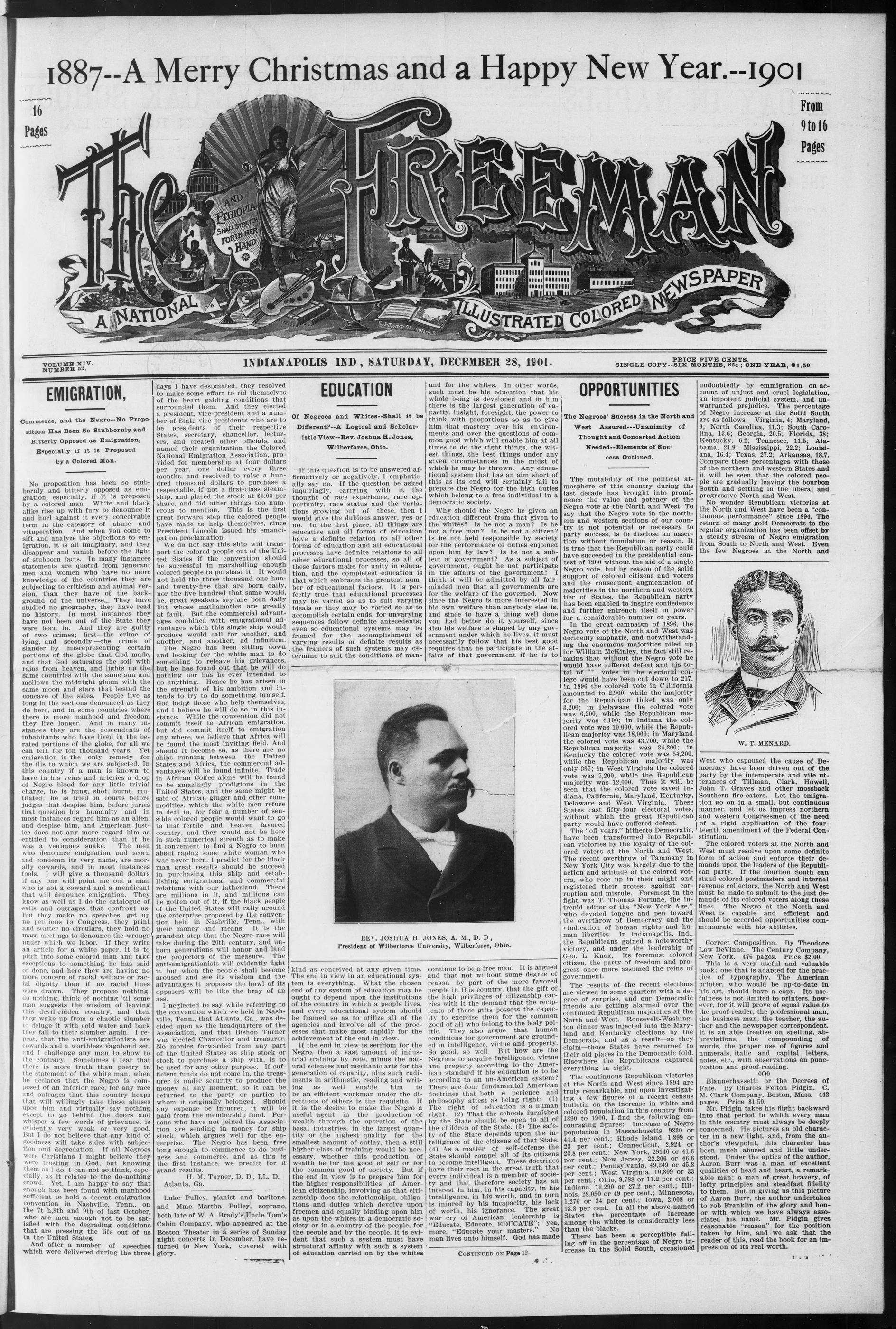
1887--A Merry Christmas and a Happy New Year.--1901
16 Pages
THE FREEMAN
A NATIONAL
ILLUSTRATED COLORED NEWSPAPER
AND ETHIOPIA SHALL STRETCH FORTH HER HAND
From 1 to 8 Pages
Public Library
VOLUMR XIV.
NUMBER 02.
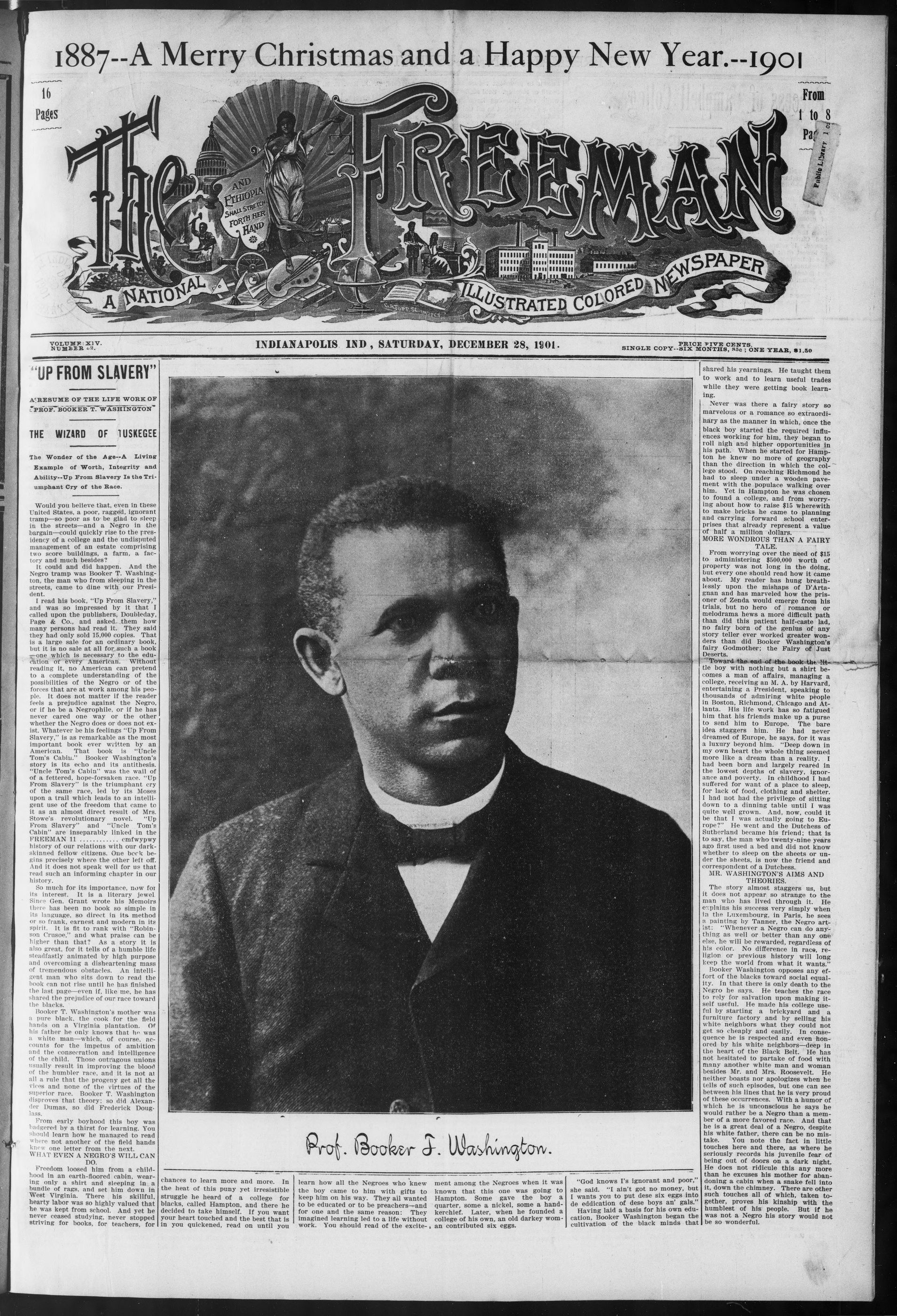
A'RESUME OF THE LIFE WORK OF
BOOKER T. WASHINGTON
THE WIZARD OF TUSKEGEE
The Wonder of the Age--A Living Example of Worth, Integrity and Ability--Up From Slavery Is the Triumphant Cry of the Race.
Would you believe that, even in these United States, a poor, ragged, ignorant tramp—so poor as to be glad to sleep in the streets—and a Negro in the bargain—could quickly rise to the presidency of a college and the undisputed management of an estate comprising two score buildings, a farm, a factory and much besides?
It could and did happen. And the Negro tramp was Booker T. Washington, the man who from sleeping in the streets, came to dine with our President.
I read his book, "Up From Slavery," and was so impressed by it that I called upon the publishers, Doubleday, Page & Co., and asked, them how many persons had read it. They said they had only sold 15,000 copies. That is a large sale for an ordinary book, but it is no sale at all for such a book—one which is necessary to the education or every American. Without reading it, no American can pretend to a complete understanding of the possibilities of the Negro or of the forces that are at work among his people. It does not matter if the reader feels a prejudice against the Negro, or if he be a Negrophile, or if he has never cared one way or the other whether the Negro does or does not exist. Whatever be his feelings "Up From Slavery," is as remarkable as the most important book ever written by an American. That book is "Uncle Tom's Cabin." Booker Washington's story is its echo and its antithesis, "Uncle Tom's Cabin" was the wall of a fettered, hope-forsaken race. "Up From Slavery" is the triumphant cry of the same race, led by its Moses upon a trail which leads to an intelligent use of the freedom that came to it as an almost direct result of Mrs. Stowe's revolutionary novel. "Up From Slavery" and "Uncle Tom's Cabin" are inseparably linked in the FREEMAN 11. cnfwypwy history of our relations with our dark-skinned fellow citizens. One book begins precisely where the other left off. And it does not speak well for us that read such an informing chapter in our history.
So much for its importance, now for its interest. It is a literary jewel. Since Gen. Grant wrote his Memoirs there has been no book so simple in its language, so direct in its method or so frank, earnest and modern in its spirit. It is fit to rank with "Robinson Crusoe," and what praise can be higher than that? As a story it is also great, for it tells of a humile life steadfastly animated by high purpose and overcoming a disheartening mass of tremendous obstacles. An intelligent man who sits down to read the book can not rise until he has finished the last page—even if, like me, he has shared the prejudice of our race toward the blacks.
Booker T. Washington's mother was a pure black, the cook for the field hands on a Virginia plantation. Of his father he only knows that he was a white man—which, of course, accounts for the impetus of ambition and the consecration and intelligence of the child. Those outragous unions usually result in improving the blood of the humbler race, and it is not at all a rule that the progeny get all the vices and none of the virtues of the superior race. Booker T. Washington disproves that theory; so did Alexander Dumas, so did Frederick Douglass.
From early boyhood this boy was badgered by a thirst for learning. You should learn how he managed to read where not another of the field hands knew one letter from the next.
Freedom loosed him from a childhood in an earth-floored cabin, wearing only a shirt and sleeping in a bundle of rags, and set him down in West Virginia. There his skillful, hearty labor was so highly valued that he was kept from school. And yet he never ceased studying, never stopped striving for books, for teachers, for
INDIANAPOLIS IND, SATURDAY, DECEMBER 28, 1901.
chances to learn more and more. In the heat of this puny yet irresistible struggle he heard of a college for blacks, called Hampton, and there he decided to take himself. If you want your heart touched and the best that is in you quickened, read on until you
Prof. Booker F. Washington.
learn how all the Negroes who knew the boy came to him with gifts to keep him on his way. They all wanted to be educated or to be preachers—and for one and the same reason: They imagined learning led to a life without work. You should read of the excite-
ment among the Negroes when it was known that this one was going to Hampton. Some gave the boy a quarter, some a nickel, some a handkerchief. Later, when he founded a college of his own, an old darkey woman contributed six eggs.
"God knows I'm ignorant and poor," she said. "I ain't got no money, but I wants you to put dese six eggs into de edification of dese boys an' gals." Having laid a basis for his own education, Booker Washington began the cultivation of the black minds that
shared his yearnings. He taught them to work and to learn useful trades while they were getting book learning.
Never was there a fairy story so marvelous or a romance so extraordinary as the manner in which, once the black boy started the required influences working for him, they began to roll high and higher opportunities in his path. When he started for Hampton he knew no more of geography than the direction in which the college stood. On reaching Richmond he had to sleep under a wooden pavement with the populace walking over him. Yet in Hampton he was chosen to found a college, and from worrying about how to raise $15 wherewith to make bricks he came to planning and carrying forward school enterprises that already represent a value of half a million dollars.
From worrying over the need of $15 to administering $500,000 worth of property was not long in the doing, but every one should read how it came about. My reader has hung breathlessly upon the mishaps of D'Artagnan and has marveled how the prisoner of Zenda would emerge from his trials, but no hero of romance or melodrama hews a more difficult path than did this patient half-caste lad, no fairy born of the genius of any story teller ever worked greater wonders than did Booker Washington's fairy Godmother; the Fairy of Just Deserts.
Toward the end of the book the little boy with nothing but a shirt becomes a man of affairs, managing a college, receiving an M. A. by Harvard, entertaining a President, speaking to thousands of admiring white people in Boston, Richmond, Chicago and Atlanta. His life work has so fatigued him that his friends make up a purse to send him to Europe. The bare idea staggers him. He had never dreamed of Europe, he says, for it was a luxury beyond him. "Deep down in my own heart the whole thing seemed more like a dream than a reality. I had been born and largely reared in the lowest depths of slavery, ignorance and poverty. In childhood I had suffered for want of a place to sleep, for lack of food, clothing and shelter. I had not had the privilege of sitting down to a dinning table until I was quite well grown. And, now, could it be that I was actually going to Europe?" He went and the Dutchess of Sutherland became his friend; that is to say, the man who twenty-nine years ago first used a bed and did not know whether to sleep on the sheets or under the sheets, is now the friend and correspondent of a Dutchess.
MR. WASHINGTON'S AIMS AND THEORIES.
The story almost staggers us, but it does not appear so strange to the man who has lived through it. He explains his success very simply when in the Luxembourg, in Paris, he sees a painting by Tanner, the Negro artist: "Whenever a Negro can do anything as well or better than any one else, he will be rewarded, regardless of his color. No difference in race, religion or previous history will long keep the world from what it wants."
Booker Washington opposes any effort of the blacks toward social equality. In that there is only death to the Negro he says. He teaches the race to rely for salvation upon making itself useful. He made his college useful by starting a brickyard and a furniture factory and by selling his white neighbors what they could not get so cheaply and easily. In consequence he is respected and even honored by his white neighbors—deep in the heart of the Black Belt. He has not hesitated to partake of food with many another white man and woman besides Mr. and Mrs. Roosevelt. He neither boasts nor apologizes when he tells of such episodes, but one can see between his lines that he is very proud of these occurrences. With a humor of which he is unconscious he says he would rather be a Negro than a member of a more favored race. And that he is a great deal of a Negro, despite his white father, there can be no mistake. You note the fact in little touches here and there, as where he seriously records his juvenile fear of being out of doors on a dark night. He does not ridicule this any more than he excuses his mother for abandoning a cabin when a snake fell into it, down the chimney. There are other such touches all of which, taken together, proves his kinship with the humblest of his people. But if he was not a Negro his story would not be so wonderful.
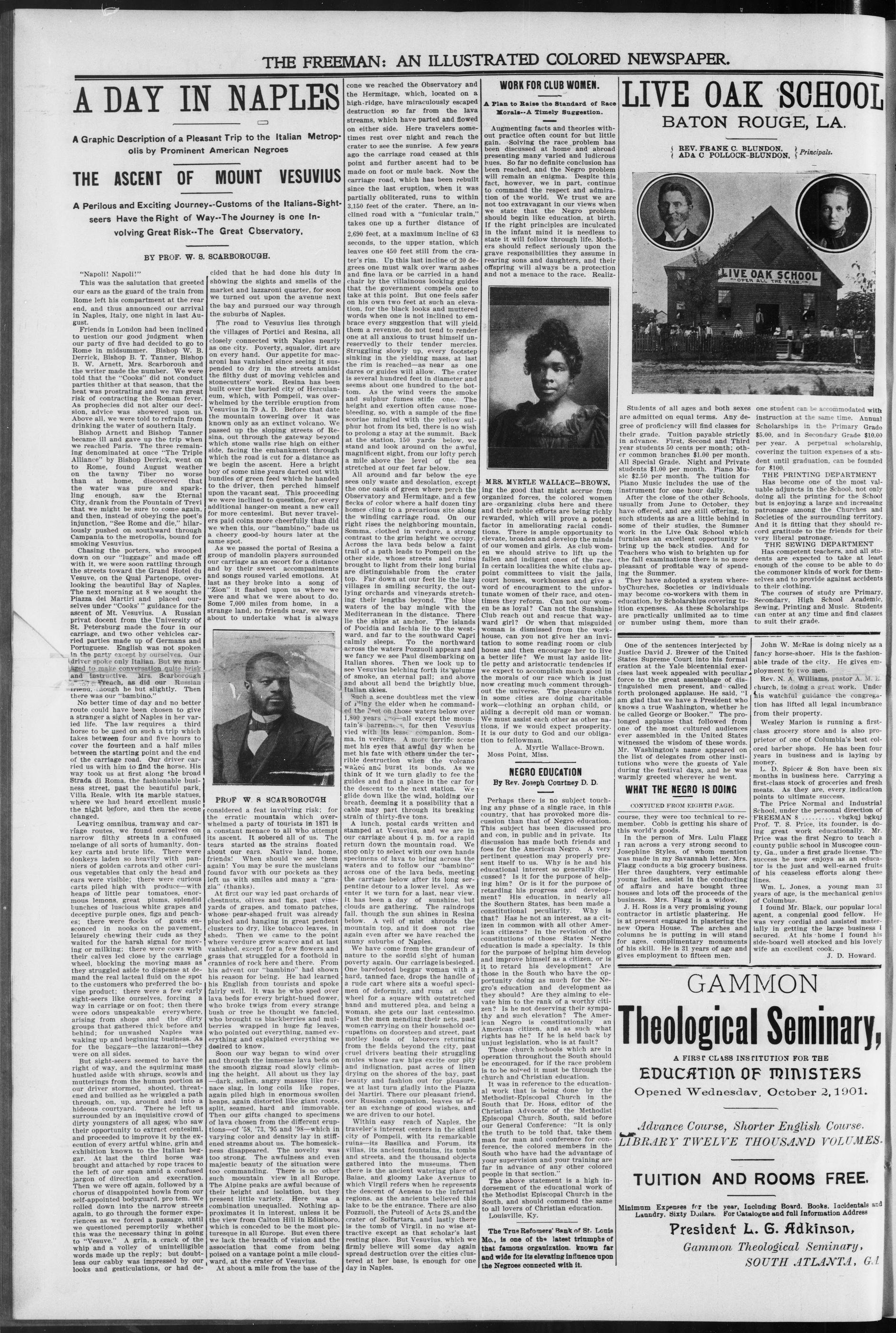
A DAY IN NAPLES
A Graphic Description of a Pleasant Trip to the Italian Metropolis by Prominent American Negroes THE ASCENT OF MOUNT VESUVIUS A Perilous and Exciting Journey--Customs of the Italians-Sightseers Have the Right of Way--The Journey is one Involving Great Risk--The Great Observatory,
BY PROF. W. S. SCARBOROUGH.
This was the salutation that greeted our ears as the guard of the train from Rome left his compartment at the rear end, and thus announced our arrival in Naples, Italy, one night in last August.
Friends in London had been inclined to question our good judgment when our party of five had decided to go to Rome in midsummer. Bishop W. B. Derrick, Bishop B. T. Tanner, Bishop B. W. Arnett, Mrs. Scarborouh and the writer made the number. We were told that the "Cooks" did not conduct parties thither at that season, that the heat was prostrating and we ran great risk of contracting the Roman fever. As prophecies did not alter our decision, advice was showered upon us. Above all, we were told to refrain from drinking the water of southern Italy.
Bishop Arnett and Bishop Tanner became ill and gave up the trip when we reached Paris. The three remaining denominated at once "The Triple Alliance" by Bishop Derrick, went on to Rome, found August weather on the tawny Tiber no worse than at home, discovered that the water was pure and sparkling enough, saw the Eternal City, drank from the Fountain of Trevi that we might be sure to come again, and then, instead of obeying the poet's injunction, "See Rome and die," hilariously pushed on southward through Campania to the metropolis, bound for smoking Suvellus.
Chasing the porters, who swooped down on our "luggage" and made off with it, we were soon rattling through the streets toward the Grand Hotel du Vesuve, on the Quai Partenope, overlooking the beautiful Bay of Naples. The morning at 8 we sought the Piazza dei Martiri and placed ourselves under "Cooks" guidance for the ascent of Mt. Vesuvius. A Russian privat docent from the University of St. Petersburg made the four in our carriage, and two other vehicles carried parties made up of Germans and Portuguese. English was not spoken in the party except by ourselves. Our driver spoke only Italian. But we managed to make conversation quite brisk and instructive. Mrs. Scarborough French, as did our Russian friend,ough he but slightly. Then there was our "bambino."
No better time of day and no better route could have been chosen to give a stranger a sight of Naples in her varied life. The law requires a third horse to be used on such a trip which takes between four and five hours to cover the fourteen and a half miles between the starting point and the end of the carriage road. Our driver carried us with him to find the horse. His way took us at first along the broad Strada di Roma, the fashionable business street, past the beautiful park, Villa Reale, with its marble statues, where we had heard excellent music the night before, and then the scene changed.
Leaving omnibus, tramway and carriage routes, we found ourselves on narrow filth streets in a confused melange of all sorts of humanity, donkey carts and brute life. There were donkeys laden so heavily with panniers of golden carrots and other curious vegetables that only the head and ears were visible; there were curious carts piled high with produce—with heaps of little pear tomatoes, enormous lemons, great plums, splendid bunches of luscious white grapes and deceptive purple figs, figs and peaches; there were flocks of goats enclosed in nooks on the pavement, leisurely chewing their cuds as they waited for the harsh signal for moving or milking; there were cows with their calves led close by the carriage wheel, blocking the moving mass as they struggled aside to dispense at demand the real lacteal fluid on the spot to the customers who preferred the bovine product; there were a few early sight-seers like ourselves, forcing a way in carriage or on foot; then there were odors unspeakable everywhere, arising from shops and the dirty groups that gathered thick before and behind; for unwashed Naples was waking up and beginning business. As for the baggars—the lazzaroni—they were on all sides.
But sight-seers seemed to have the right of way, and the squirming mass hustled aside with shrugs, scowls and mutterings from the human portion as our driver stormed, shouted, threatened and bullied as he wrigled a path through, on, up, around and into a hideous courtyard. There he left us surrounded by an inquisitive crowd of dirty youngsters of all ages; who saw their opportunity to extract centesimil, and proceeded to improve it by the execution of every artful whine, grin and exhibition known to the Italian begar. At last the third horse was brought and attached by rope traces to the left of our span amid a confused jargon of direction and excretion. Then we were off again, followed by a chorus of disappointed howls from our self-appointed bodyguard, pro tem. We rolled down into the narrow streets again, to go through the former experiences as we forced a passage, until we questioned peremortify whether this was the necessary thing in going to "Vesuve." A grin, a crack of the whip and a volley of unintelligible words made up the reply; but doubtless our cabby was impressed by our looks and gesticulations, or had de-
"Napoli! Napoli!"
cided that he had done his duty in showing the sights and smells of the market and lazzaroni quarter, for soon we turned out upon the avenue next the bay and pursued our way through the suburbs of Naples.
The road to Vesuvius lies through the villages of Portici and Resina, all closely connected with Naples nearly as one city. Poverty, squalor, dirt are on every hand. Our appetite for macaroni has vanished since seeing it suspended to dry in the streets amidst the filth dust of moving vehicles and stonecutters' work. Resina has been built over the buried city of Herculaneum, which, with Pompeii, was overwhelmed by the terrible eruption from Vesuvius in 79 A. D. Before that date the mountain towering over it was known only as an extinct volcano. We passed up the sloping streets of Resina, out through the gateway beyond which stone walls rise high on either side, facing the embankment through which the road is cut for a distance as we begin the ascent. Here a bright boy of some nine years darted out with bundles of green feed which he handed to the driver, then perched himself upon the vacant seat. This proceeding we were inclined to question, for every additional hanger-on meant a new call for more centesimi. But never travelers paid coins more cheerfully than did we when this, our "hambino," bade us a cheery good-by hours later at the same spot.
As we passed the portal of Resina a group of mandolin players surrounded our carriage as an escort for a distance and by their sweet accompaniments and songs roused varied emotions. At last as they broke into a song of "Zion" it flashed upon us where we were and what we were about to do. Some 7,000 miles from home, in a strange land, no friends near, we were about to undertake what is always
PROF. W. S. SCARBOROUGH
considered a feat involving risk; for the erratic mountain which overwhelmed a party of tourists in 1871 is a constant menace to all who attempt its ascent. It sobered all of us. The tears started as the strains floated about our ears. Native land, home, friends! When should we see them again! You may be sure the musicians found favor with our pockets as they left us with smiles and many a "grazia" (thanks).
At first our way led past orchards of chestnuts, olives and figs, past vineyards of grapes, and tomato patches, whose pear-shaped fruit was already plucked and hanging in great pendent clusters to dry, like tobacco leaves, in sheds. Then we came to the point where verdure grew scarce and at last vanished, except for a few flowers and grass that struggled for a foothold in crannies of rock here and there. From his advent our "bambino" had shown his reason for being. He had learned his English from tourists and spoke fairly well. It was he who sped over lava beds for every bright-hued flower, who broke twigs from every strange bush or tree he thought we fancied, who brought us blackberries and mulberries wrapped in huge fig leaves, who pointed out everything, named everything and explained everything we desired to know.
Soon our way began to wind over and through the immense lava beds on the smooth zigzag road slowly climbing the height. All about us they lay—dark, sullen, angry masses like furnace slag, in long coils like ropes, again piled high in enormous swollen heaps, again distorted like giant roots, split, seamed, hard and immovable. Then our gifts changed to specimens of lava chosen from the different eruptions—of '58, '73, '95 and '98—which in varying color and density lay in stiffened streams about us. The homesickness disappeared. The novelty was too strong. The awfulness and even majestic beauty of the situation were too commanding. There is no other such mountain view in all Europe. The Alpine peaks are awful because of their height and isolation, but they present little variety. Here was a combination unequalled. Nothing approximates it in interest, unless it be the view from Calton Hill in Edinboro, which is conceded to be the most picturesque in all Europe. But even there we lack the breadth of vision and the association that come from being poised on a vantage point a mile cloudward, at the crater of Vesuvius.
At about a mile from the base of the
THE FREEMAN: AN ILLUSTRATED COLORED NEWSPAPER.
APLES
the Italian Metropolegroes
VESUVIUS
of the Italians-Sightney is one In-
cone we reached the Observatory and the Hermitage, which, located on a high-ridge, have miraculously escaped destruction so far from the lava streams, which have parted and flowed on either side. Here travelers sometimes rest over night and reach the crater to see the sunrise. A few years ago the carriage road ceased at this point and further ascent had to be made on foot or mule back. Now the carriage road, which has been rebuilt since the last eruption, when it was partially obliterated, runs to within 3,150 feet of the crater. There, an inclined road with a "funicular train," takes one up a further distance of
WORK FOR CLUB WOMEN.
A Plan to Raise the Standard of Race Morals--A Timely Suggestion.
Augmenting facts and theories without practice often count for but little gain. Solving the race problem has been discussed at home and abroad presenting many varied and ludicrous hues. So far no definite conclusion has been reached, and the Negro problem will remain an enigma. Despite this fact, however, we in part, continue to command the respect and admiration of the world. We trust we are not too extravagant in our views when we state that the Negro problem should begin like education, at birth. If the right principles are incubated
LIVE OA
BATON
REV. FRANK
ADA C POLL
2,690 feet, at a maximum incline of 63 seconds, to the upper station, which leaves one 450 feet still from the crater's rim. Up this last incline of 30 degrees one must walk over warm ashes and fine lava or be carried in a hand chair by the villainous looking guides that the government compels one to take at this point. But one feels safer on his own two feet at such an elevation, for the black looks and muttered words when one is not inclined to embrace every suggestion that will yield them a revenue, do not tend to render one at all anxious to trust himself unreservedly to their tender mericles. Struggling slowly up, every footstep sinking in the yielding mass, at last the rim is reached—as near as one dares or guides will allow. The crater is several hundred feet in diameter and seems about one hundred to the bottom. As the wind veers the smoke and sulphur fumes stifle one. The height and exertion often cause nosebleeding, so, with a sample of the fine scoriae mingled with the yellow sulphur hot from its bed, there is no wish to prolong a stay at the summit. Back at the station, 150 yards below, we stand and look around on the awful, magnificent sight, from our lofty perch a mile above the level of the sea stretched at our feet far below.
All around and far below the eye sees only waste and desolation, except the one oasis of green where perch the Observatory and Hermitage, and a few flecks of color where a half dozen tiny homes cling to a precarious site along the winding carriage road. On our right rises the neighboring mountain, Somma, clothed in verdure, a strong contrast to the grim height we occupy. Across the lava beds below a faint trail of a path leads to Pompeii on the other side, whose streets and ruins brought to light from their long burial are distinguishable from the crater top. Far down at our feet lie the lazy villages in smiling security, the outlying orchards and vineyards stretching their lengths beyond. The blue waters of the bay mingle with the Mediterranean in the distance. There lie the ships at anchor. The islands of Pocidia and Ischia lie to the westward, and far to the southward Capri calmly sleeps. To the northward across the waters Pozzuoli appears and we fancy we see Paul disembarking on Italian shores. Then we look up to see Vesuvius belching forth its volume of smoke, an eternal pall; and above and about all bend the brightly blue, Italian skies.
Such a scene doubtless met the view of *riny* the elder when he commanded the *feet* on those waters below over 1,800 years — all except the mountain's barrenness, for then *Vesuvius* vied with its less- companion. Somma, in verdure. A more terrific scene met his eyes that awful day when he met his fate with others under the terrible destruction when the volcano waged and burst its bonds. As we think of it we turn gladly to the guides and find a place in the car for the descent to the next station. We glide down like the wind, holding our breath, deeming it a possibility that a cable may part through its breaking strain of thirty-five tons.
A lunch, postal cards written and stamped at Vesuvius, and we are in our carriage about 4 p. m. for a rapid return down the mountain road. We stop only to select with our own hands specimens of lava to bring across the waters and to follow our "bambino" across one of the lava beds, meeting the carriage below after its long serpentine detour to a lower level. As we enter it we turn for a last, near view. It has been a day of sunshine, but clouds are gathering. The raindrops fall, though the sun shines in Resina below. A veil of mist shrouds the mountain top, and it does not rise again even after we have reached the sunny suburbs of Naples.
We have come from the grandeur of nature to the sordid sight of human poverty again. Our carriage is besieged. One barefoot begged woman with a hard, tanned face, drops the handle of a rude cart where sits a woeful specimen of deformity, and runs at our wheel for a square with outstretched hand and muttered plea, and being a woman, she gets our last centessimo. Past the men mending their nets, past women carrying on their household occupations on doorstep and street, past motley loads of laborers returning from the fields beyond the city, past cruel drivers beating their struggling mules whose raw hips excite our pity and indignation, past acres of linen drying on the shores of the bay, past beauty and fashion out for pleasure, we at last turn gladly into the Piazza dei Martiri. There our pleasant friend, our Russian companion, leaves us after an exchange of good wishes, and we are driven to our hotel.
Within easy reach of Naples, the traveler's interest centers in the silent city of Pompeii, with its remarkable ruins—its Basilica and Forum, its villas, its ancient fountains, its tombs and streets, and the thousand objects gathered into the museums. Then there is the ancient watering place of Balae, and gloomy Lake Avernus to which Virgil refers when he represents the descent of Aeneas to the infernal regions, as the ancients believed this lake to be the entrance. There are also Pozzuoli, the Puteoli of Acts 28, and the crater of Solfartara, and lastly there is the tomb of Virgil, in no wise attractive except as that scholar's last resting place. But Vasuvius, which we firmly believe will some day again spread destruction over the cities clustered at her base, is enough for one day in Naples.
WORK FOR CLUB WOMEN.
A Plan to Raise the Standard of Race Morals--A Timely Suggestion.
Augmenting facts and theories without practice often count for but little gain. Solving the race problem has been discussed at home and abroad presenting many varied and ludicrous hues. So far no definite conclusion has been reached, and the Negro problem will remain an enigma. Despite this fact, however, we in part, continue to command the respect and admiration of the world. We trust we are not too extravagant in our views when we state that the Negro problem should begin like education, at birth. If the right principles are inculcated in the infant mind it is needless to state it will follow through life. Mothers should reflect seriously upon the grave responsibilities they assume in rearing sons and daughters, and their offspring will always be a protection and not a menace to the race. Realiz-
[Name]
MRS. MYRTLE WALLACE—BROWN, ing the good that might accrue from organized forces, the colored women are organizing clubs here and there and their noble efforts are being richly rewarded, which will prove a potent factor in ameliorating racial conditions. There is ample opportunity to elevate, broaden and develop the minds of our women and girls. As club women we should strive to lift up the fallen and indigent ones of the race. In certain localities the white clubs appoint committees to visit the jails, court houses, workhouses and give a word of encouragement to the unfortunate women of their race, and otentimes they reform. Can not our women be as loyal? Can not the Sunshine Club reach out and rescue that wayward girl? Or when that misguided woman is dismissed from the workhouse, can you not give her an invitation to some reading room or club house and then encourage her to live a better life? We must lay aside little petty and aristocratic tendencies if we expect to accomplish much good in the morals of our race which is just now creating much comment throughout the universe. The pleasure clubs in some cities are doing charitable work—clothing an orphan child, or aiding a decrepit old man or woman. We must assist each other as other nations, if we would expect prosperity. It is our duty to God and our obligation to fellowman.
A. Myrtle Wallace-Brown.
Moss Point. Miss.
NEGRO EDUCATION
By Rev. Joseph Courtney D. D.
Perhaps there is no subject touching any phase of a single race, in this country, that has provoked more discussion than that of Negro education. This subject has been discussed pro and con, in public and in private. Its discussion has made both friends and foes for the American Negro. A very pertinent question may properly present itself to us. Why is he and his educational interest so generally discussed? Is it for the purpose of helping him? Or is it for the purpose of retarding his progress and development? His education, in nearly all the Southern States, has been made a constitutional peculiarity. Why is that? Has he not an interest, as a citizen in common with all other American citizens? In the revision of the constitutions of those States 'Negro education is made a specialty. Is this for the purpose of helping him develop and improve himself as a citizen, or is it to retard his development? Are those in the South who have the opportunity doing as much for the Negro's education and development as they should? Are they aiming to elevate him to the rank of a worthy citizen? Is he not deserving their sympathy and such elevation? The American Negro is constitutionally an American citizen, and as such what rights has he? If he is held back by unjust legislation, who is at fault?
Those church schools which are in operation throughout the South should be encouraged, for if the race problem is to be solved it must be through the church and Christian education.
It was in reference to the educational work that is being done by the Methodist-Episcopal Church in the South that Dr. Hoss, editor of the Christian Advocate of the Methodist Episcopal Church. South, said before our General Conference: "It is only the truth to be told that, take them man for man and conference for conference, the colored members in the South who have had the advantage of your supervision and your training are far in advance of any other colored people in that section."
The above statement is a high indorsement of the educational work of the Methodist Episcopal Church in the South, and should commend the same to all lovers of Christian education.
Louisville, Ky.
The True Refomers' Bank of St. Louis Mo., is one of the latest triumphs of that famous organization. known far and wide for its elevating influence upon the Negroes connected with it.
LIVE OAK SCHOOL BATON ROUGE, LA.
{ REV, FRANK C. BLUNDON. } Principals.
{ ADA C. POLLOCK-BLUNDON. }
LIVE
OPE
LIVE OAK SCHOOL
OPEN ALL THE YEAR
Students of all ages and both sexes are admitted on equal terms. Any degree of proficiency will find classes for their grade. Tuition payable strictly in advance. First, Second and Third year students 50 cents per month; other common branches $1.00 per month. All Special Grade. Night and Private students $1.00 per month. Piano Music $2.50 per month. The tuition for Piano Music includes the use of the instrument for one hour daily. After the close of the other Schools, usually from June to October, they have offered, and are still offering, to such students as are a little behind in some of their studies, the Summer work in the Live Oak School which furnishes an excellent opportunity to bring up the back studies. And for Teachers who wish to brighten up for the fall examinations there is no more pleasant of profitable way of spending the Summer.
They have adopted a system wherebyChurches, Societies or individuals may become co-workers with them in education, by Scholarships covering tuition expenses. As these Scholarships are practically unlimited as to time or number using them, more than
One of the sentences interjected by Justice David J. Brewer of the United States Supreme Court into his formal eration at the Yale bicentennial exercises last week appealed with peculiar force to the great assemblage of distinguished men present, and called forth prolonged applause. He said, "I am glad that we have a President who knows a true Washington, whether he be called George or Booker." The prolonged applause that followed from one of the most cultured audiences ever assembled in the United States witnessed the wisdom of these words. Mr. Washington's name appeared on the list of delegates from other institutions who were the guests of Yale during the festival days, and he was warmly greeted wherever he went.
WHAT THE NEGRO IS DOING
CONTIUED FROM EIGHTH PAGE.
course, they were too technical to remember. Cobb is getting his share of this world's goods.
In the person of Mrs. Lulu Flagg I ran across a very strong second to Josephine Styles, of whom mention was made in my Savannah letter, Mrs. Flagg conducts a big grocery business. Her three daughters, very estimable young ladies, assist in the conducting of affairs and have bought three houses and lots off the proceeds of the business. Mrs. Flagg is a widow.
J. H. Ross is a very promising young contractor in artistic plastering. He is at present engaged in plastering the new Opera House. The arches and columns he is putting in will stand for ages, complimentary monuments of his skill. He is 31 years of age and gives employment to fifteen men.
GAM Theologica A FIRST CLASS INS EDUCATION O
GAMMON
Theological Seminary,
A FIRST CLASS INSTITUTION FOR THE
EDUCATION OF MINISTERS
Opened Wednesday, October 2, 1901.
Advance Course, Shorter English Course.
LIBRARY TWELVE THOUSAND VOLUMES.
TUITION AND ROOMS FREE.
Minimum Expenses for the year, Including Board. Books. Incidentals and
Laundry. Sixty Dollars. For Catalogue and full Information Address
President L. G. Adkinson,
Gammon Theological Seminary,
SOUTH ATLANTA, G.A.
OAK SCHOOL
IN ALL THE YEAR
one student can be accommodated with instruction at the same time. Annual Scholarships in the Primary Grade $5.00, and in Secondary Grade $10.00 per year. A perpetual scholarship, covering the tuition expenses of a student until graduation, can be founded for $100.
THE PRINTING DEPARTMENT
Has become one of the most valuable adjuncts in the School, not only doing all the printing for the School but is enjoying a large and increasing patronage among the Churches and Societies of the surrounding territory. And it is fitting that they should record gratitude to the friends for their very liberal patronage.
THE SEWING DEPARTMENT
Has competent teachers, and all students are expected to take at least enough of the course to be able to do the commoner kinds of work for themselves and to provide against accidents to their clothing.
The courses of study are Primary Secondary, High School Academic Sewing, Printing and Music. Students can enter at any time and find classes to suit their grade.
John W. McRae is doing nicely as a fancy horse-shoer. His is the fashionable trade of the city. He gives employment to two men. Rev. N. A. Williams, pastor A. M. E. church, is doing a great work. Under his watchful guidance the congregation has lifted all legal incumbrance from their property. Wesley Marion is running a first-class grocery store and is also proprietor of one of Columbia's best colored barber shops. He has been four years in business and is laying by money. L. D. Spicer & Son have been six months in business here. Carrying a first-class stock of groceries and fresh meats. As they are, every indication points to ultimate success.
The Price Normal and Industrial School, under the personal direction of FREEMAN 8 ..... vbkgjk bjkgj Prof. T. S. Price, its founder, is doing great work educationally. Mr. Price was the first Negro to teach a county public school in Muscogee county, Ga., under a first grade license. The success he now enjoys as an educator is the just and well-earned fruits of his ceaseless efforts along these lines.
Wm. L. Jones, a young man 33 years of age, is the mechanical genius of Columbus.
I found Mr. Black, our popular local agent, a congenial good fellow. He was very cordial and assisted materially in getting the large business I secured. At his home I found his side-board well stocked and his lovely wife an excellent cook.
MON
I Seminary,
INITUTION FOR THE
F MINISTERS
J. D. Howard.
Cures Weak Men Free.
Send Name and Address To-day----You Can Have It Free and Be Strong and Vigorous for Life.
INSURES LOVE AND A HAPPY HOME
INSUCHS LOVE AND A MIND
L. W. KNAPP, M. D.
How any man may quickly cure himself after years of suffering from sexual weakness, lost vitality, night losses, varicocele, etc, and enlarge small weak organs to full size and vigor. Simply send your name and address to Dr. L. W. Knapp, 1169 Hull Building, Detroit, Mich., and he will gladly send the free receipt with full directions so that any man may easily cure himself at home. This is certainly a most generous offer and the following extracts taken from his daily daily mail shows what men think of his generosity.
"Dear Sir:—Please accept my sincere that for yours of recent date, I have given on your treatment a thorough test and the
Masonic, Pythian, Odd-Tent and Eastern
Applications
Aprons
Books
Badges
Banners
Buttons
Belts
Bells
Caps
Coats
Cards
Certificates
Charts
Charms
Collars
Columns
Drill Tactics
Demits
Diplomas
Engraving
Flags
BENJAMIN R. B.
Progressive Lodge No. 80, A. F. & A. Mason
Lodge No. 44, K. of P., Capt. Conway Co., N.
Railway Mail Service and runs "Clerk in Chine
nine (9) of the largest Manufacturing Public
goods, lowest prices, satisfaction or no pay.
the factories and at factory prices. Discount
of Lodge, Grand Master and Secretary of Sta
Also the leading colored newspaper. Do you
so and encourage others. Send money by M.
BENJ. R. BOULDING.
This Week We Sho
The largest and most
ever shown in the W
COATS made from the
upward. The same
double the price we
Don't be prejudiced
high priced. It cou
much.
KAHN•••
TAILOR
Odd-Fellows
Eastern Star
R. BOULD
& A. Masons, Nortolk,
Away Co., No. 18, U. R. I.
Clerk in Charge" on the S
ing Publishing and Sup
or no pay. Prompt atten
t. Discount given. Give
tary of State.
Paper. Do you subscribe
by money by Money Order or
BUILDING. 31 Aven
We Show
the best and most general assis
sion in the West Prices
made from this select st
The same satisfaction
the price were paid as in
prejudiced against our
d. It could not be bet
Masonic, Pythian, Odd-Fellows, Military, Band, Tent and Eastern Star Supplies
Applications
Aprons
Books
Badges
Banners
Buttons
Belts
Bells
Caps
Coats
Cards
Certificates
Charts
Charms
Collars
Columns
Drill Tactics
Demits
Diplomas
Engraving
Flags
BENJAMIN R. BOULDING, P. M.,
Progressive Lodge No. 80, A. F. & A. Masons, Nortok, Va.; Past Chancellor, Phoenix
Lodge No. 44, K. of P., Capt. Conway Co., No. 18, U. R., K. of P., and is in the U. S.
Railway Mail Service and runs "Clerk in Charge" on the Southern R. R. He is agent for
nine (9) of the largest Manufacturing Publishing and Supply companies in America, best
goods, lowest prices, satisfaction or no pay. Prompt attention. Everything direct from
the issuer of the letter is given. Give name of Master and Secretary of
Lodge, Grand Master and Secretary of State.
Also the leading colored newspaper. Do you subscribe to a race paper? If not then do
so and encourage others. Send money by Money Order or Registered Letter to
BENJ. R. BOULDING. 31 Avenue A, Norfolk, Va.
The largest and most general assemblage of fine woolens ever shown in the West Prices on SUITS and OVER-COATS made from this select stock will range from $20 upward. The same satisfaction is guaranteed as though double the price were paid as in case of other tailors. Don't be prejudiced against our output because it is not high priced. It could not be better if we asked twice as much.
SANTAL-MIDY
In 48 hours Gonorrhea and
discharges from the urinary org-
ans, arrested by Santal MIDY
Capetes without inconvenience.
Free $1. of ALB Drugs,
or P.O. Box 2081, New York.
---
the benefit has been extraordinary. It has completely braced me up. I am just as vigorous as when a boy and you cannot realize how happy I am."
"DearSir:—Your method worked beautifully. Results were exactly what I needed. Strength and vigor have completely returned and enlargement is entirely satisfactory."
"DearSir:—Yours was received and i had no trouble in making use of the receipt as directed and can truthfully say it is a boon to weak men. I am greatly improved in size, strength and vigor."
All correspondence is strictly confidential, mailed in plain, sealed envelope. The receipt is free for the asking and he wants everyman to have it.
Fellows Military, Band on Star Supplies
WOULDING, P. M.,
Nortolk, Va.; Past Chancellor, Phoenix
No. 18, U. R., K. of P., and is in the U. S.
Sarge" on the Southern R. R. He is agent for
selling and Supply companies in America, best
Prompt attention. Everything direct from
driven. Give name of Master and Secretary
you subscribe to a race paper? If not then do
money Order or Registered Letter to
31 Avenue A, Norfolk. Va.
NOW
Most general assemblage of fine woolens
West Prices on SUITS and OVER-
this select stock will range from $20
satisfaction is guaranteed as though
are paid as in case of other tailors.
against our output because it is not
old not be better if we asked twice as
ING CO.
Agents Wanted.
Active, energetic young men or women can secure employment as agents for this paper by writing the editor of this page or to The Freeman. Liberal commission will be paid.
The people who marry in haste may repent in South Dakota.
THE FREEMAN: AN ILLUSTRATED COLORED NEWSPAPER.
Gavelis
Gloves
Guages
Lodge
Jewels
Letter
Heads
Life and
Accident
Insurancee
Masonic
Poetry
Medals
Ode Music
Petitions &
Summons
Pins
Printing
Regallias
Seals
Swords
Uniforms
Sold at all drug stores. Price, 25c. in large cans—Contains One Month's Treatment. If your druggist does not keep it he will get it for you, or we will mail it to any address, securely wrapped on receipt of 30c. in stamps or silver. For testimonials and full information, address.
HOW IT HAPPENED
CHRISTMAS STORY WRITTEN EXPRESSLY FOR THE FREEMAN.
BY AUGUSTUS M. HODGES, (B. SQUARE.)
Author of "Fred Jackson's Vow," "Mald and Mistress," "Courtship by Proxy," "Twas Not to Be," "The Cedar Hill School," Etc.
TO C. S. C. H.--MY KENTUCKY
GIRL.
(BY AUGUSTUS M. HODGES.)
"God bless the lady! though we ne'er
May meet each other on this earth,
But both, until life's errand's done,
Dwell where our childhood had its birth.
Yet -tender sympathy I send,
As to some dear, though unknown friend."
—Mary E. Lee.
I ne'er have seen thy face, young Miss, and yet
Twas difficult to own that thon art but
A common stranger; for a little while
I gave my fancy freedom, and was pleased
To picture out a future common sphere.
Where we will hold companionship, and twine
A subtitle of sympathy and -love
Where dwells thy secret spell? What charm
of thine
Has played upon the key note of my heart,
Stirring it to music? I know not
Twere hard to tell, unless thy pliant plant
Whose brilliant inks pierced my heart
When first we corresponded, did the act
And made me yearn to ask thy tale of life.
Yea, made me yearn to ask thee more and -more
Tis strange, and stranger still the truth that
loose.
love
Transmits thy lovely image from afar
Kentucky to Long sland s shore.
'Tis strange, 'tis true, 'tis true, 'tis strange!
Were a prophet 'twere a needless task
To say "Some future day we'll surely meet."
Let Tome proclaim the joyful day,
I'll simply say " 'tis strange, 'tis strange."
Brooklyn, N. Y., Dec 5, 1901,
Clarence Merriman had long since concluded that he was a living example of the truthfulness of the Biblical saying, "A prophet is not without honor, save in his own country, and in his own house." Clarence Merriman was not a prophet, not even the son of a prophet, but he was an author of great note (in his own estimation) and he believed that the same rule applied the authors of to-day that did prophets of ancient times.
Clarence Merriman was an ambitious young man, age twenty-two, bred and born in the quiet little New England town of N——, Conn., an hour's ride from Boston, the literary hub of this great country. He was an orphan, residing with his maternal anunt, an old lady of seventy-four hard winters and the same amount of not too sun-shiny summers. His parents died when he was seventeen and his father, who was the village carpenter, left him a few hundred dollars, the savings of a life time. With this money, against the wishes of his aunt and friends, he went to college and returned a year before our opening with nothing to start in life but his "sheep skin," and an over amount of pluck. He soon discovered that his field was the literary one and his calling that of a writer of verse and fiction—noet and novelist.
He at once commenced to unload his mind at the office of the "N—— Weekly North Star," the paper of the town; as his MSS, were type-written and he wrote over the literary name of "Harry Hustle," his articles, stories and poems were accepted and published with great editorial puffs. He floated for a short period upon the top wave, and saw in the near future both fame and fortune. Let us say between the lines, it is the biggest mistake a budding writer of the day can make, to write under a non-de-plume. The non-de-plume's days are past; write your name in full and stand or fall with your story or poem. The critical literary world will decide if you are a fool or a gifted writer.
The question of the town soon became: "Who is 'Harry Hustle'? It was a "drop" post office and the editor set a watchman at the office who one morning saw Merriman deposit his MSS. for "The Weekly North Star" in the post office slot, covered with the usual yellow envelope in which "Harry Hustle's" copy was always sent. A few hours afterwards every body in two knew that "Harry Hustle" was nobody else but "that Clarence Merriman" and everybody said, "Oh, pshaw, and turned away in disgust. The editor sent for him and Clarence confessed his "crime". He was forgiven upon the promise not to send any more of his "stuff" to "The Weekly North Star's" office. Merriman was at the age when ambition knows no curb and tries to jump over all barriers. He sent mail bags full of "poems" and stories to all the
BEFORE USING
M. E. H.
Nelson's Straightine
FREE FROM ALL INJURIOUS CHEMICALS.
GUARANTEED PERFECTLY HARMLESS.
Nelson's Straightine Not only straightens the hair, but, by nourishing it, ishing the roots, prevents it from failing out, removes Dandruff, causes licking, and helps to maintain the hair of Hair of Hair. It is used and highly endorsed by the best people in all sections of this country. We guarantee Straightine to be free from all injurious chemicals, and cannot injure the hair. Straightine does not make the hair sticky or gummy, and can be left off at any time. Straightine does not rework the hair. It is left on at any time, or continued as long as desired. Thousands of testimonials on file.
New York and Boston literary papers and magazines, all of which were returned with thanks. He continued to write poems and stories. One of his poems, "An Ode to Kentucky Malden," found its way into print in "The Denver (Col.) Literary Light," a journal unknown to the literary world, but whose young editor had made his sheet a dumping ground for budding young authors. A marked copy was sent to Merriman, who agreed to write expressly for the "Denver Literary Light" for just enough pay to keep soul and body together. The author helped the paper and the paper helped the author, although his poems and stories, now written under his full name, were seldom quoted in magazines of note, still, he now had just reasons to hope that some day he would win with his pen the fame and fortune he believed he merited.
CHAPTED II.
It was a bright, cold Christmas
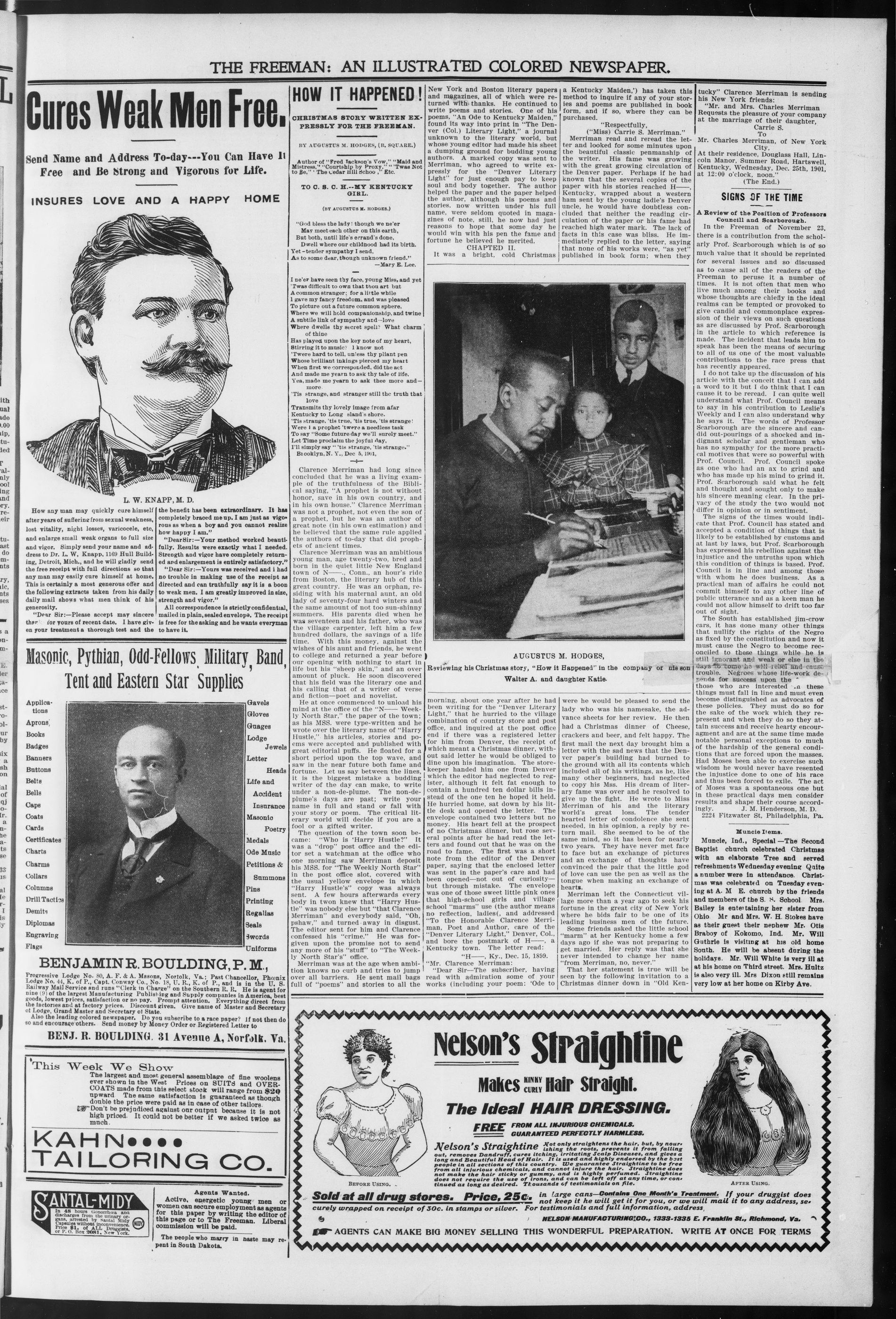
AUGUSTUS
Reviewing his Christmas story, "How it
Walter A. and d
morning, about one year after he had been writing for the "Denver Literary Light," that he hurried to the village combination of country store and post office, and inquired at the post office end if there was a registered letter for him from Denver, the receipt of which meant a Christmas dinner, without said letter he would be obliged to dine upon his imagination. The storekeeper handed him one from Denver which the editor had neglected to register, although it felt fat enough to contain a hundred ten dollar bills instead of the one ten he hoped it held. He hurried home, sat down by his little desk and opened the letter. The envelope contained two letters but no money. His heart fell at the prospect of no Christmas dinner, but rose several points after he had read the letters and found out that he was on the road to fame. The first was a short note from the editor of the Denver paper, saying that the enclosed letter was sent in the paper's care and had been opened—not out of curiosity—but through mistake. The envelope was one of those sweet little pinks that high-school girls and village school "marms" use (the author means no reflection, ladies,) and addressed "To the Honorable Clarence Mr.erman, Poet and Author, care of the "Denver Literary Light," Denver, Col., and bore the postmark of H—, a Kentucky town. The letter read:
"H——, Ky., Dec. 15, 1899.
"Mr. Clarence Merriman:
"Dear Sir—The subscriber, having read with admiration some of your works (including your poem: 'Ode to Nelson's St Makes KINKY CURLY The Ideal HA
a Kentucky Maiden,') has taken this method to inquire if any of your stories and poems are published in book form, and if so, where they can be purchased.
"Respectfully.
("Miss) Carrie S. Merriman." Merriman read and reread the letter and looked for some minutes upon the beautiful classic penmanship of the writer. His fame was growing with the great growing circulation of the Denver paper. Perhaps if he had known that the several copies of the paper with his stories reached H——, Kentucky, wrapped about a western ham sent by the young lady's Denver uncle, he would doubtless concluded that neither the reading circulation of the paper or his fame had reached high water mark. The lack of facts in this case was bliss. He immediately replied to the letter, saying that none of his works were, "as yet" published in book form; when they
M. HODGES,
Happened" in the company or nie son
daughter Katie.
were he would be pleased to send the lady who was his namesake, the advance sheets for her review. He then had a Christmas dinner of Cheese, crackers and beer, and felt happy. The first mail the next day brought him a letter with the sad news that the Denver paper's building had burned to the ground with all its contents which included all of his writings, as he, like many other beginners, had neglected to copy his Mss. His dream of literary fame was over and he resolved to give up the fight. He wrote to Miss Merriman of his and the literary world's great loss. The tender hearted letter of condolence she sent needed, in his opinion, a reply by return mail. She seemed to be of the same mind, so it has been for nearly two years. They have never met face to face but an exchange of pictures and an exchange of thoughts have convinced the pair that the little god of love can use the pen as well as the tongue when making an exchange of hearts.
Merriman left the Connecticut village more than a year ago to seek his fortune in the great city of New York where he bids fair to be one of its leading business men of the future. Some friends asked the little school "marm" at her Kentucky home a few days ago if she was not preparing to get married. Her reply was that she never intended to change her name "from Merriman, no, never." That her statement is true will be seen by the following invitation to a Christmas dinner down in "Old Ken-
raightine
hair Straight.
IR DRESSING.
tucky" Clarence Merriman is sending his New York friends:
"Mr. and Mrs. Charles Merriman Requests the pleasure of your company at the marriage of their daughter,
Carrie S.
To
Mr. Charles Merriman, of New York City.
At their residence, Douglass Hall, Lincoln Manor, Summer Road, Hartswell, Kentucky, Wednesday, Dec. 25th, 1901, at 12:00 o'clock, noon."
SIGNS OF THE TIME
A Review of the Position of Professors Council and Scarborough
In the Freeman of November 23, there is a contribution from the scholarly Prof. Scarborough which is of so much value that it should be reprinted for several issues and so discussed as to cause all of the readers of the Freeman to peruse it a number of times. It is not often that men who live among their books and whose thoughts are chiefly in the ideal realms can be tempted or provoked to give candid and commonplace expression of their views on such questions as are discussed by Prof. Scarborough in the article to which reference is made. The incident that leads him to speak has been the means of securing to all of us one of the most valuable contributions to the race press that has recently appeared.
I do not take up the discussion of his article with the conceit that I can add a word to it but I do think that I can cause it to be reread. I can quite well understand what Prof. Council means to say in his contribution to Leslie's Weekly and I can also understand why he says it. The words of Professor Scarborough are the sincere and candid out-pourings of a shocked and indignant scholar and gentleman who has no sympathy for the more practical motives that were so powerful with Prof. Council. Prof. Council spoke as one who had an ax to grind and who has made up his mind to grind it. Prof. Scarborough said what he felt and thought and sought only to make his sincere meaning clear. In the privacy of the study the two would not differ in opinion or in sentiment.
The signs of the times would indicate that Prof. Council has stated and accepted a condition of things that is likely to be established by customs and at last by laws, but Prof. Scarborough has expressed his rebellion against the injustice and the untruths upon which this condition of things is based. Prof. Council is in line and among those with whom he does business. As a practical man of affairs he could not commit himself to any other line of public utterance and as a keen man he could not allow himself to drift too far out of sight. The South has established jim-crow cars, it has done many other things that nullify the rights of the Negro as fixed by the constitution and now it must cause the Negro to become reconciled to these things while he is still ignorant and weak or else in the days to come he will rebel and cause trouble. Negroes whose life-work depends for success upon the
those who are interested in these things must fall in line and must even become distinguished as advocates of these policies. They must do so for the sake of the work which they represent and when they do so they attain success and receive hearty encouragement and are at the same time made notable personal exceptions to much of the hardship of the general conditions that are forced upon the masses. Had Moses been able to exercise such wisdom he would never have resented the injustice done to one of his race and thus been forced to exile. The act of Moses was a spontaneous one but in these practical days men consider results and shape their course accordingly. J. M. Henderson, M. D.
2224 Fitzwater St, Philadelphia, Pa.
Muncie Items.
Munioie, Ind., Special—The Second Baptist church celebrated Christmas with an elaborate Tree and served refreshments Wednesday evening Quite a number were in attendance. Christmas was celebrated on Tuesday evening at A. M. E. church by the friends and members of the S. N. School. Mrs. Bailey is entertaining her sister from Ohio Mr. and Mrs. W. H. Stokes have as their guest their nephew Mr. Otis Braboy of Kokomo, Ind. Mr. Will Guthrie is visiting at his old home South. He will be absent during the holidays. Mr. Will White is very ill at his home on Third street. Mrs. Hultz is also very ill. Mrs Dixon still remains very low at her home on Kirby Ave.
Grace
A NATIONAL ILLUSTRATED
JOLORED NEWSPAPER.
PUBLISHED IVERY SATURDAY
At 300 Indiana Avenue,
INDIANAPOLIS, IN.
INDIANAPOLIS, INDIANA.
SUBSCRIPTION RATES :
Any part of the United States and Canada,
one year, postage paid $1.50
Six Months $85
Three Months $60
Foreign Countries $1.00 extra
Send money by express, money order, post-
age, or by mail
Agents wanted a every town and city not
now occupied, and liberal inducements will be
added to the same. Send for our extraordinary
advance.
ADVERTISING RATES:
Five cents per line. 1 use of measure—solid
agate, 14 line to an ince. 276 lines in a column.
Special position 25 per cent ad itional. No
advertisement, furnished on first page. Special
rates on standing profesio al and business
cards. Reasonable discount for long time and
space. Reading notice 10 per line. Special
rates on WR.TE UPS.
Furtered at the postoffice at Indianapolis,
Indiana, as seco. d. clss. natter.
All matter should be addressed to
THE FREEMAN,
INDIANAPOLIS, IND. >
GEORGE L. KNOX, Publisher.
SATURDAY, DECEMBER 28, 1901
THE RACIAL STATUS
In reviewing the greater doings of the closing year wherein the Negroes are concerned, it will take a very courageous individual to make the sweeping claim that all phases of Negro life are equally bright. But, on the whole, there has been a steady improvement, and especially in what may be considered morals, wealth, education. The South, owing to the stricter racial lines, has gained much more rapidly in wealth and manifest a greater general interest in education than the North.
The industrial phase, as it concerns education, is yearly gaining ground. Not only are the colored people interested, but the white people, notwithstanding their advantage in learning trades in the more practical forms, in the shops, are showing an interest in the industrial movement that should be emulated.
The South has a greater incentive for the accumulation of wealth than the North, and that very much to its disadvantage. There exists a friendly rivalry for the amassing of wealth, the acquiring of property owing to the more or less complete community by the race. They rely on themselves as a rule for all business transactions, hence they have all stores and shops known to flourish white communities. The whites prefer this; it is to the Negroes' advantage. Money getting does not undergo the tedious process known in the North. They use it to further their business enterprises or in ways that lends them an air of solidity.
Politically, great hopes have not been realized. In fact there has occurred much within the last twelve months that does not augur good unless it be that light is to break suddenly on after the prevailing gloom. To say that Negroes, in some sense, are regarded as political lepers, would not be putting too strong. This unfortunate phase of the racial situation is doing much to affect either race as to mutual relationship Disfranchisements are on the increase, which would not attract a vast deal of attention but for the advertised purpose to eliminate the Negroes from politics. It is given out by those in authority generally that the object is to bring about a better citizenship. And while the laws have been framed to that end yet they have also been framed to do just what they were meant to do. It will not be denied but what some good may result from the late enactments in making better citizens of the Negroes. Great harm, however, has followed the disfranchising enactments in that the laws in their effects have overreached the States for which they were intended and succeeded in cheaping the Negro vote elsewhere. The cheaping process is the result of the undesirability of the vote in many places owing to affect it is supposed to have on other voters. The tendency towards a white man's party is at this time strong in the South and not unknown in the North. Under the circumstances it becomes the Negro voters to use his judgment in order not to be counted out on either side. The suggestion is not political, but racial. Independent parties made of Negroes are to be tabooed, they would invite ridicule. Independent action at times, however, will be in the best interest of the race and to the country's good. The Negroes cannot afford to have any considerable number of the people of this
country against them. They cannot afford to have Democracy, with its undying memory, its exhaustless resources for recuperation, its great middle class and its greater poor against them eternally. They are the ones that will hold the Negroes of the future in their hands. The rich, the millionaires, the society kind, and the pseudo society people are farther away than they were a few years ago, and for the very reasons that have given rise to the late social equality scare whatever those reasons may be.
shall have demonstrated that they think, not through their color, but through their brains; that their political opinions are reached by the same method of study and reasoning, that other men follow; that they can not be herded nor corralled like cattle; that they demand recognition upon the same basis as other men; that no political party, nor political bosses, own them, but that they will give their support to that party, and to those men who recognize them as men; that the throwing of a few crumbs from the back door of the political household will not satisfy them; when he shall have learned that the possession of property, the cultivation of his mind, the building up of strong, robust vigor,
WONDERFUL DISCOVERY
Curly Hair Made Straight By
MADAM M'NAIRDEE
Has Returned to the Oir
The gifted Clairvoyant, the great wonder of man with the double cane is one of the old ancient Northern Cants of New Orleans. She's a livingologist and Physiognomist, she tells what you are best adapted for in reading your brains and mind, grasp of her hand she gives you an influence to enable you to overcome luck. She has made thousands of happy Read the fifth chapter in St. Matt: "Blessed are the peacemakers they shall be called the children. She remites the separated made where there is confusion. Your husband wife will never become angry or your heart forsake you. But will love you and marry you sooner if you will or this lady's consultation. Read what
As we said at the onset, there has occurred but a few happenings on which to base future hopes as it concerns the spiritual progress of the race, that is, to enter into the true spirit of affairs as it concerns the whole country, unless it be that the present darkness is indicative of the coming dawn. Beyond this prohibitory phase, and the political phase, as it more largely concerns the South, there is hope for people not yet on an average of 150 years removed from re-olting savagery. It appears that the law of moving bodies is no less applicable to the race question, where it says that what is gained in velocity is lost in power
Many are agreed, of either race, that the Negroes were too richly endowed with privileges in the beginning. The result of it are, perhaps, these latter day demonstrations which tends to impede rather than to facilitate. It will not be long ere a racial crisis, not in that extreme sense, but the widest divergence possible within the bounds of peace, will have been reached, if it is not now on, after which there promises to be that long prayed for better understanding, and if not that, then its fearful alternative racial isolation and ostracism which will find its vent in the field of labor and other impeding places. It is to be hoped that the alternative may not prevail, and that the present is but a chop sea underneath which flows the deep, clear stream of right, justice and truth unvexed by every angry wind that blows.
THE NEGRO PROBLEM.
In this great country, with its great interests, great resources, great men and great opportunities, there must, in nature, be some great questions—and there are many problems, vexing, troublesome, intricate and bewildering, which have commanded the attention, and demanded the very best thought of the very best minds of the age. Viewing these great problems impartially—the financial, the tariff, the expansion, the labor and the trusts—and then placing beside them the "Negro problem," all others fade into comparative insignificance. Here we have a race born on the soil, under the same flag with those of other colors, men who have demonstrated their loyalty to that flag, who have stood every test which has been applied to them, civilly, socially, intellectually or morally, men who have shown by their devotion alike in time of war or in time of peace, as being anxious, and ready, to make sacrifice of comforts, safety or life to advance the interests of their birth-land; men whose deeds of valor upon the battlefield, and upon the high seas, have called forth the approval of the nation and of the civilized world; whose achievements in the field of art, science, invention and industrial pursuits have won for them a place at the side of the most celebrated men of the country; men who by themselves, without the aid or supervision of men of other races, have projected and successfully managed great business, religious and educational enterprises; who have side by side with the brain of the Anglo-Saxon race, with equal success, aided, as joint advisers and managers, in the profitable and satisfactory management of enterprises and institutions involving the expenditure of millions of money, and touching the welfare of thousands of their fellow men. Yet with this record to his credit the Negro finds himself confronted with a proposition that he is the inferior of the other races which go to make up the population of the United States. And why? Is it that he has no ability? That can not be, for he has conclusively shown that he has. Is it that he is morally worse than all the others? This can not be true, as an honest investigation of the records of crime and immorality in the various States will show. Is it that he is lazy and thriftless? No. for while to some charges against him he must plead guilty, no man will say he is lazy or thriftless. The Negro works, when he can get it to do, and when he is paid fair wages for doing it. Is he charged with being the inferior of the others because he can not be trusted? Ask the Southern slaveholder who went to war and left his family and his property in the hands of the Negro, as to his honesty. No, none of these charges can be substantiated, then "why this peculiar condition"? Many answers might be given, but I prefer, that the Negro has NOT yet but one: THE NEGRO HAS NOT YET LEARNED THAT HE IS A MAN WHO SHOULD BE JUDGED. UPON ALL QUESTIONS. UPON THE SAME BASIS AS OTHER MEN ARE JUDGED AND IN NO INSTANCE BY HIS COLOR. Why should all Negroes think alike upon any one subject, any more than all Irishmen, or Frenchmen? Why should every Negro in the United States carry the color of his face as an index to his political opinions any more so than the German by his language? When the Negroes of this country
shall have demonstrated that they think, not through their color, but through their brains; that their political opinions are reached by the same method of study and reasoning, that other men follow; that they can not be herded nor corralled like cattle; that they demand recognition upon the same basis as other men; that no political party, nor political bosses, own them, but that they will give their support to that party, and to those men who recognize them as men; that the throwing of a few crumbs from the back door of the political household will not satisfy them; when he shall have learned that the possession of property, the cultivation of his mind, the building up of strong, robust, vigorous characters—the having something which the other fellow wants, the knowing something which the other fellows would like to know—dispensing as well as receiving, and doing this as a man, not as a black man—when this point shall have been reached, that the greatest problem of the age, "The Negro Problem," will have been solved, and the great question answered.
EDWARD L. GILLIAM.
Indianapolis, Ind.
EDUCATION
[Concluded from page 9]
every man dependent, associative and co-operative and hence the good of every individual is found in the common good of society and the common good of society is found in the good of the individual. Every man who is not at his best or not doing his best is to that extent a failure and a hurt to the common good.
To me it is perfectly clear that if the Negro is to be in this country and not of it, then his education should be different from that given to the whites. But if he is to be in the country and of the country, it follows without argument that he must be educated in common with all of the people of the country so that the nation may have a common ideal and a common consciousness so that our whole society may have or feel a common interest in our common country. To be more explicit, whether or not the Negro should be given the same kind of education the whites are given depends upon whether or not the whites have the proper kind of education. I should rather contend that if the whites have the proper kind of education for mankind, then that given to the Negro should be exactly like it. If the whites have not the proper kind of education for mankind, then it follows that the Negro should be given a different kind, for whether or not one man should have the same thing as another depends upon whether or not that thing is fit for mankind in general. This would naturally force upon us the inquiry as to what kind of education the whites receive. If upon proper inquiry we find that theirs is the proper kind for man, in this same finding we should discover that this is the proper kind for the Negro.
Here differentiation begins again in the field of education itself. A careful study of the constitution of man, involving the fundamentalities that grow out of his intellectual, moral, industrial, social and political nature, will lead us, I think, to see that much of the white man's education is to be regretted and repudiated; much of it is to be approved and appropriated. All training given in avarice, hatred, prejudice, passion, sensuality, sin and wickedness, growing out of self-conceit and vanity must assuredly be repudiated. But all things embraced in their education that make for the good, the true, the beautiful, the just and the elevation of mankind should be embraced, seized upon, masticated, digested and assimilated—transmuted into the elements of Negro character, forming a part of the very sub-consciousness of his being. In short, whatever education the whites have had or get which makes for human enlargement, for righteousness, and brings man into closer relationship with God and gives him a fuller conception of the laws of God made manifest by the operation of His laws to the cosmos enabling him to discover the relationships which he sustains to God, to his fellow-men, to the lower creatures which inhabit this earth sphere in which man lives and the laws that govern the universe, expressing modes of existence and orders of sequence, together with the principles of industry, frugality and economy which determine the material accumulations necessary for the maintenance of life, these the Negro should know as largely as possible, for certainly they have been fields of educational processes found necessary for the white man through many generations. It is to be noticed that for centuries the white man has studied in order to get a thorough grasp, first of all, upon the intellectual tools, so to speak; in other words, to know how to read, write and cipher in terms of his own language and at the same time to lay a foundation broad enough to pursue useful knowledge in all other directions possible. For instance, having mastered his own language to a reasonable degree, he takes the Latin and the Greek that he might acquaint himself with the development of the institutions out of which his own was evolved, as well as to make double his hold upon his own; he studies Hebrew and the cognate languages to get mastery of the great truths, philosophy and institutions of a great people, adding to his own thereby; he studies the modern languages, German, French, Spanish and Italian, that he may gather the best fruits of the achievements of these nations and add them to his own store, yen, he covers the whole field of Philology that he may add to his own store the best that has been garnered by all of the nations of the earth; he studies the literature, science and philosophy of all living races of his day and time with the same end in view, and when he has swept the field of historic times he delves into the mysteries of geology and archeology and follows the mute footsteps of man through neolithic and paleolithic times to the very zero of human beginnings and comes back laden with truths to enrich the thought of his day and generation. He studies nat-
WONDERFUL DISCOVERY Curly Hair Made Straight By
```markdown
```
OZONIZED OX MARROW
(Copyrighted.)
This wonderful handmade item is the only safe preparation in the world that makes kinky or early hair straight as shown above. It nourishes and protects hair from falling out or breaking off, cures dandruff and makes the hair grow long and silky. Sold over years and used by thousands of women, hardened hair is not required. It was the first preparation ever sold for its necessity. Get the Original Ozonized Ox Marrow as the genuine never fails to keep hair soft and healthy. It is the necessity for ladies, gentlemen and children. Eligently perfumed. The great advantage of the Ozonized Ox Marrow is that it can straighten your own hair at home, Owing to its superior and lasting qualities it is the perfect solution for anyone to produce a preparation equal to it. Full directions with every bottle. Only 50 cents for one bottle or $1.40 for three us 50 cents for one bottle or $1.40 for three us. Express charges. Send postal or express money to: Write your name and address plainly to:
OZONIZED OX MARROW CO.,
76 Wabash Avenue, Chicago, Illinois.
$16 00 up. Troners $4 00 up
17 Virginia Avenue. New Telephone 1228
ural science as God manifested in nature, by observation and experimentations; he communes with God through the discovery of the reign of law, classifying and systematizing the same and thus broadening his own vision and adding to the store of knowledge in our day and generation. As a preparation for this scientific research, he studies mathematics from the elementary principles through the largest elaborations of Euclid, Keppler, Newton and Copernicus and their illustrious successors; he studies sociology, biology and mechanics; he studies civil and sociological laws and principles to the end that the intricacies of democratic business intercourse might be the more fully and clearly understood, mastered and applied in civilized processes. No form of industry has escaped him, no law of frugality has eluded him; whatever has in it an element of truth or virtue, he has pursued with a relentlessness that knows no failure. As a student, he has gone the rounds of the world in search of truth and has come back rich in the knowledge of the things that God would have us know.
How the Negro can live in the midst of a civilization created by such a people, drawing upon such vast resources as we have but bainly indicated and be given an education different from that of his people—and yet live among them with any degree of security—for the life of me, I can not see. If, to keep up with the requirements of such a civilization as America furnishes today, a white child—notwithstanding his inheritance—has to go to school from his earliest days away into the years of his majority and be systematically trained in all of the subjects as taught in the kindergarten, the public schools, the secondary schools, the academies, the universities, and the professional schools, how much more imperative necessary must it be that the Negro should have like training. It seems to me that he should not only have the same training, but that he should have more of it than the white man has. His education should be physical, moral, intellectual, social, industrial and political, and his educational processes should have the highest structural affinity with the educational processes of the whites, so that he may be brought into national and political assimilation with the white man's institutional life.
Words of Praise.
Received, Dec. 7, 1901, from Louis Morris, Cinclaire, La—The Ozonized Ox Marrow Co., Chicago, Ill., Dear Sirs—Your pomade is the best preparation I ever saw. It stops falling out hair and makes hair pliable and silky Your hair pomade has no equal.
Received Nov., 19, 1901, from Mattie M Reynolds, Brookhaven Miss., Dear Sirs—I must confess I never tried any preparation so excellent for the hair as your Ozonized Ox Marrow so I send for another bottle. It is the only thing that gives life to the hair
Received Nov. 22, 1901 from Mrs. Fannie L. Williams, Cold Springs, Tex.
Gentlemen: I am well pleased with your Ozonized Ox Marrow. It is all that you claim it to be; straightens the hair, cures Dandruff and stops it from breaking off. Please send me two more bottles. Inclosed find money order $1. for the same.
See advertisement "Wonderful Discovery" in this paper for further particulars and order a bottle. It does the work just right.
Do you wish to make a nice comfortable income? If so, write for our catalogue of fast sellers—5 cents brings it. Business suitable for either ladies or gentlemen. The F. D. Greene Co.
Department B.
Glendive, Mont., P. O. Box 20.
$10 The Freeman for 30 days commencing Dec. 1, $1.00.
MADAM M'NAIRDEE
The gifted Clairvoyant, the great female wonder, born with the double(caul) veil, she is one of the old ancient Southern Clairvoyants of New Orleans. She's a living Phenologist and Physiogomist. She tells plainly what you are best adapted for in life by reading your brains and mind. With a grasp of her hand she gives you a coil of influence to enable you to overcome all bad luck. She has made thousands of homes happy. Read the fifth chapter ix verse of St. Matt: "Blessed are the peacemakers for they shall be called the children of God." She reunites the separated, makes peace where there is confusion. Your husband or wife will never become angry or your sweet-heart forsake you. But will love you better and mar, you sooner if you will only heed this lady's consultation. Read what several ladies of your city say: "Yes, we believe her a Godsend to our city; my husband and I had been separated over a year and just think since I called on this lady, he returned today, we are together and happy." This young lady says: "The one loved refused to call or write me; I called on this lady and we are now engaged." You can't afford to
M. E. H.
MADAME M'NAIRDEE.
miss teaching this gifted lady; she is gifted to read characters. She challenges the world to excel her advice on love, losses business, family and financial troubles. Re-unites the separated causes speedy marriage with the one of your choice. No cards allowed in her place of business; no one's ill wishes filled; strictly a Christian lady and depends entirely on her gift. If you are painful or ailing, think you have it with witchcraft to see her. She spent eight years in the Jungles of Africa and has travelled 1 through 34 states doing good wherever she went. Read St. John, 9th chap, 33d ver: "It this man is not of God he could do nothing.
Three parlors so arranged that you meet no friends nor strangers: everything confidential. Owing to such crowds you may call day, day. Permanently located. Send money to the school, letter N.B.-Send look a hair accompanied by one dollar ($1.00) and receive full life reading. Clip this ad.
417½ Indiana Avenue.
INDIANAPOLIS, IND.,
MADAM M'NAIRDEE.
BLACK SKIN REMOVER.
REGISTERED
IN
PATENT OFFICE
U.S.
BEFORE AFTER
both in a box for $1, or three boxes for $2. Guaran'ed to do what we say and to the 'nest in the world." One box is all that is required if used as direct
A WONDERFUL FACE BLEACH.
A PEACH-LIKE AMAZON FACE BLEACH if used as directed. Will turn the skin of a black or brown person four or five shades lighter, and a mutliple person perfectly white. In forty-eight hours shade or two will be noticeable. It does not turn the skin of a black person beautiful without continual use. Will remove wrinkles, freckles, dark spots, pimples or bumps or black heads, making the skin very soft and smooth. Dark spots will be removed without the skin. When you color the you wish, stop using the preparation.
THE HAIR STRAIGHTENER
that goes in every one dollar box is enough to make anyone's hair grow long and straight, and keeps it from falling out. Highly perfumed and fragrant, it is one of our customers say one of our dollar boxes is worth ten dollars, yet we sell it for one dollar a box. THE NOBLE MONEY, thrown in free, any money we give you, a letter or Post-Office money order, express money order or registered letter, we will send it through the mail postage prepaid; or if you want it sent C. O. D. it will the hair soft and easy. In any case where if fails to do what we claim, we will return the money or send a box free of charge. Packed so that no one will know contents except receiver.
CRANE AND CO., 122 west Broad Street, RICHMOND, VA.
Groves & Betz
PLUMBERS
Incandescent Lighting
A Specialty,
MANTEL of all Kinds
Give us a trial.
245 Massachusetts Avenue.
Phone 1747.
CHARLE8 L. HARTMAN
Furniture, Carpets, Stoves and Steel Ranges.
315-319 East Washington St.
Opp. Court House Grocery.
MILLINERY
Mrs. H. M. Willits calls your attention to her fine display of millinery at 342 Indiana Avenue. You are certainly invited to call and inspect before buying. 20 years of experience. MRS. H. M. WILLITS,
336 Indiana Avenue
I cut 22 inches long, short stem made of black kinky hair. Sent postpaid on receipt of
30c buys a pair of black kinky hair Braids 16 inches long.
30c buys a Single Braid kinky hair 16 inches long.
Bangs Hair Pin and Ornaments of every description.
Most complete line of hair goods in this country for Colored People
Send stamp for Well Illustrated Catalogue.
T. W. TAYLOR
59 Congress St., DETROIT, MICH.
[In writing ple se mention The Freeman]
Have You Rheumatism?
If so why suffer? Many cures have been effected through the use of Dr. Whites' Gout and Rheumatic Pills. Years of experience in the treatment of various forms of Rheumaticism and Gout have resulted in the preparation of this formula which is compound of vegetable extracts of roots and barks of known therapeutic properties in this class of diseases. By mail 50c J one month's treatment $1.00. J G WHITE, M.D.
16 S. Gratrot Ave., Mt. Clemens, Mich
INFORMATION WANTED
I would like to find Rev. C. M.
Williams here, heard from was
Oberlin. Ohio. Any information
cerning him will be gladly received
by. MISS SARAH E. ROOTS,
214 W. 64th St., New York City, N. Y.
WANTED
Barkkeepers and Porters to send for free samples and premium lists. HARVEY CHEMICAL CO., 216 N. Fifth Street, Layette, Ind.
will cure any form of Rheumatism however chronic. Complete treatment mailed by the Clark Medical Co. Pitburgh, Pa. on receipt of One dollar--money refunded in event of failure. Write to-day for circular. Medica advice free to all who write.
BUSINESS MEDIUM.
MRS. MARTH, the world renowned and highly celebrated business and test MEDIUM, reveals everything. No imposition. Can be handled by a person with Marriage a specialty. Every mystery revealed, of absent, deceased and living friends. Removes all troubles and estrangements, challenges and valuation who can exceed present and future event in one's life. Remember, she will not, for any price, flatter you y'all. She will not accuse, describe, mislead friends, eschew her, Her knowledge, change in business, journeys, iswauthe, contested wills, divorce and speculation is valuable or bad; she withholds no destiny or bed; she withholds no death.
MRS. MARTH tells your entire life—past, present and future—in a DEAD TRANCE, when you test her in tests she tells your mother's fun facts before marriage, the names of all your family, their ages and description, the name and business of your future husband, the name of your future wife, the name of your young man who now calls on you, the name of your future husband, and the day, month and year of your marriage—how many children you have, single; whether your present sweetheart will be true to you and if he will marry you; if you have no sweetheart, she will tell you when you acquire it; if you have acquaintance, ALL YOUR FUTURE will be told in an honest, clear, plain manner and in a detrance. Mothers should know the success of their husbands and children, young ladies and children, young hearts or in-ended husbands. Do not keep company, marry or go into business until you know all, do not let silly religious surprises prey on you. Madame is the only one in the world who can tell you the FULL NAME of your future husband,
There are some persons who believe that there is no truth to be gained from consulting a Medium, but such beliefs are contrary to the truth. It is only from the lack of knowledge that they can be reached. It is not everyone who placates himself or herself as a Medium that can stand a test of what he or she claims. And a person of any enquiring mind may ask the reason why. It is not the lack of knowledge that the trouble to study human nature. They do not spend their thoughts for a moment with acquiring the art of phrenology and kindred branches that will have a tendency to make the path to understanding of the business clear and devoid of obstacles.
It is an undeniable fact that persons will some for advice—in full knowledge of what they want to know, and yet as they learn that the business is not almost endeavor to dispel from their minds what they know so as to hear if it will be rehearsed by the Medium. To get the secret out of the pumping, they must use the art used by the Medium, but to take hold of the hand and gain control of the mind thereby, is a matter of impossibility to most of them. And yet this can be done, and by acquiring the RTH this seeming mystery becomes realization.
This subject has received no little attention by eminent men and even college professors. So it proves conclusively that although there are infiltrates in our midst with "ollytoness," perhaps, the gates of wisdom have not been closed to the entire profession.
It takes a great deal of study to become an accomplished Medium, and by a continuous and untiring effort, the key to the well of apparently unfathomable mysteries has proceeded by MRS. MARTH for the needs of community. In 1990, 8.000 hours from 10 a.m. to 9 p.m. All letters must contain staples for answers.
M.S. M. B. MARTH.
246 West 31st st.
NEW YORK CITY
1875-A. AND M. COLLEGE.... Normal, Alabama - 1901
TUITION
A. B.
W. C. HANDY.
Musician.
[Picture of a woman with a high hairstyle and a white dress with a high collar. She is looking directly at the camera.]
MRS. W. A. HUNTON,
Commercial Department.
The following graduates of Norma are members of the present faculty:
Miss L. V. Brownlow, English.
Miss H. C. Walker, Laundress.
Miss S. W. McCall, Preceptress.
Miss A. M. Brooks, Mathematics.
Mr. W. A. Scott, Iron Working Dept.
Mr. J. R Scott, Wood " " "
Mr. A. J. Williams, Printer.
Mr. W. C. Banton, Book-keeper.
Mr. W. K. Taylor, Machinist-Plumber.
---
A. B.
MISS L. C. JOLLY,
Domestic Arts.
THE FREEMAN: AN ILLUSTRATED COLORED NEWSPAPER.
Total graduates from all departments since organization.....622
Industrial graduates since organization.....300
Enrollment, 1900-1901.....440
Professors and Assistants.....40
Buildings.....20
Acres of land.....200
All work, including building, repairing, etc., done by the students.
[Name]
G. E. MASTERSON,
Mathematics.
Well Equipped Chemical.
Physical and Biological Laboratory.
Two Railroad Stations.
Unexcelled for health.
LITERARY COURSES.
College, .....4 Years.
Normal, .....4 Years.
Preparatory, .....3 Years.
Primary, .....2 Years.
Ministerial, .....2 Years.
Commercial, .....1 Years.
Vocal Music,.....
Instrumental Music,.....
Art Painting.....
Drawing,....
Splendid farm .....Dairy.
Live Stock, .....Aplary.
Horticulture.
Post Office; Express Office;
Telephone; Telegraph.
Board, per month, in advance
.....$6.00
Board, per year, in advance
.....$50.00
Total graduates from
Industrial graduate
Enrollment. 1900-19
Professors and Ass
Buildings.....
Acres of land....
[Picture of a woman with dark hair, wearing a dark dress with a lace collar and a large bow at the neck.]
MISS C. B. LEE,
German.
[Name]
Annual Appropriation
Annual Morrell Fund
Donations from fr
W. H. CO
Pre
all departments since organization.
since organization.
ants.
All work. Including building, rep
J.
W. H. COU'NOILL,
President.
MISS S. W. McCALL,
Preceptress, Palmer Hall.
---
H. E. ARCHER, Scientist.
[Name]
W. K. TAYLOR, Machinery, Plumbing.
$4,000
$11,000
wards of Education.
JUNCILL,
ent.
ing, etc, done by the students.
[Name]
ALPHONSO HORTON,
Shoemaking.
$4,000
$11,000
JOSÉ MAYORAL
REV. J. J. SCOTT,
Chaplain.
Literary Societies,
Religious Societies,
Library and
Reading Room.
INDUSTRIAL COURSES,
Machine Shop,.....4 Years.
Black Smithing,.....3 Years.
Foundry,.....3 Years.
Plumbing.....2 Years.
Saw Milling.....2 Years.
Woodworking Machine 3 Yrs.
Wheelwrighting,.....3 Years.
Carpentry,.....3 Years.
House Painting,.....3 Years.
Printing,.....2 Years.
Shoe Making.....3 Years.
Cookin g,.....2 Years.
Sewing and Millinery, 2 Yrs.
Housekeeping,.....2 Years.
Laundering,.....2 Years.
Sick Nursing,.....2 Years.
Bath Rooms; Water Works and Sewer System
Buildings and Campus well
Lighted.
632
300
440
40
20
200
7
MRS. F. E. MASTERSON,
Seamstress.
F H E H.
[Picture of a man in a suit with a bow tie].
G. R BRIDGEFORTH,
Agriculturist.
[Picture of a woman with dark hair, wearing a white dress with a lace collar. She is looking directly at the camera.]
MRS. H. M. ARCHER.
Literature.
Mary Louise
MISS M. E MASTERSON,
Kindergarten.
[Name]
MISS W. A. SIMMONS,
Latin.
STAGE.
EDITED BY "Woodbine"
THE FREEMAN: AN ILLUSTRATED COLORED NEWSPAPER.
MISS BENEFITT
Notes of McCabe & Young's Black Trilby—"Business continues big in North Dakota. The company got into Carrington at 10.20 at night and showed to a packed house, and to cap it all we arrived at Esmond at 12 15 p.m. to open the new opera house and snowed to a packed house at $150 per head. We then gave a concert after the show at 50cents apiece afterwhich we gave a ball and danced till the train pulled out for New Rockford at 9 o'clock next morning. Tom McIntosh, little Harold McCabe and baby Lucia McCabe are doing an aot that is the hit of the season. Prof. Brown joined the company last week. The Palmers and the Owens are doing fine work. The company will spend Christmas in Lisbon, N. D., where D. W. McCabe has arranged a big Christmas tree and reception for the company. D. W. McCabe is doing all kinds of work in advance and the ghost walks on time.
P. G. LOWERY
The Recognized Cornet Solostel and Band Master, Asst't Manager 4 Paw & Sella, Vaudeville Co also Manager Swains Nashville Students.
The Recognized Cornet Solostel and Band Master, Asst't Manager 4 Paw & Sella, Vaudeville Co also Manager Swains Nashville Students.
Kansas City and Kansas Notes:—The Great Eastern show has closed. Mr. Shelby, leader of the band reports good business done by the company, and that their last stand was Saturday, Dec. 14 in Denison, Tex., from which place they jumped into Kansas City, their wintering quarters. They open some time in May. There is one barber shop here where most professionals can be found at all times, that is the place of Mr. Willis Jackson, on Grand avenue and Sixth street. Mr. Jackson is an old showman. He was one season with Caldaner's Minstrels, the Georgia Minstrels in 1887-88, and a number of other shows. In his prime he was said to be one of the best tuba and double bass violin players in the business. His regards to all professionals, hoping when the city you will call. The Freeman is also on sale there. Gayer and West's Minstrels are in their last week at the Wigwam Theater. Roster of company:
The subject of this sketch was born in Dyersburg, Tenn., January 4, 1882. His parents died a few months later, but fortunately his grandmother and aunt took him to raise. In 1855 they moved to Memphis, Tenn., and three years later he was placed in school where he stayed but two terms, for, unfortunately, his aunt died and he
AUGUS
was compelled to abandon school and start to labor to support his grandmother. He first found a position in a clothing store, where he worked quite a while. From there he next found a place in a factory where he stayed for an indefinite period. Becoming tired of manual labor, he decided to open a boot-black stand at the corner of Madi-
AUGUSTUS STEVENS, FEMALE IMPERSONATOR.
Gayer and West, Prof. F. B. Woods, manager; B. Ownes, stage manager; Comedians Billy.Owies and C. H. Williams; W. M Fletcher. Challenge buck dancer; F. Henderson, "Omisk Feeby;" Mr. Bemery's bass solo, "Down in the deep let me sleep;" finally, "I'll bet it all," by Fletcher, Bigins and Williams; the great and only prima dona, Mrs. C. B Woods, singing "Will you love when the lilies are dead" The olio is very strong, making the show on the whole a good one. Miss A. Foster, of the team of Foster & Henderson, is on the sick list Mr. Bostick and wife are expected to join the "Honolulu Coons" company Billy Owies sends regards Smart & Williams, Richard and Lottie Brown. C C. Hill sends regards to George Rhone and Buddie Glenn. The Williams send regards to Messrs. Quinn. Oakes & Allen, and a merry Christmas to all.
GORDON C. COLLINS
The Clever Comedian Oue of the Princi-
pals with Swain's Nashville Students.
THE 20TH CENTURY PERFORMER
RY L ED GREEN
Some men are born great, some achieve greatness, while others have greatness thrust upon them, is a saying that dates away back to the good old days when the public at large was eager to grasp any and all sayings of value. Just as a new century came comes the new performer eager to grasp all new ideas and very much the successor of the old firm "song and dance team." As from a dream the languid writers of color have awakened and have set their fertile brains to work on newer themes the far-famed minstrel, though much improved seems but a ghost in a haunted house, i.e. one that never walks, and yet he is a "king," (I mean the ghost) and would not stop to lay in am "Bush" to mosel a poor Knight of Burn work. In this new century there is no one that can help noticing the rapid strides the profession is making and the eastern star, viz., success is but a short distance away. Special notice can be made of the style and manner song and play-writers of color are using their selection of themes, acts, etc. Messrs. Shaw and Dixon, a duo of young men stationed at Chicago are among the best of successful writers that find the single word title a success. Ruby, Queenie and Lily, and Gracie are latest from their pens. Messrs. Dunbar and Cooke have outclassed all and placed before the public a real comic opera sung and acted by artists of color, with the polished Bob Cole at their head, and so we could use this entire column in speaking words of praise of the 20th century performer, but we beg a few words in a friendly way to this ever ready "George Washington" actorman who differs in one degree. Since boyhood you have been reading that little story, i.e. "Father, I did it with my little hatchet." Only "George" said he couldn't tell a lie. There is where the
son and Main streets, in front of C. L Byrd's jewelry store, which supported them both for three years. In 1894 he lost his grandmother, and having saved quite a sum of money, he decided to quit the boot-black business and he then went to work at the Grand Opera House, and while there he learned considerable about the stage. His first
STUS STEVENS, FEMALE IMPERSO
appearance before the public was with a home talent company, and with daily practice he was soon fit for the public eye. In 1897 he decided to see some of the world and left for Chicago, where he soon joined a company known as Bell's Novelty company, being the only colored person with the organization. But after being out two weeks the com
difference comes. We have in our midst a vast number that continue to do it with their little hatchets, but can really tell a _____ my pen refuses to write the word. We have thought of this matter quite a number of years and have come to the conclusion that the little hammer you knock with is only dangerous to the wielder if every knock is a boost. Some poor unfortunates ought to be at this hour a resident of Jupiter or Mars. The 20th
century performer is the norseless carriage of acting vehicles. We are glad to note the success of each vaudeville artist. There is a mania predominant i.e. to beat the head of one's own company. The list will be worth mentioning. As 20th "centurianites" (mine) we have the unbleached American, the two real Coons," the "Black Patti," the "Black Swan," and a number of titles beyond my reach. We wish to thank dear "Tat" for his interest in our welfare, at times we almost imagine we are friends, but how could we be when we have never met. We would suggest that you write a pamphlet entitled "I Did it with my little hammer." I have several new poems but your pen is mightier than my sharp hatchet. All other names diminish to a microscopic finish when brought into comparison with "Chester" Bronzefield.
Kid Alston
Ladson B. Alston, the boy that hailed from Columbia, S. C., is progressing in the profession very rapidly. He has been out West since his return from Australia and has played all of the best uses out there. He was one of the ho pany disbanded and he went back to Chicago. He then joined a doctor's show where he stayed quite a while and established the reputation as one of the best female impersonators in the country. He next joined A G Allen's New Orleans Minstrels in 1899 and has been a favorite until the present, and is making nightly hits in his single turn. He
NATOR.
will soon stage one of Papinta's famous serpentine dances, and next season he will be known as the Male Papinta After having been the favorite with A G. Allen's Minstrels for two years, the managers have gotten out a special paper for him which is very showy. Regards to all friends.
A REVIEW OF THE STAGE
BY Sylvester RUSSELL.
After twelve months of more or less observation of the distinguished element of Afro-American actors, a second annual review in the Christmas number of "The Freeman" is again presented.
During the past and present seasons there has been a few surprises worthy of note, with some incidental features herein recorded with regret.
The chief topic for regret is the shelving of "A Trip to Coontown" in the height of its popularity and the dissolving of partnership of its two stars, Bob Cole and Billy Johnson. It is rumored, however, that Bob Cole will star in a new play next season, which if true, will be a highly interesting advent from two standpoints, viz., the ability of this star to shine in a new role and the merits of his new comedy.
Bob Cole, without further explanation, can be said to be the foremost comedian of his race, and for this reason, if Billy Johnson were to support him in his new venture, it would be better for both, in these days when popularity is so soon to wane.
Earnest Hogan, the popular comedian, has promised the public and notified the profession in general for the past season of his forthcoming tour as a star.
Mr. Hogan made an enjoyable run on the New York Theatre Roof Garden (Cherry Brossom Grove) last summer, and the world now stands ready to see him as a star, but the professional attitude displayed by Mr. Hogan in a recent theatrical advertisement was indeed quite obvious.
W. S. Cleveland, who had the good
leading men with the "Colored Aristocracy" company last season and this year he is at present stage manager of Howard McCarver's "Honolulu Coon Co." He sends regards to all friends in an out of the profession.
fortune in securing William H. Windom, contra-tenor singer, for the opening of his Chicago Minstrels, stated a few years ago that he did not like Windom's voice. Mr. Windom's voice is a rare one, it is his natural voice and can not be termed a real falsetto. He also knows how to sing a ballad better than most men do, or any other singer Mr. Cleveland could hire.
Billy Eldrige, who died last winter, was a much admired comedian and Mrs. George R. Wilson's death was pathetic and everybody was sorry for her two sweet children, the prettiest and cutest little cake walkers upon the stage.
The song-writing business seems to be flourishing. The colored writers must be praised for coon songs that are not altogether insinuating and the
R. R. CHURCH'S AUDITORIUM
R. R. CHURCH'S AUDITORIUM
MEMPHIS, TENN VAUDEVILLE SHOW Every Night. Now booking shows for this and next season. LEW HALL MANAGER.
Slack Wire Artist en route with W. I. Swain's Nashville Students. SHERMAN JONES At Liberty Cornet and 2nd Violin, prefer good location in good lively town, a good Barber, strictly sober, responsible people write, 1017 Kittenhouse Street, Cincinnati, O.
colored shows commended for using genuine race songs by colored writers. Sidney L. Perrin's "My Dinah" and Al John's and Elmer Bowman's "Go Way Back and Sit Down" were perfections which swept the country, while Will Marion Cooke and Will Accoe have contributed musical numbers to prominent Broadway productions. The good behavior of the chorus girls of the big cities companies has been commented upon, but their stage make-up criticised—little more powder and less red paint is advisable. Tom McIntosh is a good comedian who was generally considered bad because he stayed on the stage too long. Skinner Harris and other good comedians do the same thing. Listen what the white folks say: Just jolly a coon along. If you want to die. He'll stay on the stage too long. Too long!—"That's no lie."
The Black Patti Troubadours seem to be the best singing organization of the season, the chorus being quite near perfection.
The solos rendered by Mme. Sissier-etta Jones (the Black Patti) are the best she has ever yet selected, her voice is much better than in the past three seasons and a voice to equal hers among our female singers honestly remains to be discovered.
The cake walk, including James Crosby, will continue to be popular as will the Troubadour quartette, which sings too much classical music. The show on its original lines is as good as ever. Leslie Triplet at Hotto, created a new unreal but good Filipino, "Barney" is also on the bills, so the company carries a bull-dog now.
THE HOTTEST COON IN DIXIE.
The above named play is an Afro-American musical farce comedy by Phil R. Miller, its proprietor, but it can be fairly seen that Bob Kelley has created his own part and woven the play around himself with much of the material used in "A Trip to Coontown" in disguise as a foundation for the plot. Since "A Trip to Coontown" was originally put together by Bob Cole, Billy Johnson, Jesse Shipp, Tom Brown and Rob Kelley it does not seem strange that Mr. Kelley should use some of his former ideas over again. As Lem Loose, Mr. Kelley made a worthy hit. His monologue is intelligent and interesting throughout and he is now distinctly to the fore as a comedian, a place he has labored for years to attain.
Joe Hodges and Lola Launchmere are prominently in the cast. These two are very Frenchy and very fine. Miss Launchmere is a well trained, first-class singer and character actress. Some of the music is by Accoose and seemed to please.
SONS OF HAM.
Williams and Walker's latest vehicle is a second edition of "Sons of Ham," an Afro-American improbable musical comedy by Steven A. Cassin and Jesse A. Shipp.
A review of this play must necessarily bring it into comparison with a "Trip to Coountown." Cassin and Shipp have woven together some excellent work pertaining to college life but they have failed to weave the plot around the stars. The love scenes, too, are evasive and incomplete. The changes in the first act have sent the stars farther away from the plot than ever. The first entrance of the stars on the college grounds directly after a climax (as seen last season) was quite the proper thing and far more interesting than a street vaunderville entrance. Bert Williams and George Walker are interesting and bound to be good in any sort of a coon play, but in a play of this class their well known vaunderville specialties should be dropped entirely. The stars simply waltz around the play as two impossible students.
The Zulu Babe is a special treat and shows what unusually clever work Williams and Walker can do with new ideas. Jesse Shipp is an excellent actor when he does not enter into the joy of his own acting of pious parts. The Reese brothers and Fred Douglass can boast of being expert athletic acrobats.
Pete Hampton and George Catin as the old man and Chinese respectively were good. Miss Anna Ross is a trifle overdrawn, red-faced mammi, who could be more true.
Misses Lottie Williams and Alice Mackey were pleasing. What a pity Miss Mackey is not singing Accooe's "My Samoan Beauty" and so display her beautiful cntralto voice. Miss Ada Overton takes advantage of a greater chance than ever to display her versatility as a soubrette. Her wardrobe that ostentatious blue gown—is very rich and very pretty, for she is Mrs. George W. Walker now.
When Lloyd Gibbs sings "The Story of the Rose," a waltz song changed to a long meter tune, everybody looks at leader Accoore and wonders who arranged it. Mr. Gibbs has a splendid tenor voice and the dear public sighs Mr. Gibbs, please do sing everything a little faster. There is a tableau scene in the play which is too long and would
CONTINUED ON SIXTEENTH PAGE.
SOME NEGROES THAT ARE SOLVING THE SO-CALLED PROBLEM....
On October 24 1866 when the roar of cannon and the fly of sbell ceased to re sound the balmy air, was born to Mr. and Mrs Jesse Eason, near Sumterville, Ala., the subject of this sketch, whose
[Name]
[Name]
REV. JESSE H. EASON.
REV. JESSE H. EASON,
Editor Union Leader—Pastor Gallilee Baptist Church, Anniston, Ala.
career from the cradle to maturity has been phenomenal. This plebian boy soon became a prodigy, and his physical toll has been no less marvelous than his intellectual. As a student he was faithful, and as a man, one of integrity. He completed the Latin course at Selma University in 1883, being the valedictorian of his class. In 1890 he graduated from the Richmond Theological Seminary with the degree of B. D, again
Eason is now editor of the Union Less pastor of Gallilee Baptist church occupies a chair in the Anniston Mal and Industrial Institute. He also president of the Excelsior Merit title and Investment company, a co-tered institution having for its othe improvement of the race along omercial lines. Dr. Eason is very parlar as an educator, editor and pastor
[Name]
Among the progressive as well as popular young business men of Atlanta, Ga., may be mentioned Mr. J. H. Ellis, the genial and hospitable proprietor of the Climax Barber Shop at 75 Decatur Street. Mr. Ellis may be rightfully classed as a jolly, good fellow, with an ever eye on the realm, in whose presence one is always made welcome. Mr. Ellis was born in Wilson, N. C., April 30th, 1868. At five years of age he entered the public schools and at fourteen completed the same. He then worked with his parents on a farm until he was seventeen, when he left home. Two years later he entered the Livingston College at Salisbury, N. C., and completed the normal course. After leaving school Mr. Ellis went to Savanah, Ga., where he entered the service of the Central Georgia Railroad, remaining there four years. He then moved to Atlanta where he entered business and has been a resident of Atlanta ever since.
In early years he was married to Miss Cormelia Lou Huff, the loving daughter of Lewis and Mollie Huff, who is a most estimable and loving wife. As a result of this union three children have been born to them, John W., Blanchard K., and Mollie. Mr. Ellis is a true Odd Fellow and a Good Samaritan. Mr. Ellis conducts the Climax, one of the largest and neatest barber shops in the South, employing nine tonsorial artists. Your visit will not be complete nor will your expectations be realized unless you drop in at the Climax, 75 Decatur Street, Atlanta, Ga., and shake hands with the versatile and genial J. H. Ellis.
Among the more prominent of the young Negroes of New Orleans and the state of Louisiana, none are deserving of greater recognition than Hon. Walter L. Cohen, Register of the Land Office in that city. Mr. Cohen has always been identified with the best interests of his race, and has been instrumental in their progress and commercial improvement. Mr. Cohen was born in New Orleans and well understands the conditions and environments of his people in
J. H. ELLIS,
Atlanta, Ga
being at the head of his class. Dr. Eason is a great thinker, a fearless speaker and has always dared to do right. As an educator he is among the best in the state of Alabama. Dr.
[Name]
Eason is now editor of the Union Leader, pastor of Galllee Baptist church and occupies a chair in the Anniston Normal and Industrial Institute. He is also president of the Excelsior Mercantile and Investment company, a chartered institution having for its object the improvement of the race along commercial lines. Dr. Eason is very popular as an educator, editor and pastor.
that locality. Mr. Cohen has a very lucrative position under Uncle Sam, having been appointed by Ex-President McKinley as Register of the U. S. Land Office for a term expiring January, 1903. He was formerly Lieutenant of Custom Inspectors for the port of New Orleans. He was also delegate from the first district to the Republican National conventions which met in St. Louis and Philadelphia. Mr. Cohen is manager of the Fraternal Benevolent Association and is editor and proprietor of the Republican Courier, now published in New Orleans with a healthy circulation, as well as president of the Iroquois Club, and has been since its organization. This club is the leading social and political organization among the Negroes of the great South. Among its members are the best, most substantial and brainst Negroes of this section. Mr. Cohen is president of the Economy Benevolent Association, which was organized in 1836, and is the oldest colored organization in the South. They own Economy Hall, in which the first meeting was held to organize the Republican party. His success in life has been due to his reliability, his integrity and an insatiable desire to keep all promises that he made. He is chairman of the Congressional committee, and also of the State committee as opposed to the Lily Whites.
M. A. M.
HON, WALTER L. COHEN,
New Orleans, La.
He is president of the New Orleans Co operative Stock company, an organization recently started for the purpose of promoting business enterprises among Negroes. This organization has now in bank $1,200 and it is their purpose to raise $5,000 before embarking in business. Mr. Cohen was married nearly twenty years ago, and as a result of their union has two boys and two girls, one of his daughters graduating this year from Straight University. He has an elegant home, besides owning other valuable property.
A Review of the Stage.
[Concluded from 14 page.]
be splendid with dialogue, but we must wait another season and see how the play-wrights develop. While "Sons of
SOLVING
head of his class. Dr. great thinker, a fearless as always dared to do educator he is among the state of Alabama. Dr.
Ham" is the finest colored show on the road, it does not excel "A Trip to Countown," as seen last season. If Williams and Walker graduate from college at the end of this season, a third edition of the play may be given next season with these two stars as mashers among the college girls of their alma mater.
What these new modern comedy plays want is two or three good strong love scenes with clever women. Comedians can not go it alone in these plays and spectacular effects do not count in colored shows. The clever, intelligent women must even talk a little more as nothing short of them completes the play.
of the Fourth season, worked fair en gagements. The summer of the Fourth season. joined Capt W. D Ament's Big City Vaudeville show with whom he stayed 14 weeks. He then joined Johnson and Clark's show. He will soon go into rehearsal as principal comedian with R Johnson's Big Operatic Comedy company.
EDUCATION AS A FACTOR.
Contrary to the conclusions of some actors, advanced education is of prime necessity. This story does not necessarily aim at uneducated actors. We aware that many of the foremost comedians, black and white, are not educated men but these men seldom rise above being distinguished stage stars.
Genius and education go hand in hand and the actor who is blessed with both has the best chance of rising to the capacity of star play-wright or manager, in a financial manner, which leads to the goal of power and influence.
For after all, the colored star actors of the future will be a modern, educated genius who will take an unexpected flight from out of the vast multitude of Black Birds who will later on adorn the stage. Watch and see.
[Mr. Russell will have another interesting letter in the issue of Feb. 18th.]
Rev. Randolph was born in 1861 on the Tennessee river between Florence and Tuscumbia, Ala. When 14 years old he was converted and joined the Baptist church, and has been preaching since he was 15 years old. He always cherished a desire for an education, but being unable to attend school regularly together with the meagre facilities for the education of colored children, so a great part of his preliminary learning was obtained at home by his own exertions. With a trunk and $60 he started to the Selma Normal and Theological College to complete his education. After attending here two years he taught school, later being elected as principal of the colored schools at Mt.
[Picture of a man in a suit, seated at a table, writing on a sheet of paper].
REV. D. J. RANDOLPH.
Pleasant, Miss., where he taught seven years. In 1887 he entered Jackson College, graduating with the class of '89. The next year he was elected to teach in his alma mater, occupying the chair of English branches. In 1890 he was elected president of the Enterprise High school, an institution founded by the Enterprise First Baptist Association. He resigned this position to accept one at Alcorn College. He started the Baptist Trumpet in 1896. For the last two years Rev. Randolph has been mission work, and is now pastor of a church and principal of the West Enterprise public schools.
Henry Troy, Americas descriptive ballad reader will be seen at Ticks Tivoll for an indefinite run. He sends re gards to Tom Logan, Clarence Power Cooper and Bailey and all friends.
Mr. and Mrs J. Turner of Providence R I , accompanied by their son Digby Bell Turner were the guests of Mr. James L. Goodall, of Philadelphia, Pa. Christmas.
ROYAL
The subject of this sketch made his first appearance in the profession about five years ago with a white company known as Lyon's Comedy Company and remained with them one season. He then joined Guy's Novelty Company and was with them one season. The winter
of the Fourth season, worked fair en gagements The summer of the Fourth season. jinned Capt W. D Ament's Big City Vaudeyille show with whom he stayed 14 weeks. He then joined Johnson and Clark's show. He will soon go into rehearsal as principal comedian with R Johnson's Big Operatic Comedy company.
J. ED GREEN.
Bronze Chesterfield of Modern Minstrels, staging the latest and best productions. Ability means success. First class engagement solicited. At present manager the Tick's Tivoli Main Hall, Memphis, Tenn.
[Name]
The subject of this sketch is Mr G. H. Henry, who was one of the last performers to make the trip under the management of Mr. O. M. McAdoo Mr. Henry is a musician, vocalist and an acrobatic terpsichorean artist of no mean ability. He offers Christmas greetings to all and says read The Freeman and be up to-date.
Born at Florence, Ala., in comparatively good circumstances, was the subject of this sketch, and his every act in life has been to improve the golden opportunities thus offered. He had the advantages of a public school education and after completing this course, attended Fisk University, from which place he graduated with honors
Drugge, Birmingham. He with the class of 1896. He at once began the study of medicine, completing it at Meharry University in 1899, carrying off the honors in a class of forty-seven. He immediately located in Birmingham, and is now enjoying a lucrative practice. Dr. Goins is the moving spirit in the Enterprise Drug Store, located at 1920 Fourth avenue, in that city, which is a business venture worthy of comment and recognition. He is secretary of the Alabama Medical Congress, an organization composed of the colored physicians of Alabama. He is also secretary of Provident Infirmary, a charitable institution of Birmingham, under the control of the colored physicians. Dr. Goins is the owner of much real estate and his home, occupied by his family, consisting of his wife and one child, is a valuable piece of property situated in the aristocratic part of the city. He is very active in secret societies, being a Knight of Pythias Odd Fellow, Elk and Knight of Honor.
Mrs. Jennie Gilber, Baton Rouge, La. Among the women of the race who are engaged in business, none are more success ful or deserving of more note than Miss Jennie Gilbert, the popular Undertaker of Baton Rouge, La. Mrs. Gilbert is without doubt the leader in point of energy and ambition, if not in results, of the three colored women in the United States who are undertakers and embalmers. Mrs. Gilbert has had twelve years of actual experience, having carried on the business personally since her husband's death twelve years ago. In Baton Rouge there are only two undertakers and Mrs. Gilbert does the greater portion of the business in her city, having among her patrons some of the best white residents of the community. Mrs. Gilbert is a member of twenty-two secret societies, which counts largely for her success.
40
CLARENCE POWELL
Emperor of Mirthdom, at present engaged as company st r, opposite ends with the world's famous Billy Kersandi with Richard and Pringle's Georgia
Minstrels.
with you;
so say the to all.
THE NASHVILLE STUDENTS
[BY MISS L. O. HAYNES.]
The original Nashville Students have begun another season of their artistic work under the management of W. I. Swain, the congenial and exceedingly successful show manager.
The company is out again for their 17th consecutive season, and is more strongly placed than ever before. This is due to Mr. Swain's wide experience in the business, and also to the fact that he employs none but competent, cultivated and refined performers.
Prof. P. G. Lowery, the assistant manager and also the greatest Negro cornetist in the country, is the leading feature and never fails to cause a stir when he and his famous band make their entre. He is so well known everywhere for his capabilities in the profession that it would be useless to dwell on them.
The company is also ably supported this season by the artistic singing of the Prima-Donna Miss La Conia C. Harnes who has lately returned from a three years' tour in foreign countries. Miss Harnes is a teacher of note, and also holds a certificate from the Incorporated Society of Musicians, London, England. The News-Letter of Belfast, Ireland, says, "Miss Harnes is a most gifted member of the company. She possesses a voice incomparably sweet and clear, and her charming rendition of the 'Promise of Life,' is not likely to be forgotten by those who had the pleasure of hearing it."
Everybody knows Dan. Washington, the nationally reputed cakewalker. He and Lowery are known everywhere, and by everybody. Mr. Washington is our stage manager, and plays no small part in the act throughout. He is now doing a swell turn with Miss Christina C. Weatherly, a charming soubrette from Chicago who has played some of the best houses
THE WORLD'S FIRST WOMAN
THE WOMEN'S WEEKLY
NOVEMBER 1900
MRS. JEANETTE MURHY GREEN.
late of Slayton's Jubilee Co., Rusco and Holland's Big Minstrel Festival, at present doing successful soprano with
late of Slayton's Jubilee Co., Rusco and the Black Patti Company. First class Holland's Big Minstrel Festival, at offers invited per route or care The present doing successful soprano with Freeman. Regards to Mrs. Kersands.
late of Slayton's Jubilee Co., Rusco and the Black Patti Company. First class Holland's Big Minstrel Festival, at offers invited per route or care The present doing successful soprano with Freeman. Regards to Mrs. Kersands.
Minstrels. 'Laugh and the world laughs with you; weep and you weep alone,' so say the ancient mimmies. Regards to all.
of the country. Mr. Washington does a unique piece of bone-manipulation too, and the way he steps out on the stage in that swell costume and with that bewitching smile, cleans up things and makes them all "Go way back an' sit down."
Charles B. Foster is our Basso Profundo and if any one deserves the title it is he. He is a chorus in itself, and doesn't fail to open his small (?) mouth. He also creditably plays our old man part, and his impersonation of it, together with his old man "pigeon-wing," makes a big hit.
Arthur L. Prince is still the slack-wire king, and continues to prove a phenomenon. He never fails to please the public everywhere, and causes them to suspend their breath when he does his novelties.
The orchestra is composed of such brilliant lights as Prof. J. Jeff Smith, cornetist and arranger, G. P. Hambright, solo clarionet, C. D. Jackson, violinist and leader of orchestra, and "Billy" May, the celebrated Tuba and double-bass performer. We would not forget to name among the creditable Messrs, Morton, Hall, Rawles, Elliott, Bell and Townsley.
Gordon C. Collins is our "Funny man." He makes them laugh anyhow. The Creston American says, "He is a show in himself," and truly he is.
Remember we are not a minstrel show, and have nothing in our act that savors of minstrelism, hence we will be pleased if our friends will not confuse us with the various fakes that so often impose themselves on the good public. We have a fine company, and we are proud of it—from the manager down to the cook, on our comfortable and home-like car.
One-half of our happiness is due to her good cooking, and also to the fact that the "Ghost" walks promptly every Sunday morning at 9:30. Plenty of good food and a heavy pocket always insures happiness. More anon.
```markdown
```
the Black Patti Company. First class offers invited per route or care The Freeman. Regards to Mrs. Kereands.
Success of Campbell College...
Jackson, Miss.
This institution stands pre-eminently for higher Christian education in the three-fold sense—head, heart and hand. Campbell is, indeen, most beautiful for situation. It is blessed with the most healthful surroundings, its campus being the highest portion of ground in West Jackson, near Lynch street, not more than 200 yards from the Y. M. & V. R. R. Its moral and Christian influences are unsurpassed. It offers the best instruction at lowest cost; faculty strong. It has the following courses: (1) English Literature, (2) Normal, (3) Industrial, (4) Scientific, (5) Collegiate, (6) Bible Training, (7) Missionary, (8) Theological.
Expenses low. Board $6.50. Tuition for the grades, $1.00. Above the grade, $1.50 per month, in advance.
Students for these departments will be required to bring with them two quilts, two sheets, two pillowslips and one pair blankets. Room can be furnished to suit tastes of occupants, although nothing extravagant will be allowed. Students will furnish their own napkins, towels and room toilets.
EXPENSES.
Board, per month ..... $6 50
Tuition, Grades ..... 1 00
Tuition, above Grades ..... 1 50
Music (piano, two lessons per week) ..... 2 00
Music (organ, two lessons per week) ..... 1 50
Laundry, Males $1 per month; same for females or they may do their own laundering.
Use of instruments (per term, three month) ..... 1 00
Incidental fee each year to be
All bills are required strictly in advance. Parents do well to send students prepared to meet above obligations as required. Books for the various studies can be purchased by the students at the Col-
[Name]
M.
PROF. D. H. BUTLER, D. D.
President.
Our Jour
and Literary Fol
By Charles Alexander.
Our Journalists and Library Folks
PASTE
By Charles Alexander.
Dorothy Fox: A Novel. By Louisa Parr. J. B. Lippincott Company, Phil- without reservation. "The Lifting adelphia. Pa. 374 pages. Price $1.50. A Finger" presents other charac
Here is a story that is full of life and action; a story that is truly worth while. Dorothy Fox wins our admiration in the very first scene in the opening chapter, when she shows an eagerness to render a noble service to one who is in need of help, and she retains our love by her exhibition of tender sympathy. The story is one that will help the reader. It is beautifully illustrated.
000
The Lifting of A Finger. By Ina Brevort Roberts. J. B. Lippincott Company. Philadelphia, Pa. 242 pages. Price $1.25.
ling love story that reveals a pleasing picture of society. It is a dainty piece of work. In it there is an opportunity-
The Lifting of a Finger is a sparky for character study that is calculated to help one. The view expressed by Bellamy, one of the characters, that there is no more desirable quality in a wife than indifference; that he would not want a wife to dislike him exactly, because she might make herself disagreeable, but he could scarcely imagine a worse fate than for a man to be tied up to a woman who loves him, is a view that can only be entertained by an odd character—one that is worthy of study, as it is the chief aim of every man to
EXPENSES.
REQUIREMENTS.
000
lege book store at publishers' prices. Students do well to bring whatever text-books they have been using. In some cases they may be used or exchanged, in all cases of use to them for reference. In no case are books let out other than cash. All stationery, such as paper, pens, ink, pencils, blotters, envelopes, tablets, etc., are kept at College book-store for convenience of students. Non-resident
THE COURT HOUSE
THE MUSEUM OF THE SOUTH CAROLINA HISTORY
students are strictly required to board in building, unless very special requests by parents, made upon valid grounds; then with the consent and permission of president and faculty. The home at which the student desires boarding must meet approval of College requirements, both as to price and influence, such desires to be made
THE WORLD'S FIRST AFRICAN PHOTOGRAPHER
Journalists
Folks
PASTE
Alexander.
have his wife love him devotedly and
without reservation. "The Lifting of
A Finger" presents other characters
equally as remarkable.
The Sign of A Profit: A Tale of Tecumseh and Tippecanoe. By James Ball Naylor. The Saalfield Publishing-ing Company, Akron, Ohio. 416 pages. Price $1.50.
Among the popular writers of today Dr. James Ball Naylor has assumed a unique position. From time to time he has given the reading public some very interesting and choice bits of prose and verse, but it is on account of his recent very popular novel, "Ralph Marlowe," which is now in its fiftieth thousand, that his name was brought prominently before American readers. This, his new book, differs widely from his former effort, in this that it is a thrilling, historical romance of the War of 1812, whereas the first is a tale of Ohio's rural districts. His keen and faithful delineation of character in his initial book is also manifest in "The Sign of the Prophet;" in this line the doctor executes. He shows himself perfectly well acquainted with the scenery he describes, and the graphic description of the battle of Tippecanoe is a work of art. Dr. James lives in Ohio, of which State he is an honored native, being at the present time a successful practicing physician at Malta. "The Sign of the Prophet" appeared from the press
---
THE FREEMAN: AN ILLUSTRATED COLORED NEWSPAPER.
COLLEGE BUILDING.
known to president before taking up board or lodging. Said students, then, while not boarding immediately in, are no less subject to all College rules and regulations. When capacity for students is filled out on campus, president has ample provision near college for students, and they are seen after and cared for and held as strictly accountable as if they were in the building or on campus.
Rev. T. W. Stringer. D. D., Rev. E. R. Carter, Rev. L. M. Mitchell, Rev. W. T. Anderson, L. M. Mitchell, I. T. Montgomery, Rev. W. H. Coleman, Prof. D. H. Butler, Prof. W. H. Reynolds, A. M., Mr. Grantville Carter, Rev. W. R. Carson, Rev. L. W. W. Manaway, M. D. Rev. J. W. Watson, Rev. Adam Jackson, Rev. J. G. John-
1
TRUSTEE BOARD AS PER CON-
FERENCE.
Mississippi Conference.
Rev. J. W. Watson, D. D., Rev. O.
W. Chiles, D. D., Rev. L. W. W. Mana-
way, M. D., D. D.
Laymen.
Bro. James Parker, Bro. J. S. Bell.
Northeast Conference.
North Mississippi Conference.
Rev. E. W. Lampton, D. D., LL. D., Rev. S. W. White, D. D., Rev. W. B. Lewis, D. D.
Laymen.
Hon. I. T. Montgomery, LL. D., Bro. O. C. Miles.
Central Mississippi Conference.
Rev. P. H. Fisher, D. D., Rev. W. F.
TRUSTE
15
about three weeks ago, and 15,000 copies have already been sold.
000
Old Jed Prouty: A Narrative of Pensoot. By Richard Golden and Mary C. Francis. G. W. Dillingham Company. New York. 340 pages. Price $1.50
To those readers who have been fortunate enough to witness Mr. Richard Golden's brilliant performance of the intensely interesting and highly entertaining play, "Old Jed Prouty," this book, which contains all the material of the play and more, will appeal with special concern. At old Buckport, Maine, on the Penobscot River, is laid the scenes for the story; the incidents are said to be true in every particular, while the funny anecdotes given by Old Jed himself and which have driven away the blues from thousands who have witnessed the play, were the real, original utterances of an honored citizen of that name; the old man, we are told died but recently much revered by people in his neighborhood who knew him. The story depicts American rural life in New England in its true light.
A House Party: An account of the Stories that were told at a Gathering of Famous American Authors, the Story-tellers being introduced by Paul Leicester Ford. Small. Maynard & Company. Boston. Mass. 418 pages. Price $1.50.
The idea of this book was suggested by a casual discussion of the earmarks of authorship. What is it that distinguishes the work of one writer from that of another? is the question that brought about the writing and publication of this very excellent book. Is it style or a difference in the point of view? Could you tell who wrote a story if the author' name were not given? These questions seemed so interesting that the publishers determined to submit them to the reading public. Invitations were extended to the "House Party" to quite a number of distinguished authors; each one was to contribute one story, the story of each to be published anonymously. The public was then to be invited to guess the authorship, and to add best
---
D. H. Butler, D. D.
TRUSTEE BOARD
FOUNDERS
Mississippi Conference
000
Dangerfield, D. D., Rev. E. R. Carter,
D. D.
Laymen.
Hon. James Hill, LL. D., Bro. John
Woods.
Northeast Mississippi Conference.
Rev. H. K. Solomon, D. D., Rev.
S. R. Andrews.
Laymen.
Mr. H. T. Risher, Mr. E. D. Gray
All presiding elders of the Mississippi Conference are honorary members of Trustee Board of Campbell College.
EXECUTIVE BOARD.
Rev. E. W. Lampton, D. D., LL. D., Chairman; Rev. P. H. Fisher, D. D., Hon. James Hill, LL. D., Rev. J. W. Watson, D. D., Rev. S. W. White, D. D., Hon. I. T. Montgomery, LL. D., Mr. H. T. Risher, Bro. J. M. Parker.
OFFICERS.
Bishop Evans Tyreme, M. D., D. D., President of Trustee Board, Rev. E. W. Lampton, D. D., LL. D., Vice-President of Trustee Board and Chairman of Executive Board, Rev. W. F. Dangerfield, D. D., Secretary Trustee Board. Bro. H. T. Risher, Treasurer, Dr. Butler, General Traveling Agent.
FACULTY.
Prof. Daniel Hunter Butler, D. D., President and Instructor of Bible Training, Intellectual and Moral Sciences and other higher branches.
Miss Etta Marguerite Cotton.
Teacher of Third Division of English Branches.
Prof. John Henry Carter,
Instructor of Second Division of English Branches.
Mrs. Mamie Jane Butler,
Instructor of First Division of English Branches.
Mrs. Sarah Elizabeth Disney Jones,
Matron.
Mrs. N. W. Embry,
Instructor of Instrumental and Vocal Music.
Prof. Daniel Hunter Butler, D. D., president of Campbell College, deserves the praise for his efforts in the success of this institution. Dr. Butler has risen to the eminence of his position solely by his own efforts. Through a misfortune, his parents were made penniless and he readily realized his position—that to do something and to be something must be accomplished through his own exertions. He was born in 1868, near Natchez, Miss., on "Frogmore Plantation," where his parents were slaves. After his tender years were thrown "from pillar to post," he finally secured a home with people who lent him assistance, which opportunities he readily accepted. His chances for education were meager and at short intervals, and he never en-
BOARD.
to the contest it was decided to offer a prize of $1,000.00 for the correct guess. Twelve of the authors invited to contribute have each told a story, and these stories all published in this book; the condition of the contest, together with a guessing coupon, are given in full in the book. Let our readers try their hands at it.
000
Two Sides of A Question: Life from a Woman's Point of View. By May Sinclair. J. F. Taylor & Company, New York. 332 pages. Price $1.50.
In this powerful narrative is presented a woman's view of life that is as fresh as it is exceptional. In the first place it is important that a woman have a view, and if it is worth while, such a view should be given to the world. Here is a woman who has a view and it is one that is truly worth while. She shows a deep and profound knowledge of human nature and writes of that knowledge in a vigorous as well as brilliant manner. Her characters are irresistible; they claim your attention and hold it until you have become thoroughly acquainted with them and have either learned to love or hate them. The book belongs to that high class of fiction which is destined to live in American literature. The problems found treated in it are of great and abiding interest to all readers.
000
A Drone and A Dreamer. An American Love Story. By Nelson Lloyd. J. F. Taylor & Company, New York. 259 pages. Price $1.50.
Of "A Drone and A Dreamer" Mr. Walt MacDougal, of the "Philadelphia North American," says: "A Drone and A Dreamer" recalls that maxim of La Bruyere: 'When the reading of a book elevates the mind and inspires noble sentiments, do not seek for another rule by which to judge the work. It is good and made by the hand of a workman.' One of the cleverest and most fascinating stories, all too brief, that it has been my pleasure to read."
There are so many excellent stories appearing from the press from time to time that it is almost impossible to determine just what it is about one story that makes it outrank another.
EXECUTIVE BOARD
OFFICERS
Prof. D. H. Butler. D. D.
000
000
P.
joyed an entire scholastic year. After securing what learning he could and saving his earnings, he started for Jackson College, arriving there with $7.40. With this amount, coupled with manual labor, he was admitted and thus began his eventful career. After a few broken sessions in college he was far enough advanced to secure a teacher's license and was afterwards principal of the following schools: Woodville, Grenada, Sardis, Miss.; East Point, Ga., and other schools in Tennessee and Alabama. He was licensed to exhort in 1884; licensed as local preacher in 1885, and was soon after licensed to preach and accept pastorates. He has held several important and honorary positions and was one of the founders of Campbell College. By dint of energy, he perseverance, he graduated from son College in 1889, at the class of ten. He also studied lin College and completed the technical course at Gammon. The Seminary with the class of 18 joined the North Georgia College in 1893 and was ordained elder dartown, Ga., by Bishop Tur 1895. He was afterwards the trustees of the Mississippi ence to the presidency of College by an unanimous voteitution he now holds. Under his ship this institution has taken and every department he strengthened and the future great inducements to this grat at the head of a great institu
[Name]
REV. J. WILLIS SUMMERS, D D., The First Doror of Books to the College Library.
Perhaps the point of superior excellence in this story lies in the fact that the delightful humor in it never reaches the danger point of vulgarity nor extravagance; but is ever refreshing and inspiring, and gives us a view of American life that is pleasing to us.
000
Fact and Fancy in Spiritualism. Theosophy and Psychial Research. By G. G. Hubbell. The Robert Clark Company, Cincinnati, Ohio. 208 pages. $1.25.
do so even for pay; nor any call a man of the McBane belongs anythin a brute of the lowest the harmless, old-time the discussion of "Negra for "Negra damnation" himself in the following sho' dere ain' no nigge wants damnation, do' 'em w'at deserves it; be eyed Cap'n McBane go do wid it, w'atever it is no good fer de nigge
Here are gathered a series of lectures delivered before the Ohio Liberal Society of Cincinnati. In the first chapter an estimate is given of Madam Helen P. Blavatsky and her work. She is characterized as the Nineteenth Century Mystic. It is an easy matter to understand the great influence exerted by this woman when her perfectly natural methods are exposed as they are in this book. The Psychology of Creduality aptly describes the study of the extraordinary powers exercised over many thousands of men and women by this Prophetess, whose tricks were much the same as those of the Great Herrman. The discussion throughout the book shows the author to be a man of large experience and wide observation; a man with a broad mind and liberal education.
000
The Marrow of Tradition. By Charles W. Chestnut. Houghton, Mifflin & Company, Boston, Mass. 329 pages. Price $1.50.
Major Carteret, one of Mr. Chestnut's characters, says: "The Negro is capable of a certain doglike fidelity, a certain personal devotion which is admirable in itself, and fits him eminently for a servile career. Captain McBane, another one of his characters, a most vulgar and brutal man, says: "The Negro will call any man master for a quarter, or God for half a dollar; for a dollar he'll grovel at your feet, and for a cast-off coat you can buy an option on his immortal soul." Both of these sentiments prevail largely in the South, notwithstanding the fact that very few Negroes of the self-respecting class, North or South, wear cast-off coats, nor could be induced to
000
000
College. By dint of energy, push and perseverance, he graduated from Jackson College in 1889, at the head of a class of ten. He also studied at Oberlin College and completed the theological course at Gammon Theological Seminary with the class of 1895. He joined the North Georgia Conference in 1893 and was ordained elder at Cedartown, Ga., by Bishop Turner in 1895. He was afterwards elected by the trustees of the Mississippi Conference to the presidency of Campbell College by an unanimous vote, the position he now holds. Under his leadership this institution has taken new life and every department has been strengthened and the future offers great inducements to this great man at the head of a great institution.
1910
do so even for pay; nor for pay would any call a man of the class to which McBane belongs anything more than a brute of the lowest order. Jerry, the harmless, old-time Negro, mistook the discussion of "Negro domination" for "Negro damnation" and delivers himself in the following manner: "I'm sho' dere ain' no nigger I knows wat wants damnation, do' dere' lots of 'em wat deserves it; but if dat oneeyed Cap'n McBane got anything ter do wid it, watever it is, it don' mean no good fer de nigger—damnation'd be better fer 'em dan dat Cap'n McBane." Mr. Karl Stephen Herrman, editor of "The Literary Review," of Boston, Mass., said last May a year ago. "The Negro is not a human being at all. Not one in ten thousand of him can lay claim to an lota of the intelligence, constancy, courtesy, or courage displayed by the average dog. He will call no man 'Massa' unless he has been tipped a quarter. He will call you God for fifty cents; and grovel at your feet for a dollar." It will be rooted in the minds of Southern white men. There can hardly be found a half-dozen who are free from it. But Mr. Chestnut carries his story far enough to show that in point of fact this is not true of the Negro. There is, of course, a few of the type to which Aunt Jane and old Jerry belong; but they are fast dying out, and men and women of talent, education and culture, are taking their places; and these demonstrate that with the same opportunities and advantages, there is no real difference between the white man and the Negro, as regards the possibilities of attainment along educational lines. Few authors have dealt with the Negro problem in such a fearless manner, and none have taken the pains to present all sides of the questions involved and in terms so emphatic.
Wilmerforce, Ohio.
Wilberforce, Ohio.
THE WAITER
OS THE WA
EDITED BY W. FORREST COZART.
EDITED BY W. FORREST COZART.
Race War on Dining Cars.
White waiters, members of unions in several of the big railroad centers of the country are preparing to make a general fight on the employment of Negro waiters in dining cars. The plan which has been worked on for some time is to unionize every branch of hotel and restaurant labor to admit bartenders to membership. Prominent members of the Hotel Men's Association have promised to help in the crusade. The principal objection to the Negroes on the part of the whites is that the former it is alleged are always willing to work for lower wages. On many of the heavily patronized routes of the country, Negroes, it is said, work for almost nothing, relying almost entirely upon "tips" for their service.
White men demand higher wages, refusing to force their remuneration from patrons. What is true of the negro in dining cars is said to be true of them in the sleepers, but for the latter positions the whites are making no claims. In speaking of the question the general passenger agent of a big Chicago road which employs white waiters in its diners said:
"North of the Ohio river white waiters are preferable to Negroes. There are many reasons for this. In the first place patrons of our dining cars dislike impudent servants. The average negro is insolent unless he is 'tipped' and 'tipped' liberally.
The negro will usually work for less wages than the white watter and depend more upon charity. Under such conditions he will have his 'tip' by fair means or foul. In districts principally in the South where the black man is understood or rather where he understands the white man, he is the ideal servant. But up here the white man has spoiled the negro.
"Since we began to employ whites in our diners we receive fewer complaints about the service. We pay the white man higher wages, and if a patron fails to 'tip' the white waiter, few insults are recorded, construed or direct. Under the old system we received more complaints about the actions of waiters who had not been 'tipped' than any other source. Another reason for the change is the superior cleanliness of the white man."
During the past few years whites have supplanted negroes in dining cars of many of the larger systems of the country. Among the lines that now employ white waiters in diners exclusively are the Great Northern, Great Western. Lake Shore and Lackawanna. Most of the higher class hotels in the north and many of those in the south have also shifted from black to white waiters.
In reference to the above allow me to say that it is true that white waiters are brow beating around trying to find some possible way or means to dispose of their colored rival. They are now trying to get the aid of the labor unions, claiming that we are non-union men. No, we are not union men because the unions bars us on account of color, but the day is not far distant when the labor unions will welcome the colored brother into the folds from every profession. In regard to that part of the article which reads, "the principal objections to the Negroes, on the part of the whites, s that the former, it is alleged, are always willing to work for lower wages; on many of the heavily patronized routes of the country Negroes, it is said, work for almost nothing, relying almost entirely upon 'tips' for their service." I wish to denounce the above as wholly untrue, and whoever makes such a statement knowingly, willfully and maliciously lies. Such a statement is simply absurd, and I challenge any one to prove the same. Now, let us see about this, the Santa Fe railroad does the largest business between Chicago and San Francisco, and employs colored waiters and pays them a salary ranging from $25 to $55 per month, according to length of service. Does this look like the colored boys are working for "tips only"? The same is true of the Wabash, Eastern, Illinois, the Monon, the B. & O. and other roads employing colored dining car waiters. Again, I ask, does this look like the colored waiters are working for "almost nothing and tips?" Bah, such accusations are base fabrications.
Again we are told: The average Negro is insolent unless he is "tipped and "tiped" liberally. This statement is too thin to hold water and bears the ear marks as coming from a man who never
THE FREEMAN: AN ILLUSTRATED COLORED NEWSPAPER.
had money enough to stop in first-class hotels where colored waiters are employed Hotel proprietors learned at the Pan American Exposition at Buffalo that colored waiters are more polite, neater and last but not least, more honest than the white waiter. In conclusion allow me to say that such statements are only made for an effect, simply catering to the rabble, trying to mold a sentiment against the best class of waiters in the United States. A. W. STATEN.
W. FORREST COZART.
The Freeman's Chicago representative. Mr. Cozart is also author of the "Waiter's Manual," and ex president of the H. & S. W. N. B. A.
Dining Car Girls
An up-town modiste, whose shop is not far from that intersection of Broadway, avenue and cross street which is now in the worst torn up condition in its history, has a unique and rather interesting order: Fifty "uniforms" for the girls who are soon to supplant colored men waiters on all the dining cars in the Denver and Rio Grande railroad system. Superintendent T. R. Barnes, of the dining car service, says that this is one of President George Jay Gould's "modern improvements," and that the girls are "quicker and cleaner," while the assistant superintendent declares: "The work of a waiter on a dining car consists principally of extracting corks, a species of service that would be neither suitable nor congenial for properly reared young women."
But that doesn't "go" with Gould. silk-and-wool material, black with The uniforms are of a medium weight white polka dots of the size of a pea, heavy, white linen aprons and pinafores, with huge white muslin sashes, caps of black taffeta with white polka dots and broad, nickel plated belts, to which are attached a patented device for holding cork-screw, wine brush, crumb scraper and serving napkins. Each girl waiter will be furnished with two complete outfits of this sort, the care of which rests with her. Summer uniforms will supplant these on May 15.—New York Commercial.
[Name]
We present to the many readers of The Freeman an excellent portrait of Mr. C. C. Lewis, the popular head waiter of the Russell House, Detroit, Mich. Mr. Lewis is one of those men who has risen to the eminence of his position through his own energies and exertions. He began his career as dish carrier in the Gibson House, Cincinnati, and by his adaptability and earnestness, his progress was fast and sure and he has held responsible positions in the Palmer and Tremont Hotels, of Chicago; the Beckel, Dayton, Ohio; the Burnett, Cincinnati, Ohio, and the Albany, at Denver, Colo., from which hotel he went to the Russell, July 10, ably recommended by his former employers. Mr. Lewis' first experience as head waiter was at the Aborn Hotel, Des Maines, Iowa. Mr. Lewis has twenty-eight regular men in his dining room and the Russell is one of Detroit's most prominent hostelries, being the oldest hotel in that city, and having entertained a number of distinguished men.
In another item will be seen an article in which it is stated that the white waiters are going to make war on the colored dining car waiters and of course if they are successful they will carry the war into the various hotels. Now what are the colored waiters going to do? Are they going to remain idle and allow
waiters should organize in one band for self protection? Has not the time arrived for the colored waiters to see that what is good for one head or side waiter is good for all and what affects one the foe to hem them in on every side? Is it not about time that the colored affects all? Is it not about time the colored waiters should unite and assert themselves and stand on their dignity the same as the white waiters do? We believe that it is, but it can never be done so long as we are disorganized. It can never be so long as we work as individuals and the headwaiters pull in one direction and the sidewaiters in another. It can never be done so long as colored waiters submit to the insults of hotel proprietors in placing a white head waiter over them. What would be the result if a colored headwaiter was placed over a crew of white waiters? Why the thing would happen that should happen when a white headwaiter is placed over a colored crew; of course everyman would refuse to work. Are not the colored waiters better waiters, better adapted and in every respect the equal of the white waiters, then why should we not assert ourselves like white men?
ROBERT H. GRANT.
Headwaiter at the McLure House,
Wheeling. W. Va.
Mr. Grant was born in Forkwar county,
Virginia, in 1846; came to Wheeling
February 1, 1876 as side waiter, taking
charge of the dining room May 23
year. Left in 1879 for Niagara Falls,
N.Y. Was two years in the dining
room of the Catterace; came back to
Wheeling the fall of 1880, taking charge
of the McLure House dining room, leaving
in 1885 for the Clarendon Hotel at
Zanesville, Ohio, the spring of 1885.
Remained there for a year and a half,
then came back to the McLure House
in 1887, remaining until 1891, then tak-
[Picture of a man in a suit and bow tie].
ing charge of the Windsor Hotel in Wheeling, running it for two years, when he came back to the McLure House, remaining ever since, and is still in charge. On coming to Wheeling the McLure House only carried five waiters outside of the head waiter; to-day they are carrying twenty five side waiters with a head and second waiter; total number of men employed at this time twenty-seven. Wheeling has a fine colored grocery company with a membership of about twenty two stockholders, each and every one of them holding one to five shares at $25 each. It is a moderately strong company, which is doing a nice business. Mr. Grant has the honor of being its president.
The minutes of the last convention of the Head and Second Waiters' National Benefit Association, which was held at Buffalo, N. Y., Sept. 23-24, 1901, are just off the press, and are complete in every detail. The minutes are got out in up-to-date style, and make a better showing than any previous minutes of the association. All members of the association who have not received a copy of same can do so by writing to Mr. W. Alonzo Locke, the president Halliday House, Cairo, Ill. The minutes are from the press of the Baptist Truth of Cairo, and Mr Locke deserves great credit for the general appearance of same.
JOHN J. MILES, Headwaiter,
The Plankinton, Milwaukee, Wis.
We present to you a cut and history of the life of Mr. Miles, the veteran head waiter of the Plankinton House,
Milwaukee, Wis. Nearly every traveling side waiter is personally acquainted with Mr. Miles, from the fact that
he has presided over the dining room of the Plankinton for nearly twenty-six years. His celebration of his twenty-fifth year, at the Plankinton, last summer created a furore in Milwaukee hotel circles, and Mr. Miles was the recipient of many valuable and useful presents, commemorative of the esteem in which he is held. His residence at 208 Wells street presented a gay and attractive appearance. Mr. Miles is considered one of the most charitable characters in the great Northwest, and has never been known to refuse assistance when worthy cases present themselves. As a citizen he demands the highest respect and as a race lover none excel him in energy and ambition. With a great sense of honor, we present to the hotel fraternity and our readers in general the life of such a man as Mr. Miles. May he live long and prosper, and may his declining years mature ripe fruit, as in the past, for the alleviation and elevation of the Negro race.
William P. Howard, a well-known waiter of Houston, Texas, writes:
Mr. W. Forrest Cozart—Dear Shr—I read your work in The Freeman each week, and I wish to congratulate you upon your good work all along the line, and especially in the 'Waiters' Department. I often locate many of my old friends through the Waiters Department. The hotels have increased the waiter's salary since you were in this section of the country. We have organized an association among the waiters in this State on a benevolent basis. Our object is to bring the Texas waiters up to a high standard. The waiters of Texas are as intelligent, enterprising and as loyal as any in the United States. In conclusion, allow me to say 'continue the fight which you are making in behalf of the waiters.'
WILLIAM P. HOWARD.
Hyde Park hotel, Chicago, Ill., has developed a musical composer—Mr. R. S. Gamons. His new song, "Our Model President," will be given to the public during the holidays. The fittest will survive.
The hotel boys of Pyde Park hotel, Chicago, are looking forward to the glorious Christmas day, when all hearts will be made glad, and their hands too.
W. L. Edwards, one of the popular and energetic young men of Hyde Park hotel, Chicago, will spend the holidays with his mother, Mrs. Edwards, at Cairo, Ill. We will miss him because he is a conversationalist by nature as well as ability.
T. J. Hill, a business young man of Hyde Park hotel, Chicago, has a full line of Xms goods, confectioneries, stationery, cigars and tobacco. Soda of all kinds. Patronize home industry. 5220 Lake ave.
F C. Long, headwaiter at the Windermere hotel, Chicago, is one of our most enterprising headwaiters. Mr. Long is also quite a church worker, and has been elected president of the Board of Trustees of the Institutional Church in that city. Mr. Long was one of the founders of the H. and S. W. N. B, A.
J. B Goins is making quite a hit at the Louisville hotel, Louisville, Ky. We knew that J. B. would do it.
One year ago on Dec 25 Mr. George Washington, headwaiter at the Forest City hotel, Cleveland, O, and one of Cleveland's most prosperous colored citizens, died suddenly. Mr. Washington had a host of friends in Cleveland and elsewhere that no doubt, like the editor, has been reminded and sorrowfully remembered the departed friend. Though dead his memory still lives and his name is cherished for the valor of the man while living. Dear departed friend, peace to your ashes.
W. E. Tucker will begin training his crew of sixteen waiters for the European plan, and would like a few more pointers along that line sent to him. Personally—Messrs. Cozart and Montgomery as (3) heads are better than one.
The waiters and citizens of Hyde Park hotel, Chicago, extend their heartfelt sympathy to L. W. Washington, whose mother-in-law has passed from our midst to a home of peace and happiness.
The Ladies' Auxiliary gave an entertainment at the residence of Mr. G. W. Perkins on Lake ave. It was largely attended, and was one continuous round of pleasure. There was good music and sweet singing. Evergreen decorations marked the ectasy of the occasion.
ADDRESS TO WAITERS.
(BY LEVY L.S IMMONS--DELPRADO HETEL, CHICAGO.)
Length of experience is not the only thing necessary; one must have the proper kind of experience. I have, on several occasions, seen men apply for positions who thought they possessed better proving than they had served in ten years as waiters in some perhaps family well rated establishment; yet was not worthy of the name of waiters.
They knew enough to carry a tray, and that's about all. The trouble was they had been unfortunate enough to be first employed by some head-waiter who did not properly know his business, and had stayed there right along until some accident, such as change of management, caused by the leave. Then they soon found that all their
God helping me dollar.
I will cultivate ble, the habits omy.
I will not ove anything or pea.
I will tell the understand it.
I will keep strerach, my dig grocer, my neigh To all which myself.
The person pledge and keep in a better cond year than they
BLACK'S HOTEL
THE WAITERS
Price, $1.00 Every waiter who w
this book. Every h
reputation should ad
Compiledby W. Forre
CONTENTS: How to Become a Good W
How to Serve Meals; How to Serve a Banquet;
etc., etc., etc. Address: THE FREEMAN, Indi
HOTEL de
171, 173 & 175 TWEN
CHICAGO
THE WAITERS' MANUAL
Price, $1.00 Every waiter who wishes to make money should buy this book. Every headwaiter who desires to make a reputation should advise his men to obtain it.
Compiledby W. Forrest Cozart HEAD-
WAITER
CONTENTS: How to Become a Good Waiter; How to Get Up an Order How to Serve Meals; How to Serve a Banquet; Remarks to Young Headwaiters etc., etc., etc. Address: THE FREEMAN, Indianapolis, Ind.
HOTEL de MOORE
[Image of a man in a suit and bow tie, seated in a chair, with his hand resting on his knee.]
171,173 & 175 TWENTY-FIRST ST. CHICAGO. ILL.
time had been absolutely waster. As far as the professional advancement is concerned, they are worse than novices, for they had the disadvantage of habits of bad service of many years implanting, and experience in the hotel business has shown us that few waiters in this country try to increase their theoretical knowledge by reading up and keeping encouraged; they go along in the same old trivial will of continue, with scarcely an attempt to improve themselves professionally or intellectually. This, too, in spite of the large number of very intelligent men, who have made it their calling. I have often wondered why waiters so seldom read professional papers. I am not a philanthropist for the intellectual education of waiters but it is my firm belief that every man in our profession should prepare one hour each week to read a good journal to their interest, keep abreast with the time. The majority of the waiters at present never read a professional paper through, the racing forum, and they can tell the pedigree of every horse at Washington Park, are well posted on all sporting events. I think every waiter should have professional knowledge for length of experience counts for little, unless it is founded on proper structures.
I will not live beyond my income.
I will be busy 365 days except Sunday, in some kind of honorable employment.
I will spend 52 Sundays in public worship if conditions will permit.
I will not waste any time in a use-
I will not waste any time in a useless conversation or gossip.
I will not attempt to any one to be what I am not.
I will save and place in the bank 25 per cent of every dollar I earn and receive during the year.
I will not visit any place where the Lord Jesus Christ can not be a guest.
I will not feed the vanity of any person by flattering with my pen or tongue.
I will follow the profession, trade, or labor to which I am most adapted and that which I can do best.
God helping me I will not borrow a dollar
dollar.
I will cultivate, in every way possible, the habits of industry and economy.
I will not overdraw or misrepresent anything or person.
I will tell the truth at all times as I understand it.
I will keep straight with my God, my preacher, my doctor, my church, my grocer, my neighbor, and my home. To all which I most solemnly pledge myself.
The person who will make this pledge and keep it during 1902 will be in a better condition at the close of the year than they were at the beginning. Bishop A. Grant.
RESOLVE FOR 1902.
Black's Hotel.
First Class Accommodations.
An Up-to-Date Hotel
FOR
COLORED PEOPLE.
Rates $1.00 Per Day.
Special Rates by the
Week or Month.
Walnut Street,
Between 4th and 5th Sts.
EVANSVILLE, IND.
RS' MANUAL
who wishes to make money should buy
every headwaiter who desires to make a
should advise his men to obtain it.
arrest Cozart HEAD-
WAITER
Good Waiter; How to Get Up an Order
aguet; Remarks to Young Headwaiters
N, Indianapolis, Ind.
e MOORE
AND
Turf Sample Room
CHOICE WINES,
LIQUORS AND CIGARS,
PONEY MOORE
Proprietor
Thirty Elegantly Furnished Rooms, Cafe in connection European Plan, Prices Reasonable.
Steam Heat Electric Lights, Bells, Baths and Speaking Tubes in connection with every room.
BILLIARD AND
POOL IN ANNEX.
ENTY-FIRST ST.
GO, ILL.
The 'Greathouse
220 Indiana Avenue,;
INDIANAPOLIS, INDIANA.
Choice Liquors, Wines and
Cigars
Trade Solicited on Merit of Goods
Pool and Billiard Parlors.
..... New 'Phone 3026
Prop. ARCHIE GREATHOUSE
WILLIAMS'SHAVING STICK
THE OF
ACME
LUXURY
THE PINNACLE OF PERFECTION
SOLD EVERYWHERE = BY MAIL 25c.
IF YOUR DEALER DOES NOT SUPPLY
THE J.B.W. WILLIAMS CO.
LONDON, PAPER, RUBBER, $XVENY
Shine on!
It only gives you a high, growing durable pot to all metals, but the polish
Bar Keeper's Friend
lasts. it will shine on! it benefits all metals, minerals or
glass and ceramics. Send ge stamp for sample. George
Wilhelm Hoffman, 295 E. Washington St, Indianapolis, Ind.
Read
THE FREEMAN
FOR HOTEL
NEWS
TWENTY YEARS OF WORK A Resume of What Has Been Done. and What is Being Done at FAMOUS TUSKEGEE
THE CHEMISTRY LAB.
A CLASS IN THE PHYSICAL LABORATORY, TUSKEGEE:
A visit to the Tuskegee Normal and Industrial Institute, the school for the education of colored youth which Booker T. Washington founded twenty years ago, and has in that time made famous, is one of more than passing interest.
The institution was established by an act of the Alabama Legislature in 1880 appropriating $2,000. It was opened for its first session in July 1, 1881, in a rented shanty church, with Mr. Washington as the sole teacher, and with thirty pupils. In 1883 the State's appropriation was increased to $3,000. During the first session of the school the present location, consisting at that time of 100 acres, was purchased by Northern Philanthropists.
Tuskegee is about forty-five miles due east of Montgomery. The Western Alabama railway runs within five miles of the town, and a branch road runs into Tuskegee. The fare on the latter, by the way, is only 10 cents a mile. Tuskegee is a delightful old Southern town. Before the war it was rich and prosperous. It has a population of about 1,500 people. It has broad streets lined with fine trees, beyond which stands the homes of the people, roomy structures with large columns in front.
THE SCHOOL
The school is about a mile from town. It has 1,200 students, about three-fifths male, and two-fifths female. Last year the average daily attendance was 1,010, and the average age 8 years, six months. No students are admitted under fourteen years, and not then unless they have had some academic training. They come from twenty-nine States and territories, and from six foreign countries. There are also about twenty-five Porto Ricans and Cubans. Aside from the regular students in the industrial, academic and religious departments, there are 160 in the training school, and 88 in the night school conducted in the town of Tuskegee by a teacher whose salary is paid by the Tuskegee Institute. The school has 2,500 acres of ground and owns 25,000
acres in the mineral section of north Alabama, deeded it by the Federal Government. This latter is valued at $125,000. The endowment fund is $252,000, on which $11,000 per annum is realized. The school is also assured of $4,500 from the State of Alabama, $1,600 from the Peabody Fund, $800 from a Boston philanthropic organization, $2,000 from student's entrance fees, $12,000 from the John F. Slater Fund, and smaller amounts from other sources, making a total assured income of about $22,000, the annual cost of operation is $100,000, leaving approximately $68,000 to be raised each year to meet the current expenses.
Principal Washington is anxious to increase the endowment to $500,000. He is now the mainstay of the institution and his health and strengthists best asset. He raises money from Northern friends, as he terms them, in a manner to be commended. Those who once give, after a visit to the school and an inspection of its work, usually increase their gift. But with a permanent fund at $500,000 it is felt by the trustees that the future of the school would be firmly established. The average annual cost of educating a student is $73. The average student attends three years.
The present occupation of the list of graduates for fifteen years shows the work of the school as judged from results to be highly satisfactory. Among these graduates are found several principals of schools, housekeepers, numerous teachers, storekeepers, a missionary, farmers, shoemakers, brickmakers, carpenters, seamstresses, contractors and builders, grocerymen, blacksmiths, one attorney-at-law, a matron of deaf, dumb and blind school, stock-raiser, stenographers, clothing agents, numerous tailors, pharmacists, dressmakers, farm manager, assistant hospital steward, United States Army, employs of Louisville & Nashville Railroad shoes, milliners, draymen, experiment farmers in Africa under the German Government, fireman Louisville & Nashville Railway, painters, book-keepers, coal and wood dealer, tinsmiths, cooking teacher, steward on river steamer, etc. etc. Two of the graduates of the school live in the town of Tuskegee, and are prosperous. One is a merchant, and the only Negro merchant in the town. He owns his store and a small plantation in the country. Another is a shoemaker. It is said of Tuskegee what can be said
THE FREEMAN: AN ILLUSTRATED COLORED NEWSPAPER.
of few schools, that none of its graduates ever had to look a day for work.
THE BUILDINGS.
There are fourteen large buildings on the campus, and work has begun on a $20,000 Carnegie library. Porter Hall, a three-story building, with basement, contains the administrative offices.
Olivia Davidson Hall, a three-story brick building, used for dormitory purposes.
Science Hall, a handsome three-story building of brick, contains recitation rooms, physical laboratory and a chemical laboratory.
Cassedy Industrial Hall, now used for dormitory purposes.
Phelps Hall, Bible Training School, a three-story frame building, with attic. It contains a chapel and library, and forty sleeping rooms.
Slater-Armstrong Memorial Trades Building, which is occupied by the trade division. The outside dimensions are 283 x 315 feet, and the front is two-stories high; the rear will be one story when completed.
The Slater-Armstrong Memorial Agricultural Building, a two-story brick structure with basement and attic.
Alabama Hall, a four-story brick building, contains the students' dining room, and is used for dormitory purposes.
Parker Model Home, used as a dormitory for senior class.
Tuskegee Chapel is the costliest building on the grounds of the institute. It is of brick, and white stone trimming; the woodwork is yellow pine. It is heated by steam and lighted with electricity.
Huntington Hall is the gift of Mrs. C. P. Huntington. It is a large two-story, brick building with twenty-three rooms, basement and attic. It is used as a dormitory for girls.
Dorothy Hall. Girls' Industrial Building, two stories, brick, just completed, model and complete. Hospital, two-story, frame building, Principal's residence, two and one-half-story brick. Bath rooms for boys and girls, to cost, in all $12,000, now being erected. These buildings were constructed by students' labor, the brick made by the students, and the logs sawed and planks also dressed by students. There are twenty-nine industrial departments.
WHAT IS TAUGHT.
The school teaches boys, carpentry, blacksmithing, printing, wheelwrighting, harnessmaking and carriage trimming, painting, machinery, plumbing and founding, shoemaking, brickmasonary, and plastering, brickmaking, sawmilling, tinsmithing, tailoring, electricity, farming, stock-breeding, bee culture.
The school teaches girls plain sewing, millinery, dressmaking, cooking, laundering, nurse-training, housekeeping, canning, mattressmaking and upholstering, dairying, poultry-raising, horticulture, landscape-gardening, market-gardening, feeding stock, etc.
It is not supposed that every boy or girl in school attempts to learn all the trades named. The student selects one and follows it, at the same time taking an academic course. The plan is that the student who has the money to pay for board and tuition goes to regular school in the day and works at his trade one day in the week, and every other Saturday. Those who work their way go to night school two hours each night and work at their trades all day. The articles they make,—shoes, clothes, wagons, milk cans, buckets, desks, chairs, etc.—are sold to the students or to outside purchasers.
WORK OF THE STUDENTS
In most of the trades it requires the average boy two years to become a journeyman, which means that instead of his time being worth 40 to 50 cents a day to him, he is able to demand $1.50 to $3.00 per day, according to his skill and his trade. Instructors in many of these departments are young men, products of the school. All work is done from drawings, even tailoring. The student must first draw what he has to make. The Cubans and Porto Ricans, by the wav, are art mechanics, particularly in the woodworking department, and have turned out some nice looking miniature stenladders, desks, etc., suitable for children's toys. The desks and chairs made by the students for the office and dormitory rooms are as good as those found anywhere in the land. The number of students working regularly in the departments, not including academic students in day school, all of whom must take a trade, are: printing, 24; tinshop, 16; black-
HUNTINGTON HALL
A Girl's Dormitory Building, Tuskegee Institute
PROF. BOOKER T. W.
President.
ER T. WASHINGTON,
President.
THE BROOKLYN PRESS
President.
---
---
smithing, 29; wheelwright, 33; harnessmaking, 19; paintshop, 24; shoeshop, 13; tailorship, 50; dressmaking, 50; plainsweeping, 150; millinery, 8; chairbottoming, mattressmaking and basketmaking, 12.
Some of the clothes turned out of the tailorship would sell in any store for $18 to $50 a suit. Shoes made in the shoeshop bring from $3.50 to $4.00. A certificate is given when proficiency
in a trade is attained, but it requires four years of academic work to become a graduate.
The millinery, hats, bows and scarfs look as pretty as those seen in city shop windows. The girl students are also taught cooking and housekeeping; that is, how to lay a table, clean up and arrange a room, make up a bed, decorate a room, hang pictures, place mats on tables, flowers on the mantel, etc.
THE DAIRY.
In the dairy there are 150 head of
THE MUSEUM OF THE WESTERN WESTERN WESTERN
A VIEW SHOWING THE TUSKEGEE INSTITUTE HAPEL AND DOROTHY EALL, THE GIRL'S INDUS TRIAL BUILDING.
cows. it is a fine-looking herd. The bulls are registered. Dairying, the feeding and care of cows, and the making of butter and cheese are taught both sexes, practically and theoretically. To digress, the laundry is an interesting place. Girl-students are taught to wash and iron, and their work is turned out in regulation laundry style. Girls of sixteen and seventeen years are No. 1 laundresses.
A bank is one of the most commendable institutions of the school. It inculcates economy. Its deposits are $6,000.
RELIGIOUS TRAINING.
Each evening there are services in the Chapel, the handsomest building on the grounds, and the most imposing architecturally. It will comfortably hold 2,000 people. The exercises consist in reading a chapter in the Bible, a prayer, and several songs. The choir loft is back of the platform, and will accommodate 150. There is an or-
chestra leader or choir-master. He has done his work well. The songs sung are plantations melodies and hymns, and it is about as fine singing en masse as one cares to hear. The student subject to this influence daily is not apt to be a bad citizen. The military idea is carried out to a slight extent. There is inspection each morning, and every student's clothes and shoes must be brushed, his tinen clean, and appearance tidy.
AGRICULTURE.
An experimental agricultural station of the United States Government is located at the school, and is conducted by a trained graduate who has already given the farmers of the neighborhood some valuable pointers. One acre of ground formerly producing thirty-seven bushels of sweet potatoes was made to yield 256 bushels, and the instructor thinks he can obtain 500 bushels from this acre. The school among other teachings, has shown the farmers of the neighborhood that acorns are good food for fattening hogs. The school buys all that is brought in and feeds them to hogs.
The institution aims to supply itself with vegetables and fruit from its own farms. About 10,000 cans of jams and preserves are put up in the summer for winter consumption. This work is done under the supervision of the Chaplin, who is a practical worker as well as a religious teacher. From everything to be observed, the school is not only practical in theory, but in reality.
THE TUSKEEGE NEGRO CONFERENCE.
The Tuskegee Negro Conference sessions are unique. The Conference is held in the latter part of February and colored farmers from all the South, Alabama, and the surrounding countries are invited. They come on horseback, on foot and in wagons. Many bring their families. There are sometimes as many as 1,500 present. Coffee and a good dinner are provided. Mr. Washington presides, and he is the best presiding officer over so large an assembly that can be found. The object of the conference is to change three things; the crop lien system, the one-room cabin and the poor short term public school. Mr. Washington addresses the conference, and calls for remarks. Most of the men who get up he calls by name. "I see Brother Bill Smith of Big Swamp," he says, "now, Brother Smith, what have you to tell us? What are your folks doing around Big Swamp to improve their condition? How many one-room cabins have been changed to two-room cabins? How many have bought a farm or are paying rent in cash, and how many have quit mortgaging their crops to pay the merchant at the village store?" This is about the line of questions and discussion.
KEEPS THEM IN TOUCH WITH SCHOOL. The women tell of their work. What
they have made out of chickens, eggs, butter, garden truck, etc. Each com-FREEMAN 3 ..... emfwy wunity has a pride in openly stating the results of its improvement. The conference brings the farmers in touch with the school, and they send their children to do it. At the last conference of 1,000 farmers of 200 selected at random, only 9 per cent. had one room cabins, the happy result of ten years of conference work.
An agent of the school is sent out each summer to visit former students at their homes and see if they are carrying into their daily life the lessons learned at school. It has proved an excellent plan, so the teachers say, keeping students in touch with the school and making them feel a pride in keeping their work up to a high standard.
There are two publications at the school, the Southern Letter, and the Tuskegee Student. The latter is a weekly and is edited by Mr. Washington's private secretary, Mr. Emmett J. Scott; and the former, a month, and is edited by Principal Washington, himself.
MISS PORTIA WASHINGTON
From toiling in the cotton fields to study in one of America's most aristocratic colleges seems a far cry indeed. Yet there is a family which, in the step of one generation, has thus passed at a bound the batteries of environment and social conditions. Portia Washington, the daughter of the man who has made himself the leader of his race, was this month enrolled a Wellesley girl.
When Booker T. Washington went to college he tramped as a ragged, forlorn little black boy from a Southern Negro cabin to Hampton, where he helped pay his way through the institution by sweeping the floors and working at his trade in holidays and vacations, says the North American. When his daughter commenced her collegiate education the other day he himself took her in a Pullman car to Boston and thence to the fashionable woman's college, where she was placed under the care of the dean with all the ceremony and distinction that is shown a millionaire's daughter.
And she has been as carefully reared, this Negro girl, as any of Boston's own cultured children. It is evident in an air of good breeding and a refinement of manner, which are as well marked in her as though her color were white. She is 18 years old, she says, but with her slim, straight figure and her skirt yet ankle length, she looks not more than 16. She is only a little schoolgirl in her ways, scarcely yet a college young woman, very childlike and unsophisticated. One looks in vain for the dominant qualities of independence and leadership which she might have been expected to have inherited from her mother, whose executive ability called her to the presidency of a national federation and from a father who is the founder of Tuskegee. But there is no evidence, so far at least, that the little Wellesley girl has inherited any endowment from all of this parental achievement. So far as any pride of position is concerned she might just as well be the daughter of an obscure hotel waiter or railroad porter as of the greatest colored man the world has known since Hannibal and Othello. Altogether quiet and unassuming, she has been completely overwhelmed at the attention which the newspapers have lately given her.
"You want to write me up, you say?" she replied, in a mystified sort of way to a reporter recently.
"Why, what for?" she added, while the dazed expression on her face deepened.
It was explained that the public might be interested in knowing something of her and hearing about her as about her father and her mother. "I don't understand," she repeated. "With mamma, of course, it's different. She's a grown-up woman. But me, why, I'm only a little girl," and she laughed at the suggestion that she could possibly be of any importance.
Miss Portia is a very good looking young colored girl. She is almost beautiful; some people would call her quite so in spite of the fact that her features are not as regular as they should be to deserve it. They are not characteristic Negro features, however. Her complexion is several shades removed from black, and even (CONTINUED FROM SIXTH PAGE)
7
ggs,
om-
Y
wing
The
in
end
on-
ted
ne-
ten
out
nts
ar-
ons
an
ay,
he
de
gh
he
he
a
g-
J.
nd
n,
We take pleasure in presenting to the readers of the Freeman a brief sketch of the Arkansas Baptist College, its faculty and work.
The Arkansas Baptist College was founded in 1884 by the Negro Baptist Convention of Arkansas, in its annual session at Hot Springs. At this time there were neither buildings nor grounds bargained for—and the school opened its first session in Mt. Zlon house of worship in the city of Little Rock.
The early days of the school were a little cloudy, for ar at that time the idea of Negroes founding and conducting an institution of learning was hardly given credit; but Prof. Booker, the president, Dr. E. C. Morris, et al., never despaired, but labored on. To-day the school compares favorably with any in its section.
PROPERTY AND LOCATION. The Arkansas Baptist College is located in the southwestern part of the city of Little Rock, between Sixteenth and Seventeenth streets, in High street. It now owns one and one-half blocks of ground (about five acres) one mile from the State House, and much less than that from the New State House now being erected. The original block of ground was purchased at a cost of about five thousand dollars. On this ground are already four buildings. Laundry building, Printing office, carpenter shop and cabinet building, and main building, measuring 50 x 100 feet. These are all wood buildings and one story high, except the main building, which is an elegant four-story brick, with stone basement and slate roof. This building was erected at a cost of nearly $20,000, and is used for all purposes in the line of administration and class room work. Only girls and lady teachers, however, can find accommodation as boarders.
NEW BUILDINGS
The boys' dormitory is now in course of erection. This will be a beautiful, three-story frame building—costing about three the usand dollars. Plans have been got out for a spacious brick building, to be devoted to Domestic Science and Mechanical Arts. The women of the State are aspiring to pay for this building, and are bending their energies in this direction. DEPARTMENTS. Musical, Literary, Ministerial, Commercial and Industrial. The Literary department is made up as follows: Grammar school, Academic, College Preparatory, Scientific and Classical courses. The Literary classes are well attended and many of its graduates are the leading teachers and preachers of the State. It is the purpose of the ministerial course to give the State a more intelligent ministry. Quite a number of prominent pastors of the State are enrolled in this department.
Seeing the need of business training among Negroes the school has opened a Commercial Department. Teaching Bookkeeping, Typewriting, and Photography. No young man or woman needs leave the school without a good business education, Cooking, Sewing, House-cleaning, Laundering, Printing, Carpentering, Painting, Agriculture and Cabinet Making are taught at length in the industrial department. This is fast becoming one of the leading features of the college. Other departments are being contemplated and annexed from time to time and it will be no distant day before Arkansas can boast of a great literay and technical school.
ATTENDANCE
The total attendance for the last school year was 438. The student body is not limited to Arkansas, but comes from all sections of the country. The enrollment this year is larger than any previous year at this time. FACULTY. The faculty is strong, being made up of young men and women from the best schools in the country. Prof. Jos. A. Booker, the efficient president, is one of the most progressive young men in the South. He has been the able leader of the school from its infancy to its present maturity. No one has labored harder than he to give to Arkansas and the South, a school of Negroes, by Negroes, for Negroes. He has made himself felt in all parts of the country.
Prof. Booker is an Alumnus of Roger Williams University, and is not only an honor to his Alma Mater, but the race. An accomplished scholar, a polished orator—he stands out the uncompromising Christian gentleman and leader. His recent report to the Arkansas Baptist State Convention is not only a document of facts and figures, but a product of Literary merit. In the Journalistic field, he is well-known—he edits the Vanguard, a weekly paper, and the Handicraft, a monthly Magazine. His editorials are sentiment moulders in his section and no man is more highly regarded as an educator and publisher.
Prof. Booker is approachable and is an interesting conversationalist. He is devoted to his work and has no ambition but to see the Baptist College succeed. We can get along without some men, but Prof. Booker is a man that we need.
Prof. A. R. Reeves, a graduate of the Atlanta B.A. Baptist College, is vice-president and principal, Department of Science and Mathematics. Prof. Reeves is one among the many young men who have come through "flood and flame." He was reared on a farm, in one of the remote counties of Georgia, and worked in the fields with his father. At an early age he entered the Atlanta Baptist College, and soon attracted attention by his excellent scholarship. He won many honors while in school, and held the palm of oratory until his graduation. He is one of the few young men who went through the school and finished with no black mark or demerits opposite his name. The model student has made
THE FREEMAN: AN ILLUSTRATED COLORED NEWSPAPER.
THE ARKANSAS BAPTIST COLLEGE
the model man. The country and the nation will hear from him in the decades to come.
—000—
Miss Grace J. Thompson, A. B., an alumna of Shaw University is the efficient teacher in Latin and French. Miss Thompson is a cultured young woman and an honor to any race. She fills her present place with ease and dignity. Her manners are modest and unassuming, yet impressive. She was called to the Arkansas Baptist College immediately after graduation; and is making a record that will not soon pass away.
Miss Sarah A. Haynes, of Branch Normal School, Pine Bluff, Arkansas, has charge of the 3rd year English classes. Miss Haynes is a credit to her Alma Mater. She is often spoken of as the "Sunshine" of the College. Her jolly disposition has won for her friends among teachers and students. Her classes are enthusiastic and investigating. Under her management, the work of her department has been much improved. She is a typical product of the "Arkansas hills," having been reared and educated in the State.
Misses Lillie L. Lewis and Lillie L. Gibbs hail from the grand old Christian school of Georgia—Spelman Seminary. These young women portray all of those sublime traits for which Spelman is noted in its training. They are in charge of the Second and First year English classes, and are known as tireless workers and unsurpassed disciplinarians. To the Arkansas Baptist College, they have been of incalculable value. Miss Gibbs is a native of Meridian.
---
[Name]
MISS LILLIE L. LEWIS.
MRS. EXIE B. BROWN,
---
Miss., and Miss Lewis of Little Rock.
Miss Marion Berry, of Chicago, is the accomplished music teacher. The departments of Vocal and Instrumental music have been much developed under her most excellent management. She is a musician of which any school should be proud. Her college chor-
THE MUSEUM
Faculty Arkansa
E L LEWIS.
REV. JOS. A
P.
B. BROWN,
uses and quartettes have become idols of the music lovers of Arkansas. She is a recent graduate of Roger Williams University, and is holding her own in her chosen field of labor. Her rare musical accomplishments have added much to Little Rock society and she is a favorite among the elite.
Mrs. Exie B. B. the Howard High Ark., has charge of work. She is to place. No teacher fails to place her. This Miss Brown hard student and with the times.
---
ARKANSAS BAPTIST COLLEGE.
Arkansas Baptist
Faculty Arkansas Baptist College
---
NNEY.
MISS S
REV. JOS. A. BOOKER. A. M.,
President,
---
Mrs. Exie B. Brown, a graduate of the Howard High School of Ft. Smith, Ark., has charge of the Kindergarten work. She is the woman for the place. No teacher is a success if she fails to place herself into her pupils. This Miss Brown has done. She is a hard student and keeps her work up with the times. Since graduation she
MR. MARIA C. KENNEY.
K
K
P.
DR. R. H. SUGGS.
has taught in the public schools of Arkansas and Indian Territory. She is an accomplished artist, and in connection with her school duties, does much of this kind.
—oOo—
Mrs. Mary C. Booker, the better half of the President, has charge of the Sewing department. Prof. Booker has had a firmer friend at his back in building up his work than Mrs. Booker. She has labored in all the departments of the school and is an ardent worker in the religious organizations of the State.
"Tis she who wields the editorial pen during the absence of the President—verily she is a "power behind the throne." She is an alumna of Roger Williams University, and was married to Prof. Booker before he was put at the head of the Baptist College. Thus hand in hand and heart to heart they have traveled life's stormy sea.
Mr. John H. McConico, a graduate from the A. and M. College, Normal, Ala., is in charge of the Publishing department. Mr. McConico is a young man who has made for himself a record. In Negro journalism, he is well known and ranks as one of the able young writers of the race.
In school he was a model student and after his graduation was honored with a professorship in his Alma Mater. He is recognized every where by his shrewd business tact and power of organization. He has charge of the correspondence and reportorial work of the college—and it is his vigorous pen that is doing much in placing the college before the reading public.
He has made many friends in Little Rock and we predict for him a brilliant future.
f College
f College
ISS SARAH A. HAY.
SARAH A. HAYNES.
MISS MA
---
MISS LILI
MISS LILLIE L. GIBBS.
Roger Williams University has never held its door ajar for a more worthy student to pass out than Mrs. Maria C. Kinney. She is matron and instructor in Rhetoric and General History. Mrs. Kinney is one of the most cultured women of the race, and is identified with the different female organizations of the country. As
---
---
MISS MARIAN BERRY.
MISS GRACE J. THOMPSON.
K
a writer, she has few equals; and often has her pen spoken in defense of home and against intemperance. Her latest literary effort is a book—"The Marriage Vow." In her chosen field of labor she is a jewel; and all of the women of Arkansas will do well to place their daughters in her charge. In uplifting the girls of our race, she is performing the most sacred mission of woman.
Rev. Ben Cox, pastor of the First Baptist church, (white), has charge of the Theological classes. Elder Cox is furnished the school by the white Baptist State Convention. To his work he is devoted; and is doing much for the race in elevating our pulpit.
Dr. H. M. Suggs, an alumnus of Meharry, is college physician. He is an active young man and ever alert to duty. By way of compliment to him the general health of the teachers and students is good. In connection with has college work, Dr. Suggs has a large practice in the city, and is one of the rising physicians of the South.
The Arkansas Baptist College
---
---
A. E. H.
---
---
"WE ARE TURNING ON THE LIGHT"
SOME NEGROES THAT ARE SOLVING THE SO-CALLED PROBLEM....
Among the more substantial members of the Negro race who have achieved distinction along financial lines, none are more prominent nor more deserving of recognition than Hon. Wiley Jones, the well-known capitalist of Pine Bluff, Ark. Born a slave and of slave parentage, he has not enjoyed the advantages of a college education, and, in fact, his edu-
[Name]
HON. WILEY JONES,
Capitalist, Pine Bluff, Ark.
cation was indeed limited, but instead
he was luckily endowed with an over-
abundance of "mother witt" and good,
hard, common sense, and to these att
tributes alone his success can be
traced. The theory advanced by some
cynics that the race is "looking back-
ward" is veritably exploded when we
are confronted by such staunch talis-
men as Wiley Jones. We feel that the
field of the Negro press is vindicated
and that its mission is established
when it presents to its readers such
men of the race, young or old, that
represent the possibilities of the Ner-
gro and the advantages that lie with-
than $300,000
the richest N
of this wealth
his own effort
management.
rational repu-
at one time h
the street can
operated it e
eplement of c
grounds of h
Mr. Jones has
hired horses
living pleases h
ing lathers their
[Picture of a man in a suit with a tie].
Among the progressive, as well as popular business men of Indianapolis may be mentioned Mr. Mike Wells, the genial and hospitable proprietor of the Buffalo Exchange, 306 Indiana avenue. Mr. Wells may be rightfully classed as a jolly good fellow, with an ever expert eye on the "realm," and in whose presence one is always made welcome. Mr. Wells was born in Boonville, Mo, and has successfully conducted business in Chattanooga and other southern cities. He has been a resident of Indianapolis since 1891, and all who know him are at once attracted to him by the magnanimity of his disposition, and the cheerfulness of his hospitality. At present Mr. Wells is conducting the Buffalo sample room, named after the order of which he is an honored and conscientious member. In "doing" the great city of Indianapolis, your visit will not be complete, neither will your expectations be realized, unless you drop in at the Buffalo Exchange, and shake hands with the versatile and congenial Mike Wells.
Hon, Thos I, Keys, Post Master
Among those who have achieved for themselves prominent places in the galaxy of individual greatness, appears the subject of this sketch. Hon. Thos. I. Keys, who was born in Brookhaven, Miss., July, 1861, but who has been a resident of Ocean Springs since he was a boy of twelve. The successful efforts of Mr. Keys as a leader, organizer, Churchman and politician are a striking demonstration of the possibilities of thrift, energy and ambition when actuated by those honest principles and noble motives that inevitably characterize the successful career of men who attain the heights
MIKE WELLS, Indianapolis, Ind
in his domain. Mr. Jones is a typical Southerner—a man of dignified bearing, modest and unassuming, a warm friend, congenial and hospitable, ever willing and ready to make a sacrifice for his friends and a true gentleman in the best sense of the word. Mr. Jones is among the most wealthy and substantial citizens of Pine Bluff, his wealth being reputed to be not less
1
than $300,000, making him possibly the richest Negro in the South. All of this wealth has been acquired by his own efforts and through his own management. Mr. Jones obtained a rational reputation from the fact that at one time he was the sole owner of the street car system in that city and operated it entirely with a full complement of colored help. The fair grounds of his county belong to him. Mr. Jones has a number of the best bred horses in this country and nothing pleases him better than when relating their pedigrees to an admirer.
of individual greatness. His career has been both pleasing and gratifying. His chances for an education were limited to two or three years in the common schools. The rest has been acquired by himself. In the face of adversity and by dint of hard study and faithful application to duty this eminent son has made for himself a lasting name in history and in the hearts of the American Negro. In 1896 he ably represented the M. E. Conference of his district, as a delegate to the general conference in Cleveland, O., at another time he was observer of the weather bureau; and now he is successfully serving his second term as postmaster with dignity and distinction. The unquestionable fidelity of Mr. Keys to his friends and the unchangeable energy with which he boldly supports and heroically advocates the principles and causes of his party in its darkest hours, stamps him as one of the most noble, most sacrificing and deserving characters of the race. Mr. Keys was chairman of the Jackson county executive committee for a number of years and was sec-
M. B.
retary of the 6th Congressional district committee. He was a delegate to the National convention at St. Louis. He was appointed postmaster under Harrison's administration and again by Mr. McKinley. He is a member of several secret organizations and is deputy Supreme Dictator of the Knights of Honor of the World. He is also chairman of the republican county committee. Mr. Keys has acquired a great deal of property and lives in comfort and ease. Such a career reminds us—
"We are living, we are dwelling
In a grand and awful time,
In an age on ages telling,
To be living is sublime."
THE FREEMAN: AN ILLUSTRATED COLORED NEWSPAPER.
A. E. H.
MRS LUCILLE F. MILLER, M. D.
A native of Mississippi, who is a graduate of New Orleans University, class of 1804, also a graduate of Meharry Medical College, class of 1900. Mrs. Miller is the wife of Dr. S. A. Miller, both of whom are engaged actively in the practice of their chosen profession at Canton Miss. Both have a wide practice and much success attends their surgical operations as well as the ordinary routine of general practice. Mrs. Dr. Miller practices among male and female in both races.
Dr. S. A. Miller.
The subject of this sketch is a young man full of zeal, pluck and energy in the person of Dr. S. Albert Miller, who is a native of Tennessee. Dr. Miller
MISS PORTIA WASHINGTON
[CONTINUED FROM PAGE FOUR]
if the beauty of her face might be questioned, there could not be two opinions about her hair. The glory of the night is in it, and it is a crowning possession which any white girl might be proud of. It is raven black, of course, and as fine and shining as silk. It waves in pretty ripples and is parted above her smooth brow in Puritan-like simplicity and fastened in a loose knot at her neck. Her dark eyes look shyly from beneath long, drooping lashes.
Her voice, which is one of her chief charms, confirms the impression of refinement already conveyed in her bearing. It is soft and low, and sweet, with all of that delicious Southern accent so musical to Northern ears, and especially to Northern ears accustomed to hearing the harsh New England nasal twang.
For college she dresses very plainly, in a gray skirt and jacket and a wash shirtwaist. All of them she could make with her own hands if necessary, for last year she devoted herself to an industrial course at Tuskegee. Besides being a practical dressmaker, she can trim a hat or bake a loaf of bread equally well, for she has also taken the courses in millinery and housekeeping. All this is in accord with her father's belief that every colored girl or boy should have manual along with mental training. In June, 1900, she was graduated in the regular course at Tuskegee, and before that she had had four years of boarding-school life at Farmingham, Mass.
At Wellesley Miss Washington is studying music. That is her specialty, and all of the lovely melody of her race tingles in her finger tips. She spends two hours a day in practice on one of the pianos in the music hall. It is in a room on the third floor, like all of the others, a bare little room with not another piece of furniture in it than the piano and stool and a tiny radiator. But from the single gabled window there is such a view that rivals in splendor any wealth of luxurious furnishings or even the painter's masterpiece. Far away rise the bleak New England hills, nesting at their base in the nearer distance sparkles the clear blue waters of Lake Wabau, and all around rustle the Wellesley oaks whispering in murmuring chorus to the blushing red-hued maples that lend their gorgeous hues to make the landscape color scheme complete.
"It's all so pretty, isn't it?" the young colored girl from Alabama exclaims. "I could stand for hours and look from this window." But she shivered a little even as she said it, for already the November winds blew colder than the balmy breezes to which she is accustomed in the sunny South. In connection with her lessons she has the study of harmony, German, and Biblical history. But she isn't a student in the regular course. She is a "special." That, by the way, is the reason why she has rooms in the village instead of within the college grounds. "I don't know what people mean by talking about the 'color line,'" she exclaimed in wide-eyed wonder. "I'm sure the girls are just as nice to me as they can be."
And they are "nice" to her. They walk to college with her, as you can see them any day. They call on her and chum with her, and invite her to their receptions and social functions. Last week she was made a member of the Young Women's Christian Association at the college. "I'm not the first colored girl here," she explains, "nor the only one now in Wellesley. There is Miss Charlotte Atwood, a junior, who lives at Stone Hall, and sleeps in the same building and eats at the same table with the other girls."
Careful inquiry shows that the "color line" at Wellesley is only the dream of an alarmist. The few Southern girls at the institution do not make friends with either Portia Washington or the other colored girl student, but their position is simply one of neutrality. As they put it, they "let the colored girls alone." But if that can be considered a slight the latter have never felt it, for the Northern girls treat them on a footing of equality that totally compensates for it.
[Name]
spent the first sixteen years of his life on the home farm near Brownsville, Tenn., and then, through the prayers and persuasions of dear Missionary Sister Broughton, of Nashville, his parents reluctantly consented for him to enter college. He attended the Baptist College of Memphis; leaving there, he graduated from the College of Physicians and Surgeons of Chicago, class of '98; he also holds a diploma from the Medical College of New Orleans. Dr. Miller located in Canton, Miss., in June, 1899. Since then he has succeeded admirably as a practitioner and druggist. He and his wife are proprietors of one of the most up-to-date drug stores in the State. Dr. Miller & Miller are doing a lucrative practice and drug business in Canton.
Miss Washington lives where other special students have been accustomed to, at Mrs. B. E. Brehaut's, in Howe street, in the village. She takes her meals directly across the street at the home of Professor Coman, the instructor in astronomy. She is outside the college grounds simply because she's a special student, and the regulations of the institution do not admit "specials" to the dormitories. To become a music teacher is the girl's ambition, and it is that for which she is preparing herself. "I don't know how long I can stay at Wellesley," she adds. "I may never graduate, but I am here for this year at any rate."
Portia is Booker T. Washington's only daughter. For her father she has the most intense admiration. His word is law to her, and she renders him an implicit obedience that fulfills even to the letter his least command. The other two children are boys, now at Tuskegee, one of whom spent last year at Boston taking a course in physical training.
[Name]
WILLIAM FRANCIS, St. Paul, Minn
The subject of this sketch is an Indianapolis boy, but now a resident of St. Paul, Minn. "Billy," as he is familiarly known, is the son of James Francis and the grandson of the well-known and highly-respected citizens, Mr. and Mrs. Wm. Bell, of North West street. Indianapolis.
At the age of thirty-one years, he finds himself in the highest position in railway circles of any Negro in the Northwest, being at the head of the clerical force in the legal department of the Northern Pacific Railway Company. He rose to his present position after fourteen years of continuous service, beginning as an office boy. He holds a diploma from a college of Osteopathy, yet he prefers to work out the realization of his ability in the railway service, being extremely fortunate in being in the employ of a corporation where merit is the standard and race or color no bar to promotion.
Mr. Francis is fortunate in having many friends among the officials of the road, who are willing to see him rise as high as his qualifications merit.
In keeping with his manly qualities and steady habits, although suffering severely by the bank failures during the panic of 1898, he is rated among St. Paul's wealthiest and most influential citizens. In 1893 he was married to Miss Nellie Griswold, one of the bellies of St. Paul, the wedding being noted in The Freeman at that time. Mr. Francis is prominent in church work, politics and matters of general interest. His wife is one of the leaders of society.
Boston, with all its winter mud and rheumatic air, has received a new change in politics. Since Boston is a city where the colored people and the Irish harmonize, it makes but little difference which party wins, at least in local politics.
The newspaper cartoons appeared to have the heads of the political leaders all of one size and no other head was smaller or larger than that of Isaac B. Allen, the most conspicuous figure in the colored political arena.
In our effort to present to our readers some representative Negroes, The Freeman takes extreme pleasure in including in this category Dr. C. Henri Wode, a prosperous and efficient practicing physician of Vicksburg. Miss, an excellent likeness of whom accompanies this article. Dr. Wode was born October 31, 1865, at Rodney, Miss. An insatiate desire for an edu-
for an edu
[Portrait of a man in formal attire, wearing a suit and bow tie, with a mustache.]
DR. C. HENRI WOODE
cation resulted in his graduation at Alcorn Agricultural and Mechanical Institute in 1884, with the degree of B. S., afterwards attending Howard University and graduating as a physician with the class of 1892. Then passing the examination of the Mississippi State Medical Board, he located at Vicksburg. While pursuing his medical course at Howard Dr. Woode was employed as a clerk in the General Land Office—being a poor man, he was compelled to "work out his own salvation." Dr. Woode was married July 18, 1884, to Miss Jannette E.
The subject of this sketch first saw the light of day May 3, 1870. At the time of his birth his parents were in comfortable circumstances, being the largest taxpayer in the county among the colored people. Young George, in due course, was sent to school in a log schoolhouse a mile or so from his home. Here he laid the foundation of his education. After completing the public school, he was sent to Jackson College, and during his first term there all his parents' property was swept away, but poverty could not deter this young son of Ham from obtaining that which he most desired—an education.
He began to work, doing anything to make an honest dollar. The white people in his neighborhood helped him by giving him jobs of work on Saturdays and evenings after school. After leaving school he successfully taught in Hinds county. When through the recommendation of the County Superintendent of Rankin county and Prof. H. L. Whitfield, principal of the Steens Creek High School (white), he was elected to take charge of the Spring Hill High School, which he taught for four years, resigning to become principal of the Meridian Baptist Seminary, which position he now holds to the satisfaction of all concerned. Prof. Reese is a staunch Baptist, firmly believing in the doctrines of that church. His every-day talk to his students is,
[Name]
PROF. G. M REESE.
Principal, Meridian Baptist Seminary.
Meridian, Miss.
"Be men and women." His lifework is a higher standard of morality among his people. He was recently married to Miss J. P. Saunders, a beautiful and accomplished young lady of Meridian, who, by her sterling qualities, has endearled herself to a host of people. Professor Reese is a living example of what the young Negro can do if he will try.
Mr. Lee was born in Newton County, Georgia in 1853. In 1865 he came to Atlanta and worked in the livery stable of O. H. Jones, where he remained several years, until the death of Mr. Jones. He was then employed by C. H. Swift, at that time the leading undertaker in the South. Here Mr. Lee remained for a good many years, becoming thoroughly skilled in the art of undertaking. He then entered the Clark Embalming School.
---
Dunham, of Vicksburg, and as a result they have one daughter, Angelo Duke Woode. Dr. Woode has been secretary of the United States Examining Pension Board since 1897, and during his eight and one-half years of practice has succeeded admirably. He owns splendid city property in Vicksburg, some delta farm land in Mississippi and city property in Oklahoma
[Name]
and New Jersey. He is the author of a treatise on lockjaw with carbolic acid cure, which was read before the Medico-Chirurgical Association, at Jackson, in May, 1901. He has a fine office at $110\frac{1}{2}$ N. Washington street, and his residence, at 106 Magnolia street, is located in the aristocratic part of Vicksburg. Dr. Woode is a member of a number of secret organizations, being a thirty-third-degree Mason, Knight of Pythias and Parriarch. He is also an active member of the A. M. E. Church.
graduating from there some sixteen years ago, he opened up a business for
[Picture of a man in a suit with a tie].
himself, adding to it from time to time, until now he has one of the finest establishments of its kind in the State with elegantly offices, a spacious parlor and a large ware-room attached. He has recently purchased a $2,000.00 funeral car. He has a family of a wife and four children, three sons and one daughter, all of whom are college graduates. Two of his sons are in business with him and the other one is in the Atlanta rostoffice. His daughter, Miss Addle, is a teacher in the city public schools. Mr. Lee is a thirty-third degree Mason and an Odd Fellow of high standing, having served two terms as grand director for the order in the United States. At the last National grand State. At the last National grand order of the he was elected Deputy Grand Master of the order of America.
He is one of the leading men of the South, always interested in the affairs of his race and the betterment of mankind generally. He has a very beautiful home in Atlanta and his life is an example, clearly exhibiting what is both possible and probable for the young men of our race coming from absolute poverty.
Copies of The Freeman are on sale at the following places:
S. C. Montgomery, 5542 Lake avenue.
G. B. Georgeson, 2106 State
L. Greenberg, 623½ W. Lake.
Mrs. Franken, 1917 Archer avenue.
W. H. Goetz, 411 36th
L. A. Harris, 360 30th
M. M. Martin, 267 North Clark
J. E. Turner, 5615 Jefferson avenue
E.H. Falkner, 2938 State
A. F. Tervalon, 2826 State
T. B. Hall, 281 29th
C. Hughes, 135 North Clark
W. H. Monroe, 486 State
J. E. Lewis, 1204 State
Ed. Felix, 368 30th Street.
G. W. MacMillen & Co., 77 E. Harrisor,
J. L. Love, 326 27th street.
Harris and Dixon 336 E 30th street.
C. C. McLain, 4802 State
Cole and Alley, 2811 State
Miss M. Granger, 2940 Dearborn
---
WITH THE HOTEL FRATERNITY....
The Waiters' Royal Benefit League of Chicago is mostly composed of waiters, and has a large membership. The league is a benevolent organization and is noted for its promptness in looking after its sick members. The league is a secret organization, and has its own pass-word and grip. The aim of the league is to unite the side waiters into one grand organization all over the country, and to establish headquarters and library for waiters in every large city. During the year 1902 a National Convention of this organization will be held in Chicago, at which time plans will be made and a permanent National organization launched. It is the duty of every waiter in the United States to identify himself with the Waiters' Royal Benefit League. The present officers are C. W. Brow, president; A. W. Staten, vice president; W. D. Samuel, secretary; George W Cotton, recording secretary. In addition to the above there is a uniform rank, of which the president is the inspector. L. W. Washington, captain and A. W. Staten, lieutenant and W. C. Clayton, sergeant. The yearly sermon of the league will be preached in Chicago in the near future, at which time 150 members of the uniform rank will turn out. The waiters in every large city are requested to communicate with the secretary, Mr. W. D. Samuel, 3440 Dearborn street, Chicago, Illinois.
W. P. Lewis, the popular chef of the Vonholf House at Mansfield, Ohio, shows his appreciation for the Waiters' Department in The Freeman by sending a club of subscribers. Mr. Lewis at one time was chef of June's famous chop house in Indianapolis and the Doxey Hotel, Anderson.
Capt C. Vernon Seaver, of Chicago, proprietor of Seaver's lunch rooms, is a friend of colored waiters, and employs them in every department. Captain Seaver is also the owner of a very fine yacht, which is now being constructed at a cost of $29,000. When complete it will be the finest yacht on fresh water. Mr. Seaver's old yacht, the "Kid," blew up last season just after he had made a trip from Chicago to St. Louis through the drainage canal route. The new yacht will be known as the 'Vernon Jr.', being named after Mr. Seaver's little son Vernon. Will Bell, at present second waiter at Seaver's lunch room on State street, was formerly the chief cook on the "Kid," and will hold the
...THE KNUTSE
THOMAS H. FRAMES,
Headwaiter of the Knuteford
The dining room service of the Knutsford bears the reputation of being the best between Chicago and San Francisco. Mr. Frames has a very select crew of waiters. Every man is an artist. Each and every one can be used at a moment's notice on any service, whether it be banquet-party, or A La Carte service. He has charge of all outside party and social banquets and dinner parties in Salt Lake City, and sends out his men in turns. The surroundings at the Knutsford are very pleasant, and every department is thoroughly systematized, and ably managed. Consequently changes among employees are seldom made. The wine service is as perfect as can be, presided over by two young men in black Tuxedos and white vests. This hotel enjoys the proud distinction of doing the best year-around business of any hotel in the inter-mountain region. The satisfactory manner in which our crew handles big crowds speaks volumes for the Knutsford waiters and is very commendable in every way. We extend Christmas greetings to the profession all over this broad land, and trust that in this 20th century that we will let progress be our watchwood and strive to keep up with the swift moving culinary process.
Thos. H. Frames.
[Mr. Framee has just been elected
same position on the "Vernon, Jr." Mr. Bell is one of our most popular young men, and is to be congratulated. The colored waiters certainly have a friend in Mr Saver
What may be considered ill luck may in the end be the very best luck, although every one may be influenced by circumstances, to either rule or be ruled.
C. H. Spalding, R. N. Yerbv, G. Casey, A. Bell, R. J. Hendricks, George Locke, J. P. Harrison, James Early, J. A. Thomas
FORD HOTEL...
The Hotel World
C. H. Spalding, R. N. Yerbv, G. B. Goins, Charles McCard, E. T. Montgomery, E. R. Johnson, W. F. Cozart, F. C. Long, E. Kennedy, J. J. Miles, W. C. Casey, A. Bell, R. J. Hendricks, George F. Ecton, George Lambert, James Finley, R. B. Squires, R. Andrews, H. Pettigrew, V. H. Shelton, W. A. Locke, J. P. Harrison, James Early, J. Hightower, L. W. Washington, W. H. Presley, W. H. Van Dusen, P. H. Orr, G. Lloyd, C. H. Johnson, W. McKnight, Capt. A. Thomas
vice-president of the Hea1 and Second Waiters' Association of Utah ]
vice-president of the Hea1 and Second Waiters' Association of Utah ]
[Name]
WILLIAM WHITE,
Secretary to T. H Frames, Head-
walter at the Knutsford.
THE FREEMAN: AN ILLUSTRATED COLORED NEWSPAPER.
UNITY.....
on the "Vernon, Jr." one of our most popular and is to be congratulated. Matters certainly have a beaver.
Modern Headwaiter.
We considered ill luck may be the very best luck, al- one may be influenced by to either rule or be Duty, persistency in its discharge, is a universal cry. It matters not where or what the opportunity, he will make his mark in any profession he may choose. And in order to fill the position of head waiter it requires two important maxims, persistence and pluck.
Head-waiting has become a profession just the same as any other profession. To begin with, we will take head-waiting of years ago and it compares with the same of to-day and note the difference.
In those days the man that stood at the door was supposed to be intelligent, polite and honest. Educational qualities were not so especially re- quired. Still they were held responsible for the duties of the dining room, while they were compelled to educate themselves and cultivate a method that would enable them to obtain the desired information upon every subject of their daily routine.
The successful head waiter in those days were the men that were formerly butlers, valets and body servants to their masters in times past and gone, consequently they had some training and of the style that prevailed in those days, but a change has come about, a revolution in the business.
The old school of head-waiting is fast drifting into oblivion. So is the American, or family, plan. In those days nothing was known of the style or advanced system; that uppermost of hoteling, the Eu- plan. The hotel fraternity dreamed of such styles then. We were never instructed on a la- service, consequently it was avail- to them and their lack of propa- cation and training wholly them for it. Our best head waiter ancien had some experience in the families and naturally acquired knowledge of the business and life which fits them for any new they may choose to follow. The ones, that had extensive acquaint- and experiences in the family.
ociation. Photograph of the Ch
of the Chartered Men
NAMES OF MEMBERS.
B. Goins, Charles McCard, E. T. Mont
e F. Ecton, George Lambert, James Ful
Hightower, L. W. Washington, W. H. Pr
E. T. Montgomery, C. R.
James Finley, R. B. Squi
on, W. H. Presley, W. H. V.
Mr. Wm. White, acting secretary for Mr. T. H. Frames, headwaiter at the Knutsford Hotel, was the first colored messenger-boy west of the Missouri River. He first served as messenger in 1887 in the M. P. Rivy service. Going to Pocatello, Idaho in 1889, and being the only colored boy there at that time, he secured a position with the Union Pacific Railway Company, and
DINING ROO
ROOM CH
SA
DINING ROOM CREW OF THE KNUTSFORD HOTEL SALT LAKE CITYUTAH.
12
From Left to Right, Standing:—Nos. 1. James Lewis; 2. William Russell; 3. Robert Hicks; 4. Arthur Jackson; 5. J. J. Henderson; 6. Chas. McSwine; 7. J C
Lindsay; 8 Walter Offord; 9. J W Durham; 10. W. P Hough; 11. Joseph Gray.
From Left to Right, Sitting:—Nos. 1. W. H. Howard; 2. A. O Hall; 3. M. E. Reeves; 4. W. H Banks; 5. J. C Calloway; 6. W. H Brown; 7. B Griffith.
quired. Still they were held responsible for the duties of the dining room, while they were compelled to educate themselves and cultivate a method that would enable them to obtain the desired information upon every subject of their daily routine.
The successful head waiter in those days were the men that were formerly butlers, valets and body servants to their masters in times past and gone, consequently they had some training and of the style that prevailed in those days, but a change has come about, a revolution in the business.
The old school of head-waiting is fast driving into oblivion. So is the American, or family, plan. In those
tered Members in Chicago, Sep
omery, C. R. Johnson, W. F. Cozart, F. F. y, R. B. Squires, R. Andrews, W. Roben Rosley, W. H. Van Dusen, P. H. Orr, G. Ll remained there for some time. He then went to Cheyenne, Wyoming. He was in service there for awhile, and returned to Posatello. Remaining there for a short time, he decided to go to Wilberforce University. He remained there until the spring of 1893, leaving on account of poor health. Returning west again he stopped at Salt Lake City, Utah, and entered the messenger
M CREW OF T
SALT LAKE
days nothing was known of this new style or advanced system; that is, the uppermost of hoteling, the European plan. The hotel fraternity never dreamed of such styles then. Watters were never instructed on a la carte service, consequently it was awkward to them and their lack of proper education and training wholly unfitted them for it. Our best head waiters a la ancien had some experience in private families and naturally acquired some knowledge of the business and social life which fits them for any new work they may choose to follow. The aged ones, that had extensive acquaintances and experiences in the family plans,
t. 21, 1899. (With apologies to the HOTEL WORLD.)
C. Long, E. Kennedy, J. J. Miles, W. C.
ats, H. Pettigrew, V. H. Shelton, W. A.
oyd, C. H. Johnson, W. McKnight, Capt.
service again. In the winter of 1893 he took his departure for the Pacific Coast. Arriving at San Bernardo, Cal., he entered into hotel service, and has followed it almost constantly since that time and making his home at Los Angeles. During his stay there he became very popular in society and secret orders. In the year 1901 Mr. White decided to go East, as hotel work was
THE KNUTSF
CITYUTAH.
are merely children in this new plan that is so prevalent and is on the verge of becoming universal. There was a time when any side waiter could perform the duties of head-waiting under the old system. Dining room rules were not so rigid, guests were easily pleased and not so exacting, hence a
J. H. H.
side waiter could be pressed into service and used with a degree of safety. Now comes the new head waiter, the twentieth century man. He is cultured, popular, pleasing, entertaining, has good breeding. His manners and deportment are graceful. He knows how to dress; he is devoid of any rudeness and incivility, above all, he is a gentleman—must be one to succeed. Duty and persistence is his timely lecture to his men. He is under new rules and systems, new plans. His business maxims are compiled with, also his rules. He does nothing carelessly, leaves nothing undone of any importance to memory. He strictly observes that his guest is served strictly a la carte or table d'hote, as the case may be. He is always at the head, constantly examining his entres and checks, etc., and having an eye single to the affairs of his charge as far as possible. He must, without the least trace of egotism, be stylish. His occupation demands it. His conduct towards ladies must be courteous and manly. You will note the card of the recent head waiter, Mr. A. P. Johnson, head waiter, formerly American plan, now strictly European service rendered.
I am pleased to note that the H. and S. W. and B. A. are doing a great work for their brother waiters in fitting them for their new work. This branch of the hotel service is being greatly Americanized and the sooner we grasp it the better. As a well-trained waiter is not only beneficial to the head waiter, but to the chef as well, it helps to bring about a friendly feeling where the two departments work in harmony.
SAMUEL HODGES
Bienville Hotel, Mobile, Ala.
not so good on the Pacific slope.
entered into correspondence with Mr. Frames and secured a situation with him as private secretary and hat man.
His memory for head gear is something remarkable. He is a popular young man in Salt Lake society, and the Ward McAllister of the city of the Saints.
Some Prominent Negroes...
M. H.
EMMETT J. SCOTT.
Private Secretary to Booker T. Washington
Among the most conspicuous of the younger young-men of the race is Emmett J. Scott, a native of Houston, Texas, who now fills with exceptional credit the important and delicate position of Private Secretary to the distinguished Booker T. Washington, Principal of the Tuskegee Institute, Tuskegee, Alabama. Mr. Scott was born in Houston, Texas, February 13, 1873, and after completing the course in the Houston public schools attended Wiley University, Marshall, Texas, for three years. It was in the year 1890 that Mr. Scott left Wiley University and returned to Houston where he soon won the friendship of Mr. J. L. Watson, then Business Manager, afterwards President of the Houston Post Printing Company. He worked as an attache of the business department, besides doing a large amount of reportorial and other work of a literary character for "The Post." In this capacity he remained for three years. He still retains in the largest possible measure the respect and good-will of all the officers of The Post corporation, especially of the then, as well as now, Editor-in-Chief, Mr. R. M. Johnston, perhaps the most influential man in Texas, and Mr. G. J. Palmer, the present General Manager of the paper. The training which he received while with "The Post," which is the best known and most influential daily paper of Texas and the great Southwest, was of great vaule to him in the publication of the Texas Freeman which he undertook in 1893, and enabled him to make that paper the best edited, most influential, all-around, up-to-date race journal that has ever been published in the Lone Star State. While editor of The Freeman, he became a recognized factor in all movements for the improvement and advancement of the race and its interests, to which latter "The Texas Freeman" was especially devoted.
He was associated while in Texas with such men as Dr. I. B. Scott, the present editor of the "Southwestern Christian Advocate," Hon. R. L. Smith, then the only colored member of the Texas Legislature, and at present, President of the Farmers' Improvement Society, an organization which is doing much to help our people in Texas, and the Hon. N. W. Cuney, for many years the most potent power in Texas politics. He was like as a son to Mr. Cuney and they always worked together, whether in politics or other movements, for the benefit of the race. He was selected to reply to the welcome address to the National Afro-American Press Association which met in Atlanta in November, 1895, during the Cotton States' Exposition, because of his standing as a newspaper publisher.
In the spring of 1897, Principal Booker T. Washington delivered an address at the Prairie View, (Texas) State Normal School, and altogether through the efforts of Mr. Scott, he was induced to stop over in Houston and speak to the citizens there. Mr. Scott brought together on short notice such a large and representative gathering of Texas' best citizens, white and black, and as presiding officer, handled the audience with such marked ability that he did not fail to attract the attention of the "Wizard of Tuskegee." Recognizing the worth of the man, as Mr. Washington never fails to do, he very shortly induced him to accept the very important position which he now holds.
It is not easy for one who has not had opportunity to see for himself, to appreciate the importance, as well as the delicacy of some of the duties which he, in this capacity, is called upon to perform.
When it is remembered that Mr. Washington is recognized as the leading Negro of this generation, and when it is also remembered that Mr. Washington's influence in many directions makes him one of the most sought for men in the whole country, both by men who have "axes to grind" and by newspaper men trying to work up a sensation, and when it is further remembered that Mr. Washington takes his Private Secretary into his confidence and values his counsel in re-
gard to all of these matters, the value of the man to Mr. Washington and through him to the race, can somewhat be estimated and appreciated. He has direct charge of Mr. Washington's large correspondence. Mr. Washington's own estimate of the value of Mr. Scott's services is found in his book, "The Story of My Life and Work," as follows:
"Mr. Emmett J. Scott, for a number of years, has been in the closest and most helpful relations to me in all my work. Without his constant and painstaking care it would be impossible for me to perform even a small part of the labor I now do. Mr. Scott understands so thoroughly my motives, plans and ambitions that he puts himself into my own position as nearly as it is possible for one individual to put himself into the place of another, and in this way makes himself invaluable not only to me personally but also to the institution. Such men as Mr. Scott I have found exceedingly rare—only once or twice in a life-time are such people discovered." Such a tribute any man can well be proud of, and it is no less significant than it is merited.
CLARKSVILLE MAIL CARRIERS
Although many cities and towns bear a unique distinction of some kind, Clarksville, Tenn., has capped the climax in uniqueness by it havink all colored mail carries. No other city in the world has the honor of bearing this distinction and our Mr. Knox, discovering this fact on his lecturing tour to that city, commanded our representative there to receive the sketches and photoghaphs of Uncle Sam's boys in blue for an elaborate Christmas edition. Our representative has specially prepared matters for this paper and we take pleasure in publishing for the first time portraits and sketches of the seven United States mail carries, Messrs. Saunders, Thompkins, Ferguson, Hughes, Kimbrough, Dabney and Steel, who are among the most well-to-do, prosperous and thrifty Negroes of the United States. They are men of push, industry and vim, who are laying foundations to be emulated. They are unveiling the nature of the race problem.
Andrew William Saunders first saw the light of day in July, 1854. His parents were John and Nancy Saunders. They were early settlers of the volunteer states. His early life was intermingled with hardships and poverty. Being a youth of pluck and grit he set out at an early age "to paddle his own canoe." He wanted to reach the goal of success and he began life by surmounting obstacles one by one. He put the best foot foremost in the bloom of life that was the stepping stone of his eventful career. In 1869 and 1878 he served as "water boy" on a railroad. His early education was obtained in the public schools where he attended seven years. After leaving school, he taught in various district schools in the State, after which he followed various occupations until he took the examination for mailcarrier in the Civil Service in 1890. He passed with a creditable mark and has served continuously since appointment. He now wears two stars as an emblem of his meritorious service. Mr. Saunders has been married twice. His first wife was Miss Susie Roberts, daughter of Henry Roberts. His second marriage was to Miss Lucy林 of Louisville, Ky., a niece of Andrew Ewing. One daughter, Ruby, has graced this union. Being a shrewd financier he has accumulated real estate to the value of $8,500. His taxes on same are $150 annually. He is master of Warfield Lodge No. 4 4.F. & A. M., and a steward in St. Peters church, where his services are invaluable.
Sam Marcus Steele was born in Clarksville, Tenn., April 9, 1871. His parents were Mr. and Mrs. Cube Steele. His early life was unmarked by notable struggles, through he was not reared in the lap of luxury. When he roamed over the soil of "Gallow's Hollow" with his rough and ready comrades—who were terrors in the thid day
THE FREEMAN: AN ILLUSTRATED COLORED NEWSPAPER.
he never dreamed of the bright future before him. Entering the public school early in life, he stuck to it through thick and thin, graduating in 1896. Receiving his diploma, he took up tutorship duties, teaching primary grades, until 1893 when he became an aspirant for Civil Service honors. He passed the examination with a good mark and was appointed a sub-corrier, serving as same until 1897 when he was appointed regular in Pete Barksdale's stead.
Mr. Steele is a prosperous young man, a mason, a member of the "smart set," a society blood and all-round prince of good fellows. He is a dutiful member of St. Peter's church and unmarried, but Cupid is gradually closing in on him on matrimonial ground.
Felix Andrew Hughes first beheld the light of day at Nashville, Tenn., Aug. 7, 1879. His parents were Rev. Mr. and Mrs. A. J. Hughes. Luxuries greeted him upon his arrival into the world. His early voyage upon the sea of vicissitudes were limited. He entered Pearl High School in that city when but a mere urchin. His success here was most brilliant. He graduated with honors from the grammar department. He left the parental roof after receiving his diploma to go forth and battle with the world. His first position was a clerkship in a grocery store. Leaving here, he set sail for Clarksville to begin life as a prodigal son in a strange city. Luckily dame fortune smiled upon him on his arrival. He held many situations until 1900 when he took the examination as a sub-carrier in the Civil Service, passing meritoriously. He has served at intervals since appointment.
Mr. Hughes is a member of St. Peter's church, Warfield Lodge No. 44, F. & A. M., and the "400" where he is an all-round favorite and beau brummet. He is a thrifty and active young man and has a bank account of no mean proportion. Is unmarried, but has had thrilling escapes in love affairs. Ere the hawthornes bloom again Cupid will have crowned him as a beneficent.
Joe Thompkins was born on a farm in Montgomery county, State of Tennessee, June 8, 1865. His parents were Evans and Bettie Thompkins. Like Abraham Lincoln his early struggles to gain a footing in life were many. His chances as a farmer's boy "down on the farm" were limited. He met discouragements galore and was held in mock and derision. Receiving the rudiments of an education in the high and normal schools, he took leave of the homestead around which waves the cornfield, for Cario, Ill., where he served as waiter five years. Being ever on the qui vive for an opening he branched out as a tutor, teaching several years in Tennessess and Kentucky. In 1890, while his life was still full of viccessitudes, he took the Civil Service examination, passing with commendable marks. He has held the situation continuously since appointment.
Mr. Thompkins is a combination of push, vim, integrity and industry. He has the finest palatial residence of any Negro in the city and is rated at $10,000. He is a Mason and a member of St. Peter's church, where he is an active worker.
He was married in 1895 to Miss Katie Townsend, an accomplished young woman who has been a factor in piloting him over the baren pathways. She is an expert seamstress, a model wife and a facsimile of the "new woman."
Louis Lore Ferguson was born near Peacher's Mill, Feb. 18, 1876. His parents were Mr. and Mrs. Lewis Ferguson—both now deceased. Though partly reared in the rural districts, his young mind was not bent on agricultural pursuits. Although his opportunities were limited. He was a tered the public school, remaining six farewell to the scenes of his boyhood and moved to this city where he enstault believer in the saying "There's room at the top," he bade left school to accept a position with Lockert and Asken, drugstiffs. Tiring of his position he resigned to take examination in the Civil Service for subcarrier. He passed the examination and served as a "sub" until inaugurated as a steady, Oct. 1, 1901. Mr. Ferguson is an aristocratic matter-of-fact young man of economic traits. He is a society favorite and master of works in Knights of Pythias. He is an active member of St. Peter's church. Is unmarried, but has a ray of hope in the nuptial state.
Napoleon Samuel Dabney was born in Clarksville, Tenn., March 14, 1873. Unlike his camrades, hardships were not intermingled with his life, although he was not "born with a silver spoon in his mouth." Being reared in the lap of luxuries he was sent to school at an early age. He graduated with salutorian honors in 1890, taking class laurels as an instrumentalist. After receiving his "sheep skin" he followed various occupations, teaching school two years each in Port Royal, Tenn., Russelville and Elkton, Ky. In 1896 he traveled with a phonograph company. In 1900 he took examination for sub-carrier in the Civil Service, passing with highest percentage.
Mr. Dabney is a man of push and vim as well as pluck. He is a member of St. Peter's church, the Masons and the defunct U. B. F. He has traversed the globe to a large extent. Is an expert musician and was organist of St. Peter's church, season 1898 and 1899. He is well liked in the circles in which he moves and a confirmed bachelor.
Norman Richard Kimbrough was born in Clarkesville, Tenn., Jan. 14, 1876. His parents were Stephen and irene Kimbrough who gave their offspring every attention that could be accorded one so young. He entered the public school at an early age and proved himself to be an apt pupil, graduating with honors at the age of 17, June, 1893. He left school with a determination to see some of the world. With this in view he sailed for the west during the World's Fair
Entire Force of Letter Carriers Composed of Colored Men.
M. C. H.
Joe Thompkins, F. A. Hughes, S. M. Steele, N. R. Kimbrough, A. W. Saunders, L. L. Ferguson, N. S. Dabney.
and spent the summer in Chicago and other western cities. Returning home he accepted a position with Owen-Moore Drug Company. Aspiring for higher honors he took examination in the Civil Service, making a creditable mark. December, 1897, being inaugurated as a sub-corrier June 22, 1898. He served in this capacity until he was put on as a regular in Jessie Fuse's stead. Though yet in the prime of life, Mr. Kimbrough is a model economist of shrewd business tact. He has a good start in life and is rated at $1,500. He was married in 1896 to Miss Annie Freeman, a dashing and captivating brunet. Two baby girls have blessed their happy home. He is a brother of E. S. Kimbrough, clerk in Chicago, Ill. post office. Is a member of Warfield Lodge No. 44, F. & A. M., the Knights of Pythias and St. John church.
1862-1892
DR. J. P. JONES Alexandria. La.
Born at La Grange, Tenn., Dec. 20, 1866, was Dr. J. P. Jones, who is destined to become one of the leading professional Negroes of the country. He attended the public schools there for a while and afterwards, Rust University at Holy Springs, Miss. On account of ill health he left here and went to Roger Williams University at Nashville, Tenn., where he finished the course with honor and distinction in the class of 1890. He worked his way through school by teaching in which capacity he was engaged for nine years. Later he went to Meharry Medical college, finishing with high honors from this institution in the class of 1893. He went at once to Alexandria, being the pioneer colored physician in that field. He has been there ever since, enjoying a lucrative practice. A large part of his practice is recommended by the rich white adjoining planters, showing the esteem in which he is held. In 1891 Dr. Jones was married to Miss Minnie Maud Wynne of Greenville, Miss., by which union they are blessed with three children, two boys and a girl. Dr. Jones is a very prosperous citizen and is acquiring a great deal of real estate, showing that he has the correct idea of solving the intricate race problem.
REV. CHAS. W. NEWTON.
Big Bethel A. M. E. Church, under the pastorate of Rev. Dr. C. W. Newton, has taken on new life and the heavy mortgage indebtedness thereof is being lifted with mighty strides. When Dr. Newton came to Bethel this debt was over $34,000.00. Since December 18th, 1900, the date of the arrival of Dr. Newton, the following amounts have been raised: By the Trustees, $7,357.19; Stewards, $1,400; have had done to the amount; Church Improvement, $1,800; Conference Claims, $600; total $11,357.19. In addition to this the mortgagors have given $10,000 of the original debt to the church. Dr. Newton found the membership to be 1,450 and he has since added 225 to the Church membership. He has also purchased a large furnace for the Church, which furnishes heat in abundance. Dr. Newton is well received by all of our people. The ministers of the various churches are his friends and they respond to his call whenever re-
THEATRE
DANIEL CUNNINGHAM, ESQ. Business Man, Pensacola, Fla
Mr. Daniel Cunningham, of Pensacola, Fla., whose cut appears above, is unquestionably a remarkable man, as far as affecting the business capacity and advancement along business lines among the race of that city. We do not publish this for the purpose of laying on undue praise, regardless of actual merit commensurate to the individual. The Freeman is proud of the public demonstrations made by D. J. Cunningham in his opening up and successfully conducting a business which any man might emulate with profit to himself and reflect honor on the community in which he lives.
Mr. Cunningham being the possessor of only a common school education obtained by the persistent use of the lamp light, he has from a small beginning, a few years ago, built up one of the largest and most attractive grocery and provision stores in that city, and perhaps the best furnished, owned by any colored man in the South. Industry, taste and skill are to be seen in every part of his large establishment. All races and conditions of the people are patrons of his
quested. The people of Atlanta, regardless of denominations, are interested in freeing Big Bethel from its present financial burdens. Dr. Newton's success is due to the officers who are ever watchful, honest and faithful.
The choir, under the direction of Prof. O. A. Combs, who holds the chair of classics and music at Morris Brown College, is composed of twenty-
J. H.
four voices. Among them are Prof. Walter Boyd, basso; Adam Green and P. O. Gibson, tenors; Miss Cordelia Houston Maxwell, leading soprano; Miss Lena B. Steward and Mrs. Rosa C. Robinson, leading altos. This choir is, perhaps, one of the finest in the South.
Bishop Turner and Presiding Elder Dr. C. L. Bradwell are highly elated over the success of Dr. Newton. The debt of the church is now about $20,-000, which Dr. Newton hopes to clear in the next two years.
LETTER CARRIERS OF CLARKSVILLE, TENN.
well appointed business which is the highest endorsement of his method and business integrity. He owns the large two-story building in which he conducts his business, which is one of the most valuable business properties in the city, being in the business center of Pensacola. Young men of the race would do well to watch the movements of Cunningham. He is a representative of human possibilities and the people of this community regardless of race show him that consideration as a business factor in the city of Pensacola.
Mr. Cunningham is closely allied with the interests of his race. Holding important positions in leading secret societies and associating himself generally with affairs both social, moral and from a business view, that tend to the betterment of the race. We regard him as an ideal business Negro who does not ask your support simply because he is a Negro, but solely on the grounds that the appointments of his establishment is complete and that his services can not be excelled. We need more like him.
WHAT THE NEGRO IS DOING
Along Commercial, Professional and Industrial Lines in Columbus, Ga.
(BY J D HOWARD)
Special to The Freeman:
I find the colored men in this hustling little city well up and hustling along commercial, professional and industrial lines. Upon casual observation one would not suspect the business activity a closer inspection reveals among the Negro populace.
The "Peoples' Drug Store," owned and managed by Drs. Mayer and Swan, is quite a fancy outfit. Their soda-fountain is distinctly the sweltest I have seen for many days even in white drug stores. It cost $1,285. From it are served all the latest drinks both hot and cold. The other effects of the place are in keeping with the fountain, making in all a grand display of all that is neat and tasteful.
Alexander and Sims are two young men rapidly forging to the top as dealers in fish and oysters. They give employment to two men. Both are staunch race promoters and will make their way.
Judge W. Smith & Company, only three weeks ago launched, what bids fair to develop into the giant grocery concern of the city. The place has a collective ministerial backing which makes its ultimate success assured. The firm is a staunch friend and well wishes of the Freeman.
Stephens and Weeks are doing the "top notch" business as horse shears and general blacksmiths. Fully one-third of the entire work of the city goes to this firm, which fact alone speaks for the class of mechanics the men really are.
Dr. R. H. Cobb's dental parlors at 102% First Avenue are strictly up-to-date. His consultation department is very swell. He carefully explained the many strange and unique devices used in the manufacture of teeth as we passed through his work-shop, but of
CONTINUEDON TENTH PAGE.
1887--A Merry Christmas and a Happy New Year.--1901
THE FREEMAN
A NATIONAL
ILLUSTRATED COLORED NEWSPAPER
VOLUME XIV.
NUMBER 52.
EMIGRATION
Commerce, and the Negro--No Proposition Has Been So Stubbornly and Bitterly Opposed as Emigration, Especially if it is Proposed by a Colored Man.
And after a number of speeches which were delivered during the three
days I have designated, they resolved to make some effort to rid themselves of the heart galding conditions that surrounded them. And they elected a president, vice-president and a number of State vice-presidents who are to be presidents of their respective States, secretary, chancellor, lecturers, and created other officials, and named their organization the Colored National Emigration Association, provided for membership at four dollars per year, one dollar every three months, and resolved to raise a hundred thousand dollars to purchase a respectable, if not a first-class steamship, and placed the stock at $5.00 per share, and did other things too numerous to mention. This is the first great forward step the colored people have made to help themselves, since President Lincoln issued his emancipation proclamation.
We do not say this ship will transport the colored people out of the United States if the convention should be successful in marshalling enough colored people to purchase it. It would not hold the three thousand one hundred and twenty-five that are born daily, nor the five hundred that some would, be, great speakers say are born daily but whose mathematics are greatly at fault. But the commercial advantages combined with emigrational advantages which this single ship would produce would call for another, and another, and another, ad infinitum.
The Negro has been sitting down and looking for the white man to do something to releive his grievances, but he has found out that he will do nothing nor has he ever intended to do anything. Hence he has arisen in the strength of his ambition and intends to try to do something himself. God help those who help themselves, and I believe he will do so in this instance. While the convention did not commit itself to African emigration, but did commit itself to emigration any where, we believe that Africa will be found the most inviting field. And should it become so, as there are no ships running between the United States and Africa, the commercial advantages will be found infinite. Trade in African Coffee alone will be found to be amazingly prodigious in the United States, and the same might be said of African ginger and other commodities, which the white men refuse to deal in, for fear a number of sensible colored people would want to go to that fertile and heaven favored country, and they would not be here in such numerical strenth as to make it convenient to find a Negro to burn about raping some white woman who was never born. I predict for the black man great results should he succeed in purchasing this ship and establishing emigrational and commercial relations with our fatherland. There are millions in it, and millions can be gotten out of it, if the black people of the United States will rally around the enterprise proposed by the convention held in Nashville, Tenn., with their money and means. It is the grandest step that the Negro race will take during the 20th century, and unborn generations will honor and land the projectors of the measure. The anti-emigrationists will evidently fight it, but when the people shall become aroused and see its wisdom and the advantages it proposes the howl of its opposers will be like the bray of an ass.
I neglected to say while referring to the convention which we held in Nashville, Tenn., that Atlanta, Ga., was decided upon as the headquarters of the Association, and that Bishop Turner was elected Chancellor and treasurer. No monies forwarded from any part of the United States as ship stock or stock to purchase a ship with, is to be used for any other purpose. If sufficient funds do not come in, the treasurer is under security to produce the money at any moment, so it can be returned to the party or parties to whom it originally belonged. Should any expense be incurred, it will be paid from the membership fund. Persons who have not joined the Association are sending in money for ship stock, which argues well for the enterprise. The Negro has been free long enough to commence to do business and commerce, and as this is the first instance, we predict for it grand results.
H. M. Turner, D. D., LL. D. Atlanta, Ga.
Luke Pulley, pianist and baritone, and Mme. Martha Pulley, soprano, both late of W. A. Brady's Uncle Tom's Cabin Company, who appeared at the Boston Theater in a series of Sunday night concerts in December, have returned to New York, covered with glory.
M. B. H.
REV, JOSHUA H. JONES, A. M., D. D.
President of Wilberforce University, Wilberforce, Ohio.
EDUCATION
Of Negroes and Whites--Shall it be Different?--A Logical and Scholaristic View--Rev. Joshua H. Jones, Wilberforce, Ohio.
If this question is to be answered affirmatively or negatively, I emphatically say no. If the question be asked inquiringly, carrying with it the thought of race experience, race opportunity, race status and the variations growing out of these, then I would give the dubious answer, yes or no. In the first place, all things are educative and all forms of education have a definite relation to all other forms of education and all educational processes have definite relations to all other educational processes, so all of these factors make for unity in education, and the completest education is that which embraces the greatest number of educational factors. It is perfectly true that educational processes may be varied so as to suit varying ideals or they may be varied so as to accomplish certain ends, for unvarying sequences follow definite antecedents; even so educational systems may be framed for the accomplishment of varying results or definite results as the framers of such systems may determine to suit the conditions of man-
REV. JOSHUA H.
President of Wilberforce Uni
kind as conceived at any given time. The end in view in an educational system is everything. What the chosen end of any system of education may be ought to depend upon the institutions of the country in which a people lives, and every educational system should be framed so as to utilize all of the agencies and involve all of the processes that make most rapidly for the achievement of the end in view.
If the end in view is serfdom for the Negro, then a vast amount of industrial training by rote, minus the natural sciences and mechanic arts for the generation of capacity, plus such rudiments in arithmetic, reading and writing as well enable him to be an efficient workman under the directions of others is the requisite. If it is the desire to make the Negro a useful agent in the production of wealth through the operation of the basal industries, in the largest quantity or the highest quality for the smallest amount of outlay, then a still higher class of training would be necessary, whether this production of wealth be for the good of self or for the common good of society. But if the end in view is to prepare him for the higher responsibilities of American citizenship, involving as that citizenship does the relationships, obligations and duties which devolve upon freemen and equally binding upon him as upon the whites in a democratic society or in a country of the people, for the people and by the people, it is evident that such a system must have structural affinity with such a system of education carried on by the whites
---
and for the whites. In other words, such must be his education that his whole being is developed and in him there is the largest generation of capacity, insight, foresight, the power to think with proportions so as to give him that mastery over his environments and over the questions of common good which will enable him at all times to do the right things, the wisest things, the best things under any given circumstances in the midst of which he may be thrown. Any educational system that has an aim short of this as its end will certainly fail to prepare the Negro for the high duties which belong to a free individual in a democratic society.
Why should the Negro be given an education different from that given to the whites? Is he not a man? Is he not a free man? Is he not a citizen? Is he not held responsible by society for the performance of duties enjoined upon him by law? Is he not a subject of government? As a subject of government, ought he not participate in the affairs of the government? I think it will be admitted by all fair-minded men that all governments are for the welfare of the governed. Now since the Negro is more interested in his own welfare than anybody else is, and since to have a thing well done you had better do it yourself, since also his welfare is shaped by any government under which he lives, it must necessarily follow that his best good requires that he participate in the affairs of that government if he is to
ONES, A. M., D. D,
University, Wilberforce, Ohio.
continue to be a free man. It is argued and that not without some degree of reason—by part of the more favored people in this country, that the gift of the high privileges of citizenship carries with it the demand that the recipients of these gifts possess the capacity to exercise them for the common good of all who belong to the body politic. They also argue that human conditions for government are grounded in intelligence, virtue and property. So good, so well. But how are the Negroes to acquire intelligence, virtue and property according to the American standard if his education is to be according to an un-American system? There are four fundamental American doctrines that both e perience and philosophy attest as being right: (1) The right of education is a human right. (2) That the schools furnished by the State should be open to all of the children of the State. (3) The safety of the State depends upon the intelligence of the citizens of that State. (4) As a matter of self-defense the State should compel all of its citizens to become intelligent. These doctrines have their root in the great truth that every individual is a member of society and that therefore society has an interest in him, in his capacity, in his intelligence, in his worth, and in turn is injured by his incapacity, his lack of worth, his ignorance. The great war cry of American leadership is "Educate, Educate, EDUCATE"; yea more, "Educate your masters." No man lives unto himself. God has made
CONTINUED ON Page 12.
OPPORTUNITIES
The mutability of the political atmosphere of this country during the last decade has brought into prominence the value and potency of the Negro vote at the North and West. To say that the Negro vote in the northern and western sections of our country is not potential or necessary to party success, is to disclose an assertion without foundation or reason. It is true that the Republican party could have succeeded in the presidential contest of 1900 without the aid of a single Negro vote, but by reason of the solid support of colored citizens and voters and the consequent augmentation of majorities in the northern and western tier of States, the Republican party has been enabled to inspire confidence and further entrench itself in power for a considerable number of years.
The "off years," hitherto Democratic have been transformed into Republican victories by the loyalty of the colored voters at the North and West. The recent overthrow of Tammany in New York City was largely due to the action and attitude of the colored voters, who rose up in their might and registered their protest against corruption and misrule. Foremost in the fight was T. Thomas Fortune, the intrepid editor of the "New York Age," who devoted tongue and pen toward the overthrow of Democracy and the vindication of human rights and human liberties. In Indianapolis, Ind., the Republicans gained a noteworthy victory, and under the leadership of Geo. L. Knox, its foremost colored citizen, the party of freedom and progress once more assumed the reins of government.
The results of the recent elections are viewed in some quarters with a degree of surprise, and our Democratic friends are getting alarmed over the continued Republican majorities at the North and West. Roosevelt-Washington dinner was injected into the Maryland and Kentucky elections by the Democrats, and as a result—so they claim—those States have returned to their old places in the Democratic fold. Elsewhere the Republicans captured everything in sight.
The continuous Republican victories at the North and West since 1894 are truly remarkable, and upon investigating a few figures of a recent census bulletin on the increase in white and colored population in this country from 1890 to 1900, I find the following encouraging figures: Increase of Negro population in Massachusetts, 9830 or 44.4 per cent; Rhode Island, 1,899 or 23 per cent; Connecticut, 2,924 or 23.8 per cent; New York, 29140 or 41.6 per cent; New Jersey, 22,206 or 46.6 per cent; Pennsylvania, 49,249 or 45.8 per cent; West Virginia, 10,809 or 33 per cent; Ohio, 9,788 or 11.2 per cent; Indiana, 12,290 or 27.2 per cent; Illinois, 28,050 or 49 per cent; Minnesota, 1,276 or 34 per cent; Iowa, 2,008 or 18.8 per cent. In all the above-named States the percentage of increase among the whites is considerably less than the blacks.
There has been a perceptible falling off in the percentage of Negro increase in the Solid South, occasioned
undoubtedly by emmigration on account of unjust and cruel legislation, an impotent judicial system, and unwarranted prejudice. The percentage of Negro increase at the Solid South are as follows: Virginia, 4; Maryland, 9; North Carolina, 11.3; South Carolina, 13.6; Georgia, 20.5; Florida, 38; Kentucky, 6.2; Tennessee, 11.5; Alabama, 21.9; Mississippi, 22.2; Louisiana, 16.4; Texas, 27.2; Arkansas, 18.7. Compare these percentages with those of the northern and western States and it will be seen that the colored people are gradually leaving the bourbon South and settling in the liberal and progressive North and West. No wonder Republican victories at the North and West have been a "continuous performance" since 1894. The return of many gold Democrats to the regular organization has been offset by a steady stream of Negro emigration from South to North and West. Even the few Negroes at the North and
M.
W. T. MENARD.
West who espoused the cause of Democracy have been driven out of the party by the intemperate and vile utterances of Tillman, Clark, Howell, John T. Graves and other mossback Southern fire-eaters. Let the emigration go on in a small, but continuous manner, and let us impress northern and western Congressmen of the need of a rigid application of the fourteenth amendment of the Federal Constitution.
The colored voters at the North and West must resolve upon some definite form of action and enforce their demands upon the leaders of the Republican party. If the bourbon South can stand colored postmasters and internal revenue collectors, the North and West must be made to submit to the just demands of its colored voters along these lines. The Negro at the North and West is capable and efficient and should be accorded opportunities commensurate with his abilities.
Correct Composition. By Theodore Low DeVinne. The Century Company, New York, 476 pages. Price $2.00.
This is a very useful and valuable book; one that is adapted for the practice of typography. The American printer, who would be up-to-date in his art, should have a copy. Its usefulness is not limited to printers, however, for it will prove of equal value to the proof-reader, the professional man, the business man, the teacher, the author and the newspaper correspondent. It is an able treatise on spelling, abbreviations, the compounding of words, the proper use of figures and numerals, italic and capital letters, notes, etc., with observations on punctuation and proof-reading.
000
Blannerhassett: or the Decrees of Fate. By Charles Felton Pidgin. C. M. Clark Company, Boston, Mass. 442 pages. Price $1.50
Mr. Pidgin takes his flight backward into that period in which every man in this country must always be deeply concerned. He pictures an old character in a new light, and, from the author's viewpoint, this character has been much abused and little understood. Under the optics of the author, Aaron Burr was a man of excellent qualities of head and heart, a remarkable man; a man of great bravery, of lofty principles and steadfast fidelity to them. But in giving us this picture of Aaron Burr, the author undertakes to rob Franklin of the glory and honor with which we have always associated his name. Mr. Pidgin gives reasonable "reason" for the position taken by him, and we ask that the reader of this, read the book for an impression of its real worth.