The Freeman
Saturday, December 27, 1902
Indianapolis, Indiana
Page text (machine-generated)
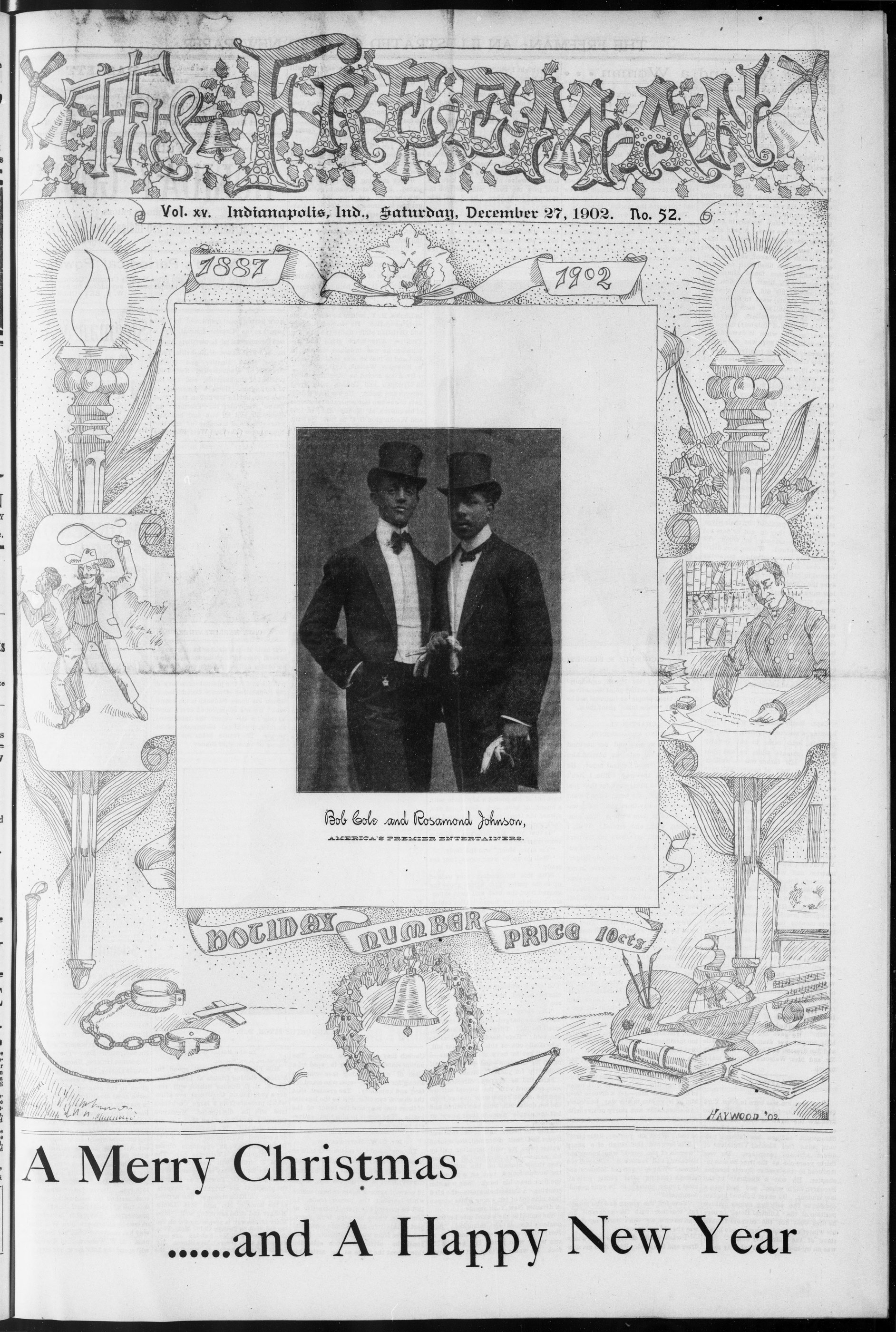
OUR HOLIDAY NUMBER!
THE FREEMAN
A NATIONAL
ILLUSTRATED COLORED NEWSPAPER
VOLUME XV.
NUMBER 52.
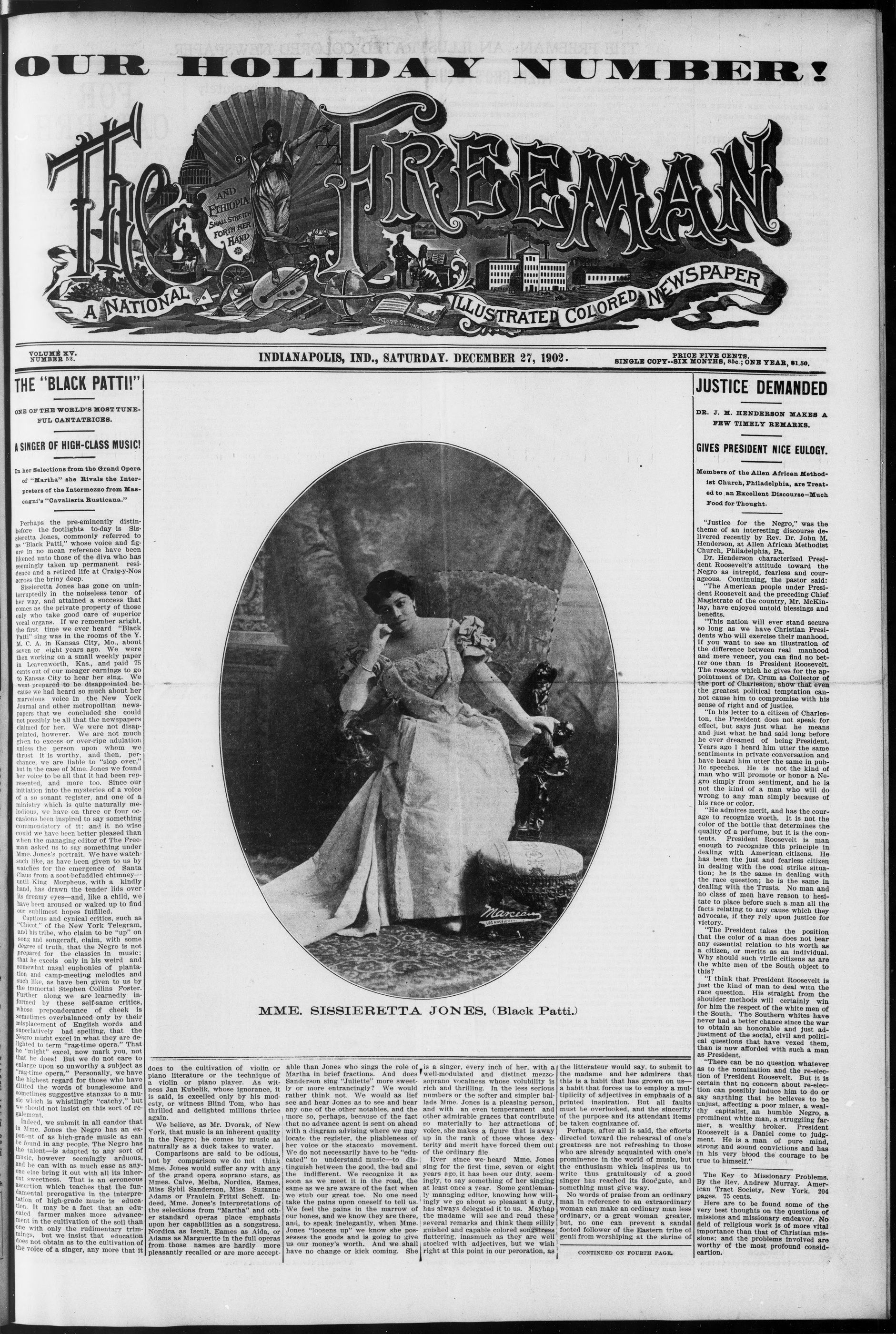
THE "BLACK PATTI!"
ONE OF THE WORLD'S MOST TUNE
FUL CANTATEIOS.
A SINGER OF HIGH-CLASS MUSIC
In her Selections from the Grand Opera of "Martha" she Rivals the Interpreters of the Intermezzo from Mascagni's "Cavalleria Rusticana."
Perhaps the pre-eminently distin
before the footlights to-day is Sissi
eretta Jones, commonly referred to
as "Black Patti," whose voice and figure in no mean reference have been likened unto those of the diva who has seemingly taken up permanent residence and a retired life at Craig-y-Nos across the briny deep.
Sissieretta Jones has gone on uninterrupted in the noiseless tenor of her way, and attained a success that comes as the private property of those only who take good care of superior vocal organs. If we remember aright, the first time we ever heard "Black Patti" sing was in the rooms of the Y. M. C. A. in Kansas City, Mo., about seven or eight years ago. We were then working on a small weekly paper in Leavenworth, Kas, and paid 75 cents out of our meager earnings to go to Kansas City to hear her sing. We went prepared to be disappointed because we had heard so much about her marvelous voice in the New York Journal and other metropolitan newspapers that we concluded she could not possibly be all that the newspapers claimed for her. We were not disappointed, however. We are not much given to excess or over-ripe adulation unless the person upon whom we thrust it is worthy, and then, perchance, we are liable to "slop over," but in the case of Mme. Jones we found her voice to be all that it had been represented, and more too. Since our initiation into the mysteries of a voice of a so sonant register, and one of a ministry which is quite naturally meodious, we have on three or four occasions been inspired to say something commendatory of it; and it no wise could we have been better pleased than when the managing editor of The Freeman asked us to say something under Mme Jones's portrait. We have watch such like, as have been given to us by watches for the emergence of Santa Claus from a soot-buffled chimney—until King Morpheus, with a kind hand, has drawn the tender lids over its dreamy eyes—and, like a child, we have been aroused or waked up to find our sublimest hopes fulfilled.
Captions and cynical critics, such as "Chicot" of the New York Telegram, and his tribe, who claim to be "up" on song and songcraft, claim, with some degree of truth, that the Negro is not prepared for the classics in music; that he excels only in his weird and somewhat nasal euphonies of plantation and camp-meeting melodies and such like, as have been given to us by the immortal Stephen Collins Foster. Further along we are learnedly informed by these self-same critics, whose preponderance of cheek is sometimes overbalanced only by their misplacement of English words and superlatively bad spelling, that the Negro might excel in what they are delighted to term "rag-time opera." That he "might" excel, now mark you, not that he does! But we do not care to enlarge upon so unworthy a subject as "rag-time opera." Personally, we have the highest regard for those who have dittied the words of bunglesome and sometimes suggestive stanzas to a music which is whistlingly "catchy," but we should not insist on this sort of regalement.
Indeed, we submit in all candor that in Mine, Jones the Negro has an exponent of as high-grade music as can be found in any people. The Negro has the talent—is adapted to any sort of music, however seemingly arduous, and he can with as much ease as anyone else bring it out with all its inherent sweetness. That is an erroneous assertion which teaches that the fundamental prerogative in the interpretation of high-grade music is education. It may be a fact that an educated farmer makes more advancement in the cultivation of the soil than one with only the rudimentary trimming, but we insist that education does not obtain as to the cultivation of the voice of a singer, any more that it
MME. SISSIERETTA JONES (Black Patti)
does to the cultivation of violin or piano literature or the technique of a violin or piano player. As witness Jan Kubelk, whose ignorance, it is said, is excelled only by his modesty, or witness Blind Tom, who has thrilled and delighted millions thrice again.
We believe, as Mr. Dvorak, of New York, that music is an inherent quality in the Negro; he comes by music as naturally as a duck takes to water.
Comparisons are said to be odious, but by comparison we do not think Mme. Jones would suffer any with any of the grand opera soprano stars, as Mmes. Calve, Melba, Nordica, Eames, Miss Sybil Sanderson, Miss Suzanne Adams or Fraunel Fritzl Scheff. Indeed, Mme. Jones's interpretations of the selections from "Martha" and other standard operas place emphasis upon her capabilities as a songstress. Nordica as Iseult, Eames as Aida, or Adams as Marguerite in the full operas from those names are hardly more pleasantly recalled or are more accept-
INDIANAPOLIS, IND., SATURDAY. DECEMBER 27, 1902.
MME. SISSIERETTA JONES. (Black Patti.)
able than Jones who sings the role of Martha in brief fractions. And does Sanderson sing "Juliette" more sweetly or more entrancingly? We would rather think not. We would as lief see and hear Jones as to see and hear any one of the other notables, and the more so, perhaps, because of the fact that no advance agent is sent on ahead with a diagram advising where we may locate the register, the pliableness of her voice or the staccato movement. We do not necessarily have to be "educated" to understand music—to distinguish between the good, the bad and the indifferent. We recognize it as soon as we meet it in the road, the same as we are aware of the fact when we stub our great toe. No one need take the pains upon oneself to tell us. We feel the pains in the marrow of our bones, and we know they are there, and, to speak ineglegantly, when Mme. Jones "loosens up" we know she possesses the goods and is going to give us our money's worth. And we shall have no change or kick coming. She
is a singer, every inch of her, with a well-modulated and distinct mezzo-soprano vocalness whose volubility is rich and thrilling. In the less serious numbers or the softer and simpler ballads Mime. Jones is a pleasing person, and with an even temperament and other admirable graces that contribute so materially to her attractions of voice, she makes a figure that is away up in the rank of those whose dexterity and merit have forced them out of the ordinary file.
Ever since we heard Mme. Jones sing for the first time, seven or eight years ago, it has been our duty, seemingly, to say something of her singing at least once a year. Some gentlemanly managing editor, knowing how willingly we go about so pleasant a duty, has always delegated it to us. Mayhap the madame will see and read these several remarks and think them sillyly guished and capable colored songstress flattering, inasmuch as they are well stocked with adjectives, but we wish right at this point in our peroration, as
the litterateur would say, to submit to the madame and her admirers that this is a habit that has grown on us—a habit that forces us to employ a multiplicity of adjectives in emphasis of a printed inspiration. But all faults must be overlooked, and the sincerity of the purpose and its attendant items be taken cognizance of.
Perhaps, after all is said, the efforts directed toward the rehearsal of one's greatness are not refreshing to those who are already acquainted with one's prominence in the world of music, but the enthusiasm which inspires us to write thus gratuitously of a good singer has reached its floorgate, and something must give way.
No words of praise from an ordinary man in reference to an extraordinary woman can make an ordinary man less ordinary, or a great woman greater, but, no one can prevent a sandal footed follower of the Eastern tribe of genii from worshipping at the shrine of
CONTINUED ON FOURTH PAGE.
JUSTICE DEMANDED
DR. J. M. HENDERSON MAKES A FEW TIMELY REMARKS.
GIVES PRESIDENT NICE EULOGY.
Members of the Allen African Methodist Church, Philadelphia, are Treated to an Excellent Discourse—Much Food for Thought.
"Justice for the Negro," was the theme of an interesting discourse delivered recently by Rev. Dr. John M. Henderson, at Allen African Methodist Church, Philadelphia, Pa.
Dr. Henderson characterized President Roosevelt's attitude toward the Negro as intrepid, fearless and courageous. Continuing, the pastor said: "The American people under President Roosevelt and the preceding Chief Magistrate of the country, Mr. McKinlay, have enjoyed untold blessings and benefits.
"This nation will ever secure so long as we have Christian Presidents who will exercise their manhood. If you want to see an illustration of the difference between real manhood and mere veneer, you can find no better one than is President Roosevelt. The reasons which he gives for the appointment of Dr. Crum as Collector of the port of Charleston, show that even the greatest political temptation cannot cause him to compromise with his sense of right and of justice.
"In his letter to a citizen of Charleston, the President does not speak for effect, but says just what he means and just what he had said long before he ever dreamed of being President. Years ago I heard him utter the same sentiments in private conversation and have heard him utter the same in public speeches. He is not the kind of man who will promote or honor a Negro simply from sentiment, and he is not the kind of a man who will do wrong to any man simply because of his race or color.
"He admires merit, and has the courage to recognize worth. It is not the color of the bottle that determines the quality of a perfume, but it is the contents. President Roosevelt is man enough to recognize this principle in dealing with American citizens. He has been the just and fearless citizen in dealing with the coal strike situation; he is the same in dealing with the race question; he is the same in dealing with the Trusts. No man and no class of men have reason to hesitate to place before such a man all the facts relating to any cause which they advocate, if they rely upon justice for victory.
"The President takes the position that the color of a man does not bear any essential relation to his worth as a citizen, or merits as an individual. Why should such virile citizens as are the white men of the South object to this?
"I think that President Roosevelt is just the kind of man to deal with the race question. His straight from the shoulder methods will certainly win for him the respect of the white men of the South. The Southern whites have never had a better chance since the war to obtain an honorable and just adjustment of the social, civil and political questions that have vexed them, than is now afforded with such a man as President.
"There can be no question whatever as to the nomination and the re-election of President Roosevelt. But it is certain that no concern about re-election can possibly induce him to do or say anything that he believes to be unjust, affecting a poor miner, a wealthy capitalist, an humble Negro, a prominent white man, a struggling farmer, a wealthy broker. President Roosevelt is a Daniel come to judgment. He is a man of pure mind, strong and sound convictions and has in his very blood the courage to be true to himself."
The Key to Missionary Problems, By the Rev. Andrew Murray. American Tract Society, New York. 204 pages. 75 cents. Here are to be found some of the very best thoughts on the questions of missions and missionary endeavor. No field of religious work is of more vital importance than that of Christian missions; and the problems involved are worthy of the most profound consider-ation.
Three Men and a Woman ees
2 —————_——
‘AN UP-TO-DATE OHRISTMAS STORY;
BUILT UPON THE ROOK OF FAOT.
By Augustus M. Hodges (B. Square)--Author of “Fred Jackson Vow,” “Maia
and Mistress.” “Twos Not to Be,” “A Step Mother's Story,” “What Hap-
pened to Scott.” Bet.
CHAPTER II. no better and no worse than the aver
‘THE “HUSBAND.” lew ‘man, black or white.
Clarence Watson was a native of New
‘York City, a printer by trade—a mem:
ber of the “big six,” and an employe
upon one of the leading New York City
morning newspapers at the time of our
opening. He was one of Greater New
York's bread winnere, who put all con.
fidence in bis wife's honesty in keeping
of her marriage vows. A year after—
twelve moaths of happy married {ife—
there was a “strike” upon the paper
upon which he worked, and the print-
ers’ places were filled with non union
men, and Watson found himself “on
the town” with house rent due, His
wite came to his aid, and for several
days (and nights) went to see her rela-
tives (eo she eaid) and each time “*bor-
rowed” two or fivedollars. They lived
on the “borrowed” (nightly) money for
several months, when it dawned upon
‘Watson that bis wife was not getting
the money from her relatives. He had
by this tlme got used toa life of easy
living; in which he had his house rent
paid, plenty to eat, plenty to drink and
money in his pocket to spend.
‘We all recall the story about the
Quaker who told his son : “My son, thee
must have money to get slong in this
world; get it honestly if thou canst,
at—get it.” Clarence Watson soon
Decame a student of this school of phil-
osophy. When he asked his wife for
two or five dollars and she handed it to
him, he aid not ask her where or in
what way she got it. In all large cities
in the North and West the majority of
the men are bread winners—sons of
toll—etill there is also a large minority
who “‘toll not, neither do they spin,”
yet they have all the gocd (and bad)
things of life provided by their wives’
earnings, and they do not or dare not
question the manner in which the
money was earned. Watson soon drift-
ed into this class, and when the strike
was over and the union printers re-
turned to their cases, he failed to an-
swer the roll call. He informed bis fel-
low workmen that he was living on
“Easy street,” and was out of the bust-
ness. He became a full fledged “sport,”
“splayed the races” and ‘‘poker” upon
the money his wife gave bim. When s
woman gets a man to this degree she
(womanlike) rales bim with an iron
hand. When Mrs. Watson wanted him
to go out for the night, she ordered him
out, and—he went. When she wanted
him to stay in the house, she ordered
him to stay, and{he did eo.
OHAPTER IV.
‘THE “OLD MAN.”
Capt. Harry Seabergh was, at our
opening, a man of sixty-four, a German
by birth, wko came to this country
with his parents when he was four
years old. His father was a civil en-
gineer and a man of money, who gave
his son 8 good high school education
and then gent him to Yale, where he
graduated with honors, His father
died the day the son was twenty-one,
‘and the mother six months later.
Young Seabergh possessed his father’s
wealth, whlch he invested in Brooklyn
real estate, which paid him about three
hnndred per cent. He went tothe
Civil war a captain in Co. O, 99th N.
Y. Vol,and was a bravesoldler. He
married and was the father of six
daughters, five of whom were married
at the date of the opening of this story,
‘and all of them older than ‘‘the woman
in the case.” His wife, who had been
helpless invalid for three years, died
seven months before the beginning of
this romance. He knew she was dying
and went after @ doctor, met Ella Wat-
son, flirted with her and took her to the
«‘Admtral Cafe” and bought her a ‘wine
supper.” When he returned his wife
was dead. It has often been sald by
women in ® position to know, that “an
old fool 1s the worst fool of all,” and
Capt. Seaburgh was a living proof that
the statement was true to the letter
In the language of the street, Ella
Watson “worked him for all he was
worth.” He.gave her hundred dollar
ills, bought her diamonds and pearls
and fine dresses, and kept the wolf from
‘Mr. and Mrs, Wateon's door for meny
onion
CHAPTER V.
THE “WAITER.”
Jerry Stratton was born in New York
City, where bis father and mother aleo
first saw the light of day. His moth-
er’s maternal parents were Long Island
Shinneoook indians, bis father’s par-
ents being fool blooded Virginians of
direct African parentage. He was
thirty years old at the time he was in
troduced to the reader in our opening
chapter. He was:-8 graduate of the
Brooklyn high school, and had been a
Jaw student. He never finished his law
course, as the alluring money making
position at the “Admiral Hotel” (where
he first went for the summer to earn
his winter’s school money) made him a
elave of the “almighty dollar.” He
was an up-to-date New York City man,
THE FREEMAN: AN ILLUSTRATED COLORED NEWSPAPER.
‘4 ae
eae Ce EN
ne
2 pee) UE
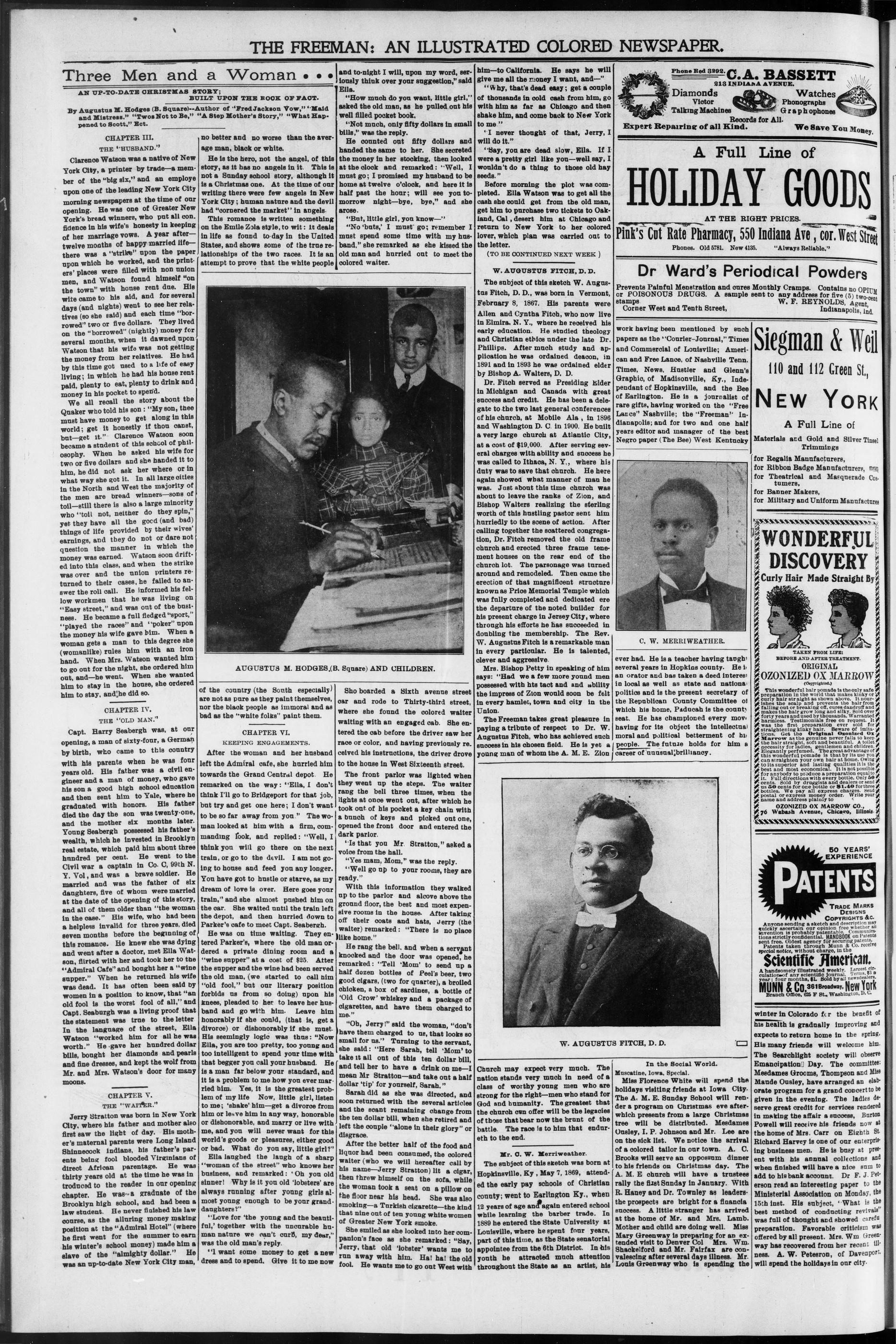
AUGUSTUS M. HODGES,(B. Square) AND CHILDREN.
no better and no worse than the aver-
‘age man, black or white,
‘He is the hero, not the angel, of this
story, as it has no angels init. This ie
nota Sunday school story, although it
isa Christmas one. At the time of our
writing there were few angels in New
York City; human nature and the devil
had “cornered the market’ in angels.
‘This romance is written something
on the Emile Zola style, to wit: 1t deale
in life as found to-day in the United
States, and shows some of the true re-
lationships of the two races. It is an
attempt to prove that the white people
of the country (the South especially)
are not as pure as they paint themselves,
nor the black people as immoral and as
bad as the “white folks” paint them.
CHAPTER VI.
KEEPING ENGAGEMENTS.
After the woman and her husband
left the Admiral cafe, she hurrled him
towards the Grand Central depot. He
remarked on the way: “Ella, don’t
think I'll go to Bridgeport for that job,
‘but try and get one here; I don't want
to be so far away from yon.” The wo:
man looked at him with @ firm, com:
manding fook, and replied: ‘Well, ]
think yon will go there on the next
train, or goto the devil. I am not go:
ing to house and feed you any longer.
‘You have got to hustle or starve, as my
dream of love is over. Here goes your
train,” and she almost pushed him on
the car. She waited until the train left
the depot, and then burried down tc
Parker’s cafe to meet Capt. Seabergh.
He was on time waiting. They en
tered Parker's, where the old man or
dered a private dining room and s
“wine supper” at a cost of $25. Atter
the supper and the wine had been served
the old man, (we started to call nix
“old fool,” but our literary position
forbids us from so doing) upon hi
imnees, pleaded to her to leave her hus
band and gowith him. Leave hin
honorably if she could, (that is, gets
divorce) or dishonorably if she mast
His seemingly logic was thus: “Now
Ella, you are too pretty, too young an¢
too intelligent to spend your time witt
that begger you call yourhusband. Hi
isa man far below your standard, an¢
{ts « problem to me how yon ever mar
ried bim. Yes, it is the greatest prob
lem of my life Now, little girl, lister
to me; ‘shake’ him—get a divorce fron
him or le»ve him in any way, honorabl
or dishonorable, and marry or live wit
me, and you will never want for thi
world’s goods or pleasures, either good
or bad, What do you say, little girl?
Ella langhed the laugh of a shart
‘‘woman of the street” who knows her
business, and remarked: ‘Oh yon ol
sinner! Why je it you old ‘lobsters’ ar
always running after young girls al
most young enongh to be your grand
daughters?”
“Love for ‘the young and the beauti
ful,’ together with the uncurable hu
man nature we can’t curb, my deur,
was the old man’s reply.
“| want come money to get ener
dress and to spend. Give it to me now
ne to-night I will, upon my word, ser-
fously think over your suggestion,” said
Ella.
“How much do you want, little girl,”
‘asked the old man, as he pulled out hi
well filled pocket book,
“Not much, only fifty dollars in smal
bills,” was the reply.
He counted out fifty dollars an¢
handed the same to her. She secreted
the money in her stocking, then looked
at the clock and remarked: “Well, I
must go; I promised my husband to be
home at twelve o'clock, and here it ts
half past the hour; will see yon to:
morrow night—bye, bye,” and she
arose.
“But, little girl, you know—"
“No ‘bate, I must’ go; remember ]
must spend some time with my hus
band,” she remarked as she kissed the
old man and hurried ont to meet the
colored waiter.
Sho boarded @ Sixth avenue street
car and rode to Thirty-third street,
where she found the colored waiter
waiting with an engaged cab. She en-
tered the cab before the driver saw her
race or color, and having previously re.
ceived his instructions, the driver drove
to the house in West Sixteenth street.
The front parlor was lighted when
they went up the steps. The waiter
rang the bell three times, when the
lights at once went out, after which he
took out of his pocket a key chain with
abunch of keys and picked ont one,
opened the front door and entered the
dark parlor.
‘Is that you Mr. Stratton,” asked a
voice from the hall.
“Yes mam, Mom,” was the reply.
“Well go up to your rooms, they are
ready.”
With this information they walked
up tothe parlor and alcove above the
ground floor, the best and most expen-
sive rooms in the house. After taking
off their coats and hate, Jerry (the
waiter) remarked: “There is no place
Ditke home.”
He rang the bell, and when a servant
knocked and the door was opened, he
remarked: ‘Tell ‘Mom’ to send up a
half dozen bottles of Peel's beer, two
good cigars, (two for quarter), a brotled
chicken, a box of sardines, a bottle of
‘Old Crow’ whiskey and a package of
cigarettes, and have them barged to
me.”
“Ob, Jerry!” said the woman, “don’t
have them charged to ue, that looks so
small for us.’ Turning to the servant,
she sald: “Here Sarah, tell ‘Mom’ to
take it all ont of this ten dollar bill,
and tell her to have @ drink on me—l
mesn Mr Stratton—and take ont a half
dollar ‘tip’ for yourself, Sarah,”
Sarah did as she was directed, and
soon returned with the several articles
and the scant remaining change from
the ten dollar bill, when she retired and
left the couple “alone in their glory” or
disgrace.
After the better half of the food and
Nquor had been consumed, the colored
waiter (who we will hereafter call by
his name—Jerry Stratton) it a cigar,
then threw himself on the sofa, while
the woman took a seat on a pillow on
the floor near bis head. She was alec
smoking—a Turkish cigarette—the kind
that nine ont of ten young white women
of Greater New York smoke.
She emiled as she looked into her com:
Panton’s face as she remarked: “Say,
Jerry, that old ‘lobster’ wants me tc
run away with him. Ha! ha! the old
fool. He wants meto go out West with
him—to California. He says he will
give me all the money I want, and—”
“Why, that's dead easy; get a couple
of thousands in cold cash from him, g¢
with him as fer as Chicago and ther
shake him, and come back to New York
to me.”
“I never thought of that, Jerry, 1
will do it.”
“Say, you are dead slow, Ella. If]
were a pretty girl ike you—well say, |
wouldn't do a thing to those old hay
seeds.”
Before morning the plot was com
pleted. Ells Watson was to get all the
cash she could get from the old man,
get him to purchase two tlokets to Oak-
tand, Cal, desert him st Chicago and
return to New York to her colored
lover, which plan was carried ont tc
the letter.
(TO BE CONTINUED NEXT WEEK )
W. AUGUSTUS FITCH. D.D.
The subject of this sketch W. Augus-
tas Fitch, D. D., was born in Vermont,
February 8, 1867, His parents were
Allen and Cyntha Fitch, who now live
in Elmira, N. Y., where he received hic
early education. He studied theology
and Christian ethics under the late Dr.
Phillips. After much etudy and ap-
Plication he was ordained deacon, in
1891 and in 1893 he was ordained elder
by Bishop A. Walters, D, D.
Dr, Fitch served as Presiding lider
in Michigan and Canada with great
success and credit. He has been a dele-
gate to the two last general conferences
ofhis church, at Mobile Ala, in 1396
and Washington D. C. in 1900. He built
avery large church at Atlantic City,
at a cost of $19,000. After serving eev-
eral charges with ability and success he
was called to Ithaca, N. ¥,, where his
duty was to save that church. He here
again showed what manner of man he
was. Jost about this time church was
about to leave the ranks of Zion, and
Bishop Walters realizing the sterling
worth of this hustling pastor sent him
hurriedly to the scene of action. After
calling together the scattered congrega-
tion, Dr. Fitch removed the old frame
church and erected three frame tene-
ment houses on the rear end of the
church lot. The parsonage was turned
around and remodeled. ‘Then came the
erection of that magnificent structure
known as Price Memorial Temple which
was fully completed ard dedicated ere
the departure of the noted builder for
his present charge in Jersey City, where
through his efforts he has succeeded in
doubling the membership. The Rev.
‘W. Augustus Fitch is a remarkable man
in every particular. He is talented,
clever and aggressive.
‘Mrs. Bishop Petty in speaking of him
says: ‘Had wea few more yound men
possessed with hts tact and and ability
the impress of Zion would soon be felt
in every hamlet, town and city in the
Union.
The Freeman takes great pleasure in
paying atribute of respect to Dr. W.
Augustus Fitch, who has achieved such
success in his chosen field. He is yet a
young man of whom the A. M. E. Zion
oe ic}
- =
sa
)
| fea
oe of s
ih OS ae
Ly i=
nee ‘e
a ae
‘W. AUGUSTUS FITCH, D. D.
Church may expect very much. The
nation stands very much in need of a
class of worthy young men who are
strong for the right—men who stand for
God snd bumanity. The greatest that
the church cvn offer will be the legacies
of those that bear now the brant of the
battle. The race is to him that endar-
eth to the end.
‘Mr. 0. W. Merriweather.
‘The subject of this sketch was born at
Hopkinsville, Ky , May 7, 1869, attend-
ed the early pay schools of Christian
county; went to Earlington Ky., when
12 years of age and'again entered school
while learning the barber trade. In
1889 he entered the State University at
Louisville, where hespent four years,
part of this time, as the State senatorial
appointee from the 6th District. In his
youth he attracted much attention
throughout the State as an artist, his
ap, S="C.A. BASSETT
218 INDIANA AVENUE, s ly
Diamonds ke Watches eS
Victor Phonographs
. ‘Talking Machines Graphophones “lm
Records for All.
Expert Repairing of all Kind. We Save You Money,
—_—_—_————————
A Full Line of
AT THE RIGHT PRICES. =
ae a ata
Pink's Cot Rate Pharmacy, 590 Indiana Ave , cor. West Ste
Phones. O14 5781. New 4135. “Always Reliable,”
Dr Ward’s Periodical Powders
Prevents Painful Menstration and cures Monthly Cramps. Contains no OPIty
or POISONOUS DRUGS. A sample sent to any address for five (5) two-cent,
stamps W, F. REYNOLDS, Agent
Corner West and Tenth Street, Indianapolis, ina,
work having been mentioned by such
papers as the * Courier-Journal,” Times
‘and Commercial of Lonisvilie; Ameri-
can and Free Lance, of Nashville Tenn.
Times, News, Hustler and Glenn's
Graphic, of Madisonville, Ky., Inde-
pendant of Hopkinsville, and the Bee
of Earlington. He is a journalist of
rare gifte, having worked on the “Free
Lance” Nashville; the “Freeman” In-
Alanapolis; and for two and one half
years editor and manager of the best
‘Negro paper (The Bee) West Kentucky
eo ee
Fe ea
boo ER ie
fees Boosie j
|) ee.
ee.
ates 4 eS x
= Xe
1
©, W. MERRIWEATHER.
ever had. He isa teacher having tavgb’
several years in Hopkins county. Het:
an orator and bas taken a deed interes!
in local as well as state and nations:
politics and is the present secretary o!
the Republican County Committee of
which his home, Paducah is the county
seat. He has championed every mov:
having for its object the intellectua
moral and political betterment of by
people. The futuie holds for him ¢
career of nuusnualjbrilliancy.
In the Social World.
Muscatine, lowa, Special.
Miss Florence White will spend the
holidays visiting friends at Iowa City.
The A. M. E, Sunday School will ren-
der a program on Christmas eve after.
which presents from a large Christmas
tree will be distributed. Meedamee
Onsley, I. P. Johnson and Mr. Lee are
on the sick list. We notice the arrival
of a colored tailor in our town. A. C.
Brooks will serve an opossum dinner
to his friends on Christmas day. The
A.M. E church will have a trustees
rally the fizst Sanday in January. With
R. Haney and Dr. Townley a3 leaders:
the prospects are bright for a floancia
success. A little stranger has arrived
atthe home of Mr. and Mre. Lamb.
Mother and child are doing well. Miss
Mary Greenway is preparing for an_ex
tended vistt to Denver Col Mrs. Wm
Shackelford and Mr. Fairfax are con-
valescing after several days illness. Mr.
Lonls Greenway who is spending the
Siegman & Wei
{10 and 112 Green St,
A Full Line of
Materials and Gold and Silver Tins
Trimmings
for Regalia Manufacturers,
for Ribbon Badge Mannfacturere, t=
fs Theatrical and Masquerade Cos.
meant
_ Banner Makers,
for Military and Uniform Manofacture
: LISLE SALSLALSEEAS SY 2,
; j
Curly Hair Made Straight By}
Sa Ec
eee 4
4 =
TAREE Fnow TE
sarons Ax Aran TREATIFY
ORIGINAL
OZONIZED OX MARROW3
Copyright) Z
srs rondere bars noel ate
Sire eects tauanie yaar
filed tae sentleheag prirtins tne nate tag
Becca aera manent cad
ERLDGe sient ag sou sald et
ener caesna ror ets wat aca
Sooziesr Reet Tease ene
Bacal git tocuioc cree afer
Tieng uSiPhate acute of i
ESET Site Deiatnnt Osetra Ox
aaa
‘the hair straight, Soft and beautiful. A toilet #
Secale asic gate a fe
Siegen oer, anata est
Sean preriae We eta s ue To
sae remit four en hair ac Home, Sei
fohssapiior Ae" guis ess
Hae rarer eaeateat Teienet yoni
Fares ee ert option Sat
a nals eed epee a aialan tet
Boor coal 1 cea eit wk fora
Beet Pal aN exercee changes” Seal
er ea tee i
jae ties aise |
OZONIZED OX MARROW cO., |
76 Wabash Avenue, Chicago, lilloois. ;
SXKAKAKAKRAANAARASE ANE
60 YEARS’
EXPERIENCE
‘Trape Manns
Desians,
Copyrichts &.
Anyone sending a sketch and description my
quidigr ascertain’ our opinion free wheter At
Miventlon ts probably paentable, Communica
tlonaatrietly eonsdential. HANDBOOK on Fa'enté
sont free, Oldest agency for necurina paicsts
Pavents taken trough Munn. & Co. retire
spectal notice, without charge, 1n he,
Scientific American,
disiome any geertitg urns! Teme
eat our months, GL. Bold by all renduales.
MUNN & Go,2e%erus New York
Branch Ofoe, 62% F St, Wasbingwo0, D.C
winter in Colorado fcr the benefit of
Ais health te gradually improving std
expects to return home in the spring:
‘His many friends will welcome bin.
The Searchlight soclety will observ?
Emancipation’) Day. The committe:
‘Meedames Grooms, Thompson and Mis
Maude Ousley, have arranged an lst
orate program for a grand concertto be
given in the evening. The ladies a
serve great credit for services rendered
in making the affair a euocese, Burton
Powell will receive his friends now st
the home of Mrs. Carr on Eizath &
Richard Harvey is one of our enterprit
ing business men. He is busy at pre
ent with his annnal collections az
when finished will haves nice sam 1
add to hisbank account. Dr F. J. Pet
erson read an interesting paper to tht
‘Ministerial Association on Monday, th?
15th inst. His subject, “What is the
best method of conducting revivals”
was fall of thought and showed c:refa
preparation. Favorable criticism w
offered by all present. Mrs. Wm (ree
way has recovered from her recent tl
ness. A. W. Petesron, of Davenpor'
‘will spend the holidays in onr city:
THE WAITER
THE W
BILL' FARMS
nia
we
hot
wh
and
mu
effi
wa
fess
Loc
T
cre
ing
Clo
The institution of matrimony, old as the sun, yet ever new, will never lose its charm. Friends of the happy brides and grooms have, since the world was young, gathered together to celebrate the nuptial rites with joy and merriment, and it will ever be so. Thus today a large party of friends and relatives assembled at the residence of Mr. and Mrs. Andrew Lohr, 2710 Walnut street, to witness the marriage of their daughter, Rose Sidonye, to Mr. Frank Prentiss Ayer of Elizabeth, N.J. After congratulations the entire party parook of luncheon served at flower decorated tables arranged in the living and dining rooms, each table seating twelve persons. Candelabra daintily shaded shed a soft glow upon the pretty scene. L.P. Parker & Co., of the Halliday, were the caterers, and a corps of servants under the direction of the capable Alonzo Locke served an eight course luncheon composed of many epicurean viands, during which time happy conversation was enjoyed and "all went merry as a marriage bell."—Cairo (Ill.) Evening Citizen.
The above article appeared in the Citizen some time ago, but has just fell into our hands accidently, and, being of much interest to the readers of this department, we reproduce it. Mr. W. A. Locke, who served the luncheon, is quite modest, and never seeks publicity, therefore he failed to send us a copy of the above article. Mr. Locke is an accomplished artist in his line, and has
BUSINESS MEDIUM.
MRB, MARTH, the world renowned and highly celebrated business and test MEDIUM reveals everything. No imposition. Can be and marriage is a speciality. Business love and Marriage are specialities revailed, so of absent, deceased and Living friends. Removes all troubles and estrangement. Removes alledium who can expect her in her startling event in one's life. Remembr her, she will not, for any price, flatter you; you present and future event in one's life. Remembr her, she will not, for any price, flatter you; you present and future event in one's life. She can be consulted on all affairs of Life, Love, Courtship, Marriage, Friends in her description of future companion she has in life. She can be consulted on friends, enemies, etc. Her advice upon stock, change in business, journeys, lausuite consulted walls, divorce and speculation is valiant, destiny good or bad; she withholds nothing.
MRS. MARTH tells your entire life—part, present and future—in a DEAD TRANSE, has given you two mediums you ever met. In tests she tells you how to fore嫁riage, the names of all your family, their ages and description, the name and business of your future husband, the name of your next husband, the name of your young man who now calls on you, the name of your future husband, and the day, month and year of your marriage—how many children you have or will have single; whether your present sweetheart will be true to you and if he will marry you; if you have no sweetheart, she will tell you when you will be married; this name YOUR FUTURE will be told in an honest, clear, plain manner and in aance. Mothers should know the success of their hands and children, young ladies should know how your heart or in-ended husbands. Do not keep company, marry or go into business until you are married, or religious sorrows prevent your consulting.
Madame is the only one in the world who can tell you the FULL NAME of your future husband and date of marriage tells you whether you
It takes a great deal of study to become an accomplished Medium, and by a continuous and meticulous effort you to the well of parents and术使able institutes has been procured by MRS. MARTH for the benefit of humanity. By letter, advice $1.00. Hours from 10 a.m. to 9 p.m. All letters must contain sta ps for answers.
MRS. M. B. M. ARTH
246 W. 31st St. New York City.
THE FREEMAN: AN ILLUSTRATED COLORED NEWSPAPER
done much, and is doing much to elevate both the head and side waiters. At the Halliday he is loved and respected by all, and his word and advice has more weight than any other employee of the hotel. It is articles like the above. when appearing in papers published and read by white citizens, that reflects much credit upon the capabilities and efficiency of the colored head and waiters. We only wish that the profession had a few more like W. Alonzo Locke
The following are the names of the crew at the Grand Central hotel, Wheeling, W. Va., which has just opened: Cloud L. Galter, headwaiter; George Galter, captain; James T. J. nes, Geo. Jones Frank Woodson, Lewis Thompson and Alex Verse. These are all life long pupils of the McLure except Mr. Verse, who is from the Windsor hotel.
William Parker is the headwaiter at the new Illinois hotel recently opened up at Bloomington, Ill. Mr. Parker hails from Springfield, Ill.
Edward Heggin, formerly headwaiter at the Hotel Fey, is and has been headwaiter at the Country Club, Peoria, Ill, for the past two years.
The recent change of management at the Plankinton, Milwaukee, Wis., will in no wise affect J·J. Miles as headwaiter.
W. Forrest Cozart has succeeded Mr. Burt Maning at the Hotel Fey, Peorla, Illinois.
Some Chicago Pick-Ups.
Chicago, Ill., Special.—Miss E Furgerson of St. Louis, Mo., is expecting to go to Galveston, Texas, the first of the year. J. Greene, one of the Hotel Windemere waiters, had quite an exciting time, says one of the boys at the Windemere, while out on a pleasure bend, and at a late hour of the night was held up by two unknown parties and relieved of his overcoat and pocket change. I guess Mr. Greene will stay in for a few zeros. F. C. Long, one of our old reliable headwaiters, is yet holding things down pat at the Windemere hotel. He don't think the Chicago Walters' Union trying to join the white and colored waiters together will amount to much because, if the colored waiters all join the union, the hotel managers may draw the color line like they did in 1898, and I and Mr. Long think it best to keep out of it until we see we cannot accomplish anything unless we do join. Of course the union is all right, but I do not believe we, as colored waiters, would be well supplied with hotel jobs like the white, so I guess it is best for my brother waiters to be beware of the sham battle.
News from Utah.
Salt Lake City, Utah, Special — One of the grandest receptions of the season was given Friday, Dec 12, 1902, by the Knutsford waiters. The affair was at Harmonic hall. The gowns worn by the ladies were the swellest ever worn at any social function in Salt Lake city before. The gentlemen all wore full dress suits. The occasion will long be remembered by those present. The entertainer for the evening was Thomas Frame. The committee of arrangements consisted of H. C. Jackson, F. Burton, G. Simmons, T. S Taylor, G. White, H. Jenkins, W. White and J. W. Durham. The reception committee consisted of A. G. Calloway, W. H. Banks, Lawson Tyers, Chas. McGwine, J E W. Lindsey, W. H. Brown and S. Williams. The floor committee consisted of A. Burness, B. Rice, M. E Reeves and W. Russell. Ice cream and punch were served in the ante-room throughout the evening. Rev. Washington of Calvary Baptist church has left on a visit.
M. B. B.
Happenings in Alabama.
HAPPENING IN ABUDA.
Selma Ala, Special—Bev. and Mrs.
J. S. Gilliam, of Leland Miss., passed through the city en route home, from Montgomery, where Mrs. Gilliam had been for three months to visit relatives and improve in health. While in the city they were the guests of Mr. and Mrs. W. L. Gilliam, 207 Broad St. Ru mor has that we are to be treated to a Christmas wedding. Can you guess who? Zion A. M. E. conference convened in this city last week and there were many familiar faces seen in the city. Rev. W. H. Nixon has about completed his new book and will soon show it on the market. This book should receive the hearty support of not only his own members but all intelligent people. Remember the poor while making merry for Christmas. The social event of the week was the annual social session of the F. H. Weaver Lodge B. P. O Elks, at their hall. Covers were laid for 60 or more.
Subscribe for The Freeman.
The Greathouse
The Freeman in Hot Springs, Ark.
Copies of the Freeman can be found every day at Johnson Brox, shaving parlor, 101 Malvern F. Ferry F. Foster general agent. 38 Asen street.
220 Indiana Avenue,
INDIANAPOLIS, INDIANA.
Choice Liquors, Wines and
Cigars
Trade Solicited on Merit of Goods
Pool and Billiard Parlors.
.....New'Phone 3026
Prop. ARCHIE GREATHOUSE
Send $1.50 for yearay s u : ption to The Freeman, the leader of NEG journals.
233, 235, 237 Massachusetts Avenue.
18, 20, 24 N, New Jersey Street.
Tomlinson Hall Market
Mike Wells' Place
In a Box for 10 cents.
THE
PICTO
SHOWS THE
RES
USING
Toil
SHOWS THE RESULT OF USING OUR Toilets:
WHY HAVE KINKY STUBBY HAIR when Hairloeum will make it straight, silky and long. Hairloeum all sizes hair straight, long and wavy. Nothing like it ever sold before and your toilet is not complete. It highly perfumed. Send us 50c and we will send you one, keep it on the turn mail. Get Hairloeum, take no substitute. Do you want a fine peach-like complexion? If you wear a large size box of our Cream-o. It removes oil from blackheads, liver patches and roughness and gives you a smooth pink complexion; or for you will need one box of Hairloeum and Cream-o. Send to day. Booklet free. Agents wanted everywhere. Address
The Tiffany-Rogers Toilet Co.,
Indianapolis, Indiana, U. S. A.
ROBERT B. PARKER, Prop.
7 Indiana Phone 4257 new.
Avenue Indianapolis, Ind.
Some Men Pay
$10.000 for an expert
to manage
Toronto
who $5.00 for an annual
pay subscription to
INVITERS INK and have
all the advertisers are thinking about
But even these are not the extremes
reached. There are men who lose over
$100.000 doing net-
for sample copy send 10c to ther one.
PRINTER'S INK, 105pruce5t. New York
"THE STAR"
Shoe Shining Parlor
J. R. REED,
Proprietor,
S. W. Cor. State and
22nd Street
CHICAGO, ILL.
in basement.
A. B. B.
THE KEYSTONE,
A High Class Hotel for
GENTLEMEN ONLY.
ELECTRIC LIGHT, STEAM HEAT, HOT AND COLD BATHS.
CAFE and SAMPLE ROOM
ATTACHED.
3022 State Street,
Chicago, Ill
S. R. SNOWDEN, Proprietor.
The Denver Saloon
M. H.
Fine Wines, Liquors & Cigars
Resort for all SPORTING MEN.
Reception Room
AND
Musical Parlors
Separate from Bar.
ORIGINATOR OF THE
White and Fea her Drink
WHICH IS ALL THE RAGE
J. S. MONTGOMERY, Proprietor,
Helena, Monn.
'PHONE MONROE
——1937——
GEO. L BRAXTON,
PROPRIETOR.
BRAXTON'S PLACE
260 West Lake Street
Chicago. Ill.
If you don't see it, ask for it POOL ROOM IN CONNECTION
Hadquarters for all Sports.
FINE WINES, LIQUORS AND CIGARS.
PETER H. HARRIS
HART & HARLAN
Bnffet for Ladies and Gents
Especial attention to Railroad Men Everything strictly first class. A 2634 State St., CHI, AGO, ILL.
Popular resort of pleasure and amusement. and Hotel Boys. Our stock speaks for itself choice line of fine wine, whiskies and olgars.
[Picture of a young man in a suit].
he Jefferson Bar
GEC. S. WILLIAMS, Proprietor.
JAS. JACKSON, Entertainer.
715 Linden St., ST. LOUIS, MO
Private Reception Rooms for
Ladies and Special Parties.
NOTIOEK
Any enterprising colored man can make money in St. Louis during the great World Fair. The field is promising and offers wonde ducements to men who will offer wonde All ducements to men who will receive immediate attention by sending your communications to the bove address.
HOTEL de MOORE
71, 7 & 175 TWENTY-FIRST ST. CHICAGO. ILL.
[Name]
Furnished Rooms for Men Only
Everything Strict
Fine
Wines,
Liquors.
The Brunsw
Cigars and Tobacco.
GEO. W. HOLL
SAINT LO
Open Only Billionaire
Everything Striotly First Class
Brunswick Sale
Macco. Opposite
L. W. HOLT, Proprietor
T LOUISIANA
Furnished Rooms for Men Only Billiard Rooms in Connection Everything Strictly First Class Fine Wines, The Brunswick Saloon 1925 Market Street Liquors. Cigars and Tobacco. Opposite Union Station GEO. W. HOLT, Proprietor SAINT LOUIS, MO
TITTLE
390 S State St.,
SEND FOR C
ate St., CHICAG
SEND FOR CATALOGUE.
ARNETT'S F
ine Wines, Liquors
everything strictly first-class. A resor
polite only.
MEALS SERVED IN
prvate parties wishing to be reser ved.
E. L. ARNETT, PROP
organ Street and 805 N. 23rd Street
SENAT
390 S State St., CHICAGO, ILL. SEND FOR CATALOGUE.
ARNETT'S PLACE
Everything strictly first-class. A resort for the genteel and polite only.
E. L. ARNETT.
MEALS SERVED IN THE CAFE
also drinks of all kinds to pr vate parties wishing to be reser ved.
E. L. ARNETT, PROP.
2801 and 2803 Morgan Street and 805 N. 26rd Street, ST. LOUIS, MO.
THE SENATE
THE SENATE
HENRY JONES, Proprietor.
Reception Room and Musica
High grade Wines and L
IMPORTED CIGARS
Haardquarters for all sport
5532 Lake Avenue
Remember the Holiday Numbe
men and Musical Parlor seper-
grade Wines and Liquors always on
PORTED CIGARS, A SPECIALTY
quarters for all sporting men.
The Avenue. Chicago
Holiday Number and the
Reception Room and Musical Parlor separate from Bar High grade Wines and Liquors always on hand. IMPORTED CIGARS, A SPECIALTY Haardquarters for all sporting men. 5532 Lake Avenue. Chicago, Illinois.
Remember the Holiday Number and the Advertisers.
A. B.
BILLIARD AND POOL IN ANNEX. ENTY-FIRST ST. GO, ILL.
Williams, Chas. St. J.
Greeneley Saloon
Fine Wines, Liquors
and Cigars
alonists give us a call. Headquarters
or sports. Ask for it, you'll get it.
91 Morgan Street
ST. LOUIS, MO
Billiard Rooms in Connection
Only First Class
Brick Saloon 1925
Market
Street
Opposite Union Station
T, Proprietor
LOUIS, MO
MARCUS RUBEN
Waiters' and Cooks'
Outfits
OF EVERY DESCRIPTION
ALSO
Barbers'; Coats
Barkeepers' Coats, Vests
and Aprons
CHICAGO, ILL.
CATALOGUE.
T T'S PLACE
Liquors & Cigars
first-class. A resort for the genteel and
polite only.
SERVED IN THE CAFE
to be reser ved.
T T, PROP.
805 N. 23rd Street, ST. LOUIS, MO.
NATE
Parlor separate from Bar
liquors always on hand.
A SPECIALTY
ting men.
Chicago, Illinois.
er and the Advertisers.
HOICE WINES
LIQUORS AND CIGARS.
PONEY MOORE
Proprietor
Thirty Elegantly Furnished
Rooms, Cafe in connect
ion. European Plan. Prices
Reasonable. 3
Steam Heat. Electric Ligh
Bella, Baths and Speaking
Tubes in connection with
every room.
GEO. FOUNTAIN, Man
STAGE
EDITED BY
"Woodbine"
THE FREEMAN POST OFFICE.
A stamped enveloped, plainly addressed, must be enclosed for each letter, and the line should be indented. The envelop should be given, in order to prevent mistakes. Note: Professionals and others should bear in mind that all letters, etc., in tranit between letters are not for reprepaid, otherwise they are not for warded.
□ NOTICE.--Advertised letters will be held in The Freeman Post Office for FOUR WEEKS ONLY hereafter.
LADIES LIST.
Cottrell, Mrs. Pauline
Coates, Mrs. Beatrice
Bernice, Mrs. Race
Francis, Beille
Franklin, Mrs. Cora
Franklin, Mrs. Jda
Fernando, Mrs. Jas
Devine Vida S.
GENTLEMEN S LIST
Bennett, Briggs
Bostwick, W. G.
Boone, Sherman
Brown, Richard
Fletcher, E. J.
Brinker, J. C.
Campbell, Frei
Chatten and Petitt
Gant, Robert
Gant, Fred
Greene Chas. H.
George, J. E.
Geyor, Perry
Grundy, m.
Hawke, W. B.
Heater, Edward
Hughes, Ed
Horace, Geo.
Hudson, J. Nelson
Humbs, Chas.
Hughes, Chas.
King, Eugene
King, Eugene
McCoy, Ge. G.
Miner, Grant
Morton, Clara
McCamon, J. H.
McDade Henry
Oliver, Prentice
Pearl, E. J.
Payne, Major B. F.
Perrin, Snyey
Price, J. H.
Pearl, Wm.
Pettit, Henry
Smith, D. D.
Smith, S. H.
Smith, David
Simmons, J W
Stevens, Augustus
Steward, Wm.
Sherman, James E.
Shaw, J. H.
Tucker, J. B.
The Crosbys.
The Fosters
Chauncey
Wright, L. J. L
Wilson, Lewis
Washington, Chas
Wheaton, J. Frank
Williams, R. W.
Miner, Grant
-ROUTE-
BLACK PATTI TROUBADOURS. (Voelckel & Nolan)
Beaumont Teach Dec. 22; Galveston 23; Houston 24; Austin 23; San Antonio 23 27.
COLE & JOHNSON. (In Vaudville) Keith's
Providence Dec. 29-Jan. 4.
WILLIAMS & WALKER's "In DAHOMOY" 00—
St. Louis, Dec 28-Jan 3;
Desdunes & Harris write that they
are meeting with great success with Gideon's Big Minstrels.
***
Mrs. Madah Hyer has closed with the
Williams & Walker aggregation to go
to Sacramento Cal., to visit her mother.
***
Mr. E. F. Mulvehill, of Masonville Ia,
writes that he has just completed an
opera house there and has opened his
books to all managers.
Frank Clermont, (Creole cornetist) with Richard & Pringles Georgia Minstrels, No. 2, met his New Orleans friends with Glideon's Minstrels at Des Moines Iowa, Sunday Dec. 14.
Dennis & Jones write from the Domino Theatre:—"We are still pleasing the people, that's why we are working. We have a strong show for the Holidays. Can use a few more ladies.
Mr. Pat Chappelle writes:—The new arrivals at the Buckingham are: Joe and Ollie Hatch, Billy and Hattie Watts and Chas. Williams. We always have room for good lady performers.
Frank Miller made a big hit during his trip out West, playing his ragtime selection, "At a Ragged Dance." Will be at liberty after Dac. 26. Responsible managers, only, address 1005 S. Desplains street, Jollet Ill.
Notes from the Old Plantation with Southern Carnival Co.: "This leaves us all well. Rain made a bad week at this stand, Oxward, Cal, although it is a lively little town. We had the pleasure of meeting Hank Griffin, champion heavy weight of the coast The Henderson's send regards to Scott Joplin, Harry and Laura Gillam, Frank Inman Jerry Mills and all friends. Bob Henderson says to Sam Johnson, A. R. Hutchins and Prof. J. H McCamon, I have the sweltest, Eb bass in the business. Chas. Holman sends regards to Harry Brown and all friends. Punch Jones sends regards to J. E. Adams and Billy Earthquake.
Albert Edwards writes from Terry's Uncle Tom's Cabin Co:—The Websters are singing "If You Got Any Sense You'll Go." and are leaving them screaming. Dan Smith is singing, "Please Go Away and Let Me Sleep." Mrs Edwards is singing, "My Dream of You" and is getting her share of the applause. We have a very fine parade. Mr. Beecher is handling the staff with vim. Mr. Minms has them screaming with those slip joint steps of his. Mr. Perkins of Quincy. Ill., is a very clever crobat. He has them thinking he has
THE FREEMAN: AN ILLUSTRATED COLORED NEWSPAPER.
Notes from the Famous Georgia Minstrels: We are still in Iowa doing a large and astounding business. The company is still in good health, reporting with a brilliant smile to every call of their manager. Our entire company spent Sunday, Dec 14. in Des Moines Ia. with the well-known Glideon Min-
MISS HELEN
A. B.
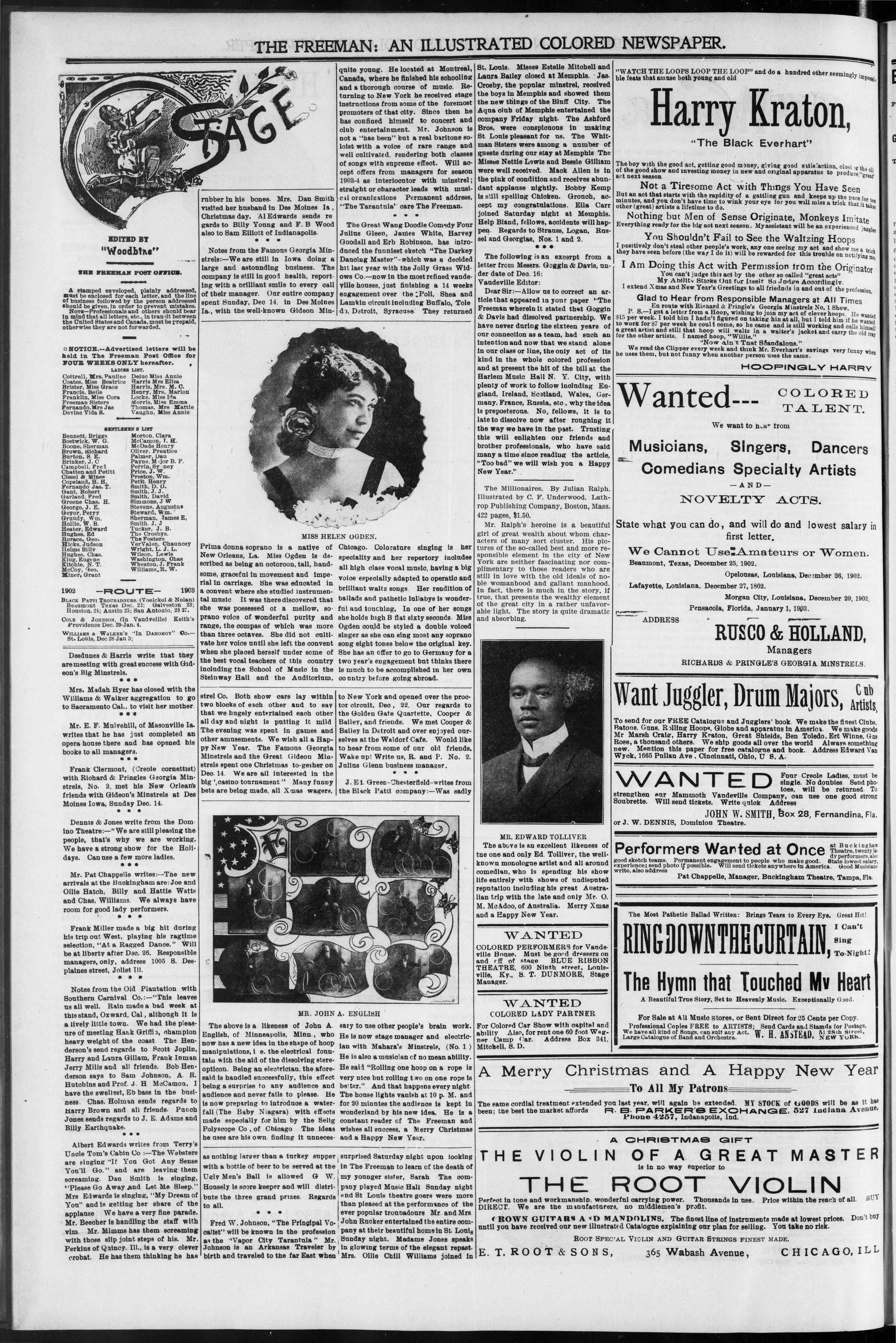
MISS HELEN OGDEN.
Prima donna soprano is a native of New Orleans, La. Miss Ogden is described as being an octoonor, tall, hand-some, graceful in movement and imperial in carriage. She was educated in a convent where she studied instrumental music. It was there discovered that she was possessed of a mellow, soprano voice of wonderful purity and range, the compas of which was more than three octaves. She did not cultivate her voice until she left the convent when she placed herself under some of the best vocal teachers of this country including the School of Music in the Steinway Hall and the Auditorium.
strel Co. Both show cars lay within two blocks of each other and to say that we hugely entertained each other all day and night is putting it mild. The evening was spent in games and other amusements. We wish all a Happy New Year. The Famous Georgia Minstrels and the Great Gideon Minstrels spent one Christmas to-gether on Dec. 14. We are all interested in the big 'casino tournament'. Many funny bets are being made, all Xmas wagers.
MR. JOHN
F
MR. JOHN A. ENGLISH
The above is a likeness of John A. English, of Minneapolis, Minn., who now has a new idea in the shape of hoop manipulations, i.e. the electrical fountain with the aid of the dissolving stereo-opticon. Being an electrician, the aforesaid is handled successfully, this effect being a surprise to any audience and audience and never fails to please. He is now preparing to introduce a waterfall (The Baby Niagara) with effects made especially for him by the Selig Polyscope Co., of Chicago The ideas he uses are his own, finding it unnecessary as nothing larger than a turkey supper with a bottle of beer to be served at the Ugly Men's Ball is allowed G W. Housesly is score keeper and will distribute the three grand prizes. Regards to all.
Fred W. Johnson, "The Pringipal Vocalist" will be known in the profession as the "Vapor City Tarantula" Mr. Johnson is an Arkansas Traveler by birth and traveled to the far East when
---
quite young. He located at Montreal, Canada, where he finished his schooling and a thorough course of music. Returning to New York he received stage instructions from some of the foremost promoters of that city. Since then he has confined himself to concert and club entertainment. Mr. Johnson is not a "has been" but a real baritone soloist with a voice of rare range and well cultivated, rendering both classes of songs with supreme effect. Will accept offers from managers for season 1903-4 as interlocutor with minstrel; straight or character leads with musical organizations. Permanent address, "The Tarantula" care The Freeman.
The Great Wang Doodle Comedy Four Julius Gleen, James White, Harvey Goodall and Erb Robinson, has introduced the funniest sketch "The Darkey Dancing Master"-which was a decided hit last year with the Jolly Grass Windows Co.-now in the most refined vandeeville houses, just finishing a 14 weeks engagement over the Poll, Shea and Laminin circuit including Buffalo, Tole-D, Detroit, Syracuse. They returned
THE WORLD'S FIRST WOMEN'S FILM MAKER
Chicago. Colorature singing is her speciality and her repertory includes all high class vocal music, having a big voice especially adapted to operatic and brilliant waltz songs. Her rendition of ballads and pathetic lullabys is wonderful and touching. In one of her songs she holds high B flat sixty seconds. Miss Ogden could be styled a double voiced singer as she can sing most any soprano song sight tones below the original key. She has an offer to go to Germany for a two year's engagement but thinks there is much to be accomplished in her own country before going abroad.
to New York and opened over the proctor circuit, Dec., 22. Our regards to the Golden Gate Quartette, Cooper & Bailey, and friends. We met Cooper & Bailey in Detroit and over enjoyed ourselves at the Waldorf Cafe. Would like to hear from some of our old friends, Wake up! Write us, R. and P. No. 2. Julius Glenn business manager.
J. E1. Green-Chesterfield-writes from the Black Patti company:—Was sadly
C.
sary to use other people's brain work.
He is now stage manager and electrician with Mahara's Minstrels, (No. 1)
He is also a musician of no mean ability.
He said "Rolling one hoop on a rope is very nice but rolling t two on one rope is better." And that happens every night.
The house lights vanish at 10 p. M. and for 20 minutes the audience is kept in wonderland by his new idea. He is a constant reader of The Freeman and wishes all success, a Merry Christmas and a Happy New Year.
surprised Saturday night upon looking in The Freeman to learn of the death of my younger sister, Sarah The company played Music Hall Sunday night and St Louis theatre goers were more than pleased at the performance of the ever popular troutadours Mr. and Mrs. John Rucker entertained the entire company at their beautiful home in St. Louis Sunday night. Madame Jones speaks in glowing terms of the elegant repast Mrs. Ollie Chill Williams joined in
...
The same cordial treatment extended you last year, will again be extended. MY STOCK of GOODS will be as it has been; the best the market affords R. B. PARKER'S EXCHANGE, 527 Indiana Avenue. Phone 4257, Indianapolis, Ind.
Perfect in tone and workmanship, wonderful carrying power. Thousands in use. Price within the reach of all. BUY DIRECT. We are the manufacturers, no middlemen's profit.
CROWN GUITARS AND MANDOLINS. The finest line of instruments made at lowest prices. Don't buy until you have received our new illustrated Catalogue explaining our plan for selling. You take no risk.
ROOT SPECIAL VIOLIN AND GUITAR STRINGS FINEST MADE.
E. T. ROOT & SONS, 365 Wabash Avenue, CHICAGO, ILL
St. Louis. Misses Estelle Mitchell and Laura Bailey closed at Memphis. Jas.Crosby, the popular minstrel, received the boys in Memphis and showed them the new things of the Bluff City. The Aqua club of Memphis entertained the company Friday night. The Ashford Bros. were conspicuous in making St. Louis pleasant for us. The Whitman Sisters were among a number of guests during our stay at Memphis The Misses Nettle Lewis and Bessie Gilliam were well received. Mack Allen is in the pink of condition and receives abundant applause nightly. Bobby Kemp is still spelling Chicken. Grouch, accept my congratulations. Ella Carr joined Saturday night at Memphis. Help Bland, fellows, accidents will happen. Regards to Strauss, Logan, Russell and Georgias, Nos. 1 and 2.
The following is an excerpt from a letter from Meerser. Gogglin & Davis, under date of Dec. 16: Vanderville Editor:
Dear Sir:—Allow us to correct an article that appeared in your paper "The Freeman wherein it stated that Goggin & Davis had dissolved partnership. We have never during the sixteen years of our connection as a team, had such an intention and now that we stand alone in our class or line, the only act of its kind in the whole colored profession and at present the hit of the bill at the Harlem Music Hall N. Y. City, with plenty of work to follow including England, Ireland, Scotland, Wales, Germany, France, Russia, etc., why the idea is preposterous. No, fellows, it is to late to dissolve now after roughing it the way we have in the past. Trusting this will enlighten our friends and brother professionals, who have said many a time since reading the article, "Too bad" we will wish you a Happy New Year."
The Millionaires. By Julian Ralph, Illustrated by C. F. Underwood. Lathrop Publishing Company, Boston, Mass. 422 pages, $1.50.
Mr. Ralph's heroine is a beautiful girl of great wealth about whom characters of many sort cluster. His pictures of the so-called best and more responsible element in the city of New York are neither fascinating nor complimentary to those readers who are still in love with the old ideals of noble womanhood and gallant manhood. In fact, there is much in the story, if true, that presents the wealthy element of the great city in a rather unfavorable light. The story is quite dramatic and absorbing.
A. E. B.
The above is an excellent likeness of the one and only Ed. Tolliver, the well-known monologue artist and all around comedian, who is spending his show life entirely with shows of undisputed reputation including his great Australian trip with the late and only Mr. O. M. McAdoo, of Australia. Merry Xmas and a Happy New Year.
WANTED
COLORED PERFORMERS for Vandelle House. Must be good dresses on and off of stage BLUE RIBBON THEATRE, 600 Ninth street, Louisville, Ky., S. T. DUNMORE, Stage Manager.
WANTED
COLORED LADY PARTNER
For Colored Car Show with capital and ability Also, for rent one 60 foot Wagner Camp Car. Address Box 341, Mitchell, S.D.
"WATCH THE LOOPS LOOP THE LOOP" and do a hundred other seemingly impossible feats that amuse both young and old
Harry Kraton,
The boy with the good act, getting good money, giving good satisfaction, closing the old of the good show and investing money in new and original apparatus to produce "great" act next season
Not a Tiresome Act with Things You Have Seen
But an act that starts with the rapidity of a gattling gun and keeps up the pace for ten minutes, and you don't have time to wink your eye for you will miss a trick that it takes other (great) artists a lifetime to do.
Nothing but Men of Sense Originate, Monkeys Imitate
Everything ready for the big act next season. My assistant will be an experienced juggler
You Shouldn't Fail to See the Waltzing Hoops
I positively don't steal other people's work, any one seeing my act and show me a trick they have seen before (the way I do it) will be rewarded for this trouble on notifying me.
I Am Doing this Act with Permission from the Originator
You can't judge this act by the other so called "great acts"
My Ability Sticks Out for itself So Judge Accordingly.
I extend Xmas and New Year's Greetings to all friednids in and out of the profession.
Glad to Hear from Responsible Managers at All Times
En route with Richard & Pringle's Georgia Minstrels No. 1 Show.
P. S.—I got a letter from a Hoop, wishing to join my act of clever hoops. He wanted $15 per week. I told him I hadn't figured on taking him at all, but I told him if he wanted to work for $7 per week he could come, so he came and is still working and calls himself a great artist and still that hoop will waltz in a waiter's jacket and carry the old tray for the other artists. I named hoop, "Willie."
We read the Clipper every week and think Mr. Everhart's savings very funny when he uses them, but not funny when another person uses the same.
HOOPINGLY HARRY
COLORED TALENT.
We want to hear from
Dians, Singers, D
edians Specialty A
— AND —
ans, Singers, Dancers edians Specialty Artists AND NOVELTY ACTS.
State what you can do, and will do and lowest salary in first letter. We Cannot Use Amateurs or Women. Beaumont, Texas, December 25, 1902.
Managers RICHARDS & PRINGLE'S GEORGIA MINSTRELS.
Want Juggler, Drum Majors, Cub Artists
To send for our FREE Catalogue and Jugglers' book. We make the flueset Clubs, Batons, Guns, Rolling Hoops, Globe and apparatus in America. We make goods Mr Marsh Craig, Harry Kraton, Great Shields, Ben Toledo, Ert Winne, Gus Rose, a thousand others. We ship goods all over the world. Always something new. Mention this paper for free catalogue and book. Address Edward Van Wyck, 1665 Pullan Ave., Cincinnati, Ohio, U S. A.
WANTED Four Creole Ladies, must be single. No doubles. Send photos, will be returned. To strengthen our Mammoth Vaudeville Company, can use one good strong Soubrette. Will send tickets. Write quick Address
JOHN W. SMITH, Box 28, Fernandina, Fla. or J. W. DENNIS, Dominion Theatre.
Performers Wanted at Once at Buckingham Theatre, twenty daily performers, also good sketch teams. Permanent engagement to people who make good. State lowest salary experience, send photo if possible. Will send tickets anywhere in America. Good Musicians write, also address Pat Chappelle, Manager, Buckingham Theatre, Tampa Fla.
A Beautiful True Story, Set to Heavenly Music. Exceptionally Good.
For Sale at All Music Stores, or Sent Direct for 25 Cents per Copy.
Professional Copies FREE to ARTISTS. Send Cards and Stamps for Postage.
We are limited time only. Act. W. H. ANSTEAD.
Large Catalogue of Band and Orchestra. NEW YORK.
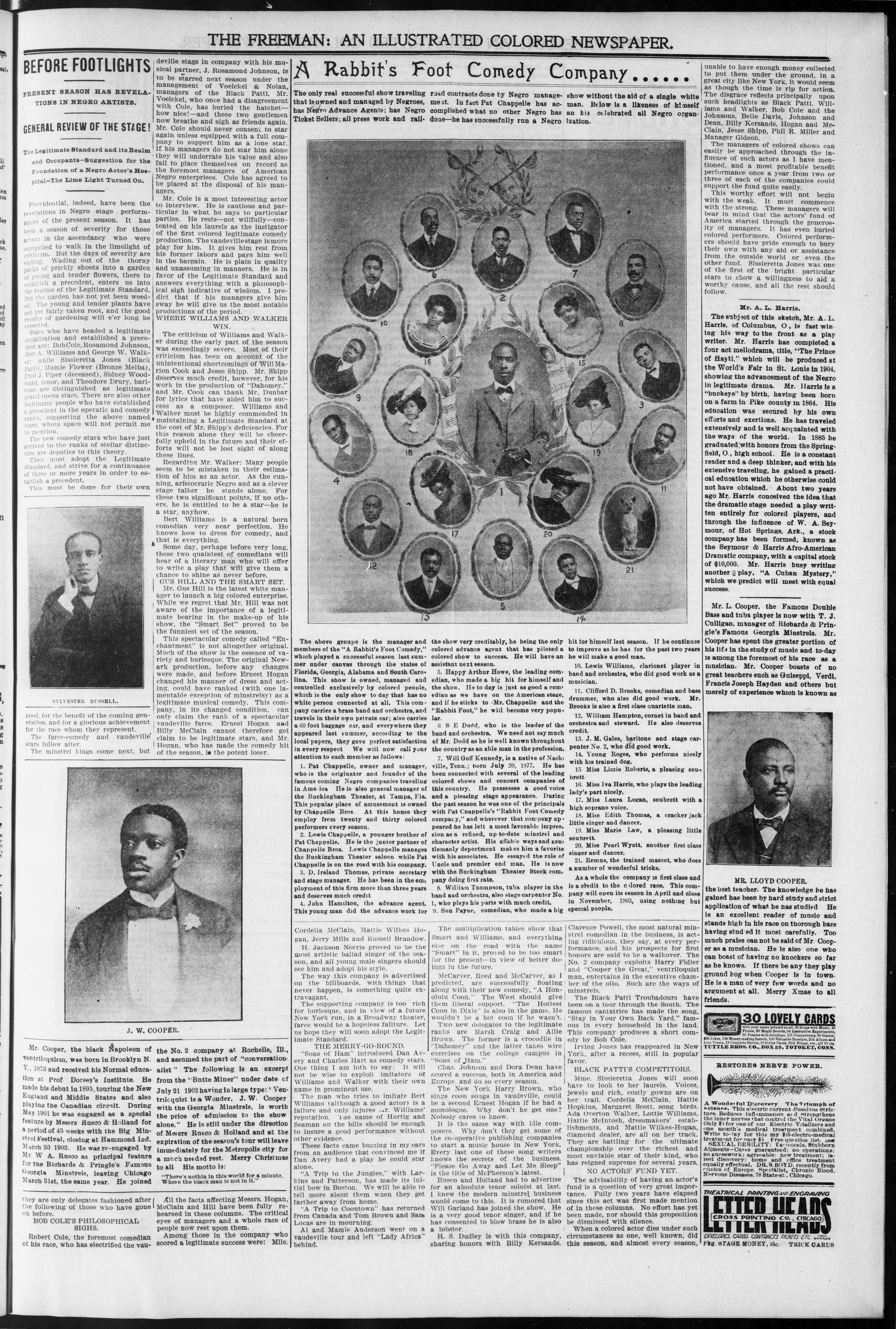
BEFORE FOOTLIGHTS
PRESENT SEASON HAS REVELA TIONS IN NEGRO ARTISTS.
GENERAL REVIEW OF THE STAGE
The Legitimate Standard and its Realm and Occupants-Suggestion for the Foundation of a Negro Actor's Hospital-The Lime Light Turned On.
Providential, indeed, have been the revelations in Negro stage performances of the present season. It has been a season of severity for those actors in the ascendancy who were compelled to walk in the limelight of criticism. But the days of severity are ending. Wading out of the thorny paths of prickly shoots into a garden of young and tender flowers, there to establish a precedent, enters us into the realms of the Legitimate Standard. But the garden has not yet been weeded. The young and tender plants have not yet fairly taken root, and the good results of gardening will e'er long be expected.
Stars who have headed a legitimate organization and established a precedent are: Bob Cole, Rosamond Johnson, Bert A. Williams and George W. Walker, while Sissieretta Jones (Black Patti), Mamie Flower (Bronze Melba), Fred J. Piper (deceased), Sidney Woodward, tenor, and Theodore Drury, baritone, are distinguished as legitimate grand opera stars. There are also other legitimate people who have established a precedent in the operatic and comedy ranks, supporting the above named stars, whom space will not permit me to mention.
The new comedy stars who have just arrived to the ranks of stellar distinction are deputies to this theory.
They must adopt the Legitimate Standard, and strive for a continuance of three or more years in order to establish a precedent.
This must be done for their own
good, for the benefit of the coming generation, and for a glorious achievement for the race whom they represent. The farce-comedy and vaudeville stars follow after. The minstrel kings come next, but
J. W. C
[Name not visible]
J. W. COOPER.
Mr. Cooper, the black Napoleon of ventriloquism, was born in Brooklyn N. Y., 1873 and received his Normal education at Prof Dorsey's institute. He made his debut in 1895, touring the New England and Middle States and also playing the Canadian circuit. During May 1901 he was engaged as a special feature by Messrs Rusco & Holland for a period of 45 weeks with the Big Minstrel festival, closing at Hammond Lod. March 30 1902. He was re-engaged by Mr W A. Rusco as principal feature for the Richards & Pringle's Famous Georgia Minstrels, leaving Chicago March 31st, the same year. He joined they are only delegates fashioned after the following of those who have gone on before.
BOB COLE'S PHILOSOPHICAL SIGHS.
Robert Cole, the foremost comedian of his race, who has electrified the vau-
SYLVESTER RUSSELL.
deville stags in company with his musical partner, J. Rosamond Johnson, is to be starred next season under the management of Voelckel & Nolan, managers of the Black Patti. Mr. Voelckel, who once had a disagreement with Cole, has buried the hatchet—how nice!—and these two gentlemen now breathe and sigh as friends again. Mr. Cole should never consent to star again unless equipped with a full company to support him as a lone star. If his managers do not star him alone they will underrate his value and also fail to place themselves on record as the foremost managers of American Negro enterprises. Cole has agreed to be placed at the disposal of his managers.
Mr. Cole is a most interesting actor to interview. He is cautious and particular in what he says to particular parties. He rests—not willfully—contented on his laurels as the instigator of the first colored legitimate comedy production. The vandeville stage is more play for him. It gives him rest from his former labors and pays him well in the bargain. He is plain in quality and unassuming in manners. He is in favor of the Legitimate Standard and answers everything with a philosophical sigh indicative of wisdom. I predict that if his managers give him sway he will give us the most notable productions of the period.
WHERE WILLIAMS AND WALKER WIN.
The criticism of Williams and Walker during the early part of the season was exceedingly severe. Most of their criticism has been on account of the unintentional shortcomings of Will Marion Cook and Jesse Shipp. Mr. Shipp deserves much credit, however, for his work in the production of "Dahomey," and Mr. Cook can thank Mr. Dunbar for lyrics that have aided him to success as a composer. Williams and Walker must be highly commended in maintaining a Legitimate Standard at the cost of Mr. Shipp's deficiencies. For this reason alone they will be cheerfully upheld in the future and their efforts will not be lost sight of along these lines.
Regarding Mr. Walker: Many people seem to be mistaken in their estimation of him as an actor. As the cunning, aristocratic Negro and as a clever stage talker he stands alone. For these two significant points, if no others, he is entitled to be a star—he is a star, anyhow.
Bert Williams is a natural born comedian very near perfection. He knows how to dress for comedy, and that is everything.
Some day, perhaps before very long, these two quaintest of comedians will hear of a literary man who will offer to write a play that will give them a chance to shine as never before.
GUS HILL AND THE SMART SET.
Mr. Gus Hill is the latest white manager to launch a big colored enterprise.
While we regret that Mr. Hill was not aware of the importance of a legitimate bearing in the make-up of his show, the "Smart Set" proved to be the funniest set of the season.
This spectacular comedy called "Enchantment" is not altogether original. Much of the show is the essence of variety and burlesque. The original Newark production, before any changes were made, and before Ernest Hogan changed his manner of dress and acting, could have ranked (with one lamentable exception of minstrelsy) as a legitimate musical comedy. This company, in its changed condition, can only claim the rank of a spectacular vaudeville farce. Ernest Hogan and Billy McClaim cannot therefore get claim to be legitimate stars, and Mr. Hogan, who has made the comedy hit of the season, is the potent loser.
WOOPER.
the No. 2 company at Rochelle, Ill., and assumed the part of "conversation-alist" The following is an excerpt from the "Butte Miner" under date of July 21 1902 having in large type: 'Ventricquist is a Wonder. J. W. Cooper with the Georgia Minstrels, is worth the price of admission to the show alone." He is still under the direction of Mesrs Rusco & Holland and at the expiration of the season's tour will leave immediately for the Metropolis city for a much needed rest. Merry Christmas to all His motto is: "There's nothin in this world for a minute. Where the black man is not in it."
All the facts affecting Messrs. Hogan, McClain and Hill have been fully rehearsed in these columns. The critical eyes of managers and a whole race of people now rest upon them.
Among those in the company who scored a legitimate success were: Mile.
THE FREEMAN: AN ILLUSTRATED COLORED NEWSPAPER
A Rabbit's Foot Comedy Company
The only real successful show traveling road contracts done by Negro manage- show without the aid of a single white that is owned and managed by Negroes, meat. In fact Pat Chappelle has ac- man. Below is a likeness of himself has Negro Advance Agents; has Negro complained what no other Negro has an his celebrated all Negro organ- Ticket Sellers; all press work and rail- done—he has successfully run a Negroization.
6
2
7
10
16
15
9
18
3
19
4
1
17
20
12
13
5
19
The above group is the manager and members of the "A Rabbit's Foot Comedy," which played a successful season last summer under canvas through the states of Florida, Georgia, Alabama and South Carolina. This show is owned, managed and controlled exclusively by colored people, which is the only show to day that has no white person connected at all. This company carries a brass band and orchestra, and travels in their own private car; also carries a 60 foot baggage car, and everywhere they appeared last summer, according to the local papers, they gave perfect satisfaction in every respect. We will now call your attention to each member as follows:
1. Pat Chappelle, owner and manager, who is the originator and founder of the famous coming Negro companies traveling in Ameica. He is also general manager of the Buckingham Theater, at Tampa, Fla. This popular place of amusement is owned by Chappelle Bros. At this house they employ from twenty and thirty colored performers every season.
2. Lewis Chappelle, a younger brother of Pat Chappelle. He is the junior partner of Chappelle Bros. Lewis Chappelle manages the Buckingham Theater saloon while Pat Chappelle is on the road with his company.
3. D. Ireland Thomas, private secretary and stage manager. He has been in the employment of this firm more than three years and deserves much credit.
4. John Hamilton, the advance agent. This young man did the advance work for
Cordelia McClain, Mattie Wilkes Hogan, Jerry Mills and Russell Brandow. H. Jackson Norris proved to be the most artistic ballad singer of the season, and all young male singers should see him and adopt his style. The way this company is advertised on the billboards, with things that never happen, is something quite extravagant. The supporting company is too rich for burlesque, and in view of a future New York run, in a Broadway theater, farce would be a hopeless failure. Let us hope they will soon adopt the Legitimate Standard. THE MERRY-GO-ROUND. "Sons of Ham" introduced Dan Avery and Charles Hart as comedy stars. One thing I am loth to say: It will not be wise to exploit imitators of Williams and Walker with their own name in prominent use.
The man who tries to imitate Bert Williams (although a good actor) is a failure and only injures . . .r. Williams' reputation. "The name of Hurtig and Seaman on the bills should be enough to insure a good performance without other evidence.
These facts came buzzing in my ears from an audience that convinced me it Dan Avery had a play he could star alone.
"A Trip to the Jungles," with Larkins and Patterson, has made its initial bow in Boston. We will be able to tell more about them when they get farther away from home.
"A Trip to Coontown" has returned from Canada and Tom Brown and Sam Lucas are in mourning.
Al and Mamie Anderson went on a vaudeville tour and left "Lady Africa" behind.
the show very creditably, he being the only colored advance agent that has piloted a colored show to success. He will have an assistant next season.
5. Happy Arthur Howe, the leading comedian, who made a big hit for himself and the show. He to day is just as good a comedian as we have on the American stage, and if he sticks to -Mr. Chappelle and the 'Rabbit Foot,' he will become very popular.
6. S E Dodd, who is the leader of the band and orchestra. We need not say much of Mr. Dodd as he is well known throughout the country as an able man in the profession.
7. Will Goff Kennedy, is a native of Nashville, Tenn.; born July 20, 1857. He has been connected with several of the leading colored shows and concert companies of this country. He possesses a good voice and a pleasing stage appearance. During the past season he was one of the principals with Pat Cnappelle's "Rabbit Foot Comedy company," and wherever that company appeared he has left a most favorable impression as a refused, up-to-date minstrel and character artist. His affable ways and ceni tennelly department makes him a favorite with his associates. He essayed the role of Uncle and premier end man. He is now with the Buckingham Theater Stock company doing first rate.
8. William Thompson, tuba player in the band and orchestra, also stage carpenter No. 1, who plays his parts with much credit.
9. Son Payne, comedian, who made a big
The multiplication tables show that Smart and Williams, and everything else on the road with the name "Smart" in it, proved to be too smart for the present—in view of better doings in the future.
McCarver, Reed and McCarver, as I predicted, are successfully floating along with their new comedy, "A Honolulu Coon." The West should give them liberal support. "The Hottest Coon in Dixie" is also in the game. He wouldn't be a hot coon if he wasn't. Two new delegates to the legitimate ranks are Marsh Craig and Allie Brown. The former is a crocodile in "Dahomey" and the latter takes wire exercises on the college campus in "Sons of Ham."
Chas. Johnson and Dora Dean have scored a success, both in America and Europe, and do so every season.
The New York Harry Brown, who sings coon songs in vaudeville, could be a second Ernest Hogan if he had a monologue. Why don't he get one? Nobody cares to know.
It is the same way with idle composers. Why don't they get some of the co-operative publishing companies to start a music house in New York. Every last one of these song writers knows the secrets of the business. "Please Go Away and Let Me Sleep" is the title of McPherson's latest.
Rusco and Holland had to advertise for an absolute tenor soloist at last. I knew the modern minstrel business would come to this. It is rumored that Will Garland has joined the show. He is a very good tenor singer, and if he has consented to blow brass he is also a lobster.
H. S. Dudley is with this company, sharing honors with Billy Kersands.
hit for himself last season. If he continues to improve as he has for the past two years he will make a good man.
10. Lewis Williams, clarionet player in band and orchestra, who did good work as a musician.
11. Clifford D. Brooks, comedian and bass drummer, who also did good work. Mr. Brooks is also a first class quartette man.
12. William Hampton, cornet in band and orchestra and steward. He also deserves credit.
13. J. M. Gales, baritone and stage carpenter No. 2, who did good work.
14. Young Roges, who performs nicely with his trained dog.
15 Miss Lizzie Roberts, a pleasing soubrett.
16. Miss Iva Harris, who plays the leading lady's part nicely.
17. Miss Laura Logan, soubrett with a high soprano voice.
18. Miss Edith Thomas, a cracker jack little singer and dancer.
19. Miss Marie Law, a pleasing little sonbrett.
20. Miss Pearl Wyatt, another first class singer and dancer.
21. Remus, the trained mascot, who does a number of wonderful tricks.
As a whole the company is first class and is a credit to the colored race. This company will open its season in April and close in November, 1903, using nothing but special people.
Clarence Powell, the most natural minstrel comedian in the business, is acting ridiculous, they say, at every performance, and his prospects for first honors are said to be a walkover. The No. 2 company exploits Harry Fidler and "Cooper the Great," ventriloquist man, entertains in the executive chamber of the olio. Such are the ways of minstrels.
The Black Patti Troubadours have been on a tour through the South. The famous cantatrice has made the song, "Stay in Your Own Back Yard," famous in every household in the land. This company produces a short comedy by Bob Cole.
Irving Jones has reappeared in New York, after a recess, still in popular favor.
BLACK PATTI'S COMPETITORS.
Mme. Sissieretta Jones will soon have to look to her laurels. Voices, jewels and rich, costly gowns are on her trail. Cordella McClaim, Hattie Hopkins, Margaret Scott, song birds, Ada Overton Walker, Lottie Williams, Hattie Mcntosh, dressmakers' establishments, and Mattie Wilkes-Hogan, diamond dealer, are all on her track. They are battling for the ultimate championship over the richest and most enviable star of their kind, who has reigned supreme for several years.
The advisability of having an actor's fund is a question of very great importance. Fully two years have elapsed since this act was first made mention of in these columns. No effort has yet been made, nor should this proposition be dismissed with silence. When a colored actor dies under such circumstances as one, well known, did this season, and almost every season.
unable to have enough money collected to put them under the ground, in a great city like New York, it would seem as though the time is rip for action. The disgrace reflects principally upon such headlights as Black Patti, Williams and Walker, Bob Cole and the Johnsons, Belle Davis, Johnson and Dean, Billy Kersands, Hogan and McClaim, Jesse Shipp, Phil R. Miller and Manager Gideon. The managers of colored shows can easily be approached through the influence of such actors as I have mentioned, and a most profitable benefit performance once a year from two or three of each of the companies could support the fund quite easily.
This worthy effort will not begin with the weak. It must commence with the strong. These managers will bear in mind that the actors' fund of America started through the generosity of managers. It has even buried colored performers. Colored performers have pride enough to bury their own with any aid or assistance from the outside world or even the other fund. Sissieretta Jones was one of the first of the bright particular stars to show a willingness to aid a worthy cause, and all the rest should follow.
Mr. A. L. Harris.
The subject of this sketch, Mr. A. L. Harris, of Columbus, O., is fast winning his way to the front as a play writer. Mr. Harris has completed a four act melodrama, title, "The Prince of Hayti," which will be produced at the World's Fair in St. Louis in 1904, showing the advancement of the Negro in legitimate drama. Mr. Harris is a "buckeye" by birth, having been born on a farm in Pike county in 1864. His education was secured by his own efforts and exertions. He has traveled extensively and is well acquainted with the ways of the world. In 1885 he graduated with honors from the Springfield, O., high school. He is a constant reader and a deep thinker, and with his extensive traveling, he gained a practical education which he otherwise could not have obtained. About two years ago Mr. Harris conceived the idea that the dramatic stage needed a play written entirely for colored players, and through the influence of W. A. Seymour, of Hot Springs, Ark., a stock company has been formed, known as the Seymour & Harris Afro-American Dramatic company, with a capital stock of $10,000. Mr. Harris busy writing another play, "A Cuban Mystery," which we predict will meet with equal success.
Mr. L. Cooper, the Famous Double Bass and tuba player is now with T. J. Culligan, manager of Richards & Pringle's Famous Georgia Minstrels. Mr. Cooper has spent the greater portion of his life in the study of music and to-day is among the foremost of his race as a musician. Mr. Cooper boasts of no great teachers such as Guiseppi, Verdi, Francis Joseph Hayden and others but merely of experience which is known as
MR. LLOYD COOPER.
the best teacher. The knowledge he has gained has been by hard study and strict application of what he has studied. He ie an excellent reader of music and stands high in his race on thorough bass having stud ed it most carefully. Too much praise can not be said of Mr. Cooper as a musician. He is also one who can boast of having no knockers so far as he knows. If there be any they play ground hog when Cooper is in town. He is a man of very few words and no argument at all. Merry Xmas to all friends.
Photos, 60 Magic Sessions, 64 Interactive Experiments,
400 Jokes, 100 Memories with Solutions, 110 Conversations, 60 Games,
Love Verses, 14 Complete Stories, 52 Stories Card, 518 Ticket,
TUTTLE BROS. CO., BOX 30, TOTKET. CONN.
RESTORES NERVE POWER.
A Wonderful Discovery The triumph of science. This electric current dissolves structure. Reduces inflammation and strengthens the skin. Only $1 for one of our Electric Vitalizers and one month's medical treatment combined. Write to-tay for this my $15-electro-medical treatment for one $1. For questions, Stubborn Aliments-Cures guaranteed; no operations; no guesswork; agreeable; new treatment; in dieser nur hart kundenswert. Treatment equally effectual, DR.B.BOY D. recently from clinics of Europe. Specialist, Chronic Blood, Nervous Diseases. 78 State-at. Chicago.
THEATRICAL PRINTING AND ENGRAVING
CROSS PRINTING CO., CHICAGO
ENVELOPES, CARDS, CONTRACTS TICKETS ETC.
Pkg. STAGE MONEY, 15c. TRUCK CARDS
FARM&HOME.
Foot and Mouth Disease.
The United States Agricultural Department has issued] a bulletin on the oot and mouth disease among cattle, sheep and swine. The bulletin says that the disease jwas recently brought to this country from a foreign land, and that it now exists in Massachusetts and adjacent States. The disease is an excessively contagious malady, peculiar to cattle, sheep, goats, deer and swine. Rarely is it transmitted to man. It is] characterized by the eruption of vesicles or blisters in the mouth, upon the heels, or
ween the toes, and upon the teats or udder. The appetite is depressed, the milk flow diminishes, the animal loses condition and becomes lame. After a day or two the vesicles break, peel off, and leave a raw surface that may heal in a few days, or, especially, upon the feet and teats, may remain sore for a long time and lead to serious complications. The death rate is very low, but it attacks the whole herd and many animals are seriously damaged, so that the loss to a herd owner is heavy. The following directions are given for the control or prevention of the disease:
"The most important matter is to prevent the infection of animals not yet exposed. This can be done by avoiding the purchase of affected stock; by excluding all outside animals from the herd or flock; by each person who comes near healthy stock avoiding contact with diseased animals or the places or things contaminated by them; by excluding visitors from the cow stable, sheep or hog pens, and by preventing the access of strange or stray animals, which may carry the virus on their feet or hair, although they are themselves in good health. Neither cows nor bulls should be moved from one place to another for service."
Winter Care of Stock.
When the average farm horse has passed through the days of harvest, it is quite as tired as the master and needs a vacation. During the late fall and early winter in sections where it is possible the pasture should be the vacation ground, but the mistake should not be made of keeping the horses in the pasture at night. Tired as they are from the long season of hard work they are in no condition to stand nights that are cool and sometimes stormy without protection. The old idea is that it will toughen them but this is pure fallacy. The horse even on the pasture should have a comfortable stable at night and more or less grain food and fodder, according to the condition of the pasture. After the cool weather sets in so that the horse is in the stable all the time when not at work, some way should be provided so that it may have exercise daily, even if nothing more than walking it up and down the roadside. If one has a shed of good size on the farm such a place will be an ideal location in which to exercise the horse on stormy days. The stable should be light, well ventilated and made generally comfortable. Abundant bedding should be provided and the floor so arranged that the liquid excrement will be carried off or absorbed by chaff spread over the floor. The rations during the winter should be in accordance with the work done by the horse but they should always be sufficient to more than sustain life. It may seem rather senseless to say this but we all know that many farmers are in the habit of feeding the horses that do but little work in the winter, just as little rations as they dare. The result is the animal is not fit to do the heavy work of the
ng, and if he does not break down
entirely, is oftentimes seriously injured.
Balancing the Corn Ration.
So long as corn is more easily grown in our country than other graings, and so long as it is generally fed to all manner of stock, just so long it be considered as the basis upon which all feeding of stocks rests. Anyone who has fed stock of anykind realizes that it is impossible to get the best results from feeding corn alone. Nor does the use of corn starch for roughage add material to the ration, simply because the same ingredients are in both grain and stalk. Corn, with some roughage like sorghum hay, millet, cow pea hay or timothy, makes a fair ration although not so good as when more grains are fed with the corn and the roughage somewhat reduced. Thus a ration consisting of corn in some form, wheat bran cottonseed meal or linseed meal would
THE FREEMAN: AN ILLUSTRATED COLORED NEWSPAPER.
make a ration that would be materially better than any one of the grains fed with the roughage alone and this applies with equal force if the animals are are in the dairy or are being fattened for the carcass market. A ration of two pounds each of corn meal, gluten meal and cotton seed meal with all the timothy hay that would be eaten, gives the animal a proportion of protein greater than almost any other combination, yet providing all the carbohydrates needed.
Protecting the Cow Sheds.
The average shed provided for stock, whether located in the barnyard or in the open, does not afford the best of winter protection usually, because it has to many cracks and because the roof is faulty. The following is a good way to make such a shed comfortable Build a rough frame of the desired size making it strong. Arrange this frame over the shed and thatch it heavily with meadow hay, salt hay or corn stalks. This thatch may be put on the sides and ends as well and readily held in place with wire if some way can be provided to keep the stock from eating the material used. If there is danger of this it would pay to erect a temporary fence of wire so that the stock could not reach the fodder used in thatching. If one has no shed, the frame as suggested may be built and fastened against some building and if thatched will make a warm place for the stock when out of doors.
The Use of Fertilizer.
The farmers of Indiana spent over $2,000,000 for fertilizers in the last year, it is estimated, and the total consumption probably reached 100,000 tons. Most of this large investment was made by southern Indiana, where the soil has been tilled longer than in northern Indiana, and where abounds the clay land that has less of the elements of plant growth than the predominant soil of other parts of the State. The use of fertilizers increases from year to year, and if it does not pay the Indiana farmer is not entitled to his reputation for driving a good bargain. The fertilizers in common use are supposed to bring results in the first crop, so the farmer does not have a wait long to determine whether an investment is profitable.
In sowing wheat it is customary to use 200 pounds of fertilizer to the acre. Fertilizer consisting of acid phosphate, tankage and a small per cent. of potash costs the farmer about $24 a ton, so it may be computed that $2.40 an acre is invested when wheat is sown. The yield of an acre must increase four or five bushels to pay for the investment. Fertilizer, however, is supposed to leave some permanent benefits to the soil and in some it is hoped that the worn soil will be brought up to a state of fertility that will require less expense to keep "it productive.
Fertilizer is usually sown with wheat, the driller having attachments for that purpose. If clover is sown in the wheat in the spring it is also benefited, and in turn the good clover crop, which ordinarily follows. If fertilizer is used when corn is sown, 200 pounds to the acre are put in the ground, but the common practice is to enrich the wheat ground.
Some farmers use acid phosphate only. This costs $13.00 or $14.00 a ton and most of it comes from Tennessee, Florida and South Carolina. It is made of a rock consisting chiefly of petrified bones of fish and other sea animal life. The rock is ground, then treated with sulphuric acid, and acid phosphate results.
Ground bone from the packing houses is one of the best fertilizers, but the supply is very limited. It is said that ground bone is less satisfactory if quick results are desired, but that its beneficial effects are most lasting, several years being required to get all the elements of plant life out of it.
Another fertilizing product of the packing house is what is known as tankage. This consists of blood and other refuse of butchered animals Tankage contains ammonia, or nitrogen, and phosphatic acid, and is often mixed with the acid phosphate from the Southern States which is said to be lacking in ammonia.
It is maintained that clay needs acid phosphate and ammonia or nitrogen, but that it and other Indiana soils have enough potash. Potash is imported from Germany and is too expensive for lib. eral use. Nitrate of soda, imported
from South America, is also said to be too costly for extensive use. commercial fertilizers have been in use in Indiana at least twenty years. W. W. Stevens of Salem, president of the State Horticultural Society, who traveled in Illinois, Indiana, Kentucky and Ohio selling them for ten years, says they have been used in Indiana almost thirty years, but that only in recent years has their use been so extensive. Mr. Stevens says a farmer obtains quick and profitable results in southern Indiana from acid phosphate. Bone dust, he says, lasts longer, for it takes it several years to become available for plant life.
Edward Kingsbury, a dealer in fertilizer, estimates that nine-tenths of the fertilizer used in Indiana is add phosphate, and that 80 per cent. of it is sown with wheat. He says the farmer rarely objects when he pays the fertilizer bill and generally comes back for more. He regards this as proof that the farmer believes the investment brings profit. In recent years farmers of White county, in the northern part of the State, have been using fertilizer with the corn crop. Grant, Hamilton and Boone are among the other northern Indiana counties to make use of it. The use of fertilizer by gardeners is becoming extensive.
The Legislature of 1001 passed a law requiring dealers in commercial fertilizer to file with the State chemist the name of the fertilizer and the minimum percentage of nitrogen, of potassium oxide soluble in water, of phosphoric acid, and in the case of acidulated goods the minimum percentage of water, soluble and reverted phosphoric acid, and of insoluble phosphoric acid, which the manufacturer or party offering the fertilizer for sale guarantees the fertilizer to contain. The State chemist issues labels containing the facts set out in the certificate. If the State chemist finds less of the ingredients than the manufacturer or dealer claims, in the fertilizer offered for sale, the manufacturer or dealer is liable to a fine of from $50 to $100.
Clover is still a favorite plant for increasing the fertility of the soil by supplying nitrogen. In the last two on three years cowpeas have been used for the same purpose, and at the prent time they are in great favor.
Nuggets New and Novel
Hot Springs Ark, Special.—Jerry McMillan, porter at the Plateau hotel of this city in an altercation with the night clerk (white) last week was shot and killed instantly by the clerk, who was tried and acquitted of the killing that same morning. Use your judgement how it would have turned out had the colored porter killed the clerk. Don't forget the Xmas number of The Freeman only ten cents. A grand New Year's entertainment will be given Jan. 1, by T. H. Price and others. Mrs. Scott while on her way down town last Saturday night met her husband, Jas. Scott and his sweetheart, Rena Smith, who had more than once given her trouble about her husband. Mrs. Scott pulled out a revolver with the intention of shooting the woman when her husband struck out his hand with the intention of saving the women, received the first ball in the brain, killing him instantly. As the woman turned to run, Mrs. Scott shot her four times in the body from which wounds she died a few hours afterward. Mrs. Scott gave herself up and is in jail. We are anxiously waiting to see what will be done.
INHABITANTS OF THE PHILIPPINES
Their Habits and Customs as Viewed by one of the "Boys in Blue."
Mr. Editor—Many of your readers have doubtless read a great deal about the Philippines Islands and their inhabitants. We all like to read about and hear of the habits and conditions of a foreign people, and especially so when the writer's own experiences are proofs of his observations.
The political, sociological and religious writers are molding the Philippines problems, and not infrequently some new writer, inspired thereby, steps from behind the curtains to play his part in the world's theater. But in what little I have to say I stand unbiased, uninfluenced. I have nothing to gain.
In the group of the fifteen hundred or more islands Luzon is the largest. Ticao, the smallest of which any account is given, contains an area of only 137 square miles. Many of the so-called islands are simply barren dots in the ocean.
Manila, the capital of Luzon and the metropolis of the archipelago, might favorably be compared with some proud and fashionable city of the Occident. Her streets and thoroughfares are identical with the features of many peoples. Her vaults of fortune are heavily ladened. Her prodigious churches, hotels and public buildings impose upon the gaze. The profusely illustrated galleries of art gladden the homesick soul. The street cars are drawn by the taught little native horses, and on the beautiful street, Luneta, hundreds of fine carriages and vehicles play before the view for a mile away. There are the complicated systems of reeking dives of sin and prostitution. The swinging and pillared bridges present a peculiar and original aspect of architecture and of chiseled art.
Many startling incidents and interesting events are linked with the history of this city. The storms of war
A Simple Present for Christmas Gift! ONE OF OUR HANDSOME
Are You Short?
If so, we will loan you money on Furniture, Pianos, Horses, Wagons, etc. leaving them in your possession.
This is the company that was organized for the express purpose of supplying the people of Indianapolis with money at the very lowest possible rates, and making payments within reach of all. Try our new Building association. Plan arranged in fifty weekly payments. $25.00—Weekly Payments Only $80. $30.00—Weekly Payments Only $1.20.
Other amounts in same proportion. We also make loans Watches and Diamonds, allowing partial payments to reduce the cost, and to salaried people on their individual note. Most reliable place in the city.
CENTRAL LOAN CO.
Room 208 Stevenson B'ld'g, Second Floor-front room. 15 E. Washington St
have swept against her walls, but she has withstood those storms and has borne the weight of ages. She has been rocked in the battle and in the earthquake and has exhaled the deadly breath of plagues and epidemics. Her streets have been drenched with human blood and the voices of great battleships have echoed to her center from the mighty deep. The troubled waters roll on always against her shores and thunder on her ears. It was on the Luneta, where, in 1896, Dr. Rizal, the greatest Filipino that ever lived, was shot by the soldiers of Spain in compliance with the decree and judgment of that kingdom. Dr. Rizal was a Mason, educator and man of letters, and advocated the progress of the moral, religious and educational developments of his people. He fell a martyr to a good cause, and to-day Americans join with Filipinos in honoring his birth and death.
EARLY HICKS,
Company F, 24th Infantry.
Fort Assinibone, Mont.
Opera House Burned.
Cheyenne, Wyo., notes -Subscribe for the Freeman. Several entertainments are being talked of for the holidays. Mrs Vina Campbell who has been dangerously sick is reported to be improving. Sam and Charley Hopkins Mrs. Ollie Hopkins-Redd and her husband Will Redd of Ogden, Utah, will visit their parents in this city during Xmas. The beautiful opera house here burned to the ground Monday morning. The origin of the fire is unknown. The "Hottest Coon in Dixie" company was the last company to play an en- engagement at this popular playhouse. "Black Karl" of the "Hottest Coon in Dixie" company and wife were entertained with a dancing party at the A. O. U. W. Hall after the show, by a few of his old friends, among whom were T. Edward Gray, Senator Brown and others. Black Karl's work as a magician was clearly he feature of the show. Single copies of the Freeman can be had at T. Edward Gray's barber shop, 17141 Ferguson street. Watch for the illustrated holiday number, price 100.
News Notes from South Bend.
News Notes from South Bend.
South Bend, Ind, Special. — Miss Minnie Chavior of Columbus, O., after spending a week with her uncle, W. Mifflin, has returned Miss Lena Vaughn has been visiting her sister, Mrs. Anna James. Mr. Jim Wilson of Michigan City, was in the city recently. Mrs. P. V. Wright, after a week's visit in this city, left for Logansport, Ind. Miss Callie James and Miss Cora Ash are on the slick list. Henry James, who was struck on the head, is getting along nicely.
SOME BOOKS
The Vengeance of the Mob. By Sam A. Hamilton. The Abbey Press, New York. 206 pages, $1.00. This story deals with contemporaneous history in the Southern States. The hero is a Northern man. He falls in love with a Southern girl. This girl reciprocates his affection, but owing to the fact that through her hot-headed-
ness a mob was organized and wreaked summary vengeance upon an innocent Negro, the engagement was broken and the man and woman float sadly apart. The story is well told, and as a study of contemporaneous life in the South will do some good.
***
Stephen Holden. By Charles Felton Pldgin. L. C. Page & Co., Boston, Mass. 312 pages, $1.50.
This book, we think, will render humanity a real service. It deals with the temperance question in a sane and thoroughly sensible manner. It offers vivid suggestions for the permanent settlement of the liquor question.
Those hackneyed features which characterize so-called "temperance literature" generally are not discovered in this work. What is said appeals to the mind and to the heart of the reader. It is a most skillfully worked out story with a good moral and plenty of thrilling incidents.
Constance Hamilton. By Lucy May Linsley Wyatt. The Abbey Press, 114 Fifth avenue, New York. 183 pages, 50 cents.
A fascinating little story with scenes first laid among Virginia plantation life and rural environment, afterward shifted to New York City. A good moral is pointed of a girl who arose from poverty to a station of power in the social world.
* * *
Practical Cooking and Serving. By Janet McKenzie Hill. Doubleday, Page & Co., 34 Union Square, New York. 900 pages, $2.00.
This is a complete manual of cooking and serving. Its author is a celebrated expert. She has been at the head of the Boston Cooking School for a number of years as well as editor of the Boston Cooking School Magazine. The scope of this work will meet every requirement of the housekeeper as well as the instructor of cooking.
Sermons. By The Very Reverend George Deshon, C. S. P. The Catholic Book Exchange, 120 West 60th street, New York. 500 pages, $1.00.
These sermons are arranged for all the Sundays of the ecclesiastical year and the principal festivals. They are very brief and pointed, and they deal with the practical problems of everyday life.
***
How to Attract the Birds. By Neltje Blanchan. Doubleday, Page & Co., New York. 224 pages, $1.35.
The author, whose pseudonym is Neltje Blanchan, makes in this beautiful book another valuable contribution to the list of nature books brought out by Messrs. Doubleday, Page & Co., and which have attracted so much attention. These intimate, suggestive and charmingly written chapters are ornamented with a great number of extraordinary photographs, and form an altogether unique work on the almost untouched subject of making friends with the birds. This book will delight readers everywhere.
***
Praise. By Mark Guy Pearse. Jennings & Pye, Cincinnati, O. 179 pages, 25 cents.
This is one of the "Little Books of Devotion" issued by this house. It is a perfect gem. It is full of the wholesome and serious spirit of devotion and praise. "Praise" will serve as a fit companion to "Atonement" and "The Christianity of Jesus Christ," the latter by the same author.
Man's This is the title of very valuable and popular book for use in ular Book for which it contains a scenic and witful yet simple diacom on Male adlades and the cause, the mastered the effect, and the best methods of curring Variocele Stricture, Collision, Nervous Debility and associate diseases and weakness of men. No man can wear it free by describing your troubles to inquire about the acknowledged American Authorities and Master Specialist on Male Diseases. suite 1. N. K. KING 602 N. K. Stret. book sent Louis, Mo Call or write. This book sent FREE in plain sealed envelop, postpaid.
MADAM McNAIRDEE-MOORE
M. B. B.
The gifted Clairevoyant, the great female wonder, born with the double(cal) veil, she is one of the old ancient Southern Clairevoyant of New Orleans. She's a living Phrenologist and Physiologist. She tells plainly what you are best adapted for in life by a grasp of her hand she gives you a call of influence to enable you to overcome all luck. She has made thousands of homes happy. Read the fifth chapter ix verse of St. Matt: "Blessed are the peacemakers for they shall be called the children of God." She reunites the separated, makes peace where there is confusion. Your husband or wife will forgive you or your sweet heart forsake you. But will you marry you sooner if you will only help this lady's consultation. Read what several ladies of your city say, "Yes, we believe the a Godsend to our city; my husband and I had been separated over a year and just today I called on this lady, he returned young lady says: "The one loved refused is call or write me; I called on this lady and we are now engaged." You can't afford to miss consulting this gifted lady; she is gifted to read characters. She challenges the world to excel her advice to business, family and financial troubles. Because of the causes speedy marriage with the one of your choice. No cards allowed in her place of business; no one's ill wishes filled; strictly a Christian lady and depends entirely on her heavenly gift. If you are painful or angry, think you have been witchcrafted with years in the Jungles of Africa and has traveled 34 states doing good wherever she went. Read St. John, 9th chap, 33d ver: "If this man is not of God he could do nothing.
Three parlor so arrained that you meet friends nor strangers;everything confidant, intimate, night or day. Permanently located. Send money by postal order or registered letter
一
I, for one, as one in the midst. My heartached from the cruel treatment of my husband and the way he would throw away his time and money until I consulted this wonderful lady. It will soon be a year. Through her he has become a loving husband; and today he presents me with a lovely lot on which he will in the spring erect a home. Tongue can't praise her too highly
A LADY of New Iberia, La.
Chicago, Ill. Nov. 17, 1802.
Madame McNairdee, Indianapolis, Ind. :
Dear Medame,-- Your letter like a ray of sunshine, came duly to hand and I am very pleased with it, for every word of it were true; I am sorry that I did not write to you months ago. I enclose $60 for your see vice, hoping that you may be successful in bringing about desired results. I feel quite sure that you can. I am very sorry to hear of your being ill, and sincerely hope your speedy recovery. Sincerely yours,
26 Scotts street.
Molino, Fla., Nov. 14, 1902.
Madame:—You are the proper person in the proper place. All that you say is true and all you do is good. May God bless you.
F J.
Guntersville, Ala., Oct. 26, 1902.
I tried Mina, McNary and that is well up to her profession. She will tell things to come, and they will come as predicted. It will pay people to try her who want to know many things in the future.
INFORMATION.
There is no doubt of this lady's propheticOWER. She is a living phrenologist, palmist and a natural born clairvoyant to which thousands will testify. She is a God send to our country—born with a gift that no one can imagine. She is a past and present life and put you on the road of success both financially and physically if you will only heed her instructions. I called on her when the one I love had gone I knew not where and he returned at once, and today I am his dear wife.
A LADY of Fort Gibson, Ind. T. Madame—I feel it my duty, do this for you, are all you advertise. Just the other day, two years; I called on you in September and in a week's time he reigned and married me, and I can't praise you too much. Ladies that are heart broken by family troubles, love affair and bad luck until it seem that life is a blank, call or write to this dear lady, and I will do the same. God and she will do the balance, and she will.
A LADY of Rossland, B. C.
Dear Sisters and Brothers—Call on her when you can, she will be please to meet you and will when ever you wish to. She devotes her entire time for the well-being of her children and her. She will make your very soul glad to hear her talk of heaven for she writes such soul searching letters, tells you how to make home happy. Please always enclose stamp for answer. Here she is as she looks today at the church. The N.R.—Send lock of hair accompanied by one dollar ($1.00) and receive full life reading. Clip this ad.
608 N. West Street, cor. Indiana Ave. INDIANAPOLIS, IND. MADAME McNAIRDE-MOORE,
The Freeman papers can be found every Saturday at Lou. Washington's restaurant and lunch-room, 5528 Lake avenue, Chicago, Ill.; phone 1154. Isaac Toulbert, News Agent.
THE GRAND FOUNTAIN OF THE
UNITED ORDER OF TRUE REFORMERS
Is the leading colored Fraternal Society of the United States. It was organized January 1881 by William H. Browne and chartered in April 1883 under the laws of the State of Virginia with headquarters at Richmond, Va. © its membership is both male and female and has a large number of members of all ages. Its membership of 60,000 is divided into Fountains and Circles. It pays sick benefits from $1.50 per week and pays death benefits from $21.50 to $1,000.00.
BENEFITS PAID
Total benefits paid to date: Sick Dues, $1,500,000.00; Death Benefits, $714,378.75
SENIOR FOUNTAINS
may be organized consisting of twenty or more persons not
joining fee of from $4.60 to $5.10 each. The monthly de-
cents in rural districts and not less than fifty cents per
semi annual tax of forty cents paid in January and Jui-
dare are from $1.50 to $2.50 per week, while death benefits
dountain may be organized in any locality on application
faster, or to any of his authorized deputies.
ROSEBUDS.
For training of the young and their development in the
there has been formed a Children's Department known
children not less than three nor more than fourteen
upon the payments of $1.00 each. This department
thick benefits from $1.00 to twenty five cents per week
at 17.00. The monthly dues are fifteen cents per month.
CLASSES.
Lung to leave their beneficiaries at death a larger amount
ment take out policies in one or more of the Classes of
members of this degree are devided into Circles and pay
to the following tables:
A Fountain may be organized consisting of twenty or more persons not over fifty years of age paying a joining fee of from $4.60 to $15.10 each. The monthly dues are not less than thirty-five cents in rural districts and not less than fifty cents per month in towns and cities and a semi annual tax of forty cents paid in January and July of each year. Slide fees are paid in monthly payments ranging from $25.00 to $25.00. A Fountain may be organized in any locality on application to Rev. W. L. Taylor, G. W. Master, or to any of his authorized deputies.
ROSEBUDS.
For the proper training of the young and their development in thrift, industry and brotherly love, there has been formed a Children's Department known as the Rosebuds. Twenty or more children not less than three nor more than fourteen years of age may from a Rosebud, upon the payment of $1.00 each. This department like the Senior Foundation pays stock benefits from $1.00 to twenty five cents per week and death benefits from $24.50 to $37.00. The monthly dues are fifteen cents per month.
CLASSES
Persons desiring to leave their beneficiaries at death a larger amount than is paid from Fountain department take out policies in one or more of the Classes of the Mutual benefit degree. The members of this degree are devised into Circles and pay joining fees and dues according to the following tables:
CLASS "B" TABLE
AGES.
Joining Fee.
Value of Certificate after 1 yr.
Value of Certificate after 1 yr.
Annual Dues.
Quietly Dues
14 to 25
$ 2 50
$ 200 00
$ 100 00
$ 4 75
$ 1 20
85 to 80
2 75
200 00
100 00
4 75
1 20
80 to 85
8 00
200 00
100 00
4 75
1 20
85 to 40
8 25
200 00
100 00
5 70
1 48
40 to 45
8 50
140 00
70 00
5 79
1 43
45 to 50
8 75
115 00
58 00
6 65
1 66
50 to 55
4 00
90 00
45 00
6 65
1 65
55 to 60
4 25
65 00
88 00
7 60
1 90
AGES.
Joining Fee
Value of Certificate after 1 yr
Value of Certificate after 1 yr
Annual Dues
Quarterly Dues
14 to 25
$ 2 50
$ 200 00
$ 100 00
$ 4 75
$ 1 20
85 to 80
2 75
200 00
100 00
4 75
1 20
80 to 85
8 00
200 00
100 00
4 75
1 20
85 to 40
8 25
200 00
100 00
5 70
1 48
85 to 45
8 50
140 00
70 00
5 79
1 48
45 to 50
8 75
115 00
58 00
6 65
1 66
50 to 55
4 00
90 00
45 00
6 65
1 65
55 to 60
4 25
65 00
83 00
7 60
1 90
CLASS "E" TABLE.
Joining Fee
Value of Certificate after 1 yr
Value of Certificate before 1 yr
Annual Dues
5 00
5 25
5 50
5 75
6 00
6 25
6 50
500 00
500 00
500 00
450 00
400 00
350 00
250 00
250 00
250 00
225 00
200 00
175 00
9 50
9 50
9 50
10 40
10 40
11 40
11 40
AOES.
14 to 25
25 to 50
30 to 85
35 to 40
40 to 45
45 to 50
50 to 60
$ 5 00
$ 5 25
$ 5 50
$ 5 75
$ 6 00
$ 6 25
$ 6 50
$ 500 00
500 00
500 00
450 00
400 00
850 00
Value of Certificate after 1 yr
$ 500 00
500 00
500 00
500 00
250 00
250 00
250 00
225 00
200 00
175 00
Value of Certificate before 1 yr
$ 250 00
250 00
250 00
250 00
10 40
10 40
11 40
11 40
$ 9 50
$ 9 50
$ 9 50
10 40
10 40
11 40
$ 2 50
$ 2 40
$ 2 40
$ 2 60
$ 2 60
$ 2 85
$ 2 85
Joining Fee
$ 11 00
13 00
12 00
13 00
13 00
Value of Certificate
$ 1000 00
1000 00
900 00
800 00
700 00
Annual Dues
$ 21 00
22 00
28 00
24 00
25 00
REGALIA.
of the Fountains and Rosebuds of the organization with
regalia of the organization is simple and its cost within the
items to $350 the same is made by the organization in w
department.
AGES.
Johning Fee
Value of Certificate
Annual Dues
Quarterly Dues
14 to 80
$ 11 00
$ 1000 00
$ 21 00
$ 5 25
80 to 85
12 00
1000 00
22 00
5 50
85 to 40
12 00
900 00
28 00
5 75
40 to 45
13 00
800 00
24 00
6 00
45 to 60
13 00
700 00
25 00
6 25
REGALIA.
The members of the Fountains and Rosebuds of the organization wear no expensive regalia. The regalia of the organization is simple and its cost within the reach of all, costing from 10 cents to $350 the same is made by the organization in what is known as the Regalia Department.
THE SAVINGS BANK
18, there was granted by the Legislature of Virginia, a charter of the Grand Fountain United Order of True Reformers the bank commenced business April 1880, and from then steadily increased in volume of business. It now has $40.00. From the humble sum of $1,268.69 deposited for business in 1889, the deposits have grown to $350,858,000 associated amounts to $6,190,141.47. During the financial year of the Grand Fountain was the only bank in the city of Rochester on all checks presented while the majority of cash on all checks presented while the majority of clearing-house checks. This bank had its origin in the six-slave of Habersham county, Ga. The banking house is, Richmond, Va., W. L. Taylor, President; R. T. H.
In March 1888, there was granted by the Legislature of Virginia, a charter to the Savings Bank of the Grand Fountain United Order of True Reformers, capital stock $100,000.00. The bank commenced business April 3rd, 1889, and from that time down to the steadily increased in volume of business. It now has a paid-up capital stock of $100,000.00. The bank opened for business in 1889, the deposits have grown to $500,858.00, and the volume of business transacted amounts to $6,190,141.47. During the financial panic of 1893, the Savings Bank of the Grand Fountain was the only bank in the city of Richmond that did not cease to pay cash on all checks presented while the majority of other banks were clearing-house checks. This bank had originated the brand of William W. Browne an early clearing-house house in 604 N. Second Street, Richmond, Va. R,威. V. L. Taylor, President; R. T. Hill, Cashier.
REAL ESTATE DEPARTMENT
State Department has charge of all the real property located in various States, consisting of 18 magnificent buildings, hotel, 5 stores and 3 farms. It also has under its control a department is under the management of Lawyer J. C. Roberts for the organization, with offices at 604 N. Second St. MERER'S MECANTILE AND INDUSTRIAL ASSOCIATE under the laws of the State of Virginia on the 1th day of office in the city of Richmond, Va. The purpose of this wholesale and retail) buy and sell real property, making establishments, and general business. The Association former, 900 N. Sixth street, Richmond, Va. It is a meld by steam, cold and hot water baths, also electric cars' accommodation for 150 guests. Mr. A. W. Holmes is mank. It has in operation a system of five stores, located in Washington, D. C.; Manchester, Va.; Portsmouth, Va.; stores, at Richmond, Va., was opened April 3rd, 1919, men, run three delivery wagons, and during the first five. The other stores have been established since and have the General Manager of the system of stores is Mr. B. L. J. Second street, Richmond, Va. This Association was formed made by W. L. Taylor, its President.
The Real Estate Department has charge of all the real property to the amount of $225, 121, 65, situated in various States, consisting of 18 magnificent buildings used as halls, 8 dwellings, 1 hotel, 5 stores and 3 farms. It also has under its control 16 large buildings leased by it. This department is under the management of Lawyer J. C. Robertson, Chief of Real Estate and Attorney for the organization, with offices at 604 N. Second street, Richmond, Va.
REFORMER'S MECANTILE AND INDUSTRIAL ASSOCIATION
Was chartered under the laws of the State of Virginia on the 14th day of December 1899 with principal office in the city of Richmond, Va. The purpose of this Association is to conduct stores (wholesale and retail) buy and sell real property, manage and control hotels, manufacturing establishments, and general business. The Association has in operation Hotel Reformer, 900 N. Sixth street, Richmond, Va. It is a modern up-to-date structure, heated by steam, cold and hot water baths, also electric cars passing the door, a hotel has accommodation for 150 guests. Mr. A. W. Holmes is manager and Mr. T. W. Holzer is clerk. It has in operation a system of five stores, located as follows: Richmond, N. W., Washington, D. C.; Manchester, Va.; Portsmouth, Va.; and Roanoke, Va. The first of these stores, at Richmond, Va., was opened April 3rd, 1900. It employs a force of eightes men minus three delivery wagons, and during the first year did $0,000 worth of business. The second store, at Richmond, Va., was equally as prosperous. The General Manager of the system of stores is Mr. B. L. Jordan, headquarters at 608 N. Second street, Richmond, Va. This Association was formed on the plans and recommendations made by Rev. W. V. L. Taylor, its President.
THE REFORMER PRINTING DEPARTMENT
journal, THE REFORMER, which has a circulation in the interest of the race, and discusses the leading ripping price is $1 per year, or 50 per single copy. The to-date machinery, run by electricity. It can print a poster 12 by 62 inches. Fine job-work of every class at lowest prices, Mr. E. W. Brown is Editor and Bond street, Richmond, Va. Correspondence solicited and
issues a weekly journal, THE REFORMER, which has a circulation of 12,000. This paper is published in the interest of the race, and discusses the leading questions of the day. The subscription price is $1 per year, or 50 per single copy. The office is equipped with a modern up-to-date machinery, run by electricity. It can print anything from a visitor card to a poster 12 by 62 inches. Fine job-work of every class and description is made a special service. The Manager, office 603 N. Second street, Richmond, Va. Correspondence solicited and agents.
OLD FOLKS' HOME
1893, Rev. William W. Brown recommended the formations' homes for the benefit of the old and decrepid memoirs for the benefit of us Westampton consisting of four Richmond, Va., on the historic "Jane" road; two espeakea and Ohio Railroad runs through the farm and a Adjoining this farm is Westampton Park, one of the truth in summer. It is reached in a few minutes from Richdrict Railway and the Cheesapeake and Ohio Railway. is for the benefit of the whole race, the co-operation of fully solicited. All contributions, donations and bequests thankfully received. Mr. T. W. Taylor is chief in chieff offices at 608 N. Second street, Richmond, Va.
In September 1883, Rev. William W. Brown recommended the formation and establishment of Old Folks' Homes for the benefit of the old and decrepid members of the race. Since that time the valuable farm known as Westham, consisting of 634% acres, located six miles from Richmond, Va., on the histori "James" has been purchased at a cost of $14,400. The Chesapeake and Ohio Railroad runs through the farm and Westham Station is located on it. Adjoining this farm is Westampton Park, one of the most pleasant resorts in the South in summer. It is reached in a few minutes from Richmond by the Westampton Electric Railway and the Chesapeake and Ohio Railway.
This home is for the benefit of the whole race, the co-operation of all charitable friends, prayfully solicited. All contributions, donations and bequests of every character will be very thankfully received. Mr. T. W. Taylor is chief in charge of the Old Folks' Homes, offices at 608 N. Second street, Richmond, Va.
FOR FURTHER INFORMATION ADDRESS
TAYLOR, G. W. M. W. P. BURRE
604-6-8 N. 2nd St., RICHMOND, VA.
REV. W. L. TAYLOR, G. W. M. W. P. BURRELL, G. W. S. 604-6-8 N. 2nd St., RICHMOND, VA.
THE FREEMAN: AN ILLUSTRATED COLORED NEWSPAPER.
RACE CLEANINGS
Cures W
A Simple Home Treatment
Full Streng
SENT F
It was organized January
the laws of the State of
is both male and female
years of age. Its mem-
ys sick benefits from $1.50
00.
Benefits, $714,378.75.
Booker T. Washington has purchased a number of Angora goats, to be assigned to his breeding stock farm at the Tuskegee Institute.
R. B. Russell, editor of the Maxton Blade, is dead. He was one of the first men of the race in North Carolina to own and operate a printing establishment.
W. R. Lover has been appointed to a position in the city treasury of Philadelphia, Pa. He is the first colored man ever receiving an appointment to that office in that city.
Hon. Edward H. Morris, of Memphis, Tenn., grand master of the Grand United Order of Odd Fellows, was elected to the Illinois State Senate by a majority of 15,000 votes.
There will be one colored man in the newly-elected legislature of West Virginia. His name is J. M. Ellis, from Mount Hope. He is a graduate of the law department of Howard University.
The General Educational Board, has made a contribution to the Tuskegee Normal and Industrial Institute for the purpose of having a large summer institute held at Tuskegee during the coming summer.
Prof. S.S. Lynch, a superior educator of the colored race, and, for eight years professor of mathematics and language in the Central Mississippi College at Kosciusko, Miss., has resigned that position to take charge of the high school at Bogue Chitto, Miss.
Captain Charles Young, the colored officer of the Ninth Cavalry, who will infuture be stationed at the Presidio, was a great favorite on the Sheridan coming from Manila to San Francisco, and was in great demand. His skin is of the darkest hue of the race, but he is exceed-
THE DOCTOR.
SMALL PILLS.
TAKE ONE EVERY HOUR.
TIP TO HOUSE WIVES — In order to prevent lamp-chimneys from cracking put them in cold water and bring the water to a boll, then set it off the stove and let it cool; tak chimney out, polish it, and it is ready for use.
000
Brown wrapping! paper soaked in vinegar and applied to brushes will reduce swelling and discoloration.
000
If in any way your eye or any part of your face should come in contact with your husband's fist, violent enough to mar your beauty, bathe affected part in hot milk and then apply raw beefsteak, which will prevent discoloration.
000
Drop hard boiled eggs in cold water as soon as they are done and the yolks will not turn black.
Many house wives, although good cooks, are deficient, however, when it comes to baking sweet potatoes. If properly baked the potatoes will cook thoroughly and the skin will be soft. The way to cook sweet potatoes is to wash them, take some lard and grease the potatoes, then put them in oven and bake.
000
Corn bread like'mother used to make never fail to please. We "chillums" used to call it "shortened" bread, also "egg" bread.
000
Don't forget to wash your face, comb your hair, discard that soiled wrapper and apron; use a little powder, and be looking "sweet" when "hubby" comes.
Egg Salad—Boll six eggs hard, cut into halves, remove the yolks, mash fine; add two tablespoonfuls of fine chopped ham, one-half teaspoonful of mustard, two tablespoonfuls of lemon juice, one-quarter of a teaspoonful of salt and a dash of cayenne pepper. Fill each half of the white with this mixture and put one teaspoonful of mayonnaise dressing or Durkee's dressing on each. Serve on small five inch plates garnished with celery or parsley.
000
Read the Ladies' Home Journal and if you observe closely you will catch on to many little things that will aid you in beautifying your home.
---
ingly clever, a West Point graduate, and a pianist of rare ability.
Two years ago the Central Mississippi College at Kosciusko, Miss , was nearly two thousand dollars in debt. At a recent meeting of trustees of that institution it was found that the indebtness had all been paid except two hundred dollars. Such a showing anywhere is a most certain indication that the day of educational desire is dawning for the race and clothed in brightness.
The Arkansas Baptists brought $10,042 35 to their Annual Convention held in Pine Bluff, just two weeks ago. They have learned to do by doing and the raising of the large amount for missionary and educational purposes is not only a tribute to the wise leadership they enjoy but also to their liberality and generosity. Every pastor in the state seemed to answer the roll call and he was never happier than when he paid his own personal offering to the work. It was indeed a joyous meeting and the spirit of the Convention was excellent from beginning to end.
"The University of Georgia has coming to it a legacy of between 6,000,000 and 8,000,000. Dr. Charles McCoy, at one time a member of the faculty of the university, bequathed at his death, which occurred in Baltimore about twenty years ago, $20,000 to the institution with the provision that the sum, which was invested in railroad stocks should be compounded annually at the rate of interest obtainable until his youngest grandson should become 21 years old. At that time several of Dr. McCoy's children were very young and it is probable that the term of years which the condition embraces will exceed seventy-five years. Treasurer A. L. Hull of the university has estimated that the amount will be at the time the university may claim it between $6, 000,000 and $8,000,000, and his estimate is bassed upon quite a low rate of interest.
Home is just what you make it. Why not make it a happy home?
Take down some of those pictures representing the white race and substitute pictures of your race leaders.
000
Don't allow peddlers and agents to force or fool you into buying every time they come around.
000
What is the use to burden your husband down in debt buying a piano when there is no one to play (on) it except dust?
000
How do you think you would look with a $15 hat, $20 cloak, $2 pair of shoes and a $3 skirt?
Don't air your personal affairs to all your neighbors. A person that will talk about themselves will, of course, talk about their neighbors. Blessed is the peacemaker.
Georgia Happenings.
Atlanta, Ga., Special—Quite an interesting meeting of the Rising Sun Lodge No. 28. A. F. and A. M., was held Thursday night, Dec. 11, it being the annual election of officers. Rising Sun lodge is one of the strongest Masonic lodges in this section, and its officers are men of the foremost rank of the race. Prof. O. A. Combs has made quite an addition to Bethel A. M. E. church choir recently by adding several new instruments. It is conceded that it is the best choir in the city. Rev H. H. Proctor, the learned divine of the First Congregational church, has been selected by the Historical Society to deliver the Emancipation address on the first of January at Ebernerze Baptist church. Dr. C. W. Newton has just closed a very successful conference year at Bethel church. Col W. A. Pledger and L. L. Lee leave for Philadelphia about the first of the year on business connected with the Grand United Order of Odd Fellows.
Miscellaneous News Items.
Camilla, Ga., Special.—For some time the leading and industrious part of the race have been trying, in various ways, to bring about union and good moral training. One of the grand organizations is the Negro Wealth and Progressive Association. Rev. M. Phillips its president, is a man of sound judgment and good thinking faculties. The Negroes of this county, this year, pays tax on more than 25,000 acres of land valued at nearly a quarter of a million dollars, showing an increase of forty per cent
Cures Weak Men Free
A Simple Home Treatment Which Never Fails to Restore Full Strength and Vigor of Youth SENT FREE TO=ALL
K
There is no longer any need for men to suffer from lost vitality, night losses, varicocele, etc., when it can be cured almostlike magic in the privacy of your own home and restore small weak organs to their strength and vigor of youth by a new discovery which allows you to be more aware and address to the Dr. Knapp Medical Co., 753 Hull Building, Detroit Mich., and they will gladly send you the Doctor's full prescription free and everything necessary for a quick and lasting cure.
The following taken from their daily mail shows what men say who have taken advantage of this grand free offer.
I will accept my sincere thanks for yours of recent date. I have given on your treatment a thorough test and the
over 1800. The wealthiest men of the race are all farmers. Rev. C. T. James of the 9th district, one of the leading farmers of the county, made it all on the farm, although he is pastor in charge of the First Baptist church here. For the last five years society has grown numerous and has brought more love as they go. Cards have been issued announcing the marriage of Mr. John Crawford and Miss Ola Clayton. They are both very popular. Miss Mary Loveanna Oliver of Arlington, Ga., is visiting Bob Hampton. Prof. J. T. Saunders of Valdosta, Ga., is in the city. He is State Representative for the Young People's Union of Nashville, Tenn. Owing to the bad weather not many attended the Albany carnival. If not, why not call on King Burns for The Freeman, the only agent in the city.
GENUINE DIAMOND
THE ROSE RING
In appearance. The Egyptian the onl
stone ever produced that puzzles the expe
ters. Perfect in cut
gold-filled mounting
warranted 10 years
Ladies' or Gents' ring
$1.50, cardrots $1.50
stud $1.00. Catalogue
Freebill $a Young
box 51, Columbus.
HAIR SWITCHES
Most Complete Line of Hair Good in this
Country for Colored People.
```markdown
```
but it inches long.
75c busy but long, 16 inches long.
Brown or Black
Send money with order and get your goods by return mail. Send Stamp for catalogue.
T. W. TAYLOR,
39 Congress St., E. Detroit, Mich.
When Writing Please Mention this Paper.
WHIST
AT A
GLANCE
Being the conventional leads of the modern scientific game as practiced by all of its masters with hints to beginners. A beautiful booklet of thirty-two pages, printed in two colors, black and red, on enameled paper with the card arrangements appearing in their natural colors. The cover is in three colors with a very attractive design on the title page. This is a work of interest to all whist players and will be sent to any address upon receipt of six cents in postage.
The Freeman in;Washington, D.C.
Copies of the Freeman can be found at
the Metropolitan store and news depot 1501 M. st.
N. W.
benefit has been extraordinary. It has completely braced me up. I am just as vigorous as when a boy, and you cannot realize how happy I am."
"Dear Sir: Your method worked beautifully. Results were exactly what I needed, strength and endurance is entirely satisfactory."
"Dear Sirs: Your was received and I had no trouble in making use of the receipt as directed and can truthfully say it is a boon to weak men."
Don't stop to wonder how they can afford to do all this, but send to day: the offer is genuine and the prescription will be sent by email. You absolutely free, just as stated. Write to-day and soon you'll be happy.
Bar-Keeper's Friend
Metal Polish
AN INFALLIBLE
UP-TO-DATE
ARTICLE
USED BY
MOREN
PEOPLE
THAN ALL OTHER
METAL POLISHES
COMBINED
One-pound Box 25 cts, at Druggists and
Dealers.
One-pound Box 25 cts, at Druggists and Dealers.
Have you a frequent desire to pass water? Use a sound or catheter? Have you any unnatural discharge or night losses? Are you afflicted with
STRICTURE,
$1 GONORPHOEA $1 GLEET
ENLARGED PROSTATE, LOST, VITALITY
SKEEN'S PAINLESS STRICTURE CURE eradicates every trace of these diseases by dissolving and dislodging the obstruction and poisonous matter, causing it to pass away with the urine, until every vestage has been removed. No outing, diating or drugging. No change in diet or business.
Our remedy is a direct local application to the affected parts, being harmless and painless. To demonstrate this, write "ALUE to the thousand hands that give us great pleasure, sending one full month's treatment, prepaid, upon receipt of $1.60. This is enough to permanently cure any outdated case and proves that if followed correctly, we are sure to receive SURVIVURE CURE. Every customer is guranteed satisfaction. Our booklet, "An Honest Talk," with many bona fide testimonials, sent FREE. All communications treated confidentially. Beware of imitation. BLOCK, CINOINATI, OHIO.
THE D.A. SKEEN CO., C. D. BLOCK, CINOINATI, OHIO.
The Huss Bros. M'tg Co.
Builders and Designers o
BAR FIXTURES
Billiard Tables
Bank and Office Fixtures,
Cor. John and Carlisle Ave.
Bet. 5th & 6th Sts. CINCINNATI;O
Telephone West 84.
Write for Catalogue.
LEADING; and EXPERT SPECIALIST.
DOCTOR WHITTIER
St. Louis, Mo.. 904 Olive St. Emille Bldg
Room 203 & offices.
Hours 9 a.m. to 7 p.m. Sunday, 9 to 12 o'clock.
Custodiation or advice free. Call or write
NERVOUS D BILLIETY Weekend. Exhu
Drains, Organic Weakness, from Indictio
Drains, Excess or indulgence, causing Self-Dist
Trust, Melancholy, Ambitionless, Unfitness to
Marry, Business inability treated with success.
Disease, Blood D A w K W Diseases.
Blank 61, free BLOOD A w K W Diseases.
cured for life. Blood Poison, Taints Pocem.
Eric, Blank 62, free KIDNY Y and BIL
Actions, as painful, difficult, too fe
requent, malfunction, bloody urine, and private
matters promptly cured. Blank 62.
Vari-copele cured in 6 days. Safe and Sure Medical
Dictionary, explains free, by mail or at office.
Please mention The Freeman.
BED WETTING CURED.
BENKO Co. K, 23, 1069-128 St, MILWAUKEE, WI.
NATIONAL ILLUSTRATED
JOLORED NEWSPAPER.
PUBLISHED EVERY SATURDAY
At 300 Indiana Avenue.
INDIANAPOLIS, INDIANA.
SUBSCRIPTION RATES:
Any part of the United States and Canada,
one year, postage paid ..... $1.50
one month ..... $3.00
六个月 ..... $6.00
Foreign Countries ..... $1.00 extra
Send money by express, money order, post-
office order or registered letter.
Agents wanted! every town and city not
to be missed, and liberal inducements will be
given to the same. Send for our extraordinary
inducements.
ADVERTISING RATES
Five cents per line. 1 case of measure—solid
agate, 14 inches to an inch, 276 inches in a column.
Special position 25 percent aditional. No
advertisement inserted on first page. Special
rates on standing professional and business
cards. Please adi计数 for long time and
space. Reading notice 10 per line. Special
rates on WR TE Urs.
Fettered at the postoffice at Indianapolis,
Indiana, as seco. del. snatter.
All matter should be addressed to
THE FREEMAN,
INDIANAPOLIS, IND.
GEORGE L. KNOX, Publisher.
MERRY CHRISTMAS AND A HAPPY NEW YEAR.
To our patrons, the world over, we extend greetings and Christmas cheer. Our New Year's resolution in the main will not differ from that of other years. But, like the fashions, gradual change creeps in the racial conditions as time progresses, which change calls for the re-erection of lines, modified patterns and adjusted policies to accord.
In other years the principles of this paper, as enunciated through its editorial columns, have been for the uplifting of the race along all lines and to harmonize the jarring discords between it and the surrounding people, feeling more the possibility, owing to the wide field of circulation than to any self-conceded ability. But with the ability possessed, the effort, feeble or otherwise, will be based on right as God gives us to see it—RIGHT! HUMANITY! GOD!
It will appear to the casual observer that the last year has not been as big with hope as other years, and as it refers to that completer citizenship the most optimistic has not had much evidence in kind to confirm their faith Indeed the future, from a civil standpoint, is not assuring, and if it were not for the glirls of light that sometimes shoot athwart a cumulus sky—the fleeting promises of hope—the race would have small reason to take fresh courage as the years roll by.
The race must place its hope in that growing list of strong men who are not blinded by the immediate conditions, who rent the future's drapery, peering down the coming vista, taking cognizance of the frightful men, smoothing back its refiled front. President Theodore Roosevelt and ex-President Grover Cleveland have spoken as becomes those that stand in commanding places. The Negro is too large a factor in the country not to be considered; we want no dreams of Nat Turner. These men are as truly saviors, if they save as Lincoln or Christ. If these men with their broader notions, standing on a platform of brotherly love and world sympathy, sympathy for the crushed and sore, if these cannot save, who can? But they can save; they must save; their order must increase; those of larger vision; greater love, encompassing the whole round world. It is the tendency of the age; the churches decree it—the crusade of brotherly love—silent as drifting snow, determined as Godfrey and Peter, the hermit, and as "invincible" as the Spanish Armada for the restoration of man to his Eden.
In speaking before the Independent Club of Buffalo, N. Y., last week, Judge Emory Speer said: "It is undeniably true that the political attitude of the Southern people toward the government was directly ascribable to the swift bestowal by the reconstruction acts of unlimited manhood suffrage upon the members of the African race, which, he asserted, was no part of Lincoln's plan for the restoration of the Union. The solution of the race problem, said Judge Speer, would be found in the enactment of impartial laws for white and black men alike, which would admit to the franchise the intelligent, the upright and the responsible of both races and exclude the venal, the ignorant and the worthless."
Count Judge Emory Speer, also, as one that stands on the broad platform of humanity. Passing over the Lincoln phase, and to which we take no exception, the judge is but voicing the opinion of the progressive age. We cannot afford to take exception to the theory if the practice never obtains. An intelligent citizenship is the country's safe-guard. Disfranchisements that are meant to promote it, and not for the purpose of defeating a part of the citizens of their God-given, country-vouched rights, will not be protested by the Negroes. They do not wish to be made the butt of class legislation by a superior people, who should rely on their superiority for the prevention of infringement on their social domain, if it be menaced. Negroes are willing
to suffer from disfranchising acts, but they do not care to suffer alone.
The circles of social influences do not need to intersect, as we said on another occasion. Society regulates itself, and when it comes to things of that kind, self-reliance is a greater preventative than bolts and bars. "To dare" is a dangerous infinitive in the American lexicon. But we can not see any reason for moving across lines erected out of tradition, condition and prejudice, when we know the fearful cost
DESDUNES AND HARRIS
V. BAN
THEATRIX
Pocket-Books, Bill Books and Cases
537 Vine St.
Educationally, the Negro race of America is making progress, not as rapid as that of a dozen years ago, but steady progress. The slum is due to the same that affords the markets; the supply is greater than the demand. The schools are turning out well equipped young men and women, who have plenty of theory but no practice. Commercialism is an equestrian institution on the Negro race, and as yet it has not taken well. Consequently the output of schools find but little opportunity to be employed. The Negro in business is an improving quantity, however, and promises much in the near future. The attempt to leave the fields is not commendable, a false notion prevails as to the nobility of labor. Senator Fairbanks brought out that beautiful theory a short while back while adressing the colored Y. M. C. A., of this city—it is a pleasure to labor and possess.
We have the greatest respect for Booker T. Washington and the work he is doing. Cavaliers and disaster seek to impress the idea that the work of his great institution is not helpful. But an unworthy institution could not succeed. He has defined the status of his school and given out his views concerning education in general, insisting that those who are abundantly able to be educated, ought to be abundantly educated. In theory, he opposes Greek and bare feet; "so do we." He educates according to the mass condition and would not be helpful if he did otherwise. Because white people may agree with him or because his ideas are concurrent with their prejudices, it does not lessen the value of his work. That work as well as other work must be done.
Finally, it may be said that the tendency and trend of the race from a civil standpoint is vague and unsatisfactory, but hopeful, if we are to take such men as Messrs. Roosevelt, Cleveland and Speers as indices. Educationally, it is all that ought to be expected under the circumstances. Morally, it is about the same as most lowly races who give vent and play to their feeling in lieu of something worthier to entertain their minds.
P. B. R. Hendrix sends the following notes from Chicago:—Love's Theatrical Exchange, 336 Twenty-seventh street.—Why so many of the profession condemn the criticism of Sylvester Russell against some of the different organizations and performers, I do not know. If they would stop and consider that in order to stop more dinner meals from pessing over his head than there are freight trains going South, he has to resort to such unpopular sentiments or the funeral car would be backing up to his door. When a man tries to use the criticism he does against such comedians as Williams & Walker, is an aspirant for Kani kakee. Now if you place him behind a lunch counter and let him yell "pork!" and he is at home; but when he goes to using his opinion in the theatrical world, he is as far from it as African quarter is from an American dollar. I don't blame you Sylvester, get by if you can, but don't make a fool of yourself trying to do so. Don't get foolish ideas in your head and then have them published. Your mental faculties will become so softened by your unrestrained efforts to become a critic, that you will be a traveling agent for a lunatic asylum. Outside of your flow of oratory there is nothing to you. Back, back to the woods and change your clothing.—Daddy Love's Exchange has been very busy this week, owing to the fact that quite a number of professional people are in the city. They all come to see Daddy.—The quartette with "On the Swanee River" company, which opened at the Alhambra last Sunday, is very clever.—A band of ten pieces, under the leadership of Prof. Gilliam, has joined the "Hottest Coon in Dixie" company.—Williams & Stevens are filling their Vandeville house to its fullest every night. They send regards to all in the profession.—The few of the boys who were out with the Low Tiger Minstrel organization, which unfortunately failed, returned to Chicago last Saturday. The boys are all looking well.—Mrs. Harry Prampin has the consolation of knowing that as a cornet solist, she is second to none. She has gained favor with Chicago hearers.—James Johnson, the prize fighter, who so successfully put Gardner to wondering in "Frisco, is in the city meeting friends and making others in the theatrical world. Daddy has influenced him to become an actor, and may star him as Uncle Tom or little Eva. Even at that he is a good all around fellow. Harry Peppers is with him. James is making a great impression in the feminine world.—The Aeolian quartette, which was recently organized, is giving the best satisfaction at all their entertainments. Any one desiring their service can find them by addressing Wm. Dixon, 3228 Dearborn street. They have in connection a female quartette, the finest ever heard. The male quartette consists of the following: Cornelius Pierce, 1st tenor; Charles Williams, 2d tenor; William Dixon, 1st bass; A. A. Brown, 2d bass. The members of the female quartette are: Mme.
THE RIGHTS OF THE HUMAN MEMBERSHIP
Doubled in April Ninety-Nine
Each successful in his line.
Sorry have not learned it all
Don't intend, ain't got the gall.
Unique in our every move
Now this assertion we can prove
Engaged to always make them laugh,
Solve the problem you'll know our path
And
Hogan says that we are there,
All men are judged. Ain't that fair?
Russell has not seen us yet,
Rubber goods can stand the wet.
In our hearts we wish all well,
So bye bye boys, time will tell.
Patise Dean Brown, lt it soprano; Mrs. Thos,
Crump, 2d soprano; Miss Mamie Lewis,
alto; Mme. Della Bella Ridgeway, con-
tralto. We wish them success.
[Name]
REV. H C. COTTON.
The subject of this brief sketch, Rev H. C. Cotton, of Belle Alliance, La.
CHAS. WILLIAMS,
Comedian, Song and Dance Artist and Old
Man Impersonator.
"A DARKEY SCRIMAGE."
The above photos are correct likenesses of Williams & Stevens, the youngest and cleverest team to day before the public. Mr. Williams as a comedian is one among the best. He is manager of one of the leading vaudeville houses of
1852. He was educated in the public schools of his town, and was converted and baptized into the fellowship of the was born in Bayou Sara, La. August 6, Independent Baptist Church May 10, 1871. Believing himself called of God to preach the gospel, and feeling the need of a better education, he entered the theological department of Leland University in 1884, and re-entered in 1885. He was at the same time pastor of what is the Mount Zion Baptist Church, of White Castle, La. He was unanimously called to serve as its pastor in 1884, and very acceptably served them as such for nearly two years. He served as one of the four state missionaries for almost two years. August, 1885, he was called to his present charge, the Israel Baptist Church, of Belle Alliance, La. He has served as moderator of the Fifth District Missionary Baptist Association for twelve years. During his administration and principally through his influence and efforts the Houma Academy was built, notwithstanding his own large local educational work. He was three times unanimously elected president of the Louisiana Missionary Baptist State Convention, and was universally loved by his brethren for his Christian example and impartiality as a presiding officer. He retired from office against the wishes of the entire convention. He has served on the trustee board of Leland University for nine years, and
```markdown
```
AUGUSTUS STEVENS
Female Impersonator, Skirt and Serpentine
& dancer, Soubrette and Old Lady.
"A PARTNER WANTED." Chlosgo. Mr. Stevens the female impersonator is said by press and public to be the best. They are both hard workers, sober and reliable, using their own original stuff. Will be at liberty after Feb. 20, 1903.
THEATRIC
Pocket-Books, Bill Books and Card Cas
537 Vine Street,
Pocket-Books, Bill Books and Card Cases. Repairing receives prompt attention 537 Vine Street, CINCINNATI O.
That a Magic Lantern will give better returns for the money invested than any other project? It can be used advantageously in the church in the Sunday School, by school it will make money for traveling Lecture or Entertainments one small capital. We make all kinds, all prices. We make slides and Moving Pictures' attachments. Write to us for catalogue and tell us what you want to do and we can help you.
McINTOSH STEREOPTICON COMPANY,
35 and 37 Randolph St., cor. Wabash Ave., MILCAGO, ILL.
Mention this advertisement in The Freeman.
:: A Novelty Act::
Willie Shields,
En routed with
GEORGIA MINSTRELS No. 2.
$ \therefore $ A Novelty Act $ \therefore $
has served in many more important positions in the State. The Israel Baptist Church, which he is now pastoring, is one of the largest and most influential Baptist churches in the State. It has built and organized five other Baptist churches in the last twenty-five years. His church contributes for missionary and educational work more than $200 annually. Elder Cotton is one of the most successful pastors in the State. He is a man of great ability, a devoted Christian and faithful husband. Elder Cotton enjoys the respect and confidence of his brethren all over the country.
Mr. Sims is a worker, and has built a building of the colored mothers, children in the R State.
When his school starts out on his rural district greater portion of great congregation lecturing to them lot in Allen Green school. He also en live stock raising reading law, which tering in the near
Prof. P. J. Sims. Principal of the Second District School at Ebenezer
Mr. Sims came to Ruston, his present home in 1896, with a common country school education. He entered the Ruston Normal Institute the same year. He also began teaching in the public and district schools the same year. He has held the following post
M. B. H.
tion, viz., janitor and teacher in the Ruston Normal Institute for three years. He then turned his attention to the mercantile establishment in Monroe, with the Hon. D. C. Hill, but being impressed and overrun by the continual calls from his many friends to teach in the district schools and raise fallen humanity, he resigned the position and again accepted his same position in the school room where he now presides as principal of the Ehenezeen Union School. He is also secretary of the Liberty Hill Baptist Association of northern Louisiana.
It is confessed by both white and colored that Mr. Sims has for the past six years been among the leading public school teachers of northern Louisi-
```markdown
```
ana. He is regarded by the superintendent of public education as one of the best teachers in the State. resigning from the above houses against the wishes of the proprietors of the same.
TREASURE BOX
```markdown
```
Mr. Sims is also a noted church worker, and has done much for the up-building of the condition of the poor colored mothers, fathers and ignorant children in the rural districts of his State.
When his school closes he at once starts out on his own expense through the rural districts and spends the greater portion of his time in calling great congregations together and then lecturing to them. Mr. Sims owns a lot in Allen Greene, near the industrial school. He also engages in farming and live stock raising. He is at present reading law, which he anticipates entering in the near future.
The subject of this sketch, W. R. Harris, was born in Handover county, Virginia, forty-two years ago. He attended the public schools of Ashland, Va., several years, and at an early age went to Earboro, N. C., where he was employed as salesboy in a combination store, in which position, on account of his alertness and assiduity, made many friends. In the meantime he attended right school, proving himself a very diligent student. He was next employed as dish carrier at the old "Ford's Hotel," Richmond, Va., and there received his first instructions in the art of waiting. After spending some time at the Fords and summer resorts he took up his abode in Baltimore, Md., being employed in the best hotels of that city. At nineteen he found himself in charge of the Mount Vernon Hotel, of Baltimore, the then leading European house of that city, and has since served as headwaiter in the following hotels: St. James and Rennert, Baltimore, Md., respectively, three and two years; Colonade and Gladstone, Philadelphia; four and two years, respectively; Hollden, Cleveland, six years; Louisville, Louisville, ten; Burnet House, Cincinnati; The English, Indianapolis; Carick, Vicks
A. H.
burg, Miss., from which position he resigned to accept the McKinley. Mr. Harris bears the enviable distinction of
Mr. W. R. Harris.
THE FREEMAN
[Name]
DR. BOOKER T. WASHINGTON. The Race's Proudest Product-Educator, Orator, Constructive Genius, Friend of Presidents, Helper of his Race.
THE FREEMAN: AN ILLUSTRATED COLORED NEWSPAPER.
WILLIAMS & WALKER
A Merry Christmas
...And...
Happy New Year
...So All...
MR. BERT. A. WILLIAMS
THE WILLIAMS & WALKER SHOW.
A Synopsis and General Review of that Peerless Aggregation.
After all that has been written and the general comments that have been put forth relative to different opinions of the Williams & Walker aggregation, most people would hesitate, if indeed they did not "pass up" further discourse on the subject altogether; "howevah," as the droll Mr. Williams would express it, I feel that no greater opportunity could possibly present itself to right a great wrong than the premises, by virtue of what has gone before, now presents for a general digest of the work of these great exponents and the various talent with which they have surrounded themselves.
I had occasion to witness the show last week more than three different times during its sojourn in Chicago, both from the front and rear. Taking this for a basis, I feel assured that I should be amply qualified to give a truthful resume of the worth of the entire enterprise. I shall pass lightly all previous criticisms and delve at once into the merits of the big show.
Taking the cast from a view of its constructive worth, Williams & Walker have displayed that astute taste common to the shrewd, up-to date managers of the period in surrounding themselves with the best available talent of the race.
Much credit is due Mr. Shipp for overcoming the many draw-backs consequent upon the putting together of a real "coon" comedy. He has succeeded in giving to the
A.
MRS. ADAI OVERTON WALKER.
WILLOW
M. K. 34
MRS. LOTTIE WILLIAMS
people a bunch of fun perfectly clear from all offensive inuendoes and acceptable to every class. His second act is, in many ways, a perfect marvel of the Dramatist's art. Although somewhat lengthy, it certainly hands down a potent object lesson in the advancement of the American Negro. So nicely is the story told that the prejudiced whites in front are beguiled into a profound interest, even though the characters appear in beautiful gowns and full dress suits.
Speaking directly of the four real stars, too much cannot be said. Burt Williams is as funny as ever, and George Walker is the same pronounced hit as of yore in full dress suit and his quaint mannerisms. Adai Overton Walker is a jewel and the unquestioned "pace setter" for all contemporary aspirants for "top notch" honors, so far as Negro actresses are concerned. Her work is not only a distinct departure from any yet attempted by a colored woman, but a genuine novelty, insomuch, as it is not exactly like any now being done by white women. It panders to monologue it is true, yet oh how different from the rest. Whoever is responsible for the body politic of her dialogue has high claims to both origine ality and merit.
The entire show is good. From curtain to curtain not a flaw could be picked by any conscientious critic, and I am puzzled to understand why other than favorable comments have ever been evoked. The characters impersonated by Miss Lottie Wille and Miss Hattie McIntosh are well
[Name]
B. A. M.
A. B.
MR. GEORGE W. WALKER
done, reflecting credit on both ladies. Miss McIntosh is especially good in the character she portrays, and the stately bearing she assumes as old man Lightfoot's wife, would be hard to improve upon. Being of a naturally fine physique and commanding personality, the management could have selected no person better suited to the part than she.
As minor principals Messra, Fred, Douglass, Pete Hampton, Alex, Rogers, George Catlin and Wiliam Barker acquit themselves creditably. Henry Troy is the same sweet tenor. Marsh Craig needs no particular mention. In his line he is too progressive to ever be relegated to the "bum" list. Nature has made him what he is, and consequently placed him beyond alteration. The quartette consisting of Messrs. Richard Conner, Green Henry Tapley, Louis Saulsbury and William Elkins, are a swell bunch of harmonists and will be heard from in the future. Miss Hattie Hopkins has jumped into the "king row" as an operatic singer, and is backed by a chorus of exceptional strength and sweetness.
Before I had seen the show I had completed my latest sketch, "Thou Shalt be," a digest and storytie on the Negro theatreal contingency as it will appear forty years hence, in which I had treated elaborately on the present actors and actresses, together with the corresponding achievements of others to follow. Nothing that I have said in "Thou Shalt Be" will be altered in the least. The Williams & Walker show has come up to every standard of my imaginative creations. J. D. HOWARD.
---
---
Arkansas Baptist College, Little Rock
THE ARKANSAS BAPTIST COLLEGE
Among the progressive and up-to-date institutions for the race we count the Arkansas Baptist College. Our list of great Negro institutions would be incomplete without it. In the year 1884 the Negro Baptists of Arkansas, in convention assembled, said "let there be a college." and there is a college.
The first work of the school was to give normal training to teachers preparing for work in the rural districts, and biblical instruction to plain country pastors who had not been able to buy books or attend a school elsewhere. The school still holds steadily to that purpose; but there are so many additions and improvement in plans, buildings and work, that it hardly looks like the same school as that of ten years ago. In place of their plain two-story building erected in 1890 there are two commodious brick buildings, two shops, laundry and barns. In the shop buildings there are cabinet and carpentry department, news and job printing and journalism in theory and practice. It is from this department that the Baptist Vanguard is issued once a week, and their industrial monthly. The Handicraft. There is also a barber shop and a tailoring and renovating shop, both conducted by the students of the school.
Much has been done of late years for the enlargement of industrial plans. This year the president and his board have employed Miss Sarah L. Woodall to give the theory and practice in cooking and dining room work. As results of her instructions daily the class prepares and serves the meals for the boarding department three times a day, and gives as complete satisfaction as if they were all hired to do that special work. It is to be remembered too, that this is done after these pupils have recited in their regular literary work. None but the advanced academic students are desired for this work, yet Miss Woodall has made it so interesting and attractive that others are anxious to become part of the class and do that work in which there is now so much honor. Miss Woodall is a graduate from Tuskegee, and comes to President Booker fresh from the stage of that popular institution.
For a long time President Booker has been trying to give his pupils an inkling of commercial instruction by teaching a respectable class in typewriting, bookkeeping, etc., in spite of the fact that he is always a busy man otherwise. Feeling more and more the importance of turning out some com-
WM. ANDREWS.
The subject of this sketch was born in Warrenton, Ga. He has worked nearly all his life in hotels. He first began as a waiter for the pastry cook at the American Hotel, in Atlanta, and later became a waiter in the same ho-
M. B.
tel. He has filled the position of head waiter at the following hotels: National Hotel, Kimball House, both of Atlanta; Sanford Hotel, Sanford, Fla.; Tate Spring Hotel, Tate Spring, Tenn.; Atlantic Hotel, Moorehead City, N. C.; and at present is head waiter at the Aragon. Before becoming a head waiter he served as a waiter for fifteen years at the McDowell Hotel, Newman, Ga. A large part of his life was spent at the Kimbal House, spending three years in the "old" Kimball. He has always been interested in training the waiter as to his duties, not only in the dining room, but as to his moral character. Mr. Andrews is president of the Gate City Enterprise Association, an organization made up chiefly of waiters, conducting business at $4½ Wall street, Atlanta, Ga. Mr. Andrews spends the summer season of the Atlantic Hotel, Moorehead, N. C., returning to the Aragon after each season.
C. W. DWYER.
Head Waiter Commercial Club, Minneapolis, Minn.
The first hotel experience of Mr. Dwyer was in the St. George Hotel, at Evansville, Ind., after which he went to the Burnet House, Cincinnati. Afterwards he held positions at Put-in Bay, Mackinac and other summer resorts. He then returned to Cincinnati, being third waiter at the Burnet, Gibson and Emery hotels. He held responsible positions in hotels at Detroit, Cleveland, St. Paul, Chicago, Hot Springs and St. Louis. During the world's fair at Chicago he was head waiter at the Normandie cafe, and after the fair secured
THE FREEMAN: AN ILLUSTRATED COLORED NEWSPAPER.
mercial characters for the race, he found Miss Minnetta B. James, of St. Paul, Minn., last spring, and persuaded her to come South and take part in the furtherance of a great institution by the use of her talent as stenographer and typewriter. The result is she has had a large class all the session in this work, and at the same time has served as the president's official stenographer. His plan in this regard works like a charm, and bespeaks wonders for the institution in the near future.
Opportunities in agriculture and horticulture are not equal to the demand and willingness of the students to work in these particular lines. But already the students have produced a large portion of garden vegetables and truck used by the institution, such as onions, potatoes and turnips. They have very limited grounds, being not quite five acres in all, but almost every spot is put to some good purpose, which, after all, is the best lesson in life. Last summer one hundred acres of land were purchased about five miles from the institution. This will be opened up next year, and a man skilled in the science of agriculture will be employed to develop that department of the school. The young Negro of the South could not have a greater blessing conferred, materially speaking, than the scientific knowledge of farming, and the real intrinsic value of farm properties. President Booker believes that this will soon become the leading feature of his industrial work. He aims to establish on that farm a model country school, so as to set an example as to what the school could be in the country districts. He will also connect the farm with the school by means of telegraph wires and private communication will go on continually as to the status of things on the farm. This wire will be operated by the students; they will
DORMITORY (Erected by Students )
thus be able to put into real practice
the theory of telegraphy.
One of the most important commer-
the same position at the Barrett House, where he remained until this house closed. He then went into the restaurant business. He next took charge of the Doran cafe, at Cleveland, leaving there to accept charge of the dining room in the Hotel Wilmot. After this he went to railroading, but as this did not agree with him he accepted charge of the dining rooms of the Spaulding Hotel, Duluth, Minn., the West Superior Hotel and the Albion Hotel, where he remained three years. He also spent a season at the Hotel St. Louis, at Lake Minnetonka, after taking charge of the Commercial Club of Minneapolis, his present position. He has never been discharged from a position. The following are the names of his men: W. C. Foster, second waiter, E. Levott, F. Baxter, M. D. Fry, F. Batts, J. P. Ellis, C. H. Calaway, N. Huggins, F. Neil, V. Paul, C. Howard, W. H. Clemens, I. H. Sample, A. Mere-
[Name]
dith, F. Riks, F. D. Finch, H. Harris, T. Dickson, R. W. Marshall, T. Taylor, E. Alexander, M. Allen, J. Madison, P. M. Manning, W. M Hutchins, W. B. Johnson, A. McDaniel, F. Prescott, L. Buttner, H. B. Blodsome, Y. Yarl
R. H. BRADLEY.
His first experience of hoteling was in 1875. February, 17, at the Grand National Hotel, Jacksonville, Fla., as sidewaiter. He worked there until May 1, and then went to New York. June 1 I went to work as sidewaiter at the Latonette House, Bergen Point, N. J. Worked there until September 1, 1875, then went back to Jacksonville, Fla. Went to work at the Grand National Hotel on November 2, 1875. Worked there until January 2. Left there and went to the St. James Hotel. Worked there as sidewaiter until 1875. Left there and went to the Windsor Hotel, Jacksonville, Fla., as headlineman. Worked there until May 29, 1876, and then was promoted headwaiter on the 29th day of May. 1876. Worked as headwaiter until November, 1876. Went to the Grand National as
[Name not visible]
JOSEPH A. BOOKER. President
cial features at the Arkansas Baptist College is the college bank, or the exchange. This is kept up through the regular college office, but a different set of books is kept, wherein the students' bank account is run. It comes in this manner: When a student enters the college he is required to pay down at least one month's expenses, whatever they be. If he has any other money he is required to deposit that in the "exchange" connected with the office. A pass book is given him, his name goes down on the students' daily deposit ledger, he is furnished with blank checks to be made out when he needs money for incidentals. At the beginning of the next month he is required to go to the office and make a check against his account for another month's bills. By this system the stu
headwaiter. Stayed there until 1877. Left and went to New York to the Latourette Hotel, Bergen Point, N. J., as second waiter. On July 4 promoted head waiter. Stayed there until October, 1877. Left and went back to Jacksonville to take charge of the Grand National Hotel dining room. Yellow fever broke out. Left there and went to Gainesville, Fla., December, 1877. Took charge of the Arlington Hotel dining room at head waiter. Stayed there until April, 1878. Left there and went to Green Grove Springs, Fla. Spent a few weeks there, and then left for the Latourette House, Bergen Point, N. J. Took charge of the dining room June 1. Remained there until September 12. Left there and went to New York city. Went to work at the French Hotel, near the Brooklyn Bridge. Left there in December and went to Troy, N. J., to take charge of the American House. Did not like the rules, and only stopped there a few days. Left and went to Utica, N. Y., to the Butterfield House in December, 1878, taking charge of the dining room at once. Was made a Master Mason in December, 1878. Went to Chicago and spent a few weeks there. Went to St. Paul, Minn., taking charge of the Metropolitan Hotel dining room. Remained there until 1881. Left there February, 1881. Went to Winnipeg, Man., and tool: charge of the Queen's Hotel, which closed April, 1881. Then he returned to St. Paul, and went into business, but only stayed a few weeks. Burned out, and then he went back to the Metropolitan Hotel as head waiter. Did not like it, and only stayed there a few months. He left there and went work for the Chicago & Milwaukee Railroad Company as steward to feed 156 clerks one meal a day. Left there
M. A. B.
in November for Galveston, Texas, as head waiter of the Tremont Hotel. Remained there until September. 1882. Went to New York city for a crew of eighteen or twenty waiters. Returned back some time in October. 1882. Went to work and remained until May. 1883.
dents have been compelled to save a dollar that would otherwise be spent without knowledge as to the purpose for which it was spent. Besides, the student learns what thousands of older people, white and black, don't know—how to put money into the bank, and how to get it out. Students who remain in the summer and work for the institution are required to deposit in the same way all that they make clear of expenses, and when school opens they have quite a nice little bank account in "the exchange."
There are now in the Arkansas Baptist College twenty officers, teachers, clerks and other helpers; thirty students for the ministry, fifty normal teachers, twenty-five students who are preparing to return to the farm and
Went back to New York, and then went to Ashurry Park to work as second waiter. Left there September 12 for New York city. Got up a crew of twelve or fifteen waiters and sailed for Galveston. Went to work at the Tremont Hotel as head waiter. Worked there until May, 1884. Left and went to Houston, taking charge of the Capital Hotel dining room. Remained there until February 8, 1886. Went to the Grand Windsor Hotel, Dallas, Texas, as head waiter. Remained there until January 12, 1891. Left there and came to the Menger Hotel, San Antonio, Texas. Went to work as head waiter January 15, 1891.
Now if any of his old friends wish to hear from him they can address him, R. H. Bradley, Menger Hotel, San Antonio, Texas.
Robert H. Grant, Wheeling, W. V. 7a
Mr. Grant was born in Forkwar county, Virginia, in 1846; came to Wheeling, F. 1, 1876, as side waiter, taking charge of the dining room May 23, same year. He left in 1879 for Ni-
A. H.
agara Falls; was two years in the dining room of the Cataract; came back to Wheeling in the fall of 1880, taking charge of the McLure dining room. He then went to the Clarendon at Zanesville, O., where he remained for a year and a half, when he returned to the McLure in 1887. After having charge for four years, he went to the Windsor Hotel, same city, remaining for two years, when he returned to the McLure, where he has been since. On coming to Wheeling, Mr. Grant found that the McLure had only five side waiters, and to-day they have twenty-five waiters, not including the head and second waiters. Among some of his men may be mentioned
Dehlins Bowser, concendan.
W. H. Hampton, second waiter.
J. V. Robinson.
John T. Page.
Thomas Brouch.
Wm. Terry.
Chas. Lyons.
Chas. H. Davis.
Chas. W. Johnson.
Pendleton Ficklin.
teach the higher lessons in agriculture. The total enrollment this year stands at two hundred and fifty, many of whom having failed to make choice of a calling for life, are nevertheless helpful in the keeping of the grounds and buildings. The above items of industrial and commercial training do not cover the entire grounds of the institution's work, for it is in every sense of the word a literary institution. There is a regular college course attached and operated besides the industrial, commercial and religious training.
The president is making strong appeal for the following improvements: Five thousand dollars for a boys' industrial building, $5,000 for a girls' industrial building, $10,000 to enlarge the present academic hall, which is already inadequate for dormitories and class rooms and laboratory. President Bocker hopes also to secure an appropriation soon for the development of the college farm as outlined above. Although the Arkansas Paptist College is the property of the Negro Baptists of that State, they are finding no trouble in co-operating with other organizations north and south. The white convention of Arkansas is in perfect accord with the work, and makes regular contributions to it. The American Baptist Home Mission Society has also co-operated with them for years, chipping in small but regular amounts just at the times when the institution needed it most. It is also worthy of
ACADEMIC HALL.
mention that there is really no denominational restrictions made upon the students of the school. Young people from all denominations are marticu-
Jacob Gaiter.
John Dandridge.
Baylin Glenn.
George Perry.
W. T. Keller.
Wm. Burns.
Allen Ray.
Clarence R. Lathan.
J. W. Berger.
D. Fugene Palmer.
Wheeling has a fine colored grocery company, with a membership of about thirty stockholders, who hold from one to five shares at $25 each. It is a moderately strong company and is doing an excellent business. Mr. Grant has the honor of being its president.
JOHN A. GLOSTER.
Headwright, Wilkesbarre
Pennsylvania.
Mr. John A. Gloster, headwaiter at the Sterling, Wilkesbarre, Pa., began
J. B.
hotel life as a bell boy in the Queen's Hotel, at Toronto, in 1883. At this time boys learned to wait table, as all bell boys were required to assist in the dining room. The Sterling is very pleasantly located on the bank of the picturesque Susquehanna river, and commands an extended view of the famous Wyoming valley, can accommodate comfortably four hundred and fifty guests, is fireproof, and is beyond doubt one of the finest hotels in the State outside of Philadelphia.
Mr. Gloster has had the management of this dining room for the last four years. During that time the house has changed hands, and although changes were made by the new proprietors in most every department, they expressed themselves as being highly pleased with his department. He believes in strict discipline, and his success is due only to discipline and keeping himself surrounded with trained and intelligent men. He has a school for the men almost every week and trains them in the art of service. He is a member of the Head and Second Waiters' National Association.
The following are the names of his crew, every one of whom he can rely upon for No. 1 service:
Watch No. 1—Captain, Walter
lated in the school because of its excellent facilities.
The secret of the success of this school lies in many heads and hands, but no one influence has contributed so much to it as the present incumbent, who has been president for the past fifteen years. Rev. Jos. A. Booker was born in Arkansas, partly educated there, with a rounding out at Nashville, Tenn., Roger Williams University being his alma mater. He pursued the classical course in the latter institution, and graduated from the same in 1886. At once he returned to his native State and began the work of missions. But only one year was spent at that before his brethren thought they had a good college president. The school then was about three years old. From the time he took charge until now the work has moved steadily forward. Of course they had an awful fire in 1883, but instead of weakening the occurrence seemed to add desperate determination to the young president, and he at once laid the interests of a young family on the altar of his feeble institution, and started anew to make the glory of the latter house greater than that of the former. He has succeeded admirably. He holds the highest confidence of the best people in his community and State. Such men as ex-Consul M. W. Gibbs, United States Land Commissioner J. E. Bush are among his strongest supporters. In the recent organization of the Capitane City Savings Bands of Littie Rock, of which Judge Gibbs is president, President Jos. A. Booker was at once made treasurer against his own protest. It is enough to say that the man and his work have attracted wide attention already, and it will be easy to rank him with such educators as Booker T. Washington, William H. Council and R. R. Wright.
WE ARE TURNING ON THE LIGHT!
Young, formerly of Young's Hotel, Boston, Mass.: Rufus Howard, Geo. Wilson, Alex. Johnson, Harry Eddicks, Cato Watts, Jas. Beasley, Chas. Butler. Watch No. 2—Captain, R. E. Johnson, formerly second waiter at United
States, Easton, Pa.; Henson Willis, Wn. Jackson, Alfred De Ford, G. W. Hogan, Mathew Burns, John Banks, Martin Watts.
Among the progressive as well as popular business young men of Indianapolis may well be mentioned Mr. Mike Wells, the genial and hospitable proprietor of the Buffalo Exchange, 306 Indiana avenue. Mr. Wells may rightfully be classed as a jolly good fellow with an ever expert eye on the "realm," and in whose presence one is always made to feel welcome. Mr. Wells was born in Booneville, Mo., and has successfully conducted business in Chattanooga and other Southern cities before coming to Indianapolis, where he has been a resident since 1891. All who know him are at once attracted to him by the magnanimity of his disposition, and the cheerfulness of his hospitality. At present Mr. Wells is conducting the Buffalo sample room, named after the order of which he is an honored and conscientious mem-
MR MIKE WELLS.
ber. In "doing" the great Hoosier metropolis, your visit will not be complete, neither will your expectations be realized, unless you "drop in" at the Buffalo Exchange, and shake hands with the versatile and congenial Mike Wells.
AS AFFECTING THE FUTURE OF THE AMERICAN NEGRO.
CONDITIONS TO BE CONFRONTED
Education is Destroying the Bulwarks of Ignorance and Superstition and a Brighter Day is Dawing-We Must Await Developments of Nature.
Dear Sir—At this time, when philanthropic men are giving largely of their talents, time and money to educate the Negro, and to counteract the conditions which have brutalized his mind for centuries, it is of deep interest to us to know what will be the solution of the most difficult social problem which any country has ever had to solve.
The reprehensible suppression of the talents of the black man and the denial of the opportunities for him to gain mental and material competence in the past, are all matters of history and beyond the purview of this letter. Let the dead bury its dead. We have the future before us with all of its possibilities, and although we can only speculate on what is to come, yet we can in a measure shape our fortunes. Public opinion is beginning to be adjusted to a different focus in respect to the Negro, and education is demolishing the bulwarks of ignorance, superstition and ancient prejudice. And the lenses of a more liberal public opinion are training that same focus to look beyond the surface—beyond the physical aspect of the man, and judge the Negro only as exemplified by his mind.
We know what WAS the position of the black man on this continent thirty-seven years ago. We know his advancement in these thirty-seven years, and we can with some degree of certainty prophesy what his position will be, or ought to be, thirty-seven years hence.
From a condition of abject poverty and degradation to one of self-dependence and enlightenment is gratifying and full of hope.
At the present time we are passing through a period of unprecedented prosperity in this country, and every man's thoughts are taken up with the accumulation of money. This is not a strange feature in the development of a new country, for all students of comparative history can point out the periods which mark the wave of prosperity which has swept over all civilized countries, and for the time being every other thought has been subservient to the craze of the moment. When the country shall have settled down to normal and conservative methods, and men shall no longer think that the fruition of life is the accumulation of dollars, then shall we enter on the higher plane of ethical and spiritual culture—in fact, we have already entered it, for the altered conduct of the American people towards the Negro shows this to be true. The obstacles which encompass our paths to-day are as bubbles compared with what we had to confront without any redress thirty-seven years ago. If we have overcome the major evil of the law's sanction against our liberty and manhood, we can surely overcome (if we are true to ourselves) the individual prejudices of ignorant men.
For anyone to argue that the Negro will never enter into the social and intellectual life of this country is to argue against all the evidence which goes to prove his adaptation, assimilation and progressiveness. These facts disturb the minds of the Southern white man so much that he tries in his impotent rage to delay the advent of this time by all manner of cruel devices.
The Negro is not a chimera; he is a living, breathing fact to whom the Master has given His choicest gifts—of mind, a soul and immortality. Can feeble, finite man attempt to overthrow the purposes of an infinite and omnipotent God? Let us see what the Negro has accomplished to establish his claims to be ranked among the progressive races of mankind: In thirty-seven years, from a pumy infant in education the Negro has developed to a stalwart of knowledge, patent to the world. If he has copied from others, it is to his credit, for it is by imitation and adaptation that all peoples that are great to-day have emerged from barbarism to civilization. To-day we count 25,000 colored teachers where thirty-seven years ago there were practically not one.
We have 2,000 doctors earning from $800 to $5,000 each annually. We own 500,000 farms and 1,000,000 homes in the Southern States. Our labor produces one billion dollars worth of farm products annually. We own $17,000,000
In our mammoth kitchen we employ a chef who is an expert in making mince pies. He has charge of making all of Libby's Mince Meat. He uses the very choosest heels. He is told to make 'the best Mince Meat ever sold—and he does. Get a package at your grocer'; enough for two large pies. You'll never use another kind again.
Libby's Atlas of the World, with 32 new maps, size 8 x 11 inches, sent anywhere for 10 ets. in stamps. Our Booklet, "How to Make Good Things to Eat," mailed free.
THE FREEMAN: AN ILLUSTRATED COLORED NEWSPAPER
[Image of a man in a suit with a mustache, looking slightly to the right. The background is plain and light-colored. There are no visible texts or markings.]]
FRANK P. THOMPSON,
President Head and Second Watters' National Benefit Association.
worth of church property. Three-quarters of the tenant farmers of the South are Negroes. We own hospitals, homes for our aged and infirm. We have lawyers, bankers, editors, clergymen, bishops, merchants—in fact, men in every grade of life. No avenue is without the Negro aspirant. We do not succeed as we would like in everything we undertake, but this does not alter the fact that we have entered the arena of all the affairs that go to make up the life of the nation. A people who can do so much in this short space of time (only in one generation), under every disadvantage, can surely do a great deal better as restrictions and prejudice are removed.
To tell anyone thirty-seven years ago that the bare-footed young man, Booker T. Washington, would be some day the honored guest in the houses of the aristocracy of the North, the personal friend of the President of the United States, and sought by the highest colleges to have degrees conferred on him, would have made the prophet a fit subject for a lunatic asylum.
FRANK P. T.
President Head and Second Wait
And that great Roman, Fred Douglass, accomplished more than Booker Washington, considering the times in which he lived and worked. What Booker T. Washington and Fred Douglass have done, every Negro can do, if he aspires to the same lofty character and ideals. To such men, no matter what their color, every privilege, every opportunity is wide open. To try and deny to men so capable everything guaranteed under the Constitution and free institutions of this country, is as impossible as to try and turn back the dynamic forces in nature. We suffer now because the masses of the colored people are ignorant; but we are rapidly developing in intellectuality, and the time is fast coming when our children will be accorded privileges which we never dream of receiving to-day.
We can tell them now of privileges gained which our fathers never enjoyed, such as the denial to a colored man to ride in a street car in the city of New York and Philadelphia, and when we could not occupy certain seats in places of public entertainment in Northern cities. Those days have passed and appear sometimes as a dream, and the evils that remain will pass away the same as others have—they are passing now.
We must wait, for we cannot force nature. We cannot expect to, escape the trials which all nations have gone through on the road to greatness. We are not the only people who have suffered.
When, in 1863, millions of human beings little better than children in their natures were emancipated, the country raised its hands in horror, and even good men shook their heads in doubt, asking their neighbors. "What are we going to do with these ignorant Negroes." In God's good time the solution of the problem came and things adjusted themselves. And now Christian men who love their species with a fellow feeling for the struggling colored scholar, who can find no employment for histalents, are turning to each other and asking the old question: "What shall we do with (not the ignorant, but) the educated Negro?" This problem, too, will work out its own salvation—it is being worked now daily.
If to-day we can do things thought impossible thirty-seven years ago, so in the next generation shall our children do things that are impossible to us to-day, and be accorded better social and intellectual recognition than we their fathers enjoy.
We have removed the worst difficulties—the easy ones are those before us. Surely we ought to feel greatly encouraged at the outlook. There can be no excuse for these pessimists who see no good in their race or who cannot see the progress made. Some men want to get to heaven without dying.
My greeting to the young men and young women of my race on the birth of a New Year is: Be optimistic on every question relating to your race; have race pride and do everything in your power to improve your condition and the condition of your less favored brothers.
I take this opportunity to congratulate the editor of the Freeman on the good work he is doing in making his paper a healthy medium of instruction to the people of his race. I trust the prosperity and usefulness of the paper will never wane. Yours truly.
FRANK P. THOMPSON.
Copies of The freeman can be secured from H. B. Brooks 1025 John street, Cincinnati, O.
THENEGRO'S FUTURE
AN ARRAGMENT AND SOLUTION OF PRESENT CONDITIONS.
THE FUTURE IN HIS OWN HANDS
Citizenship is Built on Manhood, not Race-Seek to Raise the Degraded to the More Beautiful Things of Life-Ideas Must be Elevating.
For ages on ages the question of the American Negro-his condition, his capacity and his future-has been agitated by multitudes of writers and speakers-ministers, editors, authors, politicians, statesmen, educators et al. having had a fling at a solution of the much vexed problem, and yet to-day it
THOMPSON,
ers' National Benefit Association.
seems 'more complex than ever—no whit nearer a solution. The Negro himself, to whom the solving of the question is of the gravest importance, has, too, endeavored to a very large extent to fathom a way out of his own dilemma. Booker T. Washington, the leading educator of the race and most popular Negro to-day, gives as his theory industrial education. Bishop Turner, of the A. M. E. Church, says that there is no future for the Negro in the United States and that his salvation lies in emigration. T. Thomas Fortune, the leading Negro journalist, says take up arms. Bishop Gaines says the future will solve the question by the entire absorption of the Negro into the white race—a sort of swallowing up process. Another prominent writer says colonization will bring the desired result, while still another more rabidly inclined preaches extermination as a remedy, and on so it goes.
So, while we are getting all sorts of prescriptions and remedies anent the question, and although the coals have been pretty thoroughly picked over and the ashes well sifted it, it may, from the reader's point of view, seem more presumptiousness on my part at this time to seek to offer any suggestions pro or con upon the subject, but as the editor of The Freeman has requested of me an article for this holiday number, and as The Freeman is the leading Negro exponent in journalism and I am a race man, I could think of no better subject than a little talk on the Negro and his future. Then, too, it is only by constant agitation does any good ever come of anything.
To the writer every one of the aforementioned probable solutions are hopeless, with perhaps the single exception (if indeed an exception could be made of any single one) of industrial education, for this, too, even with all that has been said in its favor by Mr. Washington and a host of white writers and speakers, will not, in my mind, be a satisfactory solution. To take up arms is not only the most senseless but impracticable as well, inasmuch as it would mean the entire extermination of the race by being overwhelmed in numbers and their inability to get arms and ammunition in large quantities. This would indeed be the solving of it, as one writer has put it, but I am sure the Negro would not care to have it settled in that way. As to absorption, it is idle talk, since in most every State a bann is put upon the intermarriage of black and white, in the few cases that might be cited it would take thousands and thousands of years before the one-sixtieth part of Negro blood would entirely be eradicated. Emigration or colonization are not to be thought of for a moment, because it would simply be impossible to get Negroes in large numbers to quit the country of their birth, whose every spot of earth has become as hallowed to them as Africa was to their forefathers, for the possibilities and uncertainties of other climes. To sum the matter up in a nutshell, it is my firm belief that nine-tenths of the Negroes, notwithstanding all the drawbacks and persecutions, which they meet with in the United States, are of a contented mind—willing to let well enough alone—to stay right here to fight out their own salvation. And if the material progress that they have made in the last thirty-five years, and, too, under the most trying circumstances are prophecies of what the future generations will do, the signs are indeed hopeful. There are, it is true, some few who can see no bright lining along the horizon unless they are accorded immediately all rights and privileges as afforded all Anglo-Saxons under the Constitution. The writer would himself
---
like very much to have this so, but he is not one of the rabidly inclined, and is willing to leave it to destiny to work out. Again I believe that there are certain rights denied the race that, while wrong, yet we can never hope to see come to pass, and we may as well resign ourselves to the inevitable. For instance, to quote the lines of Booker T. Washington, who has most logically and sensibly expressed it: "In all things that are purely social we can be as separate as the fingers, yet one as the hand in all things essential to social progress."
The Negro problem and its solving rests to-day in the hands of the Negro himself. The future must be of his own making. The truth is that he has relied too much upon the support of the white people and so little upon himself, and just so soon as he shall realize that he must be his own prop—that he must look to his own individual efforts in working out his destiny—the better it will be for him. He must come to a realization that if he wants to compete with all other races he must become a factor in all legitimate lines of work, trade and business, and far above all he must command financial strength. The Jews are a persecuted people, and yet on account of their money power they are tolerated. And so it would be with the Negro. There is no power or prejudice that could keep them out of the financial firmament. They might, as is the case with the Jews, be socially ostracised, but on the other hand there would be no law to keep them from forming their own society, building their own club-houses and living in their own magnificent dwellings.
Character, too, is the chief element in the future success of the Negro. While education and wealth are powerful links in the chain, yet character building is the mainspring of it all. Character begets self-respect, and the man who would be respected must first deserve it. As a writer has most beautifully put it: "Character and culture are like colors on beautiful porcelain—the must be burned in." Says George Dana Boardman: "The law of the harvest is to reap more than you sow. Sow an act and you reap a habit. Sow a habit, and you reap a character. Sow a character, and you reap a destiny." Let the race seek to build up a nation of character, of virtue and of culture, and I honestly believe there will come to be no such thing as a race problem.
I have said that the future of the Negro is largely of his own making. The very fact that since slavery there has been written and published three hundred books by Negro authors, hundreds of inventions by Negro inventors, is a clear illustration that the Negro has a thinking capacity on a par with his white brethren, and that he only asks a fair field and no favors. No Anglo-Saxon is sincere who claims that the Negro is not capable of higher intelligence and then seek to bar him from every avenue of legitimate advancement. That, too, the Negro is not guilty of half of the crimes committed in the South and laid at his door, and for which he has innocently paid the penalty, is easily realized when, as has been one or two cases of recent occurrence, the mask was torn from the culprit's face, and it was found that he was not a Negro as supposed, but a white man instead, with his face blackened up, thus refuting the lie that all such crimes are committed by Negroes. The writer does not by any means seek to cloak any such crime as really done by one of his race, for every such offense casts a stigma upon the entire race, and it should be the duty of that race to help ferret out the criminal and see that he meets just punishment. The man that commits rape, be he black or white, deserves no pity or encouragement. Mark you, I do not mean by this that the inhuman brute should be burned at the stake or his body strung up to a tree and riddled with bullets. Every man, woman or child, be they guilty or not, should have the protection of the law which guarantees them a fair trial. Rape is the most dastardly of crimes, and it should be most strenuously discouraged. "Thou shalt not steal," "thou shalt not commit murder," and "thou shalt not covet" are divine precepts that should be devoutly adhered to by all the peoples of God's glorious
THE BOOKS
THE WORKS OF JOHN W. HARRIS
A Corner in E1ward Elmore Brook's "Dean."
To introduce to new patrons the very best instrument and local medicated treatment for Catarrhal diseases; which gives quick relief in all cases and increases benefits by continuous use; I will furnish the complete instrument and two months' supply of the application to all who write during the next 30 days, and enclose $2.00, cash, or money order.
A small book printed on linen paper and beautifully bound in leather, Containing many illustrations and much valuable information for the up-to-date waiter. It tell HOW TO DO THINGS THE RIGHT WAY.
THE HOTEL MONTHLY, 325 Dearborn St., Chicago,
(When money for The American Colored Walter is sent in registered letter, the extra cost of
registering (8 cts) is returned in postage stamps with the acknowledgement of receipt of money.)
Stereopticons only $12.50
Illustrated Song Slides Beautifully O
We manufacture everything in
one-half what other dealers ch
Stage, Church or Advertising a
dental price list.
BOSWELL ELECTRIC & OPTICAL CO.,
earth, and above all by you, my brethren, "bone of my bone and flesh of my flesh," who have so much to gain and so little to lose. Ever let your thoughts be of an elevating nature. Let it be the duty of the better element of the race to seek to educate the lazy, the slothful, the improvident and the vicious into a better life. Teach them to create industrial development. Teach them that citizenship is built on manhood, not on race. Have them understand that they must toll honestly and unceasingly, giving a square day's work for a fair day's pay in return. Go into the slums where are dwelling those in the mire of degradation and iniquity and seek to lift them out of the slough up to things more beautiful in life—more worthy of attainment—than a can of beer, the twang, twang of a banjo and the ragtime song. It is the writer's firm conviction that when the
HARBACH'S
Illustrated Song
SERPENTINE
and Cloak Slide
EDISON
FILMS
EDWARD ELMORE BROCK.
"tenderloin" Negro who struts the avenues arrogantly attired in emblazoned apparel from early dawn until the "wee sma'” hours of the morning, as though he owned the whole earth, shall cease to be a character of our large cities; when there shall cease to be such things as "little Africas" and settlements under the caption of "Chicago" and "Bed-Bug Row," where brawls are ever in evidence, and where vice faunts in hideous array night and day; when the Negro race grows less fond of spangled raiment, balls, picnics and excursions, which now seem to entirely warp their minds as well as their purses, they will have started on the right road to prosperity and power, wherein race antagonism and prejudice will be a thing of the past, for then the Anglo-Saxon will have less cause to be blinded by racial antipathy. But while the Negro has undoubtedly many black marks to his credit, as good and bad is to be found among all
1
---
Complete with Electric, Calcium or Acetylene Burner
We manufacture everything in the stereoception line and our prices are about one-half what other dealers charge. We furnish complete outfits for either Stage, Church or Advertising Purposes. Write for catalogue and our conditional price list.
HARBACH'S
Illustrated Songs
SERPENTINE
and Cloak Slides
EDISON
FILMS
FILM MACHINES
NEW & SECOND HAND
MAGIC LANTERNS
FILMS & SLIDES
BOUGHT & SOLD
HARBACH & CO. 809 FILBERT ST..PHILA..PA.
For 65 Years Dr. Marshall's Catarrh
Snuff has kept on Curing Catarrh
The oldest Remedy, has a national reputation and has never been equaled for the instant relief and pe manent cure of Catarrh. Colds in the Head, and the attendant Headache and Deafness Restores Lost Sense of Small immediate relief guaranteed. Guaranteed perfectly harmless. Ask your dealer for it. Refuse all substitutes. price, 25 cents. All drugs. o by mail, post-did. Cincinnati free. P.C. KEITR. (mg). Cleveland, O.
the races of the earth, so also there is much to be said in his favor; for although
"Skins may differ, yet affection Dwells in black and white the same."
No clearer illustration could be given of this fact than the little episode wherein big "Jim" Parker sought to protect the life of our late beloved President William McKinley from assassination, and this episode also brings forcibly to my mind that with all his sufferings no race of people in the United States is less given to anarchistic tendencies than is the Negro, or who would quicker take action to banish the scourge from the land. Perhaps it was God's divine will that "Jim" Parker should be near to crush down the assassin, for we are told that He works in a mysterious way His wonders to perform. "God's will, not ours, be done." It is just such little sympathetic episodes as was this one that will serve to cement the two races into a better feeling of fellowship. When the civil war broke over the peace of the land the whites cannot forget—God will not allow them to forget—how they put mother, daughter, sister and wives into the keeping of their black slaves and how well that trust was kept.
That the Negro is and has always been a lover of his country, a respecter of its Constitution, and an always ready follower of its flag, he can point with pride to his stainless record in both the civil war and the recent war between the United States and Spain. And yet in the face of it all, according to a careful record kept by the Chicago Tribune, two thousand five hundred and sixteen persons were lynched in the United States during the past sixteen years, added to which the Negro is being virtually disfranchised throughout the South. Anglo-Saxons search your hearts and put an end to these dastardly outrages if you would preserve your country's civilization; for 'tis said that
"Never a sigh of passion or of pity.
Never a wall for weakness or for
wrong,
Has not its archive in the Angels
City,
Finds not its echo in the endless
song."
EDWARD ELMORE BROCK
TO STRETCH A DOLLAR.
Buy a Waist Pattern.
Those handsome patterns of embroidered flannel have all been marked down from a fourth to a half. Most of them in boxes, some with illustrated designs for making
Waist patterns regularly $3 50 to $5 00, choice..... $2.50
All others, including the finest and latest styles, waist patterns which have been selling at from $5 00 to $9 00 offered now at $3.75 $4.00 $5 00, $6 00 and..... $6.50
Furs for the BABY
The fur sets for tiny maidens will be closed out at about half price.
Angora, Thibet and Tiger, effect furs (baby sets) heretofore selling $3 00 to $3 50, choice..... $1.50
L.S.AYRES&Co Indiana's Greatest Distributors of Dry Goods.
ARE YOU IN NEED OF READY MONEY.
If so, we will advance it to you on your furniture, piano, horses, wagons, warehouse receipts etc., and allow you to pay it back in small weekly installments. We will provide you plenty of time, from one month to one year. You have the use of both the property and the money. Our rates are reasonable, terms easy and we make no inquiries among your friends or neighbors.
We also loan money to salaried people's holding permanent positions with responsible contacts on their jobs, not with endorsement. Our having seen in business so long and our large and growing trade is a guardance of fair and courteous treatment. Call and get our plans. All information cheerfully given.
Security Mortgage
Loan Company
207 Indiana Trust Building.
Corner Washington St. and Virginia Ave.
Office Hours--8 a. m. to 6 p. m. Saturdays
9 p. m.
CITY AND SOCIETY BRIEF'S.
Mrs. Julia Brown-Hillman is convalescing.
J. D. Howard, travelling representative of The Freeman, is spending the holidays in the city.
Go to the Atlas Cloak and Sult house, 211 Iudiana, avenue, for bargains in cloaks, suits, skirts, etc.
Wm. R. Hill, son of James T. V. Hill, will enter D.Paunw University, at Greencastle, Jan. 5th.
Mrs. Lettie A. Taylor, of Louisville, Ky., is visiting her niece, Mrs. L. B. Sneed, 724 N. West street.
Mrs. Mattie Miller, of Culver, Ind., is the guest of her brother, Carter Smith, during the holidays.
Jas. L, Todd, of Springfield, O., after a long illness, is convalescing. Mr. Todd is well known in this city. There will be a communion at St Philips Mission to-morrow at 4 o'clock Everybody is invited to come.
Eugene
[Name]
HARRY H. WALKER, ESQ.
It is customary for a newspaper, in writing up progressive citizens, to flatteringly make reference to their traits of character, and consequently we shall speak briefly along that line. Mr. H. H. Walker was born in Humboldt Tenn., and has been doing business in St. Joseph, Mo., quite a number of years. He is a positive business force, successfully managing two or three concerns
Rev. L. J. Montague, pastor of Ebenezer Baptist Church, Boston, Mass., is a graduate of Lincoln University, also the theological seminary at Newton Center, Mass. May 27, 1889, he was ordained in the Mt. Olivet Baptist Church, New York city, and in June he received his first charge as pastor of the First Baptist Church, Annapolis, Md. It was a hard charge, for the sentiment of the city was Catholic and Methodist. He remained here
5
for two years, increasing his membership from 40 to 100 communicants. He then accepted the position of state evangelist in preference to a pastorate at Staunton, Va., during which time he organized many churches. On account of ill health he returned to New York in the fall of 1893, and accepted a charge at Mt. Vernon. He built a church here worth $6,000, and when he left it was all paid for but $1,800. He was called as pastor of Ebenezer Baptist Church in 1897. The church at that time was divided. Notwithstanding five Baptist churches have been organized in close proximity to his, he has succeeded admirably. He has placed his church on a good financial basis, and to-day it bears the reputation of being the best orderly and the largest among the New England colored people. He has a congregation of 300, and they are now contemplating new improvements to their edifice.
The ladies of Allen Chapel church (Club No. 12) will keep open house at the church New Year's day, January 1 1903 There will be given at night a grand musical and literary concert (a
A MERRY XMAS
Houseley Brothe
A MERRY XMAS and A HAPPY NEW YEAR to All
Houseley Brothers, Four Expert Musical Artists
o'clock). Come and hear one of the greatest pianists of the day, Mrs. Smith of Detroit, Mich. The following is the program for the evening:
Voluntary.....Mrs. Smith
Plianist.
Invocation.....Rev Martin Coleman
Song,....."Nearer, My God, to Thee,"
Audience.
Lecture.....Bishop Grant
Solo.....Miss Ida Mae Miller
Essay.....Miss Ruth Grant
Solo.....Mr. Charles Samuel's
Recitation.....Miss Hattie Coleman
Solo.....Mrs. Katie Davies
Remarks.....Dr. B. Watson
Solo.....Mr. Hays Wilson
Refreshments will be served in abundance. Come and let us help the trustees of the church.
not the least among which is his recent success as a restaurauteur, Mr. Walker having been in the hotel business long enough to acquaint him with all the attendant duties of that function. Mr. Walker manages one of the very complete restaurants in Northwestern Missouri, and incidentally we might say that in politics in that state he is a foremost and an influential figure. Harry Walker is alright. W. H.
THE FREEMAN: AN ILLUSTRATED COLORED NEWSPAPER.
FUTURE OF THE-COLORED WAITER
By Wm. M. Dawson, Headwaiter the Spalding Hotel, Deluth, Minn.
Friends and Fellow-craftsmen—I congratulate you upon this occasion.
We have assembled here for the purpose of reviewing the progress of the colored waiter and the race in general. One cause, like many other good causes, has its ebbs and flows, successes and failures, joyous hopes and saddening fears. I gracefully acknowledge the compliment in calling upon me to give expression to this occasion.
No one can discuss the status of the colored waiter better than a fellow craftsman nor the needs, shortcomings and conditions of the race, better than a Negro. At the close of 1902 we find the colored waiters in a prosperous condition. From 1894 to 1899 the condition of our craftsmen were deplorable. Wages were low, employment
WILLIAM DAWSON
WILLIAM DAWSON,
Dainth, Minn.
scarce, and a great many hotels and
restaurants were lost to their credit,
and at one time a general extermination
of the colored waiter threatened
the Eastern and New England States.
Put powerful influence was brought to
bear, and the gap was closed. From
1900 to the close of 1902 the colored
craftsmen have been in great demand,
both on railroads, in hotel and restaurants.
They are on the upward stride,
and are regaining many points in the
East. Although with that in his favor,
there is plenty of room for improvement.
For service, politeness and neatness
he is a model waiter. The new
school of waiters are far superior to
the old, for the fact that they read and
keep pace with improved progress.
and A HAPPY N
rs, Four Expert T
They are live on all question of social, national or otherwise. And there is only one impediment that debars them from regaining full possession of the Eastern hotels, and that is the foreign languages. New York being the great gateway for international travel, French and German speaking waiters are in demand, and for that reason always will be. The modern waiter must be a man of the hour. He should be intelligent, quick and accurate at figures and capable of speaking two or three languages ordinarily and imparting useful information to a guest when approached. All well educated people understand and speak either French or German. We have among our craftsmen a good many that speak German or French, and their number is increasing among us every year. The Suffixes and affixes to the wording of our bills of fare are taken from the French and German tongues. A good waiter must possess the same qualities of a store clerk. The table is a counter, and the waiter is the clerk. His position is precisely the same as a department store clerk—they are assigned to certain counter space or stations to wait on the patrons of the establishment. In all European hotels and cafes waiters are clerks. The old-style head waiters are disappearing from the forum rapidly, and if they desire to retain their functions they must vernaate themselves. Waiters, as a rule, have been criticised in past years unreasonably for the sordid company they kept. But like Phoenix they have risen from their own ashes, have assumed an attitude, developed a character, have improved their condition, and in a measure have compelled the respect and esteem of fellowmen. Modesty is also a power. When it is manifested without any touch of servility it is as sure to win respect as unfounded pretention is to provoke and receive contempt. We should give our critics no advantage at this point, either by word or conduct. Our attitude with popular criticism requires on our part the utmost circumspection in word and in deed. We should present ourselves as gentlemen at all times and places, but we can not be neither without a modest reserve in mind and in manners. The colored waiters and porters earn on an average and control more ready cash than all the rest combined. We have in the United States twenty thousand waiters, and they receive on an average $50 per month
---
Are You Broke
If so, come to us. We will help you out. If you need a little help, you can ask for your hand, you can easily get it by calling at Room 205 Law Bldgs. from $5.00 up in Furniture, Pomes, Horses, Wagons, Fixtures security, leaving all in your possession. We give you from one month to pay the loan in. You can pay the loan in monthly or quarterly. We pay the loan in full at any time and you can be charged ONLY for the time you have. Our rates are by far the most reasonable in the city.
We have accommodated thousands of people in Indianapolis, who are still customers of ours. Can't we accommodate you?
We can make everything satisfactory if you will call or allow us to call on you.
East Market Street Mortgage Loan Co.
Room 205 Law Building,
134 E. Market St.
per capita, $600 per annum per capita,
and the grand total of $12,000,000 per
annum. We have eleven thousand railroad
and other porters that earn on an
average $65 per month per capita, or
$780 per annum per capita, and the
total footing shows $2,550,000 earned
and controlled by them annually. And
the great total in round numbers shows
$20,550,000 earned and controlled by
waiters and porters throughout the
United States. And these figures are
merely an approximation of their combined
earnings annually.
Augustus C. Manning.
"Gus" Manning, who has been in
EW YEAR to All.
Musical Artists
Indianapolis, Ind., about one year having come directly here from New York City. is now a solid character and a worthy young citizen of the Hoosier capital "Gus" comes originally from Virginia, and bears all the chivalrous gentleness known to those born of the
[Picture of a man in a suit and tie].
F. F. V's. He is well and favorably known to all the younger members of a composite citizenship, and especially to those comprising the younger society devotees "Gus" is a nephew of Mr. A E Manning, and it is therefore unnecessary to prate of his stern integrity and his business qualities. W. H.
TESTIMONIAL.
Dear Sirs—I have now been using your Original Ozonized Ox Marrow for three months, and am simply delighted with the great improvement in my hair. My friends ask what I am using and I am only too pleased to recommend Ozonized Ox Marrow to them, as the improvement in my hair speaks for itself of the virtues of your great hair r medy. Please find in inclosed $2 50 for which please send me six bottles by express prepaid. Yours truly, J. G Carroll, Campi, Ox Marrow, 102 The Original Ozonized Ox Marrow straightens kinky hair and makes it also smooth, soft and beautiful. Only 50 cents a bottle shipped, express paid, upon receipt of price. Address Ozonized Ox Marrow Co., 76 Wabash Avenue, Chicago, Illinois.
Knowles Building. Boys' Hall. Stone Hall. Girls' Hall. Model Home.
ATLANTA UNIVERSITY, Atlanta, Ga.
An unsectarian Christian Institution, devoted especially to advanced education. College, New mali, College Preparatory and English High School courses, with Industrial Training. Superior advantages in Music and Printing. Athletics for boys. Physical culture for girls. Home life and training. Aid given to needy and deserving students. Term begins the first Wednesday in October. For catalogue and information, address
POPULAR With EVERYBODY THE JUNGLE CIGAR STORE Ladies' and Gents' Shining Parlor
Full Line of High-Grade Cigars & Tobacco
HARRY N. DUNNINGTON, Proprietor.
620 Indiana Avenue. Indianapolis, Ind.
POPULAR
JUNGLE
Ladies' and
Full Line of High-Gr
HARRY N. DUNNE
520 Indiara Avenue,
Ladson B. Alston.
Ladson B. Alston, the clever buck
dancer and all-around performer, is still
with the head liners. He is at present
a strong drawing card at the Grand
Palace Theater, Savannah, Ga., under
the able management of our old friend,
Tom Logan. After the 1st of January
Kiddo Weston
he will be employed as amusement servant at the Royal Ponceana, Palm Beach Fla. "Kid" is a good natured boy and is well liked by all who know him. He also sends regards to all his professional friends, and can be found at 1017 W. Lady street, Columbia, S. C.
Miss Lena M. Blakey, Clarksville, Tenn
A.
Give us chance to come to the front
Turn no deaf ear to our plea
In the North, South, East nor West—
What shall the harvest be?
Kuhn's
Meat Market
407 W. Michigan St.
First-class dealer in Fresh Beef, Pork, Veal,
Mutton, Lard, Sausage, Etc.
The Old Reliable Meat Stand
having in stock at all times the best that the
market affords. Course us attention given to
Your trade is solicited
William Kuhn
407 West Michigan Street.
President HORACE BUMSTEAD, D.D.
R With EVERYBODY
THE
THE CIGAR STORE.
And Gents' Shining Parlor
Trade Cigars & Tobacco
INGTON, Proprietor,
Indianapolis, Ind.
LAST CHANCE
TO GET AT 25c A SHARE
ORO FINO
DEVELOP.NG COMPANY'S
GOLD STO.K
OF LOS ANGELFS, CAL.
If not as represented we return your cash with interest within 6 months from date.
A safe investment, not a speculation.
The direct stock sold among our own friends.
Three mines in one company. No debts.
All machinery, blacksmith shop, houses for the men, etc. paid for.
Over $20,000 spent on the California Jack mine alone.
Two small mill running on the California Jack.
Two shifts of men working night and day.
Price to advance shortly from 50 to 100 per cent.
Easy monthly payments. Send deposit with orders to secure some at this price.
Dollar received by company goes into the dollar received by company.
Send for prospectus. First-class bank referen-
ces.
Orders fil ed while allotment lasts.
GUTHBERT D. POTTS,
119-121 La Salle St., Chicago
WILLIAM BILLINGSLEY,
Choice Cut Flowers
DESIGNS
Palms and Plants of all Kinds.
Phones Old 8681, 201 North
New 3002 Illinois Street.
DITS
STOPPED FREE
Permanently Cured by
DR. KLINE'S
Great Nerve
No Fits after first day's use. CONSULT
TALK WITH us. Receive free care
and $2 TREAL BOTTLE FREE
Permanent Cure, not only temporary re-
covery. Provide *Viruses Disease*, Eyepie,
Spampe St. Vitus Disease, Debility, Exhua-
tion. Founded 1871.
DR. R. H. KLINE
931 Arch St. Philadelphia, Fa.
$8 A DAY easily made handling
our line. Special offer closes in
ten days. Write to-day. Box
570 Louisville, Ky.
A SAVING
OF STRENGTH
TIME AND
CARPETS
Is accomplished by using a
"Cyco"
Bearing
BISSELL'S
ONLY SEAMING
Grand Rapids
"BISSELL"
Bissell Carpet Sweeper Co.,
Grand Rapids, Mich.
$8 A DAY easily made handling our line Special offer closes in ten days Write to day. Box 570 Louisville, Ky.
Make Money at your own home or ing square tiles. One hour daily will make $5 to be a week. Full particulars free. GOINS SUPPLY CO. Box 237 Mt. Vernon, Ohio.
A SURVEY OF THE GREAT QUESTIONS OF THE DAY.
WHAT IS THE NEGRO'S DUTY?
A Southerner Talks of Things as he Sees Them in Every-day Life—A Philosophical View of Conditions as They Exist—A Literary Gem.
Freedom of the ballot, and freedom to worship God according to the dictates of one's own conscience, are the two principal elements which go to constitute a free republic—"a government of the people, for the people and by the people."
When the foundation of this government was laid the cornerstone of which was "All men are created free and equal," the Afro-American, of whom there was even then a considerable number in this country, was not taken into account. He was not considered a citizen or likely soon to be. Probably the most prolific and visionary dreamer never had it to enter his mind that the man who was counted the common property of the white man would ever be called upon or be allowed the privilege of participating in the affairs of this government. But political prophets have always been scarce, and America was no exception to the rule. While it is a question with the wisest and most conservative political economists whether or not the Negro was emancipated in the proper way, and at the proper time, yet along with his liberation came the declaration of his citizenship, and consequently his elective franchise. A generation was born in a day. A revolution was consummated by the stroke of pen.
Thousands of men who were yesterday auctioned off to the highest bidder together with other chattel property, were to-day an elector in one of the greatest governments on the globe, Not only so, but he was granted that which his former owners were denied—the right to help choose rulers to govern this great country. Was he prepared for this large responsibility? Was his knowledge of statecraft and political economy broad enough to shoulder such a trust? Had his opportunities to study civil government been sufficient to enable him to take up the broken threads incident to the recent calamity and weave into a symmetrical whole the torn fabric of this government successfully? Not a few say, No. It was the experimental period in the history of this country.
It was probably the very best thing that could be done. It is agreed that the Emancipation Proclamation was a war measure. In other words, the freedom of the slaves in the year 1863 was a political accident. This being true, the ballot in the hands of the Negro in the latter 60's was the legitimate fruits of an accident. We must remember, however, that all accidents are not calamities. The question to be decided is whether or not the accident of the emancipation of the slaves and the immediate political results were disastrous or beneficial to all concerned. One thing is true: the Negro has been in politics ever since his political infancy.
After thirty-odd years of experience, looking the past squarely in the face, we are up against the question: Has the Negro been a success or a failure in politics?
The race has been blindly partisan. Taught to believe that our freedom was obtained by the work of the Republican party, we have felt that we owed undying allegiance to that party from a sense of gratitude. For more than thirty years we have been paying our erstwhile friends and benefactors back. Will the debt ever be paid? In the light of recent developments, especially in those Southern States containing the largest number of colored voters, it appears that the Republicans are willing to square accounts with the black man. Will the blacks continue to pay after the white man has said "enough?" If so, why? The North is gradually moving southward. Republicanism among white men does not thrive on Southern soil. The seed will not germinate at all. All the Republican undergrowth now in the South are Northern scions. These scions cannot see their way clear to magnificent growth unless these black tares are rooted up.
To change the figure, the colored voter claims that he is the thoroughbred, and that the "Lilly Whites" are the half-breeds. So the fight is on. Now what is the black man contending for? Does he really believe to-day that his blind allegiance to the Republican party will better subserve his interests in the South? Aside from the few federal appointments dished out to the few politicians (?), what benefits is the race reaping from the party?
The solid South is Democratic, and will doubtless remain so. The Democratic party is not bidding for the Negro vote. The so-called Southern white Republicans are reading him out of the party. Whither shall the Negro flee? I say, flee from politics altogether. Nothing is to be gained by forming a Negro party or by forming Negro clubs and advertising for the highest bidder. I do not say that the Negro should not exercise his elective franchise as any other freeman. That is the very thing he ought to do—vote as a man and a citizen, and not as a Negro. In other words, let the Negro vote "like a white man." Nobody can tell how a white man will vote by the color of his skin. Nobody can tell how a white man will vote by the section of the country or the State he lives in.
The color of the Negro's skin should no longer be a badge of his party fealty. The Negro should hereafter vote for men and measures, and not for party. The South will continue to be the home—the best home—for the large majority of the Negro race. The wisest thing for the race to do is to cultivate the friendliest relations with the people among whom they live.
White Republicans in the South are about as slow to vote for a colored man for an office as white Democrats are.
Let the Negro eschew politics per se for a couple of decades, and meanwhile when the occasion is presented let him go to the polls like a freeman and vote for his choice regardless of politics; then let him go quietly about his business, and try to get a hold of some of that hard metal that every man is hunting for, and he will soon find himself surrounded by all the Republican and Democratic company that he is able to entertain. The Southern wing of the Republican party is a Republican humbug; and the Negroes who imagine that they belong to the great Republican party, the party of Lincoln, by allying themselves with that ghost, are just that much mistaken.
that those conditions and circumstances which seem to have made the Negro so religious have been removed. He seems now to have drifted to the other extreme. His erstwhile religious fervor which characterized the race even twenty-five years ago has about entirely abated.
Very few new church organizations are being established, and the churches which reported from two hundred to fifteen hundred members ten and fifteen years ago report about the same to-day. Where are the members? Population is increasing. Bapist churches are multiplying, but this increase in churches is not the result of evangelistic work, and increase in membership. It is usually the result of church brails and splits.
Now and then a Presbyterian, a Congregational or Catholic church springs
NEGRO CITIZENSHIP!
AN ATTACK ON THE AFFRONTERY OF SOUTHERN DEMOCRACY.
THE CONSPIRACY OF THE SOUTH!
Must not Defeat the Honor of the Negro's Citizenship - Our Birthright has Been Purchased by our Own Hands - A Plea for Recognition.
The brazen effrontery of the Demo-regional or Catholic church springs
So that it will be seen from citations that the Taney deli which no one except Lily-Wh publicans and Bourbons of the now regards as being of value as a curio, was born either of ance of the Constitution or o-rated malice and prejudice.
The citizenship of the Negro with the birth of the republic when the Constitution was made duly and properly acknowledged legal terms. The record shows a claim to this distinction is well ed, and there is no power on ear can now permanently deprive his constitutional rights.
The original draft of the Decl of Independence contained the markable passage, which was quietly presented.
Nothing I have said should be construed to mean that a Negro has not as much right to enter politics as a white man has. If a Negro can get anything out of politics as a profession, let him go into it for all it is worth; but let him not consider it an outrage if all other Negroes don't think as he does. The country is at peace. We are thirty years removed from the reconstruction period, and the days of car-
1
4
pet baggery; hence we need no herding of Negro voters. A generation of voters have come upon the stage since the ballot was put into the Negro's hand—a mighty army of intelligent voters. They should be able to think for themselves, and act for themselves. The A. M. E. and the A. churches, the only two pendent Negro church org are about on a standstill. The Negro ministry of taxed to his utmost capacity up enough spiritual life in
What shall we say of the Negro in the religious world? The race has over been granted more privilege in religious affairs than in anything else. The Negro's religious privilege antedates his elective franchise by a number of years. As a matter of self-protection the slaveholders rather encouraged the slaves to be religious. The old circuit rider took great delight in expounding the "word" from his favorite text: "Servants, obey your masters."
"Rest for the weary," white robes, golden crowns, silver slippers, mansions above, "love feast in heaven," etc., all tended to create in the mind of the oppressed, half-clad, half-shelter, half-fed slaves, a desire to go to that country when they "shuffled off this mortal coll."
"Trials and tribulations" so often mentioned in the Book was taken for granted that it referred to their condition as slaves. Bible reference to the needle's eye squeeze for the rich man to get to heaven gave the poor black man the idea that old master was bound for hell because he was rich, while all the "Niggers" and poor white folks would enter the pearly gates because they were poor. Ill treatment and abuse often caused him to "steal away to Jesus" for consolation. The tearing asunder of family ties by the slave trader; mothers and children being separated and sold and carried to distant lands, never to meet again; all helped to turn their attention in the direction of that unknown country where parting would be no more.
It can be easily seen how that these and kindred conditions naturally made of the Negro a very religious people. He finally began to pray that God would force them from bondage. Whether the Almighty answered their prayers or not the Negro was set free. The Negroes shouted, praised and built churches for the first twenty years after the emancipation. Everybody was saying that this was a peculiarly religious race. Let us look at the true situation—deal with it fairly. That "rest for the weary," which he sighed for in the past, he sees it furnished here. He can rest all day, and sometimes gets more rest than he wants, for some white man has his job.
He does not any longer see the need of undergoing hardships in order to get a white robe; for now he can get any kind he wants, and still get drunk. Silver slippers and golden crowns can now be obtained for a dollar or so, and what is the use of grooming and sighing for such trifles? The material is cheap, and you can get a pattern and make them yourself.
"Mansions above!" Why, the exslaves have mansions below. They live in mansions now. Nobody now need to live in the old log cabin, and the old time "Negro quarters" on the plantation is a thing of the past. As to "trials and tribulations," the new Negro has no more of them now than anybody else has. Hence it appears
---
that those conditions and circumstances which seems to have made the Negro so religious have been removed. He seems now to have drifted to the other extreme. His erstwhile religious fervor which characterized the race even twenty-five years ago has about entirely abated. Vory few new church organizations are being established, and the churches which reported from two hundred to fifteen hundred members ten and fifteen years ago report about the same-day. Where are the members? Population is increasing. Bapist churches are multiplying, but this increase in churches is not the result of evangelistic work, and increase in membership. It is usually the result of church brawls and splits. Now and then a Presbyterian, a Congregational or Catholic church springs up, but it is the result of mission work on the part of the white churches laboring "among the colored people."
The colored contingent of the Methodist Episcopal Church would seem to be entirely helpless without the aid of the whites. The C. M. E. Church would never have consented to a separate organization without a promise from the Southern Methodist Church to hover it indefinitely.
[Name]
The A. M. E. and the A. M. E. Zion churches, the only two purely independent Negro church organizations, are about on a standstill.
The Negro ministry of the day is taxed to his utmost capacity to keep up enough spiritual life in his church to last from one Sabbath to another. Class meetings are dying, the prayer meeting is dead. Too frequently the 11 o'clock service is simply a "dress parade;" the music of the choir is some operatic ditty with about as much heavenly melody in it as the ordinary rag-time tune. The evening service is a kind of "free for all" gathering where the crowds meet more in the sense of a social than for divine worship. This is not a very presentable picture, but I do not think it is overdrawn.
My object is not simply to criticise or to hold my people up to derision, but in order to cause them to think.
The Scriptures teach us that "righteousness exalteth a nation, but sin is a reproach to any people." "God is a spirit, and they that worship Him must worship Him in spirit and in truth." I lay special stress on the how to worship: "In spirit and in truth."
Let our worship, our devotions, be spiritual. Let our religious life in all of its phases be actuated by and continually bear the imprint of truth. Pulaski, Tenn. J. A. JONES.
The Shakespeare. Cyclopedia and New Glossary. By John Phin. The Industrial Publishing Company, New York. 428 pages. $1.50.
The purpose for which this volume was written is to furnish those readers and lovers of Shakespeare who have not easy access to an elaborately annotated copy of the poet's works, with such notes and allusions as will enable them to get close to the mind of the great dramatist and thus derive from his works an amount of profit and pleasure which otherwise would be unattainable. It explains idiomatic phases and obscure references; gives important variorum readings, and, indeed, includes notes on folk-lore, local traditions, old English customs, legends, proverbs, etc. It ought to have a place in every library.
Saving the World. By the Reverend David Findley Bonner, A. M., D. D. Hanford & Horton. Middletown, New York. 260 pages. $1.00.
The author of this volume is a distinguished Presbyterian clergyman of acknowledged scholarship. His purpose is set forth in the introduction: "Simply to describe, comprehensively and yet scripturally, the great work of saving the world." The volume is made up of excellent sermons which are not intended to be either dogmatic or controversial, but strictly evangelical. The student in divinity will find this a most helpful book for study.
Darkey Ways in Dixie. By Margaret A. Richard. The Abbey Press, New York. 112 pages, $1.00.
An attractive little book containing 50 poems in Negro dialect. Most of them are very poor both from a literary standpoint and the standpoint of sentiment. None of them indicate that the author is a real poet.
---
NEGRO CITIZENSHIP!
NEGRO CITIZENSHIP!
AN ATTACK ON THE AFFRONTERY
OF SOUTHERN DEMOCRACY.
THE CONSPIRACY OF THE SOUTH!
Must not Defeat the Honor of the Negro's Citizenship - Our Birthright has Been Purchased by our Own Hands-A Plea for Recognition.
The brazen effrontery of the Democratic party of the South in disfranchising thousands of Negroes who are not only citizens of the States wherein the reside, but of the United States, is only equaled by the contemptible efforts of so-called white Republicans in the South, not only to eliminate him from the party of his choice, but from the Constitution as well, thus making him a political pariah, where he was formally a political power.
This conspiracy of the Democratic party and its allies, the Lily-White Republicans of the South, makes it necessary at this time to cite a little history showing the Negro's right to the title "American citizen" and how and when he secured it.
Mr. Lincoln, in the spring of 1857, replying to a speech of Stephen A. Douglas on the Dred Scott decision, said: "We believe as much as Judge Douglas (perhaps more) in obedience to and respect for the judicial department of government. . . . But we think the Dred Scott decision is erroneous. We know the court that made it has often overruled its own decisions, and we shall do what we can to have it overrule this."
"We offer no resistance to it. If this important decision had been made by the unanimous concurrence of the judges, and without any apparent partisan bias, and in accordance with legal public expectation, and with steady practice of the department throughout our history, and had been in no part based on assumed historical facts which are not really true; or, if wanting some of these, it had been before the court more than once and had there been affirmed and reaffirmed through a course of years, it then might be, perhaps would be, factious, nay, even revolutionary, not to acquiesce in it.
"But when, as is true, we find it wanting in all these claims to the public confidence, it is not even disrespectful to treat it as not having yet quite established a settled doctrine for the country."
The decision in the Dred Scott case was against the truth of history in respect of the status of the Negro as a citizen, as we shall hope to show in this article.
As a student of constitutional law, Judge Taney must have known when he uttered the words which have made his name infamous and beclouded his legal fame, that the articles of confederation, which constituted the law of the land from the time of their passage in 1778 to the adoption of the Federal Constitution, recognized and granted to free Negroes the same privileges of citizenship which belonged to white inhabitants. (See Elliott's Debates, Vol. 1, p. 79.)
It was not by accident or oversight that Negroes were included in the phrase "free inhabitants" used in Article IV of the Constitution, for when it was under consideration the delegate from South Carolina moved to amend by inserting between the words "free" and "inhabitants" the word "white." The proposed amendment was lost, only two States voting in the affirmative.
In that convention assembled to ratify and adopt the articles of confederation were delegates from the States of New Hampshire, Massachusetts, New York, New Jersey and North Carolina, for whom the free Negroes of their respective States had voted to represent them in the making of the Constitution which was to govern all the people of the then young republic.
There can be no doubt of the status of the Negro as a citizen at that time, for Mr. Justice Curtis, an associate member of the Supreme Court of Massachusetts, in an able and learned opinion by him rendered, uses this lan-
M.
JOHN EDW. BRUCE
guage: "To determine whether any free persons descended from Africans held in slavery were citizens of the United States under the Confederation, and consequently at the time of the adoption of the United States, it is only necessary to know whether any such persons were citizens of either of the States under the Confederation at the time of the adoption of the Constitution.
"Of this there can be no doubt. At the time of the ratification of the articles of confederation all free native born inhabitants of the States of New Hampshire, New York, Massachusetts, New Jersey and North Carolina, though descended from Arifan slaves, were not only citizens of those States, but such of them as had the other necessary qualifications possessed the franchise of electors on equal terms with other citizens."
So that it will be seen from these citations that the Taney deliverance which no one except Lily-White Republicans and Bourbons of the South now regards as being of value except as a curio, was born either of ignorance of the Constitution or of indurated malice and prejudice.
The citizenship of the Negro began with the birth of the republic, and when the Constitution was made it was duly and properly acknowledged in legal terms. The record shows that his claim to this distinction is well founded, and there is no power on earth that can now permanently deprive him of his constitutional rights.
The original draft of the Declaration of Independence contained this remarkable passage, which was subsequently expurgated. It is cited merely to show the trend of thought of its framer on the subject of the rights of mankind and that Negroes were then regarded as men having rights.
"He has waged cruel war against human nature itself, violating its most sacred rights of life and liberty in the persons of a distant people who never offended him; captivating and carrying them into slavery in another hemisphere, or to incur miserable death in their transportation thither. This piratical warfare, the opprobrium of infidel power, is the warfare of the Christian King of Great Britain. Determined to keep open a market where men should be bought and sold, he has prostituted his negative for suppressing every legislative attempt to prohibit or to restrain this exeercable commerce, and that this assemblage of horrors might want no fact of distinguished dye, he is now exciting those very people to rise in arms among us, and to purchase that liberty of which he has deprived them by murdering the people on whom he also obtruded them, thus paying off former crimes committed against the liberties of one people with crimes which he urges them to commit against the lives of another."
John Adams, who was associated with Jefferson on the sub-committee for framing the Declaration of Independence, on seeing this draft, said: "I was delighted with its high tone, and the flights of oratory with which it abounded, especially that concerning Negro slavery; which, though I knew his Southern brethren would never suffer to pass in Congress, I certainly would never oppose."
The key to the Constitution is found in a single sentence, viz.: "We, the people of the United States, in order to form a more perfect Union, establish justice, insure domestic tranquility, provide for the common defense, promote the general welfare and secure the blessings of liberty to ourselves and our posterity, do ordain and establish this Constitution for the United States of America."
No language could be plainer than this. The Constitution is and was intended to be the people's document—the palladium of their liberty; it was to defend and to bless the Negro as well as the white man, for Negroes had fought side by side with white men in the common struggle for liberty, and in several of the States they, as citizens, had voted for the delegates to the convention, and afterwards on the adoption of the Constitution, which was established for the purpose of securing liberty. Nothing is clearer than that the authors of the Declaration of Independence and of the Constitution of the United States, "parts of one consistent whole, founded on one and the same theory of government," believed and intended that under that influence and operation slavery would be abolished and all men on this continent would enjoy the blessings of liberty and equality.
It has often been asserted that the Constitution was made exclusively by and for the white race. Ben Tillman, of South Carolina, and John Pritchard, of North Carolina, no doubt religiously believe this. But it has already been shown that in five of the original thirteen States Negroes then possessed the elective franchise and were among those by whom the Constitution was ordained and established. If so, it is not true in point of fact that the Constitution was made by the white race and that it was made exclusively by the white race is not only an assumption not warranted by anything in the Constitution, but contradicted by its opening declaration that it was ordained and established by the people of the United States.
As free colored people were then citizens of at least five States, and in every sense part of the people of the United States, they were among those for whom and whose postity the Constitution was ordained and established. (See Howard Reports, Vol XIX, pp. 572-3-582. If we admit the truth of the foregoing statement as to the Negro's identity as a citizen of the United States and his part in the making of the Constitution, it will not be difficult for those who are in the habit of reasoning from premise to conclusion to see the manifest injustice of the legislation enacted by several of the States to take away from the Negro the elective franchise. In the light of these facts, if the action of those States is not unconstitutional and will be so declared in time, then it is positively criminal, as every man who loves justice must admit. Charles Francis Adams, in a speech in Congress, May 31, 1860, said:
"We cannot put the Negro out. This remark serves as a complete stopper to all the crimination and recrimination so freely indulged between parties on the solemn point—which of the two first brought the Negro in. Let them rest quiet hereafter on this topic. The Negro was in before they began to talk about him at all. He will stay in whether they choose to talk about him or not. He will grow in more and more, even while they are sleeping. To deprecate the misfortune is as idle as to complain of the force of the waters of Niagara. The subject is before us, and it is our duty to face the consideration of its proportions like statesmen, and not to imagine that, if we will only shut our eyes to it, it is not there; still less to suppose that either lamentation or anger, agitation or silence, will in any respect materially change the nature of the great problem which North America is inevitably doomed to solve. From the decree of
Divine Providence there is no appeal."
This is the language of a statesman whose clear vision enabled him to see the end from the beginning. Lilliputians like Pritchard and Tillman and others of their school cannot reason like this, nor discern through the vista of time the consequences of their short sighted and narrow policies.
The desperate and determined efforts of this brood of alleged statesmen at the South, to drive the Negro out of the Constitution and out of the Republican party will fail as ingloriously as did the attempt of the South to blot out the stars and stripes, which on every battlefield of the Republic from the Revolution to San Juan Hill received their baptism in the blood of the patriotic Negro.
We ought not to be persuaded that our only safety and hope for better things lies in flight to Africa or any other country. On the contrary, we would show ourselves arrant cowards by running away.
The master work of the Negro now is to defend his title to citizenship, to meet organized villainy in whatever form it assumes with intelligently organized resistance.
As to the Republican party, the time will never come in this country when it can be one thing in the South and another in the North. Nor is the time far distant when the plain letter and spirit of the organic law of the land can with brazen audacity be much longer defied and insulted by arbitrary minorities, because its framers threw the agis of its protection around the black man who helped to make it the cornerstone of American liberty.
"He is a freeman whom the truth makes free, and all are slaves beside." The truth of history establishes the claim of the American Negro to his citizenship and recognition of his claim to an equal voice and equal representation in government may be temporarily delayed, but it cannot be permanently adjourned.
JOHN EDW. BRUCE.
Yonkers. N. Y.
Head
Hurt So Badly Was Nearly Crazy.
Had no Sleep—Could Hardly Lie Down.
Dr. Miles' Nervine Permanently Cured Me.
"A year ago I suffered from extreme nervous stomach trouble. I was afraid of everything, could not bear to hear singing or music and reading or hearing of a death nearly brought on my own. I could not sleep or hardly lie down, the back of my head hurt me so badly I nearly went crazy. My shoulders hurt and the least thing I did would bring on an attack of extreme nervousness. There were times when I would have a lump in my throat and my mouth would be so dry I had a hard speak. I was in despair until I began a long illness. I was in a terrible vanine. I have taken in all twelve bottles and consider myself permanently cured. My home doctor has since remarked on my healthy appearance and said he wished he could say his medicine helped me. He knows it was Dr. Miles' Nervine. We are never without the Anti-Pain Pills and consider your medicines household remedies. I cannot say enough for the Nervine, because in addition to my own case my daughter, who was out of school for a long time being a child, dance was completely cured by eight baths. I have fine and going to school every day. We thank you for your kindness and will never stop singing the praises of Dr. Miles' Restorative Nervine."—Mrs. C. E. Ring, Lima, O.
All druggists sell and guarantee first bottle Dr. Miles' Remedies. Send for free book on Nervous and Heart Diseases. Address Dr. Miles Medical Co. Elkhardt, Ind.
Parker "Lucky Curve"
FOUNTAIN PEN
Not merely a GOOD pen, but absolutely the BEST pen in the world.
Do you want it extend to me dear and a generous courtesy for a Christmas present?
The PARKER FOUNTAIN PEN makes a most pleasing present for young or old.
More moderate priced pen for $60.00, PALMER PEN, the best dollar pen made, $1.00. PARKER PENS ARE MADE ON HONOR. A CCIENT POLICY issued with each custom tain and kept IN REPAIR FREE ONE YEAR.
Your dealer can supply you. He will not do not accept "just as good" counterfeit which does not bear the Parker Curve" in which case order direct Ask for catalogue.
PARKER PEN CO.
110 Mill St., Janesville, Wis.
FREE, a six inch Aluminum Rule and Paper Cutter sent on receipt of stamp for postage to any instead purchaser of a Fountain Pen answering this advertisement.
No. 30. Price $10. Covered with 18k gold of rich design. Most beautiful pen made. For a present not nothing could be more leasing.
Subscribe for The Freeman.
GRAVE RESPONSIBILITIES MUST
BE MET BY THE RACE.
A PLEA TO NEGRO HEADWAITERS
By the Secretary of the H. and S. W.
N. B. A.-The Help of the White
Man has Been Sufficient-It is Now
Up to the Negro to Help Himself.
Permit me through the columns of your valuable paper to state to the people the aim and object of the Head and Second Waiters' National Benefit Association, of which association I have the honor of being secretary, and for the success of which I had labored hard even before I was elected to the secretaryship. In my few remarks I shall be as brief as the circumstances will permit, and yet give justice to the cause which I am trying to defend. I have studied the situation well, and I assure you that nothing but pure conviction of the heart and love for my fellow-man has induced me thus to speak. I have tried to refrain from calling the public's attention to the matter which we will discuss just at this time, but taking the matter into consideration, I feel that it would be unwise to procrastinate further. The poet says that procrastination is the thief of time, and that is well said. I feel that the time has come when we as a people must learn to shoulder great responsibilities and handle them intelligently and successfully. If we are competent to do this, then it is time for us to qualify ourselves for our work. Too long have we slumbered and slept. The dominant race no longer extends the sympathetic hand as in other days. Our previous conditions and long years of servitude touched the hearts of our white friends many years ago and they showed us many favors through sympathy only, which they will not show us to-day. Why is that? Then we were poorer than we are today; then we were more loyal to our work than we are to-day; then we had no intellectual training; then we had no means by which to support ourselves and families only at the hands of those who had befriended us in a time of need. The white man has certainly done his part. He has made the way possible for us to become an independent people and a power in the community; they have established schoolhouses and colleges and all kinds of industrial and normal schools, and have given us every opportunity to learn these things which are the most essential in a successful life—economy, morality and business fact. But we are sorry to say that we have not made good our opportunities; we have not filled our part of the contract, and to-day we are seeing the results of it to our sorrow. We were put on equal terms with that of the white man with two exceptions—socially and financially. The former is out of the question, and will never be, and no well-thinking man will agitate such a thing. He simply adds fuel to the flames and broadens the already strained relations that now exist in many parts of the country. The latter depends largely upon our efforts. If we would seek to economize more, strive to become property owners, become controllers of great business enterprises just as other people do by saving their earnings, and not think so much about just "getting by," as the old word goes, then I believe that the white man will cease to discriminate against us as they do to-day, then I believe that much of the prejudice that now shown will disappear. How often have we seen white men, who had no better opportunities offered then many of us have been, work for smaller salaries than many of us have ever worked for, but by close application to business, always on the alert, quick to grasp every opportunity that presented itself, and thus we forged his way to the front and demanded recognition in the business world. Why can not the same be the case with our people. Yes, it can be, and will be, if we will only have the same "get up," the same push, the same perseverance and the same uniting energy as our white brother. Tell me that a man of means will not be recognized in the business world when he has business qualities; no, never will I believe that. No, what part what the Head and Second Waiters National Benefit Association take in this great work? Am I able to take an important part just as all other organizations should do, and would do, if they would only awake to the situation; not only organizations, but each individual can do something along these lines. There is no good man that has no influence. Every man has some influence in the right direction, in trying to show his fellow-man of his errors, and persuade him to turn before it is too late. If we do this, I believe that there will be brighter and better things in store for us; if we do this, I believe that the illuminating sun of prosperity will cast her rays over on us as she never did before. As for the association, permit me to say that I believe that we are now prepared to take up this work and carry it to a successful issue, because we have enlisted men who are able and competent and who see the necessity of action. Doubtless there are some who will differ with me as to views on this subject. If so, will they then, kindly state their views along these lines, and if convince me that they are right and that I am wrong, then I will willingly concede to their views and do all my power to help them to put their views into practice and bring them to a successful end. Mr. F. P. Thompson, our president, is in every sense of the word, an able and competent man, whose views are broad and comprehensive, whose ability as a leader has been tested, and whose views demand the consideration of the business men of this country. He is without doubt the best disciplined head waiter in the
THE FREEMAN: AN ILLUSTRATED COLORED NEWSPAPER.
JOHN B. GOINS
JOHN B. GOINS,
Headwalter the Millard Hotel, Omaha, Neb Author "The American Colored Waiter."
---
United States, without any exceptions, and he should have the support of every loyal head waiter in the United States. He deserves your support, and I appeal to you to stand by him. Our. Vice-President, Mr. E. W. Harper, is also an able man with much experience and business ability, and one whom we should feel proud of as one of our readers; and if there is one thing that I should feel proud of, it is that my name is enrolled with such men.
Our worthy Treasurer, W. B. Keyes, the veteran head waiter, of Buffalo, N. Y., whose character stands out unblemished, whose business qualifications, and watchful care over his afflicted companion, has won for him a place in the hearts of all well thinking men, and has marked him out as a proper man for a leader, Cozart, Montgomery, Goins, Locke, and many others whom time and space will not permit me to mention here, are also competent, and are with us to the bitter end. Again, I appeal to you to wake up to the situation. We are now facing a great crisis; we are now making a final effort for perpetual recognition; will you help us? To day the Negro is being scoffed and scorned at on every hand; will we stand patiently and suffer such to go on when it is in our power to prevent. I say no. Let us stand together as men and some day there will be brighter and better things for us and Ethiopia shall stretch forth her hand.
E. C. HOLLAND.
JOHN B. GOINS.
Head Waiter, John B. Goins, author "The American Colored Waiter," exsecretary, and one of the founders of the Head and Second Waiters' Association, was born February 4, 1866, in the city of Columbus, O.; received a common school education; entered hotel service at the age of eighteen, in the Neil House and Park Hotel, of Columbus, Ohio. Since that time had worked in the best American and European hotels east and west, traveling for ex-
perience along the line of good service, with the highest aim in view, to be a first-class waiter. For he found few head waiters who could take the time to instruct him in the art of good service. Receiving a qualifying education in the Old Grand Pacific, of Chicago, and the Russell House, Detroit, Mich., and placing confidence in himself as a waiter, he went west to the Cliff House, Manitou, Colo., in '92; was captain of watch, from which position he was soon promoted to the position of second waiter. The following year he was offered and accepted the position of head waiter at the Cliff House, which position he served several successive seasons, to perfect satisfaction. Securing an A No.1 reference from E. E. Nichols, proprietor, he found no trouble in securing positions as head waiter in the following hotels: The Florence, San Diego, Cal.; the Nelson, Rockford, Ill.; the Terre Haute, Terre Haute, Ind.; the Vincennes, Chicago, Ill.; the Albany, Denver, Colo.; the Louisville, Louisville, Ky.; the West Baden, West Baden, Ind., and the Leland Cafe, Springfield, Ill. Mr. Golnes deserves credit for placing the first printed matter in the hands of head waiters, advocating the organization of the Head and Second Waiters' Association, with the co-operation of Mr. W. F. Cozart and Mr. F. C. Long. These three generals put forth money, time and experience to bring about the present organization.
Mr. Goins is a lover of the profession and takes great pride in instructing any crew of waiters where he is employed. The association, at Chicago, set forth in the by-laws that every dining room should be a school, and every head waiter a teacher. Hence the American colored waiter originated in his school for waiters. Mr. Goins is a firm believer in book education, and the sooner our boys follow up the same belief and read books, papers and magazines pertaining to the profession the sooner they may go to the front.
Mr. Goins resigned the position of head waiter at the West Baden Hotel, November 6th. Returning to Chicago, he was offered and accepted the position of head waiter and inside steward at the Millard Hotel, Omaha, Neb., which position he now holds.
THE LEADING HEADWAITERS.
Divided into Two Classes, the "Old" and the "New" Schools. The colored head waiter plays a very important part in every day's history. In attempting to point out a few of the leading head waiters of to-day I shall divide them into two classes: First, we have the grand old comrades of the old school. At the head of this class we would place Capt. Th. H. Frazier, of the Chittenden Hotel, Columbus, O.
Captain Frazier is noted for his discipline. He is every inch a hotel man. Captain Frazier served about fifteen years at the old and new Kimball House, Atlanta, Ga.
Next, we would introduce Mr. Frank P. Thompson, of New York, president of the Head Waiters' Association. Mr. Thompson is also chief head waiter for the East Coast Hotel System, and during the winter is in charge of the Ponce de Leon Hotel, St. Augustine, Fla., where he has served as second head waiter for twenty-eight years.
Ranking along with Mr. F. P. Thompson is E. W. Harper, of the Mansion House, Brooklyn, N. Y. Mr. Harper is more progressive than most men of his class. Mr. Harper goes to the Cataract House, Niagara Falls, every summer.
J. J. Miles, Plankinton House, Milwaukee, Wis., who has already celebrated his twenty-fifth anniversary at the Plankinton, where he has done more to elevate the men under him than the average head waiter, is an important factor in this list.
Gilbert A. Burnet, Hotel Bartram, Philadelphia, is one of the honored old warriors. Mr. Burnett also runs a catering business.
C. C. Lewis, head waiter at the Louisville Hotel, Louisville, Ky., was fourteen years at the Tremont House, Chicago, Ill. Since leaving the Tremont Mr. Lewis has been at the Burnet, Cincinnati, O., and the Russell House, Detroit, Mich. Mr. Lewis came along in Charlie Jordan's time.
W. W. Banks, Maxwell House, Nashville, Tenn., was thirteen years at the Battle House, Mobile, Ala., and has been at the Maxwell several years. Mr. Banks keeps up with the progress of the profession.
Mr. John Stewart, who did much to make the Bates House famous at Indianapolis, Ind., holds a unique place in the profession, as he is hardly known outside of his home town; yet he is a powerful commander. H. Pettigrew, Monongahela House, Pittsburg, Pa., is a very conspicuous character in the old school, and is a
S. GOINS,
Neb Author "The American Colored
ter."
very active member of the Head Waiters' Association. Mr. Pettigrew has full confidence of his employers and they give him full sway.
C. R. Jordan, for more than twelve years at the Lexington Hotel, Chicago, is also a prominent member of the head waiters who reigned years ago, and is easily classed along with Charles Jordan and C. C. Lewis. Mr. Johnson is now at the Plaza, Danville, Ill.
C. C. Randolph, New York City, is another honorable member of the veteran head waiters and has done much and is doing much to help the profession.
J. H. Holmes, Battle Creek, Mich., is a worthy member of the honorable list.
Douglass, Miller, Savoy Hotel, Des Moines, la., is another old veteran who is covered with scars inflicted on the battlefield, and still he is fighting for the great cause.
Henry Williams, Cadillac Hotel, Detroit, Mich., is another old vetran who is scarcely known outside of his city, and still he is one of the most successful men of his class.
James Gibbs, Grand Hotel, Indianapolis, Ind., who has spent twelve years in that hostelry as second and head waiter, is a worthy successor to the late W. F. Martin.
Andy Mason, Grand Hotel, Cincinnati, O., like Henry Williams, is scarcely known to the public, but he has accomplished quite a feat in remaining at the Grand for many years while white head waiters have been trying to down him.
Capt. W. B. Keys, Genesee Hotel, Buffalo, N. Y., is another one of the old veterans that is very much alive. Mr. Keys is treasurer of the Head Waiters' Association.
W. T. Naylor, head waiter at the Richmond, Washington, D. C., is a prominent member of the above brigade.
Mr. J. T. Gilbert, head waiter at the Hotel Anderson, Pittsburg, is a gentleman of excellent ability, whose politeness and general deportment are par excellence.
Mr. Samuel Bledsoe, Wayne Hotel, Detroit, Mich., deserves a seat among this list of honor.
T. Curry, St. Charles Hotel, New Orleans; R. M. Rush, Colonial Hotel, Bahama Island; W. Percival, Sherman Square Hotel, New York; Wm. Alexander, Fountain House, Waukesha, Wis., and others deserve honorable mention in the above list.
At the head of the second division, new school, stands W. Forrest Cozart, author of "The Waiters' Manual," first president of the Head and Second Waiters' National Association. Mr. Cozart has accomplished more with his pen than an army could have done with the sword.
W. Alonzo Locke, although a young man, is one of the most aggressive
---
young head waiters of to-day. His personal influence acts like magic over those whom he comes in contact with. Mr. Locke is ex-president of the Head Waiters' Association, and is located at the Halliday House, Cairo, Ill. John B. Goins, author of "The American Colored Waiter," is a very energetic head waiter. Mr. Goins is positive and very determined, and has thoroughly studied the ins and outs as well as the fundamental principles of service. Mr. Goins is ex-secretary of the Head Waiters' Association. E. T. Montgomery, who was chief head waiter for the Bailey Catering Company at the Pan-American Exposition at Butalu, is an excellent dining-room commander and an expert on service. Mr. Montgomery is without doubt to-day the best writer among the head waiters. He has an attractive style of writing, and his articles are much sought for. Mr. Montgomery is ex-vice president of the Head Waiters' Association, and is located at the Park Hotel, Hot Springs, for the winter.
E. C. Holland, Clarendon Hotel, Zanesville, O., who has been re-elected secretary of the Head Waiters' Association, is popular and a very efficient head waiter and officer of the association, and will no doubt be elected president at the next annual convention. Frank C. Long, Windermere Hotel, Chicago, is a progressive head waiter and one of the founders of the Head Waiters' Association. Mr. Long is also an ardent worker in the Institutional Church in that city. James Earley, Auditorium Hotel, has proven to be a very successful young head waiter. Mr. Earley believes that whatever is worth doing is worth doing well; therefore, he pays strict attention to business; hence his success. "Prince" William Hunley, Hollenden Hotel, Cleveland, O., is the Beau Brummel of the profession. Mr. Hunley has demonstrated his ability as head waiter and fashion plate. It is said that Mr. Hunley changes costumes from two to three times during a meal.
Thos. H. Frames, Knutsford Hotel, Salt Lake City, Utah, is an excellent type of the Western head waiter. Mr. Frames possesses much push and energy, which accounts for his remarkable success. Mr. Frames, I believe, is the originator of the "shirtwaiist head waiter." George J. Wilson, Kirkwood Hotel, Des Moines, Ia., is an unassuming, progressive head waiter and State vice president of the Head Waiters' Association. Mr. Wilson enjoys the reputation of being the handsomest head waiter in the United States. R. S. Locke, Shoreham, Washington, D. C.; Wm. Dawson, Duluth; Frank Moss, Vicksburg; W. C. Casey, Chicago; C. C. Sanders, St. Paul; W. E. Tucker, Augusta, Ga.; N. H. Smiley, West Superior, Wis.; J. W. Eubanks, Chicago, and many others are the aspiring, progressive young head waiters.
The Franklin Club
Columbus, O., Special—Few lovers of recreation and refreshment leave Columbus without paying Wm. H. Litchfield a friendly visit. Without doubt he is the proprietor and operator of the oldest, finest and best equipped sample rooms in Ohio. Beginning in 1890 with a very neat establishment, he has now four model places of business, where everything is done to cater to the varied appetites of the public. At 39-41 East Long street is situated his headquarters, where a hotel of thirty-five rooms, bath facil-
WM. H. LITCHFIELD.
ities, a perfect bar, lunch counter and biliard hall make us what is known as The Franklin Club. At 55 East Long street is a private club, well equipped and highly appreciated by its membership. At 149-155 North Third street he has a flourishing patronage, carrying all the stock necessary and equipped with an up-to-date sample room. Mr. Litchfield is substantially established, a thorough and wise business man, courteous, modest and popular. In his houses his trade is served by an afable corps of clerks and assistants. Mr. J. Henry Swan, his manager and chief mixologist, is well known and popular in many circles. As a citizen Mr. Litchfield is highly respected for his integrity, and as a business man he is generally accepted.
THE "BLACK PATTI."
(CONTINUED FROM FIRST PAGE.
a demi-god if he feels so disposed.
Though somewhat time-worn, it is not quite chestnut to remark that every truly worthy individual should be given praise while life lasts. It inspires one to nobler deeds and prolongs life—on much the same principle that a cook distributes palatable spices throughout the remote corners of her pies from having had appreciative and encouraging remarks on her cuisine from her mistress—and praise before death is therefore more to be desired than an appropriate epitaph blazoned on one's shaft at the head of one's sepulchral mound. It is a richer legacy to leave to posterity.
The American people have a Mrs. Fiske and a Mr. Richard Mansfield, for the reason that they have a Thomas J. White, a William Winter, a Leander Richardson, a Franklin Fyles and an Alan Dale to make them, or to unmake them, if need be. In the New
TWENTY-FIVE YEARS of unparalleled success in the treatment of all CHRONIC, NERVOUS, BLOOD, SKIN, URINARY, PRIVATE and SPECIAL DISEASES of MEN and WOMEN, Dose Less, Bacterial Bacillus, Waste, Irritability, Sleepiness, Frequency of Urination, with small burns, burning, quickly cured, Gleet, Stricture, and Unnatural discharges, speedily cured, Luchorea and all Female Troublesuccessfully treated as forever eliminated. No failures. If you cannot call at offices and book. Full information in regard to our successful home treatment.
home. Blood Poison forever eliminated. No failures. If you cannot call at office write for symptoms blank and book. Full information in regard to our successful home treatment cheerfully given free. DR. CARTER & CO.
Na. 9 North Meridian Street, Indianapolis, I
WE WILL
PAY YOUR
We make small loans $5.00 to $250.00 on Hon
Horses. Wagons, Ete., on Easy Weekly or
Long time, Lowest rates in the city. It costs nothing to se
Indianapolis Mortgage & L
Old Phone, Main 541.
WILL
OUR BILLS
to $250 00 on Household Goods, Pianos,
Easy Weekly or Monthly Payments.
It costs nothing to see us and get rates.
Mortgage & Loan Co.
WE WILL PAY YOUR BILLS
We make small loans $5.00 on $250.00 on Household Goods, Pianos, Horses, Wagons, Etc., on Easy Weekly or Monthly Payments. Long time, Lowest rates in the city. It costs nothing to see us and get rates.
INTIENTION NEGRO LITERATURE
WRIETLY BY
THE HUNDRED OF AMERICA'S GREATEST NEGROES
and Edited by DR. D. W. CULP.
Book contains One Hundred Treatises on Thirty-Eight
Topics in the negro problem, issued from every point. No work could more fully represent the highest degree of citizenship. It will furnish the basis of future calculations and acts. There are.
100 PORTRAITS AND 100 BIOGRAPHIES
These are the pictures and read the lives of the hundred negroes to be have a fair knowledge of the entire race. Over pages and retails at $2.50 in cloth, postpaid.
NTS. We want 5,000 canvassers at once to introduce the great book. Highest commissions paid. Books in Agents' magnificence serve to promote our proposition at once. This is the opportunity of your life.
Twentieth Century Negro Literature
This book contains One Hundred Treatises on Thirty-Eight General Topics in which the negro problem is viewed from every possible standpoint. No work could more fully represent the higher stratum of negro citizenship. It will furnish the basis of future calculations on all race lines in T-weave. In T-weave, the 100 PORTAITS AND 100 BIOGRAPHIES of the writers. To see the pictures and read the lives of the hundred most prominent negroes is to have a fair knowledge of the entire race. Over 700 large pages and retails at $2.50 in cloth, postpaid.
AGENTS. We want 5,000 cavassiers at once to introduce this
agent to the world. We will send him a credit. Agent's magnificent sample look for $60, to pay mailage expense.
Write for our proposition at once. This is the opportunity of your life.
J. L. NICHOLS & CO., Naperville, Illinois.
RAMS' SHAVING SOAP
Soap fit for the Face"
The properties are indispensable in any need to the delicate tissues of the face. Men and does heal, as no other soap will, Soap has gained its world-wide fame.
There, but sent by mail if your dealer does not supply you.
Williams' Glycerated Tar (Toilet) Soap, 10c. or Sq., 10c. Luxury Shaving Table, 2x. 6 round cakes, 1 lb. 40c. Exquisite also for toilet.
IS CO., Glastonbury, Conn., U. S. A.
FACE" PUZZLE SENT FOR 2c. STAMP.
The Best Shaving School
Advertising by mail, with offices at 10 Spruce using school; but it is without a doubt the best. There nor less than Printers' Ink, a weekly journal.
Title: The Little Schoolmaster. Printers' Ink has been the recognized authority throughout the whole civilized world. Due to the business man, because: principles of advertising. Good and bad advertising.
Department store, mail order and every thing has been successful and why some has principles.
WILLIAMS
"The only Soap fit for
Softening and curative properties are
soap that is to be applied to the delicat
It's because it does soften and does heal,
that Williams' Shaving Soap has gained
Williams' Soaps sold everywhere, but sent by mail if you
Williams' Shaving Stick, 25c.
Williams' Glyc
Genuine Yankee Shaving Soap (Rd. or Sq.), 10c.
Williams' Shaving Soap (Barbers), 6 round cakes, 1 lb. 40c.
THE J. B. WILLIAMS CO., Glastonbury
AMUSING "CHANGING FACE" PUZZLE
The Best
Advertising
There is a school teaching advertising by mail
Street, New York.
It is not called an advertising school; but it is
advertising school in existence.
The school is nothing more nor less than Print
al for advertisers.
It deserves the well-earned title: The Little
For twelve or fifteen years Printers' Ink has b
thority on good advertising throughout the whole
Printers' Ink is so valuable to the business ma
It teaches the underlying principles of advert
It distinguishes between good and bad adverti
It teaches good display.
It teaches retail, wholesale, department store
other kind of advertising.
It tells why some advertising has been succe
failed.
WILLIAMS' SHAVING SOAP
"The only Soap fit for the Face"
Softening and curative properties are indispensable in any soap that is to be applied to the delicate tissues of the face. It's because it does soften and does heal, as no other soap will, that Williams' Shaving Soap has gained its world-wide fame.
Williams' Soaps sold everywhere, but sent by mail if your dealer does not supply you.
Williams' Shaving Stick, 25c. Williams' Glycerated Tail (Toilet) Soap, 10c. Genuine Yankee Shaving Soap (Rd. or Sq.), 10c. Luxury Shaving Tablet, 25c. Williams' Shaving Soap (Barbers), 6 round cups, 1 lb. 40c. Exquisite also for toilet.
THE J. B. WILLIAMS CO., Glastonbury, Conn., U. S. A.
AMUSING "CHANGING FACE" PUZZLE SENT FOR 2c. STAIR.
The Best Advertising School
There is a school teaching advertising by mall, with offices at 10 Spruce Street, New York.
It is not called an advertising school; but it is without a doubt the best advertising school in existence.
The school is nothing more nor less than Printers' Ink, a weekly journal for advertisers.
It deserves the well earned title: The Little Schoolmaster.
For twelve or fifteen years Printers' Ink has been the recognized authority on good advertising throughout the whole civilized world.
It teaches retail, wholesale, department store, mail order and every other kind of advertising.
It tells why some advertising has been successful and why some has failed.
It teaches sound business principles.
It describes the world's best window displays.
If you are engaged in business of any kind you can't invest $5 more profitably than by subscribing for Printers' Ink.
If you are engaged in business of any kind you profitably than by subscribing for Printers' Ink. Many a single idea will be worth more than the Printers' Ink easily slips in your coat pocket it at odd moments, as when waiting for a car, a sh 10o. brings a sample copy—$5 pays for 52 week Write for SPECIAL CLUB OFFER, which ex
Printers'
business of any kind you can't invest $5 more
for Printers' Ink.
worth more than the subscription'price.
on your coat pocket—the busy man can read
waiting for a car, a shave, etc.
—$5 pays for 52 weeks
B OFFER, which expires December 31.
ters' Ink
Many a single idea will be worth more than the subscription price. Printers' Ink easily slips in the coat pocket the busy man can read it as he walks the waiting for a car, etc. 100. brings a sample cop~$5 pays for 52 weeks. Write for SPECIAL CLUB OFFER, which expires December 31.
amatic KING OF MONEY MAKERS illus-
KING OF MONEY MAKERS
We have the greatest money maker for
events ever invented by the mind of
80,000 and 200,000 sold. A household necessity that se-
nels territory for 90 people, costs 7 cents sells 20 cents, people to
row money to buy it; send 10 cents todd
for sample outfit. DOMESTIC MFC. CO.
Investor. F. H. Hall, Minneapolis, Minn.
Fits Stopped Free and cures
permanent. We wish every person in the U.S.suffering from Fits
Epilepsy or Falling asleep send for a follow-up or Golden
Remedy." WRITE TO-DAY Address
GOLDEN CURE CO. Hammond, Ind
To become part owner in a good business—if preferred wages will be paid. Write at once. H. A. HARROLL, Craftonville, Cal.
Patronize our Advertisers.
---
M.
DR. D.W. OULP
10 Spruce Street
York Herald, Tribune, the Dramatic Mirror, Sun, Journal and the illustrated Standard we have had evidences of their making or unmaking the play and the player, and in the Kansas City Journal we have seen Austin Latchch throw a genius into the world of music and make him or her shine with meteoric brilliance, and we have seen him return many a "genius" to the tall timber tagged "Opened by Mistake; Goods Rotten." But, honestly, the Negro race has not produced any competent reviewer, either of the play or the concert recital, that has kept pace with the demands of the times. The Negro actor is away in advance of the Negro reviewer, and will continue to hold the fore till the latter is sufficiently intelligent to discriminate between playing for the plaudits of those whose popularity he courts and just and honest criticism. I. McCORKER.
Copies of The Freeman can be found at 1230 Wylie Ave., Pittsburg, Pa.
Room 10, 147 E Market Street
New York City
DOMESTIC MFC. CO.,
Inventor. F. H. Hall, Minneapolis, Ill.
Patronize our Advertisers.
THE FREEMAN: AN ILLUSTRATED COLORED NEWSPAPER.
was BEEN THE PAST YEAR FOR
TUSKEGEE INSTITUTE.
ATTENDANCE HAS BEEN LARGE!
qhirty States and Territories Being
Represented and Five Foreign Coun-
tries-The Work of Graduates—The
Nevd of Larger Endowment Fund,
‘he school year which has just
qiood bas been in several respects
fio most suecessful in the history
of institution. tn saying this {
| not, TL hope, yield to the tempta-
{ocr measuring success by the num-
Ihrof students and officers present, or
ty the amount of money received aud
Minded, ot by other material evi-
{ences of growth. I speah of snecess
father as measured by the degree with
{nicl We have been able to turn land,
julldings, Money, industries, books
ite life—into high, useful living.
‘ ATTENDANCE.
‘rie number of students enrolled this
year has been 1,884, and the average
Eheniance has heen 1,218. ‘These stu-
ients have come from thirty States
{ni Territories, and from five foreign
founiries. No one has been admitted
tnier fourteen years of age; 1,337 of
the whole number have boarded and
“ep on the grounds. ‘The number
‘en I have given does not include
the pupils in “the children’s house,”
hich is a primary sehool for the chil-
ren in the neighborhood, and at the
came time serves as a model and traiu-
ing school for normal students. Nei-
ther does it inelude the 121 stidents
in the night sehool in the town of Tus-
kegee; nor the thousands of colored
men and women who are being reached
ani helped through the Tuskegeo
Negro Conferences.
In all the departments, religious,
academic and industrial, 112 officers
‘and instructors and assistants of vari.
ous kinds have been employed.
If we add the number of persons in
the families of our instructors to the
number of students and teachers, it is
safe to say that we have constantly
upon, or near our school grounds a coi-
ony of 1,500 people. A large prepor-
tion of these families reside in small,
neat cottages owned by themselves or
by the school, and the object lesson
tliey afford is most valuable to the stu-
dents and to onr people in this part of
the State.
\ very large proportion of the stu
deuts whe do not remain to finish the
full course, we find are doing most ex
cellent work among their people—
working at their trades and otherwise
proving of value to the communities in
which they live.
WORK OF GRADUATRS.
It is often asked what our graduates
do. Let me answer this briefiy by giv-
ing three examples: A little more than
@ year ago one of our graduates, Mr.
Charles P, Adams, established a small
school at Ruston, La. At present the
school owns twenty-five acres of land,
‘on whieh a school house costing $1,200
had been built and paid for, The schoo!
term has been extended from three to
eight months, with three teachers—all
‘Tuskegee graduates—and 110 pupils.
In connection with the elassroom work
the students are taught agricu!ture and
housekeeping. All this has been done
ina little more than one year with
money and labor contributed by the
people of both races in the community.
William M. Thon:as learned the
trade of blacksmithing at this instit:
tion while working his way through
school. He began business at his home
in Greensboro, Ala., a few years ago,
‘on $25 which he had borrowed, He now
owns free from debt a neat hore con:
BACKACHE.
ar BEN
iA Y
OGM} \i :
rie “Sain
he) it
oe é
/ EA
r|| a\y
HS 8 \
Wh Ata v
Wi
Backache is a forerunner and
one of the most common symp-
toms of kidney trouble and
Womb displacement.
READ MISS BOLLMAN'S EXPERIENCE,
Some time ago I was in a very
Weals condition, my work made me
Urges gud my back ached frightfully
all the time, and I had terrible head-
,.' My mother got a bottle of Lyaia
E. Pinkham’s Vegetable Com-
Pound for me, and it seemed to
Strengthen my back and help me at
ence, and I did not get so tired as
before. “I continued to take it, and it
brought health and strength to me,
and LT want to thank you for the
food it has done me.”— Miss KATE
re MAN, 142nd St. & Wales Ave.,
New York City. — gsi forfeit if original of
thee letter roving Youultentr Soe be produced
Lydia EB. Pinkham’s Vegetable
Compound cures because it is
the greatest known remedy for
kidney and womb troubles. ,
Every woman who is puzzled
about her condition should write
to Mrs, Pinkham at Lynn, Mass.
and tell her all.
3OR. TAMES TTLITS TURNER AND LITTLE so3....
a Be ;
ie aa Boe A ry
4 Ae Pena Sit Wp, oe ‘ Bis
ee
ss Ay ce ah
a ooh) Be ‘
mie e CoS a. : ‘
| a a |:
AeA ‘ -
Wake ipa ‘y Soy, |
4 eee |
. fae
taining four rooms. He has a good
blacksmith shop and has all the work
he and an assistant can do. Most. of
the work done in his shop is tor white
patrons. Mr. Thomas has the confi
dence and respect of the people of both
races. In the same town there are a
prosperous tailor and a successful tin-
smith, both of whom also learned .ueir
trades at the Tuskegeo Institute
A third example is that of Mr. Den.
nis Upshaw, who, when he had fit-
ished the course here a few years ago,
began life as a farmer. Mr. Upshaw
began farming near Tuskegee, with
practically nothing. At the present
time he owns 115 acres of land, whic’
are cultivated by himself and family.
On this land is a neat, attractive house,
barn and outbuildings, and a small
sugar house for boiling the syrup from
the cane which he raises for his own
consumption. His home and farm are
models for other farmers. He not only
raises cotton, but also corn and oats,
vegetables, iruit, live stock and fowls.
He has a partictlarly fine peach orch:
ard. Mr. and Mrs, Upshaw are leaders
in the county Farmers’ Institute, and
‘Mrs. Upshaw is also a member of the
Mothers’ Meeting which assembles res.
ularly at Tuskegee town. Hundreds of
such examples could be cited.
Nearly two years ago three of our
graduates went fo Africa under the
auspices of the German government to
teach the raising of cotton to the na:
tives in the German colony of Togo.
‘The German oiftcials were so mucii
pleased with the work of these men
that this year four more have been
added to the colony.
Up to the present time there have
grown out of the Tuskegee Institute at
least twelve schools of considerable
size—I mean institutions above the
grade of common public schools. One
of these, the Snow Hill Industrial In.
stitute, at Snow Hill, Ala., has 300 stu-
dents, 25 teachers, 14 buildings and
property valued at $30,000.
Perhaps the most important work
that the Tuskegee Institute, in connec:
tion with Hampton and other schools
of similar character has accomplished,
has been to find the most effective way
to elevate the Negro and at the same
time to make him most nseful to the
community in which he is to live. This
principal which has been demonstrated
so thoroughly at Tuskegee is capable
of indefinite expansion; what is most
needed is the means to work with.
FINANCIAL.
Since my last report there have been
received into our treasury from all
sources and for all purposes $341,
401.09. Of this amount $126,864.29
have been used for current "expenses,
$46,788 have been added to the per
manent endowment fund, and $150,
203.95 for the permanent improvement
of the plant in the way of new build:
ings, industrial equipment, improve
ment of the grounds, ete. The re
mainder, $17,545.05, were given for
various special purposes. The present
indebtedness of the school is $5,887.52
The endowment fund at present
amounts to $299,759.02. The invest
ment of this fund is in the hands of the
following named gentlemen as an in
vestment committee: Mr. Wm. H
Baidwin, Jr., 128 Broadway, New York
city; Mr. J. G. Phelps Stokes, 47 Cedat
street, New York city; Mr. Georg
Foster Peabody, 27 Pine street, New
York city, and Mr. Robert C. Ogden
‘Tenth street and Broadway, New Yor!
city. ‘
By following strict business methods
and practicing rigid economy we have
‘been able to do the work of the schoo
at a total cost per student of about $72
It will interest you to know that the
year has brought us the largest amount
James Julius Turner.
Mr. James Julius Turner, of Provi-
dence, R. I, whose portrait appears
with this sketch, is a progressive and
highly-respected citizen. Mr. Turner,
since his residence in Providence, has
come into possession of much realty,
and very soon after Christmas he pro-
poses to build two more cottages on
Carr street, in Providence. Next sum-
mer Mr. Turner, his wife and son pro-
pose to go to England to recuperate
received in the history of the school
from white people in the South; $500
have come from Mr. Belton Gilreath,
of Birmingham, Ala., and $1,000 from
a
Mr. H. M. Atkinson, of Atlanta, Ga.
Another interesting gift is that of
$1,000 from Mr. Robert FP. Baptist, of
Galway, N. ¥., a colored man, and at
one time a slave. The gift of Mr. Gil-
reath represents that of an ex-master;
the gift of Mr. Baptist that of an ex-
slave. Our own graduates also remem-
ber the school with gifts each year.
I find that in some places the idea
prevails that this is a rich institution,
and that it is being supported by a tew
wealthy persons, or hy some organiza-
tion, and that we do not any longer
need the small gifts of the many. This
is far from true. We need the small
gifts of individuals and organizations
as much as ever we did in the past. By
far the largest part of the money which
has enabled us to get through the year
at all has come from small donors in
sums of 50 cents each and upwards.
‘The school is constantly indebted to
friends who will not permit their
names to be made public, but whose
gifts are continually helping to place
the institution in a position of greater
usefulness.
NEW BUILDINGS.
Tam glad to be able to say that
through the kindness of friends, funds
have ben provided for several much.
needed buildings. The beautiful Car-
negie Library, referred to in my last
report, has beer completed and was
formally opened in April. Rockefeller
Hall, to contain rooms for young ten,
also referred to in my last report, is in
process of erection and will be | com
pleted within a few months. Work 1s
also under way upon the office building
and the two bathhouses, all three of
which buildings were given by friends
who will not allow their names to be
published. The same friends who pro-
vided for the buildings of the bath-
houses have also given the money to
erect an appropriate memorial gate at
the entrance to the grounds, to be
Known as “The Lincoln Gate.”
Mrs. Collis P. Huntington has pro-
vided the money for the erection of a
large and convenient building to be
known as “The Collis P. Huntington
Memorial Building.” ‘This building is
to Le used for classtoom work. An-
other friend has given the money for
the erection of a dormitory for our
young women, and the means have
also been provided for a much needed
extension of the Slater-Armstrong Me-
morial Trades Building, as well as for
the erection of several small cottages
for teachers. The new horse barn,
given by Mr. Morris K. Jesup, of New
York, has been completed during the
year.
All these buildings have been long
needed. and our work has been mtich
jrestricted and hampered for want of
them. Now that we have them we can
show our gratitude in no better way
than by turning them into the highest
form of service for our country and our
Master.
‘TRAINING IN AGRICULTURE.
More and more it is to be the policy
of the institution to emphasize train-
ing in all forms of agriculture—making
this the basis for most of the other- in-
dustrial work. ‘There are two reasons
why the number of those who have
graduated from the agricultural depart-
ment in the past has not been so large
as will be the case in the future. First,
the fact that we have been compelled
to occupy ourselves so largely during
the past years of the school’s history
in getting under shelter. This, of
course, has naturally emphasized the
building and mechanical trades. The
second reason is that we have had to
overcome the intense prejudice exist-
ing among our people against paying
attention to any form of agriculture.
‘The fecling has been expressed in most
and for pleasure, returning to Provi-
dence before the ides of the brisk
autumn month of November. Mr.
‘Turner is a gentleman in all the term
implies, and is one of The Freeman's
enthusiastic admirers and strongest
| supporters, and no space that we might
give him could be expressive of the
genuine esteem in which he is held by
The Freeman management. “Jim”
| Turner is the proper article.
|cases that the race had been on the
| farms of the South for two hundred
|and fifty years, and that an educated
| man should not become a farmer. But
eee
GOOD Nt IISKEY, 45¢ mg e trl aa
eo a) ee
re ee ae eee ear
| ae Ge | Cc ir”) ie «
= sy P| BN Es Ne ag iS
ri a UNG OY 'N GD yNGCUP NG 7S cy
m0 G07 Ge Dee poi) ee
yO
Fy DY ND pt MC Dr CD LU PURE Bo
CR a ee ee
gevexgayy PUREeanaed | PURE Proraroed | PURE teraz | PURE Pero | PURE prs Z
Rye I fre * YEAR 08 Kor canal Yeax ou | Hoey aru VeaR 91 | Ferg coca 9 YEAR OH Perv coos BB
PURE fpeaey PURE ppesareg PURE Voor PURE Beate) PURE oa Za
ates CVD acs CCD) aes (CCN) eee (CODD) ees CED Lames |
RM Wipe R= & ee Wie Ly '
| ii @ i ie i Z i)
$16 00 WORTH OF HONEST WHISKEY FOR $9 ud.
WE PROPOSE GIVING, YOU 87 inexchange for nothing bat your good wi anf fcepdship. 1 wo cas ted too te,
edhe pottunct on yout itor ako au eons taed oa se eero Tees aR, tates seem heme Rropouc, Pearle:
Day Ss tote eformee ancy te eohttgs Paar tant ema ean May corning times above want
Bar guar oe He forthe tall” Teyse ante eather teen SAB OLD, “Monstals bon hiakey worth 2° ME
fogtectlinteegcotgon appetite te endear tt a cacao ru
tals Dey” ania 12° GAR Ou roe vou Tem Sce NYS we ak Nee twa teenials lear uatits of oun
iene Sancottguywbors willete Oram SURE ANS SRS MaOM MG REEE £8 EAB SE cue bmn tren
stb cits onfers and are fio goa ine STW top et cant Ut are tate Re AE
PR tans aL GESY Len Rone MOL SATISFY, WE WILL BUY IT BACK! To avoid comment, all goods shipped
Tae Su gESu STREET TW o re tonrperat’ coast ioe Norsk Copii aan Tau, ghia eat sine cl A
esse Me prvi cn, egg Tug Pete NOC Rar a YW Neh Cec tae La Eh, Bul! oO ae
OU eEaLisa SAVINGS BAND ic oa cen “ethos women aad :
SE mais covrox coors | THE CASPERCO., (Inc. )
2 tell 1036 aR 4 Ut.) i
SB andese Winston-Salem, N. C.
$2.2: 5-___——. aeag PS OFFIOES AND WAREHOUSES:
2 ed ae ganar, Mountain Dar Wblkey th te [aoe us 101 ier Sa Maple Brea
gi Fags |] Co, Winston-Salem, N.C. accompanied by $9 in } Largest Mail Order Whiskey House in South.
ALWAYS ASK FOR
The World’s Standard
Gaon The Oldest and Largest Manufacturers of Shoo Pol oe a)
capes hd
| cs yay
a MGUERAge” for Tedles! and Children's za omy os
eons oe Sates
KOSRERE “Dandy” for all Russet and Tan Shoes hi ——
ieee Superb” (a Paste) for Patent or Enameled Leatb- | 4tline pols |
iG ‘er Shoes | Seox cur deme
Eatneceaiy “Elite” for ‘‘box calf” and black “Vicl Kid’ Rs sare
Shoes = | i
“Champion” Friction Polish (a black liquid)
ONCE USED ALWAYS USED
Lightning Dye (blacks any
gq“ Golor sven) per at. 8.75
a BR OES Gai
Paes =, [ae |
Meet gg =e reson: Co j
PF eeese
WHITTEMORE BROS. & CO
20-22-24 and 26 Albany Street, BOSTON, MASS
this idea has been almost wholly over-
come: so mich so that in the future
we shall be able to turn out a much
larger number than heretofore of men
skilled in agriculture.
INDUSTRIAL EDUCATION.
As | review the history of this Insti-
tution nothing is more striking than
the change which has taken place in
thie section of the South among the
people of my race with reference to
their feeling toward industrial educa-
tion as entertained at the time when
the Hampton Institute was started in
Virginia. What was true with regard
to Hampton is equally true regarding
the ‘Tuskegee Institute. When this in-
stitution was established the bulk of
the colored people, and especially
those who had recelyed some educa-
tion, were opposed to any form of in-
dustrial training, and expressed theit
oprosition by words and acts, I am
glad to say that this feeling has al
Tost completely disappeared; so much
so that we are now compelled for lack
of room and means to refuse admission
to a larger number of students each
year.
During the first ten or twelve years
of the existence of the school the
growth of the industries was not . go
rapid us it would have been excent for
the upposition referred to, which op-
position we had to overcome; but in-
dustry after industry hag been added,
as there was a natural demand for
theni, until at the present time the stt-
dents receive training in the follow:
ing thirty-four industries: Carpentery,
blacksmithing, printing, wheelwright:
ing, harnessmaking, earriage trim
ming, painting, machinery, founding,
shoemaking, brickmasonry, plastering,
brickmaking, sawmilling, __tinning,
tailoring, mechanical, architectural
and freehand drawing, electrical and
steam engineering, canning, plain sew.
ing, dressmaking, "millinery, cooking,
laundering, housekeeping, mattress
making, basketry, nurse trang, agrt
culture, dairying, horticulture and
stockraising.
‘You ‘vill get some idea of the volume
of the industrial work accomplished by
the students when I add that since my
last report they have made 2,128,000
brieks alone.
Along with the gradual growth in
numbers and importance of the indus.
tries has gone the development of
academic and religious education. ‘The
spiritual training of our students is in
no sense neglected.
During the present year a committee
composed of gentlemen representing
the London School Board has_ visited
us for the purpose of inspecting and
studying our methods.
WHAT THR SCHOOL NEEDS.
Amang our most urgent needs at
present are: An adeqnate endow:
ment fund, ‘This fund is now much too
small.
Scholarships each of $50 a year to
pay the tuition of one student ($200
enable a student to complete the four
years’ course, and $1,090 endows a
permanent scholarship); $25,000 for a
dining room and kitchen, $2,000 for a
commissary building: $20,000 for a
toys" dormintory, $25,000 for a central
heating plant, $10,000 for a drainage
system, $10,006 for a better equipment
of the industrial department, $10,000
for an addition to Alabama Ffail.
OUR AIM.
All things considered, we have great
cause for rejoicing in the year's work.
It shall be our aim in the future to
continually seek to make the work of
the school, through its graduates, of
the very highest service to both races
in the South. The dying words of the
late General Wade Hampton, “God
bless all my people in the South. white
and black,” should be the prayer
which without ceasing, we should
breathe into all the work of our school.
BOOKER T. WASHINGTON,
Principal.
fe ey
sf 3 Ke oer
a ae eo =>
cs te oe 4
= i f iy
, r =
uu SaaS : |=
ee! i 5, ie ==
= Pie ae ee sd fa}
n |} 4 uf ad me =
_ » Ne So
=< tow. . -}
eo AiO S
ce renee ART ONS o
Sram rons KINKY, KNOTTY, STUBBORN, HARSH, CURLY HAIR
STRAIGHTEN!
HARTONA makes the hair grow. Jong, straight, beautiful, soft, and
lossy. Cures Dandruff, Baldness, Itching, Eczema, and all Scalp Diseases.
Brevents fa Out of the Hair and Premature Baldness, HARTONA
POSITIVELY STRAIGHTENS THE KINKIEST HAIR. Guaranteed
harmless. Sent anywhere on receipt of price—2c. and 50c. per box.
HARTONA FACE BLEACH will gradually turn the skin of a black
or dark person five or six shades lighter. HARTONA FACE BLEACH
removes Wrinkles, Dark Spots, Pimples, Freckles, Blackheads, and all
Blemishes of the Skin. Guaranteed absolutely harmless. Sent to any
address on receipt of price—25c. and 50c. per bottle.
Hartona Remedies are absolutely guaranteed, and your money is
positively refunded if you are not perfectly satisfied.’ Write to us, aad we
will send you free a book of testimonials of more than one hundred peo-
ple in your own State who have used and are using Hartona Remedies,
SPECIAL GRAND OFFER. 8¢n4 us One Dollar and
— mention this paper. and we
will send you three large boxes of HARTONA HAIR ‘GROWER AND
STRAIGHTENER, two large bottles of HARTONA FACE BLEACH, and
one large box of HARTONA NO-SMELL, which removes all disagreeable
odors caused by Perspiration of the Feet, Arm-Pits, &.
Goods will be sent securely sealed from observation. Write your
name and post-office and express office address very plainly. Money can
be sentin Stamps or by Post-Office Money Order, or enclosed in Registered
Letter or by Express. Address all orders to—
HARTONA REMEDY CO.,
909 East Main Street, RICHMOND, VIRGINIA.
AGENTS WANTED in Every Town and City, Men and Women can Con
Stoney Working for Ue tn their Spare Mines
Copies of The Freeman are for slae a
L. Washington's restanrart, 5528 Lake
avenue, Chicago. 'Phone, blue, 1154
Remeber our Advertisers oithis paper and patronize them
Important news :tems will be received at the
Freeman Office. Telephone number 2880 new.
Over One Million Barrels of Schlitz Beer Sold in One Year
This makes us, by over one hundred thousand barrels, Milwaukee's largest brewers, and Milwaukee, as you know is the most renowned brewing center in the world.
For fifty years we have doubled the necessary cost of our brewing that Schlitz Beer might be pure. We cool Schlitz Beer in plate glass rooms, and all the air that touches it comes through air filters.
LILY WHITE PARTY!
A BELIEF THAT IT WAS STARTED
FOR PATRONAGE PURPOSES.
SCHEMETO IGNORE THE NEGRO
A Defense of the Attitude Assumed by President Roosevelt and the Leaders of the Republican Party-A Brilliant Presentation of Facts.
The encouragement of the Lily White party in the South, and the cutting down of Southern representation in Republican national conventions would, in the opinion of a negro federal office holder, who wields much influence with the people of his race, cost the Republican party a million votes in the North and the loss of many close districts.
John P. Green, of Cleveland, O., the United States stamp agent, believes that the Republicans would make a sad and costly blunder if they decide to build a white man's party in the South by ignoring the blacks. He will not believe that President Roosevelt counterenances the thing, and says, also, that Senator Hanna is not in favor of it.
Mr. Green probably knows the sentiment of the Negroes of the country as well as any other colored man, and he is certainly one of the most intelligent and conservative members of his race yet to come to the front. His record marks him as a man of ability. For nine years he was a justice of the peace at his home in Cleveland, O.; for four years he was a member of the lower house of the General Assembly of Ohio, and while William McKinley was Governor of Ohio, Mr. Green was for two years in the Senate of the state, being the only colored man ever elected to the Senate of any Northern state. As a boy he worked in the family of Mark Hanna, and in later years he was associated with the distinguished Ohioan in politics. Green was appointed United States postage agent by President McKinley, succeeding in that office the Rev. Wesley R. Davis, the talented divine who held a pastorate in Brooklyn several years ago. Mr. Green has fought against the
THE FREEMAN: AN ILLUSTRATED COLORED NEWSPAPER.
movement that has now brought the Lilily White party into the field, ever since it was first mentioned, six or eight years ago. In talking of this matter to the Freeman correspondent to-day he said:
"I recollect well that just before the national committee met here prior to the last Philadelphia national convention it was said that an effort would be made to have the national convention indorse the scheme to change the method of representation. The proposition was to have the delegates sent according to the number of Republican votes cast in each state. Of course, the Republican vote in the South is very small, and, therefore, the representation from that section would be reduced almost to nothing if this plan were adopted. The late President McKinley was opposed to the proposition. He said he did not want a new issue injected into the approaching presidential contest, and, upon the whole, felt obligated to a certain extent to the Republicans of the South because they had furnished to him the nucleus of his strength at a time when the favorite son idea was prevalent in the country. At the time when the different states were bringing forward their distinguished Republicans as candidates for the presidential nomination, the South came out for McKinley and gave to him the start which afterward made him triumphant at St. Louis. Naturally Mr. McKinley felt grateful to the Southern Republicans and opposed the scheme to cut down the representation in the conventions from the South.
"I met Henry C. Payne in the Arlington Hotel on the eve of the Republican National Committee meeting and remarked to him that blood was thicker than water. He asked me what I meant and I said: 'The Negro of the North is not represented in national conventions. You never elect any Negroes as delegates to conventions from the North, and the only representation they get is through the delegates from the South. If you eliminate them you cut us off from all racial representation in national conventions. If you remove the Southern Republicans you may displease the Northern Negro Republicans, and so lose a good deal of their voting strength in some of the close districts in the North. Moreover, President McKinley does not approve of this thing at this time."
"Mr. Payne said: 'If the President does not approve of it, why has he not said so to me?'
MILWAUKEE'S LARGEST BREWERS
THIS IS HOW IT WAS DONE
"I told Mr. Payne that if he talked to the President about it, he would find that he was opposed to the plan. He later did so, and the matter was abandoned. There is no disguising the fact, that there is a very close bond of
[Name]
[Picture of a man in a suit with a mustache and round glasses. He is bald and has a prominent nose.]
B. F. ALLEN, A. M., President,
B. Lincoln Institute, Jefferson City, Mo
sympathy between the voters of the North and those of the South. I spent two and a half weeks stumping in Representative Burton's district during the recent campaign. We have at least
---
We age our beer for months before we market it. That is why Schlitz Beer doesn't cause biliousness. We filter Schlitz Beer through wonderful filters, then sterilize every bottle after it is sealed.
3,000 Negro voters in that district. It is a very close county and Mr. Hanna was very anxious to carry it. I found a man there named Smith, the editor of a Cleveland Negro paper, who was advising the Negroes not to vote, laying
2
the blame of the white man's party movement in North Carolina and Alabama on the President and Mr. Hanna. I combated this idea and maintained that the President did not favor the
'lily whites,' and that he stood where Lincoln and Grant stood on the Negro question. I also told them that Mr. Hanna had not spoken on the subject at all. So we succeeded in keeping the greater part of the colored voters in line. If they had not stood loyally by the Republican party in that district, we would have lost it. In other districts that were close we might have lost congressmen also."
Mr. Green was asked if he thought the 'lily white' movement would amount to anything, and he replied:
"The Lily White party will never give an electoral vote for President; not in this generation at any rate. The Southerners as a class are opposed to Republican ideas and principles. They regard the Republican party as the party that freed the Negro, and favors the political equality of the colored race. The Atlanta Constitution has said repeatedly that there will be no division of Southern sentiment along political lines until the Negro is absolutely eliminated from politics. The Republican party of the North, East and West, does not and never will
THE HOTEL
LINCOLN INSTITUTE, JEFFERSON CITY, MO.
B. F. Allen, A. M., President.
stand for that sentiment. If the party were to take that stand it would lose 1,000,000 votes in the North; not colored votes, but the votes of white people who believe in fair play. Those back of the Lily White movement argue that the negro is no longer a factor at the polls in the South, and that he is of no use as a political entity and that it is necessary to find a substitute for him. It is believed by Senator Pritchard of North Carolina, and
others, that with the Negro out of the councils of the Republican party in the South, a sufficient number of disgruntled white Democrats will come into the Republican party to more than offset the loss of the Negro, and that ultimately, they could build up a strong Republican party in that section. But they are mistaken in that view. You can't make Republicans out of Southern white men.
"There is no doubt in my mind that much of this agitation is torstrictly selfish purposes. It is merely a question of patronage; with the Negroes eliminated, the Lily Whites will get the appointments. I do not know that the President has expressed himself on this question, but I do not believe that he favors any movement that would take away any of the present rights of the colored voters. Senator Hanna has said nothing about it to me, but I know he does not favor it. He has long been the friend of the Negro, not only in politics, but in business.
The White Man's Chance. By Abbie Oliver Wilson. The Abbey Press, New York. 256 pages, $1.00.
Mrs. Wilson is no doubt deeply interested in the Negro race, and she expresses her sentiment in such a manner as to fully indicate this. She shows a heart full of genuine sympathy; but her story is not calculated to render the race any real service—it is not well written and does not hold the interest of the reader. It is, in fact, a very mediocre production, lacking style, continuity and plot.
cHANOES OF THE PROGRESSIVE
YOUNG AFRO-AMERIOAN.
THE RACE’S NATURAL ADVANTAGES
yine Language, Smooth Grace and Elo-
qa quonce of Thought are his Master-
pisces-A Resume of our Attain-
ments from @ Literary Standpoint.
etry, among our race variety. NOt Un~
{il we have a novelist to equal Dickens,
4 poet to equal Longfellow, and a
ory writer to equal William Dean
Howells, can we hope to claim fame as
authors. We must not claim too much
pefore the public, for such extrava-
cance invites contempt rather than ap-
poval. We are too near a former con-
jiion; We cannot shift the paddle
wheel before we have steam to move
the ship. Let us be truthful and use
‘anguage truthfully.”
Now, Whether Mr. Douglass ever
changed his mind as to the foregoing
[know not, It is not a question in my
mind whether he was right. I am sure
he was right.
‘The Negro has written hundreds of
jooks, Some good, bad and indifferent;
written many complicated and scien~
rite stories, and sported some of his
harming hours under the intoxicating
aglatus of the muses; edited newspa-
jers that lived, suffered with long
iggles with much tenacity to hang
‘on to eruel existence, and then died
successful deaths. In the face of so
porrible a fate to many, there is yet
much promise of long life to some
hewspapers and books that accomplish,
eal good for the race,
I would be more than glad to give
prominence in applause to many no-
ble men and women of the race who
pave sacrificed brain, time and money
to place the Negro in an atmosphere
of intelleetuality. I should like to be
-pigrammatic, but I am reminded of
jhe small space allotted me. The
premises in the field wherein Negro
writers may flourish have been invaded
only here and there. Milton was not
viessed half so much as the Negro
poet whose panorama lay out so splen-
idly before him with so many varied
an distinctive features of trial and
hardship to help him tell it.
Had Phyllis Wheatley been subjected
to the cruelties of slave life she would
have pitched all her melodies to a
higher key. Byron occasionally wrote
of real men and women, but their con-
ditions had no pity in them, and hence
very little musie, Longfellow, ‘Tenny-
son, Poe, Pope, Goldsmith and Holmes
sung their harmonies on a low drawl
and dragging key, now and then en-
livened by a sharp and a half note run-
ning to high EB, but then it was the
jever beatof patriotism and the accents:
‘of the strains of liberty; but these re-
frains, while always musical, were
/ Jacking in piteh, in semi-quayer and
symphonic sweetness,
The Negro poet should tell his tale
in song and pathetie story. He has
but to quicken his brain with beautiful
idealities and then let his heart sing,
‘There is always a soft and gentle pitch,
‘4 peculiar smoothness that is almost a
racial charm, where is ever present a
meter sweet, gentle and affectionate in
the Negro poem, in his song, as if there
existed somewhere a balance wheel to
suide the measure and the voice. These
Jones are always harmonious, proud
and soul-stirring, and though you may
have never heard them they are well
nigh familiar. Here is the broad field
of the Negro scholar, writer, poet and
ournalist. Mr. James Whiteomb Riley
tas distinguished himself in the mim-
ivry of Negro life, and it seems that
‘very one of the children of his poetic
‘maination is well developed and a
say set of sprightly youngsters. But
‘ere is the field for the Negro where
be needs no mimicry, imagination nor
imitation.
He has in his veins the music of the
slave whip, like so many wires of the
Halian harp, that need only to be
touched to call forth the entrancing
mournful musie of his groans and ag-
wy. ‘He has the awful tragedy of long
“fering and record-breaking forbear-
‘tice to depict with his fine language
eM ne smooth grace and elegance of
thought
He can simmon to his aid the truth
of near through centuries, without mis-
representing a single fact, because the
horrors of hell attended him then, and,
“ay what he may, he could not lie.
\lberry A. Whitman and Paul Law-
renee Dunbar, our two greatest exem-
Hlars in the realm of poetry, while
‘ersed in the lyries of the lowly, have
with their keen and cultured minds
‘one much to encourage the ambitious,
‘spiring youth out into the arena of
thought. “It eannot be expected of our
Twe to forage along the intellectual
‘ishways with an imaginative mind to
“Wal a Tennyson or Wordsworth, but
‘ cannot be counted amiss when he
ee lullaby of his own cottage
hearth
‘The Negro has dropped, however,
any pebbles in the great sea of public
“inion, where the master minds with
‘heir huge barks have east anchor. Oc-
‘asionally beneath the deep, clear
thought of sparkling opinion is seen a
“hinug diadem (the child of Negro
\ain), whose splendor would bedeck
‘he lofty head of a crowned prince in
erature,
‘Therefore, it is in the realm of in-
‘elleetuality that the race has a sure
au permanent hold on aristocracy,
Yhich knows no man by his color.
Here is a broad, unwritten, unsung
‘eld, There is a joyous, gay element
° race strength that is asserting itself
most positively.
If after thirty-five years of education,
‘ost of which time the race has spent
in keeping from being killed and suffer-
THE FREEMAN: AN ILLUSTRATED COLORED NEWSPAPER.
what Mr. Douglass said in the next
thirty-five years? Let me name a few
of these warring elements in a liter-
ary life: Dunbar, Chestnut, Mrs, 8.
Lang Williams, H. T. Kealing, J. D.
Howard, A. M. Hodges, E. E. Brock,
R, W. Thompson, Willis T. Menard, W.
#. King, T. T. Fortune, W. M. Lewis,
Ed Cooper, John Mitchell, J.r, I. Gar-
land Penn, W. 8. Scarborough, D. A.
Straker, I. B. Scott, John M. Hender-
son, Mrs, J. Silone Yates, Mrs. Anna
Jackson ‘Coppin, Frances B, W. Har-
per, Mrs. Dr. Mossell, Mollie Church
‘Terrell, Ida Wells Barnett, Lillian
Parker Thomas, Anna J. Cooper, Katie
Tillman, and a host of young men and
women having the courage, with hearts
attuned to all that is right, ever ready
to vindicate with their brilliant forces
the honor of their race against the
marauding spirit of the times.
‘We have begun to see far into the
many happy results of our potent edu-
cation becoming now so general
among us.
From necessity we have publishing
houses to print newspapers, magazines,
books and music. So it is clear that,
true to the distinction of American life,
there bobs up a commercial and
financial side of the subject thaf offers
to those who write fitting ard ably
something for ihe reading world to
read, emolument that might not be
scorned. There are a few men and
women of the race in the large cities
that depend almost entirely upon the
salaries they get in this way, and do
not be surprised to learn that they are
white dailies and weekly and monthly,
magazines published by the white race.
Everywhere new thought for a new
era is in demand. The pertinent hour
is available always for sober sentiment,
and the man or woman who sells it
helps all the world.
Let the Negro tune up the tender po-
etry of his nature, sing the lullaby of
his humble cottage hearth, and while
he sings this song the world will listen.
/ M. A. MAJORS, M. D.
Lincoln Institute.
; Lincoln Institute, Jefferson City,
‘Mo., was founded in 1866 by funds con-
tributed by the Sixty-second and Sixty-
fifth Regiments of United States Col-
ored Infantry when discharged from
service, and in a comparatively short
time taken under the care and protec-
tion of the liberal State of Missouri. It
affords excellent opportunities for both
higher and industrial training; and
through its long line of graduates has
furnished Missouri and other States
not only many high grade teachers, but
in addition, many leading lawyers,
physicians and other professional and
business men.
The buildings, commodious, sightly
‘and modern, are well located on a
height of land that commands a fine
view of Jefferson City, and the pic-
-turesque surrounding country for miles
around. With such a location, excellent
water, good drainage, food well se-
lected and prepared, and with athletic
sports, in which all are encouraged to
take part, sickness among the students
is practically unknown; in fact, young
poople with weak lungs, or a tendency
thereto, often find themselves very
much benefited after residence of a
few months here. Entering now upon
the thirty-sixth year of its career, the
institution is exceedingly fortunate in
having at its head a gentleman and
scholar of wide experience in educa-
tional matters in the person of Presi-
dent B. F. Allen, A. M., who by eight
years’ experience as a professor in one
of the most important departments of
the same school, and for the greater
part of this time its vice president,
brings with him a more than theo-
retical knowledge of existing condi-
tions, and of both general and specific
needs of the young people, who come
under his care and guidance; one who
desiring to be helpful to his race and
believing most thoroughly in a happy
combination of higher and industrial
education, leads out along most ey
tical lines.
‘The enrollment of students has been
from the opening day. September 1, a
record breaker in the history of the
school. Each week brings a decided in-
crease in number, and at present an
overcrowded condition exists that can
not be alleviated until the completion
of the commodious building new beius
erected as a boys’ dormitory.
‘The young men in the industrial de:
partment have demonstrated the prac-
tical value of the training received
therein by placing in this new building
all the studding, flooring, base board»,
window casings. doors, in fact all of
the inside furnishing.
The students are a high-minded. en-
ergetic set of young people, many of
whom are making heroic struggles to
got an education, and their example of
working late and early, in season and
cout of season, might well be enuvated
by those who daily are wasting golden
opportunities.
President Allen, with his usual pro-
gressive spirit, recently called a
farmers’ convention to meet at Lincoln
Institute November 1, to discuss,
among other things. such practical
questions as, “What is the outlook for
the colored farmer in Missouri?”
“What can we do to keep our boys and
girls on the farm?” “How do we spend
our time when the crops are laid by?”
“How can the agricultural department
of Lincoln Instiute and the colorea
farmers help each other?”
‘The movement created much intvr-
est among both the white and colcred
educators of the State, and the mect-
ing was in every sense of the term a
decided success. Among the Negrc
farmers present were several who
through agricultural pursuits have ac-
cumulated property valued at $50,000.
! A series of lectures given monthly
by some of the best speakers of the
{day: a series of talks on art; a highly
commendable spirit of endeavoring to
secure for each young man and woman
the most that a school course can bring
to one, indicate somewhat the educa:
tional horizon, the breadth of purpose,
and the high but practical aims of
President B. F. Allen.
| send ten cents to Charles Alexan-
der, Wilberforce University, Wilber-
A BEVIEW OF HISTORY FOR THE
PAST EIGHT CENTURIES.
LOST CHANCES NOT REGAINED!
Great Mistakes by Great Men Should
be of Benefit to the Negro-The Day
of Greater Opportunities is Now at
‘Hand-The Duty of the Race.
| In the eleventh century when the
Saxons asked the Normans to be left
to work in peace, also claiming five
fundamental rights, namely, (1) that of
bequeathing their property to their de-
scendants without control; (2) to. be
taxed within the limit of their ability
to pay; (3) to receive payment for any
compulsory work they were made to
do; (4) to be left to transact business
amongst themselves according to their
old Saxon customs; (5) that they
should be left to the exercise of jus-
tice, even toward any of their fellows
against whom a Norman preferred any
complaint; and when the Normans re-
fused to recognize these rights they lost
an opportunity which they have not Te-
gained in 800 years,
A French historian writes as follows:
“Domesday Book tells us with what
care the Normans surveyed and regis-
tered all landed property in England,
shared it amongst themselves, and gen-
erally left the Saxons on the soil to
pay them the taxes and tithes.” But
Providence provided otherwise, and to-
day the Angles and Saxons united are
the rulers of the world.
‘All reasonable minds can fully ap-
preciate the opportunities iost by Pres-
ident Andrew Johnson, of Tennessee,
when he set himself up against the
brain of both houses of Congress of the
United States, and vetoed the Civil
Rights ill, which was afterwards
passed by two-thirds vote over his
head. Those who have carefully read
his history would hardly regard him as
a man of common sense when we read
--)~—rstC—i—=*S
a 3 f
Sm, we oes _
a
eee ee t—~—
: Pe , —
oo — —
oo
— —— ££ F
Fe —. _ _
(of -. , £8 —
BISHOP ABRAHAM GRANT.
the passage in Ridpath’s History which
states that “in the summer of 1865
measures of reconstruction were begun
by the President in accordance with his
own views;” and all this in opposition
to both houses of Congress, and he
continued one mistake after the other
until his impeachment was prevented
by only one vote, May 26th, 1868. He
had the opportunity of rising above his
prejudices and of doing what President
Grant, who succeeded him, did for his
country, but the opportunity was lost.
From the days of reconstruction un-
MH about 1895 the better class of South-
ern white men, notwithstanding the
Ku-Klux, White Caps, ete., plead with
the colored voters in the Southern
States to yote with them, but we re-
fused and turned a deaf ear to their
pleading, until they saw that. we felt
that we owed a debt of gratitude to our
liberators from slavery that we could
only pay by continuing to act and vote
with them. The Southerners ceased
to use suasive influence and for a time
were quiet, but later brought to bear
law in the shape of constitutional
amendments to the different State con-
stitutions, until six States have fixed
‘hundreds of thousands of us so that we
cannot vote for any party. In the opin-
ion of many thoughtful people we lost
‘@ great opportunity by not listening
to the Southeraers and making them
our friends; for it is settled that the
masses of us will remain among them
and their friendship is needed in busi-
ness, in education, in courts of justice,
in agricultural pursuits, in peniten-
tiaries, in chain gangs, convict farms,
ete. What makes the case stronger is
the fact that many of those to whom
we have been trying to pay this debt of
gratitude are now wondering whether
or not they made a mistake in passing
the Thirteenth, Fourteenth and Fif-
teenth amendments to the Constitution
| of the United States. But I do notwish
to deal in generalities of the past too
much, as I am sure your space is pre-
cious.
Every family residing in a communi-
ty where there is a school located,
which does not send its child or chil-
dren of scholastic age to such school,
Joses an opportunity daily that cannot
be regained; for time lost is as the wa-
ter passing over the wheel of an old-
time water mill, or the stream which
passes over the fall—it never returns.
Fathers and mothers who fail to
teach their children between the ages
of nine and nineteen years lessons of
industry, and that all kinds of honest
labor are honorable, lose an opportun-
ity that they will be held responsible
for in time and eternity. The person
who refuses employment because he is
offered two dollars less than his price,
and remains idle three months, loses
an opportunity which he should, at
‘least, consider, and the loss is more
than he can ever regain,
Every family which understands
farming, and has followed this voca-
tion for a number of years, and breaks
up and moves into the eity, and begins
anew a life of which it has no knowl-
edge, loses a great opportunity of fol-
lowing the agricultural _ pursuits,
which placed its corn in the crib, its
meat in the larder, its milk in the
dairy, its potatoes in the cellar, its
vegetables in the garden, its cattle in
the field, its fruit in the orchard, its
‘turkeys, chickens and cords of wood
in the yard, to say nothing of enjoying
the pure air and the sweet songs of the
birds flittering among the trees in the
‘spring and summer.
The person who fails to obtain a
home within the next ten years, and
become a freeholder, thereby a tax-
payer and supporter of the government,
loses an opportunity that others more
Indicious, economical, sensible, farsee-
jing and perhaps more industrious will
embrace, and their prosperity will atil-
ize to great advantage against those
who have stood by and allowed said
opportunity to pass from them,
‘Those who lose the opportunity to
give to the needy and distressed, will
also Jose the reward for such a deed,
‘Those who fail to make their peace
with God and keep in harmony with
His will, lose an opportunity of escap-
ing the punishment of the future and
of receiving the reward for the good.
We clip the following from Bishop
Hartzell’s report to the Foreign Mis-
sionary Society of the M. E, Church.
“You can take China with her 400,-
000,000 of people, and put them on the
lower edge of the continent of Africa
and have room. You can put India
‘with her 300,000,000, on one side of the
above. You can take all Europe, with
her millions, and put it beside India,
and have room to spare. You can take
all the countries occupied by our mis~
sions in South America, and put them
on the other side. You can put Eng-
land and Ireland and Scotland along
the Mediterranean coast. You can take
Porto Rico and the Philippine Islands
and put them on the islands adjacent
to the great continent, and have a
large place left for a great share of the
United States. * * * Out of 150,000,000
people in Africa, less than 100,000 are
white. ‘The day of the black races has
just come, God has lifted the vail
over the Dark Continent in the inter-
est of government and commerce; the
only thing that seems to lag is the
Chureh.”
If this be true there is no greater
opportunity on the face of the earth
for men and women of African descent
and who are lovers of their race and
are already educated, than to spend the
balance of their lives in the uplift of
these people, and developing the re-
ysources of the country. It is an oppor-
tunity that should not be lost.
| ‘A. GRANT.
Patience: or Bunthorne’s Bride. By
W. S. Gilbert. Doubleday, Page & Co.,
New York. 92 pages, $1.00.
‘The publishers have rendered the
public @ great service in bringing out
this splendid libretti in such an at-
tractive and perthanent form. The in-
troduction to this edition gives Mr. Gil-
bert's own story of how Patience hap-
pened to be written. As a work of gen-
uine literary merit, Patience takes high
rank.
| Cap'n Titus, By Clay Emery. Don-
bleday, Page & Co., New York, 88
pages, $1.00.
‘These are indeed amusing yarns, full
of the salty flavor of the seacoast town
where the old Cap'n lived. The most
amusing thing about them is that they
are all very big yarns—too big for so
small a book.
a
(ox y = .
{lI ’ area mi ¥ \ \\ \
| I | he it «WV
Tf jy, y (RN \
nh Wy, ~]IN\
TR 7) 1K A 5 /
MAYA & iy fy
\ i NS . Zy
\ AN
\ |
Via
W. FORREST COZART.
Headwaiter Hotel Fey, Peoria, Ill.
PROGRESS OF THE RACE ALONG
ALL LINES OF AcTIVITY.
A GREAT CHANGE IN THE TIMES!
Makes it Impossible to Succeed with
but a Single Leader, but Several
are Needed—A Review of the Past,
Sreeent-and Matave Gonatiians:
The question as to who is, or who
should be, the leader of the race is, and
has long been a bone of contention.
‘The press of both races has been try-
ing for years to crown a leader. The
public and well known men of our
race have expressed their opinions pro
and con, and yet we find ourselves
without a recognized leader. Why?
Because the ambition of the editors
and public men of the race, in conjune-
tion with favoritism and anxiety, has
'so absorbed their minds, until they
have treated the problem more like
schoolboys than that of men of brains.
In trying to establish a leader they
haye followed in the old rut of twenty-
five or thirty years ago: They have
failed to become cognizant of the prog-
ress, of the greatness, and of circum-
stances, condition and abilities of the
race at the present time. They are try-
ing to establish a leader for 10,000,000
of people on the same lines that a lead-
er was made and established forty
years ago. Again I state that they are
not aware of their race's greatness.
Forty years or more ago, when Freder-
ick Douglass became the recognized
leader of our race, there were only
about 4,000,000 of us, and with the ex-
ception of a few thousand, we were all
slaves, and as such we were not al-
lowed even to learn how to read and
write. For a slave to know how to
read and write constituted a crime; the
punishment varied, from an unmerciful
flogging, the loss of a right arm or fin-
gers, to the severe punishment of
death. Under such inhuman condi-
tions it is no great wonder that there
were few men who could be looked
upon as the probable leader of the race.
‘We were untutored, uneducated; there-
fore we were not capable of even cast-
ing a vote intelligently, The advent of
Frederick Douglas was a boon to the
race; he was easily picked out as the
leader, and most graciously did he ac-
cept, and be it everlastingly said, most
honorably did he foster and exercise
every trust. In Mr. Douglass was
found more combined qualities than in
any other one of our race, and justly
and most wisely was he placed at the
helm. No statesman was ever more
loyal, no soldier was ever more brave
than Frederick Douglass, the “grand
old man eloquent.”
But to select a leader to-day is a
more difficult problem; first, we have
a population of 10,000,000, all free
American citizens; second,’ we have
several millions of educated men and
women, where we only had a few hun-
dred forty years ago; third, so rapid
has been our progress, until to-day we
have thousands among our race who
have more education, es much pro-
gressiveness, race loyalty and diploma-
cy as that possessed by Douglass. We
are no more a small population with
limited means and knowledge, but we
have grown into a great big race, with
cultured intellects equal to that of the
white man. And instead of being rep-
resented by one leader we have thou-
sands of leaders each one excelling
each other along some particular line.
No wonder it is such a difficult prop-
osition to find a leader. As an illus-
tration, the white race would find
themselves in the same predicament if
they were to try to select a leader from
among their great army of intelligent
men, Another obstacle in the solution
of this important question is: that this
is a period of specialties, which natur-
ally require more leaders, and at the
same time do away with the one man
leadership. Instead of having one lead-
er we must have several leaders, and
each one must be an.artist in his own
specialty. We find the Anglo-Saxon
operating along these lines; therefore,
it is very natural that we find ourselves
in the same predicament. No one man
of either race possesses the qualifica-
tions and magnetism that would be re-
quired to become a recognized leader of
all the people. Some of our race papers
say: “The Negro needs no leader.”
No, but we do need leaders, and they
fee SY WERE) Se er hana
are springing up every day, in every
vicissitude of life, and by the leaders
the race is measured, as the race makes
the leaders. As an illustration of my
theory, I will name a few of the most
important specialties for which we
need leaders. First, education; second,
religion; third, industrialism; fourth,
finance; fifth, journalism; sixth, poli-
ties; and we might have inserted high-
er up in the named specialties, moral
character and race building.
‘Thus it will be seen out of all the
smart men we have, none are broad
enough to be singled out as the leader
of all, nor will we ever have, for like
the white race we are producing better
and greater men every year. We have
grown to greatness, and men, not man,
shall represent us before the world.
‘W. FORREST COZART.
Few men can look back with more
genuine pride upon their past life than
Prob. E. Williams. I listened with ab-
sorbing interest whilst he ran through
a brief narration of his various expe-
riences. Much of it seemed like read-
ing the pages of a sensational story.
Mr. Williams has been a residence of
Milwaukee since boyhood. He is now
42 years of age. In 1887, with a small
capital, he embarked in the circus busi-
ness, and from a small ten-cent can-
vas exhibition of trained ponies and
horses Mr. Williams got together a
colossal circus aggregation requiring
a train of twelve cars for its trans-
portation. This show carried ninety
head of horses and a full collection of
wild animals, together with a pay roll
of nearly two hundred people listed.
‘The more unique feature of Mr. Will-
jams’ peculiar character is that of be-
ing a natural born trainer of horses
and animals, It was the development
of this ability which first drifted him
into the show business. He speaks.
amusingly of the hardships incident to
A NG —
PROF, E. WILLIAMS,
Wealthy Circus Man and Animal Trainer of
Milwaukee, Wie.
his inception ventures. He began by
exhibiting one trained horse, which he
had broken, and showed him through
the State at county fairs, charging an
admission of ten cents under a small
tent. The proceeds from these per-
formanees proved the nucleus embryo
of the matchless success he afterwards
attained. Space will not permit of an
extensive detail picturing the many
trying vicissitudes through which this
interesting man has weathered the gale
of adversity to which all showmen are
subjected. In his half hour of story
telling he mixed, unsparingly, the bit-
ter with the sweet, withholding noth-
ing, thus giving to his discourse a
pleasing originality.
A very interesting book has been
published from the pen of Mr. Will-
jams’ treating in an entertaining man-
ner the horse and his subjugation.
Bight small ponies now under training
at Mr. Williams’ winter barn, which
he means to present to the public next
season as one of the features of the big
show he is going to take out, opening
in Milawukee sometime during the
early part of May.
Mr. Williams has a charming wife
and two lovely children. They travel
with him in their own palace sleeping
car. A potent example, if not a strik-
‘ing precedent, has been established,
that the Negro, with all of his handi-
caps, certainly comes to the front, oc-
[casionally, in strange and various
roles. And, the best of all, invariably
oe good.” J. D, HOWARD.
LOW WINTER TOURIST RATES
‘Tickets on sale to and including April 50
103, viathe Mobile and Ohio R R., to winter
tourist pointe in the South soutbest’and South-
West at avery low rate, A el ycur home ager
or write Jobn.M. Beall, A. GP. AM. &0.
2.3, Bb Louie, Mo, partiodiares
FUTURE PROSPECTS!
A CRITICISM OF THE AMERICAN
NEGRO'S POLITICAL GLORY.
A PATHETIC SCENE CONFRONTS US
In the Days of Yore our Recognition Greatly Exceeded that Accorded us at Present-Duty of the Young and Brainy Men of the Race.
Is the day of the American Negro's political glory and honor fading into the night of gloom and darkness? This, it seems to us, is the one great, solemn, momentous question that comes to the Negro with these closing hours of the second year of the Twentieth Century.
To the Negro of intelligence, manhood, and aspiration, who has attended, heretofore, our great National Republican conventions, a pathetic scene looms up before him as he surveys and contemplates the fields of glorious conquests passed over during the past forty years. True, he knows of a few men of his race who still hold office as the result of past services; but no man of aspiration lives wholly in the present—he asks, what of the future?
In view of the fact, that in most of the Southern States, the two great political parties have, with almost magic simultaneousness, practically eliminated the Negro from their ranks, placing the National Republican organization in an embarrassing dilemma, puts added force into this question and renders it so serious that we cannot, even if we would, be indifferent to its import. Indeed, when we see that in North Carolina, where, in years gone by, the Negro proved his political efficiency, and, in Alabama, where lives to-day some of the best equipped men of the race, that Negroes have been excluded from meetings held by Republicans, we think it time that our young men should open wide their eyes and ask over and over again, what of the future?
The chief object of this new movement in the South, it is said, is to break the back-bone of solid Democracy, and to make it plain, that, in Southern States, at least, the right to govern rests in the hands of the white man, Republican or Democrat. Although President Roosevelt, our defender, our noble, energetic chieftain and friend, has given this Lily-wile movement a slap in the face, and a black eye, so to speak, we are too well acquainted with the kind of stiffness that supports the back-bone of the average Southern white man to be deluded into the belief that the situation is not one of seriousness. We think that even the administration, may yet find that it has a difficult problem with which to deal.
A dozen or more years ago we could boast of having State Senators and Representatives at nearly every capital of the Southern States. These men, for the most part, while shrewd, astute, sagacious politicians—leaders in their local municipalities, and good business men, were men of but limited education and consequently limited views of the duties of statesmanship. They would not compare with our young men of to-day in any of those qualities that speak for good citizenship. Yet we have no such representation at the present time, notwithstanding the unquestioned growth of intelligence and capability among the young men of the Negro race. Surely the Negroes have a more comprehensive view of the true duties of citizenship to-day than they had fifteen or twenty years ago. Is this New Negro lax and indifferent to his political rights? Does he lack the aggressive spirit? Does he eschew agitation? What is his real trouble? And what of the future?
We cannot believe that the whole trouble rests with the Republican party. All that has been done for the Negro in the matter of political preferment has been the work of this party. There must be some weakness within the Negro himself. He is either too self-satisfied or too much of a coward to demand what belongs to him—this exclusion and discrimination in the South must be the result of the action of two factors: the aggressiveness of the Southern white man on the one hand, in opposition to the non-aggressiveness of the Southern Negro on the other. In the past, the Negro got only what he sought and fought for; and when he ceased seeking and fighting, it was thought that he had what he wanted and was satisfied, or, that, by his silence, he thus acknowledged his humiliating defeat. So, in our day, if the young Negro man wants political jobs, he must seek them—he must fight for them; when he fails to do so it is taken for granted that he is satisfied with the situation.
The thoroughly capable Negro who has fought for a place in political life, has always enjoyed some of the emoluments of office ever since he has been a political factor in this country; but always at the hands of the Republican party, except in a very few cases. And we attribute this to the fact, that, fortunately, the best brain, the noblest character, the highest type of exalted American manhood has always figured in the front ranks of the party to which he allied himself upon receiving his liberty. On this account the traditions of the Republican party are sacred to him; and there is little room for wonder that he clings to it so tenaciously. He does not forget quickly the cost of his political freedom. He is not ungrateful, and does not easily lose confidence in so dear a friend.
The Republican party was born in 1795. It was called into existence for the purpose of meeting stern and trying conditions, and to solve problems that required an organization of the best intellectual forces of the ting; and, though it was deemed the first duty of the party to secure political freedom to the white man, it did not stop there; it developed in power and magniminity, until it also brought po-
THE FREEMAN: AN ILLUSTRATED COLORED NEWSPAPER.
literal freedom to the black man. For over forty years it has contended that all men breathing the air of this grand Republic, whether they be black or white, shall be free—free to labor, free to exercise political duties as citizens, free to engage in manly business and professional competition—free to enjoy life and the pursuit of happiness. In its platform of 1872, it emphasized this splendid declaration: "Complete liberty and exact equality in the enjoyment of all civil, political, and public rights should be established, and effectually maintained throughout the Union, by efficient and appropriate state and federal legislation. Neither the law, not its administration should admit of any discrimination in respect to citizens by reason of race, creed, or previous condition of servitude." This feeling has dominated the party during all its splendid history; whereas the feeling of opposition to Negro progress, on general principles, has been the attitude of the Democratic party.
We would not like to witness a departure from this noble principle, so long serving as the corner-stone of the one great political party in the United States. It would appear to us that the erudition, the eloquence, the genuine courage and tenacity of President
JOSE FALCO
Roosevelt, on account of the noble attitude he has already assumed toward this new movement, and on account of the new and praise-worthy type of statesmanship manifested by him as the chief executive of the Nation, would warrant us in believing that we will not witness a departure from this principle—that we may trust to his keeping the legacy of the past—and, that as long as the Negro will continue to perform his political duty with efficiency, he will find a place in the political arena with the rest of the worthy
The Republican party has always believed in the common people—the working masses. It has always believed in honest labor; and, in token of this, the thousands who attended the convention at Chicago, at which the immortal Abraham Lincoln was nominated, went wild with enthusiasm when one of the rails he had split when a boy was lifted up before them. This devotion to manly labor—this aggressive vindication of honest toll by the Republican party has been equal only to its uncompromising attitude in behalf of the rights of the Negro. May we not hope for an early return of the days of Lynch and Bruce, of Douglass and Langston. And may we not look with sincere confidence to the present administration for some vigorous stand against the suppression of human rights in the South, of the brute force of gangs of assassins in the form of mobs, the one burning shame and reproach of our American civilization.
It is barely possible that some new educational movement inaugurated in the Southern States for the purpose of demonstrating in a logical manner the detaining effect of mob violence upon progress would do the whole South good; for, industrially, socially, and intellectually, the Southern people are detained in their progress toward wealth, culture and security by these many adverse influences which appear to dominate them in their administration of governmental and political functions.
May the grand old Republican party never prove recreatent to its trust, that of maintaining the common rights of all the citizens of this Republic. And while the yells of the barbarous mob drown out the expiring groans of its innocent victim in some secluded section of our country, and political mendicants take neutral ground in regard to the subversion of human rights, and the political trickster skulk stealthily away with his impoverishing plunder in some rural district of the South, let the grand old party, with the gallant President Theodore Roosevelt as its leader, continue to prove the purity of its purposes, the wisdom of its magnificent plans, and the splendid balance of its judgment in continuing its efforts in the directions of human elevation—human rights—political liberty!
THE "ALABAMA BLOSSUM!"
Or "The Doctor's Prescription," an Interesting Serial of One Chapter.
An audience when they behold a celebrity basking in the glare of public approval behind the footlights, have, to a certain extent, a morbid curiosity to view the person, stripped of the gaudy tinsel, in his or her moments of relaxation. But the public's desire is infinitessimal when compared with the celebrity's longing for the period that ushers in vacation. As many of the Afro-American performers who have achieved fame and fortune live in widely separated portions of the Union, it is difficult, sometimes, to observe the mode in which they employ their leisure; yet this remoteness will not prohibit a few words concerning the well-known comedian, "The Alabama Blossom," when he goes to his St. Louis home for recuperation.
Well, the happy day arrived, and with a profusion of thanks the manager bade the Blossom take the very best of care by himself till the next season's opening. After visiting the "boys"
and other places of interest in the metropolis, the Blossom called on a physician to ascertain how he stood physically on this terrestrial globe. The doctor, after feeling his pulse and sledge-hammering his chest to see whether he had locomotor ataxia, asked: "Do you live in the country?" "Oh, yes! I live in the U. S." The doctor smiled and said: "I mean do you live where there is plenty of grass; that is, a cottage with a spacious lawn to it?" "Why, doctor, I've got a house out in St. Louis with a lawn on which you can raise enough hay to run an automobile for six months," Blossom answered. "Well, that's nice; now you go home and buy a lawn mower and exercise every day for a week on that lawn, and let me hear the result," was the medical man's reply.
On his arrival at St. Louis the Blossom hastened to have the doctor's prescription filled at the first hardware store, and after viewing a variety of non-automobilic mowers, selected one which the salesman assured him would not only mow grass, but cornstalks as well, and leaving orders that it should not be sent home till he telephoned for it. he made his way homeward jubilant over the fact that he was going to give his better half a most surprising treat.
Now the Blossom's wife, who had dabbed in physical culture, had some very pronounced views in regard to outdoor exercise, and it had been a constant source of irritation to her how she could infuse a little of this spirit into the Blossom, who, when home, used to revel in the arms of Morpheus long after the sun had shed its sunny beams abroad. So, knowing his wife's impatience on this subject, the Blossom, as he inserted the latch-key, was a little agitated lest he should inadvertently betray the inward delight of his surprise.
The greeting of husband and wife was most affecting, and when Blossom had changed his traveling costume and came forth in clothes that left ample room for such explosive edibles as champagne, stuffed melon, 'possum and sweet potatoes, the Blossom did not care if the curtain was rung down for a few days. He had been home about four days, and as his wife occasionally mentioned how tall that grass was on the lawn, he telephoned one afternoon, while she was out calling, to send the mower home. The order was executed, and one bright morning while his wife was oblivious to mundane affairs, the Blossom stole forth and commenced to locomote behind the mower. The preliminary idiosyncracies of a freshman mower for the first few yards did not display itself, and the Blossom, with a typical Western sombrero on his shining pate, had*a smile of contentment on his countenance as he thought of his wife's surprise. But his exultation was of brief duration, for suddenly the machine struck a St. Louis boulder, and, presto! the Blossom immediately transformed into a hoopologist, and his pet
M. H.
MRS JULIA FRANCIS TURNER, Wite of James J. Turner, Providence, R. I.
dog, Followdando, utters a cry of commission as Blossom lands on his wife's favorite rose bush. He picked himself up, and after a Weary Willie get-together shake, gave that machine a "Goo-goo" look, and, removing the cause of the accident, tackled it again.
In the meantime his wife had awakened, and after repeated calls for her husband, with no response, dressed and proceeded to the kitchen to prepare the morning meal. Her attention, however, was attracted by the barking of Followdando, and going to the front door, she discovered Blossom bathed in perspiration. "Foor goodness sakes, John, what are you doing?" "Me? I'm trying to reap some of this hay; look, dear, how easy it is!" and Blossom ran swiftly along with one of those "Black Patti" smiles, only to meet a second stone, and lo! how are the mighty fallen. This catastrophe sends Blossom over rosebush on to a bed of pansies, with a mixture of dog, iron and grass within a few feet of the porch, and his wife says: "John, where did you get that mower? You are the most excellent lawn reaper I've ever seen?" and she uttered a shrill laugh. "Well, that's just like a woman. Here I've been exercising myself according to the doctor's orders to beautify the place, and because I happened to have some business in ozone, you mock me," and the Blossom sat down and tried to look cross, but it was a complete failure. "Oh, dear, you must not think I don't appreciate your efforts, but please in the future stay on terra firma, or I'll have to insure your life," answered his wife pleasantly. "Is breakfast ready?" "No, it will be in about ten minutes from now." "Then I won't do any more work on the lawn till I've got some nitro-glycerine and blown those rocks away," answered the Blossom, as he wheeled the mower to the back of the house.
A THESPIAN.
WANTED—First-class barber. Will give wives, board and room. Address T. H. Scott, Jamestown, Ohio
Send $1.50 for a year's subscription to The Freeman, the best Negro paper published.
PIANOS SPECIAL SALE UNTIL JAN. 1st.
Wulschner
Music Co.
CURES ANY DISEASE
CURES ANY DISEASE
A New and Wonderfully Successful Method of Curing All Chronic and Lingering Afflictions.
A Free Trial Package of This Remarkable Discovery Will Be Mailed to All Who Write.
Any one suffers from a weak disordered condition of the heart, lungs, kidneys stomach, blood, liver, skin, muscles or nervous system should write at once for a free trial treatment of a new method that is rapidly displacing the
M.
DR. U. G. LIPES.
Gout, partial paralysis, drops, locomotor ataxia, rheumatism, neuralgia or any other disease resulting from high living quickly and poorly. Weakness or debility in any form whether in man or woman entirely eradicated from the system by the new treatment.
Consumption bronchitis, asthma, catarrh, ulceration, kidney, kidney and bladder trouble and liver complaint cured to stay cured by the doctor's wonderful remedies.
If you are the victim of any malady or sickness, please see the doctor. One of Dr. Lipes' free treatments and how easy it is to be cured when the proper means are employed.
Illness like pain, don't feel well at times, if you are dependent and discouraged, tired out, it is because you have some terrible disease lurking in your system.
Why not write to Dr. Lips' es. get a free trial treatment, if you are not how quickly you can be cured by his new method. It makes no difference what your peculiar ailment may be. Dr. Lips will send you a trial treatment and charge to prove to you that he can do as he claims.
Write to-day, telling the doctor what you wish to be cured of, and receive the free treatment for it by return mail. There are no conditions whatever. Dr Lipes generous offer is meant for everybody who suffers from disease in any of its various forms. Address Dr. U. G. Lipes, 113 Stevenson Building, Indianapolis, Ind. One should miss this grand opportunity of securing the benefits of the doctor's latest discovery, since it costs nothing.
GRAVES,
THE CUTTER,
DRUGGIST.
Full Line of
Drugs & Sundries
CHOICE CIGARS AND TOBACCO
Corner West and 12th Street.
NELSONS
STRAIGHTINE
BRASIL PARK
THE
LATEST DISCOVERY
EOR MAKING
KNOTTY. KINKY. CURLY HAIR STRAIGHT
BEFORE
AFTER
STRAIGHTINE is a safe, certain and reliable preparation. It is absolutely free from all injurious chemicals, and cannot injure the most delicate head. It not only stimulates the roots of the hair, Dandruff, falling out, and produces a rich, long and luxurious head of hair. Cures all kinds of scalp diseases. Straightine is richly perfumed, and is in every way an elegant article sanded with the unanimous verdict that it is the best preparation made. Price, 25 cents at drug stores, or sent by mail to any address for 30 cents in stamps. Address, NELSON MANUFACTURING CO., Richmond, Va.
FREE or CASH Medical Treatment. Book 5c stamps. Box 823, Denver, Colorado.
The Freeman for sale, every Saturday, at 314 E. Jefferson street, Syracuse, N. Y.
SCHNEIDER
Indiana's Largest
Music House.
FUNERAL DIRECTORS
320 N: Illinois St., bet.New York and Vermont St
BEST SERVICE FAIR PRIOR
Will Money Help You? If so, Call On Us.
We loan money on Household Goods, Pianos, Teams, Fixtures, Warehouse Receipts, etc., without removal.
We loan any amount from $5.00 up.
Our rates are low. Our time is long.
Our payments are small. Our business is confidential.
Here are some of the terms of our new weekly payment plan, allowing you fifty weeks to pay off your loan:
60c is the weekly payment on a $25 loan. $120 is the weekly payment on a $50 loan. $240 is the weekly payment on a $100 loan.
Other amounts in same proportion.
We also have a monthly and quarterly payment plan.
You can pay back that way if you wish.
INDIANA MORTGAGE LOAN CO.
(Established 1887)
ROOM 4, LOMBARD BUILDING,
24½ E. Washington Street.
Both 'Phones 3286.
are used by the leading photographers all over the country. They are unsurpassed in quality and ease of manipulation. Full descriptive manual sent to any address. MANUFACTURED BY
BUCK'S CANDY KITCHEN The Old Reliable place for Christmas CANDIES, BARBER POLES and CANDY CANES, all sizes and all prices. Phone 5321 Red. 236 Indiana Avenue.
Read these (Ads) now
BARGAIN PRICES ON SOME OF OUR FINE MAKES OF PIANOS, which are recognized STANDARDS OF QUALITY the world over. If you have felt heretofore that you could not afford to invest in a HIGH GRade PIANO, now is your opportunity, for we are making lower prices on standard makes of PIanos than others ask you for inferior grades. Our facilities (being the largest music house in Indiana and also manufacturers) makes this possible. Get a GOOD, RELIABLE PIANO at a price you can afford to pay.
This special inducement we are offering now for the holiday season is presented, and if it has been your idea to purchase a piano for Christmas, call and see us now. Any piano purchased between now and Christmas will be held for Christmas and all correspondence relative to the special prices and other inducements offered will be promptly answered.
Our line of Pianos, as is well known, represents some of the leading makes of the country, providing for an intending purchaser an opportunity to select from the best makes the market affords, such as Chickering, Yosew, Jewett, Ivers & Pond, Fischer, Cameron, Wulschner, Stewart, Braumuller, Hallet & Davis, Stodart and others.
SOLD FOR CASH OR ON PAYMENTS.
Square Pianos $20, $25, $30, $35, $45, $45, our new $165Piano not included in this sale
1
A
Read the OS SPE UN
BARGAIN PRICES ON SOME recognized STANDARDS OF QUI fore that you could not afford to opportunity, for we are making others ask you for inferior grade Indiana and also manufacturers) PIANO at a price you can afford This special inducement we a dented, and if it has been your us now. Any piano purchased b mas delivery if desired Special
H. L. Sanders
We want your trade on
Waiters, Cooks and Barber Coats
and Aprons
We will give you our best prices. Write
us for Catalogue.
H. L. SANDERS
It will pay you well to see my line of Rings before buying
1200 PATTER'S
to select from "Only in solid gold and silver no plated Ring."
Prices $1.00 to $500,00 each.
CARL L. ROST
INDIANA'S DIAMOND MERCHANT
15 North Illinois Street.
The New Claypool Hotel is across the street.
SEE (Ads) now
SPECIAL SALE
UNTIL JAN. 1st.
ME OF OUR FINE MAKES OF PIANOS, which are
QUALITY the world over. If you have felt hereto-
to invest in a HIGH GRADE PIANO, now is your
lower prices on standard makes of Pianos than
des. Our facilities (being the largest music house in
which makes this possible. Get a GOOD, RELIABLE
and to pay.
are offering now for the holiday season is unproce-
idea to purchase a piano for Christmas, call and see
between now and Christmas will be held for Christ-
ial attention will be given to out-of-town inquiries,
to the special prices and other inducements offered
known, represents some of the leading makes of the
binding purchaser an opportunity to select from the
sus, such as Chickering, Vose, Jewett, Ivers & Pond,
Stewart, Brannmuller, Hallet & Davis, Stodart and
OUR CASH OR ON PAYMENTS.
$45, Our new $165; Piano not included in this sale
128-130 North
Pennsylvania Street.
SI = {us RS W
To ps IIR WS VE Sw IS Gre Pee
ee Os AAT Ty pe ¢: TRS RES oT Nee NS
cr % eK SB 4 N ihe Tans NB 3 i Lye) \ LY ie iN
\ er At ? Wry S N TS res <>) feat | nN 7 ip BS SSN as AN
I a foogto > ) Se aa Sea So Se AC i,
Ss ae a AX Aol g ESN gt BS : = ALOWE- eS GAY SQV &
1 SAd ee Sigh UPere x8 % No. 52.. 610"
Lore i TD <A: S December 27, 1902. No. 52._ 6: \\
ie a BE eee ee at ae Tae
» “dg oes Beha Bel ese A. oa
WW tyr ei yA oa pil’ Soh
= 7 a oe ee = >
Boos + ae wie, @. lll SSE ON OF BE
eo one \ poche 6 uma, \ PRICE_0,7— | |
ul SEF > eo ge a NG 2 te ZA-4
y bhi — Ss TS AMON 7 Mapp ce ag cen Ge
a Je g»gees : oS gy, GA NM os ae oe MAC bi. hs | [re
PR ee eel Vee
, Be EE jee Ve GY/ oe Gees
\ Ma je > iy ei rg 7 (ey ee Sy eG) AS Sos
La Na i, ogg : fc a
1 | igeg eae j
é Y = AY Woop °%o ME
A Merry Christmas
and A Happy New Year
- SIE
Ee
UT
el
7 i
iW vi
EN Py Gas
7 Gene
: Con BD We
i ‘yp LTRS
a sa
Bo a
y MG EE: Li: Za.
a Sie ake
cts
ET eC HE ee VS aetcaictat
4 si Rinse ae Shab ky tet
Popes ni isan wits yiieatrae dis}
eee Tite ahF eH 2 meu,
GF aS Healt Bee sgl saat
aye et. RE VEIT I Br BEs
XA Lee A Pier Wa VA
SAMO ese as Rotors sesh 08 3
Se eee ae att i i
Seva Mates Sai: MUTT Be
PORE SRPSTE ahah ston tse,
eevee ninacy inca! ier tines Hilt
6S MR Ee tig st i
SERIES aT BAS ae eT fab
eer es 3 oe i acs
E ae eh
ce oy 8
ae See
Rae GR ME Me ae
se "sae is bassigtr OES a
ci ay eet a
; , ae ry Bish
: : ee Se
ey a
4 ‘ ee
a be
ef | ba
’ e
| oe .
east a Re
ae aes, eg
— 4 a, oe
ae et ‘one
at Eo aye
IBob Golo ands Rosamond Yohmsow,
AMERICA'S PREMIER ENTERTAINERS.
eae rh ieee
et eee
oy es
Boe
ee ea
Bape VAliccawh Va. ie Hara 4
Fee bet iesersu a ia
Besa a dey. aki wit
Pescia's Ly orange
I< frricdethoapyes 0:
Pieces oi Hyp stem
eA Weie oie! tie Be
as Potent tae lat
be Wh aie eS pe ae
FA pe ees ae!
sion: Sah tee
Sieg ae ae
Spee NaS Seana
mse (Se
a ALS
KS
AW Gt ff
se 7)
Ee on SN CM a) Lf
oy Ls
Nam il || ZU
WR So
AOE
BRea tides Mies
7 ESE Se
Ae 7, LG
idly Nise
ee a tizyy
AS Soiled J
EY.
WHA
y= \ PA i wy Leg: Hl:
Me eet | gh
hi sg j |
. Diy> mea
(ca: eS Date