The Freeman
Saturday, August 6, 1904
Indianapolis, Indiana
Page text (machine-generated)
OUR NEW STORY, "THE GENTLEMAN FROM INDIANA," BY BOOTH TARKINGTON, BEGINS IN TO-DAY'S ISSUE. KEEP ABREAST OF THE TIMES AND READ THE FREEMAN
THE FREEMAN
A NATIONAL
PUBLIC LIBRARY 1 04
ILLUSTRATED COLORED NEWSPAPER
VOLUME XVII.
NUMBER 29.
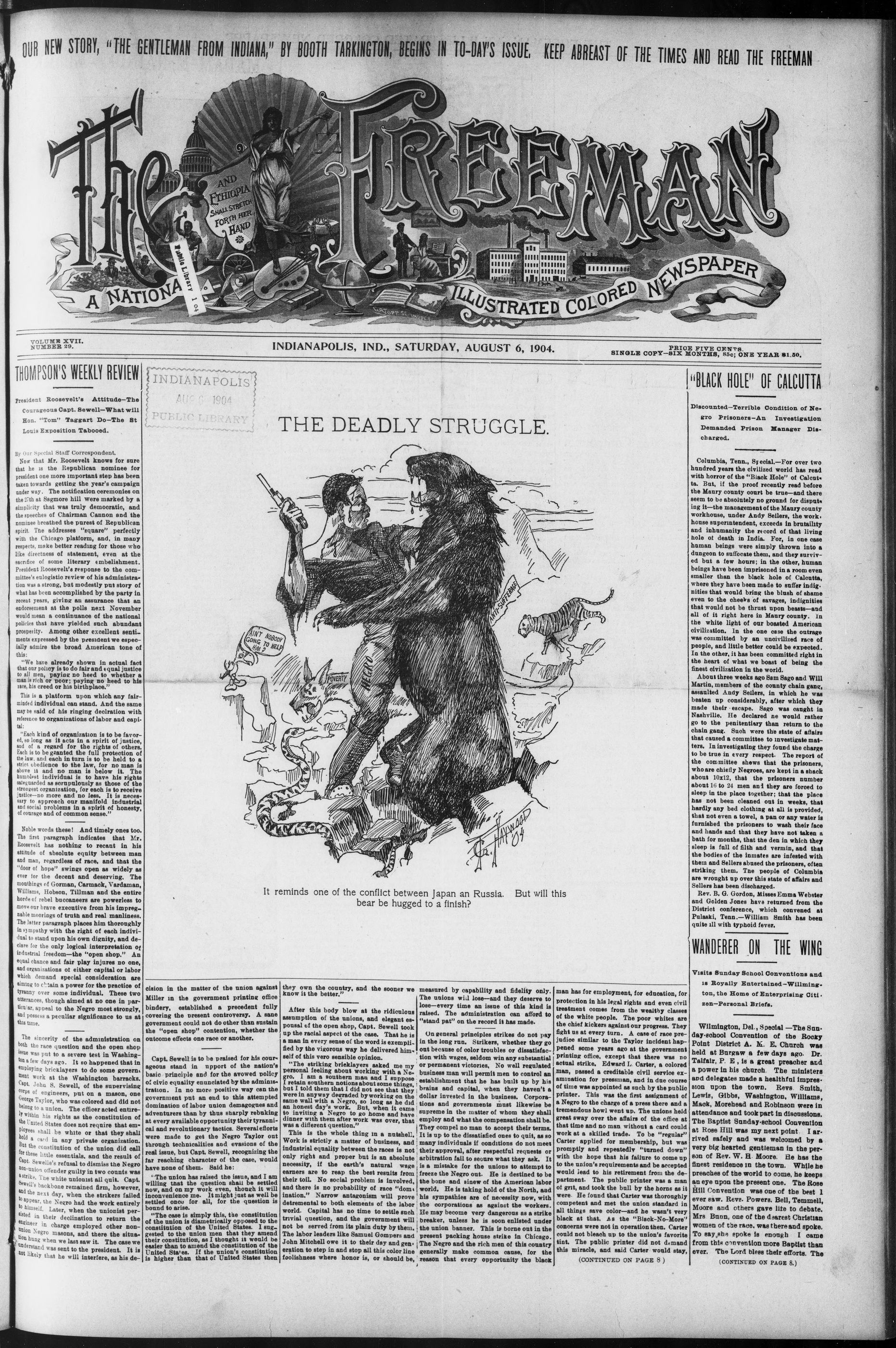
THOMPSON'S WEEKLY REVIEW
President Roosevelt's Attitude-The
Courageous Capt. Sewell-What will
Hon. "Tom" Taggart Do-The St
Louis Exposition Tabooed.
By Our Special Staff Correspondent.
Now that Mr. Roosevelt knows for sure that he is the Republican nominee for president one more important step has been taken towards getting the year's campaign under way. The notification ceremonies on the 2nd at Sagmore hill were marked by a simplicity that was truly democratic, and the speeches of Chairman Cannon and the nominee breathed the purest of Republican spirit. The addresses "square" perfectly with the Chicago platform, and, in many respects, make better reading for those who like directness of statement, even at the sacrifice of some literary embellishment.
President Roosevelt's response to the committee's eulogistic review of his administration was a strong, but modestly put story of what has been accomplished by the party in recent years, giving an assurance that an endorement at the polls next November would mean a continuance of the national policies that have yielded such abundant prosperity. Among other excellent sentiments expressed by the president we especially admire the broad American tone of this:
"We have already shown in actual fact that our policy is to do fair and equal justice to all men, pay no heed to whether a man is rich or poor; paying no heed to his race, his creed or his birthplace." This is a platform upon which any fair-minded individual can stand. And the same may be said of his ringing declaration with reference to organizations of labor and capital: "Each kind of organization is to be favored, so long as it acts in a spirit of justice, and of a regard for the rights of others. Each is to be granted the full protection of the law, and each in turn is to be held to a strict obedience to the law, for no man is above it and no man is below it. The most individual is to have his rights safeguarded and to have the power of the strongest organization, for each is to receive justice—no more and no less. It is necessary to approach our manifold industrial and social problems in a spirit of honesty, of courage and of common sense."
Noble words these! And timely ones too. The first paragraph indicates that Mr. Roosevelt has nothing to recant in his attitude of absolute equity between man and man, regardless of race, and that the "door of hope" swings open as widely as ever for the decent and deserving. The mouths of Gorman, Carmack, Vardaman, Williams, Hobson, Tillman and the entire horde of brore buccaneers are powerless to move our brave executive from his impregnable moorings of truth and real manliness. The latter paragraph places him thoroughly in sympathy with the right of each individual to stand upon his own dignity, and declare for the only logical interpretation or industrial freedom—the "open shop." An equal chance and fair play injures no one, and organizations of either capital or labor which demand special consideration are aiming to "chain a power for the practice of tyranny over some individual. These two utterances, though aimed at no one in particular, appeal to the Negro most strongly, and possess a peculiar significance to us at this time.
The sincerity of the administration on both the race question and the open shop issue was put to a severe test in Washington a few days ago. It so happened that in employing bricklayers to do some government work at the Washington barracks, Capt. John S. Sewell, of the supervising corps of engineers, put on a mason, one George Taylor, who was colored and did not belong to a union. The officer acted entirely within his rights as the constitution of the United States does not require that employees shall be white or that they shall hold a card in any private organization. But the constitution of the union did call for these little essentials, and the result of Capt. Sewelle's refusal to dismiss the Negro non-union offender guilty in two counts was a strike. The white unionist all quit. Capt. Sewelle's backbone remained firm, however, and the next day, when the strikers failed to appear, the Negro had the work entirely to himself. Later, when the unionist persisted in their deciation to return the estuarine in charge employed other non-Negro masons, and there the situation hung when we last saw it. The case we understand was sent to the president. It is not likely that he will interfere, as his de-
AINT NOBODY
GOING TO HELP
HIM?
POVERTY
ANT-SUFFERING
Dr. Haywood
04
INDIANAPOLIS
AUG 6 1904
PUBLIC LIBRARY
AINT NOBODY
GOING TO NEED
HIM?
cision in the matter of the union against Miller in the government printing office bindery, established a precedent fully covering the present controversy. A sane government could not do other than sustain the "open shop" contention, whether the outcome effects one race or another.
Capt. Sewell is to be praised for his courageous stand in support of the nation's basic principle and for the avowed policy of civic equality enunciated by the administration. In no more positive way can the government put an end to this attempted domination of labor union demagogues and adventurers than by thus sharply rebuking at every available opportunity their tyrannical and revolutionary tactics. Several efforts were made to get the Negro Taylor out through technicalities and evasions of the real issue, but Capt. Sewell, recognizing the far reaching character of the case, would have none of them. Said he:
"The union has raised the issue, and I am willing that the question shall be settled now, and on my work even, though it will inconvenience me. It might just as well be settled once for all, for the question is bound to arise.
"The case is simply this, the constitution of the union is diametrically opposed to the constitution of the United States. I suggested to the union men that they amend their constitution, as I thought it would be easier than to amend the constitution of the United States. If the union's constitution is higher than that of United States then
INDIANAPOLIS, IND., SATURDAY, AUGUST 6, 1904.
It reminds one of the conflict between Japan an Russia. But will this bear be hugged to a finish?
they own the country, and the sooner we know it the better."
After this body blow at the ridiculous assumption of the unions, and elegant espousal of the open shop, Capt. Sewell took up the racial aspect of the case. That he is a man in every sense of the word is exemplified by the vigorous way he delivered himself of this very sensible opinion.
"The striking brieklayers asked me my personal feeling about working with a Negro. I am a southern man and I suppose I retain southern notions about some things, but I told them that I did not see that they were any deeper by working on the same wall with a slave, long as he did an honest day's work. But when it came to inviting a Negro to go home and have dinner with them after work was over, that was a different question."
This is the whole thing in a nutshell. Work is strictly a matter of business, and industrial equality between the races is not only right and proper but is an absolute necessity, if the earth's natural wage earners are to reap the best results from their toil. No social problem is involved, and there is no probability of race "domination." Narrow antagonism will prove detrimental to both elements of the labor world. Capital has no time to settle such trivial question, and the government will not be served from its plain duty by them. The labor leaders like Samuel Gompers and John Mitchell owe it to their day and generation to step in and stop all this color line foolishness where honor is, or should be.
measured by capability and fidelity only. The unions will lose—and they deserve to lose—every time an issue of this kind is raised. The administration can afford to "stand pat" on the record it has made.
On general principles strikes do not pay in the long run. Strikers, whether they go out because of color troubles or dissatisfaction with wages, seldom win any substantial or permanent victories. No well regulated business man will permit men to control an establishment that he has built up by his brains and capital, when they haven't a dollar invested in the business. Corporations and governments must likewise be supreme in the matter of whom they shall employ and what the compensation shall be. They compel no man to accept their terms. It is up to the dissatisfied ones to quit, as so many individuals if conditions do not meet their approval, after respectful requests or arbitration fail to secure what they ask. It is a mistake for the unions to attempt to freeze the Negro out. He is destined to be the bone and sinew of the American labor world. He is taking hold of the North, and his sympathies are of necessity now, with the corporations as against the workers. He may become very dangerous as a strike breaker, unless he is soon enlisted under the union banner. This is borne out in the present packing house strike in Chicago. The Negro and the rich men of this country generally make common cause, for the reason that every opportunity the black
man has for employment, for education, for protection in his legal rights and even civil treatment comes from the wealthy classes of the white people. The poor whites are the chief kickers against our progress. They fight us at every turn. A case of race prejudice similar to the Taylor incident happened some years ago at the government printing office, except that there was no actual strike. Edward L. Carter, a colored man, passed a creditable civil service examination for pressman, and in due course of time was appointed as such by the public printer. This was the first assignment of a Negro to the charge of a press there and a tremendous howl went up. The unions held great sway over the affairs of the office at that time and no man without a card could work at a skilled trade. To be "regular" Carter applied for membership, but was promptly and repeatedly "turned down" with the hope that his failure to come up to the union's requirements and be accepted would lead to his retirement from the department. The public printer was a man of grit, and took the bull by the horns as it were. He found that Carter was thoroughly competent and met the union standard in all things save color—and he wasn't very black at that. As the "Black-No-More" concerns were not in operation the Carter could not bleach up to the union's favorite tint. The public printer did not demand this miracle, and said Carter would stay,
(CONTINUED ON PAGE 8)
"BLACK HOLE" OF CALCUTTA
Discounted-Terrible Condition of Negro Prisoners-An Investigation Demanded Prison Manager Discharged.
Columbia, Tenn., Special.—For over two hundred years the civilized world has read with horror of the "Black Hole" of Calcutta. But, if the proof recently read before the Maury county court be true—and there seem to be absolutely no ground for disputing it—the management of the Maury county workhouse, under Andy Sellers, the workhouse superintendent, exceeds in brutality and inhumanity the record of that living hole of death in India. For, in one case human beings were simply thrown into a dungeon to suffocate them, and they survived but a few hours; in the other, human beings have been imprisoned in a room even smaller than the black hole of Calcutta, where they have been made to suffer indignities that would bring the blush of shame even to the cheeks of savages, indignities that would not be thrust upon beasts—and all of it right here in Maury county. In the white light of our boasted American civilization. In the one case the outrage was committed by an uncivilized race of people, and little better could be expected. In the other, it has been committed right in the heart of what we boast of being the finest civilization in the world.
About three weeks ago Sam Sago and Will Martin, members of the county chain gang, assaulted Andy Sellers, in which he was beaten up considerably, after which they made their escape. Sago was caught in Nashville. He declared he would rather go to the penitentiary than return to the chain gang. Such were the state of affairs that caused a committee to investigate matters. In investigating they found the charge to be true in every respect. The report of the committee shews that the prisoners, who are chiefly Negroes, are kept in a shack about 10x12, that the prisoners number about 16 to 24 men and they are forced to sleep in the place together; that the place has not been cleaned out in weeks, that hardly any bed clothing at all is provided, that not even a towel, a pan or any water is furnished the prisoners to wash their face and hands and that they have not taken a bath for months, that the den in which they sleep is full of filth and vermin, and that the bodies of the inmates are infested with them and Sellers abused the prisoners, often striking them. The people of Columbia are wrought up over this state of affairs and Sellers has been discharged.
Rev. B. G. Gordon, Misses Emma Webster and Golden Jones have returned from the District conference, which convened at Pulaski, Tenn.-William Smith has been quite all with typhoid fever.
Visits Sunday School Conventions and is Royally Entertained-Willington, the Home of Enterprising Citizen-Personal Briefs.
Wilmington, Del., Special — The Sunday-school Convention of the Rocky Point District A. M. E. Church was held at Burgaw a few days ago. Dr. Talfair, P. E., is a great preacher and a power in his church. The ministers and delegates made a healthful impression upon the town. Revs. Smith, Lewis, Gibbs, Washington, Williams, Mack, Morehead and Robinson were in attendance and took part in discussions. The Baptist Sunday-school Convention at Rose Hill was my next point. I arrived safely and was welcomed by a very big hearted gentleman in the person of Rev. W. H. Moore. He has the finest residence in the town. While he preaches of the world to come, he keeps an eye upon the present one. The Rose Hill Convention was one of the best I ever saw. Revs. Powers. Bell, Temmell, Moore and others gave life to debate. Mrs Bunn, one of the dearest Christian women of the race, was there and spoke. To say she spoke is enough I came from this convention more Baptist than ever. The Lord bless their efforts. The
(CONTINUED ON PAGE 8.)
M.
A prominent club woman, Mrs. Danforth, of St. Joseph, Mich., tells how she was cured of falling of the womb and its accompanying pains and misery by Lydia E. Pinkham's Vegetable Compound.
"DEAR Mrs. PINKHAM:—Life looks dark indeed when a woman feels that her strength is fading away and she has no hopes of ever being restored. Such was my feeling a few months ago when I was advised that my poor health was caused by prolapse or falling of the womb. The words sounded like a knell to me, I felt that my sun had set; but Lydia E. Pinkham's Vegetable Compound came to me as an elixir of life; it restored the lost forces and built me up until my good health returned to me. For four months I took the medicine daily and each dose added health and strength. I am so thankful for the help I obtained through its use."—Mrs. FLORENCE DANFORTH, 1007 Miles Ave., St. Joseph, Mich.
A medicine that has restored so many women to health and can produce proof of the fact must be regarded with respect. This is the record of Lydia E. Pinkham's Vegetable Compound, which cannot be equalled by any other medicine the world has ever produced. Here is another case:
"DEAR MRS. PINKHAM:—For years I was troubled with falling of the womb, irregular and painful menstruation, leucorrhea, bearing-down pains, backache, headache, dizzy and fainting spells, and stomach trouble.
"I doctored for about five years but did not seem to improve. I began the use of your medicine, and have taken seven bottles of Lydia E. Pinkham's Vegetable Compound, three of Blood Purifier, and also used the Sanative Wash and Liver Pills, and am now enjoying good health, and have gained in flesh.
I thank you very much for what you have done for me, and heartily recommend your medicine to all suffering women."—Miss EMMA SNYDER, 218 East Center St., Marion, Ohio.
"FREE MEDICAL AID
Women would save time and
write to Mrs. Pinkham for advice
toms appear. It is free, and has just
right road to recovery.
Mrs. Pinkham never violates her,
and although she publishes,
women who have been benefited
never in all her experience has she
the full consent, and often by speech
$5000 FORFEIT if we cannot forthwish
above testimonials, which will pro-
duce fine Cutsof Bee
KUHN
Wholesale &
Fine Cutsof Bee
Telephones NEW 860
OLD 3803
B. P. AUSTIN,
President.
GEORGE F. N.
Secretary a
...Offic
Muskogee Oil
(Incorporated)
...To Stockhold
MICAL ADVICE TO
time and much
for advice as soon
and has put thou
violates the confi
publishes thousand
benefited by her
face has she publishes
by special requ
annot forthwith produce the
which will prove their absol
Lydia E. Pinkhau
N B
ale & Reta
Cutsof Beef a spec
ORGE F. NAVE,
Secretary and Gen'l M
MEDICAL ADVICE TO WOMEN."
live time and much sickness if they would
for advice as soon as any distressing sym-
pe, and has put thousands of women on the
her violates the confidence thus entrusted to
p publishes thousands of testimonials from
en benefited by her advice and medicine,
ence has she published such a letter without
often by special request of the writer.
cannot forthwith produce the original letters and signatures of
which will prove their absolute genuineness.
Lydia E. Pinkham Medicine Co., Lynn, Mass.
N BROS.
sale & Retail Meats
the Cutsof Beef a specialty.
"FREE MEDICAL ADVICE TO WOMEN."
Women would save time and much sickness if they would write to Mrs. Pinkham for advice as soon as any distressing symptoms appear. It is free, and has put thousands of women on the right road to recovery.
Mrs. Pinkham never violates the confidence thus entrusted to her, and although she publishes thousands of testimonials from women who have been benefited by her advice and medicine, never in all her experience has she published such a letter without the full consent, and often by special request of the writer.
$5000 FORFEIT if we cannot forthwith produce the original letters and signatures of above testimonials, which will prove their absolute genuineness.
Lydia E. Pinkham Medicine Co., Lynn, Mass.
GEORGE F. NAVE, REV. DR. W. H. SIMS,
Secretary and Gen'l M'n'gr. Treasurer.
B. P. AUSTIN, GEORGE F. NAVE, REV. DR. W. H. SIMS,
President, Secretary and Gen'l M'n'gr. Treasurer.
Office of...
Oil and
(Incorporated.)
ckholders,
e Oil and Gas Co. (Incorporated.) stockholders, Greeting...
...To Stockholders, Greeting...
We take pleasure in extending to you our congratulations upon our success on well No. 2. At a depth of 1000 feet the oil sand was reached and the oil be began to rise so fast that the workmen feared an overflow of oil and stopped work until arrangements could be made to CONTROL THE GUSHER. At a depth of 1087 feet the oil began to flow over the top of the well, and it was with much difficulty that the gusher was checked and the oil was turned into our receiving tank, which had been prepared.
The Company expects an income of $2,000 00 per month from its two wells. The location of well No. 3 has been selected and work will begin upon it within a few days.
We expect the dividends to each stockholder in the first 12 months will equal his investment. The ders are protected by the law United States, regardless of live, and the officers are und sufficient bonds.
Until September 1, 1904, the Directors has decided to se $5 00 per share, the par value is $25 00, after which date the be withdrawn from the man price per share increased.
As ours is the only Negro in the world owning and profitable oil wells, we o you again on having cast you us, and remind you that in Indian Territory Ethiopa ha up her heart unto God and forth her hand into the problems of the world. We our first car load of oil July
gee Oil and Gas Co.
Muskogee O
gee Oil and
ers of The Free
Artisers of The Freeman. Read the Ads
Patronize the Advertisers of
Patronize the Advertisers of The Freeman. Read the Ads
trou
and p
down
fain
not m
medi
Lydi
three
Sana
enjoy
208 1-2 Broadway.
equal his investment. The stockholders are protected by the law of the United States, regardless of where they live, and the officers are under good and sufficient bonds.
Until September 1, 1904, the Board of Directors has decided to sell stock at $50 per share, the par value of which is $250, after which date the stock may be withdrawn from the market, or the price per share increased.
As ours is the only Negro Company in the world owning and controlling profitable oil wells, we congratulate you again on having cast your lot with us, and remind you that in the great Indian Territory Ethiopa has stretched up her heart unto God and stretched forth her hand into the commercial problems of the world. We shipped our first car load of oil July 4, 1904.
THE FREEMAN. AN ILLUSTRATED COLORED NEWSPAPER.
407 W. Michigan St.
Muskogee, Ind. Ter.
RACE CLEANINGS
One of the most interesting events of the World's Fair City for some time past was the biennial session of the National Association of Colored Women better known as the Woman's Federation, which began Monday evening, July 11, and closed Friday, July 15. More than half of the states of the Union were represented by delegates, and throughout the entire session the meetings were characterized by earnestness and enthusiasm on the part of both the members and the daily throng of visitors.
The National Association of Colored Women has made a lasting impression upon those who came under their influence. They are a band of noble-hearted, high-minded women, doing great work for the race. Their motto, "Lifting as We Climb," is truly suggestive of the exalted character of their work.
---
A news item from Hawkinsville, Ga., says: The Negroes of the county have organized in a society for the improvement of their conditions, and in a meeting held recently pledged their support to any movement that would result in better labor conditions in the county. A number of the most progressive farmers of the county were present and expressed themselves as being in hearty accord with the white planters in their endeavors to secure more reliable labor for the farms.
---
The celebration of Negro Day at the World's Fair, which was set for August 1, has been abandoned. The committee of colored men, headed by Attorney Walter M. Farmer, which originated and was managing the movement, held a meeting Friday night, July 8, at the headquarters of the Forum club, 2614 Lawton avenue, at which it was unanimously decided to abandon the celebration and to issue a statement giving the reasons for doing so.
The abandonment of Negro Day does not in any sense effect the other special days at the World's Fair in which the colored people are interested. Fick University Day was celebrated July 6
THE RACE PROBLEM
THE RACE PROBLEM
No Longer a Local Question, Involving the Negro and White Man of America, but now Involving the Races of the World.
---
While there is still darkness as to the best methods of working out the race problem yet there is abundant light upon the factors that are to be considered. It is true that the race problem is no longer a merely local problem, involving the Negro and the white man of America. It is now a problem which has as its factors the light and the dark races. To be more exact, the ruddy (blushing) races and the colored races of the world.
We would be rather glad to have the problem confined to America, but the Providence that over rules human wishes has seen fit that the great drama should be shifted to Africa and that Japan should shed a side-light and sound a note of warning. The race problem is in Africa. The questions unsettled in America are simply incidents. Will the time ever come when the doctrine of the 15th amendment will obtain in Africa. The majority of mankind belong to the dark races. The civilization of the world is, at present, in the hands of the light races. The dark races are stretching forth their hands, not as beggars for the help of the light race but as eager men in stern quest of power. The whining mission ardy delights to play upon his expected contributors by representing the poor black man as stretching forth his hand begging for the penny, but the Bible represents him as stretching forth his hand unto God, the giver of power and all good gifts. The dark races are seeking knowledge, civilization and power. The Negro has never perished before the onward march of civilization, he has always lived and gathered strength. This is true, regardless of Tasmania, Australia, etc.
The sole argument of the white man is his appeal to race pride and to race prejudice, but over against this stands the word of God, that proclaims all men to be of one blood. It is certain that so elsewhere in the centuries of the future the pathetic cry of the white man about race purity will have become like the wall of the ancient Jew when the partition between Jew and Gentile began to crumble. While we hope for the final adjustment of all things according to the Almighty's will we have our present ten to seventy years of time to spend on earth. Why not be opportunists and make the best practical u of what is at hand? If a few heroic men like Trotter are willing to save the day and become the required martyrs why not allow them to do so and thank them while we pith in and get the fruit that richest now but that would fall and
and a special program was carried out,
and the colored Knight Templars will
celebrate on August 6.
The Civic Improvement League of
St. Louis, has opened a playground at
the corner of Tenth and Carr streets of
that city, for the benefit of colored
children, and has put colored directors
in charge.
---
The Masons of Kansas City have set the craft throughout the country, an excellent example in enterprise and farsightedness. They have purchased a $10,000 building for a temple and they are expending $1500 in alterations and improvements. Prof. R. T. Cole has been the prime mover in this important work, and to him unqualified praise is due for the accomplishment of this long cherished and commendable plan. In addition to this valuable temple, the fraternity owns a $4,000 lot in a most desirable locality.
---
C. M. Davis, of Carroll county, Miss , a colored planter, has been in St. Louis for several days, making a special study of the department of horticulture at the World's Fair. He is the owner of a fruit and truck farm of 280 acres, which he devotes largely to the cultivation of strawberries.
---
Colored planters near Hopkinsville, Ky. are planning to retaliate against the dilatory tactics of the tobacco trust. The trust succeeded in forcing prices down, making them lower than they have been in years. This year the producers of the orange dark leaf are using the soil for other products. Therefore is is fair to suppose that the crop will be short this year.
...
On account of the prevailing prejudicial feeling against Negroes attending the St. Louis Exposition, the National Federation of Colored Women resolved not to attend the exposition in a body, feeling that by so doing they would show the proper resentment for any discrimination shown members of their race.
waste if ungathered? Only a few martyrs are enough to save the day and maintain the abstract principles the average individual must meet and measure up to just what the present demands and cannot waste time and miss the things now ready on account of some dim and distant day of the centuries to come. If you cannot be a bank president why not be a slick and wellpaid porter and let your descendant be the president.
An advance Normal course for teachers of the common branches and teachers of Manual Training, the Trades and Agriculture will be established at the Tuskegee Institute, September 18, 1904, the opening of the next school term. The course includes a review of all the elementary studies; the elements of psychology, the history of education, general and special methods of teaching and school management; observation of model teaching and practice teaching in an admirably equipped training school are required. Graduates of Tuskegee and persons of equivalent education are admitted without examination. Persons of some experience in teaching are accorded special advantages. In writing for further details, be sure to specify whether you wish training as a teacher (1) of a specific industry, like blacksmithing or agriculture, (2) of manual training, or (3) of academic branches. Address all correspondence to Principal Booker T. Washington, Tuskegee, Alabama.
ATTENTION, COMRADES
The Big Four Route announces a rate of One Cent Per Mile plus 35 cents from all points on its system to Boston, Mass., on account of the 88th annual G. A. R. Encampment. Tickets will be on sale August 19th, 18th and 14th, 1904, inclusive. Good to return, leaving Boston not later than midnight of August 20th, 1904, with proviso that upon deposit of ticket with Joint Agent prior to noon of August 20th, 1904, and payment $ a fee of 50 cents per ticket at time of deposit, an extension of return limit may be secured to leave Boston to and including September 30th, 1904. For full information regarding tickets, rates and time of trains call on agents of "Big Four Route" or address Warren J. Lynch, General Passenger and Ticket Agent, Cincolnatti, O, or H. M. Bronson, A. G. P. A., Indianapolis, Ind.
The Freeman in Chicago.
B. Williams 484+ State st.
S. S. Ash, Cornell Ave. & 56th, st.
E. H. Falkner, 3104 State st.
A. F. Tervalon 2836 State st.
Calvin B. Brazau, 5506 Jeff Ave.
J. S. Love 2702 State st.
Isadore Jacobson 2970 State st.
MADAM McNAIRDEE-MOORE
Mary C.
Manufactured only by THE LAUNDRY BLUE COMPANY, Chicago
Subscribe For THE FREEMAN. $1.00
The gil, co Clairvoyant, the great female wonder, born with the double (caule) veil, she is one of the old ancient Southern Clairvoyant of New Orleans. She's a lying Phrenologist and Physiologist. She tells plainly what you are best adapted for in life by reading you have given you a co of influence to enable you to be lucky. She has made thousands of homes happy. Read the fifth chapter 1x verse of St. Matt: "Blessed are the peacemakers for they shall be called the children of God." She reunites the separated, makes peace where there is confusion. Your husband or wife will be cared for or your sweet heart forsake you. But will you need this lady's consultation. Read what several ladies of your city say. "Yes, we believe that a Godsend to our city; my husband and I had been separated over a year and just since I called on this lady, he returned today, to see me and happy." This young lady says: "There and happy." This lady call or write me; I called on this lady and we are now engaged." You can't afford to miss consulting this gifted lady; she is gifted to read characters. She challenges the world to exoell her advice to trouble her business, family and financial troubles. She has separated causes speedy marriage with the choice. No cards allowed in her place of business; no one's ill wishes filled; st. john a Christian lady and depends entirely on her heavenly gift. If you are painful or asking, think you have been witchcrafted go to the juniors of Africa, spent eight years in the Jungle of Africa, spent eight years through 34 states doing good wherever you read St. John, 9th chap, 33ver. If this man is not of God he could do nothing.
Three parlers so arranged that you meet friends nostrangers: everything confidant night or day. Personally you may all night or day. Personally you may all money by postal order or Registered letter
---
I, for one, as one in the midst. My heart ached from the cruel treatment of my hus' band and the way he would throw away his time and money until I consulted this wont-durful lady. It will soon be a year. Through her he has become a loving husband; and today he presents me with a lovely lot on which he will the spring erect a home. Tongue can' dn praise! A LADY of New Iberia, La. Chicago, Ill., Nov. 17, 1909. Madame McNairdee, Indianapolis, Ind.' Dear Madame.—Your letter like a ray of sunshine, came duly to hand and I am very pleased with it, for every word of it were
of adv
color,
compo
the sart
of liv
made
remed
sals,
scienti
the bl
without
Makes
PR
BLAC
Wiggle =
(Patented)
Laundry
Won't Freeze
Won't Break
Won't Spill
Won't Spot Clothes
Costs 10 Cents, Equals 20 Cents
worth of any other kind of bluing
Wiggle-Stick is a stick of soluble blue in a filter bag inside a perforated wooden tube, through which the water flows and dissolves the color as needed.
Manufactured only by THE LAUNDRY
Subscribe For THE
true, I am sorry that I did not write to your months ago. I enclose $6.00 for your service, hoping that you may be successful in bringing about desired results. I feel quite sure that you can. I am very sorry to hear of your being ill, and sincerely hope your speedy recovery.
Molino, Fina, Nov. 14, 1902.
Madame:—You are the proper person in the proper place. All that you say is true and all you do is good. May God bless you.
F.J.
Guntersville, Ala., Oct. 28, 1902.
I tried Mine, McNardes and find that she is well up to her profession. She will tell things to come, and they will come as predicted. It will pay people to the her who want to know many things in the future.
WRITE HER AT ONCE FOR ALL INFORMATION.
There is no doubt of this lady's prophetic ower. She is a living phrenologist, palmathe and a natural born clairvoyant to which thousands will testify. She is a God send to our country—born with a gift that no one can dictate. Tell you every incident of your past and present life and put you on the road of success both financially and physically, you will only head her instructions, I called on her because the one I had gone I knew not where she is returned at once, and today I am his dear wife.
A LADY of Fort Gibson, Ind. T.
Madame.—I feel it my duty to do this for you are all you advertise. Just think my husband and I have been separated 2 years; I have been in September and in a week's time he returned, and married me, and I can't praise you to such. Ladies that are heart-broken by family troubles, afar ares and bad luck until it is that life is a blank, call or write to this lady, she will do you good; she will tell you the trust God and she will do the balance, and she will.
A LADY of Rosland, R.
Dear Sisters and Brothers—Call on her when you can, she will be please to meet you and will when ever you wish to. She devotes her entire time to the welfare of the people living God will reward her. She will make you a soul glad to hear her talk of heaven for you such soul searching letters, tells you how to home happy. Send date of the month and the year you was born in and receives full character reading. Enclose $1. Clip this ad.
1527 English Avenue,
INDIANAPOLIS IND,
MADAME MONAIRDE-MOORE,
Enclose stamp foy.
THE NEGRO'S HOPE
of advancement lies in his change'of color. The structure of his skin and composition of his blood are precisely the same as that of the white man. Ages of living under a tropical sun have made a chemical change that can be remedied by the use of counter-chemicals. "Block-No-More," the greatest scientific discovery of the age, changes the blackest skin to the purest white, without pain, inconvenience or danger. Makes a white skin whiter.
PRICE $2, BY EXPRESS PREPAID.
BLACK- NO- MORE CHEMICAL COMPANY.
CHILLICOTHE, O. BOX 26.
e=Stick
ry
Blue
At All
Crocers
hes
Cents
bluing
the blue
wooden
flows
DIRECTIONS FOR USE:
Wiggle-Stick around
in the water.
LUNDRY BLUE COMPANY, Chicago
HE FREEMAN, $1.00
A NATIONAL ILLUSTRATED
COLORED NEWSPAPER.
PUBLISHED EVERY SATURDAY
At 309 Indiana Avenue,
INDIANAPOLIS, INDIANA.
INDIANAPOLIS, INDIANA.
SUBSCRIPTION RATES :
Any part of the United States and Canada,
one year, postage paid
$1.50
Six Months
three Months
Foreign Countries
$1.00 extra
post office order or registered letter
Agent wanted $1 every town and city not
now occupied, and liberal inducements will be
name, Send for our extraordinary
inducements.
ADVERTISING RATES:
Five cents per line. Pase of measure—solid agate, 14 lines to an inc. 276 lines in a column. Special position 25 per cent additional. **No advertisement!** Imagined first panel. Special rates on standing professional and business cards. Reasonable discount for long time and space. Reading notices 100 per line. Special rates on WR TE UPS.
Entered at the postoffice at Indianapolis Indiana, as second class matter.
All matter should be addressed to THE FREEMAN, INDIANAPOLIS, IND.
GEORGE L. KNOX, Publisher.
SATURDAY, AUGUST 6, 1904.
A SUGGESTION.
This is a time of organization and cooperation. Things that are of too great magnitude for one individual are being done by several working to the same end. The time has past when those of small means can hope to accomplish much while working single-handed. The poorer a people or a community happen to be, the greater the necessity for co-operation. This is the lesson that must be learned by us, and the sooner it is learned and put into practice the better. But we wish to mention one instance in which co-operation would be of untold benefit to us as a people.
The most of us have at different times read newspaper and magazine articles on phases of what is called the race problem that needed a reply or answer. At times, all too frequently, public speakers and newspapers have maligned and misrepresented us, and these, in the majority of cases, go unanswered. So much of this misrepresentation has been allowed to go unchallenged so long that it has wrought great injury to us. The headline newspaper has done its work. Whenever the circumstances make it possible all crimes and misdemeanors are charged to Negroes in glaring headlines, and the impressions once made invariably remain, for, although subsequent events may disprove the charge in most cases, the injury is never fully repaired. Here is the suggestion:
Let some one permanently engaged in newspaper work organize a letter-writing corps consisting of men and women who have the ability to answer arguments and correct misrepresentations. Let them be divided into classes, each class having representatives in different parts of the country. No one person is to be expected to write more than one letter each month. Circumstances may not require more than two or three letters a year from each member. They should receive the paper or publication managing the affair free of charge. This publication will direct the writers. When some magazine or newspaper article, or some speaker shall make fallacious argument or misrepresentation reflecting on the race, attention should be called to it, and a section of the letter-writing corps directed to make reply directly to the speaker or writer. A score or more of such letters from such of our own people as we shall be able to secure cannot fall to be productive of good results. The fire should be kept up without letting a guilty one escape. Such systematic action was in use by the Single Tax propaganda and the results were all that could have been asked. Why not apply this method in our own defense against the unjust and scurrilous attacks of those who are continually taking advantage of our silence? We are abundantly able to do it. Those who are able to perform this service should at least be enough interested to make them willing to do so, both for their own good and for the good of those who are unable to speak for themselves.
If this should come to the notice of any who regard it as worthy of attention, further particulars may be had from G. W. Cable, in care of The Freeman. Nothing but indifference on our own part should prevent the success of such a project, and certainly the time is now here when we cannot afford to be indifferent.
THE WORD "NEGRO."
For many years there has been a great difference of opinion as to the correct word that should be used to designate those commonly known as Negroes, or colored people. We believe that the word "Negro" has gained ground in the past few years, but the fact that this question continues to
THE FREEMAN, AN ILLUSTRATED COLORED NEWSPAPER.
bob up is proof that there is still a difference of opinion regarding it. For the benefit of those who are interested in the subject we herewith submit an editorial from the pen of Louis F. Post in the Public;
The use of the word "negress" for Negro woman, is not only a gratitudous insult to a race whose history in the past and experience in the present call for the sympathy and kind consideration of all who are truly chivalrous. It is also such an abuse of language that it should shame even the unchivalrous out of using it. As well say Germaness, or Irishness, or Turkess, or lawyeress. We agree, therefore, with the New York Age in denouncing the word. But we do not agree with its objection, and that of the South African lzwl Labantu, to the word "Negro." Whatever may have been the motive in which this word originated, it has acquired dignity as a race name and can be accepted as such with entire self-respect. While the objection to treating the race name "Negro" as a common noun is well taken, it is a mistake to regard "Afro-American" as either a correct or a dignified term. We may speak of naturalized Germans as "German-Americans," for they are Americanized Germans; but their children born here are in strictness simply Americans. As to the Americans of African descent, to call them Afro-American is to imply that they are Americans only by adoption and not in the full sense of the American birthright. It is not the origin nor the past relation of a name that gives it dignity, but the dignity of those to whom it attaches. Affectation is never dignified, and "Afro-American" is an affected term. "Negro" is a full, round, strong word. What if it does mean black? Are not Negroes black? And are they ashamed of being black? Would it not be better for them to make the name one to be proud of, than to run away from it and hide behind a verbal affectation? It is easy to understand how "Negro" may become a word of inspiration; but how can "Afro-American" ever rise above the common place? Negro orators may arouse enthusiasm, Negro heroes may excite admiration, Negro scholars and statesmen may command respect. But how could an "Afro-American" ever rise above the mediocre? When we think of Toussaint l'Ouverture—slave, soldier and statesman—it is not as an Afro-Frenchman that we honor him, but as a great Negro.
CHAIRMAN TAGGART
The people of Indianapolis, irrespective of party, are pleased to know that Mr. Taggart has been selected as Chairman of the National Democratic Committee. They feel this as a matter of local pride, and they well know that so far as the effect on Indiana is concerned, no better man could have been selected. Tom Taggart has a way of doing things and getting results that is pretty well known. He does not make enemies by his conduct and manner. He has no quarrel or harsh and abusive word for those who do not agree with him politically. His characteristic smile is not only for personal friends—it is for everybody. This is what makes him a dangerous factor to the opposition where he is known; and he is known in Indiana, and Indiana is of some importance in the coming campaign. Hence, what?
We do not betray any secret when we state that the colored voter has for some time been much dissatisfied by the manner in which he has been treated, politically, by those who owe him some consideration. That this vote is entitled to consideration is apparent from the fact that Republican success in this State is impossible without it. This condition is well known and Mr. Taggart is just the man to attempt to profit by it. Of course there will be appeals to voters on legitimate grounds, and there will also be appeals that are not so legitimate. The latter is to be regretted, for the ultimate result cannot be helpful to good government. We most respectfully suggest to Republicans that if they are to counteract the immediate effect of this method on the colored voter they should admit to the councils of the party such men as voice the best sentiment of the colored people, and that they be permitted to become more than local politicians. Let us have representation in the higher councils of the party at all times if continued loyalty is to be expected.
There is no class of people that wince more under criticism than the clergy, not withstanding that they have been most charitably dealt with. To be constantly nagging at those of any profession or occupation simply because they belong to that class is inexcusable. It should not be done, and we do not believe that it is being done. Criticisms, however adverse, are only intended for those whom it fits. Certainly we shall never know the extent of the good that has been done our people through the clergy, neither shall we ever be able to estimate the amount of good which might have been done, but which has not been done. When we think of this, right in the face of such abundant opportunity, it should
neither cause surprise nor shock when criticism comes.
The time was when the preacher was the leader of his community. If any are losing that leadership it is because they deserve to lose it. People no longer believe one "called to preach" simply because he says so. They also know that the divinely called are to be found among poets, painters and sculptors, as well as preachers. The divinely called cannot lose. They are our successes, and our only ones, if success be judged rightly.
But the churches, like individuals, get about what they deserve after all. If a church, whose government is democratic, is satisfied with a pastor who is doing very little, then it does not deserve one that will do very much. We do not always deserve what we need, but we almost always deserve what we get.
The demonstration at the return of Thomas Taggart and the notification of Senator Fairbanks, both coming within the same twenty-four hours, makes Indianapolis appear much as she used to. Another feature to be noted in connection with both of these events was that colored men were to be seen in carriages in the Taggart procession, and Dr. Crum, collector of customs for the port of Charleston, S. C., and Judge Joseph E. Lee of Jacksonville, Fla., were present at the Fairbanks notification-All of this goes to show that it is pretty well understood that this is a very good time to show that all classes of voters are being regarded as worthy of consideration.
The people of Mississippi are very much at outs with President Roosevelt. A new postoffice has been established in that State and the department asked the residents of the town to suggest a name. They selected the name Vardaman. The postoffice officials replied and asked them to select another name. This is felt to be a direct insult to their governor, and they lay it to Mr. Roosevelt who, in all probabitity, did not know of the matter. If the inhabitants of the little burg can feel satisfied with that name they ought to have it.
The selection of Harry S. New for the management of the western end of the campaign work was a wise one. No one is better acquainted with the condition of affairs in this section of the country than he, and none know better how to do the work and where to apply it. Thus the wise selection of Mr. Taggart is off set by the wise selection of Mr. New.
A girl in New Jersey fainted when her beau proposed. If this was not "so sudden" it must at least have been unexpected. But the joke is on the fellow for she soon regained consciousness and immediately accepted.
The report that the striking butchers have declined to appeal to the President indicates a wise decision. Such a course would subject the strikers to the charge of trying to perpetrate a holdup.
That the reform element has become quite large in this country is quite evident. Those composing it are well aware that they have absolutely nothing to gain by the election of Parker.
It is useless to complain of the poor man who sells his vote so long as councilmen, legislators and even courts are being charged with the same offense.
Is there not a strong probability that at no distant day the State may be called upon to suppress the phonograph as a public nuisance?
And after all it is the medling foreigner that stirs up the trouble in Hayti. It is strange that it has taken so long to find this out.
The Populists will hold a convention at Waterloo, in this State. The place has an appropriate name of such a meeting.
Port Arthur must have been pretty high up if we judge from the length of time it has been falling.
We shall have no difficulty in getting rid of the vote seller if we can dispose of the vote buyer.
Lightning struck Tammany Hall. No great damage was done. It is used to it.
PENCILINGS.
By W. Milton Lewis, Indianapolis, Ind.
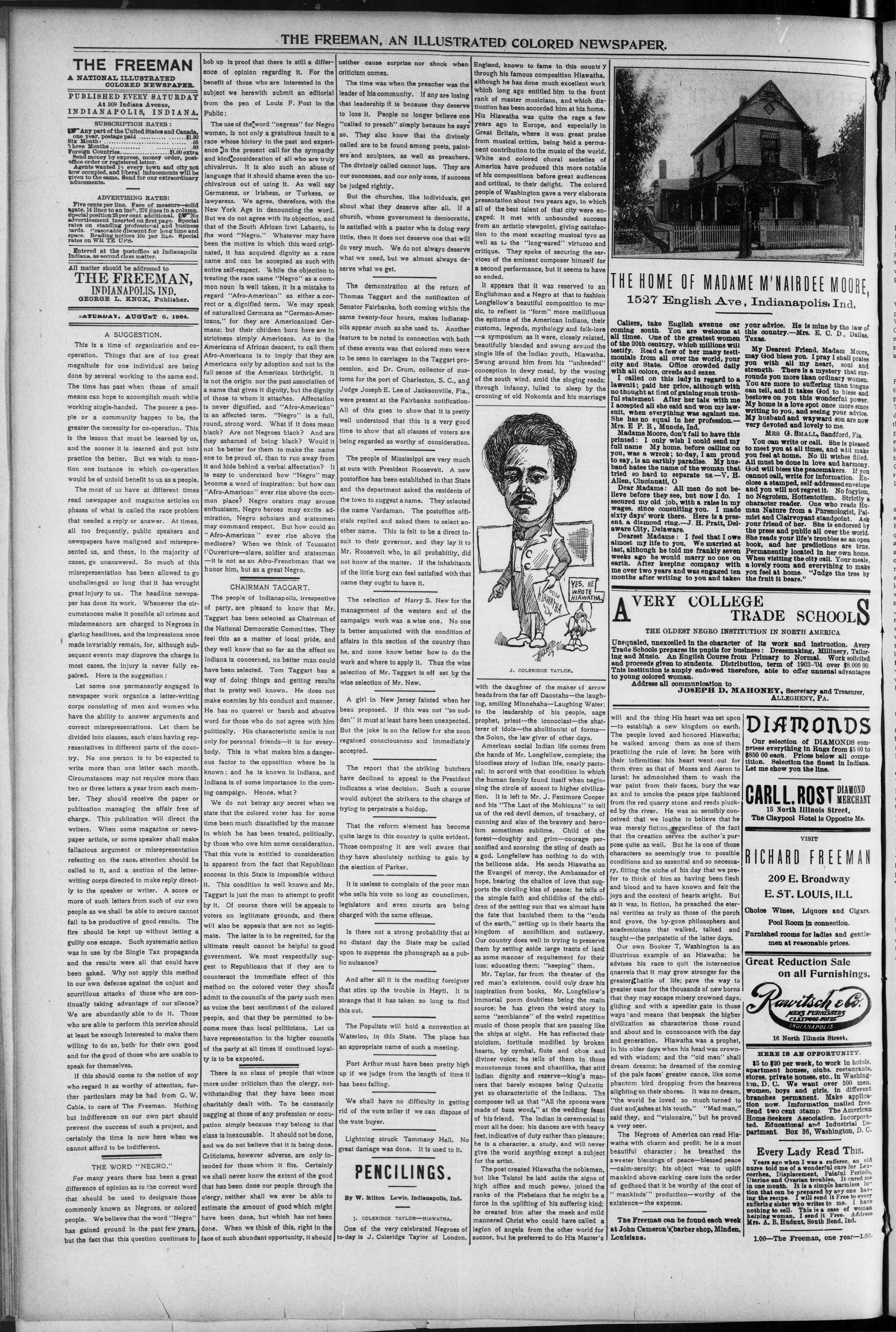
J. COLERIDGE TAYLOR—HIAWATHA.
One of the very celebrated Negroes of to-day is J. Coleridge Taylor of London.
England, known to fame in this country through his famous composition Hiawatha, although he has done much excellent work which long ago entitled him to the front rank of master musicians, and which distinction has been accorded him at his home. His Hiawatha was quite the rage a few years ago in Europe, and especially in Great Britain, where it won great praise from musical critics, being held a permanent contribution to the music of the world. White and colored choral societies of America have produced this more notable of his compositions before great audiences and critical, to their delight. The colored people of Washington gave a very elaborate presentation about two years ago, in which all of the best talent of that city were engaged; it met with unbounded success from an artistic viewpoint, giving satisfaction to the most exacting musical tyro as well as to the "long-eared" virtuoso and critique. They spoke of securing the services of the eminent composer himself for a second performance, but it seems to have so ended.
It appears that it was reserved to an Englishman and a Negro at that to fashion Longfellow's beautiful composition to music, to reflect in "form" more mellifluous the epitome of the American Indians, their customs, legends, mythology and folk-lore—a symposium as it were, closely related, beautifully blended and swung around the single life of the Indian youth, Hlawatha. Swung around him from his "unheeded" conception in dewy mead, by the wooing of the south wind, amid the singing reeds; through infancy, lured to sleep by the crooning of lukomis and his marriage
YES, HE
WROTE
HIAWATHA.
HAWTHA
07
with the daughter of the maker of arrow heads from the far off Dacotahs—the laughing, smiling Minnehaha—Laughing Water; to the leadership of his people, sage prophet, priest—the iconoclast—the shatterer of idols—the abolitionist of forms—the Solon, the law giver of other days.
American social Indian life comes from the hands of Mr. Longfellow, complete; the bloodless story of Indian life, nearly pastoral; in accord with that condition in which the human family found itself when beginning the circle of ascent to higher civilization. It is left to Mr. J. Fenimore Cooper and his "The Last of the Mohicans" to tell us of the red devil demon, of treachery, of cunning and also of the bravery and heroism sometimes sublime. Child of the forest—doughty and grim—courage personified and scouring the sting of death as a god. Longfellow has nothing to do with the bellicose side. He sends Hiawatha as the Evangel of mercy, the Ambassador of hope, bearing the chalice of love that supports the circling kiss of peace; he tells of the simple faith and childlike of the children of the setting sun that we almost hate the fate that banished them to the "ends of the earth," setting up in their hearts the kingdom of annihilism and outlawry. Our country does well in trying to preserve them by setting aside large tracts of land as some manner of requirement for their loss; educating them; "keeping" them.
Mr. Taylor, far from the theater of the red man's existence, could ouly draw his inspiration from books, Mr. Longfellow's immortal poem doubtless being the main source; he has given the weird story in some "semblance" of the weird repetition music of those people that are passing like the ships at night. He has reflected their stolicism, fortitude modified by broken hearts, by cymbal, flute and oboe and diviner voice; he tells of them in those monotonous tones and chantlike, that stiff Indian dignity and reserve—king's manners that barely escapes being Quixotic yet so characteristic of the Indians. The composer tell us that "All the spoons were made of bass wood," at the wedding feast of his friend. The Indian is ceremonial in most all he does; his dances are with heavy feet, indicative of duty rather than pleasure; he is a character, a study, and will never give the world anything except a subject for the artist.
The poet created Hiawata the noblemen, but like Tolstoi he laid aside the signs of high office and much power, joined the ranks of the Plebeians that he might be a force in the uplifting of his suffering kind; he created him after the meek and mild mannered Christ who could have called a legion of angels from the other world for succor, but he preferred to do His Master's
HARPER HISTORY LINK
THE HOME OF MADAME M'NAIRDEE MOORE 1527 English Ave, Indianapolis, Ind.
AVERY COLLEGE TRADE SCHOOL
THE OLDEST NEGRO INSTITUTION IN NORTH AMERICA
Unequaled, unexcelled in the character of its work and instruction. Avery Trade Schools prepares its pupils for business: Dressmaking, Millinery, Tailoring and Music. An English Course from Primary to Normal. Work solicited and proceeds given to students. Distribution, term of 1903-'04 over $8000.00. This institution is amply endowed therefore, able to offer unusual advantages to young colored woman.
Callers, take English avenue car coming south. You are welcome at all times. One of the greatest women of the 20th century, which millions will testify. Read a few of her many testimonials from all over the world, your city and State. Office crowded daily with all colors, creeds and sexes. I called on this lady in regard to a lawsuit; paid her price, although with no thought at first of gaining unthoughtful statement. After her talk with me I accepted all she said and won my lawsuit, when everything was against me. She has no equal in her profession. Mrs. E P. R., Muncie, Ind. Madame Moore, don't fail to have this printed: I only wish I could send my full name My home, before calling on you, was a wreck; to day, I am proud to say, is an earthly paradise. My husband hates the name of the woman that tried so hard to separate us.—V. H. Allen, Cincinnati, O.
Dear Madame: All men do not believe before they see, but now I do. I secured my old job, with a raise in my wages, since consulting you. I made sixty days' work there. He is a present, a diamond ring.-J. H. Pratt, Delaware City, Delaware.
Dearest Madame: I feel that I owe almost my life to you. We married at last, although he told me frankly seven weeks ago he would marry no one on earth. After keeping company with me over two years and was engaged ten months after writing to you and taken
AVERY COLLEGE
THE OLDEST NEGRO INSTITUTE
Unequaled, unexcelled in the character
Trade Schools prepares its pupils for bui-
ing and Music. An English Course fro-
and proceeds given to students. Distri-
This institution is amply endowed ther-
to young colored woman.
Address all communication to
JOSEPH D. MA
will and the thing His heart was set upon—to establish a new kingdom on earth. The people loved and honored Hiawata; he walked among them as one of them practicing the rule of love; he bore with their infirmities; his heart went out for them even as that of Moses and Aaron to Israel; he admished them to wash the war paint from their faces, bury the war ax and to smoke the peace pipe fashioned from the red quarry stone and reeds plucked by the river. He was so sensibly conceived that we loathe to believe that he was merely fiction regardless of the fact that the creation serves the author's purpose quite as well. But he is one of those characters so seemingly true to possible conditions and so essential and so necessary, fitting the niche of his day that we prefer to think of him as having been flesh and blood and to have known and felt the joys and the content of hearts aright. But as it was, in fiction, he preached the eternal verities as truly as those of the porch and grove, the by-gone philosophers and academicians that walked, talked and taught—the peripatetic of the latter days.
Our own Booker T, Washington is an illustrious example of an Hiawatha; he advises his race to quit the internecine quarrels that it may grow stronger for the greater battle of life; pave the way to greater ease for the thousands of newborns that they may escape misery crowned days, gliding and with a speeder gate in those ways and means that bespeak the higher civilization as characterize those round and about and in consonance with the day and generation. Hiawatha was a prophet, in his older days when his head was crowned with wisdom; and the "old men" shall dream dreams; he dreamed of the coming of the pale faces' greater canoe, like some phantom bird dropping from the heavens alighting on their shores. It was no dream, "the world he loved so much turned to dust and ashes at his touch." "Mad man," said they, and "vislaire," but he proved a very seer.
The Negroes of America can read Hiawatha with charm and profit; he is a most beautiful character; he breathed the sweeter blessings of peace—blessed peace—calm-senility; his object was to uplift mankind above carving care into the order of godhood that it be worthy of the cost of "mankinds" production—worthy of the existence—the expense.
The Freeman can be found each week at John Cameron's barber shop, Minden, Louisiana.
```markdown
```
your advice. He is mine by the law of this country.—Mrs. E. C. D., Dallas, Texas.
My Dearest Friend, Madam Moore, may God bless you. I pray I shall praise you with all my heart, soul and strength. There is a mystery that surrounds you more than ordinary women. You are more to suffering than tongue can tell, and it takes God to bless and bestow on you this wonderful power. My home is a love spot once more since writing to you, and seeing your advice. My husband and wayward son are now very devoted and lovely to me.
You can write or call. She is pleased to meet you at all times, and will make you feel at home. No ill wishes filled. All must be done in love and harmony. God will bless the peacemakers. If you cannot call, write for information. Enclose a stamped, self addressed envelope and you will not regret it. No fogyism, no Negroism, Hottenotism. Strictly a character reader. One who reads Human Nature from a Phrenologist, Palmist and Clairvoyant standpoint. Ask your friend of her. She is endorsed by the press and public all over the world. She reads your life's troubles as an open book, and her predictions are true. Permanently located in her own home. When visiting the city call. Your meals, a lovely room and everything to make you feel at home. "Judge the tree by the fruit it bears."
AGE
GRADE SCHOOLS
EXECUTION IN NORTH AMERICA
of its work and instruction. Avery
business: Dressmaking, Millinery, Tailor-
on Primary to Normal. Work solicited
execution, term of 1903-'04 over $8,000 00.
before, able to offer unusual advantages
AHONEY, Secretary and Treasurer,
ALLEGHENY, PA.
DIAMONDS
Our selection of DIAMONDS comprises everything in Rugs from $5 00 to $850 00 each. Prices below all competition. Selection the finest in Indiana. Let me show you the line.
15 North Illinois Street,
The Claypool Hotel is Opposite Me.
VISIT
RICHARD FREEMAN
209 E. Broadway
E. ST. LOUIS, ILL
Choice Wines, Liquors and Cigars.
Pool Room in connection.
Furnished rooms for ladies and gentlemen at reasonable prices.
Great Reduction Sale
on all Furnishings.
Rawitsch & Co.
MEN'S FURNISHERS
CLERKPOOL HOTEL
INDIANAPOLIS
16 North Ilmois Street.
$5 to $20 per week, to work in hotels, apartment houses, clubs, restaurants, stores, private houses, etc., in Washington, D.C. We want over 500 men, women, boys and girls, in different branches permanent. Make application now. Imformation mailed free. Send two cent stamp. The American Home Seekers Association. Incorporated. Educational and Industrial Department. Box 36, Washington, D.C.
Every Lady Read This.
Years ago when I was a sufferer, an old nurse told me of a wonder cure for Leucorrhea, Displacement, Paintul Periods, Uterine and Ovarian troubles. It cured me in one month. It is a simple harmlessotion that can be prepared by any one having the recipe. I will send it Free to every suffering sister who writes to me. I have nothing to sell. This is a case of woman helping woman, I send it Free. Address Mrs. A. B. Hudnut, South Bend, Ind.
1.00—The Freeman, one year—1.00.
THE STAGE.
By "WOODBINE."
Charles Beechum, J. H. Williams, John Tolliver, Wm. Fishback, John Goodall and Tom Stewart were prime favorites at the Druld's Carnival held at Indianapolis last week. days' trip down Tampa bay last week. All are well and send regards to friends. The musical comedy, "Obrlen in Coon Town," produced by the stock company was subject to much pleasing comment, it is an
Notes.—William and Stevens in The Hottest Coon in Dixie company gave their first performance Sunday night at Chicago Heights to a packed house. The show pleased from start to finish, it had been well put together, and surpasses all previous efforts. The company comprises 30 people. Regards to all.
Notes from the Pan American S. S.—We are having a fine season. Our eight piece band under the management of R. W. Wilson is constantly receiving praise. Our star features are Prof. Zellino, the magician and Miss Ilma, the beautiful snake charmer. Regards to all friends in and out of the profession.
Notes from Baynard and Whitney's Famous Troubadours.—We are glad to say that we are enjoying the most pleasant and profitable season since our organization. The weather has not been all that could be desired, but the strength of the show and the surity that our tent is thoroughly waterproof, draws the crowds despite the weather. The band, under Prof. Walter Watkins continues to be one of the principal attractions. Misses Baynard, Taylor and George Bryan are playing the leading roles most creditably. Regards to P. G. Lowy and friends.
Ninaweb Park, Louisville, Ky.—Our show is the best in town, despite the numerous opposing attractions. Miss Florence Hines, the clever all round performer, acquits herself most nobly in the various role assigned her. Kid Wade opened last week and was an instantaneous hit. Will Abe commands admiration and applause by his masterly rendition of classic and sentiment al lyrics. Billy Carroll, does well, regardless of the fact that he is on his eleventh week here. Rastus, the dancing wonder is still a favorite, and never fails to please. John Goodlee, also a new comer, has already installed himself a well liked comedian, and his efforts are abundantly rewarded. The Euphrates Quartet responds to not less than a half dozen encores nightly. The Haverhill twins are among the features they are held over for another week. Tom Logan is doing nicely, and wants to hear from two comedians and two ladies, IC01 W. Walnut St.
Of exceptional interest will be the appearance in this city at an early date of the largest colored theatrical organization in the world. This organization, which is to be under the direction of Messers Weber and Collins, will be headed by that well known colored dramatic soprano, Madame Flower, who is known from one end of the country to another as the "Bronze Melba." There will be fifty members of the company, including Bob A. Kelly, the "Original Coen." The musical play selected for the tour of Mme. Flower and her associates, is called "Queen of the Jungles", the book of which was written by Kelly, the music by J. Edward Green, a Negro composer of note. There are fourteen musical numbers, and "The Queen of the Jungles" will be unlike any entertainment of its kind in much as there is a coherent story and plot involved. There also will be eight vaudeville acts.
Will Goff Kennedy writes from Tampa, Fla., that the Red Fox Theater is still pleasing its patrons with a high class show, and has a strong stock company that can produce most anything from minstrelsy to tragedy. The company enjoyed a three
THE FREEMAM POST OFFICE.
LADIES LIST.
Bacon, Robirda Jones, Mrs D B
Cark, Mrs Leah Morton, Clara
Hopkins, Miss Hattie Robinson, Pattie
GENTLEMEN'S LIST.
Armstrong, T L Leach, Robt
Bee, C W Lane, Henry 2
Castor, Frank McQuity, M
Caster, McCannon, H
Carson, J W McBromell, J L
Cissel and Mines Pittman, James
Carter and Howell Prentice, Oliver
Ellott, E J Ricks, J
Fitzhill, William Rentwilt, Jap
Gnesson, Frank Sherman, J E
Good, W T Smith, J J
Bilhart, Amos Shields, Willie
Hughes, H Q Shaw and Clifton
Herris, Ciemo Tutt and Tutt
Johnson, Cus P Tibbs, Sol
Lace, L H The Fosters
Lacy, Will Wood, F B 2
Walton, Dr S J
ROUTE.
8 Muni Foot Co., Sheboyville, Tenn., Ann. Aug.
3 Muni Coach, Inc., Inchster, 10, Fayettey
13 Huntsville, Ala., 10, Fayettey
Y. A. Brown, Cartoonist. - Junction Park
Beaver Fla. s, Pa., week of Aug. 8.
THE FREEMAN, AN ILLUSTRATED COLORED NEWSPAPER
days' trip down Tampa bay last week. All are well and send regards to friends. The musical comedy, "Obrlen in Coon Town," produced by the stock company was subject to much pleasing comment, it is an original musical concert from the fertile brain of John W. Dennis. Wm. H. Dorssey, our musical director, went through the mysteries of Masonry a few days ago. Miss Sarah Price, who has been on the sick list, has fully recovered her health. W. Goff Kennedy, celebrated his 27th birthday on the 20th of July, and received congratulations from many friends. Mitchell Chappelle sends regards to the Rabbit Foot company and would like to hear from May Fisher.
Louisville, Ky. Notes.
The DeVines will have charge of the Red Mens' Carnival at Harrodsburg, Ky. Aug. 17. Miss Ella Hoke, the principal soubrette at Blue Ribbon Tbeater, is sick. Robert Clark is in charge of the Blue Ribbon stage. Billy Carroll goes to Lexington next week. Prof. J. B. Tucker has gone to Chicago, owing to the illness of his wife. R. J S.ott is playing clarinet with the Riverview orchestra. Miles Harris and George Barrett have severed their connection with Tobe Brown's orchestra, and are entertaining in the steamer "Hiawatha." Steve Breckenridge is much better. Gene Clark, an old and well known comedian, became despondent and attempted to commit suicide last Thursday, but the prompt efforts of the attending physicians saved his life. Cisco, the snake charmer, is one of the many attractions of the Blue Ribbon Theater. Lillie Greer Harper will be an added attraction next week. Miss Rada Green is in the city. Miss Eva Frazier has at last joined the professional contingent and is at Rivers de park. Mr. and Mrs. Richard Weston, after a pleasant visit among relatives and friends, returned Saturday to their home, Winnigie, Canada.
Greater New York notes.—Chas. Moore will conduct the rehearsals of the colored contingent of the Southernns, which opens this month direction of Geo. Lederer. Sidney Perrin is re-writing the "Bogus Prince" to be produced for the road season by James Lederer. He has cancelled his contract to appear as Jack Dent the College gives pride in the Queen of the Jungles company. The Johnsons, Billy and Stella, will close with the Black Patti company at the termination of their New York engagement Aug. 13. The Black Patti Troubadours had their tryout performance of their new faecal sketch entitled "Loony —Dreamland" at Elizabeth N. J., Saturday July 30. The comedy placed in the hands of that very funny comedian John Rucker, kept the audience ecstacy. Their opening performance will be reviewed by the Greater New York reporter later. Sam Lucas is playing a principal part in a white drama, "The Moonshiners Daughter", especially adapted to fit him. Bert Williams and George Walker have signed to write exclusively for the Stem Music Pub. Co. Owing to the illness of J. Ed Green, since June 15 all business mail has been lost track of anything of importance can be a once attended to by addressid some again to Whitmark and Sons.
to become leaders in their line, are filling their engagement at Ft. Sheridan this week. They closed the Star at Milwaukee, and the Grand at Joilet, Ill. These boys deserve great credit to still continue as a team, for some day they may appear at the head of some large aggregation, as the stars. They send regards to all of their friends. The headquarters, was entertained last week by some choice selections from the famous "Lnzon Trio." They are a famous trio. They make beautiful music, and are good singers. In fact they are entertaining. Mr. Lawrence is manager. Anyone desiring their services can address them in care of the headquarters. Mr. and Mrs. Charles Small are featuring with the "Mooshiner's Daughter" Co. This being the fifth season of the same forces. They open at Chicago Heights, Ill., Aug. 21. As in the past, we wish them success. Ernest Hogan, the popular comedian is playing at Cleveland Theater, we assure the management that during his engagement it will be the banner week, for Mr. Hogan is s favorite and a drawing card in Chicago. The Nightingale quartet, assisted by Chicago's leading soprano Mme. Virginia Green, who are acting in conjunction with Rev. Jessie Woods, the noted orator and lecturer, have returned to the city, having filled a successful engagement at Lakeside, Ohio and Devil's Lake, N. D, under the Chautauqua Bureau. They have several engagements to follow. Rev. Woods is their manager, and the press comments are of the highest nature as an orator. William Green is a frequent visitor at the headquarters, and report
everything O. K. Wm. Gregg says hello, all friends. Wise and Milton send regards to all. Mahara's Operatic minstrel has for their leading feature the coming season, Sktner Harris, the greatest colored comedian of the age, supported by a company of twenty others. Mr. Harris was a caller at the headquarters, and is looking fine. He is always a welcome caller, we wish for him a successful season. Mme. Edna Alexander is assisting the choir of Quinn Chape, and is the leading feature with Mme. M. A. Harris. At present Mme. Harris is visiting in Baltimore, Md. Chicago can boast of a Negro instructor of physical culture and manly art, in the person of Prof. Louis L. Clark. He is in charge of the Harrison St. police gymnasium. He drills the officers in sharp-shooting, target practice and the art of self protection from thugs etc. He deserves the praise and encouragement of the race. He is pleasing to meet and entertaining. The Pekin, the leading vaudeville house in the city owned by Hon. Robert Motts, and managed by Fred Carey is doing a big business. It is crowded from the hour of opening until it closes nightly. The bills on the program are all first class. Mr Motts deserves great honor for establishing such an enterprise. He has been the cause of Jack Johnson, the pugilist, and J. R. Peters, with more to follow, to go to the wall. We wish the Pekin continued success, for a better manager could not have been selected. It is rumored that Wise and Milton are to join the Williams and Walker attraction. In all probabilities Mme. Green and Sidney Kirkpatrick will join hands in a sketch which will be written for them for the vaudeville stage. They are both clever artists. Louis Love is still receiving orders and filling engagements at headquarters. He is the same happy "Baby" Love. He sends regards to all friends in and out of the profession. The Hottest Coon in Dixie company is rehearing at Chicago Heights. Charles Williams of the team Williams and Stevens, who is the stage manager, says that everything is moving along nicely. The band, under the direction of Prof. Henderson Smith, is above the average. They coutemplate having a good show this season. My regards to Al Holman and wife, Billy Mc Clain, Hiram Sorrell, Skip Farrell, J. B. Tucker, Williams and Stevens, Henderson Smith and wife, and friends.
THE BROKEN LAW OF SUNDAY
What a happy world this would be, if people did not have to live in fear of punishment hereafter. The broken laws of Sunday seem to grow stronger every day. One special law of the Ten Commandments "Remember the Sabbath Day to keep it holy" is fast disappearing from the ledger book of amusement providers. The restricted limit of Sunday stage performances should be governed by a city's officials. If these men are totally unholy, the entire moral standing of the community [could easily be corrupted. Wholesale corruption comes from the head mathematician of a set of men who shorten their lives by disregarding such laws of God as would benefit the communities which they control.
These are the men who are and will be held responsible by the Almighty for the slinful methods of Sunday shows such as are carried on in the big city theaters and public summer resorts, in common, of the present day. Merry-go-rounds and other miscellaneous features, outside of a sacred concert or the sale of refreshments, at a summer resort, are totally wrong and quite out of the moral religious order of things that governed the Sabbath Day not less than ten years ago.
The dreadful catastrope of a recent New York Sunday school excursion shows how eager people are to rush their children on an excursion and how careless they are about sending them to Sunday school.
This may be one reason why a jealous all-seeing Father, who we so neglect to serve, often sends a visitation calamity of horror in such directions as to remind us that we have failed to serve Him.
Today the West is wide open. Sunday performances are conducted just the same as on week days. Poor hard working performers are compelled to drudge on Sunday while the real law breakers, city officials and theater managers, can go to church, if they will, or to an invitation dinner, followed by a drive or a reckless speed in an automobile.
Sunday concerts have now long since become nothing short of vile vaudeville of the cheapest kind. Managers figured "if we have vaudeville we may as well have other performances."
Time and greed of finance, which takes the place of religion, health and morality, said "yes" we will give the West an entire Sunday show. The same Western fever is fast growing East.
Vile vaudeville in stage costumes and dancing has now supplemented the once refined and highly respected sacred concert.
Regular Sunday stage performances had never before been permitted in the East, New York city is inching in, and whatever New York does Boston is sure to follow.
Each successive season brings the two greatest cities of intelligence and culture nearer and nearer to the fullest extent of broken Sunday laws and spoil of sacred commandments.
It is no wonder that so many of the very best talented people that extist, retire from
CHAS.MAJOR
Shampoo Drier. This necessary toilet article will accomplish two results in one operation. It will straighten and dry the hair quickly, effectively and satisfactorily. Its use will give the hair its natural appearance. It is positively the only device upon the market that will accomplish such results. The purchase price will be refunded if it does not accomplish all we claim for it, by returning it to our office.
Stop and think how the public is being deceived by extravagant advertisements of various pomades and many impractical straighteners that are foisted upon the market, which are injurious to the growth of the hair, and after their use leaves such an unsightly appearance.
We will forfeit $100 for any so called hair tonic or preparation that will make the hair straight and soft by applying it without leaving the hair with a greasy, pasty appearance, thereby retarding the growth of the hair and softening the hair follicles, causing it to collect dandruff and dust which is a great cause of so many bald heads; and the promoter of the wig industry. We ask you to name us a hair straightener, of any drug composition, that does not produce these effects. Now in comparison, The Magic Hair Straightener and Shampoo Drier, which is a straightener consisting of a steel bar and an aluminum comb attached, six inches long, with an ordinary amount of heat, dries a head of hair after a shampoo and straightens it as fast as it is combed.
Its mode of operation is easy upon the hair, thereby eliminating the pincher method, which almost pulls the hair out from the roots. The comb separates the strands leaving a beautiful and natural appearance. A heavy head of hair can be straightened in less than thirty minutes. Its use a few minutes daily following instructions will straighten the hair where hours of combing will not. It will save the loss of hair that excessive combing produces, and we guarantee that it is the only device that will accomplish such results. It has been carefully and skillfully examined by the chief examiner of the United States and other countries and has been granted a patent as the latest and most practical appliance of its kind on the market to day. It will be found an indispensable article of the toilet by all who take pride in their personal appearance. It has the indorsements of physicians.
Price $1.
Address MAGIC HAIR STRAIGHTENER MFG. CO.,
Agents Wanted.
405 Century Bldg., Minneapolis, Minn.
Our Friend.
show life; leaving its cares and overwork for more congenial vocations. For the greatest talented people on the stage, are they who earn their living other ways without even hard labor, after their pang of stage struck passion is over. Performers, then, who love work, can sing the sweet refrain of the camp meeting song, "Every day will be Sunday bye and bye."
The circuit of theatres owned by B. F. Keith do not open on Sunday. This may be the reason why Mr. Keith is so prosperous. I believe that men who respect the laws of God receive his blessings with long life and prosperity.
The admiration of one famous man is worth the fame of a hundred who are famous and not respected. Now I wonder will the New York and Boston city officials be sorry about this?
Fifteen years ago, about as far back as I can clearly remember, I used to attend sacred concerts in New York. Everything was moral and intelligent and given in evening dress. Comedians recited and told healthful refreshing stories that departed from the villion of vile variety so commonly carried on now-a-days on Sunday. Those were dear sweet good days that may never come again, never, unless a terrific revival breaks out, quite different from the bughouse revivals carried on by the "goddess of Christ" Mrs. Mary Barker G. Eddy.
These new styles of notorious religious antics now carried on for the sake of money and fame are equally as ruinous to the good of all our "souls salvations as ragtime singing and dancing.
There is no difference in telling falsehoods and grafting money from a church platform than in singing and dancing, so far as sin is concerned, in the given time when we should all be saying our prayers. It would shock the nation and touch every human heart if a revelation were to occur in the management of city affairs whereby nothing but strictly sacred concerts would be allowed in theaters on Sunday and all children between six and sixteen be compelled to go to Sunday school. Wouldn't that be a notable change.
Every lady should wear the Mecca Dress Shield, positively perpiration proof, odorless, washable, no rubber, 20 cents per pair, post paid, two pairs 30 cents. Early Supply Co., 44 North Fourth street, Philadelphia, Pa.
Would like to know the whereabouts of Charley Baker. He left Chattanooga Tenn., in 1889 with his friend, H. J. Barclay, for Memphis and has not been heard of since. Any information concerning him will be gratefully received by his sister, Mrs. A. P. Parker, 1122 Hook street, Chattanooga, Tenn.
Has your subscription expired? If so now is the time to send in your renewal. Until August 15, 1904. The Freeman will be sent to any address in the United States or Canada one year for $1.00.
New Phone 2666 Res. 507 Hiawatha St.
Nathan T. Ward
BONDS AND COLLECTIONS
Office room 1. Wilson Building
123 N. Delaware Street
MAGIC HAIR ST
PATENTED 19
Shampoo Drier. This necessary toilet art one operation. It will straighten and dry the factorily. Its use will give the hair its natu
Dan Patch
The Fastest Horse in the World, will
Race AUGUST 11th to Beat 1:561/4
COME AND SEE INDIANA'S GREATEST RACE HORSE
INDIANAPOLIS RACING ASSOCIATION
The Lexington Mid=Summer Fair and Carnival To Be Held at Lexington, Ky..
Over $3,000 offered in Premiums.
Exciting Running, Trotting and other Races every day
This is your Fair as well as everybody's, so come and mingle with the good natured crowd. See SCHREGER, the dare dwell chute rider and human meteor in his death defying ride down the highest, longest, steepest and narrowest uncurved chute ever constructed. Hear N. (LARK SMITH) Famous Eighth Regiment Military Band, the finest Negro musical organization in the world.
BIG OPENING INDUSTRIAL PARADE TUESDAY, AUGUST 16, AT NOON
Special Low Rates on All Railroads
W. T. DINWIDDIE, Pres.
J. F. BURTON, Sec'y
WANTED for WILBER'S VIRGINIA
Singers, Dancers, Comedians, Specialty People in all lines; apply
Friday and Saturday Broad Ripple Park, then as per route in
Bilr Board and Freeman
H. C. WILBER gail delivers Indianapolis Ind
COMING SOON TO YOUR CITY
A Rabbit's Foot Comedy
The only genuine Negro show on the road owned and managed by Negroes exclusive. See the biggest free street parade traveling. P. S.—Can always place Good performers and musicians both male and female PAT CHAPPELL, Owner and Mgr. as per route.
At Liberty after August 10th The Reeves artists sketch artists, singers. Play in B. and O. Only responsible manager need answer Per. add. The Freeman.
TRAIGHTENER AND SHHMPOO DRIER. LOOK The above cut represents the Magic Hair Straightener and
SUPPORT IT
RACES RACES
9th to 13th
Patch
Horse in the World, will
JUST 11th to Beat 1:56 1/4
INDIANA'S GREATEST RACE HORSE
IS RACING ASSOCIATION
ON'S GREATER
RED FAIR
1-Summer Fair and Carnival
Held at Lexington, Ky.,
17, 18, 19 and 20
1000 offered in Premiums.
Trotting and other Races every day
CARNIVAL SHOWS—12
THE ATTRACTIONS—11
Days, so come and mingle with the good natured crowd,
evil chute rider and human meteor in his death defying
best and narrowest uncurved chute ever constructed.
Famous Eighth Regiment Military Band, the finest No.
L PARADE TUESDAY, AUGUST 16, AT NOON
Low Rates on All Railroads
es. J. F. BURTON, Sec'y
BER'S VIRGINIA
Minstrels--
Specialty People in all lines; apply
Ipple Park, then as per route in
H. C. WILBER, gen'l delivery Indianapolis, Ind.
WANTED FOR MAHARA'S MINSTRELS
A Few First-Class
Musicians.
A Few First-Class
Singers---
Male and Female.
Must be good looking good dressers.
We not only pay the best salaries but
give our people the best of treatment at
all times.
A. M. DAMON,
Musical Director.
JAMES H. HARRIS,
Band Master.
W. A. MAHARA,
160 S. Clark St., CHICAGO, ILL.
The 35th Annual FAIR
OF THE OLD RELIABLE
Colored & A. M.
Association
will be held at LEXINGTON, KY.
Sept. 12 to 17, 1904
Many new and novel features have
been add in the way of free attractions
The premium list the largest ever
given by the Association.
The People's Famous Band of Colum
bus. Ohio, has been engaged to furnish
music.
J. A. SCOTT, President.
A. L HARDEN, Secretary.
185 North Mill Street, Lexington, Ky
ensable It has $1.
THE MARTS THE IIR EBB and FLOW
A treatise on specuclation and investment. For safe and profitable investment read it. Price, 10c. G. D. Rose & Co., Brokers, Dept. K, 280 La Salle st., Ch'igo
1.00—The Freeman, one year—1.00.
The Gentleman From Indiana
By BOOTH TARKINGTON
Copyright, 1899, by Doubleday @ McClure Co.
Copyright, 1902, by McClure, Phillips @ Co.
Such a county seat was Plattville, capital of Carlow county. The social and business energy of the town concentrated on the square, and here in summer time the gentlemen were wont to lounge from store to store in their shirt sleeves, and in the center of the square stood the old red brick courthouse, loosely fenced in a shady grove of maple and elm—"slip'r ellum"—called the "courthouse yard." When the sun grew too hot for the dry goods box whittlers in front of the stores around the square and the occupants of the chairs in front of the Palace hotel on the corner they would go across and drape themselves over the fence and carve their initials on the top board. From the position of the sun the editor of the Herald judged that these operations were now in progress, and he was not deeply elated by the knowledge that whatever desultory conversation might pass from man to man on the fence would probably be inspired by his own convictions expressed editorially in the Herald.
He drew a faded tobacco bag and a bier pipe from his pocket and, after filling and lighting the pipe, twirled the pouch mechanically about his finger, then, suddenly regarding it, patted it caressingly. It had been a giddy little bag long ago, gay with embroidery in the colors of the editor's university, and, although now it was frayed to the verge of tatters, it still bore an air of pristine jauntiness, an air of which its owner in nowise partook. He looked from it toward the village in the clear distance and sighed softly as he put the pouch back in his pocket and, resting his arm on his knee and his chin on his hand, sat blowing clouds of smoke out of the shade into the sunshine, absently watching the ghostly shadow on the white dust of the road.
A little garter snake crept under the fence beneath him and disappeared in the underbrush; a rabbit, progressing on its travels by a series of brilliant dashes and terror smitten halts, came within a few yards of him, sat up with quivering nose and eyes alight with fearful imaginings and vanished, a flash of fuzzy brown and white. Shadows grew longer; a cricket chirped and heard answers; there was a woodland stir of breezes, and the pair of robins left the branches overhead in eager flight, va
HEN the rusty hands of the office clock marked half past 4, the editor in chief of the Carlow County Herald took his hand out of his hair, wiped his pen on his last notice from the White Caps, put on his coat, swept out the close little entry and left the sanctum for the bright June afternoon.
He chose the way to the west, strolling thoughtfully out of town by the white, hot, deserted Main street and thence onward by the country road into which its proud half mile of old brick store buildings, tumbledown frame shops and thinly painted cottages degenerated. The sun was in his face where the road ran between the summer fields, lying waveless, low, gracious in promise; but, coming to a wood of hickory and beech and walnut that stood beyond, he might turn his down-bent hat brim up and hold his head erect. Here the shade fell deep and cool on the green tangle of rag and iron weed and long grass in the corners of the snake fence, although the sun beat upon the road so close beside. There was no movement of the crisp young leaves overhead. High in the boughs there was a quick flirt of crimson where two robins hopped noiselessly. The late afternoon, when the air is quite still, had come, yet there rested somewhere on the quiet day a faint, pleasant, woody smell. It came to the editor of the Herald as he climbed to the top rail of the fence for a seat, and he drew a long breath to get the elusive odor more luxuriously, and then it was gone altogether.
"A habit of delicacies," he said aloud, addressing the wide silence complainingly. "One taste and they quit," he finished, gazing solemnly upon the shining little town down the road.
It was a place of which its inhabitants sometimes remarked easily that their city had a population of from 5,000 to 6,000 souls, but it should be easy to forgive them for such statements. Civic pride is a virtue. The town lay in the heart of that fertile stretch of flat lands in Indiana where eastern travelers, glancing from car windows, shudder and return their eyes to interior upholstery, preferring even the swaying caraparisons of a Pullman to the monotony without. The landscape runs on interminably level lines—bleak in winter, a desolate plain of mud and snow; hot and dusty in summer, miles on miles of flat lonesomeness, with not one cool hill slope away from the sun. The persistent tourist who seeks for signs of man in this sad expanse perceives a reckless amount of rail fence, at intervals a large barn, and here and there man himself, incurious, patient, slow, looking up from the fields apathetically as the limited flies by. Now and then the train passes a village built scatteringly about a courthouse, with a mill or two humming near the tracks. This is a county seat, and the inhabitants and the local papers refer to it confidently as "our city."
THE FREEMAN, AN ILLUSTRATED COLORED NEWSPAPER
cating before the arrival of a flock of blackbirds hastening thither are the eventide should be upon them. The blackbirds came, chattered, gossiped, quarreled and beat each other with their wings above the smoker sitting on the top fence rail.
But he had remembered. A thousand miles to the east it was commencement day, seven years to a day from his own commencement.
Five years ago, on another June afternoon, a young man from the east had alighted on the platform of the station north of Plattville and, entering the rickety omnibus that lingered there seeking whom it might rattle to deafness, demanded to be driven to the Herald building. It did not strike the driver that the newcomer was precisely a gay young man when he climbed into the omnibus, but an hour later, as he stood in the doorway of the edifice he had indicated as his destination, depression seemed to have settled into the marrow of his bones.
Platttville was instantly alert to the stranger's presence, and interesting conjectures were hazarded all day long at the back door of Martin's Dry Goods Emporium (this was the club during the day), and at supper the new arrival and his probable purposes were discussed over every table in the town. Upon inquiry he had informed Judd Bennett, the driver of the omnibus, that he had come to stay. Naturally such a declaration caused a sensation, as people did not come to Platttville to live except through the inadvertency of being born there. In addition the young man's appearance and attire were reported to be extraordinary. Many of the curious, among them most of the marriageable females of the place, took occasion to pass and repass the sign of the Carlow County Herald during the evening.
Meanwhile the stranger was seated in the dingy office upstairs with his head bowed low on his arms. Twilight stole through the dirty window panes and faded into darkness. Night filled the room. He did not move. The young man from the east had bought the Herald from an agent—had bought it without ever having been within a hundred miles of Plattville. The Herald was an alleged weekly which had sometimes appeared within five days of its declared date of publication and sometimes missed fire altogether. It was a thorn in the side of every patriot of Carlow county, and Carlow people, after supporting the paper loyally and long, had at last given it up and subscribed for the Gazette, published in the neighboring county of Amo. The former proprietor of the Herald, a surreptitious gentleman with a goatette, had taken the precaution of leaving Plattville forever on the afternoon preceding his successor's arrival. The young man from the east had vastly overpaid for his purchase. Moreover, the price he had paid for it was all the money he had in the world.
The next morning he went bitterly to work. He hired a compositor from Rouen, a young man named Parker, who set type all night long and helped him pursue advertisements all day. The citizens shook their heads pessimistically. They had about given up the idea that the Herald could ever amount to anything, and they betrayed an innocent but caustic doubt of ability in any stranger.
One day the new editor left a note on his door: "Will return in fifteen minutes."
Mr. Rodney McCune, a politician from the neighboring county of Gaines, happening to be in Platttville on an errand to his benchmen, found the note and wrote beneath the message the scathing inquiry, "Why?"
When he discovered this addendum, the editor smiled for the first time since his advent and reported the incident in his next issue, using the rubric "Why Has the Herald Returned to Life?" as a text for a rousing editorial on honesty in politics, a subject of which he already knew something. The political district to which Cartow belonged was governed by a limited number of gentlemen whose wealth was ever on the increase, and honesty in politics was a startling conception to the minds of the passive and resigned voters, who talked the editorial over on the street corners and in the stores. The next week there was another editorial, personal and local in its application, and thereby it became evident that the new proprietor of the Herald was a theorist who believed in general that a politician's honor should not be merely of that middling healthy species known as "honor among politicians," and in particular that Rodney McCune should not receive the nomination of his party for congress. Now, Mr. McCune was the undoubted dictator of the district, and his followers laughed at the stranger's fantastic onset; but the editor was not content with the word of print. He hired a horse and rode about the country and (to his own surprise) proved o be an adaptable young man who enjoyed exercise with a pitchfork to the farmer's profit while the farmer talked. He talked little himself, but after listening an hour or so he would drop a word from the saddle as he left, and then, by some surprising wizardry, the farmer, thinking over the interview, decided there was some sense in what
that young fellow said and grew curious to see what the young fellow had further to say in the Herald. Politics is the one subject that goes to the vitals of every rural American, and a Hoosier will talk politics after he is dead. Everybody read the campaign editorials and found them interesting, although there was no one who did not perceive the utter absurdity of a young stranger dropping into Carlow and involving himself in a party fight against the boss of the district. It was entirely a party fight, for by grace of the last gerrymander the nomination carried with it the certainty of election.
A week before the convention there came a provincial earthquake. The news passed from man to man in a struck whispers—McCune had withdrawn his name, making the shallowest of excuses to his cohorts. Nothing was known of the real reason for his disordered retreat beyond the fact that he had been in Plattville on the morning before his withdrawal and had issued from a visit to the Herald office in a state of palsy. Mr. Parker, the Rouen printer, had been present at the close of the interview, but he held his peace at the command of his employer. He had been called into the sanctum and had found McCune, white and shaking, leaning on the desk.
“Parker,” said the editor, exhibiting a bundle of papers he held in his hand, “I want you to witness a verbal con-
will return in
15 minutes
Why? W
THE WILD
ICE
Mr. Rodney McCune found the note. tract between Mr. McCune and myself. These papers are an affidavit and copies of some records of a street car company which obtained a charter while Mr. McCune was in the legislature. They were sent to me by a man I do not know, an anonymous friend of Mr. McCune—in fact, a friend he seems to have lost. On consideration of our not printing these papers Mr. McCune agrees to retire from politics for good. You understand, if he ever lifts his head again politically we publish them, and the courts will do the rest. Now, in case anything should happen to me"— "Something will happen to you all right!" broke out McCune. "You can bank on that, you black"—
"Come," the editor interrupted not unpleasantly. "Why should there be anything personal in all this? I don't recognize you as my private enemy—not at all—and I think you are getting off rather easily, aren't you? You keep out of politics and everything will be comfortable. You ought never to have been in it, you see. It's a mistake not to go square, because in the long run somebody is sure to give you away, like the fellow who sent me these. You promise to hold to a strictly private life?"
"You're a traitor to the party," groaned the other; "but you only wait!" The editor smiled sadly. "Wait nothing! Don't threaten, man. Go home to your wife. I'll give you three to one she'll be glad you are out of it."
"I'll give you three to one," said McCune, "that the White Caps will get you if you stay in Carlow. You want to look out for yourself, I tell you, my smart boy."
"Good day, Mr. McCune," was the answer. "Let me have your note of withdrawal before you leave town this afternoon." The young man paused a moment, then extended his hand as he said: "Shake hands, won't you? I-I haven't meant to be too hard on you. I hope things will seem easier and gayer to you before long, and if-if anything should turn up that I can do for you in a private way I'll be very glad, you know. Goodby."
The sound of the Herald's victory went over the state. The paper came out regularly. The townsfolk bought it, and the farmers drove in for it. Old subscribers came back. Old advertisers renewed. The Herald began to sell in Amo, and Gaines county people subscribed. Carlow folk held up their heads when journalism was mentioned. Presently the Herald announced a news connection with Rouen, and with that and the aid of "patent insides" began an era of three issues a week, appearing on Tuesdays, Thursdays and Saturdays. The Platville brass band serenaded the editor.
During the second month of the new regime of the Herald the working force of the paper received an addition. One night the editor found some barron loafers tormenting a patriarchal old man who had a magnificent head and a grand white beard. He had been thrown out of a saloon, and he was drunk with the drunkenness of three weeks' steady pouring. He propped himself against a wall and reproved his tormentors in Latin. "I'm walking your way, Mr. Fisbee," remarked the journalist, hooking his arm into the o'd man's. "Suppose we leave our friends here and go home." Mr. Fisbee was the one inhabitant of the town possessing an unknown past.
and a glamour of romance was thrown about him by the gossips, who agreed that there was a dark, portentous secret in his life, an opinion not too well confirmed by the old man's appearance. His fine eyes had a habit of wandering to the horizon, and his expression was mild, vague and sad, lost in dreams. At the first glance one guessed that his dreams would never be practicable in their application, and some such impression of him was probably what caused the editor of the Herald to nickname him, in his own mind, "the White Knight."
Mr. Fisbee, coming to Plattville from nobody knew where, had taught in the high school for ten years, but he proved quite unable to refrain from lecturing to the dumfounded pupils on archaeology, neglecting more and more the ordinary courses of instruction, growing year by year more forgetful and absent, lost in his few books and his own reflections, until at last he had been discharged for incompetency. The dazed old man had no money and no way to make any. One day he dropped in at the hotel bar, where Wilkerson, the professional drunkard, favored him with his society. The old man understood. He knew it was the beginning of the end. He sold his books in order to continue his credit at the Palace bar, and once or twice, unable to proceed to his own dwelling, spent the night in a lumber yard, piloted thither by the hardier veteran Wilkerson.
The morning after the editor took him home Fisbee appeared at the Herald office in a new hat and a decent suit of black. He had received his salary in advance, his books had been re-purchased and he had become the reportorial staff of the Carlow County Herald; also he was to write various treatises for the paper. For the first few evenings when he started home from the office his chief walked with him, chatting cheerfully, until they had passed the Palace bar. But Fisbee's redemption was complete.
The editor of the Herald kept steadily at his work, and as time went on the bitterness his predecessor's swindle had left in him passed away. But his loneliness and a sense of defeat grew and deepened. When the vistas of the world had opened to his first youth he had not thought to spend his life in such a place as Plattville, but he found himself doing it, and it was no great happiness to him that the Hon. Kedge Halloway of Amo, whom the Herald's opposition to McCune had sent to Washington, came to depend on his influence for renomination, nor did the realization that the editor of the Carlow County Herald had come to be McCune's successor as political dictator produce a perceptibly enlivening effect upon the young man. The years drifted very slowly, and to him it seemed that they went by while he stood far aside and could not even see them move. He did not consider the life he led an exciting one, but the other citizens of Carlow did when he undertook a war against the White Caps, denizens of Six Crossroads, seven miles west of Plattville. The natives were much more afraid of the White Caps than he was. They knew more about them and understood them better than he did.
There was no thought of the people of the Crossroads in his mind as he sat on the snake fence staring at the little smoky shadow dance on the white road in the June sunshine. On the contrary, he was occupied with the realization that there had been a man in his class at college whose ambition needed no restraint, his promise was so great—in the strong belief of the university, a belief he could not help knowing—and that seven years to a day from his commencement this man was sitting on a fence rail in Indiana.
Down the pike a buggy came creaking toward him, gray with dust, old and frayed like the fat, shaggy gray mare that drew it, her unchecked, despondent head lowering before her, while her incongruous tail waved incessantly, like the banner of a storming party. The editor did not hear the flop of the mare's hoofs nor the sound of the wheels, so deep was his reverie, till the vehicle was nearly opposite him. The red faced and perspiring driver drew rein, and the journalist looked up and waved a long white hand to him in greeting.
"Howdy' do, Mr. Harkless?" called the man in the buggy. "Soakin' in the weather?" He spoke in shouts, though neither was hard of hearing.
"Yes, just soaking," answered Harkless. "It's such a gypsy day. How is Mr. Bowler?"
"I'm givin' good satisfaction, thank you, and all at home. She's in town."
"Give Mrs. Bowlder my regards," said the journalist, comprehending the symbolism. "How is Hartley?"
The farmer's honest face shaded over for a second. "He's be'n steady ever since the night you brought him home, six weeks straight. I'm kind of bothered about tomorrow—he wants to come in for show day, and seems if I hadn't any call to say no. I reckon he'll have to take his chance—and us too. Seems more like we'd have to let him, long as we got him not to come in last night for Kedge Halloway's lecture at the courthouse. Say, how'd that lecture strike you? You give Kedge a mighty fine send-off to the audience in your introduction, but I noticed you spoke of him as 'a thinker,' without sayin' what kind. I didn't know you was as cautious a man as that! Of course I know Kedge is honest!"—
Harkless sigged. "Oh, he's the best we've got, Bowler." "Yes, I presume so, but"—Mr. Bowler broke off suddenly as his eyes opened in surprise, and he exclaimed: "Law, I'd never of expected to see you settin' here today! Why ain't you out at Judge Briscoe's?" This speech seemed to be intended with some humor, for Bowler accompanied it with the loud laughter of sylvan timidity risking a joke.
"Why? What's going on at the judge's?"
"Goin' on! Didn't you see that strange lady at the lecture with Minnie Briscoe and the judge and the pig Fisbee?"
"I'm afraid not. Bowler."
"They couldn't talk about anything else at the postoffice this mornin' and at Tom Martin's. She come yesterday on the afternoon accommodation. You ought to know all about it because when Minnie and her father went to the deepie they had old Fissee with 'em, and when the buckboard come through town he was settin' on the back seat with her. That's what stirred the town up so. Nobody could figger it out any way, and nobody got much of a good look at her then except Judd Bennett. He said she had kind of a new look to her. That's all any of 'em could git out of Judd. He was in a sort of a dreamy state. But Mildey Upton—You know Mildy? She works out at Briscoe's"—
"Yes, I know Mildy."
"She come in to the postoffice with the news this lady's name was Sherwood and she lives at Rouen. Miss Tibbs says that wasn't no news—you could tell she was a city lady with both your eyes shut. But Mildy says Fisbee was goin' to stay for supper, and he come to the lecture with with and drove off with 'em afterwards. Sol Tibbs says he reckoned it was because Fisbee was the only man in Carlow that Briscoes thought had read enough books to be smart enough to talk to her, but Miss Seliny says if that was so they'd have got you instead, and so they had to all jest about give it up. Of course everybody got a good look at her at the lecture—they set on the platform right behind you and Halloway, and she did look smart. What got me, though, was the way she wore a kind of a little dagger stuck straight through her head. Seemed a good deal of a sacrifice jest to make sure your hat was on right. You never see her at all?"
"I'm afraid not," answered Harkless absently. "Miss Briscoe stopped me on the way out and told me she had a visitor."
"Young man," said Bowlder, "you better go out there right away." He raised the reins and clucked to the gray mare. "Well, she'll be mad I ain't in town for her long ago. Ride in with me."
"No, thank you. I'll walk in for the sake of my appetite."
"Wouldn't encourage it too much—livin' at the Palace hotel," observed Bowlder. "Sorry you won't ride." He gathered the loose ends of the reins in his hands, leaned far over the dashboard and struck the mare a hearty thwack. The tattered banner of tail jerked indignantly, but she consented to move down the road. Bowlder thrust his big head through the sun curtain behind him and continued the conversation. "See the White Caps ain't got you yet."
"No, not yet," Harkless laughed.
"Reckon the boys 'druther you stayed in town after dark," the other called back. "Well, come out and see us if you git any spare time from the judge's." He laughed loudly again in farewell, and the editor waved his hand as Bowlder finally turned his attention forward to the mare. When the flop, flop of her hoofs had died out, Harkless realized that the day was silent no longer; it was verging into evening.
He dropped from the fence and turned his face toward town and supper. He felt the life and light about him, heard the clatter of the blackbirds above him, heard the homing bees hum by, saw the vista of white road and level landscape framed on two sides by the branches of the grove, a vista of infinitely stretching fields of green, lined here and there with woodlands and flat to the horizon line, the village lying in their lap. No roll of meadow, no rise of pasture land, relieved their serenity nor shouldered up from them to be called a hill.
A farm bell rang in the distance, a tinkling coming small and mellow from far away, and at the lonesomeness of that sound he heaved a long, mournful sigh. The next instant he broke into laughter, for another bell rang over the
PALACE HOTEL
THE BATH
CONCESSION
He stopped to exchange a word
fields, the courthouse bell in the square. The first four strokes were given with mechanical regularity, the pride of the custodian who operated the bell being to produce the effect of a clockwork bell, such as he had once heard in the courthouse at Rouen, but the fifth and sixth strokes were balting achievements, as, after 4 o'clock he often lost count in the strain of the effort for precise imitation. There was a pause after the sixth; then a dubious and reluctant stroke, seven; a longer pause, followed by a final ring with desperate decision—eight! Harkless looked at his watch. It was twenty minutes of 6.
As he crossed the courthouse yard to the Palace hotel on his way to supper he stopped to exchange a word with
TAKEN FROM LIST
OZONIZED OX MARROW CO
peo 2014 Chicago, Illinois
Many times the "face value" of any other—Williams' Shaving Soap.
Sold everywhere. Free trial sample for 2-cent stamp to pay postage. Write for booklet "How to Shave." The J. B. Williams Co., Glastonbury, Cr
Manufacturers of fine hair goods: Wigs, Pom-padours, Switches, etc., made to order. We make these net foundations for $3.75 that will stand combing. Lattes in hair business write us for wholesale price lists; all orders will receive prompt attention at 371 Jackson Street, DALLAS, 308 E 12th Street, FT WORTH, Texas
LADIES "The Price is used in our Priced Lard" Hygiene uses MILK (MILK) ALL, RESTO ON, MILKWEAER, Wt.
the bell ringer, who, seated on the steps, was mopping his brow with an air of hard earned satisfaction.
"Good evening, Schofields," he said.
"You came in strong at the last stroke tonight."
"What we need here," responded the bell ringer, "is more public sperrited men. I ain't kickin' on you, Mr. Harkless—no, sir; but we want more men like they got in Rouen. We want men that 'll git Main street paved with block or asphalt; men that 'll put in factories; men that 'll act—not set round like that old fool Martin and laugh and pollywoggle along and make fun of public sperrit, day in, day out. I reckon I do my best for the city."
"Oh, nobody minds old Tom Martin," observed Harkless. "It's only half the time he means anything by what he says."
"That's just what I hate about him," returned the bell ringer in a tone of high complaint. "You can't never tell which half it is. Look at him now!" The gentleman referred to was standing over in front of the hotel talking to a row of costless loungers, who sat with their chairs tilted back against the props of the wooden awning that projected over the sidewalk. Their faces were turned toward the courthouse, and even those lost in meditative whitling had looked up to laugh. Mr. Martin, one of his hands thrust in a pocket of his alpaca coat and the other softly caressing his wiry, gray chin beard, his rusty silk hat tilted forward till the brim almost rested on the bridge of his nose, was addressing them in a one keyed voice, the melancholy whine of which, though not the words, penetrated to the courthouse steps.
The bell ringer, whose name was Henry Schofield, but who was known as Schofields' Henry (popularly abbreviated to Schofields'), was moved to indignation. "Look at him!" he cried. "Look at him! Everlastingly goin' on about my bell! Well, let him talk. Let him talk!" As Mr. Martin's eye fell upon the editor, who, having bade the bell ringer good night, was approaching the hotel, he left his languid companions and crossed the street to meet him. "I was only oratin' on how proud the city ought to be of Schofields'," he said mournfully as they shook hands; "but he looks kind of put out with me." He hooked his arm in that of the young man and detained him for a moment as the supper gong sounded from within the hotel. "Call on the judge tonight?" he asked.
"I reckon you didn't see that lady with Minnie last night."
"No."
"Well, I guess you better go out there, young man. She might not stay here long."
(To be Continued).
Wakeful?
Sleeplessness Is a Sign of Nerve Trouble and Should Be Looked To.
There are three different manifestations of sleeplessness. First, hardly to sleep a wink all night, second, to lie awake a long time before falling asleep; third, to fall asleep soon, wake up after several hours and then find it hard to sleep again.
The mean that somewhere in the nerve fibres, somewhere in the brain cells, somewhere in the blood vessels that carry blood to the brain, something is radically wrong, and must be righted, or the end may be worse than death.
To nivear it, take Dr. Miles' Nervine.
Some other symptoms of nerve trouble are: Dizziness, Headache, Backache, Worry, Freutfulness, Irritability, Misch劲, Lack of Ambition.
They indicate diseases which may lead to Epilepsy, Fits, St. Vitus' Dance, Nervous Prostration, Paralysis, Insanity. Nothing will give such quick and lasting relief as Dr. Miles' Nervine.
"My husband had been sick for weeks, could not have been better, but all the medical help we could get he continued to grow worse. He could neither sleep or eat. Our baby girl was sent away, and our cars broke out, but she was not stunned by it. I read of a case of nervous prostration caused by Dr. Miles' Restorative Nervine. We began giving it to him, and in a few days he was dressed. When he steamed up Nervine saved his life." -MISS A. G. HASKIN, Freeville, N. Y.
FREE Write to us for Free Trial Package of Dr. Miles' Anti-Pain Pills, the New Scientific Remedy for Pain. Also Symptom Blank. Our specialist will diagnose your case, tell you what is wrong, and coordinate MILES MEDICAL CO. laboratories, ELKHART, IND.
Bar-Keeper's Friend
Metal Polish
AN
INFALLIBLE
UP-TO-DATE
ARTICLE
USED BY
MOREN
PEOPLE
THAN ALL OTHER
METAL POLISHES
COMBINED
H. H. Hammer & Co.
DEALERS IN
Fancy Groceries and Meats
Flour and Feed
Hardware, Granite, Tinware, China
and Glassware.
1901 and 1908 Yandes, cor. 19th Street.
Phone, Main 8287.
Use Hammerine for the Hair
Taggarts Bakery
234 W. Vermont Street.
233, 235, 237 Massachusetts Avenue.
18, 20, 24 N. New Jersey Street.
1538 N. Illinois St. 1532 College Ave.
Tomlinson Hall Market
HAVALUNCH
Read the Ads and then patronize them
BROADWAY DRESS and flue Millinery
Emporium at the
TEMPLE OF FASHION HAIR STORE.
Call and see the great special values in trim-
med hats, ready-made skirts, t-shirts and
other fancy articles. Parisian designs a special.
Mail orders will receive prompt attention.
LIZZIE BEACHEM. Proprietress.
Residence, 401 S. Preston St.
371 Jackson St., cor, Lane, Dallas, Texas.
The Freeman
until
August 15, 1904,
At ONE DOLLAR A YEAR.
Subscribe now.
GEO. G. HILL
with E. Octavus Mack, Lawyer
Bonds & Collections
Room 1, 12 N, Delaware St.
Phone 2005 Main. Indianapolis, Ind
The Freeman is on sale each week at Mr. John Emery's, 821 East Market-st., (rear) Louisville, Ky.
HAIR SWITCHES
Bangs and Wigs of Every Description.
Most Complete Line of Hair Goods in this
Country for Colored People.
30 buys a single braid made of Black,
Kinky Hair 16 inches long.
60 buys a double braid made of Black,
Kinky Hair 16 inches long.
75 buys a Creole Switch, 16 inches long,
Brown or Black.
$1.00 buys a Creole Switch, 20 inches
long, Brown or Black.
$1.50 buys a Creole Switch, 22 inches
long, Black or Brown.
$3.00 buys a natural, Wavy, Hand-
made switch like cut.
Send sample of hair when ordering
Creole Switches.
Send money with order and get your
goods by return mail. Send Stamp for
catalogue.
T. W. TAYLOR,
HOWELL, MICH.
When writing mention this paper
THE FREEMAN, AN ILLUSTRATED COLORED NEWSPAPER
CLEVER SOUTHERN RIDER.
Joe Anderson Considered Greatest
Rider In This Country.
In a letter written to me recently, from New York, Mr. C. M. Valentine states that Joe Anderson, of Jacksonville, Fla., intends making a trip to Glasgow, Scotland. He has been employed to ride for the
CYCLING
Calumet Cycle Club, New York, for quite a number of years, and has all always been considered a gentleman of exemplary habits.
"And still they come, with more to follow." Anderson is considered a coming Major Taylor. He has already won quite a number of races in the East, and thinks now, that he will add more fame and new laurels to his club and country in competition with the foreigners. He is confident that he will show the Scotch his heels.
The next bill that Philadelphia has on for the fastic public, is a 6 round go between Jack O'Brien and Corbett. And still these "6-round-no-decision" contests go on in the Quaker City.
THE INDIANAPOLIS FREEMAN PATTERNS
CHILD'S APRON.
No. 4321.—A dalnty little Apron that is quite simple for any mother to make. Is
1
Sizes 2, 4, 6 and 8 years.
CUT THIS COUPON OUT.
Sizes 2, 4, 6 and 8 years.
CUT THIS COUPON OUT.
Pattern Department,
The Indianapolis Freeman,
Indianapolis, Ind:
JOE ANDERSON.
the little model shown here, with tucks in pointed yoke effect and tucked shoulder caps. Younger children always look well in the full unbelted, loose aprons, and this is no exception to the rule. The rent and back are alike in having the yoke outlined by tucks and shaping is given the garment by under-arm
The Atlanta Depkins played Birmingham Thursday, Friday and Saturday of last week, winning two games of the series. They played Paducah, Ky. Monday and Tuesday, winning both games by the score, 6-5 and 2-1, last game thirteen innings.
COLORED LADS TO RIDE.
E. C. Taylor, of New York, assistant trainer of the immense racing string of the estate of the late W. C. Whitney, who has been in Lexington, Ky. for several days to secure small boys for exercising purposes for the stable, left that city Monday night for New York with a half a dozen boys who have had some experience in this line. Mr. Taylor found it impossible to get white boys for this class of work around the stable who had had any experience, and as a result he was forced to select colored lads. The boys will be used principally in breaking yearlings this fall until they become proficient in the saddle when they;will be given a chance to show their worth with the other riders in the East.
Last week, over in Australia, there came to Major Taylor and wife, a little baby girl. They named the child Sidney, in honor of the town in which it was born.
□ Will the Porto Ricans be Americanized? If there is anything being done by the Americans, in this little island, toward accomplishing this object, is their introduction of base ball. The San Juan (Porto Rico) News says:
"In a recent base ball game in Puerto de Terra, played between the "Red D's" and Battery boys, the soldiers won by the score: 6-3. Great enthusiasm was shown by the natives, about 1,000 of whom were present."
Before the American occupation, this game was not known on the island.
According to Associated Press dispatches, "Muggsy" McGraw is planning to take the New York Giants on a trip around the world, accompanied by the Chicago Cubs, when they win the National League pennant at the close of this season. His plan is to start from New York. He will visit the principal countries in Europe, including Russia; sailing from Italy he will go to Egypt, India, Australia, The Phillipines and Hawaii. From Hawaii he will take these idols of fandom to 'Frisco, returning to New York and completing the circuit. There does not now seem to be any doubt as to 'Muggsy's' sons of swat taking this terrestrial jaunt, for daily they add fresh victories to their already long string. They anticipate
and shoulder seams.
The shoulder caps are trimmed with a narrow edging, which may be of torchon or embroidery, Cross-barred muslin, gingham, Victoria lawn or percale are serviceable materials for aprons. A pretty development would be of checked gingham, with colored or white embroidery trimming.
B. SQUARE'S
BLUSTER
starting in October and returning in March. Exhibition games, where the weather will permit, will be played.
EDUCATIONAL NOTES
Prof. and Mrs. Wallace A. Battle of the Okolona, Miss. In ustrial College rejoice over the arrival of a nine pound daughter.
One fare plus 25 cents for the round trip has been granted by all railroads for the Nashville meeting of Negro teachers, August 10, 11 and 12, also a lay over of fifteen days after the meeting by depositing ticket at Nashville This enables all who desire to go to St. Louis. Very large delegations will go to Nashville from all the States. Special delegation low rates will be had from Nashville to St. Louis, very low.
Lincoln Institute Notes
Lincoln Institute day at the World's Fair, July 19th, was a complete success viewed from any point. The speakers were all happy and sensible, and the singing and recitations were superb. A large crowd of graduates and friends were present from all sections of the State and many visitors, white and colored, from various parts of the country were present.
The Globe-Democrat sent a reporter and photographer to the scene, and a very fine account of the day appeared in the Globe on Wednesday, July 20th. President Allen had the finest opportunity of his life to push his school to the front and he was equal to it.
The singing by Miss Carney and the very fine solos by W. E. Burnett and Miss Carrie Carper were features. All concede, however, that the best on the program was the quartette composed of Misses C M. Carney, Genoa Anderson, Carrie Carper and Estella Zimmerman.
Mrs. Cora Nero-Moten made quite a fine impression in reciting "Lean, the Foraken." A great many wanted to hear her again. Messrs W. M Farmer, W. H Harrison, C. C. Hubbard and J Oscar Spencer were the speakers, and when they finished Lincoln Institute stock went way up
---
The following information is given out concerning the meeting of Negro teachers of the United States at Nashville, Tenn., Aug. 10, 11 and 12: Prof. J. B. Batte of 805 Stevenson avenue is chairman of the reception committee. Dr. J. B. Singleton, Brown Building, should be written to for boarding places. Board will be one dollar a day. Place of meeting is Mt. Olive Baptist church. Enquire at local office and of heads of delegations for reduced rates. Further announcements will be made through the press and by circular.
HEADS OF DELEGATIONS
Virginia—D. Webster Davis, 900 N. 7th street, Richmond, Va.
West Street, Middletown, N. W.
West Virginia — J. W. Scott, 830
Eighth avenue. Huntington.
District of Columbia — A. U. Craig,
Evans and Stanton avenue, Anacostia,
W. Bruce Evans, Washington.
North Carolina — Charles N. Hunter,
Raleigh, N. C., S. C. Atkins, Winston-
Salem.
South Carolina — A. Slims, Colum-
B. SQU
BL
I wish to say to the many readers of this column who, for the past few weeks have missed an old friend, that a press of business and over-worked eyes, made somewhat dim by age, are the cause of not seeing the usual "Bluster."
The future bids fair for me placing in the hands of the management of The Freeman a "Bluster" article every week, and it will be "up to" the editor if the same is not published. Now for a little ancient history.
In the long, long ago, when I was a student at Hampton, seven young men, of whom I was one, sat by the water's edge one day and looked into the future. It looked bright for ambitious youths, and we mapped out who and what we intended to be. We were all going to be great; one a great teacher, another a great merchant, one a great doctor, one a great missionary to our poor benighted brethren in "Sunny Africa," and so on. This was thirty years ago. As I call the roll of the seven I find three who do not answer the call, they have gone to "the great beyond."
One of the four living to-day is a distinguished Baptist minister, one a letter carrier in New York City, one a wealthy backwoods farmer, one, (the one who was going to enlighten Africa) a, well, degenerate, a human wreck, wrecked upon the slums of New York City, the other one is the writer.
The food for the reflections of the ambitious youth is that none of those above mentioned are filling the position mapped out. Procrastination was the cause.
There are several persons, for several reasons, I cannot reach only through the "Bluster column," what I am about to write may be of no interest to the rest of The Freeman's readers.
Lexington, Ky.
MRS. M'CONTIE, your letter has been received, contents noted, (by my wife.) "We"
bia; R. S. Wilkinson, State College
Orangeburg.
Georgia - H. H. Thwatt, Thomas
village, Matthews, Atlanta.
Florida - N.
Mokura—N. B. Young, State Normal,
Tallahassee; M. M. Lewey, Penssola,
Alabama—W. H. McAlpine, 218 N.
18th street, Birmingham; W. A. Caldwell,
Broad Street School, Mobile; W. H.
Counnell, Normal.
Mississippi—Roscoe Conkil Simmons
Mound Bayou, Miss; J. M. Williamson,
Shelby.
Louisiana—Bishop I. B. Scott, New
Orleans; P. L. Breau, Lafayette; L. B.
Lafargue, Alexandria.
Ohio—Dr. J. H. Jones, Wilberforce;
Prof. W. S. Scarborough, Wilberforce.
Texas—M. H Broyrie. Prarie View;
M. W. Dogan, Marshall; D. Alover;
Seguin.
Kentucky—F. L. Williams, Covington;
W. H. Steward, Louisville.
Missouri—B. F. Allen, Jefferson City;
Chas. H. Brown, 1287 Sutler avenue
St Louis.
Illinois—Mr. B. F. Browles, Lincoln
School, East St. Louis.
For the other State we did not get names of heads of delegations in time.
Doings in and Around Selma.
Selma, Ala., Special.—It is rumored that one of Selma's divines will soon lead to the matrimonial altar one of our popular school teachers.—A first class coal and wood yard is among the industries owned and managed by our people. Hudson Bros. are the proprietors.
"A large brick workshop has just been completed on the Presbyterian school ground, and hereafter trades will be taught the boys at that school — Mrs. M. E Beasley entertained a large number of children at her residence on Sylvan street, last Tuesday, in the interest of her church. — Quite a crowd attended the First Baptist church last Sunday to witness the ordination ceremony when deacons were ordained. —The board of registers, which recently met in our city to register qualified voters, refused to register colored applicants, although many who were qualified appeared and requested to be registered. The law requires that the applicant must be able to read and write or pay taxes on three hundred dollars worth of property. If the actions of the registers is regarded as proof then no colored man of voting age can read and write or owns property to the amount of three hundred dollars—and this fact would negative the oft repeated assertion that the South is educating the Negro and that he is contented and prosperous. —Miss Lola Gray and Mr. Wm. F. Clark were married last week at the residence of the bride's parents. Mr. Clark is a popular barber while Mrs. Clark was, until her marriage, one of the city school teachers. —
The new chapel of the Selma University is nearing completion. — The Payne school building is an ornament to that part of the city in which it is situated and refists credit upon the A. M. E denomination. — Mrs. Wm. Broughton of Birmingham, Ala., and her accomplished daughter is visiting Selma. — Mr. Headen of Birmingham, Ala., is doing duty as mall clerk between Selma and Pensacola — Many new and handsome residences are being built and occupied by our people in the north part of the city. — E. W. Brooks has started a new transfer wagon on our streets. — Henry Boyd, Jr., will sell you The Freeman.
Subscribe for this paper. it's universal
WARE'S
USTER
wish you much joy. "Let the dead past
bury its dead."
Your sorrow as light as its foam."
God bless you in your new life, and bless every woman who is foolish enough to change the ancient and honorable name you have changed. This ends the romance. The curtain falls. Good night.
Tonster, of Charlottesville, Va., I would
like to say that when we parted at
Hampton thirty years ago—parted as
class-mates and chums, I did not think
anything but death would break our
friendship.
CLARK.
Will Norris B.
Clark, Esq., of
Newport News,
Va., send me the whereabouts of Geo.
A. Corprew, who, when last heard
from, was at Newport News.
I think the out-
NEGRO DEMOCRAT. look for you get-
taking cabinet
stools around the table of Parker's is not very bright, for two reasons. First—Parker will not be elected, and second, the other fellow (I think his name is Gray) who is an ex-rebel, would not "stand for it" Back to the boob black stand for yours.
QUESTIONS HARD TO ANSWER.
Who discovered Parker?
Who discovered his walking mate?
Why any sane Negro citizen of New York, New Jersey, Indiana, Ohio or Illinois should vote the Democratic ticket this year or, in fact, any old year?
What has become of a certain great Negro poet, or a certain great literary female writer of color or a certain great Negro magazine?
What has become of my old friends of The Freeman's Round Table, to-wit: Dr. J. M. Henderson, Dr. Majors, Mr. Edward Elmore Brock, Uncle Noah Baxter and others of the long, long ago?
B. SQUARE.
B. EQUARE.
YOUNG CORBETT
Champion of the World
Says: "I have used Paracamph in my training and find it to be highly satisfactory. It prevents all inflammation by inducing perspiration, and for sore and stiff joints, there is nothing better. I highly recommend it to my friends, and will use it myself constantly." C. J. Kriehbleh & Co., the well known printing establishment of Cincinnati, says: "We find Paracamph the most useful remedy we have ever had in our establishment. It relieves the Burns, Cuts & Bruises of our employees almost instantly, and is a most valuable remedy for use in Home, Office or Shop."
Paracamph differs from all other external applications in that it stimulates the pores, allowing the camphor and oils to penetrate to the source of the alliment, thereby drawing out the fever and inflammation and quickly cooling, soothing and healing the alliment by causing copious perspiration. It is invaluable in the treatment of Sore Muscles, Sore Joints, Sore Feet and all forms of Swellings and Inflammations. Every bottle is guaranteed to do just what we claim for it. If it falls your money will be refunded. So why experiment with the many worthless remidies on the market when you can buy the remedy that is endorsed by physiclans, druggists, and everyone who uses it.
Sold only in 25c, 50c & $1 bottles at all good druggists.
Popular Cheap Excursion.
To Niagara Falls, Thursday, Aug. 11, 1904. Big Four Route, only $7 round trip from Indianapolis. Toronto, Ont. only $1 50 more than rate to Niagara Falls. Alexandria Bay, N. Y., (Thousand islands) only $7 more than rate to Niagara Falls. Montreal, Quebec, only $10.65 more than rate to Niagara Falls. Stop-over allowed at Westfield, for side-trip to Chautauqua Lake. Tickets good returning, twelve days including date of sale. Elegant trains of Pullman Sleeping cars and Superb Day coaches, personally conducted by representatives of the "Big Four", who will look after the wants of passengers. Warren J. Lynch, Gen1 Pass. & Ticket Agent, Cincinnati, Ohio, or H. M. Bronson, A. G. P. A., Indianapolis, Ind.
Copies of The Freeman are on sale at Fred D. Thomas' barbershop, 242 East Second street, Los Angeles, Cal.
BUSINESS MEDIUM
There are some persons who believe that there is no truth to be gained from consulting a medical professional to the truth. It is only from the lack of direct knowledge that such a conclusion can be reached. It is not everyone who placards him or herself as a Medium that can stand a test of what he or she is saying. The mind may ask the reason why. It is simply that these advisers do not take the trouble to study human nature. They do not spend time with the people the art of phrenology and kindred branches that will have a tendency to make the pathway to the road of the business clear and devoid of obstacles. Deminable fact that persons will come for advice—in full knowledge of what they want to know, and yet as soon as they confront a Medium they try their utmost endeavors to know so as to hear if it will be rehearsed by the Medium. To get the secret out of a person by "pumping," in no few cases, is the art used to hold a Medium. The medium takes hold of the hand and holds up the hand thereby, is a matter of impossibility to most of them And yet this can be done, and by consulting MRS MARTH this seeming mystery. This subject has received no little attention by eminent men and even college professors. So it proves conclusively that although their minds may often tongue perhaps, the gates of wisdom have not been closed to the entire profession.
It takes a great deal of study to become a
mysterious and unniring effort, the key to the well of
apparently unaffordable mysteries have been
benefit of humanity. By letter advice $1.00
from 10 a.m. to 9 p.m. all letters must con-
tain stamps for answers.
MRS. M. B. MARTH
246 W. 51st St. New York City.
SECRET
When you need money you'll be pleased with our way of dealing with you. Prompt, Safe and Reasonable always.
We make loans on FURNITURE, ORGANS AND PERSONAL PROPERTY of all kinds without removal. Our rates are positively the lowest in the city and payments within reach at all. $25.00 loan, payments also on 600 per week. This loan will fall in fifty weeks. Other amounts in same proportion. Payments can be made monthly if desired. We also loan on WATCHES and DIAMONDS. All business strictly private, courteous treatment to all. It cost nothing to investigate.
CENTRAL LOAN CO.
Second Floor,
Room 208 State Life Building,
(Formerly Stevenson Bldg.)
Front Room.
(15 E. Washington Street)
Old Phone Main 8182
New Phone... 4270
25c Kind 12c a Yard.
There are no less than twenty styles in numerous colorings, probably fifty full pieces altogether. Among them are both stripes and plaids, many of which have lace overwork and interwoven broaches in parti-color. One especially pretty style is of white and black plaid with a brocade stripe in color; another with blue and rose grounds, has broad lacy stripes of white; still others have neat stripings that will serve admirably for children's frocks. Not a few will make handsome shirts for men. By far the greater number, however, are in the prevailing effects in vogue for the tub suit.
The price is remarkable, even for this late in the season, and is only possible by reason of the absolute clearing of a jobber's sheaves he had on hand. Ready this morning at 12c A YARD.
L. S. Ayres
& Co. Indiana's Greatest
Distributors of
Dry Goods
TO FREEMAN SUBSCRIBERS.
If The Freeman fails to reach you,
please let us know by phone or card.
We cannot know unless you tell us.
Phones—New, 2880; old, 7187. black.
BAPTISTS ELECT OFFICERS
Evansville, Ind., Special.—The colored Baptists of the United States in convention here elected the following officers: President the Rev. J. D. Rouse Evansville; recording secretary, the Rev. E. A. Wilson, Kansas; assistant secretary, the Rev. C. D. Douglas, Illinois; corresponding secretary, the Rev. J. B. Winrow, Missouri; field secretary the Rev. P. H. Kennedy, Kentucky; treasurer, the Rev. D. D. Harris, Chicago; auditor, the Rev. C. G. Fishback, Kansas; statistician, the Rev. J. F. Walker, Indianapolis.
NEGRO IS PHI BETA KAPPA
NEGRO IS PHI BETA KAPPA
Yale Graduate is the Only Colored Man Belonging to the Society.
New Haven, Conn., Special.—William Pickens, the young colored man who graduated with high honors at Yale a month ago, has just been notified of his election to membership in Phi Beta Kappa, the college honorary Greek letter society. He is the only colored man belonging to the society.
FIGHTING FOR THE RIGHT.
WASHINGTON, PA., AUG. 1, '04.
Editor The Freeman.
MY DEAR MR. KNOX:—Kindly accept the protound thanks of the whole race for the brave and manly way you registered your protest against the palpable disorriminations against the colored race in general, and the Eighth Illinois regiment in particular at the World's Fair at St. Louis, Mo., Such conduct on the part of the fair's management is unworthy of a great and intelligent nation and can not be to strongly condemned. When it comes to a choice between right and wrong The Freeman is always found on the right side. Very truly.
REV M. F. A. EASTON.
Young man stenographer wants position in the South as shorthand teacher or as private secretary. Address Mr Anderson, 4988 Dearborn street, Chicago, Ill.
JEWELRY At Prices Beyond Compare
J. P. MULLALLY Diamond Importer and Jewelry
28 Monument Place
"ASI
When way of d ble always
We are PERSON al. Our payment are only Other are made me and DIA eous tre
CENTRAL
Second Floor, Room 208 State Ln
(Formerly Stevens
Front Room. (15 E. Washington
THE FREEMAN, AN ILLUSTRATED COLORED NEWSPAPER
AN AFRO-AMERICAN CO.
WITH $100,000 PAID UP
Every Stock-holder is a Negro and the Object of the Company is to Promote Negro Ownership of Land.
New York City, Special Correspondence.—The Afro American Realty Co. with an authorized capital of $500,000 and a paid up capital of $100,000, has opened offices at 115 Broadway. It occupies a suite of rooms handsomely furnished in mahogany, with Nile green carpets. Not a white person is connected with the company in any capacity even the typewriter keys being manipulated by colored ladies who are very businesslike and obliging. The company is devoted to the cause of African ownership and tenancy.
James O. Thomas is president of the company; James E. Garner, secretary and treasurer; and Philip A. Peyton, Jr., vice president and general manager. The directors are, Wm. Ten Eyck, Winston Dabney, Walter E. Handy, Frank E. Stewart, Richard R. Wilson, Joseph H. Bruce, John Stevenson and Wilford H. Smith. The last named is general counsel. The par value of the stock is $10, and it is sold at par and exclusively to colored investors. Almost all of that already sold is held by the directors.
The company's prospectus, bound in chocolate colored covers and adorned with the imprint of an African's head on the cover, says that race prejudice is an expensive luxury, and that prejudice against Negro tenancy in particular can be made so expensive, that it will become impractical. The prospectus urges Negroes to co-operate with one another to the end that owner, agent and tenant may all be colored.
The company owes its corporate existence to a short-lived war between white landlords and colored tenants in 195th street some six months ago. Many of the men who are in this company were then conducting a reality business under the name of the Afro-American Realty Co., but it was not incorporated. When the white landlords began evicting their tenants, these men immediately bought several blocks of tenements on the opposite side of the street, and began evicting the white tenants, and putting the evicted colored folks in their places.
Officers of the company state that it owns five tenement properties, and has the agency of a large number of others. Its charter permits it to build apartment houses, and the directors expect in time to erect a number of buildings.
THOMPSON'S WEEKLY REVIEW
THOMPSON'S WEEKLY REVIEW
CONCLUDED FROM FIRST PAGE.
union or no union. The union saw that a strike wouldn't succeed and not daring to let it be of record that a pressman could hold his job without the consent of organized labor, the leaders finally decided to admit Carter, and he is there today. The printers started a crusade against colored workmen but the defeat of the union in the Carter incident brought them to their senses and only a few rejections of Negroes have occurred in recent years. Quite a number of colored compositors, who learned the trade in Negro newspaper offices, have secured good $4.00 per day positions in the government printing office at Washington. If private concerns refuse to give employment to our competent printers, pressman book binders it might be a partial solution of our difficulties to have them take the civil service examinations, get on the eligible list and thus find a chance to follow their trade ad vantageously through an appeal to merit system. It may also be remarked, in passing, that the Negro masses should more liberally sustain the race papers which are offering such splendid opportunities often at painful sacrifices for colored boys to start in as apprentices and develop into first class artisans, able to command lucrative salaries in the best establishments in the land. The government employs carpenters, electricians, bricklayers, engineers, painters, landscape gardeners, plumbers and the like, and if the young Negro will follow up the industrial schools which teach these necessary branches, or work faithfully with colored men now engaged in these callings they may eventually become contractors in their own right or through the civil service route manage to inscribe their names for life upon Uncle Sam's long and most interesting payroll.
Whatever one's political predictions may
be, most of us contemplate with satisfaction the elevation of such a big hearted man as Thomas Taggart to the chairmanship of the Democratic national committee. He rose from the ranks and won his way to the front by the sheer force of a noble character, genial personality, hard work at everything he undertook and the saving grace of justice and common sense vs. prejudice on dealing wise races, creeds, partisans and nationalities. Individually, "Tom" Taggart has a stronger following among the Negroes than any other political factor in the state of Indiana, and when he has appeared as a candidate in local elections large numbers of our race have voted for him. He has never been defeated, and Mr. Taggart does not deny that his chief dependence in his two battles for auditor of Marion county and three sprints for mayor of Indianapolis where his loyal black yeamont, and all will admit that his extraordinary strength and victory in each case were due to his marvelous popularity with the Negro electors, who stood for "Tom Taggart," not because he was a Democrat, but in spite of it. In 1892 he was materially assisted by the Negroes in carrying the county, city and state for Cleveland. Whether the smiling Hoosier will be able to hold on to his earwhile personal friends among the Negroes to the point of inducing them to vote for Parker as against Roosevelt is a question that is now being asked in many quarters, and answered in the negative. Mr. Taggart's magnetism may be effective locally and when he offers himself for an administrative office within the borders of Indiana, but when the casting of a ballot means a repudiation of Theodore Roosevelt and the lofty American policies that he represents, and an endorsement of the saturnalia of assassination, jim crowism, disfranchise; and civil degradation represented by the party of Tillman, Vardaman and Carmack a thousand tons of the honeyed capsule of Taggartism will not suffice to persuade the Negro to try a single dose of the vile secession nostrum. Mr. Taggart will find himself opposed by his colored admirers this year, to a man, for as much as we may like a friend he is preferred at a distance when known to be carrying a load of dynamite. Though a dangerous antagonist, and notwithstanding the fact that we are solidly arrayed against "Tom" Taggart's political organization, the Negroes of Indiana cannot help feeling rather glad that he has been honored commensurately with his distinguished abilities by his associates, and that he has again succeeded in getting what he wanted. The Negro's heart always holds a tender spot for the self made man who can honorably overcome the obstacles of birth and position, and scale the heights that wealth and influence are proud to attain. Especially is the success of such man gratifying, from a personal point of view, when he, like "Tom" Taggart, has "certainly been good" to our race.
William Pickens, winner of the Ten Eyck prize in oratory last year and in June, seventh man in a class of nearly 300, has been elected a member of the Phi Beta Kappa, the high scholarship fraternity, being the first Negro to attain that distinction. Mr. Pickens halls from Little Rock, Ark. He is solving the race problem as it must be solved—by individual effort.
The St. Louis Exposition will not prove to be a financial success. It does not deserve to be. The Negroes are showing a commendable degree of race pride in giving the discrimination show a wide berth. The Home News, of Alexandria, Va., can justly claim the credit for first awakening to the gravity of the situation and "sicking on" the colored press with such splendid results. The dignified attitude of the gallant Eighth Illinois regiment, and the contemptuous "throw down" given by the Women's National Association, as well as the disfavor of public men of the Washington, Fortune, Du Bois and Miller stripe, mere battering rams the jim crow fair could not resist. We learn that Mrs. A. M. Curtis has resigned the "sop" handed out to her by the directors. She was given the place to appease the wrath of the outraged Negroes, but found that she was unable to "deliver the goods." Those of us who want to really enjoy a vacation and be benefited by contact with the race's vital forces should attend the convention of the National Negro Business League at Indianapolis, August 31. R. W. THOMPSON.
"BLACK HOLE" OF CALCUTTA
"BLACK HOLE" OF CALCUTTA
CONCLUDED FROM FIRST PAGE.
Wilmington District A. M. E. Church will hold its Sunday-school Convention at Southport, Dr. Capehart, P. E. I, of course, shall go and say a word about them. These religious gatherings are not on the old order. It is no longer the aim to get up religious excitement, but questions touching the welfare of the race are discussed, and so clearly too, that you must conclude that we are becoming a thinking people. If the black calamity howler would study the progress among his own people as carefully as he watches sentiments among the lower strata of whites he would not imagine a cause for misgivings. You know I have passed through the valley of death in this race conflict, and yet I am an optinist. The good Negroes and the good whites, and there are millions of each, will find the way out of the trouble. There is a deep feeling of good between the better elements of the two races which the surface storm has not confused such journals as The Freeman can do much by appealing to the good that there is in both races and refusing to excite the bad. But I am wandering from what I wanted to tell you. Wilmington is my subject. This city has a class of remarkable Negroes. Thomas Revera, A. L. Smith, John Taylor, Dr. Mask; E M. Green are men of means. Misses Chestnut, Jackson, Edens and Hill are ladies
of culture. Mrs. M. A. Lane of the
True Reformers is a great compiler.
True Reformers is a great organizer.
Rev. Bell has returned to his flock,
after a pleasant visit home. Rev. W.
H. Manokoo, the eloquent divine of
New Berne, was in the city last week.
Valentine Howe is very sick at his
home in Eighth street. Rev. Henderson,
in Campbell street, answers the
bell at his home now. The little visitor is a girl. Miss Rosa Brown is devoting some time to the study of the modern languages. The Misses Brinkleys have gone to Henderson. Misses Whiteman and Talfare will return from Hampton in a few days.
WANDERER.
THE NEGEO'S HOPE.
We read in one day of the following insults heaped upon the Negro for no other reason than that his skin is dark. A telegram from Chicago says that the Eighth regiment, Illinois National Guards, which saw service in Cuba, was told that they could come to the St. Louis exposition but must provide a camp and commissary of its own, and go into camp outside of the grounds. Two highly respectable colored women were put out of a church on account of their color. White cappers are causing Negroes to leave Mississippi in vast numbers. Truly the lot of the Negro is a hard one. His only hope lies in his change of color. The structure of his skin and composition of his blood are precisely the same as that of the white man. Ages of living under a tropical sun have made a chemical change that can be remedied by the use of counter chemicals. Black-No-More, the greatest scientific discovery of the age, changes the blackest skin to the purest white, without pain, inconvenience or danger. Makes a white skin whiter and is a positive blessing to the better class of Negroes, as it does away with the prejudice of the dark skin. No matter now well educated and refined a Negro may be there is that prejudice that he can not live down. But Black-No-More is within reach of all. Two dollars seems but a trifle to stand between the Negro and his happiness. Send this amount to Black-No-More Chemical Co. Chillicooth, O., and be convinced that science can work wonders.
BUSINESS INTERESTS
Uneeda good Photo, go to Bennett's 36. E. Washington.
All society uses Woodbine Perfume. Blodan's drug store.
WANTED — Colored girl, general housework, 410 E. Tenth street.
Call on Dr. Clay for dental work. He is located at 108 N. Delaware street.
Household goods bought, sold and exchanged. Naumann, 383 Indiana Ave.
Buy your coal, wood and kindling of Jackson Brothers, 1613 Martindale-ave. Phone, old 996 main.
The Planet Hotel, first class in all particulars, is prepared to care for banquets and parties, Good services in cafe. $417 \frac{1}{2}$ Indiana avenue.
For fine service and the best in the market in season, go to the Parker House. Meals 20 cents Good lodging rooms, 321 W. Michigan street. Holliman & Reese.
Call on Emanuel Williams for coal, coke, wood and kindling. 402 W. North street. Phone 1884 main. old. tf
Dr. Grant S Clay, dentist, has removed from 111 N. Illinois to 108 N. Delaware street, where he will be pleased to meet old and new customers.
The very latest is the beautiful Folder Photo. Have you seen them? There is a special run being made on them for a few days at just half the regular price. See them at Bennett's, 36 East Washington street.
LOST—Monday night, near Ohio and Illinois streets, maroon leather covered memorandum book, containing receipts and bills, etc Return to Freeman office and receive $20 reward. No questions asked. Owners name on bills
New and Second-Hand
Strictly First-class
Highest price paid for Second-Hand
Goods.
Repairing Of All Kinds
J L. BEATTEY
N. E. cor. Senate and Indiana Avenues.
A WONDERFUL FACE BLEACH
...AND HAIR TONIC...
both in a box for $5.00, or three boxes for $4.00. Guaranteed to
do what we say and to be "the best in the world." One box is
all that is required if used as directed.
|CRANE'S|HAIR TONIC
that goes in every one-dollar box is enough to make anyone's job easier and straight, and straight, and straight. Our customers out Highly perform our mail and soft and easy to use. Any person usin one dollar in a letter or Post-Office envelope will receive it. Any person send it through the mail postage system or if you want it send it through the mail postage system. We will return it will come by express, 363 cents extra. • In any case we will return the money or send a book free of charge. Packed so that you receive the patients except receiver. ORANE & QO., 11 W. Jackson St., Richmond, Va.
Morgan & Shelton
(Licensed Embalmers)
FUNERAL DIRECTORS & EMBALMERS
Best Service. · Lady Attendant
Fair Prices. 417 Indiana Ave. Open all Night
1.00—The Freeman. one year—1.00.
PURCHASE A HOME..
Only $3.00 per month for a short time and you can be the owner of property worn $1000.00 in any location you desire. NO INTEREST.
The MUTUAL BUILDING COMPANY by co-operation is offering a grand opportunity for every man or woman who desires payments of securing a home on easy monthly payments without interest, and no payment down. We will buy you a lot, house and lot farm, or truck patch or in fact any thing in the way of real estate. We will have the full amount of the purchase price, which makes it possible for even the poorest class to secure a home. Feel at liberty to buy for full particulars, by enclosing a stamp for reply, or call in person at the home office.
for even the poorest class to secure a home
particulars, by enclosing a stamp for reply,
MUTUAL BUILD
Suite 1019-1020 Law BL
J. A. T.
DEALER
Fresh Meats, Groceries,
Table Luxuries. We sell the
250-252 INDIANA AVENUE AND
NEW PHOTO
poorest class to secure a home. Feel at liberty to write by enclosing a stamp for reply, or call in person at the home.
UNAL BUILDING COMMUNITY
1019-1020 Law Bldg. Indianapolis
J. A. TRIBBY
DEALER IN
Meats, Groceries, Fruits, Vegetable Luxuries. We sell the best Goods for Cash on
INDIANA AVENUE AND 223 N. CAPITAL
NEW PHONE 1787
FROM
H. L SANDER
Send for Catalogue.
MANUFACTURER C
secure a home. Feel at liberty to write us for full
amp for reply, or call in person at the home office of the
BUILDING COMPANY
10 Law Bldg. Indianapolis, Ind.
L. TRIBBY
DEALER IN
proceries, Fruits, Vegetables and
We sell the best Goods for Cash only.
VENUE AND 223 N. CAPITAL AVENUE
NEW PHONE 1737
FROM
New Phone 2561.
H. L SANDERS,
Send for Catalogue.
Established 1889.
MANUFACTURER OF
MUTUAL BUILDING COMPANY Suite 1019-1020 Law Bldg. Indianapolis, Ind.
J. A. TRIBBY
Fresh Meats, Groceries, Fruits, Vegetables and
Table Luxuries. We sell the best Goods for Cash only.
250-252 INDIANA AVENUE AND 223 N. CAPITAL AVENUE
NEW PHONE 1737
FROM New Phone 2561.
H. L. SANDERS,
Send for Catalogue. Established 1889.
MANUFACTURER OF
Waiters, Cooks' Outfits, Barber Coats,
Butchers' Aprons, Jackets and Bar Coats.
Frocks and Aprons, Physicians' and Dentists Oper-
ating Coats, Duck Pants and Over-Sleeves.
GENTS' FURNISHING GOODS. Dress Suits TO LET.
206 Indiana Ave. Indiana, Ind.
Waiters, Cooks' Outfits, Barber Coats, Butchers' Aprons, Jackets and Bar Coats. Brocks and Aprons, Physicians' and Dentists Operating Coats, Duck Pants and Over-Sleeves. GENTS' FURNISHING GOODS. Dress Suits TO LET. 206 Indiana Ave, Indianapolis, Ind.
J. H. DELUR
Old Hats Made New in the
Trimming to Match any Co
PANAMAS Especially & Stra
13 Kentucky Avenue.
DR. GRANT
DENT
BEST WORK AND LOWEST PRICES.
DELURY PRACTICE
Old Hats Made New in the Latest Styles and shape
Trimming to Match any Color.
S Especially & Straw Hats Bleached
13 Kentucky Avenue, Indianapolis, Ind.
GRANTH.CI
DENTIST
ND LOWEST PRICES. OFFICE 108 N. DELA
LURY PRACTICAL HATTER
New in the Latest Styles and shapes.
Match any Color.
Lily & Straw Hats Bleached & Pressed
Rocky Avenue, Indianapolis, Ind.
ANTH.CLAY
DENTIST
PRICES. OFFICE 108 N. DELAWARE STREET
J. H. DELURY PRACTICAL HATTER
Old Hats Made New in the Latest Styles and shapes.
Trimming to Match any Color.
PANAMAS Especially & Straw Hats Bleached & Pressed
13 Kentucky Avenue, Indianapolis, Ind.
BEST WORK AND LOWEST PRICES. OFFICE 108 N. DELAWARE STREET
OUR NEW STORY
THE GENTLE INDIA
EGENTLEMANFR
INDIANA
NTLEMANFROM INDIANA
THEGENTLEMANFROM INDIANA
BY BOOTH TARKINGTON
Every line of the story of American life of today are familiar. Whether for the right at the right or quoently pleading his Harkless is a character you lollow with breathe.
The Story begins August 6.--Sub
WHEN RENT DAY
You have to pay out good money another man's house. When you that much out and nothing to show.
Be independent, sleep under yourerty with your own name on the home and you can pay for it little ing to less than your present rent.
At the end of the year, instead paid, you'll have an equity with should die before the contract money back with 5 per cent. interest.
There's no excuse for any man when he can buy it easier than required to start with and payment thousand, you are fully protected trustee elected by yourself and a successful co-operative method used many for the 100 years. For book or call in person.
American Home E
8-9-10 Lombard Building,
ED W. DOSER
Wholesale and Retail
Story line of the story pulsates with life, american life of today with which is familiar. Whether sturdily battles the right at the risk of his life, or instantly pleading his love, Editor J. K. Black is a character whose fortune follows with breathless interest.
Story begins in Our Issue August 6.==Subscribe Now
EN RENT DAY COMES
have to pay out good money for the privilege of our man's house. When you have paid a year's rent, you cannot out and nothing to show for it.
is independent, sleep under your own roof, have a place with your own name on the title deed. We will lend you can pay for it little by little, the payment less than your present rent.
at the end of the year, instead of being out the rent, you'll have an equity with its real cash value if die before the contract matures your heirs will be back with 5 per cent. interest.
there's no excuse for any man not to own a piece of the can buy it easier than paying rent. There is no need to start with and payments need not be over $50,000, you are fully protected, as the home is be elected by yourself and other contract holders, a co-operative method used in England, France for the 100 years. For booklet for full information in person.
American Home Buying Com
9-10 Lombard Building, INDIANAPOLIS, INDIA
the story pulsates with life--
of today with which you
Whether sturdily battling
at the risk of his life, or el-
during his love, Editor John
a character whose fortunes
with breathless interest.
begins in Our Issue of
6.==Subscribe Now.
RENT DAY COMES
It good money for the privilege of staying in
it. When you have paid a year's rent you are
nothing to show for it.
I sleep under your own roof, have a piece of prop-
name on the title deed. We will buy you a
day for it little by little, the payments amount-
present rent.
The year, instead of being out the rent you have
equity with its real cash value in case you
the contract matures your heirs would get the
ear cent. interest.
Use for any man not to own a piece of property
easier than paying rent. There is no cash re-
and payments need not be over $50 on the
fully protected, as the home is bought by the
yourself and other contract holders, ours is the
live method used in England, France and Gers-
ars. For booklet for full information send stamp
Home Buying Company
And Building, INDIANAPOLIS, IND.
Every line of the story pulsates with life-- American life of today with which you are familiar. Whether sturdily battling for the right at the risk of his life, or eloquently pleading his love, Editor John Harkless is a character whose fortunes you hollow with breathless interest. The Story begins in Our Issue of August 6.--Subscribe Now.
WHEN RENT DAY COMES
You have to pay out good money for the privilege of staying in another man's house. When you have paid a year's rent you are that much out and nothing to show for it.
Be independent, sleep under your own roof, have a piece of property with your own name on the title deed. We will buy you a home and you can pay for it little by little, the payments amounting to less than your present rent.
At the end of the year, instead of being out the rent you have paid, you'll have an equity with its real cash value in case you should die before the contract matures your heirs would get the money back with 5 per cent. interest.
There's no excuse for any man not to own a piece of property when he can buy it easier than paying rent. There is no cash required to start with and payments need not be over $50 on the thousand, you are fully protected, as the home is bought by the trustee elected by yourself and other contract holders, ours is the successful co-operative method used in England, France and Germany for the 100 years. For booklet for full information send stamp or call in person.
American Home Buying Company
American Home Buying Company
8-9-10 Lombard Building, INDIANAPOLIS, IND.
OFFICE HOURS:
8 to 10 a.m., 1 to 8 p.m., 6 to 8 p.m.
OFFICE AND RESIDENCE
1854 Indiana Ave., INDIANAPOLIS
TELEPHONES: New, 1974.
Old 6512Black.
Paints, Oil and Glass
16 W. Market Street
INDIANAPOLIS, . INDIANA
Both Phones 388
1.00—The Freeman, one year—1.00.
---
---
Only $3.00 per month for a short time and you can be the ower of property worth $1000.00 in any location you desire. NO INTEREST.
THE MUTUAL BUILDING COMPANY by co-operation is offering a grand opportunity for every man or woman who is desirous of secure home on easy monthly payments with out interest, and no payment down. We will buy you a lot, house and lot, farm, a patch or in fact any thing in the way of real estate. We will loan the full amount for the purchase price, which makes it
Dr.Joseph H. Ward
The Freeman in Hot Springs, Ark.
Copies of The Freeman can be found every Saturday at Robinson & Glover's barbershop 101 Malvern avenue.
1.00—The Freeman, one year—1.00.
The Gentleman From Indiana
By BOOTH TARKINGTON
Copyright, 1899, by Doubleday @ McClure Co.
Copyright, 1902, by McClure, Phillips @ Co.
Miss Sherwood leaned forward eagerly. "What did you mean last night after the lecture," she said to Fisbee, "when you asked Mr. Martin who was to be with Mr. Harkwell?"
CHAPTER II.
IE Briscoe buckboard rattled
along the elastic country road,
the roans setting a sharp pace
as they turned eastward on
toward home.
THE Briscoe buckboard rattled along the elastic country road, the roars setting a sharp pace as they turned eastward on the pile toward home.
"They'll make the eight miles in three-quarters of an hour," said Judge Briscoe proudly. He turned from his daughter at his side to Miss Sherwood, who sat with Mr. Fishe behind them, and pointed ahead with his whip, "just beyond that bend we pass through Six Crossroads."
"Who was watching him," he answered.
"Watching him? I don't understand."
"Yes; they have shot at him from the woods at night, and—"
"But who watches him?"
"The young men of the town. He has a habit of taking long walks after dark, and he is heedless of all remonstrance, so the young men have organized a guard for him, and every evening one of them follows him until he goes to the office to work for the night. It is a different young man each night, and the watcher follows at a distance, so that he does not suspect."
"But how many people know of this arrangement?"
"Nearly every one in the county except the Crossroads people, though it is not improbable that they have discovered it."
"And has no one told him?"
"No; he would not allow it to continue. He will not even arm himself." "They follow and watch him night after night, and every one knows and no one tells him? Oh, I must say," cried the girl, "I think these are good people."
The buckboard turned the bend in the road, and they entered a squall settlement built raggedly about a blacksmith shop and a saloon. "I'd hate to have a breakdown here," Briscoe remarked quietly.
Half a dozen shanties clustered near the forge, a few roofs scattered through the shiftlessly cultivated fields, four or five barns propped by fence rails, some sheds with gaping apertures through which the light glanced from side to side, a squad of thin razor back hogs, now and then worried by gant hounds, and some abused looking hens groping about disconsolately in the mire, a broken topped buggy with a twisted wheel, settling into the mud of the middle of the road (there was always abundant mud here in the driest summer); a dim face sneering from a broken window—Six Crossroads was forbidding and forlorn enough by day. The thought of what might issue from it by night was unpleasant, and the legends of the Crossroads, together with an unshapen threat easily fancied in the atmosphere of the place, made Miss Sherwood shiver as though a cold draft had crossed her.
"It is so sinister!" she exclaimed. "And so unspeakably mean! This is where they live, the people that hate him, is it? The White Caps?" "They call themselves that," replied Briscoe. "Usually White Caps are a vigilance committee in a region where the law isn't enforced. These fellows aren't that kind. They got together to wipe out grudges, and sometimes didn't need any grudge—just made their raids for pure devilment. There's a feud between us and them that goes back into pioneer days, and only a few of us old folks know much about it." "And he was the first to try to stop them?" "Well, you see, our folks are pretty long suffering," said Briscoe apologetically. "We'd sort of got used to the meanness of the Crossronds. It took a stranger to stir things up, and he. He sent eight of them to the penitentiary, some for twenty years."
As they passed the saloon a man stepped into the doorway and looked at them. He was coattail and clad in garments worn to the color of dust. His bare head was curiously malformed, higher on one side than on the other, and though the buckboard passed rapidly and at a distance this singular lopsidedness was plainly visible to the occupants, lending an ugly significance to his manger, yellow face. He was tall, lean, hard, powerfully built. He eyed the strangers with affected languor and then, when they had gone by, broke into sudden loud laughter.
"That was Bob Skilllett, the worst of the lot," said the judge. "Harkless sent his son and one brother to prison, and it nearly broke his heart that he couldn't swear to Bob."
when they were beyond the village and in the open road again Miss Sherwood took a deep breath. "I think I breathe more freely. That was a hideous laugh he sent after us." The judge glanced at his guest's face and chuckled. "I guess we won't frighten you much," he said. "Young lady, I don't believe you'd be afraid of many things, would you? You don't look like it. Besides, the Crossroads don't Platville, and the White Caps have been too scared to do anything much except try to get even with the Harald for the last two years—ever
THE FREEMAN, AN ILLUSTRATED COLORED NEWSPAPER
since it went for them. They're laying for Harkless partly for revenge and partly because they daren't do anything until he's out of the way." The girl gave a low cry with a sharp intake of breath. "Ah, one grows tired of this everlasting American patience! Why don't the Plattville people do something before they"—
"It's just as I say," Briscoe answered. "Our folks are sort of used to them. I expect we do about all we can. The boys look after him nights, but the main trouble is that we can't make him understand he ought to be more afraid of them. If he'd lived here all his life he would be. If they get him there be trouble of an illegal nature." He broke off suddenly and nodded to a little old man in a buckboard turning off from the road into a farm lane which led up to a trim cottage with a honeysuckle vine by the door. "That's Mrs. Wimby's husband," said the judge in an undertone.
Miss Sherwood observed that Mrs. Wimby's husband was remarkable for the exceeding plaintiveness of his expression. He was a weazened, blank, pale eyed little man, with a thin white mist of neck whisker, and he was dressed in clothes much too large for him. No more inoffensive figure than this feeble little old man could be imagined, yet his was the distinction of having received a hostile visit from his neighbors of the Crossroads. A vagabond tinker, he had married the one respectable person of the section, a widow, who had refused several gentlemen at the Crossroads, and so complete was the bridegroom's insignificance that to all the world his own name was lost. The bride continued to be known by her former name as "Mrs. Wimby," and her spouse was usually called "Widder Woman Wimby's husband" or "Mr. Wimby." The bride supplied his wardrobe with the garments of her former husband, and, alleging this proceeding as the cause of their anger, the White Caps broke into the farmhouse one night, tore the old man from his bed and before his wife's eyes lashed him with sapling shoots till he was near to death. A little yellow cur that had followed his master on his wanderings was found licking the old man's wounds, and they deluged the dog with kerosene and then threw the poor animal upon a bonfire they had made and danced around in heartiest enjoyment.
The man recovered, but that was no palliation of the offense to the mind of a hot eyed young man from the east who was besieging the county authorities for redress and writing brimstone and saltpeter for his paper. The powers of the county proving either lackadalisical or timorous, he appealed to those of the state, and he went every night to sleep at a farmhouse the owner of which had received a warning from the White Caps, and one night it befell that he was rewarded, for the raiders attempted an entrance. He and the farmer and the farmer's sons beat off the marauders and did a satisfactory amount of damage in return. Two of the White Caps they captured and bound, and others they recognized. Then the state authorities hearkened to the voice of the Herald and its owner. There were arrests, and in the course of time there was a trial. Every prisoner proved an alibi—could have proved a dozen—but the editor of the Herald, after virtually conducting the prosecution, went upon the stand and swore to man after man. Eight men went to the penitentiary on his evidence, five of them for twenty years. The Plattville brass band serenaded the editor of the Herald again.
There were no more raids, and the Six Crossroads men who were left kept to their hovels, appalled and shaken, but as time went by and they left unmolested they recovered a measure of their hardiness and began to think on what they should do to the man who had brought misfortune and terror upon them. For a long time he had been publishing their threatening letters and warnings in a column which he headed "Humor of the Day."
When the Briscoe buckboard had left the Crossroads far behind and had come in sight of Plattville Mr. Briscoe's visitor turned to Fisbee with a repetition of the shiver that the laughter of Mr. Skilllett had caused her and said half under her breath, "I wish-I half wish—that we had not driven through there." She clasped Mr. Fisbee's hand gently. His eyes shone. He touched her fingers with a strange, shy reverence.
"You will meet him tomorrow," he said softly.
She laughed and pressed his hand. "I'm afraid not. I was almost at his side last night when Minnie asked him to call on me. He wasn't even interested enough to look at me."
* * * * * * * * *
Something over two hours later, as Mr. Tom Martin was putting things to rights in his domain, the Dry Goods Emporium, previous to his departure for the evening's gossip and checkers at the drug store, he stumbled over something soft lying on the floor behind a counter. The thing rose and would have evaded him, but he put out his hands and pinioned it and dragged it to the show window, where the light of the fading day defined his capture.
The capture suffered and squirmed and fought earnestly. Grasped by the shoulder, he held a lean, fierce eyed, undersized girl of fourteen clad in one ragged cotton garment, unless the coat of dust she wore over all might be esteemed another. Her cheeks were sallow, and her brow was already shrewdly lined, and her eyes were as hypocritical as they were savage. She was very thin and little, but old Tom's brown face grew a shade nearer white when the light fell upon her.
"You're no Plattville girl," he said sharply.
"You lie!" cried the child. "You lie! I am! You leave me go, will you? I'm lookin'fer pap, and you're a liar!"
"You crawled in here to sleep after your seven mile walk, didn't you?" Martin went on.
"You're a liar!" she screamed.
"You're a hair!" she screamed.
"Look here," said Martin slowly, "you go back to Six Crossroads and tell your folks that if anything happens to a hair of Mr. Harkless' head every shanty in your town will burn, and your grandfather, and your father, and your uncles, and your brothers, and your cousins, and your second cousins, and your third cousins will never have the good luck to see the penitentiary. Reckon you can remember that message? But before I let you go to carry it I guess you might as well hand out the paper they sent you over here with."
His prisoner fell into a paroxysm of rage.
"I'll gip pap to kill ye!" she shrieked, striking at him. "I don't know nothin' 'bout yer Six Crossroads, ner no papers, ner yer Mr. Harkels neither, ner you, ye razorbacked ole devil. Pap 'lil kill ye! Leave me go! Leave me go! Pap 'lil kill ye! I'll git him to kill ye! Suddenly her struggles ceased, her eyes closed, her tense little muscles relaxed, and she drooped toward the floor. The old man shifted his grip to support her, and in an instant she twisted out of his hands and sprang out of reach, her eyes shining with triumph and venom.
"Yahay, Mr. Razorback!" she shrilled. "How's that ferr high? Pap 'lil kill ye Sunday! Ye'll be screechin' in hell in a week, an' we 'ull set up an' drink our applejack an' laff!"
Martin pursued her lumberingly, but she was agile as a monkey and ran dodging up and down the counters and mocked him, singing, "Gran mammy, Tipsy Toe." At last she tired of the game and darted out of the door, flinging back a hoarse laugh at him as she went. He followed, but when he reached the street she was a mere shadow flitting under the courthouse trees. He looked after her forebodingly, then turned his eyes toward the Palace hotel on the corner. The editor of the
THE BAKERY
"I'll gil pap to kill ye."
Herald was seated under the wooden awning, with his chair tilted back against a post, gazing dreamily at the murky red afterglow in the west.
"What's the use of tryin' to bother him with it?" old Tom asked himself.
"He'd only laugh." He noted that young William Todd, the drug, book and wall paper clerk, sat near the editor, whittling absently. Martin chuckled. "William's turn tonight," he murmured. "Well, the boys 'll take care of him." He locked the doors of the Emporium, tried them and dropped the keys in his pocket.
As he crossed the square to the drug store, where his cronies awaited him.
he turned again to look at the figure of the musing journalist. "He ought to go out there," he said and shook his head sadly. "I don't reckon Plattville's any too spry for that young man. Five years he's be'n here. Well, it's a good thing for us, but I guess it ain't exactly high life for him." He kicked a stick out of his way impatiently. "Now, where'd that imp run to?" he grumbled.
The imp was lying under the court-house steps. When the sound of Martin's footsteps had passed away she crept cautiously from her hiding place and stole through the ungroomed grass to the fence opposite the hotel. Here she stretched herself flat in the weeds and took from the tangled masses of her hair, where it was tied with a string, a rolled up, crumpled slip of greasy paper. With this in her fingers she lay peering under the fence, her fierce eyes fixed unwinkingly on the editor of the Herald.
The street ran flat and gray in the slowly gathering dusk straight to the western horizon, where the sunset embers were strewn in long, glowing, dark red streaks. The maple trees were clean cut silhouettes against the pale rose and pearl tints of the sky above, and a tenderness seemed to shimmer in the air. The editor often vowed to himself he would watch no more sunsets in Platttville. He thought they were making him morbid. Could he have
shared them it would have been different.
His long, melancholy face grew longer and more melancholy in the twilight, while William Todd patiently whittled near by. Plattville had often discussed the editor's habit of silence, and possibly the reason Mr. Harkless was such a quiet man was that there was nobody for him to talk to; but his hearers did not agree, for the population of Carlow county was a thing of pride, being greater than that of several bordering counties.
A bent figure came slowly down the street, and William Todd hailed it cheerfully. "Evening, Mr. Fisbee."
"A good evening, Mr. Todd," answered the old man, pausing. "Ah, Mr. Harkless, I was looking for you." He had not seemed to be looking for anything beyond the boundaries of his own dreams, but he approached Harkless, tugging nervously at some papers in his pocket. "I have completed my notes for our Saturday edition. It was quite easy, sir. There is much doing."
"Thank you, Mr. Fisbee," said Harkless as he took the manuscript. "Have you finished your paper on the earlier Christian symbolism? I hope the Herald may have the honor of printing it." This was a form they used.
"I shall be the recipient of honor, sir," returned Fisbee. "Your kind offer will speed my work; but I fear, Mr. Harkless, I very much fear, that your kindness alone prompts it, for, deeply as I desire it, I cannot truthfully say that my essays appear to increase our circulation." He made an odd, troubled gesture as he went on: "They do not seem to read them here, although Mr. Martin assures me that he carefully reperuses my article on Chaldean decoration whenever he rearranges his exhibition windows." He plodded on a few paces, then turned irresolutely.
"What is it. Fisbee?" asked Harkless. Fisbee stood for a moment as though about to speak; then he smiled faintly, shook his head and went his way. Harkless waved his hand to him in farewell and, drawing a pencil and a pad from his pocket, proceeded to injure his eyes in the waning twilight by the editorial perusal of the items his staff had just left in his hands. He glanced over them meditatively, making alterations here and there.
The last one Fisbee had written as follows:
Miss Sherwood of Rouen, whom Miss Briscoe knew at the Misses Jennings' finishing school in New York, is a guest of Judge Briscoe's household.
Fisbee's items were written in ink. There was a blank space beneath the last. At the bottom of the page something had been scribbled in pencil. Harkless vainly tried to declipher it but the twilight had fallen too deep, and the writing was too faint, so he struck a match and held it close to the paper. The action betokened only a languid interest. But when he caught sight of the first of the four subscribed lines he sat up straight in his chair, with a sharp ejaculation. At the bottom of Fisbee's page was written in a dainty feminine hand of a type he had not seen for years:
"The time has come," the walrus said,
"To talk of many things—
Of shoes and ships and healing wax
And cabbages and kings."
He put the paper in his pocket and set off rapidly down the village street. At his departure William Todd looked up quickly. Then he got upon his feet, with a yawn, and quietly followed the editor. In the dusk a tattered little figure rose up from the weeds across the way and stole noiselessly after William. He was in his shirt sleeves, his waistcoat unbuttoned and loose. On the nearest corner Mr. Todd encountered a fellow townsmans who had been pacing up and down in front of a cottage crooning to a pretestive baby held in his arms. He had paused in his vigil to stare after Harkless.
"Where's he bound fer, William?" inquired the man with the baby.
"Briscoes," answered William, pursuing his way.
"I reckoned he would be," observed the other, turning to his wife, who sat on the doorstep. "I reckoned so when I see that lady at the lecture last night."
The woman rose to her feet. "Hi, Bill Todd!" she said. "What ye got on to the back of yer vest?" William paused, put his hand behind him and encountered a paper pinned to the dangling strap of his waistcoat. The woman ran to him and unpinned the paper. It bore a writing. They took it to where the yellow lamplight shone out through the open door and read:
der Sir-FoLer harkls aL. yo ples angaRd him yoR best venagens is cloister harkls not Got $ das to live we come in wite.
"What ye think, William?" asked the man with the baby anxiously. But the woman gave the youth a sharp push with her hand. "They never dast to do it!" she cried; "never in the world! You hurry, Bill Todd. Don't leave him out of your sight one second."
CHAPTER III.
THE street upon which the Palace hotel fronted formed the south side of the square and ran west to the edge of the town, where it turned to the south for a quarter of a mile or more, then bent to the west again. Some distance from this second turn there stood, fronting close on the road, a large brick house, the most pretentious mansion in Carlow county. And yet it was a homelike place, with its red brick walls embowered in masses of cool Virginia creeper and a comfortable veranda crossing the broad front, while half a hundred stalwart sentinels of elm and beech and poplar stood guard around it. The front walk was bordered by geraniums and hollyhocks, and honeysuckle climbed the pillars of the porch. Behind the house there was a shady little orchard, and back of the orchard an old fashioned, very fragrant
rose garden, divided by a long grape arbor, extended to the shallow waters of a wandering creek, and on the bank a rustic seat was placed beneath the sycamores. From the first bend of the road, where it left the town and became
A boy throws a ball over a fence.
A woman's voice singing Schubert's "Serenade" came to him.
(after some indecision) a country highway, called the pike, rather than a proud city boulevard, a pathway led through the fields to end at some pasture bars opposite the brick house.
John Harkless was leaning on the pasture bars. The stars were wan and the full moon shone over the fields. Meadows and woodlands lay quiet and motionless under the old, sweet marvel of a June night. In the wide monotony of the flat lands there sometimes comes a feeling that the whole earth is stretched out before one. Tonight it seemed to lie so, in the pathos of silent beauty, passive and still, yet breathing an antique message, sad, mysterious, reassuring. But there had come a divine melody adrift on the air. Through the open windows it flouted. Indoors some one struck a peal of silver chords, like a harp touched by a lover, and a woman's voice was lifted. John Harkless leaned on the pasture bars and listened with upraised head and parted lips.
"To thy chamber window roving, love hath led my feet."
The Lord sent manna to the children of Israel in the wilderness. Harkless had been five years in Plattville, and a woman's voice singing Schubert's "Serenade" came to him at last as he stood by the pasture bars of Jones' field and listened and rested his dazzled eyes on the big white face of the moon.
How long had it been since he had heard a song or any discourse of music other than that furnished by the Plattville band? Not that he had no taste for a brass band. But music that he loved always gave him an ache or delight and the twinge of reminiscences of old gay days gone forever. Tonight his memory leaped to the last day of a June gone seven years to a morning when the little estuary waves twinkled in the bright sun about the boat in which he sat, the trim launch that brought a cheery party ashore from their schooner to the casino landing at Winter Harbor, far up on the Maine coast.
Tonight he saw the picture as plainly as if it were yesterday. No reminiscences had risen so keenly before his eyes for years. Pretty Mrs. Van Skuyt sitting beside him—pretty Mrs. Van Skuyt and her roses—what had become of her? He saw the crowd of friends waiting on the pier for their arrival, the dozen or so emblazoned classmates (it was in the time of brilliant flannels) who sent up a volley of college cheers in his honor. How plainly the dear old, young faces rose up before him tonight, the men from whose lives he had slipped! Dearest and jollest of the faces was that of Tom Meredith, clubmate, classmate, his closest friend, the thin, redheaded third baseman. He could see Tom's mouth opened at least a yard, it seemed, such was his frantic vociferousness. Again and again the cheers rang out, "Harkless! Harkless!" on the end of them. In those days everybody, particularly his classmates, thought he would be minister to England in a few years, and the orchestra on the casino porch was playing "The Conquering Hero Comes" in his honor and at the behest of Tom Meredith, he knew.
There were other pretty ladies besides Mrs. Van Skuyt in the launch load from the yacht, but as they touched the pier, pretty girls or pretty women or jovial gentlemen, all were overlooked in the wild scramble the college men made for their hero. They hailed him forth, set him on high, bore him on their shoulders, shouting "Skal to the Viking" and carried him up the wooded bluff to the casino. He heard Mrs. Van Skuyt say: "Oh, we used to it. We've put in at several other places where he had friends." He remembered the wild progress they made for him up the slope that morning at Winter Harbor—how the people looked on and laughed and clapped their hands. But at the veranda edge he had noticed a little form disappearing around a corner of the building, a young girl running away as fast as she could. "See there," he said as the tribe set him down; "you have frightened the populace." And Tom Meredith had stopped shouting long enough to answer: "It's my little cousin, overcome with emotion. She's been counting the hours till you came—hearing about you for a good while. She hasn't been able to talk or think of anything else. She's only fifteen, and the crucial moment is too much for her. The great Harkless has arrived, and she has fled."
But the present hour grew on him as he leaned on the pasture bars. It had been, a reminiscent day with him,
but suddenly his memories sped, and the voice that was singing Schubert's "Serenade" across the way touched him with the urgent personal appeal that a present beauty had always held for him. It was a soprano and without tremolo, yet came to his ear with a certain tremulous sweetness. It was soft and slender, but the listener knew it could be lifted with fullness and power if the singer would. It spoke only of the song, yet the listener thought of the singer. Under the moon thoughts run into dreams, and he dreamed that the owner of the voice, she who quoted "The Walrus and the Carpenter" on Fisbee's notes, was one to laugh with you and weep with you, yet her laughter would be tempered with sorrow and her tears with laughter.
When the song was ended he struck the rail he leaned upon a sharp blow with his open hand. There swept over him a feeling that he had stood precisely where he stood now on such a night a thousand years ago; had heard that voice and that song and been moved by the voice and the song and the night just as he was moved now. He had long known himself for a sentimentalist. He had almost given up trying to cure himself. And he knew himself for a born lover. He had always been in love with some one. In his earlier youth his affections had been so constantly inconsistent that he finally came to settle with his self respect by recognizing in himself a fine constancy that worshiped one woman always. It was only the shifting image of her that changed. Somewhere (he dreamed, whimsically indulgent of the fancy, yet mocking himself for it) there was a girl whom he had never seen who waited till he should come. She was everything. Until he found her he could not help adoring others who possessed little pieces and suggestions of her—her brilliancy, her courage, her short upper lip, "like a curled rose leaf," or her dear voice or her pure profile. He had no recollection of any lady who had quite her eyes. He had never passed a lovely stranger on the street in the old days without a thrill of delight and warmth. If he never saw her again and the vision had, only lasted for the time it takes a lady to cross the sidewalk from a shop door to a carriage he was always a little in love with her because she bore about her somewhere, as did every pretty girl he ever saw, a suggestion of the faraway divinity. One does not pass lovely strangers in the streets of Plattville. Miss Briscoe was pretty, but not at all in the way that Harkless dreamed. For five years the lover in him that had loved so often had been starved of all but dreams. Only at twilight and dusk in the summer, when strolling he caught sight of a woman's skirt far up the village street, half outlined in the darkness under the cathedral arch of meeting branches, this romancer of petticoats could sigh a true lover's sigh and, if he kept enough distance between, fly a yearning fancy that his lady wandered there.
Ever since his university days the image of her had been growing more and more distinct. He had completely settled his mind as to her appearance and her voice. She was tall, almost too tall, he was sure of that; and out of his consciousness there had grown a sweet and vivacious young face that he knew was hers. Her hair was light brown, with gold lusters (he reveled in the gold lusters on the proper theory that when your fancy is painting a picture you may as well go in for the whole thing and make it sumptuous), and her eyes were gray. They were very earnest, and yet they sparkled and laughed to him companionably, and sometimes he smiled back upon her. The Undine danced before him through the lonely years, on fair nights in his walks and came to sit by his fire on winter evenings when he stared alone at the embers.
And tonight, here in Platville, he heard a voice he had waited for long, one that his fickle memory told him he had never heard before. But, listening, he knew better—he had heard it long ago, though when and how he did not know, as rich and true and ineffably tender as now. He threw a sop to his common sense. "Miss Sherwood is a little thing" (the image was so surely tall), "with a bumpy forehead and spectacles" he said to himself, "or else a provincial young lady with big eyes to pose at you." Then he felt the ridiculousness of looking after his common sense on a moonlight night in June; also, he knew that he lied.
(To be Continued.)
Scintillations.
BY O. E. DUNCAN.
It is an established fact that stars do shoot.
Beware of all kinds of warts and moles they are harmful.
Iceland is said to be the only European country without a railroad.
A European geologist says that the average speed of a landslide, is about a mile and a half in ten seconds.
Frederick Soddy gives reasons in The Literary Digest to prove that radium is not continually disintegrating.
Who dares to contradict, that in 2550 A. D. we will be locked upon as savages and that it will be common to see automobile air ships circling the celestial arch.
D Burtaro Adacki, a Japanese authority, says that any species of animal can be distinguished by a percular odor, including races and even divisions of races of men.