The Freeman
Saturday, October 29, 1904
Indianapolis, Indiana
Page text (machine-generated)
THE FREEMAN
A NATIONAL
ILLUSTRATED COLORED NEWSPAPER
VOLUME XVII.
NUMBER 41
THOMPSON'S WEEKLY REVIEW
Some Temperate Observations Upon the Divorce Evil-Christian Ethics Offer Only Remedy-The World in Paragraphs-Dancy Vindicated.
(Staff Correspondence.)
The Protestant Episcopal Church, in conventin assembled at Boston, after wrestling for several days with the omnipresent problem of divorce settled it until next time by-letting it alone. Sentiment within the body as to the remarriage of divorced persons and upon the ethics of divorce in general was so radically divided that no agreement of a constructive nature could be reached. And it will probaJy be ever so. Divorce, like love, rarely obeys any law "beyond its own sweet will." As long as there is marrying and giving in marriage there will be a goodly number of men and women who will yield to the first and oftimes mistaken impression of untutored hear s and will choose partners unwise. The per cent of such mistakes is not likely to be reduced evn with the growth of intelligence or with the long line of matrimonial wrecks staring us out of countenance. The fellow who failed to find his mate was a fool and the girl who yoked with a bute was lacking in discrimination—we shall do so much better, you know, and avoid the common place pitfalls that menace the majority of married lifes. Do men—but that's another story. Do men and women of all ages and conditions will continue to get married, and the world goes on in its usual way, the buy portion oblivious of their joys or sorrows, leaving the beautiful aspect of a heathful social atmosphere to the truly refiled and digified sons and daughters of Adam and Eve while the unspeakable hord of gossipers and tale bearers delve like so many vultures into the purient details of domestic scandals, separations and divorces with a glee that is as reprehensible as its grievous. Churches may make such regulations as they may choose touching divorce but they can not bind anyone to the observance there of outside of their own membership and churches will differ as widely as individuals as to how far it is sate to go into a matter so delicate and so nearly personal. Conscience, prejudice, tradition, training and locality all enter into the equation and while deploring the evil that lies in the wake of family upheavals comparatively few legislators see statistical or civil are able to offer any practical plan that promises relife for the unhappy masses. Throw impediments in the way of matrimony and young couples simply study a little harder to outwit them. Make divorce more difficult and the lawyers simply reap a richer harvest in fees or plan separation and consequently vices. We see no grave reason against a wife's second choice if first has been a failure. Let a church or state forbid re-marriage to either party to a divorce transaction and the individual desiring to enter into another alliance changes his church affiliation to suit or moves to a state where no prohibitive law exists. A federal divorce law, applying alike to all the states would run counter to the same varieties of conscience, prejudices and tradition that defeat action in all of the churches that operate under Democratic rules. So, mi-takes in marriage will grow and troubles will continue to be aired in the courts legislation by church and state to the contrary notwithstanding. A law for universal application appears impossible. The only sane solution that presents itself seems to lie in moral instruction that makes for a higher sense of justice, a more rigid adherence to sworn obligations, a deeper regard for chastity and a less lenient social order. The good men and women who are laboring for laws regulating divorce are doing a noble work and are pointing humanity toward loftier ideals. The final effect of these uplifting in fluences, however, rests solely with the individual and the race can only be regenerated as its units are purified by the spirit of Divinity.
Friends of Recorder John C. Dancy are urging the managers to get him into the Indiana campaign where his services are so greatly needed to give effect to the "whirl-wind finish" so expectantly anticipated He has been doing some Napoleonic work on the stump in Connecticut, New York, New Jersey, Maryland and West Virginia. His addresses everywhere have breathed such an air of deep conviction upon the cardinal principles of Republicanism that audiences of both races have been profoundly impressed. The colored people especially to whom
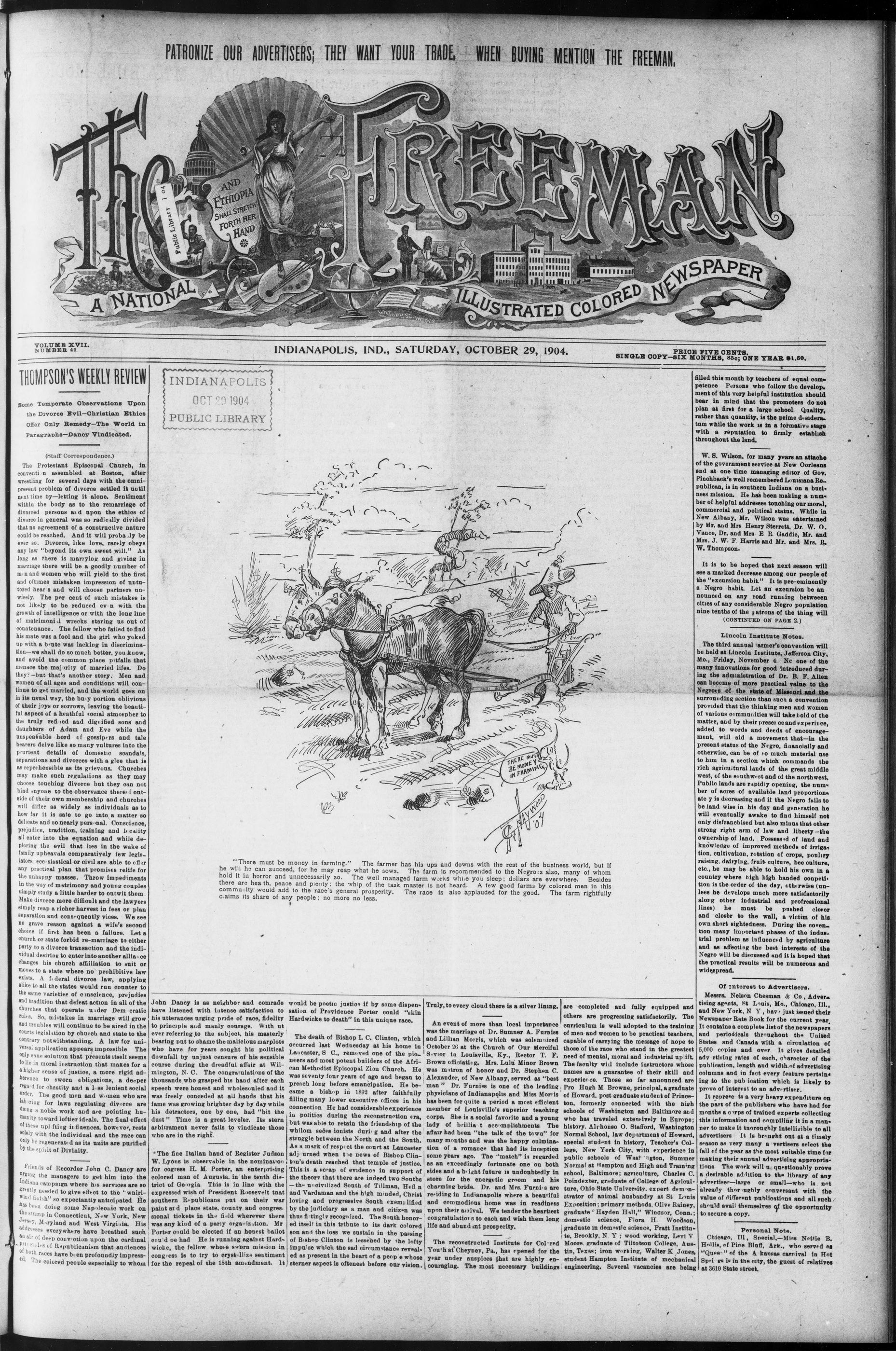
"There must be money in farming." The farmer has his ups and downs with the rest of the business world, but if he will he can succeed, for he may reap what he sows. The farm is recommended to the Negro is also, many of whom hold it in horror and unnecessarily so. The well managed farm works while you sleep; dollars are everywhere. Besides there are health, peace and plenty; the whip of the task master is not heard. A few good farms by colored men in this community would add to the race's general prosperity. The race is also applauded for the good. The farm rightfully claims its share of any people; no more no less.
INDIANAPOLIS
OCT 20 1904
PUBLIC LIBRARY
“There must be he will he can succeed hold it in horror and there are hea th, peace community would ad claims its share of a
John Dancy is as neighbor and comrade have listened with intense satisfaction to his utterances urging pride of race, fidelity to principle and many courage. With us ever referring to the subject, his masterly bearing put to shame the malicious marplots who have for years sought his political downfall by unjust censure of his sensible course during the dreadful affair at Wilmington, N. C. The congratulations of the thousands who grasped his hand after each speech were honest and wholesculled and it was freely conceded at all hands that his fame was growing brighter day by day while his detractors, one by one, had "bit the dust" Time is a great leaver. Its stern arbitrarum never fails to vindicate those who are in the right.
*The fine Italian hand of Register Judson W. Lyons is observable in the nomination for cresson H. M. Porter, an enterprise colored man of Augusta, in the tenth district of Georgia. This is in line with the express wish of President Roosevelt that southern R-publicans put on their war paint and place state, county and congressional tickets in the field wherever there was any kind of a party organization. Mr Porter could be elected if an honest ballot could be had. He is running against Hardwicke, the fellow whose sworn mission in congress is to try to oryctilize sentiment for the renewal of the 15th amendment. It
---
INDIANAPOLIS, IND., SATURDAY, OCTOBER 29, 1904.
would be poetic justice if by some dispensation of Providence Porter could "tkin Hardwicke to death" in this unique race.
The death of Bishop L. C. Clinton, which occurred last Wednesday at his home in Lancaster, S C., removed one of the pioneers and most potent builders of the African Methodist Episcopal Zion Church. He was seventy four years of age and began to presch long before emancipation. He became a bishop in 1892 after faithfully filling many lower executive offices in his connection. He had considerable experience in politics during the reconstruction era, but was able to retain the friendship of the whilom seeds ionists during and after the struggle between the North and the South. As a mark of respect the court at Lancaster adjured when the news of Bishop Clinton's death reached that temple of justice. This is a scrap of evidence in support of the theory that there are indeed two Souths—the unactivized South of Tillman, Heiln and Vardaman and the high minded, Christ loving and progressive South exemplified by the judiciary as a man and citizen was thus fittingly recognized. The South honored itself in this tribute to its dark colored son and the loss we sustain in the passing of Bishop Clinton is lessened by the lofty impulse which the sad circumstance revealed as present in the heart of a peep whose sterner aspect is oftentest before our vision.
Truly, to every cloud there is a silver lining
An event of more than local importance was the marriage of Dr. Sumner A. Furniss and Lillian Morris, which was solemnized October 26 at the Church of Our Merciful Soverior in Louisville, Ky., Rector T. F. Brown officiating. Mrs. Lulu Minor Brown was matron of honor and Dr. Stephen C. Alexander, of New Albany, served as "best man" Dr. Furniss is one of the leading physicians of Indianapolis and Miss Morris has been for quite a period a most efficient member of Louisville's superior teaching corps. She is a social favorite and a young lady of brillia t accomplishments The affair had been "the talk of the town" for many months and was the happy culmination of a romance that had its inception some years ago. The "match" is regarded as an exceedingly fortunate one on both sides and a bright future is undoubtedly in store for the energetic groom and his charming bride. Dr. and Mrs. Furniss are residing in Indianapolis where a beautiful and commodious home was in readiness upon their arrival. We tender the heartiest congratulations to each and wish them long life and abundant prosperity.
The reconstructed Institute for Col-red Youth at Cheyne, Pa., has opened for the year under auspices that are highly encouraging. The most necessary buildings
are completed and fully equipped and others are progressing satisfactorily. The curriculum is well adopted to the training of men and women to be practical teachers, capable of carrying the message of hope to those of the race who stand in the greatest need of mental, moral and industrial upift. The faculty will include instructors whose names are a guarantee of their skill and experience. Those so far announced are Pro Hugh M Browne, principal, a graduate of Howard, post graduate student of Princeton, formerly connected with the high schools of Washington and Baltimore and who has traveled extensively in Europe; history. Alphonse O. Stafford, Washington Normal School, law department of Howard, special student in history, Teacher's College, New York City, with experience in public schools of Washington, Summer Normal at Hampton and High and Training school, Baltimore; agriculture, Charles C. Poindexter, graduate of College of Agriculture, Ohio State University, expert demonstrator of animal husbandry at St Louis Exposition; primary methods, Olive Rainey, graduate "Hendall Hall," Windsor, Conn. domestic science, Flora H. Woodson graduate in domestic science, Pratt Institute, Brookly, N. Y.; wood working, Levi V Moore, graduate of Tiltotson College, Austin, Texas; iron working, Walter K Jones student Hampton Institute of mechanics engineering. Several vacancies are bain
filled this month by teachers of equal competence Persons who follow the development of this very helpful institution should bear in mind that the promoters do not plan at first for a large school. Quality, rather than quantity, is the prime d-sideram while the work is in a formative stage with a reputation to firmly establish throughout the land.
W. S. Wilson, for many years an attache of the government service at New Orleans and at one time managing editor of Gov. Pinchback's well remembered Louisiana Republic, is in southern Indiana on a business mission. He has been a number of helpful addresses touching our moral, commercial and political status. While in New Albany, Mr. Wilson was entertained by Mr. and Mrs Henry Sterrett, Dr. W. O. Vance, Dr. and Mrs. E R Gaddie, Mr. and Mrs. J. W. F. Harris and Mr. and Mrs. R. W. Thompson.
It is to be hoped that next season will see a marked decrease among our people of the "excursion habit." It is pre-eminently a Negro habit. Let an excursion be an nounced on any road running between cities of any considerable Negro population nine tenths of the patrons of the thing will (CONTINUED ON PAGE 2.)
Lincoln Institute Notes
The third annual farmer's convention will be held at Lincoln Institute, Jefferson City, Mo., Friday, November 4. Nc one of the many innovations for good introduced during the administration of Dr. B. F. Allen can become of more practical value to the Negroes of the state of Missouri and the surrounding section than such a convention provided that the thinking men and women of various communities will take hold of the matter, and by their presence and experience, added to words and deeds of encouragement, will aid a movement that—in the present status of the Negro, financially and otherwise, can be of so much material use to him in a section which commands the rich agricultural lands of the great middle west, of the southwest and of the northwest. Public lands are rapidly opening, the number of acres of available land proportionsate is decreasing and it the Negro fails to be land wise in his day and generation he will eventually wake to find himself not only disfranchised but also minus that other strong right arm of law and liberty—the ownership of land. Possessed of land and knowledge of improved methods of irrigation, cultivation, rotation of crops, pony raising, dairying, fruit culture, bce culture, etc. he may be able to hold his own in a country where high high handed competition is the order of the day, otherwise (unless he develops much more satisfactorily along other industrial and professional lines) he must be pushed closer and closer to the wall, a victim of his own short sightedness. During the covination many important phases of the industrial problem as influenced by agriculture and as affecting the best interests of the Negro will be discussed and it is hoped that the practical results will be numerous and widespread.
Of Interest to Advertisers
Messrs. Nelson Cheman & Co. Advertising agents, St Louis, Mo., Chicago, Ill., and New York, N. Y., have just issued their Newspaper Rate Book for the current year. It contains a complete list of the newspapers and periodicals throughout the United States and Canada with a circulation of 5,000 copies and over. It gives detailed ad rising rates of each, character of the publication, length and width of advertising columns and in fact every feature pertaining to the publication which is likely to prove of interest to an advertiser.
It represe is a very heavy expenditure on the part of the publishers who have had for months a corps of trained experts collecting this information and compiling it in a manner to make it thoroughly intelligible to all advertisers. It is brought out at a timely season as very many a vertisers select the fall of the year as the most suitable time for making their annual advertising appropriations. The work will u. questionably prove a desirable addition to the library of any advertise—large or small—who is not already thoroughly conversant with the value of different publications and all such should swav themselves of the opportunity to secure a copy.
Personal Note
Chicago, Ill., Special--Miss Nettie B. Hollis, of Pine Bluff, Ark., who served as "Quee" of the A. kansas carnival in Hot Spring ga is in the city, the guest of relatives at 3610 State street.
the STAGE
the S
AYWOOD
OF HIS TRIP TO AFRICA
BY SYLVESTER RUSSELL
John Larke, the popular comedian of team known as Larkins and Patterson made his first appearance in New York city as a comedy star at the Third avenue theatre, Monday the 17th under the management of W. C. Craine.
Negro comedy is something new on Third-avenue, so every part of the house was filled including all the boxes; one half of the boxes being filled by colored people. The play presented was "A Trip to Africa" described on the bills as a musical farce comedy in two acts. Some years ago it will be remembered, Miss Lillian Russell, the white opera singer, starred in a comic opera by that name, but "Africa" is a title that belongs to Negro tradition and its giving for this occasion is quite where it belongs.
Mr. Larkins starred once a year ago in a comedy entitled, "A Trip to the Jungles" and we presume that that name and play underwent a change owing to the announcement of the recent production of "Queen of the Jungles" The book lyrics and music is said to be by Larkins and Europe, but as the programme was badly drawn up it was impossible to tell whether Mr. Europe was leading the orchestra or not or even who the singers were. So they will have to be all omitted. I will not run behind the scenes in search of knowledge. The singer's names should have been signed to the musical numbers on the programme.
The special concerted and incidental music was quite well rendered.
The song "Without You" by a light soprano singer; another duet and solo by two young men with a quintette chorus were entertaining numbers. But one soloist at a time is plenty. The high contra tenor singer was very good.
"Trip to Africa" is a genuine musical fares comedy and would have been perfectly legitimate if one of the last scenes had been filled in by characters in the play instead of two special variety performers whose act rendered the performance illegitimate. It is high time that Negro actors and managers of colored shows know the difference between legitimate and illegitimate plays and what goes with them.
The plot of this play is fair but there are not enough speaking characters to properly convey the idea in a full and complete breast of complications.
Miss Green (Miss Patterson) is going to Africa as a missionary and wants the patronage of nobility. She suggests her desires to Captain Cinch (Bert
HOWARD'S
LIGHTNING
SHOE POLISHES
NEW YORK A.C. HOWARD, CHICAGO.
On sale in H. H. pines, at Geo. J. Marrott 26-28 E Washington street; Nutz & Grosskoph, 24-26 W. Washington ton street; Hide, Leather & Belting Co. 227 S. Meridian street; H. P. Wasson & Co.; New York Shoe Store. Agents wanted everywhre.
Don't fool with your face. Insist on Williams' Shaving Soap.
Sold everywhere. Free trial sample for 2-cent stamp to pay postage. Write for booklet "How to Shave." The J. B. Williams Co., Glastonbury, Ct.
THE FREEMAN, AN ILLUSTRATED COLORED NEWSPAPER
(Grant) who declores to masquerade old Bill Dusty (John Larkin) as an African King and on these three people hinge the responsibility of the play.
the comedy itself with all who are in the cast is given legitimately. The plot is quite original except a small dose of the initiation scene-a-la-smart-set and that ugly old deacons speech which should be ruled out as soon as possible, or do these actors expect that people will stand for every Negro play being alike? Does laziness teach them to steal from each other's brains a few clever speeches to bore us with forever? John Larkins as a comedian is quaint talented and entertaining. He lacks a complete expression of mannerism, the kind that makes Bert Williams great, and falls a little short of the genuine naturalness given out by birth. He sings with excellent taste and correctness and his initiation of Ernest Hogan in that "darn old initiation scene" was superior to McLutosh or Dudley. Even at that we can do very well without borrowed art, we want originality. The first night was a gala night and Larkins was a little nervous. Everybody was nervous. Larkins wore good comedy clothes but I do not fancy the bald-headed wig that shines like stove polish on, top. For a man of dark brown complexion it would have been well for him to have copied after Hogan by just using a little black that does not shine. His best comedy work was done in his disguise as a king and his rendition of the song "Shame on You" brought him three encores.
Mr. Larkins is perhaps the best comedian that follows after Bert Williams and John Rucker seen in comedy this season and as a second-class theater attraction he can be called great.
Miss Dora Patterson, leading lady, tourist and afterwards Princess Lulu, captivated with her winning smiles. She has lots of dresses and knows how to look charming without being really beautiful. Her skin without paint was of an excellent shade of color.
She has the usual sweet alto voice given out among colored soubrettes and one dainty little step in dancing made perfect by practice. Her dresses are sweet dreams of shop window samples. In the first act she wore a steel gray silk walking suit, then she changed and wore a blood red chiffon embroidered with a white beaded front and in the last act she wore a light green spangled dress with long lace sleeves that fell to the ground and a jawed throat necklace studded with diamonds and other precious stones. She sang in ragtime "Make a Fuss Over Me" with a queenly air that drew forth undivided attention from the masculine element of all parts of the house. Bert Grant, the famous dancer and formerly of the team Jones, Grant and Jones, was leading man, and, as we naturally would expect, made a good impression as Captain Clin.h. Not being letter-perfect in his lines he received his quiet tips from Mr. Larkins and Miss Patterson in turn during his dialogues without anybody noticing it, with the same air and confidential smile that all old stagers wear in serious and exacting moments. Grant is quite a good-looking chap with a very well developed head from an outside standpoint. In his songs, "The Blackville Volunteers" and "Listen to the Big Brass Band" he displayed his perfect art in novel steps coupled with a smile that deerves you; for Bert has long since swore that he would not hurt himself dancing.
Just because he can? Yes, I think so. Others in the cast were Earl harris, William Dawey, W. L. Lamb, Irene Franklin, Carrie and Joseph Smith.
Baley and Fletcher, two variety performers, singers and dancers, and experts at that, made their appearance in a scene of the last act and found favor in no time by setting the gallery on fire with screaming. Mr. Fletcher is a second Ben Hunn and his singing of "Water-melon Vine" carried the day. All this was a death blow to comedy, and so long as variety is sprung in a comedy in this fashion we will not need any comedies at all and comedy stars will be out of the question. A white star wouldn't stand for it, but Larkins may live through it even if his last song did fall to score. If a Negro comedy can't go on its merits without resorting to variety the botchworkers may as well stop writing comedy and return to the variety stage.
Goodness knows I am tired and sick of roasting comedy performers and the public is getting weary of hearing it. But the public is funny; they don't care how long I keep it up.
The chorus was draggy, But sung very well. The light girls, some of them with frizzly blond hair, showed up a charming shade of Southern mu
latto beauty by omitting paint. Bravo for them, sensible little creatures. Women will forever learn quicker than men. All the love scenes in the comedy too were quite good and strengthened the play. If Bailey and Fletcher had characters written in the comedy the entire performance could be made legitimate by cutting some of the variety features out of their sketch.
What I consider very bad taste, and especially in New York, was the two large horse-shoes of flowers that were passed over the footlights to the star and his wife. The occasion did not warrant this display of a too much overdone doing.
Mahara Minstrels.
Although this is the first time I have taken the liberty of writing your valuable paper, I can truthfully say that both Mr. F. L. Mahara and myself read your amusement page weekly for we find it the most reliable, as well as the most interesting, of any paper in regard to colored minstrel news. This season Frank Mahara's Big Minstrels, consisting of twenty-five well-known colored minstrel performers, is without doubt the biggest and best company ever put out by Mr. Mahara. The company is headed, this season, by Skinner Harris, who for six years previous to joining Mr. Mahara, was the leading feature with L. E. Glideon's minstrels. Among others of note with the company this season are such clever artists as the two Gillams, Harry and Laura, grotesque acrobats, Sloan (Parson), Edwards, basso profundo, Dick Lewis, male soprano, Arthur Prince, without doubt the greatest hoop-roler and juggler of his race, Watkins, the silver-voled tenor, Harry St. Clair, leader of band, and many others too numerous to mention, including four beautiful, sweet voiced young ladies, and, taken all in all, Frank Mahara's minstrels can truly be called the "Assassins of Sorrow." This is the first colored minstrels I was ever connected with; but have this to say, "That if all colored minstrel companies are as well behaved as the Mahara boys then they are far above the average white company." Out of twenty five people we have not one who can be called a "booze fighter," and our stage manager, Skinner Harris, has made rules against all swearing, so that taken as a whole, we feel we have a very nice bunch of boys, and if I told what I thought of the girls I might have to fight a few husbands, so it is suffice to say they are all right. Since opening (August 15) we have not had a losing week, and everybody is contented and singing "Home Aint Nothing Like This." We have toured Wisconsin, Minnesota and South Dakota so far this season, and are bound for Iowa and Missouri. We are playing all the larger cities of the Middle West, receiving praise for our excellent performances. We all look forward to a long, pleasant and profitable season, during which time we will continue to read The Freeman and wish you a long and profitable career. All the boys send their regards to you and your readers.
THOMPSON'S WEEKLY REVIEW
CONCLUDED FROM FIRST PAGE.
be Negroes—and as a rule such Negroes. We do not mean to condemn the well-intentioned man or woman who occasionally take advantage of the cheap rate to spend a day with a relative or friend or who wish to seek respite for a few hours from labor in the seclusion of some country spot. We mean to condemn that uncouth, loud, roystering mob that rarely works at any definite occupation but who manages to rake up from some doubtful source a dollar or two and make a habit of running after every excursion in sight for the mere sake of going—who drink bad liquor and misbehave themselves generally, having what they are pleased to term 'a good time.' These Sunday orgies, which take place in full view of white people who look upon the proceedings with a mixture of amusement and disgust, do not help us upward. If these excursions cannot be made to serve a better purpose than that of furnishing no-account Negroes with an opportunity to disgrace themselves they should be vigorously sat upon by our reputable citizens next season—and early too.
The six really great speeches by eminent Negroes during the year that seem to stand apart from all the rest might be classified as follows: The emancipation address of Bishop G. W. Clinton on January 1st at Charlotte, N. C.; the fervid lecture of Bishop Alexander Walters on "Frederick Douglass" before the Douglass club in February at Nashville, Tenn; the recent address of John Mitchell Jr., to the National Association of Bankers at New York; the speech of Harry S. Cummings at the Chicago convention, seconding the nomination of Theodore Roosevelt; the Cleveland deliverance of John C. Dancy and the convincing defense of "Education for the Negro" by Booker T. Washington, which electrified the National Educational Association at St. Louis in July.
A churchman who is found of ans:
Soft Straight Hair Is what you want. CROWN OF GLORY HAIR POMADE
Soft Straight Hair Is what you want. CROWN OF GLORY HAIR POMADE
Will produce it for you.
Makes the Hair Easy to Do Up
and Lay Straight.
Large Bottles 50 Cents.
Trial Treatments 10 Cents.
Quite Different to Any Other.
THE OSBORNE CO.,
Box 21,
Cleveland, O.
lyzing the currents that control human action in discussing the officers elected at the last general conference of the A. M. E. Zion church ascribes the victory of Financial Secretary M. R Franklin to the influence of Bishop Hood, Business Manager J. F. Morland is charged to Bishop Walters and editor of the Star of Zion, G. C. Clement is put down to the credit of Bishop Clinton. The selection of Bishops J. W. Smith and J. S. Caldwell came in response to the united voice of the connection.
SHARPS AND FLATS
"H" stands for more bad things than the place which Bob Ingersoll said did not exist. Hardwicke and Howell, of Georgia, Heflin and Hobson, of Alabama—isn't that a savory bunch of "statesmen?" Some people have a notion that there is little in common between printing and preaching, but the fast remains that Rev. C. C. Alleyne, a graduate of the printing department and Bible school at Tuskegee is now pastor of a thriving church at Drakesboro, Ky.
The 9 000 people of the fifth district of Alabama are very properly bedecked in the sackcloth and ashes of humiliation over the incendiar and disgraceful utterances of that fellow Heflin whom they were deceived into sending to congress. He is a sorry successor to the chivalrous Charles Winston Thompson.
The Heflinus must be a bad lot. The Alabama representative who outraged American decency by the anarchistic remark that "if Czolgoesz or one of his kind had thrown a bumb under the table when Roosevelt and Booker were dining no great harm would have been done the country" is probably a blood relation of another Heflin n who assisted in throttling co-education of the races in Kentucky.
Illinois is suffering from an overdose of Tillmanism. Indiana can stand a great many monstrosities, but she draws the line at the South Carolina Cyclops.
Tuskegee Institute gets $100 000 by the will of the late James Cailaham, a millionaire of Des Moines, Iowa. Every little helps.
Lynchers are in disgrace even in the benighted South. We hear very little these days of mobs composed of "our best citizens."
Respectable white people and respectable Negroes rarely collide on the race problem track.
We haven't heard so far whether or not southern society has blacklisted Millionaire Alexander Sedgewick and Robert Treat Paine, Jr.
If the country should determine to try a Democratic president, Robert Treat Paine, Jr., of Massachusetts, might not be a bad fit.
Yes, who does speak authoritatively for the South? Certain elements are repudiating the utterances of Jim Vardaman, Jeff Davis, Ben Tillman, Jack Sharp Williams, Tom Heflin, Joe Bailey and others. Who has the warrant to speak for the real South?
All of our schools are booming. We are going forward.
We notice that a Rev. T T. Taggart, of Ohio, has been transferred to the Pittsburg Methodist Conference. This unknown divine with the familiar name must not be confused with the smiling chairman of the Democratic National Committee. Our T. Taggart is still a member of the Indiana Conference.
Charles Winter Wood, at one time a popular Shakespearian delineator of Chicago, later a post graduate of the Teacher's College, Columbia College New York, is now in charge of the Carnegie library at Tuskegee Institute. Negro education pays large dividends.
The Negro race cannot afford the losses it is sustaining in the gainful occupations. This matter cannot be too forbly emphasized by our leaders. Stop the leak!
"Fairbanks for vice president in 1904!" is but a natural fore runner to "Fairbanks for president in 1908!" This would be a fitting observance of the civil service idea of advancing the faithful.
Let it be understood far and wide that Emmett J. Scott is the only genuine, guaranteed, Simon-pure, brand-blown-in the bottle private secretary that Dr. Booker T. Washington has
MADAM MNAIRDEE-MOORE
MADAM MNAIRDEE-MOORE
THE WOMAN
The gifted Clairroyant, the great female wonder, born with the double (caul) veil, she is one of the old ancient Southern Clairvoyants of New Orleans. She's a lying Phrenologist and Physiologist. She tells plain what you are best adapted for in life by his brains and mind. Wit a grasp of her brains and mind, she influences to enable you to overcome all bad luck. She has made thousands of homes happy. Read the fifth chapter 1x verse of St. Matt: "Blessed are the peacemakers for they shall be called the children of God." She reunites the separated, makes peace where there is confusion. Your husband or wife can be your or your sweet heart forake you. But will you marry and marry you sooner if you will only heed this lady's consultation. Read what several ladies of your city say. "Yes, we believe the a Godsend to our city; my husband and I had been separated over a year and just think that I called on this lady, he returned this young lady says: "The lady is happy. This call or write me; I called on this lady and we are now engaged." You can't afford to miss consulting this gifted lady; she is gifted to read characters. She challenges the world to excel her advice on love, losses, business, family and family. She unites the separated causes speedy marriage for your choice. No cards allowed in her place business; no one's ill wishes filled; st. joyful a Christian lady and depends entirely on her heavenly gift. If you are painful or think, you have withered to go to see her. She spent eight years in the Africa and has traveled through 44 states dedicated to Reading, Read St. John, 9th chap, 33rd ver. "If this man is not God he could do nothing.
Three parlor so arranged that you meet nofriends nor strangers: everything confidential. Owing to such crowds you may call night or day. Permanently located. Send money by postal order or Registered letter
I, for one, as one in the midst. My heart ached from the cruel treatment of my husband and the way he would throw away his time and money until I consulted this wonderful lady. It will soon be a year. Through her he has become a loving husband; and today he presents me with a lovely lot on which he will in the spring erect a home. Tongue can't praise her too high.
A LADY of New Iberia, La.
Chicago, Ill. Nov. 17, 1902.
Madame McNairdee, Indianapolis, Ind.:
Dear Madame. -Your letter like a ray of sunshine, came duly to hand and I am very
A
His stenographers, local and traveling, financial agents and special correspondents are all right, but they are not private secretaries.
Our white friends would understand no better if they would read Negro newspapers.
Henry Watterson says: "The South is fighting to preserve its civilization." The South's civilization is too rotten to preserve.
Verily the whirligig of time bringeth its changes! This was strikingly demonstrated during the recent session of the National Negro Business League. A delegate who twenty years ago had been a bell boy in a certain leading hotel in Indianapolis returned to register at that same hotel as a guest.
From the Henry Watterson point of view it is doubtful if Chairman Tom
plessed with it, for every word of it were true, am sorry that I did not write to you months ago. I enclose $6.00 for your sage vice, hoping that you may be successful in bringing about desired results. I feel quite sure that you can. I am very sorry to hear of your being ill, and sincerely hope your speedy recovery.
Molino, Fla., Nov. 14, 1902.
Madame:—You are the proper person in the proper place. All that you say is true and all you do is good. May God bless you.
F.J.
Guntersville, Ala., Oct. 26, 1902.
I tried Mme. McNardree and find that she is well up in profession. She will tell things to come. Some as predicted. It will pay people to the man who want to know many things in the future.
INFORMATION.
There is no doubt of this lady's prophetic power. She is a living phrenologist, palmist and a natural born clairvoyant to which thousands will testify. She is a God send to our country—born with a gift that no one can afford. She will every incident of your past and present life. You on the road of success both financially and spiritually if you will only heed her instruction. I called on her when the one I love had gone I kuew not where and he returned at once, and today I am his dear wife.
A LADY of Fort Gibson, Ind. T.
Madame you feel it my duty, do this my husband you are all my praise. Just think for my husband and I have been for years. I called on you in September and in December time he returned and married me, and I can't praise you too much. Ladies that are heart-broken by family troubles, love affair and bad luck until it seem that life is a blessing and dear lady, she will do you good; she will tell you to trust God and she will do the balance to she will.
A LADY of Rossland, B.C.
Dear Sisters and Brothers—Call on her when you can, she will be please to meet you and will when ever you wish to. She devotes her entire time for the welfare of the people believing God will reward her. She will tell every soul glad to hear her talk of heaven for you, such soul searching letters, tells you how to home happy. Send date of the month and the year you was born in and receives full character reading. Enclose $1. Clip this. 1527 English Avenue, INDIANAIPOLLB IND, MADAME MONAIRD-MOORE, Enclose stamp for reply.
THE NEGRO'S HOPE
of advancement lies in his chance*of color. The structure of his skin and composition of his blood are precisely the same as that of the white man. Ages of living under a tropical sun have made a chemical change that can be remedied by the use of counterchemicals. "Black-No-More," the greatest scientific discovery of the age, changes the blackest skin to the purest white, without pain, inconvenience or danger. Makes a white skin whiter.
PRICE $2, BY EXPRESS PREPAID.
BLACK·NO·MORE CHEMICAL COMPANY.
CHILLICOTHE, O. BOX 26.
Taggart is "sound" on the race issue." Maude Adams' successful play "The Little Minister," does not deal as some may imagine, with the life and methods of the "Rev" Jay Albert Johnson of Baltimore by way of Canada and Washington. It is more than likely that North Carolina's young wheel horse Dr. James E. Shepard will be heard on the Indiana, New York and West Virginia hustings. He is a campaigner of experience and "makes good" wherever he goes. Editor W. Calvin Chase, of the Washington Bee, is such an ardent admirer of our expansive mind and overpowering genius that he insists upon giving us credit for things we have never even thought of doing.
om Patronize Our Advertisers. Read them.
THE FREEMAN
A NATIONAL ILLUSTRATED
COLORED NEWSPAPER.
PUBLISHED EVERY SATURDAY
At 309 Indiana Avenue,
INDIANAPOLIS, INDIANA
INDIANAPOLIS, INDIANA.
SUBSCRIPTION RATES:
Any part of the United States and Canada,
one year, postage paid ..... $1.60
Six Month
12 Month Months
Foreign Countries ..... $1.00 extra
Bend money by express, money order, post-
office order or registered letter.
Agents want i every town and city not
no occupied, and liberal inducements will be
given. Send for our extraordinary
inducements.
ADVERTISING RATES:
Five cents per line. Fase of measure—solid
agate, 14 lines to an inlc., 276 lines in a column.
Special position 25 per cent additional. No
advertisement intended for use. Special
rates on standing professional and business
cards. Lessorable discount for long time and
space. Reading notices 100 per line. Special
rates on WR TE UPS.
Entered at the postoffice at Indianapolis
Indiana, as second class matter.
All matter should be addressed to
THE FREEMAN,
INDIANAPOLIS, IND.
GEORGE L. KNOX, Publisher.
SATURDAY, OCTOBER 29
JUSTICE JOLTED
At no time was this newspaper in sympathy with George L. Knox's candidacy for congress, but since it was a matter of his own choosing, it was clearly up to him to do as he deemed best.
It is now of the high-handed and outrageous manner in which he was treated that we wish to speak. Knox has been shamefully handled. The decision of the Board of Election Commissioners that a candidate by petition must bring witnesses to each of the two hundred signatures is unjust and without doubt unconstitutional. Under such a ruling, independent candidacy for office is effectually prohibited, since there is no provision in the law for summoning the witnesses, although it were possible to fine from 200 to 1,000 persons who would give such testimony as demanded by the commissioners.
Congressman Overstreet's managers let their enthusiasm run away with their better judgment. It is highly probable that the merciless treatment accorded Knox will lose the congressman ten times as many votes as if he hung on the car straps. A square deal is relied on by all men, race and previous condition of servitude notwithstand.-INDIANAPOLIS SUN.
PLAIN WORDS TO NEGRO VOTERS OF MARION COUNTY.
All of you have seen before you very eyes what the Republican party will do to the Negro when he shows the slightest inclination to rebel from its service. You have seen a representative of your race forcibly and illegally deprived of the right to run for office. You have seen other members of our race deprived of the right to vote as they desire by refusing their candidate a place on the ballot. Here we have it—deprivation of both the right to vote and to run for office. Unless you vote as we desire, say Overstreet, Young & Co., you shall not vote at all. You shall not run a candidate of your own. We have picked out a candidate for you, a white man, and if you refuse to vote for him you shall not have the privilege of voting for any Republican candidate for Congress. What worse has been charged against the South, so far as the political rights of Negroes are concerned? There they refuse to allow Negroes to vote unless they vote the Democratic ticket. They refuse to allow them to run for office. They have other ways of doing this besides the plan invented by Hawkins, Moores, Young & Co., but they are just as effective. When they hear of the Indiana device, this recent invention of Overstreet's friends, they will doubtless adopt it. Meantime, the Indiana plan of the Republican party works just as smoothly as the Mississippi plan of the Democratic party. The Negro gets it in the neck from both.
Now who is going to stand up for the political rights of the Negro if he does not stand up for them himself? If the seven thousand Negro voters of Marlon county do not resent the outrage, if they lie down and allow themselves to be trampled on by the elephant, how can they expect anything better in the future? Remember that an attack on the rights of one of our number is an attack on all. If they are allowed to knock out Mr. Knox without protest or punishment this will be to invite them to use the same club on every colored citizen of the State. If the Negroes are ever going to make a stand now is the time. They must rise up and make themselves felt. They must protest as one man again this denial of justice and ordinary fair play. It makes no difference whether you were in sympathy with Mr. Knox's independent political movement or whether you intended to vote for him. The principle involved is one that rises far above more officeholding or mere political ambition. The right involved is a fundamental one—a race right, a human right, a manhood right
—and if we allow it to be suppressed in the person of one, however humble, depend upon it that similar treatment will in time be meted out to all. We rise or fall together. If we do not resist collectively, we will be crushed individually.
Mr. Overstreet and his machine at first pretended to ridicule Mr. Knox's candidacy for Congress, saying it
THE FREEMAN, AN ILLUSTRATED COLORED NEWSPAPER
would amount to nothing and they did not fear it. This week they have been making frantic efforts to keep his name off the ballot and stopping short of no dirty trick to deny him this simple right of a freeman.
OPEN LETTER TO CONGRESSMEN
OVERSTREET.
You say you are in favor of protecting Negroes in their rights in the South. Or, to state it more correctly, you get Mr. Crumpacker to say this for you in a letter to a colored editor of this city. You yourself have never said anything of the kind in your public utterances, nor has any one ever been able to place you definitely on this momentous question. But let this pass. The South is a long way off. What we want to know is your attitude towards the political rights of Negroes in Indianapolis, in your home city, in the center of your congressional district. You have a splendid chance to show your colors right now, and here, leaving the South out for the time being. One of your Negro constituents, a man of good standing in the community and respected by all its citizens, a man whose business career has been long and honorable and who has worked hard for you in all your five races for Congress—this man asked the privilege of trying his strength before the people as a candidate for office. In order to do so, he complied with all the requirements of the law with all the requests of the government for a petition signed by two hundred voters, and exhibited one with more than six times that many names. This, as he had every time on a place on the ballot, so that his supporters might be able to vote for him. But your managers and henchmen, Mr. Overstreet, acting presumably under your orders, refused to accept Mr. Knox's petition and denied him a place on the official ballot. This would be bad enough if done honestly and legally, but it was accomplished by methods that should make a gang of Southern Kuklux blush for shame. Gangs of hirelings were sent out to run down the signers of Mr. Knox's petition and induce them to take their names off. Some were bribed or offered bribes; some were threatened with arrest and prosecution; some were overpersecuted; some were bulldozed by various kinds of threats; some were promised profitable positions, official places and numerous other inducements to go back on their signatures; many were called into back rooms and private offices to be talked to sharply.
All this, Mr. Overstreet, was done right here at your home in Indianapolis, and in your name. All the men so treated are your constituents. All of them have heretofore voted for you and many of them intended to vote for you again. But they were willing to give their colored fellow-citizen a right to run for office if he chose to do so. Now what we want to know, kept advised of their work, but you Mr. Overstreet, is whether you approve of all these outrages done by your henchmen. You, no doubt, were due the Negro race in the district you did not call your dogs off. Neither by letter or telegram did you order a cessation of the outrages on your fellow-citizen. You apparently stood by, not only aiding and consenting, but actually "sickling" on your hounds and furnishing the money to aid them in doing their dirty work. Call you this helping your friends? Is this the way you stand up for Negro rights? Has the Negro here no right in your estimation except the blessed privilege of voting for you? Do his rights stop at the polls after he has cast his ballot as decided by your machine? Let the Crumnacker bill and the Mississippi method and the Louisiana plan go for awhile and brace yourself to answer this question: How do you stand as to Negro rights in Indianapolis, and what do you think of the doings of your man Young, as a sample of Republican acknowledgment of what is represent in Congress?
THE CROWNING OUTRAGE.
After a lifelong devotion to the Republican party and earnest support of its candidates and policies, George L. Knox asks the simple privilege of becoming a candidate for office in the district where he has spent the last years of his life. Not being the nominee of any party, but simply an independent candidate, it was necessary under the law to get up a petition signed by not less than two hundred persons to entitle him to a place on the official ballot. Petitions were accordingly circulated, and after being signed by many hundreds of people, were presented to the county board of election commissioners. This board consists of two Republicans and one Democrat. When the matter came up for action it was found that the Republican machine, representing Congressman Overstreet, had decided, if possible, to keep Mr. Knox's name off the ballot as the easiest way of beating him and saving their own candidate from defeat. The scheme was to attack the genuineness of some names signed to the petition, to hire or bulldoze others to withdraw, and in every possible way to confuse as to give their friends on the election board an excuse for throwing out the petitions. After wrangling over the matter all day Tuesday the two machine men on the board—Merrill Moores and William E. Davis—rendered the extraordinary decision that the burden of proof rested upon Mr. Knox to show that of the 1,286 signatures' to his petition, two hundred of them were genuine. To do this he must bring into court two hundred men who would swear that they signed the petition. As the election board has no power to issue, subpoenas or compel the attendance of witnesses, Mr. Knox was expected to hunt around for hundreds of men, scattered all over the city, at great expense and trouble to himself and friends. In other words, the action of the election board amounts to a denial of justice and constitutes an outrage against one of the most fundamental rights of all citizens.
Special attention is called to the fact that this outrage is perpetrated upon a Negro citizen by a Republican machine acting in the interest of the
candidate for Congress whom Mr. Knox is opposing. These men, who pose as the special champions of the Negro, show how much they respect temptable conspiracy to keep Mr. Knox's name off the ballot. White men are not treated in this way. This his rights by their action in this conversion election board was called on to admit the candidates of two parties to the ballot on petitions. After turning down Mr. Knox's petition, with 1,280 signatures, the election board, without any hesitation, placed the name of Dr. James Carter on the ballot as the Populist candidate for Congress, although his petition had only 280 signers. The petition of John T. Remley as the Socialist Labor congressional candidate, also was approved. The Negro only need not apply to an election board composed of a majority of Republicans. Why could they not give Mr. Knox the same treatment as was accorded the other candidates with petitions? Why place on him conditions impossible to be complied with, and in order to work this outrage assumes powers which the law does not give them as an election board? His only recourse flow is to apply to the courts for a writ of mandate to compel this recrant election board to do its duty. If the court should fail to respond, or if in any way this last resort should miscarry, Mr. Knox will be denied a position on the official ballot, and thus deprived of the privilege of being a candidate. This is one way to defeat a man. It may prove in the long run also an excellent way to defeat a party.
WE DEMAND FAIR PLAY
Ross Hawkins, * Merrill Moores, Archy Young and the rest of the Overs street machine who conspired to deprive George L. Knox of his rights as a citizen may think they played a slick game in politics, but in the end they will find that they lost more than they gained. They will find that it would have been much wiser to allow Mr. Knox's name to go on the ballot uncontested than to keep it off by disreputable and indefensible means. By their brutal conduct they have really made votes for Mr. Knox. All decent men love fair play, and they will insist that their fellow-citizen shall have fair play, though they may not agree with him in politics, or be in sympathy with his independent movement. The ultra-partisanism of A. Young & Co., their disregard both of law and justice, their dirty machine methods and underhanded tricks are sure to react on them. Bulldozing may win for a while, the bully may seem to have the best of it in the first round, but there is another day and another opportunity. As honesty is the best policy in business, so fair dealing pays the best in politics. You may beat a man by cheating once or even twice, but in time such rascally conduct will come back to plague the inventors. There are seven thousand Negro voters in Marion county, and it is to them that the Republican party owes its long supremacy in the county. It is to them that Overstreet owes his seat in Congress. It is to them that Republicans owe their flat places in the courthouse, and but for them Mr. Archibald Young would not be drawing his big color.
Viewed even from the low standpoint of practical party politics, the treatment of Mr. Knox was one of those blunders that reach the proportions of a crime. It was an act of party madness. Its stupidity and blundering idiocy are such as to leave the impression that Mr. Overstreet has left the management of his affairs in the hands of a lot of chuckleheads. As soon as he comes home he should take his man Young out behind the barn and have him bored for the simples. In their work this last week Overstreet's incompetent machine has planted the seed for much future trouble. They have sown a lot of dragons' teeth which in due time will produce a crop of snakes to bite them. The Republican party will suffer a great deal more than Mr. Knox by these "brave" achievements of Hawkins, Moores, Young & Co. The outrage is certain to attract national attention, and Democratic papers will be furnished with fruitful themes for articles on the way the Republican party of the North accords the Negro his political rights. The methods of Copiah county, Mississippi, are transferred to Indianapolis, and White river changes its name to "The Yazoo." It is not too much to say that the stupid action of two partisan members of an election board on Tuesday last has endangered Republican supremacy in Marion county, and perhaps the next Legislature of Indiana, involving the election of two United States senators.
FRIENDS (?) OF THE NEGRO.
As a suppressor of Negro voters and officecees Archibald Young, Esq, requests his friend and sympathizer, Hon. Ben Tillman, to sit still for awhile. Ross Hawkins, attorney for the petition destroyers, can give cards and spades to his friend, Congressman Hefin, of Alabama, and still beat him as a defamer of Negroes and "Negro lovers." Merrill Moores, who acts as the main guy of the election board to cheat Mr. Knox of his rights, and, in defiance of the law, denies him a place on the ballot, is the same individual who, a few years ago, denounced the Negro population of Indianapolis as "lazy coons." Merrill should apply to Governor Vardaman, of Mississippi, for a place in his cabinet. As a "Negro suppressor" he would soon commend himself to the worst that old "Massissippi" can do in that line.
We had a regular "Negro" hunt in Indianapolis last week. It began on Saturday, was continued all day Sunday, despite of "closing laws," run over on Monday and kept up Tuesday until the game was treed. "They were after the signers of Mr. Knox's petition, and they kept the trails hot. The bloodhounds doing the chasing were under direct control of Huntsman Young, who was assisted by a lot of whippers-in and outriders. The hunting was good and the game plentiful. The ammunition used was chiefly silver bullets. Congressman Heflin, of Alabama.
favors the assassination of the President bodily. Some of the Republicans of Indianapolis don't go quite that far as to the Negroes, being content to kill them off politically.
Congressman Overstret will soon be back here to tell the Negroes how much he loves them. He loves them so much that he is willing to let them keep on voting for him until doomsday. But he draws the line on their voting for one of their own kind.
President Roosevelt opened "the door of hope" to the down-trodden and long-suffering Negro. Congressman Overstreet, acting through his machine here, proposes to close that door unless it leads directly to the carrying out of his own ambitions to remain in Congress. It is said the tracks to the tiger's den all lead one way, and that is within.
Dear Mr. Tillman—I understand that you are a past grand master in the art of suppressing "the insolent" Negro in your State of South Carolina. You are familiar with every weapon from the shotgun to the tissue ballot, but my man Young has invented a new device which he proposes to patent, which you may find a useful addition to your armory. It is very simple, but works like a charm, warranted to prevent any Negro from running for office, and also to force all "lazy coons" (See Merrill Moore) to vote the right ticket, if they vote at all. For particulars address me or my election board at Indianapolis. Yours to tie to,
J—E O—T.
Mr. Knox's Chances of Election
Some of our colored friends use as their main argument for not supporting Mr. Knox that he "has no chance of election." Let's see about this. There are seven candidates for Congress in the district, representing the Republicans, Democrats, Prohibitionists, Populists, Socialists, Socialist Labor and the Colored Independents. There are between 45,000 and 50,000 voters in the county. Divide these up equally between the parties and each candidate would have something over 6,000 votes. There are seven thousand Negro voters in the district, and should all these vote for Mr. Knox, as the representative of their race, it would not only be an interesting show of strength, but it would give him a fine show of election, as many independent white Republicans prefer him to Mr. Overstreet.
But, aside from any consideration of actual success, think what a moral influence it would obtain for the Negro race in this district should it go out over the country that all of them, cutting loose from old bonds, had stood manfully up to be counted for one of their own number as against all comers. Suppose on the ninth of next November people all over the United States should read in the morning papers that practically every Negro voter in Marion county had cast his ballot for George L. Knox. It would create a national sensation. It would cause the cold shivers to run down the spine of every machine boss in communities where the Negroes hold the balance of power. It would mean a new emancipation. It would mean that the Negro had won respect by deserving it. Proof against boodle and bulldozing, against threats and tricks; in spite of money, maligning and every sinister influence, the self-respecting Negro constituency of the great Capital district of Indiana had thrown off the yoke of years and stood out in the open to be counted. It would mean that, having voted so long for others, they had determined for a while to vote for themselves.
It would mean much more for the masses who did the voting than for Mr. Knox, the immediate beneficiary of the ballots. The latter can well afford to be defeated for Congress, but the men of his race cannot afford to be used as the instruments for his defeat. They can especially not afford' to allow him to be defeated by underhanded means, by a revival of the old slave-driving methods, by unprincipled devices of a corrupt political machine. Depend upon it, fellow-members of our race, that if you do not stand up for those of your own kind that assert your rights and make sacrifices for them, you cannot with good grace complain that you are denied an equal show according to your numbers and merits. Be true to yourselves; stand up for your own, and in the long run you will find this policy bearing rich rewards for those who courageously pursue it.
Outside Opinion of Mr. Knox's Race
The Chicago Conservator is admitted to be one of the ablest and most prosperous of the Negro journals of the country. It is a strong supporter of Republican policies and intensely loyal to President Roosevelt, but this does not prevent it from advocating that kind of independence and manhood among Negroes that consists in asserting their rights on all occasions and standing ready to assist in defeating unworthy candidates of their own party. The Conservator of October 22 devotes a-column editorial to the candidacy of Mr. Knox in this district in which the same sentiments are expressed as those that have found utterance in the Freeman. Says the Conservator:
Since Mr. George L. Knox, the publisher and proprietor of the Indianapolis Freeman, has seen fit, for good cause—as he looks at it—to announce himself as an independent candidate for Congress from the Seventh Congressional District of Indiana, which, as far as the thousands of colored people living in the same are concerned, is misrepresented at the national capital by the present Congressman—Overstreet—a great outyure has been raised and a lot of foolish reflections and censure be indulged in by people, mainly Negroes, many from whom different things might have been expected. It has been for years a stock arraignment of the Democratic party that, as an organization, it neither forgot nor learned anything Curious people might commence to inquire if the time had not arrived when the odium of that charge, if odium there is about it, should not be lifted from the shoulders of Democracy and placed upon that of the American Negro. Will he, the Negro, ever in God
DR.ROBT.F.HARPER VETERINARY SURGEON
BEFORE AFTER
seek a new job
combine his Proof J. H. Austin,
the celebrated bacteriologist, who has had twenty-five years in practice of the hair, skin and scalp, and he will send you Absolutely Free a diagnosis of your case, a booklet on care of hair and scalp, and a sample box of the remedy which he will prepare especially for you. Enclose 2 postage and write to-day.
PROF. J. H. AUSTIN
Almighty's world, cease playing the buffoon and "nigger" and become a MAN?
Why should not Mr. Knox, or Mr. Anybodyelse, no matter what "neck of the woods" he hails from, all other things being equal—character, manhood, citizenship, devotion to country, etc. he guaranteed, free from malicious censure and cheap ridicule, in the same rights of manhood and citizenship guaranteed to other citizens of the land? Will the Negro never cast off the long garments and the swaddling napkins of babyhood in his conception of what manhood citizenship means, and the rights and duties it confers? Every time some white Republican goes wrong, or disregards and spurs his sworn duty to his constituents, black or white, why can't the Negro allow the renegade to drop out of sight as he richly deserves, or better still, join hands with the manly, independent white voter and assist in kicking him out? One swallow does not make a spring, nor will the retirement or punishment of this man Overstreet wreck the Republican party if the voters of his district decide they have had enough of him. Mr. Knox, it seems, has been observing his career, and among other things his cowardly and pusillanimous attitude toward the Crumppack bill, and decided no longer to support him. Well, now, what of it; does it lie in the throat of any one, especially of any Negro in his district, for whose honor, manhood and citizenship Mr. Knox took the step he has to question his right in the premises or the sincerity and patriotism of his motives?
The Conservator thinks not, rather it would seem that every colored voter in the district outside of the "camp followers" and small fry leaders, whom ye have always with you, should look with pride, not disdain, upon his action, finding words of praise instead of censure that one in their midst DARET to be a MAN when a man's presence was wanted, dared to speak up and act, when silence was no longer honorable, and inertness would mean cowardice. From the "camp followers'" point of view the "little cuss" looking for a little "job," who is just now making faces at Mr. Knox, loyalty to Mr. Overstreet is the one glorious desideratum, but in our humble view, loyalty to a whole race is a much more glorious desideratum.
The South Will Be Delighted.
Every paper in the South will print under flaming headlines the story of the treatment accorded by the Republican party of Indiana to a Negro aspirant for office. How they will gloat over the details as showing that when put to the test the Republican party can dish out outrages on Negroes equal to the best performances of the Tilmans and the Hefnins. The kind of campaign material they have been wanting has been placed in their hand by Mr. Overstreet's thick-headed managers in this district. Tillman is billed for a series of speeches in Indiana next week, and he will not be slow to use the occurrence here to prove that the Republican party approves by repeating his methods to "suppress the Negro." How can the Republican press successfully reply to him? If they uphold the 'outrage they uphold Tillman; if they denounce the outrage they repudiate Overstreet and his campaign managers. It is an ugly dilemma sprung for their party by Archibald Young & Co., limited—limited both as to brains and principle. It is a hot box they have put under the party locomotive just as it was nearing the last station. They have furnished abundance, of ammunition to their Democratic opponents while deliberately dynamitting their own train.
A Difference of Color.
Dr. Carter went before the Election Board with a petition containing 280 names and was allowed to place his name on the official ballot without the slightest question. Why was he not required to bring in all his men to swear to their signatures? Because he was a white man and has some rights which our Election Board is bound to respect. George L. Knox came before the same board with a petition signed by 1,286 men, but was told that he must bring in two hundred who would swear that their signatures were genuine. Why this difference? Knox is a Negro, his race interferes with Congressman Overstreet and that settled it. This Election Board believes with old Judge Tancy's decision in the Dred Scott case, that "a Negro has no rights which a white man is bound to respect." Hence he was refused a place on the official ballot, besides being browbeaten and insulted by those shining political lights. Color makes an awful difference, it seems, in politics as in other things.
Mr. Overstreet has again postponed his return and now announces that he can't come to see us until October 31. This will only give him a short time to answer a lot of questions which many people are desirous of asking him. One of these is, how he expects to get the votes of colored men after
Office 124 West Maryland Street.
BEFORE AFTER
BEFORE
AFTER
the outrageous treatment of Mr. Knox and his friends in the matter of allowing him a place on the official ballot? Is this the way he shows gratitude to the men whose votes have kept him in Congress eight years? Mr. Knox has as much right to run for Congress as Mr. Overstreet himself, and to attempt to deny him a hearing by force and fraud is an outrage recalling those inflicted on the race in the South.
Mr. Charles A. Parker made a center shot in his speech last week at West and Thirteenth streets, in favor of the candidacy of George L. Knox for Congress. He asked; "Shall the Negro continue to be a Republican political horse, to be ridden to the office and then hitched on the outside? No; we must stand up and demand our rights as American citizens." The Freeman will wait patiently for some of Mr. Overstreet's machine henchmen to give a satisfactory reply to Mr. Parker's pointed question.
Mr. Overstreet owes his seat in Congress to Negro votes. Without them it is questionable whether he would ever have been elected from this district. He shows his gratitude by turning his henchmen loose on Mr. Knox to deprive him of so simple a right as the privilege of being a candidate. Every self-respecting colored voter will resent this outrage on a member of our race by voting against this recreant Representative.
Those misguided colored editors who speak sneeringly of "bolters" should remember that all the old Abolitionists were botters. Had there been no botters there would have been no emancipation. The old Whig party would have gone on forever preaching "regularity" and avoiding all disturbing issues. But the botters broke it up and formed a new party to accomplish their object.
The machine must be dreadfully afraid of Mr. Knox, if they are unwilling to even give him a chance to be voted for. Think of men who claim to be the especial and only friends of the Negro not only denying one of their race a place on the ballot, but resorting to every kind of disgraceful trick to prevent this simple act of justice and fair dealing.
Mr. Archibald Young, in his grand act of trying to choke Mr. Knox off of the official ballot, is not an edifying spectacle. Can it be possible that Mr. Young is afraid that if Mr. Knox is elected he will lose his job. It's a soft snap and men will do lots of things to preserve to themselves a fat salary for doing nothing.
Who can justly deny that the seven thousand Negro voters are entitled to some voice in our legislative bodies—the State Assembly, the City Council and Congress. Demand this right, support the demand by your votes, and you will get it. It will never come as long as you are content to be deprived of it without a protest.
With a population of nearly 12,000,000 in the United States, don't you think the Negroes are entitled to at least one member of Congress? And ought they not to have a few Representatives in the State Legislatures? What was that we heard about taxation without representation being tyranny?
Reform is never accomplished "from within." No old party ever reforms itself. It is necessary to kick, to cut across lots, to take independent action, in other words, to bolt. You must force the machine to recognize your rights, and if it refuses, burst it. That's the way all political reforms are brought about.
Mr. Overstreet, as chairman of the House Postoffice Committee, did his best to hold down the wages of rural mail carriers while cutting off their privileges. Mr. Knox believes these carriers should have more pay, and will so vote if sent to Congress. They are a very useful body of employees and deserve generous treatment.
To Freeman Subscribers.
Always give former address in case of removal where paper is to be changed from one place to another.
Every Lady Read This
Years ago when I was a sufferer an old nurse told me of a wonderful cure for Leucorrhea. Displacement, Painful Periods, Uterine and Ovarian troubles. It cured me in one month. It is a simple hailam lotion that can be prepared by one having the recipe. I will send it Free to every person I know, and nothing to sell. This is a case of a woman helping woman, I send it Free. Address Mrs. A. B. Hudnut, South Bend, Ind.
Wanted--Colored Women
To learn hair-dressing, maneuvering,
chiropody and dermatology. We se-
cure positions for you, or start you in
business. We teach by mail. Send
stamp for information.
LEIGHTON-MAURICE INSTITUTE,
Madison, Wisconsin.
Residence Phone 2172
INDIANAPOLIS, IND
Falling Hair
AND BALDNESS
CAN BE CURED. There is but one way to tell the reason of baldness and falling hair, and that is by microscopic examination of the hair itself. The particular diagnosis of what you are afflicted must be known before it can be intelligently treated. The use of dandruff cures and hair treatment is the specific cause of your disease, is like taking medicine without knowing what you are trying to cure.
Send a few fallen hairs from
combines to Dr. F. J. H. Austin, the
twenty-five years practice in diseases of
you Absolutely Free a diagnosis of
scalp, and a sample box of the remedy
Enclose 2c postage and write to-day.
I. AUSTIN
building, CHICACO, ILL.
THE STAGE.
By "WOODBINE."
Mrs. Cooper, wife of Lloyd Cooper, now with the Kersands' minstrels, is quite ill at their home in Mt. Vernon, Ind.
Clark still keeps the world a laughing as he goes. Eugene Clark, the world's famous tambourine beater, is as clever as he was
Burns and Charcoal wish to announce that the name of the team has been changed to Burns and Gordon. This team has just closed a sixteen-weeks' engagement on the J. J. Fynn circuit of the Park and is still meeting with great success on the vaudeville stage. They now have booking at some of the best Eastern houses and are showing this week at the Atlantic Garden, New York, going very big. They wish to be remembered to Al Anderson and Briggs and all other friends. Address Clipper.
The Military Quartette, en route over the Mose Goldsmith N. W., vaudeville circuit, is meeting with tremendous success wherever it appear. In Spokane, Wash., at the Cinegraph, Mr. Peckham, the manager, said it was the strongest singing act that had ever played his house. C.' E. Alsop of the Family theatre. Butte, said it was the prettiest and the best singing act that played his house. Regards to friends in and out of the profession and we ask you to watch us grow.
"Shore Acres," James A. Hearne's fine old pastoral drama, will be presented at the Park beginning Thursday, where it met with marked success last season. This play has been on the go since 1891, and James F. Galloway, Beille Theadore and others who were in the original cast are still in the company. Its comedy, pathos and turkey dinner have given the play its lasting fame and it comes to the Park again at its old standard of excellence. Since the death of Mr. Hearne some years ago, the play has been under the direction of Mrs. Hearne. It has made over $500,000 for the Hearne family.
The Nite Comedy Four, formerly of the Hottest Coon in Dixie Company as the famous Dixie Quartette, have taken their old name again. They closed in Akron, Ohio, and opened at the Colonial Theater, Cleveland, Ohio, with the Vaughn-Glaser Stock Company, playing four 'weeks and making good at every performance. They are now engaged for the season at Sammie Cook's Concert Hall, 529 Erie street, Cleveland. Their new baritone singer is getting along fine and delivers the goods. They send regards to the Hottest Coon in Dixie Company. The quartette consists of Chas. T. Owsleo, tenor; James E. McAfee, second tenor; Philip L. Nelson, baritone; Wm. H. McAfee, basso.
"Alone In the World," one of Hal Reid's brightest plays, comes to the Park theatre next Monday for a stay of three days. Its scenes and story are in New Orleans. The chief character is a boy who, left upon a church door step In his infancy, falls into good hands and rises in the world through his own effects. In time it develops that he is the grandson of a rich banker. In a scenic way the play shows the New Orleans cotton leeve, there is a scene in the slums, a mob storms the bank of New Orleans, there is a view of the banker's home and another shows the attic home of the newaboys. The part of the waif is taken by Sidney Carlyle and others in the caft are Lee Beggs, Edmund Mulkey and Alice Delwood.
The Clark Bros'. Plantation Company consists of a brass band and twelve talented performers—leading soubretes, Clark sisters, Lena and Gussie—followed by Lillian Campbell. The Clark sisters are making a splendid hit with their buck and wing dancing. They are willing to meet all corners in their class. Miss Campbell is a musician of first class talent. Joseph
THE FREEMAM POST OFFICE
# GRANTERS DIST.
Alexander, C F McCamon, J H
Arms, Roy, Roy McDonnell, J L
Beees, C W McDonnell, J L
Brant, Geo McCamee, on Prof
Coster, Frank Mobley, J M
Gorges, Pittman, James
Cassel and Mines Jerry, C
Catterand Howell Pecola, Carrence
Couper, J W Price, Edward C
Cunbelt, Fred Royston, Harry
Cunbelt, Fred Smith, Prof H
Guden, E J Sauters, Clifton 2
Hughes, Ed Smith, D D 2
Haworth, E L Stevens, J H
Jahmann, Goo Tibos, S
Jahmann, Goo Tibos, S
Jackson, Thee D Hines, 2
Johnson, Thee Wiston, Dr S J
Kelly, Bob Williams, H L
Lakes, Sam Websters, The
Lakes, H Websters, Geo
Lanford, Kid Wise, J
Lanford, W Wist, D J
Martin, S A A
P.G. Loye, 4 Paws and Sells' Bros. Cresus, — Chester, S. C., Oct. 31; Charlotte, Nov. 1; Chester, 2; Wadesboro, 3; Raeigh, 4; Henderson, 3.
Mina's Big Minstrels Co.—Pipestone, Minn., Nov. 1; Laverne, 3; Sibley, Ia. 4; Primghar, 3.
The Primphas.—Sacramento, Cal., week of Oct. 31.
Wade Double Comedy 4, en route with Bob Manchester's Cruelty. Huck Co.—Indianaapolis, ind, week of Oct. 1
THE FREEMAN, AN ILLUSTRATED COLORED NEWSPAPER
Clark still keeps the world a laughing as he goes. Eugene Clark, the world's famous tambourine beater, is as clever as he was the first season of his tour across the waters. The brass band consists of Prof. Humphrey Nelson, leader, Joseph Hobbs, Wm. Tyler, Louis Vaughn, Joseph Clark, Eugene Clark, Oscar Campbell and George Black. Prof. Neison was awarded a medal for his work throughout the South, but especially for the rendition of "Dixie." Prof. Clark sends regards to all K. of P. and professional people. Can place a good cornet player immediately, salary low but sure.
Notes from Billy Kersands' Famous Minstrels Co.—This well-known enterprise is yet among the most successful and still backing them away notwithstanding this is election year so far we do not realize the election is in progress at all and seldom hear an augment at all, concerning the election and we are certainly proud of the same. Each week's proceeds this year so far is surpassing those of last year. The public seems more confident of what is coming as our paper is up we are using less paper this season than last on the account of knowing our rep, through this section of country could not be improved, no other method than to try and better our show and band each successive year—it is seemingly a waste to say anything against Kersands' faction through sections of country until they have seen him, and he is certainly giving the people the goods. We just closed the week in San Antonio, Tex., with three shows on Saturday and Sunday, and a business that many a company would be pleased with. We feel pleased to say that we have left our audience in San Antonio better pleased than anywhere along our route, and a hearty welcome awaits us there at any time. A great many of our company are sick this season, especially among our band members. Our sincere regards to all.
A. A. Copeland writes from the Quaker Doctors Company: We have just closed our four weeks' engagement in St. Louis, and are now in our first small town of the season, where we are doing large business playing one week guarantee. Fountain B. Woods, our bandmaster and trombone soloist, has received many press notices on his famous concert band. The public say that they never heard any better band of the size. In fact the band has made such a hit with James Fer Don, our manager, that they ride in every parade. Great credit is due Prof. Wm. Boswick for the orchestra that is said to be as good as any orchestra that has visited this town. Ray Trusty, the old time minstrel, is stage manager, and has succeeded in giving the people what they want. He is a special feature with this show and is also a drawing card. Earl Burton and Jeff Smith have another new act for this week that is sure to be another hit. They have also finished their beautiful ballad, "The Past," which Mr. Burton sang the last night in St. Louis and had three encores. Virgil Wolfskill, the banjo king and comedian, never fails to get the audience when he first faces the footlights. H. S. Lane will make a flying trip to St. Louis again this week. We wish him a nice trip and a good time. A. A. C pal, business manager of the Quaker Doctors Company, while in Sedalia, Mo., Sept. 26th, was entertained by Mr. and Mrs. French and Mrs. Teeters of Kansas City, Mo., and several other school teachers. He also met several friends with the Williams and Walker show while both companies were playing St. Louis. He sends regards to all friends. Would like to hear from Bobble Kemp and Dan DesDunes.
P. B. R. Hendrix's Chicago Notes.—Williams & Walker entered into the second week of their engagement at the Great Northern theatre "In Dahomey" last Sunday and during their engagement at every performance have been turning them away by the hundreds. "Bert," who is always a Chicago favorite as a comedian, is still commanding applause from every portion of the theatre. Walker, who is the fashion plate of the stage, is still the admiration of the ladies. Bert and George are, in fact, two of the best representatives of the Negro race as performers that cannot be equaled, and retain the prestige over the public that they hold. Ada Overton Walker, who was entertained by the wealthy of the New York ladies, is a performer that will always be a favorite. She is an entertainer both on and off the stage. Mrs. Lottie Williams is the colored Johnstone Bennett, and in her line, for beauty of make-up, style and acting is one to be looked upon as one of high art. The support of the stars are all good; each one struggling to make his chief aim to become a star. You never tire of seeing the entire company in "Dahomey."
The Pekin is doing an enormous business, turning away people daily. Mr. Motts deserves great credit for having the extreme honor of having launched out into the amusement world. His performers are all high class. Milton & Wise, Tom Logan and about twenty other high class performers are holding the boards and are all
making good. Address Manager Fred Carey for booking, 2700 State street. Mme. Patti Dean Brown whose sweet, melodious voice has won the music loving ears of the Chicago audiences is filling an engagement at the Chicago. Mme. Brown needs no comment or criticism for she is qualified to compete for honors wherever she may be. The original Blackstone quartette is making a big hit singing campaign songs. George Watkins compositions seem to take favorably. Al. W. Martin's Uncle Tome Cabin is filling an engagement at the Academy. My best regards to all friends.
New York City Special to The Freeman, from Frank Clermont. "A Trip to Afrika under direction of W. C. Craine with Larkins and Patterson as the stars the king and princess. Well this company opened its week's engagement at the Third-avenue theatre to a crowded house Monday night. The chorus was well rendered: Bert Grant as captain, did nice y; John Larkins' singing was good, and his quick change to Zulu, but could not hear him; should wait or have an understanding with the orchestra as the latter was playing a triple forte two-four movement in an entanglement in understanding. The drill was bad, no uniformity at all—go as you please. The chorus was not there by any means, the redeeming feature were Bailey and Fetcher and the dancing of Miss Ringold and Deney, the orchestra was vile, cues were not taken up fast enough by the director. In an interview with Mr. Europe who directed the orchestra, he said that he could not have done any better as they had just engaged him a couple of hours before the show of that evening; but since I've heard that Mr. Europe taught the chorus and that he wrote the music for the show. Strange sayings will happen. Well, I am sorry that the management of these shows (coored) don't take heed to Sylvester Russell's pleadings and write-ups he has commented so much upon, this subject. For a man to put on a show with the principal thing we thought of, a musical director with cues well learned and give the orchestra a good rehearsal and have music so arranged that from one number to the other could be played without a hitch. Well, the farce "A Trip to Africa" in my estimation, can be called a burlesque show and not A Trip to Afrika.
McKissick and Shadney is in the city and will appear at the Atlantic Garden, Sunday. Baby Ruth, pride of New York city juvenile entertainer, will be a principle feature at the Dewey annual "dig-to-do." Rastus and Banks are in the city. Slater and Williams have just arrived. Bailey and Fletcher opened in Boston, Monday. They closed with A Trip to Atrida Saturday evening, Harry Wellmon, author of "Money was Fa Coons to Spend" is writing something new. Mrs. Abbie Mitchell Cook with her picks, will be a feature at Hurtig and Seamon this week. It's afloat that the act will go to England in the near future. The Britons are at Victoria. Hammerstein, the watermelon trust are at the Gotham. Say, James Burris has rejoined the Golden Gate Quartette, he is at Keiths. Harper, Desmond and Bailey are at Proctors. Dude Foster now own the club room over Singleton and Warren cafe. He is very prominent and have landed several big race horse bets some few days back. Tony Lucas and Bubby Harris were arrested by warrants issued out by Jack Simpson on account of some black hand work. I wonder how that came out, Ernest Hogan wili put on a big act in the near future. Miss Marie Boden, a sweet ballad reader, has the Dewey annual in charge. J. P. Wharton and J Harry Jackson, two printers, were out work for professional work I guest you all had better stick to the devil shop—how about it M. B.? Well at the closing of my letter, I can say that 27th street is ablaze with fire works, etc. Roosevelt and Fairbanks' parade the line of march was a long one, even men and women were walking side by side. Tom Bethel wants to be remembered to all. Prof. Water Craig has many dancing schools on hand, besides his regular amusement. Professional in and around New York don't forget the picorial page of the paper to be under the heading of the New York section. Send for terms, etc., to me Frank Cliermont, 129 W. 27th street, New York city.
JULES HURTIG TAKES JEFF.
Jules Hurtig of Hurtig and Seamon, managers of Williams and Walker and other theatrical organizations, has suspended his turmoil with the jaybirds of his fortune to take up the interests of the champion pugilistic jabreu Jeffries. This adventure places Hurtig in the very costly signal station of a most expensive railroad line. He sits in the lighthouse. He knows the tracks and will handle the switches that will send the trains just where he wants them or where thy want to go. Doctors, sports, loafers and all the theatrical profession will feel willing to go wherever he directs them. As chief engineer, manager and cheap laborer he feels popular enough to command any three tighters he chooses to be licked by Jeffries; just for fun. He aims to amuse the world! Williams and Walker and the Bowyer Burlesquers have ot given us fun enough. Still he is willing to keep them all on his staff until he sees how peradventure succeeds in victimizing the fresher substance.
to go at Jeff in one evening—Ruhlin. Choynski and Ferguson. Just why he should want to pick them out himself remains unknown. Why not let somebody else pick them out? He picked three men, though, fortunately, as near black as possible, Choynski being one-third black and Ferguson a colored man. So there would be variety enough to teach Jeff to still be c. reful how he tackles black blood—“drawing the color line to all in the same breath?”
After this triple headed fluke is over, if Hurtig is willing, we will introduce hm to James Arthur Johnson, championed heavyweight of the world. Hurtig, Jeffries and “Jack” Johnson are all good Americans and Mr. Hurtig could put up his $10,000 on a real fight that would do his name credit in coming centuries.
GOOD NEWS FOR JOHNSON.
All this would be good news to Johnson, directly after putting Denver Ed Martin out in two rounds. Johnson is the next American fighter who is now eligible to have a "go" with Jeff. Jeffries had to whip old Peter Jackson to gain a reputation. Now he must fght: Jack Johnson to sustain it. Everything points to it. All America's chief sporting fraternity is in favor of it. "Tad," Engrin and Naughton have already endorsed the public sentiments which I had discovered and published sometime ago in these columns. Johnson says he will not rest until popular public opinion forces Jeffries to recognize the validity of his claim.
While white men of the lower order have been howling about Jeff's superiority, lo and behold here comes his equal. No man ever yet lived who did not have a new successor arrive to be his equal in any line in his time and generation.
Now here appears Johnson, and if it is true that Jules Hurtig is to be Jeff's future manager there is no telling what fun may happen along the brutal lines of color.
Everybody knows that Mr. Hurtig is not prejudiced and handles the two most popular colored comedians in America, and to give Johnson a chance with Jeff should not be any more to him than it was to land his stage stars in the best New York theaters or before the Royal King of England.
There you are! What can be said next?
None of these parties have ever dined with the President of the United States.
So, from now on until we can see farther, Jeffries must either act the gentleman or else speedily be reduced to a notorious cur and coward. And Mr. Hurtig, well, yes, Mr. Hurtig too would find himself seated in a hot coffee pot, boiling on a red hot stove.
Death-Personal.
Mineola, Texas, Special.—The wife of Willis Oliver died October 18, 1904, with consumption.—Prof. J. E. Hardy of Gilmer made a business call in our city October 18th.—The son of Columbus Davis burned his hand very bad last week.—We had a frost here on the 20th.—Wild geese and ducks are coming South now.—Any one can get the Freeman for twenty cents per month.
UNION GIANTS AND FISK TIGERS BALL GAME.
Fully Four Hundred Students From Fisk, Meharry and Roger Williams Universities Witness Game of Football.
Fully four hundred students from Fisk Meharry and Roger Williams Universities besides a small number of citizens witnessed the defeat of the Union Giants by the Fisk Tigers in a game of football on Fisk Campus, Saturday, October 15. The game was hotly contested, neither side making a touch down. A well timed place kick by Marquess, Fisk's quarter, made the score 4 to 0 in the college boys favor.
The Giants kicked off at 3 16. Holmes received and advanced one yard. Miller bucked for ten yards; Hodge circled left end for another seventeen, when at the next snap, a fumble left the ball in the Giant's hand on their forty-five yard line. The Giants falling to make good through Fisk's line, attempted, and kick which was blocked by Holmes and the ball was cover, ed by Morse on the Giants' twenty-five yard line. Here Marquess contributed the only scoring feature of the game by a place kick which sent the oval squarely between the scantlings.
At the next kick off, Marquess advanced the ball twenty-five yards to Fisk's forty-five yard line. The students encountered the proverbial brick wall and kicked to Sublette, who ran back ten yards. The ball was worked to the middle of the field when time was called. Score: Fisk 4; Giants 0.
Fisk started the "ball a rollin'" in the second half to Sublette, who put another fifteen yards between goal and ball. The students held firm and persuaded the big fellows to kick. Miller received it; was himself caught and downed in his tracks. By divers, plungers and sundry end scamper, the ball was carried to the Giants' thirty yard line. Again the Giants, by stiff arguing, persuaded the collegians to kick and replied with another, but Wade seeing it coming blocked. In the sorrimage the Giants got the ball and played football until time was called.
This was really a trying out game, and head coach Robinson is very much pleased with the showing the boys made. There were no serious injuries; Capt. Steele, full
Sylvester Russell
including handsome Photograph of the author.
PRICE 20 CENTS
Send Money Order only. Stamps will not be recognized.
Ten copies to clubs or theatrical companies for $100. Remember money orders (only) accepted. Address all mail and money orders
SYLVESTER RUSSELL, Orange, N. J.
N. B.—All orders will be promptly filled by the secretary.
A Sweet True Story, Touching in Pathos, Lasting in Effect,
"YOU'LL EVER LOOK THE SAME,"
A BALLAD THAT WINS,
Words by E. P. Waller, Music by H. A. Southard.
Send 10c in Stamps for full Orchestra and Professional Copy. Waller & Southard, Terre Haute, Ind.
Julius Glenn,
James White, Harvey Goodail,
Erb Robinson.
In Their Act of Y
The Darkey Da
Bob Manchester's Cracker Jack C
...The People
Famous C
BREWED BY THE WEST
Louisville,
Patronage Solicited on Merrit of Good
Us and Get the Best
EVERY OFFERED T
Bob Manchester's Cracker Jack Co., Empire Theatre, Week of Oct. 31
...The People's Favorite....
Famous Cream Beer
BREWED BY THE WEST LOUISVILLE BREWING CO.
Louisville, Kentucky.
Patronage Solicited on Merrit of Goods. Every Saioon Keeper Should Write
Us and Get the Best Business Proposition
EVERY OFFERED THE RETAIL TRADE.
Smoke The Best
The Signal John T. Stier
The Signal, 5c Cigar
John T. Stier & Son Makers,
Louisville, Kentucky.
back, and Drullet, left end, were hurt, but pluckily staid until the finish. On Nov. 5 the Tigers will meet their old-time rivals, the Meharry "Meds," in the greatest game of the season.
Line-Up.
PISK. GIANTS.
Hughes. C. Liner
Hodges. R. E. Will ams
Druillet & Shaven. L. E. West
Smith. R. G. Jemison
Holmes. L. G. Phillips.
Wade. R. T. Boyd
Boutte. L. T. Ford
Morse. R. H. Curshaw
Steele *. Full Sublette*
Miller. L. H. M'Gril fe
Marquess. Q. Bufkins.
*Captains.
THE STUDENT.
Edited by Miss Paralee Lucas.
In the death of Rev. Mark Thomson,
pastor of Warren Street Baptist church,
the student body loses a worthy friend and
his aim to greet all cordially to his church. Those who were present at the student reception, last year, will remember his untiring efforts in making the affair a success. He was at his best in his happy words of welcome just preceding the program. It is needless to say that he was missed this year at the annual reception, and while everything was delightful yet we all felt that we should have felt just a little happier had he been able to attend. The entire student body express their deepest sympathy to Mrs. Thomson in this her sad affliction.
Mr. William Douglas (Law '06) is engaged in campaign work in Southern Kansas with headquarters at Cherryvale. Mr. Douglas will return to Kansas University after the election in November.
The P. G. L. met with Miss Barnett last Saturday at 4:30 p. m. Plans for the initiation were discussed. The regular work for the year will be begun at the next meeting two weeks hence.
Dr. H. V. Jenkins, who died at his home in Montgomery, Ala., Oct. 8, 1904, served this institution for two years most acceptably as pharmacist. At the close of the last Institute. school term Dr. Jenkins was compelled to resign on account of failing health. It was
---
...
Whimsical Comedy,
Dancing Master
O., Empire Theatre, Week of Oct. 31
E's Favorite....
Cream Beer
LOUISVILLE BREWING CO.
Kentucky.
s. Every Saioon Keeper Should Write
Business Proposition
THE RETAIL TRADE.
, 5c Cigar & Son Makers,
THE FRANK FEHR
BREWING CO.
Incorporated
Fresents the Celebrated
F. F. X. L. Bottled Beer
TRADE
MARK
Perfection is Reflected in every Bottle . . .
Louisville, Kentucky
LEARN DRESSMAKING
Why drudge your life out in kitchen or over wash-tub when you can learn a paying profession by mail in eight to twelve weeks. Particulars for stamp.
LEIGHTON MAURICE INSTITUTE,
Madison, Wisconsin.
thought at that time that a few weeks or months of recreation would prove helpful, but his health steadily declined until the end came.
Principal Washington delivered an address at the opening of the Brooklyn Institute of Arts and Sciences before an audience that filled the house. The Brooklyn Eagle published the address entire and in addition had an editorial thereon.
Mr. W. A. Rayfield, instructor of drawing, has just published a book entitled 'Industrial Drawing.'
Principal Washington's twenty-second annual report is just from press.
Mr. Flipper, the president, writes: "Morris Brown College, Atlanta, Ga., opened on the first day with three hundred and sixty-eight pupils, forty boarders. College. One week and a half passed and four hundred and ninety pupils are enrolled; fifty boarders. Still they come."
The Gentleman From Indiana
By BOOTH TARKINGTON
Copyright, 1899, by Doableday @ McClare Co.
Copyright, 1902, by McClare, Phillips @ Co.
A few near him as they stood waiting began to take up the burden of the song, singing it in slow time like a dirge. Then those farther away took it up. It spread, reached the leaders. They, too, began to sing, taking off their hats as they joined in, and soon the whole concourse, solemn, earnest, uncovered, was singing—a thunderous requiem for John Harkless.
The sun was swinging lower, and the edges of the world were embroidered with gold, while that deep volume of sound shook the air, the song of a stern, savage, just cause—sung perhaps as some of the ancestors of these men sang with Hampden before the bristling walls of a hostile city. It had iron and steel in it. The men lying on their guns in the ambuscade along the fence heard the dirge rise and grow to its mighty fullness, and they shivered. One of them, posted nearest the advance, had his rifle carefully leveled at Lige Willetts, a fair target in the road. When he heard the singing he turned to the man next behind him and laughed harshly. "I reckon we'll see a big jamboree other side Jordan tonight, huh?"
The huge murmur of the chorus expanded and gathered in rhythmic strength and swelled to power and rolled and thundered across the plain.
"John Brown's body lies a-moldering in the ground,
John Brown's body lies a-moldering in the ground,
John Brown's body lies a-moldering in
in Brown's body lies a-moldering in the ground,
A gun spat fire from the higher ground, and Willetts dropped where he stood, but was up again in a second, with a red line across his forehead where the ball had grazed his temple. The mob spread out like a fan, the men climbing the fence and beginning the advance through the fields, thus closing on the ambuscade from both sides. Mr. Watts, wading through the high grass in the field north of the road, perceived the barrel of a gun shining from the fence some distance in front of him and the same second, although no weapon was seen in his hand, discharged a revolver at the clump of grass and weeds behind the gun. Instantly ten or twelve men leaped from their hiding places along the fences of both fields and, firing hurriedly and harmlessly into the scattered ranks of the oncoming mob, broke for the shelter of the houses, where their fellows were posted. Taken on the flanks and from the rear, there was but one thing for them to do to keep from being hemmed in and shot or captured. (They excessively preferred being shot.) With a wild, high, joyous yell, sounding like the bay of young hounds breaking into view of their quarry, the Platttville men followed.
The most eastward of the debilitated edifices of Six Crossroads was the saloon. It bore the painted legends, on the west wall, "Last Chance;" on the east wall, "First Chance." Next to this and separated by two or three acres of weedy vacancy from the corners, where the population centered thickest, stood—if one may so predicate of a building which leaned in seven directions—the house of Mr. Rob
erous linen, he led the way. On one side of him were the two Bowlders, on the other was Lige Willetts, Mr. Watts preserving peace between the young men with perfect tact and sang froid. They kept good order and a similitude of quiet for so many except far to the rear, where old Wilkerson was bringing up the tail of the procession, dragging a wretched yellow dog by a rope fastened around the poor cur's protesting neck, the knot carefully arranged under his right ear. In spite of every command and protest Wilkerson had marched the whole way uproariously singing "John Brown's Body."
The sun was in the west when they came in sight of the Crossroads, and the cabins on the low slope stood out angularly against the radiance beyond. As they behold the hated settlement the heretofore orderly ranks showed a disposition to depart from the steady advance and rush the shanties. Willetts, the Bowlders, Parker, Ross Schofield and a dozen others did, in fact, break away and set a sharp pace up the slope. Watts tried to call them back. "What's the use your gettin' killed?" he shouted.
"Why not?" answered Lige, and, like the others, was increasing his speed when old "Wimby" rose up suddenly from the roadside ahead of them and motioned them frantically to go back. "They're laid out along the fence waitin' for yer," he warned them. "Git out the road. Come by the fields. Fer the Lord's sake, spread!" Then as suddenly as he had appeared he dropped down into the weeds again. Lige and those with him paused, and the whole body came to a halt while the leaders consulted. There was a sound of metallic clicking and a thin rattle of steel. From far to the rear came the voice of old Wilkerson:
"John Brown's body lies a-moldering in the ground,
John Brown's body lies a-moldering in the ground."
His soul goes marching on!
Glory, glory, halleuil!
Glory, glory, halleuil!
Glory, glory, halleuil!
His soul goes marching on!"
THE FREEMAN, AN ILLUSTRATED COLORED NEWSPAPER
ert Skillett, the proprietor of the salloon. Both buildings were shut up as tight as their state of repair permitted. As they were farthest to the east, they formed the nearest shelter, and to them the Crossroaders bent their flight, though they stopped not here, but disappeared behind Skillett's shanty, putting it between them and their pursuers, whose guns were beginning to speak. The fugitives had a good start, and, being the picked runners of the Crossroads, they crossed the open, weedy acres in safety and made for their homes. Every house had become a fort, and the defenders would have to be fought and torn out one by one. As the guns sounded, a woman in a shanty near the forge began to scream and kept on screaming.
On came the farmers and the men of Platttville. They took the saloon at a run, battered down the crazy doors with a fence rail and swarmed inside like busy insects, making the place hum like a hive, but with the hotter industries of destruction. It was empty of life as a tomb, but they beat and tore and battered and broke and hammered and shattered like madmen; they reduced the tawdry interior to a mere chaos and came pouring forth laden with trophies of ruin, and then there was a charry smell in the air, and a slender feather of smoke floated up from a second story window.
At the same time Watts led an assault on the adjoining house, an assault which came to a sudden pause, for from cracks in the front wall a squirrel rifle and a shotgun snapped and banged, and the crowd fell back in disorder. Homer Tibbs had a hat blown away, full of buckshot holes, while Mr. Watts solicitously examined a small
A boy leaping from a tree.
They were coming. aperture in the skirts of his brown coat. The house commanded the road, and the rush of the mob into the village was checked, but only for the instant.
A rickety woodshed which formed a portion of the Skillett mansion closely joined the "Last Chance" side of the family place of business. Scarcely had the guns of the defenders sounded when, with a loud shout, Lige Willetts leaped from an upper window on that side of the burning saloon and landed on the woodshed and, immediately climbing the roof of the mansion itself, applied a brand to the dry, time worn clapboards. Ross Schofeld dropped on the woodshed close behind him, his arm lovingly infolding a gallon jug of whisky, which he emptied (not without evident regret) upon the clapboards as Lige fired them. Flames burst forth almost instantly, and the smoke, uniting with that now rolling out of every window of the saloon, went up to heaven in a cumbrous, gray column.
As the flames began to spread there was a rapid fusillade from the rear of the house, and a hundred men and more, who had kept on through the fields to the north, assailed it from behind. Their shots passed clear through the filmsy partitions, and there was a screaming like beasts' howls from within. The front door was thrown open, and a lean, fierce eyed girl, with a case knife in her hand, ran out in the face of the mob. At sound of the shots in the rear they had begun to advance on the house a second time, and Hartley Bowler was the nearest man to the girl. With awful words and shrieking inconceivably she made straight at Hartley and attacked him with the knife. She struck at him again and again, and in her anguish of hate and fear she was so extraordinary a spectacle that she gained for her companions the seconds they needed to escape from the house. As she hurled herself alone at the oncoming torrent they sped from the door unnoticed, sprang over the fence and reached the open lots to the west before they were seen by Willetts from the roof.
"Don't let 'em fool you!" he shouted.
"Look to your left! There they go!
Don't let 'em get away!"
The Crossroaders were running across the field. They were Bob Skillett and his younger brother, and Mr. Skillett was badly damaged. He seemed to be holding his jaw on his face with both hands. The girl turned and sped after them. She was over the fence almost
as soon as they were, and the three ran in single file, the girl last. She was either magnificently sacrificial and fearless or she cunningly calculated that the regulators would take no chances of killing a woman-child, for she kept between their guns and her two companions, trying to cover and shield the latter with her frail body.
"Shoot, Lige," called Watts. "If we fire from here we'll hit the girl. Shoot!" Willetts and Ross Schofield were still standing on the roof at the edge out of the smoke, and both fired at the same time. The fugitives did not turn. They kept on running, and they had nearly reached the other side of the field when suddenly, without any premonitory gesture, the elder Skillett dropped flat on his face. The Crossroaders stood by each other that day, for four or five men ran out of the nearest shanty into the open, lifted the prostrate figure from the ground and began to carry it back with them. But Skillett was alive. His curses were heard above all other sounds. Lige and Schofield fired again, and one of the rescuers staggered. Nevertheless as the two men slid down from the roof the burdened Crossroaders were seen to break into a run, and at that, with another yell, fiercer, wilder, more joyous than the first, the Plattville men followed.
The yell rang loudly in the ears of old Wilkerson, who had remained back in the road, and at the same instant he heard another-shout behind him. He had not shared in the attack; but, greatly preoccupied with his own historic affairs, was proceeding alone up the pike, except for the unhappy yellow mongrel still dragged along by the rope, and alternating, as was his natural wont, from one fence to the other, crouching behind every bush to fire an imaginary rifle at the dog and then springing out with triumphant bellowings to fall prone upon the terrified animal. It was after one of these victories that a shout of warning was raised behind him, and Mr. Wilkerson, by grace of the god Bacchus, rolling out of the way in time to save his life, saw a horse dash by him, a big, black horse whose polished flanks were dripping with lather. Warren Smith was the rider. He was waving a slip of yellow paper high in the air.
He rode up the slope and drew rein beyond the burning buildings just ahead of those foremost in the pursuit. He threw his horse across the road to oppose their progress, rose in his stirrups and waved the paper over his head. "Stop!" he roared. "Give me one minute! Stop!" He had a grand voice, and he was known in many parts of the state for the great bass roar with which he startled his juries. To be heard at a distance most men lift the pitch of their voice. Smith lowered his an octave or two, and the result was like an earthquake playing an organ in a catacomb.
"Stop!:" he thundered. "Stop!"
In answer one of the flying Cross-roaders turned and sent a bullet whistling close to him. The lawyer paused long enough to bow deeply in satirical response; then, flourishing the paper, he roared again: "Stop! A mistake! I have news! Stop, I say! Horner has got them!"
To make himself heard over that tempestuous advance was a feat; for him, moreover, whose counsels had so lately been derided, to interest the pursuers at such a moment enough to make them listen—to find the word—was a greater, and by the word and by gestures at once vehemently imperious and imploring to stop them was a still greater. But he did it. He had come at just the moment before the moment that would have been too late. They all heard him. They all knew, too, that he was not trying to save the Crossroads as a matter of duty, because he had given that up before the mob left Plattville. Indeed, it was a question if at the last he had not tacitly approved, and no one feared indictments for the day's work. It would do no harm to listen to what he had to say. The work could wait. It would "keep" for five minutes. They began to gather around him, excited, flushed, perspiring and smelling of smoke. Hartley Bowlder, won by Lige's desperation and intrepidity, was helping the latter tie up his head. No one else was hurt.
"What is it?" they clamored impatient. "Speak quick!" There was another harmless shot from a fugitive, and then the Crossroaders, divining that the diversion was in their favor, secured themselves in their decrepit fastnesses and held their fire. Meanwhile the flames crackled cheerfully in Plattville ears. No matter what the prosecutor had to say, at least the Skilllett saloon and homestead were gone, and Bob Skillett and one other would be sick enough to be good for awhile. "Llisten!" cried Warren Smith, and, rising in his stirrups again, read the missive in his hand, a Western Union telegraph form. "Warren Smith, Plattville," was the direction.
Found both shell men. Police familiar with both, and both wanted here. One arrested at noon in secondhand clothes store wearing Harkell's hat; also trying to dispose torn full dress coat known to have been worn by Harkell last night. Stains on lining believed blood. Second man found later at freight yards in empty lumbar carlet Plattyville 1 p. m., badly shot and bruised. Supposed Harkell made hard fight. Hurt taken to hospital unconscious. Will die. Other man refuses to talk so far. Check any movement Crossroads. This clears Skillett, etc. Come over on 9:15 accommodation.
The telegram was signed by Horner, the sheriff, and by Barrett, the superintendent of police at Rouen.
"It's all a mistake, boys," the lawyer said as he handed the paper to Watts and Parker for inspection. "The ladies at the judge's were mistaken, that's all, and this proves it. It's easy enough to understand. They were frightened by the storm, and watching a fence a quarter of a mile away by flashes of
Lightning any one would have been confused and imagined all the horrors on earth. I don't deny but what I believed it for awhile, and I don't deny but the Crossroads is pretty tough, but you've done a good deal here already today, and we're saved in time from a mistake that would have turned out mighty bad. This settles it. Horner got
A woman is running away from a group of men who are attacking her.
She made straight at Hartley.
a wire to go soon as they got track of the first man. That was when we saw him on the Rouen accommodation."
A slightly cracked voice, yet a huskily tuneful one, was lifted quaveringly on the air from the roadside, where an old-man and a yellow dog sat in the dust together, the latter reprieved at the last moment, his surprised head rakishly garnished with a hasty wreath of dog fennel daisies.
"John Brown's body lies a-moldering in the ground,
While we go marching on."
Three-quarters of an hour later the inhabitants of the Crossroads, saved, they knew not how; guilty, knowing nothing of the fantastic pendulum of opinion which, swung by the events of the day, had marked the fatal moment of guilt now on others, now on them who deserved it—the natives and refugees, conscious of atrocity, dumfounded by a miracle, thinking the world gone mad, hovered together in a dark, ragged mass at the crossing corners, while the skeleton of the rotting buggy in the slough rose behind them against the face of the west. They peered with stupefied eyes through the smoky twilight.
From afar, faintly through the gloaming, came mournfully to their ears the many voiced refrain, fainter, fainter:
"John Brown's body lies a-moldering in the ground.
John Brown's body lies a-moldering in the ground.
John Brown's body lies—mold—***
* * * * we go march * * on."
CHAPTER X.
T the city hospital in Rouen that night a stout young man introduced himself to Barrett, superintendent of police; Warren Smith and Horner, sheriff of Carlow. He spoke in a low voice. "My name is Meredith," he said. "Mr. Harkless was an old and—and—" He paused for a moment. The Platville men nodded solemnly. "An old and dear friend of mine," he went on, with some difficulty, and Warren Smith took him silently by the hand.
"You can come in and see this man, the Teller, with us if you like, Mr. Meredith," said the superintendent. "Your friend made it very hot for him before the two of 'em got away with him. He's so shot and hacked up his mother wouldn't know him if she wanted to. At least that's what they say out here. We haven't seen him. He's called Jerry the Teller, and one of my sergeants found him in the freight yard. Knew it was the Teller, because he was stowed away in one of the empty cars that came from Plattville last night. And Slattery—that's his running mate, the one we caught with the coat and hat—owned up that they heat their way on that freight. Looks like Slattery—let the Teller do all the fighting. He ain't scratched. We've been at Slattery pretty hard, but he won't open his head, and we hope to get something out of this one. He's delirious, but they say he'll come to before he dies. Do you want to go in with us?"
"Yes," said Meredith simply, and a young surgeon presently appeared and led them down a wide corridor and up a narrow hall, and they entered a small, quiet ward.
There was a pungent smell of chemicals in the room. The light was low, and the dimness was imbued with a thick, confused murmur, incoherent whisperings that came from a cot in the corner. It was the only cot in use in the ward, and Meredith was conscious of a terror that made him dread to look at it, to go near it. Beside it a nurse sat silent, and upon it feebly tossed the racked body of him whom Barrett had called Jerry the Teller.
The head was a shapeless bundle, so swathed it was with bandages and cloths, and what part of the face was visible was discolored and pigmented with drugs. Stretched under the white sheet the man looked immensely tall—as Horner saw with vague misgiving—and he lay in an odd, inhuman fashion, as though he had been all broken to pieces. His attempts to move were constantly soothed by the nurse, and he as constantly continued such attempts, and one hand, though torn and bandaged, was not to be restrained from a wandering, restless movement that Meredith felt to be pathetic. He had entered the room with a flare of hate for the thug whom he had come to see die and who had struck down the old friend whose nearness he had never known until it was too late. But
Shampoo Drier. This necessary toilet article will accomplish two results in one operation. It will straighten and dry the hair quickly, effectively and satisfactorily. Its use will give the hair its natural appearance. It is positively the only device upon the market that will accomplish such results. The purchase price will be refunded if it does not accomplish all we claim for it, by returning it to our office.
necessary toilet article will accomplish two results in straighten and dry the hair quickly, effectively and safely the hair its natural appearance. It is positively the market that will accomplish such results. The purposed if it does not accomplish all we claim for it, by retraining the public is being deceived by extravagant adverbs and many impractical straighteners that are foisted are injurious to the growth of the hair, and after their utterly appearance.
Do for any so called hair tonic or preparation that will and soft by applying it without leaving the hair with a thereby retarding the growth of the hair and softening it to collect dandruff and dust which is a great aid; and the promoter of the wig industry. We ask straightener, of any drug composition, that does not provy in comparison, The Magic Hair Straightener and is a straightener consisting of a steel bar and an aluminches long, with an ordinary amount of heat, dries a booop and straightens it as fast as it is combed.
It is easy upon the hair, thereby eliminating the pincher alla the hair out from the roots. The comb separates the al and natural appearance. A heavy head of hair can thirty minutes. Its use a few minutes daily follow the hair where hours of combing will not. It that excessive combing produces, and we guarantee that will accomplish such results. It has been carefully by the chief examiner of the United States and other anted a patent as the latest and most practical app market to-day. It will be found an indispensable who take pride in their personal appearance. It has cans.
Price $1.
EC HAIR STRAIGHTENER MFG. CO.,
405 Century Bldg., Minneapolis, Minn.
Stop and think how the public is being deceived by extravagant advertisements of various pomades and many impractical straighteners that are foisted upon the market, which are injurious to the growth of the hair, and after their use leaves such an unsightly appearance.
We will forfeit $100 for any so called hair tonic or preparation that will make the hair straight and soft by applying it without leaving the hair with a greasy, pasty appearance, thereby retarding the growth of the hair and softening the hair follicles, causing it to collect dandruff and dust which is a great cause of so many bald heads; and the promoter of the wig industry. We ask you to name us a hair straightener, of any drug composition, that does not produce these effects. Now in comparison, The Magic Hair Straightener and Shampoo Drier, which is a straightener consisting of a steel bar and an aluminum comb attached, six inches long, with an ordinary amount of heat, dries a head of hair after a shampoo and straightens it as fast as it is combed.
Its mode of operation is easy upon the hair, thereby eliminating the pincher method, which almost pulls the hair out from the roots. The comb separates the strands leaving a beautiful and natural appearance. A heavy head of hair can be straightened in less than thirty minutes. Its use a few minutes daily following instructions will straighten the hair where hours of combing will not. It will save the loss of hair that excessive combing produces, and we guarantee that it is the only device that will accomplish such results. It has been carefully and skillfully examined by the chief examiner of the United States and other countries and has been granted a patent as the latest and most practical appliance of its kind on the market to-day. It will be found an indispensable article of the toilet by all who take pride in their personal appearance. It has the endorsements of physicians.
Price $1.
Address MAGIC HAIR STRAIGHTENER MFG. CO.,
Agents Wanted. 405 Century Bldd., Minneapolis, MN
Our Great Special Complete
WORTH FIVE DOLLARS. ONLY $1.00
BEAUTY OUTFIT
"Ozono"
THE SWEET-SCENTED KINO OF HAIR TONICS
MOST RAPID HAIR-GROWER IN EXISTENCE
HARMLESS-RELIABLE-SUPREME
READ! READ!
THE
fresh
role
OF THE WORLD
Hythens and beautifies the
on, and can absolutely
abundant and luxurious
diky, long, flowing hair.
It is meant to have a fit.
OBSY HAIR, so plant and
creates in any position.
to grow quickly on thin
hair is a positive cup for
and all diseases of the
discolored hair to a jet.
It noheshes, OBSY HAIR
is positively guaranteed
all who use it. It cannot
commees scattered,
that Ozoone is true to all
using of all hair tonics.
It makes form better to complete the treatment. No hot irons are used. No
Ozoone alone and unaided absolutely perfects the hair, making it as Nature
it, straight and beautiful. Ozoone prevents falling, breaking and
CUT OUT THIS ADVERTISEMENT and mail same to us with 81, and immediately upon receipt of same we will send to you (no matter where you may live) four large boxes of Ozono, worth 50c each, or $2.90. We will also send you one large package of Ovonel (genuine egg shamp poo), worth 50c, acknowledged the greatest shampoo ever formulated. We will also include a cake of Purity Scalp Soap, worth 50c. This soap is absolutely pure and unadulterated and is made especially for use on the human hair and scalp. It is the finest scalp soap in existence. In addition to the above great offer we will send to you our COMPLETE SKIN-BEAUTY FYING OETFIT, consisting of one large jar of Instantona Massage Cream
actually worth $1. This exquisite preparation WHITENS THE DARKEST SKIN (Instanoma massage cream,
tion. It is simply rubbed well into the skin, allowed to remain a few moments and then rubbed off.
It comes off in rolls, bringing with it all the dead, dark skin and callous substances, removing the dark
plumes and positively making the skin much brighter in a few minutes. Used according to directions
as it will help to make the skin feel warm from three to six shades. Furthermore, we will also include a
large-size jar of our Electrical Skins Foods which is often made by the same type of
scars, plumps, tan, frecklies and all facial imperfections. It makes the old look young and the young
look younger, and lastly, to prove our liberality, we will include a package (one pint) of Anti-Odor,
worth 50¢, which removes all smells and odors from the human body, such as feet, arm-pits, etc. Also
cures sore throat, sore mouth, frosted feet, childbills, and is a certain cure for all womb troubles.
50¢ will be sent to you on receipt of only $1. This is the only offer made to introduce HONEST QUALITY
Send money by registered letter or by money order obtainable to any postoffice or express office. Write
YOUR name and address plainly, and address.
ate preparation WHITENS THE DARKEST SKIN immediately upon applica- into the skin, allowed to remain a few moments and then rubbed off. It
it all the dead, dark skin and callous substances, removing the dark or the skin much brighter in a few minutes. Used according to directions, CREKT SKIN from three to six shades. Furthermore, we will also include a
l Skin Food, worth 50c, which cures all skin diseases, removes wrinkles,
ad all facial imperfections. It makes the old look young and the young
move our liberality, we will include a package (one pint) of Anti-Odor,
mellals and odors from the human body, such as feet, arm-pits, etc. Also,
frosted feet, chilblains, and is a certain cure for all womb troubles.
THE ABNOWSENTIONED PREPARATIONS (9 packages in all), actually worth
ECEIPT OF ONLY $1. This great offer made to introduce HONEST 6000s,
er or by money order obtainable at any postoffice or express office. Write
inly, and address
at first sight of the broken figure we felt all animosity fall away from him. Only awe remained and a growing traitorous pity as he watched the long white fingers of the Teller pick at the coverlet. The man was muttering rapid fragments of words and syllables.
"Somehow I feel a sense of wrong, Gay." Meredith whispered to the surgeon, whom he know. "I feel as if I had done the fellow to death myself, as if it were all out of gear. I know now how Henry felt over the great Guisard. How tall he looks! That doesn't seem to me like a thug's hand." The surgeon nodded. "Of course if there's a mistake to be made you can count on Barrett and his sergeants to make it. I doubt if this is their man. When they found him, what clothes he wore were torn and stained, but they had been good once, especially the linen."
Barrett bent over the recumbent figure. "See here, Jerry," he said, "I want to talk to you a little. Rouse up, will you? I want to talk to you as a friend."
The incoherent muttering continued. "See here, Jerry!" repeated Barrett more sharply. "Jerry! Rouse up, will you? We don't want any fooling, understand that, Jerry!" He dropped his hand on the man's shoulder and shook him slightly.
The Teller uttered a short, gasping cry.
"Let me," said Gay and swiftly interposed. Bending over the cot, he said in a pleasant voice: "It's all right, old man; it's all right. Slattery wants to know what you did with that man down at Plattville when you got through with him. He can't remember, and he thinks there was money left on him. Slattery's head was hurt. He can't remember. He'll go shares with you when he gets it. Slattery's going to stand by you if he can get the money." The Teller only tried to move his free hand to the shoulder Barrett had shaken.
Madison, Wisconsin.
Phones New:-Office 3458. Residence 208.
go shares with
lettery's going to
get the money."
Nathan T. Ward
"Slattery wants to know," repeated the young surgeon, gently moving the hand back upon the sheet. "He'll divvy up when he gets it. He'll stand by you, old man."
---
Our Great
Special
Offer
LOOK
The above cut represents the Magic hair
Straightener
POLITICAL ANNOUNCEMENTS
VOTE FOR
John E. McGaughey
Republican nominee for Commissioner
Marion county. Election Nov. 8.
VOTE FOR
H. D. Tutewiler
Republican nominee for Coroner. Election November 8.
VOTE FOR
Michael L. Jefferson
Republican nominee for Assessor. Election November 8.
VOTE FOR
John McGregor
Republican nominee for County Commissioner. Election Nov. 8.
VOTE FOR
Ed G. Sourbier
Republican nominee for Sheriff. Election November 8.
VOTE FOR
Geo. W. Stubbs
Republican nominee for Judge of the Juvenile Court Election November 8.
VOTE FOR
W. B. West
Republican nominee for Trustee, Center Township Election November 8.
No shaded characters, no ruled lines, no dots, few word signs, requires only a few hours study daily for six weeks. We require positions. Instruction by mail. Send stamp for circular. LEIGHTON-MAURICE INSTITUTE
BONDS AND COLLECTIONS
Office room 1.
12 N. Delaware Street
The Freeman will beon sale at Jim
Jewel's Pool room and Cigar store, 105
S. 14th, street, Omaha, Neb.
PHELP'S HALL BIBLE TRAINING SCHOOL
Connected with the Tuskegee Institute, Tuskegee, Ala., offers exceptional opportunities to young men wishing to prepare for the Christian ministry. The chief aims of the Bible Training School are to give young colored men and women a comprehensive knowledge of the entire English Bible, and to implant in their hearts the noble ambition to dedicate their lives to the elevation and Christianization of their people. The students are required to do missionary work in the various churches and Sunday schools near the institution, and in this way have been very helpful to the neighboring communities. The teaching of the Bible School is wholly undenominational, the intention being not to oppose or antagonize any theological work now being done, but rather to assist all denominations. Phelp's Hall, the building in which the school is taught, was given by a generous New York friend. It is a frame structure three stories high, containing a chapel, library, reading room, and the office of the Dean, with three recitation rooms, besides forty rooms for dormitory purposes. Rev. Edgar J. Penney is the Dean. He is assisted by Rev. E. F. Johnson and Rev. J. H. Gadsen. R. Rev. George W. Clinton of Charlotte N. C. and Dr. H. T. Johnson of Philadelphia. Pa. deliver a regular course of lectures during the term. Rev. Moses Jackson of the Presbyterian church, Chicago, delivered a special course of lectures during the past term. The teaching is free. The cost of board, including furnished room, light, fuel washing, etc., is $8.50 per month. Students will be given an opportunity to work out from $1.50 to $6.00 of this amount, thus leaving only $5.50 to $7.00 to be paid in cash. In some cases arrangements may be made so that students may work out the whole amount. Lack of means need debar none. For further information address Booker T. Washington, Principal, Tuskegee Institute, Tuskegee, Ala.
OPPORTUNITY FOR YOUNG MEN
The demands in all parts of this country, and in several foreign countries, for well trained men of our race in the direction of scientific and practical agriculture are so great that this institution is willing to offer exceptional advantages to young men who wish to come here and take either a regular or post graduate course in agriculture. We cannot begin to supply the demands that come to us for trained men in the direction of agriculture. The postitions for which these trained men are wanted are those in most every case which pay high salaries. We wish to get hold of men who have received, as far as possible, a good education before coming here, and are ready to enter upon a thorough course of agricultural training. For further information address Booker T. Washington, Principal Tuskegee Institute, Tuskegee, Ala.
Persons desiring The Freeman in and about Chicago, Ill., can be accommodated by calling at Jones' News Stand, 4838 South State street. Live news of general interest for this paper is solicited at the above named news stand
Colored Man's Paradise
Caddo County, Okla.
For climate, good water, variety of good c
ets raised: Wheat, oats, corn, cotton, Kairu
sweet potato, water melons, musk meons, a
dance. Price of land $7.00 to $15.00 per acre. B
O. H. GEAGAN & CO.
KNOXVILLE
Knoxville College offers the following courses:
Music, Common School, Mech nical, Agric
Family, foremen and officers number thirty.
47. going from 22 states and Central America
in the south, bushland, convenient of access
and electric lighted. Self help offered through
Sept. 22, 1941. Expenses for Board, fuel, light,
the information, catalogue, etc., write the
ville, Town.
Morristown Normal
MORRISTO
For climate, good water, variety of good crops. Qaddo County exerts all others. Products raised: Wheat, oats, corn, cotton. Kahr corn, broin corn, sugar cane, Irish potatoes, sweet potatoes, water melons, musk meadows, cantaloupe and all kinds of vegetables in abundance. Price of land $7.00 to $13.00 per acre. For climate, good water, variety of good crops. DADAKKO LADDO COUNTY OKLA
O. H GEAGAN & CO. ANADARKO CADDO COUNTY OKLA.
Knoxville College offers the following courses—Classical, Scientific, Normal, Theological, Music, Common School, Mech nical, Agricultural, and various industrial departments. Fees, foremen and officers number thirty. Enrollment of students for the least year was 47, starting from 22 states and Central America. The location is one of the most desirable in the south—healthful, convenient of access and beautiful. Buildings are steam heated and air-conditioned. Self help offered through industrial departments. Fall term opens Sept. 17, 2014. Expenses for Board, fuel, light, furnished room only $6,85 a month. For further information, catalogue, etc., write the president, R W, McGranahan, D. W., Knoxville, Tenn.
Morristown Normal and Industrial College MORRISTOWN, TENN:
beautiful for situation, climate unequaled,
has become building well furnished. Every
modern experience an able and experienced
faculty. The thorough and efficient work done
in all departments ts.
for positions guaranteed to those taking
the course in Domestic economy.
Board, $6 00 per month.
Fall Term opens Sept, 15, 1904.
For further
Address the Presid
For further information Address the President, JUDSON S. HILL, P. D.
NOTICE.
EDUCATIONAL NOTES
At present our needs are mainly in the following directions:
1. Money to pay the tuition of students.
2. Unrestricted donations for general current expenses. The smallest gift helps and is appreciated.
3. An increase of the Endowment Fund from its present figure, $1,030,490 28 to at least $3,000 000
4. $65 000 for new dining hall, kitchen, etc., for students and teachers. Toward this we have in hand $19,000. To is need is urgent.
5. $15,000 for a system of drainage and sewerage, for which a survey has already been made.
6. $8,000 to cover increase of water system.
7. $10,000 for additional equipment for mechanical department.
8. $8 000 for teachers' cottages.
9. $20 000 each for two dormitories,
one for boys and one for girls — Booker
T. Washington in his Twenty third
Annual Report.
Gifts To Tuskegee for the Year.
The income from the "Andrew Carnegie Fund" has gone far this year in lightening our burdens, and is enabling the institution to do more effective work. Among some of the more important gifts of the year have been $21,800 from the estate of the late Edward 1 Brown of Boston toward the funds for general expenses and for equipment; $20,000 for special purposes; from two ladies in New York; $4,000 from Mrs. Francis C. Barlow of Boston to establish "The Colonel Robert Gould Shaw Scholarships" in memory of her brother; $10,000 from friends in Brooklyn, to be used in making permanent improvements on the farm; $4,000 from Mr. E. P. George, an ex-Confederate soldier, now residing in Freiburg, Baden Germany; $5,000 from Mr. and Mrs Edwin Bulkley of Englewood, N. J., to be used at the discretion of the trustees; $500 from the estate of the late Mrs. Mary E Stearns of Tufts College, Medford, Mass, to establish "The George L. Stearns Scholarship;" $1,100 from Gen. H. W. Carpenter of New York for the purchase of additional farming lands; $1,000 from Mrs. C. L. Byington of Rochester, N. Y., for the erection of the "C. L. Byington Greenhouse" and other purposes.—Booker T. Washington in his Twenty-third Annual Report.
When you go to the drug store to buy a bottle of Ozonized Ox Marrow be sure that you get the "Ozonized." See that 'Ozonized Ox Marrow Co., Chicago, U. S. A.' is printed on the package. Remember that the 'Ozonized' is put up only in fifty cent size and is made only in Chicago Refuse all substitutes. We have no branch offices. The Ozonized Ox Marrow never fails to straighten kinky hair, stops the hair from falling out or breaking off, cures dandruff and makes the hair grow. Warranted harmless. If your druggist cannot supply you send us 50 cents and we will mail you a bottle postpaid. Address Ozonized Ox Marrow Co., 76 Wabash avenue, Chicago, Ill.
THE LAKE ERIE & WESTERN
RAILROAD
tor Toledo, Detroit, Ft. Wayne, Bloomin
ton, Peoria and points 'ast and West.
A. H. SELLERS, District Passenger Agent
28 S. Illinois St., Indianapolis, Ind.
H, J, RHEIN, General Passenger Agent.
Subcribe for The Freeman.
rops, Gaddo County excels all others. Produc-
corn, bro-m corn, sugar cane, Irish potatoes,
canalaupe and all kinds of vegetables in abun-
for information write to
ANADARKO CADDO COUNTY OKLA.
E. COLLEGE.
Eggs—Classical, Scientific, Normal, Theological,
national, and various industrial departments.
Enrollment of students for the last year was
a. The location is one of the most desirable
and beautiful buildings are steam heated
in industrial departments. Full term opens
furnished room only $8.55 a month. For for-
president, R. W. McGranahan, D. D., Knox-
and Industrial College
TOWN, TENN.
College Preparatory, Normal, English, Commercial, Music, Industrial, Carpentry, Iron and Wood Working, Moulding, Blacksmithing, Broom-making, Leather Work, Sewing, Dressmaking, Millinery, Cooking, Stenography.
Tuition. $3 00 per term.
Winter Term opens Jan. 2, 1905.
Information
Bent, JUDSON S. HILL, D. D.
THE FREEMAN, AN ILLUSTRATED COLORED NEWSPAPER
Needs at Tuskegee.
WARNING.
PENCILINGS.
By W. Milton Lewis, Indianapolis, Ind.
"The Negro in the Constitution." would have been an apt caption for an excellent address by Jacob P. Dunn recently delivered before the Indiana Democratic Club and which appeared full in the Sentinel of this city. Mr. Dunn is known and recognized for his literary ability and generally respected for the fairness displayed in dealing with public questions. He at present holds the office of city comptroller and by the grace of the Democratic party, consequently his address did not carry quite so far as it would have done if it had been delivered at another time when politics is not the dominating theme. As it was his speech was more or less tinged with the partisan's favor and modified by exparte evidence. But on a whole it was fair characterization of the racial situation as it pertains to the general constitution and to the constitutions of the states, a number of the latter being quoted as they bore on the subject in hand; it was comprehensive, luminous at times unduly anticipatory, yet helpful, full of information, most of which was useful when stripped of the careful partisan coloring; it gave every indication of extended research and careful preparation. The statistical phase is so much capital for the student of the sociological phase of civil and political government. From the student's standpoint it is safe to say that no better thing on the situation has occurred in print. Most of which he said can be readily agreed to, but it stands to reason that much of it was no less than expert-testimony for his party, concerning which we have no quarrel since Mr. Dunn was addressing a Democratic body.
Mr. Dunn was most partisan and also vehement in his utterances when he opposed what is now known as the "Suffrage" plank in the National Republican platform which he characterized as an unwarranted legislative usurpation of a function of the judiciary, the plank is as follows:
"Such congressional action as shall determine whether by special discrimination the elective francisce in any state has been uninstitutionally limited, and, if such is the case, we demand that representation in congress and in the electoral college shall be proportionally reduced as directed by the Constitution of the United States."
The spirit of inquiry suggested by the first half of the section ought to meet the approval of every fair-minded citizen since it seeks to prepare away for the relief of a part of the citizens that also have rights that others are "bound to repent." It is not up to the Republican party merely, but it is no less the duty of all parties, regardless of the advocacy of governmental policies to stand for the Constitution as it is written. The peculiar wisdom of injecting the plank can not be seen, but the charge that it is meant to catch votes? it may not be offensive to say that, that's what platforms are for; they are not sacred institutions and a little jungleism enters most of them. The Democrats at St. Louis were not above a little politicalizing when it deprecated the "revival" of race issues and such like; "they had fish to fry." The fact of the business is, that the Negroes are being denied rights guaranteed by the Constitution, the Republicans put themselves on record as favorable to the restoration. If that be treason make the most of it. The penalty is of course questionable as to the manner of infliction, but as every infraction of the law has its penalty, it is strange that just men do not point out remedies rather than decry those suggested by other men. It is evident that the Republicans meant to keep the law. At St. Louis the intent was to pass the Negro up
We, the writer, have not favored Mr. Crumpacker's resolution in congress, not because of the intent to bring the South to terms, but because if the thing came to pass it would be no less than a bargain between the government and the South by which the South should accept exchange of reduction in the federal congress for the unquestioned privilege of making any kind of disfranchisement laws that the section cared to impose. We insist that it ought to be a principle with the Negroes that there should never be governmental cognizance of disfranchisements based on 'race, color or previous condition of servitude' We agree with Mr. Dunn that the remedy as indicated by the plank is not according to the constitution, but go farther by saying that if the letter of the law were not observed, the recent constitutions, when they were proven to be avowedly in opposition to the general constitution should be inoperative. The constitution absolutely unbishits reduction on the account of race, color or previous condition of servitude, since it declares that the right to vote shall not be abridged for those reasons. The constitution specifies who shall be eliminated, otherwise insisting that when others are eliminated beyond those specified that there shall be according reduction in the federal representation of the state; but mind you, for no cause whatever shall race, color or previous condition of servitude serve as a bar to the voting privilege. It is a combination of the Fourteenth and
Fifteenth amendments and noted by such eminent authority as James G Blaine in his "Twenty Years in Congress."
Mr. Dunn, after quoting eminent authority has the following :
"Let us look for a moment at the legal status of he suffrage question, for that is the central point of the whole matter. In the first place it is conceded that the constitution and laws of the United States do not confer the right of suffrage on anybody. The courts have so decided and nobody questions their decision."
If the face value of the above were simply meant the number of eminent witnesses called in would not make it more convincing; it may be that Mr. Dunn hoped to make a short story long. The Constitution of the United States does not confer the rights of suffrage on anybody; it is not a debated question by those who know its tenets. And further more the constitution is not a hidden book nor is it sibylistic; it says about what the framers meant to have it say. This thing of making it appear that the instrument is some kind of enigma is wrong; the constitution is plain; the school children must know it; it is a requirement. Why, the reading and writing and explanation of sections are tests for the qualification of voters and Negroes. It is strange indeed, that it is at once profound and again so simple. It was Mr. Bumble I believe who exclaimed; "the law is an ass!" It would certainly be asinine if it had such elastic qualities. But again, Mr. Dunn, it appears was not so innocent when he set out the statement; the inference is that the voting privilege is not conferred at all since it is not conferred by the constitution, which is also true. But he leaves us under the impression that it comes through the state. Not that he believes it, but that he would have others believe it and thus read the party's title clear of guilty political conduct. The constitution does not set down terms for citizenship nor is it necessary in a country brought to birth on the voting principle; the voting privilege is fundamental, co-eval, coexistent with the country's being; its major attribute and without which 'twould be nil. It was what begot the country, then a monarchial dependency now—a Republic! where the sovereign power resides with the people—OURS IS A REPUBLIC! We make those who make the laws?
Says Mr. Dunn finally and by way of modification:
"Suffrage is left by the constitution to the control of the states and the only limitation put on them is by the fifteenth amendment which provides that "the right of citizens of the United States to vote shall not be denied or abridged by the United States, or by any state, on account of race, color or previous condition of servitude." Out side of those limits the states are left free to act, and as a result there is a great variety of qualifications for suffrage."
And we might add that on these "hang all the laws."
Mr. Dunn cited a long list of States in proof of the contention that qualifications for voters were no new things. The information is valuable to those concerned. His comment on the situation at this point cannot be successfully adversely criticised. In this connection the speaker said:
"There is no Southern State whose constitution is or lawa provide for the exclusion of a Negro voter on account of 'race, col r or previous condition of servitude,' and there is no Southern State in which Negroes do not vote. Louisiana and Mississippi are considered strong examples of Negro disfranchisement, and yet it was admitted in the debate in the House in 1901 on this question that in the first election in Mississippi under its new constitution there were 16,234 Negro voters out of a total of 125 572, or 12 per cent of the total vote, and at the first election in Louisiana under its new constitution there were 62 402 Negro voters out of a total of 136 585, or 45 per cent of the total vote."
With every reason to believe the speaker knew what he was talking about, it is to be hoped that the above will forever set at rest the carping orites among Negroes who strennously insist that the Negro has no voting privileges in the South. It is true that one voter illegally restrained vitiates a principle, but at that we have no right to advertise the condition beyond what it actually is. We are to recognize the good qualities although they are found in bad men. In Louisiana the impression north among Negroes is that a Negro cannot vote under any circumstances, simply because their "grandpas" cannot be white, that is not all of them. The "grandfather's" clause was to include a mass of ordinary white men who had previously voted and who would have been shut out by the qualification acts. This body of whites is similar to the body of Negroes who could not qualify. The white men were to be preserved, but remember that more than 62,000 Negroes voted after the passage of the so-called prohibition. We are amazed! The 62,000 Negroes stood the educational or property tests. Were there many more deserving the ballot? Certainly not; the wrong is that these grandfather white men should have been counted in; it is the rub. But that 62,000 has augmenting force; there is no reason it should not some day be 162,000 or more.
Your Heart. When Your Heart Fails to Pump Your Blood, Trouble Results
Have you heart trouble?
You have. If you find it hard to breathe after walking up stairs, exercising, etc.
If you have pain in your left side, in chest, back or shoulder. If you suffer from cold extremities, pale feet, blue lips, dry cough, swollen ankles.
If you have faintting pain, breast pang, palpitation, redness of the face, discomfort in sleeping on one side.
The only scientific treatment for this whole train of troubles is Dr. Miles' New Heart Cure. Dr. Miles' New Heart Cure is the prescription of a famous specialist, whose great success in treating obstinate nervous heart disease has made his name pre-eminent in the medical and scientific world.
The medicine will cure you. We know it. We want you to prove it. If first bottle does not benefit, your druggist will give you back your money.
"I have for several years suffered at times with heart trouble. I got bad bad I could not sleep half the night, and had to sit up on the side of the bed. Three of my brothers have died of heart trouble, and I thought I was going the same way, but about two and a half years New Heart Cure, and thought I want a try few bottles. After using them I recovered, and have had better health since then than before for several years. I hurt my heart for heart trouble."-REV. JERRY HURT, Pastor Baptist Church, Hurt, Kans
FREE Write to us for Free Trial
Package of Dr. Miles' Anti-
Pain Pills. Give them Remedy
for Pain. Also Symptom Blank
Specialist will diagnose your case, tell
what you need, and right it. C
DR. MILES MEDS, HART IND,
LABORATORIES, ELKHART, IND.
As a rule the qualifications in the South are educational; reading, writing and interpreting sections of the constitutions and such like:
"Virginia requires the voter to 'make application to register in his own hand writing, without aid, suggestion or memorandum in the presence of the registration officers.' Alabama admits on ability to read and write 'any article of the Constitution of the United States in the English language."
"Louisiana, South Carolina and Alabama admit the illiterate, white or black, who pays taxes on $300 worth of property. And Virginia, Alabama and Mississippi admitted to their original and permanent registration any one who had served in the time of war in the army or navy of the United States or of the Confederate States."
In a partisan mood the speaker declared that the laws of the Southern States were no more stringent than those of Northern States, which is true in the main. But the Negroes of Louisiana can never subscribe to the "grandfather" conditions nor can those of Mississippi to the army and navy conditions; there is a little difference. But what what a big difference a little difference makes.
"Until Mr. Crumpacker started the agitation nobody pretended that an educational qualification for suffrage was either a dental or an abridgement of the right to vote," said Mr. Dunn. The statement will do for election times. He quotes Judge Cooley of Michigan as eminent authority, but it is scarcely necessary on such a simple proposition. The constitution does not deny the right to deny or to abridge the elective franchise, but it insists that the laws must not be based on race, color or previous condition of servitude, but when such an abridgement, that is, through educational or other qualification the States must suffer in the Federal representation.
In justice to the Negroes of the country and those elsewhere who naturally will be interested in the discussn and also the well wishers of the other race at home and abroad who do not quite understand the situation it is but fair to say that at no time have the intelligent Negroes of the United States opposed the qualification enactments of the States when such enactments were designed to subserve the State by the horizontal hoisting of the citizenship of the people They rightfully rebel at State made laws aimed at the citizen, viewing it as a most unnatural thing as much so, if the mother repulsed the child she gave to the world. They are rightfully jealous of the care bestowed on others at their expense.
They are willing to suffer and endure but not alone, they claim the interest of the state as the child of the parent; they do not wish to feel that they are beyond the protecting aegis of the laws. Mr. Dunn does not make their specific charge that the Negroes are the constitutional friends oppose the qualifying of electors, but the casual observer would be so impressed by the speaker who, of course, sought to make good for his own party.
The Negroes are not inappreciative of the good to come to the race by wholesome legislature along the line of elective franchise. The more thoughtful are inclined, to concede much to the South because it has a problem, the legacy of slavery days. "The flood of ignorance" let loose after the war and the crusade for office by the carpet baggers made trying the existence of a people who had been accustomed to ways diametrically opposed to the new conditions. These things and more are the extennating circumstances which Negroes must take into account, and are willing to take them into account if
the South means a campaign of civil education and moral that promises inurement to the benefit of the Negroes, and not a campaign of political ostracism. Negroes of judgement and thought acknowledge that the race is but an infant in the world of affairs; many protest at the admission but it is automatic
No less distinguished individual than Thomas Jefferson and also his immortal "set" at the founding of the Republic wrote "ALL MEN!" voting the Negroes all the consideration possible according to the day. We do not think it a matter of chance that they wrote, nor the stars in their courses, but with design and aforethought looking unto this day as the wise builders of movements, monuments or institutions that are to endure, making provisions for emergencies and contingencies that are likely to arise. These men were passing through their political travail and knew well the lesson of the yoke. They were studiously determined to read the world of mankind into the new plan for the world's political redemption. In this sign, 'all men' like that erected on the cross is political efficacy. The Negroes while waiting their day were in the process of preparation until the day when their deeds should fit the words spoken for "their" good. The hope has been fairly realized; the first emancipation is now history and yet another is promised and greater since more is involved.
Mr. Dunn had much more to say, more or less partisan. His own comment on the disfranchising situation and the Crumpacker agitation showed rancor that was not promised in the outset. In his bit of biography he insists that he is not a Negro hater, etc. We have not heard of him in that light and it will give pleasure when it is known that he is not unfriendly but simply enlisted to help bring peace out of confusion that the progress to the "upland" may not be retarded.
We feel to say that, regardless of the design of the founders of the state and their good intentions to mankind, their program had to be carried out. It is a matter of history as to men and parties that carried out that program. The party of Lincoln, Grant, McKinley, Harrison and Roosevelt has ever been vigilant in securing to and protecting the rights of the people. The Negroes have benefitted vastly through their nobler principles. There is no fashion in kindness and good deeds—they never die; they do not change, cannot become old and worn. The Negro voter will bear it in mind when he next passes to the polls to help select the rulers of the country. The deeds of the party properly considered can not be considered old themes. They must not be repudiated that we be and ungrateful and deservedly so in event we seek the party's undoing.
Special Low Rate Excursions
To the Southeast via "Big Four
Route" on October 11th and November
15th, 1904. Round trip Excursion
Tickets at less than half rate, good to
return within 21 days, will be sold to
points in Alabama, Florida, Georgia,
Kentucky, Louisiana, Mississippi, North
Carolina, South Carolina, Tennessee
and Virginia. Warren J. Lynch, Gen'l
Pass. and Ticket Agt., Cincinnati, O.
The Freeman in Chicago.
B. Williams 4864 State st.
S S Ash, Cornell Ave. & 56th, st.
E. H. Faulkner, 3104 State st.
A. F Tervalon 2826 State st.
Calvin B Brazzand, 5506 Jeff Ave.
J. S. Love 2702 State st.
Isadore Jacobson 2970 State st.
Pharmacist Wanted
Pensacola Drug Company wants an experienced pharmacist, apply at once to Dr. H. G. Williams, Pensacola, Fla.
OFFICE HOURS:
8 to 10 a. m., 1 to 8 p. m., 6 to 8 p. m.
OFFICE AND RESIDENCE
435† Indiana Ave., 'INDIANAFOLIE
TELEPHONES: 1 New, 1974.
Old 5152Black.
Rawitsch & Co.
MEN'S FURNISHERS
CLAYPOOL HOTEL
INDIANAPOLIS
Bar-Keeper's Friend
Metal Polish
AN INFALLIBLE
UP-TO-DATE
ARTICLE
USED BY
MORE
PEOPLE
THAN ALL OTHER
METAL POLISHES
COMBINED
One-pound Box 20 cts, at Druggists and
Dealers.
SECRET
When you need money you'll be pleased with our way of dealing with you. Prompt, Safe and Reasona-ways.
We make loans on FURNITURE, ORGANS AND PERSONAL PROPERTY of all kinds without removal. Our rates are positively the lowest in the city and payments within reach all $25 00 loan, payments within reach all $25 00 loan, payments within reach all $25 00 loan, with other amounts in same proportion. Payments can be made monthly if desired. We also loan on WATCHES and DIAMONDS. All business strictly private, court-ous treatment to all. It cost nothing to investigate.
CENTRAL LOAN CO.
Second Floor, Room 203 State Life Building,
(Formerly Stevenson Bldg.)
Old Phone Main 3182
Front Room. (15 E. Washington Street) New Phone .... 4270
As a rule, the wider the material, the more economically it can be but, but too often, in the striving after a low price, merchants ignore this fact. Ask your dressmaker. Perhaps where you had thought it necessary to purchase 18 yards of 18 inch silk for a costume, 12 yards of 27-inch material will be more than enough. It ought to be. Here is a short list of extra wide silks which are bargains, indeed, width considered:
27-inch black soft finish Taf feta. a yard.
69c 36-inch black Taffeta, of ex
coffin hooks, wear gur
anteed, a yard.....$1.00
27 inch soft silk Poplin-
yard.....$1.00
L. S. Ayres
& Co. Indiana's Greatest
Distributors of
Dry Goods
CITY AND SOCIETY BRIEFS.
George Scott has returned to the city.
Rev. Z. A. Jones left for Illinois last week.
All society uses Woodbine Perfume. Blodau's drug store.
Mrs. Ollie Turner, of Anderson, was in the city last week.
Charles Polindexter of Cincinnati was in the city this week.
Archie Greathouse was in Chicago this week on business.
Mrs A H. Henderson is spending a few days in Louisville.
Mr Kees of Terre Haute is in the city for an indefinite period.
Fred Scott of Wiley, Ill., visited Mrs Virgle Smith last Sunday.
Miss Margaret Price has returned to the State Normal at Terre Haute.
William J Reed and Lorenna M. Bluford were quietly married recently.
Mrs. Smoot in North California street entertained the Ladies' Alliance Tuesday evening.
John Dunaway has returned to the city after spending the summer in Loggansport, Ind.
Miss Blanche Scott has returned home after spending a few months with her aunt in Cleveland, O.
Mr. A. E. Manning and wife left for New York Wednesday. Mrs.' Manning sails for England Tuesday.
Richard Wilson, formerly of this city, recently of Detroit, Mich, is again in the city after an absence of twenty-one years
Roy Locklear, who has been working at the Indianapolis Book and Stationery Store, was promoted to the position of packer.
Simpson choir will give a Halloween social at the residence of Mrs. J. T. V. Hill on Martindale avenue Monday evening.
Mr Stewart of Wilmington, Ohio, left Sunday morning for Cincinnati and other points after spending sometime in this city.
Mrs J. C. Scott, of Cleveland, Ohio, formerly of this city, is at the bedside of her mother, Mrs. Charlotte Davis, of Torbet street.
Mrs. Joshua Spears has returned home after spending a few weeks with
WATCHES
JEWELRY
At Prices Beyond Compare
J.P. MULLALLY Diamond Importer
and Jewelry
28 Monument Place
Whe
way of d
always
We are
PERSON
Our
paymen
e only
ther an
ade mo
d DIAS
us tree
THE FREEMAN, AN ILLUSTRATED COLORED NEWSPAPER
Mrs. Lizzie Anderson in Toledo, Oh'o. Mrs. Spears also visited Mrs. Jackson in Windsor, Canada.
Rev. Wilson of Princeton, Ind., lectured to a very appreciative audience at last Monday evening, October 16th, at Simpson Chapel, on the subject, "Is it a Monkey or a Man?"
The Tallahoga Grand Liberty Bell entertainment will be given at Mc. Zion Baptist church, Thursday evening November (7th). Rev. J. H. Lawrence and other prominent speakers will deliver addresses appropriate so the occasion.
There will be presohing every Sunday at the church on West Michigan street at Rev J. S. Williams at 11 o'clock a.m and 3:30 p.m. Sabbath school at 2:30 p.m; Christian Endeavor 8 p.m. We welcome each and every one to these services.
Dr. J. K. Nickens, a noted lecturer of Fort Smith. Ark., who has traveled extensively in the United States and Canada, exhibiting views of noted Negroes, their business enterprises, schools and colleges, is spending sometime in Indianapolis. He has given some very interesting exhibitions, much to the pleasure of his audiences. Booker T. Washington's picture was exhibited as the greatest Negro and Theodore Roosevelt as the greatest president since Lincoln.
BUSINESS INTERESTS
Uneeda good Photo, go to Bennett's
36, E. Washington.
Parker will find you a job
Employment Agency, 315 Indiana avenue.
Parker's Hand Laundry. Office 315
Indiana avenue. 5 cents per pound.
Edward Pickens, boarding and furnished rooms, 428 Muskingum street.
Household goods bought, sold and exchanged Naumann, 383 Indiana Ave.
If it is in season you can get it at the Parker House 317 321 W Michigan st.
Phone: New 4972; old red 5112.
SUCCESS—It is taken for granted
For sale, 200 stoves at your own price
Repair stoves of all kinds. M Zannels man, 116 Virginia Ave. New phone
4219.
The very latest is the beautiful Folder Photo. Have you seen them? There is a special run being made on them for a few days at just half the regular price. See them at Bennett's, 36 East Washington street.
CARD OF THANKS
The family wishes to thank our neighbors and friends for the tender and loving care shown our dear little daughter, Magnolia Murry Ernest, during her sickness and death, especially Mrs. W. M. Parks and Dr. S. A. Furniss.
ELIZA ERNEST.
JAMES ERNEST.
NIGHT SCHOOLS.
It will cost you nothing to attend the night school at the Charles Sumner or the McCoy school building. Competent teachers will have charge of the work, and the course of study will range from the first grade to high school. Manual training, including the making and repairing of furniture, will be taught at the Sumner school. Work begins just after the election. All persons not attending the day schools are invited to become members of the night school.
"THE HIGHWAY OF LIFE."
Greenleaf B. Johnson, an old Indianapolis boy, passed through the city, last week, en route from Cleveland, O., to his home in Lincoln, Nebraska. Mr. Johnson will be remembered by our readers as one of the aggressive young Negroes of Indianapolis in former days. He is now a candidate for the degree of L. L. B. in the University of Nebraska, having made the A. B. degree some time ago. Besides being possessed of a poetical genius that is beginning to attract public attention (among his admirers being Mrs Eila Wheeler Wilqox) he has gained some proficiency on the platform as a Christian Eadeavor worker. The following is a clipping taken from the Dubuque (Iowa) Times:
Just at this time when the Y M C A. is having much difficulty in securing persons to fill its program, Greenleaf B. B. Johnson, the young colored man from Lincoln, Neb, who addressed the Y M C A. on the subject of "The Highway of Life," proved a success for the management and a crowded house.
The speaker caught his audience in the beginning by relating a humorous story of his boyhood, how, when in an Indiana town he ran away from home to meet a country circus and the experiences he met on the highway. For more than an hour he held the undivided attention of his auditors with an able discourse taken from that portion of the Scriptures relative to Paul's journey to Damascus. The intervention of Christ and the change in Paul's mission after he had heard the voice and obeyed it He laid great stress on the pivotal events in one's career, which change the course of a man's life, varifying particularly the influence of character for weal or woe, bringing to his aid a remarkable general knowledge of philosophy as well as the history of the world's great event and the biography of the characters who wrought them He also spoke of the disasters and the failures strewn along the highway of life, their causes, their courses and their cure, asserting at all times that not a blind fatality as false prophets are want to say, but omulpotent, omnipresent and omnipendent Providence, modified by that element of individual responsibility called "Free moral agency," always has and always will guide the destinies of the human race.
He closed by making a strong appeal for the practical application of Christianity to the every day environment that we meet on life's highway. Mr. Johnson proved himself master of his subject as he was of language, often grazing his remarks with fine figures of speech. He comes from Nebraska highlv recommended by members of the University faculty and the State board of the Church of Christ. He leaves here for Madison, Wise., where he will address the new Psychology Club on the subject of "The Divine Pedigree of Man."
Married.
Bloomington, Neb., Special.—At the home of the bride on Tuesday, Oct 11, 1904 Jasper Jesup was married to Mrs M J. Muse Rev L Taylor officiating. The "groom is a stranger in this city, having come here quite recently from Joliet, Ill. The bride is almost too well known in this vicinity to need any words of praise from our pen. The presents to Mr. and Mrs Jesup were many, consisting of silverware queensware, linen, clocks, pictures, etc
The "Real" Issue
Lawyer James H. Hayes, in a recent political speech at Orange, N. J., declared that the real issue of the campaign is the Negro. He said that the Republican party must uphold the constitution of the country and he believed that God had sent Theoreou Roosevelt for the crisis. Later, in the form of his usual good humor, he said: "When you ask a white man to think he may think a little but when you ask a colored man to think he generally goes to sleep" Mr Hayes is a very eloquent speaker and a man whose character and doctrines is of great value to the people of his race.
AFTER SIX YEARS' ABSENCE
W. Forrest Cozart Visits St. Paul- Many Old Settlers Have Joined the Silent City.
St. Paul, Minn., Special. — After six years' absence I arrived in St. Paul and find that this city kept with the breast of the times. Many of the old settlers and friends have joined the silent city since our last visit here. — The campaign is in full blast here, and the indications are that Roosevelt will carry Minnesota by 125 000 plurality. There is indications here and throughout the West that Roosevelt is as strong if not stronger than McKinley was, and to the careful observer it seems that it was Roosevelt and not McKinley that caused such a big plurality in the West four years ago. Minnesota, like Wisconsin, has a factional fight on over the State ticket, but the opposition has no candidate in field, therefore Mr. Dunn, the Republican candidate for governor, will carry the State by a reduced majority. The colored voters are to a man are for Roosevelt. The colored Republicans of the twin cities will give two big rails next week, at which time they will be addressed by J. Madison, Vance, Nelson, Crews and W. T. Green. The waiters of St. Paul have organized a Roosevelt and Dunn club, and will participate in the series of meetings to be held here Mr. J. H Dil ingham will be in charge of the marching club and will make a great demonstration. The hotel boys here are doing well and holding their own. Mr. Frank Silby, later appointed headwaiter at the Ryan, is doing fine and is well liked by all. Mr. W. T. Chandler, the headwaiter at the Merchants Hotel is the best success yet at the Merchants and is there as long as he desires to stay. Mr. Chandler is ably assisted by Mr. Charles Saunders who, by the way, is an efficient young headwaiter, who has a great future before him. The editor addressed the waiters at the Merchants, giving them much advice in a fifteen minutes talk. At the invitation of Frank Silby, the affable headwaiter, the editor dined at the Ryan on Saturday evening. — Adison Davis, formerly headwaiter at the Aberdeen, is making quite a hit at the Commercial Club, where he has been headwaiter for nearly a year. — Wm Evans, late headwaiter at the Ryan, is now headwaiter at the Frederick cafe,
C. O. DODSON
Staple and Fancy
GROCERIES
REQUESTS YOUR PAYRONAGE
Good corn per can.....100
Union label tomatoes, 3 cans.....250
Best pie peaches per can.....100
Best pie apples per can.....50
Pure food sucosatacch per can.....100
Columbia best flour 12 lb sack 450
Columbia best flour 25 lb sack 850
Best granulated sugar 19 lbs $1.00
Pure leaf lard per lb.....100
Good country bacon @.....1240
Best breakfast bacon @.....180
Best Elgin creamery butter @.250
545 Indiana Avenue
NEW PHONE 2471
PRICE'S TALK
PRICE'S TALK
Peruna.....50c
Swamp Root.....27c and 54c
Pinkham's Compound.....59c
Pierces's Favorite Prescription.....54c
Pierces's G M D.....55c
Lax Bromo Quinine.....8c
Palmer's Skin Success Remedies.....16c
Hays Hair Health.....88c
Capillaris.....39c
Syrup Fligs (genuine).....35c
Fine line of Perfumes at bottom prices. Remember the place,
J. D. GAULD Druggist
601 Indiana Avenue
and is O. K.—The watters of the Twin cities gave a grand reception in honor of the editor on Tuesday evening, Oct. 25, and enjoyed a lengthy address along the line of the profession. The editor is under many obligations for the kind hospitality of Mr. and Mrs. Charles Saunders, 820 Fuller street, for their hospitalities while in the city. Mr. and Mrs. J. H. Boyd of San Francisco have arrived in the city where they will spend the winter. Mr. Boyd is an ex student of the editor. The St. Louis Kitchen conducted by Samuel Henderson at Fourth and Minnesota streets (up stairs), is the best conducted restaurant in St. Paul; the me is can't be beat; they are well patronized by the waiters and is the headquarters of the railroad porters.
Middle Tennessee A. M. E. Conference
Columbia, Tenn., Special.-The A. M. E. Conference of Middle Tennessee convened in this city Thursday morning in a haze of glory with Bishop Benjamin E. Lee as presiding bishop. Large crowds from the country and surrounding cities are attending, also several prominent divines are here to embrace the occasion.-Mrs. Mollie Meritt of Chicago is visiting her sister, Mrs. Sallie Dobins.-Mrs. T. A. Finerson of New Decatur, Ala., is visiting in the city.-Rev. H. P. Jones of Mt. Pleasant preached an excellent sermon at St. Paul church last Wednesday night.-The Keilienian Literary Society of the Columbia public school met last Wednesday and elected the following officers for the ensuing year; John W. Brown, president; Allen C. Nicholson, vice-president; Miss Berea Miller, secretary; Miss Grace Lawrence, assistant secretary; Charles Kelly, treasurer; Mrs. Malinda Frilson, chaplain; Miss Maggie E. Kelly, critic; Miss Grace Lawrence, organist; Charles N cholson, school reporter. It was decided to give a literary entertainment for the benefit of the school. The society has done much since its organization to uplift the school.-Mrs James Templin of Chicago, former y of this city, who has been visiting friends here, has returned home.-The people of Columbia heartily endorse Mr. Knox's candidacy for congress.
All other races and classes stand up for their representative men. Why should the Negro be the sole and only exception? John Mitchell, without the loyal support of the coal miners, could do nothing. With that support he meets in the Cabinet on equal terms with the great capitalists and the President himself.
SECOND CHURCH TIAN CHURCH.
Thirteenth and Missouri streets. Rev. H. erod, pastor.
SIMPSON CHAPEL NOTES.
Rev. N. H. Talbott pastor; services 11 a. m. and 8 p. m.; Sunday School 9 a. m.
BETHEL A. M. E. CHURCH NOTES.
Vermont street, between Missouri and Toledo streets. Rev. J. M. Townsend, pastor. Services 11 a. m. and 8 p. m. Sunday school 2:30 p. m.
ALLEN CHAPEL NOTES.
Hours of service: -Sunday, 10:45 a.m.
preaching: 12 m. class; 2 p. m. Sunday
School; 7:30 p. m. preaching; class Tues-
day night; prayer meeting Thursday night;
teacher's meeting Friday night. Rev H. E.
Stewart, pastor, residence 1501 Cornell ave.
JONES' TABERNACLE NOTES.
Rev. W. H. Chambers pastor. Services 11 a. m. and 8 p. m.: Sunday-school 2 p. m.
Inspect our unredeemed pledges, where everything in Jewelry can be found. We can save you money.
Money. Advanced on Diamonds,
Watches, Jewelry or any
Article of Value
ERTEL'S
LOAN OFFICE
209 Massachusetts Ave.
Private Entrance:
108 East Ohio Street. Indianapolis, Ind
Fall Sport
Guns, Revolvers, A
Foot-ball, Basket-ball
Ice Skates; Sweaters;
Goods. Cutlery, Etc.
SEND FOR 184 PAGE ILL
FEDERAL
116 N. Penn. St.
Sporting Go
Revolvers, Ammunition, B
ball, Basket-ball, Polo, Rol
es; Sweaters, Jerseys and
Cutlery, Etc.
R 184 PAGE ILLUSTRATED CAT
FEDERAL ARMS CO.
Ann. St.
Indianap
Fall Sporting Goods
Fall Sporting Goods
Guns, Revolvers, Ammunition, Bicycles: Foot-ball, Basket-ball, Polo, Roller and Ice Skates; Sweaters, Jerseys and Athletic Goods. Cutlery, Etc.
SEND FOR 184 PAGE ILLUSTRATED GATALOGUE
FEDERAL ARMS CO.
116 N. Penn. St. Indianapolis, Ind.
CUT RATE PRICES
Choice boiling beef. 50
Choice roast beef. 80
Chuck steak, 3 for. 25*
Round steak. 124*
Loin steak. 124*
Porter house steak. 150*
Best kettle rendered lard. 90*
Good lard. 8*
A. R. HAINES, 238 Indiana
Don't Be Bluffed
PINK, "the Cutter," is not a puppet of
His Priests are not made temporarily but are PERMANENT PINK is the O
goods are Fresh and Up to date. No O
Don't be bluffed by some special arr
protect yourselves and fight the trust by
PINK'S Cut Rai
550 Indiana Ave.
ALWAYS I
KUHN
Wholesale &
Fine Cutsof Be
Beef..... 50
Bacon, 12½ pound.... 80
Ham..... 25
Pork chops..... 124
Fresh pork sausage..... 150
Lamb chops..... 90
Veal chops 100 and...
IT Be Bluffed by a Bubb
Butter," is not a puppet of the Drug Trust.
It not made temporarily by special arrangement of
NENT PINK is the Original Cutter in this na-
mand Up to date. No Old Shoddy Goods on his s
and by some special arrangement prizes that is oni-
s and fight the trust by patronizing
K'S Cut Rate PHARMA
Ave. S. E. corn
ALWAYS RELIABLE
HN BRO
Wholesale & Retail Me
Fine Cutsof Beef a specialty.
860
2803
407 W. L
KY'S HEADACHE CAR
The relief of headache..... 100 s
Mala Wines..... 255 s
CKY'S DRUG ST
COR. ILLINOIS & OHIO STREET
Don't Be Bluffed by a Bubble!
His Prizes are not made temporarily by special arrangement of the drug trust, but are PERMANENT PINK Is the Original Outter in this neighborhood. His gifts are not made to date. No Old Shoddy Goods on his shelves. Don't be blinded by some personal, gement price that is only temporary, but protect yourselves and flaunt the trust.
PINK'S Cut Rate PHARMACY
550 Indiana Ave. S. E. corner West St.
ALWAYS RELIABLE
STUCKY'S HEAD
for immediate relief of headache ...
Fine California Wines .....
STUCKY'S D
COR. ILLINOIS
Vonnegut
Hardware Co.
Household Goods on 2nd Floor, Stoves, Ranges, Refrigerators, Etc. Builders' and Cabinet Hardware, Meat Market Outfits, Machinery and Mill Supplies, Shafting, Pullies, Hangers, Belting.
Tools for all Trades.
Both Phones 589.
THE PALACE OUT RATE
MEAT MARKET
WE DEFY COMPETITION
Pork Chops - - - - at 10c per lb.
Pork Roast - - - - 9c " "
Lamb Chops - - - - 8½" " "
Lamb Jamb - - - - 8" " "
Lamb New - - - - 4c " "
Veal Chops - - - - 10c " "
Veal Roast - - - - 8c " "
Veal Steak - - - - 6" " "
olling eef - - - - 5" " "
Chuck Steak - - - - 8½" " "
Round or Loin Steak - - - - 10c " "
Porterhouse Steak - - - - 15c " "
Halibut - - - - 8" " "
Shoon Clod - - - - 8" " "
Chuck Roast - - - - 7c " "
Corn Beef - - - - 5c " "
Hamburg - - - - 8½" " "
Raisin - - - - 10c " "
Hawaii best in market - - - - 12½" " "
California Hams - - - - 10c " "
Bologna - - - - 6c " "
Welderwurst - - - - 8" " "
Pork Sauce - - - - 9c " "
Lard, Kettle Rendered,
(our own make) - - - - 8½" " "
Call and be convinced for yourself. Remember
the Place.
418 W. Washington Street,
JOHN F. CONCANNON, Prop
New phone 3731
Frank's Oyster Parlor.
312 Indiana Avenue.
Serves One and All.
Give Us a Call.
Patronize Our Advertisers. Read them.
advertiser. Read them. Telephone 1185. INDIA
Telephones NEW 860
OLD 3803
no matter where it is located.
Sand me description of your
property. state its price and
I will tell you what I can do for
you. If you want to buy prop-
erty or a business of any kind,
tell me what you want. I can
suit you.
E.C, BROWN, 2123 Madison Ave.
Newport News, Va.
ing Goods
ammunition, Bicycles:
all, Polo, Roller and
Jerseys and Athletic
ILLUSTRATED CATALOGUE
ARMS CO.
Indianapolis, Ind.
California hams.....11e
Bacon, 12¹⁰ pound.....15e
Ham.....14e
Pork chops.....12e
Fresh pork sausage.....10e
Lamb chops.....10e
Veal chops 10e and.....12e
Ave.; Cut Rate Meat Market.
Ed by a Bubble!
Of the Drug Trust.
By special arrangement of the drug trust,
Original Outter in this neighborhood. His
Shoddy Goods on his shelves.
Agreement price that is only temporary, but
patronizing
ate PHARMACY
S. E. corner West St.
RELIABLE
BROS.
Retail Meats
ref a specialty.
407 W. Michigan St.
ACHE CAPSULES
10¹⁰ and 25¹⁰ a box
25¹⁰ a quart bottle
RUG STORE
& OHIO STREET
Hazel Tailoring Co.
327 Indiana Ave
See our new English effects in brown with 500 other patterns. You pay $5.00 more down town for the same.
Household Goods
New and Second-Hand
Strictly First-clas
Highest price paid for Second-Hand
Goods.
Repairing Of All Kinds
J L. BEATTEY
N E. cor. Senate and Indians Avenue
H H. Hammer & Co.
DEALERS IN
Fancy Groceries and Meats
Flour and Feed
Hardware, Granite, Tinware, China
and Glassware.
1901 and 1903 Yardes, cor. 19th Street.
Phone, Main 3287.
Use Hamm-rue for the Hair
JAMES N. SHELTON LUCAS B. WILLIS
Old 299 1 Red—Phones—New 3058
Shelton & Willis
(Licensed Embalmers)
PAINTS, OIL AND VARNISHES
TIN AND GALVANIZED IRON WORK
FRANK H. PRUNK
Hardware, Pumps, Pipes, Etc.
522 INDIANA AVENUE,
Telphone 1188. INDIANAPOLIS INDIANA