The Freeman
Saturday, April 21, 1906
Indianapolis, Indiana
Page text (machine-generated)
Do not be idle===The Freeman wants hustling agents everywhere, sample copies free.
Public Library 1806
THE FREEMAN
AND ETHIOPIA SHALL STRETCH FORTH KER HAND
A NATIONAL ILLUSTRATED COLORED NEWSPAPER
APR 21 1906
A COMPHREHENSIVE REVIEW OF THIS HISTORICAL EVENT
ABERCOMBIE AND GARRISON MEET
Noted Speakers From Every Quarter—
Mutual Helpfulness the Keynote
Washington Makes Bold Statements
from the Platform.
Special Correspondence.
The celebration of the twenty-fifth anniversary of the founding of Tuskegee Normal and Industrial Institute marks a distinct epoch in the life of the Negro people of the South. It emphasizes the success of the world's largest and most productive post of practical learning, and signalizes a new beginning and broadening ideals for Booker T. Washington's massive beehive of industry under brighter auspices than ever before. The panoramic experiences crowded into the three days, ending April 6, can not adequately be described in print, though many volumes beffiled in the attempt. The story will be told at its best, however, in the lasting excec of Tuskegee's influence upon the civilization and material development of the nation. The Silver Jubilee will take rank in the annals of time as the most significant event that has transpired in the Southland since the "War between the States."
The details of the great celebration have already been worked out in quite an elaborate and comprehensive form through the Associated Press and other far-reaching agencies; but a few personal observations, seen through the spectacles of the laity may not be without interest to the people who wish information from varying angles and divergent viewpoints.
For many months Tuskegee's quarrel- centennial had been looked forward to with undisguised eagerness by the country at large. When the appointed hour rolled around, it was no surprise to the uninitiated that the throng which came to see, to marvel and to enjoy, numbered thousands, and that the visitors represented all classes, colors, creeds and conditions of mankind. From every section of the land they came. Tuskegee was a veritable Mecca. Champions of the classics, workers for moral advancement and devotees of manual training alike worshipped at the shrine consecrated to industry, thrift and higher economics. Smilingly dismissing all dicerences in method, all were one in the common egort to uplift the race. White men of the North and white men of the South—the best blood and culture of both sections—vied with each other in expressions of fraternal regard. Between the erstwhile warring factions of the Caucasians and the progressive Negroes, there were many new and gratifying evidences of a growing spirit of brotherhood. In all that was said and done, not one笔记 note was sounded. Not even the imposition cry that the enmilionment of the Negro was a monstrous wront of the South, voiced by President John W. Abercrombie, of the University of Alabama, followed by the calm rejoinder of William Lloyd Garrison that the way to teach the defenseless black man how to vote was to place the ballot in his hand, produced more than a ripple on the harmonious surface of the orlasion. Two honest, Godfearing men, standing for distinct ideas, frankly expressed their opinion on a much-mooted problem. One was received in respectful silence—the other evoked tumultuous cheers—and the incident was closed forever. Abercrombie spoke for the lost cause of the South—Garrison spoke for the conscience of a united nation. The verdict of the 4,000 who heard both appeals was too emphatic to be misunderstood. Nevertheless, a new era of good feeling was inaugurated, and a regeneration, holding out a promise of beneficent returns to the entire republic, was most auspicious begin.
The Triumph of One Man.
While a multitude of prillant minds, willing hands and inspired hearts doubtless contributed to the happy outcome of Tuskegee's Silver Jubilee, the triumph was essentially that of one man. Modest and unassuming, listening nonclearly to the fulsome praises that fell from the lips of bishops, merchant princes, eminent educators, captains of commerce and
monarchs of finance, seemingly unconscious that he was the architect of the achievements that astounded all beholders, and apparently oblivious of the fact that he was the subject of the unstinted laudation and panegyric that poured into his ears at every turn, Booker T. Washington was easily the most luminous figure of the memorable occasion. Yet, no one begrudged him an iota of the limelight which encircled him, or seemed to fear that any amount of commendation would inure to his detriment; for, as Mr. Robert C. Ogden sagely remarked: "If plaudits could spoil Booker Washington, he would have been irretrievably ruined long ago. It was indisputably the Wizard's day to "shine." No other man under the sun could have brought together on a single forum the manifold and diverse elements that came to Tuskegee—in the heart of the South's Black Belt—to "put their heads together" in conscientious egort to solve the vexations race problem. To assemble on a common ground the flower of the wealth, the intellect and the character of both races of the North and of the South, of the East and of the West, is a fact that no other man of either color could have accomplished in this generation. There is additional cause for felicitation in the fact that within the shadow of the first capitol of the Confederacy, in the hotbed of the slave territory, there was absolute freedom of speech. Utterances as radical as any that resounded in old Faneuil Hall, that would not have been tolerated below the Mason and Dixon line a decade and a half ago, were listened to with deferential attention, whether voiced by a black man or a white one. Racial harmony, sympathetic cooperation, intelligent appreciation of the delicacy of the situation, and a keener sense of helpfulness on the part of the thoughtful North, together with a stronger realization of their mutual duties and mutual responsibilities on the part of the better classes of both whites and blacks in the South, were the keynotes most frequently struck. In every instance they sounded true and met with a response that inspired the optimist with renewed hopefulness, and went far to redeem the pessimist from the dismal swamp into which ante-bellum traditions and narrow judgment had enmeshed him. It was everybody's day to rejoice and be glad.
"As They Viewed the Landscape Oter."
The first thing that impressed the visitor who had come to Tuskegee for the first time was the magnitude of the institution, covering 2,300 acres of land; the substantial character of the eighty-six buildings which dotted the vast expanse; the well-kept condition of the immediate campus of the school; the perfect system that prevailed in the labors of the 156 officers and teachers, and the orderly discipline which they maintained among the 1,500 students. Those who had been there before marveled at the many improvements that had been wrought since their former visit—at the increased number of students and permanent structures about the place, as well as the vast changes for the better in the methods of administration, enlarged facilities for instruction, and the completeness of the equipment of the departments in which the thirty-seven industries are taught. he immense Collis P. Huntington Memorial Building for the use of the Academic Department, the largest and finest of its kind on the campus of any Negro school in the country, had been finished in elegant style by the students. So had the palatial Douglass Hall and the office of office building, and the three Emery dormitories for boys. The commodo new $65,000 dining hall and the splendid Tumor Dormitory for girls were well under way. The landscape gardener had been busy—with the result that artistic walks and driveways had constructed and paved with substance found in abundance in the vicinity, more durable than macadam and less tiresome to the feet than granitoid. The florist, with exquisite taste, had decorated the lawns with choice beds of beautiful plants, and had made Tuskegee fairer than ever to look upon. Handsome cottages for teachers and local residents had sprang up as if by magic in the village of Greenwood adjoining the school grounds, and the Montgomery Road was alive with evidences of the increasing prosperity among those who had determined to cast their lot with this Southern El Dorado. In the trades buildings, from carpentry, printing, tailoring and tinning, to wheel-wrighting, buggy-making and machine building, a much finer line of products was being turned out. The agricultural department showed a larger amount of products was be-
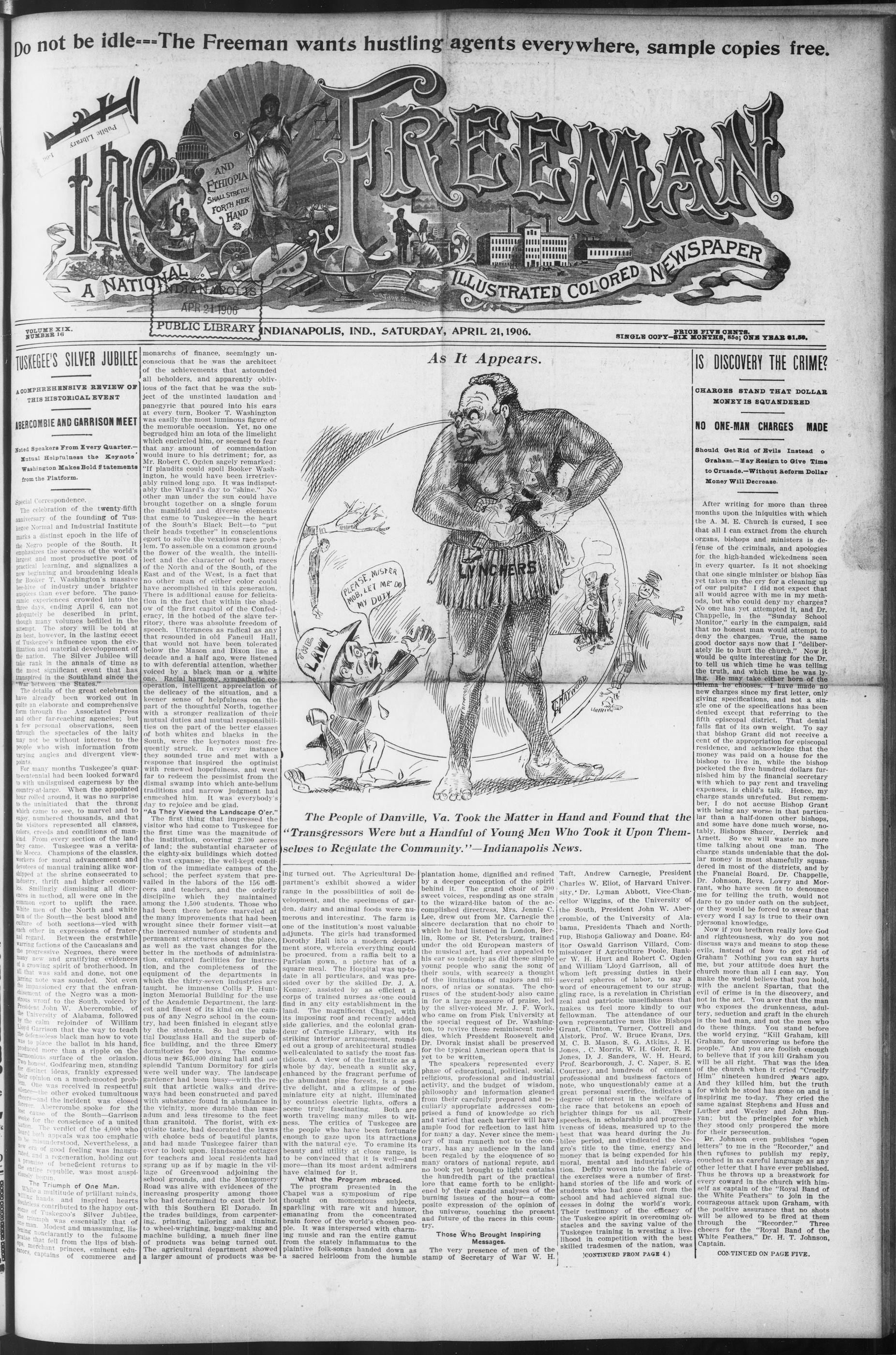
As It Appears.
PLEASE, MUSTER
MOB, LET ME DO
MY DUIY
LYNCHERS
THE LAW
E. HAYWOOD
ing turned out. The Agricultural Department's exhibit showed a wider range in the possibilities of soil development, and the specimens of garden, dairy and animal foods were numerous and interesting. The farm is one of the institution's most valuable adjuncts. The girls had transformed Dorothy Hall into a modern department store, wherein everything could be procured, from a raffia belt to a Parisian gown, a picture hat of a square meal. The Hospital was up-to-date in all particulars, and was presided over by the skilled Dr. J. A. Kenney, assisted by as efficient a corps of trained nurses as one could find in any city establishment in the land. The magnificent Chapel, with its imposing roof and recently added side galleries, and the colonial grandeur of Carnegie Library, with its striking interior arrangement, rounded out a group of architectural studies well-calculated to satisfy the most fastidious. A view of the Institute as a whole by day, beneath a sunlit sky, enhanced by the fragrant perfume of the abundant pine forests, is a positive delight, and a glimpse of the miniature city at night, illuminated by countless electric lights, offers a scene truly fascinating. Both are worth traveling many miles to witness. The critics of Tuskegee are the people who have been fortunate enough to gaze upon its attractions with the natural eye. To erase its beauty and utility at close range, is to be convinced that it is well—and more—than its most ardent admirers have claimed for it.
What the Program imbraced.
The program presented in the Chapel was a symposium of ripe thought on momentous subjects, sparkling with rare wit and humor, emanating from the concentrated brain force of the world's chosen people. It was interspersed with charming music and ran the entire gamut from the stately inflammatus to the plaintive folk-songs handed down as a sacred heirloom from the humble
plantation home, dignified and refined by a deeper conception of the spirit behind it. The grand choir of 200 sweet voices, responding as one strain to the wizard-like baton of the accomplished directress, Mrs. Jennie C. Lee, drew out from Mr. Carnegie the sincere declaration that no choir to which he had listened in London, Berlin, Rome or St. Petersburg, trained under the old European masters of the musical art, had ever appealed to his ear so tenderly as did these simple young people who sang the song of their souls, with scarcity a thought of the limitations of majors and minors, of arias or sonatas. The choruses of the student-body also came in for a large measure of praise, led by the silver-voiced Mr. J. F. Work, who came on from Fisk University at the special request of Dr. Washington, to revive these reminiscent melodies, which President Roosevelt and Dr. Dvorak insist shall be preserved for the typical American opera that is yet to be written.
The speakers represented every phase of educational, political, social, religious, professional and industrial activity, and the budget of wisdom, philosophy and information gleaned from their carefully prepared and peculiarly appropriate addresses comprised a fund of knowledge so rich and varied that each barrier will have ample food for reflection to last him for many a day. Never since the memory of man runneth not to the contrary, has any audience in the land been regaled by the eloquence of so many orators of national repute, and no book yet brought to light contains the hundredth part of the practical lore that came forth to be enlightened by their candid analyses of the burning issues of the hour—a composite expression of the opinion of the universe, touching the present and future of the races in this country.
Those Who Brought Inspiring
Messages.
The very presence of men of the stamp of Secretary of War W. H.
PRICE FIVE CENTS.
SINGLE COPY- SIX MONTHS, 85C; ONE YEAR $1.50.
Taft, Andrew Carnegie, President Charles W. Elliot, of Harvard University,' Dr. Lyman Abbott, Vice-Chancellor Wiggins, of the University of the South, President John W. Abercrombie, of the University of Alabama, Presidents Thach and Northrup, Bishops Galloway and Doane, Editor Oswald Garrison Villard, Commissioner if Agriculture Poole, Banker W. H. Hurt and Robert C. Ogden and William Lloyd Garrison, all of whom left pressing duties in their several spheres of labor, to say a word of encouragement to our struggling race, is a revelation in Christian zeal and patriotic unselfishness that makes us feel more kindly to our fellowman. The attendance of our own representative men like Bishops Grant, Clinton, Turner, Cottrell and Alstork, Prof. W. Bruce Evans, Drs. M. C. B. Mason, S. G. Atkins, J. H. Jones, C. Morris, W. H. Goler, R. E. Jones, D. J. Sanders, W. H. Heard, Prof. Scarborough, J. C. Naper, S. E. Courtney, and hundreds of eminent professional and business factors of note, who questionability of at a great personal sacrifice, indicates a degree of interest in the welfare of the race that betokens an epoch of brighter things for us all. Their speeches, in scholarship and progressiveness of ideas, measured up to the best that was heard during the Jubilee period, and vindicated the Negro's title to the time, energy and money that is being expended for his moral, mental and industrial elevation. Definitely woven into the fabric of the exercises were a number of first-hand stories of the life and work of students who had gone out from the school and had achieved signal successes in doing the world's work. Their testimony of the efficacy of the Tuskegee spirit in overcoming obstacles and the saving value of the Tuskegee training in wrestling a livelihood in competition with the best skilled tradesmen of the nation, was
'CONTINUED FROM PAGE 4 )
DISCOVERY THE CRIME?
CHARGES STAND THAT DOLLAR
MONEY IS SQUANDERED
NO ONE-MAN CHARGES MADE
Should Get Rid of Evils Instead o Graham.—May Resign to Give Time to Crusade.—Without Reform Dollar Money Will Decrease.
After writing for more than three months upon the iniquities with which the A. M. E. Church is cursed, I see that all I can extract from the church organs, bishops and ministers is defense of the criminals, and apologies for the high-handed wickedness seen in every quarter. Is it not shocking that one single minister or bishop has yet taken up the cry for a cleaning up of our pulpits? I did not expect that all would agree with me in my methods, but who could deny my charges? No one has yet attempted it, and Dr. Chappelle, in the "Sunday School Monitor," early in the campaign, said that no honest man would attempt to deny the charges. True, the same good doctor says now that I "deliberately lie to hurt the church." Now it would be quite interesting for the Dr. to tell us which time he was telling, and which time he was lying. He may take either horn of the dilema he chooses. I have made no new charges since my first letter, only giving specifications, and not a single one of the specifications has been denied except that referring to the fifth episcopal district. That denial falls flat of its own weight. To say that bishop Grant did not receive a cent of the appropriation for episcopal residence, and acknowledge that the money was paid on a house for the bishop to live in, while the bishop pocketed the five hundred dollars furnished him by the financial secretary with which to pay rent and traveling expenses, is child's talk. Hence, my charge stands unrefuted. But remember, I do not accuse Bishop Grant with being any worse in that particular than a half-dozen other bishops, and some have done much worse, notably, Bishops Shacer, Derrick and Arnett. So we will waste no more time talking about one man. The charge stands undeniable that the dollar money is most shamefully squandered in most of the districts, and by the Financial Board. Dr. Chappelle, Dr. Johnson, Revs. Lowry and Morrant, who have seen fit to denounce me for telling the truth, would not dare to go under oath on the subject, or they would be forced to swear that every word I say is true to their own personal knowledge.
Now if you brethren really love God and righteousness, why do you not discuss ways and means to stop these evils, instead of how to get rid of Graham? Nothing you can say hurts me, but your attitude does hurt the church more than all I can say. You make the world believe that you hold, with the ancient Spartan, that the evil of crime is in the discovery, and not in the act. You aver that the man who exposes the drunkenness, adultery, seduction and graft in the church is the bad man, and not the men who do these things. You stand before the world crying, "Kill Graham, kill Graham, for uncovering us before the people." And you are foolish enough to believe that if you kill Graham you will be all right. That was the idea of the church when it cried "Crucify Him" nineteen hundred years ago, And they killed him, but the truth for which he stood has gone on and is inspiring me to-day. They cried the same against Stephens and Huss and Luther and Wesley and John Bunyan; but the principles for which they stood only prospered the more for their persecution.
Dr. Johnson even publishes "open letters" to me in the "Recorder," and then refuses to publish my reply, couched in as careful language as any other letter that I have ever published. Thus he throws up a breastwork for every coward in the church with himself as captain of the "Royal Band of the White Feathers" to join in the courageous attack upon Graham, with the positive assurance that no shots will be allowed to be fired at them through the "Recorder." Three cheers for the "Royal Band of the White Feathers," Dr. H. T. Johnson, Captain.
CONTINUED ON PAGE FIVE.
LITERARY
RESEARCHES
AND
Comments.
We have received the first copy of a publication called "Ebony" that is, we believe, a first-class magazine published in Boston, Mass, by T. Swan. This magazine contains some of the very best articles that we have seen for some time in classical literature. Every article seems to be a "big" feature in this publication. The story told by Mrs. Mary Church Terrell of the late Paul Lawrence Dunbar is very good in point of journalistic ability and theme. Mr. Swan's introduction to the public in introducing his very well gotten up magazine is beyond reproach for one thing. He wants his people to know that there is a very great desire among the Negroes of America for a clean and concise high class Negro magazine. Mr. Swan has placed upon the market a magazine that is worthy of much consideration, and should be read by every Afro American who can secure and spare one dime to purchase this very good publication.
Sylvester Russell's Review comes to us for April in what we think is a neat condition for any first class publication. There is a splendid criticism, very well written by the publisher, on Messrs. Williams and Walker. The likeness of the "King of Minstrels" appears to excellent advantage on the front page. Any one securing this magazine for
THE EDUCATIONAL FIELD
The colored people of Kansas are still protesting against separate schools.
Prof. W. H. Council delivered an address on Founder's Day at Howe Institute on "The Education That Builds Up."
The Girls' Dormitory at Western University, with nineteen rooms, is the most imposing on the grounds of the university.
The bill to establish a State Normal Agricultural and Industrial School for colored children was killed last week by the Legislature of Maryland.
Hon. C. A. True, of the Agricultural Department at Washington, D. C. spends a short time last month looking over the work at Normal Institute with which he was well pleased.
Howard Colored Orphanage, Brooklyn, N. J., is $6,000 in pocket through the generosity of Peter Wycoff, the millionaire philanthropist of Busdwich near Jamaica Bay, Long Island.
---
Rev. J. C. Caldwell, of St. Joseph
Mo., is mentioned by Correspondent J.
O. Midnight as suitable material for the
presidency of the Western University
to succeed Dr. W. T. Vernon, in case
FORD'S
HAIR POMADE
Formerly known as
"OZONIZED OX MARROW"
SO
any style desired consistent with its length.
Ford's Hair Pomade was formerly called "Hair Pomade," the only safe preparation known to us that makes kinky or curly hair soft, as born harsh, kinky or curly hair soft, plain and easy to comb. These results and bottles are usually sufficient for a year. The OX MARROW") removes the prevent dandruff, relieves itching, invigorates the scalp, makes it grow and, nourishing the roots, gives it new life and vigor. Being elegantly necessary for ladies, gentlemen and children, Ford's Hair Pomade ("OZONIZED OX MARROW") was registered in the United States Office of the Patent Administrator, a period of time there has never been a bottle of Ford's Hair Pomade have sold. FORD'S HAIR POMADE remains sweet and effective, no matter how long you make the hair STRAIGHT, SOFT, and PLIABLE. Beware of limitations. Remember OX MARROW" is up put only in 50 ct size, and is made only in Chicago and by us. The OX MARROW" is up put only on each package. Refuse all others. Full directions with every bottle. Price only 50 cts. express paid. We pay postage and express mailing费 for $1.49 for three bottles or $2.59 for six bottles, express paid. We pay postage and express mailing费 for $1.49 for three bottles or $2.59 for six bottles, express paid. Write your name and address plainly.
The Ozonized Ox Marrow Co.
(None genuine without my signature)
Charles Ford Past
76 Wabash Ave., Chicago, Ill.
Agents wanted everywhere.
THE FREEMAN, AN ILLUSTRATED COLORED NEWSPAPER.
April we are sure they will find satis' faction in the line of reading.
The Voice of the Negro we found in our mail as promptly on time as ever with its April issue. We find the magazine about as well gotten up publication as we have looked upon in a great while. It is a fact when we state that this publication is as good as any book of its kind on market, be it Harper's, Scribner's, Century or the Atlantic Monthly.
I
It is announced that the Dodd, Mead & Co., publishers of Paul Lawrence Dunbar's poems and stories, are making a very large sale of the great poet's works. The sale of his books are so great that it is believed that they might be forced to begin another edition within a few days.
The new book that is called "Russian Life and Society," which is a publication written recently by Capt. Appleton and Wood & Co., of Boston, Mass., is making a great sale among the Negroes of the country because of its great history of Abraham Lincoln. This book is a very great one and deserves the attention of every Afro American because it contains much that has never been told about Abraham Lincoln:
the latter is confirmed as Register of
the Treasury.
Scribner High School Literary Society,
of New Albany, Ind., has elected
the following officers: President, Grace
McGuire, first vice-president, Lizzie
Walker; second vice-president, Guy
Grant; secretary, Vivian Thompson;
treasurer, Lloyd Manley.
Prof. W. E. B. DuBois is to deliver
the graduation address at the joint
commencement of the M Street High
School, the Armstrong Manual Training
School and Normal School No. 2 at
Washington in June. Dr. Booker T.
Washington delivered the address to
these schools last year.
Miss Emily Charlton, who has been taking a course of typewriting and shorthand at the Central Evening High School, New York, graduated last week at the head of her class, and was the only student who received the Regents twelve-count diploma for proficiency in advanced academic work.
---
Columbia University's highest oratorical honors went this year to a full-blooded African prince, who won the annual contest for the George William Curtis medal. Prince Pka Isaka is the winner and he is a son of the line of chiefs that ruled Zululand up to the time English gained control. He is a member of the class of 1906 and is specializing in economics. The subject of his oration was "The Regeneration of Africa."
***
Prof. W. H. Hart, principal of the Hart Farm School on the Potomac river near Washington, designed to reform incorrigible boys from the surrounding country by teaching them agriculture and other industries, has gone into voluntary bankruptcy. Relief was expected from Congress, but the outlook for appropriation being gloomy, Prof. Hart accepted his only chance to escape burdens that were pressing him from many sides.
Mrs. P. Lowery has returned from Nashville, Tenn., where she has been attending her daughter who is ill but has improved and will DALLAS return home as soon as TEXAS. she is able to travel.
Mr. and Mrs. John Wael
ker gave a party Monday night of last week complimentary to Miss Clandiell Bees and mother of Carlslaona, Miss Harliff and Mattie Ayers of Ft. Worth, and Mrs Shannon of Terrell Reitzations and piano music by their two children —Mr and Mrs. Henry Lee are visiting Mr and Mrs. Armased Jackson their parents on Gillittt street. The Jolly Eight social met with Miss Lillian and Hattie Snow Monday night of last week. The evening was very enjoyably spent. Easter was observed by all the churches, lodges and clubs. The approaching marriage of Charles B. Newton, of this city and Miss Estella Gardner of Houston has been an nounced. Mr. Newton is a very popular society man here. The wedding will take place April 25 at Houston.
The Freeman will be found at Nor folk, Va., at the Mt. Vernon House 853 Queen street, L. M. Bright, prop.
The Freeman is on sale at the East End Music Store. St. Louis, Mo.
The Return to Grace
By HENRY LINSLEY DOOLITTLE
Copyright, 1905, by Henry Linsley Doolittle
FOR the past year Kellogg has been kept busy refuting exaggerated stories of his mistaken identity. To his friends, therefore, the first true account should be of deep interest. In reviewing his last evening at the exposition he remembered having taken in a fair share of the Pike. The Tyrolean Alps, Creation, Hereafter, the Cliff Dwellers—he had seen them all, good, bad or indifferent. Thus far he had proceeded on his loose change.
And then he had come to the Naval Battle and to the end of his quarters. Diving into his hip pocket, his hand had brought forth not the expected wallet, but a paper of chewing tobacco. Too surprised for utterance, he sauntered back to the now deserted plaza to figure his assets in silence. An emer
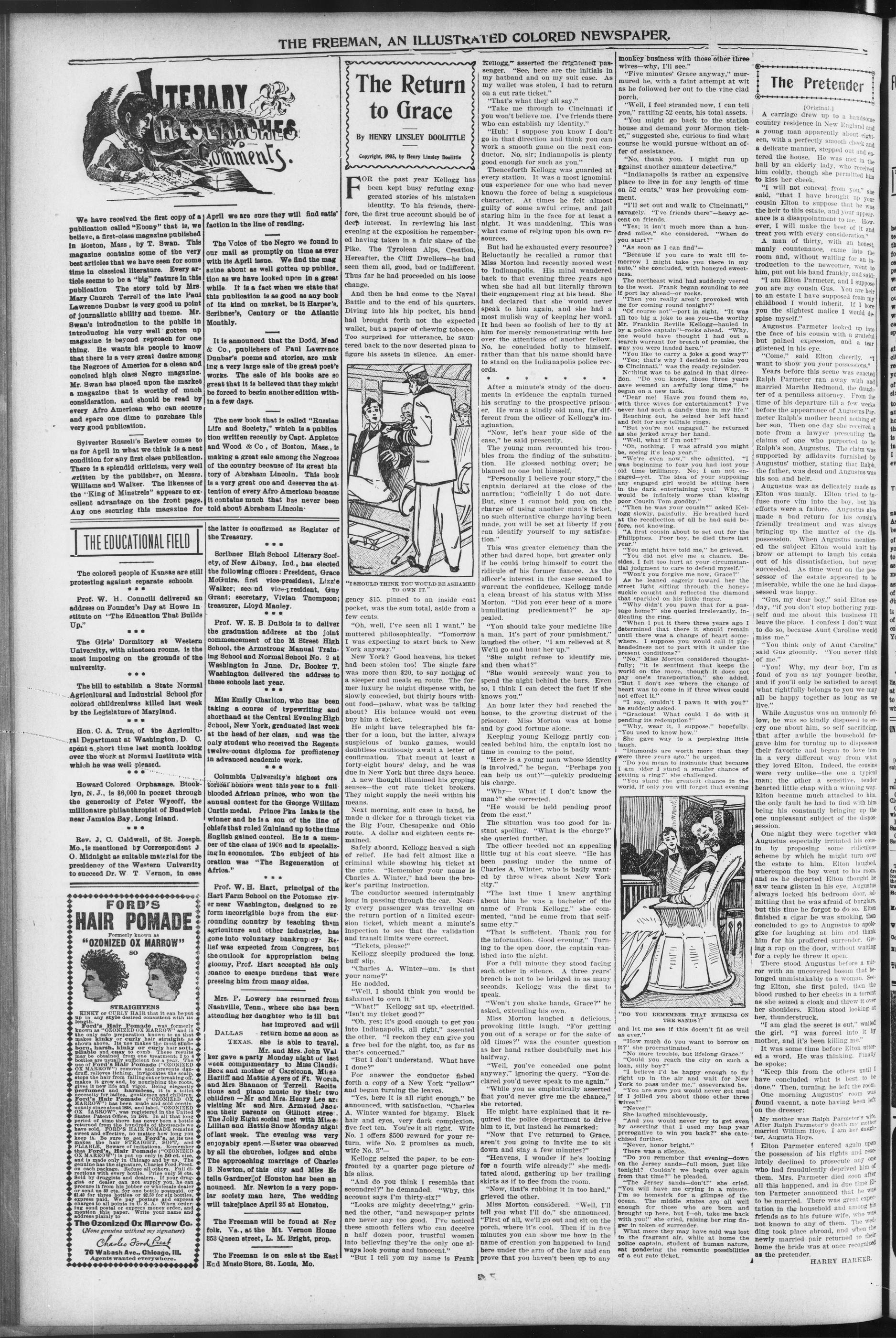
A man is sitting on a train seat. A train conductor is standing next to him, holding a ticket. The conductor is asking the man if he is ready to board the train.
"I SHOULD THINK YOU WOULD BE ASHAMED TO OWN IT."
gency $15, pinned to an inside coat pocket, was the sum total, aside from a few cents.
"Oh, well, I've seen all I want," he muttered philosophically. "Tomorrow I was expecting to start back to New York anyway."
New York? Good heavens, his ticket had been stolen too! The single fare was more than $20, to say nothing of a sleeper and meals en route. The former luxury he might dispense with, he slowly conceded, but thirty hours without food-pshaw, what was he talking about? His balance would not even buy him a ticket.
He might have telegraphed his father for a loan, but the latter, always suspicious of bunko games, would doubtless cautiously await a letter of confirmation. That meant at least a forty-eight hours' delay, and he was due in New York but three days hence. A new thought illumined his groping senses—the cut rate ticket brokers. They might supply the need within his means.
Next morning, suit case in hand, he made a dicker for a through ticket via the Big Four, Chesapeake and Ohio route. A dollar and eighteen cents remained.
Safely aboard, Kellogg heaved a sigh of relief. He had felt almost like a criminal while showing his ticket at the gate. "Remember your name is Charles A. Winter," had been the broker's parting instruction.
The conductor seemed interminably long in passing through the car. Nearly every passenger was traveling on the return portion of a limited excursion ticket, which meant a minute's inspection to see that the validation and transit limits were correct.
"Tickets, please!"
Kellogg sleepily produced the long, buff slip.
"Charles A. Winter—um. Is that your name?"
He nodded.
"Well, I should think you would be ashamed to own it."
"What?" Kellogg sat up, electrified.
"Isn't my ticket good?"
"Oh, yes; it's good enough to get you into Indianapolis, all right," assented the other. "I reckon they can give you a free bed for the night, too, as far as that's concerned."
"But I don't understand. What have I done?"
For answer the conductor fished forth a copy of a New York "yellow" and began turning the leaves.
"Yes, here it is all right enough," he announced, with satisfaction. "Charles A. Winter wanted for bigamy. Black hair and eyes, very dark complexion, five feet ten. You're it all right. Wife No. 1 offers $500 reward for your return, wife No. 2 promises as much, wife No. 3."
Kellogg seized the paper, to be confronted by a quarter page picture of his alias.
"And do you know I resemble that scoundrel?" he demanded. "Why, this account says I'm thirty-six."
"Looks are mighty deceiving." grinned the other, "and newspaper prints are never any too good. I've noticed these smooth fellers who can deceive a half dozen poor, trustful women into believing they're the only one always look young and innocent."
"But I tell you my name is Frank
Kellogg" asserted the frightened passenger. "See, here are the initials in my hatband and on my suit case. As my wallet was stolen, I had to return on a cut rate ticket." "That's what they all say."
"Take me through to Cincinnati if you won't believe me. I've friends there who can establish my identity."
"Huh! I suppose you know I don't go in that direction and think you can work a smooth game on the next conductor. No, sir; Indianapolis is plenty good enough for such as you."
Thenceforth Kellogg was guarded at every station. It was a most ignominious experience for one who had never known the force of being a suspicious character. At times he felt almost guilty of some awful crime, and jail starring him in the face for at least a night. It was maddening. This was what came of relying upon his own resources.
But had he exhausted every resource? Reluctantly he recalled a rumor that Miss Morton had recently moved west to Indianapolis. His mind wandered back to that evening three years ago when she had all but literally thrown their engagement ring at his head. She had declared that she would never speak to him again, and she had a most mulish way of keeping her word. It had been so foolish of her to fly at him for merely remonstrating with her over the attentions of another fellow. No, he concluded hotly to himself, rather than that his name should have to stand on the Indianapolis police records.
* * * * * * * * *
After a minute's study of the documents in evidence the captain turned his scrutiny to the prospective prisoner. He was a kindly old man, far different from the officer of Kellogg's imagination.
"Now, let's hear your side of the case," he said presently.
The young man recounted his troubles from the finding of the substitution. He glossed nothing over; he blamed no one but himself.
"Personally I believe your story," the captain declared at the close of the narration; "officially I do not dare. But, since I cannot hold you on the charge of using another man's ticket, no such alternative charge having been made, you will be set at liberty if you can identify yourself to my satisfaction."
This was greater clemency than the other had dared hope, but greater only if he could bring himself to court the ridicule of his former fiancée. As the officer's interest in the case seemed to warrant the confidence, Kellogg made a clean breast of his status with Miss Morton. "Did you ever hear of a more humiliating predicament?" he appealed.
"You should take your medicine like a man. It's part of your punishment," laughed the other. "I am relieved at 8. We'll go and hunt her up."
"She might refuse to identify me, and then what?"
"She would scarcely want you to spend the night behind the bars. Even so, I think I can detect the fact if she knows you."
An hour later they had reached the house, to the growing distrust of the prisoner. Miss Morton was at home and by good fortune alone.
Keeping young Kellogg partly concealed behind him, the captain lost no time in coming to the point.
"Here is a young man whose identity is involved," he began. "Perhaps you can help us out?"—quickly producing his charge.
"Why— What if I don't know the man?" she corrected.
"He would be held pending proof from the east."
The situation was too good for instant spoiling. "What is the charge?" she queried further.
The officer heeded not an appealing little tug at his coat sleeve. "He has been passing under the name of Charles A. Winter, who is badly wanted by three wives about New York city."
"The last time I knew anything about him he was a bachelor of the name of Frank Kellogg," she commented, "and he came from that self-same city."
"That is sufficient. Thank you for the information. Good evening." Turning to the open door, the captain vanished into the night.
For a full minute they stood facing each other in silence. A three years' breach is not to be bridged in us many seconds. Kellogg was the first to speak.
"Won't you shake hands, Grace?" he asked, extending his own.
Miss Morton laughed a delicious, provoking little laugh. "For getting you out of a scrape or for the sake of old times?" was the counter question as her hand rather doubtfully met his halfway.
"Well, you've conceded one point anyway," ignoring the query. "You declared you'd never speak to me again."
"While you as emphatically asserted that you'd never give me the chance," she retorted.
He might have explained that it required the police department to drive him to it, but instead he remarked:
"Now that I've returned to Grace, aren't you going to invite me to sit down and stay a few minutes?"
"Heavens, I wonder if he's looking for a fourth wife already!" she meditated aloud, gathering up her trailing skirts as if to flee from the room.
"Now, that's rubbing it in too hard," grieved the other.
Miss Morton considered. "Well, I'll tell you what I'll do," she announced. "First of all, we'll go out and sit on the porch, where it's cool. Then if in five minutes you can show me how in the name of creation you happened to land here under the arm of the law and can prove that you haven't been up to any
monkey business with those other three wives—why, I'll see."
"Five minutes' Grace anyway," murmured he, with a faint attempt at wit as he followed her out to the vine clad porch.
"Well, I feel stranded now, I can tell you," rattling 52 ceuts, his total assets.
"You might go back to the station house and demand your Mormon ticket," suggested she, curious to find what course he would pursue without an offer of assistance.
"No, thank you. I might run up against another amateur detective."
"Indianapolis is rather an expensive place to live in for any length of time on 52 cents," was her provoking comment.
"I'll set out and walk to Cincinnati, savagely. 'I've friends there'—heavy accent on friends.
"Yes; it isn't much more than a hundred miles," she considered. "When do you start?"
"As soon as I can find"—
"Because if you care to wait till tomorrow I might take you there in my auto," she concluded, with honeyed sweetness.
The northeast wind had suddenly veered to the west. Frank began sounding to see if port lay ahead—or rocks.
"Then you really aren't provoked with me for coming round tonight?"
me for coming round tonight?</p>
<p>Of course not—"port in sight. "It was all too big a joke to see you—the worthy Mr. Franklin Reville Kellogg—hailed in by a police captain"—rocks ahead. "Why, by a search warrant for breach of promise, the way you were landed here."<p>You like to carry a joke a good way?</p>
<p>Yes; that's why I decided to take you to Cincinnati," was the ready rejoinder. Nothing was to be gained in that direction. "Do you know, those three years have seemed an awfully long time," he held me. "Dear me! Have you found them so, with three wives for entertainment? I've never had such a dandy time in my life." Reaching out, he seized her left hand and felt for any telltale rings. "But you're not engaged," he returned as she jerked away her hand. "Oh, nothing. I was afraid you might be, seeing it's lean year."
"We're even now," she admitted. "I was beginning to fear you had lost your old time brilliance. No; I am not engaged—yet. The idea of your supposing any engaged girl would be sitting here in the dark entertaining you! Why, it would be entirely worse than kissing poor Coinsin to you! " asked Kellogg slowly, painfully. He breathed hard at the recollection of all he had said before, not knowing. "A first cousin about to set out for the Philippines. Poor boy, he died there last year. "You might have told me," he grieved. "You did not give me a chance. Besides, I felt too hurt at your circumstantial judgment to care to defend myself." "Won't you forgive me now, Grace?" As he leaned eagerly toward her the street light lifting through the honey-suckle caught and reflected the diamond that sparkled on his little finger. "So you pawn that for a passage home?" she queried irrelevant, indicating the ring.
"When I put it there three years ago I determined that there it should remain until there was a change of heart somewhere. I suppose you would call it pig-headedness not to part with it under the present conditions?" "No." Miss Morton considered thoughtfully "it is sentiment that keeps the world of the past, though it does not pay one's transportation," she added. "But I don't see where the change of heart was to come in if three wives could not effect it." "I say, couldn't I pawn it with you?" he suddenly asked. "Graciales! What could I do with it pending its redemption?"
"Why, wear it, I suppose," hopefully.
"You used to know how."
She gave way to a perplexing little laugh.
"Diamonds are worth more than they were three years ago." he urged.
were three years ago," he urged.
"Do you mean to insinuate that because
I am older I stand a smaller chance of
getting a ring?" she challenged.
"You stand the greatest chance in the
world, if only you will forget that evening
J. JAMES
"DO YOU REMEMBER THAT EVENING ON THE SANDS?"
and let me see if this doesn't fit as well as ever."
"How much do you want to borrow on it?" she procrastinated.
"No more trouble, but lifelong Grace."
"Could you reach the city on such a loan, silly boy?" she beeped. "I be happy enough to fly right up in the air and wait for New York to pass under me." asseverated he.
"You are sure you would never get mad if I jolled you about those other three wives?"
"Never!"
She laughed mischievously.
"And you would never try to get even by asserting that I used my leap year prerogative to win you back?" she catechised further.
"Never, honor bright."
There was a silence.
"Do you remember that evening—down on the Jersey sands—full moon, just like tonight? Couldn't we begin over again from that time?" he pleaded.
"The Jersey sands—don't!" she cried.
"You will have me cry in a minute. I'm so homesick for a glimpse of the ocean. The middle states are all well enough for those who are born and raised by her. Ioh, take me back with you!" she cried, raising her ring finger in token of surrender.
What more they may have said was lost to the fragrant air, while at home the police captain, student of human nature, sat pondering the romantic possibilities of a cut rate ticket.
[Original]
A carriage drew up to a handsome country residence in New England and a young man apparently about eighteen, with a perfect smooth cheek and a delicate manner, stepped out and entered the house. He was met in the hall by an elderly lady, who received him coldly, though she permitted him to kiss her cheek.
"I will not conceal from you," she said, "that I have brought up your cousin Elton to suppose that he was the heir to this estate, and your appearance is a disappointment to me. However, I will make the best of it and treat you with every consideration."
A man of thirty, with an honest, manly countenance, came into the room and, without waiting for an introduction to the newcomer, went to him, put out his hand frankly, and said
"I am Elton Parmeter, and I suppose you are my cousin Gus. You are heir to an estate I have supposed from my childhood I would inherit. If I bore you the slightest malice I would despise myself." Augustus Parmeter looked up into the face of his cousin with a grateful but pained expression, and a tear glistened in his eye.
"Come," said Elton cheerly. "I want to show you your possessions."
Years before this scene was enacted Ralph Parmeter ran away with and married Martha Redmond, the daughter of a penniless attorney. From the time of his departure till a few weeks before the appearance of Augustus Parmeter Ralph's mother heard nothing of her son. Then one day she received a note from a lawyer presenting the claims of one who purported to be Ralph's son, Augustus. The claim was supported by affidavits furnished by Augustus' mother, stating that Ralph, the father, was dead and Augustus was his son and heir.
Augustus was as delicately made as Elton was manly. Elton tried to infuse more vim into the boy, but his efforts were a failure. Augustus also made a bad return for his cousin's friendly treatment and was always bringing up the matter of the possession. When Augustus mentioned the subject Elton would knit his brow or attempt to laugh his cousin out of his dissatisfaction, but never succeeded. As time went on the possessor of the estate appeared to be miserable, while the one he had dispossessed was happy.
"Gus, my dear boy," said Elton one day, "if you don't stop bothering yourself and me about this business I'll leave the place. I confess I don't want to do so, because Aunt Caroline would miss me."
"You think only of Aunt Caroline," said Gus gloomily. "You never think of me."
"You! Why, my dear boy, I'm a fond of you as my younger brother, and if you'll only be satisfied to accept what rightfully belongs to you we may all be happy together as long as we live."
While Augustus was an unmany fellow, he was so kindly disposed to every one about him, so self sacrificing, that after awhile the household forgave him for turning up to dispossess their favorite and began to love him in a very different way from what they loved Elton. Indeed, the cousins were very unlike—the one a typical man; the other a sensitive, tender hearted little chap with a winning way. Elton became much attached to him, the only fault he had to find with him being his constantly bringing up the one unpleasant subject of the dispossession.
One night they were together when Augustus especially irritated his cousin in by proposing some ridiculous scheme by which he might turn over the estate to him. Elton laughed, whereupon the boy went to his room, and as he departed Elton thought he saw tears glisten in his eye. Augustus always locked his bedroom door, admitting that he was afraid of burglaries, but this time he forgot to do so. Elton finished a cigar he was smoking, then concluded to go to Augustus to apologize for laughing at him and thank him for his proffered surrender. Giving a rap on the door, without waiting for a reply he threw it open.
There stood Augustus before a mirror with an uncovered bosom that belonged unmistakably to a woman. Seeing Elton, she first paled, then the blood rushed to her cheeks in a torrent as she seized a cloak and threw it over her shoulders. Elton stood looking at her, thunderstruck.
"I am glad the secret is out," wailed the girl. "I was forced into it by mother, and it's been killing me." It was some time before Elton uttered a word. He was thinking. Finally he spoke: "Keep this from the others until I have concluded what is best to be done." Then, turning, he left the room. One morning Augustus' room was found vacant, a note having been left on the dresser: My mother was Ralph Parmeter's wife. After Ralph Parmeter's death my mother married William Hoye. I am her daughter, Augusta Hoye.
Eilton Parmeter entered again upon the possession of his rights and resolutely declined to prosecute any one who had fraudulently deprived him of them. Mrs. Parmeter died soon after all this happened, and in due time Eilton Parmeter announced that he was to be married. There was great expectation in the household and among his friends as to his future wife, who was not known to any of them. The wedding took place abroad, and when the newly married pair returned to their home the bride was at once recognized as the pretender.
HARRY HARKER.
FOR THE IMPROVEMENT AND ADVANCEMENT OF THE NATIONAL BENEFIT ASSOCIATION OF
HEAD, SECOND AND SIDE WAITERS. "For the man who works with brain or hand."
ADVICE OF A WAITER.
As an organization of waiters for the betterment of our condition, both intellectually and financially, the first thing to do is to join the order if you follow that vocation, no matter in what capacity you serve in the culinary department. If you are to be a headwaiter you can give your support to the order by employing your men through our representatives, and recognize a waiter according to his ability as a waiter and not his color or ability as a cake-walker or some other form of
sport.
Secondly. As a sidewaiter you can give your support by remaining in the city, away from the winter and summer resorts until you are called through your order. It is useless to go to resorts of your own accord; walk about five or six weeks and finally be called in, asked to pay five or ten dollars for a uniform and work three weeks to pay for it; get home the best you can. That is about the condition of things at present. It is your own fault. It seems to be growing worse, and is a well known fact, as I have been to them all and worked in every branch of the culinary world.
W. D. CRUMP.
THINKS IT A MENACE TO THE ORDER.
It strikes me very forcibly that the name "Head. Second and Sidewalters" Association" is a menace to the order because it shows a weakness on the part of the walters to overlook the fact that you can only apply the word headwalt to a man while he is actually employed as such, and, looking from a more common sense basis, I can see only an association of colored waiters capable of filling any position pertaining to a dining room. It is immaterial whether it is head, second, sidewaltter, captain of watch or busman association of colored waiters has got more meaning. You can classify them in our ruling.
W. D. CRUMP.
152 W. 37th street, New York City.
"Kid" Martin, formerly of Minneapolis, Minn., has opened a first class cafe at Duluth, Minn., and would be pleased to have a call from his many friends who coopted visiting Duluth
INDIVIDUAL HOTEL DIRECTOR
[On address line $4.00 per year; including subscription to The Freeman, in advance,] HEADWATTERS.
J. W. Redmond, Headwaiter of The Carroll, Vicksburg, Miss. 10-06.
C. W. Dyer, headwaiter Commercial Club Minneapolis, Minn. 8 105
C. H. Plimmer, headwaiter Hotel Brunswick, Uniontown, Pa. 10-05
B. H. Bradley, Headwaiter Menger Hotel, San Antonio, Texas. 3-06
G. W. Blair, Headwaiter of The Oliver, South Bend, Ind. 12-06
HOTEL DIRECTOR
This column used exclusively for the ad dresses of hotels restaurants lodging and boarding houses and climb rooms throughout the country, and intended as a guide for the traveling public—you business solicited.
Hotel Reformer—First class in all respects 900 N. 6th street, Richmond, Va. A. W. Holmes, manager.
Moore's Hotel—First-class rooms and board Rooms neatly furnished, 7.2 and 714 W. 9th street Little Rock, Ark.
Waldorf-Astoria Hotel—327 Laurel street, Hot Springs, Ark.
Cora's Lunch Room—220 Fifth Street, Little Rock, Ark.
Black's Hotel—A modern first-class hotel for colored people, H. Black, Manager, Evansville, Ind.
The Parker House—Rooms, bath J. W.
Holiman, proprietor, Indianapolis, Ind.
Hoosle
CLUB ROOM
10c C
We deliver Goods direct to consu
Give Us A
John Rauch Cigar Co.
Hoosier Poet
CLUB ROOM LONDRES
10c Cigar
We deliver Goods direct to consumers and pay all express charges.
Give Us A Tryal Order.
John Rauch Cigar Co. - Indianapolis, Ind.
AMERICAN BREWING CO.,
BREWERS & BOTTLERS
OF
HIGH GRADE BEER.
—TELEPHONES 935—
READQUARTERS :
III West 27th Street,
New York.
Ed. Thorton of Birmingham, Ala. will take charge of the Springs Hotel this season as chef cook, assisted by his own selected crew. This hotel is one of the most popular summer resorts in the South.
Nearly all the colored waiters in the leading hotels in Kansas City have taken out slok benefit and accident insurance policies and aying aside a dollar for a "rainy day."
HOTEL NOTES FROM WATER-TOWN, N.Y.
Samuel Logan of Syracuse, N. Y., has accepted a position as waiter at the Woodruff House. While en route from Syracuse to Water-own he lost his pocket-book, contents some thirty dollars, and other valuables. Upon reporting the matter to the head office he recovered his looses, which were found by an honest brakeman.
Albert Dennis of Syracuse, who, on the 21st of March, accepted a position as waiter at the Woodruff House, and being a traveling waiter, made a record lasting two and a half days only.
Mr. Harvey Yoles and Mr. C. Burton, waiters of the Woodruff House, left on the 24th for Syracuse.
Benjamin Barnes, who has been ill for the past week, is able to be out again and attending jits his duties as waiter at the Woodruff House.
The Woodruff House, which has been under the one management for the past fifteen years, on the 15th changed hands, most all the old help remaining with J H. Eiillot as headwaiter and Alex. Defrank as chef, who are giving satisfaction in those two particular departments.
MINNEAPOLIS HOTEL NOTES
Frank Sisby, the former head waiter at the Ryan Hotel in St Paul, Minn., resigned on account of serious illness and a white head waiter substituted in his stead. That does not look very encouraging for our boys, and it should serve as an object lesson to us, not only in this particular case, but many others similar to this that we read of every day happening all over the country. It should impress on our minds that, while we are in this business, we should get together and organize clubs in every city and co-operate with each other. let each individual club have meetings at least once a week and discuss subjects of general interest to us as a race, and more especially subjects pertaining to proper service and general deportment in and out of the dining room.
There was an old time spelling match given at the Bethesda Baptist Church on the 6 h, the contesting ones being the waiters from the West Hotel, the Nicole Hotel the, National Hotel and the Commercial Club. It was very intere- ninga as well as amusing as only common every day English words were used. The honors were very favorably carried away by the well-known king of the 'Pig Skin', Mr. Robert Marshall, representing the Commercial Club. Mr. R. E Garrett is now on a Northern Pacific dining car, his run being from here to Portland, Oregon. Mr Saunders, the former headwalter at the Nicole Hotel, resigned his position to accept a position in Chicago.
Mr. Julius Turner, well known among the waiters here, who has been residing in Winnepeg, has returned, bringing with him a loving bride. He expects to make this his future home. We wel
*
THE FREEMAN, AN ILLUSTRATED COLORED NEWSPAPER
WESTERN BRANCH
325 Dearborn Street,
Chicago, 111.
come Mr. Turner back again, and our sincere wish is that his pathway be strewn with success and each day bring forth happiness and prosperity in his new adventure. Mr Turner will be an able assistant at the Commercial Club. Mr. Willard has tendered his resignation as manager of the Dwyer Hotel on account of business of very great importance in Chicago. Mr. Willard has made a host of friends during his stay here and we regret very much to see him go. A good opportunity for a wide awake man.
The funeral of Mrs. W. C. Davis was conducted at the M. E. church by Rev E. H. Smith April 5 Mrs. Davis had
known. The Louisiana Lincoln school held its commencement at the M. E. church last Monday evening. The program was good and well rendered.
R G Moody went to Moss Point Apr 1, to assist Rev. I J. Turner in a revival. About ten minutes after his arrl-
A car load of soldiers passed through the city April 3 en route to Mobile, Ala—The revival was commenced at New Hope Baptist church last week and is being largely attended. Rev. J. M. Banks is assisting the pastor, Rev. L. S. Lee—Mrs. Ida B. Lewis is spending a few days at, Atlanta, Ga.—T. Murray is recovering from a recent illness.—Mr. Loyett, postal clerk on the M & O. was in the city recently—Rev. J. W. Watson, has been visiting his family.—Mrs. Amanda Cotton who has been visiting her mother for few, weeks left for St. Louis on theseventh.
Rev. W S. Lowery was called to Pittsburg on account of the illness of Rev. W. Bown—Mr. and Mrs. Jesse Mc-
of Philadelphia April 4.—Miss Emma Allison and Miss Pearl Hunter were visitors at Munoylast week—Mrs. Theresa Maddox received the news of the illness of her nephew at Harrisburg. James Payne has gone to Buffalo to join the Gliants base ball team.—Grace Emory has gone to Mont, Pokona to spend the summer. Arrivals at the Chautaqua last week were: W. Fortie W. Payne, H. Augusta, W. Harris, F. Haywood, J. Mohr, W. Pott, S. Williams, of Philadelphia, S. J. M. Waley J. MoDownell, Williamsport, Mrs. Smyth and Mrs. T. Hall, of Jersey Shore.
The Alabama Street Fair and Carnival Company has set up its tent for a five weeks engagement. The merry
bearers at the funeral of James W. Person, a prominent white banker, which occurred April 9, were elghe colored servants: Dennis Thompson, Glp Welch, Sam Johnson, ex-slaves of the Person family; Allen Smith, Anthony Gray, Wili Thomas, Charile Martin and William Jackson.
The Anthraclite Lodge, No. 57, I. B. P. O. E. of W. installed their new offi cers for the ensuing year under the
SORANTON E. R., OLAS. K. PENNSYLVANIA. Davenport. The officers were E. R., S. P. Johnson; Edward Brewer, leading knight; Charles Webster, lecturing knight. Samuel Lacey, loyal knight, Walter Parker, esquire, Lewis Morton, secretary, William McDow, organist, insideguard, Oville Richardson; Thomas Huff Tyler. An elegant repast followed under the direction of, William McDow an experienced caterer.—Miss Annie Stackhouse, daughter of Mrs. Clara Stackhouse of Lee Court died after a severe attack of apoplexy. Miss Stackhouse was 17 years and a great society leader and loved by everybody. William McDow has opened a cafe on Center street. "Economy." He deserves the patronage of all.—James Mitchell of Reading is visiting in the city.
Miss Maggie Joseph left last week for Presoott, Arizona to be married to Edward Daymon.—Berry Daniels has
will be giveo April 21.—The Up to date Base Ball Club will accept challenges from any ball team.—John Cole of Temple was in the city on business last week.—The churches are carrying on successful revivals.—The Freeman is on sale at the Bayou City Drug Store all the time.—A grand stag reception was given last Sunday in honor of Sir L M Mitchell, G. C, K of P of Texas at the Americus Club Parlors. A program was rendered and F. M. Mills was master of ceremonies,
A Mother's Logic
"Mother," said John Grimshaw, "I've lost Mary Garland."
"Oh, John, you don't mean it."
"I do. She's come home engaged."
Mrs. Grimshaw sighed. She was her son's only confidant and knew only too well what a blow this was to him.
"The worst of it is," he continued, "she is throwing herself away on a spendthrift."
"Serves her right. She has treated you very badly, John."
"Not at all."
"Was she not leading you to believe that she would marry you?"
"That's badly put, mother. She was disposed in my favor, but had not made up her mind. And even if she had accepted me I should not think of holding her to her promise against her inclination. I hold that there is nothing amiss in breaking an engagement. Suppose she should find that this man with whom she has fallen in love were unworthy, should she marry him?" "Certainly not, but she has not discovered that you are unworthy."
"Oh, mother," he replied, putting his arms about her neck and kissing her, "your woman's logic will be the death of me."
It was true that Mary Garland had intended to marry John Grimshaw, but a season in the city, during which Clarence Denbigh, a helter skelter, devil may care fellow, had paid her marked attention, had changed her intention. John was a plodder, and, as she expressed it after meeting Denbigh, "the worst kind of a one." In company Denbigh would sail all around him and win the race besides.
Mary possessed a comfortable fortune in her own right, which she had inherited from her father. She missed that father's assistance, having no one she could trust to make inquiries about Denbigh. Unfortunately she engaged herself to him and endeavored herself to find out something about his character afterward. But no one was rash enough to accuse her accepted lover, and information was shut off. A girl had spoken of Denbigh in her hearing as a spendthrift, but as Mary was sure the girl wanted him herself the accusation had little effect.
John Grimshaw wished her much happiness in her engagement without referring to anything that had passed between them. She accepted his offering with a sober face. When he spoke she had been back from the city a month and something of the glamour of city life had worn off. She was worried that she could get no information about Denbigh and thought that had it not been for her past relations with Grimshaw he would be just the person to find out for her and tell her truly what he had learned. John's cool manner of taking his disappointment piqued her, and, being piqued, she chose to retort. And this is how she did it. She sent for him one evening to come and see her. She said to him:
"Mr. Grimshaw, I am a woman with no father to find out whether my fiance is a worthy person. You are a man and can soon learn the truth for me. Will you do me this favor?"
"It is impossible for two reasons. The first is that anything I might say would be considered prejudiced. The second is that an unfavorable report might endanger your good opinion of me. All I could do would be to put you on a way to find out for yourself."
"Please do so."
"Do you suspect any weakness in your lover."
"Only one. I have heard he is a spendthrift."
"Would it be sufficient to discover the truth of this one point of weakness?"
"It would. I may be very silly, but not fool enough to marry a spendthrift."
"A spendthrift," said Grimshaw after reflection, "never spares anything, no matter how sacred, that he can turn into money. I would suggest that you give your fiance a valuable ring. If he is a spendthrift he will pawn it, which, not living in the same city with you, he can do with some show of safety. If he does, when he sees you again he will rob Peter to pay Paul and redeem it, but a ring constantly worn leaves its mark. Do you understand?"
One spring morning Mr. Denbigh received by express a handsome snake ring, such as was fashionable among gentlemen at the time, with two fine diamonds for eyes. Two months later he received a telegram to join his fiancee immediately. He obeyed the summons and as soon as he arrived took occasion to hold up his ring to show the sparkle and his appreciation of the gift at the same time. Miss Garland asked him to slip it on her finger. He did so, leaving his own brown one without the slightest trace of a mark. His fiancee accused him of not having worn it—in fact, of having pawned it. Though a spendthrift he was not a liar and admitted that he had with difficulty rescued it from the pawnbroker an hour before leaving the city.
What further passed between the lovers no one knew. The next time Mary Garland met the man who suggested the device to test Denbigh she wore a troubled look, and John surmised that she had made the test and it had revealed the truth. The problem now was, Had she the resolution to dismiss him, her lover?
"Mother," said John Grimshaw a few weeks later, "Mary is going to marry Denbigh after all. She found something so delightfully frank in his confession that she couldn't give him up."
"I told you, John, that she had treated you very badly, and you couldn't expect anything better of her."
LENA M. BROOKS.
What We Need In The Spring
Not Medicine, But Nutritious Food to Give the Body Rich, Red Blood and Vitality. It used to be thought that the coming of Spring necessitated the taking of much medicine "to purify the blood." But the days of sulphur and molasses and the "spring tonic" are past. Thinking people know that what we need in the Spring is not much different from what we need in all seasons. And it is not medicine. We need good food to give us nourishment for the body and brain, and to make our blood rich and red and full of life.
There is no other food, so far as we know, that provides so much nourishment as does Malta-Vita, the perfect whole-wheat food. Malta-Vita contains every food element headed by the human body. It makes strong, active muscles, it restores wasted tissues, refreshes the tired brain and forms rich red blood in abundance. In the changing of the seasons, Malta-Vita is insurance of perfect health.
Malta-Vita is the whole of the wheat, steamed and cooked and freely mixed with pure barley malt extract. The malt extract converts the starch of the wheat into maltose, or malt sugar, which is valuable food, easily digested and taken up by the blood. Physicians everywhere recommend maltose. Malta-Vita is rich in it.
Malta-Vita is appetizing in the morning, at noon and at night. Baked crisp and brown, every grain of wheat a wafer flake, it is the most delicious of all foods. Try some to-day with milk, cream or fruit. It's good whenever you are hungry. And now, in the Spring when you feel "just tired out," Malta-Vita puts the tingle of new life into sluggish blood and new vitality into every nerve and muscle. All grocers. Now 10 cents.
COOKS
Waiters & Cooks
Prefer Our Make
JACKETS AND LINEN
because they have found them
satisfactory.
Write for complete Catalogue
FREE.
giving full instructions how
to order,
Marcus Ruben (Inc.)
390 State St., CHICAGO, ILL.
A. M. EYSTER Perscription Druggist
High Class Stationery and Perfumes,
Weck's Cold Tablets a specialty.
12th and N. Senate Ave., Indianapolis.
Miss M. Deery,
Exclusive styles in MILLINERY,
NOTIONS & HAIR GOODS. Prices reasonable
1214 North Senate Ave.
Will make a special display every Saturday with special prices. Easter display April 14. See her for your East er hats. Indiana Ave. Everybody welcome.
3 PER CENT. INTEREST
Paid on saving accounts can be drawn anytime with interest.
No account too small.
THE RICHCREEK BANK
106 N. Delaware St.
The hostess of the OWL COTTAGE
Begs to announce to her many friends & patrons that the cottage will hereafter be known as
THE
Hotel Lafayette
which has been renovated and beauti
fied throughout, including a
new dining room, steam
heat, gas, hot &
cold water
baths. All light and
alry rooms. Central location,
just 3 minutes walk from Pennsylvani
lepot. Open all year. Bell 1811 D
Madame A. Holbert, prop.
H, PINKNEY, MGR.,
102 & 104 N. North Carolina Ave.,
Atlantic City, N.J.
---
WANTED AGENTS in each country to so "Family Memorials," Good profits, steadily work. Address Campbell & Co., 55 A Street, Elgin, Ill.
AGENTS make MONEY selling Macassar Cream. It whitens the skin and removes patches. Send for a free sample and see what it will do. Reed & Co., Lincoln, Ill.
Hustlers make three to six dollars per day, filling wall paper, formula used by experts with high institutions and one business bring in ad. for fifty dollars. Hustlers bring in ad. for fifty dollars. H. Scott, Brook-Hill building, Paducah, Ky.
Agents Wanted
To sell R. C. Weis and Co.'s book titled AU
Mary Applied to American Negro and
White Maternal Value in a present
to anyone selling 25 books using the
large commission per volume. Write C E
Covington, Box 534, Buxton, Ia.
WANTED AT ONCE a smart colored boy
12 or 18 years old to sell new papers on
work and work in a store, trust be well educated
and work in a honest, trustworthy, one
who does not sell books or have any
bad habits, write Western. Advertising
Agency, Moose Jaw, Sask.
Want Position as Milliner; do first class
work. Miss Anna Chappelle, 1064 W. Church
St. Jacksonville, Fla.
Lady Agents—Easily make $3 a day making
and selling "Japanese Cleanliness!"
removes grease spots, paint, stains, etc., from
the kitchen; costs $36 bottle to make,
readily for use in labels and everything
furnished. Write Thos. Campbell,
55 A St., Elgin III.
THE TUSKEGEE INSTITUTE is now offering extended courses in both theory and practice to young men anxious to secure advanced instruction in Architectural Drawing and Electrical Engineering. Persons desiring to take advanced or elementary courses in either of the subjects will find the opportunity to obtain instruction at Tuskegee Institute such as few institutions can offer. There is a growing demand for young men who find themselves, by completing the Architectural Drawing course, to make plans for houses and who can do the work required in Elec. Ical Engineering. Every effort is being made to make these courses more helpful than ever before. Booker T. Washington, Tuskegee Institute, Alabama.
WANT AGENTS TO SELL GREAT SPEECH Tribute to Dr. Booker T. Washington. A stalwart defense of his work and his worth. The greatest tribute ever paid to a negro. By Atty. A. H. Roberts, of Chicago.
Special terms to agents. Price 15 cts.
Address Dr. M. A. Majors, 168 State St., Chicago, IL
DRINK
WIEDEMANN'S
Fine Bottled
BEERS
JACOB METZGER CO.,
Wholesale Dealers
THE MAGIC SHAMPOO
HAIR DRIER
After a bathor shampoo the hair
can be DRUED and STRAIGHTEN
EXECUTED. It is the only device which will
Straighten early hair without
impact to the hair or scalp. It
will stimulate to growth and make
it naturally and beautiful, when
adds to a lady's appearance.
The Shampoo Drier is a steel bar with
a receptacle containing airtight shampoo com-
partment. For sale by toilet article dealers. By mail price
$4.00.
"Sir." The Shampoo Drier is used in my pactors
with perfect satisfaction."- Madame Cozart, 11 Ken-
tucky Ave., Atlantic City, N.J.
Magic Shampoo Drier Mfg. Co.
407 Century Blvd.
Minneapolis, Minn.
MRS. IDA YOUNG,
Restaurant and Rooming House
Old Phone 657 Main
Boarding by Day, Week or Meal,
Everything First-class.
885-837 Ft. Wayne Ave., Indianapolis
SANTAL-MIDY
Standard remedy for Glee.
Gonorrhoea and Runnings
IN 48 HOURS. Cures Kid-
ney and Bladder Troubles.
MiDY
When you buy a
Hand, Cross Cut, Butcher,
Hack, Buck,
Circular, Band or other
SAWS
of any description see that it bears
the Atkins Brand
Atkins Silver Steel Saws
are the best earth.
For sale by dealers everywhere
E. C. ATKINS & CO. Inc.
INDIANAPOLIS, IND
PAINTS, OIL AND VARNISHES.
TIN AND GALVANIZED IRON WORK
FRANK H. PRUNK
Hardware, Pumps, Pipes, Etc.
522 INDIANA AVENUE,
Telephone 1188. INDIANAPOLIS, INDIANA
CHAS. W. MOSBY
Attorney and Counselor-at Law
Notary Public, managing Estates, Collections
and drawing Legal Papers especially.
Business in all the Courts promptly
attended to
2% N. Delaware St.
New Phone 3458
THE FREEMAN
THE FREEMAN
NATIONAL ILLUSTRATED
COLORED NEWSPAPER.
PUBLISHED EVERY SATURDAY
At 309 Indiana Avenue,
INDIANAPOLIS, INDIANA.
SUBSCRIPTION RATES :
Any part of the United States and Canada,
one year, postage paid
Six Months $1.50
Three Months 85
Foreign Countries 60
Seasonal mail by express, money order, post
office order or registered letter.
Agents wanted in every tow; and city not now occupied, and liberal inducements will be given to the same. Send for our extraordinary inducements.
ADVERTISING RATES
Five cents per line. Fase of measure—solid
agate, 14 lines to an inch, 276 lines in a column.
Special position 25 per cent additional.
No advertisement on first page. Special
rates on stand-up on first page. Special
cards. Reasonable discount for long time and
space. Reading notices 10c per line. Special
rates on WRITE UPS.
Entered at the postoffice at Indianapolis,
Indiana, as second class matter.
All matter should be addressed to
The Freeman Publishing
Company,
INDIANAPOLIS, - - INDIANA.
SATURDAY, APRIL 21, 1906.
TUSKEGEE INSTITUTE.
TUSKEGEE INSTITUTE.
If there were any skeptics among the Indianapolis delegation that visited Tuskegee recently, it may be said that—they came, they saw, they were conquered. For ourselves, the thing that impressed us most was its magnitude. Two thousand, three hundred and sixty acres of ground is too much ground to get a hold of mentally, after having lived so much of our life on a lot 35 feet wide by 135 feet long. Just why we had always thought this tract of ground to be level we do not know. Our mental picture of it contained only a few slight elevations. Instead of this we found an undulating surface of ridges and graceful slopes. The number of buildings is given as eighty-three in all. Of these perhaps twenty-five or thirty are of brick. They are not crowded together, but they top the high places with an abundance of space for lawns and shrubbery about them. Just why we should have expected to find the most artistic workmanship in ornamentation in these buildings we cannot tell, but we did. A second thought would have told us that they could not have been of the highest type of work by the skilled artician, for does not Tuskegee do its own work? And is not a building well made by the hands of students a better testimony than any ornamentation by a hired contractor? And does not Tuskegee stand for solidity and simplicity? We now see that too much care given to these non-essentials would have been contrary to the very spirit of the institution which calls for solid worth as fundamental. Beauty of construction is there, but it is found in the mass rather than in infinite detail.
A visit to Tuskegee will convince the most skeptical that there they are doing the thing; that the student is there receiving the thing most needed by him; that he is getting that education and training which will help him to make the best use of his powers. And what adds most to the effectiveness of the work done is to be found in the fact that all are enthusiastic believers in their work and in themselves. They are not hired hands, nor do they work as such. They study how to do; they do; and they watch the effect of their doing. They put themselves into their work—all of them, from Mr. Washington, as the head, to the girl in the laundry, the boy in the truck patch and the student at his desk—all willing to be one of the many fragments which go to make up the complete whole.
We are not attempting a write-up or a review of what we saw and heard at Tuskegee—we are just saying things, and shall continue from time to time as the spirit moves. In this little contribution we desire to say this to those of our people who have never heard that institution—you have never heard your people sing. In large part the remarkable effect produced is due to the volume of tone produced by the blending of fifteen hundred voices. Their singing is not confined to the plantation melody and folk lore songs. The singing at Tuskegee will be remembered by the Negro folk lore songs as they sing them. They rise like the murmur of the sea and are the natural product of a race that has suffered. It is a pouring out of a soul bowed by the weight of sorrow long bourne, but which looks forward with trust and yearning to a state of rest and peace at last. They express the hopes and longings and joys of simple faith and trust. Tuskegee has retained this spirit in them by freeing them from that jig and rag time which the more worldly injected into them. Thus purified and refined and rendered as they are at: Tuskegee, they contain the most soulful of music yet produced by any people anywhere.
THE FREEMAN. AN ILLUSTRATED COLORED NEWSPAPER.
DOWIE AGAIN.
John Alexander Dowie has again been the recipient of much attention from the daily press. It informed us that he had been deposed; that he was returning from Mexico breathing curses and fire on the inhabitants of the city he had founded; that one by one his erstwhile ardent supporters were denouncing him; that he had arrived at Chicago and was prepared to descend with his wrath on Zion; then comes the news that he was broken in spirit, had relinquished all claim to his former stronghold and only asked a bare living for himself; then, that he refused an offer of settlement; that his successor, Voliva, has declared void the transfers he had made of property; that Dowie had promised that a great miracle would occur on Good Friday.
This is but a small part of what the press has given out during the past few days, but it is enough to show that Dowie, with all his faults, is not as bad as the press would have the people believe him to be and that it is not overly anxious to tell the truth when it speaks of Dowie. Nor can we help believing that Dowie's early denunciations of the press has had much to do with the hundred contradictions and apparent misrepresentations that find ready publication.
We have always had one objection to Dowle, and to us it still seems like the most serious objection against him. This is, that his language is often coarse and at times rough. We cannot harmonize this with the head of a great religious movement and the Christ spirit which is supposed to prompt such movements. But in spite of this he has founded a great religious colony and the only one we know of in America where they practice what they preach; where the Golden Rule is put into actual practice, and where the mere accident of race and color are allowed no weight in determining the rights and privileges of individuals. In this respect, at least, Dowle has shown himself above nine-tenths of those alleged Christians who denounce him.
MISSOURI'S DISGRACE.
MISSOURTS DISGRACE.
The Southwestern editors and the St. Louis Commercial Club voted down, "almost unanimously," a resolution condemning the Springfield, Mo., mob. As a measurement of the moral standard this action on the part of these men is of greater significance than the dolings of that mob. It was to be expected that there was a sufficient number of human blood-hounds in and around Springfield, Mo., to do just what was done, but it was not believed that the moral standard of those editors was so low as to practically endorse the actions of that mob. It was not expecting much to have expected more than this. Well, let them endorse and let them excuse. What they have done is not to elevate the mob, but to put themselves down to its level. The rugged road of progress is alike for all, and all criminals, moral or otherwise, must ascend by the same effort. What they have done is to condemn themselves, not others.
This time it is Springfield, Mo. Three Negroes were the victims of colorless savages. The prompt action of Governor Folk and his offer of the maximum reward for the arrest and conviction of the members of this mob is to be commended. Unless we have been mistaken in our opinions of Governor Folk the hand of the law will fall with telling effect on these voluntary murderers. The press dispatch omitted one important item. It failed to state that the work was done by "our best citizens."
Now, where is the Negro who would not rather be a Negro than to be one of that ignorant white mob? Yes, it would be better to be a dead Negro than be one of them.
Some one in Indianapolis has sent five dollars to the postmaster with which to pay for a pen-holder which the sender states was stolen in 1865. Forty years is a long time to keep stolen property, but it is a about as soon as the average Hoosier conscience can get itself to working.
We are aware the prophesy is dangerous, but just keep your eye on this one: The colored inhabitants of Indian Territory will be worse off when that territory becomes a State than they are at present.
There are a whole lot of people over in Missouri who need to be shown something.
From Park Farm, England, the statement is sent out that animals can only be trained through kindness. Why should any other method be expected to succeed in dealing with the human animal?
It has again been discovered that the Afro-American is to become extinct through the ravages of consumption. This discovery is probably one of those cases where "the wish is father to the thought."
Blood is thicker than water—and so is mud.
SCRIBES AND SCRIBBLERS.
W. E. King, editor of the Dallas (Tex.) Express, is a practical printer.
* * *
A Philadelphia syndicate promises a Negro daily—to be up-to-date in every respect—with Associated Press franchise, special correspondents and adequate mechanical plant.
* * *
Roscoe Conkling Simmons, the brilliant editor of the Colored American Magazine, has been elected an honorary member of the Philosophian Literary Society of Lincoln University, Penn.
* * *
The will of Paul Laurence Dunbar, filed recently in Dayton, Ohio, left an estate of $2,000, less his widow's dower interest, to his mother. This estimate does not include valuable royalties on certain songs and writings.
***
Dr. M. A. Majors of Chicago has published in pamphlet form the very able and eloquent address delivered a few weeks ago before the Frederick Douglass Center of the Illinois metropolis by Attorney Adelbert M. Roberts on "Booker T. Washington and his work."
***
The enterprising Kentucky Reporter, ably conducted by G. W. and R. T. Berry at Owensboro, Ky., is showing the citizens of that balliwick the advantage of waking up and joining hands with the National Negro Business League. Owensboro is one of the best places for our people in the entire Blue Grass State.
The Baltimore Afro-American Ledger was the first of the colored newspapers to be sold at three cents per copy. Most of our journals sell for five cents. Editor John H. Murphy says, with much truth: "We can scarcely publish a paper at the price of three cents, but if the people would patronize the paper both by subscriptions and by advertisements, we could not only reduce the price of the paper, but could soon get out a daily. It is up to the colored people to do that thing themselves."
***
Mrs. Carrie W. Clifford of Cleveland, honorary president of the Ohio State Federation of Colored Women's Clubs, and one of the race's most accomplished platform speakers, is the editor of an interesting booklet entitled "Sowing for Others to Reap." Among the contributors to the attractive little volume, besides Mrs. Clifford, are Miss Hallie Q. Brown, Mrs. Jennie E. Watson, Mrs. Ida Joyce Jackson, Mrs. Harriet K. Price, Mrs. Sarah G. Jones, Mrs. M. M. Waters, Miss Emma Adelia Tolbert and Mrs. Elizabeth Alexander.
SHORT FLIGHTS.
To-day looks back on yesterday—
Life's yesterday—the waiting time—the
dawn—
And reads a meaning into it, unknown
When it was with us.
—Jean Ingelow.
Do not wait for opportunities. Make
them.
"Pi" never did agree with an order-
loving printer.
The Christian South shows signs of re-
covering its voice.
The smaller the Negro paper is the larger
the editorial staff it files at its masthead.
A teacher who teaches for no higher
motive than that she needs the money, is
not worth her salt.
A long memory has its advantages, but
a good forgetter is frequently more con-
ductive to happiness.
Secretary Taft's colored friends are de-
bating whether they prefer him for Presi-
dent or for a seat on the supreme bench.
The worst thing about making an im-
prompt speech is that you think your
brightest thoughts—after you have taken
your seat.
We are apt to believe what a man's
neighbors say of him, rather than what
people a thousand miles away may imagine
about him.
Mother's love is a glorious thing. If the cold, heartless world could only acquire it, a baby's squall would sound like an aria from Mendelssohn.
The big crop of Afro-American Realty Companies is proving a God-send to re-
A motto from the Anclents: "O Nep-
tune, you may save me, if you will; you
may sink me if you will; but whatever
hapeens, I will hold my rudder true."—
Seneca's Pilot.
---
It is not so much what Dr. D. A. Graham has in his hand that worries some of the brethren. It is what he may have up his sleeve that causes that creepy feeling about the spinal cord.
---
Legislation will do much for a people, but it cannot bring about the millenium that lies beneath the trades and industries and accumulated money. Laws are helpful, but only as a means to an end.
---
Indications point to a change in the principalship of the M Street High School at Washington. Mrs. Anna J. Cooper's successor will be Roscoe Conklin Bruce, if he can be induced to accept the place.
...
Col. J. O. Midnight is a racy correspondent, and gives the Baltimore Afro-American Ledger its most illuminating feature. He tells of people and things in a style that is at once unique and interesting.
---
Political, religious and social graffers who want to be puffed "free, graffs for nothing," are not warming up to Mr. W. F. Menard, of the Florida Sentinel. That usually genial correspondent is "onto their curves," and is after them with a "big stick."
***
Ben Tillman is so bitterly opposed to Barnes for postmaster at Washington, that he admits that there are colored residents of the District who would be more acceptable than the President's assistant secretary from New Jersey. How would W. Calvin Chase do?
---
Knuckle-Close Tillman as the prime defender of Square-Deal Roosevelt's pet railroad rate measure is a picturesque reminder of the old adage that "politics make strange bed-fellows." It must take a mighty wide bed to accommodate such diverse quantities.
---
We don't think much of a congregation that makes it necessary for an industrious shepherd to beg like a mendicant for his salary. With better business management all of our churches could get out of debt, renounce unholy methods of raising money and do something for the actual salvation of souls.
---
A Negro who can win the favor and zealous support of such powerful forces as the Roosevelts, Choates, Schleffellins, Carnegies, Mark Twains, Cleveland, Wanamakers, Ogdens, Huntingtons Mihollands, Peabodys, Warburgs, Villards, Tafts, Fairbankses and Schilfs surely is doing something worthy of his day and generation.
---
Yes, why not a National Exposition of our own, within the next few years, instead of being an annex to somebody else's show? The semi-centennial of the Emancipation Proclamation in 1912, as suggested by the Alexandria Home News, might not be a bad time to point with pride to our achievements as a race. Give us plenty of time, if we would do the subject justice.
自 身 容
That peerless writer, Dorothy Dix, thinks men propose so awkwardly that they ought to turn the job over to the women for a while. The plain result of such an invitation would be more marriages, for the fair sex know just what they want, and when they find it, they can ask for it so graciously that none but the meanest of men can say no. Little by little the proud prerogatives of the masculine gender are being taken from us by the ruthless hand of the new woman.
R. W. THOMPSON.
AMONG EXCHANGES.
A man may use the mole on the back of his neck for a collar button; he may ride a freight train to save 3 cents a mile; he may light the lamp with a splinter to save matches; he may stop his watch at night to save wear; use a period for a semicolon to save ink, and pasture his grandmother's grave to save hay; but a man of this kind is a scholar and a gentleman compared to a man who will take a newspaper and when asked to pay for it put it back in the postoffice marked "Refused."—Okmulgee (I. T.) Democrat.
Not much in the way of Democracy is to be expected from the Chicago Chronicle.
It is a pronounced DEMOCRACY organ of plutocracy.
FROM AN Yet the Democratic UNEXPECTED SOURCE. Impulse in the minds of its editors occasionally dissipates the clouds of class prejudice which envelope the regular editorial policy. In a recent issue, for instance, it took occasion to say the best words that have lately been said in any newspaper on the subject of Negro suffrage. It put his right to the ballot on the basis of his need for the ballot. It is too easily assumed that the ballot is a mere permit conferred by superiors upon inferiors as a reward of merit. But the truth is that the ballot is a defensive weapon to which one has
---
a natural right in as full a sense as he has the right of self-defense.—The Public.
tion protects American trusts by robbing American consumers. We allude to the watch trust, which sells watches abroad so much cheaper than at home that a certain American dealer systematically buys his American watches in London. As he has to pay no duty, the goods being of American manufacture, he brings them back to this country and profitfully undersells all his competitors, who buy their stock directly from the American manufacturers. Mr. Rainey scored heavily against the trust defenders in the House when he quoted the trust against itself. It seems that the American importer of American watches from London had bought in London 2,000 of a certain grade made in Elgin, Ill. When the London agents of the Elgin concern found out that the watches were to be brought back to the United States they refused delivery, and when the buyer sued them they defended on the ground, as stated in their plea in the British court, that the buyer had induced them to agree to sell by representing to them that 'all the said watches were required for exportation to France only and not to the United States of America!'—The Public.
TUSKEGEE'S SILVER JUBILEE
CONTINUED FROM FIRST PAGE
proof positive that the institution was really accomplishing what it had set out to do, and that it was actually bringing about results that more than justified its continued existence and the universal confidence reposed in it. n simple language, more convincing than the loftiest rhetorical flights of the theorist or doctrinaire. Misses Margaret Nicholson, Mary McCrary and Cornelia Bowen, Messrs. W. J. Edwards, J. W. Robinson, J. M. Canyt and W. H. Holtzclaw described the methods by which they had built up educational institutions in barren soil, or had developed a business where no such business had ever prospered before under the guidance of the Negro. Mrs. Josephine B. Bruce, the cultured widow of the late Senator B. K. Bruce, spoke most acceptably for "The Negro Woman." She is herself the highest type of the possibilities of the earnest, God-fearing and dutiful Afro-American womanhood. In short, the program embraced the essential elements of the Tuskegee Idea—that only they are entitled to a hearing who have "done things." For the happy conception of this program, bristling with fine points and valuable instruction, to say nothing of the high moral impulse it has generated in many breasts, the vast throng which journeyed to Tuskegee is indebted primarily to Dr. Washington's very capable and resourceful private secretary, Mr. Emmett J. Scott. It covered every inch of the ground sought to be touched, and establishes a new record for the Wizard's incomparable "right-hand-man" in an unbroken line of monumental achievements.
Tenor of the Speeches.
Tenor of the Speeches.
Of course, Dr. Booker T. Washington delivered another of the "greatest speeches of his life." In discussing Negro citizenship, he took a pronounced step forward—a step, it is hoped, will put an everlasting stop to the captious critics who contend that he does not insist with sufficient vigor upon the fullest civil and political rights for his own people wherever the stars and stripes wave. In this address, Dr. Washington comes out directly and unequivocally for civic equality for the Negro. He argues that every kind of education is necessary for the Negro's proper development in character, wealth, skill and social efficiency, but that, after all, these are but means to an end; and that end is the making of full-fledged American citizens. The following excerpt conveys an idea of the strength and tenor of the entire address. Said Dr. Washington, in part: "If this country is to continue to be a republic, its task will never be complete as long as seven or eight millions of its people are in a large degree regarded as aliens and are without voice and interest in the welfare of the government. Such a course will not only inflict great injustice upon these millions of people, but the nation will pay the price of finding the genius and the form of its government changed—not, perhaps, in name, but certainly in reality; and because of this, the world will say that free government is a failure."
"In relation to our government, then, what is the fundamental mission and what should be the spirit of such an institution as Tuskegee Institute? As I conceive it, a part of the mission of this school is expressed in the purpose and determination to assist the race in laying such a gradual and permanent foundation in right living, through the accumulation of property, industry, thrift, skill, education of all character, moral and religious habits, and all that which means our usefulness to the community in which we abide, that naturally, logically, sympathetically we shall make ourselves grow into the full and rightful enjoyment and intelligent use of the privileges and rewards of citizenship.
"Is not this a worthy end!4 Is not this a mission in which every lover of righteousness, North and South, can unite? Any less ambition would be unworthy of us, unworthy of you. Any less ambition would make us perpetual drags, instead of potential forces for good."
This is not only the utterance of Washington, the principal of Tueskeege; it is the declaration of Washington, the statesman, philosopher and leader of a race struggling up from the mire of unholy discrimination and unjust restriction of Godgiven rights! He enunciates a platform broad enough for every honest
black man and every reasonable white man to stand upon in amity and good will. Secretary Taft, Mr. Carnegie and Others.
The speech of Secretary Taft, has attracted more general attention than any other delivered during the festival—partly because of its unique discussion of the 13th, 14th and 15th amendments, and because, coming to Tuskegee as the personal representative of the President of the United States, an additional significance attaches to his remarks. It must be said, in all fairness, the that comprehensive address of Secretary Taft suffers when read in hold type. As spoken by Mr. Taft, heightened by a general personality, a sympathetic voice that correctly interpreted the innermost sentiments of the man himself and reflected the meaning of the modifying clauses and deep underlying purpose of the orator, the delivery satisfied the bulk of those who heard him. In the newspaper report the wonderful magnetism of the speaker was absent, and the reader at a distance, failed to grasp the logical reasoning, the judicial exhibit of existing conditions and the scientific marshalling of acknowledged truths as he warmed up to his optimistic conclusion. His analysis of the War Amendments was the most exhaustive and courageous utterance attempted by a Northern man on Southern soil since Reconstruction, at least. If it short of the expectations of the radical thinkers on this particular proposition, it must be attributed to the conviction that the best interests of all concerned lay in a prudent, rather than a revolutionary policy, at this time. Mr. Taft wisely dealt with the woes of the past or the discomforts of the present. He pointed the way out, leaving the question of blame to settle itself. In admonishing the Negro to prepare himself for citizenship under such laws as he found confronting him, he spoke with a knowledge that nothing can be hoped for from a Supreme Court committed to doctrines of States' Rights. In advising the Southern Negroes to make terms with their next-door neighbors, and to earn recognition by sheer force of demonstrated merit, he but voiced the prevailing sentiment of the times. Without going into the "if and ands," Mr. Taft called a spade a spade, and plainly told the colored people that success was a reward that followed the inexorable law of the survival of the fittest. Platitudes solved no problems, and all claimants to civil equality must stand on their own feet. Most significant of all that Mr. Taft suggested, as a means of selfhelp, was the hint that the black voter gradually divide his support between the great parties in the South, and thus place himself in a position to be courted and protected in his political rights by both. Heretofore, political independence for the Negro has invariably been regarded as heresy by the Republican party, rarely being urged by anybody except Democrats in heated campaigns when it was deemed expedient to weaken the Republicans by breaking the solidity of their Negro adherents. As the spokesman of the resigning administration, this attitude assumed by Mr. Taft will be accepted as an official statement from the White House, and more will be heard of it ere the snow flies. The effect of this phase of the Taft Tuskegee deliverance in the debatable congressional districts, North and South, will be closely watched by the political experts of both parties as the fall campaign waxes warm. Before our editors and agitators pass final judgment upon the remarkable speech of our far-sseeing Secretary of War and possible member of the Supreme Court of the United States, let them give it a second reading and see if it does not square with the irresistible trend of popular sentiment upon the problems growing out of the rise of the Negro in this peculiar republic in which we abide.
Mr. Carnegie was the best-humored and jolliest of the distinguished guests and heartily enjoyed all that he saw and heard. Bishop Galloway made himself solid from the beginning of his remarks by addressing his audience as "Fellow-Americans." Mr. Ogden was happy in his expressions throughout, and President Elliot, Mr. Villard, Judge Hurt, Mr. Wiggins and others w were well-received and warmly applauded. For the full text of the many addresses, it will pay the peo ple at large to send to Tuskegee for souvenir copies of the Student, soon to be issued in commemoration of the Silver Jubilee.
There were several presentations of an important character that must not be overlooked. The committee in charge of the William E. Baldwin Memorial Fund made its report through Mr. Oswald Garrison Villard, turning over to Mr. Robert C. Ogden, chairman of the Board of Trustees of Tuskegee Institute, the handsome sum of $150,000. The Alumni Association of the Institute, with Mr. G. Wcrawford, as spokesman, presented a purse of $1,000, to be kept intact as the Alumni Association Fund, to be used to assist poor boys and girls to secure an education. In the name of the citizens of Mobile, Ala., Col. A. N. Johnson presented to Dr. Washington a beautiful carved silver loving cup, and Mr. Ogden placed upon the rostrum as a gift from the trustees a life-size plaster bust of Gen. S. C. Armstrong, through uplifting influence Tuskegee's founder was fitted for the great work that has leavened the whole lump in the South's Black Belt.
The American nation, North, South East and West, will long feel the regenerating impulse that the celebration of Tuskegee's Silver Jubilee has aroused, and the Institute itself is stronger for the attention that has been called to its ideals and their magnificent results.
R. W. THOMPSON.
Every Lady Read This.
Years ago when I was a sufferer, an old nurse told me of a wonderful cure for Dearth rhea. Displacement. Painful Peril. Dearth and Ovarian troubles. I cured me in one month. It is a simple harmless notion that can be prepared by any one having the recipe. I will send it Free to every suffering older writer to me. I have nothing to sell. This is a case of woman helping woman. I seek Free. Address Mrs. A. B. Hudnut, South Bend, Ind.
The St
Charles W. Chestnutt, the famous Cleveland novelist has written a drama in a serious vein. It will be produced some time this summer.
Cole & Johnson have sailed for London where they will fill a three months' engagement at the Palace Theatre, London's leading popular amusement house.
The clever Billy Young with Mahara's Big Minstrel Carnival writes that he is well and doing well, and wishes to be remembered kindly to all his friends.
James Julius Turner, of Providence, R.I., will arrive in New York, Sunday on the the "Admiral Dewey" from Kingston, Jamaica, where he spent the winter.
Williams & Stevens are at Hammond, Ind. New Grand Theatre this week. Next week Vaudette, Sixty-third and Halstead, Regards to the Allen Bunch and Black & Jones.
Miss Hallie Quinn Brown, the talented educator and lecturer appears at Quinn Chapel in Loudville, Monday evening April 23, under the direction of Dr. P. M. Flack.
Vivianist Clarence Cameron White and wife (nee Miss Beatrice Warrick) were visited in Washington by the stork March 27. The obliging bird left a bouncing baby boy, and the genius artists are in the seventh heaven of delight there.
Napoleon Johnson, lyric alto closed with the Richards & Pringle's Minstrel April 11. After spending two days in Chicago with his brother George Bailey left for New York to join the Fourteen Black Hussars, the largest musical act ever produced in vaudeville.
"Sam's Mishaps," a comedy act was presented Easter Monday at Tomlinson Hall for the benefit of St. Philips' Mission. The Mallory Brothers and their fascinating and attractive wives witnessed the performance, the guests of Elwood C. Knox manager of The Freema, in a private box.
John Edwards, a former Indianapolis boy, after an absence of ten years is visiting relatives and friends in the city. Mr. Edwards has been in Europe where he made quite a reputation on the vaudeville stage. He is now en route to California where he opens on the Orpheum circuit.
The Fourteen Black Hussars, the largest musical act ever introduced in vaudeville was called to New York for rehearsal and judging from the talent engaged and the amount of money invested in scenery, costumes etc., it will be one of the biggest
R. H. WOOD
THE FREEMAN, AN ILLUSTRATED COLORED NEWSPAPER
hits. The act will consist of ten men and four women. The whole is under the management of the bandmaster Henderson Smith; backed by Lasky, Rolfe & Co. and booked by Wil iam Morris.
Bunk Campbell, J. W. Mobley, D. D. Smith, Vic Thomas, W. A. Dixon, Alonzo Moore, Piccolo Jones, Arthur Maxwell, Billy Kersands and J. A. Watts were callers at the Freeman. Kersands and Watts send regards to their old friend, Henry Hart.
The Jolly Prices have finished four successful weeks San Francisco, Cal., and are now at Union Theatre, Bakersfield, with San Diego, Los Angeles, and Fresno to follow. They are being featured in each house and closing the bill. They send regards to all friends and Prot. Wolf-scale and Co.
Vanity Fair opened last week at Scranton, Pa., for a week's engagement. The famous Wawoodoie Quartet is making good, Julius Glenn, James White, Harvey Goodall and H. Roberson. After the week's engagement they will go to Newark New Jersey. Mr. Glenn sends his regards to Indianapolis friends.
Oculmeg Park at Macon, Ga., opened Easter Sunday with Acme Brass Band and a strong vaudeville company which will continue all summer in which little Jimmie Dick, the great singer will appear. C. H. Douglass, the proprietor is doing everything to make this park one of the best of the South for colored people.
An aggregation of Negro talent, gotten together by Will Marion Cooke, is to fill a three months' engagement at the Folles Bergere Theatre in Paris. The company will do high-class vaudeville, and is recruited largely from Ernest Hogan's Memphis Students, including Will H. Dixon, musical director; Charles A. Wilson, business manager; J. W. Gray, W. N. Blacklock, Adolphus A. Haston, James Rivers, Victor Joyner, Usher Watts, Pete Zabriskie, Will Brown, and Abbie Mitchell Cook soprano solist. In the meantime the members of the proposed party are putting in their spare time brushing up on their "parlez vous Francais."
We are playing to packed houses. Having nice weather and all the company are well. Grae Jones, the charming soubret
MILLICAN'S by storm singing
MINSTREL NOTES "Making Eyes" while
Master Mose Harris
is meeting with great success singing
"Miss Jane." Then come Sam Davis
with his big song hit, "Take It Right Up
Carry It On Out, Get Some Exercise.",
Bily Arnte is cleaning up with "Who Is
There?" He wishes to hear from Else
Harris better known as "Little Bit."
Sam Davis sends regards to a1 friends.
Eugene Riley, trombonist sends regards to
John Goodlow and Joe Miller our tuba
player sends regards to the "Rabbit's
Foot Company.
HAWK'S MOVING PICTURES
Having closed a successful season in Florida, we are passing back through Georgia and South Carolina en route to the sky for a six weeks' engagement. We chanced to meet Miss Mildred Jackson at St. Augustine, Fia, late of New York. She posed as "Galatea" and held the audience spellbound as we made the mystifying changes, producing the skull and the bones, then the sudden change to stone. A rose was presented her by one of the audience which faded to stone through the illusion. A hat was then presented her and it was changed to stone.
Prof. Hawk is the only colored young man south of the Ohio river, owning and operating this great illusion of "Galatea," the statue tuoning to life. His moving pictures are all the latest headliners. He travels from coast to coast showing to both races at the halls and churches. The crowds are getting so large that next season it will require a tent. We are scoring nightly with the illustration of "Daniel in the Lion's Den," "The Mysterious, Handwriting on the Wall" at Darlen, Ga. The crowds were so great that we had to open the doors and windows and the outdoor collection amounted to Twenty-three dollars from those standing, while 790 people. The Freeman was introduced and went well. Prof. Hawk sends regards to all friends in and out of the profession, especially Mr. and Mrs. J. Dobbins and all Ashville friends and wishes to hear from Bob Donaldson, J. W. Hamilton, Fred Sulis, and Maria Killings. Would like to hire real bright young lady to pose; dress swell on and on and can play piano for illustrated songs; forty weeks' engagement to right person. Address 172 Gray street, Atlanta, Ga., C. E. Hawk.
IS DISCOVERY THE CRIME
(Continued from First Page.)
These brave fellows say that Bishop Handy should ask for my resignation. Why, gentleman, if I am the traducor of the church that you say I am, you
CLEVER ARTISTS IN INDIANAPOLIS THIS WEEK.
MALLORY BROS., BROOKS AND HALLIDAY.
The Mallory Brothers, Brooks and Halliday, assisted by Master Charles Mack are presenting their musical act at the Grand this week. They are the only colored performers who have appeared at that house this season and are highly appreciated by the critical audiences. They play saxophones, trombones, cornets, piano, chimes, the Italian harp and violin, besides rendering vocal selections in addition to clever comedy. This team is one
could have expelled me weeks ago, which would have been much better. No enemy and defamer of the church should be allowed, much less politely asked, to resign. But did you ever see the little child trying to catch the big fly, and when he caught it, it turned out to be a bee? He got what he asked for. Now, you knew well that Bishop Handy will never ask for my resignation, because he knows that I am telling the straight truth, only that I am keeping back more than I am telling. Yet I may give you what you ask for, but if I do, beware that it does not turn out to be a bumble bee. The only reason I can see for me to resign is, that I may give all of my time to this crusade for reform in the pulpit. This I am seriously contemplating. The cause of Christ is sucering greatly, and our race is being destroyed by a corrupt ministry, and I believe that God is calling me to lead the fight for reform. The very fact that so few of the "big preachers" are willing to say a word for reform, and that investigation proves that most of the bishops are so compromised that they can not do anything, makes the demand more imperative that some one sacrifice his personal interests for the sake of the cause and step to the front.
Dr. Chappelle says that the bishops will find the dollar money reduced if they do not stop me. True; but Dr., you are pulling on the wrong string. The bishops can not stop me, but they can stop squandering the dollar money, robbing the widows, orphans, superannuated preachers and missionary preachers of the money given by the people for them. They can bring such pressure upon the Financial Board, which meets the eighteenth, that it will cease to appropriate money for unlawful purposes as it has done for years; that it will sell its illegally gotten property and return the money to the treasury, that it may be used for the purposes for which the people gave it.
These shameful misappropriations are not only wrong, but criminal, and there is the same ground for action in the courts as there is in the insurance frauds.
It is these things which will stop the people from papying dollar money, and without a reform, no honest preacher can longer ask his members to pay dollar money. All eyes are turned on Washington now to see what will be done about these things at the meeting of the Board.
In the name of the people I demand reform, or I pledge you an unceasing warfare against the dollar money system.
I advise you, therefore, to give more attention to the rulers, and not waste your time with the humble fellow who points out the faults of the rulers.
THE FREEMAN POSTOFFICE:
Alen, Miss India
Beecham, Mrs Biache
Cooksey, Nina
Foose, Wade
Henderson, Miss V
Johnson, Miss M E
GENTLEMEN'S LIST
Armstrong, Thos
Blumer, Robt
Carter, Paul
Cow, Frank
Devis, Sams
Davis, Sam
Devine, Isaac P
Carter, W. Thomas
Elliot, Will
Goodow, Will 2
Goodow, Will
Hill, J
Henderson, Chas
Hatch, Joe
Henderson, Bruce
Isser, Arthur
Johnson, LaRose, C Adam
Moore, Mrs Fortes
R Robinson, Miss Lydia
Rush, Ada
Smith, Mrs Elissa
Teinte, Mrs Bard
Yeres, Miss O O
Laush, Herbert
Looney, E J
Lacey, Prof. James
Lyone, Walter S
Moyre & Vaughn
Maione, Wm
Mcameron, J H
Reed, Edward
Rhone, Go B
Smith, Albert
Smith, J
Wise, James
Wise, Jim
White, Capt B Y
Williams and Devine
Wade, J 2
Wade, Kid
ROUTE. 1907
ROUTE
Frank A. Mahara's Minstrels: Madison,
N. A. Governman's Groves: Ablon,
E. Lignon; E. 26n; E. 30n
Mailory Bros and Brooks, assisted by Miss
Cindy Crawford, directed by the Theater, Cincinnati, 0, April 22 to 23.
Funny Folks Comedy: Lake City, Fla., April 21; Live Oak, 24; Monticello, 25; Quincy, 28; Tallashan, 27.
Billy Kersands' Minstrels: Lansing, Mich., April 23; Hastings, 24; Allegan, 25; Adrian 28.
Black Patti Troubadours: Montreal, Canada, April 23 to 28.
rnest Hogan in Rufus Rastus: Minneapolis, ill., April 23 to 28.
(1)
of the most successful now appearing in high-class vaudeville.
DIVORCE LEGAL
Herman Laroche
Jennie Laroche
State of Indiana, Marion Co. ss. in the Circuit State of Indiana, Marion Co. in the State of Indiana, No. 14891 Complaint for Divorce.
BET KITNOW, of April 1906, the above name plaintiff, by his attorney, filed in the office of the Clerk of the Circuit Court of Marion county, in the state of Indiana his complaint against the above name plaintiff having also filed in said Clerk's office the affidavit of a competent person, showing that said defendant, Jennie Laroche is cause of the state of Indiana and said defendant is for divorce of the defendant is a necessary party thereto and whereas said plaintiff having by endorsement on said complaint required said defendant to answer and answer or demur thereto on the 30th day of May, 1906.
NOW, TEREBOY. By order of said Court said defendant last above named is hereby notified of the filing and pendency of said complaint and answer or demur thereto, at the calling of said cause on the 30th day of May, 1906 the same being the 21st legal day of a term of said Court, to be begun and held at the court on Monday in May 1906, said complaint and the matters and things therein contained and alleged, will be heard and determined in her absence. Gooding, Attorney, William Clark.
EVERYTHING TO READ
I HAVE EVERYTHING TO READ that MONEY can buy, but the best paper for my race and friends to read is The Freeman, the greatest illustrated colored newspaper in the world. Call on me at 419 Cotton Ave, and I can tell you more about it. Alonzo Holt, news representative, 419 Cotton Ave Macon, Ga.
Notice!
We see an item in your paper of RASTUS or Robert Conners using the name of Young Billy Kersands. We wish to inform the public that we have NO CHILDREN and such infamous and unbearable insolence will call the above parties to a court of justice if not immediately stopped. Yours most obediently, Mr. and Mrs. Kersands.
Musician Wanted!
Colored band, reader, good salary to the right man address W. L. Tucker, 115 St John St, Columbus Miss.
Coming Soon to Your City
The greatest Negro enterprise travelling. My two shows. "A Rabbit's Foot Co & Funny Flk Co., watch for the two big funny shows touring the country in their own private care, can always place good per formers and musicians Address Pat Champelle as per route or home office 1054 W. Church St, Jacksonville, Fla.
I Want Colored People for
McCutcheon's Uncle Tom's Cabin Cornet, Clairionet, Baritone, Alto for Band. Singers and Dancers for Drama and Concert. Colored Quartet that doubles in Band.
Browns Tennessee Minstrels
Still in line, and wants to hear from a Claironet Player and snare drummer at once. Write or telegraph quick per ad Holden, Mo. W. A. Brown, sole owner. Per route Juniata, Nab, April 23; Horsard, 25; Oxford, 28
WANTED AT ONCE!
WANTED AT ONCE!
Ten Lady Performers and Chorus Girls
Of good appearance for The Buckingham Theater, Tampa, Fla., which has been enlarged and rebuilt by R. S. Donaldson. Everything new. Long engage ment and good treatment to right parties.
Also want Musicians. Ladies Send Photo
Buddie Gleen, stage manager, R. S. Donaldson, proprietar. Address all communications to Buckingham Theater, Tampa, Fla.
Wanted for The Honolulu Min-
strels For a number 2 Show, first class performers and musicians. Those doubling given preference. Tickets advanced to responsible parties. State all you can do and your lowest salary in first letter. Honolulu Minstrels, 115 to 121 West 5th St., Kansas City, Mo. Both shows run all summer.
WANTED to enlarge Frank Mahara's Minstrels, MUSICIAS for
Band and Orchestra, Ballad and Chorus Singers and one High Soprano I prefer ladies who have Concert experience No salary too high for the right people. Show never closes. Address Frank Mahara, as per route in The Free- an or 510 Cleveland Ave., Chicago, Ill.
PALACE THEATRE CHICAGO ILLINOIS
We can use several young girls in chorus work we furnish all wardrobe, no charge to performers.
Address all communications to W. H. SMITH, Adv. Mgr.
359 31st St., Chicago, Ill.
Ocmulgee Park
Opened Easter Sunday April 15th with the Aome Brass band and a strong vaudeville company, which will continue all summer. Mr.C. H. Douglass, the propter, spares no pains or money to make this park one of the best in the South For Colored People
We want every Music-loving Afro-American.
To write us at once for an interesting proposition. Simply state that you are interested in music and enclose full name & address.
YOU WILL NOT REGRET IT.
AFRO-AMERICAN CO-OPERATIVE CONCERN, Music Dept.
ATHENA
ATHENS, Georgia.
PORTRAIT AGENTS—Whose trade demands a better grade of work than the average; write us for prices, Crayon, pastel, sepia, Hyde Art Co 2624 N Ashland at Chicago
inc.$2,000.-Positions--A Square Dealer
Wanted
When Bide, Indiana, USA
When Bldg. Indiaapolis, Ind.
MEMBERS NATIONAL ASSOCIATION
look ahead; get out of the old rut. Learn more, earn more, see more, be more in life. We market YOUR ability in any line. If Idle, we find YOU employment. If employed, we and YOU advancement, better salary, independence. We place men all ages, from dams towns and cities, whether inexperienced, experienced, technical or high-grade. We can serve YOU. Call, send stamp for terms, plans, references. 200 MEN PLACED LAS = WEEK
I Want Color
McCutcheon's U
Cornet, Clairionet, Baritor and Dancers for Drama and tet that doubles in Band.
Sam'1 McCutcheon.
Browns Tennere
Still in line, and wants to hear fr
drummer at once. Write or tele
W. A. Brown, sole owner. Per r
sard, 25; Oxford, 28
Miss Hattie Lewis.
Neatly furnished rooms, steam heat, gas and bath. SPECIAL RATES TO THE PROFESSION. 252) and 2522 Wabash Aye., Chiosgo.
All Ye Ends of the Earth
COME
Without Money or Price
The God Send Is at Your Door
The rich as well as the poor can be cured of that dreadful disease Pneumatism. Write me concerning your disease that your doctor has pronounced incurable. I will forfeit $500 for any case I fail to cure. Rheumatism in any form is my specialty, write me today explaining your case as it is, I will do the rest, always enclose stamp for reply. WANTED a No. 1 banjo player who can make good, also performers who understand the medicine business, write to headquarters money sure, must be good.
Prof. Thos. H. Duval's great medicine aggregation Stellton, Md., week of April 8, Denton, week of 16. Performer wanted at all times.
Address all letters to my headquarters.
527 Short St.,
Baltimore. - Md.
We want colored young men for all kinds of hotel, store, wholesale, railroad and general work. If you want a nice job write us.
Tiffany-Sanborn
25½ N. Illinois St., Indianapolis, Ind.
Colored People for
Uncle Tom's Cabin
Ritone, Alto for Band. Singers and Concert. Colored Quarnd.
East Liverpool, O.
NESSEE Minstrels
car from a Claironet Player and snare
telegraph quick per ad. Holden, Mo.
Per route Juniata, Neb, April 28; Hor-
D AT ONCE!
Famers and Chorus Girls
Buckingham Theater, Tampa, Fla., which has
Donaldson. Everything new. Long engage
parties.
Ladies Send Photo
St. Donaldson, proprietar. Address all com-
buckingham Theater, Tampa, Fla.
The Konolulu Min-
mber 2 Show, first class
music and musicians. Those
given preference. Tick-
responsible parties. State
and your lowest salary in
15 to 121 West 5th St., Kan-
dh shows run all summer.
Ge Frank Mahara's Min-
MUSICIAS for
Civil and Chorus Singers and one
high Soprano
experience No salary too high for the right
press Frank Mahara, as per route in The Free-
go, Ill.
into the
future"
MOORE'S
PLACE THEATRE
CHICAGO ILLINOIS
street near State Street.
as swell as the name implies.
WATCH THIS SPACE
FOR OPENING DATE
class talent wanted at all
TONY MOORE,
Gen. Mgr. and Prop.
a several young girls in chorus
french all wardrobe, no charge
ers.
all communications to
W. H. SMITH, Adv. Mgr.
St., Chicago, Ill.
When Corenca Willed
By XENO W. PUTNAM
Copyright, 1905, by Xeno W. Putnam
It hardly seemed a chance at all, but we were forced to call it one so long as there was nothing better. Of course 'twas Tarpon's work, Tarpon, whose murderous hand my stout friend had restrained and who had done this other murder just to bring an avenging posse down on Jack in a humor that would render inquiries few and explanations useless.
Bill Morgan brought the word. It seemed a strange unbending of the outlaw's spirit. Perhaps his own wild, hunted life led him to pity in his uncouth way a victim run to earth without warning, or possibly he had some personal memories to be avenged. Anyway he told us just before daybreak of the cowardly crime that had been fastened so unmistakably and so unjustly upon Jack and of the furious pursuers close upon our trail.
Before us were the mountains, grim and full of dangers for the stranger fugitive, but to this score of relentless followers home. Some forty miles behind lay Halseyville—and safety, for half her leading citizens—the mayor himself, to say nothing of his fair daughter—would have sworn to Jack's presence at a banquet given in our honor at the very time the murder was committed miles away. But between our camp and vindication rode a relentless, uninquiring foe with a single purpose—and a halter. The outlook was gloomy enough for poor Jack. It seemed that I was not connected with the crime. That, too, was Tarpon's skillful planning or perhaps my government position saved me. Vengeance was to be taken upon Jack alone, my great, rough, burly friend with the heart of a lion or a woman, as the occasion called for courage or for kindness.
When only a single course is possible one can think quickly what to do. I gathered in Corenca, loath to be gathered from the luxurious pasture of the foothills, and, throwing the saddle over her back, jerked up the girth so tightly that she finched and snapped at me. Then, flinging the other saddle on Jack's horse, we headed her off across the country toward her old home alone. As she turned and looked back at Corenca, pawing impatiently at the restraint, a sharp crack of the whip encouraged the eagerness of her departure. Soon she disappeared from view in the dim light, leaving a plain but bootless trail behind for our pursuers to presently follow a few miles in their quest for Jack. Then, after a silent handshake that said more than words, my friend went dodging in among the heavy shadows of the mountain canyons, leaving me alone with my wonderful Corenca, whose speed was matchless and whose temper was the devil's own. If he could only evade capture while I rode to Halseyville for help! Twice forty odd miles would have to be covered, and the hope was slight, but Corenca was a wonderful foundation upon which to build it. If the foe should lose even a little time on the false trail of the other horse
IT SEEMED AS IF SHE KNEW THE NEED FOR HASTE.
and Jack get a few extra hours, just a few, where each moment gained was glinted with gold!
My thoroughbred mare, chaiting and tugging at the bit as we swept out into our long, hard trip, set me to wondering whether I spared her most by holding her in or letting her have her head. I tried to compromise, but she willed it otherwise, and the ground slipped away under her feet like a smooth running belt from the flywheel of some ponderous machine. It seemed as if she knew the need for haste and scorned a suggestion of her own limitations. The only notice my restraining hand received was an impatient toss of her shapely head and a savage jerk at the reins. In less than an hour—only an hour behind poor Jack, I thought, with a sinking heart—I saw our grim pursuers in the road before me, but all that I feared from them was delay. They knew I was not the man they wanted and were themselves there to uphold their idea of the law and human justice in their fierce, cruel way. They might attempt to take me back with them—the one thing that I really dreaded—but of personal violence I
THE FREEMAN, AN ILLUSTRATED COLORED NEWSPAPER
had no fear. My government position would again protect me, and whatever time they hindered me Jack would also gain from them.
As we approached I got the halting signal, but the little mare rushed ahead, alike unmindful of their shouting and my hand. Two men dismounted hurriedly and made a rush for my bridle as we passed. In a flash Corença's fighting blood was up, and, with gnashing teeth and eyes like a dragon's, she was upon and over them and dashed ahead. A dozen mounted men spurred after us with the act. They might as well have chased the wind, for the very dust from the little mare's feet fell short of their leader. They dare not shoot lest Uncle Sam should hear the echo presently and only wasted a little time for Jack to profit by.
Once clear of pursuit Coreneca fell off a little in her speed, but not in her independence, as I quickly learned in my first attempt to juggle with the reins. After all, why should I not let her have her way now that no special cause for speed bursts lay ahead? She was a willful child of the plains. Let her sweep them to suit her fancy. She would lose no time and perhaps, better than I, could judge of her own endurance. So we left the dubious miles behind us in pursuit of the miles ahead that she rapidly found and conquered one by one. Sometimes the pace was a moderate canter, sometimes swift as the wind, but I watched the flanks beneath me in vain for a lubed breath. She seemed to temper her speed to the limit of what she could endure without drawing upon that wonderful reserve force that made her at once the pride and the terror of the plains.
So thirty odd miles lay behind us presently, and the game little beast had drawn up only once for a drink as she forded a stream. Still, more than one sign now told me that she had made her run at an awful expense to herself. Once she began to show fatigue, it seemed as if her dissolution was to be as rapid as her flight had been. The willful flirt of her head she had left miles behind, and she stumbled a little sometimes as she still galloped faithfully on. Each breath was a heave and a gasp now, and the white foam that fell from her mouth was occasionally colored with red. Should I dismount and feed her or try to crowd her through? Back among the mountain canyons I could see a kindly, rugged face, now stern and resolute, at bay. Before me, only a few miles ahead, lay Halseyville and rescue. Already I could almost see the stately mayor and a few chosen friends rushing away on their errand of mercy and justice. Nor could I quite forget the sweet faced girl, in whose eye a tear had stood so close behind the laugh she had given Jack at parting. And it all tempted me forward. Still, it would be a foolish thing to ruin all so near my journey's end by letting my now suffering horse go off from her feet for want of a few minutes' rest.
Corenca stood quiet enough now, with head down and heaving sides, but with the fire still unquenched in her flashing eyes. Reluctantly I discounted and loosened the saddle girth a little. Then a sight met my eyes that stayed my hand at the fastenings while I looked again, to bring me a moment later back into my seat. For the first time that day I urged Corenca beyond the limit of her chosen speed, and right nobly did she struggle to respond. But the heaving sides told their own story of a conquered body still reeling forward under the impetus of an unyielding will. Poor, faithful servant! It was, then, to be a race to the death—of my horse or my friend—and in that choice of course the dumb brute had to lose.
Now that the decision had been forced upon me I spared the use of neither whip nor spur upon Coreneca—Coreneca, to whom no one had ever before dared to teach the use of either. No more thought of trying to save her—just to get the last ounce out of her before she fell. Far ahead, just leaving Halsey-ville, I could see a queer little red spot rushing toward us, which I realized to be the mayor's automobile, bearing him rapidly away to a neighboring town. For a few miles his route lay straight toward me, but presently the road forked, and the red spot would bear out of reach the one man whose presence would awe Jack's pursuers into submission at a word. If I could reach those forks in time it would save me a smart little ride to the town. If I failed I feared me much that all my efforts were doomed to failure—that the game was up. Well, it would never be Coreneca's fault. As I noted her trembling and unsteady gait I could not but hope that when she did go down she would be out of her misery soon. Again and again I urged her on, heartsick as I felt the futile struggle she was making under me. It was a losing race. Still, she lost it by so narrow a margin that she won for me.
Already the electric steed was about to swing around the curve and leave me such a few rods behind when Corenca, as though still obedient to her unconquered will, plunged wildly into the air and sank dying to the earth. Her race was over, but she had been grit to the very end.
A pair of sharp eyes, not the mayor's, saw the accident and gave in quick report. So it happened that instead of leaving me helpless they presently drew up by my side and looked down on me crouching by the dumb brute's head.
It wasn't the mayor who first comprehended the story I tried to tell them of Jack, and it wasn't his voice that ordered me into the vacant seat nor his hands that suddenly took control of the machine and gave it motion. I cast one bitter look back at my dying horse stretched there along upon her side, but I hadn't the time to end her misery with a pistol shot, as I was
minded to do. Now at last was Halseyville behind me and ahead the mountains—and Jack. I stole a glance at the slight girlish figure whose guiding hands now seemed like steel, but over whose face had come something that was neither a smile nor a tear.
How the wind came up and rushed in our faces as the auto gathered speed! It wasn't a flight, but a melting away of objects. Things were and then were not. The belt over which we had galloped, Corenaca and I, now changed to a smooth zone of marble, flanked on each side by a ribbon of greenish gray. We didn't seem to advance; just swayed and tilted, while the green gray ribbons on either side of us rolled into a tangle of mist just ahead, into which we were constantly trying to plunge. One could not determine where the real joined forces with the imagination. Somewhere between the two the real became invisible and the invisible seemed almost real. There wasn't a thought of fear, but a half formed wish that something would happen to add variety to this throbbing, undulating sensation, without particular motion and with nothing to see. Where we were or what we were doing not one of our senses could tell. We were only ethereal spots in the
"JACK!" CAME A FEMININE SCREAM. midst of an infinite nowhere, at one end of which lay my dying horse and at the other the friend I was trying to save.
I knew in a half dazed way we were rushing ahead at a speed that was terrific, but felt impatient that it was not greater still. The breath of the whirlwind might have been tame to my quivering, overwrought nerves. Shut out of the material world by this cloud wall, I longed for a thrill of expectant danger to break up the depressing sense of isolation. It wasn't the call for haste so much as the call of impatience—a mind taken entirely out of its realm of accustomed comparisons and clamoring for sensation rather than accomplish.
Such were some of my chaotic impressions when I suddenly became conscious of objects about me and realized that we were slowing down. The green gray ribbons took on a spotted aspect, which gradually expanded into some of nature's own pattern, and I was conscious of a sudden relief to get back into the world again. The gray marble pavement shook out into the swift flying belt of the morning, then gradually came to a stop in the midst of mountains, trees and human forms and a few other things.
"Jack!" came a feminine scream from the front seat of our vehicle. Then I noticed for the first time my friend in the midst of the group of men, still on his feet, but with a telltale rope dangling from a limb directly over his head.
We carried him back with us presently seated considerably on the back seat beside the feminine voice, while the mayor and I, as befitted our official rank, rode in front. Thus we proceeded back toward Halseyville, attended on either side for some distance not by the green gray ribbons of a short half hour before nor even by the shapes of my morning fancy, but by a good, stout guard of armed and penitent men, now anxious to do homage to the man they meant to have slain in the name of the law. In a little real haste and a good bit of spite we hit up their gait quite briskly ere they finally parted company with us after many a goodly wish and shake of Jack's hand; then away like the wind for Halseyville.
Faster and faster over the road that Coreneca had galloped so well till the ribbons swung up to their old place again and cut off our view of the plains, on past where the avengers that morning had thought they would stop me and while getting their lesson in thoroughbred temper lost just the small margin of time that saved Jack until our return, on splash through the ford where my horse slaked her thirst just before rushing on to her death, on past where I held up to rest and to feed her—a brief rest it proved and the last she was ever to have—on past where she fell and doubtless now made up her part in the greenish gray ribbon which unrolled beside us. Then we rolled into Halseyville and found some unusual excitement ahead, where a group of rough men were attempting to corral a game little mare whose speed, they declared, was as swift as the wind and who still held the devil's own temper.
Prejudiced.
"Are you in favor of government ownership?" asked Meandering Mike. "No," answered Plodding Pete. "De only government institutions dat I've had any experience wit is jails. An' de way dey're run don't make no hit wit me."—Washington Star.
The Man In the Skiff
One dark night a skiff bearing a light that illuminated a red flag drifted down the Allegheny river between the "twin cities." It moved with the current, the sole occupant standing in the stern, keeping it in the middle of the stream by means of a single oar instead of a rudder. The pilot of a ferryboat saw it and rang to stop the engines. Though the skiff passed a hundred feet from the ferryboat's bow the pilot again rang, this time to back water. As the skiff floated on under a bridge the man in the stern looked anxiously at the abutments and kept away, using his oar for a paddle. He was watched from above by a little knot of people, who wondered at his anxiety to keep off from contact and as to what was the load in the skiff's waist covered with a tarpaulin, giving the effect of a coffin under a pall. A wheezy little steamer puffing up stream, as soon as her pilot caught sight of the red flag, turned to starboard and gave the mysterious little boat a wide berth. Then the skiff drifted past a wharf boat and passed very near it. A watchman with a lantern called to him to keep at a safer distance.
"Aye, aye," grunted the other, but before he could direct his skiff nearer to midwater it had passed the wharf boat. Coming to the mouth of the river where it meets the Monongahela the current took the little boat nearer to a steamer than was intended. Indeed it passed along the steamer's side within a dozen yards. There was a commotion among those on watch on the steamer. A man, seizing a pole, made ready to shove the skiff off should it come within touch; another stood swinging a lantern, yelling to the skiff's pilot to stand away and enforcing his order with a volley of oths. Then the skiff passed out on to the bosom of la belle rivière and commenced its descent. An hour later the morning broke, and a steamboat came snorting down behind the mysterious skiff. The light had been put out and the red flag taken in. As the steamer passed the man in the skiff sang out: "Gimme a lift." "All right," grunted the captain from the hurricane deck.
A rope was thrown and the little boat taken in tow. All day the steamer towed the skiff. Toward evening a knot of men leaned over the steamer's stern guard. The man in the skiff saw them, but a hat was pulled over his eyes and they could not see his face except his mouth, which was firmly set. Suddenly the steamer's wheels stopped. The man in the skiff quickly thrust his orr into the water beside his boat and commenced to pull backward hastily. He avoided even any contact with his tower, and those looking on wondered why he was so cautious. Surely a slight bump would not have hurt him.
Then they mused upon the corpse-like burden. Was it a body? If so that was no reason for the steersman's timidity at contact. Something must be wrong with the little craft. Whatever we don't understand must be wrong. One of those who had been looking on went forward and interviewed the captain, who came aft and stood looking at the skiff.
"What y' got there?" he inquired gruffly.
The man in the skiff looked up at him as though loath to tell, then drawned:
"Dynamite."
The secret was out. They were towing a dynamite boat that in case of a jar might blow them all into eternity.
"Cast off," yelled the captain.
The man reluctantly went to the bow, passing his load gingerly, and loosened the rope.
The man in the skiff saw the boat pass around a bend in the river below and turned his head to look for another to come from the eastward. Far in the distance two funnels were pouring forth columns of black smoke. A steamer came by, and again the skiff was taken in tow, but this time not for long. The mate came aft, asked the nature of the cargo and, when told, with one blow of an ax severed the tow line.
This time the man in the skiff gave a low laugh, a laugh of intense satisfaction. "Over there," he said to himself, "is Ohio. And over there is either West Virginia or Kentucky." Then, looking at a line of twilight where the sun had gone down, he added: "Another hour 'll do. No bit of bad luck for sixty minutes, and the game's won."
When darkness fell he paddled his boat toward the southern bank.
"Ben," he said, "there's not a craft in sight. Get up."
The tarpaulin was lifted, and a man in striped clothes sat up. He did not look like a criminal. Indeed he looked like a martyr. There was a careworn look on his face, a glassy, suffering look in his eye. There was no elation, but an expression of relief.
"Take off those clothes," said the man at the helm. And, reaching under his seat, he drew forth a bundle and tossed it at the other, who proceeded to put on a suit of ordinary clothes.
"Look out for that tin can," said his companion. "I don't want to save you from the gallows to blow you up."
In ten minutes the boat's nose touched the shore and the passenger got out. "You are convinced," he asked, "of my innocence?
"Certainly, or I wouldn't have used my business to save you."
"Very well. Goodby. I'm going south, where my wife and children will soon follow me."
"Goodby and good luck."
ALAN B. STARK.
IN THE ATHLETIC FIELD.
John L. Footslug.
Letters are coming in from every part of this mudnane sphere asking for space in our great pages to place the line up of their BASE BALL teams or "profess-PLAYING GREAT. slonal ball players's names" as they call it, where those persons interested in getting a good game on at any date. It is probable that a league is in sight according to the trend of sentiment in many of the letters of managers of various teams throughout the country. Most other team is strictly in for it and it is almost a fact that some teams in the Northwest have already made agreements toward the league idea. One manager writes that he thinks that real base ball can not begin until we have leagues. That is, the good ball player will have little to do with the sport until we have "worked up" to a strong league either one or more. The Philadelphia Giants are in for it and so is the Black Tourist Club and it is thought that these are the two strongest teams in the country.
SILVER OFFERING CELEBRATION.
Dr J. A. Manley, presiding elder of the Spartansburg, S C, District, A. M. E'Z on church, Palmetto Conference will be given a silver offering celebration of his twenty-ninth year in the christian ministry at Spartanburg. under the auspices of that conference associated by the Columbia and Charleston Districts through the kindness of presiding elders D C Baum and D. C. Covington. The aim and object is to help in a substantial way and cheer this hard worked man, who under God, coupled with unlimited sacrifice has cleared his own way. Dr. Manley has done and is still doing a great work.
The occasion will begin April 26 and will close Sunday April 29 Representatives from all departments of the church will be present and a good program will be rendered during the time
M. E. H.
The World's Greates. Clairvoyant, 1527 English Avenue
Indianapolis, Indiana.
INDIANA
ELECTROTYPE CO.
ENGRAVERS
HALF-TONES,
ZINC ETCHINGS,
WOOD & METAL
ENGRAVINGS
ELECTROTYPING
23 W. PEARL ST., INDIANAPOLIS, IND.
The "Starlight's Champs" base ball club are open for engagements. They are anxious to get a game with the A. B. C's of Indianapolis between the dates of April 20 and 30. Manager Edward Johnson wishes to hear from them. Address William H. Ford Euclid Avenue Trust Company, Cleveland O.
* * *
The "Progress" ball team are open for all engagements address all communications to 222 Indiana avenue, Indianapolis, Ind, in care of Manager Slp Williams, Their line-up will appear in next week's issue.
The headquarters for all base ball players and followers has been opened at 717 Blake street, Indianapolis, Ind, by Messrs Edward and William Bottoms. This resort is an excellent depot for information on the latest sporting news as well as the most choice wines and licquours.
SISTER FREES BOY SLAVE.
Montgomery, Ala. Special—After coming 3 000 miles to secure the release of her 14-year-old brother who, she asserts, is being held in bondage and subjected to cruel treatment, Ada B. Crafts, a young woman of Los Angeles, Cal., was granted a habeas corpus by Judge Thomas G. Jones April 9, through her attorneys, for the person of her relative.
The boy in question is Curtis Taylor. Several years ago, it is charged after the death of her mother the father of the boy gave him to Thomas Gardner, a white man of Talapoosa County, Ala.
In the petition the sister stated that Gardner had refused to surrender him.
***
Convulsion Fits, then Epilepsy.
Dr. Miles' Restorative Nervine has been so successful in curing these brain-wrecking diseases that there is every reason to believe that even the most hopeless cases can be benefited, if not fully restored. We will be pleased to refer any one thus afflicted to many who now enjoy the blessing of health, after years of hopeless suffering.
I have a son that had brain fever when two years old, followed by fits of the worst type, and he was pronounced incurable. We were not able to care for him without relief. After about ten years he became so bad that we sent him to Longliff hospital for the insane, at Longliff, for three years, but he continued to grow worse, so we brought home July 30, 1902, in an awful condition. He had lost his mind almost entirely, and the family, could not even find his bed; a total wreck. He had from 5 to 15 fits a day. We were urged to try Dr. Miles' Nervine, a bottle that could see a change the better. We have given it to him ever since, and he has had but two very light spells since last August, 1903, and we have not been able to pronounce him cured, as he works and go anywhere. If any one wishes to ask any questions concerning this, they can contact Dr. BUNNELLE Lloyd, Ind. Dr. Miles' Nervine is sold by your doubt, who will guarantee that the first bottle will benefit. If it fails, he will refund your money. Miles Medical Co., Elkhart, Ind
CONCERT AND LECTURE
TOUR
1906-'07
Mr. and Mrs. H. C. Conley,
MECHANICAL ORCHESTRA
LIFE MOTION PICTURES
STEREOPTICAN VIEWS
ILLUSTRATED 'SONGS
The best exhibition money and
time can produce. Entirely new. En
segments for hally, churches and
goals anywhere in the states, send
for dates, giving capacity, etc.
H. C. Conley,
3355 Forrest Ave
Chicago, - Ill.
May to Sept, Box 242, Kenilworth, Ill
HARRIS HAIR STRAIGHTENER
IT TAKES OUT THE CURL
*This is the renowned Harris Hair Straightener which does such effective work and is I demand from all parts of the country. Truly a good thing.*
This instrument surpasses everything of its intent or purpose here the public. Your hair will remain straight for months after using this most valuable need for the beautifying of your appearance.
The Hair Straightener Co.
400 N. California St., Indianapolis, Ind.
**WANTED**
Do-Keepers Friend
Metal Polish
AN INFALLIBLE
UP-TO-DATE
ARTICLE
SO BE
MORE
PEOPLE
THAT ALL OTHER
METAL POLISHES
COMBINED
One-pound Box 26 cts, at Druggists and
Dealers.
Everything in the grocery line at
001 NORTHWESTERN AVENUE
GIVE HIM A CALL.
THE FREEMAN, AN ILLUSTRATED COLORED NEWSPAPER.
RACE CLEANINGS
By Wireless
from
The Capital
THEY take all sorts of liberties with the names of statesmen in Washington. J. Adam Bede is called "Jadam" and Jim Griggs of Georgia "Grim Jiggs."
bad one—a young old and tough boy
"A farmer on boy in this gravel
"Roger,' he s libly a young fr
"Yes, indeed, swered.
"How do you
"By the teeth
"Oh, rubbish farmer. I am a Turkeys have n
"No,' said R have."
Congressman York has an int
The Sea Gull Laundry at Houston, Tex., is owned and operated by the Ewells Bros. They are first-class artists and have all up-to-date machinery.
Dr. M. A. Majors, the noted Negro physician, writer and genial race man, who wields a charming pen, has in hand the circulation of 50 000 copies of "The Tribute to the World's Greatest Negro, Dr. Booker T. Washington," by Mr. Adelbert H. Roberts, attorney at law, made in a speech during the past winter before St. Marks Literary Society. Dr. Majors conceived the idea that it was the finest tribute ever paid a Negro, and is publishing it by thousands. Order of Dr. Majors, 163 State street, Chicago, or send $1 50 for The Freeman and procure a copy free.
A new firm of Afro-Americans has been incorporated at Bodkin Swash, near Chestertown, Md., to handle a curious combination of articles. The firm name is the Lindsay, Graves and Dent Company, and they will deal extensively in fish, pickles and crackers.
J. C. Napler of Nashville, president of the One-Cent Savings Bank, is treasurer of a commission to erect a memorial to Frederick Douglass and Paul Lawrence Dunbar.
At Tarrytown, N. Y., in a meeting of the J. O. Price Literary Society the subject of a recent debate was, "Which has done the more toward solving the race problem the Afro-American Council under the leadership of Bishop Walters or the Business League under the guidance of Booker Washington." John Williams and Samuel Fitch spoke for the Council and the Business League was championed by Miss Nellie Hatcher and Daniel Teagle. The judges decided that the representatives of the Business League had the better of the contest.
Louisville, Ky., has thirty-five Negro doctors.
The Constitution Club of New Jersey gave a grand banquet at Newark on the 18th, at which former raceman George H. White was the principal speaker.
Chris. J. Perry and Walter P. Hall are the moving spirits in a new hospital to be established for the race at Philadelphia. Meroy Hospital has been selected as the name for the new institution. The Meroy Hospital Association is the outcome of a misunderstanding as to the management of the Douglass Hospital.
In the State of Mississippi—right under Vardaman's nose—Afro-Americans are establishing banks with gratifying results. There are two at Vicksburg, one at Greenville, one at Indianola, one at Hattiesburg, one at Jackson, one at Natchez and the firmly intrenched financial Gibraltar at Mound Bayon—sight in all—in what is reputed to be the most backward commonwealth in the South. And up North we "feel sorry" for our brethren in Dixie's black belt.
The delivery of a eulogy at the funeral of Susan B. Anthony by a Negro woman, Mrs. R. Jerome Jeffry, recalls the long devotion of the Anthonys to the cause of the slaves, and afterward to the cause of the freedmen. While Col. D. R. Anthony lay dead in his home in Leavenworth, Kas., a constant procession of colored people passed through the house to look upon his face for the last time.
Dr. Washington's plea for industrial training in Africa is corroborated by the announcement of the British Colonial Secretary that an agricultural exhibit will be held in Lagos, West Africa, during next November. An invitation for exhibits of simple agricultural implements and machines has been issued, and it is hoped that the cultivation of the products of the colony will be greatly stimulated.
The Coral Reef Club went to Pulaik
Friday of last week to present the drama,
"A Mysterious Tragedy, a Face at
the Window" and
COLUMBIA despite the incle-
TENNESSEE. ment weather the
citizens turned out
en masse to witness the performance
at the Opera House. So great was the
hospitality shown them, that they
will make a return date.—Rev. J. B
Spratling has returned after several
weeks' visit to Ripley, Tenn.—Mrs.
Carrie Harris is teaching at Match,
Tenn.—Easter services were observed
at the various churches last Sunday.
The Holy Comforter has a new pastor
Mr. Thomas H. Williams of Jersey City is the only colored boy who is a member of the old and well known Pierlan Society of that city.
Charles D. Lee, a Negro, 30 years old, of 1050 Freeman avenue, Kansas City, Kans, has invented a pneumatic cushion wheel for automobiles. The new wheel was patented Jan. 16.
Jim crow cars now run into Philadelphia, says the Christian Banner. The word "colored" may be seen at one end of a coach and "white" at the other. These cars are brought from Jim crow sections and are permitted to remain intact after reaching Philadelphia. The Banner fears the effect of such signs upon the popular mind, even if there is no Jim crow law now in operation in the Quaker City, adding: "If there is not a proper protest entered against these things, custom may become law, and the Negro may soon be asked to take the Jim crow car from Philadelphia."
Dr. George C. Hall, Chicago's well-known physician and specialist in surgery, is making an extensive tour of the South.
The League for Political Education, a non-partisan and non-sectarian organization of New York City, officered by such important individuals as Messrs. Robert E. Ely, J. G. Phelps Stokes, A. S. Frissell (President Fifth Ave. Bank), George Haven Putnam, Dr. Feilx Adier, Bishop Henry C. Potter, announce as the lecturers for the present season's course, Dr. Edward Everett Hale, John Mitchell, Jacob A. Rils, Dr. Talcott Williams, Hamilton W. Mable and Dr. Booker T. Washington. Mr. Washington is the only representative of the Negro race among this imposing list.
The committee on arts and industrial expositions of the National House of Representatives has recommended an appropriation of $100,000 for an exhibit of Negro development in connection with the Jamestown centennial. This will be "fat" for the irrepressible Giles B Jackson. The resourceful Virginia barrister evidently makes a better impression on members of congress than he does upon his colleagues in the Old Dominion.
One of the finest drug stores in the United States will be opened at Memphis, Tenn., by three colored pharmacists, two of that city, Drs. E. W. Irving, A. S. J. Bucchett, and Ernest Q Garnes of Ohio.
Mr. J. L. Turnbo, who formerly attended the Tuskegee Institute and received instruct on in the brickmasonry division, is an entirely successful brick and tile manufacturer with an establishment at Metropolis, Ill. He is without competition in two counties, and is building up a business of which every member of our race may justly feel proud. Mr. Turnbo will be on the program at the August meeting of the National Negro Business League, and will tell the story of his rise in the world of industry.
Col. Marshall, of the Eighth Regiment has organized a company of I. N. G. to be Company K, Eighth Regiment at Peoria, Ill, with the following officers: William S. Conway, captain; Stephen Bailey, 1st. lieut; Harry Fisdall, 2nd. lieut., with a full company of very promising young men.
William T. Francis, a former Indianapolis boy, was elected from the fifth ward at St. Paul, Minn., last month. Mr. Francis is a young hustler lawyer who is making a reputation for himself throughout Minnesota. The St. Paul Pioneer Press says of him: "Mr. Francis is a young colored man who represents all that is best in his race. His intelligence, industry, earnestness, and public spirit have won not only the respect but the admiration of those who have been brought in contact with him.
Rev. J. B. Tucker, of Nashville.—Mrs. Maggie Ogleton entertained the members of the "Thirty Years Freedom" last Saturday night at her home in East Eleventh street.—"The Fatal Temptation" was postponed again on account of the rain.—The funeral of John Buford was conducted at the Mt. Lebanon Baptist church Friday of last week.—Israel Townsend has returned to Birmingham, Ala.—J. H. Kelly, Jr. spent April 8, in the city en route to Nashville after a visit to Tuskegee. The 1. O. 1. Easter sermon was preached last Sunday at St. Paul A. M. E-church.
By Wireless from The Capital
THEY take all sorts of liberties with the names of statesmen in Washington. J. Adam Bede is called "Jadam" and Jim Griggs of Georgia "Grim Jiggs." Representative Griggs, who was recently re-elected chairman of the Democratic con-
THEY take all sorts of liberties with the names of statesmen in Washington. J. Adam Bede is called "Jadam" and Jim Griggs of Georgia "Grim Jiggs." Representative Griggs, who was recently re-elected chairman of the Democratic congressional campaign committee, got to the capitol a few days ago and saw a robin tugging at a big earthworm. Try as hard as he could, the robin could not dislodge the worm. "What does that bird remind you of?" Mr. Griggs asked Representative Bartlett. "Nothing in particular," Judge Bartlett answered. "What does it remind you of?"
"It looks to me like the Democratic party at the pork barrel," Mr. Griggs said.
Representative John Sharp Williams before he came to congress was a member of a board of visitors to the state prisons of Mississippi. He, with the others, was making a tour of the penitentiaries and saw a dejected looking convict sitting in his cell.
"What's the matter, my man?" asked Mr. Williams.
"Nothing much," the convict said; "only I'm a victim."
"Victim of what?"
"I'm a victim of the figger 13—a judge and twelve jurymen!"
Justice John M. Harlan of the supreme court is seventy years of age and "hard as nails" physically. He recently declared that he had never eaten anything that disagreed with him.
"Is that due," asked Secretary Root, "to a careful selection of your food?" "No, sir," said the justice, "but to a careful and intelligent selection of my stomach at an early date." A little later the justice was discussing presidential possibilities. "One cannot tell where the lightning will strike. I remember hearing my father say after Franklin Pierce was nominated, John, after this nobody is safe." The justice is an ardent devotee of golf. In discussing the game he said:
golf. In discussing "I want to protest against that golf story that is accredited to me. It states that I saw a minister strike at a ball on the first tee and miss it by a few feet. He stood still and looked at it, and, so the anecdote builders proclaim, I said, "That is the most profane silence I ever heard." Now.
against that golf story that is accredited to me. It states that I saw a minister strike at a ball on the first tee and miss it by a few feet. He stood still and looked at it, and so the anecdote builders proclaim, I said, 'That is the most profane silence I ever heard.' Now, I didn't say that. I was at the first tee, and I saw a man I didn't know then, dressed in ministerial garb, come up and strike six times at the ball. He missed it each time, but hit it on the seventh. He said nothing. Afterward I met him and recalled the incident. I said, 'You must be a very good man.'
"There are a lot of fellows in this railroad rate business," said Representative John Dwight of New York, "who are figuring around on one side and then on the other. They remind me of the negro who was discovered in a hotel office years ago walking up and down.
"Here, you nigger,' said the proprietor, 'who do you belong to?'
"'Deed, massa,' the negro replied, 'I dumno until de poker game now goin' on upstairs is finished!"
While the railway rate bill was under discussion in the senate interstate commerce committee Senator Winthrop Murray Crane of Massachusetts was back and forth a great deal between President Roosevelt and the senate committee rooms trying to bring the executive and the members of the committee which had charge of the bill to an agreement. In this he was unsuccessful. He voted with the conservatives of the committee, though he is not considered so conservative on the subject as Senator Aldrich of Rhode Island. Mr. Crane and Mr. Beveridge of Indiana are quite friendly, but the two like to have their "drives" at each other occasionally.
COPYRIGHT BY CINC KEWING
"Beveridge," said Senator Crane to the Indiana senator recently, "there are three of us in the senate who have
SENATOR W. M. three of us in the CRANE. senate who have been looking around a bit and talking about presidential timber. We have decided that it looks pretty good for Fairbanks in 1908, and of course senatorial courtesy decrees that we must be for him then. But after that we are for you, Beveridge—we are for you." "When?" asked the flattered Beveridge.
"Oh," Crane replied, as he moved away, "you can count on us in 1920 without any doubt."
Senator Crane's home is at Dalton, Mass. He was once giving a talk on turkeys at a Thanksgiving celebration there.
"From November on through the winter season," he said, "it is important to know how to tell a good turkey from a
bad one—a young and tender from an old and tough bird.
"A farmer once examined his chore boy in this grave matter.
"‘Roger,’ he said, ‘can you tell infilbly a young from an old turkey?
"‘Yes, indeed, I can, sir,’ Roger answered.
"‘How do you tell?
"‘By the teeth,’ the boy replied.
"Oh, rubbish, nonsense!" said the farmer. "I am ashamed of you, Roger, Turkeys have no teeth." "No," said Roger, grinning, "but I have." Congressman Herbert Parsons of New York has an influential position in the Republican politics of his state owing to the fact that he is chairman of the Republican committee of the county of New York, a jurisdiction which embraces those divisions of New York city known as the boroughs of Manhattan and the Bronx. This is the most im-
important county committee in the Republican organization of the state, and the canvass of last December which resulted in the choice of Mr. Parsons as head of the committee received wide attention in view of the realignment of political factions which took place at that
A. H.
time. He is regarded as a new type of political leader in that while a student, a clubman, a worker in church and charitable organizations and a man of high repute in his profession he yet understands the game of practical politics and has won victories from the past masters of political manipulation. Mr. Parsons was born in New York city in 1869, graduated in 1890 from Yale university and later studied at the University of Berlin and the Harvard law school. He married Miss Elsie Clews, daughter of the financier Henry Clews. He served four years in the New York board of aldermen and was anti-Tammany leader on the floor. He was elected to congress in 1904.
A patriot from the west has been here listening to the senate's incursions into the field of railroad rate discussion.
"Looks to me," he said after listening to the debate for a week, "as if this here railroad rate question is a whirligig which everybody in the senate gets on and takes a ride and gets nowhere."
Senator Julius Caesar Burrows of Michigan, who as chairman of the senate committee on privileges and elections has presided at the hearings on the Reed Smoot case, has a fund of anecdotes on which he often draws to enliven a tedious hour. He relates that when he was a young lawyer in the Wolverene State he went one day to a court in a small town. A country lawyer was arguing before an aged and solemn justice of the peace.
PETER H.
"Now," said the lawyer, "if it please your honor, the defendant says he paid the money to the diseased, but I am goin' to show that the diseased never got the money. He didn't receive one cent, the
SENATOR J. C.
BURROWS.
diseased didn't"
"Say,'" broke in the judge, "what is this man diseased of? Why don't you bring him here?"
"Because, your honor, he is diseased of death."
"The position of Chairman Payne of the ways and means committee and the Massachusetts Republicans over the tariff is like the fond father who was consoling his recently widowed daughter," said Representative John Sharp Williams.
"The fond parent said to his child, 'I don't wonder you grieve, for you will never find another like him.'"
"I don't know as I can,' the sobbing widow said, 'but I'll do my best'"
"I am not one of those who think congress has deteriorated," Justice Harlan said recently. "I maintain that the present congress is as high grade as any congress. The Congressional Record is a remarkable publication. If a man were cast on a desert island and had the Bible, Shakespeare and the Congressional Record he would have all the reading matter he wanted."
"And some he didn't want," added a bystander.
Senator Chester I. Long of Kansas didn't mingle much in society when he was in the house of representatives, but now he has to, inasmuch as he is in the senate. One of his friends—or enemies—declares that some months ago he went, with his wife, to a reception at the house of Senator Elkins of West Virginia. The Longs went in. The senator shook hands with Mrs. Elkins. who received them.
who received them most graciously. Then he went on down the line, shaking hands with everybody else he saw. The person at the end of the line was a very distinguished looking man, and the senator greeted him warmly.
SENATOR CHESTER
I. LONG.
SENATOR CHESTER
I. LONG.
"Who is that man
at the end of the line, with whom I
shook hands?" asked the senator of
Mrs. Long, when they had greeted
everybody.
"That?" asked Mrs. Long. "Oh, that
was the butler."
Dollar Package FREE
Man Medicine Free
You can now obtain a large dollar size
free package of Man Medicine -free on
request.
Man Medicine cures man-weakness
Man Medicine gives you once more the gusto, the joyful satisfaction, the pulse and throb of physical pleasure, the keen sense of man-sensation, the luxury of life, body-power and body-comfort—free. Man Medicine does it.
Man Medicine cures man-weakness, nervous debility, early decay, discouraged manhood, functional failure, vital weakness, brain fag, backache, prostatitis, kldney trouble and nervousness.
You can cure yourself at home by Man Medicine, and the full size dollar package will be delivered to you tree, plain wrapper, sealed, with directions how to use it. The full size dollar package free, no payments of any kind, no receipts, no promises, no papers to sign. It is free.
All we want to know is that you are not sending for it out of idle curiosity, but that you want to be well, and become your strong, natural self once more. Man Medicine will do what you want it to do; make you a real man, man-like, man-powerful.
Your name and address will bring it; al
you have to do is to send and get it. We
send it free to every discouraged one of the
man sex. Interstate Remedy Co., 319
Luck Bldg., Detroit, Mich.
PINK'S
CUT-RATE PHARMACY,
550 Ind. Ave. S. E. Cor. West St.
Always Reliable, Our
Prescription Department.
WE USE the purest and freshest drugs only; not in any circumstances allowing poor stock to remain about the store.
Our Prescriptions are exactly what the physician orders. We run no chances.
Our Customers' health is important to us. Send your prescriptions to us and be safe.
Always [Remember if you get it
AT PINK'S, ITS RIGHT.
JAMES N. SHELTON LUCAS B. WILLIS
Old 1694 Main—Phones—New 2009
#UNERAL DIRECTORS & EMBALMERS
Best Service. Lady Attendant
F Prices. 417 Indiana Ave. Open all Night
Shank Furniture & Storage Cc.
339 E. Washington St.
Best facilities for moving, packing, storing and shipping Furniture and Household effects.
Phone 2028 Phone 2028
WM. JONES H. H. ABEL
FUNERAL DIRECTORS
Calls Promptly Answered. Best Attention
Bessie Walker, Lady Assistant
1029 Virginia Ave. Old Phone Main 55
T
For wigs, Pumpadoms
and all kinds of Hair
goods. What you desire
can be made from the
hair of your own hair.
Hair also have a scalp
Food that prevents the
hair from falling out and
produces a beautiful
growth. Mail orders so-
ciled.
215 Flora St,
Dallas, Texas
BETTER TO ALWAYS HAVE IT, THAN TO EVER NEED IT ONCE AND NOT HAVE IT.
MAKE-A-MAN
MAKES A MAN A GOOD MAN.
MEETS EVERY CONTINGENT in the realm of SEXUAL DEBILITY. Cures in one month, frees up a man's life. He has been cured by it and in TWENTY years it has been cured by it and the most aggravated and harassing conditions.
ASK FOR MAKE-U-MAN
If you feel faithful, that will not fail you. $1.00 per bottle.
THIS IS NOT FREE - costs too much to maintain. You will pay $1.00 when he buys it and samples cost us too much.
Pounded to meet the wide range of LOST MANHOOD NO ACENTS. Sold straight to con-
sultants. Dr. M. A. MAJORS, 163 State Street, Suite 57 and 59.
CHICAGO, IL-
HAIR SWITCHES
Bangs and Wigs of Every Description
```markdown
```
Most Complete Line of Hair Goods in this Country for Colored People.
50c buys a single braid made of Black Kinky Hair 16 inches long.
75c buys a double braid made of Black Kinky Hair 16 inches long.
$1.00 buys a Creole Switch, 16 inches long, Brown or Black.
$1.25 buys a Creole Switch, 20 inches long, Brown or Black.
$1.75 buys a Creole Switch, 22 inches long, Black or Brown.
$3.50 buys a Natural, Wavy, Hand-made Switch like cut.
Send money with order and get your goods by return mail. Send stamp for catalogue.
T. W. TAYLOR,
Howell, Mich.
When writing please mention this paper.
The New...
A carload, fresh from across the continent and the Pacific beyond is ready for this week's customers. The qualities include the finest made; most of the designs are ours exclusively.
China mattings in every coloring made and many choice new designs at 25c, 30c, 35c, 38c, 40c and 45c a yard.
Japanese mattings in a range of equal magnitude—25c, 30c, 35c 38c, 40c and 45c a yard.
The Dunbar Collection
of Oil and Water-color Painting.....
L.S.Ayres&Co.
CITY AND SOCIETY BRIEFS.
Miss Katie Miles is visiting her parents at Murfressboro, Tenn.
Bishop Caldwell of the A. M. E. Z church was in the city this week.
Woodbine Perfume has magic powers. On sale at Blodau's Drug Store.
Rev. C. Elias Winston will give an evening with the Negro poets April 25, at Simpson Chapel.
The Freeman regrets the trouble that has occurred with the Afro-American Realty Company of this city and hopes that everything will soon be satisfactorily adjusted. Rev. J. S. Bailey, of Simpson chapel will preach Sunday morning on "Christian Confidence." At night he will deliver the annual Thanksgiving address to the Daughters of Charity. John Curtis left Tuesday for an extended trip through the South to visit relatives and friends. During his absence he will represent The Freeman. At the morning services Easter Sunday at Bethel church, Bishop Shaffer confirmed seven deaconesses. The services were very impressive and the the instructions given by the bishop were fall of sound advice and wholesome truths.
Presiding Elder D. E. Skelton of the Indiana District of the Lexington conference was in the city last Sunday and spoke at Simpson chapel in the evening. Mrs. Dollie Lewls, the evangelist of the same conference was in the city last week.
Samuel Taylor, who is a student at DePauw University was in the city last Sunday and made an address to the Choral Society of Simpson Chapel in the evening. He treated his subject, "The Resurrection" in his usual able manner.
The funeral of Mrs. Georgia Crump was held at Simpson Chapel Wednesday of last week. Rev. Charles Williams, assisted by Rev. Bailey conducted the services. Rev. Bailey and a sister of the deceased accompanied the remains to Louisville for interment.
BUSINESS INTERESTS.
Money Lost—If you don't trade at Truelock's Pharmacy.
Call up Klimble for transfer, 311 Indiana avenue; Phone 1906.
Full line at 3enneet Bros.' feed. store 321 Indiana avenue.
Try Mack Bartley, the tailor for satisfaction, 425 Indiana avenue.
Household goods bought, sold and exchanged. W. H. Baron, 833 Indiana Avenue.
Found—The best way to save money.
Have your prescription filled at Truelock's Pharmacy.
Just received a new shipment; 4000 pairs of shoes for men, women and children, at Wilson's Sample. Shoe Store, 236 Massachusetts avenue.
"A
CENTRAL
Second Floor, Room 203 State L
(Formerly Stevenson)
Front Room 15 E Washington
THE FREEMAN, AN ILLUSTRATED COLORED NEWSPAPER.
Y. M. C. A. BIG MEETING.
At the Y. M. C. A. BIG MEETING
At the Y. M. C. A. meeting at Realty Hall, Easter Sunday afternoon, was held what was called an "Afternoon with Tuskegee," at which time addresses were made by some of the delegation which attended the 25th anniversary of Tuskegee. The first and principal speaker of the meeting was Mr. Geo W. Cable, editor of The Freeman. Mr. Cable gave the people an outline of the grounds and buildings of Tuskegee. This was followed by an address of Edward F. Stokes, who spoke on the work being done at Tuskegee in a very able and pleasing manner. The last speaker, but by no means the least, was Mr. Ezra Roberts, who spoke on the spirit of Tuskegee in a manner that will not soon be forgotten by the large audience gathered. John Carter, president of the Y. M. C. A., introduced the speakers with very appropriate remarks. Altogether the meeting was a decided benefit in an educational way to all present, throwing new light on Tuskegee generally.
THE LEXINGTON CONFERENCE
THE LEXINGTON CONFERENCE
The Lexington Conference, which convened on the 28th of March at Columbus, O., was one of the largest conferences ever held of the Lexington district. There was a marked improvement in every department, being quite a difference from conditions thirty-four years ago. Since that time every department of the church, including the Book Concern, the Tract Society and the Freedman's Aid Society, have been run by the colored members at some time. During the session of the conference addresses were made by Dr. Hammonds of Walden University, Dr. B. M. O. Mason and Dr. Bowen of Gammon Theological Seminary. On Sunday Presiding Elder White of the Ohio District preached a very able sermon at Breadth Street Church, and on Sunday night the Rev. Lambert of Louisville preached to a large audience. Bishop Warren of Colorado presided over the conference. The visiting ministers and friends were very royally entertained by Rev. Gilliam
V. M. C. A. Notes.
The program for April 22 will be in interesting one. The theme will be "The Colored Y. M. C. A. and what it is doing, by men who know." All men are invited and especially those who know." All men are invited and especially those who have derived some benefit from the Y. M. C. A. either mutually physically or spiritually. Special music by Y. M. C. A. a orchestra, violin solo by J. H. Lomack. Come out in large numbers. The meeting will be for men only in Realty Hall.
SECRETARY JORDAN'S NOTES.
WEARE glad to report to the friends of our Lord and Missions, that brethren Koti and Jimsana sailed for Africa Wednesday morning the 11th. inst. by the "S. S. Baltic" of the White Star Line. They leave notes of thanks to their friends throughout the country and especially brethren Wesley and the good pastors of Texas who so nobly helped them during their stay in the "Lone Star State" Brother Rohlcaron sailed for South America by the "S. S. Parima" of the Quebec Steamship Company at 6 o'clock Saturday evening the 14th. A very sweet letter left by him will appear in the Herald.
We do wish every member of our Baptist Zion might read letters from brother and sister Murf, Drs. Boney and Prowd and our other missionaries. We are sure if the churches read these in the light of reason they would rally to their needs. As we write reports from the rally are coming in nicely.
Any church or school that did not have the exercises on Easter Sunday should hold them some night during the week or on some other Sunday. We most earnestly plead that every Baptist organization in sympathy with the National Convention contribute something for our rally.
Asking the prayers of all the friends who love God and our Mission work, I am.
Alex Olden, Mrs. Charles Fogg, and Miss Helen Butts at Superior. Wis., are ill
SECRET
When you need money you'll be pleased with our way of dealing with you. Prompt, Sate and Reasonable always.
We make loans on FURNITURE, ORGANS and PEOPLE. We offer flexible moving. Our rates are positively the lowest in the city and payments within reach of all, £250.00 in full fifty weeks. Other monthly payments in full portion. Payments can be made monthly if desired. We also loan on WATCHES and DIA-ROM. We offer business and consumer treatment to you inquiries.
TO BE HELD AT TOMLINSON HALL.
Owing to the inability to secure a church or a hall with a seating capacity sufficient to accommodate the U. B. of F., S. M. T. and Juveniles for their Thanksgiving service, Sunday, May 20, by a special dispensation granted by the State Grand Master. J. W. Green, the sermon committee has arranged to observe their annual Thanksgiving services at Tomlinson Hall, Sunday June 8. All friends of the order and well-wishers of our race are cordially invited to be present.
ERNEST MoAFEE, Chairman,
JULIA BRADSHAW, Secretary.
Notice!
A special Anniversary issue of the Tuskegee Student will be published Saturday, April 21, with full reports of all the exercises in connection with the Twenty fifth Anniversary celebration of the Tuskegee Normal and Industrial Institute with verbatum reports of all the addresses made on that coisson and illustrated with Anniversary scenes and pictures of important notables. Parsons desiring copies should register their subscription at 25 cents a copy at once addressing, The Tuskegee Student Tuskegee Institute, Alabama.
WANTED—A State Organizer in every state with or without insurance experience to represent The Fraternal Benefit association. Liberal salary and commission to right party. For information address Augustus Wright, Roanoke, Va.
THE PARKER HOUSE
The weather is improving vastly now. Everybody talking Easter and good clothes. Good things to eat are coming in market right along Mr. J. W. Holiman, the proprietor says that nothing is too good for his people, he means his guests, so we get the first and best.
Good sleeping rooms, bath, etc.
J. W. Holiman, Prop.
317:321 W. Michigan street.
Phones New 4972; Old 651
The Freeman is on sale at Lewis Love's Barber Shop, 2720 State street. Chicago, Ill.
YOU and your friends are cordially invited to inspect the new and original series of post cards now on the market, devoted to and illustrating the progress of the Negro Race. Authorized pictures of such leaders as Douglass, DuBois, Washington and Dunbar; realistic views of the foremost educational institutions, and gratifying glimpses into the business life of the Race are shown, being reproduced in the latest photographic style. Prices 2½-5-10 cts. A fine assortment mailed to any address for 50 cents. Agents wanted everywhere. Address
The Old and Original Cut Rate Market
is still at 238 Indiana Ave, Retail Meats at wholesale prices. Give him a call. . .
W. E. SAYER
New Phone 1839.
An Important Change
Chas. Norton an up-to-date practical druggist of long experience having bought the old and popular store of
corner Indiana Ave. and Michigan St is now in a position to furnish all old patrons, and all new ones who come anything and everything usually kept in a first class
Drug Store
at prices which prevail in all Cut Rate Drug Stores. We have added a great deal new strength to the
Well Equipped
store as it was before. We have a fire line of cigars, candy, toilet articles, soaps, perfumes and soda water that can't be beat anywhere. We guarantee the most courteous treatment to all. Come and see me once at least.
THE BOBBS=MERRILL
Clearance
A Short Selection Showing a Few of the Bargains
$1 25
Character Building, by Booker T. Washington, $1 50
Over the Plum Pudding, by Bangs. 1.15
Dreamer in Paris, by Nicols. 1 00
The Prisoner of Mademoiselle, by Roberts. 1 50
My Friend Prospero, by Harland. 1 50
Arthur Gordon Pym, Poe. 1 50
Nature's Invitation, by Torrey. 1.10
Southern Wild Flower and Trees, by Lounsberry 3 65
Exclusive styles in Millinery and
Notions. Prices very rersonable.
242 Indiana Avenue
Everybody stores with Miss Youtsey, separate apartments, no other business in the same building
360 S. Meridian St, Indianapolis, Ind.
For a free line of SHOES and RUBBERS
call and see
Jacob Mueller
1109 N. West St.
REPAIRING NEATLY DONE
Diamond Lover's Attention
For $1 we will send, by registered
mil, a beautiful Perfecto Diamond ring
Gypay setting, solid gold shell, guarant-
ted to wear 10 years. We request you
to compare it carefully with a genuine
diamond of samestz, one half to five
eighths carat, and if not fully satisfac-
ory return and we will promptly refund
price under strict guarantee. Remember
Perfecto diamonds can not fede.
They are warranted to retain their wow-
erful brilliancy and beautiful color,
stand acid, heat, etc., and are cleaned
exactly like genuine diamonds. J. L
Edghill, 642 E 141st St. New York.
CRITICISM
We're not "faddists"—we don't cater to extreme ideas. Our tailors extract all the sensible features of Fashion and develop these along lines that constitute good taste—that's individuality.
Our garments are decidedly apart from anything you've ever seen. Correct in every essentiality of their construction they are built stylishly and for service.
Every garment we produce is a masterpiece—a triumph of the tailor's art—and ABOVE CRITICISM
Our showing of Suitings is in a class by itself.
Grays, both solid colors and mixtures, blue serges and many other popular weaves for your Spring Suit. HURRY!
Tailored to Taste
$18 to $50
Deutsch Tailoring Co.
(Incorporated)
41 South Illinois St.
INDIANAPOLIS - INDIANA
Thousands of books of every kind
Clea
The best books
by Standard
Authors
A Short Selection
At seventy-five cents
Re
Neighbors of Field, Wood and Stream, by
Penelope's Irish Experiences, by Kate D W
Character Building, by Booker T. Washington
Over the Plum Pudding, by Bangs.
Dreamer in Paris, by Nicols.
The Prisoner of Mademoiselle, by Roberts.
My Friend Prospero, by Harland.
Arthur Gordon Pym, Poe.
Nature's Invitation, by Torrey.
Southern Wild Flower and Trees, by Louise
At 75 cents
---
Special Fast through train leaves Indianapolis
Louisville (Main Street Station) 7:00 p. m.
GEM LAUNDRY;
235,237,239 and 241 INDIANA AVE.
Rough dry family washing 5 cem
JUST A MINUTE!
Eureka Su
Fancy Groceries, Smoked and Fresh M
prices. Prompt delivery of all orders g
1202 N. W
Old Phone Main 5474
W.C. HAZEL
LOOK===
Ask to see the new style Riv
design of my own. No or
beauty and on the extreme s
WM. F. KUHN
KUHN B
Wholesale a
MEA
Fine Cuts of Beef, Fre
Old Phona Main 3803.
New Phone 860.
HEDR
$10 an
No Less
Men's Suits &
All the new Grays, Blue S
in the latest styles. It will pa
You can save
Why pay
The Two-Price Cloth
BOBBS=MERK
Rough dry family washing 5 cents per pound. Phones 1671
reka Supply Co.
Smoked and Fresh Meats, Butter, Eggs at the bottom rock
rupt delivery of all orders guaranteed. Don't forget the number.
1202 N. West Street,
Main 5474 INDIANAPOLIS, IND
C. HAZEL, TAILOR,
327 Indiana Avenue
OK===
see the new style Riverside Coat. A personal
of my own. No one has it but me. It is a
and on the extreme style.
JOHN A. KUHN
KUHN BROS
Wholesale and Retail
MEATS
Fine Cuts of Beef, Fresh Dressed Poultry.
Main 3803.
407 W. Michigan St.
INDIANAPOLIS, IND.
EDRICK'S
10 and $15
Less No More
n's Suits & Top Coats
new Grays, Blue Serges and Novelties, cut
test styles. It will pay you to see them.
can save $5 to $10
Why pay more?
two-Price Clothier, 7 S. Illinois
BS=MERRILL
Fancy Groceries, Smoked and Fresh Meats, Butter, Eggs at the bottom rock prices. Prompt delivery of all orders guaranteed. Don't forget the number. 1202 N. West Street.
Ask to see the new style Riverside Coat. A personal design of my own. No one has it but me. It is a beauty and on the extreme style.
WM. F. KUHN JOHN A KUHN
HEDRICK'S
$10 and $15
No Less No More
Men's Suits & Top Coats
All the new Grays, Blue Serges and Novelties, cut
in the latest styles. It will pay you to see them.
You can save $5 to $10
Why pay more?
The Two-Price Clothier, 7 S. Illinois
ANNUAL
ara
Sale
tion Showing a Few of
ents At T
Regular Price
m, by Grimme'
rance
wing a Few of the Bargains
At Twenty-five cents
Within the Gates, by Phelps
The Making of a Statesman, by Harris
Papa Bouchard, by Seawell
A Fight for the City by Hodder
The House and Home Cock Book
The Complete Tribune Primer, by Engene Field
The Humor of Holland, by Werner
Lux Crieft, by Mason
The Love of Landry, by Dunbar
Antonio, by Geo. Sand
---
---
Have You Heard of The
Prices Lower Tha Ever Before
Unequaled library opportunities
Regular Price
At 25 cents