The Freeman
Saturday, June 2, 1906
Indianapolis, Indiana
Page text (machine-generated)
INDIANAPOLIS
JUN 2 1906
PUBLIC LIBRARY
AND ETHIOPIA
SHALL STRETCH
FORTH HER
HAND
A NATIONAL
PUBLIC LIBRARY
1-06
ILLUSTRATED COLORED NEWSPAPER
VOLUME XIX.
NUMBER 22
INDIANAPOLIS, IND., SATURDAY, JUNE 2, 1906.
PRICE FIVE CENTS.
SINGLE COPY—SIX MONTHS. 85c; ONE YEAR SL.
THOMPSON'S WEEKLY REVIEW
THE JIM CROW AMENDMENT
TO THE RATE BILL.
Items of General Interest.-A Fraternal Organization to be Known as the Cave Dwellers--Life Association.
Staff Correspondence.
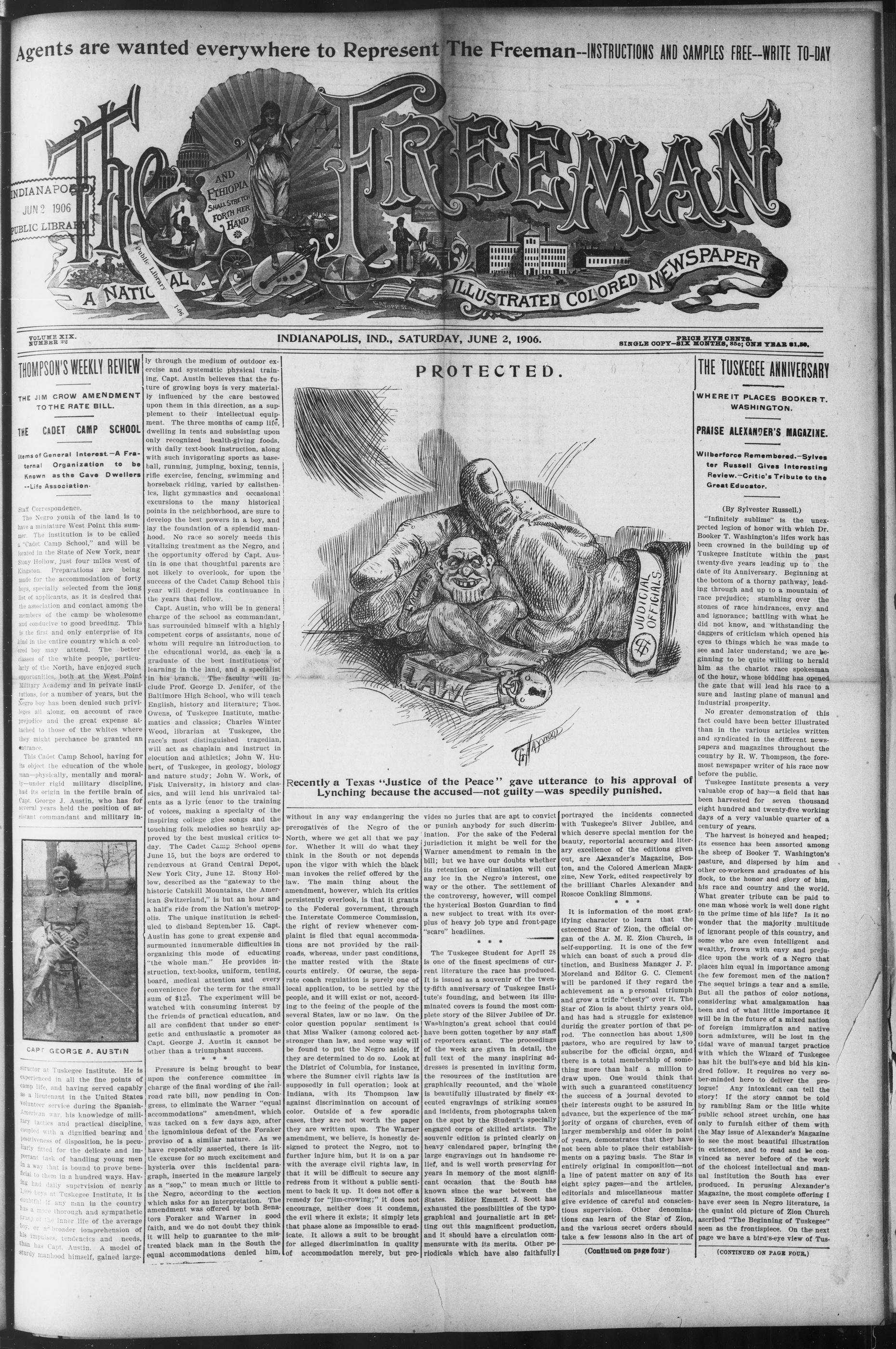
The Negro youth of the land is to have a miniature West Point this summer. The institution is to be called a "Cadet Camp School," and will be located in the State of New York, near Sony Hollow, just four miles west of Kingston. Preparations are being made for the accommodation of forty boys, specially selected from the long list of applicants, as it is desired that the association and contact among the members of the camp be wholesome and conducive to good breeding. This is the first and only enterprise of its kind in the entire country which a colored boy may attend. The better classes of the white people, particularly of the North, have enjoyed such opportunities, both at the West Point Military Academy and in private institutions, for a number of years, but the Negro boy has been denied such privileges all along, on account of race prejudice and the great expense attached to those of the whites where they might perchance be granted an entrance.
This Cadet Camp School, having for its object the education of the whole man—physically, mentally and morally—under rigid military discipline, had its origin in the fertile brain of Capt. George J. Austin, who has for several years held the position of assistant commandant and military in-
CAPT GEORGE A. AUSTIN
structur at Tuskegee Institute. He is experienced in all the fine points of camp life, and having served capably as a lieutenant in the United States volunteer service during the Spanish-American war, his knowledge of military tactics and practical discipline, coupled with a dignified bearing and positiveness of disposition, he is peculiarly fitted for the delicate and important task of handling young men in a way that is bound to prove beneficial to them in a hundred ways. Having had daily supervision of nearly 1,000 boys at Tuskegee Institute, it is courageful if any man in the country has a more thorough and sympathetic grasp of the inner life of the average boy, or $^{a}$ broader iomprehension of his impulses, tendencies and needs, than has Capt. Austin. A model of sturdy manhood himself, gained large-
ly through the medium of outdoor exercise and systematic physical training, Capt. Austin believes that the future of growing boys is very materially influenced by the care bestowed upon them in this direction, as a supplement to their intellectual equipment. The three months of camp life, dwelling in tents and subsisting upon only recognized health-giving foods, with daily text-book instruction, along with such invigorating sports as baseball, running, jumping, boxing, tennis, rifle exercise, fencing, swimming and horseback riding, varied by calisthenics, light gymnastics and occasional excursions to the many historical points in the neighborhood, are sure to develop the best powers in a boy, and lay the foundation of a splendid manhood. No race so sorely needs this vitalizing treatment as the Negro, and the opportunity offered by Capt. Austin is one that thoughtful parents are not likely to overlook, for upon the success of the Cadet Camp School this year will depend its continuance in the years that follow.
Capt. Austin, who will be in general charge of the school as commandant, has surrounded himself with a highly competent corps of assistants, none of whom will require an introduction to the educational world, as each is a graduate of the best institutions of learning in the land, and a specialist in his branch. The faculty will include Prof. George D. Jenifer, of the Baltimore High School, who will teach English, history and literature; Thos. Owens, of Tuskegee Institute, mathematics and classics; Charles Winter Wood, librarian at Tuskegee, the race's most distinguished tragedian, will act as chaplain and instruct in elocation and athletics; John W. Hubert, of Tuskegee, in geology, biology and nature study; John W. Work, of Fisk University, in history and classics, and will lend his unrivaled talents as a lyric tenor to the training of voices, making a specialty of the inspiring college歌 songs and the touching folk melodies so heartily approved by the best musical critics today. The Cadet Camp School opens June 15, but the boys are ordered to rendezvous at Grand Central Depot, New York City, June 12. Stony Hollow, described as the "gateway to the historic Catskill Mountains, the American Switzerland," is but an hour and a half's ride from the Nation's metropolis. The unique institution is scheduled to disband September 15. Capt. Austin has gone to great expense and surmounted innumerable difficulties in organizing this mode of educating "the whole man." He provides instruction, text-books, uniform, tenting, board, medical attention and every convenience for the term for the small sum of $125. The experiment will be watched with consuming interest by the friends of practical education, and all are confident that under so energetic and enthusiastic a promoter as Capt. George J. Austin it cannot be other than a triumphant success.
Pressure is being brought to bear upon the conference committee in charge of the final wording of the railroad rate bill, now pending in Congress, to eliminate the Warner "equal accommodations" amendment, which was tacked on a few days ago, after the ignominious defeat of the Foraker proviso of a similar nature. As we have repeatedly asserted, there is little excuse for so much excitement and hysteria over this incidental paragraph, inserted in the measure largely as a "sop," to mean much or little to the Negro, according to the section which asks for an interpretation. The amendment was offered by both Senators Foraker and Warner in good faith, and we do not doubt they think it will help to guarantee to the mistreated black man in the South the equal accommodations denied him,
INDIANAPOLIS, IND., SATURDAY, JUNE 2, 1906.
PROTECTED.
JUDICIAL OFFICIALS
LAW
T. A. WOOD
Recently a Texas "Justice of the Peace" gave utterance to his approval of Lynching because the accused-not guilty-was speedily punished.
Recently a Texas "Justice of the Peace" gave utterance to his approval of Lynching because the accused-not guilty-was speedily punished.
without in any way endangering the prerogatives of the Negro of the North, where we get all that we pay for. Whether it will do what they think in the South or not depends upon the vigor with which the black man invokes the relief offered by the law. The main thing about the amendment, however, which its critics persistently overlook, is that it grants to the Federal government, through the Interstate Commerce Commission, the right of review whenever complaint is filed that equal accommodations are not provided by the railroads, whereas, under past conditions, the matter rested with the State courts entirely. Of course, the separate coach regulation is purely one of local application, to be settled by the people, and it will exist or not, according to the feeing of the people of the several States, law or no law. On the color question popular sentiment is that Miss Walker (among colored act-stronger than law, and some way will be found to put the Negro aside, if they are determined to do so. Look at the District of Columbia, for instance, where the Sumner civil rights law is supposedly in full operation; look at Indiana, with its Thompson law against discrimination on account of color. Outside of a few sporadic cases, they are not worth the paper they are written upon. The Warner amendment, we believe, is honestly designed to protect the Negro, not to further injure him, but it is on a par with the average civil rights law, in that it will be difficult to secure any redress from it without a public sentiment to back it up. It does not offer a remedy for "jim-crowing;" it does not encourage, neither does it condemn, the evil where it exists; it simply lets that phase alone as impossible to eradicate. It allows a suit to be brought for alleged discrimination in quality of accommodation merely, but pro-
vides no juries that are apt to convict or punish anybody for such discrimination. For the sake of the Federal jurisdiction it might be well for the Warner amendment to remain in the bill; but we have our doubts whether its retention or elimination will cut any ice in the Negro's interest, one way or the other. The settlement of the controversy, however, will compel the hysterical Boston Guardian to find a new subject to treat with its overplus of heavy job type and front-page "scare" headlines.
\* \* \*
The Tuskegee Student for April 28 is one of the finest specimens of current literature the race has produced. It is issued as a souvenir of the twenty-fifth anniversary of Tuskegee Institute's founding, and between its illuminated covers is found the most complete story of the Silver Jubilee of Dr. Washington's great school that could have been gotten together by any staff of reporters extant. The proceedings of the week are given in detail, the full text of the many inspiring addresses is presented in inviting form, the resources of the institution are graphically recounted, and the whole is beautifully illustrated by finely executed engravings of striking scenes and incidents, from photographs taken on the spot by the Student's specially engaged corps of skilled artists. The souvenir edition is printed clearly on heavy calendared paper, bringing the large engravings out in handsome relief, and is well worth preserving for years in memory of the most significant occasion that the South has known since the war between the States. Editor Emmett J. Scott has exhausted the possibilities of the typographical and journalistic art in getting out this magnificent production, and it should have a circulation commensurate with its merits. Other periodicals which have also faithfully
PRICE FIVE CENTS.
SINGLE COPY-SIX MONTHS, 85c; ONE YEAR $1.50.
portrayed the incidents connected with Tuskegee's Silver Jubilee, and which deserve special mention for the beauty, reportorial accuracy and literary excellence of the editions given out, are Alexander's Magazine, Boston, and the Colored American Magazine, New York, edited respectively by the brilliant Charles Alexander and Roscoe Conkling Simmons.
It is information of the most gratifying character to learn that the esteemed Star of Zion, the official organ of the A. M. E. Zion Church, is self-supporting. It is one of the few which can boast of such a proud distinction, and Business Manager J. F. Moreland and Editor G. C. Clement will be pardoned if they regard the achievement as a personal triumph and grow a trifle "chesty" over it. The Star of Zion is about thirty years old, and has had a struggle for existence during the greater portion of that period. The connection has about 1,800 pastors, who are required by law to subscribe for the official organ, and there is a total membership of something more than half a million to draw upon. One would think that with such a guaranteed constituency the success of a journal devoted to their interests ought to be assured in advance, but the experience of the majority of organs of churches, even of larger membership and older in point of years, demonstrates that they have not been able to place their establishments on a paying basis. The Star is entirely original in composition—not a line of patent matter on any of its eight spicy pages—and the articles, editorials and miscellaneous matter give evidence of careful and conscientious supervision. Other denominations can learn of the Star of Zion, and the various secret orders should take a few lessons also in the art of
(Continued on page four)
WHERE IT PLACES BOOKERT. WASHINGTON.
Wilberforce Remembered.-Sylvester Russell Gives Interesting Review.-Critic's Tribute to the Great Educator.
(By Sylvester Russell.)
"Infinitely sublime" is the unexpected legion of honor with which Dr. Booker T. Washington's lifes work has been crowned in the building up of Tuskegee Institute within the past twenty-five years leading up to the date of its Anniversary. Beginning at the bottom of a thorny pathway, leading through and up to a mountain of race prejudice; stumbling over the stones of race hindrances, envy and ignorance; battling with what he did not know, and withstanding the daggers of criticism which opened his eyes to things which he was made to see and later understand; we are beginning to be quite willing to herald him as the chariot race spokesman of the hour, whose bidding has opened the gate that will lead his race to a sure and lasting plane of manual and industrial prosperity.
No greater demonstration of this fact could have been better illustrated than in the various articles written and syndicated in the different newspapers and magazines throughout the country by R. W. Thompson, the foremost newspaper writer of his race now before the public.
Tuskegee Institute presents a very valuable crop of hay—a field that has been harvested for seven thousand eight hundred and twenty-five working days of a very valuable quarter of a century of years.
The harvest is honeyed and heaped; its essence has been assorted among the sheep of Booker T. Washington's pasture, and dispersed by him and other co-workers and graduates of his flock, to the honor and glory of him, his race and country and the world. What greater tribute can be paid to one man whose work is well done right in the prime time of his life? Is it no wonder that the majority multitude of ignorant people of this country, and some who are even intelligent and wealthy, frown with envy and prejudice upon the work of a Negro that places him equal in importance among the few foremost men of the nation? The sequel brings a tear and a smile. But all the pathos of color notions, considering what amalgamation has been and of what little importance it will be in the future of a mixed nation of foreign immigration and native born admixtures, will be lost in the tidal wave of manual target practice with which the Wizard of Tuskegee has hit the bull's-eye and bid his kindred follow. It requires no very sober-minded hero to deliver the prologue! Any intoxicant can tell the story! If the story cannot be told by rambling Sam or the little white public school street urchin, one has only to furnish either of them with the May issue of Alexander's Magazine to see the most beautiful illustration in existence, and to read and be convinced as never before of the work of the choicest intellectual and manual institution the South has ever produced. In perusing Alexander's Magazine, the most complete offering I have ever seen in Negro literature, is the quaint old picture of Zion Church ascribed "The Beginning of Tuskegee" seen as the frontpiece. On the next page we have a bird's-eye view of Tus
(CONTINUED ON PAGE FOUR.)
FOR THE IMPROVEMENT AND ADVANCEMENT OF THE NATIONAL BENEFIT ASSOCIATION OF
HEAD, SECOND AND SIDE WAITERS "For the man who works with brain or hand."
Subscribe for the Freeman, and see what Cozart has to say each week.
Mr. Chas. Raynor has been appointed third waiter at the Chalfonte Hotel, Atlantic City, N. J.
It is rumored that our old friend and brother, "Bob" Rush, will not return to the Grand Hotel, Macanac Island, this season. We trust, however, that the rumor is misleading.
The editor of this department will be pleased to hear from any of his old friends, and would also gladly receive any news pertaining to the profession. Address W. Forrest Cozart, 17 North Kentucky Avenue, Atlantic City, N. J.
Mr. E. Russell, late of Green's Hotel, Atlantic City, has gone to the "Gap House," Delaware Water Gap, Pa. Mr. Russell was employed by Proprietor Chas. E. Cope at the Green, and proving satisfactory Mr. Cope transferred him to his summer house.
Mr. Clement C. Randolph, the veteran chiefman of the New York haed waiters, and for many years head waiter at the Sherman Square Hotel in New York City, will be in charge of the Hotel Victoria, Larchmont, N. Y., the coming season. Mr. Randolph is a hale and hearty fellow well met.
INDIVIDUAL HOTEL DIRECTORY
[One address line $4.00 per year; including subscription to The Freeman, in advance,] HEADWAIERS.
J. W. Redmond, Headwriter of The Carroll, Vicksburg, Miss. 10-06.
C. W. Dwyer, headwriter Commercial Club Minneapolis, Minn. 8 105
C. H. Plummer, headwriter Hotel Brunswick, Uniontown, Pa. 10-05
B. H. Bradley, Headwriter Menger Hotel, San Antonio, Texas. 3-06
B. W. Gland, Headwriter of The Oliver, South Bend, Ind. 12-06
HOTEL DIRECTORY
This column used exclusively for the ad dressers of hotels, restaurants, lodging and boarding houses and intended rooms throughout the travel public—you business solicited.
Hotel Reformer—First class in all respects 90 N. 8th street, Richmond, Va. A. W. K. Moore's Hotel—First-class rooms and board rooms neatly furnished, 712 and 714 N. 8th street Little Rock, Ark.
Walford A. Hotel's Room—327 Laurel street, 714 N. 8th street Gors's Lunch Room—220 Fifth Street, Little Rock, Ark.
Black's Hotel—A modern first-class hotel for colored people, H. Black, Manager, Evansville, Ind.
The Parker House—Rooms, bath. J. W. Holliman, proprietor. Indianapolis, Ind.
VICTOR
TALKING
MACHINES.
The Victor is so perfect it is often mistaken for the human voice. It is proving a never failing source of DELIGHT to Thousands.
COME IN AND LET US
TELL YOU all ABOUT it.
SOLD ON EASY PAYMENTS
Phones Main 852
New 9093
KOEHRING BROS.
878, 880, 882 VIRGINIA AVENUE.
Hoosier Poet
CLUB ROOM LONDRES
10c Cigar
We deliver Goods direct to consumers and pay all express charges.
Give Us A Tryal Order.
John Rauch Cigar Co. - Indianapolis, Ind.
AMERICAN BREWING CO.,
BREWERS & BOTTLERS
OF
HIGH GRADE BEER.
—TELEPHONES 935—
HEADQUARTERS
Indiana Ave.
Indianaapolis, Ind
Mr. J. W. Redmond, the efficient head waiter at the Carroll Hotel, Vicksburg, Miss., is an ardent member of the Head and Side Waiters' Association, and is responsible for eighteen new members. Good boy, Bro Redmond. Score again.
Mr. Fred Allen, the king of colored head waiters, who rules supreme at the Royal Ponciana, at Palm Beach, and who for many years was in charge at West End Hotel, Long Branch, will the coming season be in charge at the United States Hotel, Saratoga, N. Y. succeeding Mr. Riley. Mr. Allen was the center of attraction at the head waiters' convention, and pulled a few strings very successfully.
The official program of the association, which should have been sent out two weeks beforehand, was withheld until two days before the convention, in order that it might appear in the Dining Room Recorder, a paper edited by Secretary Miller. The Dining Room Recorder is not owned by the association, but is an outside enterprise floated by the secretary.
Now that W. Forrest Cozart is again in charge of the Walters' Deyri,odeprsweeaa. ETAOIN SHRDLU partment there will be something doing each week. Subscribe now.
Mr. Chas. T. Furguson, who opened up the magnificent Hotel Blenheim, March 1, has, with his crew, retired from the above hotel, which has been closed in order to complete arrangements to open the house on the European plan. The Blenheim will reopen it is said with white waiters, and if colored waiters are employed a white head waiter will be in charge. The Blenheim is one of the finest European hotels in the country, and we regret to see the house pass out of the colored boys' hands. Same old story.
Mr. Wm. F. White, who was F. P. Thompson's second man at the Ponce de Leon, as it is known, was appointed head waiter after the death of Mr. Thompson, made good at the "Ponce," and upon his good record has been appointed head waiter at the Hotel Champlain, Lake Champlain, Clinton county, N. Y. Thus it will be seen that Mr. White seems to have fallen heir to Mr. Thompson's influence. Mr. White was head waiter at Delaware Water Gap Hotel last summer, and would have returned this summer had he not been honored as stated above
THE FREEMAN, AN ILLUSTRATED COLORED NEWSPAPER
EASTERN BRANCH
17 N. Kentucky Ave,
Atlantic City, N.J.
SECOND THOUGHTS BY CHARLES MARSHALL.
THE EIGHTH ANNUAL H. S. S. W. CONVENTION.
The eighth annual convention of the Head, Second and Side Waiters' National Benefit Association met at Abyssinia Baptist Church, New York City, Tuesday, May 22.
The convention was called to order by President J. M. Butler, of Atlantic City. Rev. H. M. Warren, D. D., rendered the opening invocation. Address of welcome was delivered by Mr. Chas. W. Anderson, collector of internal revenues of New York.
Mr. Andrew W. Dempsey, head waiter at Hotel Flanders, New York, responded to address of welcome for the head waiters, and Mr. Morris K. Holland, of Yale Dining Hall, New Haven, Conn., responded on behalf of the side waiters.
Address of welcome on behalf of the church was rendered by the pastor, Rev. Chas. Morris, D. D. President Butler delivered his annual adress, reviewing the work of the association and advising the association to enter mercantile enterprises, which met the approval of those present.
Wednesday, May 23.
The morning session was devoted to the reports of the committees, and the annual report of the secretary, treasurer, auditors, and the board of management.
The afternoon session was opened by invocation by Rev. M. W. Gilbert, D. D. Secretary Miller read several communications from absent members, one of which was a letter from W. Porrest Cozart, withdrawing from the presidential race. Owing to illness of Mr. Whitehead, Mr. Cozart was unable to attend the convention. Several papers were also read at this session, among which was a very strong paper by Mr. George H. Emery, head waiter at the Haddon Hall, Atlantic City. Mr. Emery made many telling points that would be of great benefit to any organization. The subject of Mr. Emery's paper was "Organization."
Thursday, May 24.
The morning session was devoted to executive business.
Prayer by Rev. W. H. Brooks. The afternoon session was devoted to address and papers by Mr. George W. Newton, head waiter, Loraine Hotel, Atlantic City. Mr. Newton was unable to be present on account of a convention and banquet at his hotel, but sent an excellent paper, viz.: "Duties of a head waiter to his employer and his men." Rev. Warren, subject, "Practical plans for the betterment of
SECOND T
BY CHARLES
Betting laughs at all laws except the law of chance.
If you wish to reach the highest, begin at the lowest.
Peace of mind is quite often the result of a piece of mind.
Some people think that to be appreciated they should always be contrary.
Some people patch up their old quarrels until they are almost as good as new.
We can now get ready to enjoy balmy moonlight nights and biting muskeeters.
It matters less where a man was born, than where he can live and enjoy his right to liberty.
If you do not perspire these days you had better go to the doctor and find out the reason why.
Since the invention of glass brick, those who live in homes of glass can throw as many rocks as they want to.
Nothing makes a man so sick at herat as to come home all ready to make a big fuss with his wife and find a lot of company there.
Recently some southern lads met together and formed a club bearing the purpose of "a good time all the time," which was made the club's motto. That motto seems to be the whole race's aim, for she wildly demonstrated the fact.
Our ideals may and do differ from each other according to the progress
A Bad Recovery.
Scene: Registry office. Bridegroom (to registrar)—The first time I was married was in a church, the second time in a chapel, but I like this way best. It's so plain and simple, and I should come here if ever I got married again— (Catches sight of his bride and sees he has said the wrong thing.) That is, my dear, if ever I have the —er—misfortune to get married again, of course!—London Punch.
the morals in help's quarters." Mr. W. H. Marrow, head waiter Union League Club New York, subject, "Duties of Head Waiters." Rev. W. A. Credit, of Philadelphia, "Reaping What We Sow."
On Thursday evening a memorial meeting of the late president, F. P. Thompson, was held. Rev. Credit delivered the eulogy. Several other members and friends spoke.
Friday, May 25.
The morning was devoted to executive session.
Unfinished business transacted. Atlantic City selected as next meeting place, in 1907. Board of managers elected, president elected.
Adjourned sine die.
Mr. Chas. R. Richardson, late of the Denison Cafe, Indianapolis, Ind., has recently taken charge of the famous Fontaine Ferry Cafe, at the beautiful resort of that name on the banks of the picturesque Ohio, near the outskirts of the city of Louisville, Ky. He has already made a host of friends among the epicures of Louisville's best white citizens who frequent this resort daily, by his amiable and polished manners and his executive ability in handling and seating the large patronage and keeping "an eye single to the wants and service of all."
He is a strict disciplinarian, but never too exacting on the men in his charge. The crew is composed of the cream of the European waiters of Louisville and Indianapolis. Mr. Geo. Oglesby, of Indianapolis, is an able and proficient second to Mr. Richardson, and well thought of by his crew. Mr. Wm. C. Cheatham and James Green are captains. Among the side waiters are: Wm. Umstead, Oliver Finn, Robert Jones, H. Yocum, H. Phillips, R. Hadenot, Wm. Goforth, H. Irwin, Jas. Forrest, Wm. Harriday, Ellis Johnson, E. Pickens, J. W. Edwards, Frank Harrold, J. H. Humes, Perry Kennedy, Joe C. Rice, A. Harris, J. W. Williams, Lon Rhea, H. S. Rosborough.
Mr. W. K. Black, for a number of years manager of the Maxwell House, Nashville, Tenn., was recently appointed manager at Green's Hotel, Atlantic City, N. J.
The above article will no doubt be read with much interest by a host of head waiters who are always short of silverware every time an inventory is taken. Many hotel proprietors hold the head waiter responsible for every piece of the silverware, and when the same is regularly missing at each inventory, concludes that the head waiter is not looking after business properly. Every hotel has its kleptomanic guest.
we have made. But we all have them. Something to each of us is an ideal; something to each of us is a temptation. Whatever we do helps us or drags us down.
It is generally the case that the woman who has an abundance of beautiful hair seldom ever knows how to do it up to become her face. But the female that has a small amount of hair that is poor can always arrange it so that it will look exceedingly well.
A young woman of Alabama declares the chief reason why men do not marry is that women are not as easily won as in the days of old. We believe it is fair to also add that it might be that same sort of reason why women do not marry is owing to the fact that men are not as easily led into hot water as they were in the old days.
Way down in the secret souls of most of our young girls and boys who graduate these days is a heavenly idea of the world. That idea is something on the order of a continuous season of swell balls where everybody has $100 gowns and $75 full dress suits, and angels from heaven are flitting about passing out greenbacks faster than they can be spent.
The London Express solemnly prints the statement that among the latest inventions patented is a contrivance which, if fitted to an ordinary sewing machine, will fan and massage the operator while she is working. That invention ought to be the greatest paying one ever patented, from the fact that every member of the feminine sex of England will never "let up" on their husbands until they purchase one.
Reassuring
The Lender—All right, I'll lend you $5, but don't forget that you owe it to me. The Borrower—My dear fellow, I shall never forget it as long as I live.—Brooklyn Life.
He Was Good.
Miss Askham—And do you paint nothing but animal pictures every day! Mr. D'Auber—Well, on Fridays I paint fish—Cleveland Leader.
The Higher Their Caste the More
Irksome Become the Rules.
"In India," writes Sidney Low, "religion, with what seems a malign ingenuity, has occupied itself in heaping complications round the two essential functions of eating and marrying. The Hindoo cannot take his food without elaborate precautions against pollution, and the higher his caste is the more burdensome these rules are. There are some inferior castes in the south who are not supposed to approach even within speaking distance of the elect. A regular table has been drawn up of what may be called the degrees of pollution, so that, while some of these low persons can pollute a man of a higher caste only by actually touching him, it is held that blacksmiths, masons, carpenters and leather workers can pollute at a distance of twenty-four feet, toddy drawers at thirty-six feet and cultivators at forty-eight feet, while the pariabs, who eat beef, have a pollution range of no less than twenty-one yards and twelve inches.
"The more sacred a Hindoo is the more he is worried by his code of table etiquette. The very high caste Brahman ought to strip off all his clothes and, if possible, sit on the floor when he consumes his food. He should not eat anything which has been touched by an inferior or a non-Hindoo or drink water out of any vessel similarly defiled. As the scale descends the restrictions relax until at last we get down to the man of no standing whatever, the sweeper, who is so wanting in refinement that he can openly stroke a puppy dog, and finally we reach the outcast who can eat any kind of meat whenever he can get it and will even drink out of a cup which has touched other lips.
"Luckily for the modern Hindoo these burdensome prohibitions and injunctions are subject to certain convenient legal fictions. Sweetmeats, it appears, are not food and may be taken by anybody anywhere. Not long ago the Brahman pundits at Benares decided that soda water is not water within the meaning of the act, so to speak, and that ice does not count."—Chicago News.
POINTS OF ETIQUETTE
Finger bowls are not put on the table until after the dessert is removed.
It is the worst possible form for a man to take a woman's arm, by day or night.
When leaving a car a man should precede the woman, so as to assist her if necessary.
In addressing a newly married couple at a wedding reception it is usual to congratulate the groom and to wish the bride great happiness.
It is not looked upon as good form to announce a meal by the ringing of a bell. That custom does very well for a railroad station, but is now seldom used in private houses.
When taking a lady in to dinner or at any indoor entertainment a man offers his left arm, but in the street he must always take the outside, no matter which arm he has to offer.
The expenses incident to a wedding are, with few exceptions, borne by the family of the bride. The groom's expenses, with the exception of flowers and souvenirs for the bridesmaids and ushers, begin with the fee to the clergyman.
Servants In Germany.
A girl engaged in America is by no means a girl secured, as regards either domestic service or matrimony. In Germany, on the other hand, the mistress of a prospective cook and the flance of a prospective bride may feel reasonably secure when once an understanding has been reached. "Well, I will engage you, Hedwig," says the hausfrau at the close of the interview, and as a pledge of good faith three marks (75 cents) are given and received. By acceptance of this sum, Hedwig binds herself to appear at the time and place agreed upon, and if she fails in fulfillment of the contract, after allowing twenty-four hours to elapse without having returned the money, she renders herself liable to criminal prosecution. Needless to say, breach of contract under such conditions is rare.-Harper's Bazar.
Postage Stamp Tongue.
"A number of ailments, some of them extremely dangerous, are comprised under the general head of postage stamp tongue," said a physician. "Postage stamp tongue, in a word, is any disorder contracted from the licking of postage stamps. Three or four persons a week visit me with postage stamp tongues. They have a throat trouble or a skin disease or a pulmonary complaint brought on by the reckless habit of stamp liking."-Philadelphia Bulletin.
A Fatal Fault
"I have here some jokes." "You what?!" asked the editor. "I said I have here some jokes." "Oh, you have there some jokes. What kind of jokes are they?" "New, brand new. Never been used before." "Can't use 'em,' said the editor. "It takes our readers too long to get used to the new ones. Good day"—Milwaukee Sentinel.
Comparative Happiness.
If one only wished to be happy this could be easily accomplished, but we wish to be happier than other people, and this is always difficult, for we believe others to be happier than they are.—Montesquieu.
In France there is an idea that if a fisherman counts the fish he has caught he will catch no more during that day.
The idle rumor is always busier than any other kind.—Houston Post.
COOKS
Prefer Our Make JACKETS AND LINEN because they have found them satisfactory.
Marcus Ruben (Inc.)
300 State St., CHICAGO IL.
Agents Wanted
To sell R. C. Weiss and Co.'s book titled *Anatobiography Applied to American Negro and African American Education* to anyone selling 25 books excluding the large commission per volume. Write C. E. Covington, Box 354, Buxton, IA.
THE TUSKEGEE INSTITUTE is now offering extended courses in both theory and experience of the subjects and the opportunity to secure advanced instruction in Architecture and Electrical Engineering. Persons desiring to take advanced or elementary courses in one of the subjects will have the opportunity to attend a course in the institute such as few institutions can offer. There is a growing demand for young men who fit into the curriculum offered at the Drawing course, to make plans for houses and who can do the work required in Esec. 1:Cual Engineering. Every effort is being made to increase the number more helpful than ever before. Booker Washington, Tuskegee Institute, Alabama.
Williams' Shaving Soap
"The only Soap fit for the face"
Williams' Shaving Sticks and Tablets sold everywhere. Free trial sample for 2-cent stamp to pay postage. Write for booklet "How to Shave."
The J. B. Williams Co., Glastonbury, Conn.
BIG 4 ROUTE
Excursion Bulletin
For JUNE, 1906.
West, Northwest, Southwest,
South and Southeast Home Seek-
ers' tickets at low rates on sale the first' and third tuesdays
of each month.
Boston, Mass., and return. Tickets
sold June 2, 3, 4 and 5,
1906.
Winona Lake, Ind, and return.
May 10th to September 30th, 1906. Tickets sold
IH J. RHEIN, Gen'l Pass, Agt.
O. C. CLARK, G. A. P. D.
THE MAGIC SHAMPOO HAIR DRIER
After a bathor shampoo the hair can be DRIED and STRAIGHT. Easily. It is the only device which will Straighten curly hair without injury. The shampoo will stimulate its growthand make it more shiny and fitted, which adds to a lady's appearance.
The Shampoo Drier is a steel bar with a woochie containing a six inch aluminum contour. For sale to lobster dealers. By mail, price $1.00. Agents wanted.
The Shampoo Drier is used in my partys with perfect satisfaction."-Madame Coark, If Kentucky Ave., Atlantic City, N. J.
The Shampoo Drier Mfg. Co.
400 Century Blvd.
Minneapolis, Minn.
HAIR SWITCHES Bangs and Wigs of Every Description.
Most Complete Line of Hair Goods in this Country for Colored People.
50c buys a single braid made of Black Kinky Hair 16 inches long.
75c buys a double braid made of Black Kinky Hair 16 inches long.
$1.00 buys a Creole Switch, 16 inches long, Brown or black.
$1.25 buys a Creole Switch, 20 inches long, Brown or Black.
$1.75 buys a Creole Switch, 22 inches long, Black or Brown.
$3.30 buys a Creole Switch, like cut.
Send sample of hair when ordering Creole Switches.
Send wig with order and get your goods by return mail. Send stamp for catalogue.
T. W. TAYLOR,
Howell, Mich.
When writing please mention this paper.
THE FREEMAN
NATIONAL ILLUSTRATED
COLORED NEWSPAPER.
PUBLISHED EVERY SATURDAY
At 309 Indiana Avenue,
INDIANAPOLIS, INDIANA.
SUBSCRIPTION RATES :
Any part of the United States and Canada,
one year, postage paid
$1.80
Three Months
80
Foreign Countries.
$1.00 extra
Send, send, please, money order, post-
ward, or registered letter.
Agents wanted in every town and city not
now occupied, and liberal inducements will be
same. Send for our extraordinary
inducements.
ADVERTISING RATES:
Five cents per line. Base of measure—solid
agate, lines to 2-inch, lines to 3-inch, lines to 4-inch, lines to 5-inch, additional.
No advertisement inserted on first page. Special
rates on standing professional and business
cards. Reasonable discount for long time and
long distance rates. Five cents per line. Special
rates on WRITE UFS.
Entered at the postoffice at Indianapolis,
Indiana, as second class matter.
INDIANAPOLIS, - - INDIANA.
SATURDAY, JUNE 9, 1906.
"THE SOUTH AND THE NEGRO."
Harry Stilwell Edwards, who may be remembered as the Georgian who seconded the nomination of Roosevelt at Chicago, contributes an article in the June number of the Century magazine on "The Negro and the South." It is far more temperate than some utterances coping from that section of the country, and is spoken of by the Northern press as "a very pleasant median line between the fire eaters of both sections." Its dominant note is described as "one of optimism and faith in the black man's future." All of this will be admitted in so far as the article is more hopeful than most others on this subject, but there is in it one statement which can never be accepted by the Negro as a basis of determining rewards and punishments. He says that "crimes by blacks against whites can never be regarded as equal to crimes by whites against whites." Regarded by whom? By the white man, of course. Might he not also have added that any crime committed by blacks must always be regarded as a greater crime than if committed by whites? The supposition is that punishment is measured to fit the crime. If, then, the punishment measured out to the white is just, then that which is measured to the black as a punishment for committing the same crime must be unjust, since the latter punishment is for crime, plus color. Thus Mr. Edwards has made a confession which confirms the statement which the Negro has made all along, and one which the white man has denied, viz., that the Negro is not punished for his crime, but for his color. It also answers the question often asked, especially in the South, which is: "Why do not Negroes condemn crime among them?" They do. They also condemn the punishment of color. It is this latter condemnation which the white man is pleased to distort into an excuse for crime.
Mr. Edwards has put the kernel of the so-called Negro problem squarely before the world, for not only does his confession account for the barbarism practiced on the Negro who is suspected of crime, but it also accounts for the unjust discrimination he suffers when law-abiding and industrious. We are willing to accept the question as he presents it and let a more enlightened and Christianized future judge as to which is right and which is wrong.
PRESBYTERIAN
LITTLENESS.
When it was staed some time ago that the hotels of Des Moines, Ia., would refuse to accommodate the colored commissioners in attendance at the General Assembly we said that the Presbyterians would thereby have an opportunity of showing what they thought of such littleness. It seems that the opportunity did come, and they improved it in a manner which shows that these "divines" are not one whit above the littleness of the most ordinary mortal. It came about by the refusal to permit Dr. Mathew Anderson to attend the Princeton ministerial alumni banquet. Dr. Anderson's qualifications as a graduate of Princeton counted for nothing in the face of the fact that he was a col-
THE FREEMAN. AN ILLUSTRATED COLORED NEWSPAPER.
ored man. Now, we do not believe that a colored man, or any other man, for that matter, should attend banquets where he is not wanted, nor do we believe that Dr. Anderson would have subjected himself to this indignity if he had suspected these holy ones of such narrowness. And why should he have suspected it? Why should any one suspect these men as capable of such littleness and bigotry? A preacher is supposed to be the chosen of God. Certainly such a choice should fall on the best. But it is equally certain that the best people are not those who bear the taint of any form of race hatred. The really good people of the world have risen above this trait of the barbarian. But here in the state of Iowa, in the year of our Lord, 1906, an assembly of Christians, most of whom are preachers and all 'of whom are supposed to be the best representatives of one of the leading Christian denominations, see fit to debar one of their own number because the God whom they claim to serve gave the man a brown skin. Nor did these latter day Christians help their case by attempting to throw the responsibility on the management. We are pleased to note that the hotel proprietor promptly denied either having felt or expressed any objection to the presence of Dr. Anderson.
As for ourselves, we have no desire to be in the presence of those who determine merit by the color of the skin, nor have we the least faith in the alleged Christianity of those who are not above race hate. If that is the brand of religion that is expected to "save" the world, please count us among those who do not want to be saved. We prefer the chances in the hereafter of that man who is black on the outside and white inside to the one who is white on the outside and black inside. Of course, there can be no objection to one's being white clear through, which does not seem to be often the case.
CARL SCHURZ
The death of Carl Schurz comes to us as a sad reminder that those old stalwarts of three decades ago are fast passing away. It is his class of men who from the beginning of time have led the human family along the way of progress. His love of liberty was too broad to be bounded by state lines, and his love for humanity was deeper than the color of the skin. The world was his country and mankind were his brethren. He was never deluded into the belief that his service to his country must be confined within the limits of some political party. Patriotism to him meant the following of his conscience in the direction of the general good. If that resulted in political apostacy, then political apostacy became a virtue. He was too brave to fear criticism and too strong to be influenced by flattery. He scorned all renown and reward that must be bought with political bondage. He earned his greatness by his firmness in what he conceived to be right rather than by fauning at the feet of might. He asked no right for himself that he did not accord to others, and thus he showed that he deserved the rights he claimed. Such men as Carl Schurz are the men who make republics and must be numerous in republics if such governments are to remain true to the principles on which they stand. We honor his name, not because he was the friend of the black man, but because he was the friend of all men.
ANOTHER BLACK CHAPTER.
If there is anything that should cause the Anglo-Saxon in America to hang his head in shame it is the finding of the grand jury in the Springfield (Mo.) savagery of April 14. This jury has now given out that the three colored men so barbarously put to death were not only innocent of the crime charged against them, but that no attack had been made on the woman whose lies cost three men's lives. A press dispatch of May 25 states that "no attack had been committed on Mina Edwards; that it was impossible for the Negroes to have been at the place of the alleged assault at the time it was said to have been committed; that the sheriff and
police authorities were negligent in the performance of their duties, and that the girl who started the trouble witnessed the lynching."
Now, what is to be done about this? Why, nothing, of course. The same thing may happen again in almost any community whenever some fair-skinned jezebel sees fit to relate another lie like unto this one. What worse than this can happen in Russia? Yet the press is only slightly stirred to utterance since the finding of that jury. If such a condition is to continue the Negro will not need the sympathy of the American white man, who should reserve his sympathy for himself because he has reached such a moral depth as to make such things possible. Where is the honest black man who would not rather be himself than any of those who contributed to such a crime against God and civilization?
STRANGE THINGS IN DIXIE Cotton is indeed king in Dixie, and kings, as is well known, do not always rule with tenderness. With few exceptions the white landlord discourages the Negro tenant from raising anything but cotton. Regardless of what the nature of the soil, still it must be cotton. The tenant is told that he cannot afford to waste time in raising corn to fatten pigs and grind into meal, or oats to feed to mules. He can buy these things without money and pay for them out of the more profitable business of cotton raising. And so he buys many of the things he should produce. For these he pays a handsome margin above the real value, and when the cotton is gathered and sold he finds himself about where he began, and sometimes not so well off. He could not tell at any time how his account stands. "Mr. Smith is keepin' that." To keep the account himself would be work for nothing, for in the event of a difference in figures a compromise must be made by accepting the figures of "Mr. Smith." Besides, this effort to look after his own affairs would be regarded as questioning the veracity of "Mr. Smith," and this would certainly prove fatal to both the crop and the tenant. A little patch of oats and one of corn would greatly help him, but under the circumstances the crop is cotton, all cotton.
The Tuskegee anniversary number of Alexander's magazine is indeed creditable. It is highly illustrated throughout and contains many articles on leading topics. One of these is the much-talked-of article by the Rev. T. Nelson Baker on the Völunteer Mission Board meeting. The article contains so many good things as to make it regrettable that it should have in it the paragraph reflecting on the wamon of the race. It makes it appear like a beautiful little park with a quagmire in the center.
The Populist must smile when he observes that many leading men of to-day, including the President of the United States, are camping on the ground that he occupied alone fifteen years ago. Gov. Hanley said, during an address delivered on last Sunday, that the American people are at the beginning of a revolution which is being brought on by the criminal aggression of corporate wealth. If he had said this fifteen years ago he would have been called a Populist.
Do not delude yourself into the belief that you can beat your way through the world. You get what you pay for, and you pay for what you get. If you do not pay in dollars you will pay in something else.
You cannot beat anyone without beating yourself. The gain of a dollar is not the greatest gain, nor is the loss of a dollar the greatest loss. You must pay for what you get, and you will get what you pay for.
Automobiles continue to increase the death rate among the wealthy. Such accidents will be few among us for some time to come.
A fire broke out in the deaf and dumb school here last week. These deaf and dumb gave the alarm to the others of their kind, and the fire was put out by them. Noise is not so necessary, after all.
Summer has come and religious minstrels have been resumed on the famous "yellow bridge." This ranting and raving performance in the name of religion is a disgrace to every Negro in Indianapolis. Is there not some way to get rid of this parody on Christianity? A petition ought to be circulated and signed for this purpose. The coughing and bellowing of these men is enough to disgrace the cause of Christ.
Why do colored men who feel the call to work for the Master continue in religious organizations where they are subject to the rule of men whose souls are too pinched and narrow to accept the very spirit of Christ's teachings? Nothing human can stand between a man and his God. Presbyterians and Methodists do not possess a monopoly of the Christ spirit.
If there is one thing that the American white man understands less than anything else it is the Negro. The cause of his failure to understand him is because he applies different rules when measuring a black man than when measuring himself.
A Georgia white man has gone crazy from a description of hell he heard given by a preacher. That man surely has not lived in that state very long, or he would have been well seasoned against any such effect.
The Freeman will pay $10 for the correct answer to this question: "If ten Negroes have been lynched because of lies that were afterward found out, how many Negroes have been lynched because of lies that have never been found out?"
Who would have thought that the people of Missouri would have been more prompt in the punishment of criminals than the people of Ohio?
THOMPSON'S WEEKLY REVIEW
THOMPSON'S WEEKLY REVIEW
(Continued from First Page.)
making both ends meet in their publication departments.
A fraternal organization that bids fair to bring great material benefit to the masses of the race is the Cave-Dwellers' Life Association, which was incorporated the other day in Louisville, Ky., by a group of well-known and influential business and professional gentlemen of Indiana and Kentucky. The objects of the new order, briefly told, are mutual protection of its members, to provide life benefits at a minimum cost, in opposition to the extortionate charges and premiums demanded by the old-line companies, to invest funds for the promotion of the purposes of the organization, and to assist in the uplift of the race by encouraging thrift, industry and home ownership. The Cave-Dwellers' Life Association is constructed on a basis that is leading to rapid National development, as can readily be seen by reference to the names enrolled on the official roster and board of directors, most of them recognizable as household words in every section of the country. The list of officers stands at present as follows: Dr. W. O. Vance, president; Rev. L. G. Jordain, vice-president; Dr. V. W. Houser, secretary; T. F. Parks, treasurer; R. W. Thompson, editor of The Cave-Dweller. Board of Directors: Bishop W. G. Clinton, H. T. Kealing, John C. Dancy, Judson W. Lyons, G. W. Cable, W. H. Steward, J. D. W. Wheeler, Rev. J. H. Frank, Rev. D. P. Roberts, J. E. Bush, J. E. Ford, Dr. W. T. Merchant, Dr. E. D. Whedbee, Dr. W. A. Burney, Rev. C. H. Parrish, Bishop Evans Tyree, V. H. Tulane, Col. R. Church, C. N. Napier, Albert S. White, M. M. Lewey, Rev. I. W. Selectman, Rev. R. S. Rives, P. W. Chavers and Ernest Hogan. For lack of space we have not described the positions in life of many of the gentlemen mentioned, nor have we deemed it necessary to give the postoffice address, as those facts are doubtless familiar to all. They hail from everywhere, and everybody knows what they represent in the intellectual or financial life of the race. Dr. W. O. Vance, a leading practitioner of medicine in New Albany, Ind., for twenty-five years principal of the Scribner High School, of that thriving city, is putting the full strength of his energetic nature into the formative work of the order, and his acceptance of the presidency is a guarantee of the soundness and absolute reliability of the enterprise. It is confidently expected that its growth, in point of numbers and current revenue, will be as phenomenal as the famous Woodmen of the World, which it very closely resembles.
Secretary Taft is again said to be President Roosevelt's favorite for the presidential nomination in 1908, and that the influence of the administration will be bent toward the advancement of Mr. Taft's boom, the urgency for him to accept the place on the Supreme Bench being abandoned for the time. The cards say that the jovial Ohio is to remain in the Cabinet throughout the term of President Roosevelt, and with the shelving of the Foraker candidacy by his defeat on the rate bill, it is thought that there will be no material opposition to the plan to frame up a solid Buck-
FORD'S HAIR POMADE FORMERLY KNOWN AS "OZONIZED OX MARROW" Makes the Hair Long, Soft and Easy to Comb READ WHAT THE PEOPLE SAY
THE OZONIZED OX MARROW CO.
DONATE YOUR MARKTIME
(Done without your signature. Agents Wanted everywhere.)
Charles Ford Bout
Key West st. Fla., Aug. 18, 1994.
I used only one hair palmade and my hair has stopped breaking off and has greatly improved. When I started using this wonderful hair, it has been longer in inches long and now it is ten inches or more. Yours truly.
314 Southland St.
MINNIE FOASTER.
Brookhaven, Miss., Aug. 13.
I never tried any preparation I never tried any preparation so excellent for the hair. My hair was turning gray. My hair was turning gray. I have been using your hair pomade my hair has been when it was when it was a girl and it has a lively, glossy color.
Brookhaven, Miss., Aug. 13, 1900. I never tried any preparation so excellent for the hair. My hair was very pomade and rather deadly but since I have been using your hair pomade my hair has been like the hair we had when I was a girl and it has a lively, glossy color. C. L. ROBERTS.
Atlanta, Ga., June 6, 1900.
Gentlemen: I have had your hair and have found it to do more than it is recommended to do. I have the hair from falling out and off, and clumped it off, and clumped it in hair soft, pliable and glossy. MAGGIE REND.
eye delegation for Taft for the next National convention. If this arrangement does not work, the Washington wisecares say that Mr. Taft will go to the bench and will be succeeded as Secretary of War by Mr. Charles E. Magoon, the present Governor of the Panama Canal Zone.
My Heart for You." It is safe to say * * *
It looks as if Bethel Literary Association, of Washington, whose troubles were aired at length in these columns last week, has split in twain. The element which elected Miss Marie A. D. Madre to the presidency, under the direction of Prof. W. H. Richards, Prof. F. J. Cardozo and Pastor O. J. W. Scott, has been recognized as "regular" by the authorities of the Metropolitan A. M. E. Church, and the "inurgents," led by the defeated candidate, S. J. Davidson, have been denied the use of the church as a meeting place. Consequently, they have hied themselves to Miss Harriet B. Gibbs' Conservatory of Music and elected a set of officers to suit themselves, and may attempt to take legal steps to have their faction pronounced the regularly constituted association. Miss Madre will win out, if she just "sticks," and before October the tempest in a teapot will be at an end.
Mr. John E. Bush, upon whom certain elements made an inexcusable fight, has been reappointed and confirmed as Receiver of Public Moneys at Little Rock, Ark. Mr. Bush is one of the best men of the great Southwest, and his record as an officer and as a citizen is of the gilt-edged variety. His influence has been felt helpfully by his people along many lines. As first second vice-president of the National Negro Business Men's League he has been a tower of strength to that organization since its inception, and has done much to develop among the colored people of the country the commercial instinct, so essential to their material prosperity. Mr. Bush's triumph is another victory for the right against the forces of evil and personal malevolence.
Rev. W. Bishop Johnson, for twenty-four years pastor of the Second Baptist Church at Washingtino, founder of the celebrated Second Baptist Lyceum, and who built the present $60,000 structure in which the congregation worships, has been called to the presidency of the Clayton-Williams Academy and Biblical Institute at Baltimore. Dr. Johnson is a scholar, writer, theologian and lecturer of parts, and has traveled extensively in Europe, Canada and the United States. He has long been an interested patron of education, and is one of the tall men of the Baptist denomination. His selection is a wise one.
Register W. T. Vernon will assume the duties of his office early in June. He was in Washington a few days ago, looking over the ground. He addressed the Metropolitan A. M. E. Church, paid his respects to the President and Secretary of the Treasury, and was royally received by the staff of the Register's Office. He did not qualify by taking the oath, which would have placed him immediately upon the pay roll, but generously asked Mr. Lyons to remain in charge until he returned from Kansas at the close of his school, the Western University, where his salary goes on until the end of the term. Dr. Vernon will prove to be a popular official.
***
The Manassas Industrial School is to be congratulated upon its good fortune in securing so capable an educator as Mr. George H. Mays, Jr., as its principal. Mr. Mays is a graduate of Tuskegee Institute, and has had ample experience as an instructor in the classical and industrial branches at Wilberforce University.
* * *
August 20 to 26 have been settled upon as the dates of the Ohio Educational and Industrial Exposition, at Dayton, O., of which Mr. P. W. Chavers is general director. The exhibition is in good hands and promises well as a concrete exhibit of the progress of the race in the Buckeye State and elsewhere.
Do not miss this opportunity to subscribe for the races' leading journal.
I had typhoid fever, my hair all came out. I used three bottles of my hair, and now my hair is nine inches long and one seeing how good your pomade is. Most every one sees how good your pomade is. My hair is an example to every one. Yours respectfully. BILLA BYE.
Colvert, Tex., M. Ch. 31, 1905.
I have used one bottle of my pomade and my hair is now perfectly straight, soft and black as silk. I will not be without it.
RHODA EDWARDS.
Colvert, Tex. Meh. 31, 1965. I have used one bottle of your pomade and my hair is now perfectly straight, soft and black as silk. I will not be without it.
RHODA EDWARDS.
Paris, Mo. July 15, 1899.
Gentleman: When I began using your powder made my head was so bald I was ashamed my eyes now my hair has grown three inches over my head and I have been using it only two months.
THE TUSKEGEE ANNIVERSARY
(CONTINUED FROM FIRST PAGE)
keege as it is today. Opposite that page we have Dr. Washington in his private office, with Emmett J. Scott, his confidential secretary. On another following page, notably, we have Mr. Ogden, Mr. Taft, Dr. Washington and dear old Andrew Carnegie, the good giver who has done so much to help the colored race along. The next beautiful illustration is the Executive Council. In the back part of the book we have an article by R. W. Thompson on Emmett J. Scott's part in the celebration. Of Mr. Scott it is sufficient to say that he is one symbolic emblem of keen wit built on high grounds of cordiality and friendship, or, in other words, his quality is that of a thoroughbred. On another page Dr. H. B. Frizzell tells how Tuskegee has helped Hampton, and on other pages: "The Significance of the Celebration," by Robert C. Ogden; "The Education of the Negro," by Andrew Carnegie; "The Negro Problem," by Secretary Wm. H. Taft, and "What Lifts a Race and What Holds It Down," by Prof. Chas. W. Eliot, of Harvard University. But last, and not least of all is "Tuskegee Graduates and Their Achievements," by Charles Alexander. For what our eyes have seen Mr. Alexander must now here be given unstinted praise for what he has presented to us in his beautiful magazine.
Even if this be a review of Tuskegee's Anniversary, in commenting upon Alexander's Magazine I dare not let this message of joy and race achievements pass without giving special mention to the eminent display of President Josuah H. Jones and Wilberforce University, and the life-like pictures of Bishop W. B. Derrick of today and Bishops Payne and Shorter of days gone by, and Hon. Frederick Douglass and others of approaching distinction. These Anniversary days are but the stepping up of a staircase that many of us may be permitted to live to see the Negro race still climbing when the Fiftieth Anniversary of Tuskegee, completed, shall burst forth like a great magazine fire in the night, illuminating the earth, and with a reflection that reaches the sky, to enlighten a world of darkness. If in the next quarter of a century, when it may be possible that Booker T. Washington will still be alive, let us pray and hope so, he can then be more able to fully exclaim: "If I were born a slave, speak not of slavery, if my father was white, speak not of the skin or kin, let color die that mankind of this country may be happy and the evils of past notions which once blighted his pathway may be smothered in the dust forever." Or, if there should be no Booker T. Washington on this earth in the year of our Lord 1930, may the students of that day see his bronze statue at the entrance gateway of Tuskegee. May his soul be in a happier place, and his life's work "first" in demand in American history.
Every Lady Read This.
Years ago when I was a sufferer, an old nurse told me of a wonderful cure for Leucorhea, Displacement, Painful Peritoneal Uterine and Ovarian troubles. It cured me in one month. It is a simple harmless lotion that can be prepared by any one having the recipe. I will send it Free to every suffering sister who writes to me. I have nothin' to sell. This is a case of woman helping woman. Send it Free. Address Mrs. A. B. Hudnut, South Bend, Ind.
New Hair Remedy
A $1.00 PACKAGE FREE.
Quickly Cures Dandruff, Stops Failing Hair, Restores Gray or Faded Hair to Natural Color. Never Fails to Grow New Hair.
The Above New Growth of Hair Plainly Shows What Foso Does. It Will
Men whose hair or beards are straggling or all gone, women whose tresses have been cut, men whose hair is the use of switches; little children, boys and girls whose hair is coarse and unruly; all find in this great remedy just the relief that they want. Foso grows hair on bald heads, thicker than hair and lengthens eyelashes, rests gray or faded hair to its natural color, prevents thin hair, stops itching, cures dandruff, scuff of scalp, pimples, and makes the hair of any man, woman or child long heavy and uncoarse and glossy. Fill out free coupon and mail today.
FREE $1.00 PACKAGE COUPON!
Fill out the blank lines below, cut out the coupon and mail to J. F. Stokes, Mgr.
5680 Foso Bldg, Cincinnati, Ohio.
Enclose ten cents in stamps or silver as an evidence of good faith in her purchase, etc., and the $1 package will be sent at once by mail free of charge.
One Nickel For Two Fares.
"Women are pretty magnanimous with each other," concluded the man who had thought they were not. "The other day a girl got on the car. She had a $5 bill. No change. She turned to the woman who sat next to her and said: 'Can you let me have change for this? I am in a hurry. I don't want to be put off.'
"I haven't the change,' replied the woman, 'but here is a nickel.'
"The girl demurred. 'Take it,' insisted the woman. 'It is only just. I have been riding for about a mile and a half and the conductor hasn't collected my fare yet. It is against my principles to force it upon him.'"—New York Press
A Hole In a Stone.
When primitive man pierced a hole through a stone for decorative purposes mainly the resultant was due to a great deal of trouble and expenditure of time. When he came across a stone with a hole in it he thought the perforation was due to some miraculous power, and accordingly he endowed the stone with supernatural attributes. Man's belief in the marvelous ought to diminish in exact proportion to his information. A stone may be formed of the same silex, only one portion is crystalline, the other amorphous. While the crystalline part resists abrasion and solution the amorphous does not. If the amorphous part lie in the center of a stone which is in the water it wastes away, and so a hole is the result.
Mine Turner's
GREAT FRENCH SYSTEM.
is used in our Beau-
used in our Beauty Parlors on hun dreds of people, and we can prove that STRAIGHT, SOFT, GLOS SY HAIR is produced by the use of Cheveline.
W
We use no hot irons or pasting down with grease in
this treatment, and the hair is not changed from dampness, but on the contrary is made more beautiful by washing, and the straightening appears as natural as if born with it. Send a piece of your hair and 10c. and I will return it as a sample of my work. Cheveline is undoubtedly the greatest of all hair preparations. Price $3.00 per outfit.
And we can prove beyond a doubt that Mme. Turner’s Medicated Hair Grower will cure any scalp trouble and stimulate the growth of hair, no matter what its condition may be. Price $1.00. We give the kind of soap we want you to use.
We can also prove to your satisfaction that Mme. Turner’s Mystic Face Bleach will cure every, any, and all kinds of spots, marks or blemishes in 8 or 10 days, giving you a youthful, clear, sweet complexion, at least three shades fairer. Price $1.00 Soap free. Send all orders to our Beautifying Parlors.
Real Human Hair Braids, perfect fitting Wigs made to order. No goods C. O. D. MME. M. C. TURNER, 1317 Canal St. New Orleans, La.
THE FREEMAN. AN ILLUSTRATED COLORED NEWSPAPER.
Isn't ex-Recorder H. P. Cheatham due a vindication?
Are you buying a home, or building up a bank account?
When will Governor Folk round up those Springfield lynchers?
Is the esteemed Chicago Leader still in the land of the living?
Doesn't the South seem to be "in the saddle" in every department of the government?
Doesn't the next cut of the official cards bring the game up to Attorney S. Laing Williams?
How would Dr. George C. Hall, the great Chicago surgeon, do for the next coroner of Cook county?
Cannot the Zion folks allow two bishops to the great West, when the South has all the rest?
Is it the support of the Cleveland Gazette that is "Jonahing" the Foraker presidential boom?
When will "Sylvester Russell's Review" take up its habitat upon the classic shores of Lake Michigan?
What are you going to let your member of congress know what you want in the way of helpful legislation?
If Howard University's troubles are all over, now that so good a man as Dr. Thirkleid has accepted the presidency?
Why not a "Greater A. M. E. Church," composed of the 2,000,000 loyal followers of John Wesley on this continent?
When will our people quit commencing their entertainments about the hour other races are closing up and going home?
Who is the "New Jerseyite" who is reputed to be "hot-footing it" for the Recordership of Deeds for the District of Columbia?
Will Ernest Hogan try to beat Walter Wellman to the North Pole with that airship he is said to have under construction?
What has become of Dr. J. R. A. Crossland, a sometime political meteor of "Bleeding Kansas," and minister to Liberia?
---
When will the psychological moment arrive for the assignment of a competent Negro diplomat for minister to Santo Domingo?
***
Why our most rociferous "race leaders" suddenly subside as soon as they manage to get their names affixed to a government pay roll?
---
Does the entrance of Dr. D. P. Roberts into the race for the A. M. E. bisopric mean the permanent retirement of Rev. J. M. Townsend?
---
Has anybody noticed any burning desire on the part of the whites of Virginia to have a Negro department at the Jamestown Exposition?
---
Will congress now have time to hear a few scattering remarks from the Hon. J. Warren Keifer on the reduction of southern representation?
Will the rumored marriage of Miss Marion Henry Smart to that weathy turfman mean her retirement from the stage which she so happily adorns?
...
Why doesn't some good friend of the Hon. J. Milton Turner, of Missouri, 'show him' how to get on the winning side of at least one political proposition?
---
Have you asked the leading colored physicians in your town to give a plain, practical talk to the people on how to reduce the ravages of tuberculosis?
***
Hasn't Lawyer Edward H. Morris risen materially in the esteem of the people of Chicago and elsewhere since he dropped that absurd lecture on "Shams?"
---
Isn't it rather "rubbing it in" on rare old Bishop Turner to insinuate that he is a heretic, simply because he insists upon thinking his own thoughts?
Have you noticed the widespread and wholly 'justifiable revolt of the
heretofore gullible Negro workman against the tyranny and narrow discriminations practiced by the white trades unions?
What can President Roosevelt say at the commencement exercises of Howard University likely to redeem him in the gangrened opinion of the Boston Guardian?
Will there be elbow-room for the Negro in the Presbyterian church since the Northern and the Cumberland branches have buried the grievances of war times and united?
Is Charles Francis Adams content to allow his name to rest in history where the Negro press has placed it since his bad break in the May number of the Century Magazine?
---
How did the law requiring a two-third vote for general officers and a twenty-year itineracy for eligibility to the bishopric get into the statute books of the A. M. E. Zion church?
Will not Senator Foraker's fight to the last ditch against the rate bill have the effect of solidifying the Ohio delegation for Secretary Taft for President in the next national convention?
Isn't it a general understanding that the anti-theater-going ordinance on church books doesn't count when "Rufus Rastus," "Black Patti," Williams and Walker or the "Smart Set" strike a town?
---
Why is it so difficult to find a Republican senator as pugnaciously in favor of Negro citizenship as Democratic senators of the Tillman, Bailey, Morgan and Money type are in opposition to it?
When will Indiana wake up sufficiently to send another Negro to grace her legislative halls, to keep company with the spirits of J. Sidney Hinton, J. M. Townsend, Richard Bassett and Gabriel Jones?
How far will the Negro accept the view of Secretary Taft that a judicious division of his vote will tend to improve his political prospects and guarantee a larger degree of personal protection at the hands of all parties?
Will the Interstate Commerce Commission, as at present constituted, be argus-eyed in the matter of discovering inequalities in the accommodations furnished Negroes by the railroads in the South?
...
Will the 2,000,000 colored Methodists of the country heed the wise counsel of Vice-President Fairbanks at the Birmingham conference, and get together in one grand Christian body, especially when they are one in creed and in discipline?
---
Will the delicate health of Prof. W. E. B. Dubois prevent him from remaining in Atlanta during the sitting of the National Negro Business League, to assist in extending the bountiful hospitality of his home city to the hundreds of delegates and visitors who will be there?
---
When will managers of public entertainments learn that the way to draw crowds is to advertise liberally in the papers and judiciously distribute a lot of well-written handbills, instead of depending upon an indefinite notice, oftimes blunderingly "given out" at some sparsely-attended church service?
POINTED PARAGRAPHS
Good intentions rarely survive the headache that actuates them.
"When you talk about people behind their backs, do you give them a square deal?
You have probably met the bore who, no matter what the attraction, always recalls a better one.
There is this much to be said about the men: Some very fine fish have been caught by very inferior bait.
They say a man's disposition is sure to come out when he's drunk, and it is sure to come out also when he is buying—when he is spending his money.
When you meet a man on the streets and feel a desire to tell him a story, shorten it. Don't string it out with long and unimportant details. Get to the point at once—Atchison Globe.
Throwing Mud
Unless words without meaning are used a person's vocabulary must be bounded by his knowledge. Many years ago I was teaching a class of poor children in the school connected with the Church of St. Paul's, Covent Garden. One day I exhibited a picture of a hayfield with men carting hay. I asked the children what the men were throwing up into the cart. They answered, without a moment's hesitation, "Mud." It then occurred to me for the first time that these children had never seen a hayfield or the carting of hay, but the scavenger's cart, carting mud, they were quite familiar with, and hence they spoke within their knowledge.—London Notes and Queries.
THE SNARLS OF TIME
POPE GREGORY'S CORRECTION OF THE JULIAN CALENDAR.
At One Time October Was the Year's Shortest Month—it Contained Only Twenty-one Days In 1582—Commotion the Change Made In England.
Did you ever hear of the famous short month of October, which had only twenty-one days? Some three centuries ago in southern Europe men tried to correct an error that had been growing continually for more than a thousand years, and the result was that they called the day after Oct. 4, 1582. Oct. 15 instead of Oct. 5.
We get our ideas and principles regarding the calendar from two sources, Roman and Jewish. Every one knows that the names of the months are Latin, and in the histories we read how the various Roman rulers changed the distribution of days within the month, etc., to suit their pride or political schemes, much as modern politicians hasten or postpone a convention, and brought things into great confusion until Julius Caesar decreed that the coming year should consist of 365 days and every fourth year of 366. The extra day was to be inserted between the 24th and 25th of February. In their way of numbering the days of the month, which seems to us so awkward, the 24th was sexto calendas, or the sixth day before the calends of March. When the extra day was inserted it was called the second sixth, or, in Latin, bissexto calendas, whence our bissextile.
From Jewish sources we get other features. The great Jewish festival of the passover was celebrated on the very day of the full moon after the spring equinox. The early Christians, or many of them, took the same day, but this led to charges of heresy, to discussion, criticism and even contempt; so it was decreed probably by Constantine the Great in 325 A. D., in connection with the council of Nicaea, that the Christian festival Easter should be observed on the Sunday following the passover, and the other movable feasts of the church were made dependent on this. So the element of a fixed day of the week was brought into the calculation.
In this year—325—the vernal equinox fell on March 21, and, if Caesar's work in establishing the Julian calendar had only been correct, this event would have happened on this date forever. But nature seems to abbor simple ratios as she was said to abbor a vacuum. Unfortunately for simplicity the year is not exactly 365 days 6 hours, but about 11 minutes 14 seconds less. So the insertion of the extra day in four years was overdoing the correction, as was known even in the dark ages, but after the revival of learning and the establishment of observatories it was commented on in the council of Trent and was very much discussed by mathematicians. And by the middle of the sixteenth century the hundreds of small errors had accumulated to ten days, so the vernal equinox fell not on the 21st, but on the 11th, of March.
This was the condition of things when, in 1572, Pope Gregory XIII, was elected. He realized the glory that it would be to his reign if this confusing matter was settled, and so set a company of mathematicians to work out the problem, not only of rectifying the old errors, but of providing rules to prevent errors in the future. The hardest part of the work was to fix the movable church feasts without doing violence to the traditions. That a good deal could be said about the work is evidenced by the book of 800 pages written by Clavius, one of the company. The result was that in 1581 a papal bull was issued declaring, among other things, that in 1582 the day following Oct. 4 should be called Oct. 15 and that centuries should not be leap years unless divisible by 400.
Rulers and states that were then Catholic responded to the pope's request for acceptance of the reform. In France the ten days were dropped after Dec. 9, 1582; in Catholic Germany the change was made in 1584, but the Protestant states delayed until Feb. 19 (March 1), 1600. In Switzerland and Poland there was such resistance made that the troops were necessary to suppress it.
The change was long delayed in Protestant England, which would not willingly accept an alleged reform due to a pope that had encouraged the armada. But the need of the uniformity among neighboring states was too great, and in 1751 Lord Chesterfield introduced into parliament a bill for the reform of the calendar. Some details of the law may be quoted from a magazine of September, 1752: "Sept. 14—This day the Gregorian style took place in all Europe, Asia, Africa and America. This day, had not this act passed, would have been the 3d of September, but it was now reckoned the 14th, eleven nominal days being omitted. Every fourth year will be a bisexitile, or leap year, until 1800, which will be a common year of 365 days, but 1804 will be a leap year. Easter and the movable feasts thereon depending are to be reckoned according to the new tables prefixed to the act of parliament. All the fixed feast days * * * are to be kept on the same nominal day as heretofore. Payment of rent notes, * * * the attainment of majority or expiration of apprenticeships * * * shall not be accelerated hereby. * * * If servants' wages are usually paid at the quarter days, eleven days' wages may be deducted out of the present quarter and the reckoning for the future go regularly on." Such were some of the minute provisions of the act. It will be readily believed that ignorant people could not understand this, and we are told of mobs marching through the land crying, "Give us back our eleven days!"
MACON COUNTY, ALABAMA.
A Glimpse of Opportunities There Offered
Macon County may be counted as one of the most favored in the State of Alabama, as to lands, churches, schools, medical attention, railroads and other organizations for the common good of the people.
dion is rolling land. The
pel, consisting of a part of
plume and hard wood timber
In many sections the lap
arted into first-class timber
ness, giving returns large
ness. By carefully handling
per acre can be obtained
can make from eight to fi
rarity of sandy soil to all
this county.
in prices from six dollars
of good land lie waiting
ultivation.
The northeastern portion is rolling land. The south and southeastern portions are comparatively level, consisting of a part of the celebrated "Black Bell" lands. Some of the finest pine and hardwood timber lands in the South can be found in Macon County. In many sections the large and stately pine and oak trees are ready to be converted into first-class timber by the manufacturer.
The soil varies in richness, giving returns largely in proportion to the way it is handled by the farmers. By carefully handling the soil from a half to one and a half bales of cotton per acre can be obtained in most any section of the county. A good farmer can make from eight to fifteen bales of cotton to the county. A few farmers and a variety of sandy soil to almost all kinds of clay may be found in the borders of the county. Ordinary lands range in prices from six dollars to ten dollars per acre. Many thousands of acres of good land lie waiting for some one to get hold of them and put them into cultivation.
PUBLIC SCHOOLS.
ity in the county has or is o public school term for o five months and the other e community raised aboction and equipment of a best teachers to be found this county.
Nearly every community in the county has or is trying to have a good school house and an eight months' public school term for colored children. The State runs the school four or five months and the other three months are added by private subscription. One community raised about $500 in three months last fall to be applied to the erection and equipment of a school house for their public school. Some of the best teachers to be found in the State are engaged in teaching public schools in this county.
In the town of Tuskegee there is a night school for the colored people where anybody can go, free of charge, for nine months in the year. There, not only books, but carpentry, buckmasonry, cooking and sewing are taught.
A. M. A. SCHOOL
In the southern portion of the county a well equipped school for Negroes with five teachers is maintained by the American Missionary Association of New York.
TUSKEGEE INSTITUTE
d that Tuskegee Normal a
advantages for any boy o
school offers to buy any klin
It need not be repeated that Tuskegee Normal and Industrial Institute not only affords educational advantages for any boy or girl who wishes to learn books or trade but the school offers to buy any kind of farm produce that can be eaten.
CHURCHES.
It is said that Macon County can hardly be equaled so far as the moral tone of the colored minister is concerned He preaches pure living and at the same time becomes a leader in the practice of his doctrine. While each member is loyal to his or her church yet the denominational feeling is seldom allowed to create hatred or discord at times when Church Creed should be put aside.
Baptist and Methodist are the prevailing denominations. In nearly every community can be found a fairly good church building.
It is said that Macon County can hardly be equaled so far as the moral tone of the colored minister is concerned. He preaches pure living and at the same time becomes a leader in the practice of his doctrine. While each member is loyal to his or her church yet the denominational feeling is seldom allowed to create hatred or discord at times when Church Creed should be put aside. Baptist and Methodist are the prevailing denominations. In nearly every community can be found a fairly good church building.
masters' union meets every the institute. The ministers are arousing and, although reponses to make their fight in the Institute as well as as a leader it easy for the public so efficient in their work in local Conferences, Fairs, as progressive, wide-awake fairs which unlock the hidddeague for the enterprisaliation for the man who own private capital make it money and land. and Mothers' Meetings organe the women of the Negro men Fellows, etc., come in to of
An institute or a ministers' union meets every three months at the Tuskegee Normal and Industrial Institute. The ministers are entertained by the school and they spend the day discussing and, although representing different denominations, agreeing upon plans to make their fight in common against sin, ignorance and poverty.
The County Teachers' Institute as well as a lecture course offered by the Normal School free, makes it easy for the public school teachers of the county to grow more and more proficient in their work.
Farmers' institutes, Local Conferences, Fairs, as well as a two weeks' school or the farmers give the progressive, wide-awake farmer in Macon County great chance to better find the keys which unlock the hidden treasures of the soil.
The Negro Business League for the enterprising colored man. The Negro Building and Loan Association for the man who wants to buy a home on the installment plan, and other private capital make it comparatively easy for the colored men to get hold of money and land.
The Women's Club and Mothers' Meetings organized in nearly every community in the county give the women of the Negro race a good chance to know woman's work.
The Masons, the Odd Fellows, etc., come in to offer the secret-order man an opportunity to grow.
Three railroads cross the county in as many sections, making it*comparatively easy to have a nearby shipping point.
MEDICAL SKILL.
The Macon County colored and white doctors are among the best in the State.
NEGRO BUSINESS MEN.
Thirty Negro business men located the opportunity offered to men of that $^1$ not a Lonning has occurred in two the races is cordial and friendly. I am in the real estate business not also for the good I can do, and I shall if strangers want to be shown land we glad to accompany them and help th they are looking for.
men 'ocated in different temples of that caliber. This occurred in twenty-seven years widely. business not only for the two, and I shall be very glad shown land in various places and help them in every w
Thirty Negro business men 'coated in different sections of the county show the opportunity offered to men of that caller. Thirty more are needed. Not a lynching has occurred in twenty-seven years. The feeling between the races is cordial and friendly.
I am in the real estate business not only for the money that I can make, but also for the good I can do, and I shall be very glad to answer correspondence, and if strangers want to be shown land in various parts of Macon County I shall be glad to accompany them and help them in every way possible to secure what they are looking for.
Address all communications to
CLINTON J. CALLOWAY,
Real Estate Dealer, Tuskegee Institute, Alabama.
PHREONOLOGIST PALMIST AND CLAIRVOYANT
DRINK
TON J. CALD
Real Estate Dealer, Tus
CLINTON J. CALLOWAY,
Real Estate Dealer. Tuskegee Institute. Alabama.
MADAM {MoNAIRDEE-MOORE
Permanently' {Located at 1527
English Ave., Indianapolis.
```markdown
```
Can be consulted on all affairs of life. Her predictions are true and can be relied upon You should know your future, and what you are best adapted for. Write for further information. Send stamp.
```markdown
```
NIGHT SCHOOL
Free Normal and Industrial Institute not
for any boy or girl who wishes to learn
to buy any kind of farm produce that can
CHES.
hardly be equaled so far as the moral tone
the preaches pure living and at the same
of his doctrine. While each member is
international feeling is seldom allowed to
Church Creed should be put aside.
calling denominations. In nearly every
church building.
TUTES.
meets every three months at the Tuskegee
ministers are entertained by the school,
although representing different denomin-
hier fight in common against sin, ignor-
well as a lecture course offered by the
the public school teachers of the county
or work
mees, Fairs, as well as a two weeks' school
the awake farmer in Macon County great
book the hidden treasures of the soil.
the enterprising colored man. The Negro
man who wants to buy a home on the
ital make it comparatively easy for the
meetings organized in nearly every com-
the Negro race a good chance to know
come in to offer the secret-order man an
LOADS.
in as many sections, making it'compara-
int.
SKILL.
white doctors are among the best in the
in different sections of the county show
aller. Thirty more are needed.
twenty-seven years. The feeling between
only for the money that I can make, but
be very glad to answer correspondence,
in various parts of Macon County I shall
in every way possible to secure what
CALLOWAY,
Dealer, Tuskegee Institute, Alabama.
DRINK
WIEDEMANN'S
Fine Bottled
BEERS
JACOB METZGER CO.
Wholesale Dealers
Where you will save money
THE NEW
Meat Market
1004 N. West Street.
J. C. WOESSNER, Prop. INDIANA POLLIS
---
LANDS.
CHURCHES.
INSTITUTES.
RAILROADS.
your Life
Current.
The pow! Oh a ae
ff and motion is the nerve
force, or nerve finid, located in
fhe nevve cells of the brain,
and sent out through the
ferves to the various organs,
(you are tired, nervous,
jrritable, cannot sleep; have
feadache, feel stuffy, dull and
befanclioly, of have neuralgia,
freumie.ism, backache, peri-
odical pains, indigestion, dys-
pest» stomach trouble, or the
fidneys and liver are inactive,
your life-current is weak,
Power-producing fuel is need-
ed; something to increase nerve
energy—sirengthen the nerves.
Dr. Miles’ Restorative Ner-
vine is the fuel you need. It
feeds the nerves, produces nerve
force, and restores vitality.
when I began taking Dr. Miles*
pnitive Nirvine and Anti-Pain
patois confined to. my bed, E
pil [te nertous spells, the result
Be fo sear fines “with malariae
We gew so weak. that 1 was
Bah it" up. “the. spells would
taabeoce with, cold chilis,” and I
com fcrome. weale and almost help=
Fe ed rent along BAe grew
tad, door eiker. | The Netvine
Miiked to strengthen me right away
wane circulation was better. Ihave
gd ey SG, seven bottles of the
Hisioe, and Tam entirely well."
Rosa E WHAVER, Stuarts, Ia,
Dr. Miles’ Nervine Is sold by your
ish who will guarantee th
sepshac Wul*benghes TE Te falle, he
{if ptund your moneys
Miles Medical Co., Elkhart, Ind
MRS. WHITTEN,
Millinery
‘pedal all this week. We are olosing
oat 00 patterns that are elightly eolled,
expenelve patterns, for 500 and up.
Comesrdseethem. 387 Indiana Ave
3PER CENT. INTEREST
Psid on saying accounts can be drawn
tiytine with interent,
‘No account too small,
THE RICHCREEK BANK
106 N, Delaware St,
our 7,
see
A Oe %
* gy %.
‘ot *
Ss iS
Ne WA
aan
P co
PRICE $1.00
Ucar
See cca ma
En Shane ame
The Hair Straightener Co.
WN. California St., Indianapolis, Ind,
ms
Panes i
Jork@epers tient
5 i :
LAN WALID ATE 7
(ANY hati ged
i ae reat
Peal
‘WORE {ffm
pon “ eg
(nao snes
(eno ~
serteana Box % cts, at Druggists and
TER TO ALWAYS VE IT, THAN TO
aed I ONCE_AND NOP HAVE FE
MAKES 4 MAN A GOOD MAN.
BEVERY comunamner tm the rentet
Regn Ceti, cere aace agate
Enso lly nee Wen ry see
UR conditions ton owe suurevaced
on dth FOR -U-mAN
Aksar oibte and heed pen honeatana
Braise qstulggne S100 per bob
Eales NOT HR BE Seams tog Saneh
HOO aren, customer gots the worth of bis
Fibief sn ira 2s beaten ctr
avg Acenvas mateo Bae
OM. A. MAJORS, 163 Stale Street,®
Mite 53 and sv. ga CHICAGO, TLIe
Se
Yao, on. axp Vamersnes,
Tox ann GALVANizED In0m Work 8
Esrdware, Pumpe, Pipes, Ete,
i 582 INDIANA AVENUE,
hone 1183, Inprawavorzs, INDIANA
THE FREEMAN, AN ILLUSTRATED CG~LORED NEWSPAPER,
ery that ts militating against the ot
SHORT FLIGHTS. | (cen <'un"scct' “/STORY OF
BY R. W. THOMPSON. a aot ee oe ry
Berk = See en ey iat ceeae ee eee
But all opinion is not his.”
wee
Mr. Andrew Carnegie looks good to
us.
eee
‘The Washington Bee is pleased with
Dr. Vernon. Let the band play!
arias
Senator Tillman is not dining at
the White House along through here.
ene
The conscience of “Clansman” Tom
Dixon is fittingly represented by an
“on
see
Open a bank account, and see how
much like a man it will make you
feel.
i eee
President Roosevelt has a knack of
making people talk—while he “does
things.”
see
Let us control the public sentiment
of a nation, and we care not who
makes its laws.
eee a
A new chaplain is to “Gladden” the
hearts of the men of the 25th Infan-
try, United States army.
see
Blind tools of parties or of indivia-|
uals are not respected, even by those
who profit by their blindness.
eee
To be properly sensitive, indicates
that you have a cultured mind; to be
supersensitive, is proof that you are|
a fool.
see
Without the Warner amendment a
passenger denied “equal accommoda-
tions” had recourse only to the state
law for redress.
cee
Congress may do something some
time in the interest of the colored man
and brother—if the southern contin-
gent doesn’t rise up and object.
eee
If the promoters of the Negro De-
partment of the Jamestown Exposi-
tion do not get that $100,000 approp-
riation through congress—what then?
eee
Wilbedforce University’s Golden Ju-
bilee will be an event that will live in
the memory of the great church in
whose name it has blessed the entire
race, 4
Col. Giles B, Jackson shows no signs
of losing his nerve, notwithstanding
the grape and canister that the Alex-
andria Home News belches forth
week after week.
The Negro problem is more and
more being relegated to the South for
adjustment—and most of the adjust-
ing is being done on approved south-
ern plans and specifications.
eee
Ernest Hogan's new Negro town on
the coast of New York state will ma-
terialize within the fewest of months.
Negro mayor, Negro city council, Ne-
gro everything—‘“Say, wouldn’t that
be a dream!”
see
If the Negro, or anybody else, does
not get “equal accommodations” for a
given sum of money, it is up to him to
havé“a heratto-heart talk about it
with the Interstate Commerce Com-
mission.
eee
Blacked-up white men are commit-
ting assawits on white women in var-
ious sections of the country, and the
innocent Negro is getting the blame
for the outrages. These miscreants
ought to be given the limit.
| eee
Perhaps, after all, freedom of speech
in the South, under proper limitations,
is not an “irridiscent dream.” Let us
be careful not to confound freedom of
speechwith thoughtless incendiarism,,
‘nor translate liberty as license.
eee
‘The country has taken the measure
of Tom Dixon, and he shows up—even
to his dearly beloved South—as a
‘cheap, truckling demagogue and smug
Jadventurer, who would sacrifice the
peace and honor of a nation to line his
‘pockets with filthy luere.
eee
Graded fares, from first-class Pull-
man and drawing-room service, down
to the proverbial “hog train” for cheap
riders, will solve the transportation
| D. A. Williston, of the Tuskegee In-
stitute, has been employed to intro-
duce the subject of horticulture and
landscape gardening at Fisk Univer-
sity during the coming school year.
This is an excellent testimonial to
Mr. Williston’s ability along this line.
sina colored Heal carrier’ ot, Weate
ington, D. C., are up in arms against
the white bricklayers, because the lat-
ter have been making slighting re-
ene OF their color. ‘There is no love
lost between the Negro and the white
trades union.
eee
Julius F. Taylor, the learned editor
of the Chicago Braod-Are, has been
lecturing on “The Civilization of the
Ancient Egyptians.” He doubtless
knows what he is talking about, but
what the people want to hear is some-
thing bearing upon the degree of civ-
ilization attained by the denizens of
South State Street in the Windy City.
eee
The Warner amendment leaves the
jim crow car law exactly where it
found it—a state regulation, pure and
simple—a creature of local sentiment.
The only effect the new measure has
on the situation is to empower the fed-
eral authorities to take ahand and in-
sist upon “equal accommodations” for
all, separate or united, in case local
Prejudice operates to produce a differ-
ence,
soe
No Negro is morally or legally
bound to support the candidate of any
party, if the candidate in question is
an acknowledged enemy of equality of
citizenship. It is the black man's
privilege and his duty to make up his
own ticket from the names of men
known to be favorable to the Negro's
full civil and political rights.
eee
Says the Louisville Times: “The
Negro club formed to find positions
for servants would better first try the
Scheme of finding servants for the po-
sitions.” If employers would accord
servants, Negro and otherwise, decent
treatment. and living wages, the posi-
tions would not long go begging for
competent talent to fill them,
eee
The chauffeurs of Indianapolis have
organized a union, the chief object of
which is to force colored men out of
the business of handling automobiles,
The wealthy white owners of the mo-
tor cars are favorably inclined to ward
their Negro drivers, and some trouble
may be experienced by the cheaper
element in their effort to rob the black
man of his bread and meat,
eee
An Towa boy changes color three
times every twenty-four hours. In
the morning he is a pretty pink; at
noon he turns to a dark ginger hue,
and at night he becomes alabaster
white. He is the child of a Hindoo
prince and an American white girl,
If he stays in this country, it will pay
him to do his traveling around at
night.
wee
If, by some interposition of Provi-
dence, Tillman, Bailey, Dixon, Varda-
man and the rest of that gang of Ne-
gro-haters, could only be turned black
for thirty days, and be forced to en-
dure the slights, insults and humilia-
tions that are hourly meted out to dig-
nified, cultured and ambitious men
and women of our race, they would
learn a few things that might teach
them the saving value of tolerance,
benevolence, breadth of mind, equity
and Christian charity.
see
J. Alexander Chiles, a colored law-
yer of Lexington, Ky., is suing to test
the separate coach law of the common-
wealth of Kentucky. He has insti-
tuted proceedings against the C. & 0.
Railroad for $20,000 because he was
compelled by that company to ride in
@ colored coach after crossing the line
from West Virginia into Kentucky. It
is the first suit of the kind ever
brought in the state, and able legal
talent will represent both sides,
eee
Carl Schurz was the ideal independ-
ent in politics. He correctly regarded
parties as mere instruments to regis-
ter the popular will—as so many
means to an end, not as the end it-
self. He was successful, measured by
moral standards, and his example
ought to be an inspiration to the Ne-
gro, who, of all Americans, ought to
practice political independence.
wee
‘The Louisville Herald, commenting
upon the election of Dr. John Tigert,
of the Blue Grass State, to the bishop.
tic by the M. E. Church South, says:
“When the truly progressive church
wactn: x bbiiob It coma ig ina
Unity in churches of similar faiths
is the order of the hour. If, as Vice-
President Fairbanks happily argues,
the Methodist Episcopal Church South
and the Methodist Church North
ought to be merged into compact body,
how much more important it is that
the A. M. E,, the C. M. E. and the A.
M. E. Zion churches ought to come to-
gether and do away with the expen-
sive rivalry and cumbersome machin-
jery that is militating against the ef.
fectiveness of each. Organic union or
federation of the 2,000,000 colored
Methodists of this country would be a
most desirable consummation, and no-
body’s ambition would suffer by the
combination.
pean
GAY FASHIONS OF THE PAST
Dandies of Past Centuries Would
Make Solomon Look Sad.
Compared with the gay apparel worn
by the dandies of the past ages the
youths of our time in the gayest of
gay raiment make but a poor show.
‘The bishop of Ely in the fourteenth
century had a change of raiment for
every day in the year, ‘The Earl of
Northumberland boasted no less than
sixty cloth of gold suits at this time.
In Queen Mary’s time the wardrobe
of a bishop must have been the envy
of Solomon for the variety and costli-
ness of its coutents, and even a simple
village priest wore “a vestment of
crimson satin, a vestment of crimson
velvet, @ stole and fanon set with
pearls, ete.”
In the time of Chaucer the men wore
clothes as many colored as Joseph's
coat, so that while one leg would be a
blaze of crimson the other would be
tricked ont in green, blue or yellow
without any regard for harmony or
contrast.
Even as late as the middle of the
elghteenth century a dandy would
dress himself in a vivid green coat, a
waistcoat of scarlet, yellow breeches
and blue stockings.
And the gentleman of a few years
later wore, among other vagaries, a
coat of light green, with sleeves too
small for the arms and buttons too big
for the sleeves; a pair of fine Manches-
ter breeches without money in their
pockets; clocked silk stockings; a club
of hair behind larger than the head
which carried it; a hat not larger than
a sixpence,
It was a common thing in the early
part of the eighteenth century for a
man of fashion to spend several hours
daily in the hands of his valet. Among
the many operations which took up
this time was “the starching of the
beard and the proper perfuming of the
garments, the painting of the face and
anointing with oils, tinctures. essences
and pomatums.’—New York Herald.
THE FLAGEOLET.
of the Apache Indian,
‘The flageolet is of peculiar interest
to Americans, as from time immemo-
rial it has been the medium through
which the Indian youth courted their
sweethearts at a distance when they
were so unfortunate as to be unable
to gain a personal audience.
‘The love or courting flute of the Apa-
che is made of a round stick of cedar
about twenty-four inches long, split
lengthwise and hollowed to form an air
chamber. A hole is made on each side
of this diaphragm and a shallow air
passage cut from one hole to the other.
Above it a cap of wood Is placed for
the purpose of covering the upper hole
and the air channel. The lip is made
of a thin sheet of lead and the whole
bound together with a slender thong.
In the tube part or body of the instru:
ment are placed six finger holes, a
condition that points unmistakably to
the influence of contact with the white
man.
‘The flageolet, as ordinarily under-
stood, may be described as a whistle
headed flute. In the seventeenth cen-
tury English ladies often played on it.
Sometimes two or three flageolet tubes
were constructed with one head for the
purpose of introducing notes in har-
mony. These were called double or
triple flageotets, and a patent was tak-
en out for this instrument by one
Bainbridge.
An old English diary of 1667 contains
this quaint reference to the double
flageolet: “Lo Dumbleby’s, the pipe-
maker, there to advise about the mak-
ing of a flageolet to go low and soft,
and he do show me a way which to do,
and also a fashion of having two pipes
of the same note fastened together, so
as I can play on one and then echo it
upon the other, which is mighty pret:
ty.”—American Inventor.
‘The Name of Higgins.
Many people who sign themselves
Higgins have sought to prove that thelr
surname is derived from the name
borne by St. Hyginus, tracing it
through the old English form “St.
Ygyn.” But according to an authority
their name is really connected with
“tke,” short for Isaac, or, rather, with
“Hike,” the form in which “Ike” ap-
peared in Langland’s time. Isaacs,
Isaacson, Hicks, Higgs, Hickson and
Higson would thus be different ver-
sions of the same name, while Higgins
is merely modified by the addition of
the Anglo-Norman diminutive. Anoth-
er school derives Huggins, Hutchinson
and Higgins alike from Hugh, or, more
exactly, from Hugonis, the genitive of
the Latin Hugo.
‘The Call of the Wild.
Most of our song birds have three
notes expressive of love, alarm and
fellowship. The latter call seems to
keep them in touch with one another.
I might perhaps add to this list the
scream of distress which most birds
utter when caught by a cat or a hawk
—the voice of uncontrolled terror and
pain which is nearly the same in all
species—dissonant and piercing. The
other notes and calls are characteristic
but this last is the simple screech of
common territied nature—Jobn Bur-
roughs in Country Life In America.
The Dest.
Rich Aunt—Why do you bring me
this dust, Tommy? Tommy—Because
I want you to bite it, Rich Aunt—Why
do you want me to bite it? Tommy—
Because I heard papa say that when
you bite the dust we shall get £20,000.
~rendon Tit-Bits.
THAT WILL EARN THOUSANDS
OF DOLLARS.
Should those who have an invent-
ive turn of mind devote their talents
to the little things of life, those of
every day use, greater financial suc-
cess would no doubt attend their ef-
forts.
It is the simple inventions that
have alawys eared the greatest
sums; for instance the sewing ma-
chine, telephone, barb wire, air
brake, kodak, phonograph, to say
nothing of hundreds of still smaller
things.
A modern example of the earning
capacity of simple things is the slot
machine to sell small articles, one
of the latest of which is designed to
sell pencils.
Qe
This is a picture of the slot ma-
chine to sell five cent lead pencils.
It is a very small machine, being
about fifteen inches high and eight
inches wide, but it holds 250 pencils
in readiness for the American people,
who use annually almost nine hun:
dred million of them.
‘This machine, which has recently
been put out for public patronage, is
a wonderful device, needing no clerk,
paying no rent, and it «will not take
a slug. It will be at work nights and
days, Sundays and holidays, taking
in nickels in exchange for’ pencils,
and earning fabulous sums for its
owners.
__ Jt was originally planned to put in
‘school buildings where the thousands
of students could secure vencils when
needing them, but later it was found
so excellent a salesman that it is
now being put in hotels, depots, of-
fice building entrances, and many
other places throughout the country.
A few years ago no one heard of a
slot machine, but now there are thou-
sands in use, and they have opened a
vast source of revenue in selling
many small articles of daily use, but
it remained for a Los Angeles com-
pany to secure exclusive and valua-
ble patents to sell lead pencils
through a machine.
A unique plan has been devised to
make the machine popular and insure
patronage by forming a stock com-
pany, divided into shares, the owners
of the stock to share in the profits
of the hundreds of machines and ad-
vertise them everywhere.
‘There are three thousand shares at
face value of one hundred dollars
each, which are being sold at $50
each now, but will soon sell at $100
each. The money is to be used in
forwarding the interest of the com-
pany and in putting out many more
‘machines,
To give an idea of the tremendous
profit that will attend the sale of
lead pencils, a single machine selling
but ten penclis a day, at a profit of
three cents a pencil, will earn more
than $100 a year. From these figures
you can easily estimate the enormous
profit to be derived form 1,000 ma-
chines, or more, yourself. This com-
pany expects to put out 400,000 ma-
chines in the United States alone. In
addition each machine is fitted with a
revolving cylinder on which are ad-
vertising spaces that will earn addi-
tional hundreds of dollars yearly. The
cost of the machines being less than
ten dollars each, leaves a profit al-
most unbelievable when many thou-
sand machines are at work.
Should the readers of this paper
be interested in sharing the profits
of this machine, they should write J.
W. Musselman, 225 Mason Building,
Los Angeles, California, asking him
to reserve a share or two of the
stock at $50 a share, before it has all
been sold; or better yet, make a re-
mittance with the letter to insure his
holding the stock for you.
‘The Company is already operating
on the Pacific Coast, and the ma-
chines will spread eastward as their
utility becomes known. The profit
should be enormous, dealing as they
are in a necessity and at the profit
contained in a five cent lead pencil.
‘There will undoubtedly be divi-
dends yet this year, which will with-
in a few months cause the stock to
go from the present price of $50 a
share to much above $100, which is
par, as there are but 3,000 shares to
divide the profits among.
If our readers have not the entire
sum in cash ,with which to purchase
the stock, a letter written to Mr.
Musselman will no doubt obtain his
consent for you to purchase it on the
easy payment plan.
Don't delay; write at once to Mr.
Musselman for the booklet which the
company has published telling all
about the machines, and what they
are earning selling lead pencils
through their slot machines.
‘TESTIMONIAL.
I have used two bottles of Ford’s Hatt
Pomade, formerly known as ‘‘Ozonized
Ox Marrow,” and my hair is black and
Jong and straight. I will not be with-
out it. Everybody that sees my hair
wants to try “Ford’s Halr Pomade.”—
‘Bliza J. Johnson, Sessumville, Miss.,
‘March 6, 1906
For farther information see adver-
tisement ‘Ford's Hatr Pomade” on an-
other page.
I have seen the original of the above
testimonial, aod know it to be genuine.
|_—Editor The Freeman.
Dollar Package
FREE
Man Medicine Free
we neoah How obtain a large dollar size
free package of Man Medicine—free on
Tequest.
| Man-Medicine cures man-weakness,
Man Medicine gives you once more the
gusto, the joyful satisfaction, the pulse and
throb of physical pleasure, the keen sense
‘of man-sensation, the luxury of life, body-
Power and body-comfort — free. Man
Medicine does it.
Man Medicine cures man-weakness, ner-
vous debility, early decay, discouraged
manhood, functional failure, vital weakness,
brain fag, backache, prosiratitis. kidney
trouble and nervousness.
You can cure yourself at home by Man
Medicine, and the full size dollar package
will be delivered to you free, plain wrapper,
sealed, with directions how to tse it. The
full size dollar package free, no payments
of any kind, no receipts, no promises, no
Dapers to sign. It is free.
All we want to know is that you are not
sending for It out of idle curiosity, but that
you want tobe well, and become your
‘strong, natural self once more. Man Med
{cine will do what you want it to do; make
you a real man, man-llke, man-powerful.
Your name and address will bring it; all
you have to do is tosend and get it. We
Send It free to every discouraged one of the
man sex. Interstate Remedy Co., 319
Luck Bldg., Detroit, Mich.
SPINS
CUT-RATE PHARMACY,
550 Ind. Ave. S. E, Cor, West St.
—_—_—_—_—_
Always Reliable, Our
Prescription Department.
WE USE the purest and
freshest drugs only; not in
any circumstances allowing
poor stock to remain about
the stora,
Our Prescriptions are
exactly what the physicians
orders. We run no chances
Our Customers’ health is
important to us. Send your
Prescriptions to us and be
safe.
ee
Always Remember if you get it
'S TTS RIGHT
AT PINKS ITS RIGHT,
See Mrs. Ed. Trowser
For wigs, Pompadours
and ally kinds of Hate
goods. “What you desire
ean be Thade ‘roma te
combination of yourown
hair, “Talsohave a sealp
Food, that prevents the
hatr from falting out and
prodaces'a ben ati fut
growth, Mall orders so-
ieted,
215 Flora St,
Dallas, Texas,
-
“FISH AGAIN
IN MICHIGAN”
The Michigan Line
TOLEDO
DETROIT
And toall the Famous Summer Re-
MICHIGAN
and CANADA
Through Cars to
CHARLEVOIX
On and after June
Book of Summer Tours
FREE FOR THE ASKING
WwW. B. incr ¥Y,
\ Oe pemeeeaed
‘The Indianapolis Freeman can be found on
sole in New York Oity at the National News
Burcan, 233 Wast ‘Thirty-soventh street, the
wholesale agents, and its retail news ia
the following first clase places:
ta retail news stands in
‘pisces
GW. Washington,
453 Seventh avenne
EH. Michel, 127
W.gith street.
‘W. Henderson, 327
Wrerth treet,
iT Murrey. 111 W,
sige street.
FM, Sanford, 00 W,
16th skrect.
Wm. Vaughn, 261
Remar aves dereey
Joserb Bay. J0Groen
stzeot. Newark, N.J-
GE. Somers, Bit.
Broadway, Yor
whi ‘W. Willis, f
6d wtrooks ems
M. Dotson, 242, Weet
thane
J. W. White, 150 W.
Sard street. =
'T. K. Robertson, 12
6th avenue.
7, 0. Wail, 40 Bast
um Sie
7,8. Howell, 2 Bat
bebeter
‘R. L. Rebenson, 240
iB Winelacs, 3
ens
Beare
aorta
wise eercee
‘alumna Stown. 208
auttongre Breakin
G. B. Miller, 21 Now
Main street, Xe
Main street, Yonkers,