The Freeman
Saturday, June 16, 1906
Indianapolis, Indiana
Page text (machine-generated)
THE FREEMAN
A NATIONAL
AND ETHIOPIA SHALL STRETCH FORTH HER HAND
Public Library 1906
ILLUSTRATED COLORED NEWSPAPER
INDIANAPOLIS, IND., SATURDAY, JUNE 16, 1906.
PRICE FIVE CENTS.
SINGLE COPY - FIX MONTHS. 24 JUNE 21
POLITICS NOW POINT TOWARD ROOSEVELT AND BRYAN
Work of "Committee of Twelve" Literary and Historical Congress-The Ex-Slave Pension Fraud Not Dead.
Stan Correspondence.
The "Boom for Bryan," which seems to be sweeping all before it at this time—at least from a democratic standpoint—is one of those inexplicable phenomena that occur periodically and sporadically in American politics. The idol of to-day is anathemized to morrow; the leader who is "cussed out" in one campaign as an 18-karat crank, receives the hosannas of a grateful populace in the next contest, and is hailed as as a savior of his country. History repeats itself in this way at intervals, but it is a wise-acre indeed who can foresee, with any degree of certainty, the rise and fall of the political tide that makes and breaks statesmen and controls the destinies of republics and empires. In 1896, William Jennings Bryan was denounced by the conservative wing of his own party as a radical of the most dangerous type—a wild theorist, a dreamer, whose success at the polls would spell disaster to the business interests of the country. He was twice defeated for the presidency while under this ban. After ten years, this same Bryan, standing where he has always stood, is cheered to the echo by friends and former foes alike, as the one safe and sane chieftain around whose banner progressive democracy can rally for the salvation of a trust-ridden and graft besotten nation. How far President Roosevelt himself is responsible for this recrudescence of Bryanism must be left for the al-chemist in political science to determine.
---
Theodore Roosevelt is a man of rare courage and keen discernment. Upon his accession to the presidency, he saw the need of drastic reforms in many directions. It mattered not to him whether the particular evils he set about to eradicate had been detected by Bryan, or anybody else. It mattered still less if he worked out his purpose along lines that Bryan would have adopted had he been granted the commission by the people. In the five years that he has manipulated the helm at the White House, he has not hesitated to utilize a Bryanesque remedy nor to follow out a Bryanic policy, if they seemed to answer the cry of the masses for relief from the pains of the masses monopolies of conscienceless discrimination. Quietly, peacefully, and almost imperceptibly, President Roosevelt wooked a revolution on this continent, and now that the operation is assured success, the national patient is glad that the cancerous growth has been removed, although he might have never consented to it had he known just what was going on. Inadvertently, perhaps, Mr. Roosevelt has given respectability and vogue to some of Bryan's favorite philosophies that the Nebraskan himself could not have obtained for them had he been elected president in 1896 or in 1900. By reason of the strenuous tone given to American affairs by Roosevelt's vigorous administration, and through his fearlessness in attacking wrongdoing in high places, the things we have been in the habit of regarding as radical, have now become quite conserva-
PUBLIC LIBRARY
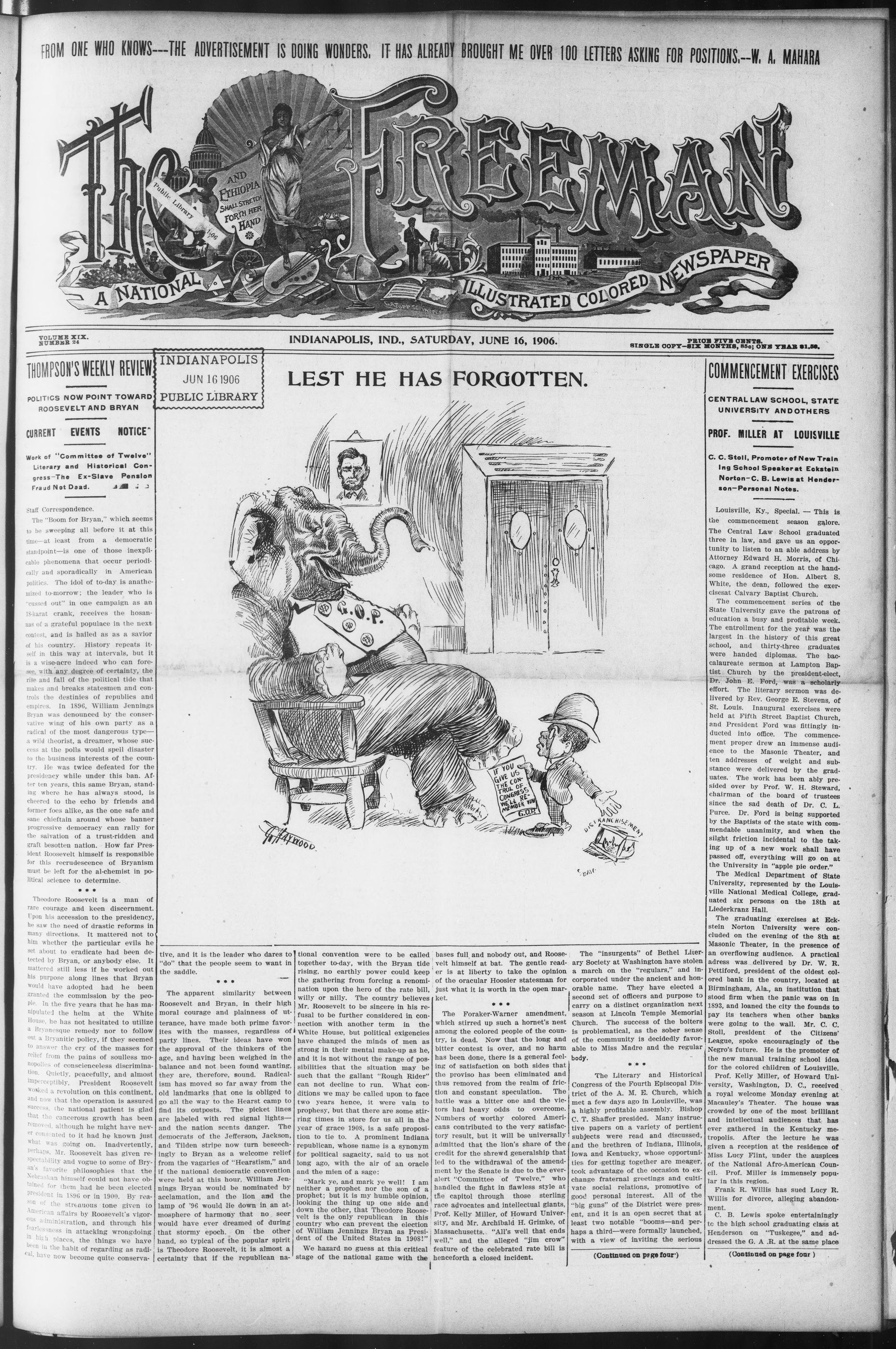
IF YOU GIVE US THE CONTROL OF CONGRESS WE'LL RE-MEMBER YOU
HAYWOOD
DIGITRANCHISEMENT
DAIC
INDIANAPOLIS
JUN 16 1906
PUBLIC LIBRARY
J. H.
tive, and it is the leader who dares to "do" that the people seem to want in the saddle.
***
The apparent similarity between Roosevelt and Bryan, in their high moral courage and plainness of utterance, have made both prime favorites with the masses, regardless of party lines. Their ideas have won the approval of the thinkers of the age, and having been weighed in the balance and not been found wanting, they are, therefore, sound. Radicalism has moved so far away from the old landmarks that one is obliged to go all the way to the Hearst camp to find its outposts. The picket lines are labeled with red signal lights—and the nation scents danger. The democrats of the Jefferson, Jackson, and Tilden stripe now turn beseechingly to Bryan as a welcome relief from the vagaries of "Hearstism," and if the national democratic convention were held at this hour, William Jennings Bryan would be nominated by acclamation, and the lion and the lamp of '66 would lie down in an atmosphere of harmony that no seer would have ever dreamed of during stormy epoch. On the other hand, so typical of the popular spirit is Theodore Roosevelt, it is almost a certainty that if the republican na-
1
INDIANAPOLIS, IND., SATURDAY, JUNE 16, 1906.
tional convention were to be called together to-day, with the Bryan tide rising, no earthly power could keep the gathering from forcing a renomination upon the hero of the rate bill, willy or nilly. The country believes Mr. Roosevelt to be sincere in his refusal to be further considered in connection with another term in the White House, but political exigencies have changed the minds of men as strong in their mental make-up as he, and it is not without the range of possibilities that the situation may be such that the gallant "Rough Rider" can not decline to run. What conditions we may be called upon to face two years hence, it were vain to prophesy, but that there are some stirring times in store for us all in the year of grace 1908, is a safe proposition to tie to. A prominent Indiana republican, whose name is a synonym for political sagacity, said to us not long ago, with the air of an oracle and the mien of a sage:
"Mark ye, and mark ye well! I am neither a prophet nor the son of a prophet; but it is my humble opinion, looking the thing up one side and down the other, that Theodore Roosevelt is the only republican in this country who can prevent the election of William Jennings Bryan as President of the United States in 1908!" We hazard no guess at this critical stage of the national game with the
bases full and nobody out, and Roosevelt himself at bat. The gentle reader is at liberty to take the opinion of the oracular Hoosier statesman for just what it is worth in the open market.
***
The Foraker-Warner amendment, which stirred up such a hornet's nest among the colored people of the country, is dead. Now that the long and bitter contest is over, and no harm has been done, there is a general feeling of satisfaction on both sides that the proviso has been eliminated and thus removed from the realm of friction and constant speculation. The battle was a bitter one and the victors had heavy odds to overcome. Numbers of worthy colored Americans contributed to the very satisfactory result, but it will be universally admitted that the lion's share of the credit for the shrewd generalship that led to the withdrawal of the amendment by the Senate is due to the ever-alert "Committee of Twelve," who handled the fight in flawless style at the capitol through those sterling race advocates and intellectual giants, Prof. Kelly Miller, of Howard University, and Mr. Archibald H. Grimke, of Massachusetts. "All's well that ends well," and the alleged "jim crow" feature of the celebrated rate bill is henceforth a closed incident.
PRICE FIVE CENTS.
SINGLE COPY-SIX MONTHS, 85c; ONE YEAR $1.50.
The "insurgents" of Bethel Literary Society at Washington have stolen a march on the "regulars," and incorporated under the ancient and honorable name. They have elected a second set of officers and purpose to carry on a distinct organization next season at Lincoln Temple Memorial Church. The success of the bolters is problematical, as the sober sense of the community is decidedly favorable to Miss Madre and the regular body.
**
The Literary and Historical Congress of the Fourth Episcopal District of the A. M. E. Church, which met a few days ago in Louisville, was a highly profitable assembly. Bishop C. T. Shaffer presided. Many instructive papers on a variety of pertinent subjects were read and discussed, and the brethren of Indiana, Illinois, Iowa and Kentucky, whose opportunities for getting together are meager, took advantage of the occasion to exchange fraternal greetings and cultivate social relations, promotive of good personal interest. All of the "big guns" of the District were present, and it is an open secret that at least two notable "booms—and perhaps a third—were formally launched, with a view of inviting the serious
(Continued on page four.)
COMMENCEMENT EXERCISES
CENTRAL LAW SCHOOL, STATE UNIVERSITY ANDOTHERS
PROF. MILLER AT LOUISVILLE
C. C. Stoll, Promoter of New Train Ing School Speaker at Eckstein Norton-C. B. Lewis at Henderson-Personal Notes.
Louisville, Ky., Special. — This is the commencement season galore. The Central Law School graduated three in law, and gave us an opportunity to listen to an able address by Attorney Edward H. Morris, of Chicago. A grand reception at the handsome residence of Hon. Albert S. White, the dean, followed the exercisesat Calvary Baptist Church.
The commencement series of the State University gave the patrons of education a busy and profitable week. The enrollment for the year was the largest in the history of this great school, and thirty-three graduates were handed diplomas. The baccalaureate sermon at Lampton Baptist Church by the president-elect, Dr. John E. Ford, was a scholarly effort. The literary sermon was delivered by Rev. George E. Stevens, of St. Louis. Inaugural exercises were held at Fifth Street Baptist Church, and President Ford was fittingly inducted into office. The commencement proper drew an immense audience to the Masonic Theater, and ten addresses of weight and substance were delivered by the graduates. The work has been ably presided over by Prof. W. H. Steward, chairman of the board of trustees since the sad death of Dr. C. L. Purce. Dr. Dr. Ford is being supported by the Baptists of the state with commendable unanimity, and when the slight friction incidental to the taking up of a new work shall have passed off, everything will go on at the University in "apple pie order."
The Medical Department of State University, represented by the Louisville National Medical College, graduated six persons on the 18th at Liederkranz Hall. The graduating exercises at Eckstein Norton University were concluded on the evening of the 8th at Masonic Theater, in the presence of an overflowing audience. A practical address was delivered by Dr. W. R. Pettiford, president of the oldest colored bank in the country, located at Birmingham, Ala., an institution that stood firm when the panic was on in 1893, and loaned the city the founds to pay its teachers when other banks were going to the wall. Mr. C. C. Stoll, president of the Citizens' League, spoke encouragingly of the Negro's future. He is the promoter of the new manual training school idea for the colored children of Louisville.
Prof. Kelly Miller, of Howard University, Washington, D. C., received a royal welcome Monday evening at Macauley's Theater. The house was crowded by one of the most brilliant and intellectual audiences that has ever gathered in the Kentucky metropolis. After the lecture he was given a reception at the residence of Miss Lucy Flint, under the auspices of the National Afro-American Council. Prof. Miller is immensely popular in this region.
Frank R. Willis has sued Lucy R. Willis for divorce, alleging abandonment.
C. B. Lewis spoke entertainingly to the high school graduating class at Henderson on "Tuskegee," and addressed the G. A. R. at the same place
(Continued on page four)
Coy Ee —_—_—_——
CT, g ray ——¢
My oP Mi Aoi
Li, WOMANS
Tae 9 If) ,
6-74), | WORLD,
ae = <
LMA ==>
MU IGS a
a OAc = BY “DOROTHY”
Ee seh
} ANE i Ay ‘This column is devoted to the interests «
s) VE GM Tees AS pecans sotiaictaris
’
FORD’S HAIR POMADE
FORMERLY KNOWN AS
“OZONIZED OX MARROW”
Makes the Hair Long, Soft and Easy to Comb
READ WHAT THE PEOPLE SAY
Key West, Fla., Aug, 28, 198, Weat Chester, Pa. Meh, 90,1965.
hair haw mopped bresitngod Sha hao etecry ont. Tuya rth ne md, Halt all cane
improved. When starved usingthis wonderful wow my halt ts ine ineheg lose abd nae
preparation my hair was seven faches long and And ice and straight, Most erers one accion
‘ow itis ten inches or more. Yours truly, how good your pomade did my hair, they. tos
31 Southard St- ‘tmx Foasees. —arvravlous for FeAl hate aan
ae ee ae Srery one.” Yours respeetiullyy “Bena Bre,
jcatlemen’ Tumut coniess ABRs. ieee ner ae
never tried aw'prepsriten id cs + Meh. 31,
foeralent tortion sty a © T have used ‘ono bottle of
iewastaminggay and vas Sl ; your pomade and my hair
fie cee ae By ie is_-now perfectly. straight,
ec haic hes Focaed beck ke 4 soft and black as silk. Iwill
Ria wion tess agiand = a De ba when ze
ithasalively,gioay Sloe” = an * w
vhsalsee fPgonrers. Ce Weg Ruopa Epwanos,
Atlanta, Ga., Jan 6,100, Paris, Mo.. July 15,159,
Gentlemen: I have used your pomade and Gentlemen: When T'bogan dane bade
AGENT anetectine iy Romtaetel niente! i Sa tee
Breakin off nd cleans the ealgand makes the ® all over ray head andl uave' been uring ity
Nair soft.pllable and glossy." Atncais Manin’ taro Taonth, Tos Biers
Thave seen the original letters and testify to the genuinouess of tho statements.
= ERWCOD ©. KNOX Manager The Freeman. |
FORD'S HAI MADE, formerly known as “OZONIZED OX MARROW."
‘uralentens Munky or Curly Huaigiar'y tun, 2°, OLONIZED, O MARROW.” so
ith ita Jongeh. and is the only sate preparation knowa to us that tales inky Of Curie
uni Sigh vi tutes ube lone akan e cet dtabbotae RAB? Cac a
curly hair soft, pliable and easy to comb, ‘These results may be obtained from one
treatinent; 2 to 4 bottles are usually suficient for a year. ‘The use of FORD'S MALI.
POMADE (“OZONIZED OX MARROW") removes and prevents dandruff, relieves
itching, invigorates the scalp, stops the hair from failing out or breaking off wanes ie asoee
gacty poate root, Gives now life and igor Delag_ omantiy pertumed gi
harmlens, it isa tollet nécossity tor ladies, gentlemen and childrea, FORD'S MATIC
POMADE (OZONIZED OX MAKHOW) fatpmes and caldren,, LORDS MARR
about 1888, and the label, “OZONIZED OX MARROW." was registered in ‘the Uuived Stee
Patent Office in 1874. In all that long period of time there has never been a bottle returned.
from the hundreds of thousands wehavesold. FORD'S HAIR POMADE remains sweet
BE SEEARGRR Sore and BETASLe erarsericatadcha netstat tie BO SRS
ns SORT an JB. “Beware of imitations. Rem a
WATE POM ADEC O20NIZED O8 MARTOW eae one BOS snd eae
only in Chicazo and by us. ‘The genuine has the signature, Chaties Ford, Preston each
Package. Refuse all others, Full directions with every bottle. Price only 50c. Sold by
Gruggists and dealers. If your druggist or dealer cannot supply you, be can a ‘it from:
his jobber or wholesale dealer. or send us 80e. for one bottle, Postpaid. oF B1,i0 for three
bottles, o S90 for lx Yotiles, crores: pala." We Day postage and expres changes to ail
Points in U.S. A. "When ordering mend ontal Or express mousy order. and mention name
Of paper you saw this advertisement Iu. Write your aame and address Plainly to
. THE OZONIZED OX MARROW CO. a .
Dept. A, 76 Wabash Ave. Chicage, Til. @L,,4; Prt Bad
‘(lone geasine without my slgnaters, Agents Wanted overrwbare) te. 4
ADVIOE.
If you can sing # happy ong,
Ob, do not fail to sing it;
But let it warble forth so loud
‘That echoes afar will ring it!
If you ean do some kindly deed,
On, do not fail to do it;
For every good deed done on earth
Leads heavenward, if you knew It’
‘Two ambitions women at Topeka,
Kans., are engaging extensively in
poultry business
Poultry —- Mrs. G@, W. Crockett
Raising basa beantifal home
with four lots and a
a nice cottage of five rooms which she
and her husband have earned by bard
work. Mrs, Crockett was employed
several years at the National Hotel as
pastry cook and she decided a short
while ago to begin business for herself
by raising poultry. She purchased two
incubators and seyeral hundred chick-
ens have been hatched und are doing
fine, Mre, Grandy Thompson, at Low-
man Hill, eubarb of Topeka, 1s also
makeing great hesdway inthe chicken
business, having purchased an incuba-
tor and several hundred have been
hatched, She is very enthulstastic and
thinksthat ina year she will have a
few handred dollars to her oredit in
the bank or in a five acre tract of land
to go into the business more extensive
ly. This industry will perhaps be
vome qaite popular. The invention of
the incubhtor is quite # boon to the in-
dustry, saving much worry and incon-
venience. This business is one among
several in which women may safely em-
bark and still be able to attendto their
honsehold duties.
It is sald that marriage is an Institu-
ton highly conducive to the health of
both husband and
Marry and husband and wife
Live Longer. Statistios prove that
among married men
over twenty years of age aud women
over forty the mortality rate is far les
than among those who remain single
Among the widowed and divorced th:
mortality 1s exceptionally greal. Sul-
oldes among the unmarried are much
more numerous than among the marrl
ed. The matrimonial state promotes
Ttemperauce in every form. Further-
more, the probable daration‘of life of 8
married man of thirty exceeds that of
his unmarried brother by five years
and the wife may expeot to live one
year longer.
Miss Anns Gray. formerly of Boston,
has received # reward of 3000. At
the time of the earthquake at San
Franotsco, Miss Gray had in her
charge at the Grand Central Hotel, the
two children of Mr. and Mrs. Moore
‘When the shock came Mies Gray suc-
cecded in ercaping to Los Angeles. The
THE EREEMAN, AN ILLUSTRATED COLORED NEWSPAPER.
overjoyed parents gave her the money
in appreciation of her faithfulness.
Miss Lulu V. Ross, is the superin-
tendent of the Afro-American Indus
trialand Benefit Insurance Company
at Green Core Springs, Fla'.and Miss
Bertha Jenkins has charge of the work
at Magnolia Lprings. Both are quite
efficient and are doing a good business.
Dr. Relch comforted the women in
one of his famous lectures by telling
them that ‘the man who has not loved
‘@ woman in his life is no man.”
Mies Graqueelis @. Riley, was one of
the graduates of the Madisonyille, (0.)
High School last week
Mies Lottie Tyler, of Chicago 1s con
nested with the Weekly Reporter as
collector.
There are no newsboys in Spain,
Women sell newspapers on the street.
Enthusiasm sets the psce bat com-
‘mon sense wins in 8 walk.
Every woman thinks her husband th
wieest person in the world excep
herself.
GATE CITY HAPPENINGS
| The past week witnessed one of
‘the most successful scholarist years
known in the history of this—the hub
‘of southern brain factories, I am
‘safe in saying there were more than
one hnudred graduates from the va-
rious colleges, viz; Morris Brown,
Atlanta University, Clark University,
Spellman Seminary, which youches
safe that any qualification based upon
intelligence without grandfather
clauses, puts no fear upon the Negro
fin Georgia. Too much cannot be
said in praise for the good work our
various colleges and schools are ac-
complishing. The Negro children
are getting anxious about their fu-
‘ture, and attend school willingly, and
‘to good result.
Col. Thompson's able indorsement
of Hon. J. W. Lyons, in your issue of
the 26th inst., meets the hearty ap-
proval of all honest men in Georgia,
irrespective of color, Previous to
his appointment as Register no man
tm or out of this state ever for once
doubted his high and lofty charac-
ter and undisputed honesty, notwith-
standing a few disgruntled, disap-
pointed tin horn politicians, who at-
tempt to attract attention and’ noto-
riety to their worthless selves by at-
tacking honorable men. The people
of Georgia anxiously await his home-
coming, and regardless wherever he
may dwell, the colored people of this
state delight to do him honor because
he richly deserves it
The state of Georgia is being
flooded with circulars sent out from
Atlanta District Grand Secretary's
office of the Grand United Order of
Odd Fellows, soliciting delegates and
votes for the position of Grand Treas-
urer. The scheme is to place the At
lanta man treasurer and to make a
Mississippi preacher Grand Master.
‘The circular mentioned above has the
cut of the candidate. { doubt very
seriously if the order—that numbers
among its members such men as the
lamented Peter Ogden and David B.
Bouser, and among the living such
noble Romans as Wm, M. F. Forester,
Hon, E. H. Morris, Robt. Small, Chas.
B. Brooks, Geo, E. Temple, Hon. J.
#8, Reed and our Madison Vance, will
tolerate the methods of political heei-
ers. The order in finance, intelligence
and numbers ranks among the leading
colored organizations of the world,
and, to be truthful, I can never be
made to believe the funds and keeping
of this glorious order will be turned
over to men heretofore méntioned.
G, M. Howell and his assistants are
working like trojans to make a sue-
cess of the National Negro Business
League, which convenes in this city in
August, The business men of the city
are taking a lively interest in the
meeting, thereby guaranteeing a suc-
cess.
Persons in Birmingham, Als. can
secure copies of the Freeman each week
from Mr. Jno. W. Coarat the Alabama
Penny Savings Bank Bldg. Call and
secure a copy of the paper each week
from him.
“MYSELF AND ME.”
1 Vv.
I'm the best pal | ever had, I never try to creat me,
I like to be with me; I'm trathful as can be !
1 like to sit and tell m/self No matter what may come or go,
Things confidentially. I'm on the square with me.
un. vie
J often sit and ask me It’s great to know yourself and have
If [shouldn't or | should, A pal that's all your own ;
‘And I find that my advice tome | To be sucn company for yourself
Is always prestty good. ‘You're never left alone,
Mm. vil.
I never got acquainted with You'll try to dodge the masses
Myself till here of late, And you'll find a crowd's a joke
And I find myseif a bully chum, | If you oniy treat yourself as well
Itreat me simply great. As you treat other folk.
Iv. vu.
Italk with me and walk with me | I've made a study of myself,
‘And show me right and wrong: |. Compared with me the lot,
Inever knew how well myself And I’ve finally concluded
‘And me could get aiong. I'm the best friend I've got.
Ix,
Just get together with yourself
And trast yourself with you, .
And you'll be surprised how well yourself
Will like you if you do.
i —Times-Star. |
e
\ i)
s >
’ D} bmn ALTA
“9 EEO AN} =, AY AY
je. Sige eae MATING, & «
53) i eee ES
Ki Ae Spe . 3 Ps
= oS ear | af
LER gp pay
CNM eI Ary
se Sve s
pte
oy
The businees men of Dayton heveor-|who owned the “point” at Illi
ganized a league, street and Kentucky ave,, and die
— Cairo, Egypt, let January while n
Prof. R. J. Moxley has opened a pho-|ing tour abroad.
tograph gallery at Cleveland, O: _
. — ‘The colored people of the country
In Waskington’s thme there were 21, |still running and patronizing ex
824 Negro slaves in New Yorkstate. |#lons putting thelr money into
a railroad companies instead of put
The Wage Earners and Loan and|thelr boys and girls to some kit
Investment Company, the pioneer Ne-| Profitable employment to make t!
gro Savings Bank is an inetitution at} Usefal citizens:
Savanah, Ga. sani
| Samuel E. Woods wastgiven the con-
tract by the Board; of} Education fat
Cleveland for the concrete work at one
of the city echools.
Major Allan A. Wesleyzhas received
‘8 beantifal medal for bis long and hon-
orable cervice inthe ‘Eighth Regiment
of the Illinois National Guards.
The colored people of Topeka have
lasagurated{a movsment to raise $1 000
toward helping The Industrial Insti-
i meet the Carnegie proposition.
_ Rev. Washington {E. Gladden has
been appoiated chaplain in the army
with the;rank offoaptain. He was as-
signed to duty with the Twenty-fourth
Infantry now stationed {in the Phillp-
pines. .
George Welr, of Onicago, rephew of
the late David H. Welr, is one of the
best ice-cream makers of that city. In
the day he is employed downjtown and
atnight be manufactures} cresm for
one of the largest dealers in the city’
‘The Colored Orphans Home, at In-
Alanapapolis, bas been left $4,000 by
the wil of the late Thomas J. Emery,
PROGRESS ALONG ALL LINES
MANY LEADING NEGROES IN
THE COMMUNITY
THRIFT AND ENERGY THE MOTTO
The Ministers a Real Help to the
People—Teachers Doing an ve
cellent Work—Professions and
Business Well Represented.
Henderson, Ky., June 2, 1906.
Special—This city is one of the
many places of Kentucky that have
kept apace with progressive move-
mients along the lines of business ed-
ueation, morality and the purchasing
of property. There is a deal of
praise due some of the worthy citi-
zens of Henderson, but we will guard
against the prevalent habit of giving
unlimited praise, but in a brief way
mention those whom we met that are
making substantial progress. ‘The
measure of one’s achievements and
success in life in any field of human
activity, is in direct proportion to the
distance one has to come and the
character of, the road which they
have traveled, The road at Hender-
son has been rather rocky, but there
are today many leading Negro citi-
zens in the community in spite of cir-
cumstances. ‘The recent addresses
by the men of the North and men of
~~ owned the “point” at Ilinol®
street and Kentucky ave,, and died at
Osiro, Egypt, last January while mak-
ing tour abroad.
‘The colored people of the country are
still running and patronizing exour-
slons putting thelr money into the
railroad companies instead of putting
their boys and girls to some kind of
Profitable employment to make them
usefal eltizens:
‘The Anniston Electric Street Falr
Company is now extending ite street
Railway through Hobeon City, Ga., the
only exclusive Negro town in the South
with thelr own mayor and policeman
‘and the entire olty government, a sche-
dale allowing persons to go to and from
work morning and night will be ron at
only five cents cash fare. The Hobson
City Park Co., has Iaid out » park of
fifteen acres on which will be erected &
large auditorium. The clty has eleo-
tric lights and water.
‘The cornerstone of the new home of
the Orpban asylum for colored childre»
at Riverdale, near New York was laid
May 17, by Mrs. Willard Parker. The
Rev. Dr. Carson of the Riverdale Meth
‘odist Eplecopal oburch and the Rev
Dr. Gilbert of New York conducted
the services. The new home will con-
sist of one main building given over to
classrooms, 81x cotteses for the accom:
modation of the orphans, a residence
for the superintendent, and s power
house, ‘The cost will be $500,000 and
the buildings will be ready for cosn-
pancy in one year The funds to meet
the cost of the new buildings were
raised by the;sale of the present asyinm
Property, at Amsterdam avenue and
1431 otreet.} 1
ees
read here by the white and colored,
and quite a good feeling is being
manifested toward the Negroes edu-
cationally. Prof. Jones is principal
of the high school, and is ably as-
sisted by eleven teachers. Their
work compares favorably with any in
the state, Prof. Jones is a man of
the people and ever alert for that
which is best in his line, The Eighth
street school, under Prof. Bryant, 1s
doing excellent work and has con-
nected with it a Camegie library.
‘The ministerial profession is headed
by Revs. Francis, Kennedy, Mundy
and Goff. The churches are fortu-
nate in having Christian gentlemen
of intelligence who are really helping
the people morally and religiously.
‘The medical fraternity is largely rep-
resented by Meharry University.
Most of them have taken post courses
at the leading universities. Among
the physicians of high standing in
their profession and as representa:
tive citizens are Drs. Gowdy, O'Neal,
Armstead and Weston.
C. M. Cabell, the undertaker, states
that he believes the doctors are too
learned and skillful, as business is too
slow.
H. F. Jones is a lawyer and practi-
tioner in the civil courts. He is a
final outcome of the Springfield af-
graduate of Howard Law School, a
worthy and proficient gentleman.
There are in proportion to the size
of the place many aggressive busi-
ness men and women who own a
great deal of real estate, good bust-
ness places and are employed in
many voeations that are honorable
and creditable to the race. There
are about 4,000 Negroes, and they
pay taxes on $150,000 worth of prop-
erty, says the city receiver.
It is amazing to see the city of Hen-
derson with its progressive business
enterprises, standing as a monument
to their thrift and energy. Mr, A. H.
Cabell, the most well-known citizen
in this section, has been in the gro-
cery business for over twenty years.
Mr. Cabell has attended nearly every
National Negro Business Men’s Lea-
gue and has been the chief promoter
in infusing business ideas and race
patronage among his people. Mr. Ca-
bell has distinguished himself as a
race lover. He is owner of a deal of
property, and has purchased a park
for the colored people, known as Ca-
bell’s park. Devotion to duty and
self-sacrificing toil have made his
business a success. Mrs. Cabell is
President R. G. Shaw Circle No. 5
Ladies of the G. A. R. Miss Viola
Cabell is their cultured and refined
daughter, and teaches in Alves High
School.
“chas. Beverly conducts an uphol-
stery, and has been in business ten
years. Having but meager educa-
tional opportunities he began slowly
with his trade, and today he owns a
shop of large dimensions and does
most of the business of the town. He
is now on the verge of making con-
tracts to do a larger business, neces-
sitating the employment of more
help.
E. H. Brown is king of horseshoers.
White and colored from miles around
come to him for their work. He
‘makes hand-made shoes of every de-
Scription a specialty, and is a wagon
builder of much experience. He has
one of the best paying businesses of
the town,
F. B. Doxey is one of the few col-
ored barbers who has kept up with
the tonsorial art. His place is well
frescoed, electric lighted, handsome
mirrors, five hydraulic chairs, com-
pressed air for massage and fans.
Mrs. I. L. Hall is the first and only
colored lady grocery keeper in the
state. She has been in business for
six months. She is much encouraged
and asks the support of her race.
Mrs. Hall is polite and has many
business traits. She reads the Free-
man and speaks well of the Race
Gleaning column,
George Hatchet conducts an_up-
to-date tonsorial parlor, with three
chairs, at 700 Dixon street. When
Pythians meet, Mr. Hatchett will wel-
come the brave boys with Kentucky
hospitable fashion.
Mrs. B. H. Brown has a lovely ice
cream and soda parlor, and does a
rushing business, especially on Sun-
days.
Mesdames White and Majors have
very creditable modiste establish-
ments, and are generally patronized.
“The Visitor,” edited by Rev. Ken-
nedy, and the “Church,” by” Rev.
Francis, are bi-monthly papers, and
are doing much in this section to
stimulate the race in many ways.
Wi Masta s_ & shocmakor anaovc
STORY OF A REMARKARE
INVENTION
;
THAT WILL EARN THous
| OF DotLars ANOS
Should those who have an tnvey
fve turn of mind devote to's taint
to the little things of life, those a
every day use, greater financial get
gess would no doubt atica thelr ¢
forts. a
Tt is the simple inventions thy
have alawys eared tic arogtit
sums; for instance the sowing at
chine, telephone, bar wine
brake, Kodak, phonograyn t) a
nothing of hundreds of stil smaie.
things.
A modern example of tho caring
capacity of simple thins is the sig
machine to sell small articles, get
of the latest of which is desisned tg
sell pencils.
(rar ue
: sala
=
Gece
Sy
Nit)
Met oter cl
LAY Gat d
| SHES dw |
ON IL Sse
This is a picture of the slot ma.
chine to sell five cent lead pencils
It is a very small machine, being
about fifteen inches high and cignt
inches wide, but it holds 250 pencils
in readiness for the American people
who use annually almost nine hun
dred million of them.
This machine, which has recently
been put out for public patronage, js
a wonderful device, needing no clerk,
paying no rent, and it will not take
a slug. It will be at work nights ang
days, Sundays and holidays, taking
in nickels in exchange for’ pencils,
and earning fabulous sums for its
owners,
| It was originally planned to put in
school buildings where the thousands
of students could secure pencils whea
needing them, but later it was found
so excellent a salesman that it is
now being put in hotels, depots, of
fice building entrances, and many
other places throughout the country,
A few years ago no one heard of @
slot machine, but now there are thow
sands in use, and they have opened a
vast source of revenue in selling
many small articles of daily use, but
it remained for a Los Angeles com
pany to secure exclusive and value.
ble patents to sell lead pencils
through a machine.
A unique plan has been devised to
make the machine popular and insure
patronage by forming a stock com
pany, divided into shares, the owners
of the stock to share in the proiis
of the hundreds of machines and at-
vertise them everywhere.
‘There are three thousand shares at
face value of one hundred dollars
each, which are being sold at $50
each’ now, but will soon sell at $100
each. The money is to be used io
forwarding the interest of the com
pany and in putting out many more
machines.
To give an idea of the tremeniow
profit that will attend the sale of
lead pencils, a single machine selling
but ten penclis a day, at a profit of
three cents a pencil, will earn more
than $100 a year. From these figures
you can easily estimate the enormous
profit to be derived form 1,000 me
chines, or more, yourself. ‘This com
Pany expects to put out 400,000 ma
chines in the United States alone. In
addition each machine is fitted withs
revolving cylinder on which are ai
vertising spaces that will earn addi:
tional hundreds of dollars yearly. The
cost of the machines being less than
ten dollars each, leaves a profit ab
most unbelievable when many thot
sand machines are at work.
Should the readers of this paper
be interested in sharing the profits
of this machine, they should write J
W. Musselman, 225 Mason Building
Los Angeles, California, asking him
to reserve a share or two of the
stock at $50 a share, before it hes al
been sold; or better yet, make ar
mittance with the letier to insure hit
holding the stock for you.
The Company is already operating
on the Pacific Coast, and the mi
chines will spread eastward as thelr
utility becomes known. The proft
should be enormous, dealing 95 the!
are in a necessity and at the prof
contained in a five cent lead pent!
There will undoubtedly be itt
dends yet this year, which will with
in a few months canse the stock ©
go from the present price of $58
share to much above $1), which §
Par, as there are but 3,0) shares !
divide the profits among.
If our readers have not the enti
suin in cash ,with which to purchase
the stock, a letter written to Mf
Musselman will no doubt tein Ms
consent for you to purchase it on th
easy payment plan.
Don't delay: write at once to Mf
Musselman for the booklet which Oh
company has published twine a
about the machines, and lst th
are earning selling ical pencils
through their slot machines.
Your Past, Present, Future
Accurately Told.
q Hidden Treas
test oar
be] ¥e Sepsra pol
| xe Sond na.ae. #6
ie Fens Sac ot we
: Bod hacer
Bis 6 Wag Readioe* 0
Gag Have perioral
aw: Special ser
Na {or
2 Europea’ Ral
Prof J.A, PASHA, Oriental stro
itis NaytorCog Buikdang, sth and 88
Torre Haute, 100.
THE FREEMAN
NATIONAL ILLUSTRATED
COLORED NEWSPAPER.
PUBLISHED EVERY SATURDAY
At 309 Indiana Avenue,
INDIANAPOLIS, INDIANA.
SUBSCRIPTION RATES
Any part of the United States and Canada,
one year, postage paid $1.60
Six Month ..... 85
Three Months ..... 60
Foreign Countries ..... $1.00 extra
Send money by express, money order, post
ADVERTISING RATES:
Five cents per line. Fase of measure—solid
agate, 14 lines to an inc. 276 lines in a column.
Special position 25 per cent additional. **No**
advertisement inserted on first page. Special
rates on standing professional and business
cards. Reasonable discount for long time and
space. Reading notices 10c per line. Special
rates on WR-TE UPS.
Entered at the postoffice at Indianapolis,
Indiana, as second class matter.
All matter should be addressed to
The Freeman Publishing
Company,
INDIANAPOLIS, - INDIANA.
SATURDAY, JUNE 16, 1906.
THE BRYAN WAVE.
Just what is to be the final result of the wave setting in in the direction of William Jennings Bryan cannot be seen at this early date. But that it is spontaneous and springs from the masses, there can be no doubt. It is not of the kind that is planned, doctored, and hatched at a star chamber session of a few professional politicians. It bears none of the symptoms of a cunningly devised scheme in the interests of political schemers. It is an undeniable proof that the man has grown, in spite of the fact that his political enemies have preached several sermons over his supposed remains. So, it is not surprising that these should stand agast at his sudden appearance in apparently the best of political health. But, after all, has the re-apearance of Bryan in such healthy form been sudden? Has not his growth been constant, and unnoticed only by those who sleep between campaigns? The fact of the matter is that we have had but one question constantly pressing for settlement in a half century, and that has been some form of "special privilege." Even the question of slavery was the extreme form of the right of one person to take from another without making adequate return. There was a time when industries needed the protection of the general government while they were being developed to the point where they might stand alone. They grew and flourished, but never reached the point where they were willing to take their hands out of the pockets of the people. They have fattened into trusts and combines that have so long elected legislatures, congressmen, and presidents, until they feel that they plunder the people by divine right, and, ever stimulated by their greed for gain, have hatched out nine tenths of the social and political ills from which the country suffers. It was by no intention of those industrial buccaneers that such a man as Theodore Roosevelt found his way into the white House. They did not know him, but he is there, and very much there at that. His bull-dog honesty and his sense of fair play led him to take a look into some of the doings of our "infant industries," and lo, and behold, he has uncovered systems of public plunder worse than Bryan alleged in 1896 and 1900. Put this with the fact that the people have been doing a little growing themselves, is it to be wondered that there should be a "Bryan wave?" For this let Republicans blame themselves. The doctrine of "stand pat" is doing its work. The Republicans will either remove the tariff from all articles controlled by a trust or else the people will send some one to Washington who will do
LINCOLN'S CABIN.
The Cabin in which Abraham Lincoln was born was on exhibition in this city on last Tuesday. It had been brought here from New York, and was on its way to Louisville, Ky., where it will be on exhibition during "Home Coming" week. But we did not put aside our morning paper and walk the five squares necessary to see it. Nor was this lack of interest at all due to any lack of appreciation of the man whose name is associated with this historic relic. On the contrary, we regard Lincoln as the greatest of our Presidents; greatest because of his largeness as a man; because of his ability to see the just relation of things; because of his unerring judgment and his love of justice. And we know of nothing this country needs more than it does the elements in his make up which made him great. It is this Lincoln spirit of justice and fairness, of honesty and kindness, that the American people need to know and
THE FREEMAN. AN ILLUSTRATED COLORED NEWSPAPER.
eel, and put into active practice in their lives. Hauling Lincoln's cabin around and gazing on its remodeled form will not give this spirit. To us it seems a half sa $\textcircled{1}$ rilege to take this cabin from the place where it was erected and cart it around over the country. Does such a performance do honor to him or show that we really admire his character and revere his name? "If you love me keep my commandments." If those who flock to see this cabin would only put as much effort in an attempt to practice the [commandments of which his life was the expression it would show that they loved him, and that what they do was prompted by something higher than mere curiosity. The conduct of the American people is sufficient proof that they are not concerned about the virtues of Lincoln. So while they crowd to get a look at the cabin we will sit and think on the sad, calm face of him who loved his fellow men.
EDUCATION AND REFINE-MENT.
The Forum, of Springfild, Ill., quotes this paper as saying—"It is not money nor education that the Negro most needs, but it is refinement." It then adds—"It is hard to be 'refined' in the broadest sense of the word without being educated." If the Forum will reverse that statement it will be nearer correct. But we will leave the discussion of that point to the Forum and others who wish to agree with it. We desire it to restate that refinement is our greatest need, and yet it may be had without money or price. It is as free as the air we breathe, needing no investment of capital to secure it. The absence of refinement gives us the "jim crow Negro," and the "jim crow Negro" has brought the jim crow car and nine-tenths of our just complaints. One loud mouthed Negro can do more injury than ten good men can repair. It is our honest belief that the "jim crow Negro" is directly responsible for the ills from which we suffer. He is a nulsance wherever and whenever found, and offends the sense of all decent people alike. He is an abomination to the land, a curse to the race, and offense to the Almighty. See him and hear him when you will, and you will find that it requires some self-restraint to keep you from hating him. If this is true of you, what must be the effect on those who have no kinship or feel no common cause with him?
But, after all, what right has anyone to hate him, much less to hate those who are in no wise responsible for him? Is he not the logical product of the white man's sins? Is he not the product of condition that have been made for him? Should the father who has sinned hate his own child because it has sorofula? We can hardly forgive him for being what he is, but every "jim crow Negro" can trace the responsibility for what he is back to some jim crow white man of today or yesterday. But this will not change the fact of his presence. He is here, and must be changed by growth from within and pressure from without. Whatever the method which brings the change, may the time soon come when he shall disappear from our midst.
A correspondent writes us from Arkansas and asks our advice as to the wisdom of colored men joining the socialist. Our reply is that every man, regardless of race or color should act with the party that most nearly represents his honest convictions. Any thing which will help break up the black republican mass will help the race. This must be done before we can amount to anything politically.
The two versions of Rev. Ransom's trip to the South and the treatment accorded him, differ very materially. We are inclined to believe all that he says as to his treatment by the railway employees. We regret however, that past rumors make it impossible for us to deny the statement of the Montgomery Advertiser that he appeared at the school at Normal, Ala., in an intoxicated condition.
Clinton H. Howard, of Rochester, N. Y., who delivered the principal address at the recent State Prohibition Convention in this city made the startling statement that there are fewer saloons in the solid South with its twenty millions of people, than in the one Republican state of New York. In Georgia there is one saloon for every 4800 people. In New York there is one saloon for every 58 voters.
If you want the fullest resort of Tuskegee's Anniversary with its numerous speeches of the eminent men on the program you should send for a copy of the Tuskegee Student. That collection of speeches is worth many times the cost.
FORTY YEARS A FREEMAN. By George H. Jones
The word comes to us that all Japanese are to be discharged from the American Navy and their places filled by Colored men. This is said to be the effect of Japanese having been found copying the plans of war vessels.
Judging from what those people have done during the past two years we do not think they have much to learn from the American Navy.
A man in Kansas has refused an appointment to a vancancy in the United State Senate. There are a number of remarkable people in Kansas, but there are not many like this man. If he had not have said that he was a strong party man he would have shown himself to be a high-grade citizen.
There are so many bands of the Negro brimstone religionists that they have to work on the favored corners in the "black belt" of this city in relays. So far as we have heard them they all seem to have good lungs.
Judson W. Lyons is expected in the city on the 28 to deliver a lecture under the au-
OUR visit to Jacksonville, Ill. On Saturday morning, April 21, we said good-bye to our friends at Springfield, Ill., and boarded a fast train over the Wabash R. R., for Jacksonville. We had spent the evening and apart of the previous day at the palatial home of Mr. H. K. Wilson one of 'Springfield's most prosperous business men. The day was delightful. And the green grass was just peeping through the meadow-land; the cheering notes of the song-birds mingled with the balmy morning breeze told us that spring, gentle spring, had come again.
Jacksonville is the justice seat of Morgan County, and has a population of about 14,000; about 2,000 of which are colored.
This beautiful little city is located 32 miles west of Springfield and is commonly called the "Farmer's Paradise" from the fact that a large number of wealthy retired farmers reside here. Most of the land in this section of the state is level and constitutes a prairie or table-land at a varying elevation ranging between 350 and 800 feet above the level of the sea.
As an agricultural region this section may be deemed the equal of any farming community in the union. The cereals, fruits and root crops yielding plentiful returns; and in fact, as a grain-growing section it has but few equals anywhere Stock raising is also carried on here on a very extensive and yearly expanding scale scale. The state lunatic, deaf and dumb and blind asphalts are located here. We visited
THOMPSON'S WEEKLY REVIEW
(CONTINUED FROM FIRST PAGE.)
consideration of the General Conference at Norfolk in 1908. It became definitely understood that Dr. D. P. Roberts, pastor of Quinn Chapel, Chicago, will stand for the Bishopric, and that Rev. A. J. Carey pastor of Bethel Church, of the same city, would like mighty well to be Secretary of the Sunday-School Union. Rev. L. E. Christy read an able paper on the fine points of journalism, which made a hit with the body. His superior knowledge of the true mission of journalism, coupled with his twenty years of actual experience in the business of newspaper-making, had the effect of starting a good-sized boom for him for the editorship of the Christian Recorder. These gentlemen are all well known to the general church. Drs. Roberts and Carey have pastored several of the connection's largest congregations in the leading cities of the country, and have been prominent in legislation and church building for a quarter of a century. It is the impression that they are in the race with the practical backing of the Fourth Episcopal District, but of what other combination they may be a part, is a matter that is arousing no small degree of speculation in the South and East, where there is an organization that keeps its eyes open night and day for new deals, and which the knowing ones say is too compact in every way to be smashed by any alliance that may be formed in direct opposition in the Northwest tier of conferences. We shall see what we shall see.
* * *
Arthur Pue Gorman is dead, and the world scarcely pauses at his bier to spread the mantle of charity over the multitude of sins that the judgment of history has laid at his door. For many years, Mr. Gorman was a factor in the affairs of the country, but never for the country's good. He was a leader in the State of Maryland, but his impress upon her political life will not redound to his or her credit, when the final account is rendered. That the crafty Marylander possessed abil-
spices of the Union Tabernacle Baptist Church.
If the republicans have not the sense and honesty to stop the turning of the tide against them they do not deserve to win the election of 1908.
Our fears have been realized. As we go to the press there comes to us a signed report of the Dr Ransom affair confirming the worst.
Figuratively speaking, Willian Randolph Hurst has taken the hide from our smiling Tom and hung it on the back fence to dry.
Very few colored people are in the town owing to the fact that this is "Home Coming Week" In Kentuckv.
The highest praise a serman receives may come from a man who slept undisturbed during its delivery.
There is hardly any use to become frightened so soon. It is a long time until November 1908.
Is it possible to make trousers large enough to suit the peg-headed dude?
these institutions and found that the time used in this way was very profitable and instructive. At the blind asylum the touch system is taught, which together with a knowledge of book keeping, enables any blind person to conduct a business enterprise on legitimate principals by the use of typewriter made especially for this work. The blind also print letters to their friends in distant cities and are thinking of publishing a newspaper which, if successful, will make them independent in a measure, at least, of the general public. Broom making, knitting, crocheting and many other renumerative trades are taught at this institution. It is indeed gratifying to know that even the blind can do something to assist themselves in the great battle of life. At the deaf and dumb asylum the inmates are taught what is called the sign language and deaf and dumb alphabet. This particular branch of science enables them to converse with any one. Cleanliness and rigid enforcement of the rules seem to be the predominating features most noticeable around the lunicit asylum. Our race however has but a poor showing at this institution. It has been said that the Negro did not have sense enough to go crazy. Probably this accounts for his absence from institutions of this kind.
Jacksonville has three colored churches several business enterprises and a colored military company second to none in the state. The enterprising colored citizens of Jacksonville is the subject our next article under this head.
ity, can not be denied, and had he used his resourceful intellectuality for the uplift of the whole people, instead of promoting, in devious and winding ways, narrow partisan and entirely selfish ends, he could easily have taken rank with the truly great Americans of his time. Not only was he disloyal to even the party he professed to serve when incorruptible Grover Cleveland was honestly trying to keep faith with the nation that had placed him in power, but Gorman was the most implacable enemy that the Negro race has ever had in the Congress of the United States, not even excepting that arch-agent of the devil, Ben Tillman. He was more dangerous than the fire-eating South Carolinian, because his opportunities for evel were greater—the Negroes about him had more to lose than those who were forced to writhe under the thrusts of the Tillmanic pitchfork. He was not less brutal than Tillman, but he was more polished and adroit in his methods, and hence, more to be feared in a territory where he had a fighting chance for civic rights and full-fledged citizenship. Gorman's last years were spent in a fruitless, though persistent and determined effort, to rob the Negroes of Maryland of the remaining vestiges of their suffrage and political liberty. That he was not successful, is due to the intervention of the good white people of the State, whose sense of decency revolted against so cruel and unnecessary a sacrifice of the best yeomanry and most progressive element that dwelt within their borders. Liberal democrats and liberal republicans stood together in defense of the black man's citizenship, when Gorman, with the death-rattle in his cowardly throat, essayed to fashion the chains of oppression more securely about our limbs, through the medium of the unspeakable "Poe Amendment." We have tried to bear in mind the generous injunction, "Speak nothing but good of the dead;" yet candor compels the prophecy that no member of our race will be found hypocritical enough to declare that enlightened government has suffered by the decree of providence that ends the earthly sojourn of Arthur Pue Gorman. His fame will find no place beside that of Abou Ben Adhem, whose
name "led all the rest," because of his love for his fellowman. The cause of liberty, humanity and justice mournrs not the passing of so potent, unscrupulous and unrelenting a foe—a foe alike to the brother in black and to the brother in black. "The evil that men do lives after them." None can escape the record written in the annals of Fate.
The first annual convention of the Florida State Business League, organized at Jacksonville, Florida, May 30th and 31st, was an absolute success. About one hundred and fifty of the very best colored men and women of the State, engaged in business, professional and industrial pursuits, made up the body. Perfect harmony obtained throughout the sessions, and the proceedings were marked by an intense desire to serve the best interests of the people, rather than to feed any ambition for self-aggrandization. The papers and the discussions were practical, and carried encouragement into every heart. The convention wound up with an enjoyable banquet tendered to the delegates by the local league and the citizens of Jacksonville. Hon. M. M. Lewey, editor of the Florida Sentinel, to whose magnetic personality and superb organizing capacity the State League is due, was unanimously elected president. He has given much time and labor for the past few weeks, and it is not strange that he should be accorded any honor that he could be prevailed upon to accept. Thirty-two delegates were elected to the National Negro Business League's August meeting in Atlanta. Among the distinguished visitors present were National Organizer Fred R. Moore, of New York; Col. Giles B. Jackson, of Virginia, and J. G. Carter, Georgia's member of the National League's executive committee. Letters and telegrams, breaching encouragement and hearty endorsement came from Dr. Booker T. Washington, Emmett J. Scott, T. Thomas Fortune, J. C. Napier, J. A. Lankford, C. J. Perry, W. W. Jones, N. D. Brascher, D. L. Knight, Dr. L. H Harris, Dr. W. R. Pettiford, J. G. Groves, J. C. Thomas and dozens of others of like prominence in the race's world of commence and business. What other State will duplicate the proud record Florida has thus made in stimulating the commercial instinct among the masses?
W. T. Menard, the well-informed and always original and entertaining Washington correspondent of the Florida Sentinel, is authority for the statement that the redoubtable "jay" Wesley Cromwell has been again called to the "bat" by the Washington Record, after having been induliously "sent to the bench" three times in the past three or four years. The veteran "liner-out" of the paste-pot and shears has been permitted to resume his "uniform," under a promise to get his "eye on hte ball" and to keep it there. Cromwell's position on the team is truly an anomalous one, with Dr. E. W. Lampton, the Methodist magnate as captain and manager, and himself (the said Cromwell) enacting the role of "insurgent" leader against the regular directory of the Metropolitan A. M. E. church, because the level-headed pastor, Dr. O. J. W. Scott wouldn't let him run Bethel Literary according to his mossback notions. We observe "23" hugging Cromwell's trail, and there will be a "skiddo" in store for "jay" Wesley, if he indulges in any "shenanigan."
...
The ex-slave pension nonsense has not been killed, if we are to judge by the organization that is fostering the impossible scheme, and which has just adjourned in Washington. Somebody by the name of A. W. Rodgers, purporting to hail from North Carolina, presided over the sessions, and the chief business transacted was the drawing up of a petition to Congress to pension all Negroes who had been held as slaves, declaring that such an act would be a proper recompense for the 256 years spent by the race in bondage, and would help to refill the depleted treasury of the South, made so by the ravages of war. This latter "sop" is said to have been inserted with a view of attracting to the support of the measure a large number of Southern Congressmen, who imagine that the dollars thus acquired would soon pass into the hands of the poor whites of "Dixieland." The sane people of the country long ago told the deluded Negroes of the South not to take any stock in the pretentions of this grafting corporation. Its agents are collecting money in the Black Belt, and waxing rich by deceiving the gullible ex-slaves in the "back counties." The "Ex-Slave Mutual Relief Bounty and Pension Association"
—an whatever the concern calls itself
—knows as well as it knows anything,
that the passage of an act authorizing
the payment of the fabulous
sums so glibly promised by its agents
and officers, is an absolute impossibility,
and the collection of funds from
illiterate Negroes for the alleged purpose
of bolstering up such a movement,
is obtaining money under false
pretenses, pure and simple. Steps
should be taken by those in authority
to see that the masses are informed
of the true character of the unholy enterprise.
The Hon. John P. Green, upon his retirement from the office of United States Stamp Agent, the position having been abolished by an act of Congress, will remain in Washington and open a law office. Mr. Green has made an excellent impression at the national capital by his scholarship oratorical talents and liberal participation in public affairs. He is a vestryman in St. Luke's P. E. Church and president of the Second Baptist Lyceum. Washington's, most largely patronized literary forum.
...
The papers are full of the sensational story of Dr. Reverdy C. Ransom's unfortunate experiences in the Southland. That something painful happened to Dr. Ransom is beyond dispute, but the correlative circumstances are much beclouded by conflicting reports. Until the radical differences between the version given by the versitile Boston divine, and that told by the representatives of Dr. W. Councilill, at Normal, are cleared up, it will be well to suspend popar judgment upon the episode. If injustice has been done, the perpetrators of the alleged outrage should be punished in the fullest extent of the law. If the facts are as Prof. Councilill's teachers state, then the least said about the deplorable affair, the better it will be for all concerned. The truth will surely come out in the course of events.
...
The people of the country, who have time to scan their paper money closely, are wondering what kind of a signature they may expect to see when the name of the incoming Registrar of the Treasury supplants that of Capt Lyons on our greenbacks. We had the pleasure of glancing at Dr. Vernon's chirology the other day, at the bottom of a letter, and beg to assure the anxious ones that the eloquent Kan-san writes a mighty good hand. In common with the 10,000,000 of our people, we hope to see Dr. Vernon's signature often and on bills of large denomination.
R. W. THOMPSON
COMMENCEMENT EXERCISES
COMMENCEMENT EXERCISES
(Continued from First Page.)
on Decoration Day. He is now spending a few days with Mr. John T. Clark, at Owensboro. Mr. Lewis may accept a flattering offer to embark into journalism in Cleveland, O. The Pekin Cafe is a big winner. The dining rooms and parlor are elegantly furnished, and the place is patronized by the elite. The service is prompt and courteous and the cuisine cannot be beaten. Mr. Thomas Cole has offered the citizens of Louisville as pleasing an opportunity to enjoy a first-class restaurant and cafe as Chicago and Washington can boast of, and in Mr. James Boyd he has an ideal manager. The Pekin should not be permitted to fall or fall into the hands of classes whose presence is not a credit to it.
Years ago when I was a sufferer and a nurse told me of a wonderful cure for rhea Displacement a disease of the uterus. Displacements it cured me in one month. It is a simple harmache that can be prepared by any one offering sister who writes to me. I have in thin to thin set a case of woman helping woman I need a address Mrs. A. B. Indent, South Bend, Ind.
The St
The tent used by S. H. Dudley's "Jolly Ethiopians" accommodates over 4,000 people.
Richard and Rosa Scott are with the Great Parker Amusement Company in a sketch act.
Miss Abbie Mitchell and her Memphis Students are doing a turn at the Colonial Vaudsville, New York.
Eph Thompson, the colored elephant trainer is making a hit with his four elephants at White City, Chicago.
Miss Mary A. Wayne, violinist, and Miss Pearl Crawford, soprano have returned from a six years' tour of Europe.
Arthur L. Prince and Lester McDaniels of the Georgia Minstrels spent Sunday in Toronto recently, visiting friends.
Terry's U. T. C. Company continues with a big business in the Southwest. The female quartet is still making good.
Buddle Ginn wishes to hear from Will Melford. Business right away. Budweiser Theatre, Fort Brooke, Tampa, Fla.
Iowen M. Lawson, composer of the famous song "Hot Tamales" was in Chicago last week. His latest song "What a Time" is being sung at the Palace Theatre.
Rawland, the tramp juggler has closed his engagement at Foster's Pleasure Garden at Lexington, Ky. The manager will cheerfully recommend him to any one.
Owing to the illness of Miss Grace Halliday, Mallory Bros., Brooks and Halliday have canceled their summer engagement and will spend the heated term at Mallory Cottage, Jacksonville, Ill.
Eight members of P. G. Lowery's Musical Enterprise were initiated into the K. of P. at Springfield, Ill., May 20, and the membership is now 10, and hold their own meetings. Regards to the profession.
J. Thomas Butler, a talented elocutonlous, whose methods greatly resemble the late Pau Laurence Dunbar is giving a series of recitals in Philadelphia. He appeared as chief entertainer at the Hazleton Art Galleries last month.
Sidney Kirkpattick, the barlone vocalist, well known in Indianapolis, is one of the features at the Palace Theatre at Chi
CITY
PLAZA
THAVERNE
private secretary and understudy to Ernest
Hogan in "Rufus Rastua," Company,
When it comes to gettin' money,
That is due when he is out,
An' to makein' dates with fellers
That's got "dough" to pass about,
You are just the same as "Rufus"
Until a collector happens in
When it's, "Mr. Hogan's absent,
So you'll have to call agin."
THE FREEMAN, AN ILLUSTRATED COLORED NEWSPAPER
cage, and is heard in a dramatic singing duet with Madame Cecil Watts, the prima donna. Madame Watts was formerly Miss Mollie C. Williams of Topeka, Kans.
Miss Marion Henry Smart, the bright and particular star of "The Smart Set," was in Louisville during the engagement of the "Rufus Rastus" Company and entertained a number of her friends. It is reported that she will be married at an early date to Moses Moore, the wealthy turfman, of Dayton, O.
St. Louis is to have a theatre exclusively for colored people. An Airdome summer auditorium will be erected this summer as an experiment and if the colored people show by their patronage that they are willing to support a regular theatre for high-class traveling companies, a permanent structure will be erected at the cost of about $75,000.
Some radical changes in the text of "Rufus Rastus" will be made before the opening of next season, as well as the introduction of new music and "business." "Rastus" may sing his "Dream Song" behind jail bars and it is expected that stronger dramatic situations will be arranged for Miss Carla Day, whose talents as an actress of more than ordinary force and discrimination have made a marked impression upon the critics during the season just closing.
Miss B. Male Boyd, for several years' instructor in Tuskegee, appeared recently at the Macaulay's Theatre, Louisville, in connection with the lecture of Prof. Kelly Miller, and scored a pronounced hit. She took the difficult obligato in "The Inflammatus" with such ease as to win a triple encore at the hands of one of the most brilliant audiences that ever gathered in the Falls City. She was ably supported by a chorus as fifty picked voices. Miss Boyd appeared under the direction of Miss Nannie H. Burroughs, who has for a number of years been foremost in the work of bringing high-class attractions to Louisville
The Jim Key Show is in their fourth at White City, Chicago, doing good business. Jim Key's trainer has been ill for two past week and the Davis Brothers are working the horse on the stage. The Royal Bunch, Gordon and Grace are preparing for one of the latest novelty acts in vaudeville, Mr. Bunch is said to be the only real colored singing and talking clown in the business.
Walter Tidrington, of Indianapolis was in Chicago June 3, to witness the performance of "Abyssinla." In regard to it he says: "I was one of the audience at the Great Northern Theatre to see "Abyssinla" starring Williams & Walker, the famous performers. It is the finest I have ever seen on any stage. The singing and dancing by Ada Overton Walker is great. "Abyssinla" is not a ragtime opera neither is it a Southern melody company but an entirely new comic opera, a musical oddity, well staged, fine scenery and costumes; a large company of good players, a credit to the profession "
We are doing well and playing to S. R. O. Everybody is well and we have a nice
company, composed of
the following people:
MARDI GRAS Mr. and Mrs, Moore
COMPANY. Mr. and Mrs. Denison,
Will H. Dozier, Master Sam Lever, Frank Walker, Abe Collins and Jeff Whitaker. Mrs. Moore is making a hit singing "Abraham" Rob Denilson, "Give Me the Leavin's," Will H. Dozier, "Moving Day" and "Getting Sleepy." Regards to all.
We are now in the seventh week and business keeps up to the standard. Manager Harrison and his H. Q. CLARK bunch, Arthur Hoffman, Tommy Show, MINSTRELS. and Lawrence Morris certainly do get the
whereswith. At Indianapolis, Elwood C. Knox, manager The Freeman, and J D. Howard, of the National Domestic were visitors. Edward Stafford, of the Kersands Minstrels was also a caller. We are en route with Forepaugh-Sills Shows direct to the coast and by autumn we will be in the land of fruit and flowers.
J. B. Norton writes. -We are now in Missouri and still playing to S. R. O. as
Henry McDade, our master trombone player tried to board a fast freight and his foot slipped, cutting off both legs from which he died in about four hours. His remains were shipped to his home at Knoxville, Tenn. He was one of the very best trombone players in the business and had been with this company for six years. He was a member of the Knights of Pythias. Would like to hear from J. H. Williams and John Goodlow.
Party labels do not make the man. It's what he does that counts.
---
Last Decoration Day, the Great Wallace Circus visited Topeka, Kans., and I was
Lowery Band and Vaudeville performers
The show was composed of twenty or more of the best colored talent and is without doubt one of the best seen under canvas. Prof. Lowery, director and manager is a conscientious, talented musician who by diligent and wise work, placed himself and company in the very front rank, Harry Crasby, singing and talking comedian, is making good with the two songs, "Noth in' from Nothin' Leaves You" and "Oh. What a Time." Miss Oma Crosby is vigorous and unique in her characterizations as of yore and makes a big hit with her little Indian song "Silver Heels" and "My Own." Miss Saille Lee, the virtuoso artist is exceedingly good and also sings with success "Just One Word of Consolation." Miss Sis Wiggins, a beginner, with a sweet voice is making good with "Pick It Up, Carry It Right Out and Get Some Exercise" Mr. Lewis is handling with success the descriptive ballad, "Let He Who Is Without Sin Cast the First Stone." Mr. Thomas is cleaning up with "Fussin' Around" while Miss Thomas receives rounds of applause singing "Tommy," Tony Barryfield sings with unbounded success the song 'The Sea is My Sweet-heart.' The entire company was royally entertained by the colored Elks. E. M. Buckner.
in vaudeville was well shown during our New York engagement at Colonial Theatre on Broadway, but during FOURTEEN BLACK HUSSARS
the week of May 28, at Orpheum in Brooklyn, in the language of the street urchin,
"They are crazy about us" and we are forced to take two or three encores more making in all at least six where hiretofore we were cutting them off with only three or four. This week the three headliners on the bill are John and Eva Fay, Eddle Foy and ourselves and I must say we are getting our share and our biggest hit of the season occured during our Monday night's opening in Brooklyn. Although we had taken seven encooes and some of the members had gone to their rooms, and also the Fays who followed us. Card had been hung for the eighth number but the applause was so deafening the Fays would not let the curtain be raised on their act until the few of us that remained to get our instruments walked across the stage and acknowledged the last encore. We have a neat, refined up-to-date act and are more than making good, for the managers of circuits are fighting for us and everynight we are leaving the audience crying for us so what more can we do? Our western tour will not begin until fail and winter. Henderson, Smith, our acting manager is very proud of us and our department is daily complimented by Lasky, Rolf & Co. Regards to friends.
Where Rufus Rastus Company Will Spend the Summer,
The season closes at Washington D. C., June 16. The Houseley Brothers will spend their vacation with their parents at Philadelphia; Harry Fiddler with Richards and Pringle's Minstrels; J. Ed. Green (the Bronze Chesterfield), Chicago; Prof H. Lawrence Freeman, at Chicago to stage one of his late operas: Miss Nellie Dancy, the queen of light opera will be seen with a white company next season: R. A. Kelly, Sr., Miss Anna Cooke and 'Catastrophe' Pankey will join the Cole & Johnson forces; Tom Logan will manage Ernest Hogan's "Air Ship Enterprise:" R. W. Baker goes to Atlantic City, while Harry Gillam will he himself to Wells, Minn., to look after his fruit farm and count chickens and ducks.
Uncle Rube (: H.) will recuperate at Mt. Clemens, Mich., providing he can tear himself away from his several business interests long enough to take a much needed rest: George Lynnier, Billy Moore, James Worles and Pinkey Cooper have summer engagements; Mr. and Mrs. Wilkins will visit friends at Peru; Miss Alice Mackey will undergo a thorough course of technical music under one of New York's most prominent instructors. J. Leubrie Hill will utilize his spare moments putting the finishing touches to several promising lyrics; Molle Sullyan, Chicago; A. D. Byrd, Sarah Green, J. F. Moores, Billy Madge Gans, Pearl Brown and Georgia Mickey have options on summer work in Chicago.
Henry Troy will sail for London, July 1: Jennie Thompson, The Sisters Turner, Carita Day and Amy Leslie in New York; Mamie Emerson and Madam Wilkes will go to the seashore as usua; J. L. Grant will not vslii Texas; Muriel Ringgold goes into vaudille for eight weeks; Marie Thomas at Philadelphia: Ernest Hogan's mail can be sent to 147 West Forty-second street, in care of Hurtig & Seamon, New York City.
Ten white orators know what to say when addressing a Negro audience Most of them make the mistake of patronizing us, or "talking down" to us, when the common sense that appeals to all alike, would fill the bill to a pleoey.
THE TWENTY-FIRST SEASON Commences August 10, 1906.
Mahara's Big Minstrel CARNIVAL
W. A. Mahara & Jack Mahara, Sole Owners.
Always successful. Always good. Always a little better than the others. And, this season, while its Stage Perform- ance will be the highest class of all, it is the best disciplined, best advertised, presents the Greatest Street Display with the best band. Draws the biggest crowds. Produces the Greatest Number of Artists, and travels in the Finest Pullman Palace Cars in the Show World.
WANTED—A few good musicians, comedians, singers, acrobats----Novelty Street Act----or a Sensational Act. Salary no object if you can deliver the goods. Ladies give size and color. All must be good dressers on and off. And if you drink don't write. For positions address with photos, when possible. W. A. Mahara, 160 S. Clark St., Chicago, Ill.
Williams and Walker in Chicago.
Regardless of what has been said about Williams & Walker by a writer who recently, in the columns of this paper, stated that they were not yet rich men—well, probably the public is the gainer if they are not, for to those who know and remember Weber & Fields, those two Jewish boys, in their original Dutch comedy act, can testify that they were the cleverest and most original team workers of their kind in their time; but through their individual desire for financial gain they separated, and as a team the public was a loser thereby. So what does it matter to the public whether an artist be rich or poor, so long as he or she contributes to its desire, and that is to be entertained; and to be entertained a la Williams & Walker was indeed a rare treat to we Chicagoans, even though we were compelled to wait until the ending of the regular season.
Presented at the Great Northern Theater, Sunday, May 27, 1906:
The new musical oddity, "Abyssinia," as it is called, the plot of which is weakly presented by the cast of characters in support, either through their lack of ability, or the proper material is withheld for other reasons, hence the success of the play depends largely upon the merits of Williams and Walker's ability as a team. In this particular they win for themselves much well-earned applause, proving that they are looked upon as the cleverest and most original colored comedians "upon the American stage. Their work of the Atmospheric Revolver is commendable for its originality of conception and stagecraft. Mr. Williams' song, "Nobody," brings more applause than the song, 'Here It Comes Again."
Mr. Walker's song, "Aastus Johnson, U. S. A.," was cleverly executed. Miss Aida Overton Walker easily sang and danced herself into the hearts of the audience with the following songs: "The Lion and the Monk" and "I'll Keep a Warm Spot in rushes) is the cleverest of them all. "Where My Father Died" won favor, sung by Hattie McIntosh, who could be given more to do and not be overworked, to judge from her talents; she had too little to do. "King Menelink," by J. Henry Strange, was commendable.
The work of the chorus was superb, their stage evolutions, presenting beautiful stage picture after picture, blending with the delightful music of Will Marion Cook, who, in his effort to present to the American public music that is entirely original, pleasing and in harmony with the play, to say the least, has succeeded and triumphed wonderfully.
The bill presented at the Pekin Theater Monday evening, May 28, is an exceptionally good one. Rosa Lee Tyler, in operatic selections, easily carries off most of the honors. Edmonia Jones, the little dandy male impersonator, reminds one of Vesta Tilley, the English actress, for both can wear male attire perfectly. Prof. Moor, in feats of magic, mystified and was well received. L. D. Henderson (Slim) proved a favorite with the audience.
Others who contributed to the long program were: Layton, trick wire walker and balancer; Harry Reed and Lizzie Wallace, society sketch team; Allen and Tribble, comedy sketch team; Mme. Orenia Howard, Chicago's popular contralto. The program concluded with the Pekin Ladies' Minstrels, produced by Chas. S. Sager and Joe Jordan.
At the Olympic Theater this week the Malorys Bros., Brooks and Haldy, occupied a good place upon the program. They are presenting high-class music upon all kinds of musical instruments. They filled a week's engagement at the Majestic Theater a fortnight ago, they being the first colored performers to play at this house.
Bert and Bertha Grant played a successful week at the Majestic last week, beginning May 21. The dancing of Bert Grant has won him many happy returns. The Palace Theater has changed its policy slightly by giving free matinees Sundays. GEO. I. MARTIN.
State and 27th Streets, Chicago, Illinois. J. ED. GREEN, Stage Manager.
Are Still in Line. The best Colored Minstrels on the road.
CLARIONET PLAYER Wanted at Once.
Write per route in Freeman or permanent address, Holden, Mo.
THE COMMITTEE OF TWELVE
RESPONSIBLE FOR DEFEAT OF RATE BILL AMENDMENT
Washington, D C, Special.—Notwithstanding the radical differences of opinion among the colored people of the North and South, touching the effect the much-mooted "Foraker-Warner Amendment" to the railroad rate bill might have had upon the transportation privileges of the race, there is general satisfaction over the action of Congress in elimination the so called "equal accommodations" proviso from the measure. The contest was a bitter one, and the odds to be overcome were great. Too much credit cannot be allotted to Prof. Kelly Miller and Mr. Archibald H. Grimke for the superb generalship displayed throughout the fight, which they handled in faultless style as the representatives of the famous "Committee of Twelve," upon whose broad shoulders the brunt of the battle rested.
THE FREEMAN POSTOFFICE.
LADIES' LIST
Allen, Mrs Maude Roberson, Miss Ann
Bostwick, Miss Mary Robinson, Miss Lydia
Brown, Mrs M B Smith, Mrs Eliza
Cooksey, Miss Susie Th.mpson Miss L
Wilson, Mrs Margret
Moore, Mrs Fortes Williams, Miss E O
Robeson, Miss Ada
# GENTLEMEN'S LIST.
Armstrong, Roy
Armstrong, Thos
Bee Bee, C W
Bland, Leroy
Beauregard, Happy
Blumer, Robt
Benwow, Wm
Bryanis Musical
Febal, Fah
Crosby, James
Carter, Paul-2
Collins, G C
Cole, A A
Devine, Isaac P
Dickson, W Thomas
Edwards, Chas
Goodloe, John
Hunter, Joe
Goodlow, Will-2
Hil, Geo F
Hall, Ollie
Hunter, Joe
Hederson, Lee
Helms, Billy
Hill, Wiesel
Henderson, Chas
Isier, Arthur
Johnson, Sam
Jones, James P
Jones, George
Jones, Ben
Lewis, Fred-5
Logan, Rac
Febal, Fah
Moore & Vaughn
Malone, Wm
Nelson, Humphrey
Rayton, Harry
Jussel, J
Reed, Edward
Stanley, Pete
Simms, Sank
Swan, Aco-2
The reeves
Thompson, A B
Wse, James
Hunter, Joe
Whilans, Geo
Williams, Robert
Hill, Wiesel
ROUTE.
A Rabbit's Foot Co.: Raleigh, N. C., June 18; Sanford, I. R., Rockingham 21; Wadesboro 22; Monroe, 23.
Funny Folks Comedy: Nashville, Tenn. June 18 to 21; Clarksville, 22; Milan, 23.
Going to the Races: Port Hope, Ont., June 19; Oshawa, 20.
Harry Brown and Delores, Singer and Cartoonist: Keith's Theater, Boston, Mass., week of June 18.
L. Q. Clark & Co. with Forpaugh and Sells Burington, Iowa, 19; Muscatine, 29; Rock Island, Ill., 11; Sterling, 21; Clinton, Iowa, 23.
Williams and Stevens: Ben's Theater, Essex Beach, week of June 18.
Maharashtra owners: Iron River, W., and Jack Mahara owners: Iron River, W., June 18; Washburn, 29; Bayfield, 21; Ironwood, 22; Mincoqua, 29; Rhinelander, 24.
WANTED--MEN
We want colored young men for all kinds of hotel, store, wholesale, railroad and general work. If you want a nice job write us.
Tiffany-Sanborn
251 N. Illinois St., Indianapolis, Ind.
Miss Hattie Lewis.
Nearly furnished rooms, steam heat,
gas and bath. SPECIAL RATES TO
THE PROFESSION 2520 and 2522
Watash Ave., Chicago
LADIES AND
That Can I
SING and
Wanted at all
PEKIN T
MANAGERS AND ACTORS'
——DIRECTORY——
DIRECTORY
Your name and address at ten cents a line or 3 lines for 25 cents for each insertion.
The Hendersons-Bob and Lagretta- permanent address 1805 E Street, Fresno, Cal Mining Co. 1805 E Street, Fresno, Cal enroute with Brown's Tennessee Minstrels.
Miss Ethel Jacobs, wipes up with Coon songs and buck dancing with Brown's Minstrels.
Macy, of Toppea, Kas., Joined Brown's Tennessee Minstrels, June 6, with his pet bear.
Mrs. Myrtle Brown still makes the mark with Brown's Band.
The Great Ben Jacobs with his hoops is conjoined to the front with Brown's Tennessee Minstrels.
A.
Tom Logn
Rufus Rast
Season 1906,
personal repres
n tative
n equestest
Hogan
Colored People
EVERYWHERE, LISTEN.
Read This Carefully
It Means
Wealth and Independence
To You. It is the only Solution to the
Race Problem
New Plan.
MONEY AND PLENTY OF IT
AWAITS YOU.
Send 2-cent stamp for particulars to
Capital Store, SOUTH ST.,
PHILADELPHIA, PA.
Coming Soon to Your City
The greatest Negro enterprise traveling. My two shows, "Δ Rabbit's Foot Co & Funny Folk Co., watch for the two big funny shows touring the country in their own private cars, can always place good per formers and musicians Address Pat Chappelle as per route or home office 1054 W. Church St., Jacksonville, Fla.
The Budweiser Theater
TAMPA, FLA.
One of the finest theaters in the U. S. devoted exclusively to colored performers.
WANTED at all times performers in all branches, Chorus girls with good voices and good appearance, also musicians who double B. and O. Explain all first letter. Tickets advanced.
R. S. Donaldson, prop.
BudweiserTheater - Tampa, Fla.
WANTED-YOUNG MEN WORRALLS EMPLOYMENT AGENCY.
Inc. $25.000--Positions--A Square Dea
We Get any Position You Want.
When Bldg. Indiaauapolis, Ind.
MEMBERS NATIONAL ASSOCIATION
Look ahead; get on the bus. Learn
more, earn more, see more, be more.
We market YOUR ability in any line. If
we find YOU employment. If employed, we
find YOU advancement, better salary, in-
pendence. We place men, all ages, from farms,
experienced, technical or experienced, ex-
perienced, service YOU. Call, send stamp for terms, plans,
references. 200 MEN PLACED LAST WEEK
NOTICE!
HALFTONE PICTURES in the
reading pages of THE FREEMAN
will be inserted at these prices:
Single Column - $3.00
Double Column - $5.00
GENTLEMEN
Play Parts
d DANCE
Times at the
HEATER,
A MARCH MISTAKE
By Jeanne O. Loizeaux
Copyright, 1906, by M. M. Cunningham
"Elsie, John Fielding is waiting for you downstairs."
Elsie looked up to see her mother in the door and dropped the warm cloak she was about to put on. She was a quiet, gentle girl, so unassuming that her dark prettiness was more unnoticed it deserved to be. It had been long since John had come to see her in the old friendly fashion of the time before Rose Lisle moved to their town. The girl gave another touch to her smooth hair. Her mother stood watching her and then remarked:
"Mrs. Dent told me today that John and Rose have been out for over a month. He has just come home. If a quarrel with Rose is all that sends him to you, I should think that"—Elsie wheeled impatiently.
"Mother, John and I have always been good friends, and I shall not question any motive that brings him to see me. I shall always be the same to him, You can't expect a man so deeply in love as he is with Rose to be regular in his attention to his girl friends. And no one could help loving a beauty like Rose. She's good too."
Elsie greeted John as if she had seen him yesterday and soothed his evidently overwrought mood with a gentle, half laughing tact. He was tall and blond, with fine blue eyes which tonight were clouded, and his face was a little careworn. Sometimes he gave random answers as if he had not heard what she said. After a half uneasy hour of the March twilight he turned to her in awkward masculine gratitude for her patience with him.
"Else, am I keeping you in? I have not thought to ask if you were going anywhere." She smiled and bethought herself that inaction was not good in his present mood.
"I was going for a walk and can go as well another time. I was going quite by myself. You know, I am never afraid."
"No, I never knew you to be afraid from the time we were children at school until now. I have always liked you for that. But would you mind letting me go with you for the walk? We used to like 'pushing the wind' together. Shall we go?" Elsie put on her cloak and little red cap, and the two young people started away.
Rose lived not far from them, and as they passed the house both could not avoid what they saw. From the broad front windows the light streamed brightly. The shades were not drawn. Rose sat at the piano, and over her in rapt attention stood Norman Cady. John almost dragged Elsie past, though he said nothing. He did not know that he gripped her arm till it hurt and that he was walking at a pace that would have put a less healthy girl than Elsie utterly out of breath.
It was a raw night, with a sharp wind. The moon was high and cold, and the sky was streaked with flying clouds. The road was good, and they walked on and on, out of the town and along the river road. The girl was unwilling to disturb her companion's silent mood and swung gladly beside him. At length they reached the boathouse and a great pile of rough logs in a sheltered corner. John stopped here and proposed resting.
"Elsie," he said, "I must have tired you all out. I am a selfish brute to drag you about like this. I was trying to get away from myself by reminding myself what a stanch friend you have always been. I had not intended to tell you my troubles, but I think I must if you will let me."
"Tell me about it," she replied in the matter of fact comrade's way that made confidences easy.
"All right, but you must not try to help me. No one can do that. I simply need the relief of words before I settle down to forgetting as fast as I can."
He hesitated. A man finds it hard to confide.
"Is it about Rose?" She tried to make it easier for him.
"Elsie, I loved her almost from the minute I saw her. Everybody must know it, for I didn't hide my preference, and when I want anything under the sun it is my way to do my best to get it. I wanted her. Soon I made her my friend and then—well, I thought she loved me, though we had not spoken of it in words. About a month ago I wrote and asked her to marry me. I told her everything a man tells the girl he loves. I asked her to send me a note in answer and added that I should interpret her failure to do so as a refusal, though. I was overconfident enough not to dream of such a thing." He looked off across the river and
He looked off across the river and drummed his heels against the logs.
"Elsie," he went on, "she did not send me a word! Not one word! And that very night she was heartless enough to smile and nod and blush at me at a concert where we were and seemed to think I would see her home the same as ever! Then the next time we met she did not even speak."
"Are you sure she received it?"
"Are you sure she received it?"
"Yes. I sent it by my brother, and he put it into her own hand. He did not wait for an answer. She could have sent that anyway. Well, then I went away a few weeks. I could not stand it here, and now that I am back it is worse than ever. I despise myself for caring, but I hate Norman Cady for being near her. I thought if I told you, perhaps just putting it into words would wear off some of my anger and help me forget her. Elsie, be good to me and help me forget her. Will you?"
THE FREEMAN. AN ILLUSTRATED COLORED NEWSPAPER.
The girl touched his arm with her hand.
"You should go to her and have it out in words. There may be some mistake."
"There is no mistake. She was simply playing with me. Elsie, you were always my comrade, be so now in time of need." Elsie laughed, but it hurt her a little.
"Very well, John, come to me whenever you want to. We will talk and walk and you shall try to forget. I will not fail you."
March was gone and April had had her last day of grace. It was the evening before May day. Elsie, happy hearted, was waiting on the porch in the twilight. John was to come. Now he nearly always came. They were going for another walk in the spring twilight to wander across the green hills and back along the roadways in the white moonlight. Elsie thought only of the moment, but she could not help a little throb of gladness that he so seldom spoke of Rose. She did not, as at first, regret the coolness that had sprung up between her and Rose. Nothing seemed to matter but being happy without thinking why. John called her "sister" half jokingly, but with entire affection, and while he sometimes wandered off inconsolately by himself he seemed content to be with her. And so she waited. As she waited her fifteen-year-old brother called distressingly from his room:
"Sis, for goodness sake get my good coat from the closet in the hall! I'm goin' to be late to that party."
Elsie went to the dark closet and emerged with a coat. She knocked at his door.
"Oh, come on in and help me with this cool tie! Great snakes, if you haven't got the wrong coat! Just like a girl! Haven't worn that old thing since winter!" He snatched it from her impatient upside down. A letter fell from the pocket.
Elsie picked it up, and as she glanced at the address her face went white.
"Terry! What is this?"
At the sound of her voice he turned to look, and then stood stricken with tardy penitence. It was addressed to John Copeland, and in the lower left corner was inscribed in Rose's hand, "Kindness of Terry." Terry stared and struggled with the refractory tie.
"A pretty mess! Rose gave me that months ago, and I promised to take it straight to John. And like a fool I forgot!" Then he cheered up. "Well, they're off anyway now. Probably she'll be glad he never saw it. I will take it back to her tomorrow." He wondered at the strange brightness of his sister's eyes, at the extreme whiteness of her face.
"Gee! Not even Rose can touch you for looks, Sis. I don't wonder that John"— She turned from him as John's whistle sounded below. She still held the letter.
"I shall give it to John. It is his. I shall tell him you forgot. I"—
Then she went down to John.
He sat contentedly on the porch with his hat pushed back on his fair head. He looked careless and happy enough. At her approach he rose.
"Ready, sister?" Her smile was odd, and she held the letter out to him. She spoke as if she had been running:
"John, take this into the parlor and read it. No one is there. I told you there was a mistake. It is to you from Rose. She gave it to Terry, and he forgot it. I just found it in the pocket of his winter coat." John did not know he almost snatched it from her hand. When he came back from the parlor his face was shining.
"Elsie, you are an angel! You have the heart of a sister! You have given her back to me. She did love me. She does! I"—
Elsie smiled and gave him a brave little push.
"Well, you silly boy, go to her this minute!"
He snatched her hand and pressed it hard. Then he went from her with an eager swiftness that he had never shown in coming to her. She knew it—she had always known it, but nevertheless it was not easy to see. And under her breath she whispered bravely: "The heart of a sister."
The Robber's Grave at Montgomery.
In a corner of the churchyard of Montgomery, writes a correspondent, is a bare space, known as "the robber's grave." It is not a raised mound of earth, but is below the surrounding ground, which is especially luxuriant. The date of the grave is 1821, and numerous attempts have been made to grow grass upon the bare spot. Fresh soil was frequently spread upon it, but not a blade of grass is to be seen. The shape of a cross is still distinctly visible. It is the grave of a man named Newton, charged with highway robbery and violence and sentenced to be hanged. He protested his innocence. "In mein dependence of a merciful God, whom I have offended, but who, through the atonement of his blessed Son, has, I trust, pardoned my offenses, I venture to assert that if I am innocent of the crime for which I suffer the grass for one generation at least will not cover my grave." Men of eighty bear witness that never since they were children has there been grass on the grave.-Westminster Gazette.
Traveling Incognito.
Some investigator of curious subjects has discovered that the inventor of traveling incognito was Peter the Great of Russia. The next after the famous Russian sovereign to adopt the practice was Joseph II. of Austria, who in 1777 made a little stay in Paris under the title of Count von Falkenstein. During the revolutionary period Louis XVIII, buried his temporarily useless royal dignity under the privacy of Comte de Lille, while Charles X. passed as the Comte de Marles. The ex-Empress Eugenie in her splendor frequently took little trips as the Comtesse de Pierrefonds.
Copyright, 1906, by K. A. Whitehead
Colonel Muggs, U. S. A., was primarily to blame for his capture by Grecian brigands. He was pompous and portly. He wrote his name in big letters on hotel registers and talked about his mines and ranches. When he reached Corinth he strutted a little more than usual. He found there an English lord, and, wanting to show him that he wasn't the only prominent personage about, he cut a swath as wide as he could. Unknown to him there was an article in a Greek paper about him. He was said to be worth $50,000,000 and pilling up millions more, and that he talked of buying up all the ruins in Greece and shipping them to New York as a free gift to the city.
Your true Greek brigand takes the daily newspaper and pays special attention to the society column. It was on account of that newspaper article that Colonel Muggs was taken in. He hired a carriage and driver and guide and two flinkies and drove out into the country from Corinth to "do" some interesting ruins, but before he was half finished sight seeing he found that the brigands had "done" him. The colonel had made his arrangements overnight, and this had given his guide time to send word to the gang. There were five of them, and every man knew his business. They came upon the colonel while he was eating his lunch on a mass of masonry many thousand years old. It was so old that the brigands should have felt awed, but they didn't.
As soon as they had made the colonel understand that he was at their mercy they turned to and ate up the rest of his luncheon and wanted to punch his head because he hadn't left more. When they had finished eating and drinking they set out for the mountains.
The colonel exhibited a reluctance to go with them, but they caused a change of heart by pricking him with the points of their knives. One of them could speak English fairly well, and he explained that, while it was the intention to treat the captive with due consideration until he had yielded up the money, they couldn't permit anything bordering on the froliesome in his conduct.
"Say, now, but who do you fellers take me for?" demanded the American, as he was being hustled along.
"We have made no mistake," was the reply. "You are the man worth $50,000,000."
"Fifty million nothings! Where did you get hold of any such rot?" "In the newspapers. You shall see them when we get to camp." "Well, you are a lot of fools. I have been swelling around some, and have perhaps given a false impression, but it's all being done on cheek. I'll tell you straight that I'm from Meriden, Conn., U. S. A. I'm no colonel, though I hate to admit it to a blamed gang of robbers. I'm simply Joseph J. Muggs, traveling salesman for a clock factory. I am over here to introduce eight day clocks, and I have hardly money enough to pay my hotel bill and get out of town. If you've got hold of me thinking to raise a stake, you are going to get left." "We shall see," replied the leader, while the smile on his face showed that he thought the colonel was trying to work off old stock on him.
After a five hour tramp they reached headquarters in the hill. Headquarters was a dilapidated but and a campfire in a lonely spot. Some black bread and roasted goat's flesh constituted supper, and later on the brigands sat in a circle around their captive, and the leader said:
"You shall have the freedom of the camp as long as you are with us, but some one will have an eye on you all the time. The first move you make to escape will bring a bullet. In the morning you may write a letter to your banker, and it will be sent to the town by messenger."
"What in the devil shall I write to my banker about?" demanded the colonel, who was tired and disgusted.
"That he shall send us a sum equal to what you would call $500,000 in your American money as your ransom."
"Jupiter Jewkins, but are you crazy! Have the whole five of you just escaped from some lunatic asylum? If you want any further chat with me tonight, then don't talk through the top of your hat."
"You will write in the morning," said the leader, while the others muttered under their breath.
"But I have no banker in Corinth."
"Then to the American consul. He will help you to get the ransom money from America. He will use the cable, and in three days it will be here and you will be free."
"Say, old man," remarked the colonel after a hearty laugh, "this will be one on me when I get back to Meriden. You seem to have got the idea that there are millions in the clock business. Let me tell you that if we show 4 per cent clean profits a year we are tickled to death. My bank balance in the First national of Meriden is about $7."
"The papers say that you are worth $50,000,000."
"The papers be hanged! If you run this brigand business by what the papers say you'll die in the poorhouse."
"But you are to buy up all the ruins of our country," persisted the leader.
"Yes, when hens climb trees. I couldn't buy one old broken column. Just make up your mind that you've got hold of the wrong man. It's that
English lord you want to lay hands on. I've been putting on side, but it's all froth."
The colonel was ordered into the hut to pass the night, and the brigands went into caucus. They believed the American to be lying. Once they had captured a wealthy Frenchman who had lied them out of a big ransom, and they didn't mean to be caught again.
When morning came there was another slim breakfast. Then the leader said:
"If you wish to be free in two days, then write to your bank in Corinth."
"But I told you I had none," replied the colonel.
"Then to your country's consul."
"He could be of no use whatever."
"Listen to me," said the man as his comrades fingered their knives menacingly. "We give you one week in which to raise the ransom. After that you are a dead man. Don't trifle with us. You cannot deceive us, and you cannot hope for a rescue."
"Well, all I've got to say is that if you fellers tried to do business on your plan in Meriden you'd go stone broke in two weeks. I've told you the truth, and if you are too thick headed to absorb it it's your misfortune."
The brigands were in no hurry. Neither were they in any danger of being overhauled. They divided their ransom money with the It, and the It saw that they were not interfered with.
Nothing further was said to the colonel for two days. He made himself believe that he was out on a huckleberry excursion and tried to enjoy it. On the third day he noticed that the brigands began to exhibit signs of impatience and feel the edges of their knives. On the morning of the fifth writing materials were placed before him, and the leader said:
"Perhaps you will write to your banker today?"
"With the greatest of pleasure, if you will only tell me who he is."
"Oh, very well. There are two days left to you."
Colonel Muggs hadn't been taking things as easy as appeared. He was in a hole and couldn't see his way out. He couldn't raise $200 just then to save his life, and he realized that he had put himself into a false position and that the brigands would hold him to it. For four days he had had an eye out for any chance to make a break, but he had been under strict watch.
Soon after noon on that fifth day a big thunder cloud came sweeping up from the south and brought a torrent of rain and terrific thunder and lightning. Every one crowded into the hut for shelter, and the brigands were cursing and praying alternately when something occurred big enough to make a sensation in America for a few minutes. What it was the colonel didn't know until half an hour later, when he woke up. Then he found himself and the brigands lying in the midst of the ruins of the old hut. His fellow lodgers seemed very quiet, and he decided not to disturb them. He gathered up their knives and carbines, and, retaining one of the latter, he chucked the rest into a ravine and then set out for Corinth. If the brigands woke up after he departed they did not pursue.
"A-h-h, colonel, but my heart was rent with sorrow when I heard of your capture!" exclaimed the landlord at Corinth as the colonel walked in on him.
"Well, I dunno," was the reply.
"You've got to get up pretty early to beat a Yankee and an eight day clock combined."
Accommodating Landlord.
A correspondent assures us that he never knew that it was possible for an inknaker to be too accommodating to his guests until he went down to Nova Scotia and put up at a pleasant little hotel in the country. The landlord of this hotel laid it down as one of his principles of action to give people a little more than they asked for—to be "extra accommodating," as he termed it.
The landlord brilliantly illustrated his adherence to this principle the very morning after our correspondent's arrival at the hotel. The guest had to go away on the 7 o'clock train that morning and asked the proprietor to call him at 6. The guest went to sleep in the calm assurance that he should be aroused at the proper hour.
He seemed hardly to have fallen into a sound sleep when he heard a terrific pounding at his door. He sprang up wide awake.
"What's the matter?" he called out. "Four o'clock! Four o'clock!" came the landlord's voice from the other side of the door. "Two hours more to sleep."
It is needless to say that the guest slept no more that morning. The landlord's anxiety to be "extra accommodating" failed of its mark that time.
Where Gloves Are Grown.
Where Gloves Are Grown.
The raising of kids for their skins is a leading industry among the French mountaineers, who obtain no small part of their subsistence from this source. Softness, delicacy of texture and freedom from blenish are principal factors in the value of kid skins, and to secure these essentials great pains are taken. As soon as the young animal begins to eat grass the value of the skin declines, for with a grass diet its skin immediately begins to grow coarser and harder in texture, and its chief merit vanishes. It is, therefore, kept closely penned, not only to prevent it from eating brass, but also to secure its skin from accidental injury from scratches or brushes, which impair its value. When the kids have reached a certain age at which the skins are in the best condition for the use of the glover they are killed, and the hides are sold to traveling hawkers, through whom they reach the great centers of the tanning industry at Annonay, Millau, Paris and Grenoble.
Singular Foods.
In this country the large octopus, or squid, common on many a coast, offends the palate, but the Italian, Frenchman and Portuguese eats it with avidity and considers it a delicacy. The meat is clear and white, like chicken, and has the flavor of crab. We find the Chinaman selling eggs of unknown age, especially duck eggs containing ducklings ready to be hatched. Shark fins, a tough, disagreeable food, are in demand, while deer horns in the velvet and lizards of various kinds are eaten. The nest of the swallow, with its embedded secretion of the mouth glands of the bird, is nearly worth its weight in gold. Trepang, the tough, impossible holothrian, is eaten, and its collection is an important industry along the Malay coast, amounting to at least $100,000 per annum. In France the sea anemone is used as food; stuffed and boiled it calls to mind crab or crayfish. The sea urchins of various species are also used, cooked in their covering, like an egg, and eaten with a spoon.
Recognized by His Lung.
An eminent Scotch surgeon and professor in the University of Edinburgh was entirely devoted to his profession. A quaint incident in his practice will show this. The poet Tennyson had at one time consulted him about some affection of the lungs. Years afterward he returned on the same errand. On being announced he was nettled to observe that Mr. Syme had neither any recollection of his face nor, still more galling, acquaintance with his name Tennyson thereupon mentioned the fact of his former visit. Still Syme failed to remember him. But when the professor put his ear to the poet's chest and heard the peculiar sound which the old aliment had made chronicle he at once exclaimed: "Ah, I remember you now! I know you by your lung." Can you imagine a greater humiliation for a poet than to be known not by his lyre, but by his lung?
We are asked whether popcorn is a paying crop to grow where other corn does well. It is not as a general thing. There is often considerable difficulty connected with drying and storing the latter crop, while the market for it is far away and very fluctuating. Another fact that it is well to take into account is that popcorn stalks have little or no feeding value.
WELCOMES REPRESENTATIVE OF THE FREENAN.
Mr. H. B. Jordan, traveling representative of the Indianapolis Freeman, is in the city in the interest of his paper and has made many friends since his arrival. The Advocate welcomes him to the Gate City of the South — The Atlanta Advocate.
TESTIMONIAL.
I have used two bottles of Ford's Hair Pomade, formerly known as "Ozonized Ox Marrow," and my hair is black and long and straight. I will not be without it. Everybody that sees my hair wants to try "Ford's Hair Pomade"—Eliza J. Johnson, Sessumville, Miss., March 6, 1906
For further information see advertisement "Ford's Hair Pomade" on another page.
I have seen the original of the above testimonial, and know it to be genuine.
—Editor The Freeman.
BIG 4 ROUTE
Excursion Bulletin
Marion, Ind., and return. Tickets sold June 11 and 12, also June 19 and 20, 1906.
Frankfort, Ind., and return. Tickets sold June 26, 27 and 28, 1006.
Logansport, Ind., and return. Tickets sold June 28, 29 and 30, 1906.
Summer Tourist Tickets now on sale.
Apply to nearest Big Four agent.
H J. RHEIN, Gen'l Pass, Agt.
O. C. CLARK, G. A. P. D.
Calls Promptly Answered. Best Attention
(Beste Walker, Lady Assistant
1029 Virginia Ave. New Phone, 959
Miss M. Deery,
Exclusive styles in MILLINERY,
NOTIONS & HAIR GOODS. Pr
cess reasonable
1214 North Senate Ave.
PHREONOLOGIST PALMIST AND CLAIRVOYANT
MADAM MoNAIRDEE-MOORE
Permanently! Located at 1527
English Ave., Indianapolis
A
Can be consulted on all affairs of life. Her prediations are true and can be relied upon. You should know your future, and what you are beet adapted for. Write for further information. Send stamp.
Mine Turner's
GREAT FRENCH SYSTEM.
used in our Beauty Parlors on hun dreds of people, and we can prove that STRAIGHT, SOFT, GLOS SY HAIR is produced by the use of Cheveline.
THE WORLD'S FIRST WOMEN'S HISTORY MUSEUM
We use no hot irons or pasting down with grease in
this treatment, and the hair is not changed from dampness, but on the contrary is made more beautiful by washing, and the straightening appears as natural as if born with it. Send a piece of your hair and 10c, and I will return it as a sample of my work. Cheveline is undoubtedly the greatest of all hair preparations. Price $3.00 per outfit.
And we can prove beyond a doubt that Mme. Turner's Medicated Hair Grower will cure any scalp trouble and stimulate the growth of hair, no matter what its condition may be. Price $1.00. We give the kind of soap we want you to use.
We can also prove to your satisfaction that Mme. Turner's Mystic Face Bleach will cure every, any, and all kinds of spots, marks or blemishes in 8 or 10 days, giving you a youthful, clear, sweet complexion, at least three shades fairer. Price $1.00 Soap free. Send all orders to our Beautifying Parlors.
Real Human Hair Braids, perfect fitting Wigs made to order. No goods C. O. D.
MME. M. C. TURNER,
1317 Canal St. New Orleans, La.
DRINK
WIEDEMANN'S
Fine Bottled
BEERS
JACOB METZGER CO.,
Wholesale Dealers
THE MOST REFRESHING DRINK IN THE WORLD.
Coca-Cola
At all Saloons, Groceries, Cafes and Stands.
5c. a Bottle.
SANTAL-MIDY
Standard remedy for Giles.
Gonorrhoea and Running
IN 48 HOURS. Cures Kid-
ney and Bladder Troubles.
Neuralgia And Other Pain.
All pain in any disease is nerve pain, the result of a turbulent condition of the nerves. The stabbing, lacerating, darting, burning, agonizing pain that comes from the prominent nerve branches, or sensory nerves, is neuralgia, and is the "big brother" of all the other pains. Dr. Miles' Anti-Pain Pills rarely ever fail to relieve these pains by soothing the larger nerves, and restoring their sensibility.
Dr. Miles' Anti-Pain Pills leave no bad after-effects, and are a reliable remedy for every kind of pain, such as headache, backache, stomachache, sciatica, rheumatism and neuralgia. They also relieve Dizziness, Sleeplessness, Nervousness, Car-Sickness, and Distress after eating. Many years I have been a constant sufferer from neuralgia and headache, and have never been able to obtain the necessary powders and capsules, until I tried Dr. Miles' Anti-Pain Pills. They always cure my headache in five minutes. I have been given Nat. Bank, Atkinson, Neb. Dr. Miles' Anti-Pain Pills are sold by your druggist, who will guarantee that the first package will benefit. If it does, you receive 25 doses. 25 cents. Never sold in bulk. Miles Medical Co., Elkhard Ind
Special all this week We are closing
out 60 patterns that are slightly soiled,
expensive patterns, for 500 and up.
Come and see them. 337 Indiana Ave.
3 PER CENT. INTEREST
Paid on saving accounts can be drawn
anytime with interest.
No account too small.
THE RICHCREEK BANK
106 N. Delaware St.
IT TAKES OUT THE CURL
This is the renowned Harris Hair Straighten器 which does such effective work and is I demand from all parts of the country. Trends is a good thing.
This instrument expresses everything offs its intent or purpose now before the public. Your hair will remain straight for months after using this most valuable need for the beautifying of your appearance.
The Hair Straightener Co.
609 N. California St., Indianapolis, Ind.
AGENTS WANTED.
Dr. Keeper's Friend
Metal Polish.
AN INFALLIBLE
UP-TO-DATE
ARTICLE
USED BY
MORE
PEOPLE
THAN ALL OTHER
METAL POLISHES,
COMBINED.
One-pound Box 25 cts, at Duggists and
Deskers.
One-pound Box 28 cts. at Druggists and Dealers.
BETTER TO ALWAYS HAVE IT, THAN TO EVER NEED IT ONCE AND NOT HAVE IT.
MAKE-U-MAN
MAKES A MAN A GOOD MAN.
EVERY EVER CONTINGENT in the realm of SEUCH OVERTIME. Cures in one month, frequently in ten days, often in twenty years, cured by it and in TWENTY years it has never been treated in the most aggravated and harassing conditions.
INK FOR MAKE-U-MAN
* trouble and need a friend, honest and
* good that you can give him $1.00 per bottle
* IS NOT FREE to a customer it gets the worth of his
* $1.00 when it is it and samples cost us to
* Positively the presidense ever can use
* to meet the wide prescription ever
* NWOOD. CENTS. Sold straight to con-
* Send. Send. Address
DR. M. A. MAIORS.
PAINTS, OIL AND VARNISHES.
TIN AND GALVANIZED IRON WORK
FRANK H. PRUNK
Hardware, Pumps, Pipes, Etc.
522 INDIANA AVENUE.
Telephone 1188. INDIANAPOLIS, INDIANA
THE FREEMAN, AN ILLUSTRATED CGLORED NEWSPAPER
HIS WIFE'S STRATEGY
By DONALD ALLEN
Copyright, 1900, by P. C. Eastment
"Martha, are you there?" called Farmer Milton from the back door-step.
"What is it, pa?" asked his wife as she appeared with a dish in her hand.
"There's Jim Thomas coming down the road."
"Well, what of it?"
"He looks all dressed up."
"He's probably going to a dance somewhere."
"He's probably coming right here to see our Minnie."
"Then he'll have greased his boots for nothing. Minnie ain't wasting her time on no such fellows as Jim Thomas."
The farmer had more to say, but before he could say it Jim Thomas had arrived. He was a young man of twenty-five who had no particular occupation, but traded horses, helped to put up windmills and now and then acted as a plano agent.
He sat down beside the farmer, reached for his knife and a stick and proceeded to whittle and talk. Mrs. Milton came to the door to shake the tablecloth and gave him a nod, but during the two hours he remained he saw nothing of Minnie. He seemed much disappointed.
When he had departed the farmer entered the sitting room and said to the wife:
"Look a-here, Martha, what's the use in hurting a fellow's feelings?"
"What fellow?"
"Jim Thomas, of course. You didn't say three words to him, and Minnie didn't appear at all. It was a reg'lar snub, and I felt sorry for him."
"Then your sympathies are wasted.
I want to tell you that Jim Thomas is a sneak, and if Minnie ever speaks to him again I'll box her ears, though she is going on nineteen years old."
The farmer sat down and pulled off his boots.
"Martha," he began, "I've known for two weeks that there was something up and that Minnie and you were keeping it from me. Now, then, I want to know all about it. Jim Thomas was down in the lot where I was at work today, and he had just begun to tell me that Minnie and Burt Anderson were mad at each other when Elder Davis came along and hung around so long that Jim had to go before finishing his story. You might as well tell me the whole story."
"I told you Jim was a sneak," answered the wife. "If he hadn't been there wouldn't have any fuss between Minnie and Burt, and if he hadn't been he wouldn't have shown his face here tonight."
"This seems to be a 'tarnal nice howdydo—two folks engaged to be married and fighting like cats and dogs. What's the row about?"
"Nothing but Burt's jealousy. Minnie wrote her name in an autograph album, and Burt found it out through Jim Thomas and gave her a blowing up about it. She sassed back, and he got mad, and that's the reason he hasn't been here for the last two weeks."
"What in thunder is an aw-to-graff album?" asked the husband after thinking for a minute or two.
"It's a book that folks write their names in, and you needn't swear about it. It belonged to a summer boarder down at Scott's."
"And all she did was to write her name in it?"
"That's all, though Jim made Burt believe the fellow was struck on Minnie and said she had eyes like a sloe."
"What sort of a critter is a sloe?"
"I don't know, and I don't care, and I want to tell you that you are not to mix into this business."
"But ain't I her father, and ain't it my business to go to Burt Anderson and 'tell him that Minnie is a hundred times too good for him."
"No sir, it ain't! Abijah Milton, you are a thick headed man, and you are so nearsighted that you run against fences. If you had your way you'd spoil your only daughter's happiness forever. You are not going to have your way. You are going to fold your arms and keep still and let me work this thing out myself."
"By thunder, Martha, but"—
"Swearing some more! No wonder you have become afraid of lightning! Swearing won't help you, nowhere. You have got to do as I say. If Jim Thomas comes around again you can talk about windmills all you want to, but don't talk about Minnie. If you see Burt Anderson use him just as you always have. The rest can be left to me."
"And what'll you do?" asked the husband and father.
"You wait and see. If you don't see Burt Anderson around here in less than two weeks then my name wasn't Martha Tompkins before I married you, and I didn't take a prize spelling the whole school down."
"I don't see how"— But she interrupted by saying it was time to wind the clock and go to bed, and during the next ten days she resolutely refused to answer a word whenever he approached the subject. Then one evening she queried him:
"Pa, what's Burt Anderson working at now?"
"Hoeing corn in the field alongside the road," was the answer.
"Do you think he'll be there tomorrow?"
"Likely to be. Why?"
"Never mind why. Did our old horse Charlie ever run away?"
"Lord, no!"
"Could he run away if he wanted to?"
"He might get up a sort of hen canter."
"Suppose," continued the wife, "that the lines were to get under his heels and some one was to hit him five or six cuts with the whip, would he break into a canter?"
"I guess he would. Yes, he'd be so astonished that he would probably dust along for a few rods."
"And would he keep to the road?"
"I guess he would. What are you asking all these questions for?"
"Perhaps I'll tell you this evening. Don't bother me now, as I've got three pans of milk to skim."
Farmer Milton had no sooner left the house for the fields next morning than his wife began fixing up a crock of butter for the village grocer, while Minnie harnessed the old horse to the democrat wagon and got ready to drive to town.
"Now, then, remember what I've told you. When you come along to the cornfield keep your eyes straight in front of you and don't look around even if Burt calls to you. Just make out that you don't hear. On your way back when you get to the schoolhouse"—
"Don't forget the screaming part."
"No, but do you suppose"—
"There is no supposing about it. I am your mother, and I am no spring chicken. Now go on with you."
Burt Anderson was working in the cornfield that morning within two rods of the highway when he caught the pounding of hoofs and the rattle of wheels and looked up to see Minnie Milton driving by. He dropped his hoe and opened his mouth to call, but she struck the horse with the whip as if to hurry on. He couldn't say that she saw him, but he thought she did, and the thought hardened his heart. He had forgiven her "sass" days and days ago and was ready to "make up," but this action on her part showed that she was punishing him. From then until 3 o'clock in the afternoon the young man managed to hoe about twelve hills of corn. The rest of the time was spent in sulking or sitting on the fence and looking down the village road. His waiting and sulking was rewarded at last. A mile away arose a cloud of dust kicked up by old Charlie's feet, and as it drew nearer and nearer the young man prepared to drop off the fence and hide. Minnie should not have the pleasure of flouting him again. He was on the ground when he heard a woman's screams for help. He heard the hoof beats of a horse on the gallop. He heard the clatter of a rickety old one horse wagon.
It was a runaway. Burt Anderson saw that it was the instant he got his head above the fence. It was Minnie returning home. The lines had fallen under the horse's feet, and she was standing up and swaying from side to side and screaming. There was a hero and a rescue. There were explanations. There was no apology to old Charlie, though he certainly deserved one.
"No. I'm no spring chicken!" observed farmer Milton's wife to herself as she stood at her gate and saw that Burt Anderson was driving Minnie home and that Minnie's red cheeks had come back to her.
"Say, now, but how did you manage it?" whispered the husband to the wife that evening as the two lovers had the piazza to themselves.
"Manage what?!" was the reply in a puzzled voice. "Abijah Milton, you are the most thick headed man I ever saw. How did I manage it! Just as if I'd been managing something—conspiring and plotting and all that sort of thing! There are certainly times when you make a body tired!"
A Surprise For Horace Greeley.
In the early days of the suffragist movement Miss Susan B. Anthony had no more bitter opponent than Horace Greeley, says a writer in the Boston Transcript. It was for a long time his custom to wind up all debates with the conclusive remark, "The best women I know do not want to vote."
When the New York constitution was being altered in 1867 Miss Anthony laid a train for him. She wrote to Mrs. Greeley and persuaded the editor's wife not only to sign a petition for woman's suffrage herself, but to circulate the paper and get 300 signatures among her acquaintances. In the committee Mr. Greeley, who was chairman, had listened to the debate and prepared to introduce to the convention an adverse report. He was just about to utter his usual "settler" when George William Curtis rose.
"Mr. Chairman," said he, "I hold in my hand a petition for suffrage signed by 300 women of Westchester, headed by Mrs. Horace Greeley."
The chairman's embarrassment could hardly be controlled. He had found at least one of "the best women I know" wanted to vote, but he revenged himself later upon the leaders by scathing editorials.
Italian Passion:
The emotional temperament of the Italians is shown even in their "agony advertisements." This is from an Italian paper: "Yesterday when I saw you I had not then received your dear letter. Imagine in what state of desolation I had been. The day was to me a veritable agony. I could not discover a reason for your silence. You may guess how I suffered. But at last yesterday evening I again saw your adorable handwriting. Thanks, thanks, with the whole of my soul. Thus, at any rate, we may part with tranquil hearts. But when I think we shall never see one another again my soul freezes. Write to me often, for I have need of your gentleness, and I have a foreboding that I shall succumb to the pestilential climate of the country I am going to. And I shall write every other day to you. To you all my soul, all my love, sweetest and most adorable creature."
With Claudia's Assistance
With Claudia's Assistance
By INA WRIGHT HANSON
Copyright, 1906, by E. C. Parcells
From the doorway Fitzgerald looked moodily at me from in front of the dresser. I looked moodily at Fitzgerald.
"She refused me," he said.
"I've got to go to Mrs. Whiting's dinner," I answered.
Fitz nodded and threw himself heavily into a chair.
"I wouldn't go, you know, after Mrs. Whiting's niece refused me, so she had to rustle up you."
I glared at him, then jerked open the top drawer.
"Seems to me, in the interest of humanity, you might have staved off your old proposal till after the dinner. I've got to take Miss Whiting in. What shall I say to her? I'm no society man."
"You might talk about me. It's darned strange she refuses me," Fitz responded modestly. "Of course I'm fat, but what of that? Look at my money?"
I turned from my hair brushing and regarded Fitz with surprise.
"She's different from other girls," he went on mournfully. "You never know what she is going to do or say next. She said if she ever found the man she wanted to marry and he didn't ask her she would propose to him. You say a word for me, old man, and maybe she will change her mind about it."
"All right," I said and started for the infernal dinner. If I had been left in peace I could have translated a few more pages of that Latin work I was on.
Why I should have (figuratively of course) fallen on my face and worshiped Claudia Whiting the moment I saw her I don't know. That any man could help adoring her after he came to know her is incredible, but I think I began before ever she said a word to me. It couldn't be because her eyes were the bluest I ever saw or her hair crinkled sunshine—I suppose a poet would describe it better—or her lips red as the roses she wore in her belt. One day since that dinner she told me something about affinities. It may be that mysterious word holds the reason
What we talked of is vaguely remembered. I know that I walked homeward carrying with me a vision of sweetest seriousness, for that describes Claudia as she appeared that day. When I turned the corner, beyond which were my lodgings, I saw Fitzgerald at my gate, his broad back toward me. I remembered my forgotten promise and fied incontinently. I couldn't face him. Later I stole into my room like a thief in the night.
Next day I went to call on her and to make my peace with Fitz, who had interviewed me that morning. She was in the garden, and I stated the object of my call at once.
"If you knew him better you would appreciate him more," I said and launched forth at some length into his peculiar graces and virtues. Claudia listened, and when I had finished she leaned toward me smiling regularly.
"And didn't you care about coming to see me? If it had not been for Mr. Fitzgerald you would have come anyway, wouldn't you?" To think that she should have looked straight into my heart and discovered my perifid? I almost let go of my secret. I almost answered. "I came because I love 'you.' And this on the second meeting. Then because I must talk, and there were some things I must not say, I began talking of myself—my college life, my falling health, forcing me to live for years in the pine forests; then when my health was restored how the woods still held me with their solitudes, so that I was unhappy and ill at ease in society.
"I have quite a pretentious cabin there." I said. "In it are my books and my violin. Back of it flows a clear stream with trout waiting for me to catch them for my breakfast. Nothing is wanting there to make me entirely comfortable."
My face grew hot, for all at once I realized there was a want—a void—to be filled. That if I went back to my cabin now it would be as lacking as the body whose soul is not within.
"I was born and bred in the woods!" exclaimed Claudia. "The stars look closer and bigger than they do in the cities of the lowlands. Up there in the mountains are fery nooks and manzanita; there is water cress which makes me hungry this minute. Oh, I know about the woods!" Her blue eyes were shining like the stars of which she smoke.
Then she asked me about my books, and I told her of my published ones and those in contemplation—dry old tomes—why should I have supposed that they would interest a young creature like her?
But I rambled on, lost in her sweet companionship, till the sun suddenly dropped out of sight, and I saw her shiver in the breeze that stirred the poplars. Then I remembered Fitz.
“Do give him another chance.” I said perfunctorially as I rose to go. She looked at me seriously, but made no answer.
For the greater part of a month Fitz was away from town, and I saw Claudia nearly every day. Before he asked he asked my promise to say a word in his favor every time I saw her. There are limits to the duties of friendship, but I promised because I felt that he would make her a good husband. He was an honorable man and had more money than he knew what to do with.
She was such a bewildering little creature, was Claudia. At the first
meeting she was so sweetly serious. She had told me since that she was frightened to death of me because I knew so much. Fancy it! The day she told me, though, she was bubbling over with laughter, and I suspect she was poking fun at me in her irrepressible way. Then there was the morning when we walked together to church and she talked so quietly of holy things, and there was that last afternoon in the garden before Fitz came home.
That day it was the hardest of all to forget myself and remember Fitz. Sometimes when the tenderness of my heart would creep into my words little spots of color would come and go in her girlish face. I scarcely saw her eyes that day, the white lids drooped so insistently over their blue beauty. At last I pulled myself together with the thought that he could do so much more for her than I, even if she could bring herself to think of me at all, and made my last earnest speech for him. She frowned a little, then she smiled
She frowned a little, then she smiled and looked thoughtful.
"I think I shall have to teach you to read poetry," she said.
"Will you?" I asked eagerly.
"Begin on 'The Courtship of Miles Standish,' then," she answered and ran, laughing, up the walk.
"I did the best I could for you, Fitz."
I told him when he returned that evening. And I rehearsed the last speech in full.
"What did she say?" he demanded.
"Why—she didn't say anything to that. She told me—or hinted—that my education was deficient because I had little knowledge of poetry, and she told me to begin on 'The Courtship of Miles Standish.'"
Fitz looked at me mournfully. "That's my finish then. Have you read it?"
"I was just beginning."
Fitz walked heavily from the room, and I took up my new Longfellow.
Short of stature he was, but strongly built and athletic;
Brown as a nut was his face, but his russet beard was already
Flaked with patches of snow.
Pretty good description of myself, I thought. Not exactly patches, but there were certainly threads of gray. I read on till the speech was finished, the egotistical words of Miles Standish; then I bowed my head in shame and anger. I had talked steadily of myself and my work, but she had led me on. She had no right to call me down so. Tomorrow I would go back to my cabin and forget, but yet I knew I should always remember. I was still brooding when Fitz came back.
"I don't blame you, old man," he began.
"Probably you'll make her haplier; but, Lord, look at my money!"
I blinked at him as he settled down. "Neat way she had of bringing matters to a focus," he went on, picking up my book which lay face downward on the table. "Why, darned if I believe you've read it all!" "I've read enough," I said resentfully. "I read what she thinks of me." One moment that blessed Fitz gazed at me, then in words of one syllable he gave me the gist of that poem—made me to understand that my Claudia was impersonal the Puritan maiden in her immortal speech, "Why don't you speak for yourself, John?" And to think I ever had deemed Fitzgerald stupid! I found my blessed girl in the garden, but she did not hear my approach. She was on tiptoe, trying to reach a rose which swung above her head. "I have come to speak for myself, Claudia." I said.
The dear hands ceased from their quest to hide the blushes of her sweet face. Her girlish form trembled. "You think me bold!" she cried apprehensively. It was such a glorious affair to prove to her just what I did think of her, and it took a long time. And then she explained to me about affinities.
Some Funny Speeches.
Some funny speeches.
An Irishman who was very ill, when the physician told him that he must prescribe an emetic for him, said, "Indeed, doctor, an emetic will never do me any good, for I have taken several and could never keep one of them upon my stomach." An Irishman at cards, on inspecting the pool and finding it deficient, exclaimed: "Here is a shilling short. Who put it in?" A poor Irish servant maid who was left handed placed the knives and forks upon the dinner table in the same awkward fashion. Her master remarked to her that she had placed them all left handed. "Ah, true, indeed, sir," she said, "and so I have! Would you be pleased to help me to turn the table?" Doyle and Yelverton, two eminent members of the Irish bar, quarreled one day so violently that from hard words they came to hard blows. Doyle, a powerful man with the fists, knocked down Yelverton twice, exclaiming, "You scoundrel, I'll make you behave yourself like a gentleman!" To which Yelverton, rising, replied, with equal indignation: "No, sir; never! I defy you! You could not do it!"—London Spectator.
The Queen Burmung.
One who has lived among them says: "The Burmans are a primitive people. They are a very young people. There are certain marks and signs by which physiologists can determine the relative youth or age of a race. One of these is the physical differentiation between boys and girls. In early races it is slight. As the race grows old it develops. If you dressed a Burman boy of eighteen in a girl's dress or a Burmese girl of the same age in a boy's dress you could not distinguish quickly true from false. Face and figure and voice are very similar. In as old people such as the French or the Brahmans in India a boy begins to differ from a girl very early indeed. Their faces seem almost different types. Their figures even at twelve could not be disguised by any clothing. Their voices are utterly different."
Dollar Package FREE
Man Medicine Free
You can now obtain a large dollar size free package of Man Medicine—free on request.
Man-Medicine cures man-weakness.
Man-Medicine gives you once more the gusto, the joyful satisfaction, the pulse and throb of physical pleasure, the keen sense of man-sensation, the luxury of life, body-power and body-comfort — free. Man-Medicine does it.
Man-Medicine cures man-weakness, nervous debility, early decay, discouraged manhood, functional failure, vital weakness, brain fag, backache, prostratitis, kidney trouble and nervousness.
You can cure yourself at home by Man Medicine, and the full size dollar package will be delivered to you free, plain wrapper, sealed, with directions how to use it. The full size dollar package free, no payments of any kind, no receipts, no promises, no papers to sign. It is free.
All we want to know is that you are not sending for it out of idle curiosity, but that you want to be well, and become your strong, natural self once more. Man Medicine will do what you want to do; make you a real man, man-like, man-powerful.
Your name and address will bring it; all you have to do is to send and get it. We send it free to every discouraged one of the man sex. Interstate Remedy Co., 319 Luck Bldg., Detroit, Mich.
PINK'S
CUT-RATE PHARMACY,
550 Ind. Ave. S. E. Cor. West St.
WE USE the purest and freshest drugs only; not in any circumstances allowing poor stock to remain about the store.
Our Prescriptions are exactly what the physicians orders. We run no chances Our Customers' health is important to us. Send your prescriptions to us and be safe.
Always Remember if you get it AT PINK'S ITS RIGHT.
A
See MIR Ed.Trower
For wigs. Pompadourals
for hair. Pompadoural
goods. What you desire
can be made from the
combination of your own
hair. I also have a scalp
cut. I also have a scalp
hair from falling out and
produces a be a beautiful
growth. Mail orders so-
ciled.
215 Flora St,
Dallas, Texas.
"FISH AGAIN
IN MICHIGAN"
CH&D
The Michigan Line
Best of Service to
TOLEDO
DETROIT
And to all the Famous Summer Resorts of
MICHIGAN
and CANADA
Through Cars to
CHARLEVOIX
On and after June 25
Book of Summer Tours
FREE FOR THE ASKING
W. B. CALLOWAY,
General Passenger Agent,
CINCINNATI, O.
The Indianapolis Freeman can be found on sale in New York City at the Nationa, Newbureau, 323 West. In Newbureau, the street, the baggage, and its red stands in the following first class places:
J. W. White, 150 W. G. W. Washington 53rd street. 48th avenue. W. Robertson, 12 E. H. Mitchell, 17 6th avenue. W. 27th street. W. C. Wall, 249 East. W. 71st street. W. Henderson, 327 127th street. E. H. Murray, 111 J. B. Howell, 62 East 31st street. 5th street. F. m. Sanford, 60 W. R. L. Rebenbaum, 240 135th street. R. L. Rebenbaum, 240 135th street. B. W. Bineglass, 333 Newark avenue, Jersey W. 59th street. City. W. Johnson, 250 Joseph Ray, 10 Green W. Johnson, 250 Joseph Ray, 10 Green James Johnson, 109 G. E. Somers, 65% N. W. 31st street. Broadway, Yonkers. Richard Brown, 365 N. X. Hudson ave. Brooklyn W. Willis, 340 W. Hudson ave. Brooklyn W. 31st street. Main street, Yonkers. M. Dotson, 349 West. 57th street.
Ph ae
if a When you need money vou'll be pleased with
} oat way ee deatieg WA Foe" Bros bee ta
' 7 say ating Wi Fo Prope is ad
‘We make loanson FURNITURE, On
yf PERSONAL PROPERTY of all hinds without Fo-
I dy inovings Our rota are poutivats se ison Te
the city and payments within reach of all, $25.00
lena permed rpanipticper eck, pert
Th : initia any wesks: Ouneramcuntsin exme pre
ewe 2 Oy sete sg
GE Bee tacmene to ng mtg monty ie
SICr ae MONDS. All business strictly private, courteous
PONDS Ane amalae ts tetera
Second Floor, Room 203, State Life Building, Old Phone Main 3193
(rormenty Stevenson Buiiding)
Front Room 15 E, Waehington St. New Phone 4271
White Wash Waists
Of Stylish Distinction
HE charm of good style and
T novelty lend an air of distinc
tlon to many new shirtwaists
which are to be found at the Ayres
store exclusively. Many of the
models shown are of so elaborate a
pattern as to entirely prohibit dupli-
cation by the ordinary dressmaker,
while the simpler styles are so p=r-
fect'y tailored that one naturally
hesitates to copy what Is absolutely
satisfactory.
Naturally such waists are not cheap,
neither do they lend themselves
readily to description.
At $5.00 you'll see nothing hand-
somer than these.
Long-sleeved waists of white French
mull, front embroidered in bow
knots and daintily tucked. ..8*.00
Short-sleeved waists cf sheer India
linen, made with tucked yoke, front
of two embroidered panels described
with lace insertion; collar and sleeves
lace edged .....--..-++---86.00
Dotted Swiss waists, with pointed
yoke outlined with two rows of lace
insertion; collar and sleeves lace
trimmed.............-----85.00
~ Third Floor, South Center
LS. Ayres&Co.
CITY AND SOCIETY.
W. H. Fielding spent Sunday in
‘Oinoinnat!.
Woodbine Perfame has magic pow-
ers. Onsale at Blodan’s Drug Store.
Elwood O, Knox, manager of The
Freeman has recovered from s recent
illness,
Dr. John W. Norrel spent three daye
at Frankfort and Louisville, the guest
of bis mother.
Msr. Allo: Brandon, of Memphis,
‘Tenn’, la the guest of Mrs. Reta Mose
tn Missouri street.
‘We will serve lemon ice, strawberry
euerbert; Saturday and Sunday. The
Fashton Ico Cream Parlor, 518 Indians
avenue.
R. H. McDonald, of the A. M, E
Pablishing Houss, at Nashville, is now
anemployed in the compostag depart:
ment of The Freeman.
Rev. N. H. Plus left for Nashvilie
and Memphis this week. He will ad
dress the National Baptist Snaday-
school Congress at the former place.
Dr. W. T. Vernon, the newly-ap
pointed Reglster of the Treasury wa:
prevented from coming to the olty las
Sunday by pressure of business at i
school, the ;Western University, al
Qatnéaro, Kans.
Jubilee Day at the Realty Hall ox
West North strest, July 4, under the
auspioes of the U. B, F., and the Sis
ters of the Mysterious Ten’ A good
time throughout the day and evening.
Speaking by good epeakers’ Amuse
ments of all kinds,
‘Mrs. Dalilah Scott McCann, stenog:
rapher ut The Freeman will leave
Sanday morning to attend the com-
mencement exercises of Wilberforce
University and to vielt relatives at
Xena and other points in Ohio. She
will be accompanied by Muss Berths
Williams,
Prof. F. 8. Delaney isin receipt of «
number of attractive offers for the
coming school year. He ts favorabls
{nolined toward the princlpalship o!
the High School at Evansville, Ind.,
made the death of Prof. Ernest W.
Clark, and may accept appointment at
that place.
Dr. 8, A. Farntss is planning to take
another delegation of Indtanapolitons
im 9 epeclal car to Atlanta to attend
the National Negro Busines Leagu
which will beheld Angust 2031 He
‘expects to go by the way of Nashville
and Louisville and the party will prob
‘ably pe joined at those points by
delegations.
‘Miss Dayse D. Walker, president o!
the Young Women’s Club Home ha:
returned home, and will give a sacrec
concert tomorrow afternoon at 8:30 at
Allen Chapel. Special music by th
choir and a number by J. D. Washing
ton, @ tenor soloist of Cincinnati. Mis:
‘Walker will give an address ‘Watch
man, Tell Ua of the Nit.”
THE FREEMAN, AN {LLUSTRATED COLORED NEWSPAPER.
R. W. THOMPSON IN TOWN.
R- W. Thompson, staff correspon-
dent of The Freeman and general
representative of the news service of
the Afro-Amerloan press of the coun-
try, spent Isst Sunday in the city, clr
culating among bis host of friends and
conferring with » number of prominent
citizens upon matters of a business
nature. He made headquarters at The
Freeman offive under the chaperonage
of @. W. Cableand Elwood 0. Knox
Mr. Thompson was entertained at din-
ner by Mr, and Mrs. Charles W. Brown
and was afterwards taken out for a
highly enjoyable automobile spin by
Dr.8. A. Furniss, A brief visit was
paid to the new home of the Sumner
League, Mr. Thompson heartily com-
mended the organization upon {ts sub-
stantial evidences of progress, and pro
nonnced it the most comfortably housed
(ify 3 ~, Hi,
GOs a SS
ee. me
/ (RTS
7
\ y
’ 4 VF
Dee
and most elegantly appointed club he
had seen anywhere in the land conduct.
ed by Afro-Americans. The new fod.
eral building was also greatly admired
Mr. Thompson was for nearly twenty
years a resident of Indianapolis and
since his departure, he has been con
nected with the government servioe tr
Washington, and spent considerable
time at Tuskegee Institute as assistant
private secretary to Dr Booker T.
Washington He fs now an attache’ o!
the United States Qaartermaster's Do:
pot, an army supply station of the Wal
Department at Jeffersonville, Ind., bu:
makes hishome’ at New Albary, five
miles distant. Mr. Thompson will al
ways have a warm weloome at the
hands of our cltizans when he come:
this way.
| vv. 0. a. Notes.
‘The debating club is making great
oreparation for their debate with the
Booker T. Washington Literary Soclety
of the Indiana University of Blooming:
ton next Taesday evening. Tarough
the kindness of Rev. Woods, the debate
will be held in tue auditorium of Jones
Tabernacie, The participants are
working hard for the fray with the in-
tention of keeping the honors at home,
while Bloomington is as equally deter
mined to carry them back with them
The sutj2ct fs, Resolved, That woman
should be granted the right of suffer-
age. Bloomtngton taking the affirma-
‘tive, while Indianapolis has the nega
tive. Refreshments will be served free
SMITH & BATES PROPRIETORS OF
LADIEG BXOHANGE.
Carter Smith, former owner of the
Ladies Exchange, 534 Indiana avenue
has sold, trahsferred and conveyed to
Mr, Richard Bates recently of Boston,
‘Mass. but formerly of Richmond, Ky.,
one-half interest in his cafe and oon:
fectionery business. Mr. Bates and
Mr. Smith will devote their whole time
and energy in trying to please thelt
customers and to which end necessary
help has been added. Great improve
ments have been made. The stock i
fresh, choloe end complete. In fact
the Exchange ts now as ideal as mone}
can makeit The new msnagemen.
‘hopes the continued support of its pa-
trons and the pablo generally, Smitt
& Bates, 584 Indiana avenue,
THE PARKER HOUSE
‘To the folks abroad When coming
to Indianapolis it will pay you to ask
for the Parser House. You don’t take
any chances’ Everything in season
All conveniences.
Good eleping rooms, bath, eto
J W. Holliman, Prop,
817 881 W: Michigan street.
Phones New 4972; Old 651
General
Corresspondence.
‘The Household of Rutb, No. 2870
had their sermon at Bethel A M. E.
ebureh, June 10, by
Cuampaicn Rey A. T. Jackson
ILLINOIS, and at 3p. m. House-
hold, No. 496 held
thelr services—Mrs Stokes, of Dan-
ville, 1s in the olty visitidg friends.
Miss Mandelle Brown, of St. Louls,
who has been with us for three yeare
graduates with honors from the Uni-
versity of Iilinole,—Mrs Woodward
Tnomas and Mrs. 8.1L Beatty are the
guests of relatives and friends in Paris.
John Whittaker and Walter Smith
spent Sunday in Ubicago—Mrs, Mary
Norvell spent Sunday in Caicego.
Mesdames Caddie Anderson, Malin
da Elder Thomas; and Edward Joho
son and E, Buneb, of
Fosrorta Loraine. 0, spent
Ono last Sundey with
Miss Myrtle Johnson
Charles Stubts, of Indianapolis and
Miso Edna Keyes, of this city were
quietly married Thureday of last week
at the parsonage by Rev, Mandell.
Mr, J. MeDaniels has retvrned from
Hoyeteville. O.—A sarprise party was
tendered Rev. Mundell Thareday even:
ing of last week by the Eastern Star
8. Circle, He received number of
useful preseats—Miles Jennie Barke
spent the past week at Cleveland —W.
Anderson, of Baltimore {s visiting rela
tives in this olty —The Sewing Circle
met with Mre, Burke Thursday atter
noon.—Mre. EL. Marehall, Tae Free
[man representaive
The closing exercises of the public
schools were held last week at the
schools and various
Courmpra charehes. The ex-
‘TENNESSEE. cellent prograws that
were rendered each
night were witnessed by large and ap:
Prectative audiences: Oa Tharsday
night at Mt. Lebanon Baptist churoh,
the annual alumn! bacquet wis given.
The principal feature being the ad
dress of Prof. T. A. Frierson, of New
Decatur, Ala. On Friday night at St.
Panl A, M E-churoh, the graduating
exercises were held There were tw
gradaates from the High School anc
twelve receiving certificates from the
grammar department, Dr, M. E Cole
man, of Nashville delivered the gradaa
tion address which was vociferously
applanded throughont —Luther L Mil
ler, of Nashville is visiting his parents
Leonard Lowsy has returned from
Lonteville —Hon. James Neil, of Wash
ington, D. O., spent several days in thi
city visiting friends —Mre. Apnle P
Crews, cf St. Louts, Mo, 4s visiting
her parents, Prof. and Mre. J. H Kelly.
Catldren’s Day was observed at St
Paul church Isst Sunday.—Miss Mary
Porter entertained last Tuesday it
ncnor of Miss Lillian Long, of Mt
Pleasant.—vorter Dillaad, of Detroit
Mioh., 1s inthe cliy for an indefinit
stay—Dr- M E Coleman, while ir
the clty was the guest of Mr. and Mre
J, H. Kelly.—Mre. Carrie Harris has
closed her school at Match, Tenn.
Miss Dayse Walker, the brilliant
eloontiontst of Indianapolis is making
many new frieods
CovincTon for the “Home for
KuNTucKy, Colored Girls "—Ros-
oe Nichols has re-
turned from Wayman Institute where
he is @ matricalate —Rey. Vangha and
family will leave shortly for Dayton,
for future reeidence.—Mr. irene Wil-
lisms has returned from Dayton and
will fill ber place in the high echoo!
commencement — chorns.—Thirteenth
treet Baptist church congregation will
picnic at High Water Park Iodien
on the nfoeteenth —Mrs M Clark, on¢
of Covington’s wealthlest Negro wom
en died suddenly last week. Her fane
ral was well attended She was the
financial support of her church:—Mis
Edoa Ross will spend her vacation ir
‘hieago—Mre. B, Tibbs ts visiting tn
Cynthiana, Ky.—W Kelly Miller's
lecture Tuesday evening at the Cincin
nati Y.M C A. was well attended by
Covington people.
‘The four lodges of Odd Fellows will
have # social at their ball Monday
night where a fall
Datas Program will be pre
TEXAS. sented on the ext -
tence of the «rder.
There will be music and refreshment:
will be served —The busin ss men’s
carnival was a success and well attend
ed —Poplls who have bren attenarny
school in various states are comiaz
home avd many scolal fonctions ar:
betng given in thetr honor.—Speotal
graduation services were held at the
churches in honor of some of the High
Sonool graduates Inst week. —The Daa
bar social cinb bangueted at Odd Fel
lowe Hall in honor of the eievea gradu
aes and visitors —W-It+r Soott end
Mies Mayme Lee we-e married at the
home of Mrs: Clarisa Wiliisms Wed
nesday of Jast week by Dr. WB West
in the presence of a numb r of friends
They are at home at the re id-noe of
Mr. and Mrs J. A. Mays —gr Jame:
held @ big finanolsl rally lest weir
The painting fund goes on at New
Hope Baptist charoh — 4]! the Pythian
and Maronic Lodges are holding eles
tion. —On July 4 the Pyth'en reunton
will be held at New Lincoln Pi-acure
Perk —June 19 will be obsarved Dy
many celebrations.
‘There will be a Feast of Lanterns
given July 4, under the ausploss of
the Metropolitan Baptist churon for
the benefit of the block fund, Fire
works and concerts will be the maiz
features of the evening. Take North
westera Avenue car, and get off a
Chicago street. Opposlte Mrs. L. R,
Mitchell’s residence, 614 Ohtoago street
Admission 5 cents. Rev, N. H. Plus
pastor.
THE SUMNER LEAGUE,
The Samner League is nicely .honsed
at 418 N.Senate avenue. Perhaps 1
lab house in the country controlled
by colored ments #0 excellent in it
‘appointments The eight or ten room
fare spacious and fitted up with studi
ous design for thelr purposes. The
members numbering some +200 men ar
justly prond of thelr new home and
take delight in showing it to visitors,
Wanted —A first-class shoemaker at
the Rocky Mountain Shoe Shop, 347
indiana ave. Abont the first of the
‘month; colored
Do not miss this opportunity to sub-
scribe for the races’ leading journal.
George W. Hatchett, shaving parlor,
700 Dixon street. Unr prices: Hair
Cutting 253; Massage, 159; Rizor Hon.
{ng 250; Shoe Glossing, 109; Saampoo-
ing, 25¢; ghaving, 107 Don’t forget
the place, Henderson, Ky.
Ny u
ff (i
wee
mg g
\
WX
yA | ( LBs
tJ 2
The Right
Combination
Some men like to bave their tail-
oring follow extreme modes of
fasbion—others more conservative
prefer eubstantial stylings. In
either instances we cap give you
exactly what you want.
Many leave the matter of style
with us Onrlongexpertence with
talloring conditions enavles us to
pick the right combination for your
partionlar needa. Ont tyles please
those who are recoga!zsd gocd
dreseers.
Tatlored ta Taste
$18 to $50
Deutsch Tailoring Co,
@noorporated)
41 South Illinois St.
INDIANAPOLIS -3 INDIANA
NATIONAL ASSOCIATION
OF CLOED. WOME
|To All Whom it May Concern.
‘The annual meeting of the National Associ”
lation of Colored Women will be held in De~
trolt, Mich., July 9 to U4, 1906,
‘There wil be Executive Meetings for the
transaciion of business Monday, July 9, and
Saturday, July 14.
‘To you, ihe women of the National Asso-
claticn, let us put forth every effort to carry
to Detroit a latge representation from every.
State and Local Club.
‘The present urgent necessities of the race,
the base sanders vlaced upon our woman:
hood, and many other matwers of moment
demand your prewnee,
‘Since feduced rates will be secured on the
jcertificate plu. leteach woman secure. her
certificate at the point from which she pur-
chases her ticket, that this certificate may be
Signed by the Validating Agent in Detroit,
‘Dus entitiing her to a return Of one-tnird tue
or ginal fare,
‘Do not fsil to purchase tlekets as above
stated. ‘This is nucestary in order to secure
the reduction, Slated
MES. JOSEPHIN “SILONE-YATES,
President Nationa! Association of
‘Cowred Women,
Lincoln Institute, Jetfersoa City, Mo.
MISS CURNELIA BOWEN,
National Corresponal ig Secrétary,
Waugh, Aim
MRS, BOOKER 'T. WASHINGTON,
VieePieside tat Lame Tuskegee, Als,
MRs. JOSEPHINE 8, BRUCE,
\ bali man Executive Committee,
1680 College Ave , Indiana pons, Lad
Tickets on sale July ‘sth, god returning
unui July 1sth
—_—_—_——
Attorney and Counselor st Law
UNITY BUILDING | 142 E. Market St.,
Room 209, | Indianapolis, Ind.
MRS. IDA YOUNG,
Restaurant and Rooming House
Old Phone 657 Main
Boarding by Day, Week or Meal,
Everything First-class,
885-887 Bt. Wayne Ave., Indianapolis.
_ FOR STATE SENATOR
= =
William Bosson,
Subject to decision of
——— NOMINATING CONVENTION,
JUNE 30, 1906.
Copel This beautiful Flat 1s now open
ee ee to the public.
i "eee Good Sleeping Rooms
E a m | At reasonable rates.
ae uCAF E..
eh My and
a ee «...| |CONFECTIONERY
¥ eee Stl & ‘ ATTACHMENT.
by Mtoe <a he te An {deal place for a moment's
[Ree Se tO Bee a Bh] | Recreation or Enjoyment
[Sis ats %
pace Lae 1024 N. Senate Ave.
Pe! | ane Nortnesten Sirest Caneel
= = at Eleventh Street.
MRS. FANNIE HARVEY. Mrs. Fannie Harvey, Propricren
iil 2 fi) sapling
Ci creme on
( Send Us Vaur Orde
UAT :
I; ll H | \ rs “= ARE ee
i ti | A / ‘aiters’ and Cook. cou
He og D Goats
t l | arbers’ Coats a
i‘ | Dentists? and Physicians
yi anulitighert Jacket
fy) | itso scat es tin, woe
re. Factor =
es factgy 10 12 Wo
ela? 0 GSE 8 GES
KITCHEN DRUDGERY . 4
=a sion, WHICH
KITCHEN PLEASURE, '
The “PERFECT” Gas Range gives all the comfort and
convenience, besides helping the housewife to save time,
trouble and expense.
$3 00 DOWN. $2.00 PER MONTH.
4 INDIANAPOLIS GAS COMPANY. J
ees? 6 G@uz=zeecss. &
ae
? OLD BARGAIN STORE,
J. M. HOLY’S 427 ana AVENUE.
Second-Hand Furniture and Stoves
Bouvht ~ola and Exchanged.
GASOLINE STOVES Cleaned and repaired,
NEW TIN and GRANITE WARE)
& Specialty s ‘Transfer and Parcel Delivery:
eee
STUCKY’S DRUG STORE,
FOR LOW PRICES ON DRUGS AND MEDICINES.
Prescriptions given particular attention.
LLINOIS and OHIO STREETS. PHONE 722, MAIN 192
JUST A MINUTE! Have You Heard of Tl}
Eureka Supply Co
favcy Groceries, Smoked and Fresh Mea.- bu..er, Byx: at be tom
prices. Prompt .teliverv of all orders guaranteed Dn" forget the 00m!
1202 N. West Street,
Old Phone Main 5474 INDIANAPOLIS, !
—_.—— __—
GEM LAUNDRY:
235, 237,239 and 241 INDIANA AVE.
Rough dry family washing 5 cents per pound. Phones 16tl
Hear Him! Hear Him!
- You should remember the
date of that grand occa-
sion at Tomlinson
Halll under the auspices
of the
Union Tabernacle
Baptist Church
When the
Hon, Judson W. Lyons
Will epeas, Ibis
Thursday Evening, June 28.
His Honor, the Mayor, will take the chalr
at8 coiock. "Hear him. ‘General admission
Be. Reserved sents se.
‘J. FRANCIS 110 BINSON. Manager.
Mr, Lyons 1s one of the foremost men of
our race of national fameand name.
suemeersemnnnns sooner,
| Miss Edna A. Scott,
TEACHER _oF
«. MILLINERY ...
Hours from 1 to 5 p. m,
1110 N. Senate Avenie
arte
223 paint tne,
R. E. WELLS, Proprietor,
The Old and Original
Cut Rate Market
is still at 238 Indiana
Ave, Retail Meats
at wholesale prices
Give him a call
W. E. SAYER
New Phone 1830,
) J. A. NISBET,
Undertaker,
BOTH PHONES
103. N.4thSt, TERRE HAUTE, inp,
—_—_—_—_—_——_—__
25c-PHOTOS.25¢
Colored People
=A Specialty-.
New York Studio. 147 N. tiltooiag.
NOTICE!
Good varbers oan fiad employment ig
Tndlanspolls by addrossiog The Frey
man’