The Freeman
Saturday, July 14, 1906
Indianapolis, Indiana
Page text (machine-generated)
WHY REMAIN IDLE WHEN YOU CAN MAKE MONEY REPRESENTING THE FREEMAM? WRITE TODAY FOR FULL PARTICULARS. SUBSCRIPTION RATE $1.50 PER YEAR
INDIANA VOLI
JUL 14 1906
PUBLIC LIBRARY
AND ETHIOPIA
SHALL STRETCH
OWNER
Public Library
1-06
THE FREEMAN
A NATIONAL
ILLUSTRATED COLORED NEWSPAPER
VOLUME XIX.
NUMBER 28
INDIANA'S POLITICIANS AND
THE WORK AT WASHINGTON
SOME WELL DESERVED HONORS
Representatives on Washington School Board-Dr. Hall in Memphis--Afro-American Council Notto Meet in South.
(Staff Correspondence.)
As presiding officer of the United States senate, Vice President Charles Warren Fairbanks proved to be a tower of strength, assisting materially in expediting legislation, adhering rigor to the highest standards of parliamentary procedure in the most trying emergencies, and ruling on every disputed point with such judicial calmness and consistent impartiality that both majority and minority cheerfully united in testifying to the rare quality of his labors as chairman of "the most dignified law-making body in the world." The eminent Indiana statesman was at his post day after day, regardless of the weather, declining pressing invitations to fill many attractive engagements elsewhere, and gave an added importance and usefulness to the vice presidential office, which had heretofore been looked upon by the aspiring geniuses of public life as a very respectable burying ground. Mr. Fairbanks has lost no prestige by accepting the vice presidency; on the contrary, the country knows him better than ever before for the brilliant intellectuality, patriotic devotion to sworn duty, comprehensive grasp of intricate national problems, personal affability and hospitable instincts that he possesses to a degree almost surprising to those who have not enjoyed the privilege of studying him at close range. The vice president's home has been the rallying point of Washington society throughout the congressional season, and as queen and helpmeet of that elegant, but ever simple domestic establishment, Mrs. Fairbanks has shown resplendently as the truest type of ideal American womanhood. The feeling is strong that when the White House becomes vacant Vice President and Mrs. Fairbanks would make admirable tenants for four or eight years.
—x—
Indiana has been fortunate in her senatorial representation. Senator Albert J. Beveridge has no superior in that august body as a thinker, an orator and a scholar. His knowledge of the larger issues pending before congress is that of an expert; it is acquired at first hand, through personal investigation. His magnificent work on the statehood bill and on the meat inspection measure alone would be sufficient to entitle him to an enduring place in the annals of American statesmanship. There are higher rewards in store for Mr. Beveridge.
-x-
Senator J. A. Hemenway's comparatively brief career in the upper house has amply demonstrated the wisdom of those who sent him there as the successor to Mr. Fairbanks. His long experience in the lower house gave him a training which has brought untold benefits to the people of the state of Indiana, and made him at the outset a vital force in the affairs with which the senate had to deal. Mr. Hemenway is a hard worker and has a remarkable faculty for details, disposing of a variegated mass of business that would throw an Aldrich into sixteen spasms of despair, with a systematic patience and cheerful zeal that one can only contemplate in won-
der. No matter is too large for his expansive mind to handle, and no interest of the humble constituent is too small to command his best attention. Mr. Hemenway was particularly active in securing the passage of the rate bill, the pure food bill and the employers' liability bill, designed to protect the life, limb and health of the great body of toilers in shop, factory and mine. On the Panama canal, statehood, immigration, meat inspection and other measures marked "special" by the Roosevelt administration. Mr. Hemenway, like Mr. Beveridge, was as sound as a gold dollar. During the session Mr. Hemenway was appointed a member of the board of visitors of West Point military academy, and it is asserted by the wise-acres that in the event of Mr. Fairbanks' nomination for the presidency in 1908 the junior senator from Indiana will, in all probability, be selected as chairman of the republican national committee. The people are satisfied with Mr. Hemenway's stewardship, and nothing but resentment is felt among his neighbors and friends toward Senator LaFollette for the cheaply sensational and wholly uncalled for attack upon him at the Evansville Chautaqua a few days ago. The would-be reformer from Wisconsin is apt to get himself into hot water if he repeats his boorish reflections at any other point within the borders of Mr. Hemenway's state.
-x-
The members of the house of representatives accredited to Indiana have also been very much alive during the session just closed. Acting as a unit on every measure of a fundamental character, the easily developed an influence that was of the greatest value to the administration and to the welfare of the state at critical moments. Mr. Watson, as the house "whip," was a factor in getting out a full vote when votes were at a premium, and his services in connection with the immigration bill won for him a warm place in the affections of Speaker Cannon and made him "solid" with his colleagues and constituents. Watson is admittedly in line for the speakership himself when "Uncle Joe" gets ready to surrender the reins. Mr. Overstreet's splendid management of the postoffice bill, the reforms instituted in the expenses and discipline of the government printing office through the investigation probe, defly manipulated by Mr. Charles B. Landis, the insurance agitation led by Mr. Frederick Landis; Mr. Brick's eagle eye on the appropriations and his activity in behalf of statehood for the territories; the energy of Messrs. Gilbert, Foster and Crumpacker on judicial circuits and public buildings; the efforts of Messrs. Höllday, Cromer and Chaney on pension legislation, and Zenor and Dixon doing the best they could from the democratic, placed the Indiana delegation constantly in the limelight as able, conscientious and result-producing public servants. Indiana is learning the lesson taught by Maine—that in order to have weight in the councils of the nation it is well to get hold of good men as representatives and then keep them in the harness as long as they are willing to serve.
-x-
The selection of Hon. John F. Cook; Dr. O. M. Atwood and Mrs. Mary Church Terrell as the three colored members of the board of education at Washington could scarcely have been improved upon. Mr. Cook has held many positions of trust in the District of Columbia and his life is an open record of usefulness. Dr. Atwood is a physician who stands high in the popular esteem, and whose unselfish labors for reform in the school system amply entitles him to consideration wherever right principles are held sacred. Mrs. Terrell is known the country over as a broad minded, public spirited woman, fertile in ideas looking to educational, moral and civic advancement. She is the only member of the board who has had previous experience as such, and her recall is a splendid endorsement of the excellence of her service of several years ago, when she retired voluntarily upon the accession of her husband, Judge R. H. Terrell, to the principalship of the M Street high school. The full board consists of nine members. It is significant that the colored people secured the proportion of representation desired without the intervention of a law requiring such division, although an effort was made to fix the same by congressional action. The colored members have some distinguished company, their associates including Rear Admiral G. W. Baird, U. S. navy; Mrs. Emma Brewer, wife of Justice Brewer of the supreme court; William V. Cox, president of the Second National bank, and others. It goes without the saying that the
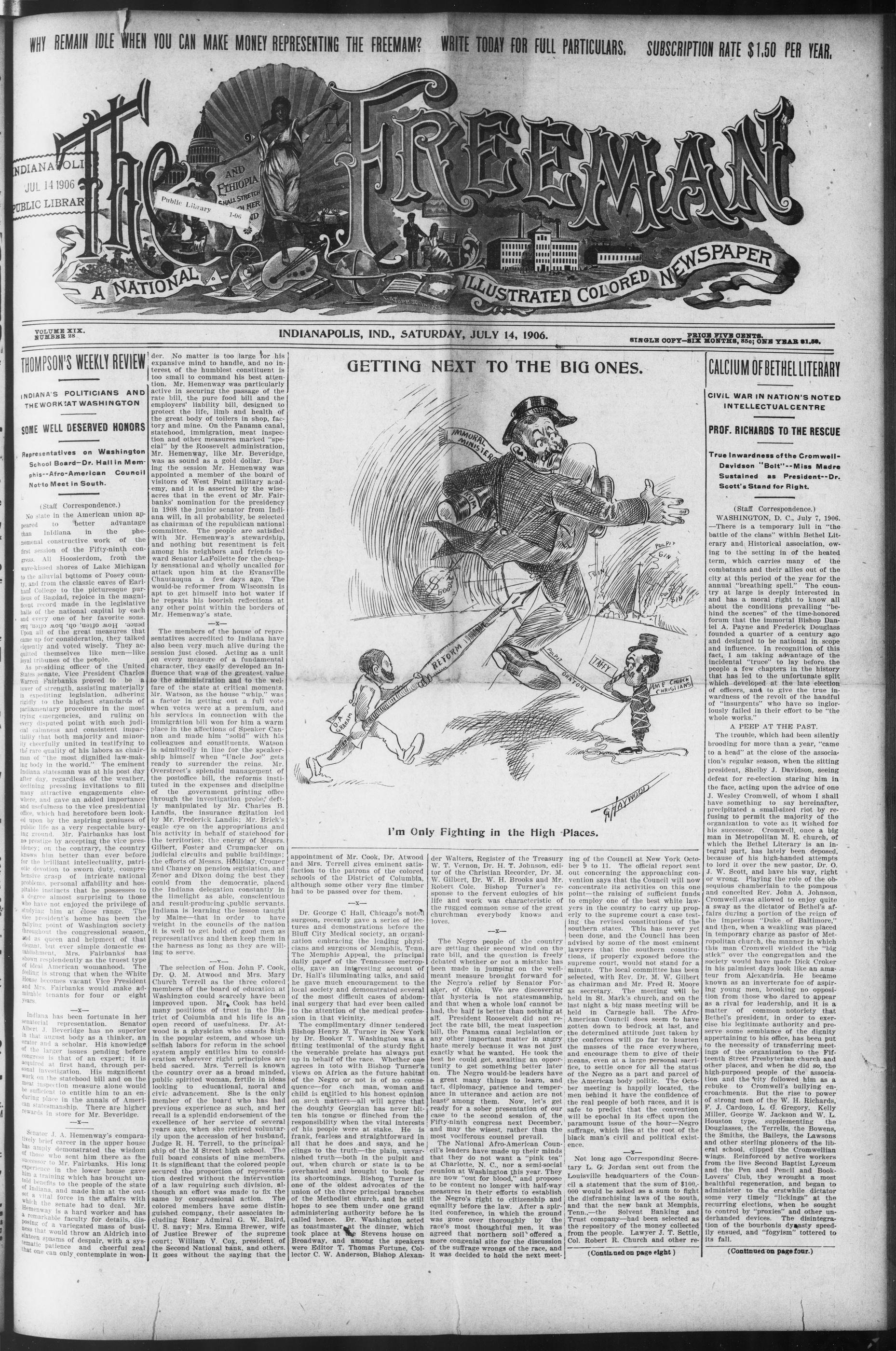
IMMURAL MINISTER
$ BOOLE
REFORM
PULPIT ORNATORY
TAFFY
AME CHURCH CHRISTIANS
G. HAYWOOD
I'm Only Fighting in the High Places.
appointment of Mr. Cook, Dr. Atwood and Mrs. Terrell gives eminent satisfaction to the patrons of the colored schools of the District of Columbia, although some other very fine timber had to be passed over for them.
-X-
Dr. George C Hall, Chicago's notary surgeon, recently gave a series of lectures and demonstrations before the Bluff City Medical society, an organization embracing the leading physicians and surgeons of Memphis, Tennessee. The Memphis Appeal, the principal daily paper of the Tennessee metropolis, gave an interesting account of Dr. Hall's illuminating talks, and said he gave much encouragement to the local society and demonstrated several of the most difficult cases of abdominal surgery that had ever been called to the attention of the medical profession in that vicinity.
The complimentary dinner tendered Bishop Henry M. Turner in New York by Dr. Booker T. Washington was a fitting testimonial of the sturdy fight the venerable prelate has always put up in behalf of the race. Whether one agrees in toto with Bishop Turner's views on Africa as the future habitat of the Negro or not is of no consequence—for each man, woman and child is entitled to his honest opinion on such matters—all will agree that the doughty Georgian has never bitten his tongue or flinched from the responsibility when the vital interests of his people were at stake. He is frank, fearless and straightforward in all that he does and says, and he clings to the truth—the plain, unvarnished truth—both in the pulpit and, out, when church or state is to be overhaul and brought to book for its shortcomings. Bishop Turner is one of the oldest advocates of the union of the three principal branches of the Methodist church, and he still hopes to see them under one grand administering authority before he is called hence. Dr. Washington acted as toastmaster at the dinner, which took place at the Stevens house on Broadway, and among the speakers were Editor T. Thomas Fortune, Collector C. W. Anderson, Bishop Alexan-
der Walters, Register of the Treasury W. T. Vernon, Dr. H. T. Johnson, editor of the Christian Recorder, Dr. M. W. Gilbert, Dr. W. H. Brooks and Mr. Robert Cole, Bishop Turner's response to the fervent eulogies of his life and work was characteristic of the rugged common sense of the great churchman everybody knows and loves.
-X-
The Negro people of the country are getting their second wind on the rate bill, and the question is freely debated whether or not a mistake has been made in jumping on the well-meant measure brought forward for the Negro's relief by Senator Foraker, of Ohio. We are discovering that hysteria is not statesmanship, and that when a whole loaf cannot be had, the half is better than nothing at all. President Roosevelt did not reject the rate bill, the meat inspection bill, the Panama canal legislation or any other important matter in angry haste merely because it was not just exactly what he wanted. He took the best he could get, awaiting an opportunity to get something better later on. The Negro would-be leaders have a great many things to learn, and tact, diplomacy, patience and temperance in utterance and action are not least among them. Now, let's get ready for a sober presentation of our case to the second session of the Fifty-ninth congress next December, and may the wisest, rather than the most vociferous counsel prevail.
The National Afro-American Council's leaders have made up their minds that they do not want a "pink tea" at Charlotte, N. C., nor a semi-social reunion at Washington this year. They are now "out for blood," and propose to be content no longer with half-way measures in their efforts to establish the Negro's right to citizenship and equality before the law. After a spirited conference, in which the ground was gone over thoroughly by the race's most thoughtful men, it was agreed that northern soil offered a more congenial site for the discussion of the suffrage wrongs of the race, and it was decided to hold the next meet-
SINGLE COPY-BIX MONTHS, 850; ONE YEAR $1,50.
ing of the Council at New York October 9 to 11. The official report sent out concerning the approaching convention says that the Council will now concentrate its activities on this one point—the raising of sufficient funds to employ one of the best white lawyers in the country to carry up properly to the supreme court a case testing the revised constitutions of the southern states. This has never yet been done, and the Council has been advised by some of the most eminent lawyers, that the southern constitutions, if properly exposed before the supreme court, would not stand for a minute. The local committee has been selected, with Rev. Dr. M. W. Gilbert as chairman, and Mr. Fred R. Moore as secretary. The meeting will be held in St. Mark's church, and on the last night a big mass meeting will be held in Carnegie hall. The Afro-American Council does seem to have gotten down to bedrock at last, and the determined attitude just taken by the conferences will go far to hearten the masses of the race everywhere, and encourage them to give of their means, even at a large personal sacrifice, to settle once for all the status of the Negro as a part and parcel of the American body politic. The October meeting is happily located, the men behind it have the confidence of the real people of both races, and it is safe to predict that the convention will be epochal in its effect upon the paramount issue of the hour—Negro suffrage, which lies at the root of the black man's civil and political existence.
X
Not long ago Corresponding Secretary L. G. Jordan sent out from the Louisville headquarters of the Council a statement that the sum of $100,000 would be asked as a sum to fight the disfranchising laws of the south, and that the new bank at Memphis, Tenn., the Solvent Banking and Trust company—had been selected as the repository of the money collected from the people. Lawyer J. T. Settle, Col. Robert R. Church and other re- (Continued on page elght)
CIVIL WAR IN NATION'S NOTED INTELLECTUAL CENTRE
PROF. RICHARDS TO THE RESCUE
True Inwardness of the Cromwell-
Davidson "Bolt"--Miss Madre
Sustained as President--Dr.
Scott's Stand for Right.
(Stan Correspondence.)
WASHINGTON, D. C., July 7, 1906.
—There is a temporary lull in "the battle of the clans" within Bethel Literary and Historical association, owing to the setting in of the heated term, which carries many of the combatants and their allies out of the city at this period of the year for the annual "breathing spell." The country at large is deeply interested in and has a moral right to know all about the conditions prevailing "behind the scenes" of the time-honored forum that the immortal Bishop Daniel A. Payne and Frederick Douglass founded a quarter of a century ago and designed to be national in scope and influence. In recognition of this fact, I am taking advantage of the incidental "truce" to lay before the people a few chapters in the history that has led to the unfortunate split which developed at the late election of officers, and to give the true inwardness of the revolt of the handful of "insurgents" who have so ingloriously failed in their effort to be "the whole works."
A PEEP AT THE PAST.
The trouble, which had been silently brooding for more than a year, "came to a head" at the close of the association's regular season, when the sitting president, Shelby J. Davidson, seeing defeat for re-election staring him in the face, acting upon the advice of one J. Wesley Cromwell, of whom I shall have something to say hereinafter precipitated a small-sized riot by refusing to permit the majority of the organization to vote as it wished for his successor. Cromwell, once a big man in Metropolitan M. E. church, of which the Bethel Literary is an integral part, has lately been deposed, because of his high-handed attempts to lord it over the new pastor, Dr. O. J. W. Scott, and have his way, right or wrong. Playing the role of the obsequious chamberlain to the pompous and conceited Rev. John A. Johnson, Cromwell was allowed to enjoy quite a sway as the dictator of Bethel's affairs during a portion of the reign of the imperious "Duke of Baltimore," and then, when a weakling was placed in temporary charge as pastor of Metropolitan church, the manner in which this man Cromwell wielded the "big stick" over the congregation and the society would have Dick Croker in his palmiest days look like an amateur from Alexandria. He became known as an invertebrate of aspiring young men, brooking no opposition to his office, has been put to the necessity of transferring meetings of the organization to the Fifteenth Street Presbyterian church and other places, and when he did so, the high-purposed people of the association and the city followed him as a rebuke to Cromwell's bullying encroachments. But the rise to power of strong men of the W. H. Richards, F. J. Cardozo, L. G. Gregory, Kelly Miller, George W. Jackson and W. L. Houston type, supplementing the Douglases, the Terrells, the Bowens, the Smiths, the Baileys, the Lawns and other sterling pioneers of the liberal school, clipped the Cromwellian wings. Reinforced by active workers from the live Second Baptist Lyceum and the Pen and Pencil and Book-Lovers' Club, they wrought a most healthful regeneration, and began to administer to the erstwhile dictator some very timely "lickings" at the recurring elections, when he sought to control by "proxies" and other underhanded devices. The disintegration of the bourbonis dynasty speedily ensued, and "fogyism" totered to its fall.
(Continued on page four.)
THE FREEMAN, AN ILLUSTRATED COLORED NEWSPAPER.
IN THE WOMAN'S WORLD.
BY "DOROTHY"
This column is devoted to the interests of women. Address all communications to "Dorothy," The Freeman, Indianapolis, Ind.
Part of that stupendous cause
Which conceived the solar laws.
Lit the suns and filled the seas -
Roysleet of pedigrees.
That great cause was love, the source,
Who most loves has most of force.
He who harbors hate one hour
Saps the soul of peace and power
He who will not hate his foe
Need not dread life's hardest blow.
In the realm of brotherhood,
Wishing no man aukt but good.
Naught but good can come to me-
This is love's supreme decree.
Since I bar my door to hate,
What have I to fear, O fate?
Since I fear not-fate I vow,
I the ruler am, not thou.
Wise men tell me thou, O fate,
Art invincible and great.
Well. I own thy prowess, still
Dare I flout thee with my will
Thon must shatter in a span
All the earthly pride of man.
Outward things thou canst control,
But stand back--I rule my soul.
Death? 'Tis such a little thing--
Scarcely worth the mention.
What has death to do with me,
Save to set my spirit free?
Something in me dwells. O fate,
That can rise and dominate,
Loss, and sorrow, and disaster
How, then, fate art thou my master
In the great primeval morn
My immortal will was born.
the enforcement of the law which prohibits the possession for sale or the sale of feathers or parts of foreign birds in that state, a test case will be prepared. Commissioner Whipple, however, insists that the Lacey law passed by Congress, and the State law and the Court of Appeals decision in the Silz case, the sale of algrettes and feathers imported even from other countries is prohibited. Mr. Feiner told commissioner, that in his opinion, the sale of parts of foreign birds cannot be stopped under the law.
Place reliance in the the drawing quality of a graceful pcs. Talk about
What Girls
Must Not Do.
the extent of their wardrobe in public places. Regard is pretty to pout when a man falls to notice compliments. Carry their jealousy so conspicuously as to be generally noticed. Use the forcible expressions which so easily can be misconstrued. Show a desire for an extravagant display at a social assemblage. Attempt to force a man into heavy expenditure every time they are taken out. Give away the pretty little trinkets presented to them as evidence of good feeling. Permit any familiarities whatever from men.
in Virginia, across the river from Washington recently. She was 105 years old and remembered dimly many incidents of the war of 1912. As for the civil war she remembered vividly many events of that great struggle. "Aunt Fanny" was born in 1801, and grew up as a slave on the plantation of William Buckner, on the Rappahannock River. When she reached the age of 100 years she received hundreds of letters from physcians asking her for her rules of life. She replied that she never wore low-necked dresses or short sleeves. For years she had smoked a blackened old clay ppe.
A State convention Bachelors to of bachelors and old Name a malds will be held Full Ticket. at Forest City, la. July 25 for the purpose of putting in nomination a full ticket and formulating a platform advocating emphatically race sulicide. President Roosevelt will be attacked for causing big families by his hostility to race sulicide and it will be declared the only way to down trusts is to reduce the population so that the people will have a better chance for a good living and be better able to cope with monopoly. The convention is called by Clinton Merrich, chairman of the 'old bachelors' committee," and quite well known over the State as the "king of bachelors."
The use of snuff among women is an exceedingly dirty habit, which is not confined to any particular class of women or certain section of the country. Many who in every other respect seem cultured and refined are slaves to this dreadful habit. It is many times worse than the tobacco habit in men.
As to the result of a conference at Albany N. Y., between Commissioner Whipple of the State Forest,
Think of yourself, therefore nobly,
and you will live nobly. You will
really on earth that type of character
Fish and Game Department and B. F. Feiner, representing the millinery importers of New York City, relative to
READ WHAT THE PEOPLE SAY
Key Wet, Fla. Aug. 23, 1994.
bottle of your pomade and my
breakening off and has greatly
in started using this wonderful
hair was seven inches long and
ties or more. Yours truly.
WEST Chester, Pa. Mo. 30, 1965.
I had typhoid fever and my hair all one
out. I used three tools on your pomade,
and now my hair is nine inches long and very thick
and nice and straight. Most every one seeing
how good your pomade did my hair, they too
are amazed. I am an example to
every one. Yours respectfully, PRAE HUE
Key West, Fla., Aug. 28, 1904.
I used only one haircut and I have hair has stopped breaking off and has greatly improved. Then I started using this wonderful hair in my hair was seven inches long and now it is ten inches or more. Yours.
314 Southard St.
MINNIS FOASTER.
Brookhaven, Min. Aug. 13, 1904.
I never tried any preparation I never tried any preparation so excellent for the hair. My hair was rather deadly but since I have been using your hair pomade I have rather deadly but since I have been using your hair pomade it was when I was a girl and it has a lively, glossy color.
---
```markdown
```
Colvert, Tex., Mch. 31, 1958.
I have used one bottle of
your pomade and my hair
is now perfectly straight,
soft and black as silk. I
will not be able to wear
RIDDA F. FAPURUS
Tampa, GA. June 6, 1990.
Gentleman. I have to do it more than it is recommend and have to do it more than it is recommend and breaking off, and cleans the oat it and hair soft, pliable and glossy. MAGGIE REND.
THE OZONIZED OX MARROW CO.
DONALDSON, FLORIDA 32077
Charles Ford Print
(None can sign with my signature. Please Wait before you.)
and faith which is the highest ideal of philosopher, hero and saint.—Exchange
To remove grass stains from clothing run them thoroughly with mousse and allow it to remain on the article until it is laundried and it will be seen that the stains have disappeared.
SCHEMES OF THIEVES
TRICKS OF THOSE WHO OPERATE IN JEWELRY STORES.
The Way One Place Was Completely Cleaned Out-How Show Windows Are Broken-Getting a Safe That Was Bolted to the Flooring.
A number of jewelers were dining together and with the cigars the talk turned on jewelry thieves and their methods.
The first story was told of an individual who was seen lounging about the plate front window of a jewelry store. No particular attention was paid to the man at the time, but the clerks recalled the incident after the robbery. In this instance the man appeared a number of times in front of the store. One evening soon after dark there was a sudden crash, and a robber was actively engaged in scooping in jewels with a hooked stick. In thirty seconds he was done and away. Bystanders stood as if petrified until the man struck out at a run. Then the store people and the bystanders realized what had occurred and shouting "Thief" started after the man.
The man dropped his bag. The puruers stopped and seized the bag. They returned to the store with the bag in high glee, remarking incidentally that there was no need in chasing the thief because here were the goods. The proprietor of the store and all the clerks had followed, but, having farther to go than the crowd, were behind and were met by the people with the bag. Proudly the bag was opened. It contained a brick. The thief had dropped it to check the pursuit. Realizing the trick had succeeded, the crowd, headed by the salesmen and proprietor, went back to the store, only to discover that the window had been cleaned of stock and the counters were bare of a number of costly articles.
A policeman on duty said that after the proprietor and clerks of the store ran for the departing thief a neatly dressed gentleman, with all the airs of a member of the firm, gave directions to two other men to get the stuff out of the windows and told him (the officer) that this was being done as a precaution against theft while the window was broken. In some first class stores there is a regular danger signal arranged, and the men are drilled each week. When the danger gong sounds one man takes his place at the door, another at the telephone to send word to the police, another with running qualities makes for the door in readiness to pursue, and so on.
Among other stories told were some relating to the tricks and devices of the jewelry thieves. The robber often works at night or sometimes during a crowd by cutting out a disk of glass near where some costly goods are shown. He may reach in and secure something and be off before detected if he is quick.* Sometimes he has a tong instrument hidden under his coat; so that he can reach in and pick up a watch. Often again he uses a simple stick with a slightly turned end, hooking into a ring.
The process of crushing in a plate front during the intervals of the patrol of the police, at the same time making no noise, is done by pasting cloth or heavy paper on the glass. A wood mallet is used, the hammer ends being securely bound up in a heavy woolen fabric stuffed with excelsior or kindred material. With this soft headed mallet it is possible to bang away noiselessly at the glass until the pane begins to crumble. Unless the plate is usually thick an opening can be made without much trouble.
In recent years jewelry thieves, like bank robbers, have rented quarters near the place they intended to rob and lived there long enough to study the situation. In one case a room was hired over a jewelry store and entrance effected to the store by means of a rope ladder dropped from the window of the room to a window leading to a hall in the store portion. In another case the bar spreader was used to open the bars of a window. This device consists of a spirally threaded shaft fitted into two blocks, with a central piece with a bar for turning. The blocks are adjusted between two bars, the central piece turned, whereupon the spiral shaft causes the blocks to expand sidewise, forcing the bars open. Then the intruder can pass in.
A story was told of the removal of a safe in which the proprietor of a jewelry store was accustomed to put his costly stock each night. It was not a large safe, but exceedingly strong, and because of its light weight a number of bolts were put through the floor and connected with the safe bottom. The proprietor often said that thieves could not take the safe unless they took floor and all. Not long after the store was entered, and, behold, the thieves had sawed out the section of the floor to which the safe was fixed. The safe was bound up with rope, the latter passed under the separated section of flooring, and, when the boards were sawed through, safe, floor and all were lowered into the basement and readily moved out through the basement door, put into an express wagon and carted off.-Jewelers' Circular Weekly.
Harsh Measures.
don't occasionally have company house that bores you? "Often, but we have a remedy. We always let our little Johnnie recite"—Milwaukee Sentelite
RACE CLEANINGS
The True Reformers' Bank at Richmond, Va., did a business for the current year amounting to over a half million dollars.
Butte, Montana, boasts of a Negro millionaire, Charles F Jones, who has valuable interests in the silver and copper mines of the locality.
At a recent lecture given for charity at the Odeon in St Louis by Dr. Becker T. Washington the net proceeds were $805 50 Dr. Washington surprised the committee by donating $125 00 of his customary fee of $300 00 for the same laudable cause.
The Chicago postoffice is the best example of what civil service does for a young man or woman of intelligence. There are probably fully 300 or more colored men and women in all branches of the postoffice, and they have all won their places by competitive examinations.
T. P. Johnson, the oldest colored lawyer of Arkansas, who died at Little Rock recently, was 94 years of age, and had practiced law 36 years. He was a strong race man. Was twice elected president of the Negro State Bar Association, and served two terms as honorary president.
Raphael B Barrow of New Orleans, La., has been appointed to a clerkship in the Coast and Geodetic Survey. He was for many years a clerk in the post-office at New Orleans; his present appointment is the result of a competitive civil service examination in which he attained an unusually high average.
1
A new steam laundry has opened in St. Louis by J. K. Mason, and is one of the points of great interest to home people, as well as visitors from abroad. Every day the place is visited by a score or more of people who, after inspecting the plant, go away with increased respect for the genius and business enterprise of our race.
At the recent convention of photographers of Pennsylvania, Delaware, Maryland and the District of Columbia, the work of Mr. Daniel Freeman, a colored photographer of Washington, D.C., received a high per cent above the average required, and was hung in a special salon amidst the work of some of the finest professionals of the country.
All Saints Episcopal Church in St. Louis has succeeded in locating a new site in a most desirable neighborhood at a cost of $25,000, securing the beautiful stone edifice at the northeast corner of Garrison avenue and Locust street. now occupied by the Unitarians, well known as the Church of Messiah. It is one of the handsomest churches in the city and its acquisition marks a big
EVENTS AT THE FALLS CITY
EVENTS AT THE FALLS CITY
Louisville, Ky., Speclal.
The Peytonia Cook Book is now on sale.
Even the drug store can't sell soda water, the "lid" is on tight.
Mr. Hunley Goodall now domiciled at his country home raising chickens and receiving friends.
The Teachers Institute was in session this week with a large attendance, Prof. R. E Meyzeek presided.
Letters have been received from the Hampton delegation stating that their time is being spent most profitably and delightfully.
Mrs Virginia Mitchell and daughter Emma were in the city enroute from Kansas to Bowling Green, Ky., where Rev. Robert Mitchell has taken charge of the State Street Baptist Church.
***
Miss N. Helen Burroughs has returned from a trip to Pine Bluff, Arkansas Phe "Baptist Vanguard" states that our charming speaker delivered a notable address to the Women's Convention Miss Burroughs has honor at home and prestige abroad.
...
Col. W. C. Owens was nominated by the 5th Congressional Convention last week. Col. Owens is a stalwart Republican, a political orator and a magnifi-
step forward for the colored people of St. Louis.
On account of continued ill health Mr. Lloyd G. Wheeler, business agent at Tuskegee Institute, has been compelled to take leave of absence. He has gone to St. Louis, Mo., to be with his daughter for a season, and will spend the rest of the time in more northern climes Mr. E T. Attwell of the principal's office, has been placed in charge of the work as acting business agent. Mr. Attwell's fitness for the work in question is well known to all connected with the school.
Jim Washington, an old Negro who was born and raised on a plantation near Hallettsville, Mo., has invented and obtained a patent on an improved cotton bailing press. It is claimed by those who have examined the invention that it will revolutionize the present method of handling cotton. Instead of having to treat cotton to the two processes of ginning and compressing, as now, the ginning and balling will be done at one time. Cotton men are much interested in the invention.
---
Congress has passed a law to raise the salaries of the school teachers in Washington 14 per cent. This law will affect very favorably the salaries of over 350 colored teachers, principals and supervisors in Washington. The School Board is to be composed of nine members, three of which are to be women. The board already has two colored members, Lawyer Bundy, a prominent attorney of Washington, holding an important place on the board, is one, and Mrs. Bettie G. Francis, the wife of Dr. John R. Francis of Washington, is the other colored member.
一
The Union Transportation Company, organized in Nashville, Tenn., to run an automobile line to accommodate Negroes who are "jim crowed" by the city lines, is having a multitude of troubles. Tacks have been placed on the streets to ruin the rubber tires, power was denied by the electric corporation, and exorbitant license fees were charged, and now their own newly installed dynamo has failed, necessitating further delay. In the meantime the patient walkers are still walking rather than be "jim-crowed" by the regular company.
A five-foot brass lawn seat has been placed in the plot of plot of ground in the cemetery at Mayville, N. Y., where lie the remains of the big-hearted author and champion of Liberty, Judge Albion W. Tourgee, and where stands the Tourgee monument dedicated on Decoration Day. The seat is the gift of the Colored Ministers' Union of Cleveland, Ohio, as a permanent memorial and as an expression of the gratitude of the race for the distinguished services of the deceased jurist. On a copper plate is this inscription: "From Afro-Americans, Cleveland. Ohio."
cent campaigner. A few Negroes were in the primary working for him, but the voting class has been rather reticent about their support.
Socially the opening summer season has been gay. There were four indoor shirt waist dances at Odd Fell'sw Hall. The elite was out in dotted swiss, organdle and all kinds of silks. Many went out to private pliances the 4th. The different social clubs were in evidence at the Episcopal Outing.
* * *
The K of P. Grand Lodge at Henderson, Ky., will be a big event in that section. Grand Chancellor Snoden and ex-grand Chancellor Washington are candidates for Chancellor. Both are trimming their sails and a lively fight will be on. Socially the delegates will have a great time Henderson being one of the most hospitable towns in Ky.
...
The storm or investigation of school affairs has temporally blown away and Mr. Dave Steward bore all the responsibility and shielded the trustees from danger. It is seldom that white men find such a good angel. Altho the grand jury did not report, public sentiment may bring to light who the "buyers and sellers" have in the last few years, at least.
The biggest Main St, business man spoke to the representative of the Freeman in the highest praise relative to the genuine and hearty support the Negroes were giving the Y. M. C. A. Building Fund "They have shown remarkable degree of union and pride that
I suggest that in one large room that starta Penny Savings Bank," says this prince of merchants. This same white friend has materially befriended the Negroes, aside from giving such good advice.
***
Quite a deal of effort is being made by several business men to arouse the sleepy ones. More spirit and enthusiasm coupled with union and harmony is the pass word of D. L. Knight, Roebell Smith, James Brown, Wm. Spraddling and others who are interested in the general progress of Loulsville Negroes. With the above business men there is a desire to assemble all the business men of the city and elect delegates to the National Negro Business Men's League which meets at Atlanta.
C. B. Lewis.
The Eiks at Fort Worth, Tex., are preparing for the Grand Lodge, at Columbus, O., in August.
Charles James Fox is probably the only man who ever made a maiden speech in the commons while still a youth in his teens. He was nineteen when he took his seat for Midhurst, and within a few months he had three excellent speeches. And yet even at this early age Fox used frequently to sit up all night drinking and gambling.
Mistaken Idea.
"It may be laid down as a broad proposition," said the professor of political economy, "that you cannot get something for nothing."
"I once got the measles for nothing, professor," interrupted the young man with the wicked eye.—Chicago Tribune.
Do not miss this opportunity to subscribe for the race's leading journal
Your Past, Present, Future Accurately Told.
Hidden Treasure,
Lost Money
Located.
Separated Friends
United.
Send na ne, age,
year, date of birth
and handwriting.
Readings $1 to $6.00
Have performed
Special Service
for
European Rulers.
Prof J. A. PASHA, Oriental Astrologist,
18-19 Naylor Cox Building, 4th and Main St.
Terre Haute, Ind.
"Ben" Murray's Places
COLUMBIAN
EXCHANGE,
27*N. Fourth Street
Lunch, Cigars, Wilens.
PEOPLE'S PLACE
1101 S. 336 St.
Everything New
but the Whisky.
Everybody Welcome.
When in Terre Haute call on us.
W. W. KAUFMAN,
Successor to P. J. Kaufman,
FANCY GROCER AND
COMMISSION MERCHANT.
Cor. Seventh and Wahash Ave. Telephone
Terre Haute, Ind. 167
If you wish to go somewhere
CALL ON
L. D. SMITH
FOR
CUT RATE TICKETS
673 Wabash Ave. Terre Haute, Ind.
TERRE HAUTE
LAUNDRY AND DYEING CO.
ED. E. LAWRENCE, Press.
308 310 Cherry street, Terre Haute, Ind.
Both Phones 184
Undertaker
BOTH PHONES
103 N 4th St., TERRE HAUTE, IND.
J. N. Hickman. H. E. Hickman.
J. N. HICKMAN & SON,
Funeral Directors 1210-1212
Walsh Ave.
Bath House
and Embalmers,
77
Livery 19-21 North Twelfth Street.
Terre Haute, Ind.
THE MOST REFRESHING DRINK IN THE WORLD
Coca-Cola
All Salons, Groceries, Cafes and Stands.
SANTAL-MIDY
Standard remedy for Glees
Gonorrhoea and Runnings
N 48 HOURS. Cures Kid-
ney and Bladder Troubles.
FOR THE IMPROVEMENT AND ADVANCEMENT OF THE NATIONAL BENEFIT ASSOCIATION OF
HEAD, SECOND AND SIDE WAITERS
"For the man who works with brain or hand."
W. Forrest Cozart,
Editor.
MINNEAPOLIS HOTEL NOTES.
R. Moses is the best man at the National Cafe.
C. Sanders of the Nicolett Cafe passed through the city recently.
W. M Dawson, headwaiter at the Spandling Hotel, at Duluth was in the city last week.
Henry Harris, second-waiter at the Commercial Club and accepted a higher position at New York.
S. Crawford is still delivering the goods at the West Hotel with his assistants, J. Scott and S. Anderson.
Hotel work is very plentiful here. Walters will do well to come this way. A good second wait is wanted at the Commercial Club; good salary paid each week. C. W, Dwyer, headwaiter. Fifty waiters wanted at Lake Minetanaka, report at Hotel Dwyer, 224 Washington ave, S. C. W, Dwyer of the Commercial Club is still at the helm with an ever watchful eye. W. M. Garrett, 1st. captain; W M. Hodge, second; E. L. Patterson, 3rd.; James Baker, general all around man are the officers of the crew of twenty-seven. Frank Crowder for fourteen years the head bellman of the club has a splendid crew, and F. McKinny is one of them.
INDIVIDUAL HOTEL DIRECTORY
[One address line $4.00 per year; including subscription to The Freeman, in advance.]
HEADWAITERS.
J. W. Redmond, Headwaiter of The Carroll, Vicksburg, Miss.
C. W. Dwyer, headwaiter Commercial Club Minneapolis, Minn.
C. H. Plummer, headwaiter Hotel Brunswick, Uniontown, Pa.
R. B. Hradley, Headwaiter Menger Hotel, San Antonio, Texas.
G. W. Bland, Headwaiter of The Oliver, South Bend, Ind.
10-06.
8 105
10-05
3-06
12-05
HOTEL DIRECTORY
This column used exclusively for the ad, dresses of hotels, restaurants, lodging and catering, and for the travel public, and intended as a guide for the traveling public—you business solicited.
Dentor Dwyer (European) C. W. Dwyer,
proprietor. First class rooms by the day,
wok or meal. With heat, electric light
and 824 Wheat Avenue, South,
Minnapolis, Minn.
Hôtel Reformer - First class in all respects
Hôtel Richmond, A. V. A. W.
Holmes, manager
Moore's Hotel - First-class room board
Saint Hotel - First-class furnished 712 and 714 W.
Street Little Italy
Walder-Astoria Hotel - 237 Laurel street,
Hot Springs, Ark.
230, 231, 232 Fifth Street
Cora's Lunch Room - 220 Fifth Street,
Little Rock, Ark.
Black's Hotel-A modern first-class hotel for colored people. H. Black, Manager,
The Parker House-Rooms, bath J. W.
Holman, apographer, Indianapolis, Ind.
VICTOR
TALKING
MACHINES.
The Victor is so perfect it is often mistaken for the human voice. It is proving a never failing source of DELIGHT to Thousands.
COME IN AND LET US
TELL YOU all ABOUT it.
SOLD ON EASY PAYMENTS
Phones | Main 852
New 9093
KOEHRING BROS.
878, 880, 882 VIRGINIA AVENUE.
Hoosier Poet
CLUB ROOM LONDRES
10c Cigar
We deliver Goods direct to consumers and pay all express charges.
Give Us A Tryal Order.
John Rauch Cigar Co. - Indianapolis, Ind.
AMERICAN BREWING CO.,
BREWERS & BOTTLERS
OF
HIGH GRADE BEER.
—TELEPHONES 935—
HEADQUARTERS
Indiana Ave.,
indianapolis, ind
The following crew is stationed at the Hotel Holland at Orange, Tex, Office, Victor Auberspand; head-porter, Joe Shordon; Gratour, dining room; Henry Harris, headwaiter: Burton Woods, captain of the watch: S. B. Batom, floor-walker, Side men: Charles Chappel, Lucas Paterson, Jesse Jackson Jeff Shorter, Garfield Davis, Willie Williams, Eddie Hills, John Nickson, Kitchen: J. E. Neasby, chef; J. E. Burns, second; F. Romlo, third; A. Tervor Baker, E. Romlo, pantryman. They are all well-trained hotel men and are giving capital satisfaction to the manager, Col. James Furlong.
There are dinning rooms and restaurants in which a waiter at one table will in no instance, in no emergency, perform even a trifling act for the benefit of an adjoining table; the guests must wait until their particular waiter returns before they can be served with a spoon, a napkin, or anything else. In other dining rooms waiters seem to work for the general good of the establishment; they assist each other when necessary. It is needless to say which kind of service best suits the patrons. To sit at a table for ten or fifteen minutes in need of something, while waiters stand around idle, never lifting a finger, is not a condition of things either pacifying or satisfying when one is in a hurry.
The above editorial from the "Hotel World" is a timely one and it is well said. The editor after reminds the reader that the waiter should be gentlemanly in their deportment in the dining room as well as elsewhere, also that they should be kind and obliging towards each other as well as to the guest. By so doing they would make a favorable impression, not only upon the guest he serves, but upon all guests within sight, as they all observe the waiters action all over the room, without any pretense of doing so. Another important item a waiter should never commit an untidy act in the dining room as some of the guests will be sure to see him. It is these make or mar the colored waiters reputation.
The Boston Guardian, in a recent editorial squib, attempts to give out the impression that its columns contain matter that somebody thinks worthy of being stolen, and palmed off as original. Brer Trotter ought to see an alienist about that malady of his.
THE FREEMAN, AN ILLUSTRATED COLORED NEWSPAPER
EASTERN BRANCH
17. N. Kentucky Ave,
Atlantic City, N. J.
A Few Words in Reference to the "Clansman."
I have read both the "Leopard Spots," and the "Clansman." I also witnessed its production in this city, and I cannot but conclude that the "Clansman" slanders the south, and places a stigma upon the fair escheuon of southern chivalry. It must have pained the hearts of close observers to see the theatre crowded on this occasion with women and children, and to hear the hearty applaud given every anachistic threat made against the Negro.
I shake with fear for the future of this government when that decade arrives that the children who are now taught to applaud the "Clansman" and its teachings become the guiding spirits of our government.
To me it seems an awful picture where Ben, Cameron and Nellie Graham, representing the best blood and sentiments of the south, take the terrible oath of the Klu Klux Klan, and swear unto God to co-operate with each other in committing mignight murders upon the terrified Negroes. This can not be,evidently the South is being slandered. Do they not tell
SHORT FLIGHTS. BY R. W. THOMPSON.
Ode to My Old Kentucky Home.
The dove's notes are the saddest,
In Kentucky;
The streams dance on the gladdest,
In Kentucky;
Hip pockets are the thickest,
Corkscrews turn the slickest,
In Kentucky.
The women are the sweetest,
In Kentucky;
Thoroughbreds the fleetest,
In Kentucky;
Oratory is the handiest,
Hospitality's the grandest—and
Politics the d——dest,
In Kentucky.
The demand of this practical era
is for "education that hits the mark."
It is a safe bet that public life has not seen the last of Judson W. Lyons.
The June weddings have all been "pretty," and so have the June brides.
It is one of the ironies of Fate that a fakir invariably gets faked by his own faking.
William Jennings Bryan may as well begin on the rough draft of his letter of acceptance.
* * *
Dr. Booker T. Washington again made "the speech of his life" at the Wilberforce Golden Jubilee.
* * *
Any coward can commit suicide. It takes a brave man to fight out the problem of life to a finish.
* * *
Doubtless Dr. Graham's ears burned mightly during the session of the A. M. E. Bishop's Council at Wilberforce.
* * *
Bethel Literary and Historical Association at Washington is in luck. It isn't every lyceum that can boast of a modern Portia for President.
It is significant that the lives of Harry Thaw, Evelyn Nesbit and Standford White all "point a moral," even if they do not "adorn a tale."
* * *
A "Jeff Davis" in the United States Senate produces no feeling of hilarity among the ten millions of Negroes for whom he must help make laws.
* * *
The present hot spell is said to be due to the super-heated condition of the Kentucky Baptists. They are wrestling with the State University problem.
* * *
Preachers who foist ancient and uninteresting sermons upon the people cannot blame any one but themselves if they are greeted by empty benches.
Education that is cultural is a blessed privilege; but education that is vocational is a prime necessity. Both are desirable, but the latter is essential.
If a man feels that he is in the right, let him stick to his principles. The masses will one day catch up with his advanced ideas. They will rise up and call him blessed.
There is a noticeable trend of Negro sentiment toward the Catholic church. The reasons behind this peculiar activity offers the student of religious thought a fine field for investigation.
The "intellegent compositor" on the Star of Zion, who set up a reference to Dr. G. C. Clement as a "vile" editor—when the correspondent meant
us in the daily dispatches that whenever a Negro is lynched or burned at the stake, and jails, court houses and sections of cities burned that it is the work of the lawless and drunken row dies? Then why should the Southern Amusement Co. persist in slandering the south by producing the "Clansman?" Another thought gleaned from the "Clansman" is that when Gen. Lee and his army surrendered at Appomattox, they returned home and wage a rentless war upon the poor, ignorant, and defenseless blacks under the cover of darkness bound by the oath of the Klu Klux Klan, while by kind treatment and the proper training every Negro would have shown the same disposition and meakness as Nelse and Cora.
Besides creating a large amount of social prejudice, the "Clansman" also revives sectional prejudice in attempting to prove that those who wore the blue and those who guided the government and gave us this golden era at peace, prosperity and happiness, were wrong. Is, or is not, the "Clansman" a slander on the south?
"virile," needs praying for. He is "the limit."
Some of the brethren who quibble the fiercest and clamor the loudest as to what constitutes orthodox baptism, have a chronic dislike for honest toil, and habitually neglect to pay their family's grocery bill.
The bill before Congress providing for an increase in the pay of letter-carriers ought to pass without question. The nation has no harder worked class of public servants than its "penny-postmen."
Practical Christianity, conscientiously applied to the everyday affairs of life, will do more for communities, churches, schools, and society all that the most rigid adherence to doctrinal "isms" and "ologies" can accomplish.
Florida's Afro-American business men and women are several laps ahead of their brethren in most of the other states of the Union. Action is the golden text at this time. August 29-31 is not many weeks away.
Narrow denominationalists are too prone to denounce as a "heretic" any courageous seeker after truth who refuses to blindly subscribe to the absurd superstitions and dogmastic notions that obtained in the the Middle Ages of religious investigation.
Down South Senator Foraker's famous amendment to the rate bill, designed to secure equal accommodations for the Negroes of that section, proved so popular that 700 "pickaninies" were named for him during the controversy over the measure in the Senate.
The commencement address of Prof. W. E. Burghardt DuBois at the nation's capital, was no doubt a fine literary effort, but somehow, it failed to make a "hit" with the Washington dailies. They handled the matter most gingerly.
Rev. D. A. Graham is raising chickens on his nice little farm at Franklin, Ind. We know of some ministerial brethren who wish he would confine his attention to raising chickens, and stop raising so much of—that other thing they claim he has been raising for several months.
The southern Negro should dig the Panama Canal. It is to the foundation of the South's future greatness in commerce and manufacturers, and it should be a monument to the fidelity, brawn and industrial utility of America's black yeomanry. Keep this idea before Secretary Taft.
Dr. J. E. Shepard, the dauntless young North Carolina leader, had an interesting conference with Vice-President Fairbanks the other day. The genial Indianian is wonderfully popular with all classes in the Tar Heel State, and he was particularly glad to hear from his host of colorful friends through their accepted spokesman, Dr. Shepard.
The District of Columbia Branch of the National Negro Business League will send 15 delegates to the Atlanta meeting. The personnel of the party is as follows: John A. Lankford, chairman; W. Calvin Chase, Daniel Freeman, W. R. Griffin, C. H. Watson, W. L. Pollard, C. F. M. Browne, A. N. Scurlock, Henry Lasstister, A. S. Gray, W. H. Davis, Dr. M. B. Williams, A. H. Underdown, Mrs. L. R. Clark and W. H. Clifford. There is some valu-
...
---
---
---
---
---
* * *
---
...
---
able "new blood" in this enterprising aggregation.
...
Is there any hope for the redemption of the average Negro guitar player? Our scheme of economy has as yet provided no destiny for this species of the wanering minstrel, relic of knight errantry, this troubadour left over from the pulsating days of chivalry to be frost-bitten by an unsentimental age. "23" for the genus guitar-picker! He is n. g.
The illiterate white children of the South should, by all means, be provided with suitable schools, for upon their emancipation from the thralldom of ignorance and its concomitant prejudice, the race problem cannot be solved. Educate them—not as President Abercrombie says in advance of Negro children—but instruct them both at the same time, and let them approach their issues with equal intelligence.
---
The new undertaking firm of Clifford & Rogers has "caught on" in Washington. Cleveland achieves an individual triumph in the success her favorite sons are making. They have a valuable ally in the person of William T. Smith, the expert embalmer and funeral director, who carried on the business of the Winslow company for so many years with signal success.
***
Several of the Springfield, Mo., lynchers have been apprehended, and placed in jail, with a charge of murder in the first degree written opposite their names. Gov. Folk is going after the lynching evil with the weapons that are sure to break it up. The knowledge that there is a day of reckoning in store will deter the most vindictive mobocrat from plying his favorite trade.
Convention Hall at Washington is all right for monster mass meetings, fairs, commencements, etc., but when orators are to be selected, those in authority should be careful to see that only the leather-lunged and stentorian are given the floor. Only the front rows heard Prof. DuBois at the recent joint commencement of the M Street High, Armstrong Training and Normal No. 2 schools.
---
The Panama Canal people will use imported Spaniards, in conjunction with the Negro labor from Jamaica and Barbados, believing that better results can be obtained by having a variety of classes to work with. To vary the mixture a little more, why not try to recruit a force of 10,000 Negroes from our southern states? New Orleans would make an excellent recruiting station.
* * *
The Washington Record propounds a pertinent query when it asks what on earth possessed Prof. Councill to invite Dr. Ransom to be his commencement orator, knowing as he did the temperament, sentiments and rumored habits of the latter. The press gang is now wondering if the worthy principal of Normal would be tactless or reckless enough to go hunting for a gas-leak with a lighted match.
* * *
Capt. G. J. Austin's Cadet School near Stony Hollow, N. Y., is attracting no end of attention at the hands of the natives, who have never seen anything like it before. Distinguished visitors are coming to see what the well-groomed boys are doing, and the experiment will no doubt be such a success as to insure its permanence as a summer institution. The camp is a beauty, and the location is a happy selection.
---
Mr. Fortune tells a big bunch of truth when he says that the race is blessed with an abundance of capital editors, but what journalism stands in the sorest need of at this time is capable, resourceful and energetic business managers. It takes money to run the proper kind of a newspaper, and it takes a good man to get the money out of the people, after the editor has faithfully performed his whole duty.
The Foraker-Warner amendment has been decently interred beneath an overwhelming avalanche of popular condemnation—but the "jim crow" car flourishes as defiantly as of yore in every state that wants it, and the railroads, free from federal review, cannot be compelled to furnish even "equal accommodations" for first-class fares, unless they see fit to do so. The black man is not in the rate bill, as it stands.
The rumor of Miss Marion Smart's engagement to Mr. Moses Moore, the noted turfman of Dayton, Ohio, is being renewed. It is sincerely hoped that the forthcoming matrimonial alliance will not result in her retirement from the stage, which she elevates and adorns by her winsome and wholesome personality. The Negro Thespian world needs morer earnest, painstaking and characterful women like Marion Smart.
COOKS
Waiters & Cooks
Prefer Our Make
JACKETS AND LINEN
because they have found them
satisfactory.
Write for complete Catalogue
FREE.
giving full instructions how
to order.
Marcus Ruben (Inc.)
390 State St., CHICAGO IL.
WANTED AGENTS in each country to sell
good profits, steady work. Address Campbell &
Co. , 35 A Street, Elgin, Ill.
Lady Agents—Easily make $5 a day maki-
ng and selling "Family Memorials."
Instantly removes grease spots, paint, stains, etc., from
cars and boats, to bottle to, readily for use.
Readily furnishes, writes to-day. Thon. Campbell, 55 A St., Elgin, Ill.
THE TUSKEGEE INSTITUTE is now offering extended courses in both theory and
experience in automotive design, advanced instruction in Architectural Drawing and Electrical Engineering. Persons desiring to take advanced or elementary courses in
automotive design, design, or opportunity to obtain instruction at Theuskegee
Institute such as few institutions can offer. There is a growing demand for young men who fit
their training needs. TheDrawing course, to make plans for houses
and who can do the work required in Elect. Ictal
Engineering. Every effort is being made to make these courses more helpful than ever
before. To Washington, Tuskegee
Institute, Alabama.
"THE DOLLAR MARK"
SIX MONTHS FREE
SIX MONTHS FREE
Let me send you my
Magazine
"The Dollar Mark"
Free for Six Months.
It tells, you how to get on in
the world. How to save
and have money. In fact
it is brimful of interesting
matter and should be
in the hands of every per-
son who desires to get on
in the world. Send for it
to-day. Address
E. C. BROWN,
Box 82, Newport News, Va
DIVORCE LEGAL
See Mrs. Ed. Trowser
T
The Shampoo Drier is a stel bar with a receptacle containing a 12 inch aluminum compartment. For sale by tolst article dealers. By mail, price $1.00. Agents wanted.
No Shampoo Drier is used in my parlor with perfect satisfaction." -Madame Cozark, 17 Kentucky Ave., Atlantic City, N.J.
The Shampoo Drier Mfg. Co. 407 Century Blvd. Minneapolis, Minn.
HAIR SWITCHES
Bange and Wige of Every DESCRIPTION.
Most Complete Line of Hair Goods in this Country for Colored People.
50s buys a single braid made of Black
Kinky Hair 16 inches long.
75s buys a double braid made of Black
Kinky Hair 16 inches long.
1.25 buys a Creole Switch, 16 inches long, Brown or Black.
1.25 buys a Creole Switch, 20 inches long, Brown or Black.
1.75 buys a Creole Switch, 22 inches long, Brown or Black.
3.50 buys a Natural, Wavy, Hand-made Switch like cut.
Send sample of hair when ordering
Creole Switcher.
Send money with order and get your goods by return mail. Send stamp for catalogue.
T. W. TAYLOR,
Howell, Mich.
When writing please mention this paper.
THE FREEMAN
NATIONAL ILLUSTRATED
COLORED NEWSPAPER.
PUBLISHED EVERY SATURDAY
At 309 Indiana Avenue,
INDIANAPOLIS, INDIANA.
SUBSCRIPTION RATES :
Any part of the United States and Canada,
one year, postage paid
$1.50
Brown Months
3 Months
Foreign Countries
Send a letter of residence, money order, post-
office or registered letter
Agents wanted 1 every town; and city not
now occupied, and liberal inducements will be
induced. Send for our extraordinary
induced.
ADVERTISING RATES:
Five cents per line. Ease of measure—solid
agate, 14 inches to an inch, 276 inches in a column.
Special position 25 per cent additional. **No**
advertisement inserted on first page. Special
notes on standing professional and business
cards. Reasonable discount for long time and
space. Reading notices 10c per line. Special
rates on WRITE UPS.
Entered at the postoffice at Indianapolis,
Indiana, as second class matter.
All matter should be addressed to
The Freeman Publishing
Company,
INDIANAPOLIS, INDIANA.
SATURDAY, JULY 14, 1906.
That William Jennings Bryan is becoming more popular, that he is being looked on with greater favor than ever before will hardly be denied by any whose opinions are worth anything. This change in his favor is readily admitted by those who fought him bitterly throughout two campaigns. These admit the change, but they allege that the change of attitude toward him is due to a decided change in Bryan himself—that is, he has shown a remarkable growth in recent years. But is this the real cause of Bryan's growing popularity? Of course Bryan has grown. He has grown just as all other men have grown who are capable of growth, but we do not believe that any change in his principles or beliefs has taken place. Simply, because he does not re-literate all of his political creed in every statement he makes is no sign that it has undergone a change. But so prone are men to construe every movement of men as tending in their own direction that every silence and expression of Bryan, for the past few years, has been construed as in evidence of conversion, at least a conversion by gradual growth. So, the wise ones are now saying, "Bryan is growing. He is wiser. He is getting more like us, and what more reasonable than that this is growth." Now, we have a different theory to offer as to Bryans growing popularity. One of these is, that people, themselves, have grown in the direction of Bryran. They have grown because they have seen the truth of many of the things he charged and complained of in 1896. These have been furnished by the need of rate legislation, the Standard Oil, insureance frauds, franchise grabs, and bank and beef scandals. Added to this is the exposures in Congress which have gone to show the large corporate interest are always well looked after by men who are sent there to look after the interests of all the people. This has come through Roosevelt's insistence that certain abuses be corrected by legislation of so plain a nature that it would be corrective. But the principal cause of Bryans apparent growth lies in this: During the campaigns in which he was a candidate for President, Mr. Bryan was a target for all the misrepresentation, ridicule and abuse that could be invented. In fact, his political opponents emptied all of their slop jars on his head. This was the principal method of attack. Little attempt was made to answer arguments. He was denounced as anarchist, a hairbrained visionary and a crank. His proposed remedies were declared to be revolutionary and an attempt to array the poor against the rich. But he has continued his course persistently and consistently, and as a result, he is now receiving the reward that comes to such men when they are understood; and especially is this so when they are misunderstood because they are misrepresented. The present popularity of Bryan is the result of past unmerritted abuse.
A POLITICAL WEAKNESS.
Our experience with candidates for the legislature has at least served the purpose of uncovering a condition of political weakness which can only be cured by a direct appeal to the honest, industrious men of the race who are opposed to the political grafter. So long as these grafters are be hind any candidate, our position, is certain to be one of weakness, regardless of the merits of the candidate they put forward. No sooner do these men have his candidacy well established then they at once set about using him as a sand bag with which to hold up other candidates and the political organization for which, and under
THE FREEMAN, AN ILLUSTRATED COLORED NEWSPAPER.
which, they are supposed to be working. Such uses are the real reasons why the political grafter wants a candidate. The only reason why they would not want a candidate would be because they could get better financial returns by keeping candidates back, than they could make by putting them forward. As a matter of fact these men care very little about the success or failure of any candidate. They are only interested in their own success, and they succeed when they get money out of the job. They play the game for what there is in it. To them men are friends or foes only in proportion as they make it possible for them it get, or not get. So far as being influenced by the broad principles of equity and justice for the race—such things never enter their heads. What care they, whether the Negro is represented or whether he is not represented so long as they can find the means of perpertrating their political hold-ups? Under such a condition, the race can win no victory worthy of the name, nor would success so bring more than questionable, benefits to the candidate. There is, therefore, but one way to win a victory worth the winning. First, there must be the candidate who is capable; who is prompted by a desire to do something creditable for the race; who is above perpertrating a political hold-up or permitting it to be done, and who can withstand any temptation that may come to him to do that which will reflect discredit on himself or those he represents. He must decline any and all entangling alliances with political grafters of every kind, and instead appeal to the sober and honest members of the race. Such a man can get a following that will ask for justice instead of dollars. Such a canvass would be free from questionable methods and would win for the candidate and his followers a respect and confidence more to be desired than the grafters.
THE BUILDERS
On last Sunday there was organized at the Y. M. C. A. reading room a society to be known as The Builders. 'It is proposed to organize subordinate branches in every one of the local churches where agreeable. Each member will be expected to pay 25 cents per month as dues which will be paid into the general treasury. Instead of a lodge room, in some three story building, they will meet in their respective churches, for there is to be no initiation, nor any claim to the possession of secrets. The money paid as dues is to be held for safe keeping until such time as they shall be able to purchase a track of land, partly wooded, on some stream of water not far from this city. On this land it is proposed to erect buildings suitable to be used as a school for orphans and crippled children, a hospital, an old folks home, etc., etc. In the grove or woodland, it is proposed to erect a pavilion other buildings to make the place suitable for any and all kinds of orderly gatherings. Small spaces of ground will be allotted for the erection of tents or cottages for the use of those members who care to spend a few days in the country air. Land in small lots will be leased for cultivation. On tillable portion of the land special attention will be given to the cultivation of small fruits and garden vegetables. It is further proposed to maintain a stall on the market where such products will be disposed of.
All of this is within easy reach if, from among the 15,000 colored residents of this city there can be, found one thousand who will give three dollars per year to such a project. Are there one thousand among us who will join in this effort? We believe so. It is worth trying. Its accomplishment is a matter of a little willingness and effort, and would reflect more credit on the race than any one thing yet done here. It should be done by the honest, sober element of the people, unaided by those who are only influenced by some opportunity for graft.
T. B. Laycock contributes a very thoughtful article in the Sunday Star on "The Road to Success" in which he states that "Too many young men are afraid to get dirty." In this he is quite correct. Of course he means the kind of dirt that gets on the hands and clothes. The average young man is not very much afraid of "moral dirt." In fact he seems to like it. He is more particular about his hands than he is about his conscience.
Just so long as men are permitted to hold land out of use and thus force other men to pay them for the privilege of using it, it will be easy to force others to work for some one else. Give men the right to use the unused portions of the earth and no man will be forced to hunt a job.
Gov. Folk says that what we need is more of the Christ spirit, "not patriotism of the lips."
Fok is evidently more than a politician, for who ever heard of a politician who felt any need for the Spirit of Christ? These are indies strange times.
GETTING rich is usually a slow and tedious process, but the average Negro gets rich too quick. Many of them feel perfectly able to quit work whenever they get three dollars and seventy-five cents ahead.
As could have been foreseen months ago we are now to have another Baptist Church. Indianapolis already has too many churches to the acre. But it is better to have another church than to endure some other things.
The brazen impudence with which some preachers will strut around in the face of just condemnation is proof that their place is not in the pulpit*.
"NEITHER the armies nor navies, nor yet the commerce of our nations have given us so just a claim to the gratitude of the people of Asia as have our school teachers, many of them sent by private rather than public funds."
KING Edward is to close his racing stable. That is good. It is about time that the ruler of the greatest Christian nation was showing the world there are things more worthy of his attention than winning a horse race.
"MAKE yourself fit for the best society and then keep out of it,"—is a bit of advice*given by Elbert Hubbard.
PRESIDENT Roosevelt is entitled to a well earned rest when it is considered what he made congress do—and so is congress.
CALCIUM ON BETHEL LITERABY
CALCIUM ON BETHEL LITERABY
(Continued from First Page.)
THE ADVENT OF DR. SCOTT.
The association thrived and maintained some measure of its former prestige, though the intermittent recrudescence of Cromwellism kept the "forward march" contingent constantly on the alert and ready for instant warfare. The advent of Dr. Oscar J. W. Scott as pastor of Metropolitan church had a heartening effect upon the "overcomers." Like the princely young Lochinvar, he "came up from the West." Early in his administration he took pains to show all incipient usurpers that he was no "tenderfoot." He insisted upon doing his own thinking—and he had a beautiful knack of thinking right and of "doing things" in an up-to-date fashion, regardless of the whims and antedeluvian traditions of the mossbacks. Needless to say, Dr. Scott's progressive methods did not give pleasure to the medieval Cromwell, and from that period to the present there has been no love lost between the Apostle of the Better Way and the Veiled Prophet of the Paleozoic Age. In this latest embroglio Dr. Scott and the main body of the church unhesitatingly espoused the cause of the reformers and the combination overwhelmingly snowed President Davidson under for re-election, largely because he stood for Cromwellism, which meant antipathy to the Scott party and opposition to the spirit of progress represented by the more intelligent and broader minded element of the church and the association. Cromwell is "as mad as a wet hen" at Dr. Scott and his able lieutenants and blames the reverend gentleman for his dethronement, and has joined the camp of the bolters from the organization, of which I shall tell in the next chapter of this thrilling narrative.
HOW THE "BOLT" CAME ABOUT.
The preliminary Davidson administration, according to my best information, came in under a cloud, having been ushered into existence through an irregular and unannounced election a year ago, during the absence of the pastor at conference and over the indignant protest of the forces that had made the association such a power for good. For this reason, and more so, because of the president's hot-headed temperament and woeful lack of tact in handling the many delegate problems which came before him from time to time, Mr. Davidson's regime was a stormy and unpopular one from start to finish. Mr. Davidson's own mistakes might have been condoned to some extent had it not been made plain that he was dominated by the Cromwell influence, and subservience to this sinister source of inspiration marked him for certain slaughter at the election of the current year. As is doubtless known, membership in Bethel Literary, carrying with it the right to vote for officers, is secured by paying an annual fee of fifty cents. On the evening of the last election over 300 persons paid the required amount and qualified as constitutional voters. Scanning the personnel of the throng, Mr. Davidson perceived that his meager following was outnumbered fully six to one. Though accepting the money of all who wished to register as voters, he decided that only those who had qualified last year were legally entitled to participate in the present election, thereby disfranchising many of the society's pioneer members and most loyal workers. This revolutionary ruling of course led to a protracted wrangle, lasting two hours, to the disgust of all lovers of decency and fair play, culminating
finally in the withdrawal of the Davidson cohorts under a pretended adoption of a motion to adjourn for a week, carrying the money and the records of the society with them. The majority, however, having voted "nay" on the question of adjournment, remained and elected a splendid corps of officers, headed by Miss Marie A. D. Madre as president. The "bolters" or "insurgents" were divided into two factions. Davidson, after scouring the town, had managed to muster about twenty adherents who were willing to vote for his retention, while M. Grant Lucas, corresponding secretary, had corralled thirty-or so who favored his election to the chair. The entire strength of the minority amounted to just about fifty-four votes, at the most liberal estimate. The "regulars" had not less than 300, with more in reserve, subject to call, if needed, comprising the bone and sinew of Metropolitan church and embracing the flower of the intellect and culture of the nation's capital.
INCORPORATION COUP OF THE "INSURGENTS."
Notwithstanding the fact that they were beaten to a standstill in the regular election, the "insurgents" claimed to be the real bona fide Bethel Literary, and a few evenings later, being denied the use of Metropolitan church as a place of meeting, came together in full force—to the number of fifteen—at the Conservatory of Music, looking most lonely in the vast auditorium, which comfortably seats about fifty, and went through the form of electing "officers," choosing the redoubtable Davidson as president, the wily Cromwell as vice president, the aspiring Lucas as corresponding secretary, and so on down the line, including the peacemaker, Mr. L. M. Hershaw, as lecturer. Of the fifteen present it is openly asserted that five were not at all in sympathy with the proceedings, and that their early desertion of the Davidson standard may be looked for. The next step of the "insurgents"—their coup de main—was to take out articles of incorporation under the historic name, after which they gave it out they would hold forth next season as the only Simon-Pure bethel Literary and Historical Association, claiming to be the only body legally entitled to be known as such under the laws of the District of Columbia. They further caused it to be reported that Lincoln Temple would henceforth be the regular home of the organization, since the doors of Metropolitan church had been closed against them. Ever alive to a cheap advantage, a few nights ago the Davidson "rump" administration, as a tactical maneuver—at the suggestion of Cromwell, without the knowledge or consent of the trustees or pastor, beguiled the custodian of Metropolitan church into letting them "hold one more meeting of Bethel Literary" in the parliars of the edifice to wind up the society's affairs, as is customary at the end of each year. By virtue of this sharp practice to bolster up the waning pretensions of his insurgent followers, attempts, through the paper which employs him, to turn the unauthorized action of a subordinate into a "church endorsement" of his bogus "corporation." That such a contention is grotesque goes without the saying and the antics of the bolters, which very greatly resemble a lot of children "playing house," constitute a most diverting comedy of errors.
PROF. RICHARDS TO THE RESCUE
Far from being disheartened by the revolutionary tactics of the opposition, the "regulars" are standing firmly by their president, Miss Madre rallying in solid phalanx under the superb leadership of Prof. William Henry Richards, the acknowledged "mentor" of the society, whose wide experience, deep learning and judicial calmness in trying emergencies have made him a highly successful practitioner at the bar, an able instructor in the science of law and a safe counsellor in all that has to do with the conduct of life. His two terms as president of Bethel were brilliant to the last degree, and before and since his occupancy of the chair the organization has instinctively looked to him for guidance when perplexing points were at issue, and to his sagacious counsel, sober judgment and unselfish interest Bethel Literary today owes the largest measure of its national prestige as an intellectual center, and to his watchful care is primarily due the continuance of the lofty standard set by its distinguished and pureminded founders. In the present crisis Prof. Richard has not assumed the role of dictator, but has merely a paternal interest in promoting the triumph of right principles and upholding those representing constitutional authority, because he is bitterly opposed to all forms of political and personal chicanery and heartily detests narrowness, bigotry, tyranny and petty bossism wherever these enemies to society and the common weal poke their heads above the surface. He readily saw that a change was sadly needed in Bethel's presidency as well as in its perverted policy, and felt impelled to look about him for a chief executive who would regard his office as of higher import than personal aggrandizement, and who would be above resorting to the trickery of the ward heeler to maintain himself therein against the plainly expressed will of the majority. He wanted a president who would be his own man—one who could stand on his own feet and not permit himself to be the stool pigeon of fossils or fomenters of strife, who seek to ruin when they cannot control.
MISS MADRE AN IDEAL CHIEF
EXECUTIVE.
With Bethel Literary divided into four distinct and antagonistic factions at the time of the election, the chosing of a president upon whom all could agree was not an easy task. Messrs. Ira T. Bryant, W. L. Board and W. L. Houston, all young men of ability and character, were in turn suggested as satisfactory timber, but none of them could be induced to accept the place. Then Prof. Richa chine forward with an unique solution of the vexed problem. Believing that it was time that the women who constitute a majority of the society as well as of the church, of which it is an integral part, should have some suitable recognition, he proposed Mizz
ALWAYS FRESH FOOD
Crisp and Easily Digested, Malta Vita Goes Straisht From Its Huge Ovens to the Many Who Eat It.
The Malta-Vita Pure Food Co., of Battle Creek, Mich., has adopted a successful method of keeping the public always supplied with fresh Malta-Vita, the perfect food.
When Malta-Vita comes from the ovens, it is the crispest, most delicious food in the world containing only one per cent of molsture. The other 99 per cent is food—brain and nerve and muscle food—and most easily digested because the gelatinized starch of the thoroughly cooked wheat has been converted, by the fine malt extract, into maltose (malt sugar).
No other food preparation contains such a high degree of food quality and such a low degree of moisture.
The Malta-Vita company limits orders from every wholesale dealer to a quantity which the company knows can be disposed of quickly in the wholesaler's territory. The wholesaler, in turn, makes only such shipments to grocers as he knows they will be able to handle satisfactorily.
Thus the grocer's supply of Malta-Vita is always as fresh and crisp as when it comes from the ovens in the big factory at Battle Creek—always the kind that melts in the mouth.
Malta-Vita is so deliciously refreshing and satisfying that it should be in every home. It is the only perfect food. Best for children and best for grown folks.
At all grocers now 10 cents. Same high quality, same big package as when sold for 15 cents.
Madre for the presidency. She is one of the church's most active, influential and useful members, and the mention of her name created such a lively interest on the part of the church body that she was elected forthwith by a decisive vote. Miss Madre has a fine record as a teacher in the Washington public schools, is a graduate of the law department of Howard University, and has considerable experience in business matters. Being a young woman of magnetic personality and sunsiny disposition, she has a host of friends and devoted admirers in every element of Washington's cos-
PETER H.
PROF. WILLIAM H. RICHARDS,
WASHINGTON, D.C.
mopolitan society. She is courageous,
firm, shrewd and tactful, and events
are constantly justifying the wisdom
of the organization's choice. Miss
Madre cannot be frightened by the
malignant onslaughts of any bluffing
petifoggers, and assured of sturdy
support at the hands of the real leaders
of the society, she can be depended
to stay in the fight to a finish, in full
confidence of ultimate victory.
INCORPORATION WILL NOT STAND IN LAW.
The "coup" of the "Davidson government" in filing articles of incorporation as "Bethel Literary" does not—as some of the uninitiated may imagine—entitle the "insurgents" to the exclusive right to the use of that name. The best posted lawyers agree on the general proposition that a seceding body cannot terminate the legal existence of any unincorporated organization by incorporating under the old name. This point was definitely decided in the case of the "Original La Tosca Social Club vs. La Tosca Social Club" (23 Court of Appeals of the District of Columbia, page 96), when Chief Justice Alvey, on the 23rd of January, 1904, handed down a decision to the effect that the secededs did not by the act of incorporation acquire any exclusive right to the name of the prior and still then existing unincorporated club or association. The name of the La Tosca Social Club remained with the original unincorporated association and the act of the few members in withdrawing and forming a plaintiff corporation did not dissolve or extinguish the per-existing association. Chief Justice Alvey's decision settle the most important legal question in controversy between the Bethel majority and the "insurgent" minority; further, it is the opinion of some of Washington's most experienced legal lights that the Davidson contingent cannot lawfully use the name of "Bethel Literary" at all, notwithstanding their articles of incorporation, since the records disclose the startling circumstance that the name "Bethel Literary and Historical Association" is a valuable and prior possession of two recognized corporations, viz.: the Denomination of the A. M. E. church (last incorporated in 1900 at Columbus, Ohio), and of the Metropolitan A. M. E. church of Washington, D. C. So much for the brilliant "trump card" played by the Cromwellian revolutionists.
Including Medical, Dental and Pharmaceutical Colleges Washington, D. C.
39th Annual Session
Will begin OCT. 1, 1906, and continue Eight Months
Students Matriculated for day instruction only.
FOUR YEARS' graded course in Medicine.
THREE YEARS' graded course in Dental Surgery.
THREE YEARS' graded course in Pharmacy.
Instruction is given by didactic lectures, quizzes, clinics and practical lab demonstrations. Well equipped lab in all departments. Unexeclated hospital facelities.
In statutes must register before
October 12, 1906
For catalogue or further information
apply to
F. J. Shadd, M. D.,
Secretary, 901 R. Street.
BETHEL'S "REGULARS" HOLD
THE WINNING HAND
It will not be necessary, however, to take up this phase of the question until October—if ever—for it does not seem likely that the already moribund bolting party will be alive at the opening of the next literary season. Undistakable symptoms of disintegration have set in, and it is freely predicted by the conservative onlookers that no reputable church in the city will consent to be the recipient of the stolen goods of the disgruntled outfit, The Bethel "regulars" clearly hold the winning hand. Miss Marie A. D. Madre, backed by Dr. Scott, Prof. Richards, Cardozo, Bryant, Board Houston, Gregory, Jackson, Washington, Douglass, Terrell, Miss Bowen and the massive influence of the Bishop, the trustees and the church proper, will pursue the even tenor of her way, preparing for an era of unexamined prosperity for the organization over whose destinies she has been called upon to preside. The only cloud on the otherwise serene horizon is a haunting fear that Cromwell and his "handkerchief head" coterie, flanked by the insurgent Bethellies, may come back bearing the olive branch of peace, and the stalwarts may be obliged, in response to their instinct of Christian charity, to receive them as the prodigal son was received. For the present Miss Madre and her following will "stand pat" leaving all to the arbitrariness of Time.
THE FREEMAN POSTOFFICE
Brown, Mrs M B
Cooksey, Mrs Susie
Miss Eva-2
Moore, Mrs Missie
Robeson, Mrs Ada
Russell, Mrs Sailie
GENTLEMEN'S LIST
Anderson, Johnny
Armstrong, Roy
Bloomers, Thos
Island, Leroy
Barnes, HJerry
Beanregard, Happy
George, Robt
Benbow, Wm
Brant, George
Bryan, Medical
Family
Caster, Frank
Collins, Howard
Crosby, James
Collins, G C
Doughlass, Motrose
Dickson, W Thomas
Edwards, T F
Edwards, Chas
Edwards, John
Gaten, Bianne
Goodlow, Will-2
Houseley, Beverly-2
Roberson, Miss Ann
Robinson, Miss Lia
Smith, Mrs Eliza
Thompson Miss L
Williams, Mrs Margret
Williams, Miss E O
Helms, Billy
Henderson, Les
Henderson, Shelton
Henderson, Shelton
Wiley, Wesley
Hicks, Oscar
Arthur, Arthur
Jackson, W. L
Knuner, L D
Lewis, Fred-5
Lewis, C G
Laheh, S H
Maxwell, Arthur
Jackery, John
Reed-1
Reed, George
Reed, Edward
Smith, Smith
Smith, Sank-2
Smith, T F
The Mitchells
The Reeves
Thompson, A E
Wise, Jim
Woods, Pete
ROUTE.
A Rabbit's Foot Co. T: Montgomery, W. Va., 12; Charles堡, I: 18; Huntington, Va., 19; Point Hill堡, 20; Athen, O., 21; Parkersburg, W. Va., 22.
Funny Folks Comedy: F. Wayne Ind, Jyh 16; Lima, O., 17; Upper Sandusky, 18; Manneid, 18; Londonville, 20; Massion, 21.
The Great Paul Quaker Medicine Co. Boston, P. G. Lowery, with the Great Wallace Show Newton, I1; July 16; Lincoln, Ind, 17; Robinson, I11; Vincennes, Ind., 19; Worthington, 20; Martinsville, 21.
H. H. Lowery with Foreman's Sales Co. Denver, Denver, I11; Pusso, I12; Colorado Springs, I19; Boulder, 20; Sterling, 21.
Harry Brown and Delores, Singer and Capitol, 21; The Theater, Boston, Mass., week of July 1.
NOTICE.
Do not forget that Wilson's Sample Shoe Store is now located in the Shield Block, corner Illinois and Ohio streets and Indiana Avenue, entrance 217 Indiana avenue
The Freeman can always be secured at James Hudson, barbershop. 112 East Ninth Street, Ft. Worth, Tex.
The Freeman is on sale at the East End Music Store, St. Louis, Mo.
Do not miss this opportunity to subscribe for the races' leading journal.
Every Lady Read This.
Years ago when I was a sufferer, an old nurse told me of a wonderful cure for Lemon rhea Displacement, Painful Peri des Usborne and varian troubles. I cured me in one month. It is a simple harmless lotion that can be prepared by any one having the recipe I will send it Free to every suffering sister who writes to me. I have nothing to sell. This is a case of woman helping woman. I send it Free. Address Mrs. A, B. Hudnut, South Bend, Ind.
—————— EEE
POLLY'’S
MASQUERADE
“Hillman! Hillman!” lustily called
the brakeman, thrusting open the car
door as the train slackened.
Two of the passengers were roused
from a state of passivity by this an-
nouncement and, gathering their be-
longings, hastened out into the cold
night. One was a young girl with a
city bred air and appointments; the
other, a man distinguished in appear-
ance. They both looked bewilderingly
about them as the train slowly pulled
out.
“This doesn’t look like my recollee-
tions of Hillman,” said the girl, looking
about the small, deserted station.
“Tt isn't Hillman!” said the man de-
cldedly. “What station is this?’ he
asked as a railroad employee came out
of the depot.
“This? ‘This is Rollins, Hillman ts
six miles beyant—next stop, except the
siding.”
‘The two passengers looked at each
other in mutual dismay. ‘The girl spoke
8
XIN ey
“es \\
Oi
AT
nn cea ee ee ee
SWEAns!”
first. She spoke one word, and that a
man's word, ‘The railroad employee
looked shocked, but the ether man ap-
peared relieved.
“Thank you very much,” he said.
“You voice my sentiments exactly.
Our common misfortune should allow
us to waive all ceremony and conven-
tionality. My name is Jehn Winters.
L have recently taken up my abode in
Hillman.”
“Mine is Polly Lester,” she said
frankly, “and I am only going to Hill-
man to visit. I trust I will never take
up iny abode there.”
“It isn't an enticing spot,” he ad-
mitted, laughing. “When can we get
a train to Hillman?” he asked of the
railroad employee.
“Not till tomorrew morning.”
“Then we must driv® there. I pre-
sume there is no livery here, but there
must be some one who will drive us
over.” :
“I guess Hank Innis, the barkeep,
would take you over in his automobile.
Vil see.”
He returned shortly with the bar-
keep and a runabout. John Winters
made a bargain with him for the trip,
and as Polly climbed to the seat beside
him he said:
“I haye some good news for you. It
seems our train meets the western ex-
press three miles from here, and that
train is reported late, so we can over-
take our train and continue our way as
we started.”
Polly quite enjoyed this little adven-
ture. She always did have a weakness
and a tendency for adventures. She
chatted freely with her new acquaint-
ance. She was almost sorryswhen they
overtook and boarded the sidetracked
train, receiving apologies from the
brakeman and grins from the passen-
gers. Polly and John Winters contin-
ued their chatter until they approached
Hillman, Then she said abruptly:
“Hillman Is a small place, and people
have narrow views regarding proprie-
ties. It would be as well if we got off
singly and separately and meeting, as
‘we doubtless will, as strangers.”
“Certainly. You are right,” agreed
Winters, going forward to the smoking
car.
Polly was met and whisked away to
the one hack by a spinster aunt.
“Has Hillman changed imuch—any
new people moved in since I was last
here, Aunt Cornelia?” asked Polly de-
murely as they were unpacking her
luggage.
“Oh, yes. Hillman is growing fast.
Lots of people, and we've got a new
minister, a city fellow.”
“What's his name?” demanded Polly,
looking up interestedly.
“The Rev. Mr. Winters.”
“oh?” gasped Polly feebly, bending
over a refractory box cover. “What
does he look like?”
“I am ashamed to say I haven't seen
him,” replied her aunt. “First Sunday
he was. here I had a cold. The next
Sunday it just poured. He has called,
but I was not at home.”
“Well, I presume he will call again,”
remarked Polly.
Later, when she was alone and re-
posing comfortably in the billowy
THE FREEMAN, AN ILLUSTRATED COLORED NEWSPAPER.
feather bed, she laughed wickedly and
delightedly.
“Oh, what would Aunt Cornelia do
if she knew I swore right before the
new minister! She'd leave town, I do
believe. I thought-I liked him very
well, but I don't know. I like a minis-
ter to live up to his calling, and he
should not have been amused, It was
frivolous in him to know so much
about the world. If he weren't a min-
ister I know I'd like him, but as he is
@ minister I'd like him to be different.”
The next afternoon her aunt an-
nounced that she had to attend a club
meeting from which, she regretted to
say, outsiders were excluded. Polly
appeared resigned, however, and after
her aunt's departure she wandered
about the house seeking diversion, She
found it in her aunt’s bedroom in the
shape of a wig, for her aunt had to re-
sort to a false headgear, having lost
her hair through illness, F
Polly promptly’ donned it and sur-
veyed herself. +
“I don't look unlike aunt,” she
thought, “only I am young and plump.
We look like the advertisements for
‘before and after taking.’”
In pursuance of the resemblance she
tried on a black silken gown of her
aunt’s, She had just pinned on a long,
pointed lace collar and fastened it with
a huge cameo pin when she looked out
of the window and saw her fellow
traveler coming up the steps.
“Coming for a ministerial call, He
won't recognize me in this outfit, and
he has never seen annt, I shall per-
sonate her!”
She hastened to admit the caller,
“How do you do—Mr. Winters, is it
not? I am Miss Cornelia Laflin, Be
seated, please. I thought I was never
going to meet my pastor. I was so
sorry I Was out when you called be-
fore.”
He politely regretted the fact also
and proceeded to talk of the church
matters.
“Hypocrite!” thought Polly. “I'll test
him further.”
“Mr. Winters, I don’t suppose I ought
to tell you my troubles on our first
meeting, but I feel I must unburden
my mind and ask your advice.”
“Certainly, my dear Miss Laflin, You
may command and trust me.”
“I have a niece visiting me—a well
meaning girl, but brought up in a
worldiy way, and, Mr, Winters, will
you believe me, she actually at times
dear me, how can I tell you-she
swears!”
“No, Miss Laflint You amaze me!
It cannot be possible!”
“Horrid bypocrite?’ thought Polly
again.
Hearing voices on the poreh, she look-
ed out and beheld her aunt entering in
company with a man. Dismayed, she
snatched the wig from her head re-
gardless of the effect upon the min-
ister. She had just concealed it when
her aunt and companion entered.
“I made a mistake in the date, Polly.
‘This is our pastor, Mr. Winters. My
niece, Miss Lester, Mr, Winters. I met
Mr. Winters on his way here,”
“Well, John, what are you doing
here?” asked the minister after ac-
knowledging the introduction to Polly.
Let me introduce my cousin, Mr. Win-
ters, though I presume you have intro-
duced yourself.”
“Yes, I intreduced myself,” he re
plied cheerfully,
“Polly!” exclaimed her aunt, staring
at her niece. “What in the world have
you got my dress on for?”
“Why, Aunt Cornelia, I was just try-
ing it on when Mr. Winters rang and
Thad no time to change.”
“And do you know,” said John, com-
pelling Polly's averted eyes to meet
his, “for just half an instant as you
opened the door I thought you were
Miss Laflin, and then I at once recog-
nized you as the young lady I saw
alighting from the train last night.”
Mixed Path to Happiness,
“How nice and fit you look this morn-
ing! You always look so fresh after
a shave,” said Myers to his wife as
he entered the breakfast room.
“How pretty that little house dress is
that you have on!” she answered, with
a smile,
“What on earth are you two people
talking about?’ inquired the friend
‘who was visiting them,
“You see, we read an article in a mag-
azine supplement once, entitled ‘Ree-
ipe For a Continuous Honeymoon,’ ”
said Mrs. Myers. “It gave a list of
the phrases that husband and wife
should say to each other every morning
before breakfast. George was so tickled
with the idea that he cut them out and
pasted them on the doors of our respec-
tive bedrooms. We were to use one of
the phrases every morning. But it hap-
pened that he pasted the two sections
exaetly wrong, so that the husband’s
list was on my door and the wife's on
his, And now when he comes in and
says to me, ‘You don’t know how well
that waistcoat sets off your great deep
chest,’ I answer, ‘What a dear, lovable
little thing you are!’ ‘That's the answer,
We have a lot of fun out of it. Great
scheme, isn't ity”—New York Press.
ebbékiens emnah: Ota Whe dee
Did you ever see a man lifted from
the floor with the inflex fingers of four
or five persons? It is not hard to do
if the effort is made with perfect
unanimity. Five persons ean very east-
ly raise a man with only seven fingers
if the subject is not too heavy. Let
two persons stooping down place their
index fingers under the feet. ‘Two oth-
ers, with one finger each, will raise the
elbows. Av fifth will raise the chin
with one finger—total, seven fingers.
When all are in readiness let each take
a long, full breath, and all together,
“One, two, three, raise!” When the ef-
fort to be put forth is only of short
duration there is considerable muscular
force in the fingers, and it is net
strange that the united power of seven
fingers should overcome the dead
weight of a person of 150 to 160
pounds. .
SECOND THOUGHTS.
BY CHaRLES MARSHALL.
Our moods change by the second.
It is “fies by day and musketeers
eee
by night.”
eee
Persons wearing gold teeth gener-
ally smile often.
eee
What has become of the good old
camp-meetin’ times?
coe
Men may rule the country but
woman rules the church.
It isn’t necessary for the girl who
doesn’t want to marry to advertise
the fact.
The Negro is just the reverse of the
other race. He seeks. fame and then
fortune.
eee
Every man is certain to be weak
in some one way that his neighbor
is strong in. z
Often it is only the fellow who has
good opportunities shoved in his nose
that lets ‘em go by.
eee
‘The brother who is a successful
officer in his church is that one who
is kindly to the sisters.
The dressmaker should always be
coneeeded to be better than any one
else that we know at figures.
There is one person who calls
whom we never greet or bid goodbye
very jovially—that’s the collector.
see
Some parents of our race have
their daughters highly educated that
they may become professional idlers.
ee
Some women would rather have
you tell them that they looked sweet
than to have you say they looked sen-
sible.
JUOGEAGITATION AT CHICAGO
Chicago, 11.—(Speeial to the Free-
man.—It is a subject which cannot be
argued, agitated nor dispensed with
without injecting racial spirit, . or
racial vindication. It follows that
persons possessing in spirit and let-
ter all of the pre-requisites could or
should enjoy the expressions of cit-
izenship as to expressed efficiency to
be a judge without regard to color or
race, provided that citizenship expres-
sion’ does not assume the unfair con-
sideration that as long as white men
are capable it is no use for Negroes,
or Irish, or Germans, or Poles to
qualify for such office. The doctrine
of “me and my wife, my son John and
his wife, us four and no more” is as
fallacious, as it is illogical in a free
government. Now comes our great
scholars armed” with all the silk
thread argument to dispute every
principle in human nature. There
should be no need of any agitation
in confronting a logicat conclusion so
potent, granted that it is the request
of a race long held to restrictions, and
cursed with all the crime of the cen-
turies. He was told forty years ago
to educate himself and to prepare for
the conflicts to be met in the suste-
nance of principles enunciated in the
constitutional amendments that gave
him citizenship. He took the coun-
sel so freely given, and liberally
threw his life into the vortex of party
conflict, and being somewhat “set in
his ways” contented himself that the
“Republican party was the ship, and
all else was the sea.” Upon this ship
he has struggled with her cargo of
race hopes, every time she put to
land his muscular arm and faithfut
heart have expressed more loudly
than words how much he believed in
it, Whenever the sea was rough, and
the fieree gale beat upon her prow, he
did not slink like the craven into more
peaceful waters, or struggle for life
preservers, He remained at the
pumps and the coal bunkers, and man-
fully did his duty. ‘There is no other
race on earth so wholly of one faith
and one doctrine as is the Negro race.
He has regarded the principle of
gratitude in the scale of loving those
the most that have hated him the
least, and dissenting from allegations
of wicked blood urged into his veins
by the hostile spirit of the infamous
system of anti-bellum days.
In the great Northwest, so indefati-
gable in promoting every good work,
the Negro is offering the best that is
in him, and is offering it not merely
contemplating distinction, not in a
mercenary spirit, but for a reward
sometime that the nobility of good-;
ness pressages to crown with a laurel
wreath Merit. The legal bar of Chi-
ago and the great newspapers of Chi-
cago know full well the efficiency and
fitness of several very capaple men
among the Negro lawyers of Chicago.
All scholars, a few class day men
from the honor roll of several of
America’s leading universities, both
in the bachelor of arts degree and the
bachelor of law.
Here is an issue that need not be
emphasized. The Negro is simply act-
ing American, believing in the prin-
ciple that right makes might, yet
endeavoring to constrain might to do
a righteous act. Some will contend
that as a Negro we should not ask for
a judgeship, while the stronger cause
insists that as a Negro we should not
be denied. There is, however, much
as we may attempt to smuggle, or
Juggle with truth, an almost innocent,
timid racial objection, and the Negro
will for the once have an opportunity
to “bell the cat.” The incipiency of &
real tragedy is on in its first act, be-
hind the scenery, where the heavy
words have to be uttered, to be still
Jater softened and smootied into
‘melo-dramatic lines. The second act
will of course be tinged with the
“leopard spots” sentiment, and some
Generally a great many friends are
right to have especially if we cat
always give them our keenest obser-
vation.
see
You should ‘hever get angry be-
cause some people put on airs for
they may not have anything else to
put on,
* eee
You should not complain of the
weather being warm. Just think
how disagreeable it could be if
the weather was twice as warm.
‘That party who does his swimming
in his bath tub and not in some river
is by a great ways better off so far
‘as the safety of his life is concerned.
Few husbands ever forget the first
meal their wife ever cooked for them
and few wives ever forget the first
meal they ever ate with their hus-
band.
eee
It is estimated that the total num-
ber of books in the world is four bil-
lion. And yet so many of us haven't
got a sign of a good book in our
homes.
Speaking of inventive genius, if
married men were as adept in mech-
anical lines as they are in inventing
stories to their wives they would all
be rich.
It may be alright for the average
young man to attend public picnics
but if he would be desirous of being
successful he should attend the “pic-
nic for two.”
There are only certain times in the
year that American Sunday school
classes are well attended. The times
that they are most likely to be over-
flowing with eager scholars is a long
about Christmas or a little before
Easter.
will be so foolish as to threaten to
“pitchfork” the Negro petition, but as
a casual observer, interested some-
what, and honest to say racially inter-
ested, I am not in great doubt that
the voice of twenty thousand voters,
every one having the one object, will
not be heard by a dozen strong men,
whose assent is all deciding. In such
an event that a disconcert of action,
or division of opinion should cireum-
vent the possibility of granting this
only slice of political cake the race
has ever asked for, I will pride my-
self as some kind of prophet, whose
vision points out a lurid subtrahend
under the minuend of Republican
prospects, that would make a scare
crow in a melon patch look like two
dimes, one nickel, and five pennies.
We are contending as a Negro that a
Negro as a man, fit to fill such a posi-
tion as a Judge, is entitled to the same
consideration as 27 other citizens
whose fitness is less questioned by a
hostile sentiment, which has ever
shown Itself greatly embarrassed in
matters of fair play to be meted out
to the Negro.
M. A. MAJORS, M. D.
3106 State St.
POSTPONEMENT.
Owing to the fact that there area
number of ractal organizations, which
‘are to meet in the month of Angust, the
‘National Afro-Ameriosn Connell, which
was to have met at Charlotte, N. ©,
Angust 25, to27 inclusive, has been
postponed, and will meet in New York
Clty, Ootober 9, 10, 11, 1906
Astrong local committee has been
organized and {s now arranging to hold
the largest convention that the Council
has ever held. The Council at this
meeting will concentrate its activities
on this one point—the raising of ent-
fiolent money toemploy some of the best
lawyers in the country to carry up
properly to the Supreme Court a case
teeting the revised corstitutions of the
Southern Statos. This has never yet
been done; aud the Counoll has bien
advised by some of the most eminem.
lawyers that the Southern oonatitutons,
1¢ properly exposed before the Supreme
Court, would not stand for # minute.
(Signed) ALEXANDER WALTERS.
Pree, Afro-Amerioan Counoll.
POINTED PARAGRAPHS.
Ignorance may not be bliss, but it is
often contentment.
Everybody has trouble of some kind.
What is the nature of yours?
‘The average wish is about as valua-
ble as the check of a bankrupt.
People are confronted every day with
little problems and do not know what
to do with them,
Some men’s idea of perseverance is to
see how long they can cherish ill feel-
ing for some real or fancied grievance.
No matter how busy a man is he
thinks he isn't wasting time if he takes
an hour to prove he was right in a
most trifling question.
After you haye worked hard and
saved your money it makes you mad to
be approached by a man who has spent
his and be invited to go into a scheme
that is solely for his benefit—Atehison
Globe.
Wieiine Sikes:
“There's a story,” said a drummer,
“about a commercial traveler whose
line was tunnels and post holes for
fences. Him I never met. I did meet
once, though, a drummer selling iron
churches and suspension bridges. An-
other time I met a drummer who said
his line was pupils. What did he mean
by pupils? He meant, T found, glass
eyes for stuffed animals, for dolls and
for human beings. Oue of this man’s
favorite amusements was to open his
sample case and ask the people present
to pick out the eye that best matched
thelr own. The people made awful
mistakes in this, for nobody, it seems,
knows the color of his own eyes.”—
Cincinnati Enquirer.
DRINK WHEN YOU EAT
TAKE AS MUCH WATER AS YOU
WANT WITH YOUR MEALS.
It In Excellent For the Digestion, It
Is Claimed, as Neither Gastric Juice
Nor Pepsin Work Properly Unless
Largely Diluted With Water.
| How much water should we drink
and when should we drink it are ques-
‘tions so simple that at first sight their
discussion seems superfluous. One
would naturally answer, “Drink all the
water you wish when you are thirsty,”
but authorities say, “Drink more than
isa wish when you are not thirsty,”
‘for they recommend that a gallon or so
be drunk between meals, which is
[more water than we need and the very
‘time the system least demands it. Us-
ually we experience thirst during or
directly after eating.
_ Inasmuch as 87 per cent of the whole
body is water, which is, of course, be-
ing used up every moment, there is no
question that we should drink of this
element copiously, but it is a serious
question whether we should refrain
from water at meals—the time we par-
ticularly desire it.
There is a class of persons, ever
growing more numerous, that believes
that whatever is is wrong. For the
natural and simple they would substi-
tute the artificial and complicated. To
drink water while or directly after eat-
ing is a natural instinct. Give a dog
his dinner, putting a bowl of water
near it, and observe that he will first
eat all he can and then immediately
drink. Wild animals look for a stream
after feeding. Cage birds will stop
pecking at seed to peck at water. Chil-
dren have a perpetual thirst, and I
have seen babies that, unlike young
Oliver, have refused to eat more when
denied water after every few mouth-
fuls.
It is especially important that babies
be given what water they wish and at
the time they wish it, which is usually
at table,
‘The thinner food is the more easily
and thoroughly is it digested; in fact,
it cannot be digested until it has been
made liquid by the gastric and intesti-
nal juices, Indigestion is caused often
by food that has not been sufficiently
moistened by the digestive secretions.
There are sound physiological rea-
sons for our craving water with meals.
Water is the solvent that constitutes
95 per cent of the gastric juice. Now.
when one eats a hearty meal and does
not drink, the amount of water in the
stomach is not sutlicient thoroughly to
moisten the great quantity of food,
and this makes digestion difficult. On
the other hand, when enough water is
ingested with the food the latter is
well moistened and broken up, the di-
gestible particles being then readily
acted on by the gastric juice and after-
ward absorbed, Again, when the par-
tially digested food (chyme) passes into
the intestines it is most important that
it be very moist, particularly as water
is constantly absorbed from the chyle
in the large intestine, Bad cases of
constipation are caused by dry chyle
remaining in the intestines, where it
sets up an inflammation that spme-
times proves fatal, dry faeces, of
course, resisting peristaltic action. The
excrement of persons suffering from
constipation is always dry and hard
and is a potent cause of appendicitis.
The idea that water drinking at
meals unduly dilutes the gastric juice
is nonsensical, water being not so pal-
atable that one is apt to drink more
than his digestive functions require.
As a matter of fact water generally
facilitates the digestion of albuminous
substances. In this connection Dr. A.
Jacobi in his work on “Infant Diet,”
page 67, says:
“In experiments upon digestion of
albumen with gastric juice obtained.
from the stomach of animals it was no-
ticed that after a certain time the proc-
ess begin to slacken, but was renewed
merely by the addition of water. The
gastric juice became saturated with
the substance it had dissolved and
ceased to act upon what remained un-
til it had been diluted. In the living
stomach this dilution is of even greater
importance, for it permits of the im-
mediate. absorption of the substances
soluble in water and which do not re-
quire the specific action of the gastric
juice.” Neither the gastric juice nor
pepsin has any true digestive action
unless they be largely diluted with wa-
ter.
It goes without saying that it is not
the food that is ingested, but that
which is digested, that does good, and
this principle holds good with water,
which is practically a food. Now,
when one resists the perfectly natural
desire to drink while eating he may be
not thirsty several hours afterward,
but he is advised nevertheless to foree
himself to drink at that time. But if
he drinks then, the water, having no
food to mix with it, will go through
him, as it were—that Is, it will do no
good. |
‘The Importance of water to the hu-
man economy may be inferred from
the various purposes it subserves.
First, it softens and dissolves solid
foods, thus facilitating their mastica-
tion and digestion; second, it main-
tains a due bulk of blood and the
structures of the body; third, it keeps
substances in solution or suspension
Men luriner’
GREAT FRENCH SysTEWy,
Ba sed icone pai
p LIBR ty Pasions
SR dteisot pean
4 BNA and i
Be stent
ee er Glog
2 . sy Hake
Se / Clcidline,
= We use no hot
irons or pasting
down with pieanit
this treatment, and the his
changed from’ dampness, | the
contrary is made more’ beara i
washing, and the straiglte: ing ay.
pears as natural as if born with
Send a piece of-your hair and 1h
and I will return it as a sample of ye
work. Cheveline is undoubielly ty
greatest. of all hair propurations
Price $3.00 per outiit.
‘And we can prove beyond a doubt
that Mme. Turner's Medicated
Hair Grower will cure any scaly
trouble and stimulate the sinwth of
hair, no matter what its condition
may be. Price $1.00. We sive the
kind of soap we want you to ie
We can also prove to your satisfac.
tion that Mme. Turner's Mystic
Face Bleach will cur every, any,
and all kinds of spots, marks or bien.
ishes in 8 or 10 days, giving yon a
youthful, clear, sweet complexion, st
Teast three shades fairer. Price, $1,009
Soap free. Send all orders to our
Beantifying Parlors.
Real Human Hair Braids, perfect
fitting Wigs made to order. {No
goods C. 0. D.
Mae. M. C. TURNER,
1317 Canal St. New Orleans, La,
DRINK en
WIEDEMANN'S
Fine Bottled
JACOB METZGER CO,
Wholesale Deen
THE GAME OF DRAUGHTS.
$o Old That ttm Orticin Ix Lont In the
Waa aeckaatactes.
- Draughts in some shape or form is
doubtless a very ancient pastime, In
deed, the safest thing to say about itis
that its origin is lost in the mists of ax
tiquity.” Representations of persous
playing at a game resembling dranzhis
‘are frequently found on aucieut Leyp-
tlan monuments ut least 3,000 yeus
old. The Greeks had’a similar game,
from whom possibly it passed to the
Romans, At least the old Roman gue
of latrunculi seems to have bees kid
of draughts, though it is doubtful ifthe
gathe as now played is very ancient.
The game was popular and well kw}
in France and Spain in the seventeeit)
century and was probably player ther
and in England centuries below Cs
Phat it was from France the sume
came into many of the other couties)
is evident from the fact tat the Frene
name—Jeu de dames—passed with it
Dam or damme was once the resulat
English name for one of the pieces. 18
Germany the game {s still called dame!
spiel, in Holland the board is dambord)
and in Scotland dambrod still survives]
In the United States the less osutl
name of chequers, spelled chvekers 8
employed, Polish, Spanish, Italian ant
Turkish draughts are varieties of
same game. The Polish gum, whi
has seyeral peculiarities, wis int
duced in Paris in 1723 and as at fr!
played on a board of 100 siyuires wit
@® mwen—Chambers’ Journs |
ADility to See Everything:
A New York surgeon, the Te
ternational Journal of Surges oe
sionally takes an applicant for # post
tion on the house stat of th hp!
with which he is connected 9!
him look out of a window sui desenitt
what he sees, Some men procticalt
see nothing at all; others noire bute
few things, not always the ‘st im
portant, while the balance «pet
‘observe everything, It is frou amet
the latter that the successful cami!
date is commoniy chosen. 1 18 0 8
‘men who see everything ‘hat oy 8
‘and selence is indebted for whstertt
‘progress they have made, «0! ‘he s
‘geon’s method of gauging the pool
[value of a young man's srvice Mt
nothing in it that is trivial «nd omla
portant.
| ‘The Freemanin Chicse?-
Ba. Fellx, 868 Thircieth vtree*
Lou!s Love, 2720 State street
EH, Yanikner, 8104 State s'72*
B.S. Winston, 280 Tweney nist
Richard Webb, 2540 1-2 este ttt
J.P. Whostead, @hining Pasion ™
Thirty-first street.
Convulsion,
Fits, then
Epilepsy.
Dr. Mules’ Restorative Nerve
te fis been so successful in
ene these brain-wrecking
Geeaces that there is every
feoson 10 believe that even the
eee | opcless. cases can be
peneite |, if not fully restored,
“ve vi be pleased to refer
any one ‘hus afflicted to many
iiio now enjoy the blessing of
fit, alter years of hopeless
salfer
ny pov a son that had brain fever
at a old followed by fits of
r ‘and’ he was. pronoun
pews (Sheng hundreds, of dollars
ig ut relief, After about
fe Nocarme ko bad that we
ci ongelift hospital for the
coe cThsport, dnd. He was
eet ee ee ee ae a
gerd oS Yorasoh in an awful
bs, “oa fost le mind alimast
may. Te new
¢ not even find. bis ‘bed?
feito! wees, He had trom 8 48
af i We were urged. to
HAG rvtnes and before the fee
Pr ts. ca, we could see change
fate We have given ft 19
me ‘Spells since last August,
foc ton he was mot well ouhee
oli nounce him cured, as he
‘ i ypi'ansswhores Jf any one
: cel berty to 40 poe
= NNELL, Lincoln, Ind,
= Miles’ Nervine Is sold by your
erpsict no wi guarantes that’ the
febbstie win" benehit. If it fails, he
ft Bund your money.
Miles Medical Co., Elkhart, Ind
wipRis HAIR STRAIGHTENER
¢9 OUT Ty,
ys fa
"" (B %
& fa o
” @emw
eae gh
Bett
ge SS »
° de
iL ee | ‘\
[p/w tS
Red Ore <A!
Ss = Qi
as ie
y t Oe)
PRICE $1.00
sn ne senanae Bee sat sig
poe oe erence
Sune rence maar a!
pres taneuiee
rat ea pases ol
ae eee rereaee er
segnmae ear ee al a
oe eee
ee ceet a
The Hair Straightener Co.
‘WN, California St, Indianapolis, Ind,
ees ae
| ‘
parkeepersitiend
| Wetaul Pollishh
PY sume,
1
£Y 3) ALD ATE |
| a \ \ JParicle Lv
a ge
5 A ey
ie: |
fae A
Ss
— Box % cts, at Druggists and
Notice =:- THE
Danville Colored Fair Assoclation
Wit hota its
ANNUAL FAIR
A
DANVILLE, kY.,
August 15, 16, 17, ’00.
Yes Colored Pair ta the State.
Reduced Rates
On All Railroads.
For tnformation write
x maslid8, Bocce, meant
—_—_—___—=
§PER CENT. INTEREST
Paid on ‘sviog aecounts can be drawn
Srtine with ates
No seoount too small,
THE RICHCREEK BANK
» N, Delaware St,
ee
Pam, On, ax VARNISHRS,
Tw ax GaLvawtzep Inow Work
FRANK H. PRUNK
Hardware, Pumpe, Pipes, Kite,
522 INDIANA AVENUE,
Wertone ‘88. INDIANAPOLIE, Inprana
oe
25cPHoTOS-25¢
Colored People
“A Specialty-
Mv York Stodlo, 147 ReAMtAis oN
THE FREEMAN, AN ILLUSTRATED CGiORED NEWSPAPER
a SSS
Among The Churches. |;| WOMAN _ [lar®=°=
oe ae Sean:
Loc a j
5 So ~
i ie g
2s: e
perce Se
i : ae cee os ae |
‘ : 7 So ae
eae Se ae ee
ti a ae
Seen ae Pie
SR eas 0 a Ss Bf"
Sea SOe ee a Pa an Fae
REV. J. S. FLIPPER, D. D.,
President of Morris Brown Colleze at Atlanta, Ga.
Rev, J.8. Flipper, D. D., president nese methods established
of Morris Brown College, at Atlante,| the #ffsirs of the institut
Ga., 1s one cf the greatest and ablest | 2% Morris Brown Colleg
in th ‘MB sonnseh: i foremost colleges in the
men in the A. M. E church. He bas| anoted solely by Negroes
pastored many of the largest cburches! 1p. wirpper Je » candlé
in Georgia and especially in Atlanta and his good work for th
with much sucess and great accept-|ommends him to the |
ability, His work at Big Bethel was| within its gift. Dr, Fl
marvelous and he {sgreatly admired by | over the General Confer:
the cltizens of Atlanta. Morrle Brown| committee both at Colaz
College, the pride of African Method-| Chicago. He is a man
fem in Georgia. took on new life when|ingand powerful infiaer
Dr. Flipper was clevated to the presi:|etrong, affable and sp)
dency, The work advanced and pros-|true toa friend ss the
ered; the enrollment increaged from| pole. His ability and
500 to 1,000 ina single year. The de-|favoritiem demands tha
partments were inoreased and thejone of tae bishops of t
faculty. Debts were pald and busl-| caurch in 1908
aera eee ees ‘The ¥
General ContmBrA —_eelebra
Corresspondence. ‘TENN. annive!
J. E. Youug and Mies
SuREVEPORT Australia Pri-e were
LovisiANA married recently and
are at home with
Mrs, J.D McGraw—Howard Lewis
and Mise Stella Scott were married re-
cently.—Mrs. H. T. Wilson has re
turned to the city to visit her husband.
Mrs. N.B Blackburn has returned
from Homer, La., to vielt with rela-
tives.—Lonnie MoGraw was Inthe city
recently, the guest of his brother, J. D.
MoGraw and wi’e.—William Robinson
is recovering from’ a recent illness.
An excursion went to
HENDERSON _ went to St, Lonls last
KENTUCKY, Saturday.—A large
crowd attended —
Mies Susle A. Browne is spending a
few weeks in Cincinnat!—Mrs: Nicho-
las Slaughter and little daughter, who
have been visiting thelr parents, Mr.
and Mrs: George Rankin left for their
home at St, Louis, July 7.—Mrs. Q1een
Shelton and Miss Sarah Bonnett are
ill —The Western Beauty Lodge, No. 3
gave an entertainment at Cabell’s Park,
‘Wednesday July 4—Mrs, Henrietta
Taylor gave # lawn party at her home
on Holoway street Jast Thursday
aight.
x Oar city is alive with
APALACHICOLA, business, plenty of
KLORIDA. work for every one.
The new railroad {6
being pushed through as fast as money
and labor can do it. The greatest hin-
derance {s the scarcity of labor. Oar
town has some very thrifty Colored
men in it who ara making s good living
for themselves and families—On Sun-
day June 24, Hiram Lodge No. 17, F.
and A. M. and Lincoln R. A Chapter
turned ont at 3t. Paul’s A.M. E, Charch
and Rey. J. E. Starkes delivered an able
sermon to the oraftmen.—The schcol
girls have all come home and we are
blest as {three bronght thelr diplomas
—Rev. W. A. Tiliman formerly the
Pastor of Mt, Zion Baptist Church bas
resigned his charge and has organiz:d
a new Beptist Church kmownas Friend-
ship Baptist Ohorch—J. A. Simpeon
and Mr A. 8. Rivers are conductirg
ioe cream parlors and both are doing 8
lnorative business —Mrs. W:W. Collize
left July 1, for Pensacola, to vislt, he
sister.—Mra. Eilen Jacdson has rene
Qainoy to visit reiatives—Mre. .i.-W!
Dupree will leave at an early date a
Nashville—Mies E. O. Page is at hom
visiting her mother and relatives,
ness methods established in conducting
the effsirs of the institution, thus mak-
ing Morris Brown College, one of the
foremost colleges in the country con-
ducted solely by Negroes.
Dr. Filpper {se candidate for bishop
and bis good work for the chureh ree-
ommends him to the highest honore
within {te gift. Dr, Filpper presided
over the General Conference Epleoopal
committee both st Columbus, O., and
Chicago. He is 8 man of great learn-
ing and powerful influence; physically
strong, affable and approachable, e¢
true toafriend as the needle to the
pole. His ability and work and net
favoritlem demands that he be made
one of tae bishops of the A. M. E,
edurch in 1908
Tre Y. M. CG. A.
CoutMBIA —_ celebrated its fourth
TENN, anniversary last Sun-
day at the Mt. Tabor
Presbyterian church —Mice Fannie M.
Webster and brother have been visiting
Mrs. Nettie Olaggette at Theta, Tenn,
‘The homes of Lewis Foster, Walter
Dunnington and Mr. Woodfork were
destroyed by fire last week.—Mrs. Liz-
zle Sheppard has been ill,—Rev. B: G.
Gordon attended the district conference
at Marshall Isct week —Mre, James
Gordon and Luventa Blair entertained
jast Wedn-sday in honor of Mr. and
Mrs. McCathey, of Nashville.—Mr.
and Mre, Anderson Hughes celebrated
thelz fifty-ninth anniversary at thelr
home Tuesday night. Quite » number
of guests were present.—Dr. J. Q.
Johneon, P. E., of the Columbia die-
trict was in the olty last week.—''Ten
Nights in a Bar-room” was given Mon-
day night at Gholston Hall for the
benefit of the ¥. M.C. A-—Prof. Mack
Webster's school pieniced at Nespolie
Saturday.—A party wes given at the
home of Mrs. Robert Goodloe in Hill
street.—The marriage of Mrs. Lurrless
Watkins Hunter and Mr, Henry Me-
Oathey, of Nashville, Tern., was solem-
nized at the home of the bride's father
Tuesday night, July 8. Only a few in-
timate friends were present. after
the ceremony they were entertained by
‘Mr. and Mrs, Lawrence Watkins, Jr.
They have gone to Nashville for thelr
lich cio.
During the Middle Ages.
In Sir Walter Besant’s posthumous
work recently published, and dealing
with London in mediaeval times, there
are some interesting details concern-
ing the food of Londoners and their
dietetic predilections. According to
the chronicler, “The people of mediae-
fal times loved everything to be
sweet. ‘They poured a sweet sauce
over their birds and honey over their
meat, and they also sweetened their
wine. Each course, which consisted
of three or four dishes for an ordi-
nary dinner, was dinner in itself,
combining fish, fowl, and sweets, For
instance, at a certain dinner there
were two courses only, but of eight
or nine dishes to each course; thus we
have in the first course lamprey, cod-
ling, shoulder of mutton, chicken, wild
goose, wood dove, worts (vegetables),
tortuons in paste. In the second we
have eels, seahorse, lamb, mallard,
quail, goldfinch and pynnonde; but
there was an interval between each
course.” During Lent and on Fridays
no butchers’ stalls were opened; no
cook-shops served meat to their cus-
tomers. The food of the country peo-
ple consisted mainly of vegetable pro-
duce. The universal drink was ale,
In the fifteenth century home-brewed
beer cost 11-24. a gallon, Wine was
8d. or 12d. a gallon. Prices of all
commodities were strictly fixed by
regulation—London Caterer,
WOMAN
PROPOSES
For the first two years after she en-
tered Stuart Lee's office as stenogra-
pher Miss Atherton’s desk was placed
so that every time she glanced up she
saw the back of his head. This oft
recurring incident, coupled with the
fact that it was a very good looking
head, well set on a pair of stalwart
shoulders, probably had much to do
with the state of affairs at the end of
six months, Even in that time she had
Jearued to distinguish his step from the
dozens of others that traversed the
same ball, to watch for his smile of
greeting and to listen to his cheery
“Good morning” as he took off his hat
and rolled up the cover of his desk.
‘Then she would take a good look at
the smoothly brushed yellow hair and
turn again to her work, which consist-
ed of copying out long contracts and
other tiresome legal forms.
Stuart Lee was a lawyer and had
bent all his young efforts so hard to-
ward success that it was beginning to
come his way, At the end of two years
he took larger offices, allowing hiinself
the luxurious necessity of a private
roon!. Miss Atherton then had charge
of the large outside room, the second
stenographer and the office boy, She
saw more, people aud received more
salary, but she missed the closer com-
radeship of the old days and the fa-
miliar sight of a blond head rising
firmly above blue serge shoulders. |
She kept on loving him, though, for
the simple feminine reason that .
couldn't help it,
Sometimes Lee gave her dictations|
that would take up an hour or more,
and then he would make her rest a bit
and chat with him before she started
ns
“MARRIED!” HE BROUGHT OUT THE WORD
INCREDULOUBLY.
to work again. At other times he
would ask her advice in the matter of
an office boy or as to the choice of two
samples for a summer suit or whether
he looked fit to make a call without
getting his hair cut, and he would
sometimes lay a case before her to get
another point of view.
‘To all of these friendly manifesta-
tions she responded gladly, with an in-
ward thrill at the pleasingly intimate
basis on which it seemed to place their
relations,
‘Then this friendly glow would be
suddenly chilled by a sweeping realiza-
tion of the fact that she was only his
stenographer and that he probably
talked to her during the day because
there was no one clse at hand. Still
there had been times when he impul-
sively called her into his room to wateh
a thunderstorm or an unusually beau-
tiful sunset across the Hudson, and,
standing close beside him at the win-
dow, she wondered if he had not felt
some of the emotion that throbbed in
her own pulses. If he did, however,
he never spoke, and so the most gor-
geous sunset was veiled in a gray
mist for her, and it was a long time
before a gold lined cloud appeared on
her own horizon.
‘That was when she overheard a frag-
mentary conversation between Lee and
one of his friends. In reply to some re-
mark Lee had said, “I don’t know what
I would do without her.”
The other langhed and responded:
“Well. she’s too pretty a girl to spend
her life in an office. Somebody will be
carrying her off some day.”
Lee’s reply ended indistinctly in
“stop it some way” as he closed his
desk with a bang, and as they passed
out the door she heard the friend
laugh again and say, “Do it yourself,
en?”
From that day she was a changed
girl. She moved as one with a purpose,
and yet there was a dreamy softness
in her face and manner that seemed to
envelop her as an atmosphere. Lee,
looking at her closely, wondered that
he had not realized how creamy was
her skin, how deep her dark eyes and
how fascinating the gold and copper
lights in her brown hair. Gradually
she told him about herself; that it was
her grandfather who had won @ cer-
tain gallant fight for the Confederacy,
her father who had held an honorable
Beg en ee eee See OE
phy was the most immediate thing, but
that she had no intention of being a
stenographer all her life.
‘When he asked her what she would
do or what she wanted to do she first
looked at him and then blushed deep-
Jy, looking out of his window toward
the Palisades, and he felt strangely
disturbed. He had accepted her in his
office as a matter of course. Compan-
Jonship with her on that basis seemed
naturaland easy, but he was a man of
reserve, and a departure from the con-
servative routine disquieted his phleg-
matie nature. Their conversation kept
the old friendly tone of everyday badi-
nage and comprehension, but there
ae a subtle difference, and he bezan
to feel her presence more and more,
Finally one spring afternoon when
the sun was flooding his office with a
primrose yellow glow she looked in
and asked if she might talk with him.
“Why, certainly,” he responded, with
a smile, “and I wish you would sit in
| that yellow light, It Just suits you in
that brown dress.”
| She sat down, but did not speak at
first. Her lips trembled, and she seem-
ed to be seeking courage from the yel-
Jow sky. Suddemy she turned to him.
“Mr. Lee,” she said, “I have been
with you four years.”
Pts it ae tong aa tat?” he: quee!
tioned.
“Four years this day.” .
“They have been busy years,” be
said, “and, I hope, happy ones.”
| “Yes, they were happy,” she answer-
ed slowly as a pink flush spread over
her face, “But now I must go away.”
| “Go away? Leaveme? Why, Helen,
[you mustn't, T-ean't spare you. Where
Would you go?”
| In his surprise he had called her Hel-
en for the first time, and her heart
Jeaped. She turned to him tremulously
and said, almost timidly, “I am going
to get married.”
“Married!” He brought out the word
Incredulously, “Why, I thought”—
Heré he broke off and walked to the
window, where he stood, his hands in
his pockets, gazing moodily across the
river,
She sat silent until he turned to her
again, “Why do you do this?” he ques-
tioned.
Womanlike, she began with the rea-
sons she felt least. “Because I want a
home. I am all by myself, and I am
tired of living in a boarding house. It
is nothing but a travesty on life for a
domestic woman to divide her time be-
tween an office and a boarding house.
Besides, I have worked for four years,
and I want to stop for awhile.”
“Just for awhile?”
“Yes, for I mean to study law and
keep my other work in practice so 1
ean help.”
“Help? Whom?”
“Help—him.” ss
“He is a lawyer, then?" Lee almost
choked over the question,
“Fons
“What is he like? Is he all right?
Is he worthy of you?”
She looked at him, he thought, a little
sadly. “Like? He is the finest man
in the whole world.”
He walked swiftly to ber. “But,
Helen, Helen!” he exclaimed, “I don’t
understand it at all, I thought you
were happy here, and I supposed, of
course, you understood things. I'm
lonely too, I haven't had a home for
six years, and I thought that some day
“felen, don't you mind leaving me?
Won't you miss me at all? Haven't
you seen, girl, what you are to me?”
He took her hands and drew her up be-
side him. “Didn't you know, Helen?”
“Know what?’ She lifted her brown
eyes to his.
“That 1 love you and want you to be
mine?”
“You never said go,” she answered.
“That's because I thought you knew
and because I always blunder. I need
somebody with me all the time. I need
you, Helen, You're the biggest part of
my life. Come and make a home for
me.”
He folded her suddenly in his arms,
and his heart thrilled as he felt her
Jean on him.
“Sweetlieart,” he whispered, “I love
you! I love you!”
She lifted her face to his. “Dear,”
she breathed so softly that he had to
bend to catch it, “I have loved you for
four years.”
He held her close in the gathering
dusk for one ecstatic moment, Then
she drew away. He came back to
earth slowly. Not letting her go, he
looked away aud out of the window,
where the golden light had been merg-
ed into a dull purple streaked with red
and where the evening star gleamed
radiant in the upper blue, “This other
chap.” he began,
“What other chap?” she asked.
“The one you were—were going to
marry.”
She raised on her tiptoes and kissed
him. “There's only one,” she whisper-
ed, “and it’ you.”
Butter In Holland,
In various parts of Holland are
“putter control stations,” which are
described in detail by the agricultural
editors, A chemist is at the head of
each station, with a staff of analysts
under him. Inspectors, instructed by
the chemist, unexpectedly visit dairies,
stores, creameries, etc, and collect
samples of butter and all materials
used in it, ‘These samples are analyz-
ed, and the results are registered, so
that the officials connected with the
“contro!” know almost exactly what
the chemical composition is of the but-
ter at each creamery, ete, and at any
time of the year.
Dollar Package
FREE
Man Medicine Free
ou can now obtain a large dollat s'ze
free package of Man Medicine—iree on
request Mam
Man-Medicine cures man- weakness,
Man Medicine gives you once more the
Susto, the joyful satisfaction, the pulse and
throb of physical pleasure, the keen sepse
of man-sensation, the luxury of life, body-
Power and body-comfort — free. Man
Medicine does it,
Man Medicine cures man-weakness, ner
Yous debility, early decay, discouraged
manhood, functional failure, vital weakness,
brain fag, backache, prostratitis. kidney
trouble and nervousness,
You can cure yourself at home by Man
Medicine, and the full size dollar package
‘will be delivered to you free, plain wrapper,
‘sealed, with directions how to use it. The
full size dollar package free, no payments
of any kind, no receipts, no promises, no
Dapers to sign. It is free.
__ All we want to know is that you are not
Sending for it out of idle curlosity, but that
youwant to be well, and become your
strong, natural self once more. Man Med-
feine will do what you want it to do; make
You a real man, man-like, man-powerful.
‘Your name and address will bring it; all
you have to do is tosend and get it. We
Send It free to every discouraged one of the
man sex. Interstate Remedy Co., 319
Luck Bidg., Detroit, Mich.
=PINK'S=
CUT-RATE PHARMACY,
550 Ind. Ave. S. E, Cor. West St,
—————_——
Always Reliable, Our
Prescription Department,
WE USE the purest and
freshest drugs only; not in
any circumstances allowing
Poor stock to remain about
the storo,
Our Prescriptions are
exactly what the physicians
orders. We run no chances
Our Customers’ health is
important to us, Send your
“prescriptions to us and be
safe.
pee aren ato
Always Remember if you get It
AT PINKS ITS: RIGHT.
'
“FISH AGAIN
JIN MICHIGAN”
The Michigan Line
Br eusees Spats
TOLEDO
DETROIT
Andinau tne Yaunous ommer te
MICHIGAN
and CANADA
Through Cars ‘ to
CHARLEVOIX
On and after June 25
Book of Summer Tours
FREE FOR THE ASKING
WwW. B. deaows ¥Y,
General Passenger Agent,
Cay TONENINS J
places srs her
ENGRAVING > |
g 4 Uy aaa ao
fea | tee cn
Shank Furniture & Storage Cc.
339 B. Washington St.
Best facilities for moving, packing, storing
and shipping Farniture: snd
‘Household effects.
Phone 202 4 Phone 2028
JAMES N. SHELTON LUCAS B. WILLIS
Old 400 Malo—Phouee—Now 26s
Shelton & Willis
(Ccoaaed Batata
YONERAL DIREOTORS # EMBALIEES
Dost Gervice, Lady ateendant
fn eee
‘The Freeman can te recured each
week in Macon, Mo., by calling on John
W. Houston, 8 Vine street.
Porch Pillows.
Two groups now at two prices—
Porch pillows at 25c that were 50c
and 65c. Porch pillows at 48c, reduced from 75c and 85c.
Porch Shades.
Various quantities of nearly every size porch shade are still unsold.
You know about what they've been selling at. Now you pay JUST HALF.
L.S.Ayres&Co.
CITY AND SOCIETY.
Mr. Cook, of Terre Haute was in the city Sunday.
Miss Marletta Sommers, of Montpellier, ind., is visiting in the city.
Mrs. James Neal entertained in honor of her husband's birthday July 4.
Woodbine Perfume has magic powers. On sale at Blodau's Drug Store.
Mrs. Miles R. Hall of Springfield, O. is visiting Mrs. H. L. Hummons of 632 N. West street, this week. Mies Susie Wilson will leave Sunday for Paris, Ky., to be the guest of Miss Maggie Freeman for two weeks. Charles Bradley, of Connerville, who has been deputized State solicitor for the Jamestown Exposition, was in the city Sunday.
Misses Letitia Coles of Lexington Ky., and Anna Shotwell of Cincinnati, guests of Mrs. Frances Baird Martin and Mrs J. V. Courtney, guest of Mrs. Nora Baird, were entertained last week as follows: Monday afternoon by Mrs. David Gee; Tuesday afternoon by Mrs. Frances Martin; Wednesday morning with a buffet luncheon by Mrs. W. E. Brown; Thursday afternoon with a trolley ride to Wonderland and dinner at the Parker House by Mrs. Susie Miller; Friday a termoon by Mrs. Nora Baird; Friday evening by Miss Mary Johnson; Saturday afternoon by Mrs. Peston Willis.
Y. M. G. A. Notes,
The Y. M. C. A. Mission Band will conduct the evening service at the Metropolitan Baptist Church on next Sunday. Messrs. Beasley, Beard and Russell will be the speakers. Good singing. This band will be at different churches every Sunday evening. Preparations are being made for a good time at the Sumner School on the evening of the 26th. A lawn fete will be given under the auspices of the Y. M. C. A. Special attractions good music, voting for the most popular young man, etc.
The Congress continues to interest men. Say, have you been at the rooms yet? Drop around and see how nice we look now.
Do you wish to get the full benefit of your physician's service? If so, you cannot afford to patronize any and every corner drug store. It pays every time to take your prescriptions where they will be properly compounded with pure, fresh drugs without substitution and in strict accordance with the wishes of your physician. Such a place is Gauld's Pharmacy, 601 Indiana Ave.
The Johnson House. First-class rooms and board: 322 N. Capitol Avenue.
A S
When we
our way
Reason
We m
PERSON
moving
the city
loan pas
in full
portion.
sired. v
MON D
treatment
CENTRAL
Second Floor,
Room 208, State L f
(Formerly Stevenson
Front Room
15 E. Washington
---
THE FREEMAN, AN ILLUSTRATED COLORED NEWSPAPER
General Corresspondence.
Herman Arlis and LOGANSPORT Mr. Hand of Rock- INDIANA. ville, were in the city Sunday.-Miss Maggie Moore who has been visiting Mr. and Mrs. C. S. Jones, has returned to Rockville.-Harry Williams, of Milwaukee has accepted a position in the barber shop of C. S. Jones.-Dr. Hayworth of Culver, Ind., was in the city last Sunday.-Rev. Williams, the evangelist of the Illinois Conference passed through the city Saturday night and preached on the streets.-Mrs. Harry Williams of Milwaukee is the guest of her husband.-Quarterly meeting at Bethel Sunday.-Presiding Elder Hunter will be present-A. J. Allen, the poet has published a book "John's Message to Christ."
Mrs. Frances Logy
FOSTORIA the Methodist mis-
OHIO. sionary of Chatham,
Oat., preached at the
First Baptist church last Sunday afternoon, subject, "The day is coming when the hearts of all will be revealed." Mrs. Hattie Burton, of Alexandria Ind., is the city, the guest of her father-in-law, E. Burton—Charles Stubbe has gone to Indiana on business.—Mrs. Pearlie Page returned home with Mrs. B. Roberts—Mrs. Green Burke and daughter Jennie have returned home Mr. Burke is ill.—Raymond and Ralph Anderson, of Lorain, O., are in the city—Mesdames Lottie Nelson, W. Nelson, F. F. Carter, M. Carter, Mr. and Mrs. E. L. Marshall composed a fishing party on the fourth.
The fourth of July MOUNDS was celebrated by an ILLINOIS. entertainment given by Calanthe Court.
Over seventy-five guests were present. A concert was also given at the C. M. E. church. Joseph Drosby, John Thompson. Cirroha Cleamons and Will Reed were guests from Mound City, Astella Coal, Wonecta Kennerson, Mary E. Gray, H. Mason, Edgar Walker, Cora McClain, Augusta Freeman. Hattie Webb, Ida Bedford, Lucy Armo, Will Mason, George Clark, Albert Freeman, Andrew Woods and Ira Kinnerson were guests from Cairo. Mrs. Mamie Summerville, Olmstead, T. W. Jones, Robert Green and John Kennedy were the guests of Miss Sarah Capers last week. Mr. and Mrs. Alexander Harrison's baby was smothered to death July 5. Miss Annie Harrison and mother are ill. Miss Sarah Capers and sister were the guests of Robert Green, at Cairo, Monday evening. Leslie Howard visited Wickliffe last week. Miss Rosa Thompson, of Mound City was the guest of Miss Willie Brassfield last Tuesday. Thomas Phillips, of Cairo was the guest of Miss Rosa Allison last week. W. Ball of Calro, was in the city last week.
PENN. day School Institute at Braddock, July 25, 26 and 27. He will respond to the address of welcome and will also deliver an address on the closing evening, subject, "Education." Mrs. A. Brooks has been granted a divorce from Jesse Brooks, and her maiden name Miss A. Grimes has been restored. The Fourth of July lawn social given by the Howard Place Sunday school was quite a success socially and financially. Wilkesbarre was well represented —The lawn social by the Shiloh Baptist church was a nice affair. The pastor, Rev. J. B. Boddle had the photo of the guests taken.—Rev. C. P. Hurlington, the preacher and singer, of Bloomsburg, accompanied by his wife will spend Sunday with Rev. Dr. West at Howard place.—The W. H. M. Society of Baimbridge gave a concert Thursday night. This society is doing a good work for the uplifting of humanity. Mrs. Emma F. Thompson, president.—Rev. C. A. Tindley, pastor. Mrs. Mattte Nelson, of Philadelphia is visiting her brother, Charles Webster and wife, 326 Dix Court.
SECRET
When you need money you'll be pleased with our way of dealing with you. Prompt, Sate and Reasonable always.
FURNITURE ORGANS and PERSONAL PROPERTY of all kinds without moving. Our rates are positively the lowest in the city and payments within reach of all, £250.00 in the city and payments in full in fifty weeks. Other amounts in same proportion. Payments can be made monthly if desired. We also loan on WATCHES and DIASTEMAS. We also offer a treatment to all. It is essential to investigate.
New Phone 4270
FORTY YEARS A FREEMAN. By George H. Jones.
Mrs. J. F. Montgom-
COVINGTON
returned to her
KENTUCKY.
home at Chicago last
Monday after a two
weeks' pleasant visit with Rev. and Mrs. J. W. Robinson. The two year old twin son of Rev. and Mrs. Robinson died recently.—The Building and Loan Association is progressing nicely.—Invitations have been issued to the wedding of Miss L. E. Walker and Mr. George B. Snowden, July 31, at the Thirteenth Street Baptist church.—J. D. Duncan, of Bowling Green, Ky., spent a week with his son, Dr. Duncan the druggist. The were visited Sunday by his son, Henry Duncan, Robert Allen and Harvey Preyer, of Columbus Undertakers Lewis and Thompson of Cincinnati were callers at the Duncan Pharmacy Sunday.—The Union Methodist picnic Wednesday was quite a success.—Miss Anna Humphrey will visit irlands at Owensboro, Ky.—Miss Tennie Robinson of Indianapolis was the guest of Miss C. Moore last week.—Miss Etta Humphrey is convalescing after a long illness—Charles Jordan and Samuel Payne have returned from New Orleans.—Mr. and Mrs. Ed Jones have returned from Paris where they enjoyed a pleasant two weeks' visit. B. Arnett Douglass spent the fourth with his aunt at Dayton.—Dr. Brown, of Dayton, was a visitor at Duncan's Pharmacy Sunday.—Mr. Howard, the G. E. R. of the Negro Elks has gone to Columbus, O. to complete the arrangements for the National Encampment which will be held there next month. The Cincinnati K. of P. had their annual sermon at Covington Sunday and paid their respects to Duncan's Pharmacy on their return.
THE OFFICIAL ROUTE
The C. H. & D. and the Q. & C. Railroads have been selected as the route by which the Indiana delegation will go to the National Negro Business League meeting in Atlanta, Ga., August 29, 30 and 31, 1906. A special Pulman car will leave Indianapolis August 27, at 4 50 p. m.; Cincinnati, 8 p. m.; Lexington, 10.25 p. m., and Chattanooga at 6 30 p. m., reaching Atlanta at noon August 28. Parties desiring to go from Indianapolis or join the party en route can have reservations made, and can secure full information by addressing the undersigned Rates will be a fare and a third, plus twenty-five cents, for the round trip on the certificate plan Arrangements have been consummated to have special car both going and returning. The only additional expense for the special car will be the Pulman fare from the point at which car is taken. DR S. A FURNISS
132 W. New York street,
Indianapolis, Ind.
THE PARKER HOUSE
A thing of beauty is a joy forever. The
Parker House, fresh from the hands of
the painters and decorators, it is clean
from cellar to garret. The house is in
ship-shape style, recommending itself
to the public of discriminating taste.
Excellent table, good sleeping rooms,
bath, etc.
J. W. Hollman, Prop.
317 321 W. Michigan
317 321 W. Michigan street.
Phones New 4972; Old 651.
At Springfield, Ill., at the Keystone
121 South Fourth street and 806 East
Washington street.
The Churches, Social, Moral and Industrial condition of the race in Jacksonville, Ill.
It is generally true that our last letter from every city furnishes an excuse for a certain class of citizens to criticise our method. But, if our readers will only stop for a moment and think they will see that we could hardly do justice to our heading without showing the social and moral condition of the Negro after forty years of freedom. It is alright, some say, to tell how much money the Negro has, to praise his business qualifications and paint in brilliant colors his glorious achievements but don't for the life of you, say a word about his morals.
If these thoughts we are writing now were handed down to our children after another forty years have passed would they not ask this question?—What were the social and moral condition of our fathers. We are making history, dear readers, which is destined to live after our life work is ended. Therefore in reporting the condition of our people in the various walks of life, we owe this much to prosperity to either tell the truth or say nothing.
The A. M. E. Church of Jacksonville is an old brick structure of unknown value with a seating capacity for about three hundred. This church is free from debt and there is a little money in the bank with which to begin building a new church. Strangers receive a cordial welcome here and the moral condition of a majority of the members is above reproach. Rev. Derrick is the pastor of the Baptist Church here. He is a promising young pulpit orator, about 24 years old and has never been accused of misappropriating the dollar money of his church. We understand that it is this misappropriation business and the general corruption of some of the ministers which caused Derrick to leave the A. M. E. Church as the Derrick family are Methodist in faith. The Baptist Church is a brick building; has a large audience room and a basement below where entertainments etc., are held. This church was built soon after congress voted for the amendment to
```markdown
```
EVERY STEP
taken in the production of our tailor-
ing is a step in the right direction.
There is no guesswork about our
service.
Our organization is perfection itself
—our tailors are the best on the market—our methods are up-to-date—and our tailoring is way above par every way you look at it.
You'll be taking a good step when you appoint us your tailor.
Seen our assortment of grays?
SUITS
Tailored to Taste
$18 to $50
Deutsch Tailoring Co.
(Incorporated)
41 South Illinois St.
INDIANAPOLIS - INDIANA
WANTED—YOUNG MEN
Inc.$25.000-Positions--A Square Dea
We Get any Position You Want.
When Bldg. Indiaapolis, Ind.
MEMBERS NATIONAL ASSOCIATION
Look ahead; get out of the old rut. Learn more, earn more, see more, be more in life.
We mark OUTOUT in any life. If Idle, find OUTOUT. If Busy, find YOU advancement, better salary, independence. We place men, all ages, from farms, towns and cities, whether inexperienced, experienced, technical or high grade. We can interview for positions in your references. 200 MEN PLACED LAST WEEK
THOMPSON'S WEEKLY REVIEW
THOMPSON'S WEEKLY REVIEW
(CONTINUED FROM FIRST PAGE.)
liable colored capitalists are prominent in the management of this institution, which is said to be the first of its kind in the state of Tennessee. One hundred thousand dollars is a comparatively small amount for a race numbering 10,000,000 to raise for so vital a purpose, and when Dr. Jordan's plan is fully matured and the call is made the response should be prompt and liberal from every bailiwick between the oceans, for the wrongs of one are the wrongs of all.
If your rews dealer does not have The Freeman on sale have him order it for you.
FREEMAN. By George H Jones.
the constitution making the Emancipation Proclamation a part of our National Law. It shows what the beating rain and hail has done to one building, at least, since the Negro race started out to convince the civilized world that they have a just claim to all the rights and privileges of the human family. Notwithstanding this fact that all these long years have passed yet there is a mortgage leit to burden the people. Too bad, isn't it brethren, for this bright young man to be thus handicapped; but it is said he is meeting the demands of the house like an old veteran church builder.
The colored Christian Church is a small frame structure and was recently built. Mr. E. M. Harles solicited the funds to build this church. When it is completed it will be paid for. He is credited with making this assertion. "That during his life he will see that no mortgage is made to burden the people."
Socially, there are two distinct classes here among our people. The lower element remains down in the slums where they belong away from the better class of society. It is generally known that the signs of the times demand that these load mouthed Jim Crow Negroes be given a place by theme ves so, that the onward march of the enterprising colored citizens may not be impeded by these municipal buzzards. It is pleasingly perceptible that the Negro is growing better every way. And that immorality and drunkardness cannot withstand the great tidal wave of reform which is abroad in this land. The noble efforts of Dr. D. A. Graham the great moral leader of his race is receiving the hearty support of the best people.
Jacksonville can justly claim a well regulated social and moral system among our people. Strangers are made very welcome in this city, and if you come clean, they will give von a good time. Manual labor, teaming and work in private families, etc., seems to be the only means of a livelihood for our people here. Wages average from a $1.25 to $1.75 per day for men and $1.00 per day for women. Next article under this head is a visit to Alton, Ill. George H. Jones, 2740 Lawton Ave., St. Louis, Mo.
A CHILD OF 12 BAKES BISCUITS IN 12 MINUTES.
ON THE "PERFECT" GAS RANGE
This shows the wisdom of teaching your young daughters the easy art of baking and cooking with gas. They will have a kitchen of their own some day.
See that yours is up-to-date, equipped with a "PERFECT" GAS RANGE, the comfort and economy of every home.
$3 DOWN "Perfect" or Vulcan $2 PER MONTH
GAS RANGE
Connected Free
INDIANAPOLIS GAS COMPANY.
LADIES' EXCHANGE= MORE POPULAR THAN EVER
THE FAVORITE PLACE FOR
REFRESHMENTS, ICE CREAM and SODA
With Good Fruit Juices
THE CAFE DEPARTMENT pleases all. Best Meals and Lunches at all Hours
15 and 20 Cents. SMITH & BATES, 534 Indiana Avenue.
STUCKY'S DRUG STORE.
FOR LOW PRICES ON DRUGS AND MEDICINES Prescriptions given particular attention.
Fancy Groceries, Smoked and Fresh Meats, Butter, Eggs at the bottom rock prices. Prompt delivery of all orders guaranteed. Don't forget the number 1202 N. West Street.
Knowles Building. Boys' Hall. Stone Hall. Girls' Hall. Model Home.
ATLANTA UNIVERSITY, Atlanta, Ga.
Christian and unsectarian. For the education of young men and women in the higher studies. Collegiate, Normal and High School Courses, world Industrial Training. New Practice School and Kindergarten building for training teachers. Graduates secure most important positions as teachers and leaders. Home life and training. Athletics. Superior advantages in Music and Printing. Aid given needy and deserving students. Term begins the first Wednesday in October. For catalogue advice.
```markdown
```
A CHILD OF
ON
"PERFECT"
This shows the wisdom of teaching your
child cooking with gas. Her will be
see that you is up-dated, ea
GAS RANGE, the comfort
$3 DOWN
"Perfect"
GAS R
Connected
Free
INDIANAPO
LADIES' EXCHANGE
THE FAVORITE
REFRESHMENTS, ICE
With Good
THE CAFE DEPARTMENT please al
15 and 20 Cents. SMITH
STUCKY'S D
FOR LOW PRICES ON D
Prescriptions given
LINOIS and OHIO STREETS.
JUST A MINUTE!
Eureka S
Fancy Groceries, Smoked and Fresh
prices. Prompt delivery of all orders
1202 N. W
Old Phone Main 5474
Indiana
Employment
Bureau
Can find you
employment
in every line of work.
Address
Chas. S. Bradley,
Box 80,
Connersville, Ind.
PICTURE FRAMES
AT-
PICTURE
PLACE,
Indiana Avenue
(Snel Bloch)
Indianapolis, Ind.
R. L. WELLS, Proprietor.
CHAS. W. MOSBY,
Attorney and Counselor at Law,
Notary Public,
UNITY BUILDING,
Room 209.1
142 E. Market St.,
Indianapolis, Ind.
Miss Edna A. Scott,
TEACHER OF
... MILLINERY ...
Hours from 1 to 5 p. m.
1110 N. Senate Avenue
MRS. WHITTEN.
Special all this week. We are closing out 50 patterns that are slightly soled, expensive patterns, for 500 and up. Come and see them. 337 Ladiana Ave
Restaurant and Rooming House
Old Phone 657 Main
Boarding by Day, Week or Meal,
Everything First-class.
835-837 Ft. Wayne Ave., Indianapolis
For Sale LOT on Chicago St
Cement Walk Made.
BARGAIN
O. T. BYRAM, 200 Unity Building
Phone 3273
Always give former address in case of removal where paper is to be changed from one place to another.
Knowles Building. Boys' Hall. S
ATLANTA UNIVER
Christian and unsectarian. For the education.
Collegiate, Normal and High School Courses,
and Kindergarten building for training teacher
teachers and leaders. Home life and training-
Printing. Aid given to needy and deserving
October. For catalogue, address:
ESTABLISHED 1889.
Send Us Your Order.
WE ARE HEADQUARTERS FOR
Waiters' and Cooks' Outfits,
Barbers' Coats
Dentists' and Physicians'
Operating Coats and
Butchers' Jackets.
All Mall Orders receive prompt attention. Write for
our 1900 Catalogue and Price List.
Store 206 Indiana Ave, Factory 108, 110, 112 W. Ohio St.
Phone 2311.
OF 12 BAKES BISCUITS IN 12 MINUTES.
ON THE
ECT" GAS RANGE
making your young daughters the easy art of baking
they will have a kitchen of their own some day.
Oo-date, equipped with a "PERfect"
the comfort and economy of every home.
ECT" or Vulcan $2 PER
GAS RANGE
MONTH
NAPOLIS GAS COMPANY.
CHANGE== MORE POPULAR
THAN EVER
FAVORITE PLACE FOR
SUS, ICE CREAM and SODA
With Good Fruit Juices
Releases all. Best Meals and Lunches at all Hours.
SMITH & BATES, 534 Indiana Avenue.
DRUG STORE,
ON DRUGS AND MEDICINES.
given particular attention.
ETS. PHONE 722, MAIN 1329
Have You Heard of The
Supply Co.
Fresh Meats, Butter, Eggs at the bottom rock
all orders guaranteed. Don't forget the number
I. West Street,
INDIANAPOLIS, IND
d you
ment
of work,
ley,
ville, Ind.
FIRST SEASHORE EXCURSION
(Season of 1906.)
TO
Atlantic City,
OCEAN CITY, CAPE MAY, or SEA
ISLE CITY, via
BigFour,
L. S. & M. S. Railway and
Lehigh Valley Route.
Through leveland and Buffalo.
THURSDAY, JULY 19, 1906,
$17.00
Rate from
INDIANAPOLIS
For the Round Trip.
Return limit 15 days, including date
of sale. Good for stop at Philadelphia
and Niagara Falls, also at Westfield for
Chautauqua Lake, side trip, returning,
providing tickets are deposited with
agent immediately on arrival
For full information and partitions as to rates and tickets, etc., call on agents "Big Pour Route," or address the undersigned H J RHEIN.
Gen'l Pass, Agt, Cincinnati, O
C C CLARK, Gen'l Asst. Pas Agt,
Indianapolis, Iud
Burley's Exchange
541 INDIANA AVENUE
SALOON and POOLROOM
Liquors, Cigars and Lunch
Give us a trial.
ANDREW J. BURLEY, MEMORI
Miss M. Deery,
Exclusive styles in MILLINERY,
NOTIONS & HAIR GOODS. Price reasonable.
1214 North Senate Ave.
FREE FOR THE ASKING.
Every lady in the land should secure
J. W. Taylor's latest catalogue of hair
goods, sent free. Address T. W. Taylor,
Howell, Mich.
Stone Hall. Girls' Hall. Model Home. UNIVERSITY, Atlanta, Ga. Education of young men and women in the higher studies. Courtesies, with Industrial Training. New Practice Schools. Teachers. Graduates secure most important positions in training. Athletics. Superior advantages in Music and preserving students. Term begins the first Wednesday 12. President HORACE BUMSTEAD, D.D., Atlanta, Ga.
```markdown
```