The Freeman
Saturday, July 21, 1906
Indianapolis, Indiana
Page text (machine-generated)
INDIANAPOLIS
JUL 21 1906
PUBLIC LIBRARY
The FREEMAN
AND ETHIOPIA
SHALL STRETCH
FORTH HER
HAND
Public Library 1-06
A NATIONAL
ILLUSTRATED COLORED NEWSPAPER
VOLUME XIX.
NUMBER 29
INDIANAPOLIS, IND., SATURDAY, JULY 21, 1906.
PRICE FIVE CENTS.
IN DEFENSE OF SECRETARY
TAFT'S LATE SPEECH
BORE STAMP OF REAL SINGERITY
Little Cause for Dissatisfaction
Special Attention to Census of
Religious Bodies.--The Peyton
tonia Cook Book.
(Staff Correspondence.)
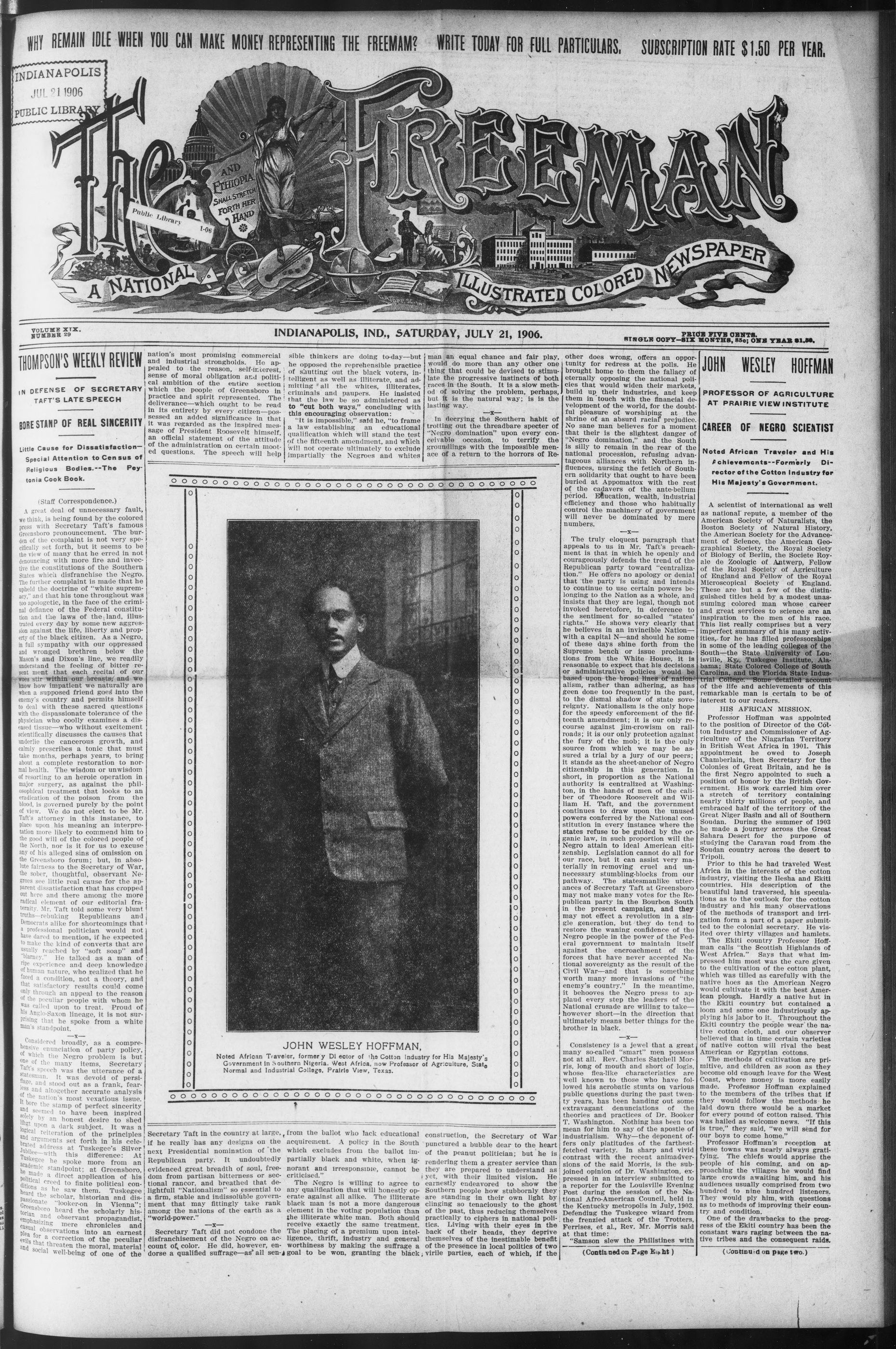
A great deal of unnecessary fault, we think, is being found by the colored press with Secretary Taft's famous Greensboro pronouncement. The burden of the complaint is not very specifically set forth, but it seems to be the view of many that he erred in not denouncing with more fire and invective the constitutions of the Southern States which disfranchise the Negro. The further complaint is made that he upheld the doctrine of "white supremacy" and that his tone throughout was too apologetic, in the face of the criminal defiance of the Federal constitution and the laws of the land, illustrated every day by some new aggression against the life, liberty and property of the black citizen. As a Negro, in full sympathy with our oppressed and wronged brethren below the Mason's and Dixon's line, we readily understand the feeling of bitter rejection that each recital of our career stir within our breasts, and we know how impatient we naturally are when a supposed friend goes into the enemy's country and permits himself to deal with these sacred questions with the dispassionate tolerance of the physician who coolly examines a diseased tissue—who without excitement scientifically discusses the causes that underlie the cancerous growth, and calmly prescribes a tonic that must take months, perhaps years, to bring about a complete restoration to normal health. We do not elect to be Mr. Taft's attorney in this instance, to place upon his meaning an interpretation more likely to commend him to the good will of the colored people of the North, nor is it for us to excuse any of his alleged sins of omission on the Greensboro forum; but, in absolute fairness to the Secretary of War, the sober, thoughtful, observant Negroes see little real cause for the apparent dissatisfaction that has cropped out here and there among the more radical element of our editorial fraternity. Mr. Taft told some very blunt truths—rebuking Republicans and Democrats alike for shortcomings that a professional politician would not have made to mention, if he expected to make the kind of converts that are usually reached by "soft soap" and "blamery." He talked as a man of ripe experience and deep knowledge of human nature, who realized that he faced a condition, not a theory, and that satisfactory results could come only through an appeal to the reason of the peculiar people with whom he was called upon to treat. Proud of his Anglo-Saxon lineage, it is not surprising that he spoke from a white man's standpoint.
-x-
Considered broadly, as a comprehensive enunciation of party policy, of which the Negro problem is but one of the many items. Secretary Taft's speech was the utterance of a statesman. It was devoid of persistence, and stood out as a frank, fearless and altogether accurate analysis of the nation's most vexatious issue. It bore the stamp of perfect sincerity and seemed to have been inspired solely by an honest desire to shed liberty upon a dark subject. It was a logical reiteration of the principles and arguments set forth in his celebrated address at Tuskegee's Silver Jubilee—with this difference: At Tuskegee he spoke more from an academic standpoint; at Greensboro, he made a direct application of his political creed to finite political conditions as he saw them. Tuskegee heard the scholar, historian and dispassionate "looker-on in Vienna"; Greensboro heard the scholarly historian and observant propagandist, emphasizing mere chronicles and observational observations into an earnest plea for a correction of the peculiar evils that threaten the moral, material and social well-being of one of the
JOHN WESLEY HOFFMAN
Noted African Traveler, formerly DIector of the Cotton Industry for His Majesty's Government in Southern Nigeria, West Africa, now Professor of Agriculture, State Normal and Industrial College, Prairie View, Texas.
nation's most promising commercial and industrial strongholds. He appealed to the reason, self-interest, sense of moral obligation and political ambition of the entire section which the people of Greensboro in practice and spirit represented. The deliverance—which ought to be read in its entirety by every citizen—possessed an added significance in that it was regarded as the inspired message of President Roosevelt himself, an official statement of the attitude of the administration on certain mooted questions. The speech will help
Noted African Traveller
Government in South
Normal and Industrial
Secretary Taft in the country at large, if he really has any designs on the next Presidential nomination of the Republican party. It undoubtedly evidenced great breadth of soul, freedom from partisan bitterness or sectional rancor, and breathed that delightful "Nationalism" so essential to a firm, stable and indissoluble government that may fittingly take rank among the nations of the earth as a "world-power."
-x-
Secretary Taft did not condone the disfranchisement of the Negro on account of color. He did, however, endorse a qualified suffrage—as all sen-
sible thinkers are doing to-day—but he opposed the reprehensible practice of shutting out the black voters, intelligent as well as illiterate, and admitting all the whites, illiterates, criminals and paupers. He insisted that the law be so administered as to "cut both ways," concluding with this encouraging observation:
"It is impossible," said he, "to frame a law establishing an educational qualification which will stand the test of the fifteenth amendment, and which will not operate ultimately to exclude impartially the Negroes and whites
man an equal chance and fair would do more than any other thing that could be devised to state the progressive instincts of races in the South. It is a slow nud of solving the problem, per but it is the natural way; is is lasting way.
In deyring the Southern habt trotting out the threadbare spect "Negro domination" upon every celvable occasion, to terrify groundlings with the impossible ace of a return to the horrors of
JOHN WESLEY HOFFMAN,
former, formerly Director of the Cotton Indus
Southern Nigeria. West Africa, now Professor
Briar College, Prairie View, Texas.
from the ballot who lack educational acquirement. A policy in the South which excludes from the ballot impartially black and white, when ignorant and irresponsible, cannot be criticised."
The Negro is willing to agree to any qualification that will honestly operate against all alike. The illiterate black man is not a more dangerous element in the voting population than the illiterate white man. Both should receive exactly the same treatment. The placing of a premium upon intelligence, thrift, industry and general worthiness by making the suffrage a goal to be won, granting the black
man an equal chance and fair play, would do more than any other one thing that could be devised to stimulate the progressive instincts of both races in the South. It is a slow method of solving the problem, perhaps, but it is the natural way; is is the lasting way.
In decrying the Southern habit of trotting out the threadbare specter of "Negro domination" upon every conceivable occasion, to terrify the groundlings with the impossible menace of a return to the horrors of Re-
try for His Majesty's
of Agriculture, State
construction, the Secretary of War punctured a bubble dear to the heart of the peanut politician; but he is rendering them a greater service than they are prepared to understand as yet, with their limited vision. He earnestly endeavored to show the Southern people how stubbornly they are standing in their own light by clinging so tenaciously to the ghost of the past, thus reducing themselves practically to ciphers in national politics. Living with their eyes in the back of their heads, they deprive themselves of the inestimable benefit of the presence in local politics of two virile parties, each of which, if the
other does wrong, offers an opportunity for redress at the polls. He brought home to them the fallacy of eternally opposing the national policies that would widen their markets, build up their industries, and keep them in touch with the financial development of the world, for the doubtful pleasure of worshiping at the shrine of an absurd racial prejudice. No sane man believes for a moment that their is the slightest danger of "Negro domination," and the South is silly to remain in the rear of the national procession, refusing advantageous alliances with Northern influences, nursing the fetish of Southern solidarity that ought to have been buried at Appomattox with the rest of the cadavers of the ante-bellum period. Education, wealth, industrial efficiency and those who habitually control the machinery of government will never be dominated by mere numbers.
The truly eloquent paragraph that appeals to us in Mr. Taft's preachment is that in which he openly and courageously defends the trend of the Republican party toward "centralization." He offers no apology or denial that the party is using and intends to continue to use certain powers belonging to the Nation as a whole, and insists that they are legal, though not invoked heretofore, in deference to the sentiment for so-called "states" rights." He shows very clearly that he believes in an invinible Nation—with a capital N—and should he some of these days shine forth from the Supreme bench or issue proclamations from the White House, it is reasonable to expect that his decisions or administrative policies would be based upon the broad lines of nationalism, rather than adhering, as has been done too frequently in the past, to the dismal shadow of state sovereignty. Nationalism is the only hope for the speedy enforcement of the fifteenth amendment; it is our only recourse against Jim-crowism on railroads; it is our only protection against the fury of the mob; it is the only source from which we may be assured a trial by a jury of our peers; it stands as the sheet-anchor of Negro citizenship in the sheet-anchor of William H. Taft, and the government continues to draw upon the unused powers conferred by the National constitution in every instance where the states refuse to be guided by the organic law, in such proportion will the Negro attain to ideal American citizenship. Legislation cannot do all for our race, but it can assist very materially in removing cruel and unnecessary stumbling-blocks from our pathway. The statesmanlike utterances of Secretary Taft at Greensboro may not make many votes for the Republican party in the Bourbon South in the present campaign, and they may not effect a revolution in a single generation, but they do tend to restore the waning confidence of the Negro people in the power of the Federal government to maintain itself against the encroachment of the forces that have never accepted National sovereignty as the result of the Civil War—and that is something worth many more invasions of "the enemy's country." In the meantime, it behooves the Negro press to apllaud every step the leaders of the National crusade are willing to take—however short—in the direction that ultimately means better things for the brother in black.
-x-
Consistency is a jewel that a great many so-called "smart" men possess not at all. Rev. Charles Satchell Morris, long of mouth and short of logis, whose flea-like characteristics are well known to those who have followed his acrobatic stunts on various public questions during the past twenty years, has been handing out some extravagant denunciations of the theories and practices of Dr. Booker T. Washington. Nothing has been too mean for him to say of the apostle of industrialism. Why—the deponent offers only platitudes of the farthest-fetched variety. In sharp and vivid contrast with the recent animadversions of the said Morris, is the subjoined opinion of Dr. Washington, expressed in an interview submitted to a reporter for the Louisville Evening Post during the session of the National Afro-American Council, held in the Kentucky metropolis in July, 1903. Defending the Tuskegee wizard from the frenzied attack of the Trotters, Ferrises, et al., Rev. Mr. Morris said at that time:
"Samson slew the Philistines with
(Continued on Page K. ht)
PROFESSOR OF AGRICULTURE
AT PRAIRIE VIEW INSTITUTE
Noted African Traveler and His Achievements--Formerly Director of the Cotton Industry for His Majesty's Government.
A scientist of international as well as national repute, a member of the American Society of Naturalists, the Boston Society of Natural History, the American Society for the Advancement of Science, the American Geographical Society, the Royal Society of Biology of Berlin, the Societe Royale de Zoologie of Antwerp, Fellow of the Royal Society of Agriculture of England and Fellow of the Royal Microscopical Society of England. These are but a few of the distinguished titles held by a modest unassuming colored man whose career and great services to science are an inspiration to the men of his race. This list really comprises but a very imperfect summary of his many activities, for he has filled professorships in some of the leading colleges of the South—the State University of Louisville, Ky., Tuskegee Institute, Alabama; State Colored College of South Carolina, and the Florida State Industrial College. Some detailed account of the life and achievements of this remarkable man is certain to be of interest to our readers.
HIS AFRICAN MISSION.
Professor Hoffman was appointed to the position of Director of the Cotton Industry and Commissioner of Agriculture of the Niagarian Territory in British West Africa in 1901. This appointment he owed to Joseph Chamberlain, then Secretary for the Colonies of Great Britain, and he is the first Negro appointed to such a position of honor by the British Government. His work carried him over a stretch of territory containing nearly thirty millions of people, and embraced half of the territory of the Great Niger Basin and all of Southern Soudan. During the summer of 1903 he made a journey across the Great Sahara Desert for the purpose of studying the Caravan road from the Soudan country across the desert to Tripoli.
Prior to this he had traveled West Africa in the interests of the cotton industry, visiting the Ilesha and Ekiti countries. His description of the beautiful land traversed, his speculations as to the outlook for the cotton industry and his many observations of the methods of transport and irrigation form a part of a paper submitted to the colonial secretary. He visited over thirty villages and hamlets
The Ekiti country Professor Hoffman calls "the Scottish Highlands of West Africa." Says that what impressed him most was the care given to the cultivation of the cotton plant, which was tilled as carefully with the native hoes as the American Negro would cultivate it with the best American plough. Hardly a native hut in the Ekiti country but contained a loom and some one industriously applying his labor to it. Throughout the Ekiti country the people wear the native cotton cloth, and our observer believed that in time certain varieties of native cotton will rival the best American or Egyptian cottons.
The methods of cultivation are primitive, and children as soon as they become old enough leave for the West Coast, where money is more easily made. Professor Hoffman explained to the members of the tribes that if they would follow the methods he laid down there would be a market for every pound of cotton raised. This was hailed as welcome news. "If this is true," they said, "we will send for our boys to come home."
Professor Hoffman's reception at these towns was nearly always gratifying. The chiefs would apprise the people of his coming, and on approaching the villages he would find large crowds awaiting him, and his audiences usually comprised from two hundred to nine hundred listeners. They would ply him, with questions as to methods of improving their country and condition.
One of the drawbacks to the progress of the Ekiti country has been the constant wars raging between the native tribes and the consequent raids.
(Continuing on page two.)
FORD'S HAIR POMADE FORMERLY KNOWN AS "OZONIZED OX MARROW" Makes the Hair Long, Soft and Easy to Comb READ WHAT THE PEOPLE SAY
FORD'S HAIR POMADE, formerly known as "OZONIZED OX RROW", so straightens Kinky or Curly Hair that it can be put up in any style desired consistently with its length, and is the only safe preparation known to us that makes Kinky or Curly Hair straight, as it shows above. It uses makes the most stubborn, harsh, kinky or curly hair, so the only easy to comb. These results may be obtained from one treatment; 2 to 4 bottles are usually nurtured for removal of the hair.
POMADE (OZONIZED OX MARROW) removes and prevents dandruff, relief, itching, invigorates the scalp, stops the hair from falling out or breaking off, makes it grow, and by nourishing the roots, gives it new life and vigor. Being elegantly perfumed and the mostیلک خامت و خمیر, the mostیلک خامت و خمیر, made and sold continuously since the 1898, and the label, "OZONIZED OX MARROW". It was registered in the United States at the time there has never been a bottle returned from the hundreds of thousands we have sold.
FORD'S HAIR POMADE remains sweet and effective, no matter how long you keep it. Be sure to get Ford's, as it's use makes the hair with a little imitations. Remember that FORD'S HAIR POMADE (OZONIZED OX MARROW) is 500g, and it is only only the same size as the signature.
The genuine has the signature, Charles Ford, Prest, on each package. Refuse all others. Full directions with every bottle. Price only 50c. Sold by drugists and dealers. If your drugist or dealer cannot supply you, he can procure it from his own brand. If you are in a long order, one bottle, postpaid, or $1 for three bottles, or $2.50 for six bottles, express paid. We are not a single person to all the points in U.S.A. When ordering send postal or express money order, and mention name of paper you saw this advertisement in. Write your name and address plainly to:
THE OZONIZED OX MARROW CO.
Dept. A, 76 Wabash Ave., Chicago II.
JOHN WESLEY HOFFMAN:
(CONTINUED FROM FIRST PAGE)
But these are disappearing, though the people are still fearful. Professor Hoffman assured them that an era of peace is at hand, and he found them everywhere anxious to welcome a condition of undisturbed industry.
His chief recommendation to the colonial governor was the establishment of a model farm, so that the natives might see for themselves how crops are produced under modern methods. There the young men might be trained in productive agriculture, and here the most progressive of them might come from the villages and stay from one to ten days or longer and bring back to their people such practical instruction as would revolutionize the agricultural industry of the towns. That the people are everywhere ready for it was shown by the number of applications from natives asking him to take their sons and train them to become farmers. This eagerness was a gratifying feature of the professor's tour. He also recommended to the governor the adoption of a system of irrigation similar to an effective one he had witnessed in operation during his stay in Algeria, in which the floodgates regulate the supply of water, each farm having its floodgate, which when opened, permits the water to enter the open ditches, flowing through the farms.
TOUR THROUGH THE OSHIELE
"DISTRICT."
In his visit to the Oshiele district he found a very progressive lot of farmers. It was here that the cotton industry was first established in West Africa, in 1845, by the Church Missionary society. The society introduced the industry for the purpose of distracting the attention of the people from slave raids, and in 1855 one thousand bales of cotton were shipped to England, weighing an average of 100 to 150 pounds. This increased until as many as 25,000 bales were shipped in one year. But with the resumption of the cotton industry at the close of our civil war the planting of native cotton in Oshiele ceased. Professor Hoffman told these people that it was time to begin again, and this they promised to do if he could assure them that it would pay.
A picturesque incident of his stay in Abernegra was the gathering at nightfall around his campfire of about two hundred native farmers and their wives. Here seated around the fire on the mats, with their curious head dresses and the light flickering on their eager faces, this earnest apostle of a new dispensation of industry talked to them of cotton, answered questions which the natives were encouraged to put, and induced them to hope for better conditions. It is conceivable that in more than one dusky breast he had stirred hopes of a future for the race, had awakened dreams hitherto foreign to these Africans, so lately emerged from a darkness deep as their jungles. It is a rare good fortune that has permitted this earnest and gifted member of his race to carry this message of better tidings to those of his blood, and it must have been with a proud sense of the responsibility of his mission that he pursued his way.
At Ijebu Remo an important meeting had been arranged by the king with the head chiefs and farmers. A
Key West, Fla., Aug. 28, 1904.
I used only one hair in my hair and only a hair has stopped breaking off and has greatly improved when I started using this wonder ul hair when it was longer than eleven inches long and now it is ten inches or more. Yours.
314 Southard St.
MINNIE FOSTER.
Brookhaven, Miss. Aug. 13. 1904.
I have a beautiful beard and I never tried any preparation so excellent for the hair. My hair is rather deadly but since I have been using your hair pomade I have not been when I was when I was a girl and it has a lively, glossy color.
Brookhaven, Miss., Aug. 13.
Gentleman: I must confess
so I have tried to be so
excellent for the hair. My
hair was very thick,
rather deadly but since I have
been using your hair pomade
it has been so much better
it was when I was a girl and
it has a lovely, glossy
C. L. ROBERTS.
Atlanta, Ga., June 6, 1200.
Gentleman: I have used your pomade
and have found it to do more than it is recommended
to do. It stops the hair from falling out and
softens it. It also helps with
hair soft, pliable and glossy.
MAGGIE REND.
THE FREEMAN. AN ILLUSTRATED COLORED NEWSPAPER.
large gathering of people greeted the professor, and they expressed themselves as delighted that the colonial government had sent its expert to talk with them about cotton. In the market place at Shagamu a great gathering of over two thousand people had met and the king sent for the professor to talk to them, which he did for over an hour. Everywhere he succeeded in establishing pleasant relations with the chiefs and head men, even though they are disposed to be naturally suspicious of strangers.
Indeed, he showed wonderful influence over these native chiefs. He traveled through some of the most hostile tribes found in all of Africa, yet was everywhere received with the honor due a representative of his majesty's government. This was strikingly illustrated by many an incident. The sultan of the Soudan country presented him with ten camels as a sign of his friendship, saying that the professor's mission was a peaceful one and meant for the good of his people and country. In the great Yorumba country, controlled by an intelligent king who rules over many millions of people, the ruler was so impressed by his visitor that he adopted him as a son and gave him all the honors of a prince.
But perhaps a more striking evidence of the love and affection that he had inspired among these people was shown on the eve of his departure for his native country, when he was offeged the professorship of agriculture in the State Normal and Industrial College at Prairie View, Tex. Special services were held in many of the Mohammedan mosques throughout Central Africa, and many thousands of dollars were spent by the natives in offerings of bullocks, sheep and other animals for the safe delivery of the professor among his people in America.
PROMPT RECOGNITION OF THE
VALUE OF HIS SERVICES
PROFESSOR HOFFMAN's services were recognized by those interested. His reception at the Liverpool Chamber of Commerce, at which meeting Sir Alfred Jones occupied the chair, was a gratifying evidence of such recognition. E. D. Morel, the well known editor of the West African Mail, expressed himself as being convinced that what Professor Hoffman might have to say would be of great interest and value. The London Times said of him that his departure for Lagos marked the opening of a new era in the cotton industry. And after four years of service in behalf of the British government and the British Cotton Growing association he was honored with a membership in the African Society of London and made a fellow in the following societies: The Society for the Encouragement of Arts, Manufacturers and Commerce, the president of which is his royal highness the Prince of Wales; the Royal Society of Meteorology for furnishing data on the climatology of the Soudan country, and the Royal Colonial Institute.
WORK ACCOMPLISHED IN WEST AFRICA
Professor Hoffman during his four years' stay in Africa traveled over eight thousand miles into the interior. Along all these stretches of country he established model farms and placed native educated African young men in charge. He secured a rich tract of over two thousand acres in the great Yorumba country and established a cotton plantation. The native king was so pleased with this
West Chester, Pa., Mch. 30. 1905.
I had typed乳房 and my hair all came out. I used three bottles of milk and now my hair is nine inches long and very thick and nice and straight. Most every one seeing how need your pomade did my hair, they too are anxious for it to dry an example to every one. Yours respectfully, RILA BEE.
Colvert, Tex. Mch. 31. 1905.
I have used one bottle of your pomade and my hair is now perfectly straight, soft and black as silk. I will not be without it.
RHOMA EDWARDS.
Colvert, Tex., Mich. 31, 1905.
I have used one bottle of your pomade and my hair is now perfectly straight, soft and black as silk. I will not be without it.
RHOHA EDWARDS.
Paris, Mo., July 15, 1909.
Gentlemen: When I began using your pomade my head was so bald I was as ashamed of my self, but now my hair has grown three inches over my head and I have been using it only to month after month.
that he sent him fifteen hundred of his slaves to clear the land, which was planted with American cotton secured from Texas. It is due to him that vast stretches of the most fertile land in British West Africa are now under cultivation with cotton, coffee, cocoa and other products. If that man shall be called blessed who makes two blades of grass grow where one grew before, then is this wonderful man of his race blessed above his fellows.
PROFESSOR HOFFMAN'S VISIT
TO THE WORLD'S FAIR.
In 1904 Professor Hoffman was sent to the St. Louis World's Fair for the purpose of studying the agricultural exhibits of the exhibition with a view of ascertaining what would be most useful to introduce among the natives of Africa. As a result of nis report many improved agricultural implements were sent to West Africa. HONORS THAT SUCCEED HIS
Since Professor Hoffman's return to America he has been tendered many important posts. The Belgian government offered him the position of traveling commissioner of agriculture for the northern district of the Congo Free State, and the French government offered him the position of special agent in charge of the cotton investigation of the French Soudan. This followed shortly after his address to the French Agricultural society at their annual meeting in Paris. These honors he has declined, feeling that his real field lay among his people. He believes that a great future awaits the race in the development of agriculture in the state of Texas particularly. As he has studied agriculture in all parts of the world under varied conditions of industry, this knowledge will be most useful to him in advancing its progress among his people
This is the modest ambition, taken with genuine humility, though at the same time with a proud consciousness of his own worth and powers, of this true savant, of one who has been the guest of the house of commons and the Archbishop of Canterbury, who has addressed the great scientific and commercial bodies of London, Liverpool and Paris, who has had the right of way through great stretches of Mohammedan and Pagan countries closed to European travelers, and who was the first man to introduce modern methods of farming and American agricultural implements into the great Soudan country of equatorial Africa. EARLY CAREER AND ACHIEVE-
It would require far more space than can be given to rehearse the many contributions made by the professor to agricultural science. A separate chapter could be given to each of these, and when we reflect that he is still a young man, it is reasonable to hope that many equally important achievements remain to be accomplished. He has already made his mark in his early years when upon leaving college he received the appointment of professor of agriculture at Tuskegee. He had attracted the attention of scientific men by his original studies of the interesting marine plant known as algae. He had propounded the theory that southern sorgum molasses could be used for fattening cattle for use among dairy cows to induce a better flow of milk, a suggestion taken up by the Societe d' Agriculture of France, which body urged that elaborate tests be made of its merit. He had won a standing before these bodies by his fame in dairy science, for he was the first man in the south to ripen cream by innoculating it with a special acid bacteria. He had demonstrated by successful experiments that an excellent quality of tea might be raised from the soil of Florida. One of the most succulent strawberries now extensively cultivated on the Atlantic coast has come to be known as the Hoffman improved seedling strawberry.
MOST DISTINGUISHED SCIENTISTS OF HIS RACE
While the professor holds indisputably the honor of being the most distinguished man of science of his race—a distinction abundantly testified to by his election to memberships and fellowships in many of the greatest scientific bodies of many countries, and while greater fame and wealth could be had by seeking them in other quarters of the globe, he has always felt, as has been said, that his life work lay among his people in his native southland. Known and respected all over the southern country by both black and white, looked upon as a pioneer in the cause of scientific agriculture, and discountenacing political activity among his people, he has sought to teach the southern Negro that his true pathway to success lay in industry—and especially in the industry of agriculture—Joseph Dana Miller, Associate Editor Cosmopolitan Magazine, New York.
Do not miss this opportunity to sub
subscribe for the races' leading journal
THE NINETIETH SESSION AT YORK, PA., ADJOURNS
The Philadelphia conference adjourned at York, Pa., recently, after their 90th session. Bishop Coppin presided in the absence of Bishop Arnett, who is sick.
The subdued mutterings indicate that there is widespread dissatisfaction in the ranks, and that in a few years unless there is a reform this body will lead a movement in the church that will be significant as the great national movement in politics against graft and corruption.
The shameless and injudicious appropriation of the conference disbursement moneys, at the expense of the poor preachers on stamnation charges, and the autocratic, tyrannical bigotry often exhibited on the part of Bishops and Presiding Elders, all tend to foster and feed a spirit that pretends no good in the future.
The rich are made richer, the poor poorer, and an expression of free speech is at the expense of a man's living. Justice is as great a stranger, often in conferences as "Hope is in Hell." The only difference is the latter is shut out of Hell by the eternal decree; the former from the conferences by the deceitful, sordid, selfishness of men.
Facts and figures from the minutes of the Philadelphia conference held at Reading, Pa., for 1905, show that there was $2,313.08 constituting the conference disbursement funds.
Out of this large sum, fully $160.00 was used to supplement the salary of under-paid preachers, although the conference minutes show fifty-four (54) under-paid preachers and missionaries.
Seventy dollars of this $2,313.08.was expended for the funeral expenses of two deceased brethren (one was reputed to have died from want and privation while serving faithfully a small mission.) Six superannuated preachers got $800 between them, sixteen widows had $335 divided among them (not one penny was apportioned to the orphans.) A total of $1,365. The balance, $484.08, was expended, some of it in ways that no sophistry of reason could justify under the existing conditions. Two hundred was given to purchase an electric power plant at Wilberforce; $200 for Episcopal annual expenses. Although the Bishop gets $2,500 a year, and it is supposed to cover all the expenses of the conference, the Philadelphia conference presents in a small way a field as prolific for graft as the New York Mutual and Equitable Life Associations have proved to be, and when the amount of suffering and privation among the men is known, pitless greed and merciless capacity is reprehensible on the part of those who have plenty and can prove no legal and moral right to the funds.
At the conference just adjourned in York, Pa., the conditions were similar. Over $2,300 was available for conference purposes. Of this amount, $100 of the conference money was given to Bishop Coppin, as a present; $25.00 more for postage, etc.; $40.00 to his private secretary; $150.00 presented to Bishop Arnett. Notwithstanding the act of the general conference that increased the Bishops' pay from $2,000 to $2,500 a year, and the spirit of the law that supposes Bishops shall not take the conference money under different subterfuges and pretexts. In the face of the fact that there are men nearly every year who die under the most distressing circumstances, fighting bravely at their post, makes these amounts appropriated to these who have plenty and to spare, appears like blood money, some of the recitals of these poor men are distressing in the extreme.
Nearly $1,000 of the money given by the people in the last two years in the Philadelphia conference diverted to channels not authorized by law, while the needy have been left to suffer. This is a monstrous and henious crime that calls for the condemnation of all honest and fair-minded people. There is a need for a sweeping reform and if it doesn't come soon, we believe there will be a revolution. I don't write this to air dirty linen, but to set thoughtful men to thinking in order that common sense decency and honesty shall begin to lighten this grand old ship in order that it can move effectively and do the work that God and circumstances has mapped out for it to do. More anon, FRATER.
Indiana has been fortunate in her senatorial representation. Senator Albert J. Beveridge has no superior in that august body as a thinker, an orator and a scholar. His knowledge of the larger issues pending before congress is that of an expert; it is acquired at first hand, through personal investigation. His magnificent work on the statehood bill and on the meat inspection measure alone would be sufficient to entitle him to an enduring place in the annals of American statesmanship. There are higher rewards in store for Mr. Beveridge.
A FAMOUS SONG WRITER.
Foster Was Called the Edgar Allan
Poe of Music.
Stephen Collins Foster, the most popular of American song writers and composers, has been called the Edgar Allan Poe of music. Like Poe, he was a genius. He came of Virginia parentage, received a good education and died in New York Jan. 13, 1864, in the height of his fame, a penniless wanderer. He was born in Pittsburg July 4, 1826.
He learned easily, and after receiving private lessons in music and drawing taught himself to play on the flaggeoet, guitar and banjo. He also devoted several years to the voice and piano. Then he turned his attention to composing songs and dialect ballads and dialect songs. At the age of seventeen, while employed in Louisville, Ky., he published the serenade "Open Thy Lattice, Love," which was instantly successful. Then followed "Uncle Ned," "O Susannah," which were sung by a minstrel troupe, and Stephen Foster became famous far and wide."
Marrying, in 1844, Jennie McDowell, he came to New York, where in rapid succession he supplied his publishers with songs which became famous—"Old Kentucky Home," "Massa's In De Cold, Cold Ground," "Old Dog Tray," "Willie, We Have Missed You" and "Sweet Ellen Bayne." But the song that is best known in many lands is "The Suwanee River," for which Christie's minstrels gave him at the beginning $50. In addition he received royalties on its sale of over half a million copies and the honor of knowing that eminent singers like Jenny Lind sang it to applauding thousands.
His last song, a negro melody, "Old Black Joe," is still a favorite. A fourth of his 150 songs were in negro dialect, among which were "Nellie Bly," "Nell Was a Lady" and "Nancy Tile."
THE ELYSEE PALACE.
Checkered Career of the White House of France.
The Elyse palace, situated in the Rue Faubourg Saint-Honore, is a cross between a country house and a hotel. It has had a checkered career since its erection in 1718 and has harbored some queer characters. Louis V. presented it to Mme. de Pompadour. Who knows how many lettres de cachet went out of the gates to imprison those who lampooned her? Under Louis XVI, it was called the Elyse Bourbon. During the revolution it became national property, was put up for sale, found no purchaser and was turned into a government printing office. During the directoire there were gay doings in the fine old rooms, and the merveilleuses and incroyables danced and gambled from sunset to sunrise. The rooms were let to a syndicate who made a large fortune out of the speculation. Since then the palace has been occupied by Murat, Napoleon I., Louis Bonaparte and Queen Hortense, Alexander I. of Russia and the Duc de Berri. After the revolution of 1830 it remained unoccupied until Louis Napoleon made his residence while he was president of the republic. Nearly all the subsequent presidents of the present republic have added to it. The large glass awning seen from the Faubourg, called by the soffers "the monkey palace," was the work of Carnot. His also is the large ballroom. The left wing was built by Louis Napoleon, and Grevy added a room overlooking the garden. None of the presidents seem to fancy its state bedroom, nor do they write at the Louis XVI, table, ornamented with brass work chiseled by Gouttiere. They have one and all preferred to furnish small rooms away from the solemn state apartments and use an ordinary desk such as we find in any office—Boston Transcript.
Lincoln the Lawyer.
It is conceded by all his contemporaries that Lincoln was the best all around jury lawyer of his day in Illinois. Undoubtedly his knowledge of human nature played an important part in his success. He possessed another quality, however, which is almost if not quite as essential in jury work, and that is clearness and simplicity of statement. His logical mind marshaled facts in such orderly sequence and he interpreted them in such simple language that a child could follow him through the most complicated cause, and his mere recital of the issues had the force of argument.—Frederick Trevor Hill in Century.
An Explorer's Stratagem.
Sir Harry Johnston, the famous explorer, once escaped from a very tight corner in Africa by a queer stratagem. A score or two of murderous natives had surrounded his tent, into which, before rushing it, they sent an envoy. The envoy was told the smallpox was in the camp, and a wretched Albino was sent out as the awful example. In five minutes the scared tribesmen had vanished. As Sir Harry well knew, they feared the "white disease" more than all the inventions of Maxim.
His Works
"A man is known by his works," declared the irrepressible reformer, who was addressing a large and enthusiastic audience. "Yours must be a gas works!" shouted a rude, uncultured person who occupied a back seat.
Obliged to Move:
"What, you are not going to move again?" said Mr. Jones to his brother. "I thought you liked your little flat." "So we did when we moved in, but my wife has gained ten pounds, and we need more room."
Good nature is the very air of a good mind, the sign of a large and generous soul and the peculiar soil in which virtue prospers.—Goodman.
EASTERN STARSESSION HELD
AT MT. VERNON
Delegates from All Over the State.
Officers Elected -- Next Meeting
at Terre Haute. -- Many Visitors
Present. -- Personal Notes
Special to The Freeman.
Notwithstanding the vast draught that has visited us this season, we had the distinguished honor of entertaining the Grand Chapter of the Eastern Star. Delegates from all over the entire State were present and were well pleased with the beauty of the town and the genuine hospitality shown them during their stay. The session was of three days' duration which was filled with real business of interest instead of the frivolity which commonly characterizes such meetings at the expense of the lodges represented.
The following officers were elected Jennie Lewis, Indianapolis, grand matron; William McFarland, Evanville, grand patron; Mary Thompson, Mt. Vernon; associate grand matron Walter Russell, Wabash, associate grand patron: Winona L. Speed, Richmod, grand secretary; Mrs. E. B. Yanthis, New Albany, grand treasurer Mrs. Catherine Wilson, Marion, grand conductress; grand Adah, Martha White; grand Ruth, I. E. Anderson grand Esther, Florence Fines; grand Martha, Mattle Davis; grand Electa, Harriet M. Williams; grand Warder, Celia Rector; grand sentinel, Cruitup, committee of foreign correspondence, Nellie Gray Strong, Anna and Elizabeth Rucker. The next meeting will be held at Terre Haute.
Mr. and Mrs. Grant Barber, of Kokomo are the guests of Mr. and Mrs. Milton Webb.
Nellie Noel, of Princeton, is visiting Mr. and Mrs. Frank Buckner.
Mrs. Cecellia Rector, Mrs. Lydia Anderson, Miss Elena Cabell, Walter Russell and Fred D. Blake of Terra Haute were the guests of Mrs. Eda and Mrs. Angle Cooper during the grand session. Mrs. Eda Cooper returned with them for an indefinite stay.
Rev. M. V·Saunders. of the A. M. E church has been attending the Sunday School Convention.
Lloyd Cooper, of the Kersands Minstrels is at_home making preparations for his departure August 19. Mr. Cooper has been painting, carpentering bricklaying and gardening during his vacation.
HALFTONE PICTURES in the
reading pages of THE FREEMAN
will be inserted at these prices:
Single Column - $3.00
Double Column - $5.00
SIX MONTHS FREE.
Let me send you my Magazine
"The Dollar Mark"
Free for Six Months.
It tells you how to get on in the world. How to save and invest money. In fact it is brimful of interesting matters about the world in the hands of every person who desires to get on in the world. Send for it to-day. Address
E. C. BROWN,
Box 382, Newport News, Va
Coca-Cola
At all Saloons, Groceries, Cafes and Standes.
Ec. a Bottle.
See Mrs. Ed. Trowle
For wigs, Pompadour
and all kinds of hair
goods. What is the
can be made from hair
dairy. I also have a hair
I also have a hair
food that provides
hair from animals
and produces a beautiful
food that is beautiful
Malt oil is used.
T
215 Flora St.
Dallas, Texas
Money must accompany all orders
goods.
J. N. Hickman.
H. E. Hickman.
J. N. HICKMAN & SON,
Funeral Directors
1210-1212
Walsh Ave.
Both Phone
TW
Embalmers,
Livery 19-21
North Twelfth Street.
Terre Haute, Ind.
FOR THE IMPROVEMENT AND ADVANCEMENT OF THE NATIONAL BENEFIT ASSOCIATION O
HEAD, SECOND AND SIDE WAITERS "For the man who works with brain or hand."
W. Forrest Cozart, Editor.
Subscribe for the Freeman and read what W. Forrest Cozart has to say.
Mr. Columbus Wilson has been appointed third waiter at the Chalfonte, Atlantic City.
Mr. B. F. Welty has succeeded Mr. John Dunn as manager at the Hartman (European) Hotel, Columbus, Ohio. At present white waiters are employed at the Hartman.
The waiter who leaves a good position for two months work at some resort and then return's home to loaf for the winter needs about 2 gallons of common sense injected into his oranium.
It may not be generally known but it is a fact that two-thirds of the colored business men of this country are men who at one time filled the position of waiter where he became imbued with the white man's idea.
There is no city in the world that furnishes employment to as many coloed waiters as Atlantic City, N. J. There are about 2,000 colored girls waiting in hotel and boarding houses and 5,000 given employment otherwise.
INDIVIDUAL HOTEL DIRECTORY
[One address line $4.00 per year; including
subscription to The Freeman, in advance,]
HEADWAITERS.
J. W. Redmond, headwriter of The Car-
roll, Wickesburg, Miss.
10-06.
C. W. Dwyer, headwriter Commercial
Club Minneapolis, Minn.
8 105
C. H. Plummer, headwriter Hotel Brun-
cist, Uniontown, Pa.
10-05
B. H. Bradley, headwriter Menger Hotel,
San Antonio, Texas.
3-06
G. W. Bland, headwriter of The Oliver,
South Bend, Ind.
12-06
This column used exclusively for the ad dresses of hotels, restaurants, and other rooms throughout the country, and intended as a guide for the traveling public - you business. C. W. Dwyer.
Hotel Dwyer (European) C. W. Dwyer,
proprietor. First class rooms by the day,
week or month, with heat, electric light
and bath. 224 Washington Avenue, South,
Minneapolis, Minn.
Hotel Reformer—First class in all respects
900 N. 6th street, Richmond, Va. A. W.
Holmes, manager.
Moore's Hotel—First-class rooms and board
rooms neatly furnished, 712 and 714 W.
9th street Little Rock, Ark.
Waldorf-Astoria Hotel—327 Laurel street,
Hot Springs, Ark.
Black's Hotel—A modern first-class hotel
for colored people, H. Black, Manager,
Eransville, Ind.
The Parker House—Rooms, bath. J. W.
Holliman, proprietor, Indianapolis, Ind.
VICTOR
TALKING
MACHINES.
The Victor is so perfect it is often mistaken for the human voice. It is proving a never falling source of DELIGHT to Thousands.
COME IN AND LET US
TELL YOU all ABOUT it.
SOLD ON EASY
PAYMENTS
Phones } Main 852
} New 9093
KOEHRING BROS.
878, 880, 882 VIRGINIA AVENUE.
Hoosier Poet
CLUB ROOM LONDRES
10c Cigar
We deliver Goods direct to consumers and pay all express charges.
Give Us A Tryal Order.
John Rauch Cigar Co. - Indianapolis, Ind.
AMERICAN BREWING CO.,
BREWERS & BOTTLERS
OF
HIGH GRADE BEER.
—TELEPHONES 935—
HEADQUARTERS
Indiana Ave.
Indianapolis, Ind
HOTEL DIRECTORY
Elswhere will be found the speech delivered before the headwaiters association by Mr. Geo. H Emery, headwaiter at the Haddon Hall, Atlantic City. This speech has been previously referred to in these columns.
The Freeman is the official organ of the colored waiters of the United States. Why not subscribe and read the doing of the waiters throughout the country. When you see it in the Freeman you know that it so because it is written by W Forrest Cozart.
Just as soon as the Dining Room Recorder can publish the proceedings and other business of the National Convention. The proceedings, by-laws, and the constitution will perhaps be published in the usual way, but the Recorder comes first and the members last.
Mr. Thomas J. Simon is making good at the Bienville Hotel, Mobile, Als. Mr. Simons is a head waiter of a notional reputation and a member of the Head and Side Waiters National Association Mr. Simons is no stranger in Alabama as he has been in charge of such hotels as the Exchange, Montgomery 1888; Anniston Inn and Caldwell Hotel, Birmingham 1889
To the careful observer of the drift of politics, it can be seen that the grand old republican party is about dead. It is evidently that the cause of the death is due to an over dose of Roosevelt strenuosity. At present the outlook for republican success in 1908 is very discouraging as both the party and the men who made it what it was, has been Roosevelted to death. The editor reserves the right to speak more fully along this line at some future time.
The Holland Dining Room crew at Orange, Texas are Henry Harris, head-waiter; Burton Wood, second waiter; Jake Batom, captain of watch; Jeff Shorter, Jesse Jackson, Lloas Paterson, Charley Brown, Joe Shirden, Eddie Hills, John Hamilton, John Nickson, and Victor Auberspann, sidewaiters. In the kitchen, J E. Neasby, chef; J E. Burns, second; F. Romlo, third; Chas Chappel, Broller, W. Savor. Baker.
Mr. J. H. Andrews who for some time has been head waiter at the Abertl Hotel, Selma, Ala, has resigned and accepted a position in Birmingham. He is succeeded by his captain, Mr Louis
THE FREEMAN, AN ILLUSTRATED COLORED NEWSPAPER
EASTERN BRANCH
17 N. Kentucky Ave.,
Atlantic City, N.J.
ORGANIZATION.
National Beneficial Association of Head, Second and Sidewaiters In Convention Assembled---Speech of G. H. Emory.
H. Parker of Pensacola, Fla., who blds fair to prove a proficient headwalter, as all the boys seems to like him, he being the favorite and termed 'Admiral.' "Mr. Parker is assisted by M. T. Crawford, as captain and nine other side men. Sam (Lord) lieutenant, Jos. Lasciter as lineman.
The many friends of Mr. George Davis, the old reliable and efficient headwaiter at the Beekel Hotel, at Dayton, Ohio, will be pleased to know that he has about recovered from a serious illness, which for a while gave alarm to those who were familiar with the complaint. Mr. Davis has been at the Beekel since 1900 and has worked very hard as all headwaiters must do to make a success in a commercial house. Previous to going to Dayton, Ohio, Mr. Davis was at the Clarendon at Zmesville, Ohio, with the same proprietors that now conduct the Beekel. On behalf of the fraternity the editor congratulates Mr. Davis upon his recovery.
There is no class of public servants who are overworked and under paid as the sleeping car porters. The company
In this truly representative body, where the freedom of speech affecting the rights, welfare and duties of our craft is relished, I feel a special pleasure in offering a few remarks upon the keystone word of our association, organization. The word has a peculiar meaning to us as an organization, for according to The Century Dictionary it means the systematic union of individuals in a body whose officers, agents and members work together for a common good. In theory many of us know the meaning of the word; in practice it generally means to us a mere assemblage of persons, with no definite aim or fixed policy to pursue and carried to a progressive-end.
There are a variety of minds and there will be a variety of opinions upon the vital matters pertaining to our works.
The pressure of events which demand ready solutions imperatively say, Organize! Organize! What will we organize? Why will we organize? What good will be accomplished by proper organization? We will answer our first interrogation by saying that we will organize the best material for hotel service in the world into an elastic working body, whose influence will ramify every avenue throughout the United States. Men whose minds and hearts are in the work, whose consciences tell them that it is "high noon" for such work. Why will we organize? We will organize so that each member can carry out his duties with a true insight into their purposes thus making them converge to a common centre and mutually accomplish a common good for there is too much divided energy at present existing in our ranks. What good will be accomplished by proper organization? First will be the recognition of true worth and that element
Recently two fights among the hotel boys have been reported, which we regret very much to hear. We had began to think that the days of the 'fighting waiters' had long since passed. The results of the two fights have proved disastrous to the two aggressors, if reports be true. One lost his position as head waiter, and the other is laying off with a blackened eye, while the two victors go morrily on as though nothing had happened — Advocate.
The above article is clipped from the Portland (Ore.) Advocate and refers to a disgraceful altercation between one of the side men and the man in charge of the cafe in the leading hotel in that city. The side waiter was given a beautiful pair of black eyes while both lost their positions. We are somewhat surprised at our esteemed friend and headwaiter in chief Wheeler, in keeping such men of such character around. It is the duty of the headwaiter to displace bolsterous and disagreeable men as soon as they are discovered. However the thing that surprises us the most, is, how the fight could have been pulled off in the wild and woolly west without a six shooter and quiet funeral.
Every waiter is looking for money and in the meantime would not object to become famons, if some one would capture both money and fame for them and present the same on a silver platter. The same is true of headwalters, all would like to have in their charge big dining rooms, and be known as "one of the finest," providing same could be
employe honest and well meaning young men and proceed to reduce them to the level of a common thief. They are sent out on short notice "deadheading" for days and weeks without money or provision for maintenance, and thus they become public charge, to be either supported by charity or to purlin from those with whom he comes in contact and whom are more fortunate. To add to the porter's burden expensive uniforms are rushed on him three times a year, and then he is bled and robbed by the graft of other employees (white) until he has noting left.
The editor has often called the attention of the readers to the young waiter who only follows the business in order to get money enough to finish his schooling or to go into business for himself. At this season of the year the headwaiter finds many of these kind of waiters who have no ambition to excel in the profession, therefore they perform the duty any old way just so they put in the time and get by. Many of this class of waiters are students of law, medicine, theology, etc., and they try to see just how trifling they can be while filling a position in the dining
alone is essential to real and lasting success. Promotions will also come from the ranks of our craft through efficiency. Efficiency is only acquired through persevering and arduous toil. The policy of "graft" will be eliminated, favoritism destroyed and confidence based upon respect for the leaders, integrity established, instead of fawning cunning as now so prevalent and repulsive to those whose mission is to build a solid foundation, whose base is true worth and honorable manhood, and whose superstructure will be confidence, respect, capability, economy and conservative growth.
A great philosopher once said, and he was a constructor of governments and one of the world's organizers: "Let that man who assists the magistrates in punishing vice be proclaimed a great and perfect character and let him receive the crown of virtue."
The person able to assist should be respected in the highest degree; but the man of an envious nature, who would grudge to others the blessings which he himself enjoys, deserves reprehension, therefore by coming into a mutual and direct association we create a physical capacity to secure the essentials necessary to our comforts, for employment will be more continuous and regular. We can also create a mental capacity out of which will flow good and intelligent ideals. We can then detect the true from the false, disconcert the schemes of foes both within and without our ranks. We can readily discover and follow the great movements of the labor world and adjust ourselves to their changes.
Do not evade issues because they touch some one powerful in our council and may cause offense.
To do so will only continue our embarrassment and weaken us. We must come together, strengthen and grow.
Do not have any frills or fads as some
had without making any sacrifices, foregoing pleasures, etc., in securing the same. But they fail to keep in mind the fact that nothing great is easily won, good things come high. etc. In a recent issue we pointed out a young head waiter who had commenced at the bottom and had fought his way to the top, as a result he is now famous. But he won his spurs by having ambitious, qualities and never thinking that he done too much. There is plenty of room at the top, if you have ambition, manhood, and the necessary grit. Keep on pushing and you will get there.
Why the porter of a sleeping car should sit at the head of the aisle in the main body of the car when polishing the passenger's shoes is undoubtedly known to the authority which framed the rules for the government of this army of public servants when in the field. But after one has had the misfortune to occupy lower one or lower two several nights in succession, where he must listen to the "whish, whish, whish" of the porter's shoe brush, he may be forgiven doubts as to wisdom of the particular rule in question. If the sound were only continuous it might lull one to sleep, but the interruptions when the porter drops the shoes are trying for a nervous man. It is certainly proper, even necessary, that a sleeping car be well policed, yet this does not require that the porter do the polishing at all times, and especially this should not be required of him when doing other work of a nature that cannot but annoy passengers. If the public safety require that either the conductor or porter be
room. The waiter who willingly becomes trifling and in-efficient while making money to finish his profession unconsolously becomes the same kind of a man after he has completed his schooling and begins to practice his profession. Hence failure is the result.
The same "why" as above has for many years puzzled the thousands of sleeping car porters. Yes, it is true that the porters of the sleeping cars are required to sit at the head of the alley in the main body of the car night after night and also maintain the same vigelence during the day. The managers says that this is done to protect the occupant, this spreads very badly for the honesty of the 'traveling public. But when the Age speaks about the "off watch of the porter" it can be seen that the Age is not familiar with the facts. The porters work is like a woman—it is never done—therefore there is no "off watch" while enroute. Sometimes the porter is allowed two or three hours sleep out of twenty four hours, but even then he is supposed to be on watch and is held responsible for every thing on or about his car.
members may entertain an idea that originally however impracticable must be accepted if they suggest it or stand sponsors for the same. What we want is cool, calculating and dispassionate discussion in our craft's interest.
Sad are the conditions of many who have not seen the benefits to be derived from our associating of efforts. Some come seeking work, yet they have delayed the glorious opportunity of uniting with us when it was due season. The next phrase of our work calls for men who see the good of becoming efficient in the work by continuing long enough at it and thus become master of all its duties. Too many join any effort or subscribe to any principal for selfish ends, seeking protection for their sloth and pity for their invited failures. The result has been that many head-waiters have lost their positions because their main support came from this most numerous class. Furthermore, our organization should start an insurance department.
The conditions of our craft will dictate the wisdom of such a venture. Widows and orphans can be cared for with a dignity that borders not upon dependence. We should also have a training school for waiters.
Out of such a school of discipline few shall get efficiency and out of efficiency will come preferment for those who acquire skill in service. Do not allow selfish interest to prevail for all the individual units of our craft can illumine the labor world with resplendent worth from the head to the side waiter. For in the language of William Gilmore Simms: "Our distinctions do not lie in the places which we occupy, but in the grace and dignity with which we fill them."—Geo. H. Emory, Headwaiter Haddon Hall, Atlantic City.
on duty in the main body of the car at all times, the "off" watch of the porter should be scheduled so as to include the shoe-polishing period.—Dally Railway Age
SHREVEPORT LA
W. Woods has succeeded the white chef cook at the Hotel Inn. Mr. Wood's now has the store room and kitchen under his charge..
Headwalters at Shreveport—Wilson at the Caddo; Martin at the Inn; and Smith at the Pheonix—have a nice group of boys.
Ed Williams is cooking at the Barnes House again.
IMPORTANT NOTICE.
The executive committee of the local management of the Negro Young People's Christian and Educational Congress, which will convene at Washington July 81 to August 5, has made arrangements to accommodate all delegates and visitors during the Congress at $1.00 per day for board and lodging. All who expect to attend the Congress will notify Rev. Dr. I. Toliver, 1145 Twenty-first Street, N. W, Chairman of Committee on Homes that will be notified of their stopping places before leaving home.
The Freeman in Chicago.
Ed. Felix, 368 Thirtieth street.
Louis Love, 2720 State street.
E. H. Faulkner, 3104 State street.
H. S. Winston, 280 Tweney-ninth
Richard Webb, 2640 1-2 State street
J. P. Winstead, Shining Parlor, 391
Thirty-first street.
COOKS
Waiters & Cooks
Prefer Our Make
JACKETS AND LINEN
because they have found them
satisfactory.
Write for complete Catalogue
FREE.
giving full instructions how
to order.
Marcus Ruben (Inc.)
830 State St., CHICAGO IL.
N or about September 1, 1906, we will open a business, the purpose of which is to supply in full the dining room, baker shop and office with UNIFORMS made by the most skillful tailors, and the workmanship of which stands on its merits. We will be able to furnish all sizes and fill orders in all quantities, however large. In connection with our business we will operate an EMPLOYMENT BUREAU for hotel men. This is a new feature and original. It is bids fair to meet the approval of the hotel world as well as benefiting it. We will aim to place good men in good places. Particular attention will be given to the heads of the various departments. We are hotel men by many years experience; we are acquainted with a vast throng of hotelmen both among the employed and employers. Already a large number of Managers and Proprietors have given us encouragement by pledging us their hearty good will and support. Watters, Bell Boys and Cooks will do well to register with us. Your interest is our interest: our success will assure your success, thus giving all parties concerned the benefit of each other's co-operation. Our employment bureau is free of charge. We request only one favor, namely, that after your position is secured you will kindly appreciate our services by allowing us to furnish your crews with our uniforms, guaranteed to be as good as money can buy. Heads of departments will be allowed a liberal discount on all orders, provided application is made at our office. Consider kindly our proposition and give it due regard. Hoping to win you to our side, and to find you among our supporters, we are.
Yours respectfully,
Feltenburg-Daniels.
P. S.—Look for later an-
nouncement Address all com-
munications till August 1st to
215 State street, Texarkana,
Texas.
WANTED AGENTS in each country to sell Good profits, steady work. Address Campbell& Co., 55 A Street, Elgin, Ill.
Lady Agents—Easily make $3 a day mating and selling "Japanese Cleanlah". instantly removes grease spots, paint, stains, etc., from kindles and storing costs 6 bottle to make, sell, for sale, or keep everything furnished. Write to day, Thon. Campbell, 55 A St., Elgin, Ill.
THE MAGIC SHAMPOO
HAIR DRIER
After a bath shampoo the hair
can be DRIED and STRAIGHT
ENED with the shampoo. If
you have hair which will
Straighten curly hair without
a drying agent, it will stimulate its growth and make
it look natural and beautiful, which
adds to its appeal.
The Shampoo Drier is a set-bar with
a receptacle containing a six inch aluminum com-
partment. For sale by toilet article dealers. By mail, price:
$1.00 per item, priced as shown.
"Sir! The Shampoo Drier is used in my parlor
with perfect satisfaction. Adame Cozart, If Koch
truck we are at Atlantic City, N.J."
Magic Shampoo Drier Mfg. Co.
407 Century Bldg.
Minneapolis, Minn.
HAIR SWITCHES
Bangs and Wide of Every Description
Most Complete Line of Hair Goods in this Country for Hairdrobes. 50c buys a single braid made of Black Kinky Hair 12 inches long. 75c buys a single braid made of Black Kinky Hair 16 inches long. $1.00 buys a Creole Switch, 16 inches long, Brown or Black. $1.25 buys a Creole Switch, 20 inches long, Brown or Black. $1.75 buys a Creole Switch, 22 inches long, Brown or Brown. $3.50 buys a Natural, Wavy, Handmade sample of hair when ordering Creole Switches. Send sample of hair when ordering Creole Switches. Send money with order and get your goods by return mail. Stamp catalog for catalogue.
SANTAL-MIDY
Standard remedy for Glee
Gonorrhea and Runnings
IN 48 NOURS. Cures Kid-
ney and Bladder Troubles.
MIDY
THE FREEMAN
THE FREEMAN
NATIONAL ILLUSTRATED COLORED NEWSPAPER.
PUBLISHED EVERY SATURDAY
At 309 Indiana Avenue,
INDIANAPOLIS, INDIANA.
SUBSCRIPTION RATES :
Any part of the United States and Canada
one year, postage paid $1.50
Six Month+ 85
Three Months 60
Foreign Countries $1.00 extra
buy in person by express, money order, post
office order or registered letter.
Agents wanted i 1 every tow; and city not now occupied, and liberal inducements will be given to the same. Send for our extraordinary inducements.
ADVERTISING RATES:
Five cents per line. Fase of measure—solid
agate, 14 lines to an inlc. 272 lines in a column.
Advertisement inserted on first page. Special
rates on standing professional and business
cards. Reasonable discount for long time and
special rates on do per line. Special rates on
WRITE UFS.
Entered at the postoffice at Indianapolis,
Indiana, as second class matter.
INDIANAPOLIS, - INDIANA.
SATURDAY, JULY 21, 1906.
THATRIOT!!!
Owing to last Sunday's demonstration at Riverside Park Mayor Bookwalter has issued the letter of instruction to the Chief of Police:
"Robert Metzger, Chief of Police:
"My Dear Sir—The riot which occurred at Riverside Park Sunday is a disgrace to the City of Indianapolis, and every possible step should be taken to render the public parks absolutely safe to every citizen with out regard to color.
"The gangs of hoodlums whose sole ambition seems to be to assault peaceable colored men and women must be broken up. Because such characters can only understand physical force. I want you to instruct the members of your department who are detailed to the parks that in case of a recurrence of these outbreaks the young tough, no matter what his color may be, is to be treated with such force as will subdue him.
"I am not, under ordinary circumstances, in favor of the use of the club by policemen, but upon ruffians of this character I expect the club to be used, and I shall stand behind any office who does use it in his determination to protect citizens in their rights. This is not a matter of race it is a matter which concerns every citizen without regard to race. Please see that instructions in accordance herewith are given to the members of the department. Very truly yours."
"CHARLES A. BOOKWALTER."
It is not too much to say, that, all the right thinking people, regardless of color, appreciate the stand the mayor has taken for law and order. Careless people will say that he is simply performing his duty in his instructions to the Chief of Police and in his avowed determination to preserve order in the at any cost. But a duty is not always pleasant and in consequence is sometimes imperformed. Politics and the race question cut in and to such an extent that those sworn to corserve the public peace sometimes fail and willingly fail to do their duty.
Mr. Bookwalter leaves no doubt in the minds of the police or the citizens as to what he means. He means that colored men and women, peaceable colored men and women, may go to the city parks, the parks maintained also by their taxes, to enjoy themselves just as other, well behaved people may do.
The riot was a disgrace as Mayor Bookwalter says. It was by a set of ruffians without any sense of responsibility, who did not regard the city's good name, and who cared less about it Indianapolis has no reason for incipient race wars, and the mayor was right in reading his strenuous riot act to the participants in last Sunday's business, and which also serves a warning for budding ruffianism. "No scraps here!" We do not need them and we believe that the present mayor will live up to his determination to give all would be scr ppers a scrap that they may think on.
THE BUSINESS LEAGUE.
The Local Negro Business of Atlanta, Georgia, is rapidly maturing its plans for the entertainment of those who attend the Seventh Annual Session of the National Negro Business League to be held in Atlanta, Wednesday, Thursday and Friday, August 29, 30 and 31. An interesting feature of the program, as outlined by Emmett J. Scott, Corresponding Secretary, is to devote the Thursday morning session to a discussion of "The Negro in Agriculture." More than eighty-five per cent of the Negro people live by some form of agriculture and it is important that special attention be devoted to arousing interest in the matter of purchasing their own farms and improving them in every way possible; the farm comes in contact with the outside world through the medium of business, and it is necessary that he knows something of business to protect himself and and those committed to his care.
On Friday, August 31, the morning session will be devoted to hearing from representatives of the Negro banks conducted in various parts of the country. Representatives of the strongest of these banks have already signified their intention of being present; the purpose being to have the Ne-
THE FREEMAN, AN ILLUSTRATED COLORED NEWSPAPER
gro people understand how large a part banks have in the business development of every people. Persons intending to be present should send notice of such intention to C. M. Howell, first Vice-President, 161 Wall St. Atlanta, Ga. Reduced rates of one and one-third fare from every section of the country have already been secured. For the Northern and Eastern delegates a special train, including baggage and dining car and Pulman sleepers, with a day coach, will leave Washington in time to reach Atlanta for the sessions of the League. Further information if desired may be secured from the President, Booker T. Washington, Tuskegee, P. O. Alabama.
Resolutions Passed By Women's National Convention.
The Fifth Bi-ennial Convention of the National Association of Colored Women assembled in Detroit, Michigan, July 9-14, 1906, humbly and gratefully acknowledges the kind Providence of God in the preservation and welfare of our organization and in bringing us together again as co-laborers for the promotion of our efforts racial uplift.
Inasmuch as the law provides for trial by jury for all of its citizens, and whereas this law is grossly violated in the brutal lynchings and burnings still prevalent throughout the country; Be it Resolved, That we, the representatives of the Negro womanhood of America, do deplore and condemn these inhuman acts and persist in urging the just enforcement of the laws of the land, and to this end we appeal to all of those in authority, even to the chief executive of the nation.
Resolved, That we, the members of the National Association of Colored Women, urgently request the Congress of the United States to enforce the 15th Amendment in every state of the Union.
Inasmuch as our people are constantly subjected to humiliating treatment on railroads, street cars and in other public conveyances, and inasmuch as in all cases first-class fares are demanded, Be it
Resolved, That we unite our efforts in advising our people to refrain from using these conveyances, as far as possible, wherever this discrimination exists. Be it
Resolved, That we especially condemn and discourage the patronage of excursions in those sections where this discriminatory law is found, not only as a protest against such discrimination, but because of the great immoral tendencies and effects of these excursions.
Inasmuch as the motto of our organization is "Lifting as we Climb." Be it Resolved, That we encourage our women to aspire to the highest in mental, moral and material attainments. Be it Resolved, That we demand for the children of the race the very best mental training from the kindergarten to the college, and that we agitate for longer school-terms in the rural districts of the South. Be it Resolved That we heartily endorse the principles enunciated by the W.C.T.U., and give it our hearty co operation at all times. Be it Resolved, That we lend our hearttest encouragement to the Woman's Auxiliary of the National Baptist Convention in their effort to erect a great National Training School for the women of the race. Be it
Resolved, That because of the uniting life-long efforts of Susan B. Anthony for the uplift of humanity, and especially because of her constant sympathy and labors for our race, we do heartily endorse the movement to establish the "Anthony Memorial Building," at Rochester, N. Y. Inasmuch as there exists in the Congo Free State a system of slavery so barbarous as to attract the attention of the civilized world; Be it Resolved, That, in the name of common humanity, we, the women of African descent in this country, again petition the President of these United States to take the initiative; looking toward the suppression abalishment of this cruel traffic. Be it
Resolved, That, we, the National Association of Colored Women, keep such vigilant guard over race interests, as to persistently denounced the scurrilous attack made by Thomas Dixon in his lectures, and especially the dangerous sentiments expelled in his play, "The Clansman," also the damaging and false ternances of Nelson Baker, of Pittsfield, Mass., and all other evil disposed Individuals; also enter our protest against all advertisements or cartoons, intended to ridicuie the race.
Resolved, That we do heartily thank the members of the Michigan State Federation, the Detroit Woman's Clubs; the pastor and members of Bethel A. M. E. Church, the Young Women's Christian Association, the Woodward Ave., Baptist Church, the Press, and all other friends who have so freely aided us, and whose gracious hospitability has contributed so largely to the success and comfort of the convention. Be it
Finally Resolved, That we go forth pledging earnest and constant support to our organization and continued loyalty to our motto, "Lifting as we Climb."
Committee on Resolutions:—Mrs. W.A. Hunten, Georgia, Chairman; Mis. Corneilia Bowen, Alabama; Mrs. Oliver Ward Bush, Massachusetts Mrs. C. H. Parrish, Kentucky; Mis. Jess Holmes, Alabama; Mrs. Ella Harold, Indiana.
New York seems to be supereding Bison as the "cradle of liberty"—especially as far as the progressive, level-headed Negro is concerned.
EVENTS AT THE FALL CITY.
SESSION OF TEACHER'S INSTITUTE HELD-PERSONALS.
Louisville, Ky., Special.—One of the largest teacher's institutes ever assembled in Jeffersonville Country was held last week in the Chapel of Central High School. It was noted for the interest taken by the large number of county teachers, the animated spirit of general discussion and the psychological method in handling the different subjects.
For five days morning and afternoon all of the subjects taught in the county schools were exhaustively discussed, on Prof. A E. Meyzeck, principal of one of the largest schools in the city and instructor of the institute delivered his fourth annual address. He took up the purpose and aims of teaching and enlargening the verbal and thought method of instruction. A teacher teacher was assigned a subject and after preparation would speak of there method, and which there was a general discussion, then the instructor closed with the latest and most improved psychological method of teaching grammar, arithmetic, geography, history and nature studies were given quite a deal of conderation as well as discipline and the moral development of a student. Studying the child and how to draw out his latent power was encouched in every discussion.
The city school teachers were generous with their presence and words of advice and encouragement was given. Chief among the prominent visitors was State Superintendent Fiqua who delivered an excellent address on Wednesday, Prof. McKenzie chair of English and Civics of the State College at Lexington, Ky. Mrs. Rosa Stonesireet county superintendent. Their presence added much to the interest of the institute by delivering addresses on education and its aim.
For he first time in the history of the institute Prof. Meyzeek and county teachers were invited to attend a joint of the white institute at the County Court House. The occasion was to hear an address by ex-Gov. W. O. Bradley on civics. It is said to be the finest ever heard in the city. Among the other visitors were Prof. J. R. Harris and Dr. Lattimore. Speaking of history Prof. Harris said the dulling of facts for the sake of facts is time lost. Through events one should see a mental movement of the people and the dominate idea of the time. Dr. Lattimore spoke on physiology and hygiene. He gave an instructive lecture and stated the character of contagious disease, the drinking out of cups by same persons, how tuberculosis form from dust sputum and advised each teacher to work for hygiene better in the country districts. Quite a number of trustees were present who spoke satisfactorily of the past year's work. The secretary and others served refreshments Thursday, after which the superintendent, Mrs. Stonestreet was presented a most beautiful crazy guilt.
Prof. Meyzeek was tendered a vote of thanks for his intelligent earnest and beneficial instruction. He received the congratulation of the State and County Superintendent and the entire institute. Prof. Meyzeek has made much progress as an educator and worker for people and their
A. H.
Prof. A. E. MEYZEEK.
children. He was the first to institute a penny savings bank in the school of which he is principal. Being president of the Executive Board of the Y. M. C. A. which is raising funds to purchase a new building he was compelled to refuse engagements as instructor in the parts of the state.
Mr. Houston was an honored citizen of Lexington and a campaign speaker of ability. He want to Kansas studied law was graduated from Kansas University and is now a successful practitioner.
The National Colored Women's Club that met in Detroit drew a large number of Louisville's most popular women.
---
Prof. Mayo of Frankfort went before the Frankfort School Board and asked for domestic science. The board granted his request and they will have a complete outfit with a competent teacher elected. If our worthy principal's were not lessened in their power by race grafters may be something could be done in the way of dome tio and industrial education and the employment of Negro truant officers.
The Spears Gun Club is a new organt-
The increased receipts at the box-office, if there evidence, is proof conclusive that the new stage manager with his new stock company is making good at the New Pekin. On several occasions last week the house was packed to the very ordinance limit, and every one went away voting the bill a place well up among the best ever seen in the new playhouse. And little wonder, for such an aggregation of excellent performers as appeared at the Pekin last week seldom seen on any stage. For instance, Bobby and May Kemp, Billy and Sadie McCarver, the three Spiller's Musical Bumpers, Cook & Stevens in their
AUGUST 19, 1936
AN AUDIENCE AT THE NEW PEKIN THEATRE.
Chinese and the Coon, Andrew Tribble and Madam Tyler Two playettes "Uncle Eph's Dream" and "Darktown's Circus Day" in which all the stars mentioned had a part. This shows that the management is very much alive, it is sparing neither pains or money to give its patrons the best entertainment that Negro performers are capable of producing.
There was a professional matinee given recently in honor of the Williams & Walker Company. The performance
Col. Robert T. Motts.
was attended by the most gaily attired audience ever seen in this new playhouse the house was packed to the very doors, people were turned away in droves and a better constellation of stars were never brought together on any stage. The entire Williams & Walker Company were present, as were also representatives from every theatre in town. In fact about one-third of the audience was composed of the white profession. Among whom were the neted playwright, George Aide, W. H. As Moore, the poet, dramatic critters from all
zation of twenty of Louisville young men. It was organized April 2, 1906 with H. Spears, president; J. N. Daniel, vice-president; R. I. Smith, secretary; James Stone, treasurer. On the 4th of July they had their first annual gun shot. Many of Louisville's best people were out to see the crack shots. There were three prizes offered. S. Daniels of Gas City, Indiana won the
SHORT FLIGHTS. BY R. W. THOMPSON.
INDEPENDENCE.
I ask nothing of any man,
No boon of fate, no gift of God;
I stand alone, as mortal can,
Nor bend beneath the chastening rod,
I live my life my own sure way.
My creed—the simple strength of right;
And when the clouds shut out my day,
I wait sarene throughout the nl'sht,
My wealth? These two hands toll for it;
I want no riches not my own.
And inuxuries? How shall I sit,
Reaping where other hands have sown?
And friendship? Aye, I earn by my
Own powers of sympathy to blese;
E'en love that makes the way divine,
I win by my own worthiness.
I ask nothing of any man,
No gift of God, no boon of fate—
Exepting health that I may work,
And strength the good long fight to make
—Grace G. Bostwick.
As national organizer of the National Negro Business League that energetic spirit, Fred R. R. Moore, is certain, "going some."
Rev. A. J. Rodgers, pastor of Big Zion, Mobile, Ala., is the latest entry for bishopric honors in the A. M. E Zion "free-for all."
The dear ladies owned Detroit last week. The beautiful city will long be thrilled by the inspiration that their charming presence imparted.
Domestic science is an essential part of the education of every properly in structured young woman. Your daughter
---
---
the newspapers, artists and photographers gaore. Chicago's colored Smart Sst was not to be left out, for it engaged boxes and front seats days and days ahead and when they ap peared they turned the Pekin into a dream-like bower of fairy land. The matinee was a success in every particular. Col. Robert T. Motts, the owner and promoter of the beautiful Pekin has been presented a loving cup by a committee of representative citizens in appreciation of his services to the community by placing at disposal a first-class house of amusement where respectable Negroes can witness attraction with much satisfac-
THE OPENING OF THE MUSIC HALL
tion. Hon. Beauregard F. Moseley made the presentation speech.
Among the attractions listed to appear in the near future are "The Clam Man" "A Trip to Coontown" "The Sons of Ham," "Captain Rufus," "Two African Princes" and "The Man from Bem. The latter in connection with high comic operas and scenes from grand opera, in-
THE CUP.
producing Madam Rose Lee Tyler and an augmented chorus of fifty voices. During the summer months it is the coolest theatre in town, with the added comfort of being the most sanitary. The corps of attendants are courteous and polite all the time, and the theatre is highly appreciated on this account as on any other and the attendance is constantly growing. Every one is predicting for the Pekin much success and a long era of usefulness.
first prize; Dr. Walter Adams second prize;
and H. Ross, third prize.
* * *
Pres. W. H. Brown of the Local Business
Men's League says he is going to make it
go. Mr. Brown is noted for doing things.
* * *
Mr. Clarence Houston formally of Lexington, Ky., was in the city a few weeks ago.
may know music, drawing, literature, art and the languages, but she must know something of cooking, housekeeping and sewing.
And now Louisville's enterprising Afro Americans have determined to no longer remain in the rear of the commercial band-wagon. They have reorganized and rejuvenated their erstwhile somnolent Business Lease and are preparing to move "on to Atlanta."
The Amphion Glee Club of Washington, D.C., under the capable direction of Prof J. henry Lewis, is a musical organization of which any race might be proud. Prof. Lewis is a composer as well as an expert director, and his group of superbly trained singers have appeared with marked success before Presidents, in the homes of Cabinet ministers, Senators and for the edification of the social elite of the national capital.
Lists of those eligible for appointment as carriers and clerks are no longer displayed in the corridors of the local post & ses of the South, but can be inspected by the public upon application to the postmaster. It is said theotion to the display came from the South because so many Negroes made high percentages, which placed them so far ahead of the whites on the roster that comparisons became odious—to the unfortunate whites
---
Washington, D. C.
39th Annual Session
Will begin OCT. 1, 1906, and
continue Eight Months.
Students Matriculated
for day instruction only.
FOUR YEARS' graded course
in Medicine.
THREE YEARS' graded
course in Dental Surgery.
THREE YEARS' graded
course in Pharmacy.
Instruction is given by didactic
lectures, quizzes, clinics and prac-
tices in but a very damon-strations.
Well equipped lab nurseries in all
departments. Unexcelled hospital
facility titles.
An students must register before October 12, 1906
For catalogue or further information apply to
F. J. Shadd, M. D.,
Secretary, 901 R. Street.
THE OFFICIAL ROUTE
The C. H. & D. and the Q. & C. Railroads have been selected as the route by which the Indiana delegation will go to the National Negro Business League meeting in Atlanta. Ga. August 29, 30 and 31, 1906. A special Pollinar car will leave Indianapolis August 27 at 4:50 p. m: Cincinnati, 8 p. m: Lexington, 10:25 p. m., and Chattanooga at 6:30 p. m., reaching Atlanta at noon August 28. Parties destring to go from Indianapolis or join the party en route can have reservations made, and can secures full information by addressing the undersigned. Rates will be a fare and a third, plus twenty five cents, for the round trip on the certificate plan. Arrangements have been consummated to have special car both going and returning. The only additional expense for the special car will be the Palmman fare from the point at which car is taken. DR S. A. FURNIS
132 W. New York street,
Indianapolis, Ind
NOTICE
Do not forget that Wilson's Sample
Shoe Store is now located in the Shiel
Block, corner Illinois and Ohio streets
and Indiana Avenue, entrance 217
Indiana avenue.
The Freeman can be secured each
week in Macon, Mo., by calling on John
W. Houston, 8 Vine street.
THE FREEMAN POSTOFFICE.
LADIES' LIST
Brown, Mrs M B
Cookys, Miss Susie
Hanson, Mrs E la M
Hanson, Miss Daisy
Robeson, Miss
Robeson, Miss
Russell, Mrs Sallie
Roberson, Miss Ann L.
Brown, Miss Ann L.
Smith, Mrs Eliza
Tb : mpm Miss L.
Wilkinson, Miss L.
Wilkinson, Miss L.
GENTLEMEN'S LIST
GENTLEMEN'S LIST.
Armstrong, Roy
Armstrong, Thos
Barnes, HJ伊利
Barnes, HJ伊利
Baregard, Happy
Bundy, Ggeo
Bunau, J杰
Benbow, Wm
Bryants, Musical
Family
Crossman, Chas
Castry, J杰
Collins, Edward
Crusby, Frank
Crusby, James
Collins, G乔
Devine, Montrose
Devine, Isaac P
Dick-on, W Thomas
Edwards, T F
Edwards, John
Gooddoe, John
Gaten, Baine
Goodlow, Will-2
Housey, Beverly-2
Fife, F菲
Henderson, Lee-2
Helms, Billy
Henderson, Lee
Hunt, Hi Henry
Henderson, Shelton
Hi Henry
Hicks, Oscar
Isier, Arthur
Jones, George
Jack-on, W L
Jones, J杰
Jones & Raymond
Kenedy, W G
Knuner, L D
Jagel, G乔
LaShe, H
Malone, W M
Maxwell, Arthur
Pavton, Harry
Devine, Reed
Reed, George
Reed, Edward
Smith, J J
Simus, Bunk-2
Truas, Travis
The Mitchells
The Mitchells
The Thompson, A B
The Thompson, Bitten
Wise, Jim
Woods, Pete
ROUTE
A Rabbit's Foot Co. *Parkerburg, W. Va.* July 23; *Sisterville, W.* Clarsburg, 5 Graton, 26 Fairmont, 7; Maington, 2 Funny Fokks comedy: Canton, O. July 12; *Congers, O.* Falls河岸, 2 Pa, 26 Rochelle with the Great Pa, 5 G. Lowery, with the Great Wallace Show. *Shelveyau, Ind., July 23* Connerville, 5 Newcastle, 2 Leuconan, 2 Hopston, 17 Waketea, 28.
H Q Clark & Co., with Forepangin Sales' Co. *Wyo., June, 12*, Billings, Mont., 4 B. z. man, 5 Butte, 26 Missola, 27 Anaconda, 28.
The Great Paul Quaker Medicine Co: Brocken
Ton, Mass., Indigene.
MANAGERS AND ACTORS'
DIRECTORY
Your name and address at ten cents a
line or lines for 25 cents for each
insertion.
The Henderson's - Rob and Lagrange-
ternant address 1853 E Street, Fremont
CA
George Boutte, Singing and Dancing
Comedian, F permanent address The Free
museum.
Every Lady Read This.
Years ago when I was a sufferer, an of-
nur-e old me of a wonderful cure for poorer-
rhea Displacement, Painful Peri. I usede
and Ovarian trouble. It cured me in one
month. it is a simple hailess lotion that
can be prepared by any one having the reco-
lse I will send it Free to every suffering sister who
writes to me I have n thin to sell. This is a
case of woman helping woman, send it
Free Address Mrs. A. B. Hudnut, South
Bend, Ind.
The St
Robert Leach will be with Voelckel & Nolan's Dandy Dixie Minstrels this season as musical director.
James K. Wade, of Atlanta, Ga., writes that he is in good health once more and able to go out on the road again. Regards to Tom Logan and all the profession.
Eddie M. Gray, the sweet tenor, late of the "Rufus Rastus" Company has opened a brief engagement at the Pekin, Chicago closing with the Louisville people Saturday last.
The Buckeye Amusement Company will open this season with William LeVard & Beatrice as stars. The show will play Ohio, Pennsylvania, West Virginia and the Eastern states.
Juniper & Haynes are meeting with success on J. W. Gorman's circuit of parks in the east. This is their third week with blue more to follow. Best regards to friends out West.
Jowen M. Lawson is now in New York in the interest of his two songs, "Hot Tamales" and "What a Time." There is a probability of May Irwin singing the latter song this season.
Bennie Jones, the singing and dancing comedian writes that his park show in New York is a big hit. He is a member of Voelkelck & Notan's Dandy Dixie Minstrels. Regards to all friends.
Harry Fiddler, the mimo is touring Canada with Rusco and Holland's Minstrels He will make a trip to the coast and return time for the rehearsals of the Rufus Rastus Company.
Raleigh W. Thompson, after closing a ten weeks' engagement at Curley's Curlo Hall, St. Paul, Minn., will join Miss Besie LaBelle and Will H. Smythe. Their act will be a singing trio, touring New York.
Fred Lewis writes that his big sensational Georgia Plantation has just closed the third week of their summer season's booking at Lincoln Park, Cleveland, O. to successful business. The engagement continues to September 3.
Shepard Kler, who has been touring the West with turtle George as entertainer expects to close sometime in October when he will go to his home in Louisiana to spend the winter with his mother and many friends. Regards to all friends.
Y. M. WILSON
one of the three Houseley Brothers who render brass music in "Rufus Rastus."
While amidst invisible Beauty,
Grander still because our own
is the author of the sweetness,
And the rich metallic tone,
Then the soul becomes a burden
in its effort to be free,
No mortal power can retain it
in its plea for liberty.
—GARFIELD T. HAYWOOD.
THE FREEMAN, AN ILLUSTRATED COLORED NEWSPAPER
TO THE PROFESSION - Actors and
actress send me your latest photo
today. Address Elwood C, Knox,
Man'l man' The Freeman, Indianapolis
Williams & Stevens are compelled to cancel eight weeks over the Sipe's vaude-
ville circuit on account of the early rehearsals of Voeckel & Nolan's Dandy
Dixte Minstrels and Cotton Picker's Band,
for which they are en gaged for the coming
season. Regards to the profession.
Tim Ousley, principal comedian with W.
A. Mahara's Minstrels, accompanied by his wife and two sons are the guests of his
brothers in Indianapolis. While young in
the business Tim is the goods and with
the O. K. label of W. A. Mahara, which
most of the good ones have received, will
bear watching.
The weather has been
extremely hot. Some
of our company were
not able to stand it.
Miss Sallie Lee was quite ill last week but is able to be on duty again. Mrs. Oma Crosby was taken suddenly ill Sunday night from the intense heat. The band is getting along nicely. John Carson, accompanied by Mr. Arthur Wooldidge will spend Sunday with relatives and friends at Indianapolis. The company sends regards to all friends.
An A fro-Ameri can
New Company Amusement Company
Organized has been organized with the following of-
ficers: James A. Ross, Buffalo, N. Y., president; Charles E. Dumas, Butte, Mont. vice-president; Board of Directors; Ernest Hogan, New York City; J. P. Parks, Detroit, Mich.; Frank M. Thurman, Jackson, Mich.; J. H. Johnson, Chicago, Ill; Frank W. Graffort, San Francisco, H. C. Ashford, Memphis, Tenn.; Elwood C. Knox, Indianapolis, Ind. The purpose of the organization is to establish colored theatres in all cities where the Negro population is large onough to warrant such an enterprise. A large theatre will be opened shortly at St. Louis, of which Will H. Smith will be manager and amusement director.
FROM NEW YORK CITY.
Hodges & Launchmere are resting up this week.
Will Wilki s is managing a show at North Beach.
They say that J. Ed. Green is to be in the city soon—very soon.
Pearl Woods and Virgle De Orr are up from Jacksonville, Fla.
Harry Brown & Delores made quite a hit here at the Keith-Proctor houses, and are at Boston this week.
Cooper & Robinson have a good act and plenty of work. Matt Housley, the "Honey Boy" is in town.
The Cole & Johnson rehearsals are going merrily on. Black & Jones are going o Europe—not yet, but soon.
The profession and his many other friends extend to Mr. W. H. Proctor their sympathy in the loss of his mother.
Odessa Warren entertained Georgia Mickey, Nettie Glenn, Marion Smart and Jennie Hillman at lunch Sunday at Marshall's.
McCarver, Reed & Garey and McCarver, & Citizen are in from the West. Hansen & Jennings go with a burlesque Company this season.
Talk about versatility! A. D. Byrd jumped from the old "Mammy" part to the Rastus Company to Captain of H. M. S. Pinaforo at Coney.
The well-wishers of Will Able are pleased to hear of the success that seems to attend his efforts at Nina We Park, Louisville, Ky.
When, oh when will the colored performer stop billing himself as "Kid So and So?' it may be all right for prize fighters, but for stage billing never!
Carle Browne Cooke claims to have and hold a big batch of contracts which to quote the irrepressible Cooke: "If it don't be for the knockers boosting, I don't get, see?"
Bob A. Kelly, Jr., is issuing a card bearing the cuts of himself and Bob A. Jr. It is a unique bit of originality, especially the scroll which bears the pertinent query: "Which is Which?"
Doesn't it appear strange that while quite a number of smaller cities have a rendezvouz or retreats for the tantlered
tribe, there is no such an organization in New York City as an "Eik's Home?"
While others are proclaiming their intentions and methods, S. H. Dudley is quietly and steadily signing all the good talent available. He is not making much alk, but there is a lot of sawdust under "Hapsie's" saw buck.
A notice appeared in the Variety last week to the effect that The Memphis Students would be replaced by The Abyssinia Girls, and it is mildly inferred that either Carita Day or Ada Walker would star them on their European tour, for which it is claimed booking has already been secured.
---
Ernest Hogan returned from Detroit Tuesday of last week where he went to look after his pet proposition the air ship. So marked is the impression make by the air ship, that Hogan's conversation now is "Aerialistic" but we decline to state whether the "air" is hot, cold or compressed.
If you meet a man on the street after midnight holding a strictly personal conversation with himself, the right hand on his head, the left hand firmly grasping a manuscript, don't become offended if he falls to acknowledge your salutation, it is Jolly John Larkins memorizing his part for the Patti Show, and having 48 "sides" to memorize, there will be no getting along with John until he gets those lines letter perfect.
NOTES OF THE STAGE.
BY SYLVESTER RUSSELL.
James Settles, three Alabama S'udents are playing Eastern Parks.
* * *
Miss Helen Ogden has fully recovered her health and has been filling dates in Illinois.
Prof. William G. Enty, pianist is playing "The Nodding Tulip" in his summer selections.
* * *
The original Billy Johnson pictured in the Tribune to boom Billy B. Johnson a few weeks ago was the last tidings we go prior to the new and more reliable signature.
---
Carence Powell has just purchased a new type-writer. He is busy sending out love gems of broken grammar to his closest friends. The critic got one. Ten thousand of these will answer prior to commencing his business correspondence.
Anna Cook Pankey, the great singer whom I now style the "Black Nordica," I learn is to be with Cole & Johnson's "Snoo Fly Regiment" next season. Considering her unquestioned ability, it is safe to say that Cole will know how to place her
---
Now that Theodore Drury has succeeded in giving a real grand opera, he has still a great task before him. It will be best for him to produce one opera and strive to bring it up to the proper vocal and dramatic standard rather than to have to employ one or two white artists to complete the cast of extra operas as he had to do in giving a repertoire.
---
Ada Overton Walker deserves great credit if the report is true that she made mince meat of a sweet singer of the sunny South with auburn hair, who by the way, has been getting too, tricky for her own good of late and liable to be exposed. If George Walker doesn't look wise his family affairs will place him in the down and out skiddoo class to stay.
Williams & Walker have just completed a several weeks' run of Abyssinia at the Great Northern Theatre, Chicago. Jesse Shipp and Alex Rogers, by careful pruning have brought this play up to the comedy standard of two peculiar acts of strong vaudelle drawing reputation. Next season Bert Williams will need a news song and Mr. Walker a new advisor, with brains.
CHICAGO NOTES.
Both local houses are doing well.
Alen' & Tribble, comedians will join Cole & Johnson.
Bert Williams i in camp with the Elighth Regiment at Springfield, Ill.
The Williams ct Walker Glee Club are in vaudeville, opening at Detroit, Mich., last Monday.
George Walker, Henri Strange, Mrs, Lottie Williams, Hattie McIntosh and others are visiting friends before returning to New York.
H. C. Ashford, one of the most popular business men of Memphis, Tenn., accompanied by his wife was the city recently and witnessed two performances of the Williams & Walker aggregation. It was their first pleasure of seeing the two famous stars.
The Freeman can always be secured at James Hudson, barbershop. 112 East Ninth Street, Ft. Worth, Tex.
REHEARSAL CALL
Dandy Dixie Minstrels
Black Patti Troubadours LIBERTY, N. Y., JULY 23, 1906.
126 West Forty-Fourth Street, New York City, N. Y.
SINGERS and DANCEERS
Men that Sing or Dance preferred. Answer
at once. Lowest salary stated in first-letter.
No time to lose. Long engagement. Need
money for right partnership and be ready
to work. Receipt of wire, or address
J. W. BOHANNAN, care Hale's Fire Fighters,
or care of The Freeman. Pecoria, Il., July
23; Madison, 2.
WANTED—YOUNG MEN
Inc. $25.000--Positions--A Square Dea
We get any Position You Want.
When Bigg. Indiaapolis, Ind.
MEMBERS NATIONAL ASSOCIATION
Look ahead; get out of the old rut Learn more, earn more, see more, be more in life. We market YOUR ability in any line. Have, indeed, YOUR employment. Employed, find YOU advancement, better salary, independence. We place men, all ages, from farms, towns and cities, whether inexperienced, experienced, technical or high-grade. We can serve YOU, call, send stamp for terms, plans, references. 200 MEN PLACED LAST WEEK
The Budweiser Theater
TAMPA FLA.
One of the finest theaters in the U. S. devoted exclusively to colored performers.
WANTED at all times performers in all branches, Chorus girls with good voices and good appearance, also musicians who double B. and O. Explain all first letter. Tickets advanced.
R. S. Donaldson, prop.
BudweiserTheater - Tampa Fla.
Coming Soon to Your City
The greatest Negro enterprise traveling My two shows, "A Rabbit's Foot Co & Funny Folk Co., watch for the two big funny shows touring the country in their own private cars, can always place good per farmers and musicians Address Pat Champelle as per route or home office 1054 W. Church St, Jacksonville, F.
The Freeman is on sale at the East Ed Music Store. St. Louis, Mo.
Do not miss this opportunity to subscribe for the races' leading journal.
The "Crazy Comedian"
and Author, Principal Co
W. A. MAHARA'S MINST
Season of 1906-7,
In his own Original Creation
"I'M CRAZY, I A
Music by WILL MALONE.
Wanted at O
Three altos and two tenors, robust and lyric be good. Transportation will be furnish parties. The management desires to hear from good talent. Song and Sketch write well to send us their wares for inspection all communications to J. ED GREEN
Pekin Theater, State and 27th streets, C
Principal Comedian with
A'S MINSTRELS
OF 1906-7,
Original Creation
ZY, I AM."
at Once!
robust and lyric; all must
will be furnished the right
desires to hear at all times
and Sketch writers would do
for inspection. Address
LED GREEN, care New
27th streets, Chicago.
ONCE for BOWMAN'S ALL
STAR SPECIALTY CO.
Musicians that Double.
act too good for me. State
lighters, save your stamps.
2730 Dearborn Street,
T. BOWMAN, Proprietor.
and Author, Principal Comedian with
Wanted at Once!
Three altos and two tenors, robust and lyric; all must be good. Transportation will be furnished the right parties. The management desires to hear at all times from good talent. Song and Sketch writers would do well to send us their wares for inspection. Address all communications to J. ED GREEN, care New Pekin Theater, State and 27th streets, Chicago.
Also Good Performers. No act too good for me. State all in first letter. Booze fighters, save your stamps. Address T. T. BOWMAN, 2730 Dearborn Street, Chicago, Ill. T. T. BOWMAN, Proprietor.
Also Good Performers. No act too good all in first letter. Booze fighters, save Address T. T. BOWMAN, 2730 Dea Chicago, Ill. T. T. BOWMAN,
Wanted
VIOLIN AND PIANO PI
One to lead Orchestra and one as an accompany competent, references furnish
LADY or GENTLEM
or married couple. Address all letters, with photos to JAMES GILLIAM, Business Famous Canadian Concert Company, 2907 Chicago, Illinois.
IANO PLAYER
as an accompanist, both must
ferences furnished;
ENTLEMAN.
1 letters, with references and
AM, Business Manager of the
company, 2907 Dearborn Street,
VIOLIN AND PIANO PLAYER
One to lead Orchestra and one as an accompanist, both must be competent, references furnished;
LADY or GENTLEMAN.
or married couple. Address all letters, with references and photos to JAMES GILLIAM, Business Manager of the Famous Canadian Concert Company, 2907 Dearborn Street, Chicago, Illinois.
MRS. IDA YOUNG, Restaurant and Rooming House Old Phone 657 Main Boarding by Day, Week or Meal, Everything First-class.
835-887 Ft. Wayne Ave., Indianapolis.
For Sale LOT on Chicago St. Cement Walk Made. BARGAIN O. T. BYRAM, 200 Unity Building. Phone 8273.
---
Wanted
MRS. IDA YOUNG,
Restaurant and Rooming House
Old Phone 657 Main
Boarding by Day, Week or Meal,
Everything First-class.
885-887 Ft. Wayne Ave., Indianapolis.
ee
OnaPontoon
By NORA BRYANT
cise ty ose ee
For the first time in five years Whit-
comb admitted to himself that he was
tired, that he had at last wearied of
throwing Impossible trestles across im-
possible canyons, of climbing the un-
climbable and accomplishing that which
neither nature nor man ever had meant
to be accomplished.
He leaned against the rope which
served for a railing on the old pontoon
bridge and looked up the canyon,
where the massive iron structure that
was the work of his brain was silhouet-
ted against the sky. It was an April
afternoon in the mountains, a Sunday
afternoon, so that the ring of steel, the
puffing of engines, the shouts of work-
men, were stilled, The gulch was as
peaceful as it would be six months
hence, when the army of laborers
would depart, leaving only the great,
silent bridge to mark their occupancy.
Whitcomb was frank with himself.
He did not deny in these meetings
with himself face to face that this
restlessness had appeared because of
the presence of the camping party at
the Bide-a-Wee hunting lodge up in
Smith’s peak. Not that he had actual-
ly met the party as a whole, ‘The men
had wandered down to the bridge,
had asked many “fool” questions and
wandered back to the camp, At a dis-
tance he had seen women {n well made
riding habits and outing gowns who
had given him a horseback thrill, Sud-
denly he wanted to get back to the
Jand of swallowtailed coats and shim-
mery frocks.
‘Whitcomb sighed and looked down at
his corduroys and hunting boots dis-
contentedly. The pontoons rocked, and
a horse’s hoofs ‘sounded suddenly at
the end of the bridge. Coming toward
him was a girl leading a sturdy little
mountain pony—a girl with a bare
head, where the sun glanced and glim-
Nene
3 q
OH
AORN Ki,
CY ye Myf
ey as
in 1 <>
ern Se
mered on masses of copper colored
hair, a girl with flawless skin and
eyes like sand hill violets, a girl whose
every slender line breathed health and
vigor.
‘The girl in her turn saw a broad
shouldered man, dark with tan, above
which his blond hair.shone curiously.
‘The corduroy hunting suit was strange-
ly becoming to him. The girl stopped
Defore him,
“Can you tell me,” she asked, “if
there is a quicker way for me to get
back to the Bide-a-Wee lodge than by
the long Smith road?”
“Yes,” he answered, “there is, and if
you would not mind waiting for me to
get my pony I'll set you on it. I never
<ould direct you from here.”
‘Yo his surprise and delight the girl
acquiesced readily, but as he turned to
fetch his broncho, which he had left
grazing on the shore, he gave a gasp.
“Great heavens!” And, throwing his
arm about the amazed girl, be leaned
as far out with her as the rope rail
would permit. Entering the bridge at
a mad pace, the white beli mule lead-
ing, was the herd of mules used in
building the trestle. There was a bom-
bardment of hoofs that drowned the
gitl’s frightened ery. The pontoon sank
a foot into the water. There was a
roar of trampling feet and a rending
crash of the floor as the herd passed
so close that both their faces were
stung by the lashing tails; then silence
again In the valley, except for the
sounds of retreating hoofs up the
mountain road.
“Careful, careful!” cried Whitcomb
as the girl drew herself from his arm.
“We are affoat!”
The strain on the old bridge had
been too great. The worn flooring had
parted, and, still clinging to a bit of
‘the rope rail, the man and girl were
floating rapidly downstream on one of
the pontoons. This little raft rode well
‘out of the water, and the river, swoll-
‘en by the spring freshets in the moun-
tains, towed them along at a smart
pace. The two looked at each other
and suddenly smiled.
“There {s really not much danger,"
said Whitcomb. “It's five miles down
to the rapids, and two miles below here
the river narrows so that I shall have
no trouble in lassoing a ‘land mark’
with these dits of rope. In the mean-
THE FREEMAN, AN ILLUSTRATED COLORED NEWSPAPER.
fae on ee: eee Sale ee a
‘and will come to the rescue?” askad
‘the girl.
Whitcomb shook his head dubiously.
“I'm afraid not. The mule boy was
‘not in sight when the tying happened,
and he'll probably spend the remainder
‘of the day hunting for his mules.”
‘The girl did not appear as anxious as
might have been expected, and Whit-
comb sat down beside her.
“It will take some time.to float down
there,” he said, “and in the meantime
T'll tie these ropes together,”
She watched his clever fingers in
silence, and Whitcomb was moved
with a strange desire to talk of him-
self.
“Do you know, you are the first east-
‘ern girl I've spoken to in five years?”
Surprise on the rose tinted face be-
side him.
“I haven't beer back east since I fin-
ished college. At first I wrote often,
especially to—to, well, I wrote often,
oe
“But,” smiled the girl, “you both be-
gan to lose enthusiasm?"
Whitcomb looked at her gratefully.
“Yes, something like that at least. I’m
afraid she did. She was a pale little
girl, not eighteen, when I saw her last.
She had hair something like yours, but
without those rich, dark shades. I was
mighty fond of the little girl, but I'm
afraid I've grown away from the cling-
ing vine type.”
‘The violet eyes were noncommittal.
“A little hard on her if she really
cares.”
Whitcomb sighed, with firm lines
showing around his lips. “I know it,
and I'm going back there this summer
to find her.”
“But, then, perhaps she has forgotten
lows ago. Seventeen is very young.”
A dull red showed under Whiteomb's
tan. “Perhaps she has. 1—I—I've been
hoping since this afternoon that she
ia?
The eyes were scornful now. “Do
you think you've any right to say that
to me?”
“No,” meekly, “but—but you are ev-
erything I've grown to admire in a
Woman, sd fine and strong, and”—
“Look! Look!” she interrupted.
‘The pontoon was nearing a sudden
bend in the river, and they were being
swept nearer to the shore. But a few
feet ahead of them a great tree leaned
far out over the water, its branches al-
most touching the surface, There was
no time for deliberation, no time to
stop the pontoon, for the force of the
current here was territic,
Before the girl could spring to her
feet Whitcomb had lifted her with one
arm, while with the other he clung des-
perately to a great branch. The pon-
toon was swept away, and for one
awful moment it seemed that they
must be drawn into the swirling depths
beneath, But somehow, with the aid
of the little strength of the girl and
the powerful shoulders of the man,
they found themselves up on the trunk
of the tree, A moment later they were
safe ashore.
The girl looked at him and spoke
with lips and voice that trembled.
“That's twice that you have saved
me.”
Whiteomb was holding both hands in
his, but neither of them seemed con-
seious of the fact. ‘There was a do or
die expression in his gray eyes. “I'm
going to say something. You needn't
mind, as this will be the last time that
you will ever see me.”
The girl seemed about to interrupt,
but Whitcomb gave her no opportu-
nity.
“If—if I were free I'd do my best to
make you love me. You are my ideal
of what a girl should be. That knowl-
edge can do you no harm, can it? And
as I can't help feeling it, 1 am no more
disloyal to that other girl in telling
than in feeling it. Come, we must set
out for your camp,”
But the girl stood still, The lowering
sun glinted on her beauty until Whit-
comb turned away with firm pressed
ilps.
“Perhaps—if only she has forgotten?”
Whitcomb turned to her curiously.
“Would there be—no, I've no right to
ask now.”
‘The sweet mouth dimpled, “If that
little girl had lived out of doors for
five years would you recognize her,
John Whitcomb?"
Whitcomb put out a trembling hand
and turned her face full into the sun.
A great conviction lighted his face.
“Margaret!” he cried. “Margaret, do
you love me still?”
“Yes,” said Margaret, And there was
no sound on the river bauk but the
rippling of the water.
‘Chihdeon Wcdiaine Sanerttiink:
_ No other country has so many super-
stitions about marriage as Chins, The
Chinese never marry within a huudred
days after a death bas taken place in
the family of either the bride or groom,
for if they do they believe domestic
troubles are sure to follow. There
seems to be no reason for this belief,
and the Chinese do not attempt to ex
plain it, but are willing to let it 20
ag an undisputed fact. A Chinese bride
may be brought to the house of the
xroom while there is a coffin in the
house, but not within a hundred days
after it has heen taken out. Ifa bride
breaks the heel of her shoe while she
is going from her futher's,to her hus-
band’s home it is ominous of unbappi-
ness to her new relations. A side of
bacon and a piece of sugar are hung
on the back of a bride's sedan chair as
& peace offering to evil spirits, and
when she is dressing for the wedding
ceremony she stands all the while in
a round wicker basket. When’ a bride
is eating her last meal at the table of
her father before going to live with her
husband she is allowed to consume
only half a bow! of rice, lest she be
followed by continual searcity in her
‘new abode.
"ALPINE AVALANCHES,
These Deadly Snowslides Are often
Seica eee
‘There are many kinds of avalanches.
‘There are the powdery avaianche, the
creeping variety, the glacier avalanche
and others. When the sun strikes upon
the illimitable snow fields and the snow
begins to move the mass in its descent
gathers weight and force, tearing away
enormous rock masses and millions of
tons of soil, until at length, with a
noise like thunder, it expends its fury
‘on the level floor of a valley where de-
fenseless villages may be.
A great avalanche of this kind has an
fnvisible forerunner almost as destruc-
tive as itself. This is the terrific hurri-
cane caused by the alr it displaces. It
is no common sight to see giant trees
uprooted, broken and twisted, the
boughs wrenched from the trunk,
leaves and needies clean stripped from
the twigs and the very tops wrenched
from a larch forest before ever the ava-
lanche itself has struck the wood,
It is on still days when a lighted can-
die will hardly flicker in the icy air
that the danger is greatest. The snow
has been falling quietly yet heavily for
several days and has settled.on precip-
itous slopes above the village to an im-
mense depth. ‘It needs but the slightest
and almost imperceptible cause to set
it in motion. Had the wind been blow-
ing it would never baye amassed to
such depths, but would have slipped
down in lesser quantities. On such
days the postilion muties the bells of
his team; the father will chide his child
for slamming the door. Three enor-
mous avalanches were once started in
Switzerland merely by the sounding of
the “Visi,” or the first bell for church
service. A bird alighting, an icicle fall-
ing from a rock—and the monster be-
gins his downward rush. Villagers
‘sometimes try to bring down ava-
anches at an advantageous time by
‘firing off guns or even by shouting.—
et eat Sere Animate
LOOSE TEETH.
Sometimes They Are the Result of
Nervous ‘Troubles.
He was an honest dentist, and no one
could have accused him of tinkering
with a sound molar unless it actually
needed attention. When the handsome-
ly gowned woman patient came to
him and complained that her teeth were
getting loose and she was afraid she
would lose them he gave her some good
advice and charged her wothing, al-
though it was worth a good stiff fee.
“There is nothing in the world the
matter with your teeth,” he said. “Each
one is as sound as a new dollar. But
you should consult a nerve specialist,
Evidently you have been worrying a
great deal jately.”
‘The woman confessed that she had.
Her sister had been very ill, and she
had been compelled to help nurse her,
“Quit it unless you wish to lose your
teeth,” commanded the dentist. “Also
you should put yourself under the care
of a physician. In some nervous dis-
eases the outward symptom is a sbrink-
ing of the gums. ‘This is not an un-
failing sign, however. Some persons
lose their teeth through a shriveling of
the gums on account of an excess of
uric acid in the system. If they drank
plenty of water the trouble would dis-
appear. I have had several patients
whom I have cured simply by getting
them to drink plenty of water.
“The gums are pretty good indicators
of the general health. Persons whose
gums bleed frequently think there is
something the matter with their teeth.
‘The trouble is constitutional instead of
local. A good tonic would put them on
their feet, and this, accompanied by
plenty of exereise in the open air, would
stop the bleeding of the gums.”—New
York Press.
An Egyptian Delicacy.
Every country has its own little deli-
cacies, and Egypt is famous for its ka-
bobs. ‘The kabob is broiled meat, but
is broiled in so ridiculous a fashion as
to be really funny. The peddler uses
a little charcoal furnace, something
like that in use by our plumbers. In It
he keeps up a small but hot fire, At-
tached to the side of the furnace are a
lot of iron skewers, When a customer
approaches, the hawker takes a small
piece of meat, mutton or goat, the lat-
ter being the most popular, cuts it with
a sharp knife into a long ribbon, winds
it around the skewer and places it up-
on the charcoal fire. Some of the drip-
pings are collected and, with a little
salt and spice, make a pleasant sauce
for the kabob when it is done.
A Ghost story.
A London daily teils a short modern
ghost story, A man was traveling on
a northbound train out of London. Op-
posite him was a silent stranger, his
only companion, Between London and
Derby no word passed. Then, as the
train drew out of Derby, he said pleas-
antly, “Good line, this, sir, eh?” The
stranger replied, “I think it’s a beastly
bad line. I was killed on it two years
ago.”
‘mustncen Methods.
“May I ask if I am in the market for
a bid for your affections?” asked the
youth who did everything in a busl-
nesslike way,
“You must go to par before I can
take any stock in your offer,” answered
the dutiful broker's daughter,
An Exciting Moment.
“Above all,” said the throat special-
ist, “the lady must talk ag little as
possible.”
“Doctor,” eagerly asked Mrs. Grey-
mair’s husband, “is there any hope of
it becoming chronic?"—London Tit-
Bits.
If we hope for what we are not like-
ly to possess, we act and think in vain
and make life a greater dream and
shadow than it really is.—Addison.
UMBRELLAS.
P SE tees See
‘The ribs and stems of an umbrella are
‘generally made in factories having a
specialty of these items and are sent
thence to the real manufacturer. Here
first the man whose work it is to as-
semble the parts inserts a bit of wire
into the smail holes at the end of the
ribs, draws them together about the
main rod and puts’on the ferrule.
In cutting the cloth seventy-five thick-
nesses or thereabouts are arranged up-
on a splitting table, at which skilled
operators work. In another room are a
number of girls who operate hemming
machines. A thousand yards of hem-
med goods is but a day’s work for one
of these girls. ‘The machines at which
they work are geared to a high speed.
After hemming, the cloth is cut into
triangular pieces with a knife, as be-
fore, but with a pattern laid upon the
cloth. The next operation is the sew-
ing of the triangular pieces together by
machinery.
The covers and the frames are now
ready to be brought together. In all
there are twenty-one places where the
cover is to be attached to the frame in
the average umbrella,
‘The handle is next glued on, and the
umbrella is ready for pressing and in-
spection, By far the greater number
of umbrellas today are equipped with
wooden handles, A large variety of
materials may be used, however, such
as horn, china, bone, agate, pearl,
ivory, silver and gold. Gold and silver,
quite naturally, enter into the construe-
tion of the more expensive grades of
umbrellas, some of which, in price,
have been known to bring as high as
$150 Gr $200. A wooden handle may
likewise be expensive, depending upon
the quality of the wood used. Ebony,
petrified wood, fir, oak and elder are
as well known to the umbrella men,
who manufacture 15,000,000 umbrellas
a year,
‘The umbrella has been developing
rapidly during the last few years.
We pick up even a cheap one nowa-
days, press a button and the top
spreads itself like an eagle ready for
its flight. We are going away, and an
ordinary umbrella is too long to put in
our grip. We find among our assort-
ment of umbrellas and parasols one
which is meant for just such an emer-
gency and which in a most accommo-
dating manner folds up to sult the size
of our traveling bag. Other new ones
lock with a key. Some spread their
shade over eight or nine feet of terri-
tory, aud manufacturers aver that
these are but a few of the improve
ments which we may expect.—Ameri-
can Inyentor.
POINTED PARAGRAPHS,
ht all the words in the English lan
ige “don’t tell” are paid the leas
attention.
‘The ouly trouble with experience as
a teacher is that the knowledge sh
gives comes too late.
‘The trouble with the average father
being prepared for a rainy day is tha
his daughter's wedding day gets hin
first.
Don't cultivate that habit of looking
for something to worry about. You
may some day have your search re.
warded,
Sometimes people complain of their
individuality being crushed out wheu
it would really be the best thing that
could happen to them,
Gratitude is a strange thing. You
never find it where it should be found,
but in cases where there is seemingly
little or nothing to be grateful for it
abounds.—Atchison Globe.
ae pee rare tL
It distressed Miss Willing to find
how much the little girls in her Sun:
day school class thought about dress
and outward adorning. She never lost
an opportunity to tell them how slight
was the importance of such things.
“The reasou I didn’t come last Sum
day was because my coat wasn't fu
ished,” said small Mary Potter on¢
day when questioned as to her non
appearance the week before. “My old
one had spots on it that wouldn't come
off and a place where the buttons had
torn through.” .
“But, Mary, dear,” said the teacher
gently, “you know it’s not the outside
that really matters.”
“Yes'm, I know,” said little Mary,
“put, Miss Willing, mother had ripped
the lining out, so there wasn’t any in
side to look at!”—Youth’s Companion.
‘he Strenuous Life of Old.
‘This is said to be a “strenuous” age.
Doctors or people who dabble in the
doctor's art talk about the “pace” we
all live now, the stress and storm of
life in England in the twentieth cen
tury, and so forth. But are we all so
tremendously strenuous? Are we
greater in will or work than English
men were in the Elizabethan age ot
than they were, say—we take date at
random—in 1806? English literature
and history do not show convincingly
that this is so.—London Saturday Re
view,
No Thoroughfare.
Characteristic of the readiness of the
Celt fs a reply noted in “Leaves From
the Diary of Henry Greville.”
“I cannot get over your nose,” said a
frank American woman to the Irish
novelist, Colley Grattan, whose nose
was flattened.
“No wonder you can’t,” he retorted,
“for the bridge is broken.”
Bad Arguments.
The historic incident of a young Tory
heir to a dukedom being pelted with
rottea eggs while making a political
speech is, “Ah,” he remarked, wiping
the mess from his face, “I have always
said that the arguments of my oppo
nents were unsound.”
| sees
QUICKLY PREPARED, HEALTH-
| FUL AND MOST DELICIOUS
: TO THE TASTE.
To those of our readers who are ac-
customed to eating Malta Vita cold
with cream and in no other way, we
wish to submit some suggestions from
Mre, May Diets of Boyne City, Mich.,
who is evidently an artist in dainty
dishes. Her recipes, which we publish
herewith, are the kind that ‘make your
mouth water.” Says Mrs. Diets:
“I certainly think Malta-Vita is one
of the very beat foods manufactured and
am decidedly a fast friend of it. I en-
close three of my favorite reolpes for
serving Malta-Vita.”
Malta-Vita Oustard:
Beat five eggs and one-haif cup sugar
well together. add one quart sweet milk
and a pinch of sait, season with extract
of lemon or the jalce of one fresh lemon,
which is better; bake in a moderate
joven. When abont half done, stir care-
fally in one cup of Malta-Vita. Serve
‘warm or cold as preferred.
AQuickly Prepared Dainty.
Into half a dozen or more dessert
dishes place about three level table-
spoonfuls of Malta Vita to each dish,
‘with two tablespoonfals of thiox cream
each; cover with a stiff meringue. Se-
lect enough large, jaloy strawberries to
allow about three to each dish, roll
lightly in sugar and drop carefully
@; @ tastefal distance apart from the
meringue.
Orange Flake.
Sprinkle about two tablespoonfals of
‘Malta-Vita into good-sized salad bowl,
then 8 layer of peeled avd thinly sliced
orange; repeat until dish is nearly fall,
having asta layer of orange sprinkled
thickly with shredded cocoanut. Place
over this a heavy plate and let stand
for twenty minates. This gives Malta-
‘Vita time to absorb the orange jatce.
Remove plate and cover the whole with
® meringue.”
Malta-Vita is the Perfect Food, made
from the best white wheat that grows
and the finestmalt extract. It contains
‘no glucose, is easily digested, even by
the weakest stomachs, and is rich in
body-building nutrition. Malta-Vita
bas Its own nataral sweetening and is
deliciously crisp. It doesn’t belong to
the tasteless variety of fisked whole
wheat foods. Now 10 cents at all
grocers. Same high quality, same big
package as when it sold for 15 cents.
Cats Like Perfames.
A cat characteristic little recognized
even by lovers of the sinuous pets is
Intense love of perfume. ‘The keenness
of scent so useful to pussykins in her
hunting avocation makes her quick ta
detect and recognize the fragrance ot
natural flowers and toilet preparations
and, unlike the dog, which will detect
ina moment the scent affected by mas.
ter or mistress without evincing any
‘pleasure save that of associated ideas,
the cat really enjoys the sweet itself
Sensitiveness to sweet odors varies in
individual felines, and some auimdls
show a decided preference for violet
fragrance over that of rose powder, for
example; but, generally speaking, the
pedigreed Agrippinas or those having a
strain of Persian or Angora are most
keenly alive to odors of Araby.—New
York Press.
A ‘Wilt te Thee Weeds:
In the probate division of the London
county court Sir Gorell Barnes was
asked to admit to probate the will o
Frederick ‘Thorn of Amesbury avenue
Streatham, who died leaving property
valued at $4,000. A day or so before
he died, counsel stated, Mr. Thorn had
a paralytic stroke. He asked for g
piece of paper, and they gave an en.
yelope to him. He wrote on the bach
of it, in the presence of his wife and
two of his children, “All to mother. F
7.” ‘This was witnessed by Arthu
‘Thorn and Perey Thorn. ‘The will was
handed up to his lordship, who remark.
ed that it was probably the shortest
oue on record. It was duly executed
and witnessed and he therefore pro
nounced for it.
Drunkards In Turkey.
‘The Turks have a singular manner
of regulating drunkenness. If a Turk
overtaken with wine falls down in the
street and is arrested by the guard he
is sentenced to the bastinado. ‘This
punishment is repeated as far as the
third offense, after which he is regard.
ed as incorrigible and called “imperial
drunkard” or “privileged drunkard.”
If he is then arrested he bas only to
name himself, mention his lodging,
say he is a “privileged drunkard.” He
is released and sent to sleep upon the
hot ashes of the baths.
‘amin sas aa
| Corporal (to soldier)—Why Is_ the
‘blade of the saber curved instead of
straight? Private—It is curved in or-
der to give more force to the blow.
Corporal—Humbug! ‘The saber is curv-
ed so as to fit the seabbard. If it was
straight how would you get it into the
crooked scabbard, " blockhead?—Flie.
| gende Blatter.
‘The Important Change.
Teacher—When water becomes ce,
what important change takes place?
Pupil—The change in price.
He that speaks of things that do not
¢oncern him shall hear of things that
will not please him.—Arabian Proverb.
The Freeman {s on sale at Ciactontt
st Wallner’s Drag Store, 108 Walitt
atreet. Will Owens, agent,
Mav Luther
Is used in ovr Bean,
GE ts Pationon ne
5 BS dredsor people
BN 281 we cag
Me AN Prove tha
‘ 2 Se
“f oe Me 7) SOFT, GLOg
. Bey SY Hair iy
: BF) produce
he
ee Cieveline
/ We use 10 hot
frons or pas
down with presse
this treatment, and the hair isnot
changed from dampness, but on the
contrary is made more beautiful Ie
washing. and the straightening a)
pears as naturalas if born with
Send a piece of your hair and 10:
and I will return it as a sample of 145
work, Cheveline is undoubtedly tip
greatest of all hair preparation
Price $3.00 per outtit,
‘And we can prove beyond a douby
that Mime. Turner's Medicated
Hair Grower will cure any scalp
trouble and stimulate the growth «
hair, no matter what its contin
may be. Price $1.00, We sive the
Kind of soap we want you t» ise
We can also prove io your satisfus.
tion thaw Mme. Turner's Mystic
Face Bleach will cure every, any
and all kinds of spots, marks or biei
ishesin 8 or 10 days, giving you a
youthful, clear, sweet’ complexion, at
least three shades fairer. Price, $1.00
Soap free. Send all onlers to wut
Beautifying Parlors.
Real Human Hair Braids, perfet
fitting Wigs made to order. {Xo
goods ©, 0. D,
Mae. M. C. TURNER
1317 Canal St.” New Orleans. La,
DRINK
WIEDEMANN'S
Fine Bottled |
JACOB METZGER CO,
Wholesale Dealers
“Ben” Murray’s Places
EXCHANGE,
27gN. Fourth Street
Lunch, Cigars, Wines,
0 E "1101 S. 13th St
Everything New
PEOPLE'S PLACE eres
Everybody Welcome.
‘When in Terre Haute call on vs.
——™
Your Past, Present, Future
Accurately Told.
Hidden Treasure,
<a Lost Money
Lf Located
if oN Separated Fiend
ee) United.
7 ad Send nane, ft
yar, date of bts
ind anda.
“Ce. eee
Say Have periormd
AY. Special Sere
e for
~ European Rules
wba Bah a la
Torre Haute, Ind.
We Ww. KAUFMAN,
FANCY GROCER +s»
COMMISSION MERCH
oa sve Ta
——_——
If you wish to go somewhe
CALL ON
L. D. SMITH
FOR
CUT RATE ran
673 Wabash Ave. Terre Hau'® Ind.
——————
TERRE HAUTE
LAUNDRY AND DN Ot
ED BE, LAWREN ©, Pr
808 310 Cherry street, Ter™* Bante at
‘Both Phoves 14
J. A. NISBET,
Undertaker
BOTH PHONES
103.N. tthSt, TERRE Havre, 9
If we were to assemble all those who have been cured of heart disease by Dr. Miles' Heart Cure, and who would to-day be in their graves had not Dr. Miles' been successful in perfecting this wonderful heart specific, they would populate a large city.
What a remarkable record—a breathing, thinking, moving monument, composed of human lives—that for which every other earthly possession is sacrificed.
The Miles Medical Co. receive thousands of letters from these people like the following:
"I feel indebted to the Dr. Miles Heart Care for my life. I desire to call attention of others suffering as I did to this remarkable remedy for the heart. For a long time I had suffered from shortness of breath, palpitation of the heart; of the heart terrible pain in the region of the heart; of the heart some time dead drop upon street. One day I read one of your diagrams, and immediately went to my drugstore, to remedy my Heart Cure, and took it according to directions, with the result that I am entirely cured. Since then I never miss an opportunity to recommend Heart Care to my Friend, have heart trouble; in fact I am a traveling advertisement, for I am widely known in this location."
ROWMAN
J. H. BOWMAN,
Manager of Lebanon Democrat,
Nashville, Tenn.
Dr. Miles' Heart Gure is sold by
your druggist, who we guarantee that
it will be safe. If it fails
will refund your money.
Miles Medical Co., Elkhart, Ind
HARRIS HAIR STRAIGHTENER
IT TAKES OUT THE CURL
*This is the renowned Harris Hair Straightener which does such effective work and is I demand from all parts of the country. The Tr-one-185 a good thing.*
This instrument surpasses everything offits the hair straightener public. Your hair will remain straight for months after using this most valuable need for the beautifying of your appearance.
The Hair Straightener Co.
800 N. California St., Indianapolis, Ind.
AGENTS WANTED
Bar Keeper's Friend
Metal Polish
AN INFALLIBLE
UP-TO-DATE
ARTICLE
USED BY
MORE
PEOPLE
TRAN ALL OTHER
METAL POLISHES
COMBINED
Ou-pound Box 30 cts. at Druggists and
Dealers.
August 15, 16, 17, '06.
Best Colored Fair in the State.
Reduced Rates
On All Railroads.
For information write
WM. M. DUNCAN, President.
R. B. HAMILTON, Secretary.
3 PER CENT. INTEREST
Paid on saving accounts can be drawn
anytime with inrest.
No account too small.
THE INCOUNT
THE FREEMAN, AN ILLUSTRATED COLORED NEWSPAPER
Somewhere around the pillow of despain, the pillow of which we have read in Holy Writ, where Lott's wife looked back instead of looking forward and was thereby changed to a pillow of salt, strangely transformed by an almighty power which came as a rebuke for her disobedience of a command that bid her go forward; to go forth and thus avert the calamity which befall her and the moral lesson handed down to the children of men, actors, if we must specify, mere actors of mimicry, who looked back, trying to dictate to the critic, drawing the colorline between their own insignificant importance and the importance of their race who helps to support them as a public necessity to swell the profits of a licentious class of men who labor with the moon.
The contention is, "Should actors dictate to the critic?" In the forenoon of day when actors are sleeping and the busy world is laboring to cuddle their vanity and to support them, merely for the sake of a few hours' pleasure, from the footlight veranda of artificial life, why should we not get our pleasure which we pay for without being dictated to by the players. The actor who dictates to a critic dictates to public sentiment. Public sentiment is strong when swayed by the newspapers. Newspaper men are generally and will ever be linked together by sentiment and not by the gibberish which comes from the ignorant dictation of a big star actor. The actor who dreams that his work should be respected by a critic must leave the critic alone and not seek to scold him or dictate to him in the stage dressing room, or snub him, or sling mud at him through the catspaws of local newspapers and magazines of small circulation or jolly him to make him look like sixteen cents or use him as a door mat. Colored actors must here be well reminded that a recognized critic with a national reputation, whether he is black or white, is quite as big as they are and considerably more important in literature.
Colored actors would not have to be reminded of this fact if it were not for the thickness of at least three stars of stellar magnitude, whose dire ignorance must pay the penalty of being publicly taught by the critic. Public rebuke to them is sublime, not that they like it; they don't; but they suffer the humiliation of asserting that they can stand it; that the patronage of their race is no factor in their financial success, that a colored critic don't count, that they support him and his publication on $2.50 or a "ten spot," and the Freeman, which lives by a subscription list outnumbering all the other colored newspapers put together, should go broke and say prayers to actors. Not at all! They shall say their prayers to us, if any prayers are needed. These actors must think twice before they dictate to critics or newspaper editors. If they fail to think before they speak, they will learn to think afterwards. The comedy stars must be reminded that it was the critic who placed them first in importance of their race in stage classification, much to the disgust of vaudeville artists, minstrel men and musicians, and by attracting the nation's eye to such great composers as Will Marion Cook, H. Lawrence Freeman, Harry Burleigh, J. Rosamond Johnson, and other lesser lights, that President Theodore Roosevelt sees the possibility of the future classical development of American music, coming from the colored race. So the public will not take any comedy stars seriously who remain unpopular with the critic, except to reason that they have an affection of the head.
To be at war with a critic is not a worthy combat; it is but a rehearsal of public smiles and individual tears which flow as the penalty of an actor's foolishness. How often have I preached this same sad lesson during a period of over five years to no avail, if we are to reckon with the still small voice of defiance which comes from a few bull-headed, stubborn actors.
The final question now arises: Shall these few star actors continue to dictate to the critic? No. We must have the appeal for harmony went out from the strokes of the pen of the writer, whom the patronage of The Freeman elects to command the traditional conditions affecting the colored profession.
We must all cater for cordiality and peace immediately and start out new next season. Let bygones be bygones. Let not your hearts harbor the shallow thought that the critic seeks to beate you. If an actor is wise, the critic can build him up, and equally so if he be ignorant and inclined to be sociable. We have living examples to-day, an undeniable fact, of actors who were cheerfully directed and built up by the critic. There are others who will ever live, tortured in mis-
ery because of egotism, self-esteem and blindness. However vigorous this article may be, conditions demand it. It takes a lot of force to move a certain class of actors and they've got to go forward. But the conclusion of this moral stage lesson which I ascribe as usual to the actors of the next generation, is the dejective mental capacity, lack of thought and education, and utter absence of instinctive propriety, that any person in common would think that men of varied experiences like an actor should have is utterly missing.
Perhaps it is best that some actors who are big stars have dictated to the critic. It will give the younger class a chance to learn something. What the new profession will need is men who have good early home training and the advantages of a good education. Education, as we now can see, is of such importance to colored actors that everybody concerned may well be glad that we have an exacting critic and one who is cordial to the ignorant actors in particular, who dictates to him, that he, in turn, may teach them something of more importance in return, written in the Review and the Freeman, for the benefit of children.
A NIGHT AT THE PEKIN THEATER
BY WILL MORAN
"Ladies and Gentlemen"—and this was as far as he could go—at least just then—for at that moment the audience, as if one person, rose to its feet, waiving hats, handkerchiefs, canes and whatever else it could get its hands on, and shouted. One long, loud roar; then a perfect bedlam of noise filled the house. And every time he attempted to open his mouth—and he made several during the next two minutes—each attempt was simply a signal for another outburst. The speaker was Mr. Robert T. Motts and the occasion the reception of a loving cup. It occurred at 10:30 o'clock sharp, just after the Toni Trio, a troupe of remarkable acrobats, had put on one of the most marvellous performances even seen in the Pekin. The house was in high glee and eagerly expecting the next number, little dreaming, many of them, what that next number was to be. Then the curtain rolled slowly, noiselessly to the gridiron, and the scene it disclosed will never be forgotten.
It was a parlor. Seated at the piano was the noted virtuoso, Miss Gertrude Jackson; at her right stood George Henderson, a man whose name in Chicago is a synonym for music; at his right was grouped the presentation committee and on the other side of the room, quite aloof from all, smiling, nervous, blushing like a school girl, sat the man who was to be the recipient of the handsomest tribute ever paid a Negro in this country. James Hale Porter, well known as an orator, and on this occasion well sustained his reputation, acted as chairman of the committee. When he stepped to the center of the stage and stood beside the table containing the massive emblem of good will a faint ripple of applause started at the orchestra pit and ran around the edges of the audience, growing louder and stronger till soon it burst into one long deafening roar. When quiet was restored the speaker proceeded with the ceremonies, finally introducing Mr. B. F. Mosely, who spoke at some length on the endeavor of the colored people to take more than ordinary interest and place in the business life of Chicago. His reference to the Pekin Theater as being the crowning effort of this endeavor was vociferously applauded. He closed his address, in part, by saying: "The Chicago public is never unmindful of the good things provided for its welfare and pleasure. The Pekin Theater has come to us at an opportune time. Prejudice has grown apace. The erection of the Pekin Theater is a dignified answer to one phase of its hateful manifestation and in appreciation of the commanding part you have taken in this great drama of upward growth it becomes my high privilege to present to you on behalf of the colored citizens of Chicago this handsome loving cup. May you live long in the high appreciation of your fellow citizens is my earnest prayer." Then occurred the real sensation of the evening. Mr. Mosely is a charming speaker. He had held the audience chained to silence; so still was everything that the soft tread of a mouse would have been as a loud noise. Deftly, silently he whisked the cover from the cup, and then the "Ahs" and "Obs" of the ladies filled all the house. And little wonder, for there, glittering in a flood of electric light, stood a huge, two-handled, gold lined, silver "vaaz." The effect was electrical. The house simply went wild. "In the name of the citizens of Chicago, Mr. Robert T. Motts, I present you this loving cup," concluded Mr. Mosely.
And then—well, it was fully two minutes before the audience would al-
low Mr. Motts to respond. He said, in part: "This symbol of your esteem and good will tells me better than any words that my efforts to deserve your good opinion and good report have not altogether been in vain. It encourages me to pursue still further the paths I have mapped out and if I succeed in finding and giving to Chicago what it wants, the joy in doing that will be the only reward I shall ask. Ladies and gentlemen, I thank you." The cup will hold two gallons and is engraved as follows:
Presented to
ROBERT T. MOTTS
by his many friends and admirers
in Chicago
as a token of their high regard
and esteem, July 3d, 1906.
W. A. MORAN.
The Richmond Jubilee Singers entertained at Bethany Baptist church Newark, N. J., Thursday of last week. The company consists of Prof. W. H. White, the lyric tenor, Madam Fox, favorite soloist and accompanist and also a reciter. Ground has been purchased in Store street for the erection of the new church building and the plans are in hands of the architect. Rev. Harris, the pastor is striving hard to assist and please his people.
General Corresspondence.
A well-known color- ed woman drowned ORANGE TEXAS. herself in the Sabine River recently.-The Union Colored Grocery Store is doing a good business Mr. and Mrs. Craig are doing everything to make it a success The people are suffering very badly from want of rain-The boys at the Holland Hotel are making great preparations for a grand banquet.
KANSAS. a business, known as the Elite Shining Parlor and Thursday of each week is reserved as Ladies Free Day. A news agency for all colored publications is in connection and is the headquarters for waiters and professionals.—Dr. William E Jackson is a prominent physician, located in the Masonio Building. He is president of the Y. M. C. A.—Charles Hill has accepted the position of headwaiter at the Glenwood European Hotel.—Prof. Jackson's Band will be one of the features at the celebration at Alma, Kans., August 1.—The only race horse controlled exclusively by colored men was witnessed here on July 4, by a large crowd.—Secure a copy of The Freeman at Hill's Elite Shining Parlor, 400 1-2 Kansas avenue.
SHREVEPORT C. S. Willis & Co. undertakers and embalmers are doing a rentifer
satisfactory business under the management of Mr. Willis. The Louisiana State Baptist Convention held its session at the Antioch Baptist Church, a new brick structure built by the pastor, Rev. J. B. Green. The seating capacity is about 1,000, raised floor, with a nice hall in rear, and basement for Sunday School, in fact everything is very conveniently arranged.—The summer normal will close this week.—The United Aid and Benevolent Association is managed by C. S. Jones, president; P. E. Morehead, treasurer; C. C. Cook, manager. Mrs. Ed. Williams is one of the workers—Mrs. F. F. Jones has gone to Gibson, La., to spend a few weeks.—Mrs. J. D. McGraw is giving lessons in millinery and dressemaking.
EDUCATIONAL NOTES
Prof. John Hope has been elected president of the Atlanta Baptist College, Atlanta, Ga.
The corner-stone has been laid for the new New Athens Collegiate and Industrial Institute at Athens, Tenn., of which Rev. Chauncey I. Withrow is the founder and chief promoter.
Livingstone College, Salisbury, N.C., will have a new Carnegie Library and the Hood Theological Seminary for the opening of the next school year, and a Price Memorial Hall is being planned for.
Prof. J. Lansgton Henderson, who has filled the chair of science and literature successfully at Payne University for the past two years is pursuing special courses of study at Yale University. Miss Lorainetta L. Henderson, teacher of music is studying at the Detroit Conservatory.
The trustees of Payne University, Selma, Ala. one of the leading institutions of the A. M. E church raised $2,700 at their meeting June 28 The Ladies Educational Clubs of Alabama organized for the benefit of this institution raised $335. President James M. Henderson is doing a good work.
---
Prof. John Spencer Bassett, instructor in English at Trinity College at Durham, N. C., who stirred up a hornet's nest about two years ago by writing an article for the South Atlantic Quarterly, in which he asserted that, with the exception of Robert E. Lee, Booker T. Washington was the greatest man the South had produced in a hundred years, has accepted a similar chair at Smith College, Northampton, Mass.
Prof. Chas. L. Marshall, principal of the Christiansburg Industrial Institute, died at his home at Christiansburg, Va., July 6. His death was the result of an operation from appendix tis Prof. Marshall was born at Henderson, Ky., in 1867 and received his education at Tuskegee, graduating in 1895. He took charge of this work in 1896 He was highly respected by both white and colored people, and was a man of unusual ability, giving untiring and determined energy, to the school work, and impressed upon his students the importance of truth, honesty and uprightness striving to engender in them high ideals of manhood and womanhood, and by his own excellent life to be an example for them.
The second session of the Cheyney Summer School, Cheyney, Pa., for colored teachers began its work July 5, under favorable auspices, directed by Prof Hugh M. Brown, principal. The work is a part of the regular school course for the training of teachers. All the work connected with the dormitory and boarding department is carried on by the regular pupils of the school. The girl students specializing in cooking are required to give actual service in managing the dining hall, keeping store blanks, in arranging the daily menu and in selecting the dietary which has already gained a reputation for variety, economy and wholesomeness. Those who are specializing as teachers in dressmaking are required to do work outside people. The requirements for preparations in the academic subjects, such as English, history mathematics, drawing and also the methods of teaching are fully provided for. Engaged in the work of instruction in the present summer school are several of the ablest colored teachers which the country has produced. The school will last through the month of July.
YOUNG FOLKS COLUMN.
This column is devoted to young people and their interests. Correspondence especially solicited. Address all communications to Young People's Department, The Freeman, Indianapolis, Ind.
FATHER'S TEETH ARE BEING
FIXED.
Put away the beefsteak, Mollie,
Chop the cutlets into hash;
Turn the solids into salads;
Crush the potatoes into mash,
Bake the rice into little patties;
Have the mush with dressing mixed,
For the hour is fraught with danger—
Papa's teeth are being fixed.
Mix the festive pancake batter;
Chop the lobster into bits;
Fry the soft and plastic doughnut
That the grinder never grits;
Cut the bread in yielding slices,
Lay an oyster in betwixt;
Banish all the pleasant solids—
Papa's teeth are being fixed.
J. H. GRAY.
If there is any secret
Valuable which Uncle Sam
Paper. jealously guards, it
is the process of mak-
ing the fibre paper upon which his money notes are printed. He pays a Massachusetts firm 45 cents a pound for it, and this firm does its work under the surveillance of a Government agent. The paper is manufactured of the finest rags, cleaned boiled and mashed into pulp. As it is rolled into thin sheets, silk threads are introduced into it by a secret process. These are the distinguishing marks, making imitation of the paper well nigh impossible. The sheets of paper, always counted twice and placed in uniform packages at the paper mill, are stored in a treasury vault and issued to the Bureau of Engraving and Printing as wanted. Before leaving the treasury they are counted three times more, and the receiving official at the bureau must receipt for them. Then the bundles are unwrapped and the sheets are counted twenty-eight timel by a corps of women. This is to insure that each printer gets the recorded number—no more, no less. If one sheet of this precious paper be lost, the entire force of men and women having access to the room where the misplacement has occurred are kept in, like so many school children, to find it. Each sheet is issued from the vault for the printing of a definite amount of money upon it. If the lost sheet were intended to ultimately represent four thousand dollars' worth of notes, the group of employees to whom the responsibility of its misplacement has been traced must make good that amount.
SHORT FLIGHTS.
The Cromwellites, who constitute the "insurgent" Bethel Literary pretenders at Washington, are tickled to death over the fact that they have been smart (?) enough to crib the deed to the Society's ancient and honorable name—unmindful of the more potent fact that the "regulars," led by such field marshals as Prof. Richyer Gregory and President Marie A.ards, Dr. Scott, Prof. Cardozo, LawD. Madre herself, are in actual possession of the fortress, with all of its guns, ammunition and commissary
Although Cleveland, Ohio, loses Mr. W. H. Clifford, who has gone to Washington to embark in the undertaking business, it is understood that Mrs. Carrie W. Clifford, his talented and charming help-meet, will remain for a year or so at the old homeestaed, before removing permanently to the national capital. Mrs. Clifford is honorary president of the Ohio Federation of Colored Women's Clubs, editor of its official organ, "The Queen's Gardens," and is the most active force in the work of the women of the Buckeye State. Her absence will be sorely felt in the field to which she has given so much earnest and constructive labor.
R. W. THOMPSON.
PINK'S
CUT-RATE PHARMACY,
550 Ind. Ave. S. E. Cor. West St.
Always Reliable, Our
Prescription Department.
WE USE the purest and freshest drugs only; not in any circumstances allowing poor stock to remain about the store.
Our Prescriptions are exactly what the physicians orders. We run no chances. Our Customers' health is important to us. Send your prescriptions to us and be safe.
Always Remember if you get it
AT PINK'S ITS RIGHT.
"FISH AGAIN
IN MICHIGAN"
CH&D
The Michigan Line
Best of Service to
TOLEDO
DETROIT
And to all the Famous Summer Resorts of
MICHIGAN
and CANADA
Through Cars to
CHARLEVOIX
On and after June 25
Book of Summer Tours
FREE FOR THE ASKING
W. B. CALLOWAY,
General Passenger Agent,
CAL TONI NINO
Good Quick & Acute
ENGRAVING
INDIANA ELECTROTYPE CO.
23 25 W. PEARL ST. INDIANAPOLIS
Shank Furniture & Storage Co.
339 E. Washington St.
Best facilities for moving, packing, storing
and shipping Furniture! and
Household effects.
JAMES N. SHELTON LUCASB. WILLIS
Old 1694 Main-Phones-New 8058
Shelton & Willis
(Licensed Embalmers)
FUNERAL DIRECTORS & EMBALMERS
Best Service. Lady Attendant
Prices. 418 Indiana Ave. Open all Night
The Freeman can be secured each
week in Macov Mo., by calling on John
W. Houston, Vine street.
Going away? Remember that half the pleasure of an outing depends upon your readiness for it—get the needfuls before you start. Prospective tourists appreciate the high quality and modest prices of vacation merchandise as we now offer it.
Up-to-Date BATHING Suits
If you expect to "be in the swim" you must have a mohair bathing suit. Bathing suits of navy blue or black mohair, any size or style, trimmed with braid, $4.25, $12.50—Third Floor.
Men—How About a Belt?
Men's leather belts, Knothe make, priced 50c, 75c, $1.00, $1.25, $1.50 up to..... $2.50
—Main floor, west aisle.
Men's French Flannel Shirts
Men's French flannel shirts, with attached collars and cuffs, from $1.50 up to..... $4.50
—Main floor, west aisle.
You'll Need Canoe Pillows
Just ready to fill, canoe pillow tops and backs, specially priced, each 23c
—2d floor, opposite elevator.
L.S.Ayres&Co.
The 50th. Anniversary of the Masonic Grand Lodge, F. A. & M. of the State of Indiana will be celebrated at the State Fair Grounds, Thursday August, 28.
CITY AND SOCIETY.
A, J. Carpenter spent Sunday at New Albany, Ind.
Miss Bertha Williams is vissting at French Lick.
Edward Trabul has been appointed city patrolman.
Mrs. M. B. Armstrong, trained nurse, 307 Toledo street.
At the rally at Simpson Chapel last Sunday $360 was raised.
Charles Webb continues ill at his home in Wyoming street.
Mrs. Katie Boyer is making an extended visit in Kentucky.
Irving L. Williams, of St. Paul, Minn. spent a few days in the city.
Leon Davidson was the guest of his sister at Detroit, Mich. Sunday.
Woodbine Perfume has magic powers. On sale at Biodaua's Drug store.
Mrs. A. C' Bybes and son Charles are visiting relatives in Portland, Ind. The Y. P. A.'s of Bethel A. M. E church gave a trolley ride last Wednesday evening. The entertainment given by the Flanner Guild at the Park Theatre last week was a decided success. Mrs. Lillian Thomas Fox attended the National Federation of Colored Women's Clubs at Detroit last week. Rev. E. L. Gilliam, of Columbus, O., was in the city last week and preached at Simpson Chapel Sunday night. He returned home Tuesday morning. Rev. B. F. Farrell and congregation have bought a nice brick church at the corner of Eleventh and Senate avenue and held services there last Sunday.
Misses Agnes Booth and Katie Duncau entertained last Wednesday afternoon and evening in honor of James Sewell and C. A. Dent, of Chattanooga, Tenn.
The A. B. C. outing plonio will be held at the State Fair Grounds, Monday July 23. One of the features will be a North Carolina Fish Pond. Admission to all parts of the ground 25 cents.
The third and last trustee rally for Allen's Chapel this conference year will take place Sunday. All persons who have pledged amounts are requested to pay in full if possible. Services at 11 a.m. and 8 p.m.
Mrs Savannah Robinson, of Chicago will come next week to visit Mrs Amanda Mayne in Camp street. Mrs Robinson will be remembered in this city as Miss Savannah Coleman, of Greenville, Miss., and a favorite visitor to this city.
CENTRAL
Second Floor, Room 208, State Lif
(Formerly Stevenson
Front Room 15 E. Washington
THE FREEMAN, AN ILLUSTRATED COLORED NEWSPAPER.
WEEKLY REVIEW
FIRST PAGE.
ass. The little has the same know how to use it is the best card that is petted and stones. The but the greathood believe in and are proud him."
en honored with of "The Peytonia
eral times over. Ye Scribe has already had a number of the toothsome dishes tried on his highly sensitive alimentary and digestive apparatus, and is prepared to recommend it in the most positive terms. Wives testify that its recipes give better results than any other cook book they have seen, and at the least expense for material. "The Peytonia Cook Book" opens with a well-written preface by Miss Nannie Helen Burroughs, noted for her intensely practical ideas on domestic economy, followed by an "author's note," each article expressing in a terse way many wholesome truths touching this all-absorbing topic. Truly, may we sing with Owen Meredith:
"We may live without poetry, music and art;
We may live without conscience, and live without heart;
We may live without friends, we may live without books:
But civilized men cannot live without cooks.
He may live without books:—what is
A. B.
MISS ATHOLENE PEYTON.
knowledge but grieving?
He may live without hope;—what is hope but deceiving?
He may live without love;—what is passion but pining?
But where is the man that can live without dining?"
—x—
The census of Negro religious bodies that has not been taken since 1890 is among the many innovations that have marked the progressive administration of Director S. N. D. North. Notices touching this important work have appeared in many papers, and the country is pretty thoroughly informed concerning the steps thus far taken by the bureau. The Washington Post, last Friday, contained the following explanatory item, which will be of interest to the people at large:
"The Director of the Census made the statement yesterday that there appears to be a mis apprehension regarding the arrangements of the bureau for the census of religious bodies, which it is required by law to make, and preparations for which are now under way. The plans of the office contemplate but little field work, and most of the data will be secured by correspondence. In order that the census of the colored churches of the United States may be taken with more thoroughness and ease than has ever been the case heretofore, the Director of the Census has assigned the field work for the Methodist branches to William Jennifer, of Texas, a clerk in the Census office, and the Baptist and other religious denominations to Edward E. Cooper, of Washington, D. C. They will be under the direction of William C. Hunt, chief statistician of population, who will have immediate supervision of this important piece of work."
It is understood that the special agents assigned to gather these statistics are paid $6 per diem, with traveling expenses, until the report is completed. Several months will doubtless be required to do the work properly.
17. assisted by various speakers—John Roberts met with a painful accident last week while operating a road scrapers—Richard Wilder has remodeled his residence on North Main street.—Roscoe Marshall is ill—Rev. Toomey, of Kenton, O., preached at the First Baptist church Wednesday evening.
a pleasant visit in the city —Miss Sarah Capers was the guest of Miss Rosa Thompson at Mound City last Sunday. J. M Carr, of Cairo, was in the city last Sunday —William Hamer of Paduacah, Ky., was the guests at Miss Susie Harrison's last week —Miss Annie Harrison and eldest were in Moun City last week. —Miss Sarah Capers was the guest of John Kennedy at Cairo last week.
"Learn to do Your Own Business and With Your Own Hands."
The Rocky Mountain Shoe Shop Company have secured the brick store at 547 Iniana avenue and have opened a new shoe shop and training school. This is an opportunity that our boys and girls may learn the shoemaking business. There will be a scholarship contest for the boys and girls of the various congregations of the city. Full particular: later. C. J. Leonard, Manager, Office, 847 Indiana avenue
THOMPSON'S WEEKLY REVIEW
THOMPSON'S WEEKLY REVIEW
(CONTINUED FROM FIRST PAGE.)
the jawbone of an ass. The little crowd from Boston has the same weapon, but doesn't know how to use it. Everybody knows it is the best fruit tree in the orchard that is pelted most with sticks and stones. The shallows may roar, but the great deeps of Negro manhood believe in Booker Washington, and are proud to trust and follow him."
—X—
Ye Scribe has been honored with an advance copy of "The Peytonia Cook Book," a neatly printed volume of 256 pages, prettily bound in blue cloth, illuminated tastefully by an embossed gold ornamentation, the paper being of superior quality and the entire make-up of a most durable character. The author is Miss Atho-
lene Peyton, of Louisville, daughter of Dr. W. T. Peyton, the well-known practitioner and former educator. Miss Peyton has been connected with the public schools of the Kentucky metropolis for several years. She is a young lady of rare social accomplishments—affable, clever and, naturally, very popular with all elemnts. During the period that she taught cooking in the schools, she found herself seriously handicapped by the lack of a proper text-book containing the thousand and one recipes and kitchen hints necessary to impress upon the minds of her pupils the fine points as to how certain dishes ought to be prepared, just what ingredients entered into them, and how they ought to be served, together with the innumerable "don'ts" and "remembers" essential to the making of an all-round mistress of a well-ordered kitchen or dining room. So, jotting down as she went along, the materials and quantities required for every variety of food, liquid and fancy, and countless liquid decoctions, that go with the model dinner, she worked out a mass of attractive original recipes, and revised and adapted to the needs of the ordinary household, hundreds of others, of more or less familiar composition. Comprehending the value such a collection had been to her, Miss Peyton conceived the idea of publishing in permanent form a cook book, covering the fundamental principles of the culinary art, as gleaned from her own experience, and which would serve as a systematic guide to economical and healthful cooking, for the student, for the girls who find it necessary to go into domestic service for a livelihood, or for the young woman who may choose to enter the matrimonial state, with little or no previous training at the range. In whatever sphere a woman may move and have her being, the preparation of food must form a goodly proportion of her daily duties, and to satisfy a long-felt want in a highly imperative direction, Miss Peyton has evolved "The Peytonia Cook Book." The instructive matter contained therein is worth anybody's dollar sev-
General Corresspondence.
Mrs. Marshall and
FOSTORIA
Miss Myrtle Johnson
CHIO. spent Sunday at Lora
rain, O.—Mrs. Bibbs
is attending a Missionary Association
at Columbus O.—Mrs. Logy held a mission meeting at Finley, O. this
week.—Rev. Mundell has purchased a
nice home on Spruce street.—Rev.
Burton will hold a union basket meeting
at Manaca Grove, commencing
August 5 and continues until August
SECRET
When you need money you'll be pleased with our way of dealing with you. Prompt, Sate and Reasonable always.
FURNITURE ORGANS and PERSONAL PROPERTY of all kinds will moving. Our rates are positively the lowest in the city and payments within reach of all, £25.00 in full fifty weeks. Other mounts in full portion. Payments can be made monthly if desired. We also loan on WATCHES and DIA-ROMES and insurance. No cost, nothing to investue
New Phone 4270
R. W. THOMPSON.
START RIGHT
GOING on a vacation? Then START RIGHT—see that your wardrobe is up to SNUFF.
Need a new Two-Piece Suit—Pair of Flannel Trousers—or Wash Vest?
We can supply you promptly—and we guarantee a perfect fit.
Styles we originate are always admired—never questioned.
Our prices won't injure your vacation fund.
Deutsch Tailoring Co.
(Incorporated)
41 South Illinois St.
INDIANAPOLIS - INDIANA
一
SHE IS A WONDER.
THE MASTER
A Christian Lady much read of in the Indianapolis Freeman and True Reformer, of which she is a member; also a member of Calanthe Court and S. M. T. of good standing, is now in your city and will be pleased to meet her many friends.
No Matter What Your Trouble, She Can Help You.
If in trouble brooding over love matters. Litigations straightened. Everything confidential. You will meet no friend or stranger at her office. She is here to do good and help those who seek her aid.
DON'T WRITE, BUT CALL.
Located at 3151 State Street. Chicago, Ill.
Burley's Exchange
541 INDIANA AVENUE
SALOON and POOLROOM
Liquors, Cigars and Lunch
Give us a trial.
ANDREW L. BURLEY, Manager.
Do you wish to get the full benefit of your physician's service? If so, you cannot afford to patronize any and every corner drug store. It pays every time to take your prescriptions where they will be properly compounded with pure, fresh drugs without substitution and in strict accordance with the wishes of your physician. Such a place is Gaudl's Pharmacy, 601 Indiana Ave.
The Afro American Woman's State Federation of Minnesota will hold its second annual convention at Dulu h July 25 and 26. The clubs comprise the City Federation are the Art Neighborly and Interstate Mrs. Mayne E Merry, president; Mrs. Jessie Murdock Williams, secretary.
THE PARKER HOUSE
A thing of beauty is a joy forever. The Parker House, fresh from the hands of the painters and decorators, it is clean from cellar to garret. The house is in ship-shape style recommending itself to the public of discriminating taste. Excellent table, good sleeping rooms, bath, etc. J. W. Holliman Prop.
817 821 W Michigan street.
Phones New 4972; Old 651.
1
A CHILD OF
"PERFECT"
This shows the wisdom of teaching you
ald cooking with gas. They will h
See that yours is up-to-date, e
GAS RANGE, the comfi
$3 DOWN "Perfect"
GAS R
Connected
Free
INDIANAPO
LADIES' EXCHANGE
THE FAVOR
REFRESHMENTS, ICE
With Good
THE CAFE DEPARTMENT pleases a
15 and 20 Cents.
SMITH
Grand
HELL
100 DOLLARS Reward
A. B
State Fair
Grounds,
A GOOD TIME FOR EVERYB
all kinds. The greatest en
NORTH CAROL
which ladies and g
Admission 25c
to all parts of ground
Committee—Ran Butler, chair
CHILD OF 12 BAKES BREAD IN 12 MIN
ON THE
PERFECT” GAS RANGE
The wisdom of teaching your young daughters the easy way to bring with gas. They will have a kitchen of their own that your is up-to-date, equipped with a “PERFECT” GAS RANGE the comfort and economy of every home.
“Perfect” or Vulcan $2 GAS RANGE
INDIANAPOLIS GAS COMPANY
MES’ EXCHANGE== MORE THAN
THE FAVORITE PLACE FOR FRESHMENTS, ICE CREAM and
With Good Frut Juices
DEPARTMENT pleases all. Best Meals and Lunch
20 Cents.
SMITH & BATES, 534 Indiana
Grand Picnic
HELLO! Have you stopped to think?
DOLLARS
Reward for any Picnic greater than A. B. C. OUTING PICNIC
Given at the
State Fair
Bounds, July 2
O TIME FOR EVERYBODY. Plenty of Refreshments. The greatest enterprise of the night will be the NORTH CAROLINA FISH POOL, which ladies and gentlemen will enjoy.
ission 25c
parts of ground
mittee—Ran Butler, chairman; Henry Roberts, Ben T
A CHILD OF 12 BAKES BISCUITS IN 12 MINUTES.
ON THE
"PERFECT" GAS RANGE
This shows the wisdom of teaching your young daughters the easy art of baking and cooking with gas. They will have a kitchen that everyone day.
See that yours is up-to-date, equipped with a "PERFECT" GAS RANGE, the comfort and economy of every home.
$3 DOWN "Perfect" or Vulcan $2 MONTH
GAS RANGE
Connected Free
INDIANAPOLIS GAS COMPANY.
THE CAFE DEPARTMENT please all. Best Meals and Lunches at all Hours.
15 and 20 Cents. SMITH & BATES, 534 Indiana Avenue.
100 DOLLARS Reward for any Picnic greater than the A. B. C. OUTING PICNIC Given at the
A GOOD TIME FOR EVERYBODY. Plenty of Refreshments of all kinds. The greatest enterprise of the night will be a NORTH CAROLINA FISH POND which ladies and gentlemen will enjoy.
Admission 25c Good order will be maintained by Geo. W. Rankin and Ben Lee. Special Street Cars to Grounds. Committee—Ran Butler, chairman; Henry Roberts, Ben Taylor.
JUST A MINUTE!
Eureka S
Fancy Groceries, Smoked and Fresh
prices. Prompt delivery of all order
1202 N. W.
e, Smoked and Fresh Meats buter. Eggs at apt delivery of all orders guaranteed Don't for 1202 N. West Street.
Fancy Groceries, Smoked and Fresh Meats, Butter. Escape at the bottom rock prices. Prompt delivery of all orders guaranteed Don't forget the number
1202 N. West Street,
Old Phone Main 5474 INDIANAPOLIS, IND
STUCKY'S DRUG STORE,
FOR LOW PRICES ON DRUGS AND MEDICINES.
Prescriptions given particular attention.
LINOIS and OHIO STREETS. PHONE 722, MAIN 1329
UCKY'S DRUG STORE
LOW PRICES ON DRUGS AND MEDIC
criptions given particular atten
OHIO STREETS. PHONE 722
em Laundr
FOR LOW PRICES ON DRUGS AND MEDICINES.
Prescriptions given particular attention.
Rough Dry Family Washing 5c per pound
Indiana Can find you
Employment employment
Bureau in every line of work.
Address
Chas. S. Bradley,
Box 80,
Connersville, Ind.
Miss Edna A
TEACHER
... MILLIN
Hours from 1 to 5 p. m.
1110
Rough Dry Family Washing 5c per pound PHONES 1671
PICTURE FRAMES
AT-
PICTURE
PLACE,
Indiana Avenue
(Salel Bloch)
Indinapolis, Ind.
R. L. WELLS, Proprietor.
CHAS. W. MOSBY,
Attorney and Counselor at Law.
Notary Public,
UNITY BUILDING,
Room 209.
142 E. Market St.
Indianapolis, Ind.
Knowles Building. Boys' Hall.
ATLANTA UNIVE
Christian and unsectarian. For the education
Collegiate, Normal and High School Course
and Kindergarten building for training teacher
teachers and leaders. Home life and training
Printing. Aid given to needy and deserving
October. For catalogue, address:
Boys' Hall. Stone Hall. Girls' Hall.
ILANTA UNIVERSITY, Atlanta,
A historian. For the education of young men and women in
and High School Courses, with Industrial Training.
building for training teachers. Graduates secure most in-
s. Home life and training. Athletics. Superior advan-
ces to needy and deserving students. Term begins the
Knowles Building. Boys' Hall. Stone Hall. Girls' Hall. Model Home.
ATLANTA UNIVERSITY, Atlanta, Ga.
Christian and unsectarian. For the education of young men and women in the higher studies. Collegiate, Normal and High School Courses, with Industrial Training. New Practice School and Kindergarten building for training teachers. Graduates secure most important positions as teachers and leaders. Home life and training. Athletics. Superior advantages in Music and Printing. Aid given to needy and deserving students. Term begins the first Wednesday in October. For catalogue address.
---
ESTABLISHED 1889.
Send Us Your Order.
WE ARE HEADQUARTERS FOR
Waiters' and Cooks' Outfits,
Barbers' Coats
— ALSO —
Dentists' and Physicians'
Operating Coats and
Butchers' Jackets.
All Mall Orders receive prompt attention. Write for
our 1906 Catalogue and Price List.
Store 296 Indiana Ave., Factory 08, 110, 112 W. Ohio St.
Phone 2341.
OF 12 BAKES BISCUITS IN 12 MINUTES.
ON THE
"ART" GAS RANGE
making your young daughters the easy art of baking
y will have a kitchen of their own some day.
The date, equipped with a "PERFECT"
comfort and economy of every home.
"Cact" or Vulcan $2 PER
GAS RANGE MONTH
NAPOLIS GAS COMPANY.
CHANGE== MORE POPULAR THAN EVER
FAVORITE PLACE FOR
S, ICE CREAM and SODA
with Good Fruit Juices
Releases all. Best Meals and Lunches at all Hours.
SMITH & BATES, 534 Indiana Avenue.
d Picnic!
BLO! Have you stopped to think?
Reward for any Picnic greater than the
A. B. C. OUTING PICNIC
Given at the
July23
VERYBODY. Plenty of Refreshments of
latest enterprise of the night will be a
ROLINA FISH POND
es and gentlemen will enjoy.
Good order will be maintained by
Geo. W. Rankin and Ben Lee.
Special Street Cars to Grounds.
r chairman; Henry Roberts, Ben Taylor.
Have You Heard of The
Supply Co.
Fresh Meats, buter. Eggs at the bottom rock
orders guaranteed Don't forget the number
N. West Street,
INDIANAPOLIS, IND
DRUG STORE,
ON DRUGS AND MEDICINES.
Given particular attention.
ETS. PHONE 722, MAIN 1329
Laundry
Miss Edna A. Scott,
TEACHER OF
... MILLINERY ...
Hours from 1 to 5 p. m.
1110 N. Senate Avenue
Special all this week. We are closing
out 50 patterns that are slightly colled,
expensive patterns, for 500 and up.
Come and see them. 387 Indiana Ave
FREE FOR THE ASKING.
Every lady in the land should secure
J. W. Taylor's latest catalogue of hair
goods, sent free. Address T. W. Taylor,
Howell, Mich.
Stone Hall. Girls' Hall. Model Home.
NIVERSITY, Atlanta, Ga.
education of young men and women in the higher studies.
Courses, with Industrial Training. New Practice School.
teachers. Graduates secure most important positions as
training. Athletics. Superior advantages in Music and
reserving students. Term begins the first Wednesday L
President HORACE BUMSTEAD, D.D., Atlanta, Ga.
```markdown
```