The Freeman
Saturday, September 8, 1906
Indianapolis, Indiana
Page text (machine-generated)
THE FREEMAN
A NATIONAL
ILLUSTRATED COLORED NEWSPAPER
INDIANAPOLIS, IND., SATURDAY, SEPTEMBER 8, 1906.
PRICE FIVE CENTS.
SINGLE COPY—SIX MONTHS. 85g; ONE YEAR $1.50.
THOMPSON'S WEEKLY REVIEW
THOMPSON'S WEEKLY REVIEW
BUSINESS LEAGUE SESSION
ATLANTA, GA.
PROOF TO SOUTHERN WHITE MAN
Business Men From All Sections--
Practical Speeches Made--The
Next Meeting Will Be Held at
Topeka, Kans.--Social Events.
(Special Correspondence.) At lanta, Ga., Aug. 31. "Our leaders should see to it that the criminal Negro is gotten rid of. Making all allowances for mistakes, injustice and the influence of racial prejudice, I have no hesitation in saying that one of the elements of the present situation that gives me most concern is the large number of crimes committed by members of our race. The Negro is committing too much crime, North and South. We should see to it that crimes are fewer in number; otherwise the race will permanently suffer. The crime of lynching everywhere and at all times should be condemned. Our Southland today has no greater enemy to its business progress than lynchers and those who provoke lynching. Every man, white or black, who takes the law into his own hands, to lynch or burn or shoot human beings supposed to be guilty of crime, is insulting the executive, judicial and law-abiding bodies of the State in which he results. Lawlessness in one direction will inevitably lead to lawlessness in other directions. It is the idlers, the loafers, the drunkards, the gamblers—men without permanent employment, who own no homes, pay no taxes, who have no bank account, who float from one community to another, without interest in any one spot, that commit the crimes that disgrace the race—not the thrifty, industrious, intelligent, taxpaying classes represented in this organization."
STRIKING THE KEYNOTE.
This was the dominant note struck at a most significant moment by the seventh annual convention of the National Negro Business League, which assembled in this city August 29 to 31. It was the keynote emphasized in the annual address of President Booker T. Washington, with all the force of his eloquent voice and backed by the full vigor of his inspiring personality.
Such an address at this time, when the public mind is keyed up to its highest tension by an aggravating chain of circumstances, reflecting upon the good name of the race, comes as a tonic to the distressing situation, and the presence of more than 2,000 prosperous looking, orderly and refined delegates and visitors, including bankers, merchants, manufacturers, contractors, professional men, druggists, planters real estate dealers, undertakers and every class of Negroes that have to do with the educational, moral, economic and religious uplift of the race and nation, has gone far to ameliorate the strained relations that have threatened ill consequences to both the white and black people of this community. It has been remarked as a strange coincidence that upon practically the same spot where, eleven years ago, he delivered the inspired message which caused all the world to pause and listen, that Dr. Washington should sound the keynote that ushers in the second distinct era of the race's development in the present generation. The convention of the race's foremost commercial and business factors that has drawn crowds nightly at big Bethlehem church, has been an inspiration to the race everywhere and an eye-opener to those who have been inclined to doubt the capacity to be more than a epher in the world of finance and trade.
WISDOM OF GOING TO ATLANTA THIS YEAR
STEAK.
Events have simply demonstrated the wisdom of bringing this session of the National Negro Business League to Atlanta. There may have been other meetings of the organization more resplendent in certain features, but the one that has just passed into history stands pre-eminent in at least two particulars—it served not only to show the white man of the South the great progress the Negro is making along business
lines throughout the length and breadth of the land, and the part he is destined to play in the future development of the nation, but it had a local significance so decisive in its effect for good that the result bids fair to be more far-reaching than anything that has occurred in this vicinity in recent years. Conventions of the League there may have been where the attendance of notable and distinguished persons has been larger, but this year the enrollment of delegates and the number of interested visitors outstrip by many hundreds that of any previous session of the body, and the composition of the audiences has been of the elements that most needed the practical lessons and stimulating influence of the black man's only substitute for the white man's board of trade, chamber of commerce or stock exchange.
MAGIC EFFECT OF DR. WASHINGTON'S ELOQUENCE.
For at least a month preceding the session of the League, there has been in this city and its suburbs a series of criminal assaults upon women. Some of these crimes were peculiarly atrocious, and whether committed by black men or white men disguised as such, warranted the severest penalty known to law. One of the daily papers was openly urging the revival of the Ku Klux Klan, and men usually level-headed and conservative were giving vent to utterances of an incendiary character, hitherto never dreamed of as emanating from their lips. Such was the state of mind among our populace when the League was called to order Wednesday morning. On the surface all was serenity, but underneath was a slumbering volcano, needing only an ill-advised pronouncement or an injudicious act to ignite a fuse that would have wrought direful consequences to all concerned. When the convention adjourned Friday, the relationship existing between the races was gratifyingly cordial and harmonious, and those who had prophesied the visitation of a maelstrom of inter-racial strife were grievously disappointed. It is universally conceded that the sensible, well-poised and straightforward address of Dr. Washington was potent in bringing about this wonderful reversal of popular sentiment in our favor. On Wednesday evening the vast auditorium was crowded to the census on the vital problems of the hour. On all the stellar occasions, the "wizard" made "the speech of his life." Its intense earnestness and uncompromising directness carried conviction with it, and the tremendous applause which greeted almost every sentence, testified that he had struck a sympathetic chord in the hearts of his brethren. No man anywhere under the sun could have been more unsparing in the denunciation of lynching and of the crime that provokes it. The mob was pictured as being Southern society's deadliest enemy, and he also declared, as recorded above, that no quarter should be shown the criminal who made it possible for the mob to exist. By a fortunate circumstance, Dr. Washington met the editor whose tirades against Negroes have been laying a foundation for perpetual discord, and by a masterly plea for justice and an aggressive attitude of hostility to the vicious members of the race, succeeded in convincing him of the folly and danger of compelling a whole race to suffer humiliation and ignominy because of the crimes of a few.
LEAGUE CAPTURES GEORGIA'S PROUD CAPITAL
As a result of this frank, heart-to-heart interview, the newspaper in question came out later with an editorial acknowledging that there were thousands of good colored men and women in the community who were far above the species of offenses complained of, and who richly merit the respect and confidence of the whites. Undoubtedly, the editorial, commending the industrious law-abiding Negro and condemning the denizen of the dive, has had a most helpful effect, and the convention of well-dressed, courteous and dignified ladies and gentlemen amply justified the most extravagant claims that its friends made for it. Never has Atlanta's hospitable doors been opened to a more creditable body of Afro-Americans. Everywhere they were looked upon as the type of Negro manhood and womanhood that made desirable citizens and valuable productive agencies in the upbuilding of civilization. They were the synsure of all eyes as they passed through the principal thoroughfares of the city, viewing the sights of the South's most enterpris
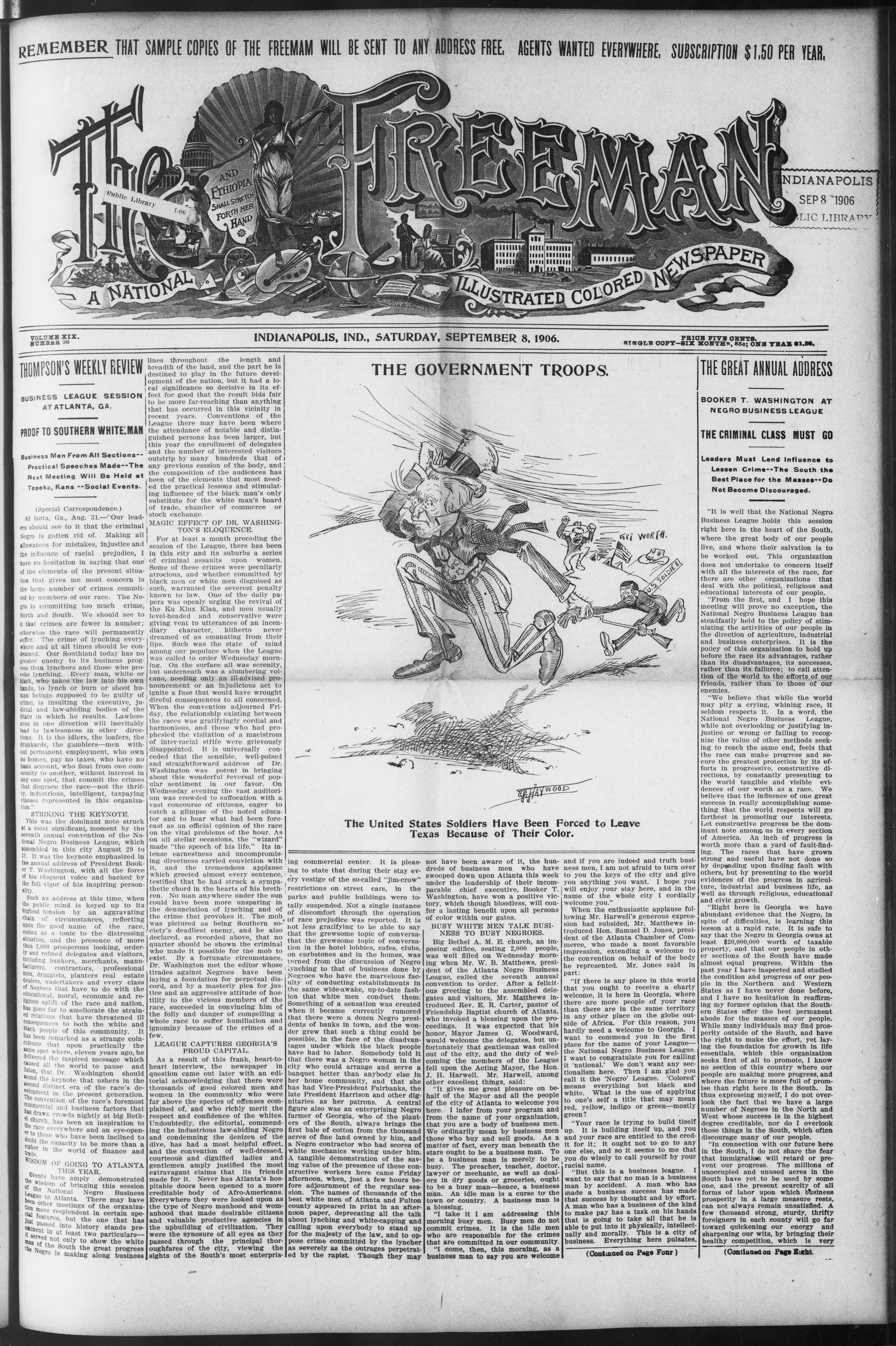
THE GOVERNMENT TROOPS.
GREAT WORTH.
U.S. SOLDIER
GEAYWOOD
The United States Soldiers Have Been Forced to Leave Texas Because of Their Color.
ing commercial center. It is pleasing to state that during their stay every vestige of the so-called "jim-crow" restrictions on street cars, in the parks and public buildings were totally suspended. Not a single instance of discomfort through the operation of race prejudice was reported. It is not less gratifying to be able to say that the grewsome topic of conversation the grewsome topic of conversation in the hotel lobbies, cafes, clubs, on curbstones and in the homes, was turned from the discussion of Negro lynching to that of business done by Negroes who have the marvelous faculty of conducting establishments in the same wide-awake, up-to-date fashion that white men conduct, them. Something of a sensation was created when it became currently rumored that there were a dozen Negro presidents of banks in town, and the wonder grew that such a thing could be possible, in the face of the disadvantages under which the black people had to labor. Somebody told it that there was a Negro woman in the city who could arrange and serve a banquet better than anybody else in her home community, and that she has had Vice-President Fairbanks, the late President Harrison and other dignitaries as her patrons. A central figure also was an enterprising Negro farmer of Georgia, who of the planters of the South, always brings the first bale of cotton from the thousand acres of fine land owned by him, and a Negro contractor who had scores of white mechanics working under him. A tangible demonstration of the saving value of the presence of these constructive workers here came Friday afternoon, when, just a few hours before adjournment of the regular session. The names of thousands of the best white men of Atlanta and Fulton county appeared in print in an afternoon paper, deprecating all the talk about lynching and white-capping and calling upon everybody to stand up for the majesty of the law, and to oppose crime committed by the lyncher as severely as the outrages perpetrated by the rapist. Though they may
not have been aware of it, the hundreds of business men who have swooped down upon Atlanta this week under the leadership of their incomparable chief executive, Booker T. Washington, have won a positive victory, which though bloodless, will confer a lasting benefit upon all persons of color within our gates.
BUSY WHITE MEN TALK BUSINESS TO BUSY NEGROES
Big Bethel A. M. E. church, an imposing edifice, seating 2,000 people, was well filled on Wednesday morning when Mr. W. B. Matthews, president of the Atlanta Negro Business League, called the seventh annual convention to order. After a felicitous greeting to the assembled delegates and visitors, Mr. Matthews introduced Rev. E. R. Carter, pastor of Friendship Baptist church of Atlanta, who invoked a blessing upon the proceedings. It was expected that his honor, Mayor James G. Woodward, would welcome the delegates, but unfortunately that gentleman was called out of the city, and the duty of welcoming the members of the League fell upon the Acting Mayor, the Hon. J. H. Harwell, Mr. Harwell, among other excellent things, said:
"It gives me great pleasure on behalf of the Mayor and all the people of the city of Atlanta to welcome you here. I infer from your program and from the name of your organization, that you are a body of business men. We ordinarily mean by business men those who buy and sell goods. As a matter of fact, every man beneath the stars ought to be a business man. To be a business man is merely to be busy. The preacher, teacher, doctor, lawyer or mechanic, as well as dealers in dry goods or groceries, ought to be a busy man—hence, a business man. An idle man is a curse to the town or country. A business man is a blessing.
"I take it I am addressing this morning busy men. Busy men do not commit crimes. It is the idle men who are responsible for the crimes that are committed in our community. "I come, then, this morning, as a business man to say you are welcome
PRICE FIVE OENTS.
SINGLE COPY-SIX MONTHS, 850; ONE YEAR $1.50.
and if you are indeed and truth business men, I am not afraid to turn over to you the keys of the city and give you anything you want. I hope you will enjoy your stay here, and in the name of the whole city I cordially welcome you."
When the enthusiastic applause following Mr. Harwell's generous expression had subsided, Mr. Matthews introduced Hon. Samuel D. Jones, president of the Atlanta Chamber of Commerce, who made a most favorable impression, extending a welcome to the convention on behalf of the body he represented. Mr. Jones said in part:
"If there is any place in this world that you ought to receive a charty welcome, it is here in Georgia, where there are more people of your race than there are in the same territory in any other place on the globe outside of Africa. For this reason, you hardly need a welcome to Georgia. I want to commend you in the first place for the name of your League—the National Negro Business League. I want to congratulate you for calling it 'national.' We don't want any sectionalism here. Then I am glad you call it the 'Negro' League. 'Colored' means everything but black and white. What is the use of applying to one's self a title that may mean red, yellow, indigo or green—mostly green?
"Your race is trying to build tiself up. It is building itself up, and you and your race are entitled to the credit for it; it ought not to go to any one else, and so it seems to me that you do wisely to call yourself by your racial name.
"But this is a business league. I want to say that no man is a business man by accident. A man who has made a business success has made that success by thought and by effort. A man who has a business of the kind to make pay has a task on his hands that is going to take all that he is able to put into it physically, intellectually and morally. This is a city of business. Everything here pulsates,
(Continued on Page Four)
THE GREAT ANNUAL ADDRESS
BOOKER T. WASHINGTON AT NEGRO BUSINESS LEAGUE
THE CRIMINAL CLASS MUST GO
Leaders Must Lend Influence to Lessen Crime--The South the Best Place for the Masses--Do Not Become Discouraged.
"It is well that the National Negro Business League holds this session right here in the heart of the South, where the great body of our people live, and where their salvation is to be worked out. This organization does not undertake to concern itself with all the interests of the race, for there are other organizations that deal with the political, religious and educational interests of our people.
"From the first, and I hope this meeting will prove no exception, the National Negro Business League has steadfastly held to the policy of stimulating the activities of our people in the direction of agriculture, industrial and business enterprises. It is the policy of this organization to hold up before the race its advantages, rather than its disadvantages, its successes, rather than its failures; to call attention of the world to the efforts of our friends, rather than to those of our enemies.
"We believe that while the world may pity a crying, whining race, it seldom respects it. In a word, the National Negro Business League, while not overlooking or justifying injustice or wrong or failing to recognize the value of other methods seeking to reach the same end, feels that the race can make progress and secure the greatest protection by its efforts in progressive, constructive directions, by constantly presenting to the world tangible and visible evidences of our worth as a race. We believe that the influence of one great success in really accomplishing something that the world respects will go farthest in promoting our interests. Let constructive progress be the dominant note among us in every section of America. An inch of progress is worth more than a yard of fault-finding. The races that have grown strong and useful have not done so by depending upon finding fault with others, but by presenting to the world evidences of the progress in agriculture, industrial and business life, as well as through religious, educational and civic growth.
"Right here in Georgia we have abundant evidence that the Negro, in spite of difficulties, is learning this lesson at a rapid rate. It is safe to say that the Negro in Georgia owns at least $20,000,000 worth of taxable property, and that our people in other sections of the South have made almost equal progress. Within the past year I have inspected and studied the condition and progress of our people in the Northern and Western States as I have never done before, and I have no hesitation in reaffirming my former opinion that the Southern States offer the best permanent abode for the masses of our people. While many individuals may find prosperity outside of the South, and have the right to make the effort, yet laying the foundation for growth in life essentials, which this organization seeks first of all to promote, I know no section of this country where our people are making more progress, and where the future is more full of promise than right here in the South. In thus expressing myself, I do not overlook the fact that we have a large number of Negroes in the North and West whose success is in the highest degree creditable, nor do I overlook those things in the South, which often discourage many of our people.
"In connection with our future here in the South, I do not share the fear that immigration will retard or prevent our progress. The millions of unoccupied and unused acres in the South have yet to be used by some one, and the present scarcity of all forms of labor upon which business prosperity in a large measure rests, can not always remain unsatisfied. A few thousand strong, sturdy, thrifty foreigners in each county will go far toward quickening our energy and sharpening our wits, by bringing their healthy competition, which is very
(Continued on Page Eight.
Coa ————
Vi 2 | iE Wy
/ Se (Au NI
eA RLD,)
Mak WORLD.)
Vj uk
; 7 =< ee
= yc ( BY “DOROTHY” ~
= Ee As Tals cotame bs erated to the intrest
Tee "Dorothy," The Freeman, Indlanapolioy In
The warp walat is
The Wasp _pusbing its way in
Waist. favor again despite
the fact that it is re
garded with distrust by the majority of
women, But they think that fashion’s
decree must be obeyed, and many wom-
en who are moet emphatio in deploring
the necessity of a wasp waist suffer
muchrin thelr efforts to obtain one, A
well-lmown coreetiere stares she alwaye
advises her customers to avold tight
Inoing, as it rains the figure and short
ens thelife of the best corset that can
be made. She contends itis a mistake
to imagine that a man fe pleased with a
tiny waist. What he admiresiaa trim
rounded walet, whioh is easily cultiva-
ted without the discomfort of cramming
the body into corsets which resembie
mail armor. On the other handa Weet
End costumer at London declares the
wasp waist needo’t be the result of
tight lacing and guarantees to give her
customers a wasp waist without dlsoom-
fort. Her secret fs that she studies her
customers, Ifa woman complains of
@ large walst the modiste does not
recommend tight tacing but designs a
gown that emphasizes the shoulder and
hip and mskes the watst in comparison
appear a couple of inches emaller, A
phystclan consulted on the subject de
clared he had {esued warnings without
end against tight lacing and at last had
given it np in despair. He could only
promise the following results to a girl
who Is tight laced: “She will svif-r
from wrinkles around her eyes, purple
obeeks, caused by imperfect clroulation
red hands, broken veins onher nose,
worried expression, and finally gray
hairs from malnutrition.”
The Elite Patterns.
re
ay
Gis iy)
Can @
PRE Ne?
LN i
im 0)
YW aA
Poni
HN
eee
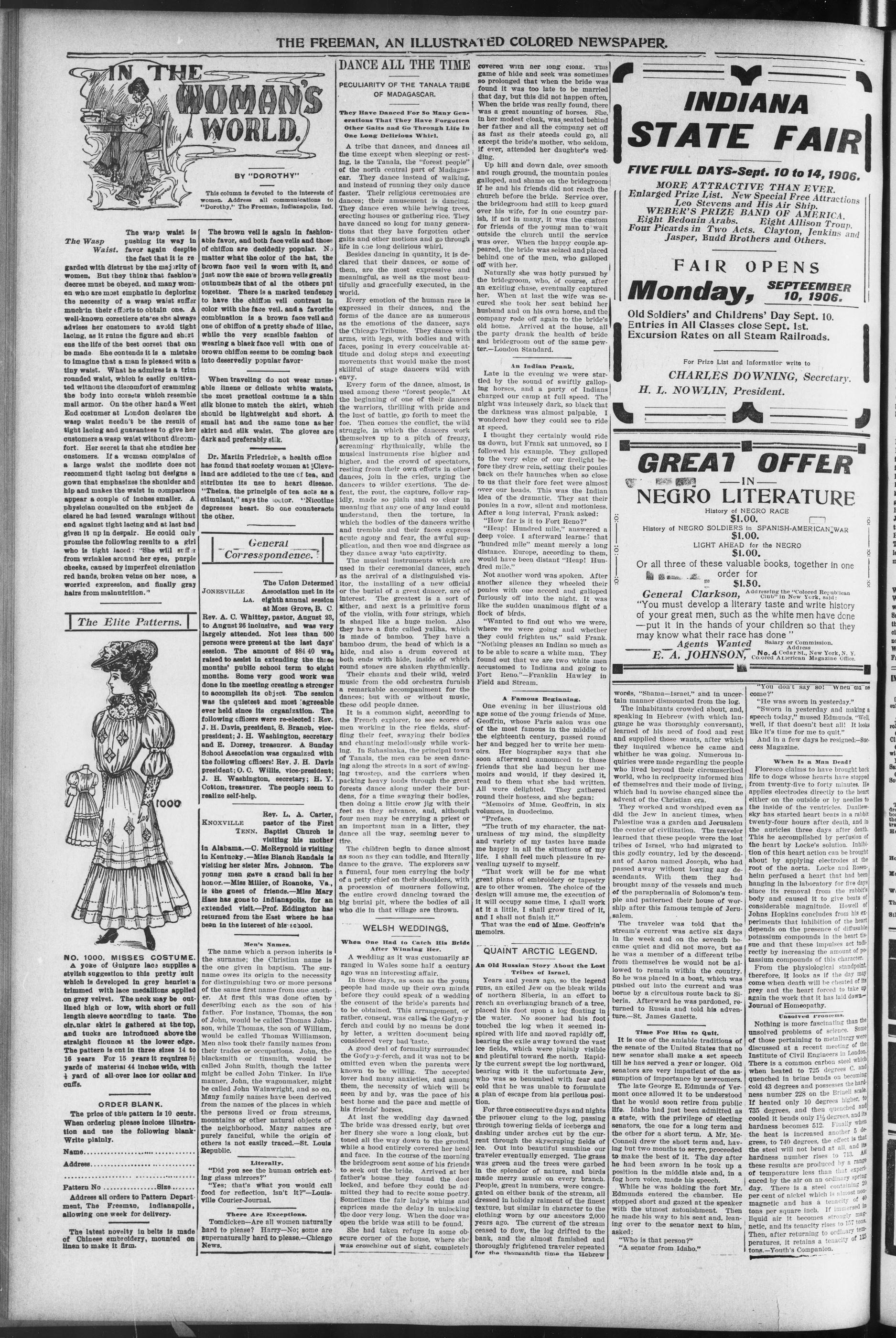
NO. 1000. MISSES COSTUME.
A yoke of Gutpure Iaca supplies s
stylish suggestion to this pretty sult
which is developed in grey hentlet'a
trimmed with lace medallions applied
on grey velvet. The neck may be out
lined high or low, with short or fall
Tength sleeve acocrding to taste. The
cinolar skirt is gathered at the top,
and tucks are introduced above the
straight flounce at the lower edge.
‘The pattern is ont in three elzes 14 to
16 years For 15 years it requires 5:
yards of material 44 inches wide, with
+ yard of all-over lace tor collar and
onffs,
ORDER BLANK.
‘The prioe of this pattern 1s 10 cents.
When ordering please inclose illustra.
tlon and use the following blank:
Write plainly.
WUE hoe aerces cient eaten eas
Pattorn No .......c0000+0BIBO..000+44
Address all orders to Pattern Depart:
ment, The Freeman, Indianapolis,
allowing one week for delivery.
‘The latest novelty in belts is made
of Chinese embroidery, mounted on
Mnea to make it frm.
THE FREEMAN, AN ILLUSTRATED COLORED NEWSPAPER.
The brown veil is again In fashion-
able favor, and both face vells and those
of chiffon are decidedly popular, N»
matter what the color of the hat, the
brown face yell 1s worn with ft, and
just now the sale of brown vella greatly
outnumbexs that of al the others pat
together. There isa marked tendency
to have the chiffon vell contrast in
color with the fave vell, anda favorite
combination is @ brown face vell and
one of ebiffon of a pretty shade of Lilac,
while the very sensible fashion of
wearing a blaek face vell with one of
brown chiffon seems to be coming back
into deservedly popular favor:
: ‘When traveling do not wear muss-
able Hnens or delicate white waiste,
the most practical costume ts @ thin
silk blonseto match the skirt, which
should be lghtwelght and short. A
small bat and the same tone as her
skirt and silk waist, The gloves are
dark and preferably slik.
Dr. Martin Friedrich, a health office
has found thet soclety women at {Cleve-
land are addicted to the use cf tea, and
sttributes its use to heart disease.
“Theina, the principle of tea acts ass
stimulant,” eaysthe ioctor. ‘Nicotine
depresses heart. So one counteracts
the other.
5 _iGeneral). -
Corresspondence.
The Union Determed
JONESVILLE _Assoclation met in ite
a, elghth annual sessloz
at Moss Grove, B. C.
Rev. A. C, Whitey, pastor, August 23,
to Angust 26 inclusive, and was very
Isrgely attended. Not lees than 50¢
persons were present at the last daye
session. The amount of $8140 wa,
raised to assist in extending the thi ee
months’ public school term to eight
months. Some very good work was
done in the meeting creating a stronger
to accomplish its object. The session
was the quietest and most ‘agreeable
ever held since its organization. ‘The
following cfticers were re-elected : Rev.
J. H. Davis, president, 8. Branch, vice:
president; J. H. Washington, secretary
and E. Dorsey, treasurer. A Sunday
School Assoolation was organized with
the following cfficers! Rev. J. H. Davis
president; 0.0. Willis, vice-president;
J. H. Washington, secretary; H. Y.
Cotton, treasurer. ‘The people seem to
realize self-help.
Rey. L. A. Carter,
KNOXVILLE pastor of the First
TENN. Baptist Church te
visiting his mother
{n Alabams.—C. MoReynold is visiting
in Kentucky.—Miss Blanch Randals is
visiting her sister Mrs, Johnson, The
young men guve ® grand ball in her
honor.—Miss Miller, of Roanoke, Va.,
is the guest of friends.—Miss Mary
Hass has gone to indianapolis, for an
extended visit.—Prof. Eddington has
returned from the Hast where he has
beon in the interest of his'ecaool,
eigen
The name which a person inherits is
the surname; the Christian name is
the one given in baptism. The sur-
name owes its origin to the necessity
for distinguishing two or more persons
of the same first name from one anoth-
er. At first this was done often by
describing each as the son of his
father. For instance, Thomas, the son
of John, would be called Thomas John-
son, while Thomas, the son of William,
would be called Thomas Williamson.
Men also took their family names from
their trades or occupations, John, the
blacksmith or tinsmith, would be
called John Smith, though the latter
might be called John Tinker. In like
manner, John, the wagonmaker, might
be called John Wainwright, and so on.
Many family names have been derived
from the names of the places in which
the persons lived or from streams,
mountains or other natural objects of
the neighborhood. Many names are
purely fanciful, while the origin of
others is not easily traced—St. Louls
Republic.
Literally.
“Did you see the human ostrich eat-
ing glass mirrors?”
“Yes; that's what you would call
‘food for reflection, isn’t 1t?"—Louis-
ville Courier-Journal,
a
Tomdicken—Are all women naturally
hard to please? Harry—No; some are
supernaturally hard to please.—Chicago
‘Sure:
DANCE ALL THE TIME
nates OF THE TANALA TRIBE
re (OF MADAGASCAR.
‘They Have Danced For So Many Gen-
erations That ‘They Have Forgotten
Other Gaits and Go Through Lite In
One Long Delirious Whirl.
A tribe that dances, and dances all
the time except when sleeping or rest-
ing, is the Tanala, the “forest people”
of the north central part of Madagas-
feat. ‘They dance instead of walking,
and instead of running they only dance
faster. Their religious ceremonies are
dances; their amusement is dancing.
‘They dance even while hewing trees,
erecting houses or gathering rice. They
have danced so long for many genera-
tions that they have forgotten other
gaits and other motions and go through
life in one long delirious whirl,
Besides dancing in quantity, it is de-
clared that their dances, or some of
them, are the most expressive and
meaningful, as well as the most beau-
tifully and gracefully executed, in the
world.
Every emotion of the human race is
expressed in their dances, and the
forms of the dance are as numerous
as the emotions of the dancer, says
the Chicago Tribune. They dance with
arms, with legs, with bodies and with
faces, posing in every conceivable at-
titude and doing steps and executing
movements that would make the most
skillful of stage dancers wild with
envy.
Every form of the dance, almost, is
used among these “forest people.” At
the beginning of one of their dances
the warriors, thrilling with pride and
the lust of battle, go forth to meet the
foe. Then comes ‘the conflict, the wild
struggle, in which the dancers work
themselves up to a pitch of frenzy,
screaming’ rhythmically, while the
musical instruments rise higher and
higher, and the crowd of spectators,
resting from their own efforts in other
dances, join in the cries, urging the
dancers to wilder exertions, ‘The de-
feat, the rout, the capture, follow rap-
idly, made so plain and so clear in
meaning that any one of any land could
understand, then the torture, in
which the bodies of the dancers writhe
and tremble and their faces express
acute agony and fear, the awful sup-
plication, and then woe and disgrace as
they dance away ‘nto captivity.
The musical instruments which are
used in their ceremonial dances, such
as the arrival of a distinguished vis-
itor, the installing of a new official
or the burial of great dancer, are of
interest. The greatest is a sort of
sither, and next is a primitive form
of the violin, with four strings, which
4s shaped like a huge melon. Also
they have a flute called yaliba, which
is made of bamboo. They have a
bamboo drum, the head of which is a
hide, and also a drum covered at
both ends with hide, inside of which
round stones are shaken rhythmically.
‘Their chants and their wild, weird
music from the odd orchestra furnish
a remarkable accompaniment for the
dances; but with or without music,
these odd people dance.
It is a common sight, according to
the French explorer, to see scores of
men working in the rice fields, shut-
fling their feet, swaying their bodies
and chanting melodiously while work-
ing. In Sahasinaka, the principal town
of Tanala, the men can be seen danc-
ing along the streets in a sort of swing-
ing twostep, and the carriers when
packing heavy loads through the great
forests dance along under their bur-
dens, for a time swaying their bodies,
then doing a little crow jig with their
feet as they advance, and, although
four men may be carrying a priest or
‘an important man in a litter, they
dance all the way, seeming never to
tire.
‘The children begin to dance almost
as soon as they can toddle, and literally
dance to the grave. The explorers saw
a funeral, four men carrying the body
of a petty chief on their shoulders, with
a procession of mourners following,
the entire crowd dancing toward the
big burial pit, where the bodies of all
who die in that village are thrown.
WELSH WEDDINGS,
‘When One Had to Catch His Bride
After Winning Her.
A wedding as it was customarily ar
ranged in Wales some half a century
ago was an interesting affair,
In those days, as soon as the youns
people had made up their own minds
before they could speak of a weddins
the consent of the bride’s parents had
to be obtained. ‘This arrangement, or
rather, consent, was calles. the Gofyn-y
ferch and could by no means be done
by letter, a written document being
considered very bad ‘taste,
A good deal of formality surrounde¢
the Gofya-y-ferch, and it was not to be
omitted even when the parents were
known to be willing. The accepted
lover had many anxieties, and among
them, the necessity of which will be
seen by and by, was the pace of his
best horse and the pace and mettle o!
his friends’ horses.
At last the wedding day dawned
The bride was dressed early, but over
her finery she wore a long cloak, but
toned all the way down to the ground
while @ hood entirely covered her head
and face. In the course of the morning
the bridegroom sent some of his friends
to seek out the bride. Arrived at her
father’s house they found the door
locked, and before they could be 2d.
mitted they had to recite some poetry.
Sometimes the fair lady's whims and
caprices made the delay in unlocking
the door very long. When the door was
open the bride was still to be found.
She had taken refuge in some ob-
scure corner of the house, where she
‘was crouching out of sight. completely
covered witn ner ong cioax. tm
game of hide and seek was sometimes
so prolonged that when the bride was
found it was too late to be married
that day, but this did not happen often
When the bride was really found, there
‘was a great mounting of horses. She,
in her modest cloak, was, seated behind
her father and all the company set off
as fast as their steeds could go, all
except the bride's mother, who seldom,
if ever, attended her daughter's wed:
ding.
Up hill and down dale, over smooth
and rough ground, the mountain ponies
galloped, and shame on the bridegroom
if he and his friends did not reach the
church before the bride. Service over,
the bridegroom had still to keep guard
over his wife, for in one country par-
ish, if not in many, it was the custom
for friends of the young man to’wait
outside the church until the service
‘was over. When the happy couple ap-
peared, the bride was seized and placed
behind one of the men, who galloped
off with her.
Naturally she was hotly pursued by
the bridegroom, who, of course, after
an exciting chase, eventually captured
her. When at last the wife was se-
cured she took her. seat behind her
husband and on his own horse, and the
company rode off again to the bride's
old home. Arrived at the house, all
the party drank the health of bride
and bridegroom out of the same pew-
ter.—London Standard.
Bee Sati Tints
Late in the evening we were star-
tled by the sound of swiftly gallop-
ing horses, and a party of Indians
charged our camp at full speed. The
night was intensely dark, so black that
the darkness was almost palpable. I
wondered how they could see to ride
at speed.
I thought they certainly would ride
us down, but Frank sat unmoved, so I
followed his example. ‘They galloped
to the very edge of our firelight be-
fore they drew rein, setting their ponies
back on their haunches when so close
to us that their fore feet were almost
over our heads. This was the Indian
idea of the dramatic. They sat their
Ponies in a row, silent and motionless,
After a long interval, Frank asked:
“How far is it to Fort Reno?”
“Heap! Hundred mile,” answered a
deep voice. I afterward learne? that
“hundred mile” meant merely a long
distance. Europe, according to them,
would have been distant “Heap! Hun-
dred mile.”
Not another word was spoken. After
another silence they wheeled their
Ponies with one accord and galloped
furiously off into the night, It was
like the sudden unanimous flight of a
flock of birds.
“Wanted to find out who we were,
where we were going and whether
they could frighten us,” said Frank.
“Nothing pleases an Indian so much as
to be able to scare a white man, They
found out that we are two white men
accustomed to Indians and going to
Fort Reno."—Franklin Hawley in
Field and Stream.
A Famous Beginning.
One evening in her illustrious old
age some of the young friends of Mme.
Geoffrin, whose Paris salon was one
of the most famous in the middle of
the elghteenth century, passed round
her and begged her to write her mem-
oirs. Her biographer says that she
soon afterward announced to those
friends that she had begun her me-
moirs and would, if they desired it,
read to them what she had written.
All were delighted. ‘They gathered
round their hostess, and she began:
“Memoirs of Mme. Geoffrin, in. six
volumes, in duodecimo.
“Preface.
“The truth of my character, the nat-
uralness of my mind, the simplicity
and yarlety of my tastes have made
me happy in all the situations of my
life. I shall feel much pleasure in re-
yealing myself to myself.
“That work will be for me what
great plans of embroidery or tapestry
are to other women. The choice of the
design will amuse me, the execution of
it will occupy some time, I shall work
at it a little, I shall grow tired of It,
and I shall not finish it.”
‘That was the end of Mme. Geoffrin’s
memoirs.
QUAINT ARCTIC LEGEND.
An Old Russian Story About the Lost
‘Tribes of Israel.
Years and years ago, so the legend
runs, an exiled Jew on the bleak wilds
of northern Siberia, in an effort to
reach an overhanging branch of a tree,
placed his foot upon a log floating in
the water. No sooner had his foot
touched the log when it seemed in-
spired with life and moved rapidly off,
bearing the exile away toward the vast
fee fields, which were plainly visible
and plentiful toward the north. Rapid.
ly the current swept the log northward,
bearing with it the unfortunate Jew,
who was so benumbed with fear and
cold that he was unable to formulate
a plan of escape from his perilous posi-
tion.
For three consecutive days and nights
the prisoner clung to the log, passing
through towering fields of icebergs and
dashing under arches cut by the cur-
rent through the skyscraping fields of
ice. Out into beautiful sunshine our
traveler eventually emerged. The grass
was green aud the trees were garbed
in the splendor of nature, and birds
made merry musie on every branch.
People, great in numbers, were congre-
gated on elther bank of the stream, all
dressed in holiday raiment of the finest
texture, but similar in character to the
clothing worn by our ancestors 2,000
years ago. The current of the stream
ceased to flow, the log drifted to the
bank, and the almost famished and
thoroughly frightened traveler repeated
for the thousandth time the Hebrew
eer 3 en
—_ =
——_—_ ———____
¢ ———— ys %
FIVE FULL DAYS-Sept. 10 to 14, 1906. |
MORE ATTRACTIVE THAN EVER.
Enlarged Prize List. New Special Free Attractions
Leo Stevens and His Air Ship. |
WEBER’S PRIZE BAND OF AMERICA,
Eight Bedouin Arabs. Hight Allison Troup.
Four Picards in Two Acts. Clayton, Jenkins and
Jasper, Budd Brothers and Others.
FAIR OPENS
SEPTEEMBER
onga 10, 1906. ||
a
Sa
Old Soldiers’ and Childrens’ Day Sept. 10.
Entries in All Classes close Sept. Ist.
Excursion Rates on all Steam Railroads.
For Prize List and Informatior write to
CHARLES DOWNING, Secretary,
H. I. NOWLIN, President.
.—... -——— 9
ee ess ee —IN—
History of NEGRO RACE
; $1.00. al
History of NEGRO SOLDIERS in SPANISH-AMERICAN WAR
$1.00.
LIGHT AHEAD for the NEGRO
$1.00.
Or all three of these valuable books, together in one
order fe
i tame, at. = is Miso.
General Clarkson, “Stn New Youre
“You must develop a literary taste and write history
of your great men, such as the white men have done
—put it in the hands of your children so that they
may know what their race has done ”
__ Agents Wanted Ss ¢ Commission,
E. A, JOHNSON, citosdtsrictica’ Moganine Oiie.
Saas aa a ee aa eee
words, “Shama—tsrael,” and in uncer.
tain manner dismounted from the log.
The inhabitants crowded about, and
speaking in Hebrew (with which lan.
guage he was thoroughly conversant),
Tearned of his uecd of food and rest
and supplied those wants, after which
they inquired whence he came and
whither he was going. Numerous in.
quiries were made regarding the people
who lived beyond thelr circumscribed
world, who in reciprocity informed him
of themselves and their mode of living,
which bad in nowise changed since the
advent of the Christian era,
‘They worked and worshiped even as
did the Jew in ancient times, when
Palestine was a garden and Jerusalem
the center of civilization. ‘The traveler
learned that these people were the lost
tribes of Israel, who had migrated to
this godly country, led by the descend-
ant of Aaron named Joseph, who had
passed away without leaving any de-
scendants. With them they had
brought many of the vessels and much
of the paraphernalia of Solomon's tem-
ple and patterned their house of wor-
ship after this famous temple of Jeru-
salem,
The traveler was told that the
stream’s current was active six days
in the week and on the seventh be-
came quiet and did not move, but as
he was a member of a different tribe
from themselves he would not be al-
lowed to remain within the country.
So he was placed Ina boat, which was
pushed out into the current and was
borne by a circuitous route back to Si-
beria. Afterward he was pardoned, re-
turned to Russia and told his adven-
ture.—St, James Gazette.
Time For Him to Quit.
It is one of the amiable traditions of
the senate of the United States that no
new senator shall make a set speech
till he has served a year or longer. Old
senators are very impatient of the as-
sumption of importance by newcomers.
‘The late George BE. Edmunds of Ver-
mont once allowed it to be understood
that he would soon retire from public
life. Idaho had just been admitted as
a state, with the privilege of electing
senators, the one for a long term and
the other for a short term. A Mr. Mc-
Connell drew the short term and, hav-
ing but two months to serve, proceeded
to make the best of it. The day after
he had been sworn in he took up a
Position in the middle aisle and, in a
fog horn voice, made his speech.
While he was holding the fort Mr.
Edmunds entered the chamber. He
stopped short and gazed at the speaker
with the utmost astonishment. Then
he made his way to his seat and, lean-
ing over to the senator next to him,
asked:
“Who is that person?”
“A senator from Idaho.”
“You don't say sol Wen aia ne
come?”
“He was sworn in yesterday.”
“Sworn in yesterday and making a
speech today,” mused Edmunds. “Well,
well, if that doesn’t beat all! It looks
like it’s time for me to quit.”
And in a few days he resigned:—Sue
cess Magazine.
Wihek-kh mn Wan Deatt
Floreseo claims to have brought back
life to dogs whose hearts have stoppel
from twenty-five to forty minutes. He
applies electrodes directly to the heart
either on the outside or by needles to
the inside of the ventricles. Danllew-
sky has started heart beats in a rabbit
twenty-four hours after death, and io
the auricles three days after death.
‘This he accomplished by perfusion of
‘the heart by Locke's solution. Inbibi-
tion of this heart action can be brougit
about by applying electrodes at the
‘root of the aorta. Locke and Rosen,
heln perfused a heart that had beet
hanging in the laboratory for five days}
since its removal from the rabbits
body and caused it to give beats of]
considerable magnitude, Howell of]
Johns Hopkins concludes frow his e&
periments that inhibition of the bear
depends on the presence of diffusable|
Potassium compounds in the heart ts)
sue and that these impulses act tndk
rectly by increasing the amount of P|
tassium compounds of this character
| From the physiological standpolat
therefore, it looks as if the day my)
come when death will he cheatel of Its
prey and the heart forced to take |
again the work that it has laid dowa~)
Journal of Homeopathy.
sO ,
| Nothing is more fascinating thas
‘unsolved problems of seieuce. soe
of those pertaining to metallursy wer
discussed at a recent mecting of te
Institute of Civil Engineers 9 London.
"There is a common carbon stee whicd|
when heated to 725 degrees © and]
quenched in brine bends on becorits
cold 43 degrees and possesses te han
ness number 228 on the Briel! scale
If heated only 10 degrees isber
735 degrees, and then quel ned and]
cooled it bends only 114 dezrees. andl
hardness becomes 612, Fivally wi
the heat is increased another 5 de
gress, to 740 degrees, the efect is that
the steel will not bend at all and I
hardness number rises to 73
these results are produced by & Tet
Of temperature less than that expet
enced by the air on an ordina'¥ spring
Gay. There 1s a steel containing 9
Per cent of nickel whieh is «inst 2%
Magnetic and bas a tevacitr of @
tons per square incb. If immersed
liquid air it becomes strovzly me
netic, and Its tenacity rises 10 1°7 1%
‘Then, after returning to ondlu.ary
peratures, it retains a tenacity of ws
tons.—Youth’s Companion.
RACE CLEANINGS
VICTOR
TALKING
MACHINES.
The Victor is so perfect it is often mis aken for the human voice. It is proving a never falling source of DELIGHT Thousands.
COME IN AND LET US
TELL YOU all ABOUT it.
SOLD ON EASY
PAYMENTS
Phones Main "852
New 9093.
KOEHRING BROS.
878, 880, 882 VIRGINIA AVENUE.
Hoosier Poet
CLUB ROOM LONDRES
10c Cigar
We deliver Goods direct to consumers and pay all express charges.
Give Us A Tryal Order.
John Rauch Cigar Co. - Indianapolis, Ind.
A great educational mass meeting was held at St Phillips Monumental Church at Sayannah, Ga., August 26 under the suplies of the Morris Brown College, of Atlanta.
As a meeting of the city council at San Antonio, Tex, the alderman went into a discussion of the race question, with the final decision that they would not invite the Negro Odd Fellows to the city. The discussion resulted from a petition from the local colored Odd Fellows, asking that the next District Convention be invited. It was lost by a vote of 11 to 1. Those supporting the refusal stated that they could come if they wanted to, but that this is a white man's country and that they believed in Negroes staying in their places: To invite them looked too much like social equality.
The Grand Lodge of the Improved Benevolent and Protective Order of Elks of the World elected at their meeting in New York last week the following officers for the ensn wg year: Grand Exalted Ruler, Dr. W. E. Atkins, of Hampton, Va; grand esteemed leading knight, R. L. Phillips, of Boston, Mass, grand esteemed loyal knight, W. A. Blice, of Denyer, Colo; grand secretary J. W. Holmes of Pittsburg. Pa; grand treasurer, J. T. Branty, of Washington, Pa; grand directors Messrs Brown of Texas Wolfert, of Virginia and Lawler of Tennessee The next annual meeting will be held at Chicago.
1
Mrs. A. M. Curtis, who went from Washington with credentials from the War Department to aid in the relief work following the April disaster at San Francisco, who was entertained by the most exusive families in San Francisco society, and whose husband, it now develops is a Negro physician in Waselington, D. C., to return to San Francisco. Illness from injuries re-
INDIVIDUAL HOTEL DIRECTORY
[Ous address line $4.00 per year; including
subscription to The Freeman, in advance,]
HEADWATTERS.
J. W. Redmond, headwaiter of The Car-
roll, Vicksburg, Misa. 10-06.
C. W. Dwyer, headwaiter Commercial
Club Minneapolis, Minn. 8 106.
C. H. Flummer, headwaiter Hotel Bruns-
wick, Uniontown, Pa. 10-05.
C. H. Bradley, headwaiter Menger Hotel,
San Antonio, Texas. 3-06.
C. W. Blair, headwaiter of The Oliver,
South Bend, Ind. 12-06
HOTEL DIRECTORY
This column used exclusively for the ad-
dresses of hotels, restaurants, lodging and
traveling public, with a sixth room the
country, and intended as a guide for the
traveling public—yone business solicited.
Elder Dwyer (European) C. W. Dwyer,
proprietor. First class rooms by the day,
west or month, with heat, electric light
in the Avenueington Avenue, South,
Minneapolis, Minn.
Hotel Reformer - First class in all respects
Bachelor, manager
Kimchond, M. A. W.
Bosch, manager
*Score's Hotel - First-class rooms and board*
*Street Little Street, Ark. AK*
81 street, Little Rock, AR.
Waldorf-Astoria Hotel - 327 Laurel street,
Hot Springs, Ark.
The Parker House - Rooms, bath J. W.
Brown House - Indianapolis, Ind.
Silver Moon Hotel - Henderson, Ky. 108
Street, Frank W. ox, Prog.
THE FREEMAN, AN ILLUSTRATED COLORED NEWSPAPER
occeived in an automobile accident in Oaklnd while engaged in relief work detains her in the E st. What worries many is what reception shall be given to her now that she is known to be identified with Negroes and to be the wife of a Negro.
Dr. and Mrs. S. J. Hunter are conducting a school near Macon, Miss, known as the Noxubee Industrial school. The school was founded eight years ago and at that time was opposed by both races in that section, but are giving it their heartiest support. The object is to teach the people not only to read and write but trades, and above all to inculcate habits of thrift, industry, energy and honesty to the end that they may be reliable and useful The school now owns forty acres of land and five buildings. The number of pupils enrolled is 350 and could easilo be doubled if the accommodations were sufficient. More room and equipment are necessary.
A novel event in the debating circles of Indiana University was a joint discussion August 24 between two colored orators in the student building. The question was "Resolved, That the Colored Man Owes Allegiance to Republ can Party." John Milton Benson, a teacher in the colored schools of Mt. Vernon, Ind, upheld the affirmative, and Samuel Saul Dorgan, of Syracuse, N. Y., defended the negative. Ross Lockridge of Peru, and who is taking work in the law school presided. Before the debate a chimes concert was given and among the selections were "Old Black Joe," "There'll Be a Hot Time in the Old Town To night, and "All Joons Look Alike to Me." There were no official judges and the opinion of those who heard the debate were as a rule based on partisan beliefs.
Sustaining Power of Cane Sugar.
The remarkable sustaining powers of cane sugar have often been noted, and Sir Martin Conway in his book, "The Ascent of Aconcagua," stated that he found Demerara sugar "the finest heat producing, muscle nourishing food in the world." For men taking violent exercises, such as soldiers on active service or athletes in training, a plentiful supply of sugar was, he said, far better than large meat rations. A quarter of a pound per day per man was his allowance on the mountain side, and he was inclined to think that this might be increased to nearly half a pound with advantage, cane sugar, of course, being selected for this purpose. This testimony as to the alimentary value of sugar finds striking confirmation in the account of the first crossing of Mount Cook, contributed by Malcolm Ross to the Alpine Journal. On this expedition, which proved a wonderful feat of endurance, brown sugar formed an important part of the rations. Indeed, Mr. Ross says that upon it he "existed almost entirely on all our climbs."
The Freeman is on sale at San Jose. Cal., at the Hotel St. James News Stand, S. D Q iinn. proprietor.
Do not miss this opportunity to subscribe for the races' leading journal.
GLASS EYES COMMON
ARTIFICIAL OPTICS ARE WORN BY MANY THOUSANDS.
The Custom Has Continued From Egyptian Days to the Present Time. Only Three Houses In the United States Produce Them.
Several thousand people in the United States are wearing glass eyes, and, if the proportion of increase of injuries to the eye continue constant, in ten years there will be 100,000 wearers of glass eyes in this country.
A flying splinter in the air, a speck of steel from some big building under construction, a chip of stone from the stonecutter's block, may lodge in the eye of the passerby and cause endless complications. The perforation of the outer covering of the eye by foreign bodies was one of the chief causes for taking the eye out—enucleation, as it is called—until the development of X-ray surgery, which has saved the sight of many eyes by locating the foreign body in time for its safe removal. One of the commoner diseases following the lodgment of a foreign body in the eye and generally requiring enucleation is sympathetic ophthalmia, an affection of the unharmed eye, which is marked at first by a dread of the light, pain and gradually increasing dimness of vision. Before the sight in both eyes is irretrievably lost the exciting eye has to be removed. Other common diseases whose removal often depends upon enucleation are sarcoma, or malignant tumor, and absolute glaucoma, or "hard eyeball."
Eye surgery, the most delicate and intricate in the scope of medical science, is making enormous progress toward complete surety in its operations. It is doing "stunts" that our surgeon grandfathers would regard with amazement. But one much advertised feat it has never accomplished, despite numberless announcements in the press to that effect, and that is laying out the eyeballs on the cheek while they were variously operated upon and replacing them with success.
A patient at the New York Post Graduate Medical school and hospital recently underwent a rather difficult operation on one eye, and to make his story more thrilling he described with much dramatic coloring how "there were forty to fifty doothors sitting in rows and rows above me, like it was at the theayter, all thim doothors being students from ivywheres in this country and from the ould country, an' some haythems from Japan, an' wans from England, an', well, they was there from all over the world, just to learn off me what to do when they wint back to their own patients—an' whin the surgeon who was doin' all the business, the Big Bug, I mane, in the hospital—why, people would pay him a thousand dollars to have him opyrate in their eyes, and I didn't have to pay 'im a cint—why, whin he tuk out my eyes an' they were hanging on my cheeks like you read about, all thim fellers thought it was so great that they came down to look at thim close, an' some of thim tuk a pictureure of me as I lay there with my eyes out; an' if you don't believe it, we can ask to see wan of thim pictures." This thrilling experience found its way into print, but it receives the mark of absolute discredit from the "Big Bug" himself, who forcibly remarked that "all these reports about removing the eyes and then replacing them are pure and utter nonsense. The eye cannot be lifted one-eighth of an inch from its socket without destroying the sight forever."
So when the eye comes out it is out for all time, and only a glass eye can be substituted, and in this way the work of the hospital is supplemented with the achievement of the optical prothetician. He is the last resort of the eyeless one, and, although surgery staves him off as long as possible, an artificial pupil, movable in accordance with the other eye if certain muscles in the socket are left intact, and so true to life that the keenest inspection often falls to detect it, is a boon to the deformity, thus removing an obstacle to his success in life.
Only three houses in the United States make glass eyes, and they are located in New York city. A large number of false orbs, however, of an inferior quality come from Thuringia, in the heart of the romantic Black forest of Germany. Here is the home of the industry, and from here come most of the glass eyes that the regular optician keeps in stock. The American maker, on the other hand, is exporting his finer goods to every quarter of the earth, one house alone making 10,000 a year for export. Of the other eye making houses in the world there are five in Paris, three in London and two in Birmingham, so that there is an industry which, it may be readily seen, is not overcrowded.
Eye making was practiced in the days of the oldest civilization. There is authentic record of artificial eyes that were made in the reign of Ptolemy II., who grasped the scepter in Egypt in the fourth century before Christ. Eyes were at first made of metal, either copper or gold or silver, shaped into flat disks and painted to imitate nature. In the days of Ambroise Pare, the celebrated French surgeon of the sixteenth century, a pointed representation of the whole eye and eyelids was fastened in front of the orbit and held in place by a steel spring that fitted the upper circumference of the head. Eyes have been made of wax and celluloid and vulcanite, and a horse not long ago presented an improved appearance with an eye of horn. Eyes were also made of porcelain when that came into use, and their effect was decidedly more lifelike.
A Haitian general once upon a time lost an eye in battle with the Spaniards and sent to Paris for another to replace
SPECIAL APPEAL
ORGANIZE ORGANIZE ORGANIZE
The tremendous meeting held by the Afro-American Council in New York City, July 25, 1906, is an indication of the great tidal wave of indignation and resentment against the injustices perpetrated daily upon Afro-Americans of this country, and is a hopeful sign on our part that we mean to do something effectual to regain the rights which we have lost.
Secretary of War, Mr. Taft, in his address at Greensboro, N. C., a few days ago declared that the schemes adopted to disfranchise illiterate Afro-Americans without excluding illiterate whites, will not stand the test of the fifteenth amendment. Chief among such schemes is the "grandfather" clause now operative in several of the Southern states.
Associate Justice Brewer, of the United States Supreme Court, has asserted that the revised Constitutions of the South, if ever properly brought before the Supreme Court, must be declared unstitutional and has expressed his astonishment that the Afro-American people have never effectively utilized this remedy which lies in reach of their hands.
Our duty is to organize, secure friends, employ able talent, white or black, and knock out the grand-father" clause at least. "Heaven helps those who help themselves." If we can obtain from the Supreme Court an opinion that the grandfather clause is illegal, a victory, which profoundly important as it would be, we can by standing together achieve such a manifestation of prosperous enterprise would thrill the North and again enlist its sympathies with us, at the same time strike dismay into those southern politicians who are fattening on the race problem and counting their positions and careers secure because they believe we shall never have manhood enough to drag them face to face with the Federal Constitution.
OPPORTUNE TIME FOR ORGANIZATION
The need of a strong organization through which to make our fight should be apparent to all lovers of the race who know the worth of a united effort through organization. The condition makes it incumbent upon our leaders, ministers, teachers, lawyers, doctors, business men, newspaper men to lead off in this organization and prepare to fight these injustices to death. A local Council is needed now in every village, town and hamlet in the land.
OUR PLAN OF ORGANIZATION
Any person who has sufficient interest in the race can send invitations to leading Afro-American citizens who
it. He received an expensive and choice specimen from the Paris maker, but because it contained a suggestion of yellow, which was the color of the hated Spaniard, the Haitian soldier sent it back, swearing he would wear an eye only that displayed the colors of his country. The Parisian artist thereupon made him one that sported the red and green of Haiti, and this the jealous warrior wore proudly until the day of his death.
False eyes were very expensive in the early stage of the art. A false eye ranked with the jewels of a person's possession and was frequently diverted from its proper use to shine as an ornament upon some part of the person for which it had not been destined. As made today the cost of a false eye varies from $5 to $15. The crux of the art of its manufacture is in the preparation of the crystal, which must be carefully tempered by a gradual process to resist heat and cold and the corrosive secretions of the socket for which it is intended. The crystal is colored variously from a bluish to a yellowish white to simulate the actual cornea in different stages of youth and age, the white of the eye showing blue in youth and yellowing with age. This enamel which is to form the groundwork of the eye is first blown, at the end of a glass tube, into the shape of a closed tulip.
The eye artist is seated at a table before a small heating apparatus that contains blowpipes holding flames of two different temperatures, from whose heat his face is protected by a small hood over the top of the apparatus. He has at hand thin sticks of pigmented glass, blue, gray, brown, red, yellow and green, in various shades. Taking up a glass tulip, fused at one end of a small glass pipe, and holding it in the flame, the artist applies to its tip with the other hand the end of a stick of glass, which as it melts forms the ground color of the iris of the particular eye he has in view. The glass tulip is kept twirling in the left hand while the tip of the colored glass stick is applied, so that by degrees the point of the tulip is worn away and a gradually encroaching circle takes its place and forms the iris. This, as it tends to lump, is flattened every now and then by patting.
Whenever the glass eye in its make-
ing is withdrawn from the face for
are interested in the amelioration of our present condition, to meet in some private house, church or hall, according to the number invited. If as many as ten assemble and are willing to subscribe to the following objects, they can be organized into a local Council.
THE COUNCIL AS ORGANIZED
1. Investigate and make an impartial report of all lynchings and other outrages perpetrated upon Afro-Americans.
2. To assist in testing the constitutionality of laws which are made for the express purpose of oppressing Afro-Americans.
3. To promote the work of securing legislation which in the individual states shall secure to all citizens the rights guaranteed to them by the 13th, 14th and 15th Amendments to the Constitution of the United States.
4. To aid in the work of prison reform.
5. To recommend a healthy migration from terror-ridden sections of our land to states where law is more generally respected and maintained.
6. To encourage both industrial and higher education.
7. To promote business enterprises among the people.
8. To educate sentiment on all lines that specially affect our race.
9. To inaugurate and promote plans for the moral elevation of the Afro-American people.
10. To urge the appropriation of school funds by the Federal government, to provide education for citizens who are denied school privileges by discriminating laws.
The following is a list of officers which must be elected: President, Vice-President, Secretary, Assistant Secretary, Treasurer, Chaplain, Sergeant-at-Arms and an Executive Committee—consisting of five members.
AFFILIATED MEMBERSHIP Delegates representing organizations of similar plans and purposes can have membership in the National Council by the election of two delegates and the payment of three dollars for each delegate. Religious organizations, academic schools, colleges and Afro-American newspapers can have representation in the National Council upon the same terms. We earnestly appeal to all organizations that desire representation to see to it at once, that delegates are elected and sent to the National meeting which is to be held in New York City Oct. 9, 10 and 11, 1906.
We prefer to have the ministers and leaders organize local Councils in their churches, lodge rooms, etc., but if they cannot do so, for the sake of our outraged brothers, it is hoped that the churches, societies, etc., as affiliated bodies will take action at once to have representation in the National Council.
A. WALTERS,
Pres. National Afro-American Council.
even a moment it must again be acclimated to the intense heat by first introducing it into the lesser flame. This simple precaution neglected, brittleness will ensue and the eye crack on the first occasion of its meeting the cold air of a winter's day. The flecks in the iris are cunningly imitated by light, deft strokes with the different colored glass sticks, all the time the glass bulb revolving in the flame, and now and then being blown to keep it in proper shape. At last when the iris has attained the proper diameter and is flecked as it should be, a stick of black enamel is plugged into the center and fused off when it has reached a certain depth. This forms the pupil. Some more stippling is done to form the specks about the pupil, then the minute veins are traced on the white of the eye with a stick of red glass whose tip is melted and drawn out into a thread. A stick of pure transparent crystal is then taken and melted in the flame until it spreads over the whole surface of the eye to give it the liquid, lifelike look and depth.
The shell is now ready to be cut from the bulb, a shell that shall fit the socket in which it is to be placed, with the iris in just the right situation to prevent a crossed or "wall eye" appearance. The artist takes a pair of measuring dividers and lays off from the iris certain distances on the cornea to correspond with the actual width of the vacant orbit. Putting the globe again into the flame he introduces a pointed instrument into its surface and begins to trace the contour of the orbit, the glass peeling away in a strip as it follows the path of the instrument. The edges are then polished and the glass eye is ready to be inserted.—New York Telegraph.
The Freeman in Chicago.
Ed. Felix, 368 Thirtleth street.
Louis Love, 2720 State street.
E. H. Faulkner, 3104 State street.
H S. Winston, 280 Tweney-ninth.
Richard Webb, 2640 1-2 State street
J. P. Winstead, Shining Parlor, 391
Thirty first street.
Always give former address in case
if removal where paper is to be changed
from one place to another.
Patronize our advertisers.
COOKS
Waiters & Cooks
Prefer Our Make
JACKETS AND LINEN
because they have found them
satisfactory.
Write for complete Catalogue
FREE.
giving full instructions how
to order.
Marcus Ruben (Inc.)
890 State St., CHICAGO IL.
HOWARD—
UNIVERSITY MEDICAL
DEPARTMENT
Including Medical, Dental and
Pharmaceutical Colleges,
Washington, D. C.
39th Annual Session
Will begin OCT. 1, 1906, and
continue Eight Months.
Students Matriculated
for day instruction only.
FOUR YEARS' graded course
in Medicine.
THREE YEARS' graded
course in Dental Surgery.
THREE YEARS' graded
course in Pharmacy.
Instruction is given by didactic
lectures, quizzes, clinics and prac-
tical labory demonstrations.
Well equipped lab ratories in all
departments. Unexcled hospital
facilities.
All students must register before
October 12, 1906.
For catalogue or further in-
formation apply to
F. J. Shadd, M. D.,
Secretary, 901 R. Street.
WANTED AGENTS in each country to sell
Good profits, steady work. Address Campbell
& Co., 55 A Street, Elijah, Lt.
WANTED—Deputies everywhere to organi-
zate and sell the goods. No exam-
ements. No tax. For particuliers addres
C. E. BARNAD, National Scribe, 404 Nith
street, Louisville, Ky.
Lady Agents—Easily make $1 a day ma-
king and selling "Japanese" Cleanlax! "instantly
removes grease spots, paint, stains, etc., from
all kinds of clothingings 30 bible to make
them look clean and look an ivory-
bing furnished. Write to-lay, Phos. Camp-
bell, 55 A St., Elijah, Lt.
DRINK
WIEDEMANN'S
Fine Bottled
BEERS
JACOB METZGER CO.,
Wholesale Dealers
BEE MR. ED. CROWSE
For wigs, Papadoum
and all kinds of Hair
can be made from the
combination of your own
hair. I also have a soap
food that prevents the
hair from getting greasy.
It produces a beautiful
growth. Mail orders socted.
For wigs, Pamadon
and all kinds of hair
goods. What you desire
can be made from the
combination of your own
hair. Also have a scalp
food that prevents the
scalp from falling out and
produces a beautiful
growth. Mail orders so-
cited.
215 Flora St.
Dallas, Texas
Money must accompany all orders for
goods.
DON'T MISS THE OPPORTUNITY TO
SECURE
THE FAMOUS ADDRESS
THE BRIGHT SIDE OF THE NEGRO QUESTION.
BY REV. CHAS. V. MONK.
Every race-loving, self-respecting,
intelligent person should have this intensely
interesting, instructive, true and en-
couraging address.
PRICE ONLY 10 CENTS. AGENTS
WANTED EVERYWHERE. GOOD
COMMISSION PAID.
New Era Printing Office.
7010 UPLAND ST., Polla, Pa.
NATIONAL ILLUSTRATED
COLORED NEWSPAPER.
PUBLISHED EVERY SATURDAY
At 300 Indiana Avenue,
INDIANAPOLIS, INDIANA.
SUBSCRIPTION RATES:
Any part of the United States and Canada,
one year, postage paid $1.50
Six Months: 85
Three Months: 60
Foreign Countries: $1.00 extra
send money by express, money order, post-
office order or registered letter.
Agents wanted 1: every tow; and city not now occupied, and liberal inducements will be given to the same. Send for our extraordinary inducements.
ADVERTISING RATES:
Five cans per line. Fase of measure—solid
agate, 14 lines to an inc., 276 lines in a column.
Special position 35 per cent aditional. **No**
advertisement inserted on first page. Special
written on standing professional and business
cards. Reasonable discount for long time and
space. Reading notices 10c per line. Special
rates on WR-TE UPS.
Entered at the postoffice at Indianapolis,
Indiana, as second class matter.
All matter should be addressed to
The Freeman Publishing
Company,
INDIANAPOLIS, INDIANA.
SATURDAY, SEPTEMBER 8, 1906.
The National Negro Business League.
We surrender a goodly portion of our space in this issue of The Freeman to a report of the proceedings of the National Negro Business League, in session at Atlanta last week. This is the really constructive force among the many organizations fostered by the race, and with each succeeding year its tangible results are made more and more apparent in the increased volume and augmented value of the business enterprises conducted by our people in various sections of the country. That the influence of the League is wholesome and vitally potent for the elevation of the race is evidenced in the instant improvement in the moral tone of the city of Atlanta the moment the good people were made aware of the bitter hostility of the body to idleness, ignorance and crime—that it was an aggregation of hopeful, self-respecting, progressive, thrifty and intelligent Negroes. The race's most implacable foes are ready to admit, when they come in contact with an organization like the Business League, that busy, earnest and honest colored men are not responsible for the crimes charged up against us, and they gro wcloser to us in kindly feeling when they take note of our refusal to countenance depredations against society in defiance of law and order. The Negro Business League did much to calm the troubled waters that it found upon its arrival in the South's gate city, and the right thinking members of both races have been incalculably benefited by reason of the League's sojourn there. The sober, conservative and level-headed address of Dr. Booker T. Washington has been published far and wide, and in seeking through a well-timed crusade against the vicious ones of his own race to remove the cause set out in justification of lynching, the eminet Tuskegeean is accomplishing a mission that will be fruitful of as much good as his other famous Atlanta address eleven years ago.
In going to Topeka, Kans., next year the convention also showed wisdom. Though the South offers magnificent inducements to the Negro of worth and character, and the bulk of the race is destined to work out its salvation in the land of Dixie, the broad fields of the West stretch out invitingly to those of us who wish to seek our fortune elsewhere; and the Business League does well to extend the sphere of its productive influence to that most promising section, since the Far West has s ocheerfully followed the League through the East, Middle West and the South, it is but fair that such loyalty should be recognized by carrying the organization to the masses of that "Eldorado," and allow the denizens of other sections to see for themselves the great possibilities that lie in wait for the Negro of courage, capital and character who may choose to cast his lot beyond the mighty Mississippi. Kansas will undoubtedly give the National Negro Business League a welcome that will more than justify its members in makers in making the pilgrimage to America's mecca of the future.
THE FREEMAN. AN ILLUSTRATED COLORED NEWSPAPER.
No Unionism for Brown.
Editor Phil H. Brown, of the Hopkinsville (Ky.) Morning News, has published another interesting little pamphlet entitled "Unionism that the United Mine Workers Stand For," following out through the medium of pertinent queries the anti-union philosophy embodied in his popular "First Book of Chronicles." The synopsis of the argument contained in Editor Brown's latest brochure is giv-
en in this wise:
"The union may entice honest miners and influential colored men by money its agents are enabled to spend, attempting to prove themselves good fellows and their union a good organization, but when a man becomes entangled in its meshes, he has sold his liberty, his honesty, his self-respect and his respect for the God-given rights of his fellow-man and the law of the land. For the Negro's good the Negro and the union must be things apart, forever and aye."
The black man, as a rule, is against labor unions because the labor unions are against the black man. These organizations, presumably in the interest of the working classes, rear up an impassable barrier to the well-being of their black fellow-toiler. It is the idea of the majority of them that protection and prosperity are for white workmen, and for white workmen only. If Samuel Gompers, John Mitchell and the rest of the labor leaders possess the eye of a prophet, they will see that the general policy of the trades union is unjust and bound to topple when the working classes grow sufficiently intelligent to see through the shams that are being used to deceive them. The non-union Negro skilled workman and the growing sentiment for the "open shop" are standing menaces to the perpetuity of trades unionism as managed—or mismanaged—by the tyrants and self-seekers of today.
The Race Journal a Prime Necessity.
The esteemed Florida Sentinel, of which the able and progressive M. M. Lewey is editor, printed the following in a recent issue:
"The Omaha Enterprise, one of our regularly published race journals, reproduces four columns of that magnificent article on 'Negro Journalism,' contributed to the Florida Sentinel's recent trade number by R. W. Thompson. The Enterprise, editorially commenting on the article, says: 'We desire to call our readers' attention to the able special article from the Florida Sentinel's Trade Edition, which we reprint on our first page. We hope that it will be carefully read and that the reading of it may awaken a deeper interest in the work of the Negro journal, which, despite its limitations, is doing good service for the race. The race should give better support to their newspapers so that they can do the work laid upon them more effectively. Stand by the Negro newspaper and it will stand by the race.'"
Sound advice, this. We very much fear, nevertheless, that the rank and file of the colored people of the land fail to comprehend the immense value of the loyal and capably edited race journal. It is not a luxury; it is a prime necessity. It is indispensable to the proper development of our oppressed and maligned people. It is the advance agent of our civilization. Every Negro family should subscribe and pay for at least one journal that sets forth the virtues and defends the honor of the race.
Southern Republicans who mean business will put a State and Congressional ticket in the field in their several States and do their level best to elect them. Vest-pocket machine organizations, held together for the sole purpose of landing the federal offices and dickering for selfish advantage at national conventions, do not tend to inspire respect for Republicanism in the South, where there is so much missionary work to be done. Secretary Taft told some unpalatable truths in his plain-spoken Greensboro address some time ago. Why not a Republican State ticket in Georgia?
Rev. J. R. L. Diggs, of Virginia, is to be the new president of the State University, Louisville, Ky. As he is a Baptist of the regulation faith and works—a "dipper," forsooth—it is presumed he will be acceptable to the Parrishites, the Burroughsites and the Woodites, as well as to the Stewardites and other tribes of the Kentucky Israel. We hope in industry, Brother Diggs does not believe his suggestive cognomen.
Joe Gans' signal victory over Battling Nelson clinches the hold of the dark-hued Baltimore upon the lightweight championship, which so many wished to deny him, because of his color. The real sporting men of the country pinned their faith to Gans' generalship in the ring, and placed their money upon whom their keen perception told them was the better man. The true sportsman wishes to win, and doesn't care a rap for racial differences. They tied to Gans because he could deliver the goods. In the final analysis, merit knows no color line. Be good!
We may be having "dead loads" of prosperity, but you will have to "show" the prudent housewife, who goes to the corner grocery with the family purse and comes back with but a handful of meat and vegetables, when she once got a basketful for the same money. Statisticians can prove anything by figures, but the results that grow out of practical experience are arguments that will not down—even at the behest of the cleverest arithmetician.
The Niagara movement would come nearer accomplishing the legitimate objects set forth in its platform if it had more members of the sanity, farsightedness and singleness of purpose constantly shown in the labors of Professor William H. Richards, the scholarly instructor in the Law Department of Howard University, and level-headed man of affairs.
An editor—in the eyes of the amateur contributor—is a cold-blooded, soulless and unsympathetic wretch, who, out of sheer jealousy, blue pencils the brightest thoughts sent in by his brilliant staff of special correspondents, because, forsooth, they outclass him in learning, literary culture and discriminating judgment. The editor is a bold, bad man—that's what he is!
If it is a fact that the colored applicants for civil service positions are being "turned down" for appointment when their color is discovered, The Freeman would be pleased to have some definite information on the subject. Send us names of persons unjustly rejected and relate all the circumstances clearly and briefly. Turn on the light!
The Negro dive must go! This is not only the slogan for Atlanta, Philadelphia, Washington, Richmond, Louisville, Chicago, St. Louis and New Orleans, but for Indianapolis as well. The criminal Negro is the worst drawback with which the race has to contend.
If anybody wants to be United States Consul at Guadaloupe, let him speak up at once. Brother G. Jarvis Bowen—that is his name, if our memory serves us correctly—is about to return to the Virginia farm from whence he came to dabble in the shallow waters of West Indian diplomacy.
"The Waste-Basket" ought to be a "fetching" title for a compendium of current literature. It would experience no difficulty in filling an unlimited number of columns. The scribblings of hundreds of budding journalists would fittingly find a place therein.
Money, in itself, is not the greatest thing in the world, but to have such a commodity in hand is the tangible evidence of one's industry, thrift, prudence, foresight and managerial capacity, and, therefore, weighs heavily in fixing his status in the social compact.
Success lies in deserving and winning the confidence of the people of substance and power. Tuskegee Institute is $500,000 richer by the will of Mr. Alfred Wilcox, of New Jersey, who died a few days ago. All of our schools are prospering that actually "deliver the goods."
Next weeks' issue of The Freeman will contain a spicy resume of the minor features of the National Negro Business League's great Atlanta meeting, furnished by our observant staff correspondent.
To make a life, a man must first be able to make a living.
A long trip through the South in a dirty, ill-ventilated, poorly-equipped "jim-crow" car will convince the most violent opponent of the late Foraker amendment to the rate bill that the defeat of that measure by the hysterical clamor of certain short-sighted individuals around Boston was a racial calamity. A law insisting upon equal accommodations for equal fares in the South would not have fastened the "jim-crow" policy upon the North, and the gang that lobbied against the well-intentioned Foraker amendment ought to have had sense enough to have known it.
Booker T. Washington's timely hint to the newspapers of the race, to emphasize the advantages of the race, rather than its disadvantages, is in line with good sense, and will bring results that can never be secured by eternally whining about conditions that can not be remedied in a generation. Let us look on the bright side of things, and the door of hope will always stand invitingly open.
THOMPSON'S WEEKLY REVIEW
THOMPSON'S WEEKLY REVIEW
vibrates and has its being to the magic music of business, and the city grows because of the impetus given it by the business men who are here. I bid you welcome, and advise you to 'get busy' enjoying the countless attractions of Atlanta, until you are ready to 'get busy' with that thriving business of yours at home. Make your organization the strongest kind of a league, but for heaven's sake don't allow it to become a 'trust.' Rev. I. N. Ross, pastor of Big Bethel A. M. E. Church, Atlanta, then welcomed the convention to the city on behalf of the local Negro Business League and colored citizens of Atlanta.
At this juncture, President Booker T. Washington, of the National Negro Business League, assumed the chair, amid tumultuous applause. There were brief responses to the addresses of welcome on behalf of the League by Mr. A. N. Johnson, undertaker and editor of the Weekly Press, Mobile, Ala., and Hon. J. Madison Vance, a leading attorney of New Orleans, La. The substance of what these gifted gentlemen had to say was intended to enforce the doctrine which has guided the policy of the Business League from the beginning, namely, that the best way to solve the race problem, to avoid the inconvenience of race discrimination and gain the respect of their white neighbors, is to be manly men and attend strictly to business.
LEAGUE SENTLES DOWN TO ROUGH
After these preliminaries had been disposed of, the League settled down to discuss the business that had brought them to the city. The first number on the regular program was Mr. W. L. Lollard, a prosperous lawyer of Washington, D. C., who spoke on "Insurance and Real Estate," followed by Mr. W. T. Andrews, of Sumter, S. C., on the same subject. Both speakers handled their subject admirably and answered many pertinent queries touching upon the business discussed.
At this point the proceedings were interrupted for a moment to allow Prof. Richard Theodore Greener, formerly consul at Vladivostok, Manchuria, to make a few remarks. Professor Greener was introduced as 'the first colored man to graduate from Harvard College. He had been away from this country eight years, he said, and was agreeably surprised and gratified to note the progress his people have made during his absence. His memories went back to the period of the war, and in looking back over that long period he could see the immense progress that had been made in all directions, and he counselled the members of his race not to get discouraged at sporadic instances of injustice and prejudice. Constant labor, sensible adaptation to unavoidable conditions and unflagging determination will bring us to the desired goal. Professor Greener made one of the notable addresses of the convention, and was much sought after by visitors from every section of the country.
Dr. W. O. Vance, of Indiana, was to have spoken on "Fraternal Insurance." Dr. Washington feelingly referred to the fact that the gentleman had recently died, and paying a fitting tribute to the memory of the deceased the topic was passed over. The morning hour was taken up thereafter by a discussion of "How to Conduct a Laundry," by Harry T. Pratt, of Baltimore, Md.; "Building and Contracting," by R. F. Walker, Macon, Ga., and "Plaster Contracting." by John J. Winston, of New Orleans, La.
Prior to adjournment the following committees were announced:
On Resolutions—R. B. Hudson, Alabama, chairman; Robert C. Houston, Texas; A. E. Manning, Indiana; I. T. Montgomery, Mound Bayon, Miss; J. A. Lankford, District of Columbia; E. C. Brown, Virginia; J. W. Maund, Georgia.
On Auditing—J. C. Napier, Tennessee, chairman; J. S. Hopson, Kentucky; William Porter, Ohio.
On Credentials—Dr. S. G. Elbert, Delaware, chairman; William Isaac Johnson, Virginia; P. J. Smith, District of Columbia; F. H. Gilbert, New York; Ira O. Guy, Kansas.
All roads led to Big Bethel church Wednesday evening. The announcement that Dr. Washington would deliver his annual address as president of the League drew out an audience that not only taxed the capacity of the great building to its utmost, but not less than a thousand persons were unable to secure admission. The sur-
rounding streets were a seething mass of humanity, striving to find a way to listen to the message that the eminent Tuskegeean had to deliver. At the opening of Dr. Washington's speech, he had to contend with the disorder incident to an unmanageable crush of people, but as he proceeded a gradual hush came over the mass, and every word was heard distinctly and every sentiment touching the rights of the race and every suggestion looking to the amelioration of the race's condition, was greeted with loud and prolonged acclaim. The address, as referred to above, instantly became the theme of discussion throughout the city and the effect was electrical. The newspapers promptly seconded Dr. Washington's plea for the suppression of the criminal Negro, and there was a kindlier feeling manifested at once for the Negro who works and obeys the law. The address should have the widest circulation in the homes of both races. It marks an epoch in the Negro's national life not less significant than that which followed the "wizard" famous Atlanta Exposition speech in 1895.
At the conclusion of the speech, Dr. J. W. E. Bowen took the floor, and after enlarging the president, moved that as a mark of confidence, Dr. Washington be re-elected president by the great body in advance of the regular order. Dr. Washington was voted into the chair for the eighth time by a unanimous vote, the immense volume of sound shaking the rafters of the church. He was then given the Chautauqua salute with a will, which courtesy he gracefully acknowledged.
The crowd did not materially diminish at the close of Dr. Washington's address, the bulk remaining to hear the other speakers scheduled for the evening, Dr. C. E. Thomas, of Anstinna, Ala., spoke on "The Wholesale and Retail Drug Business"; Dr. Moses Amos was given a rousing welcome when he arose to tell of the "First Negro Drug Store in Georgia," effectively interspersing his remarks with stories full of wit and unctuous humor bringing down the house. Dr. J. M. Mosely, of Ft. Worth, Tex., ably handled the theme, "The Modern Drug Store." Mrs. L. R. Clarke, who has achieved national distinction as an instructor in domestic science and industries for women, was the next speaker, and she made a highly favorable impression. She has done and is doing a splendid work in her line at the national capital. "Modern Undertaking" was treated in original fashion by G. W. Franklin, Chattanooga, Tenn., and W. O. Emory, Macon, Ga. THE NEGRO IN AGRICULTURE
That the "symposium idea will be adopted as one of the permanent features of the League's program was indicated by the popularity of the series of experiences in farming, to which four practical agriculturists contributing many instructive facts. The participants were Deal Jackson, who is pronounced by Editor John Mcnitzosh, of the Daugherty County Journal, to be the finest farmer, white or colored, in that county: William Boyd, of Ellington, S. C.; Alfred Smith, of Oklahoma Sity, Okla., who has sent exhibits of agricultural products to the Paris Exposition, and A. C. Wingate, of Warrington, Fla., one of the "solid men" of the "land of flowers."
"Market Gardening for a Northern City," by Charles Nunn, of Indianapolis, Ind., and "Market Gardening for a Southern City," by William Hill, of Montgomery, Ala., "Photography," by Arthur Macbeth, of South Carolina; "The Fish Business," by Charles H. Anderson, Jacksonville, Fla., and "Tailoring," by Charles S. Carter, of Norfolk, Va., together with some valuable information on "Cotton Raising," by Isaiah T. Montgomery, of Mound Bay, Miss, concluded the exercises of the morning session. In the evening, with a large assembly to hear and enjoy, A. H. Underdown, of Washington, D. C., spoke on "Fruits and Delicatessen"; Mrs. Belle Davis, of Indianapolis, who has a plant worth $20,000, and serves the "swell" society people of her city, read one of the very best papers of the session on "Catering"; J. L. Turnbo, of Metropolis, Ill., on "The Brick and Tile Business"; T. W. Jones, of Chicago on "The League of the Future," and highly entertaining and thoughtful observations by T. Thomas Fortune, the brilliant editor of the New York Age, rounded out the program.
THE NEGRO IN BANKING.
Perhaps the piece de-resistance of the entire convention season was the symposium on "Banking," which occupied the attention of the League during a large portion of Friday morning. In 1900, the League was formed, there were but two Negro banks in the country—one at Richmond, Va., and the other at Birmingham, Ala. At the League meeting in New York it was announced that the number had been increased to seventeen, located in different sections of the South and West. At the present time there are thirty-one. Twelve of these are in Mississippi, four in Georgia, six in Virginia, two in Tennessee, two in Arkansas and one each in Alabama, North Carolina and Florida. There are also two Negro banks in Musgoege, Ind. Tern. Fourteen of these banks were represented in this symposium: R. T. Hill, Richmond, Va.; W. R. Pettiford, Birmingham, Ala.; Charles Banks, Mound Bayou, Miss.; W. E. Mollison, Vicksburg, Miss.; J. C. Napier, Nashville, Tenn.; S. D. Redmond, Jackson, Miss.; J. H. McConico, Little Rock, Ark.; Josiah T. Settle, Memphis, Tenn., and Walter Scott, Savannah, Ga., were among those who offered testimony of the race's progress in the financial arena. A National Banking Association was formed, with W. R. Pettiford as president and J. H. McConico as secretary. A committee was appointed to consider the question of some form of practical business cooperation among these banks, and it was planned to have the president of the association visit each institution during the year and have every bank in the country report at the next meeting of the League. According to the figures collected the amount of paid-up capital at present invested in Negro banks amounts to $350,000. The deposits reach the sum of $1,192,000.
OFFICERS OF THE BUSINESS LEAGUE.
The committee on nominations, of which Judge M. W. Gibbs was chairman and M. M. Lewey secretary, reported the following list of officers for the ensuing year. The report was unanimously adopted, and the roster stands: President, Booker T. Washington, Tuskegee Institute, Alabama, first, second, third and fourth vice presidents, Ira O. Guy, Kansas, Dr. S. G. Elbert, Delaware; Charles Banka, Mississippi, and F. D. Patterson, Ohio; corresponding secretary, Emmett J. Scott, Alabama; treasurer, Gilbert C. Harris, Massachusetts; compiler, S. Laing Williams, Illinois; registrar, Peter J. Smith, District of Columbia; assistant registrar, F. H. Gilbert, New York; transportation official stenographer, William H. Davis, District of Columbia. The executive committee was chosen as follows: agent, Cyrus Field Adams, Illinois; T. Thomas Fortune, New York, chairman; S. E. Courtney, Massachusetts; T. W. Jones, Illinois; S. A. Furniss, Indiana; J. C. Napier, Tennessee; W. L. Taylor, Virginia; M. M. Lewis, W. O. Emory, Georgia; J. C. Jackson, Kentucky; P. A. Payton, New York; J. E. Bush, Arkansas, and N. T. Volar, Pennsylvania.
TOPEKA WINS COMMITTEE
It was decided to hold next year's convention in Topeka, Kans., by invitation of the Governor of Kansas, the State officers, the Board of Trade and Commercial Club of Topeka, as well as of the citizens generally. A vigorous attempt was made by the officials of the Jamestown Exposition to switch the meeting off to Hampton, Va., in the interest of that enterprise, but a change was deemed inadvisable, and the action of the executive committee was upheld. The League goes to the capital of Kansas in August, 1907, to spread the influence of the organization over the fertile prairies of the great West. Resolutions in keeping with the spirit of the League were unanimously adopted. Bishop Alexander Walters announced the meeting of the National Afro-American Council in New York October 9, 10 and 11, and urged the League of unite with the movement to test the constitutionality of the disfranchising and other discriminatory laws now on the statute books of certain States. Final adjournment was then declared, a fewvent benediction being pronounced by Dr. J. W. E. Bowen.
SOCIAL FEATURES
The social features of the seventh annual convention of the Business League were particularly brilliant, unique and enjoyable, and were far more numerous than have been offered at any previous gathering. The Atlanta people at every point nobly sustained their time-honored reputation for liberal hospitality, and on this occasion fairly outid themselfs. Usually the president of the League temsers his executive committee and official family a banquet at the opening of the sessions, but this year the "boot was on the other leg," and the officers and executive committee joined in an elaborate "spread" for Dr. Washington on Tuesday evening at the home of First Vice President G. M. Howell. Wednesday from 5 to 7 p.m., the Ladies Auxiliary of the Atlanta Business League were "at home" to the delegates and visitors at the beautiful home of Bishop and Mrs. Wesley J. Gaines, the affair being under the supervision of Mendes Matthews, Rucker, Penn, Hope Howard, Galens, Henry, Murphy and Miss Gaines. Dr. and Mrs. J. W. E Bowen entertained at dinner the same afternoon at their suburban villa in the grove of Gammon Theological Seminary, and Miss Marietta L甘ines gave a noon luncheon next day to a party of twelve ladies. The woman's Improvement Club, Mrs. Addie L. Hunton, president, gave a reception Thursday, in honor of a Teacher Washington, and besides these there were many smaller functions tendered by Atlanta's elite for the entertainment of personal friends. The grand concert on Tuesday evening at Bethel, with the eminent violinist, Mr. Joseph H. Douglass, of Washington, D. C., as the star, is deserving of especially the local talent, including Mrs. Hamilton, Mrs. Heard, Mr. Combs, Miss Fannie Howard and the S. Colledge-Taylor Orchestra, gave strong support. On Friday afternoon came a delightful trolley ride around the city, giving the delegates an opportunity to see the city and suburbs, to get an excellent view of the great schools located here, such as Atlanta University, Spelman Seminary, Baptist College, Clark University and Gammon Theological Seminary. Evidences of the race's progress as a town-builder were found in the promising Afro-American section of South Atlanta. The social season wound up in a blaze of glory Friday evening with a grand banquet, given by the local committee in honor of the League, assisted on the managerial end by Mr. W. A. Kersey, of Indianapolis. Fully 700 handsomely gowned ladies and fashionably attired gentlemen were in attendance and enjoyed the toothsome menu, while an orchestra discoursed sweet music. Rev. H. H. Proctor, of Atlanta, was toastmaster, and interesting responses were made to a number of toasts by distinguished speakers.
It may be safely said, without invious comparison, that in point of attendance, importance of subjects treated, general interest in the actual work of the body, weight of plans for the material betterment of the race, and for social brilliance, the Atlanta meeting holds the record for the seven years of the League's existence.
The festive reformer might very properly take a shy at the fellow who eternally "talks shop." He is a bore of the first water.
Every Lady Read This.
Years ago when I was a sufferer, an old nurse told me of a wonderful cure for Uterine Tumors and Ovarian troubles it cured me in one month. It is a simple harmless trick the doctor will send it Free to every suffering sister it writes to me. I have nothing to sell in a case of woman helping woman. I send it Address Mrs. A, B. Hudnut, South Bend Inc.
The St
Harry Fiddler and Mrs. Joe Gans are making quite a hit with the Ernest Hogan Company.
Ollie C. Hall is now located at Rochester, N.Y. In the employ of the New York Central and is doing well. He wishes to hear from Billy McClain.
F. W. Inman wishes to hear from Sam Davis and Harrison Steward. Business of Importance. Regards to all friends. Write 18 Porter street, Boston, Mass.
Billy Bradley, stage manager of Pat Chappelle's Funey Folks Show has closed his engagement and is now located at Pittsburg, Pa. Regards to the profession.
James Gilliam has been insialled as manager of the Canadian Colored Concert Company by Walter Carey to succeed the late William Carter. The season begins September 15.
Dennis H. Mitchell is still making hits nightly with Alen's Minstrels. He sends regards to all at Exchange Garden Theatre at Jacksonville, Fla. Would like to hear from Barney & Locust.
The Clarks, Eugene, Lena and Joe are still with the Van Amburg Shows and are the hit of the concert, en route through Iowa. They wish to hear from John Rucker. Regards to all friends.
Allen's Minstrel is still up to the standard, playing to good houses every night. J. H. Williams is making good with his new song, "Home. Sweet, Home Sounds Good to Me." Dennis & Morton are still doing the "King Act" making good. The boneless man is still making good and sends regards to George Wilson, S. Simg and Inman & Davis.
Johnson and Dean are at present playing to the biggest business done for years at Des Budavara Budapest, Berlin Germany and are the only colored team on the variety stage to have the honor of being entertained by the nobility, having received an invitation to supper from Count Caraly.
The Arkansaw Minstrels are still in the West among the harvest fields and doing well, playing to good houses at every performance. The Mitchells are making a hit every night. George Boutte is called the best buck and wing dancer ever been in that territory. Henderson and Bruce are pleasing all classes. Regards to the profession.
Brown's Tennessee Minstrels open the
THE FREEMAN GALLERY
W. HAYWOOD
ROBERT T. MOTT,
Sole Owner and Proprietor of the Pekin
Theatre, Chicago, Ill.
Out of the throes of hatred,
For our brothers, North and South.
Who meets discrimination,
Though protesting with his mouth,
Arises another method
That will sure outflank the foe,
Who's attempting to suppress us,
By its unjust law, Jim crow.
—GARFIELD T. HAYWOOD.
THE FREEMAN, AN ILLUSTRATED COLORED NEWSPAPER
TO THE PROFESSION. - Actors and
lactees send me your latest photo
today! Address Eiwood C, Knox,
Man gr The Freeman, Indianapolis
season at Frankfort, Kans., September '15.
King Erastus Edwards, George Matthews,
G. C. Clay and Clark McClennon starring
comedians accompanied by sixteen others.
Mrs. Myrtle Brown, the 'leading barbone
lady player of the world still makes good
with the minstrel. W. A. Brown, sole
owner, permanent address Holden, Mo.
Terry's U. T. C. Company is still doing
well in illinois and will shortly tour Iowa.
Mr. McGruder joined them at Chicago and
is playing "Tom." J. W. Becchum is back in the minstrel first part and making good. The Beechums, Charles and Elanch are making a hit with their sketch and singing "Let Me See You Smile."
Mrs. Barnett's cleaning up as "Topsy."
Regards to the Garlands, Fred and Hattie.
Fred Lewis' Big Sensational Plantation has closed seven successful weeks at Lincoln Park, Cleveland, O., and have booked solid for the south for the coming season with Passman & Green's Greater General Amusement Company. The following is the roster: Charles White, the eccentric comedian, Thomas Price, pianist: Alonzo Turner, band director; Billy Watkins, the phenominal wonder; Grant Johnson, tenor soloist; Margie Turner, Nancy Alexander, Essie Lewis, Carrie Griggsby and Mabel Glenwood. Regards to the profession.
shows touring the country. The Allens are among the strongest and highest salaried teams of the country and is the only colored team that was the featured attraction of a white show. They are known as the "King and Queen of the Midway." This team is starring with "Fighting the Flames and the San Francisco Disaster,"
QUAKER MEDICINE The Great Paul and his company have con- SHOW, cluded their stay of four weeks at Lawrence
Mass., and have opened at Holyoke, Mass,
for an Indefinite stay. This is our second
stand made on our new special private
Pullman car "Ferdon." The car is well
furnished and everything up-to date. The
members are as follows: A. A. Copeland,
amusement and stage manager; J. A. Engl
lish, the hoop rolling marvel; Queen Dora
the electric novelty dancer; H. M. Prince
ann wife, George Bryant, bandmaster,
Syd Carter, Jim Bryant, Roy Tabborn,
Clarence Dodson, Earl Burton, Billy Nichols.
The company sends regards to all
friends.
We have three more
weeks in the North,
SHOW. then to the "land of
cotton." It is too bad
that some of our colored aggregations can not behave themselves going through the country and pave the way for other colored troops to follow. At Dubuque, la., we had considerable annoyance in getting accommodation on account of the conduct of a colored show that played the town ahead of us. Boys, stop, reflect and consider. Davis, Harris, Freeman and Moore, the music dealers have been secured by one of the Freeport Elite Clubs to entertain one night. Sol Salters is surprising everybody with his repertoire of new steps in buck and wing dancing. The Goodloes, Speedy and Moore, and the Potters are making our oil second to none. They are giving the public the goods and are big favorites everywhere. Prof Collins' orchestra gets the house before the curtain goes up. Rosa Collins, the female baritone are scoring nightly. Regaads to the profession.
The Smart Set Company.
The following people have been engaged for Gus Hill's SmartSet Company opening today at Plainfield, N.J. J. S. H. Dudley, Ed. Poliver, Helen Sterling, Florence Smitey, Eunice Weems, Dora Weaver, Daisy Peters, Nettie Taylor, Bertha Harris, Ethel Lightbourne, Jennie Hillman, Cassie Jackson, Hattie Christian, Jube Johnson, Charles Williams, Robert Williams, Geo. McClaim, Mat Johnson, W. Baynard, Lilian Jackson, H. Rosseau Hodges and Launchmere, Tentie Russell, Louis Mickey Sarah Venable, Belle Albert, Mayle Montgomery, Irene Tasker, Emma Bernard, Madrid Jackson, Agnes Pollard, Myrtle Freeman, Eva Swinton, Bydle Halle Rivas Babe Alexander, James Henry Burris, John Wright, Larry Chambers, W. A. Ramsey, Salina Whitney, P. H. Leary and J. E. Comerford. The genial Charles E. White will be the business manager. The company will present an entirely new production "The Black Politician" starring S. H.. Dudley. The music by James T. Brymm far surpasses anything this successful composer has yet attempted. The cast and company are unusually ge.
William Carter, who for nearly twenty-five years had been connected with the Canadian Colored Concert Company died quite suddenly Monday morning, August 27, at the home of his friend, Prof. Henderson Smith in Dearborn street, Chicago, Mr. Carter retired Sunday night about 11 o'clock apparently in excellent health but about 7 a.m. he took with a violent fit of sneezing which aroused the occupants of the house who asked what was the matter. He gazed into space and made no reply. His life-long friend James Gilliam hurriedly summoned a physician but it was too late.
Mr. Gilliam took charge of the remains and personal effects and immediately wired Walter Carey, Mr. Carter's partner who arrived on Tuesday and left with the remains Thursday night for Hamilton, Canada, the home of the deceased. Mr. Carter was well-known throughout Canada and a portion of the United States and had made a tour of six years through Europe. His widow survives him.
CHICAGO NOTES
W, H. Smith, of the Palace has been suffering with the gout.
* * *
Bobby and Mae Kemp, and Lawrence Chenault have closed at the Pekin and gone to New York.
* * *
Rowland, the great tramp juggler is at Schmalls Palm Garden this week. Booked solid to Christmas.
* * *
The New Pekin Theatre is presenting a new comedy "The Mayor of Dixie."
J. Ed. Green staged the musical numbers.
* * *
Williams & Thomas opened at the Olympic. They are new team and were well received and are the first colored team to appear at that house this season.
Sidney Perrin has returned to the Palace from Washington, D. C. where he has been for two weeks putting on a show for the National Amusement Company.
* * *
'The Gans-Nelson Fight' was the extra attraction at the Palace Theatre Labor Day matinee. The management had the Western Union special wire and the excitement was intense whed Gans was flashed as the winner.
GANS MASTER OF THE DANE
FOUL IN THE FORTY-SECOND
ENDS GREATEST BATTLE
NELSON SEVERELY PUNISHED
BY W. W. NAUGHTON.
Goldfield, Nev., Sept. 3.So—far as grit and determination are concerned, Battling Nelson put up a very good fight against Joe Gans today. As long as Nelson held Gans even or imagined he had a slight advantage, he battled in his own determined style. Whenever he was stung by Gans' punches he showed a disposition to lose the fight on a foul. He butted Gans fairly between the eyes with his head and did it in such a manner that the wonder is that Referee Siler did not disqualify him on the spot. He kicked Gans on the shin at the end of a round, and he struck Gans a cruel blow at the end of the fight.
Gans' long-suffering manner won for him the sympathy of the crowd and Nelson was hooted time and again for the means he employed to turn the tide of battle in his favor. Each of the men told the writer that the fight would be over within an hour. The results show that it might have ended somewhere around the thirtieth round if Gans had not in-
JOE GANS.
jured his right hand in such a way as to render tha member practically useless for the balance of the contest. When the starting gong sent the men together in the opening round Gans made it at once apparent that he was Nelson's master as far as the boxing end of the question was concerned. Nelson did not place a glove on the Baltimore man during the first three minutes of fighting, while Gans
landed rights and lefts freely. Gans was cross-looking and excited, probably on account of the feeling displayed while the match was being made, but after a few minutes of boxing he settled down and was as cool as an iceberg. Nelson fought his usual fight. His motto was, "I never back up." The pity is that he should have shown an usportsmanlike spirit, and have proved himself unequal to accepting the clean-cut defeat he has administered to many others. For three rounds the contest was unequal. Gans might have been giving a lesson to a pupil for all the showing that Nelson made. Then Nelson made the pace so hot that Gans was compelled to go on the defensive in order to rest himself, and from that point on it was Nelson forcing and Gans administering heavy punishment in spots.
The sixth round was a bad one for Nelson. He bled freely from the mouth and nose. His ears were raw and his left eye half closed. Gans kept peppering him with straight lefts and short-arm clips with his right while Nelson, with head down, went swinging wildly at the Negro. Gans, by dint of cleverness, avoided Nelson's well meant rights and the best Nelson could do was in short digs at the body as they clinched and shuffled around the ring.
Nelson went to his knees in the eighth round and Gans assisted him to his feet. In the tenth round Gans was so persistently on the defensive that it looked as though the pace was telling on him. Subsequently it was shown that he was merely resting himself.
In the fourteenth round Nelson was sent through the ropes in a fierce mix up. Gans reached down and helped Nelson up. While Gans still had his arm around Nelson steadying him, Nelson struck the Negro in the body and was hooted for his pains. The round ended and as the men lowered their arms a few words passed between them. Nelson, who was angered, drew back his foot and kicked Gans on the hip. Gans kicked back at him and the two fighters were shoved to their corners.
In the following round Nelson used his head like an enraged billy goat. Gans had struck him with short little uppercuts. In the clinch the Dane drew back his head and butted Gans in the face several times. Several of those around the ring drew Siler's attention to the fact. Poor Gans said nothing, but when the blood welled over his lips it was patent to all that the Dane had used his forehead to some purpose. By all the tenets of fightdom, Nelson should have been disqualified then and there.
Siler kept a close watch on Nelson after that and Gans by dodging and ducking showed he had no inlination to meet the Dane at the kind of work the latter appeared to be a specialist at. Joe began dodging and ducking, and the way he dipped under Nelson's arm and allowed Nelson to bump against the ropes amused the throng. Sometimes when Nelson, after one of these elusive swirls on the part of the Negro, would turn round in search of him. Joe met him with a stinging rap on the jaw. Nelson was always willing to lean shoulder to shoulder and do the best he could at pretty close range, while Gans favored stand-away work.
Siler chided Nelson frequently for butting in the nineteenth round, though he did not use his head as freely as he did in the fifteenth. He placed it under Gans' chin and by rising on his toes, contrived to raise the Negro's throat and face and bump him slightly. His actions became so flagrant that Siler, in the twentieth round, took to pulling Nelson's head away from Gans' face. He had to resort to this course frequently thereafter. There was a sameness about the rounds after the twentieth. Nelson did his best work in the clinches, but at that was cleverly avoided.
Gans had the people guessing as to whether his condition was giving out. He laid up sometimes for nearly two-thirds of a round, while at others he broke away and landed punch after punch on Nelson's face. When the Negro took to hitting he seldom missed the mark. He closed Nelson's eye, flattened his nose and kept Nelson's face a smear of blood. The Dane was in a bad way, and Gans himself began to tire, and in the last half minute of the twenty-seventh rund Nelson received a drubbing. In the twenty-eighth round Nelson had a hard time. It looked as if the Dane would surely be knocked out, but he kept coming. It was in this round that Gans injured his right hand.
It may be that Nelson felt that Gans was partly crippled, but in any case the Dane lashed out like a trojan. He was encouraged by yells from his corner and from his admirers all over the arena. Gans kept on the defensive, but failed to keep away from a few short-arm body blows. He had Nelson pretty well worn down by the thirty-fourth round. The sun was sinking and the crowd began to buy sandwiches and eat them. "This is a union town and you can't fight over eight hours," yelled a miner and the crowd aplaued.
While in the thirty-sixth round Nelson was shoving Gans around the ring and beating away at the colored boy's ribs nearly every one around the ring felt that Gans had injured his right hand. He kept his right by his side and clipped Nelson's head and face with lefth. Nelson's face was swollen and the battle light had faded from his eyes. Of the two men he was probably the more weary, but both of his hands were in good condition.
When the forty-second round opened Nelson as usual worked to close quarters, and after vainly endeavoring to land a punch on the Negro's stomach drew back and struck a foul blow with his left. Siler shook his head and pushed Nelson away, Gans dropping to the floor writhing. The referee did not hesitate a moment and declared against Nelson on a foul. Nelson tried to pose as an injured innocent, glancing in a surprised way from his opponent to the referee and then at Gans again. The referee's decision was favorable to the crowd, as the blow was plainly foul to all in the arena.
The Only Hoop Artist in the World Doing THE 4-ROPETRICK. This Act can be Engaged after September 15,1906.
Home address 635 N. Lamine Street, Sedalia, Mo.
COLORED Artists are Singing
COLORED Hits from the
COLORED PUBLISHING HOUSE in
COLORED Theaters to
COLORED audiences.
WALTER W. WALLACE'S SONGS.
"Good Night," (a serenade) and
"Only A Crimson Flower"
Are two of the most heartfelt, sentimental songs being sung on the stage.
Singers, send late program and secure FREE COPIES. So.g writers, send manuscript.
HUB MUSIC CO., Boston, Mass.
Send photo and address W. A. MAHARA. 160 S. Clark Street. Chicago, IL
THE FREEMAN POSTOFFICE.
Beaver, Miss Susie
Brown, Mrs Pearl
Brown, Mrs M B
Gentleman, Jimmy
Irvry, Mrs Anne
Moore, Mrs Fortes
Mies, Miss Mable
# GENTLEMEN'S LIST.
Alexander, C F
Armstrong, Roy
Armson, John
Beauregard Happy-2
Bundy, Geo
Blumer, Robt
Benbaw, Jive
Brysis Musical
Family
Collins, Edward
Crosby, Frank-2
Oliver, John
Dozler, W H
Dudley, Chas
Deloose, W H
Douglas, Mattrose
Jacape P
Dick-on, W Thomas
Eberhard, Frank H
Edwards, James
Poster, S B
Housely, Beverly-2
Hilge, F G
Hillard, Walter
Hysel, Hamp
Hicks, Oscar
Henderson, W H
Isler, Arthur
Jove, A W
Kingand Bailey
Knuner, L D
Larkins, John
Lewis, T
Miles, James Charlie
Miligan, Fred
Payton, Harry
Reed, Edward
Simm, Smith
Simard, Andrew
Smith, D D
Simms, Sank-2
The Michels
The Thompson, J B
Tolliver, John
Victor, A =
White, R C-2
ROUTE.
1906. BOULE.
A Rabbit's Company: Ft. Smith, Ark.
1 A Rabbit's Company: Fayetteville, Ark.
Black Patti Troubadours-Alexandria, La.
Sept. 10; Crowley, 11; Jennings, 1; Lake
Charles, 13; Orange, Tex, 14; Curo, 15.
Dandy Dixie Minstrels under direction
of Voelckel & Nolan: San Antonio, Texas,
ville, 13; Ardmund, Ind, Ter, 14.
Renix Bros' Plantation Show: Charles City,
Iowa, Sept. 11 to 14.
H Q Clark & Co, with Forepaugh-Sells Cells:
San Francisco, Cal., Sept. 10; San
Clark, San Francisco, 12; Frenso, 13; Visalia,
14; Bakersfield, 15.
The Great Paul Quaker Medicine Co.:
Lawrence, Mass., indfinite.
Billy Kersands' Mins'res': Fayetteville,
Ark., Sept. 10; Fx. Smith, I, Clarkville,
12; Little Rock, 13; Hot Springs, 14; Hope,
15.
The Fourteen Black Hussars: Hammersteins
Theater, New York City, N, Y, week of
Sept. 10.
Capt. D. Ament's Shows: Kankakee,
Sept. 10 to 16.
Fred Lewis Big Sensational Plantation:
Sisterly, W, Va., Sept. 10 to 15.
Wanted
PICKANINIES
Who Play Brass or Drum.
Positions always Open for those under Fourteen Years of Age.
Address Consolidated Amusement Co., 1402 Broadway, New York City.
Wanted — Wanted
Deputies
Deputies
TO WORK FOR THE WOODMEN.
Elegant chance for good, live men. For partici-
nants interested in C. E. BARNARD, 404 Ninth
Street, Louisville, KY.
HALFTONE PICTURES In the reading pages of THE FREEMAN will be inserted at these prices:
Single Column - $3.00
Double Column - $5.00
The Freeman is on sale at the East End Music Store, St. Louis, Mo.
WANTED QUICK
ALL KINDS OF
WANTED QUICK
ALL KINDS OF
Vaudeville Actors
Must be Good.
Good Wardrobe
OFF AND ON.
State all in first letter. Send Pictures
which will be returned to you.
Must write before September 1st.
Address F. H. WILMARTH,
Business Manager,
Room 18-414‡ E. Adams Street,
C. W. BEEEE, Stage Manager, 811-813
E Washington St., Springfield, Ill.
or The Freeman.
AT LIBERTY
After September 8th
ANDREW A. COPELAND,
The Singing Comedian.
Address Room 309 Park Hotel
Lawrence, Mass.,
or The Freeman.
The Budweiser Theater
TAMPA FLA.
One of the finest theaters in the U. S.
devoted.exclusively to colored performers.
WANTED at all times performers in all branches. Chorus girls with good voices and good appearance, also musicians who double B. and O. Explain all first letter. Tickets advanced.
R. S. Donaldson, prop.
Budweiser Theater - Tampa Fla
Coming Soon to Your City
The greatest Negro enterprise travel-
ing. My two shows, "A Rabbit's
Foot Co & Funny Folk Co., watch
for the two big funny shows tour-
ing the country in their own private
cars, can always place good per
formers and musicians Address
Pat Chappelle as per route or home
office 1054 W. Church St., Jackson-
ville, Fla
ATTRACTIONS WANTED At the
American Theater
JACKSON, MISS.
Entire ownership and management colored
Seats 1200. Good opportunity for good
colored shows. W. J. LATHAM.
Manager
WANTED FOR HOMEWOOD'S
MINSTRELS
Musicians and Performers
Must be Up-to-date People in all branches of
the purchase. Write and state all in first
letter. Long season to right parties. Salaries
low, but sure. Nothing too good for us.
Address all mail to FRED P. DOUGLASS,
General Delivery, Kansas City, Mo.
AN ANGEL
ELEPHANT
By GRETCHEN GRAYDON
ERREERS ene.
She drew it away, pursed her lips
daintily, and flung back at him, “Oh!
It’s the gown, Is it? Thank you for
telling me. I shall be sure to wear it
the next time the MacCarty comes to
see us.”
“Confound the MacCarty!” Hether-
ton ejaculated. “I'd like to break his
head for him, the presumptuous oaf.
What business has he even to admire
you?”
“Mayn’t a cat look at a king?” Philo-
mena interrupted demurely, her eyes
dancing in the screen of their long
lashes.
She had the charm of infinite va-
riety. Some days she was positively
ugly, others rayishingly beautiful.
‘This was one of the beautiful days.
She knew it, and acted upon the
knowledge. She owed Hetherton for
several things, chiefly Miss Mannering.
He should be paid in full. He had
never proposed to her outright, but all
along assumed gayly that she would
marry him, speaking openly, in a light
comedy manner that might mean
everything or nothing. She had not
resented the light comedy manner, be-
Ing by no means sure of her own mind,
Still it had been distinctly aggravat-
ing to have him run off after the Man-
nering girl the same as the other men.
For two whole days he had kept in the
new beauty’s train; worse still, he had
come back to Philomena not merely re-
pentant, but with the air of one who
feels that he has discharged the duty
of @ proper man.
“A cat may look at a king; the prov-
erb Is silent as to queens,” Hetherton
retorted. “Moreover, you can scarcely
stretch it to fit an elephant, which fs
the MacCarty’s animal prototype.”
“Now I know how I came to promise
him two dances—I adore elephants—al-
ways did,” Philomena murmured, re-
flectively, as if aside.
Hetherton caught both her hands and
drew her to her fect. “Do you mean to
keep the promise?” he asked, his face
darkening. She smiled up at him au-
daciously as she answered:
“Who knows? He may prefer to sit
them out. But if he should, you needn't
mind, we will take care to keep out of
earshot of you and Miss Mannering”—
“Oh! I see,” Hetherton laughed, not
quite easily, but with a magical light-
ening of countenance, “I must say
that will be handsome of you,” he
went on; then, his hands slipping up
to her shoulders, “Sweetheart, let's run
away from everything—the grand ball,
the elephant, the Mannering—run away
and get married, Listen! It will be
80 easy; only a spin across country to
that dear little stone church we saw
last week—we'll take along witnesses
~and telegraph for our traps to follow
us, ‘If "twere done, wher 'twere done
then 'twere well 'twere done quickly.’
‘Think how much we shall escape, all
the fuss and frills and upsetments of a
big wedding. And this is the only way
to escape them. I know your aunt has
her heart set on St Thomas’, with
twelve bridesmaids, and all the rest
of It. Say yes, there’s a darling. I will
live just to keep you from being sorry
for it, even one time.”
“It sounds enticing,” Philomena said,
then with a reflective sigh: “But it
can’t be done. You see if I ran off
with you, the Mannering would inevit-
ably get the MacCarty and his millions.
‘That's what she fs here for, and that's
what I'm bound not to let her do.”
“Have your joke,” Hetherton grum-
bled, trying to draw her to his breast.
She put him away with gentle
dignity, saying: “But it is not a Joke.
That's why I am so provoked with
you; you let yourself be one of her bait
gudgeons, Oh, she’s a shrewd piece—
she knows a man like the MacCarthy
means to pick a wife as he has picked
a racing stable, from among those
other men want very much.”
“How do you know?” Hetherton de-
manded.
Philomena opened her eyes very
wide. “Why, he told me so,” she said.
“You know we are great friends and
talk of many things. And he is really
vastly entertaining—such a big bulk of
raw human nature, with streaks of
wit and other streaks of understand-
Ing through its honest ignorance.”
“H-m! You are somewhat a belle.
How many times has he proposed to
you?” Hetherton asked.
“Only once, the first day,” Philomena
sald, smiling wickedly. “I asked time
for consideration, but he wouldn't give
it. _He wanted a straight yes or no,
but consoled me by telling me that if
after awhile he was not engaged he
would give me another chance. So 1
must be sure and make up my mind. 1
know he is not engaged, not unless
Miss Mannering has landed him since
morning.”
“Is your mind made up?” Hetherton
asked teasingly.
Philomena shook her head, but said
brightly: “Not yet. Still, there's no
telling what may happen between
‘THE FREEMAN, AN ILLUSTRATED COLORED NEWSPAPER.
‘even raise @ finger for me,” Hetherton
began bitterly.
Philomena laughed a soft, malicious
laugh. “One saves a novice from
drowning. A swimmer who knows the
waters is apt to regard help as an im-
pertinence,” she said.
Hetherton set his teeth. “Goodby,”
he said, hardly above his breath, hold-
{ng out his hand. Philomena looked at
bim doubtfully and asked, “Where are
you going?”
“I don't know—to the devil most
lkely,” he answered recklessly,
“Beg pardon, telegram for you, str,”
a footman said, coming to the pair with
a yellow envelope on his tray. -
| ‘Hetherton tore it open, glanced at its
contents, then stood twisting it be-
tween his fingers and smiling an odd,
dazed smile. After a long breath he
took Philomena in bis arms and kissed
her, saying In her ear:
“Luck has stood your friend. I'ma
beggar, or shall be in two hours more.
‘That was a call for margins I can no
more put up than I can fly. I've been
speculating wildly. I wanted you so
badly I thought I must offer you mil-
Hons no less than myself. Until today
they seemed in my grasp. ‘That was
why I dared, But I'm losing every-
thing at once.”
“Not quite,” she sald, clinging to
him, her eyes shining up at him
through @ nist of tears. “You may
have ine, if you lose everything else.
I'm not afraid of poverty if I may
have love.”
“Seems like it’s time I took a hand in
this game,” a throaty volee said be-
j hind them, and there stood the Mac-
| Carty, very red, and all over perspira-
tlou. He had been ambushed all the
while in the summer house outside
which the lovers stood. “You folks
think list’nin’ ain’t the right thing,” he
went on, “No more it ain't, but I
waked from a nap as you were in the
midst o° talkin’, and it didn’t take ten
words to show me the lay o' the land.
I like the lay of it. The little Indy
jthar,” nodding toward Philomena,
“has got me doped out fine and pat,
but she didn’t make sport of the old
galoot. She said it in sport, but she
has looked out fer me. And more'n
that, she's made me understand thar
was at least one woman money
couldn't buy. You ain't half good
enough fer her,” this to Hetherton with
a chuckle. “But since it appears she
likes the looks 0” ye, be hanged if
you're a-goin’ to take her and try love
in a cottage. At least, not ouless the
cottage’s got all the fixin's. No need
|to tell me how you stand. I ain't quite
out o' the market if I am up here in
the mountains, courtin’ and rysticatin’,
If you need margins, I know the rea-
son why. Go right straight to the tele-
phone. I'll be along o’ ye; together
‘We'll get the straight 0° things down to
a dot over my private wire. I’m goin’
to see you through if it takes one
million or even two. But when you
are through you git married and keep
out of sech messes.”
“I will,” Hetherton said, holding out
his hand.
Before the MacCarty could take it
Philomena flung herself between them,
threw her arms about his thick neck
and kissed him on both cheeks.
“You're an angel elephant,” she mur-
mured. “I shall love you always, no
matter what he says,” with a nod
toward Hetherton,
“He says, ‘Amendment accepted,’
Hetherton said, wringing the Mae-
Carty’s hand.
‘That gentleman laughed apologetical-
ly, but returned the grip heartily, and
said as he puffed away with Hetherton
at his elbow:
“It takes jest an angel elephant to
skeer the bulls and bears good and
hard.”
‘Women of Ancient Rome.
“We are assured by Seneca,” says
the historian Inge, “that there were
women in ancient Rome who counted
their ages not by their years, but by the
husbands they had had, Juvenal tells
of one woman who had married eight
husbands in five years. Divorce was
granted on the slightest pretext. Many
separated merely from love of change,
disdaining to give any reason, like
ASmilius Paulus, who told his friends
that ‘he knew best where his shoes
pinched him.’ Rich wives were not
much sought after by wise men. Their
complete emancipation made them dif-
ficult to manage. Accordingly, since
both rich and poor wives were objec-
tlonable, the large majority of men
never married at all. In most cases a
Roman bridegroom knew practically
nothing of bis wife's character until
after marriagé. Marriage for the Ro-
man woman meant a transition from
rigid seclusion to almost unbounded
liberty, She appeared as a matter of
course at her husband’s table whether
he had company or not. She could go
[where she liked, either to the temples of
Isis and Serapis or to the circus and
) amphitheater. She had her own troops
of slaves, over whom she ruled without
| interference.”
ae a eae
When Count Tolstoi was a young
man he took part in a bear hunt that
nearly ended fatally, When the beast
charged him Tolstoi fired and missed.
He fired a second shot, which hit the
bear's jaw and lodged between his
teeth. Tolstot was knocked down, fall-
ing with his face in the snow.
“There,” he thought, “all is over with
me.” He drew his head as far as pos-
sible between his shoulders, exposing
chiefly his thick fur cap to the beast's
month till she was able to tear with
her upper teeth only the cheek under
the left eye and with the lower teeth
the skin of the left part of the fore-
head, At this moment the famous
bear hunt leader Ostashkof ran up
with a small switeh in his hand and
cried out his usual: “Where are you
getting to? Where are you getting to?”
‘This, says Tolstol, sent the bear scut-
tling off at her utmost speed.
# FOR #
$2,000 EACH
By cB Lewis
Young James Harper, farmer, and
Barah Lee, daughter of auiother farmer,
married for love. They had two or
three lovers’ quarrels, as was quite on
the cards and very natural, but for two
years after marriage no couple ever
lived more happily. This state of af-
fairs might have continued at least two
years longer but for Abner Jones,
‘Esq., country justice of the peace and
agent for the Farmers’ Fire Insurance
company, and sewing machines of all
makes, bought and sold. He made his
‘appearance at the farmhouse one day.
| “Well, Jim,” he said, “what do you
and Sarah think? I've got the agency
for a life insurance company and am
‘going to branch out a little. I want to
‘Insure the both of you. I've got Tom
Spooner and his wife, Bill Wheeler and
his wife, Silas Johnson and his wife
‘and several others, and I'm here to get
you, I want you to take $2,000 apiece.
‘If you die, Sarah, Jim has got $2,000 to
‘buy you a monument, pay funeral ex-
Peuses and go away to Niagara Falls
to get over his grief. If you die, Jim,
Sarah has got money to bury you de-
cently and carry on the farm without
having to rush off and marry again.”
| ‘The squire went into further expla-
nations. He talked life insurance and
stayed to dinner. He talked life in-
surance and stayed to supper. He
talked life insurance and stayed until
9 o'clock in the evening. Then he
drank two glasses of cider, ate three
fried cakes and a piece of mince pie
and went home to make out two poll-
cles for $2,000 each.
Jim and Sarah had decided that such
insurance was a good thing. Neither
‘wanted to die, but if death must come
they would not be selfish about it. It
would be a bond to draw them still
closer together. In the course of a
couple of weeks the policies were de-
livered, the premiums paid, and Squire
Jones stayed to dinner again and sald
‘as he finished and wanted to lick his
plate, but remembered his dignity In
time:
“Now, then, young folks, this 1s the
best thing you ave done so far in your
| lives. Keep on loving, keeping up your
premiums as they fall due, and don’t
“worry about the future. With $2,000
“coming to the survivor in case of death
you needn't either of you begrudge the
“Astors or Vanderbilts. Sarah, you can
“dress in the most expensive mourning,
and Jim, you can wear patent leather
shoes and hear Niagara roar till you
get tired of it.”
It was Squire Jones who was respon-
sible for the insurance, but it was Aunt
Deborah who was responsible for what
resulted. ‘The policies had been care-
fully laid away in the Dottom bureau
drawer and the subject talked out
when Aunt Deborah came visiting one
afternoon. She had not been invited,
“nor was she expected, but she proceed-
“ed to make herself at home, and by and
“by announced:
“Sarah, I have heard that you and
James have had your lives insured for
each other's benefit, but I told ’em you
were not the woman to go into any-
“thing like that.”
et we have repli Surah, °We
were Insured two weeks ago.”
“Upon my soul! No one could have
made me believe It.”
“But why? What's the matter.”
“Sarah Harper, do you kuow that
you have the same as doomed yourself
to death?” asked Aunt Deborah, in a
hoarse whisper.
“What do you mean, Aunty?”
“I mean that there isn't a man on the
face of this earth who wouldn't kill his
wife for the sake of $2,000 in cash.
‘That insurance 1s a temptation to mur-
der. Hundreds of wives have been
Killed off every year, and you will be
one of them to go before another year
rolls over your head.”
The young wife laughed merrily at
the idea, but Aunt Deborah grew more
solemn and serious, and said:
“Don't fool yourself, Sarab. Jim is
just as good a husband as any of 'em,
but you have put temptation in his
way. He'll be thinking of them $2,000
all the time, and the longer he thinks
the easier it will come for him to
murder you. Two thousand dollars in
cash and you out of the way so that
he can marry again is more'n he can
stand up under. I shan't be a bit sur-
prised any day to hear that you have
‘been found murdered. Squire Jones
“ought to be prosecuted for coaxing you
‘into such a thing, and T'l tell him so
before the week is out.”
Sarah continued to laugh and make
fun at the idea, and it was finally
dropped to take up soft soap and car-
pet rags. When she set about getting
supper Aunt Deborah made a sneak
outdoors and caught the husband as he
came up from the cornfleld.
, “Well,” she began, after he greeted
her, “you want Sarah to chop you up
‘with the ax or pour melted lead in
your ears, I see?”
| “What is it, aunty?”
tiiued to langli, and at the supper table
his wife laughed with him as they
chaffed Aunt Deborah, but the old lady
continued to shake her head and re-
ply:
“Wait till the ax or the melted lead
get to work and then we'll see whether
there is anything to laugh at or not.”
‘That night at midnight Sarah woke
up with her heart beating rapidly. She
was about to nudge Henry with her el-
bow, when a sudden thought came to
her.’ Aunt Deborah's grewsome predic-
tions came up, and she wondered if she
had been awakened by some move on
her husband’s part—some move to take
her by the throat. She smiled at first,
but presently the smile faded away.
Wives had been killed that the hus-
band might profit by the insurance.
Aunt Deborah was always predicting,
but at the same time many of her pre-
dictions had come true. She knew that
Henry loved her with a great love, but
there was that $2,000. For an hour she
lay awake and thought, and the longer
she thought the more miserable she
was.
Sarah had only fallen into a troubled
sleep when the dog barked and Henry
awoke, He did not get up for fear of
disturbing his wife, and after listening
to the dog for a few minutes the
thought of Aunt Deborah's predictions
and solemn face came to his mind.
He grinned at the idea of Sarah kill-
ing him off for that $2,000, and yet he
began to recall cases where wives had
done that same thing, She could push
him into the well, push him down the
cellar stairs or dispose of him in other
ways to enable her to escape detection,
and with that $2,000 she would be a
rich widow, and windmill men, wire
fence men, piano agents and men with
patent farm gates would tumble over
each other to ask for her hand. She
might not even put a $10 headstone at
his graye.
‘There was constraint between them
when the couple woke up next morning,
They tried to make out that there
wasn't, but realized that there was,
Sarah claimed to have a headache, and
James said he had a touch of rheuma-
tism,
At noon when the husband came up
from the field he had been thinking
things over and almost wished he had
turned Aunt Deborah out of the house.
She was a meddlesome, gossipy old
thing, and be would let nothing she
had said annoy him in the least.
Sarah had also been thinking, and
about the same thoughts, and so there
was a return of love and confidence.
It did not last thirty-six hours, how-
ever. Henry had to sharpen the ax,
and Sarah saw him at it and felt that
he was contemplating a crime. Sarah
asked if the handle of a table knife
could not be made fast by a little
melted lead, and Henry said to him-
self after answering her question:
“Ah, ha! Got melted lead on her
mind, has she? Well, I've got to look
out for my ears.”
For the next four weeks the pair
were hypocrites toward each other.
‘They dissembled and deceived. They
thought black thoughts of each other.
James wanted to sleep in the barn o!
nights, and Sarah wanted to go home
and tell her mother all about it.
Things were hastening on toward a
separation when, as they sat on the
veranda one night after supper, say-
ing little, but thinking a great’ deal,
farmer Joe Collins came driving along
and halted to say: |
“Say, you folks heard the news?”
“No. What is it?”
“11 take your breath away.”
“But let's have it”
“Wall, that life insurance company
you are insured in has busted higher’n
Gilroy's kite!”
“Oh, James!”
“Oh, Sarah!”
And as they went dancing around
the veranda in each other's arms Mr.
Collins looked at them in astonish-
ment and said to himself:
“By George, but they seem to be
durned glad of it!” |
‘And so they were.
————_
“A young lady I know,” said an
Englishman, “got married last year in
London and had only been keeping
house a week or two when a cousin
in the country sent her a brace of
pheasants. Some people like to ‘hang’
pheasants—to keep them a week or
two, letting them get ‘high, on the
ground that the fresh flesh is tough
and stringy. ‘The cook knew this, but
her young mistress knew nothing—pos-
Itively nothing—of cooking.
“ ‘Please, ma’am,’ said the cook when
the pheasants arrived, ‘do you like the
birds “igh?”
“The bird’s eye? sald the mistress,
puzzled.
“What I mean, ma’am,’ the cook ex-
plained, ‘is that some folks likes their
birds stale.” 3
“The tall? repeated the mistress,
more puzzled than ever.
“And then, in order not to appear ig-
norant in the cook’s eyes, she smiled
brightly and said:
“Prepare the birds, please, with the
eyes and the tail both.”
‘Cee Mecha tn <i!
Of the great scholar and writer,
George Buchanan, it fs related that he
was told by his doctors that if he ab-
stained from wine he might live five
or six years and that If he continued
to drini he could hold out three weeks
at longest.
“Get you gone,” he exclaimed, “with
your prescriptions and your course of
diet and know that I would rather
live three weeks and be drunk every
day than six years without drinking
wine!”
He was as good as his word. Hay-
ing discharged bis physician, lke a
desperate man, be ordered a hogshead
of grape wine to be set at his bed's
head, resolved to see the bottom of it
before he died, and he carried him-
self so valiantly that he emptied it to
‘the lees.—Blackwood’s Magazine,
FORD’S HAIR POMADE
FORMERLY KNOWN AS
“OZONIZED OX MARROW”
Fs
Makes the Hair Long, Soft and Easy to Comb
READ WHAT THE PEOPLE SAY
Key West, Fla. Au. 2, i001. West Chester, Pa, Men, a,
Fused only one pgtile ot your pomide and my Thad typhoid eaeenterye A MOP 20, rs,
hair ‘has stopped breaking off snd has greatly out. T used three botties uf. yore ny! |
improved, Wien Lstartedusingthia wosiier ul now my hairs nine mek 200%, Domace, a
preparation my halt was seven inches long nnd and hice and straight. Most sors: sok
Rowitisten inehes ormore.”” Yourstruly. how gond your potase ain ny fio Nene
3it'Southara St. Tints Foasred. —wataioud foe ROIS Galen th
Trerbiare, ie. Aug very une,” Yours respetifllys hs
Gentlemens Trmuiteontess , (REREEE, Be 5
never tried any preparation (Sammie OS Oolvert, Tex., Meh. 31,1
sevczealent forthe atrs iy mae, | CGS I have used ‘ons tor
Swasturninggayantwss Sl - “ Beara ‘
OES a Yee your nomads ani "4.
Becnusineyour haepomere fy Rs fe is now perfects il
jay hair has tumed black ike = aegis A softand black as silk. 14
Hiway, gogyoie Saas eres yg
ae. Eokoosers. Ue = RHODA nwo,
Atlanta, Ga. Jane 6, 10. Paris, Mo. Joly 15.19
Gentlemen: I have used’ your pomade and Gentlemen: When 1 begat iis oy 188.
have found it to do more than itis recommended mae my head was so bald L wacks) oot
$ode; nat geome he bats from faling Gstaad ipsci But ow my haitina gro tet
RIISOUE pliabioand osu “ANGare'Ran” Mighsmytht Home nee ba tec ous
1 hove seen the original letters and testify to the genuiness of thestatemenws, .
OT eevee TC. Khon Nacoranl ies Eroaae .
FORD'S HAIR POMADE, formerly known as “OZONIZED Ox RROW." a
straightens Kinky or Curly Hair that it cun bo put up inauy sole sera ee
FuR Ls dength, 0d Js the only sate preparation known to us that makes Minky or Caul?
Male straight, as shown above. ts use makes the most stubborn, harsiy Kini i
curly alr sof, pitable aid Casy to comb, These results may be abated toe oe
treatment; ules are usually sufficient for a year. ‘The use of FORD’: i.
BOMADE (“OZONIZED OX MARKOW") removes’ and prevents dene? HAL
tching, invixorates the scalp, stops the hair from falling out or breaking off ai futeS
fin by pourlbln the roots fives Ienew ifo'and vigor “Heine clernie'ptetat sy
Harmless. it isa tollet nécessity for Indies, gentlemen and ehildren, FORD italid
BOMADE (“OZONIZED Ox MARHOW") has eon made and sola cee A
Shout ite and the abel, “OZONIZIED OX MARROW wae tutored fy Se aaa
Pile Oto in rk Ia all that lone period of tine het hacsnegee penta yew Ses
from the hundreds of thousands wehavesoid. FORD'S HAIR FOMADE wing
and efective. no rastsse bow Jone you keep it Be sure to set Peres ‘as it's use makes the
MIE STRATGHT. SOFT and PLIABLE. Reware of imitations. Remeasber thet £0
HATRFOMAD EC oz0NIZED OX MARROW) puta eal BOG eh OOS
oaly in Chicago and by us. ‘The genuine has the igmature, Chaties Ford, Pic ae
Packaze.” Refuse all others. Full directions with every bottle. Price only su.” Stk
Srugeiste and desters. It rour druggist or dealer cantor supply vou, Me cos tranire ee
his jobber or wholesale dealer, or send us Sie. for one bottle, postpaid, or Si) for tee
hottles, oF S25) for six bottles, express pail. We tay postage and expras chante,
Points in'U. S.A.” When ordering seod postal express money order nd weaves Sal
St paper you saw this advertisement in. Write your nume aud uddrows pais cy
v, THE OZONIZED OX MARROW CO.
Dept. A, 19, Wabach Aven Chicate, tt. Cherls Qond Pact
(ous eaeize without my lgentereshgaets Wonted everaebere) fread
A cee (NN? senaine without my-iguature, Agents Wantedererywhere.) ? 7
sf “THE DOLLAR MARK.” |
ee
Six “Free?
FREE
wy Let me send you my f
a Magazine, 5
“| “THE DOLLAR MARK,” ;
2 Free for Six Months. 3
& It tells you how to get on in the :
Ss WORLD. '
Ss How to save and invest .
MONEY. ;
* In fact it is brimful of interesting f
a matter and should be in the hands f
of every person who desires to
get on in the world, 54 for,it today.
E. C. BROWN, wow88*882 vs.
“THE DOLLAR MARK.” |
THE
i EXINGTON, JKENTUCK Y,
WILL BEHELD
SEPTEMBER IIth to 15th, 1906.
This is the greatest Colored Fair in America, and everybody attends it. Many:new
attractions have been secured. The Premium List revised and enlarged.
Greater than ever. Reduced rates on all rail ads.
Come ear!v and bring your family. ANDREW SCOTT, President.
A. L. HARDEN, Secretary.
i Fn ee
5 nS, i
Oe Pee hee
wd pein aha crt hit e
~ gg Nearrees, — eM ict. ee | ee
Css eee pemen oe os Feat
ie eM iach site eee er op
el ERD a co aa ee OM irae Reece Peal e's
a eR Mags ocean
Knowles Belling, ‘Boys Hall Stone Hall. Gini Hi, Mos Mom
ATLANTA UNIVERSITY, Atlanta, Ga.
Christian and unsectarian. For the education of young men and women in the higher sti
olegiaes Normal and High Sehoel Corsen, with Induewal Training. Ne Pact 2
snd Hindergarten building for travsing teachers, Graduatey secure mom important Fantom
teachers arti fenders: Home lite and ireiming’ Aahietca,, Superior advantages fa Mose
Hinting. “Aid given to nendy and decerviog students. Teret topins the frst Weite
Seber, For chtuloges aacieeut ‘ nae
President HORACE BUMSTEAD, D.D, Ailasts
MONDAY MORNING,
ee ee nara eater Spe ee ee
‘on Business?
“Come in and see me Monday morn-
ing and we'll talk it over,” said Gass-
away, but, Binks replied:
“Couldn't you make it Tuesday morn-
ing or Monday afternoon?”
So it was arranged for Tuesday morn-
ing. Binks turned from the telephone
to me with a smile, saying:
“I'm glad he didn’t make it Monday
morning. We would never come to a
conclusion then. You see,” he contin-
ued, noting my surprise at such a state-
ment, “Monday morning is the morning
after Sunday. Never approach a man
on business on Monday morning.
“I can't explain why It is, but every
man goes to his office on Monday morn-
ing with a grouch. I suppose it’s be-
cause he's been resting up all day Sun-
day and sort of hates to tear himself
away from it. Anyway, I know it is
80.
“Take your own case. I’ve known
you many years, and whenever you
meet me Monday morning I notice that
you are yawning, taciturn and un-
smiling. You had a good Sunday no
doubt. Either you rested to beat the
band or played golf or did something.
Anyway, that took your mind off your
business cares. Then you went to bed
rather early, all prepared to get up ear-
ly Monday. When the clock went off
you were miserable about risiv, «nd
When you did get up you were us @
everybody. It's the same way with all
of us. We rest too hard Suniiys I
stead of just relaxing a little we lt
everything of the week go ail fall tl
to pieces in doing what Ww» call eecour
Ing. It’s the great American abit.
“That's the reason we lave “vive
Mondays.’ Some day, I supose, wel
Tearn how to rest up over Suvlay with
ont completely disorganizinx ot wor
for Monday. If we don't I think i
Would be a good idea to cut Mondss
out of the business week and besia
Tuesday.”—New York World
eer, «Oi
‘One of the small glaciers in 0"
1s of special interest on account of the
fact that in the mass of icv there 4
imbedded two strata of erasorD™
each about a Zoot thick. There are It
erally tons of grasshoppers in the 1)
‘and the question naturally arises 28 ©)
where they came from. ‘The most
vious explanation 1s that centuries #87
‘two enormous swarms in course of mr
gration were caught in a snonstort
Chilled and buried in the s.9% Wh
they have remained till now (2 & Pe
fect state of preservation. In the
counts of the early westers onion
8 few Instances are related of met
large swarms of locusts 00 1° moun
tale tope in the Rockles. It is 2°
forcunate cireurostance that Ne 72
extension of agriculture | the 7
fas roken up the breeding crude
these insects.—St. Louis Republic.
Nevralgia
And os
Pain.
All pain in any disease is
nerve pain, the result of a ture
folent condition of the nerves,
The stabbing, lacerating,
fring, burning, agonizing
ain that comes from the prom-
peaS herve branches, or sen-
cy nerves, is neuralgia, and
js the “big brother” of all the
other pains. spate
Dr. Dliles’ ‘Anti-Pain Pills
rly ever fail to relieve these
pains by soothing these larger
Mrves, and. restoring their
tranquility. | ele
Ds, Miles’ ‘Anti-Pain Pills
eave no bad after-effects, and
area reliable remedy for every
kind 0 pain, such as headache,
packache, stomachache, sciate
ja, rieumatism and neuralgia,
‘They also relieve Dizziness,
Sleeplessness, Nervousness,
Carsickness, and Distress af
{SiS genes Thave been a eon;
gest caterer vet eee eae
¥ Thy! Tellef from various
[iottve powders and capsules, until
Pg ie" Miles AntePaln’ Palla,
Fo hiss cure my headache ta five
pnts tine,” FRED R. SWINGLBY,
t Io Nat. Bank, Atkinson, Nebt
br les’ Anti-Palin Pilla ar sola by
yarnusuich who wit’ guarantee th
Yetgest package will benef. If If
Be. he\wil'vetuen Your moneys
B ooses, 29 cents, Never sold Im bully
Miles Medical Co., Elishart, Ind
TANO TAM OP RATE EAE
«es OUT The
a ee)
s Gee ~ *
CO al
Ca te ail
JY XG tit
FEET.
1 te MP
[AG BA
A
eS 1 ml
: 5 a \
ir i a
PRICE $1.00" '
rics on evened acs Eee
eotes ero art ene
Eenuieateiitn as county
Seer
Tov naenent epee ares net
ioe ee a ese eee
seer ractag tages ee ae
Be ee meee rane
The Hair Straightener Co.
roa oe RSE Ten
oa
parkepers fiend
Wa Polisi.
> <a === SD
(Si AN BLE
FALE RTE
P Ipaacte Di:
7 ar 's
Mp =* Neel
1 fol
|:tOPL a
jk sa aaae ;
= or w ots, at Drnggivt and
Daler
cS
Shank Furniture & Storage Cc.
339 & Washington St.
Beat facilities for moving, packing, storing
‘od shipping Farniture, end
Household effects.
Phone 202 4 Phone 2028
i a, ce |
: OTT bd
Leal ea a
MT
—————_—_—_—“—X—X_
Pans, On, AND VABNISHES,
Tix ax Gatvanizmp Inow Work
FRANK H. PRUNK
Hardware Pumps, Pipes, Ete,
$2 INDIANA AVENUE,
Mephone 1153, INDIANAPOLIS, INDIANA
—_—
25cPHOTOS-25¢
——
Colored People
“A Specialty-
New y rk Stadio, 147 N. Liltnois St
THE FREEMAN, AN ILLUSTRATED CGLORED NEWSPAPER,
=m mu ce 46ee _— =
—== PROCLAMATION. ==
TEN MILLION RoCnRe Cea TOPRAVER.
a & @ & & #® EEE Gime wy
N THESE DAYS, when eo many
‘men of power and i1flaence aid-
ed by 8 prejadicia press are ueing
thelr cflive of trust aud honor to de-
grade and destroy tev million Amer
foan citizens, and the greater ma
jority of eixty milifon people look ou
in silence, it 1s time for the ten mil-
lion thus oppressed to rise in thetr
own defense.
‘When the isreelites were op
pressed, Mordecai calsd them to
thelr knees and he with them in dust
and ashes, cried unto the God of the
oppressed who heard them. At a
crisis, in the early history of the
straggle of the American people for
independence, George Washington
turned to that same Gud and tne
youe of bondage teil ff Whe.
Presiident L.nvvin real z.d that it
Would take more than tue general
ship and strategy of a Meade to pat
‘an end to Northern invasion, he en
tered into covenant wih Almigaty
God, that if He would save the day
for the Union at Gettysburg, be
woud eign the Emancipation Proc-
lamation The day wae saved and
the proclamation was signed.
Back cf the eloqaence of a Pbilllps,
behind the pen or » Sfowe, inepiriog
the service of 8 Garri.on, and above
the elcquence of a Beecher, the
prayers or four millicn body slaves
bat eonl free Negroes, pled w.ta God
to draw nigh They implored the
throne until His presence could bs
felt and His hand seen, as He direct
ed the conree of events A mighty
struggle, reddened batt/eficlds en-
Jarged grave yards—monurning in all
our lend.
‘The clash of arms, the smoke of
cannon was soon hneh-d when God
whispered to the immortal Lincoln,
“Enongb, set those people free”
Aud vow this same God is calling
this same people who have wandered
sway from Hm, to “return unto
Me and I will nave mercy; I will
make your enemies to be at peace
with you” ‘This ie not, therefore, 9
call from man, but a call from God
THE NEEDS OF THE WEST
MANY OPPORTUNITIES roe
THRIFTY NEGROES
UTAH ISA DESIRABLE LOCATION
The Industrious Urged to Come
Where They Can Build Homes
and Acquire Wealth--No Mor-
mon Influence to Fear.
Editor Freeman :
Belleving it would interest your many
readers to hesr from this section of the
country. I take the liberty to write you
an article concerning this State under
the above named title.
‘We need today in Utah, the State of
Possibilities, Salt Sake, the city of op-
portunities, sterling men and wemen of
ofourrace, who detire to make an
honest living, and to make thelr fature
life secure against want ard live ina
country that knows no « ver fiw of help,
‘where deserving persons of all raves oan
find employment at remunerative wages.
1 do not mean to say that we want the
idle, criminal rift raff of our congested
cities, but we want euch men and wom-
en as the ploneers of the West, who ex-
plored this one trackless desert, and
carved a mighty empire ont of the bar
ren wilderness. ‘The discomforts atten-
dant upon living here are few, as com
pared with the older eastern and
southern olties. The climate is more
eqaal and less susceptable to changes
then the state of Tennessee. I particu-
lary refer to that State, beoanse I have
an intimate knowledge of climatic con-
Aitions existing in that state.
Balt Lake City, with ite 74,000 inhabt-
tants. is at present erjoying @ wave of
prosperity unprecedented in the annals
of Western history.and as all roads at
one time led to Rome, all roads now
lead to Salt Lake, Harriman, Gould
nd Maffat are vieing with each other
in spending thelr money in building in-
to, and improving thisolty: The smelt
Ing interests here, controlled by the
Guggenhetms, are spending five million
dollars in building a ctty (Garfield) 17
miles from Salt Lake, which in lese
than two years will have a pupalation
of ten thonsand persons. and thelargest
and most modern emelting plant in the
Tosted States. It would employ now
five hundred colored men on construc-
tion work at the plant, when that te
completed, there will be regular employ-
ment for 18C0 or 2000 men, ‘This work
ts at present belue done by Japanese,
Greeks, Austrians, Italiansand Coreans
‘on account of the inability of the con-
SUNDAY, OCTOBER 7, 1906, THE DAY.
through man, The Afro-Amerloap) {Te hope of all who su
Counell sends this Proolamation| — "* dtetd ofall who do
with divine authority. to be dens to all the penol
Ten millton freemen, and yet | States and by all the « fii
slaver, are called to their knees or| Secondly. That we be
Sunday, Ootober 7 1906, before the | wio cau cnange the Ki
God who has promished, “I wil |and {8 tnterreted in the
apewer “bile they are yet calling” | allof His creatures—tnat
ES
Go ge aaa ECE
a pi \
ae on BS ace
Se ee ea 3
“a ting Ray
oe ie
| ee a)
oo. ~~ oe
ae “3 od
pS ae | a
fe a Pa
cre: iene Bee uy f
i; RNS Se
Nea road é
| Bishop Alexander Walters.
By the authority verted in us, tre| men to know that the
Afro-American Council proclaim: | oas not been revoked
this to be the day of prayer for all | gospel of “Peace on e
citizens of color and all others who | to men” must be presi
love righteousness, and beg that in|ticed by his disciple
their petition they bese ch the| coms
Almighty to cause JUSTICE Thirdly. That ten
‘ractors to get other aud more desivable
jabor. A few days ago the Greek labor-
era struck at the work, causing consld-
erable loss of time and a eet back to the
work under construction, something
that would not happen with colored
labor. The reputation of our people for:
not belng identified with strikes and
destroying property makes this an op-
portane moment for placing colored
men all over the entire plant. The
management have signified thelr will
ingness to employ colored help, if pose!-
ble to obtain them in enfii sient numbers,
both akilled and nnekilled
‘The opportunities that present them-
selves here at present sre manifold.
For the Mghter classes of work colored
men are smployed in all the best hotels
and cafes, olabs and best recidences of
the city. The demand for women ex:
ceeds the enpply. We have here at
present about « x hondred people of our
Tacs, Those who care to work can
always find employm:nt, but unforta-
nately we have a large proportion cf
that floating criminal element, danger-
ous to every community any where, aud
from a working standpoint they do not
count, We have a number of solid
clt!zsns here, gathered from every Sta'e
in the Union, who area orcdit to the
community in which they live ad Salt
Lake oltizane are proud of them, men
and women who are thrifty, law-ablding
oltizens and property owners, but we
‘want, We need, more of just euch citl-
zens, and no more of that disturbing
element, so prevalent throughout the
oountry.
We have asplendid echool system, ss
good as any of the older Eastern States.
Also, two charehes—Baptist and Meth-
odist—with a growing attendance at
both churches, The lodges represented
here are the Masonic, K of P., Odd
Fellows and higher branches of Masonry,
as well as the Ladies’ Auxiliaries to the
lodges mentioned So yon can see that
we have made a falr start to be placed
‘at what many of you consider the out-
post of civilization, The Mormon 1n-
flaence here is not @ serluns factor
among us. They do not proselyte or do
missionary work for ns. Tney do not
Uhink that we are the Lord’s annointed,
thus nollifying what inflzence they
might have should they ever attempt to
tabor spiritually among us, The Co-
operative Investment Company of Ucab.
@ race enterpriee, is in the field here to
sesist our people in securing homes.
What can be done in a mining way here
beggars deecription The mint g sta-
fetics of the United States speak
volumes for Uiab. We have very little
farming lavd left bere excep: the dry
oench land, which wonld be uadestrable
for ove not acqrainted in farming by
arrigation,
Concluding, I will eay that, in my
opinion, the colored population of the
“The hope of all who suffer
‘The dread of all who do wrong.”
ro be dens to all the penole in all the
‘States and by all the: fiixtals.
Secondly. That we bereech Hica
who cau coange the King’s heart,
avd {sintereeted in the welfare of
allof His creatures—tnat He causs
gen to know that the Guiden Rale
nas not been revoked and that the
gospel of ‘Peace on earth, good will
to men” must be preached and prac-
teed by nis disciples until Jeens
com's
Thirdly. That ten million of us,
South, already becoming a serious
menace to the communities in which
they live, must move, and there being
no other section of the country so in-
viting, they must ultimately come West
where manhood can be exemplified and
is expeoted from every person, irrespec-
tive of color. Furthermore, it is eesen-
tial that we get into the States where
protection and freedom permeates the
very atmosphere, in order that our cone
and danghters may develop unto thelr
fall manly statare and not be humiliated
at all times for conditions and ciream
stances over which they are rot alto-
other to blame and cannot control.
/ The largeamonnt of government land
that is now being opened up for settle-
ment in the West, some of it is very
fertile, reminds me that {t would bs &
splendid thing for the race if a tract of
land was secured (which can be done)
and developed and built up by us, sur
veying, engineering, cities constructed
etc., all done by us. This would speab
volumes for us against what the whit:
man claims Is our weakest point, 1. ©,
the ability to build, operate and main
tain business and government for our
selves, In other words, we want anc
need home builders and home seeker:
more than any other class of people
In the otty government employ we hav
one policeman, two teams in the healt!
department. one county loense tax oo!-
lector, and with a growlag populatior
there wili be more representation.
Statistics tell us that forty years agc
there were 350 000 Negroes in the Nortb
ern States. To-day there are 1,000,000.
‘Then 78 per cent of the total number
or Negroes in the country lived in the
North. Now more than 108 per cen!
livethere, The fact is more s'goifican’
when it 1s remembered that in the
North the race is not so prolific as it
other sections of this country. Two:
thirds of the counties of the State of
Virgin’a have decreased in population
since 1880. Thesoll of Virginia ts goine
ont of cultivation on account of the
Jack of Istor. Thus it can be readily
observed that ‘'Westward the Conrse of
Empire wends ite way.” So follow the
procession and migrate hither. Vas)
treasures yet remain locked in the hid
den recesses of nature, vast treasure
houses here, awaiting only for the hanc
of energetic men, be they black o:
white, to unlock them where one oar
go to bed poor, next day uncover a pas
yeln of rich ore and Midas-like find him
selfarich man Branch ont and se:
what ® wonderfal country you live in,
how varied ite resources. Come, cast
your lot wi'h us in the weet if you like,
tn Salt Lake valley. ‘‘Where rolls th
placid Jordan,” and hears no sound,
save (he nolee of the ballfrog acd the
splashing of the water by ca fisb, carp
orcbub = WILLI3 P. ROUGH,
184} B, Third So. Salt Lake City.
knowing as we do that ‘righteous:
ness e2aiteth a mation, ba: sin is @
F proses to any peuple,” may be
made exponents of the ‘gvspe: of
Tighteoucness, industry, inteiligence,
honesty snd integrity, aud tnt we
‘shall use tae ‘Streugth gathered from
the.e virtues as personal ‘Claims apon
the same rights Vouchsated to citi-
zens of like character of Any race or
culor.
Fourthly, Let us Pray that the
couniry way rid ieelf of race pr ja-
dice—the American heart discace—
wnich only the grace of God can
cure, pray that the country may re-
cover from this malady and that the
Statute books upon which are written
infamous diecrimina ing Jaws and
court records containiog entries of
Unfair deo sions of judges and jaries
be burned, and ihe nefartous eunvict
Jeass syetem will cease its operation;
that Justice will not unblindfold
hereelf when a colored prisoner
comes to the bar and the Fourieenth
and Fifteenth Amendments to the
National Constitution will no longer
be the National lie in that Rreat
document,
Finally. Let us pray that all
Men who live under the Stars and
Stripes, whether they be black or
white, Jew or Gentile, shall enjoy
the inalienable rights to life, liberty
and the pursuit of happiness’ From
our knees let us pledge each other
snd cur God we «ill give of onr
means, our time and talents to Sight
every law having for its alm ibe
bumillation of any class of American
cltizans becanse of their Tace, color,
creed or previous condition.
With a firm faith in a Gracious
and Allwise God, and in an awaken-
ed conscience of all good men, we
are your comrades.
Bishop A. Walters,
President,
L. G. JORDON,
Corresponding Secretery,
Headquarters 726 W. Walnut St.,
Lonisville, Ky,
THE BEAUTIFUL RIVER.
Originally the Name Wan Bestowed
Unon the Ailankaas.
Captain Celeron was in many re-
spects a remarkable man. He was the
first white man to descend both the
Allegheny and Ohio rivers and take
possession of the country in the name
of the king of France. ‘fen years be
fore he penetrated the remote country
of the Chickasaws at the head of a
small company and later commanded at
various times the French posts at De-
troit, Niagara and Lake Champlain,
When, toward the middle of the cen
tury, it became apparent from the for-
mation of the Ohio company, an or.
ganization of English gentlemen which
included the names of Lawrence and
Augustine Washington, brothers of
George Washington, that some move:
ment was to be made toward the oc-
cupation of the Ohio valley, the French
decided to take the initiative them-
selves. Both parties claimed the terti-
tory, the English by right of the dis:
coveries of the Cabots and the Frenel
on the explorations of La Salle, made
in 1682.
Celeron was the man chosen by the
Marquis de la Galissoniere, then gov-
ernor general of Canada, for the dificult
task. His instructions were to follow
the Ohio (the Allegheny was then con-
sidered a part of the former), deposit
ing leaden plates, claiming possession,
as he went.
On the morning of the 24th of July,
1749, the party reached Conewange
ereck, the little stream connecting
Lake Chatauqua with the Allegheny.
‘They had considerable difficulty with
the Indian, however, so that it was
not until noon of the 29th that they
reached the Allegheny proper. Right
near Warren Celeron buried the first
of the leaden plates, upon which was
engraved the following:
“In the year 1749, in the reign of
Louis XV., king of France, we
Celeron, commander of a detachment
sent by M. the Marquis de la Galis
soniere, governor general of New
France, to re-establish tranquillity Ir
some Indian villages of these cantons,
have buried this plate of lead at the
confluence of the Ohio and Chautau
qua, this 29th day of July, near the
river Ohio, otherwise Belle riviere, as
a monument of the renewal of the pos:
session we have taken of the said
river Ohio and of all those whict
empty into it, and of all the lands ox
both sides, as far as the sources of the
said rivers, as enjoyed or ought te
have been enjoyed by the kings of
France preceding, and as they have
there maintained themselves by arm:
and by treaties, especially, those ot
Ryswick, Utrecht and Aix la Chapelle.’
It will be observed that the stream
was then called “Belle riviere” (the
beautiful river), because it was
thought to be a part of the Ohio
There are different explanations a:
to how the stream became finally
knowa as the Allegheny. According
to Frederick Post, Allezheny was th
Delaware name for the Ohio. There k
‘another theory that the name comes
from the Aliegewi, an ancient inaian
tribe that once flourished on the banks
of the Mississippi! Schoolcraft says:
“The banks of this stream were in an-
elent times occupied by an important
tribe, now unknown, who preceded the
Iroquois and Delawares, They were
called Alleghans by Colden in the Lon-
don edition of kis work, and the river
is named Allegan by Lewis Evans in
his celebrated map of 1755.” There
was also another name used by Evans
for the Allegheny. It was Palawa-
Kunki and is derived from the name|
given the river by the Shawanese,
Schooleratt gives the name as Palawi-|
Thoriki.—Pittsburg Dispatch.
ShicinDheces Mein: Aelia
A very curious case has occured at)
Paris Plage, near Boulogne-sur-Mer.
A woman who drew two buckets of|
water from the sea in order to give}
her children a warm sea water bath,
as ordered by the doctor, was threat-|
ened with a fine for doing so by two}
passing customs officers. She was}
obliged to write on a sheet of paper}
what she wanted the water for and
obtain permission from the authorities|
before she was allowed to take water
from the sea. It appears that in the
reign of Louis XIV, a decree was
passed forbidding people to take sea
water without special permission lest
they should extract the salt from it
and so defraud the revenue—London
Mail.
“Ben” Murray’s Places
[ EXCHANGE,
OLUMBIAN -PECzN,
Lunch, Cigars, Wines.
PEO i] 1101'S. 13th St.
PLE'S PLACE ei2i aut:
but the Whisky.
Everybody Welcome.
When in Terre Haute call on us.
If you wish to go somewhere
CALL ON
LL. D. SMITH
FOR
CUT RATE TICKETS
673 Wabash Ave. Terre Haute, Ind.
TERRE HAUTE
LAUNDRY AND DYEING CO,,
ED. B. LAWRENCE, Pres.
308-310 Cherry street, Terre Haute, Ind
Both Phones 184,
Se
‘J.N. Hickman, H. E, Hickman,
J. N. HICKMAN & SON,
Funeral Directors \?}9}212
and Embalmers, *%,ghones
Livery 19-21, Sponemeuin Guy
soe ener
J. A. NISBET,
Undertaker,
BOTH PHONES
103 N #hSt., TERRE HAUTE, IND.
JAMESN. SHELTON LUCASB. WILLIS
014 1604 Main—Phonce—Now s168
Shelton & Willis
(Licensed Embalmers)
FUNERAL DIRECTORS & EMBALMERS
Best Service, Lady Attendant
Prices._ (8 Indians Ave, Open all Nights
rT UC eF OR Ese:
Poe gg ast
aN ——
f ak \ en ee |
SC? 4A) peer
% RY i an be DRIED and BTRAIGH
SRA) sich orig hn ston
‘ an pele grrr at
NF IF ssrek stcracdaeal Hien
IDs ssergucie ony caste tune cee,
Byeeie aires tite snares
Fl Baise nicteustersci
AL PERe: sAr eit end tn,my vaio
ieee eee
Boor cdtestgathanes, Pler MER. Cas,
Bangs and Wigs of Every Description
‘Molt Complete Line of Hatr Goods tn
io Sly a cS Bop
ste buys sage brid mae Mack
papain
rac dra Sack
TE Sir ielacesion
softs Bl Behe nce
i as ak
sabe Belch 20 aches
argc a
suf biet ele Beith 22 aches
oad hac or er
st EERSTE cr, ans
aoe an ta
scat Spi When ordering
cite Satie
Seni sey with order and et
poet aoa ty Teens wai SES
Baie ton
T. W. TAYLOR,
Howell, Mich.
ran wring Pen neon pare
oe
Salaries 23552
Big alaries sicr.s
Mort hori, sr Sh
see eee
abi icii at 58 ce
ee
WS,
ANTAL: MID
Standard ree or sks
conor sl Rana
14.48 HOURS. Cures Kide
ey
A NEW black frock is pretty sure to be among your needs this fall and winter, so it should interest you to know that present opportunities for its selection are excellent. A number of new weaves already on the counters embrace two splendid values at $1.00 a yard.
Shadow taffeta, 44 Inches wide, in several stylish effects, a yard $1.00
Herringbone serge, 50 Inches wide, a material admirably adapted for tailored suits or separate skirts, a yard $1.00
—Second Floor, Northeast.
L.S.Ayres&Co.
Indiana's Greatest Distributors of
Dry Goods.
CITY AND SOCIETY.
Steven Yeager is seriously ill at his home in Blackford street.
Mrs Charles H. Stewart and son, are visiting at Connersville,
A report of the year's work will be given at Allen Chapel tomorrow.
Mrs Mahala Pickens is spending two weeks in Chicago, the guest of Miss Fannie Bates.
H L. Sanders, the merchant has returned from a visit with relatives at Lexington, Ky.
Mrs. C. M C. Willis and daughter, Miss Jessie Willis have returned from a visit in Michigan.
Miss Ruth McKinney, of Chicago spent ten days in the city, a guest of Mrs Kittle Minter.
Otis Spiller and little daughter, Gladys of St. Louis are visiting Edward Harris and family.
Woodbine Perfume. Oh! how fragrant, exquisite, enchanting, bewitching. Only at Blodau's Drug Store.
Mrs. Della Pettis will return from New Richmond, O., tomorrow accompanied by her sister, Mrs. Carrie Johnson.
Mrs. Gertrude Hill left last Saturday for Mt. Vernon, Ind.; for an indefinite stay with her mother who continues in ill health.
Mr. and Mrs. Thompson, of Omaha, Neb., have been visiting in the city. Mrs. Thompson on was formerly Miss Stella Roundtree of this city.
Chazles W. Love, the well-known barber, is recovering from a serious illness and has gone to his home at Anniston, Ala. He wishes to thank his friends for their kindness.
BUSINESS INTERESTS.
Furnished front room for rent, 524 North West street.
The Johnson House; first-class rooms and board 322 Capitol Avenue.
Furnished rooms for gentlemen. Special rates to theatrical people. 607 West Eleventh street.
Go to the Hudson for good meals at popular prices. Good sleeping rooms. L. J. Davis, prop, 419 Indiana avenue.
Bennett Bros. Flour and Feed; Coal and Kindling. Prompt Delivery. 321 Indiana ave.; New Phone 2977.
You have no doubt heard of Pompadour perfume Its fragrance is exquisite. Gauld's Pharmacy 601 Ind. Ave. Mrs. W. E. Grubbs is now [prepared to give piano lessons at her residence, 616 Chicago street. Special rates for first twelve lessons
FOR RENT-2 elegantly furnished rooms, well ventilated on car line, gas and bath with home privileges to two refined gentlemen or man and wife. Enquire Freeman Office.
When our way Reason
We m PERSO moving the city loan pa in full portion sired. MOND treatm
CENTRAL
Second Floor, Room 208 State L
(Formerly Stevenson
Front Room 15 E. Washington
THE FREEMAN, AN ILLUSTRATED COLORED NEWSPAPER
COLORED Y. M. C. A.
The Colored Y. M. C. A. at this time is doing an effective and promising work and the members and officers have every reason to feel much encouraged. The association now occupies a nice building at the corner of
THE Y M C A ROOMS
North and California streets. Every room with the exception of one is used for association purposes. On the lower floor is located the gymnasium, general office and public reading room. All three can be thrown into one large room making an assembly hall capable of holding 200 people. Upstairs is the members' reading, Bible class and amusement room; also the 'general
M. B.
THOS E TAYLOR
secretary and board room and one dormitory room. This building is not owned by the association but some day it hopes to own a home that will be adequate to meet the needs of this good and increasing work. Thomas E. Taylor the general secretery has been with the association a year and is areal factor in onward march. Progress along all lines have been made; the member ship having increased from 17 to 120 and still increasing.
A night school will be started this year for men in arithmetic, reading, writing and spelling. The monster meetings will start early in October.
V. M. C. A. Notes.
The Mission Band will be at the Christian church Sunday night at 8:30. George W. Cable and J. N. Harris will be the speakers. Every Sundayschool superintendent of the city is requested to meet at the rooms Monday night September 10, at 8:30 to arrange for the Sundayschool Worker's institute.
THE PARKER HOUSE
Believing that competition is the life of trade, the Parker House wishes to anounce that it is doing business at the same old stand, the same old price, same old way. Excellent table, good sleeping rooms, bath, etc. J.W. Holliman, Prop
WANTED.
First-class barber; no booze fighter or cigarette fiend. Good pay and permanent job to the right man. Address W B Wright, 115 Phillips, Ave., N. Sloux, Fails. S D.
WANTED FEMALE.
EXPERIENCED COLORED STE
NOGRAPHER; OTHER OFFICE
WORK; GOOD WAGES RIGHT
PARTY PARKER,S EMPLOYMENT
AGENCY 315 IND AVE.
Miss Annette Perkins can learn something to her advantage by writing The Freeman.
SECRET
When you need money you'll be pleased with our way of dealing with you. Prompt, Safe and Reasonable aways.
We make loans on FURNITURE, ORGANS and PRIVATE LAND. Our authority of all kinds without renovating. Our rates are positively the lowest in the city and payments within reach of all, $25.00 loan payments are only 80% per week. This pays in full in fifty weeks. Other amounts in same proportion. Payments can be made monthly if applicable on WAURES and DIMONDS. All business strictly private, courteous treatment to all. It cost nothing to investigate.
AL LOAN CO.
State L fc Building. Old Phone Main 8:38 (tevenson Building)
washington 9t. New Phone 427
---
The United States Government Says
In a report of the Department of Agriculture
"The chief uses of food are two: (1) To form the material of the body and repair its wastes, and (2) To furnish muscular and other power for the work the body has to do."
Malta-Vita
builds up the body, repairs its waste and yields muscular and other power to the greatest extent because it supplies the body with every required food element and is easily digested.
Scientists say the fourteen food elements in wheat are the identical elements of which the tissues and cells, bone and brain, blood and muscle of the human body are composed and with which they must be replenished If life and strength are to be sustained.
Malta-Vita contains every nutritive element of the best white wheat. It is the whole of the wheat, thoroughly steamed and cooked, mixed with pure barley malt extract, then rolled into wafer-fakes and baked crisp and brown. The cooking of the wheat gelatinizes its starch and the malt extract, an active digestive agent, converts the starch into maltose, or malt sugar. Maltose is valuable food and the weakest stomach digests it without effort. Physicians recommend it and Malta-Vita is rich in it. Malta-Vita is pure, clean, appetizing and wholesome. Eat it with milk, cream or fresh fruit. No cooking, always ready to eat.
All Grocers. Now 10 Cents
THE GREAT ANNUAL ADDRESS
THE GREAT ANNUAL ADDRESS
(CONTINUED FROM FIRST PAGE.)
much needed in many sections of the South. Our salvation is to be found not in our ability to keep another race out of territory, but in our learning to get as much out of the soil, out of the occupations, or business, as any other race can get out of theirs.
"There is much that the brave, intelligent, patriotic white men of America can do for us; there is much that we can do for ourselves. The executive authorities should see to it that every law is enforced, regardless of race or color, that the weak are protected against injustice from the strong. We have examples in several Southern States that this is being done in an encouraging degree. Without this encouragement and protection of the law it is not possible for the Negro to succeed as a laborer, or in any line of business.
"On the Negro's part we have a duty. Our leaders should see to it that the criminal Negro is gotten rid of whenever possible. Making all allowances for mistakes, injustice and the influence of racial prejudice, I have no hesitation in saying that one of the elements in our present situation that gives me most concern is the large number of crimes that are being committed by members of our race. The Negro is committing too much crime North and South. We should see to it, as far as our influence extends, that crimes are fewer in number; otherwise the race will permanently suffer. The crime of lynching everywhere and at all times should be condemned, and those who commit crimes of any nature should be condemned. Our Southland today has no greater enemy to business progress than lynchers and those who provoke lynching.
"In this same connection, let us bear in mind that every man, white or black, who takes the law into his hands to lynch or burn or shoot human beings supposed to be, or guilty of crime, is insulting the executive, judicial and lawmaking bodies of the State in which he resides. Lawlessness in one direction will inevitably lead to lawlessness in other directions. This is the experience of the whole civilized world.
"In this connection let us consider the classes of Negroes that do not commit crime and are seldom charged with crime. They are those who own homes, who are taxpayers, who have a trade or other regular occupation; they are those who are in professional service; those who have received education, and such business men and women as those who compose this organization.
"I think I would be safe in saying that no graduate of Clark University, Atlanta Baptist College, Atlanta University, Morris Brown College or Spelman Seminary has been arrested for any crime in Atlanta during the last twelve months.
"In this we have a strong, practical demonstration right here at home in favor of education of the classes of our citizenship. Ignorance will always mean crime, and crime will an unwieldy burden fastened about the neck of the South. The only safety for both races is in the direction of education, industry and high character.
"I have named the classes that do not commit crime. Which is the class that is guilty, as a rule, of criminal action? They are the loafers, the drunkards and gamblers, men for the
MALTA-VITA
FREE AND EAT
CONCENTRATED
MALTA
FOOD
FOR DESTROYED
HOMES, HOSPITALS,
SACROCHE, AND FISHING.
BANK OF BALTIC
MALTA-VITA
FREE AND EAT
CONCENTRATED
MALTA
FOOD
FOR DESTROYED
HOMES, HOSPITALS,
SACROCHE, AND FISHING.
BANK OF BALTIC
main part without permanent employment, who own no homes, who have no bank account, who glide from one community to another without interest in an yone spot. One of the practical courses that men such as those who compose this business league, our leaders in the pulpit and every sphere of life, should pursue, is to try to get hold of the floating class of our people and see to it that their lives are so changed as to make them cease to disgrace our race and disturb our civilization. We can not be too frank or too strong in discussing the harm that the committing of crime is doing to our race. Let us stand up straight and speak out in no uncertain terms in this direction. Let us do our part, and then let us call upon the whites to do their part.
"Let us never grow discouraged as a race. Right here in the South there are more things upon which the races agree than upon which they disagree. Let us not be so much absorbed in our grievances that we fail to remember our successes and opportunities.
"In the Southern States the Negro has organized and is now conducting thirty-three banks. He has in the United States over one hundred drug stores. Almost every town and city in the South has its Negro grocery store and other places of business. There is practically no section of the South where the Negro farmer, mechanic, merchant and banker can not find encouragement, opportunity and prosperity. In this respect let us not overlook the fact that many similar opportunities are at our door.
"At a very conservative figure the Negro is now paying taxes upon over $300,000,00 worth of property—and I suppose the Negro imitates other races in not always paying taxes upon all of his belongings.
"What we have accomplished in the past, in the face of many difficulties, is a guarantee of what we can attain to in the future.
"Finally, let us cultivate a spirit of racial pride. Let us learn to be as proud of our race as the Frenchman, German, the Japanese, or the Italian is of his. The race that has faith and pride in itself will eventually win the respect, the confidence and co-operation of the rest of the world."
When in Louisville call at Mr. Jackon's restaurant, 408 West Green street and secure a copy of The Free man.
FISH. OYSTERS.
C. A. DUNCAN,
Formerly of 626 Indiana Ave.
Now at 506 Indiana Ave.
Will be pleased to meet his many
FRIENDS
A full line of Fresh Goods.
Lowest prices
Phones—New 5104; old. 4091, main.
The Indianapolis
Notice is hereby given that *dwass D. Harris*, as executor of the *state of dwass Morton*, deceded has presented and filed his account and vouch-rs in final settlement of sid estate, and that the same will come up for examination and action on the *state of dwass Morton* on the 10th December 1006 when his creditors or legates of sid est tare required to appear in sid Court and show cause, if any there be why account and vouches should not be approved. and the account should not be required at the time and place of resided to appear at make proof of their hairship
J. H. Lorr. Attorney. EDWARD HARRIS.
```markdown
```
JUST A MINUTE!
Eureka S
Fancy Groceries, Smoked and Fresh
prices. Prompt delivery of all order
1202 N. W
Old Phone Main 5474
Baron The
Bicycles and Hardware.
New Phone
5407.
Exp.
329 Indiana Avenue
STUCKY'S D
FOR LOW PRICES ON
Prescriptions given
ILLINOIS and OHIO STREETS.
Gem L
Fancy Groceries, Smoked and Fresh Meats. Butter. Eggs at the bottom rock prices. Prompt delivery of all orders guaranteed. Don't forget the number
1202 N. West Street,
Old Phone Main 5474 INDIANAPOLIS, IND
New Phone 5407. Expert Bicycle Repairing 329 Indiana Avenue, Indianapolis, Ind.
FOR LOW PRICES ON DRUGS AND MEDICINES.
Prescriptions given particular attention.
ILLINOIS and OHIO STREETS. PHONE 722, MAIN 1329
235, 237, 239 and 241 INDIANA AVE.
Rough Dry Family Washing 5c per pound
LADIES' EXCHANGE== MORE THAN
THE FAVORITE PLACE FOR
REFRESHMENTS, ICE CREAM and
With Good Frut Juices
THE CAFE DEPARTMENT pleases all. Best Meals and Lunch
15 and 20 Cents. SMITH & BATES, 534 Indiana
"The Business
"A Friend in New
Is a Friend
Rough Dry Family Washing 5c per pound PHONES 1671
LADIES' EXCHANGE== MORE POPULAR THAN EVER
THE FAVORITE PLACE FOR
REFRESHMENTS, ICE CREAM and SODA
With Good Fruit Juices
THE CAFE DEPARTMENT please all. Best Meals and Lunches at all Hours.
15 and 20 Cents. SMITH & BATES, 534 Indiana Avenue.
HOUSE OF A
Thousand Candles."
That is, a thousand candle power illumination can be turned on in your creature's surprising and most.
Here are some startling figures:
A Single Welsbach Gas
Arc Lamp,
Burning 16 cubic feet of gas per hour, will light a double power light-coat for gas only one cent and a half per hour.
Three of these Arc Lamps will brilliantly light a large place of business.
Think Of It,
More than a thousand candle power for less than five cents per hour. We will light lamps and maintain them with monsters g assware, e.c., for a year for $1.55 cash down and $1.25 per month for 11 months.
Price $8.00 each for cash without
Send post card for our agent to call. "A good light man good trade." See Badger Furniture Co.'s store as an example.
Indianapolis Gas Co.
New Styles On Parade
Not a complete assortment, it's too early for that, but enough to give you an idea what's going to be correct for fail apparelling
Of course, we show the new weaves earlier than they can be found elsewhere—that's our privilege — we're favored buyers at the mill s.
Drop around and size up the styles—you may see something you want.
Fall fashion sheets are here for you to study.
SUITS - - $18 to $50
Overcoats - - $18 to $50
Trousers - - $5 to $15
Deutsch
Tailoring Co.,
(Incorporated Tailors)
41 S. Illinois St.
---
ESTABLISHED 1889.
Send Us Your Order.
WE ARE HEADQUARTERS FOR
Waiters' and Cooks' Outfits,
Barbers' Coats
— ALSO —
Dentists' and Physicians'
Operating Coats and
Butchers' Jackets.
All Mail Orders receive prompt attention. Write for
our 1906 Catalogue and Price List.
Store 206 Indiana Ave. Factory 108, 110, 112 W. Ohio St
Phone 2361.
Have You Heard of The
Supply Co.
Fresh Meats, Butter, Eggs at the bottom rock orders guaranteed. Don't forget the number
. West Street,
INDIANAPOLIS, IND
The Bicycle Man
are.
Expert Bicycle Repairing.
venue, Indianapolis, Ind.
DRUG STORE,
ON DRUGS AND MEDICINES.
Given particular attention.
ETS. PHONE 722, MAIN 1329
Laundry
ing 5c per pound PHONES 1671
HANGE== MORE POPULAR THAN EVER
FAVORITE PLACE FOR
S, ICE CREAM and SODA
with Good Fruit Juices
Leases all. Best Meals and Lunches at all Hours.
SMITH & BATES, 534 Indiana Avenue.
"A Friend in Need
Is a Friend Indeed."
Nathan T. Ward,
PROFESSIONAL
BONDSMAN
Room 1 Wilson Block,
12 N. Delaware St.,
Residence 507 Hiawatha St.,
Indianapolis, Ind.
OFFICE RESIDENCE
New Phone 3458 New Phone 2666
THIS COUPON
GOOD for TWENTY-FIVE CENTS
if presented at
316 Indiana Avenue
On any
SHOE
In our house.
BARRETT DEPARTMENT STORE.
The Hall Chili Parlor
CHOP SUEY, CHILI
AND ALL
Fancy French Dishes.
Lunch served at all hours.
MRS. FRANK HALL, Proprietor.
907 Ft. Wayne Ave. Ind. anapolis, Ind.
PICTURE FRAMES AT
PICTURE
PLACE,
223
Indiana Avenue
(Sufet Bloch)
Indianapolis, Ind.
R. E. WELLS, Proprietor.
MRS. WHITTEN,
Millinery
SEE HER FOR
Up-To-Date Millinery
AND REASONABLE PRICES.
335-337 Indiana Avenue.
CHAS. W. MOSBY,
Attorney and Counselor at Law.
Notary Public,
UNITY BUILDING | 142 E. Market St.
Room 209. Indianapolis, Ind.
3 PER CENT. INTEREST
Paid on saving accounts can be drawn
anytime with interest.
No account too small.
THE RICHCREEK BANK
106 N. Delaware St.
A HAIR Straightener THAT WILL STRAIGHTEN HAIR. Price 50c. Guaranteed. Lukenga Chemical Co., MONTICELLO, FLORIDA.