The Freeman
Saturday, September 15, 1906
Indianapolis, Indiana
Page text (machine-generated)
THE FREEMAN
A NATIONAL
ILLUSTRATED COLORED NEWSPAPER
INDIANAPOLIS, IND., SATURDAY, SEPTEMBER 15, 1906.
PRICE FIVE CENTS.
SINGLE COPY—SIX MONTH. 85g: ONE YEAR 81.5g.
THOMPSON'S WEEKLY REVIEW
EIGHTH ANNUAL SESSION OF
MEDICAL ASSOCIATION
NEW FIELD FOR NEGRO PHYSICIAN
Roscoe Conkling Bruce Appointed in Washington Schools--Mrs. Curtis Special Agent of the Red Cross Society--Georgia Politics
Staff Correspondence
The eighth annual session of the National Medical Association of Physicians, Dentists and Pharmacists, which convened recently at Odd Fellows' Temple in Philadelphia, was one of the most noteworthy and effective gatherings of the year. Upwards of two hundred delegates came to the City of Brotherly Love, in response to the call, and the oldest inhabitant can not recall a time when the community has been graced by a more distinguished-looking body of Afro-Americans, nor could there be recalled a period when it would have been possible to have brought together anywhere so many individuals of our race learned in medical science and skilled in the surgical art. They came together as the commissioned representatives of the 1,000 colored physicians scattered broadcast throughout the land, and their deliberations bore upon problems having to do with the health, happiness and physical well-being of the 10,000,000 Negroes who make their home upon the American continent. The members of the Association, besides typifying the best attainable in education, experience and lofty conception of their relations to humanity in general, came as the representatives of thriving hospitals in Chicago, Richmond, Charleston, Mobile, Decatur, Louisville and Philadelphia, and as the products of the most thorough medical schools of Washington, Nashville and other institutions and training schools for nurses in the various sections of the country. In short, this aggregation of splendidly equipped, intelligent, enterprising and resourceful humanitarians stand, as no other body of Negroes can, for the marvelous capacity of a race thrown back upon itself by prescription, social ostracism, meager opportunities and universal obstacles to its progress in the practice of the learned professions, to create its own world in social, professional and personal life. This association demonstrates that, in spite of every handicap devised by ingenious foes, the Negro race is, for the most part, sufficient unto itself, and can, as other races have done, solve its own problems by building an empire for itself, in which its picked men shall be masters of the elements that make for its own greatness in medical advancement, research, practice and efficiency as an agency for the relief of mankind.
***
The business sessions of the association were marked by an earnest desire on the part of all to make the very best use of the time at the disposal of the organization. Valuable and learned papers on a great variety of subjects were read and exhaustively discussed, and at the Frederick Douglass Hospital clinic, utilized in conjunction with Odd Fellows' Temple, much skill and dexterity were displayed by the surgeons detailed to perform the many difficult operations planned by the committee on program. It was in the clinic that the real expertness of the Negro physician and surgeon had its best opportunity to shine. Drs. George C. Hall, of Chicago; A. M. Curtis, of Washington; D. H. Williams, of Chicago, and Drs. C.
V. Roman and R. F. Boyd, of Nashville, gave some remarkable exhibitions of surgical skill, performing several major operations with perfect ease and composure. Dr. Hall's original method of removing tumors without ligating arteries was a revelation to the uninitiated, and won spontaneous applause at the hands of the body. His talk upon "Tuberculosis" at Zion church was also highly praised, the outcome of his work during the convention being urgent invitations from five different States for professional visits. The treatise on "Acute Military Tuberculosis of the Lungs," by Dr. W. H. Johnson, of New York, brought out the most significant discussion of the thief sessions, and in view of the wide-spread agitation for the suppression of "the white plague," the ambitious line of action against the dread foe marked out by the Association, is likely to attract the attention of medical men of both races everywhere—especially as the Negro is regarded as the readiest prey to tubercular invasions. Aggressive steps will be taken by Negro physicians in all sections of the country to stamp out this evil, and the association will co-operate heartily with the many local movements looking toward that end, whether inaugurated by black physicians or by white. The organization promises some highly useful work for the coming year. The citizens of Philadelphia gave the convention magnificent support, and the churches vied with one another in extending courtesies for mettings of a specific character. Bishops Coppin and Tanner and the ministers of the several denominations, lent their presence and inspiration to the sessions in the various localities, and the faculty of Douglass Hospital led in the matter of making "everybody happy." Director Grier, representing the Mayor, delivered a felicious address of welcome. A fine concert and reception enlivened the proceedings, and a grand banquet was a fitting close to the week of profitable study and brilliant social functions. At this banquet, Dr W. M. Sinclair was the presiding genius, and witty speeches were made by Rev E. W. Moore, Dr W. M. Stowe, Dr J. Q. McDougald, Dr Algernon B. Jackson, Prof H. T. Kealing, Lawyer Harry W. Bass, Dr R. F. Boyd, Dr George C. Hall, Dr H. F. Gamble, Dr J. E. Hunter, Dr W. A. Warfield, Dr J. Bacon Stubbs, Dr W. E. Sterrs, Dr W. H. Higgins, Dr W. H. Higgins, Dr Yorke Russell, Dr A. M. Curtis and others. An enjoyable side-trip was taken to Atlantic City, and the delegates were handsomely entertained there at Fitzgerald's Auditorium, under the chaperonage of Drs. Terry, Fayermaux, Fletcher, Hawkins and Wimbush. H. K. Mulford & Co. took the association by special train to their Glenoiden Laboratories, and gave them the freedom of the massive institution, besides providing toothsome refreshments.
Dr. N. F. Mossell, of Philadelphia, was re-elected president of the association for the ensuing year; Dr. G. W. Cabaniss, of Washington, vicepresident; Dr. John A. Kenney, Tuskegee, Ala., secretary; Dr. A. Wilberforce Williams, of Chicago, treasurer; and Dr. P. A. Johnson, of New York, chairman of the executive committee. The next meeting will be held on the fourth Tuesday in August, 1907, at Montgomery, Ala. All agree that the eighth annual session of the National Medical Association was the best of the series, from every point of view.
* * *
The following editorial utterance from the Philadelphia Press, in commendation of the National Medical Association, is worthy of reproduction. It illustrates a growing tendency on the part of the whites to regard more seriously than ever the
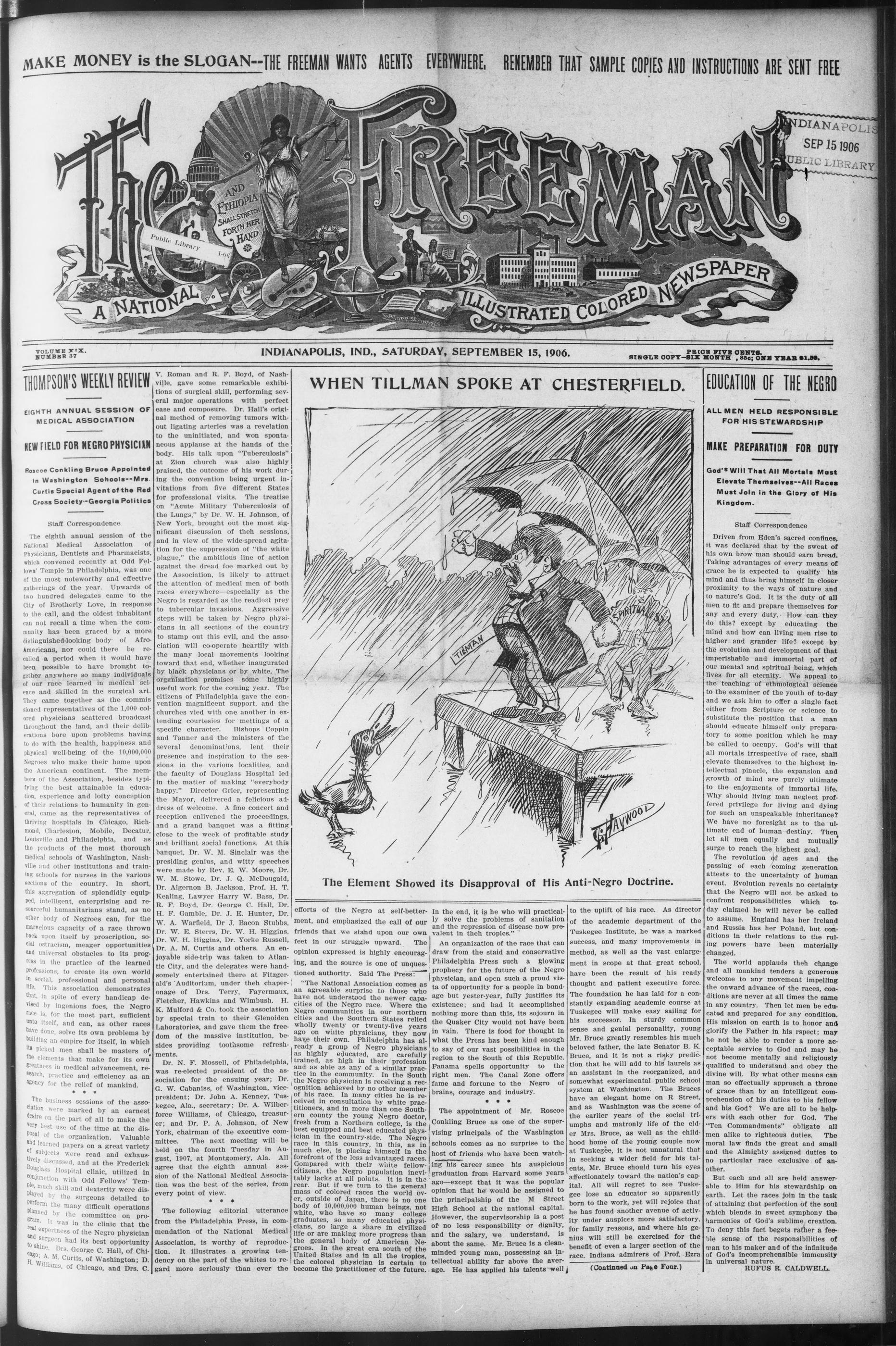
TILMAN
SPIRITUAL
G. HAYWOOD
The Element Showed its Disapproval of His Anti-Negro Doctrine.
efforts of the Negro at self-betterment, and emphasized the call of our friends that we stahd upon our own feet in our struggle upward. The opinion expressed is highly encouraging, and the source is one of unquestioned authority. Said The Press:
"The National Association comes as an agreeable surprise to those who have not understood the newer capacities of the Negro race. Where the Negro communities in our northern cities and the Southern States relied wholly twenty or twenty-five years ago on white physicians, they now have their own. Philadelphia has already a group of Negro physicians as highly educated, are carefully trained, as high in their profession and as able as any of a similar practice in the community. In the South the Negro physician is receiving a recognition achieved by no other member of his race. In many cities he is received in consultation by white practitioners, and in more than one Southern county the young Negro doctor, fresh from a Northern college, is the best equipped and best educated physician in the country-side. The Negro race in this country, in this, as in much else, is placing himself in the forefront of the less advantaged races. Compared with their white fellow-citizens, the Negro population inevitably lacks at all points. It is in the rear. But if we turn to the general mass of colored races the world over, outside of Japan, there is no one body of 10,000,000 human beings, not white, who have so many college graduates, so many educated physicians, so large a share in civilized life or are making more progress than the general body of American Negroes. In the great era south of the United States and in all the tropics, the colored physician is certain to become the practitioner of the future.
In the end, it is he who will practically solve the problems of sanitation and the repression of disease now prevalent in the tropics."
An organization of the race that can draw from the staid and conservative Philadelphia Press such a glowing prophecy for the future of the Negro physician, and open such a proud vista of opportunity for a people in bondage but yester-year, fully justifies its existence; and had it accomplished nothing more than this, its sojourn in the Quaker City would not have been in vain. There is food for thought in what the Press has been kind enough to say of our vast possibilities in the region to the South of this Republic. Panama spells opportunity to the right men. The Canal Zone offers fame and fortune to the Negro of brains, courage and industry.
. . .
The appointment of Mr. Roscoe Conkling Bruce as one of the supervising principals of the Washington schools comes as no surprise to the host of friends who have been watching his career since his auspicious graduation from Harvard some years ago—except that it was the popular opinion that he would be assigned to the principalship of the M Street High School at the national capital. However, the supervisorship is a post of no less responsibility or dignity, and the salary, we understand, is about the same. Mr. Bruce is a clean-minded young man, possessing an intellectual ability far above the average. He has applied his talents well
to the uplift of his race. As director of the academic department of the Tuskegee Institute, he was a marked success, and many improvements in method, as well as the vast enlargement in scope at that great school, have been the result of his ready thought and patient executive force. The foundation he has laid for a constantly expanding academic course at Tuskegee will make easy sailing for his successor. In sturdy common sense and genial personality, young Mr. Bruce greatly resembles his much beloved father, the late Senator B. K. Bruce, and it is not a risky prediction that he will add to his laurels as an assistant in the reorganized, and somewhat experimental public school system at Washington. The Bruces have an elegant home on R Street, and as Washington was the scene of the earlier years of the social triumphs and matronly life of the elder Mrs. Bruce, as well as the childhood home of the young couple now at Tuskegee, it is not unnatural that in seeking a wider field for his talents, Mr. Bruce should turn his eyes affectionately toward the nation's capital. All will regret to see Tuskegee lose an educator so apparently born to the work, yet will rejoice that he has found another avenue of activity under auspices more satisfactory, for family reasons, and where his genius will still be exercised for the benefit of even a larger section of the race. Indiana admirers of Prof. Ezra
(Continued on Pake Four.)
EDUCATION OF THE NEGRO
ALL MEN HELD RESPONSIBLE
FOR HIS STEWARDSHIP
MAKE PREPARATION FOR DUTY
God's Will That All Mortals Must Elevate Themselves--All Races Must Join in the Glory of His Kingdom.
Staff Correspondence
Driven from Eden's sacred confines, it was declared that by the sweat of his own brow man should earn bread. Taking advantages of every means of grace he is expected to qualify his mind and thus bring himself in closer proximity to the ways of nature and to nature's God. It is the duty of all men to fit and prepare themselves for any and every duty. How can they do this? except by educating the mind and how can living men rise to higher and grander life? except by the evolution and development of that imperishable and immortal part of our mental and spiritual being, which lives for all eternity. We appeal to the teaching of ethnological science to the examiner of the youth of to-day and we ask him to offer a single fact either from Scripture or science to substitute the position that a man should educate himself only preparatory to some position which he may be called to occupy. God's will that all mortals irrespective of race, shall elevate themselves to the highest intellectual pinnacle, the expansion and growth of mind are purely ultimate to the enjoyments of immortal life. Why should living man neglect profered privilege for living and dying for such an unspeakable inheritance? We have no foresight as to the ultimate end of human destiny. Then let all men equally and mutually surge to reach the highest goal.
The revolution of ages and the passing of each coming generation attests to the uncertainty of human event. Evolution reveals no certainty that the Negro will not be asked to confront responsibilities which today claimed he will never be called to assume. England has her Ireland and Russia has her Poland, but conditions in their relations to the ruling powers have been materially changed.
The world applauds the change and all mankind tenders a generous welcome to any movement impelling the onward advance of the races, conditions are never at all times the same in any country. Then let men be educated and prepared for any condition. His mission on earth is to honor and glorify the Father in his rspect; may he not be able to render a more acceptable service to God and may he not become mentally and religiously qualified to understand and obey the divine will. By what other means can man so effectually approach a throne of grace than by an intelligent comprehension of his duties to his fellow and his God? We are all to be helpers with each other for God. The "Ten Commandments" obligate all men alike to righteous duties. The moral law finds the great and small and the Almighty assigned duties to no particular race exclusive of another.
But each and all are held answerable to Him for his stewardship on earth. Let the races join in the task of attaining that perfection of the soul which blends in sweet symphony the harmonies of God's sublime creation. To deny this fact begets rather a feeble sense of the responsibilities of man to his maker and of the infinitude of God's incomprehensible immensity in universal nature.
RUFUS R. CALDWELL.
IN THE WOMAN'S WORLD.
BY "DOROTHY"
This column is devoted to the interests of women. Address all communications to "Dorothy." The Freeman, Indianapolis, Ind.
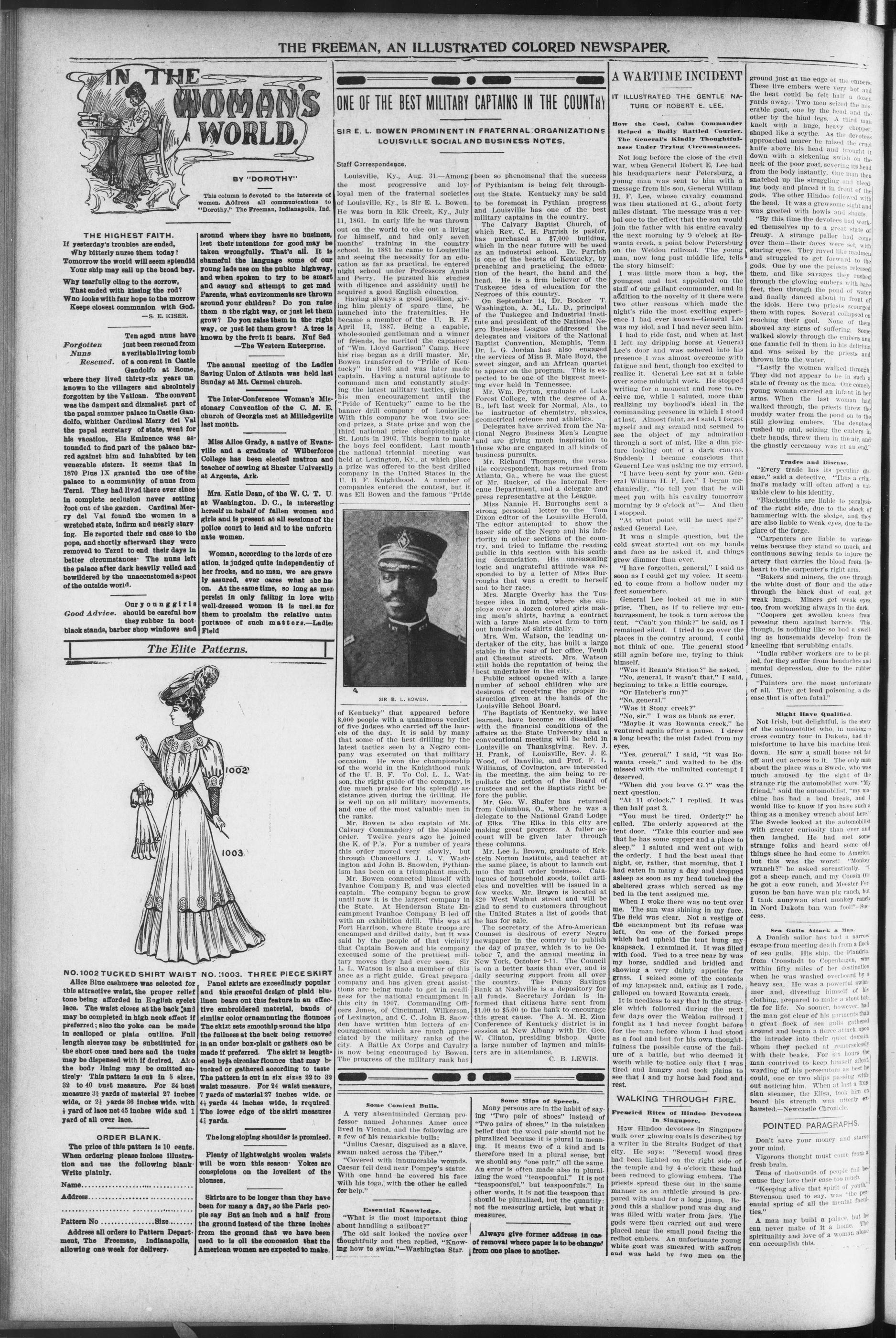
The Elite Patterns.
1002
1003
THE HIGHEST FAITH.
If yesterday's troubles are ended,
Why bitterly nurse them today?
Tomorrow the world will seem splendid
Your ship may sail up the broad bay.
Why tearfully cling to the sorrow,
That ended with kissing the rod?
Who looks with fair hope to the morrow
Keeps closest communion with God.
—S. E. KISER.
Ten aged nuns have
just been rescued from
a veritable living tomb
of a convent in Castle
Gandolfo at Rome.
Forgotten
Nuns
Rescued.
Forgotten
Nuns
Rescued.
where they lived thirty-six years un known to the villagers and absolutely forgotten by the Vatican. The convent was the dampest and dismalest part of the papal summer palace in Castle Gandolfo, whither Cardinal Merry del Val the papal secretary of state, went for his vacation. His Emence was astounded to find part of the palace barred against him and inhabited by ten venerable sisters. It seems that in 1870 Pius IX granted the use of the palace to a community of nuns from Terni. They had lived there ever since in complete seclusion never setting foot out of the garden. Cardinal Merry del Val found the women in a wretched state, infirm and nearly starving. He reported their sad case to the pope, and shortly afterward they were removed to Terni to end their days in better circumstances. The nuns left the palace after dark heavily veiled and bewildered by the unacustomed aspect of the outside world.
Our young girls
Good Advice. should be careful how they rubber in boot-
black stands, barber shop windows and
The Elite
NO 1003 TUCKER SHIRT WAIST
NO.1002 TOCKED SHIRT WAIST
Alice Blue cashmere was selected for this attractive waist, the proper relief tone being afforded in English eyelace lace. The waist closes at the back and may be completed in high neck effect if preferred; also the yoke can be made in scalloped or plain outline. Full length sleeves may be substituted for the short ones used here and the tucks may be dispensed with if desired. Also the body lining may be omitted entirely. This pattern is cut in 5 sizes, 32 to 40 bust measure. For 34 bust measure 3½ yards of material 27 inches wide, or 2½ yards 36 inches wide, with ¼ yard of lace net 45 inches wide and 1 yard of all over lace.
ORDER BLANK
The price of this pattern is 10 cents. When ordering please inclose illustration and use the following blank Write plainly.
Name.....
Address.....
Pattern No....Size.....
Address all orders to Pattern Department, The Freeman, Indianapolis, allowing one week for delivery.
THE FREEMAN. AN ILLUSTRATED COLORED NEWSPAPER.
around where they have no business, lest their intentions for good may be taken wrongfully. That's all. It is shameful the language some of our young lads use on the public highway, and when spoken to try to be smart and saucy and attempt to get mad Parents, what environments are thrown around your children? Do you raise them n the right way, or just let them grow? Do you raise them in the right way, or just let them grow? A tree is known by the fruit it bears. Nuf Sed —The Western Enterprise.
The annual meeting of the Ladies Saving Union of Atlanta was held last Sunday at Mt. Carmel church.
The Inter-Conference Woman's Missionary Convention of the C. M. E. church of Georgia met at Milledgeville last month.
Miss Alice Grady, a native of Evansville and a graduate of Wilberforce College has been elected matron and teacher of sewing at Shester University at Argenta, Ark.
Mrs. Katie Dean, of the W. C. T. U. at Washington, D. C., is interesting herself in behalf of fallen women and girls and is present at all sessions of the police court to lend aid to the unfortunate women.
Woman, according to the lords of ereation, is judged quite independently of her frocks, and no man, we are grave ly assured, ever cares what she has on. At the same time, so long as men persist in only falling in love with well-dressed women it is useless for them to proclaim the relative unim portance of such matters.—Ladies Field
Patterns.
1002
1003
NO.1003. THREE PIECE SKIRT
Panel skirts are exceedingly popular
and this graceful design of plaid blu-
linen bears out this feature in an效
effective embroidered material, bands of
similar color ornamenting the flounces
The skirt sets smoothlip around the hips
the fullness at the back being removed
in an under box-plait or gathers can
be made if preferred. The skirt is length-
ened by a circular flounce that may be
tucked or gathered according to taste
The pattern is cut in six sizes 22 to 32
walst measure. For 24 waist measure,
7 yards of material 27 inches wide. or
42 yards 44 inches wide, is required.
The lower edge of the skirt measures
43 yards.
The long sloping shoulder is promised
Plenty of lightweight woolen walists will be worn this season. Yokes are conspicuous on the loveliest of the blouses.
Skirts are to be longer than they have been for many a day, so the Paris people say. But an inch and a half from the ground instead of the three inches from the ground that we have been used to is oll the concession that the American women are expected to make.
ONE OF THE BEST MILITARY CAPTAINS IN THE COUNTRY
SIR E. L. BOWEN PROMINENT IN FRATERNAL ORGANIZATIONS
LOUISVILLE SOCIAL AND BUSINESS NOTES.
---
Staff Correspondence.
Louisville, Ky., Aug. 31.—Among the most progressive and lov- loyal men of the fraternal societies of Louisville, Ky., is Sir E. L. Bowen. He was born in Elk Creek, Ky., July 11, 1861. In early life he was thrown out on the world to eke out a living for himself, and had only seven months' training in the country school. In 1881 he came to Louisville and seeing the necessity for an education as far as practical, he entered night school under Professors Annis and Perry. He pursued his studies with diligence and assiduity until he acquired a good English education
Having always a good position, giving him plenty of spare time, he launched into the fraternities. He became a member of the U. B. F. April 13, 1887. Being a capable, whole-souled gentleman and a winner of friends, he merited the captaincy of "Wm. Lloyd Garrison" Camp. Here his rise began as a drill master, Mr. Bowen transferred to "Pride of Kentucky" in 1903 and was later made captain. Having a natural aptitude to command men and constantly studying the latest military tactics, giving his men encouragement until the "Pride of Kentucky" came to be the banner drill company of Louisville. With this company he won two second prizes, a State prize and won the third national prize championship at St. Louis in 1903. This began to make the boys feel confident. Last month the national triennial meeting was held at Lexington, Ky., at which place a prize was offered to the best drilled company in the United States in the U. B. F. Knighthood. A number of companies entered the contest, but it was Eli Bowen and the famous "Pride
RAY
SIR E. L. BOWEN.
of Kentucky" that appeared before 8,000 people with a unanimous verdict of five judges who carried off the laurids of the day. It is said by many that some of the best drilling by the latest tactics seen by a Negro company was executed on that military occasion. He won the championship of the world in the Knighthood rank of the U. B. F. To Col. L. L. Watson, the right guide of the company, is due much praise for his splendid assistance given during the drilling. He is well up on all military movements, and one of the most valuable men in the ranks.
Mr. Bowen is also captain of Mt. Calvary Commandery of the Masonic order. Twelve years ago he joined the K. of P.'s. For a number of years this order moved very slowly, but through Chancellors J. L. V. Washington and John B. Snowden, Pythianism has been on a triumphant march. Mr. Bowen connected himself with Ivanhoe Company B, and was elected captain. The company began to grow until now it is the largest company in the State. At Henderson State Encompassment Ivanhoe Company B led off with an exhibition drill. This was at Fort Harrison, where State troops are encamped and drilled daily, but it was said by the people of that vicinity that Captain Bowen and his company executed some of the prettiest military moves they had ever seen. Sir L. L. Watson is also a member of this asce as a right guide. Great prepara-company and has given great assistitions are being made to get in readiness for the national encampment in this city in 1907. Commanding Officers Jones, of Cincinnati, Wilkerson, of Lexington, and C. C. John B. Snowden have written him letters of encouragement which are much appreciated by the military ranks of the city. A Battle Ax Corps and Cavalry is now being encouraged by Bowen. The progress of the military rank has
Some Comical Bulls.
A very absentminded German professor named Johannes Amer once lived in Vienna, and the following are a few of his remarkable bulls:
"Julius Caesar, disguised as a slave, swam naked across the Tiber."
"Covered with innumerable wounds, Caesar fell dead near Pompey's statue. With one hand he covered his face with his toga, with the other he called for help."
Essential Knowledge
"What is the most important thing about handling a sailboat?" The old salt looked the novice over thoughtfully and then replied, "Knowing how to swim."—Washington Star.
been so phenomenal that the success of Pythianism is being felt throughout the State. Kentucky may be said to be foremost in Pythian progress and Louisville has one of the best military captains in the country. The Calvary Baptist Church, of which Rev. C. H. Parrish is pastor, has purchased a $7,000 building, which in the near future will be used as an industrial school. Dr. Parrish is one of the hearts of Kentucky, by preaching and practicing the education of the heart, the hand and the head. He is a firm believer of the Tuskegee idea of education for the Negroes of this country.
On September 14, Dr. Booker T. Washington, A. M., LL. D., principal of the Tuskegee and Industrial Institute and president of the National Negro Business League addressed the delegates and visitors of the National Baptist Convention, Memphis, Penn. Dr. L. G. Jordan has also engaged the services of Miss B. Male Boyd, the sweet singer, and an African quartet to appear on the program. This is expected to be one of the biggest meeting ever held in Tennessee. Mr. Wm. Peyton, graduate of Lake Forest College, with the degree of A. B., left last week for Normal, Ala., to be instructor of chemistry, physics, geometrical science and athletics. Delegates have arrived from the National Negro Business Men's League and are giving much inspiration to those who are engaged in all kinds of business pursuits.
Mr. Richard Thompson, the versatile correspondent, has returned from Atlanta, Ga., where he was the guest of Mr. Rucker, of the Internal Revenue Department, and a delegate and press representative at the League.
Miss Nannie H. Burroughs sent a strong personal letter to the Tom Dixon editor of the Louisville Herald. The editor attempted to show the baser side of the Negro and his inferiority in other sections of the country, and tried to inflame the reading public in this section with his scathing denunciation. His unreasoning logic and ungrateful attitude was responded to by a letter of Miss Burroughs that was a credit to herself and to her race.
Mrs. Margie Overby has the Tuskegee idea in mind, where she employs over a dozen colored girls making men's shirts, having a contract with a large main street firm to turn out hundreds of shirts daily.
Mrs. Wm. Watson, the leading undertaker of the city, has built a large stable in the rear of her office, Tenth and Chestnut streets. Mrs. Watson still holds the reputation of being the best undertaker in the city.
Public school opened with a large number of school children who are desirous of receiving the proper instruction given at the hands of the Louisville School Board.
The Baptists of Kentucky, we have learned, have become so dissatisfied with the financial conditions of the affairs at the State University that a convocational meeting will be held in Louisville on Thanksgiving. Rev. J. H. Frank, of Louisville, Rev. J. E. Wood, of Danville, and Prof. F. L. Williams, of Covington, are interested in the meeting, the aim being to repudiate the action of the Board of trustees and set the Baptists right before the public.
Mr. Geo. W. Shafer has returned from Columbus, O., where he was a delegate to the National Grand Lodge of Elks. The Elks in this city are making great progress. A full account will be given later through these columns. Mr. Lee L. Brown, graduate of Eckstein Norton Institute, and teacher at the same place, is about to launch out into the mail order business. Catalogues of household goods, toilet articles and novelties will be issued in a few weeks. Mr. Brown is located at 820 West Walnut street and will be glad to send to customers throughout the United States a list of goods that he has for sale.
The secretary of the Afro-American Counsel is desirous of every Negro newspaper in the country to publish the day of prayer, which is to be October 7, and the annual meeting in New York, October 9-11. The Council is on a better basis than ever, and is daily securing support from all over the country. The Penny Savings Bank at Nashville is a depository for all funds. Secretary Jordan is informed that citizens have sent from $1.00 to $5.00 to the bank to encourage this great cause. The A. M. E. Zion Conference of Kentucky district is in session at New Albany with Dr. Geo. W. Clinton, presiding bishop. Quite a large number of laymen and ministers are in attendance. C. B. LEWIS.
Some Slips of Speech.
Many persons are in the habit of saying "Two pair of shoes" instead of "Two pairs of shoes," in the mistaken belief that the word pair should not be pluralized because it is plural in meaning. It means two of a kind and is therefore used in a plural sense, but we should say "one pair," all the same. An error is often made also in pluralizing the word "teaspoonful." It is not "teaspoonful," but teaspoonfuls. In other words, it is not the teaspoon that should be pluralized, but the quantity; not the measuring article, but what it measures.
Always give former address in case of removal where paper is to be changed from one place to another.
A WARTIME INCIDENT
IT ILLUSTRATED THE GENTLE NATURE OF ROBERT E. LEE.
How the Cool, Calm Commander Helped a Badly Rattled Courier, The General's Kindly Thoughtfulness Under Trying Circumstances.
Not long before the close of the civil war, when General Robert E. Lee had his headquarters near Petersburg, a young man was sent to him with a message from his son, General William H. F. Lee, whose cavalry command was then stationed at G., about forty miles distant. The message was a verbal one to the effect that the son would join the father with his entire cavalry the next morning by 9 o'clock at Rowanta creek, a point below Petersburg on the Weldon railroad. The young man, now long past middle life, tells the story himself:
I was little more than a boy, the youngest and last appointed on the staff of our gallant commander, and in addition to the novelty of it there were two other reasons which made the night's ride the most exciting experience I had ever known-General Lee was my idol, and I had never seen him.
I had to ride fast, and when at last I left my dripping horse at General Lee's door and was ushered into his presence I was almost overcome with fatigue and heat, though too excited to realize it. General Lee sat at a table over some midnight work. He stopped writing for a moment and rose to receive me, while I saluted, more than realizing my boyhood's ideal in the commanding presence in which I stood at last. Almost faint, as I said, I forgot myself and my errand and seemed to see the object of my admiration through a sort of mist, like a dim picture looking out of a dark canvas. Suddenly I became conscious that General Lee was asking me my errand. "I have been sent by your son, General William H. F. Lee." I began mechanically, "to tell you that he will meet you with his cavalry tomorrow morning by 9 o'clock at"— And then I stopped.
"At what point will he meet me?" asked General Lee.
It was a simple question, but the cold sweat started out on my hands and face as he asked it, and things grew dimmer than ever.
"I have forgotten, general," I said as soon as I could get my voice. It seemed to come from a hollow under my feet somewhere.
General Lee looked at me in surprise. Then, as if to relieve my embarrassment, he took a turn across the tent. "Can't you think?" he said, as I remained silent. I tried to go over the places in the country around. I could not think of one. The general stood still again before me, trying to think himself.
"Was it Ream's Station?" he asked.
"No, general, it wasn't that." I said, beginning to take a little courage.
"Or Hatcher's run?"
"No, general."
"Was it Stony creek?"
"No, sir." I was as blank as ever.
"Maybe it was Rowanta creek," he ventured again after a pause. I drew a long breath; the mist faded from my eyes.
"Yes, general," I said, "it was Rowanta creek," and waited to be dismissed with the unlimited contempt I deserved.
"When did you leave G.?" was the next question.
"At 11 o'clock." I replied. It was then half past 3.
"You must be tired. Orderly!" he called. The orderly appeared at the tent door. "Take this courier and see that he has some supper and a place to sleep." I saluted and went out with the orderly. I had the best meal that night, or, rather, that morning, that I had eaten in many a day and dropped asleep as soon as my head touched the sheltered grass which served as my bed in the tent assigned me.
When I woke there was no tent over me. The sun was shining in my face. The field was clear. Not a vestige of the encampment but its refuse was left. On one of the forked props which had upheld the tent hung my knapsack. I examined it. It was filled with food. Tied to a tree near by was my horse, saddled and bridled and showing a very dainty appetite for grass. I seized some of the contents of my knapsack and, eating as I rode, galloped on toward Rowanta creek.
It is needless to say that in the struggle which followed during the next few days over the Weldon railroad I fought as I had never fought before for the man before whom I had stood as a fool and but for his own thoughtfulness the possible cause of the failure of a battle, but who deemed it worth while to notice only that I was tired and hungry and took plains to see that I and my horse had food and rest.
WALKING THROUGH FIRE.
Frenzied Rites of Hindoo Devotees In Singapore.
H5w Hindoo devotees in Singapore walk over glowing coals is described by a writer in the Straits Budget of that city. He says: "Several wood fires had been lighted on the right side of the temple and by 4 o'clock these had been reduced to glowing embers. The priests spread these out in the same manner as an athletic ground is prepared with sand for a long jump. Beyond this a shallow pond was dug and was filled with water from jars. The gods were then carried out and were placed near the small pond facing the redhot embers. An unfortunate young white goat was smeared with saffron and was held by two men on the
ground just at the edge of the embers. These live embers were very hot and the heat could be felt half a dozen yards away. Two men seized the miserable goat, one by the head and the other by the hind legs. A third man knelt with a hinge, heavy chopper, shaped like a scythe. As the devotees approached nearer he raised the crank knife above his head and brought it down with a sickening swish on the neck of the poor goat, severing its head from the body instantly. One man then snatched up the struggling and bleeding body and placed it in front of the gods. The other Hindoo followed with the head. It was a grewsome sight and was greeted with howls and shouts.
"By this time the devotees had worked themselves up to a great state of frenzy. A strange pallor had come over them—their faces were set, with staring eyes. They raved like madmen and struggled to get forward to the gods. One by one the priests released them, and like savages they rushed through the glowing embers with bare feet, then through the pond of water and finally danced about in front of the idols. Here two priests scourged them with ropes. Several collapsed on reaching their goal. None of them showed any signs of suffering. Some walked slowly through the embers and one fanatic fell in them in his delirium and was seized by the priests and thrown into the water.
"Lastly the women walked through. They did not appear to be in such a state of frenzy as the men. One comely young woman carried an infant in her arms. When the last woman had walked through, the priests threw the muddy water from the pond on to the still glowing embers. The devotees rushed up and, seizing the embers in their hands, threw them in the air, and the ghastly ceremony was at an end."
Trades and Disease
"Every trade has its peculiar disease," said a detective. "Thus a criminal's malady will often afford a valuable clew to his identity.
"Blacksmiths are liable to paralysis of the right side, due to the shock of hammering with the sledge, and they are also liable to weak eyes, due to the glare of the forge.
"Carpenters are liable to varicose veins because they stand so much and continuous sawing tends to injure the artery that carries the blood from the heart to the carpenter's right arm.
"Bakers and miners, the one through the white dust of flour and the other through the black dust of coal, get weak lungs. Miners get weak eyes, too, from working always in the dark.
"Coopers get swollen knees from pressing them against barrels. This though, is nothing like so bad a swelling as housemails develop from the kneeling that scrubbing entails.
"India rubber workers are to be piled, for they suffer from headaches and mental depression, due to the rubber fumes.
"Painters are the most unfortunate of all. They get lead poisoning, a disease that is often fatal."
Might Have Qualified.
Not Irish, but delightful, is the story of the automobilist who, in making a cross country tour in Dakota, had the misfortune to have his machine break down. He saw a small house not far off and cut across to it. The only man about the place was a Swede, who was much amused by the sight of the strange rig the automobilist wore. "My friend," said the automobilist, "my machine has had a bad break, and I would like to know if you have such a thing as a monkey wrench about here." The Swede looked at the automobilist with greater curiosity than ever and then laughed. He had met some strange folks and heard some odd things since he had come to America, but this was the worst! "Monkey wrench?" he asked sarcastically. "I got a sheep ranch, and my Cousin Olie he got a cow ranch, and Meester Ferguson he ban have wan pig ranch, but I tank annywan start monkey ranch in Nord Dakota ban wan fool!" - Success.
Sea Gulls Attack a Man.
Sea Gulls Attack a Man.
A Danish sailor has had a narrow escape from meeting death from a flock of sea gulls. His ship, the Flandria, from Cronstadt to Copenhagen, was within fifty miles of her destination when he was washed overboard by a heavy sea. He was a powerful swimmer and, divesting himself of his clothing, prepared to make a stout bathe for life. No sooner, however, had the man got clear of his garments than a great flock of sea gulls gathered around and began a fierce attack upon the intruder into their quiet domain, whom they pecked at remorselessly with their beaks. For six hours the man contrived to keep himself afloat, warding off his persecutors as best he could, one or two ships passing without noticing him. When at last a Russian steamer, the Elisa, took him on board his strength was utterly exhausted - Newcastle Chronicle.
POINTED PARAGRAPHS.
Don't save your money and starve your mind. Vigorous thought must come from a fresh brain. Tens of thousands of people fail because they love their ease too much.
"Keeping alive that spirit of youth
Stevenson used to say, was "the perennial spring of all the mental faculties."
A man may build a palace, but he can never make of it a home. The spirituality and love of a woman alone can accomplish this.
RACE CLEANINGS
VICTOR
TALKING
MACHINES.
The Victor is so perfect it is often mistaken for the human voice. It is proving a never failing source of DELIGHT to Thousands.
COME IN AND LET US
TELL YOU all ABOUT it.
SOLD ON EASY PAYMENTS
Phones Main 852 New 9093.
KOEHRING BROS.
878, 880, 882 VIRGINIA AVENUE.
Hoosier Poet
CLUB ROOM LONDRES
10c Cigar
We deliver Goods direct to consumers and pay all express charges.
Give Us A Tryal Order.
John Rauch Cigar Co. - Indianapolis, Ind.
J. N. Jackson has opened a shoe establishment at Denver, Colo.
The colored/people of Danville, Ky. are devising plans, to purchase a park.
There are 75 000 Negroes who have paid their poll tax and are qualified voters.
The Knights of/Pythians of Topeka, Kans., will celebrate the Emanclipation Proclamation September 22.
The National Pythian Temple was awarded to Chicago. The ground will cost $45 000 and a magnificent building will be erected.
The third annual session of the South Carolina Colored Sunday School and Educational Convention met at Abbeville last week.
The Negroes' of Roanoke, Va., have placed a memorial window in the Fifth Avenue Freebyterian church in memory of General Stonewall Jackson.
T. J. Manley, of Denver, Colo., has issued a challenge to any man or woman to debate in public "Resolved, That separate schools are of more benefit to the Negro race than mixed schools."
O. J. Brooks, of the West is sending out notices to teachers exhorting them to place pictures of great Negroes in the school-rooms in preference to white people. He says, "Who is to honor the Negro. If not the Negro?"
---
Frank M. Eagleson, of Topeka, Kansas has passed a successful examination before the Kansas State Board of Pharmacy at Coffeyville recently. Mr Eagleson was one of the fourteen successful out of a class of forty, and restated the fourth highest average. It
INDIVIDUAL HOTEL DIRECTORY
[One address line $4.00 per year; including
subscription to The Freeman, in advance,]
HEADWAIERS.
J. W. Redmond, Headwaiter of The Car-
roll, Vicksburg, Miss. 10-06.
C. W. Dwyer, headwaiter Commercial
Club Minneapolis, Minn. 8 106
C. H. Flummer, headwaiter Hotel Bran-
wick, Uniontown, Pa. 10-05
R. H. Bradley, Headwaiter Menger Hotel,
San Antonio, Texas. 3-06
G. W. Bland, Headwaiter of The Oliver,
South Bend, Ind. 12-06
HOTEL DIRECTORY
This column used excursively for the ad dresses of hotels, restaurants, lodgings, and other places throughout the country, and intended as a guide for the traveling public—you business solicited.
Hotel Dwyer (European) C. W. Dwyer,
proprietor. First class rooms by the day,
we or you, with host, electric light
and hot, 821 Wingington Avenue, South
Mississippi, Minn.
Hotel Refomer-First class in all respects
6th street, Richmond, Md. A. W. B.
Hallway, 10th Street, Richmond, Md.
Moore's Hotel - First-class rooms and board
Rooms neatly furnished, 712 and 714 W.
6th street, Little Rock, Ark.
Waldorf-Astoria Hotel - 327 Laurel street,
Hot Springs, Ark.
The Parker House - Rooms by J. W.
Hollman, propietor, Indianapolis, Ind.
Stuart H. Henderson, Ky., 108
Secretary, Frank Wlegro, Prog.
THE FREEMAN, AN ILLUSTRATED COLORED NEWSPAPER
is said that it was the most rigid examination ever given in the State.
The New State Fair Association of Oklahoma have given the colored people to enable them to make a creditable showing. This department has been placed in charge of J. E. Johnson, president; J. W. Sharpe, vice-president; C. T. Hume, secretary; T. J. Ellott, Ireland Rentle, Morris Sango, Wm. Grimmett, L. E. Willis.
The Metropolitan, Mercantile and Realty Companp held their annual meeting at Philadelphia last month and clared a dividend of 7 per cent which is now payable. The capital stock has increased to $1 000 000 and the per value from $10 to $25 per share. Nineteen states of the union were represented and there are over 4,000 stockholders.
LONDON BRIDGE.
It Was Over Seven Years In Building and Cost $10,000,000.
On Aug. 1, 1831, London bridge, substantially the structure that we know, was opened in state by William IV. and Queen Adelaide. The opening was made the occasion of a great water pageant, the king and queen coming to the bridge by water in a resplendent royal barge. They lunched on the bridge itself in a special pavilion. The building of the bridge occupied more than seven years, the first pile being driven on March 15, 1824, and the first stone laid about a year later. The cost was almost £2,000,000. This bridge was built 180 yards farther west than the old London bridge, which had been in existence almost a thousand years.
It is believed that in early Roman times there was a bridge of boats over the Thames. This gave place to a strong narrow structure built by the Roman occupiers on wooden piles. The remains of this Roman bridge were discovered when the present bridge was built. The Roman bridge was burned in 1136, but was repaired. In 1167 the Norman London bridge was begun by Peter, rector of Colechurch, in the reign of King Henry II. It was not completed until 1209, a period of forty-two years. In 1282 there was a terrible fire on the bridge, both ends burning furiously, while 3,000 persons were caught between the two fires and either burned to death or drowned. In the fifteenth century there were houses on both sides of the bridge, just as there are on the Ponte Vecchio, in Florence, at the present time. In Tudor times the heads of political offenders were stuck over the gates of the bridge. One traveler has recorded the fact that he witnessed no fewer than 300 of these terrible trophies impaled at various parts of London bridge.
In the days of James I, the bridge had become the haunt of jewelers and other small merchants, as we see them on the old bridge over the Arno today. They succeeded the astrologers and fortune tellers who had settled there in Tudor days. The bridge suffered heavily in the great fire of London. In the eighteenth century all the old houses which stood upon it were removed for reasons of safety. Finally, the cost of the continuous repairs became so heavy that the bridge we now see was built and later on widened. For hundreds of years the traffic on the bridge has been so great that an old saw has it that no one can cross it without seeing a white horse.—Westminster Gazette.
Marta's Interference
By Constance D'Arcy Mackay
Copyright, 1900, by Ruby Douglas
"Heaven deliver me from neighbors!" grumbled Marta to herself as she dusted Professor Travers' study. From its windows she could look across to the next lawn, where a girl in an embroidered dress was tending a flower garden, a lace parasol in one hand and a ridiculously small green watering can in the other. At her heels barked a tiny dog, and it would have been hard to tell which Marta regarded with the more disapproval, the toy spaniel or its owner.
The next door house had been vacant so many years that Marta looked on its new purchasers, the Gainsboros, in the light of intruders, as the little village of Hampstead was seldom frequented by summer people. For this reason Professor Travers made it his retreat the moment college closed in order to escape the festivities of commencement—cheering students, pink ice cream and a host of enthusiastic girls had no charms for him. He was bored by the former and too deeply absorbed in his books to notice the latter. For this Marta, his middle aged housekeeper, was supremely grateful. She had taken care of him too many years to relinquish her supremacy without a struggle.
"But it will come some time," said John, her husband. "Love is like the measles. And the older he is when he takes it the harder it will go with him."
"He is thirty-five and it hasn't come yet," answered Marta hopefully. She had nursed Travers through many childish ailments and felt herself capable of warding off this most dangerous ailment of all. So she guarded his solitude with watchful zeal. She had a horror of intruders, especially young and feminine ones, and the nearness of Betty Gainsboro was a positive menace to her peace of mind. "Running about in high heeled slippers and wearing big, fluffy hats, just
A
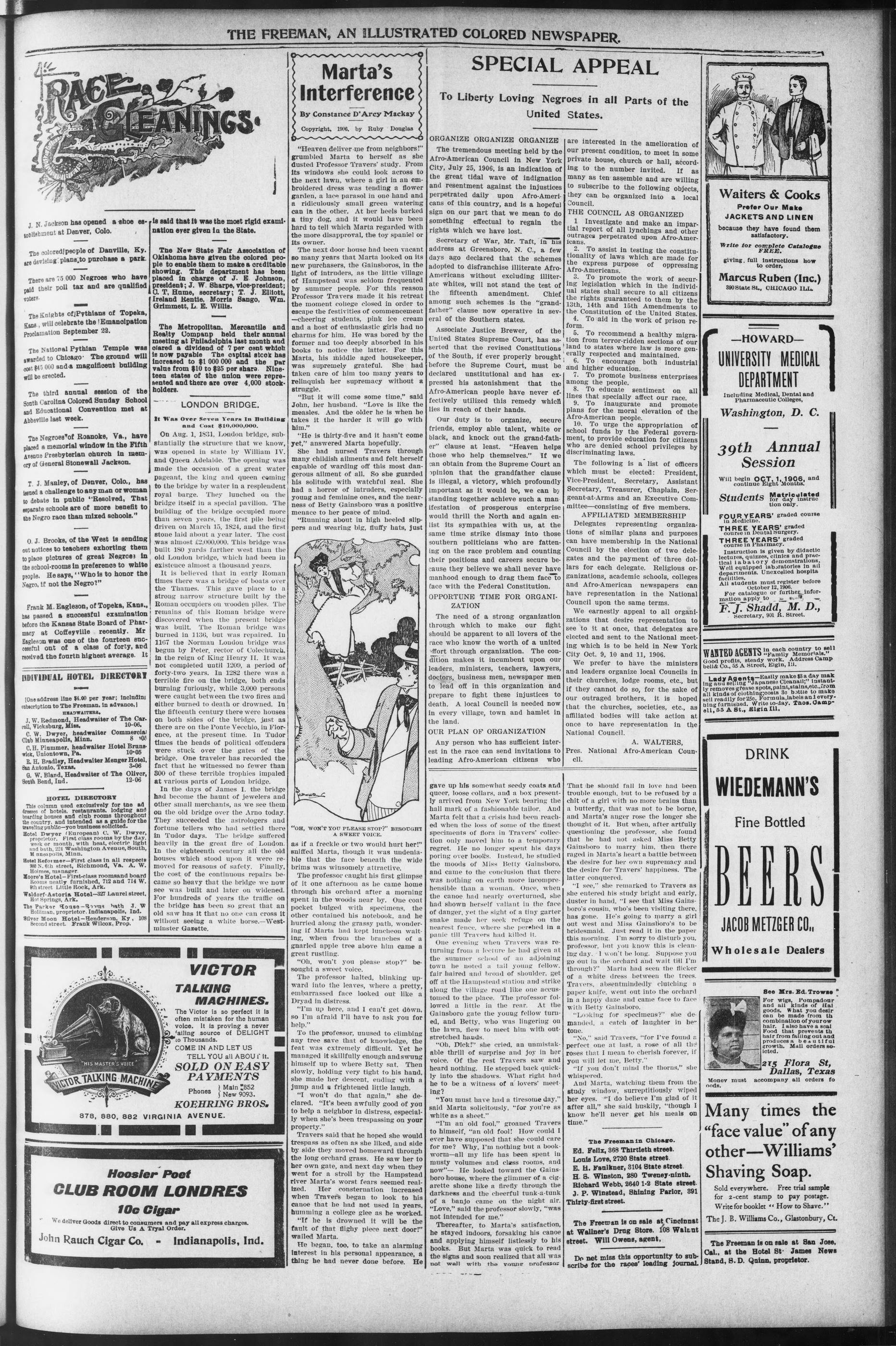
"OH, WON'T YOU PLEASE STOP?" BESOUGHT A SWEET VOICE.
"OH, WON'T YOU PLEASE STOP?" BESOUGHT A SWEET VOICE.
as if a freckle or two would hurt her!' sniffed Marta, though it was undeniable that the face beneath the wide brims was winsomely attractive.
The professor caught his first glimpse of it one afternoon as he came home through his orchard after a morning spent in the woods near by. One coat pocket bulged with specimens, the other contained his notebook, and he hurried along the grassy path, wondering if Marta had kept luncheon waiting, when from the branches of a garbled apple tree above him came a great rustling.
"Oh, won't you please stop?" besought a sweet voice.
The professor halted, blinking upward into the leaves, where a pretty, embarrassed face looked out like a Dradv in distress.
"I'm up here, and I can't get down, so I'm afraid I'll have to ask you for help."
To the professor, unused to climbing any tree save that of knowledge, the feat is extremely difficult. Yet he managed it skillfully enough and swung himself up to where Betty sat. Then slowly, holding very tight to his hand, she made her descent, ending with a jump and a frightened little laugh.
"I won't do that again," she declared. "It's been awfully good of you to help a neighbor in distress, especially when she's been trespassing on your property."
Travers said that he hoped she would trespass as often as she liked, and side by side they moved homeward through the long orchard grass. He saw her to her own gate, and next day when they went for a stroll by the Hampstead river Marta's worst fears seemed realized. Her consternation increased when Travers began to look to his canoe that he had not used in years, humming a college glee as he worked. "If he is drowned it will be the fault of that flighy piece next door!" wailed Marta.
He began, too, to take an alarming interest in his personal appearance, a thing he had never done before. He
SPECIAL APPEAL
ORGANIZE ORGANIZE ORGANIZE
The tremendous meeting held by the Afro-American Council in New York City, July 25, 1906, is an indication of the great tidal wave of indignation and resentment against the injustices perpetrated daily upon Afro-Americans of this country, and is a hopeful sign on our part that we mean to do something effectual to regain the rights which we have lost.
Secretary of War, Mr. Taft, in his address at Greensboro, N. C., a few days ago declared that the schemes adopted to disfranchise illiterate Afro-Americans without excluding illiterate whites, will not stand the test of the fifteenth amendment. Chief among such schemes is the "grandfather" clause now operative in several of the Southern states.
Associate Justice Brewer, of the United States Supreme Court, has asserted that the revised Constitutions of the South, if ever properly brought before the Supreme Court, must be declared unstitutional and has expressed his astonishment that the Afro-American people have never effectively utilized this remedy which lies in reach of their hands.
Our duty is to organize, secure friends, employ able talent, white or black, and knock out the grand-father" clause at least. "Heaven helps those who help themselves." If we can obtain from the Supreme Court an opinion that the grandfather clause is illegal, a victory, which profoundly important as it would be, we can by standing together achieve such a manifestation of prosperous enterprise would thrill the North and again enlist its sympathies with us, at the same time strike dismay into those southern politicians who are fattening on the race problem and counting their positions and careers secure because they believe we shall never have manhood enough to drag them face to face with the Federal Constitution.
The need of a strong organization through which to make our fight should be apparent to all lovers of the race who know the worth of a united effort through organization. The condition makes it incumbent upon our leaders, ministers, teachers, lawyers, doctors, business men, newspaper men to lead off in this organization and prepare to fight these injustices to death. A local Council is needed now in every village, town and hamlet in the land.
OUR PLAN OF ORGANIZATION
Any person who has sufficient interest in the race can send invitations to leading Afro-American citizens who
gave up his somewhat seedy coats and queer, loose collars, and a box presently arrived from New York bearing the hall mark of a fashionable tailor. And Marta felt that a crisis had been reached when the loss of some of the finest specimens of flora in Travers' collection only moved him to a temporary regret. He no longer spent his days poring over books. Instead, he studied the moods of Miss Betty Gainsboro, and came to the conclusion that there was nothing on earth more incomprehensible than a woman. Once, when the canoe had nearly overturned, she had shown herself valiant in the face of danger, yet the sight of a tiny garter snake made her seek refuge on the nearest fence, where she perched in a panic till Travers had killed it.
One evening when Travers was returning from a lecture he had given at the summer school of an adjoining town he noted a tall young fellow, fair haired and broad of shoulder, get off at the Hampstead station and strike along the village road like one accustomed to the place. The professor followed a little in the rear. At the Gainsboro gate the young fellow turned, and Betty, who was lingering on the lawn, flew to meet him with outstretched hands.
"Oh, Dick!" she cried, an unmistakable thrill of surprise and joy in her voice. Of the rest Travers saw and heard nothing. He stepped back quickly into the shadows. What right had he to be a witness of a lovers' meeting?
"You must have had a tiresome day," said Marta solicitously, "for you're as white as a sheet."
"I'm an old fool," groaned Travers to himself, "an old fool! How could I ever have supposed that she could care for me? Why, I'm not nothing but a bookworm—all my life has been spent in musty volumes and class rooms, and now"—He looked toward the Gainsboro house, where the glimmer of a cigarette shone like a firefly through the darkness and the cheerful tunk-a-tunk of a banjo came on the night air. "Love," said the professor slowly, "was not intended for me."
Thereafter, to Marta's satisfaction, he stayed indoors, forsaking his canoe and applying himself listlessly to his books. But Marta was quick to read the signs and soon realized that all was not well with the young professor
are interested in the amelioration of our present condition, to meet in some private house, church or hall, according to the number invited. If as many as ten assemble and are willing to subscribe to the following objects, they can be organized into a local Council.
THE COUNCIL AS ORGANIZED
1. Investigate and make an impartial report of all lynchings and other outrages perpetrated upon Afro-Americans.
2. To assist in testing the constitutionality of laws which are made for the express purpose of oppressing Afro-Americans.
3. To promote the work of securing legislation which in the individual states shall secure to all citizens the rights guaranteed to them by the 13th, 14th and 15th Amendments to the Constitution of the United States.
4. To aid in the work of prison reform.
5. To recommend a healthy migration from terror-ridden sections of our land to states where law is more generally respected and maintained.
6. To encourage both industrial and higher education.
7. To promote business enterprises among the people.
8. To educate sentiment on all lines that specially affect our race.
9. To inaugurate and promote plans for the moral elevation of the Afro-American people.
10. To urge the appropriation of school funds by the Federal government, to provide education for citizens who are denied school privileges by discriminating laws.
The following is a list of officers which must be elected: President, Vice-President, Secretary, Assistant Secretary, Treasurer, Chaplain, Sergeant-at-Arms and an Executive Committee—consisting of five members.
AFFILIATED MEMBERSHIP Delegates representing organizations of similar plans and purposes can have membership in the National Council by the election of two delegates and the payment of three dollars for each delegate. Religious organizations, academic schools, colleges and Afro-American newspapers can have representation in the National Council upon the same terms. We earnestly appeal to all organizations that desire representation to see to it at once, that delegates are elected and sent to the National meeting which is to be held in New York City Oct. 9, 10 and 11, 1906.
We prefer to have the ministers and leaders organize local Councils in their churches, lodge rooms, etc., but if they cannot do so, for the sake of our outraged brothers, it is hoped that the churches, societies, etc., as affiliated bodies will take action at once to have representation in the National Council.
A. WALTERS,
Pres. National Afro-American Council.
That he should fall in love had been trouble enough, but to be refused by a chit of a girl with no more brains than a butterfly, that was not to be borne, and Marta's anger rose the longer she thought of it. But when, after artfully questioning the professor, she found that he had not asked Miss Betty Gainsboro to marry him, then there raged in Marta's heart a battle between the desire for her own supremacy and the desire for Travers' happiness. The latter conquered.
"I see," she remarked to Travers as she entered his study bright and early, duster in hand, "I see that Miss Gainsboro's cousin, who's been visiting there, has gone. He's going to marry a girl out west and Miss Gainsboro's to be bridesmaid. Just read it in the paper this morning. I'm sorry to disturb you, professor, but you know this is cleaning day. I won't be long. Suppose you go out in the orchard and wait till I'm through?" Marta had seen the flicker of a white dress between the trees. Travers, absentmindedly clutching a paper knife, went out into the orchard in a happy daze and came face to face with Betty Gainsboro.
"Looking for specimens?" she demanded, a catch of laughter in her tone.
"No," said Travers, "for I've found a perfect one at last, a rose of all the roses that I mean to cherish forever, if you will let me. Betty."
"If you don't mind the thorns," she whispered.
And Marta, watching them from the study window, surreptitiously wiped her eyes. "I do believe I'm glad of it after all," she said huskily, "though I know he'll never get his meals on time."
The Freeman in Chicago.
Ed. Felix, 368 Thirtieth street.
Louis Love, 2720 State street.
E. H. Faulkner, 3104 State street.
H. S. Winston, 280 Tweney-ninth.
Richard Webb, 2640 1-2 State street.
J. P. Winstead, Shining Parlor, 391 Thirty-first street.
The Freeman is on sale at Cincinnat at Wallner's Drug Store. 108 Walnut street. Will Owens, agent.
Do not miss this opportunity to subscribe for the races' leading journal.
COOK
Waiters & Cooks
Prefer Our Make
JACKETS AND LINEN
because they have found them
satisfactory.
Write for complete Catalogue
FREE.
giving, full instructions how
to order.
Marcus Ruben (Inc.)
380 State St., CHICAGO IL.
—HOWARD—
UNIVERSITY MEDICAL
DEPARTMENT
Including Medical, Dental and
Pharmaceutic Colleges,
Washington, D. C.
39th Annual
Session
Will begin OCT. 1, 1906, and
continue Eight Months.
Students Matriculated for day instruction only.
FOUR YEARS' graded course in Medicine.
THREE YEARS' graded course in Dental Surgery.
THREE YEARS' graded course in Pharmacy.
Instruction is given by didactic lectures, quizzes, clinics and practical labory demonstrations.
Well equipped laboratories in all departments. Unexcelled hospital facilities.
All students must register before October 12, 1906.
For catalogue or further information apply to:
F. J. Shadd, M. D.,
Secretary, 901 R. Street.
WANTED AGENTS in each country to sell "Family Memoirs." Good profits, steady work. Address Camp bello Co., 55 A Street, Eighn, Ill.
Lady Agents—Easily make $3 a day mark and售ing Japanese Cleanlah! 'instantly removes grease spots, paint, stains, etc., from all kinds of clothing costs, shoes, bags, labels and everything furnished. Write to-day. Tos, Campbell, 55 A St., Eglin Ill.
DRINK
WIEDEMANN'S
Fine Bottled
BEERS
JACOB METZGER CO.,
Wholesale Dealers
See Mrs. Ed. Trowse
for wigs, Pampadour
and all kinds of Hai
goods. What you desir
e made from this
combination of yourow
hair. I also have a scal
Food that prevents th
produces a besutiful
growth. Mail orders socti
For wigs, Pampadon
and all kinds of hair
goods. What you desir
can be made from th
combination of yourow
hair or its natural
Food that prevents th
hair from falling out and
produces a beautiful
growth. Mail orders soi-
cited.
215 Flora St,
Dallas, Texas
Money must accompany all orders to
monev
Many times the "face value" of any other—Williams' Shaving Soap.
Sold everywhere. Free trial sample for 2-cent stamp to pay postage. Write for booklet "How to Shave." The J. B. Williams Co., Glastonbury, Ct.
The Freeman is on sale at San Jose, Cal., at the Hotel St. James News Stand, S.D. Quinn, proprietor.
PUBLISHED EVERY SATURDAY
At 309 Indiana Avenue,
INDIANAPOLIS, INDIANA.
SUBSCRIPTION RATES :
ADVERTISING RATES:
Five cents per line. Face of measure—solid
agate, 14 lines to an inlc. 272 lines in a comm.
advertisement inserted on first page. Advertisement inserted on first page. Special rates on standing professiol and business cards. Reasonable discount for long time add. Special rates on do per line. Special rates on WK TE URs.
Entered at the postoffice at Indianapolis,
Indiana, as second class at after.
INDIANAPOLIS, INDIANA.
SATURDAY, SEPTEMBER 15, 1906.
Government Regulation—Not Ownership.
We do not follow Mr. Bryan into the camp of believers in the government ownership of trunk railroads, for whatever may be the merits of the innovation, it is too radical a step for a great nation like ours to consider without long and exhaustive examination, and perhaps, a gradual preparation through more successful experiments than we have yet had in municipal ownership.
Nevertheless, the Nebraska statesman is far ahead of his party in grasping the fac, that the trend of international sentiment is inevitably toward centralization in government, and that the handwriting is on the wall in this country for that ancient fetich, so revered of the South—States' Rights. Year by year we are outgrowing our swaddling clothes and taking our place in the galaxy of the great nations of the earth! The patriot who keeps in touch with the logic of events is an American before he is a Virginian, or a Kentuckian—he is a citizen of the Republic, and recognizes his allegiance to the General Government, before he considers the question of his relation to this or that individual State. England is a world power, because every loyal devotee to the British flag is an Englishman first—an adherent to a province afterward. Germany never rose to her rightful strength until her principalities were welded into a cohesive Empire, under a strong central directory; and the same true of all governments that hope to make a lasting impress upon the politics and commerce of the globe. America's vast interests are passing from the chrysalis form state in which the fathers of the Republic found it, and the wise statesman is beginning to shape his ideas in legislation and custom to accord with the new order of things. States will continue to have certain inalienable rights, and will maintain their indestructibility, etc., as far as their boundary lines go, but their autonomy must be limited to the well-being of the General Government when emergencies force an issue involving the common good. The Nation is first; states must be secondary and subordinate. A strong central authority at Washington is essential to the perpetuity of our popular institutions, and to guarantee a uniformity of rights, privileges and immunities upon every inch of the soil under the jurisdiction of the Stars and Stripes.
To this end, railroads, express companies, telegraph lines, insurance societies and other corporations whose business extends beyond the confines of a stat, must be in some measure amenable to the federal government. Just how far the national government ought to go in the matter of regulation is dependent upon circumstances and conditions. That is a mere matter of detail, and can be worked out equitably by those familiar with the several species of traffic. In any event, the shell-like policy of States rights has seen its best days, and if the South is determined not to be separated from its idol, it will slimp'y write itself down against the progressive spirit of the times and remain irrevocably in the rear.
Mr Bryan, to do him justice, is not committed to an immidiate insistence upon the federal ownership of railroads, nor upon the state ownership of local lines. He realizes that such a movement will require a long campaign of education, and the shaking off of many traditions that have the force of law. But his views on the subject are a reflex of the irresistible tendency of the American government toward centralization, and in voicing his sympathy with it, he shows himself to be so far ahead
THE FREEMAN, AN ILLUSTRATED COLORED NEWSPAPER
of the Balleys, John Sharp Williamses, Moneys and Vardamans of his party that they will not be able to catch up with him in constructive statesmanship in the next quarter of a century. The shadow of the Negro again falls athwart the vision of the southern bourbon. He sees in government ownership the abolition of the "jim crow car"—a mere incident in the economy of this mighty Republic—and it must call a halt until this hobgoblin is satisfactorily explained away. We think Mr. Bryan has shown that the race question has no place in this purely economic arrangement. The Freeman hastens to assure the troubled brethren that we are not influenced in our attitude by any fear or favor as to its effect upon the Negro. We can stand anything that any other class of Americans can stand; all we want is equality in treatment regardless of the system. We are absolutely free from racial, partisan or personal bias on this issue. Argue as we may, government regulation of the great utilities that effect the happiness and prosperity of our millions of American citizens, we must have—and we must have it just as rapidly as Congress can pass the necessary laws; the problem of ownership can wait until later for the threshing process. It is a pleasing contemplation, as we study this complex situation, to note that while Rocsevelt and Bryan differ radically on the relative merits of regulation and ownership, they are a unit on the proposition that upon a practical application of the theory of centralization of national power rets the permanent safety of this Republic of ours.
Negro Voters Should Use The Ballot.
Does the Negro value the suffrage as he should? While the National Afro-American Council is planning to spend a million dollars, if necessary, to set aside the unconstitutional barriers erected by those who wish to eliminate the black man from the political equation, and local leaders are straining every nerve to preserve to the race and sacred heritage of self-government, are the masses taking the interest they should in qualifying and casting their ballots in the sections or states where there is practically no restriction, save the registration requirement or the poll-tax.
No one can inquire into this subject deeply without becoming convinced that a large part of the fault lies, so far as the use of the ballot among the masses of our people are concerned, is due to the shortcomings of the race itself. We are constantly in receipt of evidence from the North, as well as from the South, which goes to show that the average Afro-American will not vote where there is a poll-tax to be paid—unless, forsooth, somebody pays the tax for him, or offers some inducement. In Georgia, Tennessee and some of the other southern states where there is no legal restriction thrown about the ballot, it is a most difficult task to get the average man to register, pay his poll-tax and prepare himself for voting. In many of the large cities of New England and in the North and West the same difficulty presents itself.
In Atlanta, Georgia, for instance, it is not difficult for a colored man to vote, but one of the pre-requisites is the payment of the poll-tax and registration at a certain time. Notwithstanding these plain and simple conditions, a ridiculously small percentage of the colored people residing in Atlanta are in a position to vote. It is argued in some cases that they are discouraged from voting through the operations of the white primary; but the same law that protects a democratic white primary, will protect a republican primary. In that respect, one race or party has no advantage over the other. The plain fact of the business is, that while so much energy and strength are being devoted to condemning the white man for his shortcomings with reference to the franchise, we should wake up to the realization that the race itself has a duty to perform in the same connection, and that duty is to arouse the masses of our people to a deeper sense of the importance of using the ballot wherever and whenever they get an opportunity. We should be independent of all outside influences; we should study the issues that divide the parties, and espouse those principles, men and measures, which, in our sober judgment, seem to offer the greatest good to the greatest number. To be the slave of one party, or the one unreasoning enemy of another, or to barter away our suffrage to the highest bidder, as an article of merchandise, can only win for us the contempt of all right-thinking men and women of the land. We have pitted ourselves impotently, and have sung the old song of the white man's injustice for so long a period that we
are to much inclined to lie down and do nothing for ourselves, blaming all of our disadvantages upon the prejudice and injustice of the white man.
We know, of course, that in thousands of cases, there is glaring injustices committed against the Negro, and in many localities he is outraged and spat upon with impunity, but the fact remains that wherever the Negro has the least opportunity to vote, he should rise up in his manhood, and prove himself worthy of the efforts of his friend to secure for him the full rights of citizenship, by casting his ballot, and casting it for the best interests of himself, the community and the nation.
God Almighty has no use for a coward,
and, according to one Mr. Fessanden, on
a momentous occasion, He "hates a quitter."
Frequenry,
"The fault is not in our sters,
But in ourselves."
A serious phase of the race problem is how to reach the unreached Negro, who never goes to church, never hears a sermon, never attends a high grade entertainment of any kind, never visits a Y. M. C. A., and never gets in friendly touch with the intellectual and refined members of his own race? These are the men who commit the crimes, for which we are all condemned. How can this class be reached by moral and uplifting forces?
As long as gullible women and weak-minded men continue to pour their shekels into the coffers of the humbugs and imposters who pretend to "teil fortunes," the latter will be wearing diamonds while the former will be lucky to get pork and bears for lunch.
There are still people who know no better than to be bilked by these ex-slave pension sharks, notwithstanding the solemn warning of every reputable race journal in the country. The Negro should take no stock in the "graft" these fellows are promoting.
It is not difficult to help a man who has studied out his own powers and his limitations, and who knows just what he wants to do.
GET busy with your business!
We do not hail from Missouri, but the Panama Canal people will have to "show" us before we are willing to believe that Chinese coolies make better laborers than the patient Negro of our Southland, inured by long experience to hard work in the cotton field under the burning rays of a tropical sun. "There's something rotten in Denmark!"
The Negro voters in the pivotal States have caught the independent wave that is sweeping over the country—and some party is likely to get it where the chicken got the ax, if its deeds do not square with its words.
There are differences in the methods employed by leaders. Professor DuBois points us the goal, and tells us we ought to reach it. Dr. Washington provides the practical elements of progress, and allows the goal to take care of itself.
It is up to the Republican spellbinders of the "stand-pat" variety to explain to the colored voters of the nation how they are benefited by the high protective tariff.
The Washington World is no more. Truly, the national capital is trying hard to maintain its old-time prestige as the champion newspaper graveyard of the country.
One Negro in a live, expanding business is worth more to the race than a dozen salaried dependents, hanging on by their eye-lids to a little political job.
The world instinctively dofs its hat to the individual, black or white, who can affix his signature to a good-sized bank check.
It isn't difficult to secure a membership in the "Anvil Club." The professional "knockers" are not at all particular about the company they keep.
The impressing figure of Publisher George L. K. 10x, with his Frederick Douglass like hair of snowy-white, attracted universal attention. He delivered several very illuminating addresses.
THOMPSON'S WEEKLY REVIEW
(CONTINUED FROM FIRST PAGE
Roberts, a recent acquisition to the Tuskegee forces, are hoping that that worthy and accomplished young man will be called to fill the vacancy made by the departure of Mr. Bruce.
The stories going the rounds to the effect that Mrs. A. M. Curtis, wife of Dr. Curtis, of Washington, D. C., has been making herself obnoxious to San Francisco society by passing herself off for white, and that the "400" in and about the Golden Gate propose to snub her for alleged false pretenes should she return there to pursue her labors as the special agent of the Red Cross Relief Society. We are authorized to say that there is not one word of truth in the ridiculous rumors sent out by the Associated Press and exploited with emphasis in the South, to add fuel to the flame sought to consume the so-called aspirations of the Negro for "social equality." The reports do Mrs. Curtis great injustice, and reflect seriously upon the good sense with which she has always been accredited by those who know her best.
---
Mrs. Curtis' excellent service as an army nurse in Cuba during the Spanish-American War, in conjunction with Clara Barton, the high priestess of the Red Cross movement, commended her to the good graces of Surgeon-General O'Reilly, who was also cognizant of her capable executive work under Mrs. Potter Palmer at the World's Fair in Chicago in 1893. When the Red Cross undertook the relief of the earthquake sufferers at San Francisco, Surgeon-General O'Reilly remembered Mrs. Curtis and recommended her to Secretary Taft as a fit person to assist in the performance of that immense task. Secretary Taft, both as president of the Red Cross Society, and officer of the government, assigned her to the relief work, and she proceeded to San Francisco on her sacred mission. Having spent a portion of her girlhood on the Pacific coast, she knew many of the old families and was soon on quite friendly terms with everybody, proving of exceptionable value to the committee by reason of this acquaintance. Nothing was said of her color or race, for in such trying times, such infinitesimal considerations such infinitesimal lost sight of by all who possessed a scintilla of decency. Perceiving an injury in an automobile accident on Oakland, Mrs. Curtis found it necessary to go East for treatment, intending, however, to return to press a suit against the company responsible for the auto accident, and to collect certain insurance money due her on some property owned by her in San Francisco. Her labors with the Red Cross Society were practically at an end when the accident occurred. Attention now being called to her, partially because of the accident and by reason of the termination of her peculiarly efficient services, a cheap peny-a-liner, in direful straits for a piece of sensational "copy," saw in the racial identification of Mrs. Curtis the possibilities of a "good story," the fact that she was fair of complexion giving verisimilitude to the assertian that she was trying to pass for white, and got caught in the act. Such a "frame-up" the servery figured out, would tickle the prejudiced South, humiliate Mrs. Curtis, and make "rich and racy" reading for the classes that like their journalism highly seasoned. And so the narrative went o the country.
---
As a matter of fact, Mrs. Curtis' relations with the families with which she was brought into immediate contact through her errands of mercy, were in no sense social. They were strictly business, and any insinuation that she attempted to take advantage of the accident of complexion to masquerade under false pretenses in a lie, made out of whole cloth. To be sure, she wore no placard on her breast, setting forth that she was of this race or that, but simply attended to her duties and went about her affairs with the unassuming dignity, precision and womanly grace that characterized her daily conduct in Washington, Chicago or any other city in which she has made her home or transacted business. No family, southern or northern, has refused or will refuse to recognize her socially, for no such demand has ever been made or desired. She will return to San Francisco when she gets good and ready, unmindful of the silly fabrications circulated by the Associated Press, and the same doors that have been open to her will still be open, and upon exactly the same terms as before—the sisterhood of human sympathy in the hour of common suffering—the "one touch of nature that makes the whole world kin." Universal distress defies color lines and bridges the widest racial chasms. Mrs. Curtis is a lady of refinement and culture and unusual executive ability. The entire race takes a just pride in her manifold achievements, and she is too firmly wedded to the interests of her people to descend to trickery or sharp practice of any kind for the doubtful prestige of being mistaken for white.
. . .
As the meeting of the Biennial Movable Committee at Richmond approaches, it seems more likely than ever that the mantle of Grand Master J. McHenry Jones will fall upon the broad shoulders of William L. Houston, present Grand Director and all-round man of affairs. Expressions from New England, the Central States, the Southeast, Middle West and Border South indicate that he will be elected by a tremendous majority. Dr. E. P. Jones is making a gallant fight in the South, and Mr. George E. Temple, it is thought, will show some strength in the trans-Mississippi region, but the indications are that Houston has the above-named sections "cinched," and no one will be able to take any portion of his following from him between now and next month. The men who have made Odd Fellowship powerful in this country are almost unanimously for
Published specially for News Dealers with all the New Leading Publications, Newspapers, Magazines, Books and Fancy Goods, etc. Write Today The Standard News Company, WHOLESALE DEALERS, 323 W. 37th St., New York City.
Houston, and it appears—to use Mark Hanna's apt slogan—"all is over, except them shouting."
"It ISS to laugh!" At least that is what a reporter for the Atlanta Evening News thought the other day when he attempted to interview Dr. Booker T. Washington. The festive young journalist started in by asking the Tuskegee Wizard if he thought President Roosevelt could be induced to run again.
"I do not think Mr. Roosevelt will be a candidate for the nomination," said Dr. Washington, with delightful frankness. "He has nothing to gain by being president for a third term. He has it all now."
"What do you think of the Carnegie-Roosevelt phonetic spelling?" queried the News man.
"They are a strong team—Rosevelt and Carnegie," he replied, and then laughed heartily, as if the idea of the two "strong" men favoring a reform in spelling was especially comical.
"Do you think it will succeed?"—but the noted educator laughed again; and at every question about the Big Stick-Andy of Skibo crusade, laughed the more.
"Will you use it in your school?" ventured the scribe.
"That will be for the trustees to decide," replied Dr. Washington—and the humorous interview came to an abrupt end. When the young gentleman wishes more information he will doubtless call again.
It is to be regretted that the republican leaders of the State of Georgia have decided against placing a State ticket in the field. Such able men as
ECHOES FROM THE NATIONAL
Odds And Ends Of The Great Atlantic
Staff Correction
By R. W.
It was the best yet.
The ushers were faithful, courteous and obliging.
ECHOES FROM THE NATIONAL NEGRO BUSINESS LEAGUE.
Odds And Ends Of The Great Atlanta Meet, Picked Up By Our Special Staff Correspondent.
By R. W. Thompson.
Former Consul Richard T. Greener made a "hit."
The "press gang" was ably represented.
Col. A. N. Johnson sang the praises of Mobile in a major key.
Rev. H. H. Proctor made an ideal coastmaster at the grand barquet.
The trolley ride was one of the most instructive features of the social program.
"Work," intelligent, conscientious and unceasing work, was the watch word.
The Y. M. C. A. headquarters on
Auburn avenue was the rallying point
of the hosts.
Nevertheless and notwithstanding,
Editor T. Thomas Fortune would
"speak his little piece."
Of course, Dr. Booker T Washington
made "the speech of his life"—as he
always does on stellar occasions.
Harry T. Pratt, of Baltimore, indi-
cated that he "knew a heep" about run-
ing a laundry—and then some.
Fifteen new members were added to
the roll of life members, binging the
total up to eighty-four.
The superb singing of Mrs. L. L. Hodges, was an enjoyable feature of Friday's session.
Dr. Washington's stalwart and highly promising sons, Booker, Jr., and Ernest Davidson, took in the convention.
Delegates came from as far east as Boston and from as far west as Oklahoma—and no one regretted making the journey.
Indiana, Ohio, Kentucky and Illinois came down in a bunch, as did the Boston, New York, Baltimore and Washington contingent.
The usual "jim crow" restrictions were suspended for the week, and no body had a cross word with the white cradespeople or citizens.
Dr. J E. Woodley, of the local committee and member of the staff of "The Voice of the Negro," rendered effective service from start to finish.
The Tuskegee delegation, male and
---
---
National Committeeman Judson W. Lyons, College Henry A. Rucker, T. H. Malone and Henry Lincoln Johnson favored the idea of nominating a strong ticket and going to the people with a sound platform, and making an earnest effort to elect their candidates; but the white majority defeated the proposition. The only way to build up a respectable republican party in the South is to have definite principles, name a ticket that honestly represents those principles, and appeal to the voters to rally around it for the common good. President Roosevelt, Secretary Taft and other administration spokesmen, have made it plain that the vest-pocket method of party management, keeping up a mere shell of an organization for the purpose of controlling the federal patronage within a narrow circle, is played out, and the "gang" had better "start something" if it expects to hold on to the "good thing" it now has. The republicans of Alabama have "gotten wise" to the situation, and are putting up candidates for Congress in all the debatable districts, in addition to the regular State ticket. The colored republicans of Georgia achieved a victory, however, in preventing a change in the basis of representation in the primaries, which would have shorn them of all the power they now have in the party management. Events are constantly proving that it is the part of wisdom for every Negro that can pass muster to make a determined effort to pay his poll tax, register and otherwise qualify for the ballot. A black man in the South who can vote and won't spend a dollar to qualify as a voter, is a coward. He is not a good citizen. He is not a patriot.
NAL NEGRO BUSINESS LEAGUE,
anta Meet, Picked Up By Our Special
respondent.
Thompson.
female, more than met all expectation
in point of number, brains, beauty, culture and esprit d'arg.
Topeka won the next convention fairly. The speech of Ira O. Guy, in advocacy of the Kansas capital, was a masterpiece. He is little—but Oh my!
Mrs. Belle Davis, the expert caterers from Indianapolis, and Charles Nunn, the thriving market gardener from the same place, looked their part to a "T."
The Florida, Arkansas and Mississippi delegations were made up of solid-looking men, and they carried great weight at every stage of the proceedings.
Through the courtesy of Lawyer T. H Malone, we were enabled to inspect the county jail and police station. The officials showed every attention possible.
Big Bethel was a fine structure, and comfortably accommodated the people, except on "Washington night," when it fall in the State would have been entirely adequate.
Moses Amos, proprietor of the Gate City Drug Store, Atlanta, was the wif of the convention. His paper and side talk "took big," and he was the talk of the town.
Lawyer J. Alexander Chiles, of Lexington, Ky., was pointed out as "the man who put upon each a gallant fight against the jim-crow coach of the Blue Grass State."
Mrs. Booker T. Washington was the cynosure of all eyes, and was in constant demand socially. She was the soul of affability, and made a host of new friends.
It was soon found that the reputation of Atlanta's ladies for beauty, culture, saitorial taste and social graces, was not overdrawn. Georgia's fair women certainly are "a dream"
Said the Atlanta News editorially: "The News has observed with great satisfaction the conservative and commendable utterances of Booker Washington during his stay in Atlanta at this time. He has properly and earnestly spoken to his people, urging them to be law-abiding and telling them to respect the law and go to work and earn a livelihood."
Every Lady Read This.
Years ago when I was a sufferer, an old nurse told me of a wonderful cure for Lencorea, Displacement. Painful Peril as Uterine and Ovarian troubles I owed me in one month. It is a simple harmless lotion that can be prepared by any one having the recipe I will send it Free to every sufferer who writes to me. I have nothing to sell. This is a case of woman helping woman. I send it Free. Address Mrs. A. B. Hudnut, South Bend, Ind.
R. W. THOMPSON
---
---
---
---
B B B
ooo
---
ie 2 se
Ln
eh
ca 3} ys fa a
: ° ‘To The Proression.— Actors
HF, mS acess ssenc meyour latest
a today! Address Elwood C, K
KA R ‘Man'gr The Freeman, Indians
| Yfke —__ SS
LP GREER | Terry's U.T, C. Company cm
(ay. TS Ts | success. Everybody is happy
a NPA | soot ais every Suna.
Qk , 5, NSUAY |is making 2 dig hit singing,
of A x RS |Leader of the German Ban:
RS. OY 9 C2 fs? | Shelton and Joe Perkins are d
Np of GRAZ), with their sloging turn. The
Ske ame are closing the show with a skelc
. wo a howling success. J. W. B
making good with his bucks «
a - dadcing, Regards to all friends.
Rap 3 ‘The Whitman Sisters and Will
Ge \ a son filied a concert engagement
goats at Fitzgerald Auditorium at Atla
we ‘ x 5S to which there were 1,200 paid a¢
ve Deron scacad chia a Onl
Jog Gans will appear in vaudeville this
yasin, pioyiag ten weeks at $1,000 a
seth.
own & Dolores are now playing the
poliClrcuit of seven weeks and this week
ey are at the Poll Theatre, Springfield,
Wass: es
ess'S0'"!, the femous coon shouter and
Richard Scott en route with the Great
paver Amusement Company sendsre-
pistol performers.
Belle Davis, who was taken to England
gplesnle Jacobs a number of years ago
toibis played there ever since, will come
fuck ext Merch for an American tur.
‘ARsbbit's Foot Company is still doing
pgbusiness in the same old territory and
qeybody pleases. The ball season has
tised and it was a gocd one for te
payers. i
The Prices have opened the Novelty
Tusire at Denver, having played 28 sucé
cmstul weeks In California. They expect
toppeast in Dacamber. Regards to ali
Be,
The Famous Robinson Amusement
Cimpary 1s breaking all records in the
aaaival business and are now in Ilinols
ih Ohio to follow. The Allens are the
faving card,
?.G Lowery and his band have met
wth great success this season, attracting
‘tuxal attention from noted musicians.
fyvill tour the South ths coming season
wih McFarland and Martin,
‘}ixbs' Plantation {3 turning them away,
Tefollowing 1s the roster: W.H Jacobs
Thomas Cole, Albert Barrow, Besse
fright, Charles Bratton, Alonzo Norman,
We Ferguson and Katle Jacobs. They
toxble stage and band,
Awhite actress of Nashville, Tenn,
member of a Stock Company refused to
tute part in “Uncle Tom's Cabin’’ prefer-
‘og to sever her connection with the com-
fay. She is sald to be a descendant of
tte Jefferson Davis and Robert E, Lee
Nag
H. Q. Cark's Company with Forepaugh
Sells Brothers Circus are now inthe land
fruit and flowers, Everybody is well
ti hasy At Reno, Nev., they were
hhlned by RO Henderson, the congenial
Bb, S.C, Barnett is ill and Sammy
Garter has lost his father. Mrs. Clarence
Divson of Columbus, O, is the guest of
ter husbar d. Frank, the broom king Is
being the own wth his unton senti-
Meals in splte of the strike at ‘Frisco,
THE FREEMAN GALLERY T
hi 7%
WAS
|e
Fa || s
\ i Hg, \
\t, Tat \
Ug
SRD,
SVE
) HW NY
re N@
eg
4
qe
PP Ants ana Comedian Siaering ite
the Arkaaaaw Mostrela,
Worne'er ve seo a fellow dance
Nebe orig wha'e'er perchanos,
~ seep within our limbs we feel, +
‘Ptulsh sort of feeling steal,
That maces us pat the time and reel,
Or ats a0 given to a prance,
Wieser we sce a fellow dance,
~-Ganeievp T, Haywoop.
THE FREEMAN, AN ILLUSTRATED COLORED NEWSPAPER.
‘To The Proression.— Actors and
acters sseno me your latest photo
teday! Address Elwood C, Knox,
Man’er The Freeman, Indianapolis
Terry's U. T, C. Company continues in
suocess. Everybody is happy and the
ghost walks every Sunday. M McGruder
is making a big hit singing, “I'm the
Leader of the German Band" tilly
Sheiten and Joe Perkins are doing well
with their sloging turn. The Beechums
are closing the show with a skelch that is
a howling success. J. W. Beecher is
making good with his buck and wing
dadcing, Regards to all friends.
‘The Whitman Sisters and Willie Robin
Be filied a concert engagement August 29
at Fitzgerald Auditorium at Atlantic City,
to which there were 1,200 paid admissions.
‘They opened on the Keith C.rouit Septem-
ber 3, at Bripgeport, Conn. The Telegram
ofthat city says, ‘A capital “‘coon’” turn
{sthat of the three Whitman Sisters and
Willie Robinson, The Sisters are seen
first in the surroundings of a Southern
cabin, singing darky melodies, and later
with agreat array of gaudy costumes
Willie Robinson is alittle pickaninny of
tender years, who, despite his youth, 1s a
splendid comedian and excellent dancer."
All the boys are mak-
CAtten's ing good and the band
MinstreLs. are still up to the stan-
dard, We have met
with greet success in Oklahoma and In-
dian Territsry, Moore & Vaughn are still
making good. John W. Dennis is making
abit with bis new song ‘Kentucky Lou.”
P.L, Jenkins, our trombone player is still
making the public wonder about him,
Robert Gant sonds regards to P. G. Lowery
and James Wolfscales. Charlie MeKenzle
the man without bones Is still doing well.
Joe Morton sends regards to Bennie Jones
with the Dandie D xie Minstrels.
Our bunch is happy,
Buty Kersaxos having seen another
Minsrnets. “ghost day.” Our band
4s still knocking rag
time cold with the rag time king ani cor-
netists, Jimmie Wilson the real author of
the recent Pittsburg hits, ‘“Drag Lotz" ard
“Shame Lotz.” We handle quite a num-
ber of Mr. Wilson's rags ard some of his
marches which are vary fine compositions
especially the one entitled “United.” Skip
Farrell, the trap deummer and W. A. Law,
the trotubonist joined us at Jacksonville,
Ill , and are valuable adjuncts to the band.
J A. Watts, the nonpareil tenor soloist is
asimport nt as ever singing “Somewhere”
Henry Bowman, the sweet tenor of St.
Louis is cleaning up with “Nellis Dean.”
Jakle Smith, the boy basso ts making a
hit with “The Pilot,"” John Johnson, of
Chicago, our baritone is singing “‘Margie.”"
A reception was tend-
Danpy De ered to Mr. and Mrs.
Minstrets. Rucker by San Jenita
Club of New Orleans,
La. The business done at the New Green-
Greenwald Theatre was the largest ever
done at that houss. Our $1,000 business
brote all records. Mr. Pence our inter-
locutor is among the very best. At Vicks-
burg, Miss., James Crosby was royally en-
tertained by the home boys. Randolph
Chrisman was tendered a reception by his
friend Harry Busher. Prof. Leach and
his band ard orchestra are the best ever
been in the South, Mr, Nolan Is persona ly
conducting our tour end makes everything
Pleasant for the boys’ Our car is lerge
ard commedious. We are greeted by
thousands on pared» daily. Tne Campbell
Brothers send regards to the Kersands
Show. Gus Williams of Williams of the
team Willlams & St.vens is making a hit
with his imitations.
| fhe Ruius Kastus Company. |
J. Ed, Green paid us a visit at Detroit.
cee
Madam Wilkes 1s a prime factor with
this company. | | |
Laura Moss as the housekeeper, is all
that could be desired.
is wie
The choruses ard concerted vocaliza-
tions are 365 days ahead of time.
cee
Harry Troy is seen in “‘Lazrus Tuttle”
duplicating his success of last season.
cee
Harry Gillam and his mythical dog de-
light the audience and “wear [Rufus flap
out!”
see
The show in itsinit’al week at Detroit
was a pronounced hit; full houses at every
performance.
Jolly John Leubrie Hill has been ap-
pointed assistant stage manager to Harry
Gillam.
se
Will Wilkins as “Billy B, Dam” gives a
thorough knowledge of the mannerisms of
this particular character.
eres
Carita Day gets 2 great deal out of the
eat “'belina Giltedge," and shows decided
| improvement over last season,
‘The Housely Bros. are still making good
‘anywhere and everywhere, thereby adding
to their worth as performers.
Loretta Turner essays ‘Snowflake’, the
part made famous by Murlel Kinggold,
and acquits herself creditably.
George H. Harris, the popular manager
is pushing things to the front. His eagle
eye never fails to see the best.
ose
Abbie Mitchel! as ‘Mandy Jones” dis-
plays @ volc> of rare abiity and a high
conception of stage deportment.
et
Jimmie Worles is singing ss much more
tenor than before, that it is being hinted
that his salary has bsen raised.
Georgia Mickey Harvey is doing nicely
as a female baritone, and her psda! tones
are the source of much comment.
As Fredertca the educated and asthetic
daughter of Mr. and Mrs. Newcomb, Alice
Mackey fills the bill to “a tee-wye-ty,
lla Graom Oyid has a hoautlullarags
Oo DD 2 0 6 0. 6 ©. 6 0 2 6.8). 62 2 S
| A Favorite Performer and Stage Manager. |
| Gomez |e |
!
| ‘ rt
| } RIRETEES 9 BES
| Ry 7 ON,
ea) Pete cia)
ae ne oe |
! \s ee i
/ ' ie oe” 1
R ‘i | tor
i | : a
Ce ree ae ee
J. Ed Green.
The admirers of J. Ed. Green’ wil regret the fact that he will not bs seen with any
traveling company this season. He has decided to take charge of the stage and
amuseme ts at the New Pekin Theatre, Chicago. As interlocutor with Scott's Min-
strels, ‘Mr, Caine" in the Snart Set and “Mr. Beasley” In the Rufus Rastns Com-
pany, Mr, Green was a universal favorite, In all three compani:s he was the very
successful stage manager. Personally Mr. Greea is kindly but positive, commanding
but not overbearing and is known to his friends as “the bronze Chesterfie.d.""
0 DD 0 6 6 08 © 2 0 0. S&S 6 -6.
“Down Where the Yazoo River Flows,"”
and renders it in a delizhtful manner,
eee
Frank Fowler Brown as “Theodore
Brewery" has already sung himself into
favor, and greater things are expected of
him.
Billy Moore and Base Foster alternate
as policeman, and they have chased poor
Rafus from Florida to 134th, St, New
York City.
Lesile and Turner have a sister act in
preparation but owing to the length of
the program, it is hardly probab'e that it
will be staged for some t'ms.
eee
Pete Staples has charge of the instru-
mental department and a'though not a
Creatcre, same nice harmony from the
big musical singing ensembles.
eee
Al Johns, a new recruit has surprised
h’'s most ardent admirers, and in the part
of “Mr. Beasley" displays acceptab y the
varying temperment of a headwaiter.
A. D. Byrd is at home as “Angelica
Newcombe” and the way he trles to find
employment for his fami y, (none of whom
who care to work however), Is funny
indeed.
coe
Allle Gillam plays the part of bell-boy,
mule and monkey in his intinitable way
and good results are the consequence.
Allte ts stl sending his regards sto all his
friends in and out.
aie a
The concerted work of Harry Fiddler
and Madge Gans, “Hugo and Balmoral’
is deserving of special mention, and it is
not unlikely that this tslented palrmay be
seen in vaudeville next season.
eee
Leubrie Hill as “Dr. Fojs" picks up
consid:rable stage money as a result of
his represeutation as ‘‘a purveyor of luck””
and inncoently is the caus of many com-
plications and ludicrous sitnations in the
show.
eee
Prof. H. Lawrence Freeman, the mu:!+
cal director, 1s responsible for some of
the best and most catchy musical _num-
bers that It has been the lot of the writer
to hear in any attraction other than grand
opera, and he modestly confided to us that
he has severalnumbers more meritorious
that will be heard later on.
Tom Logan as a preacher who side-
steps everything that has the semb ance to
work ts brought face to face to aj2b which
he accepts to lose in ten minutes and re-
turns gleefully to loafing. Then thereis
‘Hogan—but what can we say? Everybody
knows Ernest Hogan, and Ernest Hogan
knows everybody. Wait untll you see the
show, and Ernest will convince you that
he has lost none of hls proclivities for
tickling your risibilitizs.
Ernest Hogan surrounded by a capable
company has a play this season that is of
absorbing interest, and has been elabor-
ately staged “and mounted. It has been
thoroughly rejavenated and 1s practically
anew piece, only the strongest features
from last season being retained. Asits tandS
it is perhaps the most tuneful of this sea
son's musical comedies, and the pleasing
melange of mirth and musle presented is
not only new and feichiny but good. Hence
crowded houses are in evidence at every
performance. The songs, dances and
business are of even greiter excellence
than before, and the princizals have been
selected for their part'cular fitness for the
parts they portray, The gowns are per-
fect marvels and are the result at the
combined efforts of New York's expert
costumers.
All persons tn Latta, &. C., should
call on P. E Evans and secure a copy
of the Freeman, for sale by him each
week.
| Dandy Dixie Minstrels.
| The Dandy Dixle Minstrels, now
touring the South, {s meeting with
overwhelming succes, The present
tour began at Manhattan Boson Coney
Astand, on Decoratioa Day last, whee
they attracted the largest attendance
that ever witnessed a performance in
the magnifisent theatre at that popular
Atlantic Sea Ooast resort. Foliowing
the Manhattan Beach Theatre, the
Company appeared a top of the mag-
nificent two million dollar amusement
Palace, the New York Thoatre, built
by Osoar Hammerstein and now owned
by Klaw and Srlanger where they at-
tracted the fashion and elite cf the
Metropolis for tewo consecutive weeks,
Since leaving New York, the Min-
strels were at Washington, D. ., Rich-
mond, Norfolk, Charlotte, Ashyilie
Atlanta, Vicksburg, Jackson and New
Orleans. In ail places multitudes have
attended the psrformanoes. Their sao:
cess at New Orleans was most emphatic
Taree thousand people attended the
opening performance and over ten
thousand were tarned from the doors
‘unable to secure seats or even standing
room. Extra matinee performances
had to be given and the orciesira was
crowded to the stage at every perfor
mance to ascommodate vatrons. The
receipts were the largest ever taken at
the New O-leans Theatre by a Minstrel
Company.
At Alexandra and Shreveport, La.,
where the company appasrad ater the
New Orleans engagement, seats were
all sold days before, At Dallas, the
Metropolis of the Lone Star State,
where the ‘ Dandys” inaugurated the
Theatre's current season, all records
for attendance and recelpts were broken
at the opening performance, The Dan-
ay Dixte Minstrels 1s areal colored
minstrel variety show, without any
frills or feathers. I:is the real thing
in burnt cork and has set astands:d for
Simon pare, old time Negro Minstrelsy
that pots it in a class by itself, It
has no competitors, for it Js absolutely
alone, norqralled and unrivaed, and
this expression fs shared by the drama
tio writers in all the cities where the
Dandy Dixle Minstrels have thus far
presented thelr inimitable performance.
‘The New York Herald, for instance
declares that itis arqvestionably the
best Negro Minstrel ever seen in thie
country; the New Orleans Ploayune de-
clares that itisthe very best colored
minstrel organizition that nas ever ap-
peared in the Crercent City. The Dal-
las Daily Times Herald in reviewing
Vy4"7E0 FOR
Capt. W. D. Ament’s
[PLAN TATION [MINSTRELS
eee eee eg meen Bie eee eng
A few more REAL COMEDIANS that can
No
SING and DANCE “,,,.:)
Also LOUD GUITAR PLA VER, "7788 Se brnes,
This is the Largest and Finest Equipped Show of its
kind in America (barring none) and will stay out all winter.
1 only want Experienced People of Talent that
can appreciate kind treatment and
Prompt payment of salaries.
Booze fighters, ex-managers, agitat-rs and lazy people keep off. Wire or write
CAPT. W. D. AMENT, Terre Haute, Ind., 17-23.
PEE Oa ETC
+ ————<—<- sm |)
8 THE DANDY g
pia pebrieeiansin tat Bye e
DIXxTE [WJINSTRELS
See coe re ee
e ae p= -
COTTON PICKERS’ BAND
j puxction VOELCKEL & NOLAN, j
126 West 44th Street, New York City, N. Y.
e Best Real Negro Minstre! Show in the e
World; Bar None.
ANTED at all times HIGH CLASS Minstrels, Musicians,
W Singers, Dancers, Comedians and Specialty Acts.
g Gentlemen Only Need Apply. §
ow = ap — me
Musicians Wanted
MeviadManblers, wore”? Cornet, Clarionet, 0 tho place, Fist
especially Trombone, Tuba. can dourie bran ia band
Will advance Tickets to right parties.
ddr ute
nner Secwwesa, PAT CHAPPELLE,
Owner Rabbit's Foot and Funny Folks Comedies,
ROUTE-—Shawnee, Ind. Ter., Sept. 17; E rene, Okla., 18, Chickasha, Ind. Ter.,
19; Okiahoma City, 22; Paul Valley, Ind. Ter., 21; Wynewood, 22; Ardmore 24,
WANTED for MAHARA’S MINSTRELS
To Double Stage. A First
Alto and Cornet Glass Gomedy and
SONG and DANCE TEAM.
Also a SOUBRETTE tor
DAMON’S MUSICAL COMEDY COMPANY.
Send photo and address W. A. MAHARA, ™§,,clark toot,
ATTRACTIONS WANTED 4%
the
American Theatet
JACKSON, MISS.
Entire ownership and management colored
Seats 1200. Good opportunity for good
colored shows. W. J. LATHAM.
Mange:
Coming Soon to Your City
The greatest Negro enterprise trav-
eling Mv two shows, “A Rabbit's
Foot Oo & Fanny Folk Oo., watch
for the two big fanny snows tour-
ing the country in thelr own priv-
‘ate care, can always place good per
formers avd musicians. Address
Pat Chanelle as per ronte or home
offive 1054 W. Oburch St, Jackson-
viie, Fia.
the first performance in that clty sald:
“The house was picked, the applsuee
was vocifercus from start to finisn and
Dandy Dizle had things coming thelr
way from theatart, All the old time
darky songs were sung and all the cld
time darky dacces with new frills were
given by the light steppiog sons of
Africanus. Burnt cork minstrelsy ic
alright, but these minstrels were made
black by the brush of natare, are close
to first placeas amusement and fun
creatore,
‘There are forty ‘count them” Mary
Andrews and ebony tinted faa makers
‘and minstrel singers and the swellest
and smartest aggregation of variety and
spectalty headliners to be fouad among
the Ethiopian stage wonders of the
world, headed by John Raoker, the
Alabama Elovom, and reputed tote
the fannieet colored man alive, Then
there are the Campbell Brothers, the
plaok aristocrats, Will.ams & Stevene,
the colored Chamaleans, the Tony Trio,
the greatest living colored acrobatic
team; Mack Allen, the marvel of the
wire, who performs a death defying act
ona elonder steel thread at a high alt!
tade; James Crosby, the elongated eo.
centric dancing comedian, Bennie Jones
the Texas teacor; William H. Pierce,
the Bean Braummel of the Afro-Ameri-
oan stage, H S Wooten, the Tennessee
tenor; H H, Woodson, the baritone of
Baltimore; the Oklahoma Quartette
and the Dixie Rangers in the varetty
class songs andthe American ealute-
tlon song ensembles.
‘The Freeman ison sale at the East
B_d Mnsio Store, St. Louis, Mo.
Wanted
PICGKANINIE Ss
ee
Who Play Brass or Drum.
Positions always Open for
those under Fourteen
Years of Age.
Address Consolidated Amusement Co.,
1402 Broadway, New York City.
—_—_—_———,
WANTED FOR
Allen’s Minstrels
Two Trombone Players
Who can double on first v.olin,
Two Clarionet Players
A No. 1 Tuba Player.
Can use other good musicians at all times.
Address as per route in The Freeman,
Prof. J. H. McCamon,
Band Master, Allen's Minstrels,
The Budweiser Theater
TAMPA FLA.
One of the finest theaters in the U. 8.
devoted exclusively to colored perform-
ors,
WANTED at all times performers in
all branches, Chorus girls with good
voloes and good appearance, also musi-
clans who donble B. and 0. Explain
all firet letter. Tickets advanced.
R. S. Donaldson, prop.
BudweiserTheater - Tampa Fla
(ee
Wanted — Wanied
Deputies
Deputies
Youas WOODMEN.
Hecant chince for good, sive men. Kor par
tirctiara sctarose (7 & SARNAID, 408 Noth
irwet, Loulsviile, Ky.
WOTICE |
HALFTONE PICTURES In the
reading pagesof THE FREEMAN
willbe inserted at these prices:
‘Single Column - $3.00
Double Column * $6.00
Be up-to-date by reading The Freeman
Among The Churches.
Rev. P. F. Matthews, B. D., pastor of the Puritan Congregational Church of Philadelphia. Pa., replies to an arti-
that paper July 26 last. Mr. Johnson says:
"The article in last week's paper, headed 'A New Church' and signed H. F. Matthews, appeared as the result of inadvertence. It was left on the editor's desk as a sample of the monumental cheek on the part of the sender. Some how or other it got among the copy handed to the printer. No harm done, however, although the joke is on the side of the apostate preacher who now tries, with might and main, to pull down the house that gave him shelter the greater part of his life."
In the first place, Mr. Matthews wishes to state that he never signed his name H. T., but always P. F. Mr. Johnson says the article was left on his desk. I suppose he means to have the readers of the Recorder to believe that I slipped into his office in his absence and left the article on his desk. I have not been in Mr. Johnson's office for more than two years. The article in question was sent to him by mail. I think I can explain the editor's "some how" as to the article's appearance in the Recorder. I do not believe that he intended to publish it because it tells the people of the A. M. E. Church that they are being overtaxed in that church, and advises them to throw off the yoke. This is true, and the Rev. Johnson does not care to publish the truth concerning the A. M. E. Church. All who read the Recorder in its attempt to reply to Rev. D. A. Graham's letters on the "Moral Ministry," know that Mr. Johnson dodged the truth. I will say here that I have reason to believe that every word that Dr. Graham has said is true, and a great deal more that he has not said is true, and the whole story will be told before Dr. Graham and P. F. Matthews get through with the H. T. Johnson and the ministry of the A. M. E. Church. Mr. Johnson does not spend as much time in the editorial chair as he should to make the Recorder what it should be. I suppose the printer went the editor's room to see the O. K. articles to set up, and seeing the little article written by the Rev. Matthews, and seeing that it was just what the members of the A. M. E. Church ought to know; that there were a new church organization in the city, and that they could join it and thus get rid of some of their heavy church burdens laid on them by the ministry of the church, and the printer put the article in the paper. This is the "some how or other it got into the paper." He said it appeared as the result of inadvertence. This means carelessness on the part of the editor himself; not only this, but willful neglect of his office duty. While he is getting paid for almost doing nothing, and what little he does, he tries to underrate a man who has helped to raise the money, for the last twelve years, that has paid him his salary for doing nothing. Yes, the printer had to have some little fresh news for the paper.
"Monumental cheek of the sender." What does he mean by this? It is not every man who can say something or do something that will so claim the attention of the learned editor that he should want to keep it on his desk as a "monument to his chair," as he called it. Cheek is nothing in the A. M. E. Church now a days. It takes a whole face, and a brass one at that, to meet some of the things you meet in the A. M. E. Church. It takes a brass face to deny the truth, as Rev. Johnson has tried to do in his attempting to reply to the Rev. Mr. Graham.
Mr. Johnson says: No harm done by the publishing of the article written by the Rev. Matthews. Mr. Matthews did not mean harm to follow the reading of the article, but he meant and hoped for good results, which, I am thankful to say, are following it. The people have read it, and it tells them where we are and what we are doing for their good, and they are coming to us. There is no joke about this.
Mr. Johnson says "the joke is on the side of the apostate preacher," who now tries with might and main to pull down the house that gave him shelter the greater part of his life." "Apostate" means one who has renounced his former principles. I have not, in withdrawing from the A. M. E. Church, renounced any of the principles I had, which fitted me to hold appointments in the church where I spent the best part of my life. Whatever character, principle or general fitness I possessed while in the A. M. E. Church I brought them all out with me, and they are now alding me in the establishing of the new and much needed church for the relief of the A. M. E. people in the city-of Philadelphia. Instead of renouncing my principles I desecured the treatment that myself and many other poor men of the church have been subjected to. There are others who would like to do as I have done—throw off the yoke and come out, but they lack just a little courage.
THE FREEMAN. AN ILLUSTRATED COLORED NEWSPAPER
"The house that gave him shelter." I wish to ask the editor this question. If he had lived in a house 42 years and in all that time you had done the best you could keep it in good repair, while others were living in the best rooms and yet tearing up the roof and knocking out the foundation and you seeing the old house is about to tumble in on you, would you not move out? You would be a foolish man to remain any longer. This is the house that once sheltered me, but bad tenants have gotten in. Dr. Graham says, "Drunkards, thieves, seducers, grafters and other bad men have torn up the roof and knocked out the foundation and the only safe thing for the good thinking men to do is to get out before she falls on them." She is also like a slinking ship in mid-ocean, leaking bow-steam midship. All the able seamen have done all they could to save her, but the captain, the mates and all the sailing masters must have their way. Notwithstanding they are making the leaks worse she must go down and they will take the whole crew down with them. The only thing left to be done is for the lay members is to take the thing in hand and stop the payment of the Dollar Money, stop the support of the presiding elders, and they will soon see a change in the church. The bishops with their council meetings and the presiding elders have caused all the trouble in church. The Rev. H. T. Johnson knows this to be true, but will he own it?
Pastor Puritan Congregational Church.
Philadelphia, Pa.
IN ANSWER TO REV. SOLOMON
P. HOOD IN REPENT ISSUE.
P. HOOD IN RENT ISSUE.
In replying to "Frater" in The Freeman of Saturday, August 25, the Rev. Solomon P. Hood charges the writer with not having stated the real truth. Now, we wish to apply the same to Dr. Hood and say that he has failed to state the truth in connection with the great chieftain whom he essays to defend. Now, this failure to state the truth is either malicious or from gross ignorance, and in either case it unfits the reverend gentleman as a witness. Dr. Hood has proved himself not only a failure as a defender, but has made the serious mistake of opening up the South African matter which Bishop L. J. Coffin and his friend would have fared better to have kept it sealed.
Dr. Hood says the church owes Bishop Coffin for money he spent in the foreign field; and further says that those who know the Bishop know he would rather give his own money than to take the church's money. Can it be that this defender of the faith does not know that Bishop Coffin was given $24,000 or $25,000 for that work and reported to the Bishop's Council (in Mobile) that he could only give an itemized account for $20,000, and that the other $4,000 or $5,000 he spent here and there and that they would have to take his word? Does not Dr. Hood know that the Missionary Board gave Bishop Coffin additional moneys, and that they have been trying to get an itemized account from him and can not? Does he not know that Presiding Elder Webster has presented Bishop Coffin's claim for $900 for two years straight, and that the Board refuses to consider the until Bishop Coffin gives them an itemized account, as they have requested? They believe that when the Bishop gives an honest business account that Bishop Coffin will be much in their debt. Bishop Shaffer, president of the Missionary Board, told of Bishop Coffin's report to the Council, saying, "I spent the $4,000 or $5,000 here and there, and you will have to take my word." He further said., "Why does not Bishop Coffin come here and render his report to this Board?" Now, if Bishop Coffin did telegraph $900 to the stranded South African ministers in England, where are the thousands of dollars which the Bishop can not account for, and which the native church did not receive? Bishop Coffin is what we call a young man and a man of education, and knows that his defense and protection lay in his ability to prove or show the expenditure of every dollar intrusted to him. Can he ever call a preacher in question about moneys with his record thus? Africa is a dark question and grows darker when we investigate the transactions of our Bethel.
Bishop Smith had been given $5,000 for the purpose of redeeming or saving Bethel Institute, but found it impossible. But he spent $2,500 of the amount and the Board was so glad that he returned $2,500 that they did not trouble themselves about what he did with the balance, though it was for a specific purpose. Dr. Hood's article opens up another serious question—the re-ordaining of preachers. Much ado was made about Rev. Graham's re-baptism, but nothing has been said about the knowledge of Bishop Coffin re-ordaining men whom
Bishop Turner was said to have ordained. "Frater" springs the question of Bishop Coffin's Episcopal Authority, and since members of that General Conference know that his election was not according to the regular practice, custom and law, and that no other Bishop was ever elected so, as shown in the history of the church, then every man ordained by him at home or abroad was wrapped up in the questioned authority. Some of the Bishops have spoken of the matter and suggested that Rev. L. J. Coffin do not accept such election. But in justice to Bishop Coffin, the manner of his election was no fault of his, but the overzeal of his stupid friends, like Dr. Hood, has done him harm. It is a pity that friends invite that which causes pain. Dr. Hood, the sensation is not in the newspaper articles, but the practice within the pale of the church, and the fight you all make to keep it so. Let there be a square deal. "A. REJOINER."
THE
PINK KIMONO
By IZOLA FORRESTER
Copyright, 1906, by Ruby Douglas
It lay on the massive settee in the hall, an innocent looking parcel, flat and somewhat square. Three of Warwick's letters lay on top of it neatly, as the hall boy had placed them, also his weekly paper from home.
Warwick glanced at the letters, again at the clock, tossed off his hat, coat and gloves and carried the whole lot, parcel, letters and paper, into the comfortable study and dropped into a deep chair.
There was an hour before the crowd would arrive. Everything was ready. The spread would be sent up at 8:30 sharp. He hoped Stanton would be able to get away. He liked Stanton. The boy needed a good friendly grip just now. He knew himself what it was to be in New York a stranger. Money could not give one the password that admitted one to the inside of things, the "getting next to the fitness of all," as Stanton said. And if the right path did not open, and one happened to be lonely, there were others wide and welcoming. Warwick knew.
The boy was young and clever. The only thing that ailed him was too much money, and the confidence he had therein. He was a bit handy with it all—the whirl and the swing and the chance for big success. Warwick had kept an eye on him for weeks, measuring and judging him, and now he was satisfied. All the boy needed was direction and a cool hand checking him now and then, and he would win out. Warwick opened the weekly paper from home and smiled to himself at the familiar heading, the Weekly Visitor. Ever since he could remember the Weekly Visitor had visited regularly at the quiet, big gray house that crowned Warwick's hill, up in Hillsboro, N. H. And Stanton was from the country, too, some place out west, out in Nebraska. He wondered if he had a weekly paper, too, to keep him in touch with the old world, and the ethics and standards of something besides New York.
The letters were unimportant. He took up the parcel and slipped off the cord. Laundry probably. He had not ordered anything.
The paper fell to the floor and he sat staring at the thing in his hands. It was a pink, delicate, shimmering, silken thing. He stood up and shook it out to its full length. It reached to the floor. It was not a bath robe. It could not possibly be a smoking jacket. It was a woman's garment, unmistakably.
The texture was the softest Japanese crape, the silk interwoven around the sleeves and neck in a border of golden butterflies. There was no mark on it nor on the paper. Warwick looked carefully.
The door bell buzzed imperatively, once, twice and a long one. That was Billy Trainor's ring. Warwick hesitated, cast the pink silk thing behind him on the chair and opened the door.
Billy stepped in smilingly, interrogatively looked about the room and spied the pink silk thing.
"Rex," he said reproachfully; "why, Rex!"
"It was left here by mistake," said Warwick hastily. "The hall boy did it. What is it?"
Billy lifted it by the shoulders and beamed with the appreciative eye of a connoisseur.
"It's a kimono, the real imported article. No bargain sale. Who's the lucky lady?"
The door bell buzzed again. Warwick took the kimono with deliberate forethought, went to the wardrobe in his dressing room and concealed it therein.
"It's Stanton," Billy announced, "and the rest."
Warwick played the host with more inner discomfort than ever before in his life. It was not the mere fact of the mistake that troubled him, nor that he minded the boys knowing of it, but he didn't want to see that particular—what had Billy called it?-kimono?—handled and laughed about and speculated over. Somewhere there must be the girl who wanted that kimono. He hoped she was a brunette. Pink was best for brunettes. Not too much of a brunette, perhaps with blue eyes, or gray—yes, gray—a gray eye or so.
Billy was pushing back the chairs and taborets for the spread. Stanton was singing at the piano. Out in
the kitchenette lates and nogers and the Danforths were rummaging for dishes and knives and forks. Big De Veau was up on the divan with its red Turkish cover draped picturesquely about him, reciting some original poetry.
"Rex, don't you own a decent table-cloth, you beggar?" called Yates.
Warwick smoked without replying. Through the haze he saw the brunette girl with the pink kimono about her smiling deliciously like a geisha—no, he didn't want her to be a geisha—smiling, well, just as a girl should smile when she had the right one to smile at.
Stanton left the piano and came over.
"Say, you're a prince to get me here tonight," he said. "I didn't know you had a place like this. Beats hotels, doesn't it? What do you call it?"
"Studio apartment," said Warwick, lazily. "Half den, half home, not confined to bachelors. I like it. When a fellow's had a home, it always sticks to him a bit. There's a Jap comes in and cleans up for me, and if I want a meal, I can have it."
"I-I am going to housekeeping too," began Stanton awkwardly.
"Honeymoon?" Warwick's eyes lighted with amusement. He had not dreamed the boy had gone so far.
"No, not as bad as that," Stanton hesitated, glancing at the joyous, riotous crowd about the piano. It's my sister. Mother's sent her on to take care of me until she can come herself. I guess they didn't get very good accounts of their little boy in Manhattan. But I wrote home and told them about you and what sort of a chap you were and how you had taken me under your wing, and I promised to cut out the hotel and—well, a whole lot of things mother didn't like the flavor of, and today"—"Whopee!" yelled Yates from the dressing room. "I've found Warry's tablecloth. It's a dream!"
Warwick sat up and dropped his cigarette. Waltzing dizzily, radiantly, wickedly out from the dressing room came Yates, arrayed in the pink silk kimono. There was a silence, then a long drawn howl of delight from the crowd. They caught Yates in their arms, and swept him up on the center table. They handed him a Samoan fan of dyed plumes and a Mexican peaked hat. Trainor at the piano crashed into the "San Toy" overture. And suddenly Warwick stood up, white and mad, mad clear through that they should dare even in jest to touch anything that belonged to the dear, unknown girl, the brunette with the gray eyes.
"Take that off!" he said.
The music stopped short, but not from his words. Every face in the crowd was turned toward the door of the hall, and Yates looked helpless and miserable. Warwick turned, too, and held his breath. She stood in the doorway, one hand lifting aside the heavy drapery. Behind her was George, the colored hall boy. Her face looked startled, and yet there was amusement, too, in the wide gray eyes, as they glanced from face to face and finally rested on Yates.
“There is some mistake, I think,” she said gently. “George tells me a parcel of mine was left here tonight. I have only moved here today, and he made a mistake. I think that gentleman has on my kimono.” Wretched, limp and apologetic, Yates was assisted from the table, and divested of the pink silk gown.
"I am sorry to spoil your amusement"—she stopped, and turned her head toward Warwick as the host, when all at once her eyes met Stanton's.
"Marjorie!" he gasped. "Marjorie, you blessed kid."
Silently and discreetly the crowd averted its composite face while Stanton kissed Marjorie estatically. Warwick looked unhappy.
"Boys," cried Stanton, "this is my sister, all the way from Nebraska to Manhattan to take care of her little brother."
"Mother is here, too," Marjorie explained, blushing at the effusive welcome accorded her. "We had the address of these apartments and you wrote that they were very nice, you know, and that Mr. Warwick lived here."
"That's Warwick," interposed Stanton. "He's a bully fellow."
Warwick bowed. Suddenly he felt a great, supreme gladness steal over him. She had gray eyes. Stanton's sister from Nebraska.
"So we came right here from the depot, and mother wanted to surprise you by having everything ready. I bought my kimono on the way here, because our trunks haven't come yet, and the boy made a mistake by bringing it. We have the apartment across the hall."
"Boys," cried Stanton, "come on to the apartment across the hall and be introduced. You've got to make us welcome, because we've come to stay." Decorously and quietly the crowd crossed to the apartment next door. With dignity and beautiful grace they were introduced to Stanton's mother and to Stanton's home, and Stanton knew he was accepted and admitted forever to the "itness of things."
But Warwick sat in a corner watching Marjorie make tea, tea from his teapot, which the Jap servant had brought over, and over the back of her chair hung the pink silk kimono. He was wondering how she would look in it.
"Sugar?" she asked. "One or two, Mr. Warwick?"
"Two," said Warwick, with a half suppressed sigh. "Say, do you know Mar-Miss Stanton, I'm awfully glad you're a brunette, with gray eyes."
"Why?" Marjorie's head bent lower over the teapot. Tea making does require so much careful attention.
"Because," said Warwick, "pink is so becoming to that type."
"And to Mr. Yates' type, too." laugh-
FORD'S HAIR POMADE FORMERLY KNOWN AS "OZONIZED OX MARROW" Makes the Hair Long, Soft and Easy to Comb READ WHAT THE PEOPLE SAY
I used only one bottle of your pomade and my hair has stopped breaking off and has greatly improved the length and now it is ten inches or more. Yours truly 314 Southland St. MINNIE FOASTER.
Brookhaven, Miss., Aug. 13.
Gentleman. I must confess I never tried to be so excellent for the hair. My hair was turning gray and was rather deadly but since I have been wearing it my hair was turned black like it was when I was a girl and it has a liveliness, glossy color.
G. L. REMER.
Atlanta, June 6, 1900.
Gentleman. I have used your pomade and have found it to do more than it is recommended to do. It stops the hair from falling out and makes it hair soft, pliable and glossy. MARGARET REN
I have seen the original letters and to
E. C. Knox, Manager of T.
FORD'S HAIR POMADE, formerly
straightens Kinky or Curly Hair that is
with its length, and is the only safe prepara-
tion for straight hair, the sole edge of the hair
is curly hair soft, pliable and easy to
treatment; 2 to 4 bottles are usually sufficient
POMADE ("OZONIZED OX MARROW")
fashionizes the scalp edge of the hair
and by nourishing the roots, gives it a life
harmless, it is a toilet necessity for ladies.
POMADE ("OZONIZED OX MARROW")
does not, and the sole "OZONIZED OX M"
Patent Office in 1874. In all that long time
from the hundreds of thousands we have sold,
and effective, no matter how long you keep it
hair STRAIGHT, SOFT and PLiABLE. Bev
hair POMADE "OZONIZED OX M"
only in Chicago and by us. The genuine
package. Refuse all others. Full direction
drugstrips and dealers. If your drugstrips or de-
livery or wholesale dealer has bottles or £5.00 for six bottles, express paid
points in U. S. A. When ordering send post-
of paper you saw this advertisement in. Write
THE OZONIZED OX MARROW
Dept. A, 76 Wabash Ave., Chic-
go (Noose gunite will look in my signature. Agents will send
SIX MONTHS FREE
Six Months Free
Let me send
Magaz
"The Dolla
Free for Six
It tells you how to
WORK
How to save
MON
In fact it is brimf
matter and should
of every person
get on in the wor
Dept. A, 76 Wabash Ave., Chicago, Ill.
(None genuine with wilt or signature. Agents Wanted everywhere.)
“THE DOLLAR MARK.”
SIX MONTHS FREE
Let me send you my Magazine,
“THE DOLLAR MARK,” Free for Six Months.
It tells you how to get on in the WORLD.
How to save and invest MONEY.
In fact it is brimful of interesting matter and should be in the hands of every person who desires to get on in the world.
Send for it today.
E. C. BROWN, Box 382 Newport News, Va.
"THE DOLLAR MARK."
GREAT 1
NEGRO LIT
History of N
$1.6
History of NEGRO SOLDIERS
$1.8
LIGHT AHEAD
$1.8
Or all three of these values
order
$1.8
General Clarkson,
"You must develop a liter
of your great men, such a
—put it in the hands of
may know what their race
Agents Wante
E. A, JOHNSON,
Knowles Building. Boys' Hall.
ATLANTA UNIVER
Christian and unsectarian. For the education
Collegiate, Normal and High School Courses
and Kindergarten building for training teacher
teachers and leaders. Home life and training
Printing. Aid given to needy and deserving
October. For catalogue, address:
Preside
GREAT OFFER
IN
NEGRO LITERATURE
History of NEGRO RACE
$1.00.
NEGRO SOLDIERS in SPANISH-AMERICAN WAR
$1.00.
LIGHT AHEAD for the NEGRO
$1.00.
Free of these valuable books, together in one order for
$1.50.
1 Clarkson, Addressing the "Colored Republican Club" in New York, said:
It develop a literary taste and write history great men, such as the white men have done in the hands of your children so that they know their race has done."
Agents Wanted
JOHNSON, Salary or Commission.
Address
No. 4 Codar St, New York, N.Y.
Colored American Magazine Office.
Boys' Hall. Stone Hall. Girls' Hall. Model Home.
SANTA UNIVERSITY, Atlanta, Ga.
For the education of young men and women in the higher studies and High School Courses, with Industrial Training. New Practice Schools for training teachers. Graduates secure most important positions. Home life and training. Athletics. Superior advantages in Music to needy and deserving students. Term begins the first Wednesday.
GREAT OFFER
Or all three of these valuable books, together in one order for $1.50. General Clarkson, Addressing the "Colored Republican Club" in New York, said: "You must develop a literary taste and write history of your great men, such as the white men have done—put it in the hands of your children so that they may know what their race has done"
Knowles Building. Boys' Hall. Stone Hall. Girls' Hall. Model Home.
ATLANTA UNIVERSITY, Atlanta, Ga.
Christian and unsectarian. For the education of young men and women in the higher studies
Collegiate, Normal and High School Courses, with Industrial Training. New Prairie School
and Kindergarten building for training teachers. Graduates secure most important positions as
teachers and leaders. Home life and training. Athletics. Superior advantages in Music and
Printing. Aid given to needy and deserving students. Term begins the first Wednesday in
October. For catalogue, address:
ed Marjorie, but her race was nusnue as she slipped the pink kimono around her, over her gray traveling suit, and poured the tea a la Japanese for the crowd, and for Warwick.
The Sanity of Society.
We are convinced that society has never shown so high a level of good conduct, intelligence and public spirit as it shows today. For one young man who remains at home to go to the devil there are a dozen performing the task of the state under difficult conditions in far countries. For one fashionable lady who lives only for pleasure there are twenty who spend much of their time in serious and intelligent public work. Let any one compare the life of a "smart" woman as he will find it in Pope or Horace Walpole with the life of her sister today and he will
---
Brookhaven, Miss., Aug. 13.
Gentleman: I must enlist
me so excellent for the preparation
so excellent for the preparation
his hair was turning gray and was
rather deadly but since I have
been using your hair pomade
when it was when I was a girl and
it has a lively, glossy color.
I had typhoid fever. Pa. Mh. 30, 1905.
I outed three bottles of my hair all came out. I used three bottles of my hair is nine inches long and very thin and my hair is straight. Most every one hey they too are anxious for it. My hair is a example to every one. Yours respectfully, Rida Bye.
Colvert, Tex. Mh. 30, 1905.
I have used one bottle of your pomade and my hair is now perfectly straight, soft and black as silk. I will not be without it. RHOHA Ewagans.
Colvert, Tex., Mch. 31, 1892.
I have used one bottle of
your pomade and my hair
is now perfectly straight,
soft and black as silk. I
will not be without it. ♥
RHOHA EWARDS.
Paris, Mo. May 15, 1890.
Gentlemen: When I began to use your
pomade my head was so bad I was asked
but now my hair has grown three inches
al over my head and I have been using it only
two months.
President HORACE BUMSTEAD, D.D., Atlanta, Ga.
husned around it, and for the boy has good spirit man to the girl the con-fashion horse is a sign of good luck."
grant the reality of the change. It is not only more innocent, but infinitely more useful. Many women no doubt lose a great deal of money at cards and get into trouble. But there will always be idle people to gumble, and the bridge of today is a small evil compared with the omber and far of a hundred years ago or the earc of fifty.—London Spectator.
Lucky.
"Of course, like most of your class," remarked the cynical cad, "you are superstitious. No doubt you consider the horsewoman a sign of good luck."
houseside a sign of the sporting gent, "it it is," replied the sporting gent, "it it goes under the wire first on your horse." -Philadelphia Press.
A man cannot escape in thought, any more than he can in language, from the past and the present.
When you feel languid, tired, nervous and irritable, your vitality is low—your supply of nerve energy exhausted, and your system running down for lack of power,
The organs of the body are working poorly, or not at all, and you are not getting the nourishment needed. This soon impoverishes the blood and instead of throwing off the impurities, distributes it all through the body. This brings disease and misery.
Feed the nerves with Dr. Miles' Nervine, a nerve food, a nerve medicine, that nourishes and strengthens the nerves, and see how quickly you will get strong and vigorous.
"My wife suffered with nervousness previous to a recent attack of typhoid fever, to the wiser much worse, and could hardly control herself being exceedingly nervous when the least excited. She was very nervous and a good night's rest. She also suffered much from nervous headache. Dr. Miles' Nervine was recommended to do doses she had a good night's rest, and at the end of the first week's treatment she was wonderfully improved. Continued use of Nervine has completed her entire cure." OTTO KOLB, 1921 Cherry St., Evansville, Ind. Dr. Miles' Nervine is sold by your druggist. Guarantee that the bottle will be filled. If it fails, he will refund your money. Miles Medical Co., Elkhard Ind
IT TAKES OUT THE CURL
This is the renowned Harris Hair Straightener which does such effective work and is I demand from all parts of the country. Tr one-lis a good thing.
Your hair must impress everything of its intent or purpose now before the public. Your hair will remain straight for months after using this most valuable need for the beautifying of your appearance.
The Hair Straightener Co.
1130 Earhart St., Indianapolis, Ind.
WANTED
Bar-Keeper's Friend
Metal Polish.
AN INFALLIBLE
UP-TO-DATE
ARTICLE
USED BY
MORE
PEOPLE
THAN ALL OTHER
METAL POLISHES,
COMBINED
One pound Box 25 cts, at Druggists and
Dalers.
Shank Furniture & Storage Cc.
Best facilities for moving, packing, storing and shipping Furniture. and Household effects.
Phone 202 Phone 2028
GOOD QUICK & ARTISTIC
ENGRAVING
INDIANA ELECTROTYPE CO.
80-20 W. PEARL ST. INDIANAPOLIS
OIL AND VARNISHES.
TIN AND GALVANIZED IRON WORK
FRANK H. PRUNK
Hardware Pumps, Pipes, Etc.
522 INDIANA AVENUE.
Telephone 1188.
INDIAMAPOLIS, INDIANA
THE FREEMAN. AN ILLUSTRATED CGLORED NEWSPAPER
TEN MILLION NEGROES CALLED TOPRAYER.
THE SEVENTH ANNUAL SESSION OF ELKS GRAND LODGE
GREAT MEETING AT BROOKLYN--RAYMOND L. PHILLIPS OF
BOSTON ELECTED GRAND ESTEEMOND LEADING KNIGHT
men of power and its fluence aided by a prejudicial press are using their office of trust and honor to degrade and destroy ten million American citizens, and the greater majority of sixty million people look on in silence, it is time for the ten million thus oppressed to rise in their own defense.
When the firealites were oppressed, Mordecal called them to their knees and he, with them, in dust and ashes, cried unto the God of the oppressed who heard them. At a crisis, in the early history of the struggle of the American people for independence, George Washington turned to that same God, and the yoke of bondage fell off. When President Lincoln realized that it would take more than the generalship and strategy of a Meade to put an end to Northern invasion, he entered into covenant with Almighty God, that if He would save the day for the Union at Gettysburg, he would sign the Emancipation Proclamation. The day was saved and the proclamation was signed.
Back of the elocquence of a Phillips, behind the pen of a Stowe, inspiring the service of a Garrison, and above the elocquence of a Beecher, the prayers of four million body slaves, but soul free Negroes, pled with God to draw nigh. They implored the throne until His presence could be felt and His hand seen as He directed the course of events. A mighty struggle, reddened battlefield, en large grave yards—mourning in all our land. The clash of arms, the smoke of cannon was soon hushed when God whispered to the immortal Lincoln. "Enough, set those people free." And new this same God is calling this same people who have wandered away from Him, t. $^1$return unto Me and I will have mercy; I will make
Brooklyn, N. Y., Aug. 31.—Sumner Hall, of this city, was a scene of activity on the occasion of the Seventh Annual Session of the Grand Lodge, Improved Benevolent and Protective Order of Elks of the World, which was called to order at 11:45 Tuesday morning by Grand Esteemed Loyal Knight Geo. E. Bates, Exalted Ruler of Progressive Lodge No. 35, of Jersey City, N. J., who acted as Grand Exalted Ruler. He was vociferously applauded when he came upon the platform. Rev. J. H. Gray, of Hampton, Va., pronounced the invocation, then the New Amsterdam Band played an inspiring march that thrilled the vast audience that cheered to the highest pitch when Bates arose to make his introductory remarks, that swept the assembly to the loftiest plane of enthusiasm. Then Congressman Geo. E. Waldo delivered the welcome address, and in part said: "Let me assure you it is a great pleasure to me to be privileged to welcome you to the great city of Brooklyn. Such an intelligent body of citizens as I now look upon, coming as you do from most all sections of our beloved country, I do most heartily welcome you. Your appearance here today indicates in no uncertain way signs of progress and long life in our body politic. It depends upon such men as you as to what position you are to occupy both in this State and Nation. If the colored men of Brooklyn use their rights honestly and intelligently they will get the full respect and treatment as other citizens." (Prolonged applause.)
Mr. Edw. E. Brock, Exalted Ruler of Brooklyn Lodge, in his response to Congressman Waldo's address of welcome, proved equal to the requirements. Lawyer J. Welfred Holmes, of Pittsburg, Pa., followed Mr. Brock. His address was a masterpiece of oratory and logic, making the assembly passive, which at Mr. Holmes' conclusion, burst forth into a volume of approval. Mr. E. Burton Certui, chairman of the legislative committee, continued in the wake of the enthusiasm, and by his strong and convincing flow of language he increased the fervor of the audience, but when Acting Exalted Ruler Bates arose to deliver his address pandemonium reigned. Blocks
SUNDAY, OCTOBER 7: 1906, THE DAY.
your enemies be at peace with you". This is not, therefore, a call from man, but a call from God through man. The Afro-American Council sends this Proclamation with divine authority.
Ten million freeman, and yet slaves, are called to their knees on Sunday, October 7, 1906, before the God who has promised "I will answer while they are yet calling"
By the authority vested in us, the Afro-American Council proclaims this to be the day of prayer for all citizens of color and all others who love righteousness, and beg that in
s, gree, dee, y
Bishop Alexander Walters.
Bishop Alexander Walters.
ION OF ELKS GRAND LODGE
N--RAYMOND L. PHILLIPS OF
STEEMED LEADING KNIGHT
After the call of the reading and adopting of the previous day, the Credentials made its 110 members took the Degree, followed by the Committee of the Committees of ances, Resolutions,
away, "Bates! Bates!" could be heard. Every time Mr. Bates would begin to speak it was "Bates!" Mr. Bates said: "Gentlemen of the Grand Lodge, Exalted Rulers, Leading and Loyal Knights, I am only here for one purpose, and that purpose is to defend the constitution and see that the principles of our order are carried out to the letter of the law. I see before me men of various professions who have come up through difficulties and have achieved success through honesty and integrity. I have no foes to revenge nor friends to reward. We represent here today one hundred lodges with an aggregate of 12,000 men—American citizens, too, if you please. The attempt has been made, sirs in the face of these 12,000 men, to usurp the authority of the Grand Lodge and to piece the wishes of its members—the bone and sinew of its existence—by one man. Our leader has not proved himself to be a man of courage and he does not possess the qualities necessary to make up forceful and progressive character such as is needed to engineer a great organization like ours. We are here in obedience to your will and shall endeavor to live up to your mandates. The part of Grand Exalted Ruler Howard's proclamation, which will inevitably split the Grand Lodge, and which is the direct cause of the trouble now going the rounds of publicity reads as follows: 'Whereas, At the last session it was decided that the next Grand Lodge session should be held in Brooklyn, N. Y., in the month of August, 1906, I, as the Grand Exalted Ruler, have found it wise and beneficial to move said Grand Lodge to the city of Columbus, O., on account of the State of New York prohibiting colored Elks from wearing pins and badges in said State. The bill passed is known as the Grattan bill and was aimed at colored Elks.' The above order was issued without consulting the various lodges, hence the appeal of the lodges from Mr. Howard's decision."
The first day's session adjourned in the afternoon. At night the New York Lodge gave the visiting delegates a trolley ride to Lima Park, Coney Island. Wednesday morning the delegates were eager for business.
their petition they beseech the Almighty to cause JUSTICE
"The hope of all who suffer
the dread of all who do wrong."
to be done to all the people in all the States and by all the officials.
Secondly. That we beseech Him who can change the King's heart, and is interested in the welfare of all His creatures—that He cause men to know that the Golden Rule has not been revoked and that the gospel of "Peace on Earth, Good Will to Men" must be preached and practiced by his disciples until Jesus comes.
Thirdly. That ten million of us.
oov
st
in
oo
ur
be
le
th
he
oo
ax
N
be
do
m
St
w
th
an
ou
an
m
eve
hu
cl
cr
an
ed
ar
```markdown
```
After the call of the roll and the reading and adopting of the minutes of the previous day, the Committee on Credentials made its report. Then 110 members took the Grand Lodge Degree, followed by the appointment of the Committees on Appeals, Grievances, Resolutions, Printing and Finance, Law and Revision, after which the annual tax was received, and the Grand Lodge was declared open for the annual election of Grand Officers. Dr. Wm. E. Atkins was the candidate for Grand Exalted Ruler, and a dark horse was also in the rate, which brought forth unabated speculation before the finals, but when the ballots had been cast, the fearless leader from Hampton, Va., Dr. Atkins, was elected Grand Exalted Ruler. The news was flashed to all sections of the metropolis in an instant and Dr. Atkins was the man of the hour. The following officers for the next ensuing year were elected: Mr. Raymond L. Phillips, Boston, Mass., Grand Esteemed Leading Knight; Mr. W. A. Rice, Denver, Colo., Loyal Knight; Mr. Cabel Calloway, Hartford, Conn., Lecturing Knight; Attorney J. Welfred Holmes, Pittsburg, Pa., Grand Secretary; Mr. J. T. Brandy, Washington, Pa., was elected Grand Treasurer for his eighth term. Trustees: J. R. Woolridge, Dallas, Tex.; Jno. A. Brown, Pittsburg, Pa., H. Strawbridge Atlanta, Ga., L. A. H. Lawlark, Bessemer, Ala., Grand Tyler.
Wednesday night the Brooklyn Lodge gave a picnic in honor of the visiting Elks, which was a tremendous success, under the management of Mr. W. P. Moore. Thursday, at 2 p.m., the city of Brooklyn was given one of the greatest surprises in its history, when the great pageant of Elks, with four bands and drum corps, presented one of the most inspiring sights ever seen, composed of Afro-Americans that paraded through the principal streets of this city. In some sections of the city whole blocks of residences and business houses were literally covered with decorations, and the white Elks' clubhouse had their flag out in honor of the occasion. At night the Progressive Lodge of Jersey City, N. J., tendered the visiting delegates a picnic. Mayor Fagins and other officials of Jersey City were also conspicuous by their presence at the picnic and remained for two hours or more. Not one disorderly character was present, which made the occasion one of the best ever had in Jersey City by people of color. The delegation from Pittsburg and Chicago came over in special Pullman cars. Delegates from most every section in the country were present. The leading dailies complimented them highly for
---
knowing as we do that "righteousness exalteth a nation, but sin is a proclam to any people," may be made exponents of the gospel of righteousness, industry, intelligence, honesty and integrity, and that we shall use the strength gathered from these virtues as personal claims upon the same rights vouchsafed to citizens of like character of any race or color.
Fourthly. Let us pray that the country may rid itself of race prejudice—the American heart disease—which only the grace of God can cure, pray that the country may recover from this malady and that the stute books upon which are written infamous discrimination laws and court records containing entries of unfair decisions of judges and juries be burned, and the nefarious convict lease system will cease its operation; that Justice will not unblindfold herself when a colored prisoner comes to the bar and the Fourteenth and Fifteenth Amendments to the National Constitution will no longer be the National lie in that great document.
Finally. Let us pray that all men who live under the Stars and Stripes, whether they be black or white, Jew or Gentile, shall enjoy the inalienable rights to life, liberty and the pursuit of happiness. From our knees let us pledge each other and our God we will give of our means, our time and talents to fight every law having for its aim the humiliation of any class of American citizens because of their race, color, creed or previous condition. With a firm faith in a Gracious and Allwise God, and in an awakened conscience of all good men, we are your comrades. Bishop A. Walters, President.
Bishop A. Walters, President.
L. G. Jordon,
Corresponding Secretary.
Headquarters 726 W. Walnut St.
Louisville, Ky.
A $200 Watch for $5.45
These figures tell exactly what we are doing—selling a $20.00 watch for $5.45. We don't claim that this is a $40.00 watch or a $50.00 watch, it is a $20.00 watch. We watch manufacturer, being hard pressed for ready cash, recently sold us 100,000 watches—watches actually built to retail at $20.00. There are doubt that we can please them to dealers for $12.00 or $13.00, but this would involve a great among of labor, time and expense. In the end our profit would be little more than it is at selling the watch
The Evington Watch, which we offer at the store and perfectly adjusted movement. It has specially selected jewels, dust band, pat-nt regulator, enameled dial, jeweled compass, old-liad and banosomely engraved. Each watch is thoroughly timed, tested and regulated before leaving the factory and both the case and movement are guaranteed for 10 years. Clip out this advertisement and mail it to our office. Do a scan and confirm your address and express your interest. Tell us whether you want a lady's or gent's watch and we will send the watch to your express office at once. If it satisfies you, after a car fix you will receive the watch and express charges and the watch is yours, but if it doesn't please you return it to us at our expense. Our car Guarantee will be placed in the front case of the watch we send you and to the first 10 000 customers we will send a quintu-nd good-lad watch chain Free. We will send a National Bank of Chicago Capital $10,000,000.
NATIONAL CONSOLIDATED WATCH
CO Dept. 684. CHICAGO.
their fine appearance and conduct. Chicago gets the convention for 1907. GEO. F. KING. P. S.—A telegram from the Howard wing was received by the Brooklyn Lodge asking for certain terms of consideration.
When London Did Shake.
Writing in 1587, a chronicler tells of a sudden earthquake in England that did a good deal of damage among the churches in London: "The great clock bell in the palace at Westminster strake of itself against the hammer with the shaking of the earth, as divers other clocks and bells in the steeples of the city of London and elsewhere did the like. A piece of the Temple church fell down, and some stones fell from St. Paul's church, and at Christ's church, near to Newgate market, in the sermon while, a stone fell from the top of the same church, which stone killed out of hand one Thomas Grey, an apprentice, and another stone fell on his fellow servant, named Mabel Everett, and so bruised her that she lived but four days after. This earthquake endured in or about London, not passing one minute of an hour, and was no more felt. But afterward in Kent and on the seacoast it was felt three times." It goes without saying that the people all fell a-praying.
"How Shall Ye Escape?"
The Scriptures may be a dangerous weapon to put into the hands of those who pervert their meaning, either intentionally or through want of understanding. Every one has heard how Lorenzo Dow, having resolved to preach a sermon against women's tall bonnets, took for his text the words "Topknot, come down," which he had ingeniously perverted from the lines, "Let him which is on the housetop not come down."
Less artful than this, but quite as amusing, was the unconscious error made by a young student of theology at Wilbraham seminary, whose case was related by an old divine. The student went out one Saturday to preach his trial sermon. When he returned Monday the venerable Dr. X. said to him:
"Well, how did you get along?"
"Oh, very well, I thought."
"Glad to hear it. What was your text?"
"How shall we escape if we neglect so great salvation?" "Very good text, very good text. How did you handle it?"
"Well, first I showed them how great this salvation was"—
"That's right. And then?"
"And then I told them how they might escape if they neglected it"
Patronize our advertisers.
"Ben" Murray's Places
COLUMBIAN
EXCHANGE,
27 N. Fourth Street
Lunch, Clgars, Wines.
PEOPLE'S PLACE
1101 S. 13th St.
Everything New
but the Whisky.
Everybody Welcome.
When in Terre Haute call on us.
If you wish to go somewhere
CALL ON
L. D. SMITH
FOR
CUT RATE TICKETS
673 Wabash Ave. Terre Haute, Ind.
TERRE HAUTE
LAUNDRY AND DYEING CO.,
ED. E. LAWRENCE, Pres.
308 310 Cherry street, Terre Haute, Ind
Both Phones 184.
J. N. Hickman. H. E. Hickman.
J. N. HICKMAN & SON,
Funeral Directors 210-1212
and Embalmers, Both Phones
77
Livery 19-21 North Twelfth Street,
Terre Haute, Ind.
J. A. NISBET,
Undertaker,
BOTH PHONES
103 N 4th St., TERRE HAUTE, INB.
JAMES N. SHELTON LUCAS B. WILLIS
Old 1604 Main-Phones-New 3068
Shelton & Willis
(Licensed Embalmers)
FUNERAL DIRECTORS & EMBALEMES
Best Service. Lady Attendant
Prices. 418 Indiana Ave. Open all Night.
THE MAGIC SHAMPOO
HAIR DRIER
After a bathor shampoo the hairdo
can be DRUED and STRAIGHTENED
With it is the only device which will
dramatically only hair, without
injury. It will stimulate its growth and make
it natural and beautiful, which
adds to a lady's appearance.
The Shampoo Drier is a steel bar with
a receptacle containing a coating of aluminum coil.
For sale by toilet article dealer. By mail, price
wanted.
"Shrimp." The dresser Drier is in my corner
with perfect satisfaction." Madame Curtis, 12
tuck, in New York City.
Magic Shampoo Drier Mfg. Co.
407 Century Bldg. Minneapolis, Minn.
HAIR SWITCHES
Bangs and Wigs of Every Description
```markdown
```
Most Complete Line of Hair Goods in the Country for Colored People
50c buys a single braided made of Black
Kinky Hair 16 inches long.
75c buys a double braided made of Black
Kinky Hair 16 inches long.
1.00 buys a double braided made of 16 inches
long, Brown or Black.
$1.25 buys a Crocodile Switch, 20 inches
long, Brown or Black.
$1.25 buys a Crocodile Switch, 22 inches
long, Black or Brown.
$3.50 buys a Natural, Ways, Hand-
made switch like cut.
Send suitably shaped hair when ordering
Creole Switches.
Send money with order and get
your goods by return mail. Send
stamp for catalogue.
T. W. TAYLOR,
Howell, Mich.
When writing please mention this paper.
Big Salaries
Man and women of every size are
making big sales at home. We want some one in your neighborhood. Are
work honorable, easy and agreeable at
home. We want some one in your neighborhood. Are
ROYAL MANUFACTURING CO. Box 2150 Bethel, Mich.
SANTAL-MIDY
Standard remedy for Gleet,
Conorrhoea and Runnings
IN 48 HOURS. Cures Kid-
ney and Bladder Troubles.
MIDY
A s a special fair-wear proposition we've selected half a hundred carpet-size rugs, well assorted as to design and quality, which will be sold at prices averaging 25 per cent under prevailing quotations. If you know rug values, these specials will have a significance you cannot ignore.
At $10.25 Tapestry brussels rugs, 9 x 12½ feet, standard $14.00 value.
At $18.50 Velvet rugs and
five-frame body
brussels, rugs, 8x14 feet, regular
$22.00 carpets.
At $23.75 Five-frame body
brussels rugs, 8x
12 feet in size, regular price $27.50.
At $24.75 Bigelow Amin-
ster and Royal
Wint rugs, 9x12 feet, $33.00 and
$35.00 kinds.
—Fourth Floor, South.
L.S.Ayres&Co.
Indiana's Greatest Distributors
of Dry Goods.
CITY AND SOCIETY.
Mrs. Joseph Williams is visiting her parents at Murfreesboro, Tenn.
Jesse Ringgold, of the Soldiers' Home at Marlon is in the city this week.
Charles Banghman, of the post-office department attended the Lexington fair.
Woodbble Perfume. Oh how fragrant, exquisite, enchanting, bewitching. Only at Biodan's Drug Store.
Mrs. Maud Malone, accompanied by her niece, Miss Pinkie Corley leaves today for Milwaukee to visit her son.
Watch for the big bills of the Emanclipation Celebration at Tomlinson Hall Monday September 24 day and night.
Tom Cole, the well-known Kentuckian, was in the city a few hours last Wednesday and was a caller at The Freeman office.
Prof. R. B. Shelton's orchestra will furnish the music for the Emancipation Celebration Jubilee at Tomilinson Hall, Monday evening, September 24.
The marriage of R. H McDonald and Mies Bessie Lee Frierson took place September 5, at Nashville, Tenn. Mr. and Mrs. McDonald are residing in this city.
Prominent colored orators will be heard at the Emancipation Celebration at Tomilinson Hole Monday September, 24. Don't forget the date. Everybody will be there.
Mrs. J. C. Knox and son, Wilbur, who have been spending several week the quests of friends and relatives at Chicago and Kansas City Kans., have returned home.
Isidor Blair, the attorney formerly of this city, but now of Los Angeles, Cal., is spending a few days in the city, the guest of Dr. W. E. Brown, on route from a visit at Baltimore, Md.
Augustus Hedgeth, who has been connected with the Henderson-Ames Regalia House of Kalamazoo, Mich., for the past twenty four years, was the guest of friends and relatives last week. Every colored man woman and child who have one drop of patriotic blood in their veins should take part in the Emancipation Celebration ion, at Tomlinson Hall, Monday, day and night, Sept. 24.
The Emancipation Celebration parade will be formed on Michigan street between Indiana and Capitol avenues at noon, headed by the K of P. and Simpson's Military bands Monday, September 24.
Mother Hail presented Bethel A. M. E church a large plume of the Rev Morris Lewis, presiding elder of the Richmond District, to be placed in the study. Rev. Lewis is also a former pastor of Bethel.
WANTED.
Two first-class shoe-makers. Apply at once. Rocky Mountain Snoe Shoes 347 and 547 Indiana avenue, C. J. Leonard, manager.
CENTRAL
Second Floor, Room 208, State L
(Formerly Stevenson
Front Room 15 E. Washington
THE FREEMAN, AN ILLUSTRATED COLORED NEWSPAPER
General Correspondence.
Misses Josephine
Bibbs and R. Early
teachers in the
Henderson public
school
MADISONVILLE Blubs and Risa Early
KY. teachers in the Henderson public schools
are visiting Miss Dayse Cabell. Many social functions have been given in their honor. The Emancipation Proclamation will be celebrated September 22 under the auspices of the Colored Public Schools and Douglas Lodge, K of P, No. 28, at the Fair Grounds. The committee is sparing neither pains nor money to make this surpass anything of its kind ever given in Hopkins County—Miss M Ernestine Jackson, has returned from Nashville where she has been attending the summer school at Fisk University and will take up her work as teacher in the public schools
Tuesday of last week of heart trouble
The funeral services were held on Friday.—Mr. and Mrs. Charles Merrill, of Mobile, Ala., and Miss Lilia Merrill are visiting in Nashville.—Mrs. Mary Wortham and daughter Sarah are in Louisville.—Miss Magnolia Daniels and Lulu Amos have returned from Mont eagle.—The public schools opened last week with a large attendance.—Mrs. Webster Dole and daughter are visiting in Nashville.—Alen C. Nicholson will leave next week to enter Meharry College.—The Y M. C. A. has suspended temporarily.—Miss L. N. White, pharmacist at the People's Drug Store has been ill.—Miss Lilly Love has gone to Kentucky.—Sam Walker died suddenly Thursday of last week.—The agent desires to thank his many friends for their patronage and asks the same for his successor.
Mrs. Amanda East is attaing the Women's Auxiliary of Baptist Convention at
Memphis —Rev. W B Lowery of the A. M E church baptized a convert in the Shiloh Baptist church the first Sunday in September —Bishop W. B. Derrick, of Fliushing, N. Y., was the guest of Rev. W S. Lowery last week en route to Barnesville, O., to hold the annual conference this week —Qilite a number of people of this city attended the marriage of Dr. D P. Seton and Miss Letitia Brown, of Wilkesbarre, last week —Rev. R. H. Morris, of Brad dock, Pa., was the guest of Rev. and Mrs. W S. Lowery and Mr. and Mrs. Willis —Rev. and Mrs. J. H. Carter have the sympathy of the public in the loss of their little daughter Lillian. The remains were taken to Boston for interment —Rev. C. D. Patterson is taking a four weeks' vacation and attending the National Baptist Convention, at Memphis, Tenn.
THE A. B. C'S WIN DOUBLE
BEADER LAST SUNDAY.
Before a crowd of 2,000 fans last Sunday at Northwestern Park, the coach A. B. C's ball team gave the Semi-professionals one of the worst drubbings that they have received this season defeating them 11 to 3 and 9 to 5 Al Whitridge, who formerly pitched for the St. Paul American Association Club was in the box for the Semi's but the way the A. B. C's took a fancy to his shoots was a treat long to be remembered "Foxy" Snow, the side wheeler performed in his usual way for the winning team, allowing five hits and striking out eight men. Tomorrow the A. B. C's meet the strong Chicago Unions at the North Western Park.
DEATHS
News of the death of Ootavius E Duncan, at his home near New Orleans La. September, 6 has been received in this city. Mr Duncan was formerly an employee of the Freeman as compositor and advertising a litor. Steven Yeager. died Sunday night at his home in Blackford street, after an illness of several weeks of dropsy. The funeral services were held at Z on A M E church, of which he was a faithful member. Mr. Yeager was well known around the state and county offices. He had also served as janitor at The Freeman office.
SECRET
When you need money you'll be pleased with our way of dealing with you. Prompt, Sate and Reason.nab aways.
We make loans on FURNITURE, ORGANS and PAPER. Our rates are positively the lowest in the city and payments within reach of it, £250.00 in full in five weeks. Other amounts in same portion. Payments can be made monthly if desired. We also loan on WATCHES and DIALOGUE. We offer a treatment to you. Receipt nothing to investigate.
New Phone 4270
BUSINESS INTERESTS.
The Johnson House; first-class rooms and board 322 Capitol Avenue.
Furnished rooms for gentlemen Special rates to theatrical people. 607 West Eleventh street.
Go to the Hudson for good meals at popular prices. Good sleeping rooms. L J. Davis, prop, 419 Indiana avenue. Bennett Bros. Flour and Feed; Coal and Kindling. Prompt Delivery. 321 Indiana ave; New Phone 2977.
You have no doubt heard of Pompadour perfume. Its fragrance is exquisite. Gauld's Pharmacy 601 Ind. Ave.
Wanted - Two first class shoe-makers Apply at once. The Rocky Mountain Shops, 347 and 547 Indiana avenue. C J. Leonard, proprietor.
FOR LADIES.
W. C. Hazl the prominent gent'ean's tailor has decided to lead his ability toward dressing the ladies in the latest American and foreign styles, and will open up a ladies' first-class tailoring and fine dress making establishment at 322 Indiana avenue, just across the street from his other place. Mr Hazl has just returned from New York where he has secured the best ladies tailor of the East. Open about September 20, 322 Indiana avenue.
THE PARKER HOUSE
The Parker House is especially prepared to care for after theatre and dance parties. The discriminating travelling public if it looks up the Parker House when Indianapolis. The best service. Excellent table, good sleeping rooms, bath, etc. J. W. Holliman, Prop. 317 321 W. Michigan street. Phones New 4972; Old 651.
IMPORTANT NOTICE.
Everybody should observe the Emancipation Proclamation which will be celebrated at Tomlinson Hall, Monday all day and evening September 24. After the rendering of the program during the day there will be a Grand Emancipation Jubilee during the evening. All pastors and congregations of the various churches have been especially invited to take part in the grand affair.
ADDITIONAL ECHOES OF BUSINESS LEAGUE
The poles of Atlanta might as well have been dead or on a vacation, as far as the orderly and refined visitors were concerned. "Blue coats" are not needy by the Business League's following.
The colored people live everywhere in Atlanta, and, as a rule, live well. Unsophisticated northerners were prized to know why they should feel sorry for their prosperous Georgia brethren.
---
As a result of the stimulating effect of the Business League, D. J. Marlor, of Evanston, Ill., has enlarged his cab and express business by erecting a new $6000 livery barn—one of the best in that city—measuring 50x96 feet.
One of Atlanta's most progressive physicians is Dr. W E. Penn. He owns a handsome touring car, and his dash through the principal thoroughfares with Dr. Washington was one of the impreive events of the convention season.
---
"Ought the League, as an organization, embark into a business enterprise?" is a mooted question Theodore W. Jones and his followers say "yes"; T. Tomas Fortune and his sympathizers say "no." What say the gentlemen of the press?
---
J. C Napier, as in other days, was the Chesterfield of the occasion, and Mrs. Napier was more charming than ever at the various social functions They are of the true southern stock in open-handed hospitality and unostentations thrift.
```markdown
```
Mrs. L. B. Clarke, of Washington, and Mrs. Belle Daxis of Indianapolis, the only ladies on the business program, acquired themselves admirably. Mrs. Greene, of Pensacola, was to have spoken, but a disastrous fire two weeks ago destroyed her furniture business.
Dr. J. W E Bowen was the personification of the dignified scholar, orator and Christian gentleman. He was the Mentor of the convention. The delegates would have liked to have heard more from his silver tongue and inexhaustible intellect
---
A charter was granted the Lake City Business League, which paid in the usual $500 fee therefor. The officers are B. J. Jones, president; L D Day and R. F Little, vice presidents; A. P. Alexander, secretaries; Edward Vaughn, assistant secretary; A. C. Caln, treasurer; James Combs, recording secretary; G Williams, corresponding treasurer; R. V. J. W. Williams, Kev D. P. Spinks, R. V. J. A. Norwood, H. E. Bryant and B. F. Joiner, trustees.
New Theatre Gayety.
Luke Pulley's Five Black Americans will be seen with the Bachelor's Club Burlesquers next week.
* * *
Coates and Grundy's Original Watermelon Trust, "In a Little Bit of Everything" were headlines with Scribners's "Gay Masqueraders" which held the boards at the Gayety Theatre the first three days of this week and as they sometimes say "kicked them off their seats" Jim Grundy is a funny little fellow and his plano stunt was a "scream." Sherman Coates is a clever straight man and an artistic dancer. The ladies of the act are Lulu Coates, Sue Grundy and Gertie Miller who takes the place of Tenie Russell.
You are not up to date if you don't read the Freeman. Nuf Sed.
THE FREEMAN POSTOFFICE.
LADIES' LIST.
Anderson, Mrs S-2
Brown, Mrs Fort
Beavers, Miss Nusle
Beaver, Miss Nusle
Beaver, Mrs Fort
Irv. R, Mrs James
Moore, Mrs Fortess
Robeson, Miss Ada
Roberson, Miss Ann
Robinson, Miss Lydia
Sm th, Mrs Eliza
Wilkins, Mrs Fortess
Wilkins, Mrs B, O
Woods Mrs Annie
GENTLEMEN'S LIST.
Armstrong, Roy
Armstrong, Tos
Bearegard Happy-2
Bundy, Geo
Bundy, Wm
Benbow, Wm
Bryans Musical
Family
Castry, Frank 2
Craggy, Frank 2
Collins, G C
Dennis, John
Dudley, Chas
Dudley, W H
Devine, Isaac
Devine, S B
Dick on, W Thomas
English, J A
Eebee rt, frank H
Eebee H as
Fosser, S B
Hut, Geoff
Hems, Billy
Hlard, Walter
Hurley, Hamp
Hicks, Oscar
Iser, Arthur
Jones, A G
Jos s, Simon
King and Bailey
Knuner, L D
Lewis, Fred
Lewis Fred
Michel, Dennis
Mier, Frank
Mitter, Joe
Charlie
Mill, gan, Fred
Prince, Morgan
Paston, Harry
Reel, Edward
Sewell J W
Stevens, Sam
Smith, J J
Smith, Harry C
Simmons, J W
Scarver
Simmons, Andrew
Smith, D D
Simms, Sims-2
Thomas, Dick
Thomas, B B
Thumps, B
Touver, Joha
White, K-2
ROUTE.
A Rabbit's Foot Company: Shawnee, Ind.
Sept. 17; Eren, Okla., 18; Chik-sak, Ia.
Paul Valley, Ia. 19; Paul Valley, Ia. 2; Wynnewood, 22
Back P. Troubands-Galveston, Tex.
Sept. 15; I7; Boston, 18; Victoria, 20;
Yorkum, 21; Cler, 2
Dad, Dad, Dad: under direction of
Vale & Minis, Pure I.; Id. Tcr, Sept.
17; Norm, Okla., 18; Chik-sak, 19; Law-
ton, 20; oakiah ma City, 21; Guthrie, 2
P. G. Lower, with Wallace Big Ctus.
Sept. 17; Norm, I7; Warren, 18;
Union City, 19; Huntington, 20; Lexington,
21; Murray, Kv., 22
Smart Set Company: Montreal, Canada,
week of Sept. 17
Billy Kersands' Mins're: Mooroe, La.
Sept. 17
Rufus Hastie: Saginaw, Mich. Sept. 17;
Brock Creek, 18; Indianapois, Ind., 20, 21
and 22
Frank Mahra's Mins're: Park City,
Utah, Sept. 17; Salt Lake City, 19 to 22
Wm McCab's Georgeta Tr ubadouts: Fairchild, Wk. Sept. 17; I8, 19; I8, 19; Sram, 20; Indianapois, 22
Renix Brow' Danaat Show: Osage, Iowa,
Sept. 18 to 20
The Fourteen Black Hussars: Reading, Pa.,
week of Sept. 17.
A GASTIP
EVERY
GAS CONSUMER
is a visad to run clean,
new gas-saving
Bray Gas Burners
On all Open Flame Gas Fixures
FIVE CENTS
Invested in one of these
ECONOMICAL BURNERS
will insure a good, steady, even
light, burning only Six Feet
of Gas per hour, and will
avoid the waste and dissatisfaction caused by faulty or
checkless burners.
Six Bray Burners for 25c
At the GAS OFFICE.
TRY THEM
Six or more will be put on
without extra charge.
Indianapolis Gas Co.
Melville Building,
425 P. Pennsville Street
DIVORCE LEGAL
Hattie R. Rachel
R. Chasher
v. Frank Jenkins
No. 1824
State of Indiana, Marion Co. ss. in the Circuit Court of Marion Co. State of Indiana, Marion Co. Complaint for Divorce.
BEIT KNOWN. That on the 8th day of September, the above name plaintiff by her attorney, the in the Court of Indiana, the Court of Marion county, in the Court of Indiana, her complaint against the above named defendant. Frank Roth sr., and the said plaintiff being also filed in said Clerk's office competent person, sh wring that said defendant cause of a resident of the State of Indiana and said cause is for divorce, s that the abve named defendant is a necessary party thereon and whereas said plaintiff having by endorsement and appearance in said court, and susve defendant to appear in said court, and susve thereon on the 8th day of September, 1906.
NOW, THE REFERENCE. By order of said Court, we have named we are hereby notified of the filigree and plant against him and that unless she appear and answer or demand thereto, at the calling of the Court, we shall be held the same being the indigent day of a term of Court, to be b gun and held at the court on Monday, September 16, 1963, on the last Monday in September, 1963, said Court, the matters and things therein contained and alleged, will be heard and determined in her favor. Jas. T. V. Hill. Attorney for Plaintiff.
Formerly of 626 Indiana Ave.
Now at 566 Indiana Ave.
Will be pleased to m et his many
FRIENDS.
A full line of Fresh Goods.
Largest prices
Phones—New 5104; old, 4091, main.
```markdown
```
JUST A MINUTE!
Eureka S
Fancy Groceries, Smoked and Fresh
prices. Prompt delivery of all orders
1202 N. W
Old Phone Main 5474
Baron The
Bicycles and Hardware.
New Phone
5407.
Exp.
329 Indiana Avenue
STUCKY'S D
FOR LOW PRICES ON D
Prescriptions given
ILLINOIS and OHIO STREETS.
Gem La
Fancy Groceries, Smoked and Fresh Meats. Butler. Eats at the bottom rock prices. Prempt delivery of all orders guaranteed. Don't forget the number 1202 N. West Street,
Bicycles and Hardware.
New Phone
5407.
Expert Bicycle Repairing.
329 Indiana Avenue, Indianapolis, Ind.
FOR LOW PRICES ON DRUGS AND MEDICINES.
Prescriptions given particular attention.
ILLINOIS and OHIO STREETS. PHONE 722, MAIN 1329
Rough Dry Family Washing 5c per pound
LADIES' EXCHANGE== MORE THAN
THE FAVORIT & PLACE FOR
REFRESHMENTS, ICE CREAM and
With Good Fruit Juices
THE CAFE DEPARTMENT pleases all. Best Meals and Lunch
15 and 20 Cents. SMITH & BATES, 534 Indiana
Rough Dry Family Washing 5c per pound PHONES 1671
THE CAFE DEPARTMENT pleases all. Best Meals and Lunches at all Hours.
15 and 20 Cents. SMITH & BATES, 534 Indiana Avenue.
"A Friend in Need
Is a Friend Indeed.
Nathan T. Ward
PROFESSIONAL
BONDSMAN
Room 1 Wilson Block,
12 N. Delaware St.,
Residence 507 Hiawatha St.
PREPARED
WE'RE always ready right on the dot-or a little before. All prepared to talk Fail Tailoring now.
Fall Woolens have been pouring in the past week and we've been kept busy arranging them for your inspection.
Such real delightful patterns you never saw before and variety too. Maybe you think it's early to figure on a new suit or overcoat. Wedn't. Assortments are at their height now—selection at its best. We'll take your order and deliver the garments when you say. Sats' factory?
Suits Tailored to Taste
$18 to $50
Deutsch
Tailoring Co.,
(Incorporated Tailors)
41 S. Illinois St.
The Indianapolis
Employment Bureau,
Furnishers of BESTHELP for best people.
Gets BEST WAGES for best people.
Gets BEST PEOPLE for best wages.
FREEMAN BUILDING,
309 indiana Avenue.
BRADLEY & MOSS, managers.
Notice to Heirs, Creditors, Etc.
In the matter of the In the Marion Circuit
Estate of f Court,
Chinat 1902 d ceased September Term 1906.
Notice is hereby given that dwa darris, a
executor of the estate of f homes Moro,
deceased has presented and n f his account
and that his settlement of said estate,
and that same, has action and action of said Circuit court on the 9th day of September 1906 at which halls all
legates of said set tears required to be
sued, if any there be why said account and
vince should not be approved, and if the
account are such rehy required at the time at
to appear and make proof of their heirship
Wasa in Louisville call at Mr Jackson's restaurant, 408 West Green street and secure a copy of The Free man.
Patronize our advertisers.
Dentists' and Physicians'
Operating Coats and
Butchers' Jackets.
All Mail Orders receive prompt attention. Write for
oat 1800 Catalogue and Price List.
Store 206 Indiana Ave, Factory 185, 110, 112 W. Ohio
Phone 3551
Have You Heard of The
Supply Co.
Fresh Meats, Butter, Eggs at the bottom rock
all orders guaranteed Don't forget the number
N. West Street,
INDIANAPOLIS, IND.
The Bicycle Man
are.
Expert Bicycle Repairing.
avenue, Indianapolis, Ind.
DRUG STORE,
ON DRUGS AND MEDICINES.
Given particular attention.
ETS. PHONE 722, MAIN 1329
Laundry
ing 5c per pound PHONES 1671
CHANGE== MORE POPULAR THAN EVER
FAVORIT & PLACE FOR
S, ICE CREAM and SODA
with Good Frut Juices
leases all. Beet Meals and Lunches at all Hours.
SMITH & BATES, 534 Indiana Avenue.
"A Friend in Need
Is a Friend Indeed."
Nathan T. Ward,
PROFESSIONAL
BONDSMAN
Room 1 Wilson Block,
12 N. Delaware St.,
Residence 507 Hiawatha St.,
Indianapolis, Ind.
OFFICE
New Phone 3458
RESIDENCE
New Phone 2666
THIS COUPON
GOOD for TWENTY-FIVE CENTS
if presented at
316 Indiana Avenue
On any
SHOE
In our house.
BARRETT DEPARTMENT STORE
The Hall Chili Parlor
CHOP SUEY, CHILI
Lunch served at all hours
MRS. FRANK HALL, Proprietor.
967 Ft. Wayne Ave.....Indianapolis, Ind.
PICTURE FRAMES
AT-
PICTURE
PLACE,
Indiana Avenue
(Slet Bunch)
Indianapolis, Ind.
R. E. WELLS, Proprietor.
MRS. WHITTEN,
Up-To-Date Millinery
AND REASONABLE PRICES.
335-337 Indiana Avenue.
CHAS. W. MOSBY,
Attorney and Counselor at Law.
Notary Public,
UNITY BUILDING | 142 E. Market St.
Room 209. | Indianapolis, Ind.
3 PER CENT. INTEREST.
Paid on saving accounts can be drawn
an time wite interest.
No account too small.
THE RICHCREEK BANK
106 N. Delaware St.
A HAIR Straightener THAT WILL STRAIGHTEN HAIR. Price 50c. Guaranteed. Lukenga Chemical Co., MONTICELLO, FLORIDA.