The Freeman
Saturday, September 29, 1906
Indianapolis, Indiana
Page text (machine-generated)
THE FREEMAN
A NATIONAL
ILLUSTRATED COLORED NEWSPAPER
VOLUME XIX.
NUMBER 39
THOMPSON'S WEEKLY REVIEW
THE BUTCHERY OF NEGROES
AT ATLANTA
BLOT ON AMERICAN CIVILIZATION
Governor Terrell Commended for Promptness in Calling Militia-- National Training School for Domestics Goes to Washington.
(Stan Correspondence.) The terrible race riot at Atlanta falls like a wet blanket upon the hopes of those who have been felicitating themselves that a better state of feeling had been steadily growing up between the races in the Southland, and particularly in the vicinity of Georgia's enterprising capital.
This frightful ebullition of racial animosity had been brewing for some time, but after the Business League came and made such a favorable impression upon the press and the people generally, it was hoped that the tension had been allayed, and that the strenuous efforts of Dr. Booker T. Washington, and the ministers and good citizens of Atlanta, would have the effect of uniting the better classes of both races in a crusade for permanent law and order, and suppressing the criminal instincts of the lower elements of whites and blacks, who have been committing the crimes and who are entirely responsible for the present tragic crisis. We do not believe that the Negroes have perpetrated all the assaults upon women chronicled by the Associated Press, and advertised in flaming headlines by the local newspapers; it is common talk that white men, blacked up as Negroes, have been caught "red-handed," as it were, but have escaped the consequences of their foul acts because they were white, and the blame has been saddled wholly upon the blacks, good and bad suffering alike from the awful reputation thus given the race. Christian men and women have protested against the injustice of visiting the blame upon the innocent members of the Negro race, but their prayers have been unavailing. The threatening storm broke in all its fury last Saturday, and at this writing, the fires of anger on the part of the lower white classes are far from quenched. Decatur and Marietta streets, in the city of Atlanta, have been scenes of the wildest disorder, and the full strength of the police and eight companies of State militia have tried to restore order. Unoffending Negroes have been snatched from street cars, beaten to death, and many have been wounded with probable fatal results. Hundreds have fled to the surrounding country for their lives. One series of outrages unredressed has been succeeded by others of a holds dear. If you want to see the more disastrous character, and while, at this writing, the worst seems to be over, from the sheer exhaustion of the attacking forces, a new outbreak may occur at any moment. Mob violence is like unto an avalanche—once it gains headway, it is irresistible in its onward march, and refuses to be checked by a wave of the hand of lawful authority.
* * *
The fact that such a reign of terror can exist for forty-eight hours in an enterprising commercial center like Atlanta is a blot upon our boasted American civilization. It furnishes an additional argument for a centralization of federal power that would permit the immediate introduction of United States troops into the conflict, who would have no local interest in the bloody affair, and who would have no object save the preservation of order, as commanded. Governor Terrell is to be commended for his promptness in calling out the State militia, and it can not be doubted that his firm stand for law and order far went to prevent the situation from becoming absolutely uncontrollable; but, blood is thicker than water, and it is not to be expected, as long as human nature remains as it is today, that companies of militia, made up of the local populace, with fathers, brothers and other close kindred numbered among the mob, will shoot to kill, or make more than a perfunctory effort to protect the lives or property of Negers, who, they argue, might, within a few hours after their safety was secured, feel disposed to attempt fur-
ther assaults upon white women—even upon their own wives and sisters. Efficient, military service cannot be expected from soldiery recruited from the locality in which tense relations between the races exist; hence it would be better for all concerned if it were permissible for the United States troops to intervene at once, and, if necessary, declare martial law for the entire region affected. Be it said to the credit of Governor Terrell that he threatened martial law as a dernier resort, while the rioting was at its height, but his ability to maintain such a condition, in the face of an adverse local sentiment, is to be seriously doubted. Mobocrates have no reason to which sane men can successfully appeal, and nothing but cold lead, shot into them by an unfinishing army of outsiders, is likely to have any effect upon them. The passionate disregard of Governor Terrell's injunctions, the jeering contempt for Mayor Woodward's public plea for peace and promise that all guilty Negroes would be adequately punished by the law, and the repeated murderous attacks upon innocent colored men and women in the streets and shops, showed conclusively that the local machinery was unable to cope with the situation, and that an emergency existed calling for the most drastic measures known to legal authority. It was clearly a case for the police power of the general government.
---
The best Negroes of Georgia and the South, led by a high-toned ministry and an outspoken press, have made it plain that they have no sympathy with those of the race who commit offenses against women, be the women of either race, and the offenders white or black. There is no color in crime, and there should be none in the matter of enforcing the law. There is no way out of this crisis except for all parties to keep cool, and to look the facts squarely in the face. The law-abiding elements of both races must get together, and fight the plug-uglies of both races to a standstill, utilizing every resource of law to push them to the rear—into the penitentiary, if they are found guilty of any overt violation of the peace. Newspapers must be made to cease inflaming the populace by glaring headlines, and police, people, courts, Governors and officials of high and low degree must take counsel with one another, in moderation and Christian calmness, looking only to the good of the State and Nation. The situation is a serious one, and we recognize the difficulty experienced by both races in trying to deal temperately with it, but since self-restraint, dignified appeal to the machinery of the law, and patriotic acquiescence in the decisions of judges and juries are the signs of civic enlightenment, it behooves the good people of Atlanta to allow the law to take its course, confident that all will come right in the end.
Riots are the resort of barbarians; mobs are invariably made up of cowards; to usurp the functions of the courts is revolution; revolt against constitutional authority is treason. Does Atlanta wish to be indicted upon any or all of these courts before the grand jury of the law-abiding people of America? We hope not.
* * *
Bishop G. W. Clinton, of the A. M. E. Zion Church, has accepted an invitation to address Bethel Literary and Historical Association in Washington at an early date. His subject will be an exhaustive treatment of the problem of organic union of the three principal colored branches of the Methodist denomination—the A. M. E., the C. M. E. and the A. M. E. Zion connections. He is in favor of uniting the several wings of African Methodism and strongly indicated his position in an eloquent address delivered at the Wilberforce Golden Jubilee last June, on the same day that Dr. Washington came out unequivocally for the consolidation policy. Bishop Clinton is one of the most progressive and energetic churchmen in the country, regardless of race, color or denomination. That he is a phenomenally busy man may be judged by the fact that besides capably looking after the interests of his immense episcopal district, he is president of the Young People's Christian and Eudcational Congress, national organizer of the National Afro-American Council, president of Atkinson College, member of several fraternities, and an officer in a number of beneficial and realy companies in his own State of North Carolina and elsewhere.
. . .
It is funny to watch the rearing of the Southern Democracy over the agitation by Mr. Bryan of the government ownership of the greater rail-
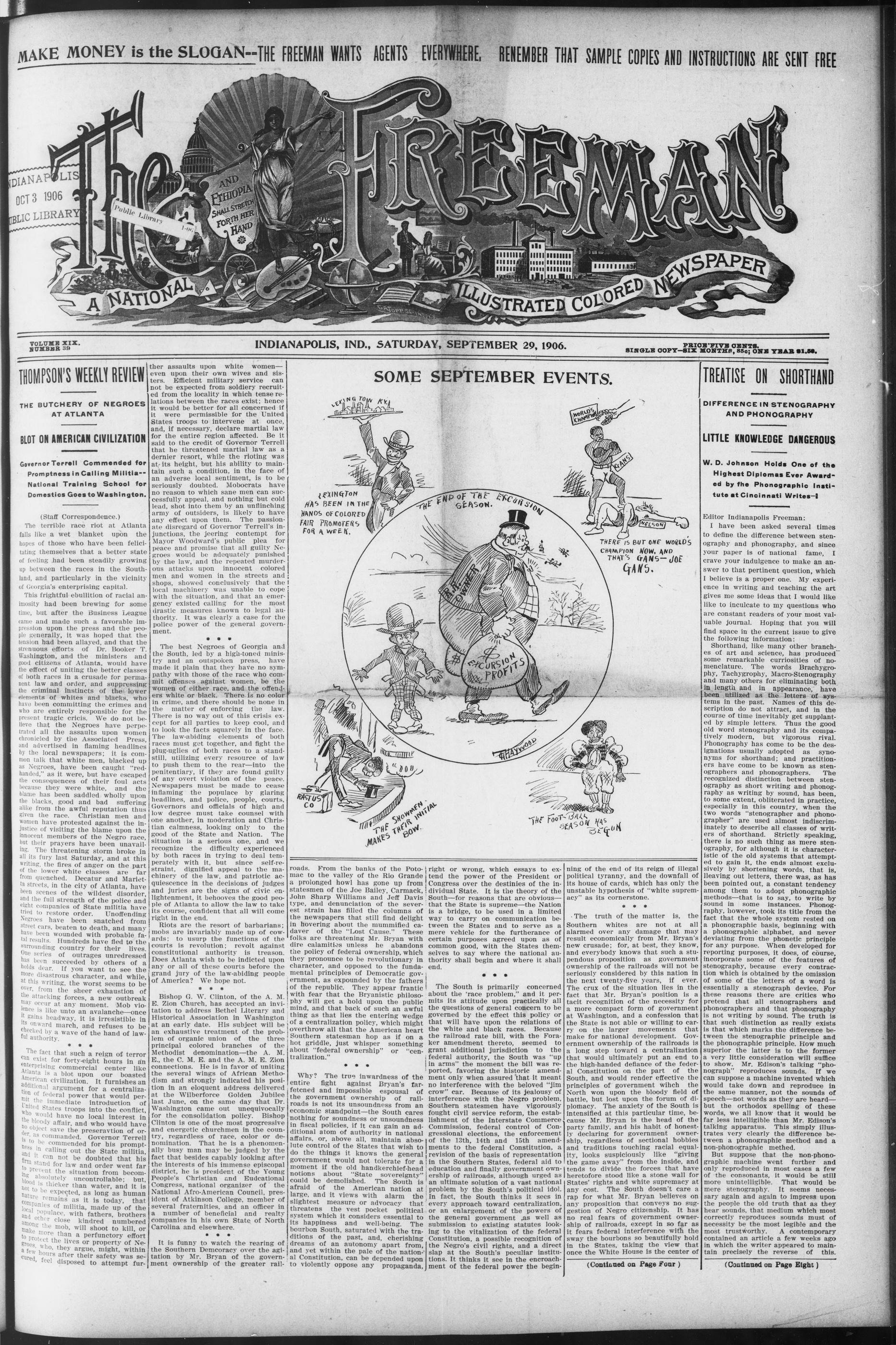
SOME SEPTEMBER EVENTS.
LEXINGTON HAS BEEN IN THE HANDS OF COLORED FAIR PROMOTERS FOR A WEEK.
THE END OF THE EXCURSION SEASON.
CHAMPION
EXCURSION PROFITS
THERE IS BUT ONE WORLD'S CHAMPION NOW, AND THAT'S GANS—JOE GANS.
RAGTUS CO
THE SHOWMEN THE THEIR INITIAL MAKES BOW.
THE FOOT-BALL SEASON HAS BEEN
roads. From the banks of the Potomac to the valley of the Rio Grande a prolonged howl has gone up from statesmen of the Joe Bailey, Carmack, John Sharp Williams and Jeff Davis type, and denunciation of the severest strain has filled the columns of the newspapers that still find delight in hovering about the mummified cadaver of the "Lost Cause." These folks are threatening Mr. Bryan with dire calamities unless he abandons the policy of federal ownership, which they pronounce to be revolutionary in character, and opposed to the fundamental principles of Democratic government, as expounded by the fathers of the republic. They appear frantic with fear that the Bryanistic philosophy will get a hold upon the public mind, and that back of such an awful thing as that lies the entering wedge of a centralization policy, which might overthrow all that the American heart Southern statesman hop as if on a hot griddle, just whisper something about "federal ownership" or "centralization."
---
Why? The true inwardness of the entire fight against Bryan's far-fetched and impossible espousal of the government ownership of railroads is not its unsoundness from an economic standpoint—the South cares nothing for soundness or unsoundness in fiscal policies, if it can gain an additional atom of authority in national affairs, or, above all, maintain absolute control of the States that wish to do the things it knows the general government would not tolerate for a moment if the old handkerchief-head notions about "State sovereignty" could be demolished. The South is afraid of the American nation at large, and it views with alarm the slightest measure or advocacy that threatens the vest pocket political system which it considers essential to its happiness and well-being. The bourbon South, saturated with the traditions of the past, and, cherishing dreams of an autonomy apart from, and yet within the pale of the national Constitution, can be depended upon to violently oppose any propaganda.
right or wrong, which essays to extend the power of the President or Congress over the destinies of the individual State. It is the theory of the South—for reasons that are obvious—that the State is supreme—the Nation is a bridge, to be used in a limited way to carry on communication between the States and to serve as a mere vehicle for the furtherance of certain purposes agreed upon as of common good, with the States themselves to say where the national authority shall begin and where it shall end.
---
The South is primarily concerned about the 'race problem," and it permits its attitude upon practically all the questions of general concern to be governed by the effect this policy or that will have upon the relations of the white and black races. Because the railroad rate bill, with the Foraker amendment thereto, seemed to grant additional jurisdiction to the federal authority, the South was "up in arms" the moment the bill was reported, favoring the historic amendment only when assured that it meant no interference with the beloved "jim crow" car. Because of its jealousy of interference with the Negro problem, Southern statesmen have vigorously fought civil service reform, the establishment of the Interstate Commerce Commission, federal control of Congressional elections, the enforcement of the 13th, 14th and 15th amendments to the federal Constitution, a revision of the basis of representation in the Southern States, federal aid to education and finally government ownership of railroads, although urged as an ultimate solution of a vast national problem by the South's political idol. In fact, the South thinks it sees in every approach toward centralization, or an enlargement of the powers of the general government, as well as submission to existing statutes looking to the vitalization of the federal Constitution, a possible recognition of the Negro's civil rights, and a direct slap at the South's peculiar institutions. It thinks it see in the encroachment of the federal power the begin-
ning of the end of its reign of illegal political tyranny, and the downfall of its house of cards, which has only the unstable hypothesis of "white supremacy" as its cornerstone.
***
The truth of the matter is, the Southern whites are not at all alarmed over any damage that may result economically from Mr. Bryan's new crusade; for, at best, they know, and everybody knows that such a stupendous proposition as government ownership of the railroads will not be seriously considered by this nation in the next twenty-five years, if ever. The crux of the situation lies in the fact that Mr. Bryan's position is a tacit recognition of the necessity for a more compact form of government at Washington, and a confession that the State is not able or willing to carry on the larger movements that make for national development. Government ownership of the railroads is a long step toward a centralization that would ultimately put an end to the high-handed defiance of the federal Constitution on the part of the State, and would render effective the principles of government which the North won upon the bloody field of battle, but lost upon the forum of diplomacy. The anxiety of the South is intensified at this particular time, because Mr. Bryan is the head of the party family, and his habit of honestly declaring for government ownership, regardless of sectional hobbies and traditions touching racial equality, looks suspiciously like "giving the game away" from the inside, and tends to divide the forces that have heretofore stood like a stone wall for States' rights and white supremacy at any cost. The South doesn't care a rap for what Mr. Bryan believes on any proposition that conveys no suggestion of Negro citizenship. It has no real fears of government ownership of railroads, except in so far as it fears federal interference with the sway the bourbons so beautifully hold in the States, taking the view that once the White House is the center of
(Continued on Page Four )
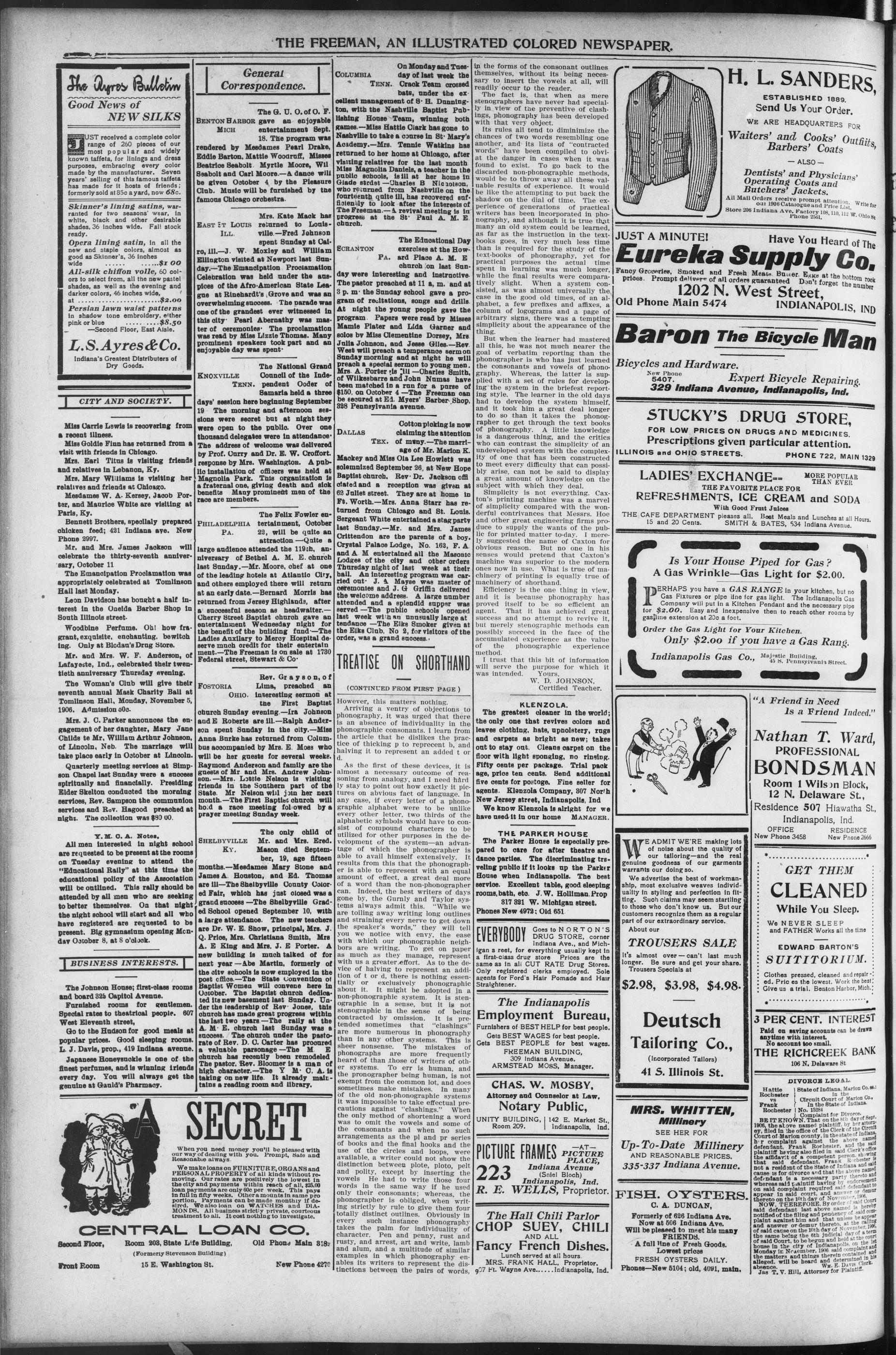
TREATISE ON SHORTHAND
DIFFERENCE IN STENOGRAPHY AND PHONOGRAPHY
LITTLE KNOWLEDGE DANGEROUS
W. D. Johnson Holds One of the Highest Diplomas Ever Awarded by the Phonographic Institute at Cincinnati Writes-1
Editor Indianapolis Freeman:
I have been asked several times to define the difference between stenography and phonography, and since your paper is of national fame, I crave your indulgence to make an answer to that pertinent question, which I believe is a proper one. My experience in writing and teaching the art gives me some ideas that I would like like to inculcate to my questions who are constant readers of your most valuable journal. Hoping that you will find space in the current issue to give the following information:
Shorthand, like many other branches of art and science, has produced some remarkable curriciosities of nomenclature. The words Brachygraphy, Tachygraphy, Macro-Stenography and many others for eliminating both in length and in appearance, have been utilized as the letters of systems in the past. Names of this description do not attract, and in the course of time inevitably get supplanted by simple letters. Thus the good old word stenography and its compatively modern, but vigorous rival. Phonography has come to be the designations usually adopted as synonyms for shorthand; and practitioners have come to be known as stenographers and phonographers. The recognized distinction between stenography as short writing and phonography as writing by sound, has been, to some extent, obliterated in practice, especially in this country, when the two words "stenographer and phonographer" are used almost indiscriminately to describe all classes of writers of shorthand. Strictly speaking, there is no such thing as mere stenography, for although it is characteristic of the old systems that attempted to gain it, the ends almost indiscriminately to shorten words, that is, is leaving out letters, there was, as has been pointed out, a constant tendency among them to adopt phonographic methods—that is to say, to write by sound, in some instances. Phonography, however, took its title from the fact that the whole system rested on a phonographic basis, beginning with a phonographic alphabet, and never deviating from the phonetic principle for any purpose. When developed for reporting purposes, it does, of course, incorporate some of the features of stenography, because every contraction which is obtained by the omission of some of the letters of a word is essentially a stenograph device. For these reasons there are critics who pretend that all stenographers and phonographers and that phonography is not writing by sound. The truth is that such distinction as really exists is that which marks the difference between the stenographic principle and the phonographic principle. How much superior the latter is to the former a very little consideration will suffice to show. Mr. Edison's talking "phonograph" reproduces sounds. If we can suppose a machine invented which would take down and reproduce in the same manner, not the sounds of speech—not words as they are heard—but the orthodox spelling of these words, we all know that it would be far less intelligible than Mr. Edison's talking apparatus. This simply illustrates very clearly the difference between a phonographic method and a non-phonographic method.
But suppose that the non-phonographic machine went further and only reproduced in most cases a few of the consonants, it would be still more unintelligible. That would be mere stenography. It seems necessary again and again to impress upon the people the old truth that as they hear sounds, that medium which most correctly reproduces sounds must of necessity be the most legible and the most trustworthy. A contemporary contained an article a few weeks ago in which the writer appeared to maintain precisely the reverse of this.
(Continued on Page Eight)
Among The Churches.
Darts From a Bow ~ iy Ghaties Marshal,
HOW BISHOPS HAVE VIOLATED
POSITIVE LAW IN NEW YORK.
Why strive to excuse wrong, sratt
ing and the violation of positive law
with the flimsy argument that the
A. M. E. Church is a human organiza-
tion? Would the supposed moral and
religious teachers and leaders en-
deavor to justify wrong with such an
apology for such evils as will not be
tolerated in the business world?
When bishops are guilty of wrong
is it not feasible that the protectors,
defenders and shielders of these
wrongs will entrench themselves in
favor of such a bishop, and thereby
build a wall around themselves and
thence defy right and the law, can
you wonder at the multiplicity of
unbecoming ministerial conduct, both
official and personal? Is this not the
explanation of a fruitless fight for
right doing on the part of the “very
little few,” who have the courage to
attack corruption?
Coming to violation of positive law,
Bishop Arnett’s holding on, though
unable to exercise the office of a
bishop, is a very small offense com:
pared to what we could say, but will
not just now. If the bishop is not
feigning, as one of his colleagues said
when the complications grew very
visible, the requesting of his col.
Jeagues to make a minister of his
son Henry in open violation to the
law, has removed sympathy. Bishop
Grant had announced in Bethel
church, New York, that he would
hold the New York conference, but
after the plan to ordain Henry Ar.
nett Bishop Grant would not come
near. When a committee was about
to push B. W. Arnett Jr. through in
that way, Bishop Grant told them
that if they passed him and recom:
mended him for ordination he would
not ordain him. So Bishop Arnett
ordained his son, B, W., without au
thority, and not being able to push a
similar siege he asks his colleagues
to do the work, and the senior Bishop
Turner assisted by the failure Bishop
Smith, ordained the young man.
When Bishop Tanner, who had
charge of New York, had been given
charges against Dr. Tice, the poor
bishop tried to get around the case
by telling Dr. Tice to get his transfer
from Bishop Arnett, who had given
the work over to Bishop Tanner.
Bishop Tanner received Tice into one
of the Florida conferences after no-
tice of charges had been sent the
conference and stating that charges
were in Bishop ‘Tanner's hands
against Tice.
At the New York conference Bishop
Turner, who was presiding, allowed
Mr. H. J. Arnett to be admitted on
trial and ordained for another work
(Frankford, Pa.) when Mr, Arnett did
not come through any district confer-
ence and was not a member of any
church in New York.
One of the grossest violations to
positive and open law was the fact
that Bishop Turner, instead of seeing
that no money was paid for bishop's
traveling expenses, as the law ex:
pressly says no traveling expenses
shall be paid to a bishop. The senior
bishop, though being obligated and
having taken the sacred vow to en-
force the provisions of the law, he
asks the conference to violate that
law by granting Bishop Smith his
traveling expenses, then augments
that violation by accepting $30.00 for
his own traveling expenses, and ad-
vised the secretary or conference to
allow it to be recorded in the minutes
as incidental expenses. The accept-
ance of $40.00 by Bishop Smith and
of $30.00 by Bishop Turner makes
them both guilty of violating the
law. a4
‘The Woman's Mite Missionary So-
ciety turned over to Bishop Turner
the sum of $53.00 for missions, and
the bishop kept the same, not even
giving the 40 per cent. to the secre-
tary of Missions, and refused to give
any of the amount over to the con-
ference. This conference is in debt
to the Missionary Department for its
40 per cent. not given to the secre-
tary two years ago, and, with this
year’s debt, they can never pay up.
More money has been raised for mis-
sions by the Mite Society during the
last three years than for a similar
period any time in the history of the
organization, yet the mission and un-
paid preachers have received less,
and the man that has the courage to
ask an itemized account of these
moneys is styled “disloyal and a
kicker.” ‘The truth is that these are
the only loyal men in the church.
The leeches who are sapping the
money out of the church are neither
loyal to God nor the chureh, and we
have not shown fitness to’ run the
church above open criticism because
we allow our personal feeling to pte-
vent us doing our official duty. This
open-handed graft and violation of
positive law will shake the founda-
tion of things more at the next Gen-
eral Conference than at any previous
period. There are some modern
schooled men who will be felt and
heard. They are now bringing hese
Ss eae ace a ah
Knowledge is no burden.
pen
Prepare for living as well as dying.
sen
Of all the gettings, get 8 bank sc
count:
aan
‘W stermelon daysare the gladdest days
of the year.
aes
‘We can only do right by leaving that
‘which is wrong alone.
eee
A wife does not know the seriousness
of housekeeping untill she cans frais,
THE FREEMAN, AN ILLUSTRATED COLORED NEWSPAPER.
be prepared to deal with them, and
this is the only way in which cold
water can be poured on them.
If these acts are lawful and right,
why clamor against acquainting our
general church and the general pub-
lic with our honorable deeds? Bish-
ops Turner and Smith both received
money for traveling expenses in the
New England Conference also. We
are asking for more bishops. It is
wisely suggested and seems to be
on foot to set aside those who have
broken the law in graft and other-
wise, and our learned “Failure Bish-
op,” and then sufficient room will be
found for four or six worthy candi-
dates.
‘Will the authorities of the First
District inform us as to whether Rev.
A. L. Murray of Atlantic City, the
hero of Educational Day, has_paid
back the Dollar Money’ which be
brought from Chicago, and settled
about that famous note before they
make him their criterion? “LUX.”
Your correspondent had the pleasure
of looking in on the Ohio Conference of
the A. M. & Churoh
BARNESVILLE, a8 few days ago while
Onto. ft was in setston in
this clty. There was
quite an array of talent in the confer:
ence. Among the more distinguiched
might be mentioned Bishop W B Der-
rick of New York, and his associate
Bishop Smith of Detroit, Mich. Dr
B. F. Wateon of Philadelphia, who rep
resented the Church Extension Soclety,
Mr. Allen of the Southern Christian
Recorder, Dr. Heexd of the Preacher's
Ald, Mrs. Callett, who was the repre-
sentative of the Book Concern of Phila
delphi, Dre. Henderson of Colambus
Downs of Cincinnati, President Jones
of Wilberforce. Some excellent ad-
dresses were delivered during the ses-
ston and at the reception held in Odd
Bellows’ Hall.
100 MUCH STRIFE.
Tt could be easily observed at times
that there had been some back fence
talk among the brethren which had
reached the ear of the bishop, who was
not slow in letting it be known that
some one would have to answer for
thetr words. The matter was carried
into exeoutive session, hence your re-
porter was deprived of the privilege of
hearing it thrashed ont, but he over-
heard that a sacrifice of some one was
neceestry each year; that one Sydes
was offered up last year, and that it was
bat meet and proper that his successor
should follow. The Good Book says
something abont “What measures ye
meet shall be measured to you again.”
There was much talk about the dele-
Rates to the next General Conference,
which are to be elected at the next
annual conference, The sessions of the
conference were largely attended by
the citizens generally. On the whole
the conference was a source of pleasure
and profit to all.
The Indiana Conference of the A. M.
E Church has just closed its annual
session, Bishop Shaf-
Marion, fer of Chicago, IIL.
inpIaNA. presiding; Revs. Ora-
ven, Taylor, Brewer
secretaries. Among the visi ors from
afar were Dr. Chappelle of Nashville,
Tenn, Watson of Philadelphia, and
Heard of Atlanta, Ga, of the general
officers, and Whiteof Miss. Mr Carter
represented the Reyiew and Mr. Allen
the Southern Recorder. The session
throughout was attened by thecitizens
en masse, whose entertainment of the
delegates is said to have surpassed that
of any other city for many years. Drs.
Wateon and Chappelle were in evidence,
taking an active part in all the pro:
ceedings The former made it quite
plain to the conference that he was not
@ candidate for Episcopal honors, but,
instead, preferred t» serve the church
in his present cffive, as he was satisfied
that he could do that with greater ac-
ceptability and more benefit to the con-
nection. Sunday was a high day in
“Zion."’ There was a love feast at 9
o'clock conducted by Rev. Baker of
Richmond. The bishop's sermon at
10:30 was @ masterpiece. Several per-
sons were ordained. Great crowds of
people came from the surrounding
towns and cities, and the streets near
the Fifth Street Church were thronged
with people, The appointments were
read ont Sunday night and the confer-
ence adjourned It was one of the most
pleseant sessions held in many years.
‘The greatest ambition that a young
Bekele eckeais aa i is own @iamsod
ring.
sas
The man that is always wearing
cloud on his brow carries an empty
space behind it.
aes
‘There is many 8 man who marries a
girl for money and then finds ont that
he has to earn it.
eee
‘We never go toa church dinner to
take our appetites—but, only to create
them.
nee
One of the hardest things to do In
this life is to keep out of a woman's ways
when walking down a street.
nee
‘We should all learn to hide our deep-
est thoughts, and many of us woulda’t
have to hunt avery deep: hole to doit
in,
nee
| Agreat many of us have been using
the simplified spelling system for many
years only each of us have a different
system,
eee
Every housekeeper knows that it
don’t take half so long to do the house
work when the children are not at home
to help,
eae
On entering a strange town you often
wonder why people stand and stare at
you, and when person comes to your
town they wonder why yon do the
same thing.
ees
Some men would rather wear a pretty
uniform and march at the head of
procession than have fifty thousand dol
Jars of thelr own.
een
At this time the ayerage school chiid
{s more than likely to become {ll, and
yet he may show signs of improvement
when Saturday rolls around.
eee
There is one reason why that some
Pretty women marry ugly men and that
may be that at one time they felt a lit
tle sporty aud wanted to win a bet,
con
A boy thinks: “What a good timea
man has.” Anda man thinks: “What
8 good times boy has.” an what a bum
time both of them might have,
aan
When a white man dies we often read
in the newspapers an account of how
many clubs he belonged to, and when
‘8 colored man dies the papers give the
number of lodges that he belonged to.
eee
When your wife has great deal of
company for dinner do not sympathize
with her. She probably brought it all
on herself by going visiting too much.
eos
Any time your lady friend asks you
to taste some of her cooking, do so and
say that it is ‘‘simply fine.” If you
do not she will think you are the vilest
creature on top of the earth,
eee
For several weeks the girls of this
seotion have been wondering how that
one Miss;Beasrice Sybil Johnson has
been so lucky as to have her front
Porch filled with young men callers
every night, That which the young
girls take for cigars in the dusks are
bits of punk which Beatrice has lighted
and stuck up to give the impression
that they are olgars and have young
men stuck up bebind them,
wee
Did you ever notice that when a girl
marries, and goes away, her old room is
left just ae she left it, that she may
come back to it at anyjtime that fs if
she has no'brothers and elsters. If she
has brothers and steters they will quar-
rel over the room the day her engage-
ment is announced and one of them is
Ukely to move in before the wedding
party has reached the gate,
WHY SEPT. 22, 1862, SHOULD NOT
By R. H. Gillum.
The Twenty-second Day of Sep-
tember should not be forgotten by
the American Negro. Not because it
is the most conspicuous day of the
year, nor because it is the most in-
significant, but because it brings us
to the Forty-fourth Anniversary of
the day when that great citizen, a
man who stood for honesty and lib-
erty, who was the sixteenth person
to take the seat as President of the
United States, in the person of Abra-
ham Lincoln, issued the proclamation
that on the first day of January, 1863,
if the seceded states did not return
to their allegiance to the Union, all
Negroes held as slaves would be de-
clared free within their limits. Al
though this proclamation was avow-
edly a war measure, it was a great
step toward the emancipation of the
Negro slave.
We, the American Negro, should
be proud of this day. It should go
down in Negro history as one of the
greatest days of the nineteenth cen-
tury. The Fourth Day of July is set
apart as the birthday of American
Independence and is celebrated in all
the states; from the Atlantic to the
Pacific and from the great lakes ta
the Gulf of Mexico. ‘Then why
should not the American Negro think
well of this day?
Some may say that this proclama-
tion did not emancipate the Negro
slave in all the states and that it was
only a war measure to keep the slave
states from seceding or bring those
which had seceded to the Union.
This is true, but had it not been for
emancipating the slave on these
terms I do not believe that freedom
for the Negro would have ever existed
in the seceded states and that the
Union would have been as it is today;
but as it is, Afro-American freedom
exists in all the states of the United
States of America.
Were it not for the Emancipation
Proclamation issued by Abraham
Lincoln, would the black man have
ver realized that he enlisted in the
irmy in his defense? No. Would he
ave realized the cost of his free-
lom? Never. Would he have been
able to say that I fought and paid for
my liberty? He would not.
The Negro practicing law in the
courts of the United States, or an
American Negro practicing law in
the courts of justice anywhere, ob-
tained his privilege through the
means of the proclamation that was
issued on the 22d day of September,
1862. The Negro practicing medi-
cine in the homes of the sick received
his diploma from the fact that his
freedom was proclaimed on this Au-
tumn day, and the same holds good
with all men and women of the race.
As the leaves of the forest bid
farewell to mother oak, so did the
chains of slavery bid farewell to the
American Negro. The great question
before the race is how to compensate
this day for what it has done for us?
Can we do it by committing crimes,
giving our time to the billiard room,
our money to the saloon and continu.
ally associating and practicing the
way of immoral society, or by edu
eating ourselves, both classically an¢
industrially, to avoid crimes, to resist
the billiard room, to shut the door:
of the saloon and keep our money
from them and help to elevate hu
manity.
Our race has made rapid progres:
since Emancipation, but we coulc
have done better. Of course, obsta
cles are met now and then, but we
|should not stop working, This is n
excuse for retrogression; this is m
reason for abandoning the road o
Progress. Success is what we make
it, When we learn to obey the law
of nature by saving all and losin:
nothing, there can be a great succes:
through our efforts.
So let this day be remembered bj
all and when race prejudice has re
treated to the vale of forgetfuines:
,, and man is not cast aside because h
is black; when the great cities tha
jJcover this terrestrial sphere hav
‘|crumbled to dust and new ones ris
to take their places and when nev
governments have been establishec
to correct the wrongs of the old; le
{not the Negro, who is to take a par
in this great future forget the da!
that his ancestors were emancipate:
that he might be able to enjoy this
wonderful age.
L. J. Rice. Prominent in Colored
Circles, Is Signally Honored
in Fraternal Way.
Dayton, Ohio, Special.—L. J. Rice of
this city has been signally honored by
B, F. Howard of Covington, Ky., grand
exalted ruler of the Improved, Kenevo-
lent, Protective Order of Elks of the
World. On September 20 he received a
commission as deputy of the order for
the State of Indiana with power to or-
ganize lodges, institute and install and
supervise the work of the order in that
State. Mr, Rice is exalted ruler of
Waldorf Lodge No. 76 of Dayton, but
his term of office expires this month.
He 1s very well and favorably known
in colored fraternal and buainess circles
throughout the State and is the propri-
etor of s restanrant en Ludlow street
near Fifth.
Attempts to Burn His Way Out
and Loses His Life.
——_.
Fort Worth, Tex., Special. —Scream-
iog and madly dashing at the tron win
dow bars of the olty jail at Mineola,
which was on fire, while outside a
crowd of 400 men and boys tried in vain
to break down the doors and rescue
him, a Negro named Silas Johnson,
aged 45, was cremated. Johnson was
arrested the night before ona drunken-
ness charge, and he attempted to burn
bis way out, the fire getting beyond his
© ntrol, unnoticed by any of the officers.
The prison door was locked and the
turnkey could not be found until too
late to free the dsomed man. A crowd
gathered and made a vain attempt to
batterdownthedoors Axesand eledgee
had no effect on either the rock wails or
window bars, and the crowd was forced
to stand idly by and watch the victim
burn to death and Msten to his heart
rendingeries. There were many women
in the crowd and many of them became
hysterical. Three of them fainted.
Women trged on the men to use every
effort to save the Negro, but it was
seemingly beyond human endeayor,
‘ee Seecicen Dicae:
“The worst sponge in New York,”
sald the stenographer, “is the type
writer sponge. He gets all his work
done by the employees of his friends.
He drops into the office, ostensibly for
a chat with the boss. Presently he
looks toward his victim and says in a
careless, offhand way: ‘Oh, by the
way, is your stenographer busy now?
It not I'd like her to do a little type-
writing for me. It will take only a few
minutes.”
“The chances are that she is knocking
the very daylights out of the machine
at that minute, but the manager {s too
polite to call his attention to the fact,
80 she does the work. Usually it takes
her from one to two hours. All the pay
she gets is a mere ‘thank you.’ I know
lots of girls who are bothered this way
by hangers on.”—New York Sun.
When in {Loulsville call at Mrs.
Jackon’s restaurant, 408 West Green
street and secure ® copy of The Free
man.
ItHOMESx=
| Alabama
=e, LO ee a TS ee ee a
the State of Alabama as to lands, churches, schools
medical attention, railroads and other organizationg
for the common good of the people,
LANDS.
‘The northeastern portion is rolling land. The sonth and sonthe
flong are comparatively level, consisting of w part of the oleornted “tine eo
lands Sone of the finest ple tnd hard wood timber lands ta the Scat oa
foand in Macon county. In mauy seations the large and states spas a8
‘eos aro ready to be converted into frst class timber by the tanccioee at Mk
‘The soll varies in richness, giving returns largely in prop rtion the wa
tis handled by the farmers. By oarefally handling the boll free one-half 1
one and & half bales of cotton per aore oan be obtained in moat any section of the
county, pc od farmer an make from lant to Sweaty ales of cotton tine
La im nearly any variety of sandy soil to imost an}
found in the borders of thle county. " ee y Kind of clay may bg
wary lands range in prices from six dollars to ten doll
Many thousands of aores of good land lle in waiting for some ons 1 eee
them and put them into cultivation.
PUBLIC SCHOOLS.
Nearly every community in the county has or is trying to hi eehadl
house and an eight months’ public school term for colored, children, Tm State
runs the sehool four or five months, and the other three months are ‘added by
puyate subscription, One community ralsed abont $500 in three tise I
fall to be applied to the erection and eqaipment of @ school house for their Dab.
Me school. Some of the best teachers to be found in the State are engaged fy
teaching publi schools in this county.
NIGHT SCHOOL.
TUSKEGEE INSTITUTE
INSTITUTES,
§ Ministers’ Union meets every three mon
‘lal Institute. The ministers are enterts
day discussing and, although representix
upon plans to make thelr fight in coma
ty.
achers’ Inetitute, as well as @ lecture oo
», makes it easy for the public school tea
fe a rem gc
IN THE WORLD OF SPORT BY JOHN L. FOOTSLUG.
VICTOR
TALKING
MACHINES.
The Victor is so perfect it is often mistaken for the human voice. It is proving a never 'tailing source of DELIGHT to Thousands.
COME IN AND LET US
TELL YOU all ABOUT it.
SOLD ON EASY
PAYMENTS
Phones Main 852
New 9093.
KOEHRING BROS.
878,11880, 882 VIRGINIA AVENUE.
Hoosier Poet
CLUB ROOM LONDRES
10c Cigar
We deliver Goods direct to consumers and pay all express charges.
Give Us A Tryal Order.
John Rauch Cigar Co. - Indianapolis, Ind.
Since the signing of articles between Young Corbett and the Terrible Terry McGovern for a six-round bout to take place in Philadelphia, Pa., the sporting fraternity has been much aroused, as this will be the most important battle during fall weather. There are two rather unusual features in the terms drawn up. One is the winning and losing clause, which provides that 65 per cent of the fighters' share shall go to the man that scores the knockout. In order to prevent a repetition of the hugging match which resulted when McGovern and Nelson met, there is a clause which forces the referee to step between the men as soon as they clinch. The match was made at catch weights. There will be no argument, as in previous match on uopop surpap su jer os 'säuquem is concerned.
weight.
It is something very difficult to state just what should be the result of this battle, as both men seem to be equal. It should be remembered that McGovern's fighting days are on the wane and the same might be said of John Corbett. Every one knows that McGovern has been a very good ring general in his day and much can be said in favor of his ability now. Terry has a wonderful amount of seen and, moreover, a very telling punch in his right and left mitt. He is superb when it comes to strenuous punishment. Perhaps there are few men in the business who can stand any beating than the "Terrible Perris." In his fight with George Dixon he showed unusual merit and deverness in giving and taking. In every round of that fight he made it known that he was fairness itself, and that is one great point in his favor.
Terry has never been known to throw a fight, and therefore that leaves him a lasting reputation and a "boat" of popularity. The only thing that may be against him is his age, as every one knows that it does not take long for the average "nug" to get "all in". And yet there are some instances where a prize fighter might revive and become himself again. Who would have thought that Champion Gans would ever become the man that he is today after being put out of business so often. Gans has had a career that is almost unequalled. He has kept in shape much longer than most of us had any idea he would. Now it might be possible that McGovern may enter the ring this time in better condition than ever before. He has had a very long vacation from the fistic arena and in that time he might have done much in the way of making improvements. Young Corbett's career as a prize
INDIVIDUAL HOTEL DIRECTOR
[One address line $4.00 per year; including subscription to The Freeman, in advance,]
HEADWALTERS.
J. W. Redmond, Headwaiter of The Carroll, Vicksburg, Miss.
10-06.
C. W. Dwyer, headwaiter Commercial Club Minneapolis, Minn.
8 105
C. H. Plummer, headwaiter Hotel Brunswick, Uniontown, Pa.
10-05
R. H. Bradley, Headwaiter Menger Hotel, San Antonio, Texas.
3-06
G. W. Bland, Headwaiter of The Oliver, South Bend, Ind.
12-06
HOTEL DIRECTORY
This column used exclusively for the ad dresses of hotels, restaurants, lodging and restaurants around the country and intended as a guide for the traveling public—you business solicited.
Hotel Dwyer (European) C. W. Dwyer,
proprietor. First class rooms by the day,
week or month, with heat, electric light
and bath. 224 Washington Avenue, South,
Minneapolis, MN.
Hotel Reframer—First class in all respects
80 n. 6th street, Richmond, V.A. W.
Homes, manager.
Moore's Hotel—First-class rooms and board
Rooms neatly furnished, 712 and 714 W.
9th street Little Rock, Ark.
Waldorf-Astoria Hotel—327 Laurel street,
Hot Springs, Ark.
The Parker House-Rooms, bath J. H.
Hollman, proprietor Indianapolis, Ind.
Silver Moo- Hotel-Henderson, Ky. 105
second street. Frank Wilcox, Prop.
THE FREEMAN, AN ILLUSTRATED COLORED NEWSPAPER
ring fighter has been short but sweet. He has done some exceedingly clever work in the ring. His battle with McGovern proved him to be a shade the better man when it comes to science, but so far as his staying qualities are concerned he is but a myth when it comes to the "Terrible Terry." Yet there is a very slim chance for McGovern to have a dead easy walk-away with Corbett. It must be remembered that Corbett is a very effective man when it comes to using right-arm swings and executing lightning-like get-aways. Whatever may be the outcome of this contest, it is safe to say that it will be one of the fastest six-round bouts that Philadelphia has ever seen. There is no mistake about it being a very lively affair, as both men are very fast, and indeed, scientific.
SILER FILES SUIT.
At this writing the news comes to us that Referee George Siler has filed suit through his attorneys, Cantwell and Erbstein, against Battling Nelson and his manager, Billy Nolan, for slander. Referee Siler asks for $50,000 for the supposed offense and, to our opinion, he is not asking too much. If one should read the Gans-Nelson fight by rounds they could come to but one conclusion, and that would be that Siler was decidedly fair toward Nelson, if not a shade too fair. The referee should have given Gans the decision much sooner than he did. In other words, he very greatly favored Nelson and his manager. This is a fact according to his own words. He says as to this: "Do you think that I would have waited forty-two rounds to have thrown the fight had I been crooked? I would have been foolish to have followed the fighters through so long a fight simply to carry out a job. I had plenty of opportunities to give the decision to Gans before the forty-second round."
Yet Nolan and Nelson come up with a howl that Siler threw the fight to Gans. In no way can this be possible. We feel that this will be quite a lesson for Nelson and Nolan. In fact, it will cause them to learn that there is nothing to be gained in this idea of toting and bluffing everybody. It is our hope that Siler will be successful in his suit in order that he may teach "Bulldog" Nolan a thing or two. Nolan has been having everything his way whether it be fair or unfair.
The fight fans of Indianapolis will be given the opportunity of seeing Joseph Gans, the lightweight champion of the world, in action when he and his sparring partner appear at the Empire theater the week of October 15. Gans will spar four rounds with his partner, and while in the city will take on all comers.
Kid Sullivan of Washington, D. C., knocked out "Jimmie" Briggs on September 20 at Baltimore in the ninth round of a bout scheduled to go fifteen rounds. After the first three rounds the contest was all in Sullivan's favor.
***
There is some talk of Champion Jim Jeffries and Jack Johnson signing up. Big fight promoters are doing everything in their power to get such a match on foot. Every pugilistic sport in the country is on his ear in eagerness to see such a battle pulled off. It is evidently a fact that Jack Johnson is more of an equal of Jim Jeffries than any other man in the business today. Johnson has long ago demonstrated that fact. He has a terrific power in both arms and can deliver a very stiff punch. There is no doubt that he will certainly have a good time outdoing big Jim, but if he holds out any length of time there is a great chance of him laying his opponent low because of his methods of science in ring work. Jeffries has for some time drawn the color line, but since the recent Goldfield fight has seen fit to waive it aside. In fact, the large purses that have been
offered the colored fighter have caused the white fighter to disregard the color line. They have found out that merit knows no color.
LITTLE SPORT TALKS.
Football warriors will soon be in evidence.
* * *
Jack Blackburn is laying low for high sport, so they say.
* * *
Jack Johnson is the only man who is most likely to defeat Jeffries.
* * *
Billy Nolan may know what he is talking about, but George Siler wants to be sure of it.
* * *
The papers now state that McGovern can not be satisfied with purses offered to enter the ring. Let him stay out then.
* * *
Billy Roche has offered Joe Thomas and Joe Walcott a purse of $1,500 to box. Walcott's manager declined the offer.
***
In an interview the other day Young Corbett was gracious enough to say that he considered Gans to be the whitest black man that ever lived. Billy Nolan and the Dane have entered the only notable exceptions to this opinion.
***
Both the National Athletic Club of San Diego, Cal., and the Goldfield Athletic Club are after the Gans-Britt bout. A bait of $25,000 ought to land the mill, but as both clubs offer the same amount the fighters are in doubt just which to swallow.
* * *
Martin Julian, former manager and brother-in-law of Bob Fitzsimmons, has become the manager of George Gunther, the Melbourne "Kangaroo," and is ready to back him against any middleweight in the world.
* * *
Last week big Jack Johnson, the heavyweight championship aspirant, got the better of a six-round affair with Joe Jeannette at Philadelphia. It was a very tame affair, as Johnson was a great deal too much for Jeannette. In the second round Jeannette drew blood from Johnson's eye, but after that Johnson knocked him at will.
Truly these are great days for the fictive artists of the ring: A champion battle has been arranged to take place between Jack O'Brien and Tommy Burns
for the heavy weight championship of the world. This fight is to be a forty-ground go and will be pulled off near Los Angles, California before "Lucky" Baldwin's Arcadia Club on a date not yet agreed upon. The purse offered will be twenty thousand dollars and a side bet to be made by the fighters will amount to five thousand dollars making a total of twenty five thousand dollars to be involved in this great battle. As Jack O'Brien insist on the purse being out to not less than 75 per cent to the winner, the victor of the contest will pull down the comfortable sum of twenty thousand dollars. Sizing up this coming battle as it should be, one falls to see wherein this bout could be one for the championship of the world as Burns cannot be called, in any way, a heavy-weight of the champion class. Burns has never been a prize ring fighter he has always belonged to the amateur class. O'Brien has met Burns once at Milwaukee and there he knocked the big Canadian at will.
It would seem that Sam Berger would have made a far more better match for Jack than Burns. Berger is in every way more of an equal of O'Brien than Tommy Burns. In fact the contest between Berger and the Philadelphia would have long ago been arranged had not Sam balked at such a small amount of money as $ 15 000 and continued to hold out because he felt that he could get more without any trouble. He will doubtless wait quite a while before another $ 15 000 purse is shoved under his nose. It is a sure thing that this fight will not last forty rounds and it can be believed that Burns will not last half the rounds that it is stated that they are to fight. O'Brien is far too clever for Tommy although there can be one chances of the Quaker loosing out. Berger is the man to go up against Jack O'Brien.
---
Everyone who believes in square dealing cannot help but take sides with Joe
son again he must be allowed to dictate terms. He declares that he will not fight Nelson under any such rules as those made by Nolan at Goldfield. We feel that Gans is quite right for demanding that which is due him. In his last battle Joe gave Nolan the best of it in every way, that is why he fight lasted so long. If Nelson wants another battle with Gans it is only natural that the Baltimorian make him come to his terms as he is now the light weight champion. Gans should never make 131 in order that he might satisfy Nelson or Nolan for that would be very foolish of him. A man of his bull can never stand the strain of making such weight and then enter a ring f ra finish battle. If it is found out that Nelson refuses to fight only at terms made in the last battle then Gans should pass him up as there are plenty of classified "pugs" who are anxious to get at him. At any rae Joseph has made enough goods recently to keep him going for quite a while.
SPECIAL APPEAL
ORGANIZE ORGANIZE ORGANIZE
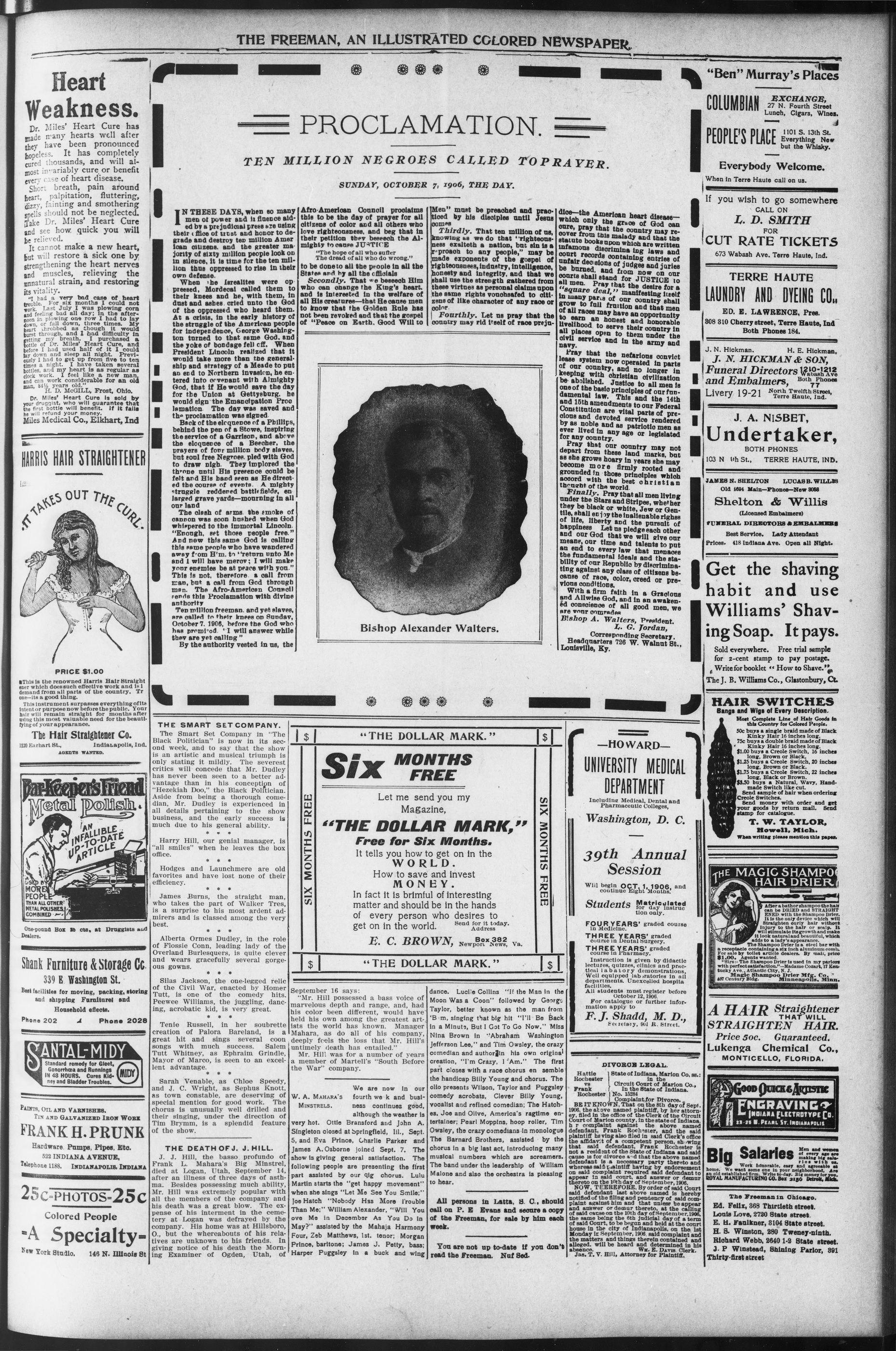
The tremendous meeting held by the Afro-American Council in New York City, July 25, 1906, is an indication of the great tidal wave of indignation and resentment against the injustices perpetrated daily upon Afro-Americans of this country, and is a hopeful sign on our part that we mean to do something effectual to regain the rights which we have lost.
Secretary of War, Mr. Taft, in his address at Greensboro, N. C., a few days ago declared that the schemes adopted to disfranchise illiterate Afro-Americans without excluding illiterate whites, will not stand the test of the fifteenth amendment. Chief among such schemes is the "grandfather" clause now operative in several of the Southern states.
Associate Justice Brewer, of the United States Supreme Court, has asserted that the revised Constitutions of the South, if ever properly brought before the Supreme Court, must be declared unstitutional and has expressed his astonishment that the Afro-American people have never effectively utilized this remedy which lies in reach of their hands.
Our duty is to organize, secure friends, employ able talent, white or black, and knock out the grandfather" clause at least. "Heaven helps those who help themselves." If we can obtain from the Supreme Court an opinion that the grandfather clause is illegal, a victory, which profoundly important as it would be, we can by standing together achieve such a manifestation of prosperous enterprise would thrill the North and again enlist its sympathies with us, at the same time strike dismay into those southern politicians who are fattening on the race problem and counting their positions and careers secure because they believe we shall never have manhood enough to drag them face to face with the Federal Constitution.
OPPORTUNE TIME FOR ORGANIZATION
The need of a strong organization through which to make our fight should be apparent to all lovers of the race who know the worth of a united effort through organization. The condition makes it incumbent upon our leaders, ministers, teachers, lawyers, doctors, business men, newspaper men to lead off in this organization and prepare to fight these injustices to death. A local Council is needed now in every village, town and hamlet in the land.
OUR PLAN OF ORGANIZATION
Any person who has sufficient interest in the race can send invitations to leading Afro-American citizens who
Some talk has been started concerning a six round contest to take place at Philadelphia between Abe Attell and Terry McGovern in the "near future." Terry has been keeping very quiet of late and it is possible that he is under going a rejuvenating process with a view to future engagements. If Terry is in any kind of condition at all he will keep Attell very busy, and perhaps put him out.
---
Although Nelson and his manager contend that Gans put up a poor fight it has been demonstrated that Joe has more friends than ever before and continues to make more.
If Nelson cares to make any more money he had better get rid of Billy Nolan as every one of the Goldfield promoters have grown worse with their experience of Nolanism
Why don't they give Jack Blackburn a chance at some of those thousands?
Sam Berger did not know a good thing when he saw it.
NEGRO TOWN'S COURT.
NEGRO TOWN'S COURT.
Arbitration Board Rules Residents of Chickasaw Village.
Lexington, O T, Special — Oklahoma and Indian Territory have several towns in which the population is composed exclusively of Negroes, but probably the most noteworthy of them is the village of Fatum, south of here in the Chickasaw Nation. Tatum is a town of 500 in which all business is carried on by Negroes it is not incorporated and has no regular city government, but its affairs are managed by a board of arbitration composed of the oldest and wisest Negroes in the community. They take cognizance of all disputes between citizens and of minor offenses and their decisions are very generally accepted without question. It has become a matter of comment among court officials of the southern dis riot that there are
are interested in the amelioration of our present condition, to meet in some private house, church or hall, according to the number invited. If as many as ten assemble and are willing to subscribe to the following objects, they can be organized into a local Council.
THE COUNCIL AS ORGANIZED
1. Investigate and make an impartial report of all lynchings and other outrages perpetrated upon Afro-Americans.
2. To assist in testing the constitutionality of laws which are made for the express purpose of oppressing Afro-Americans.
3. To promote the work of securing legislation which in the individual states shall secure to all citizens the rights guaranteed to them by the 13th, 14th and 15th Amendments to the Constitution of the United States.
4. To aid in the work of prison reform.
5. To recommend a healthy migration from terror-ridden sections of our land to states where law is more generally respected and maintained.
6. To encourage both industrial and higher education.
7. To promote business enterprises among the people.
8. To educate sentiment on all lines that specially affect our race.
9. To inaugurate and promote plans for the moral elevation of the Afro-American people.
10. To urge the appropriation of school funds by the Federal government, to provide education for citizens who are denied school privileges by discriminating laws.
The following is a list of officers which must be elected: President, Vice-President, Secretary, Assistant Secretary, Treasurer, Chaplain, Sergeant-at-Arms and an Executive Committee—consisting of five members.
AFFILIATED MEMBERSHIP Delegates representing organizations of similar plans and purposes can have membership in the National Council by the election of two delegates and the payment of three dollars for each delegate. Religious organizations, academic schools, colleges and Afro-American newspapers can have representation in the National Council upon the same terms. We earnestly appeal to all organizations that desire representation to see to it at once, that delegates are elected and sent to the National meeting which is to be held in New York City Oct. 9, 10 and 11, 1906.
We prefer to have the ministers and leaders organize local Councils in their churches, lodge rooms, etc., but if they cannot do so, for the sake of our outraged brothers, it is hoped that the churches, societies, etc., as affiliated bodies will take action at once to have representation in the National Council.
A. WALTERS,
Pres. National Afro-American Council.
fewer cases civil or criminal, brought from that town than from almost any other town of the same size in the district A b g political meeting and barbecue was held there which was attended by many white political leaders. Altogether some 200 or 300 white people were present. They were seated at a separate table and served before the Negroes The visitors say there was not an officer on the grounds and no disturbance of any kind.
THE LAW AND THE MAN
LEGAL AUTHORITY WILL TRIUMPH WHEN THERE IS REAL MANHOOD BEHIND THE INSIGNIA OF OFFICE.
COURAGE OF JUDGE GORDON.
A Special From Madisonville, Ky., Recites The Story of How a Negro, Accused of Assault, Was Saved From The Fury of a Mob Near That Place a Few Days Ago, And How The Manly' Courage of an Upright Judge Sustained The Majesty of The Law-An Eye Witness to The Incipient Riot Sends The Freeman The Following:
MADISONVILLE, KY., Special—Circuit Judge J Fiem Gordon, has, by his undaunted and fearless courage, entwined himself in the hearts of all right thinking peepole, both white and black, by his manly stand in protecting Joe Cashenbury the Negro who was accused of attempting a criminal assault upon Miss Myrtle Fugate, a white girl, August 3rd,
Cashenbury was arrested and brought here and lodged in jail. During the afternoon of that day a crowd of men (about 350) gathered about the door of the jail, and threats were heard of lynching Judge Gordon, from the steps, made a speech in which he said
COOKS
Waiters & Cooks
Prefer Our Make
JACKETS AND LINEN
because they have found them
satisfactory.
Write for complete Catalogue
FREE.
giving full instructions how
to order,
Marcus Ruben (Inc.)
390 State St., CHICAGO IL.
DRINK
WIEDEMANN'S
Fine Bottled
BEERS
JACOB METZGER CO.,
Wholesale Dealers
WANTED AGENTS in each country to sell
Good profits, steady work. Address Campbell
& Co., 55 A Street, Eighn, Ill.
Lady Agents—Easily make $3 a day making
an asking forumes. Clearly lately family
removes grease spots, paint, stains, etc.
from all kinds of clothing; costs 3 bottle to make
self readily for $25. — formula, labels and every-
thing included. Write to-day. Thos. Campbell,
55 A Street, Eighn Ill.
that there was no cause for violence and
that every man had a right to trial by
jury; and in this case he said that this
prisoner would be protected at all hazards—even he himself would assist in protecting the man
The Judge's words had the intended effect, and the crowd dispersed, though it showed signs of anger. Judge Gordon said: "We will protect the prisoner and do it without calling the militia." This shows what can be done by persons in authority if they only have the necessary backbone. This man, by his action prevented a lynching and also saved the State of Kentucky $1,500 by not calling out the militia and incurring other expenses. This can be done in nine out of every ten cases. We have the laws, but we must have men to enforce them.
Monotonous.
A well known physician once told a patient who he suspected was receiving too many calls from solicitous friends to make a stroke with a pencil on a piece of paper every time he was asked, "How are you today?" The result for one day was just twenty-four strokes, and the physician immediately gave strict orders that no visitor should be permitted to enter the sickroom until further notice, remarking to the nurse that if his patient must be worried to death there was at least no reason why it should be done in such an unscientific manner. Only those who have suffered serious illness know how trying it is to be required to answer again and again the same question asked by one well meaning individual after another. It would matter less if visitors contented themselves with asking just one question, but they do not, and the minute details of one's ailments become peculiarly depressing after a few repetitions. Many people forget that rest and quiet are often invaluable agents in securing restoration to health.
Chinese Gardens.
In the ornamenting and beautifying of gardens the Chinese excel over all other nations. By means of a variety of winding walks they make a small place appear twice as large as it really is. Innumerable flowerpots, containing a great variety of beautiful asters, of which they are very fond, are sometimes arranged in a labyrinth, from which you cannot get out again without a guide. They seem to have a very extensive assortment of asters; one species is quite white, as large as a rose, with long graceful leaves, which the Chinese use in the season for salad, justly esteeming them a very great delicacy. When the asters are all in full bloom, the pots arranged handsomely near a piece of water and the walks and alleys well lighted at night with variously colored lamps, a Chinese garden has the appearance of one of those enchanted palaces we read in the Arabian tales.
NATIONAL ILLUSTRATED
COLORED NEWSPAPER.
INDIANAPOLIS, INDIANA.
SUBSCRIPTION RATES :
Any part of the United States and Canada
one year, postage paid . . . $1.85
one year, postage paid . . . $1.85
Three Months . . . 60
Foreign Countries . . . $1.00 extra
money, money order, post-
office order or registered letter
Agents wanted in every town and city not
now occupied, and liberal inducements will be
name, Send for our extraordinary
inducements.
ADVERTISING RATES:
Five cents per line. Fase of measure—solid
agate, 14 lines to an inch, 276 lines in a column.
Special position 25 per cent additional. No
advertisement inserted on first page. Special
rater on standing professional and business
cards. Reasonable discount for long time and
space. Reading notices 100 per line. Special
rates on WRITE UPS.
Entered at the postoffice at Indianapolis,
Indiana, as second class matter.
All matter should be addressed to
The Freeman Publishing
Company,
INDIANAPOLIS, INDIANA.
Atlanta's Shame!
The erstwhile proud city of Atlanta is in the sackcloth and ashes of humillation. Her boasted civilization has proven to be but one removed from barbarism, and in the reign of savagery recorded by the public press, she has sinned almost beyond pardon. In the wanton "slaughter of the innocents" by her mobs and criminals, Georgia's mighty capital has turned back the dial of law and order, and revelled in a saturnalia of brutish passion that savors of the Dark Ages, when blood-letting and destructive turmoil were everyday diversions, and culture and Christian enlightenment were an unknown quantity. Attribute it to atavium, or what you will, Atlanta's relapse into barbarism and animal wantonness, leading to the murder and outrage of scores of inoffensive persons and the uncalled-for despilation of property, will cost her dearly, not only In dollars and cents, but in the esteem and confidence of the right-thinking people of the nation. It will take Atlanta years of lofty and conscientious endeavor to recover the ground she has lost in the respect of the civilized world.
To allege, in justification of this reign of terror that white women have been assaulted by Negroes, is beside the point, and availeth nothing. If crimes have been committed, there are officers of the law, whose duty it is to hunt down the suspected ones, and there are laws prescribing the punishment to be meted out to those found guilty, after a fair trial before a jury of their peers. Rape is a most revolting crime and stirs the sanest to the limit of rage and bitterness against the perpetrators thereof, but, we submit, the nature of the crime offers no excuse for the taking of the law into one's own hands. Communities elect officers to execute the laws, and to them the duty of inflicting the constitutional penalty should be left. To usurp their functions is a crime of no less magnitude than that committed by the victim of the mob's fury. Government by an unreasoning mob is anarchy, pure and simple. It cannot be claimed, as an argument for mob violence, that the processeses of law are slow and uncertain—that the prisoner is apt to escape justice, through shrewdly-devised technicalities. The machinery of the law, from the policeman who makes the arrest, to the judge who pronounces sentence and the sheriff who springs the trap, is all in the hands of white men, and from their decision there is no escape for a Negro. The ends of justice cannot miscarry, under such circumstances, and the last subterfuge of the murderous thugs who find a morbid joy in taking human life, is knocked out from under them. Lynchers are society's worst enemies, for they mock the majesty of the law, and set at naught the recognized bulwarks of constitutional liberty, while the victim has only violated a subsidiary statute.
It is creditable to the good people of Atlanta that they promptly repudiated the action of the mob. Governor, Mayor and business men generally, did their best to bring about peace, and drew upon the soldiery of the state to preserve order, but they could do little, until the awful thirst for blood had been satisfied, and the lives of many innocent Negroes had been offered up as vacarious sacrifices upon the aliar of the mob's vengeance. It may be unfair to indict an entire city for the insane action of a few hundreds, but, as the entire Negro race is made to suffer for the excesses of the criminal element among us, so Atlanta as a whole, is stared at aghast today by law-abiding people the world over, and her Christian civilization lies defeated and
THE FREEMAN. AN ILLUSTRATED COLORED NEWSPAPER.
besmirched under the iron heel of as scoundrelly a horde as ever disgraced a nation of freemen. The Southland, the Potomac to the Gulf, feels the sting administered at Atlanta, and her commercial, industrial and social forces are without an adequate apology or explanation. The weakness of the system of government in vogue at the South has been mercilessly exposed, and the emptiness of the States Rights doctrine is more apparent than at any period since Reconstruction.
The Freeman, in common with the Negro people of the land,hopes for the best—but fears the worst. The times are out of joint on the race question. There has been too much temporizing with the opponents of the federal constitution and the laws. Little by little the tyrants of the South have been permitted to trample upon the rights of the Negro citizen, until the rights of no citizen are safe. The spirit of anarchy has come of legitimate parentage. Those who have sat idly by—North and South—and witnessed without rebuke, the burlesque of government perpetrated by statesmen (?) of the Vardaman-Tillman-Balley stripe—are reaping what they have permitted to be sown—and the end is not yet. Not only the South, but the entire nation, is facing a retributive justice that is unerring in its journey toward its mark. Nothing short of a moral awakening throughout the length and breadth of the land will check its onward march. Nothing but a return to the principles of the fathers of the Republic, with equality of all men before the law as our national shibboleth, will avert the ibibble disaster that is impending. Not withstanding the seriousness of the existing crisis, the Negro is not panic-stricken; he is not unduly excited. We are a supremely patient people; we await the logical out-come of this era of humbug, hypocrisy, cant and cruel oppression, with a calmness surprising even to ourselves. The present tension cannot last. After the crash, which will carry down with it the plagues that have made our citizenship a jest, and jeopardized the life, liberty and pursuit of happiness guaranreed by our Fundamental charter, theNegro will gather up the fragments, and build on solid rock the structure of a race autonomy that will endure. "The mills of the gods grind slowly, but they grind to powder"
The Louisville Courler-Journal, summing up the situation at the close of a splendid editorial on the Atlanta riot, very truthfully says:
"The mob is rebellion against law. It is a revolt against Government. It is a disgrace to a people professing civilization. The mob has put a foul blot upon the fair fame of Atlanta, and it cannot soon be wiped away."
Enlightened sentiment is aggressively opposed to the crime for which Georgia's proud capital is today suffering, as it is against the crime charged against those who make the mob possible. Both must go! The better element of both races have decreed it! In the meantime, it is the black man's cue to restrain his tongue, his instinct for retaliation, and all tendencies toward lawlessness. In working and waiting lies our ultimate triumph. Let us not forget, in our darkest hour, that
"Behind the dim Unknown,
Standeth God in the shadow,
Keeping watch over his own!"
Industrial Education.
Effort is constantly being put forth by a few to show that agricultural and industrial education is meant to benefit the Afro-American alone. In order to demonstrate to our people how widely industrial education has taken hold throughout the country we give below a portion of the platform of the Texas State Democratic Convention which met at Dallas, Texas, a few days ago. Those who read these strong words bearing upon the importance and usefulness of hand training, and keep in mind that this is not meant for Afro-Americans alone but for all the people of Texas, will be impressed:
"We recommend that a State department of agriculture be established and that the same be separate and apart from all other departments and interests and that the same be adequately supported; that there be provided adequate agricultural equipment and teaching force of the State normal colleges, the College of Industrial Arts for girls and the Agricultural and Mechanical college; and that the Industrial thought in the schools be encouraged by teaching the elements of agriculture and for the industrial arts; that the Agricultural and Mechanical college, the College of Industrial Arts for girls and the State normal colleges be authorized to grant diplomas having the force of State teachers' certificates to all who complete the necessary course as graduates in the industrial branches; we recommend that liberal support be provided for the Agricultural and Mechanical college experiment
stations; the Farmers' institute, the college of Industrial Arts for girls and the Texas State university for the teaching and training of our youths, and the more liberal education of our citizenship; we recommend that the plan of county taxation for school purposes be adopted; we demand that the constitutional requirement of at least six months' term of free school for each child in each year be compiled with."
Nothing could show more forcibly how fortunate the Afro-American was some years ago in taking hold of agricultural and industrial education, an idea which is now being spread and used throughout the civilized world.
MAKE your vote represent your voice in the government.
Joe GANS is doing his part in solving the race problem.
THE ATLANTA MASSACRE
We may well stand appalled at the massacre of Negroes with which Atlanta stained the American name Saturday night. Several features are plain, but there is one thing on which we must all agree: What happened is no remedy for anything. We can agree on another thing: We must find a remedy. It will be conceded that we can not have such scenes repeated. It will be conceded even that what might be called the isolated cases of lynching, must practically disappear. In other words, we are committed to orderly government. There is nothing our history or circumstances that gives us the excuse of the Russians. When we read of what happens in Odessa or Warsaw, we are horrified, but we can find some sort of excuse. We can find no excuse for what happened in Atlanta. Let us be frank. Thirteen white women have been assaulted by Negroes in two months. Four were assaulted Sunday week and only one of the assailants had been discovered (and he was lynched). It is not said where these women were. Is it meant that the crimes occurred in Atlanta?
The Atlanta mob differed from most mobs. That at New Orleans, which lynched Italians some years ago, was in one mass made up of the best men in the city. These Atlanta mobs (it is not correct to speak of them in the singular) were made up of boys and very young men. There were many of them—a dozen, a score. They seem to have been like the Bunkaloo gangs that for a time existed in Indianapolis. They started on a Negro hunt in general. It was not in any case to seek some certain person or avenge some certain crime. It was purely a race hunt—just as the Russian mobs hunt all Jews. These gangs of young men and half-grown boys hunted all Negroes. They entered barber shops, for example, where innocent Negroes were at work; tore them from their chairs and beat them to death with a cruelty that would not ordinarily be inflicted on a mad dog. All this blood just was followed by a general destruction of property.
Another characteristic was that the authorities did practically nothing to stay this crime. We may well believe that they could do little. But as the dispatch says a Southern mob believes that the local soldiery is sympathy with it. Even so there appears to have been no proper attempt to use it. It looks very much as if the mobs had been allowed to work their will. The morning dispatches say that about fifty of the rioters have been arrested, and not a name of prominence was found among them. This confirms the first reports and the general manner of the outbreak that it was a Negro hunt by the lowest classes of the white population, and by young men and boys at that. So, all has been said and we come back to the nameless crime with which it all started. How does it happen that the blacks who took care of the helpless women and children of the South during the war can not now be trusted to live in the same town? They have almost as little to do with the law as they aid then. They have personal liberty—that is about all. And how is it that with all of the machinery of the law in their hands the whites can not protect society against the nameless crime?
We are asking these questions in the gravest sincerity, because, as we began by saying, we have to solve the problem. Government of the people is not going to perish from among us. We are not going to go through what Russia is going through before we reach peace and order. What, then, shall we do? Surely we can agree on one thing. What happened in Atlanta and what happened some months ago in Springfield, O., does nothing. It may terrorize the Negroes for a time. But so does a single lynching. And with all the lynching, crime has not decreased. For one thing, law must take the place of lynching and mobs. It is certain that law reforms, where violence only aggravates. Atlanta will be worse off, not better, for what has happened. If ever we needed wise counsel and prompt action we need it now. The American name is stained. Georgia, of course, will suffer chiefly, then the whole South. But the whole American reputation suffers in the eyes of the world, and more than that, in our own eyes. We are challenged to assert and maintain law and order and see that "government of the people, for the people, by the people," does not perish from the earth.—The Indianapolis News (Daily).
THOMPSON'S WEEKLY REVIEW
THOMPSON'S WEEKLY REVIEW
(CONTINUED FROM FIRST PAGE.)
the national orbit, disfranchisement based on color, jim crow cars, solid Democratic delegations in Congress, peonage, lynching and other phenomena of an ideal Southern civilization will be ruthlessly swept away.
We have no notion that the government ownership of railroads will have more than an academic discussion within our generation. It can not be-
come a live campaign issue, except by, the artificial methods adopted by the enemies of national sovereignty, and the personal foes of Mr. Bryan, who are using the casual utterances of the Nebraskan on the subject as a stuffed club, hoping to knock him out of the Democratic nomination for President in 1908. Nevertheless, we are glad to see a possible nominee of the Democracy part company with such demagogues as John Sharp Williams and Joe Bailey early in the game, and we are pleased that centralization of government has acquired from the "enemy's camp" so powerful and attractive an ally as William Jennings Bryan. "It's an ill wind that blows nooby good," and the Negro may felicitate himself that the inevitable trend of the times is such that whichever party or faction wins along sound economic lines, the race is bound to be a natural beneficiary. The general government is the Negro's friend, in that its broader policies reflect the wisdom of the Nation, the spirit of justice and equity, universally applied for the protection of the weak of every race, color or condition, unlallowed by local prejudices or narrow conceptions of the rights and duties of governments, in dealing with their citizens. The Nation should not permit itself to be stamped by the monumental "bluff" the alleged statesman of the South are putting up.
---
The recent meeting of the National and infirmaries, conducted by the physicians of our race, who have learned Medical Association at Philadelphia brought out the gratifying fact that all over the country are springing up well-equipped hospitals, sanitariums that only by the erection of such institutions of our own can the skilled Negro surgeon have a chance in many sections of the land for the exercise of his talents, and often the hospital owned and controlled by Negroes is the only haven where our people can go for the proper treatment of certain diseases and be sure of having difficult surgical operations performed with due regard to the life of the patient. Philadelphia has just opened a new hospital; Mobile, Ala., has started one, Memphis has two under way, and those at Chicago, Kansas City, St. Louis and Louisville have extensive improvements, both as to building and consulting staff. Prominent among the newer retreats for the sick of our race is the Cottage Home Infirmary, at Decatur, Ala., of which the painstaking doctor in chief. The institution is a commodious affair, and was dedicated a few months ago by Dr. George C. Hall, the inspiring genius of the famous Provident Hospital of the staff of consulting surgeons of the Decatur establishment. Dr. Steers has patients from several States who have come to the Cottage Home Infirmary for delicate operations and treatment, having heard through medical journals and other sources of the marvelous successes he has achieved in cases that have been given up by physicians of wide reputation. Just now Dr. Steers is remodeling his infirmary. He has added a modern operating room and sterilization chamber, with all sanitary appliances approved by medical science, and when complete, the Cottage Home will unquestionably be the most up-to-date institution of its kind conducted by Negroes in the entire South. There should be a first class hospital for Negroes in every city where our people are found in considerable numbers, and in the Southland they are a crying necessity. Our live physicians are doing a noble work in thus promptly supplying the demand.
The National Training School for domestics goes to Washington, D.C., by vote of the recent session of the National Baptist Convention at Memphis. Indianapolis had a strong backing, but the advocates of the national capital were able to prove that Washington stood in the center of a territory where colored domestics were in the largest demand and where the supply of the "raw material" was the most abundant; besides, it was thought that on the border of the East and South the financial returns would be more liberal than in the West, where everybody works at home, including father. The institution is the outcome of the energetic labors of Miss Nannie Helen Burroughs, corresponding secretary of the Women's Auxiliary to the National Baptist Convention, and she can be depended on to push the work on to completion. Miss Burroughs' report at the convention was the best brought in since the formation of the association, and as a tribute to her efficient labors the organization presented her with a beautiful gold bracelet, studded with diamonds, and a gold fountain pen of exquisite pattern. She was unanimously re-elected and profusely complimented upon her admirable showing for the current year. The next session of the National Baptist Convention will be held in September, 1907, at Washington.
Mr. Charles Stewart, the peripatetic representative of the Associated Press, did some gilt-edged reportorial work in connection with the Memphis session of the National Baptist Convention. Mr. Stewart is unquestionably the dean of the itinerant section of the pen-pushing fraternity.
R. W. THOMPSON.
GRIEF.
No tongue can e'er well tell,
No thought can e'er express,
The bitter earthly hell
That grief impart.
No worded message sent,
No prayer on bended knee,
Can cause grief to relent
Within thy heart.
You are not up to-date if you don't read the Freeman. Nuf Sed.
SPECIAL TO AGENTS
Agents should send their name and address to us and we will send our
WEEKLY BULLETIN
Published specially for News Dealers with all the
New Leading Publications, Newspapers, Magazines,
Books and Fancy Goods, etc.
Write Today The Standard News Company,
W HOLESALE DEALERS, 323 W. 37th St. New York City.
THE CAPITAL NATIONAL BANK With Capital, Surplus and Profits of $460,000, and total resources of $5,000,000, respect fully solicits the business of banks, bankers, firms, corporations, manufacturers and individuals, to whom every accommodation consistent with correct banking will be extended.
Frand Powell, president: OFFICERS H. Firman W. Moore, cashier;
Andrew Smith, vice-president: Gwynn F. Patterson, asst' cashier,
KEGULAR GOVERNMENT DEPOSITORY.
Direct banking connections in every county in the state of Indiana.
SHORT FLIGHTS BY R. W. THOMPSON.
$ $ $ $ $ $ $
In this sign they all conquer—
Business, church and scholars;
Everybody can get on top
When he has the $$$$$$.
—Adapted from B. T. W.
It is not necessary to wear a frown to
pass for wise.
"Talk happiness and hustle," wisely ul-
ulates the Cleveland Journal.
Idle complaint availeth nothing. It is
what a man or a people can do that counts.
Municipal ownership must prove its worth
before government ownership can hope
for a trial.
It's dollars to doughnuts that the State of Cuba will vote for a president of the United States in 1912.
"Battling" Nelson turned out to be a misnomer. The Dane did more "butting" than "battling."
If Mr. Bryan had said "tariff reform, and reduction in the cost of living," he would have struck a popular chord.
Raze the unsanitary shacks in our great cities and reduce the death rate among the Negroes who are now forced to occupy them.
The young man who tries to get along in this world without effort might as well learn now as later that the "soft snaps" are all gone.
Thirty-three banks conducted by Negroes in this country tell their own story of the progress of the race toward commercial and financial greatness.
The public schools are made for the benefit of the children—not to provide places for teachers who may happen to "need the money."
The Panama Canal will be in operation long before the government takes over the railroads. There is no occasion for worry over the impossible
Williams and Walker's "Abyssinia" is hauling its day in court, and is rivaling King Menelik's pictureque domain for a place in the international limelight.
The Central Colored High School at Louisville has an enrollment of 327 pupils this year. Prof. D. L. Lawson is at the head of this excellently conducted school.
Anyhow, Mr. Bryan is showing that he is not to be controlled by the Tillman-Williams-Carmack-Davis wing of the democracy—and that is something to his credit.
Is it a fact that there is a secret "combine" of the ministerial element against the laity, to control the patronage to be distributed by the Norfolk General Conference?
There is no truth in the rumor that Register Vernon and Assistant Register Adams are at swords' points. The professional mischief-maker works overtime in Washington.
The republicans can have a chance to revise the tariff, and to revise it along protection lines, if they show a disposition to do so "Standpatting," however, will not prove a winning card.
Photographs of lynchings have been barred from the mails, by order of postmaster-General Cartelyou. There is no theme so grewsome but that some conscienceless rascal will try to make money out of it.
When the work is quietly passed around: "Carey for the Book Concern at Philadelphia; Bryant for the Union at Nashville," everybody seems to be happy—except Brothers Collett and Chappelle. How about it?
The way to break up lynching is to hang a few of the murderers who engage in it, and the way to put a stop to peonage, is to land a job-lot of the would-be slave-owners
---
---
---
***
in the penitentiary, after the Cape Girardeau method.
* * *
The compulsory school law should be enforced to the very letter. If parents cannot or will not see that their children go to school, it should be taken in hand by the authorities as a matter of self defense on the part of the State.
* * *
Rev. J. G. Robinson, of Decatur, Georgia is a most engaging gentleman, and is convincing quite a number of prospective delegates to the A. M. E. General Conference that he would make an excellent editor of the Christian Recorder.
The government can regulate' the railroads, but will not own them. It is the American idea to encourage individual initiative, not to swallow up the fundamental element of our national progress by an incursion into socialism.
When the classified service becomes so congested that new appointments are few and far between, the voters are apt to do something to civil service reform. When the 'outs' go a gunning for the 'ins,' we may expect to be treated to an exhibition of what General Sherman said war is.
It is strange—passing strange—that a preacher can fuss, fight, cuss, lie, steal and owe everybody in town, and then go on to his conference, with character unchallenged by his victims, and be sent by a complacent bishop to another community, to repeat with impunity the practices thus tacitly endorsed.
***
The friends of Rev. J. M. Townsend insist that there is another run in him for the A. M. E. bishopric, and the supporters of Rev. D. P. Roberts resent that their champion will be satisfied to reach the Secretary of Missions notch—claiming that it is "bench or nothing" for the popular pastor of Quinn Chapel, Chicago.
It is difficult for the average Negro to work harmoniously in double harness. Some of us do pretty well in business single-handed, where we can be the whole thing—but balk miserably when we try the parternership plan. In this age of combination of effort and money, this ought not to be so, if we expect to keep up with the commercial procession.
George Siler is very properly "after" Battling Nelson and Manager Nolan for alleging that he sold out the Cold-Field pugilistic encounter to Gans. The people know who is responsible for Nelson's downfall on that momentous occasion, but it is well that Siler make the whinners pay for their "hot air" with a slice of that illogent long end of the purse.
Gov. Glenn, of North Carolina, says there must be no more lynching. If the legal authorities show themselves strong enough to punish criminals through the regular channels, and determine to hunt down and execute as murderers all who insist upon usurping the functions of judges, juries and sheriffs, there will be no more lynching in North Carolina—or anywhere else.
Poor people are forced to pay too much for th burial of their dead. Cheaper funerals is the orying need of the hour. Frederick Green, superintendent of a cemetery at Cleveland, Ohio, suggests, as a remedy for the extortionate charges of undertakers, that cemetery managers install an undertaking plant for the benefit of their customers. He says funeral supplies can thus be furnished at one-fourth the prices now paid, and still leave a handsome margin of profit for the operators of tee plant. The scheme is worth considering, for death comes to every door, and we are all bound at some time to become victims of the undertakers' lot.
Every Lady Read This.
Years ago when I was a sufferer, an old nurse told me of a wonderful cure for my displacement. She displaced me. Utterly frustrated, she troubled it cured me in one month. It is a simple harmless lotion can be prepared by any one of us, but a suffering sister writes to me. I have nothin to sell. The case of a woman helping woman I had written to Mrs. A. B. Hudnut, South Bend, Ind.
FINANCIAL
***
---
...
---
***
---
```markdown
```
---
. . .
The St
The Bradfords are with the Himmelein stock company.
The Three Mitchells were favorably seen at Hammerstein's, New York last week.
P. G. Lowery's Musical Enterprise continue in success. Bily and Grace Arnte have been added to their list of artists.
The Whitman Sisters and Willie Robinson continue successful in vaudeville. They will appear in Springfield, Mass., the week of October 1.
Muriel Ringgold, who was seen in Rufus Rastus last season as "Snowflake" is ill in New York, and has little hope of returning to the stage.
W. Howard Bell, a member of Powell's Pickanin Band, en route with "In Old Kentucky" which was seen three days at the Park Theatre, is doing some very commendable work this season.
Lasky & Rolfe's "Black Hussars" have been booked by Oswald Stoll for the Christmas pantomine he will put on at Glasgow, Scotland. The engagement will probably be for two weeks.
Carter & Bluford in "The Act Beautiful" are making a tremendous big hit on the Orpheum Circuit. "The latter a handsome woman who can act and dance well," says The Evening News, Los Angeles.
Laura S. Logan, known as the sweet soprano and coon shouter, after closing a successful engagement at Harrison's Garden Theatre, at Lima, O., is recovering from a serious illness, Regards to friends.
Harry Royston has closed with the Hampton Amusement Company some weeks ago and is now playing the West Virginia Fairs and selling novelties, meeting with much success. Regards to Willie Jones, Charles Scott, Hugh Hancock and L. L. Gardiner.
After several years absence, Williams & Walker, will be seen by Indianapolis theatre-goers. These well-known exponents of high-class entertainment, with their company of artists will present the gorgeous production, "In Abyssinia" at the popular Park Theater, October 8, 9, and 10.
Terry's U. T. C. Company is back again in Iowa and doing a good business. The Beechums are still a big hit. J. W. Beecher and Mr. McGruder send regards to
MRS. PATTIE BROWN.
Soprano with Glazier's Carolinian Jubilee
Singers, who resides in Chicago.
Did it ever occur to you,
When you were singing
No matter what the song maybe
It always leaves a ringing,
That tolls some soul to trace unsought,
That rugged thoroughfare,
To view again and wish in vain,
Their steps were made with ease?
THE FREEMAN, AN ILLUSTRATED COLORED NEWSPAPER
friends. Tillie Shelton and Joe Perkings are making their singing act a big one. Mrs. Edwards and Miss Barnett are making a hit with "You Never Miss the Water 'til the Well Runs Dry."
Agreeable Brothers.
For many years the Mallory Brothers have been commented upon by members of the profession being exceptions to the old saw "Two brothers such as we, for a moment, ne'er agree." It develops however that for unanimity of action, and spontaneous mutuality, the Brother Gillam Harry and Allie, take the bun. While playing Toledo, O., recently, their sister casually remarked at dinner "All that is lacking to make the home complete is a plano." Harry and Allie heard this and exchanged significant winks. At half past two o'clock at afternoon, a plano and the receipt for two hundred dollars was left at the home of the sister.
Once at St. Paul, Minn., the writer was walking down the street with these two brothers and when a man stepped out of a bar room and excalled, "I wish some coon would do something to me!" Allie looked at Harry, Harry looked at Allie, and in less than three seconds the ofay had his wish gratified. They are with the Rufus Rastus Company and are still working harmoniously together.
It is agreeably noticeable that among the performers at this time there are a
large number of composers and authors. Ambition to go to the top is resulting in the making of many quite prominent and useful members of the profession J. Leubrie Hill is one of that number. He is seen this year as "Dr. Fojo" in the Hogan Composer and is
A. B. C.
doing some good work. Last season he was seen as "Mr. Beasley" in this city in the same company and made a big impression' Mr. Hill has some very promising plans and next season may bring forth a valuable production. Mr. Hill is also assistant stage manager of the "Rufus Rastus" Company.
Beverly Housely, of the three Housely Brothers, of renowned musical fame was heard to an advantage in the orchestra in the recent engagement of the Hogan Company in this city, for the name of Housely is synonymous with music. Mr. Tyler is also a prime factor in the orchestra, adding materially to the strength and quality of the music.
---
7 The Hoosier State is being liberally represented in stageded. In the Hogan Company, one from Peru, and two from Indianapolis. All are doing fine work and Indiana is proud to claim her own, Sarah Green Byrd, Frank Fowler Brown and Harry Fiddler.
---
Lester A. Walton, a bright young man is Mr. Hogan's personal representative, He was formerly on The St. Louis Star and knows newspaper work. There is a responsive chord from stage artists to publication "field fighters" and Mr. Walton will no doubt "keep up the fences." WOODBINE
Dandy Dixie Minstrels.
The Dandy Dixie Minstrels continue the record breaking business through the large southern cities. Louis Gorham the New Orleans tenor joined them a few days ago. Thomas Lyons, baritone and J. B. Turner solo cornetist joined at Wado and the band now consists of twenty performers. At Dallas Messrs. Toney, Crosby: Rhone and others were royally entertained at the palatial residence of J. G. Griffin, president of Colored Fair Association and The Freeman Representative. The occasion was enhanced by the presence of the amiable Mrs. Griffin, Mrs. A. Jackson and Miss E. L. Andrews. Messrs. Wright and Seldom are promoters of Ticket Broker's Association with the company. Bennie Jones is writing a new song entitled "Left in Richmond is Enough for Me." Toney Trlo was presented with a sweet loving cup in San Antonio by some ardent admirers. Williams and Stevens are writing a four act comedy which bids fair to become popular, Mack Allen has added several new features to his act which are astounding. H. S. Wooten the Baltimore bass is mystifying his audience with his phenominal range. The Campbells find it difficult to get off the stage at all. Crosby, and Rucker follow with the finishing touches and sends them home saying "Isn't it immense?"
TOM LOGAN
Ernest Hogan, the race's premier comedian, did the generous and proper thing in advancing his friend and personal representative, Tom Logan, to one of the big character parts in "Rufus Rastus." He succeeds Bob Kelley as the "Parson," who believes that everybody should work but father. There is a lot of good comedy "meat" in the role, and Mr. Logan has the intelligence, experience and natural dramatic instinct to get out of it every shred of possibility there is in it. Last season, on account of protracted illness, Mr. Logan did not have a fair opportunity to show the wonderful versatilt yand genius for stagecraft that he possesses to a degree admitted to be remarkable. His range of wor kis little short of phenomenal. Mr. Logan is an actor, a manager, a producer and a song writer of enviable repute. He is one of the very few Afro-American artists in the country who can appear to equally happy advantage in straight roles, grotesque character work, such as Chinese, Italian, Dutch, Jew and other impersonations, and in Negro comedy of every variety, from the minstrel end man to the Apollo of fashion. Mr. Logan can "understudy" any part in "Rufus Rastus," and more than once he has upon the shortest notice, in the unavoidable absence or illness of Mr. Hogan, assumed the title role. So accurate is Mr. Logan in following every detail of the makeup, mannerisms, intonation and stage "business" employed with such signal success by Mr. Hogan, that it would have puzzled a Sherlock Holmes to have noticed the difference. As "Mr. Beasley," a "straight" part, so well played last year by Mr. J. Edward Green, Mr. Logan is perfectly at home and his friends would be greatly pleased to see him in that exacting role during some portion of the company's stay in the metropolitan cities where it is booked for more than one
COMEDIAN AND SOUBRET.
THE MITCHELLS.
Fulton Mitchell and his wife Mrs. Rosa Mitchell, song and dance comedian and soubret are en route with the Arkansaw Minstrels. They would like to hear from professional friends and especially Billy King and the Aliens.
AN ACTOR'S PROPOSAL
Darligh, your make-up has put an S. R. O. sign on the box-office of my heart, and I want to team it with you until the curtain rings down on our little comedy. We may not be able even to rattle around in a $1.50 house, but we can put an act on in one that will make the "legit" look like a pasteboard that the manager has turned down. Let's put our names together on a three-sheet and send slows to our friends announcing that we'll open to a solid booking for life, with a first-night reception in the wings. We don't need an angel to float this show, for you are one now; and if you will play Juliet to my Romeo I've got the props to start the show. Come, now, give me the cue.
Who can read and play Bag Time
State if you can work for $ 300 a night
and board. Good collections. Address
EUGENE STARR. Ely, Nevada,
Box 58.
performance. Tom Logan is the soul of loyalty to his distinguished chief, and expresses himself as satisfied with his assignment, but we opine that are the first decade of the new century shall have rolled by, this versatile genius will be found at the head of one of the "star" companies on the road—the bright and particular luminary of an aggregation second to none in the land. Already he has several attractive offers, and the Sommers Park management at Louisville is extremely anxious to secure him for general amusement director of their summer theater next season, but to all he has returned the same answer—"nothing done, except for Hogan, just now." It is a gratifying evidence of the true quality of manhood in Mr. Hogan that he encourages the highest aspirations of the individual members of his company, and the weight of his name and influence is always at their disposal whenever they think they can better themselves elsewhere. Ernest Hogan is a consistent believer in the historic philosophy of Admiral Schley, that "there is glory enough for all," and he does not regard a "hand" legitimately earned by a supporting actor as a direct robbery of himself. He never "hogs" a situation, and it is agreed that in "Rufus Rastus" there is a larger opportunity for individual work on the part of every man and woman than can be found in any other Afro-American company on the road supposed to carry a single "star." Hogan has developed more crude material and set more actors on their feet than any other one performer in the business. He makes friends and holds them, because he is strictly "on the level." Tom Logan and Ernest Hogan are a rare team—a good pair to tie to. They occupy a class by themselves, as it were. They offer a model which all professional contemporaries can imitate to their everlasting advantage.
R. W. THOMPSON
THE FREEMAN POSTOFFICE.
Brown, Mrs Pearl
Connor, Miss Flor'ce
Gentry, Mrs Minnie
Moore, Mrs James
Mock, Mrs Eliza
Ogden, Miss Helen
Porter, Mrs Late
GENTLEMEN'S LIST.
Armstrong, Roy
Armstrong, Thos
Beecher, J W
Beeuregard Happy-2
Bundy, Geo
Benton, Wm
Bryants Musical
Family
Collins, Howard
Crosby, Frank-2
Collins, G C
Dudley, Chas
Devine, Isaac P
Dickson, W Thomas
Eberhart, Frank H
Edward Chas
Hill, Hoe
Helms, Billy
Hillard, Walter
Hill, Hoe
Isler, Arthur
King and Bailey
Robeson, Miss Ada
Roberson, Miss Ann
Robinson, Miss Lydia
Smith, Miss Eliza
Williams, Miss E O
Woods, Mrs Annie
Knuner, L D
Lewis, Fred
McQejay, M
Mitchel, Dennis
Miller, Frank
Frost, Hary
Prince, Morgan
Reed, Edward
Rooks, Leon P
Fraser, Henderson
Smith, Henderson
Simmons, Rich
Singleton, J C
Stevens, Sam
Smith, Harry C
Strander & Strander
Grew, Grew
D, D
Simms, Sank-2
Thomas, Dick
Toura, John
Toliver, John
Williams, J H
ROUTE
A Rabbit's Foot Company: Sherman, Tex.
Oct. 1; Bonham, Honey Grove, 3; Parls,
4; Greenyville, 5; Ennis, 6.
Briar's Foot Broudeau: Ft. Worth, Tex.
Oct. 1; Dallas, 23; Denton, 4; Waxahatch,
5; Ennis, 6.
Dandy Dixie Minstrel under of Voeckel&Nolan: South McAllister, Okla.
Oct. 1; Holdenville, 3; Lawnwee, 3; Ada
Ashley, 4.
Ind. Terd, 4; Caddo, 5; Durant, 6.
Ernest Hogan in Rufus Rastus: Columbus,
O, Get and
Theatre Press Quaker Medicine Co.: Hol-
ly Indie. Indie.
Williams and Walker in Abyssinia: Louis-
ville, Ky., Oct. 1 to 6.
Arkansas Minstrels: Iowa Falls, Iowa,
Oct. 1 to 6.
New Orleans Minstrels: Coweta, Ind. Ter.
Oct. 1, Tulsa, 3; Sapulpa, 4; Okmulgee, 5;
Tallahassee, 6.
Houston, 6; Co., with Forpaugh-Selc Siris
Cape: Phoenix, Ariz. 10; Tucson, 2; Bisbee,
3; Dongias, 4; Denning, N, M, 5; El
Paso, Tex., 6.
Luke Pailley's "Five Black Americans" with
"Hive Club Hussle Co.": New Orleans, La., Oct. 1 to 6.
Renix Brox' Plantation Show: Albert Lea,
Minn., Oct. 1, 2 and 3.
The Fourteen Black Husslers: Lynn Mass,
Oct. 1 to 6.
The "Simmons" High Class Musical Artists
in the Market Theater, Chicago, Ill., Oct. 1 to 6.
Park Theater
ON Monday, Tuesday and Wednesday, Oct. 8, 9 and 10, 1906.
The PARK THEATER offers a decided treat by presenting the WORLD'S greatest Laugh Provokers.
Williams & Walker,
And their celebrated company of Eighty People in their latest MUSICAL CREATION,
"Abyssinia"
First appearance in Indianapolis since commanded by "King Edward, the Seventh," of England to appear before His Royal Highness and Court at the BUCKINGHAM PALACE.
NOTICE—No one purchaser will be permitted to buy more than twelve reserved seats. A Two Dollar Attraction at medium prices.
PRICES—10c, 20c, 30c, 50c, 75c $1.00. Seat sale will open Tuesday morning at 9 o'clock, October 2.
A Comedian who can double with drum or alto in band
One Trombone player to double on stage; also one Lady Soprano.
Good salary to right persons. W. A BROWN, Sole Owner.
Permanent address Holden. Mo.
THE DANDY
DIXIE
Minstrels
AND
COTTON PICKERS' BAND
UNDER DIRECTION VOELCKEL & NOLAN,
126 West 44th Street, New York City, N. Y.
WANTED at all times HIGH CLASS Minstrels, Musicians Singers, Dancers, Comedians and Specialty Acts. Gentlemen Only Need Apply.
Wanted
Millican's GEORGIA MINSTRELS Band Master for Band No. 2.
Also a Baritone and Tuba player. Must be sight readers.
Can place good musicians and performers at all times. Show never closes. Would like to hear from four good looking girls for Drum Corps, also Lady Bugler. Address as per route: Selma, Ala., September 22; Marlon, 24.
Andrew Smith, better known as "Speedy" and Effie Cunningham, come home.
DAMON'S MUSICAL COMEDY COMPANY. Send photo and address W. A. MAHARA, 160 S. Clark Street, Chicago, Ill.
Have opening for Performers Cornet, Clarionet, Can also place First and Musicians, more especially Trombone, Tuba. Class Piano Player who can double brass in band
Owner Rabbit's Foot and Funny Folks Comedies.
ROUTE—Sherman, Tex., Oct. 1; Bonham, 2; Honey Grove, 3; Parls, 4; Green
ville, 5; Ennls, 6.
One of the finest theaters in the U. S. devoted exclusively to colored performers. WANTED at all times performers in all branches, Chorus girls with good voices and good appearance, also musicians who double B. and O. Explain all first letter. Tickets advanced.
R. S. Donaldson, prop.
BudweiserTheater - Tampa. Fla
The greatest Negro enterprise traveling. My two shows, "A Rabbit's Foot Co. & Funny Folk Co., watch for the two big funny shows touring the country in their own private cars, can always place good per formers and musicians. Address Pat Chappelle as per route or home office 1054 W. Church St., Jacksonville, Fla.
NOTICE
HALFTONE PICTURES in the
reading pages of THE FREEMAN
will be inserted at these prices:
Single Column - $3.00
Double Column - $5.00
The Freeman is on sale at the East
End Music Store, St. Louis, Mo.
THE STAGE.
By "WOODBINE."
The theater-goers of this city have had the pleasure of seeing the well known "Rufus Rastus" aggregation, which showed the latter part of last week at the Park Theater. This company needs no introduction; it jumped into popular favor at the very beginning and has been going big ever since. It is but justice to Mr. Ernest Hogan, who is the infinitable "Rufus Rastus," to say that the stamping of his name and individual on the show had very much to do in making way for its reception. As a whole, there was noticeable improvement over last year's performances, as perfect as they appeared to the more than casual onlooker. The touches here and there, the elimina-
ERNEST
THE BLAKE
tions here and there, were as from the hands of a wizard—with deftness and direction, yet almost imperceptible. The grossness is being gradually cut out. More and more each year this thing is noticed, and greatly to the gratification of colored actors who can do things. his parent live. His voice, op has that its value stage acc织 in b Harry y
There is no particular quarrel with the past; managers had to put on what the people in front were willing to pay for. The thoughtful actor saw it that way and gave plenty of buck-and-wing if it only was expected. The "Rufus Rastus" company will stand as a splendid type of the possibilities of the Negro on the stage up to date, and the performance showed what the audiences have been educated up to receive. Bits of as beautiful work as may be seen on any stage was done by these people. The crowds—great crowds that made up the audiences—were of the genteel people of either race, who came and freely expressed their pleasure and satisfaction by their uproarious aplause. "Not a dull moment when Hogan's on."
Hogan, Ernest Hogan, the creator of the "Rufus Rastus" part in his company of the same name, is well entitled to the honor of premier comedian of the American stage, which of course has in mind his sphere of acting as seen. Mr. Hogan is capable of higher comedy, but he is not known in that class; he can be fairly judged by the little glints given out in his present work that are indicative of his possibilities. He is a man of education, of fine language and of general information, all of which is cleverly masqueraded by his present work, proving the actor and the man. But Mr. Hogan is known. Yes; and he worked hard, very hard, the very rehearsal of which would strike terror to the indolent. Yet he is known, and we pass to others with this thought—that Ernest Hogan is eminent in his line and owing to which has right to a leading place in the annals of the race as an actor.
Carita Day, known on the stage as Selina Gliltedge, who might be called Mr. Hogan's supporting lady. The plot, however, is barely perceptible and is of no particular moment further than to make plausible conditions around which to swing the features of the show. Miss Day is a lovely appearing woman, whose stage presence is beautiful and imposing. Her acting by voice, gesture and greater movements is very pretty and thoughtfully artistic. The duet scene, she and Hogan appearing and singing "I'll Love You All the Time," was neat and particularly pleasing.
* * *
The show was a clean piece of business from beginning to end. The singing was especially good, the re-
---
suit of a chorus made up of well trained voices. Many of these people are capable of star parts, consequently the show is the gainer by their efficiency. The personnel was all that could have been expected—a pleasing, sociable set of women and men, who know how to win friends on or off the stage. The company is a prime favorite here and from managers down to "Catastrophe" has made good and lasting impressions.
* * *
The appearance of Frank F. Brown was the signal for great applause, which of course was gratifying to the young man, since he was among his own. Mr. Brown was born and reared and educated in Indianapolis, where
HOGAN.
his parents and other relatives still live. He is blessed with a splendid voice, operatic in timbre, and which has that metallic ring which gives it its value. His singing was fine, his stage actions superb. He was honored in his home.
* * * *
Harry Gillam, "Samson Strong," the man with the hallucinations, is particularly strong as a character actor. In his "dog Fido" act he has only his imagination to draw on for support, yet his work is so cleverly done that he fairly creates a dog. At this juncture Mr. Hogan does an excellent bit of acting also. Mr. Gillam is also stage manager, a position which he fills with great credit. He is the creator of his part.
Miss Abbie Mitchell was a pleasing surprise to the theater-goers of this city, where she was not known. She will not soon be forgotten. She is a singer and easily sang her way into the hearts of her audience. Her voice is very pleasing and very susceptible to the influences of her art, and which, with her "Romany Rye" effect and bewitching movements, made her a favorite in a day. Miss Mitchell sang successfully in Europe.
* * *
"Snowflake," the youngest daughter of the Newcombs, is Loretta Turner, whom many persons supposed to be Miss Muriel Ringgold, which of course is a compliment, because Miss Ringgold has no successful rival. Miss Turner is doing a fine turn. Her part is also very difficult.
Others of the company in various capacities are: Amy Leslie, Madge Gans, Pauline Freeman Gray, Bessie Oliver, Georgia Harvey, Odessa Warren, Susie Staples, Marie Young, Anita Wilkins, Laura Gillman, Mabel Turner, Maude Turner, Matt Houseley, Walter Gray, Pete Staples, Angelo Housley, Robert Sutton, J. Worler, Alpheus Gillam, H. Sutton.
Henry Troy sustained his reputation as a pleasing singer of ballads. Mr. Troy's voice is quaintly sweet, being particularly high naturally, which, with the feeling he puts into it, makes him acceptable always. He is also of handsome appearance, which is no bad asset for stage people.
Alice Mackey, who takes the part of Frederica, the educated daughter of the Newcomb family, will be remembered in this city, where she is quite a favorite. Her well known contralto voice still distinguishes her in solo, and for sustaining part in chorus work.
Al. Johns, "Noah Beasley," sustained himself well throughout. He gives evidence of an actor that could
do something clever on the villain order. As "Rufus Rastus" has it, "that man can say go to jail with more ease," etc.
A. D. Byrd, "Angelica Newcomb," is another actor with a hard turn in which to make good. He does it, however, greatly to his own credit and to the satisfaction of the audience.
The singing of "My Old Kentucky Home" by Sallie Green Byrd was one of the pleasing features. She has a beautiful soprano voice, which she uses with ease.
ter, shows ability as an actor. His make-up is notably good.
Prof. H. Lawrence Froeman, who conducted the music, is deserving of special mention for his masterly welding of the baton.
Will Wilkin as "Billy B. Dam," looked and acted his part. It was a case where man and name were extremely fitting.
J. Lenbrie Hill as "Dr. Fojo," is deserving of mention. He plays his part well, although it is limited.
Harry Fiddler, another Indianapolis boy, was one of the hits of the company as "Hugo," the porter. His character take-off, his feature work, was good.
* * *
Tom Logan, "Rev, Nightline Slippback Newcomb," an old man charac-
The image provided is too blurry to accurately recognize any text or graphics. It appears to be a blank or heavily pixelated area with no discernible content.
THE MUSICIAN
[Picture of a man in a tuxedo].
FRANK FOWLER BROWN.
ANTHO
F
A
ANTHONY D. BYRD.
P.
COLE & JOHNSON'S BIG HIT IN OKLAHOMA CITY, O. T.
The Cole & Johnson Company presented a revelation in theatricals, and in "The Shoo Fly Regiment" put a quietus on the false impression that the Negro cannot do legitimate comedy.
It is by far the best show that has ever played this city, and many and varied are the good things that have been said ever since their departure. Of one thing I am certain—their abil-
---
***
***
HARRY GILLLAM.
ter, shows ability as an actor. His
make-up is notably good.
* * * *
Prof. H. Lawrence Froeman, who
conducted the music, is deserving of
special mention for his masterly weld-
ing of the baton.
* * * *
Will Wilkin as "Billy B. Dam,"
looked and acted his part. It was
a case where man and name were
extremely fitting.
* * * *
J. Lenbrie Hill as "Dr. Fojo," is
deserving of mention. He plays his
part well, although it is limited.
* * * *
Chas. Foster, basso, has a good,
deep, rich voice, which was heard to
advantage.
* * * *
Allie Gillman is good as "Enoch,"
the bell-boy, "Cousin Mont" and "Cat-
astrophe."
* * * *
Most of the special music this year
was by Earnest Hogan.
PENCIL.
2
P.
HARRY FIDDLER.
ity and deportment will go a long way toward wiping out the prejudice against the Negro performer in the South, and ought go a long way in improving the opinion of the white people and incidentally help out the so-called Negro problem.
Bob Cole is a host within himself and while the writer had never had the opportunity to see Johnson as a performer, his work was of the glitte order. Another new face was that of Mr. Pankey, who, despite his young and tender years, left a favorable impression.
Miss Anna Cooke was pleasing to
FORD'S HAIR POMADE FORMERLY KNOWN AS "OZONIZED OX MARROW" Makes the Hair Long, Soft and Easy to Comb READ WHAT THE PEOPLE SAY
I used only one bottle of your pomade and my hair has stopped breaking off and has greatly prepared myself by using this wonderful preparation my hair was seven inches long and now it is ten inches or more. Yours truly, 314 Southard St. MINNIE FOASTER. Brookhaven, Miss., Aug. 13. Guest of the day. I never tried any preparation so excellent for the hair. My hair has been treated rather deadly but since I have my hair has turned bleak like it was when I was a girl and it has a lively, cheerful, noisy ROSEST.
Gentleman. I must course
I never tried my preparation
so excellent for the hair. My
hair pomade is rather deadly but since I have
rather deadly but since I have
my hair has turned blonde like
it was when I was a girl and
it has a lively, glossy color.
C. L. ROHRSTEIN
Alaska, Ga., June 6, 1900.
Gentleman. I have used it and
have found it to do more than it is recommended to the hair from falling out and
breaking off, and clumping to the hair soft, pliable and glossy. MAGRIMEN REND.
the eye and ear, and it will be some time before her equal will be heard in these parts again.
Andrew Tribble was as funny as could be, and there were several other comedians, all of whom showed talent. Two gentlemen in particular—Kelley and Lucas—delineated a new line of comedy which was as refreshing as it was original. The show in its entirety was wholesome, cheerful and clean cut, the songs new and catchy, the costumes fetching, and the ideas along new lines. Their return will be hailed with delight and a crowded house will be assured them.
Big Hit at Gayetey Theatre, Indianapolis, Last Week.
One of the funniest, wittiest song singing acts that has ever visited this city is that of Luke Pulley's Black Americans, who appeared to excellent advantage with Harry Hastings and Charles B. Arnold's Bach
One of the funniest, wittiest song singing acts that has ever visited this city is that of Luke Pulley's Black Americans, who appeared to excellent advantage with Harry Hastings and Charles B. Arnold's Bachelor Club Burlesquers at the Gayetey Theater last week. In every way they were the stars of the program. At their appearance on the stage the audience arose and loudly applauded them in a manner that would be encouraging to Peter Dally.
Perhaps there are few women on any stage in the land that can equal Mrs. Martha Pulley when it comes to genuine good singing. Her voice has a real glad ring to it. She simply makes you enjoy every note that she sings. There is nothing left undone in the singing or dancing line when Mrs. Lena Shadney McKissick leaves her audience, as she brings in the newest, brightest and best work that we have seen in some time. In fact, both of the women are real good in every particular.
As for wholesome, clean, bran new comedy, we think that everything should be left to Mr. Luke Pulley and Mr. Standford McKissick, as they furnish about the best that could be rendered in that line. They were red hot fun makers from start to finish. McKissick gained the name of being called the "funny little fellow" while here. He really deserves it, for he is fun itself. He does some dancing that has never before been witnessed by an Indianapolis audience. McKissick reminds one very much of Irving Jones in his rendition of a song called "Farewell, Goodbye." He is a hard worker, ever busy in producing side-splitting laughter. Mr. Luke Pulley, admiral of the navy of fun, was well received in the "old man" turn. Pulley was "there" to the minute with a good voice, witty sayings and a mountain of new steps in a dancing stunt.
About the happiest fairing beau brummel that has come under our observation for quite a while was William Brown, who played straight. Brown, indeed, looked and acted well. He did not overdo his part, as most actors in his line generally do. He was natural at every turn and his natural ways are of the "dude" order. Therefore he could not help but be a success.
Every member is good in their part. Yet there is a chance for improvement. There might be a little more comedy worked in later on that would not injure the act any and perhaps might do it a great deal of good. But as it is the act will win in a walk, putting it up against a great many others that we see in high-class vaudillev from day to day.
THE DANDY DIXIE MINSTRE S.
Will H. Pierce writes: "We are playing to great business and are just ahead of any colored show traveling South. We as a party witnessed the Cole and Johnson show at Oklahoma City Sunday night of last week. Great show. Mr. Nolan, our manager, was the first man to break the barrier of prejudice at Norman, I. T., and let the colored people have the balcony, and he went on the stage himself Sunday night and announced
I had typhoid fever, my hair came out. I used three bottles of your comade, and now my hair is nine inches long and thick, how good your hair, my hair, they too are anxious for it. My hair, an example to every one. Yours respectfully, Bella Byr.
Colvert, Tex. Tex. 31. 1905
I have used one bottle of your comade and my hair is now perfectly straight, soft and black as silk. I will not be without it.
RHODA Edwards.
Colvert, Tex., Mech. 31, 1892.
I have used one bottle of
your pomade and my hair
is now perfectly straight
soft and black as silk. I
will not be without it.
RHODA EDWARDS.
Paris, Mo., July 15, 1892.
Gentleman: When I began using our
pomade my head was so bald I was ashamed
but now my hair has grown three inches
all over my head and I have been using it
two months.
it at Oklahoma City. We are sweeping this territory with a great Negro minstrel show which, as the South press says, is "the best that ever came South."
"Mr. Rucker in this territory is as Goodwin in New York, Mansfield or O'Neil anywhere in the North. He is the greatest drawing card that has ever traveled South, and surrounded by such a company as Voeleck and Nolan have placed with him only the best results could be expected. Our vocal corps can not be duplicated. Prof. Leach and his band and orchestra need no comments. Mr. Rucker, our star, regrets the accident to the scenery of Cole and Johnson at Oklahoma City and says that in spite of that handicap it was the greatest show that he ever witnessed from every standpoint. We are still reading The Freeman every week. The Toneys are without doubt the greatest acrobatic hit on the stage. They send all regards to the pioneer of modern stage craft, J. Ed. Green, manager of the Pekin Theater. Our talented interlocutor, Will Pence, sends special regards to J. Ed. Green. The following is the program of Prof. Leach's Band:
Overture William Tell" Strass
Eight Minutes Rag-Time
Theodore Bender
4. Clarinet Solo: "Auld Lang
Synse"
R. Leach
5. Beethoven's Sonata
We play this every concert daily
outside.
BILLY KERSANDS MINSTRELS
BILLY KERSANDS MINSTRELS
The famous Billy Kersands' Ministrel Company is working smoothly pleasing both the management and the public. George L. Barton, our manager, is resting easy at the helm well satisfied. Lacey's band is playing compositions especially written for it by the enterprising young cornetist, Jimmie Wilson. Prof. Lacey has ordered three special trombones for his band from his friend in Chicago, E. O. Hentchel, and will receive them at Monroe, La. Mr. and Mrs Kersands and Mr. Barton have learned to take a country in its season, no matter whether they precede or follow other shows. We are later this season than usual, but could stand to be some weeks later with the same financial success and not suffer such severe heat. Our receipts, however, are beyond the record of all previous seasons.
There is much truth in the old maxim, "Opposition is the life of trade," and the management are witnesses to the fact. There have been more shows in our territory than we have ever noticed before, and we would be pleased to have as many more should they prove equally as beneficial. There has been no need for a parade this season, as the houses are sold when we come in. We are now in Louisiana and the Kersand's Minstrels are at home in this section of the country. In some of the places we have been they have refused to put up the paper for other shows until the varmint has come and gone. The varmint, Billy Kersands, is a real minstrel man. That's all. His every movement on the stage is a genuine picture of real comedy. Regards to all friends in and out of his business. The Kersand's Minstrel Company, right side up always.
C. W. Tyler's Big Jubilee Minstrels are now playing state and county fairs to a first-class business at every stand, carrying twenty people, including band and orchestra. The members of the band are as follows: Will Jefferson, leader: Frank Pickens, J. E. Lewis, B. Cozey, Bob Jefferson, C. E. Lewis, Ed. Jefferson, and Dan Green, who also looks after the orchestra. The members of the company are Arthur Dean and Charles (Happy) Lewis, extreme end; James Lewis and George Marshall, second; Nellie Howard, Katie Dean, Henrietta Mitchell and Rosie Green. Ed. Howard, doing "Eph." is no doubt the best that ever appeared, second to none, and is also looking after the stage. They are getting out their official paper and expect to go indoors this winter with a big number. This week at Trenton, N. J. The Porters and Ike Early write Regards to friends.
( Stage Continued on Page 7. )
Dr. Miles' Heart Cure has made many hearts well after they have been pronounced hopeless. It has completely cured thousands, and will almost invariably cure or benefit every case of heart disease. Short breath, pain around heart, palpitation, fluttering, dizzy, fainting and smothering spells should not be neglected. Take Dr. Miles' Heart Cure and see how quick you will be relieved. It cannot make a new heart, but will restore a sick one by strengthening the heart nerves and muscles, relieving the unnatural strain, and restoring its vitality.
I had a very bad case of heart trouble. For six months I could not work. Last July I was plowing corn and feeling the thaw in the ground the after-rain, leaving a row I would not down, or fall down, three times. My heart throbbed as though it would burst through, and I had difficulty in getting my. Dr. Miles' heart purchased a machine and before I had used half of it I could lay down and sleep all night. Previously I had to get up from five to ten times a night. I had taken several sessions of my heart is my clock work. I feel like a new man, and can work considerable for an old man, 84½ years old." H. D. McGill, Frost, Ohio. Dr. Miles' Heart Cure is sold by your pharmacy, a guarantee that if it fails your bottle will benefit, if it fails he will refund your money. Miles Medical Co. Elkhart Ind
HARRIS HAIR STRAIGHTENER
IT TAKES OUT THE CURL
This is the renowned Harris Hair Straightener which does such effective work and is 1 demand from all parts of the country. Trone-lis a good thing.
This instrument superses everything off its intent or purpose now before the public. Your hair will remain straight for months after using this most valuable need for the beautifying of your appearance.
The Hair Straightener Co.
1120 Earhart St.
Indianapolis, Ind
AGENTS WANTED
Dar-Keeper's Friend
Metal Polish
AN INFALLIBLE
UP-TO-DATE
ARTICLE
LORD PAY
MORE
PEOPLE
TIAN ALL OTHER
METAL POLISHES
COMBINED
One-pound Box 20 cts, at Druggists and
Dealers.
Shank Furniture & Storage Cc.
339 E. Washington St.
Best facilities for moving, packing, storing
and shipping Furniture and
Household effects.
SANTAL-MIDY
Standard remedy for Gleet,
Gonorrhea and Runnings
IN 48 HOURS. Cures Kid-
ney and Bladder Troubles.
MIDY
TIN AND GALVANIZED IRON WORK
FRANK H. PRUNK
Hardware, Pumps, Pipes, Etc.
522 INDIANA AVENUE,
Telephone 1188. INDIANAPOLIS, INDIANA
25c-PHOTOS-25c
Colored People
=A Specialty=
New York Studio. 146 N. Illinois St
---
THE FREEMAN, AN ILLUSTRATED CGLORED NEWSPAPER
PROCLAMATION.
TEN MILLION NEGROES CALLED TOPRAVER
IN THESE DAYS,when so many
men of power and in fluence ald-
led by a prejudicial press are using their office of trust and honor to degrade and destroy ten million American citizens, and the greater majority of sixty million people look on in silence, it is time for the ten million thus oppressed to rise in their own defense.
When the farealites were oppressed, Mordecal called them to their knees and he, with them, in dust and ashes, orried unto the God of the oppressed who heard them. At a crisis, in the early history of the struggle of the American people for independence, George Washington turned to that same God, and the yoke of bondage fell off. When President Lincoln realized that it would take more than the general-ship and strategy of a Meade to put an end to Northern invasion, he entered into covenant with Almighty God, that if He would save the day for the Union at Gettysburg, he would sign the Emancipation Proclamation. The day was saved and the proclamation was signed.
Back of the eloquence of a Phillips, behind the pen of a Stowe, inspiring the service of a Garrison, and above the eloquence of a Beecher, the prayers of four million body slaves, but soul free Negroes, pled with God to draw nigh. They implored the throne until His presence could be felt and His head seen as He directed the course of events. A mighty struggle reddened battlefields, enlarged grave yards—mourning in all our land. The clash of arms. the smoke of cannon was soon hushed when God whispered to the immortal Lincoln. "Enough, set those people free." And now this same God is calling this same people who have wandered away from H'm. to, "return unto Me and I will have moverv; I will make your enemies be at peace with you." This is not, therefore, a call from man, but a call from God through man. The Afro-American Council sends this Proclamation with divine authority.
Ten million freeman, and yet slaves, are called to their knees on Sunday, October 7, 1906, before the God who has promised, "I will answer while they are yet calling" By the authority vested in us, the
The Smart Set Company in "The Black Politician" is now in its second week, and to say that the show is an artistic and musical triumph is only stating it mildly. The severest critics will concede that Mr. Dudley has never been seen to a better advantage than in his conception of "Hezekiah Doo," the Black Politician. Aside from being a thorough comedian, Mr. Dudley is experienced in all details pertaining to the show business, and the early success is much due to his general ability.
* * *
Harry Hill, our genial manager, is "all smiles" when he leaves the box office.
* * *
Hodges and Launchmere are old favorites and have lost none of their efficiency.
James Burns, the straight man, who takes the part of Walker Tres, is a surprise to his most ardent admirers and is classed among the very best.
***
Alberta Ormes Dudley, in the role of Flossie Conn, leading lady of the Overland Burlesquers, is quite clever and wears gracefully several gorgeous gowns.
* * *
Silas Jackson, the one-legged relic of the Civil War, enacted by Homer Tutt, is one of the comedy hits. Peewee Williams, the juggling, dancing, acrobatic kid, is very great.
* * *
Tenie Russell, in her soubrette creation of Palora Bareland, is a great hit and sings several coon songs with much success. Salem Tutt Whitney, as Ephraim Grindle, Mayor of Marco, is seen to an excellent advantage.
Sarah Venable, as Chloe Speedy, and J. C. Wright, as Sephus Knott, as town constable, are deserving of special mention for good work. The chorus is unusually well drilled and their singing, under the direction of Tim Brymm, is a splendid feature of the show.
THE DEATH OF J. J. HILL.
J. J. Hill, the basso profundo of Frank L. Mahara's Big Minstrel, died at Logan, Utah, September 14, after an illness of three days of asthma. Besides possessing much ability, Mr. Hill was extremely popular with all the members of the company and his death was a great blow. The expense of his interment in the cemetery at Logan was defrayed by the company. His home was at Hillsboro, O., but the whereabouts of his relatives are unknown to his friends. In giving notice of his death the Morning Examiner of Ogden, Utah, of
SUNDAY, OCTOBER 7, 1906, THE DAY.
Afro-American Council proclaims this to the day of prayer for all citizens of color and all others who love righteousness, and beg that in their petition they beseech the Almighty to cause JUSTICE
"The hope of all who suffer
The dread of all who do wrong."
to be beaten to all the people in all the States and by all the officials
Secondly. That we beseech Him who can change the King's heart, and is interested in the welfare of all His creatures—that He cause men to know that the Golden Rule has not been revoked and that the gospel of "Peace on Earth, Good Will to
of odn."
dle re"
m hll
e
[Name]
Bishop Alexander Walters.
Bishop Alexander Walters.
$ "THE DOLL
Six MONTHS FREE
Let me see
Magazines
"THE DOLL
Free for S
It tells you how
WORK
How to save
MON
"THE DOLLAR MARK."
IX MONTHS FREE
Let me send you my Magazine,
THE DOLLAR MARK,' Free for Six Months.
It tells you how to get on in the WORLD.
How to save and invest MONEY.
In fact it is birmful of interesting matter and should be in the hands of every person who desires to get on in the world. Send for it today. Address
E. C. BROWN, Box 382 Newport News, Va.
"THE DOLLAR MARK."
"Mr. Hill possessed a bass voice of marvelous depth and range, and, had his color been different, would have held his own among the greatest artists the world has known. Manager Mahara, as do all of his company, deeply feels the loss that Mr. Hill's untimely death has entailed." Mr. Hill was for a number of years a member of Martell's "South Before the War" company.
W. A. MAHARA'S MINSTRELS.
We are now in our fourth we k and business continues good, although the weather is
very hot. Otte Bransford and John A. Singleton closed at Springfield, Ill., Sept. 5, and Eva Prince, Charlie Parker and James A. Osborne joined Sept. 7. The show is giving general satisfaction. The following people are presenting the first part assisted by our qig chorus. Lulu Martin starts the "get happy movement" when she sings "Let Me See You Smile." Joe Hatch "Nobody Has More Irouble Than Me;" William Alexander, "Will You ove Me in December As You Do in May?" assisted by the Mahajah Harmony Four, Zeb Matthews, 1st. tenor; Morgan Prince, bartone; James J. Petty, bass; Harper Puggleay in a buck and wing
---
---
September 16 says:
W. A. MAHARA'S MINSTRELS.
Men" must be preached and practiced by his disciples until Jesus comes
Thirdly. That ten million of us, knowing as we do that "righteousness exalteth a nation, but sin is a prosech to any people," may be made exponents of the gospel of righteousness, industry, intelligence, honesty and integrity, and that we shall use the strength gathered from these virtues as personal claims upon the same rights vouchsafed to citizens of like character of any race or color
Fourthly. Let us pray that the country may rid itself of race prein-
al of m
le of k
b o d a
C o b e
fo
de a b g a t
th
u t t o h a m a t b t o o vi
a e e s
MARK." $
NTHS
FREE
and you my
magazine,
MARK,"
x Months.
to get on in the
WLD.
and invest
KEY.
SIX MONTHS FRI
dance. Lucie Collins "If the Man in the Moon Was a Coon" followed by George Taylor, better known as the man from 'B m, singing that big hit "I'll Be Back in a Minute, But I Got To Go Now." Miss Nina Brown in "Abraham Washington Jefferson Lee," and Tim Owsley, the crazy comedian and author in his own original creation, "I'm Crazy, I 'Am." The first part closes with a race chorus en semble the handicap Billy Young and chorus. The ollo presents Wilson, Taylor and Puggsley comedy acrobats, Clever Billy Young, vocalist and refined comedian; The Hatches, Joe and Olive, America's ragtime entertainer; Pearl Moppins, hoop roller, Tim Owsley, the crazy comedians in monologue The Barnard Brothers, assisted by the chorus in a big last act, introducing many musical numbers which are screamers. The band under the leadership of William Malone and also the orchestra is pleasing to hear.
All persons in Latta, S. C., should call on P. E Evans and secure a copy of the Freeman, for sale by him each week.
You are not up to-date if you don't read the Freeman. Nuf Sed.
dice—the American heart disease—which only the grace of God can cure, pray that the country may recover from this malady and that the statute books upon which are written infamous discriminaing laws and court records containing entries of unfair decisions of judges and juries be burned, and from now on our courts shall stand for JUSTICE to all men. Pray that the desire for a "square deal," manifesting itself in many parts of our country shall grow to full frustration and that men of all races may have an opportunity to earn an honest and honorable livelihood to serve their country in all places open to them under the civil service and in the army and navy.
Pray that the nefarious convict lease system now operated in parts of our country, and no longer in keeping with christian civilization be abolished. Justice to all men is one of the basic principles of our fundamental law. This and the 14th and 15th amendments to our Federal Constitution are vital parts of precious and devoted service rendered by as noble and as patriotic men as ever lived in any age or legislated for any country. Pray that our country may not depart from these land marks, but as she grows hoary in years she may become more firmly rooted and grounded in those principles which accord with the best christian thought of the world.
Finally. Pray that all men living under the Stars and Stripes, whether they be black or white, Jew or Gentle, shall enjoy the inenable rights of life, liberty and the pursuit of happiness. Let us pledge each other and our God that we will give our means, our time and talents to put an end to every law that menaces the fundamental ideals and the stability of our Republic by discriminating against any class of citizens because of race, color, creed or previous conditions.
With a firm faith in a Gracious and Allwise God, and in an awakened conscience of all good men, we are your comrades.
Bishop A. Walters, President.
L. G. Jordan,
Corresponding Secretary.
Headquarters 726 W. Walnut St., Louisville, Ky.
—HOWARD—
UNIVERSITY MEDICAL
DEPARTMENT
Including Medical, Dental and
Pharmaceutic Colleges,
Washington, D. C.
39th Annual
Session
Will begin OCT. 1, 1906, and
continue Eight Months.
Students Matriculated
for day instruct
tion only.
FOUR YEARS' graded course
in Medicine.
THREE YEARS' graded
course in Dental Surgery.
THREE YEARS' graded
course in Pharmacy.
Instruction is given by didactic
lectures, quizzes, clinics and prac-
tical labory demonstrations.
Well equipped labatories in all
departments. Unexcalled hospita
facilities.
All students must register before
October 12, 1906.
For catalogue or further infor-
mation apply to
F. J. Shadd, M. D.,
Secretary, 901 R. Street.
DIVORCE LEGAL.
Jas, T. V. Hm, Attorney for Plaintiff.
COLUMBIAN
EXCHANGE,
27 N. Fourth Street
Lunch, Cigars, Wines.
PEOPLE'S PLACE
1101 S. 13th St.
Everything New
but the Whisky.
Everybody Welcome.
When in Terre Haute call on us.
If you wish to go somewhere
CALL ON
L. D. SMITH
FOR
CUT RATE TICKETS
673 Wabash Ave. Terre Haute, Ind.
TERRE HAUTE
LAUNDRY AND DYEING CO..
ED. E. LAWRENOE, Pres.
808 810 Cherry street, Terre Haute, Ind
Both Phones 184.
J. N. Hickman. H. E. Hickman.
J. N. HICKMAN & SON,
Funeral Directors 1210-1212
Wabash Ave
and Embalmers,
77
Livery 19-21 North Twelfth Street,
Terre Haute, Ind.
Undertaker,
103 N 4th St., TERRE HAUTE, IND.
JAMES N. SHELTON LUCASB. WILLIS
Old 1694 Main-Phones-New 8066
Shelton & Willis
(Licensed Embalmers)
FUNERAL DIRECTORS & EMBALMEES
Best Service. Lady Attendant
Prices. 418 Indiana Ave. Open all Night.
Get the shaving habit and use Williams' Shaving Soap. It pays.
Sold everywhere. Free trial sample for 2-cent stamp to pay postage. Write for booklet "How to Shave." The J. B. Williams Co., Glastonbury, Ct.
HAIR SWITCHES
Bangs and Wigs of Every Description.
Most Complete Line of Hair Goods in
this Country for Colored People.
50c buys a single braid made of Black
Kinky Hair 16 inches long.
75c buys a double braid made of Black
Kinky Hair 16 inches long.
$1.00 buys a Creole Switch, 16 inches
long, Brown or Black.
$1.25 buys a Creole Switch, 20 inches
long, Brown or Black.
$1.75 buys a Creole Switch, 22 inches
long, Black or Brown.
$3.50 buys a Natural, Wavy, Hand-
made Switch like cut.
Send sample hair when ordering
Creole Switches.
Send money with order and get
your goods by return mail. Send
stamp for catalogue.
T. W. TAYLOR,
Howell, Mich.
When writing please mention this paper.
THE MAGIG SHAMPOO
HAIR DRIER
After a hair shampoo the hair can be DRIED and STRAIGHTEN. It is the only device which will Straighten curly hair without injury to the hair or scalp. It will straighten hair make it look natural and beautiful, which adds to a briter's appearance. The Shampoo does a steel comb with a receptacle containing a six inch aluminum box for sale by told article dealers. By mail, price $1.00. Agents wanted. Shampoo Dress was used in my parishes with perfect satisfaction."—Maine City, Keeseucky Ave., Atlantic City, N.J. Lukenga Pharmacy Mfg. Co. 400 Century Bldg. Minneapolis, Minna.
A HAIR Straightener THAT WILL STRAIGHTEN HAIR. Price 50c. Guaranteed. Lukenga Chemical Co., MONTICELLO, FLORIDA.
GOOD QUICK & AQUISTIC
ENGRAVING
INDIANA ELECTROTYPE CO.
23-28 W. PEARL ST. INDIANAPOLIS
Big Salaries
Men and women
of every age give
making big salaries
with us.
Work honorable, easy and agreeable
home. We want some one in your neighborhood. Are
an old established firm. Write to-day. Big money for you.
ROYAL MANUFACTURING CO. Box 2156 Detroit, Mick.
The Freeman in Chicago.
Ed. Felix, 368 Thirtieth street.
Louis Love, 2720 State street.
E. H. Faulkner, 3104 State street.
H. S. Winston, 280 Tweney-ninth.
Richard Webb, 2640 1-2 State street.
J. P Winstead, Shining Parlor, 391
Thirty-first street
```markdown
```
The Amyres Bulletin
Good News of
NEW SILKS
UST received a complete color range of 260 pieces of our most popular and widely known taffeta, for linings and dress purposes, embracing every color made by the manufacturer. Seven years' selling of this famous taffeta has made for it hosts of friends; formerly sold at 85c a yard, now 68c.
Skinner's lining satins, warranted for two seasons' wear, in white, black and other desirable shades, 36 inches wide. Fall stock ready.
Opera lining satin, In all the new and staple colors, almost as good as Skinner's, 36 inches
at ..... $2.00
Persian lawn waist patterns
in shadow tone embroidery, either
pink or blue ..... $8.50
—Second Floor, East Aisle.
L.S.Ayres&Co.
Indiana's Greatest Distributors of
Dry Goods.
CITY AND SOCIETY.
Miss Carrie Lewis is recovering from a recent illness.
Miss Goldie Finn has returned from a visit with friends in Chicago.
Mrs. Earl Titus is visiting friends and relatives in Lebanon, Ky.
Mrs. Mary Williams is visiting her relatives and friends at Chicago.
Mesdames W. A. Kersey, Jacob Porter, and Maurice White are visiting at Paris, Ky.
Bennett Brothers, specially prepared chicken feed; 421 Indiana ave. New Phone 2997.
Mr. and Mrs. James Jackson will celebrate the thirty-seventh anniversary, October 11
The Emancipation Proclamation was appropriately celebrated at Tomlinson Hall last Monday.
Leon Davidson has bought a half interest in the Onelda Barber Shop in South Illinois street.
Woodbine Perfume. Oh! how fragrant, exquisite, enchanting, bewitching. Only at Blodau's Drug Store.
Mr. and Mrs. W. F. Anderson, of Lafayette, Ind., celebrated their twentieth anniversary Thursday evening.
The Woman's Club will give their seventh annual Mask Charity Ball at Tomlinson Hall, Monday, November 5, 1906. Admission 500.
Mrs. J. C. Parker announces the engagement of her daughter, Mary Jane Childs te Mr. William Arthur Johnson, of Lincoln, Neb. The marriage will take place early in October at Lincoln.
Quarterly meeting services at Simpson Chapel last Sunday were a success spiritually and financially. Presiding Elder Skelton conducted the morning services, Rev. Sampson the communion services and Rev. Hagood preached at night. The collection was $90 00.
Y. M. C. A. Notes.
All men interested in night school are requested to be present at the rooms on Tuesday evening to attend the "Educational Rally" at this time the educational policy of the Association will be outlined. This rally should be attended by all men who are seeking to better themselves. On that night the night school will start and all who have registered are requested to be present. Big gymnasium opening Monday October 8, at 8 o'clock.
BUSINESS INTERESTS.
The Johnson House; first-class rooms and board 325 Capitol Avenue.
Furnished rooms for gentlemen.
Special rates to theatrical people. 607 West Eleventh street,
Go to the Hudson for good meals at popular prices. Good sleeping rooms.
L. J. Davis, prop., 419 Indiana avenue.
Japanese Honeysuckle is one of the finest perfumes, and is winning friends every day. You will always get the genuine at Gauld's Pharmacy.
A
THE FREEMAN, AN ILLUSTRATED COLORED NEWSPAPER
General Correspondence.
The G. U. O. of O. F.
BENTON HARBOR gave an enjoyable
MICH entertainment Sept.
18. The program was
rendered by Meedames Pearl Drake,
Eddie Barton, Mattle Woodruff, Misses
Beatrice Seabolt. Myrtle Moore, Will
Seabolt and Carl Moore.—A dance will
be given October 4 by the Pleasure
Club. Music will be furnished by the
famous Chicago orchestra.
Mrs. Kate Mack has
EAST ST LOUIS returned to Louis-
ville.—Fred Johnson
spent Sunday at Cal-
ro. ill.-J. W. Moxley and William Ellington visited at Newport last Sunday. The Emancipation Proclamation Celebration was held under the auspices of the Afro-American State League at Rinehardt's Grove and was an overwhelming success. The parade was one of the grandest ever witnessed in this city. Pearl Abernathy was master of ceremonies. The proclamation was read by Miss Lizzie Thomas. Many prominent speakers took part and an enjoyable day was spent.
The National Grand
KNOXVILLE
Council of the Inde-
TENN. pendent Ooder of
Samarla held a three
days' session here beginning September 19 The morning and afternoon sessions were secret but at night they were open to the public. Over one thousand delegates were in attendance. The address of welcome was delivered by Prof. Curry and Dr. E. W. Croffort. response by Mrs. Washington. A public installation of officers was held at Magnolia Park. This organization is a fraternal one, giving death and sick benefits Many prominent men of the race are members.
PHILADELPHIA PA.
The Felix Fowler entertainment, October 22, will be quite an attraction—Quite a
large audience attended the 119th, anniversary of Bethel A. M. E. church last lastday.—Mr. Moore, chef at one of the leading hotels at Atlantic City, and others employed there will return at an early date.—Bernard Morris has returned from Jersey Highlands, after a successful season as headwaiter.—Cherry Street Baptist church gave an entertainment Wednesday night for the benefit of the building fund.—The Ladies Auxiliary to Mercy Hospital deserve much credit for their entertainment.—The Freeman is on sale at 1730 Federal street, Stewart & Co.
Rev. Grayson, of FOSTORIA Lima, preached an OHIO. interesting sermon at the First Baptist
church Sunday evening.—Ira Johnson and E Roberts are ill.—Ralph Anderson spent Sunday in the city.—Miss Anna Burke has returned from Columbus accompanied by Mrs. E. Moss who will be her guests for several weeks. Raymond Anderson and family are the guests of Mr. and Mrs. Andrew Johnson.—Mrs. Lottie Nelson is visiting friends in the Southern part of the State. Mr Nelson will join her next month.—The First Baptist church will hold a race meeting followed by a prayer meeting Sunday week.
The only child of
SHELBYVILLE
KY.
Mr. and Mrs. Ered.
Mason died September 19. are fifteen
months.—Mesdames Mary Stone and James A. Houston, and Ed. Thomas are ill—The Shelbyville County Colored Fair, which has just closed was a grand success—The Shelbyville Graded School opened September 10, with a large attendance. The new teachers are Dr. W. E. Show, principal, Mrs. J. Q. Price, Mrs. Christiana Smith, Mrs. A. E King and Mrs. J. E Porter. A new building is much talked of for next year—Abe Martin, formerly of the oliv schools is now employed in the post office.—The State Convention of Baptist Women will convene here in October. The Baptist church dedicated its new basement last Sunday. Under the leadership of Rev. Jonce, this church has made great progress within the last two years.—The rally at the A. M. E. church last Sunday was a success. The church under the pastorate of Rev. D. C. Carter has procured a valuable parsonage—The M. E church has recently been remodeled. The pastor, Rev. Bloomer is a man of high character.—The Y. M. C. A. is taking on new life. It already maintains a reading room and library.
SECRET
When you need money you'll be pleased with our way of dealing with you. Prompt, Sate and Reward. Always.
We make late payment to FURNITURE, ORGANS and PERSONAL PROPERTY of all kinds without moving. Our rates are positively the lowest in the city and payments within reach of all, £25.00 payable in full in fifty weeks. Other amounts in same portion. Payments can be made monthly if desired. We also loan on WATCHES and DIASTEMIA. We offer a free treatment to all. No cost to investigate.
New Phone 4270
On Monday and Tuesday of last week the COLUMBIA TENN. Crack Team crossed bats, under the excellent management of S. H. Dunnington, with the Nashville Baptist Publishing House Team, winning both games. - Miss Hattie Clark has gone to Nashville to take a course in St. Mary's Academy. - Mrs. Tennille Watkins has returned to her home at Chicago, after visiting relatives for the last month. Miss Magnolia Daniels, a teacher in the public schools, is ill at her home in Glade stredt - Charles B. Nicolson, who returned from Nashville on the fourteenth quite ill, has recovered sufficiently to look after the interests of the Freeman. - A revival meeting is in progress at the St' Paul A. M. E. church.
The Educational Day
SCRANTON
exercises at the How-
PA. ard Place A. M. E
church on last Sunday
were interesting and instructive.
The pastor preached at 11 a. m. and at
3 p. m. the Sunday school gave a program of recitations, songs and drills.
At night the young people gave the program. Papers were read by Misses Mamie Plater and Lida Garner and solos by Miss Clementine Dorsey, Mrs. Julia Johnson, and Jesse Giles.—Rev. West will preach a temperance sermon on Sunday morning and at night he will preach a special sermon to young men.
Mrs. A. Porter its ill—Charles Smith, of Wilkesbarre and John Numas have been matched in a run for a purse of $150. on October 4. The Freeman can be seured at Ed. Myers' Barber-Shop, 328 Pennsylvania avenue.
Mackey and Miss Ola Lee Howlett was solemnized September 26, at New Hope Baptist church. Rev Dr. Jackson officiated and a reception was given at 62 Juliet street. They are at home in Ft. Worth.—Mrs. Anna Starr has returned from Chicago and St. Louis. Sergeant White entertained a stag party last Sunday.—Mr. and Mrs. James Crittendon are the parents of a boy Crystal Palace Lodge, No. 163, F. A. A and A M entertained all the Masonic Lodges of the city and other orders Thursday night of last week at their hall. An interesting program was carried out. J. A Mayse was master of ceremonies and J. G Griffin delivered the welcome address. A large number attended and a splendid supper was served — The public schools opened last week with an unusually large attendance — The Elks Smoker given at the Elks Club. No 2, for visitors of the order, was a grand success.
TREATISE ON SHORTHAND
TREATISE ON SHORTHAND
(CONTINUED FROM FIRST PAGE)
However, this matters nothing.
Arriving a ventry of objections to phonography, it was urged that there is an absence of individuality in the phonographic consonants. I learn from the article that he dislikes the practice of thicking p to repreent b, and halving it to represent an added t or d.
As the first of these devices, it is almost a necessary outcome of reasoning from analogy, and I need hardly stay to point out how exactly it pictures on abvious fact of language. In any case, if every letter of a photographic alphabet were to be unlike every other letter, two thirds of the alphabetic symbols would have to consist of compound characters to be utilized for other purposes in the development of the system—an advantage of which the phonographer is able to avail himself extensively. It results from this that the phonographer is able to represent with an equal amount of effect, a great deal more of a word than the non-phonographer can. Indeed, the best writers of days gone by, the Gurnly and Taylor systems always admit this. "While we are toiling away writing long outlines and straining every nerve to get down the speaker's words" they will tell you we notice with envy, the ease with which our phonographic neighbors are writing. To get on paper as much as they manage, represent with us a greater effort. As to the device of halving to represent an addition of t or d, there is nothing essentially or exclusively phonographic about it. It might be adopted in a non-phonographic system. It is stenographic in a sense, but it is not stenographic in the sense of being contracted by omission. It is pretended sometimes that "clashings" are more numerous in phonography than in any other systems. This is sheer nonsense. The mistakes of phonographies are more frequently heard of than those of writers of other systems. To err is human, and the pronographer being human, is not exempt from the common lot, and does sometimes make mistakes. In many of the old non-phonographic systems it was impossible to take effectual precautions against "clashings". When the only method of shortening a word was to omit the vowels and some of the consonants and when no such arrangements as the pl and pr series of books and the final hooks and the use of the circles and loops, were available, a writer could not show the distinction between plot, photo, pelt and polity, except by inserting the vowels. He had to write those four words in the same way if he used only their consonants; whereas, the phonographer is obliged, when writing strictly by rule to give them four totally distinct outlines. Obviously in every such instance phonography takes the palm for individuality of character. Pen and penny, rust and rust, and arrest, art and write, lamb and alum, and a multitude of similar examples in which phonography enables its writers to represent the distinctions between the pairs of words.
in the forms of the consonant outlines themselves, without its being necessary to insert the vowels at all, will readily occur to the reader. The fact is, that when as mere stenographers have never had specially in view of the preventive of clashings, phonography has been developed with that very object.
Its rules all tend to diminish the chances of two words resembling one another, and its lists of "contracted words" have been compiled to obviat the danger in cases when it was found to exist. To go back to the discarded non-phonographic methods, would be to throw away all these valuable results of experience. It would be like the attempting to put back the shadow on the dial of time. The experience of generations of practical writers has been incorporated in photography, and although it is true that many an old system could be learned, as far as the instruction in the text-books goes, in very much less time than is required for the study of the text-books of phonography, yet for practical purposes the actual time spent in learning was much longer, while the final results were comparatively slight. When a system consisted, as was almost universally the case in the good old times, of an alphabet, a few prefixes and affixes, a column of logograms and a page of arbitrary signs, there was a tempting simplicity about the appearance of the thing.
But when the learner had mastered all this, he was not much nearer the goal of verbatim reporting than the phonographer is who has just learned the consonants and vowels of phonography. Whereas, the latter is supplied with a set of rules for developing the system in the briefest reporting style. The learner in the old days had to develop the system himself, and it took him a great deal longer to do so than it takes the phonographer to get through the text books of phonography. A little knowledge is a dangerous thing, and the critics who can contrast the simplicity of an undeveloped system with the complexity of one that has been constructed to meet every difficulty that can possibly arise, can not be said to display a great amount of knowledge on the subject with which they deal.
Simplicity is not everything. Caxton's printing machine was a marvel of simplicity compared with the wonderful contrivances that Messrs. Hoe and other great engineering firms produce to supply the wants of the public for printed matter to-day. I merely suggested the name of Caxton for obvious reason. But no one in his senses would pretend that Caxton's machine was superior to the modern ones now in use. What is true of machinery of printing is equally true of machinery of shorthand.
Efficiency is the one thing in view, and it is because phonography has proved itself to be so efficient an agent. That it has achieved great success and no attempt to revive it, but merely stenographic methods can possibly succeed in the face of the accumulated experience as the value of the phonographic experience method.
I trust that this bit of information will serve the purpose for which it was intended. Yours.
W. D. JOHNSON,
Certified Teacher.
KLENZOLA.
The greatest cleaner in the world; the only one that revives colors and leaves clothing, hats, upplastery, rugs and carpets as bright as new; takes out to stay out. Cleans carpet on the floor with light sponging, no rinsing. Fifty cents per package. Trial package, price ten cents. Send additional five cents for postage. Fine seller for agents. Klenzola Company, 807 North New Jersey street, Indianapolis, Ind. We know Klenzola is alright for we have used it in our home MANAGER.
THE PARKER HOUSE
The Parker House is especially prepared to care for after theatre and dance parties. The discriminating traveling public if it looks up the Parker House when Indianapolis. The best service. Excellent table, good sleeping rooms, bath, etc. J. W. Holliman. Prop 317 821 W. Michigan street.
EVERYBODY Goes to NORTON'S DRUG STORE, corner Indiana Ave., and Michigan's reef, for everything usually kept in a first-class drug store. Prices are the same as in all CUT RATE Drug Stores. Only registered clerks employed. Sole agents for Ford's Hair Pomade and Hair Straightener.
Furnishers of BEST HELP for best people.
Gets BEST WAGES for best people.
Gets BEST PEOPLE for best wages.
FREEMAN BUILDING,
309 Indiana Avenue.
ARMSTEAD MOSS, Manager.
CHAS. W. MOSBY,
Attorney and Counselor at Law,
Notary Public,
UNITY BUILDING,
Room 209.
142 E. Market St.,
Indianapolis, Ind.
PICTURE FRAMES
223
AT-
PICTURE
PLACE,
Indiana Avenue
(Snitel Bloch)
Indianapolis, Ind.
R. E. WELLS, Proprietor.
Lunch served at all hours
MRS. Teresa P. Patterson, Inductor,
047 Ft. Wayne Ave., Indianapolis,印
Fancy Groceries, Smoked and Fresh Meats Butter. Eggs at the bottom rock
prices. Prompt delivery of all orders guaranteed Don't forget the number
1202 N. West Street,
Old Phone Main 5474 INDIANAPOLIS, IN
Bicycles and Hardware.
New Phone
5407.
Expert Bicycle Repairing.
329 Indiana Avenue, Indianapolis, Ind.
FOR LOW PRICES ON DRUGS AND MEDICINES.
Prescriptions given particular attention.
ILLINOIS and OHIO STREETS. PHONE 722, MAIN 1329
LADIES' EXCHANGE== MORE POPULAR
THAN EVER
THE FAVORITE PLACE FOR
REFRESHMENTS, ICE CREAM and SODA
With Good Fruit Juices
THE CAFE DEPARTMENT pleases all. Best Meals and Lunches at all Hours.
15 and 20 Cents. SMITH & BATES, 534 Indiana Avenue
Is Your House Piped for Gas?
A Gas Wrinkle—Gas Light for $2.00.
PERHAPS you have a GAS RANGE in your kitchen, but no Gas Fixtures or pipe line for gas light. The Indianapolis Gas Company will put in a Kitchen Pendant and the necessary pipe for $2.00. Easy and inexpensive then to reach other rooms by gas line extension at 20c a foot.
Indianapolis Gas Co., Majestic Building, 45 S. Pennsylvania Street
```markdown
```
JUST A MINUTE!
Eureka S
Fancy Groceries, Smoked and Fresh
prices. Prompt delivery of all orders.
1202 N. W.
Old Phone Main 5474
Baron The
Bicycles and Hardware.
New Phone
5407.
Exp.
329 Indiana Avenue
STUCKY'S D
FOR LOW PRICES ON L
Prescriptions given
ILLINOIS and OHIO STREETS.
LADIES' EXCHANGE
THE FAVORITE
REFRESHMENTS, ICE
With Good
THE CAFE DEPARTMENT pleases at
15 and 20 Cents. SMITH
Is Your House
A Gas Wrinkle—G
PERHAPS you have a GAS
Gas Fixtures or pipe line for
Company will put in a Kitch
for $2.00. Easy and Inexpensive
gasline extension at 200 a foot.
Order the Gas Light for
Only $2.00 if you
Indianapolis Gas Co
BOMB
WE ADMIT WE'RE making lots of noise about the quality of our tailoring—and the real genuine goodness of our garments warrants our doing so. We advertise the best of workmanship, most exclusive weaves individuality in styling and perfection in fitting. Such claims may seem startling to those who don't know us. But our customers recognize them as a regular part of our extraordinary service.
TROUSERS SALE
it's almost over—can't last much
longer. Be sure and get your share.
Trouser Specials at
$2.98. $3.98. $4.98.
Deutsch
Tailoring Co.,
(Incorporated Tailors)
41 S. Illinois St.
MRS. WHITTEN,
Millinery
SEE HER FOR
Up-To-Date Millinery
AND REASONABLE PRICES.
335-337 Indiana Avenue.
FISH. OYSTERS.
C. A. DUNCAN,
Formerly of 626 Indiana Ave.
Now at 506 Indiana Ave.
Will be pleased to meet his many
FRIENDS.
A full line of Fresh Goods.
Lowest prices
FRESH OYSTERS DAILY.
Phones—New 5104; old, 4091, main.
H. L. SANDERS,
ESTABLISHED 1889.
Send Us Your Order.
WE ARE HEADQUARTERS FOR
Waiters' and Cooks' Outfits,
Barbers' Coats
— ALSO —
Dentists' and Physicians'
Operating Coats and
Butchers' Jackets.
All Mall Orders receive prompt attention. Write for
our 1896 Catalogue and Price List.
Store 206 Indiana Ave, Factory 108, 110, 112 W. Ohio St
Phone 2561.
Have You Heard of The Supply Co.
Fresh Meals, Butter. Eggs at the bottom rock
all orders guaranteed. Don't forget the number
N. West Street,
INDIANAPOLIS, IND
The Bicycle Man
are.
Expert Bicycle Repairing.
avenue, Indianapolis, Ind.
S DRUG STORE,
ON DRUGS AND MEDICINES.
Given particular attention.
NETS.
PHONE 722, MAIN 1329
HANGE== MORE POPULAR THAN EVER
FAVORITE PLACE FOR
S, ICE CREAM and SODA
With Good Frut Juices
Releases all. Best Meals and Lunches at all Hours.
SMITH & BATES, 534 Indiana Avenue.
house Piped for Gas?
Gas—Gas Light for $2.00.
a GAS RANGE in your kitchen, but no
line for gas light. The Indianapolis Gas
a Kitchen Pendant and the necessary pipe
inexpensive then to reach other rooms by
a foot.
at for Your Kitchen.
if you have a Gas Rang.
gas Co., Majestic Building,
45 S. Pennsylvania Street.
"A Friend in Need Is a Friend Indeed."
Nathan T. Ward,
PROFESSIONAL
BONDSMAN
Room 1 Wilson Block,
12 N. Delaware St.,
Residence 507 Hiawatha St.,
Indianapolis, Ind.
OFFICE RESIDENCE
New Phone 3458 New Phone 2666
GET THEM
CLEANED
While You Sleep.
We NEVER SLEEP
and FATHER Works all the time
EDWARD BARTON'S
SUITITORIUM.
Clothes pressed, cleaned and repaired. Price es the lowest. Work the best. Give us a trial. Benton Harbor, Mich.
3 PER CENT. INTEREST
Paid on saving accounts can be drawn
anytime with interest.
No account too small.
THE RICHCREEK BANK
106 N. Delaware St.
DIVORCE LEGAL.
State of Indiana, Marion Co.
in the
Circuit Co. of Marion Co.
in the State of Indiana.
No. 15281
Hattie Rochester State of Indiana, Marion Co. or Frank Rochester Court of Marion Co. or Frank Rochester In the State of Indiana. No. 15284 for Divorce. BEIT KNOWN. That on the 6th day of Sept. 1906, the above named plaintiff, by her attorney, filed in the office of the Clerk of Court, in the county court of Indiana her h complaint against the above named defendant. Frank Rochester, and the plaintiff heaving also filed in said Clerk's court, in the county court of Indiana, shewing that said defendant. Frank Rochester is not a resident of the State of Indiana and cause is for divorce and that the defendant, whereas said plaintiff having by endorsement on said complaint required said defendant appear in said court, and an attorney,
NOW, TEREREFORE. By order of said Court said defendant last above named is hereby notified of the filing and penance of said complaint against him and that unless be appear and answer, or denur thereto, at the calling of said cause on the 10th day of November, 1906, the same being the 6th judicial day of term of said Court, to be begun and held at the court house in the city of Indiana, on the 1st Monday in November, 1906 said complaint and the matters and things therein contained and alleged, will be heard and determined in his absence. Wg. E. Dara Clerk. Jas T. V. Hill, Attorney for Flatbiff.