The Freeman
Saturday, January 19, 1907
Indianapolis, Indiana
Page text (machine-generated)
THE FREEMAN
A NATIONAL
ILLUSTRATED COLORED NEWSPAPER
INDIANAPOLIS, IND., SATURDAY, JANUARY 19, 1907.
PRICE FIVE CENTS.
GREAT NEGRO DAILY NEEDED
GREAT NEGRO DAILY NEEDED
ADMIRATION FOR OUR VALUED
STAFF CORRESPONDENT
BOOMED FOR EDITOR-IN-CHIEF
Roosevelt's Stubbornness Endangering Republican Success--Senators Foraker and Scott to the Rescue.
Editor The Freeman:
I have been a constant reader of The Freeman for more than fifteen years. While my name has not all this time been on the list of subscribers, I have bought it sometimes for a whole year from the sale stands.
For some years, I have been a feeble contributor to the columns of this great race journal, and consider myself lucky to be numbered among the few that are called upon to give expressions to public thought through this great channel of race uplift.
Many have thought and expressed themselves to me, that I would feel a little cold towards The Freeman, since it was my article that appeared in these columns that caused me to hive to leave Georgia; but I take it as a compliment that The Freeman took the truth as I told it, and carried it to the hearts of those monsters.
I regard The Freeman as being the strongest race journal in the land. It weighs all public questions carefully before an editorial opinion is expressed. Then it takes a stand, and pelts away until it is felt from one end of the country to the other.
For many years that brilliant writer—that man, whose exhaustible energies never tire in collating and chronicling whatever facts for the good of the race, has kept his pen busy—thus adding increased lustre to this famous journal as the years go by. I refer to Mr. R. W. Thompson.
Mr. Thompson's "Weekly Reviews" are awaited by the thousands of readers with eager earnestness. What would many of the leaders of the race do without these reviews written by this sleepless vigil of manhood rights? These reviews by Mr. Thompson act to the public mind on race and other public questions, as does the silken thread in the American dollar. They run the entire length of the national fabric, coupling stability with authority. He analyzes the great questions of the hour, and with rare judgment, tact and discrimination, separates the gold fro mthe dross and shows us our true friends. He keeps us thoroughly posted with reference to men and measures at Washington and elsewhere, does no other correspondent of our race in this generation.
The thing that mystifies us all is
R. W. THOMPSON
Our Valuable Staff Correspondent.
that he can find so many interesting topics to write about and the time to put them up in such original, systematic and comprehensive style. He writes with equal grace and lucidity upon any theme, from ecclesiastics and politics to theatricals and pugilism.
I had the good fortune to visit this stant newspaper correspondent's office not long since. He has a table that is buried in newspapers, magazines and
INDIANAPOLIS, IND., SATURDAY, JANUARY 19, 1907.
periodicals of various kinds. His wife will not touch a paper until he instructs her to move it—even if it be in the center of the floor. He uses his scissors and "blue pencil" to great effect and has enough raw material and miscellaneous data on hand to keep him writing indefinitely.
A scrap of paper clipped from a periodical, touching some important matter, may be merely a two-line excerpt, yet he can walk into this room, and among a hundred papers, put his hand on this scrap, even in the dark. He works without apparent effort, and gets an enormous amount done without seeming to work at all. Nothing disconcerts him, and he is noted far and wide for "the smile that won't come off."
The Weekly Review of The Freeman is but a small part of the writing done for the public by this man. He corrects manuscripts for essays, prepares sketches of prominent persons and does a lot of spicy feature work, which is utilized by papers and magazines, and gives out race news to many great white journals. He writes many articles weekly that are read in various parts of the country, that God alone, aside from the author—knows their origin. His friends are confined to no class, clique or clan—their names are legion—and he is the soul of loyalty to their well-being.
Mr. Thompson is an ardent exponent of the "Tuskegee idea," and next to Booker T. Washington in intrinsic merits, has done more than any man in the country to keep this great man and his matchless works before the public. It is conceded on all hands that no adherent of the "Wizard" has fought harder against Mr. Washington's critics than this brilliant and fearless young knight of the quill.
Truly, R. W. Thompson is one of the most helpful agencies of race progress and racial uplift that we possess.
The old adage, "We never miss the water till the well runs dry," in my opinion is particularly applicable to this great and good young man, that furnishes such a stream of encouragement to the Negro in these troubles some times. We'll never miss Thompson until he ceases his infatigable efforts in our behalf—or, rather, I fear we will never be able to place a true estimate upon his real worth to the race until his activities in this field pass into history. I am frank to say: Thompson is the greatest and most ready writer on current toples in the Negro race and ranking with J. Thomas Fortune as an editorialist. It is a pity that some of our wealthy men don't form a stock company and set in motion a great Negro daily and take R. W. Thompson as editor-in-chief.
It is a distinct loss to the race that the Freeman or some other strong corporation can not make it worth his while to devote his entire time to journalism—a work for which he is exceptionally fitted by an experience covering more than twenty years. This feeling is shared by hundreds of our best thinkers, North, East, South and West. If we could not get in touch with the Associated Press, we could clip form morning and afternoon papers, and give editorial expression thereon; and if the news of the Negro daily should be one-half day behind, what of it. Negroes pay enough for white dailies to run a good Negro daily in several cities, with proper support in the way of subscriptions and what advertisements that could be secured. The expenses of an economically conducted daily could be met without difficulty. The time is upon us to get in the field and fight the battles of the race in the columns of newspapers, and our cause needs daily vindication—such vindication as R. W. Thompson can give. Who will start the ball a-rolling in earnest?
REPUBLICAN POLITICS.
President Roosevelt, in his attempt to destroy the usefulness of the Negro, has caused the thinking ones to shudder for the future of the Republican party. However, I see hopeful signs that bids will be made and promises carried into effect by friends of the race, such as will save the ship from sinking.
Senator J. B. Foraker's home stand
Senator J. B. Foraker's brave stand.
Senator Scott's bald expressions, and
the action of the U. S. Supreme Court
in holding the Tennessee lynchers,
Sheriff Shipp and company in contem-
pt of court for their failure to pro-
tect prisoner Johnson, all go to show
that the grand old party is laboring
to see that the constitutional rights
of the Negro be given him.
* * * *
Individually, I very much fear, that
some weak man will capture the
presidential nomination. In that
(Continued on Page Five.)
US
PHILIPPINE ISLAND
RAYWOOD.
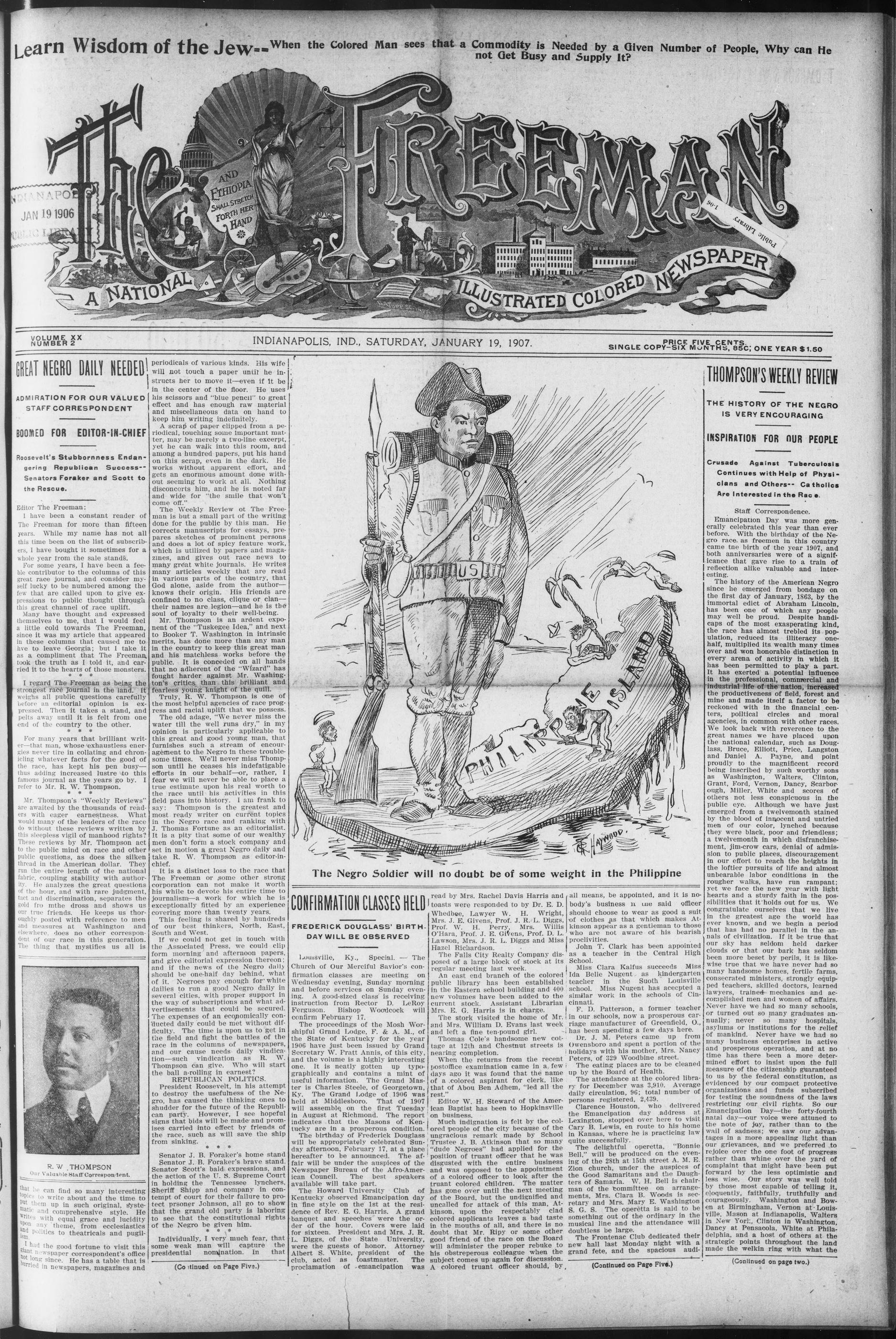
The Negro Soldier will no doubt be of some weight in the Philippine
CONFIRMATION CLASSES HELD
FREDERICK DOUGLASS' BIRTH
DAY WILL BE OBSERVED
Louisville, Ky., Special. — The Church of Our Merciful Savior's confirmation classes are meeting on Wednesday evening, Sunday morning and before services on Sunday evening. A good-sized class is receiving instruction from Rector D. LeRoy Ferguson. Bishop Woodcock will confirm February 17.
The proceedings of the Mosh Worshipful Grand Lodge, F. & A. M., of the State of Kentucky for the year 1906 have just been issued by Grand Secretary W. Fratt Annis, of this city, and the volume is a highly interesting one. It is neatly gotten up typographically and contains a mint of useful information. The Grand Master is Charles Steele, of Georgetown, Ky. The Grand Lodge of 1906 was held at Middlesboro. That of 1907 will assemble on the first Tuesday in August at Richmond. The report indicates that the Masons of Kentucky are in a prosperous condition.
The birthday of Frederick Douglass will be appropriately celebrated Sunday afternoon, February 17, at a place hereafter to be announced. The affair will be under the auspices of the Newspaper Bureau of the Afro-American Council. The best speakers available will take part.
The Howard University Club of Kentucky observed Emancipation day in fine style on the 1st at the residence of Rev. E. G. Harris. A grand banquet and speeches were the order of the hour. Covers were laid for sixteen. President and Mrs. J. R. L. Diggs, of the State University, were the guests of honor. Attorney Albert S. White, president of the club, acted as foastmaster. The proclamation of emancipation was
read by Mrs. Rachel Davis Harris and toasts were responded to by Dr. E. D. Whedbee, Lawyer W. H. Wright, Mrs. J. E. Givens, Prof. J. R. L. Diggs, Prof. W. H. Perry, Mrs. Willis O'Hara, Prof. J. E. Givens, Prof. D. L. Lawson, Mrs. J. R. L. Diggs and Miss Hazel Richardson. The Falls City Realty Company disposed of a large block of stock at its regular meeting last week. An east end branch of the colored public library has been established in the Eastern school building and 400 new volumes have been added to the current stock. Assistant Librarian Mrs. E. G. Harris is in charge. The stork visited the home of Mr. and Mrs. William D. Evans last week and left a fine ten-pound girl. Thomas Cole's handsome new cottage at 12th and Chestnut streets is nearing completion. When the returns from the recent postoffice examination came in a, few days ago it was found that the name of a colored aspirant for clerk, like that of Abon Ben Adhem, "led all the rest." Editor W. H. Steward of the American Baptist has been to Hopkinsville on business.
Much indignation is felt by the colored people of the city because of the ungrateful remark made by School Trustee J. B. Atkinson that so many "dude Negroes" had applied for the position of truant officer that he was disgusted with the entire business and was opposed to the appointment of a colored officer to look after the truant colored children. The matter has gone over until the next meeting of the Board, but the undignified and uncalled for attack of this man, Atkinson, upon the respectfully clad colored applicants leaves a bad taste in the mouths of all, and there is no doubt that Mr. Ripy or some other good friend of the race on the Board will administer the proper rebuke to his obstreperous colleague when the subject comes up again for discussion. A colored truant officer should, by
all means, be appointed, and it is nobody's business in me said officer should choose to wear as good a suit of clothes as that which makes Atkinson appear as a gentleman to those who are not aware of his bearish proclivities. John T. Clark has been appointed as a teacher in the Central High School. Miss Clara Kalfus succeeds Miss Ida Belle Nugent as kindergarten teacher in the Suoth Louisville school. Miss Nugent has accepted a similar work in the schools of Cincinnati. F. D. Patterson, a former teacher in our schools, now a prosperous carriage manufacturer of Greenfield, O., has been spending a few days here. Dr. J. M. Peters came up from Owensboro and spent a portion of the holidays with his mother, Mrs. Nancy Peters, of 329 Woodbine street.
The eating places are to be cleaned up by the Board of Health.
The attendance at the colored library for December was 3,910. Average daily circulation, 96; total number of persons registered, 2,439.
Clarence Houston, who delivered the Emancipation day address at Lexington, stopped over here to visit Cary B. Lewis, en route to his home in Kansas, where he is practicing law quite successfully.
The delightful operetta, "Bonnie Bell," will be produced on the evening of the 28th at 15th street A. M. E. Zion church, under the auspices of the Good Samaritans and the Daughters of Samaria. W. H. Bell is chairman of the committee on arrangements, Mrs. Clara B. Woods is secretary and Mrs. Mary E. Washington S. G. S. The operetta is said to be something out of the ordinary in the musical line and the attendance will doubtless be large.
The Frontenac Club dedicated their new hall last Monday night with a grand fete, and the spacious audi-
(Continued on Page Five.)
THOMPSON'S WEEKLY REVIEW
THOMPSON'S WEEKLY REVIEW
THE HISTORY OF THE NEGRO IS VERY ENCOURAGING
INSPIRATION FOR OUR PEOPLE
Crusade Against Tuberculosis Continues with Help of Physiclans and Others-- Catholics Are Interested in the Race e.
Staff Correspondence.
Emancipation Day was more generally celebrated this year than ever before. With the birthday of the Negro race as freemen in this country came the birth of the year 1907, and both anniversaries were of a significance that gave rise to a train of reflection alike valuable and interesting.
The history of the American Negro since he emerged from bondage on the first day of January, 1863, by the immortal edict of Abraham Lincoln, has been one of which any people may well be proud. Despite handicaps of the most exasperating kind, the race has almost trebled its population, reduced its illiteracy one-half, multiplied its wealth many times over and won honorable distinction in every arena of activity in which it has been permitted to play a part. It has exerted a potential influence in the professional, commercial and industrial life of the nation, increased the productiveness of field, forest and mine and made itself a factor to be reckoned with in the financial centers, political circles and moral agencies, in common with other races. We look back with reverence to the great names we have placed upon the national calendar, such as Douglass, Bruce, Elliott, Price, Langston and Daniel A. Payne, and point proudly to the magnificent record being inscribed by such worthy sons as Washington, Walters, Clinton, Grant, Ford, Vernon, Dancy, Scarborough, Miller, White and scores of others not less conspicuous in the public eye. Although we have just emerged from a twelfemonth stained by the blood of innocent and tired men of our color, lynched because they were black, poor and friendless; a twelfemonth in which disfranchisement, jim-crow cars, denial of admission to public places, discouragement in the loftier pursuits of life and almost unbearable labor conditions in the rougher walks, have run rampant; yet we face the new year with light hearts and a sturdy faith in the possibilities that it holds out for us. We congratulate ourselves that we live in the greatest age the world has ever known, and we begin a period that has had no parallel in the annals of civilization. If it be true that our sky has seldom held darker clouds or that our bark has seldom been more beset by perils, it is likewise true that we have never had so many handsome homes, fertile farms, consecrated ministers, strongly equipped teachers, skilled doctors, learned lawyers, trained mechanics and accomplished men and women of affairs. Never have we had so many schools, or turned out so many graduates annually; never so many hospitals, asylums or institutions for the relief of mankind. Never have we had so many business enterprises in active and prosperous operation, and at no time has there been a more determined effort to insist upon the full measure of the citizenship guaranteed to us by the federal constitution, as evidenced by our compact protective organizations and funds subscribed for testing the soundness of the laws restricting our civil rights. So our Emancipation Day—the forty-fourth natal day—our voice were attuned to the note of joy, rather than to the wall of sadness; we saw our advantages in a more appealing light than our grievances, and we preferred to rejoice over the one foot of progress rather than whine over the yard of complaint that might have been put forward by the less optimistic and less wise. Our story was well told by those most capable of telling it, eloquently, faithfully, truthfully and courageously. Washington and Bowen at Birmingham, Vernon at Louisville, Mason at Indianapolis, Walters in New York, Clinton in Washington, Dancy at Pensacola, White at Philadelphia, and a host of others at the strategic points throughout the land made the welkin ring with what the
(Conlinued on page two.)
(CONTINUED FROM FIRST PAGE.
Negro has achieved and what he hopes for the limitless future before him.
The colored people of America face the year of our Lord, 1907, and the year of their emancipation the forty-fourth, with courage and confidence.
The crusade against the dread turbulence goes on with unabated tervor, and it is a most hopeful sign that the colored physicians and the laity as well are doing their level best to check the spread of the malady among the all too susceptible Negro population. An advance step was taken a short time ago at Nashville, Tenn., during the visit of several distinguished physicians from the North, who came to hold an important clinic at Meharry Medical School, attached to Walden University. Among the visiting medical gentlemen were Drs. George C. Hall of Chicago, A. M. Curtis of Washington, D. C., and Daniel H. Williams of Chicago. An enthusiastic public meeting was held at St. Paul's church, and professional man and laity lied with each other in declaring their zeal in the anti-tuberculosis movement. Nashville had already organized an Anti-Consumption League, with Mr. W. C. Collier as president, but it had been deemed best to supplement the labors of the existing body with another, and the outcome of this meeting was that a committee on permanent organization was appointed to report at a later date a comprehensive plan of work and to get together the desirable forces to put the plans into aggressive operation. This committee was composed of Dr. McMillan, J. C. Napier, Dr. Boone, Prof. Watson and Mrs. Early. Dr. F. A. Stewart, Dr. Bundy, Dr. Voorhees, Mr. Jarrett and Dr. Greeder were named as a committee on laws. The meeting was presided over by Dr. R. F. Boyd, one of Nashville's most public-spirited citizens. He introduced Dr. Curtis in fitting terms, who said in part:
"I am very glad, indeed, to be present, and am glad that you have made up your minds to stamp out this awful plague, tuberculosis. In Washington we have an Anti-Tuberculosis League, organized from the physicians and salty and those who are interested in the public good. We first want to impress upon the laity that the disease is contagious and not hereditary, as was first supposed. In our organization in Washington we distribute literature and on certain Sundays have lectures given in the churches. We also have stereopticon views illustrating the lectures. These pictures give views of the filth and dirt in parts of the town where people live in huts, with no plastering, where dampness and dirt make a hot-bed os disease. This dreaded disease kills more people than all the rest of diseases put together and we ought to begin right now and here and stamp it out."
and stamp Dr. Curtis will be remembered as the very capable and resourceful surgeon-in-chief of Freedmen's Hospital, Washington, during the administration of President McKinley.
Dr. Hall, one of the founders and most active promoters of Providence Hospital, Chicago, being introduced, spoke instructively, as follows: "While passing through Tennessee a few months ago, I noticed that tuberculosis was more prevalent in Nashville and that there was less being done to keep it down than in any other state in the South. I am glad to say that the proper steps are being taken now and that there is a positive improvement already to be seen, even by the casual observer, "One person out of every seven die with tuberculosis. There are places in this town where the air necessary for one is breathed by five; there are places where there are no water or sewers. To keep down this disease the building laws will have to be enforced among the Negroes as well as the whites. Negroes segregate in places and are never visited by health officers until something happens that makes them a menace to the community.
"The people who have this dreaded disease" continued Dr. Hall, "are calling for health as a drowning man does for help. Before the war no Negro was known to have tuberculosis, because they were out in the fields breathing the fresh air; but now they are working in stuffy kitchens and living with eight or ten in a room, and it has got to be so bad among them that their life insurance rates are about one-fourth higher than the rate charged white people, and some refuse the Negro altogether as a dangerous and unprofitable risk.
"There is a mistaken idea that spitting on the sidewalk promotes tuberculosis. As a matter of fact, that is the only healthy place to spit. Here it is dried by the sun and rendered harmless. If you spit in the street it is rolled into little balls and the street sweeper comes along and fans the germs into the very faces of hundreds of people. Many physicians send their patients away to California and other places. This is a mistake. The climate has nothing to do with the disease; it is because the air is dryer and they stay out in the sun more. The same result can be achieved at home with the proper care. The situation is a serious one and we should have organizations like yours in every city in the land. The preachers should preach as regularly from their pulpits and advocate eradication measures as frequently and as earnestly as they preach against the devil and all his works."
What the people of Nashville are doing to stamp out tuberculosis can and should be done elsewhere. The whites are establishing tuberculosis hospitals and are insisting upon landlords furnishing better sanitary arrangements in the houses they rent to Negroes and poor whites. Our physicians show a disposition to cooperate with them, and they should not relax their vigilance until a much
THE FREEMAN, AN ILLUSTRATED COLORED NEWSPAPER.
better condition of affairs is shown to exist in the present slums and plague spots of our large cities.
Speaking of the high rates charged by the life insurance companies for colored risks, Dr. Hall calls attention to a fact that is not given the serious consideration its importance deserves. It is a reflection upon our mode of living—a stigma upon our desirability as citizens and neighbors. That the discrimination is justified in some cases cannot be denied, but it is no less a fact that the condition of many whites is not one whit better, for poor sanitation will carry off a white man as speedily as it will a black one. But, of course, insurance rates are a matter of averages, and it has been found that the average health and environments of the whites are superior to the average maintained among the Negroes—for which there is ample reason—hence, we get the discriminatory rates. A number of the metropolitan Life Insurance Company of New York, which at the present time carries more than a million dollars in colored policymakers, with an official notice that after the first of January their agents are to accept no applications from Negroes. The company explains that there is no money in insuring colored people at a small weekly payment, where so many lapses and renewals occur that the premiums actually paid are eaten up by the repeated commissions to agents and the expense of making the collections. The policies now in force will continue as long as paid up, but those that lapse after this date will be canceled. The Prudential is also and to be among those which refuse to insure Negroes, or, if at all, the sum must be a large one and the premiums about double that charged the whites. It is evident from this ruling that the advice just given by Drs. Hall and Curtis should be heeded, or our condition will grow worse before it gets better.
There is no cloud, however, without a silver lining, and the hopeful view is that this declination of Negro business by the white insurance company may not be, after all, an unmixed evil. If we can but remove the cause so that the business can be made profitable for somebody, the action of the Metropolitan and other corporations will go far to open a field and stimulate the formation of insurance companies conducted by Negroes themselves. This would keep many dollars within the coffers of the race that now go to pay exorbitant salaries to white officials and to swell the dividends of men who care no more for our welfare than for the dirt under their feet. The development of Negro insurance, companies on the order of the National Benefit Association, the Cave Dwellers and those scattered in many parts of the country, notably at Richmond and Washington, will afford employment to hundreds of intelligent men and women of the race and strengthen our standing in the world of commerce. With no fine offices to maintain and no fancy salaries to pay, the Negro company could offer insurance at a lower premium than has heretofore been paid to the Metropolitan, and if the risks are accepted judiciously the profits will be of sufficient proportions to invite the investment of thousands of dollars now lying idle in banks, from which the white banker is drawing interest and we are getting nothing. Reflection points out to us that, while the reason is regrettable, the refusal of the Metropolitan and the Prudential to do business with us is not without its compensating aspect. Well may we exclaim with the citizens who weared of the contentions of the Capullets and the Montagues: "A plague on both your houses!" The Negro is beginning to realize that he must solve his own problems if they are to be solved aright.
It is easy to be brave at a distance from the danger point, but it strikes us that the colored man W. T. George, who was tendered a clerkship in the postoffice at Hattiesburg, Miss., the result of a civil service examination, should not have allowed a handful of narrow-minded white ruffians to frighten him out of accepting it. Now a white man has the place which was rightfully his, and the whites are chuckling over the fact that the crepe on the postoffice door and the anonymous warnings were just so many practical "jokes." The humor abiding in these manifestations does not appeal to the victim of the alleged "joke," but we do think that if George had put up a bold front and entered upon the discharge of his duties with that quiet but determined demeanor that does not threaten, but which suggests that he had better be let alone or somebody would get the worst of it, the trouble might have all blown over in a short time. A dangerous precedent is here established. If George can be so easily intimidated into a non-assertion of his rights under the civil service examination, the same bull-dozing game will be tried elsewhere on some other Negro whose presence in a dignified position is not wanted, and our civil service system may degenerate into a roaring farce. As we said above, it is easy to stand off at a safe distance and tell the other fellow to be brave
—and we have no advice to offer in such instances—but if we cannot assume our places, earned in competition with the masses, and cannot obtain adequate protection while performing the work of the general government, there is a screw loose somewhere that cries out for a remedy. Are we to understand that the postoffice at Hattiesburg is now in control of the mob, and that no Negro citizen need apply, even if ordered to duty by the Postoffice Department at Washington, or is it merely a case of "cold feet" on the part of a timid colored man who did not have the nerve to tackle the job, through an unwarranted fear of consequences which might never have happened?
The Catholic church is making a sturdy bid for the support of the Negroes of this country, and some on-
mistic ones, noting their zeal in promoting liberality of sentiment toward us in so many directions, are looking to the papal hierarchy to bring about many needed improvements in our condition as citizens. It is being announced through the press that the Catholics of this country have just established a bureau for the promotion of missionary effort among Southern colored people. At its head as director is the Rev. John E. Burke, who has been for over twenty years rector of a parish of colored people in New York city. Father Burke will make his headquarters in New York, but will spend much time in the South, where he will work in co-operation with the bishops of the Southern dioceses. A large part of his effort will be directed toward the raising of funds for the support of missions among the Negroes. It is stated that in effect the new bureau will be to Catholic work among the colored people what the Catholic Indian Bureau, headed by the Rev. William Ketcham, is to the work among American Indians.
The new bureau was determined upon at a meeting of the trustees of the Indian and Negro Mission funds, held in Baltimore a few days ago. Among those who were present were Cardinal Gibbons, Archbishops Farley and Ryan and Bishops Byrne and Allen. The two last named come from Nashville and Mobile, respectively, and, knowing the needs of their fields, have been energetic in working for the formation of the bureau. It was said after the Baltimore meeting that at the present time less than 2 per cent. of the Negroes in the United States are Catholics.
R. W. THOMPSON.
MOUNDS OF MYSTERY
THE LEGACY LEFT. BY THE ANCIENT TRIBES OF NEW MEXICO:
A Puzzling Enigma For the Scientists Is the Hundred Mile City of the Dead, With its Haunted Ruins, Peopleled With Skeletons.
Much has been written of the ciiff dwellers; vast volumes have been compiled concerning the ancient tribes of Anahuac, the Tolteces, the vanished descendants of "the fair god" of ancient Mexico, and all the long gone tribes of the great southwest have had their place in fictitious and historic narrative. But who has heard of the mysterious "lost Atlantis" of New Mexico, the vanished people of the mound, whose tribes were once as the autumn leaves and who perished—not individually, but as a race—at one fell swoop, as from the avenging wrath of God?
The attention of the archaeologist has been centered upon the hazy history of the cliff dwellers, upon their homes and their habits, forgetting that there exists in peculiar proximity a field of more attractive mystery. The cliff dwellers have drawn our attention because they left us their homes. The vanished race of Socorro county, N. M., has failed to interest us for the reason that it left us nothing—nothing, not even a wall intact or a ruin unplundered. Yet stay! Have you ever been along the Tule Rosa in the wild pine clad regions of the San Francisco mountains? Are you familiar with that "hundred mile city of the dead," so strangely like the lost city of Quivera, yet far, far larger and more wonderful? Have you ever entered the great excavation of the prehistoric pueblo to the south of Luna, east of the barren peaks of Elk mountains?
The "Ruinas Encantadas," or "haunted ruins," as we would call them in English, are but a few miles north of San Francisco, not the San Francisco of California, but the San Francisco of Socorro county, N. M., a Mexican and Indian pueblo older than the quaint village of Acoma, "the citadel of the clouds," which was young when the Spanish priests and explorers first ventured into that desert wilderness, to be slaughtered as they attempted the daring ascent to the summit of the great Acoma mesa.
The pueblo of San Francisco was crumbling into decay when Acoma—so called "oldest city in America"—was young and flourishing with the blanket weaving hosts of the Aztec. Her quaint adobe "house of penates" was fast disintegrating when Montezuma in his youth looked down in all his pride and semisavage hauteur from the gorgeous but barbaric palace of Chapultepec. So say the people of the present pueblo, whose generations have lived and perished within its narrow boundaries.
The "haunted ruins," they tell us, are peopled yet with grim and ghostly gods of other days and with specters that still stride threateningly along the subterranean corridors. But we of today are too enlightened to accept this savage superstition, so we will look at the "Ruinas Encantadas" only as they are. There is but little left of them.
In 1867 the first white man, whose name was Smith, ventured into the forbidding fastnesses of the land of Tule Rosa. Smith, then in the prime of life, arrived at Magdalena in quest of newer fields of gold—in quest of fortune, pleasure and adventure. A Yankee in every sense, there was no danger in the wilds of the "hundred mile city of the dead" which Smith would fear. Geronimo nor the Apache Kid was yet in his reign of terror, but the Apaches were out for blood, and the country was a formidable one. But Smith pressed on. A hundred miles beyond the village of Magdalena, beyond the famous Horse springs, later the scene of two never to be forgotten massacres—beyond the old, historic Turkey mountain and the land of
pinions, where the suvery true rosa winds and has wound its way for centuries untold—this valiant pioneer of the west ventured with his burro train and trusty knife and rife. Smith, whom the author had the pleasure of meeting shortly before his death, was by nature intended as an archaeologist, for his love of the rare and curious, the mysterious and antique, was directly responsible for his final determination to reside in that land of ruins and reliies. Until the day of his death he never left the "hundred mile city of the dead," but remained for over thirty years to explore its mounds and caverns.
To the tireless efforts of this sturdy pioneer the Smithsonian institution owes some of its most valuable New Mexico antiquities. It was he who excavated the "Ruins Encantadas," he who first brought to light the many mysteries of its grim and ghostly grottoes.
Shortly before Smith died he took me through an excavated mound not far from the "Mound of Mystery." In its several apartments, arranged on crude pinon limb shelves, I viewed hundreds of the relics and skulls of the vanished people. There were arrows, quolts, beads, meal grinders, bowls, burned and figured pottery, strange shapes of earthenware, stone tablets covered with indecipherable hieroglyphics, implements of agriculture, a great granite plow, ducks, birds, earthen penates and weird idols, bones, skulls, vases and countless little trinkets whose names I could not guess. There were lumps of copper, zinc, iron and lead, all of which possessed no tangible shape, but which revealed the knowledge of minerals that had been acquired by the vanished people.
The "Mound of Mystery" is unobtently all that its name implies. No explorer of that land of ruins, no archaeologist familiar with the "hundred mile city," has ever been able satisfactorily to explain its secrets. But it is a mound rich in antiquities. Externally, before its excavation, the "Mound of Mystery" appeared but a huge pile of rocks and debris not different from the thousands of other crumbled abodes of the prehistoric people. But the spade and pick of the explorer brought forth developments of a startling nature.
There are many apartments and narrow corridors in the "Mound of Mystery." The latter are less than five feet wide; the former are spacious and paved thoroughly with cement. This cement, strange as it may seem, is of a quality not surpassed by modern manufacturers. Despite the countless ages that have elapsed since the occupants of that house of death met their tragic end, the floor paving and the walls are still practically intact. Blocks of the cement which I tested show it to be almost of adamant hardness.
In one of the larger rooms of the haunted ruins, or "Mound of Mystery," as Smith designated it, were found over seventy human skeletons—men, women and three infants. Most of these skeletons were unearthed in sitting postures, leaning against the walls, as if their death had been simultaneous and the "blighting breath of God" had smitten them as they sat—instantly, inexorably, thoroughly. One body, crouched in a corner, was strangely decorated. A large earthen bowl covered the head, as a skullcap. Across the thigh bones rested another, but a smaller one. In this bowl were many stringless colorless bone beads.
Here, there, everywhere, upon the floor, lay thousands of bones, taken one at a time from the mass of sand and rock that had filled the chambers. Their weapons, their utensils, their gods, all, everything, still lay about the premises, covered by the wreckage of the roof and the drifting sands from the desert edge.
The "Mound of Mystery" is not the only one in Socorro county which contains such things, but is more rife with treasures than the rest. Scarcely a mound in all that "hundred mile city of the dead" is without its skull, its pottery or penates. But the "Mound of Mystery" is like a palace among huts, a great labyrinth of grottoes among the lesser cells.
An examination of the skulls in the "Ruinas Encantadas" shows that if they were Indians they were far from like the Indians of today. The flat forehead, the prominent nose, the narrow vertebrae and other Indian characteristics are not to be found in the skulls as they exist in this one big catacomb. The forehead is rounded, the temples full, the cheeks low and receding, the chin square, the nose small. Who then, were the strange inhabitants of that ruin? Can it be that they were related to the Toltec—those enlightened predecessors of the hosts of Montezua—and that it was from this land that Anahuae first was populated?
History tells us that the tribes of Chichenec "came down from the north," and it is known that to the north went the victim gatherers for the sacrifices of Huitzilopochtli. From the north, too, according to Prescott, came Quatzalcoatl and the later Aztecs.
The mystery of the haunted ruin can never be positively dispelled. Neither will we ever know the cause of the terrible and far sweeping death that came so simultaneously upon that people of the "hundred mile city" of Socorro county.
Scientists still speculate. Archaeologists are offering us many and conflicting explanations, but the "Mound of Mystery" still stands there, grim with its grinning skulls and ancient, storyless relics—its grottos somber with its gloom and stillness of the centuries—its walls frowning down upon the silvery waters of the Tule Rosa, at the edge of the sandy desert waste, like a sphinx of the great southwest
FORD'S HAIR POMADE FORMERLY KNOWN AS "OZONIZED OX MARROW" Makes the Hair Long, Soft and Easy to Comb READ WHAT THE PEOPLE SAY
I have seen its original letters and testify to the gentleness of the statements.
E. C. Knox, manager of The Freeman.
FORDS HAIR POMADE, formerly known as "OZONIZED OX MARROW," so called because of the early Hair that it can be put up in any style desired consistent with its length, and is the preparation known to us that makes Kinky or Curly Hair straight, as shown above. It is a curly hair soft, pliable and easy to comb. These results may be obtained from one treatment; to 3 to 4 bottles are usually sufficient for a year. The use of FORDS HAIR treatment, inveriorates the scab, so it does not fall out or breaking off, makes it grow, and by nourishing the roots, gives it new life and strength. Harmless, it is a toilet necessity for ladies, gentlemen and children. FORDS HAIR POMADE ("OZONIZED OX MARROW") has been made and sold continuously since Patent Office in 1874. In all that time, FORDS HAIR has never been a bottle returned from the hundreds of thousands we have sold. FORDS HAIR is sure to be sure to Ford's, as it uses the hair STRAIGHT, SOFT and PLiABLE. Beware of imitations. Remember that FORDS HAIR POMADE ("OZONIZED OX MARROW") is put up only in 50c. size, and is made only in Chicago and by Ford's. The signature, Charles Ford, Prest. on each package. Refuse all others. Full disclosing the drugstores and dealers. If your drugrist or dealer cannot supply you, he can procure it from his jobber or wholesale dealer, or send us 50c. for one bottle, or $2.50 for six bottles, express paid. We pay postage and express charges to all orders, ordering send postal or express money order, and notification of paper you saw this advert. We address and address plainly to THE OZONIZED OX MARROW 60C.
Dept. A, 76 Wabash Ave, Chicago, III.
(None膏品 will沾 my signature. Argents everywhere.)
VICTOR
TALKING
MACHINES.
The Victor is so perfect it is often mistaken for the human voice. It is proving a never failing source of DELIGHT to Thousands.
COME IN AND LET US
TELL YOU all ABOUT it.
SOLD ON EASY
PAYMENTS
Phones Main 852
New 9093
KOEHRING BROS.
878, 880, 882 VIRGINIAEAVENUE.
Advertise in The Freeman.
Sahara-1. Sneezy sutron in san
Francisco Chronicle.
Napoleon's Code and Women. Napoleon said at St. Helena that his glory consisted not in having won forty battles, but in the civil code and in the deliberations of the council of state. Savigny and Charles - Austin condemned the civil code as "a mechanical mixture of the results of the revolution and the old regime of Roman law and the customs," three-fourths of its contents having been extracted by draftsmen from a printed treatise. The code, in a word, was not a substantive mass of law, but "an index to an immense body of jurisprudence outside itself." One of the dictator's objectionable hobbies was his desire for the degradation of the civil status of woman, who is treated by the code as a "fickle, defenseless, mindless being." When asked in committee if wifely obedience was prescribed by old French law the first consul sharply replied: "Do you not know that the angel told Eve to obey her husband? Morality has written this article in all languages."—London Spectator.
50,000
BOOKS FREE By Mail
treating on all the
DISEASES PECULIAR TO MAN.
THIS BOOK contains many illustrations and is a storehouse of knowledge for both old and young who are suffering from excesses, lost vitality, kidney disorders, blood poison, stomach, kidney and bladder diseases. It explains how you can successfully "re yourself at home.
DR. JOS. LISTER F. CO.
40 Dearborn St., A-8. Chicago, IL.
Big Salaries Men and women of every age are offered roles with us. Work honorable, easy and agreeable at home. We want you to be an old established team. Write吧, be big. Big money for you ROYAL MANUFACTURING Co. Be吧, be 2130 Detroit, Mich.
Wm. Billingsley,
Florist
Choice Cut Flowers
Designs a Specialty
Old Phone, Main 3712
New Phone 3002
201 N. Illinois St.,
Indianapolis.
FORD'S HAIR
FORMERLY
"OZONIZED O
Makes the Hair Long,
READ WHAT TH
Coyley, Fla., Aug. 28, 1804.
I used only one hairpin. My hair has stopped breaking off and has greatly improved. When I started using this wonderful machine my hair was seven inches long and now it is ten inches or more. 314 Southst. M.
MINNIE FOASTER.
Brookhaven, Miss., Aug. 13.
Gentlemen: I must credit you for an excellent service so excellent for the hair. My hair was rather deadly but since I have been using your hair pomade I have it was when I was a girl and it has a lively, glossy color.
Brookhaven, Miss., Aug. 13.
Gentlemen: I must confess
I never tried any preparation
so excellent for the hair. My
hair was turning gray and was
rather deadly but since I have
been using your hair pomade
my hair has turned black like
it was when I was a girl and
it has a lively, glossy color.
C. L. ROBERTS.
Atlanta, Ga., June 6, 1900.
Gentlemen: I have used your pomade and have found it to do more than it is recommended to do. It stops the hair from falling out and breaking off, and cleans the scalp and makes the hair soft, pliable and glossy.
I have seen the original letters and tow-
ers, E. O. Knox, *angage of The
FORD'S HAIR POMADE*, compo-
straints Kinky or Curly Hair that
with its length, and is the only safe prepara-
tion Hair straight, as shown above. Its use ma-
jorly for children and easy to con-
treatment; 2 to 4 bottles are used for
POMADE ('OZONIZED OX MARROW-
itching, invigorates the scalp, stops the hair
and by nourishing the roots, gives it new life,
hornade DE) is to cool the hair or ladies,
hornade DE) is to cool the hair or ladies,
about 1858, and the label, "OZONIZED OX M
Patent Office in 1874. In all that long period
from the hundreds of thousands we have sold,
and effective, no matter how long you keep it,
the hair is still strong. Hair POMADE ('OZONIZED OX M
hair POMADE ('OZONIZED OX M
only in Chicago and by us. The genuine
package. Refuse all others. Full directions
We loan money on Diamonds, Watches, Jewel and all articles of value LOWEST RATES
Ertel's Loan Office
209 Massachusetts Ave.
Private Entrance, 108 E. Ohio St.
New Phone 1790
'A Friend in Need
Is a Friend Indeed."
Nathan T. Ward,
PROFESSIONAL
BONDSMAN
Room 1 Wilson Block,
12 N. Delaware St.,
Residence 507 Hiawatha St
Indianapolis, Ind.
OFFICE RESIDENCE
N w Phone 3458 New Phone 2666
Send Your Next Bundle to th
320 Indiana Ave,
The Place where Linens last
We also do FAMILY WASHING
Rough Dry at
Five Cents Per Pound
The preacher of peace promoteth
prosperity.
IR POMADE
KNOWN AS
OX MARROW"
Soft and Easy to Comb
THE PEOPLE SAY
West Chester, Pa., Mch. 30, 1905.
I had typhoid fever and my hair all came
out. I used three bottles of my pomade and
now my hair is nine inches long and very thick
and nice and straight. Most every one seeing
how good your pomade did my hair, they too
reare nails for it. My hair is an example to
every one. Yours respectfully. F. E. Davis
```markdown
```
Colvert, Tex., Mich. 31, 1905.
I have used one bottle of
your pomade and my hair
is now perfectly straight,
soft and black as silk. I will
not be without it.
RHODA EWARSE.
Paris, Mo., July A. 1908.
Gentlemen: When I began using your pomade my head was so bald I was ashamed of myself, but now my hair has grown three inches from my head and I have been using it only two months.
entity to the gentleness of the statements, the Freeman. You known as "OZONIZED OX MARROW," so I can be put up in any style desired consistent on known to us that makes Kinky or Curly hair. You can rub these results may be obtained from one or a year. The use of FORD'S HAIR from failing out or breaking out, makes it and vigor. Being elegantly perfumed and gentlemen and children. FORD'S HAIR MARROW? was registered in the United States of time there has never been a bottle returned FORD'S HAIR POMADE remains sweet. Be sure to have a ware of imitations. Remember that FORD'S ROW?) is put up only in 50c. size, and is made as the signature, Charles Ford, Prest. on each
Nervous Indigestion
The action of digestion is controlled by nerves leading to the stomach. When they are weak, the stomach is deprived of its energy. It has no power to do its work. If you want permanent relief, you must restore this energy. Dr. Miles' Nervine restores nervous energy, and gives the organs power to perform their functions.
"For many years I was an acute sufferer from nervous indigestion; at times I was depressed. If I must a burden, I need all kinds of remedies and various physicians with little or no relief, until one night last summer I saw Dr. Miles' Nervine and I made this advertised I made a breath one more trial which I did in the purchase of one bottle of Nervine and the purchase of one bottle of Nervine I began to feel that I continued the medicine until I had taken more than a dozen bottles. I am very much improved in every way; in body, mind and spirit, I make a breath point to recommend the medicine, and I feel a sincere pleasure in know that several persons have been benefited through my recommendations." (Nervine, 1911)
Dr. Miles' Nervine is sold by your druggist, who will guarantee that the drug is safe. If it fails, he will refund your money. Miles Medical Co. Elkhart. Ind
Get the shaving habit and use Williams' Shaving Soap. It pays.
Sold everywhere. Free trial sample for 2-cent stamp to pay postage. Write for booklet "How to Shave." The J. B. Williams Co., Glastonbury, Ct.
Copyright, 1906, by D. M. Parker
"Indictment against Samuel J. Hawkins," read the indictment clerk in his singsong voice. "This information charges him with perjury in certifying to the presence in prison of fictitious persons and receiving fees from the county therefor to the amount of $1,289.70, said Samuel J. Hawkins being at that time and at the present time the sheriff of Bainbridge county. The indictment is before you."
The grand jury, first of its kind for years, had been in session in Bainbridge county for forty-two days, and its laborers had resulted in the voting of seventeen indictments. The name of Sheriff Hawkins was last on the list to be considered.
There was a motley crowd on the stairway of the courthouse waiting to hear the result of the jury's deliberations. A fat deputy sheriff, his hands folded comfortably across his stomach.
"YOU WON'T LET ME EXPLAIN"—HE BE- GAN AGAIN.
sat at the head of the corridor leading to the ground glass door behind which the jury was deliberating. Some of the waiting throng about him were attracted by motives of curiosity only; others, restless and impatient, were there to gather crumbs of information for friends who feared. Then there were three or four newspaper men with pleasant, cynical faces and keen eyes.
There was silence inside the courtroom after the indictment clerk had finished his reading. Juror Vanderbeck was first to speak. "I would like to hear from Mr. Scarborough on this matter."
The prosecutor smiled as he twisted his brown mustache. "You can't shift
THE FREEMAN, AN ILLUSTRATED COLORED NEWSPAPER
any responsibility, gentlemen, 'ne replied. "The law does not allow me to dictate as to who shall be indicted. It's up to you." "Boys, I wish you'd hear me on this matter." The speaker was John Kerns of Bay township, a silent, kindly man, who during the tedious weeks of the inquisition had thought much and said little. There was a rustle of interest as he rose, a tall, lanky figure in rusty black. His spare, lined face was smooth shaven, and he had the stoop of hard work in his powerful shoulders. John Kerns was only thirty years old, but he had never been regarded as young. His intimates thought of him, though, with affectionate respect that had nothing of contempt in it as "Old John." "I don't believe that we'd better indict Sam Hawkins," he said. "I know him as if he was my own brother, for we were raised on neighboring farms. He ain't bad; he's only weak. Sam would never have got into trouble if you'd left him on the farm.
"Oh, I know all about it, and so does every man, on this jury! Our party agreed to trade sheriff for register of deeds, and so you fellows put up a poor candidate so Jim Connors could win in a walk. But Sam didn't know he was to be a sacrifice. He went in to win, and he did win! He had to mortgage his farm to do it, and after he had been in awhile he found out he wasn't wanted and that he'd have to walk the plank at the end of one term. All the bosses want Jim Connors, and next fall he'll be elected. The same accident don't happen twice. Ain't that so?"
Nobody answered, though several had shifted uneasily during his talk. "Well," continued the speaker, "Sam didn't feel very good when he found out what he's up against. The mortgage was still on his farm, and he had to get it off this term or not at all. They say he's made fictitious entries to collect fees and board bills from the county. You don't know what you'd done or I'd done under the same circumstances. Now, let's all shoulder a little of Sam's responsibility and let him pay that money back. The county won't be out anything, and to prosecute Sam would—would break hearts. I'm going to vote against a true bill."
The sheriff sprang from the sleigh, and, without waiting even to blanket the horses, rushed up the steps and into the house. With the, assurance of the accepted lover he nodded and smiled genially to Molly's mother in the sitting room, but did not pause. Instead he rushed into the kitchen and with a cry of delight swept Molly into his arms. He kissed her eagerly on face and lips and hair. Although she submitted patiently to the caresses the girl did not respond to them, and a half unconscious sigh of relief escaped lier when the young man finally released her and stood back beaming, to look at her.
"Hurray, Molly!" he cried. "The grand jury has adjourned and I'm not indicted.
"Was there any danger, Sam?" she asked quietly, although her attitude expressed intentness.
In his relief from the strain of self imposed silence and gnawing anxiety during the six weeks that the jury had been in session the man was too wrapped up in selfish joy to notice anything amiss.
"Was there any danger?" he echoed,
"Well, I should think there was, I was caught with the goods, all right. And who do you think saved me? Old John Kerns. Do you know, Molly," he babbled on, almost drunk with exhilaration, I used to fancy Old John was sweet on you, but I saw my mistake when I heard what he did today."
The girl was white about the lips, but her voice was low, almost gentle. "Then you did steal from the county, as they said you did?"
Sam looked up quickly, for he had noted the danger signal. "Oh, no, Molly; steal is hardly the word, but"— "Did you steal from the county?"
His face fell suddenly. "You won't let me explain"—he began again.
"Did you?"
"I suppose some of them call it stealing. What of it? I'm going to pay it back." Then rage at the men responsible for this complication overcome him. "It serves them right. They put me up to knock me down, and they'll have to watch things the balance of my term; that's all. But what of it?" he asked.
"What of it?" Her scorn and loathing seemed to crush him.
"What of it? This much: No Dwyer ever married a thief, and I'm not going to be the first one. Here's your
Dr. J. E. Woodlee, who was iden- American journals in the country.
"Putting the Most into Life," Booker T. Washington's unique little volume, had a great run as a holiday gift.
***
Alexander's Magazine got out an especially attractive number for the holiday season. The production improves with each issue.
***
Mrs. Carrie W. Clifford, one of Cleveland's most favorite and grapepenwomen, recently paid a visit to the mother of the late Paul Laurence Dunbar at Dayton,'O.
***
A new race paper for Chicago is in the wind. It is said that its backing will be the strongest that has ever gotten behind a Negro publication in the western metropolis.
***
The Florida Sentinel makes a splendid plea for the election of Ira T. Bryant as secretary of the A. M. E. School Union. The South is practically a unit for Bryant, and his success now seems assured.
***
It is reported that R. LeRoy Stokes, who has been doing some brilliant literary work on the New York Age, has taken service with the New York World and is representing the latter journal at Washington.
***
Alfred A. Taylor, a letter-carrier and musician of Indianapolis, makes a creditable bid for the mantle of the late Paul Laurence Dunbar. His poems show no small degree of originality and have a swing and rhythm that suggest good things for the future from his pen.
***
Charles Stewart, the Wandering Jew of Afro-American journalism, who writes such breezy letters to the Baltimore Afro-American Ledger and other papers, and divides honors with Booker T. Washing as a "globe-trotter," has traveled during the past year 71,897 miles. That is "going some."
* * *
Dallas, Texas, has an Afro-American daily, says a current report. We od not see it up this way, but we are sure it is doing good in its sphere of influence, and spreading light throughout the great Southwest. We need Negro dalles everywhere, for history is being made so rapidly these days that a weekly can scarcely keep up with the procession.
ring”—mechanically he took the extended bumble and slipped it in his pocket—“but before you go I want to tell you why John Kerns got you off—because he thought I loved you and that it would break my heart if you were indicted; that’s why. And, thank God, I’ve found out before it’s too late that John* Kerns cares that much for me, because”—and she raised her head proudly—“I care for him just as much.” Then she went crimson, for Kerns stood in the doorway.
As John advanced into the room with face alight the sheriff slipped out without a word. The chime of his sleighbells grew fainter and fainter, to die out finally in the distance. And all was well.
WALT WHITMAN.
Ways of the Poet Who Was Loved by All Who Knew Him.
This is the Wait Whitman who was known and loved by those who met him daily:
"After some conversation Whitman proposed a walk across to Philadelphia. Putting on his gray slouch hat, he sailed forth with evident leisure and, taking my arm as a support, walked slowly the best part of a mile to the ferry. Crossing the ferry was always a great pleasure to him. The life of the street and of the people was so near, so dear. The men on the ferry steamer were evidently old friends, and when we landed on the Philadelphia side we were before long quite besieged—the man or woman selling, fish at the corner of the street, the tramway conductor, the leafers on the pavement—a word of recognition from Walt or as often from the other first; presently a cheery shout from the top of a dray, and before we had gone many yards farther the driver was down and standing in front of us, his horses given to the care of some bystander. He was an old Broadway 'stager,' had not seen Walt for three or four years, and tears were in his eyes as he held his hand. We were now brought to a standstill, and others gathered round. George was ill, and Walt must go and see him. There was a message for the children, and in his pocket the poet discovered one or two packets, for absent little ones. But for the most part his words were few. It was the others who spoke and apparently without reserve."—"Whitman as Carpenter Saw Him" in Craftsman.
The Lazy Horse
An Irishman once tapped a poky horse with a whip and said, "Pick up your feet, and they'll fall theirselves." - Atchison Globe.
tified with The Voice of the Negro while at Atlanta, continues with it at Chicago. He is doing a large share of the editorial work, and supervises its make-up, while J. Max Barber looks after the general business management. Dr. Woodlee will also be associated with Dr. M. A. Majors in the practice of medicine.
* * *
E. Smyth Jones, hailing from Natchez, Miss., is the latest aspirant for fame as a poetical genius. He has written some rather clever sonnets, among them "Sparkling Diamonds in Glits of Gold." His most recent offering, "Discharged Without Honor," possesses many elements of merit. Mr. Jones is also a song-writer of no mean ability.
***
The Kentucky Standard may change hands at an early date. A syndicate of Louisville's solid men is said to be negotiating with the present owners for a transfger of the property. The Falls City is well equipped with denominational journals, but is sadly in need of strong, newsy secular paper, to exploit in a general way the achievements and current life of the colored people of the vicinity.
***
The illustrated Christamas edition of the Danville (Ky.) Torch-Light was a highly creditable number. Rev. J. E. Wood, the editor, is a born newspaper man, and in addition to his duties as pastor of the largest Baptist church in his section of the State, he is Grand Master of the Good Samaritans of Kentucky, and conducts the Torch-Light and operates a heavily patronized job-printing plant. Dr. Wood is also one of the most active spirits in the Baptist Association of the State.
* * *
Th eholiday editions of the Florida Sentinel, issued in three instalments by Comrade M. M. Lewey, were fully up to the high standard set by this publication for many years past. The editions carried a choice assortment of literary matter, including a series of special articles by R. W. Thompson and W. T. Menard, written in the happiest vein of those versatile pensmiths. The amount of advertising matter found in these issues indicate that the business men of Pensacola are far ahead of their northern contemporaries in recognizing the value of the message that the race journal carries from the white merchant to the colored reader. The Florida Sentinel is unquestionably one of the very ablest and most enterprising Afro-American journals in the country.
BEES IN WARFARE.
Two Instances In Which the Insects Were Used as Weapons.
History records two instances in which bees have been used in warfare as weapons against besieging forces. The first is related by Appian of the siege of Themiscyra, in Pontus, by Luculus in his war against Mitiridates. Turrets were brought up, mounds were built, and huge mines were made by the Romans. The people of Themiscyra dug open these mines from above and through the holes cast down upon the workmen bears and other wild animals and hives or swarms of bees.
The second instance is recorded in an Irish manuscript in the Bibliotheque Royale at Brussels and tells how the Danes and Norwegians attacked Chester, which was defended by the Saxons and some Gallic auxiliaries. The Danes were worsted by a stratagem, but the Norwegians, sheltered by hurdles, tried to pierce the walls of the town when "what the Saxons and the Gaeidhil who were among them did was to throw down large rocks, by which they broke down the hurdles over their heads." What the others did to check this was to place large posts under the hurdles.
What the Saxons did next was to put all the beer and water of the town into the caldrons of the town and boil them and spill them down upon those who were under the hurdles, so that their skins were peeled off. The remedy which the Lochlans applied to this was to place hides outside on the hurdles. What the Saxons did next was to throw down all the beehives in the town upon the besiegers, which prevented them from moving their hands or legs from the number of bees which stung them. They afterward desisted and left the city.
It so happened that two ladies were making their way to their seats at the very moment Von Bulow finished his introduction of the first movement of Beethoven's "Sonata Pathetic." This so irritated him that he purposely commenced the allegro at such an absurdly slow pace as to make the quavers in the bass correspond exactly to the time of the ladies' footsteps. As may be imagined, they felt on thorns and hurried on as fast as they could, while Von Bulow accelerated his tempo in sympathy with their increasing pace.—Barnett's Musical Reminiscences.
The readiest and surest way to get rid of censure is to correct ourselves.—Demosthenes.
HANDLING A TIGER.
How a Turkoman Subdued a Snarling, Angry Man Eater.
"In a cage near the room in which I lived while in Khiva," says Langdon Warner in the Century Magazine, "was a tiger from the Oxus swamps. He had taken a dislike to me, and every time I passed his cage he got up and paced angrily toward me, snarling.
"Into the cage of this beast, at the command of the prince, a Turkoman stepped, armed with a short stick as big round as his wrist. With this click he struck the tiger's nose as he made for him, and then, with palms out and eyes fixed, he walked slowly up to the shrinking beast and stroked his face and flank.
"The tiger snarled and took the man's hand in his open mouth. I held my breath and looked for the bleeding stump to fall away; but, keeping that hand perfectly still, with the other he tickled the tiger's jowl and scratched his ear till with a yawn and a pleased snarl the big cat rolled over on his back to have his belly scratched.
"The man then sank to his knees, always keeping his hands in motion over the glossy fur, and with his foot drew toward him a collar attached to a chain. This he snapped round the beast's neck and, rising to his feet, laid hold of the chain and dragged the tiger out.
"This was only the second time that the cage had been entered.` As soon as the tiger was outside he espied the watching party and started for them, but came up short on the collar. If he had chosen to use his weight and strength no four of them could have held his tether, but as it was the Turkoman found little difficulty with him and held him, snarling, while a camera was snapped."
THE STAR MIRA.
A Sun of Great Size That Is Struggling For Existence
For the greater part of the time the variable Mira, which has been known to astronomers for 300 years, is altogether unnoticeable and indeed invisible, except with telescopes. It once disappeared entirely for a period of four years, but afterward attained extraordinary splendor, only to fade again to invisibility. It is a sun of great size, brighter than our sun when it shines at its brightest, but some trouble, some solar disease, seems to be sapping its vitality, and it resembles a patient almost at the last gasp. Once in about 331 days—but the period is irregular—it has a sudden accession of energy and flares up for a little while with several hundredfold brilliancy only to sink back into a dull red point that nearly escapes the ken of the telescope. One interesting explanation that has been suggested is that the surface of Mira periodically bursts into a vast flame of burning hydrogen, so great and powerful that it is visible across millions of millions of miles of space. It is a star for the imagination of a Dante, yet there is reason to believe that the time is coming when every star in the sky, not excepting the sun, will have to confront a similar struggle for existence, just as every mortal being must some time see death.—Garrett P. Serviss in New York American.
What He Wanted.
"How will you have your hair cut, strr?" said the talkative barber to the victim in the chair.
"Minus conversational prolixity," replied the patient.
"How's that, sir?"
"With abbreviated or totally eliminated narrations."
"What?"
"Without effervescent verbosity. Let even diminutive colloquy be conspicuous by its absence."
The barber scratched his head thoughtfully a second and then went over to the proprietor of the shop and whispered, "I don't know whether that man in my chair is mad or a foreigner, but I can't find out what he wants."
The victim had to explain that he wanted the job done in silence.
Strange Fog Signal.
When fogs prevail In Boston harbor, the attention of passengers on the Nantasket Beach line of steamers is attracted by a faint metallic sound which might be mistaken for the sound of a bell. But it is not the clanging of a bell which the passengers hear. Suddenly through the mist there appears ahead, like a specter, a large tripod, from the apex of which is suspended a big steel triangle. It is this which causes the strange sound and signals vessels as to how to guide their course through the difficult channel of the fog.
A Line on Her Age
"Oh!" gasped the beautiful woman as she fell back, clutching at her heart, and permitting the telegram to flutter to the floor.
Her fashionable guests rushed forward, crying:
"What is it? Has your husband met with an accident?"
"No, no," she moaned. "It is from my son-in-law. I am a grandmother."
The Alteration He Wanted.
The Alteration He Wanted.
Customer—Yes; I like this suit. I suppose you will make any alterations I may require free. Tailor—Oh, yes, sir; certainly. Customer—Very well, then. Just alter the price from £4 to £2 and I'll take it with me—London Tit-Bits.
To do the wise thing at all times and under all circumstances is difficult—yea, impossible; but to make a fool of one's self is as easy as polling off a log.—Springfield Republican.
Waiters & Cooks
Prefer Our Make
JACKETS AND LINEN
because they have found them
satisfactory.
Write for complete Catalogue
FREE.
giving full instructions how
to order,
Marcus Ruben (Inc.)
830 State St., CHICAGO IL.
DRINK
WIEDEMANN'S
Fine Bottled
BEERS
JACOB METZGER CO.,
Wholesale Dealers
Ear Keepers Friend
Metal Polish
AN INFALLIBLE
UP-TO-DATE
ARTICLE
FOR
MORE
PEOPLE
THAN ALL OTHER
METAL POLISHERS
COMPARED
HAIR SWITCHES
Bangs and Wigs of Every Description
Most Complete Line of Hair Goods in
this Country for Colored People.
50 buys a single braid made of Black
Kinky Hair 16 inches long.
75 buys a double braid made of Black
Kinky Hair 16 inches long.
$1.00 buys a double braid, 16 inches
long, Brown or Black.
$1.25 buys a Creole Switch, 20 inches
long, Brown or Black.
$1.75 buys a Creole Switch, 22 inches
long, Black or Brown.
$3.50 buys a Natural, Wavy, Hand-
made Switch like cut.
Send money of hair when ordering
Creole Switches.
Send money by order and get
your goods by return mail. Send
stamp for catalogue.
T. W. TAYLOR,
Howell, Mich.
When writing please question this paper.
3 PER CENT. INTEREST
Paid on saving accounts can be drawn
anytime with interest.
No account too small.
THE RICHCREEK BANK
106 N. Delaware St.
PAINTS, OIL AND VARNISHES
TIN AND GALVANIZED IRON WORK
FRANK H. PRUNK
Hardware, Pumps Pipes, Etc.
522INDIANA AVENUE.
Telephone 1188. INDIANAPOLIS, INDIAN
Visiting Cards
Fineest quality, correct styles, sample
dozen free with your own name and our
big offer to agents. Write to-day.
Address L. R. WCOLFINGTON & CO.,
Columbus, Ohio.
PICTURE FRAMES
AT-
PICTURE
PLACE,
Indiana Avenue
(Shelf Bloch)
Indianapolis, Ind.
R. E. WELLS, Proprietor
JAMES N. SHELTON LUCAS E. WILLIS
Old 1604 Main—Phones—New 8068
Shelton & Willis
(Licensed Embalmer)
FUNERAL DIRECTORS & EMBALMERS
Best Service. Lady Attendant
Prices. 418 Indians Ave. Open all Night.
NATIONAL ILLUSTRATED
COLORED NEWSPAPER.
UBLISHED EVERY SATURDAY
At 300 Indian Avenue,
NDIANAPOLIS, INDIANA.
SUBSCRIPTION RATES :
Any part of the United States and Canada,
one year, postage paid $1.50
Six Months 85
Three Months 60
Foreign Countries $1.00 extra
Send money express, money order, post-
message, or registered letter.
A guests wanted i every tow; and city not now occupied, and liberal inducements will be given to the same. Send for our extraordinary inducements.
ADVERTISING RATES:
Five cents per line. Fase of measure—solid
agate, 14 lines to an ince. Fase of a colo-
nial agate, 14 lines to an ince. Additional
advertisement inserted on first page. Special
rates on standing professional cards.
Reasonable discount for long times and
rates on WR TE UPS. Per line. Special
rates on WR TE UPS.
Entered at the postoffice at Indianapolis,
Indiana, as second class matter.
INDIANAPOLIS, - INDIANA.
The Milk in the Brownsville Coacanut.
The Brownsville episode, like Banqua's ghost, "will not down." It is still the reigning topic in the United States Senate, in the newspapers and on the public highways, and it continues to be the chief issue occupying the attention of the President and the War Department. The administration forces, led by Senator Lodge and reinforced by Spooner and a lot of Southern Democrats, are attempting to justify the discharge order as the acme of wisdom and statemanship, while the interests of the men are being valiantly fought for by Senator Foraker, backed by a silent but apparently sympathetic Republican majority, who favor a thorough investigation of both the law and the facts—not with a view of discrediting Mr. Roosevelt so much as to be sure that no injustice has been done the innocent members of the 25th Infantry.
Tillman disapproves of the President's course, but his reasons are so vicious that his apparent criticism is worse than if he said nothing at all, so far as the Negro is concerned. Try as the various factions will, it seems impossible to elevate the question beyond the domain of partisan or personal policies, and the acute status of the race problem makes that phase of the situation a most exasperating one. The law and the facts are so befogged by the comparatively irrelevant personal, political and racial issues that it is difficult to keep the main contention to the front.
The point to be settled is not difficult of statement. It is, in short, that before visiting punishment upon any one the guilt of that person should be established by evidence that will stand the test of the courts. Neither Senator Foraker nor any Negro citizen of newspaper seeks to defend any man who would refuse to tell the truth as far as he has any knowledge of the affair. The administration has labored diligently to convict somebody, and, failing to do so, in any satisfactory fashion, summarily dismissed 167 men, admitting, however, that not more than a score of them could possibly be concerned in the disgraceful proceedings of the night of August 13.
The issue is plain and we are sick and tired of this clatter about the race's hysteria in trying to shield criminals and murderers, and the indulgence in the sentimental gush over the wrongs of a populace which did its utmost to make the lives of the Negro enlisted men a burden to them because they were on Texas soil by order of the government they had sworn to obey. All the soldiers or their friends ask is fair play.
Of course, somebody "shot up" the town on that eventful night. Some of the devilment was done by Negro soldiers to a number not to exceed twenty. To discover and punish these men ought not to be a difficult task if gone at in the right way. That way is to order a thorough investigation, embracing officers and men, and in the course of such a trial we do not doubt that enough of the truth will come out to locate the principal offenders, if not all of the guilty ones. Had this been done in the first place this mess could have been avoided
THE FREEMAN. AN ILLUSTRATED COLORED NEWSPAPER
and the incident would have passed into history with scores of similar happenings.
Though the Garlingtons, Blocksonis and Purdys have had free rein in piling up evidence to prove that some soldiers did some shooting, no criminal act has been laid at the door of any specific individual. In the absence of evidence to convict, innocence must be presumed. There is nothing in American jurisprudence to allow for the punishment of mere suspects in bulk. A searching investigation, with the "sweating" of witnesses, will bring out the truth. Therefore we hope the Foraker resolution will pass. It is not for the twenty guilty men we plead; it is for the 150 who are under the bar through no fault of their own.
Why has not the cause of the enlisted men been presented by the administration with the vigor that they have been hunted down? Why have the white officers gone scot free of blame for the trouble? Why is not the court-martial of Penrose and Macklin pushed to see what it will develop?
Unquestionably the President has strengthened himself by the more even temper of his latest message and by the withdrawal of that portion of his order barring the discharged men from future employment in the civil service. He further agrees to reinstate any soldier who may be able to satisfy him that he had no connection with the crime that led to the discharge. But how will the defendant secure witnesses that the President will accept as competent? The Freeman has not been an extremist in this matter, and our course has been free from hysteria or excitement from the outset. We have not nidulged in any abuse of the President or impugned his motives by statement or by implication. We have faith in the national honesty of our Chief Executive and believe his instinct is to be fair to every one—black and white alike—but we feel that he has been led into error in this instance by placing too implicit confidence in those not so generous. A congressional investigation would be the best thing for the President, for the soldiers and for the country. It will fix the blame so that all may see. The innocent will be restored to their honorable estate and the guilty will be exposed and punished. Turning on the light will injure no righteous man.
This is the milk in the Brownsville cocoanut.
Nogro Office-Holders Silent. The colored office-holder of the higher grades have been noticeably silent in regard to the discharge of the soldiers of the 25th Infantry. While the more radical ones among us have felt inclined to criticise them for their failure to take sides with their race in its battle for justice, the conservative thinkers, in recognition of the eternal fitness of things, are not slow to commend them for the wisdom, decency and discretion they are showing under such trying circumstances. Registers of the Treasury, Recorders of Deeds, Collectors, Postmasters and Justices on the bench are a part of the Roosevelt administration—members of the President's official family, and they would place themselves in a most awkward position were they to undertake to offer any very radical objection to the policies set in motion from the White House. Such a course would inevitably lead to the sacrifice of the offices they hold, and as their successors would doubtless be white men, it is difficult to see what the race would gain by insisting upon such a wanton display of "manhood" on the part of men who can ill afford to throw away what they have gained through struggles that tried their very souls. Yet, as self-respect-Negroes, they could not conscientiously go out of their way to set up a defense of the President's action, or attempt to discredit the motives of those of their brethren who could afford to speak out and saw fit to do so. The only dignified and consistent attitude left for them, in this particular instance, was one of silence. The common-sense of the country fully justifies them in thus preserving them
selves, when a sacrifice would benefit no one, and they should hold their peace to the end. When a Negro is so circumstanced that he can say nothing in support of the things his people most earnestly desire, let him be careful to say nothing for the opposition. Neither Mr. Roosevelt, nor any other white man, has any confidence in a sycophant who is willing to betray his race for a mess of official pottage, for he knows that the same craven will be ready to break faith with him when it suits his interests to do so.
Let those of us do the talking and acting who can best afford to take a stand in the open, and fight the battle to the gate.
The "Mess" We Are Making. With the Japanese embroglio threatening an international war, a costly race trade boycott is on because of our knuckle-close Chinese policy, the Filipino clamoring for admission to the white schools of the District of Columbia, a race war imminent in the South, and Negro troops forced off of American soil to evade a square-tored test of the power of the government to do as it will with every wing of its army establishment, it looks to a man-up-a-tree as if the United States is making a sorry mess of its race problems. How long will it take us to learn that no great problem is ever solved permanently until it is solved on the lines of righteousness and justice. It does seem that some of the battles of the past will have to be fought over again, and that those giant forces of freedom and equality, Lincoln, Garrison, Sumner, Phillips and Lovejoy, disappeared from the stage of action all too soon. It might as well be understood new as at any other time, that all questions in this republic must wait upon the paramount issue of citizenship and "a square deal." Truth.
"Man'c inhumanity to man,
Makes countless thousands mourn."
The Negro Exhibit at Jamestown The masses of the people would have more faith in the colored end of the Jamestown Exposition if the doors were thrown wide open and the personality of Col. Giles B. Jackson and one or two of his satellites were made less prominent. Instead of an exhibition in which all might have a share there has been a tendency to exalt Jackson and to minimize the intrinsic merit of the enterprise as a popular institution. Mr. Jackson may be all right, but he is only one man, and no one man can handle such a vast undertaking for the exploitation of a great race by vest-pocket methods. The eagerness of the promoters to get their fingers on the money appropriated by Congress and Jackson's demand for a fabulous salary for past service when acting upon his own initiative, to say nothing of the frivolous and unnecessary expenses saddled upon the general fund, do not help the exposition with the substantial element of the Negro people throughout the country. The Treasury Department does well to call a halt on this kind of thing and to see that an accounting is had before proceeding further under present conditions.
Montgomery Solves a Mighty Problem
The former "jim crow" street car law having failed in Montgomery, Ala., because the traction company did not have enough rolling stock to provide separate cars for both races, another method is being tried. It is modeled after the Atlanta system. Whites and blacks will ride in the same car, but they will be kept separate by having the whites fill the cars from the front and the blacks will be seated from the rear, except that the whites are to have two seats at the front not to be used by Negroes at all. Thus a mighty issue is amicably adjusted, for a while, at least, and solon and citizen may get a few moments of much-needed rest. The intellectual strain attending the birth of this monumental idea must have been "something fierce." Let us now hope that race "mixing" will cease, beginning on both sides of the fence, and including both sexes.
"A Hot One" Fron Senator Foraker.
Senator Foraker, in answer to Senator Lodge's defense of the President's action in discharging the colored battalion of the 25th Infantry, said, in part:
"These men were charged with murder and conspiracy. Because there was no evidence to sustain the charges the men were turned out of service. On this point Mr. Foraker quoted the Supreme Court, saying that where crimes could not be proved the offenders must go free, no matter how great the offense or how disastrous the consequences to the country. He quoted the same court on the question of the right to suspend law to meet an emergency as saying 'such a doctrine leads directly to anarchy.' He said the the President has been careful to point out that he had not discharged these troops as organizations, but as individuals, each being discharged by name.
"Each individual,' he said, 'had a right to the benefit of the 146th regulation of the army, that he should have a board of inquiry, and should have it without asking for it. It was the duty of his superior officer to know of his rights, to advise him of them and to protect him in them. But it was not so.' "Ih,' said Mr. Foraker, "the President can discharge men because of a state of facts that cause suspicion, he can say, 'I'll dismiss without facts.' He'll tell you, as in fact the senator from Massachusetts has told you—it is none of your business."
Dr. J. G. Robinson Wrote It. The unusually able and incisive article on "The President and the Negro," which appeared in The Freeman of December 29, was from the facile pen of our ever-welcome contributor, Rev. J. G. Robinson, D. D., late of Decatur, Ga., now pastor of Young's Chapel, Louisville, Ky., and a conspicuous figure in the life of the A. M. E. Church. His signature was inadvertently omitted at the end of the production, in the hurly-burly of "making-up," although his post-office address was given, which assisted in identifying the writer. Another article from this forceful writer appears elsewhere in this issue. Read it.
Put not your trust in him who promises too much.
Northern respect or Southern applause? The forks of the road have been reached.
Americans, and defend the sacred rights or yourselves, your wives and your babies!
What problem will be solved by the banishment of the Negro troops to the Philippines?
"Fairbanks and Fair-Play," would be an admirable rallying-cry for the campaign of 1908.
Nineteen hundred and seven will be the banner year in the history of the race—if you help make it so.
Who speaks now for the "Better South?" The South of Bishop Galloway, Judge Jones and Judge Speer.
A man liveth not long in the minds of the people when his name disappears from the columns of the newspapers.
Is the South willing to forever stand in its own light, for the doubtful satisfaction of keeping the black man in the dark?
Another message on the Brownsville episode is on the way—so they say. A trial of the enlisted men would make explanations unnecessary.
Little men are compelled to talk all the time to attract attention. Big men hold their peace until convinced that speech would be of positive benefit to their people.
The most strenuous of us must slack up sometimes, and get our bearings, to see if we are not running away from the goal for which we originally set out to reach.
The President has permitted himself to become angry. Only in a spirit of judicial calmness can the laws be equitably administered.
We want a line-up of the friends of justice in opposition to its foes, but no line-up of race against race, on the narrow basis of color. Both whites and blacks would be injured by the latter course.
The white Methodists have done well in promoting the education of our people. Starting with $800 borrowed capital, that denomination today owns $2,500,000 worth of school property used for the education of the Negro.
The pastor of a certain Methodist church in Louisville must not be blamed if he preaches too long these
THE GREAT NEGRO SYNDICATE
Forming a Capital of $7,000,000—Is the Greatest of all Negro Movements—Ever Negro in America Ought to Take at Least One Dollar's Worth of Stock In It At Once Without Delay.
days. One of the brethren broke into the church a few nights ago and stole the clock, by which the eminent divine was wont to time his inspired deliverances.
Education is the speediest and only solution of the Southern Negro problem, said Bishop McCabe a short time before his death. Out of 12,000 graduates of Southern schools for colored people, not one has ever been convicted of a heinous crime against a white woman.
The State militia is a delusion and a snare when it comes to quelling local riots. Blood is thicker than water, and local soldiery will not shoot to kill when their fathers, brothers and sons are members of the mob. It takes the federal troops to put the rioters and murderers out of business.
The Negro citizen is guaranteed certain inalienable rights under the constitution, but it costs money to compel venal administrators of the law to enforce them. If we are to enjoy our rights we must pay the price. What have you given to any fund to test the constitutionality of any discriminating law?
The Jews and Chinese have more than once raised a million dollars for the protection or relief of their oppressed brethren, and after each demonstration of this kind, conditions affecting these people have shown a marked improvement. Money talks. Money secures action. Dig down deep into your pocket-books, fellow Afro-
Our esteemed co-laborer, "P. Squarn," says the name of the next president of the United States will begin with an "F." That prophey gives Brother Hodges rather a wide range for hitting the nail in the head. The next occupant of the White House might be Fairbanks or Foraker; and then again, Folk or Francis might have a "look-in."
And just think that all of this Brownsville mess could have been avoided by simply going through the form of a court-martial of the men who might have been reasonably suspected of having had something to do with the "shooting-up" fracas!
CONFIRMATION CLASSES HELD
CONFIRMATION CLASSES HELD
torium was pacek to its limit. Good order was maintained and everybody voted the hall the best that the race has ever had for pleasure purposes in Louisville. Miss Esther G. Irving, who went to Washington a short time ago to take a place as stenographer in the Department of Agriculture, is reported to be giving perfect satisfaction and a promotion is already in prospect. "The Smart Set" is booked for a week's engagement at the Avenue Theater, opening Sunday, January 20. The company is said to be the strongest ever presented under the old name, and the piece given is "The Black Politician," with the original comedian, S. H. Dudley, in the stellar role. TOM RICHARDSON.
The Royal Trust Company, with its headquarters at 2111 Columbia Avenue, Philadelphia, Pa., is the greatest Negro Syndicate ever formed in the history of the world for the uniting and uplifting of the poor classes of members of the whole Negro race of America. It, without question, is the fairest of all the devices ever created for the deliverance of any and all the dependent and helpless members of the Negro race. The founders of the great company has made room for over seven hundred thousand (700,000) of the worthy young men and women of the Negro race to be united together in the management and the business of the company, and the company has made it possible for the very poorest and weakest members of the race everywhere to take stock in the company. Just think of it! Stock is being sold now in bonds all over America at twenty-five (25) cents for each bond or share. Bonds containing four shares are now sold for only one dollar ($1.00) and the company, in order to keep from having to write and explain the particulars in writing, has published a book it sells for 25 cents per copy. These books make known all particulars and qualifies the leaders of it for representing the company. Any one who buys one bond or one book are at liberty to sell stock or bonds, or act as a solicitor for the total fund for the company for a term of five or ten years. The company offers great rewards for trustworthy agents, and it guarantees satisfaction to every member of the "race that
Dollar Package FREE
Man Medicine Free
You can now obtain a large dollar-size free
package of Man M dicine-free on request.
Man Medicine curs weakness.
Man M dicine curs
thousands of weak men. Man Me icine will cure you, restore you to full st enqth. Man Medicine cures vital
debility, early decay, dislocated knees, nervous
deformity, nerve damage, prostatitis, kiding
trouble and nervousness
can eure yourself at home by Mac
Meditation or the full-size dollar package
will be delivered to you free, plain wrapper
with full directions to use it. The full
size dollar package free, no payments of any
kind; no receipts; no promises; no paper
to sign. It is free.
fear to want to know is that you are not that willing to know, most probably, that sending you want to be well, and needing you want to self once more. Man Mediheme will do what you want it to do - make you a real man.
Your name and address will bring it all along
you have to do is to use d and get it. we need
it free to every discouraged man. Remedy Co.
S1B Luck Bldg, Detroit, Michigan
GREAT NEGRO DAILY NEEDER
event, the Negroes in the doubtful States ought to turn out en masse and cast their votes for the Democratic party. But, if the Senate and House sufficiently sift the Brownsville master, to give justice to the outraged black soldiers, and President Roosevelt be prevented from dictating the nomination of his successor, and an unequivocal platform be adopted pledging justice to all American citizens, then the Negro should vote the old ticket solid once more, and take his lip and wait a little longer.
THE A. M. E. CHURCH.
Well, I am by the A. M. E. Church and the coming general Conference like R. W. Thompson is by Dr. Booker T. Washington. He can't write an article, or say his prayers, without devoting a paragraph, at least, to the Tuskegean. I can't write on any subject without saying something about the A. M. E. Church.
There's that publishing house at Philadelphia. I got into quite a peek and pencil scrape about this concern some years ago. Well, here I am again. Think of it, a church with 800,000 members, with boastings about eleven general departments, and with the editor of the Christian Recorder so handicapped that he is forced to send in only the quarterly matter weekly that will cost $10.00 to set up. Yes, I said it. The order goes from the business end of this "Cosarr" to Editor Johnson, that he can only have $10.00 worth of space for his editorials, and contributed articles. What are we doing with the money raised in our church? Twenty-thousand five hundred dollars this year. I simply give this item. What an enormous amount must have been collected throughout the connection. Yet, white concerns set up most of the matter of the old Recorder Shame!
The truth of the matter is, W. D. Chappelle has done more to demonstrate the principle of departments self-support than any other one man in the history of the church.
We throw to the winds in one place $5,400 every quadrennium—$5,400 of money that could bless the church and help support superannuated ministers and other conference dependencies.
If we do this in just one place, what a stream of money there must be going wrong through other channels!
Let some one ask me to prove this statement and I will do it, so help me God. I will put a pieriod right here.
J. G. ROBINSON, D. D.
Louisville, Ky.
1715 16th Street.
buys a book or a bond, or their money will be refunded. Great God every Negro ought to buy at least $1,00 worth of the bonds and become a member of the great Royal Trust Company syndicate immediately without delay. And see the great advantage men and women have who be come faithful stockholders or bond buyers in the great company. By the Negro people and uniting in the Royal Trust Company and helping the founders of the company unanimously to carry out its plan the way it is going now, the company easily gather for its stockholders and bond buyers over $422,600,000 every five years for the next fifty years to come. The company has no equal in splender, and it also draw in over 100,000 members into April 1, 1907, as after that date it will form a chain of managers and rules throughout every State and Territory America and form a dictorial college of training at the head of it that will be glorious! Reader, take my advice. You want to do something that you will be proud of yourself you send in to-day and take a dollar's worth of bonds or stock. They increase in value every day for five years. Address
THE ROYAL TRUST CO.
2111 Columbia Ave., Philadelphia, P.
P. S.—Every member of the Negro
race that buys at least $1.00 worth of bond
before February 1, 1907, they will g
double value for their swiftness in taking
stock in the Great Syndicate Royal Trus
Bonds.
The Stage
The St
The Baileys made a decided hit at the Auditorium at Lynn, Mass., last week.
Chris Smith and the two Johnsons in "Astorbit's Home" are meeting with much success.
M. Kissick and Shadney, *singers and dancers, opened the bill at Keeney's, at New York, last week.
Joe Gans, the conquering lightweight fighter, was a feature with the "New York Stars" at the Trocadero Theater at Chicago last week. This week he is seen with the "Bachelor's Club" at the Murray Hill Theater.
The Damon Musical Comedy Co. had the pleasure of entertaining W. A. Mahara at Trenton, Mo., New Year's day. Mr. Mahara prides this as one of his leading attractions and the credit is due Prof. A. M. Dawson as its promoter and leader.
H. La She, the slack wire artist, is now in his fourth week on the Western Bijon circuit and meeting with great success. After fourteen more weeks he will then go to New York. His wagon wheel is a decided hit and his latest feat is riding a wheel on the wire in a swing.
The White Bros., W. Bolken and M. James, formerly with the S. H. Dudley Jolly Ethiopians, are now traveling through South Carolina playing dates and meeting with much success. They are presenting an up-to-date vocal and comedy act, with M. James as the greatest buck and wing dancer of the South. Regards to S. H. Dudley and friends of the profession.
The Ray and Taylor Company have closed five weeks at Dietzel's Casino, Hoboken, N. J., the most pleasant engagement they have ever had, and are booked for a return date soon. The members are as follows: Ray & Taylor, proprietors; Griffith B. Wilson, general manager; John Smith, stage manager; Smith and LaRose, Maud Mills, Smith and Jackson, Wesley Norris, Blount and Williams, Billie Woodruff, the Deallansian; Marlin and James, Nell Mathew, Eliza Cook, Mamie Napolian, Kid Williams. Regards to our friends.
Count DeRobro, the unicycle expert, writes that he has closed with Frank L. Mahara's Minstrels and has gone home to rest for a few weeks. Christmas week he had the pleasure of visiting the Rufus Rastus Co. while that company was playing at the Globe Theater in Boston, and met many old friends, including Ernest Hogan, Harry Gillam and wife, Allie Gillam, Henry Troy, Harry Fidler, Tom Logan, Prof. Freeman and others, and enjoyed himself immensely talking over old times. The Sunday following several of the performers were entertained by the Count at his home in Lynn, Mass., ten miles distant, where they spent the day enjoyably and had a banquet served in
THE FREEMAN GALLERY
POCKET BOOK.
MAYWOOD
MRS. LAURA GILLIAM,
Wife of the stage manager of the Hogan aggregation and a valuable member of the company:
Such unpleasant things arise
In little country towns,
And no one would scarce surmise
That the life which they apprise
Is so full of ups and downs.
Wandering in a village street,
Hungry as a starved-out bear,
On a midnight's lonely beat,
Seeking rest for weary feet,
Tell me what you see.
THE FREEMAN, AN ILLUSTRATED COLORED NEWSPAPER
their honor. Harry Gillam delighted his friends by singing his song, "Stuttering Sam," and by 11:30 p. m. they started for Boston reluctantly. The Count would like to hear from L. E. Gideon and James Ferdon; also A. A. Copeland. His address is 17 Smith street, Lynn, Mass.
The Dandy Dixie Minstrels were royally entertained in Atlanta by H. S. Wooten and wife at their elegant residence. After luncheon dancing was indulged in until the wee hours of morning. Chas. Williams is filling creditably the vacancy made by John Rucker, our late star. Manager Nolan is in New York city arranging bookings for next season. D. Allen is acting manager and all are pleased with the new management. We had a few real winter days whilst in Ohio, but we are now headed for the balmy South. The Tony Trio visited their home last Sunday at Zanesville, O. and returned laden with Christmas presents. The Christmas dinner under the supervision of Chef Fletcher Thomas would have done honor to the nobility. In Charleston, W. Va. we met and spent a very pleasant time with W. O. Terry and Prof. Sidney Paris, the Yankee auctioneer. We were royally entertained in Keystone, W. Va. (a town owned and controlled almost exclusively by Negroes), by the members of the Keystone Mercantile Co. H. Williams and Robert Leach have gotten out two pretty descriptive ballads which are being introduced by H. S. Wooten and Tom Seldom. George Wright, the lady bug, has completed his solo for alto, "Dawn to Twilight." Bennie Jones and the Campbell Brothers are adding new features to their act for the coming season. Dandy Dick, our dish washer, left many sad hearts at his departure. Christmas day he only borrowed a suit from each member of the company as a memento of the Dixie Minstrels. All are well and the ghost walks regularly.
—The Colored Concert Band of Oil City, Pa—
The band is doing well and is progressing greatly. It was organized one year ago, with the following members: Geo. Poe, alto; Will Jenkins, clarinet; D. Bassett, cornet; J. T. Larry, baritone; Clyde Jenkins, trombone; Bone Stewart, basso; C. Roberson, trombone; Fred Jenkins, snare drum; P. Lancaster, cornet, and Geo Gilmore, clarinet. They are playing such music as "College Days," "College Girls," "Dixie Rube," "St. Louis Tickle," "Daughters of the Nation," "Poor Jim" and "Emancipation Day." Messrs. Chas. E. Lewis, cornet; Furman Casey, alto; James E. Lewis, trap drums, and Edward L. Howard, basso, late of Howard's "Bunch of Happy Coons" Co., were made members January 11, and things look bright. Ed. L. Howard is now organizing a ball team, which, with the band, will tour Pennsylvania and Ohio, meeting all local teams, this coming season.
Edward L. Howard's Bunch of Happy Shines Company.
We closed a very successful season at the Sweetland opera house, Mayville, N. Y., December 22 to S. R. O., and the entire company jumped back to Oil City, Pa., for the winter and was just in time to spend a merry Christmas and happy New Year at the home of Mr. and Mrs. S. T. Lucas, who made things very pleasant for the company. After lunch Christmas night we enjoyed a few games of whist. We made several calls Christmas week and on New Year's eve Mrs. Nellie Lucas gave a reception in honor of Rev. and Mrs. Skinner, of the Brown's A. M. E. church. Among the guests were Miss Florence Burch, of Cleveland, O.; Mr. Chas. E. Lewis, of Columbia, S. C.; Miss Edna Paul, of Oil City; Mr. and Mrs. Edward L. Howard, of Pittsburg, Pa., and Mr. Will Franklin, of Oil City. Dinner was served in twelve courses by a well-known caterer of the city. After dinner the guests attended watch meeting.
—A. G. Allen's Minstrels.—
We are now in the State of Louisiana and showing to S. R. O. as usual. All the boys have returned from their Christmas trips and ready for business. Geo. W. Quine, our manager, spent Christmas with his family at Detroit, but was back in time to see that the ghost walked at the proper time. J. H. Williams, our old man impersonator and comedian, is setting the country wild singing "Home, Sweet Home, Sounds Good to Me" and the "Song of the Rag-Time Boy." Mitchell and Sims do well nightly with their dancing turn. H. S. Smith is singing "Get Some Exercise." C. A. Larose, our female impersonator, and leading lady send regards to all friends. Bob Henderson our tuba player, sends regards to H. Q. Clark and wife and all friends. J. W. Dennis says "I am still in the business and you know the rest." J. H. Williams sends regards to C. H. Douglass, at Macon, Ga and wishes him great success at his new place of business. All the boys send regards to friends in and out. John Goodloe, write your brother, John Stahl. Regards to Lena Clark and all Louisville friends. We wish all a successful New Year.
Sunny South Company
We are now touring the State of Pennsylvania and playing to packed houses nightly. We leave every one pleased, as they say this is the best colored show that they have seen in many days. While in Corning, N. Y., we were banqueted by the Corning Social Club and we all had a great time. Clifford and Brooks sang that very popular ballad, "An Old Sweet-heart of Mine" and made quite a hit, especially with the ladies. J. S. Hoff, our musical director, was called home to Troy on account of the ill-
ness of his wife, who had an operation performed successfully. He joined us again at Bradford and all were glad to see him back. J. W. Turner, our stage manager; is well pleased, as everything is running smoothly and he has no complaints. Clark Goodly, our tuba player, sends regards to Henry Washington and says please write. Herbert Wilder, trombone solist, is making a big hit nightly playing the Eiffel Tower concert polka. Miles Dewey is one of the hits of the first act, singing "Is Everybody Happy?" Smiling Bob Guthrie is now singing "Camp Meeting Time" with great success. Pop Vann, our legal adviser, has been keeping quiet since we left Friend-the water wagon. Let us hope so. Walter Crowder, our trap drummer, has gone into the loaning business. Please don't borrow.
The Sunny South Quartette is now featuring "Colleen Bawn." Well, we used to be the best there was. Some say we are the best there is today. Miss Julia Bernard had some new wardrobe to arrive last week and it certainly is swell. Bill Briggs is all smiles. Jessie Mitchell and Gertie send regards to Henry Wheeler and Edith. Our band, under the leadership of E, A. Fox, is one of the best on the road, playing standard and medley overtures. Miss Daisy Fox, Blanche Arlington and Mrs. Louise Turner are doing well and send regards to-all friends. Cliff Brooks sends regards to Billy Bradley, Wm. H. Dorsey and W. Goff Kennedy. Say, where is Genie?
Culligan's Nashville Students.
We are now sailing through Kansas, playing to large houses every night. The company is doing fine. We took Christmas in Bartlettville, I. T., and played to S. R. O. matinee and night. The manager of every house gives us the reputation of having the best show of its kind that has played this territory for years. The actors and actresses are: W. A. Bruce, S. D. Henderson, Miss Rose Mitchell, John L. Edwards, Miss Tumie Canseleer, George Boutte, Miss Louise Bruce, Fulton Mitchell, James Lewis, George Irvington, Hiram Johnson, Amos Girard. We have twelve working people—no stallers. Henderson and Bruce are leaving them screaming at every performance. The Mitchells are still getting there.
Johnson Edwards, as Little Black Me, is second to none in eccentric buek and wing dancing. The company will soon present a song and dance that you will have to search through some of the big ones to beat. The act is known as "Dancing in the Twilight." Now, a word for our manager. He is one man that is known by the profession from Maine to California and from Canada to the Gulf. He has handled all of the large ones, such as Ernest Hogan, Roscoe and Holland. He is a gentleman in every respect and the company is proud of him. We all send regards to the Patti bunch, Billy Kersands' people and P. G. Lowery bunch.
"Smart Set" Notes.
S. H. Dudley, in the "Black Politician," has proved to be an extraordinary drawing card at the Imperial Theater, St. Louis. The receipts have exceeded last season's business more than $2,000. All the St. Louis papers speak very highly of Mr. Dudley and his quiet methods of amusing his audiences, being so unlike all other colored comedians as to put him in a class by himself, ranking second to none. His original monologue between "Shamus," the donkey, and himself is always spoken of as being the best bit of original comedy seen on the local stage for years. Robert A. Kelley is safely installed in the part of Ephraim Grindle and is making it one of the comedy bits of the show.
Jennie Pearl is suffering from a severe attack of hoarseness. The Oriental Club gave a banquet to S. H. Dudley and members of the Smart Set while in St. Louis. The entire company regretted very sincerely to lose the services of Chas. Pin. His gentlemanly behavior won him many friends, while his work was highly praised. James Burns is all smiles. We go into Chicago tomorrow, and Hattie is there. "Nuff sed." Sara Venable and Peewee Williams, as Clo Speedy and Adolphus Grindle, are still making good in their respective parts. There is a bright future for this clever little team. Mazy Montgomery returned to the company in Peoria. Her sister, who was hurt in a railroad accident, is much better. Mrs. Dudley, as Flossie Conn, the leading lady, is more dashing and winnome than ever. Miss Teenie Russell is well known and seems to possess a host of friends throughout the country, who never fall to give her a royal welcome wherever the company plays. Miss Jennie Hillman was taken seriously ill in St. Louis. Her work and voice are missed very much and we all hope by the time this article goes to print she will have fully recovered. Walter Hillard visited the Smart Set in St. Louis. Walter is a favorite with the company and all were glad to see him, especially Miss Smiley. "Jackson, the One-Legged Soldier," as portrayed by Homer Tutt, continues to be one of the real comedy hits of the "Black Politician." Daisy Peters, one of our comely chorus girls, is to be tried out in a solo soon. We wish her success. Robert Williams, barb tone, is doing some good work with the show this season. Harry Rosseau will be excused if he should miss any cues these days, as he is very busy figuring for the Jolly Ethiopians. Hard to do two things at once successfully, isn't it, Harry? Byrdie Rivas starred the school-room scene during Miss Hillman's absence. Sephas Knott, as enacted by J. C. Wright, would do justice to one of Nick Carter's "blood and thunder" editions.
The Roof Garden at Lexington, Ky.
Prof. E. A. Mack and his brass band, of. Versailles, Ky., and Master J. C. Hobbs of Louisville are here for an eight months' engagement.
Clark Brothers are still gliding.
Hulda Hicks is going like "forty" with "It Wasn't a Real One."
The entire company is working well.
CARITA DAY'S 'I WONT.'
Mid mirth and melody, Miss Carita Day, one of Ernest Hogan's leading ladies in the "Rufus Rastus" company, has asserted her right to more than show her color. In an interview with the critic regarding her fairness of complexion and the possibilities of bringing her color down at a darker shade, she deliberately said, "I won't," or in other words she meant as much when she declared most emphatically in "Queen of Sheba" style that she wouldn't think of using flesh-color paint or cream to darken her skin. Miss Day has a slight tendency to be white. She is very fair with chestnut hair that has an African kink. Whether she wants to be this or that is a question to gamble on. One thing is sure. Two seasons in the Hogan company has made her "Miss Day" in every sense of the word, according to the gospel of stage history. Is it vanity that made her shine like a strawberry queen or does women's vanity make their heads swell and their cheeks glow with red and airy blushes? In Miss Day's particular case, this is a problem for the public to solve when they see Ernest Hogan, made up as black as possible, making love to Miss Day, who just dotes on looking as white as she can. When I tried to explain that Miss Alice Mackey, the other leading lady, had acquired the art of knowing how to make up with an even shade of face varnish, Miss Day retaliated by giving me to know that Miss Mackey is of a darker hue, not much, but just a little. She also told me how a lady friend of her's said: "What makes you look so pale on the stage?" This expression made Miss Day make up a little stronger, so much so that the critic had to notice it.
Women have sly ways of making fun of each other and this woman's efforts to advance Miss Day's vanity is the limit which throws everything overboard. But what can we do when Miss Day, like other stubborn ladies, says she won't. She alone has the floor. In her address she declares she is conscious that her forehead is pale and her cheeks are red, but when it comes to making all departments look alike, she won't. One western newspaper said she is white, but Ernest Hogan's private secretary had to deny it and do so quickly. Now what else can be done? Northing, of course. Then let us hope that Miss Day will not begin to imagine that she is the real Queen of Sheba.
—Exchange Theater at Jacksonville, Fla.—
We are playing this week "When the Dickta Doos Come to Town," headed by Locust Hamilton and Fleming, and making quite a hit. During the engagement of the Black Patti Troubadours they were entertained by Miss D. DeHart, Locust, Fleming and Johnny Mason. Locust is singing "Oh, These Feet of Mine," and "If You Want a Jonah, Shake Hands With Me." Fleming is singing oS" emOne Thinks of Some One," and they are all cleaning up.
Every Lady Read This.
Years ago, when I was a sufferer, an old nurse told me of a wonderful cure for Luccorhia, Displacement, Painful Periods Uterine and Ovarian troubles. It cured me in one month. It is a simple, harmlessotion that can be prepared by any one having the recipe. I will send it Free to every suffering sister who writes to me. have nothing to sell. This is a case of woman helping woman I send it Free Address Mrs. A. B. Hudnut, South Bend, Indiana.
THE FREEMAN POSTOFFICE.
# GENTLEEN'S LIST
Anderson, J. Miler, Joe-2
Armstrong, Roy Mochel, W
Armstrong, Thos Mitchell, D H
Buteo' Geo Mitchells, The
Bristo, Daddy Mochels, W H
Bryan, Geo Mochels, W
Bostwick, W, G' Mojbel, J W
Burton, Chas, A. Mathews, Geo
Bryants' classical Edwards
family, Edwards
Chappel, L. W Simmons, RIch
Chapman, J. C Stevens, B F
Chapman, J. C Stevens, H
Edwards, John L. Smith, Harry C
Edwards' Al Smith, Charles
Gant, R H The Mitchells
Henderon, R O Thompson, A B
Hackleman, M Wilson, Chas
Henderson, Lee-2 Williams,G, A-2
Henderson, Lee-2 Wood, Edward
Isler, Arthur Wilson, John
Johnson, L. J Wetherley, J
Jones, Benny Wwalkis, Grant
Knuner, L D
ROUTE
Black Patil Troubadours: Thebodaux, La.
Jan. 21; Morgan City, 22; Patterson, 23;
Lafayette, 24; Beaumont, Tex. 16.
Richard & Pringle's Mistrels: Thurber,
24; Westport, 25; Westport, 26; Weis,
23; Fort Worth, 24; Cieburne, 25;
Dallas, 26.
Rufus Rastus Minstre's: Teumseh, O, T.
Jan. 21; Shawnee, 22; Vanette, 23.
Hottest Coon in Dixie: Parker's Landing,
Ga, Jar; 21, Kane; 23, Mt. Jewett, 21.
Ga, Jan. 21; Kane, 21; M. Tewt, 24.
Billy Kersands' Minstrels: Point Pleasant
W. Va., Jan. 21; Circleville, O., 22; Ironton-
W. 33; Portsmouth, 24; New Martinsville, W. Va.
McCabe's Georgia Troubadours: Evansville
Minn., Jan. 21; Elbow Lake, 22; Tulah, 23;
Cambell, 24; Herman, 25; Donnelly, 26-27;
Morris, 28.
Fourteen Black Hussars: Grand Theater,
Gasgow, Scotland, Dec. 5 to Jan. 27.
Three Speller Musical Bumpers: Orpheum
Theatre, Amsterdam, N. Y. week of Jan. 21,
Ky. Jan. 20 to 26 Smart Set, Louisville,
Ky. Jan. 20 to 26
Harry Brown—alone—Singing Cartoonist:
Lyrie Theater, Cleveland, O., Jan. 21
Eric Rustus Rustus Fasts: Baltimore,
Md. Jan. 21 to 26
WANTED
FOR THE BIG CITY SHOW
HAGANBECK SHOWS
40-PEOPLE-40
Comedians, Good Singers,
Ten Girls With Good Voices,
Musicians for Band and Orchestra.
Everybody Must Be First-Class.
Address P. G. LOWERY,
Care of THE FREEMAN OFFICE, Indianapolis, Ind.
Richards& Pingle's Munstels
Clarionet Player TO DOUBLE BAND and ORGHESTRA.
Usually Have an Opening for Strictly First-Class MINSTREL PEOPLE.
The Ghost walks regularly every Sunday Morning.
This Show never closes. Whisky Punishers Steer Clear.
Ticket advanced to reliable people.
CHARLES BURTON, wire your address.
Communicate per route in The Freeman.
We, TRIBLE and MARSHALL, wish to state that they are not and have not been under the management of
We are en route with Cote and Johnson's Shoo-Fly Regiment, but will be seen in Vaudeville in May, if it doesn't rain. Yours in fun,
ANDREW TRIBLE and MATT MARSHALL.
BROWN'S TENNESSEE MINSTRELS
EVERYBODY blow their own horn and I will blow mine. I haven't the best NEGRO MINSTREL SHOW on the road, but we always give satisfaction. Nuff Sed. W. A. Brown, sole owner. Permanent address Holden, Mo. Per route—Alden, Minn., Jan. 22; Lyle, 23; Austin, 24; Easton, 25
Indianapolis Mortgage and Loan Company
you are just as sure of satisfactory treatment from beginning to end of transaction as if you were dealing with the most solid bank in the city. Our contract is plain and simple. It contains no snakes to trip you up; any one can grasp its meaning at one reading. It tells just what rate of interest you are to pay and how and when the payments are to be made. Contains no loop-holes where extra expense can be added on. You get all the time you need on the loan and the security remains in your possession. Is there any reason why, when you do borrow, you should not come straight to our office?
Jackson, Miss.
Open Dates for Good
COLORED SHOWS.
Entire management and ownership colored
Seating capacity 1200.
W. J. LATHAM, Manager.
Wanted
Woman Piano Player
Must Read Music and Sing.
Salary $4 Per Night
Must be Single. State all when you write.
Address
Ed. Taylor, Ely, Nevada
Amatuers or Professionals Music accompanying all plays,data how to stage same by J. Ed. Green. WILLIAM FOSTER, Business Manager, PEKIN THEATRE, Chicago, Ill.
Coming Soon to Your City
The greatest Negro enterprises traveling. My two shows, "A Rabbit's Foot Company and Funny Folk Co. watch for the two Big Funny Shows touring the country in their own private cars. Can always place good performers and musicians. Address Pat Chappelle as per route or home office, 1054 W. Church street, jacksonville, Florida.
Patronize our advertisers.
The Knife Thrower
[Original.]
When a mining fever struck a new region in the west I thought I would go out and take a hand. One night soon after my arrival I went to a show that had come to the place where I had located. It was given in a big tent and consisted of acrobatic, sleight of hand and other such performances. There were two brothers, knife throwers, who showed great skill, Ben and Harry Halliwell, as their names were given on the roughly printed playbills. Ben's part was to stand with his back to a board while Harry planted knives all about him so that when Ben walked away he left his outline in knives on the board. It occurred to me that it was a horrible way of making a living, for an accident must surely occur in time. But this gave the sympathy of the audience to the brothers, the spectators holding their breaths till the end of the game, then applauding vociferously.
The Halliwell brothers were down for two performances, and just before the second a specimen of the toughest class at the mines, a thickset, red faced, thick lipped man, with Satan's own look, sided around and got in behind the ropes on to the plot reserved for the performers. He stood opposite the knife thrower and sidewise to the man at whom the knives were thrown. Harry had nearly pinned his brother in when I saw a flash of light on Harry's face just as he was throwing a knife. It went through the fleshy part of his brother's leg. I had been watching the man who stood opposite him and a second before the knife that wounded Ben was thrown I saw the intruder manipulate a pocket mirror. It was he who threw the light of a lamp into Harry's eyes and caused him to missend the knife. The audience had kept their gaze fixed on the brothers, especially the one standing for a target, and nobody but myself seemed to have seen the cause of the failure. I'm sure if they had the man who had contrived it would have suffered for his act. Being unused to such scenes I prudently kept my own counsel. A tenderfoot is not fitted to take part in the quarrels of the people of new countries.
I saw Harry Halliwell give the man a glance and was confident that he was aware of the cause of his wounding his brother. In that glance I also saw a premonition of revenge. Of course the incident ended that part of the performance. The brothers withdrew, and the bill was finished by the others. So far as I could see, the spectators supposed that an accident had happened, but were so used to scenes of sudden bloodletting that they soon forgot it.
The next day I learned that the fiend who had caused the trouble had been incited against Harry Halliwell for some reason not known to my informant. He passed under the name of Nevada Tim and had a black record behind him. His occupation was gambling, and he passed most of his time at the Metropolitan, a gambling den in the place. I was also told that he had been informed that Harry Halliwell had accused him of throwing a light in his eyes as he was about to throw the knife, and he was looking for Harry to kill him.
The afternoon after the performance, having nothing to do, I sauntered into the Metropolitan and stood looking at the game. I was surprised to see Harry Halliwell sitting at the table playing very moderately. He seemed more interested in watching the door than in the game. I went out after awhile, but something—I could not tell what—led me to go back. There was Harry Halliwell still sitting at the table, the door on his left, and now I noticed his brother leaning on a crutch standing opposite. Presently the door opened, and Nevada Tim walked in. I saw him start when he saw the knife thrower, and instead of walking straight up to the table, as he had started to do, he sidled around to the left.
As soon as the man entered I saw that both the Halliwells were aware of his presence. Ben drew a little off from the table where he and Harry could better see each other, and his eyes never left their enemy for a second. Nevada Tim kept edging around to get in Harry's rear, but in an apparently careless way not likely to attract attention. I wished I hadn't come there, for I knew what he was bent on, and I wasn't sure the brothers did. Finally he attained a position directly behind Harry, and I saw him turn with sudden swiftness and level a revolver at the back of Harry's head, but before he could pull the trigger I heard a thud and at the same moment saw the handle of a knife protruding from his left breast. He pitched over backward and lay perfectly still.
Ben Halliwell had given his brother a signal which, had it come a few seconds later, would have come too late. Harry had turned only half around and thrown the knife over his left shoulder. So sure was his aim that he had pierced the heart in its center.
I had condemned myself bitterly for not interfering to save a man I supposed was not aware of his danger, though something told me I might go wrong in doing so. It turned out tint I would have made a great mistake in interfering. The Halliwells had planned the affair, had kept out of Nevada Tim's way and gone to the gambling house to lay in wait for him. Furthermore, I found that a number of persons present as soon as Nevada Tim entered knew that either he or Harry Halliwell would not go out alive. Halliwell could not hit a barn door with a pistol.
My introduction to the country did not please me and the same evening I packed up my traps and returned to the east. EDWARD MORRISON.
THE FREEMAN, AN ILLUSTRATED COLORED NEWSPAPER
The chap that shouted "Merry Christmas"
In the gladdest view
Is now counting up the cost
In the saddest strain.
Manly men have nothing but contempt for a coward.
"Good-bye, Simplified Spelling. Take keer o' yoursel'."
How would Fairbanks and Foraker do for a national ticket in 1908?
"Standing pat" is 'all right if you have the high cards in your hand.
This year's new resolutions bear a family resemblance to those old ones you made last year.
There's a lemon awaiting the girl who lets every fellow know that she is crazy to get married.
Foraker used to be known as the "fire-alarm." He now appears to be the "whole conflagration."
* * *
Congress probably has all the presidential messages it can digest between now and the 4th of March.
* * *
From November, 1906, to December, 1907, is a long time for a new Congress to get on the firing line.
* * *
White men are escaping punishment for many misdeeds by blackening their faces and passing as Negroes. It is unreason-
AN IMPASSION
From President Roosevelt's
Brownsville
I have acted on the principle
In the North as in the South
I have appointed colorel me
I have sought to secure for
rights under the law.
I have done all I could
training.
I have striven to break up
I have upheld the hands
and Judge Speer, have
because
I would hold myself to be a
I did not feel the same revow
man as
I feel at wrong done a white
I have condemned in unstint
perpetrated by w
I should take instant adv
whereby
I could bring to justice a
the same spirit
I have acted with referen
have been guilty of a
one policy as in the ot
I do not claim as a favor,
I challenge as a right, the s
country, provided oi
genuine and far-signe
AN IMPASSIONED ACROSTIC
From President Roosevelt's Message to Congress on the Brownsville Affair.
I have acted on the principle thus advocated,
In the North as in the South,
I have appointed colored men of high character to office.
I have sought to secure for the colored people all their rights under the law.
I have done all I could to secure them equal school training.
I have striven to break up peonage.
I have upheld the hands of those who like Judge Jones and Judge Speer, have warred against this peonage because
I would hold myself to be unfit to be President, if
I did not feel the same revolt at the wrong done a colored man as
I feel at wrong done a white man,
I have condemned in unstinted terms the crime of lynching perpetrated by white men, and
I should take instant advantage of any opportunity whereby
I could bring to justice a mob of lynchers in precisely the same spirit
I have acted with reference to those colored men who have been guilty of a black and dassar lay crime. In one policy as in the other
I do not claim as a favor, but
I challenge as a right, the support of every citizen of this country, provided only he has in him the spirit of genuine and far-sighted patriotism.
—New York Sun,
able that this sturnails of assaults and holdups should be carried on by Negroes only.
A mere change of habitat is not apt to benefit a young man who will not do his level best where he is.
It's a mighty square girl who will resist the temptation to give her absent girl friend a little "knock" on the sly.
The lime-light dances most uncertainly for the self-constituted leader who tries the hardest to stay within its radiance.
Send that boy or that girl to school. It is not economy to sacrifice the dollars of to-morrow for the pennies of to-day.
Tillman has subsided until he can get his breath. That Chicago episode "winded" him more than he is willing to let on.
"The Clansman" has been barred from Springfield, Mass., and Asbury Park, N. J., ately. The good people are waking up.
We knew the irrepressible F. H. M. Murray had something "up his sleeve." Will it turn out to be a "trump" or merely a "traitor?"
The Negro has had no luck with a "States' rights" Supreme Court. We are willing to take a shy at one of the "centralization" variety.
Former Consul W. H. Hunt, of Madagascar, got a melon handed him, for holiday cutting. In the shape of a nice berth as Consul at St. Etienne, France.
An industrious girl nowadays is never compelled to marry for a home. Earning her own living, she can be as "cholcy" as she likes about picking a husband.
The journalistic highway is filled with
---
wrecks of promising young travelers who
failed because they would not deal "on the
evel." Verily, it pays to be square.
The Negro does not wish to be a political
issue. He can only cease to be such, how-
ever, when his citizenship is conceded as
one of the eternal verities of American
life.
The Niagara Movement folks first tried
to work by the light of "the moon," but it
went down. Now they propose to sweep
"the horizon." Always "in the air," as
it were.
Celebrate Emancipation Day January 1st. It is the colored people's Fourth of July. Make it a red-letter event, to be remembered three hundred and sixty-five days of the next year.
Senator Penrose called Ben Tillman an ass, the other day, in the United States Senate unmindful of the terribile execution said to have been wrought once upon a time by a distinguished ancestor of the "hee-haw" tribe.
It is pretty safe to make up with your lady friend after the first of January, but it must not be forgotten that it won't be long before Valentine's Day will roll around, and then Easter comes in a hurry, both of
NED ACROSTIC
A Message to Congress on the
Militie Affair.
he thus advocated,
with,
men of high character to office.
for the colored people all their
to secure them equal school
peonage.
of those who like Judge Jones
he warred against this peonage
unfit to be President, if
not at the wrong done a colored
man,
stated terms the crime of lynch-
white men, and
advantage of any opportunity
mob of lynchers in precisely
face to those colored men who
black and dassar by crime. In
other
but
support of every citizen of this
ly he has in him the spirit of
ed patriotism.
—New York Sun.
which are "giving up" occasions. And then, birthdays are regular old stand-bys, to be rung in when nothing else is doing.
* * * *
The Negro is never so offensive—never such a menace to the perpetuity of the sacred institutions of the South—as when he respectfully declines to be restricted to what the white man is pleased to term "his place."
* * * *
A fortune-teller dopes it out that on the evening of the Gans-Herman fight a dark man will be seen leaving Tonopah carrying a package. Yes, we see the package with our prophetic eye. It contains a big bunch of "real money."
This country produced this year 12,546,000 bales of cotton. As 99 per cent of the labor involved in this production was finished by the Negro, it doesn't look as he is as lazy and "no account" as some of his enemies paint him.
Ex-congressman George H. White, now of Philadelphia, is making a proud record as counsel for the Constitution League. It is a pity that such an able race advocate cannot be returned to Congress, where he pre-eminently belongs.
The printing of the report of Gilchris Stewart on the discharged soldiers investigation as a Senate document was quite a feather in the cap of the Constitution League. Let all the protective forces of the race get together, since all have a cause in common.
We believe now that Jim Jeffries, so-called champion heavyweight fighter of the world, is a "four-flusher" of the first water. Some good dark man could put him to sleep, if he wasn't afraid to give the said dark hypnotist a chance dt his burly carcass. It's a long lane," etc.
It would pay the British Cotton Growers
---
---
---
Association to come over and get some of the so-called "shiftless Negro laborers" that are a "burden" to the South and put them to work in their cotton fields. The British showed up with only 20,000 bales this year against America's 12 546,000.
* * *
The State is perfectly justified in stepping in and taking charge of a child whose parents are too indifferent to its welfare to see that it keeps proper company and goes to school. The State has a right to protect itself against the possible criminal by using the ounce of prevention before the pound of cure is necessary.
If that man Slayden should manage by some hook or crook to pass his Infamous measure-calling for the mustering out of all the Negro troops in the army and the navy, it would be but the question of short while when a similar raid would be made against the civil employees of the government, of Afro-American identification. Watch these fellows, for they are apt to slip something dangerous through when nobody is looking. As our good friend, "Josy Bagstock," would say, "They are sly—devilish sly."
---
Bellaire, Ohio, sets other civilized communities a splendid example in refusing the services of Tillman unless he would blind himself not to use profane language in the lecture they had engaged him to deliver. The choleric South Carolinian declined to have his masterly periods "blue-penellied," and the good people of Bellaire notified him that his engagement was cancelled. The wonder of it all is that refined schurch bodies should open negotiations at any stage of the game with a lecturer so notorious for boorishness as Tillman is everywhere known to be.
A CAT'S EYES.
The Chinese Discovered Their Use as a Time Indicator. The first European to learn of the use of a cat as a time indicator was M. Hue, who in a work on the Chinese empire tells how he was initiated into the mystery.
M. Hue and a party of friends set out to visit a Chinese Christian mission settlement among the peasantry. They met a young Chinaman on the road, and to test his intelligence they asked him if he could tell them the time. The native looked up at the sky, but the clouds hid the sun from view, and he couldn't read any answer there. Suddenly he darted away to a farm and returned in a few moments with a cat in his arms. Pushing up its eyelids with his hand, he told Hue to look at them, at the same time volunteering the information that it was not noon yet. While they were puzzling over the case the boy went about his business.
When the party reached the village, they asked the Christian converts if they could tell the time by a cat's eyes and how it was done. Immediately there was a wild hunt, and all the cats obtainable in the neighborhood were brought before them. The Chinese pointed out that the pupils of a cat's eyes were gradually narrower up to 12 noon, when they became scarcely perceptible lines drawn perpendicularly across the eye, and after that dilation recommenced. Huc examined the eyes of several cats and verified what the Chinese had told him.—Chicago Chronicle.
AN ODD WAGER
The Peculiar Bet a Foreign Prince Laid and Won In Paris.
Gambling has always been a favorite occupation for the sons of royal houses, but none of them probably has ever exhibited so much wit and ingenuity in his betting as a foreign prince did at his stay in Paris.
He laid a heavy wager with a member of the Imperial club of the French capital that within two hours he would be arrested by the police without committing any offense or invoking the officers of the law in any fashion. Accordingly, having clothed himself in rags of the most disreputable appearance, he walked into one of the most aristocratic restaurants in the city and ordered a cup of chocolate. The waiter refused to serve him unless he showed evidence that he could pay. The prince at once drew a roll of bank notes from his pocket and offered one of large denomination to the astonished attendant. The latter took the bill and carried it at once to the proprietor, who sent for the police, in the meantime allowing his strange guest to be served.
As soon as the authorities arrived they arrested the unscroggio son of royalty and took him to the nearest station, where of course he was released after he had disclosed the facts of the affair—New York Tribune.
Color Blindness
The term color blindness implies an entire absence of the color sense, and there are a few persons who are in this condition, but it also includes all the forms of partial color blindness in which the perception of one of the fundamental colors—red, green and violet—is wanting, and which are known as red blindness, green blindness and violet blindness. The line between these various kinds of color blindness and a perfect perception of colors is not sharply drawn, so that a large number of persons have what is called a feeble color sense, which falls short of actual color blindness. There is no doubt that color blindness in its various forms is much more common than is generally supposed, and it is more common among the imperfectly than the well educated classes.
Barbers Ages Ago.
The first barbers of whom there is
PRIZES, the first prize being $60.00. Remember, I make this advertising of fer to honest men and women who are alert and ready to grasp a real good thing. Curiosity seekers, trifers and others not meaning business not wanted. I mean business and will send contract and full information to any person meaning bunniness. Write me to-day; to-morrow may be too late.
John Rauch Cigar Co. - Indianapolis, Ind.
The new non-failing, inimitable, and most meritorious medium for promoting healthy hair growth. Test it, and you will, after only a few applications, be fully convinced of its superiority over all other hair tonics. This is a fair, open and honest offer. If you want a beautiful and luxurious head of long, soft, flowing hair, send your name and address at once to THE REGAL REMEDY CO., No. 9 N. 13th St., Richmond, Va.
A. B.
J. G. McPHERSON.
PRIZES, the first prize being $60.00. Remem-
fer to honest men and women who are alert
thing. Curiosity seekers, trifers and others who
I mean business and will send contract and
meaning business. Write me to-day; to-mor-
Address J. G. Mc
P. O.
Hoosier H
CLUB ROOM
10c Cigar
We deliver Goods direct to consumers a
Give, Us A Tryal
John Rauch Cigar Co. -
PROF HARE'S
CRESCOUAN HAIR GROWER
(SALVE FORM)
FOR SHORT, HAIRSH, TROUBLESOME,
UNRULY HAIR.
REGAL REMEDY CO.
RICHMOND, VA.
The new non-failing, inimitable, and moting healthy hair growth. Test it, and you tions, be fully convinced of its superiority over fair, open and honest offer. If you want a bea soft, flowing hair, send your name and address
THE REGAL REMEDY CO., No. 9 N.
any record pled their trade in Greece in the ninth century 15. C. In Rome the first barbers operated in the third century B. C. In olden times in England the barber and the physician were identical. Thus a king's barber was also his chief medical adviser. In the time of Henry VIII. of England laws were made concerning barbers of which the following is an extract: "No person occupying a shaving or barbery in London shall use any surgery, letting of blood or other matter, except the drawing of teeth."
After It Is All Over.
When yarns are being spun one hears a good deal concerning the curious antics people go through when highly excited, but very little is said about the man who "gets scared after it is all over." And the latter, not being so constituted that he can faint, as a woman often does after a fright, generally keeps his own counsel and often is given the credit of being' cool and "nervy" when the fact is that his knees are ready to bump together for mutual support.—Forest and Stream.
On the Safe Side.
They had been engaged for fully thirty minutes by the cuckoo clock.
"I have a surprise in store for you, Alfred, dear," she said. "I can cook as well as I can play the piano."
"That being the case, darling," he replied. "it will be well for us to board."
Appropriate
The society editor was writing up a church fair.
"Mrs. Green, the wife of our prominent milk dealer," he wrote, "was appropriately goined in watered silk."
debt Owed to Antlquity.
Are we indebted to antiquity? Yes, immensely. It is the labor, the experience, even the failures of ancestors, that have placed us where we are. We still repeat many of their mistaken experiments which they thought wise. It was tentative effort with them, though mistaken, and they did the best they knew. But, on the whole, the world is doing well. Its chief debt to antiquity is in the lessons it has learned through which it avoids or may avoid repetition of old errors and absurdities.—Portland Oregonian.
WANT a reliable lady or gentleman to act as my representative, and take order, deliver and collect for my H i g H Grade Toilet preparati ons, H o u s u holds remdies etc., in every
own and city in the U. S. The work is pleasant and profitable and any person willing to work and folow my instructions can earn from $1,50 to $3.50 per day. My goods are the fastest sellers on the market, as every article I manufacture is of such superior quality and so reasonable in price that all can afford to buy and agents will find themselves in a well established business before they realize it. It will not oocet you one cent to engage in my work I will funnish you advertising matter for free distribution, and fill all your orders on 30 days time, and will take back all goods not sold, all at my expense, besides I will give you an opportunity to win one or more of the 43 GASH
Remember, I make this advertising of are alert and ready to grasp a real good others not meaning business not wanted. act and full information to any person; to-morrow may be too late. McPherson, P. O. Box 14, Dorchester, Virginia.
er Poet
M LONDRES
Cigar
numers and pay all express charges.
A Tryal Order.
- Indianapolis, Ind.
Have You Heard of
Prof. HARE'S
Crescolian Hair Grower
FREE We will send it FREE
To any one who will write to us—a postal will do—we will send a full size box of Prof. Hare's Crescolian Hair Grower.
and most meritorious medium for pro-
and you will, after only a few applica-
riority over all other hair tonics. This is a
int a beautiful and luxurious head of long,
and address at once to
9 N. 13th St., Richmond, Va.
NELSON'S
HAIR
DRESSING
A delightfully perfumed Hair Pomade
People. Nelson's Hair Dressing makes Harsh,
Stubborn, Kinky, Curly Hair Soft, Pilant and
Glossy. By applying the needed oil directly to the
hair, the scalp is softened and the scalp is
falling out, increases its luster, prevents its splitting
and breaking off, removes Dandruff, and cures itchiness.
A large age range can be accommodated by mail for 30c (sexual self). Good Agents Wanted (male or female). Write for terms.
Address MELSON MANUFACTURING CO. Richmond, Virginia.
THE MAGIC SHAMPO HAIR DRIER
After a bathrobe shampoo the hair, and then the shampoo EnDED with the Shampoo Drier. After a hair straighten curly hair, with injury to the hair or sose, it will firm and grow out. It took natural and gentleness, which also appeared. The Shampoo Drier is a tea with a receptacle containing a 4 inch aluminum cone. For sale by post article dealer. By mail price $1.00. Agent number 1222.
"Sirs:- The Shampoo Drier is used in my par. or with perfect satisfaction."—Madame Cozart, 17 hestucky Ave., Atlantic City, N. J.
GOOD QUICK & ARTISTIC
ENGRAVING
INDIANA ELECTRONIC CO.
23-25 W. PEARL ST. INDIANA POLIS.
SANTAL-MIDY
Standard remedy for Gleet,
Conorrhoa and Runnings
IN 48 HOURS. Cures Kid-
ney and Bladder Troubles.
MIDY
If you want a neat nair cut and
shave, patronize G. S. Baker, 611 9th
Street. Everything strictly new. Do
not fail to call for a copy of The Fre-
man, which is on sale each week. Louis-
ville, Ky.
---
Just you spell G-A-N-S backwards and you will see why that Nelson and Herman could not do anything with the Baltimorian.
* * *
The Joe Gans-"Kid" Herman light-weight championship fight at Tonopah, Nev. on New Year's day ended as was anticipated by students of fight form. The match looked a jug handle affair when made, and, according to the returns, was a jurg handle affair in the arena, with handle on Gan's side of the house.
Herman had the sympathy of local adherents of the game, and, although they gave him an outside chance to win, they rooted hard for his success. There really was no way of figuring him other than a victim, so the result did not come as a surprise. He was outclassed in all departments of the game. Gans had it on him in science, hitting ability, experience, height, weight, and reach—too much of a handicap for the game little Chicagoan to buck against.
What Gans knows about fighting would fill a large book, and what Herman does not know about the game, compared with Joe's knowledge of it, also would fill a large book, and there you are. The "Kid" has come to the front with rapid strides during the last two years. His battles with Eddie Hannon, Aurelia Herrera, and Abe Attel attest that. It was these battles, although he drew with the last two named, and the persistency of his manager to meet Gans for the chammanager, Nate Lewis, that secured him the chance to meet Gans for the championship.
He came to town from Milwaukee to clinch, if possible, a return match with Battling Nelson, but the latter's manager demanded the same terms that prevailed at Goldfield on labor Day, and that ended the controversy. Lewis was on hand to push Herman in Nelson's place when Gans and Nelson failed to come to an agreement and clinched the match. It was said at the time Gans did not take the affair seriously, as he did not see a club in sight which would offer $20,000 for the battle. That was the purse he demanded, and no doubt he was surprised when the Casino Athletic Club of Tonopah offered that amount for the null.
* * *
With the purse in sight and the money assured he was compelled to accept or forfeit his title. Herman, on the other hand, considered he was Gans' logical opponent and went about the affair as seriously as if he was the champion matched to defend his title. He trained hard and faithfully. He thought he knew enough about Gans to give Gans the fight of his life. He did not seriously consider the handicap he was giving the champion. In fact, he thought he would win and advised his friends to bet on him.
In Gans, however, he met a different man than he really expected, a pastmaster in the art of fistcuffs, a man who had all the fine points of the game at his finger ends and who knew how to use them. He met a randy, straight arm hitter; a clever blocker, not the blocker who wraps his arms about his face and hides behind his gloves, but a blocker who foresees an opponent's intentions and either catches his blows on his forearms or weaves his body a few inches and permits the blows to slip by. Also he met a man who could feint him into openings and then take advantage of them.
* * *
Reports of the contest state Gans felt Herman out for several rounds, simply to get acquainted with his mode of attack and defense, after which he permitted him to fight himself out and then handed him the punch which knocked out his championship aspirations. It must be said, however, for the "Kid" he gave the champion the best he had in his pugilistic makeup. He cut Joose to do or die in the fourth and fifth rounds, and had a slight shade in those sessions. He forced the champion to the ropes and for a few seconds it appeared as if he would accomplish something. Then, presto! change, Gans slipped out of difficulties and made the "Kid" the receiver general.
Some accounts state it was a stake horse against a plater, with the stake horse under wraps to the head of the stretch and then home in a gallop. Other accounts say Herman was in the scrap until the seventh round and that the blow off, although nicely timed and exceptionally well executed, came rather unexpectedly.
Herman admits he was outclassed and fairly beaten, still he is under the impression he could lick the champion at 133 pounds ringside. Lewis, his manager, writes he did not receive a square deal either from the club or the referee. He claims the articles stipulated the men should weigh in two hours before entering the ring; that they weighed in at 1 oclock, and that the men did not start lighting until- 4:05, or three hours and five minutes after they stepped on to the scales. The cause of the delay was the management awaited the arrival of the Goldfield train, which had on board a number of cash customers. Lewis objected to the delay, but was overruled
That extra hour, Nate claims, brought Gans into the ring considerably heavier than was expected when the match was arranged. Lewis also says the blow delivered by Gans after the gong had clanged denoting the end of the second round landed on the Kid's jaw, and not on his neck, as was reported, and that the referee should have disqualified Gans for fouling. To these, the delay and the foul blow, Lewis attributes. Herman's
THE FREEMAN, AN ILLUSTRATED CGLORED NEWSPAPER
YOU'RE NEXT JUMME.
OBRIEN
DON'T PUSH ME.
HILTON
HILMHOOD
HERMAN
defeat. The consensus of opinion is Herman was beaten because he was outclassed. The fight, from a financial standpoint, was a failure. The promoters erected an expensive arena, went to considerable expense advertising the affair, and quit nearly $30,000 on the wrong side of the ledger. They, however, have the arena and will try to break even or better on the fights to be staged in the future.
Their next pugilistic pleasure, will, it is reported, be a bout between Gans and Jimmy Britt, for which they will hang up $25,000. They intend to pull it off on March 18. That match, on paper, looks better than did the Gans-Herman fight, as the men will be more evenly matched as to weight, height and reach, and it also will interest San Francisco fight followers. Britt has engaged in only one fight since he met Battling Nelson at Colma, and that was a ten-round affair at Madison Square Garden with Terry McGovern.
The Tonopah people are also talking of matching Gans and Jack O'Brien for the middleweight championship, and Gans, like Barkis, says he is willing, provided O'Brien agrees to weigh in at 154 pounds two hours before entering the ring. This seems too low a weight for Jack, considering the fact that he would not fight Tommy Ryan at less than 158 pounds, weigh in six hours before fighting.
The promoters, and also the fighters, overlook the fact the battle could not be for the middleweight championship, as O'Brien has no claim on the title.
Tommy Ryan is the acknowledged champion of that division and his claim is being objected to by Hugo Kelly. The latter pair was matched a week ago to settle the much mooted question, and now awaits bids for the contest. It would be a good idea for the Tonopah folks to stage the Ryan-Kelly fight and then if Gans hankers for the title he could fight the winner. Hugo holds a ten-round decision over O'Brien and has repeatedly offered to fight him for $5,000 a side at 158 pounds.
HARMAN
Jim Jeffries and Bill Squires, the Australian heavyweight champion, are as far from being matched as they were a week ago. Jeff at first demanded a $50,000 purse, and when he was informed by the Rhylote promoters that $30,000 was the limit said he would fight if his end of the purse was fixed at $25,000. This would leave $5,000 for the Australian, and the promoters would not stand for it.
Followers of the sport would like Bill to come to this country and show the stuff he is made of by fighting some of our heavyweights. We haven't many, but those whom we have would not require much coaxing to give him a whirl. Those who are awaiting his arrival are Mike Schreek, John Wille. Marvin Hart, and probably Jack O'Brien and Tommy Burns. I am thinking, however, they will wait in vain, as reports come from the coast that Jack Johnson, the colored heavyweight, has arranged to go to Australia to fight the best men in that country. Should Jack arrive there before Squires leaves an international heavyweight fight in this country will go up in smoke, as Jack will show clippings of his repeated challenges to Jeffries and of the big fellow's refusal to fight him.
Harry Lewis, the Philadelphia lightweight, who is matinee to fight Mike (Twin) Sullivan at Denver on January 22, is out with a challenge to fight any man in his division in America and has $1,000 posted at Denver to go as a side bet to show he means business. Lewis would like to hook up with Joe Gans, Battling Nelson, Dick Hyland or any of the other class A men. Lewis is one of the cleverest and hardest hitting lightweights in the game. He has met the best of them, but principally in short bouts. He is taking on Sullivan at 142 pounds, although he claims he can fight at 133 pounds. If he beats Mike he will be entitled to a hearing.
Mike Schreck, the most unfortunate fighter in the game, went to Shelburn, Ind., to pick up a New Year's gift by fighting Harry Rogers, whom he recently defeated in six rounds, but the sheriff would not stand for it. Mike has been matched with several big men during the last three months, but none of the bouts materialized. He is now trying to get a go with his old opponent, John Wille, and hopes the Denver promoters will stage it.
J. B. McKee, well known in sport-
ing and fistic circles, has taken charge of an athletic club at Hot Springs, Ark., and will pull off a number of fights this winter, beginning the latter part of this month. McKee writes there will be no splitting of purses between the fighters nor will the management control any fighter.
* * *
The Tonopah press agent has sworn off.
LITTLE SPORT TALK.
By the way, what is the name of the Governor of Nevada?
* * * *
If in his youth James J. Corbett had developed the muscles of his voice, he now would be an actor worthy of his hire, even without the prop of a pugilistic past.
* * *
The public is informed by James J. Corbett, past master of the manly art of self-defense, that it is the man behind the punch that gets the money in pugilism. Until now the impression has prevailed that it was the man behind the voice.
Griffin Challenges Smith.
Roland Griffin, who has defeated some of the best wrestlers in the state, wishes to meet Arthur Smith, of Louisville, Ky., or any 118-pound man in the country. For further information address his manager, A. Withers, 454 West Fourteenth street, Indianapolis, Ind.
* * *
When the Spartan mother sent her son to battle the conventional form of adieu was this: "Son, come back with your shield or come back on your shield." In other words, "If you can not drive up in a Panhard use a hearse." The Spartan mother has not perished from the earth, although the Spartan son may have parleyed his sword into a banana stand and his shield into an ice cream freezer. A modern instance of the Spartan mother resides in Baltimore. Her name is Mme. Gans. Just before her son Joseph stripped for the fray of Ton-
YOU'RE NEXT JIMME'
DO NOT PUSH ME
MAYWOOD
opah he sent her six thousand pieces of silver, or the equivalent thereof. And here is what the Spartan mother tossed back to hjm: "Thanks, Joe; keep stepping."
***
Joe Cross.
You should know Joe Cross, the long boy that rings up the "goods" at Barnum's drug store on Indiana avenue in this city. Joe is supposed to be a real knight of the root house and is jolled or loved by everybody. Every lady under the sun likes Joe's long black curls and rosy cheeks. What is interesting about Joe is the frequent visits that he makes upstairs without any one ever discovering any flaw in his roundup. Joe is a very likely drug clerk and is truly liked by every one he waits on—especially ladies. A certain lady waited on him (the other night) to come home. Joe went home and then went away. Now she is waiting for him to come back.
* * *
Gans Denies Statement.
Joe Gans, the champion lightweight pugilist, declares that all talk of a match with Philadelphia Jack O'Brien is a dream. Gans, who is en route East, says that it would be foolish for him to go out of his class to meet O'Brien when promoters are bidding high for another fight with Battling Nelson.
"You can say for me," he said, "that I am anxious to meet Nelson. I don't care whether Nolan manages him or whether some one else takes care of his part of the match, all I want is something that is pretty near as square a deal as I gave him when we fought at Goldfield.
"I understand the promoters will nang up a $40,000 purse for us. Let them agree that I get $10,000 and I will fight Nelson, winner to take all of the remaining $30,000. If he wants to be a game sport let him accept this proposition.
"I would not think of matching with Nelson until I have disposed of Britt. If I am successful in that match, then Nelson will be my preference."
By CARRIE NEWMAN
Copyright, 1906, by M. M. Cunningham
Clifton glanced down the car at the last section. Somehow it irritated him. Last night the chap who had that section had beaten him at penchuck. He might find diversion and revenge if the sleepyhead would only tumble out and recognize the fact that it was broad daylight.
The night before the car had been well filled. All through the night they had dropped off at the way stations, and Clifton thought viciously of the man in his section who had stepped on his face in climbing down from the upper berth about 3 o'clock. So far this morning he had the sleeper to himself, save for the occupant of section 16.
He finished the breakfast that had been served from the buffet and strolled down the car. Reaching through the curtains, he gave the shoulder a shake. "Wake up, old man," he shouted. "Your alarm clock's broken, I guess."
There was a muffled feminine shriek, and the porter came dashing around the corner from his tiny kitchen. "Waffer you wake dat lady?" he demanded. "You all ain't got no right to wake a lady dataway."
"There was a man went to bed in there," exclaimed Clifton. "How was I to know that he wasn't there yet?"
"Dat gemman yo' done play cards wif las' night?" demanded the porter. "He done get off at Falls Crossin' in'bout leben. Dis hyer lady done come on bode 'bout two hours ago. She shuah am sleepy."
"Tell her I'm sorry," commanded Clifton, backing away. "I was lonely, and I thought I'd rout that chap out. I'm awfully sorry."
He went back to his own section, and the porter, mollified by the bill slipped into his hand, made full explanation to the unseen occupant.
Clifton settled himself savagely in his seat and fixed his eyes on the berth. He wondered what the woman might look like. Her voice suggested that she was young. More than that
D
"WAKE UP, OLD MAN," HE SHOUTED. "YOUR ALARM CLOCK'S BROKEN, I GUESS."
he could not guess, so he occupied himself in speculation as to her personality.
It at least served to occupy his thoughts, and this was something. Since the cutoff had been built most long distance travelers took the short route. But the state authorities had demanded that one through car each way be run on the old main line, and because the other sleepers were crowded Val Clifton had taken a berth in the other car. Most of the traffic was short hauls in the day coaches, and he missed having company on the first day out.
It was nearly noon when at last a commotion behind the hanging curtains suggested that the unknown was getting up, and at last there was a flash of red wrapper, a glint of golden hair and just a suggestion of white as she vanished around the corner to the dressing room.
The porter came in and made up the berth and presently she returned to her section. Now she wore a trim gray dress. There were dimples in her cheeks, and Clifton rose and strolled forward.
"I want to apologize in person for my awkward blunder," he said as he leaned over the arm of her seat. "It was a silly mistake, but somehow the chap in this section last night gave me the impression that he was going through, and I was so horribly lonesome that I wanted him to play cards with me."
"A sleeper is a place of surprises," she laughed, "but I guess that you were more badly scared than I was, so we'll call it square. I know how lonesome it is traveling."
"May I venture to hope that you will share my solitude?" he pleaded. "You want some breakfast, and I want some lunch. May I call the porter?"
The girl nodded, and Clifton pressed the button. Presently they were chatting across the white tablecloth as merrily as though they had been old friends.
Then when the things had been cleared away he got out his cards, and they were soon deep in euchre. She
charted away on impersonal topics, and Clifton was charmed. In contrast with the loneliness of the morning In the deserted car with only the dreary landscape to watch, the girl seemed doubly attractive, and he was surprised when the porter came around to light the lights. A number of persons had boarded the car through the afternoon, but he had scarcely noticed them.
He was sorry now that he had arranged to stop over on some business. He was sorry that he was not going straight through, for she had told him that she was to be on the train until well into the next day.
He swore softly to himself when the porter came to brush him down.
"Be in your station in ten minutes," he said briskly as he picked up the suit case beside Clifton's seat and took it to the forward door. Clifton followed him more leisurely and stopped at the girl's seat.
"I am grateful to you for a most delightful afternoon," he said earnestly. "I am sorry that our ways part so quickly, but somehow I feel certain that I shall see you again."
"I'm sure of it," said the girl with laughing eyes. "But next time I hope that the introduction will not be so abrupt."
"I'll follow the adage and let sleeping dogs—and sleeping car passengers—sleep on," he laughed. "Goodby—and thanks."
Their hands met for a moment in a warm clasp, and then he made his way to the door.
The train pulled out before he turned away from the platform, and with the last flash of the car lights on the glinting gold of her hair a terrible sense of loneliness came over him. He had not asked for her address. It would have been worse than rude, and he wanted her to think well of him, but now he was sorry that he had not risked giving offense. It was too late now, though. She had probably passed out of his life forever, and he turned away toward the hotel stages with a heavy heart. Now that the train had gone on he knew that he had fallen in love, and with an unknown girl at that.
There were letters waiting for him at the hotel, including one from his sister urging him to close up his business and get home quickly, as she wanted him to reach there before her school chum went back home.
Clifton caught up a sheet of note paper and wrote a line to Nell. He solemnly warned her to cherish no hopes that he would fall in love. "I met a girl on the train," he wrote. "Unless I can find her you will never have a sister-in-law. I think I shall stay here until your visitor goes."
He sent the letter downstairs and turned into bed, but sleep was laggard. He could see in the darkness of the room that golden head, and he reproached himself for his foolishness in not finding out who she was.
He rose unrefreshed in the morning and went dully about his business. The girl of the train was before his eyes all the time. It was silly, he told himself, to feel so about a woman he would probably never see again, yet at the same time he realized that she had made an impression upon him that time could not efface.
He tried to read that evening, but he could not keep his mind on the magazine, and at last he threw it down and gave himself up to meditation. He knew that if he brooded on the subject he would be unfit for business or anything else. He must find the girl somehow. Perhaps he might trace her through the conductor of the train. She must have come on board about 7 o'clock. Perhaps he could run up the line and find out from the ticket agent. He had about decided upon that scheme when there came a knock at the door, and he went to open it. A bellboy thrust a telegram into his hand and stood waiting to see if there was an answer. Clifton broke the seal listlessly, then gave a shout. The message ran:
"Come home, you silly. Bess Winston was the girl in section 16. She saw your name on the suitcase. That's why she was so nice. Nell."
"Any answer?" asked the boy, fidgeting first on one foot and then on the other.
"I hope the answer will be 'yes,'" said Clifton absently. "I mean," he went on quickly, "yes, there's an answer." And he stretched out his hand for the blank.
Cheering Tommy Up.
The obstacles which beset the pathway of a photographer when he endeavors to secure "a pleasant expression" are many, particularly when his sitters are of a tender age.
"I do not believe whipping does children a particle of good," said Mrs. Green, returning flushed and discouraged from a visit to the photographer with her Tommy. "Here I've spent over an hour in that hot room trying to make this child look pleasant. I've slapped his hands twice, and he looked crosser each time than he did before."
- Youth's Companion.
The Corpse Plant.
The corpse plant is a remarkable carnivorous specimen that grows in the colony of Natal. Its principal feature is a bell shaped mouth, with a throat opening into a hollow stem. It is almost black and covered with a thick, glutinous secretion, while its odor is very offensive. This attracts carrion feeding birds to it, and once they alight on it they are lost. Their claws become entangled in the secretion, the bell shaped mouth folds up, and they are literally swallowed.
You must hear that which hurts that you may gain that which profits.—Selected.
A CRUEL ENDING
The Lonely Death and Desecrated Grave of Laurence Sterne.
Laurence Sterne, the great writer, was left alone in his rooms on Bond street, London, in those last bitter days, with a servant of the lodging house for his only attendant. As he lay dying a knock was heard at the door and a footman entered, come from a house near by to inquire as to his health.
The footman waited till the end, saw the thin arm raised as if to ward off a blow and heard the almost inarticulate murmur from white lips, "Now it is come!"
Then he went back to the house, where a large party was gathered, and told the news to the feasters, most of whom were Sterne's friends. For the space of half an hour they lamented him, and then the tank turned on other things—so soon are we forgotten in this workaday world.
"Alas, poor Yorick!" His publisher and a single friend followed him to the tomb, while ghouls watched outside and marked the spot where he was laid. Two nights afterward the body was stolen, shipped to Cambridge and placed, strangely enough, upon the dissecting table at his own university. A friend recognized his features and fainted away when it was too late to stop the desecration.-Myrtle Reed in Book News Monthly.
reacock Feathers.
Unluckiness seems to be confined to the bringing of the tail feathers of Juno's bird into a house. I am not aware that this idea is held outside this country, and if it is confined to England many various causes may have led to the belief, which possibly arose in comparatively modern times—no earlier than the crusades. Nothing is more probable than that several crusaders brought home the gorgeous feathers as curiosities, a strange sight and so likely to make a deep impression. Nothing is easier to conceive than that some misfortune—death from disease, loss of wealth or other "bad luck"—may have happened to more than one possessor of the beautiful feathers and that they would on that account soon be credited with being the cause. A belief of this kind once started is of rapid growth and very long lived. — London Notes and Queries.
CHICAGO-NEW YORK ELECTRIC AIR LINE RAILROAD STOCK
ON January 12th the price of Chicago-New York Electric Air Line Railroad stock will advance to $32 per share, ane on January 19th a further advance to $35 will take effect. The stock of this road presents an unparalleled opportunity for investment—indeed it is an opportunity of a lifetime. Purchases may be made of one or more shares as preferred, and on monthly payments. i desired, at the rate of ten per cent down at time of purchase and ten per cent each month thereafter until paid in full
Cut out this announcement right now. if you will, while the matter is fresh in your memory enclose it in an envelope with your name and address and forward it to the undersigned who will at once send you information that if taken advantage of will mean financial independence for you for the rest of your life.
GABEL & CLINTON
Indiana Fiscal Agents,
617 Traction Terminal Building,
INDIANAPOLIS, IND.
GOOD LUCK!
GOOD LUCK!
Will, be yours if you wear one of our Rabbit's Foot Charms or Amlets. Its a genuine Rabbit's foot; with silver metal mounting and ring. If you want luck try one. Sent on receipt of ten cents. HARTMAN & CO., 2610 E. Polk Street, Chicago, Ill.
Your Money to
Make Money?
Agents make $3 to
DO YOU WANT
$5.00 a day. Agents want d, male and female, ministers, school teachers, music teachers, band and orchestra leaders, secretaries of Odd Fellows, Masons Knights of Pythias, Elks and Red Men lodges, and any one who wants a permanent income. Snd 25c for samples and full particulars to the University Purchasing Agency and Supply Co., 111 Tichenor street, Newark, New Jersey.
YOU can't pay full price for a pair of winter shoes. In antic- pation of early spring arrivals o'd quotations are revised as follows :
French calf and patent leather handmade shoes with flexible welt soles, painin or tip toes, $7.00 grades for ... $5.90
Patent leather, kid or gunmetal shoes, light or heavy soles, lace or button style, choice any $5.00 or $6.00 pair for ... $4.90
Patent leather or dull finish shoes, lace or button style, regular $5.00 shoes for ... $4.25
Kid, patent leather or dull finish shoes, with heavy or light soles, in button, lace or blucher styles, regular $4.00 quality for ... $3.45
Several styles of patent leather, kid, box calf or gunmetal shoes, all sizes and widths, $3.50 and $4.00 grades for ... $2.95
Any $3.00 winter shoe in stock—all styles, any kind of leather—choice, a pair ... $2.70
Second Floor, North. L.S.Ayres&Co. Indiana's Greatest Distributers of Dry Goods.
CITY AND SOCIETY.
Miss Maggie Adams will leave next week for Debuque, Iowa.
Miss Louis Jewett, of Paris, Ky., is the guest of Mrs. L. M. Hagood.
The 8 A class of No. 26 will serve dinner the building today from 11 a. m., to 4 p. m.
Woodbline Perfume, Ohl how fragrant exquisite, enchanting, bewitching. Only a Blodau's Drug Store.
Regular services are held at Union Tab ernacle every Sunday. Rev. R. D. Leonard, pastor.
The marriage of Archie Gratehouse and Miss Rose Heston was solemnized at the home of the bride in Arsenal avenue last Saturday night.
The Pro-tem body of Elks will meet Sunday afternoon at 4 p. m. at 8½ East Washington street. All visiting Elks invited. This will be the last meeting of the pro-tem body. B. W. Tanzy, organizer.
LADIES or GENTLEMEN can make money selling our famous remedies, Taylor's Hair Grower and Dandruff Cure, (POMADE) and Taylor's Face Cream and Beautifier in 250sizes. We want a local representative in every city and town in the United States and can show how you can make a steady income of from $2 to $5 per day. All goods guaranteed to please customers or money refunded, No capital required, no risk. Pleasant employment. Write us at once for full particulars. Address, TAYLOR REMEDY Co., Dept. 4, Louisville, Ky.
CALENDARS FOR THE NEW YEAR.
The Freeman is in receipt of handsome calendars for 1907 from Dr. Langston, the dentist, Sam Welch, the coal and wood dealer; Archie Greathouse, proprietor of The Greathouse; The Elite Barber Shop, F. R. Richardson, proprietor; C. M. C. Willis; Shelton & Willis, funeral directors and others of the city.
The Bank of Mound Bayou, an institution owned and controlled exclusively by Negroes at Mound Bayou, Miss., sent a large one, with map of Mississippi. John W. Francois is president; Chas. Banks is cashier.
BUSINESS INTERESTS.
---
Furnished rooms for rent, 524 North West street; home privileges.
Furnished rooms for gen'lmen. Specialates to theatrical people. 607 West Eleventh street.
Coal by ton or basket; two baskets 25 counts. Bennett Bros., 321 Indiana Ave., New Phone 2977.
M. J. Barnum, successor to John F. Trulock, cut rate druggest, graduated optician, 638 Iridaave., 5559-K New Phone Old Phone 3690 Maln.
Dr. Langton, dentist at 404 Indian Ave., New Phone 1692, makes a specialty of plates, crowns, bridges, repairs an regulating children's teeth.
A
CENTRAL
Second Floor,
Room 208, State L
(Formerly Stevenson
Front Room
15 E. Washington
THE FREEMAN, AN ILLUSTRATED COLORED NEWSPAPER.
General Correspondence From Various Sections.
Mr. Phelps has accepted a position as chef at Sirgetter Cafe.—Miss May Williams of Williamstown, N. ITHACA, N.Y. Y. is the guest of Mrs. Shaw of Wheat street.
Miss Bertha Holmes of Lerey, N Y., is in the city visiting friends for a few days.—Mrs. Ogle gave a party in honor of Miss May Williams last week.—Clarence Hines of New York and James Alexander were in the city Jan. 3, visiting his sister, Mrs. Josie Taylor and friends. Mrs. Alice Shaw gave a reception in honor of Miss May Williams Jan. 7.—The ithaca colored band would like to have a few new members in their band.
Mrs. Walter H. Storey, and two children of Bath, are spending a few weeks with relatives in this city — CORNING Mesdames S. A. Dickson, C. A. Lee and Miss Lydia James have returned from a several days' visit in New York Hoboken, Elizabeth and Jersey, City. Mrs. Albert Dobcins of Williamsport, Pa., is the guests of Miss Marti Green of .75 E. Market street.—Mr. and Mrs. Walter Taylor, of Union City, Pa., are visiting relatives in this city.—Mrs. Mabel Jackson and daughter, Dora, of Schooharle, N. Y., are visiting relatives in this city.—Miss Marle Green entertained Mrs. Albert Dockins Friday evening at the Social club
The members and friends are striving to raise an eleven hundred dollar collection
fort was here on business this week.—The Kelley Miller Social Club have secured quarters in the building cor. Buford and Wade streets—The Dunbar Club, is talking of emerging into business.—Waco, Houston, Ft. Worth and Dallas are hustling for the new Masonic Temple to be in their respective cities.—February 1st is the last day to pay your poll tax.—A S. R. O. audience greeted Harris and James Ministrels at the Majestic, Wednesday night.—A visit to the various schools will convince the most skeptical that the many young Afro-Americans are taking a new lease on the forward opportunity in the various departments of learning. Messers. Powell and Moore have begin the livery business.—Subcribe now see Griffin at 190 Main St. when in Dallas.
Dr. Baskette is enjoying a good practice among both white and colored.—Rev. C.
O. Smith of the Kansas HUTCHINSON. Realty Co., is in KAN. Topeka looking after some important bust-
ness connected with the company.—Amly Sims, a wealthy business man of our city is confined to his room with the asthma. Mr. Sims owns several fine race horses and some guilt edge city property.—Perry Allen has returned from Kansas City where he was called to attend the funeral of his brother.—Miss Oma Pinkerson and Mr. John North may leave the hospital in a few days.—G. A. Smith has just returned from a business trip to Salina. He reports the church work there in good condition.—The revival at the Tabernacle Baptist Church of which Rev. W. H. Pallett is pastor is reported to lie full of interest and spiritual power. Rev. J. T. Crawford of Weir City, Kansas will arrive soon to assist him.—"The Clansman" has come and gone and we are yat alive; but how long we are to live in peace is not known. The mayor and city council attempted to prohibit it but found they were powerless having had no ordinance against such shows.—Mrs Thompson of 413 Carpenter street is ill.—The mayor of this city said in an interview relative to the colored and white citizens of this city that there was not as many bad colored people here as there are real low down bad white people.—Those who wish to invest their money in property and get quick returns should address the Kansas Realty Co., 25 E. Sherman street.
An ideal father and Farmer is Henry Jackson, Scott P. O., near this city, who markets his produce COVINGTON, here He is the father KY. of eight children each of whom receives $ 50 and a banquet at age of 21.—A movement has been made and several Sunday after noon meetings conducted by Rev. J. W. Robson and others to get the men together and encourage Christianity morality, thriftness and commercialism among members of the race.—Miss Stella Evans of this city and Herbert Mitchell of Cincinnati were married recently. They will reside in Cincinnati.—Richard Jefter son Smith the five months' old son of John and Ida Smith died Thursday of last week and was buried Saturday.—Prof. Patterson the enterprising bugger maker of Deerfield, Ohio, visited Duncan's Pharmacy and purchased among many
SECRET
When you need money you'll be pleased with our way of dealing with you. Prompt, Safe and Reasonable always.
We make loans on FURNITURE, ORGANS and PERSONAL PROPERTY of all kinds without removing. Our rates are positively the lowest in the city and payments within reach of all, £2.00 loan payments are only 600 per week. This pays an in full fifty weeks. Others mounts in same pro portion. Payments can be made monthly if desired. We also loan on WATCHES and DIA-MONDS. All business strictly private, courteous treatment to all. It cost nothing to investigate.
AL LOAN CO.
State Life Building. Old Phone Main 8192
Stevenson Building)
Washington St. New Phone 4970
ALL GOODS SOLD BY PINK'S Cut Rate Pharmacy Comply in every way with the PURE FOOD LAW. We Lead, Others Try to Follow. PINK'S PHARMACY, 550 Indiana Ave., Southeast Corner West Street.
Cut Price Drugs and School Supplies
PRESCRIPTION SPECIALIST
Sole Agent for the famous "Kink Straigh-
ener" Hair Pomade. Both Phones.
Cor. St. Clair St., and Senate Ave
MRS. WHITTEN,
Millinery
Special sale all next week of
Tailored and Dress Hats.
We also do exclusive
ORDER WORK.
Give us a call; we will convince you; our
time is entirely yours.
335-337 Indiana Avenue.
Big Clearance Sale
50 Cetns on the Dollar.
3,000 Pairs to go in this
SEMI-ANNUAL SALE.
Buy Now.
WILSON'S Cut Price Sample Shoe Store,
217 Indiana Avenue.
NeW Curiosity Shop
SECOND HAND FURNITURE
BOUGHT, SOLD, AND EXCHANGED
245 Indiana Avenue
Old Phone, Main 5536.
other thing a copy of The Freeman.—Lawson W. Thompson lost the bet during a sitting of the Progressive Building and Loan Association officers and as a result he had to pilot the following persons to Duncan's Pharmacy and treat them: Prof. F. L. Williams, president; N. Fleming, secretary; G. W. Carson, treasurer, Directors W. A. Gaines, and Leroy Whips.—65 persons received gifts at Duncan's Pharmacy Christmas.
ROCHESTER, N, Y
The Church Extension Society was a argely attended Zions People are working hard for the upbuilding of the Church. Mrs. R. V. Payne has been very ill since her return from a visit with friends at Rome, New York.—Mrs. John Lee and Mrs Arnold are ill—Sunday night was spiritua' night at Zion.
"The Sohame of Sir Rogers" a drama In 3 acts and 2 scenes will be presented at Realty Hall, Monday evening January 21. Cast of Characters.
Charles Haywood, In love with Dora Dean, Lindsey Lacy.
Sir Rogers, The Villian, John Morris-
Lawyer Skinnall & Robert Martin, Kimble
Jooco, Servant to Dora Dean, Monro
Stewart
Pollceman, Gso. Dungey.
Dora Dean, Miss Elizabeth Due.
Ethel Hartman, Dora Dean's Friend,
Miss Mary Due.
Evyllian Carter, Mrs. Sadie Dungey.
The Bankers' Daughter Miss Nellie Quinn
Mrs. Dean, Dora's mother, Mrs Josie Black
Time—the present. Place—New York City
IMPORTANT
Will Young would like to know the whereabouts of Ewell Whightman "Planst and Buck Dancer, last heard from was in Lexington, Ky. Any report leading to same will be appreciated and address matters to 913 Scull St., Pine Bluff, Ark.
Young man would like to correspond with young lady. Address Paulsboro, N J., Isaac Wilson.
THE PARKER HOUSE
The many patrons of the Parker House during the past year, are extended thanks for their liberal patronage, also for the kind y reference to the house from time to time. The same courteous treatment will be accorded in the future. The best of the seasons always on hand. Excellent service. Excellent table, good sleeping rooms, bath, etc. J. W. Holliman, Prop., 317-321 W. Michigan street. Phones: New 4972; Old 651.
WANTED-SOLDIERS.
The Afro-American Council has some very important information for the non-commissioned officers of the late companies B, C and D of the 28th Colored Infantry. Any friend of these men knowing of their whereabouts should send their address to Rev. L. G. Jordan, Secretary of the Council, 726 W. Walnut street, Louisville, Kentucky.
The Pro-tem body of Elks will meet Sunday afternoon at 4 p.m. at $8 \frac{1}{2}$ East Washington street. All visiting Elks invited. This will be the last meeting of the pro-tem body. B. W. Tanyz organizer.
The genuine Caister's Rheumatic Remedy sent by mail on receipt of price 50 cts, (stamps) Has cured others; will cure you. Address, R. P. Blodau, druggist, Indianapolis, Ind.
ALL GOOD
PINK'S Cut R
Comply in every
PURE FOR
We Lead, Others
PINK'S P
550 Indiana Ave., Southe
The FAMOUS FURNITURE COMPANY,
J. A. MUNCHHOF, Proprietor, 448, 450, 452, 454, 455 W! Washington Street.
ANY HAT CAP STYLE COLOR $1.00 FROM·FACTORY·TO·YOU Hats and Caps
CHESTER
We are just beginning our FIRST ANNUAL JANUARY CLEARANCE SALE. We have bought heavy and must reduce our stock to make room for the new Spring Stock now coming in. We will, during the month of January, cut the prices on our entire line of Furniture, Carpets, Stoves and Queensware from 25 to 33 1-3 per cent. Come in now and make your selections. A small deposit, and we will deliver them to you or hold them until you are ready for them. Cash or easy payments.
New Phone 641
Frank W. Flanner. Chas. J. Buchanan.
FUNERAL DIRECTORS,
320 N. Illinois St., Indianapolis, Ind.
Proprietors Indianapolis Crematory.
Coal, Wood, Kindling
S.WELCH
604 Eddy St Telephone New 1416
Carl S. Rost,
DIAMOND
MERCHANT,
Carriage Heaters
Corner Capitol Avenue
HIGH GRADE COAL
ALL KINDS OF
New Phone 1416.
FAMILY W
FIVE CENT
FLAT PIEC
PROGRESS
203 N. Illinois Street.
228 Massachusetts Avenue.
LADIES' EXCHANGE
THE FAVORITE
REFRESHMENTS, ICE
With Good
THE CAFE DEPARTMENT pleases all
MRS. IDA E. YOUNG. Proprietor.
OPEN DAY AND NIGHT
HIGH GRADE COAL at LOWEST PRICES
THE CAFE DEPARTMENT pleases all. Best Meals and Lunches 15 and 20c.
MRS. IDA E. YOUNG, Proprietor.
OPEN DAY AND NIGHT. 534 Indiana Avenue.
IS SOLD BY
Rate Pharmacy
y way with the
OD LAW.
Try to Follow.
PHARMACY,
East Corner West Street.
EVERYBODY
igan s reet, for
a first-class dru
same as in all
Only registered
agents for Ford's
Str lightener.
Ge
Roug
EVERYBODY
Indiana Ave., and Michigan s reet, for everything usually kept in a first-class drug store. Prices are the same as in all CUT RATE Drug Stores Only registered clerks employed. Sole agents for Ford's Hair Pomade and Hair Str tighter.
Gem La
235, 237, 239, 24
Rough Dry Family W
---
MAIL ORDERS SOLICITED
Money With Order—No Goods Sent C.O.D.
SEND SIZE, STYLE and COLOR
AMERICAN HAT CO.,
DR. W. N. SHORT, President
STERLING R. HOLT, Vice-President
HARRY E. HILL, Secretary.
31 S. Illinois St.,
INDIANAPOLIS, INDIANA.
Merchants Now Using the WELSBACH GAS ARC
Bliss, Swain & Co.
H. P. Wasson & Co.
Badger Furniture Company.
L. S. Ayres & Co.
Emerson Shoe Company.
M, Mode Shoe Store,
And many others.
WHY NOT
Try One or More
GAS ARC
and save expense of Store
,Lighting?
The Indianapolis Gas
Company,
Majestic Building,
45 S. Pennsylvania Street.
Watches and Sterllng Silverware
Dealer In All
Kinds of Precious Stones, High Grade
Jewelry, Resetting Diamonds and
Making New and Original
Mountings
15 N, Illinois St., Indianapolis
The Claypool Hotel is across the street
from us.
For comfort and health. Some priced as low as $1.50 Others at all prices from $1.75 to $3.00. These burn coal. Vonnegut Hardware Company, 120-124 E. Washington Street.
TRY THE NEW GROCERY.
O. F. CALVIN
244 INDIANA AVE.
For Fancy Groceries and Fruits Fresh Oysters Received Daily
THE FAMOUS FURNITURE COMPANY.
SAMUEL WELCH,
CAPITOL Avenue and Merrimack
DE COAL at LOWES
KINDS OF HEAVY HAUL
Res
FAMILY WASHING
FIVE CENTS A POUND
AT PIECES IRON
GRESS LAUNDRY
S Street.
111 N. New
Jesetts Avenue.
428 E. Wash
'S' EXCHANGE== MO
THE FAVORITE PLACE FOR
IMMENTS, ICE CREAM and
With Good Fruit juices
TMENT pleases all. Best Meals and B
UNG, Proprietor.
J. J.
DAY AND NIGHT.
534 Indiana A
Corner Capitol Avenue and Merrill Street,
FAMILY WASHING
FIVE CENTS A POUND
FLAT PIECES IRONED.
PROGRESS LAUNDRY.
203 N. Illinois Street. 111 N. New Jersey Street.
228 Massachusetts Avenue. 428 E. Washington Street.
m Laundry 35,237,239,241 INDIANA AVE. Family Washing 5c p
Gem Laundry,
235,237,239,241 INDIANA AVE.
Rough Dry Family Washing 5c per pound
Phones 1671
and Merrill Street,
at LOWEST PRICES
HEAVY HAULING
Residence Phone 1170
WASHING
IS A POUND
ES IRONED.
LAUNDRY.
111 N. New Jersey Street.
428 E. Washington Street.
NGE== MORE POPULAR
THAN EVER
THE PLACE FOR
CREAM and SODA
Fruit juices.
Best Meals and Lunches 15 and 20c.
J. J. SYKES, Manager.
534 Indiana Avenue.
Send a dollar to the One-Cent Savings Bank at Nashville, Tenn., Mr. J. E. Napier, cashier, and swell the defense Fund of the National Agro-American Council to the necessary $100,000. Send it to-day.
mundry,
MINDIANA AVE.
fashing .5c per pound