The Freeman
Saturday, February 2, 1907
Indianapolis, Indiana
Page text (machine-generated)
INDIANAPOLIS
FEB 2, 1906
THE FREEMAN
AND ETHIOPIA SHALL STRETCH FORTH HER HAND
A NATIONAL
ILLUSTRATED COLORED NEWSPAPER
VOLUME XX
NUMBER 5
INDIANAPOLIS, IND., SATURDAY, FEBRUARY 2, 1907.
PRICE FIVE CENTS.
THOMPSON'S WEEKLY REVIEW
NEGRO ANNEXTO JAMESTOWN
EXPOSITION IN TWO LIGHTS
SUCCESS--OR NOTHING AT ALL
Wanted by Progressive Colored People--Col. Giles B, Jackson Replies to Criticisms--Ambitious Plans on Foot.
Staff Correspondence
Some of the reports that are being circulated around the country touching the management of the Negro Department of the Jamestown Exposition are not very reassuring to people who are obliged to take their information at second and third hand. It is indeed unfortunate that there should have to be raised at this late day any question as to the honesty or efficiency of the promoters of the concern who have had the work in charge for a year or more. Such questions should have been raised and adjusted months ago, and if the persons at the helm were not of the right stripe, they should have been removed and others appointed in their places. All that should have been settled before the appropriation allowed by Congress was touched, and some definite idea should have been obtained as to the probable claims of those who had performed services in the name of the Negro Development and Exposition Company, together with an intelligent estimate of the cost of the exhibition as a whole. Too much has been left to chance, and it is not surprising that at the last moment misunderstandings if not downright accusations of mismanagement and speculation—are in the wind. The testimony set forth by the different facets is so conflicting that it is almost impossible for a layman to form any satisfactory opinion as to whether the project deserves the support of the masses at large, or should be "passed up" as a failure. Probably the damaging reports are not as serious as the opponents of Director General Giles B. Jackson would have us believe; and, on the other hand, it is quite plain that the prospects of an exposition that will do the race full justice are not as bright as they ought to be. The truth is somewhere between these two extremes. Those in possession of the actual facts owe it to the public to disclose them just as they are, without prejudice. The general public would like to feel that everything is all right. The people want the exposition to be a success or they don't want it at all.
A Washington local paper calls attention to the fact that the exposition is due to open April 26, and as yet the contractor in charge of the erection of the Negro building has not yet filed his bond and may not do so. The report goes on to say that confidence in the affair at Washington, the logical headquarters, is practically dead, and that the Government commission, consisting of the secretaries of the war, war and treasury, are not at all pleased with the showing made by the development company. Early in January, it seems, a new arrangement was entered into by which the Government was to be represented on the board by two experienced exposition managers, and Prof. Jesse Lawson, with a successful exhibit at Atlanta to his credit, and Mr. T. J. Calloway, who conducted the Negro exhibit at Paris, were designated to look after the interests of the Government. Objection being made to the appointment of Prof. Lawson, he was retired, and Mr. A. F. Hillyer, of the War Department, was named in his stead. Mr. Daniel Murray, who was designated some time ago as the fiscal agent, to pass upon the validity of the expenses sent in by the managers, is out, and Mrs. A. M. Curtis, whose services at the World's Fair at Chicago and at the Louisiana Purchase Exposition at St. Louis give her a claim to consideration in this connection, has been substituted in his place. It is understood that Mr. Murray's retirement was not due to any dissatisfaction on his part. The duties expected of a fiscal agent were of a nature that required more time than Mr. Murray could give to it and attend properly to his other duties as assistant librarian of Congress. As he could not afford to resign his regular position under the
INDIANAPOLIS, IND., SATURDAY, FEBRUARY 2, 1907.
government, he consented to relinquish the exposition work in favor of Mrs. Curtis. So much for that.
Mr. Giles B. Jackson continues as Director General, with large powers of administration. He denounces as a lie made out of whole cloth that the exposition management can not get along without an additional appropriation of $100,000-desirable as such a sum might be. He says that all moneyys so far expended have gone for substantial purposes and that already 675 individual exhibits have been secured, and that including school and general exhibits, the total will go up to over 3,000 collected from every State in the Union except Maine and New Mexico. Responding to the criticism that has been lodged against his administration, Col. Jackson says:
"Our report to the commission was one that the Negro race should be proud of. While it does not represent more than one-third of the exhibits we expect to secure between now and the opening of the exposition, it shows that the race has made marvelous progress within the forty odd years since emancipatin. The commission can not fail to be impressed with the report. It is no easy thing to collect exhibits from colored people, because of the great amount of territory that has to be traveled to get them. We are not like the white people. The white man seeks an opportunity to exhibit his product, in order to advertise it. On the other hand, our committee has to make a house-to-house canvass among the members of the race to find out what is being done. We are compelled to make an argument showing the importance of making an exhibit. The white man knows a good thing when he sees it, and an opportunity to advertise his goods never escapes him. We have not been taught the value of letting the world know what we are doing and can do for civilization."
"Then again," continues he, "there has been a great deal of adverse criticism of a separate and distinct exhibit on behalf of the colored people, especially in the New England States, where a great hue and cry went up that the Negro was forced to have a separate and distinct exhibit; that the white people did not want them. Again, they raised objection to the separate street car law, which exists in the Southern States. It has taken a great deal of money to counteract these objections and to turn sentiment in our favor, so we could get the support of the best element of our people in the country. I think we have brought them to see that only through a separate exhibition that the magnificent achievements of the Negro race could be impressed upon the vast throng that will come to Jamestown from all parts of the world. Unless the work of the Negro could be kept together and plainly labelled for what it was, it would be lost sight of in the great mass of exhibits made by other races. We could thus get our labors before millions, where an exhibition held under Negro management apart from such an international affair, would scarcely be noticed at all. Jamestown, of all places—where we made our first appearance on the American continent—nearly three hundred years ago—is the spot upon which we should today put our best foot foremost. The company has sent speakers throughout the North to explain away all objections worthy of attention, and I think the result will justify the expenditure of time and money required to set the people right on this subject. I alone have traveled over 10,000 miles making speeches in large churches and halls, explaining to them the immense advantages that would accrue to the entire race from a first-class exhibit of our resources and genius at Jamestown this year. I am satisfied that our efforts will be crowned with success."
We take the view that it will not do the race any good for the opponents of the exposition to keep up their "knocking" merely because they do not like Col. Jackson, nor because, forsooth, some of his methods may be objectionable. The main thing is to have an exhibition that will reflect credit upon our people in the eyes of the world, which will be there with expectations keyed up to a high pitch. We have gone too far to recede with justice to the friends who have gone forward in our behalf, and secured the $100,000 appropriation from the Government. If the situation does not look as encouraging as we think it ought to look, it will appear better—and be better—if we all put our shoulders to the wheel and push in the right direction. No one man or set of men can make this enterprise
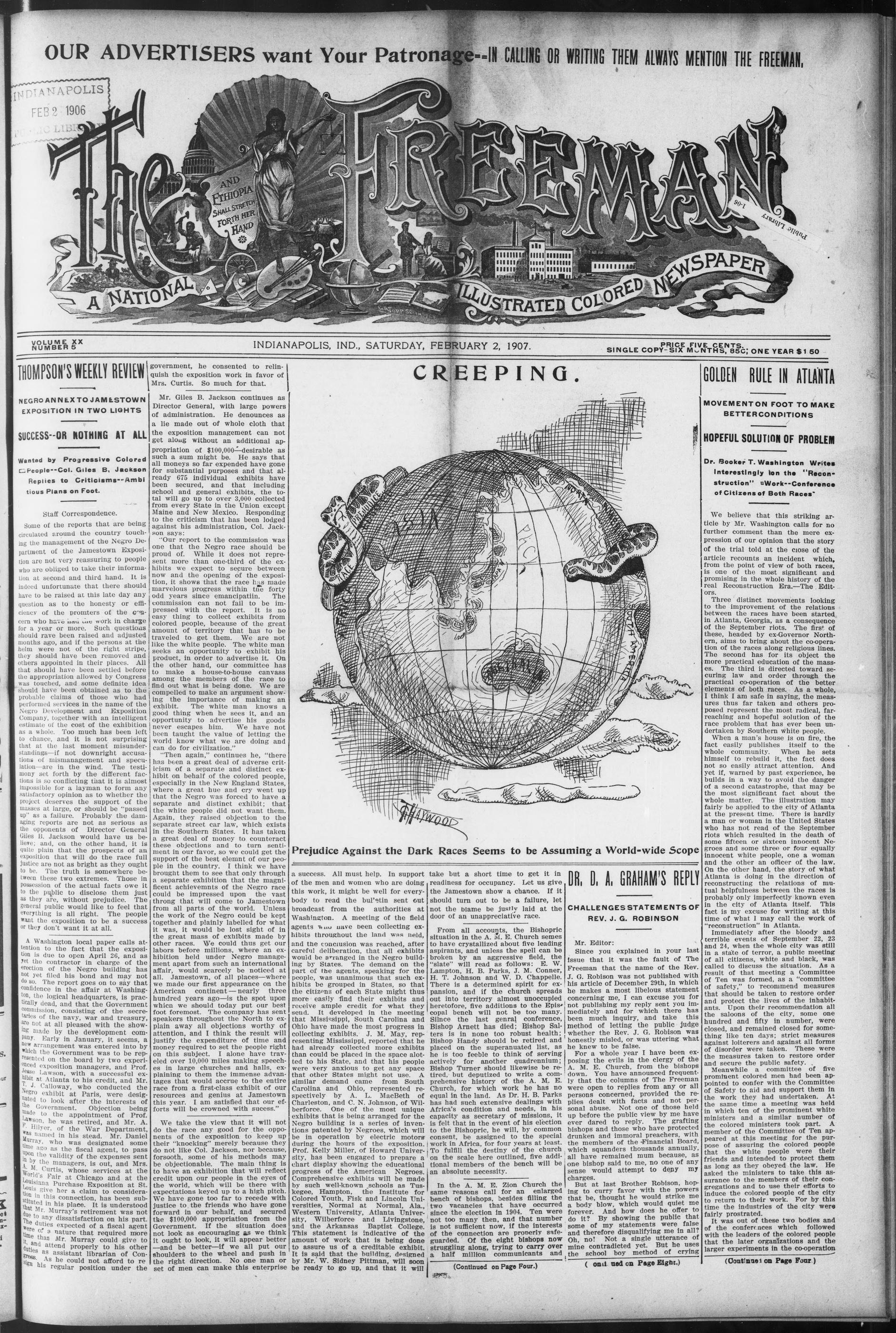
CREEPING.
Prejudice Against the Dark Races Seems to be Assuming a World-wide Scope
a success. All must help. In support of the men and women who are doing this work, it might be well for everybody to read the bul'stin sent out broadcast from the authorities at Washington. A meeting of the field agents who have been collecting exhibits throughout the land was held.
take but a short time to get it in readiness for occupancy. Let us give the Jamestown show a chance. If it should turn out to be a failure, let not the blame be justly laid at the door of an unappreciative race.
From all accounts, the Bishopric situation in the A.M.F. Church semes
DR. D. A. GRAHAM'S REPLY
CHALLENGES STATEMENTS OF REV. J. G. ROBINSON
and the conclusion was reached, after careful deliberation, that all exhibits would be arranged in the Negro building by States. The demand on the part of the agents, speaking for the people, was unanimous that such exhibits be grouped in States, so that the citizens of each State might thus more easily find their exhibits and receive ample credit for what they send. It developed in the meeting that Mississippi, South Carolina and Ohio have made the most progress in collecting exhibits. J. M. May, representing Mississippi, reported that he had already collected more exhibits than could be placed in the space alotted to his State, and that his people were very anxious to get any space that other States might not use. A similar demand came from South Carolina and Ohio, represented respectively by A. L. M. Beth68 of Charleston, and C. N. Johnson, of Wilberforce. One of the most unique exhibits that is being arranged for the Negro building is a series of inventions patented by Negroes, which will be in operation by electric motors during hours of the exposition. Prof. Kelly Miller, of Howard University, has been engaged to prepare a chart display showing the educational progress of the American Negroes. Comprehensive exhibits will be made by such well-known schools as Tuskegee, Hampton, the Institute for Colored Youth, Fisk and Lincoln Universities, Normal at Normal, Ala, Western University, Atlanta University, Wilberforce and Livingstone, and the Arkansas Baptist College. This statement is indicative of the amount of work that is being done to assure us of a creditable exhibit. It is said that the building, designed by Mr. W. Sidney Pittman, will soon be ready to go up, and that it will
take but a short time to get it in readiness for occupancy. Let us give the Jamestown show a chance. If it should turn out to be a failure, let not the blame be justly laid at the door of an unappreciative race.
From all accounts, the Bishopic situation in the A. M. E. Church semes to have crystallized about five leading aspirants, and unless the spell can be broken by an aggressive field, the "slate" will read as follows: E. W. Lampton, H. B. Parks, J. M. Conner, H. T. Johnson and W. D. Chappelle. There is a determined spirit for expansion, and if the church spreads out into territory almost unoccupied heretofore, five additions to the Episcopal bench will not be too many. Silence the last general conference, Bishop Arnett has died; Bishop Salters is in none too robust health; Bishop Handy should be retired and placed on the superanuated list, as he is too feeble to think of serving actively for another quadrennium; Bishop Turner should likewise be retired, but deputized to write a comprehensive history of the A. M. E. Church, for which work he has no equal in the land. As Dr. H. B. Parks has had such extensive dealings with Africa's condition and needs, in his capacity as secretary of missions, it is felt that in the event of his election to the Bishopic, he will, by common consent, be assigned to the special work in Africa, for four years at least. To fulfill the destiny of the church on the scale here outlined, five additional members of the bench will be an absolute necessity.
In the A. M. E. Zion Church the same reasons call for an enlarged bench of bishops, besides filling the two vacancies that have occurred since the election in 1904. Ten were not too many then, and that number is not sufficient now, if the interests of the connection are properly safeguarded. Of the eight bishops now struggling along, trying to carry over a half million communicants and
(Continued on Page Four.)
DR, D, A, GRAHAM'S REPLY
CHALLENGES STATEMENTS OF REV. J. G. ROBINSON
Mr. Editor:
Since you explained in your last issue that it was the fault of The Freeman that the name of the Rev. J. G. Robison was not published with his article of December 29th, in which he makes a most libelous statement concerning me, I can excuse you for not publishing my reply sent you immediately and for which there has been much inquiry, and take this method of letting the public judge whether the Rev. J. G. Robison was honestly misled, or was uttering what he knew to be false.
For a whole year I have been exposing the evils in the clergy of the A. M. E. Church, from the bishops down. You have announced frequently that the columns of The Freeman were open to replies from any or all persons concerned, provided the replies dealt with facts and not personal abuse. Not one of those held up before the public view by me have ever dared to reply. The grafting bishops and those who have protected drunken and immoral preachers, with the members of the Financial Board, which squanders thousands annually, all have remained mum because, as one bishop said to me, no one of any sense would attempt to deny my charges
But at last Brother Robison, hoping to curry favor with the powers that be, thought he would strike me a body blow, which would quiet me forever. And how does he offer to do it? By showing the public that some of my statements were false and therefore disqualifying me in all? Oh, no! Not a single utterance of mine contradicted yet. But he uses the school boy method of crying
( onl used on Page Eight.)
GOLDEN RULE IN ATLANTA
MOVEMENT ON FOOT TO MAKE BETTERCONDITIONS
HOPEFUL SOLUTION OF PROBLEM
Dr. Booker T. Washington Writes Interestingly lon the "Reconstruction" "Work--Conference of Citizens of Both Races"
We believe that this striking article by Mr. Washington calls for no further comment than the mere expression of our opinion that the story of the trial told at the close of the article recounts an incident which, from the point of view of both races, is one of the most significant and promising in the whole history of the real Reconstruction Era.—The Editors.
Three distinct movements looking to the improvement of the relations between the races have been started in Atlanta, Georgia, as a consequence of the September riots. The first of these, headed by ex-Governor Northern, aims to bring about the co-operation of the races along religious lines. The second has for its object the more practical education of the masses. The third is directed toward securing law and order through the practical co-operation of the better elements of both races. As a whole, I think I am safe in saying, the measures thus far taken and others proposed represent the most radical, far-reaching and hopeful solution of the race problem that has ever been undertaken by Southern white people.
When a man's house is on fire, the fact easily publishes itself to the whole community. When he sets himself to rebuild it, the fact does not so easily attract attention. And yet if, warned by past experience, he builds in a way to avoid the danger of a second catastrophe, that may be the most significant fact about the whole matter. The illustration may fairly be applied to the city of Atlanta at the present time. There is hardly a man or woman in the United States who has not read of the September riots which resulted in the death of some fifteen or sixteen innocent Negroes and some three or four equally innocent white people, one a woman and the other an officer of the law. On the other hand, the story of what Atlanta is doing in the direction of reconstructing the relations of mutual helpfulness between the races is probably only imperfectly known even in the city of Atlanta itself. This fact is my excuse for writing at this time of what I may call the work of "reconstruction" in Atlanta.
Immediately after the bloody and terrible events of September 22, 23 and 24, when the whole city was still in a state of terror, a public meeting of all citizens, white and black, was called to discuss the situation. As a result of that meeting a Committee of Ten was formed, as a "committee of safety," to recommend measures that should be taken to restore order and protect the lives of the inhabitants. Upon their recommendation all the saloons of the city, some one hundred and fifty in number, were closed, and remained closed for something like ten days; strict measures against loiterers and against all forms of disorder were taken. These were the measures taken to restore order and secure the public safety.
Meanwhile a committee of five prominent colored men had been appointed to confer with the Committee of Safety to aid and support them in the work they had undertaken. At the same time a meeting was held in which ten of the prominent white ministers and a similar number of the colored ministers took part. A member of the Committee of Ten appeared at this meeting for the purpose of assuring the colored people that the white people were their friends and intended to protect them as long as they obeyed the law. He asked the ministers to take this assurance to the members of their congregations and to use their efforts to induce the colored people of the city to return to their work. For by this time the industries of the city were fairly prostrated.
It was out of these two bodies and of the conferences which followed with the leaders of the colored people that the later organizations and the larger experiments in the co-operation
(Continuation Page Four)
ABOUT PEOPLE AND THINGS.
Hon. Judson W. Lyons, formerly Register of the Treasury, is about to open an office in Washington for the practice of law, and will make the national capital his permanent home. He owns fine property there and will make a valuable citizen.
The Third annual edition of "The Colored People's Blue Book of Chicago" has been issued by Mr. D. A. Bethea, an enterprising young man of the Windy City. It is neatly bound in blue cloth, and contains the names, addresses and business cards of Chicago's most energetic and public-spirited citizens, selected not because of their so-called "blue blood," but because they belong to the nobility of race builders and royalty based upon moral and material worth. The book is a decided improvement upon all previous issues, and it is alike creditable to the author and to the people whose activities it reflects.
Dr. Booker T. Washington rises to the high-water mark of magnanity in praising the anniversary number of the Chicago Broad-Axe, which has opposed him more vigorously and persistently than any other journal in the country. It takes more than ordinary greatness of soul to see any merit in an opponent who, to paraphrase Dr. Washington's comment, has not agreed with him in the past, and may not agree with him at any time in the future. Editor Julius F. Taylor did get out a good number on his eleventh anniversary, and whether we are on his side of the fence or not, it does not hurt anybody to give him due credit for a first-class piece of journalistic work. If Mr. Taylor isn't right, let us help him to get right.
W. T. Menard, the versatile quill driver, is doing some excellent literary work on the Washington Record; John Wesley Cromwell, whose fingers itch for the pen, compensation or no compensation, is contributing reminiscences anonymously for the New York Age, and Roscoe Conkling Simmons radiates out of New York into the columns of the Charleston (W. Va.) Advocate. Bishop J. W. Smith got the writing habit while editor of the Star of Zion, is keeping up the warm pace he set while in Charlotte, and when the Afro-American Council met in Washington last week he put out one of the best news letters on the session that the body has ever had. The pensmiths are busy these days, and it is well for the race that they are.
William C. Matthews, the former Harvard baseball and football player, has been settled on as coach of the Noble and Greenough school track team this winter. Captain Charles Cotting made the announcement and preparations for the various indoor meetings to be held during the winter started immediately after the Christmas vacation. While Matthews is probably unknown to the followers of track athletics, he has had experience in that department of sport, having been a member of the Andover track team before going to Harvard. While at Cambridge he spent the greater part of his time at baseball and football, being satisfied with the honors to be gained in those two leading branches of sport. He was a sprinter and a hurdler at Andover and with his ability to grasp the fundamentals of sport quickly, should make an excellent coach.
A wildcat rumor, for which nobody appears to be responsible, is being circulated to the effect that President Roosevelt "threatens" to appoint a colored man as collector of the port at Cleveland, Ohio, "to spite Senator Foraker" because of the latter's antagonistic attitude on the Brownsville episode. The name of John P. Green is mentioned as the possible recipient of the President's bounty. Mr. Green is a relic of the former hanna machine, and has been identified with the school of politics opposed to the domination of Senator Foraker, consequently, as rumor has it, his appointment would be a slap in the face of Ohio's senior Senator, and an afront that would be particularly distasteful, viewed from every standpoint. The gossip can be taken for what it is worth. We take no stock in it, for such political methods—savoring of the peanut variety—are beneath the dignity of a man of President Roosevelt's high-grade caliber. Just now, one may expect to hear almost anything.
Our deepest sympathy goes out to Dr. George C. Clement, the scholarly editor of the Star of Zion, who had the misfortune to lose the sight of his right eye a few days agi, at his home in Charlotte, N. C. Dr. Clement was making ready to leave for Salisbury to attend a meeting in the interest of Livingstone College's Quarto Centennial. Before going, he thought it well to chop some woid for his family, as his children are small, and there would be no one else to replenish the supply during his absence. While performing this task, a piece of flying wood struck him directly in the right eye with such force as to totally destroy the sight and badly
THE FREEMAN. AN ILLUSTRATED COLORED NEWSPAPER.
bruise the flesh in the vicinity of the eye. He is being treated by an eye specialist, who is doing all he can to relieve his patient, yet the editor's nerves were so greatly shocked that he is suffering intense pain and may not be able to attend to his duties for some time. It is said that the sight cannot be restored to the injured right eye, but it is hoped that the affliction will not extend to the remaining organ. Bishop G. W. Clinton is in charge of the editorial department of the Star of Zion during the temporary disablement of Dr. Clement.
Dr. James E. Shepard, field secretary of the International Sunday School Association, with Prof. R. B. McRary as traveling companion, sails from New York March 2 for Europe and places in the Orient, reaching Rome in May, where he addresses the World's Sunday School Convention. Dr. Shepard goes on this trip, first, for the personal help that it will give him in his work among his people, and, second, for a change that will benefit him physically, as he has had no rest in more than four years. He says:
"I am glad to be able to give the assurance that the Sunday school work among the Negroes of the South was never in better condition than it is today. The State secretaries are more encouraged and plans for future work are being carefully systematized. The secretaries are also loyal and conscientious, and the work will not suffer by my enforced absence."
Dr. Shepard wishes to hear from friends while en route and has prepared a card giving his itinerary in compressive form. Letters mailed prior to March 15 should be sent to Cairo, Egypt, care of Messrs. Thomas Cook & Son, tourist agents; after March 15 and prior to the 28th, letters may be sent either to Alexandria, Egypt, or Athens, Greece; prior to April 10 to Naples, Italy.
The truth of the old adage that "theools are not all dead yet" was strikingly exemplified one day last week down in Arkansas—although it occurred to us that a state that produces men like John E. Bush and Judge M. W. Gibbs and has gumption enough to push a ministerial giant like Dr. J. M. Conner for the Bishopric, ought to produce an equally noble order of white men. Anyhow, one "Col." R. S. Little, a planner of the Legree type, bought some goods and tendered as payment a $50-bill. Among the change that came back to him was a crisp $20-bill, bearing the name of "W. T. Vernon, Register of the Treasury." He indignantly refused to accept, saying that "the idea of having a black nigger's name on the money that a white gentleman has to use," was more than he could stand and he demanded that he be given his change in silver. He got it. Intelligent people, white and black, must feel sorry for fellows who live in such narrow ruts as the rightly-named "Col." Little. There is much missionary work for Messrs. Bush, Gibbs, Conner, Keatts, Jones and other big-hearted colored leaders to do down in Arkansas.
"The Horizon" is at last athwart the national vision. The publication is unique, though rather disappointing in size, the twenty-eight pages being but five inches by four in dimensions. The workmanship is good, though the management has been economical enough to preserve the best type left from the outfit of the late Alexandra Home News. There is a peculiar fitness in having the three distinguished editors write over their own signatures, for under that arrangement each fellow will get full credit for what he contributes to the "brain pot" of the concern, and again, no one can put the blame on his partner for the appearance of an article which may cause a racket. Prof. W. E. B. DuBois writes of "The Overlook," Mr. L. M. Hershaw gives his matter as "The Outlook," and Mr. F. H. M. Murray talks as perly as "The Inlook." "The Horizon" is attracting more than the usual interest attaching to a new magazine venture, largely because of the national reputation of its promoters, and because of some curiosity as to whether the erstwhile warfare upon Dr. Washington will be made its predominant feature. If the able publishers listen to their better judgment and get out a clean, wholesome and broad-gauged magazine, defending the race in fearless and honest fashion, eschewing personalities that embitter, without helping us upward, Messrs. DuBois, Hershaw and Murray have more than a fighting chance for success. The people will not sustain an organ that has for its primary object the undoing of any useful man or cause. "The Horizon" has a brilliant opportunity.
Phil Waters, West Virginia's irrepressible young leader, has again broken the ice and landed a choice political plumb. On the 14th he was unanimously elected clerk of the Finance Committee of the West Virginia Senate, now sitting in legislative session in Charleston. Mr. Waters was for six years clerk of the same committee in the House of Delegates, and to go to the Senate in the same capacity is a decided promotion. He was also secretary of the Democratic caucus of the House, which is an innovation for a Southern State, especially when it is well known that "Phil" is a Republican of the rock-ribbed variety, and a foeman worthy of the steel of the best warriors the party of Jefferson and Bryan can marshal on the banks of the classic Kanawha. Mr. Waters is a brilliant orator, and it is doubtful if he has an equal of his age in the country. It has fallen to his lot to second the nomination of every Republican nominee for Governor of his State since 1892, and his voice has made the welkin ring on mountain top and in valleys in every campaign since that time. He graduated from the law department of the University of Michigan in 1895, carrying off a goodly share of the laurels of his class in
Forming a Capital of $7,000,000—Is the Greatest of all Negro Movements—Every Negro In America Ought to Take at Least One Dollar's Worth of Stock In It At Once Without Delay.
oratory and legal lore, and was noted as a leading athlete. He is a prominent churchman and Mason. Mr. Waters, though young in years, has held some important positions of trust and responsibility in his State, being strongest where he is known the best—among his immediate friends and neighbors, being loved and respected by both races alike. In 1896 he was librarian of the House of Delegates from 1897 to 1902, corporation clerk in the office of the Secretary of State; 1902, deputy United States marshal, and served in the same year as clerk of the Finance Committee of the City Council of Charleston, W. Va.; the net year he began his duties as assistant clerk of the Supreme Court of Appeals of the State. Mr. Waters is an expert statistician and has been the clerk in charge of the State appropriation bills at every session of the legislature since 1903. Not long ago he was favorably mentioned in connection to the office of assistant register of the United States Treasury at Washington. In any event, Mr. Waters has proven so faithful wherever stationed that a promotion to one of the highest positions under the general government may easily be predicted for him during the next few years—and all will agree that he will eminently deserve the honor. With the colored people of West Virginia, Mr. Waters is a prime favorite, and should he be summoned to Washington, "from works to reward," as it were, they will be "tickled to death." The country at large knows him likewise, and the race everywhere joins in the request to the "powers that be" to let "Phil" just walk up to the "pie counter" and help himself to whatever he wants. The best is none too good, and if the registership of the Treasury doesn't happen to be available at that time, let the "high and mighties" see to it that he gets "something equally as good." Senators Elkins Scott, the several Congressmen, ex-Governors Atkinson and Wgite, and the present chief executive Dawson, all owe this brilliant young Lochinvar a big debt of gratitude for effective services in behalf of the Grand Old Party at critical moments. Surely, they will not fail to respond to his "Macedonian cry" when he asks for a tryout at the heavy patronage bat.
Prof. William Jennifer of Texas, who is engaged in collecting data concerning the numerical strength, wealth and other statistics of the colored Methodist churches of this country, has covered an immense area of territory in quest of information, and has been pleasantly received everywhere. His work has also evoked complimentary mention at the hands of Hon. S. N. D. North, the director of the census. Prof. Jenifer is a conscientious and industrious worker wherever his activities lie, and his final report is bound to be an illuminating compendium of what Negro Methodism is doing to build up the waste places of earth and to heighten the status of civilization within the race. Such a reliable statement has been sorely needed for some years by those who have to do with the problem of races. AR-UU-TEE.
The Royal Trust Company, with its headquarters at 2111 Columbia Avenue, Philadelphia, Pa., is the greatest Negro Syndicate ever formed in the history of the world for the uniting and uplifting of the poor classes of members of the whole Negro race of America. It, without question, is the fairest of all the devices ever created for the deliverance of any and all the dependent and helpless members of the Negro race. The founders of the great company has made room for over seven hundred thousand (700,000) of the worthy young men and young women of the Negro race to be united together in the management and the business of the company, and the company has made it possible for the very poorest and weakest members of the race everywhere to take stock in the company. Just think of it. Stock is being sold now in bonds all over America at twenty-five (25) cents for each bond or share. Bonds containing four shares are now sold for only one dollar ($1.00) and the company, in order to keep from having to write and explain the particulars in writing, has published a book it sells for 25 cents per copy. These books make known all particulars and qualifies the leaders of it for representing the company. Any one who buys one bond or one book are at liberty to sell stock or bonds, or act as a solicitor for the total fund for the company for a term of five or ten years. The company offers great rewards for trustworthy agents, and it guarantees satisfaction to every member of the race that
MAGAZINES FOR FEBRUARY.
Ainslee's for February has a mervelously good table of contents. Besides the first instalment of a new serial story by Horace A. Vachell, it contains fiction by Jacques Futrelle, Roy Norton, Arthur A. Knipe, Anna A. Rogers, Will Irwin, Forrest Crissey, Jeannie P. Ewing, Josepn C. Lincoln, Martha McCulloch Williams, and Constance Smedley, and not a dull page from beginning to end.
***
"The Man Who Was Buried" is the remarkable title of a remarkable novel that opens the February Popular. In it Mr. Crittenden Marriott, the author, presents the signed statement of a man who to all appearances died and was buried and some months later reappears and is discovered wandering about Battery Park, New York, in utter helplessness of mind. From this beginning Mr. Marriott leads the reader through scenes of mystery and excitement, unfolding a problem that is all but impossible of solution.
\* \* \*
Theodosia Garrison and Frances M. Livingston have collaborated on the novel which takes up the first portion of the 192 pages of The People's Magazine for February. This story, entitled "The Last Van Cleeve," deals with the life of the three remaining members of a proud and once wealthy metropolitan family. The piteous pretenses of the mother and elder daughter, the fine sincerity and courageous self-reliance of the younger and more likable sister, are well contrasted. Two love stories run side by side in the novel, which also shows not a little of the life of a comic opera troupe on the road.
***
The February Smith's comes to us with a complete novelle, "An Insular Prejudice," by Adeline Knapp, a series of well-printed half-tone reproductions of the famous Indian paintings of Edwin Willard Deming, the well-known American artist; a funny story by Holman F. Day entitled "The Go-uppers," and a half dozen short stories of more than usual value, several departments conducted especially for women, and a number of special articles, in which timely subjects are handled interestingly. Besides these, the magazine contains a series of drawings by A. G. Learned, entitled "Fads of the American Girl." A previous series of drawings by Mr. Learned, entitled "The Veil," and published some months ago, made somewhat of a sensation among those who like pictures of pretty women. The new series is done with even more delicacy and fancy, and is splendidly reproduced. The magazine also contains a short novelle by Robert Barr, "A Question of Money," and a generous instalment of a new serial by Charles Garvice, "Where Love Leads."
Send a dollar to the One-Cent Savings Bank at Nashville. Tenn., Mr. J. E. Napier, casnier, and swell the defense Fund of the National Agro-American Council to the necessary $100,000. Send it to-day.
GRO SYNDICATE
Greatest of all Negro Movements—Every take at Least One Dollar's Worth Once Without Delay.
buys a book or a bond, or their money will be refunded. Great God every Negro ought to buy at least $1.00 worth of the bonds and become a member of the great Royal Trust Company syndicate immediately without delay. And see the great advantage men and women have who become faithful stockholders or bond buyers in the great company. By the Negro people and uniting in the Royal Trust Company and helping the founders of the company unanimously to carry out its plans, the way it is going now, the company can easily gather for its stockholders and bond buyers over $422,600,0.0 every five years for the next fifty years to come. The company has no equal in splender, and it aims to draw in over 100,000 members into it by April 1, 1907, as after that date it will form a chain of managers and rulers throughout every State and Territory in America and form a dictorial college of training at the head of it that will be glorious! Reader, take my advice. If you want to do something that you will be proud of yourself you send in to-day and take a dollar's worth of bonds or stock. They increase in value every day for five years. Address
P. S.—Every member of the Negro race that buys at least $1.00 worth of bond before February 1, 1907, they will get double value for their swiftness in taking stock in the Great Syndicate Royal Trust Bonds.
FORD'S HAIR POMADE FORMERLY KNOWN AS "OZONIZED OX MARROW" Makes the Hair Long, Soft and Easy to Comb READ WHAT THE PEOPLE SAY
VICTOR
TALKING
MACHINES.
The Victor is so perfect it is often mistaken for the human voice. It is proving a never falling source of DELIGHT to Thousands.
COME IN AND LET US
TELL YOU all ABOUT it.
SOLD ON EASY
PAYMENTS
Phones Main 852
New 9093.
KOEHRING BROS.
878, 880, 882 VIRGINIA AVENUE.
Advertise in The Freeman.
CHICAGO-NEW YORK ELECTRIC AIR LINE RAILROAD STOCK
THE stock of the Chicago- New York Electric Air Line Railroad is now selling at $35 per share of the par value of $100. and at that price offers an unprecedented opportunity for investment. Space here will not permit us to give particulars, but we will be glad to send you full information upon request.
DO NOT REMAIN IN IGNORANCE
of an opportunity that comes not oftener perhaps than once in a lifetime, when you can learn all about it for the simple asking. Purchases may be made if desired upon the easy payment plan by making a down payment of $3.50 per share and further payments of $3.50 per shar for the succeeding nine months—a total of ten payments.
Cut out this announcement right now. if you will, while the matter is fresh in your memory enclose it in an envelope with your name and address and forward it to the undersigned who will at once send you information that if taken advantage of will mean financial independence for you for the rest of your life.
GABEL & CLINTON.
Indiana Fiscal Agents,
617 Traction Terminal Building,
INDIANAPOLIS, IND.
In writing mention The Freeman.
Joy West, Ph. A., Aug. 28, 1904.
I used only one hair color. My hair has stopped breaking off and has greatly improved. When I started using this wonderful preparation my hair was seven inches long and ten inches or more in length. 314 South St. MINNIE FOASTER.
Brookhaven, Miss. Ages 13.
Gentlemen! I am preparing an preparation so excellent for the hair. My hair is truly beautiful and rather beautiful than I have been using your hair pomade my hair has turned black like it was when I was a teenager. I have a lively, closely color.
Gentleman. Aug. 13, 1900.
Gentleman. I must say I never tried any preparation so excellent for the hair. My hair was turning grey and rather dullly dark; now I have been using your hair pomade my hair has turned black like a lace. My hair is thick and it has a lively, glossy color.
C. L. ROBERTS.
Atlanta, Ga., June 6, 1900.
Gentleman. I have found it to do more than it is recommended to do. It stops the hair from falling out and have found it to scale the scalp. It the hair soft, pliable and glossy. AUGER REN
PAWNBROKER
We loan money on Diamonds, Watches, Jewel and all articles of value LOWEST RATES
Ertel's Loan Office,
209 Massachusetts Ave.
Private Entrance, 108 E. Ohio St.
New Phone 1790
'A Friend in Need
Is a Friend Indeed."
Nathan T. Ward,
PROFESSIONAL
BONDSMAN
Room 1 Wilson Block,
12 N. Delaware St.,
Residence 507 Hiawatha St
Indianapolis, Ind.
OFFICE RESIDENCE
N w Phone 3458 New Phone 2666
Send Your Next Bundle to the
Hoosier Laundry
320 Indiana Ave.,
The Place where Linens last
We also do FAMILY WASHING Rough Dry at Five Cents Per Pound The preacher of peace promoteth prosperity.
HER POMADE
KNOWN AS
OX MARROW"
Soft and Easy to Comb
THE PEOPLE SAY
West Chester, Pa., Mch. 20, 1905.
I had typhoid fever and my hair all came out. I used three bottles of your pomade, and now my hair is nine inches long and very thick and nice and straight. Most every one seeks how good your pomade did my hair, they too are anxious for it. My hair is an example to every one. Yours respectfully, ELLA BYE.
Colvert, Tex., Mch. 31, 1905.
I have used one bottle of your pomade and my hair is now perfectly straight, soft and black as silk. I will not be without it.
RHODA EDWARDS.
Colvert, Tex., Mch. 31. 1906.
I have used one bottle of
your pomade and my hair
is now perfectly straight,
soft and black as silk. I will
not be without it.
RHODA EDWARDS.
Paris, Mo., July 6, 1898.
Gentleman: When I began using your pom-
made my head was so bald I was ashamed of
mine, now my hair has grown three inches
all over my head and I have been
two months.
IDA FARTER.
unity to the gentleness of the statement," he Freeman. "You know as "OZONIZED OX MARROW," so can be put up in any style desired consistent on known to us that makes Kinky or Curly makes the most stubborn, harsh, kinky or rub. These results may be obtained from one of our products. It removes and prevents dandruff, relieves from falling out or breaking off, makes it grow, and vigor. Being elegantly perfumed and fragrant, it has been made and sold continuously since MARROW" was registered in the United States if time there has never been a bottle returned. FORD'S HAIR POMADE remains sweet. FORD'S BAMS, as its usual use of imitations. Remembrance of FORD'S ROW") is put up only in 50c, size, and is made as the signature, Charles Ford, Presst, on each with every bottle. Price only 50c. Sold by
If weak, worn-out, nervous, cannot sleep; have indigestion, headache, neuralgia or periodic pains, it is because your nerves are weak. It is the lack of nerve force that makes the stomach, heart, lungs, etc., work imperfectly—become sick. Dr. Miles' Nervine cures the sick when it restores nerve strength, and puts the power behind the organs to do their work.
"Almost three years I suffered from nervousness, indigestion, and palpitation of the heart. I could not eat or drink until I was hurt. I without suffering. Altogether I was in a bad condition. My doctor did not seem to do me any good. I had tried so many remedies that I did not have any good. Dr. Miles' Nervine was suggested by a friend. I got relief from the first, and after a few days I was able to do all of them. I relieved my heart and nerves, but has invigorated my whole system. I am very grateful. Because since I have been able to do absolutely no return of my old trouble." MRS. HOWARD FORD, 60 Summit Ave., Worcester, Mass. Dr. Miles' Nervine is sold by your doctor. The first bottle will benefit. If it fails, the will refund your money. Miles Medical Co., Elkhart Ind
Are you fond of your face? If so, use Williams' Shaving Soap.
Sold everywhere. Free trial sample for z-cent stamp to pay postage. Write for booklet "How to Shave." The J. B. Williams Co., Glastonbury, Ct.
Wm. Billingsley,
Florist
Choice Cut Flowers
Designs a Specialty
Old Phone, Main 3712
New Phone 3002
201 N. Illinois St.,
Indianapolis.
50,000
BOOKS FREE By Mail
treating on all the
DISEASES PECULIAR TO MAN.
THIS BOOK contains many illustrations and is a storehouse of knowledge for both old and young who are suffering from excesses, lost vitality, nervous disorders, blood poison, stomach, kidney and bladder diseases. It explains how you can successfully "are yourself at home."
DR. JOS. LISTER & CO.
40 Dearborn St., A-8. Chicago, Ill.
THE MAGIC SHAMPOO HAIR DRIER
After a bathor shampoo the hair can be DRIED and STRAIGHT ENDED with the Shampoo Drier. It is the only device which will straighten curly hair without straining it early. It will estimate its growth and make it look natural and beautiful, which adds a key appearance. The Shampoo Drier is a steel bar with a receptacle contacting a six inch diameter. By main price $1.00. Agents wanted.
"The Shampoo Drier is used in my pars. with perfect satisfaction." - Madame Cosart, 17 ken touche, Montclair City, N.J.
Magic Shampoo N. Drier Mfg. Co.
40 Century Blvd. Minneapolis, Minn.
DO YOU WANT
Your Money to Make Money?
Agents make $3 to
$5.00 a day. Agents wanted, male and female, ministers, school teachers, music teachers, band and orchestra leaders, secretaries of Odd Fellows, Masons Knights of Pythias, Elks and Red Men lodges, and any one who wants a permanent income. Send 25c for samples and full particulars to the University Purchasing Agency and Supply Co., 111 Tichenor street, Newark, New Jersey.
GOOD QUICK & ARTISTIC
ENGRAVING
JIMANA ELECTROTYPE CO.
80-20 W. PEARL ST. INDIANAPOLIS
SANTAL-MIDY
Standard remedy for Gleet,
Gonorrhoea and Runnings
IN 43 HOURS. Cures Kid-
ney and Bladder Troubles.
MIDY
Big Salaries
Men and women
of every age are
making Big salaries
with us.
Home, office, want some one in your neighborhood. Are
all well cared for. Write to day. Big money for you.
MIDY ANIMAL ACTIVITY GH. Box 2150 Detroit, Mich.
The Tuskegee Negro Farmers' Conference next month will be bigger and better than ever.
THE FREEMAN, AN ILLUSTRATED COLORED NEWSPAPER
"FILOSOFY" OF NOAH BAXTER
SAGE OF MARBLE FALLS RE-APPEARS AT OUR ROUND-TABLE
Plantation Views of Roosevill's Anti-Negro Policy and Tilt. With a Few of the "Gre a Writers" of the Day.
That boy Thompson thinks he's right on his Uncle Noah's trail. Yes, sir; he sure feels somehow he's got the old man now. Dr. Majors is one of them skolars what writes big things, big, logikal subjecks, and is too high-toned to stoop down to Marble Falls filosophy. Yes, sir, he is one of them big Round Table writers, and B. Square is another one of them big sky-scrapin' skolars. Yer Uncle Noah Baxter could not stand where they stand, for the ground is holy. The subjecks air too mighty and the old man is too old now to pitch in and fite like he wonce useter fite against them youngsters. The old man has been leadin' a life of konklusion. Yes, sir, it was too strenyous to be callin' down them giant writers all the time, insistin' on they colledge sense to be simplified so that the common peepul could comprehend their big words. The minstrousness of their glitterin' generalities and oratorikal platitudes was worse than the noise of Jupiter Pluvius when the Aurorus Boralis is tryin' hard to tell the peepul if the earth that it is 'bout to rainp fitchorks and tadpoles. U who use to read yer Uncle Noah Baxter's filisophy kin see that the old man from Marble Falls has bin to skule himself. Yes, sir, I done git me one of them Great and Latin Skolars, like 'Fessor Duboiz, ter teach me, so I gues you'll laf on the tother side of yer fase when yer see this letter from me.
The ole man is seed his best days and he don't want nithin' Mr. Rosenfelt's got at Wash'ton or nowhere else. Mr. Rosenfelt's not act'r rite, nowhow. He is a sharp politishan anyhow. He did not discharg' them soljers 'fo' the 'lection. He nu better. Did he do it fair? No, sir. He jes' took um and discommishum um without word. Did he try um? No, sir. He jes' disqualified them soljers who has fit our kuntry's battles from Bunker Hill to San Juann Mountin, an' he did it without givin' um a moment notis. The boys are innermost. They did not shoot up no town and Mr. Foraker says them boys mus' have their rites. Another thing. Yes, sir. I noze what I'm talkin' 'bout. I'e red history from the fust enock of Jimestown an' Plymouth creek, when them Puritins come over to Amerika. Didn't they fite the Injuns, steal their kuntry from um? Co'se they did. Did the Injuns go inter slavery? No, sir. They died dead 'fore they be white fokes' slaves. Did them Puritins bring Negroes to Amerika on enpleasure trip? No, sir, they did not, and sure's you are born, they made the Negroes do what they could not git the Injuns to do. Did the colonies die for pervishun? No, sir, they did not. They colored peepul from Africa kep' up the rashuns, and here is where the Negroes saved the white peepul agin. They allus did do mo' fer尔恫 fokes than fur theirselves. I reckon they allus will. President Roosenfelt orter realstate them soljers; he oes it to hisself. Yes, sir he air a grate man an' he or heter jus' an' give back their commissary What will them discharg' soljers do? Sum old in wearin' the uniform, they don't how to do nothin' niw but don't the straps an' the musket, ser the gugal call an' walk on the picket gard of patriotik sum. Sum of um saved Mr. Roosenfelt from gittin killed at Helcan Hill, when he wuz srounded by them Spanyards as thick as bugs on one of them 'lec trick lites in New York when the air are damp and it is foggy. He ain' no Kristeen if he keeps in actin 'ginst this po' down-trodden peepul.
Ise bin readin' his messenger to Kongress and I stung with obstreperousness and unholly indignashun whin I cum to that part of it when it sez: "Don't you colored peepul sheer krinnals; tell on each other, and the white peepul wil no yu air honest." And again where he sez, "colored peepul must not furt with the mib and shure must on they side of the fence, fur the Negroes air guilty of too much rape, and we white fokes won't put up with it." Now, Mr. Editor of The Freeman at Indianapolis, I don't like no such talk cumin' frum him. Sir, he didn't do us rite, sir, nohow. We numinate him, voted him there, and, to be men, held up his han's till he thru us down. Another thing, Mr. Editor, our chief magistrat at the white house, he is more like his mother then is like his father. She wuz wrum the South, and Georgia, at that, and, yes, sir, he is jus' actin' like them Georgi's who ain't no use use Negroes, but wurk um and sho' um they place.
I read about that Sinter Tilman, frum South Carline, what he said. He air no Kristian nuther; he air all the time makein' trubble everywhere he put his foot down. He air one of them po' white trash, offshutes of anti-bellion white, who nu nothin' but fite self-respectable colored flkes who heilt up their heads. Sheecargo learnt him a lesson he won't sune furgit, and that air Maler Dunn plaid a trick on them peepul and wouldn't go to that hall. I hear he air a democrat, but if he is he ain't no hippocrit.
Sence I write for the Freeman I see lots of big Negroes cumin' up. That boy Thompson, he air at it, writin' big Negroes inter prominence, and what is he doin' fer himself? I ask him that. Is he gittin' hisin? He orter be gittin' it, and every big one he helps to get bigger order ti help him; he is 'titled to honur. Yes, sir, that boy Thompson, he air worthy to be a seniter or anything else.
Mr. Editor, I has not jumped on any of them grate riters, an' I don't want no fite with um and don't want no cogitatin and opponents, as I am almos' reachin' my niety mile in the home stretch of the race of life, and that boy Thompson must keep hiself off me, and them grate riters, Dr. Graham, Dr. Jones, Dr. Roberson, who lives in Lewisvil, and them northern skolars with their sharp pens like B.
Square, that boy Cary Lewis and that Mr. Brock and Dr. Majors, who use to make everything he hit stak fire. Ni, sir, I ain't fit no more to sit at that Roun' Table, even if I has a edukashun frum one of them Great Skollers. I jes' have to make myself sorter easy roun' the fireplace and rake the roastin' pertaters outen the ashes these winter nites, as they sputter and steem with the juice of heaven tellin' me they air dun. No, sir, I lak that 'dustral edukashun which teaches the race to raise sweet pertaters and see all the tangibul material of the yuniverse, kause etheral blessings in the head, ain't gwine to please no stomak when the whistle bloze ferr dinner.
Ise 'bout dun niw, and 'fore I say my last word I jes' wish to add: Frum readin' 'stensively the grate jernals I has cum to sum seclusions that air secret wisdom, an' if the grate riters will stan' offen me I will write from Marble Falls again sune, In the time 'betwix this letter gittin' published and tu weeks I will, between settin' sum hens, killin' a shote and roastin' pertaters, try an' snatch a few idears from the top plate of my perpendicular physiognomy fr the delectable satisfaction of your very cogent and much elated reads of a sky-scraping effort of modern journalism to which the fleeting mind of your inimitable correspondent has long held forth in rapturous delight, a findness of sincere attachment.
Till then, adieu, you readrs of The Freeman. Thompson has outwitted Gentlemen, be seated at the Riund you. Uncle Noah is himself again. Table. NOAH BAXTER, From Marble Falls, Texas.
WHAT A FEW OF THE EDITORS ARE SAYING
—Expensive Folly.—
The foolish panics about special
equality and "Negro domination," are
costing the South thousands of dollars.—St. Paul Appeal.
* * * *
—Tillman Muzzled for Once.—
Senator Tillman is confronted by a dilemma in the Brownsville affair, being incapable of enthusiastic sympathy with either the colored troops on the administration. — Washington Star.
* * *
More Tuskegee's Needed.—
The institution at Tuskegee is the most powerful and effective agency in existence for the uplifting of the Negro race, and the South can not have too many schools of its kind.—Leslie's Weekly.
* * * *
—Self-Help the Most Effective Help.—
The Negro has reached the conclusion that self-help is the paramount issue in the solution of the race problem. Hence in the recent riots there were some of the other fellows left on the ground, when the crack of the Winchester had died away. God helps him who helps himself.—Western Christian Record.
—Now, Wouldn't That Be Something
Dreadful?—
If he can take possession of the public schools of California and compel the State to admit to them Japanese students contrary to the laws of California, he could with qual propriety send an amendment to the Santo Domingo treaty and demand the admission of the Negro children of Santo Domingo into the white schools of South Carolina or of any other State of the Union.—Senator Rayner of Maryland.
—Our Friend at Court—
Senator Joseph Benson Foraker of Ohio, a warrior of the old school who "sniffs the battle from afar," is the only public man in the situation so far who has risen equal to the demand of the whole country that lynch law methods shall not prevail in the administration of the laws, civil and military, that the innocent shall not suffer with the guilty, and that neither shall be "deprived of life, liberty or property without due process of law."—New York Age.
—Education That Hits the Mark.— Only that education is practical which educates the head, the hand and the heart, and fits one to fill some important place in the affairs of life; all other is a mockery. * * * * All of our boys will not be mechanics, nor will all our girls become teachers. Some will seek employment in the many business enterprises conducted by the race. To fill these positions acceptably they must needs have a thorough training in business methods. Negro Criterion, Richmond, Va.
—Had Enough of Rooseveltianism. Mr. Roosevelt, who before his Draconic order on the colored soldiers was fairly idolized by the Afro-American people, could not be elected again if he could be nominated, for he has slitted the jugular vein with them not only on the soldier racket, but because he says the crime of rape is peculiarly frequent with black men, that the Negro race harbors its criminal element, and that black men should in earnest assist the officers in running down every infamous offender. —Bishop J. W. Smith, in New York Age.
—Too Hasty and Too Sweeping.—
Accompanying the President's message on the discharge of the colored troops, there is no new evidence bearing on that case. There are appended several military precedents for the discharge of soldiers, or the disbandment of organizations, but these were all, with one exception, in time of war, and for openly mutinous or cowardly conduct. The parallel with the 25th infantry is by no means complete. Mr. Roosevelt makes it clear that he had it in mind to do an act of signal justice, and in the interest of discipline in the army; but it seems clear also that he was too hasty and too sweeping.—New York Evening Post.
* * *
—Safety Lies in Right Doing.—
Very great alarm is felt over the comment by the colored press upon Senator Foraker. The politicians are beginning to take the situation seri-
ously and, they say, unless a change comes in public sentiment. Senator Foraker will be the nominee of the Republican party in 1908. They point out that his speech at Chattanooga, Tenn., sometime ago places him on record as a great and fair man to all of the citizens of his country, regardless of color. They say he does not wish to show any special favors to the colored people, nor do the colored people want them, but he simply means to stand for fair play. And it is this attitude, they assert, that is making him so strong with the regulars in the grand old party and his colored constituents. — Washington Record
—There are Others.—
The committee selected, at Simpson's Chapel New Year's Day to keep alive the emancipation spirit in this city, so far as its personnel goes, is all right, but it is entirely too ministerial. Somebody else was freed by Abraham Lincoln besides preachers, and in justice to all there should have been others appointed besides the clergy on this committee. As it now stands it begins with reverend or doctor and ends with the same. We suggest a change in this program before another year rolls around and thus spare the originators of the movement of adverse, uncharitable and unfavorable criticism. The emancipation proclamation freed everybody—both "saint and sinner."—Indianapolis World.
AT THE EDITOR'S DESK
The House of Representatives at Washington has set apart February 2 for the delivery of memorial eulogies on the life, character and public services of the late Senator Arthur Pue Gorman. It is safe to predict that there will be no howling demand for seats on the part of Negroes for this perfunctory function. There was nothing in common between the notorious Marylander and the black man.
"The Black Battalion," a speech delivered in the United States Senate, December 20, by the Hon. Joseph Benson Foraker, of Ohio, is having a tremendous vogue. It is a great speech on the topic that lies closest to the American heart-to-day. It is a philosophic defense of a vital principle of our constitution and in advocacy of the supremacy of justice over administrative tyranny.
Mississippi is in hard lines as to a choice in the senatorial race. The unwelcome incumbent, Money, is a cousin of Governor Vardaman, who is after the seat, and John Sharp Williams, the other contestant, is a cousin of Senator Money's wife. The folks who want a betterment of conditions are taking to the woods, crying "Men and brethren, what must we do to be saved?" If Edmund Scribner Stevens, the Washington astrologer, is correct in his predictions that Charleston, S C., is to be destroyed this year, that Manhattan Isle is to sink into the sea in July and that Philadelphia is to be visited by an earthquake in August, it is up to Dr. Crum, Messrs. Fortune and Simmons and Ex-Congressman White and Editor Chris. Perry to get their belongings together and move.
The President recounts that portion of his order debarring the discharged soldiers of the Twenty-fifth from future employment in the civil service of the government and offers to reinstate those who can prove themselves guiltless of any complicity in the "shooting up" of Brownsville, or in shielding the men who did the shooting. Whose evidence will the President accept as competent? Ay, there's the rub."
Bishop Walters expresses himself as being particularly pleased with the ready and enthusiastic response which his call for an emancipation celebration on the first of January, at the hands of the colored people in every section of the country. The Afro-American Council's influence is felt for good all over the land, and the name of its energetic president is praised by every tongue.
The democratic party, with the best chance any minority party ever had to get into popular favor on the great issues that affect the happiness and well-being of mankind, finds itself too small to show up as a national inspiration. Because of its own narrow sectionalism, the democracy has been driven out of the northern end of the United States Senate, and does not even represent the progressive spirit of the South.
Where will this dreadful iconoclasm stop? One scientist comes forward with a statement that it wasn't an apple, but a lemon, that Eve handed Adam in the Garden of Eden. Another merciless investigator "raises the game" and declares that there was no such place as the Garden of Eden. We are now sitting up for the "wise guy" who is prepared to demonstrate that there never were such persons as Adam and Eve.
What will it profit a republican administration to win a nod of approval from the Mallorys, Carmacks, Daniels, Stones and the rest of that delectable bunch, and by the same token, alienate the element that stood by the party like the rock of Gibraltar, with a blind loyalty that has no parallel in modern history? This may be a selfish way of looking at it, but enlightened selfishness has always made for honorable progress in the life of a nation, party or race.
The legislatures of South Carolina, Tennessee and other rebel states have endorsed the action of the President in discharging the colored battalion. If this sort of thing keeps up, it may behoove Mr. Bryan to look to his fences. It may occur to the democrats to make Mr. Roosevelt their presidential nominee in 1908. He pleases the South to a "T" on the issue they say is paramount. Why go further and take long chances on another, who might be inoculated with the idea that the Negro ought to have a square deal, sure enough?
The discharge without honor of the colored companies of the 25th Infantry was a punishment—the most se-
vere that could have been inflicted, under the peculiar circumstances. No amount of juggling with words will alter this fact. President Roosevelt, despite his passionate diatribe to Congress, has not made out his case against the battalion as a whole, and the best judgment of the nation agree that in refusing to modify his order, when the evidence adduced showed violent race prejudice as its inspiring motive, he made the colossal blunder fohis administration
Tillman has proven too strong a dose for even the bourbon South, and the dignified newspapers of that section have spewed him out as an unclean thing. The Louisville Times, a bourbon from Bourbonville, is moved to remark: "If any good has resigned [from the debate on the Brownsville episode] it has been from the fact that Southern newspapers, legislatures and sentiment have at last tired of their tolerance of Tillman, and that in no other section of the country has his advocacy of wholesale anarchy been more immediately or utterly repudiated." The South has found out at last that Tillman is a lemon.
Now that Contractor Oliver has decided to utilize Negro labor on a large scale to dig the Panama Canal, the fine-spun arguments of the doctrinaries that the Negro is a failure as a canal digger, falls decidedly flat. Mr. Oliver is experienced in contracts calling for engineering feats of the most difficult character, and it is known that he is in the business to make money; therefore, when he risks a fortune on what the black man can do, it is a pretty reliable endorsement of the Negro's efficiency as a laborer. It is rather a sorry reflection on the United States Government, we are thinking, that a private employer is willing to give a full-fledged American citizen a chance which the nation at large was not willing to extend.
The white lodges of Elks at Macon, Ga, have scored a point in the courts against the colored branches of the order, which have been known as the "Improved Benevolent and Protective Order of Elks of the World." The Caucasian brethren evidently believe there is something in a name, and are determined, as far as they can, prevent it that no Negro bodies shall wear the antlers, the insignia of the order. The Macon decision, however, does not hold outside the state of Georgia. In New York the verdict of the courts was just the other way—so the "merry war" goes on. It is being found that it is a mighty tough proposition to keep the black man from having, in one way or another, anything the white man has.
An Associated Press dispatch from Huntsville, Ala., says that Caleb Brown, a colored man criminally assaulted a white woman on the streets of that city last Sunday; that he was seen by a policeman, who shot him. Brown is reported to have escaped, but was later on found dead at his home. Criminally assaulted a woman—on the public street, in a populous city! What fool would believe such an improbable story as that?4 Yet the Southern Associated Press is daily imposing such rot upon the supposedly unsophisticated white peo-major that there is any "hoo-doo" in that much-maligned number.
The nomination of Capt. John R. Lynch, paymaster in the United States army, to be paymaster with the rank of major from September 13, 1906, vice E. W. Halford, promoted, has been confirmed. Major Lynch is one of the few survivors of the revered "Old Guard," and the country is proud of the honorable recognition accorded him by the administration. As the promotion became effective on the 13th it will be extremely difficult to convince the Dr. Booker T. Washington delivered a most effective address before the Civic League at Atlanta a few days ago, which has been roundly commended by the press of both North and South for its wisdom, sanity and practical quality. Dr. Washington speaks out as sturdily for the highest privileges of his race at Atlanta as any man can speak, yet he is not called upon to take to his heels, or to assume the fustian role of martyr.
We reckon Supreme Court Justice W. H. Moody will "do." He is in favor of the suffrage rights of the Negro in the South; he is opposed to the jim-crow car and regards the law as unconstitutional; he believes in the widest jurisdiction of the federal government in criminal cases, where a constitutional provision has been violated, and he is for the centralization idea, as opposed to state sovereignty. The nation would be a world power indeed with a bench full of Moody's!
The atmosphere is laden with tariff revision sentiment. Somebody will be caught in the rain without any umbrella if they don't keep a sharp eye on the weather signals.
Dollar Package FREE
Man Medicine Free
You can now obtain a large dollar-size free package of medicine from request.
Man Medicine cure weakness
Man Medicine has cur'ed thousands upon thousands of weak men. M·n Men John will give you the best treatment.
*Man Medicine care vital workess, nervous debility, early decay, discouraged mahood, brain amd, backache, prostatitis, kidney trouble and nervousness.
You can cure yourself at home by Man M dine, and the full-size dollar package will be delivered to you free, plain wrapper, with full directions how to use it. The full-size dollar package, no promises kind; no receipts; no promises; no papers to sign it is free. All we want to know is that you are not sending r f it out of idle curiosity, but that you want to do what you want in a natural se f once more. Man Medicine will do what you want it to do. Man you make a real man. Our r me and address will bring it; all you have to do is toose d and get it. We send it free to every discouraged man. Interstate Remedy Cody, $18 Luck Bldg, Detroit, Mich.
COOKS
Waiters & Cooks
Prefer Our Make
JACKETS AND LINEN
because they have found them
satisfactory.
Write for complete Catalogue
FREE,
giving full instructions how
to order,
Marcus Ruben (Inc.)
390 State St., CHICAGO ILL.
DRINK
WIEDEMANN'S
Fine Bottled
BEERS
JACOB METZGER CO.,
Wholesale Dealers
Bar-Keeper's Friend
Metal Polish
AN INFALLIBLE,
UP-TO-DATE
ARTICLE
ED BY
MOREN
PEOPLE
THAN ALL OTHER
METAL POLISHES
COMBINED
One Pound Boxes 25 cts., at Druggists
and Dealers
HAIR SWITCHES
Bangs and Wigs of Every Description
this Country for Colored People.
50 buc a single braided made of Black
Kinky Hair 16 inches long.
75 buc a double braided made of Black
Kinky Hair 16 inches long.
$1.00 buc a double braided made of Black
Kinky Hair 16 inches long, Brown or Black.
$1.25 buys a Creole Switch, 20 inches
long, Brown or Black.
$1.75 buys a Creole Switch, 22 inches
long, Black of Brown.
$3.50 buc a Natural, Wavy, Hand-
made Switch like cut.
Send sample of hair when ordering
Creole Switch.
Send money with order and get
your goods by return mail. Send
stamp for catalogue.
T. W. TAYLOR,
Howell, Mich.
When writing please mention this name.
3 PER CENT. INTEREST
Paid on saving accounts can be drawn
anytime with interest.
No account too small.
THE RICHCREEK BANK
106 N. Delaware St.
PAINTS, OIL AND VARNISHES
TIN AND GALVANIZED IRON WORK
FRANK H. PRUNK
Hardware, Pumps, Pipes, Etc.
309 W. WASHINGTON ST.
Telephone 1188. INDIANAPOLIS, INDIAN
Visiting Cards
Fineest quality, correct styles, sample
dozen free with your own name and our
big offer on Saturday.
Address L. R. WOOLFINGTON & CO,
Columbus, Ohio.
PICTURE FRAMES
AT-
PICTURE
PLACE,
Indiana Avenue
(Snel Bloch)
Indianapolis, Ind.
R. E. WELLS, Proprietor
AMES N. SHELTON LUCASB. WILLIS
Old 1694 Main-Phones-New 8058
Shelton & Willis
(Licensed Embalmers)
UNERAL DIRECTORS & EMBALMEES
Best Service. Lady Attendant
9, 415 Indiana Ave. Open all Night.
THE FREEMAN
THE FREEMAN
NATIONAL ILLUSTRATED
COLORED NEWSPAPER.
SUBLISHED EVERY SATURDAY
At 309 Indiana Avenue,
INDIANAPOLIS, INDIANA.
SUBSCRIPTION RATES
BOLT
Any one of the United States and Canada,
one year, postage paid
$1.50
Six Month:
85
Three Months:
60
Foreign Countries:
$1.00 extra
Send mail, express, money order, post-
code or registered letter.
outside wanted i every town and city not now occupied, and liberal inducements will be given to the same. Send for our extraordinary inducements.
ADVERTISING RATES:
Five cents per line. Fase of measure—solid
agate, 14 lines to an inc.), 272 lines in a co-
nfiguration. Special rates on business
instrument inserted on first page. Special
rates on standing professional and business
cards. Reasonable discount for long time
tours. Special rates on business per line. Special
rates on WR-TE UPS.
Entered at the postoffice at Indianapolis,
Indiana, as second class matter.
INDIANAPOLIS, - INDIANA.
SATURDAY, FEBRUARY 2, 1907
The Battle of Brownsville Is On
It does not stand us well in hand to widen the breach between our friends, occasioned by the heated debate over, the Brownsville episode. If the partisan factions have their differences, let those differences remain theirs, to be adjusted after their own fashion. If there are those who have person axes to grind, let them do their own turning. We are striving simply to see that justice is done to the men of the Twenty-fifth Infantry who are being made to suffer for the sins of others, and we do not intend to permit side issues of any kind to divert our attention from the main purpose.
It avails us nothing to waste time in idle controversy as to whether the victory in the Senate perches upon the banner of Mr. Foraker, or whether the President has been unhorsed. The dashing Senator from Ohio has stuck manfully by his guns, and convinced his colleagues that there is enough that is dark in the Brownsville affray to warrant an investigation. In declining to commit itself upon the academic proposition of the President's constitutional right to discharge the men, the Senate did wisely. This is not a time to split hairs over a matter that is not essentially German to the point at issue. Happily, Mr. Foraker willingly consented to a number of compromises that preserved harmony without losing any of the real ground contested for, and the President made concessions that did not alter the situation as to the status of the men in the military establishment of the nation. What Mr. Foraker has gained is the privilege of holding the incident open, and the right to inquire into the facts that led up to the President's order discharging the battalion without honor.
II.
The friends of the innocent soldiers undoubtedly have a victory to their credit—but they have simply won a skirmish fight. The real battle has just begun. When the investigation opens on February 4, there will be strong forces at work to prevent disclosures that will place the blame where it belongs, and if any of the discharged men are vindicated it will be because they and their supporters have practiced the eternal vigilance that is the price of liberty and honor. Sentiment unbacked by hard work will not suffice to carry the day. "To get down to brass tacks," the best of counsel, learned in the law, must be on hand to represent the men, and to meet the sharp legal grips that their opponents will hurl in their teeth. Witnesses must be produced who are of unimpeachable character and who are sure of their facts. All this will require money and plenty of it. The defense can not afford to leave a single stone unturned that is likely to keep their cause. They must come full armed for the fray. The Garlingtons, Blocksoms and Purdys will claim infallibility for their findings, and the Afro-American Council, the Constitutin League and their coherts will be obliged to put up a stronger case to discredit the evidence these foxy fellows will bring forward. There will be no child's play. It will be a battle of giants.
Let us hope that no pride of opinion
THE FREEMAN. AN ILLUSTRATED COLORED NEWSPAPER.
will influence the administration to use its great power to sustain the discharge order, for the fight is not against Mr. Roosevelt's administration. The President has nothing at stake. It is a struggle to array the truth against falsehood, and to clear the innocent from the stain which an order, grounded in error, has placed upon them. We believe the President to be thoroughly honest in the stand he has taken, but we believe he has been misled as to the facts. To set him aright, to discover the guilty—and to thus serve the ends of absolute justice, are the objects sought to be attained by this inquiry. This is the case, plainly and impartially stated. We trust all are entering the contest without desire to shield any wrong doer, or to humilize any individual. In that spirit, let the investigation be fought upon its merits.
Senator foraker is "coming some" as a presidential candidate. He is shrewd enough to deny, however, that he si a candidate. "Early birding" has its advantages.
The lawmakers should not fail to pass a good primary election law, and one that will reach all the offices, from the constable to the governor. Thereby that the people might be protected and vote for the people whom they desire, and stop this buldozing and intimidation and manipulating, that the votes may be counted as cast.
We hope that the new year will bring with it many beneficent changes to iur race. We would very much like ti see in this new year ten thousand more Negroes in business, good, first-class Negro banks in all the large cities of the United States, North, South, East and West; and a Negro daily journal established and situated at some central point, with Mr. T. Thomas Fortune, Mr. R. W. Thompson or some other gold men of their calibre at the head of the editorial staff. Not only do we believe that it would be of unlimited benefit to the race, but it would also be a money-making establishment that would justify any set of men in investing their money.—The Mosaic Guide, Little Rock, Ark.
The progress of the colored people in the past three hundred years ought to be appropriately set forth at Jamestown, but unless it is done at auspices that will reflect genuine credit upon us, and conducted without a scandal that threatens to haunt us forever, the project might as well be abandoned. We have nothing against Col. Jackson, but he is not and cannot be the "whole show," and the people want light thrown on the dark places before they will take any stock in the affair. We want to know what we are doing. Our sun is too high in the heavens to take any chances on making ourselves ridiculous in the eyes of the world by going to Jamestown with a "half-baked" piece of frumpery labeled "An Exhibit of the Propress of the Negro People of America Since 1607."
The sub-committee of the Executive Committee of the National Afro-American Council met at Galbraith A. M. E. Church, Washington, D. C., January 10. The National Afro-American Council at New York last year decided to hold its next session in Baltimore. The session will be held June 26 next. The sub-committee appointed the following Baltimoreans, with others, who will be designated by the Baltimore members of the Executive Committee of the national ciuncil, to arrange for the June meeting. Rev. A. L. Gaines, L. Z. Johnson, Harvey Jihson, John Hurst, W. A. C. Hughes, B. J. Bolding, Geo. F. Bragg, W. M. Alexander and G. R. Waller, Drs. Howard Yound, L. H. Fenderson and J. H. N. Waring. Attorneys Harry S. Cummings and W. A. Hawkins and Thomas J. Hilliard, T. Copeland and J. H. Murphy.
At night a mass meeting was held. Among those who made addresses were Bishop A. Watters, Bishop A. Grant, Editor T. Thomas Fortune, Justice R. H. Terrell, Drs. S. L. Corrothers, L. G. Jordan, Miss U. H. Burroughs, and Rev. H. T. Johnson, editor of the Christian Recorder.
RASLEY
JOHNSON
MAKES
HIS
BOW
I don't come before you all as a writer lak Dick Thompson, what writes the news an' opinions of the whole world in a day or two in the best plain, fact o' the matter way I ever see, nor do I cme with the knowledge of theaters an' actors that Sylvester Russell has got. No, sir, I ain't pretendin' I know as much about women, drawin', poetry, writin' an' prize fightin' as Dorothy Haywood an' that feller Footslug, but I comes before you an' makes my bow as a plain gemmen an' citizen who knows a few things, although I ain't been edicated in this land, where some are free an' some are not. I thanks you.
THOMPSON'S WEEKLY REVIEW
THOMPSON'S WEEKLY REVIEW
(CONTINUED FROM FIRST PAGE)
cover the entire country, two—Hood and Harris—are practically ready for retirement on account of physical disabilities, thus reducing the active men to six. There is no end to conflicting rumors concerning the probate action of the Philadelphia General Conference, but it is bruised about with the utmost freedom that if the delegates of sitting bishops, through a mistaken sense of economy, fail to elect the requisite number, the church will soon find out that it has been "penny wise and pound foolish" at the expense of the broader demands of a growing organization like Zion. It may shock the tight-fisted to hear it, but a prominent Zionite told your correspondent a few days ago that no less than six bishops should be chosen next year—bright, active, alert mesengers of the Word, or Zion would miss the opportunity of its life. "Connectional expansion!" is the cry of the hour, and the issues of 1908 may be fought out with that slogan in mind. What says the esteemed Star of Zion on this subject?
Dr. H. K. Carroll, who has charge of the annual compilation of statistics showing the gain in membership made by the religious bodies of the country, has completed the inquiry touching the colored Baptists. This denomination gained during the year of 1906 the substantial number of 27,222 communicates—the largest gain made by any of the colored religious organizations.
There seems to be no doubt that the Negro people are to have a mamouth new university at Nashville, to take the place of Roger Williams University, which went up in smoke some time ago. The initiative of the project comes through the American Baptist Home Mission Society, and the reconstructed Roger Williams University is to be erected at a cost of $25,000, on ground deeded to a board of trustees, the majority of which is to be elected by the colored Baptist state convention and the faculty is to be composed exclusively of Negroes. The only condition imposed upon the colored people is that they raise $10,000—the remainder is to be donated by the American Baptist Commission. The plan of the National Baptist Convention, at its recent session in Memphis, proposing the establishment of a theological seminary on practically the same basis, will also crystallize at an early date, and if it can be arranged to build the seminary in conjunction with the university, Nashville will have one more great race school to strengthen her claim as the Negro educational center of the South. Of course if the theological seminary be built upon the same property as that allotted to the Roger Williams University, the management will be seperate and distinct, but their business and social relations will be friendly and co-operative. The $10,000 for the colored people's end of the amount needed is being rapidly collected by the officials of the Baptist convention of the State of Tennessee, and some outside help is being received from Kentucky and adjoining States, whose Baptist contingent will be greatly benefitted by a school of this kind so near their door.
John R. Hegeman, president of the Metropolitan Life Insurance Company, denies the statement that has been going the rounds of the press that his company would not accept risks among Negroes of the country beginning with January 1. He says that the rumor was circulated by a rival concern, with intent to injure the Metropolitan's immense business among the colored people. "Insurance on Negroes will not be refused by this company," said Mr. Hegeman. "Lapses will not be encouraged on Negroes or upon any other class of policy holders in this company, but, on the contrary, efforts will be made, as in the past, to prevent them. Our agents are soliciting business from the Negroes with as much energy as ever, to offset the loss that is sure to result from this absurd misstatement."
It is pleasing to know that the Metropolitan threatens no such discrimination, as has been reported, but the fact remains that the race should pay more attention to the effort that is being made by Negro corporations to make a showing in the insurance business. The way to guard permanently agrinst unfair treatment by the white companies is to hate strong
companies of our own in competition. The business world respects a people who compel it to chase them down to get their dollars, and who insist upon getting their money's worth every day in the year.
R. W. THOMPSON.
That the address of Representative Babcock last Sunday at the platform meeting of the Y. M. C. A. at Bethel Church was fine can be well said. The speaker was unassuming and unpretentious and captured his audience from start to finish. His subject was "Diogenes with a Lantern."
Although the new chairman of the Republican national committee is to be New, the brilliant young Indianian will by no means be new to the political game.
GOLDEN RULE IN ATLANTA
GOLDEN RULE IN ATLANTA
(Continued from First Page.)
of the races have sprung. The first thought of those who were principally concerned was in some way or other to make permanent the organizations that had grown up to meet an emergency, and to secure in this way the continued co-operation of the better elements of both races, looking to a permanent solution of the whole problem.
The first step taken in the direction of making permanent the co-operation of the races which the crisis had brought about was taken by ex-Governor W. J. Northern, president of the Atlanta Business Men's Gospel League. He proposed the formation of the Christian League. I can best indicate the character of this organization by quoting from the official statement of its purposes and the means by which it proposes to carry them into effect:
The executive committee and general offices of the Business Men's Gospel Union, in consultation and co-operation with the ministers of the city, have undertaken the readjustment of the relations of the races at the South through the formation of a Christian League, to which shall be eligible approved members of both races who will agree to promote, under the direction of the Gospel Union, the highest type of citizenship, maintain all existing laws and promote peace and good will.
The Christian League as such shall not be an organization, but its members shall consist of those who will agree to hold themselves subject to the call of the Business Men's Gospel Union, and who will agree to co-operate with the Union in its work, as outlined in the constitution.
With the Christian League effected, its members, both white and colored, will constitute themselves a sort of Southern legion of honor, hoping to be more powerful in preserving patriotism and high morality than all laws or law officers to enforce them. One of the first things undertaken under this arrangement was the designation of the second Sunday in December as the day when every minister in the city, white and colored, should preach a sermon upon law and order. Preparatory to this, and to other plans which the organization has in view, weekly prayer meetings, at which members of both races are represented, have been held at the rooms of the colored Young Men's Christian Association. It is the purpose of ex-Governor Northern, I understand, to extend the organization to every community in the South. I believe a similar organization has already been established at Nashville, Tenn.
On November 18 there was published in the Atlanta Constitution a letter addressed to the people of Georgia by the Interdenominational Union of Colored Ministers. This letter recites the fact that of every one hundred persons in the State of Georgia over forty are colored, and that by the last legislature something like $300,000 was appropriated for the establishment in every congressional district of the State an agricultural high school. With this preamble the letter proposes that a great central industrial school for negroes be established and that schools of domestic science be established in the cities. The letter suggests "that such an arrangement would be positively helpful to the relations between the races, since it would tend to turn the minds of both away from their antagonisms and furnish a point of harmonious co-operation between them."
The purpose is to give the Negro population what the white people are soon to have—thorough training in every department of labor in which they are now engaged. It recognizes the fact that the race question is and will probably continue to be for a long time to a large extent a question of labor. I understand that this project is favored by the white people, and that a sum amounting to something like $30,000 has already been subscribed toward carrying the plan into effect.
The third and perhaps the most important and far-reaching effort to bring about co-operation among the forces of law and order in both races has been due to Charles T. Hopkins, a young lawyer who has been prominent in politics in the city—a graduate, I am told, of Williams College and attorney for Atlanta University. Mr. Hopkins was one of the more influential members of the original committee of safety, and has taken a leading part in all the efforts to suppress violence since that time. The organization which he is now engaged in forming is to be known as the Civic League, and aims to make permanent the condition of peace that now reigns. This movement was started on Thanksgiving Day at a meeting of the Unity Club in Atlanta. The following is a copy of the notice which has been or will eventually be sent out to some five thousand prominent and public-spirited citizens:
One of the results of the recent riot has been a rapidly growing sentiment that some intelligent action should be taken in order to prevent a repetition. Further loss of prestige, injury to business, anxiety, and bloodshed should be avoided if possible. Inspired with the belief that such measures should be adopted as will in the future prevent similar trouble.
The GLOBE BARGAIN STORE
332—INDIANA AVENUE—532
The STORE that SAVES YOU MONEY.
UP-TO-DATE LINE OF Dry Goods
LADIES' and GENTS' FURNISHINGS.
A Few Specials for Saturday in Shoes:
Misses Shoes, $1.25 kind, for. ..... 79c
Men's plain toe or tip, $2.00 kind, for. ..... $1.49
Men's $2.50 shoes for ..... $1.98
Ladies' Vict Kid for. ..... $1.49
Don't Forget the Number
532--INDIANA AVENUE--532
and in harmony with the growing sentiment, we, the undersigned, have consented to take the initiative towards an organization having but this one end in view. This is done after conference with a sufficient number of citizens to justify us in the statement that the great, overwhelming majority of law-abiding people in this country are opposed not only to riots and lynchings, but to any other form of injustice or violation of law.
The letter goes on to state that the objects of the organization are not political, and no one with a political ambition is desired as a member. The purpose of the organization will be to take such steps as will tend to promote peace between the races, secure an impartial administration of justice, and secure permanent protection to white and black alike. A similar association is in process of organization among the colored people. It is believed that no less than 1,500 members of the Negro race in Atlanta will be eventually enrolled in this organization, the purpose of which is to co-operate with the organization of the other race in its efforts to secure peace and order in the community.
Already much has been accomplished by the co-operation of the races in this direction. Nineteen of the forty-two Negroes originally indicted have been released. Twenty others remain to be tried. The cases against the members of the mob who attacked the Negroes have been pressed, and if some who have been guilty have escaped, it has been due perhaps to the fact that it is impossible to change in so brief a time the state of feeling which made such an outbreak possible.
Meanwhile an earnest effort has been made through the medium of the newspapers to change public sentiment and enforce a new reverence for law and order. A remarkable series of letters from prominent ministers of the city has been published in the Atlanta Constitution. I can perhaps best give a notion of the tenor of these letters by quoting a few words from the letter of Bishop Seth Ward, of the Methodist church, to the Constitution, dated October 31. He says:
"The race problem in the South can only be solved by raising the moral tone of both races. . . Dives and all sorts of evil resorts that breed crime in blacks and whites alike must be suppressed. The safety of our Southland demands it. But while the work of suppression and correction is going on, we must give ourselves earnestly to the work of making moral character among all our people. It can be done. The church, the pulpit, the industrial school, must undertake the task. We dare not shrink from the work because it is slow and beset with difficulties. We of the white race, boasting ourselves the 'superior race,' must show our superiority by treating with exact justice and Christian consideration the weaker race—the unfortunate race—that dwells in our common territory."
The discussions in the papers in emphasizing different sides of the question have widened the point of view from which the public at large has been disposed to look at the race problem and suggested many new methods for effective improvement. One of the matters which have been discussed by the committees that are now engaged in forming the Civic League among the white and the colored peoples is the plan of establishing in Atlanta what already exists in Macon, Ga., namely, a force of colored policemen to preside in the parts of the city occupied almost entirely by colored people. These policemen would be appointed on the recommendation of the Colored Civic League, and, being in a sense, their policemen, it is believed that they would have the moral support of the colored population.
Another measure that has been proposed by the league is to employ an attorney to attend the court and, where necessary, assist in the defense of Negroes who, through ignorance and a sort of indifference of despair that seems sometimes to overtake them when they are brought before the judge, have need of a friend in court to look after their case. The necessity for this was emphasized by the experience which Charles T. Hopkins and two other attorneys who recently defended a man who was charged with having committed an assault upon a woman, had. Joe Glenn, the man arrested, was a prosperous farmer and property owner. He was arrested upon suspicion November 13 and taken to the house of the woman, positively identified him. It was with difficulty that the officers succeeded in getting him to the city and safely lodged in the city prison. After this had been accomplished Mr. Hopkins went at once to Trial Justice Roan and suggested to him that it was to the interest of the city at large that the man have a speedy but fair trial. The judge agreed, and appointed Mr. Hopkins to try the case, which he did with the assistance of two other well known attorneys. Upon an examination of the evidence the attorneys became convinced that Glenn was an innocent man, and saw themselves compelled to secure the man's acquittal. They had taken up the case with no
other expectation or desire than that the man should be quickly and decently hanged. They secured some of the best citizens in Atlanta to serve upon the jury. Glenn was regularly tried. Twenty-five of his white neighbors swore to his good character. The evidence was so strong that even though he was positively identified by the woman in question, who lost control of herself and denounced him on the witness stand, he was acquitted. The jury was out but four minutes. A circumstance that contributed to his acquittal was the arrest, upon another charge, of the man who has since turned out to be the real criminal.
In an editorial entitled "A Lesson to Rashness" the Atlanta Constitution says:
"Never was a stronger plea made for the saner course than in the dramatic ending of this remarkable trial. It is the province of laws to deal impartial justice—punishment to the guilty, vindication to the innocent. Here, without the intervention of the law, an innocent life would have been sacrificed."
This is the first important task accomplished in the spirit, if not in the name, of the new Atlanta Civic League. It is undoubtedly the first time that a Negro accused of this crime, who had been positively identified by his supposed victim, ever escaped death. Glenn's attorneys bought him a suit of clothes and gave him a ticket to reach a farmer in Alabama, where he might go and live safely until excitement in the neighborhood of his own home should pass away.
The foregoing, then, is my warrant for the statement that the efforts now being made represent the most radical, far reaching and hopeful solution of the race problem that has ever been undertaken by Southern white people. Tuskegee, Ala., Dec. 8, 1906.
"I Can Cure Any Drunkard."
My Golden Remedy for the Whiskey Curses
Will Save Your Husband, Son, Brother
or Father from a Drunkard's Grave.
I Will Mall Free to All Who Write a Trial
Package In Plain Wrapper.
I am saving thousands of drunkards every
year and restoring them to their loving wife
and families. I will save many more as a
result of this advertisement. I will all
write me I will send free by mail.
THE BOMBER
The Drunkard Cannot Save Himself-You Women Must Do It For Him.
wrapper, so that no one can know what it contains, a trial package of Go den Remedy for the Liquor Habit. Though absolutely unhealthy, it is not the cure for drunkenness, no matter of how long standing. It can be administered without the knowledge of the subject in coffee, tea, soup, ketchup and ice cream in the days and curd she will never drink again.
Golden Remedy contains no dangerous drugs or minerals. It does not ruin the digging, the potato and the ganans and endanger life and death. It counteracts and expels from the system all alcoholic poisons and puts an end to all craving. Under its influence the subject regains his health, will-power and self-respect. His age becomes bright, his brain clear, his step clear, and he once more feels and looks like a man.
If you have a beloved husband, son, brother or father who is afflicted, send your name and address to me at once in the coupon below.
- If you fill out the black lines below
with your name and address, out out
coupon and send it to me, I will send
you absolutely free, by mail, in plain
wrapper, a trial package of my Go丹
kemely. You will be thankful as long
as you have my kindly did. At Ada
Dr J. W. Haines 890 Glenn Building
Cincinnati, Ohio.
The St
T. H. Denison, tenor singer and soloist, wishes engagements. Shreveport, La.
Arthur ("Rags") Wollege: W. H. McFarland, Titusville, Fla., wants to hear from you.
The Beechums have closed with Terry's U. T. C. Company and are the guests of relatives in Indianapolis.
The Reeves, high-class musical artists, are making a hit with "The Mysterious Black Cat's Eye," a two-act comedy.
Mrs. Harry Fidler, who has been visiting her husband, Harry Fidler, with the Hogan aggregation, is visiting in the city.
Gordon & Chacon were made members of the Grand Lodge of I. B. P. O. E., No. 32, at Brooklyn, N. Y., January 21. They are also members of the K. of P. Their act is still a hit.
The Monarch Trio, J. H. Mosbey, second mandolin; C. R. Estes, harp, lyric guitar; T. Norwood, first mandolin, are making a hit with "Fiji Babe" and "Won't You Come Over to My House" at the concert hall of B. Baughman at Kansas City, Mo. Regards to friends.
Prof. W. P. Dabney, of Cincinnati, O., has just published a great march song, dedicated to the Negro soldiers, entitled "You Will Miss the Colored Soldiers." The song and a picture of colored troops at San Juan Hill, with valuable information of the record of Negro soldiers, is making a decided hit.
The Rufus Nastus company played to overflowing business last week at Baltimore. It is a matter of record that the business done was the largest in the history of the Holliday Street Theatre, and this is saying a great deal when it is to be remembered that this is one of the oldst theatres in the United States.
Fred Lewis has booked and closed a contract with A. Langford at Atlanta, Ga., for his big sensation company for the entire season. Mr. Langford owns and controls a house exclusively for colored people. The show made a howling success the first week and the members are making a decided hit. Mr. Lewis wishes to hear from the Beechums.
Benjamin Walker, a property man of Williams and Walker's company, who stole $1,000 from the trunk of Bert A. Williams at Pittsburg, was arrested as he alighted from the train at Harrisburg, Pa., January 13. He is no relation to George W. Walker. News of this event was immediately telephoned to The Freeman critic, who was in the city at the time attending the inauguration.
THE FREEMAN GALLERY
G. T. HAYWOOD
HENRY TROY, ONE OF THE POP-
ULAR TENORS WITH RUFUS
RASTUS CO.
The height you've climbed is loftier
Than the depth from whence you
came.
You know the worth of holding
To the topmost round of fame;
Let not your grip be faulty.
Lest you shatter your reniwn,
And you and I not only,
But all of us fall down.
GARFIELD T. HAYWOOD.
THE FREEMAN, AN ILLUSTRATED COLORED NEWSPAPER
NEW YORK CITY ITEMS.
The Three Musical Prampins were on the big Sunday night at the American Theatre.
* * *
Irving Jones is doing nicely at Keith & Proctor's Union Square Theatre this week.
* * *
Joe Moore's New Orleans Minstrels are playing a return engagement at Huber's repeating their former success.
***
Little "Tommy" Carter, of the Farrell-Taylor Trio, is in the city, as Jolly as ever. The trio is at the Colonial Theatre this week.
* * * *
John Rucker is featuring Tom Lemonier's latest success "All Wise Chickens Follow Me," and the way he handles it—well, you know.
* * * *
The Kratons, hoop manipulators, are showing their skill before appreciative audiences at the Orpheum, Brooklyn, this week.
***
McKirsick & Shadney is a clever sketch team that is being kept very busy in and around New York. Between their singing and dancing they are interesting from start to finish. They were at the Atlantic Garden last week.
***
L. E. Gideon, of "Nashville Student" fame, but who is at present at the helm of "The Hottest Coon in Dixie," is in town busily looking after the booking of his attraction. He states that the show is playing to fine business through Pennsylvania and that he has about the best aggregation from the West.
***
The Jalvans, Oriental humorous entertainers, are in the city, after a very successful tour of the leading theatres of the world. They were on the big bill at Tony Pastor's recently and were well received. Mr. Jalvan states that after a short tour of the States he will return to Australia, where he has some very important booking.
John Rucker, the "Alabama Blossom," who is now appearing in vaudeville, is in the city this week. He states that his success so far has been beyond expectation. He has placed himself in the hands of Wesley & Pincus, vaudeville agents, 39th street and Broadway, and some pretty booking is expected. John is a good card, so there is no doubt he will "make good."
***
Ernest Hogan's Air Ship Company seems to be more than a dream. Announcements are out in the leading theatrical papers promising a flight of the air ship thousands of feet in mid air, and high-class vaudeville attractions for aerodrome patrons. The machine will be in charge of the well-known navigator Ray Stevens, and "big things" are promised this summer—in the air.
```markdown
```
Ernest Hogan and his clever bunch of celebrities in "Rufus Rastus" played a return engagement at the American Theatre the week of January 14. Several changes for the best had been made in the production since their previous engagement and 'tis said by many cities that the show is unsurpassed. Tom Brown and Siren Navarre were the new additions to the cast, and their clever impersonations were received with rounds of applause at each performance. Hogan and all others of the cast are now "set" in their respective parts and the singing of the principals and chorus is very near perfection. Notwithstanding the fact that they have appeared here several times this season the theatre-goers of the metropolis are anxiously awaiting their return. J. HARRY JACKSON.
NOTES FROM RICHARDS & PRIN
GLE'S FAMOUS GEORGIA
MINSTRELS.
The old reliable company is now in the heart of Texas, where they are prime favorites. Business has been at the top notch all season, and the man in white walks at 10 a. m. each Sunday morning. We recently completed our triumphal tour of California, where the management made a barrel of money. When most companies were steering clear of California on account of the earthquake "The Georgias" steered for the land of sunshine and promise and as a result had the field entirely to themselves, and rich was the harvest. Clarence Powell still reigns as the chief fun maker with Lester McDaniels and Willis Shepard a close second. Arthur Prince, the hoop roller, nightly causes "the best ever here" verdict, and Marsh Craig meets with an ovation nightly. Cooper and Smith put on their new act tonight and it looks as though it would be a hummer.
Our band is conceded to be the best minstrel band on the road all over the country and Leader Fred Simpson is consequently very happy. We will stay out all next summer.
"SMART SET" COMPANY.
Miss Emma A. Baynard left the company in Chicago. Friends in the company wish her success and send regards.
***
Miss Jennie Hillman was unable to play the Louisville engagement with the company owing to a severe attack of la gripe.
* * *
Misses Daisy Peters and Dyde Hall Rivas are singing "My Mexicana Rose" successfully. Miss Jennie Pearl has recovered from her illness sufficiently to work, but is still troubled with her throat.
* * *
The amusement loving public of the Hoosier capital are seeing S. H. Dudley in "The Black Politician" this
week. The "Smart Set" as a company have a warm spot in their hearts for Indianapolis. There is no place that gives them a warmer reception and where the hospitality of the people is more manifest.
***
Miss Ella Jones, contralto, joined the show in Chicago and is doing well. James Burris has expressed his intention of returning to vaudeville, it being more to his liking. He will close with the "Smart Set" in Wheeling.
***
At Louisville "Shannis," the donkey, had an argument with his hostler and was locked up. Mr. Comerford came to his rescue and had him out in time to make matinee. "Shannis" don't want nothing more to do with Louisville.
* * *
The "Smart Set" octette, composed of Matt Johnson, Geo. McClain, J. C. Wright, Wm. Baynard, Wm. Ramsey, Robt. Williams, Jube Johnson and Frank Montgomery, is one of the hits of "The Black Politician" and show to great advantage in Ternie Russell's song "Mayo, My Hindoo Love."
"Dad" Kelley has a sweetheart in the "Smart Set" company. It is hoped no one will tell his wife, as the young lady is very fond of "Dad" and can be seen most any time with her arms around his neck. Perhaps Mrs. Kelley won't be jealous when she learns that the young lady is not quite 18 months old and is just learning to walk and talk.
S. H. DUDLEY'S JOLLYETHIOPIANS.
It's a long laugh and a merry one that greets the advent of S. H. Dudley's Jolly Ethiopians. They will open on Decoration Day. Mr. Dudley has engaged forty colored performers for the coming season, which makes it one of the largest and strongest summer shows under canvas, if not the strongest. Mr. Dudley, who is himself one of the foremost colored comedians on the American stage, has secured the services of Salem Tutt Whitney, the Eoosier comedian, to head this splendid aggregation of talent. Their mammoth waterproof opera tent has an adequate and comfortable seating capacity for 2,500 persons and the interior decorations will be so artistically arranged as to greatly enhance the evening's pleasure.
An etra feature of the many added this season and seen for the same price of admission will be Prof. E. Williams' dog and pony circus. Mr. Williams is the only colored man in the country with an act of this kind. Prof. Williams has the only ropewalking pony in the world. Miss Nettie Taylor, well known in the East as one of the best lady cornetists, will be with Mr. Dudley's company. Mr. Dudley has arranged to use electricity exclusively this summer, doing away with gasoline lamps entirely. There is also another big feature which Mr. Dudley will announce later. Among the people that have signed for the coming season are the following: H. P. Rosseau, business manager; Salem Tutt Whitney, Homer Tutt, Bertie Ormes Dudley, Sara Venable, Geo. McClain, John Wright, Geo Wilson, John Warren, Wm. White, Bay Smith, Walter Strouthens, Nettie Taylor, Prof. W. A. Baynard and orchestra of seven pieces; Daisy Peers, Peter Leary, Richard Stewart and a band of sixteen pieces; Shamus O'Brien, Jimmy Blackburn.
"HOWARD'S BUNCH OF HAPPY SHINES" CO.
All is well with us and we are still in winter quarters at Oil City, Pa., and every member of the company is in good health but James ("Shorty") Lewis, our trap-drummer, who is now up and about again after a few days' stay in bed from a slight cold. Mr. Ed. L. Howard, our wirthy manager, was called upon Tuesday, January 22, by a white manager of an all-white minstrel troupe that played the lycme here January 23 and 24, to do a monologue. Mr. Howard is a versatile comedian and after dressing his act and rehearsing his song "Mariucoa" once, went on Wednesday night, January 23, as an Italian monologist, in which he had to return to the stage after five encores and stand until the house got cold. Then he told the audience he was "all in" for the time being, but was compelled to do a few steps of buck and wing dancing, and on Thursday night the manager of the company put Mr. Howard third on the bill, and before the orchestra could pick up his song the audience began a storm of applause to greet him. As he walked to the footlights he had to stand there fully five minutes before he was able to start. And this is what the Oil City "Derrick" had to say: "Mr. Edward L. Howard, the Italian monologist," is the strongest versatile artist that has ever played any house in Oil City, Pa., bar none. And now the show-going public is after Mr. Howard to put on an all-colored home talent minstrels, which he is going to do on February 12. Mr. Howard sends regards to all friends in and out.
THE GEORGIA MINSTRELS
Arthur Prince, the magic hoop cintiller, sends regards to Doctor P. G. Lowery. * * * Rastus Jones, the lyric tenor, is with us making good sining "Where the Southern Roses Grow." He sends regards to the bunch. * * * F. L. Denton sends regards to friends in and out of the profession. * * * B. F. De Lei, cornetist, is one of our screamers. * * * Frank Castry, tuba and string bass player, has gone to New Orleans for a week's rest. * * * Sugar Ross sends regards to Charles Stinson, the banjo player, and Ed. Green. * * * Mr. Fred Simpson's band is spoken of by both the press and public to be the best minstrel band on the road. * * * Frank Kirk, the musical acrobat, will be seen in a new act next season—"The Tramp in a Cactus Plant." The owl that works every night with Frank caught on fire in Cleburne, Texas, and had to be sent to a cooler climate.
(To Homer Tutt.)
In moonlit winter night I walk; alone
In life, but then I memory I
keep
And dreaming on, my slow step, slower grown,
Reaching at last the house where I must sleep,
When, as if beckoned, lifting of my head
To gaze upon the winter moon for peace,
Her light, through lacing bows, is shed
Full on my face, nor bids my sorrow cease.
For lo! she weareth beauty like your own.
And though I turn, and, opening the door
To those dark chambers where I dwell alone,
Think to forget your life forevermore.
Still through an upper window in the room
Her shafts my hidden hours pursue,
And still that sweetness, lighting up the gloom,
I think of you and ever think of you.
—Charles Marshall.
town Saturday and delighted a large audience both afternoon and evening at the Samuels. The show is a merry mixture of song and comedy, nicely blended, and was served hot to the delectation of all present. In fact, there is not a dull moment in the entire performance.
The cast, which is a large one, includes some of the best colored entertainers on the stage today. Andrew A. Copeland, in the title roll, handled his part in a manner that itt nothing to be desired, and unlike many colored comedians, did not overdo his opportunities. The same is true of the other members of the company. The humor is wholesome and the music is tuneful and well sung.
The play is in two acts and an anolo Queendau in her dazzling kaleidoscope dance made a tremendous hit, and was forced to respond to several encores. The retitts performed some bewildering feats in magic, their trunk mystery being one of the cleverest acts ever seen in this city. English, in his hoop-rolling act, also scored heavily, as did Master Dolton, in his dancing specialty; Washington and Henderson in their eccentric dancing comedy act, and the Dixie Comedy Four.-The Jamestown Morning Post.
CARD OF SYMPATHY
We, the members of the Mahara's minstrel company, extend iur heartfelt sympathy ti the mother and family of our esteemed stage manager and principal comedian, Tim Owsley, whise sister departed this life January 14 1907
(Signed) ENTIRE COMPANY
Wanted—One hundred people to read colored literature, books, papers and magazines of all kinds—Robert Payne, agent, 54 Carham street, Rochester, N. Y.
THE FREEMAN POSTOFFICE.
# LADIES' LIST
Allen, Mrs Mauce
Brown, Miss Lyda
Morgan, Mrs Barr
Cooper, Mrs E
Gentry, Mrs Minnie
Iver, Mrs James
Brown, Miss Emma
Joseph, Miss Emma
Lee, Mrs Francis
# GENTLEMEN' LIST
Anderson, J.W.
Armstrong, Roy
Armstrong, Thos
Brown, Marion
Charace, Nella
Boutee, Rita
Bristo, Buddy
Bundy, Geo
Burton, W.G.
Burton, Chas. A.
Bryants Musical
Family
Cross, Chappel, L, W.
Chapman, J. C.
Crosby, Frank 2
Edwards, Chas
Edwards, John L.
Goodoe, John
Gobert, Robert
Garland, R.H
Gant, R H
Gilbert, Robert E.
Hackleman, E.M
Fackel, Isler, Arthur
Johnson, L. J.
Gone, Benny
Knane, Benny
Knuner, L D
La She La
Moore, Mrs Fortes
Oweens, Mrs G R
Roberson, Mrs Eliza
Roberson, Mrs Ada
Roberson, Mrs Ann
Robinson, Mrs Lydia
Smith, Eliza
Wrs Mrs Marret
Woods Mrs Annie
Marshall, James
McCamon, Prof J H
Mason, Flves
Pelham, W. W
Mitchells The
McKanlass, W H
Miller, Frank
McKanlass, W H
Pope, Row-3
Reed, Edward
Smith, J. J
Stevens, Rich,
Stevens, H.F
Stevens, Sam
Smith, Harry C
Shermery, J E
The Mitchells-2
Thomas, Dick
Thompson, A. B
The Mitchells-2
Wilson, Chas
WilliamsG, A.-2
Wise and Milton
Wilson, John
Wilson, John
Weather y, Joe
Watkins, Grant
Wilson, Wilson
Wilson & Puggsley
Williams, JH-2
ROUTE.
Black Pat1 Troubadours: Benson, Artz, Pat1 Tusson, Phoenix, Bed兰edals, Tusson, San Bernadino, Los Angeles, 10 to 16
Dandy Dixie Minstrels under direction of Voelckel & Nolan: Darlington, S.C. Feb 7, 2015, Darlington, Feb 7, 2015, Savannah, G., Baywars, 9,
Richard & Pringle's Minstrels: Shreveport, La, Feb. 4; Pitt burg, Tex., 3; Texarkana, A, Feb. 8; Hot Springs, 7; Little Rock, 8; Ft. Smith
Fourteen Black Hussars: Empire Theater: Nottingham, Eng, week of Feb. 4.
McCabe's Georgia Eng, tbdounards: Murdock, Minn, Feb 4; Kerkhouen, 5; Grant Falls, 6; Sacred Heart, 7; Raville, 8; Olivia, 9, 10 and 11.
Three Speller Musical Bumpers: Armory Theater, Binghamton, N. Y., week of Feb 4
Rufus Rastus Minstrels: Frederick, Okla., Feb. 4; Altus, 6; Snyder, 6; Manzum, 7; Hobart, 8
The Southern Company: Manchester, Iowa, Feb. 5; Masonville, 6; Hazleton, 8; Maynard, 9.
Jones & Ravmond: National Theater, Stubenville, O, week of Feb. 4.
Plays To Let On Royal'y TO
Amatuers or Professionals
Music accompanying all
plays,data how to stage same
by J. Ed. Green.
WILLIAM FOSTER,
Business Manager,
PEKIN THEATRE,
Chicago, Ill.
BAYTOWN, OHIO,
Monday, Tuesday and Wendesday.
Grand Opera House, Wheeling, W. Va.,
Thursday, Friday and Saturday.
Then for the Big Week at the
BIJOU THEATRE, PITTSBURG, PA.
Beginning February 4th.
Better and Bigger than ever.
The Greatest Colored Show in America.
WANTED
FOR THE
CARL HAGENBECK
AND GREAT
Wallace Shows
COMBLNED
Colored Musicians and Minstrel people. Must be good dressers on
and off the stage. Address
P. G. LOWERY,
Care of THE FREEMAN,
Indianapolis, Ind.
P. S. -Arthur (Rags) Wollege, W. H. McFarland, Titusville, Fia.,
wants to hear from you.
FOUND AT LAST
A Remedy that Not Only Relleves, but Cures.
Carter's Rheumatic Remedy,
[BLODAU'S MANUFACTURE.]
Cures Rheumatism in all its Forms, also Diseases of the Blood, Liver, Kidneys and Stomach.
Has Cured Others--Will Cure You.
Carefully prepared by Registered Pharmacists, under the supervision of the manufacturer, who has had Thirty Five Years of practical experience in the Drug Business, has compounded many thousands of Physicians' prescriptions and private recipes for Rheumatism and attending ailments. This experience, with close observation of their effects, has produced this Remedy, which not only gives relief, but cures. Therefore we say:
A Cure Found at Last.
DAN CARTER, a well-known Patrolman for many years in the city of Indianapolis, had Rheumatism and Kidney Trouble of Five Years' standing, when not confined to bed was on crutches, he is now completely cured and on duty.
To be had at your Drugstog or, on receipt of price, Dry Packages can be sent by mail; Liqud by express.
PRICE—Large Bottles, 40 to 80 doses, two to four weeks' treatment . $1.00
Dry in packages, to make one quart of medicine, by mail . 50s
Established 1882.
New Telephone 1692.
ROBERT P. BLODAU, Pharmacist.
Labatory 402-404 India 14 Ave., Indianapolis, ind.
J. H.
S. H. DUDLEY.
Park The
INDIANAPOLIS, T
NEXT WEEK National
DAYTON,
Monday, Tuesday and
Grand Opera House, W
Thursday, Friday
Then for the Big W
BIJOU THEATRE, F
Beginning Feb
Better and Bigger than
The Greatest Colore
WANT
FOR THE
CARL HAGG
AND GRE
Wallace S
COMBLI
Colored Musicians and Minstrel people
and off the stage.
P. G. LOWERY,
P. S. -Arthur (Rags) Wollege, W. H
wants to hear from you.
Coming Soon to Your City
The greatest Negro enterprises travel-
ing. My two shows, "A Rabbit's Foot Company and Funny Folk Co.
watch for the two big Funny Shows touring the country in their own private cars. Can always place good per-
formers and musicians. Address Pat Chappelle as per route or home office,
1054 W. Church street, Jacksonville, Florida.
FOUND AT
A Remedy that Not Only R
Carter's Rheumatism
[BLODAU'S MANU
Cures Rheumatism in all its Forms,
Liver, Kidneys and
Has Cured Others
PERFECT CAST OF PRINCIPALS
A FEAST
of MUSICAL
FANCIES
Theatre,
THIS WEEK.
Central Theatre,
OHIO,
and Wendesday.
Wheeling, W. Va.,
and Saturday.
Big Week at the
PITTSBURG, PA.
February 4th.
an ever.
Record Show in America.
UNTED
THE
GENBECK
GREAT
Shows
ALNED
People. Must be good dressers on
page. Address
Care of THE FREEMAN,
Indianapolis, Ind.
V. H. McFarland, Titusville, Fia.,
The America Theater
Jackson, Miss.
Open Dates for Good
GLOORED SHOWS.
Entire management and ownership colored
Seating capacity 1200.
W. J. LATHA M, Manager.
AT LAST
ly Relieves, but Cures.
matic Remedy,
NUFACTURE.]
GANS TELLS STORY OF A REMARKABLE RING LIFE
Says Kid McPartland Was a Jabber, But Easily Outpointed—McFadden Was Tougher Than Nelson Gans Was Knocked Out In The First Big Battle With "Elbows" McFadden.
Joe Always Mapped Out Styles of Opponents, Saying, for Instance, He Could Have Knocked Out Erne With Eyes Shut--How He Started Career Which Handed Him The Title.
"It's Gans! Joe Gans!"
Say all the fans;
"He'll surely whip Old Jimmy Britt."
The sports are talking thus and so;
But just you "keep stepping, Joe."
* * *
Joe Gans, light weight champion of the world, has fought more great men in his time than any other fighter in the history of the American ring.
A history of Gans' career is a history of the light weight champions from the time of McAuliffe down. The names of other fighters are now in the dusty pages of the past, but Gans still fights on, unconquered by time, the fighting man's greatest enemy.
I sat down with Gans in a quiet room last night and he detailed to me stories of his battles with the great American fighters of the last sixteen years. Here is Gans' story, word for word, as he told it to me;
"My real name, you know, isn't Gans. It is Gamp. People called me Gans because it was easier, and after a time I adopted that name to fight under. I began fighting when I was sixteen years old, and that was just about sixteen years ago. I was born in 1874 instead of 1876, as most people think.
"We were poor people. My mother, when I was a little boy, had to work hard. My father didn't do much to support the family, and my mother took in washing and did other things. She got me two or three suits of clothes a year, of course, and was always anxious to have me go to school and learn something. But I went to work in a fish market when I was a little fellow. I used to be a very fast runner, and I was always playing with the white boys.
In the market I boxed a good deal after hours. Once the boss and his brother and I each put in $1.70 and we bought a pair of $5 boxing gloves. Then I boxed more than ever. I got too good for the other boys. We bought another pair of glives and nearly every day I boxed with two other fellows at a time. They would both go after me, and that's how I first learned how to block and duck and look out for myself. My first fight was to a finish with another young fellow. We fought for a $2 side bet and a collection. The collection came to $5.40, so I got $7.40 for winning. It looked like a lot of money. I took it right home to my mother.
"My next fight I won in twenty three rounds and got a purse of $88. "Then I began picking up little fights, meeting the boxers and wrestlers who traveled around giving exhibitions and earning a few dollars here and there. I took it all home and gave it to my mother. It worried her. She asked me where I got it, and I told her I won it gambling. But she was afraid I was stealing it or something, so at last I took my uncle one night to see me fight and show him how I got the money. When he told her she wanted me to stop fighting, and I told her I wiuld. But I couldn't keep away from it long. I liked the game too much by that time. "I worked up very gradually. In
O'ROURKE IS MANAGER.
Tim O'Rourke, the world-wide known sportsman, a few days ago reached out his hand in a protective way and grasped the hand of Jack Blackburn, the wonderful light weight of Philadelphia, firmly if Indian-apilis, and readily became his manager and backer. O'Rourke, the man who so successfully brought George Dixon before the world and caused his pockets to be filled many times to overflwing; O'Riurke, the man who has ever been known to be always on the square, is going to liken after Jack Blackburn in the future, and it is safe to say that Jack will soon attract the attention of top-notchers, even if through private contests. Blackburn, it must be remembered, has done enough in the fighting line among the big ines to be given a chance at the championship of his class. But somehow there seems to be a way that the pugs at the top have that they can easily picket some certain fighter that they think has championship timber in him. Such seems to be the case with Jack Blackburn, although it is more than likely that O'Rourke will lift the holdi.
It is not going to be si very long before the time will arrive for Joe Gans' retirement from the ring, and in his retirement it will leave us without a colored fighter among the top-notchers. Unless Blackburn falls from the condition he is in now he is sure to step into Gans' shoes and be the power of the future—just what Gans is now.
---
TITLE FIGHT IN ENGLAND.
Now comes the news that England is to have a heavy weight champion-
THE FREEMAN, AN ILLUSTRATED COLORED NEWSPAPER.
By John L. Footslug.
those days I didn't have much of a punch, but I was very fast and I could jab with my left hand in great shape. I didn't know I had a right hand.
"The first big fight I had was with the 'Kentucky Rosebud.' He was a little Joe Walcott for fighting. He had just knocked out George Dixon. I beat him in six rounds. In the third I knocked him down with a short right to the chin. He was very bad and I could have finished him then if I had known a little more about the game.
—The Best Man He Ever Fought.— "It is hard ti pick over the best man I have ever met, looking back over sixteen years, all full of fights. I wouldn't say it was Erne. Frank was clever, but I can honestly say that I felt myself master over him in our fights. It isn't Dal Hawkins, although he hit me one blow that was harder and more damaging than any other one punch I ever got. It isn't Nelson. I consider Bat. a fine bulldog, a windyfully tough fellow and hard to hurt, but not a great fighter. "I think I can safely say Willie Fitzgerald was the man. Until Fitzgerald fought me for the light weight title he was coming very fast. In
KID MCPARTLAND WAS
A GREAT JABBER, BUT
JOE OUTPOINTED HIM.
KID MCPARTLAND WAS
A GREAT JABBER, BUT
JOE OUTPOINTED HIM.
"ELBOWS" MCPADDEN WAS TOUGHER
THAN NELSON, HE WORE GANS
DOWN AND KNOCKED HIM OUT IN
THEIR FIRST FIGHT.
fact, lots of the best sporting men in the country thought my time had passed and picked Fitz to put me out of the game. Fitzgerald was a mighty tough proposition. He was game and strong. He was clever. And he was a natural born fighter. He swung a great deal, and his swings were dangerous if they landed. Fitz had a trick of swinging one hand after the other. I watched him clisely and timed his swings as well as I could. He made me do a lot of ducking. I would duck the first swing, and sometimes the second or third would graze my jaw by half an inch. Why, Herford, who was managing me then, was nearly scared to death for fear I might bump into one and get knocked out. Early in the fight when I came back to my corner Al. said: 'For God's sake, Joe, be careful.' "I had to give Fitzgerald a terrible
ship fight. Gunner Moir has been matched ti meet Tiger Smith. The fight is to be twenty rounds before the National Sporting Club of London and is for a purse of $1,750 and a side bet of $2,500. It will take place February 25. It is hinted that Smith has a very poor show with Moir on account of his being much on the light weight order, and while he has cleaned up with a great many he has never shown championship form, according to good judges. However, the fight may arouse much interest among fans, as it has been a great while since a purse of the size mentioned has been offered in England, and, what is more, a greater while since a championship battle has been scheduled.
We expect that Jack Johnson will not be long in challenging the winner of this fight. Should he di so it is my opinion that he would surely get a hearing and, moreover, a chance at either Smith or Moir. A victory scored by Johnson over any of the heavies across the pond would serve to place him in a position where such men as Burns, O'Brien and Kaufman would beg him for a match—that is, they would lift the color line and step into the ring and take a good beating at the hands of the champion if them all.
GANS WANTED IN ENGLAND
The National Sporting Club of London, England, desires the Gans-Nelson fight. This is the word James Walter Marrow, a New York broker and personal friend of Joe Gans, brings to this country from across the water. Marrow passed through Chicago a few days ago on his way East, but stopped long enough to give the col-
beating to win. If we had fought again it would have been easier the second time. Somehow ni fighter can ever face a man who has given him a bad beating with the same confidence he had before. Fitzgerald was as near to the lightweight championship that night as any other man ever came after I won the title.
"One of my early fights was with Young Griffo. He was a wonder when we fought the first time. I didn't have experience enough to put him out then. He was a mighty peculiar fighter and had the most original style I ever saw anywhere. He stood right up to me and never gave back a step. He blocked and then punched back before I could step away after hitting at him. He had a thick, short neck and he never ducked a blow, yet it seemed almost impossible to hit him. It was exasperating punching at a fellow at close quarters and having all the blows picked off before they landed. It felt like punching into a feather cushion. Fighting him I learned some things about boxing that made other men easy to hit, and I knocked out a number if them during the next year.
—Got Pointers from Fitzsimmons.—"About this time Bob Fitzsimmons was the most famous knocker-out in
I
ELBOWS MISFADDEN WAS TOUGHER THAN NELSON. HE WORK GANS DOWN AND KNOCKED HIM OUT IN THEIR FIRST FIGHT.
the country. He had put out Jack Dempsey, Jim Hall, Dan Creedin and a lot of others and had finished Peter Maher in a round. I followed Fitz around and watched him when he was meeting all comers on the stage. Fitz usually put them out in a round or two. I always was a great student and I watched every move that Fitz made. After I went home at night I'd lie in bed and try to picture Fitzsimmons' movements in my mind and figure out his punches. That influenced me a great deal. I never took a boxing lesson in my life, but I made Fitz my model. I learned his system if using short hooks that traveled only a foot or so, and I became a knocker-out myself. Fitz always looked awkward, but to my mind he was the cleverest fighter I ever saw. He didn't look fast, but he was fast, and nobody could get away from his
ored wonder the glad tidings. He says ever since Joe's right with Nelson in Goldfield the fans in London have been trying to influence the club to offer a purse that would induce the fighters to cross the ocean, and that while the matter was always before the club it was not until the arrival of the Dane that the feeling became so strong. English writers who have watched the record of Gans believe him to be the greatest fighter of his inches, says Marrow, and while they are not taking any credit from Nelson they believe that the match would furnish more real fighting than England has seen in years. Marrow says the size of the purse is all that prevents the club from wiring Gans.
Gans, however, does not feel inclined to look favorably toward the proposition. He declares that America is good enough for him, and that he is sure some club out West will rematch the two.
FLYANN TO BOX SULLIVAN
In account of the sensational twenty-round battle put up by Fighting Jim Flynn and Jack (Twin) Sullivan on January 4, in which Flynn won, Manager McCarey has rematched the two for another meeting ti take place February 12. Sullivan has deposited $500, to be given to charity, as a guarantee that he will not fight foul as he did in the last battle, when he used his elbows, shoulders and head.
WILLIAMSTORIDE.
L. Williams, the colored jockey, signed a contract to ride one year for Sam Hildreth at Los Angeles the oth-
* * *
punches. Age has grabbed Fitz now, but he can still beat a lot of men.
"It seems queer that even Fitz has dropped back now. All the fighters who were great when I was young in the game are gine. Some are dead and some have outlived their time in the ring, but I'm still going along and fighting as well as I ever did in my life.
"In '97 I beat Kid McPartland in New York. McPartland was very clever and fast. I won on a decision in twenty rounds. The Kid jabbed and made a clever fight of it.
"In the first round I dropped him with a right-hander on the jaw—one of those short Fitzsimmons punches. He took nine. Knowing as much as I do now, I could have kept after him and finished him quickly after that. But I didn't have experience enough yet, and he stalled. I rad the fight well in hand all the way, but he was so clever that he pulled along to the end by blocking and jabbing with me. "That was the first fight that brought me any big money. The betting was 10 to 6 on McPartland. I got $5,000 for winning and took my part if it back to my mother. She never had to do any more hard work after that. I always looked out for her, even when I was down to a hard, thin dime.
"I got between five and six thousand dillars for beating Jack Daly. Daly was one of the best light weights in the country then. He had just fought a twenty-round draw with Kid Lavigne, and was looked on as a coming chapion. I dropped Daly for the count in the third round, but, live McPartland, he was clever enough to stall me off when he got up. I won the decision in twenty-five hard fought rounds.
"While I was winning over these top-notchers I was developing my punch all the time and put out a lot of other fairly good men. Then came the fight with George McFadden. That was the only time I ever experienced a knockout in my life. I underestimated McFadden, who was a mighty dangerous man in those days. He was as tough as Battling Nelson, and beside that he could fight. Oh, yes, he was a better man than Nelson, all around.
McFadden started rushing, and before we had gone many rounds I certainly wished for a rest. He came every second of the way, hammering all the time. My cleverness was no good when I got tired. He gradually beat me down until I was helpless, and in the twenty-five round he knocked me out. I was well whipped that time. But if you nijtte I can always study out a way to beat the men who have beaten me. I fought McFadden again three months later and got a draw. Three months later still I beat him in twenty-five frunds. We fought several times on nearly even terms, and it wasn't until 1902 that I finally polished him off in three rounds out in 'Frisco and settled all questions between us. McFadden wasn't nearly so dangerous a fighter as Fitzgerald, but he was an awfully tough proposition to beat down. He was an iron man." (To be continued next week.)
er day. The retainer is said to have been $3,500. Williams is riding with considerable success at Oakland this winter. Some days agi he rode four winners in one afternoon.
LITTLE SPORT TALK
We suppose that Joe Jeannette has got enough to last him for a while.
* * *
Wonder what the Philadelphia Giants expect to do in the coming season?
Wouldn't it be great to hear of Jack Johnson being matched to fight somebody?
* * *
Jack O'Keefe and Willie Fitzgerald are matched for a six-round bout at Philadelphia tonight.
* * *
In the present day the passing of an hour does wonderful things in the way of making new matches and patching up old ones.
It is never necessary to dream of believing a fighter when he says he will retire after his next match. He really means what he says before the fight, but after he draws down five or ten thousand plunks it's enough to change any fellow's plans.
Jimmy Britt, as we supposed, is likened unto Kid Herman. He will tell us in a few days the tactics that he is going to use in his fight with Gans that "will surely put the champion out of business," and the result will be the same as with Herman.
If you want a neat nair cut and shave, patronize G. S. Baker, 611 9th Street. Everything strictly new. Do not fall to call for a copy of The Freeman, which is on sale each week. Louisville, Ky.
The trouble with the Negro soldiers at Brownsville, and race disturbances elsewhere, have caused si much feeling that one wonders what is to become of the whole sorry business. The worst of Negro character has had a thorough airing; the faults and shortcomings of the black man have been laid bare to the bone. Can any good be said of him? Is he doing anything commendable? Without attempting to raise the race question or solve it for any particular c immunity where it may be an issue, I offer herewith a collection of specific instances of Negro success. It ought to cause us to encourage the Negro to go to work and try to do something for himself instead of brooding over the cheerlessness of his lot.
Booker T. Washington is the foremost Negro in America. He stands at the head of his race as an educator and molder of thought. He believes in training the hands as well as the brain, and to train hands and brain together. When Washington founded the Tuskegee Normal and Industrial Institute he had no money, and the school had none. During the first year he was its only teacher, and the thirty pupils were given instruction in an old church and a dilapidated shanty owned by the colored people of the neighborhood.
The Institute now owes 2,000 acres of land, eighty-three buildings, dwellings, dormitories, class rooms, shops and barns, live stock, farm implements, etc., all valued at $85,000. This does not include 22,000 acres of public lands granted by Congress, valued at $135,000, nor the endowment fund of $1,275,000. The Institute now has over 1,800 pupils in all its departments and is growing every year. This is the quarter-of-a-century record of a Negro who believes in improving his race by teaching the honorableness of work.
Henry O. Tanner is a Negro artist who has gained an international reputation. He studied in Philadelphia and later in Paris. His picture, "Daniel in the Lion's Den," was bought by the Pennsylvania Academy, and later "The Raising of Lazarus" was purchased by the French government and now hangs on the walls of the Luxembourg. Another work of his, "The Two Disciples at the Tomb," was purchased for the art collection of the Museum of California. He has been awarded both the Walter Lippincott prize, offered by the Pennsylvania Academy of Fine Arts, and the Harris prize for the best exhibit shown in the Chicago Art Institute.
Edmonia Lewis, the colored sculptress, has lived abroad so long that many people do not know that she was born in the vicinity of Albany, N.Y. She is quite an old woman now, her first exhibition having been made in Bostin in 1865. Her statue, "The Freedwoman," was completed prior to her departure for Rome. Upon her arrival in the Eternal City her work gave so much evidence of genuine talent that she was greatly befriended by Harriet Hosmer, Charlotte Cushman and others. Two of the finest specimens of her work are "The Marriage of Hiawatha," owned in New York, and the portrait bust of Abraham Lincoln, which is in San Jose, Cal.
***
A prominent figure in the musical world is Lieut. Walter H. Loving, the Negro bandmaster who captivated the crowd at the St. Louis exposition with his Filippo band of eighty pieces. The best bands in the world came to participate in the musical contest at St. Louis, and Loving was awarded second prize, defeating famous organizations like Sousa's, the Mexican National band and the Royal band of England. The first prize was won by French musicians, but there were many authorities who claimed that the Filipinos were equally as good. Loving is a native of St. Paul, Minn. He studied in Boston and organized two army bands before going to the Philippines, where he had to master the Spanish, Tagalog and Ilocano languages in order to make himself understied by his men. He rehearsed eight hours a day on the ship which brought his band to America and continued the daily drill until the opening of the exposition, at which time his men were thoroughly familiar with over one thousand selections.
Cole & Johnson are not only successful actors, but composers of popular airs as well. They wrote the "Mississippi Belle," which was sung by May Irwin, and many other well-known pieces, such as "Under the Bamboo Tree," "The Congo Love Song," "The Maiden with the Dreamy Eyes," "Floating Down the Nile," "Lindy" and others. The publishers have sold over a million copies of their different songs, and the authors received a royalty of 5 cents on each copy sold. Cole & Johnson wrote all the music of "Humpty Dumpty," the big extravaganza brought out by Klaw & Erlanger. Other Negroes who have been successful on the stage are Black Patti, the singer, and Williams & Walker, the comedians.
Harry Burleigh, aside from being a concert singer and composer of a higher class of music than that produced by Cole & Johnson, is the solo baritone at St. George's church, in New York, which is the place where Pierpont Morgan goes to worship. Burleigh is a thoroughly trained, allround musician, for whose ability the white members of his prifession have only words of compliment and praise.
Edward H. Morris, of Chicago, is pribably the most successful lawyer of the Negro race. He was originally from Kentucky, and made a reputation a few years ago by winning a suit in which Cook county and the city of Chicago were involved. Another important case which he won was one concerning the question of testing the net receipts of a big insurance company. Morris is said to have a practice work a year.
Mary Church Terrell is doubtless
the most accomplished Negro woman in America. She was the first woman appointed on the Board of Education in the District of Columbia, and not long ago when she went to Berlin to attend the meeting of the International Association for the Advancement of Women, she surprised the entire assemblage by being able to deliver her address in three languages. She was formerly from Memphis. She now devotes much time to lecturing on subjects concerning the welfare of the Negro race.
Several years ago when a fight occurred in Chicagi, one if the combatants received a stab wound in the heart. The first physician to reach the apparently doomed man was Dr. Daniel H. Williams, a Negro practitioner, who succeeded in sewing up the man's heart. This was the first time any such operation was ever reported in the history of medicine. At the last account the patient in this remarkable case was still alive. Dr. Williams has since served on the Illinois State Board of Health.
The plans for the handsome building which will contain the Negro exhibit at the Jamestown Exposition next summer were drawn by W. Sydney Pittman, a Negro architect who started in to learn the trade of wheelwright at Tuskegee. His unusual ability in making accurate estimates of the cost of productin attracted the attention of his teachers, who advised him to begin the study of architectural drawing. He drew the design for the Collis P. Huntington memorial building at Tuskegee, which has forty-one class rooms and is the largest building on the ground.
The mist successful inventor of the Negro race is said to be Granville T. Wood, an electrician, who has patented thirty-five different mechanical devices. These include a steam boiler furnace, four kinds of electrical apparatus, four electric railway improvements, two electrical brakes and a telephone system. The latter is used by the Bell Telephone Company, and one of his electrical devices is in use on the elevated railway in New York.
* * * *
The champion light weight prize fighter of the world is Joe Gans, a Baltimore Negro. Although Gans has been in the fistic game for sixteen years, he still has enough steam and science to defend his title against all comers in his class. Last year he fought four times, winning three of his battles by knockouts and gaining one on a foul. His latest victory was at Tonopah, Nev., on New Year's day.
The champion cotton raiser of Oklahoma is a colored man named Alfred Smith. He has not only taken all the premiums offered in that State for the first and best cotton, but his product has received the blue ribbon at the World's Fair and first prize in England. Smith was born near Atlanta, and says that when Sherman marched through he was plowing near by with an old gray mule. Another colored farmer who has become noted in his State is Junius G. Groves, of Kansas, who owns 500 acres of fine land in the Kaw valley. Groves raises about 75,000 bushels of potatoes every year, which is considerably more than is produced by any other individual grower in the world.
AT THE FALLS CITY
The wiring, adjustment of fixtures and the entire installation of the handsome electric lighting plant in the new Frontenac Hall is the work of Mr. Peter Walker, who enjoys more than a local reputation as an expert electrician.
***
Mr. Will Able, the popular baritone, has joined his wife in Chicago, and will fill engagements indefinitely in and about the Windy City. It is understood that he is to be "featured" in one of J. Ed Green's early productions at the New Pekin Theater. Mr. Able is a conscientious worker, and will prove a strong card for any manager. Corresponding Secretary Jordan, of the National Afro-American Council, in accord with plans formulated at the recent meeting of the executive committee in Washington, will shortly begin the publication of a bulletin or special organ, showing the progress of the work that the body is doing from time to time, and pointing out the manner in which the people can best extend their aid.
* * *
Secretary C. H. Bullock has begun a campaign for 200 members for the Y. M. C. A. The admission fee is now only $2.00. The campaign continues until February 1st. Twenty teams with captains are in the field, and it is thought that the required number will be brought in without great difficulty. Dr. Booker T. Washington Bishop Walters and Register W. T. Vernon, recent visitors, unhesitatingly pronounced the Louisville Y. M. C. A. building to be the largest and finest occupied by any similar organization of colored men in the country.
Miss Julia Sohmers Young, the very capable managing editor of the Kentucky Standard, urges that Louisville the birthplace of the United Brothers of Friendship, should be the official headquarters of the national organization. She has great faith in the future possibilities of the order, and points out the need of opening up industries for the juveniles, to the end that they may find the proper incentive to join the order and thus build up lodges and temples that will yield rich results in the next generation. Mr. William J. Gaines, a prosperous business man of Covington, is National Grand Master of the U. B. of F.
WANTED
: - : Agents and Canvassers : - :
A. C.
I. G. McPHERSON.
being $60.00. Remeinber, I ma
women who are alert and ready
ers, triflers and others not meaning
ill send contract and full inform
write me to-day; to-morrow may be
G. McPhe
PRIZES, the first prize being $60.00. Remain
to honest men and women who are alert
thing. Curiosity seekers, triflers and others
mean business and will send contract and
meaning business. Write me to-day; to-mo
Address J. G. Mc
P. O.
Hoosier
CLUB ROOM
10c Cigar
We deliver Goods direct to consumers
Give Us A Tryal
John Rauch Cigar Co.
FAMILY W
FIVE CENTS A
FLAT PIECES
PROGRESS L
203 N. Illinois Street.
228 Massachusetts Avenue.
PRIZES, the first prize being $60.00. Remember, I make this advertising offer to honest men and women who are alerted ready to grasp a real good thing. Curiosity seekers, triflers and others not meaning business not wanted. I mean business and will send contract and full information to any person meaning buniness. Write me to-day; to-morrow may be too late.
Hoosier Poet
B ROOM LOND
10c Cigar
is direct to consumers and pay all e
Give Us A Tryal Order.
Cigar Co. - Indian
DILY WASH
IVE CENTS A POUN
PIECES IR
PRESS LAUN
Street.
111 N. N
s Avenue.
428 E. W
We deliver Goods direct to consumers and pay all express charges. Give Us A Tryal Order. John Rauch Cigar Co. - Indianapolis, Ind.
FAMILY WASHING
FIVE CENTS A POUND
FLAT PIECES IRONED.
PROGRESS LAUNDRY.
203 N. Illinois Street. 111 N. New Jersey Street.
228 Massachusetts Avenue. 428 E. Washington Street.
PROF HAPE'S
CRESCQUIAN HAIR GROWER
(SALVE FORM)
FOR SHORT, HARSH, TROUBLESOME,
UNRULY HAIR
REGAL REMEDY CO.
RICHMOND, VA.
The new non-failing, inimitable, and moting healthy hair growth. Test it, and y tions, be fully convinced of its superiority ov fair, open and honest offer. If you want a be soft, flowing hair, send your name and add
THE REGAL REMEDY CO., No. 9
bling, inimitable, and most meritorious growth. Test it, and you will, after
ceased of its superiority over all other offers. If you want a beautiful and
and your name and address at once e
EDY CO., No. 9 N. 13th S
Wood, K
The new non-failing, inimitable, and most meritorious medium for promoting healthy hair growth. Test it, and you will, after only a few applications, be fully convinced of its superiority over all other hair tonics. This is a fair, open and honest offer. If you want a beautiful and luxurious head of long, soft, flowing hair, send your name and address at once to THE REGAL REMEDY CO., No. 9 N. 13th St., Richmond, Va.
Coal, Wood, Kindling
S. WELCH
602 Eddy St. Telephone New 1416
SAMUEL WELCH,
Corner Capitol Avenue and Merrill Street,
HIGH GRADE COAL at LOWEST PRICES
ALL KINDS OF HEAVY HAULING
New Phone 1416. Residence Phone1170
WANT a reliable lady or gentleman to act as my representative, and take order, deliver and collect for my H i g h Grade Toilet preparations. H o u s sided reminds of us in every city, in the U.
S. The work is pleasant and profitable and any person willing to work and folow my instructions can earn from $1.50, to $3.50 per day. My goods are the fastest sellers on the market, as every article I manufacture is of such superior quality and so reasonable in price that all can afford to buy and agents will find themselves in a well established business before they realize it. It will not cost you one cent to engage in my work I will furnish you advertising matter for free distribution, and fill all your orders on 30 days time, and will take back all goods not sold, all at my expense, besides I will give you an opportunity to win one or more of the 43 GASH
Remember, I make this advertising of care alertend ready to grasp a real good others not meaning business not wanted. act and full information to any person; to-morrow may be too late.
McPherson,
P. O. Box 14, Dorchester, Virginia.
Ier Poet
M LONDRES
Cigar
consumers and pay all express charges.
A Tryal Order.
Indianapolis, Ind.
WASHING
ITS A POUND
CES IRONED.
S LAUNDRY.
111 N. New Jersey Street.
428 E. Washington Street.
Have You Heard of Prof. HARE'S Crescolian Hair Grower FREE We will send it FREE To any one who will write to us—a postal will do—we will send a full size box of Prof. Hare's Crescolian Hair Grower.
able, and most meritorious medium for pro-
fit, and you will, after only a few applica-
riority over all other hair tonics. This is a
avant a beautiful and luxurious head of long,
and address at once to
No. 9 N. 13th St., Richmond, Va.
RACE CLEANINGS
The personal estate of Mrs. Hannah Ellias, of New York, is valued at $71,900.
* * *
The Star of Hope is a new publication at Key West, Fla., piloted by Norman E. Storrs and James A. Shackeford.
* * *
Richmond, Va., has a "Paul Laurence Dunbar Literary and Historical Society." George St. Julien Stephens is journalist of the organization.
* * *
"The Anchor," published by Rev. E. J. Simpson at Providence, Ky., is a new religious journal in the interest of the colored Presbyterian Church in the South.
* * *
C. P. Williams, a coal dealer, is the only Afro-American merchant in Flushing, N. Y. He keeps four teams constantly on the go, and does a flourishing business.
Mrs. Harriet Gibbs Marshall, the first director of music at Eckstein Norton Institute, is now president of the Washington Conservatory of Music at Washington, D. C.
Two bequests, one of $20,000 by Mrs. L. J. Tilton of Chicago, and one of $10,000 by Edwin Stone of New York have been left to Tuskegee Normal and Industrial Institute.
A sheriff in South Carolina failed to be re-elected because he fired on a mob attempting to lynch a Negro. President Roosevelt has given him a Federal job paying him $1500 a year.
The Boston correspondent of the New York Age says that on his rounds he counted seven likenesses of the once popular "Teddy" turned face towards the wall in as many representative colored homes.
Ford Dabney, the pianist, will soon engage in permanent work in connection with Will Marion Cook. Mr. Dabney stands pretty much near the head of the real musicians of feeling and interpretation.
* * *
R. F. Chisholm, an experienced colored composer at the Government Printing Office, Washington, D. C., has been placed in charge of the rule cases of the 5th division. This position is known as one of the "preferred situations" there.
* * *
J. W. Williams, an enterprising Afro-American of Hopkinsville, Ky., who has successfully conducted a dry goods store for a number of years at that place, has purchased the Peoples Drug Store and reopened it as the Williams Drug Company.
Esquire Joseph Wilson is the only colored magistrate in Clark county, Indiana. He resides in Charlestown and though nominated by the Republicans, it is claimed was elected by Democratic votes. He is the only justice of the peace in the township.
Tom Pearce, employed at the Kingsley at Mineral Wells, Tex., distinguished himself recently by resenting an insult offered to two colored girls by a white man. He gave chase to the man and turned him over to the police, and the offender was fined heavily.
Miss Bella C. Hall, of Jersey City,
A BRIEF RECORD OF THE
BY W. P
A BRIEF RECORD OF THE COLORED SOLDIERS
BY W. P. DABNEY.
In the Colonial Wars, beginning early in the 17th Century, the Negro distinguished himself as a protector of homes and also as a soldier.
* * * *
Crispus Attucks, a Negro, was the first American killed in a conflict with English soldiers, March 5, 1770.
* * * *
Peter Salem, a Negro, conspicuous in many battles, particularly at Bunker Hill, June 17, 1775, where he killed the English commander, Major Pitcairn.
* * * *
Salem Poor, a Negro, in the same battles earned the title of hero and gained a monument.
* * * *
In the Revolutionary War thousands of Negroes were engaged and received honorable mention. Over 5,000 fought valiantly.
In the War of 1812 the Negroes were commended both as soldiers and sailors, particularly at the battle of New Orleans, under Gen. Jackson, and on the lakes under Perry and McDonough.
* * *
In the Civil War over 200,000 enlisted. Notably brave. Many great heroes, both on land and sea.
* * *
The first blood shed in the Civil War was that of Nicholas Biddle, a colored man, 65 years old, who entered Washington with the Washington Artillery at Pottsville, Pa.
* * *
The storming of Port Hudson and
---
***
* * *
```markdown
```
---
---
***
* * *
***
N. J., has been appointed as a permanent teacher ... the schools of the borough of Manhattan, New York City. Though an Afro-American, Miss Hall has been for the past year substituting in some of the finest schools in Brooklyn.
* * *
The official board of Bethel church, Indianapolis, Ind., at a recent meeting adopted a very complimentary set of resolutions touching the recent visit of Dr. T. W. Henderson, and among other things expressed the fervent hope that he would be elevated to the bishops' bench at the coming general conference.
Walter C. Wardwell, the newly installed mayor of Cambridge, was born in Richmond, Va., and was brought forward by the colored citizens of Cambridge for mayor. His opponents taunted him by saying in the campaign that "Wardwell is supported by that Nigger regiment," but he triumphed gloriously.
* * *
There are 213 Negroes—forty-six of whom are women—enrolled in eighteen American universities and colleges not devoted exclusively to the education of the Negro. Twenty-five are studying medicine, twenty are studying law, seven dentistry, six electrical engineering and four pharmacy. The remainder are in various classical departments.
Among the many business improvements made during the last part of the year 1906 and still in progress at Washington, D. C., may be noted the erection by Mr. David L. Stewart, the undertaker, of a building five stories in height, fronting forty-four feet and extending backward eighty feet, on Twelfth street, northwest, opposite the Vermont $ venue Baptist Church. The improvements will include office, work rooms, storehouses, a chapel, and family apartments. It is estimated that the improvements will represent an expenditure of about $15,000.
At the Utica Normal and Industrial Institute, Utica, Miss., the following graduates and former students of Tuskegee Institute are employed: Mr. W. H. Holtzclaw, '98; Mrs. W. H. Holtzclaw, nee Patterson, '95; Miss Lucy Clopton, '98; Miss effie Holtzclaw, '04; Miss Annie Woodfolk, '05; Miss Alice Powell, '06; Miss Robbie P. Bradford, and Mr. Sidney Holtzclaw. The Utica school is now in its fifth year. Mr. Holtzclaw is not only doing efficient work as principal of this institution, but has thoroughly identified himself with the foremost factors in the forward movements of the community.
The National Association of Colored Teachers of Agricultural and Mechanical Colleges, Secondary and Higher Schools of Education of North Carolina elected the following officers at their last meeting: President, R. R. Wright, Georgia State Industrial School; first vice president, James B. Dudley, North Carolina State Agricultural and Mechanical College; second vice president, Jas. A. Hathaway, Kentucky Normal and Industrial School; secretary, W. C. Williams, Hampton Institute, Virginia; treasurer, N. B. Young, State Normal and Industrial School, Florida. The next meeting will be held in Washington, D. C., December 27 to 29, 1907
Fort Wagner by Negro soldiers rank among the most heroic and desperate charges in history.
* * *
Sergeant W. H. Carney, at Fort Wagner, though desperately wounded, held aloft the flag and when borne to the hospital, whispered "Boys, the old flag never touched the ground."
* * *
Robert Smalls, great Negro pilot, captured a Confederate vessel, "The Planter," in 1862.
* * *
Since that great conflict Negro soldiers took part in many bloody conflicts with Indians and during the Spanish-American War covered themselves with glory at La Juasima, El Caney, San Juan Hill and in the Philippines.
The colored regiments at present in the service, famous throughout the world, are the 9th and 10th cavalry and the 24th and 25th infantry. Many of their members have been retired after long years of honorable mention or promotion. Sergeant Geo. Berry, 10th cavalry, retired Nov. 1, 1898, after thirty years of service, planted the United States flag under heavy fire on the top of San Juan Hill.
* * *
When the Rough Riders needed food, Sergeant Mingo Sarunders, a veteran of 26 years honorable service, and his comrades, gave up their rations.
***
***
***
***
***
SHORT FLIGHTS. BY R. W. THOMPSON.
FRIENDS.
The pathI trod when autumn neared its end
was spanned by heaven heavy-eyed and drear,
And all the death and droop of the year
Saddened the world till I met you, my friend;
A band-grip at the crushing of the ways,
And then we parried; yes, where I strode
Skies smiled joy, and beside the road
Lay violets and the stillness sprays;
And oh, from out of a corset-straight thing—
A God-sent bird voice rioted of spring
—Guy Wetmore Corral
True love protesteth little, but does much.
Think forward; look forward; go farward!
He doeth well who doth the best he can.
It is now safe to kiss and 'make up with
"her."
Don't forget the Tibboieth: "Keep step-
ping Joe!"
The masses can be depended upon if the leaders will "tote squar."
* * * *
We like the man who promises sparingly, but performes generously.
* * * *
The mistakes of yesterday will help you to go aright today and tomorrow.
* * * *
That which does not help hinders. Excess baggage is bound to be a handicap.
* * * *
The cause of one Negro is the cause of all. Let's "get together" and stay together.
* * * *
With Taft and Foraker on her hands as "favorite sons," what will Ohio do next year?
It is safer to throw bouquets than brick-bats. Some one might throw the brickbat back.
* * *
Real merit is sought, while shallow pretense and pushful assertion are rejected when offered as a gift,
* * *
Where there is the proper home-seeking spirit among us, there is a thriving Afro-American realty company.
* * *
No, we never "swear off" on New Year's Day. We just do the best we can every day in the year, and let it go at that.
* * *
With Jack Johnson on the ocean blue, en route to Australia, the trimming of Marvelous Marvin Hart is indefinitely postponed.
Vice-President Fairbanks has Indiana "on his hip" to start with. He would make a dignified, just and generous chief executive.
The World's Work for December contained an excellent article by Dr. Booker T. Washington, descriptive of his "Farmers' College on Wheels."
When white is statesmen divide vigorously on questions touching the liberties of the people, the weaker element involved invariably reaps a benefit.
Have you noticed the remarkable resemblance—in voice, figure and genera bearing—between Register W, T. Vernon and the late Dr. Joseph Price?
Now that Register Vernen's autograph has gotten around to the one dollar bills, there is a chance for the newspaper fraternity to become familiar with it.
It is a crying pity that the new pure food law makes no provision for a label that will show up the actual ingredients that enter into the composition of the imitation race leader.
The demur debutante rarely chums with a dashing widow, if she hopes to "land" a husband. In a clean-cut-race, the latter would win out in an easy canter.
It is given out in some quarters that Prof. Hugh M. Brown, now at the Institute for Colored Youth, Cheney, Pa. is booked for the superintendency of the colored schools of Washington.
When a cheap 2x4 southerner wants to get his name into the papers as a mighty "statesman" he starts in and out-Herod Herod in vilification of the poor black man. Vide Slayden of Texas.
* * *
The colored Episcopalians want a bishop of their own race, and they ought to have him. The colored priest should have an opportunity to attain highest the office within the gift of the Episcopal church.
* * *
The Southern woman who suggested femule domination as a happy substitute for Negro domination and thus offering a permanent solution of the race problem, has not been asked to respond to ae encore.
* * *
Negro soldiers, as a class, are not one
---
***
***
* * *
---
---
```markdown
```
---
whit worse than any other variety of soldiers, under similar circumstances. No one expects an enlisted man of any race to be a Beau Brummel or a carpet knight, when out on a pay-day lark.
* * *
Senator Foraker will have no trouble in building up a lucrative law practice, in case some untoward event should retire him to private life. He never gets rattled no matter how great a show of strength the opposition may put up.
* * *
The Caucasian may be fairly judged by his home environment and employment. The Negro cannot be justly estimated in either count by the same standards, for, as a rule, he must live where he is permitted, and must work at whatsoever his hands may find to do.
Negro journalism will become what it ought to be when the people encourage well equipped men to go into it, and support them in such a manner that they can give their full time and best energies to the work. Editing and publishing a live paper is not a holiday pastime.
The Afro-American Trust Company, advocated by Editor T. Thomas Fortune is a good thing, and ought to be pushed by the National Association of Negro Bankers. Under the protecting aegis of such an institution, each bank in the combine would be as strong as the combine itself.
Let it not be forgotten that the Negro has a few negative virtues worthy of consideration. He isn't looting any banks, nor violating the anti-trust laws, he isn't bribing legislatures, nor is he responsible for any of the awful railroad wrecks that are shocking the civilized world.
* * *
The Star of Zion, discussing cogently the discharge of colorou soldiers, adds this poser: "Who are guilty so long as no guilty is individual is found?" and condenses a volume of truth in adding: "Until proven guilty, all are innocent; so stands the law of the land."
Joe Gans is said to have left the ring after his little "run-in" with Kid Herman, bearing not the slightest mark on his face to indicate that he had been in a fight. The Baltimore boy was just "warming up," as it were the coming bouts with Britt and Battling Nelson.
* * *
To relieve our friends from and embarrassment or uncertainty, we desire it understood that should the nomination for the presidency be tendered to us in 1908, we shall not feel at liberty to decline it. We are not seeking the honor but shoul it come our way, we shall be pleased to accept it—with thanks.
The refusal of the Metropolitan Life Insurance Company to do further business with Negroes, ought to be "fat" for the Negro insurance corporations scattered throughout the country, who have a field ready made for them, and can offer goodly sums at low rates, having no fabulous salary to pay to officers and no expensive headquarters to maintain.
* * *
The Horizon calls attention to a new song that is being rendered with great success daily at the capitol in Washington. The announcement reads: "Just One Word of Consternation," dedicated to the Negro voters. Words by Glychrist Stewart; music by George H. White. Published by Foraker & Co., Senate House Capitol Hill."
Prof. Joseph S. Cottert principal of the 8th Street public school, Louisville. is a practical believer in the theory that "the war is over." Not long ago Prof. Cotter had Dr.Carter Helm Jones, a noted Caucasian divine, a native of Virginia, and a colon of one of her bluest-blooded families, to deliver an eulogy to his pupils on "Robert E. Lee." A significant feature of the occasion was a display of the portraits of Grant and Lee on the walls of the school's auditorium, entwined in olive branches
The Rev. J. K. Polk of Midwav, Ky. pastor of the Midway Baptist Church, enjoys the distinction of having held the longest pastorate of any colored preacher in Kentucky. He is just closing his thirty-sixth consecutive year as pastor of the church here. He organized the local congregation in 1871, with only sixteen charter members, all of whom are dead but two. The membership of the church now numbers 900. In 1894, under his leadership, a handsome, modern church building was erected at a cost of $11,000. He has also been pastor of the church at Mortonsville, this county, for thirty-four years.
***
---
---
***
***
* * *
***
***
---
---
THE FREEMAN, AN {LLUSTRATED COLORED NEWSPAPER.
e
4 > -
if LS ‘
ee _wnen you ated quer ov be pend wit
4 gut way ekdeating with Sok." Prompty Sate und
4 ‘We make loans on FURNITURE, ORGANS and
PERSONAL PROCERTY of all Kibe Without te:
Ihoving. Our rates are positively the lowest ia
‘the city and payments within reach of all, $25.00
: foam permmuta areonly Wo pet Wack. This pave
TR Se eg
eS Se Portion, Fayments can be made monthiy if do
a sired. Wealsoloan on yore and DIA-
Swe ea MONDS, All basiness strict'y private, courteous
Hoatmeut fo all, It cost nothing to investigate,
iecond Floor, Room 208, State Life Building, Old Phone Main sige
(Formerty Stevenson Building)
~@eont Room 15 E. Washington St. ‘New Phone 4270
ee A
Are Lower
11 4 all-wool blankets, in difrerent
colored plaids, plain grays and white
with pink or blue borders, blankets
bought to sell at $7.00 a pair,
speclal.....e-..005 ee ‘$4.98
All-wool Scotch plaid blankets, cut
80 one or both can be used, made of
the finest Australian wool, good bar-
gains at $11.00 a pair, during
this s6l6,-..02-5.--c5-c. 5+ $9.00
11-4 all-wool blankets, in gray and
red, also white ,with colored borders;
this line of blankets has been selling
at $8.00 a pair, specially
priced......ssereesereos ++ PS9S
All surplus stock of our finer blank-
ets, priced at $15 00, $17.00. $19 00
to $25.00, for this sale reduced to..
$12.50, $14.25, $16.00 to
$27.50.
—Basement, West Aisle.
LS. Ayres&Co.
Indiana's Greatest Distributers of
Dry Goods.
CITY AND SOCIETY.
Mrs. Ada Goens continues ill at her
tome West Twelveth street.
For Sale—An elegant 5 plece Turkish
Parlor sult good.as new very cheap, 1616
Union street.
Miss Luttle M. Jones, of 112 Emmey
street, is now the authorized city agent for
‘The Freeman.
Mrs. Chainey Long, after a short illness
died Wednesday eveniag at her home in
W. Tenth street.
Woodbine Perfume, Oh! how fragrant
exquisite, enchanting bewitching. Only at
Blodau's Drug Store.
‘There will bea George Washington, can-
tata given by the Junior League at Simp-
son Chapel. February 22.
William Roberts was called to Louisville
Ky., last week on account of the death of
his brother, Dennis Roterts.
Bishop J. H. Vincent, will occupy the
pulpit at Simpson Chapel tomorrow morn-
ing at 10:45. The public is invited.
George W. Chivis, well-known in this
city, is now located at Los Angeles, Ca.,
and Is engaged in real estate business.
E. E, Stacey will andress the Y. M ©.
A. mass meeting Sunday on “Driftwood.”
Hardy is the soloist. Meeting at the rooms
L. J. Rice, traveling deputy, of the I. B.
P.0.E.,of Dayton, 0., wasin the city
‘Thursday of last week on official business.
Miss Lulu Edwards well-known in lodge
clroles, died Wednesday afternoon of pneu-
monla, Her funeral occured at Antioch
Baptist church, Friday afternoon.
‘The genuine Caifer's Rheumatic Reme-
dy sent by mall on receipt of price 50 cts,
(stamps). Has cured others; will cure you.
Address, R. P. Blodau, druggist, India-
napolls, Ind.
The death of Henry L. Allen occured
Wednesday of last week from smallpox.
Mr. Allen was a native of Danville,Va.,
and his wife was formerly Miss Jennie
Grayson of Newport, R. I.
‘Aman with a hatchet and saw may doa
reasonably good job, but should you wish
first class work you employ a mechanic
thoroughly equipped with ‘the tools of his
moral: Do you desire the best services of
your physiclan, have your prescriptions
filled at Gauld’s Pharmacy, 601 Indiana
avenue. You always get the best.
LADIES or GENTLEMEN can make
money selling our famous remedies, Tay-
Jor’s Hair Grower and Dandruff
Cure, (romans) and Taylor’s Face
Cream and Beautifier in ase.
izes, We want a local representative In
-every city and town inthe United States
cand can show how you can make a steady
income of from $2 to $5 per day. All
goods guarenteed to please customers or
‘money refunded, No capital required, no
risk, Pleasant employment. Write us at
‘once for full particulars. Address, Tavor
Reuepy Co., Dept. 4, Loutsville, Ky.
CANCER SPECIALIST
Dr. E.B. Brigham, specialist 18 W.
Market street, Indianapolis has the “Best”
Cancer treatment used today. Consult
him for all malignant skin diseases.
DR, 0, A. GRAHAM'S REPLY
ee
"You're another.” And this is the
pest reply the great body of corrup-
tionists could invent in a whole year.
If true, there is all the more reason
to say “God have mercy upon the
chureh.” But 1 reply to Dr. Robison
in the way which those whom I have
charged should reply to me, and they
would do so if they dared. But I
follow a different method from what
Dr. Robison does. I accept of no
flying rumors. I get indisputable evi-
dence together, ready for use, before
I publish any charge. I consider every
ease as one which I will have to go
into the civil and ecclesiastical courts
to prove; and that is the reason why
there are no replies to my charges.
The parties know that I have them
“dead to rights” and they had best
keep still, or I will make it worse.
‘Now I hereby, challenge the Rev.
J. G. Robison to prove that I obtained
my Franklin property or any other
piece of property anywhere at any
time, by any method other than what
was’ perfectly legitimate, honorable,
and perfectly satisfactory to all the
parties concerned; and I agree that
if he can show the same to be true
in any sense, that I will deed to the
same J. G. Robison his choice of any
property which I own, and my wife
also agrees to join me in such deed.
I further challenge the same party
to produce, for publication in The
Freeman, any letter which I have ever
written which was compromising to
my Christian dignity, or my. present
fight against corruption. The Free-
man is requested to publish any such
letter, that the public may know of
my duplicity, if such letter exists.
But The Freeman must be sure that
such letter offered is genuine and
not forged.
Now. the public will anxiously
await to see what Brother Robison
will have to say to these things. Will
he have the manhood to confess the
truth, and clear his guilty conscience,
or will he go on trying to curry favor
of his masters and lying his soul
down to hell?
The same writer in your last issue
makes a bold attack. upon the busi-
ness manager of the book concern at
Philadelphia. Of course Dr. Collett i
the safest fellow of all the heads of
departments to curse and so every
coward jumps onto him. They forget
the condition in which he found that
department and the old rut in which
it has been running for fifty years.
If he has not brought it out, he cer-
tainly has done as well if not better
than has been done by any _other
manager for twenty years. But if
Dr. Robison desired to look for squan-
dering, pure, simple and bold, why
did he not attack the financial de-
partment, where tens of thousands
are misappropriated annually? Why
did he not attack the bishops who
take thousands of dollars from the
annual conferences which was brought
there from the people for the worn-
cout preachers and widows and orph-
ans of preachers? There is squan-
dering enough, Brother Robison,
which no one can deny. Why are
you afraid to attack it? Just because
you know it will win you the ill favor
of the bosses and you might lose
some bread and butter. So jump onto
Collett; pound him good. His hands
are tied and he won’t hurt you.
D. A. GRAHAM.
Franklin. Ind.
Every Lady Read This.
Years ago, when I was a sufferer, an old
nurse told me of a wonderful cure for
Leucorrhea, Displacement, Painful Periods
Uterine and Ovarian troubles. It cured
me inone month. It is asimple, harmless
otfon that can be prepared by any one
having the recips. 1 will send it Free to
every suffering sister who writes tome. 1
have nothing to sell. This is a case of
woman heiping woma 1 send it Fre>
Address Mrs. A. B. Hudnut, South Bead
ndiana.
—
[ BUSINESS INCERESTS. I
Furnished rooms for gentlemen. Specia
ates to theatrtcal people. 607 West
Eleventh street.
Coal by ton or basket; two baskets 25
cents. Bennett Bros., 321 Indiana Ave,
New Phone 2977.
Ladies and Gentleman—Try our famous
Kink Straightner only at Conkey’s Drug
Store
M. J.Barnum, successor to John F
Trulock, cut rate druggest, graduated opti
cian, 638 Indianave., 5559-K New Phone
Old Phone 36.0 Main.
Dr. Langston, dentist at 404 Indiana
Ave., New Phone 1692, makes a specialty
of plates, crowns, bridges, repairs and
regulating chiidren’s teeth.
THE RICHARDSON & WARNER
CAFE.
European and American, private dining
room for parties. Breakfast from 6 to 9
lunch 1210 1:30: dinner 6to8 Quick
service. RICHARDSON & WARNER,
Prop., 330 W. Michigan St. H. S
Warner, Ma ager.
COLORED People Treated WHITE
J A_CONKEY,
Cut Price Drugs end School Supplies
PRESCRIPTION SPECIALIST
Sole Agent for the famous "Kink Straigh-
ener’ Hair Pomade. Both Phones.
Cor. St. Clair St., and Senate Ave
—_—_—_—_
GENERAL PRACTITIONER OF
MEDICINE
g Pe
3 ea
Surgery and Ostedrick. All kinds of dis-
eases of male and female cured without
the use of knife. A specialty on all kinds
of diseases of the human race, especially
Cancers, Tumors and all affections of
women. Fifty-two years of experience.
DR. B. F. JONES,
517 Bowman St,, Indianapolis, Ind,
NEW FUNERAL DIRECTORS
G. W. Frlerson & Company from Nash
ville, Tenn., have opened a funeral parlor
on the southiside of
D652 Indiana avenue.
D\ between California
- Band West street.
Ts |) Polite attention and
iia f] rompt services.
N H] Calls answered day
Ned yf and night. Lady
rei Attendant. Are now
MS at your service.
G. W. FRIERSON. Prices below all
competitors. Fifteen years in Nashville,
Ten years in Louisville, Ky. New Phone
3227.
MRS. WHITTEN,
Millinery
Special sale ail next week of
Tailored and Dress Hats,
We also do exclusive
ORDER WORK.
Give us a call; we will convince you; our
time is entirely yours,
335-337 Indiana Avenue.
Established 1860, ota Phone 4058
JOHN T. CUSACK,
‘Wholesaleand Retail Dealer in
Chinaware, Gla-sware,
Household Furnishings,
Hotel China, Bar Glassware, Dinver and
TTollet Sets, Fine Hecnrated Lamps
‘and Brleaa-Bric,
B5V7-BO1W. Wan ington Street,
INGTANAPOLIS, IND.
Big Clearance Sale
50 Cents on the Dollar.
Pairs t in thi:
3.000 4080s
5 Buy Now.
WILSON’S Cut Price Sample Shoe Store
217 Indiana Avenue.
‘See Our 25 Dark Patterns at 3c
Wall Paper
JOHN McGEE,
Furniture, Carpets
and Wall Paper,
438 W. Washington St., Indiarapolis, Ind.
YUNCKER’S
GINGER ALE AND SODA
Is the Best on Earth,
No Marble Dust, No Saccharine, No Acid.
Yuncker Bottling Works
BC eC”
THE PARKER HOUSE
The many patrons of the Parker House
during the past year, are extended thanks
or their liberal patronage, also for the
kind y reference to the house from time to
time. The same courteous treatment will
be accord:d in the future, The best of
the seasons always on hand. Excellent
service. Excellent table, good sleeping
fooms, bath, etc. J. W. Holliman, Prop.,
317-321 W. Michigan street. Phones:
New 4972; Old 651.
WANTED-—SoOLDIERS.
‘The Afro-American Council has some
very irportant information for the non-
toommissioned officers of the late compa-
nies B, C and D of the 25th Colored Infan-
try. Any friend of these men knowing of
hetr whereabouts should send their eddress
to Rev. L. G. Jordan, Secretary of the
Council, 726 W. Walnut street, Louisville,
Kentucky.
HAT
CAP
STYLE
COLOR Il I.
FROM-FACTORY-TO-YOU
Hats and Caps
MAIL ORDERS SOLICITED
Money With Order—No Goods Ser tC.0.D.
SEND SIZE, STYLE and COLOR
OAPALOGUE FREE
DR. . N. SHORT, President
STERLING B. HOUT,’ Vioo-Pro.ident
Dbey ib. WILE, |Becrseary:
AMERICAN HAT CO.,
ppatiaaGs
31S. “Illinois St.,
INDIANAPOLIS, INDIANA.
The
COMPANY,
J. A. MUNCHHOF, Proprietor,
448, 450, 452, 454, 455 W! Washington Street.
Pe a
a SD
SS
ee ret
a an iu
Hie ey M =i Cana
ree Se
Es TT wen
ee = ee
ea ake wy Sees
r ri a rae Von eos bi hiss
Wired Una Pei cie
i ANIA Gime
eS
We are now cleaning up our entire stock of BASE-B U RNERS and HEATING
STOVES, at a great reduction in prices, to make room for other goods. It willpay you
we ieaies interested in FURNITURE, CARPETS and STOVES
We can save you money on all puurchases, and wil give you first class goods and
cei weet
THE EAMOUS FURNITURE COMPANY.
One-half Square West of Star Store.
A TON
OF GENUINE
Will be Delivered at Your Home
For $5.50
Phone Your Order,
The Indianapolis Gas
Company,
Majestic Building,
45 S. Pennsylvania Street,
Phones—Old, Main, :447; New, 82.
lc CO) CO) CO “\
Assured Satisfaction 4
C When you borrow money of the old reliab'e
@ Indianapolis Mortgage and Loan Company ®
you are just as sure of satisfactory treatment from beginning to end
of transaction as if you were dealing with the most solid bank in the
city. Our contract Is plain and simple. It contains no snares to
trip you up; any one can grasp its meaning at one reading. It tells
just what rate of interest you are to pay and how and when the pay-
ments are to be made. Contains no loop-holes where extra expense
can be added on. You get all the time you need on the loan and the
@ security remains in your possession. Is there any reason why, when
you do borrow, you should not come straight to our office?
c Indianapolis Mortgage and Loan Company, 2
210 Unity Building, 147 East Market Street.
Old Phone, Main, 541. New Phone 1419
eerwecerw ew 4
Watches and Sterling silverware
Gari &. Rost,
DIAMOND
MERCHANT,
Dealer In All
Kinds of Precious Stones, High Grade
Jewelry, Resetting Diamonds and
Making New and Original
Mountings
15 N, Illinois St., Indianapolrs.
The Claypool Hote! is across the street
from us.
MS BUY AT =a
COMPANY
New Phone 3598. 523 Indiana Avenue.
Two Baskets . . . 25 Cents
Two Baskets. . . . 30 Cents
Two Baskets . .. 35 Cents
We sell by the
TON AND CAR LOAD LOTS
DGD ED } GED eB €
bo {
GAS
STOVE OR
RANGE?
If you think of buying one, get.a
good one. Get it at
this Store.
Vonnegut Hardware
Company,
a 120-124 E, Washington Street. {
9 G2 GD 6 GERD 1D «
LADIES’ EXCHANGE-- “SHA N°ever™
THE FAVORITE PLACE FOR
REFRESHMENTS, ICE CREAM and SODA
With Good Fruit suices
THE CAFE DEPARTMENT pleases all. 3est Meals and Lunches 15 and 20c.
MRS. IDA E_ YOUNG, Proprietor. J. J SYKES, Manager.
OPEN DAY AND NIGHT, 534 Indiana Avenue.
SE
Ea
New Phone 641
{ Frank W. Flanner. Chas. J. Buchanan.
FUNERAL DIRECTORS,
320 N. IMlinois St., Indianapoiis, Ind.
Proprietors Indianapolis Crematory.
eee
“TRY THE NEW
GROCERY,
0. F. CALVIN
244 INDIANA AVE,
For Fancy ane and Fruits
Faesh Oysters Received Daily
Gem Laundry,
236, 237, 239, 241 INDIANA AVE.
Rough Dry Family Washing 5 per pound
Phones 1671
New Curiosity Shop
Szconp Hanp Furniture
BOJGHT, SOLD, AND EXCHANGED
245 Indiana Avenue
Old Phone, Main 5536.
WOE — ———
ALL GOODS SOLD BY
PINK’S Cut Rate Pharmacy
Comply in every way with the
PURE FOOD LAW.
We Lead, Others Try to Follow.
PINK’S PHARMACY,
550 Indiana Ave., Southeast Corner West Street.
Goes to NORTON'S
fi | ] DRUG STORE, corner
Indiana Ave., and Mich-
igan street, for everything usually kept in
a first-class drue store Prices are the
same as in ali CUT RATE Drug Storees
Only registered clerks employed. Sole
agents for Ford's Hair Pomade and Hair
Stralyhtener.